Cambridge IGCSE Sciences - Co-ordinated (Double) 0654 — 2023 Oct/Nov Paper 3 · Variant 1
0654/31/O/N/23 · 12 questions · 120 marks · ≈135 min
The question paper and its mark scheme, free to read here and free to download. This is Cambridge’s own paper, exactly as it was sat.
Question paper28 pages

Mark scheme17 pages
Answers below. Sit the paper first if you are practising.
Questions as text
Q1 · A diagram of the female reproductive system in humans
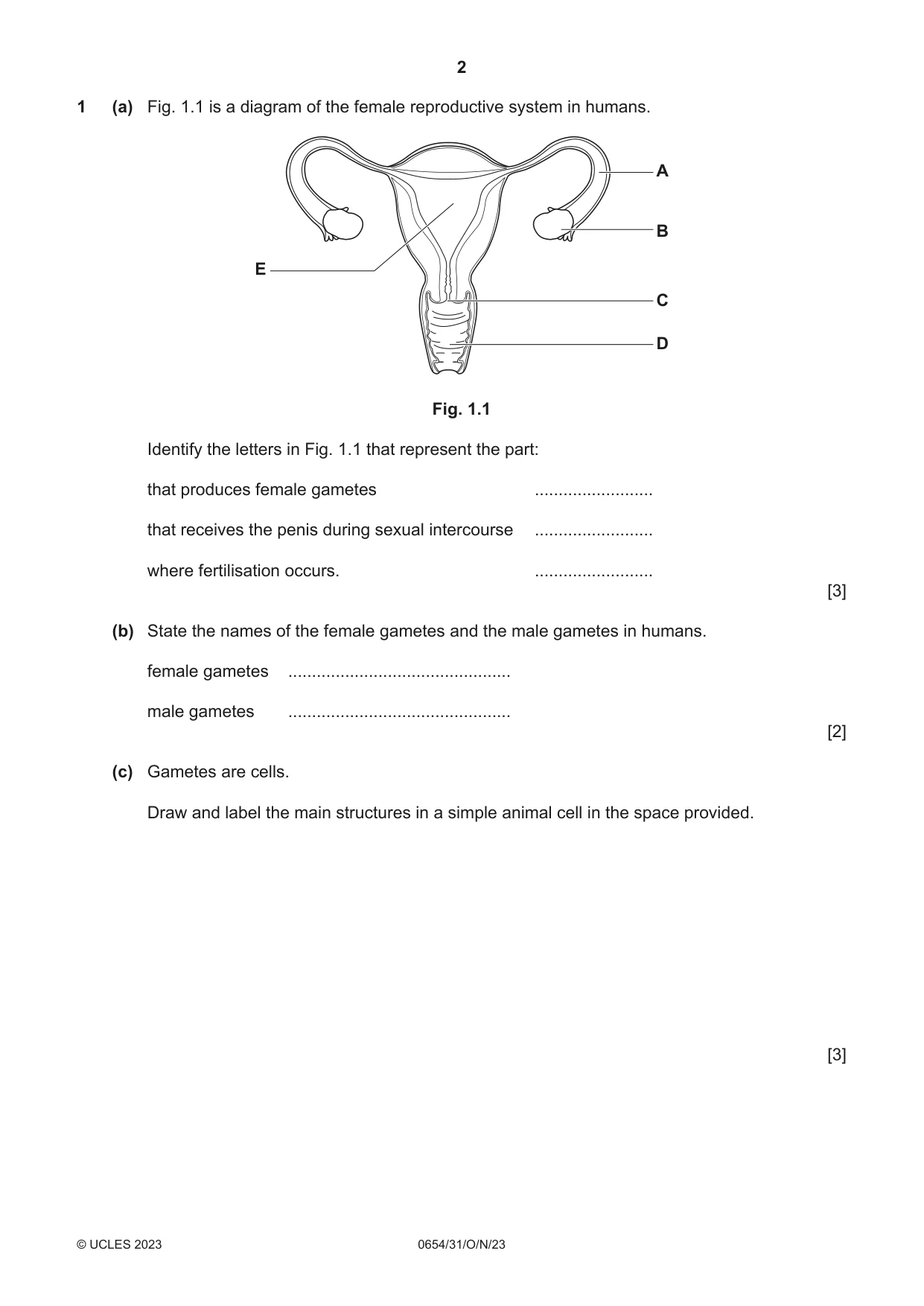
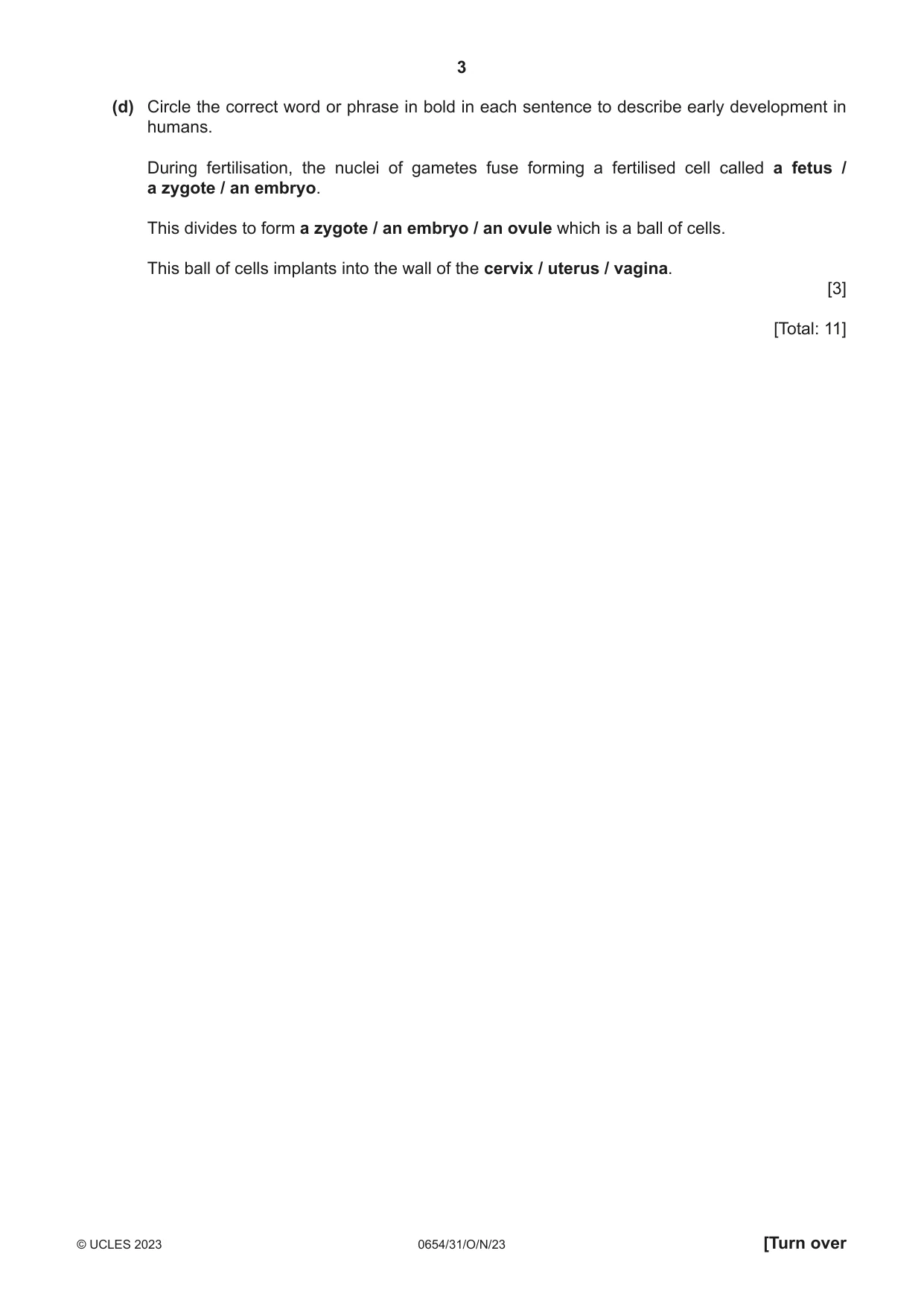
1 (a) Fig. 1.1 is a diagram of the female reproductive system in humans. A B E C D Fig. 1.1 Identify the letters in Fig. 1.1 that represent the part: that produces female gametes ......................... that receives the penis during sexual intercourse ......................... where fertilisation occurs. ......................... [3] (b) State the names of the female gametes and the male gametes in humans. female gametes ............................................... male gametes ............................................... [2] (c) Gametes are cells. Draw and label the main structures in a simple animal cell in the space provided. [3] (d) Circle the correct word or phrase in bold in each sentence to describe early development in humans. During fertilisation, the nuclei of gametes fuse forming a fertilised cell called a fetus / a zygote / an embryo. This divides to form a zygote / an embryo / an ovule which is a ball of cells. This ball of cells implants into the wall of the cervix / uterus / vagina. [3] [Total: 11]
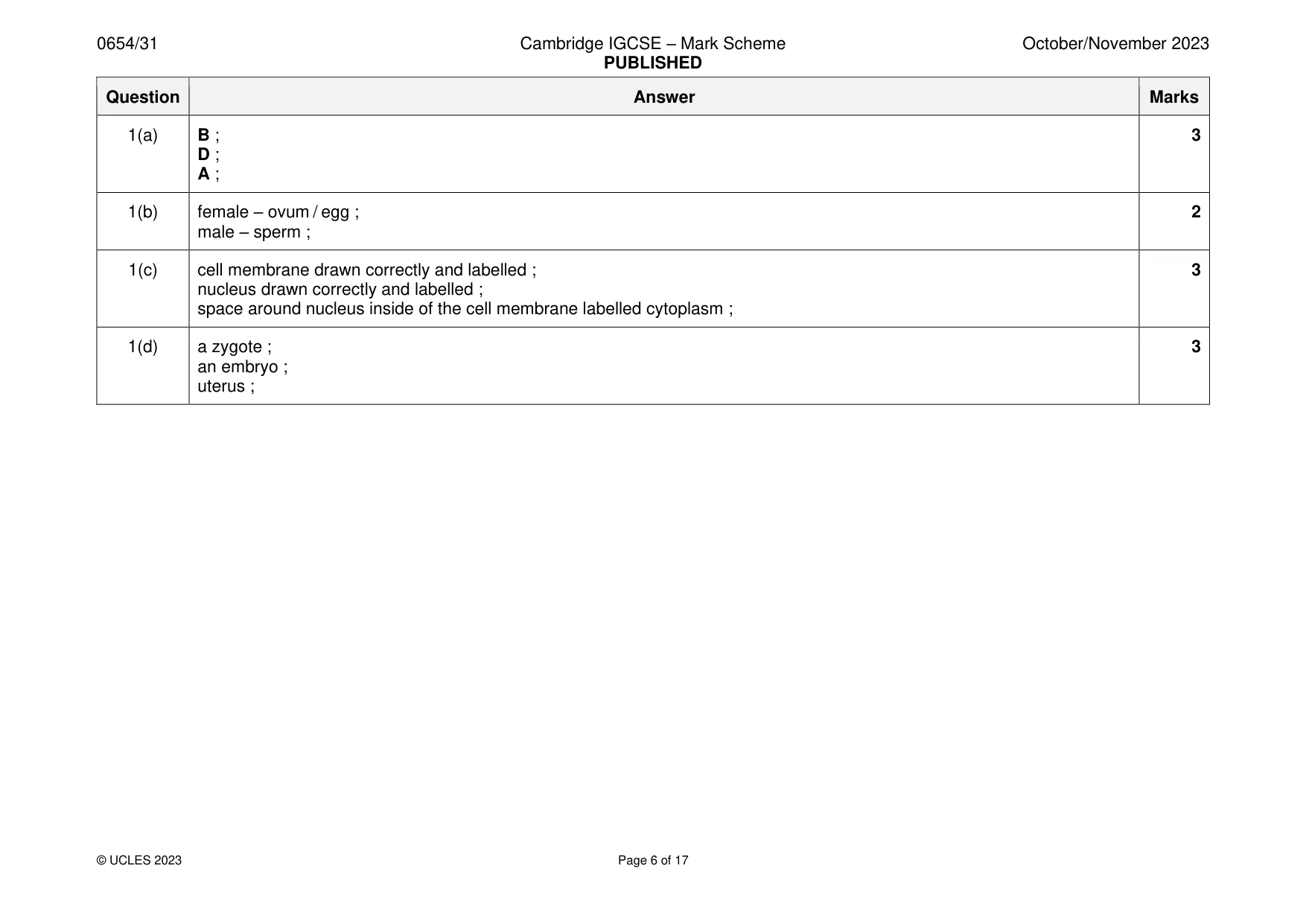
Mark scheme: Question Answer Marks 1(a) B ; 3 D ; A ; 1(b) female – ovum / egg ; 2 male – sperm ; 1(c) cell membrane drawn correctly and labelled ; 3 nucleus drawn correctly and labelled ; space around nucleus inside of the cell membrane labelled cytoplasm ; 1(d) a zygote ; 3 an embryo ; uterus ;
Q2 · Air is a mixture of gases
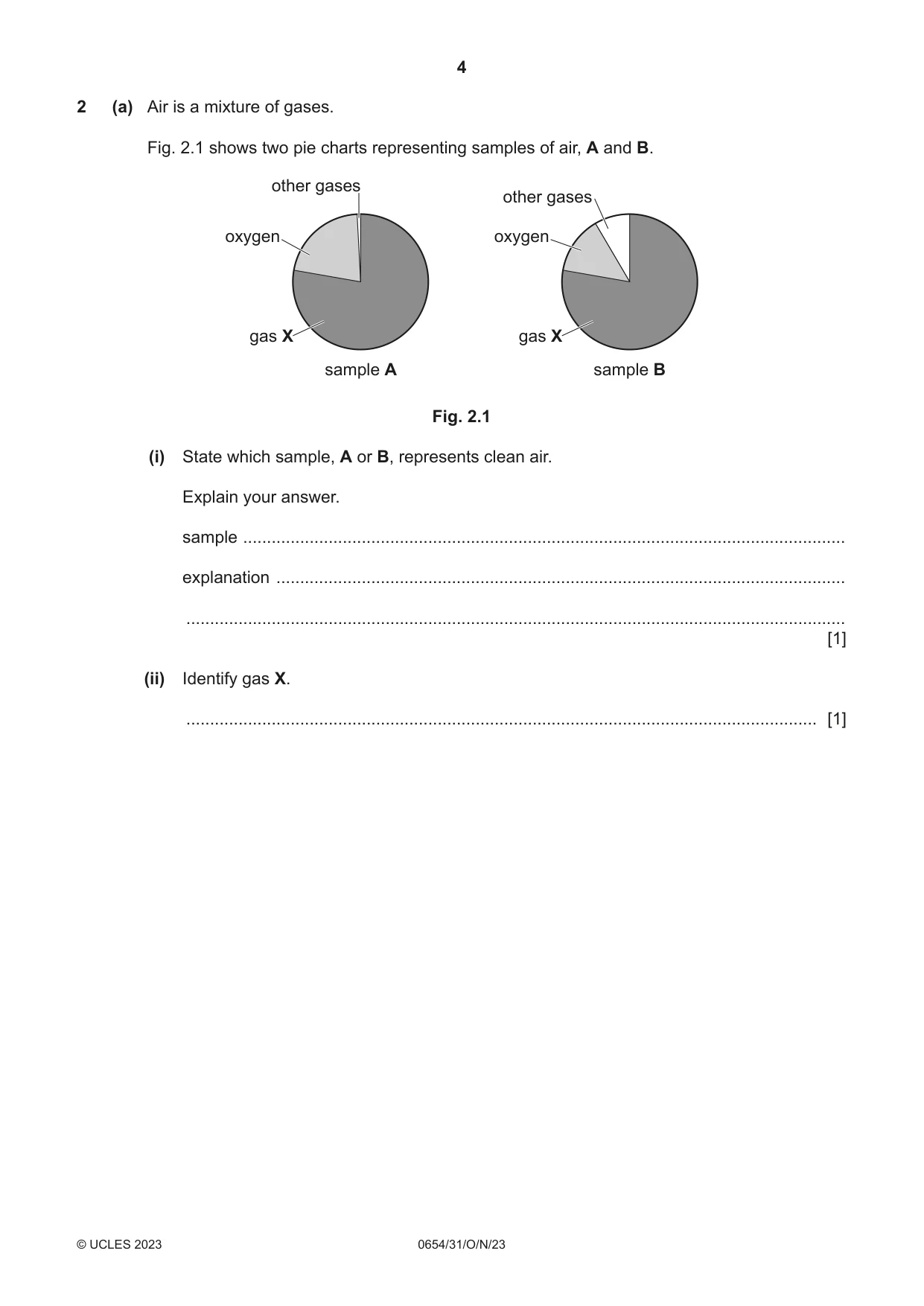
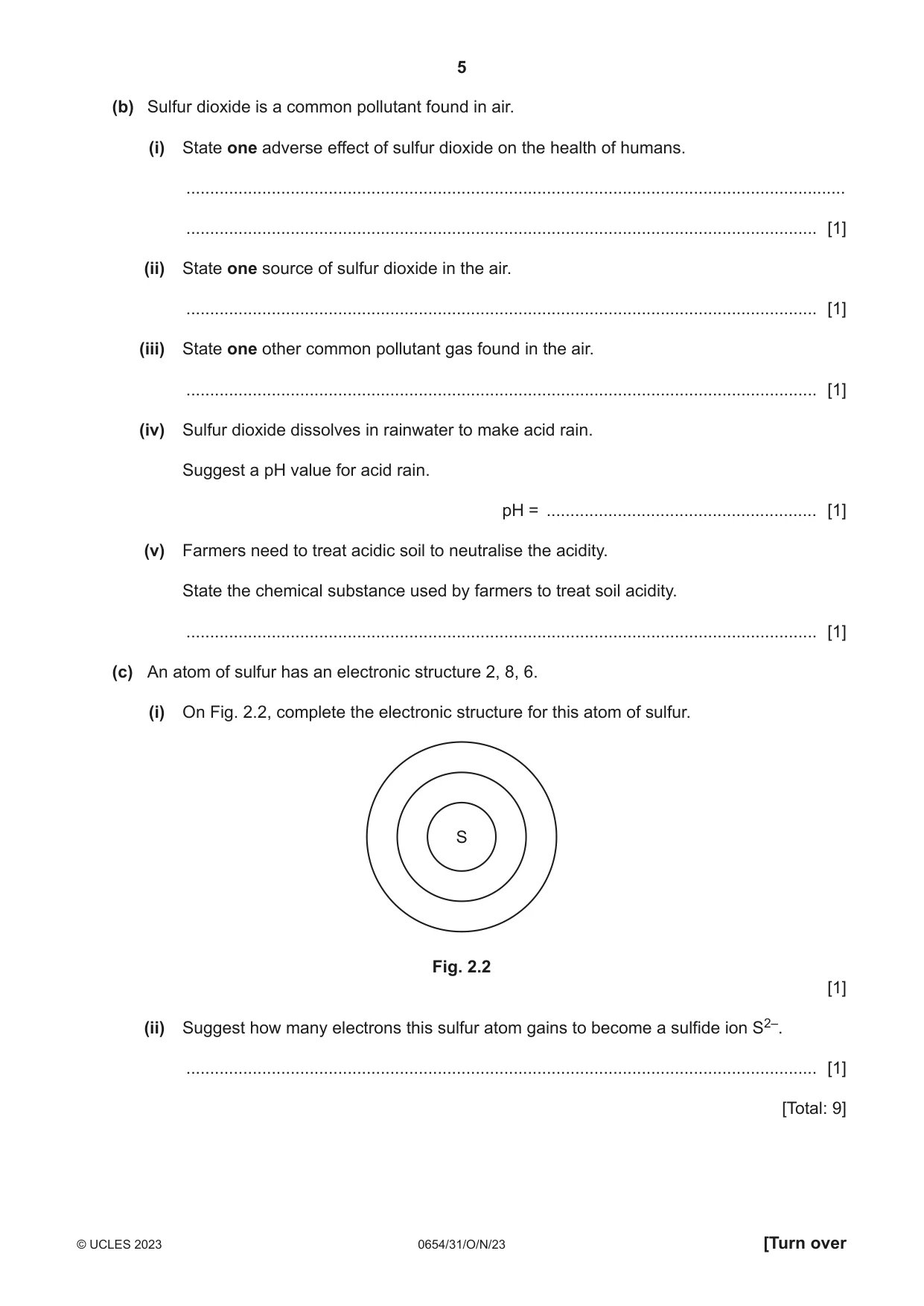
2 (a) Air is a mixture of gases. Fig. 2.1 shows two pie charts representing samples of air, A and B. other gases other gases oxygen oxygen gas X gas X sample A sample B Fig. 2.1 (i) State which sample, A or B, represents clean air. Explain your answer. sample ............................................................................................................................... explanation ........................................................................................................................ ........................................................................................................................................... [1] (ii) Identify gas X. ..................................................................................................................................... [1] (b) Sulfur dioxide is a common pollutant found in air. (i) State one adverse effect of sulfur dioxide on the health of humans. ........................................................................................................................................... ..................................................................................................................................... [1] (ii) State one source of sulfur dioxide in the air. ..................................................................................................................................... [1] (iii) State one other common pollutant gas found in the air. ..................................................................................................................................... [1] (iv) Sulfur dioxide dissolves in rainwater to make acid rain. Suggest a pH value for acid rain. pH = ......................................................... [1] (v) Farmers need to treat acidic soil to neutralise the acidity. State the chemical substance used by farmers to treat soil acidity. ..................................................................................................................................... [1] (c) An atom of sulfur has an electronic structure 2, 8, 6. (i) On Fig. 2.2, complete the electronic structure for this atom of sulfur. S Fig. 2.2 [1] (ii) Suggest how many electrons this sulfur atom gains to become a sulfide ion S2–. ..................................................................................................................................... [1] [Total: 9]
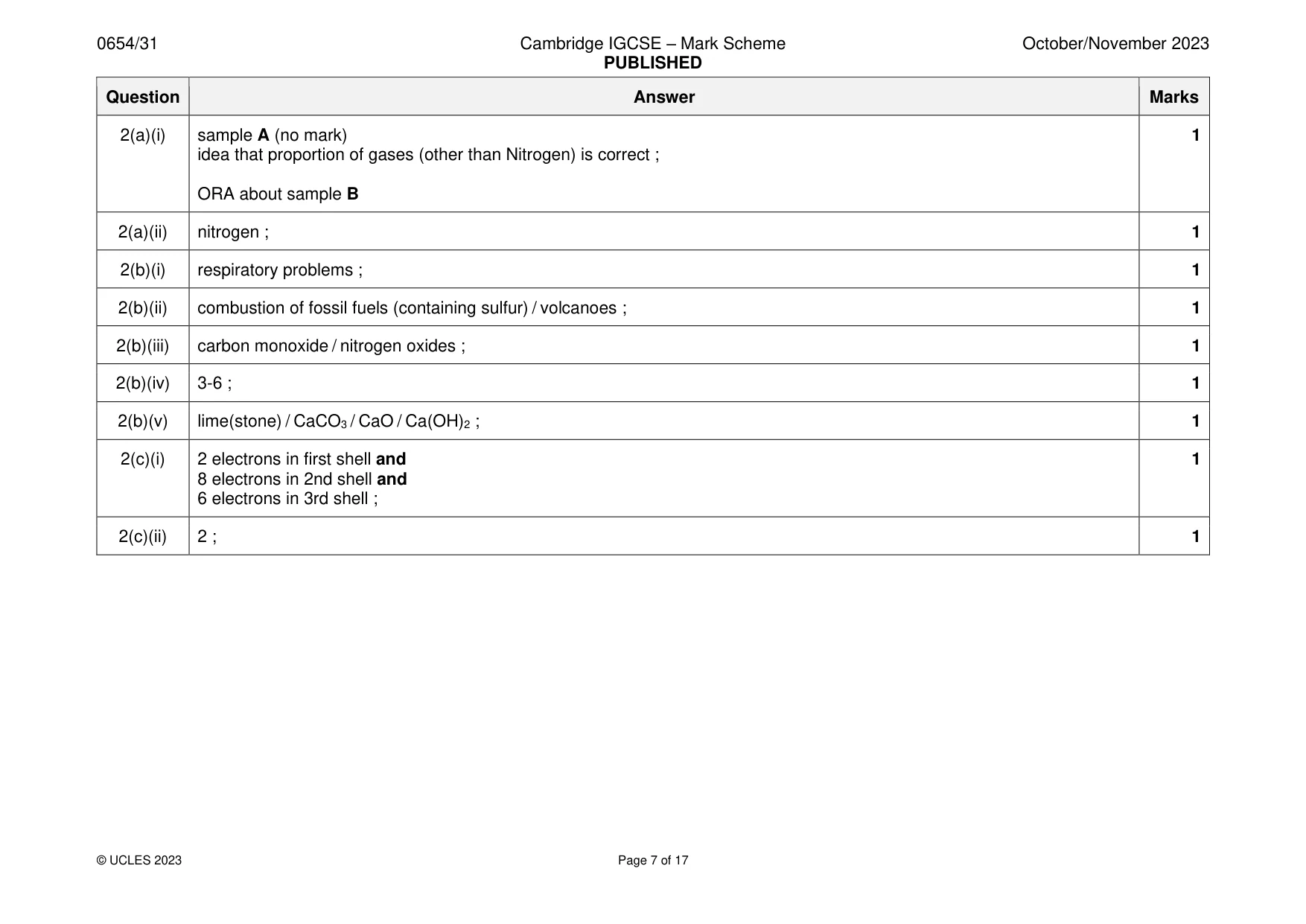
Mark scheme: 2(a)(i) sample A (no mark) 1 idea that proportion of gases (other than Nitrogen) is correct ; ORA about sample B 2(a)(ii) nitrogen ; 1 2(b)(i) respiratory problems ; 1 2(b)(ii) combustion of fossil fuels (containing sulfur) / volcanoes ; 1 2(b)(iii) carbon monoxide / nitrogen oxides ; 1 2(b)(iv) 3-6 ; 1 2(b)(v) lime(stone) / CaCO3 / CaO / Ca(OH)2 ; 1 2(c)(i) 2 electrons in first shell and 1 8 electrons in 2nd shell and 6 electrons in 3rd shell ; 2(c)(ii) 2 ; 1
Q3 · Four forces, A, B, C and D, acting on a submarine travelling underwater at a constant…
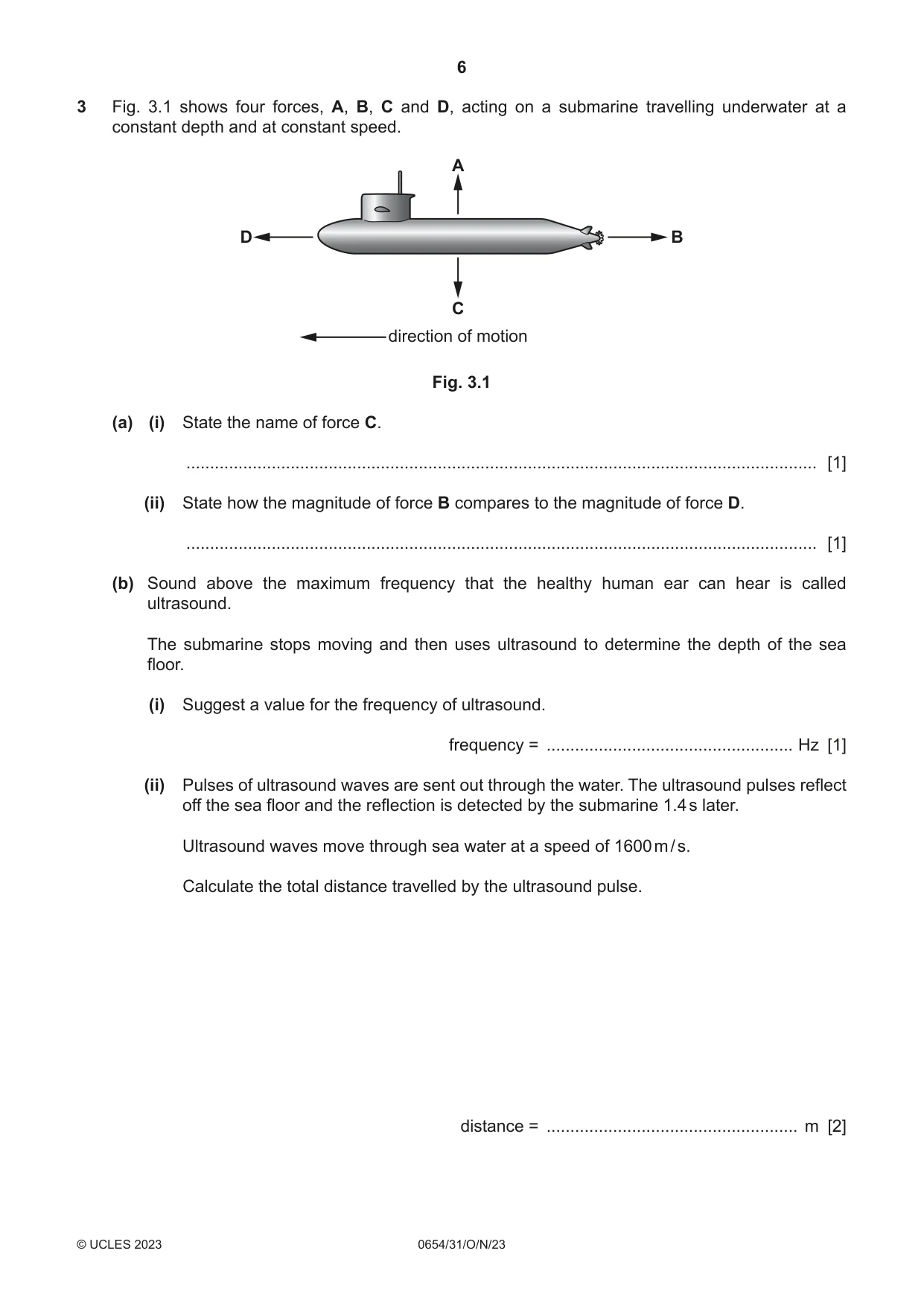
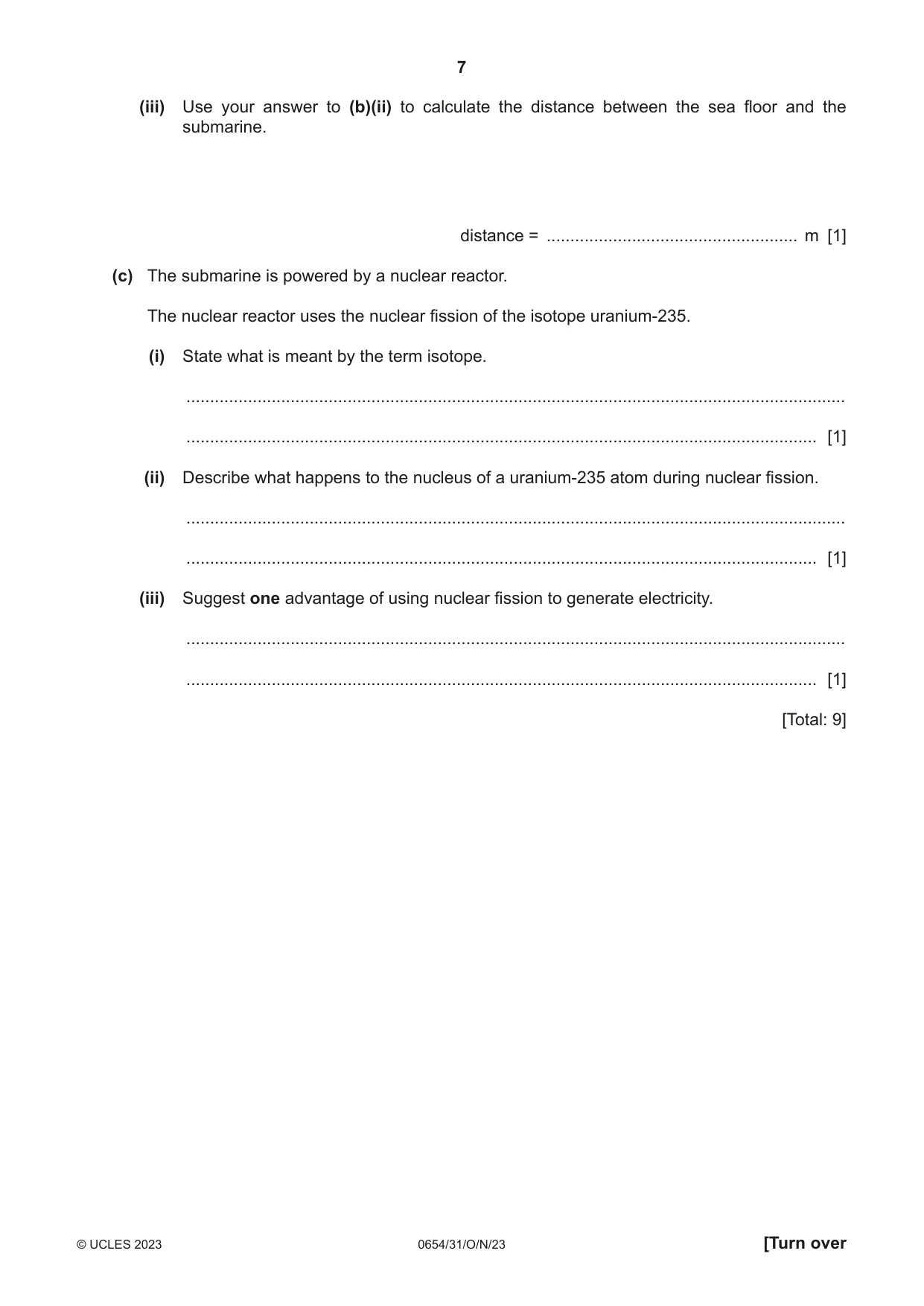
3 Fig. 3.1 shows four forces, A, B, C and D, acting on a submarine travelling underwater at a constant depth and at constant speed. A D B C direction of motion Fig. 3.1 (a) (i) State the name of force C. ..................................................................................................................................... [1] (ii) State how the magnitude of force B compares to the magnitude of force D. ..................................................................................................................................... [1] (b) Sound above the maximum frequency that the healthy human ear can hear is called ultrasound. The submarine stops moving and then uses ultrasound to determine the depth of the sea floor. (i) Suggest a value for the frequency of ultrasound. frequency = .................................................... Hz [1] (ii) Pulses of ultrasound waves are sent out through the water. The ultrasound pulses reflect off the sea floor and the reflection is detected by the submarine 1.4 s later. Ultrasound waves move through sea water at a speed of 1600 m / s. Calculate the total distance travelled by the ultrasound pulse. distance = ..................................................... m [2] (iii) Use your answer to (b)(ii) to calculate the distance between the sea floor and the submarine. distance = ..................................................... m [1] (c) The submarine is powered by a nuclear reactor. The nuclear reactor uses the nuclear fission of the isotope uranium-235. (i) State what is meant by the term isotope. ........................................................................................................................................... ..................................................................................................................................... [1] (ii) Describe what happens to the nucleus of a uranium-235 atom during nuclear fission. ........................................................................................................................................... ..................................................................................................................................... [1] (iii) Suggest one advantage of using nuclear fission to generate electricity. ........................................................................................................................................... ..................................................................................................................................... [1] [Total: 9]
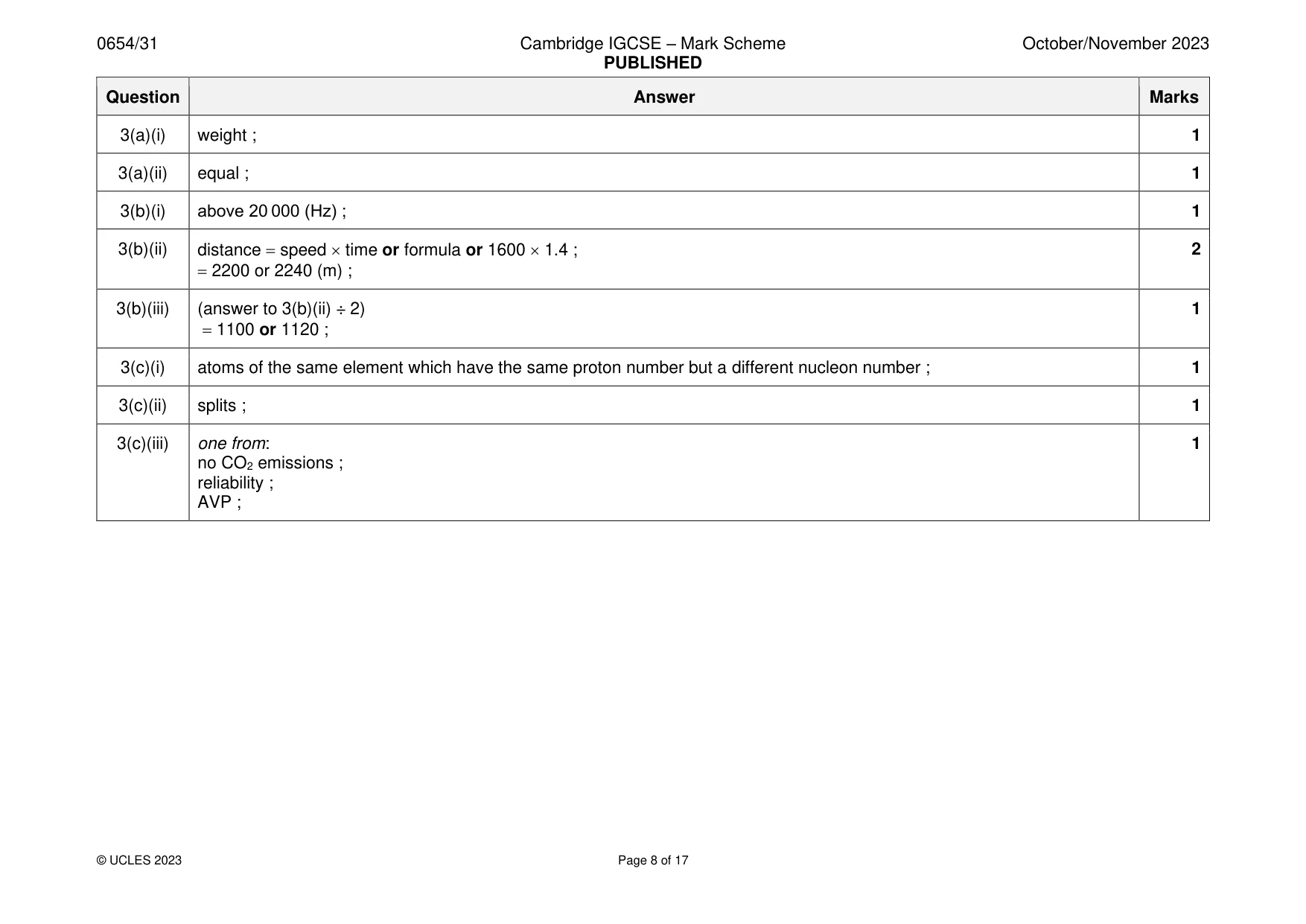
Mark scheme: 3(a)(i) weight ; 1 3(a)(ii) equal ; 1 3(b)(i) above 20 000 (Hz) ; 1 3(b)(ii) distance = speed time or formula or 1600 1.4 ; 2 = 2200 or 2240 (m) ; 3(b)(iii) (answer to 3(b)(ii) ÷ 2) 1 = 1100 or 1120 ; 3(c)(i) atoms of the same element which have the same proton number but a different nucleon number ; 1 3(c)(ii) splits ; 1 3(c)(iii) one from: 1 no CO2 emissions ; reliability ; AVP ;
Q4 · A student records their pulse rate in beats per minute (bpm) during different types of…
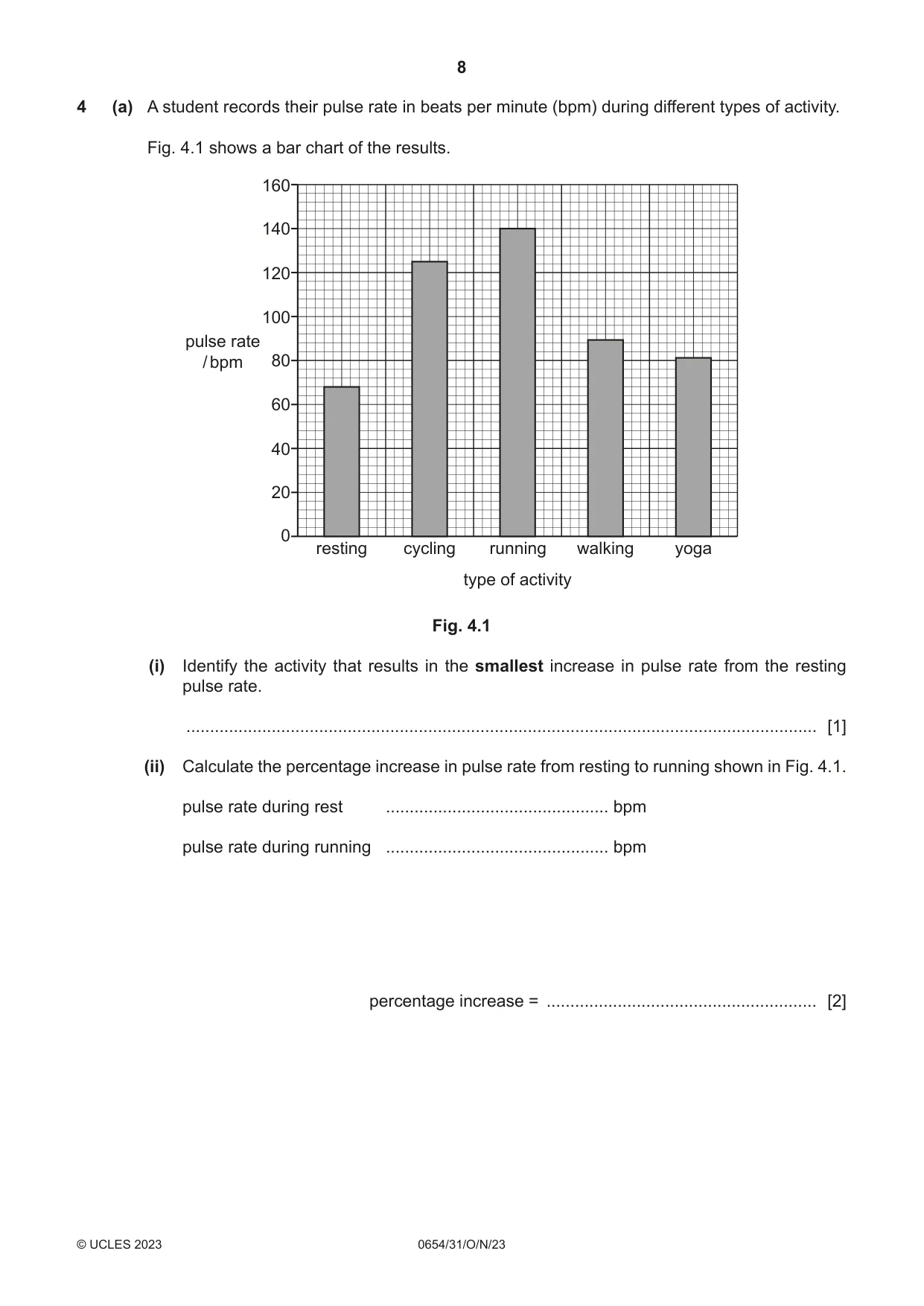
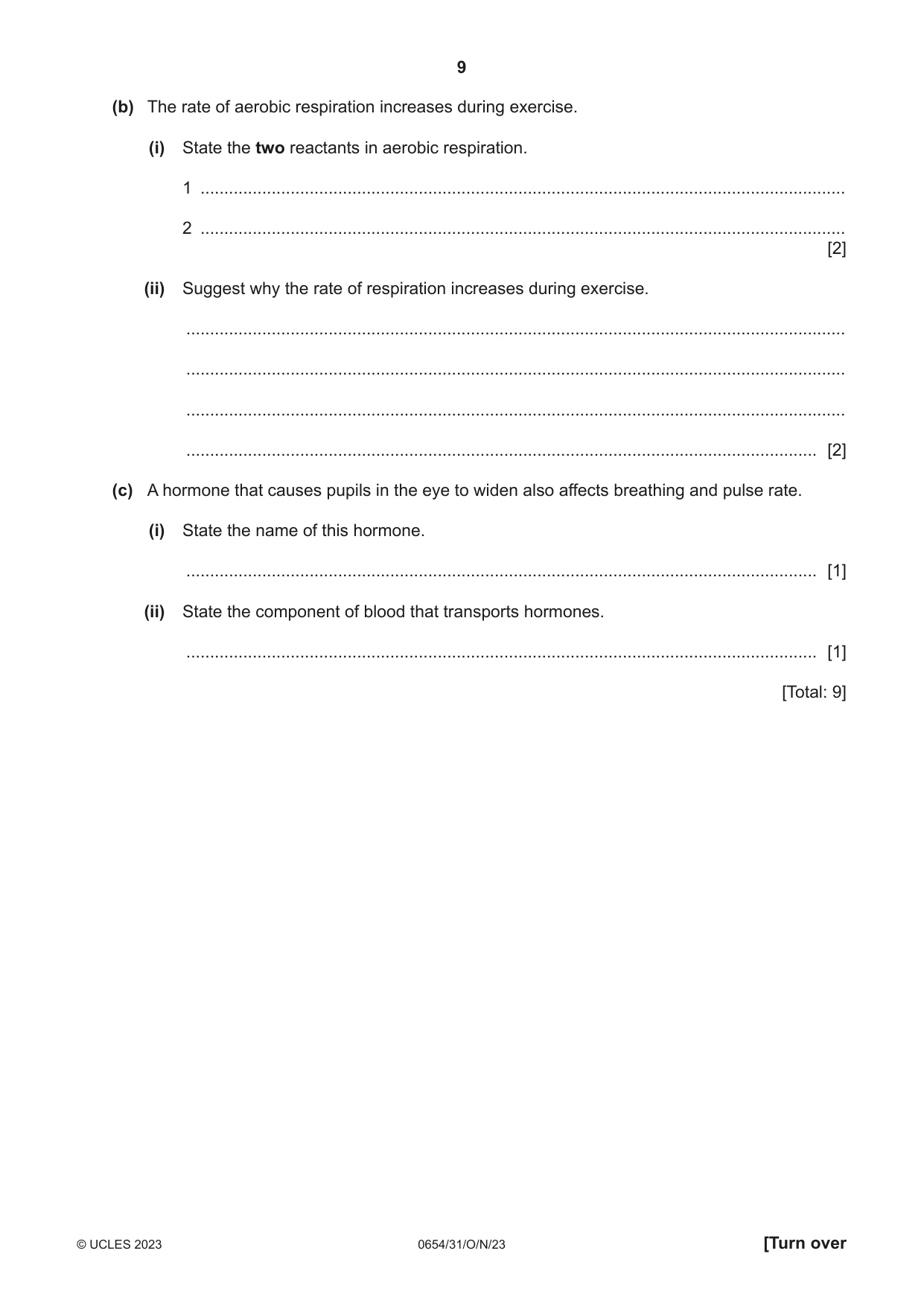
4 (a) A student records their pulse rate in beats per minute (bpm) during different types of activity. Fig. 4.1 shows a bar chart of the results. 160 140 120 100 pulse rate / bpm 80 60 40 20 0 resting cycling running walking yoga type of activity Fig. 4.1 (i) Identify the activity that results in the smallest increase in pulse rate from the resting pulse rate. ..................................................................................................................................... [1] (ii) Calculate the percentage increase in pulse rate from resting to running shown in Fig. 4.1. pulse rate during rest ............................................... bpm pulse rate during running ............................................... bpm percentage increase = ......................................................... [2] (b) The rate of aerobic respiration increases during exercise. (i) State the two reactants in aerobic respiration. 1 ........................................................................................................................................ 2 ........................................................................................................................................ [2] (ii) Suggest why the rate of respiration increases during exercise. ........................................................................................................................................... ........................................................................................................................................... ........................................................................................................................................... ..................................................................................................................................... [2] (c) A hormone that causes pupils in the eye to widen also affects breathing and pulse rate. (i) State the name of this hormone. ..................................................................................................................................... [1] (ii) State the component of blood that transports hormones. ..................................................................................................................................... [1] [Total: 9]
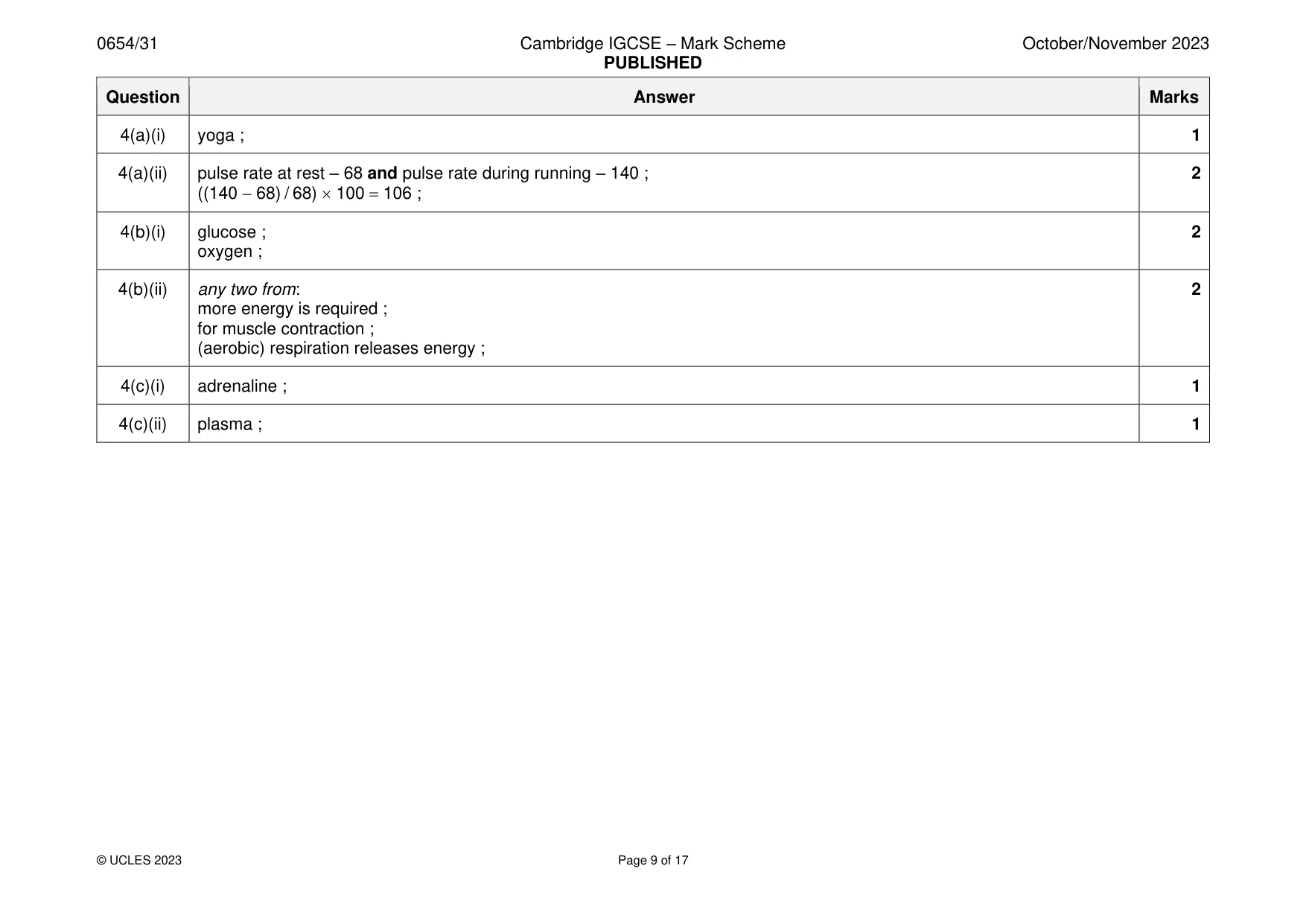
Mark scheme: 4(a)(i) yoga ; 1 4(a)(ii) pulse rate at rest – 68 and pulse rate during running – 140 ; 2 ((140 − 68) / 68) 100 = 106 ; 4(b)(i) glucose ; 2 oxygen ; 4(b)(ii) any two from: 2 more energy is required ; for muscle contraction ; (aerobic) respiration releases energy ; 4(c)(i) adrenaline ; 1 4(c)(ii) plasma ; 1
Q5 · Five compounds, A, B, C, D and E, and the formula of each compound
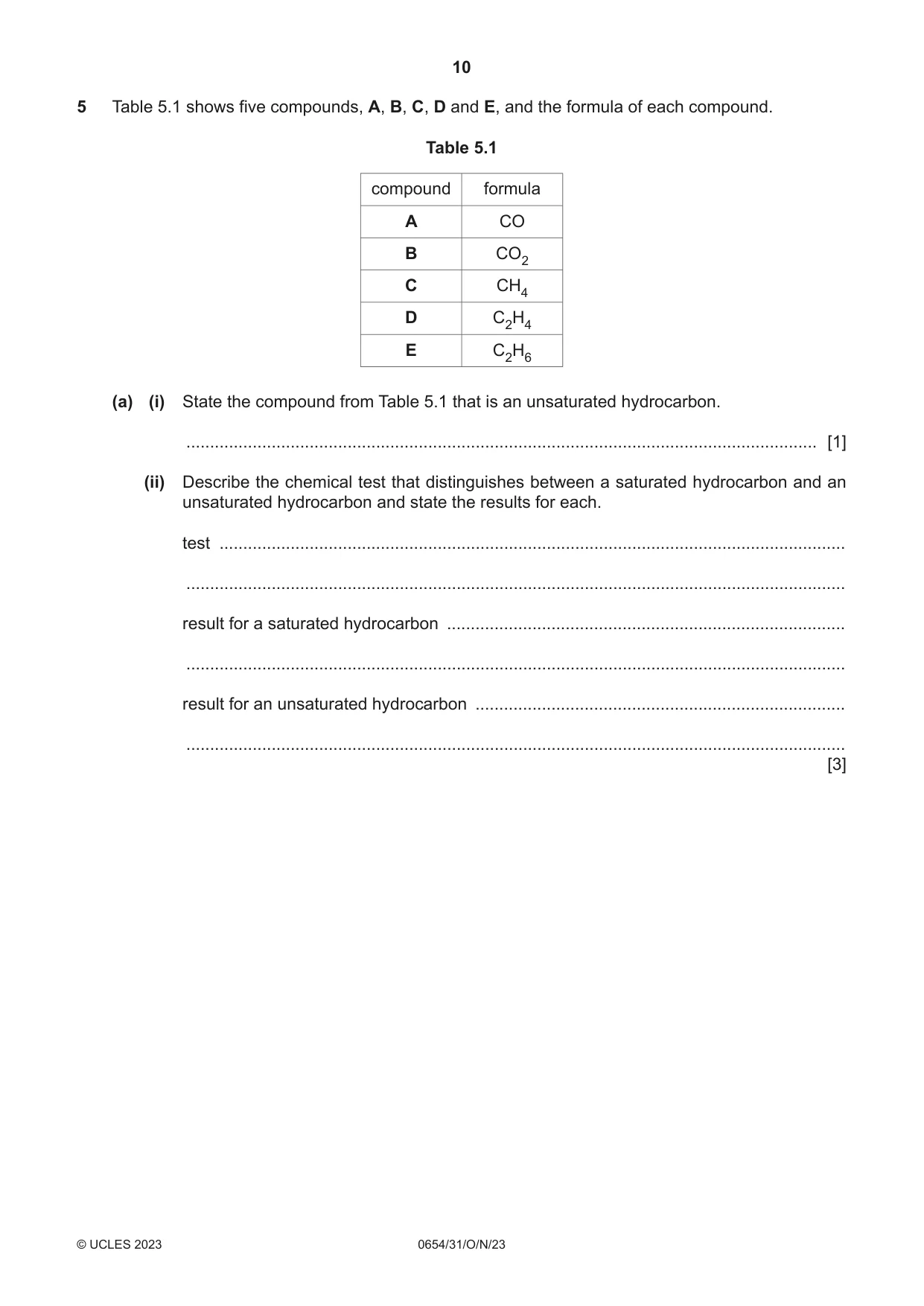
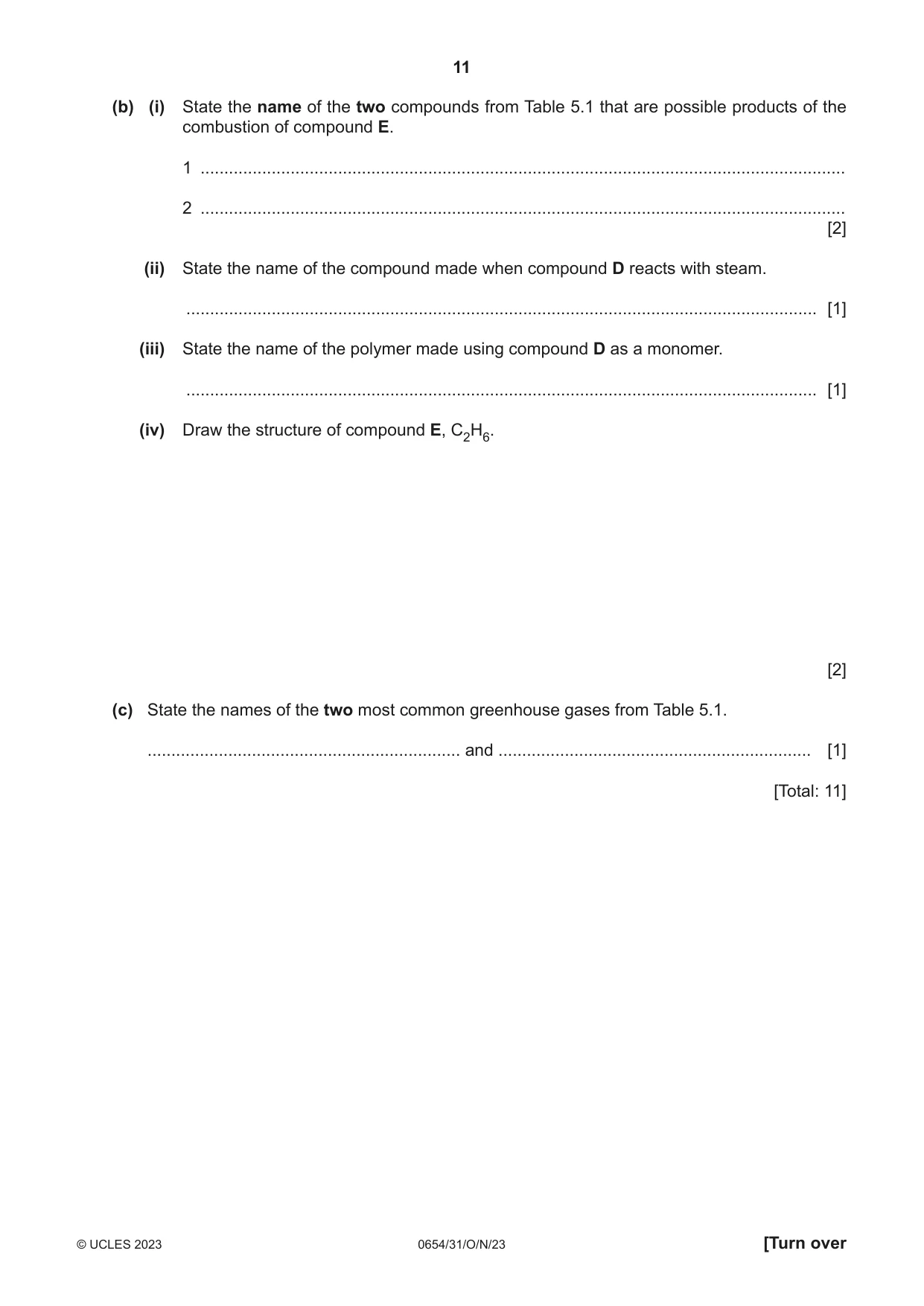
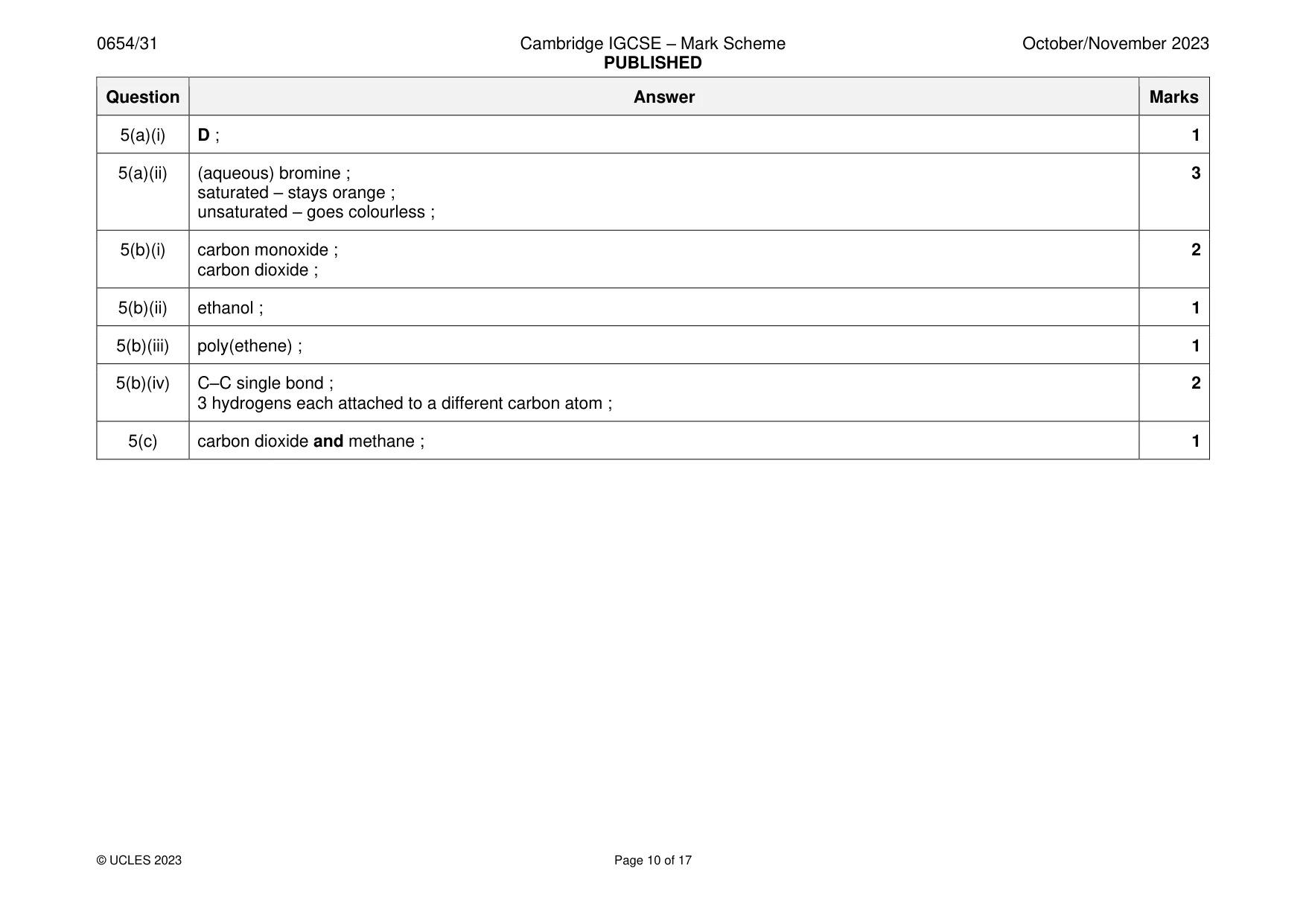
5 Table 5.1 shows five compounds, A, B, C, D and E, and the formula of each compound. Table 5.1 compound formula A CO B CO2 C CH4 D C2H4 E C2H6 (a) (i) State the compound from Table 5.1 that is an unsaturated hydrocarbon. ..................................................................................................................................... [1] (ii) Describe the chemical test that distinguishes between a saturated hydrocarbon and an unsaturated hydrocarbon and state the results for each. test .................................................................................................................................... ........................................................................................................................................... result for a saturated hydrocarbon .................................................................................... ........................................................................................................................................... result for an unsaturated hydrocarbon .............................................................................. ........................................................................................................................................... [3] (b) (i) State the name of the two compounds from Table 5.1 that are possible products of the combustion of compound E. 1 ........................................................................................................................................ 2 ........................................................................................................................................ [2] (ii) State the name of the compound made when compound D reacts with steam. ..................................................................................................................................... [1] (iii) State the name of the polymer made using compound D as a monomer. ..................................................................................................................................... [1] (iv) Draw the structure of compound E, C2H6. [2] (c) State the names of the two most common greenhouse gases from Table 5.1. .................................................................. and .................................................................. [1] [Total: 11]
Mark scheme: 5(a)(i) D ; 1 5(a)(ii) (aqueous) bromine ; 3 saturated – stays orange ; unsaturated – goes colourless ; 5(b)(i) carbon monoxide ; 2 carbon dioxide ; 5(b)(ii) ethanol ; 1 5(b)(iii) poly(ethene) ; 1 5(b)(iv) C–C single bond ; 2 3 hydrogens each attached to a different carbon atom ; 5(c) carbon dioxide and methane ; 1
Q6 · An incomplete circuit diagram
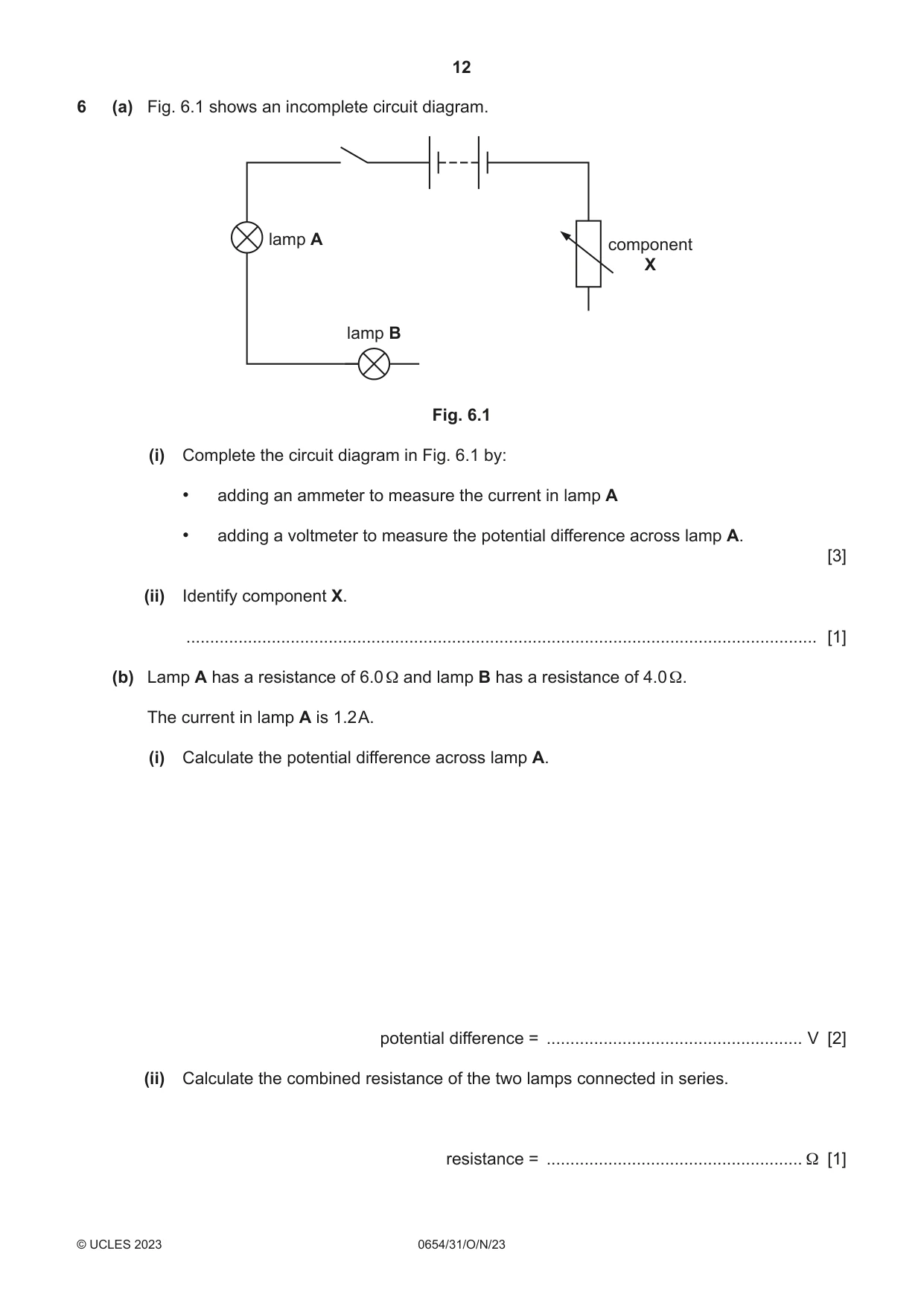
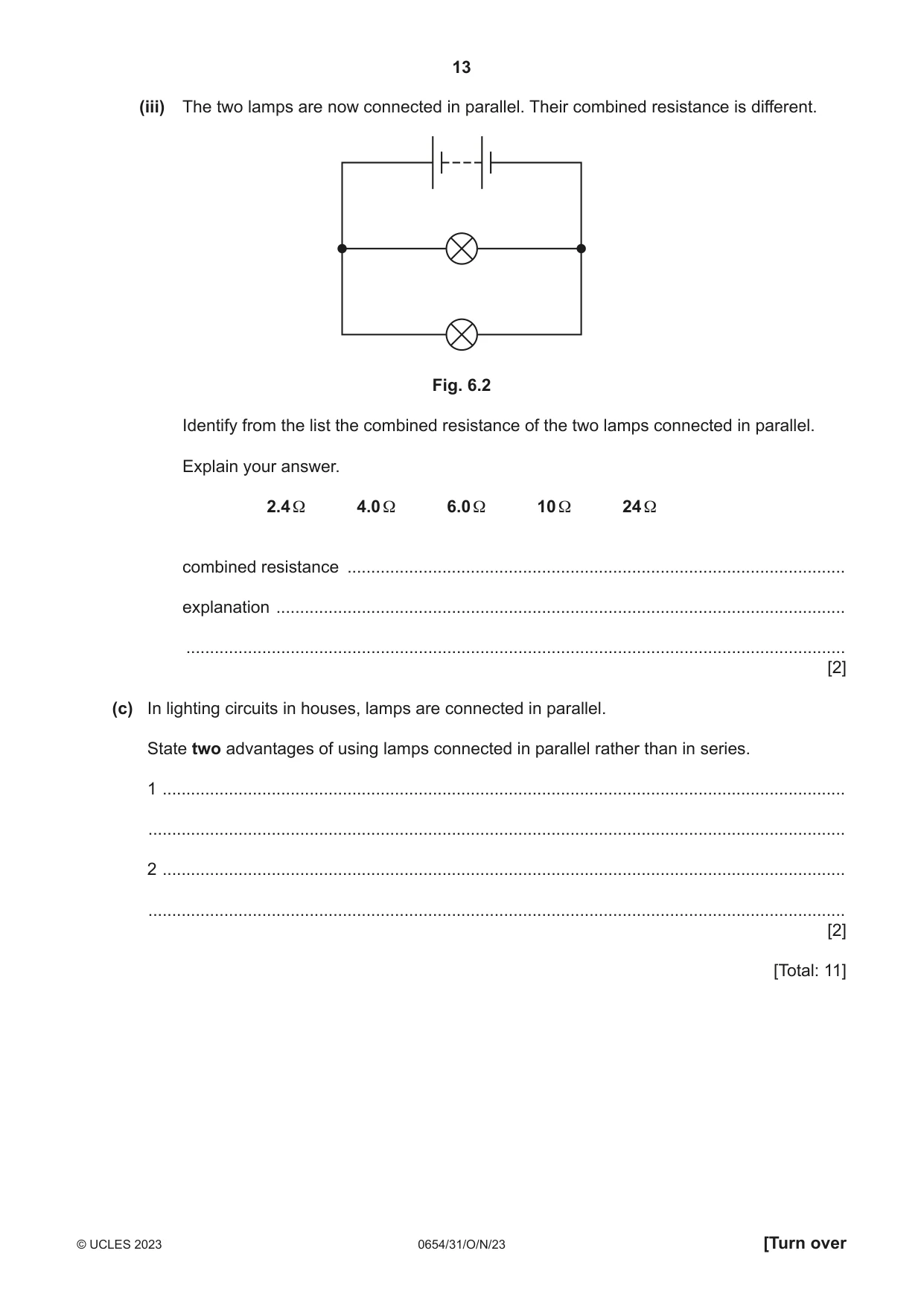
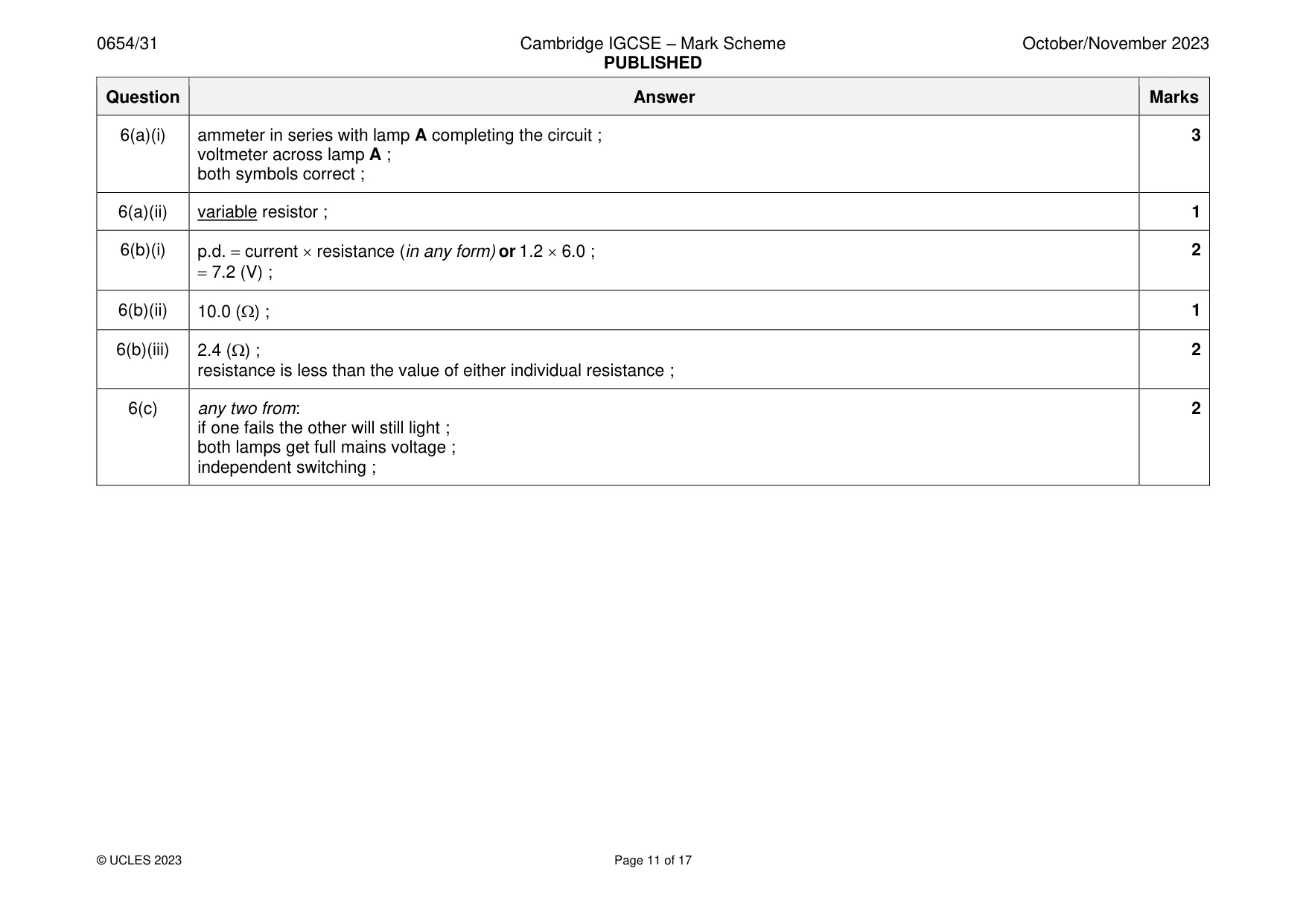
6 (a) Fig. 6.1 shows an incomplete circuit diagram. lamp A component X lamp B Fig. 6.1 (i) Complete the circuit diagram in Fig. 6.1 by: • adding an ammeter to measure the current in lamp A • adding a voltmeter to measure the potential difference across lamp A. [3] (ii) Identify component X. ..................................................................................................................................... [1] (b) Lamp A has a resistance of 6.0 Ω and lamp B has a resistance of 4.0 Ω. The current in lamp A is 1.2 A. (i) Calculate the potential difference across lamp A. potential difference = ...................................................... V [2] (ii) Calculate the combined resistance of the two lamps connected in series. resistance = ...................................................... Ω [1] (iii) The two lamps are now connected in parallel. Their combined resistance is different. Fig. 6.2 Identify from the list the combined resistance of the two lamps connected in parallel. Explain your answer. 2.4 Ω 4.0 Ω 6.0 Ω 10 Ω 24 Ω combined resistance ......................................................................................................... explanation ........................................................................................................................ ........................................................................................................................................... [2] (c) In lighting circuits in houses, lamps are connected in parallel. State two advantages of using lamps connected in parallel rather than in series. 1 ................................................................................................................................................ ................................................................................................................................................... 2 ................................................................................................................................................ ................................................................................................................................................... [2] [Total: 11]
Mark scheme: 6(a)(i) ammeter in series with lamp A completing the circuit ; 3 voltmeter across lamp A ; both symbols correct ; 6(a)(ii) variable resistor ; 1 6(b)(i) p.d. = current resistance (in any form) or 1.2 6.0 ; 2 = 7.2 (V) ; 6(b)(ii) 10.0 () ; 1 6(b)(iii) 2.4 () ; 2 resistance is less than the value of either individual resistance ; 6(c) any two from: 2 if one fails the other will still light ; both lamps get full mains voltage ; independent switching ;
Question 7
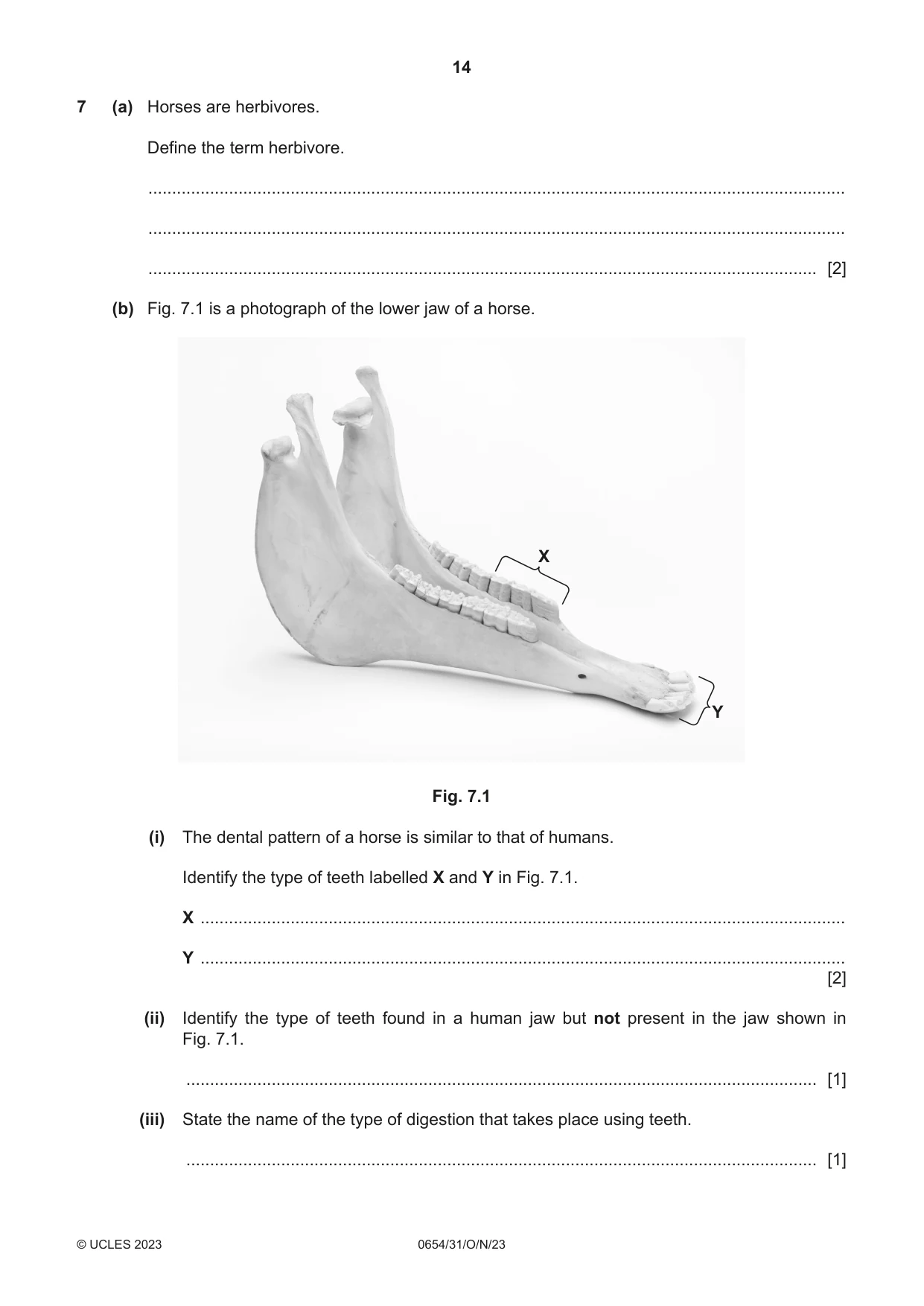
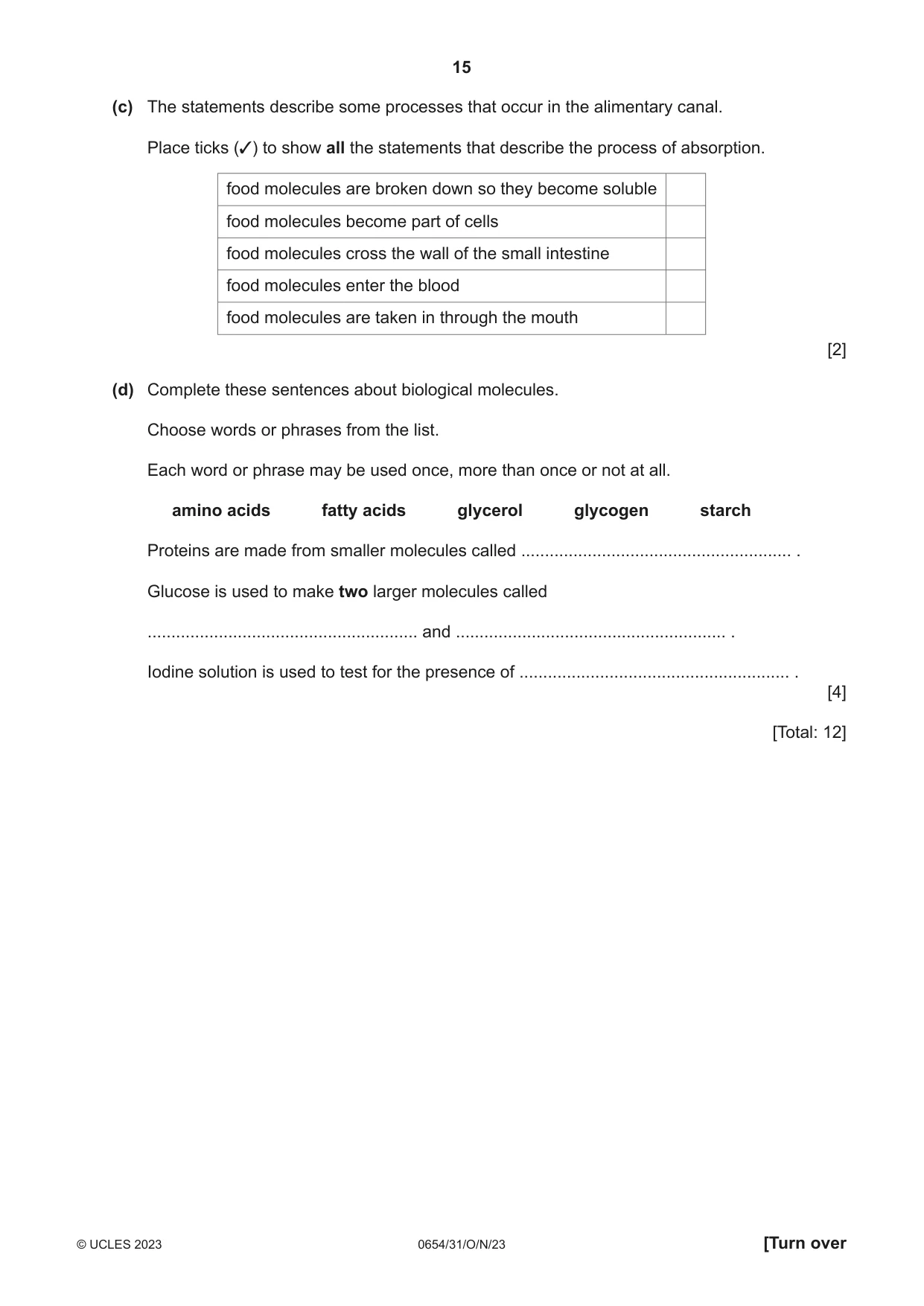
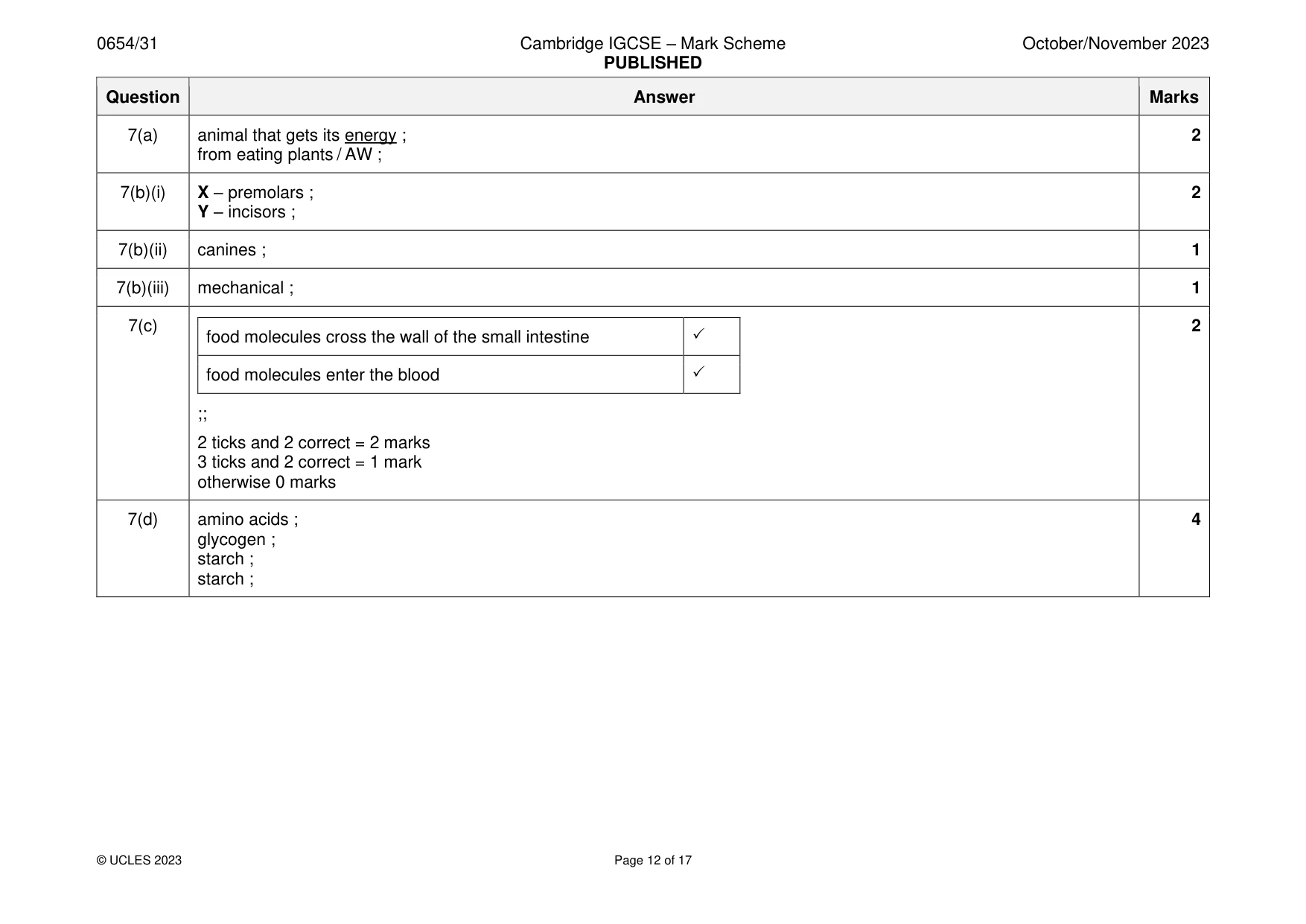
7 (a) Horses are herbivores. Define the term herbivore. ................................................................................................................................................... ................................................................................................................................................... ............................................................................................................................................. [2] (b) Fig. 7.1 is a photograph of the lower jaw of a horse. X Y Fig. 7.1 (i) The dental pattern of a horse is similar to that of humans. Identify the type of teeth labelled X and Y in Fig. 7.1. X ........................................................................................................................................ Y ........................................................................................................................................ [2] (ii) Identify the type of teeth found in a human jaw but not present in the jaw shown in Fig. 7.1. ..................................................................................................................................... [1] (iii) State the name of the type of digestion that takes place using teeth. ..................................................................................................................................... [1] (c) The statements describe some processes that occur in the alimentary canal. Place ticks (✓) to show all the statements that describe the process of absorption. food molecules are broken down so they become soluble food molecules become part of cells food molecules cross the wall of the small intestine food molecules enter the blood food molecules are taken in through the mouth [2] (d) Complete these sentences about biological molecules. Choose words or phrases from the list. Each word or phrase may be used once, more than once or not at all. amino acids fatty acids glycerol glycogen starch Proteins are made from smaller molecules called ......................................................... . Glucose is used to make two larger molecules called ......................................................... and ......................................................... . Iodine solution is used to test for the presence of ......................................................... . [4] [Total: 12]
Mark scheme: 7(a) animal that gets its energy ; 2 from eating plants / AW ; 7(b)(i) X – premolars ; 2 Y – incisors ; 7(b)(ii) canines ; 1 7(b)(iii) mechanical ; 1 7(c) 2 food molecules cross the wall of the small intestine food molecules enter the blood ;; 2 ticks and 2 correct = 2 marks 3 ticks and 2 correct = 1 mark otherwise 0 marks 7(d) amino acids ; 4 glycogen ; starch ; starch ;
Q8 · Statements about molecules in solids and gases
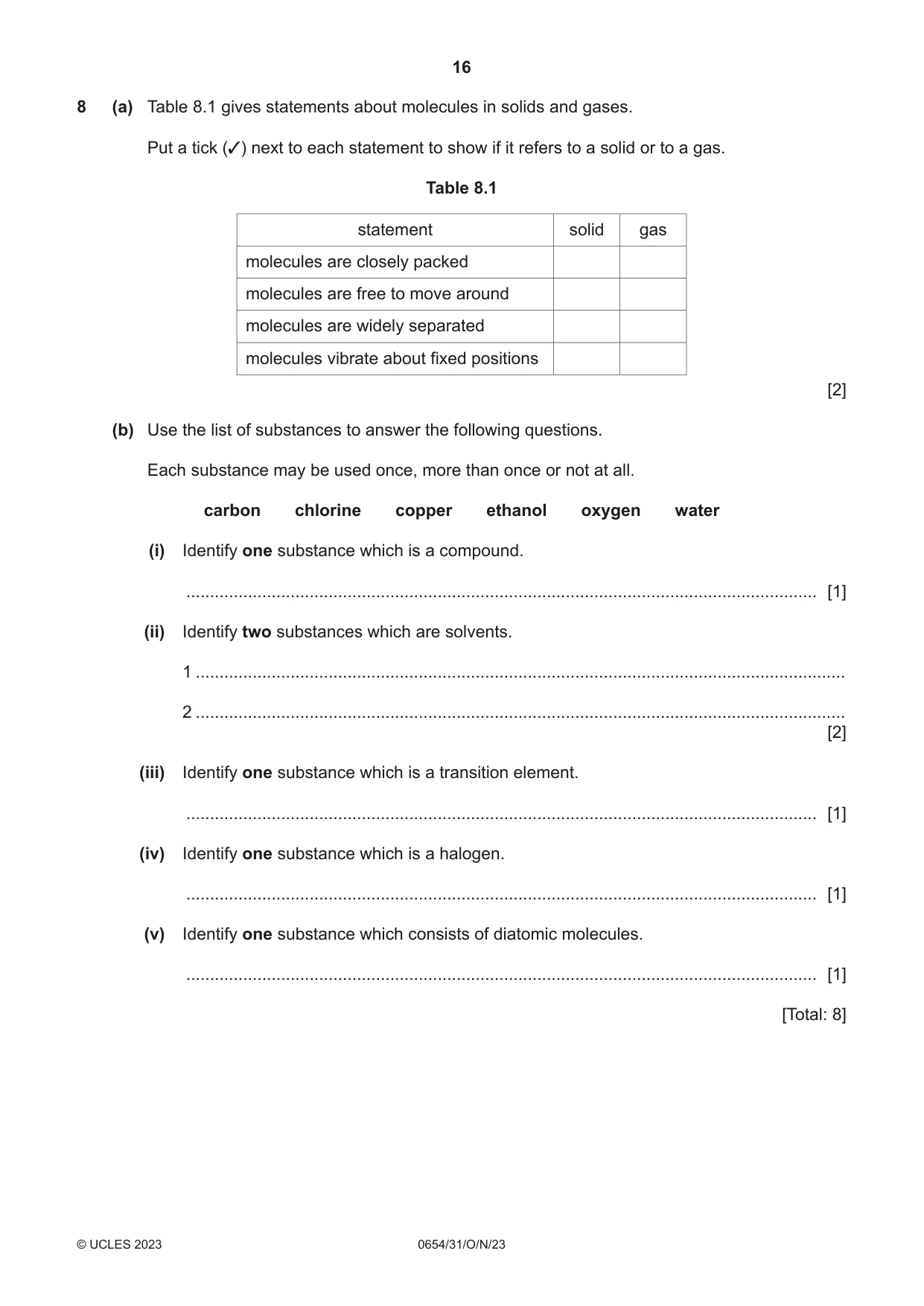
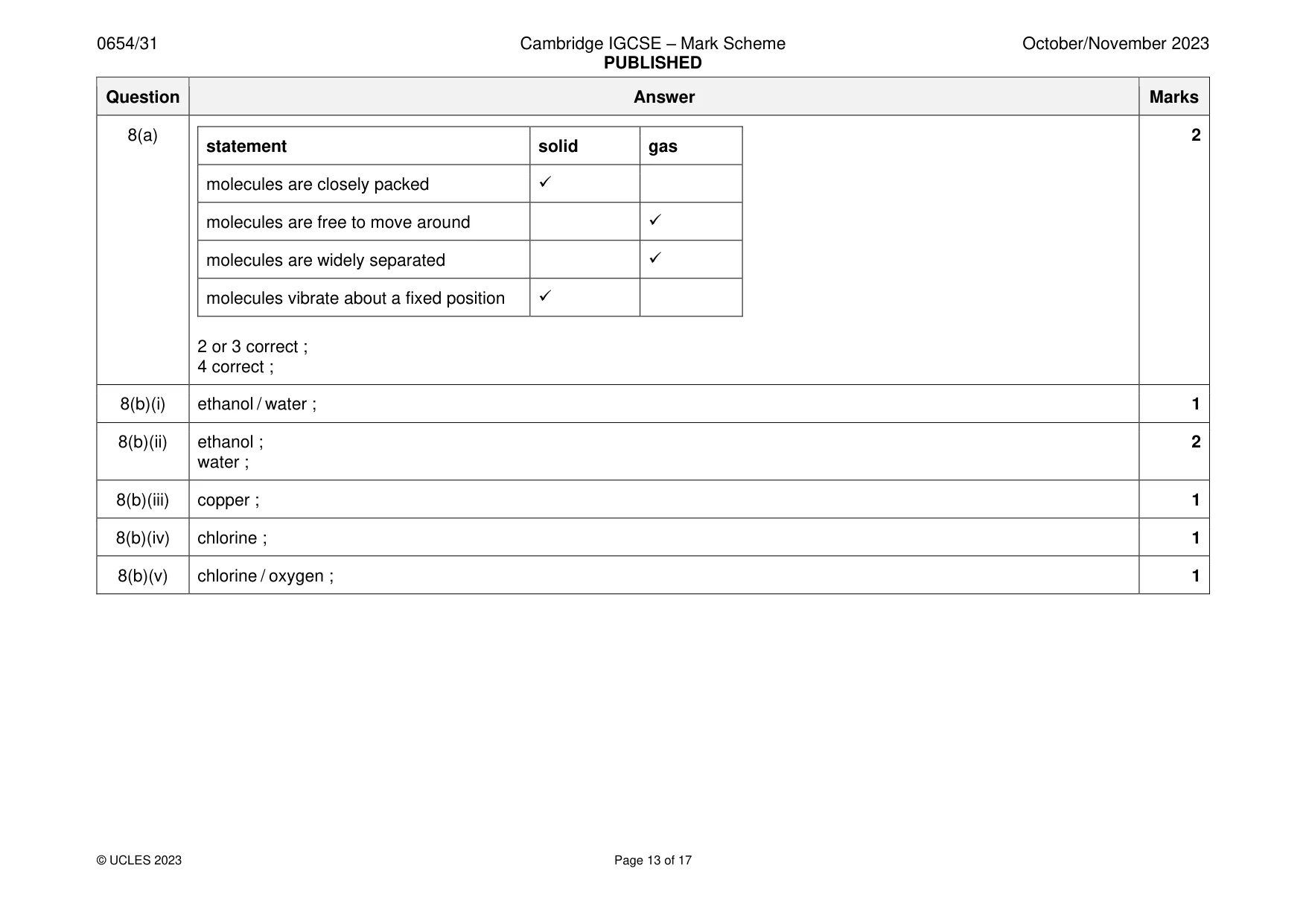
8 (a) Table 8.1 gives statements about molecules in solids and gases. Put a tick (✓) next to each statement to show if it refers to a solid or to a gas. Table 8.1 statement solid gas molecules are closely packed molecules are free to move around molecules are widely separated molecules vibrate about fixed positions [2] (b) Use the list of substances to answer the following questions. Each substance may be used once, more than once or not at all. carbon chlorine copper ethanol oxygen water (i) Identify one substance which is a compound. ..................................................................................................................................... [1] (ii) Identify two substances which are solvents. 1 ......................................................................................................................................... 2 ......................................................................................................................................... [2] (iii) Identify one substance which is a transition element. ..................................................................................................................................... [1] (iv) Identify one substance which is a halogen. ..................................................................................................................................... [1] (v) Identify one substance which consists of diatomic molecules. ..................................................................................................................................... [1] [Total: 8]
Mark scheme: 8(a) 2 statement solid gas molecules are closely packed ✓ molecules are free to move around ✓ molecules are widely separated ✓ molecules vibrate about a fixed position ✓ 2 or 3 correct ; 4 correct ; 8(b)(i) ethanol / water ; 1 8(b)(ii) ethanol ; 2 water ; 8(b)(iii) copper ; 1 8(b)(iv) chlorine ; 1 8(b)(v) chlorine / oxygen ; 1
Q9 · Train track is made of lengths of steel rails with small gaps between them
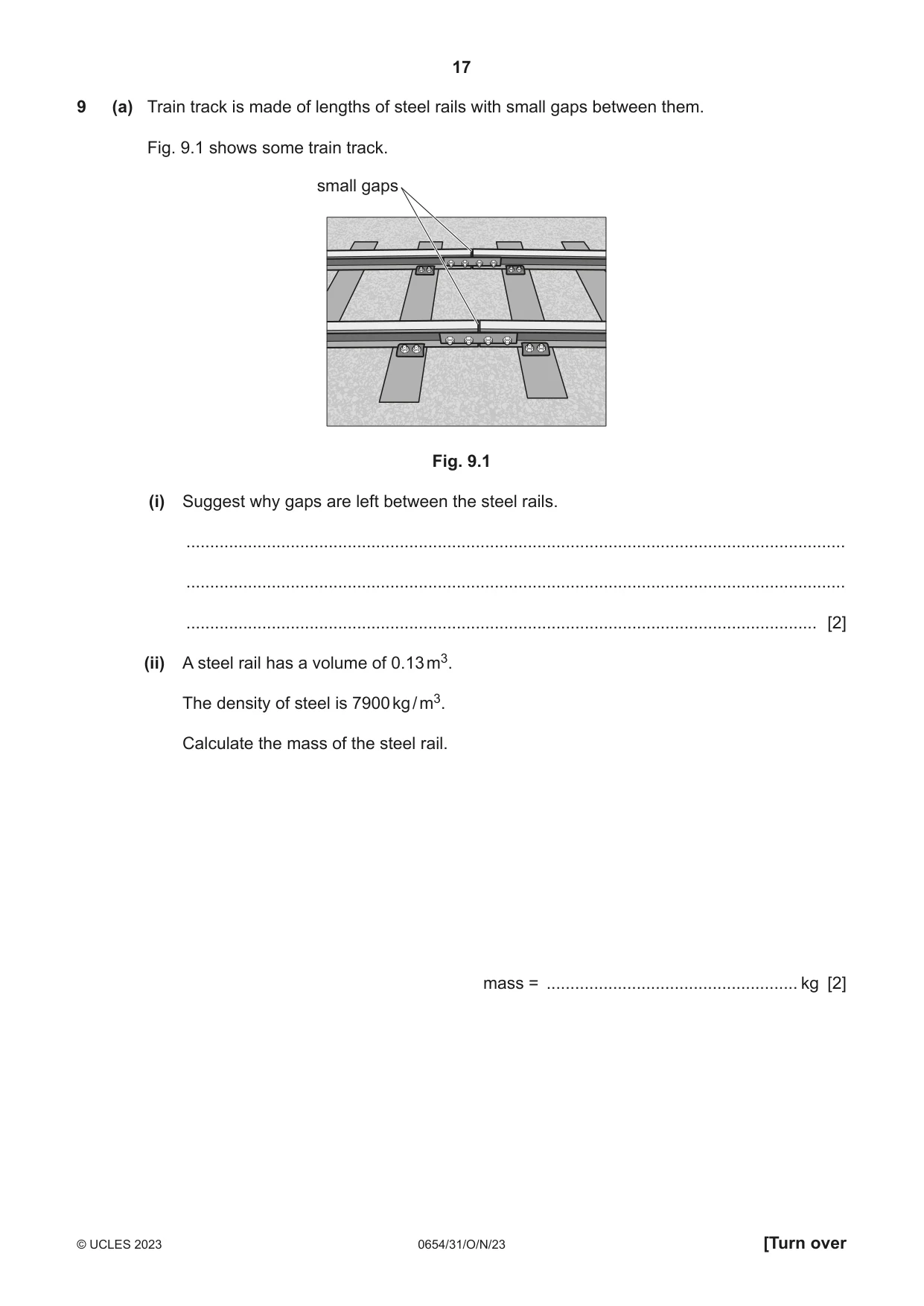
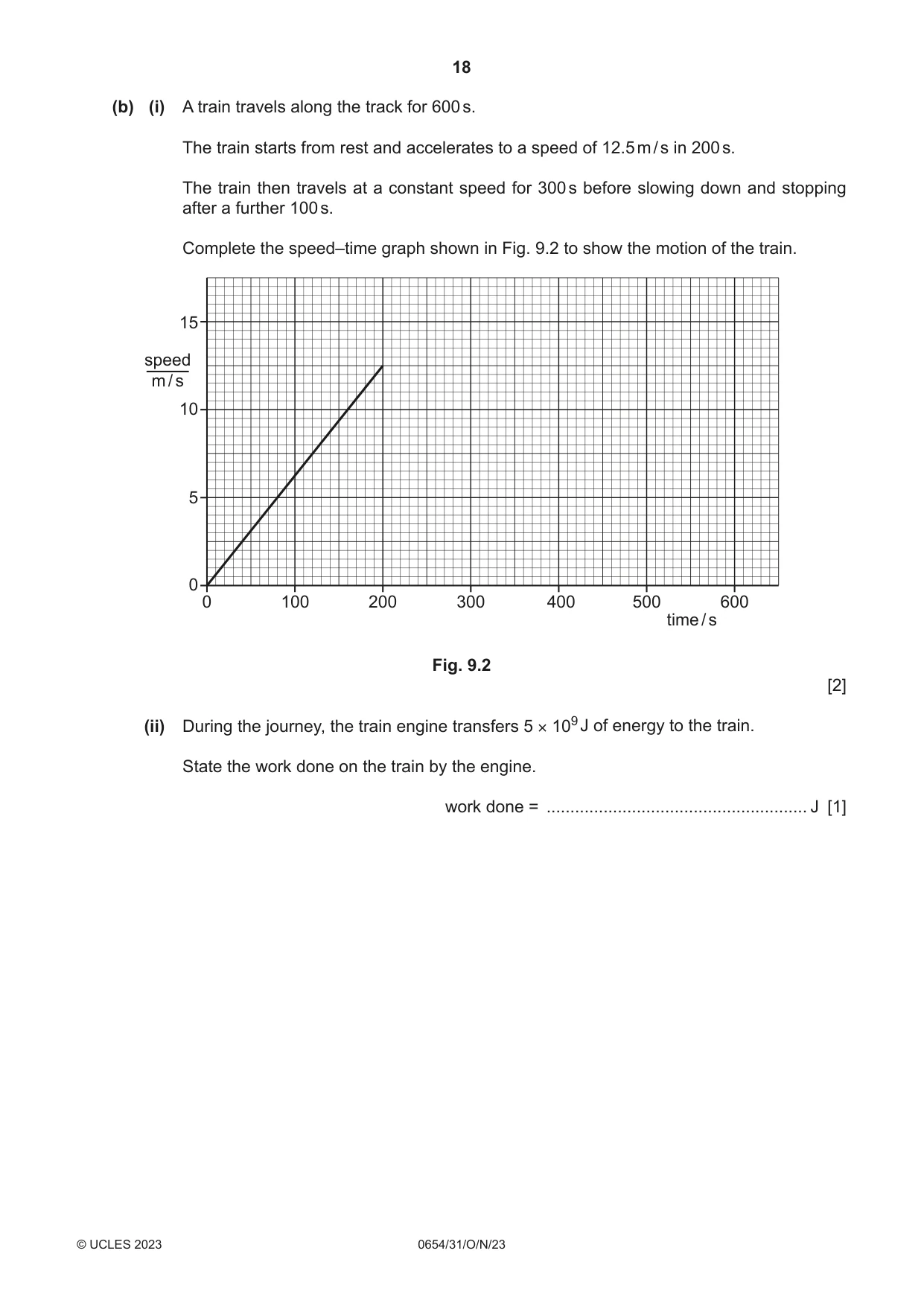
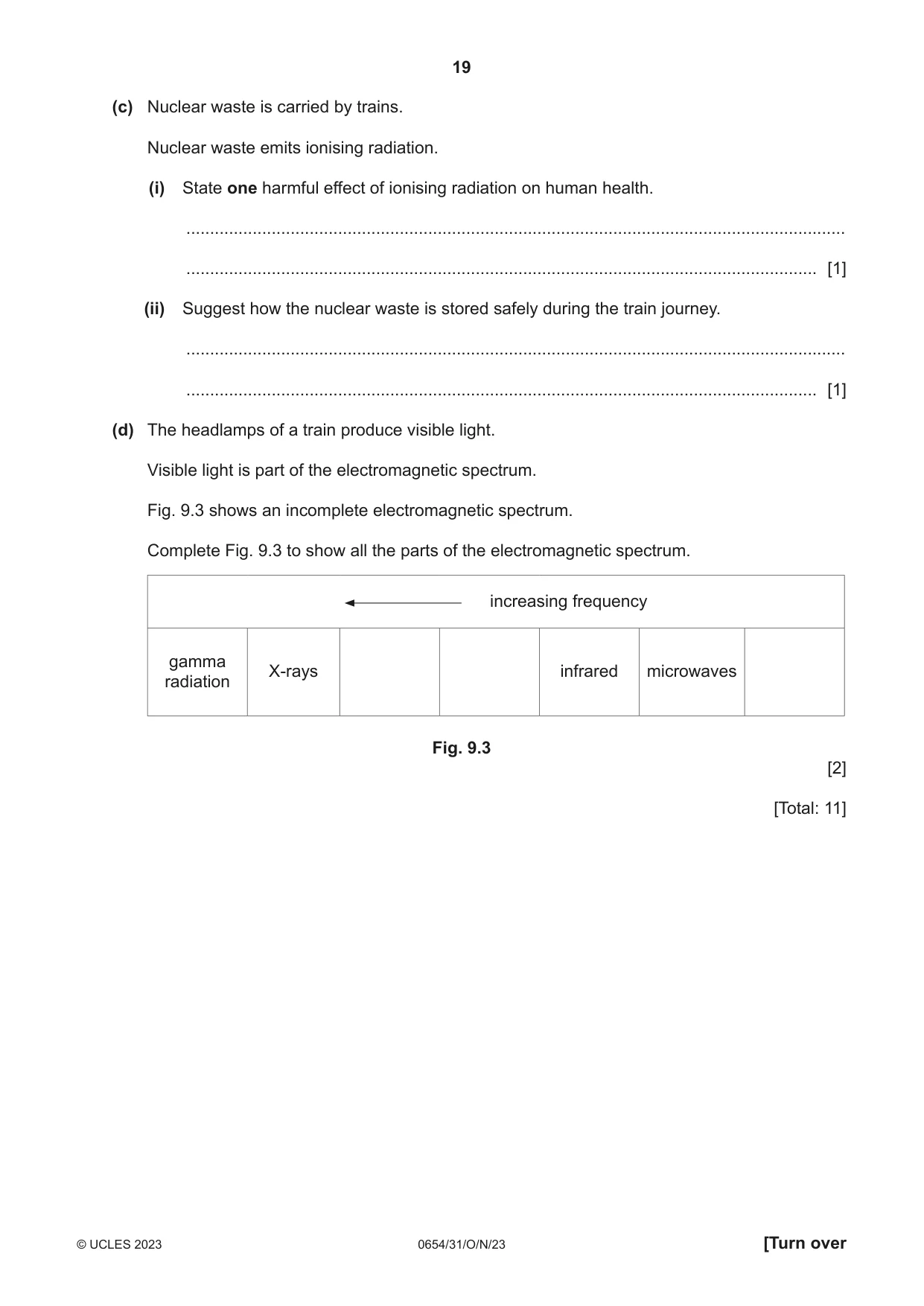
9 (a) Train track is made of lengths of steel rails with small gaps between them. Fig. 9.1 shows some train track. small gaps Fig. 9.1 (i) Suggest why gaps are left between the steel rails. ........................................................................................................................................... ........................................................................................................................................... ..................................................................................................................................... [2] (ii) A steel rail has a volume of 0.13 m3. The density of steel is 7900 kg / m3. Calculate the mass of the steel rail. mass = ..................................................... kg [2] (b) (i) A train travels along the track for 600 s. The train starts from rest and accelerates to a speed of 12.5 m / s in 200 s. The train then travels at a constant speed for 300 s before slowing down and stopping after a further 100 s. Complete the speed–time graph shown in Fig. 9.2 to show the motion of the train. 15 speed m / s 10 5 0 0 100 200 300 400 500 600 time / s Fig. 9.2 [2] (ii) During the journey, the train engine transfers 5 × 10⁹ J of energy to the train. State the work done on the train by the engine. work done = ....................................................... J [1] (c) Nuclear waste is carried by trains. Nuclear waste emits ionising radiation. (i) State one harmful effect of ionising radiation on human health. ........................................................................................................................................... ..................................................................................................................................... [1] (ii) Suggest how the nuclear waste is stored safely during the train journey. ........................................................................................................................................... ..................................................................................................................................... [1] (d) The headlamps of a train produce visible light. Visible light is part of the electromagnetic spectrum. Fig. 9.3 shows an incomplete electromagnetic spectrum. Complete Fig. 9.3 to show all the parts of the electromagnetic spectrum. increasing frequency gamma X-rays infrared microwaves radiation Fig. 9.3 [2] [Total: 11]
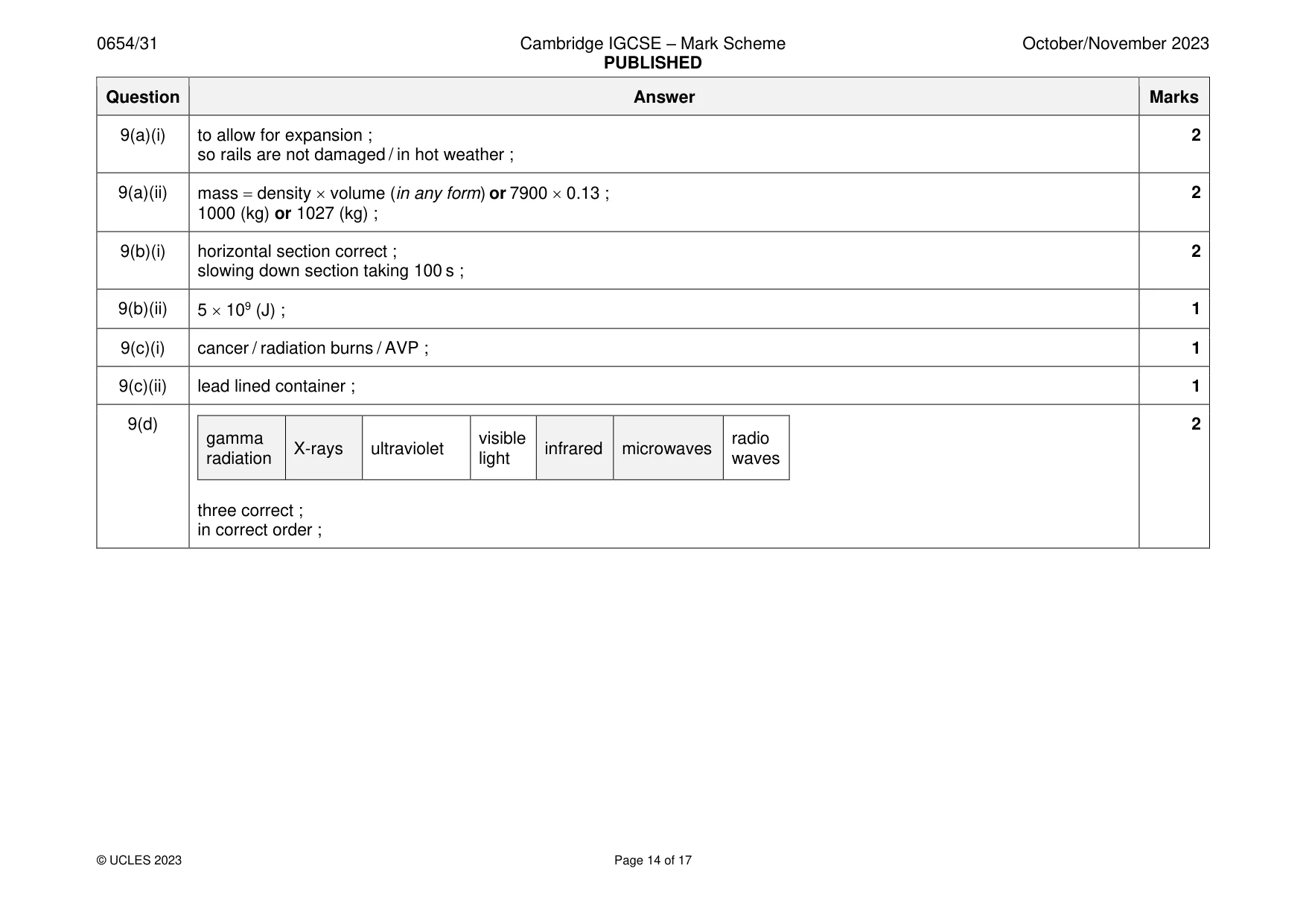
Mark scheme: 9(a)(i) to allow for expansion ; 2 so rails are not damaged / in hot weather ; 9(a)(ii) mass = density volume (in any form) or 7900 0.13 ; 2 1000 (kg) or 1027 (kg) ; 9(b)(i) horizontal section correct ; 2 slowing down section taking 100 s ; 9(b)(ii) 5 109 (J) ; 1 9(c)(i) cancer / radiation burns / AVP ; 1 9(c)(ii) lead lined container ; 1 9(d) 2 gamma visible radio X-rays ultraviolet infrared microwaves radiation light waves three correct ; in correct order ;
Q10 · A student investigates the conditions required for the germination of seeds
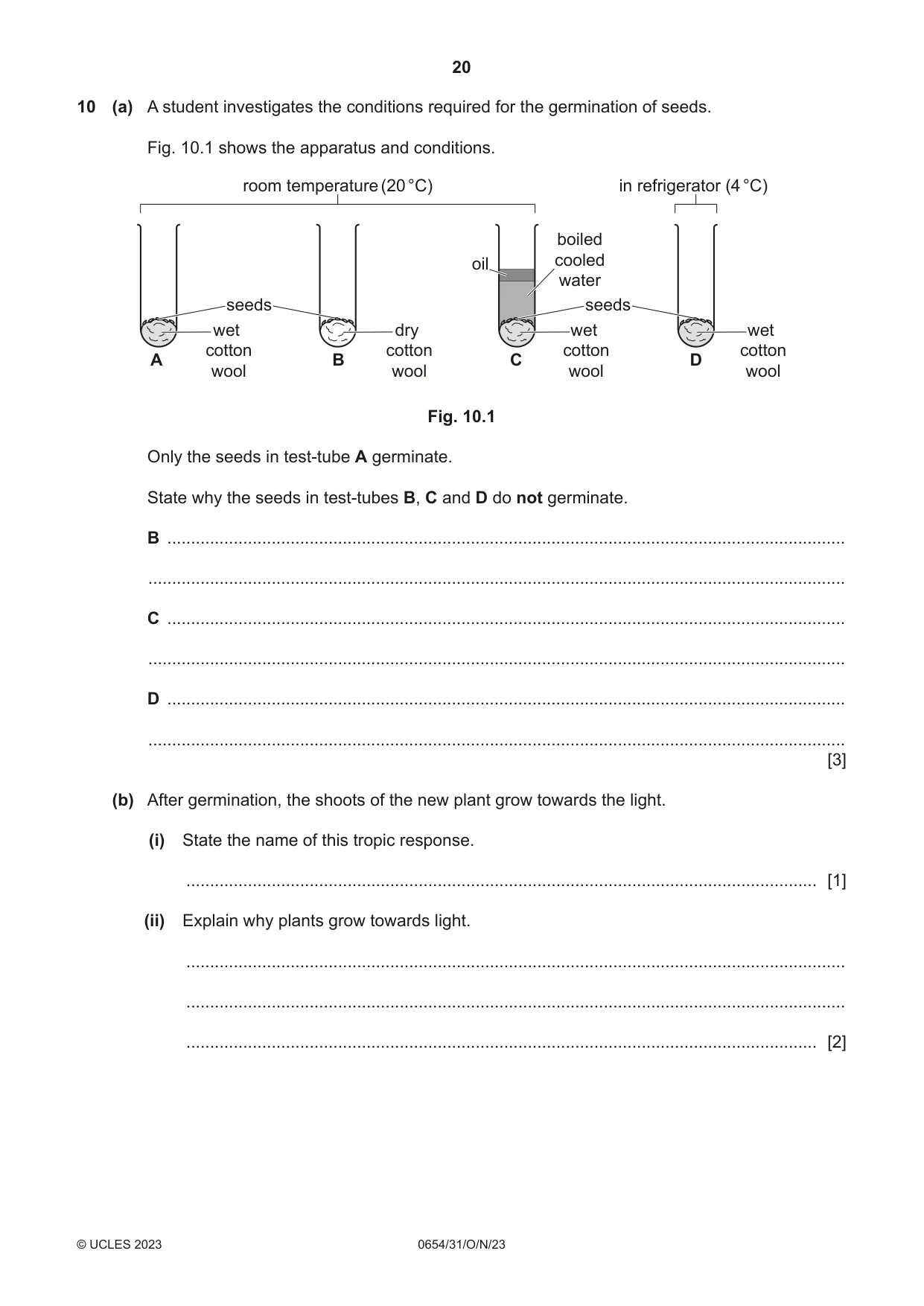
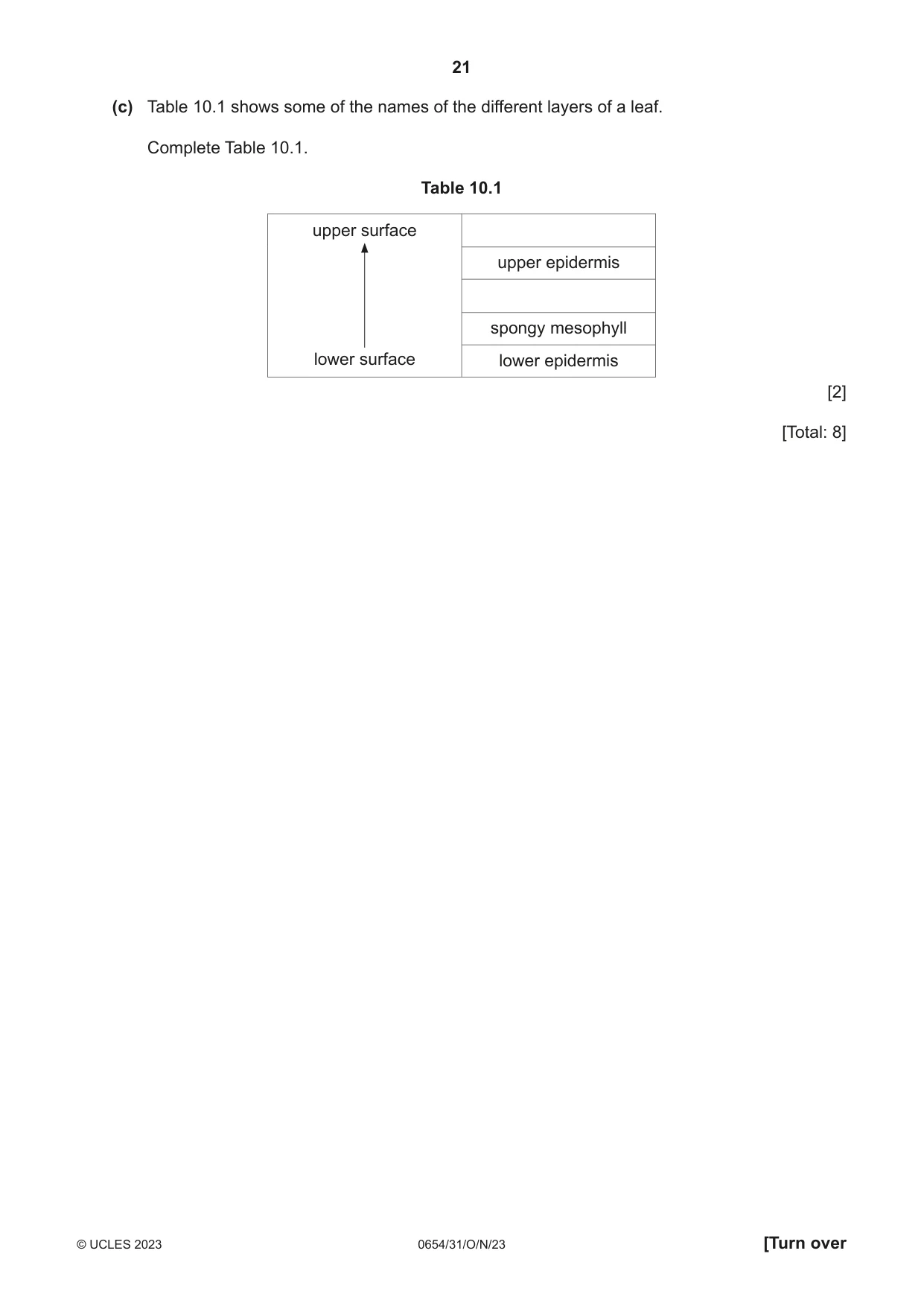
10 (a) A student investigates the conditions required for the germination of seeds. Fig. 10.1 shows the apparatus and conditions. room temperature (20 °C) in refrigerator (4 °C) boiled oil cooled water seeds seeds wet dry wet wet cotton cotton cotton cotton A B C D wool wool wool wool Fig. 10.1 Only the seeds in test-tube A germinate. State why the seeds in test-tubes B, C and D do not germinate. B ............................................................................................................................................... ................................................................................................................................................... C ............................................................................................................................................... ................................................................................................................................................... D ............................................................................................................................................... ................................................................................................................................................... [3] (b) After germination, the shoots of the new plant grow towards the light. (i) State the name of this tropic response. ..................................................................................................................................... [1] (ii) Explain why plants grow towards light. ........................................................................................................................................... ........................................................................................................................................... ..................................................................................................................................... [2] (c) Table 10.1 shows some of the names of the different layers of a leaf. Complete Table 10.1. Table 10.1 upper surface upper epidermis spongy mesophyll lower surface lower epidermis [2] [Total: 8]
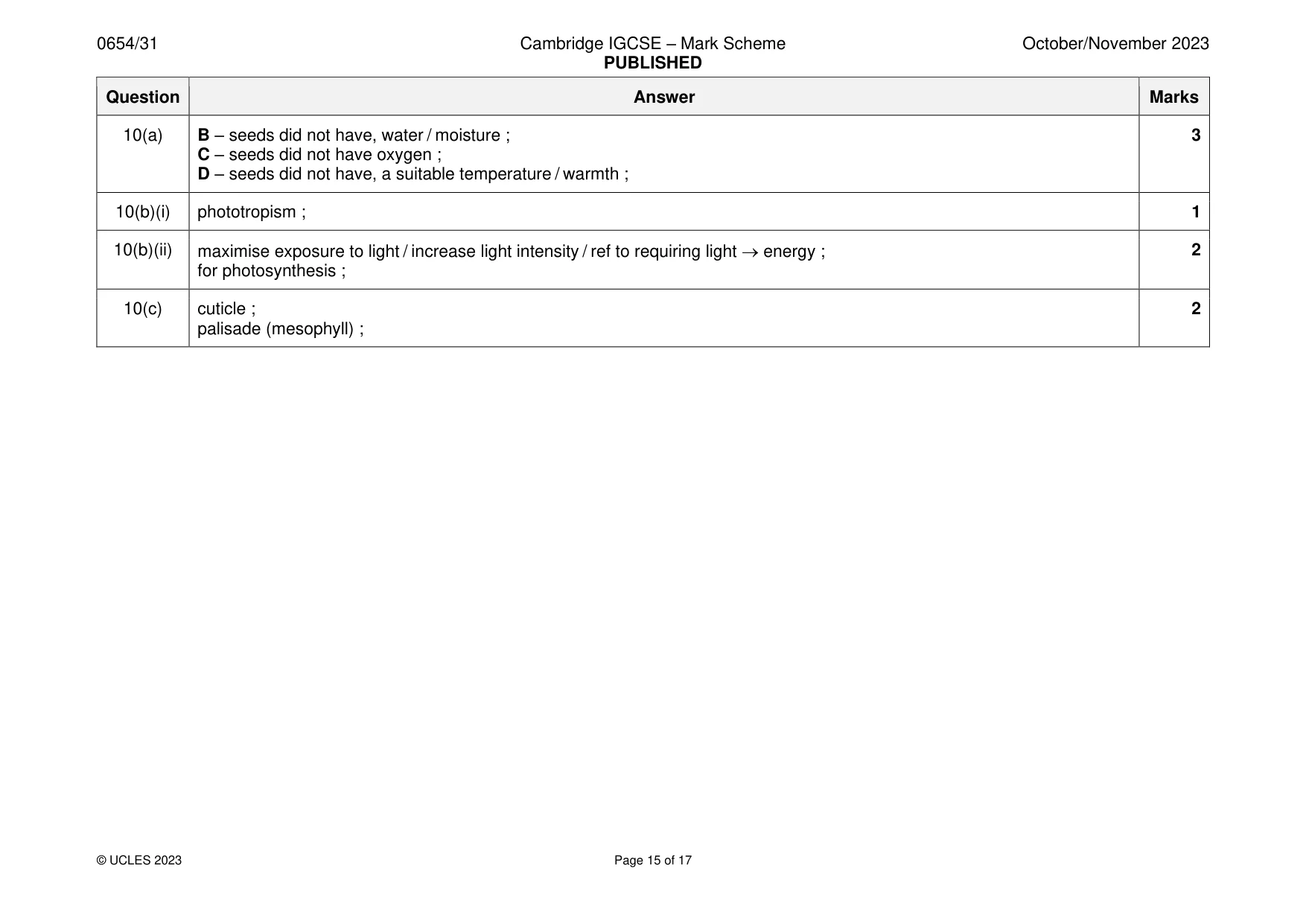
Mark scheme: 10(a) B – seeds did not have, water / moisture ; 3 C – seeds did not have oxygen ; D – seeds did not have, a suitable temperature / warmth ; 10(b)(i) phototropism ; 1 10(b)(ii) maximise exposure to light / increase light intensity / ref to requiring light → energy ; 2 for photosynthesis ; 10(c) cuticle ; 2 palisade (mesophyll) ;
Q11 · A student investigates the reaction between magnesium and dilute sulfuric acid
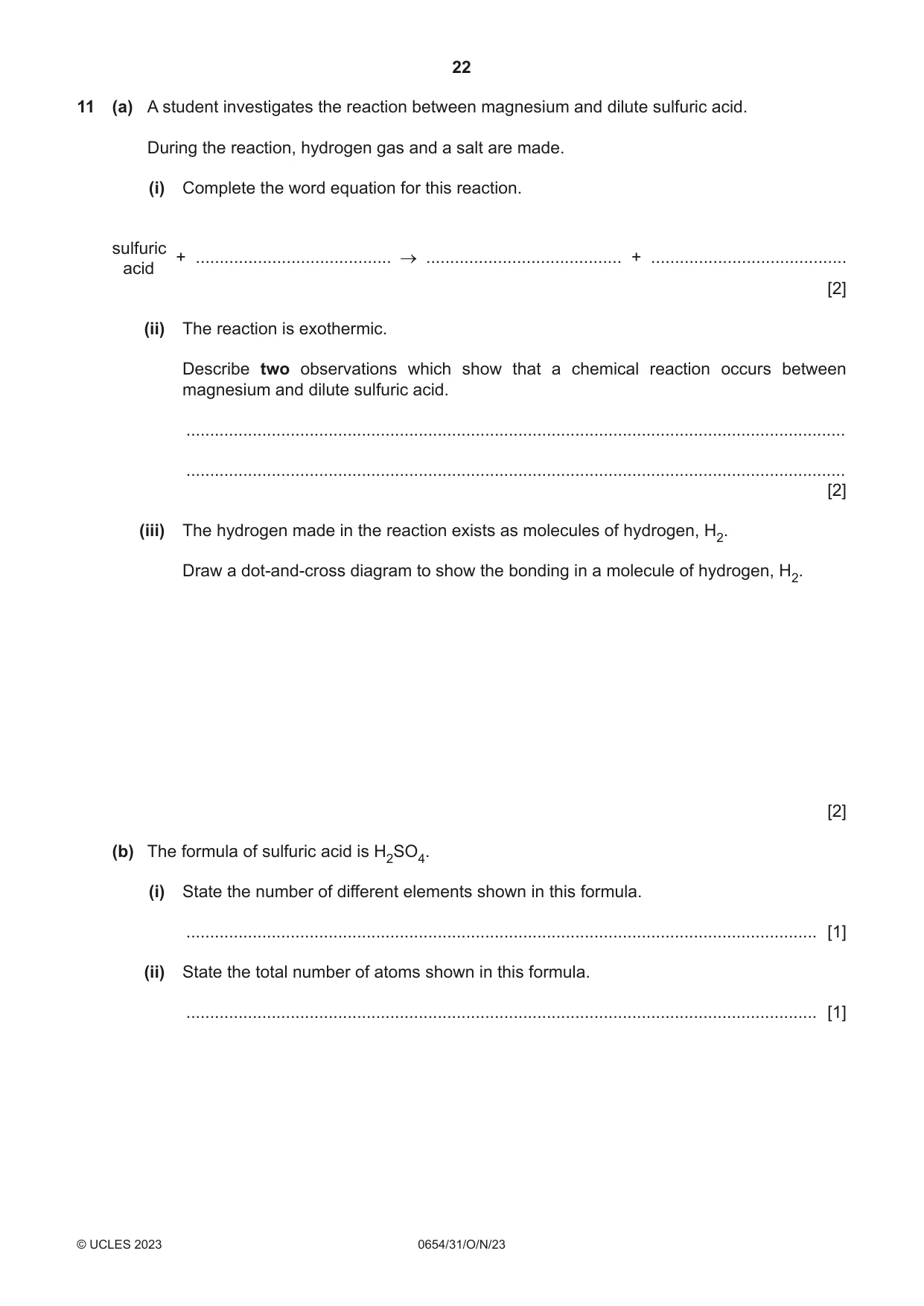
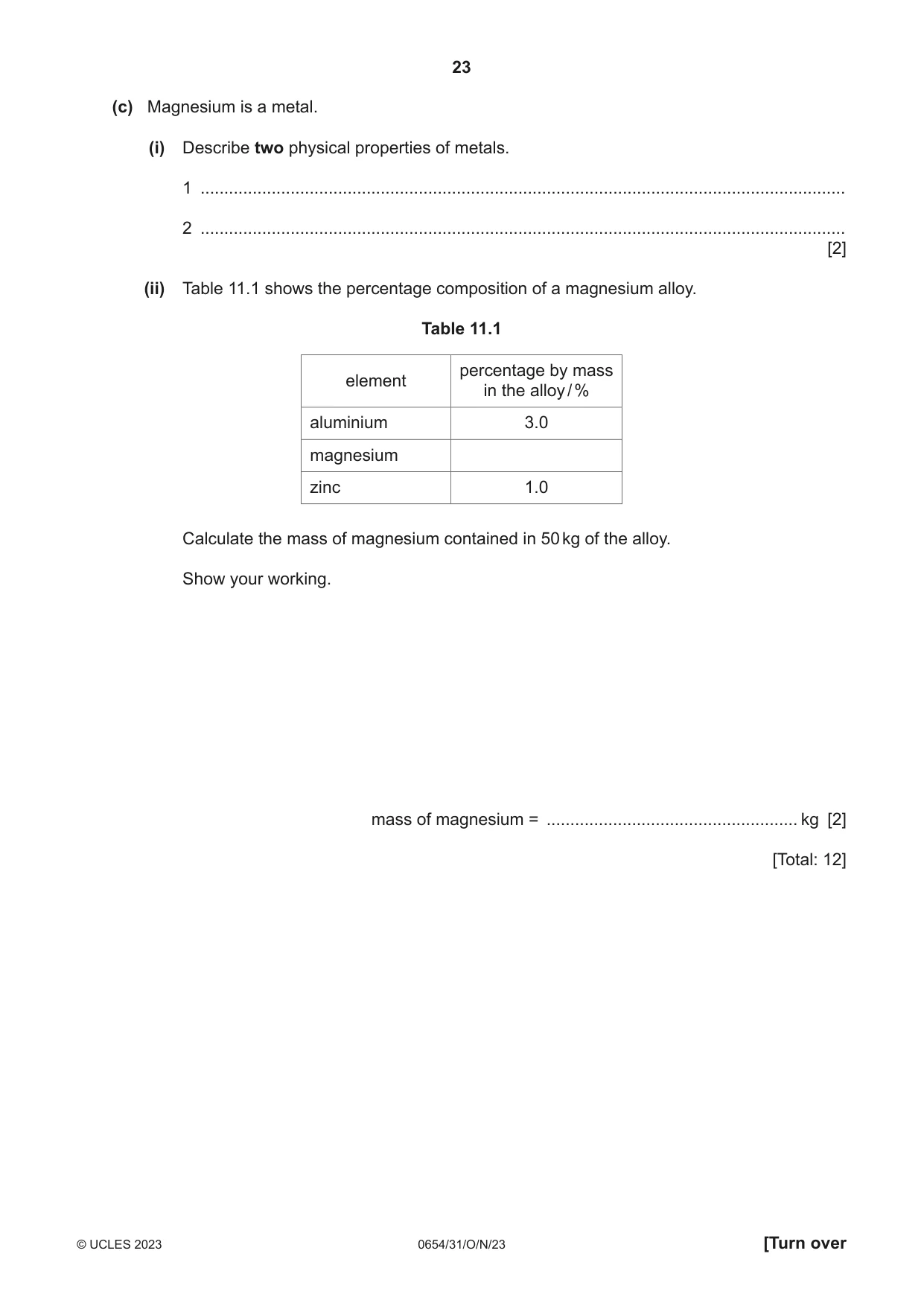
11 (a) A student investigates the reaction between magnesium and dilute sulfuric acid. During the reaction, hydrogen gas and a salt are made. (i) Complete the word equation for this reaction. sulfuric + ......................................... ......................................... + ......................................... acid [2] (ii) The reaction is exothermic. Describe two observations which show that a chemical reaction occurs between magnesium and dilute sulfuric acid. ........................................................................................................................................... ........................................................................................................................................... [2] (iii) The hydrogen made in the reaction exists as molecules of hydrogen, H2. Draw a dot-and-cross diagram to show the bonding in a molecule of hydrogen, H2. [2] (b) The formula of sulfuric acid is H2SO4. (i) State the number of different elements shown in this formula. ..................................................................................................................................... [1] (ii) State the total number of atoms shown in this formula. ..................................................................................................................................... [1] (c) Magnesium is a metal. (i) Describe two physical properties of metals. 1 ........................................................................................................................................ 2 ........................................................................................................................................ [2] (ii) Table 11.1 shows the percentage composition of a magnesium alloy. Table 11.1 percentage by mass element in the alloy / % aluminium 3.0 magnesium zinc 1.0 Calculate the mass of magnesium contained in 50 kg of the alloy. Show your working. mass of magnesium = ..................................................... kg [2] [Total: 12]
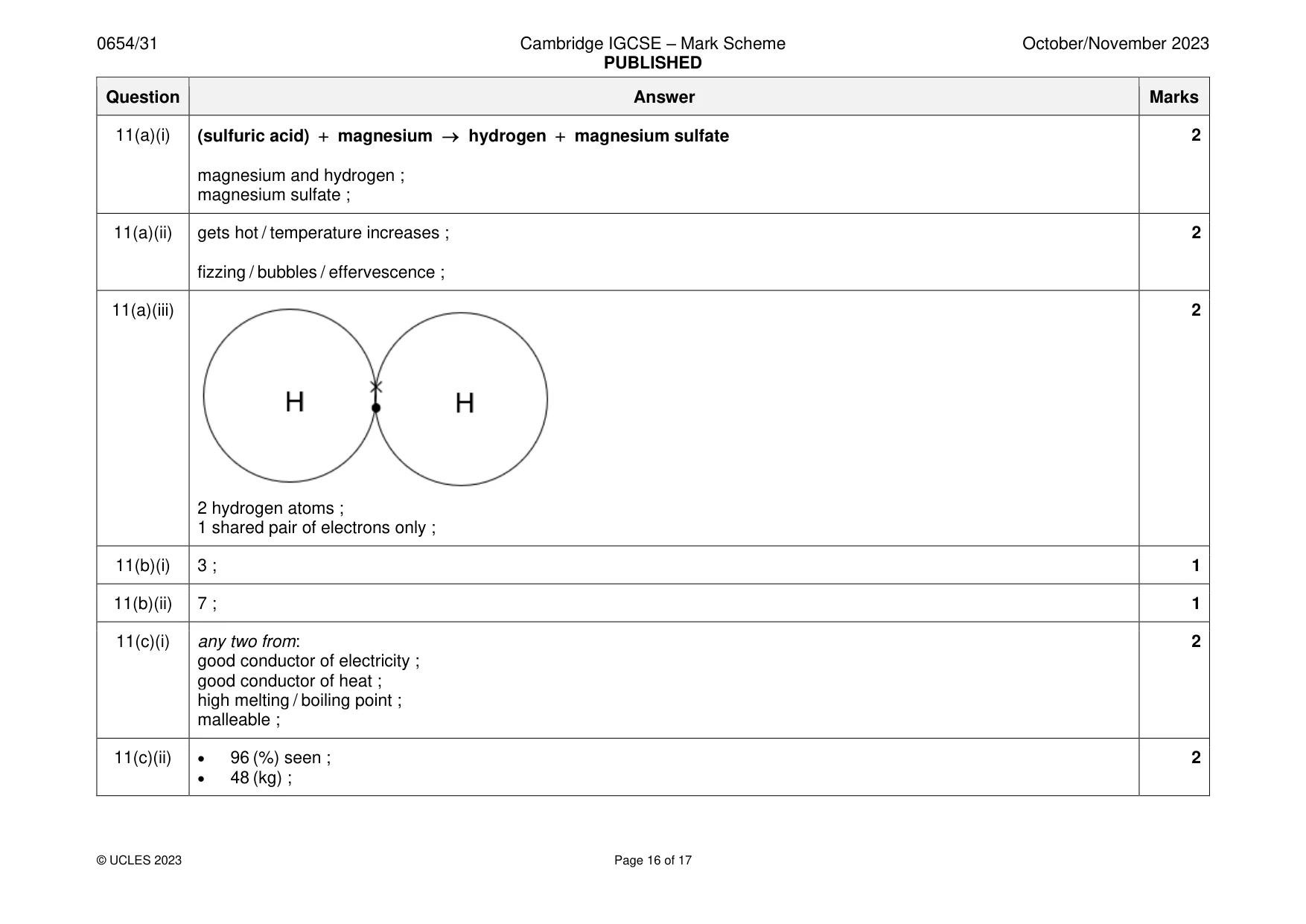
Mark scheme: 11(a)(i) (sulfuric acid) + magnesium → hydrogen + magnesium sulfate 2 magnesium and hydrogen ; magnesium sulfate ; 11(a)(ii) gets hot / temperature increases ; 2 fizzing / bubbles / effervescence ; 11(a)(iii) 2 2 hydrogen atoms ; 1 shared pair of electrons only ; 11(b)(i) 3 ; 1 11(b)(ii) 7 ; 1 11(c)(i) any two from: 2 good conductor of electricity ; good conductor of heat ; high melting / boiling point ; malleable ; 11(c)(ii) • 96 (%) seen ; 2 • 48 (kg) ;
More questions on The characteristic properties of acids and bases
Q12 · A cyclist is riding a bicycle around a circular track
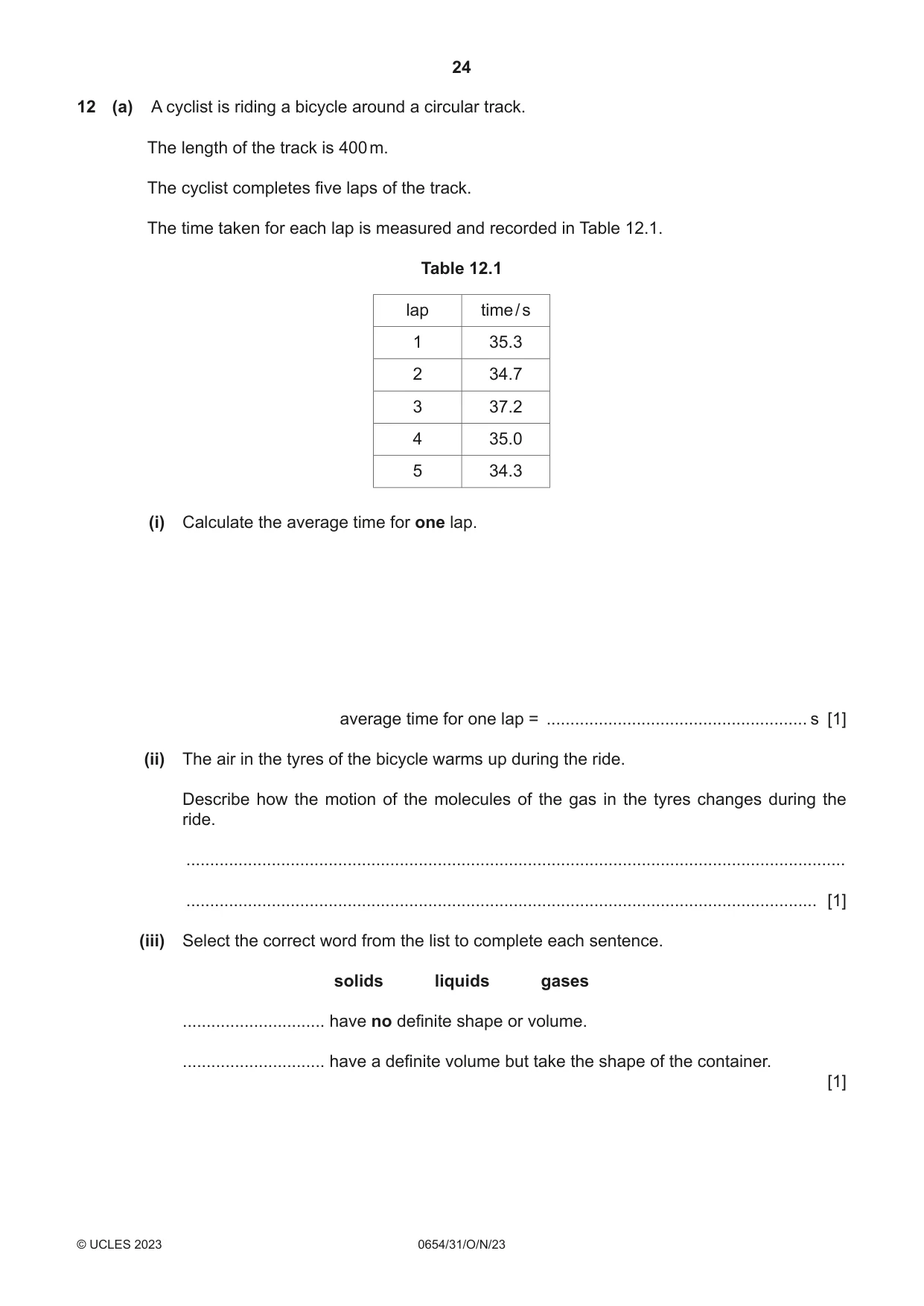
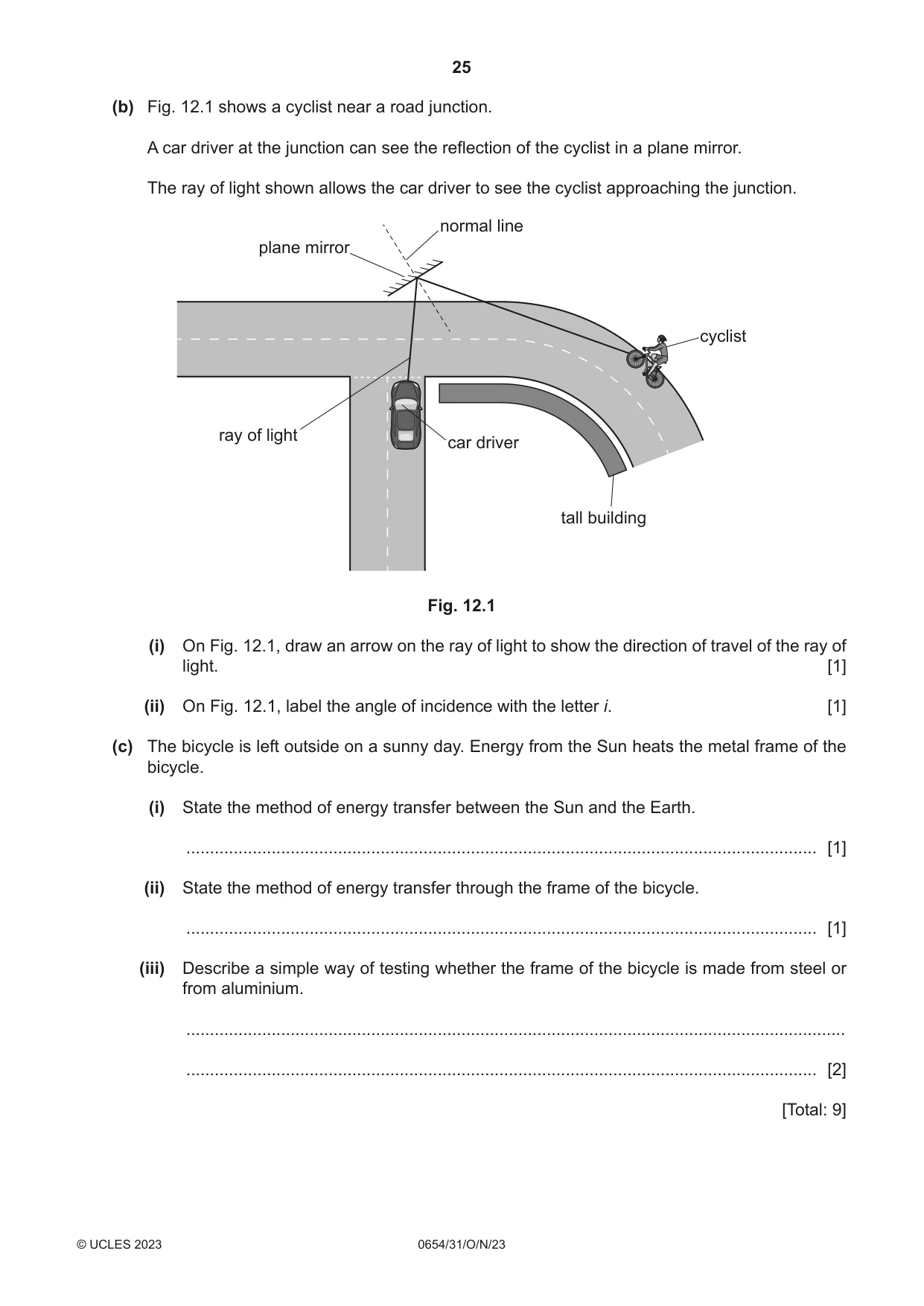
12 (a) A cyclist is riding a bicycle around a circular track. The length of the track is 400 m. The cyclist completes five laps of the track. The time taken for each lap is measured and recorded in Table 12.1. Table 12.1 lap time / s 1 35.3 2 34.7 3 37.2 4 35.0 5 34.3 (i) Calculate the average time for one lap. average time for one lap = ....................................................... s [1] (ii) The air in the tyres of the bicycle warms up during the ride. Describe how the motion of the molecules of the gas in the tyres changes during the ride. ........................................................................................................................................... ..................................................................................................................................... [1] (iii) Select the correct word from the list to complete each sentence. solids liquids gases .............................. have no definite shape or volume. .............................. have a definite volume but take the shape of the container. [1] (b) Fig. 12.1 shows a cyclist near a road junction. A car driver at the junction can see the reflection of the cyclist in a plane mirror. The ray of light shown allows the car driver to see the cyclist approaching the junction. normal line plane mirror cyclist ray of light car driver tall building Fig. 12.1 (i) On Fig. 12.1, draw an arrow on the ray of light to show the direction of travel of the ray of light. [1] (ii) On Fig. 12.1, label the angle of incidence with the letter i. [1] (c) The bicycle is left outside on a sunny day. Energy from the Sun heats the metal frame of the bicycle. (i) State the method of energy transfer between the Sun and the Earth. ..................................................................................................................................... [1] (ii) State the method of energy transfer through the frame of the bicycle. ..................................................................................................................................... [1] (iii) Describe a simple way of testing whether the frame of the bicycle is made from steel or from aluminium. ........................................................................................................................................... ..................................................................................................................................... [2] [Total: 9]
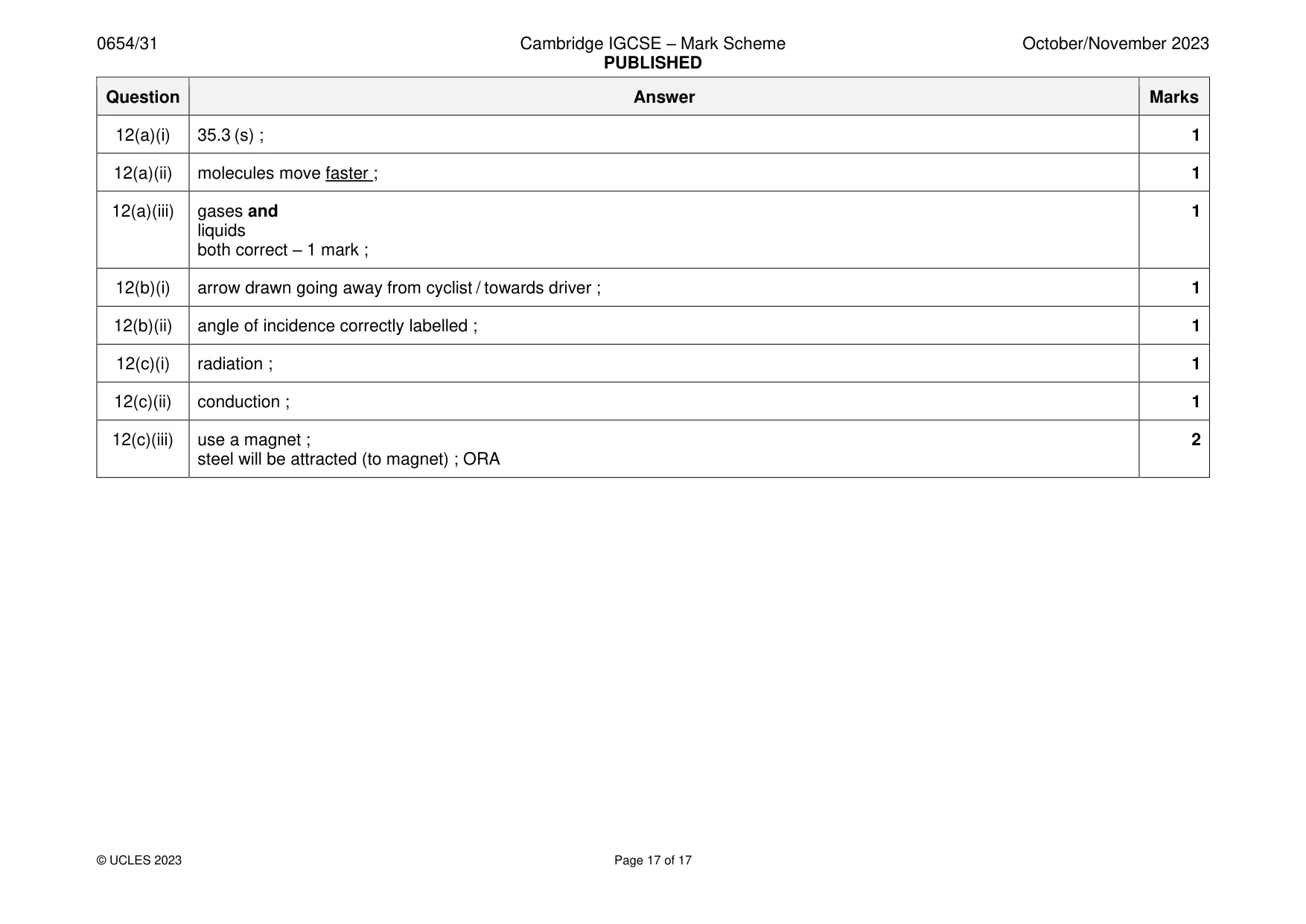
Mark scheme: 12(a)(i) 35.3 (s) ; 1 12(a)(ii) molecules move faster ; 1 12(a)(iii) gases and 1 liquids both correct – 1 mark ; 12(b)(i) arrow drawn going away from cyclist / towards driver ; 1 12(b)(ii) angle of incidence correctly labelled ; 1 12(c)(i) radiation ; 1 12(c)(ii) conduction ; 1 12(c)(iii) use a magnet ; 2 steel will be attracted (to magnet) ; ORA
What was in this paper
The subtopics covered by these 12 questions, and how many questions each got. Open one in a new tab to see every Cambridge question on it.
What you needed in this session
Cambridge’s own grade thresholds for 2023 Oct/Nov, Paper 3 · Variant 1. A higher threshold means an easier paper — the bar moves with how the cohort did.