Cambridge IGCSE Sciences - Co-ordinated (Double) 0654 — 2019 May/June Paper 3 · Variant 1
0654/31/M/J/19 · 13 questions · 120 marks · ≈135 min
The question paper and its mark scheme, free to read here and free to download. This is Cambridge’s own paper, exactly as it was sat.
Question paper28 pages


Mark scheme15 pages
Answers below. Sit the paper first if you are practising.
Questions as text
Q1 · A diagram of a plant cell
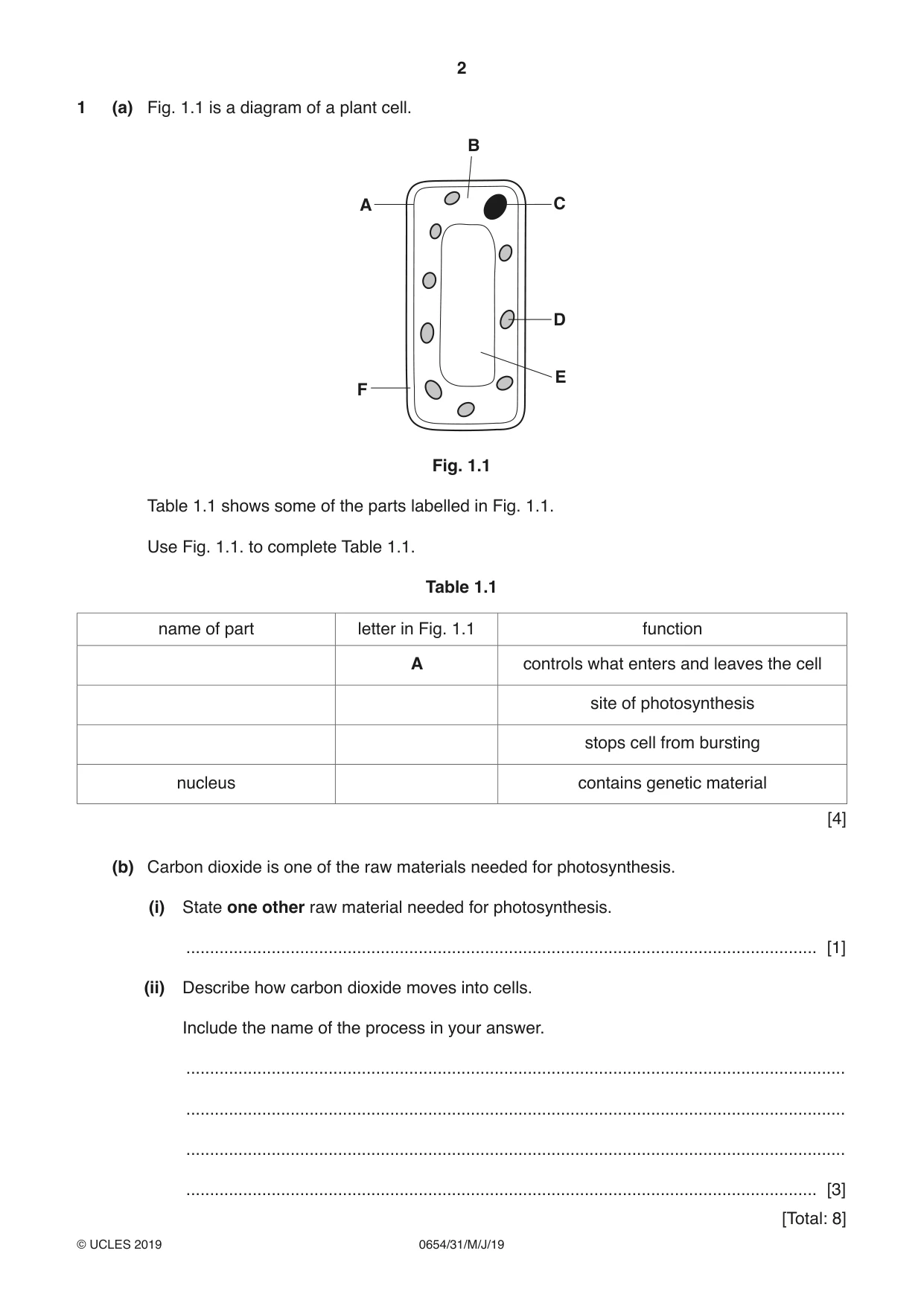
1 (a) Fig. 1.1 is a diagram of a plant cell. B A C D E F Fig. 1.1 Table 1.1 shows some of the parts labelled in Fig. 1.1. Use Fig. 1.1. to complete Table 1.1. Table 1.1 name of part letter in Fig. 1.1 function A controls what enters and leaves the cell site of photosynthesis stops cell from bursting nucleus contains genetic material [4] (b) Carbon dioxide is one of the raw materials needed for photosynthesis. (i) State one other raw material needed for photosynthesis. ..................................................................................................................................... [1] (ii) Describe how carbon dioxide moves into cells. Include the name of the process in your answer. ........................................................................................................................................... ........................................................................................................................................... ........................................................................................................................................... ..................................................................................................................................... [3] [Total: 8]
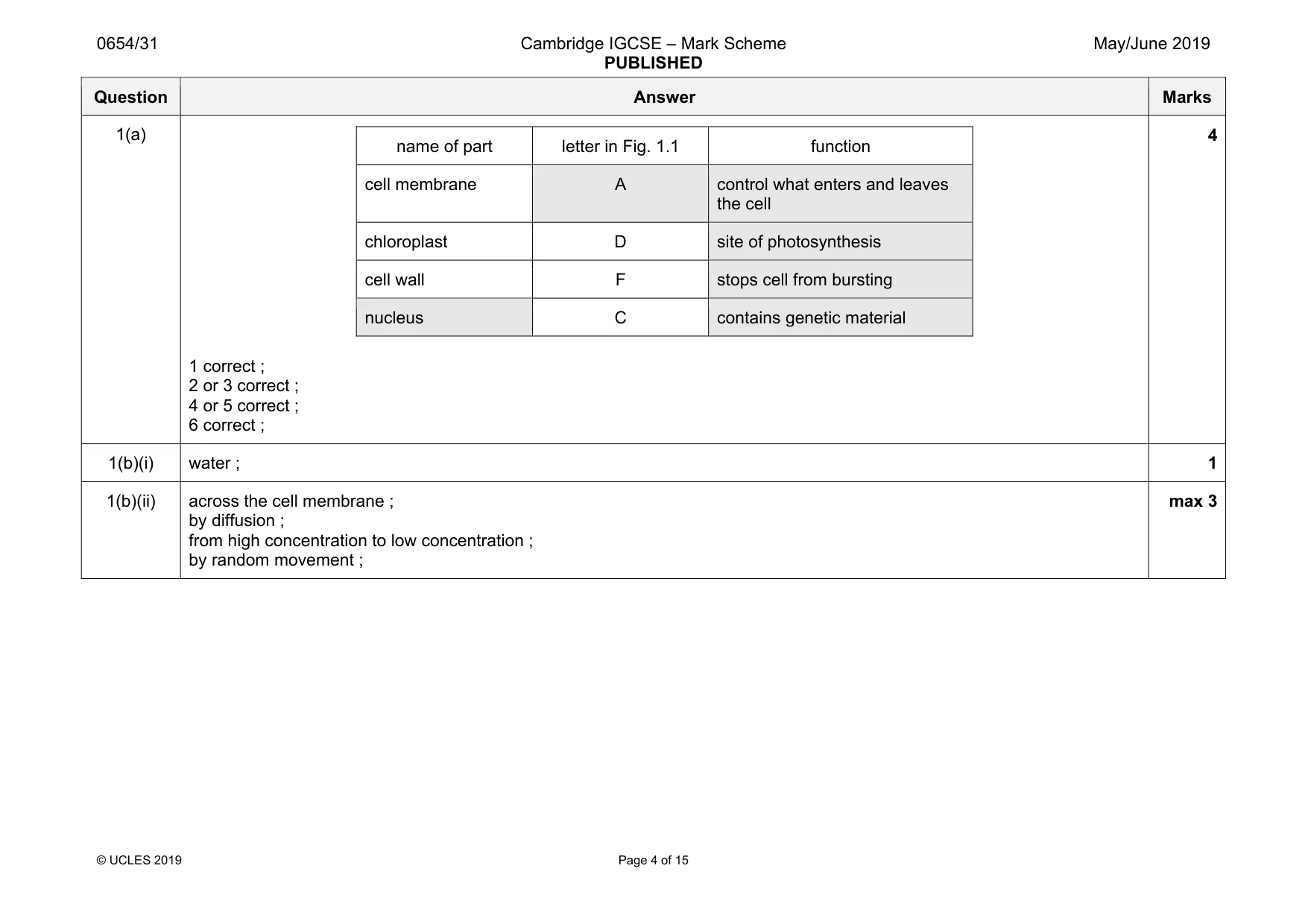
Mark scheme: 1(a) name of part letter in Fig. 1.1 function cell membrane A control what enters and leaves the cell chloroplast D site of photosynthesis cell wall F stops cell from bursting nucleus C contains genetic material 1 correct ; 2 or 3 correct ; 4 or 5 correct ; 6 correct ; 4 1(b)(i) water ; 1 1(b)(ii) across the cell membrane ; by diffusion ; from high concentration to low concentration ; by random movement ; max 3
Q2 · Chlorine and argon are gaseous elements in Period 3 of the Periodic Table
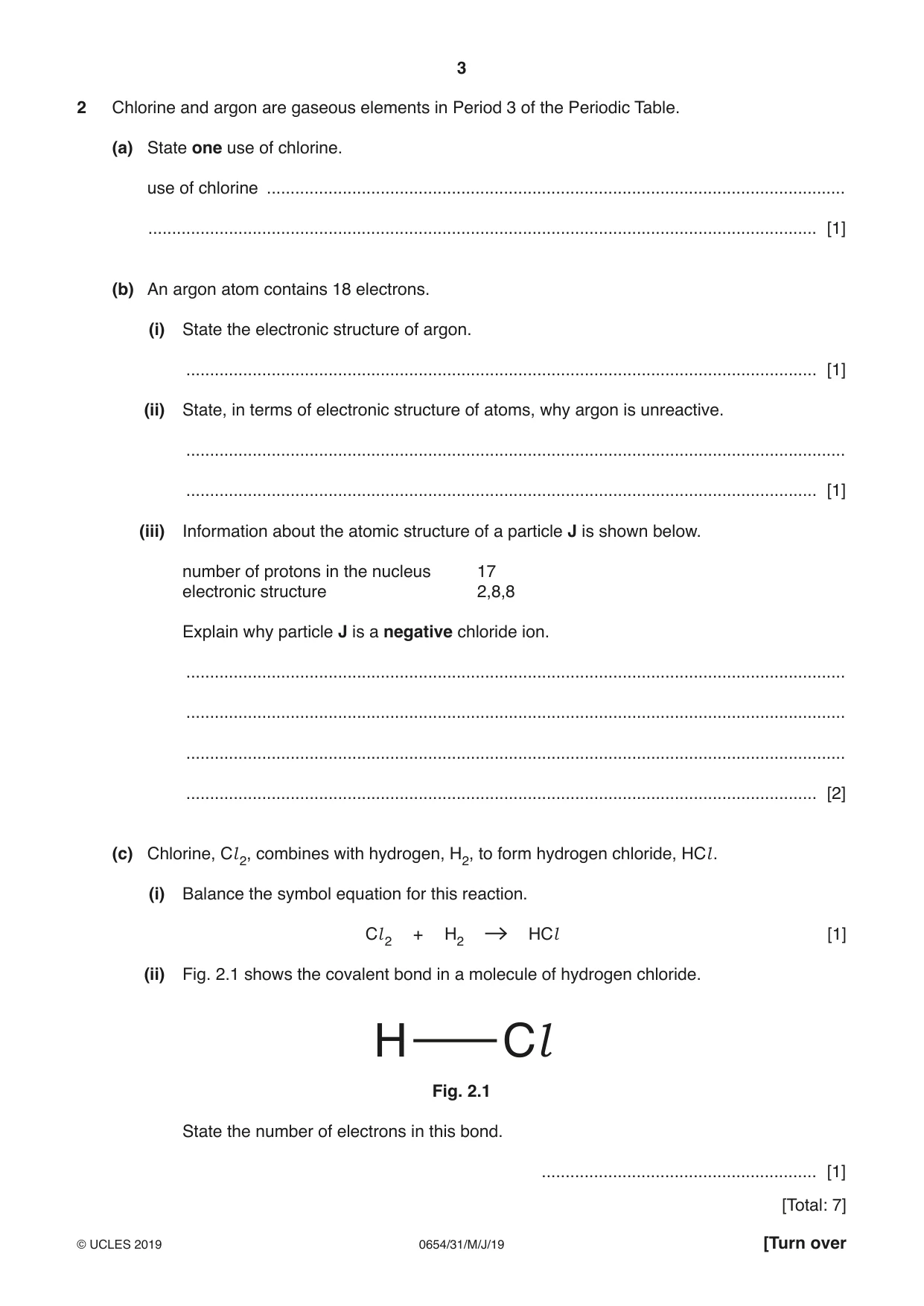
2 Chlorine and argon are gaseous elements in Period 3 of the Periodic Table. (a) State one use of chlorine. use of chlorine .......................................................................................................................... ............................................................................................................................................. [1] (b) An argon atom contains 18 electrons. (i) State the electronic structure of argon. ..................................................................................................................................... [1] (ii) State, in terms of electronic structure of atoms, why argon is unreactive. ........................................................................................................................................... ..................................................................................................................................... [1] (iii) Information about the atomic structure of a particle J is shown below. number of protons in the nucleus 17 electronic structure 2,8,8 Explain why particle J is a negative chloride ion. ........................................................................................................................................... ........................................................................................................................................... ........................................................................................................................................... ..................................................................................................................................... [2] (c) Chlorine, Cl 2, combines with hydrogen, H2, to form hydrogen chloride, HCl . (i) Balance the symbol equation for this reaction. Cl 2 + H2 HCl [1] (ii) Fig. 2.1 shows the covalent bond in a molecule of hydrogen chloride. H Cl Fig. 2.1 State the number of electrons in this bond. .......................................................... [1] [Total: 7]
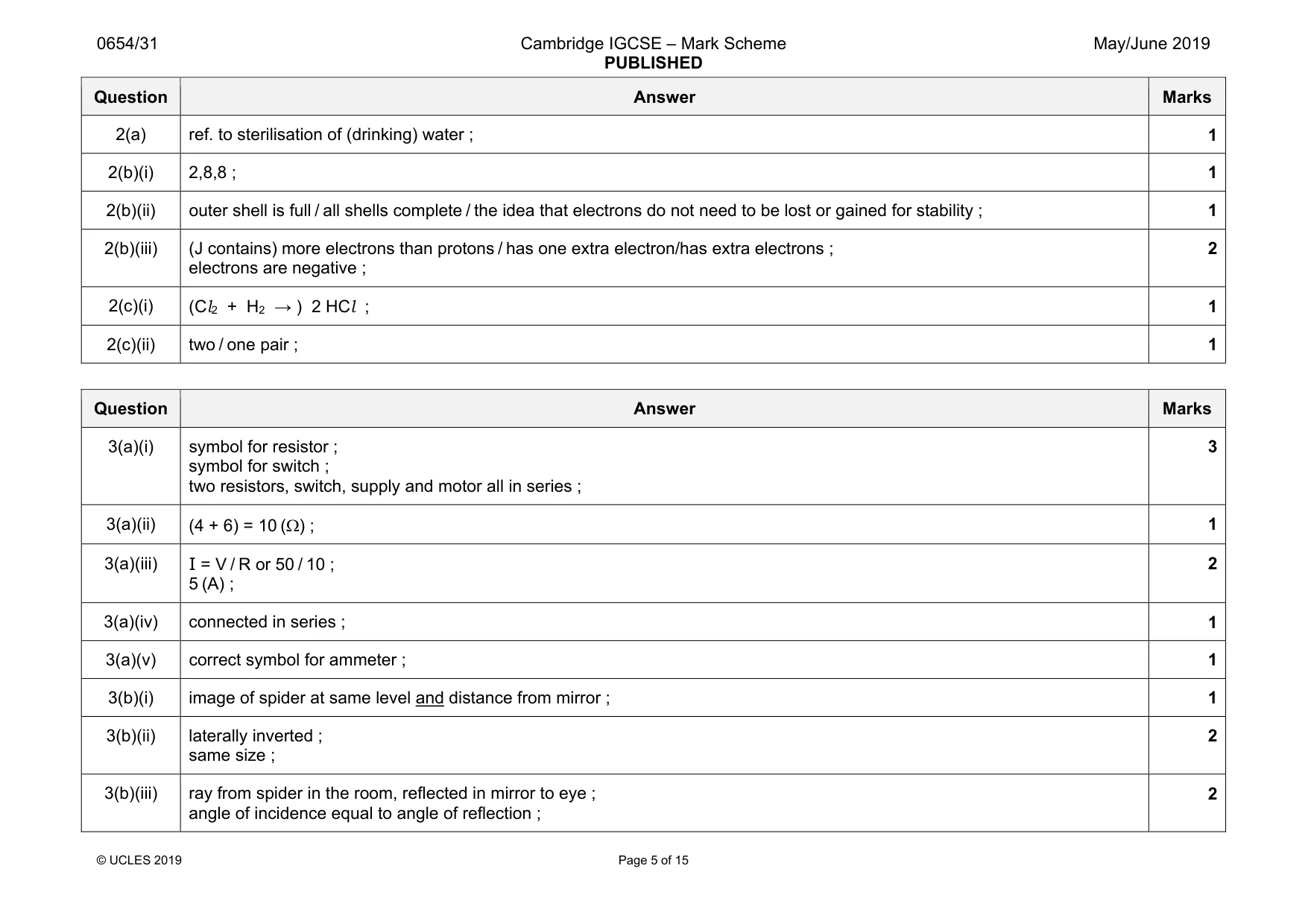
Mark scheme: 2(a) ref. to sterilisation of (drinking) water ; 1 2(b)(i) 2,8,8 ; 1 2(b)(ii) outer shell is full / all shells complete / the idea that electrons do not need to be lost or gained for stability ; 1 2(b)(iii) (J contains) more electrons than protons / has one extra electron/has extra electrons ; electrons are negative ; 2 2(c)(i) (Cl2 + H2 → ) 2 HCl ; 1 2(c)(ii) two / one pair ; 1
Q3 · A shower is connected to an electrical pump to increase the flow of water
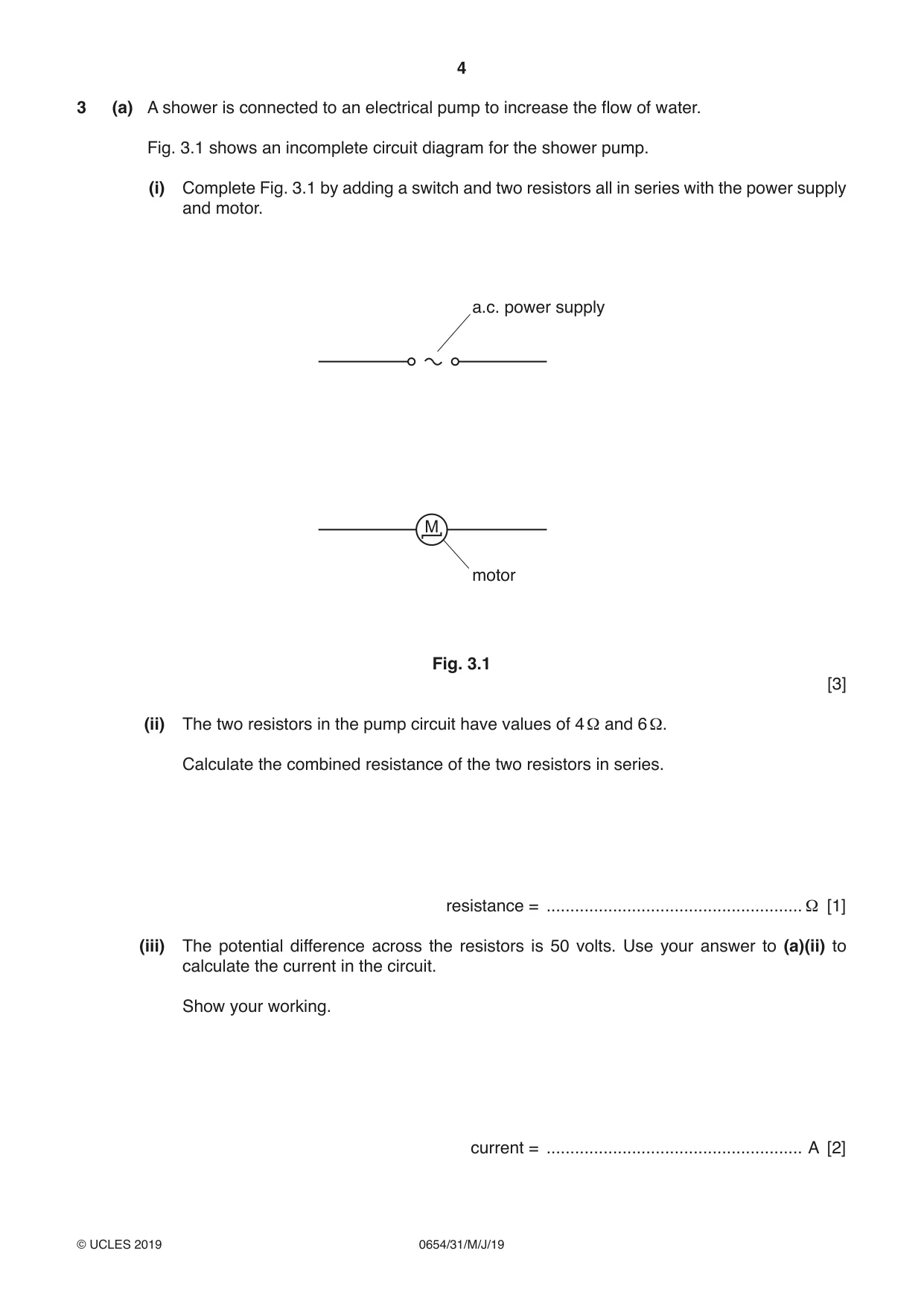
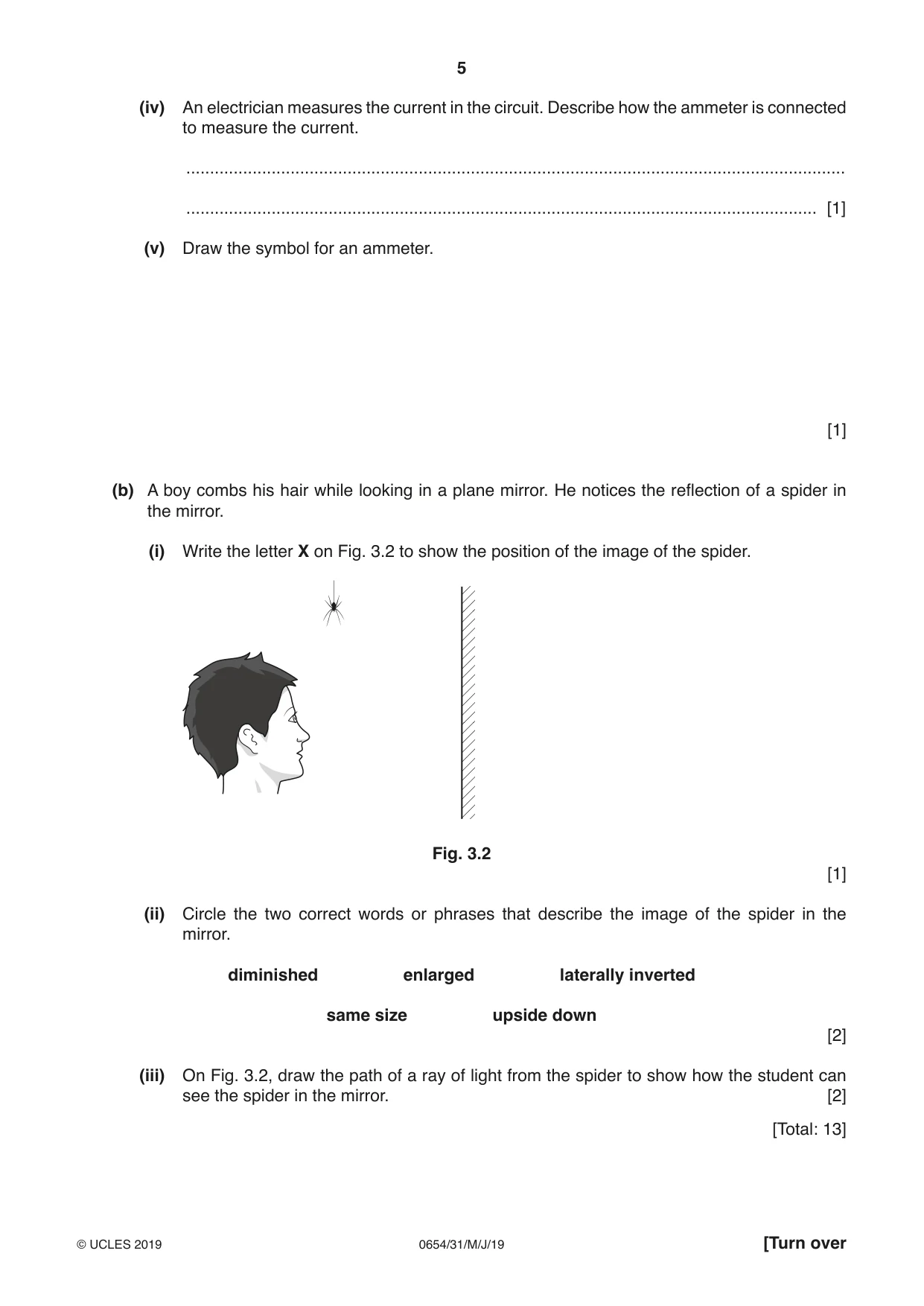
3 (a) A shower is connected to an electrical pump to increase the flow of water. Fig. 3.1 shows an incomplete circuit diagram for the shower pump. (i) Complete Fig. 3.1 by adding a switch and two resistors all in series with the power supply and motor. a.c. power supply M motor Fig. 3.1 [3] (ii) The two resistors in the pump circuit have values of 4 Ω and 6 Ω. Calculate the combined resistance of the two resistors in series. resistance = ...................................................... Ω [1] (iii) The potential difference across the resistors is 50 volts. Use your answer to (a)(ii) to calculate the current in the circuit. Show your working. current = ...................................................... A [2] (iv) An electrician measures the current in the circuit. Describe how the ammeter is connected to measure the current. ........................................................................................................................................... ..................................................................................................................................... [1] (v) Draw the symbol for an ammeter. [1] (b) A boy combs his hair while looking in a plane mirror. He notices the reflection of a spider in the mirror. (i) Write the letter X on Fig. 3.2 to show the position of the image of the spider. Fig. 3.2 [1] (ii) Circle the two correct words or phrases that describe the image of the spider in the mirror. diminished enlarged laterally inverted same size upside down [2] (iii) On Fig. 3.2, draw the path of a ray of light from the spider to show how the student can see the spider in the mirror. [2] [Total: 13]
Mark scheme: 3(a)(i) symbol for resistor ; symbol for switch ; two resistors, switch, supply and motor all in series ; 3 3(a)(ii) (4 + 6) = 10 (Ω) ; 1 3(a)(iii) I = V / R or 50 / 10 ; 5 (A) ; 2 3(a)(iv) connected in series ; 1 3(a)(v) correct symbol for ammeter ; 1 3(b)(i) image of spider at same level and distance from mirror ; 1 3(b)(ii) laterally inverted ; same size ; 2 3(b)(iii) ray from spider in the room, reflected in mirror to eye ; angle of incidence equal to angle of reflection ; 2
Q4 · The menstrual cycle of females can vary from approximately 24 to 32 days
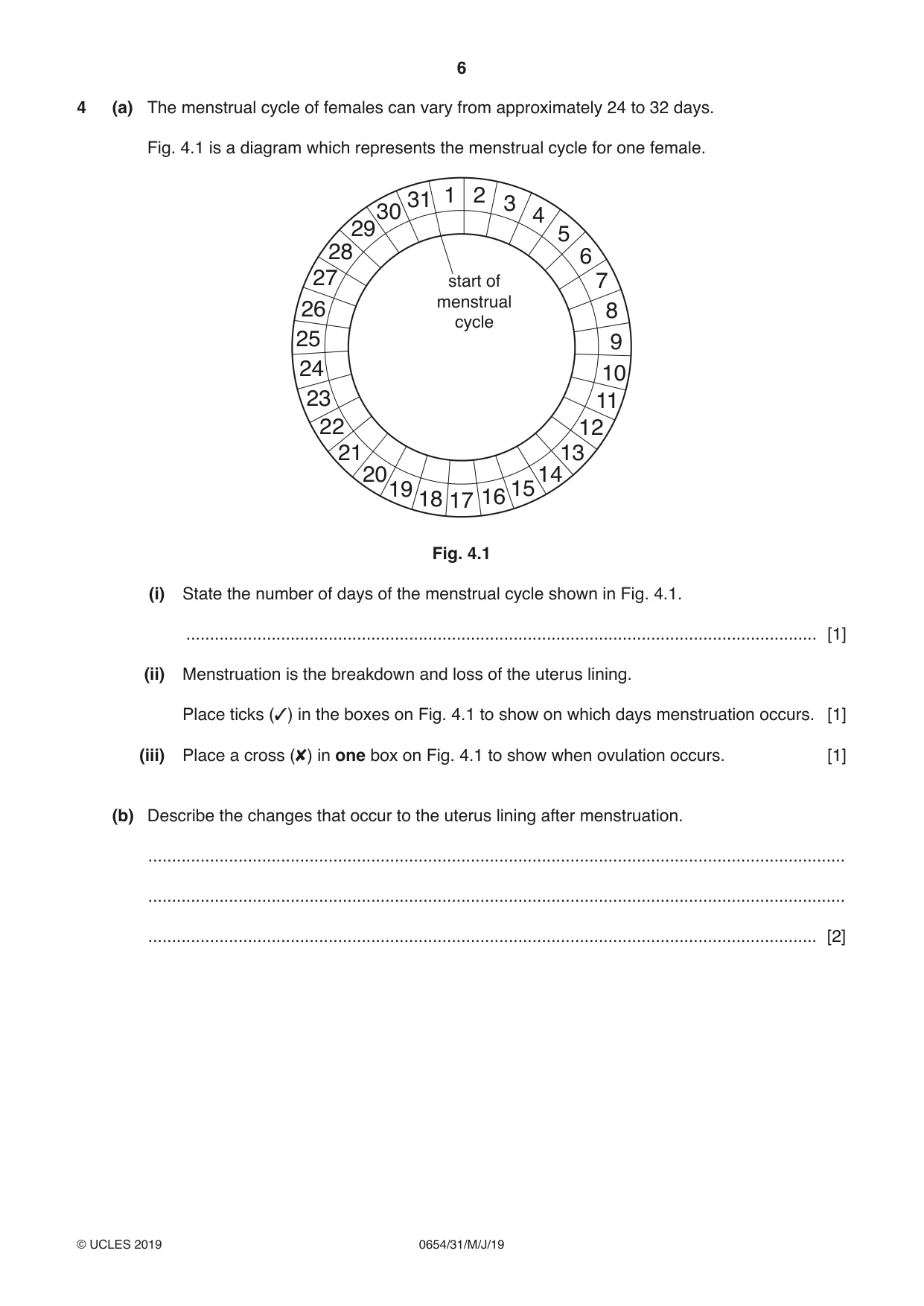
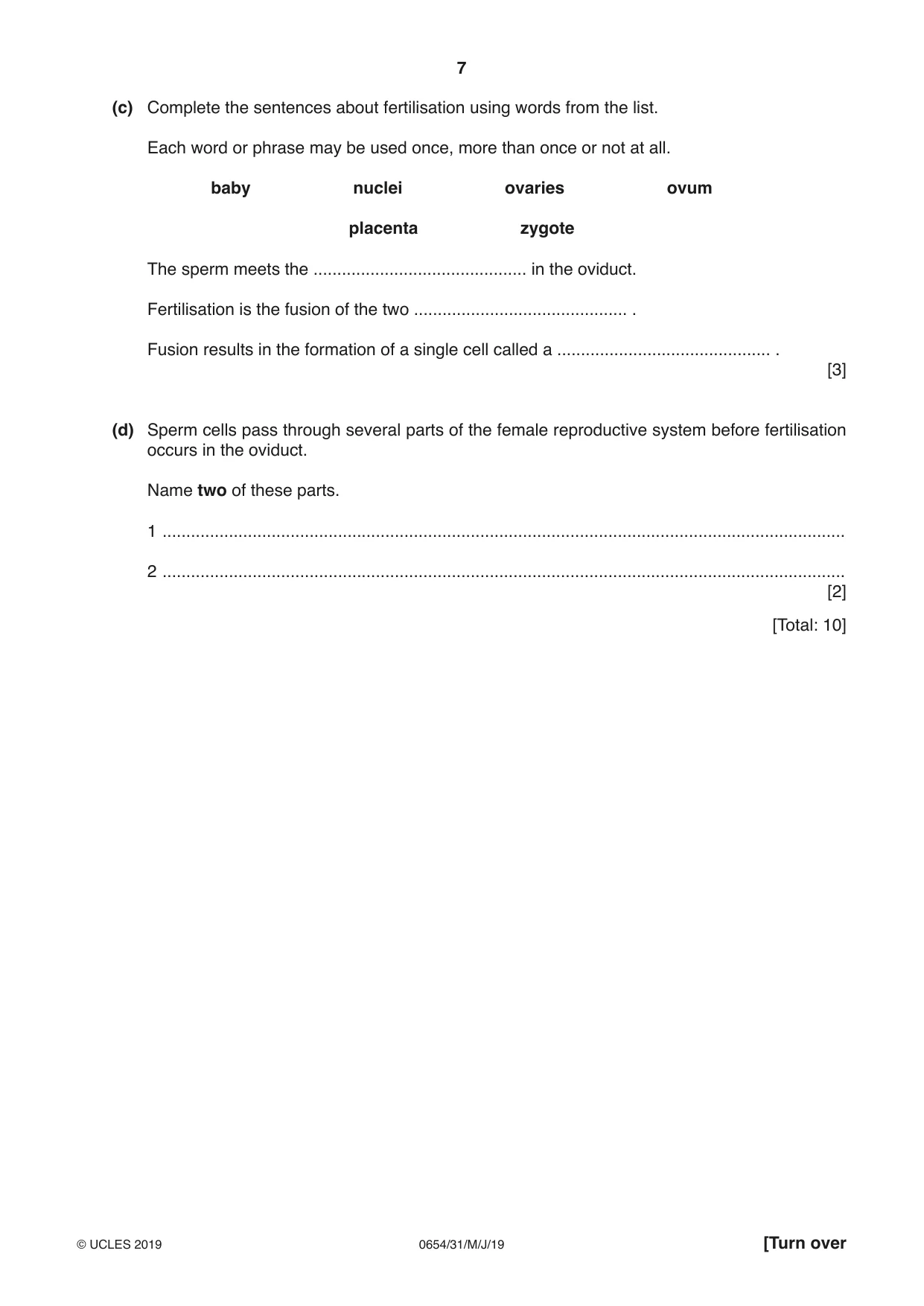
4 (a) The menstrual cycle of females can vary from approximately 24 to 32 days. Fig. 4.1 is a diagram which represents the menstrual cycle for one female. 31 1 2 3 2930 4 5 28 6 27 start of 7 26 menstrual 8 cycle 25 9 24 10 23 11 22 12 21 13 20 14 19 15 18 17 16 Fig. 4.1 (i) State the number of days of the menstrual cycle shown in Fig. 4.1. ..................................................................................................................................... [1] (ii) Menstruation is the breakdown and loss of the uterus lining. Place ticks (3) in the boxes on Fig. 4.1 to show on which days menstruation occurs. [1] (iii) Place a cross (8) in one box on Fig. 4.1 to show when ovulation occurs. [1] (b) Describe the changes that occur to the uterus lining after menstruation. ................................................................................................................................................... ................................................................................................................................................... ............................................................................................................................................. [2] (c) Complete the sentences about fertilisation using words from the list. Each word or phrase may be used once, more than once or not at all. baby nuclei ovaries ovum placenta zygote The sperm meets the ............................................. in the oviduct. Fertilisation is the fusion of the two ............................................. . Fusion results in the formation of a single cell called a ............................................. . [3] (d) Sperm cells pass through several parts of the female reproductive system before fertilisation occurs in the oviduct. Name two of these parts. 1 ................................................................................................................................................ 2 ................................................................................................................................................ [2] [Total: 10]
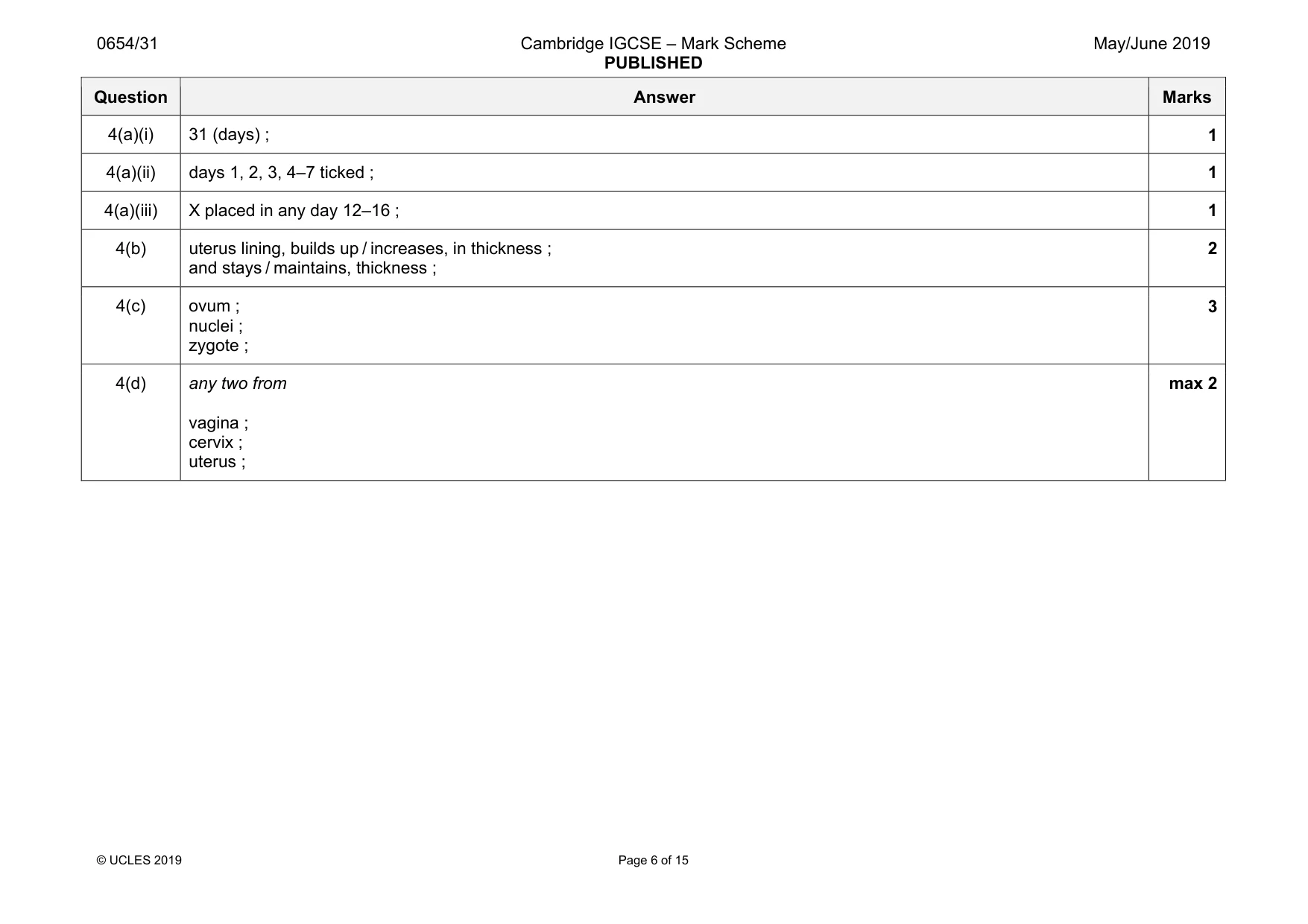
Mark scheme: 4(a)(i) 31 (days) ; 1 4(a)(ii) days 1, 2, 3, 4–7 ticked ; 1 4(a)(iii) X placed in any day 12–16 ; 1 4(b) uterus lining, builds up / increases, in thickness ; and stays / maintains, thickness ; 2 4(c) ovum ; nuclei ; zygote ; 3 4(d) any two from vagina ; cervix ; uterus ; max 2
Q5 · Sulfur dioxide and ammonia are gaseous compounds
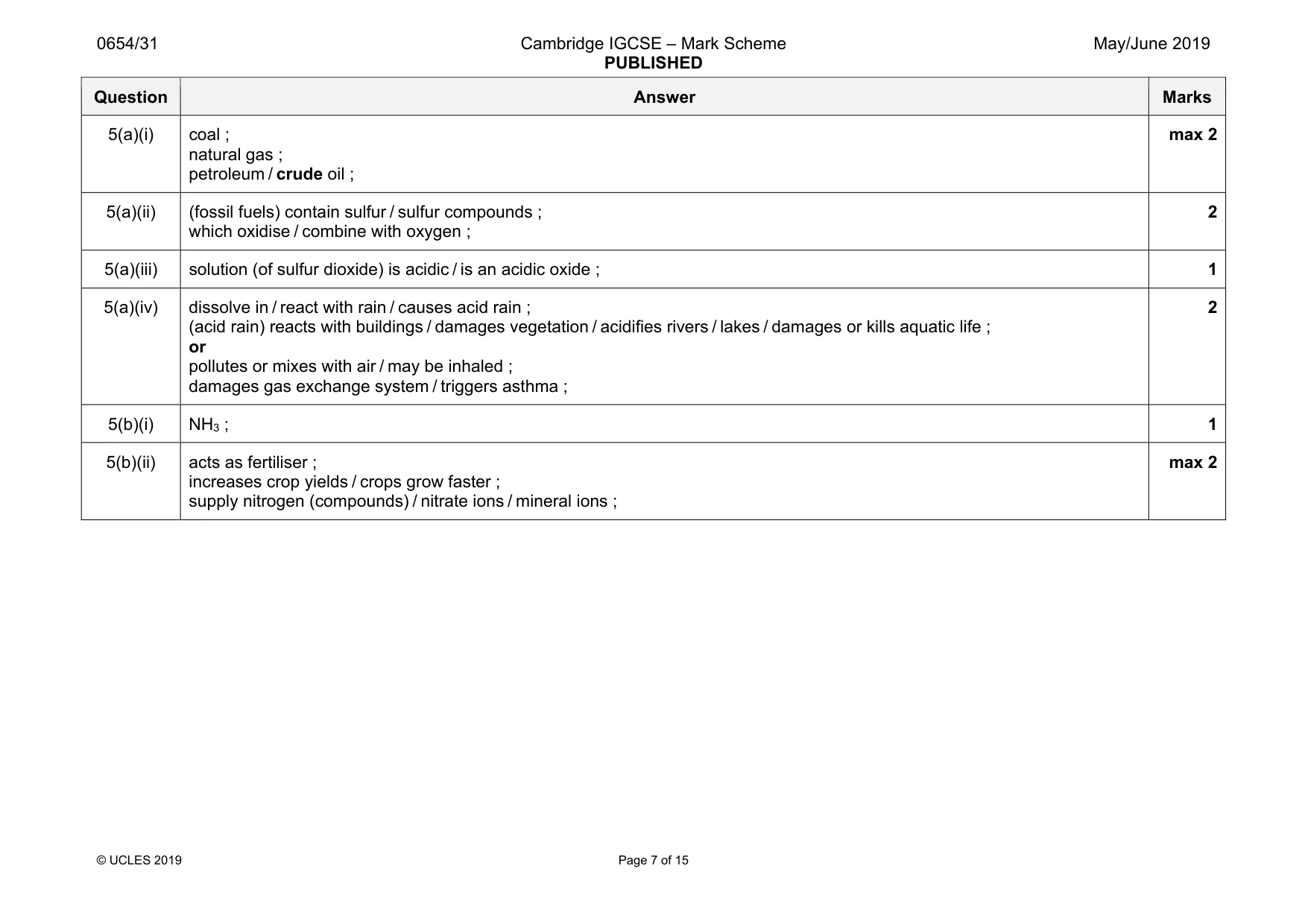
5 Sulfur dioxide and ammonia are gaseous compounds. (a) Sulfur dioxide is released when fossil fuels burn. (i) Name two fossil fuels. 1 ........................................................................................................................................ 2 ........................................................................................................................................ [2] (ii) Explain why burning fossil fuels releases sulfur dioxide. ........................................................................................................................................... ........................................................................................................................................... ..................................................................................................................................... [2] (iii) The pH of water is 7. When sulfur dioxide dissolves in water, the pH changes to 2. Explain this observation. ........................................................................................................................................... ..................................................................................................................................... [1] (iv) Describe one way that sulfur dioxide can damage the environment. ........................................................................................................................................... ........................................................................................................................................... ..................................................................................................................................... [2] (b) (i) State the chemical formula of ammonia. .......................................................... [1] (ii) Ammonia and sulfur dioxide are used in the production of ammonium sulfate. Explain why ammonium sulfate is added to soil used to grow crops. ........................................................................................................................................... ........................................................................................................................................... ..................................................................................................................................... [2] [Total: 10]
Mark scheme: 5(a)(i) coal ; natural gas ; petroleum / crude oil ; max 2 5(a)(ii) (fossil fuels) contain sulfur / sulfur compounds ; which oxidise / combine with oxygen ; 2 5(a)(iii) solution (of sulfur dioxide) is acidic / is an acidic oxide ; 1 5(a)(iv) dissolve in / react with rain / causes acid rain ; (acid rain) reacts with buildings / damages vegetation / acidifies rivers / lakes / damages or kills aquatic life ; or pollutes or mixes with air / may be inhaled ; damages gas exchange system / triggers asthma ; 2 5(b)(i) NH3 ; 1 5(b)(ii) acts as fertiliser ; increases crop yields / crops grow faster ; supply nitrogen (compounds) / nitrate ions / mineral ions ; max 2
Q6 · A boy travels in an elevator from the ground floor of an apartment building
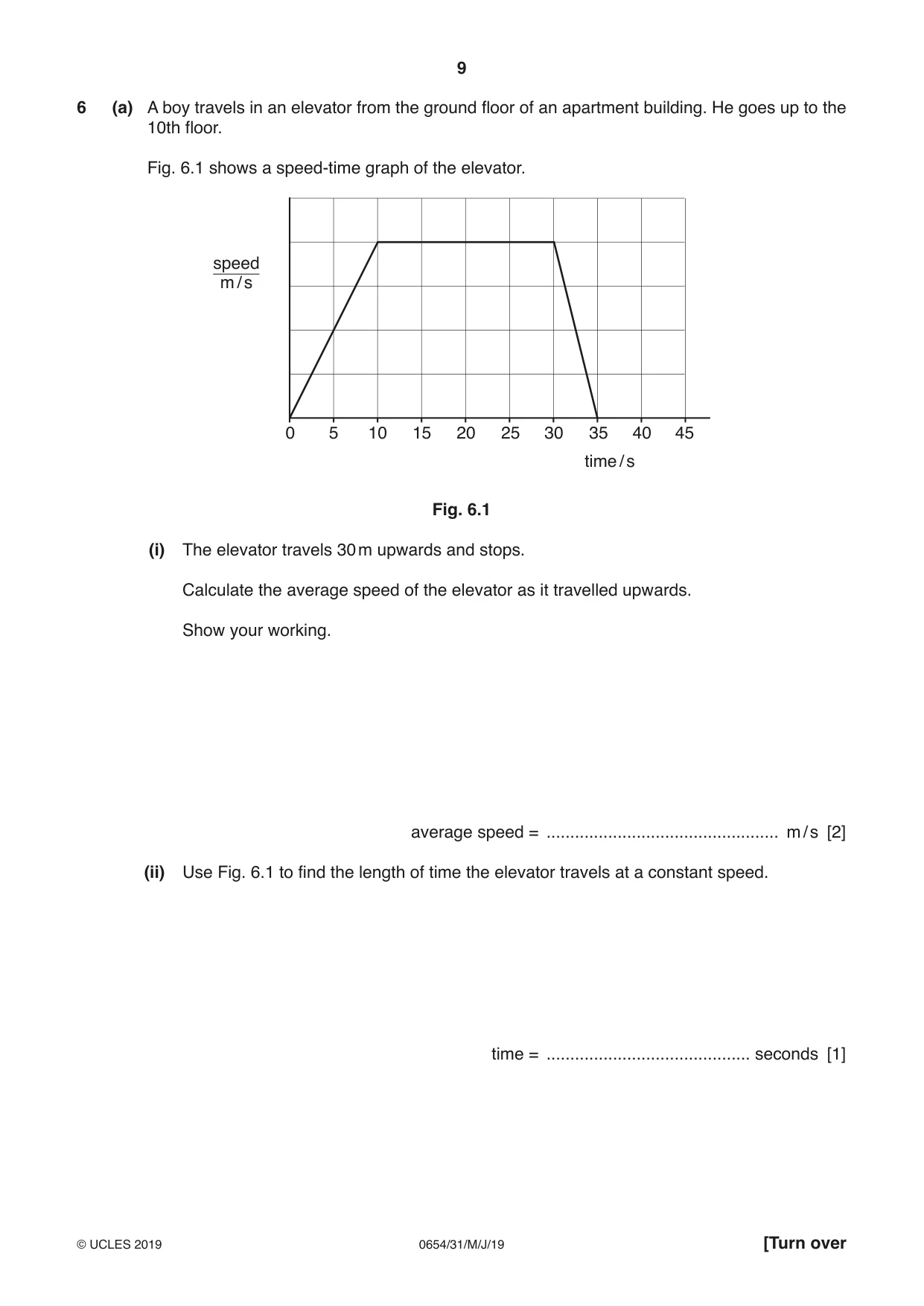
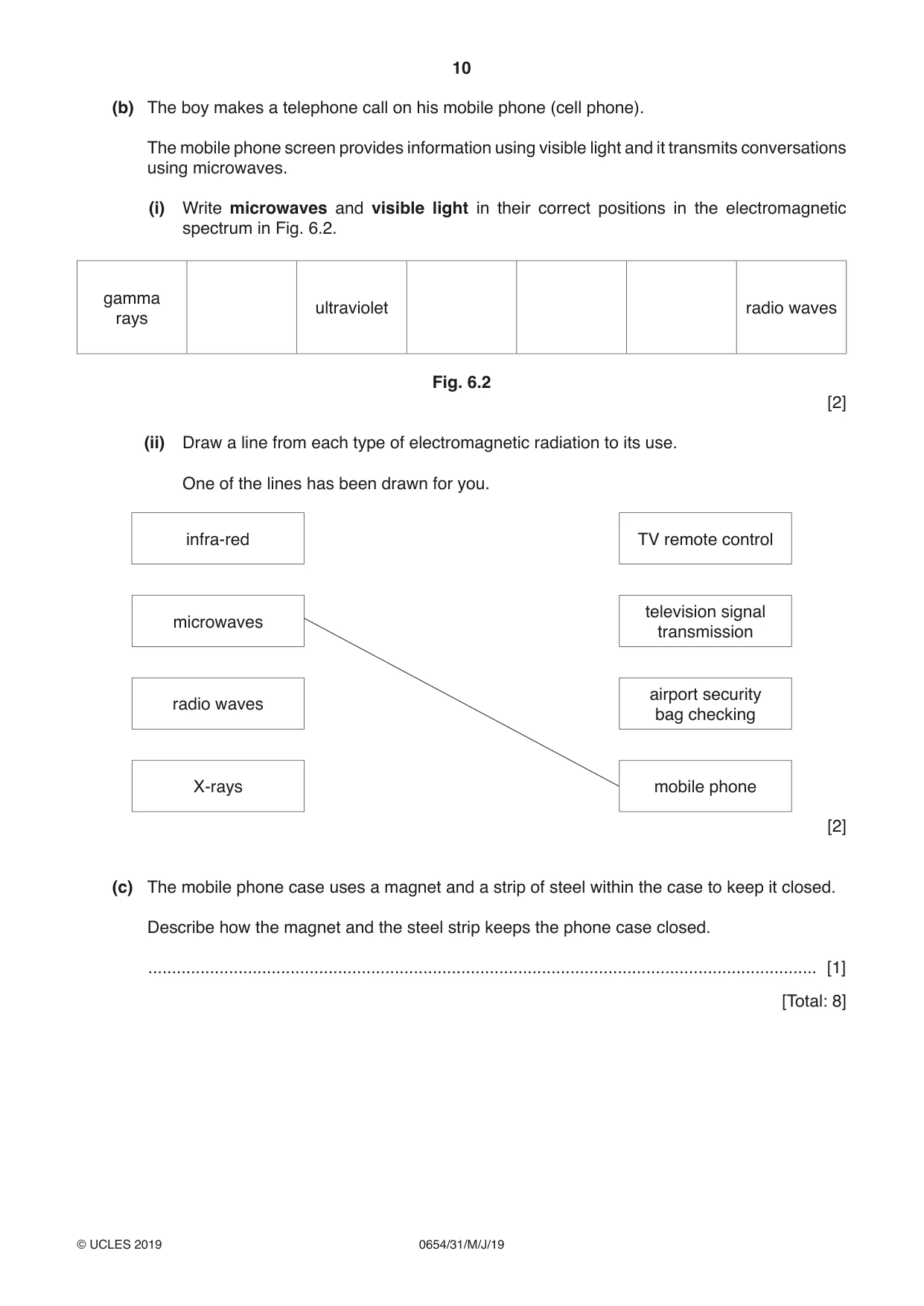
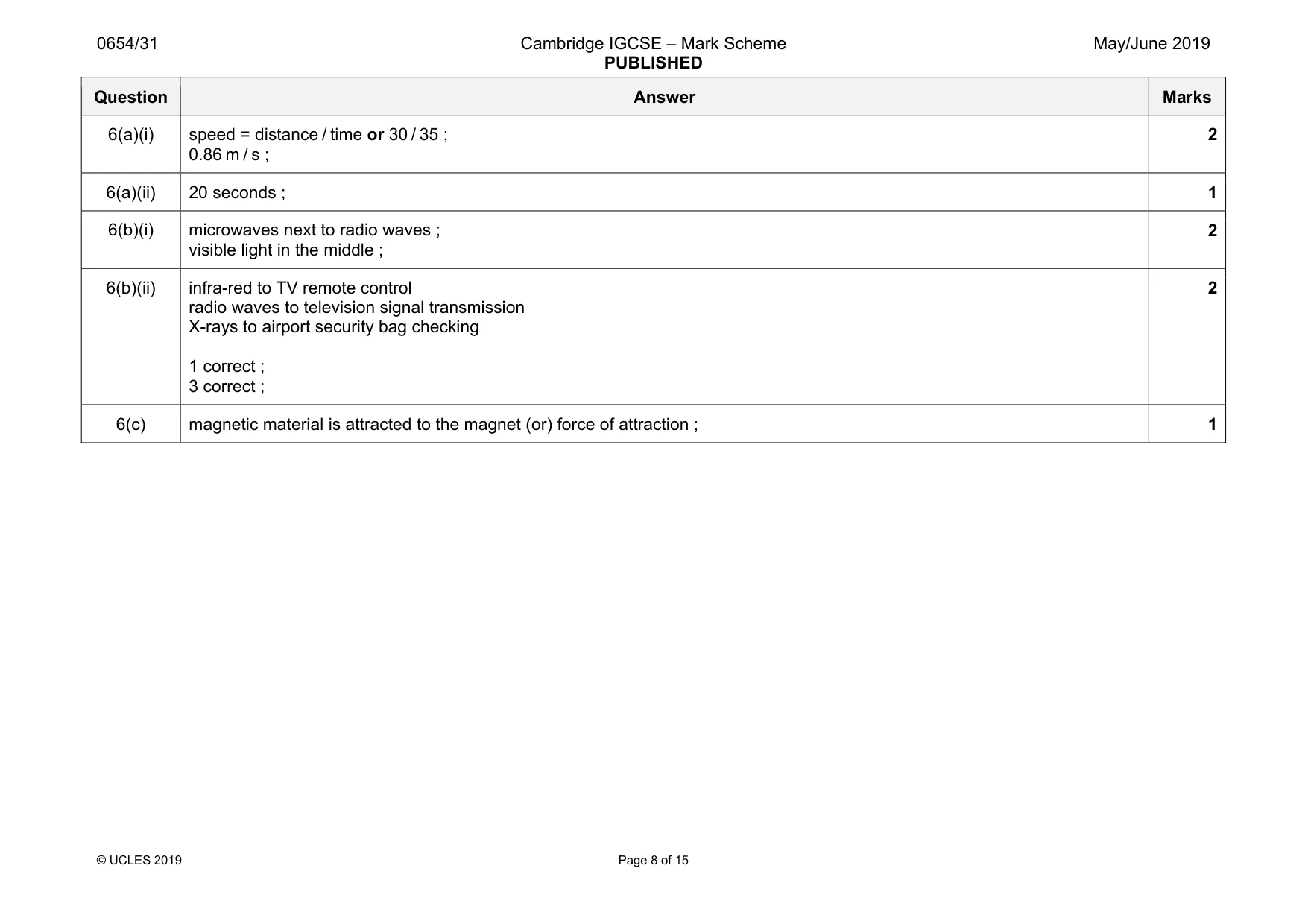
6 (a) A boy travels in an elevator from the ground floor of an apartment building. He goes up to the 10th floor. Fig. 6.1 shows a speed-time graph of the elevator. speed m / s 0 5 10 15 20 25 30 35 40 45 time / s Fig. 6.1 (i) The elevator travels 30 m upwards and stops. Calculate the average speed of the elevator as it travelled upwards. Show your working. average speed = ................................................. m / s [2] (ii) Use Fig. 6.1 to find the length of time the elevator travels at a constant speed. time = ........................................... seconds [1] (b) The boy makes a telephone call on his mobile phone (cell phone). The mobile phone screen provides information using visible light and it transmits conversations using microwaves. (i) Write microwaves and visible light in their correct positions in the electromagnetic spectrum in Fig. 6.2. gamma ultraviolet radio waves rays Fig. 6.2 [2] (ii) Draw a line from each type of electromagnetic radiation to its use. One of the lines has been drawn for you. infra-red TV remote control television signal microwaves transmission airport security radio waves bag checking X-rays mobile phone [2] (c) The mobile phone case uses a magnet and a strip of steel within the case to keep it closed. Describe how the magnet and the steel strip keeps the phone case closed. ............................................................................................................................................. [1] [Total: 8]
Mark scheme: 6(a)(i) speed = distance / time or 30 / 35 ; 0.86 m / s ; 2 6(a)(ii) 20 seconds ; 1 6(b)(i) microwaves next to radio waves ; visible light in the middle ; 2 6(b)(ii) infra-red to TV remote control radio waves to television signal transmission X-rays to airport security bag checking 1 correct ; 3 correct ; 2 6(c) magnetic material is attracted to the magnet (or) force of attraction ; 1
Q7 · The graph in Fig
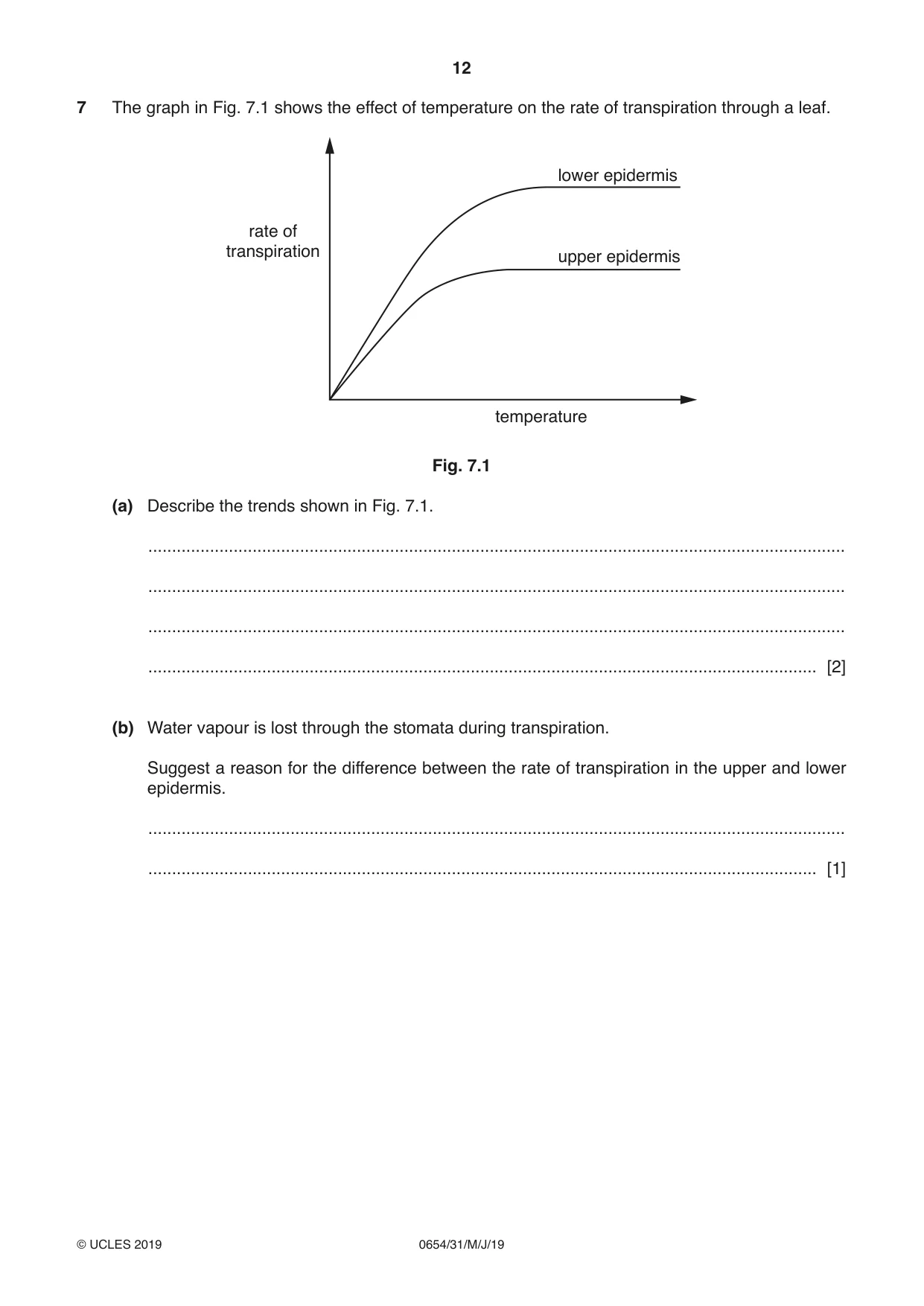
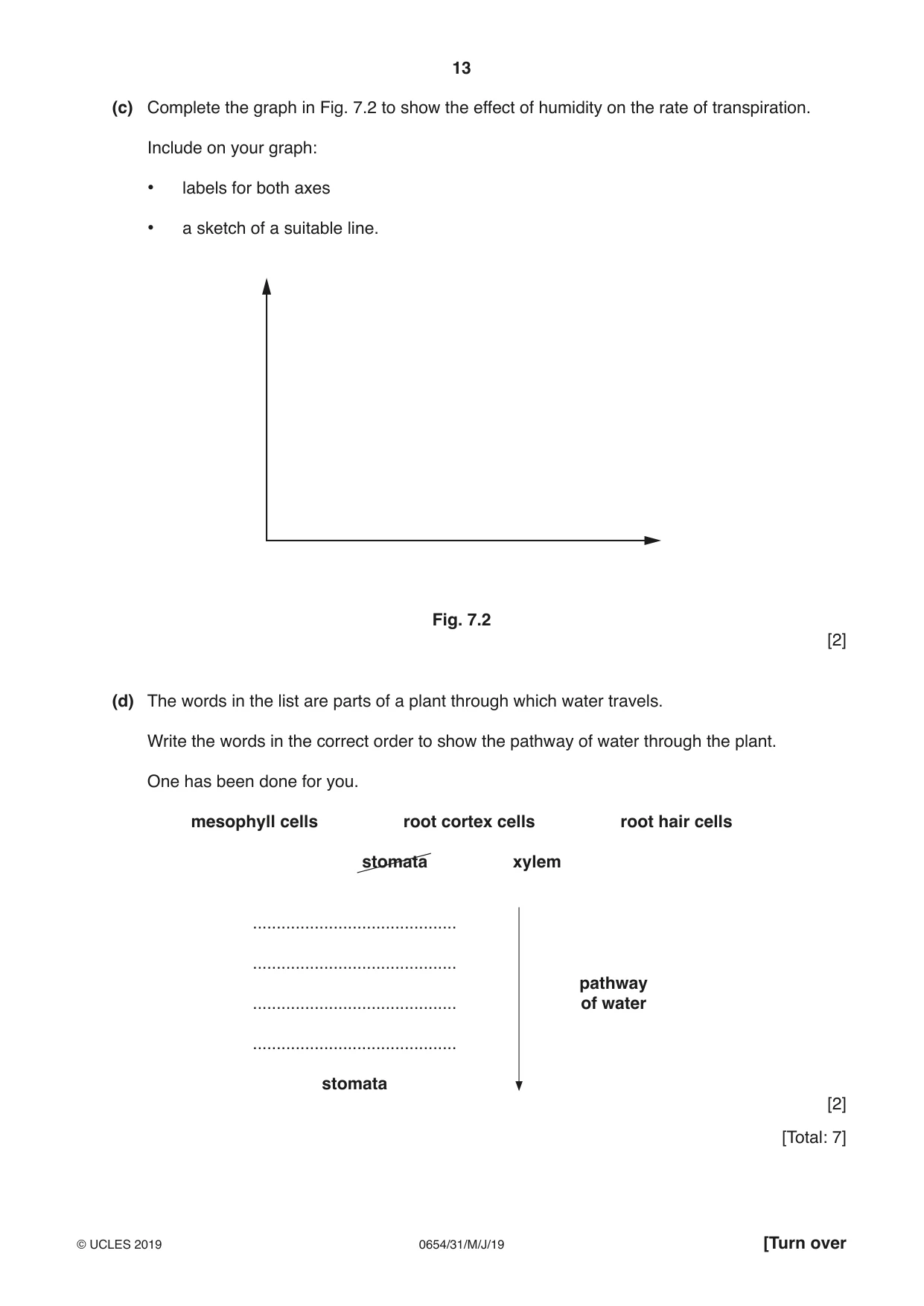
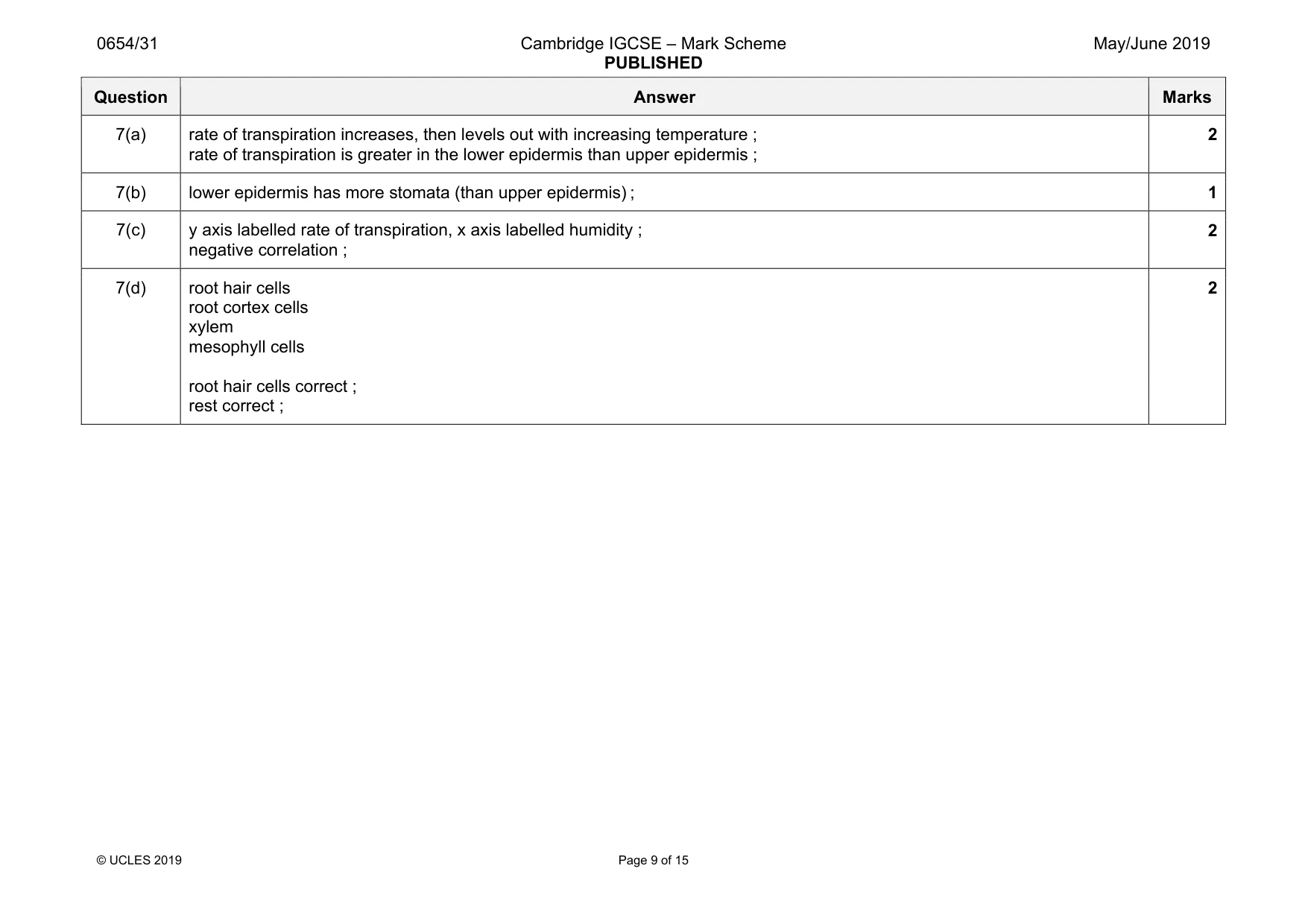
7 The graph in Fig. 7.1 shows the effect of temperature on the rate of transpiration through a leaf. lower epidermis rate of transpiration upper epidermis temperature Fig. 7.1 (a) Describe the trends shown in Fig. 7.1. ................................................................................................................................................... ................................................................................................................................................... ................................................................................................................................................... ............................................................................................................................................. [2] (b) Water vapour is lost through the stomata during transpiration. Suggest a reason for the difference between the rate of transpiration in the upper and lower epidermis. ................................................................................................................................................... ............................................................................................................................................. [1] (c) Complete the graph in Fig. 7.2 to show the effect of humidity on the rate of transpiration. Include on your graph: • labels for both axes • a sketch of a suitable line. Fig. 7.2 [2] (d) The words in the list are parts of a plant through which water travels. Write the words in the correct order to show the pathway of water through the plant. One has been done for you. mesophyll cells root cortex cells root hair cells stomata xylem ........................................... ........................................... pathway ........................................... of water ........................................... stomata [2] [Total: 7]
Mark scheme: 7(a) rate of transpiration increases, then levels out with increasing temperature ; rate of transpiration is greater in the lower epidermis than upper epidermis ; 2 7(b) lower epidermis has more stomata (than upper epidermis) ; 1 7(c) y axis labelled rate of transpiration, x axis labelled humidity ; negative correlation ; 2 7(d) root hair cells root cortex cells xylem mesophyll cells root hair cells correct ; rest correct ; 2
Q8 · Most elements in the Periodic Table are metals
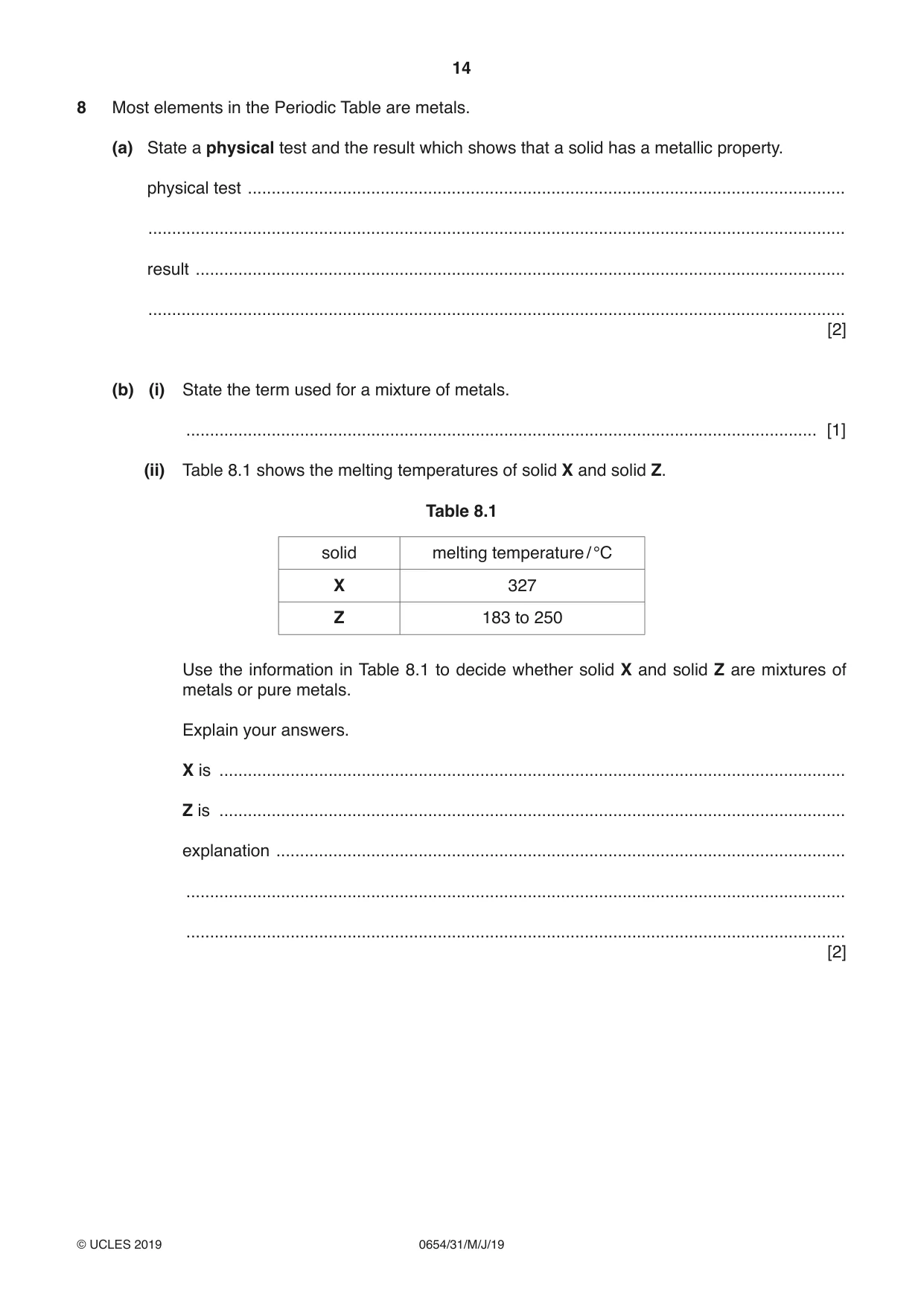
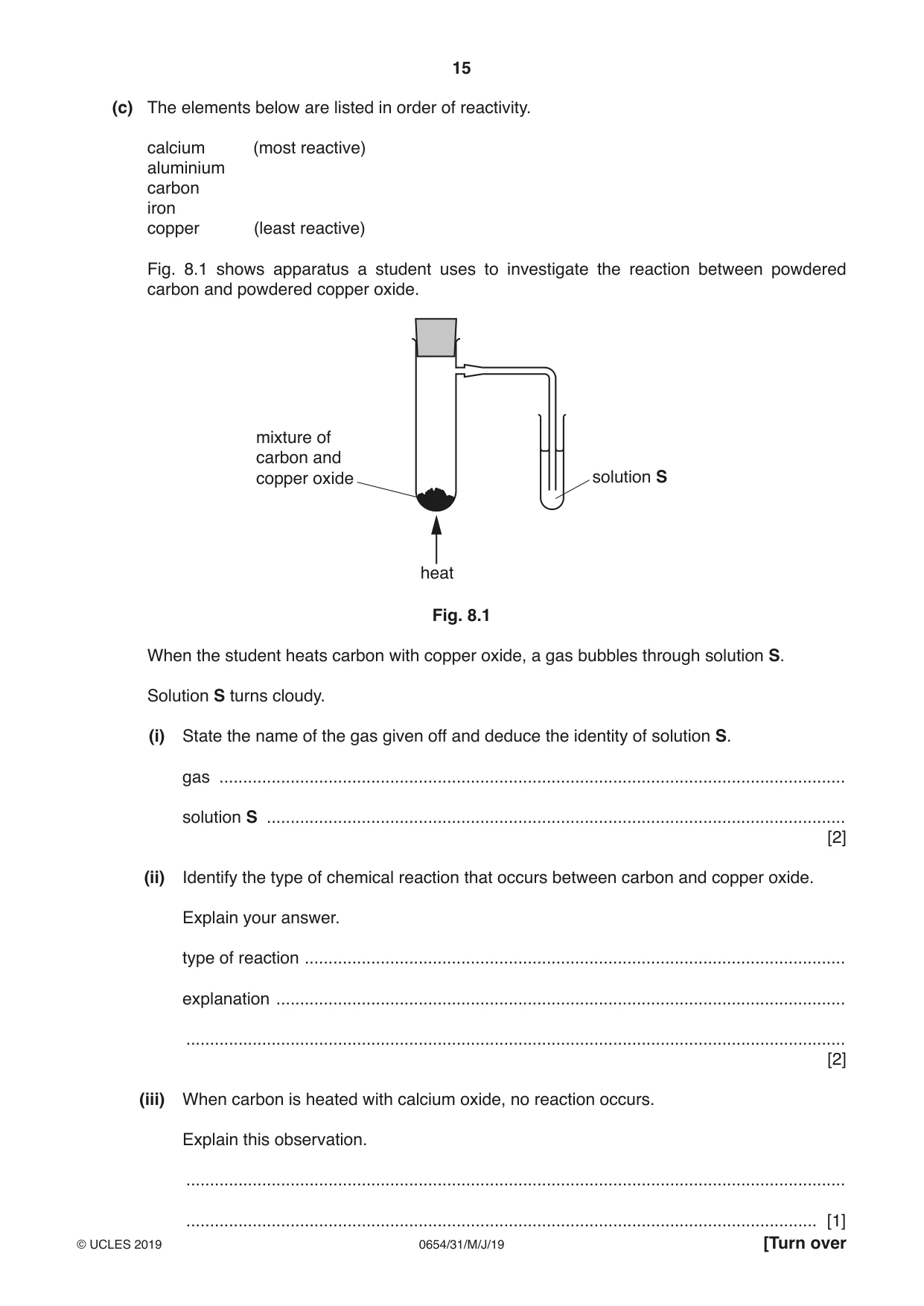
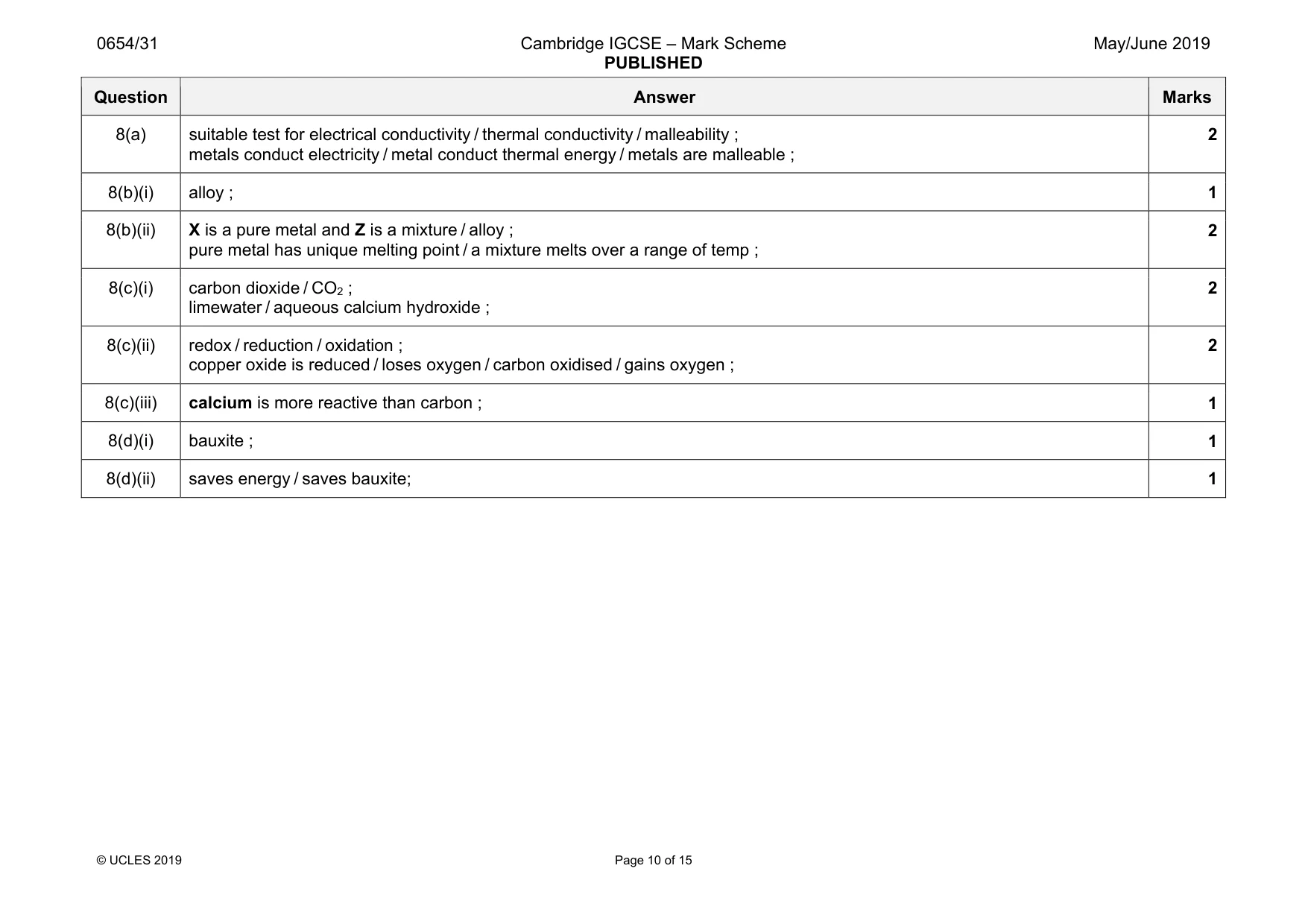
8 Most elements in the Periodic Table are metals. (a) State a physical test and the result which shows that a solid has a metallic property. physical test .............................................................................................................................. ................................................................................................................................................... result ......................................................................................................................................... ................................................................................................................................................... [2] (b) (i) State the term used for a mixture of metals. ..................................................................................................................................... [1] (ii) Table 8.1 shows the melting temperatures of solid X and solid Z. Table 8.1 solid melting temperature / °C X 327 Z 183 to 250 Use the information in Table 8.1 to decide whether solid X and solid Z are mixtures of metals or pure metals. Explain your answers. X is .................................................................................................................................... Z is .................................................................................................................................... explanation ........................................................................................................................ ........................................................................................................................................... ........................................................................................................................................... [2] (c) The elements below are listed in order of reactivity. calcium (most reactive) aluminium carbon iron copper (least reactive) Fig. 8.1 shows apparatus a student uses to investigate the reaction between powdered carbon and powdered copper oxide. mixture of carbon and copper oxide solution S heat Fig. 8.1 When the student heats carbon with copper oxide, a gas bubbles through solution S. Solution S turns cloudy. (i) State the name of the gas given off and deduce the identity of solution S. gas .................................................................................................................................... solution S .......................................................................................................................... [2] (ii) Identify the type of chemical reaction that occurs between carbon and copper oxide. Explain your answer. type of reaction .................................................................................................................. explanation ........................................................................................................................ ........................................................................................................................................... [2] (iii) When carbon is heated with calcium oxide, no reaction occurs. Explain this observation. ........................................................................................................................................... (d) (i) Name an ore from which aluminium is extracted. .......................................................... [1] (ii) State one reason, other than cost, why aluminium is recycled. ........................................................................................................................................... ..................................................................................................................................... [1] [Total: 12]
Mark scheme: 8(a) suitable test for electrical conductivity / thermal conductivity / malleability ; metals conduct electricity / metal conduct thermal energy / metals are malleable ; 2 8(b)(i) alloy ; 1 8(b)(ii) X is a pure metal and Z is a mixture / alloy ; pure metal has unique melting point / a mixture melts over a range of temp ; 2 8(c)(i) carbon dioxide / CO2 ; limewater / aqueous calcium hydroxide ; 2 8(c)(ii) redox / reduction / oxidation ; copper oxide is reduced / loses oxygen / carbon oxidised / gains oxygen ; 2 8(c)(iii) calcium is more reactive than carbon ; 1 8(d)(i) bauxite ; 1 8(d)(ii) saves energy / saves bauxite; 1
Q9 · A teacher using a photocopier
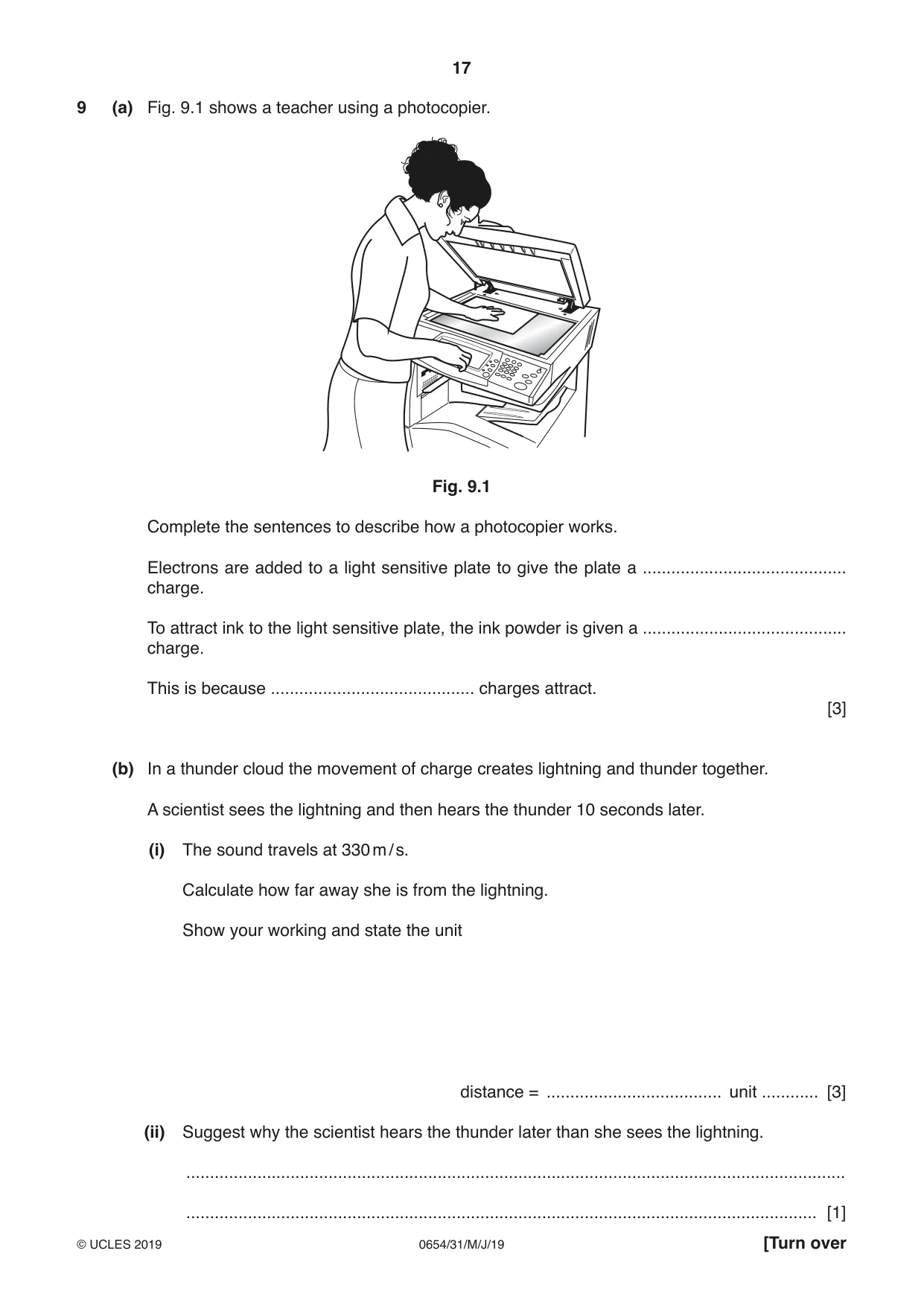
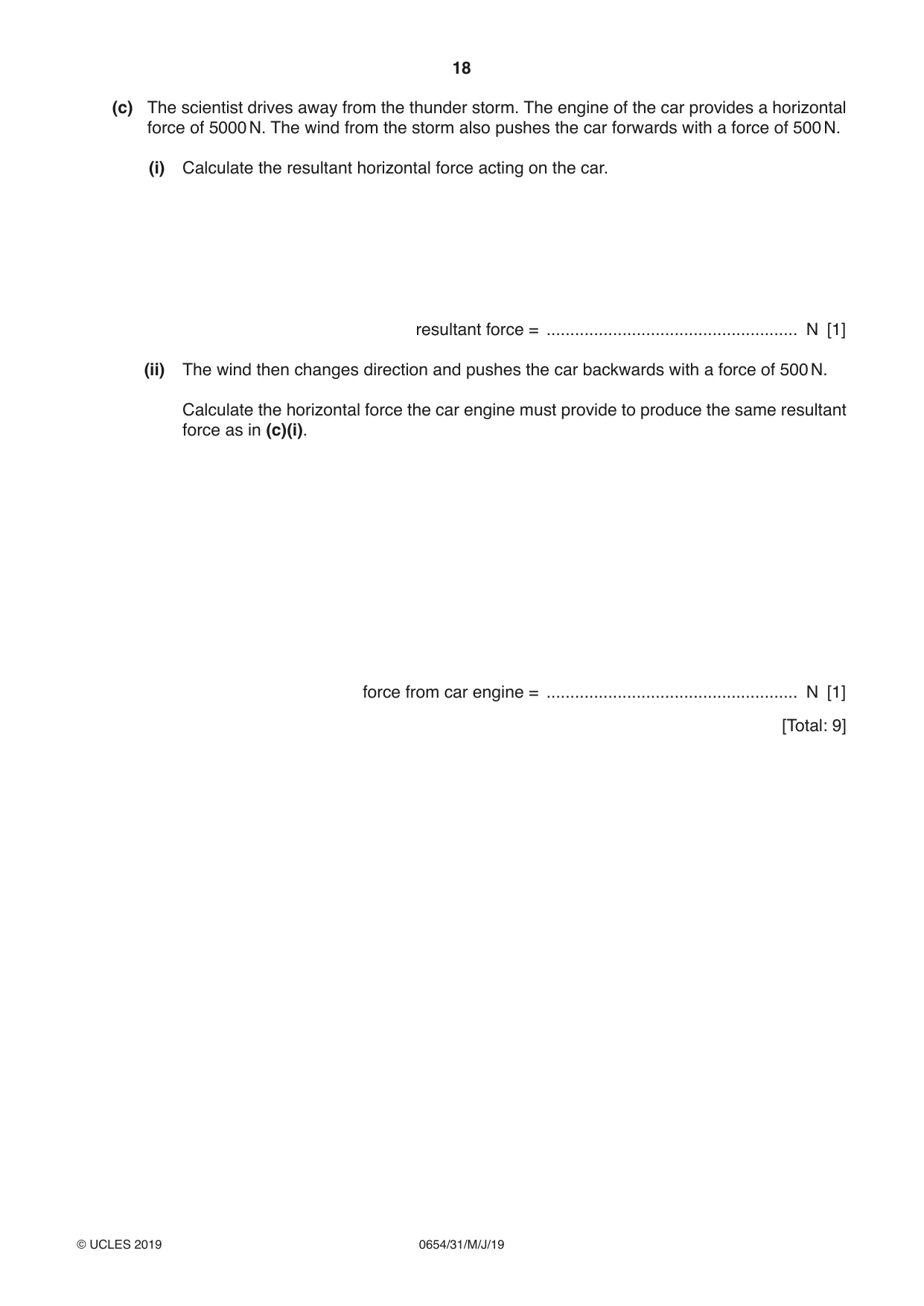
9 (a) Fig. 9.1 shows a teacher using a photocopier. Fig. 9.1 Complete the sentences to describe how a photocopier works. Electrons are added to a light sensitive plate to give the plate a ........................................... charge. To attract ink to the light sensitive plate, the ink powder is given a ........................................... charge. This is because ........................................... charges attract. [3] (b) In a thunder cloud the movement of charge creates lightning and thunder together. A scientist sees the lightning and then hears the thunder 10 seconds later. (i) The sound travels at 330 m / s. Calculate how far away she is from the lightning. Show your working and state the unit distance = ..................................... unit ............ [3] (ii) Suggest why the scientist hears the thunder later than she sees the lightning. ........................................................................................................................................... ..................................................................................................................................... [1] (c) The scientist drives away from the thunder storm. The engine of the car provides a horizontal force of 5000 N. The wind from the storm also pushes the car forwards with a force of 500 N. (i) Calculate the resultant horizontal force acting on the car. resultant force = ..................................................... N [1] (ii) The wind then changes direction and pushes the car backwards with a force of 500 N. Calculate the horizontal force the car engine must provide to produce the same resultant force as in (c)(i). force from car engine = ..................................................... N [1] [Total: 9]
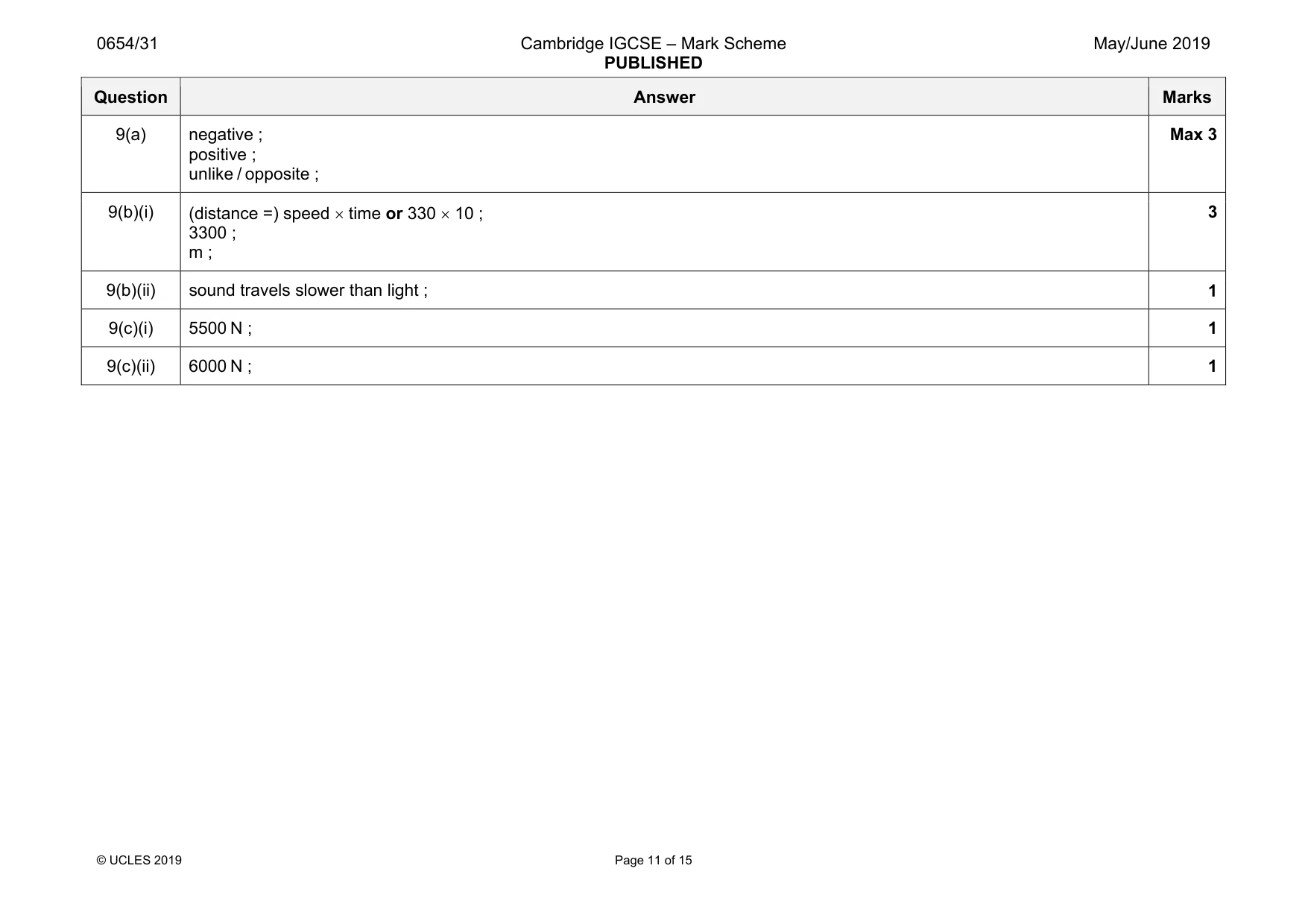
Mark scheme: 9(a) negative ; positive ; unlike / opposite ; Max 3 9(b)(i) (distance =) speed × time or 330 × 10 ; 3300 ; m ; 3 9(b)(ii) sound travels slower than light ; 1 9(c)(i) 5500 N ; 1 9(c)(ii) 6000 N ; 1
Q10 · The pie chart in Fig
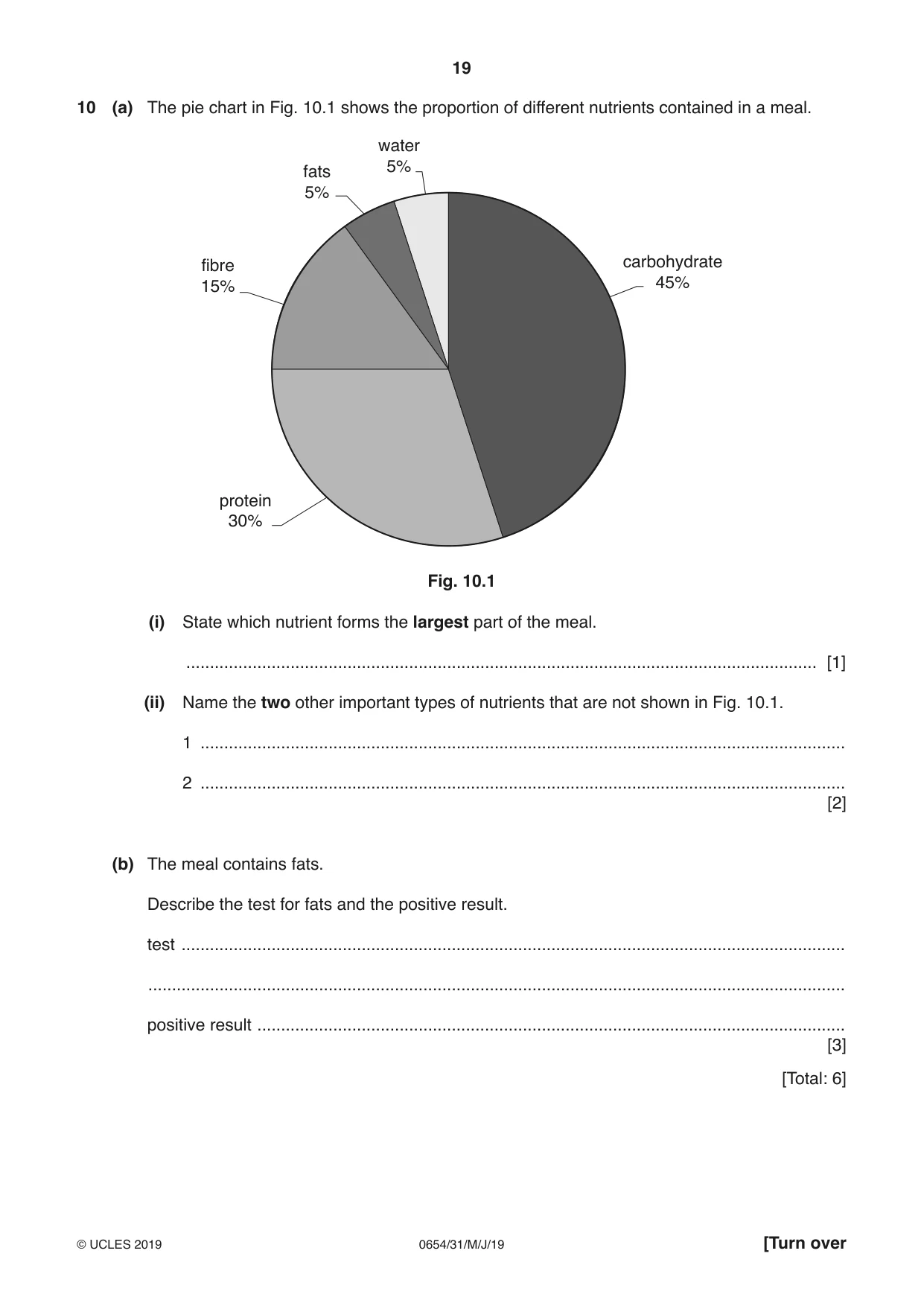
10 (a) The pie chart in Fig. 10.1 shows the proportion of different nutrients contained in a meal. water 5% fats 5% fibre carbohydrate 15% 45% protein 30% Fig. 10.1 (i) State which nutrient forms the largest part of the meal. ..................................................................................................................................... [1] (ii) Name the two other important types of nutrients that are not shown in Fig. 10.1. 1 ........................................................................................................................................ 2 ........................................................................................................................................ [2] (b) The meal contains fats. Describe the test for fats and the positive result. test ............................................................................................................................................ ................................................................................................................................................... positive result ............................................................................................................................ [3] [Total: 6]
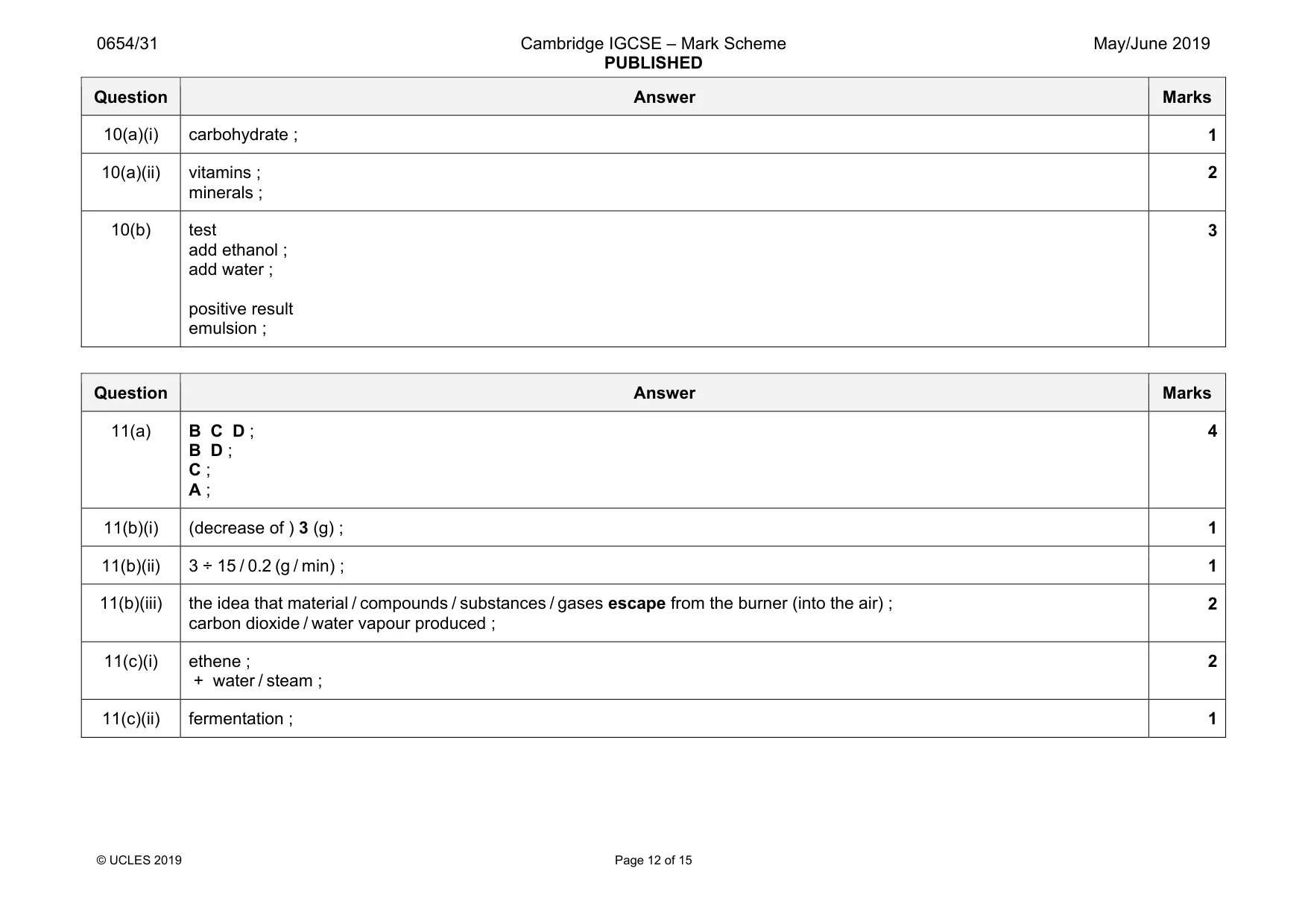
Mark scheme: 10(a)(i) carbohydrate ; 1 10(a)(ii) vitamins ; minerals ; 2 10(b) test add ethanol ; add water ; positive result emulsion ; 3
Q11 · The structures of four molecules, A, B, C and D
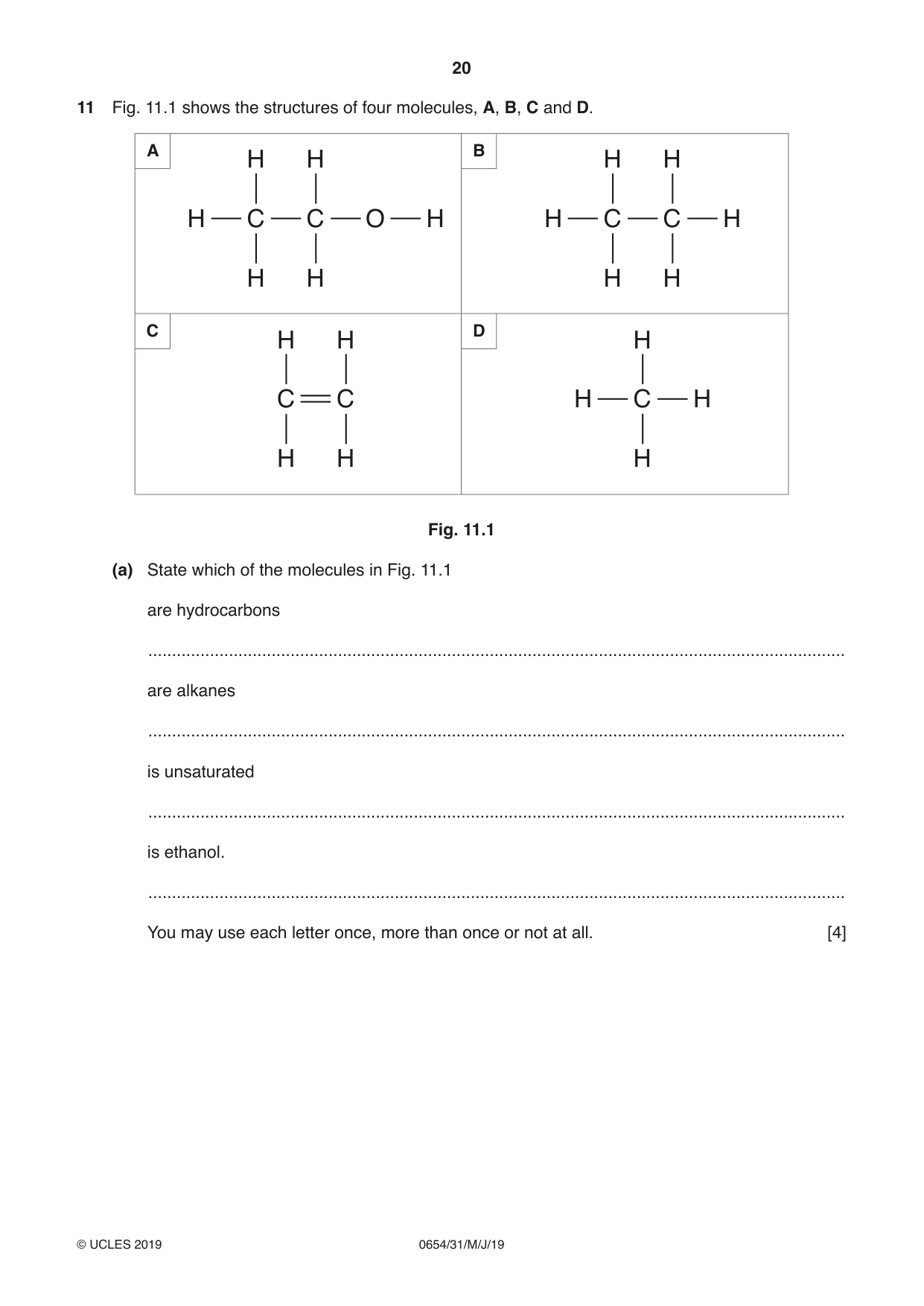
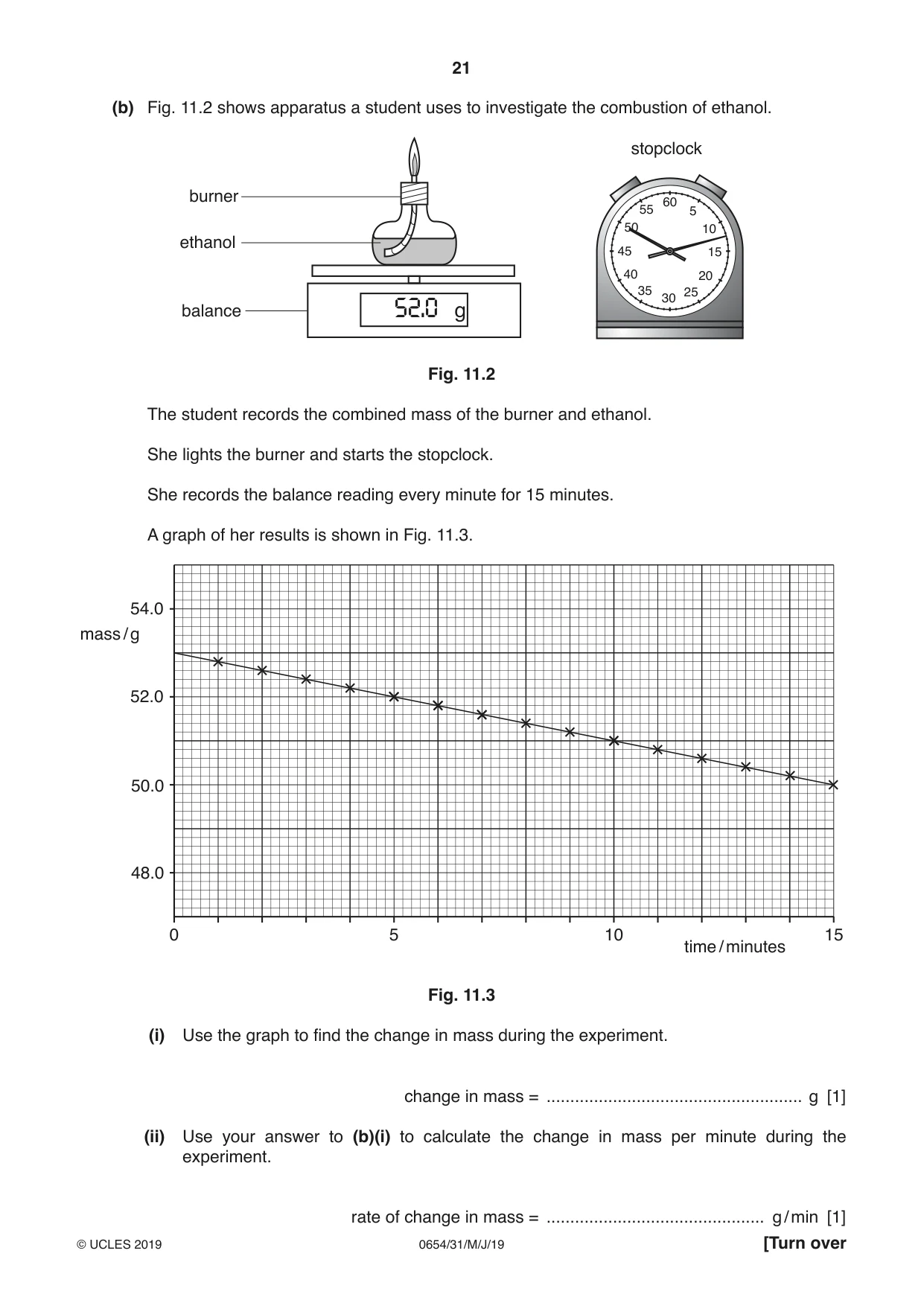
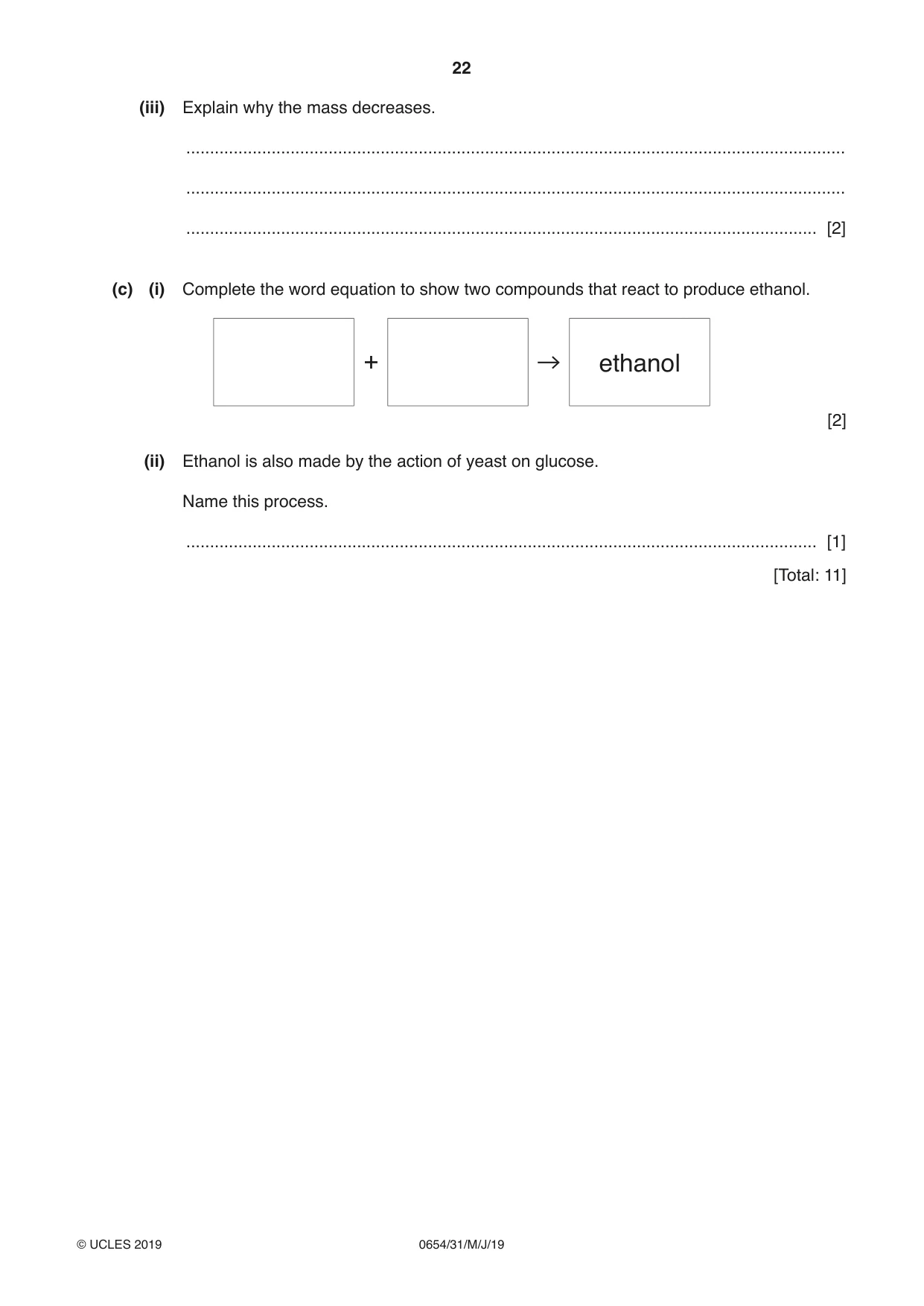
11 Fig. 11.1 shows the structures of four molecules, A, B, C and D. A H H B H H H C C O H H C C H H H H H C H H D H C C H C H H H H Fig. 11.1 (a) State which of the molecules in Fig. 11.1 are hydrocarbons ................................................................................................................................................... are alkanes ................................................................................................................................................... is unsaturated ................................................................................................................................................... is ethanol. ................................................................................................................................................... You may use each letter once, more than once or not at all. [4] (b) Fig. 11.2 shows apparatus a student uses to investigate the combustion of ethanol. stopclock burner 60 55 5 50 10 ethanol 45 15 40 20 35 25 balance 52.0 g 30 Fig. 11.2 The student records the combined mass of the burner and ethanol. She lights the burner and starts the stopclock. She records the balance reading every minute for 15 minutes. A graph of her results is shown in Fig. 11.3. 54.0 mass / g 52.0 50.0 48.0 0 5 10 15 time / minutes Fig. 11.3 (i) Use the graph to find the change in mass during the experiment. change in mass = ...................................................... g [1] (ii) Use your answer to (b)(i) to calculate the change in mass per minute during the experiment. rate of change in mass = .............................................. g / min [1] (iii) Explain why the mass decreases. ........................................................................................................................................... ........................................................................................................................................... ..................................................................................................................................... [2] (c) (i) Complete the word equation to show two compounds that react to produce ethanol. + ethanol [2] (ii) Ethanol is also made by the action of yeast on glucose. Name this process. ..................................................................................................................................... [1] [Total: 11]
Mark scheme: 11(a) B C D ; B D ; C ; A ; 4 11(b)(i) (decrease of ) 3 (g) ; 1 11(b)(ii) 3 ÷ 15 / 0.2 (g / min) ; 1 11(b)(iii) the idea that material / compounds / substances / gases escape from the burner (into the air) ; carbon dioxide / water vapour produced ; 2 11(c)(i) ethene ; + water / steam ; 2 11(c)(ii) fermentation ; 1
Q12 · A crane used to construct a wind turbine
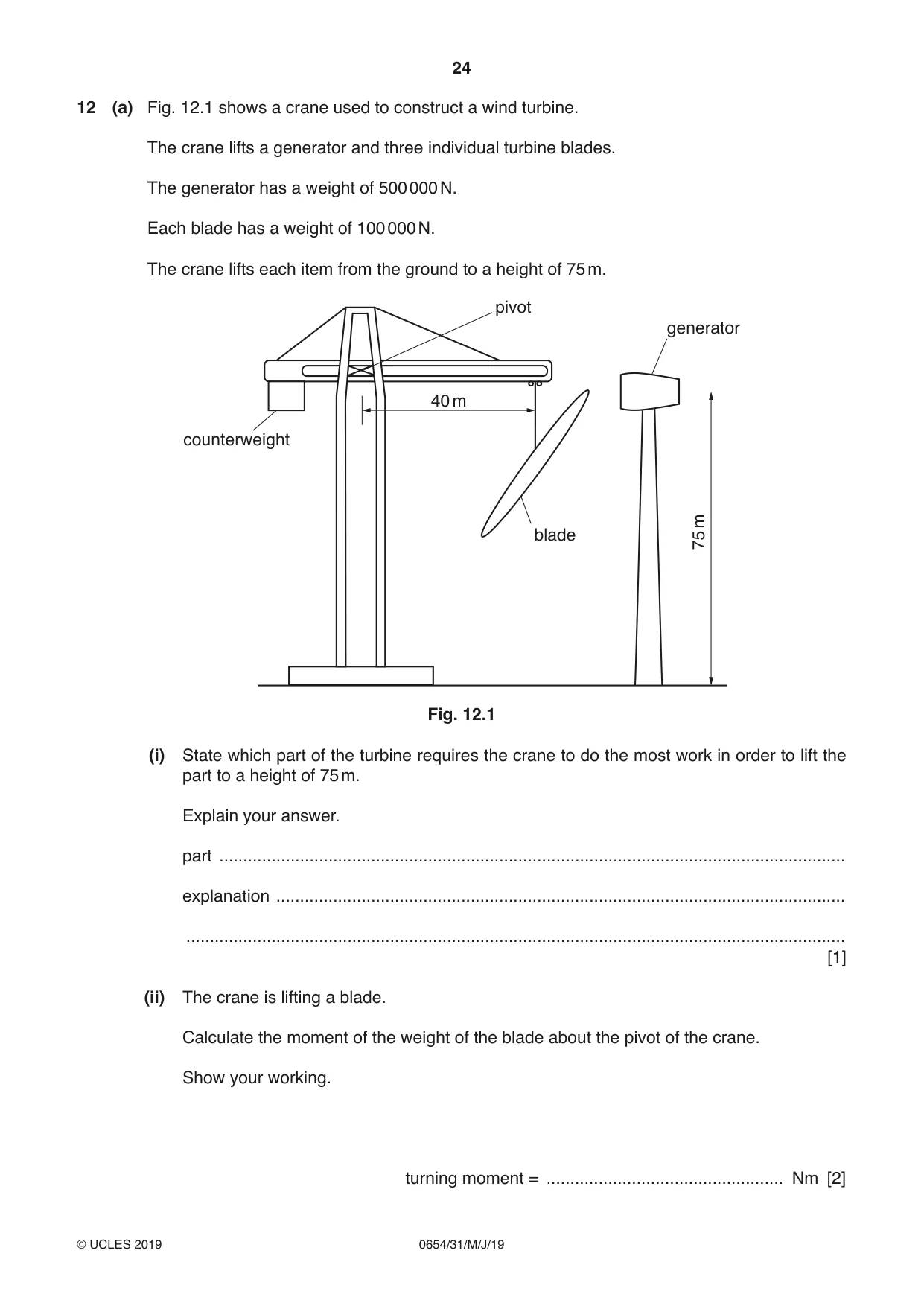
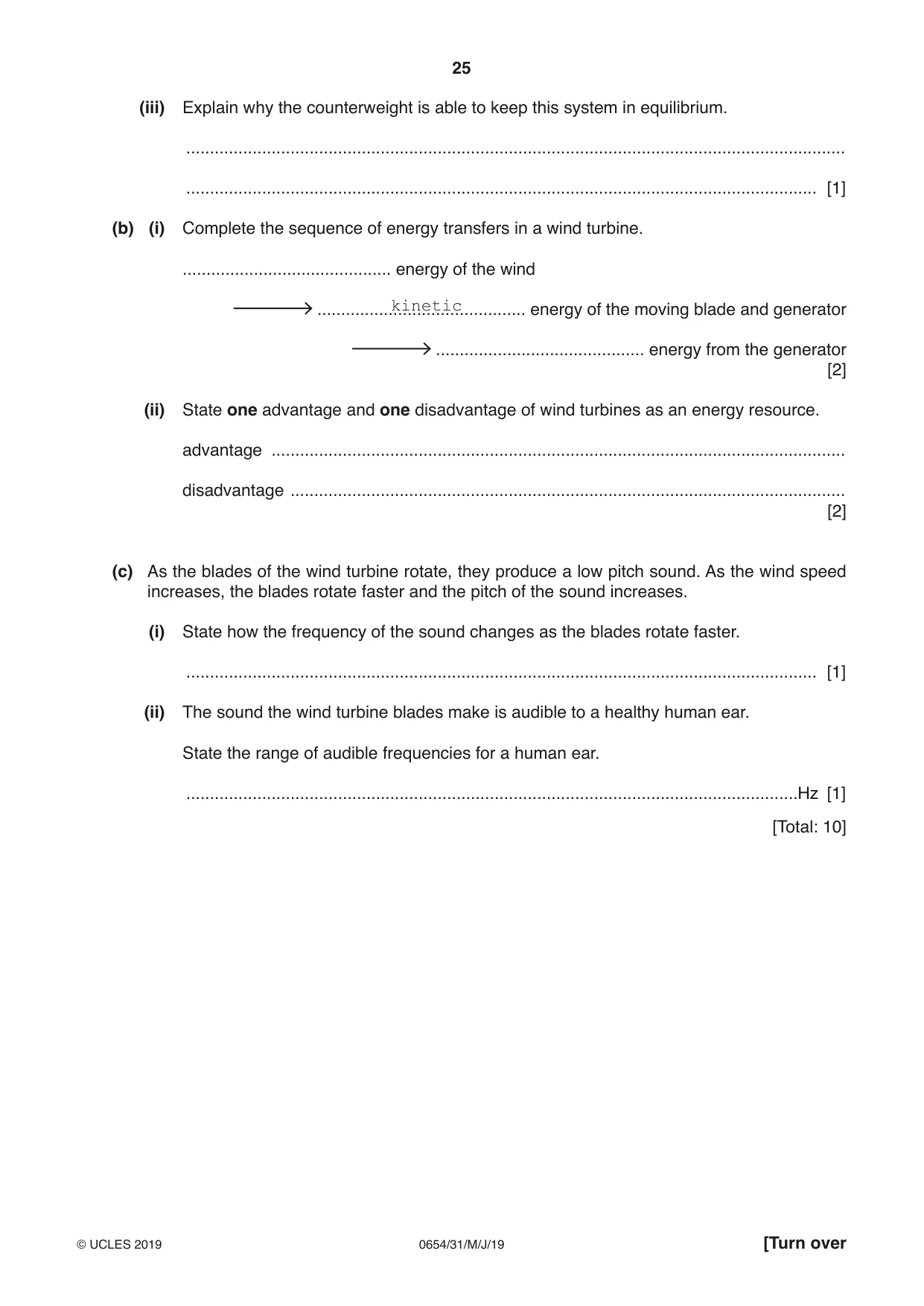
12 (a) Fig. 12.1 shows a crane used to construct a wind turbine. The crane lifts a generator and three individual turbine blades. The generator has a weight of 500 000 N. Each blade has a weight of 100 000 N. The crane lifts each item from the ground to a height of 75 m. pivot generator 40 m counterweight m blade 75 Fig. 12.1 (i) State which part of the turbine requires the crane to do the most work in order to lift the part to a height of 75 m. Explain your answer. part .................................................................................................................................... explanation ........................................................................................................................ ........................................................................................................................................... [1] (ii) The crane is lifting a blade. Calculate the moment of the weight of the blade about the pivot of the crane. Show your working. turning moment = .................................................. Nm [2] (iii) Explain why the counterweight is able to keep this system in equilibrium. ........................................................................................................................................... ..................................................................................................................................... [1] (b) (i) Complete the sequence of energy transfers in a wind turbine. ............................................ energy of the wind ............................................kinetic energy of the moving blade and generator ............................................ energy from the generator [2] (ii) State one advantage and one disadvantage of wind turbines as an energy resource. advantage ......................................................................................................................... disadvantage ..................................................................................................................... [2] (c) As the blades of the wind turbine rotate, they produce a low pitch sound. As the wind speed increases, the blades rotate faster and the pitch of the sound increases. (i) State how the frequency of the sound changes as the blades rotate faster. ..................................................................................................................................... [1] (ii) The sound the wind turbine blades make is audible to a healthy human ear. State the range of audible frequencies for a human ear. .................................................................................................................................Hz [1] [Total: 10]
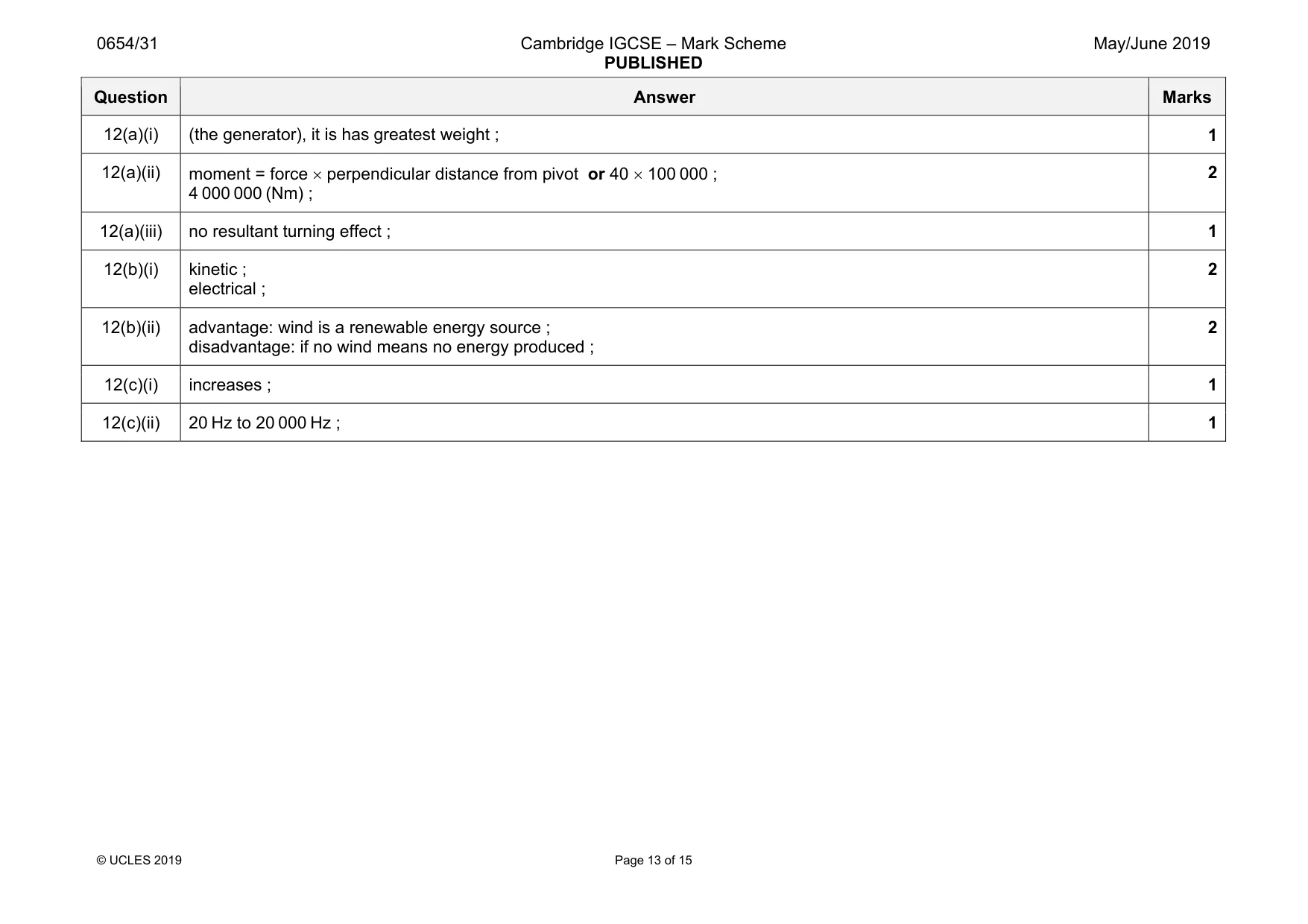
Mark scheme: 12(a)(i) (the generator), it is has greatest weight ; 1 12(a)(ii) moment = force × perpendicular distance from pivot or 40 × 100 000 ; 4 000 000 (Nm) ; 2 12(a)(iii) no resultant turning effect ; 1 12(b)(i) kinetic ; electrical ; 2 12(b)(ii) advantage: wind is a renewable energy source ; disadvantage: if no wind means no energy produced ; 2 12(c)(i) increases ; 1 12(c)(ii) 20 Hz to 20 000 Hz ; 1
Q13 · The boxes on the left show some terms used when describing inheritance
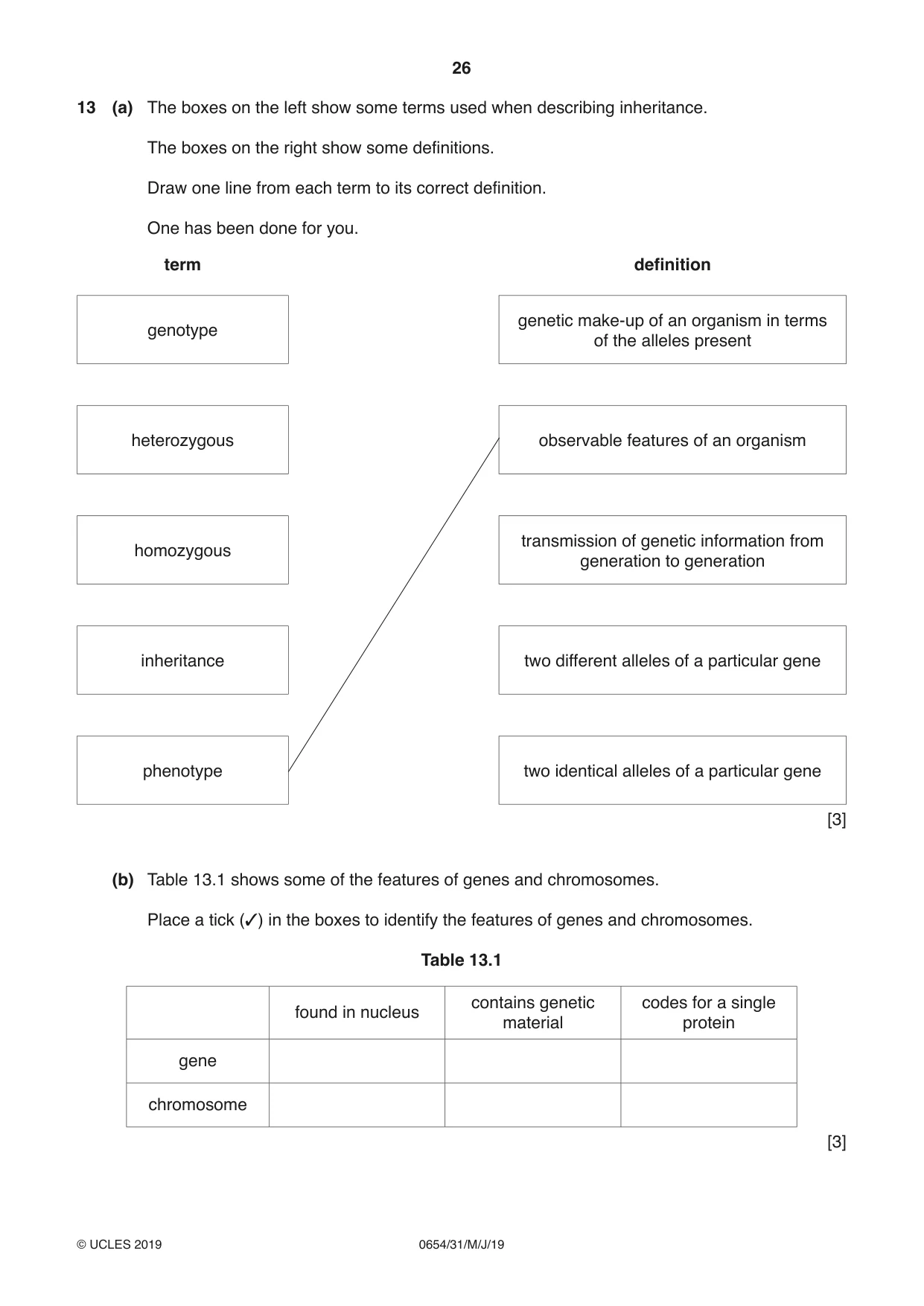
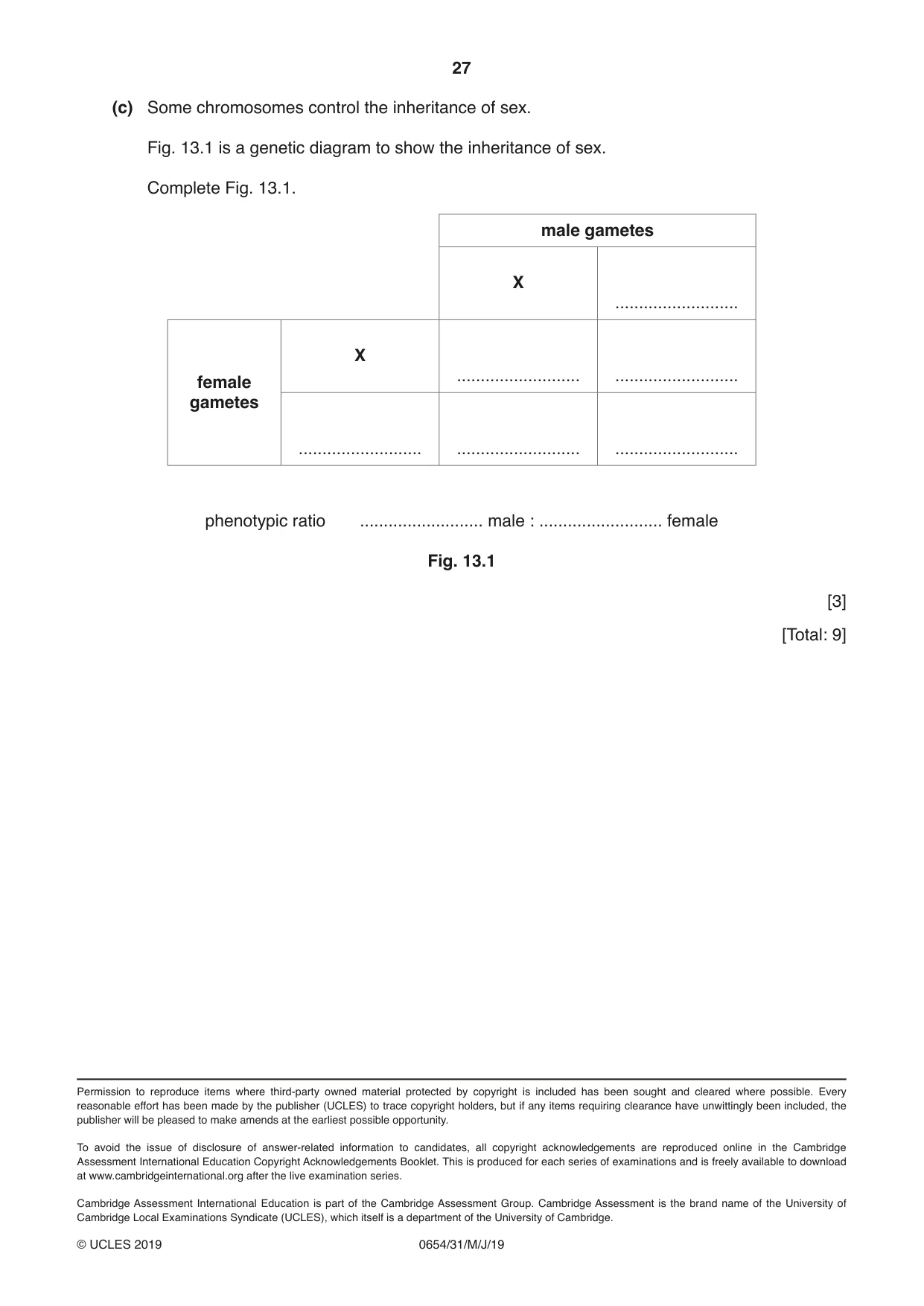
13 (a) The boxes on the left show some terms used when describing inheritance. The boxes on the right show some definitions. Draw one line from each term to its correct definition. One has been done for you. term definition genetic make-up of an organism in terms genotype of the alleles present heterozygous observable features of an organism transmission of genetic information from homozygous generation to generation inheritance two different alleles of a particular gene phenotype two identical alleles of a particular gene [3] (b) Table 13.1 shows some of the features of genes and chromosomes. Place a tick (3) in the boxes to identify the features of genes and chromosomes. Table 13.1 contains genetic codes for a single found in nucleus material protein gene chromosome [3] (c) Some chromosomes control the inheritance of sex. Fig. 13.1 is a genetic diagram to show the inheritance of sex. Complete Fig. 13.1. male gametes X .......................... X .......................... .......................... female gametes .......................... .......................... .......................... phenotypic ratio .......................... male : .......................... female Fig. 13.1 [3] [Total: 9]
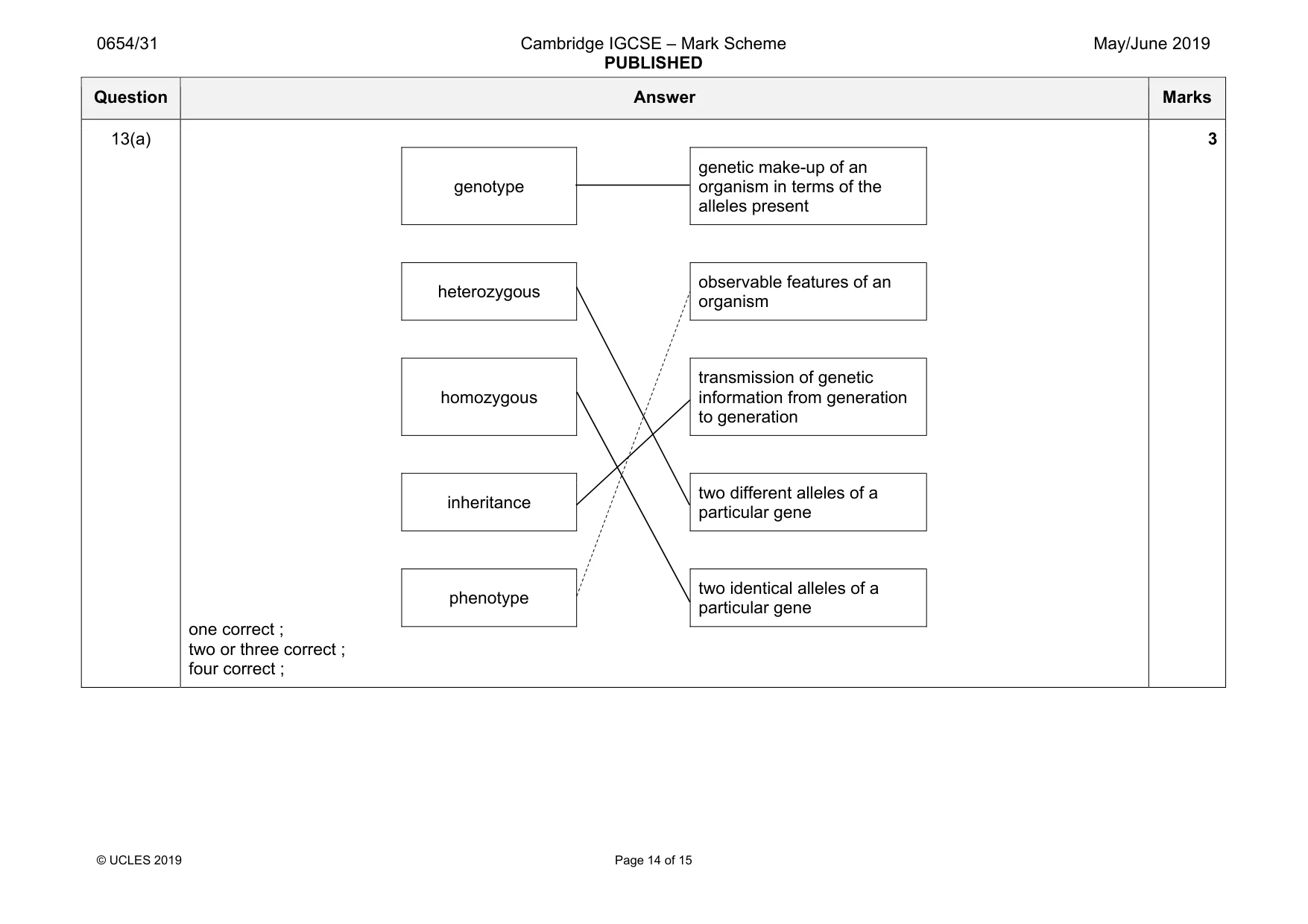
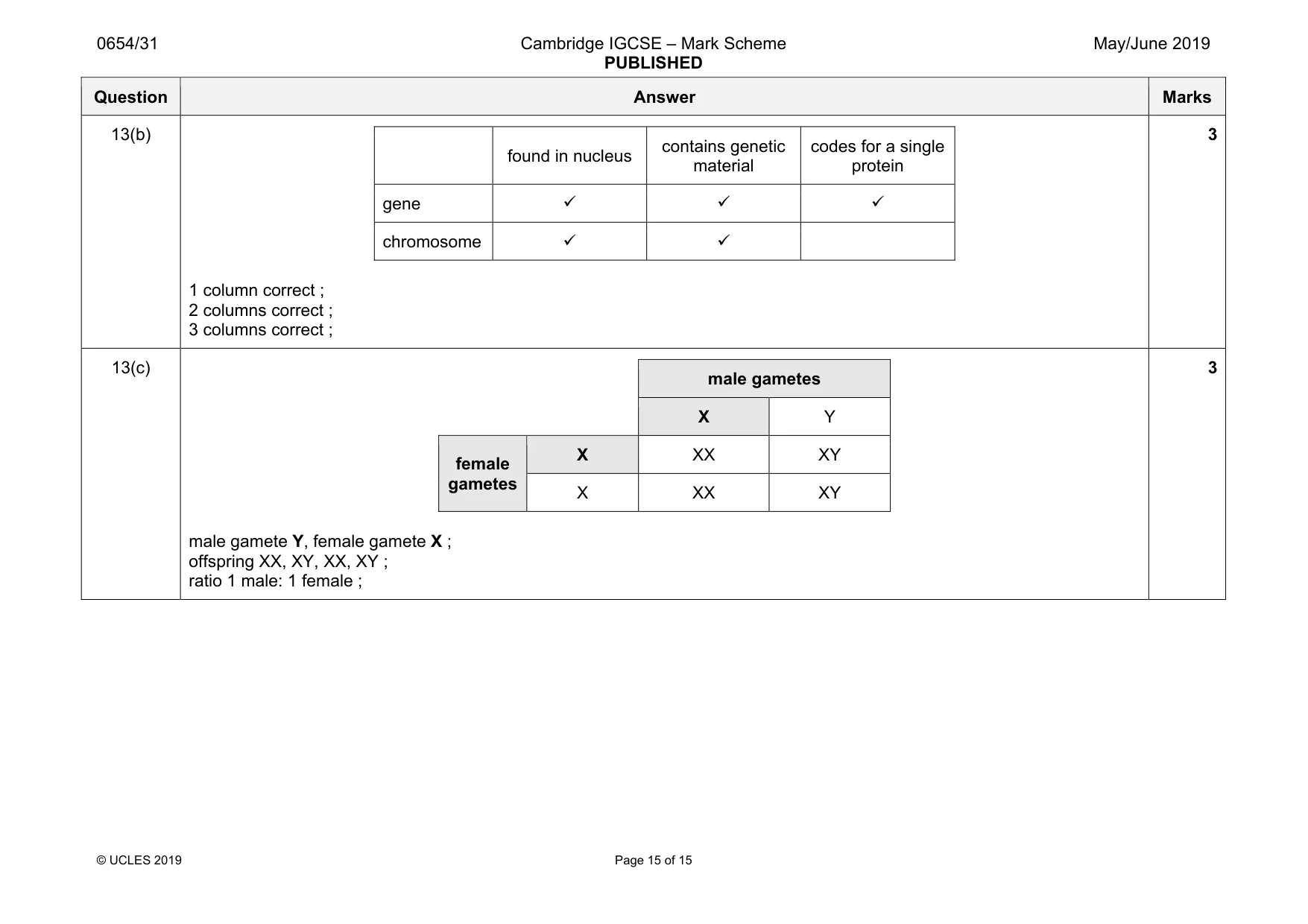
Mark scheme: 13(a) one correct ; two or three correct ; four correct ; genotype genetic make-up of an organism in terms of the alleles present heterozygous observable features of an organism homozygous transmission of genetic information from generation to generation inheritance two different alleles of a particular gene phenotype two identical alleles of a particular gene 3 Question Answer Marks 13(b) found in nucleus contains genetic material codes for a single protein gene 9 9 9 chromosome 9 9 1 column correct ; 2 columns correct ; 3 columns correct ; 3 13(c) male gametes X Y female gametes X XX XY X XX XY male gamete Y, female gamete X ; offspring XX, XY, XX, XY ; ratio 1 male: 1 female ; 3
What was in this paper
The subtopics covered by these 13 questions, and how many questions each got. Open one in a new tab to see every Cambridge question on it.
What you needed in this session
Cambridge’s own grade thresholds for 2019 May/June, Paper 3 · Variant 1. A higher threshold means an easier paper — the bar moves with how the cohort did.