Cambridge IGCSE Sciences - Co-ordinated (Double) 0654 — 2024 May/June Paper 3 · Variant 2
0654/32/M/J/24 · 12 questions · 120 marks · ≈135 min
The question paper and its mark scheme, free to read here and free to download. This is Cambridge’s own paper, exactly as it was sat.
Question paper32 pages





Mark scheme13 pages
Answers below. Sit the paper first if you are practising.
Questions as text
Q1 · A student watches some scary movies
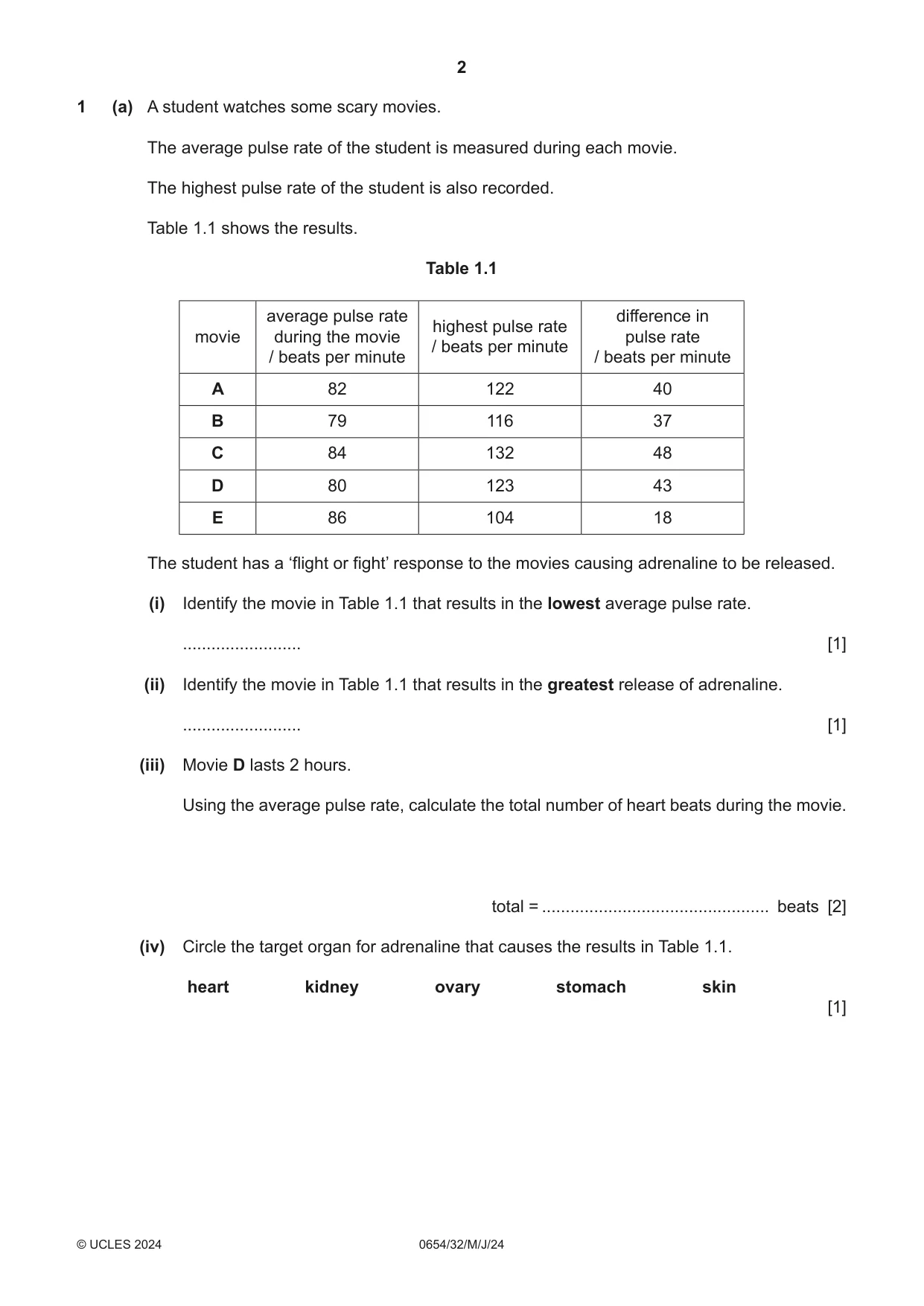
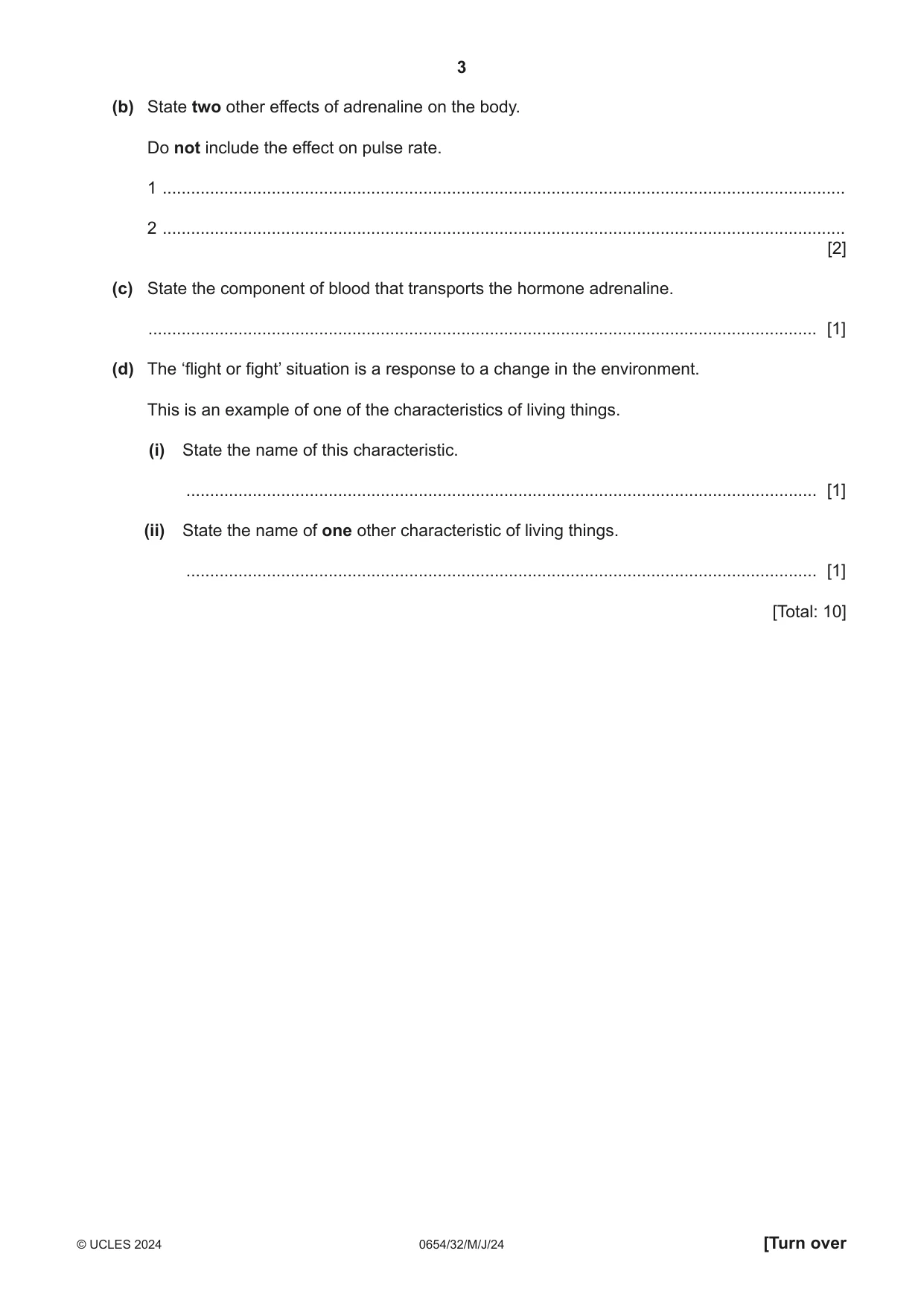
1 (a) A student watches some scary movies. The average pulse rate of the student is measured during each movie. The highest pulse rate of the student is also recorded. Table 1.1 shows the results. Table 1.1 average pulse rate difference in highest pulse rate movie during the movie pulse rate / beats per minute / beats per minute / beats per minute A 82 122 40 B 79 116 37 C 84 132 48 D 80 123 43 E 86 104 18 The student has a ‘flight or fight’ response to the movies causing adrenaline to be released. (i) Identify the movie in Table 1.1 that results in the lowest average pulse rate. ......................... [1] (ii) Identify the movie in Table 1.1 that results in the greatest release of adrenaline. ......................... [1] (iii) Movie D lasts 2 hours. Using the average pulse rate, calculate the total number of heart beats during the movie. total = ................................................ beats [2] (iv) Circle the target organ for adrenaline that causes the results in Table 1.1. heart kidney ovary stomach skin [1] (b) State two other effects of adrenaline on the body. Do not include the effect on pulse rate. 1 ................................................................................................................................................ 2 ................................................................................................................................................ [2] (c) State the component of blood that transports the hormone adrenaline. ............................................................................................................................................. [1] (d) The ‘flight or fight’ situation is a response to a change in the environment. This is an example of one of the characteristics of living things. (i) State the name of this characteristic. ..................................................................................................................................... [1] (ii) State the name of one other characteristic of living things. ..................................................................................................................................... [1] [Total: 10]
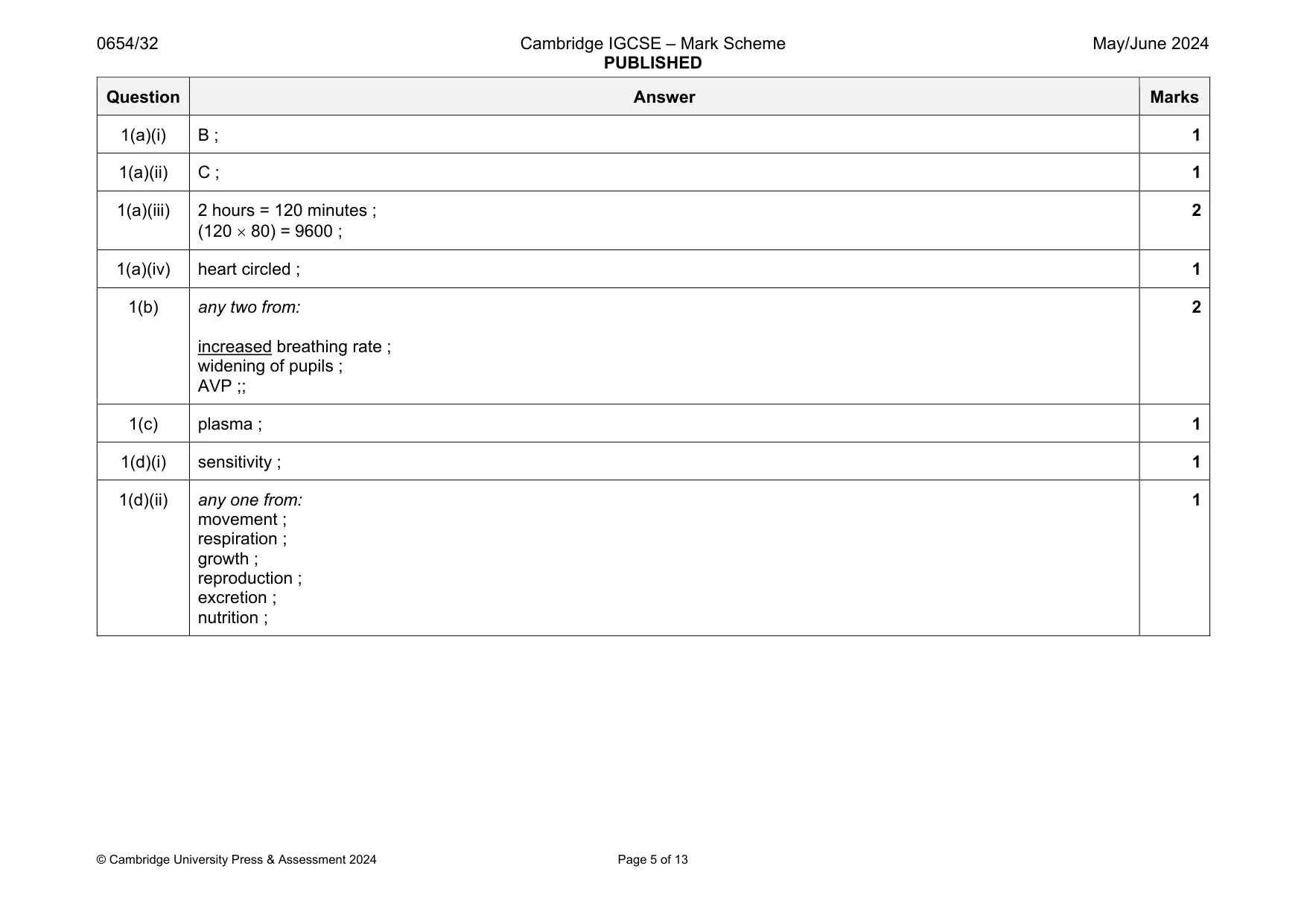
Mark scheme: 1(a)(i) B ; 1 1(a)(ii) C ; 1 1(a)(iii) 2 hours = 120 minutes ; (120 80) = 9600 ; 2 1(a)(iv) heart circled ; 1 1(b) any two from: increased breathing rate ; widening of pupils ; AVP ;; 2 1(c) plasma ; 1 1(d)(i) sensitivity ; 1 1(d)(ii) any one from: movement ; respiration ; growth ; reproduction ; excretion ; nutrition ; 1
Q2 · The list gives the names of seven elements
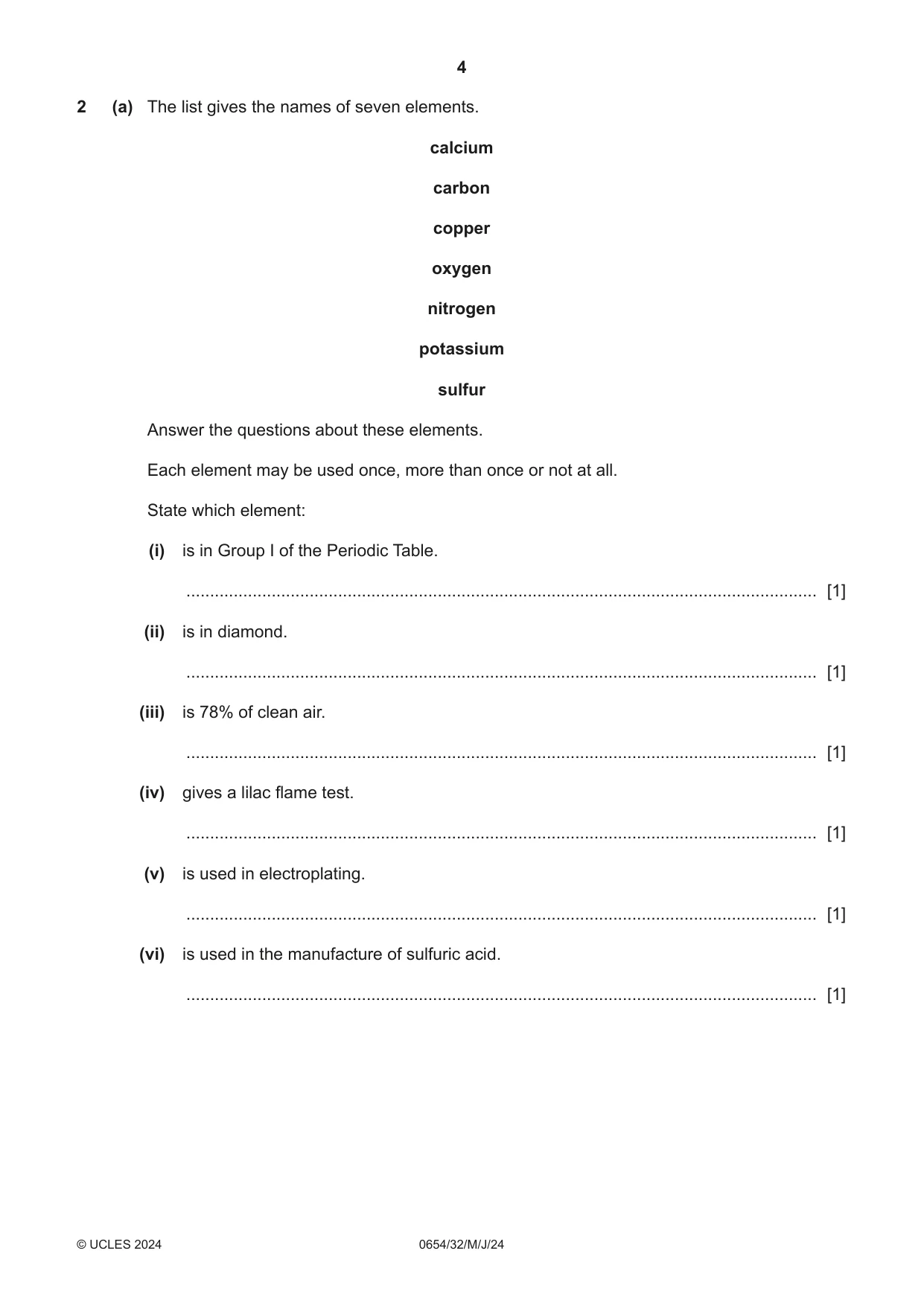
2 (a) The list gives the names of seven elements. calcium carbon copper oxygen nitrogen potassium sulfur Answer the questions about these elements. Each element may be used once, more than once or not at all. State which element: (i) is in Group I of the Periodic Table. ..................................................................................................................................... [1] (ii) is in diamond. ..................................................................................................................................... [1] (iii) is 78% of clean air. ..................................................................................................................................... [1] (iv) gives a lilac flame test. ..................................................................................................................................... [1] (v) is used in electroplating. ..................................................................................................................................... [1] (vi) is used in the manufacture of sulfuric acid. ..................................................................................................................................... [1] (b) Atoms contain protons, neutrons and electrons. State which of these particles: are in shells around the nucleus ........................................ have a positive charge ........................................ have the smallest mass. ........................................ [3] [Total: 9]
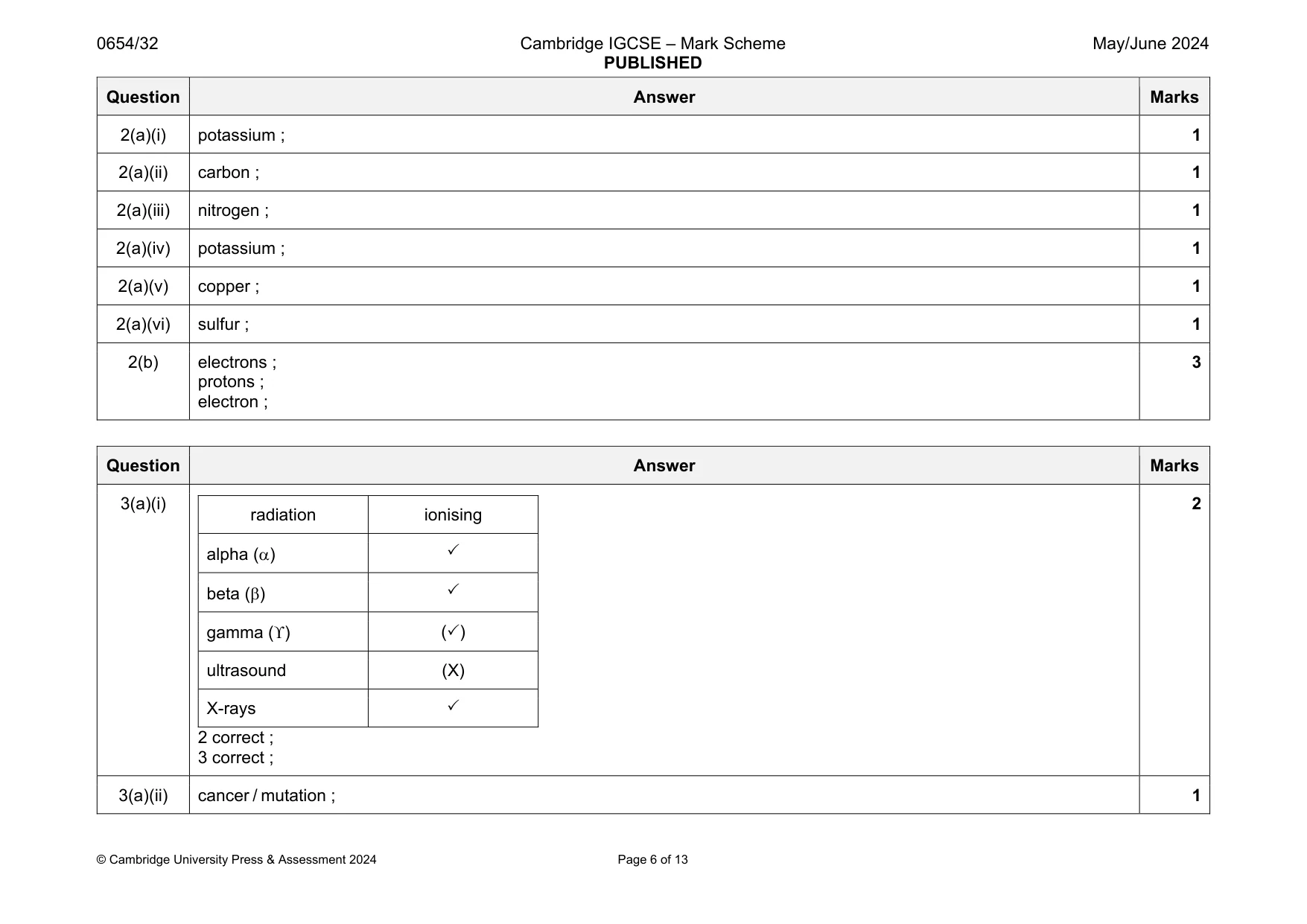
Mark scheme: 2(a)(i) potassium ; 1 2(a)(ii) carbon ; 1 2(a)(iii) nitrogen ; 1 2(a)(iv) potassium ; 1 2(a)(v) copper ; 1 2(a)(vi) sulfur ; 1 2(b) electrons ; protons ; electron ; 3
Q3 · Doctors use ionising and non‑ionising radiations in hospitals
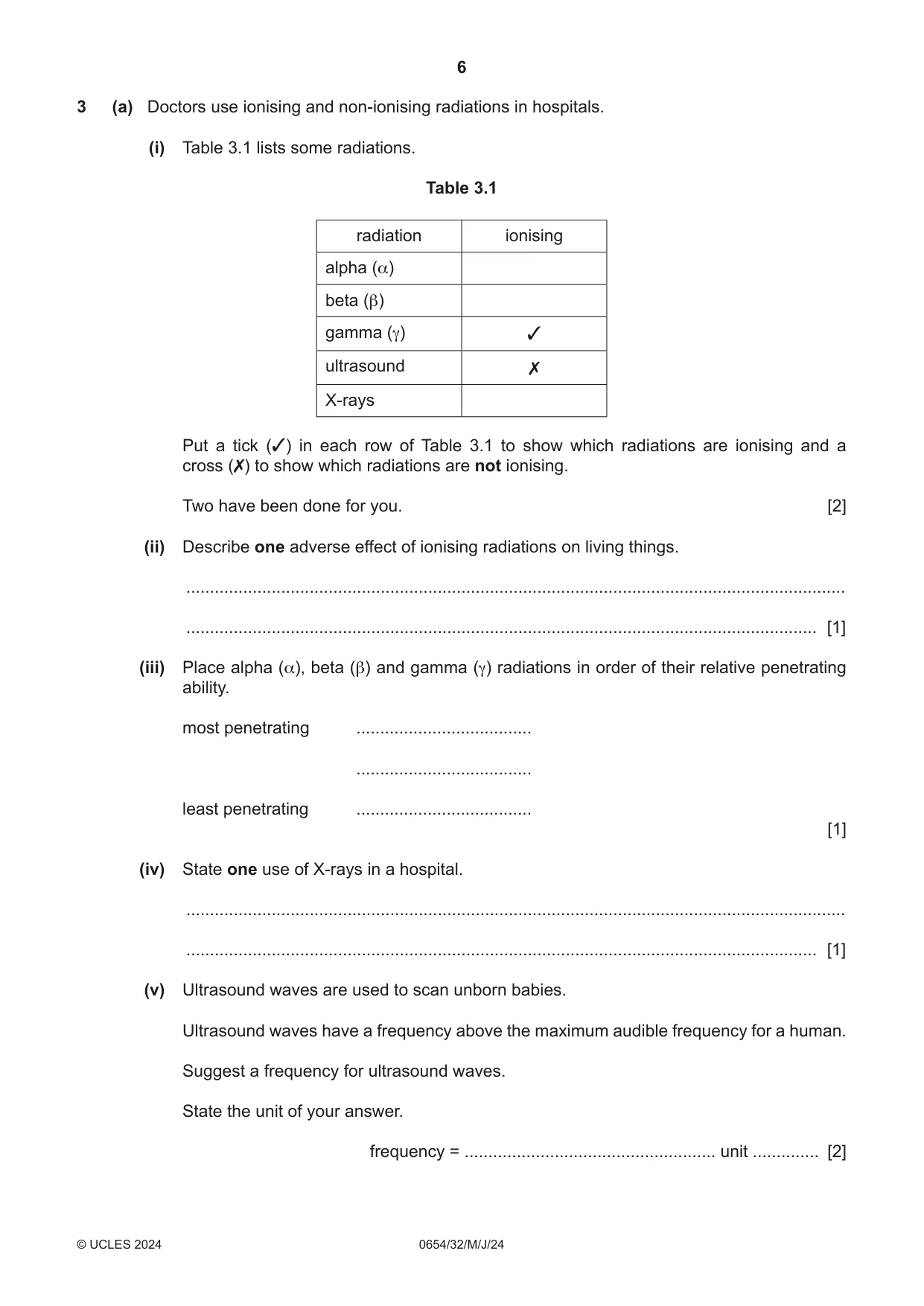
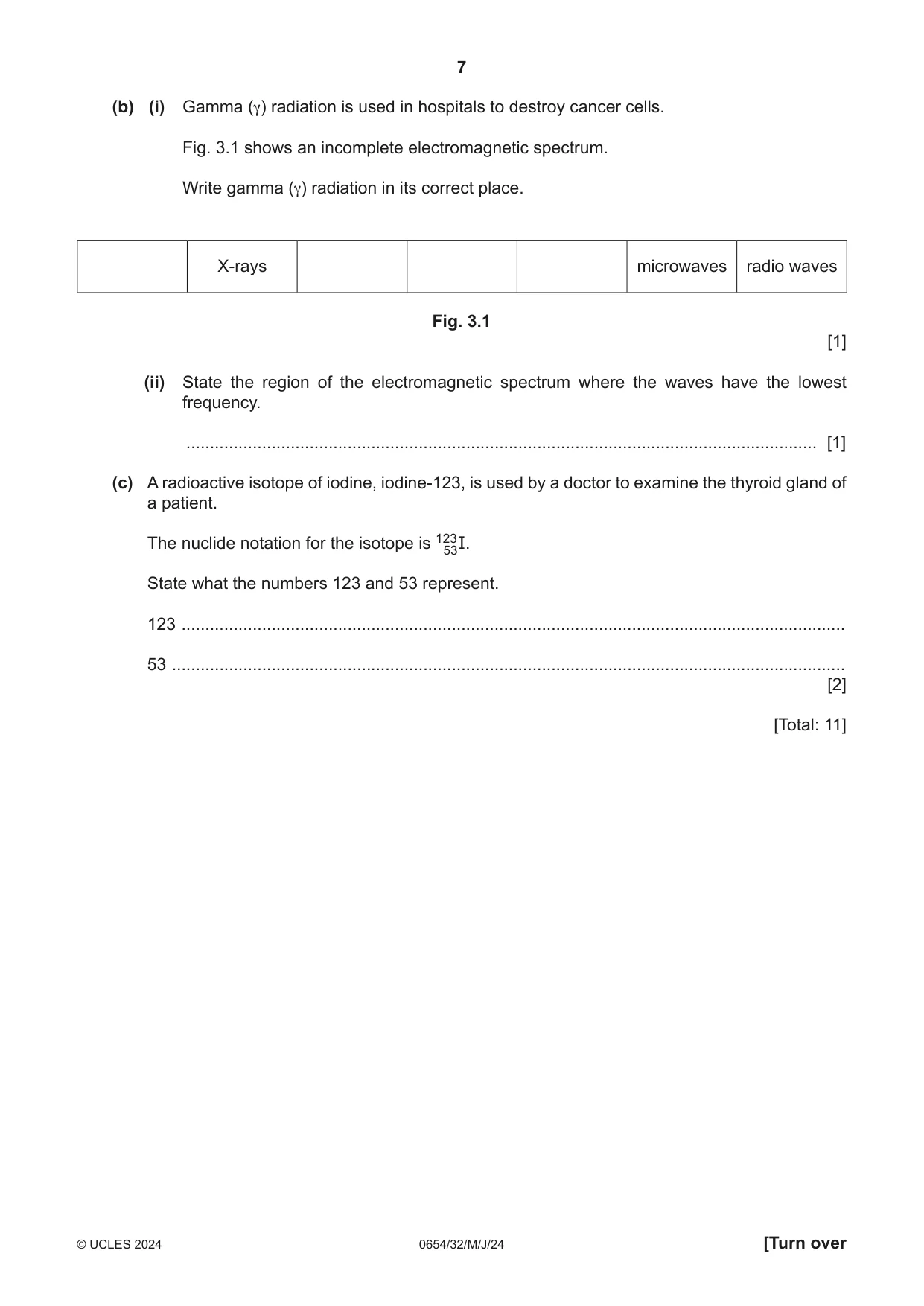
3 (a) Doctors use ionising and non‑ionising radiations in hospitals. (i) Table 3.1 lists some radiations. Table 3.1 radiation ionising alpha (α) beta (β) gamma (γ) ✓ ultrasound ✗ X‑rays Put a tick (✓) in each row of Table 3.1 to show which radiations are ionising and a cross (✗) to show which radiations are not ionising. Two have been done for you. [2] (ii) Describe one adverse effect of ionising radiations on living things. ........................................................................................................................................... ..................................................................................................................................... [1] (iii) Place alpha (α), beta (β) and gamma (γ) radiations in order of their relative penetrating ability. most penetrating ..................................... ..................................... least penetrating ..................................... [1] (iv) State one use of X‑rays in a hospital. ........................................................................................................................................... ..................................................................................................................................... [1] (v) Ultrasound waves are used to scan unborn babies. Ultrasound waves have a frequency above the maximum audible frequency for a human. Suggest a frequency for ultrasound waves. State the unit of your answer. frequency = ..................................................... unit .............. [2] (b) (i) Gamma (γ) radiation is used in hospitals to destroy cancer cells. Fig. 3.1 shows an incomplete electromagnetic spectrum. Write gamma (γ) radiation in its correct place. X‑rays microwaves radio waves Fig. 3.1 [1] (ii) State the region of the electromagnetic spectrum where the waves have the lowest frequency. ..................................................................................................................................... [1] (c) A radioactive isotope of iodine, iodine‑123, is used by a doctor to examine the thyroid gland of a patient. The nuclide notation for the isotope is 12353I. State what the numbers 123 and 53 represent. 123 ............................................................................................................................................ 53 .............................................................................................................................................. [2] [Total: 11]
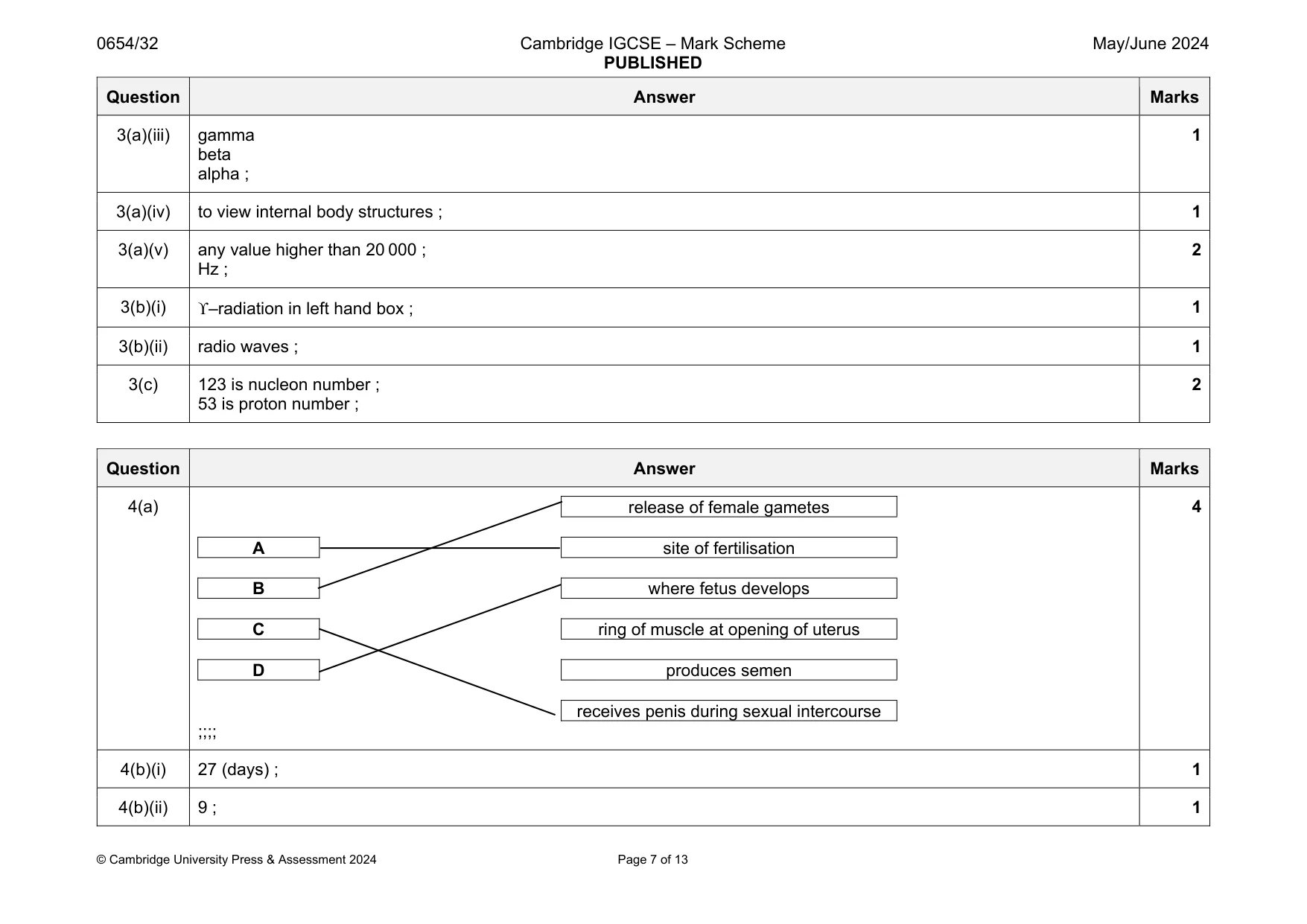
Mark scheme: 3(a)(i) radiation ionising alpha () beta () gamma () () ultrasound (X) X-rays 2 correct ; 3 correct ; 2 3(a)(ii) cancer / mutation ; 1 Question Answer Marks 3(a)(iii) gamma beta alpha ; 1 3(a)(iv) to view internal body structures ; 1 3(a)(v) any value higher than 20 000 ; Hz ; 2 3(b)(i) –radiation in left hand box ; 1 3(b)(ii) radio waves ; 1 3(c) 123 is nucleon number ; 53 is proton number ; 2
Q4 · A diagram of the female reproductive system in humans
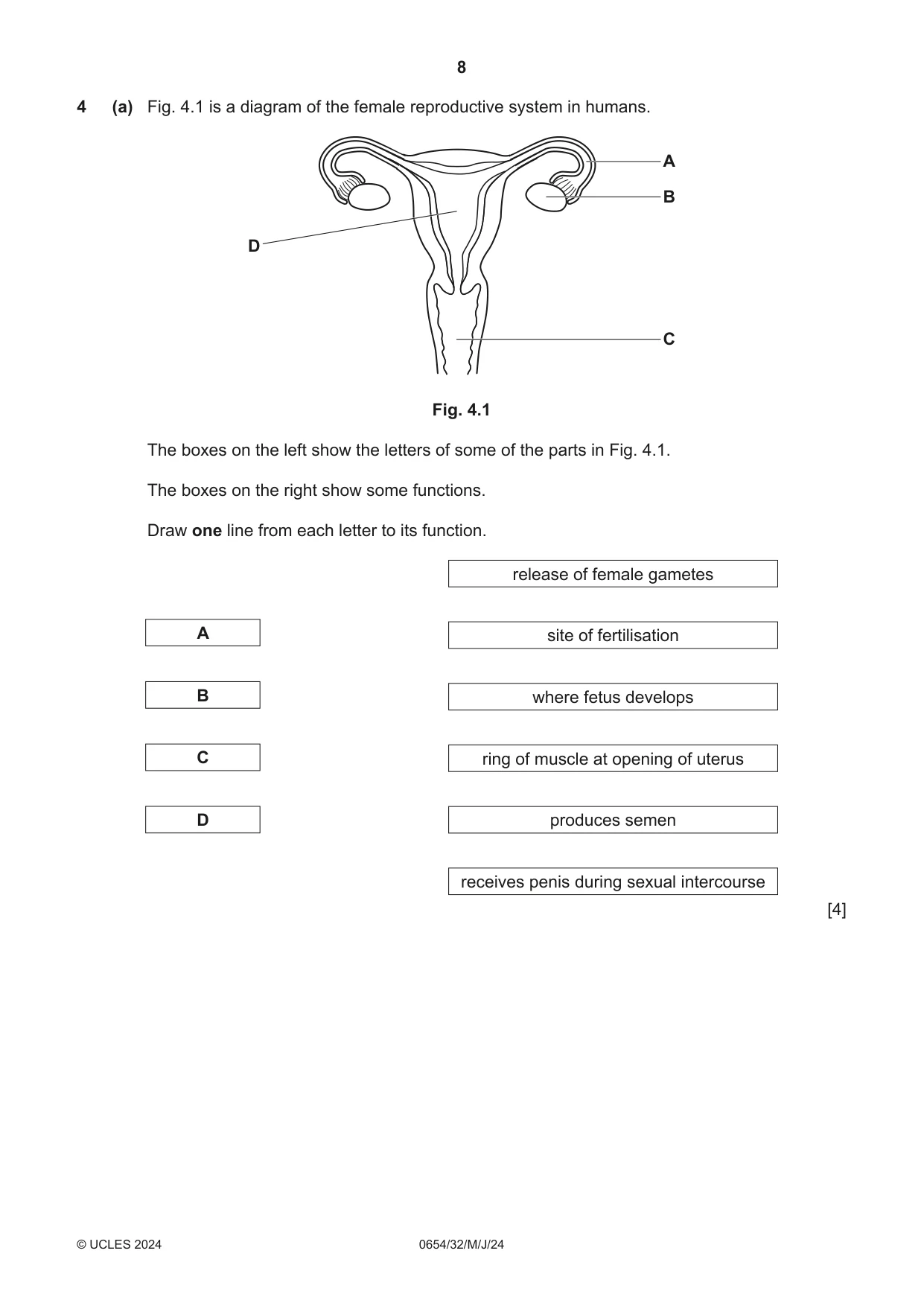
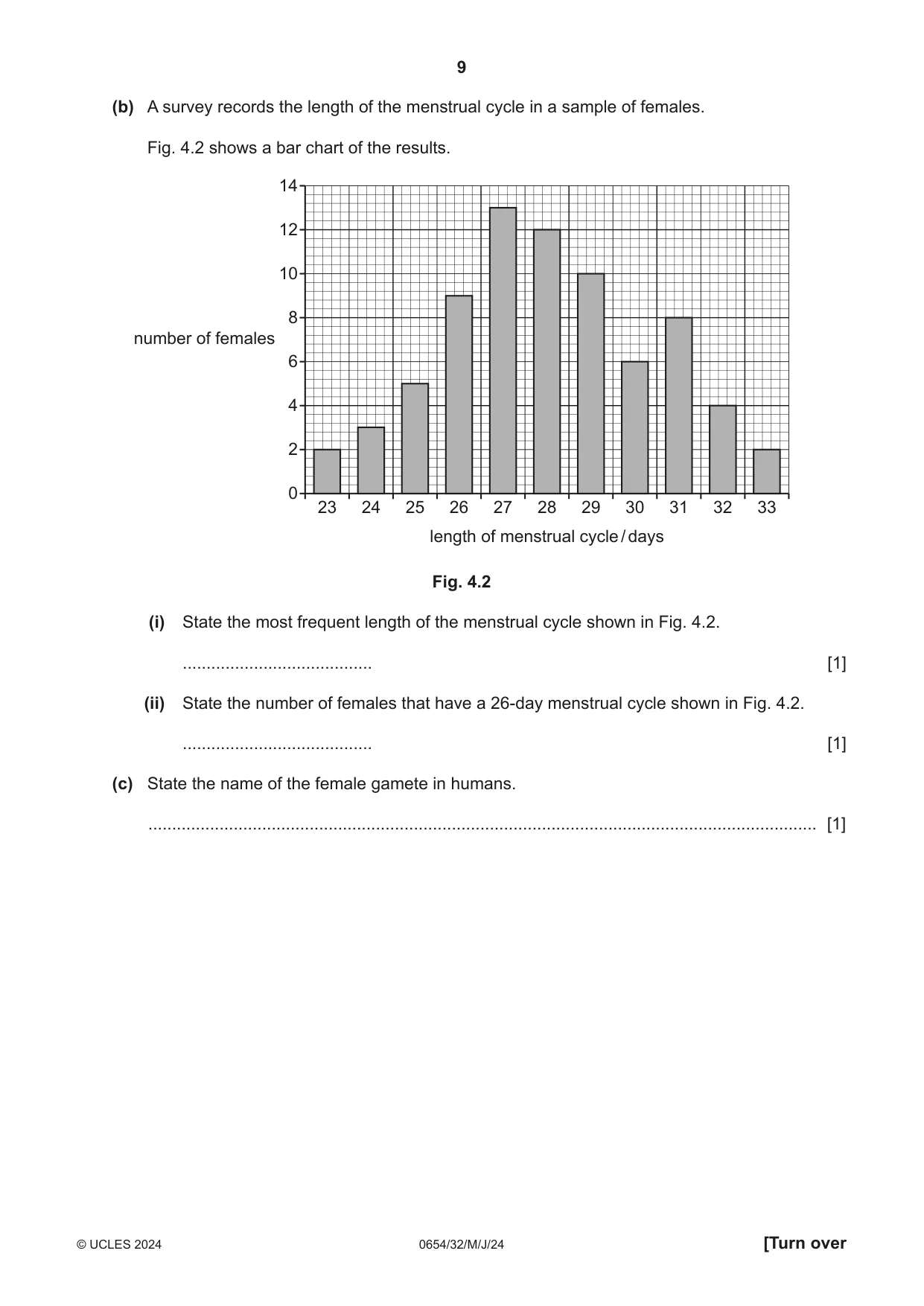
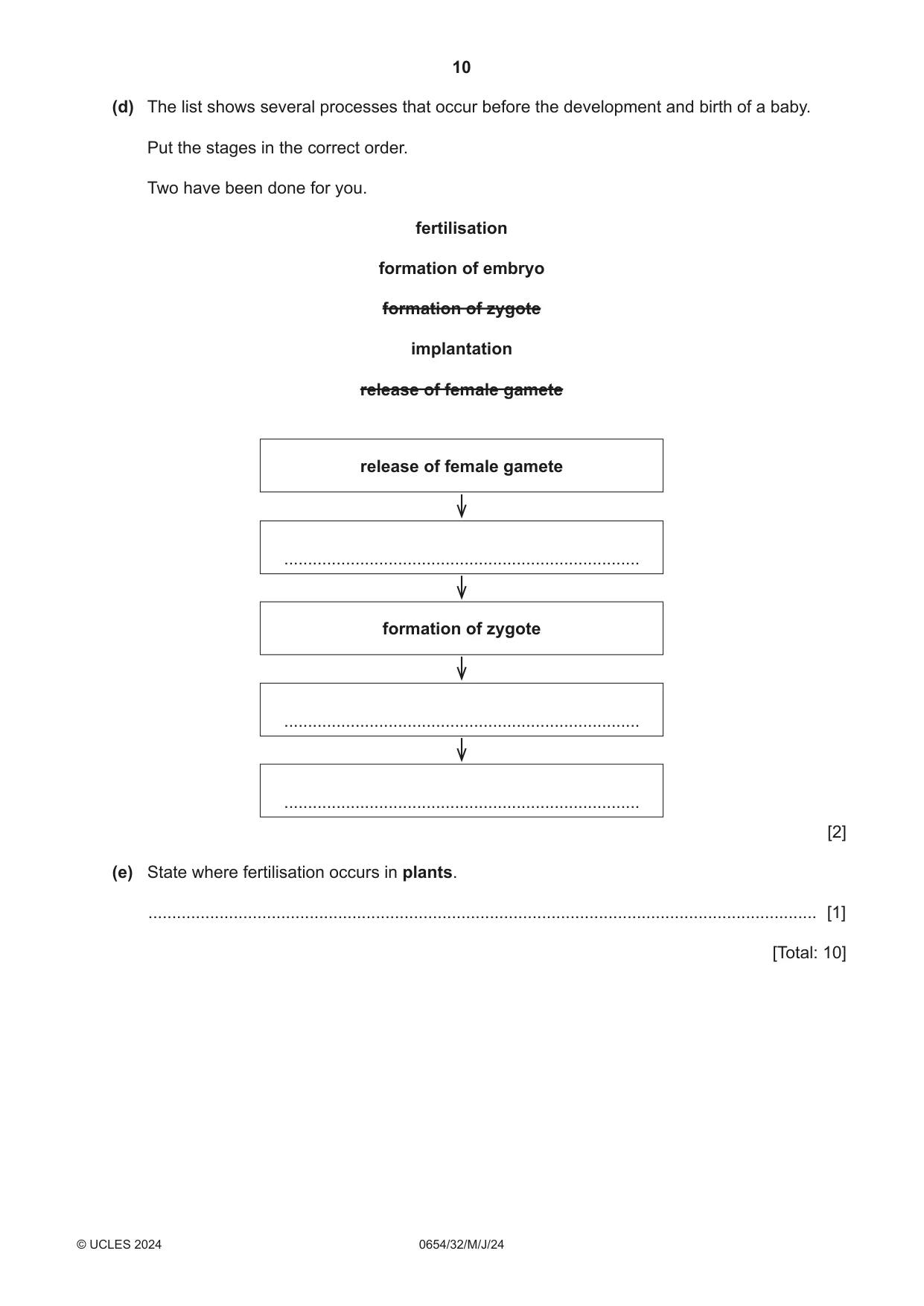
4 (a) Fig. 4.1 is a diagram of the female reproductive system in humans. A B D C Fig. 4.1 The boxes on the left show the letters of some of the parts in Fig. 4.1. The boxes on the right show some functions. Draw one line from each letter to its function. release of female gametes A site of fertilisation B where fetus develops C ring of muscle at opening of uterus D produces semen receives penis during sexual intercourse [4] (b) A survey records the length of the menstrual cycle in a sample of females. Fig. 4.2 shows a bar chart of the results. 14 12 10 8 number of females 6 4 2 0 23 24 25 26 27 28 29 30 31 32 33 length of menstrual cycle / days Fig. 4.2 (i) State the most frequent length of the menstrual cycle shown in Fig. 4.2. ........................................ [1] (ii) State the number of females that have a 26‑day menstrual cycle shown in Fig. 4.2. ........................................ [1] (c) State the name of the female gamete in humans. ............................................................................................................................................. [1] (d) The list shows several processes that occur before the development and birth of a baby. Put the stages in the correct order. Two have been done for you. fertilisation formation of embryo formation of zygote implantation release of female gamete release of female gamete ........................................................................... formation of zygote ........................................................................... ........................................................................... [2] (e) State where fertilisation occurs in plants. ............................................................................................................................................. [1] [Total: 10]
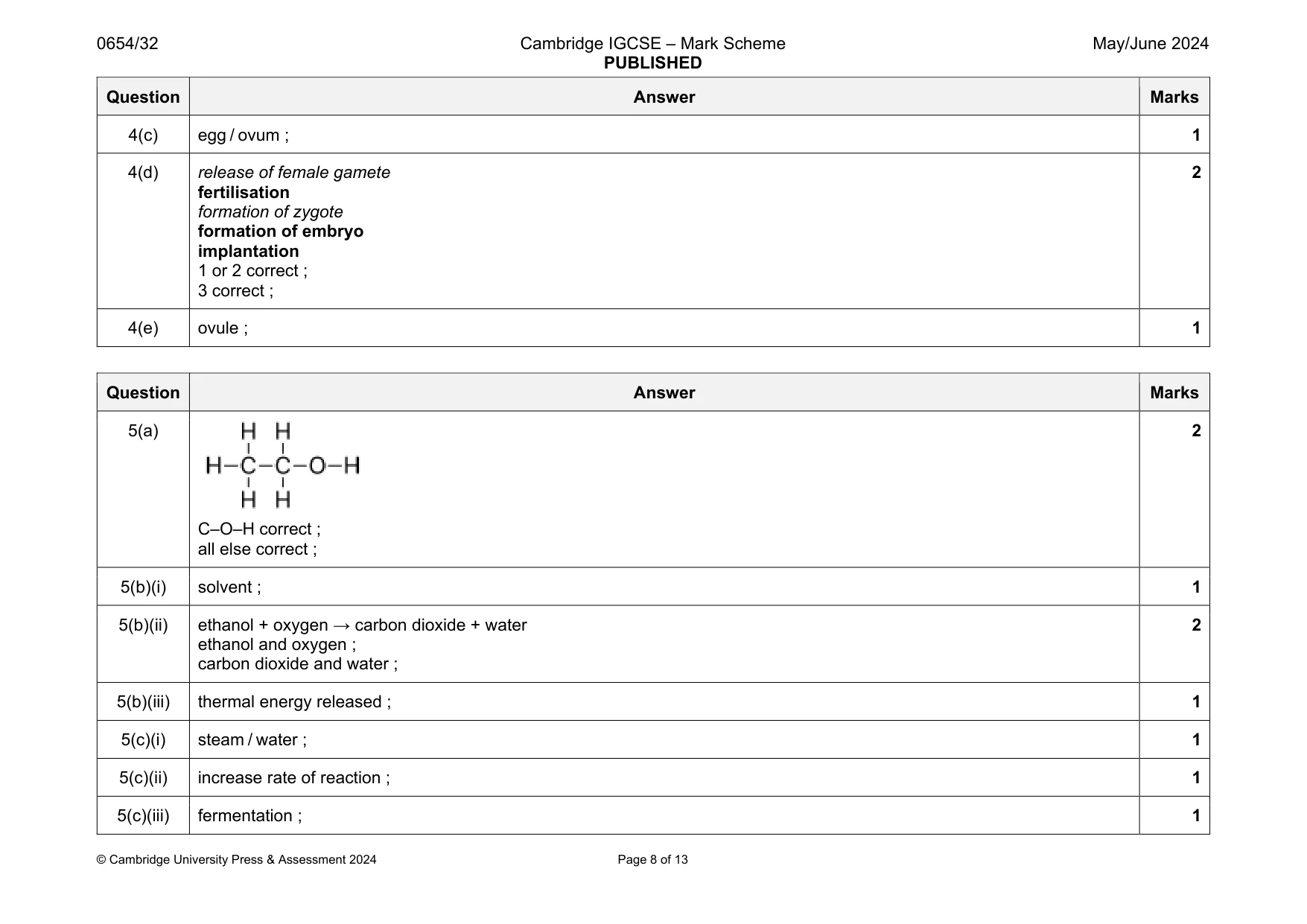
Mark scheme: 4(a) release of female gametes A site of fertilisation B where fetus develops C ring of muscle at opening of uterus D produces semen receives penis during sexual intercourse ;;;; 4(b)(i) 27 (days) ; 1 4(b)(ii) 9 ; 1 Question Answer Marks 4(c) egg / ovum ; 1 4(d) release of female gamete fertilisation formation of zygote formation of embryo implantation 1 or 2 correct ; 3 correct ; 2 4(e) ovule ; 1
Q5 · Ethanol has the formula C2H5OH
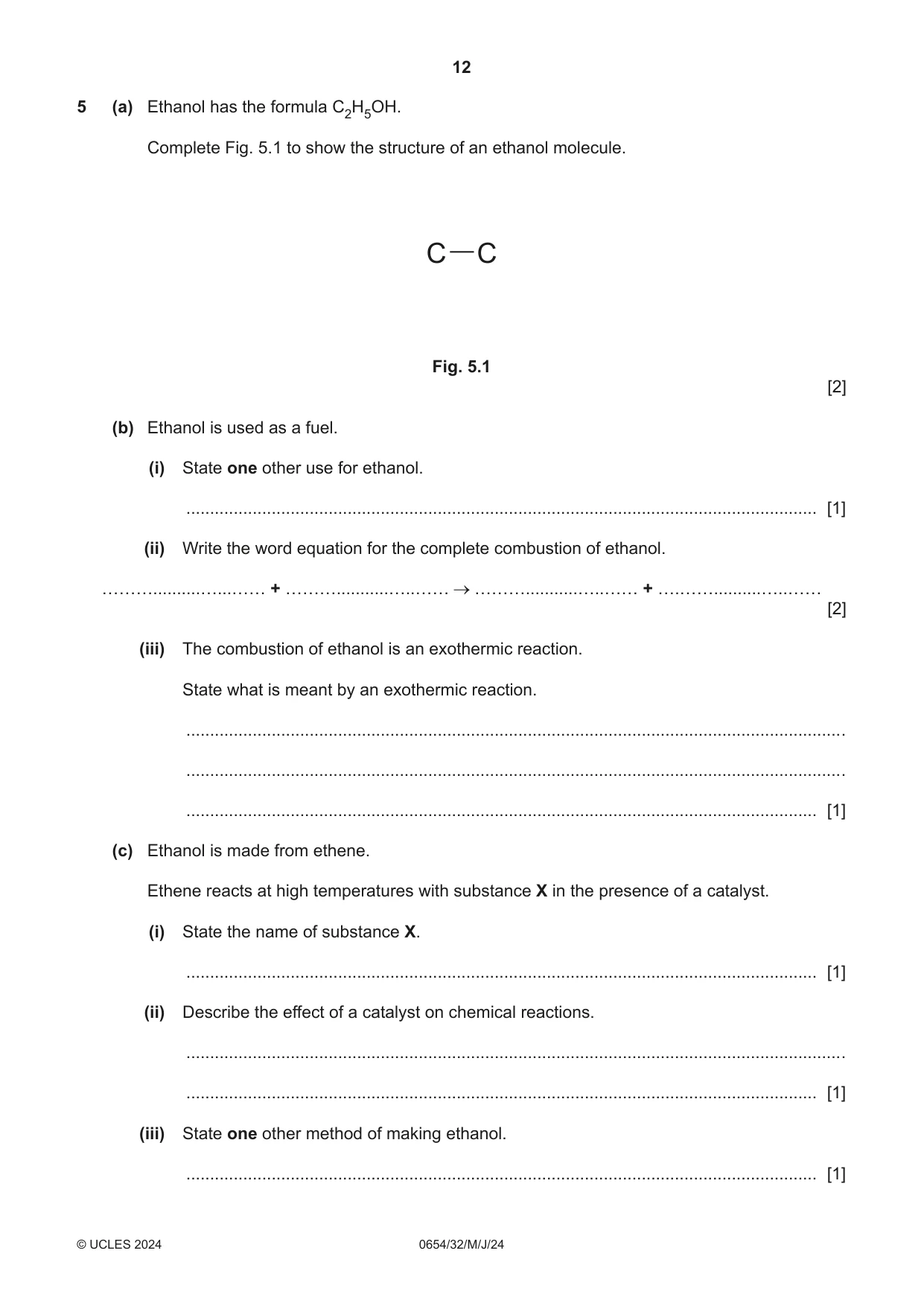
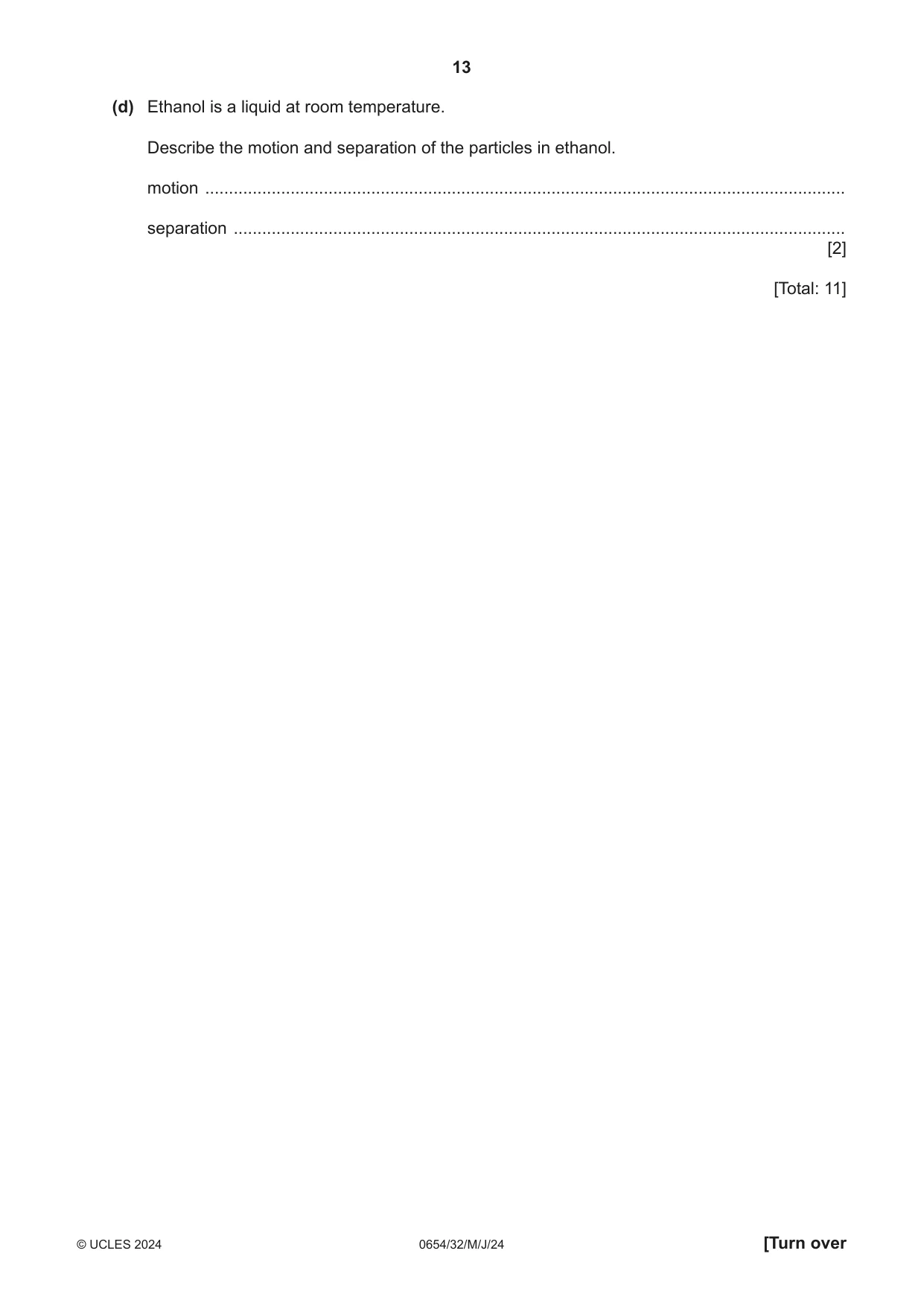
5 (a) Ethanol has the formula C2H5OH. Complete Fig. 5.1 to show the structure of an ethanol molecule. C C Fig. 5.1 [2] (b) Ethanol is used as a fuel. (i) State one other use for ethanol. ..................................................................................................................................... [1] (ii) Write the word equation for the complete combustion of ethanol. ………..........…...…… + ………...........…..…… ………...........…..…… + ….……..........…..…… [2] (iii) The combustion of ethanol is an exothermic reaction. State what is meant by an exothermic reaction. ........................................................................................................................................... ........................................................................................................................................... ..................................................................................................................................... [1] (c) Ethanol is made from ethene. Ethene reacts at high temperatures with substance X in the presence of a catalyst. (i) State the name of substance X. ..................................................................................................................................... [1] (ii) Describe the effect of a catalyst on chemical reactions. ........................................................................................................................................... ..................................................................................................................................... [1] (iii) State one other method of making ethanol. ..................................................................................................................................... [1] (d) Ethanol is a liquid at room temperature. Describe the motion and separation of the particles in ethanol. motion ....................................................................................................................................... separation ................................................................................................................................. [2] [Total: 11]
Mark scheme: 5(a) C–O–H correct ; all else correct ; 2 5(b)(i) solvent ; 1 5(b)(ii) ethanol + oxygen → carbon dioxide + water ethanol and oxygen ; carbon dioxide and water ; 2 5(b)(iii) thermal energy released ; 1 5(c)(i) steam / water ; 1 5(c)(ii) increase rate of reaction ; 1 5(c)(iii) fermentation ; 1 Question Answer Marks 5(d) random (motion) ; touching ; 2
Q6 · A farmer drives his tractor in a field
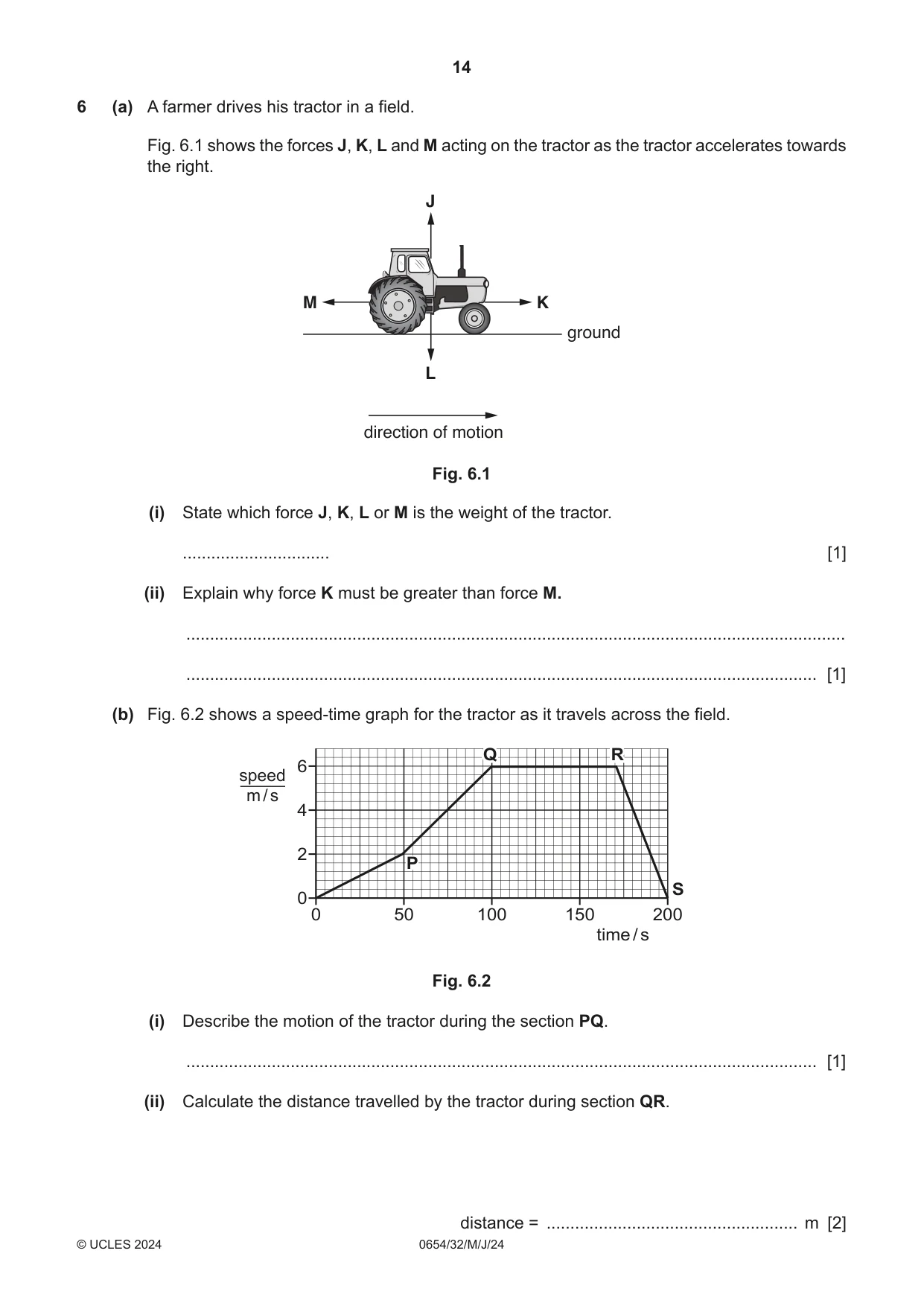
6 (a) A farmer drives his tractor in a field. Fig. 6.1 shows the forces J, K, L and M acting on the tractor as the tractor accelerates towards the right. J M K ground L direction of motion Fig. 6.1 (i) State which force J, K, L or M is the weight of the tractor. ............................... [1] (ii) Explain why force K must be greater than force M. ........................................................................................................................................... ..................................................................................................................................... [1] (b) Fig. 6.2 shows a speed‑time graph for the tractor as it travels across the field. Q R 6 speed m / s 4 2 P S 0 0 50 100 150 200 time / s Fig. 6.2 (i) Describe the motion of the tractor during the section PQ. ..................................................................................................................................... [1] (ii) Calculate the distance travelled by the tractor during section QR. distance = ..................................................... m [2] (c) The tractor pulls a tank full of water. The mass of the water is 2500 kg. The density of water is 1000 kg / m3. Calculate the volume of the water. volume = .................................................... m3 [2] (d) Suggest two renewable sources of energy that the farmer uses to generate electricity for the farm. 1 ................................................................................................................................................ 2 ................................................................................................................................................ [2] [Total: 9]
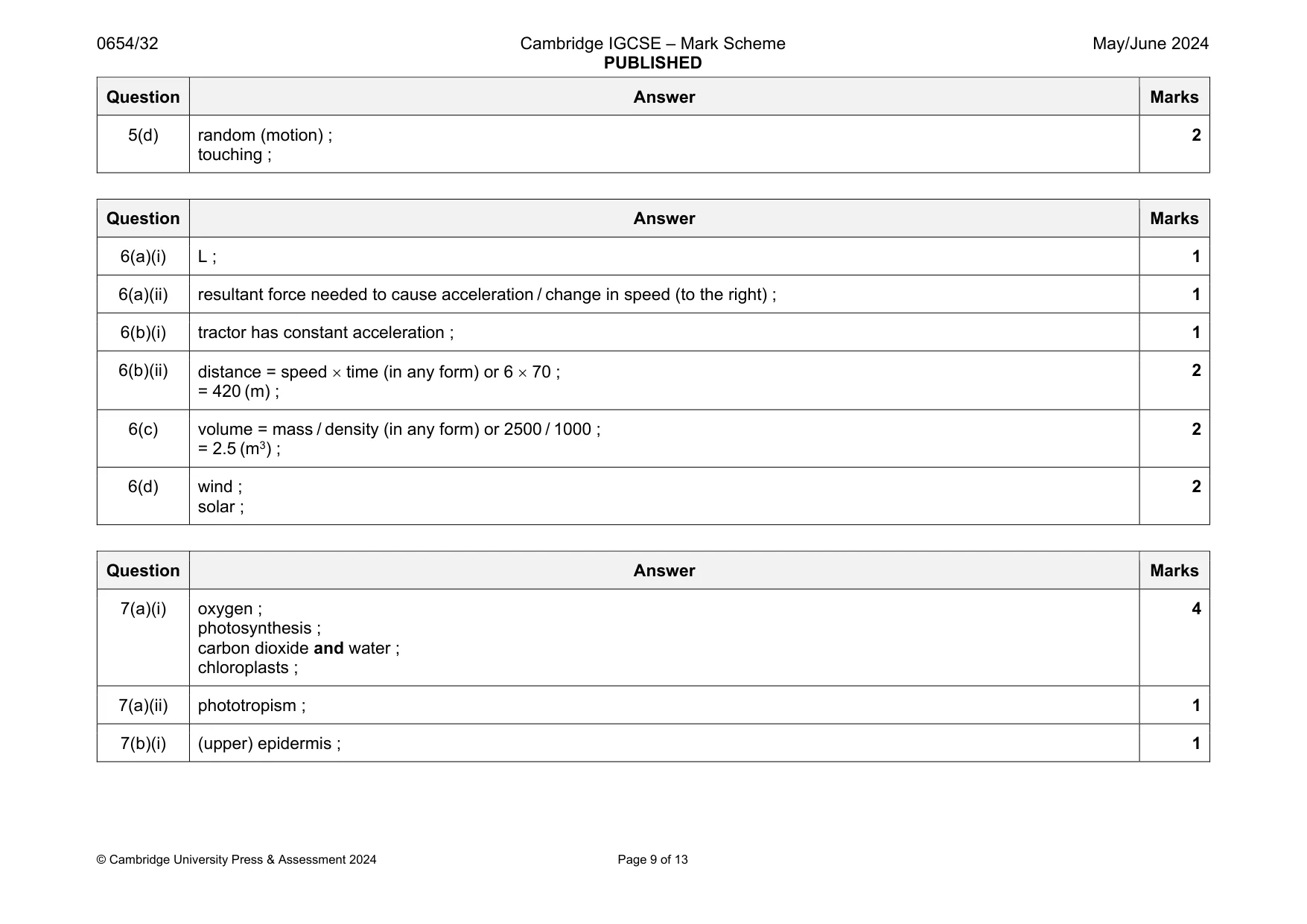
Mark scheme: 6(a)(i) L ; 1 6(a)(ii) resultant force needed to cause acceleration / change in speed (to the right) ; 1 6(b)(i) tractor has constant acceleration ; 1 6(b)(ii) distance = speed time (in any form) or 6 70 ; = 420 (m) ; 2 6(c) volume = mass / density (in any form) or 2500 / 1000 ; = 2.5 (m3) ; 2 6(d) wind ; solar ; 2
Q7 · A student investigates the effect of light on an aquatic plant
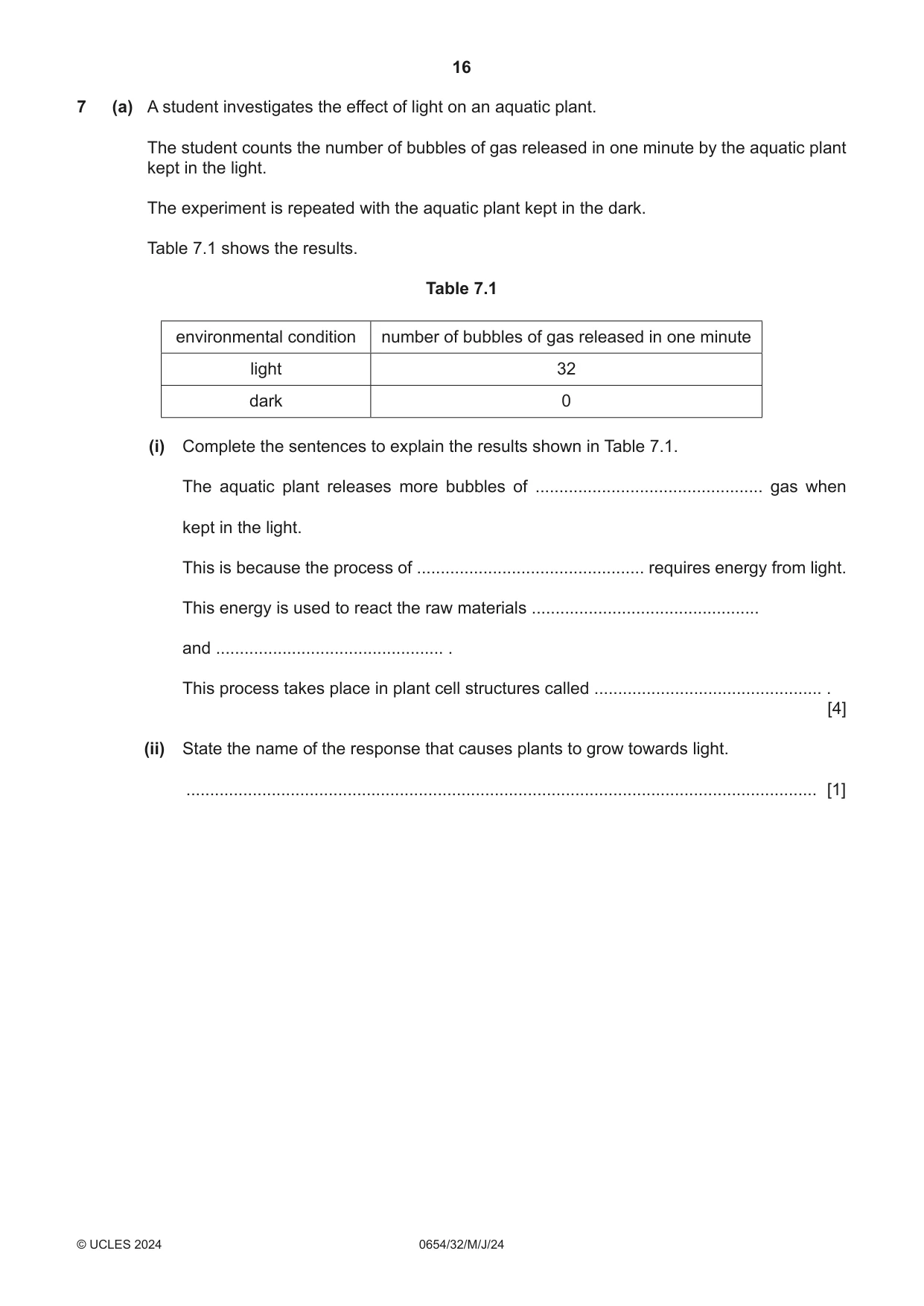
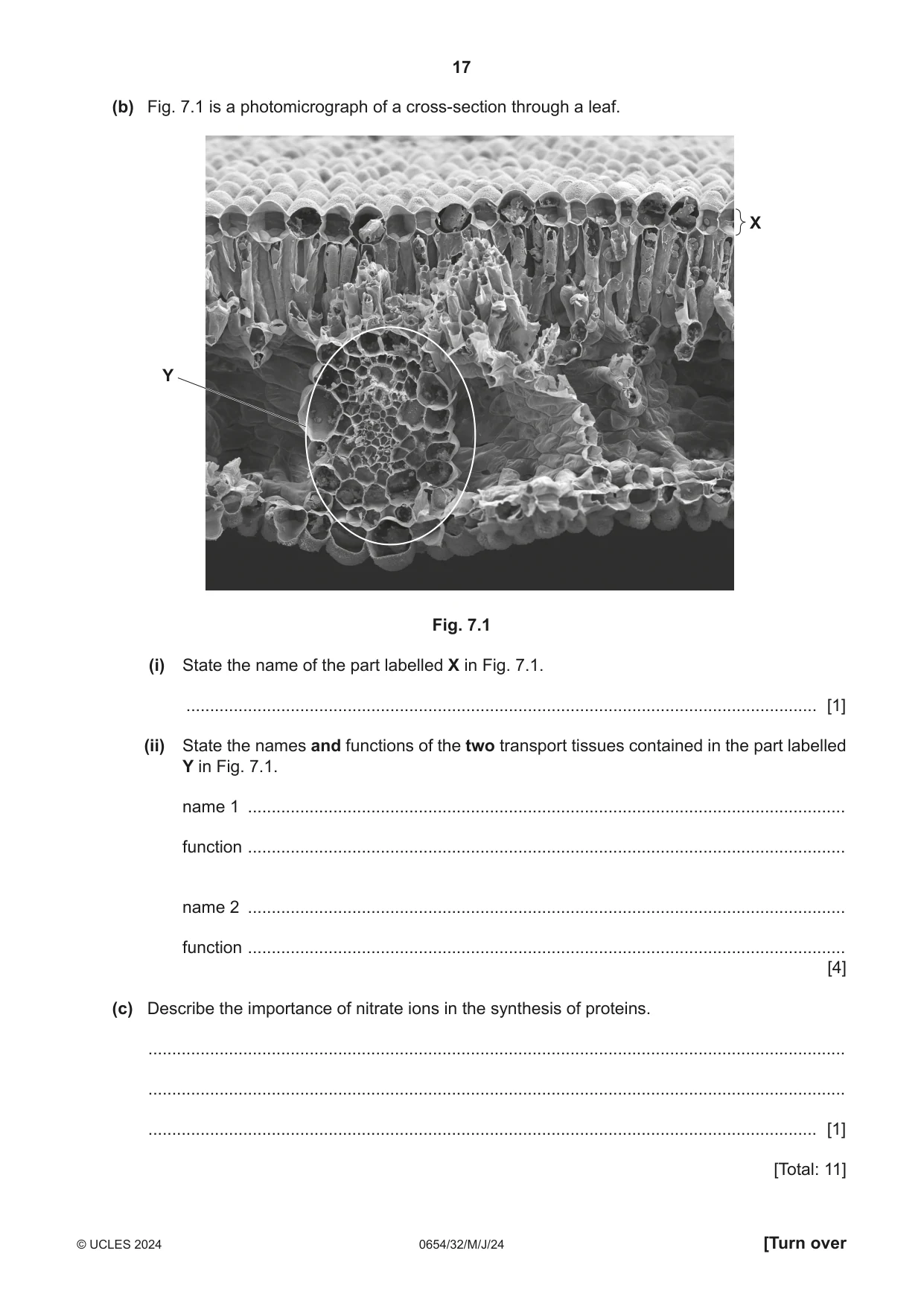
7 (a) A student investigates the effect of light on an aquatic plant. The student counts the number of bubbles of gas released in one minute by the aquatic plant kept in the light. The experiment is repeated with the aquatic plant kept in the dark. Table 7.1 shows the results. Table 7.1 environmental condition number of bubbles of gas released in one minute light 32 dark 0 (i) Complete the sentences to explain the results shown in Table 7.1. The aquatic plant releases more bubbles of ................................................ gas when kept in the light. This is because the process of ................................................ requires energy from light. This energy is used to react the raw materials ................................................ and ................................................ . This process takes place in plant cell structures called ................................................ . [4] (ii) State the name of the response that causes plants to grow towards light. ..................................................................................................................................... [1] (b) Fig. 7.1 is a photomicrograph of a cross‑section through a leaf. X Y Fig. 7.1 (i) State the name of the part labelled X in Fig. 7.1. ..................................................................................................................................... [1] (ii) State the names and functions of the two transport tissues contained in the part labelled Y in Fig. 7.1. name 1 .............................................................................................................................. function .............................................................................................................................. name 2 .............................................................................................................................. function .............................................................................................................................. [4] (c) Describe the importance of nitrate ions in the synthesis of proteins. ................................................................................................................................................... ................................................................................................................................................... ............................................................................................................................................. [1] [Total: 11]
Mark scheme: 7(a)(i) oxygen ; photosynthesis ; carbon dioxide and water ; chloroplasts ; 4 7(a)(ii) phototropism ; 1 7(b)(i) (upper) epidermis ; 1 Question Answer Marks 7(b)(ii) xylem ; transports mineral ions / water or xylem is for support (of leaf) ; phloem ; transports dissolved sugars ; 4 7(c) nitrates are required to synthesise, amino acids (which make proteins) ; 1
Q8 · A teacher reacts sodium with water
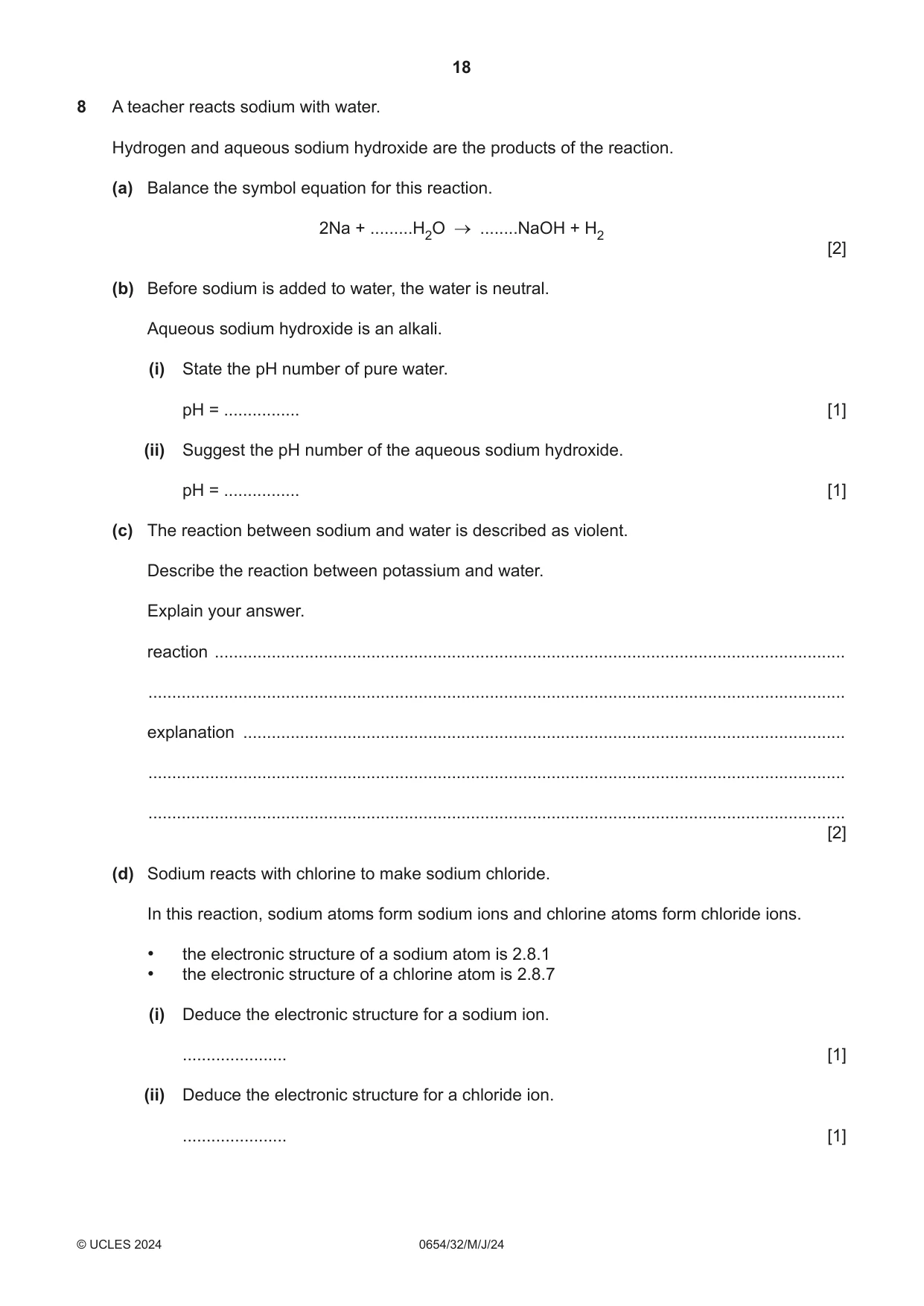
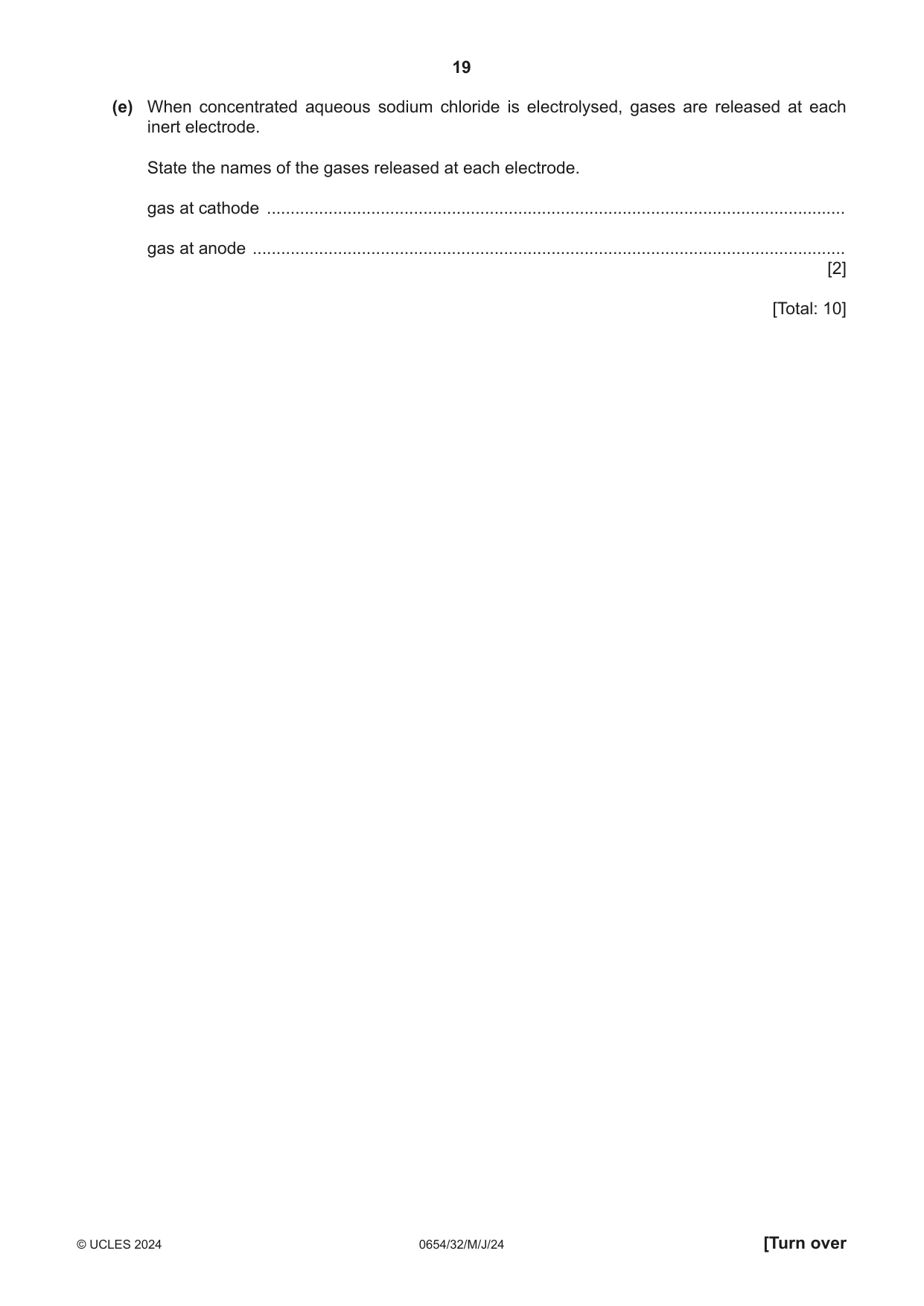
8 A teacher reacts sodium with water. Hydrogen and aqueous sodium hydroxide are the products of the reaction. (a) Balance the symbol equation for this reaction. 2Na + .........H2O ........NaOH + H2 [2] (b) Before sodium is added to water, the water is neutral. Aqueous sodium hydroxide is an alkali. (i) State the pH number of pure water. pH = ................ [1] (ii) Suggest the pH number of the aqueous sodium hydroxide. pH = ................ [1] (c) The reaction between sodium and water is described as violent. Describe the reaction between potassium and water. Explain your answer. reaction ..................................................................................................................................... ................................................................................................................................................... explanation ............................................................................................................................... ................................................................................................................................................... ................................................................................................................................................... [2] (d) Sodium reacts with chlorine to make sodium chloride. In this reaction, sodium atoms form sodium ions and chlorine atoms form chloride ions. • the electronic structure of a sodium atom is 2.8.1 • the electronic structure of a chlorine atom is 2.8.7 (i) Deduce the electronic structure for a sodium ion. ...................... [1] (ii) Deduce the electronic structure for a chloride ion. ...................... [1] (e) When concentrated aqueous sodium chloride is electrolysed, gases are released at each inert electrode. State the names of the gases released at each electrode. gas at cathode .......................................................................................................................... gas at anode ............................................................................................................................. [2] [Total: 10]
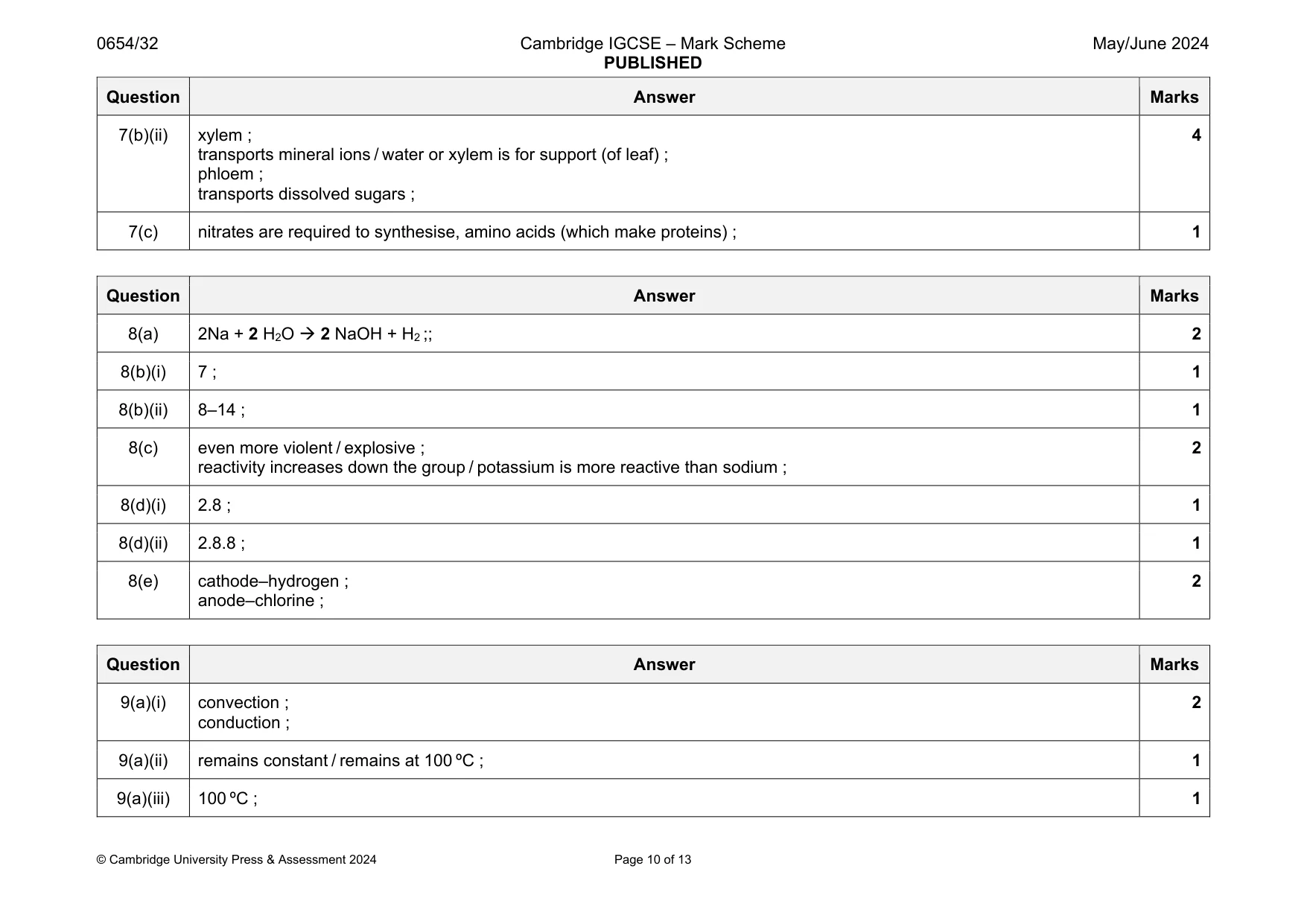
Mark scheme: 8(a) 2Na + 2 H2O 2 NaOH + H2 ;; 2 8(b)(i) 7 ; 1 8(b)(ii) 8–14 ; 1 8(c) even more violent / explosive ; reactivity increases down the group / potassium is more reactive than sodium ; 2 8(d)(i) 2.8 ; 1 8(d)(ii) 2.8.8 ; 1 8(e) cathode–hydrogen ; anode–chlorine ; 2
Q9 · Water in a steel saucepan being heated on an electric cooker
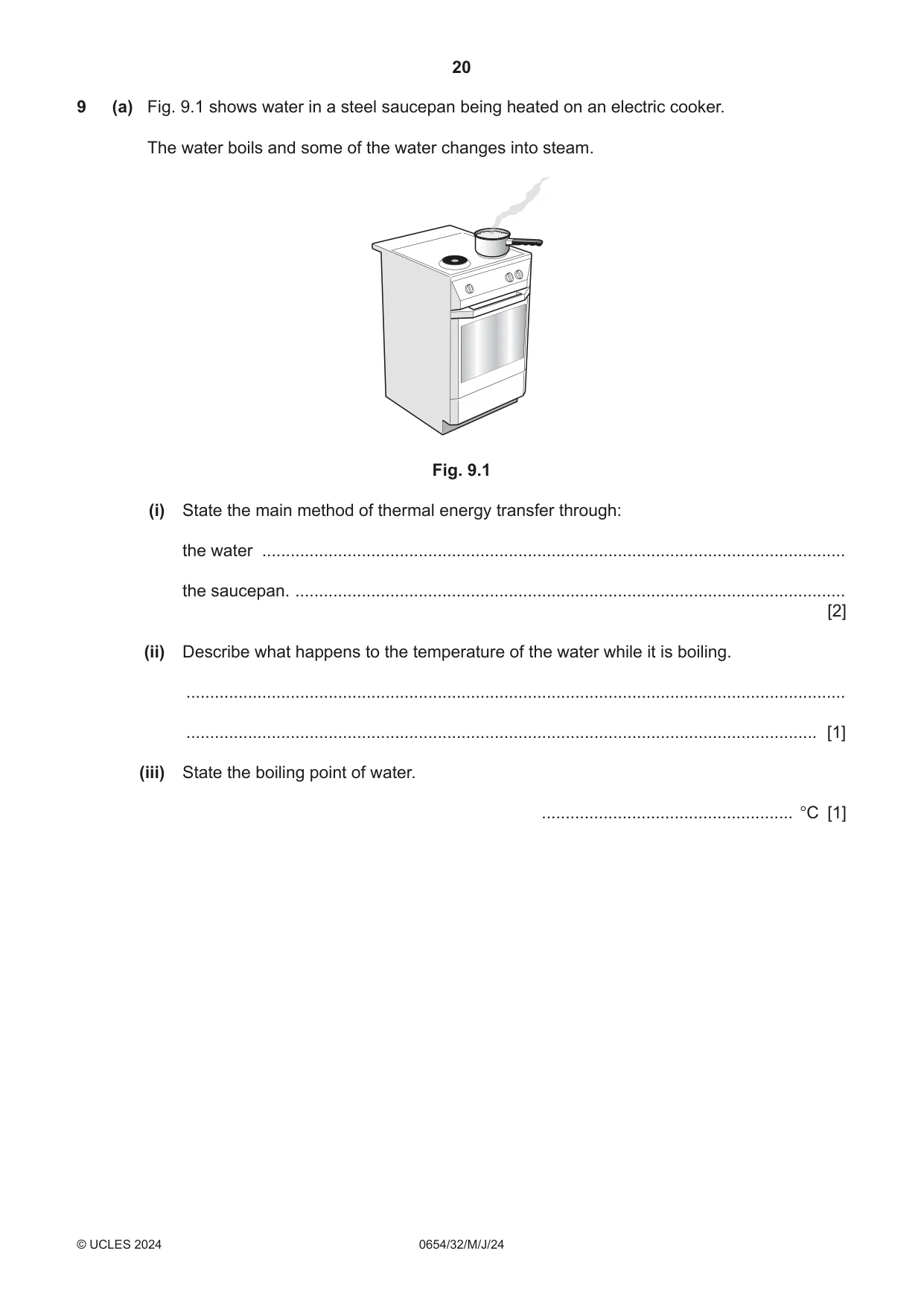
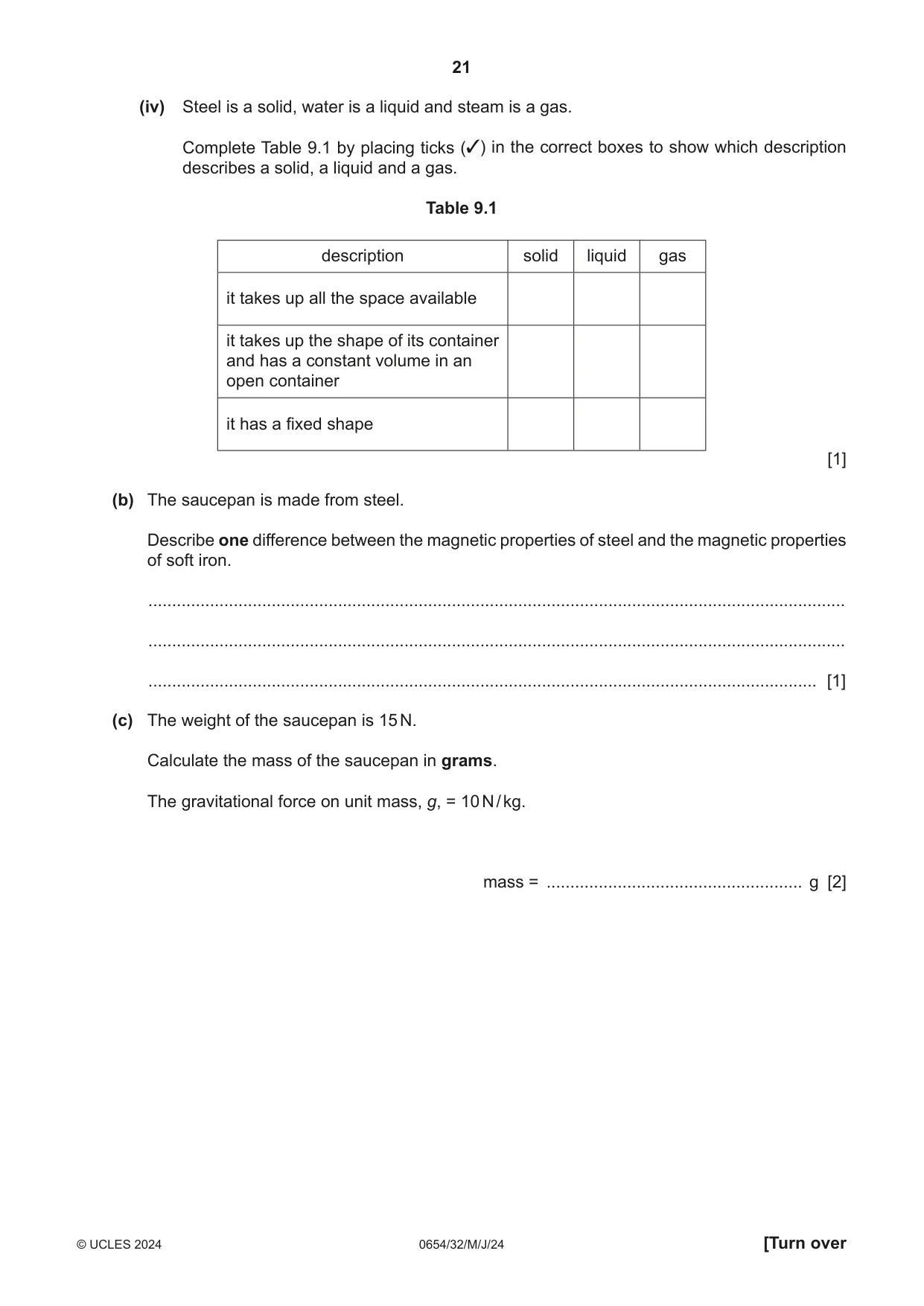
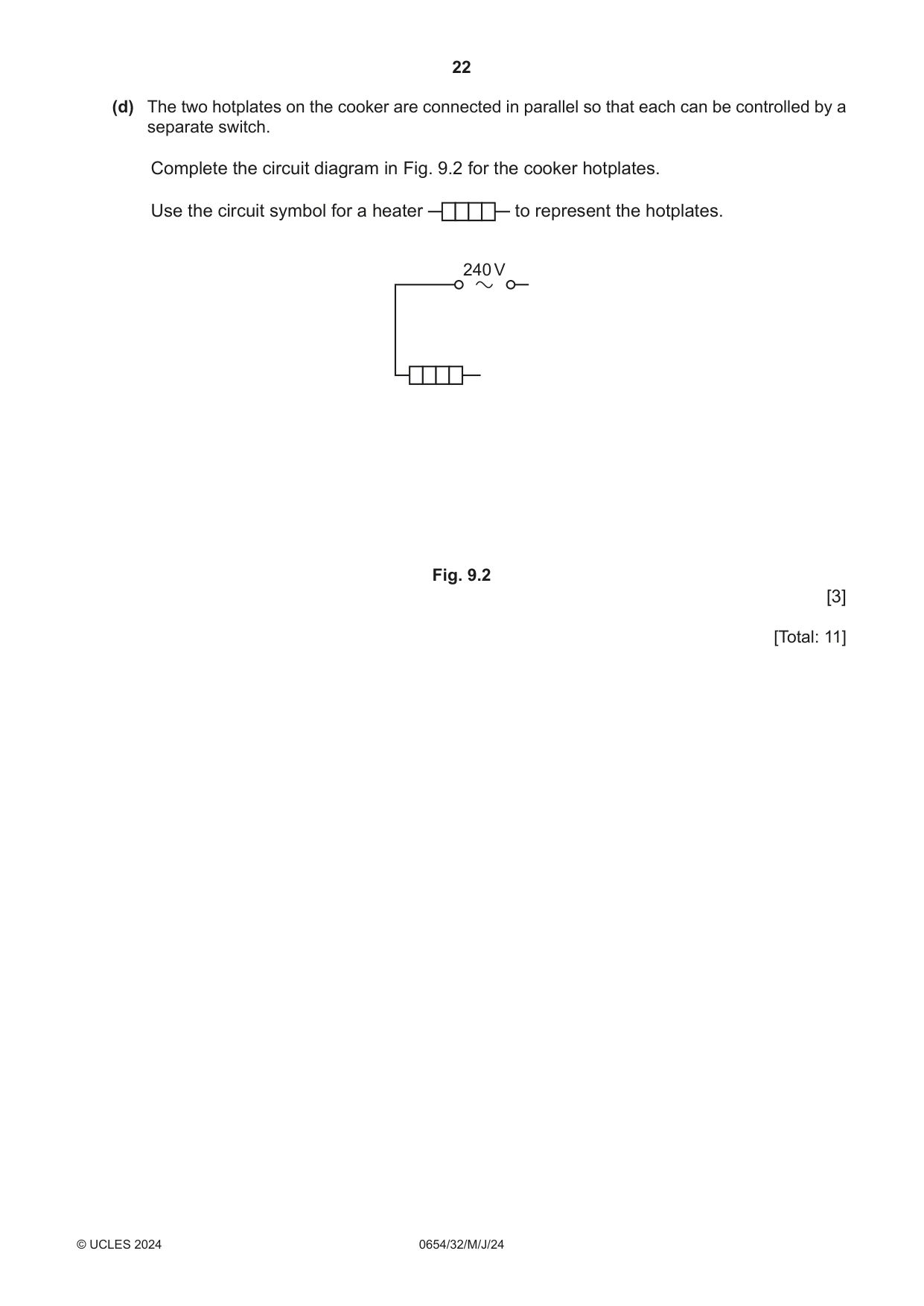
9 (a) Fig. 9.1 shows water in a steel saucepan being heated on an electric cooker. The water boils and some of the water changes into steam. Fig. 9.1 (i) State the main method of thermal energy transfer through: the water ........................................................................................................................... the saucepan. .................................................................................................................... [2] (ii) Describe what happens to the temperature of the water while it is boiling. ........................................................................................................................................... ..................................................................................................................................... [1] (iii) State the boiling point of water. ..................................................... °C [1] (iv) Steel is a solid, water is a liquid and steam is a gas. Complete Table 9.1 by placing ticks (✓) in the correct boxes to show which description describes a solid, a liquid and a gas. Table 9.1 description solid liquid gas it takes up all the space available it takes up the shape of its container and has a constant volume in an open container it has a fixed shape [1] (b) The saucepan is made from steel. Describe one difference between the magnetic properties of steel and the magnetic properties of soft iron. ................................................................................................................................................... ................................................................................................................................................... ............................................................................................................................................. [1] (c) The weight of the saucepan is 15 N. Calculate the mass of the saucepan in grams. The gravitational force on unit mass, g, = 10 N / kg. mass = ...................................................... g [2] (d) The two hotplates on the cooker are connected in parallel so that each can be controlled by a separate switch. Complete the circuit diagram in Fig. 9.2 for the cooker hotplates. Use the circuit symbol for a heater to represent the hotplates. 240 V Fig. 9.2 [3] [Total: 11]
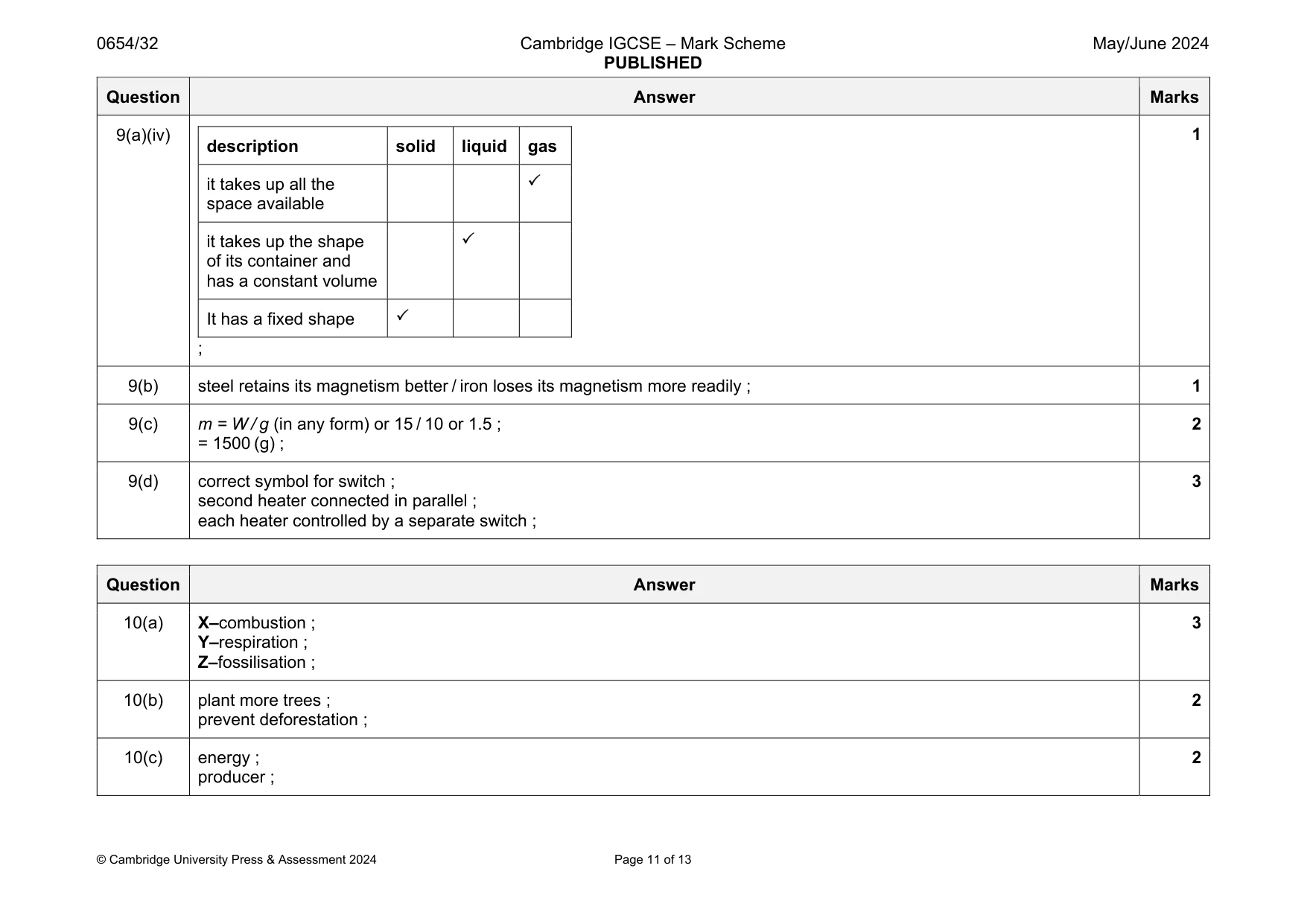
Mark scheme: 9(a)(i) convection ; conduction ; 2 9(a)(ii) remains constant / remains at 100 ºC ; 1 9(a)(iii) 100 ºC ; 1 Question Answer Marks 9(a)(iv) description solid liquid gas it takes up all the space available it takes up the shape of its container and has a constant volume It has a fixed shape ; 1 9(b) steel retains its magnetism better / iron loses its magnetism more readily ; 1 9(c) m = W / g (in any form) or 15 / 10 or 1.5 ; = 1500 (g) ; 2 9(d) correct symbol for switch ; second heater connected in parallel ; each heater controlled by a separate switch ; 3
Q10 · A diagram of the carbon cycle
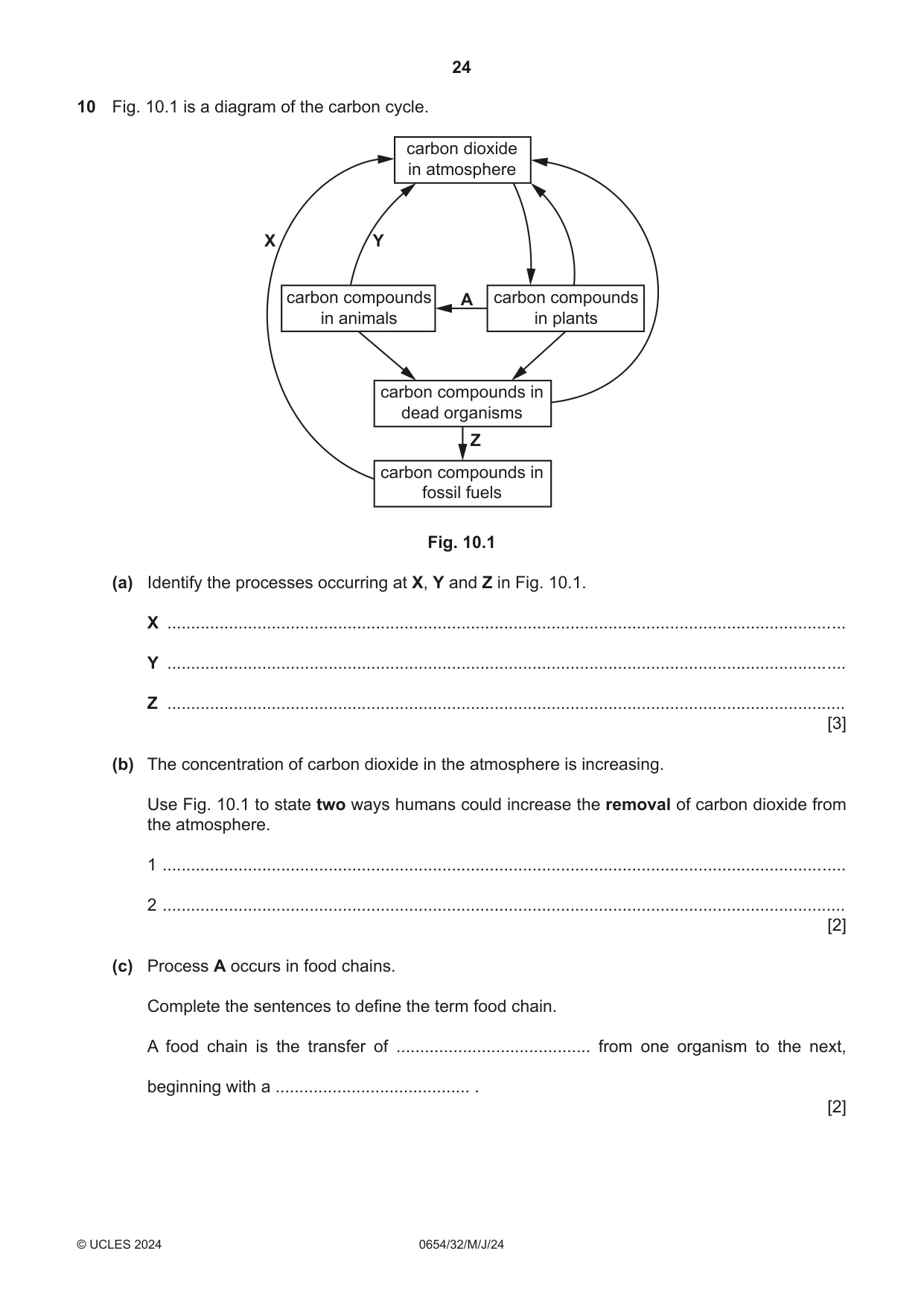
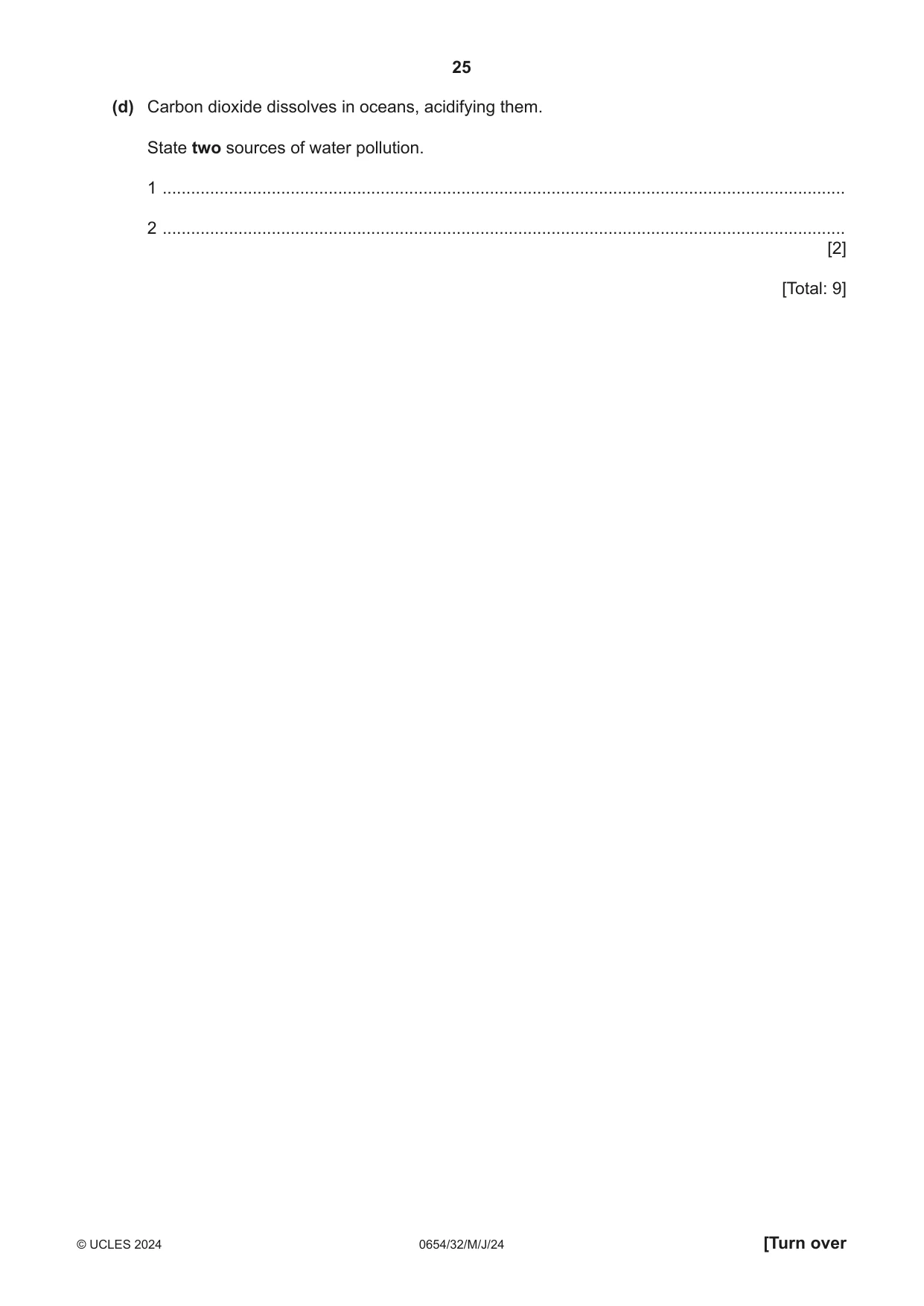
10 Fig. 10.1 is a diagram of the carbon cycle. carbon dioxide in atmosphere X Y carbon compounds A carbon compounds in animals in plants carbon compounds in dead organisms Z carbon compounds in fossil fuels Fig. 10.1 (a) Identify the processes occurring at X, Y and Z in Fig. 10.1. X ............................................................................................................................................... Y ............................................................................................................................................... Z ............................................................................................................................................... [3] (b) The concentration of carbon dioxide in the atmosphere is increasing. Use Fig. 10.1 to state two ways humans could increase the removal of carbon dioxide from the atmosphere. 1 ................................................................................................................................................ 2 ................................................................................................................................................ [2] (c) Process A occurs in food chains. Complete the sentences to define the term food chain. A food chain is the transfer of ......................................... from one organism to the next, beginning with a ......................................... . [2] (d) Carbon dioxide dissolves in oceans, acidifying them. State two sources of water pollution. 1 ................................................................................................................................................ 2 ................................................................................................................................................ [2] [Total: 9]
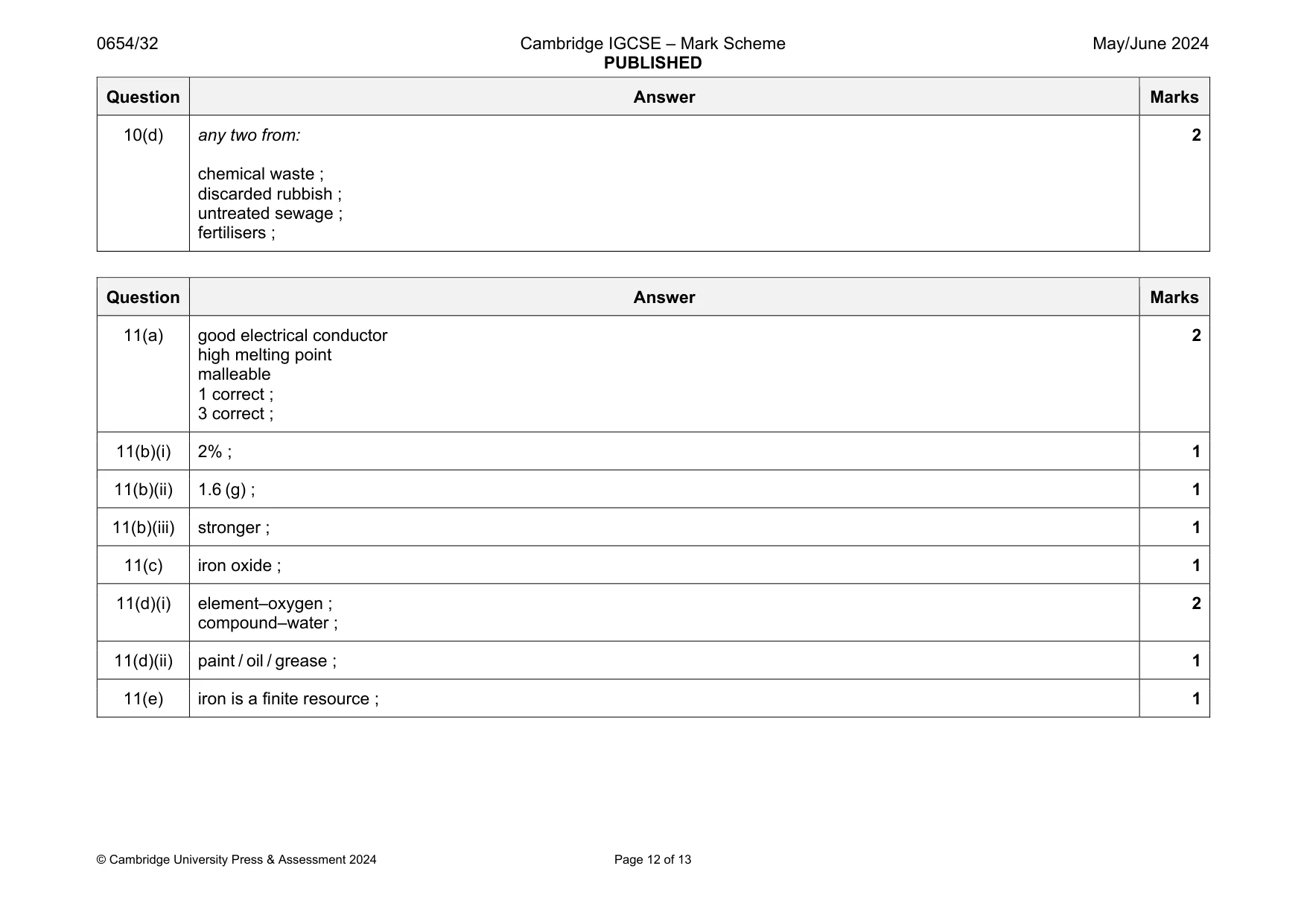
Mark scheme: 10(a) X–combustion ; Y–respiration ; Z–fossilisation ; 3 10(b) plant more trees ; prevent deforestation ; 2 10(c) energy ; producer ; 2 Question Answer Marks 10(d) any two from: chemical waste ; discarded rubbish ; untreated sewage ; fertilisers ; 2
Q11 · Iron is a metal
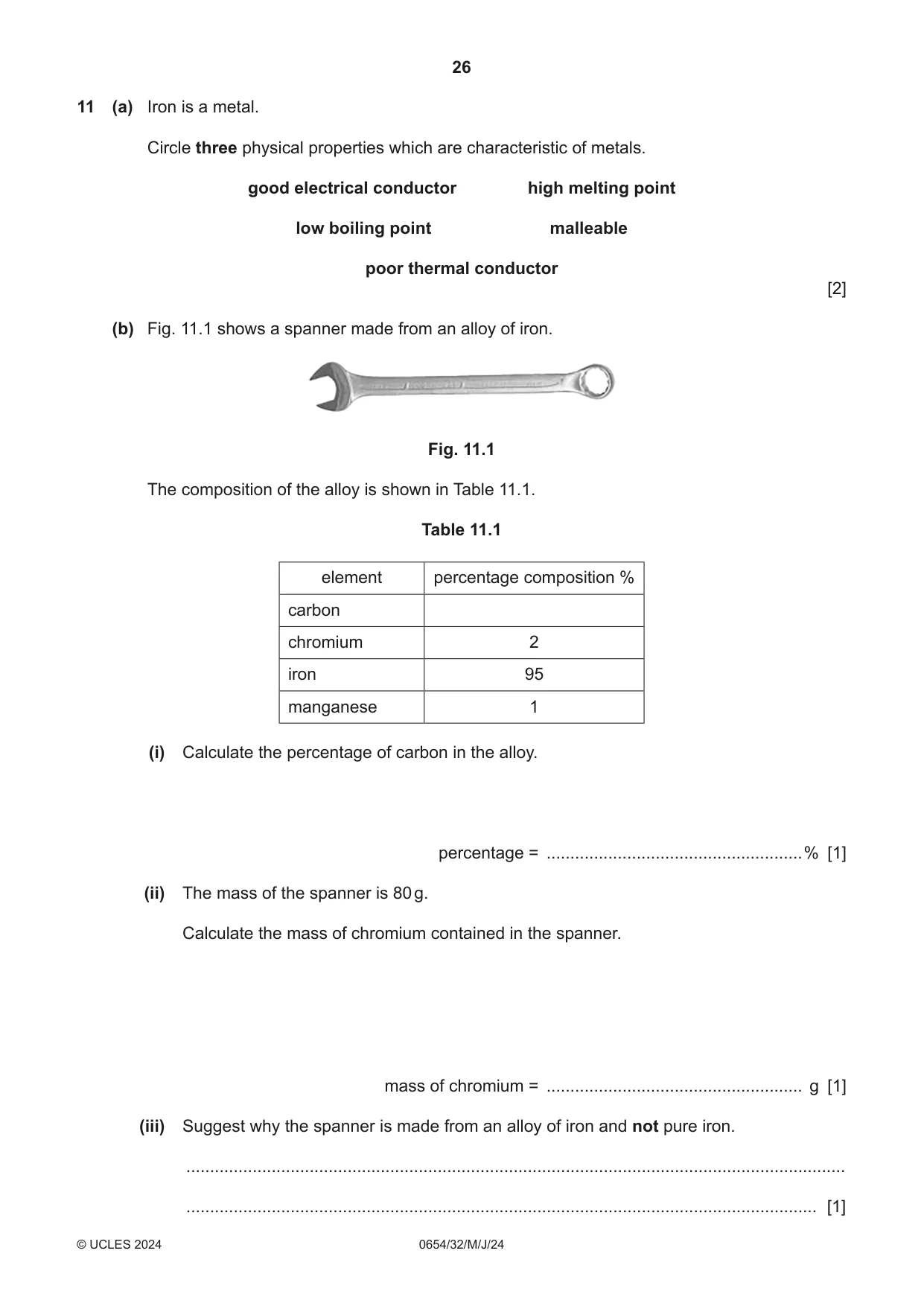
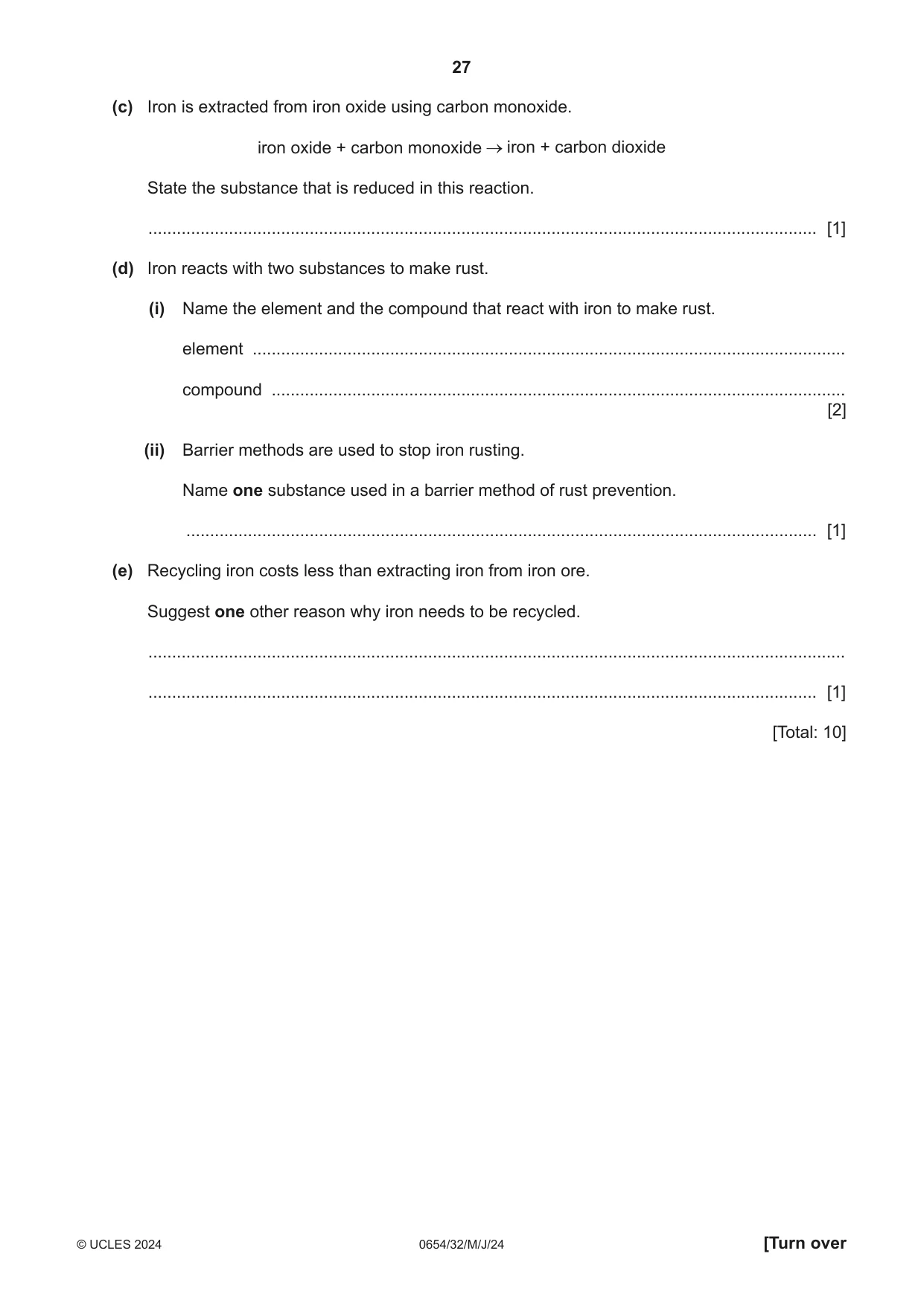
11 (a) Iron is a metal. Circle three physical properties which are characteristic of metals. good electrical conductor high melting point low boiling point malleable poor thermal conductor [2] (b) Fig. 11.1 shows a spanner made from an alloy of iron. Fig. 11.1 The composition of the alloy is shown in Table 11.1. Table 11.1 element percentage composition % carbon chromium 2 iron 95 manganese 1 (i) Calculate the percentage of carbon in the alloy. percentage = ......................................................% [1] (ii) The mass of the spanner is 80 g. Calculate the mass of chromium contained in the spanner. mass of chromium = ...................................................... g [1] (iii) Suggest why the spanner is made from an alloy of iron and not pure iron. ........................................................................................................................................... ..................................................................................................................................... [1] (c) Iron is extracted from iron oxide using carbon monoxide. iron oxide + carbon monoxide iron + carbon dioxide State the substance that is reduced in this reaction. ............................................................................................................................................. [1] (d) Iron reacts with two substances to make rust. (i) Name the element and the compound that react with iron to make rust. element ............................................................................................................................. compound ......................................................................................................................... [2] (ii) Barrier methods are used to stop iron rusting. Name one substance used in a barrier method of rust prevention. ..................................................................................................................................... [1] (e) Recycling iron costs less than extracting iron from iron ore. Suggest one other reason why iron needs to be recycled. ................................................................................................................................................... ............................................................................................................................................. [1] [Total: 10]
Mark scheme: 11(a) good electrical conductor high melting point malleable 1 correct ; 3 correct ; 11(b)(i) 2% ; 1 11(b)(ii) 1.6 (g) ; 1 11(b)(iii) stronger ; 1 11(c) iron oxide ; 1 11(d)(i) element–oxygen ; compound–water ; 2 11(d)(ii) paint / oil / grease ; 1 11(e) iron is a finite resource ; 1
Q12 · A student investigates the motion of smoke particles in air using a microscope
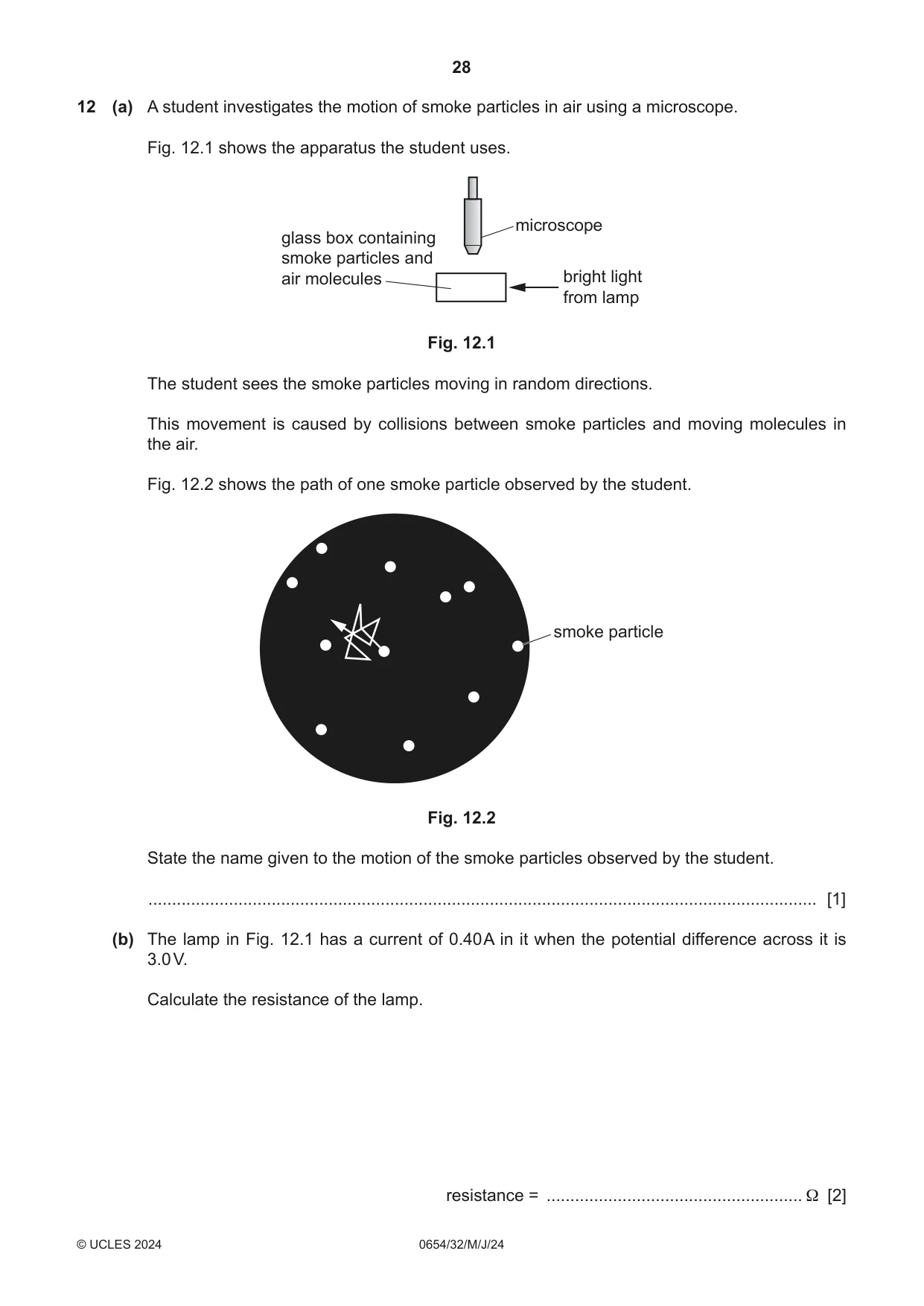
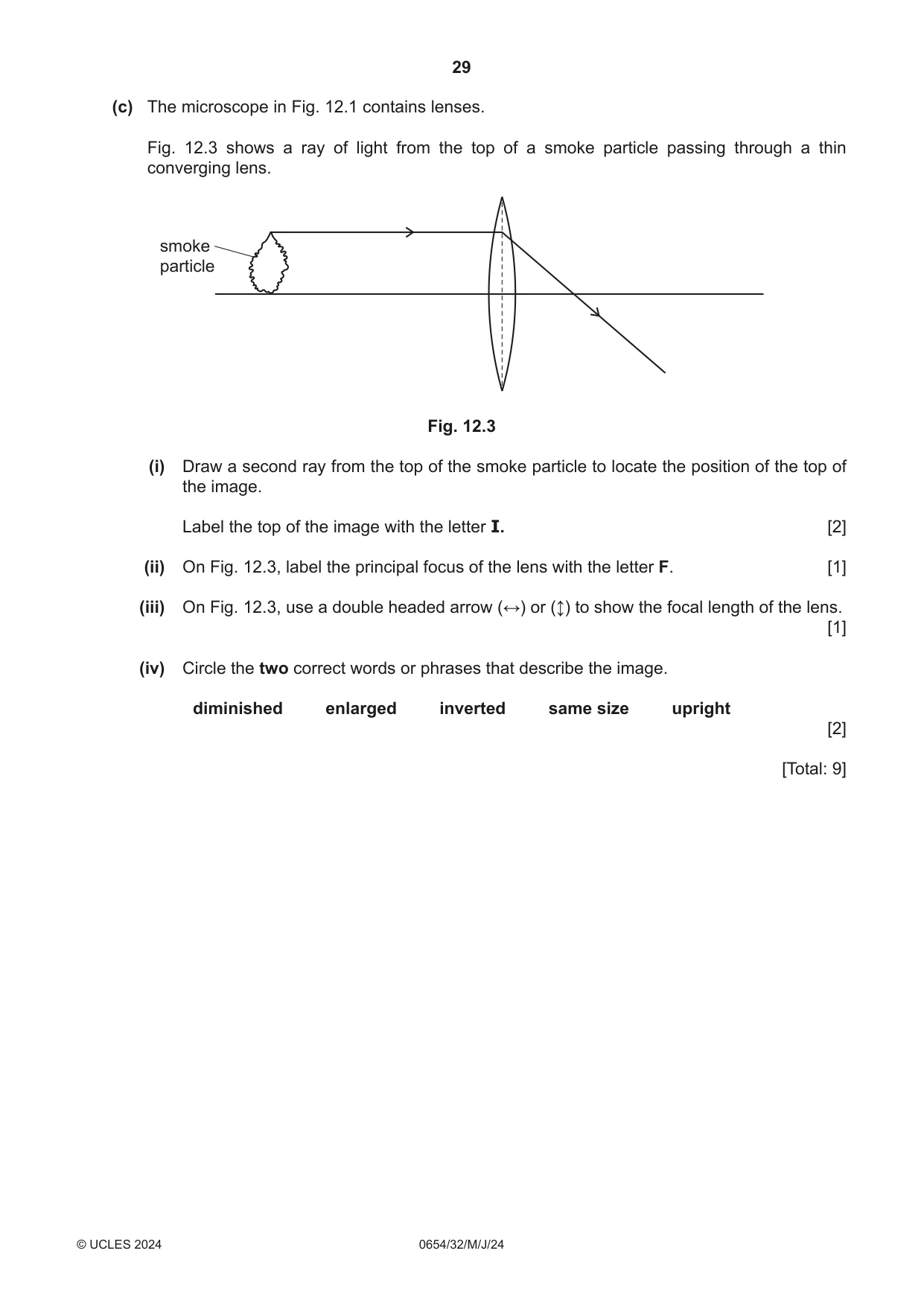
12 (a) A student investigates the motion of smoke particles in air using a microscope. Fig. 12.1 shows the apparatus the student uses. microscope glass box containing smoke particles and air molecules bright light from lamp Fig. 12.1 The student sees the smoke particles moving in random directions. This movement is caused by collisions between smoke particles and moving molecules in the air. Fig. 12.2 shows the path of one smoke particle observed by the student. smoke particle Fig. 12.2 State the name given to the motion of the smoke particles observed by the student. ............................................................................................................................................. [1] (b) The lamp in Fig. 12.1 has a current of 0.40 A in it when the potential difference across it is 3.0 V. Calculate the resistance of the lamp. resistance = ...................................................... Ω [2] (c) The microscope in Fig. 12.1 contains lenses. Fig. 12.3 shows a ray of light from the top of a smoke particle passing through a thin converging lens. smoke particle Fig. 12.3 (i) Draw a second ray from the top of the smoke particle to locate the position of the top of the image. Label the top of the image with the letter I. [2] (ii) On Fig. 12.3, label the principal focus of the lens with the letter F. [1] (iii) On Fig. 12.3, use a double headed arrow (↔) or (↕) to show the focal length of the lens. [1] (iv) Circle the two correct words or phrases that describe the image. diminished enlarged inverted same size upright [2] [Total: 9]
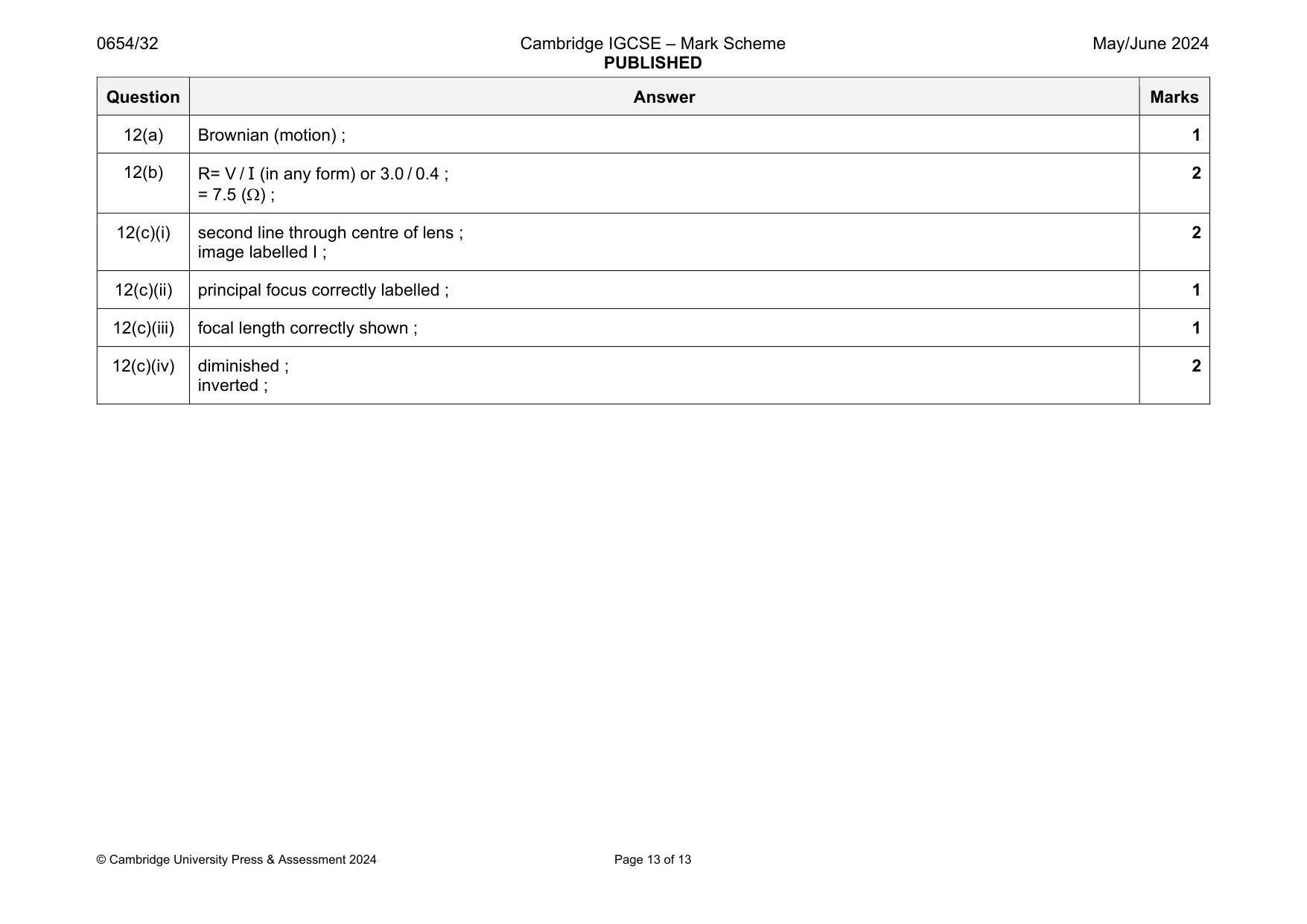
Mark scheme: 12(a) Brownian (motion) ; 1 12(b) R= V / I (in any form) or 3.0 / 0.4 ; = 7.5 () ; 2 12(c)(i) second line through centre of lens ; image labelled I ; 2 12(c)(ii) principal focus correctly labelled ; 1 12(c)(iii) focal length correctly shown ; 1 12(c)(iv) diminished ; inverted ; 2
What was in this paper
The subtopics covered by these 12 questions, and how many questions each got. Open one in a new tab to see every Cambridge question on it.
What you needed in this session
Cambridge’s own grade thresholds for 2024 May/June, Paper 3 · Variant 2. A higher threshold means an easier paper — the bar moves with how the cohort did.