Cambridge IGCSE Sciences - Co-ordinated (Double) 0654 — 2023 May/June Paper 3 · Variant 3
0654/33/M/J/23 · 12 questions · 120 marks · ≈135 min
The question paper and its mark scheme, free to read here and free to download. This is Cambridge’s own paper, exactly as it was sat.
Question paper28 pages



Mark scheme14 pages
Answers below. Sit the paper first if you are practising.
Questions as text
Q1 · A diagram of a flower
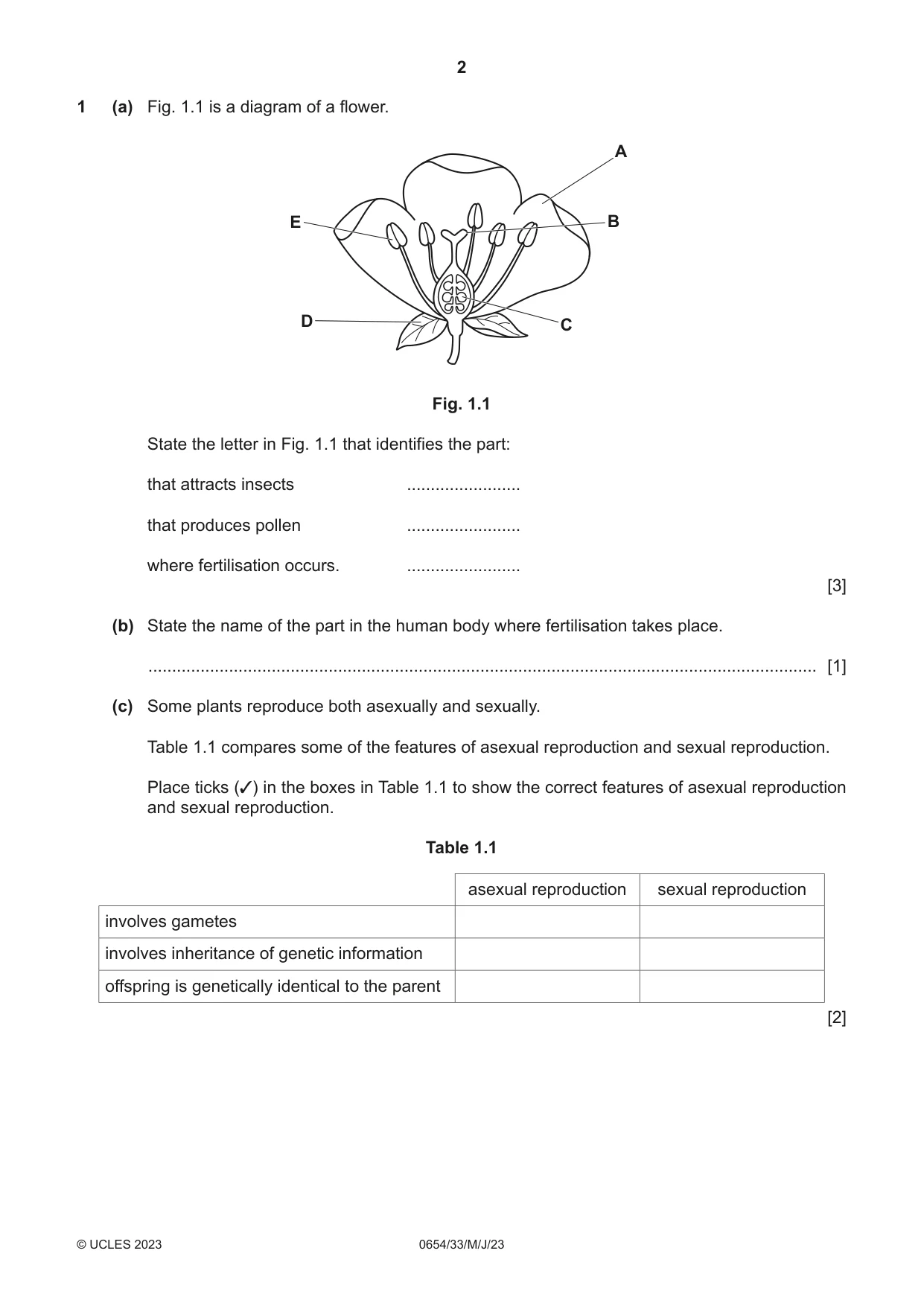
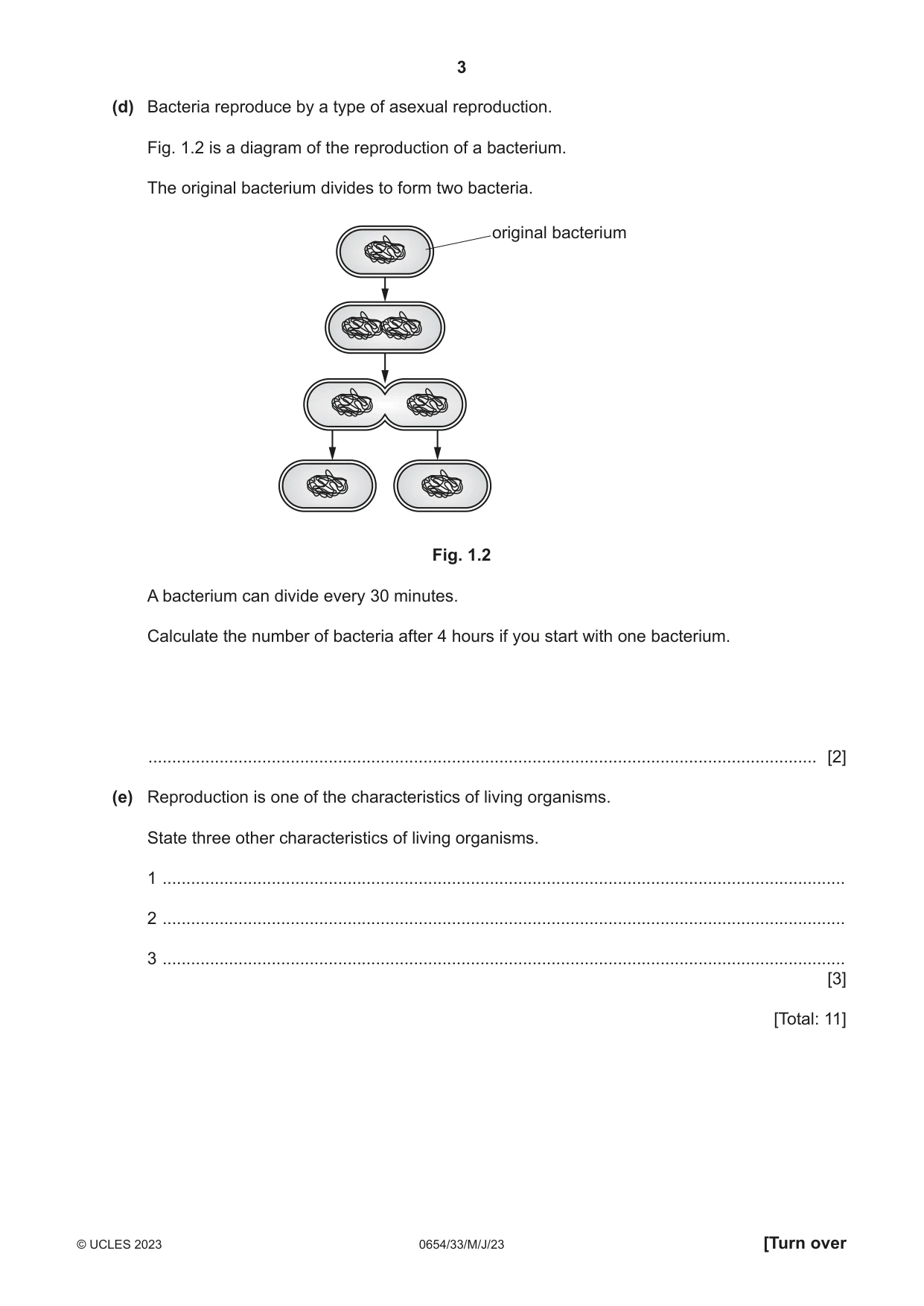
1 (a) Fig. 1.1 is a diagram of a flower. A E B D C Fig. 1.1 State the letter in Fig. 1.1 that identifies the part: that attracts insects ........................ that produces pollen ........................ where fertilisation occurs. ........................ [3] (b) State the name of the part in the human body where fertilisation takes place. ............................................................................................................................................. [1] (c) Some plants reproduce both asexually and sexually. Table 1.1 compares some of the features of asexual reproduction and sexual reproduction. Place ticks (3) in the boxes in Table 1.1 to show the correct features of asexual reproduction and sexual reproduction. Table 1.1 asexual reproduction sexual reproduction involves gametes involves inheritance of genetic information offspring is genetically identical to the parent [2] (d) Bacteria reproduce by a type of asexual reproduction. Fig. 1.2 is a diagram of the reproduction of a bacterium. The original bacterium divides to form two bacteria. original bacterium Fig. 1.2 A bacterium can divide every 30 minutes. Calculate the number of bacteria after 4 hours if you start with one bacterium. ............................................................................................................................................. [2] (e) Reproduction is one of the characteristics of living organisms. State three other characteristics of living organisms. 1 ................................................................................................................................................ 2 ................................................................................................................................................ 3 ................................................................................................................................................ [3] [Total: 11]
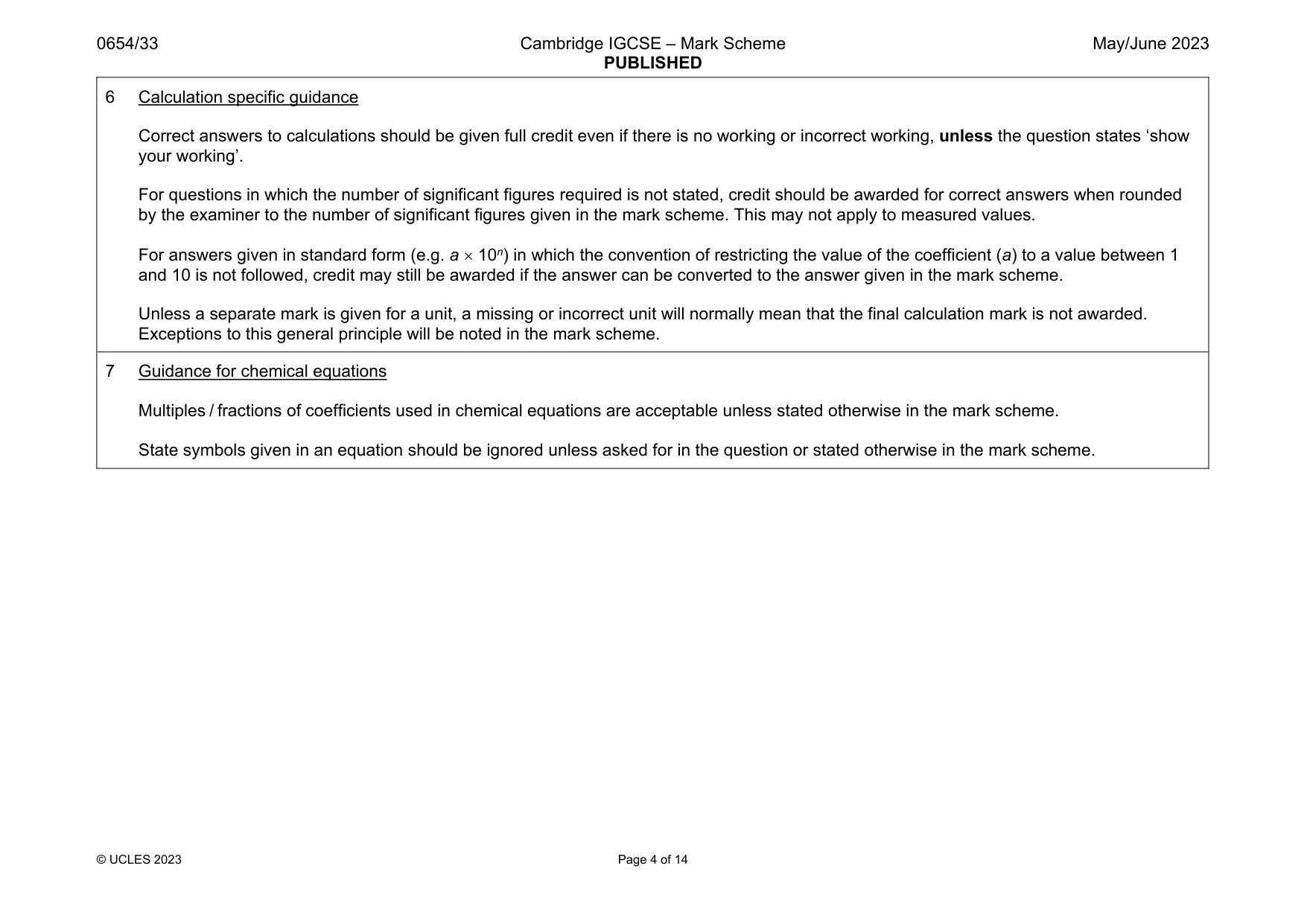
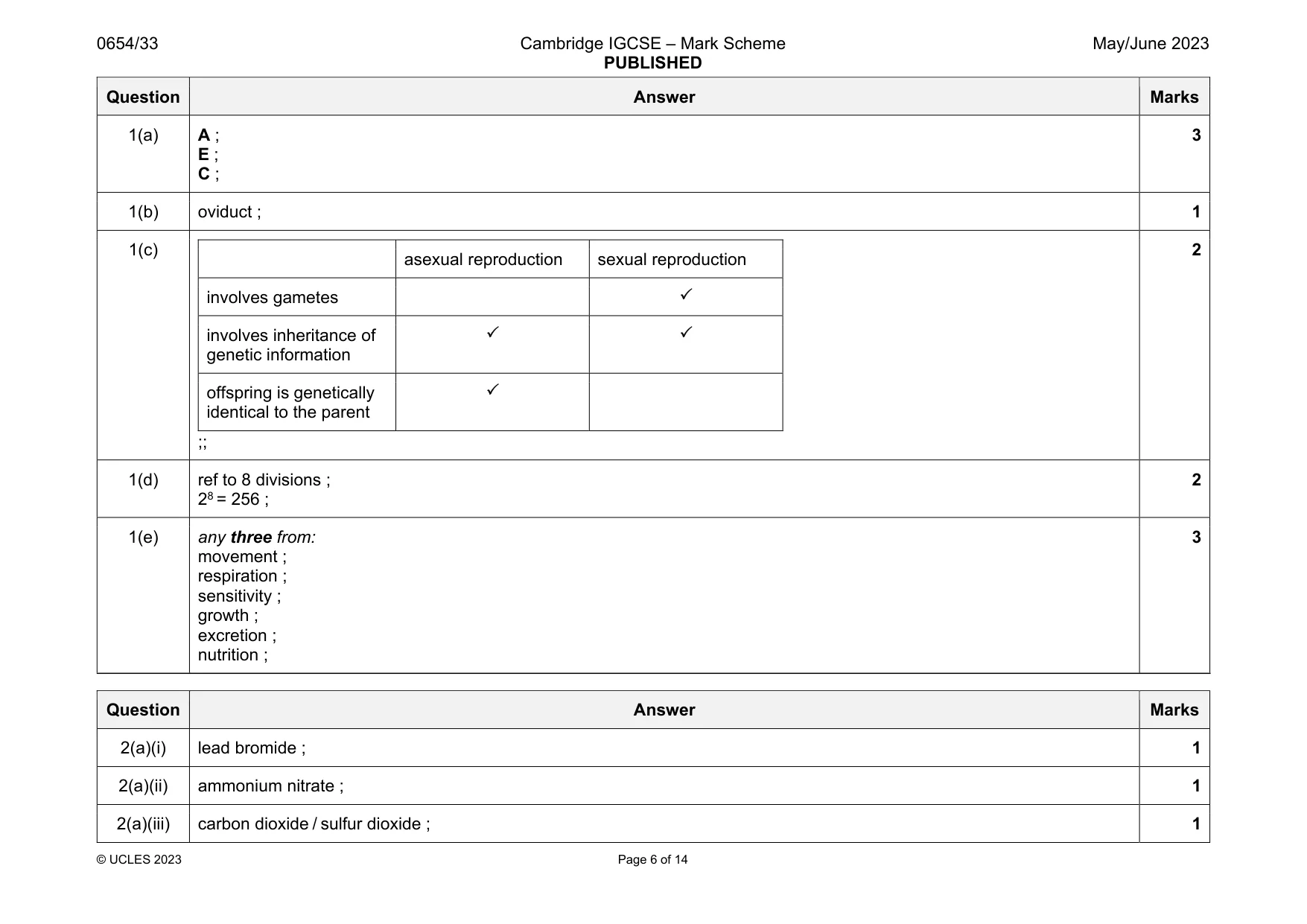
Mark scheme: 1(a) A ; E ; C ; 3 1(b) oviduct ; 1 1(c) asexual reproduction sexual reproduction involves gametes involves inheritance of genetic information offspring is genetically identical to the parent ;; 2 1(d) ref to 8 divisions ; 28 = 256 ; 2 1(e) any three from: movement ; respiration ; sensitivity ; growth ; excretion ; nutrition ; 3
Q2 · The list gives the names of six compounds
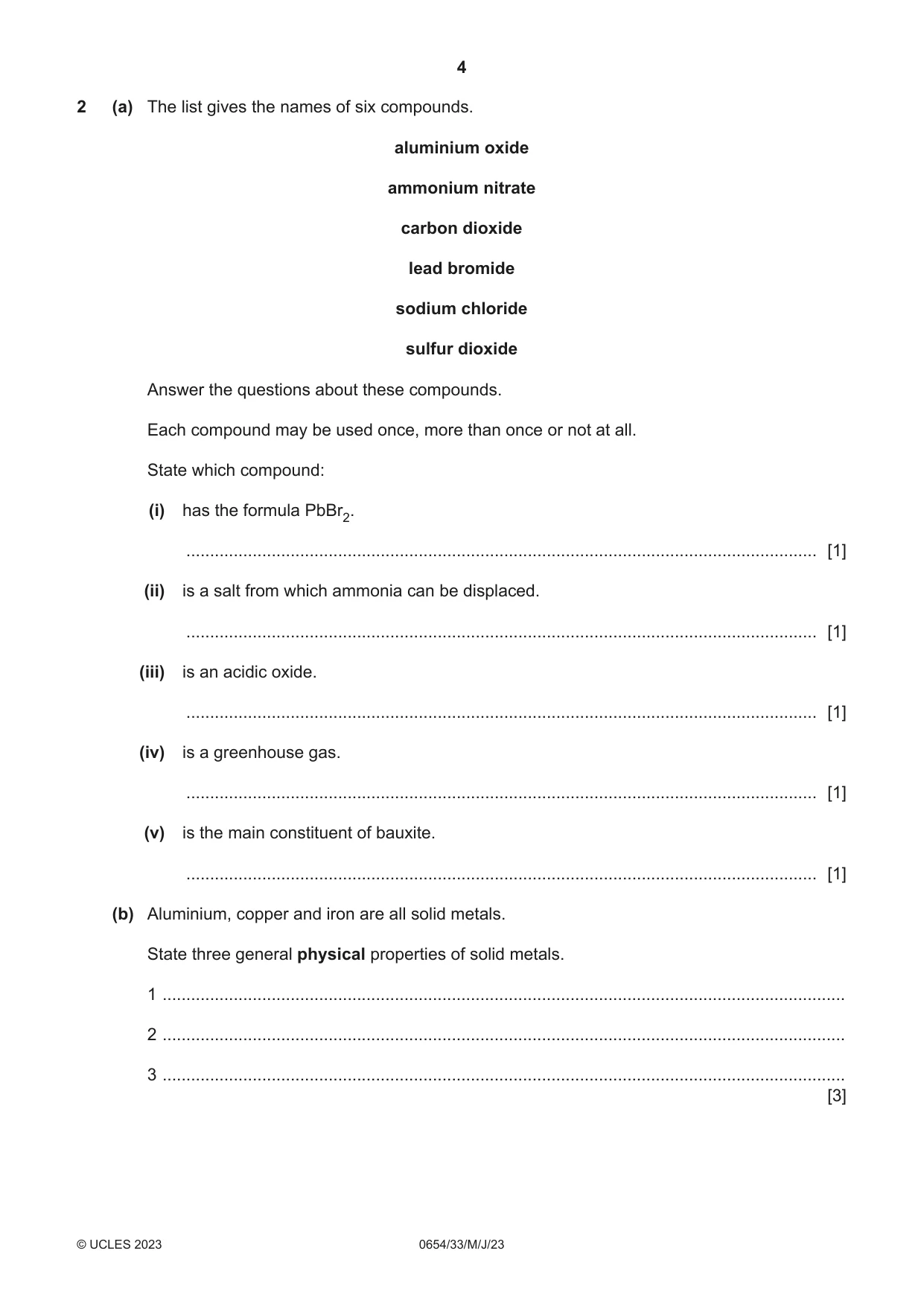
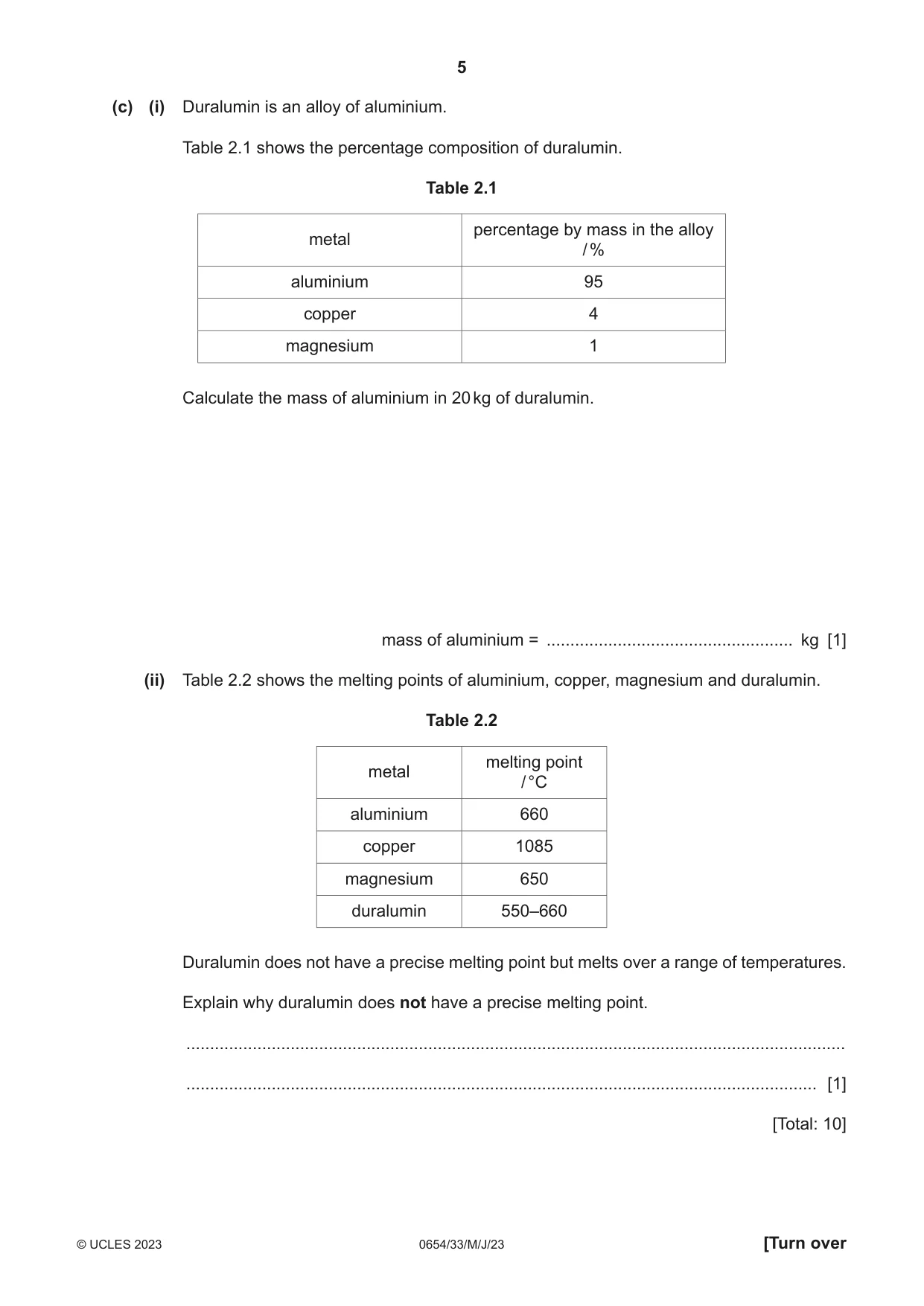
2 (a) The list gives the names of six compounds. aluminium oxide ammonium nitrate carbon dioxide lead bromide sodium chloride sulfur dioxide Answer the questions about these compounds. Each compound may be used once, more than once or not at all. State which compound: (i) has the formula PbBr2. ..................................................................................................................................... [1] (ii) is a salt from which ammonia can be displaced. ..................................................................................................................................... [1] (iii) is an acidic oxide. ..................................................................................................................................... [1] (iv) is a greenhouse gas. ..................................................................................................................................... [1] (v) is the main constituent of bauxite. ..................................................................................................................................... [1] (b) Aluminium, copper and iron are all solid metals. State three general physical properties of solid metals. 1 ................................................................................................................................................ 2 ................................................................................................................................................ 3 ................................................................................................................................................ [3] (c) (i) Duralumin is an alloy of aluminium. Table 2.1 shows the percentage composition of duralumin. Table 2.1 percentage by mass in the alloy metal / % aluminium 95 copper 4 magnesium 1 Calculate the mass of aluminium in 20 kg of duralumin. mass of aluminium = .................................................... kg [1] (ii) Table 2.2 shows the melting points of aluminium, copper, magnesium and duralumin. Table 2.2 melting point metal / °C aluminium 660 copper 1085 magnesium 650 duralumin 550–660 Duralumin does not have a precise melting point but melts over a range of temperatures. Explain why duralumin does not have a precise melting point. ........................................................................................................................................... ..................................................................................................................................... [1] [Total: 10]
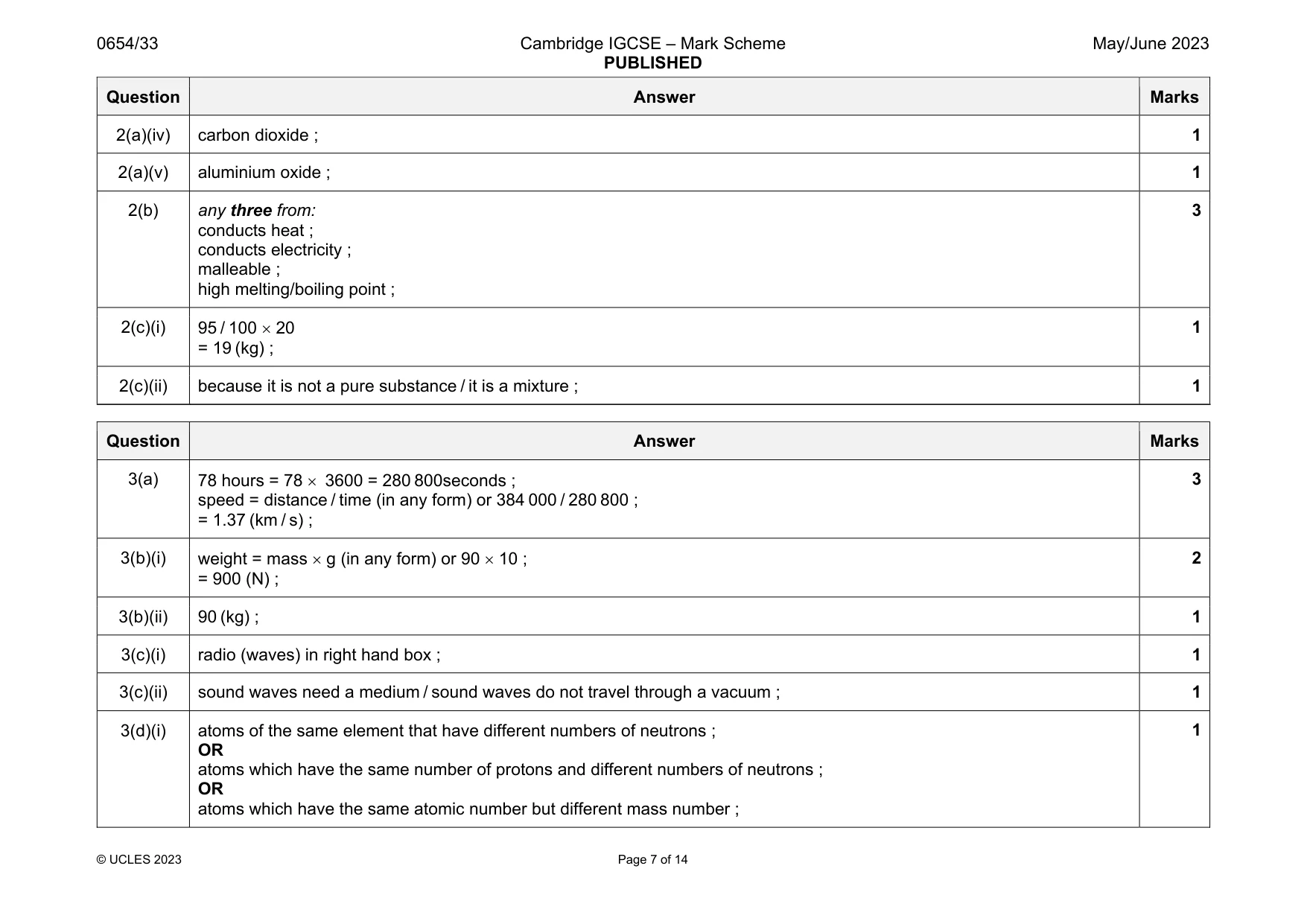
Mark scheme: 2(a)(i) lead bromide ; 1 2(a)(ii) ammonium nitrate ; 1 2(a)(iii) carbon dioxide / sulfur dioxide ; 1 Question Answer Marks 2(a)(iv) carbon dioxide ; 1 2(a)(v) aluminium oxide ; 1 2(b) any three from: conducts heat ; conducts electricity ; malleable ; high melting/boiling point ; 3 2(c)(i) 95 / 100 20 = 19 (kg) ; 1 2(c)(ii) because it is not a pure substance / it is a mixture ; 1
Q3 · A spacecraft carrying an astronaut travels 384 000 km from the Earth to the Moon in 78…
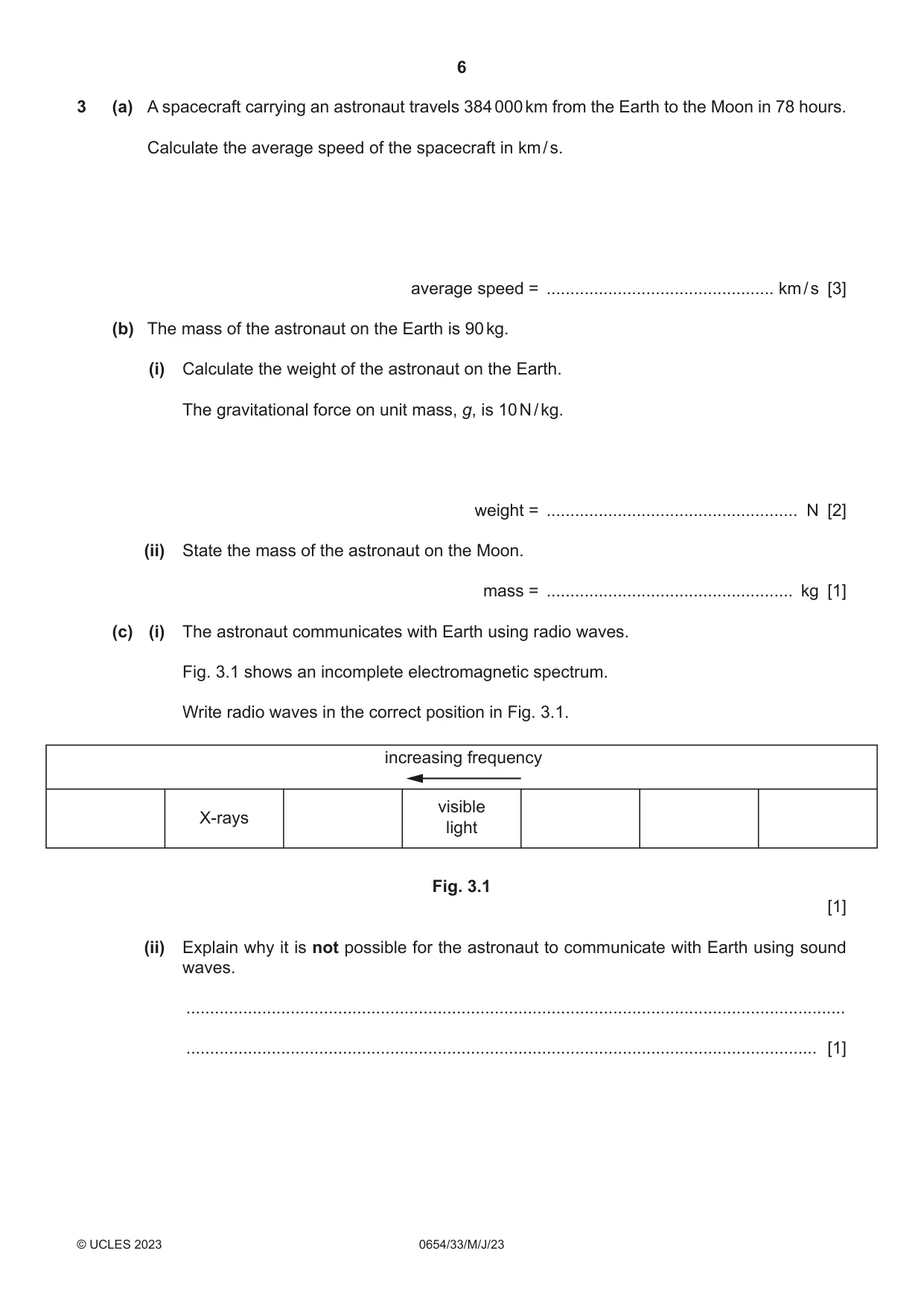
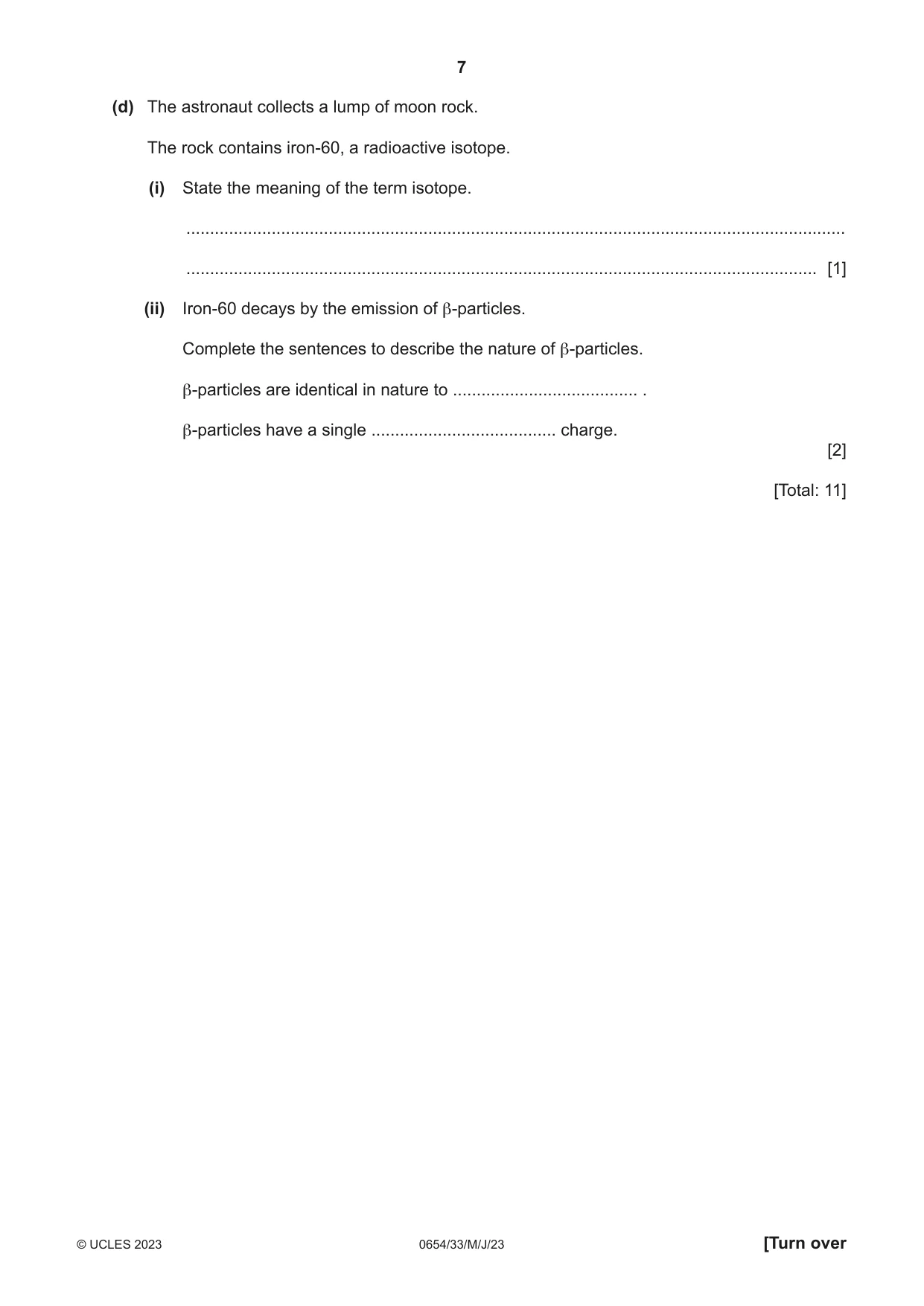
3 (a) A spacecraft carrying an astronaut travels 384 000 km from the Earth to the Moon in 78 hours. Calculate the average speed of the spacecraft in km / s. average speed = ................................................ km / s [3] (b) The mass of the astronaut on the Earth is 90 kg. (i) Calculate the weight of the astronaut on the Earth. The gravitational force on unit mass, g, is 10 N / kg. weight = ..................................................... N [2] (ii) State the mass of the astronaut on the Moon. mass = .................................................... kg [1] (c) (i) The astronaut communicates with Earth using radio waves. Fig. 3.1 shows an incomplete electromagnetic spectrum. Write radio waves in the correct position in Fig. 3.1. increasing frequency visible X-rays light Fig. 3.1 [1] (ii) Explain why it is not possible for the astronaut to communicate with Earth using sound waves. ........................................................................................................................................... ..................................................................................................................................... [1] (d) The astronaut collects a lump of moon rock. The rock contains iron-60, a radioactive isotope. (i) State the meaning of the term isotope. ........................................................................................................................................... ..................................................................................................................................... [1] (ii) Iron-60 decays by the emission of β-particles. Complete the sentences to describe the nature of β-particles. β-particles are identical in nature to ....................................... . β-particles have a single ....................................... charge. [2] [Total: 11]
Mark scheme: 3(a) speed = distance / time (in any form) or 384 000 / 280 800 ; = 1.37 (km / s) ; 3 3(b)(i) weight = mass g (in any form) or 90 10 ; = 900 (N) ; 2 3(b)(ii) 90 (kg) ; 1 3(c)(i) radio (waves) in right hand box ; 1 3(c)(ii) sound waves need a medium / sound waves do not travel through a vacuum ; 1 3(d)(i) atoms of the same element that have different numbers of neutrons ; OR atoms which have the same number of protons and different numbers of neutrons ; OR atoms which have the same atomic number but different mass number ; 1 Question Answer Marks 3(d)(ii) electrons ; negative ; 2
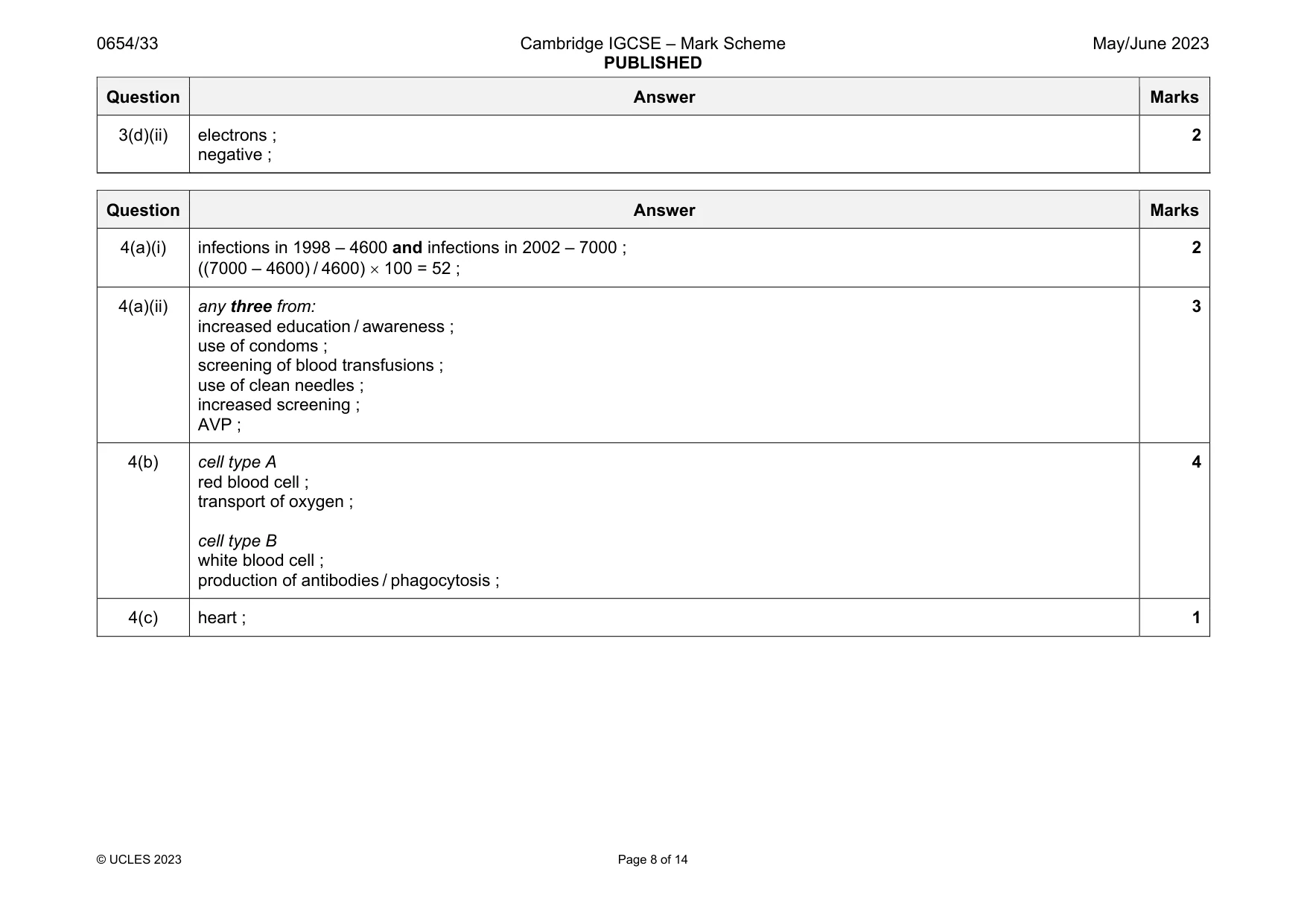
Q4 · The number of new infections of HIV each year in one country is recorded
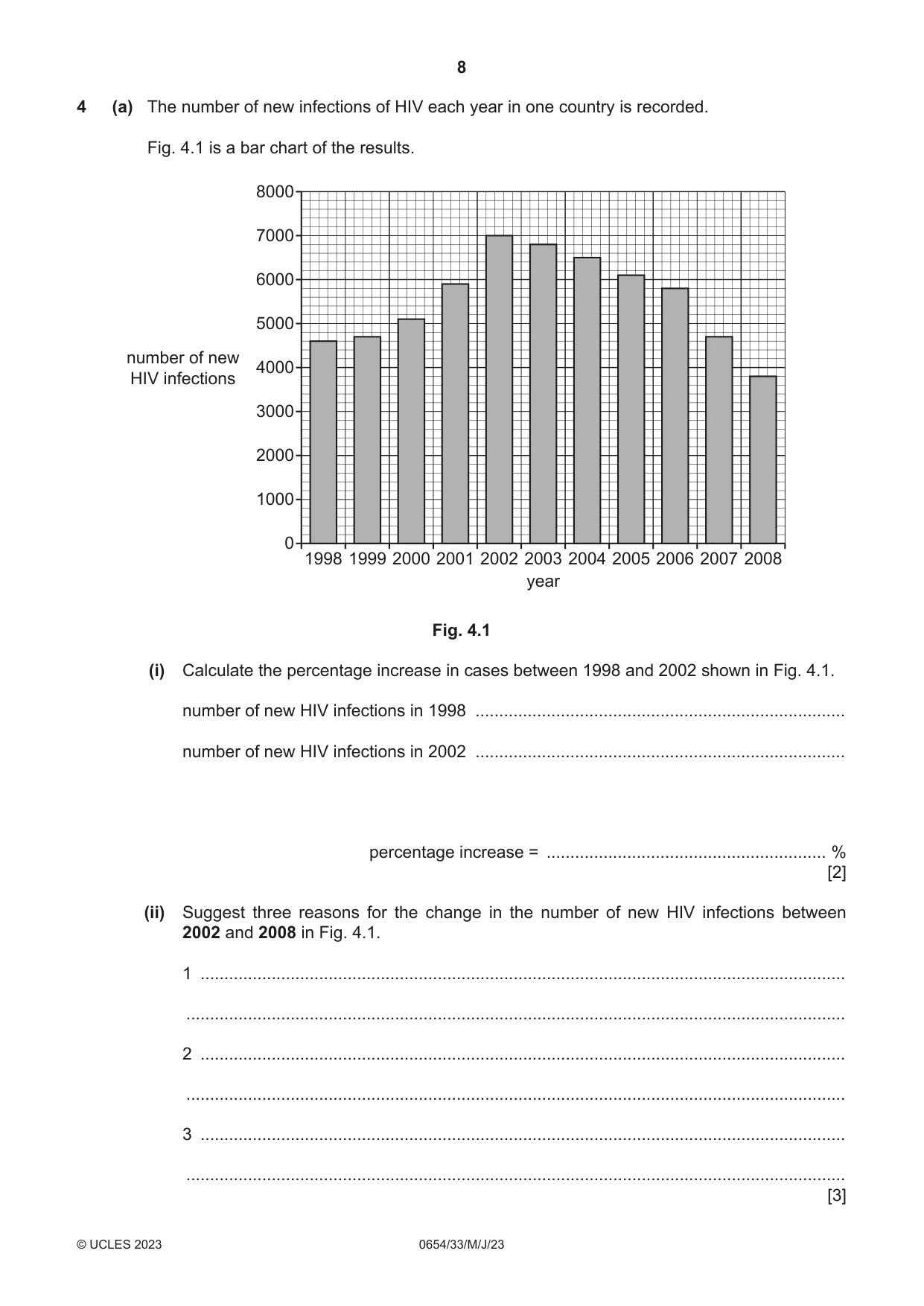
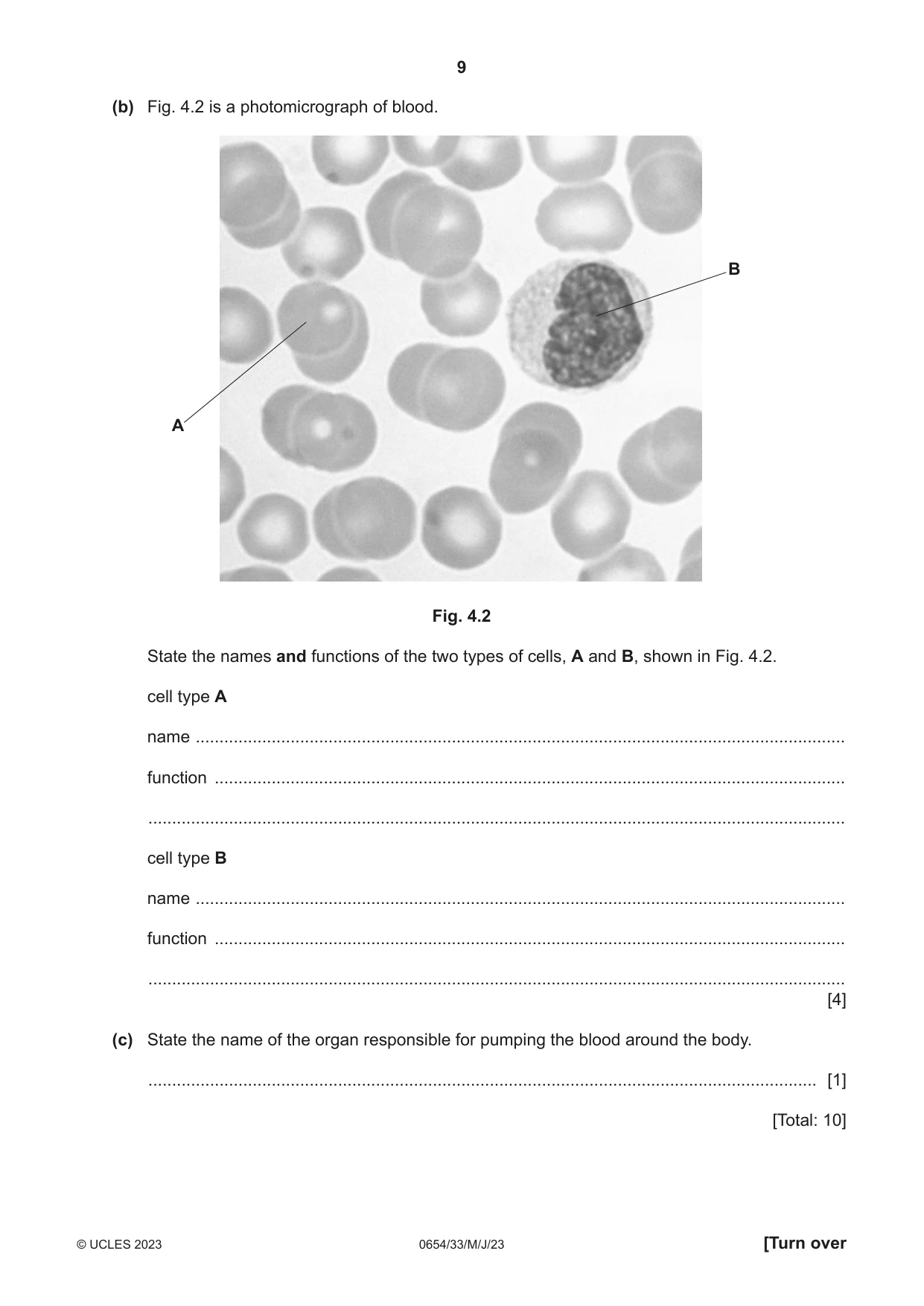
4 (a) The number of new infections of HIV each year in one country is recorded. Fig. 4.1 is a bar chart of the results. 8000 7000 6000 5000 number of new 4000 HIV infections 3000 2000 1000 0 1998 1999 2000 2001 2002 2003 2004 2005 2006 2007 2008 year Fig. 4.1 (i) Calculate the percentage increase in cases between 1998 and 2002 shown in Fig. 4.1. number of new HIV infections in 1998 .............................................................................. number of new HIV infections in 2002 .............................................................................. percentage increase = ........................................................... % [2] (ii) Suggest three reasons for the change in the number of new HIV infections between 2002 and 2008 in Fig. 4.1. 1 ........................................................................................................................................ ........................................................................................................................................... 2 ........................................................................................................................................ ........................................................................................................................................... 3 ........................................................................................................................................ ........................................................................................................................................... [3] (b) Fig. 4.2 is a photomicrograph of blood. B A Fig. 4.2 State the names and functions of the two types of cells, A and B, shown in Fig. 4.2. cell type A name ......................................................................................................................................... function ..................................................................................................................................... ................................................................................................................................................... cell type B name ......................................................................................................................................... function ..................................................................................................................................... ................................................................................................................................................... [4] (c) State the name of the organ responsible for pumping the blood around the body. ............................................................................................................................................. [1] [Total: 10]
Mark scheme: 4(a)(i) infections in 1998 – 4600 and infections in 2002 – 7000 ; ((7000 – 4600) / 4600) 100 = 52 ; 2 4(a)(ii) any three from: increased education / awareness ; use of condoms ; screening of blood transfusions ; use of clean needles ; increased screening ; AVP ; 3 4(b) cell type A red blood cell ; transport of oxygen ; cell type B white blood cell ; production of antibodies / phagocytosis ; 4 4(c) heart ; 1
Q5 · A sample of clean air is a mixture of oxygen, nitrogen and small quantities of noble…
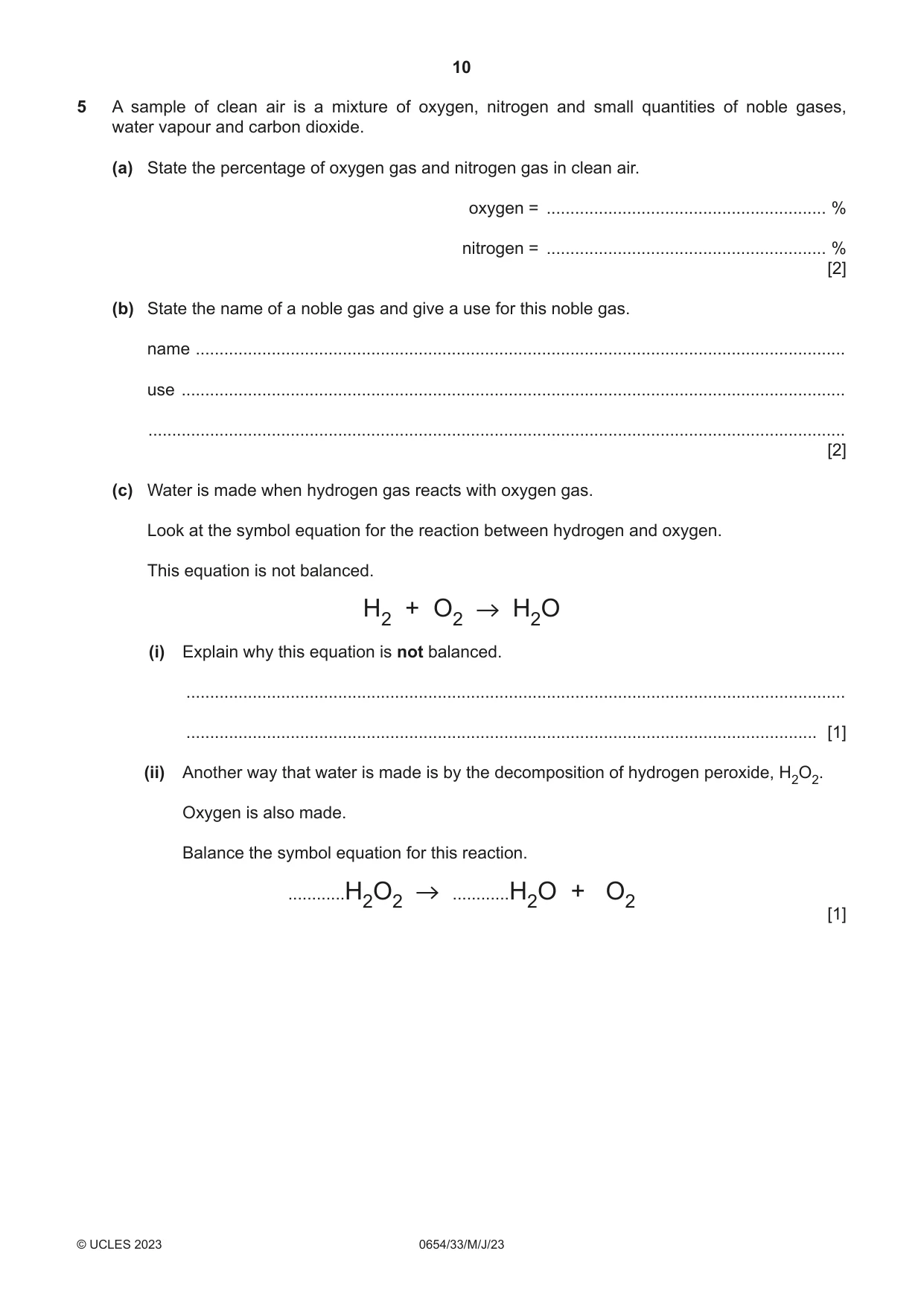
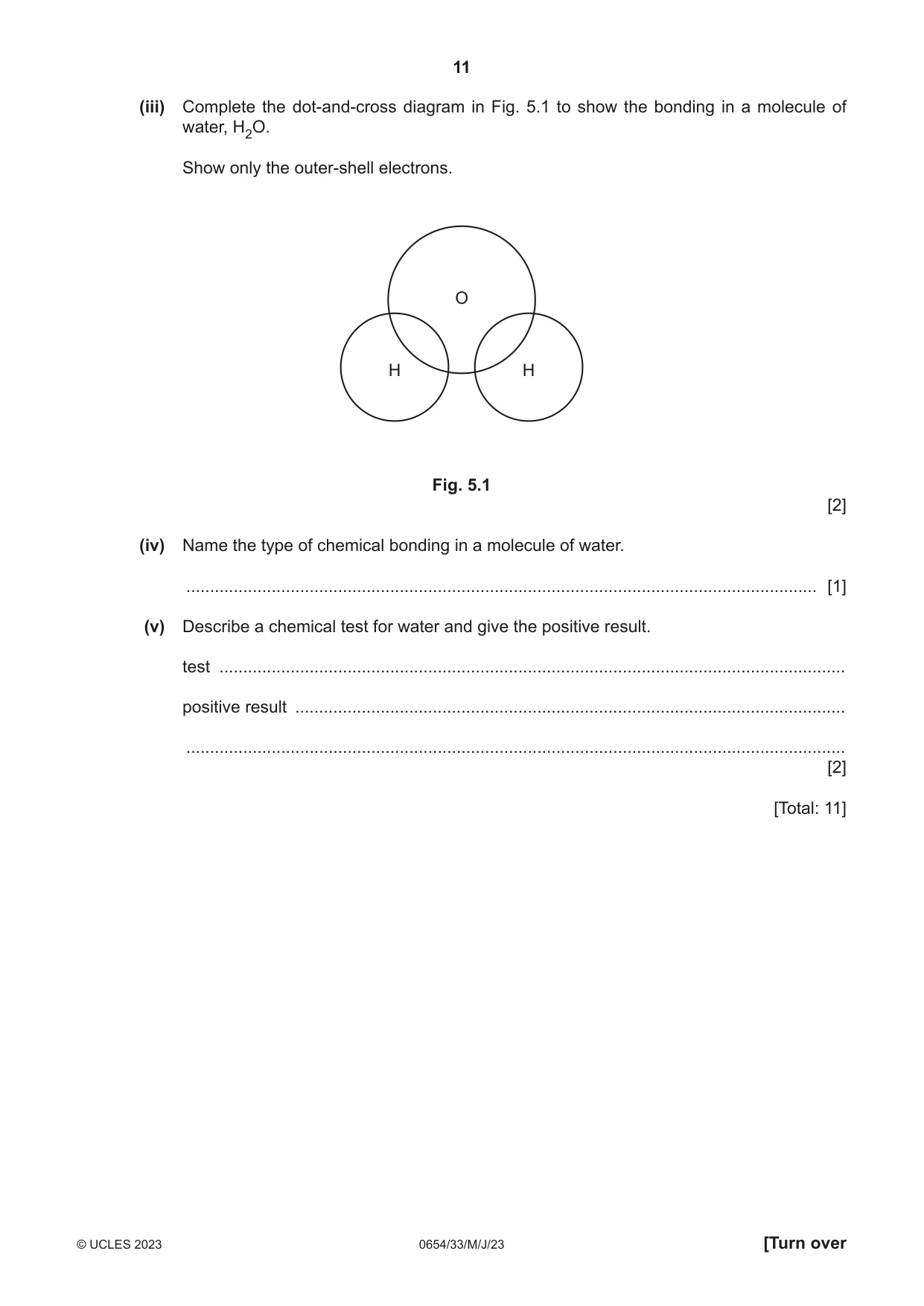
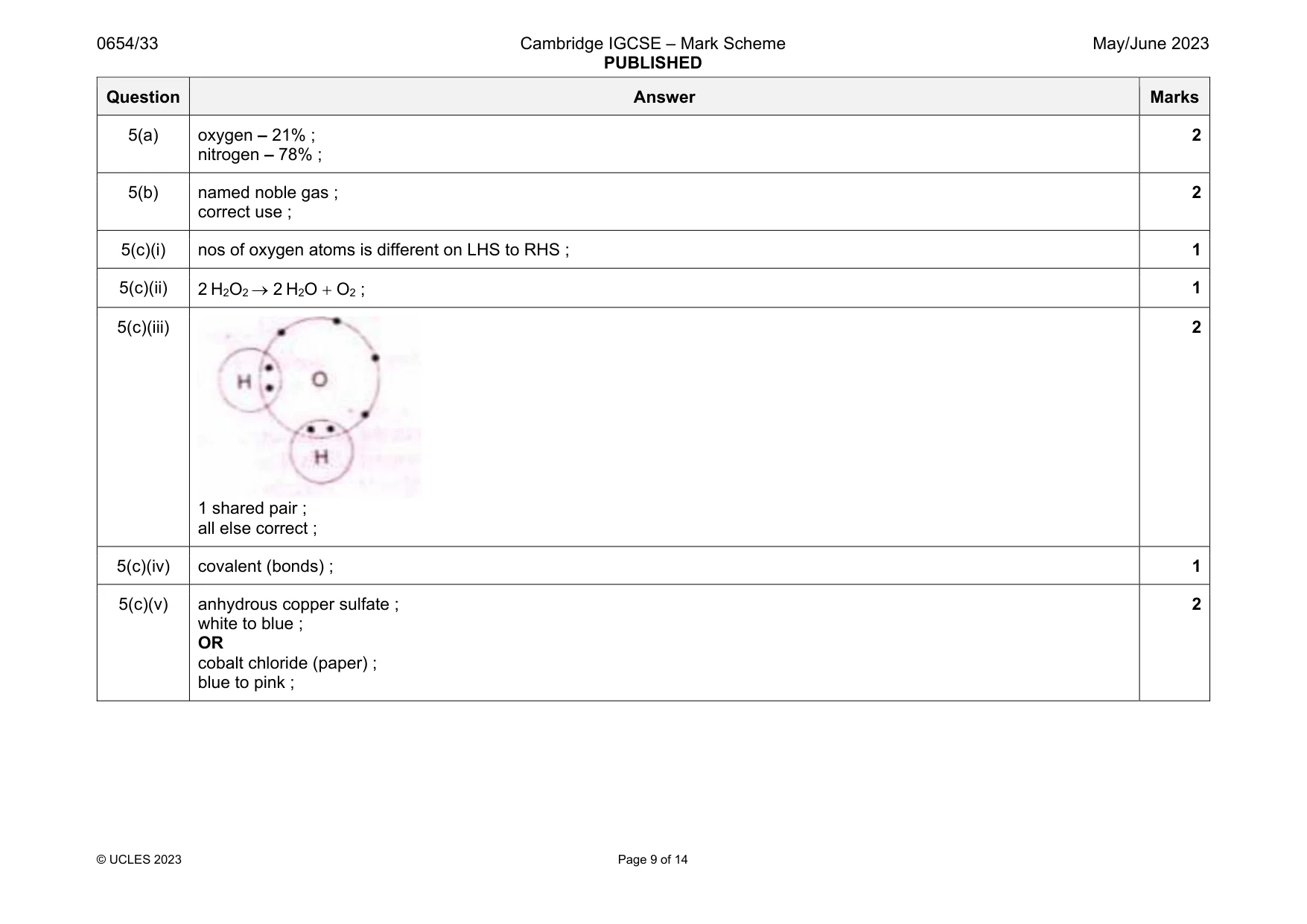
5 A sample of clean air is a mixture of oxygen, nitrogen and small quantities of noble gases, water vapour and carbon dioxide. (a) State the percentage of oxygen gas and nitrogen gas in clean air. oxygen = ........................................................... % nitrogen = ........................................................... % [2] (b) State the name of a noble gas and give a use for this noble gas. name ......................................................................................................................................... use ............................................................................................................................................ ................................................................................................................................................... [2] (c) Water is made when hydrogen gas reacts with oxygen gas. Look at the symbol equation for the reaction between hydrogen and oxygen. This equation is not balanced. H2 + O2 H2O (i) Explain why this equation is not balanced. ........................................................................................................................................... ..................................................................................................................................... [1] (ii) Another way that water is made is by the decomposition of hydrogen peroxide, H2O2. Oxygen is also made. Balance the symbol equation for this reaction. ............H2O2 ............H2O + O2 [1] (iii) Complete the dot-and-cross diagram in Fig. 5.1 to show the bonding in a molecule of water, H2O. Show only the outer-shell electrons. O H H Fig. 5.1 [2] (iv) Name the type of chemical bonding in a molecule of water. ..................................................................................................................................... [1] (v) Describe a chemical test for water and give the positive result. test .................................................................................................................................... positive result .................................................................................................................... ........................................................................................................................................... [2] [Total: 11]
Mark scheme: 5(a) oxygen – 21% ; nitrogen – 78% ; 2 5(b) named noble gas ; correct use ; 2 5(c)(i) nos of oxygen atoms is different on LHS to RHS ; 1 5(c)(ii) 2 H2O2 2 H2O O2 ; 1 5(c)(iii) 1 shared pair ; all else correct ; 2 5(c)(iv) covalent (bonds) ; 1 5(c)(v) anhydrous copper sulfate ; white to blue ; OR cobalt chloride (paper) ; blue to pink ; 2
Q6 · The audible frequency range of five animals
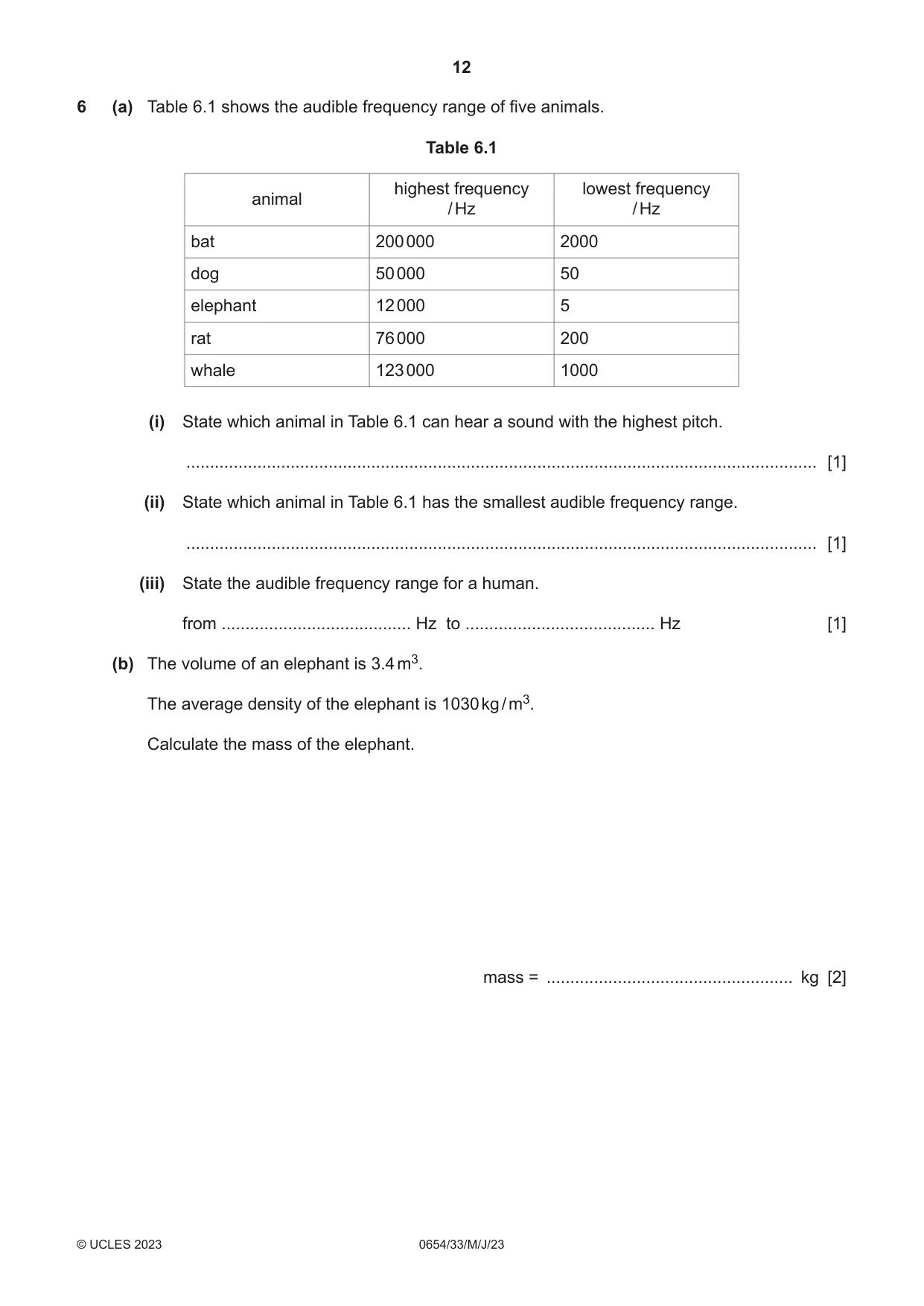
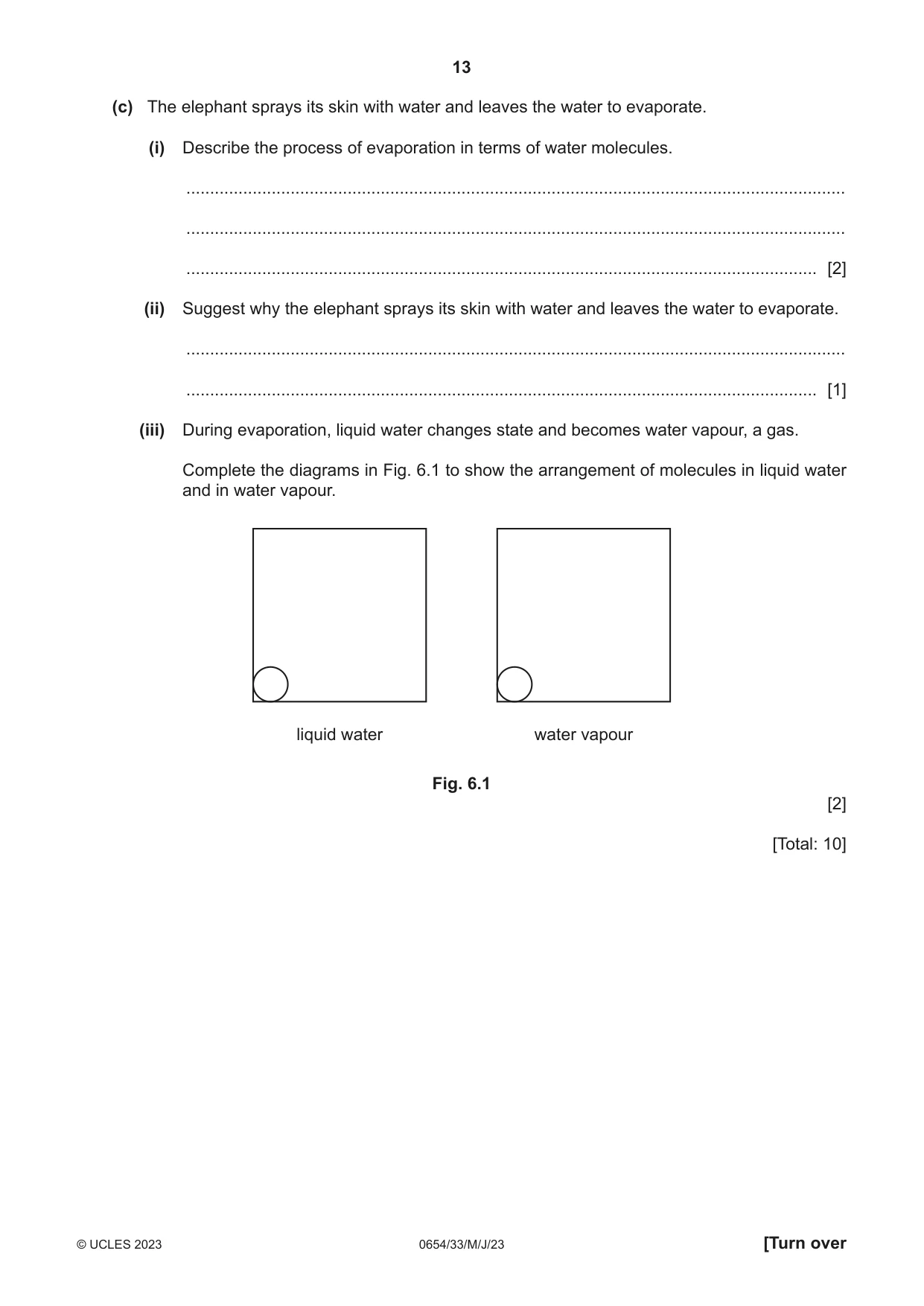
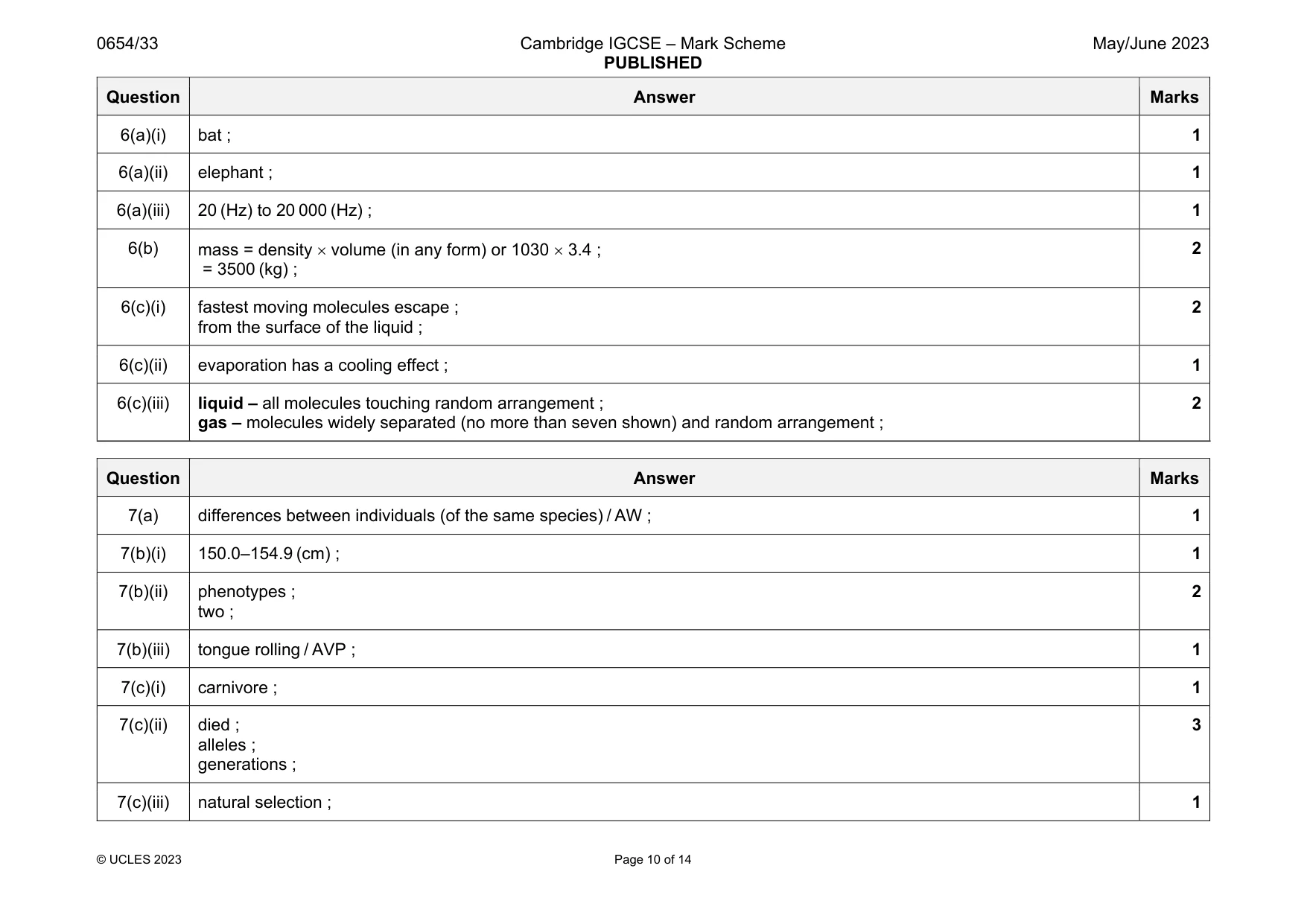
6 (a) Table 6.1 shows the audible frequency range of five animals. Table 6.1 highest frequency lowest frequency animal / Hz / Hz bat 200 000 2000 dog 50 000 50 elephant 12 000 5 rat 76 000 200 whale 123 000 1000 (i) State which animal in Table 6.1 can hear a sound with the highest pitch. ..................................................................................................................................... [1] (ii) State which animal in Table 6.1 has the smallest audible frequency range. ..................................................................................................................................... [1] (iii) State the audible frequency range for a human. from ........................................ Hz to ........................................ Hz [1] (b) The volume of an elephant is 3.4 m3. The average density of the elephant is 1030 kg / m3. Calculate the mass of the elephant. mass = .................................................... kg [2] (c) The elephant sprays its skin with water and leaves the water to evaporate. (i) Describe the process of evaporation in terms of water molecules. ........................................................................................................................................... ........................................................................................................................................... ..................................................................................................................................... [2] (ii) Suggest why the elephant sprays its skin with water and leaves the water to evaporate. ........................................................................................................................................... ..................................................................................................................................... [1] (iii) During evaporation, liquid water changes state and becomes water vapour, a gas. Complete the diagrams in Fig. 6.1 to show the arrangement of molecules in liquid water and in water vapour. liquid water water vapour Fig. 6.1 [2] [Total: 10]
Mark scheme: 6(a)(i) bat ; 1 6(a)(ii) elephant ; 1 6(a)(iii) 20 (Hz) to 20 000 (Hz) ; 1 6(b) mass = density volume (in any form) or 1030 3.4 ; = 3500 (kg) ; 2 6(c)(i) fastest moving molecules escape ; from the surface of the liquid ; 2 6(c)(ii) evaporation has a cooling effect ; 1 6(c)(iii) liquid – all molecules touching random arrangement ; gas – molecules widely separated (no more than seven shown) and random arrangement ; 2
Q7 · A school investigates variation in one class
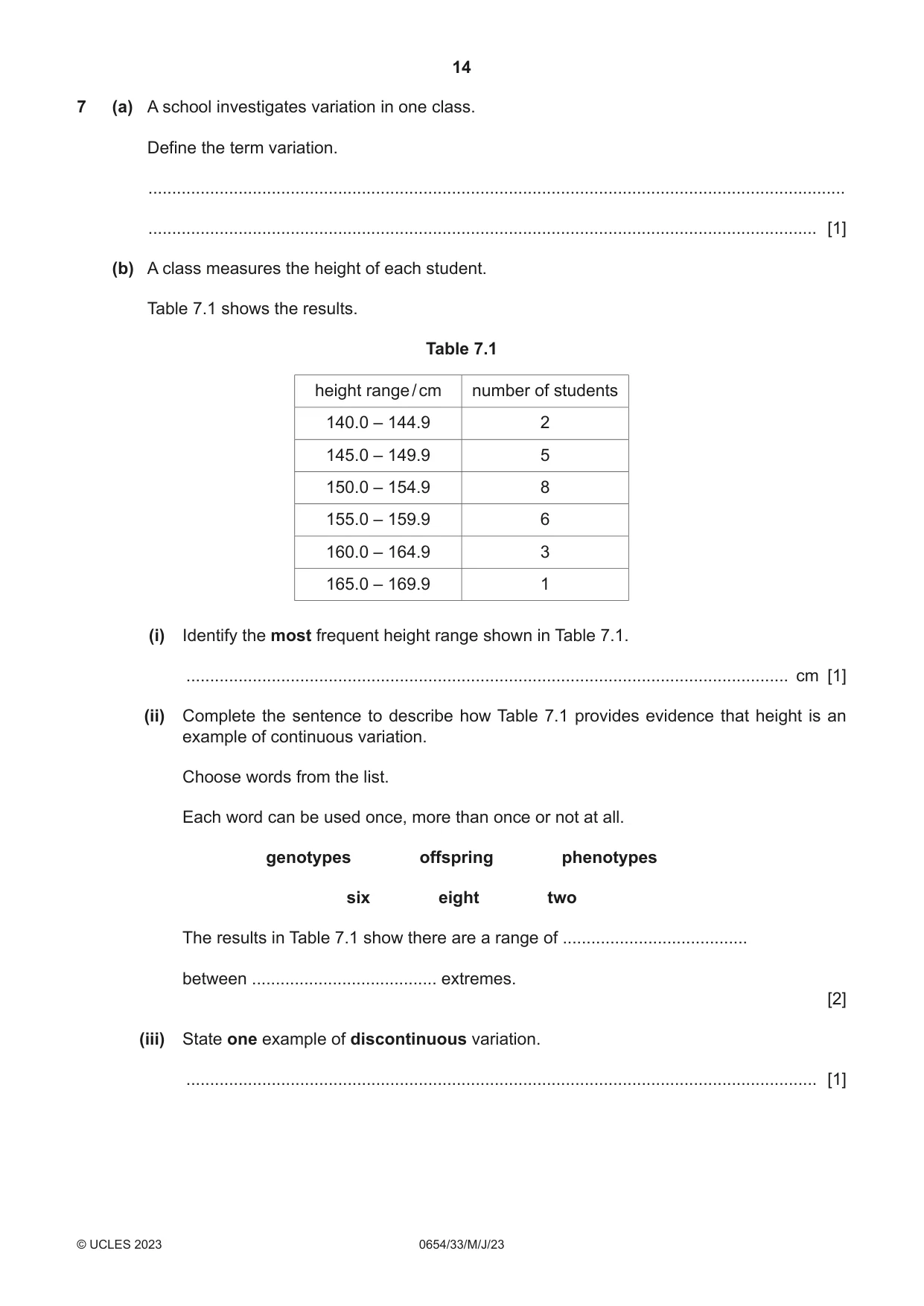
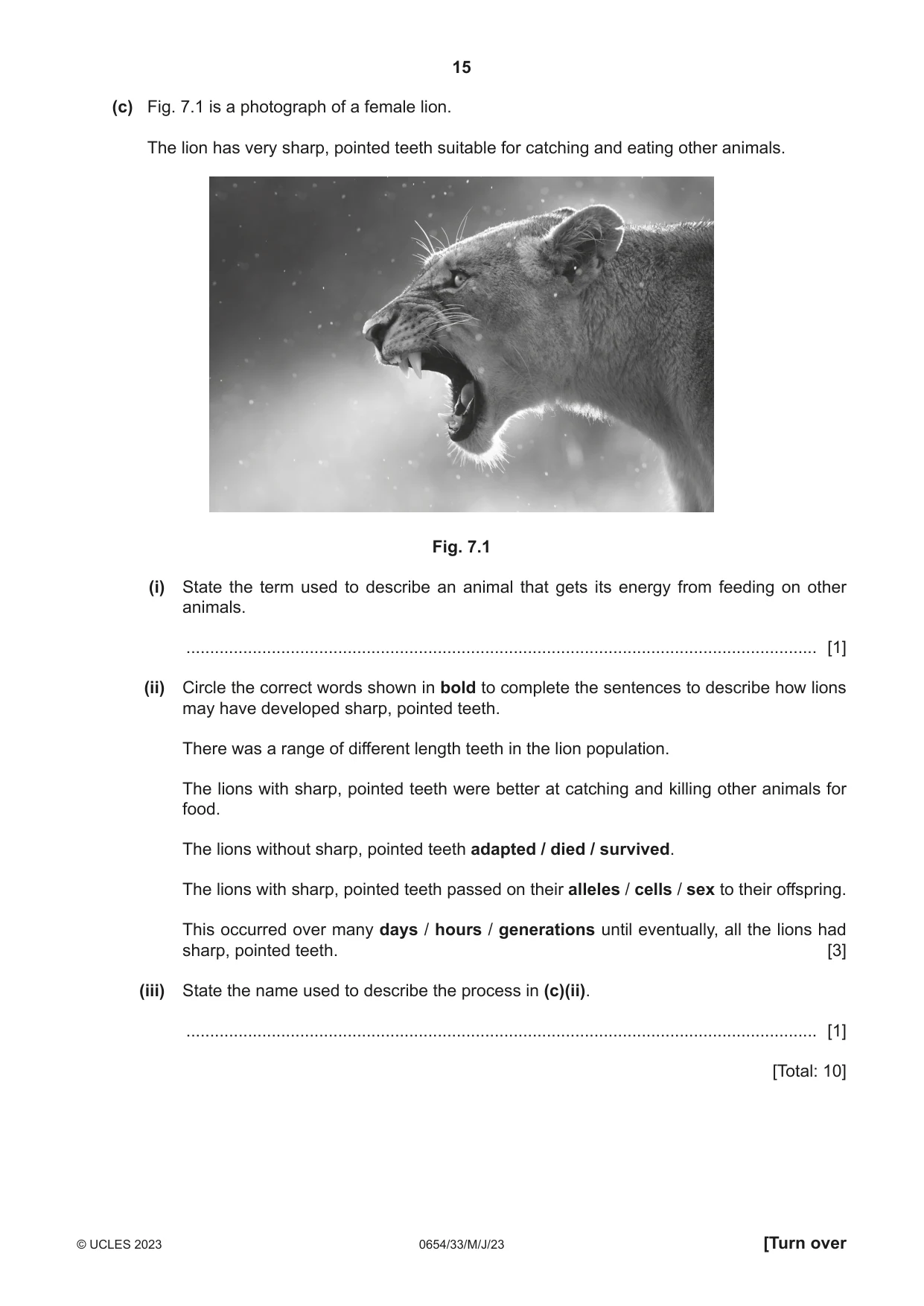
7 (a) A school investigates variation in one class. Define the term variation. ................................................................................................................................................... ............................................................................................................................................. [1] (b) A class measures the height of each student. Table 7.1 shows the results. Table 7.1 height range / cm number of students 140.0 – 144.9 2 145.0 – 149.9 5 150.0 – 154.9 8 155.0 – 159.9 6 160.0 – 164.9 3 165.0 – 169.9 1 (i) Identify the most frequent height range shown in Table 7.1. ............................................................................................................................... cm [1] (ii) Complete the sentence to describe how Table 7.1 provides evidence that height is an example of continuous variation. Choose words from the list. Each word can be used once, more than once or not at all. genotypes offspring phenotypes six eight two The results in Table 7.1 show there are a range of ....................................... between ....................................... extremes. [2] (iii) State one example of discontinuous variation. ..................................................................................................................................... [1] (c) Fig. 7.1 is a photograph of a female lion. The lion has very sharp, pointed teeth suitable for catching and eating other animals. Fig. 7.1 (i) State the term used to describe an animal that gets its energy from feeding on other animals. ..................................................................................................................................... [1] (ii) Circle the correct words shown in bold to complete the sentences to describe how lions may have developed sharp, pointed teeth. There was a range of different length teeth in the lion population. The lions with sharp, pointed teeth were better at catching and killing other animals for food. The lions without sharp, pointed teeth adapted / died / survived. The lions with sharp, pointed teeth passed on their alleles / cells / sex to their offspring. This occurred over many days / hours / generations until eventually, all the lions had sharp, pointed teeth. [3] (iii) State the name used to describe the process in (c)(ii). ..................................................................................................................................... [1] [Total: 10]
Mark scheme: 7(a) differences between individuals (of the same species) / AW ; 1 7(b)(i) 150.0–154.9 (cm) ; 1 7(b)(ii) phenotypes ; two ; 2 7(b)(iii) tongue rolling / AVP ; 1 7(c)(i) carnivore ; 1 7(c)(ii) died ; alleles ; generations ; 3 7(c)(iii) natural selection ; 1
Q8 · The separation of petroleum into useful fractions
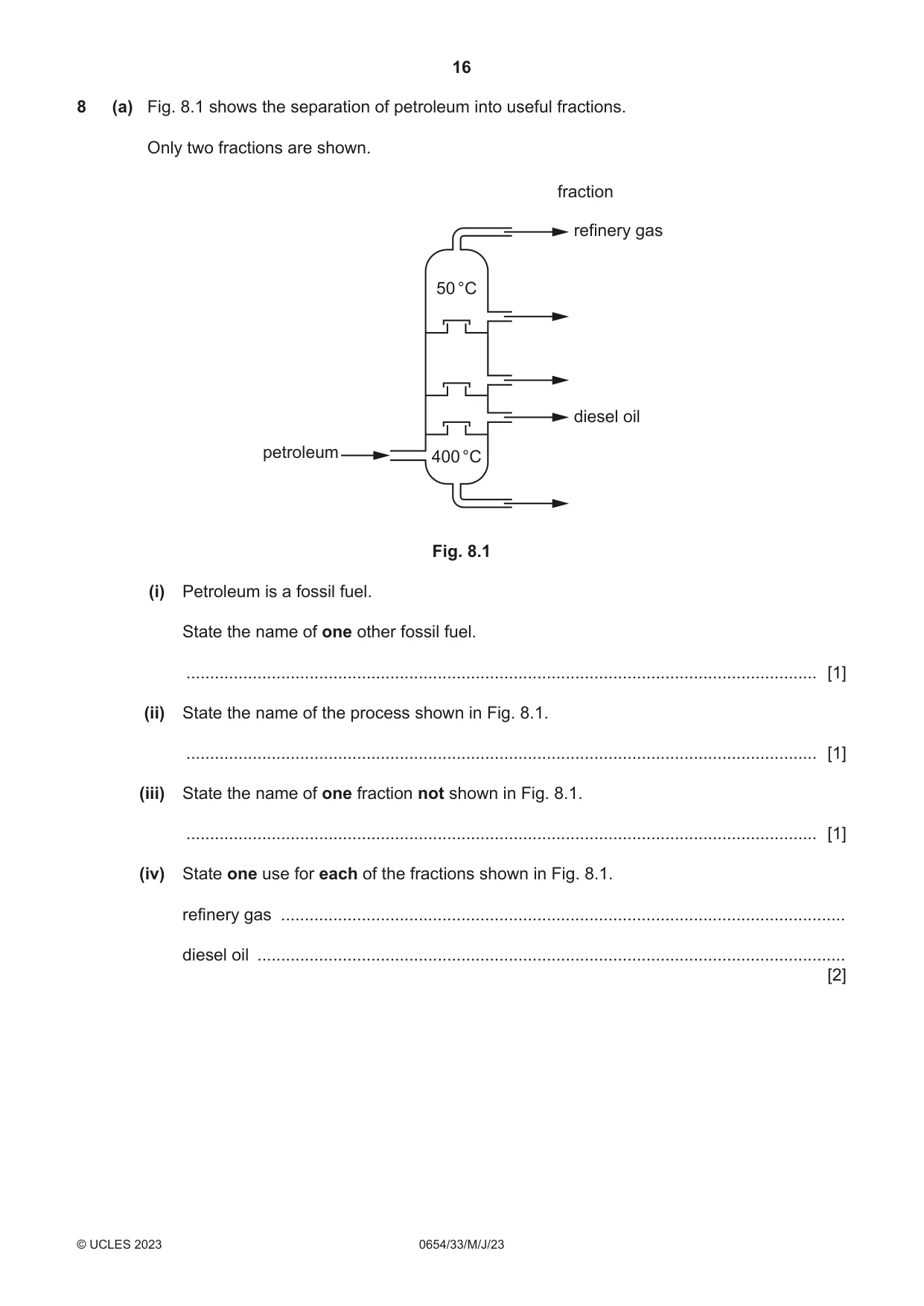
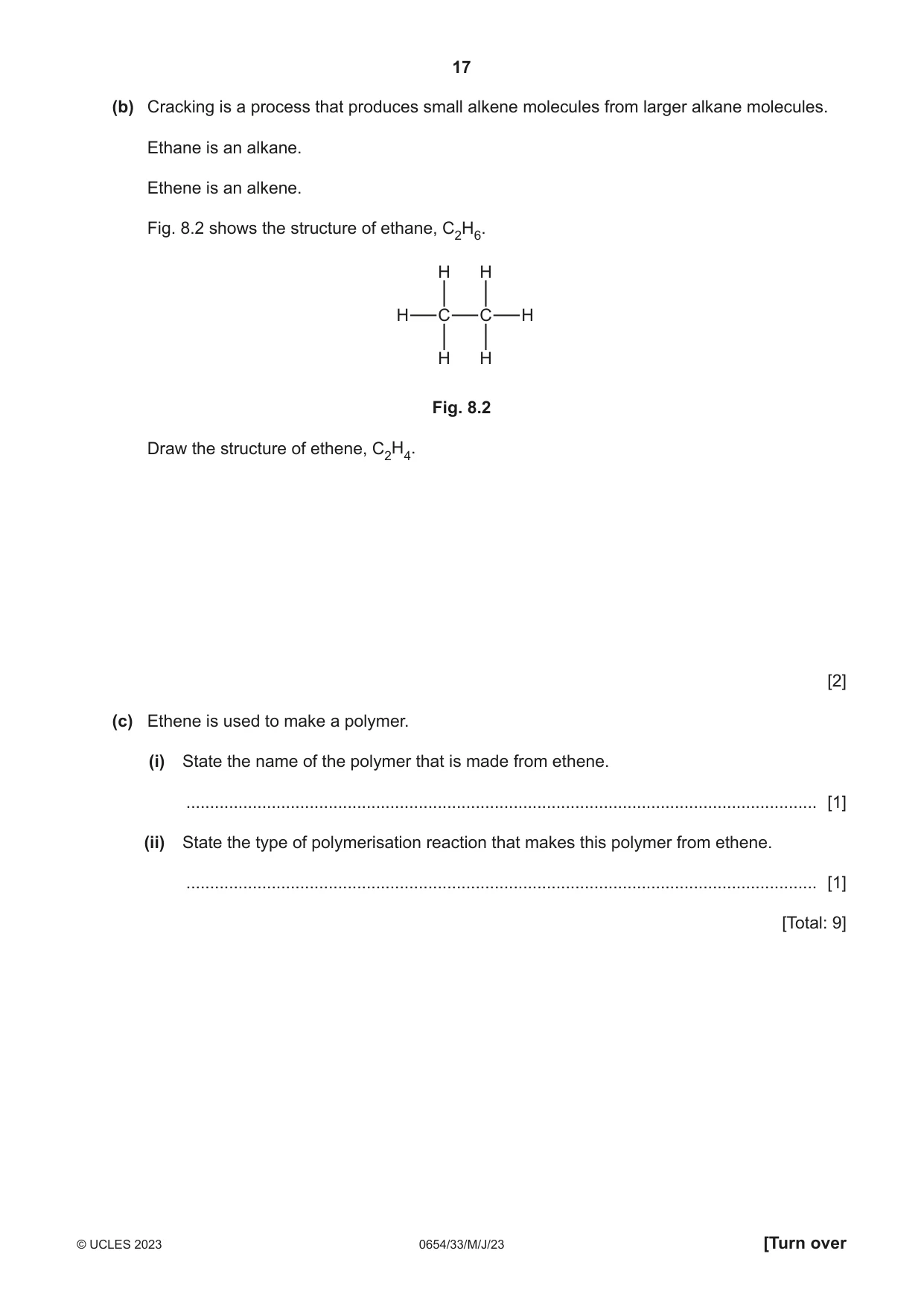
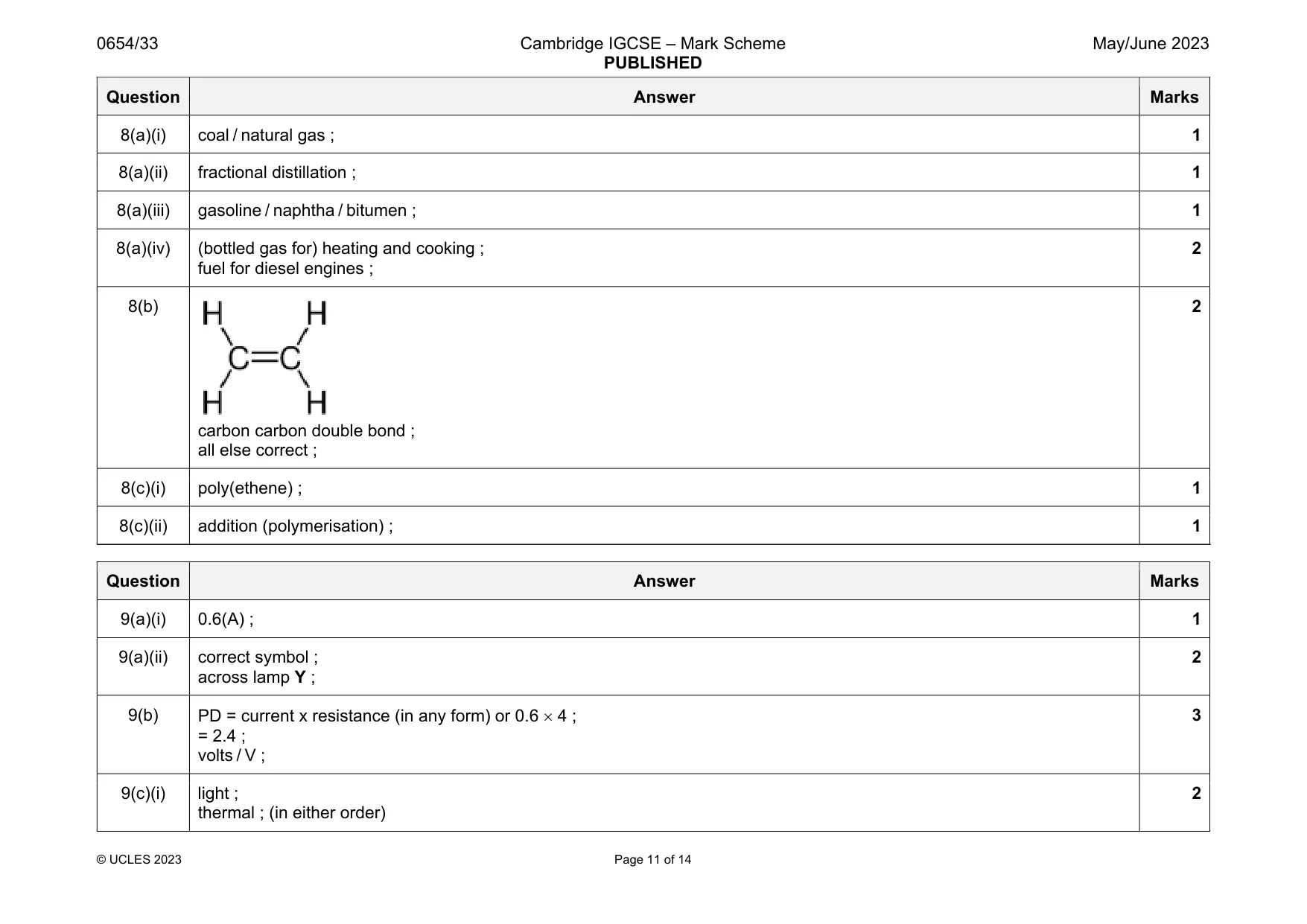
8 (a) Fig. 8.1 shows the separation of petroleum into useful fractions. Only two fractions are shown. fraction refinery gas 50 °C diesel oil petroleum 400 °C Fig. 8.1 (i) Petroleum is a fossil fuel. State the name of one other fossil fuel. ..................................................................................................................................... [1] (ii) State the name of the process shown in Fig. 8.1. ..................................................................................................................................... [1] (iii) State the name of one fraction not shown in Fig. 8.1. ..................................................................................................................................... [1] (iv) State one use for each of the fractions shown in Fig. 8.1. refinery gas ....................................................................................................................... diesel oil ............................................................................................................................ [2] (b) Cracking is a process that produces small alkene molecules from larger alkane molecules. Ethane is an alkane. Ethene is an alkene. Fig. 8.2 shows the structure of ethane, C2H6. H H H C C H H H Fig. 8.2 Draw the structure of ethene, C2H4. [2] (c) Ethene is used to make a polymer. (i) State the name of the polymer that is made from ethene. ..................................................................................................................................... [1] (ii) State the type of polymerisation reaction that makes this polymer from ethene. ..................................................................................................................................... [1] [Total: 9]
Mark scheme: 8(a)(i) coal / natural gas ; 1 8(a)(ii) fractional distillation ; 1 8(a)(iii) gasoline / naphtha / bitumen ; 1 8(a)(iv) (bottled gas for) heating and cooking ; fuel for diesel engines ; 2 8(b) carbon carbon double bond ; all else correct ; 2 8(c)(i) poly(ethene) ; 1 8(c)(ii) addition (polymerisation) ; 1
Question 9
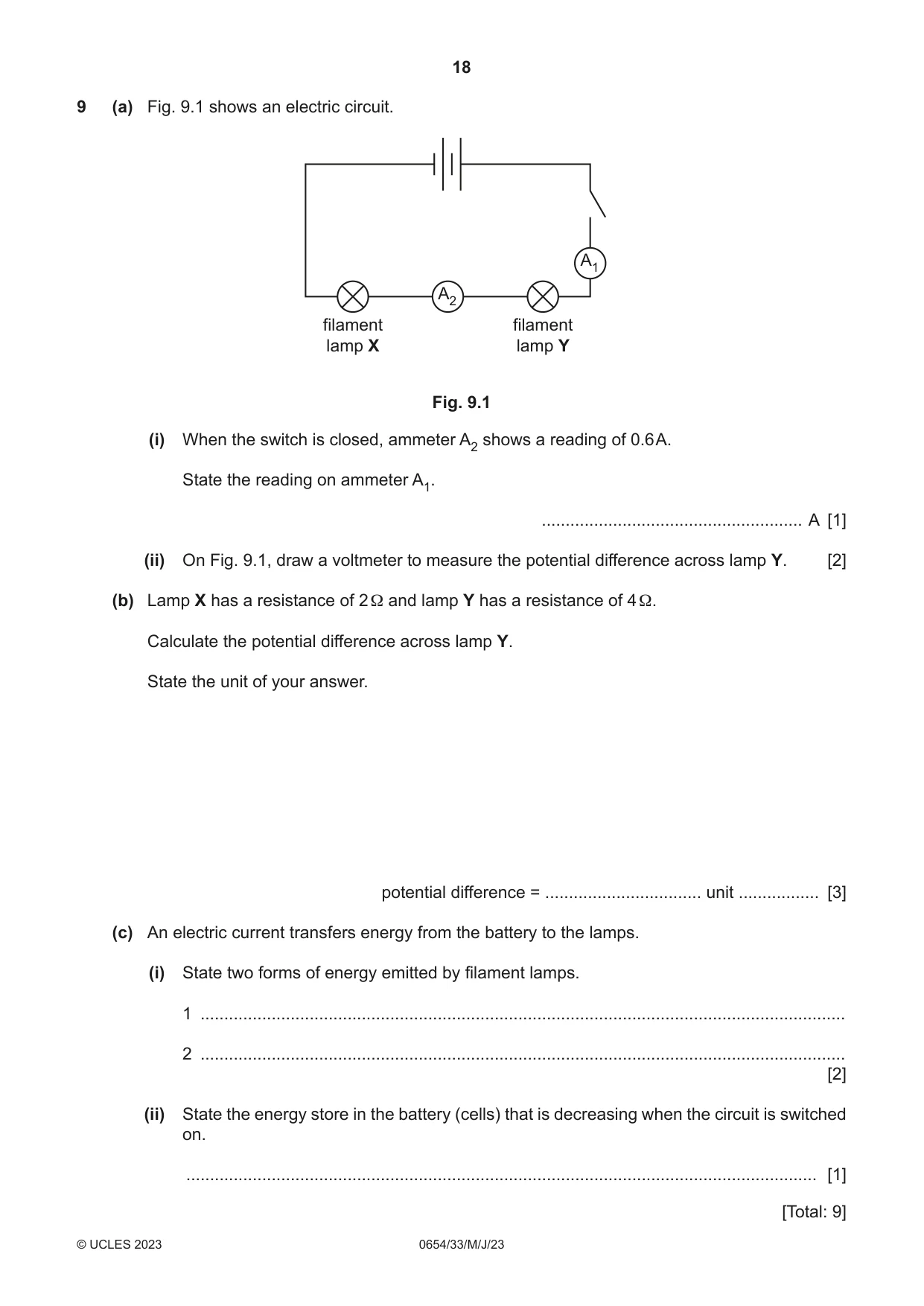
9 (a) Fig. 9.1 shows an electric circuit. A1 A2 filament filament lamp X lamp Y Fig. 9.1 (i) When the switch is closed, ammeter A2 shows a reading of 0.6 A. State the reading on ammeter A1. ....................................................... A [1] (ii) On Fig. 9.1, draw a voltmeter to measure the potential difference across lamp Y. [2] (b) Lamp X has a resistance of 2 Ω and lamp Y has a resistance of 4 Ω. Calculate the potential difference across lamp Y. State the unit of your answer. potential difference = ................................. unit ................. [3] (c) An electric current transfers energy from the battery to the lamps. (i) State two forms of energy emitted by filament lamps. 1 ........................................................................................................................................ 2 ........................................................................................................................................ [2] (ii) State the energy store in the battery (cells) that is decreasing when the circuit is switched on. ..................................................................................................................................... [1] [Total: 9]
Mark scheme: 9(a)(i) 0.6(A) ; 1 9(a)(ii) correct symbol ; across lamp Y ; 2 9(b) PD = current x resistance (in any form) or 0.6 4 ; = 2.4 ; volts / V ; 3 9(c)(i) light ; thermal ; (in either order) 2 Question Answer Marks 9(c)(ii) chemical (potential) ; 1
Q10 · A diagram representing the concentration of oxygen molecules outside and inside a cell
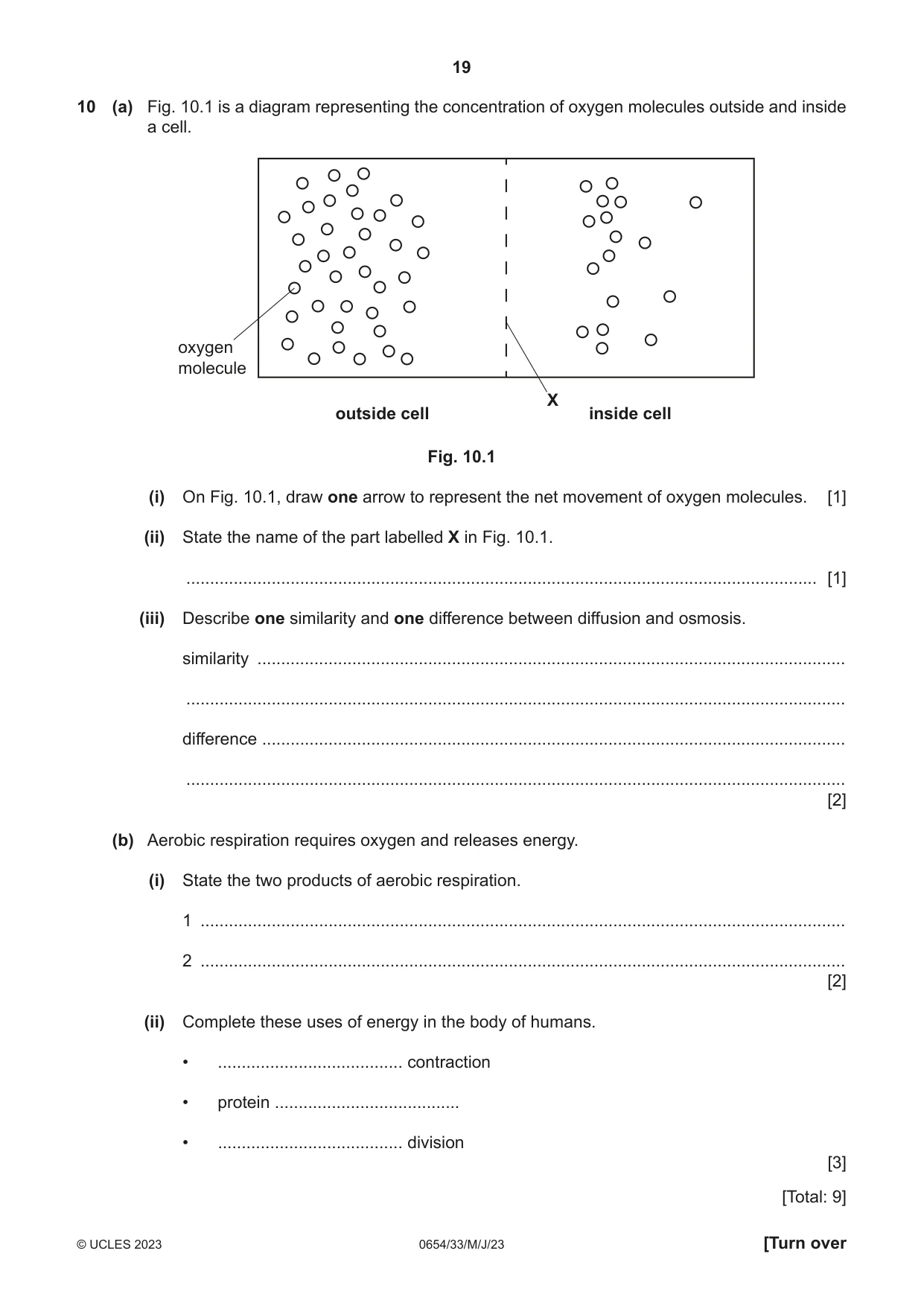
10 (a) Fig. 10.1 is a diagram representing the concentration of oxygen molecules outside and inside a cell. oxygen molecule X outside cell inside cell Fig. 10.1 (i) On Fig. 10.1, draw one arrow to represent the net movement of oxygen molecules. [1] (ii) State the name of the part labelled X in Fig. 10.1. ..................................................................................................................................... [1] (iii) Describe one similarity and one difference between diffusion and osmosis. similarity ............................................................................................................................ ........................................................................................................................................... difference ........................................................................................................................... ........................................................................................................................................... [2] (b) Aerobic respiration requires oxygen and releases energy. (i) State the two products of aerobic respiration. 1 ........................................................................................................................................ 2 ........................................................................................................................................ [2] (ii) Complete these uses of energy in the body of humans. • ....................................... contraction • protein ....................................... • ....................................... division [3] [Total: 9]
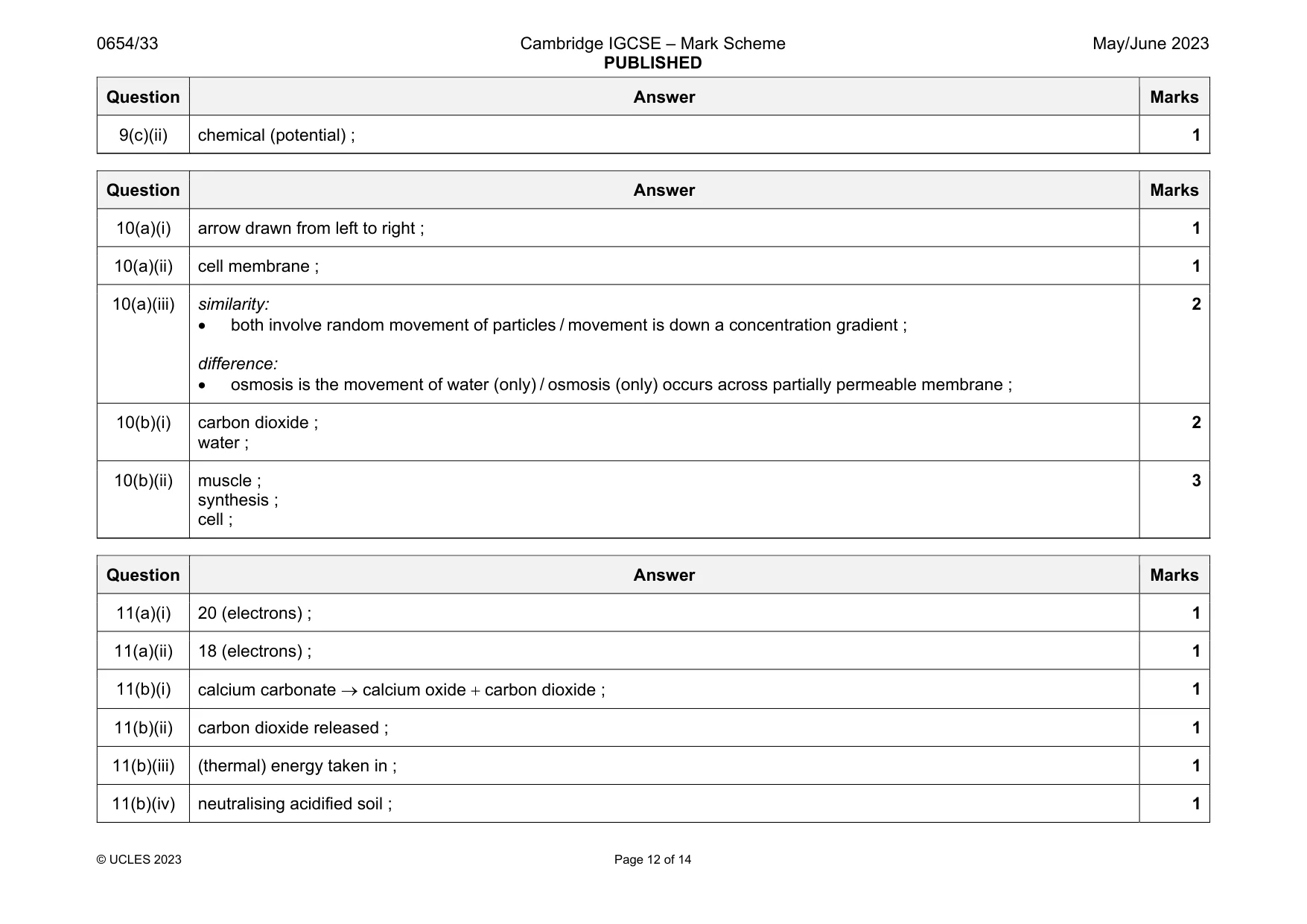
Mark scheme: 10(a)(i) arrow drawn from left to right ; 1 10(a)(ii) cell membrane ; 1 10(a)(iii) similarity: both involve random movement of particles / movement is down a concentration gradient ; difference: osmosis is the movement of water (only) / osmosis (only) occurs across partially permeable membrane ; 2 10(b)(i) carbon dioxide ; water ; 2 10(b)(ii) muscle ; synthesis ; cell ; 3
Q11 · An atom of calcium has 20 protons and 20 neutrons
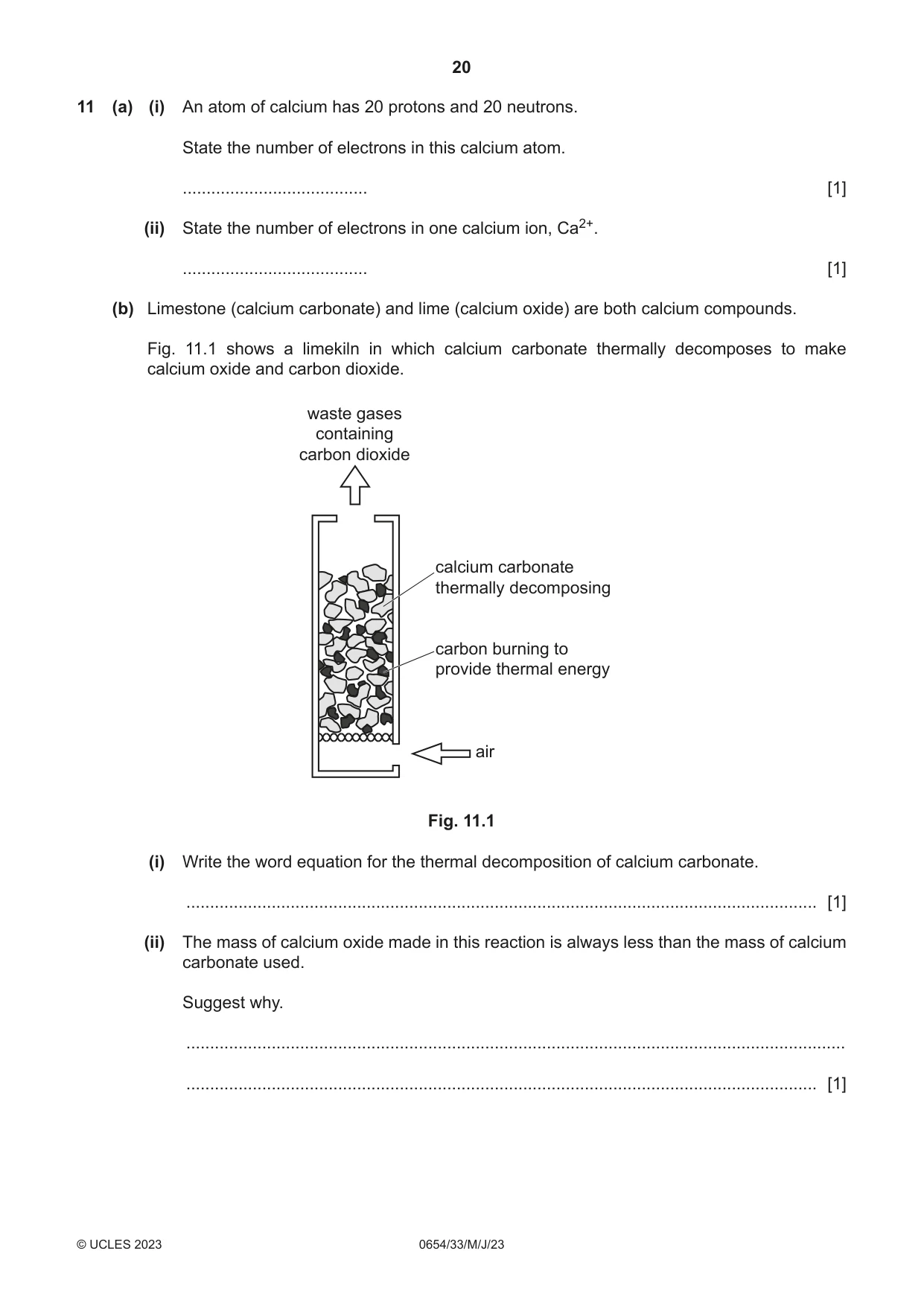
11 (a) (i) An atom of calcium has 20 protons and 20 neutrons. State the number of electrons in this calcium atom. ....................................... [1] (ii) State the number of electrons in one calcium ion, Ca2+. ....................................... [1] (b) Limestone (calcium carbonate) and lime (calcium oxide) are both calcium compounds. Fig. 11.1 shows a limekiln in which calcium carbonate thermally decomposes to make calcium oxide and carbon dioxide. waste gases containing carbon dioxide calcium carbonate thermally decomposing carbon burning to provide thermal energy air Fig. 11.1 (i) Write the word equation for the thermal decomposition of calcium carbonate. ..................................................................................................................................... [1] (ii) The mass of calcium oxide made in this reaction is always less than the mass of calcium carbonate used. Suggest why. ........................................................................................................................................... ..................................................................................................................................... [1] (iii) The decomposition of calcium carbonate to calcium oxide is an endothermic reaction. State the meaning of the term endothermic. ........................................................................................................................................... ..................................................................................................................................... [1] (iv) One use for limestone is in the production of lime. State one other use of limestone. ........................................................................................................................................... ..................................................................................................................................... [1] (v) Suggest why the calcium carbonate is broken into small pieces before being thermally decomposed. ........................................................................................................................................... ........................................................................................................................................... ..................................................................................................................................... [2] (c) Calcium carbonate has the formula CaCO3. (i) State the number of different elements shown in this formula. ..................................................................................................................................... [1] (ii) State the total number of atoms shown in this formula. ..................................................................................................................................... [1] [Total: 10]
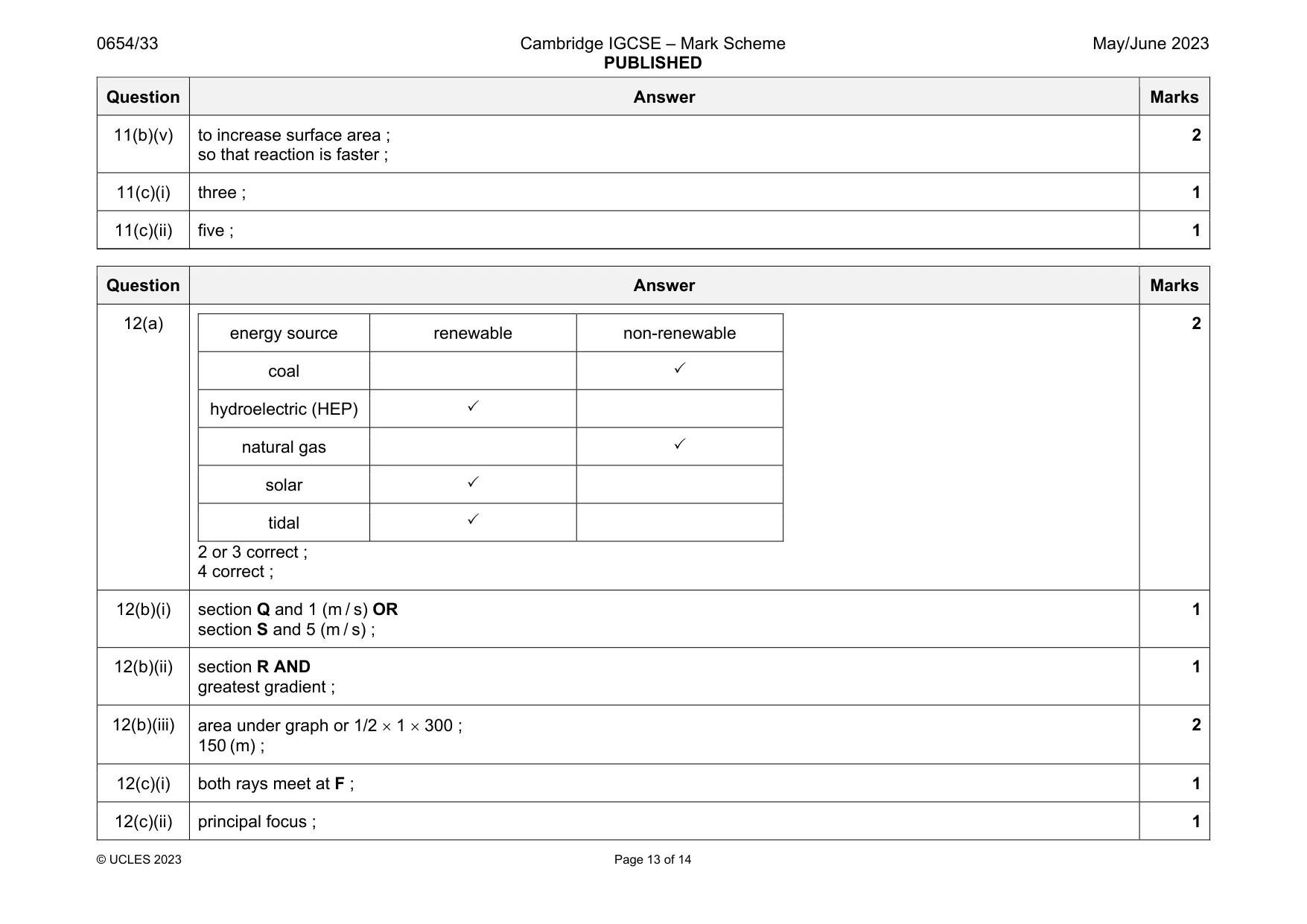
Mark scheme: 11(a)(i) 20 (electrons) ; 1 11(a)(ii) 18 (electrons) ; 1 11(b)(i) calcium carbonate calcium oxide carbon dioxide ; 1 11(b)(ii) carbon dioxide released ; 1 11(b)(iii) (thermal) energy taken in ; 1 11(b)(iv) neutralising acidified soil ; 1 Question Answer Marks 11(b)(v) to increase surface area ; so that reaction is faster ; 2 11(c)(i) three ; 1 11(c)(ii) five ; 1
Q12 · An oil tanker is carrying petroleum
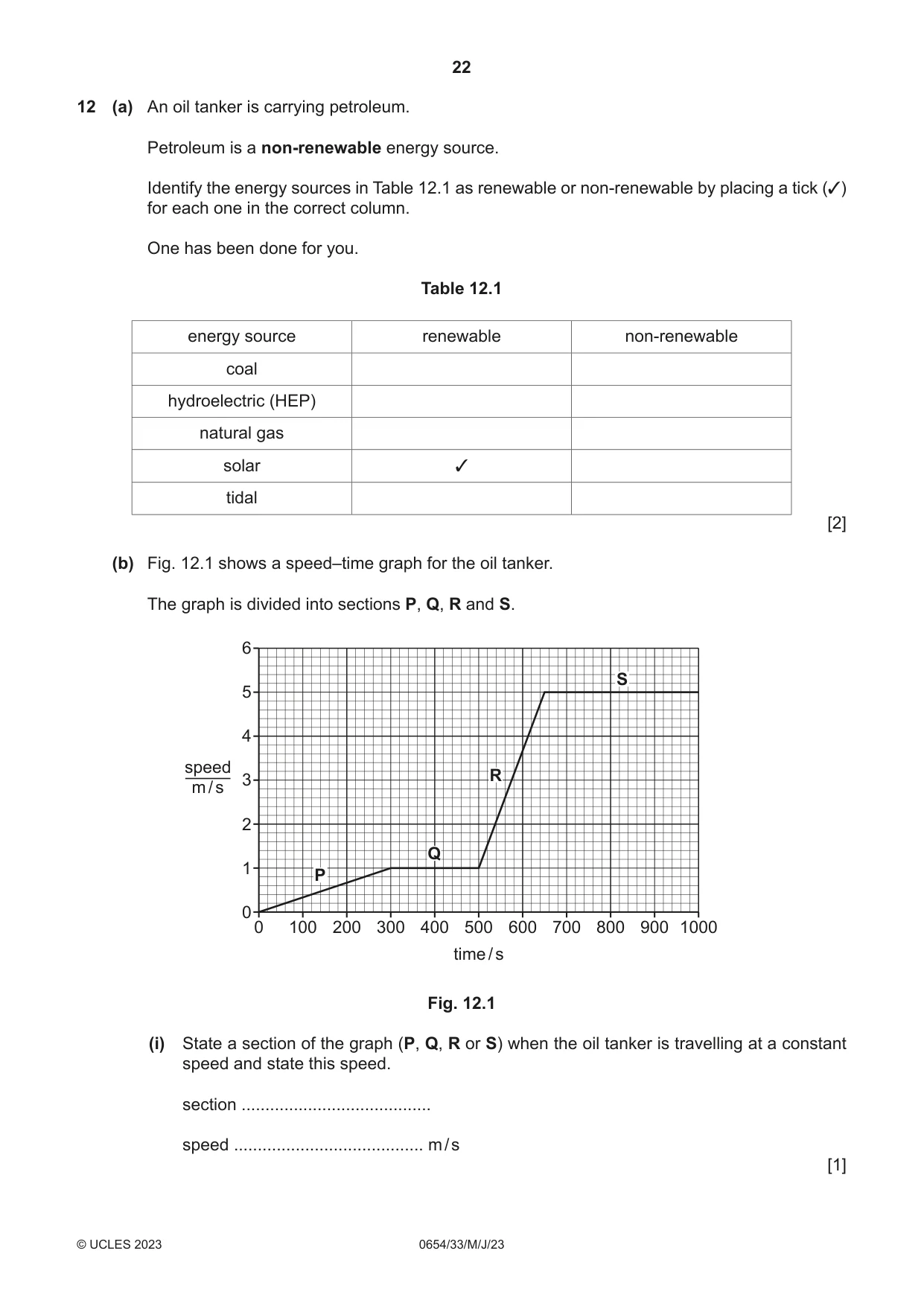
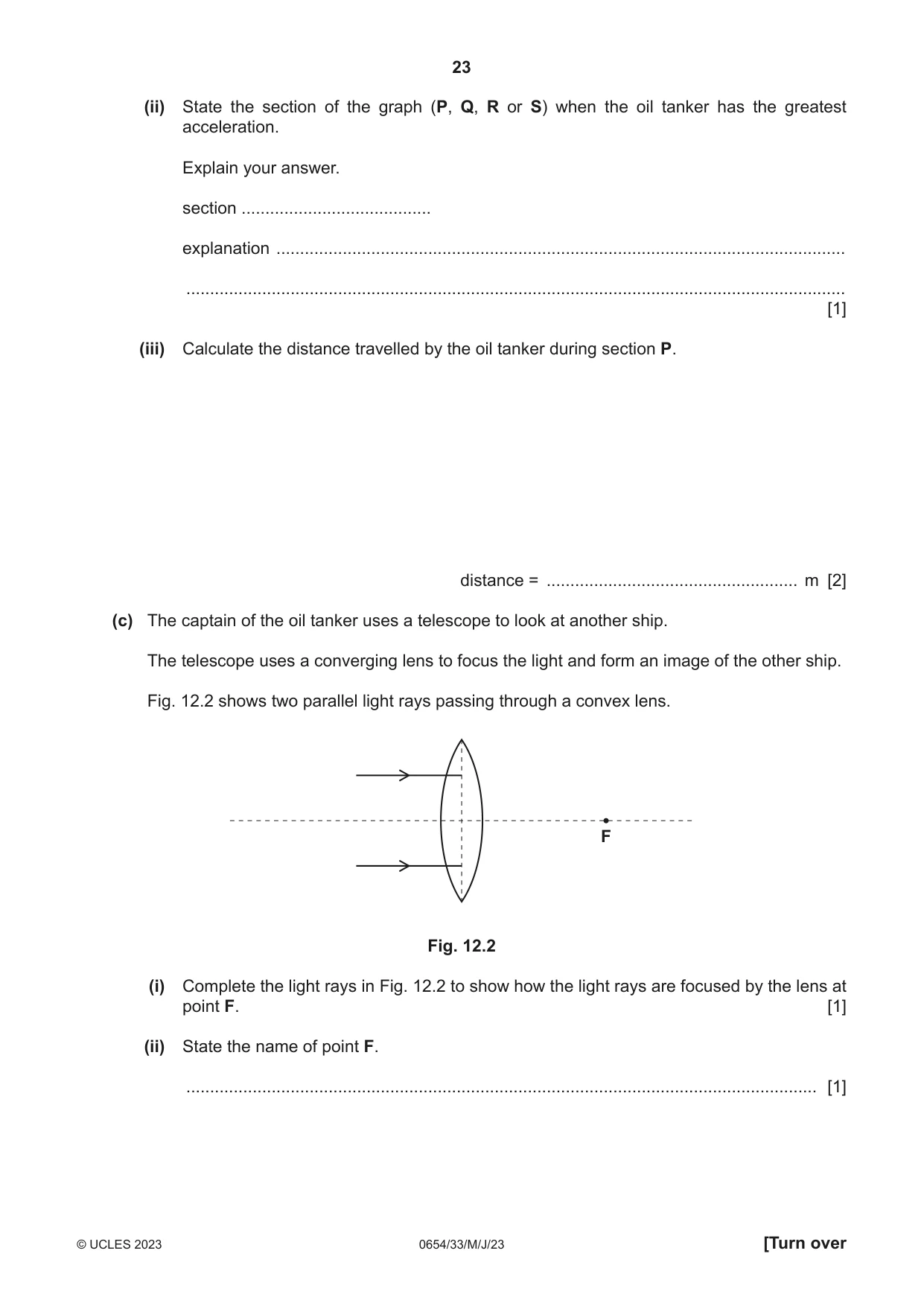
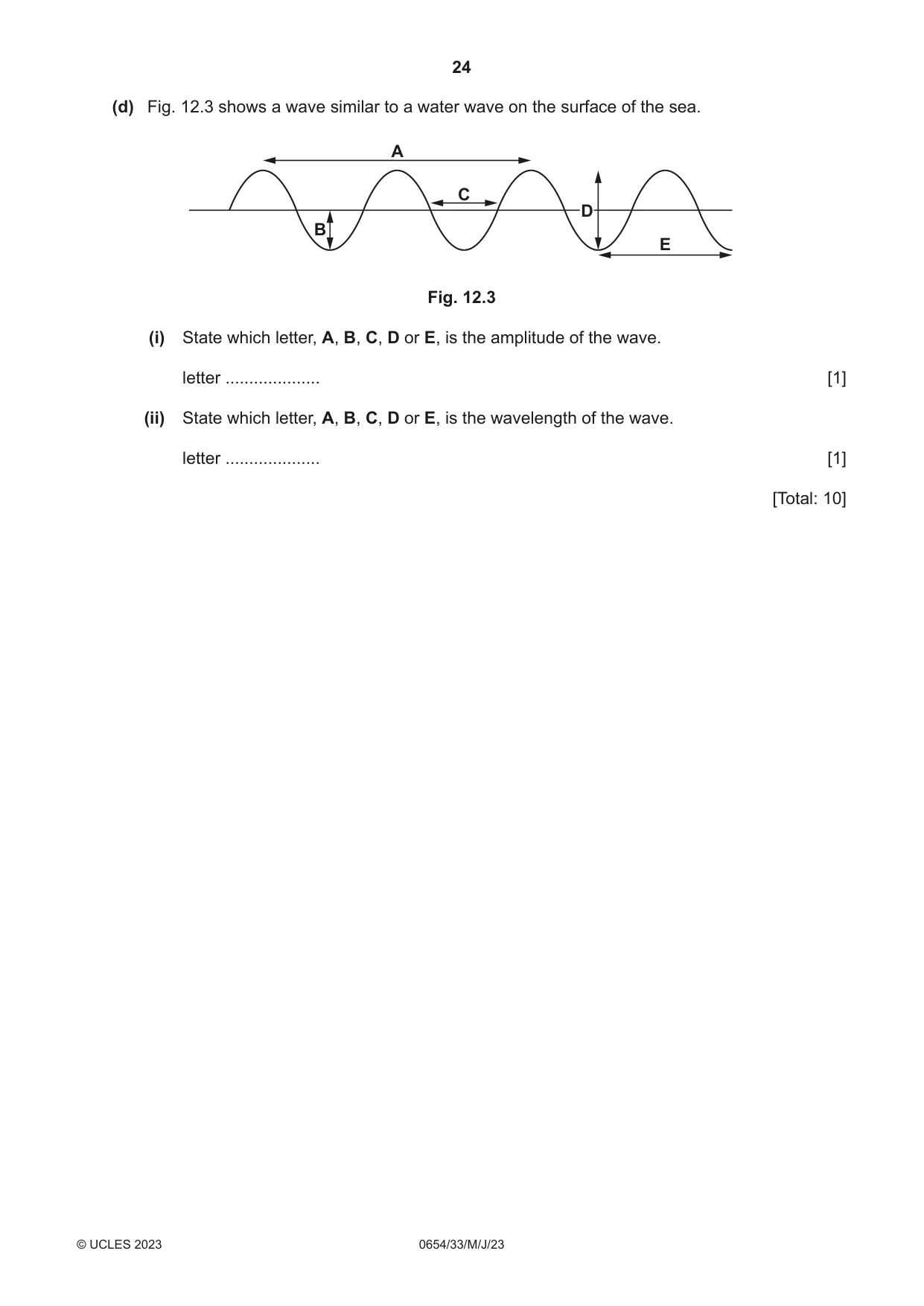
12 (a) An oil tanker is carrying petroleum. Petroleum is a non-renewable energy source. Identify the energy sources in Table 12.1 as renewable or non-renewable by placing a tick (3) for each one in the correct column. One has been done for you. Table 12.1 energy source renewable non-renewable coal hydroelectric (HEP) natural gas solar 3 tidal [2] (b) Fig. 12.1 shows a speed–time graph for the oil tanker. The graph is divided into sections P, Q, R and S. 6 S 5 4 speed 3 R m / s 2 Q 1 P 0 0 100 200 300 400 500 600 700 800 900 1000 time / s Fig. 12.1 (i) State a section of the graph (P, Q, R or S) when the oil tanker is travelling at a constant speed and state this speed. section ........................................ speed ........................................ m / s [1] (ii) State the section of the graph (P, Q, R or S) when the oil tanker has the greatest acceleration. Explain your answer. section ........................................ explanation ........................................................................................................................ ........................................................................................................................................... [1] (iii) Calculate the distance travelled by the oil tanker during section P. distance = ..................................................... m [2] (c) The captain of the oil tanker uses a telescope to look at another ship. The telescope uses a converging lens to focus the light and form an image of the other ship. Fig. 12.2 shows two parallel light rays passing through a convex lens. F Fig. 12.2 (i) Complete the light rays in Fig. 12.2 to show how the light rays are focused by the lens at point F. [1] (ii) State the name of point F. ..................................................................................................................................... [1] (d) Fig. 12.3 shows a wave similar to a water wave on the surface of the sea. A C D B E Fig. 12.3 (i) State which letter, A, B, C, D or E, is the amplitude of the wave. letter .................... [1] (ii) State which letter, A, B, C, D or E, is the wavelength of the wave. letter .................... [1] [Total: 10]
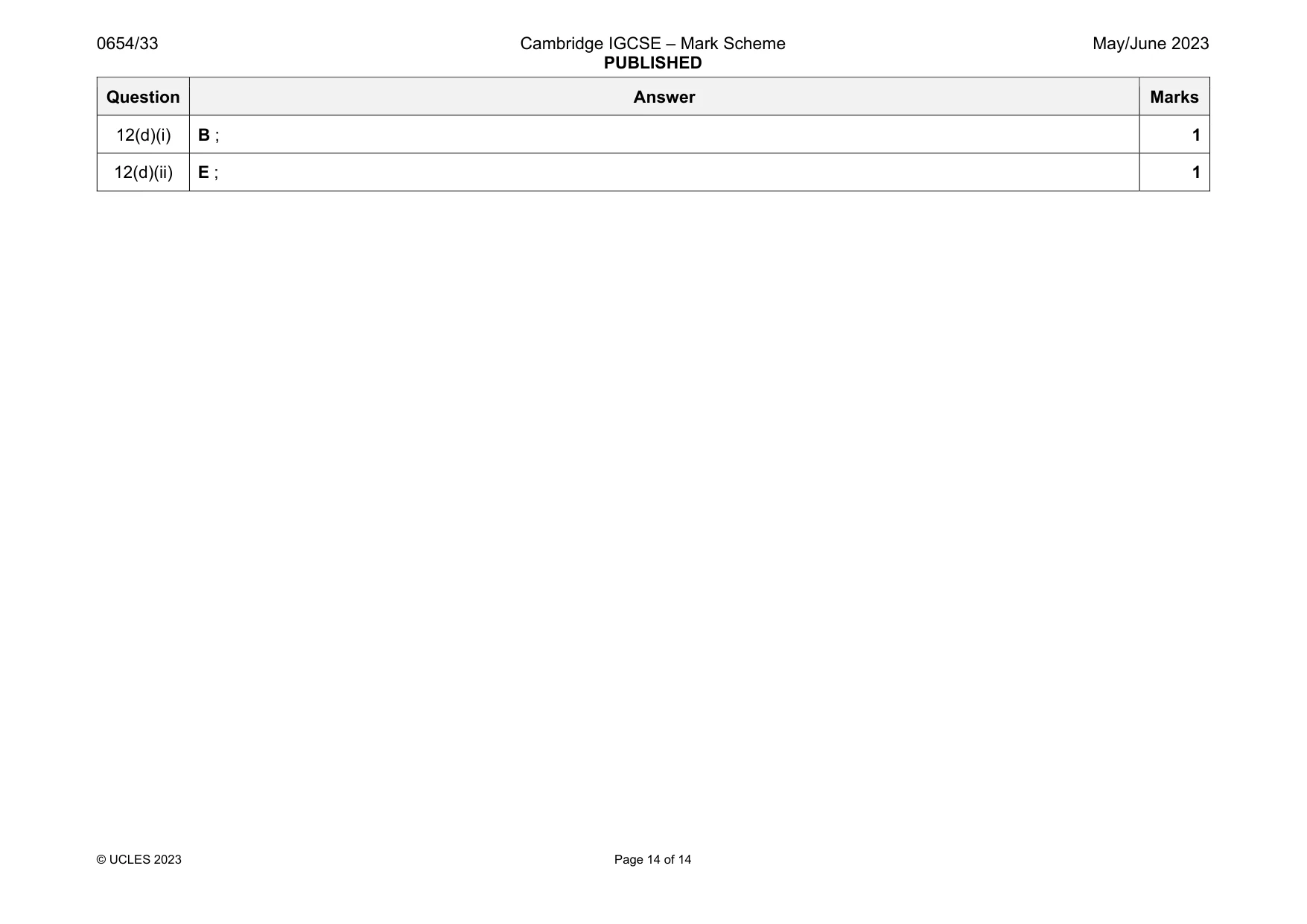
Mark scheme: 12(a) energy source renewable non-renewable coal hydroelectric (HEP) natural gas solar tidal 2 or 3 correct ; 4 correct ; 12(b)(i) section Q and 1 (m / s) OR section S and 5 (m / s) ; 1 12(b)(ii) section R AND greatest gradient ; 1 12(b)(iii) area under graph or 1/2 1 300 ; 150 (m) ; 2 12(c)(i) both rays meet at F ; 1 12(c)(ii) principal focus ; 1 Question Answer Marks 12(d)(i) B ; 1 12(d)(ii) E ; 1
What was in this paper
The subtopics covered by these 12 questions, and how many questions each got. Open one in a new tab to see every Cambridge question on it.
What you needed in this session
Cambridge’s own grade thresholds for 2023 May/June, Paper 3 · Variant 3. A higher threshold means an easier paper — the bar moves with how the cohort did.