Cambridge IGCSE Sciences - Co-ordinated (Double) 0654 — 2025 Feb/March Paper 3 · Variant 2
0654/32/F/M/25 · 12 questions · 120 marks · 120 min
The question paper and its mark scheme, free to read here and free to download. This is Cambridge’s own paper, exactly as it was sat.
Question paper28 pages


Mark scheme15 pages
Answers below. Sit the paper first if you are practising.
Questions as text
Q1 · A diagram of a plant cell
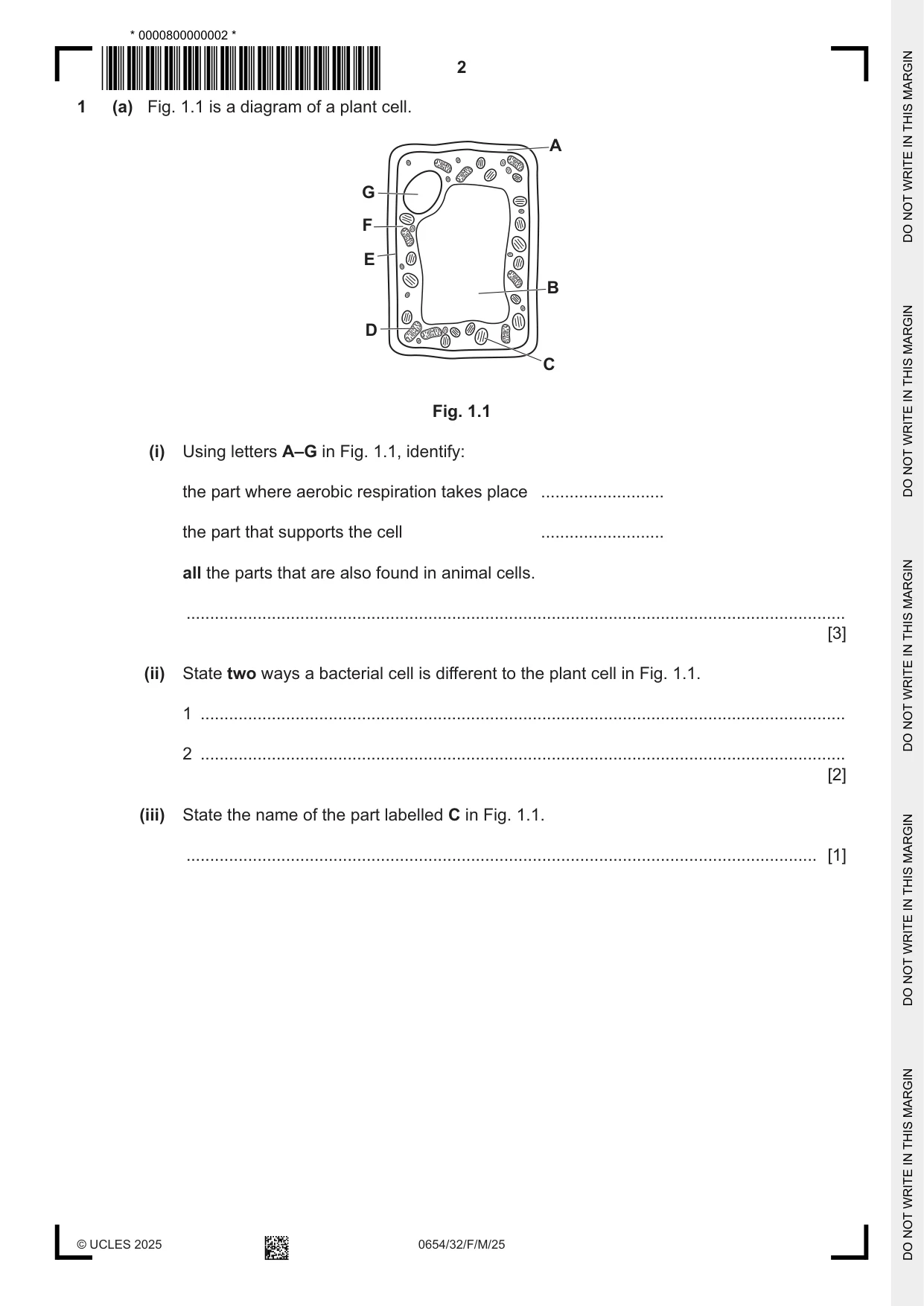
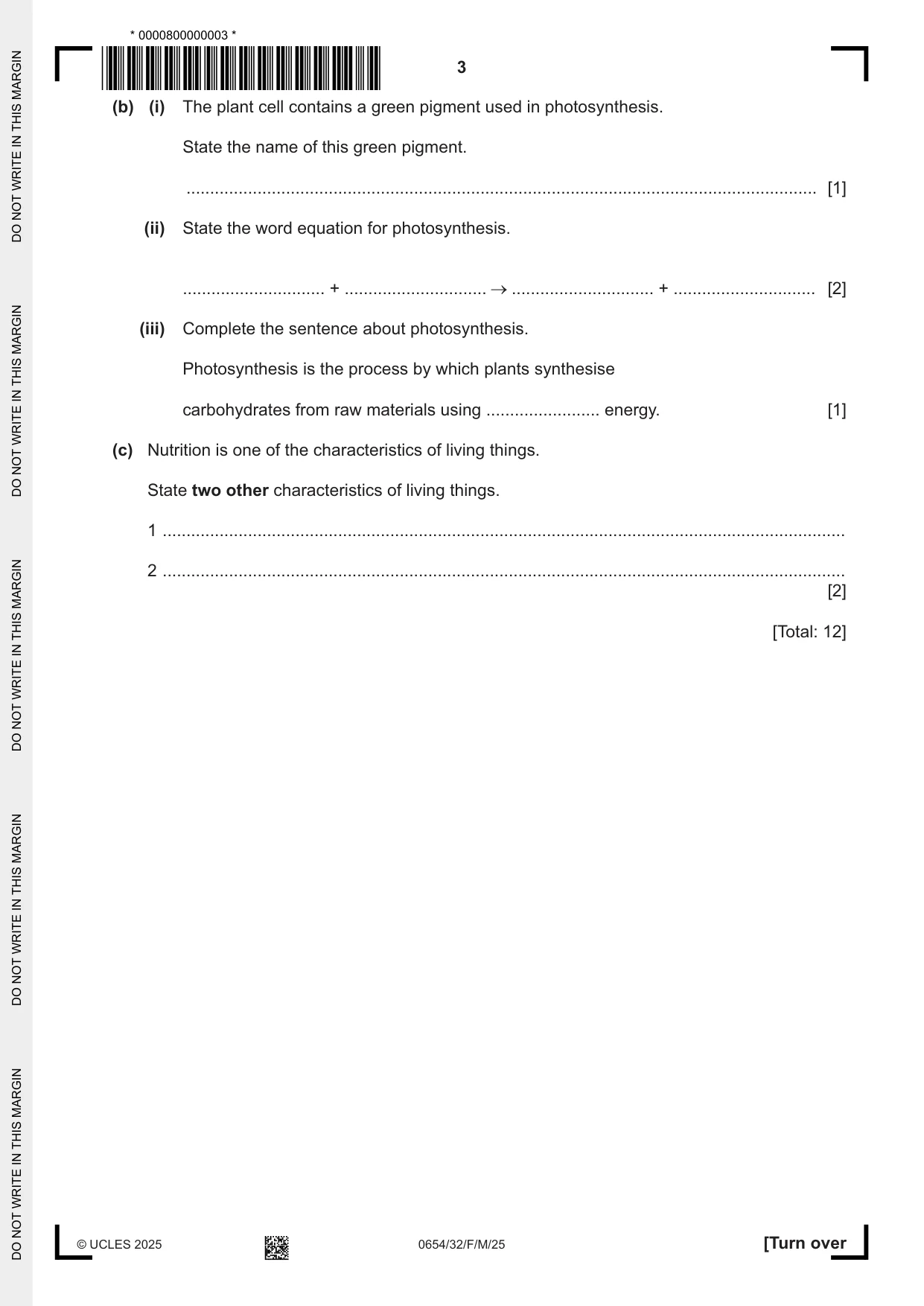
1 (a) Fig. 1.1 is a diagram of a plant cell. A G F E B D C Fig. 1.1 (i) Using letters A–G in Fig. 1.1, identify: the part where aerobic respiration takes place .......................... the part that supports the cell .......................... all the parts that are also found in animal cells. ........................................................................................................................................... [3] (ii) State two ways a bacterial cell is different to the plant cell in Fig. 1.1. 1 ........................................................................................................................................ 2 ........................................................................................................................................ [2] (iii) State the name of the part labelled C in Fig. 1.1. ..................................................................................................................................... [1] (b) (i) The plant cell contains a green pigment used in photosynthesis. State the name of this green pigment. ..................................................................................................................................... [1] (ii) State the word equation for photosynthesis. .............................. + .............................. .............................. + .............................. [2] (iii) Complete the sentence about photosynthesis. Photosynthesis is the process by which plants synthesise carbohydrates from raw materials using ........................ energy. [1] (c) Nutrition is one of the characteristics of living things. State two other characteristics of living things. 1 ................................................................................................................................................ 2 ................................................................................................................................................ [2] [Total: 12]
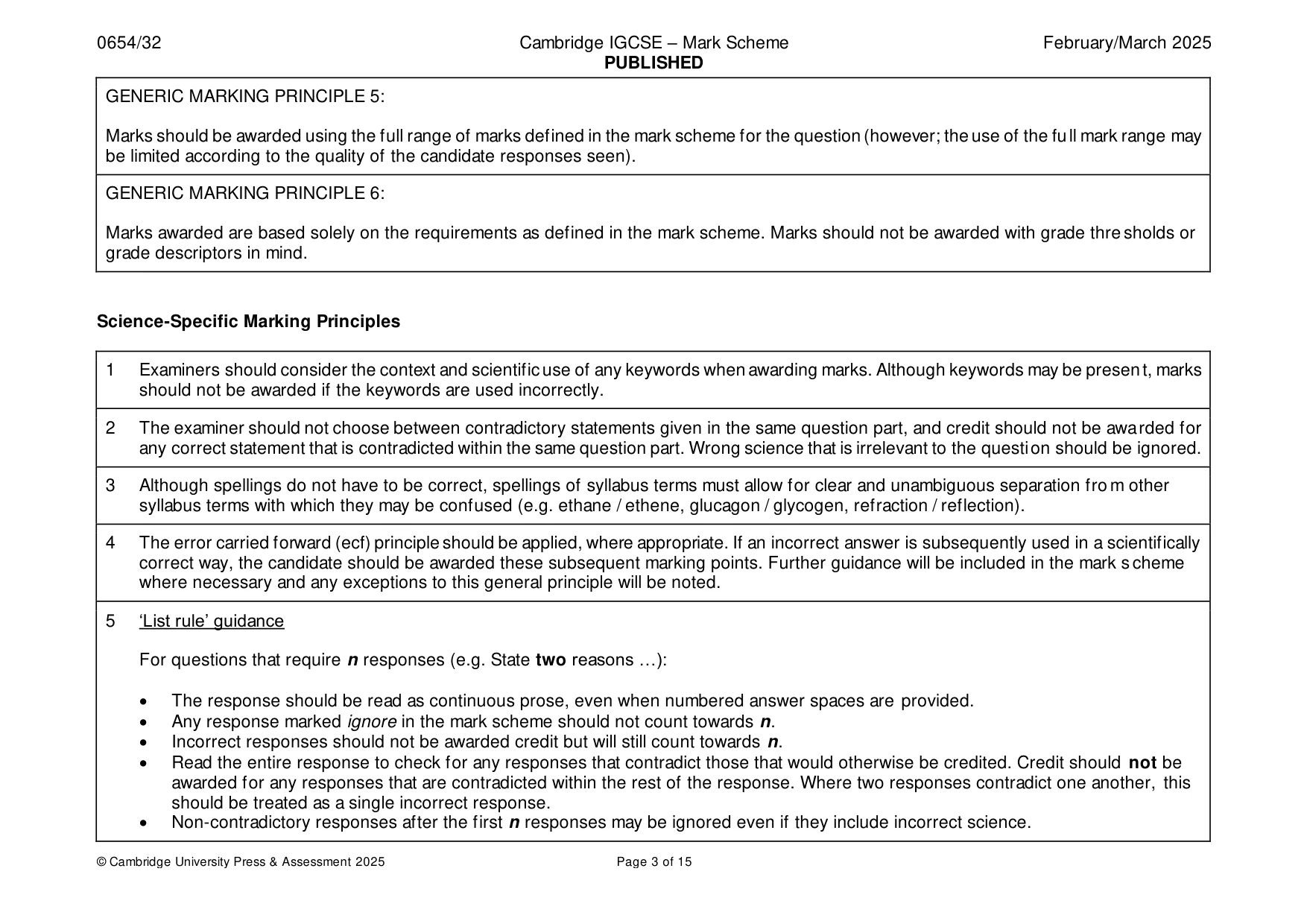
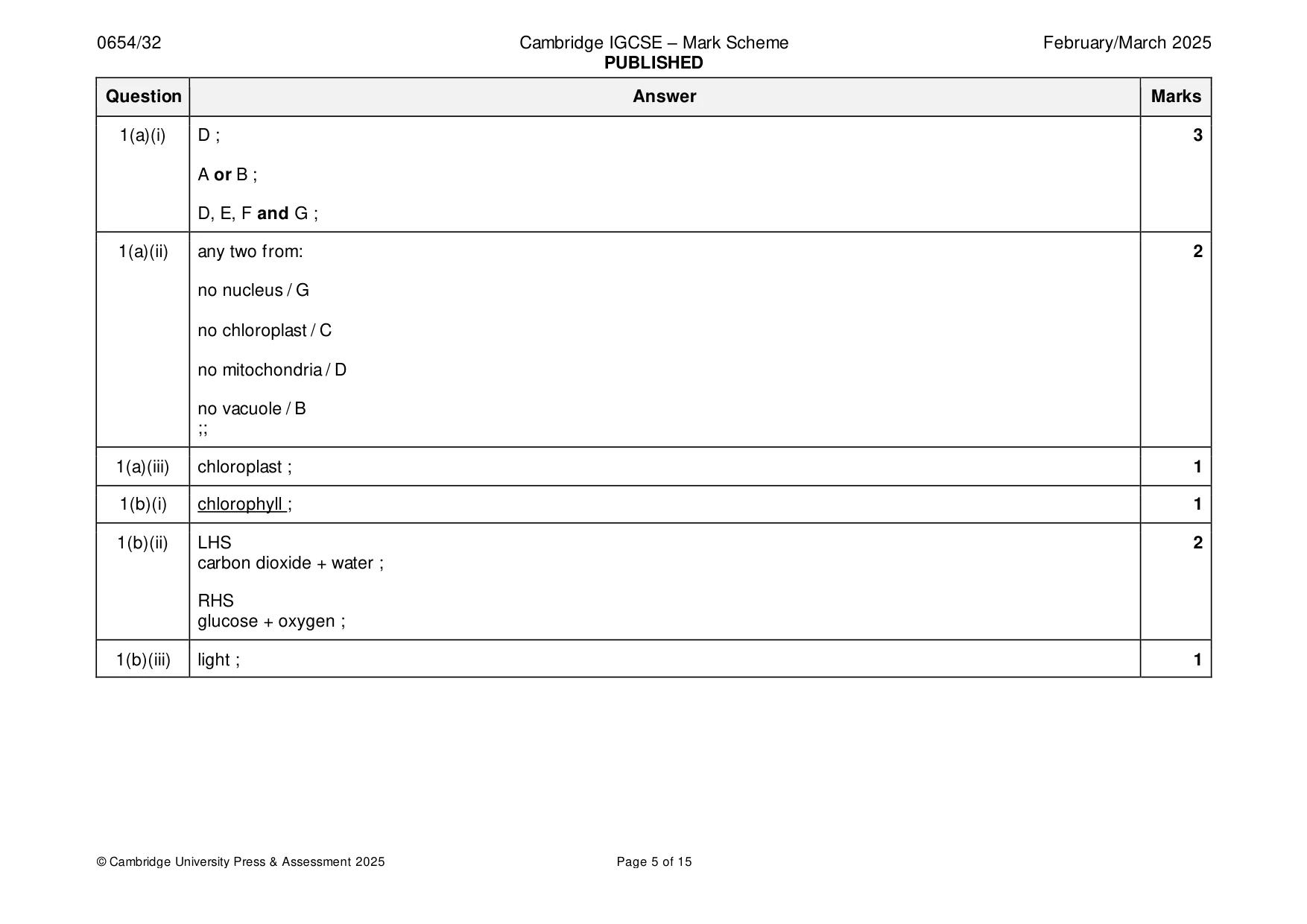
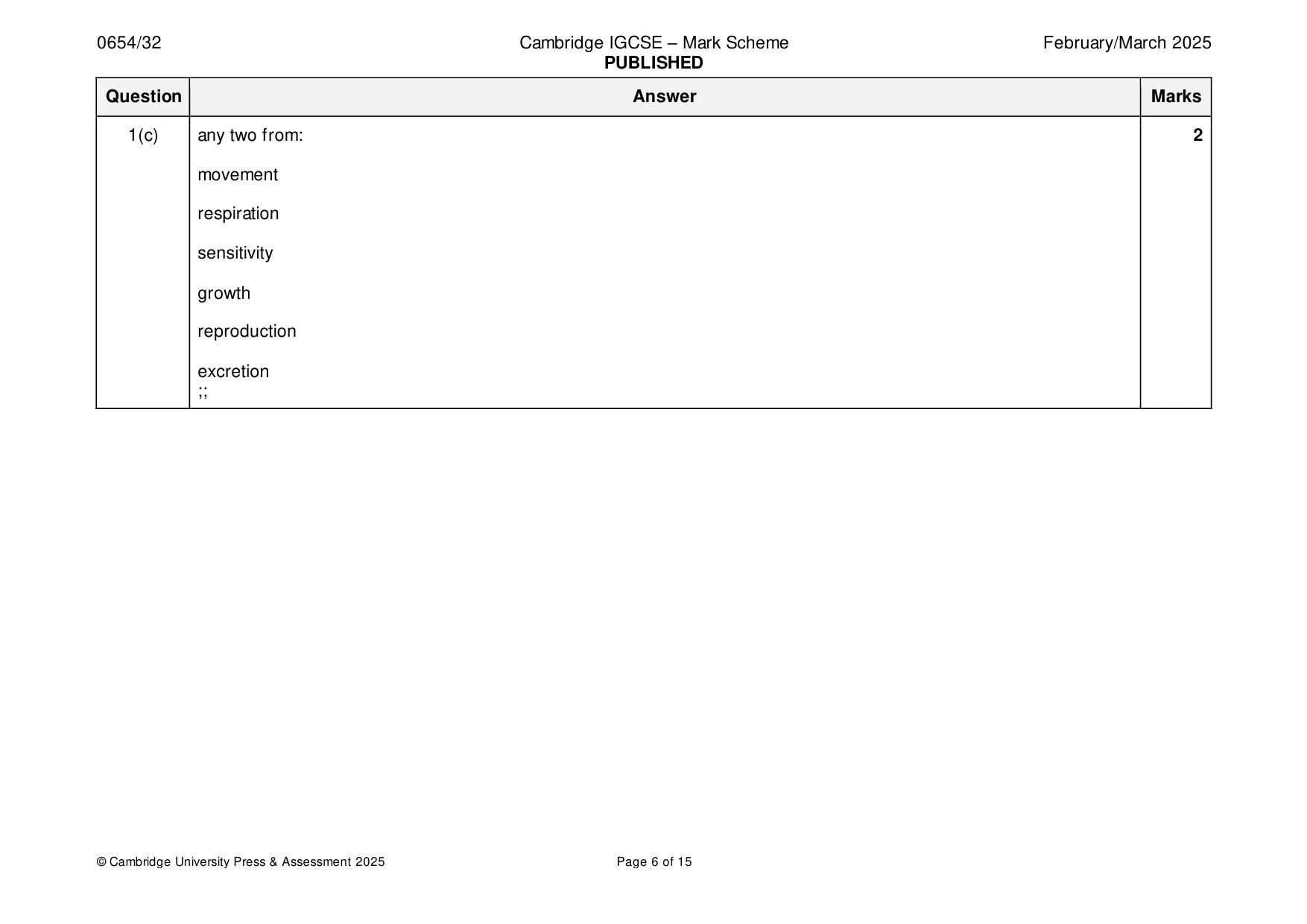
Mark scheme: Question Answer Marks 1(a)(i) D ; 3 A or B ; D, E, F and G ; 1(a)(ii) any two from: 2 no nucleus / G no chloroplast / C no mitochondria / D no vacuole / B ;; 1(a)(iii) chloroplast ; 1 1(b)(i) chlorophyll ; 1 1(b)(ii) LHS 2 carbon dioxide + water ; RHS glucose + oxygen ; 1(b)(iii) light ; 1 1(c) any two from: 2 movement respiration sensitivity growth reproduction excretion ;;
Q2 · The boxes on the left show different processes that occur in the human body
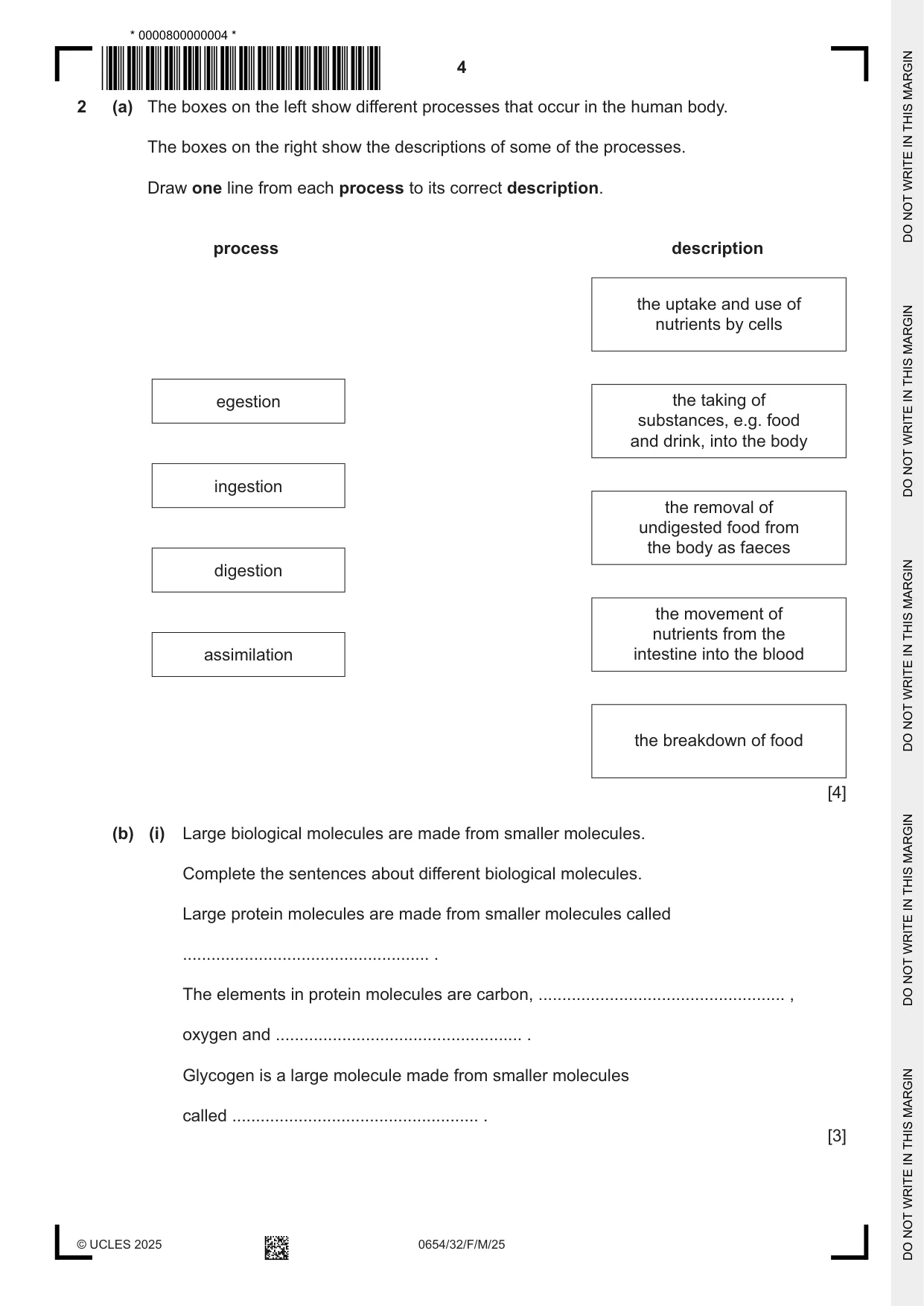
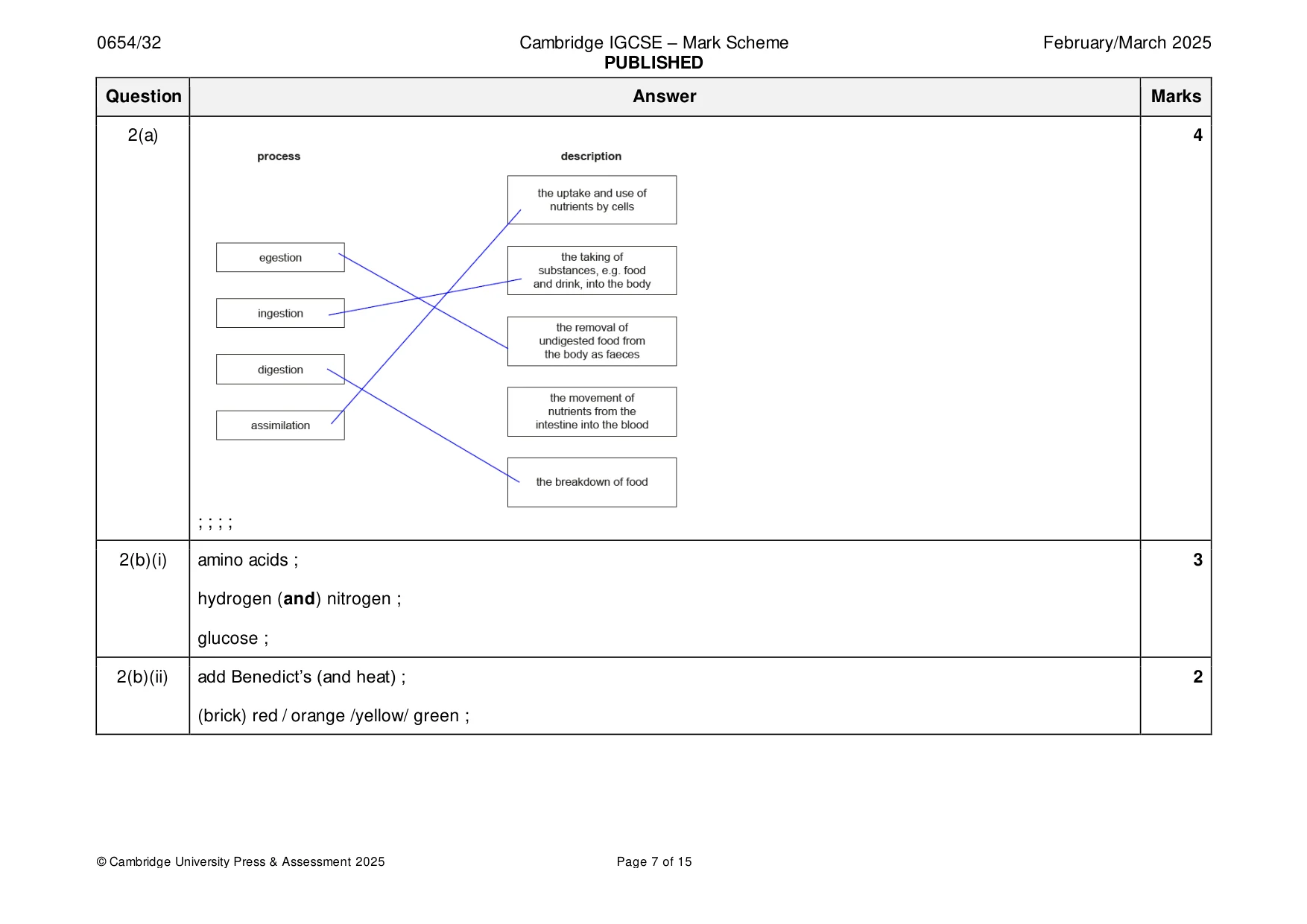
2 (a) The boxes on the left show different processes that occur in the human body. The boxes on the right show the descriptions of some of the processes. Draw one line from each process to its correct description. process description the uptake and use of nutrients by cells egestion the taking of substances, e.g. food and drink, into the body ingestion the removal of undigested food from the body as faeces digestion the movement of nutrients from the assimilation intestine into the blood the breakdown of food [4] (b) (i) Large biological molecules are made from smaller molecules. Complete the sentences about different biological molecules. Large protein molecules are made from smaller molecules called .................................................... . The elements in protein molecules are carbon, .................................................... , oxygen and .................................................... . Glycogen is a large molecule made from smaller molecules called .................................................... . [3] (ii) Reducing sugars are small biological molecules. State the name of the reagent used to test for reducing sugars. Give the observation for a positive result. reagent .............................................................................................................................. observation for a positive result ........................................................................................ ........................................................................................................................................... [2] [Total: 9]
Mark scheme: 2(a) 4 ; ; ; ; 2(b)(i) amino acids ; 3 hydrogen (and) nitrogen ; glucose ; 2(b)(ii) add Benedict’s (and heat) ; 2 (brick) red / orange /yellow/ green ;
Q3 · Complete the sentences using words from the list
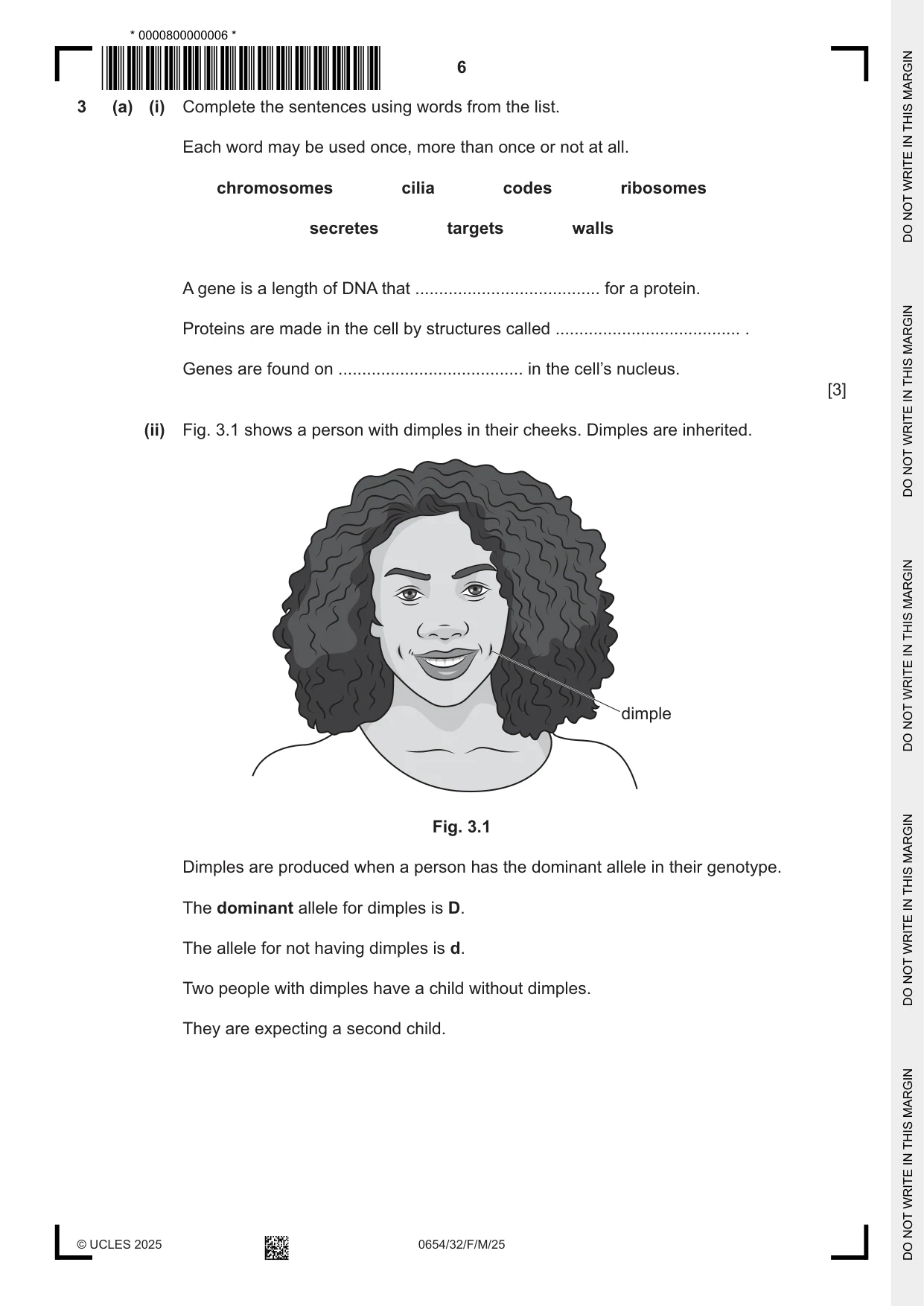
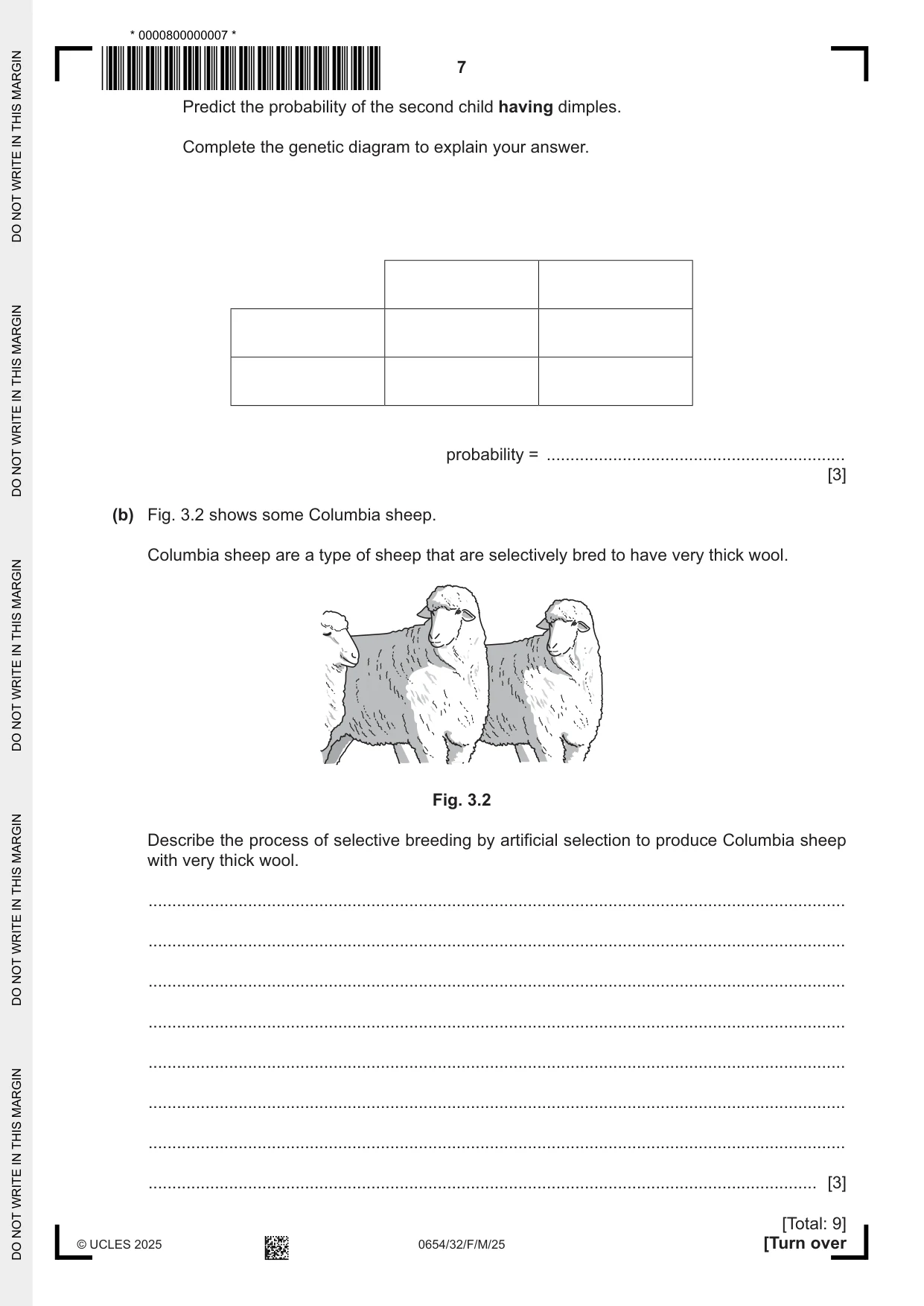
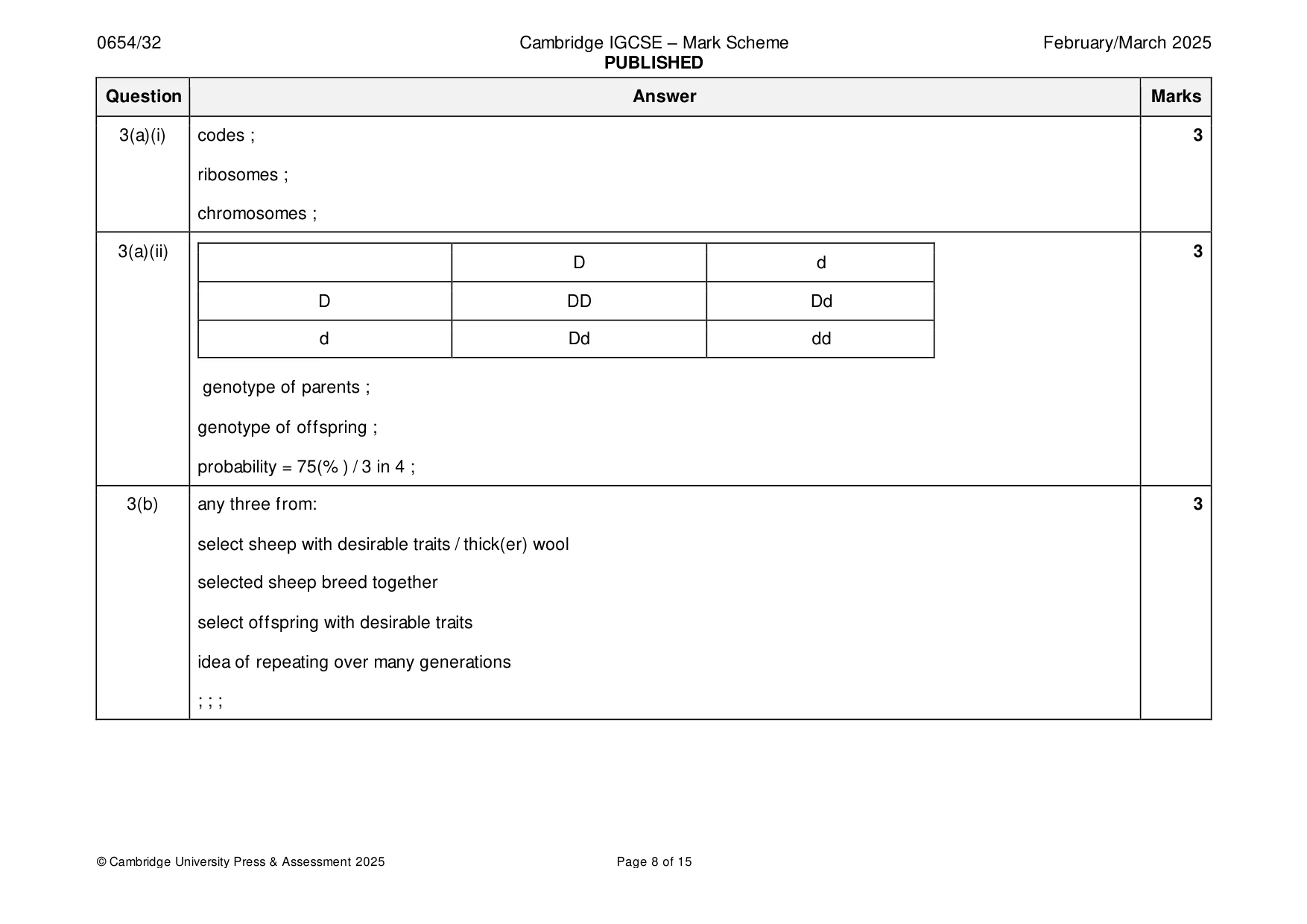
3 (a) (i) Complete the sentences using words from the list. Each word may be used once, more than once or not at all. chromosomes cilia codes ribosomes secretes targets walls A gene is a length of DNA that ....................................... for a protein. Proteins are made in the cell by structures called ....................................... . Genes are found on ....................................... in the cell’s nucleus. [3] (ii) Fig. 3.1 shows a person with dimples in their cheeks. Dimples are inherited. dimple Fig. 3.1 Dimples are produced when a person has the dominant allele in their genotype. The dominant allele for dimples is D. The allele for not having dimples is d. Two people with dimples have a child without dimples. They are expecting a second child. Predict the probability of the second child having dimples. Complete the genetic diagram to explain your answer. probability = ............................................................... [3] (b) Fig. 3.2 shows some Columbia sheep. Columbia sheep are a type of sheep that are selectively bred to have very thick wool. Fig. 3.2 Describe the process of selective breeding by artificial selection to produce Columbia sheep with very thick wool. ................................................................................................................................................... ................................................................................................................................................... ................................................................................................................................................... ................................................................................................................................................... ................................................................................................................................................... ................................................................................................................................................... ................................................................................................................................................... ............................................................................................................................................. [3] [Total: 9]
Mark scheme: 3(a)(i) codes ; 3 ribosomes ; chromosomes ; 3(a)(ii) 3 D d D DD Dd d Dd dd genotype of parents ; genotype of offspring ; probability = 75(% ) / 3 in 4 ; 3(b) any three from: 3 select sheep with desirable traits / thick(er) wool selected sheep breed together select offspring with desirable traits idea of repeating over many generations ; ; ;
Q4 · State the word that describes a disease-causing organism
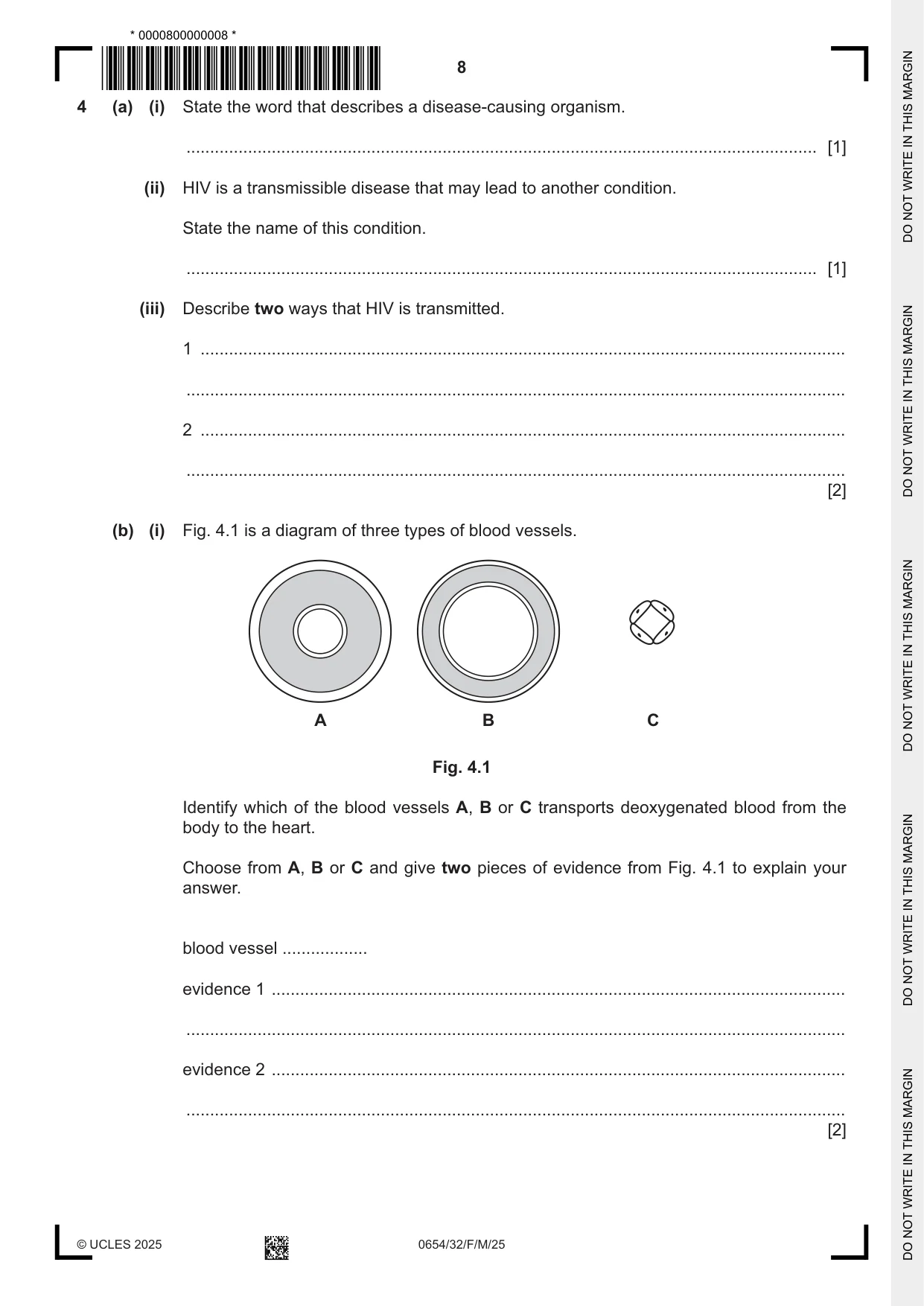
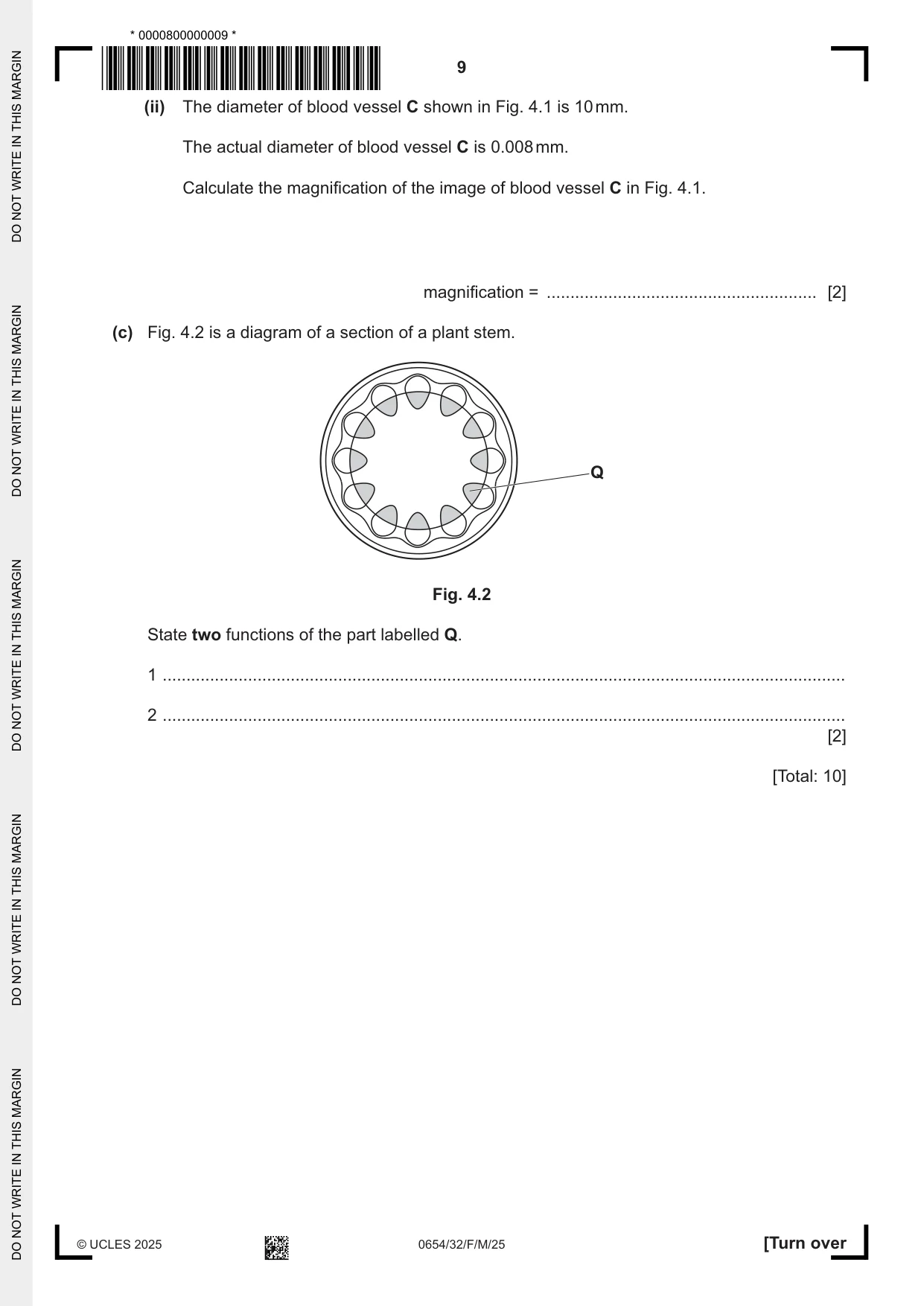
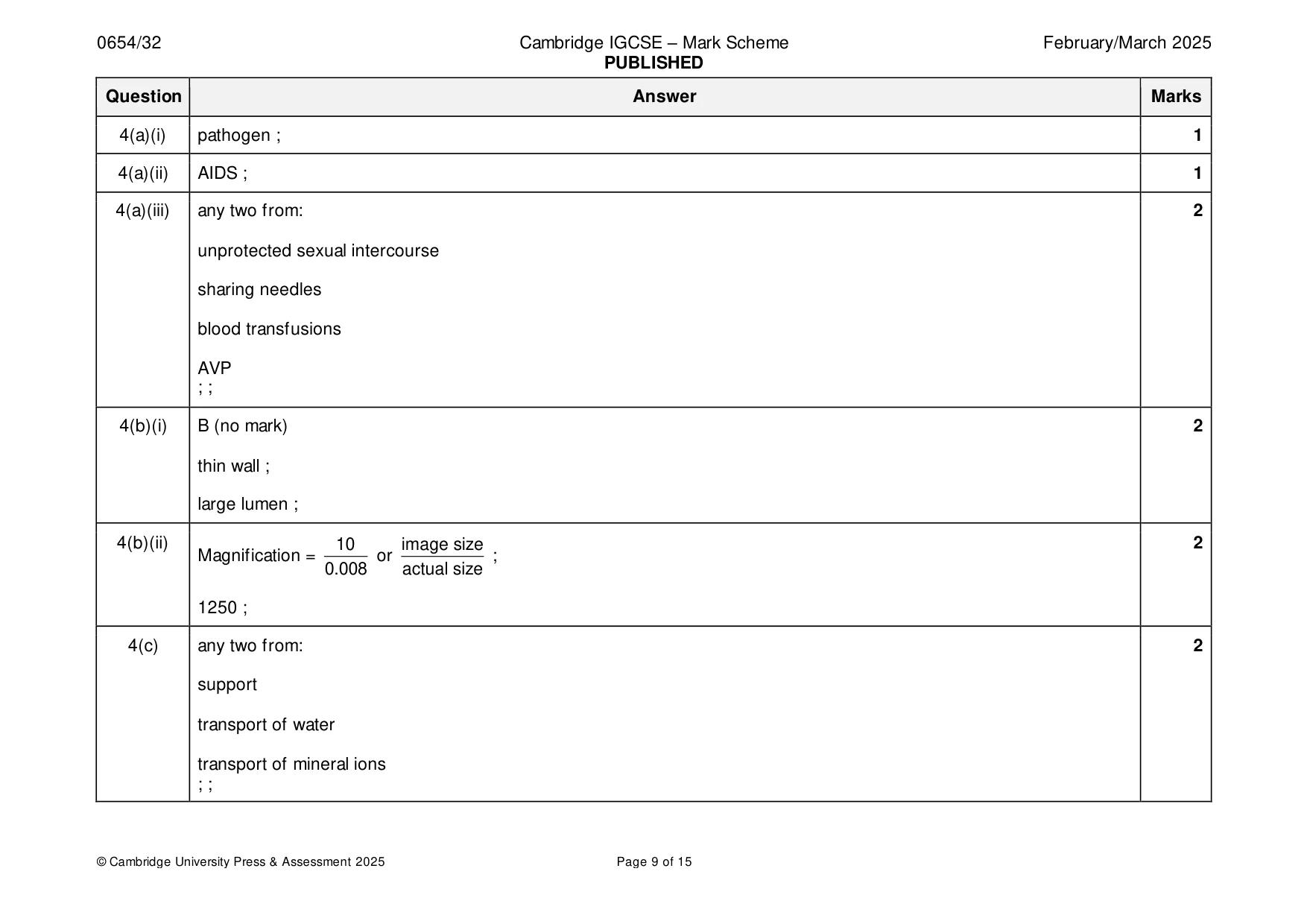
4 (a) (i) State the word that describes a disease-causing organism. ..................................................................................................................................... [1] (ii) HIV is a transmissible disease that may lead to another condition. State the name of this condition. ..................................................................................................................................... [1] (iii) Describe two ways that HIV is transmitted. 1 ........................................................................................................................................ ........................................................................................................................................... 2 ........................................................................................................................................ ........................................................................................................................................... [2] (b) (i) Fig. 4.1 is a diagram of three types of blood vessels. A B C Fig. 4.1 Identify which of the blood vessels A, B or C transports deoxygenated blood from the body to the heart. Choose from A, B or C and give two pieces of evidence from Fig. 4.1 to explain your answer. blood vessel .................. evidence 1 ......................................................................................................................... ........................................................................................................................................... evidence 2 ......................................................................................................................... ........................................................................................................................................... [2] (ii) The diameter of blood vessel C shown in Fig. 4.1 is 10 mm. The actual diameter of blood vessel C is 0.008 mm. Calculate the magnification of the image of blood vessel C in Fig. 4.1. magnification = ......................................................... [2] (c) Fig. 4.2 is a diagram of a section of a plant stem. Q Fig. 4.2 State two functions of the part labelled Q. 1 ................................................................................................................................................ 2 ................................................................................................................................................ [2] [Total: 10]
Mark scheme: 4(a)(i) pathogen ; 1 4(a)(ii) AIDS ; 1 4(a)(iii) any two from: 2 unprotected sexual intercourse sharing needles blood transfusions AVP ; ; 4(b)(i) B (no mark) 2 thin wall ; large lumen ; 4(b)(ii) 10 image size 2 Magnification = or ; 0.008 actual size 1250 ; 4(c) any two from: 2 support transport of water transport of mineral ions ; ;
Q5 · The list shows six metals
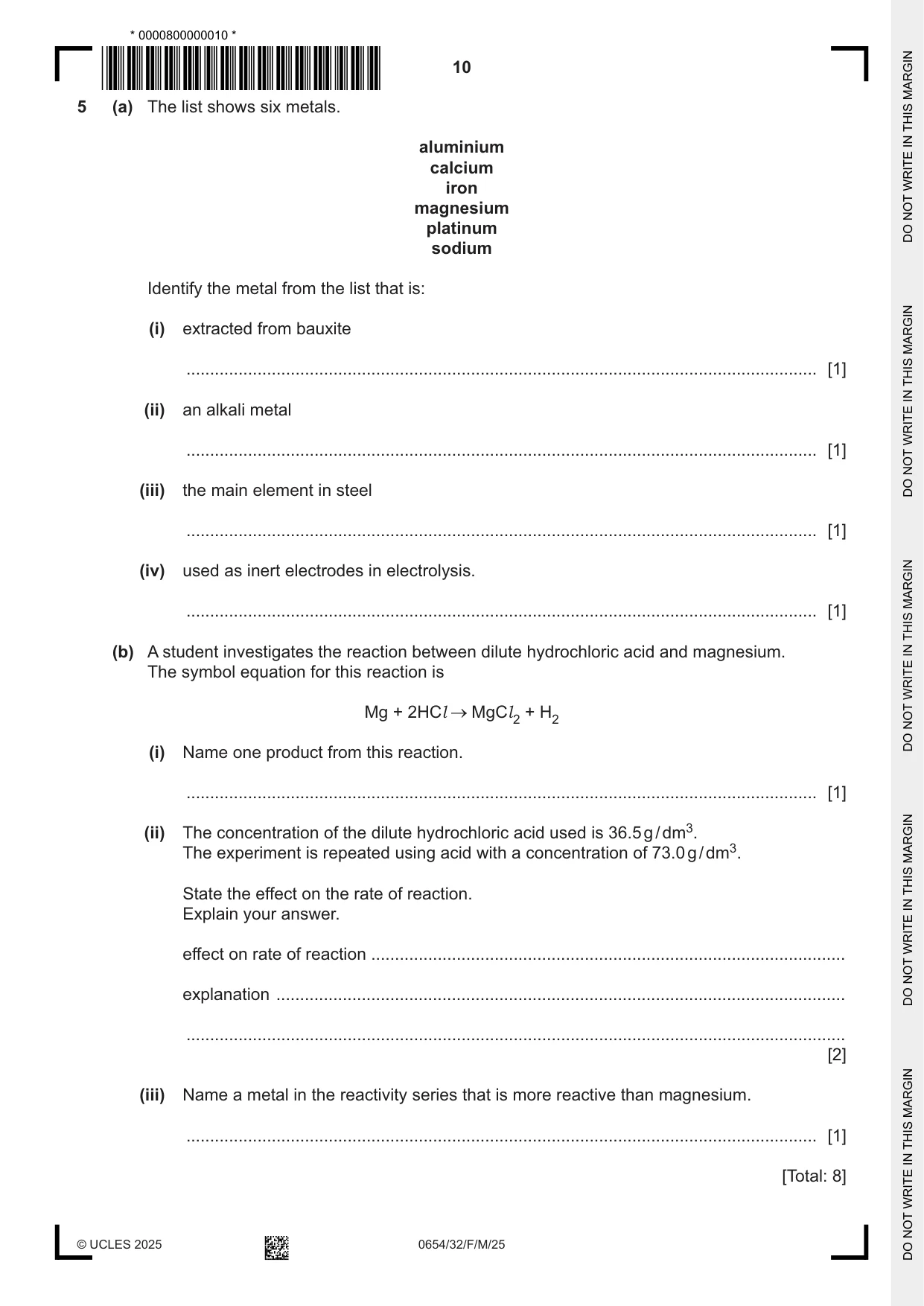
5 (a) The list shows six metals. aluminium calcium iron magnesium platinum sodium Identify the metal from the list that is: (i) extracted from bauxite ..................................................................................................................................... [1] (ii) an alkali metal ..................................................................................................................................... [1] (iii) the main element in steel ..................................................................................................................................... [1] (iv) used as inert electrodes in electrolysis. ..................................................................................................................................... [1] (b) A student investigates the reaction between dilute hydrochloric acid and magnesium. The symbol equation for this reaction is Mg + 2HCl MgCl + 2 H2 (i) Name one product from this reaction. ..................................................................................................................................... [1] (ii) The concentration of the dilute hydrochloric acid used is 36.5 g / dm3. The experiment is repeated using acid with a concentration of 73.0 g / dm3. State the effect on the rate of reaction. Explain your answer. effect on rate of reaction .................................................................................................... explanation ........................................................................................................................ ........................................................................................................................................... [2] (iii) Name a metal in the reactivity series that is more reactive than magnesium. ..................................................................................................................................... [1] [Total: 8]
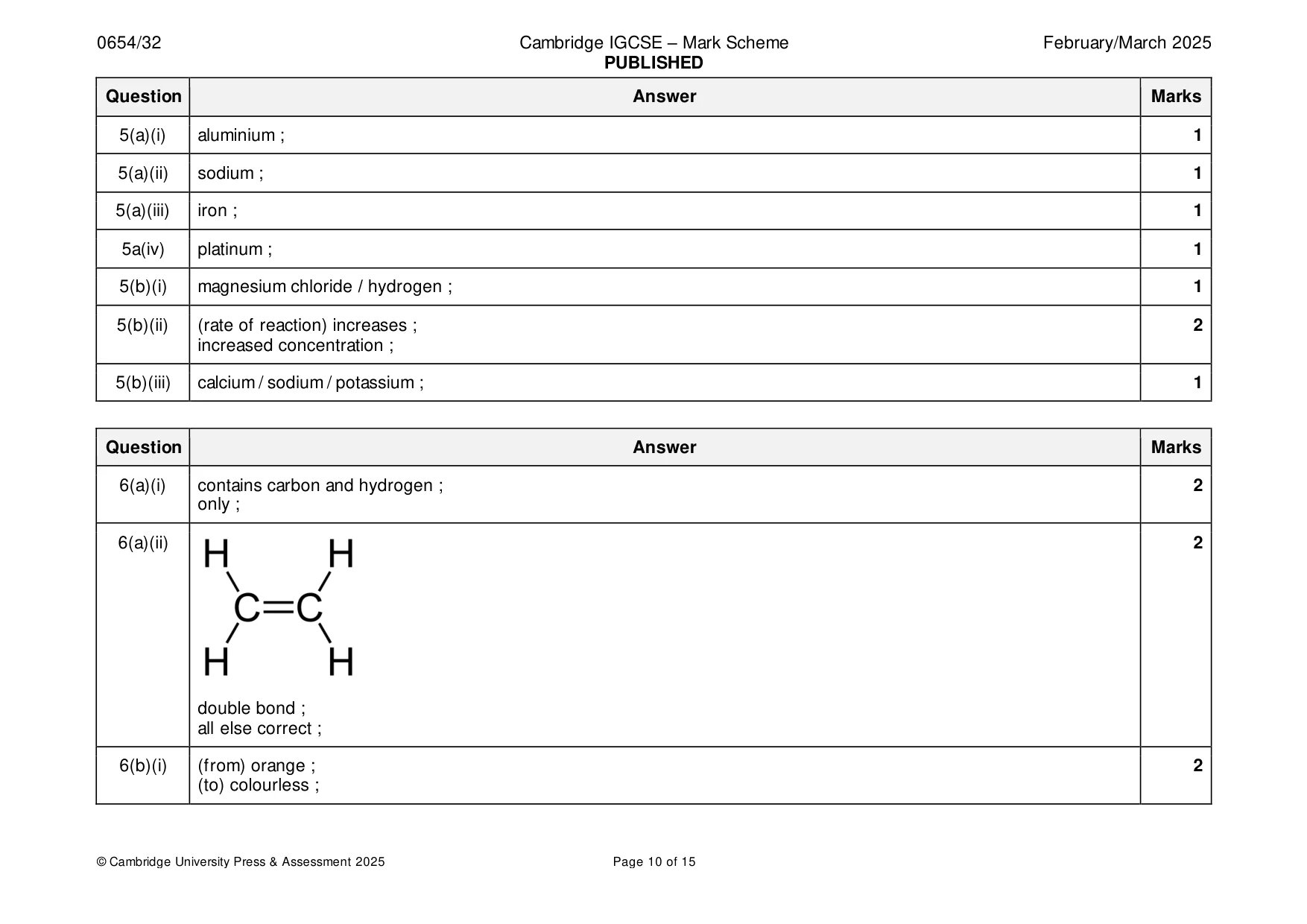
Mark scheme: 5(a)(i) aluminium ; 1 5(a)(ii) sodium ; 1 5(a)(iii) iron ; 1 5a(iv) platinum ; 1 5(b)(i) magnesium chloride / hydrogen ; 1 5(b)(ii) (rate of reaction) increases ; 2 increased concentration ; 5(b)(iii) calcium / sodium / potassium ; 1
Q6 · Ethene, C2H4, is a hydrocarbon
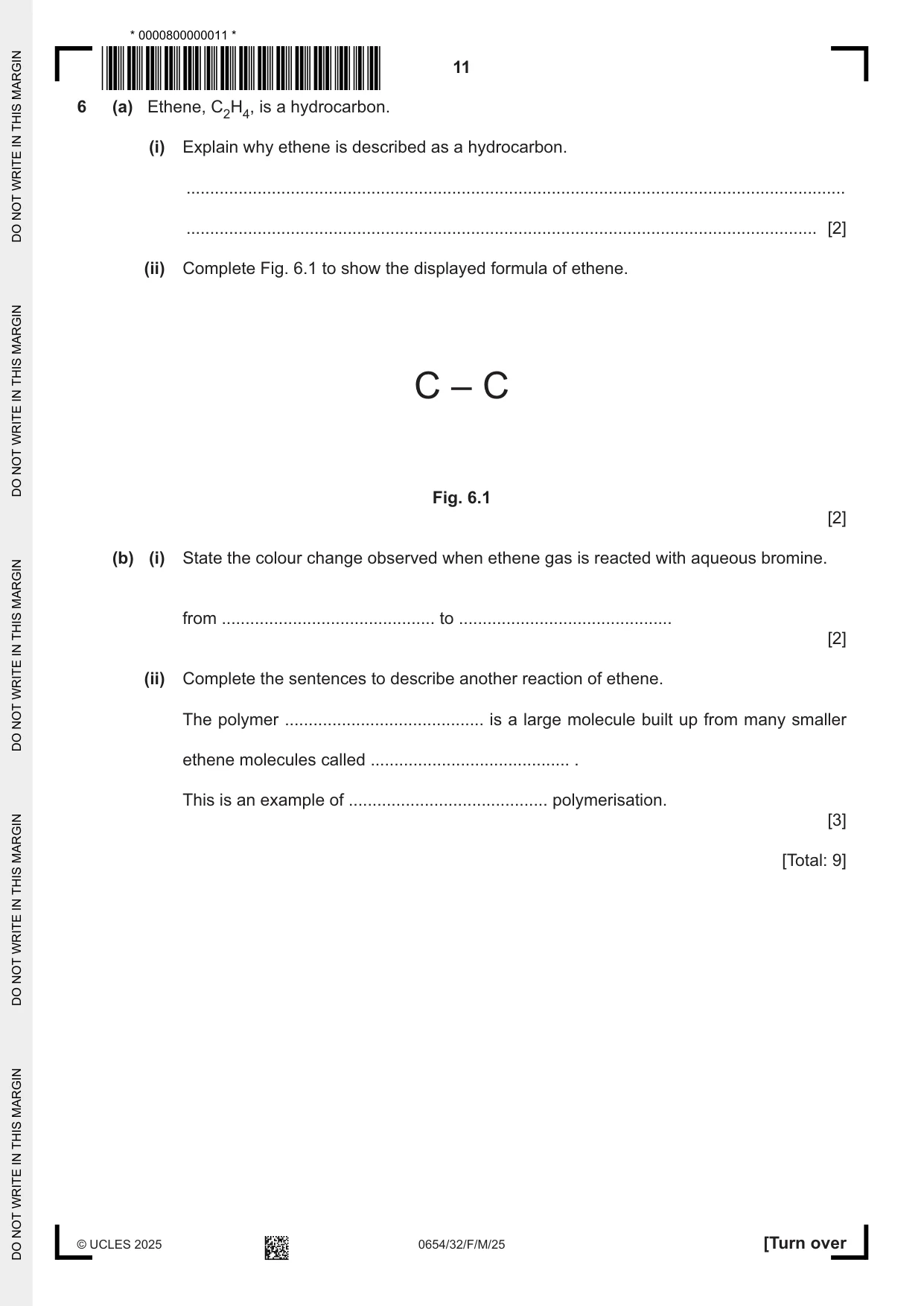
6 (a) Ethene, C2H4, is a hydrocarbon. (i) Explain why ethene is described as a hydrocarbon. ........................................................................................................................................... ..................................................................................................................................... [2] (ii) Complete Fig. 6.1 to show the displayed formula of ethene. C – C Fig. 6.1 [2] (b) (i) State the colour change observed when ethene gas is reacted with aqueous bromine. from ............................................. to ............................................. [2] (ii) Complete the sentences to describe another reaction of ethene. The polymer .......................................... is a large molecule built up from many smaller ethene molecules called .......................................... . This is an example of .......................................... polymerisation. [3] [Total: 9]
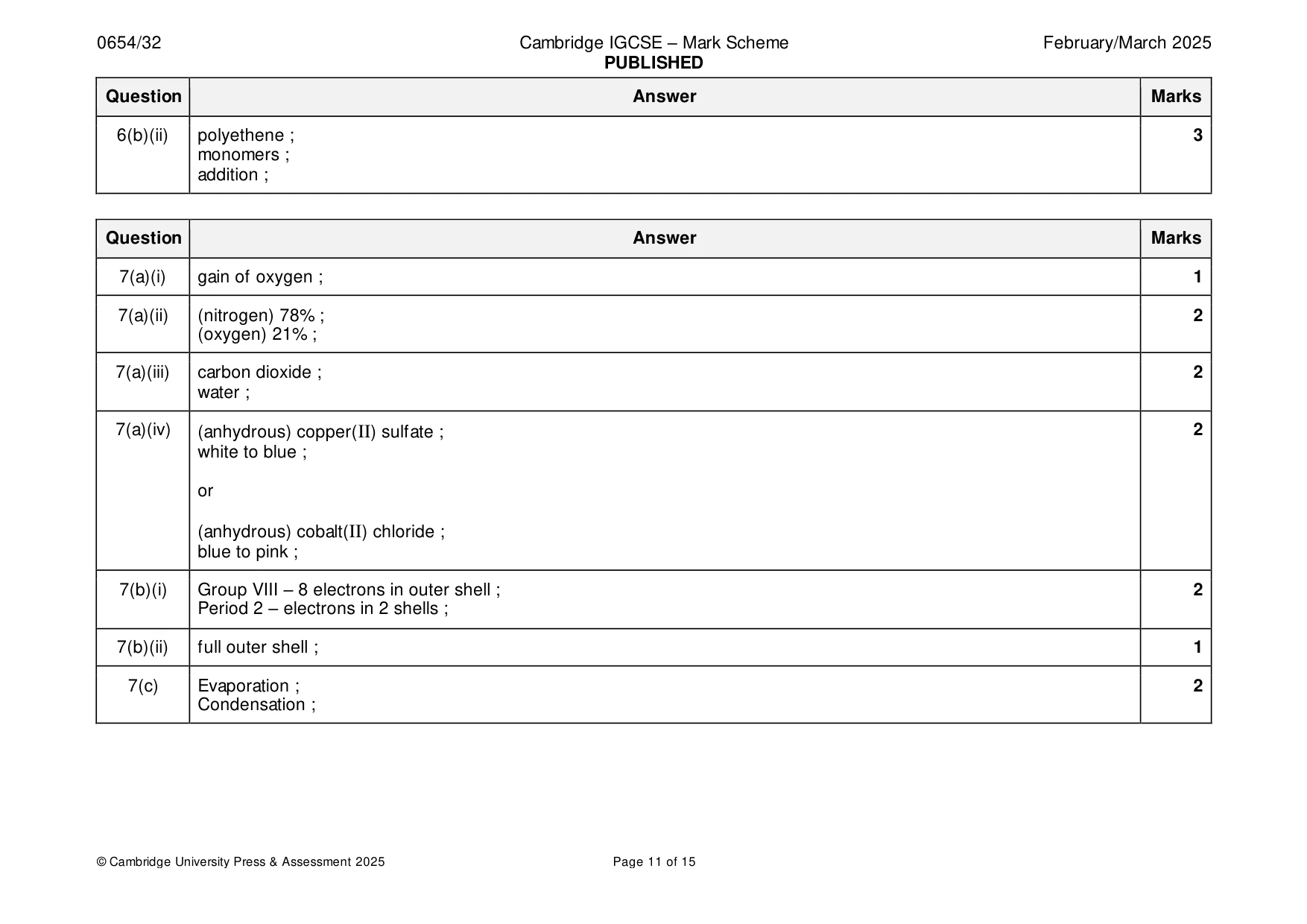
Mark scheme: 6(a)(i) contains carbon and hydrogen ; 2 only ; 6(a)(ii) 2 double bond ; all else correct ; 6(b)(i) (from) orange ; 2 (to) colourless ; 6(b)(ii) polyethene ; 3 monomers ; addition ;
Q7 · Gasoline / petrol reacts with oxygen in car engines making exhaust gases
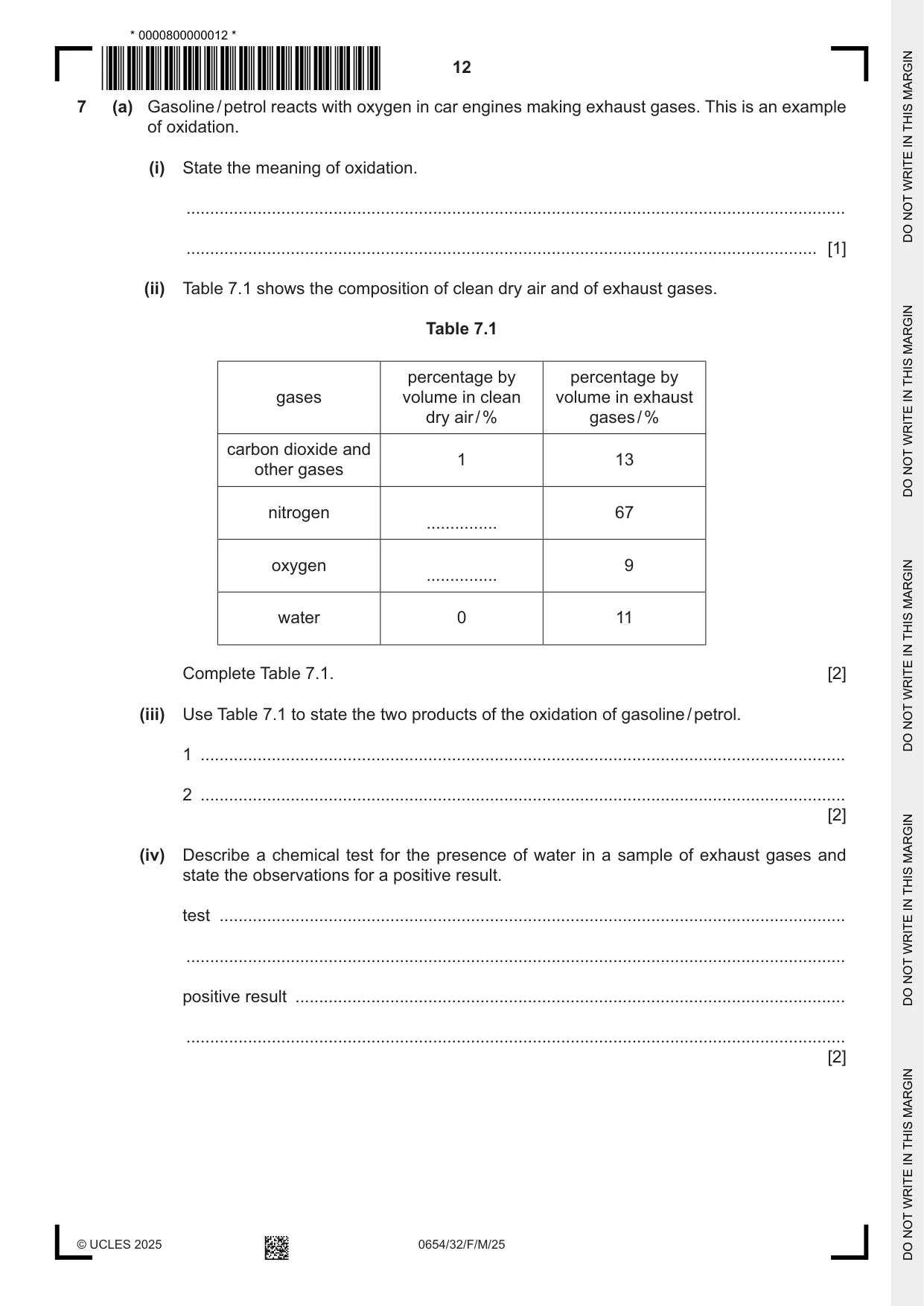
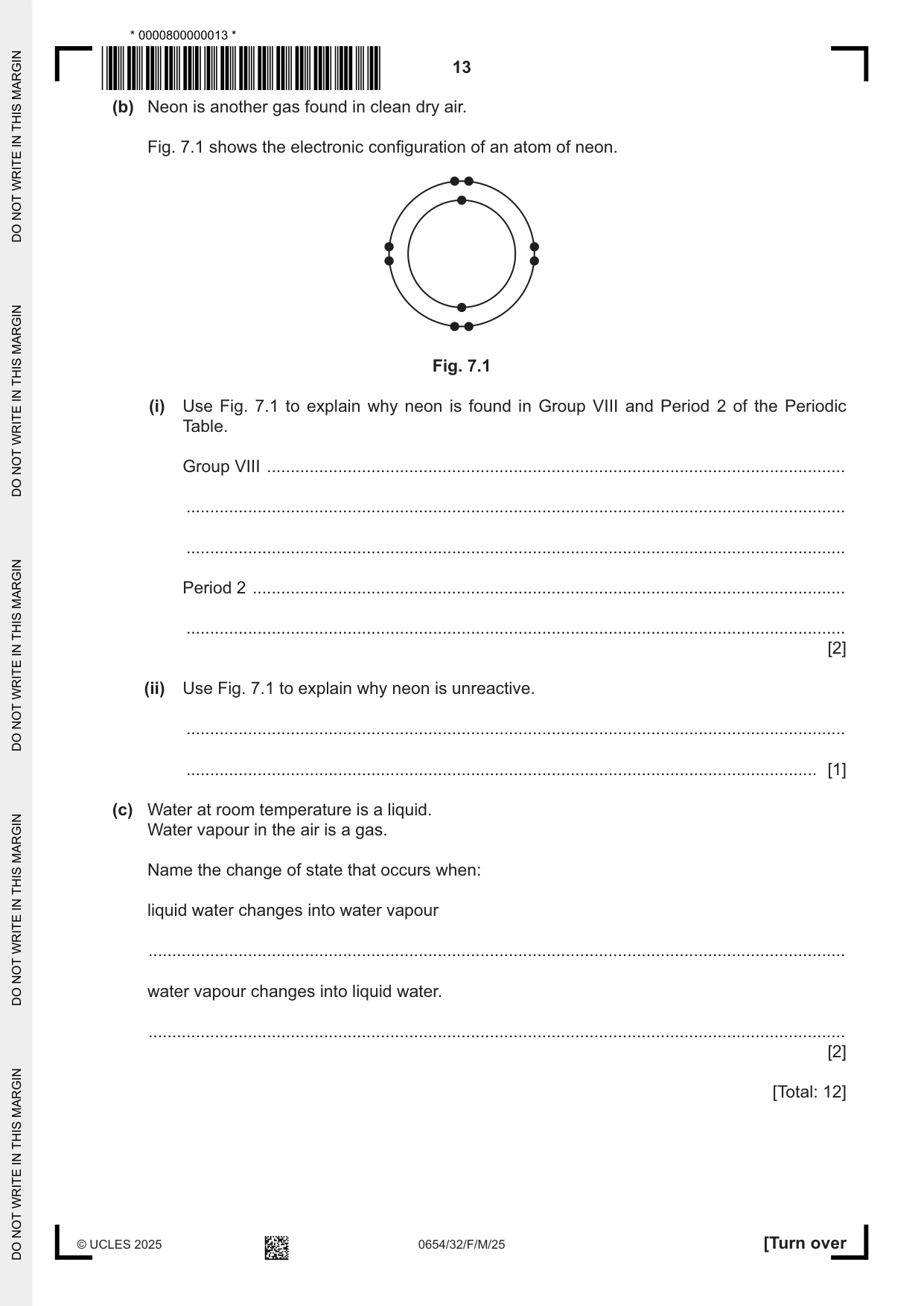
7 (a) Gasoline / petrol reacts with oxygen in car engines making exhaust gases. This is an example of oxidation. (i) State the meaning of oxidation. ........................................................................................................................................... ..................................................................................................................................... [1] (ii) Table 7.1 shows the composition of clean dry air and of exhaust gases. Table 7.1 percentage by percentage by gases volume in clean volume in exhaust dry air / % gases / % carbon dioxide and 1 13 other gases nitrogen 67 ............... oxygen 9 ............... water 0 11 Complete Table 7.1. [2] (iii) Use Table 7.1 to state the two products of the oxidation of gasoline / petrol. 1 ........................................................................................................................................ 2 ........................................................................................................................................ [2] (iv) Describe a chemical test for the presence of water in a sample of exhaust gases and state the observations for a positive result. test .................................................................................................................................... ........................................................................................................................................... positive result .................................................................................................................... ........................................................................................................................................... [2] (b) Neon is another gas found in clean dry air. Fig. 7.1 shows the electronic configuration of an atom of neon. Fig. 7.1 (i) Use Fig. 7.1 to explain why neon is found in Group VIII and Period 2 of the Periodic Table. Group VIII .......................................................................................................................... ........................................................................................................................................... ........................................................................................................................................... Period 2 ............................................................................................................................. ........................................................................................................................................... [2] (ii) Use Fig. 7.1 to explain why neon is unreactive. ........................................................................................................................................... ..................................................................................................................................... [1] (c) Water at room temperature is a liquid. Water vapour in the air is a gas. Name the change of state that occurs when: liquid water changes into water vapour ................................................................................................................................................... water vapour changes into liquid water. ................................................................................................................................................... [2] [Total: 12]
Mark scheme: 7(a)(i) gain of oxygen ; 1 7(a)(ii) (nitrogen) 78% ; 2 (oxygen) 21% ; 7(a)(iii) carbon dioxide ; 2 water ; 7(a)(iv) (anhydrous) copper(II) sulfate ; 2 white to blue ; or (anhydrous) cobalt(II) chloride ; blue to pink ; 7(b)(i) Group VIII – 8 electrons in outer shell ; 2 Period 2 – electrons in 2 shells ; 7(b)(ii) full outer shell ; 1 7(c) Evaporation ; 2 Condensation ;
Q8 · Chlorine is an element in Group VII of the Periodic Table
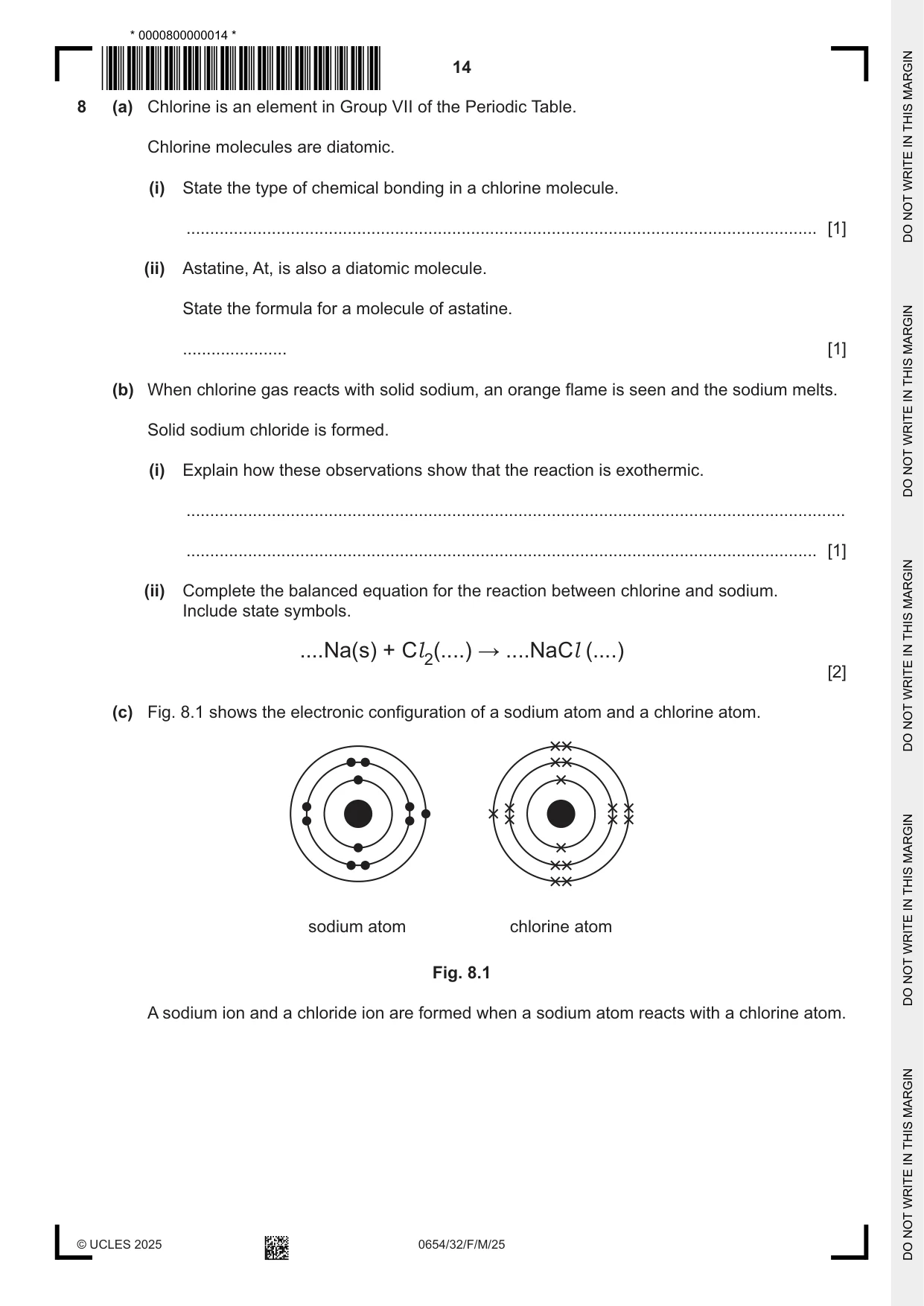
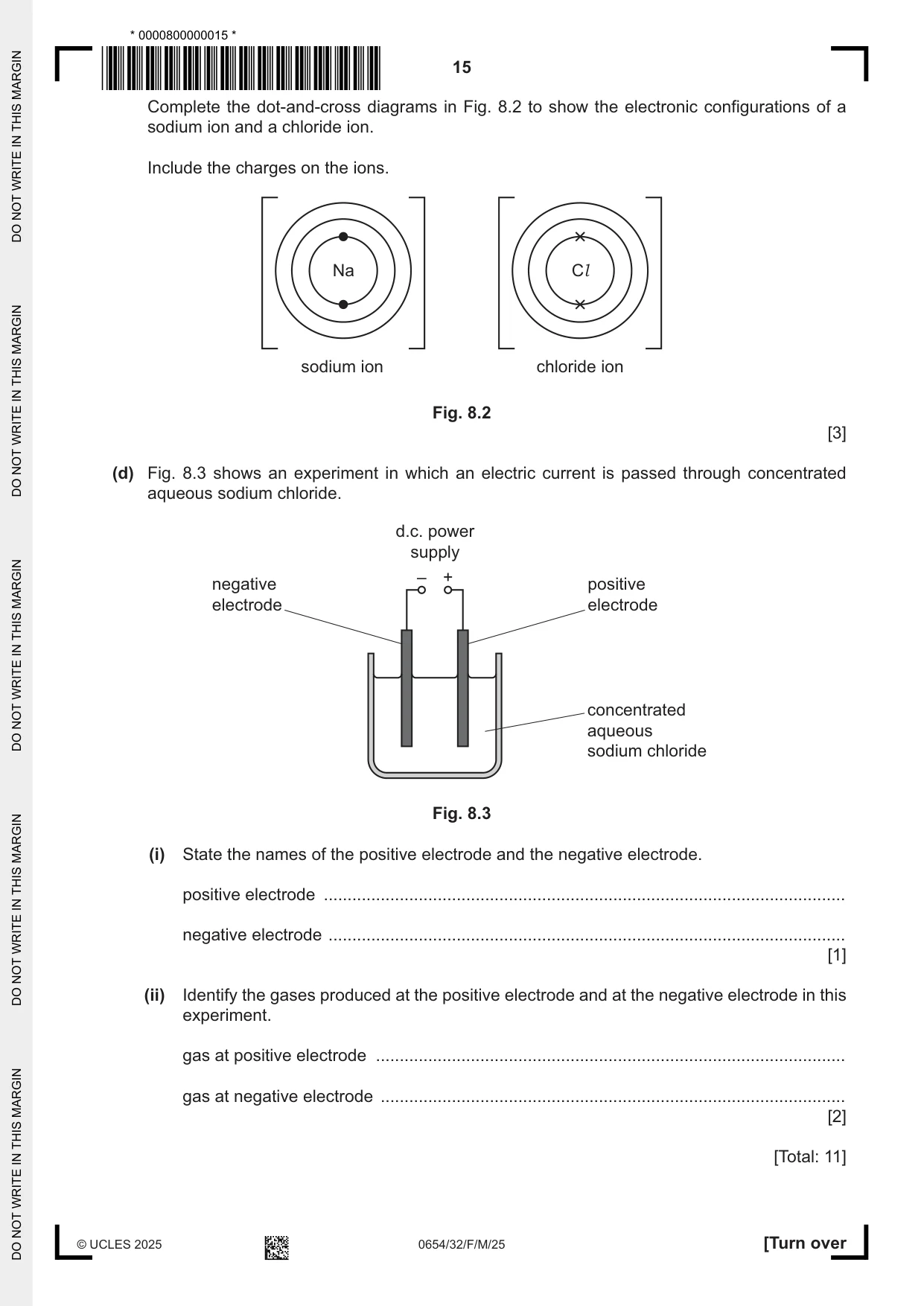
8 (a) Chlorine is an element in Group VII of the Periodic Table. Chlorine molecules are diatomic. (i) State the type of chemical bonding in a chlorine molecule. ..................................................................................................................................... [1] (ii) Astatine, At, is also a diatomic molecule. State the formula for a molecule of astatine. ...................... [1] (b) When chlorine gas reacts with solid sodium, an orange flame is seen and the sodium melts. Solid sodium chloride is formed. (i) Explain how these observations show that the reaction is exothermic. ........................................................................................................................................... ..................................................................................................................................... [1] (ii) Complete the balanced equation for the reaction between chlorine and sodium. Include state symbols. ....Na(s) + Cl 2(....) → ....NaCl (....) [2] (c) Fig. 8.1 shows the electronic configuration of a sodium atom and a chlorine atom. sodium atom chlorine atom Fig. 8.1 A sodium ion and a chloride ion are formed when a sodium atom reacts with a chlorine atom. Complete the dot-and-cross diagrams in Fig. 8.2 to show the electronic configurations of a sodium ion and a chloride ion. Include the charges on the ions. Na Cl sodium ion chloride ion Fig. 8.2 [3] (d) Fig. 8.3 shows an experiment in which an electric current is passed through concentrated aqueous sodium chloride. d.c. power supply – + negative positive electrode electrode concentrated aqueous sodium chloride Fig. 8.3 (i) State the names of the positive electrode and the negative electrode. positive electrode .............................................................................................................. negative electrode ............................................................................................................. [1] (ii) Identify the gases produced at the positive electrode and at the negative electrode in this experiment. gas at positive electrode ................................................................................................... gas at negative electrode .................................................................................................. [2] [Total: 11]
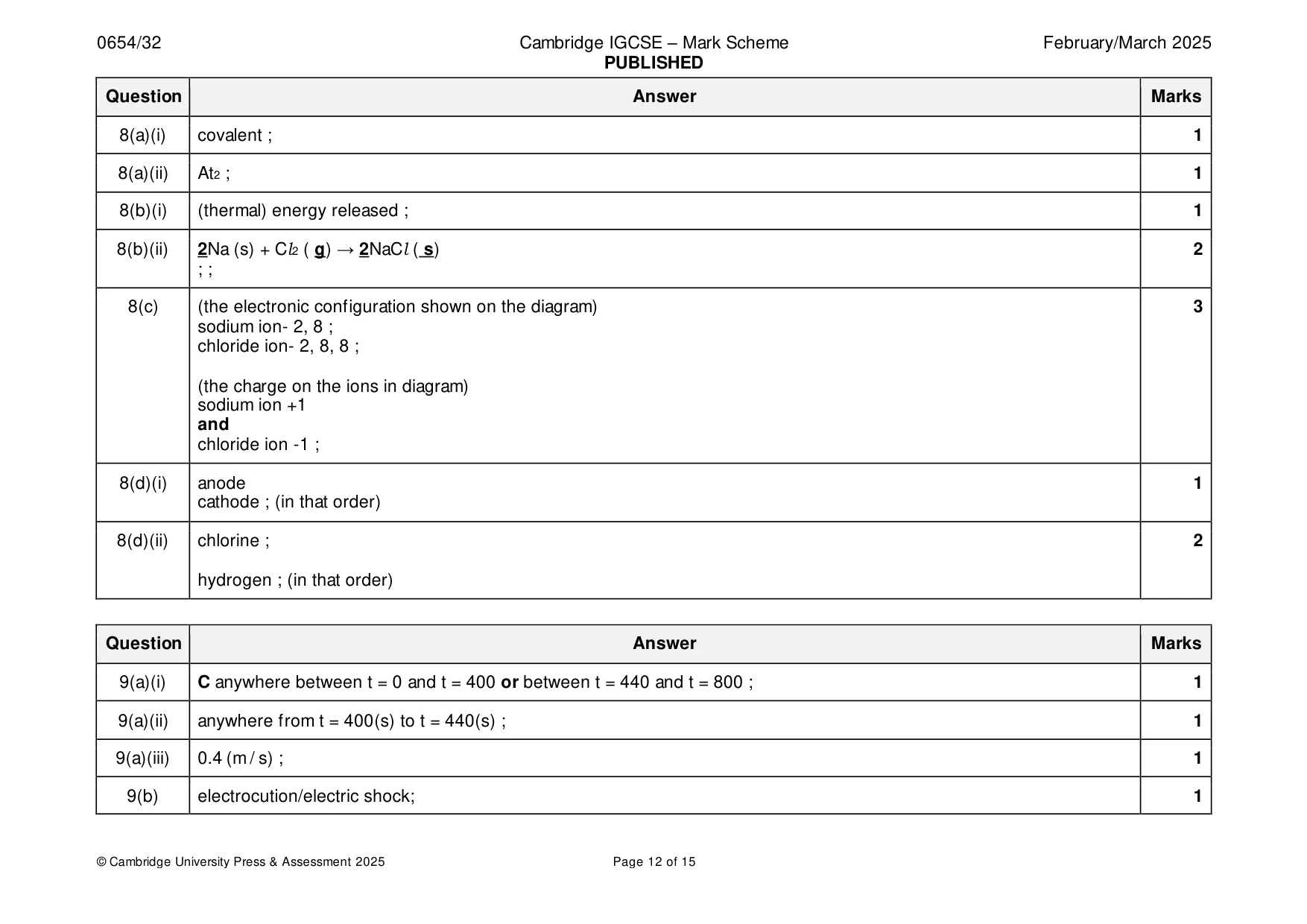
Mark scheme: 8(a)(i) covalent ; 1 8(a)(ii) At2 ; 1 8(b)(i) (thermal) energy released ; 1 8(b)(ii) 2Na (s) + Cl2 ( g) → 2NaCl ( s) 2 ; ; 8(c) (the electronic configuration shown on the diagram) 3 sodium ion- 2, 8 ; chloride ion- 2, 8, 8 ; (the charge on the ions in diagram) sodium ion +1 and chloride ion -1 ; 8(d)(i) anode 1 cathode ; (in that order) 8(d)(ii) chlorine ; 2 hydrogen ; (in that order)
Q9 · A student walks to school
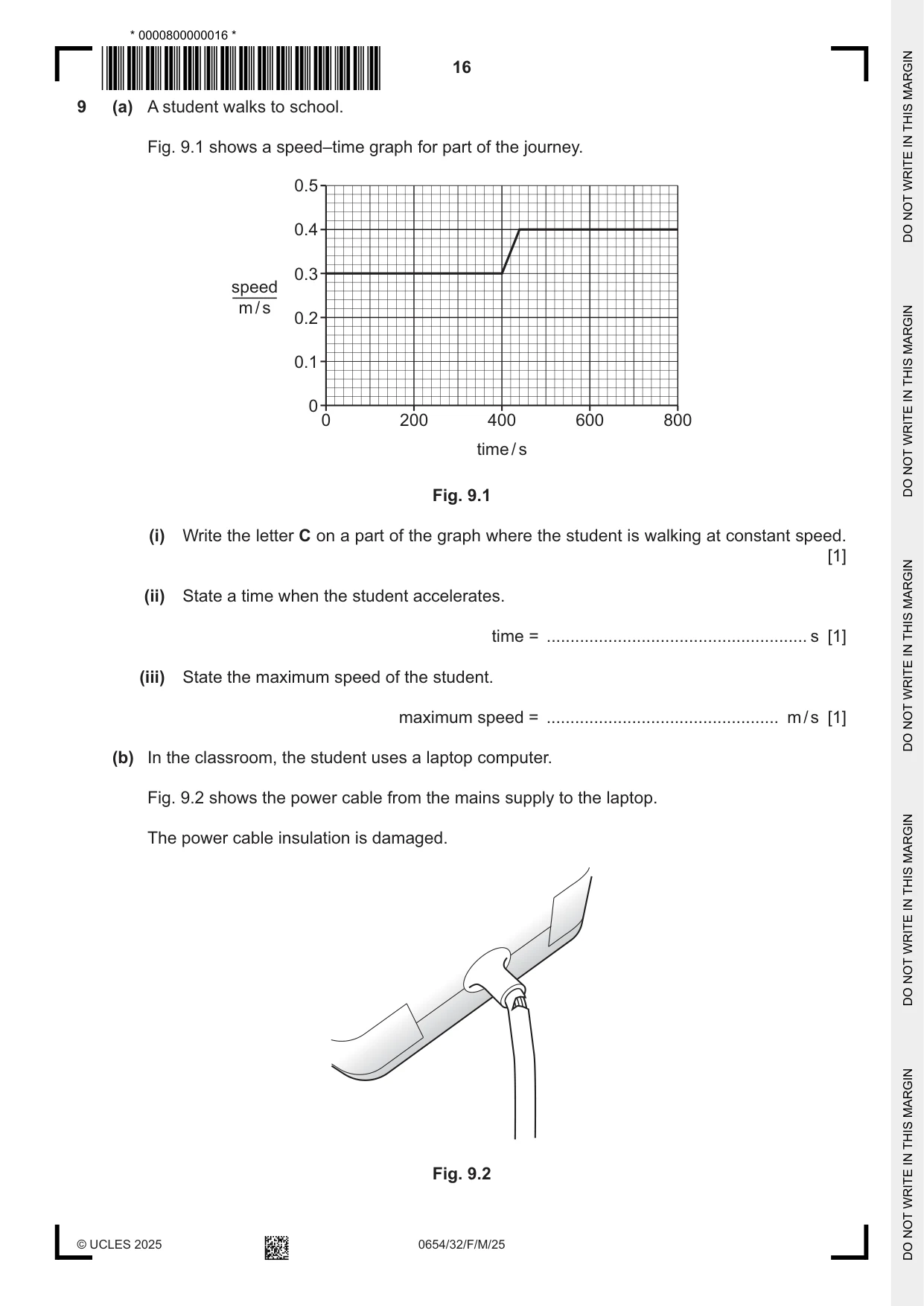
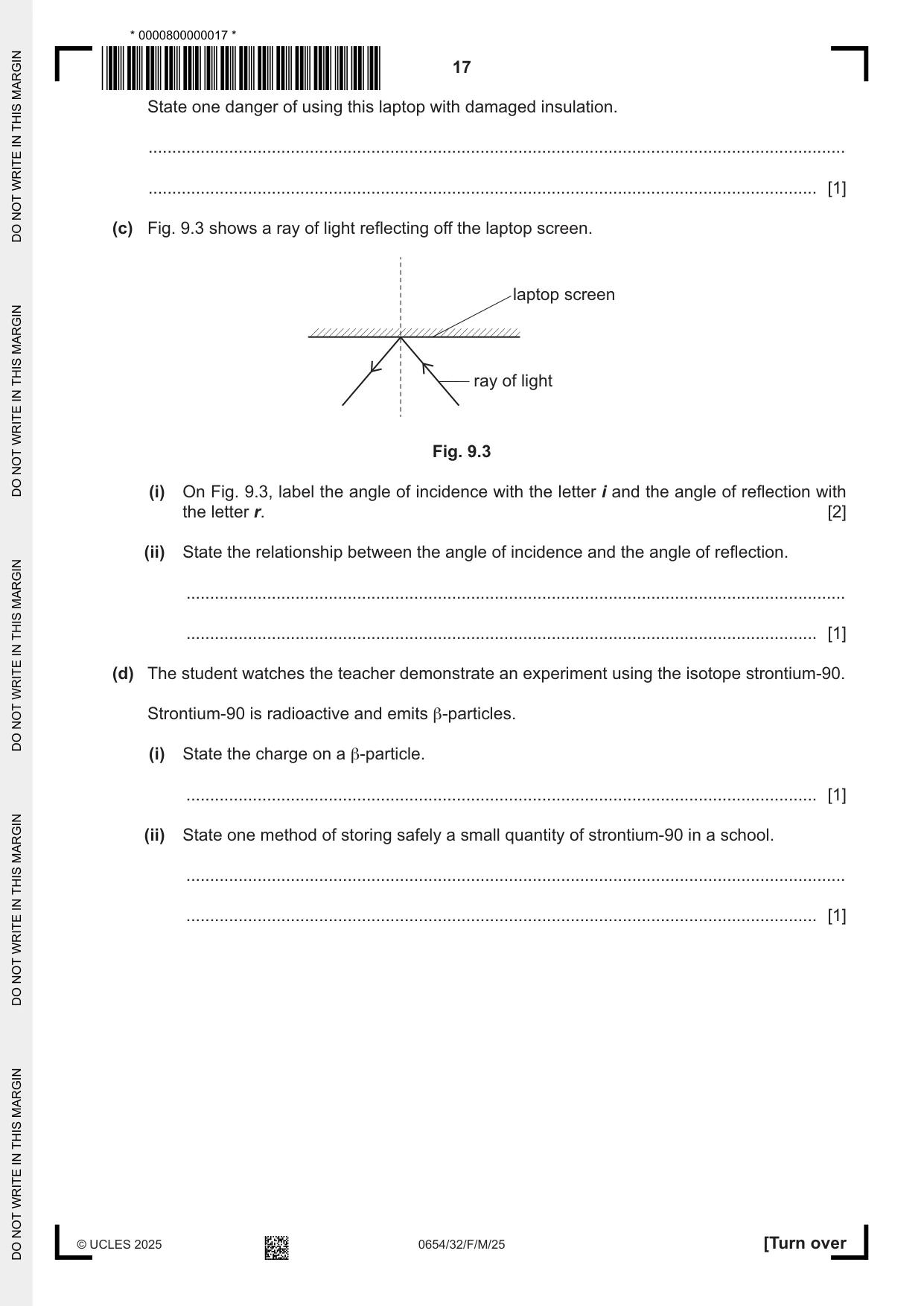
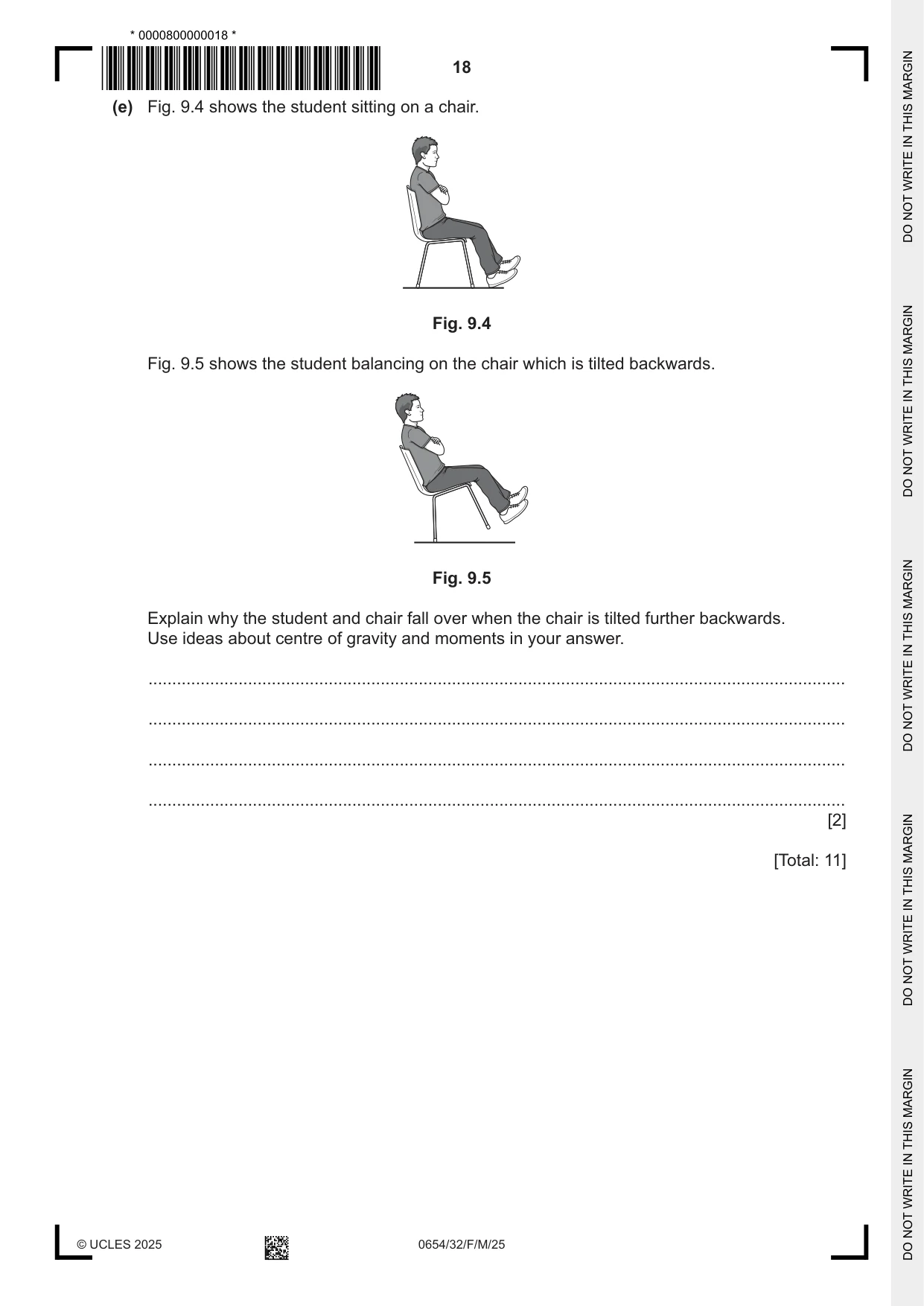
9 (a) A student walks to school. Fig. 9.1 shows a speed–time graph for part of the journey. 0.5 0.4 0.3 speed m / s 0.2 0.1 0 0 200 400 600 800 time / s Fig. 9.1 (i) Write the letter C on a part of the graph where the student is walking at constant speed. [1] (ii) State a time when the student accelerates. time = ....................................................... s [1] (iii) State the maximum speed of the student. maximum speed = ................................................. m / s [1] (b) In the classroom, the student uses a laptop computer. Fig. 9.2 shows the power cable from the mains supply to the laptop. The power cable insulation is damaged. Fig. 9.2 State one danger of using this laptop with damaged insulation. ................................................................................................................................................... ............................................................................................................................................. [1] (c) Fig. 9.3 shows a ray of light reflecting off the laptop screen. laptop screen ray of light Fig. 9.3 (i) On Fig. 9.3, label the angle of incidence with the letter i and the angle of reflection with the letter r. [2] (ii) State the relationship between the angle of incidence and the angle of reflection. ........................................................................................................................................... ..................................................................................................................................... [1] (d) The student watches the teacher demonstrate an experiment using the isotope strontium-90. Strontium-90 is radioactive and emits β-particles. (i) State the charge on a β-particle. ..................................................................................................................................... [1] (ii) State one method of storing safely a small quantity of strontium-90 in a school. ........................................................................................................................................... ..................................................................................................................................... [1] (e) Fig. 9.4 shows the student sitting on a chair. Fig. 9.4 Fig. 9.5 shows the student balancing on the chair which is tilted backwards. Fig. 9.5 Explain why the student and chair fall over when the chair is tilted further backwards. Use ideas about centre of gravity and moments in your answer. ................................................................................................................................................... ................................................................................................................................................... ................................................................................................................................................... ................................................................................................................................................... [2] [Total: 11]
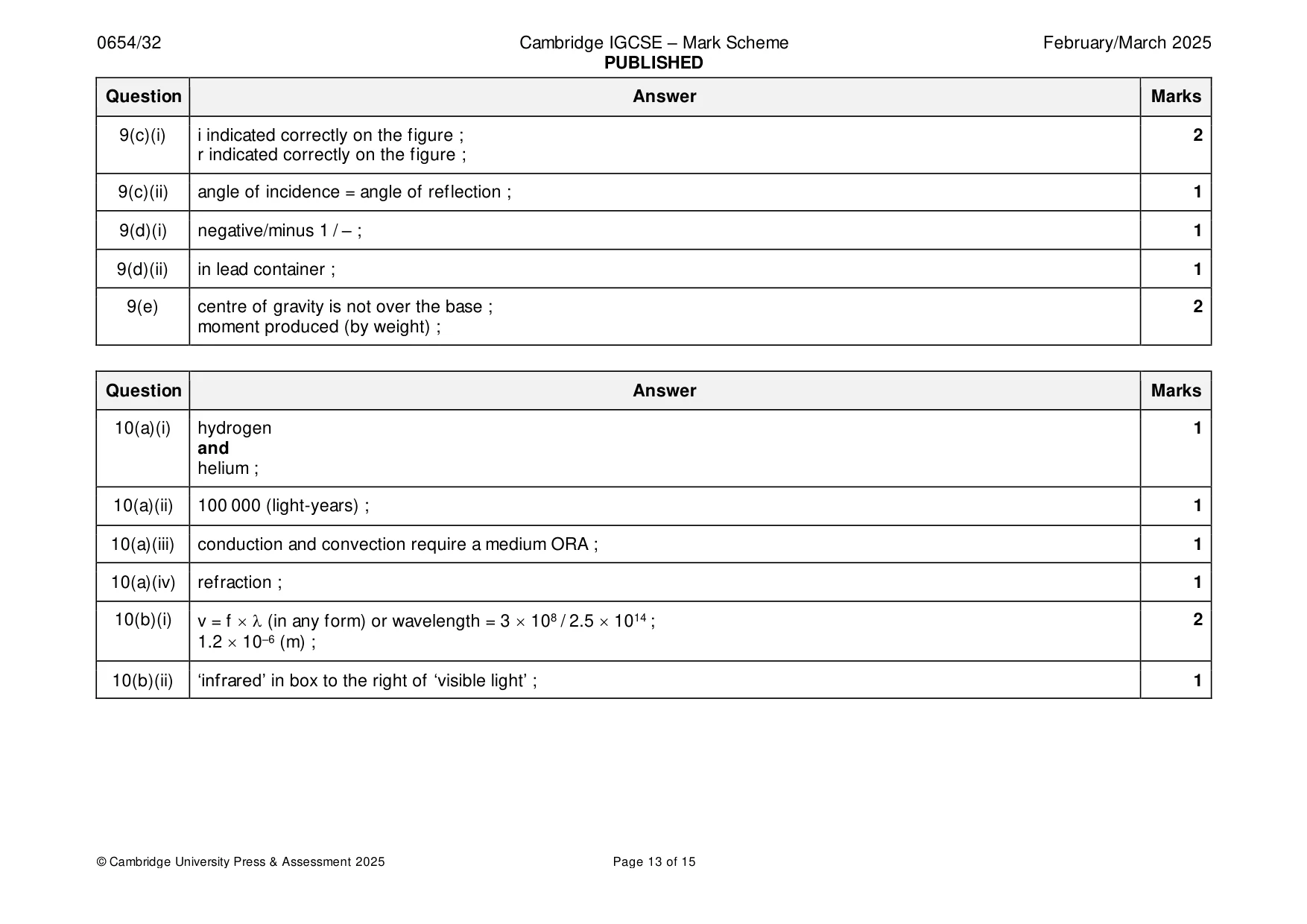
Mark scheme: 9(a)(i) C anywhere between t = 0 and t = 400 or between t = 440 and t = 800 ; 1 9(a)(ii) anywhere from t = 400(s) to t = 440(s) ; 1 9(a)(iii) 0.4 (m / s) ; 1 9(b) electrocution/electric shock; 1 9(c)(i) i indicated correctly on the figure ; 2 r indicated correctly on the figure ; 9(c)(ii) angle of incidence = angle of reflection ; 1 9(d)(i) negative/minus 1 / – ; 1 9(d)(ii) in lead container ; 1 9(e) centre of gravity is not over the base ; 2 moment produced (by weight) ;
Q10 · The Sun consists mostly of two elements
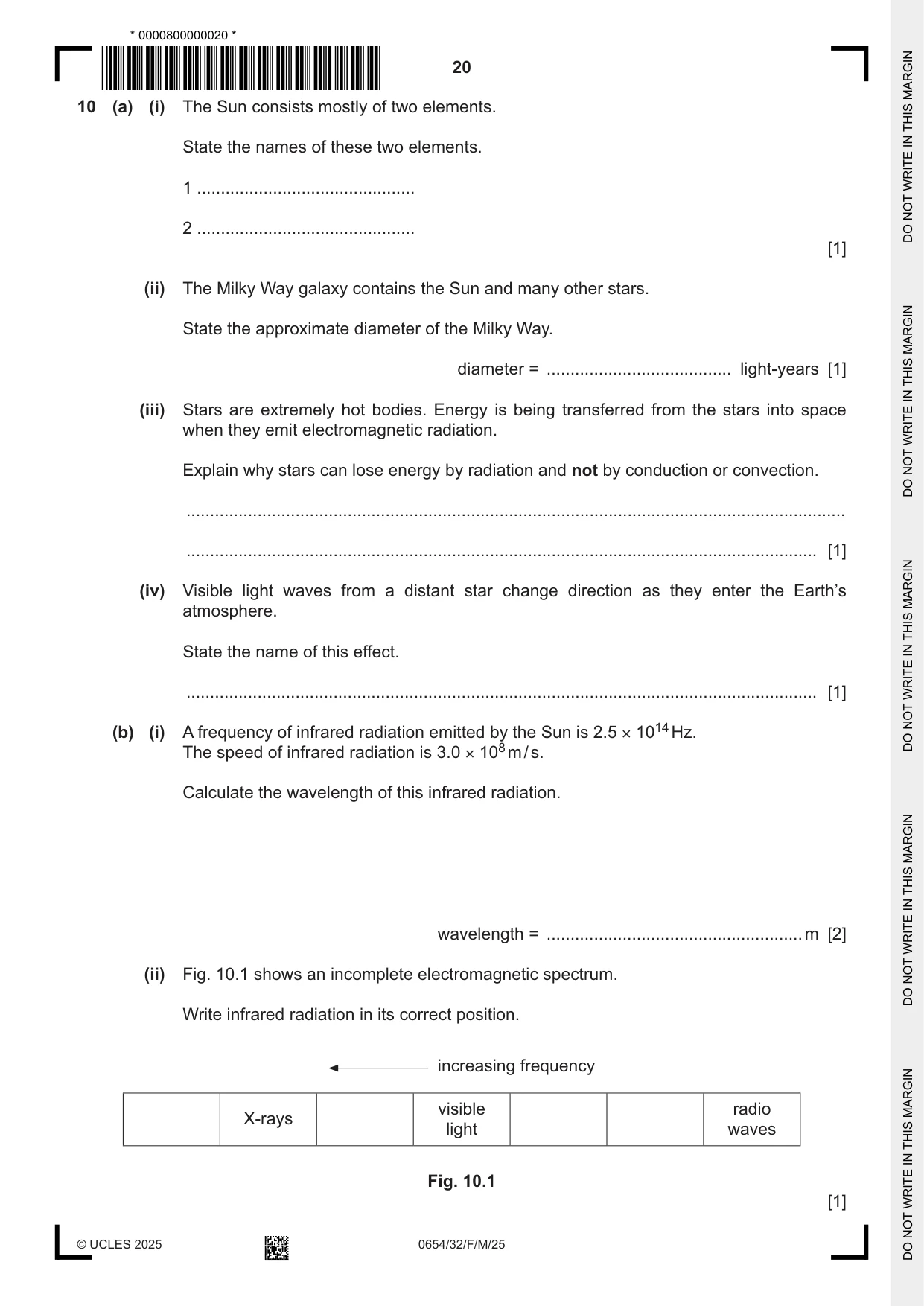
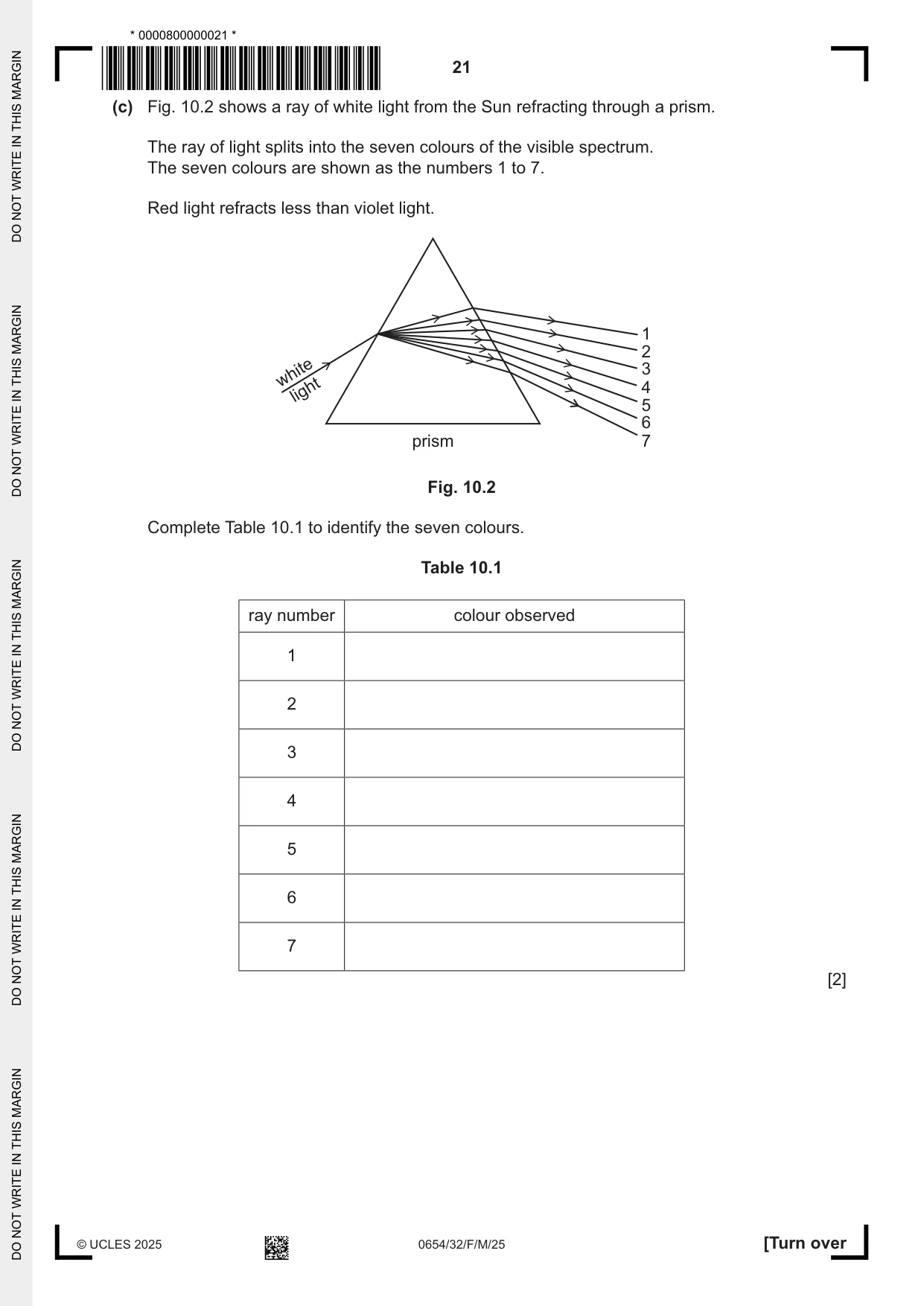
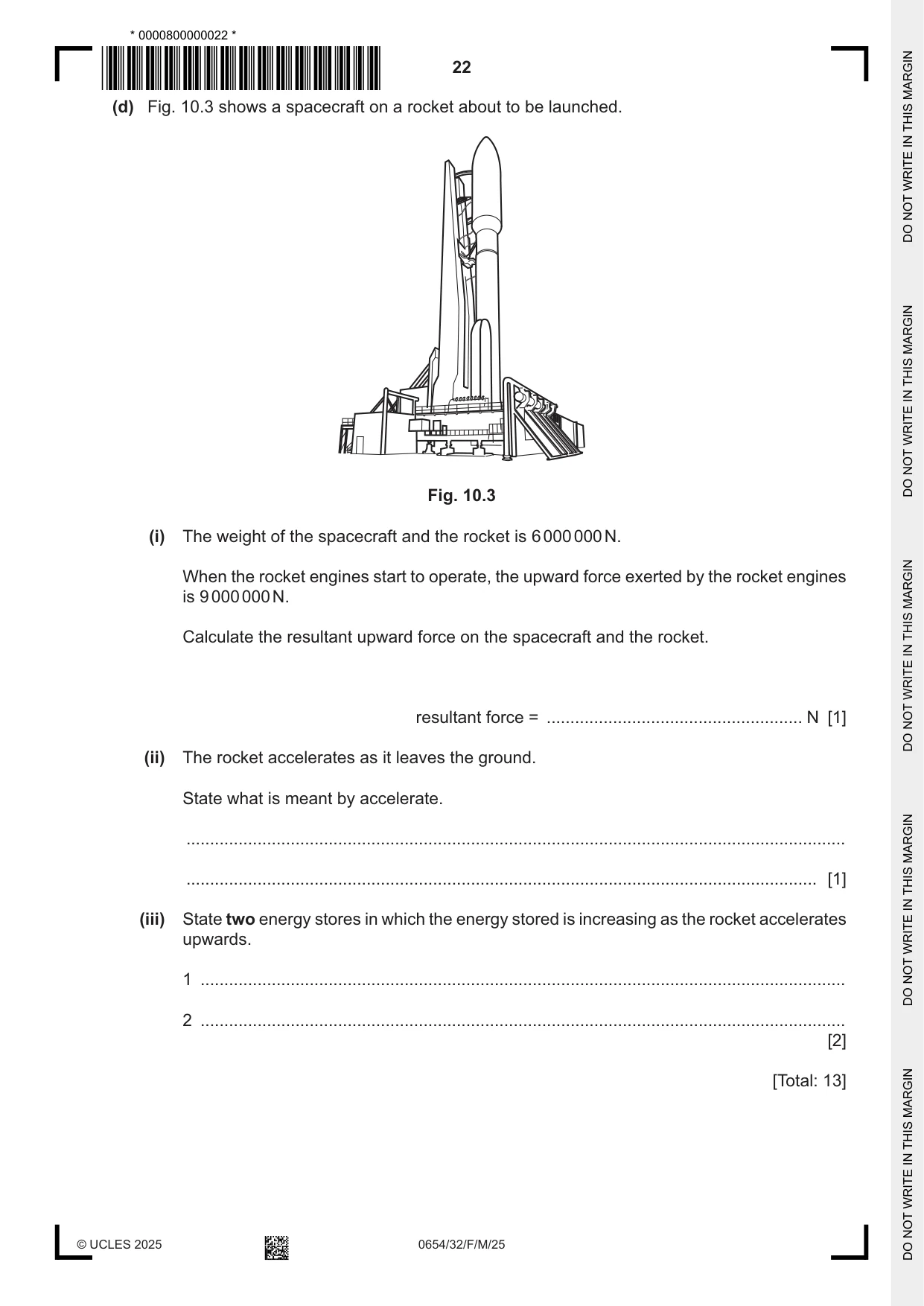
10 (a) (i) The Sun consists mostly of two elements. State the names of these two elements. 1 .............................................. 2 .............................................. [1] (ii) The Milky Way galaxy contains the Sun and many other stars. State the approximate diameter of the Milky Way. diameter = ....................................... light-years [1] (iii) Stars are extremely hot bodies. Energy is being transferred from the stars into space when they emit electromagnetic radiation. Explain why stars can lose energy by radiation and not by conduction or convection. ........................................................................................................................................... ..................................................................................................................................... [1] (iv) Visible light waves from a distant star change direction as they enter the Earth’s atmosphere. State the name of this effect. ..................................................................................................................................... [1] (b) (i) A frequency of infrared radiation emitted by the Sun is 2.5 × 10¹⁴ Hz. The speed of infrared radiation is 3.0 × 10⁸ m / s. Calculate the wavelength of this infrared radiation. wavelength = ......................................................m [2] (ii) Fig. 10.1 shows an incomplete electromagnetic spectrum. Write infrared radiation in its correct position. increasing frequency visible radio X-rays light waves Fig. 10.1 [1] (c) Fig. 10.2 shows a ray of white light from the Sun refracting through a prism. The ray of light splits into the seven colours of the visible spectrum. The seven colours are shown as the numbers 1 to 7. Red light refracts less than violet light. 1 2 3 white 4 light 5 6 prism 7 Fig. 10.2 Complete Table 10.1 to identify the seven colours. Table 10.1 ray number colour observed 1 2 3 4 5 6 7 [2] (d) Fig. 10.3 shows a spacecraft on a rocket about to be launched. Fig. 10.3 (i) The weight of the spacecraft and the rocket is 6 000 000 N. When the rocket engines start to operate, the upward force exerted by the rocket engines is 9 000 000 N. Calculate the resultant upward force on the spacecraft and the rocket. resultant force = ...................................................... N [1] (ii) The rocket accelerates as it leaves the ground. State what is meant by accelerate. ........................................................................................................................................... ..................................................................................................................................... [1] (iii) State two energy stores in which the energy stored is increasing as the rocket accelerates upwards. 1 ........................................................................................................................................ 2 ........................................................................................................................................ [2] [Total: 13]
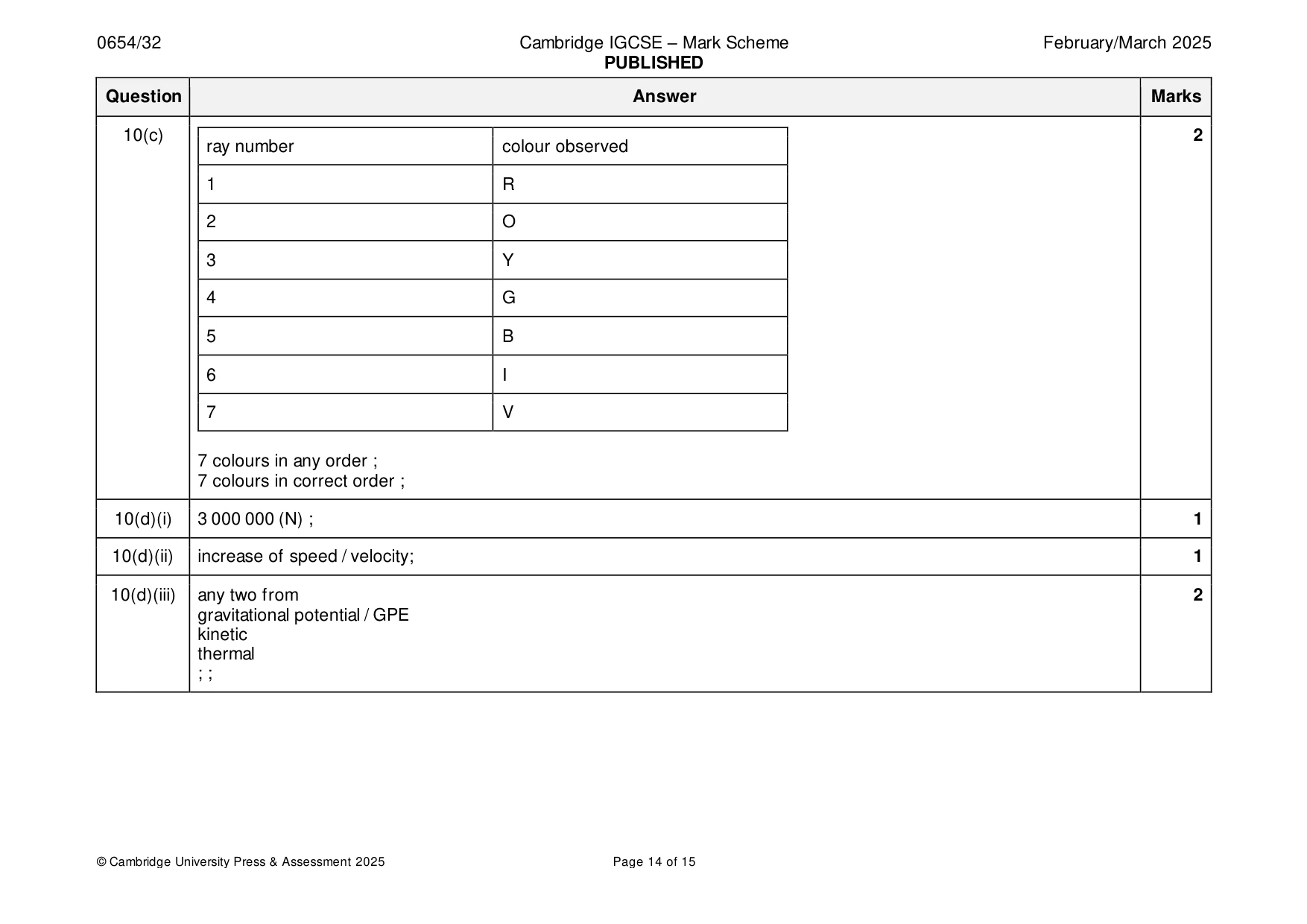
Mark scheme: 10(a)(i) hydrogen 1 and helium ; 10(a)(ii) 100 000 (light-years) ; 1 10(a)(iii) conduction and convection require a medium ORA ; 1 10(a)(iv) refraction ; 1 10(b)(i) v = f (in any form) or wavelength = 3 108 / 2.5 1014 ; 2 1.2 10–6 (m) ; 10(b)(ii) ‘infrared’ in box to the right of ‘visible light’ ; 1 10(c) 2 ray number colour observed 1 R 2 O 3 Y 4 G 5 B 6 I 7 V 7 colours in any order ; 7 colours in correct order ; 10(d)(i) 3 000 000 (N) ; 1 10(d)(ii) increase of speed / velocity; 1 10(d)(iii) any two from 2 gravitational potential / GPE kinetic thermal ; ;
Q11 · An elephant pushing a tree trunk along at a constant speed
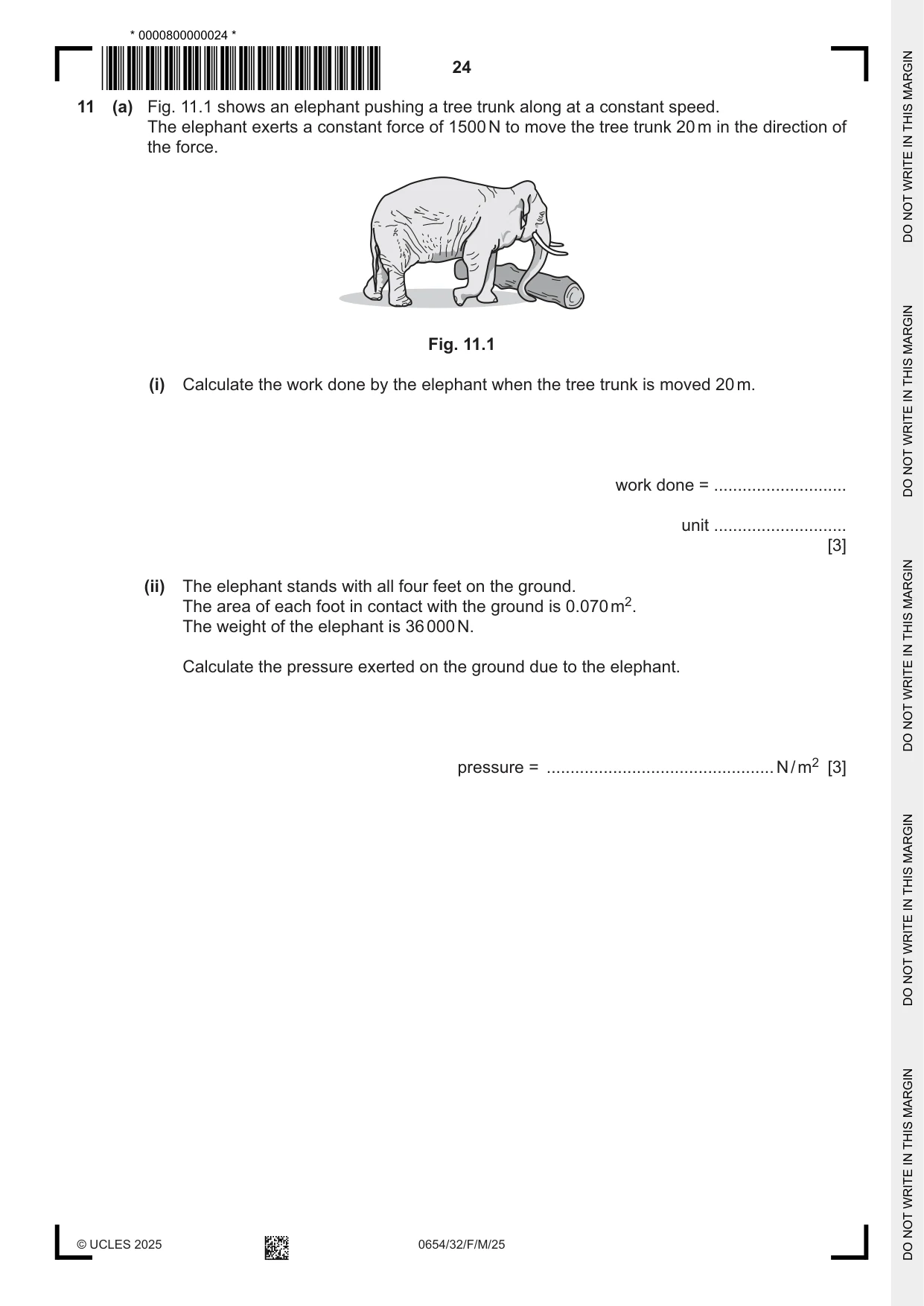
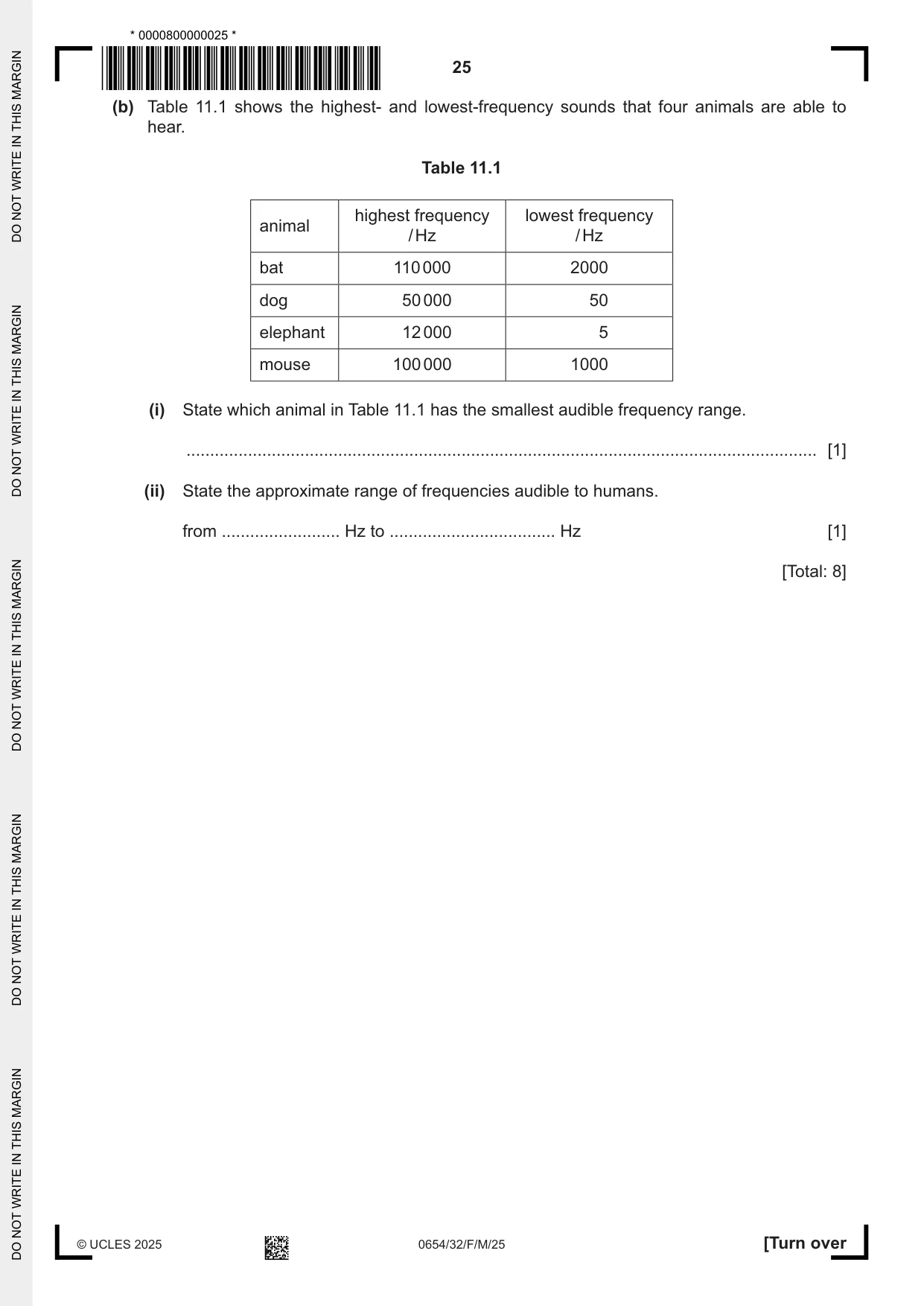
11 (a) Fig. 11.1 shows an elephant pushing a tree trunk along at a constant speed. The elephant exerts a constant force of 1500 N to move the tree trunk 20 m in the direction of the force. Fig. 11.1 (i) Calculate the work done by the elephant when the tree trunk is moved 20 m. work done = ............................ unit ............................ [3] (ii) The elephant stands with all four feet on the ground. The area of each foot in contact with the ground is 0.070 m2. The weight of the elephant is 36 000 N. Calculate the pressure exerted on the ground due to the elephant. pressure = ................................................N / m2 [3] (b) Table 11.1 shows the highest- and lowest-frequency sounds that four animals are able to hear. Table 11.1 highest frequency lowest frequency animal / Hz / Hz bat 110 000 2000 dog 50 000 50 elephant 12 000 5 mouse 100 000 1000 (i) State which animal in Table 11.1 has the smallest audible frequency range. ..................................................................................................................................... [1] (ii) State the approximate range of frequencies audible to humans. from ......................... Hz to ................................... Hz [1] [Total: 8]
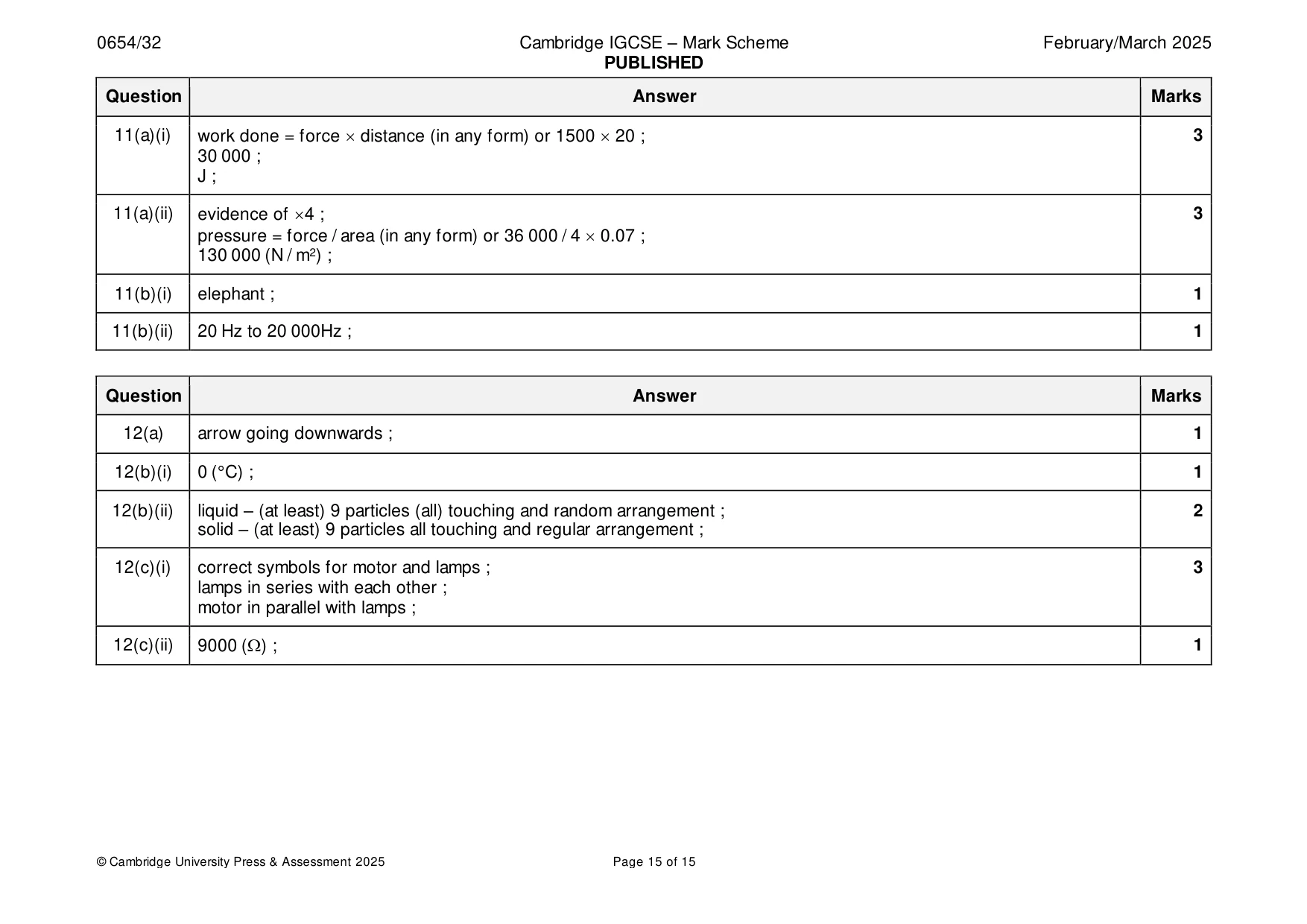
Mark scheme: 11(a)(i) work done = force distance (in any form) or 1500 20 ; 3 30 000 ; J ; 11(a)(ii) evidence of 4 ; 3 pressure = force / area (in any form) or 36 000 / 4 0.07 ; 130 000 (N / m2) ; 11(b)(i) elephant ; 1 11(b)(ii) 20 Hz to 20 000Hz ; 1
Question 12
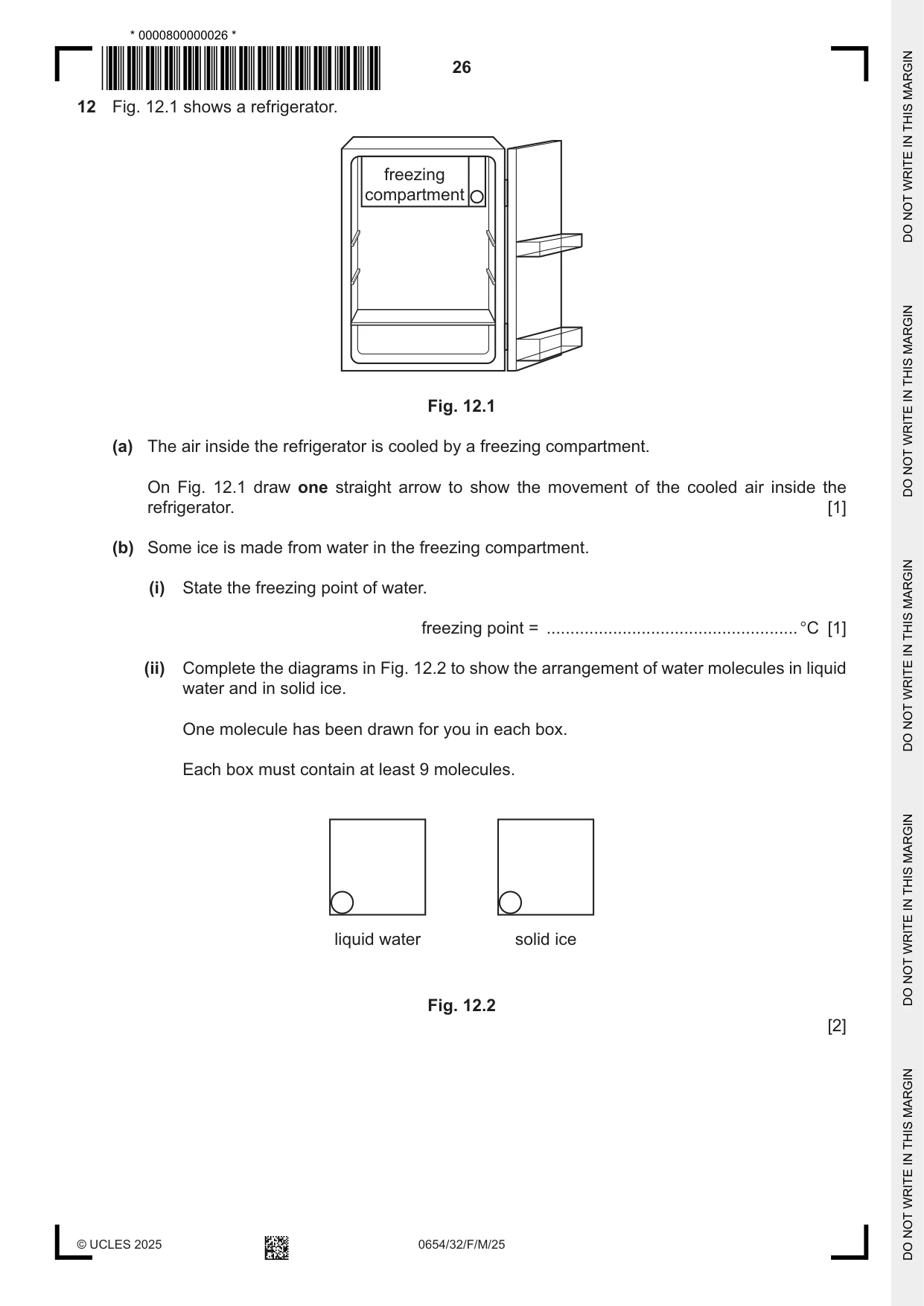
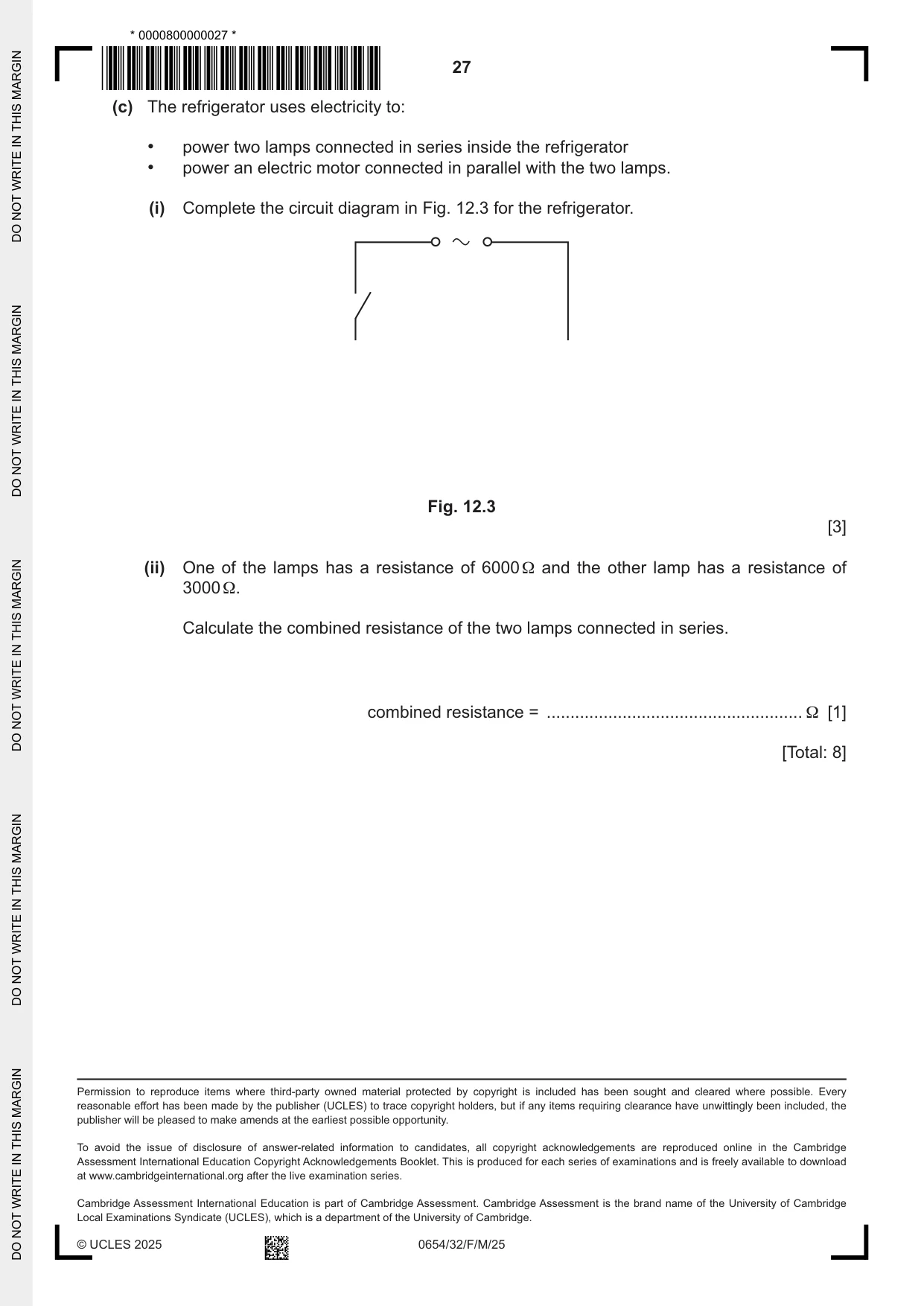
12 Fig. 12.1 shows a refrigerator. freezing compartment Fig. 12.1 (a) The air inside the refrigerator is cooled by a freezing compartment. On Fig. 12.1 draw one straight arrow to show the movement of the cooled air inside the refrigerator. [1] (b) Some ice is made from water in the freezing compartment. (i) State the freezing point of water. freezing point = .....................................................°C [1] (ii) Complete the diagrams in Fig. 12.2 to show the arrangement of water molecules in liquid water and in solid ice. One molecule has been drawn for you in each box. Each box must contain at least 9 molecules. liquid water solid ice Fig. 12.2 [2] (c) The refrigerator uses electricity to: • power two lamps connected in series inside the refrigerator • power an electric motor connected in parallel with the two lamps. (i) Complete the circuit diagram in Fig. 12.3 for the refrigerator. Fig. 12.3 [3] (ii) One of the lamps has a resistance of 6000 Ω and the other lamp has a resistance of 3000 Ω. Calculate the combined resistance of the two lamps connected in series. combined resistance = ...................................................... Ω [1] [Total: 8]
Mark scheme: 12(a) arrow going downwards ; 1 12(b)(i) 0 (°C) ; 1 12(b)(ii) liquid – (at least) 9 particles (all) touching and random arrangement ; 2 solid – (at least) 9 particles all touching and regular arrangement ; 12(c)(i) correct symbols for motor and lamps ; 3 lamps in series with each other ; motor in parallel with lamps ; 12(c)(ii) 9000 () ; 1
What was in this paper
The subtopics covered by these 12 questions, and how many questions each got. Open one in a new tab to see every Cambridge question on it.
What you needed in this session
Cambridge’s own grade thresholds for 2025 Feb/March, Paper 3 · Variant 2. A higher threshold means an easier paper — the bar moves with how the cohort did.