Cambridge IGCSE Sciences - Co-ordinated (Double) 0654 — 2018 Oct/Nov Paper 3 · Variant 1
0654/31/O/N/18 · 13 questions · 120 marks · ≈135 min
The question paper and its mark scheme, free to read here and free to download. This is Cambridge’s own paper, exactly as it was sat.
Question paper28 pages

Mark scheme16 pages
Answers below. Sit the paper first if you are practising.
Questions as text
Q1 · The different types of human teeth in the lower jaw
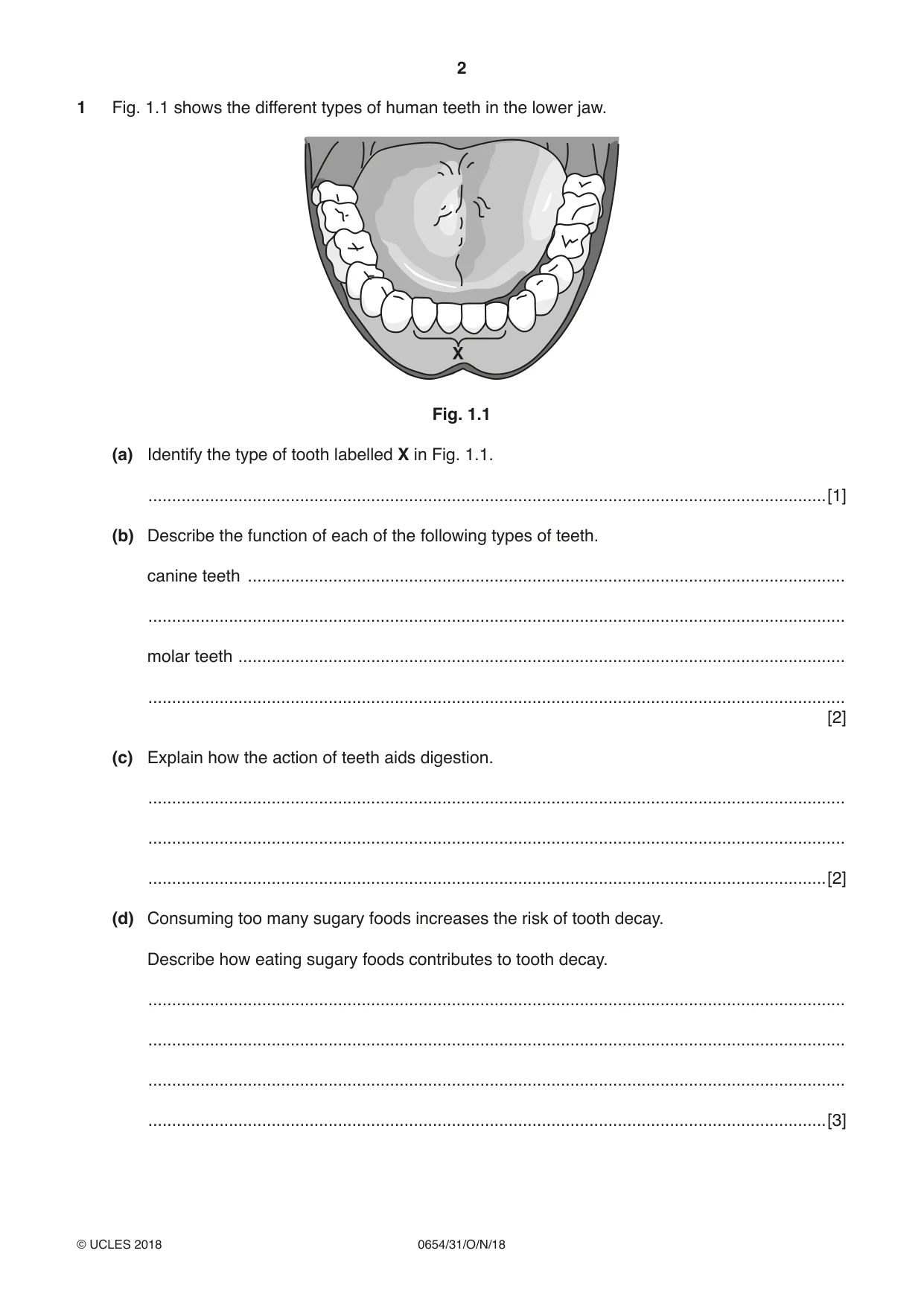
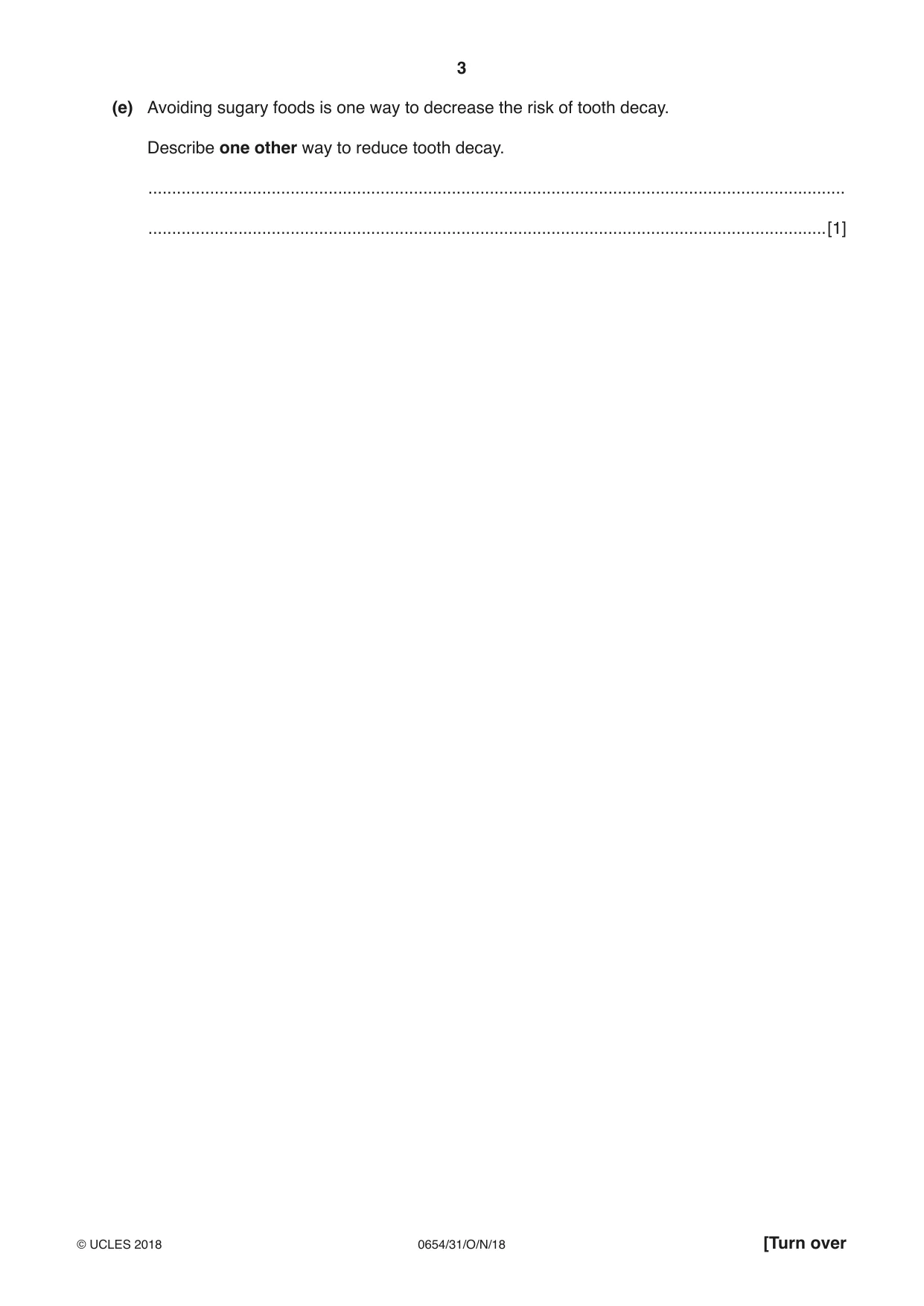
1 Fig. 1.1 shows the different types of human teeth in the lower jaw. X Fig. 1.1 (a) Identify the type of tooth labelled X in Fig. 1.1. ...............................................................................................................................................[1] (b) Describe the function of each of the following types of teeth. canine teeth .............................................................................................................................. ................................................................................................................................................... molar teeth ................................................................................................................................ ................................................................................................................................................... [2] (c) Explain how the action of teeth aids digestion. ................................................................................................................................................... ................................................................................................................................................... ...............................................................................................................................................[2] (d) Consuming too many sugary foods increases the risk of tooth decay. Describe how eating sugary foods contributes to tooth decay. ................................................................................................................................................... ................................................................................................................................................... ................................................................................................................................................... ...............................................................................................................................................[3] (e) Avoiding sugary foods is one way to decrease the risk of tooth decay. Describe one other way to reduce tooth decay. ................................................................................................................................................... ...............................................................................................................................................[1]
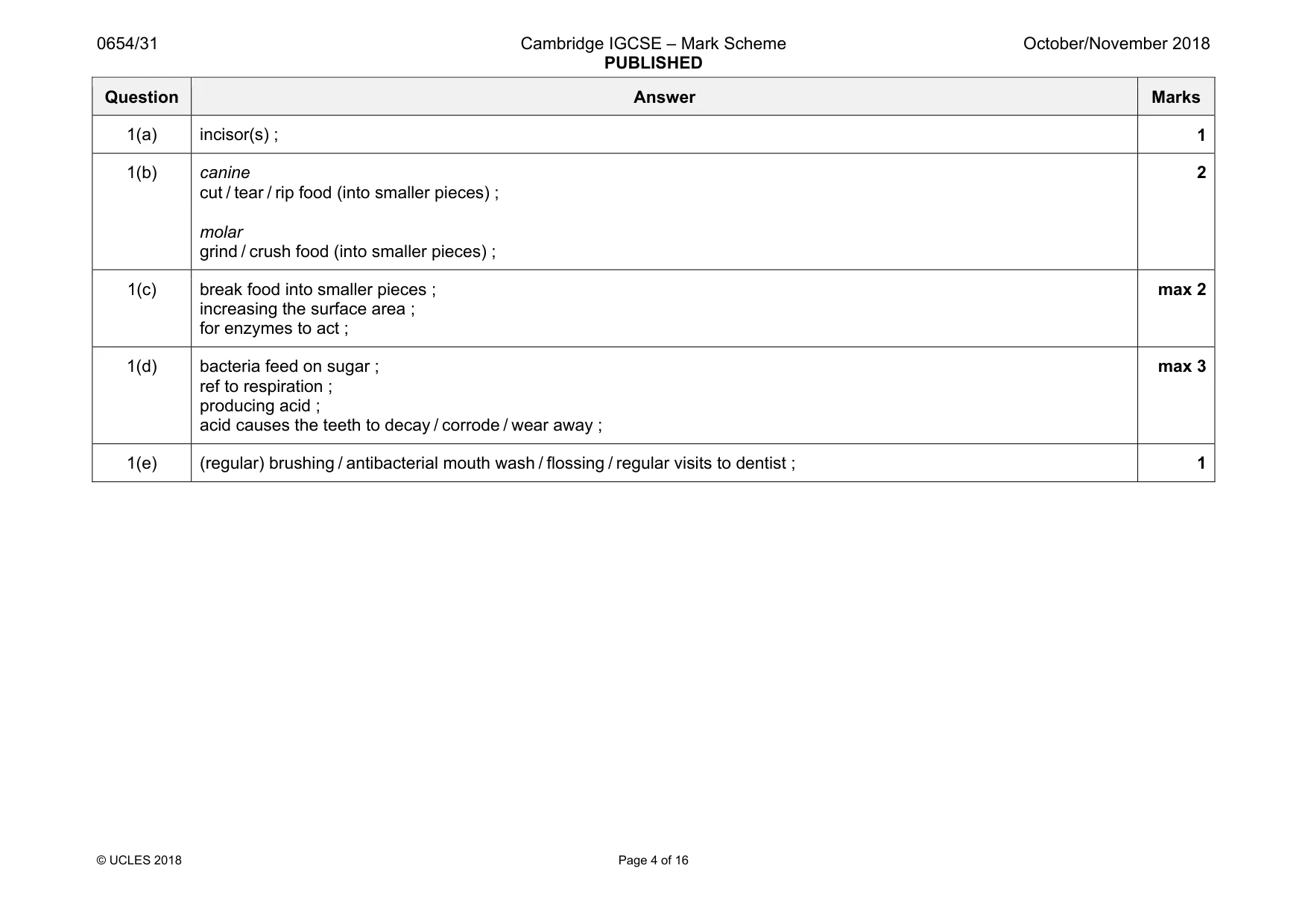
Mark scheme: 1(a) incisor(s) ; 1 1(b) canine cut / tear / rip food (into smaller pieces) ; molar grind / crush food (into smaller pieces) ; 2 1(c) break food into smaller pieces ; increasing the surface area ; for enzymes to act ; max 2 1(d) bacteria feed on sugar ; ref to respiration ; producing acid ; acid causes the teeth to decay / corrode / wear away ; max 3 1(e) (regular) brushing / antibacterial mouth wash / flossing / regular visits to dentist ; 1
Q2 · Calcium carbonate, CaCO3, is the main compound in limestone
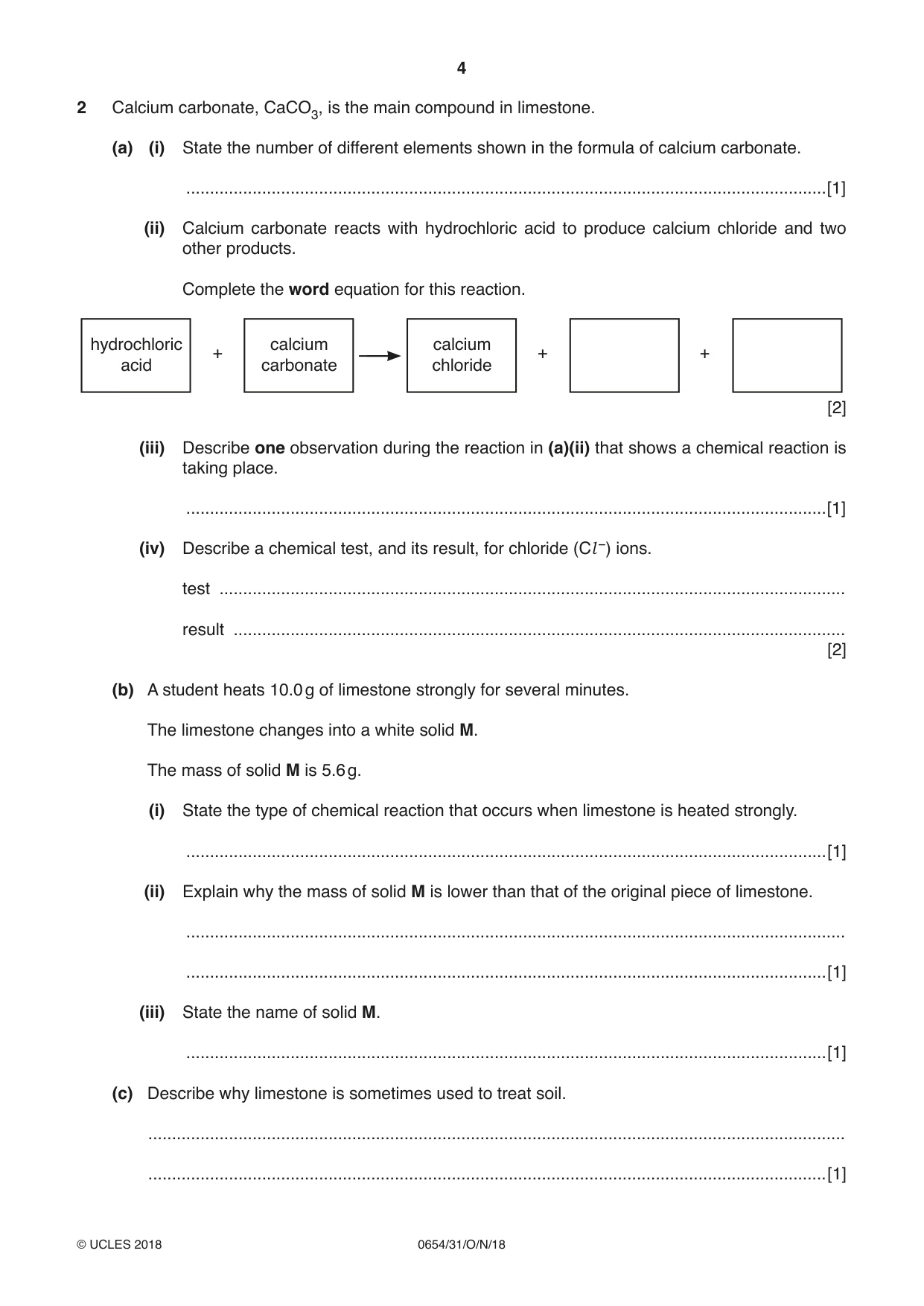
2 Calcium carbonate, CaCO3, is the main compound in limestone. (a) (i) State the number of different elements shown in the formula of calcium carbonate. .......................................................................................................................................[1] (ii) Calcium carbonate reacts with hydrochloric acid to produce calcium chloride and two other products. Complete the word equation for this reaction. hydrochloric calcium calcium + + + acid carbonate chloride [2] (iii) Describe one observation during the reaction in (a)(ii) that shows a chemical reaction is taking place. .......................................................................................................................................[1] (iv) Describe a chemical test, and its result, for chloride (Cl −) ions. test .................................................................................................................................... result ................................................................................................................................. [2] (b) A student heats 10.0 g of limestone strongly for several minutes. The limestone changes into a white solid M. The mass of solid M is 5.6 g. (i) State the type of chemical reaction that occurs when limestone is heated strongly. .......................................................................................................................................[1] (ii) Explain why the mass of solid M is lower than that of the original piece of limestone. ........................................................................................................................................... .......................................................................................................................................[1] (iii) State the name of solid M. .......................................................................................................................................[1] (c) Describe why limestone is sometimes used to treat soil. ................................................................................................................................................... ...............................................................................................................................................[1]
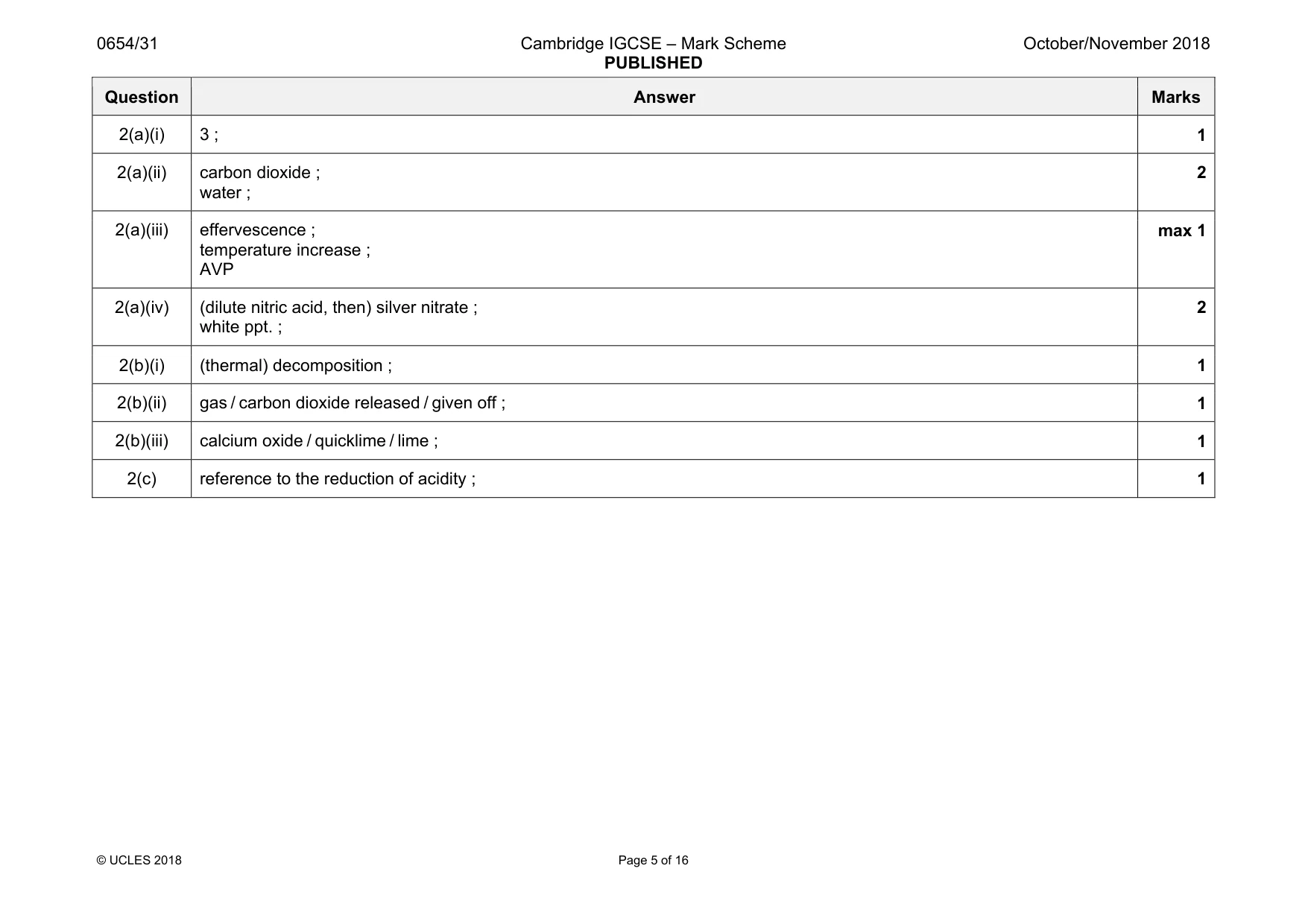
Mark scheme: 2(a)(i) 3 ; 1 2(a)(ii) carbon dioxide ; water ; 2 2(a)(iii) effervescence ; temperature increase ; AVP max 1 2(a)(iv) (dilute nitric acid, then) silver nitrate ; white ppt. ; 2 2(b)(i) (thermal) decomposition ; 1 2(b)(ii) gas / carbon dioxide released / given off ; 1 2(b)(iii) calcium oxide / quicklime / lime ; 1 2(c) reference to the reduction of acidity ; 1
Q3 · The highest and lowest frequencies that four animals can hear
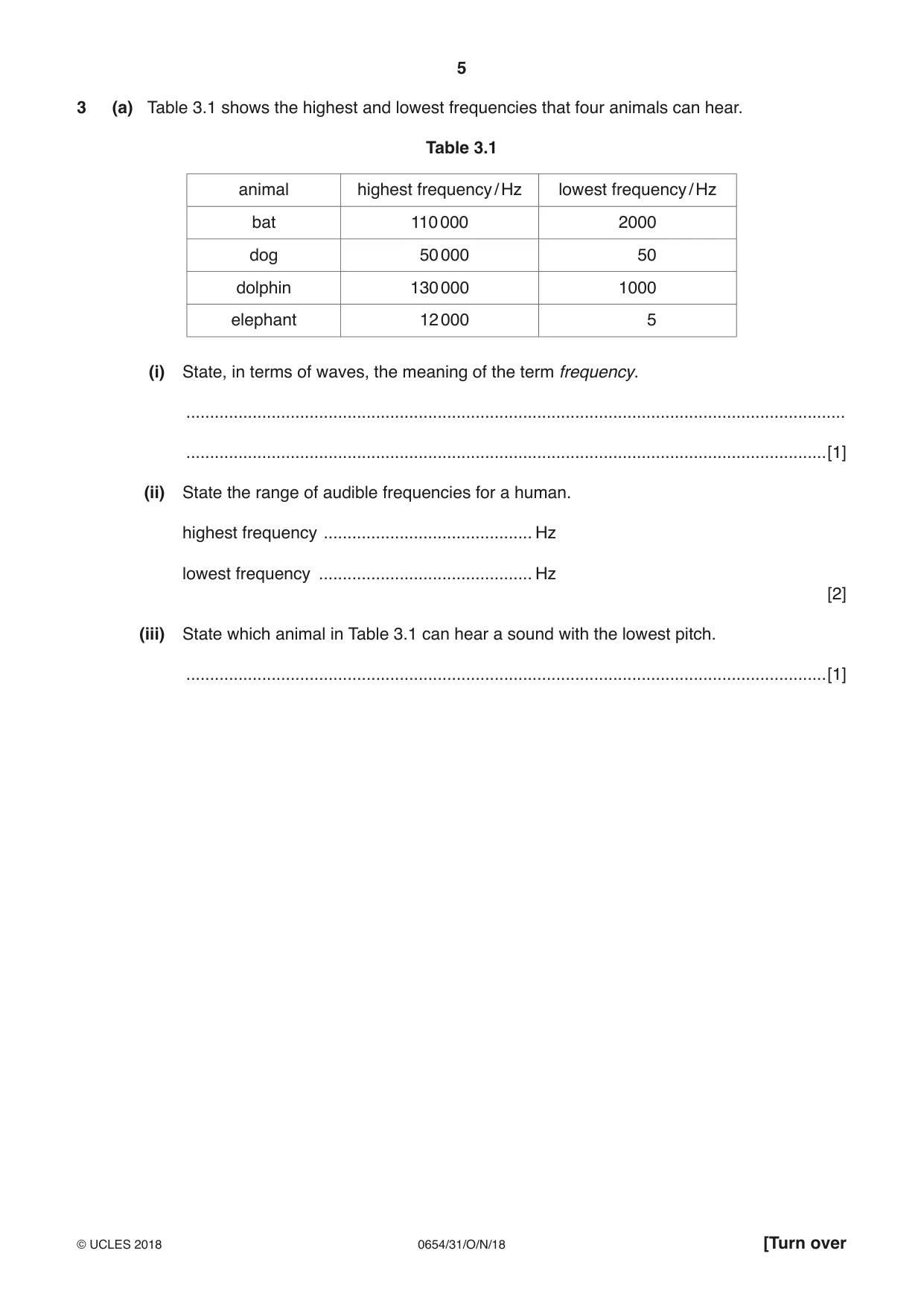
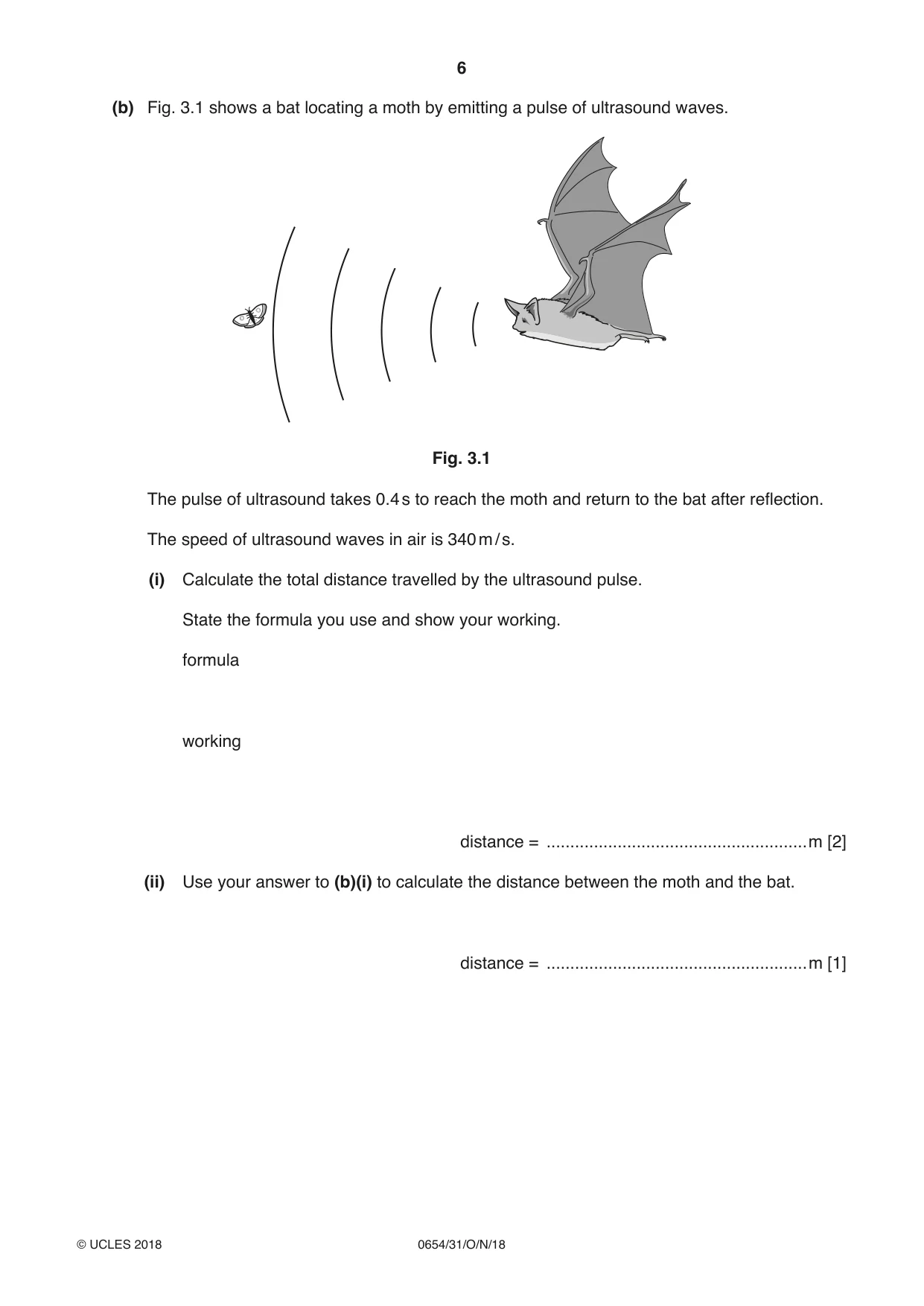
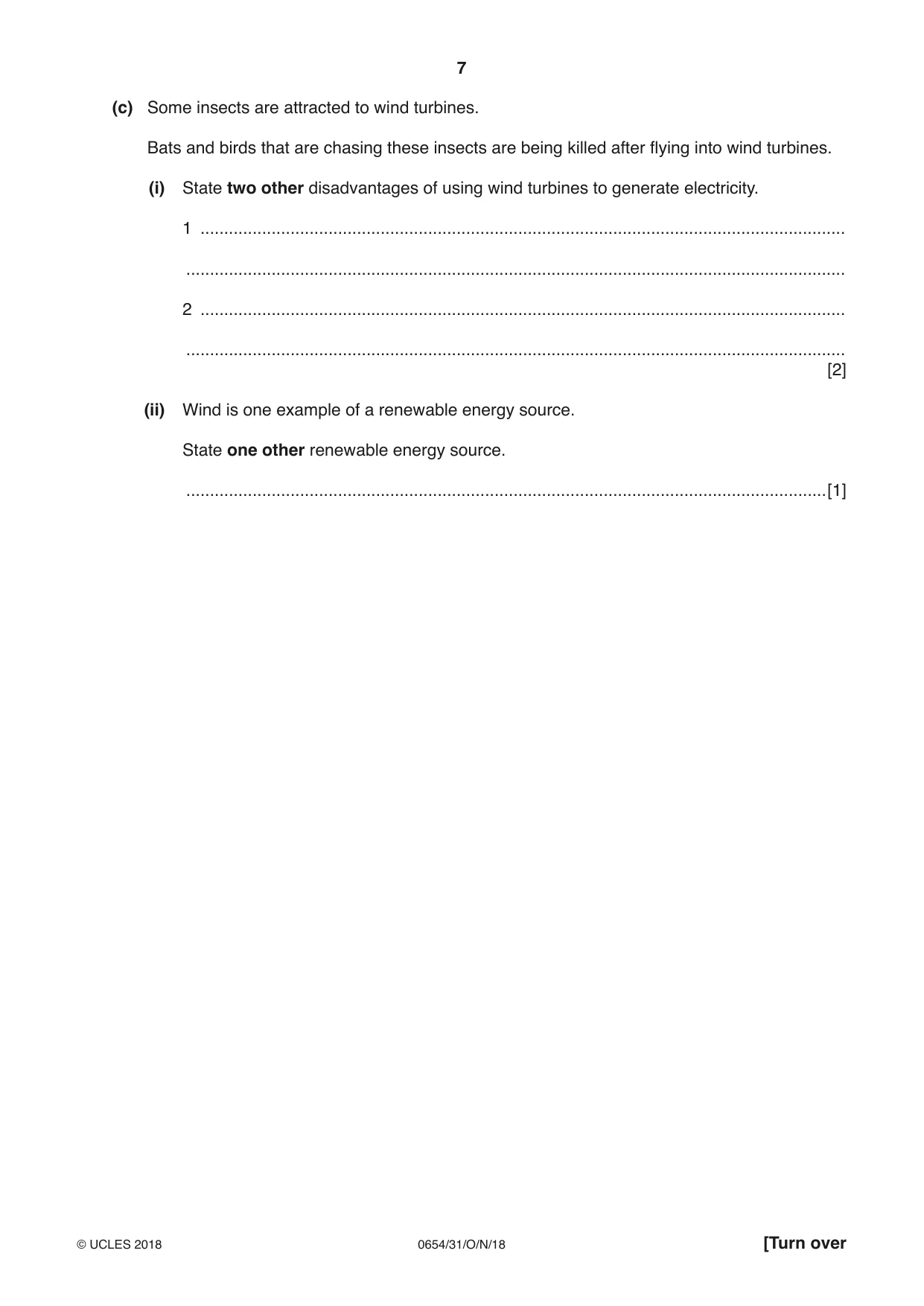
3 (a) Table 3.1 shows the highest and lowest frequencies that four animals can hear. Table 3.1 animal highest frequency / Hz lowest frequency / Hz bat 110 000 2000 dog 50 000 50 dolphin 130 000 1000 elephant 12 000 5 (i) State, in terms of waves, the meaning of the term frequency. ........................................................................................................................................... .......................................................................................................................................[1] (ii) State the range of audible frequencies for a human. highest frequency ............................................ Hz lowest frequency ............................................. Hz [2] (iii) State which animal in Table 3.1 can hear a sound with the lowest pitch. .......................................................................................................................................[1] (b) Fig. 3.1 shows a bat locating a moth by emitting a pulse of ultrasound waves. Fig. 3.1 The pulse of ultrasound takes 0.4 s to reach the moth and return to the bat after reflection. The speed of ultrasound waves in air is 340 m / s. (i) Calculate the total distance travelled by the ultrasound pulse. State the formula you use and show your working. formula working distance = .......................................................m [2] (ii) Use your answer to (b)(i) to calculate the distance between the moth and the bat. distance = .......................................................m [1] (c) Some insects are attracted to wind turbines. Bats and birds that are chasing these insects are being killed after flying into wind turbines. (i) State two other disadvantages of using wind turbines to generate electricity. 1 ........................................................................................................................................ ........................................................................................................................................... 2 ........................................................................................................................................ ........................................................................................................................................... [2] (ii) Wind is one example of a renewable energy source. State one other renewable energy source. .......................................................................................................................................[1]
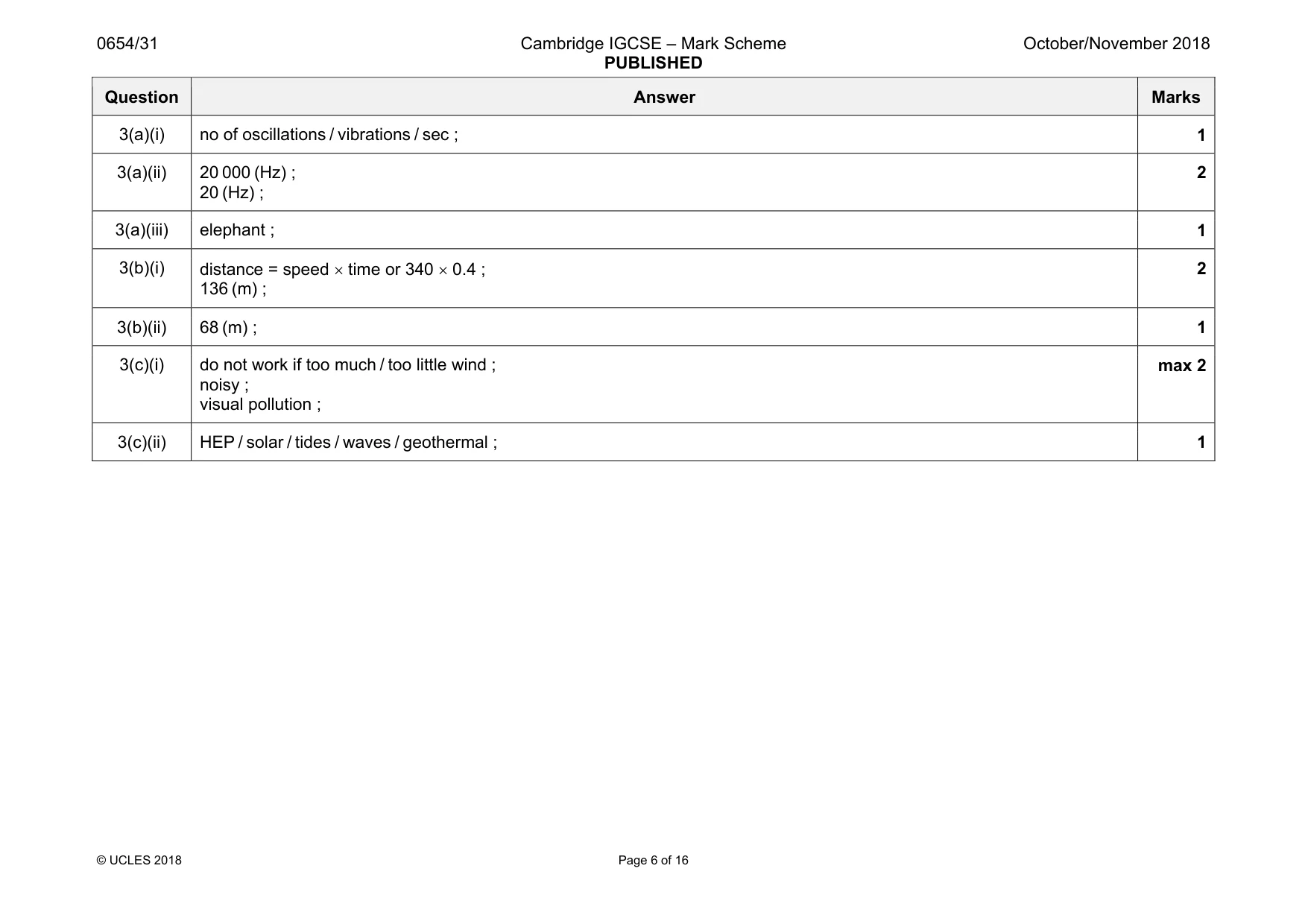
Mark scheme: 3(a)(i) no of oscillations / vibrations / sec ; 1 3(a)(ii) 20 000 (Hz) ; 20 (Hz) ; 2 3(a)(iii) elephant ; 1 3(b)(i) distance = speed × time or 340 × 0.4 ; 136 (m) ; 2 3(b)(ii) 68 (m) ; 1 3(c)(i) do not work if too much / too little wind ; noisy ; visual pollution ; max 2 3(c)(ii) HEP / solar / tides / waves / geothermal ; 1
Q4 · Use words or phrases from the list to complete the definition of the term transpiration
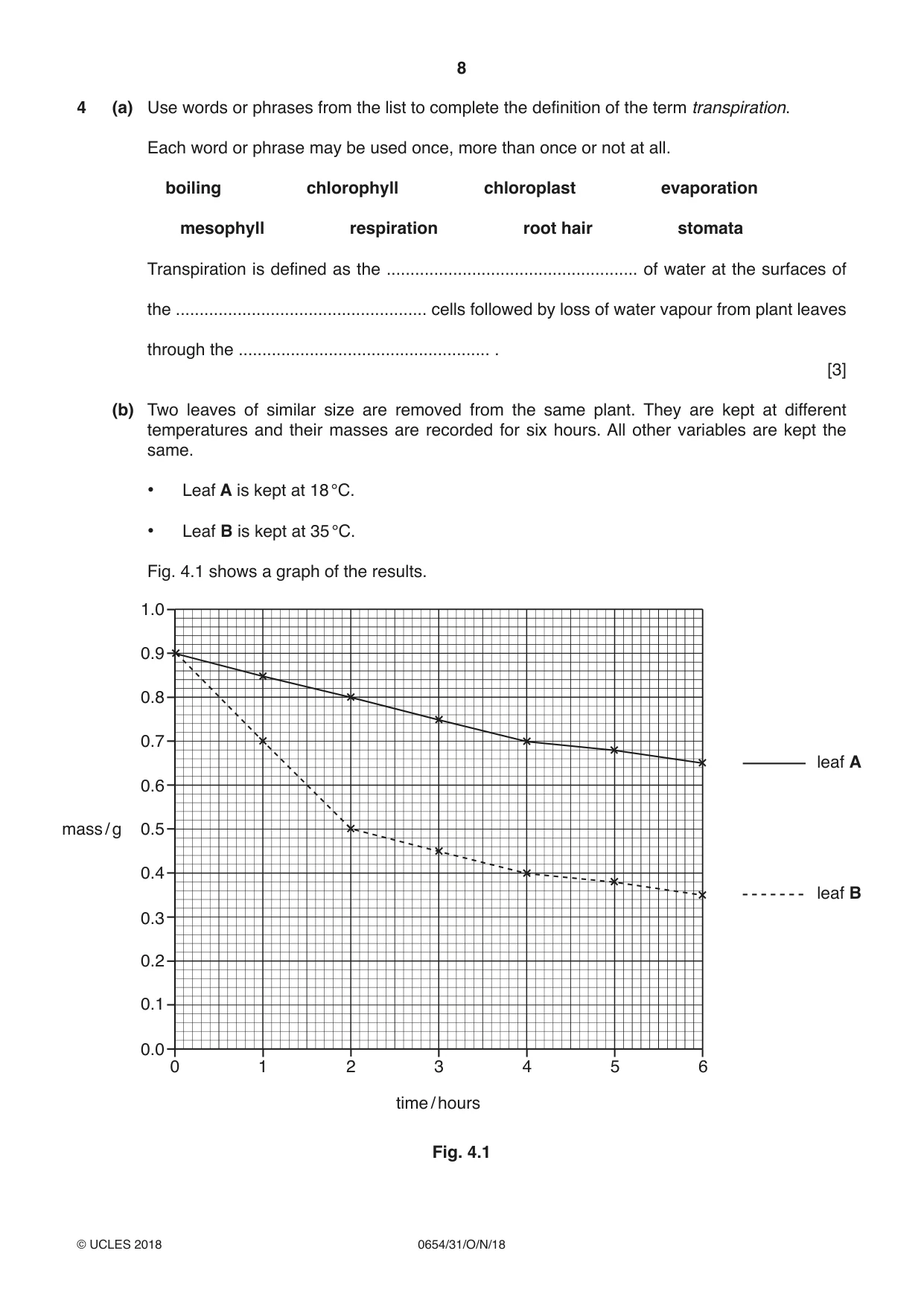
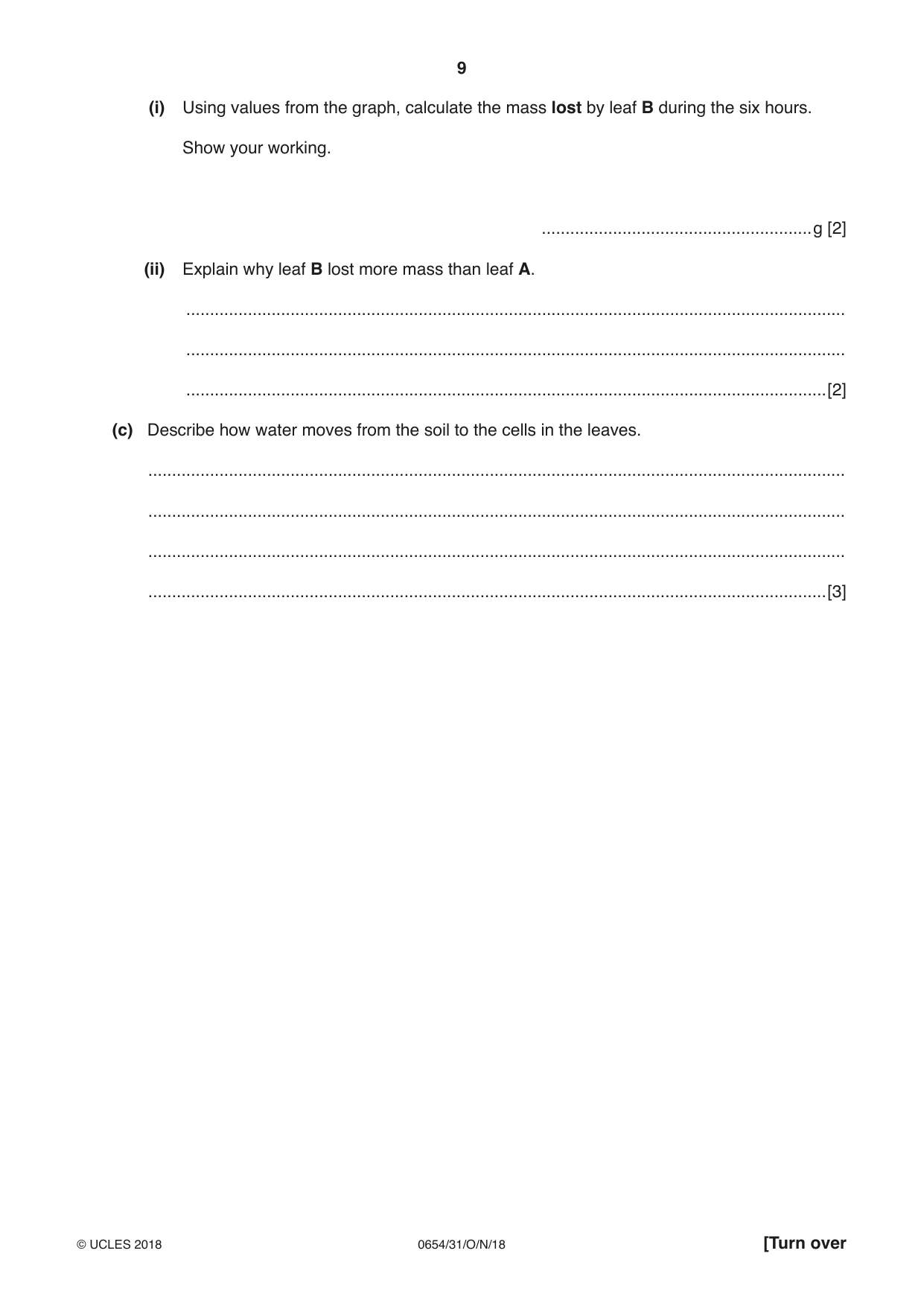
4 (a) Use words or phrases from the list to complete the definition of the term transpiration. Each word or phrase may be used once, more than once or not at all. boiling chlorophyll chloroplast evaporation mesophyll respiration root hair stomata Transpiration is defined as the ..................................................... of water at the surfaces of the ..................................................... cells followed by loss of water vapour from plant leaves through the ..................................................... . [3] (b) Two leaves of similar size are removed from the same plant. They are kept at different temperatures and their masses are recorded for six hours. All other variables are kept the same. • Leaf A is kept at 18 °C. • Leaf B is kept at 35 °C. Fig. 4.1 shows a graph of the results. 1.0 0.9 0.8 0.7 leaf A 0.6 mass / g 0.5 0.4 leaf B 0.3 0.2 0.1 0.0 0 1 2 3 4 5 6 time / hours Fig. 4.1 (i) Using values from the graph, calculate the mass lost by leaf B during the six hours. Show your working. .........................................................g [2] (ii) Explain why leaf B lost more mass than leaf A. ........................................................................................................................................... ........................................................................................................................................... .......................................................................................................................................[2] (c) Describe how water moves from the soil to the cells in the leaves. ................................................................................................................................................... ................................................................................................................................................... ................................................................................................................................................... ...............................................................................................................................................[3]
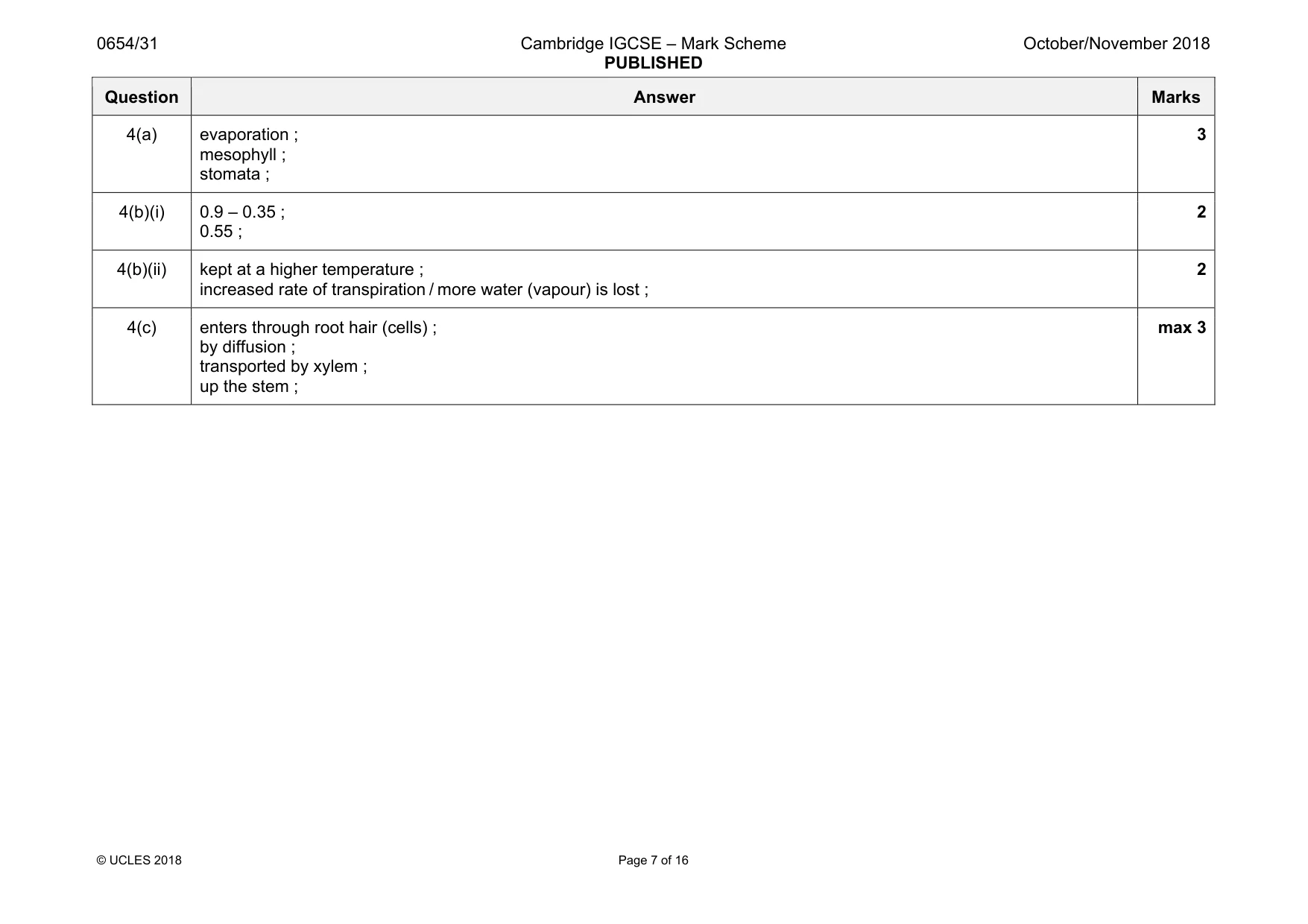
Mark scheme: 4(a) evaporation ; mesophyll ; stomata ; 3 4(b)(i) 0.9 – 0.35 ; 0.55 ; 2 4(b)(ii) kept at a higher temperature ; increased rate of transpiration / more water (vapour) is lost ; 2 4(c) enters through root hair (cells) ; by diffusion ; transported by xylem ; up the stem ; max 3
Q5 · Group VII of the Periodic Table contains reactive non‑metallic elements called the…
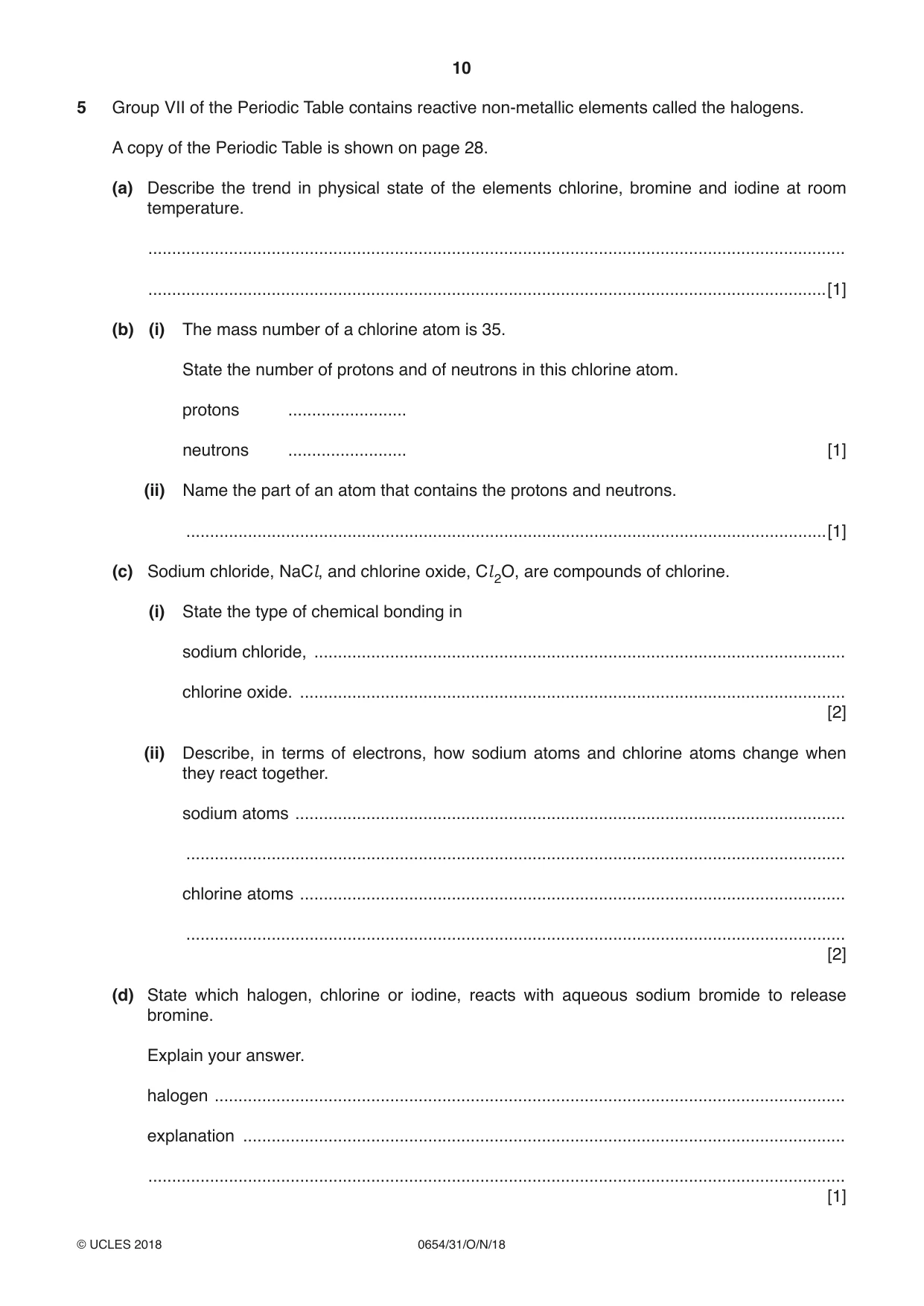
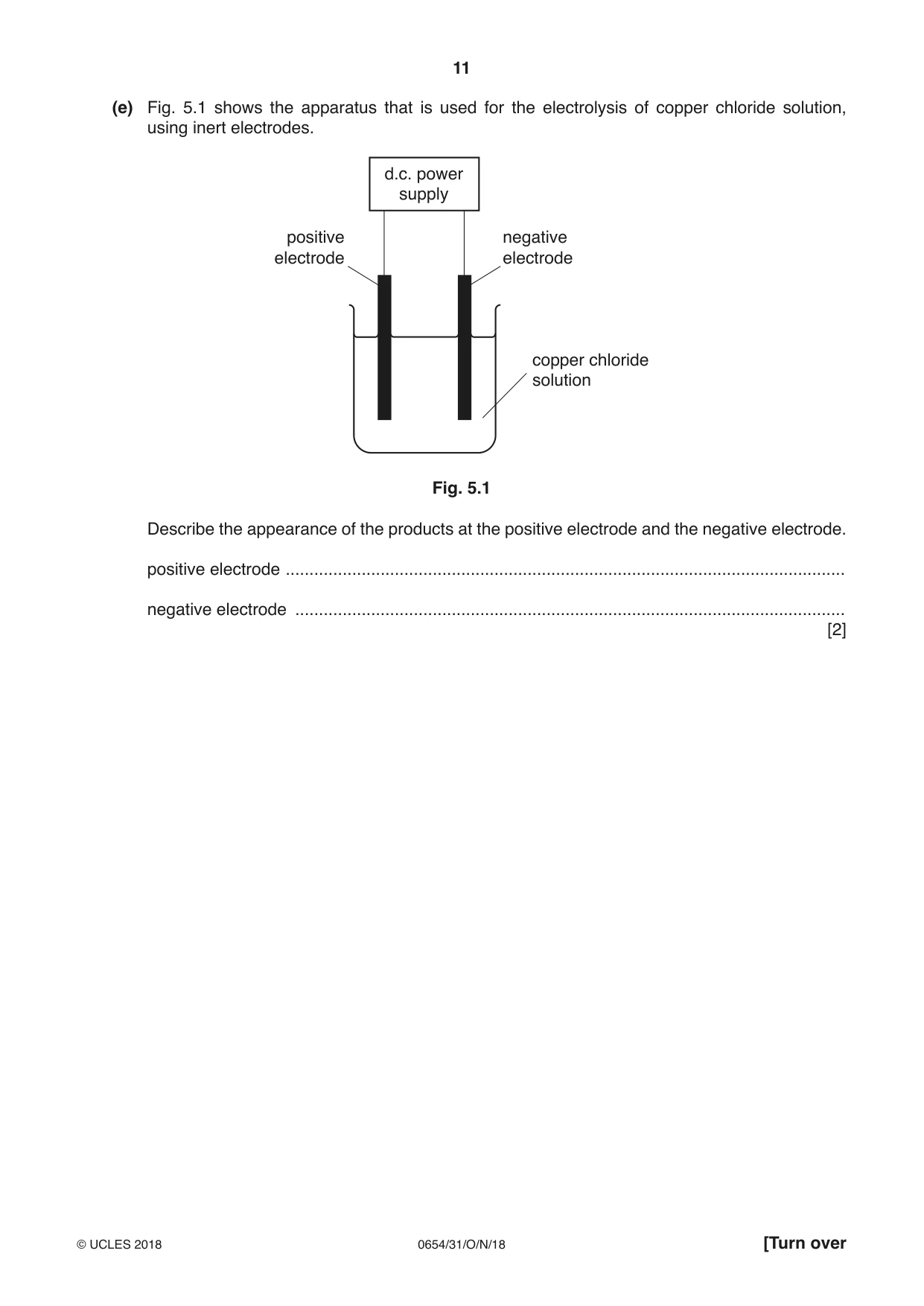
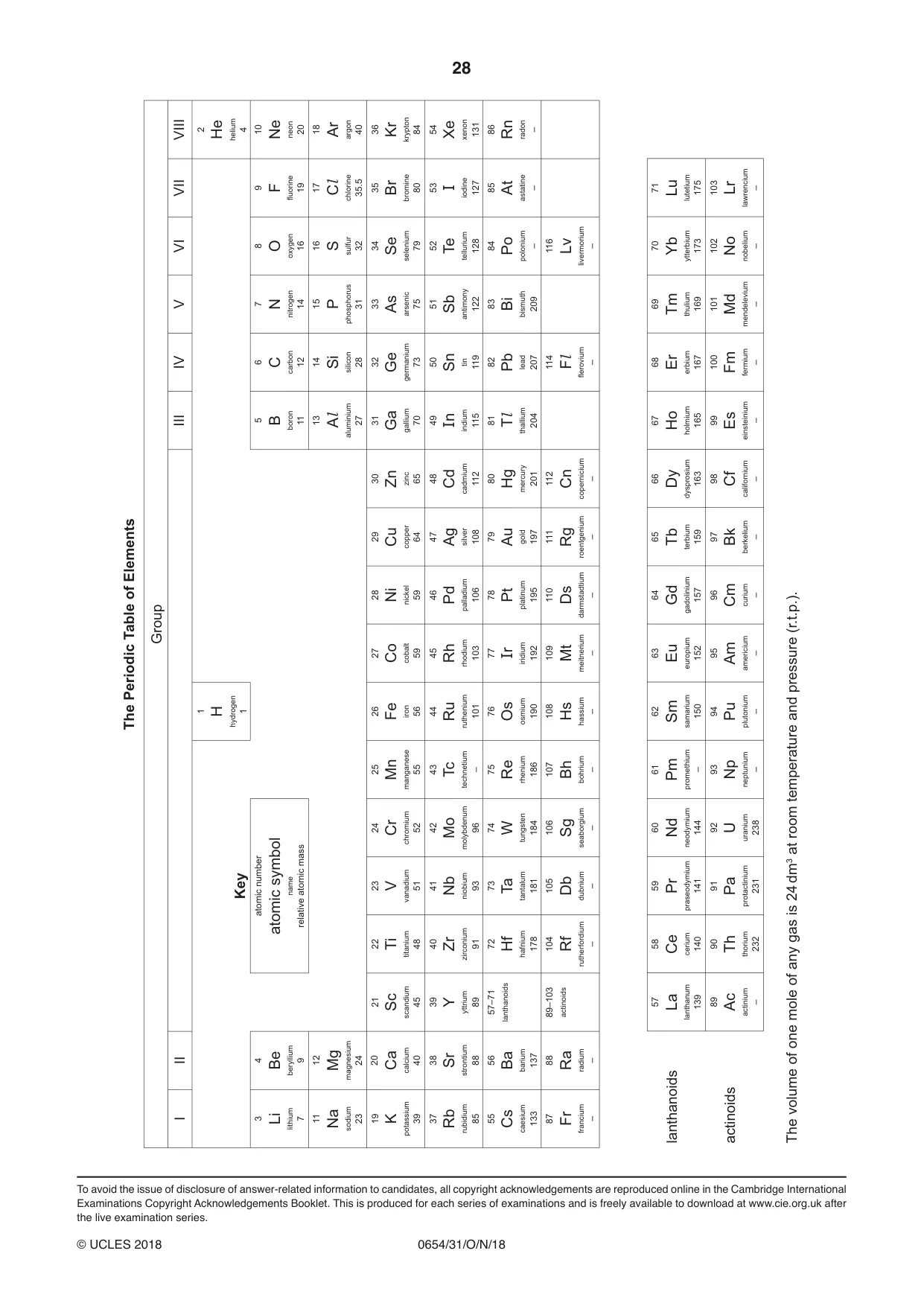
5 Group VII of the Periodic Table contains reactive non‑metallic elements called the halogens. A copy of the Periodic Table is shown on page 28. (a) Describe the trend in physical state of the elements chlorine, bromine and iodine at room temperature. ................................................................................................................................................... ...............................................................................................................................................[1] (b) (i) The mass number of a chlorine atom is 35. State the number of protons and of neutrons in this chlorine atom. protons ......................... neutrons ......................... [1] (ii) Name the part of an atom that contains the protons and neutrons. .......................................................................................................................................[1] (c) Sodium chloride, NaCl, and chlorine oxide, Cl 2O, are compounds of chlorine. (i) State the type of chemical bonding in sodium chloride, ................................................................................................................ chlorine oxide. ................................................................................................................... [2] (ii) Describe, in terms of electrons, how sodium atoms and chlorine atoms change when they react together. sodium atoms .................................................................................................................... ........................................................................................................................................... chlorine atoms ................................................................................................................... ........................................................................................................................................... [2] (d) State which halogen, chlorine or iodine, reacts with aqueous sodium bromide to release bromine. Explain your answer. halogen ..................................................................................................................................... explanation ............................................................................................................................... ................................................................................................................................................... [1] (e) Fig. 5.1 shows the apparatus that is used for the electrolysis of copper chloride solution, using inert electrodes. d.c. power supply positive negative electrode electrode copper chloride solution Fig. 5.1 Describe the appearance of the products at the positive electrode and the negative electrode. positive electrode ...................................................................................................................... negative electrode .................................................................................................................... [2]
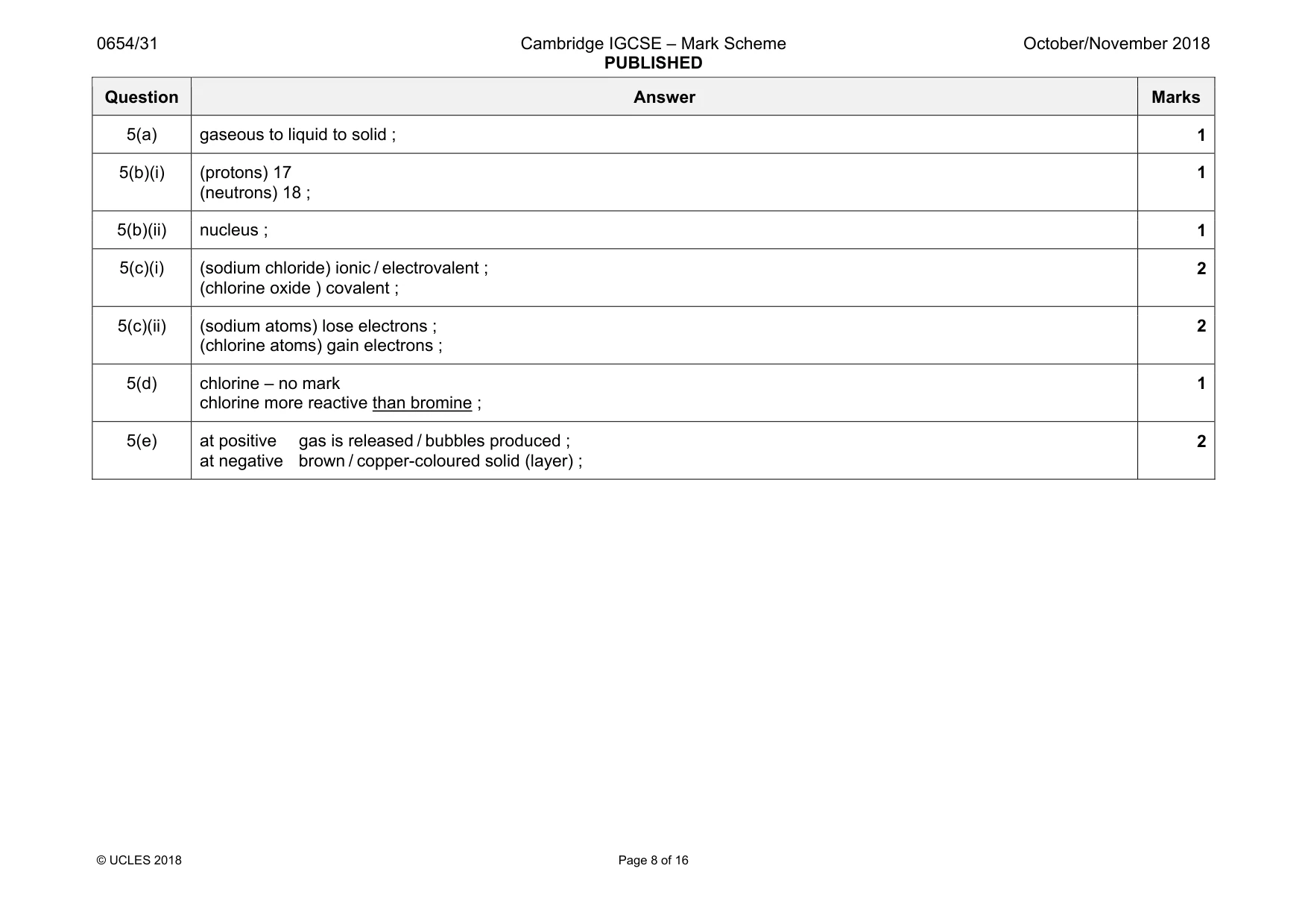
Mark scheme: 5(a) gaseous to liquid to solid ; 1 5(b)(i) (protons) 17 (neutrons) 18 ; 1 5(b)(ii) nucleus ; 1 5(c)(i) (sodium chloride) ionic / electrovalent ; (chlorine oxide ) covalent ; 2 5(c)(ii) (sodium atoms) lose electrons ; (chlorine atoms) gain electrons ; 2 5(d) chlorine – no mark chlorine more reactive than bromine ; 1 5(e) at positive gas is released / bubbles produced ; at negative brown / copper-coloured solid (layer) ; 2
Q6 · A bus gets very hot as it travels on a sunny day
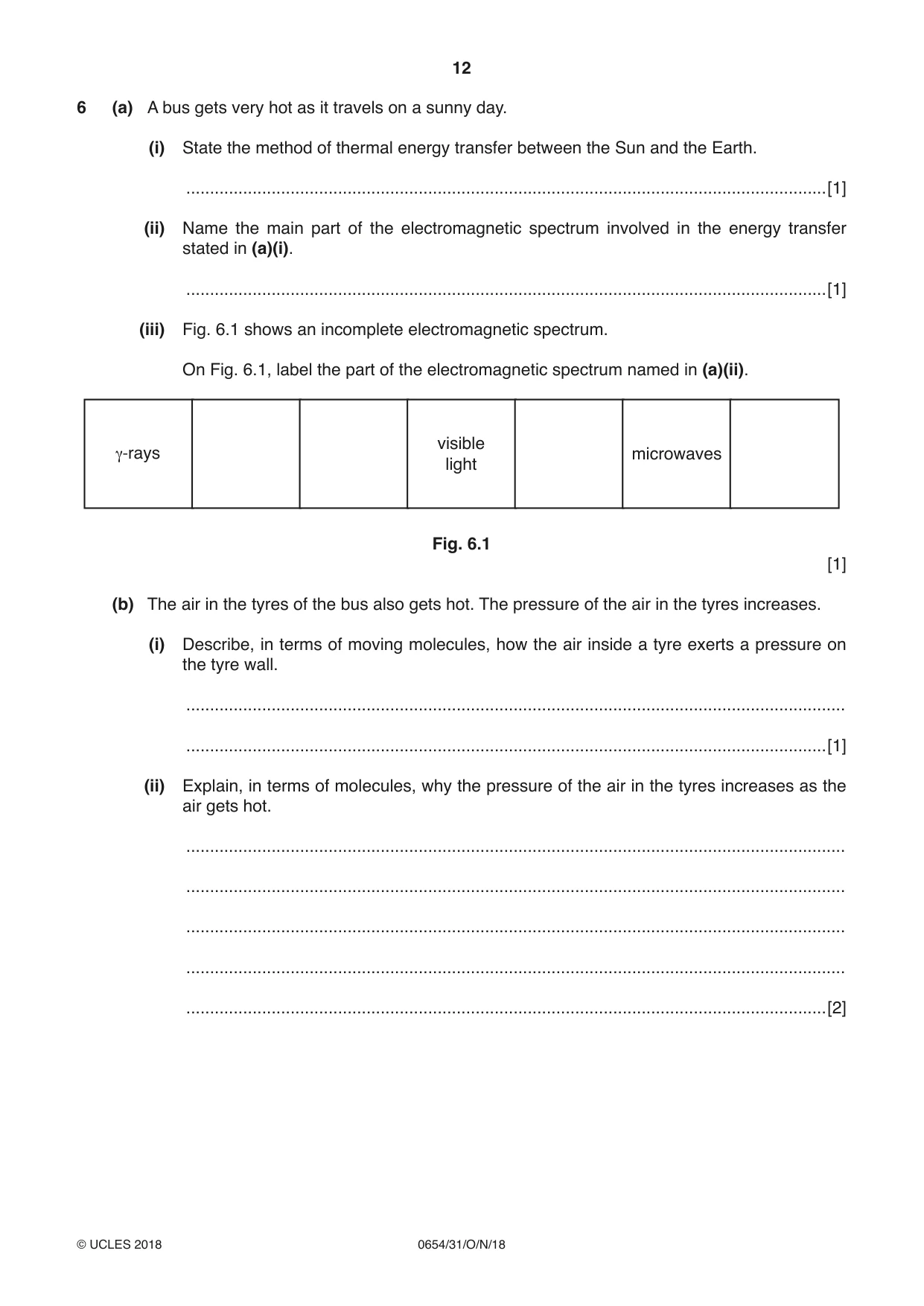
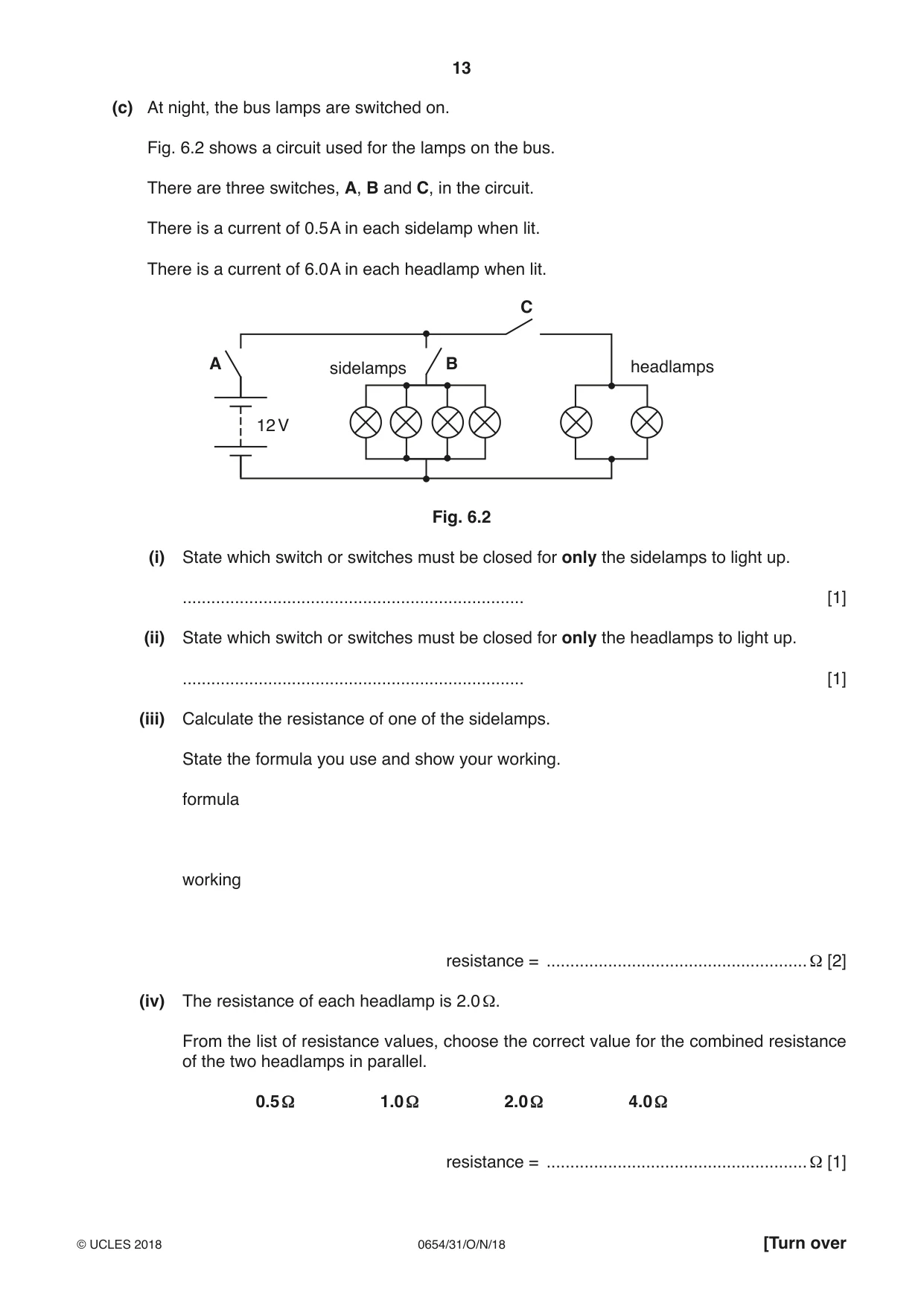
6 (a) A bus gets very hot as it travels on a sunny day. (i) State the method of thermal energy transfer between the Sun and the Earth. .......................................................................................................................................[1] (ii) Name the main part of the electromagnetic spectrum involved in the energy transfer stated in (a)(i). .......................................................................................................................................[1] (iii) Fig. 6.1 shows an incomplete electromagnetic spectrum. On Fig. 6.1, label the part of the electromagnetic spectrum named in (a)(ii). visible γ-rays microwaves light Fig. 6.1 [1] (b) The air in the tyres of the bus also gets hot. The pressure of the air in the tyres increases. (i) Describe, in terms of moving molecules, how the air inside a tyre exerts a pressure on the tyre wall. ........................................................................................................................................... .......................................................................................................................................[1] (ii) Explain, in terms of molecules, why the pressure of the air in the tyres increases as the air gets hot. ........................................................................................................................................... ........................................................................................................................................... ........................................................................................................................................... ........................................................................................................................................... .......................................................................................................................................[2] (c) At night, the bus lamps are switched on. Fig. 6.2 shows a circuit used for the lamps on the bus. There are three switches, A, B and C, in the circuit. There is a current of 0.5 A in each sidelamp when lit. There is a current of 6.0 A in each headlamp when lit. C A sidelamps B headlamps 12 V Fig. 6.2 (i) State which switch or switches must be closed for only the sidelamps to light up. ........................................................................ [1] (ii) State which switch or switches must be closed for only the headlamps to light up. ........................................................................ [1] (iii) Calculate the resistance of one of the sidelamps. State the formula you use and show your working. formula working resistance = .......................................................Ω [2] (iv) The resistance of each headlamp is 2.0 Ω. From the list of resistance values, choose the correct value for the combined resistance of the two headlamps in parallel. 0.5 Ω 1.0 Ω 2.0 Ω 4.0 Ω resistance = .......................................................Ω [1]
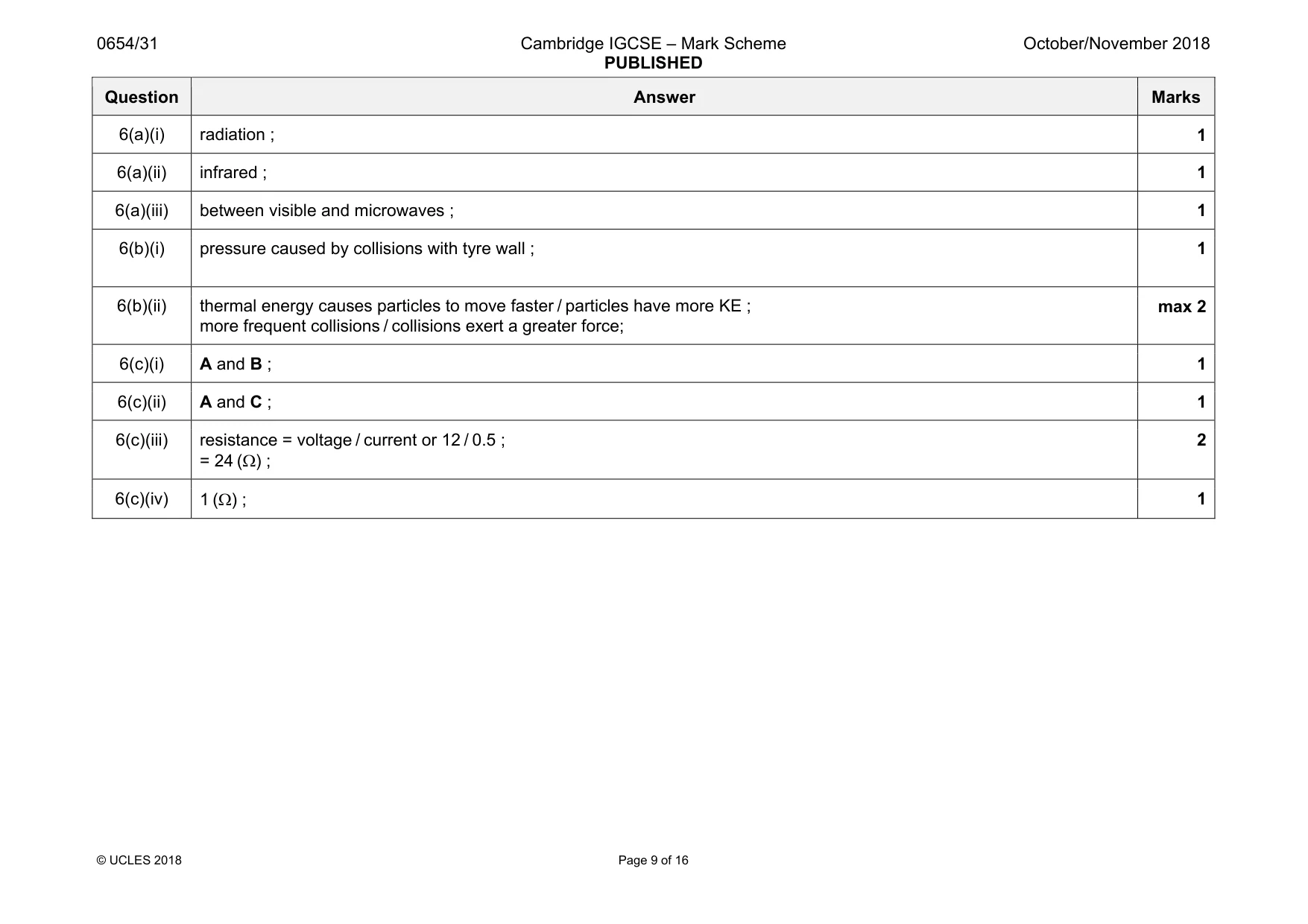
Mark scheme: 6(a)(i) radiation ; 1 6(a)(ii) infrared ; 1 6(a)(iii) between visible and microwaves ; 1 6(b)(i) pressure caused by collisions with tyre wall ; 1 6(b)(ii) thermal energy causes particles to move faster / particles have more KE ; more frequent collisions / collisions exert a greater force; max 2 6(c)(i) A and B ; 1 6(c)(ii) A and C ; 1 6(c)(iii) resistance = voltage / current or 12 / 0.5 ; = 24 (Ω) ; 2 6(c)(iv) 1 (Ω) ; 1
Q7 · A diagram of the gas exchange system
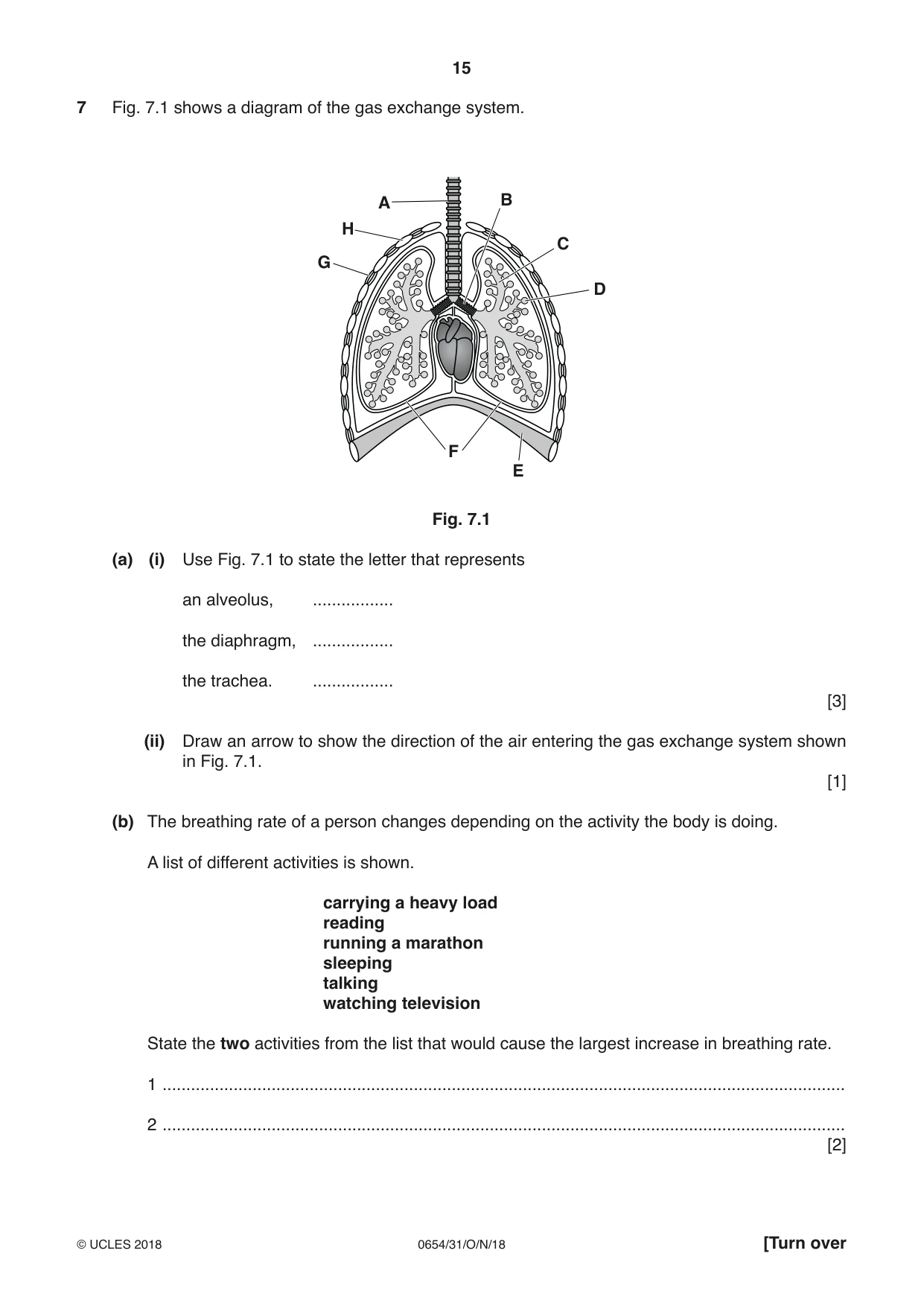
7 Fig. 7.1 shows a diagram of the gas exchange system. A B H C G D F E Fig. 7.1 (a) (i) Use Fig. 7.1 to state the letter that represents an alveolus, ................. the diaphragm, ................. the trachea. ................. [3] (ii) Draw an arrow to show the direction of the air entering the gas exchange system shown in Fig. 7.1. [1] (b) The breathing rate of a person changes depending on the activity the body is doing. A list of different activities is shown. carrying a heavy load reading running a marathon sleeping talking watching television State the two activities from the list that would cause the largest increase in breathing rate. 1 ................................................................................................................................................ 2 ................................................................................................................................................ [2]
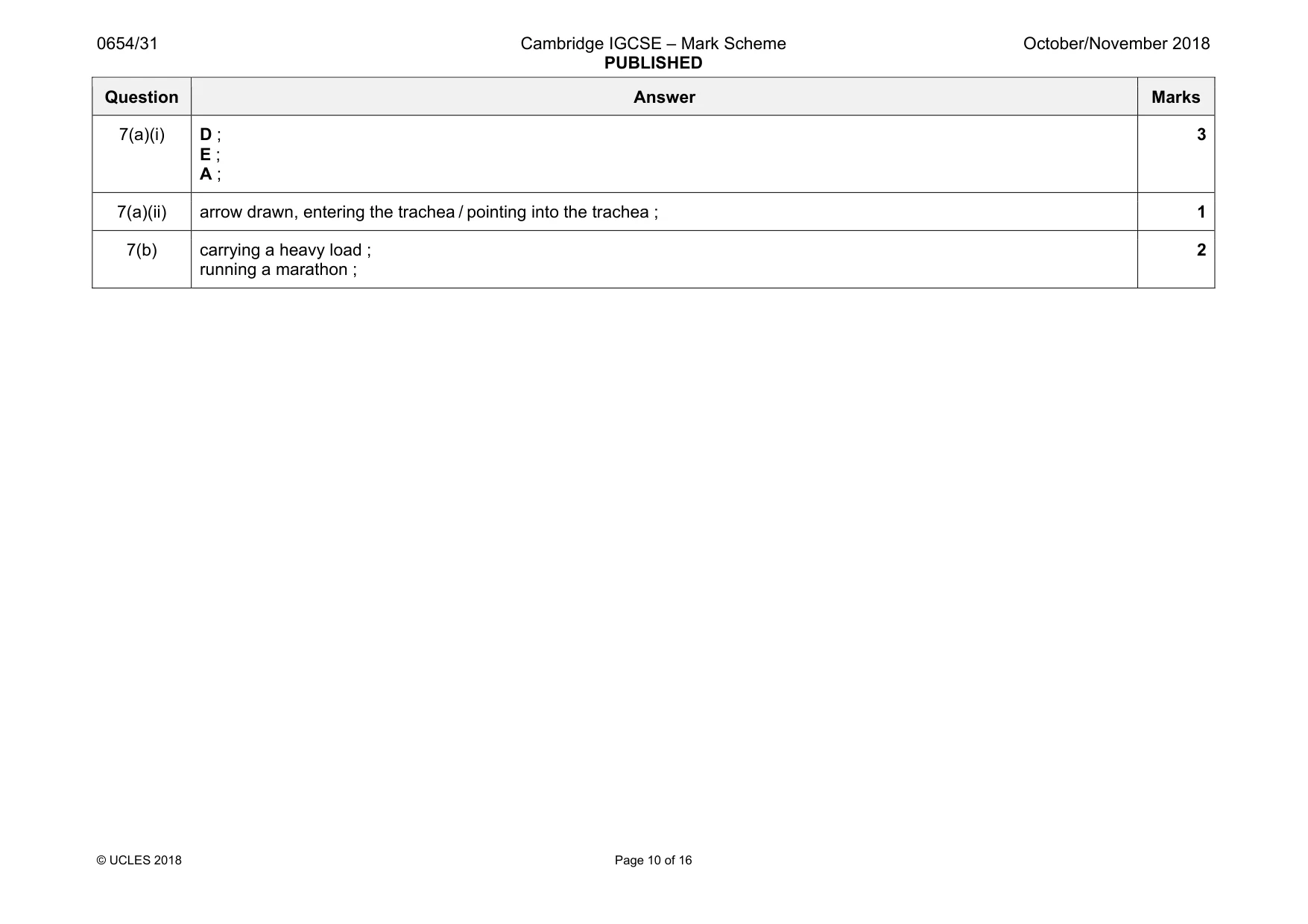
Mark scheme: 7(a)(i) D ; E ; A ; 3 7(a)(ii) arrow drawn, entering the trachea / pointing into the trachea ; 1 7(b) carrying a heavy load ; running a marathon ; 2
Q8 · The percentage composition by mass of an alloy of iron
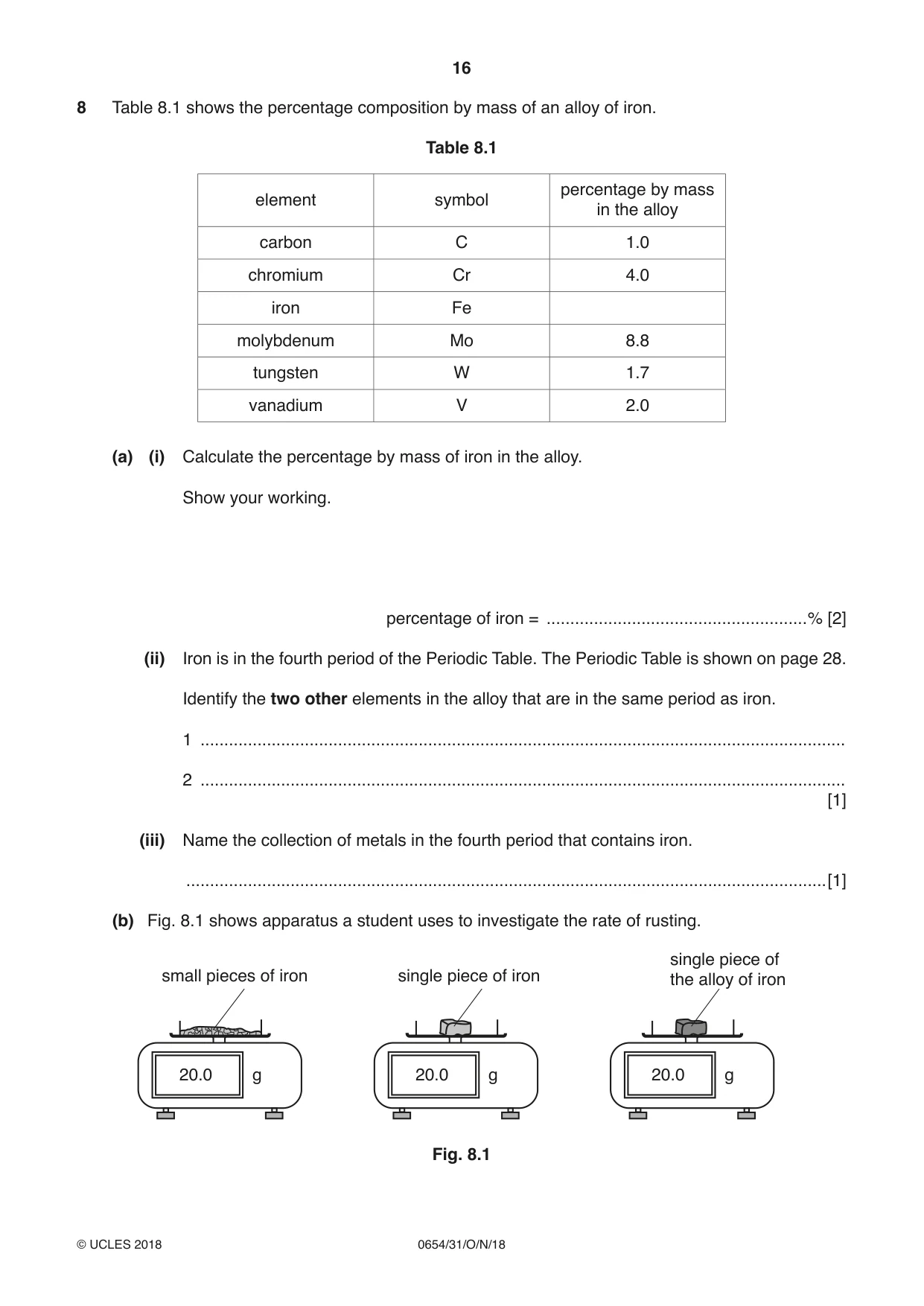
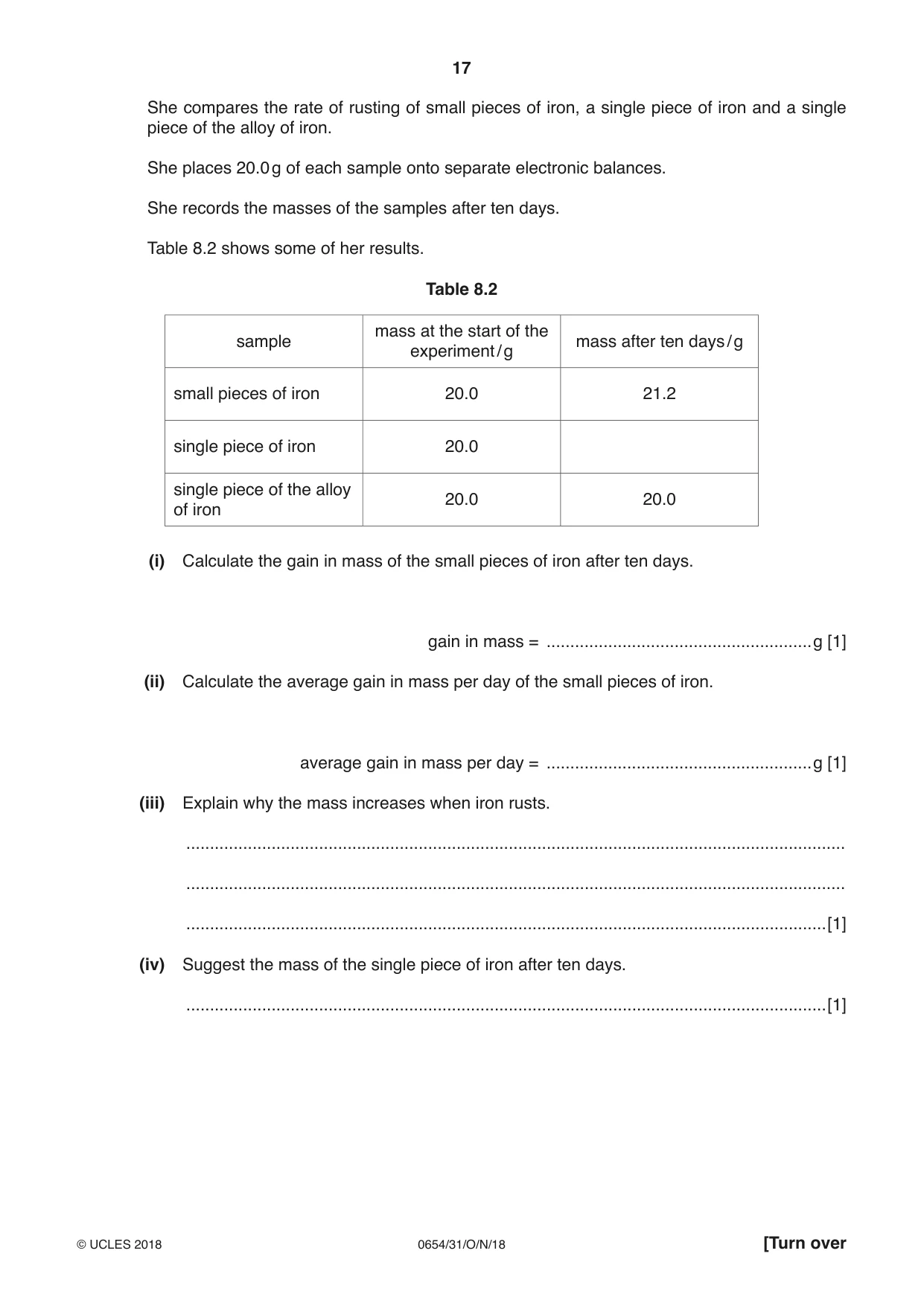
8 Table 8.1 shows the percentage composition by mass of an alloy of iron. Table 8.1 percentage by mass element symbol in the alloy carbon C 1.0 chromium Cr 4.0 iron Fe molybdenum Mo 8.8 tungsten W 1.7 vanadium V 2.0 (a) (i) Calculate the percentage by mass of iron in the alloy. Show your working. percentage of iron = .......................................................% [2] (ii) Iron is in the fourth period of the Periodic Table. The Periodic Table is shown on page 28. Identify the two other elements in the alloy that are in the same period as iron. 1 ........................................................................................................................................ 2 ........................................................................................................................................ [1] (iii) Name the collection of metals in the fourth period that contains iron. .......................................................................................................................................[1] (b) Fig. 8.1 shows apparatus a student uses to investigate the rate of rusting. single piece of small pieces of iron single piece of iron the alloy of iron 20.0 g 20.0 g 20.0 g Fig. 8.1 She compares the rate of rusting of small pieces of iron, a single piece of iron and a single piece of the alloy of iron. She places 20.0 g of each sample onto separate electronic balances. She records the masses of the samples after ten days. Table 8.2 shows some of her results. Table 8.2 mass at the start of the sample mass after ten days / g experiment / g small pieces of iron 20.0 21.2 single piece of iron 20.0 single piece of the alloy 20.0 20.0 of iron (i) Calculate the gain in mass of the small pieces of iron after ten days. gain in mass = ........................................................g [1] (ii) Calculate the average gain in mass per day of the small pieces of iron. average gain in mass per day = ........................................................g [1] (iii) Explain why the mass increases when iron rusts. ........................................................................................................................................... ........................................................................................................................................... .......................................................................................................................................[1] (iv) Suggest the mass of the single piece of iron after ten days. .......................................................................................................................................[1]
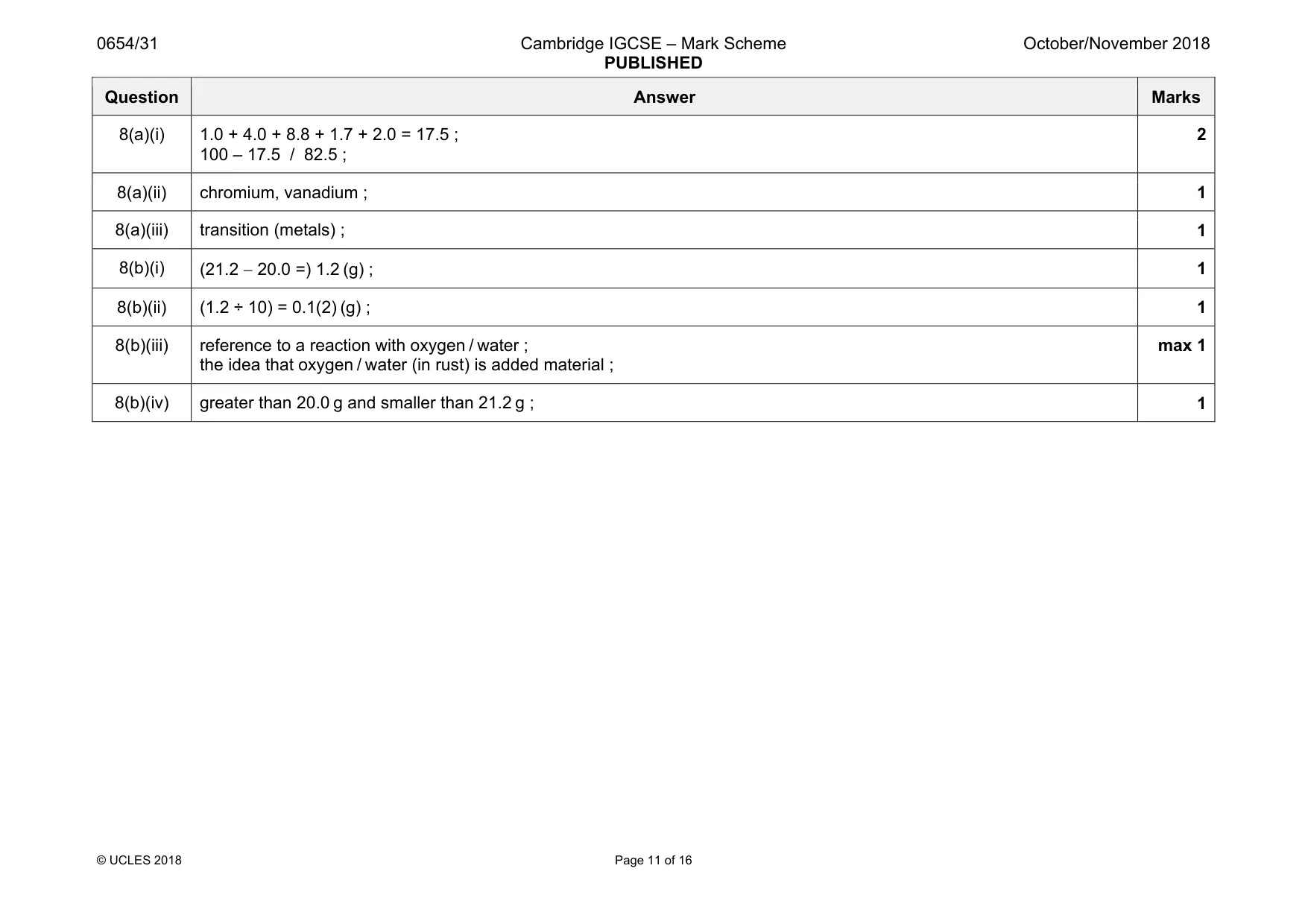
Mark scheme: 8(a)(i) 1.0 + 4.0 + 8.8 + 1.7 + 2.0 = 17.5 ; 100 – 17.5 / 82.5 ; 2 8(a)(ii) chromium, vanadium ; 1 8(a)(iii) transition (metals) ; 1 8(b)(i) (21.2 − 20.0 =) 1.2 (g) ; 1 8(b)(ii) (1.2 ÷ 10) = 0.1(2) (g) ; 1 8(b)(iii) reference to a reaction with oxygen / water ; the idea that oxygen / water (in rust) is added material ; max 1 8(b)(iv) greater than 20.0 g and smaller than 21.2 g ; 1
Q9 · A list of materials is shown
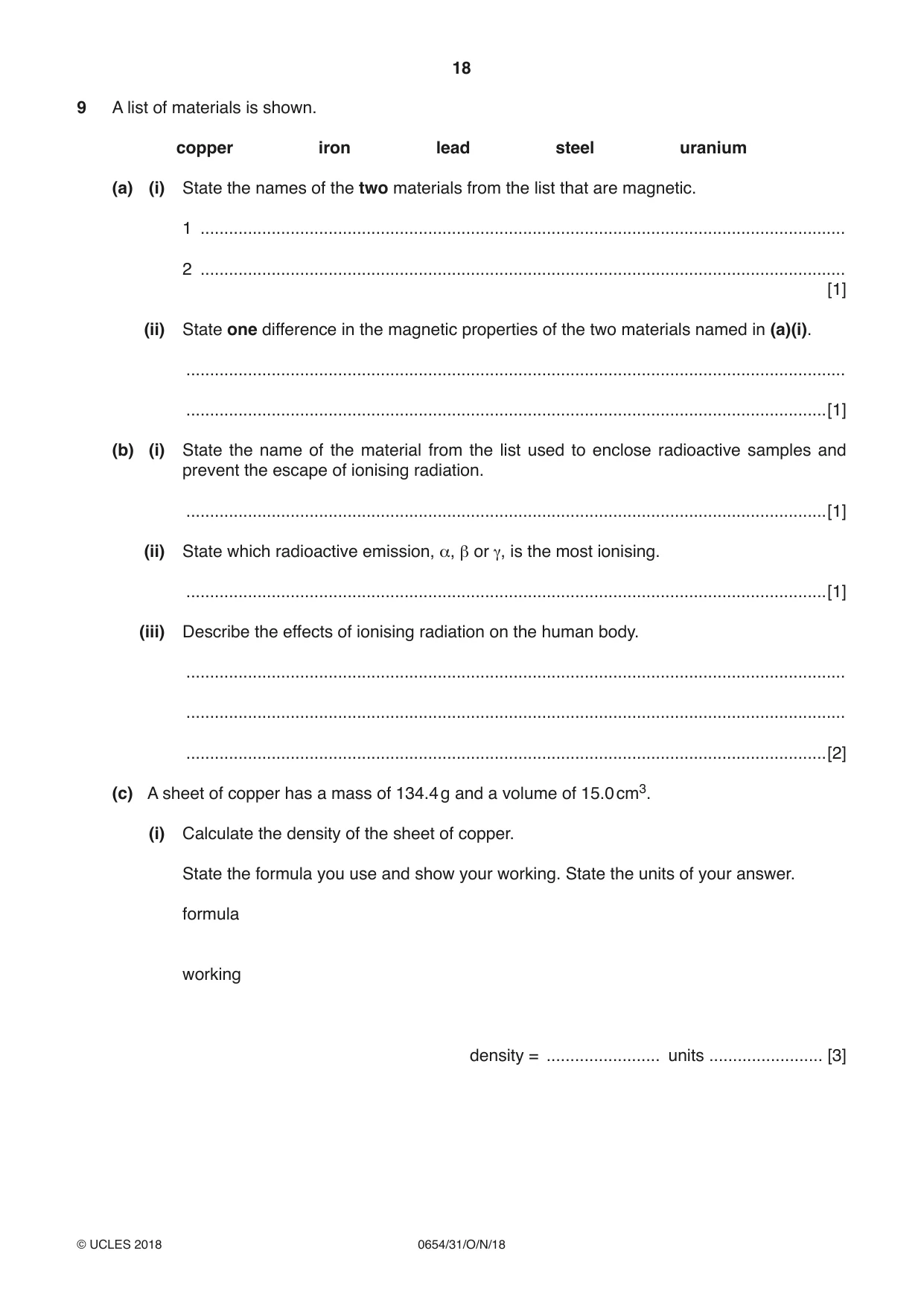
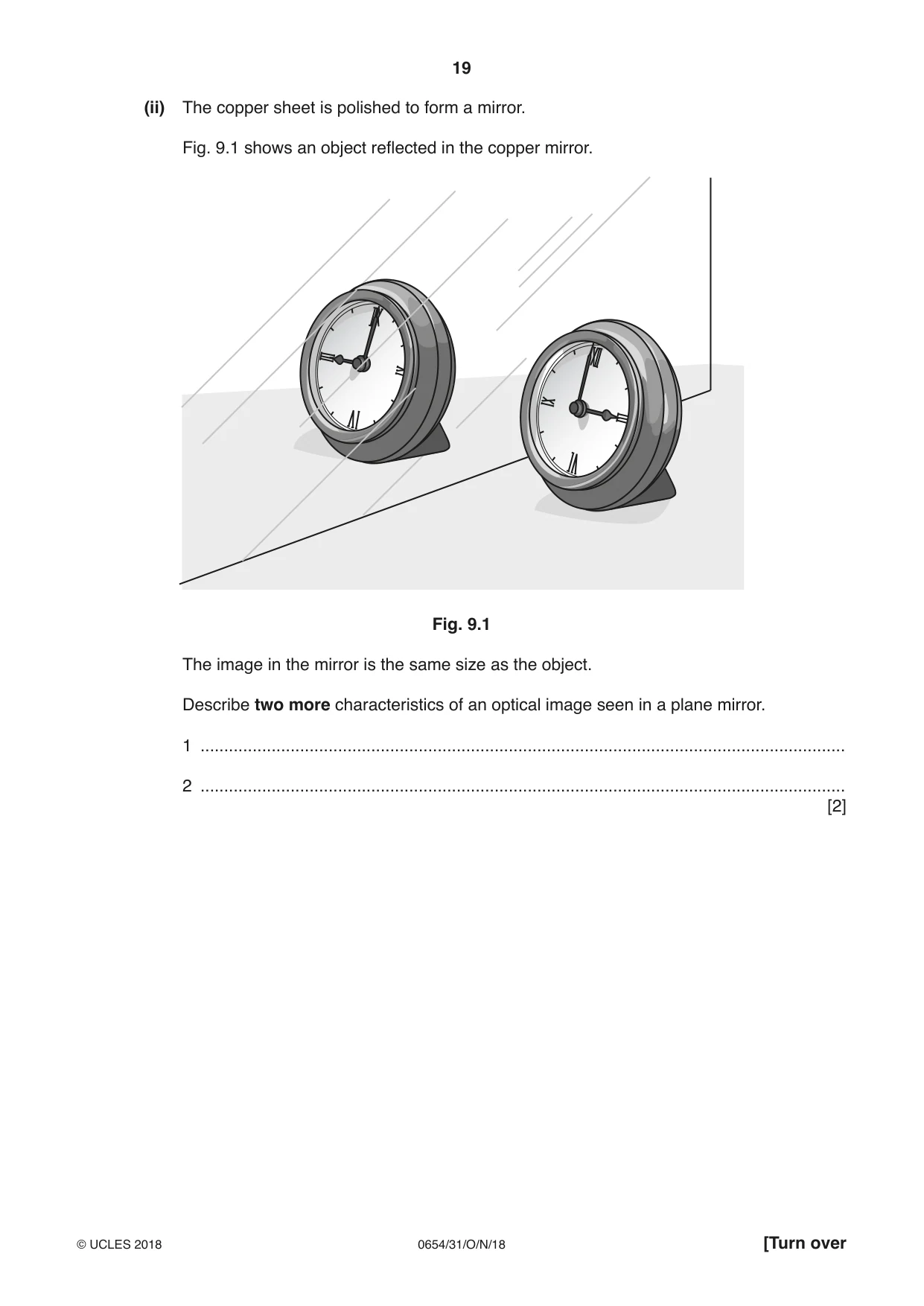
9 A list of materials is shown. copper iron lead steel uranium (a) (i) State the names of the two materials from the list that are magnetic. 1 ........................................................................................................................................ 2 ........................................................................................................................................ [1] (ii) State one difference in the magnetic properties of the two materials named in (a)(i). ........................................................................................................................................... .......................................................................................................................................[1] (b) (i) State the name of the material from the list used to enclose radioactive samples and prevent the escape of ionising radiation. .......................................................................................................................................[1] (ii) State which radioactive emission, α, β or γ, is the most ionising. .......................................................................................................................................[1] (iii) Describe the effects of ionising radiation on the human body. ........................................................................................................................................... ........................................................................................................................................... .......................................................................................................................................[2] (c) A sheet of copper has a mass of 134.4 g and a volume of 15.0 cm3. (i) Calculate the density of the sheet of copper. State the formula you use and show your working. State the units of your answer. formula working density = ........................ units ........................ [3] (ii) The copper sheet is polished to form a mirror. Fig. 9.1 shows an object reflected in the copper mirror. Fig. 9.1 The image in the mirror is the same size as the object. Describe two more characteristics of an optical image seen in a plane mirror. 1 ........................................................................................................................................ 2 ........................................................................................................................................ [2]
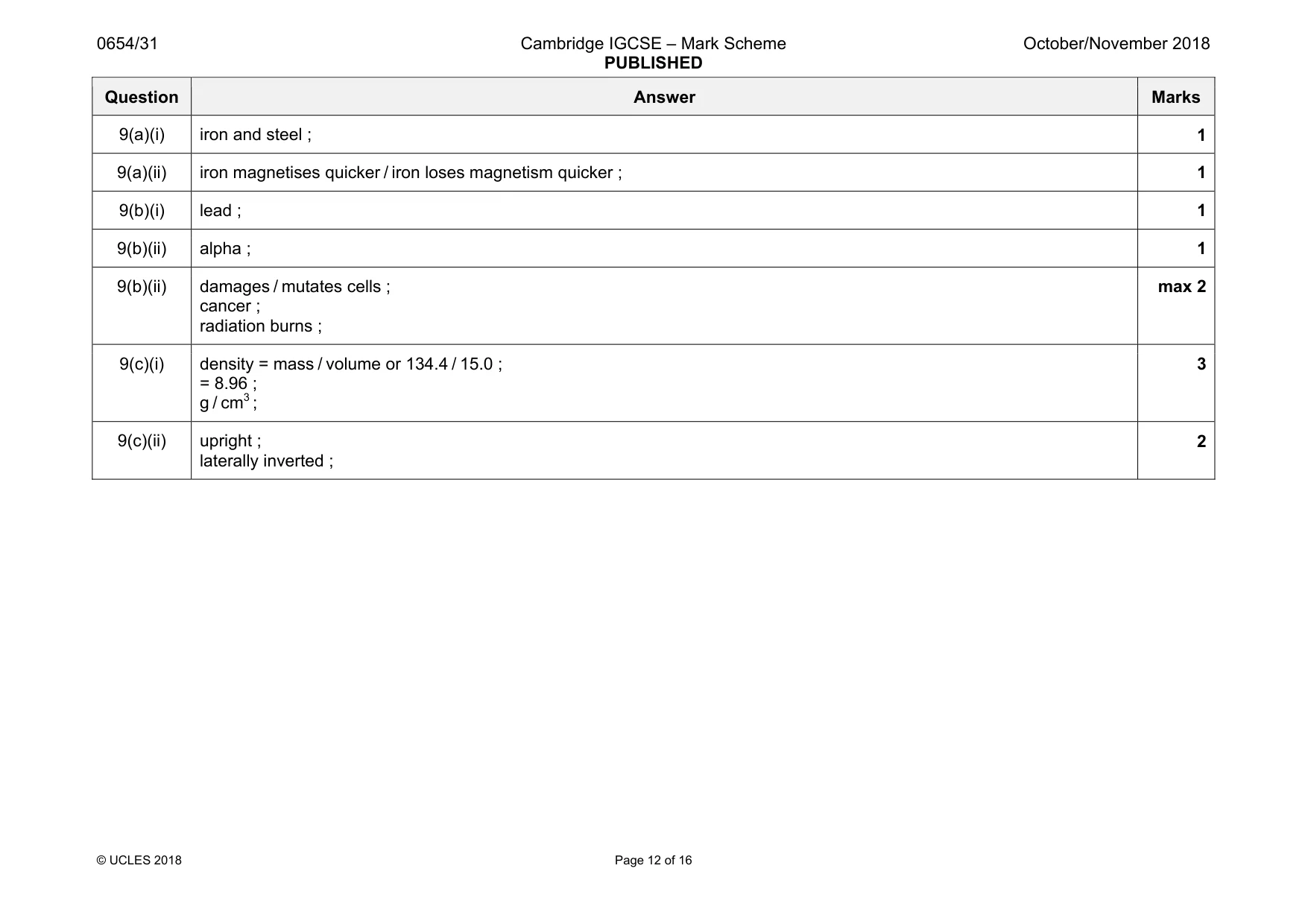
Mark scheme: 9(a)(i) iron and steel ; 1 9(a)(ii) iron magnetises quicker / iron loses magnetism quicker ; 1 9(b)(i) lead ; 1 9(b)(ii) alpha ; 1 9(b)(ii) damages / mutates cells ; cancer ; radiation burns ; max 2 9(c)(i) density = mass / volume or 134.4 / 15.0 ; = 8.96 ; g / cm3 ; 3 9(c)(ii) upright ; laterally inverted ; 2
Q10 · A cross‑section through a flower
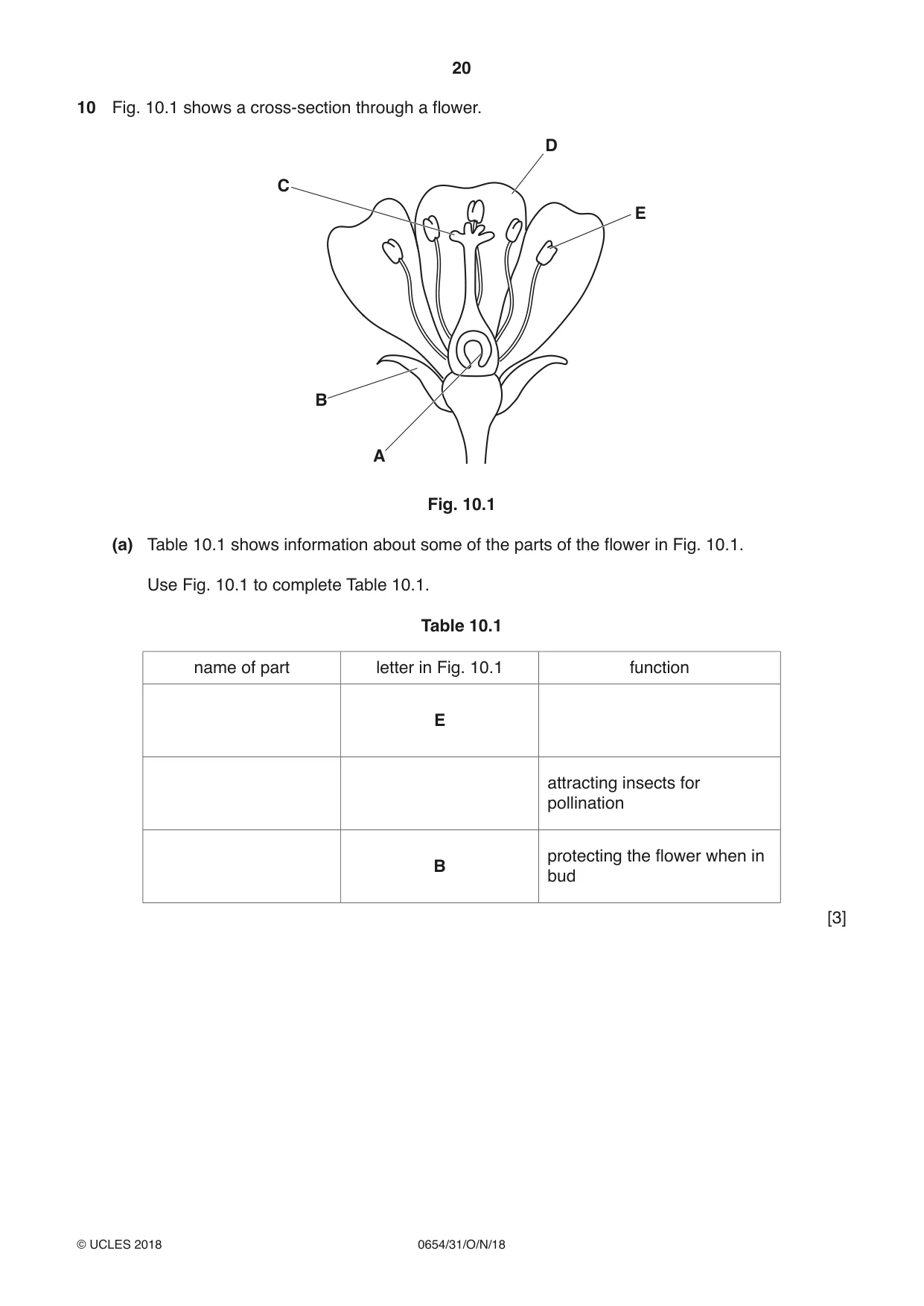
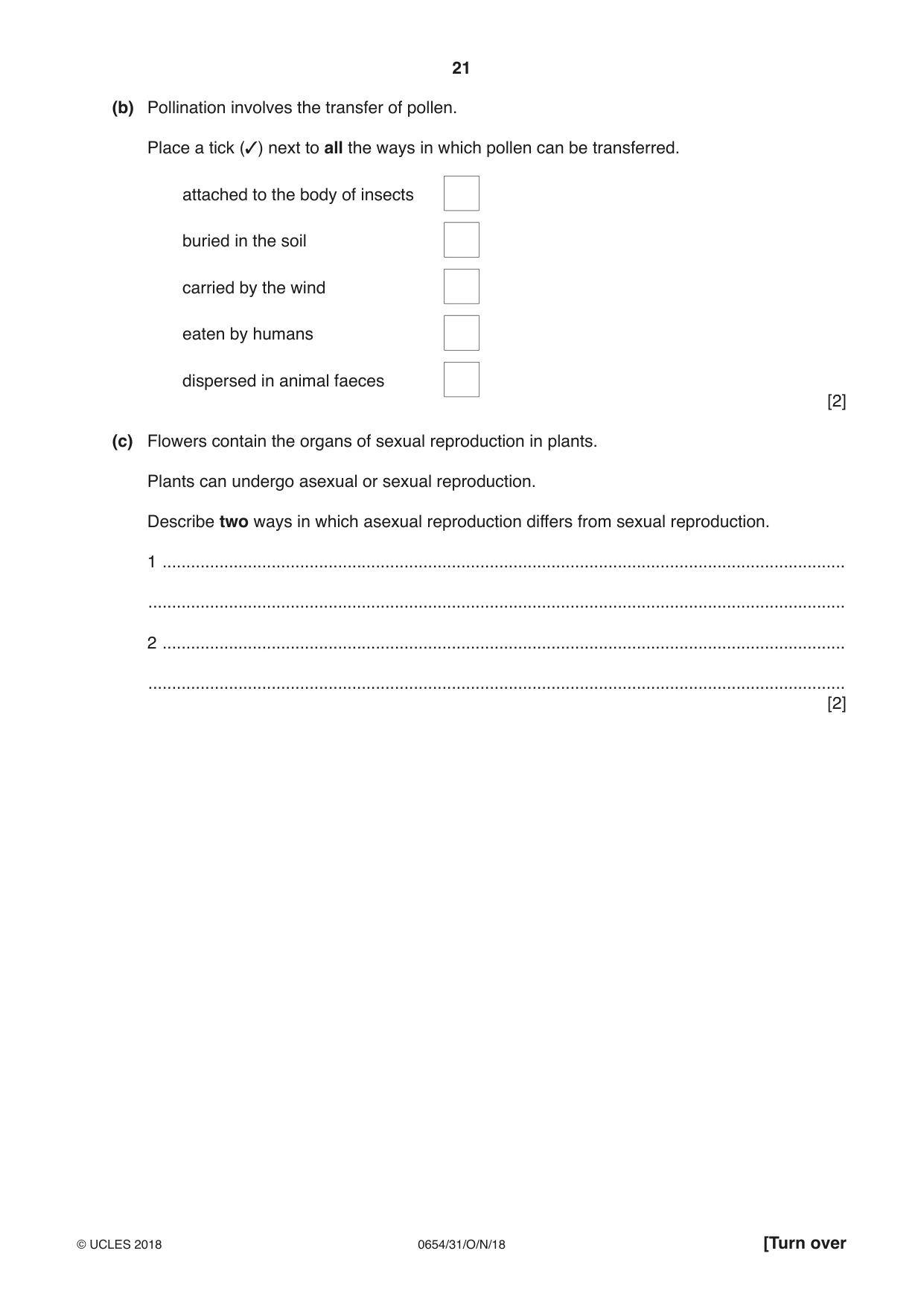
10 Fig. 10.1 shows a cross‑section through a flower. D C E B A Fig. 10.1 (a) Table 10.1 shows information about some of the parts of the flower in Fig. 10.1. Use Fig. 10.1 to complete Table 10.1. Table 10.1 name of part letter in Fig. 10.1 function E attracting insects for pollination protecting the flower when in B bud [3] (b) Pollination involves the transfer of pollen. Place a tick (3) next to all the ways in which pollen can be transferred. attached to the body of insects buried in the soil carried by the wind eaten by humans dispersed in animal faeces [2] (c) Flowers contain the organs of sexual reproduction in plants. Plants can undergo asexual or sexual reproduction. Describe two ways in which asexual reproduction differs from sexual reproduction. 1 ................................................................................................................................................ ................................................................................................................................................... 2 ................................................................................................................................................ ................................................................................................................................................... [2]
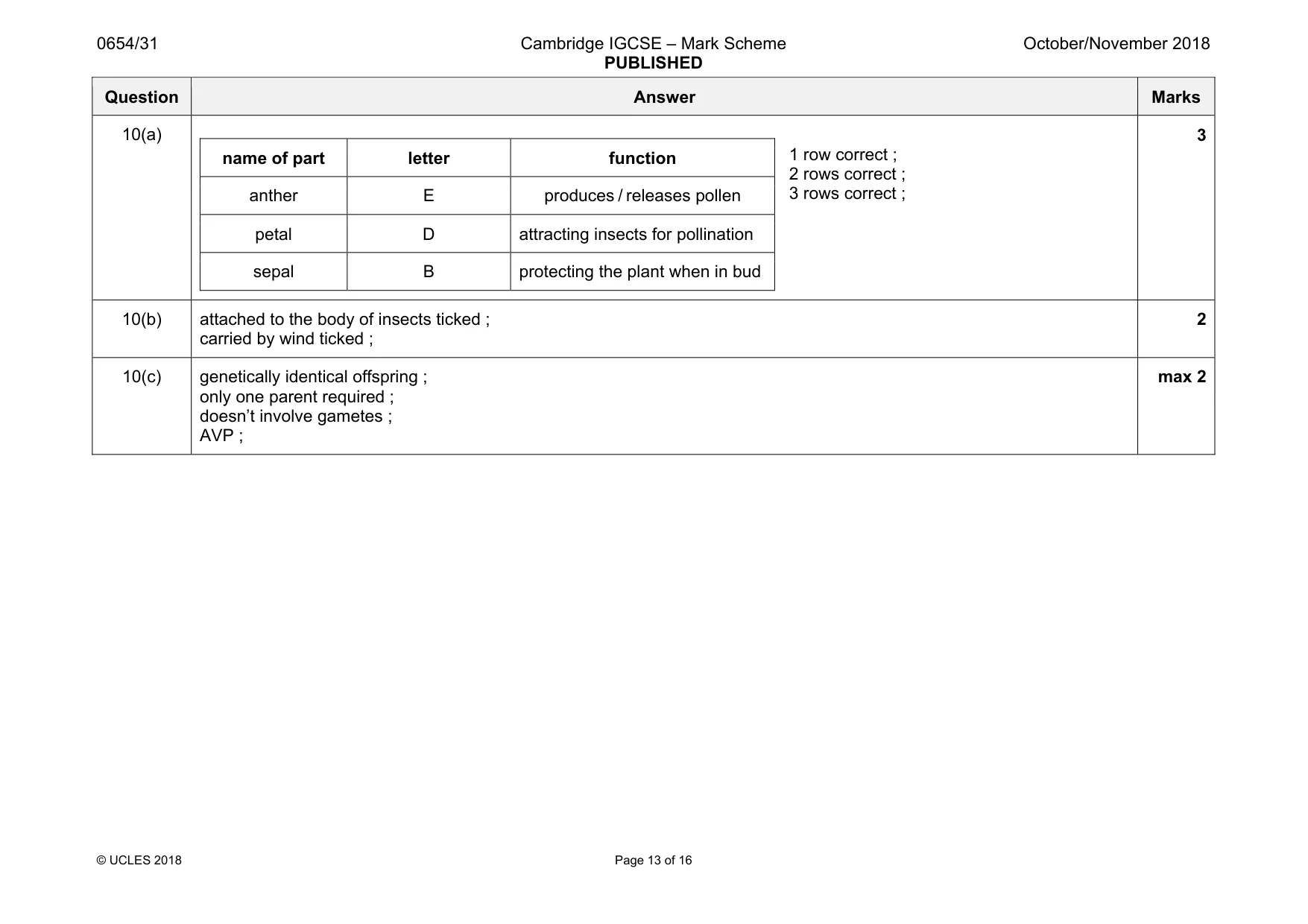
Mark scheme: 10(a) 1 row correct ; 2 rows correct ; 3 rows correct ; name of part letter function anther E produces / releases pollen petal D attracting insects for pollination sepal B protecting the plant when in bud 3 10(b) attached to the body of insects ticked ; carried by wind ticked ; 2 10(c) genetically identical offspring ; only one parent required ; doesn’t involve gametes ; AVP ; max 2
Q11 · Useful products containing hydrocarbons are obtained from petroleum
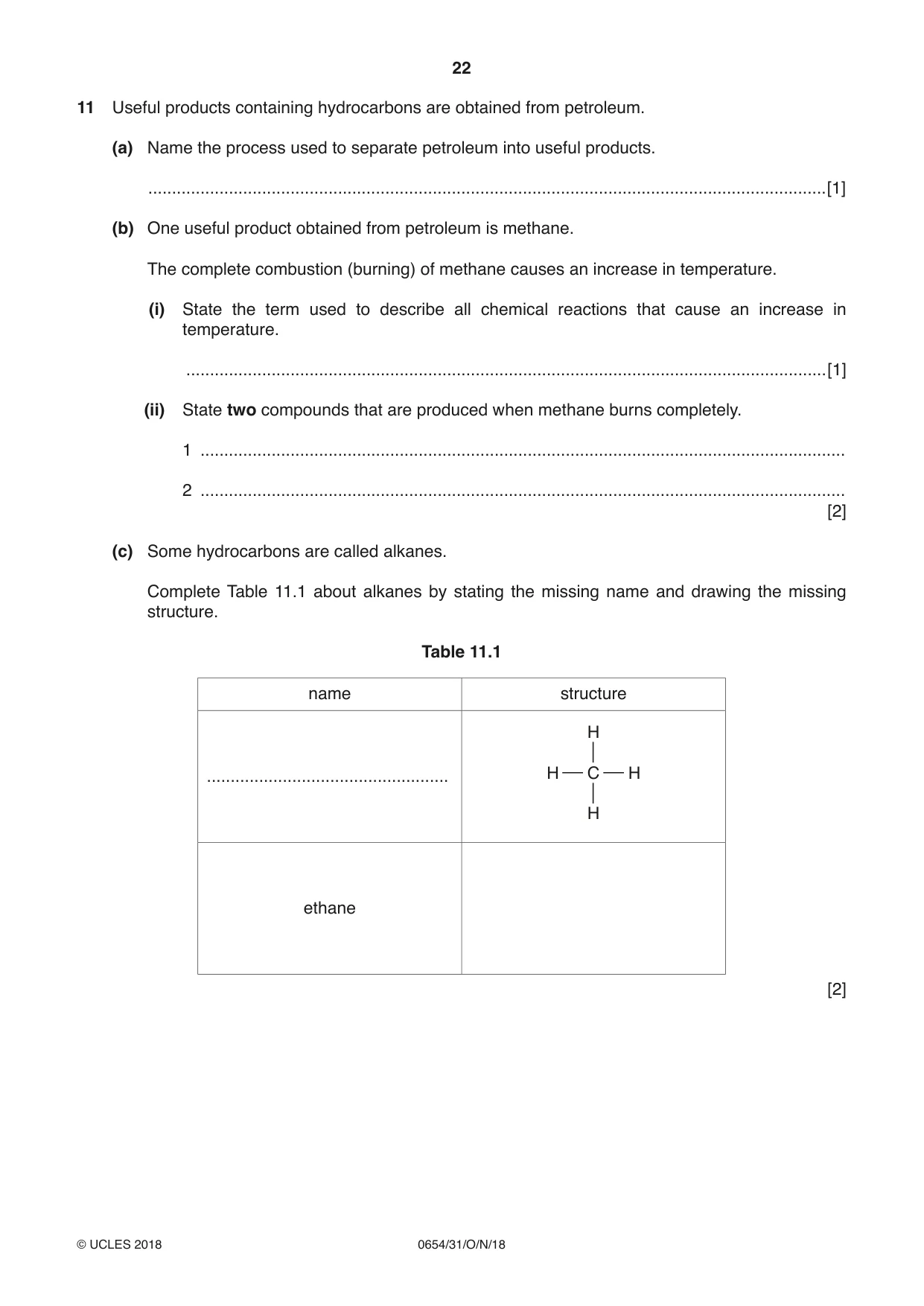
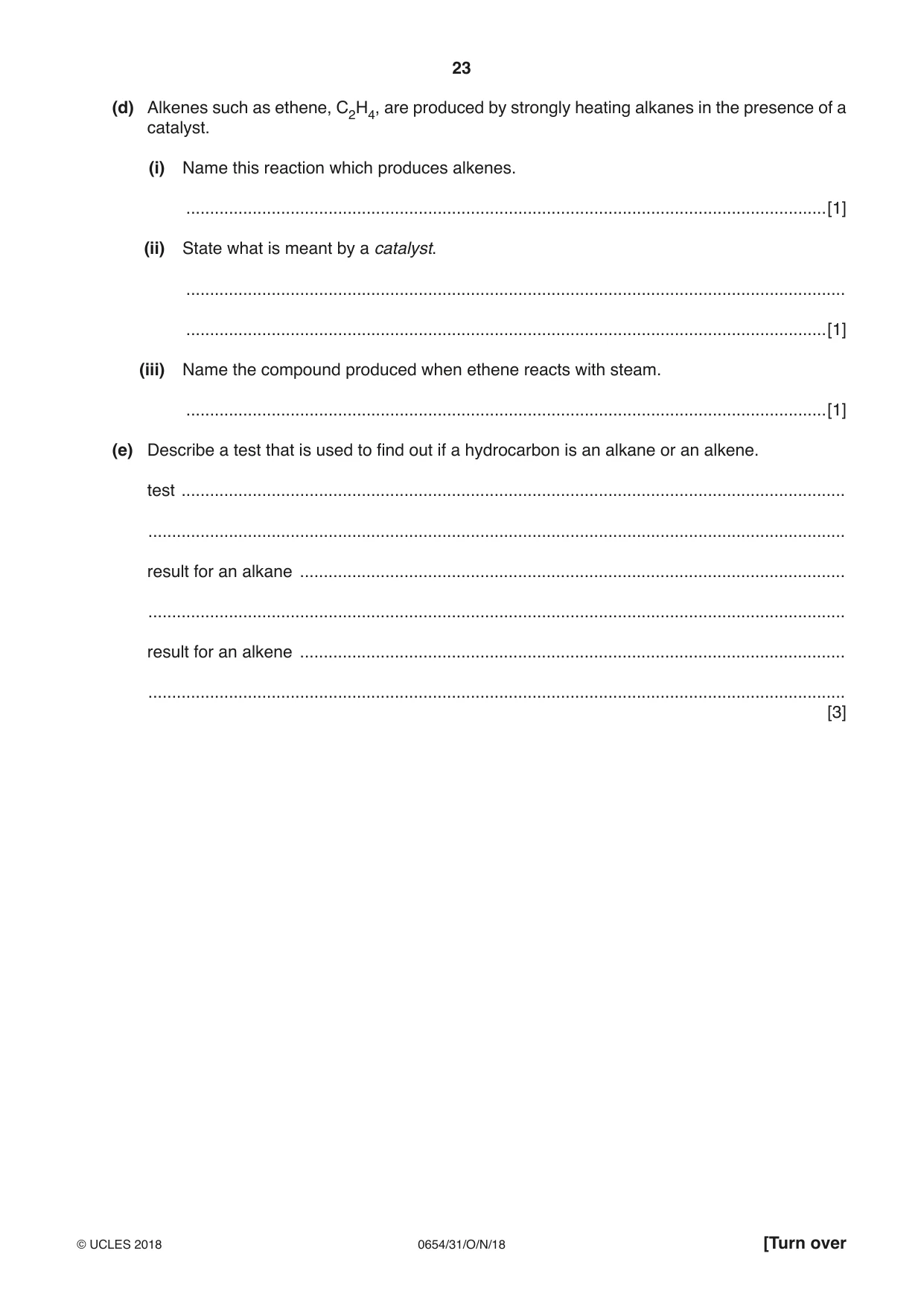
11 Useful products containing hydrocarbons are obtained from petroleum. (a) Name the process used to separate petroleum into useful products. ...............................................................................................................................................[1] (b) One useful product obtained from petroleum is methane. The complete combustion (burning) of methane causes an increase in temperature. (i) State the term used to describe all chemical reactions that cause an increase in temperature. .......................................................................................................................................[1] (ii) State two compounds that are produced when methane burns completely. 1 ........................................................................................................................................ 2 ........................................................................................................................................ [2] (c) Some hydrocarbons are called alkanes. Complete Table 11.1 about alkanes by stating the missing name and drawing the missing structure. Table 11.1 name structure H ................................................... H C H H ethane [2] (d) Alkenes such as ethene, C2H4, are produced by strongly heating alkanes in the presence of a catalyst. (i) Name this reaction which produces alkenes. .......................................................................................................................................[1] (ii) State what is meant by a catalyst. ........................................................................................................................................... .......................................................................................................................................[1] (iii) Name the compound produced when ethene reacts with steam. .......................................................................................................................................[1] (e) Describe a test that is used to find out if a hydrocarbon is an alkane or an alkene. test ............................................................................................................................................ ................................................................................................................................................... result for an alkane ................................................................................................................... ................................................................................................................................................... result for an alkene ................................................................................................................... ................................................................................................................................................... [3]
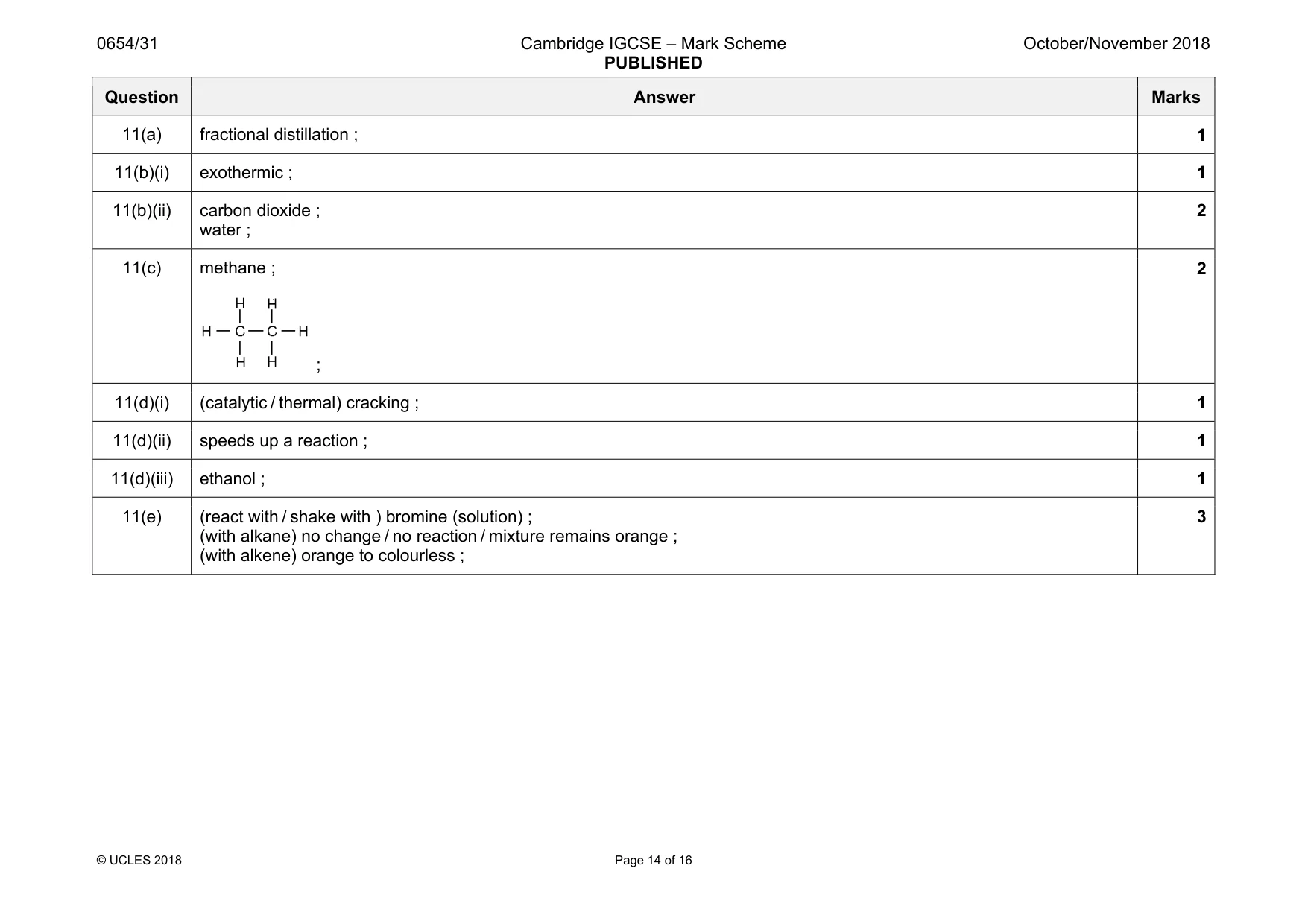
Mark scheme: 11(a) fractional distillation ; 1 11(b)(i) exothermic ; 1 11(b)(ii) carbon dioxide ; water ; 2 11(c) methane ; ; 2 11(d)(i) (catalytic / thermal) cracking ; 1 11(d)(ii) speeds up a reaction ; 1 11(d)(iii) ethanol ; 1 11(e) (react with / shake with ) bromine (solution) ; (with alkane) no change / no reaction / mixture remains orange ; (with alkene) orange to colourless ; 3
Q12 · A car on a horizontal road
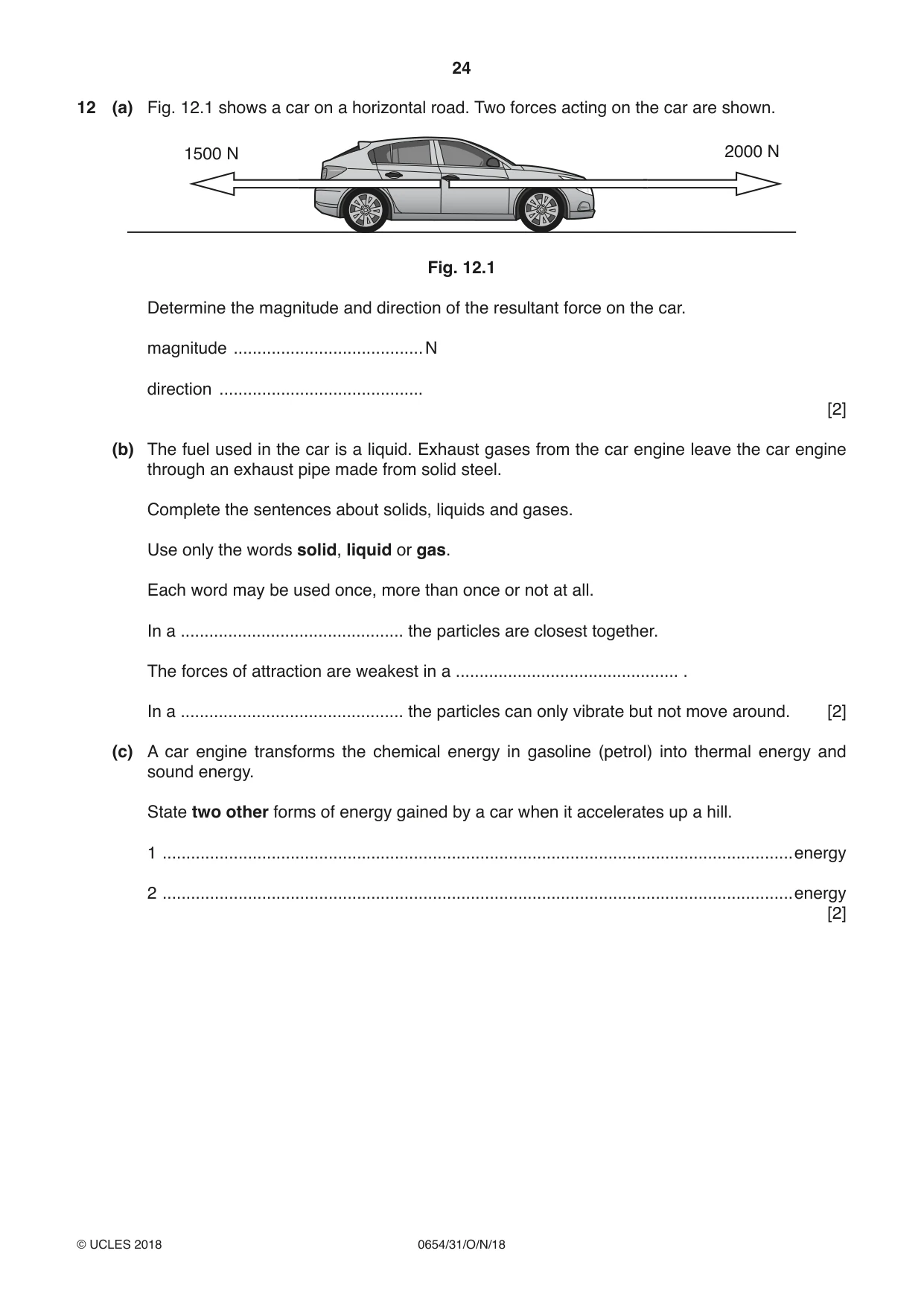
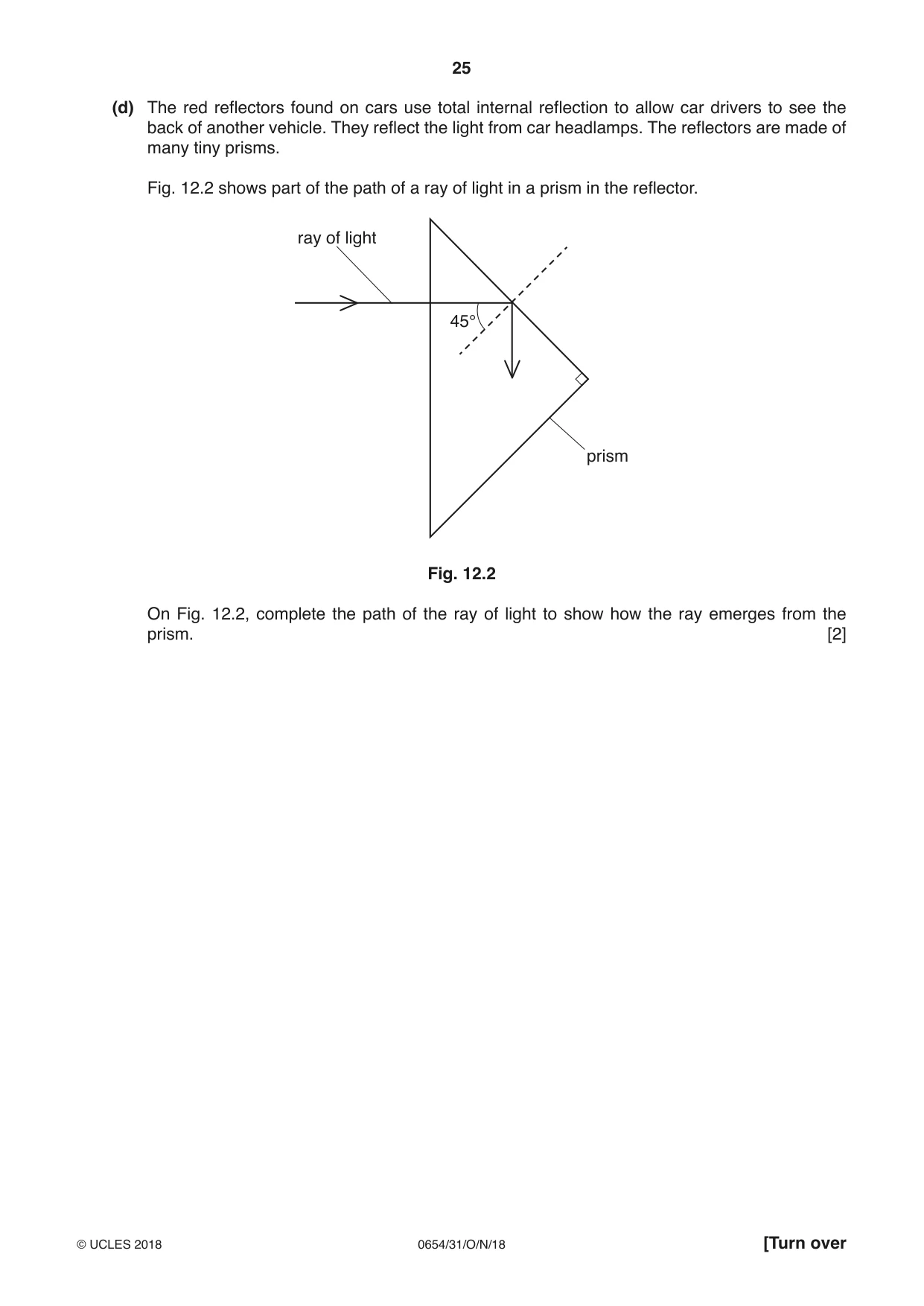
12 (a) Fig. 12.1 shows a car on a horizontal road. Two forces acting on the car are shown. 1500 N 2000 N Fig. 12.1 Determine the magnitude and direction of the resultant force on the car. magnitude ........................................N direction ........................................... [2] (b) The fuel used in the car is a liquid. Exhaust gases from the car engine leave the car engine through an exhaust pipe made from solid steel. Complete the sentences about solids, liquids and gases. Use only the words solid, liquid or gas. Each word may be used once, more than once or not at all. In a ............................................... the particles are closest together. The forces of attraction are weakest in a ............................................... . In a ............................................... the particles can only vibrate but not move around. [2] (c) A car engine transforms the chemical energy in gasoline (petrol) into thermal energy and sound energy. State two other forms of energy gained by a car when it accelerates up a hill. 1 .....................................................................................................................................energy 2 .....................................................................................................................................energy [2] (d) The red reflectors found on cars use total internal reflection to allow car drivers to see the back of another vehicle. They reflect the light from car headlamps. The reflectors are made of many tiny prisms. Fig. 12.2 shows part of the path of a ray of light in a prism in the reflector. ray of light 45° prism Fig. 12.2 On Fig. 12.2, complete the path of the ray of light to show how the ray emerges from the prism. [2]
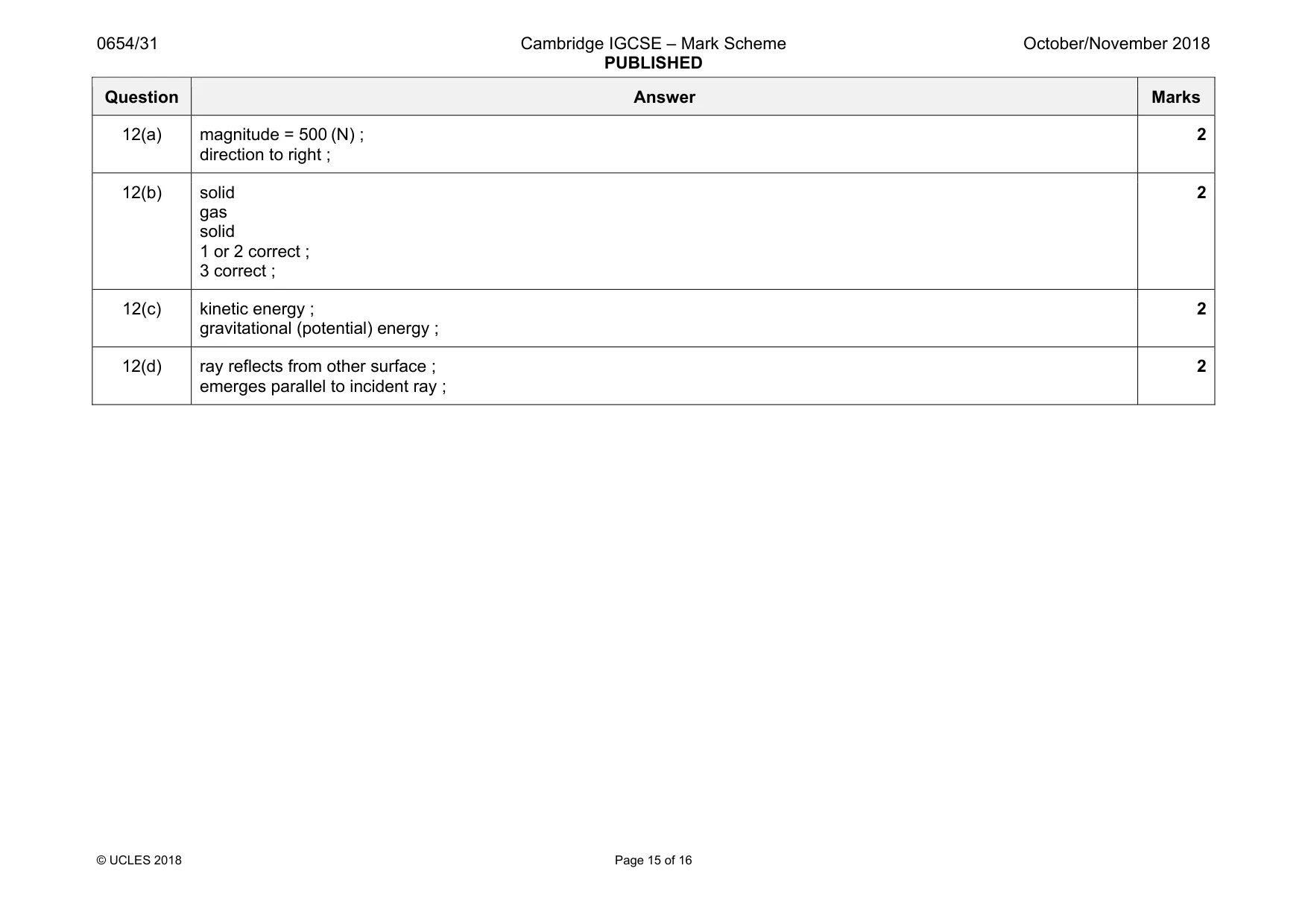
Mark scheme: 12(a) magnitude = 500 (N) ; direction to right ; 2 12(b) solid gas solid 1 or 2 correct ; 3 correct ; 2 12(c) kinetic energy ; gravitational (potential) energy ; 2 12(d) ray reflects from other surface ; emerges parallel to incident ray ; 2
Q13 · A simplified diagram of the carbon cycle
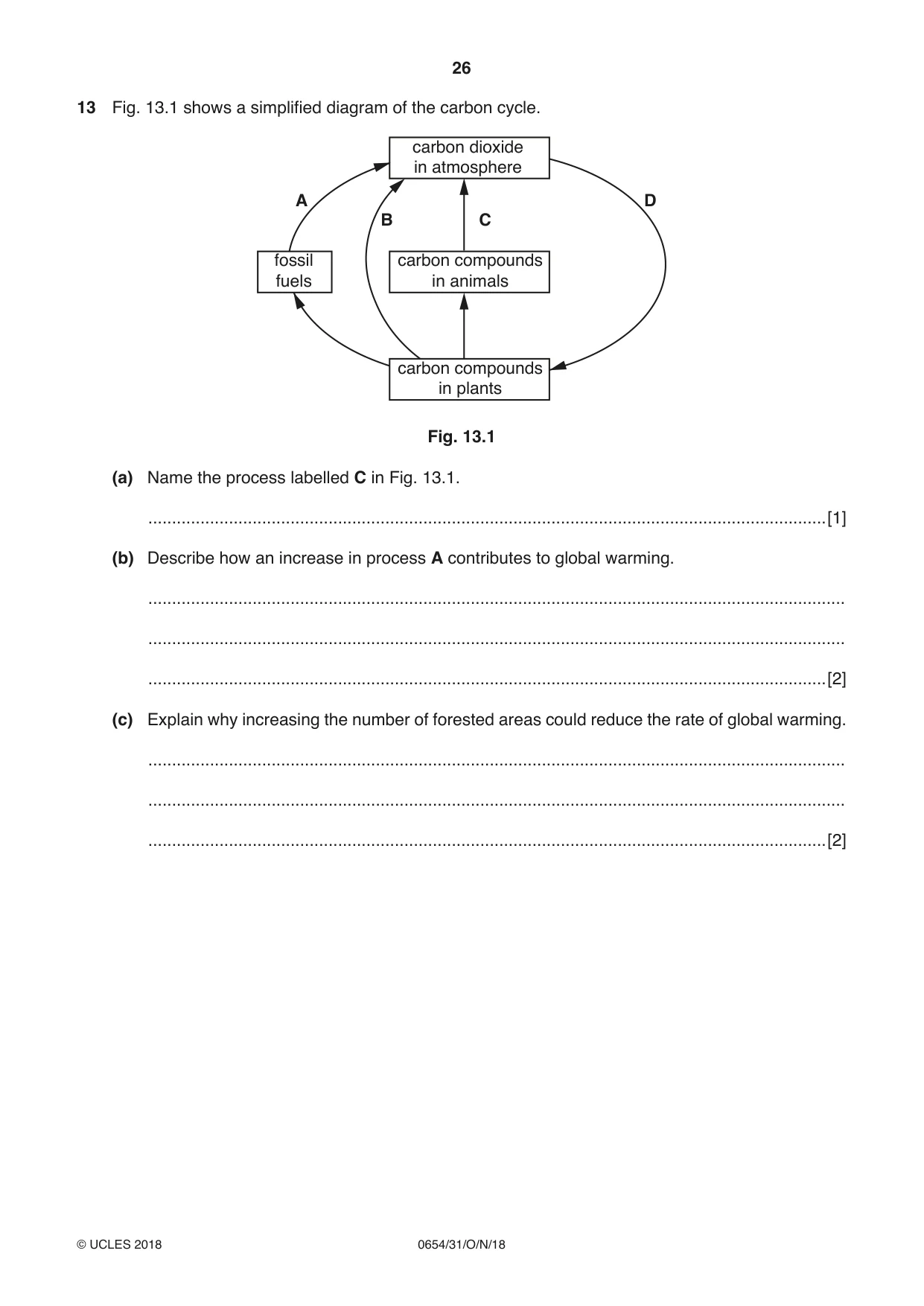
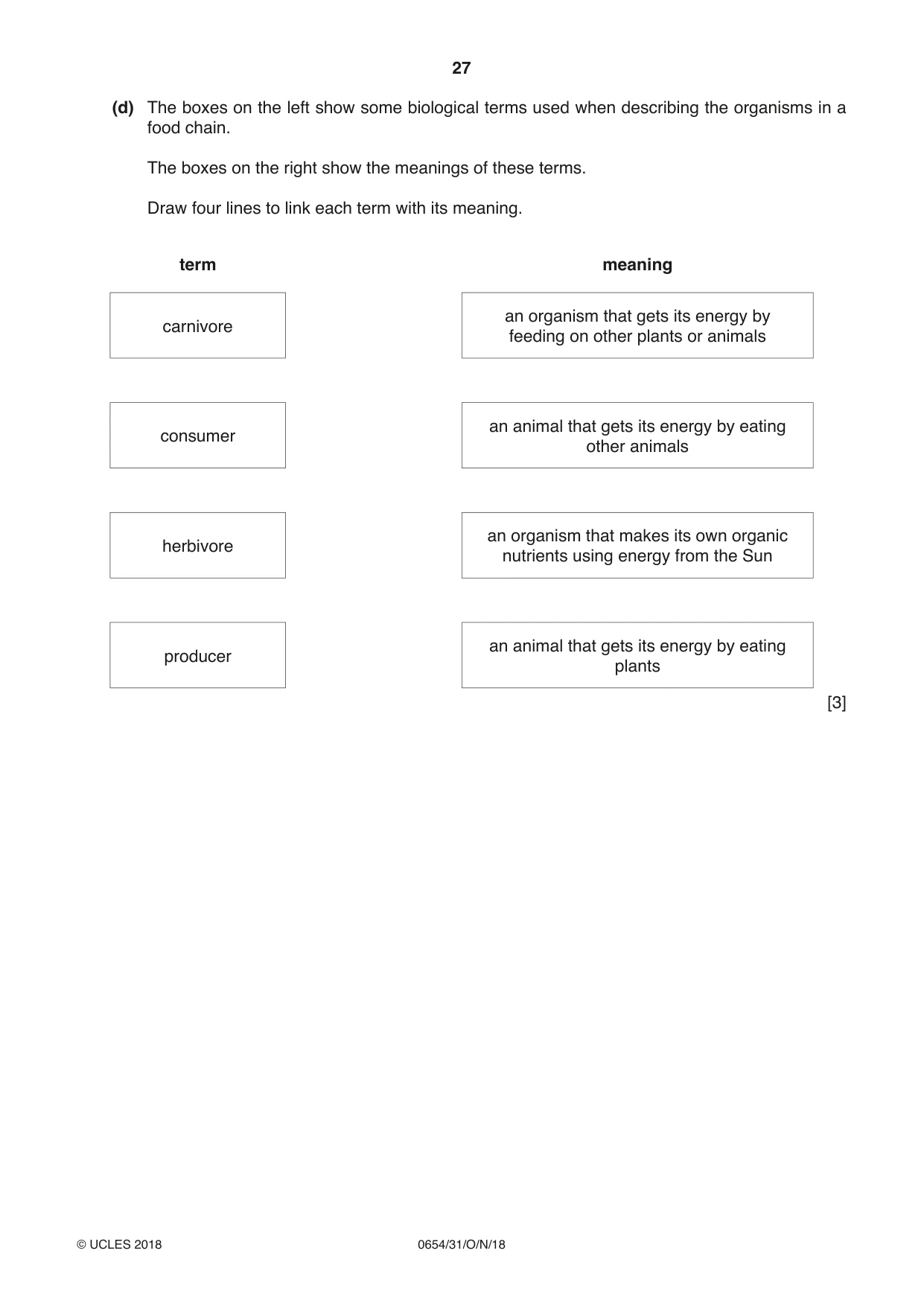
13 Fig. 13.1 shows a simplified diagram of the carbon cycle. carbon dioxide in atmosphere A D B C fossil carbon compounds fuels in animals carbon compounds in plants Fig. 13.1 (a) Name the process labelled C in Fig. 13.1. ...............................................................................................................................................[1] (b) Describe how an increase in process A contributes to global warming. ................................................................................................................................................... ................................................................................................................................................... ...............................................................................................................................................[2] (c) Explain why increasing the number of forested areas could reduce the rate of global warming. ................................................................................................................................................... ................................................................................................................................................... ...............................................................................................................................................[2] (d) The boxes on the left show some biological terms used when describing the organisms in a food chain. The boxes on the right show the meanings of these terms. Draw four lines to link each term with its meaning. term meaning an organism that gets its energy by carnivore feeding on other plants or animals an animal that gets its energy by eating consumer other animals an organism that makes its own organic herbivore nutrients using energy from the Sun an animal that gets its energy by eating producer plants [3]
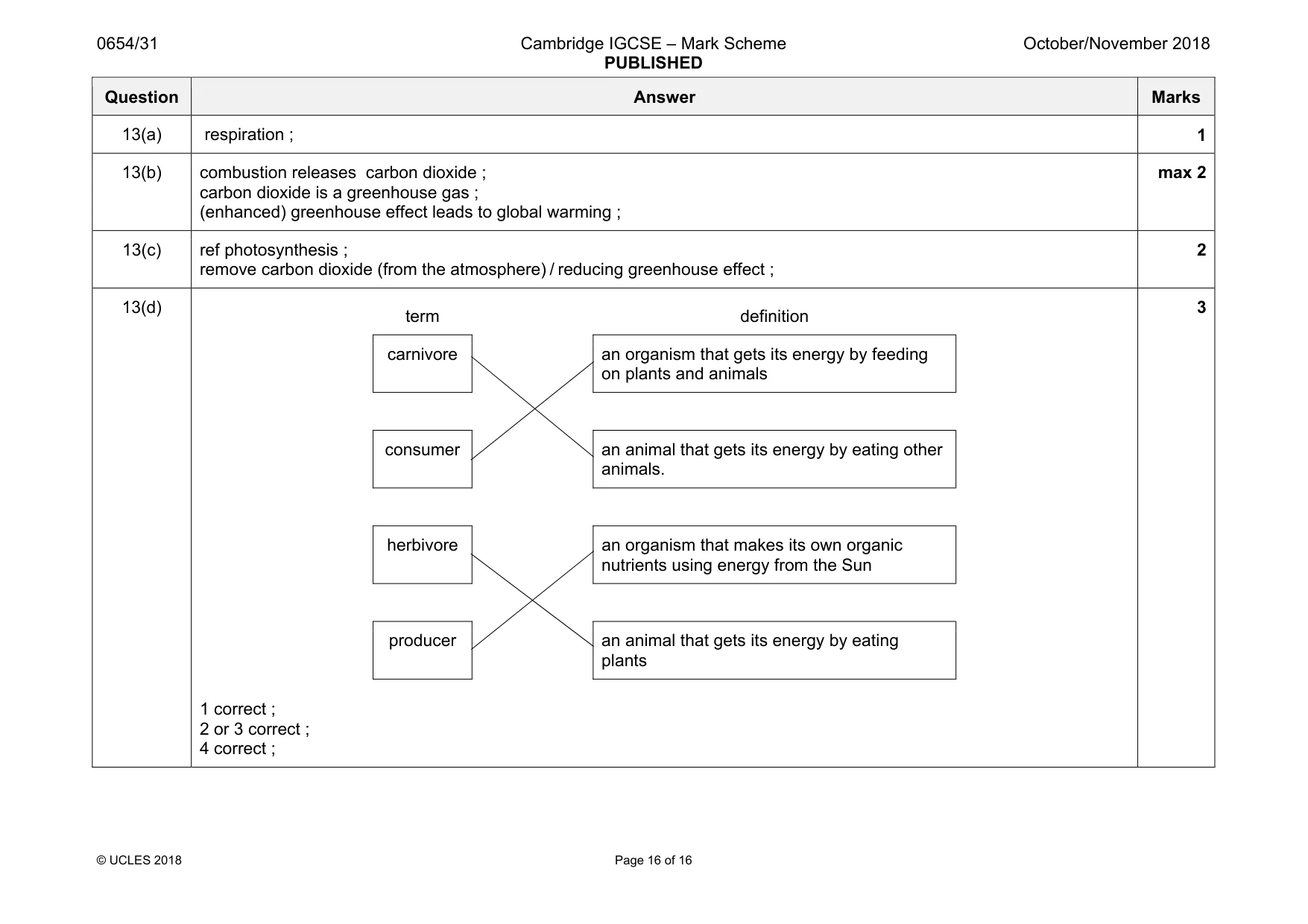
Mark scheme: 13(a) respiration ; 1 13(b) combustion releases carbon dioxide ; carbon dioxide is a greenhouse gas ; (enhanced) greenhouse effect leads to global warming ; max 2 13(c) ref photosynthesis ; remove carbon dioxide (from the atmosphere) / reducing greenhouse effect ; 2 13(d) term definition carnivore an organism that gets its energy by feeding on plants and animals consumer an animal that gets its energy by eating other animals. herbivore an organism that makes its own organic nutrients using energy from the Sun producer an animal that gets its energy by eating plants 1 correct ; 2 or 3 correct ; 4 correct ; 3
What was in this paper
The subtopics covered by these 13 questions, and how many questions each got. Open one in a new tab to see every Cambridge question on it.
What you needed in this session
Cambridge’s own grade thresholds for 2018 Oct/Nov, Paper 3 · Variant 1. A higher threshold means an easier paper — the bar moves with how the cohort did.