Cambridge IGCSE Sciences - Co-ordinated (Double) 0654 — 2025 Oct/Nov Paper 3 · Variant 1
0654/31/O/N/25 · 11 questions · 120 marks · 120 min
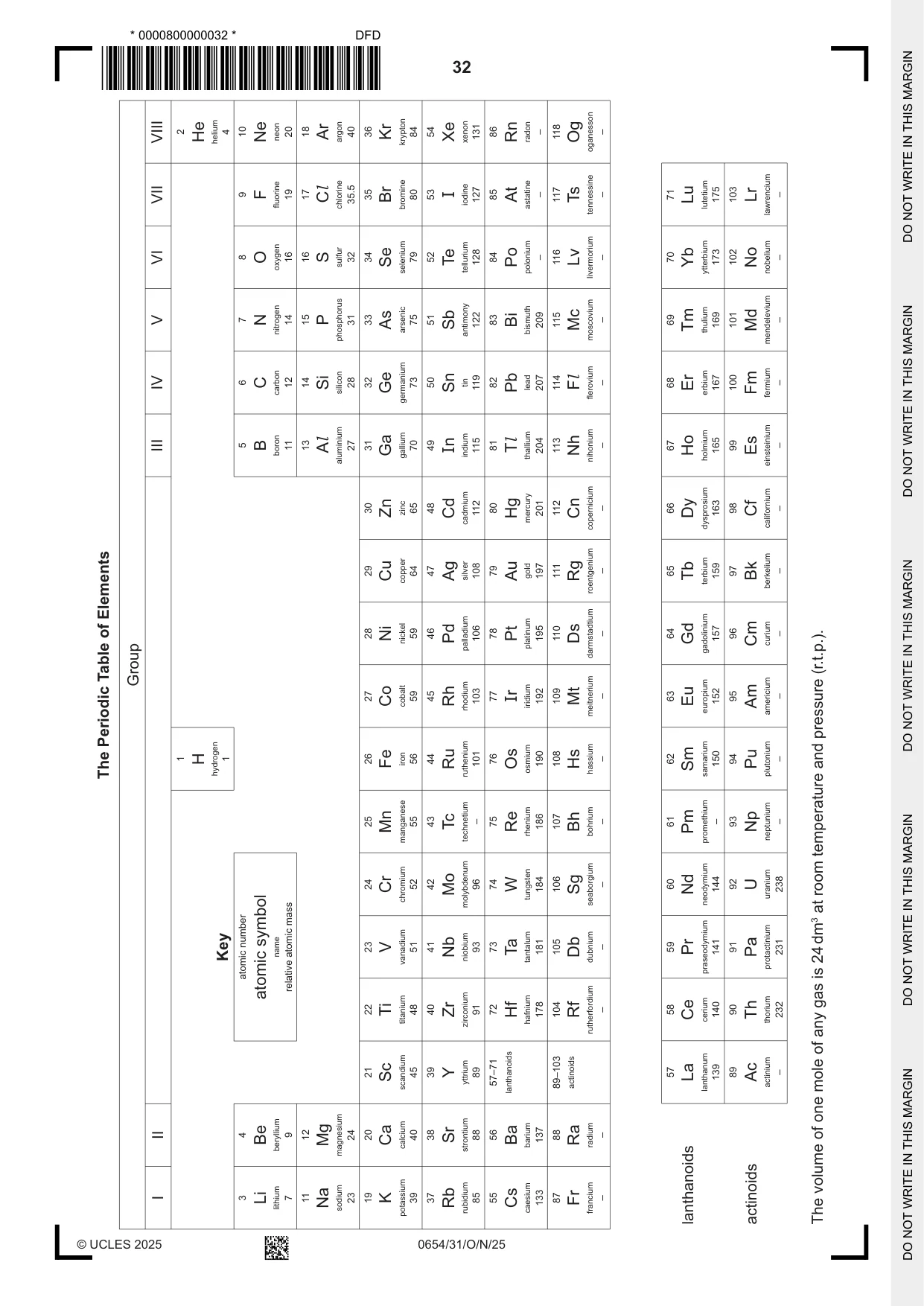
The question paper and its mark scheme, free to read here and free to download. This is Cambridge’s own paper, exactly as it was sat.
Question paper32 pages



Mark scheme17 pages
Answers below. Sit the paper first if you are practising.
Questions as text
Q1 · There are two types of reproduction
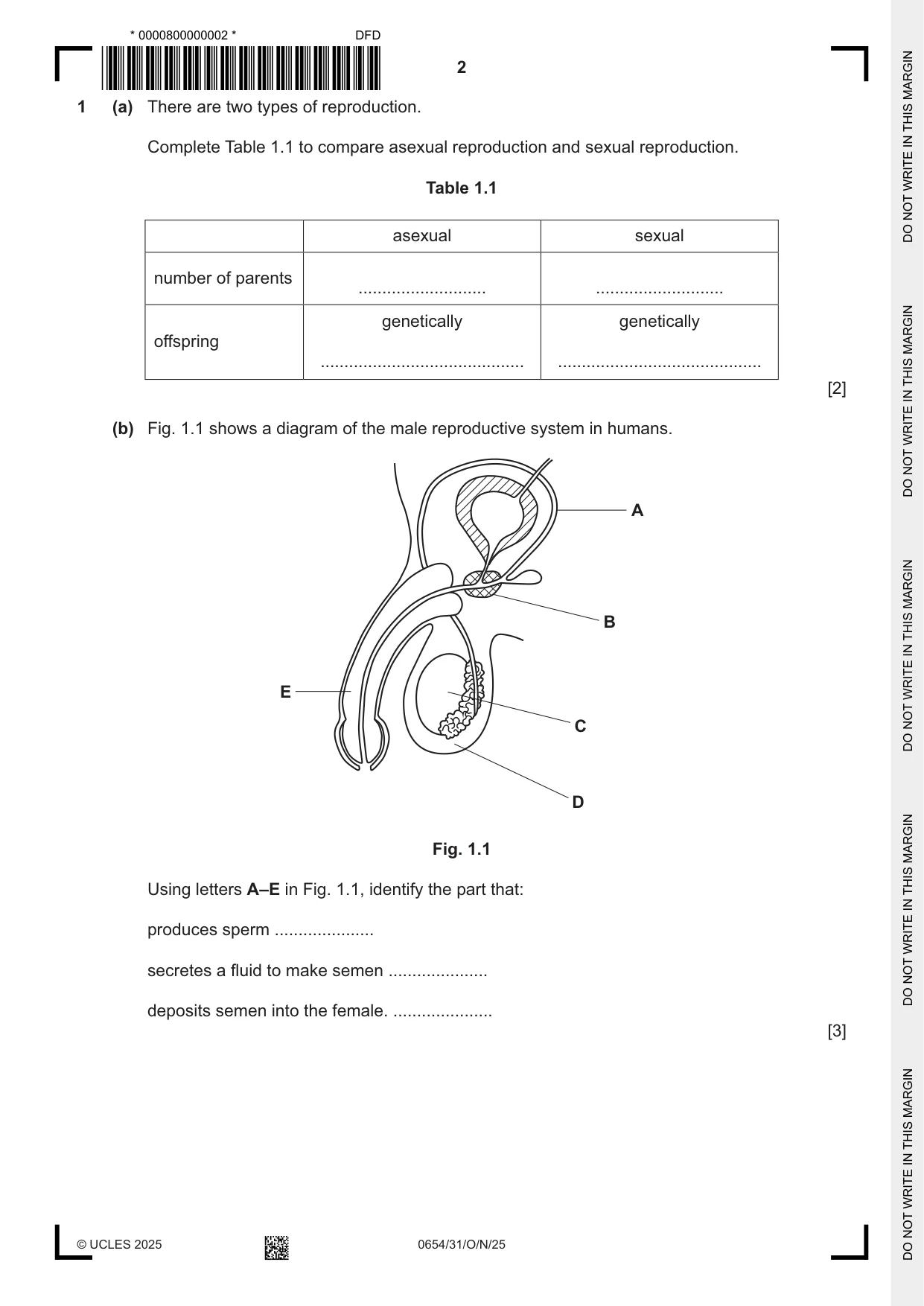
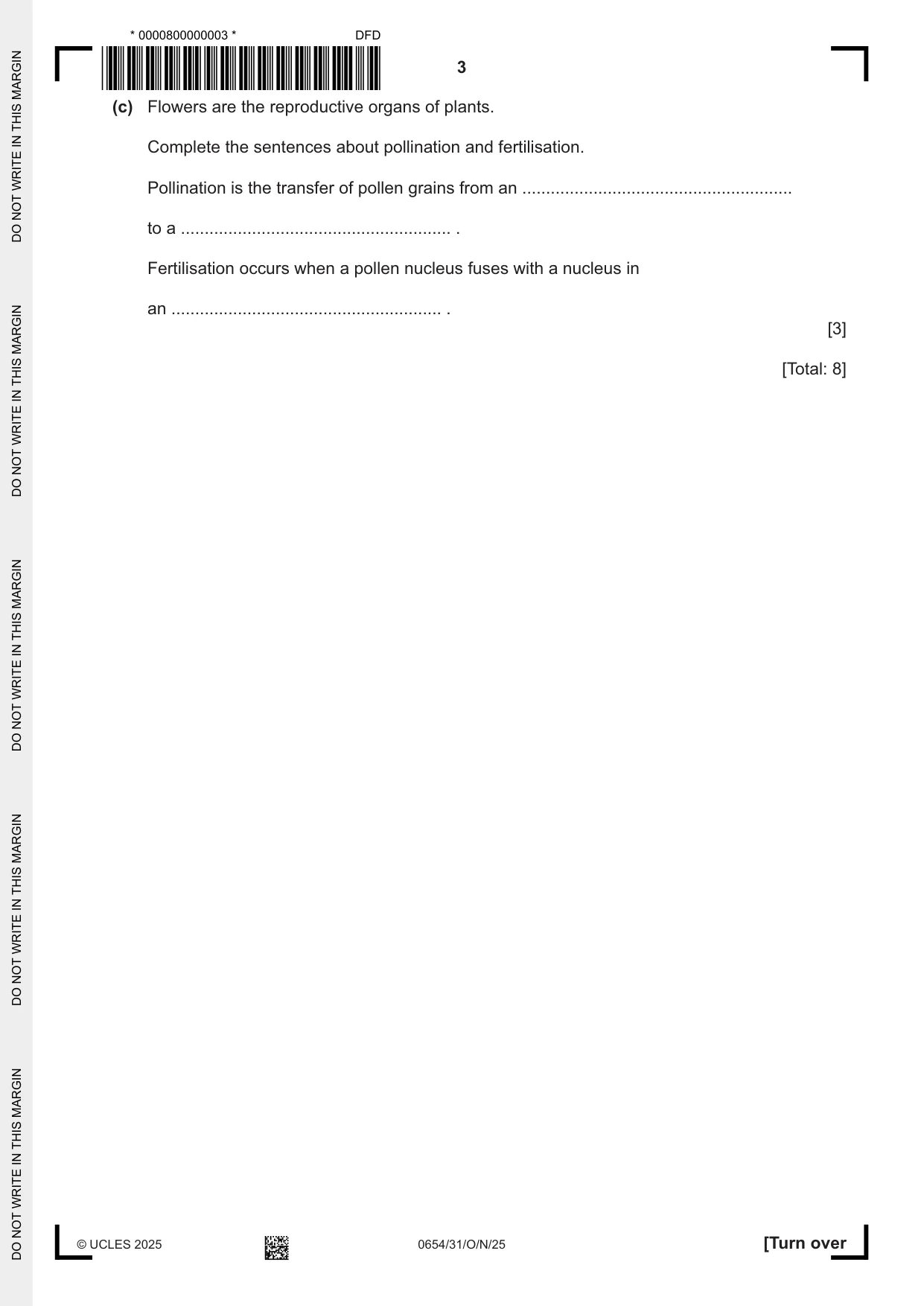
1 (a) There are two types of reproduction. Complete Table 1.1 to compare asexual reproduction and sexual reproduction. Table 1.1 asexual sexual number of parents ........................... ........................... genetically genetically offspring ........................................... ........................................... [2] (b) Fig. 1.1 shows a diagram of the male reproductive system in humans. A B E C D Fig. 1.1 Using letters A–E in Fig. 1.1, identify the part that: produces sperm ..................... secretes a fluid to make semen ..................... deposits semen into the female. ..................... [3] (c) Flowers are the reproductive organs of plants. Complete the sentences about pollination and fertilisation. Pollination is the transfer of pollen grains from an ......................................................... to a ......................................................... . Fertilisation occurs when a pollen nucleus fuses with a nucleus in an ......................................................... . [3] [Total: 8]
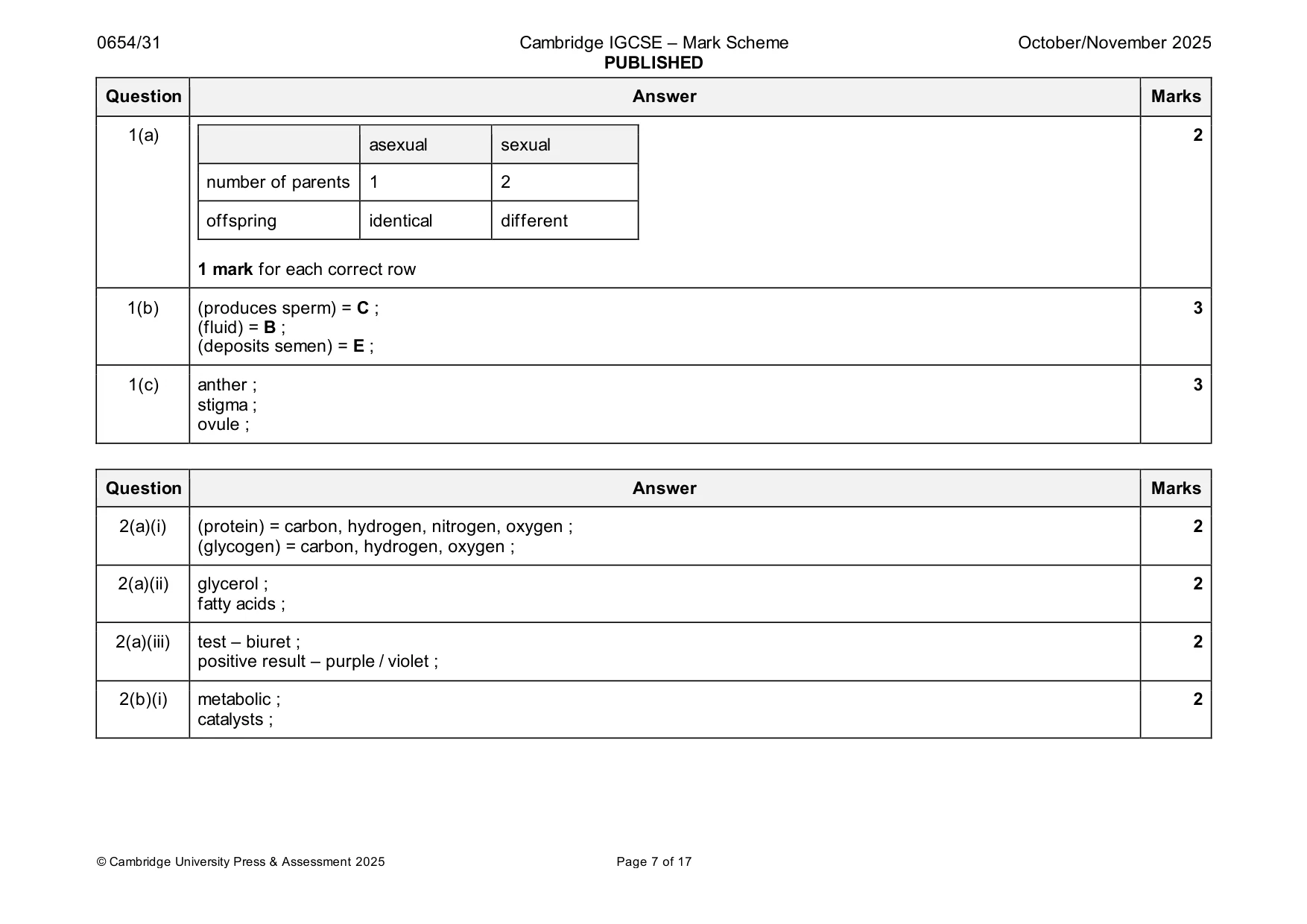
Mark scheme: Question Answer Marks 1(a) 2 asexual sexual number of parents 1 2 offspring identical different 1 mark for each correct row 1(b) (produces sperm) = C ; 3 (fluid) = B ; (deposits semen) = E ; 1(c) anther ; 3 stigma ; ovule ;
Q2 · State all the elements found in the molecules of: protein…
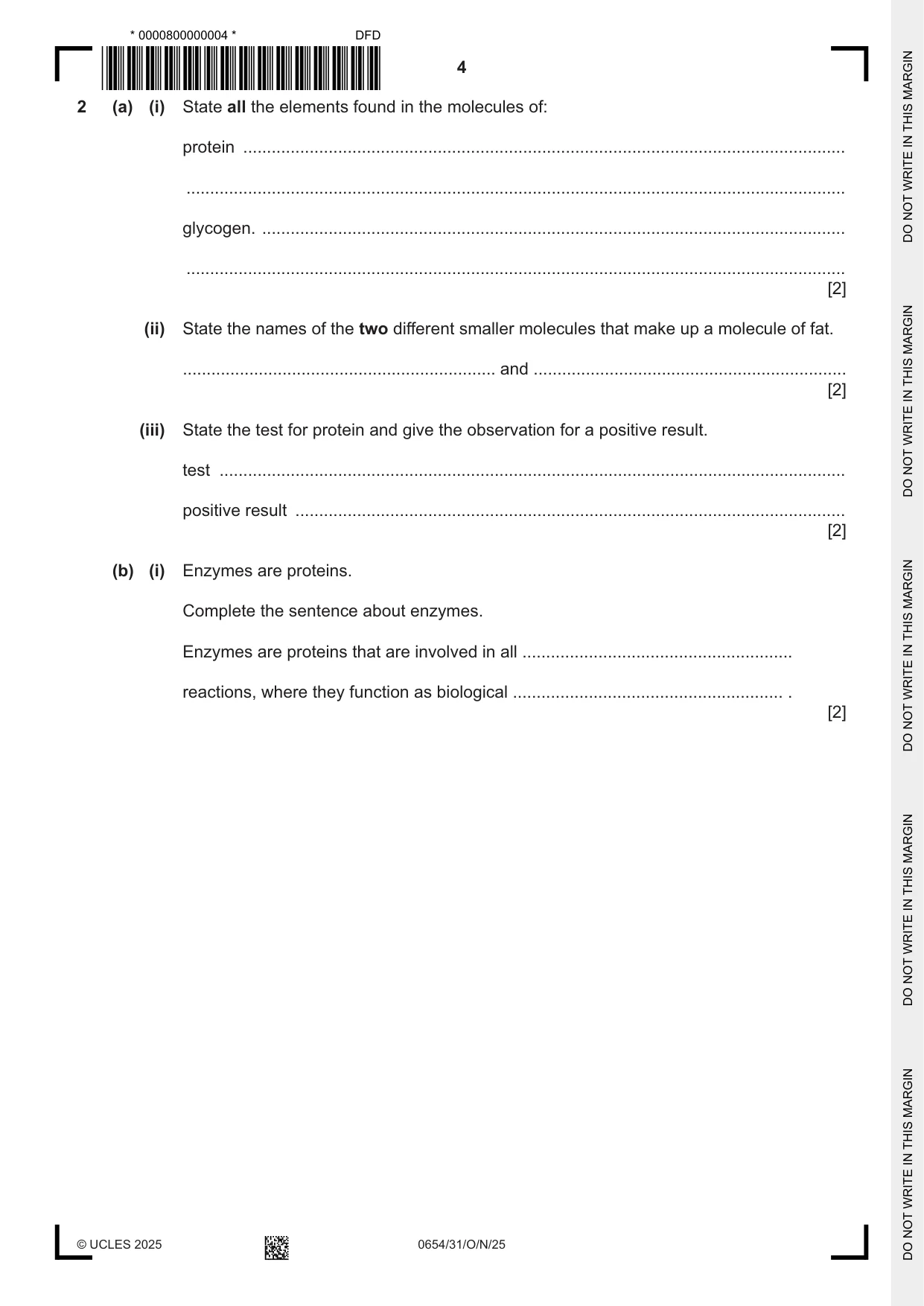
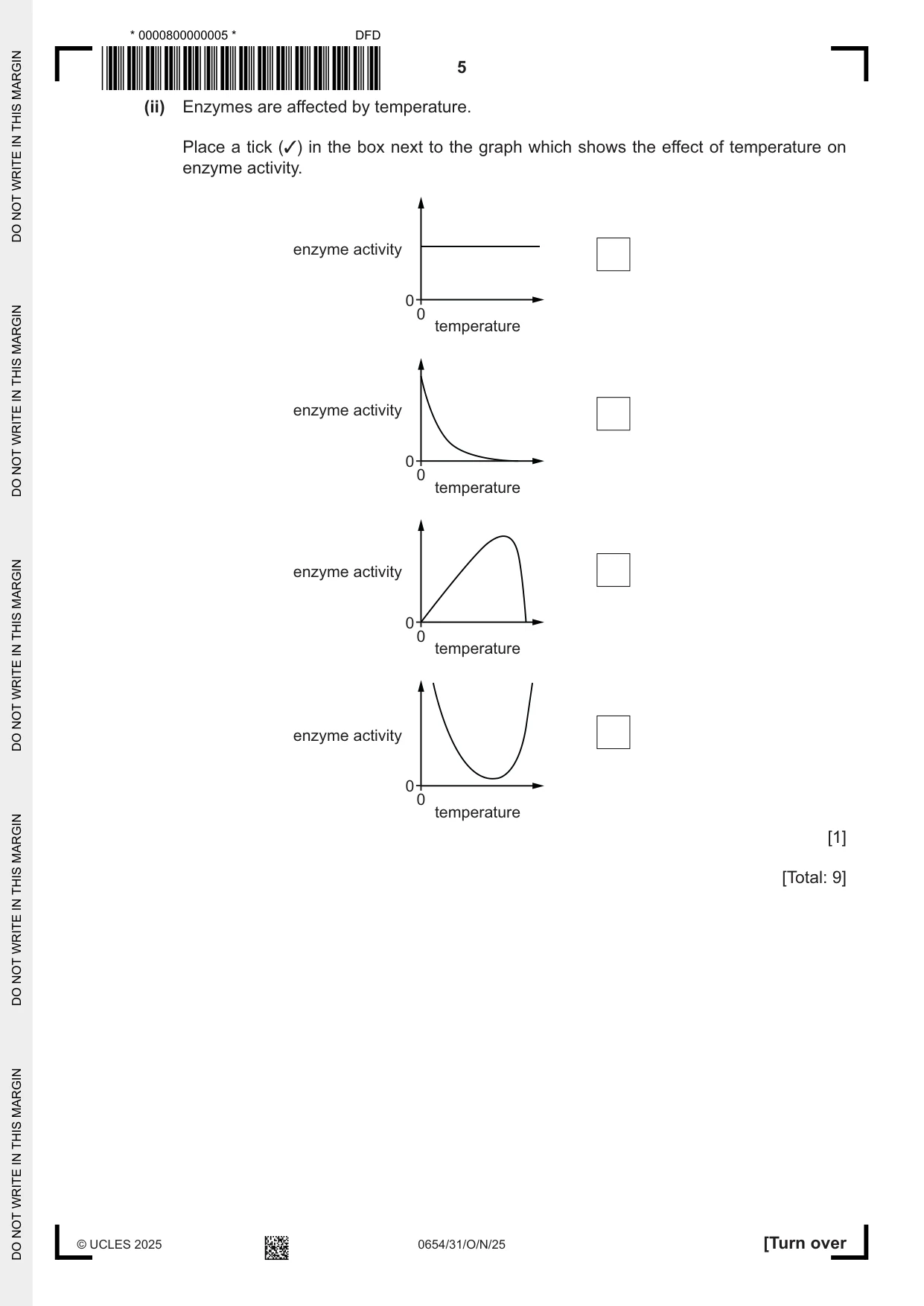
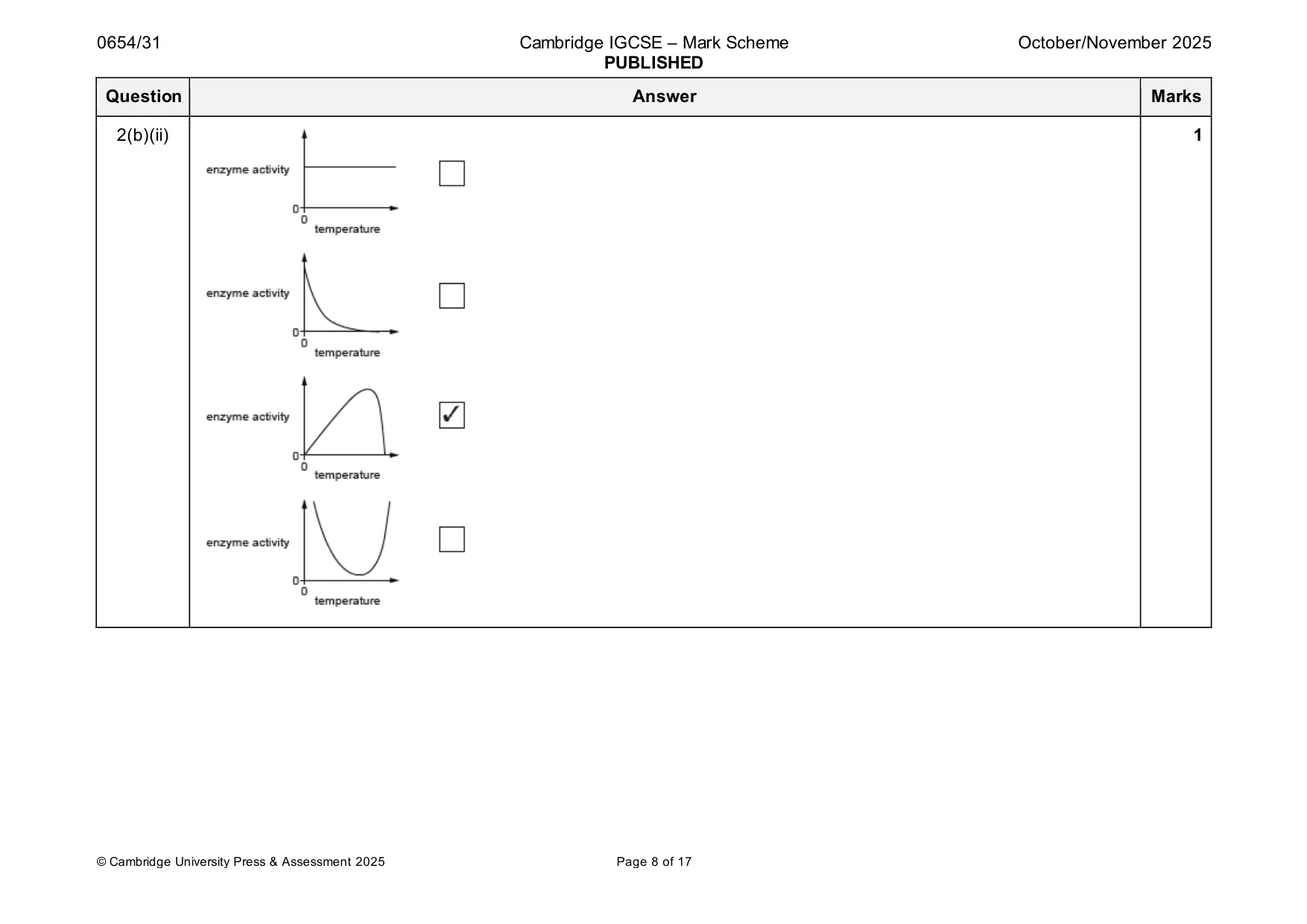
2 (a) (i) State all the elements found in the molecules of: protein ............................................................................................................................... ........................................................................................................................................... glycogen. ........................................................................................................................... ........................................................................................................................................... [2] (ii) State the names of the two different smaller molecules that make up a molecule of fat. .................................................................. and .................................................................. [2] (iii) State the test for protein and give the observation for a positive result. test .................................................................................................................................... positive result .................................................................................................................... [2] (b) (i) Enzymes are proteins. Complete the sentence about enzymes. Enzymes are proteins that are involved in all ......................................................... reactions, where they function as biological ......................................................... . [2] (ii) Enzymes are affected by temperature. Place a tick (3) in the box next to the graph which shows the effect of temperature on enzyme activity. enzyme activity 0 0 temperature enzyme activity 0 0 temperature enzyme activity 0 0 temperature enzyme activity 0 0 temperature [1] [Total: 9]
Mark scheme: 2(a)(i) (protein) = carbon, hydrogen, nitrogen, oxygen ; 2 (glycogen) = carbon, hydrogen, oxygen ; 2(a)(ii) glycerol ; 2 fatty acids ; 2(a)(iii) test – biuret ; 2 positive result – purple / violet ; 2(b)(i) metabolic ; 2 catalysts ; 2(b)(ii) 1
Q3 · A diagram of a heart
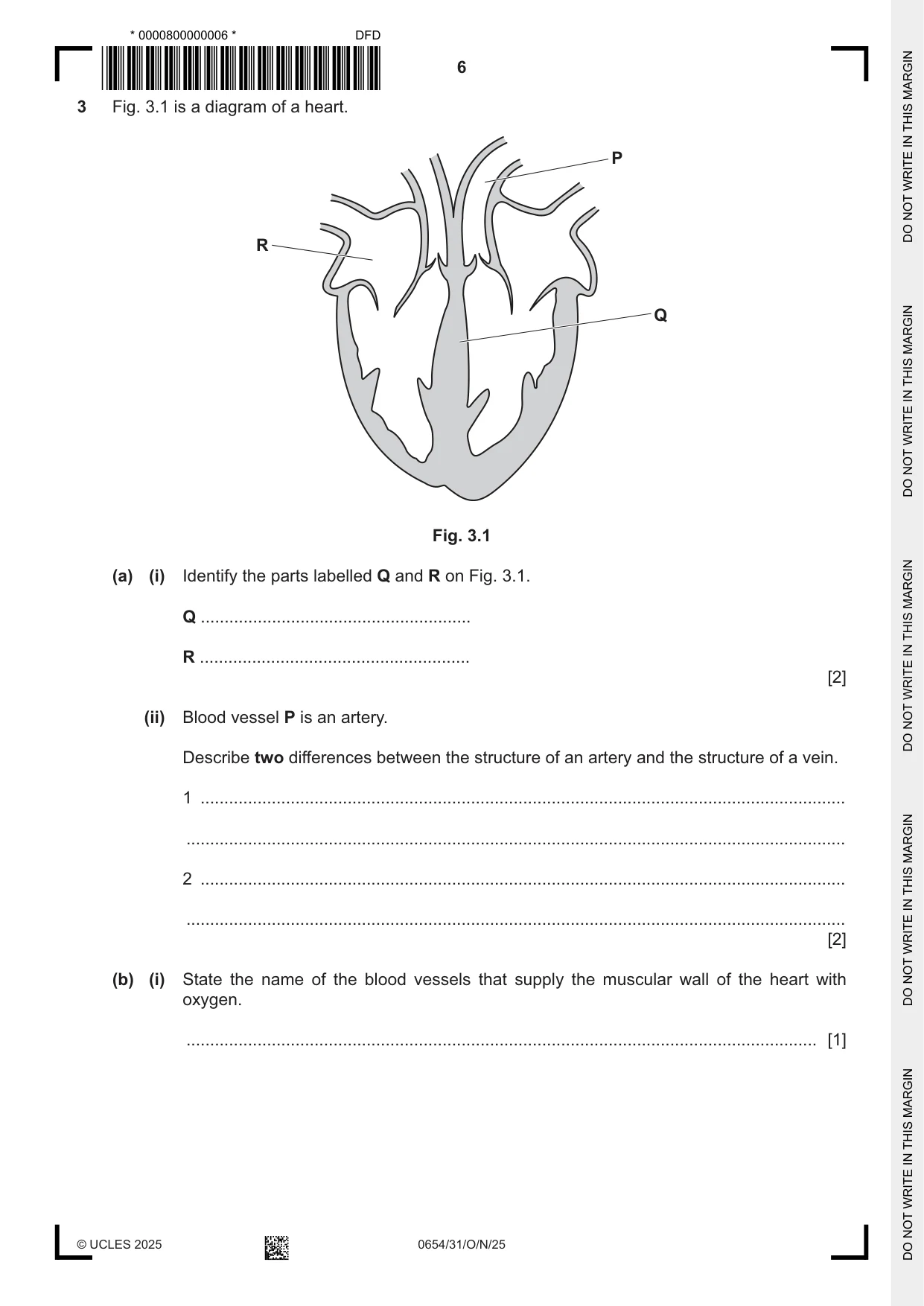
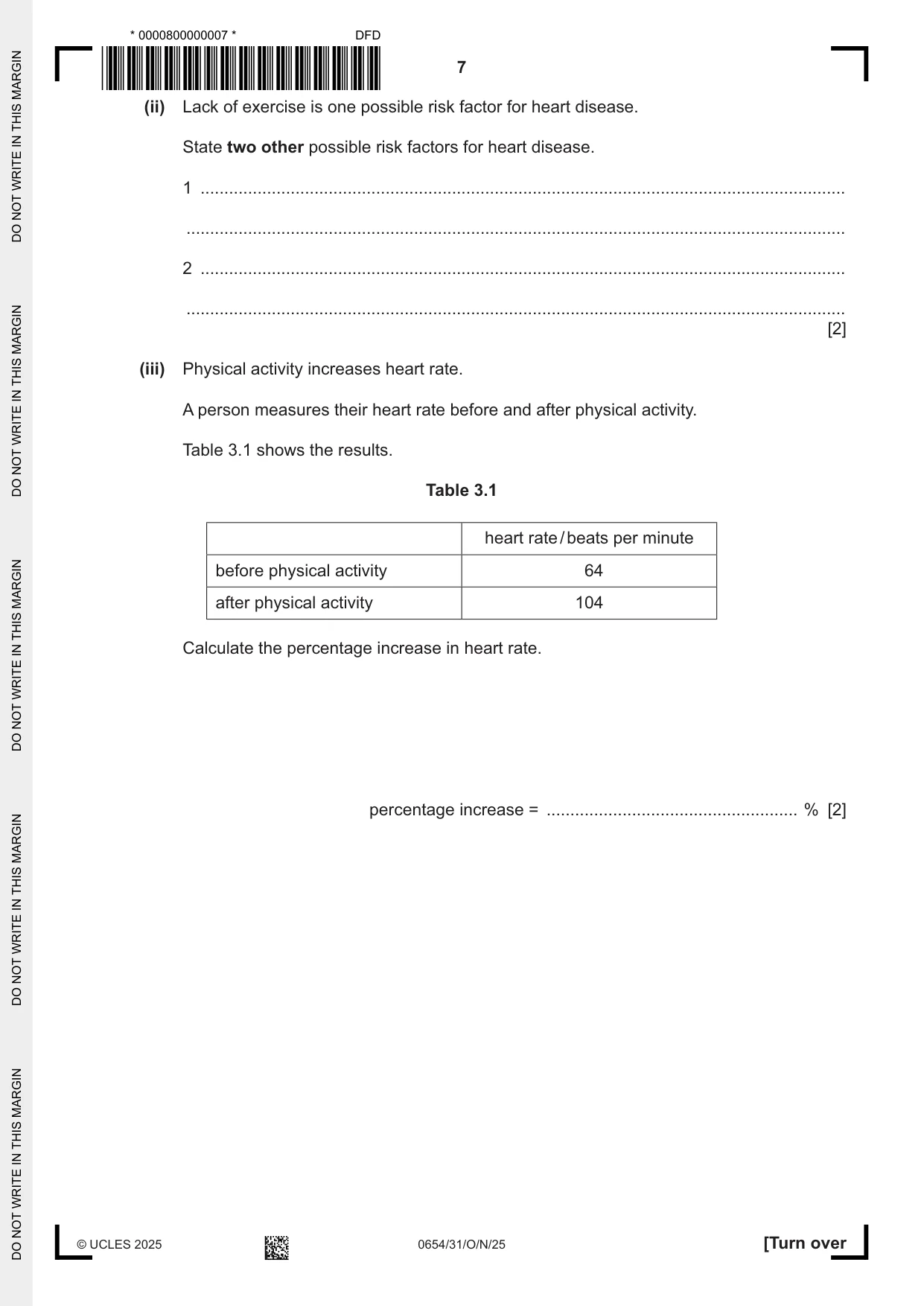
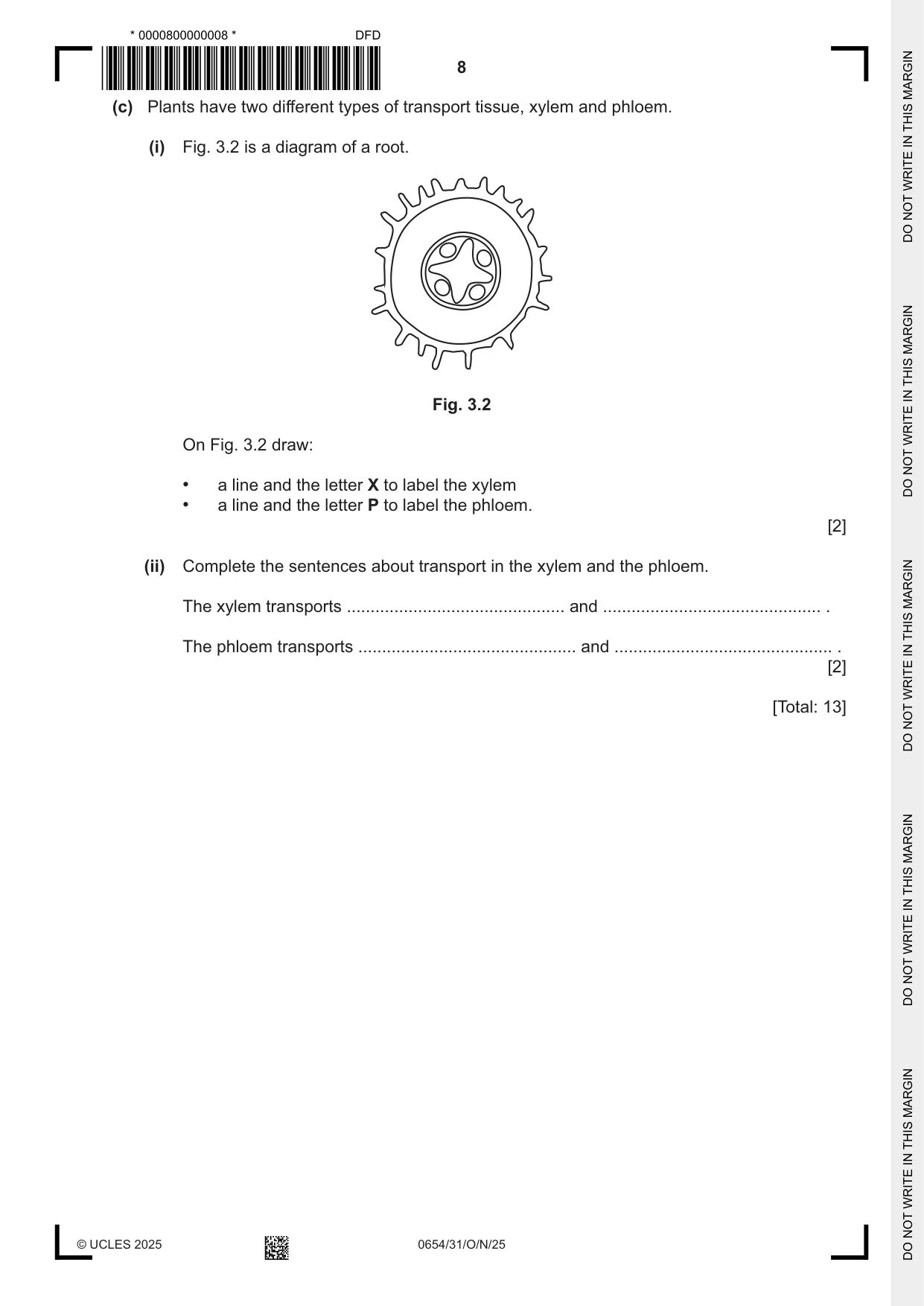
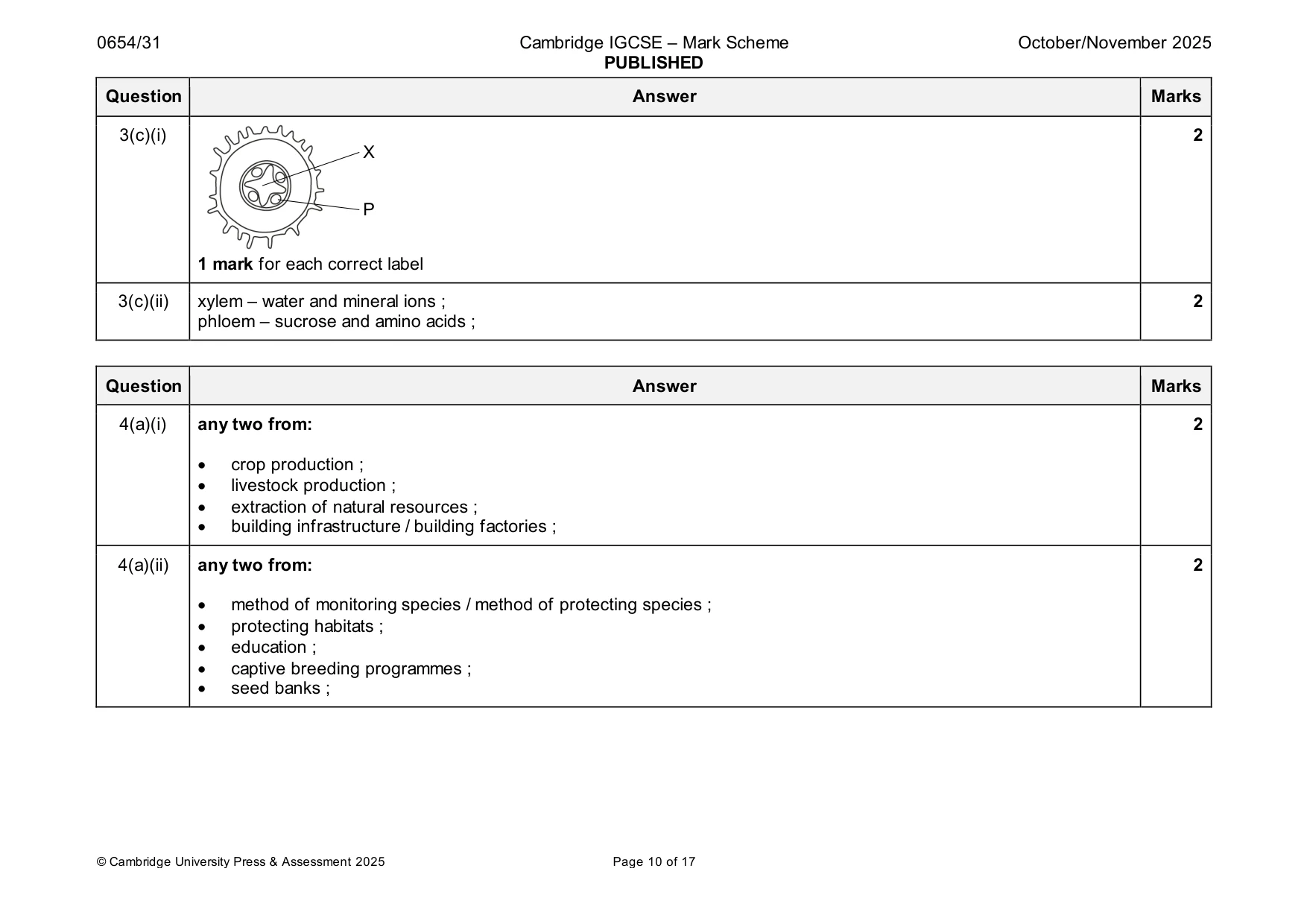
3 Fig. 3.1 is a diagram of a heart. P R Q Fig. 3.1 (a) (i) Identify the parts labelled Q and R on Fig. 3.1. Q ......................................................... R ......................................................... [2] (ii) Blood vessel P is an artery. Describe two differences between the structure of an artery and the structure of a vein. 1 ........................................................................................................................................ ........................................................................................................................................... 2 ........................................................................................................................................ ........................................................................................................................................... [2] (b) (i) State the name of the blood vessels that supply the muscular wall of the heart with oxygen. ..................................................................................................................................... [1] (ii) Lack of exercise is one possible risk factor for heart disease. State two other possible risk factors for heart disease. 1 ........................................................................................................................................ ........................................................................................................................................... 2 ........................................................................................................................................ ........................................................................................................................................... [2] (iii) Physical activity increases heart rate. A person measures their heart rate before and after physical activity. Table 3.1 shows the results. Table 3.1 heart rate / beats per minute before physical activity 64 after physical activity 104 Calculate the percentage increase in heart rate. percentage increase = ..................................................... % [2] (c) Plants have two different types of transport tissue, xylem and phloem. (i) Fig. 3.2 is a diagram of a root. Fig. 3.2 On Fig. 3.2 draw: • a line and the letter X to label the xylem • a line and the letter P to label the phloem. [2] (ii) Complete the sentences about transport in the xylem and the phloem. The xylem transports .............................................. and .............................................. . The phloem transports .............................................. and .............................................. . [2] [Total: 13] Question 4 starts on the next page.
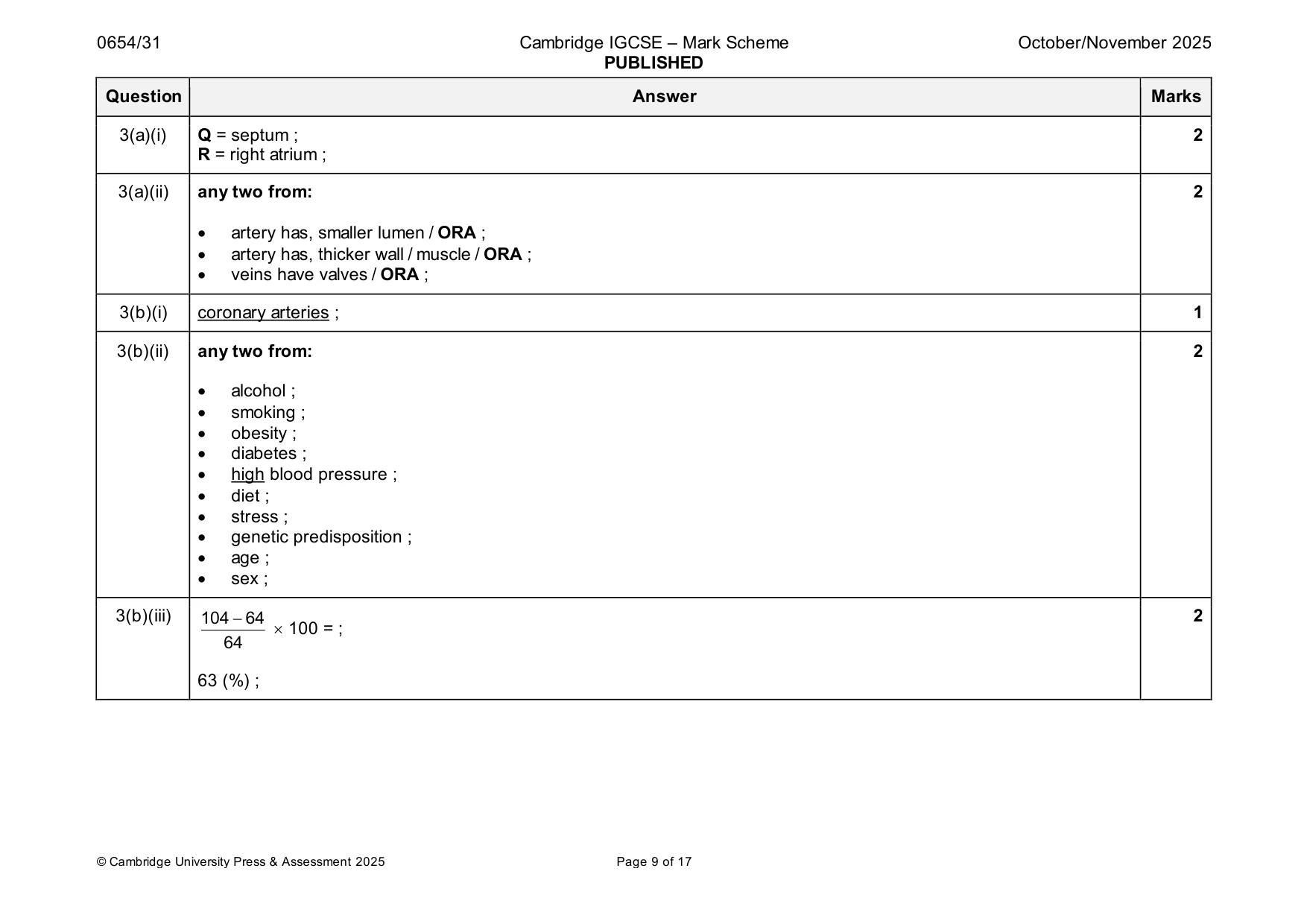
Mark scheme: 3(a)(i) Q = septum ; 2 R = right atrium ; 3(a)(ii) any two from: 2 • artery has, smaller lumen / ORA ; • artery has, thicker wall / muscle / ORA ; • veins have valves / ORA ; 3(b)(i) coronary arteries ; 1 3(b)(ii) any two from: 2 • alcohol ; • smoking ; • obesity ; • diabetes ; • high blood pressure ; • diet ; • stress ; • genetic predisposition ; • age ; • sex ; 3(b)(iii) 104 − 64 2 100 = ; 64 63 (%) ; 3(c)(i) 2 X P 1 mark for each correct label 3(c)(ii) xylem – water and mineral ions ; 2 phloem – sucrose and amino acids ;
Q4 · An example of habitat destruction
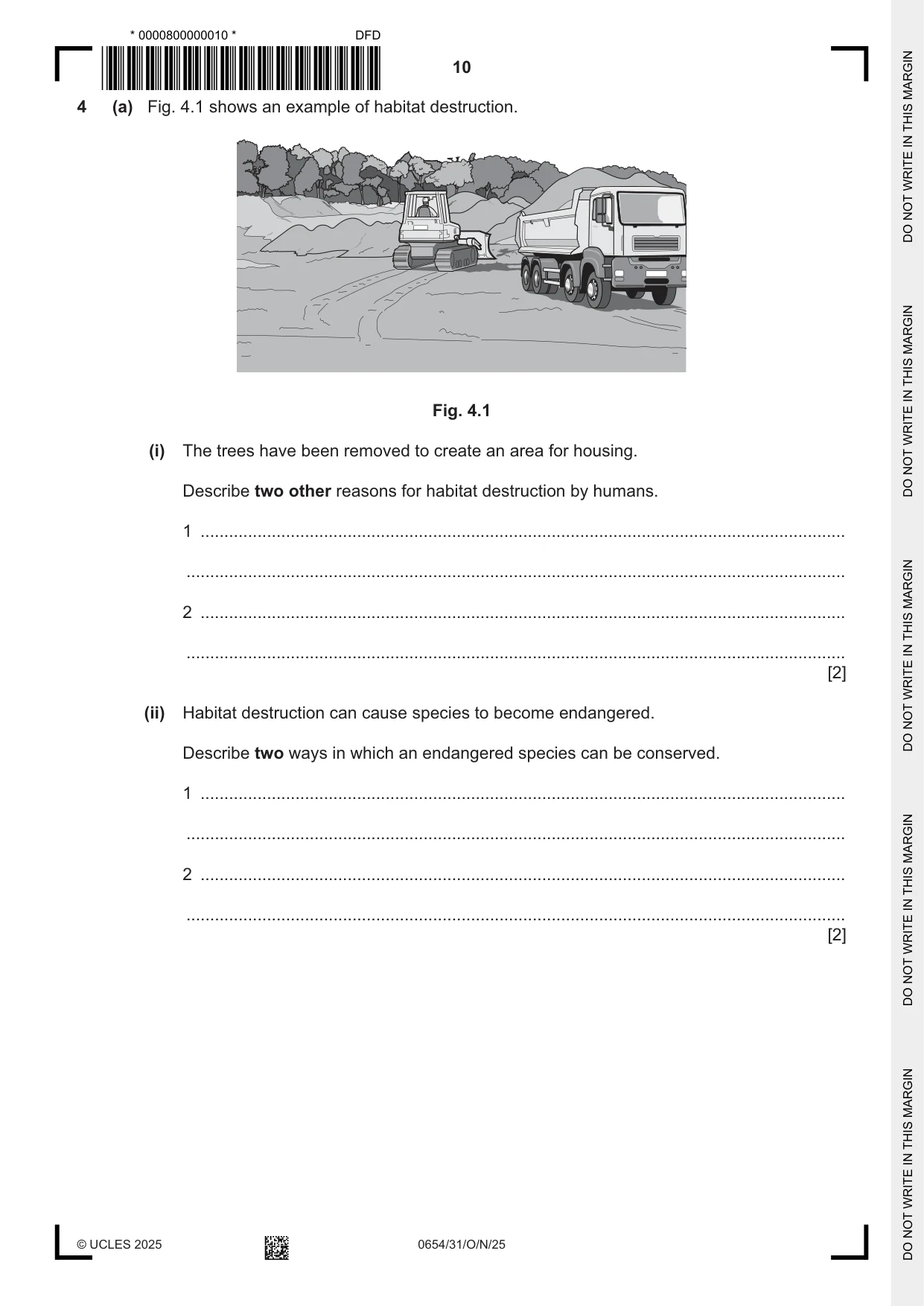
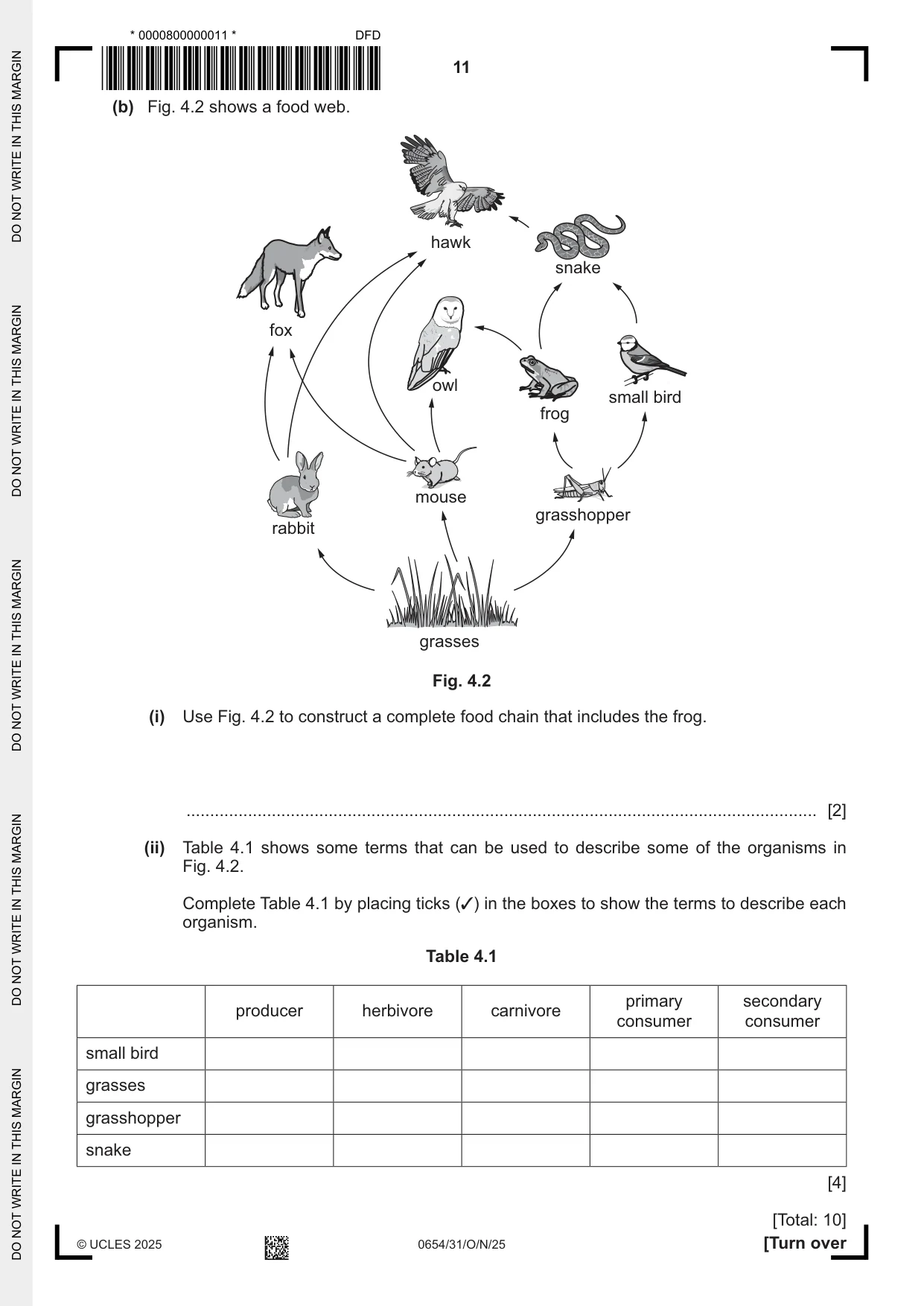
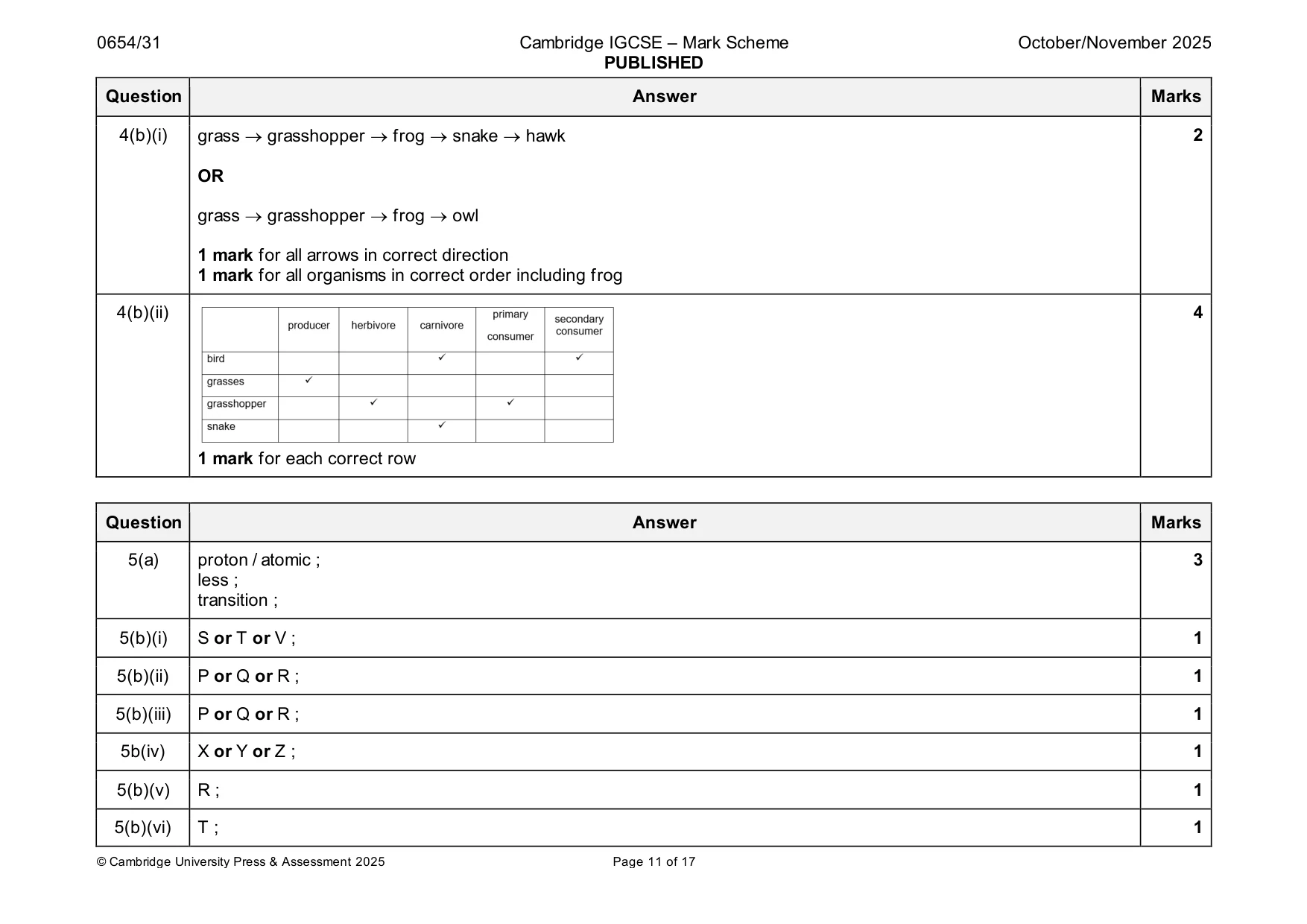
4 (a) Fig. 4.1 shows an example of habitat destruction. Fig. 4.1 (i) The trees have been removed to create an area for housing. Describe two other reasons for habitat destruction by humans. 1 ........................................................................................................................................ ........................................................................................................................................... 2 ........................................................................................................................................ ........................................................................................................................................... [2] (ii) Habitat destruction can cause species to become endangered. Describe two ways in which an endangered species can be conserved. 1 ........................................................................................................................................ ........................................................................................................................................... 2 ........................................................................................................................................ ........................................................................................................................................... [2] (b) Fig. 4.2 shows a food web. hawk snake fox owl small bird frog mouse grasshopper rabbit grasses Fig. 4.2 (i) Use Fig. 4.2 to construct a complete food chain that includes the frog. ..................................................................................................................................... [2] (ii) Table 4.1 shows some terms that can be used to describe some of the organisms in Fig. 4.2. Complete Table 4.1 by placing ticks (3) in the boxes to show the terms to describe each organism. Table 4.1 primary secondary producer herbivore carnivore consumer consumer small bird grasses grasshopper snake [4] [Total: 10]
Mark scheme: 4(a)(i) any two from: 2 • crop production ; • livestock production ; • extraction of natural resources ; • building infrastructure / building factories ; 4(a)(ii) any two from: 2 • method of monitoring species / method of protecting species ; • protecting habitats ; • education ; • captive breeding programmes ; • seed banks ; 4(b)(i) grass → grasshopper → frog → snake → hawk 2 OR grass → grasshopper → frog → owl 1 mark for all arrows in correct direction 1 mark for all organisms in correct order including frog 4(b)(ii) 4 1 mark for each correct row
Q6 · Methane, CH4, is a saturated hydrocarbon
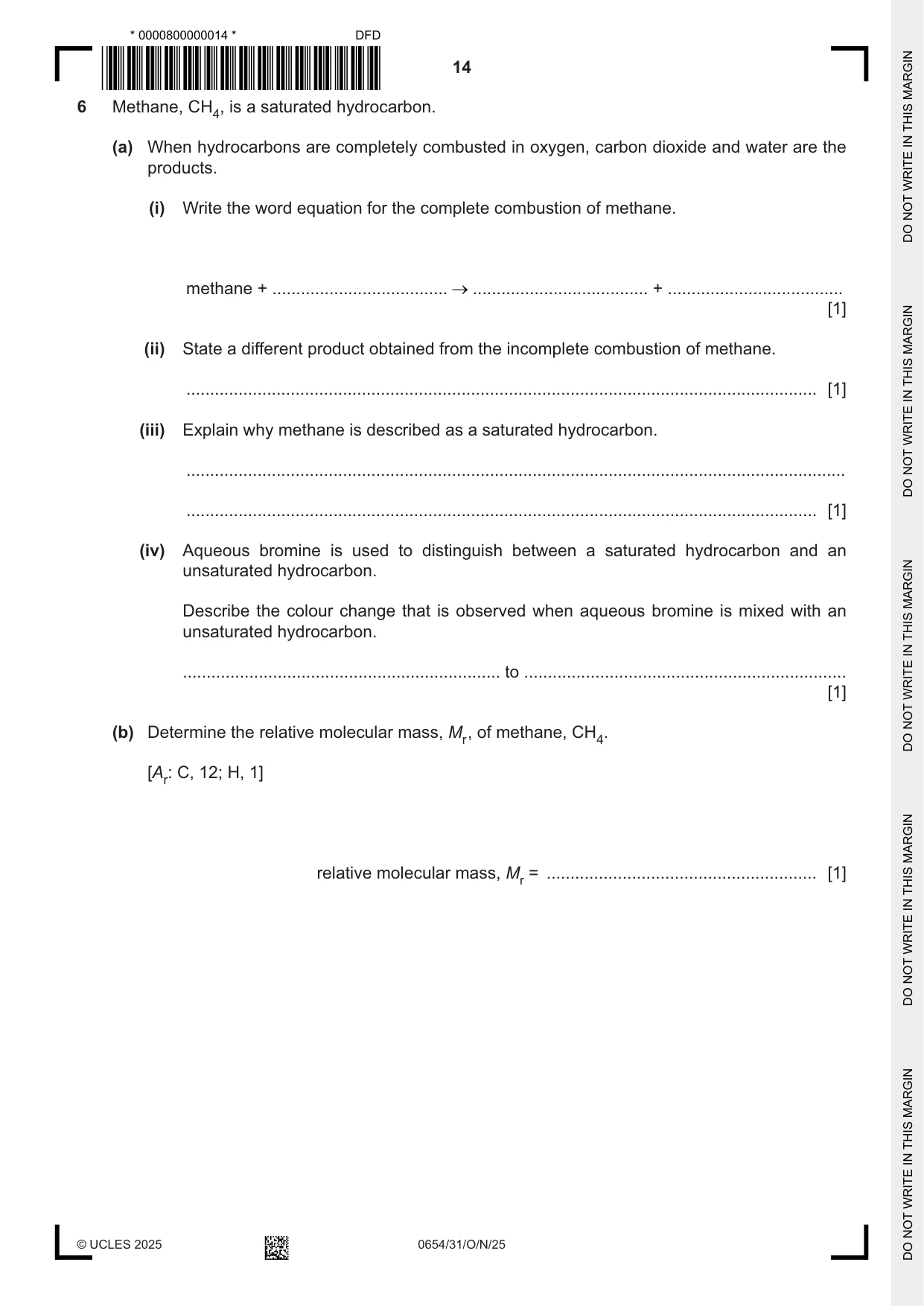
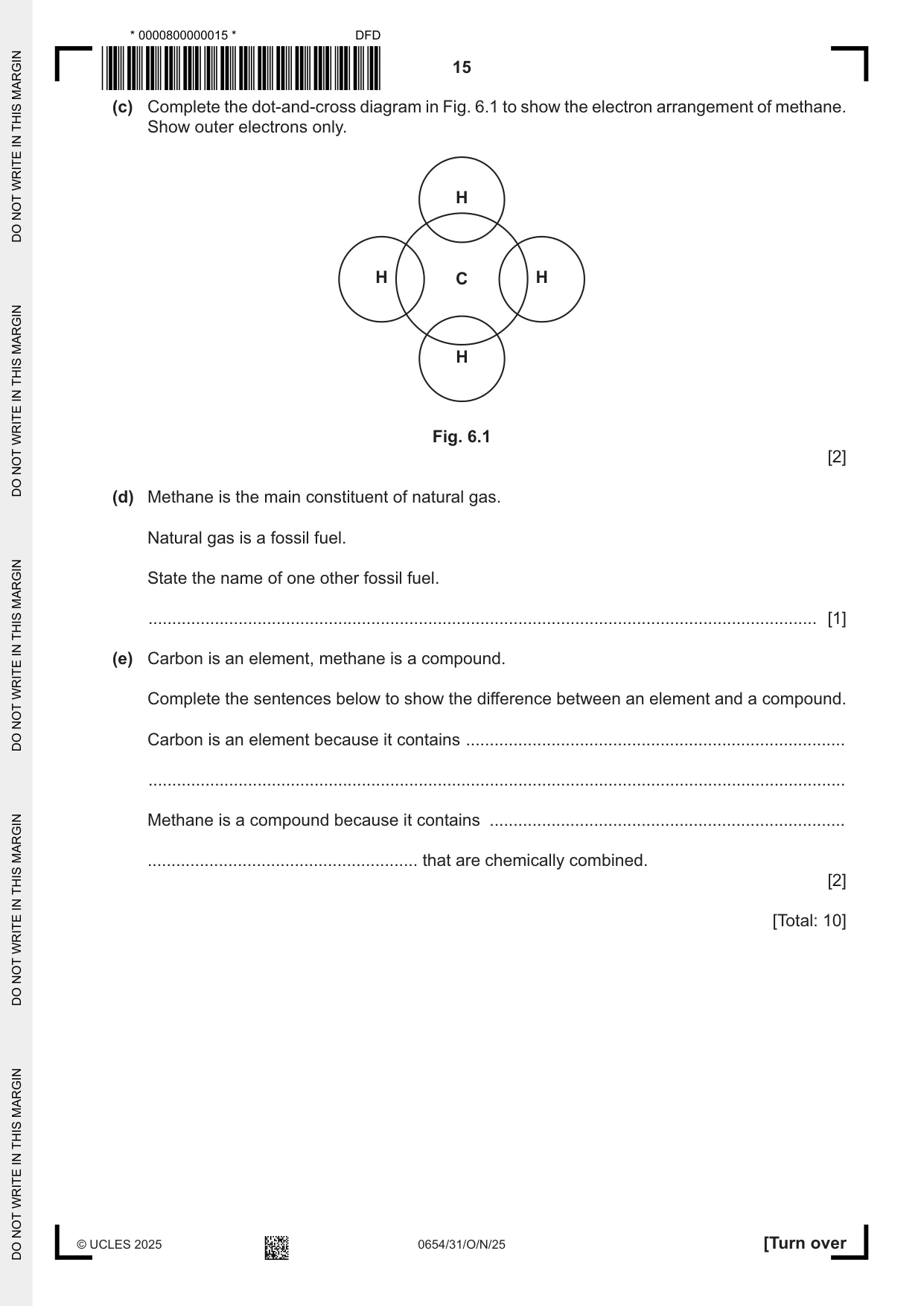
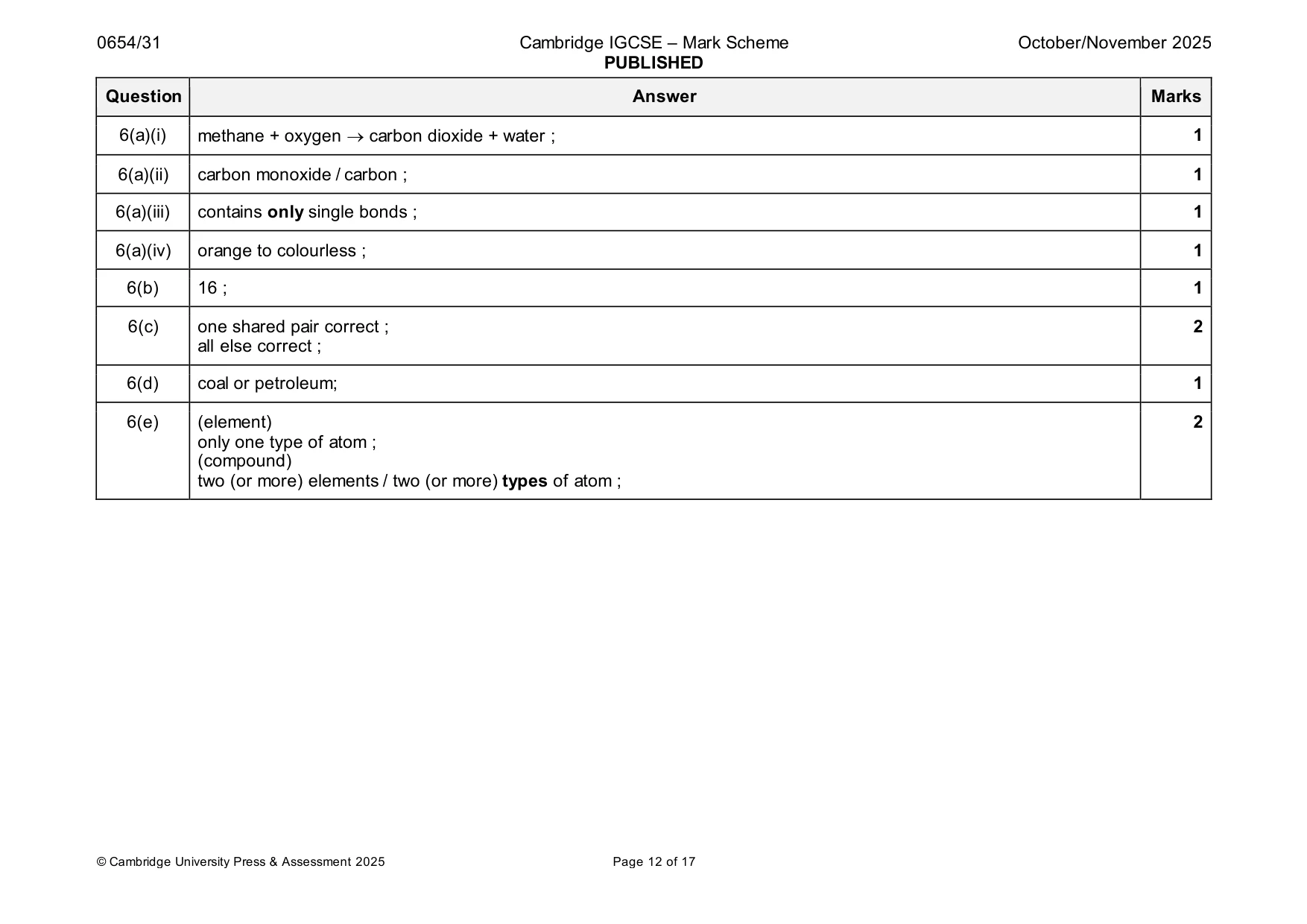
6 Methane, CH4, is a saturated hydrocarbon. (a) When hydrocarbons are completely combusted in oxygen, carbon dioxide and water are the products. (i) Write the word equation for the complete combustion of methane. methane + ..................................... ..................................... + ..................................... [1] (ii) State a different product obtained from the incomplete combustion of methane. ..................................................................................................................................... [1] (iii) Explain why methane is described as a saturated hydrocarbon. ........................................................................................................................................... ..................................................................................................................................... [1] (iv) Aqueous bromine is used to distinguish between a saturated hydrocarbon and an unsaturated hydrocarbon. Describe the colour change that is observed when aqueous bromine is mixed with an unsaturated hydrocarbon. ................................................................... to .................................................................... [1] (b) Determine the relative molecular mass, Mr , of methane, CH4. [Ar: C, 12; H, 1] relative molecular mass, Mr = ......................................................... [1] (c) Complete the dot-and-cross diagram in Fig. 6.1 to show the electron arrangement of methane. Show outer electrons only. H H C H H Fig. 6.1 [2] (d) Methane is the main constituent of natural gas. Natural gas is a fossil fuel. State the name of one other fossil fuel. ............................................................................................................................................. [1] (e) Carbon is an element, methane is a compound. Complete the sentences below to show the difference between an element and a compound. Carbon is an element because it contains ................................................................................ ................................................................................................................................................... Methane is a compound because it contains ........................................................................... ......................................................... that are chemically combined. [2] [Total: 10]
Mark scheme: 6(a)(i) methane + oxygen → carbon dioxide + water ; 1 6(a)(ii) carbon monoxide / carbon ; 1 6(a)(iii) contains only single bonds ; 1 6(a)(iv) orange to colourless ; 1 6(b) 16 ; 1 6(c) one shared pair correct ; 2 all else correct ; 6(d) coal or petroleum; 1 6(e) (element) 2 only one type of atom ; (compound) two (or more) elements / two (or more) types of atom ;
Q7 · Lead is extracted from lead oxide by reaction with carbon
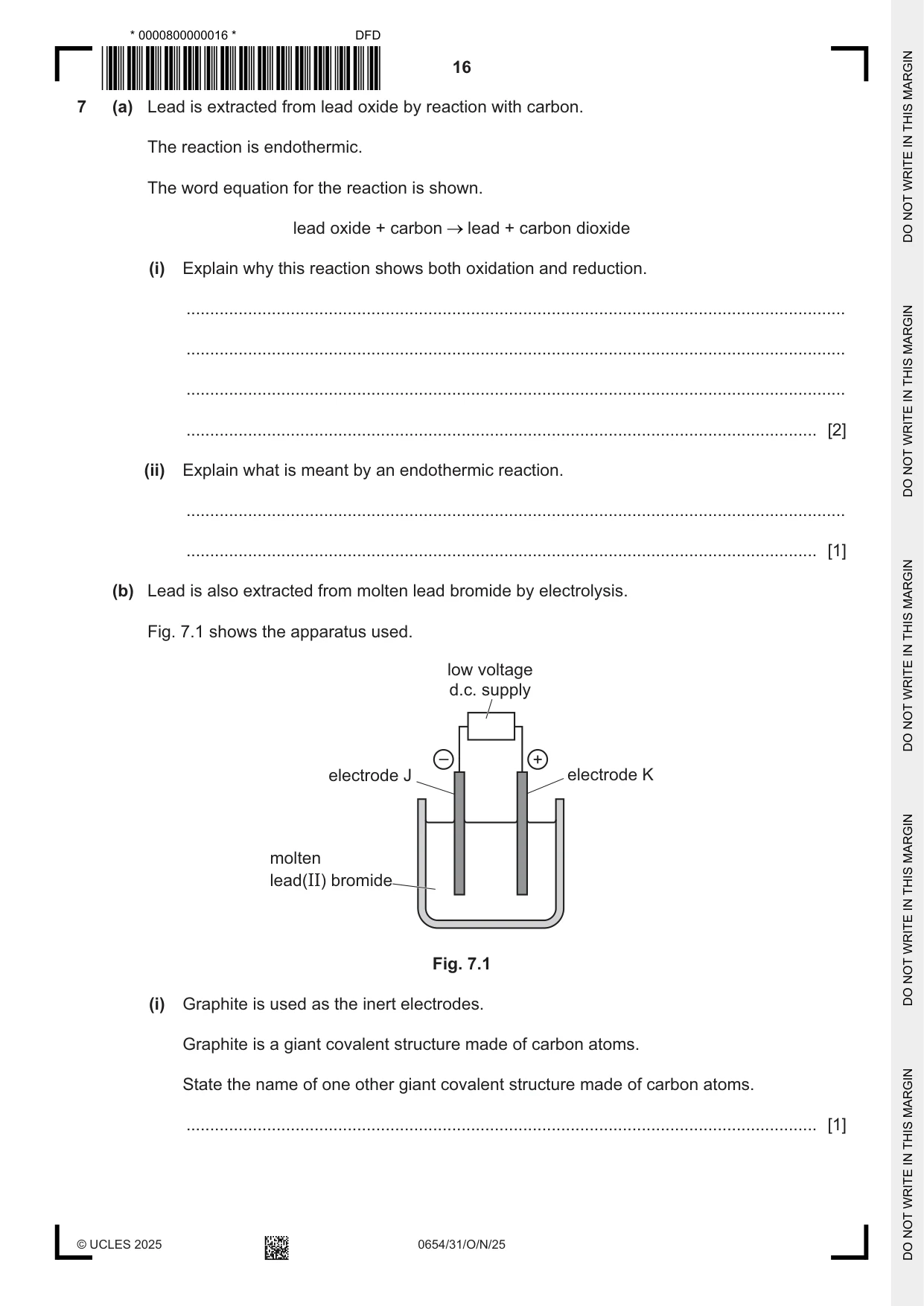
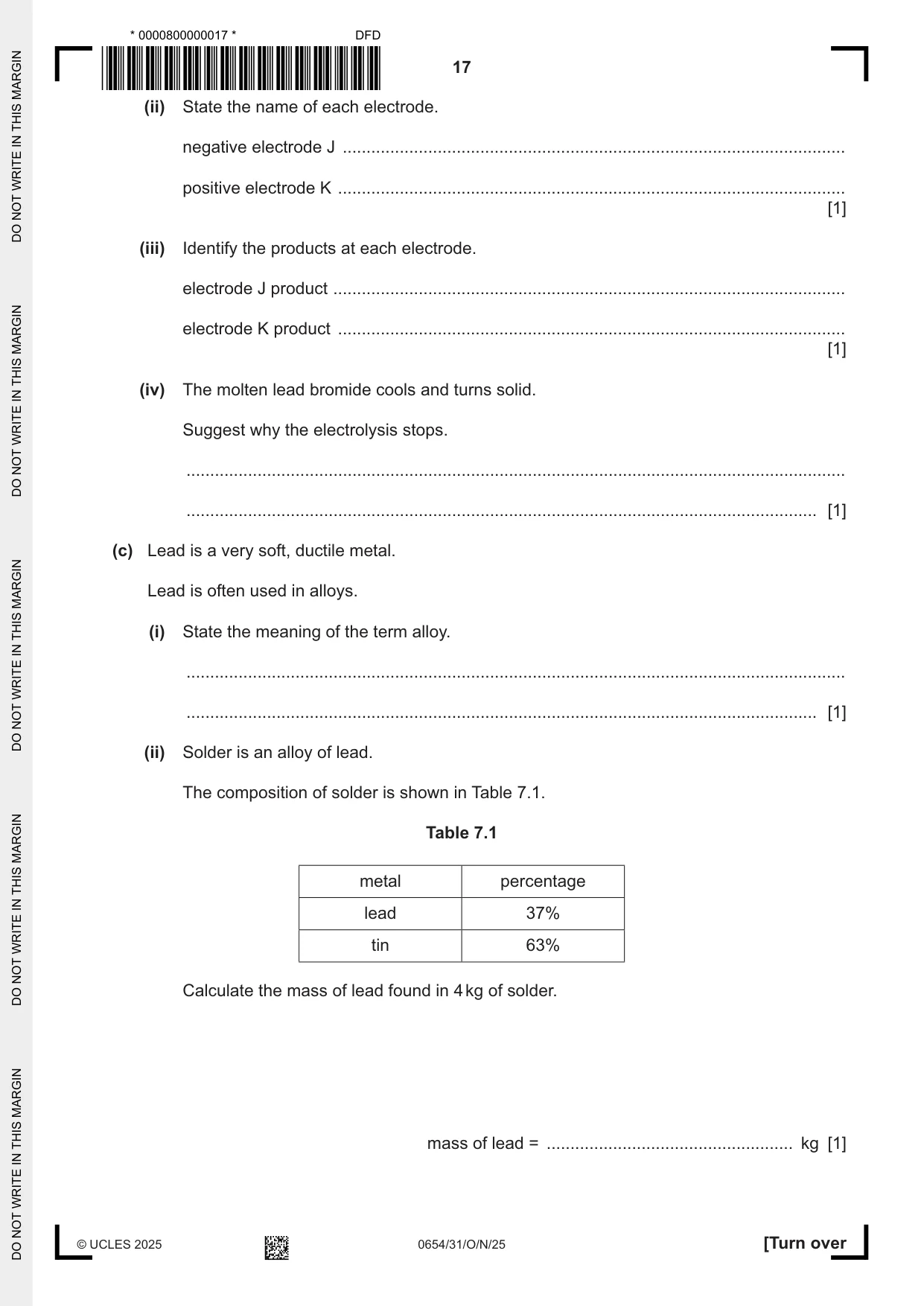
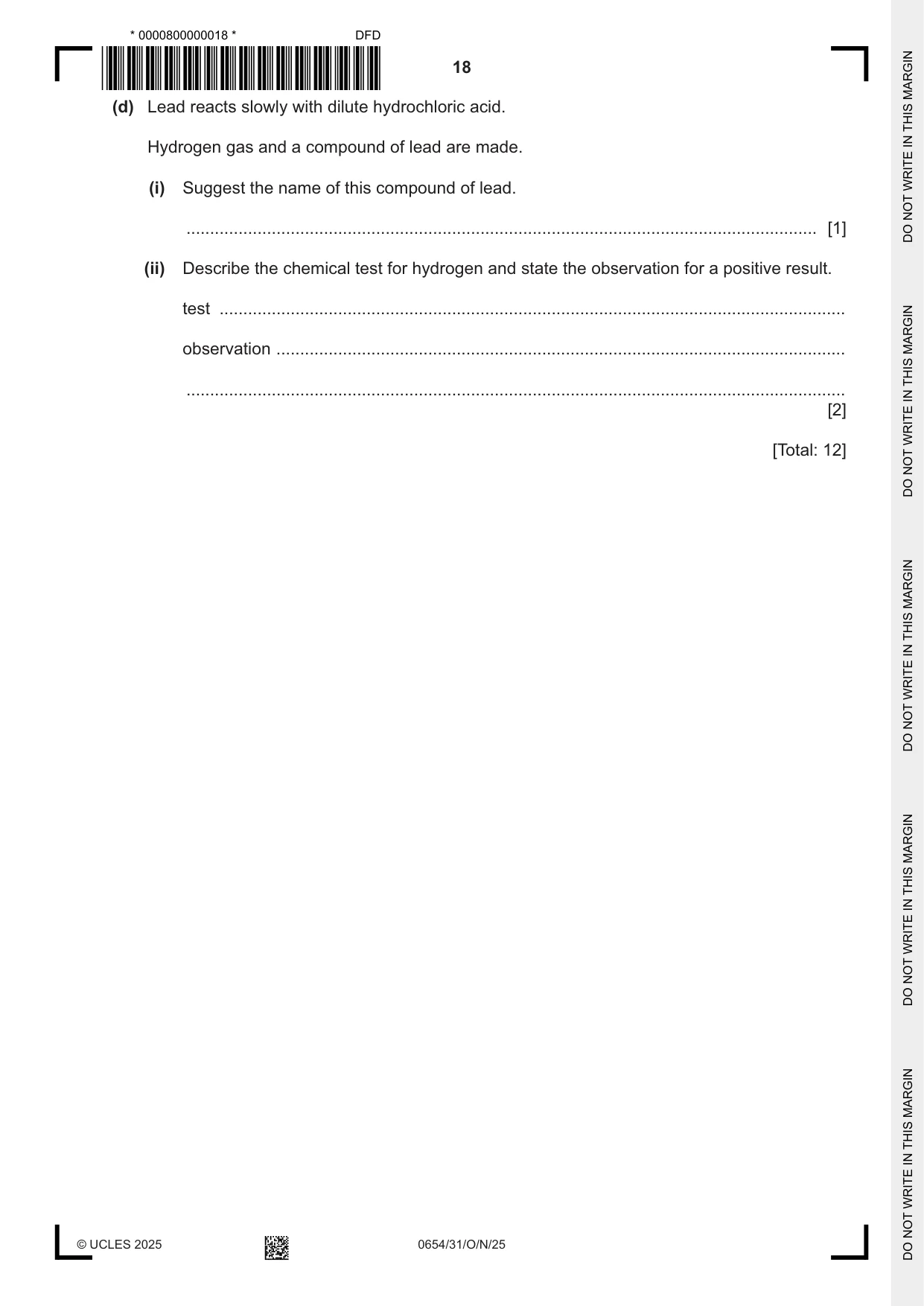
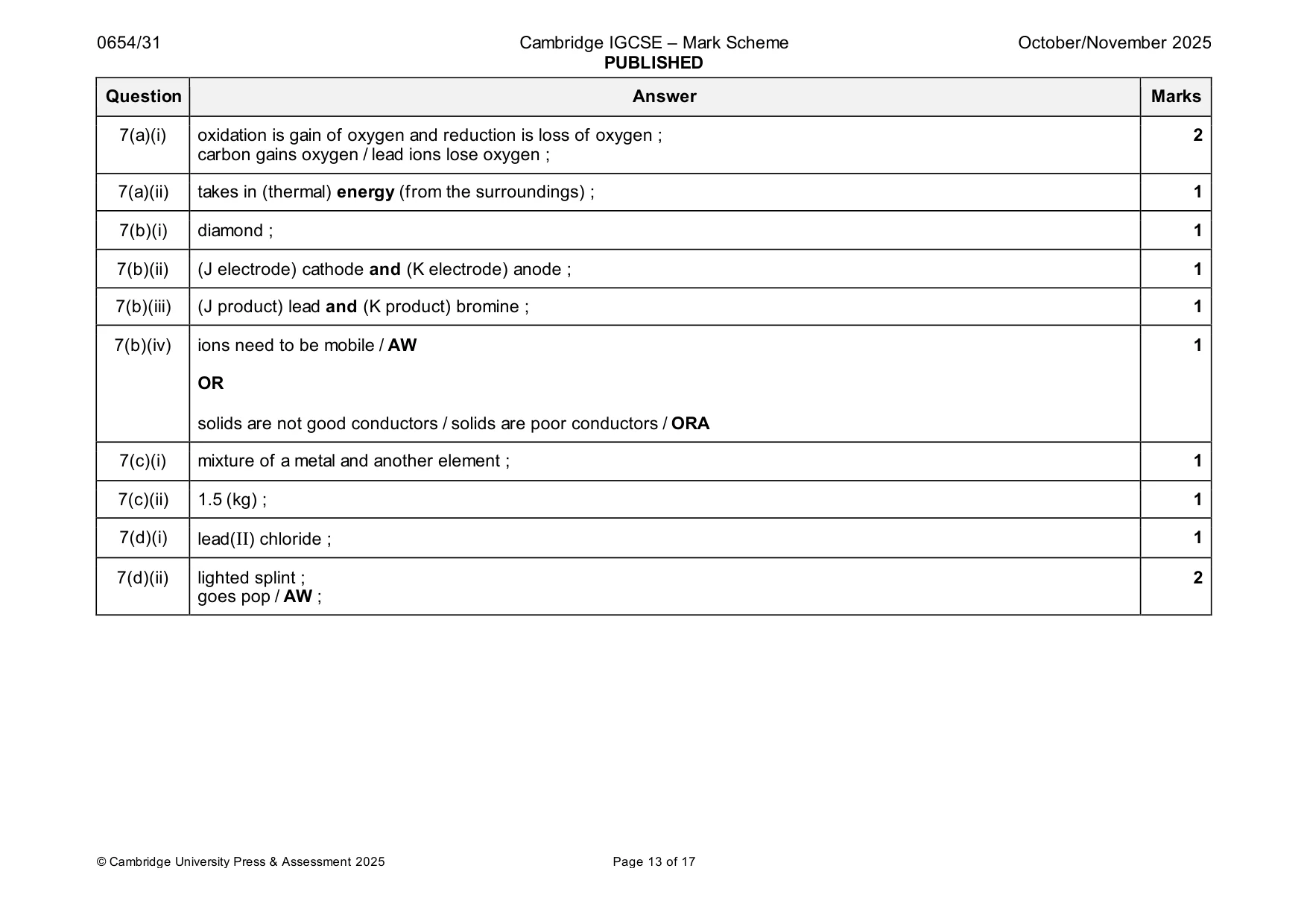
7 (a) Lead is extracted from lead oxide by reaction with carbon. The reaction is endothermic. The word equation for the reaction is shown. lead oxide + carbon lead + carbon dioxide (i) Explain why this reaction shows both oxidation and reduction. ........................................................................................................................................... ........................................................................................................................................... ........................................................................................................................................... ..................................................................................................................................... [2] (ii) Explain what is meant by an endothermic reaction. ........................................................................................................................................... ..................................................................................................................................... [1] (b) Lead is also extracted from molten lead bromide by electrolysis. Fig. 7.1 shows the apparatus used. low voltage d.c. supply – + electrode J electrode K molten lead(II) bromide Fig. 7.1 (i) Graphite is used as the inert electrodes. Graphite is a giant covalent structure made of carbon atoms. State the name of one other giant covalent structure made of carbon atoms. ..................................................................................................................................... [1] (ii) State the name of each electrode. negative electrode J .......................................................................................................... positive electrode K ........................................................................................................... [1] (iii) Identify the products at each electrode. electrode J product ............................................................................................................ electrode K product ........................................................................................................... [1] (iv) The molten lead bromide cools and turns solid. Suggest why the electrolysis stops. ........................................................................................................................................... ..................................................................................................................................... [1] (c) Lead is a very soft, ductile metal. Lead is often used in alloys. (i) State the meaning of the term alloy. ........................................................................................................................................... ..................................................................................................................................... [1] (ii) Solder is an alloy of lead. The composition of solder is shown in Table 7.1. Table 7.1 metal percentage lead 37% tin 63% Calculate the mass of lead found in 4 kg of solder. mass of lead = .................................................... kg [1] (d) Lead reacts slowly with dilute hydrochloric acid. Hydrogen gas and a compound of lead are made. (i) Suggest the name of this compound of lead. ..................................................................................................................................... [1] (ii) Describe the chemical test for hydrogen and state the observation for a positive result. test .................................................................................................................................... observation ........................................................................................................................ ........................................................................................................................................... [2] [Total: 12] Question 8 starts on the next page.
Mark scheme: 7(a)(i) oxidation is gain of oxygen and reduction is loss of oxygen ; 2 carbon gains oxygen / lead ions lose oxygen ; 7(a)(ii) takes in (thermal) energy (from the surroundings) ; 1 7(b)(i) diamond ; 1 7(b)(ii) (J electrode) cathode and (K electrode) anode ; 1 7(b)(iii) (J product) lead and (K product) bromine ; 1 7(b)(iv) ions need to be mobile / AW 1 OR solids are not good conductors / solids are poor conductors / ORA 7(c)(i) mixture of a metal and another element ; 1 7(c)(ii) 1.5 (kg) ; 1 7(d)(i) lead(II) chloride ; 1 7(d)(ii) lighted splint ; 2 goes pop / AW ;
Q8 · The element calcium is represented on the Periodic Table as shown
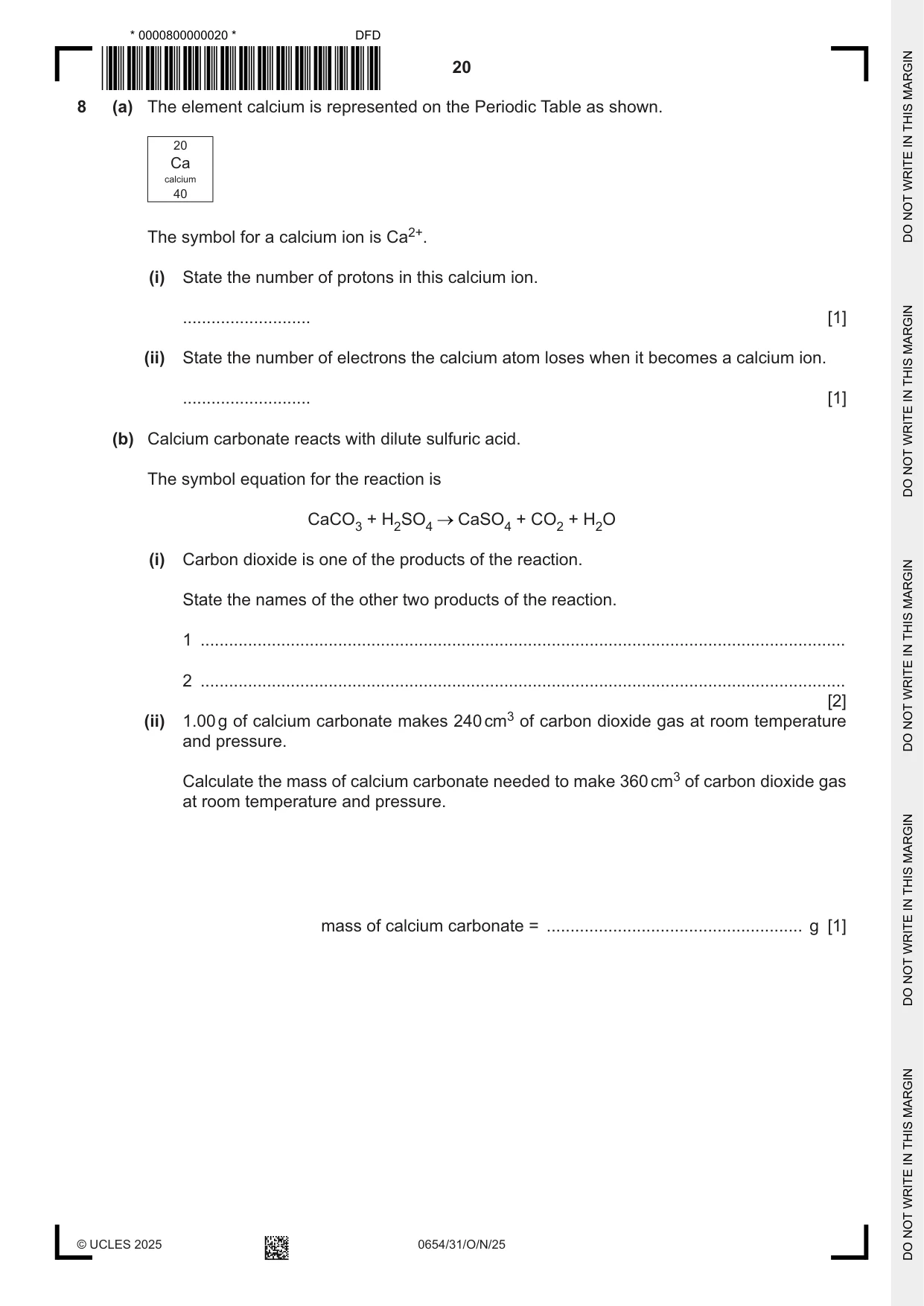
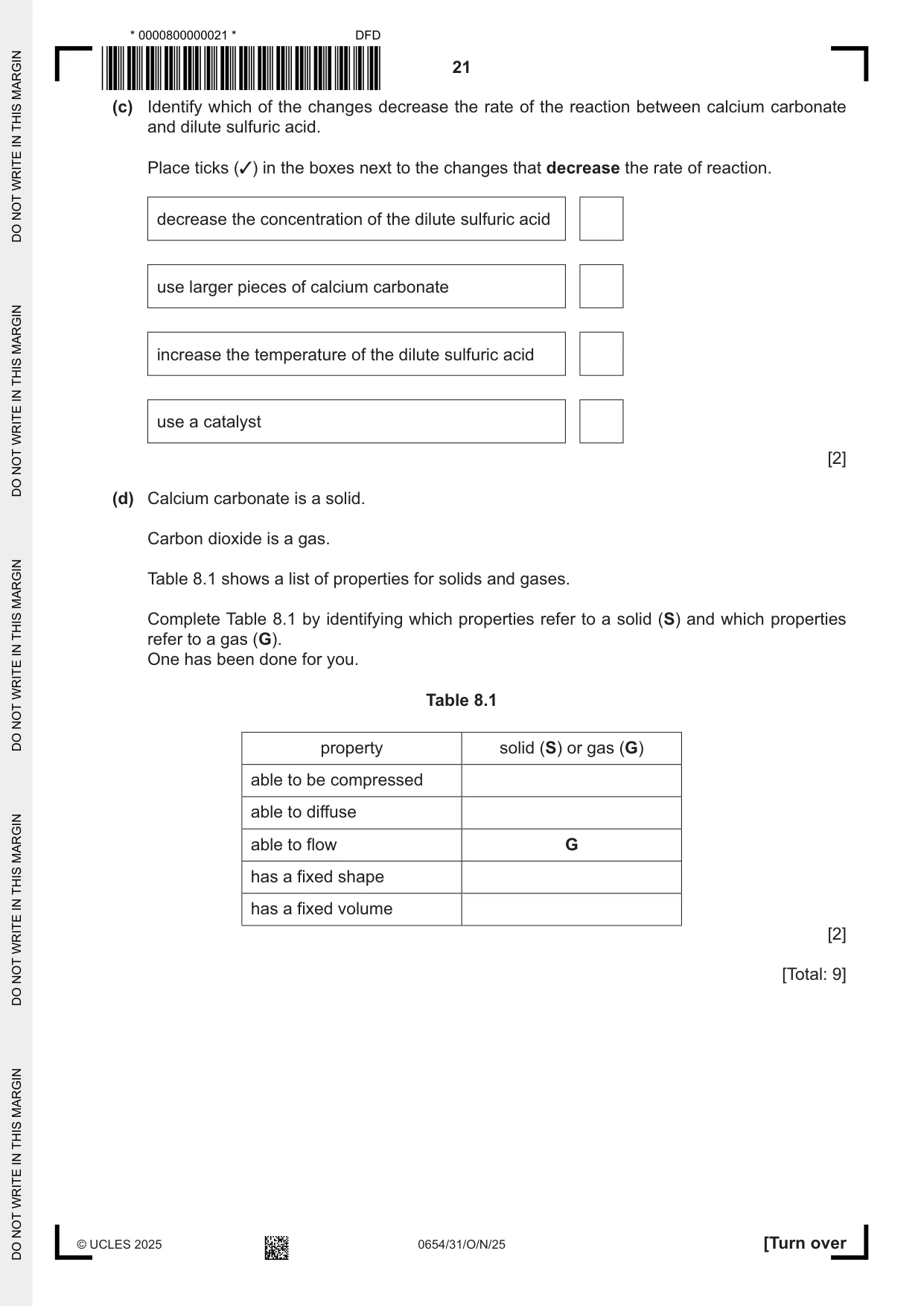
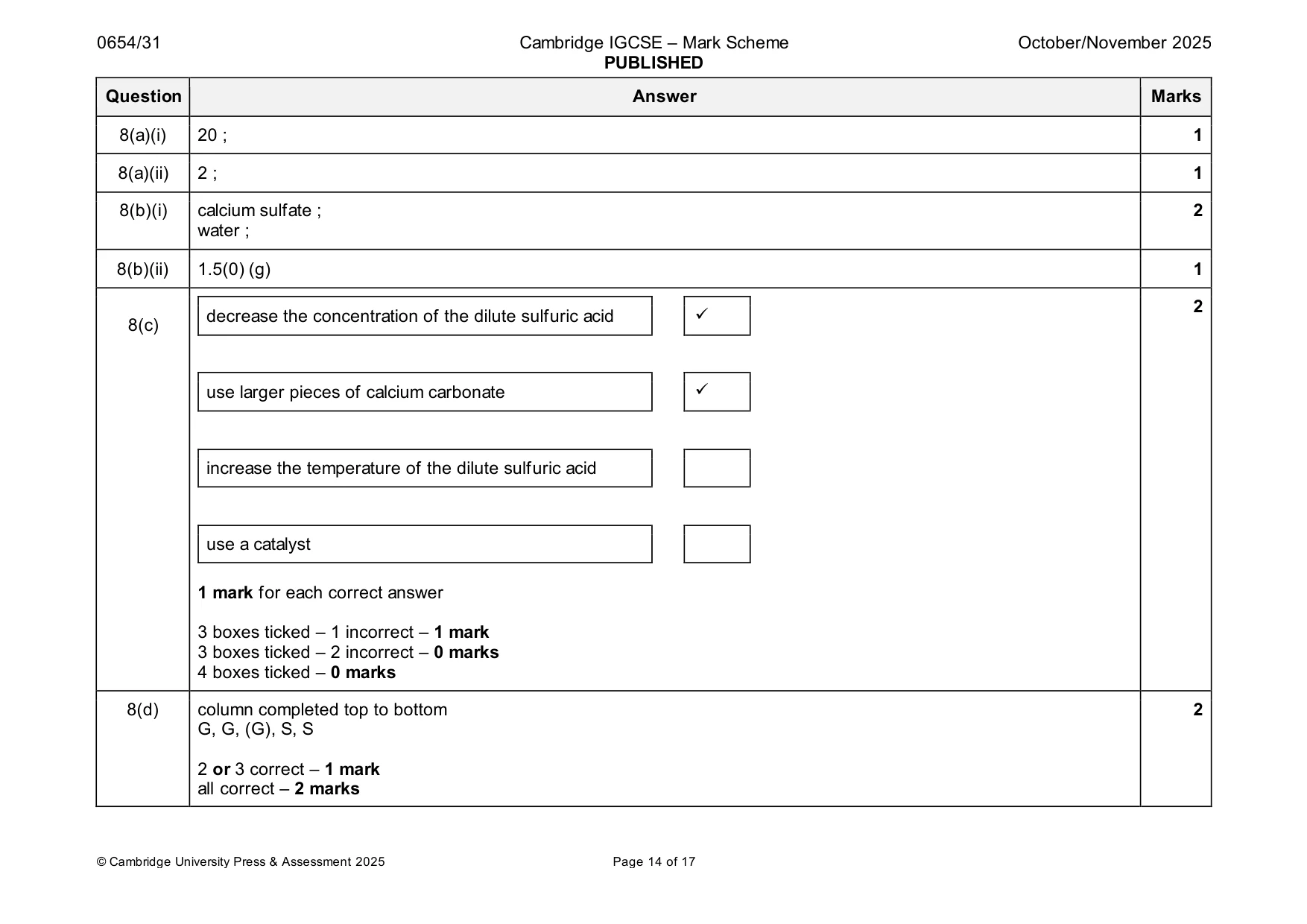
8 (a) The element calcium is represented on the Periodic Table as shown. 20 Ca calcium 40 The symbol for a calcium ion is Ca2+. (i) State the number of protons in this calcium ion. ........................... [1] (ii) State the number of electrons the calcium atom loses when it becomes a calcium ion. ........................... [1] (b) Calcium carbonate reacts with dilute sulfuric acid. The symbol equation for the reaction is CaCO3 + H2SO4 CaSO4 + CO2 + H2O (i) Carbon dioxide is one of the products of the reaction. State the names of the other two products of the reaction. 1 ........................................................................................................................................ 2 ........................................................................................................................................ [2] (ii) 1.00 g of calcium carbonate makes 240 cm3 of carbon dioxide gas at room temperature and pressure. Calculate the mass of calcium carbonate needed to make 360 cm3 of carbon dioxide gas at room temperature and pressure. mass of calcium carbonate = ...................................................... g [1] (c) Identify which of the changes decrease the rate of the reaction between calcium carbonate and dilute sulfuric acid. Place ticks (3) in the boxes next to the changes that decrease the rate of reaction. decrease the concentration of the dilute sulfuric acid use larger pieces of calcium carbonate increase the temperature of the dilute sulfuric acid use a catalyst [2] (d) Calcium carbonate is a solid. Carbon dioxide is a gas. Table 8.1 shows a list of properties for solids and gases. Complete Table 8.1 by identifying which properties refer to a solid (S) and which properties refer to a gas (G). One has been done for you. Table 8.1 property solid (S) or gas (G) able to be compressed able to diffuse able to flow G has a fixed shape has a fixed volume [2] [Total: 9]
Mark scheme: 8(a)(i) 20 ; 1 8(a)(ii) 2 ; 1 8(b)(i) calcium sulfate ; 2 water ; 8(b)(ii) 1.5(0) (g) 1 2 decrease the concentration of the dilute sulfuric acid ✓ 8(c) use larger pieces of calcium carbonate ✓ increase the temperature of the dilute sulfuric acid use a catalyst 1 mark for each correct answer 3 boxes ticked – 1 incorrect – 1 mark 3 boxes ticked – 2 incorrect – 0 marks 4 boxes ticked – 0 marks 8(d) column completed top to bottom 2 G, G, (G), S, S 2 or 3 correct – 1 mark all correct – 2 marks
Q9 · Data about six metals
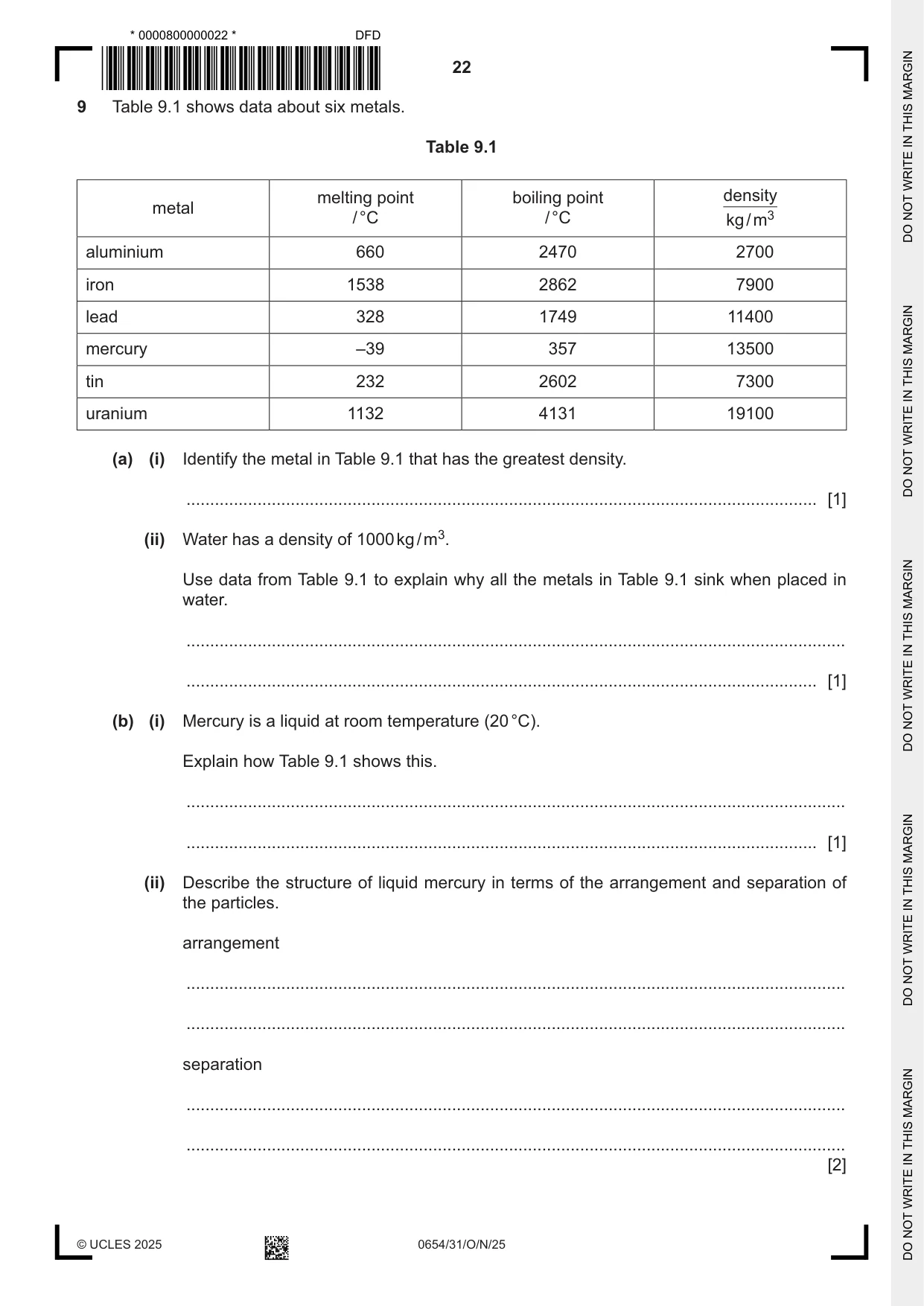
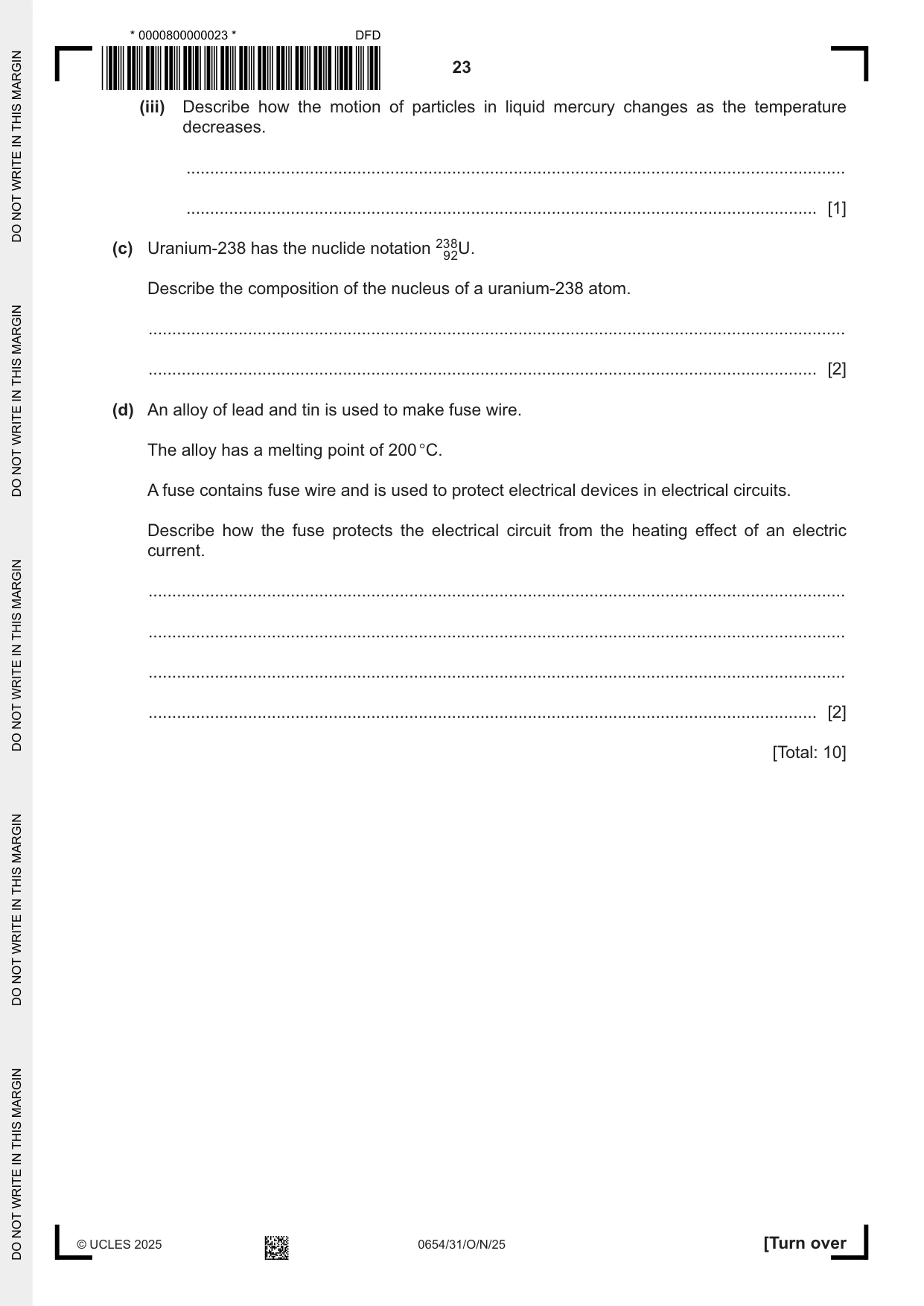
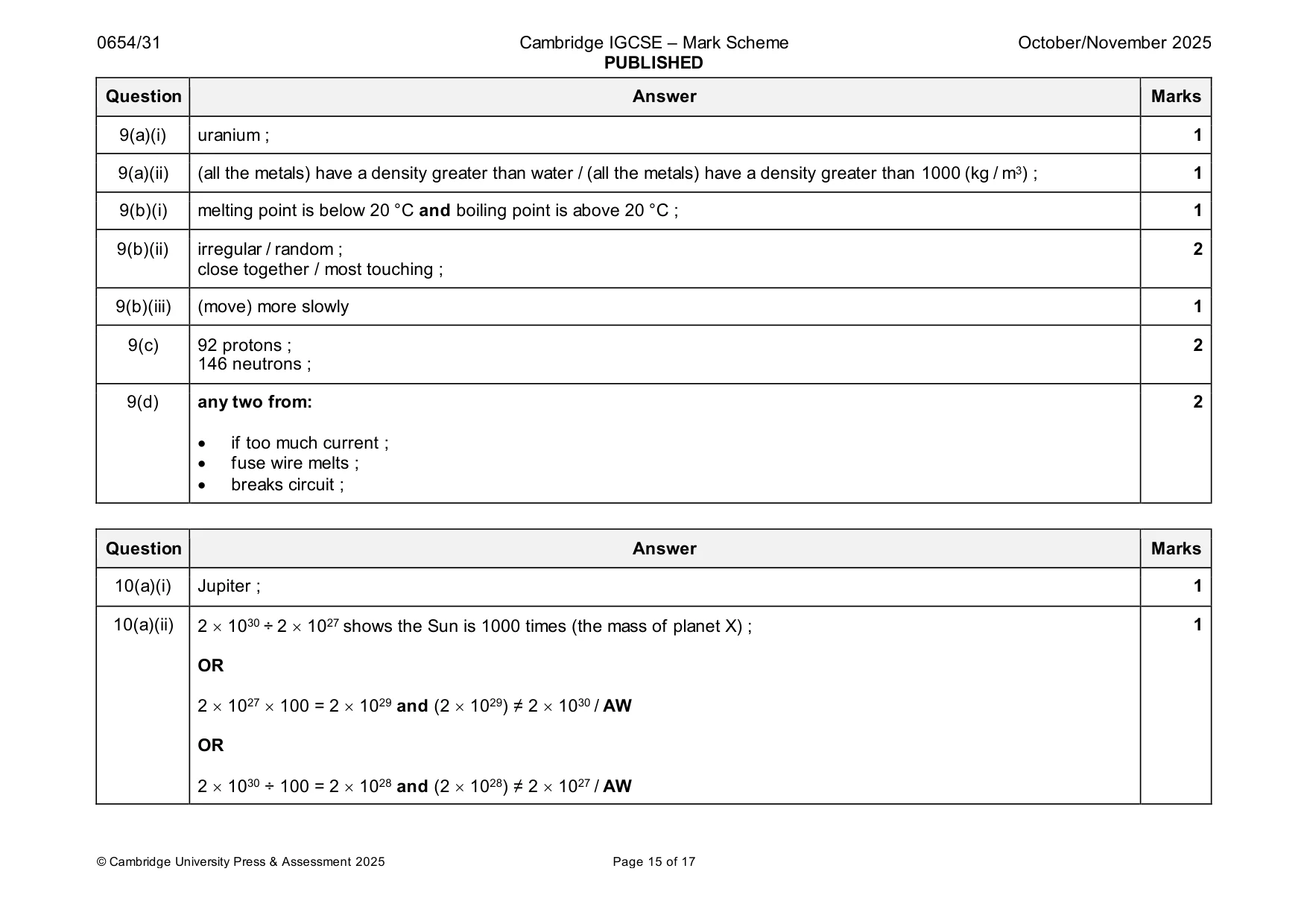
9 Table 9.1 shows data about six metals. Table 9.1 melting point boiling point density metal / °C / °C kg / m3 aluminium 660 2470 2700 iron 1538 2862 7900 lead 328 1749 11400 mercury –39 357 13500 tin 232 2602 7300 uranium 1132 4131 19100 (a) (i) Identify the metal in Table 9.1 that has the greatest density. ..................................................................................................................................... [1] (ii) Water has a density of 1000 kg / m3. Use data from Table 9.1 to explain why all the metals in Table 9.1 sink when placed in water. ........................................................................................................................................... ..................................................................................................................................... [1] (b) (i) Mercury is a liquid at room temperature (20 °C). Explain how Table 9.1 shows this. ........................................................................................................................................... ..................................................................................................................................... [1] (ii) Describe the structure of liquid mercury in terms of the arrangement and separation of the particles. arrangement ........................................................................................................................................... ........................................................................................................................................... separation ........................................................................................................................................... ........................................................................................................................................... [2] (iii) Describe how the motion of particles in liquid mercury changes as the temperature decreases. ........................................................................................................................................... ..................................................................................................................................... [1] (c) Uranium-238 has the nuclide notation 23 8 9 2U. Describe the composition of the nucleus of a uranium-238 atom. ................................................................................................................................................... ............................................................................................................................................. [2] (d) An alloy of lead and tin is used to make fuse wire. The alloy has a melting point of 200 °C. A fuse contains fuse wire and is used to protect electrical devices in electrical circuits. Describe how the fuse protects the electrical circuit from the heating effect of an electric current. ................................................................................................................................................... ................................................................................................................................................... ................................................................................................................................................... ............................................................................................................................................. [2] [Total: 10]
Mark scheme: 9(a)(i) uranium ; 1 9(a)(ii) (all the metals) have a density greater than water / (all the metals) have a density greater than 1000 (kg / m3) ; 1 9(b)(i) melting point is below 20 °C and boiling point is above 20 °C ; 1 9(b)(ii) irregular / random ; 2 close together / most touching ; 9(b)(iii) (move) more slowly 1 9(c) 92 protons ; 2 146 neutrons ; 9(d) any two from: 2 • if too much current ; • fuse wire melts ; • breaks circuit ;
Q10 · Information about the planets in the Solar System
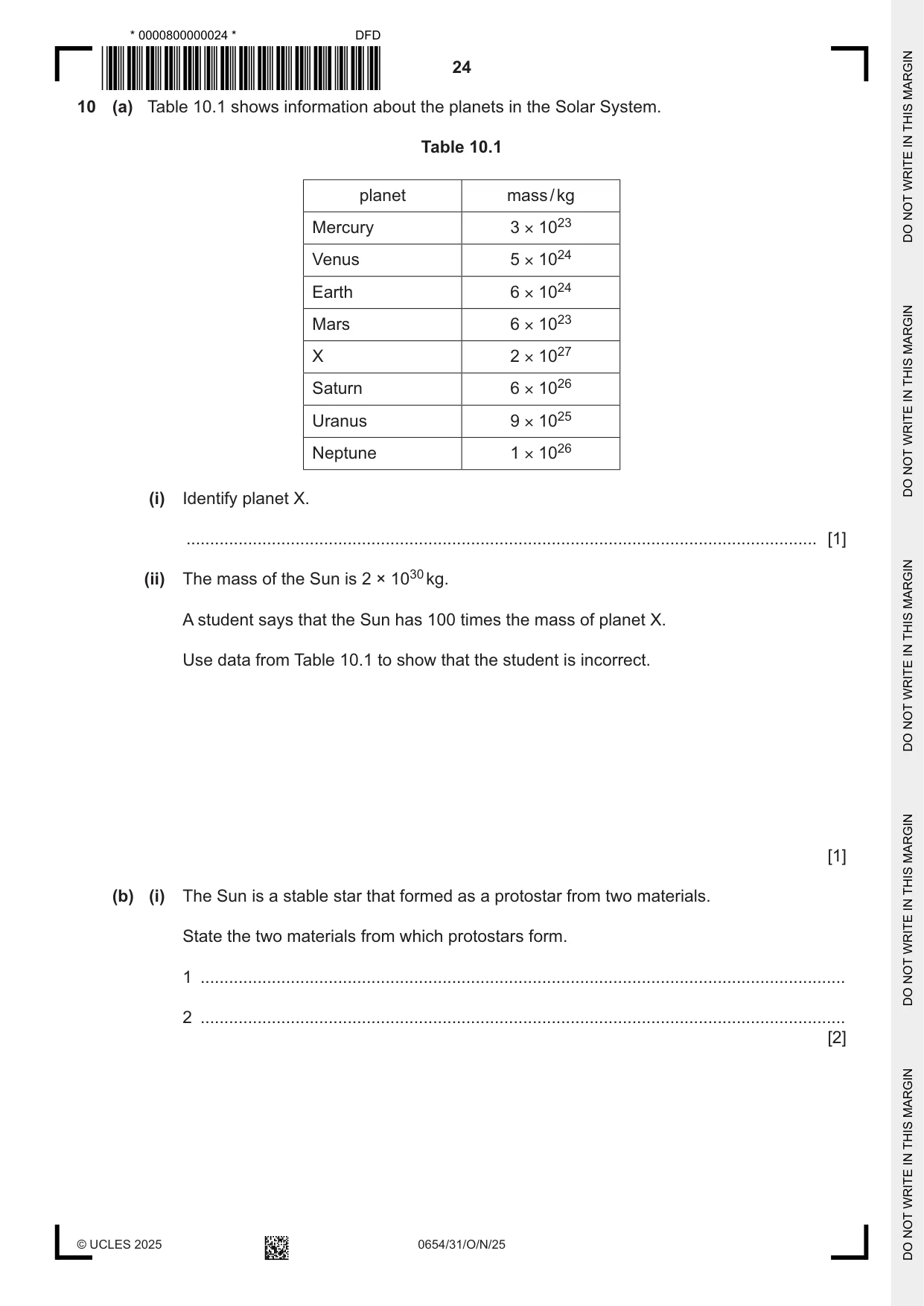
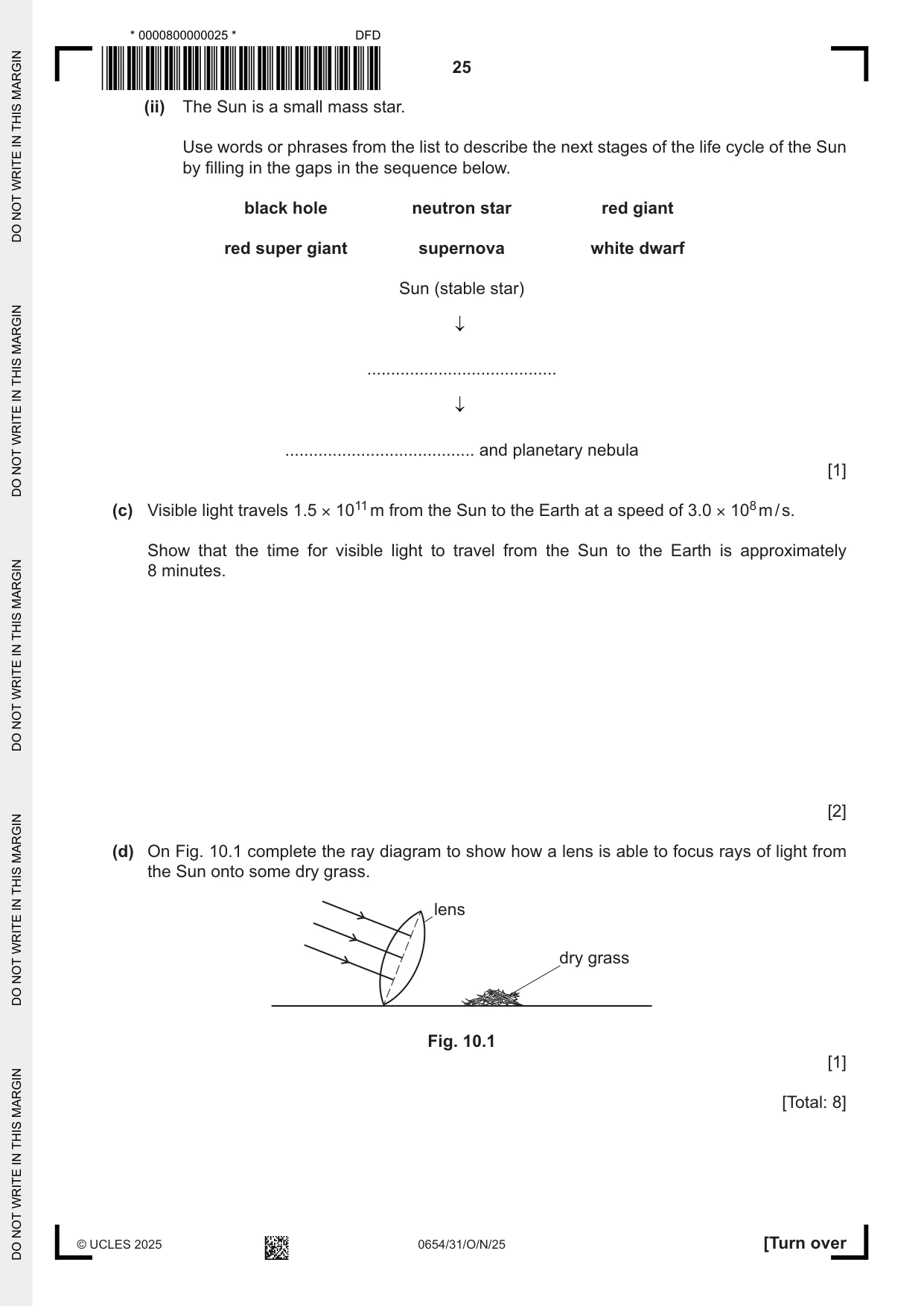
10 (a) Table 10.1 shows information about the planets in the Solar System. Table 10.1 planet mass / kg Mercury 3 × 10²³ Venus 5 × 1024 Earth 6 × 1024 Mars 6 × 1023 X 2 × 1027 Saturn 6 × 1026 Uranus 9 × 1025 Neptune 1 × 1026 (i) Identify planet X. ..................................................................................................................................... [1] (ii) The mass of the Sun is 2 × 1030 kg. A student says that the Sun has 100 times the mass of planet X. Use data from Table 10.1 to show that the student is incorrect. [1] (b) (i) The Sun is a stable star that formed as a protostar from two materials. State the two materials from which protostars form. 1 ........................................................................................................................................ 2 ........................................................................................................................................ [2] (ii) The Sun is a small mass star. Use words or phrases from the list to describe the next stages of the life cycle of the Sun by filling in the gaps in the sequence below. black hole neutron star red giant red super giant supernova white dwarf Sun (stable star) ........................................ ........................................ and planetary nebula [1] (c) Visible light travels 1.5 × 10¹¹ m from the Sun to the Earth at a speed of 3.0 × 10⁸ m / s. Show that the time for visible light to travel from the Sun to the Earth is approximately 8 minutes. [2] (d) On Fig. 10.1 complete the ray diagram to show how a lens is able to focus rays of light from the Sun onto some dry grass. lens dry grass Fig. 10.1 [1] [Total: 8]
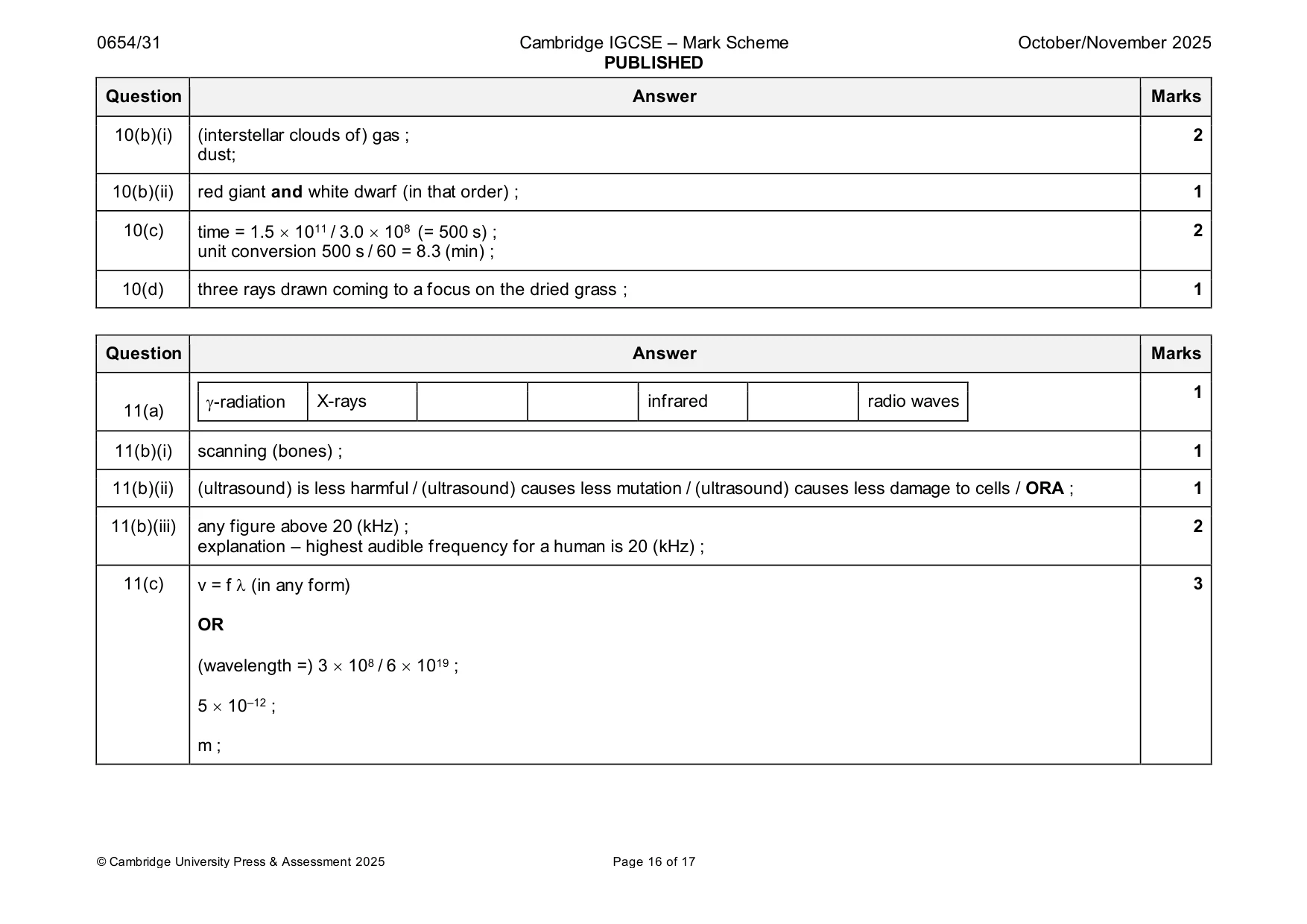
Mark scheme: 10(a)(i) Jupiter ; 1 10(a)(ii) 2 1030 ÷ 2 1027 shows the Sun is 1000 times (the mass of planet X) ; 1 OR 2 1027 100 = 2 1029 and (2 1029) ≠ 2 1030 / AW OR 2 1030 ÷ 100 = 2 1028 and (2 1028) ≠ 2 1027 / AW 10(b)(i) (interstellar clouds of) gas ; 2 dust; 10(b)(ii) red giant and white dwarf (in that order) ; 1 10(c) time = 1.5 1011 / 3.0 108 (= 500 s) ; 2 unit conversion 500 s / 60 = 8.3 (min) ; 10(d) three rays drawn coming to a focus on the dried grass ; 1
Q11 · X-rays and γ-radiation are both used in hospitals
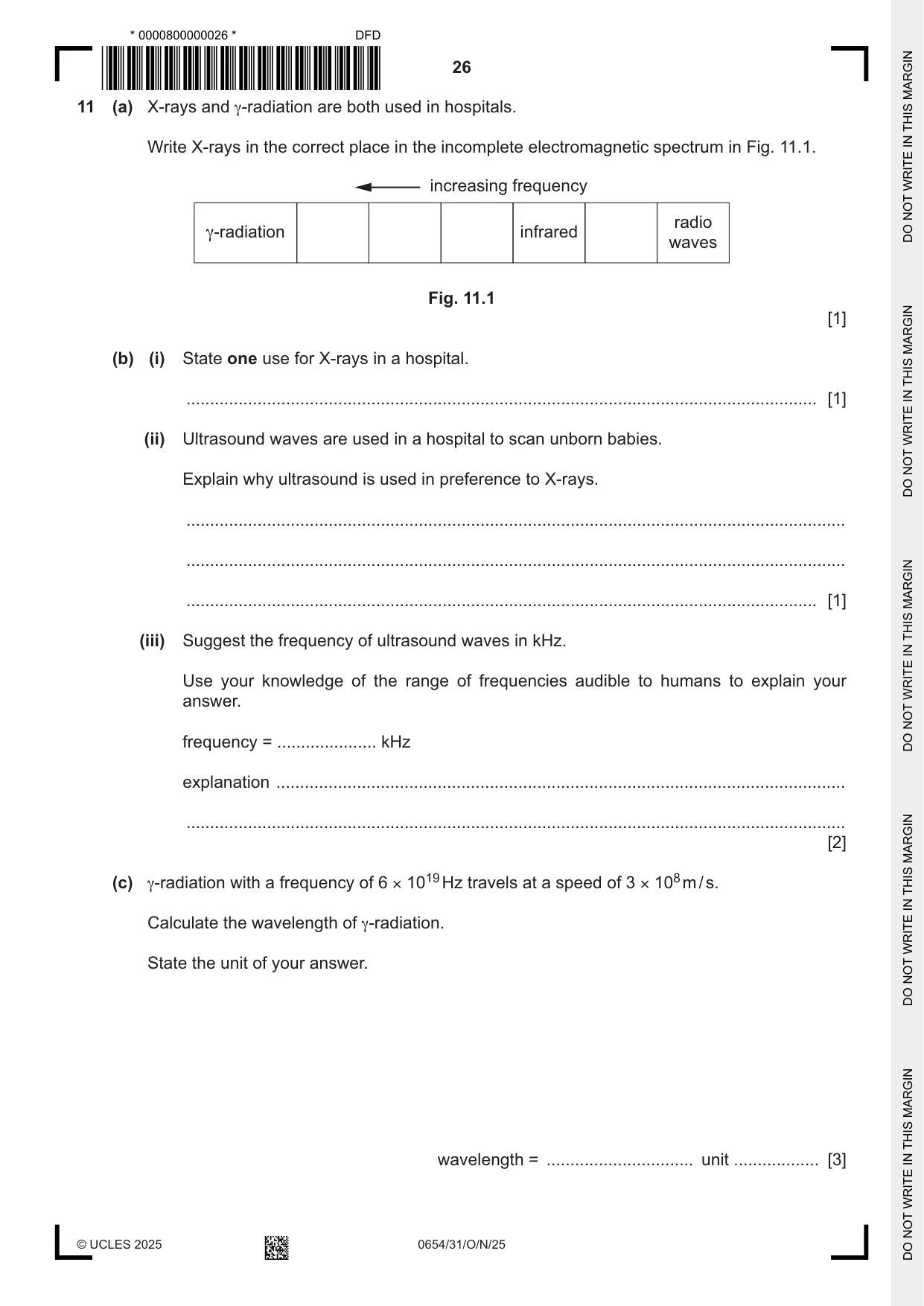
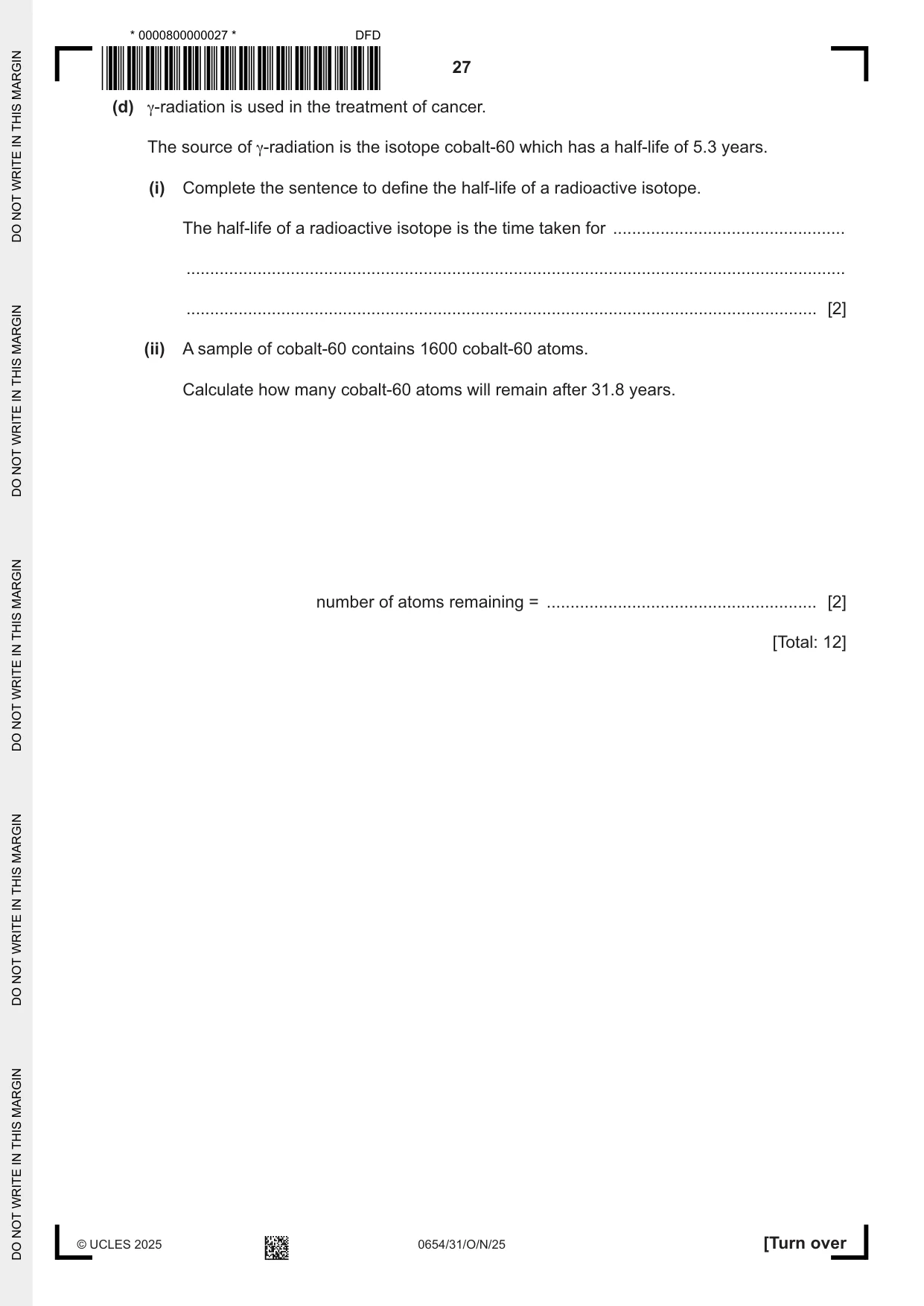
11 (a) X-rays and γ-radiation are both used in hospitals. Write X-rays in the correct place in the incomplete electromagnetic spectrum in Fig. 11.1. increasing frequency radio γ-radiation infrared waves Fig. 11.1 [1] (b) (i) State one use for X-rays in a hospital. ..................................................................................................................................... [1] (ii) Ultrasound waves are used in a hospital to scan unborn babies. Explain why ultrasound is used in preference to X-rays. ........................................................................................................................................... ........................................................................................................................................... ..................................................................................................................................... [1] (iii) Suggest the frequency of ultrasound waves in kHz. Use your knowledge of the range of frequencies audible to humans to explain your answer. frequency = ..................... kHz explanation ........................................................................................................................ ........................................................................................................................................... [2] (c) γ-radiation with a frequency of 6 × 10¹⁹ Hz travels at a speed of 3 × 10⁸ m / s. Calculate the wavelength of γ-radiation. State the unit of your answer. wavelength = ............................... unit .................. [3] (d) γ-radiation is used in the treatment of cancer. The source of γ-radiation is the isotope cobalt-60 which has a half-life of 5.3 years. (i) Complete the sentence to define the half-life of a radioactive isotope. The half-life of a radioactive isotope is the time taken for ................................................. ........................................................................................................................................... ..................................................................................................................................... [2] (ii) A sample of cobalt-60 contains 1600 cobalt-60 atoms. Calculate how many cobalt-60 atoms will remain after 31.8 years. number of atoms remaining = ......................................................... [2] [Total: 12]
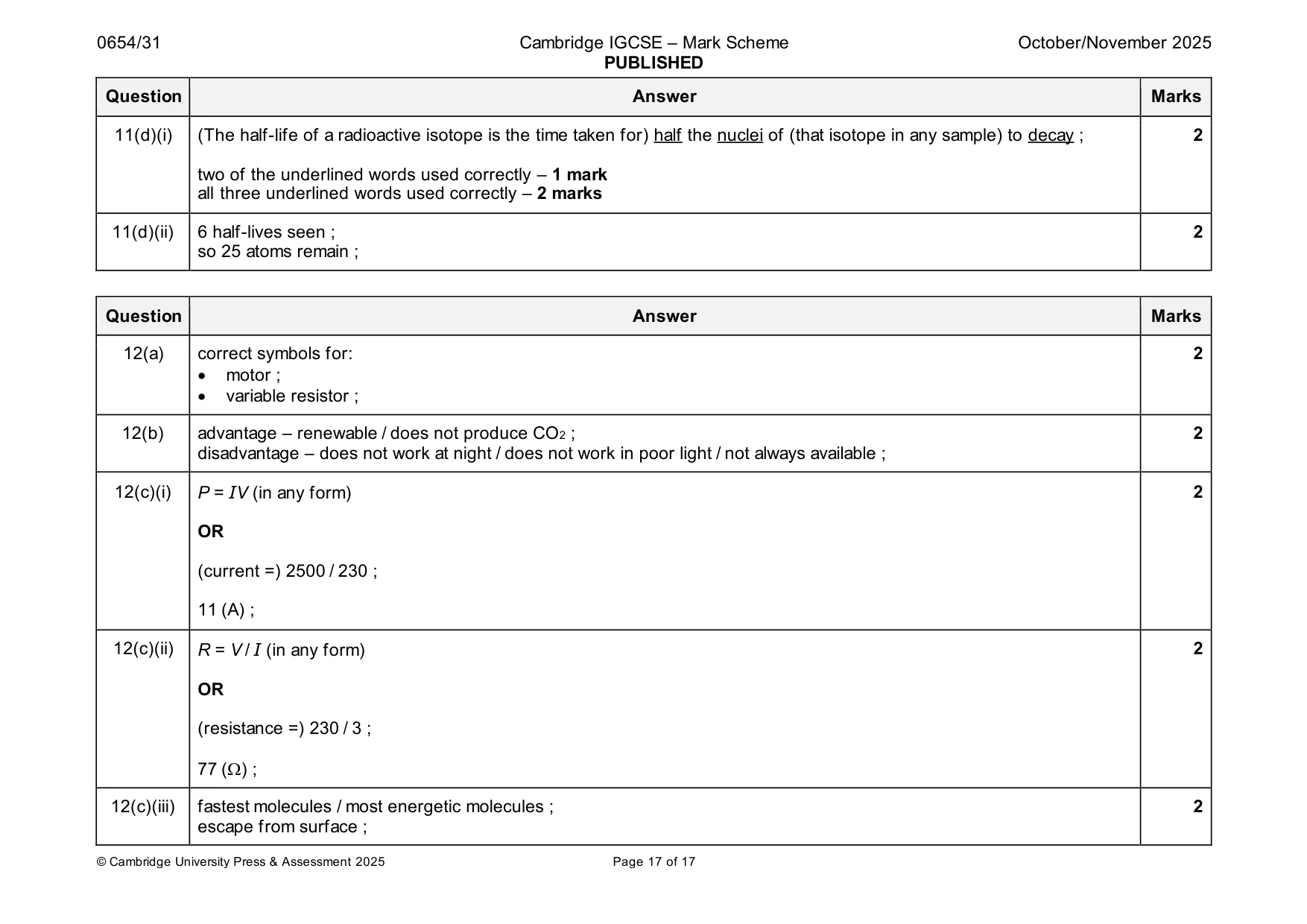
Mark scheme: 11(b)(i) scanning (bones) ; 1 11(b)(ii) (ultrasound) is less harmful / (ultrasound) causes less mutation / (ultrasound) causes less damage to cells / ORA ; 1 11(b)(iii) any figure above 20 (kHz) ; 2 explanation – highest audible frequency for a human is 20 (kHz) ; 11(c) v = f (in any form) 3 OR (wavelength =) 3 108 / 6 1019 ; 5 10–12 ; m ; 11(d)(i) (The half-life of a radioactive isotope is the time taken for) half the nuclei of (that isotope in any sample) to decay ; 2 two of the underlined words used correctly – 1 mark all three underlined words used correctly – 2 marks 11(d)(ii) 6 half-lives seen ; 2 so 25 atoms remain ;
Q12 · Complete Table 12.1 by drawing the circuit symbol for each electrical component
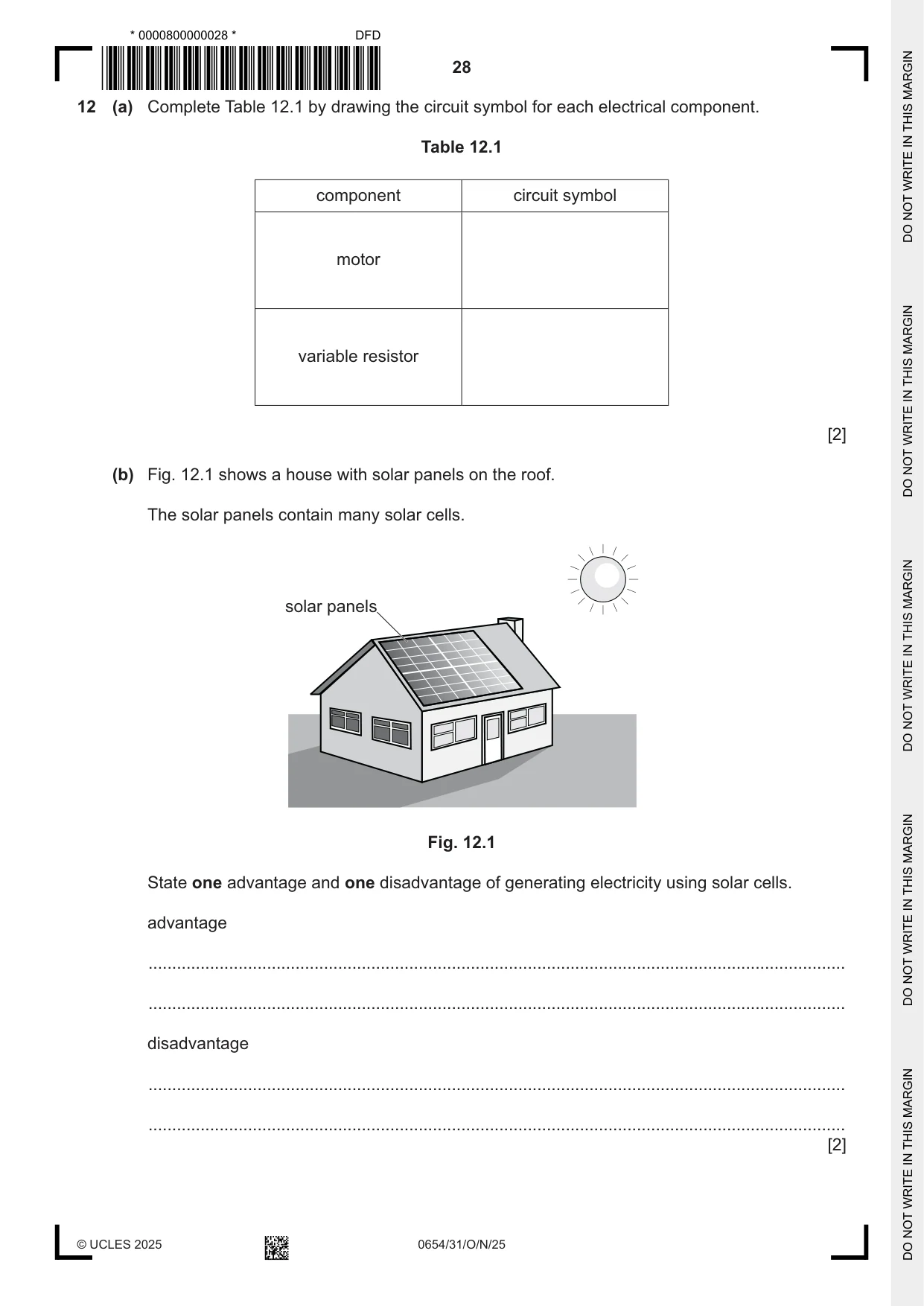
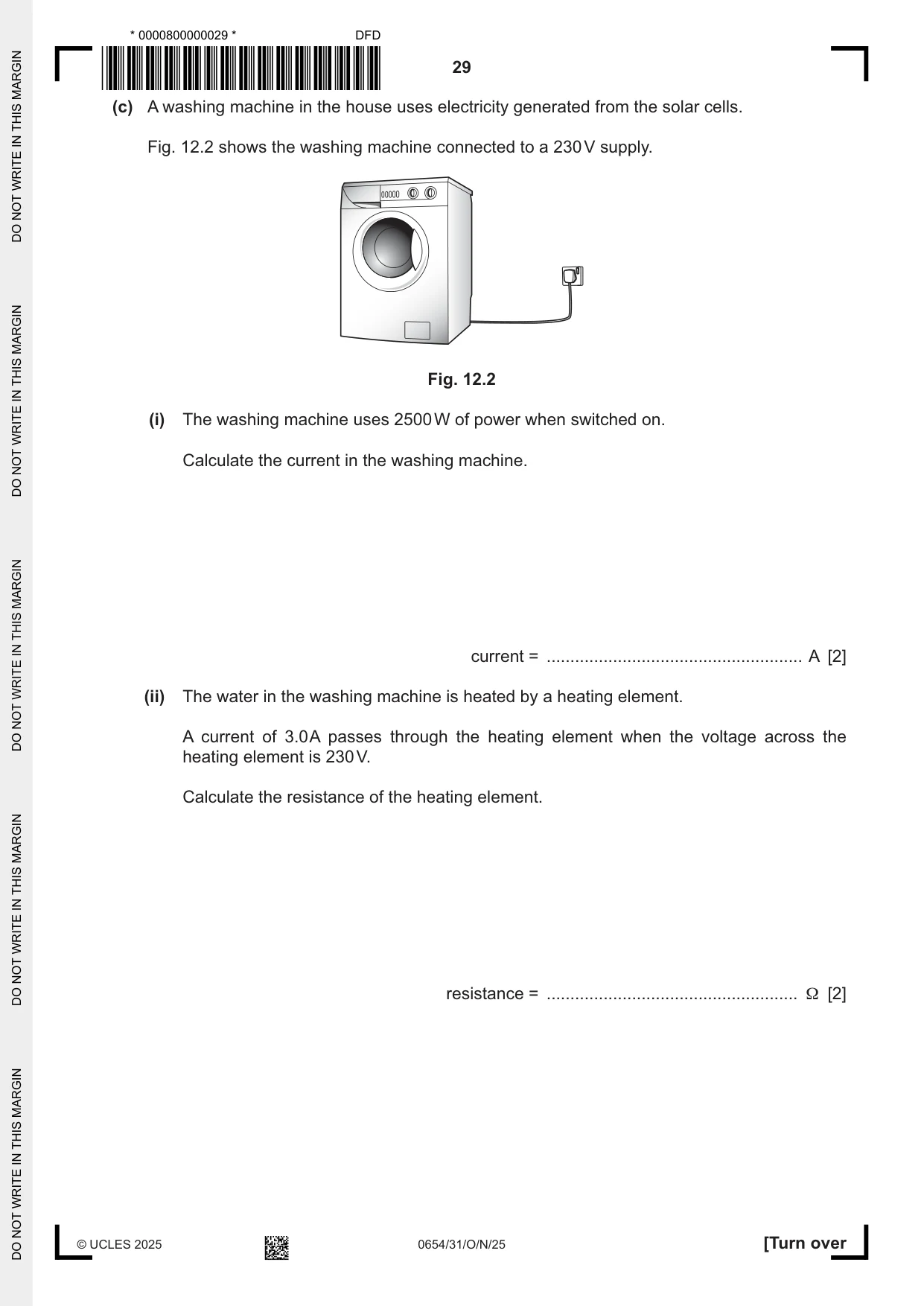
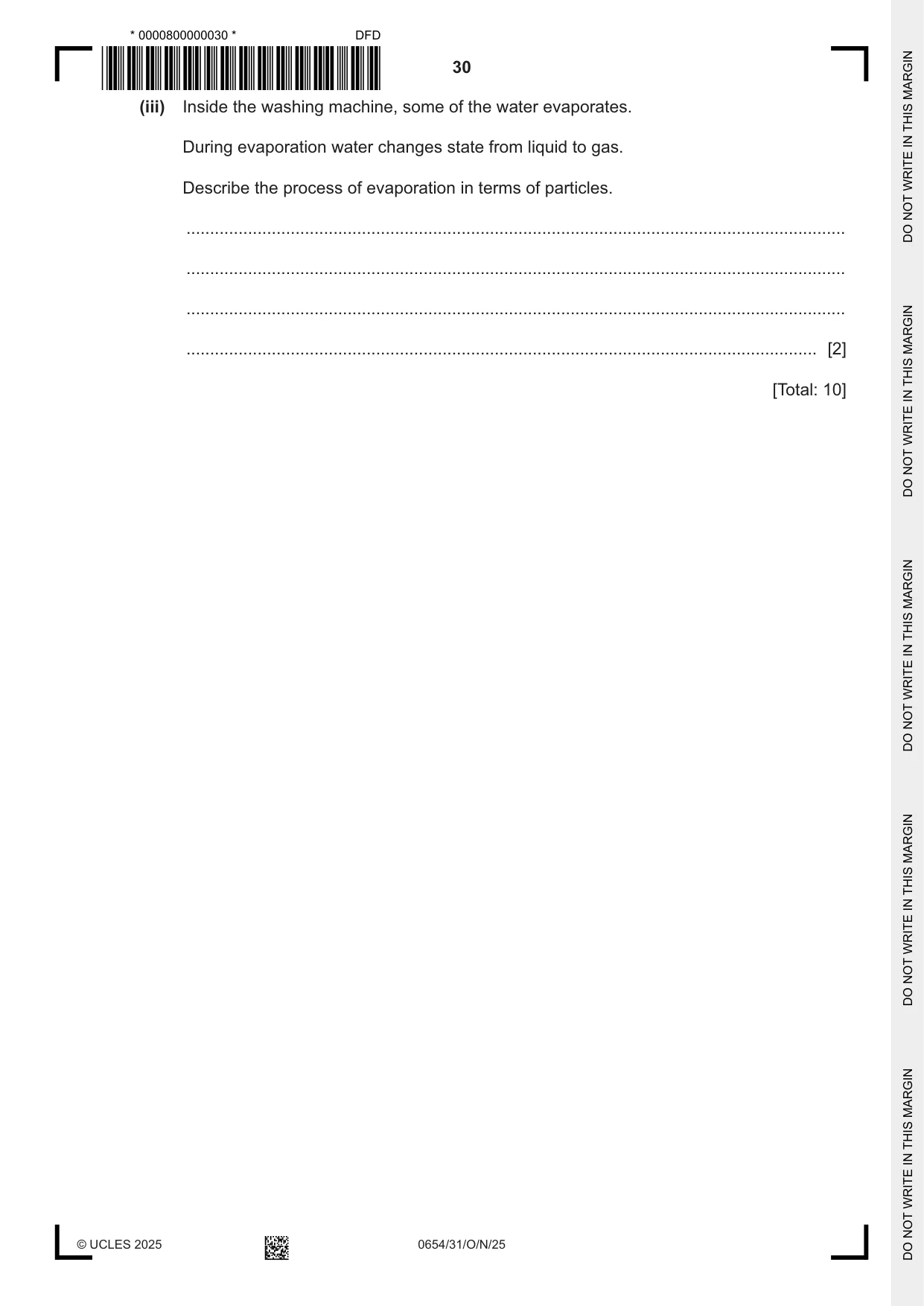
12 (a) Complete Table 12.1 by drawing the circuit symbol for each electrical component. Table 12.1 component circuit symbol motor variable resistor [2] (b) Fig. 12.1 shows a house with solar panels on the roof. The solar panels contain many solar cells. solar panels Fig. 12.1 State one advantage and one disadvantage of generating electricity using solar cells. advantage ................................................................................................................................................... ................................................................................................................................................... disadvantage ................................................................................................................................................... ................................................................................................................................................... [2] (c) A washing machine in the house uses electricity generated from the solar cells. Fig. 12.2 shows the washing machine connected to a 230 V supply. Fig. 12.2 (i) The washing machine uses 2500 W of power when switched on. Calculate the current in the washing machine. current = ...................................................... A [2] (ii) The water in the washing machine is heated by a heating element. A current of 3.0 A passes through the heating element when the voltage across the heating element is 230 V. Calculate the resistance of the heating element. resistance = ..................................................... Ω [2] (iii) Inside the washing machine, some of the water evaporates. During evaporation water changes state from liquid to gas. Describe the process of evaporation in terms of particles. ........................................................................................................................................... ........................................................................................................................................... ........................................................................................................................................... ..................................................................................................................................... [2] [Total: 10]
Mark scheme: 12(a) correct symbols for: 2 • motor ; • variable resistor ; 12(b) advantage – renewable / does not produce CO2 ; 2 disadvantage – does not work at night / does not work in poor light / not always available ; 12(c)(i) P = IV (in any form) 2 OR (current =) 2500 / 230 ; 11 (A) ; 12(c)(ii) R = V / I (in any form) 2 OR (resistance =) 230 / 3 ; 77 () ; 12(c)(iii) fastest molecules / most energetic molecules ; 2 escape from surface ;
What was in this paper
The subtopics covered by these 11 questions, and how many questions each got. Open one in a new tab to see every Cambridge question on it.
What you needed in this session
Cambridge’s own grade thresholds for 2025 Oct/Nov, Paper 3 · Variant 1. A higher threshold means an easier paper — the bar moves with how the cohort did.