Cambridge IGCSE Sciences - Co-ordinated (Double) 0654 — 2021 Oct/Nov Paper 3 · Variant 2
0654/32/O/N/21 · 12 questions · 120 marks · ≈135 min
The question paper and its mark scheme, free to read here and free to download. This is Cambridge’s own paper, exactly as it was sat.
Question paper28 pages


Mark scheme11 pages
Answers below. Sit the paper first if you are practising.
Questions as text
Q1 · A diagram of a single‑celled organism called a euglena
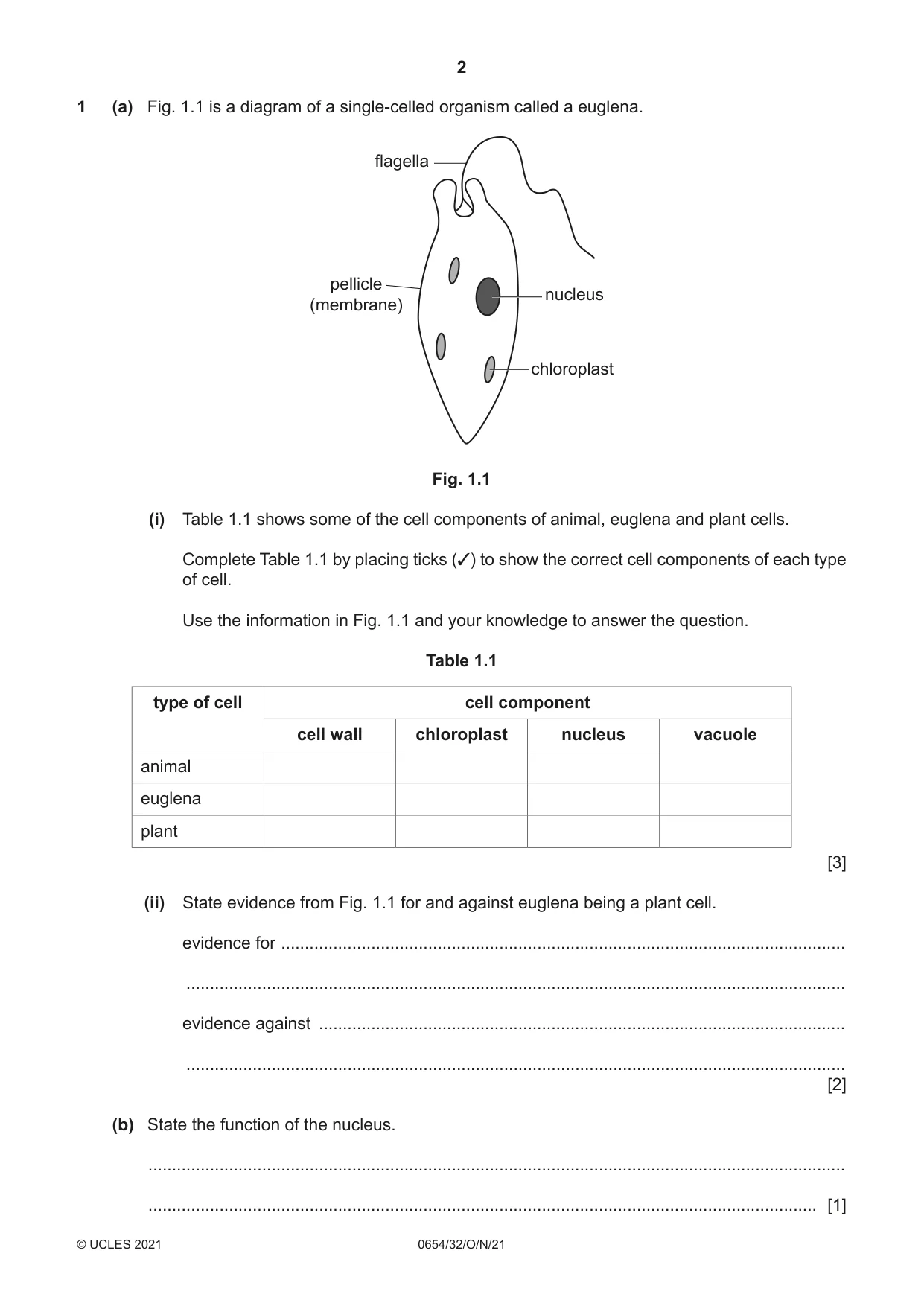
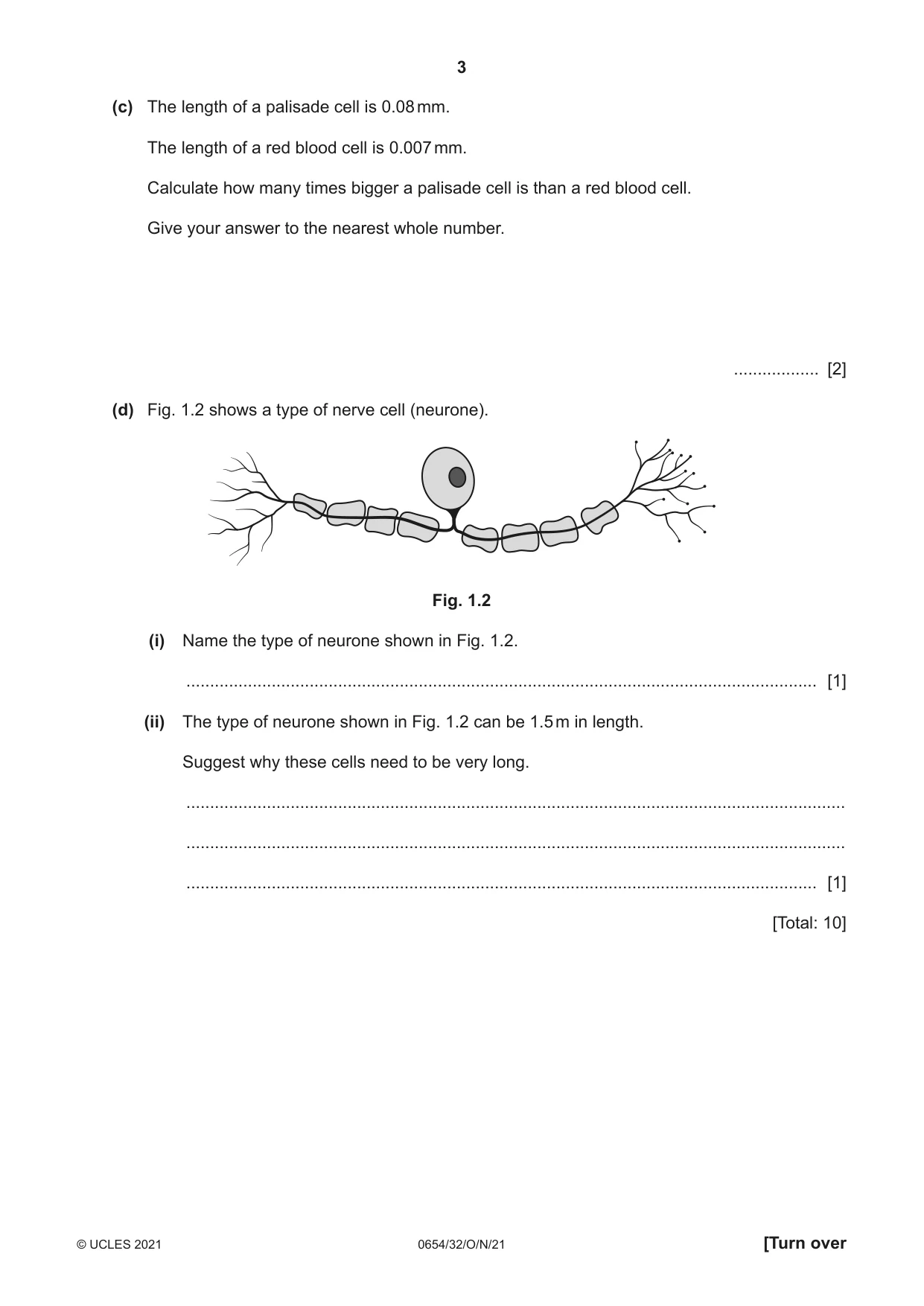
1 (a) Fig. 1.1 is a diagram of a single‑celled organism called a euglena. flagella pellicle nucleus (membrane) chloroplast Fig. 1.1 (i) Table 1.1 shows some of the cell components of animal, euglena and plant cells. Complete Table 1.1 by placing ticks (3) to show the correct cell components of each type of cell. Use the information in Fig. 1.1 and your knowledge to answer the question. Table 1.1 type of cell cell component cell wall chloroplast nucleus vacuole animal euglena plant [3] (ii) State evidence from Fig. 1.1 for and against euglena being a plant cell. evidence for ....................................................................................................................... ........................................................................................................................................... evidence against ............................................................................................................... ........................................................................................................................................... [2] (b) State the function of the nucleus. ................................................................................................................................................... ............................................................................................................................................. [1] (c) The length of a palisade cell is 0.08 mm. The length of a red blood cell is 0.007 mm. Calculate how many times bigger a palisade cell is than a red blood cell. Give your answer to the nearest whole number. .................. [2] (d) Fig. 1.2 shows a type of nerve cell (neurone). Fig. 1.2 (i) Name the type of neurone shown in Fig. 1.2. ..................................................................................................................................... [1] (ii) The type of neurone shown in Fig. 1.2 can be 1.5 m in length. Suggest why these cells need to be very long. ........................................................................................................................................... ........................................................................................................................................... ..................................................................................................................................... [1] [Total: 10]
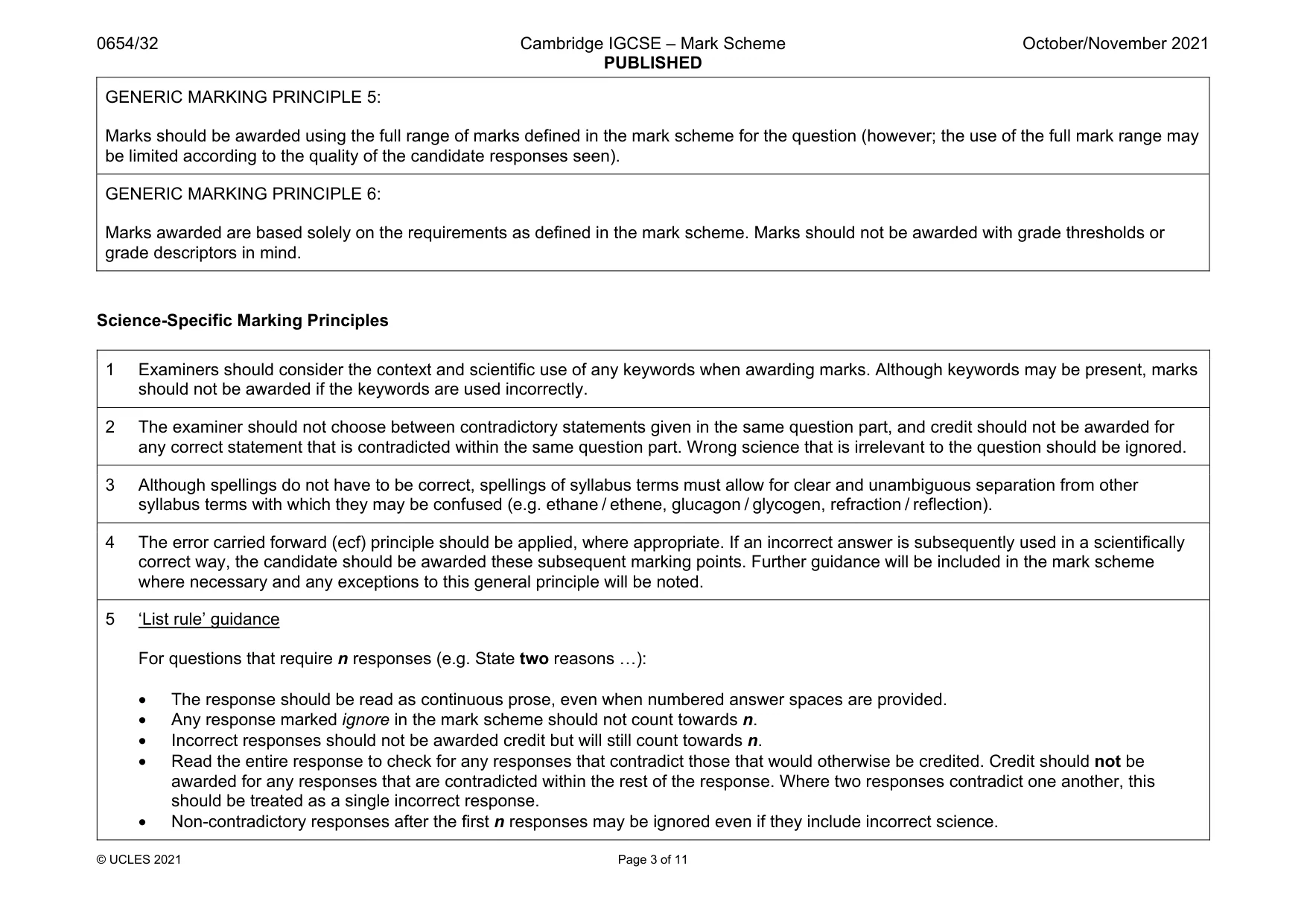
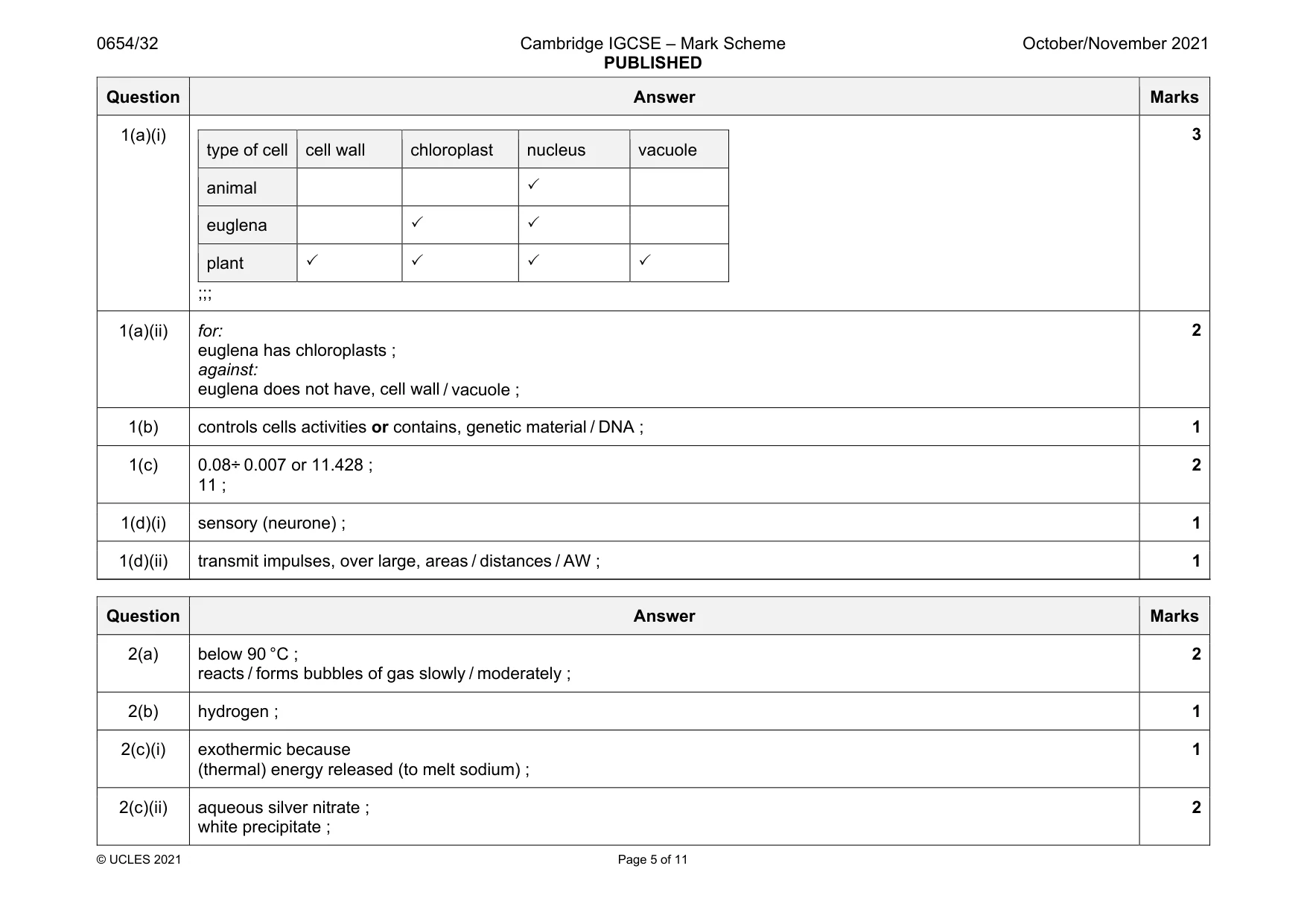
Mark scheme: 1(a)(i) type of cell cell wall chloroplast nucleus vacuole animal euglena plant ;;; 1(a)(ii) for: euglena has chloroplasts ; against: euglena does not have, cell wall / vacuole ; 2 1(b) controls cells activities or contains, genetic material / DNA ; 1 1(c) 0.08÷ 0.007 or 11.428 ; 11 ; 2 1(d)(i) sensory (neurone) ; 1 1(d)(ii) transmit impulses, over large, areas / distances / AW ; 1
Q2 · The melting points and reactivity with water of three Group I metals
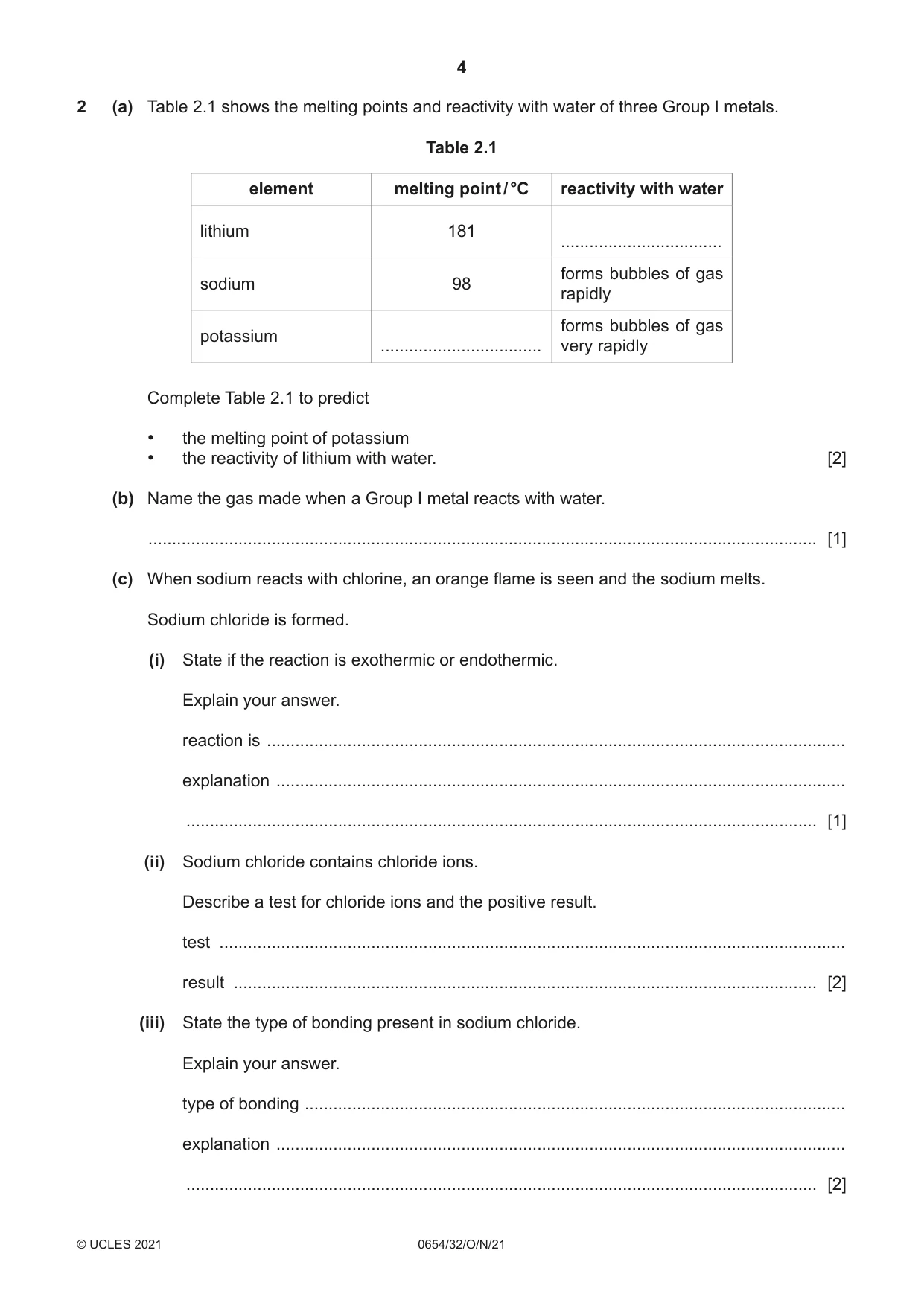
2 (a) Table 2.1 shows the melting points and reactivity with water of three Group I metals. Table 2.1 element melting point / °C reactivity with water lithium 181 .................................. forms bubbles of gas sodium 98 rapidly forms bubbles of gas potassium .................................. very rapidly Complete Table 2.1 to predict • the melting point of potassium • the reactivity of lithium with water. [2] (b) Name the gas made when a Group I metal reacts with water. ............................................................................................................................................. [1] (c) When sodium reacts with chlorine, an orange flame is seen and the sodium melts. Sodium chloride is formed. (i) State if the reaction is exothermic or endothermic. Explain your answer. reaction is .......................................................................................................................... explanation ........................................................................................................................ ..................................................................................................................................... [1] (ii) Sodium chloride contains chloride ions. Describe a test for chloride ions and the positive result. test .................................................................................................................................... result ........................................................................................................................... [2] (iii) State the type of bonding present in sodium chloride. Explain your answer. type of bonding .................................................................................................................. explanation ........................................................................................................................ ..................................................................................................................................... [2] (d) Concentrated aqueous sodium chloride is electrolysed. State the products at the electrodes. .................................................................. and .................................................................. [2] (e) A student separates a mixture of sand and aqueous sodium chloride. (i) State the method of separation used to separate the sand from the aqueous sodium chloride. ..................................................................................................................................... [1] (ii) Describe how solid sodium chloride can be obtained from aqueous sodium chloride. ........................................................................................................................................... ..................................................................................................................................... [1] [Total: 12]
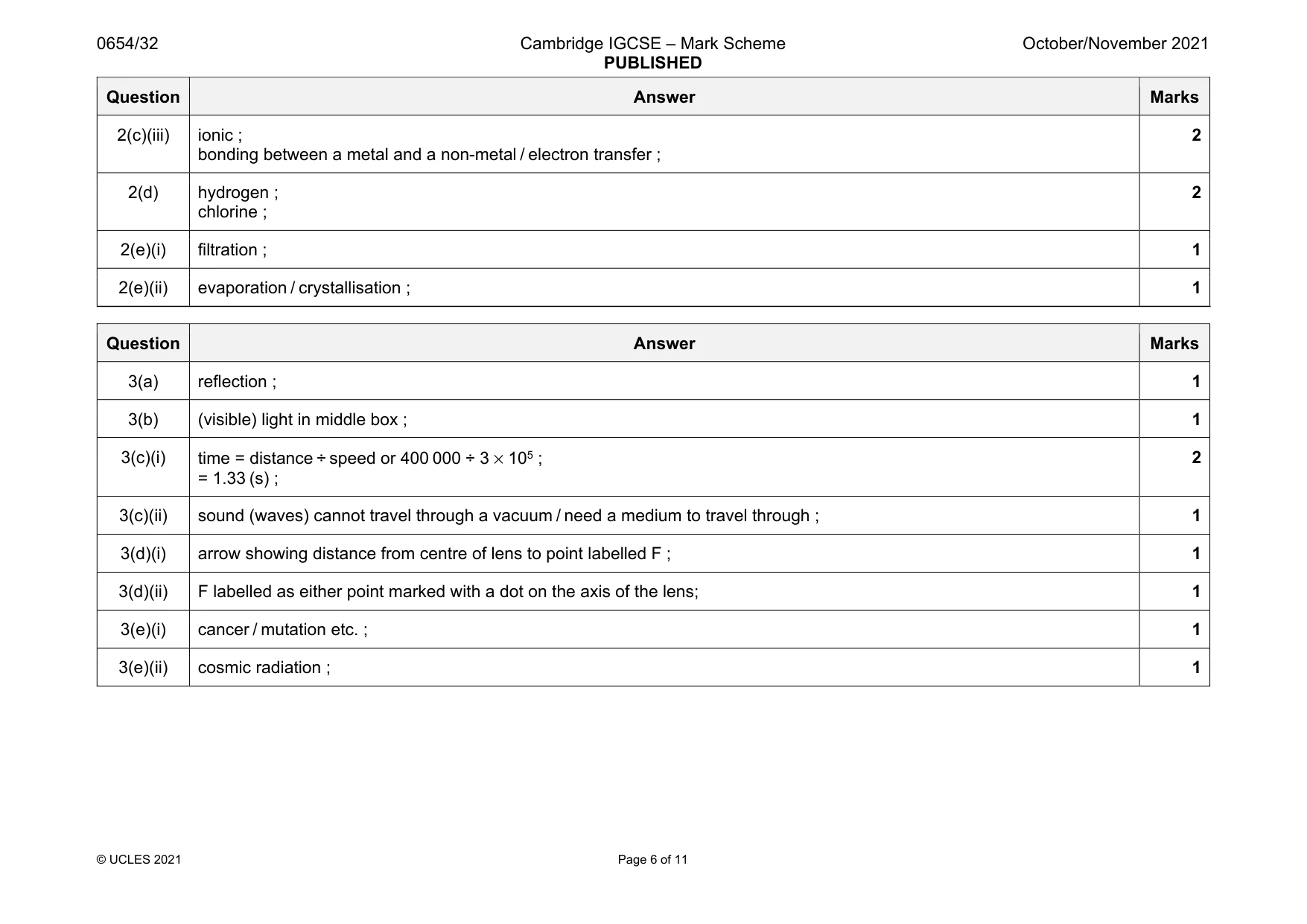
Mark scheme: 2(a) below 90 °C ; reacts / forms bubbles of gas slowly / moderately ; 2 2(b) hydrogen ; 1 2(c)(i) exothermic because (thermal) energy released (to melt sodium) ; 1 2(c)(ii) aqueous silver nitrate ; white precipitate ; 2 Question Answer Marks 2(c)(iii) ionic ; bonding between a metal and a non-metal / electron transfer ; 2 2(d) hydrogen ; chlorine ; 2 2(e)(i) filtration ; 1 2(e)(ii) evaporation / crystallisation ; 1
Q3 · An astronomer on Earth is able to see the Moon even though the Moon does not emit visible…
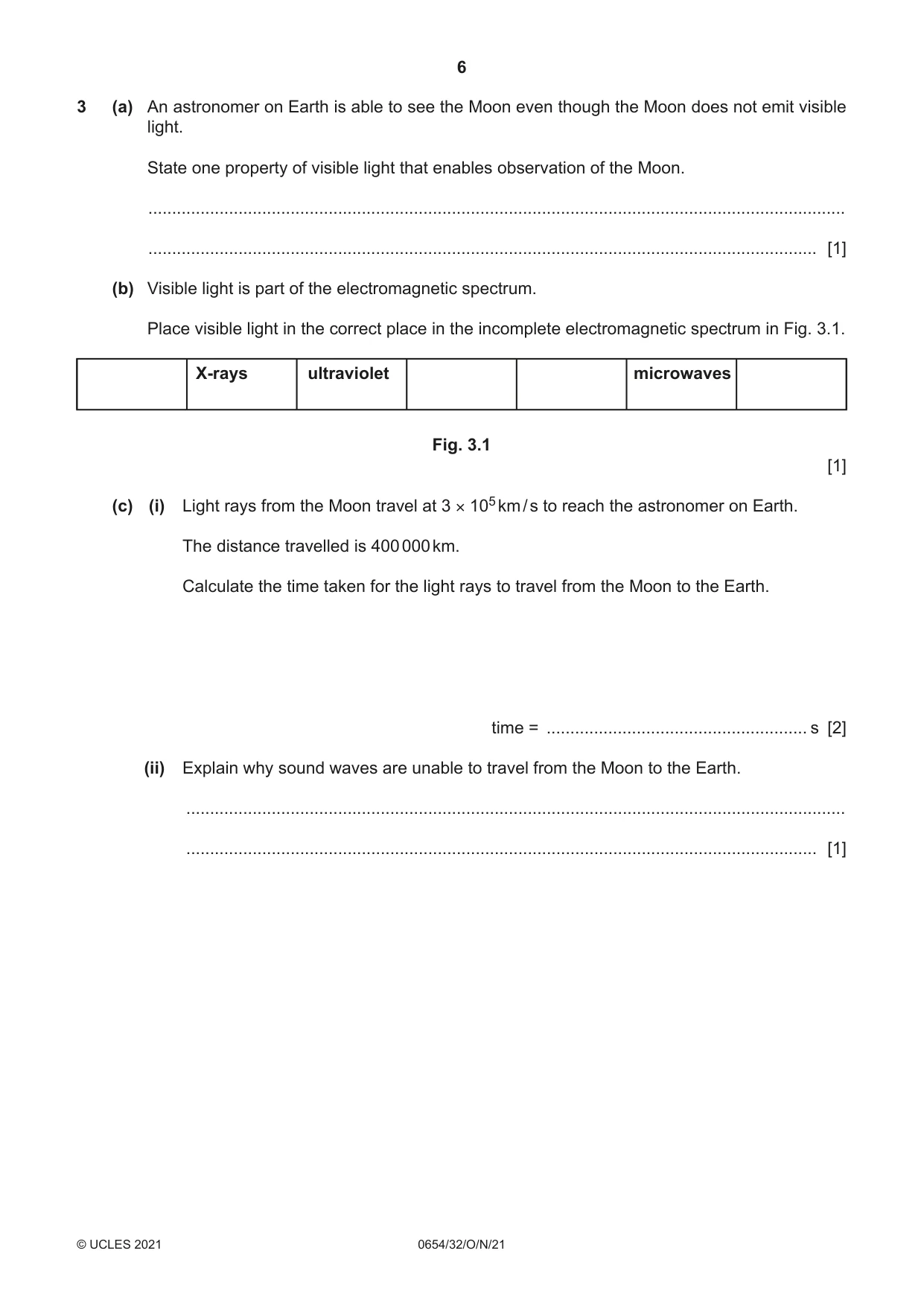
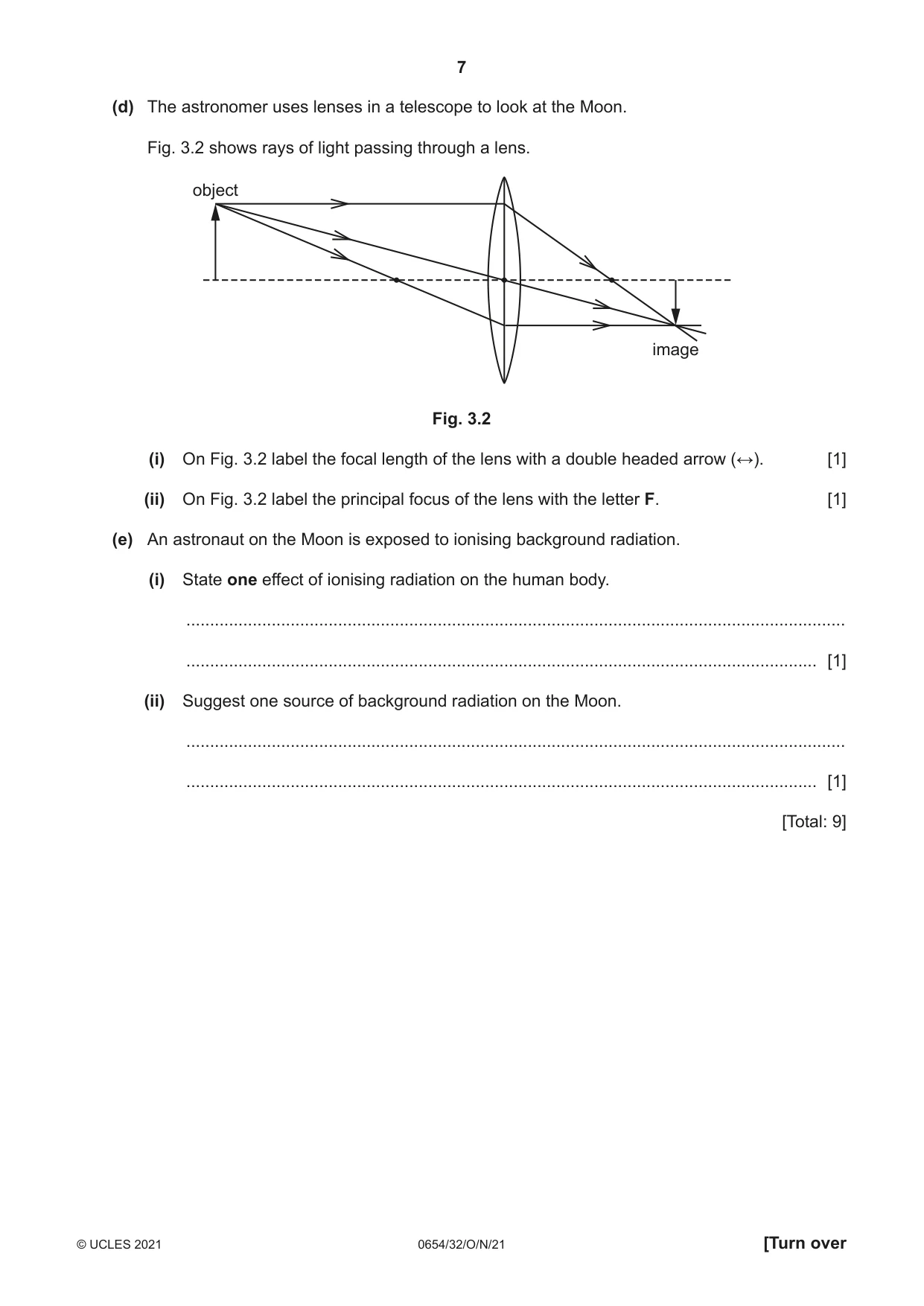
3 (a) An astronomer on Earth is able to see the Moon even though the Moon does not emit visible light. State one property of visible light that enables observation of the Moon. ................................................................................................................................................... ............................................................................................................................................. [1] (b) Visible light is part of the electromagnetic spectrum. Place visible light in the correct place in the incomplete electromagnetic spectrum in Fig. 3.1. X-rays ultraviolet microwaves Fig. 3.1 [1] (c) (i) Light rays from the Moon travel at 3 × 10⁵ km / s to reach the astronomer on Earth. The distance travelled is 400 000 km. Calculate the time taken for the light rays to travel from the Moon to the Earth. time = ....................................................... s [2] (ii) Explain why sound waves are unable to travel from the Moon to the Earth. ........................................................................................................................................... ..................................................................................................................................... [1] (d) The astronomer uses lenses in a telescope to look at the Moon. Fig. 3.2 shows rays of light passing through a lens. object image Fig. 3.2 (i) On Fig. 3.2 label the focal length of the lens with a double headed arrow (↔). [1] (ii) On Fig. 3.2 label the principal focus of the lens with the letter F. [1] (e) An astronaut on the Moon is exposed to ionising background radiation. (i) State one effect of ionising radiation on the human body. ........................................................................................................................................... ..................................................................................................................................... [1] (ii) Suggest one source of background radiation on the Moon. ........................................................................................................................................... ..................................................................................................................................... [1] [Total: 9]
Mark scheme: 3(a) reflection ; 1 3(b) (visible) light in middle box ; 1 3(c)(i) time = distance ÷ speed or 400 000 ÷ 3 × 10⁵ ; = 1.33 (s) ; 2 3(c)(ii) sound (waves) cannot travel through a vacuum / need a medium to travel through ; 1 3(d)(i) arrow showing distance from centre of lens to point labelled F ; 1 3(d)(ii) F labelled as either point marked with a dot on the axis of the lens; 1 3(e)(i) cancer / mutation etc. ; 1 3(e)(ii) cosmic radiation ; 1
Q4 · A diagram of a cross‑section through skin tissue
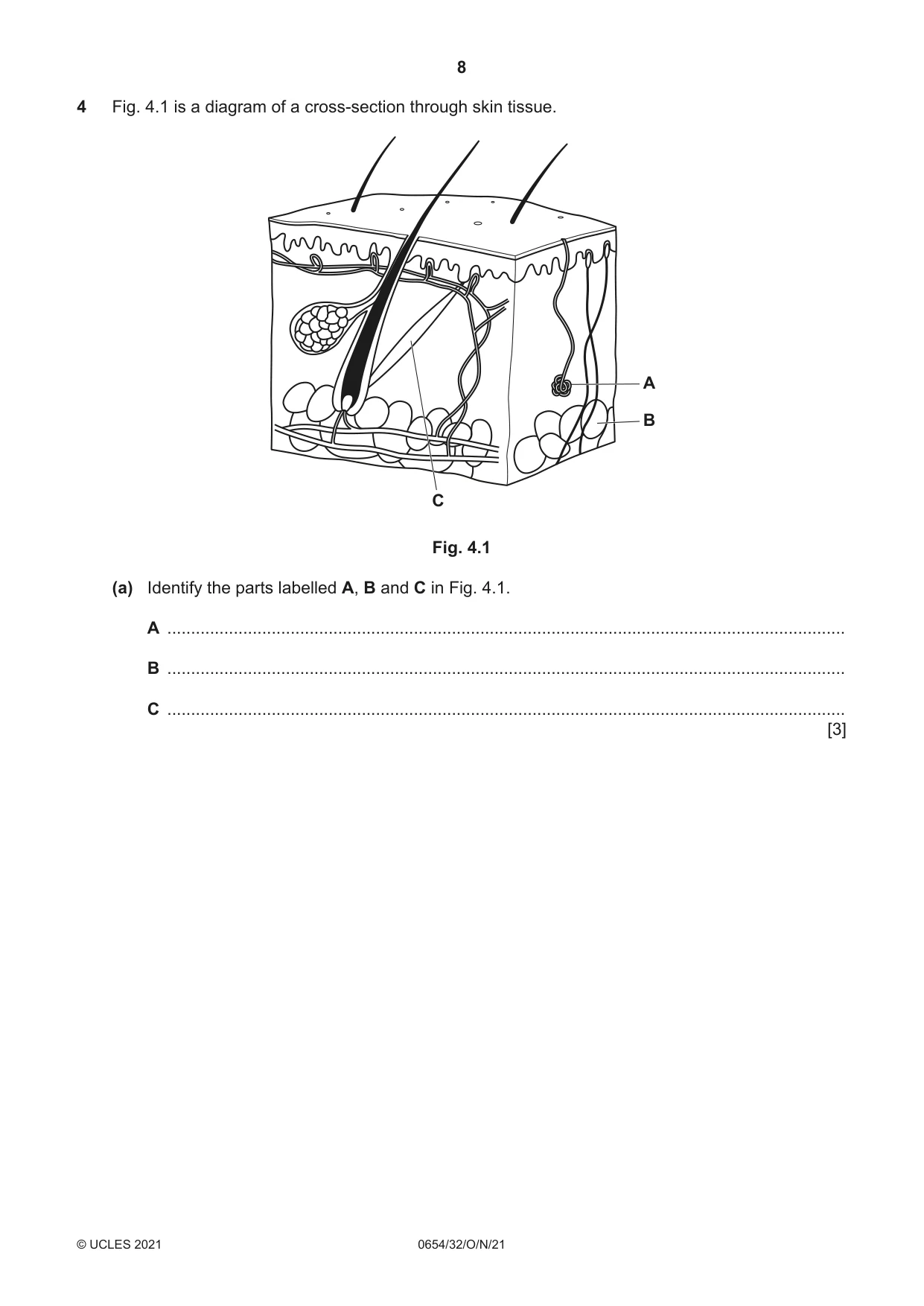
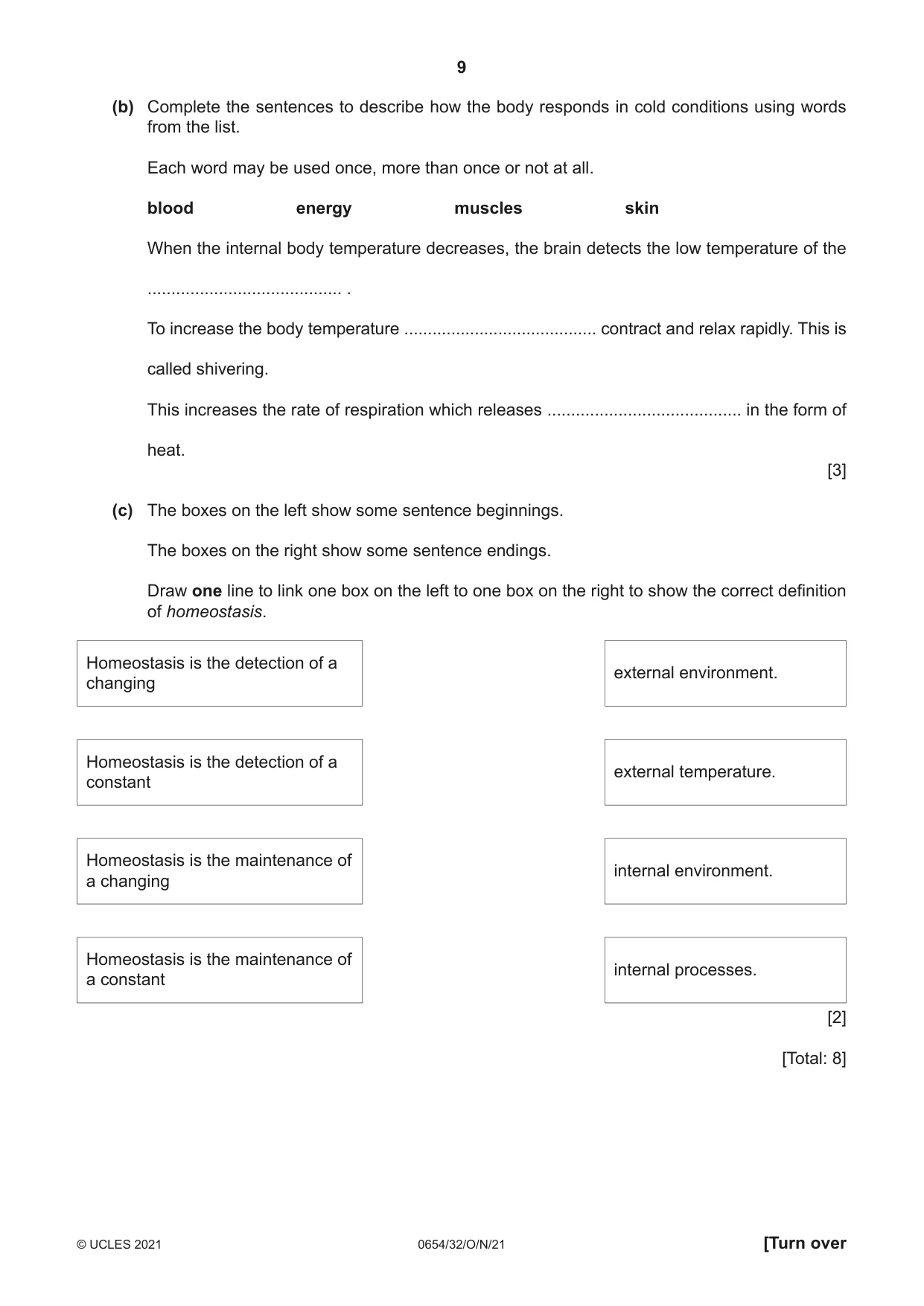
4 Fig. 4.1 is a diagram of a cross‑section through skin tissue. A B C Fig. 4.1 (a) Identify the parts labelled A, B and C in Fig. 4.1. A ............................................................................................................................................... B ............................................................................................................................................... C ............................................................................................................................................... [3] (b) Complete the sentences to describe how the body responds in cold conditions using words from the list. Each word may be used once, more than once or not at all. blood energy muscles skin When the internal body temperature decreases, the brain detects the low temperature of the ......................................... . To increase the body temperature ......................................... contract and relax rapidly. This is called shivering. This increases the rate of respiration which releases ......................................... in the form of heat. [3] (c) The boxes on the left show some sentence beginnings. The boxes on the right show some sentence endings. Draw one line to link one box on the left to one box on the right to show the correct definition of homeostasis. Homeostasis is the detection of a external environment.changing Homeostasis is the detection of a external temperature.constant Homeostasis is the maintenance of internal environment.a changing Homeostasis is the maintenance of internal processes.a constant [2] [Total: 8]
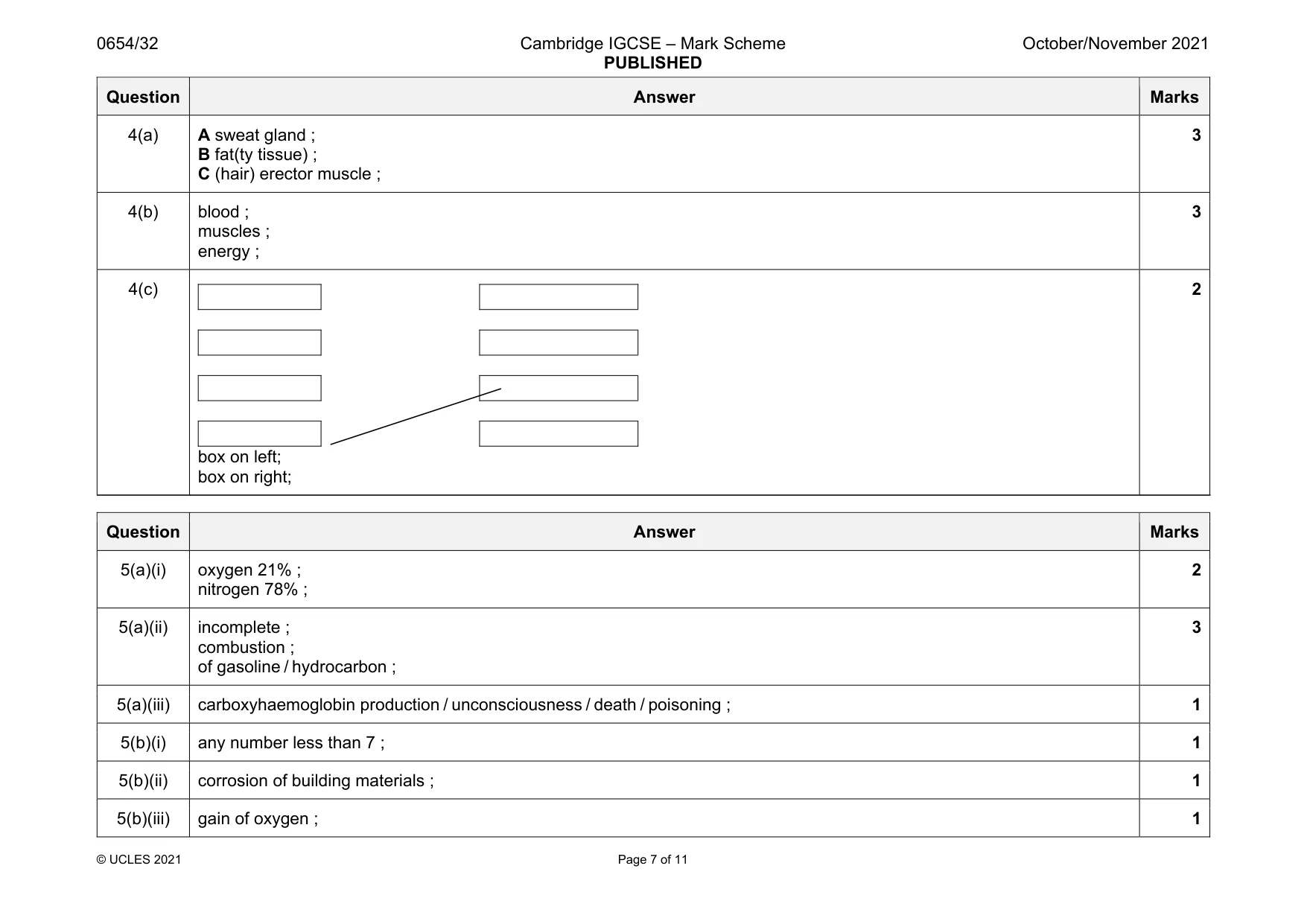
Mark scheme: 4(a) A sweat gland ; B fat(ty tissue) ; C (hair) erector muscle ; 3 4(b) blood ; muscles ; energy ; 3 4(c) box on left; box on right; 2
Q5 · State the percentage of oxygen and of nitrogen in a sample of clean air
5 (a) (i) State the percentage of oxygen and of nitrogen in a sample of clean air. oxygen ..................................% nitrogen ..................................% [2] (ii) A sample of air collected near a busy road contains carbon monoxide. Carbon monoxide is made by car engines. Describe how carbon monoxide is made by car engines. ........................................................................................................................................... ........................................................................................................................................... ........................................................................................................................................... ..................................................................................................................................... [3] (iii) State one harmful effect of carbon monoxide on the health of a human. ........................................................................................................................................... ..................................................................................................................................... [1] (b) The atmosphere contains small quantities of sulfur dioxide. Sulfur dioxide causes acid rain. (i) Suggest a pH for acid rain. ...................................... [1] (ii) Suggest one adverse effect of acid rain on buildings. ........................................................................................................................................... ..................................................................................................................................... [1] (iii) Sulfur dioxide is made when sulfur is burned in oxygen. This reaction is called an oxidation reaction. State the meaning of the term oxidation. ........................................................................................................................................... ..................................................................................................................................... [1] [Total: 9]
Mark scheme: 5(a)(i) oxygen 21% ; nitrogen 78% ; 2 5(a)(ii) incomplete ; combustion ; of gasoline / hydrocarbon ; 3 5(a)(iii) carboxyhaemoglobin production / unconsciousness / death / poisoning ; 1 5(b)(i) any number less than 7 ; 1 5(b)(ii) corrosion of building materials ; 1 5(b)(iii) gain of oxygen ; 1
Q6 · An electric heater containing two heating elements
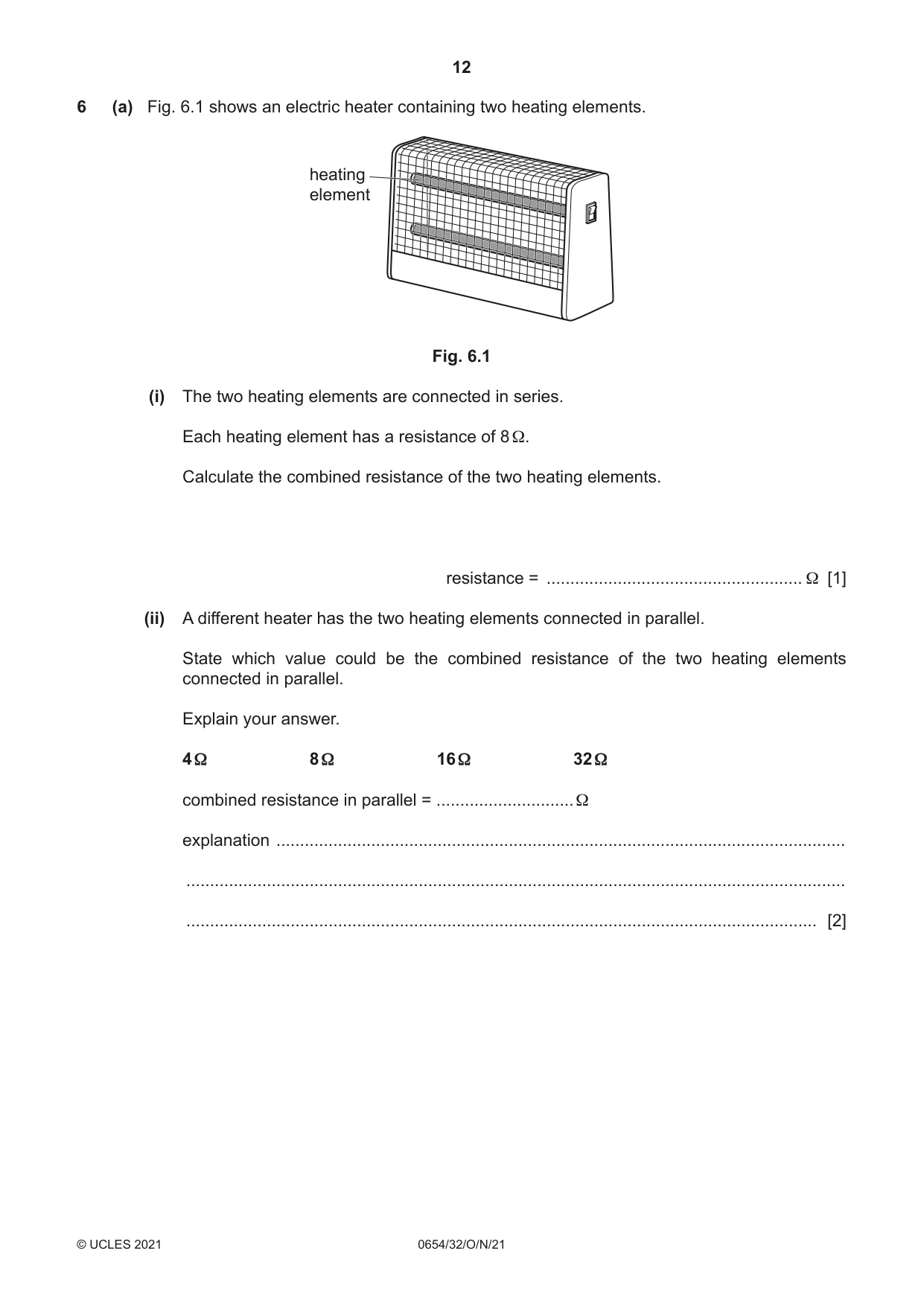
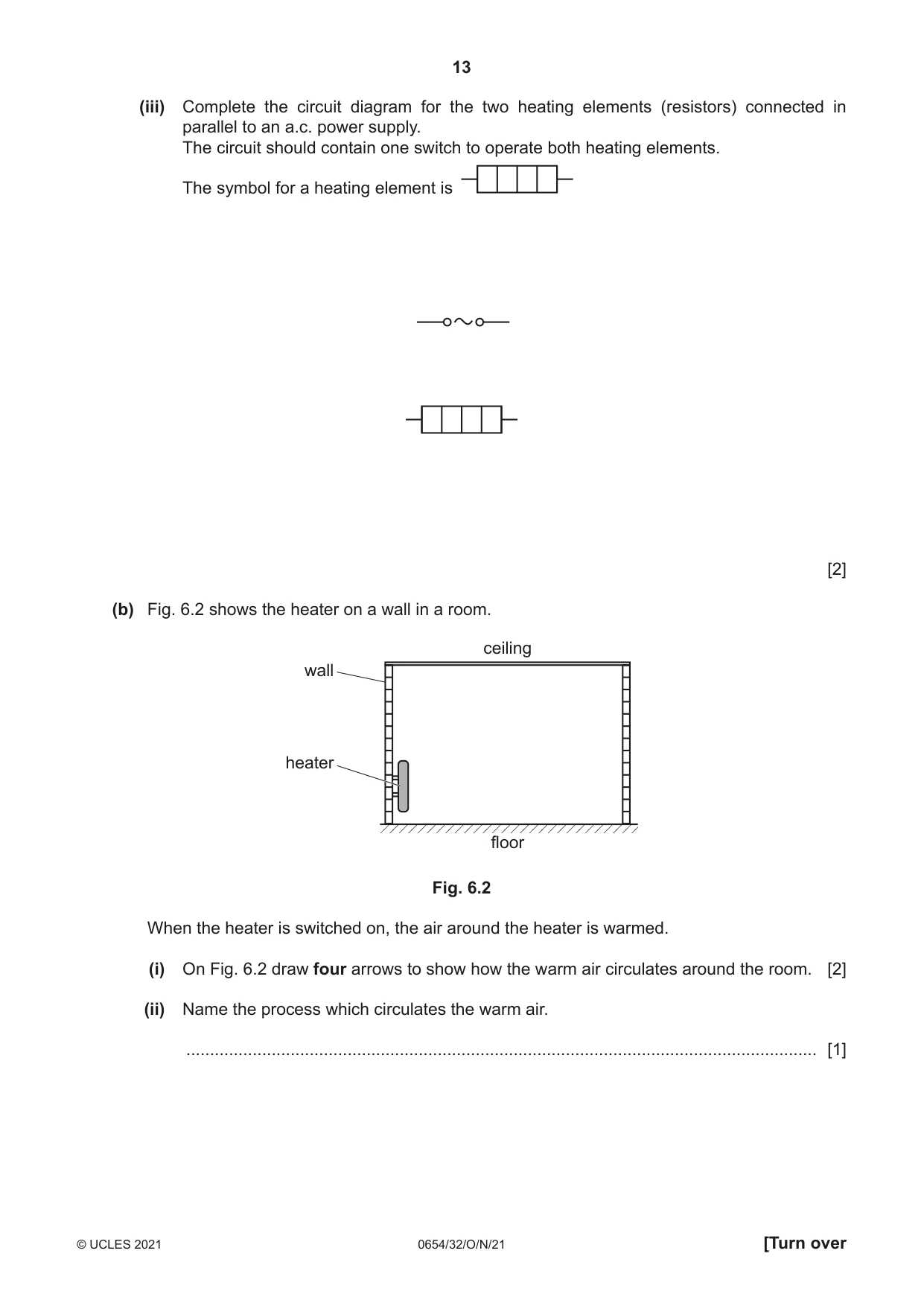
6 (a) Fig. 6.1 shows an electric heater containing two heating elements. heating element Fig. 6.1 (i) The two heating elements are connected in series. Each heating element has a resistance of 8 Ω. Calculate the combined resistance of the two heating elements. resistance = ...................................................... Ω [1] (ii) A different heater has the two heating elements connected in parallel. State which value could be the combined resistance of the two heating elements connected in parallel. Explain your answer. 4 Ω 8 Ω 16 Ω 32 Ω combined resistance in parallel = ............................. Ω explanation ........................................................................................................................ ........................................................................................................................................... ..................................................................................................................................... [2] (iii) Complete the circuit diagram for the two heating elements (resistors) connected in parallel to an a.c. power supply. The circuit should contain one switch to operate both heating elements. The symbol for a heating element is [2] (b) Fig. 6.2 shows the heater on a wall in a room. ceiling wall heater floor Fig. 6.2 When the heater is switched on, the air around the heater is warmed. (i) On Fig. 6.2 draw four arrows to show how the warm air circulates around the room. [2] (ii) Name the process which circulates the warm air. ..................................................................................................................................... [1] (c) A man walks on the floor in the room. As he walks he gains a negative charge. Describe how the man gains this charge. Use ideas about charged particles in your answer. ................................................................................................................................................... ................................................................................................................................................... ................................................................................................................................................... ............................................................................................................................................. [3] [Total: 11]
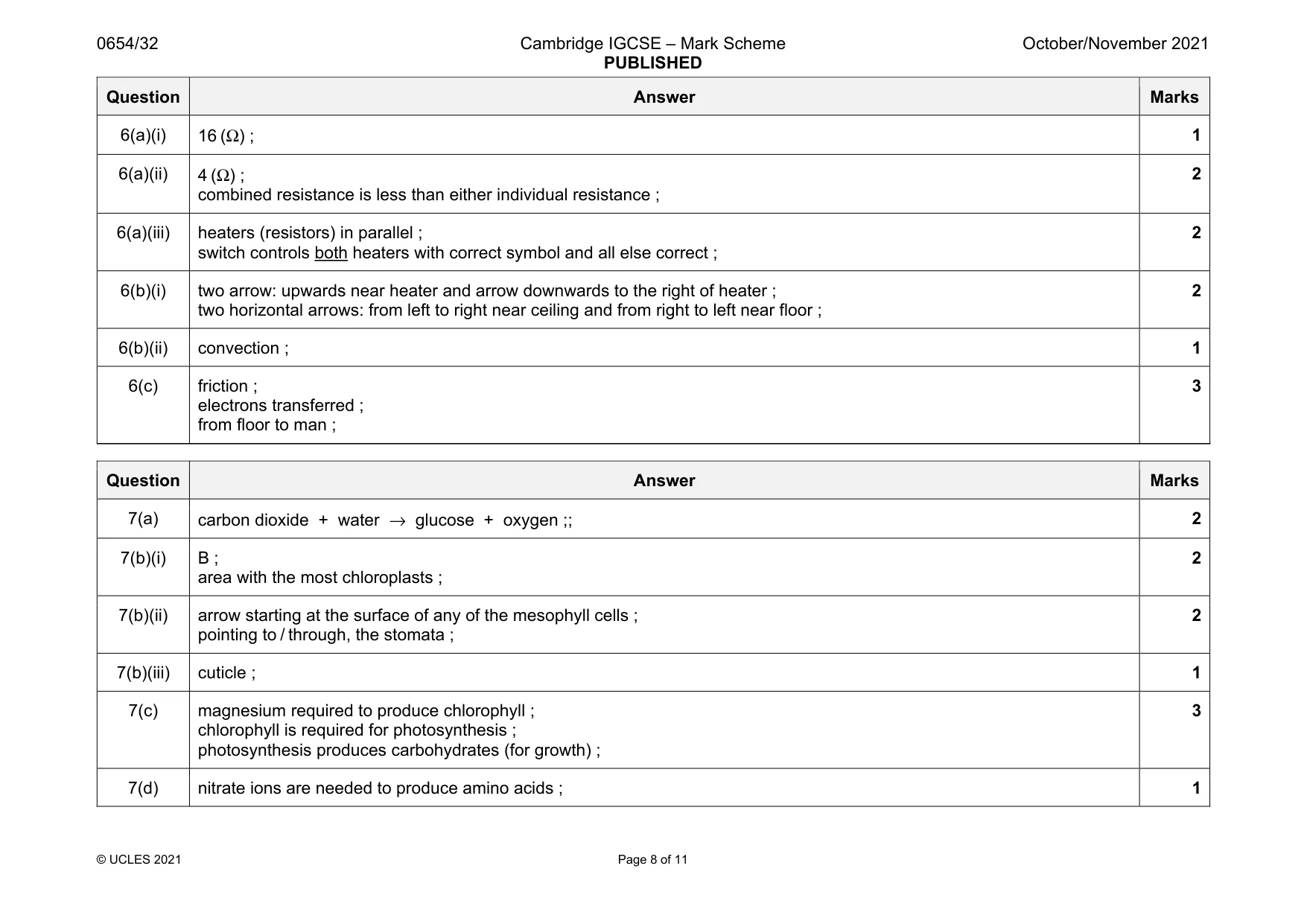
Mark scheme: 6(a)(i) 16 (Ω) ; 1 6(a)(ii) 4 (Ω) ; combined resistance is less than either individual resistance ; 2 6(a)(iii) heaters (resistors) in parallel ; switch controls both heaters with correct symbol and all else correct ; 2 6(b)(i) two arrow: upwards near heater and arrow downwards to the right of heater ; two horizontal arrows: from left to right near ceiling and from right to left near floor ; 2 6(b)(ii) convection ; 1 6(c) friction ; electrons transferred ; from floor to man ; 3
Q7 · State the word equation for photosynthesis
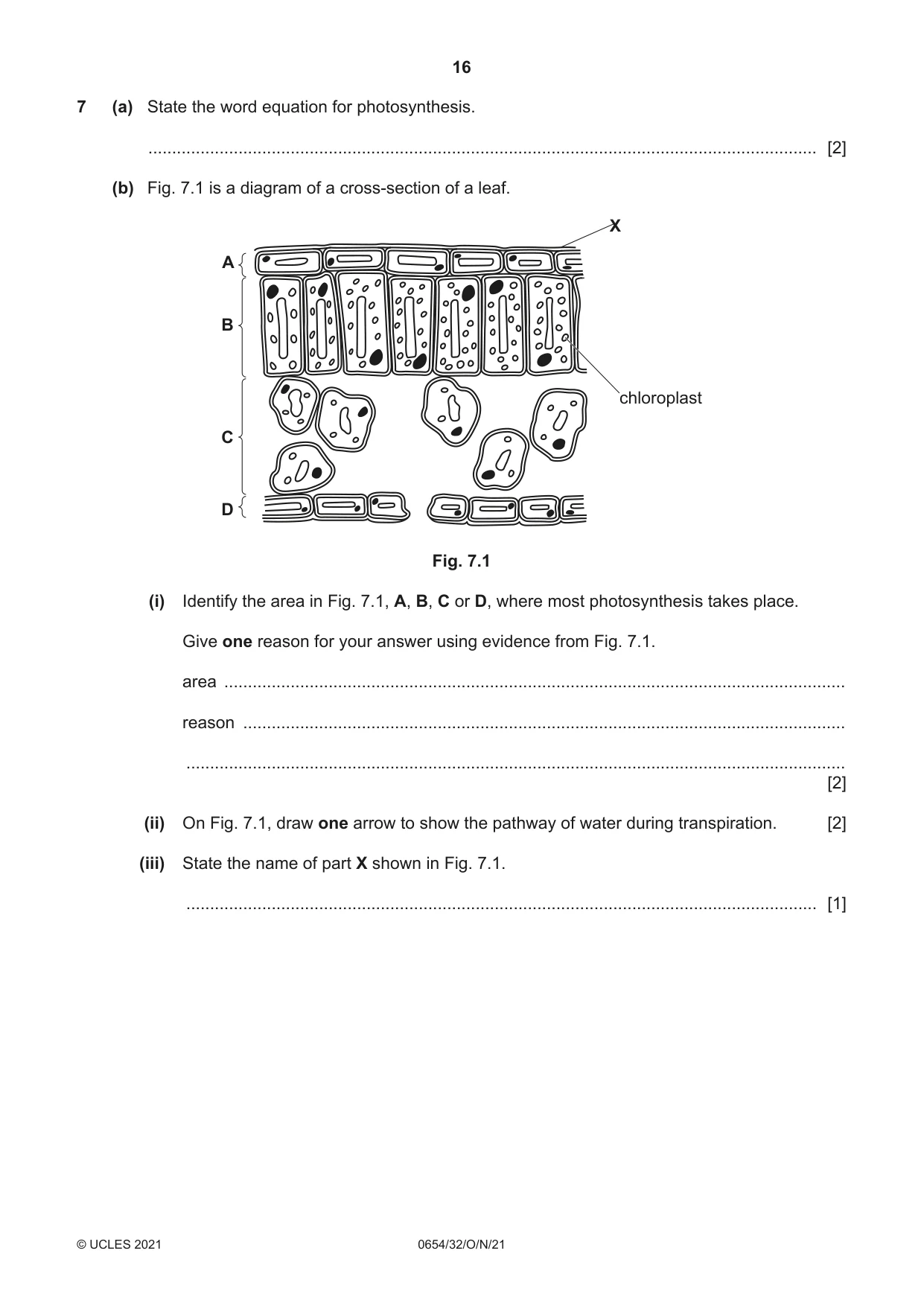
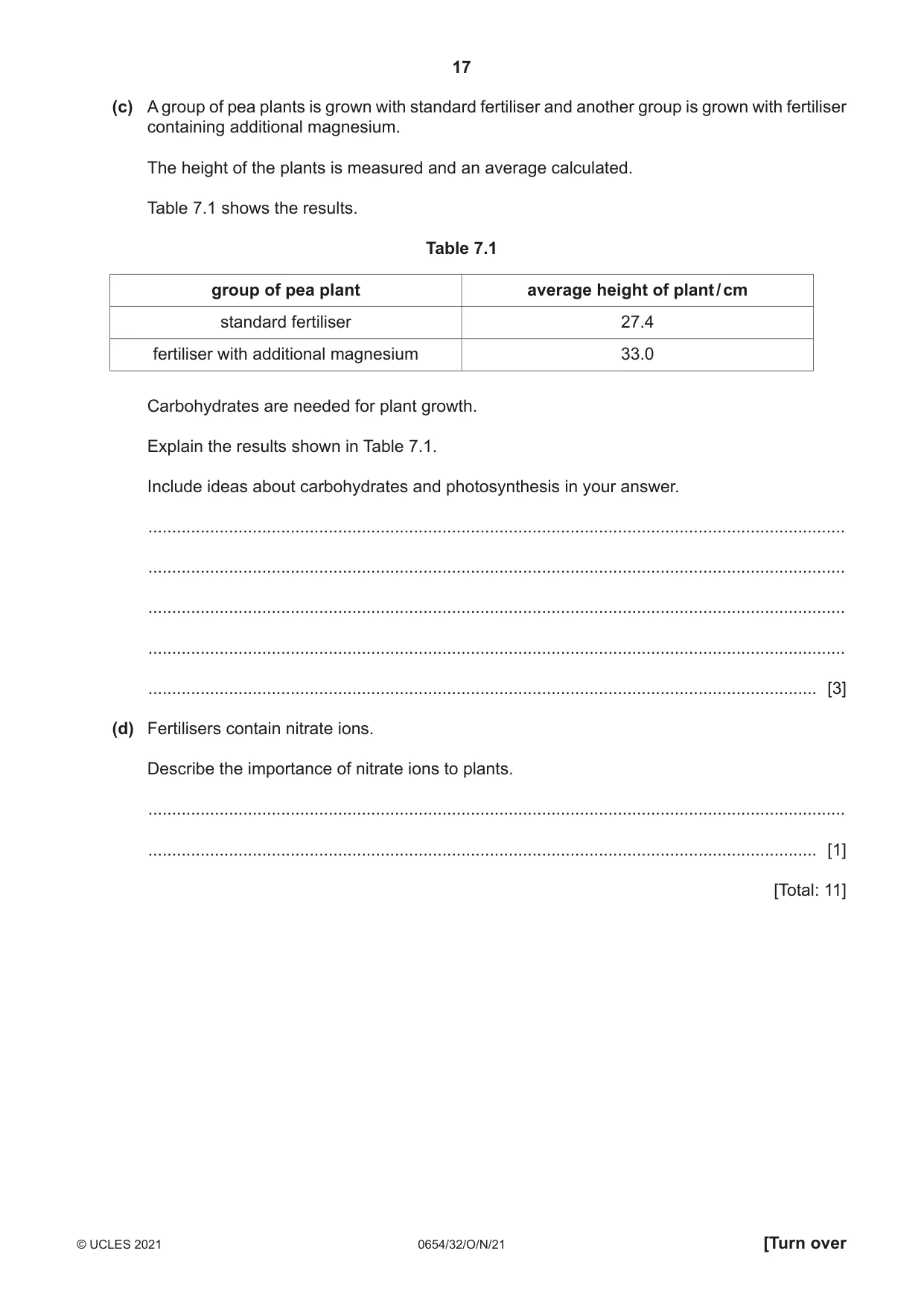
7 (a) State the word equation for photosynthesis. ............................................................................................................................................. [2] (b) Fig. 7.1 is a diagram of a cross‑section of a leaf. X A B chloroplast C D Fig. 7.1 (i) Identify the area in Fig. 7.1, A, B, C or D, where most photosynthesis takes place. Give one reason for your answer using evidence from Fig. 7.1. area ................................................................................................................................... reason ............................................................................................................................... ........................................................................................................................................... [2] (ii) On Fig. 7.1, draw one arrow to show the pathway of water during transpiration. [2] (iii) State the name of part X shown in Fig. 7.1. ..................................................................................................................................... [1] (c) A group of pea plants is grown with standard fertiliser and another group is grown with fertiliser containing additional magnesium. The height of the plants is measured and an average calculated. Table 7.1 shows the results. Table 7.1 group of pea plant average height of plant / cm standard fertiliser 27.4 fertiliser with additional magnesium 33.0 Carbohydrates are needed for plant growth. Explain the results shown in Table 7.1. Include ideas about carbohydrates and photosynthesis in your answer. ................................................................................................................................................... ................................................................................................................................................... ................................................................................................................................................... ................................................................................................................................................... ............................................................................................................................................. [3] (d) Fertilisers contain nitrate ions. Describe the importance of nitrate ions to plants. ................................................................................................................................................... ............................................................................................................................................. [1] [Total: 11]
Mark scheme: 7(a) carbon dioxide + water → glucose + oxygen ;; 2 7(b)(i) B ; area with the most chloroplasts ; 2 7(b)(ii) arrow starting at the surface of any of the mesophyll cells ; pointing to / through, the stomata ; 2 7(b)(iii) cuticle ; 1 7(c) magnesium required to produce chlorophyll ; chlorophyll is required for photosynthesis ; photosynthesis produces carbohydrates (for growth) ; 3 7(d) nitrate ions are needed to produce amino acids ; 1
Q8 · An atom of aluminium has a proton number of 13 and nucleon number of 27
8 (a) An atom of aluminium has a proton number of 13 and nucleon number of 27. (i) State what is meant by the term nucleon number. ........................................................................................................................................... ..................................................................................................................................... [1] (ii) Describe the electronic structure of an atom of aluminium. You may wish to draw a diagram to help your answer. ........................................................................................................................................... ..................................................................................................................................... [2] (b) Aluminium is extracted from its ore by electrolysis. (i) Name one ore from which aluminium is extracted. ..................................................................................................................................... [1] (ii) Electrolysis results in a chemical change. Explain what is meant by a chemical change. ........................................................................................................................................... ..................................................................................................................................... [1] (c) Aluminium alloys are used in aircraft parts. (i) State what is meant by the term alloy. ........................................................................................................................................... ..................................................................................................................................... [1] (ii) State why aluminium alloys are used in aircraft parts. ........................................................................................................................................... ..................................................................................................................................... [1] (iii) State why aluminium is used in the form of alloys rather than as pure aluminium. ........................................................................................................................................... ..................................................................................................................................... [1] (iv) Describe and explain one other use of aluminium. use .................................................................................................................................... explanation .................................................................................................................. [2] [Total: 10]
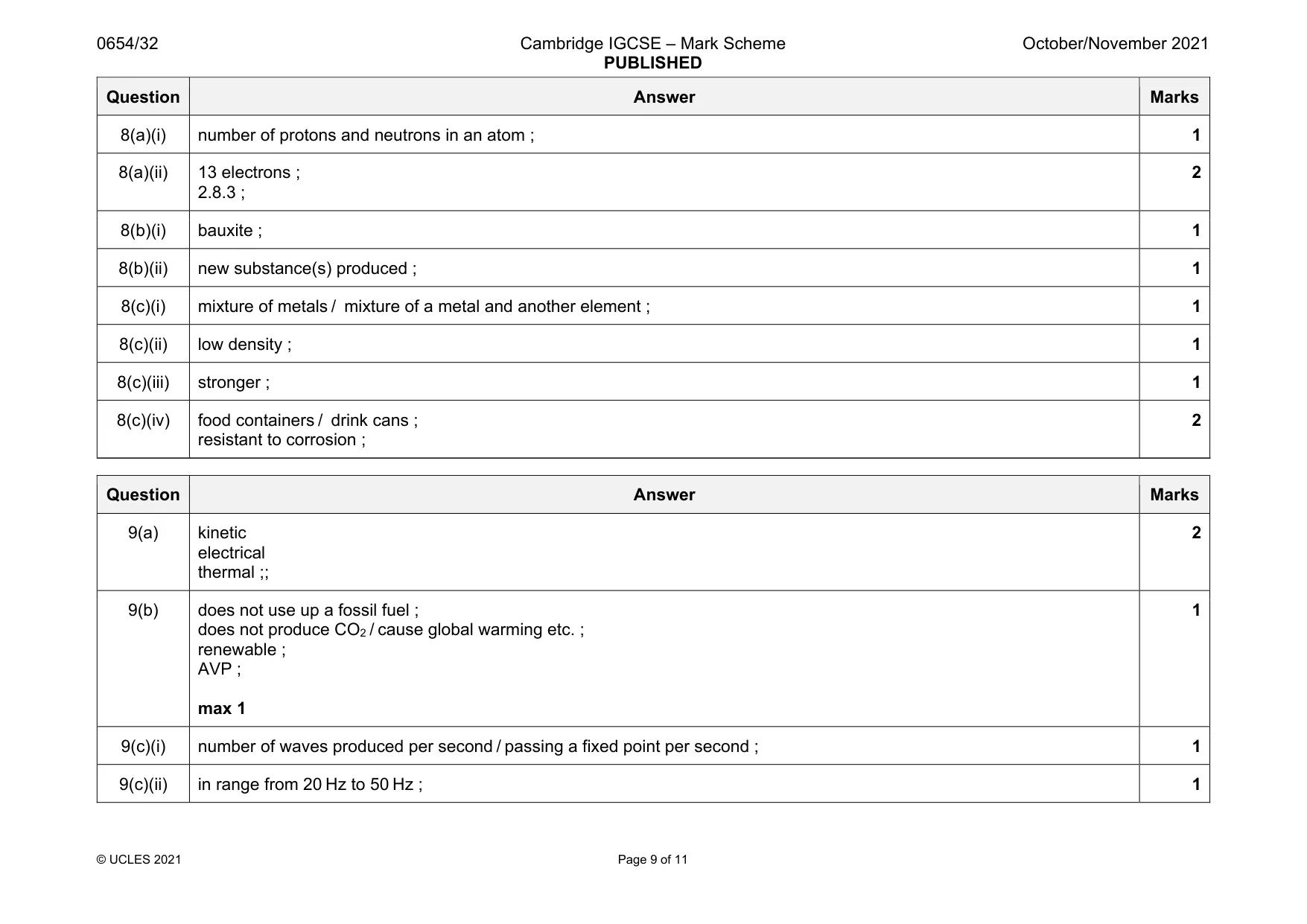
Mark scheme: 8(a)(i) number of protons and neutrons in an atom ; 1 8(a)(ii) 13 electrons ; 2.8.3 ; 2 8(b)(i) bauxite ; 1 8(b)(ii) new substance(s) produced ; 1 8(c)(i) mixture of metals / mixture of a metal and another element ; 1 8(c)(ii) low density ; 1 8(c)(iii) stronger ; 1 8(c)(iv) food containers / drink cans ; resistant to corrosion ; 2
Q9 · Choose words from the list below to complete the sentences that describe the energy…
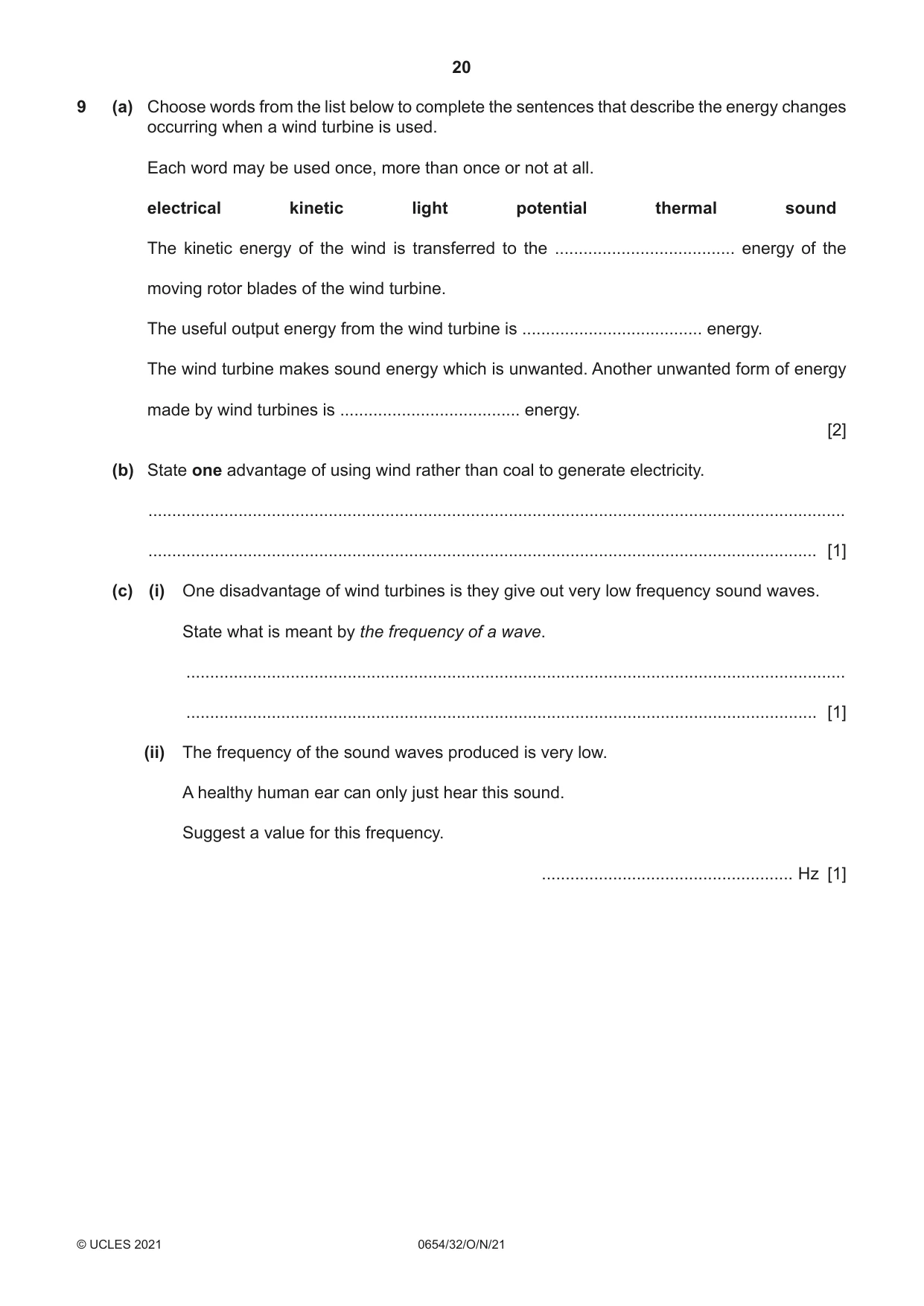
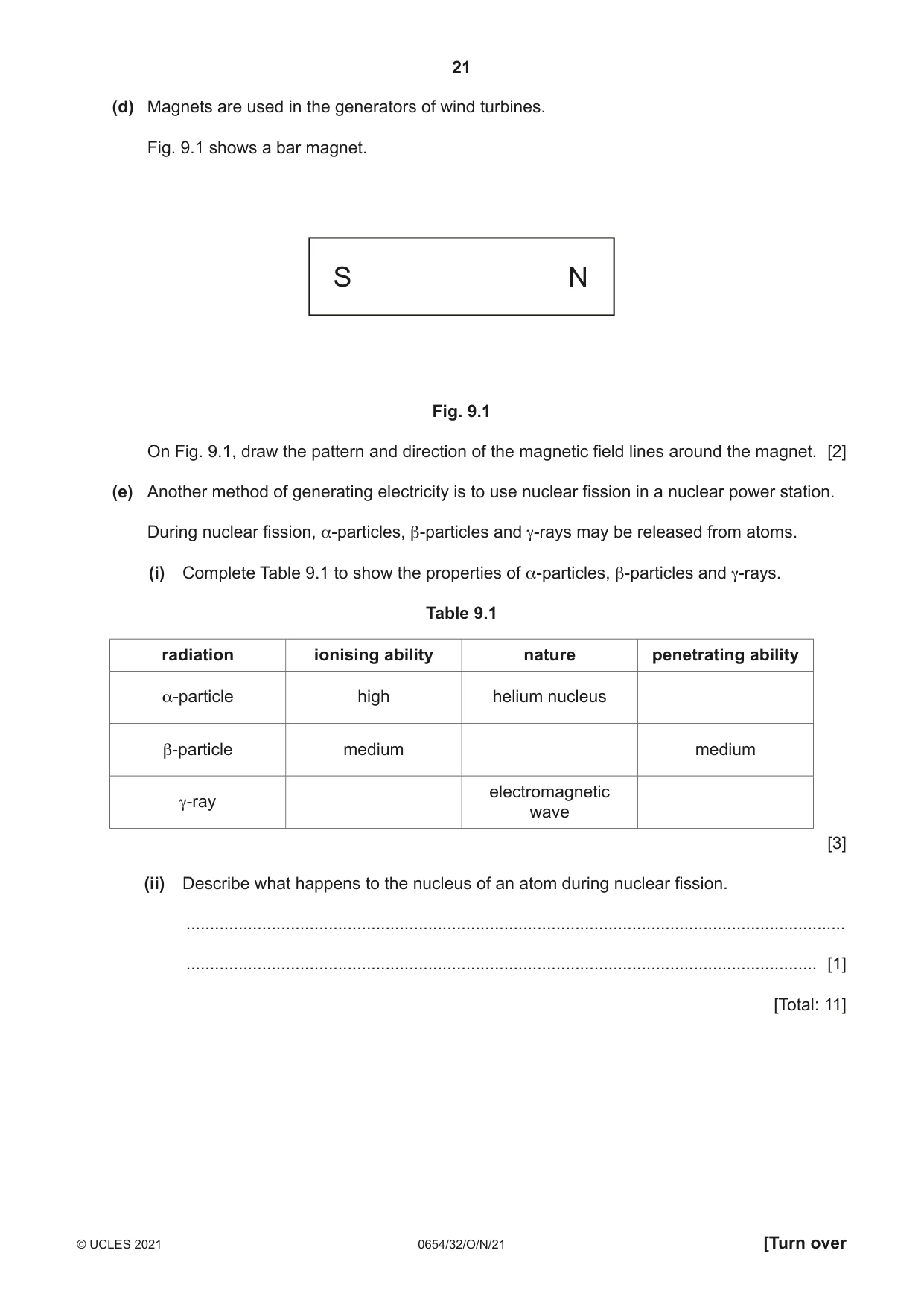
9 (a) Choose words from the list below to complete the sentences that describe the energy changes occurring when a wind turbine is used. Each word may be used once, more than once or not at all. electrical kinetic light potential thermal sound The kinetic energy of the wind is transferred to the ...................................... energy of the moving rotor blades of the wind turbine. The useful output energy from the wind turbine is ...................................... energy. The wind turbine makes sound energy which is unwanted. Another unwanted form of energy made by wind turbines is ...................................... energy. [2] (b) State one advantage of using wind rather than coal to generate electricity. ................................................................................................................................................... ............................................................................................................................................. [1] (c) (i) One disadvantage of wind turbines is they give out very low frequency sound waves. State what is meant by the frequency of a wave. ........................................................................................................................................... ..................................................................................................................................... [1] (ii) The frequency of the sound waves produced is very low. A healthy human ear can only just hear this sound. Suggest a value for this frequency. ..................................................... Hz [1] (d) Magnets are used in the generators of wind turbines. Fig. 9.1 shows a bar magnet. S N Fig. 9.1 On Fig. 9.1, draw the pattern and direction of the magnetic field lines around the magnet. [2] (e) Another method of generating electricity is to use nuclear fission in a nuclear power station. During nuclear fission, α‑particles, β‑particles and γ‑rays may be released from atoms. (i) Complete Table 9.1 to show the properties of α‑particles, β‑particles and γ‑rays. Table 9.1 radiation ionising ability nature penetrating ability α‑particle high helium nucleus β‑particle medium medium electromagnetic γ‑ray wave [3] (ii) Describe what happens to the nucleus of an atom during nuclear fission. ........................................................................................................................................... ..................................................................................................................................... [1] [Total: 11]
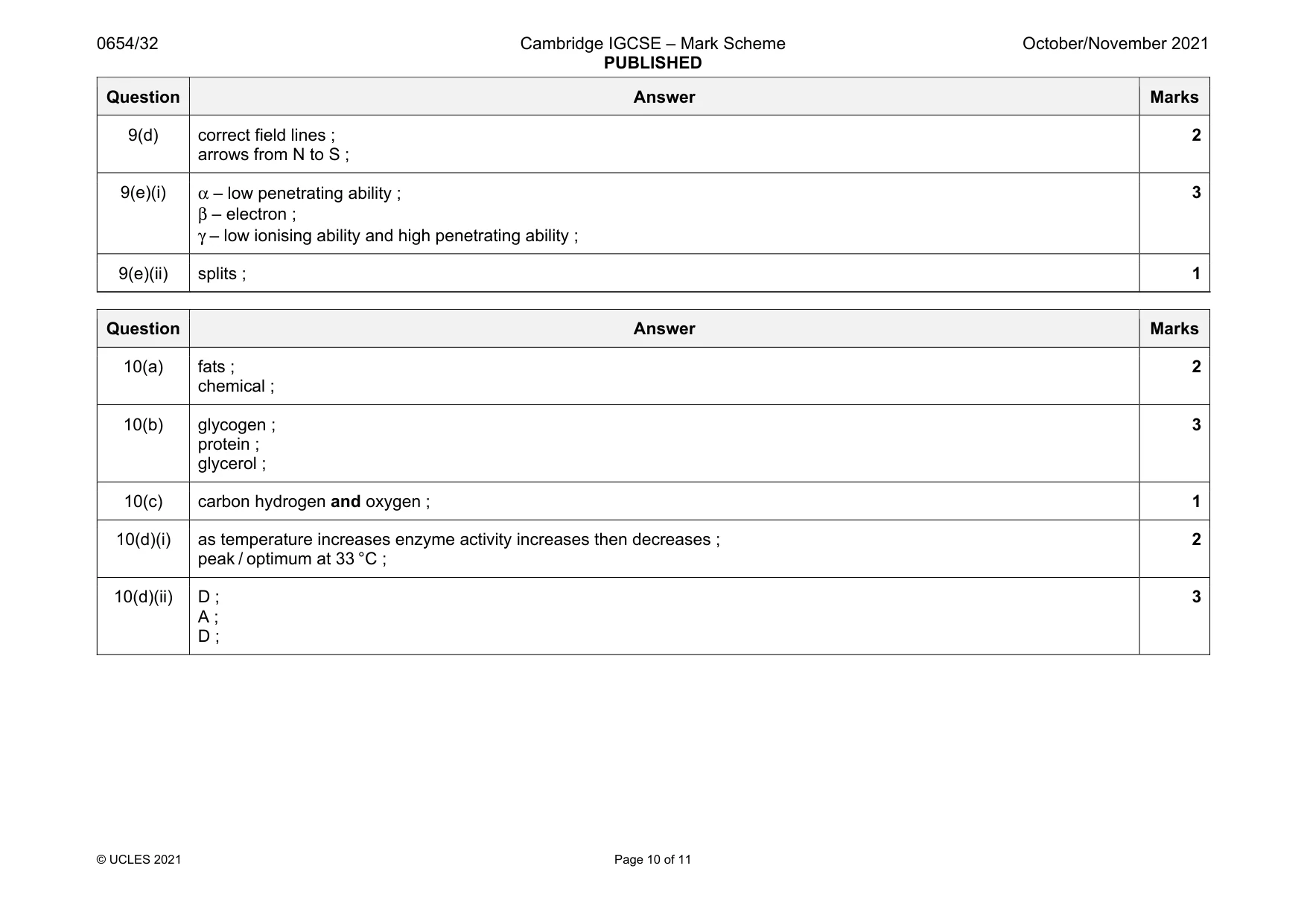
Mark scheme: 9(a) kinetic electrical thermal ;; 2 9(b) does not use up a fossil fuel ; does not produce CO2 / cause global warming etc. ; renewable ; AVP ; max 1 1 9(c)(i) number of waves produced per second / passing a fixed point per second ; 1 9(c)(ii) in range from 20 Hz to 50 Hz ; 1 Question Answer Marks 9(d) correct field lines ; arrows from N to S ; 2 9(e)(i) α – low penetrating ability ; β – electron ; γ – low ionising ability and high penetrating ability ; 3 9(e)(ii) splits ; 1
Q10 · A student writes a definition of an enzyme
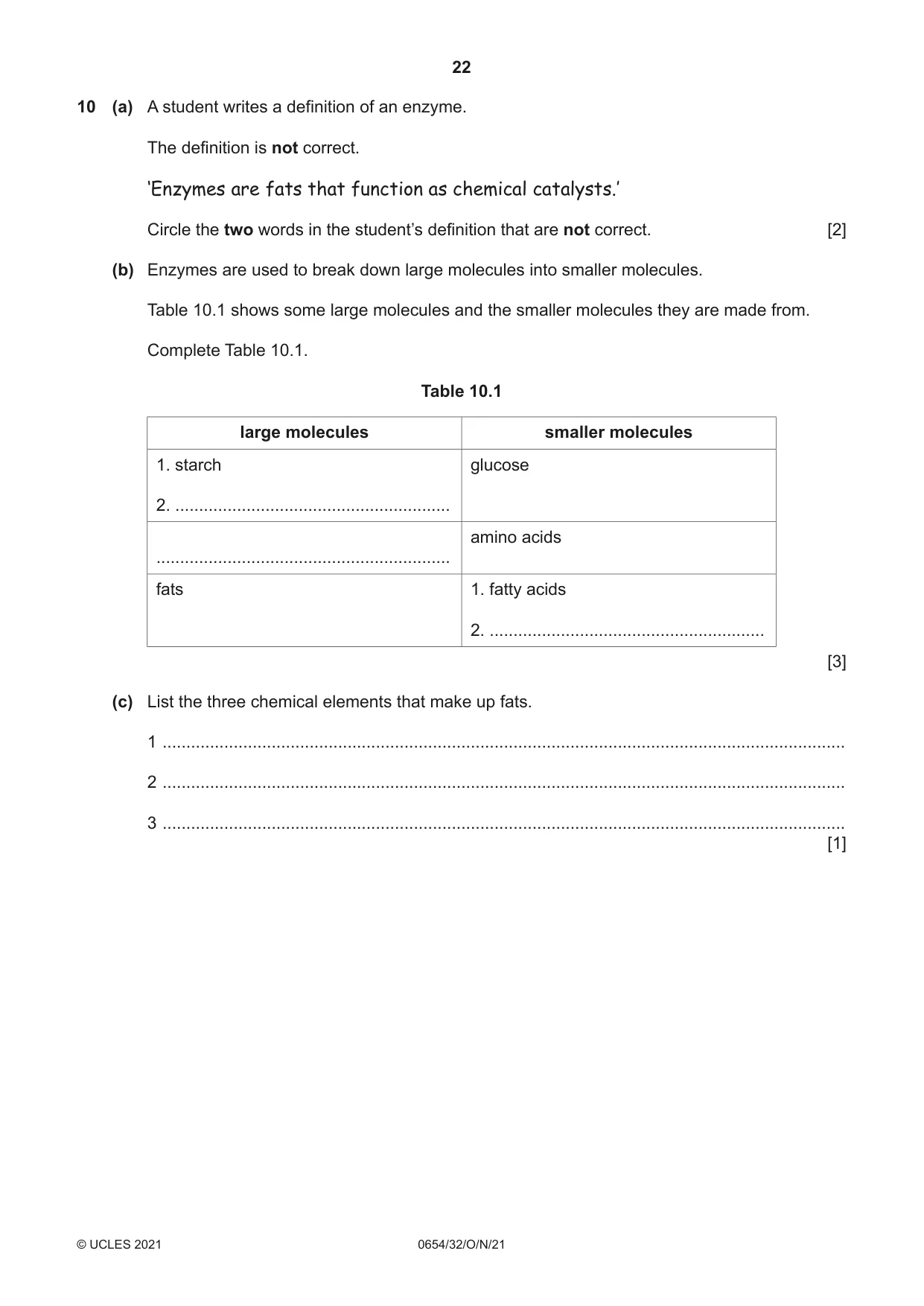
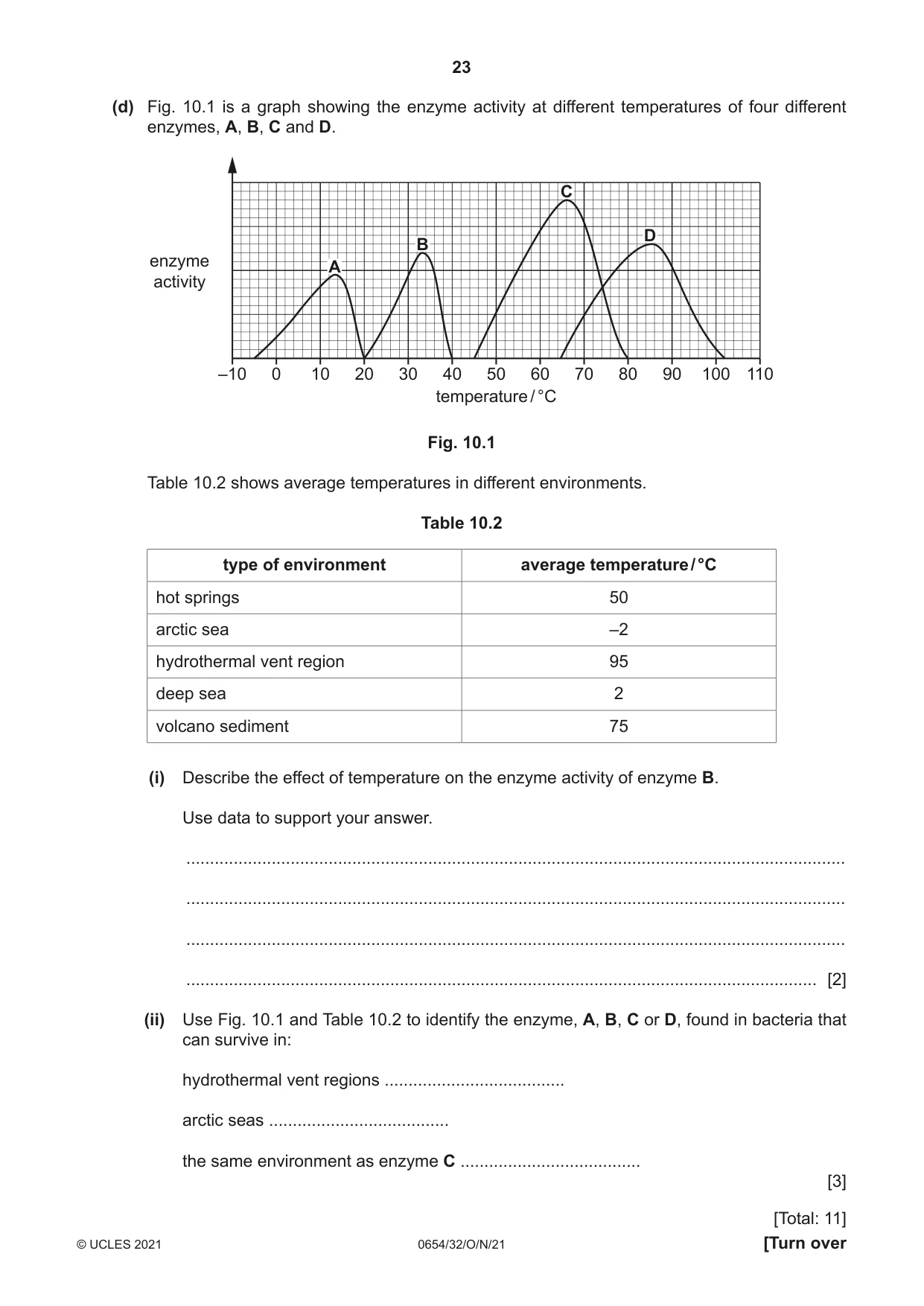
10 (a) A student writes a definition of an enzyme. The definition is not correct. ‘Enzymes are fats that function as chemical catalysts.’ Circle the two words in the student’s definition that are not correct. [2] (b) Enzymes are used to break down large molecules into smaller molecules. Table 10.1 shows some large molecules and the smaller molecules they are made from. Complete Table 10.1. Table 10.1 large molecules smaller molecules 1. starch glucose 2. .......................................................... amino acids .............................................................. fats 1. fatty acids 2. .......................................................... [3] (c) List the three chemical elements that make up fats. 1 ................................................................................................................................................ 2 ................................................................................................................................................ 3 ................................................................................................................................................ [1] (d) Fig. 10.1 is a graph showing the enzyme activity at different temperatures of four different enzymes, A, B, C and D. C D B enzyme A activity –10 0 10 20 30 40 50 60 70 80 90 100 110 temperature / °C Fig. 10.1 Table 10.2 shows average temperatures in different environments. Table 10.2 type of environment average temperature / °C hot springs 50 arctic sea –2 hydrothermal vent region 95 deep sea 2 volcano sediment 75 (i) Describe the effect of temperature on the enzyme activity of enzyme B. Use data to support your answer. ........................................................................................................................................... ........................................................................................................................................... ........................................................................................................................................... ..................................................................................................................................... [2] (ii) Use Fig. 10.1 and Table 10.2 to identify the enzyme, A, B, C or D, found in bacteria that can survive in: hydrothermal vent regions ...................................... arctic seas ...................................... the same environment as enzyme C ...................................... [3] [Total: 11]
Mark scheme: 10(a) fats ; chemical ; 2 10(b) glycogen ; protein ; glycerol ; 3 10(c) carbon hydrogen and oxygen ; 1 10(d)(i) as temperature increases enzyme activity increases then decreases ; peak / optimum at 33 °C ; 2 10(d)(ii) D ; A ; D ; 3
Q11 · Methane is a greenhouse gas
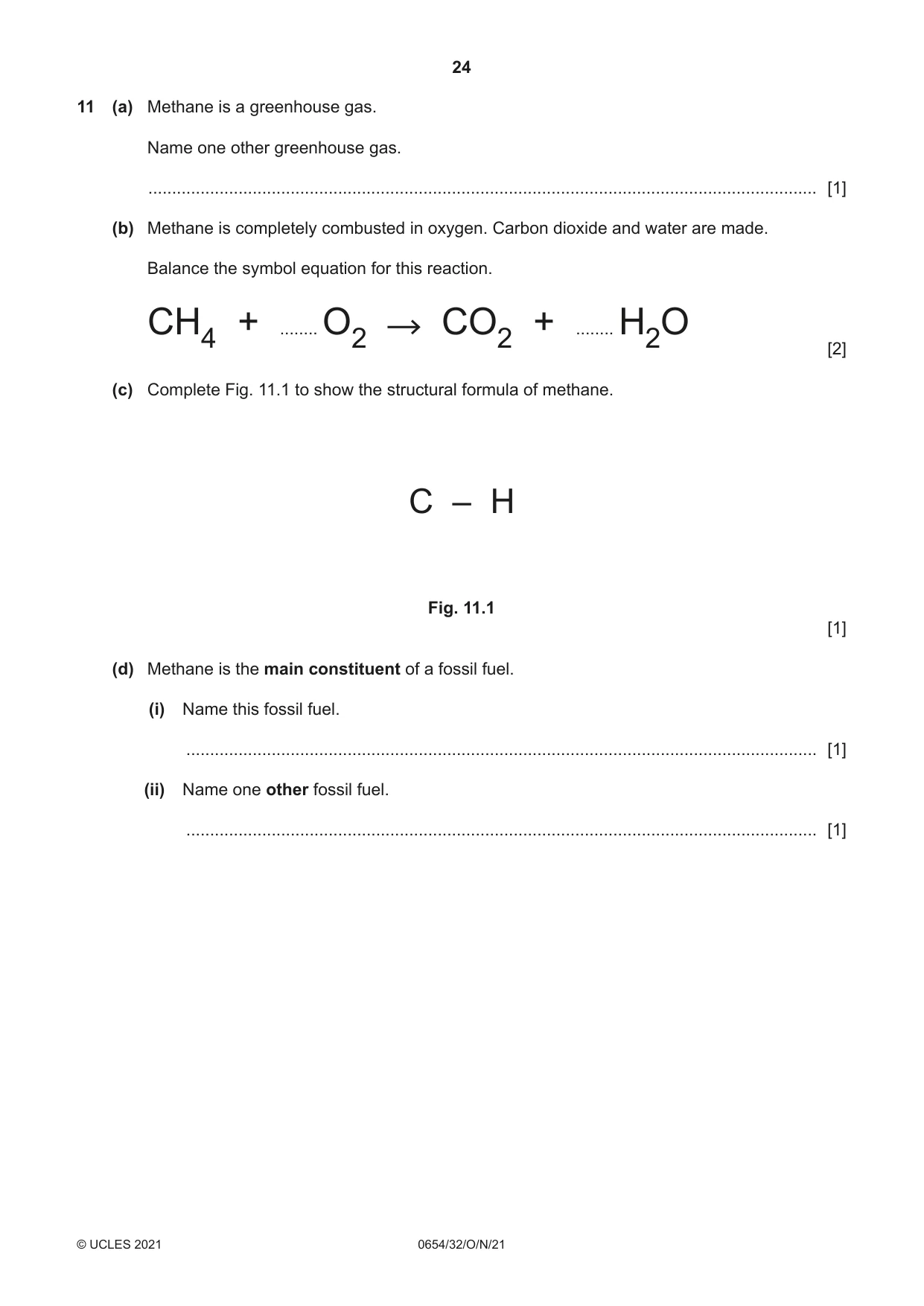
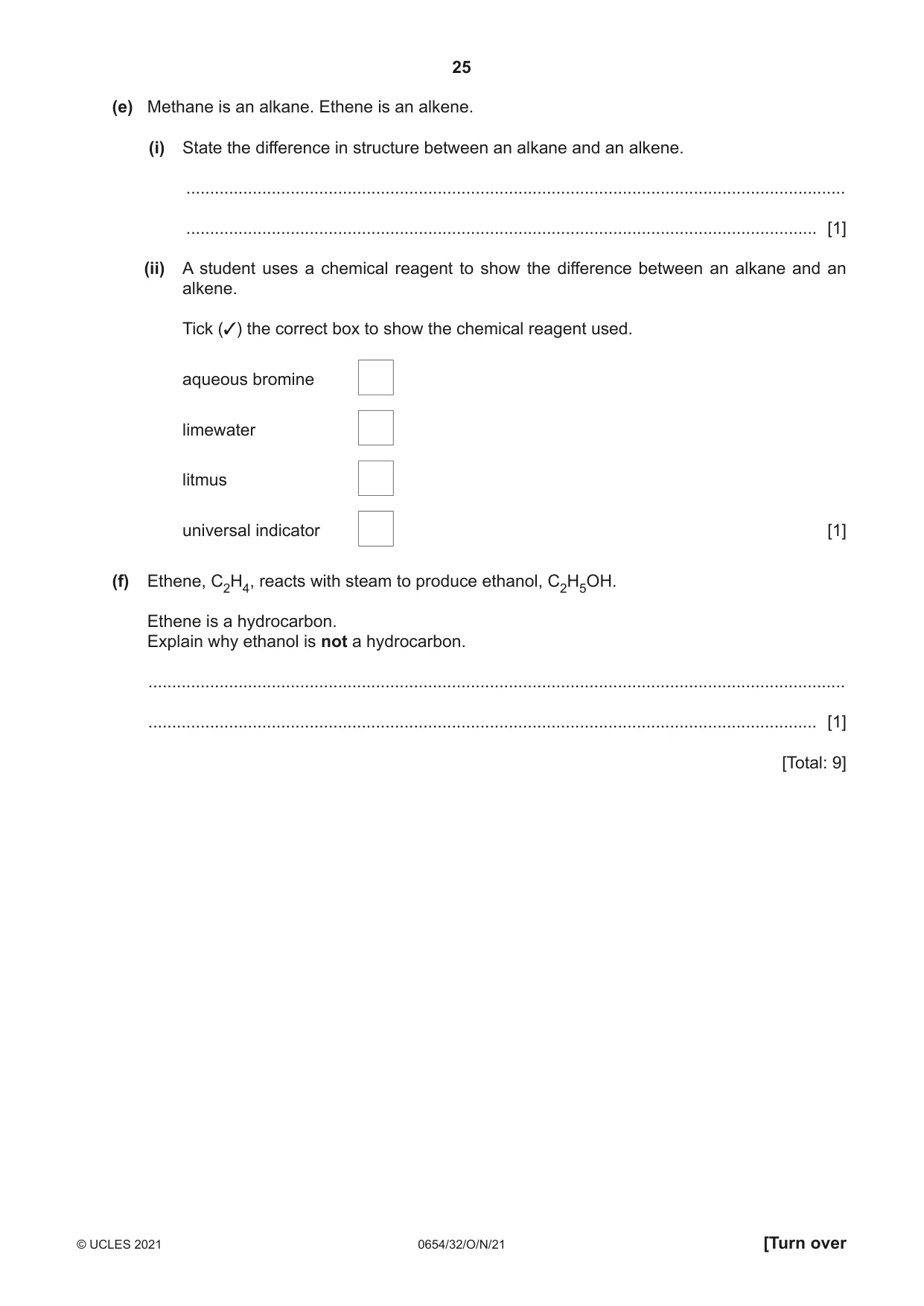
11 (a) Methane is a greenhouse gas. Name one other greenhouse gas. ............................................................................................................................................. [1] (b) Methane is completely combusted in oxygen. Carbon dioxide and water are made. Balance the symbol equation for this reaction. ........ ........ CH4 + O2 CO2 + H2O [2] (c) Complete Fig. 11.1 to show the structural formula of methane. C – H Fig. 11.1 [1] (d) Methane is the main constituent of a fossil fuel. (i) Name this fossil fuel. ..................................................................................................................................... [1] (ii) Name one other fossil fuel. ..................................................................................................................................... [1] (e) Methane is an alkane. Ethene is an alkene. (i) State the difference in structure between an alkane and an alkene. ........................................................................................................................................... ..................................................................................................................................... [1] (ii) A student uses a chemical reagent to show the difference between an alkane and an alkene. Tick (3) the correct box to show the chemical reagent used. aqueous bromine limewater litmus universal indicator [1] (f) Ethene, C2H4, reacts with steam to produce ethanol, C2H5OH. Ethene is a hydrocarbon. Explain why ethanol is not a hydrocarbon. ................................................................................................................................................... ............................................................................................................................................. [1] [Total: 9]
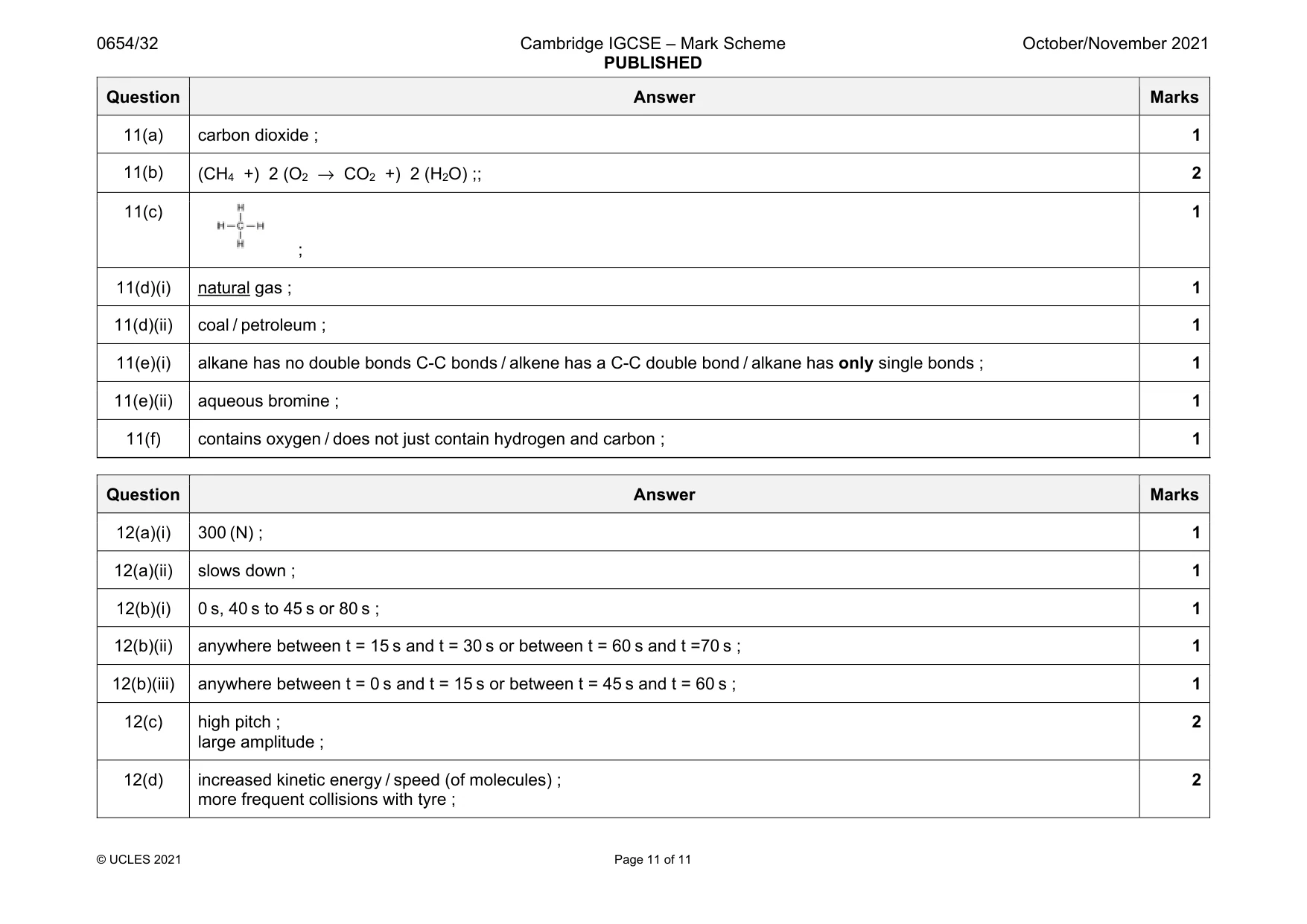
Mark scheme: 11(a) carbon dioxide ; 1 11(b) (CH4 +) 2 (O2 → CO2 +) 2 (H2O) ;; 2 11(c) ; 1 11(d)(i) natural gas ; 1 11(d)(ii) coal / petroleum ; 1 11(e)(i) alkane has no double bonds C-C bonds / alkene has a C-C double bond / alkane has only single bonds ; 1 11(e)(ii) aqueous bromine ; 1 11(f) contains oxygen / does not just contain hydrogen and carbon ; 1
Q12 · The horizontal forces acting on a motorcyclist and his motorcycle
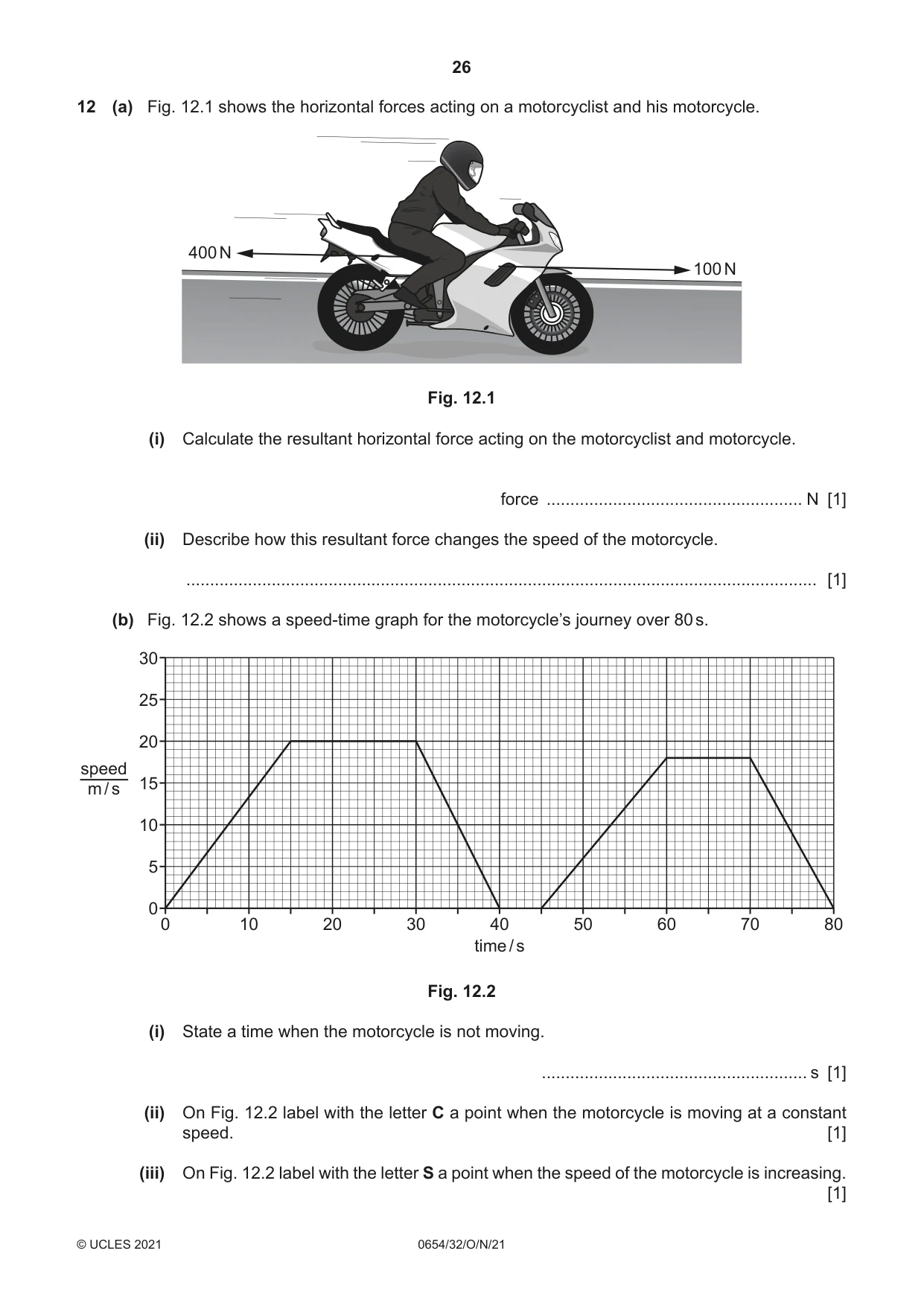
12 (a) Fig. 12.1 shows the horizontal forces acting on a motorcyclist and his motorcycle. 400 N 100 N Fig. 12.1 (i) Calculate the resultant horizontal force acting on the motorcyclist and motorcycle. force ...................................................... N [1] (ii) Describe how this resultant force changes the speed of the motorcycle. ..................................................................................................................................... [1] (b) Fig. 12.2 shows a speed‑time graph for the motorcycle’s journey over 80 s. 30 25 20 speed 15 m / s 10 5 0 0 10 20 30 40 50 60 70 80 time / s Fig. 12.2 (i) State a time when the motorcycle is not moving. ........................................................ s [1] (ii) On Fig. 12.2 label with the letter C a point when the motorcycle is moving at a constant speed. [1] (iii) On Fig. 12.2 label with the letter S a point when the speed of the motorcycle is increasing. [1] (c) The motorcycle produces a loud sound with a high frequency when moving. Describe the pitch and amplitude of the sound waves produced. pitch .......................................................................................................................................... amplitude .................................................................................................................................. [2] (d) As the motorcycle moves along the road, the temperature of the air in the tyres increases. Explain why the pressure of the air in the tyres increases. ................................................................................................................................................... ................................................................................................................................................... ................................................................................................................................................... ............................................................................................................................................. [2] [Total: 9]
Mark scheme: 12(a)(i) 300 (N) ; 1 12(a)(ii) slows down ; 1 12(b)(i) 0 s, 40 s to 45 s or 80 s ; 1 12(b)(ii) anywhere between t = 15 s and t = 30 s or between t = 60 s and t =70 s ; 1 12(b)(iii) anywhere between t = 0 s and t = 15 s or between t = 45 s and t = 60 s ; 1 12(c) high pitch ; large amplitude ; 2 12(d) increased kinetic energy / speed (of molecules) ; more frequent collisions with tyre ; 2
What was in this paper
The subtopics covered by these 12 questions, and how many questions each got. Open one in a new tab to see every Cambridge question on it.
What you needed in this session
Cambridge’s own grade thresholds for 2021 Oct/Nov, Paper 3 · Variant 2. A higher threshold means an easier paper — the bar moves with how the cohort did.