Cambridge IGCSE Sciences - Co-ordinated (Double) 0654 — 2024 Oct/Nov Paper 3 · Variant 1
0654/31/O/N/24 · 12 questions · 120 marks · ≈135 min
The question paper and its mark scheme, free to read here and free to download. This is Cambridge’s own paper, exactly as it was sat.
Question paper28 pages
Mark scheme13 pages
Answers below. Sit the paper first if you are practising.
Questions as text
Q1 · Euglena are single-celled organisms that have features of both animal and plant cells
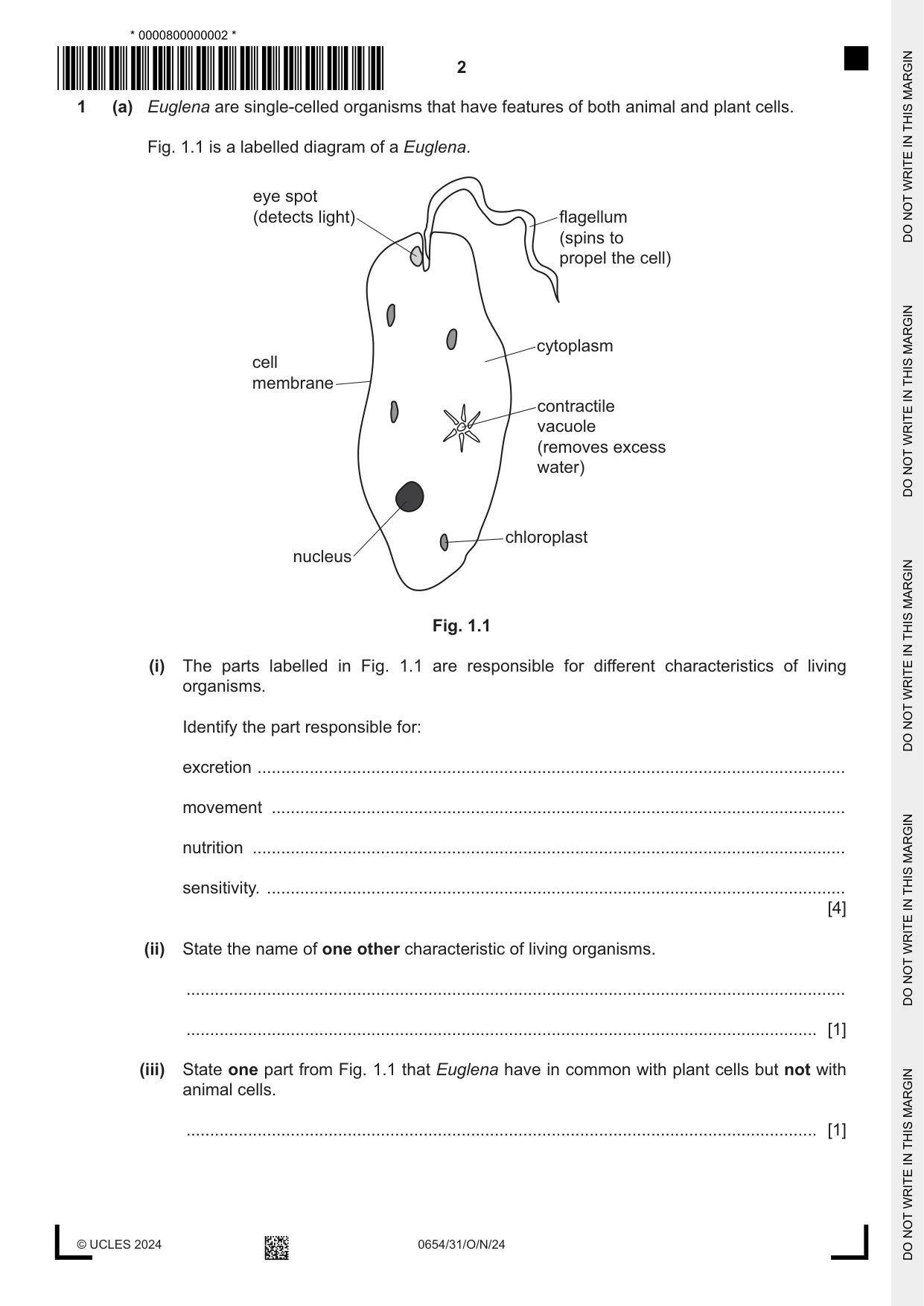
1 (a) Euglena are single-celled organisms that have features of both animal and plant cells. Fig. 1.1 is a labelled diagram of a Euglena. eye spot (detects light) flagellum (spins to propel the cell) cytoplasm cell membrane contractile vacuole (removes excess water) chloroplast nucleus Fig. 1.1 (i) The parts labelled in Fig. 1.1 are responsible for different characteristics of living organisms. Identify the part responsible for: excretion ............................................................................................................................ movement ......................................................................................................................... nutrition ............................................................................................................................. sensitivity. .......................................................................................................................... [4] (ii) State the name of one other characteristic of living organisms. ........................................................................................................................................... ..................................................................................................................................... [1] (iii) State one part from Fig. 1.1 that Euglena have in common with plant cells but not with animal cells. ..................................................................................................................................... [1] (b) Euglena and animal cells do not have cell walls. State the function of the cell wall. ................................................................................................................................................... ................................................................................................................................................... ............................................................................................................................................. [1] (c) Cell walls are made from a type of carbohydrate called cellulose. Cellulose is made up of smaller molecules of glucose. (i) List the chemical elements in all carbohydrates. ........................................................................................................................................... ..................................................................................................................................... [1] (ii) Circle two other larger carbohydrate molecules made from glucose. fat glycerol glycogen oil protein starch [2] [Total: 10]
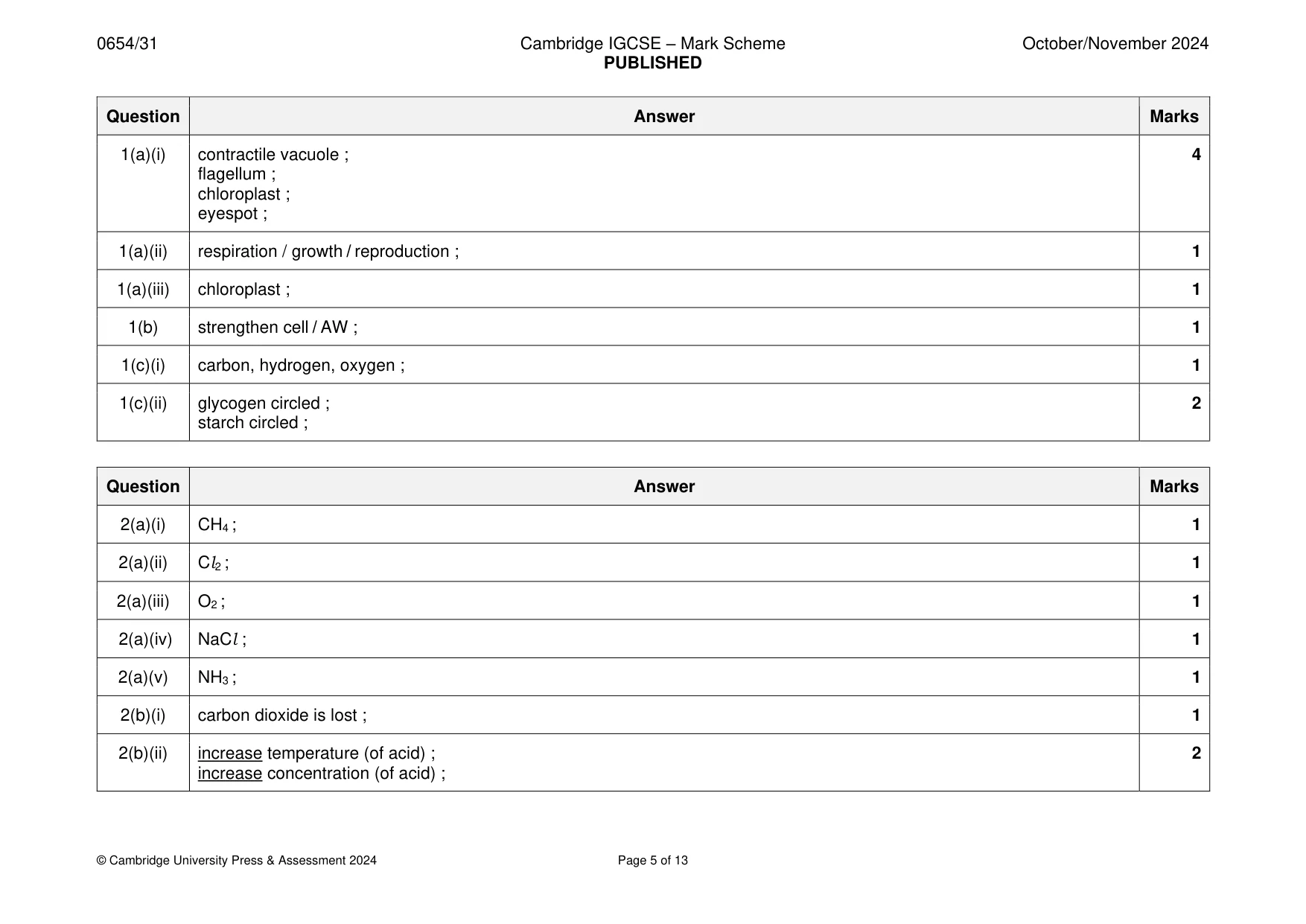
Mark scheme: Question Answer Marks 1(a)(i) contractile vacuole ; 4 flagellum ; chloroplast ; eyespot ; 1(a)(ii) respiration / growth / reproduction ; 1 1(a)(iii) chloroplast ; 1 1(b) strengthen cell / AW ; 1 1(c)(i) carbon, hydrogen, oxygen ; 1 1(c)(ii) glycogen circled ; 2 starch circled ;
Q2 · A list of formulae is shown
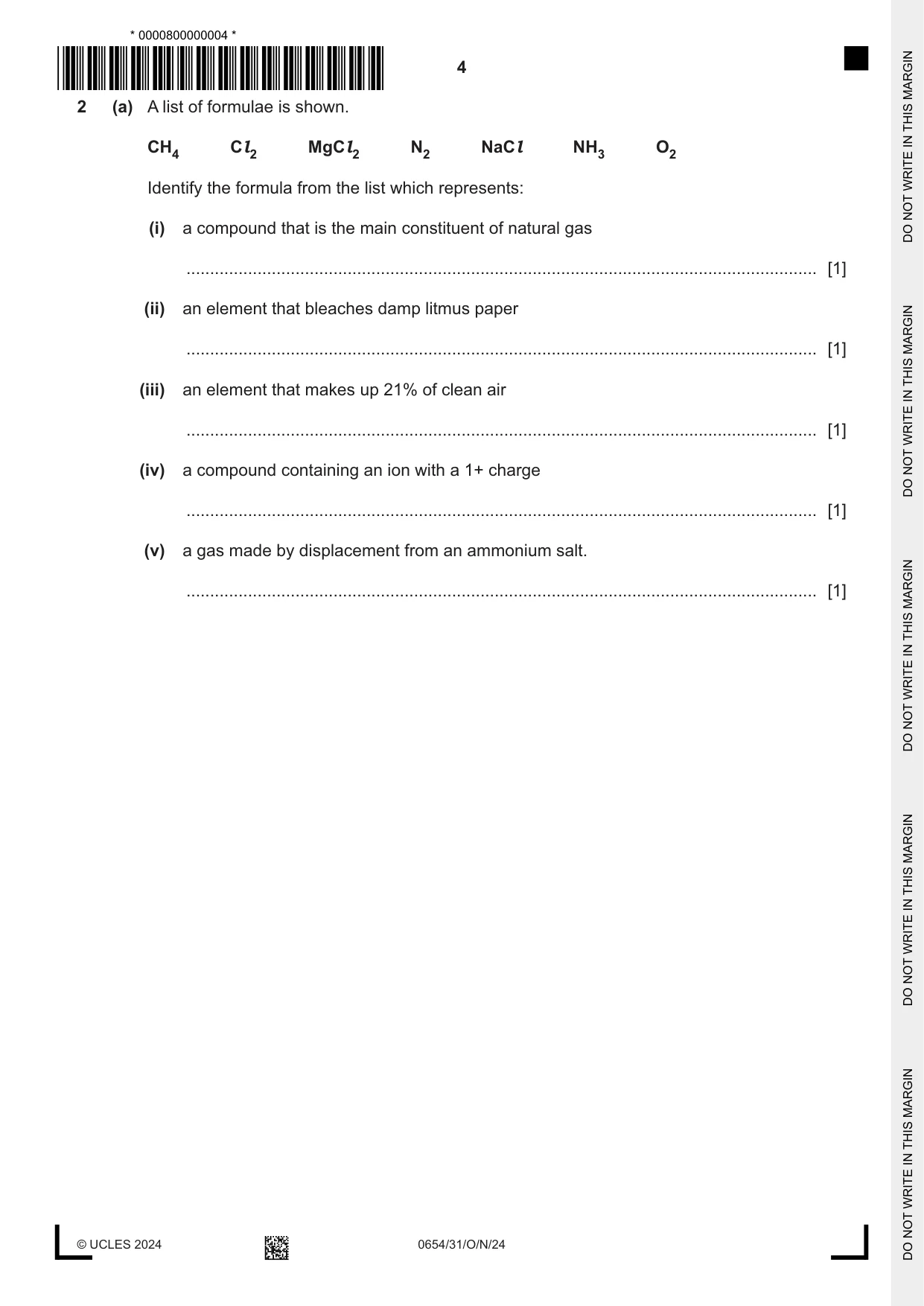
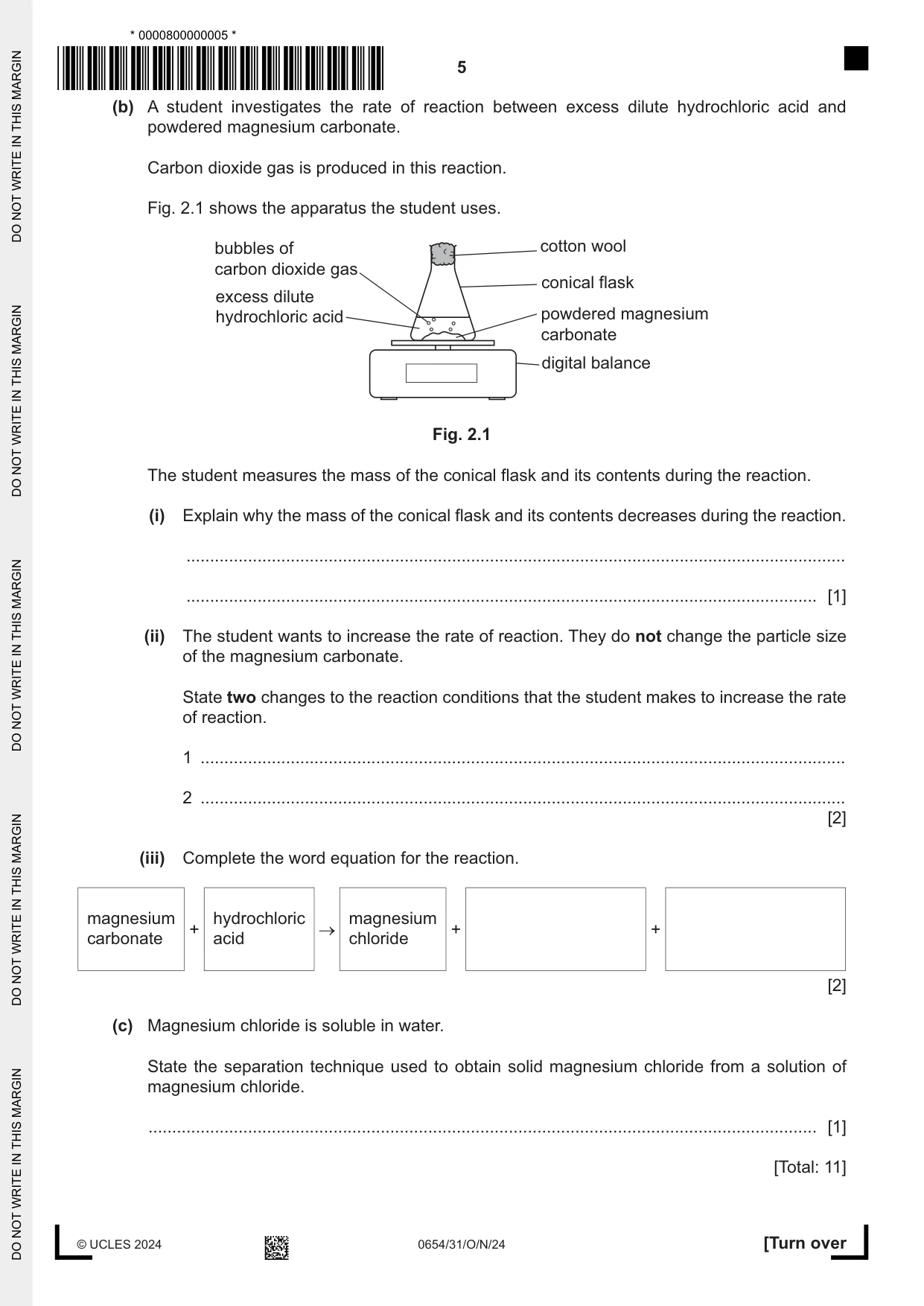
2 (a) A list of formulae is shown. CH4 Cl 2 MgCl 2 N2 NaCl NH3 O2 Identify the formula from the list which represents: (i) a compound that is the main constituent of natural gas ..................................................................................................................................... [1] (ii) an element that bleaches damp litmus paper ..................................................................................................................................... [1] (iii) an element that makes up 21% of clean air ..................................................................................................................................... [1] (iv) a compound containing an ion with a 1+ charge ..................................................................................................................................... [1] (v) a gas made by displacement from an ammonium salt. ..................................................................................................................................... [1] (b) A student investigates the rate of reaction between excess dilute hydrochloric acid and powdered magnesium carbonate. Carbon dioxide gas is produced in this reaction. Fig. 2.1 shows the apparatus the student uses. bubbles of cotton wool carbon dioxide gas conical flask excess dilute hydrochloric acid powdered magnesium carbonate digital balance Fig. 2.1 The student measures the mass of the conical flask and its contents during the reaction. (i) Explain why the mass of the conical flask and its contents decreases during the reaction. ........................................................................................................................................... ..................................................................................................................................... [1] (ii) The student wants to increase the rate of reaction. They do not change the particle size of the magnesium carbonate. State two changes to the reaction conditions that the student makes to increase the rate of reaction. 1 ........................................................................................................................................ 2 ........................................................................................................................................ [2] (iii) Complete the word equation for the reaction. magnesium hydrochloric magnesium + + + carbonate acid chloride [2] (c) Magnesium chloride is soluble in water. State the separation technique used to obtain solid magnesium chloride from a solution of magnesium chloride. ............................................................................................................................................. [1] [Total: 11]
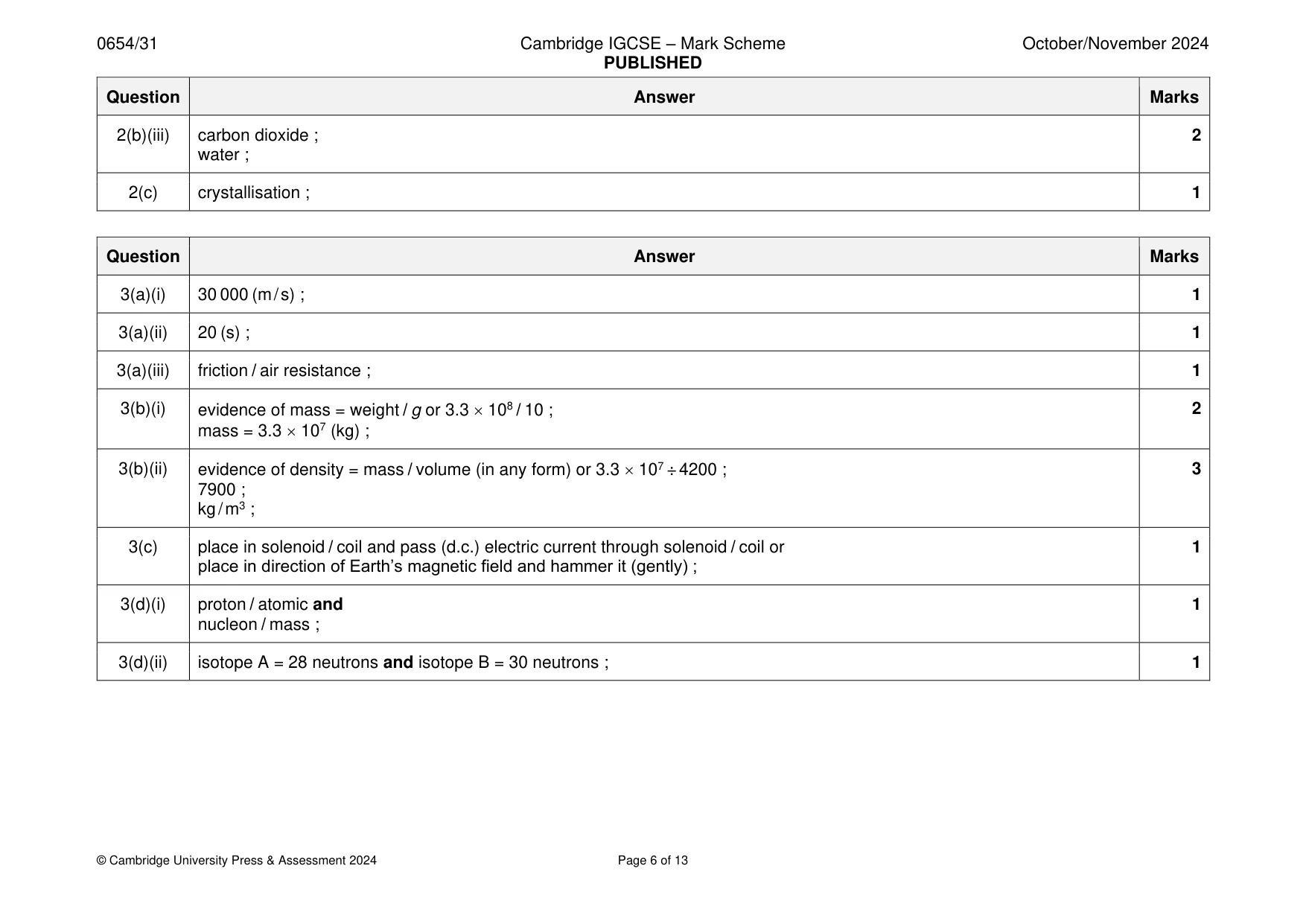
Mark scheme: 2(a)(i) CH4 ; 1 2(a)(ii) Cl2 ; 1 2(a)(iii) O2 ; 1 2(a)(iv) NaCl ; 1 2(a)(v) NH3 ; 1 2(b)(i) carbon dioxide is lost ; 1 2(b)(ii) increase temperature (of acid) ; 2 increase concentration (of acid) ; 2(b)(iii) carbon dioxide ; 2 water ; 2(c) crystallisation ; 1
Q3 · A rock that travels through space and hits the Earth’s surface is called a meteorite
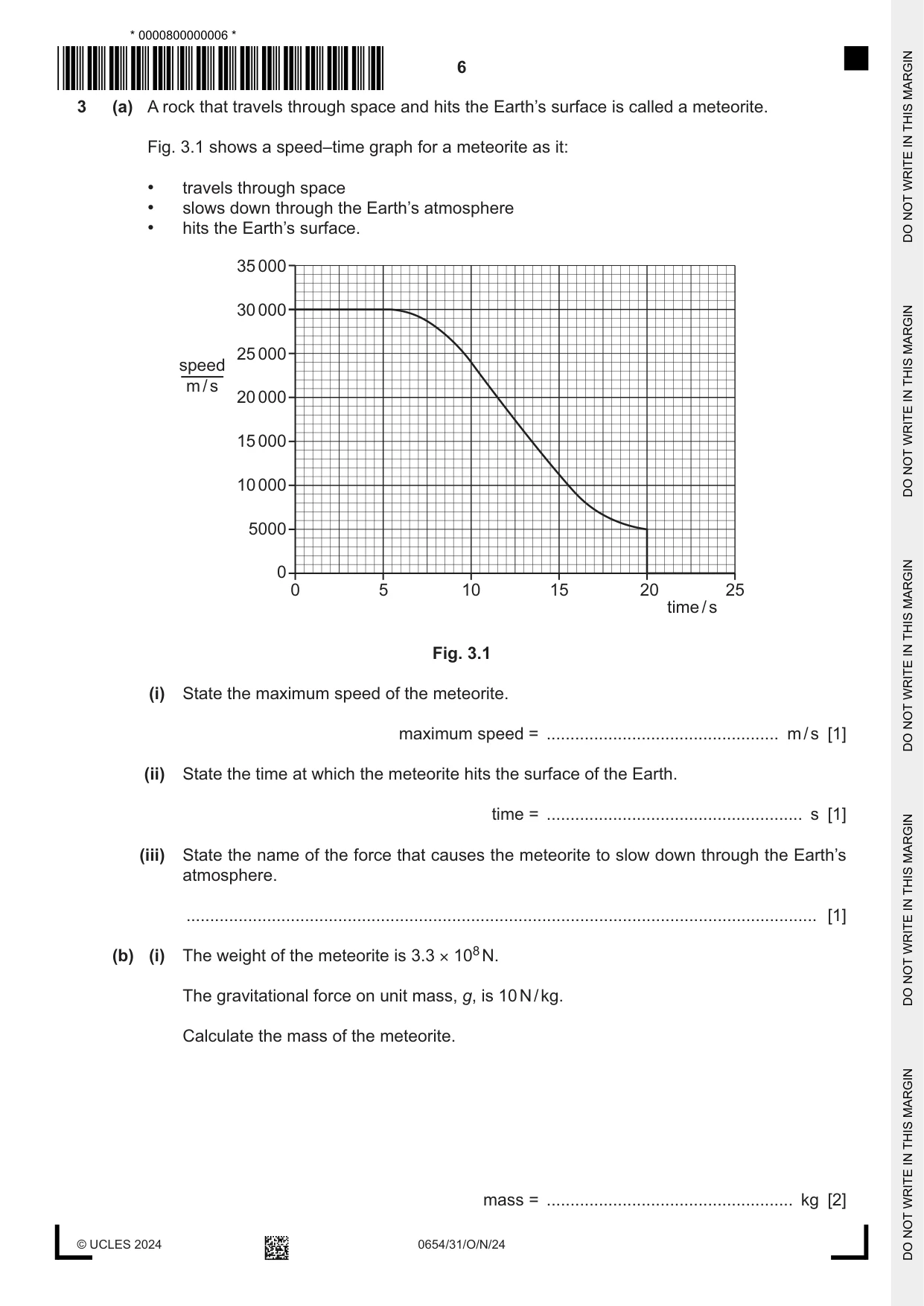
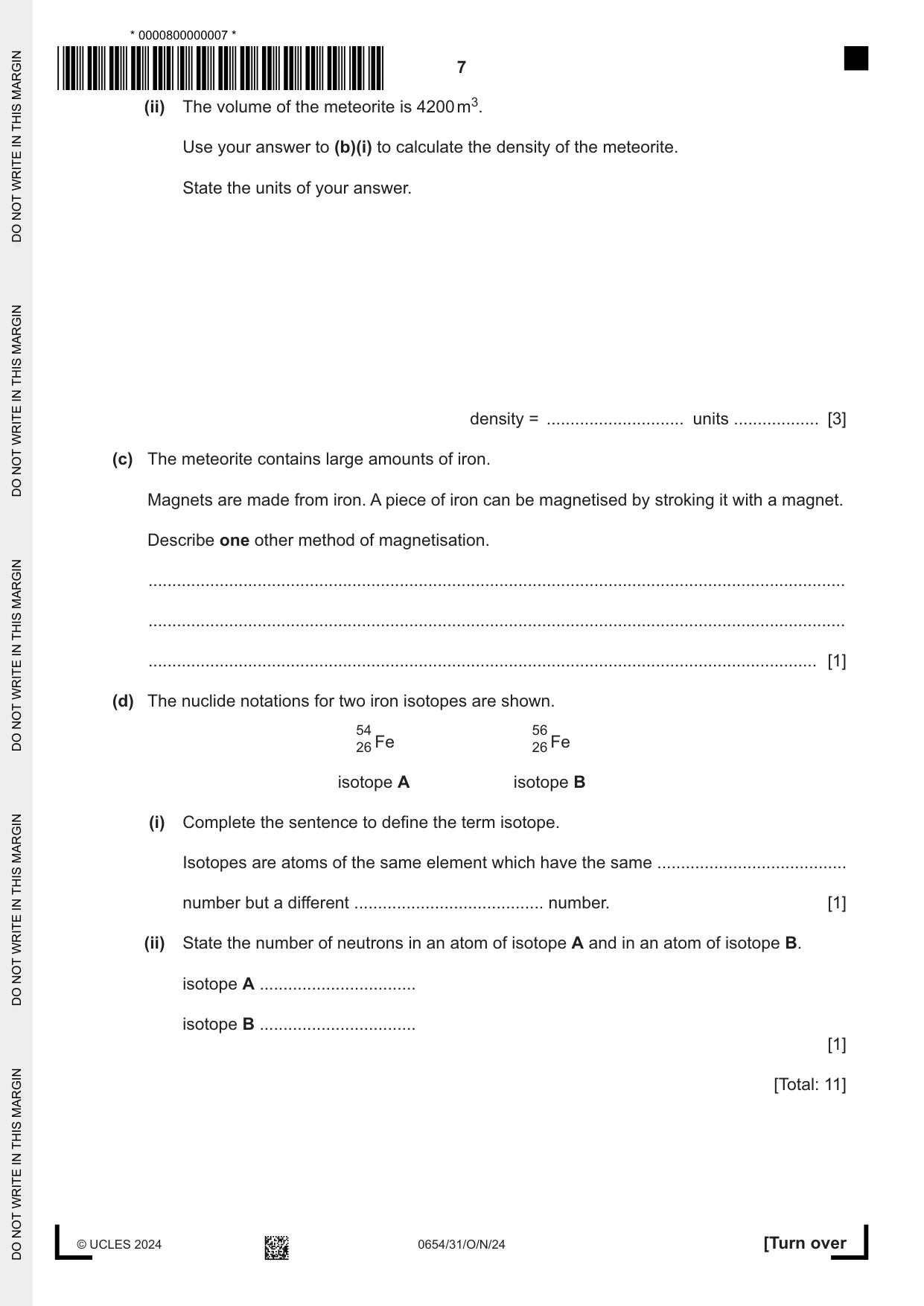
3 (a) A rock that travels through space and hits the Earth’s surface is called a meteorite. Fig. 3.1 shows a speed–time graph for a meteorite as it: • travels through space • slows down through the Earth’s atmosphere • hits the Earth’s surface. 35 000 30 000 25 000 speed m / s 20 000 15 000 10 000 5000 0 0 5 10 15 20 25 time / s Fig. 3.1 (i) State the maximum speed of the meteorite. maximum speed = ................................................. m / s [1] (ii) State the time at which the meteorite hits the surface of the Earth. time = ...................................................... s [1] (iii) State the name of the force that causes the meteorite to slow down through the Earth’s atmosphere. ..................................................................................................................................... [1] (b) (i) The weight of the meteorite is 3.3 × 10⁸ N. The gravitational force on unit mass, g, is 10 N / kg. Calculate the mass of the meteorite. mass = .................................................... kg [2] (ii) The volume of the meteorite is 4200 m3. Use your answer to (b)(i) to calculate the density of the meteorite. State the units of your answer. density = ............................. units .................. [3] (c) The meteorite contains large amounts of iron. Magnets are made from iron. A piece of iron can be magnetised by stroking it with a magnet. Describe one other method of magnetisation. ................................................................................................................................................... ................................................................................................................................................... ............................................................................................................................................. [1] (d) The nuclide notations for two iron isotopes are shown. 54 56 26 Fe 26 Fe isotope A isotope B (i) Complete the sentence to define the term isotope. Isotopes are atoms of the same element which have the same ........................................ number but a different ........................................ number. [1] (ii) State the number of neutrons in an atom of isotope A and in an atom of isotope B. isotope A ................................. isotope B ................................. [1] [Total: 11]
Mark scheme: 3(a)(i) 30 000 (m / s) ; 1 3(a)(ii) 20 (s) ; 1 3(a)(iii) friction / air resistance ; 1 3(b)(i) evidence of mass = weight / g or 3.3 108 / 10 ; 2 mass = 3.3 107 (kg) ; 3(b)(ii) evidence of density = mass / volume (in any form) or 3.3 107 ÷ 4200 ; 3 7900 ; kg / m3 ; 3(c) place in solenoid / coil and pass (d.c.) electric current through solenoid / coil or 1 place in direction of Earth’s magnetic field and hammer it (gently) ; 3(d)(i) proton / atomic and 1 nucleon / mass ; 3(d)(ii) isotope A = 28 neutrons and isotope B = 30 neutrons ; 1
Q4 · The number of new infections of HIV in one country was estimated in 2000 and 2018
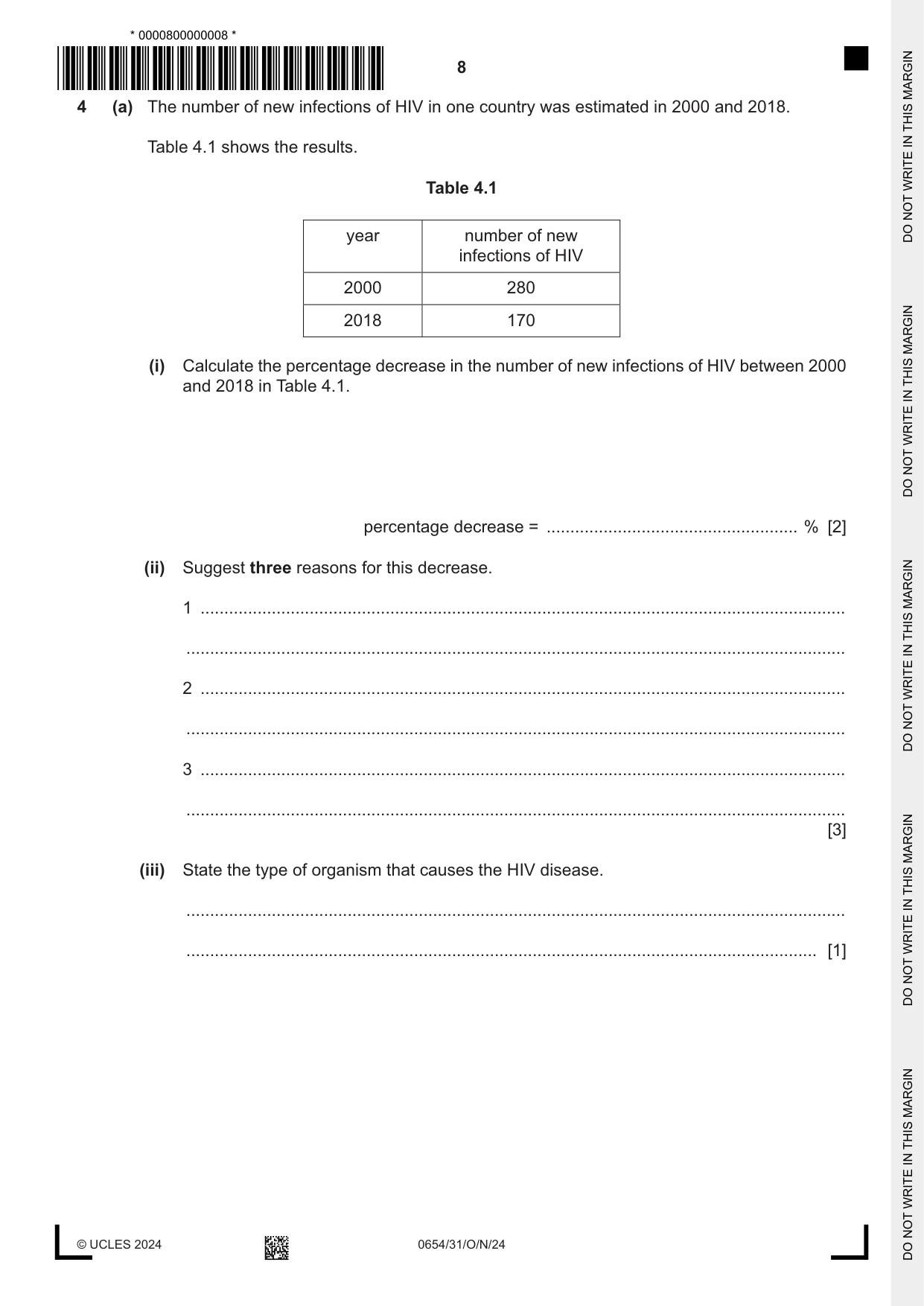
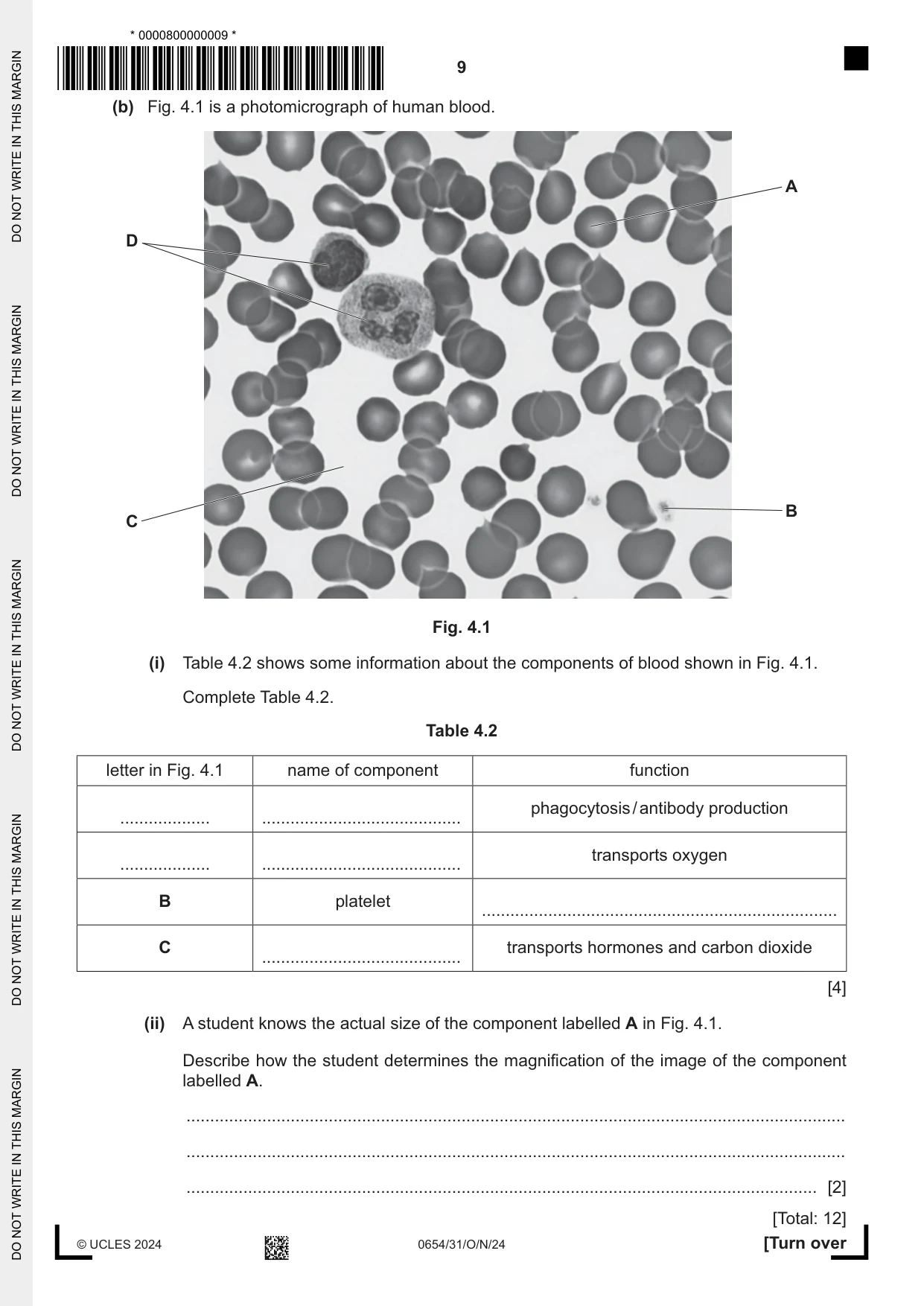
4 (a) The number of new infections of HIV in one country was estimated in 2000 and 2018. Table 4.1 shows the results. Table 4.1 year number of new infections of HIV 2000 280 2018 170 (i) Calculate the percentage decrease in the number of new infections of HIV between 2000 and 2018 in Table 4.1. percentage decrease = ..................................................... % [2] (ii) Suggest three reasons for this decrease. 1 ........................................................................................................................................ ........................................................................................................................................... 2 ........................................................................................................................................ ........................................................................................................................................... 3 ........................................................................................................................................ ........................................................................................................................................... [3] (iii) State the type of organism that causes the HIV disease. ........................................................................................................................................... ..................................................................................................................................... [1] (b) Fig. 4.1 is a photomicrograph of human blood. A D B C Fig. 4.1 (i) Table 4.2 shows some information about the components of blood shown in Fig. 4.1. Complete Table 4.2. Table 4.2 letter in Fig. 4.1 name of component function phagocytosis / antibody production ................... .......................................... transports oxygen ................... .......................................... B platelet ........................................................................... C transports hormones and carbon dioxide .......................................... [4] (ii) A student knows the actual size of the component labelled A in Fig. 4.1. Describe how the student determines the magnification of the image of the component labelled A. ........................................................................................................................................... ........................................................................................................................................... ..................................................................................................................................... [2] [Total: 12]
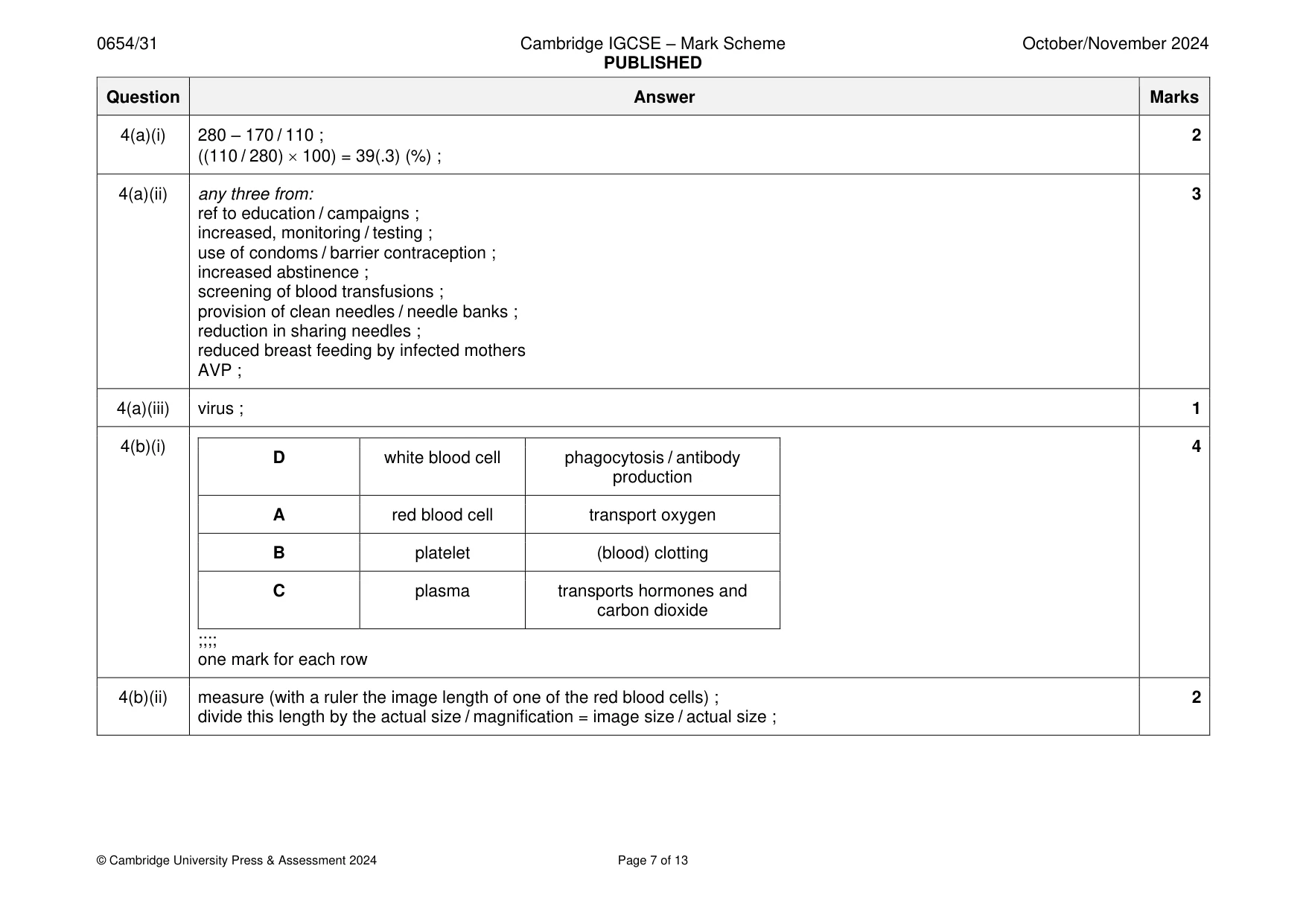
Mark scheme: 4(a)(i) 280 – 170 / 110 ; 2 ((110 / 280) 100) = 39(.3) (%) ; 4(a)(ii) any three from: 3 ref to education / campaigns ; increased, monitoring / testing ; use of condoms / barrier contraception ; increased abstinence ; screening of blood transfusions ; provision of clean needles / needle banks ; reduction in sharing needles ; reduced breast feeding by infected mothers AVP ; 4(a)(iii) virus ; 1 4(b)(i) 4 D white blood cell phagocytosis / antibody production A red blood cell transport oxygen B platelet (blood) clotting C plasma transports hormones and carbon dioxide ;;;; one mark for each row 4(b)(ii) measure (with a ruler the image length of one of the red blood cells) ; 2 divide this length by the actual size / magnification = image size / actual size ;
Q5 · The observations for the reactions of four metals with water
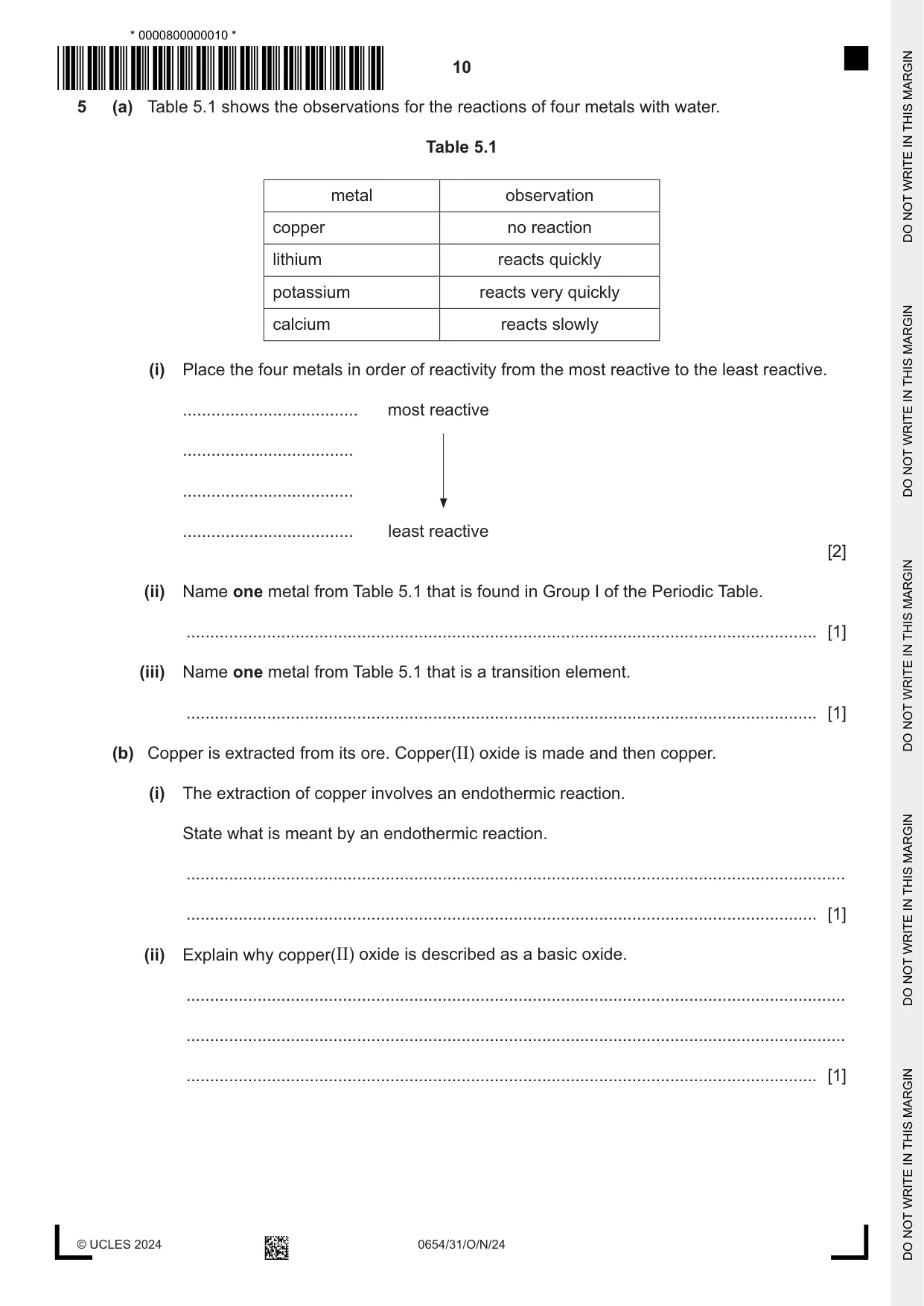
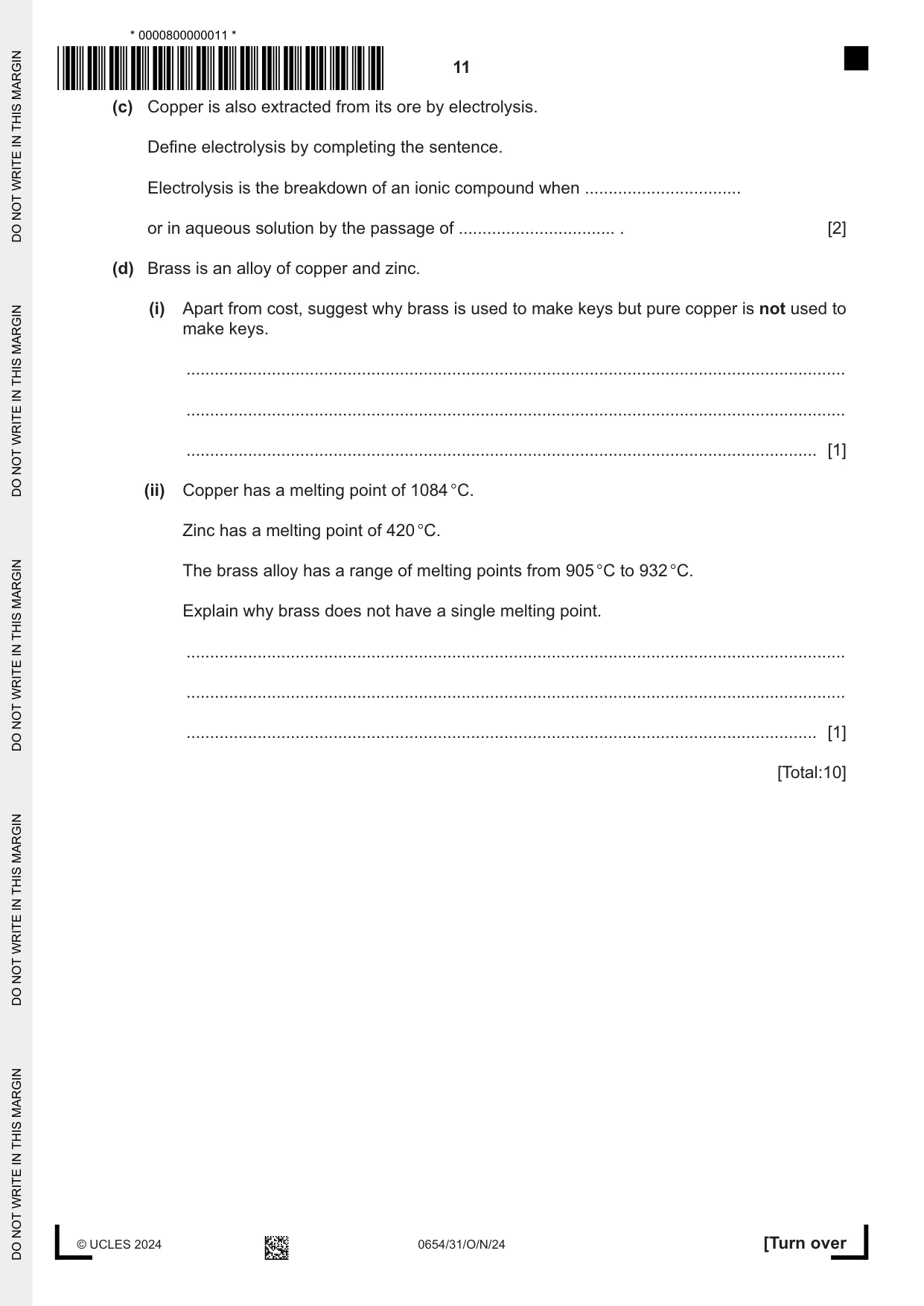
5 (a) Table 5.1 shows the observations for the reactions of four metals with water. Table 5.1 metal observation copper no reaction lithium reacts quickly potassium reacts very quickly calcium reacts slowly (i) Place the four metals in order of reactivity from the most reactive to the least reactive. ..................................... most reactive .................................... .................................... .................................... least reactive [2] (ii) Name one metal from Table 5.1 that is found in Group I of the Periodic Table. ..................................................................................................................................... [1] (iii) Name one metal from Table 5.1 that is a transition element. ..................................................................................................................................... [1] (b) Copper is extracted from its ore. Copper(II) oxide is made and then copper. (i) The extraction of copper involves an endothermic reaction. State what is meant by an endothermic reaction. ........................................................................................................................................... ..................................................................................................................................... [1] (ii) Explain why copper(II) oxide is described as a basic oxide. ........................................................................................................................................... ........................................................................................................................................... ..................................................................................................................................... [1] (c) Copper is also extracted from its ore by electrolysis. Define electrolysis by completing the sentence. Electrolysis is the breakdown of an ionic compound when ................................. or in aqueous solution by the passage of ................................. . [2] (d) Brass is an alloy of copper and zinc. (i) Apart from cost, suggest why brass is used to make keys but pure copper is not used to make keys. ........................................................................................................................................... ........................................................................................................................................... ..................................................................................................................................... [1] (ii) Copper has a melting point of 1084 °C. Zinc has a melting point of 420 °C. The brass alloy has a range of melting points from 905 °C to 932 °C. Explain why brass does not have a single melting point. ........................................................................................................................................... ........................................................................................................................................... ..................................................................................................................................... [1] [Total:10]
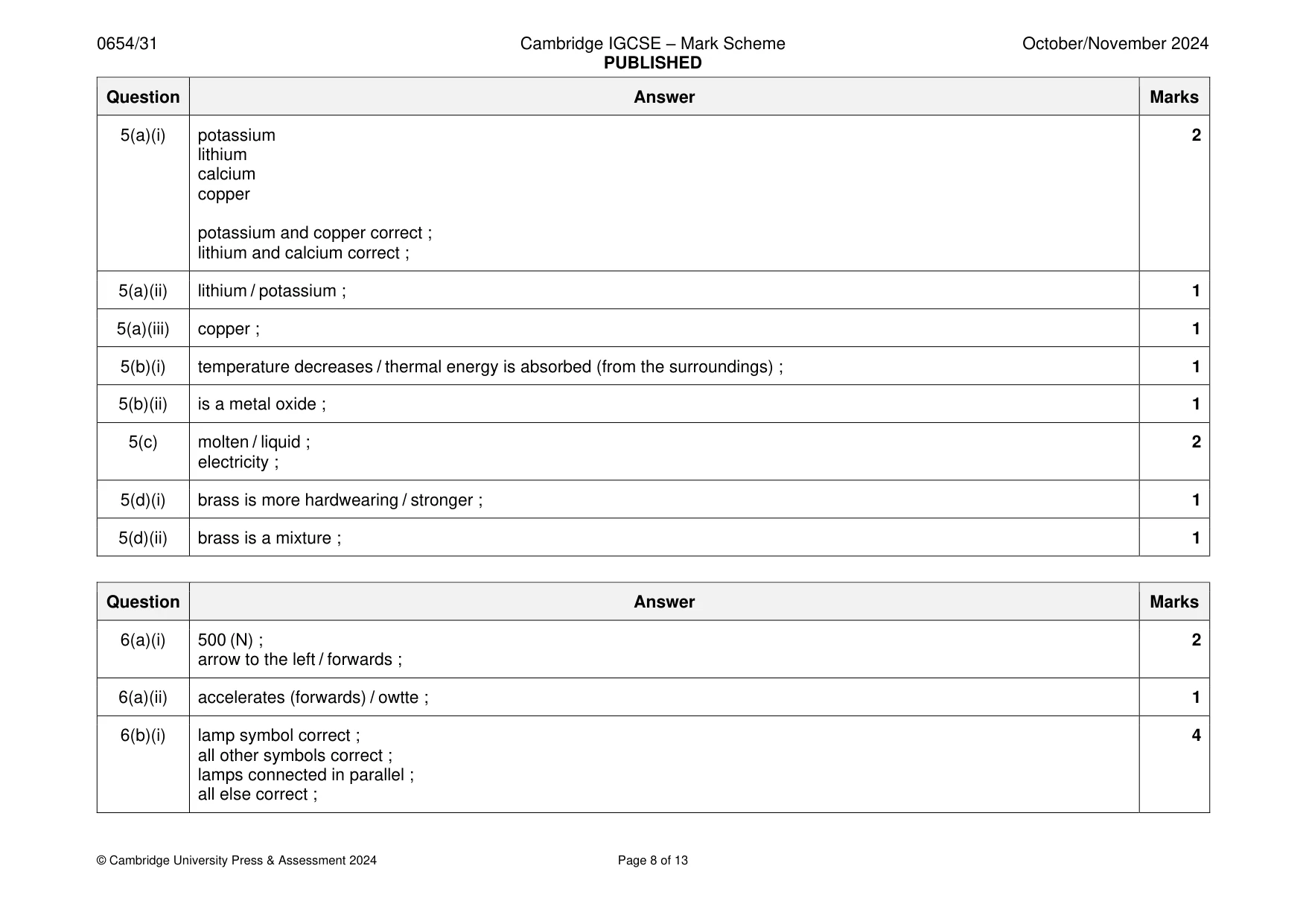
Mark scheme: 5(a)(i) potassium 2 lithium calcium copper potassium and copper correct ; lithium and calcium correct ; 5(a)(ii) lithium / potassium ; 1 5(a)(iii) copper ; 1 5(b)(i) temperature decreases / thermal energy is absorbed (from the surroundings) ; 1 5(b)(ii) is a metal oxide ; 1 5(c) molten / liquid ; 2 electricity ; 5(d)(i) brass is more hardwearing / stronger ; 1 5(d)(ii) brass is a mixture ; 1
Q6 · Two horizontal forces acting on a truck as it moves forwards along a flat, level road
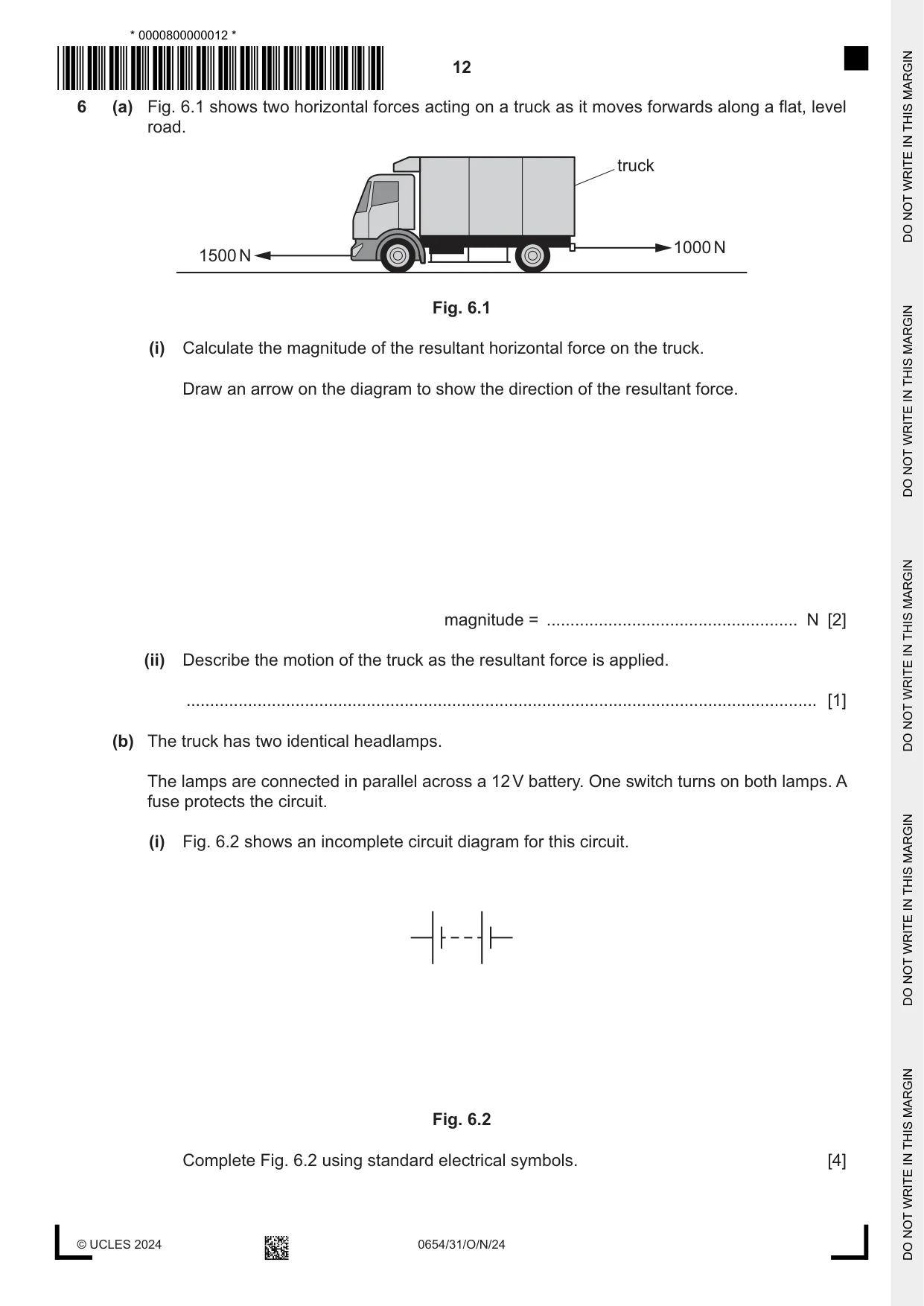
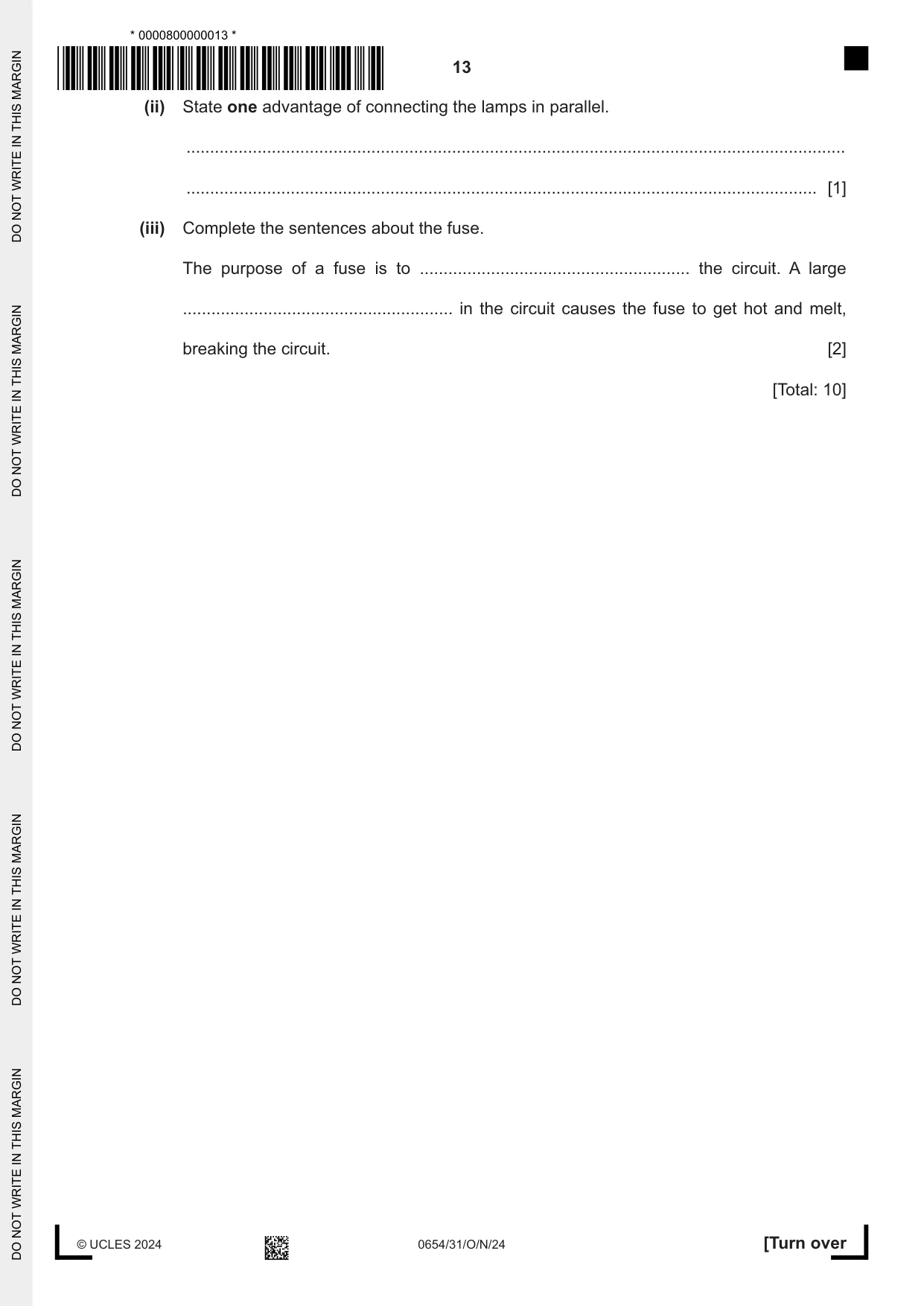
6 (a) Fig. 6.1 shows two horizontal forces acting on a truck as it moves forwards along a flat, level road. truck 1000 N 1500 N Fig. 6.1 (i) Calculate the magnitude of the resultant horizontal force on the truck. Draw an arrow on the diagram to show the direction of the resultant force. magnitude = ..................................................... N [2] (ii) Describe the motion of the truck as the resultant force is applied. ..................................................................................................................................... [1] (b) The truck has two identical headlamps. The lamps are connected in parallel across a 12 V battery. One switch turns on both lamps. A fuse protects the circuit. (i) Fig. 6.2 shows an incomplete circuit diagram for this circuit. Fig. 6.2 Complete Fig. 6.2 using standard electrical symbols. [4] (ii) State one advantage of connecting the lamps in parallel. ........................................................................................................................................... ..................................................................................................................................... [1] (iii) Complete the sentences about the fuse. The purpose of a fuse is to ......................................................... the circuit. A large ......................................................... in the circuit causes the fuse to get hot and melt, breaking the circuit. [2] [Total: 10]
Mark scheme: 6(a)(i) 500 (N) ; 2 arrow to the left / forwards ; 6(a)(ii) accelerates (forwards) / owtte ; 1 6(b)(i) lamp symbol correct ; 4 all other symbols correct ; lamps connected in parallel ; all else correct ; 6(b)(ii) both lamps get full voltage / if one lamp stops working, the other still works ; 1 6(b)(iii) protect ; 2 current ;
Q7 · Tick (3) the correct definition of inheritance
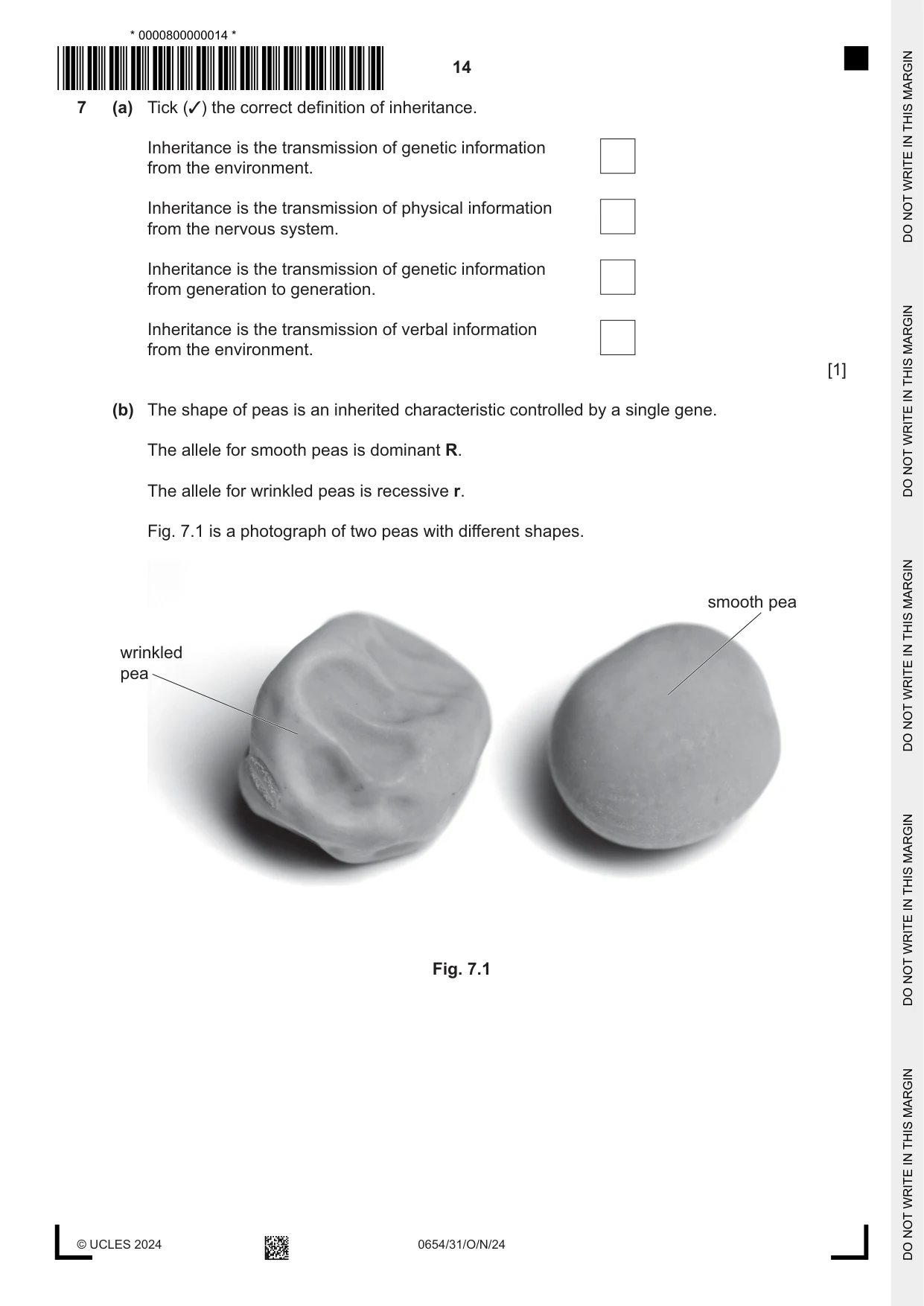
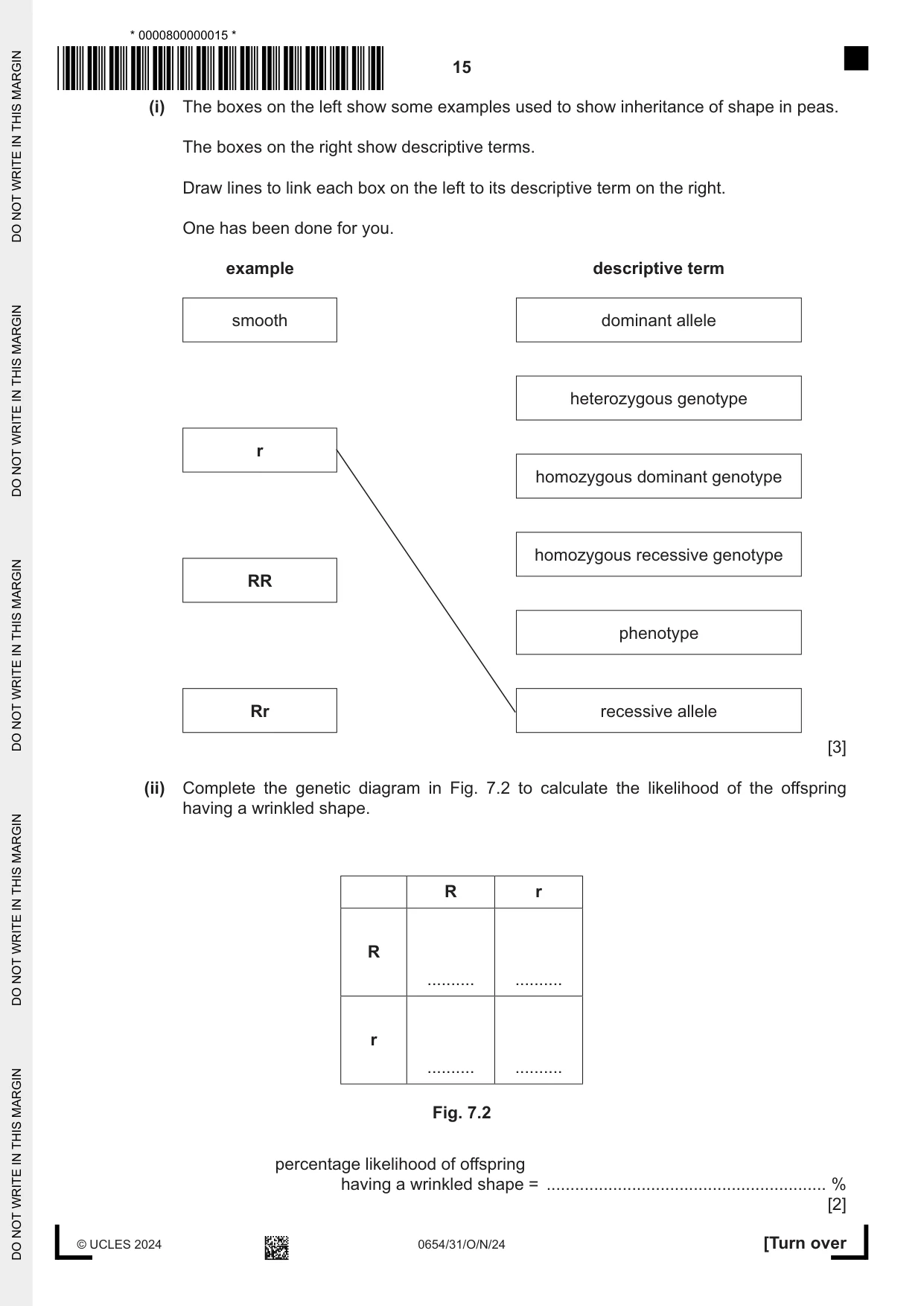
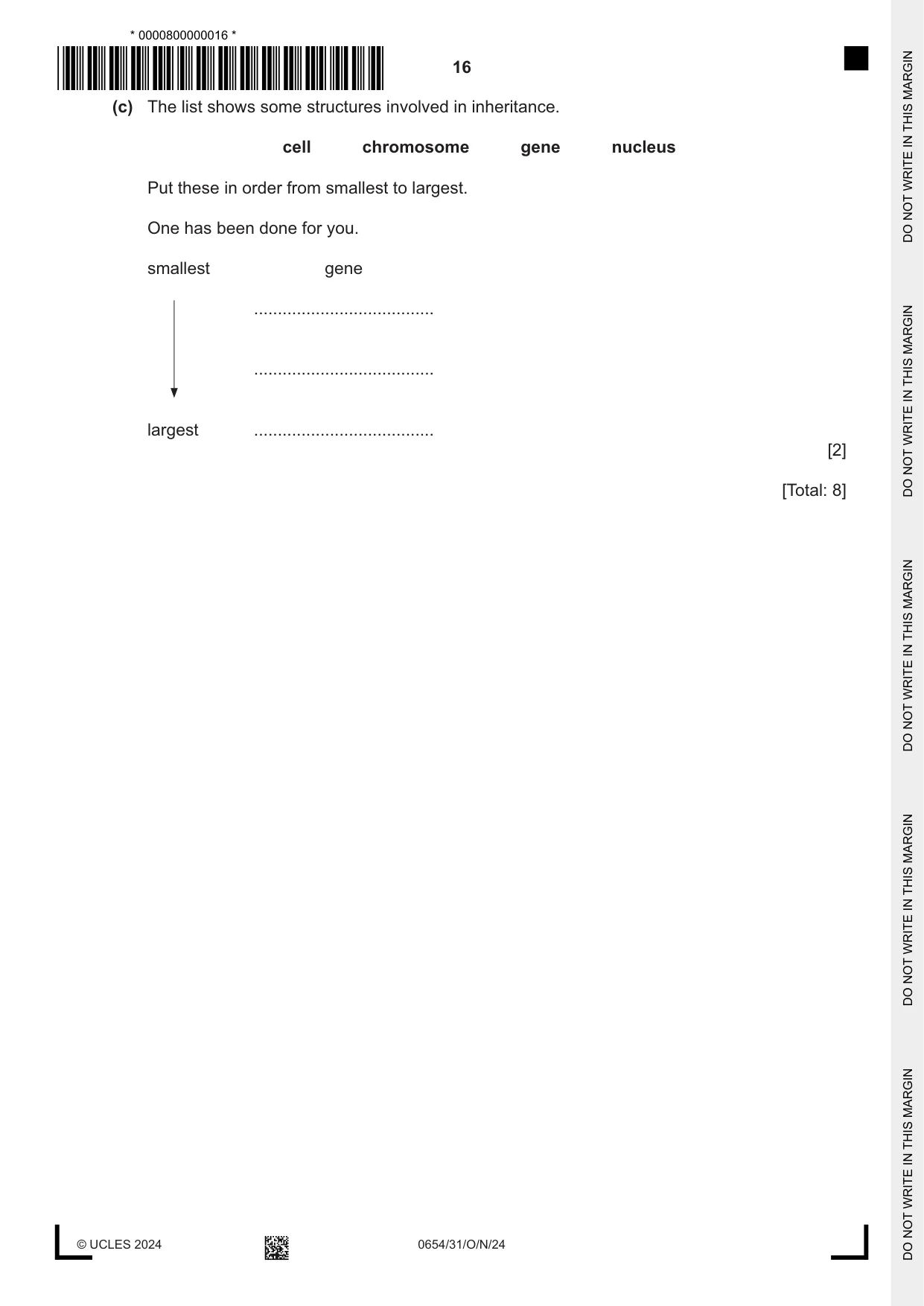
7 (a) Tick (3) the correct definition of inheritance. Inheritance is the transmission of genetic information from the environment. Inheritance is the transmission of physical information from the nervous system. Inheritance is the transmission of genetic information from generation to generation. Inheritance is the transmission of verbal information from the environment. [1] (b) The shape of peas is an inherited characteristic controlled by a single gene. The allele for smooth peas is dominant R. The allele for wrinkled peas is recessive r. Fig. 7.1 is a photograph of two peas with different shapes. smooth pea wrinkled pea Fig. 7.1 (i) The boxes on the left show some examples used to show inheritance of shape in peas. The boxes on the right show descriptive terms. Draw lines to link each box on the left to its descriptive term on the right. One has been done for you. example descriptive term smooth dominant allele heterozygous genotype r homozygous dominant genotype homozygous recessive genotype RR phenotype Rr recessive allele [3] (ii) Complete the genetic diagram in Fig. 7.2 to calculate the likelihood of the offspring having a wrinkled shape. R r R .......... .......... r .......... .......... Fig. 7.2 percentage likelihood of offspring having a wrinkled shape = ........................................................... % [2] (c) The list shows some structures involved in inheritance. cell chromosome gene nucleus Put these in order from smallest to largest. One has been done for you. smallest gene ...................................... ...................................... largest ...................................... [2] [Total: 8]
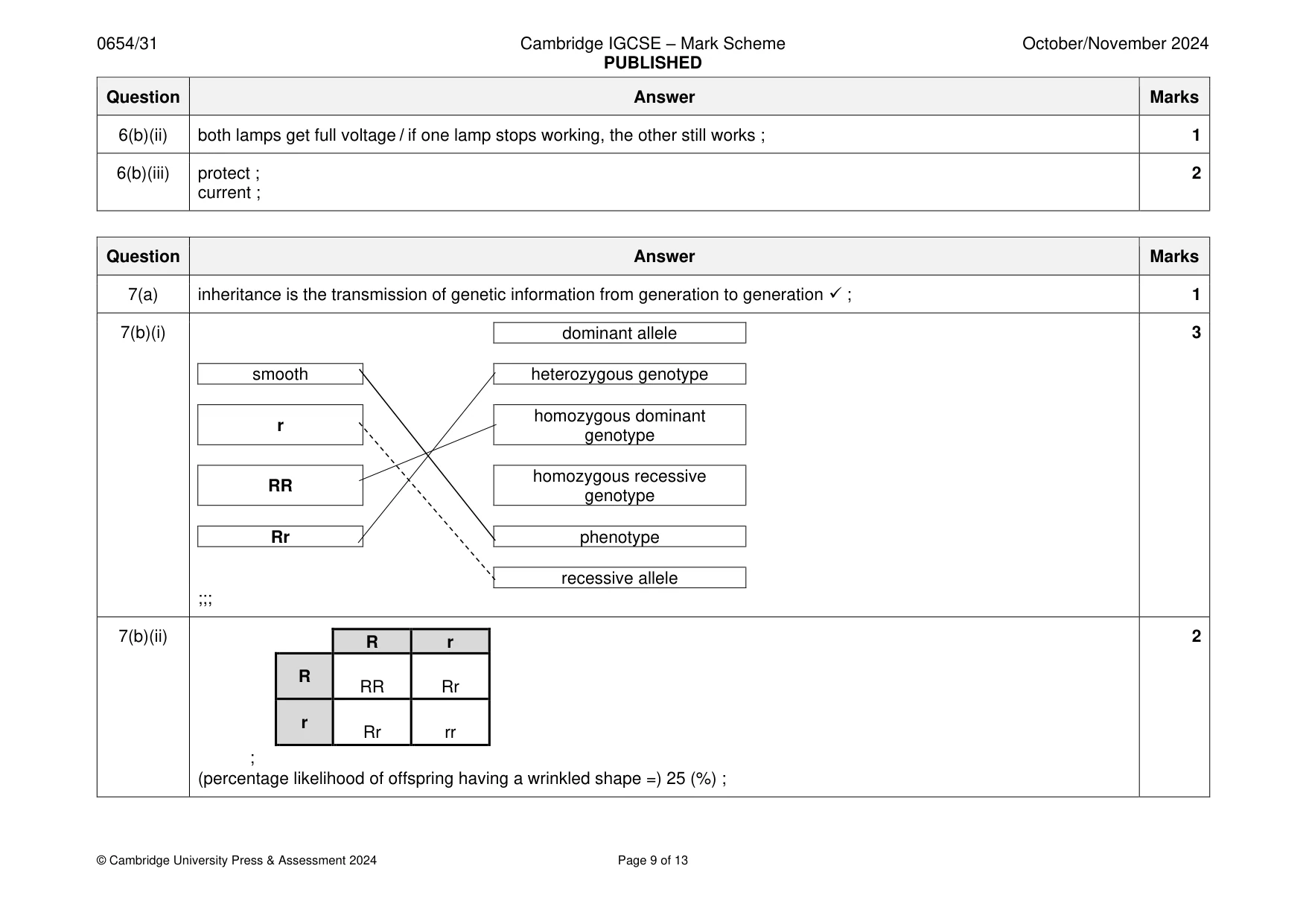
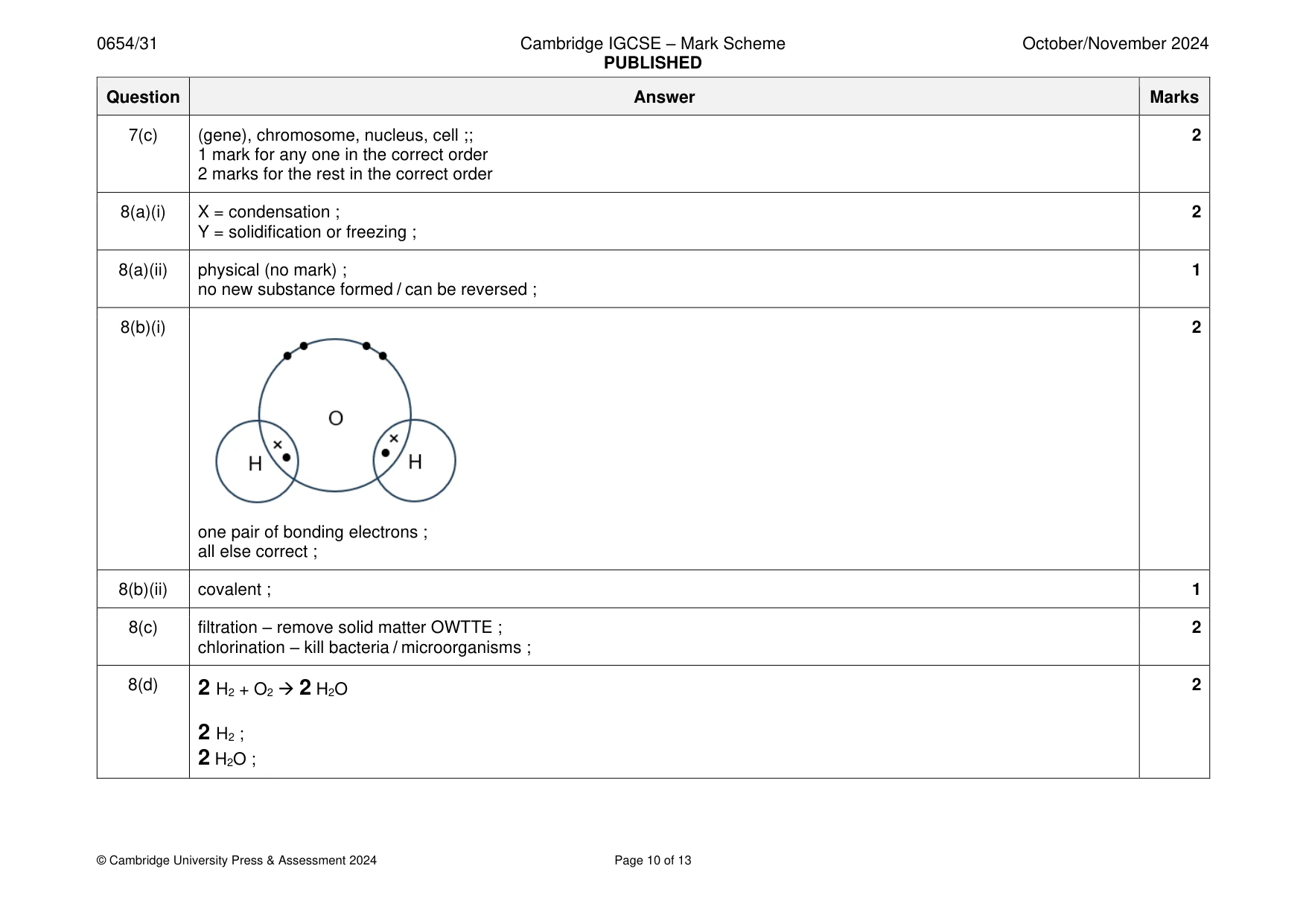
Mark scheme: 7(a) inheritance is the transmission of genetic information from generation to generation ✓ ; 1 7(b)(i) dominant allele 3 smooth heterozygous genotype homozygous dominant r genotype homozygous recessive RR genotype Rr phenotype recessive allele ;;; 7(b)(ii) 2 R r R RR Rr r Rr rr ; (percentage likelihood of offspring having a wrinkled shape =) 25 (%) ; 7(c) (gene), chromosome, nucleus, cell ;; 2 1 mark for any one in the correct order 2 marks for the rest in the correct order
Q8 · The changes of state of water
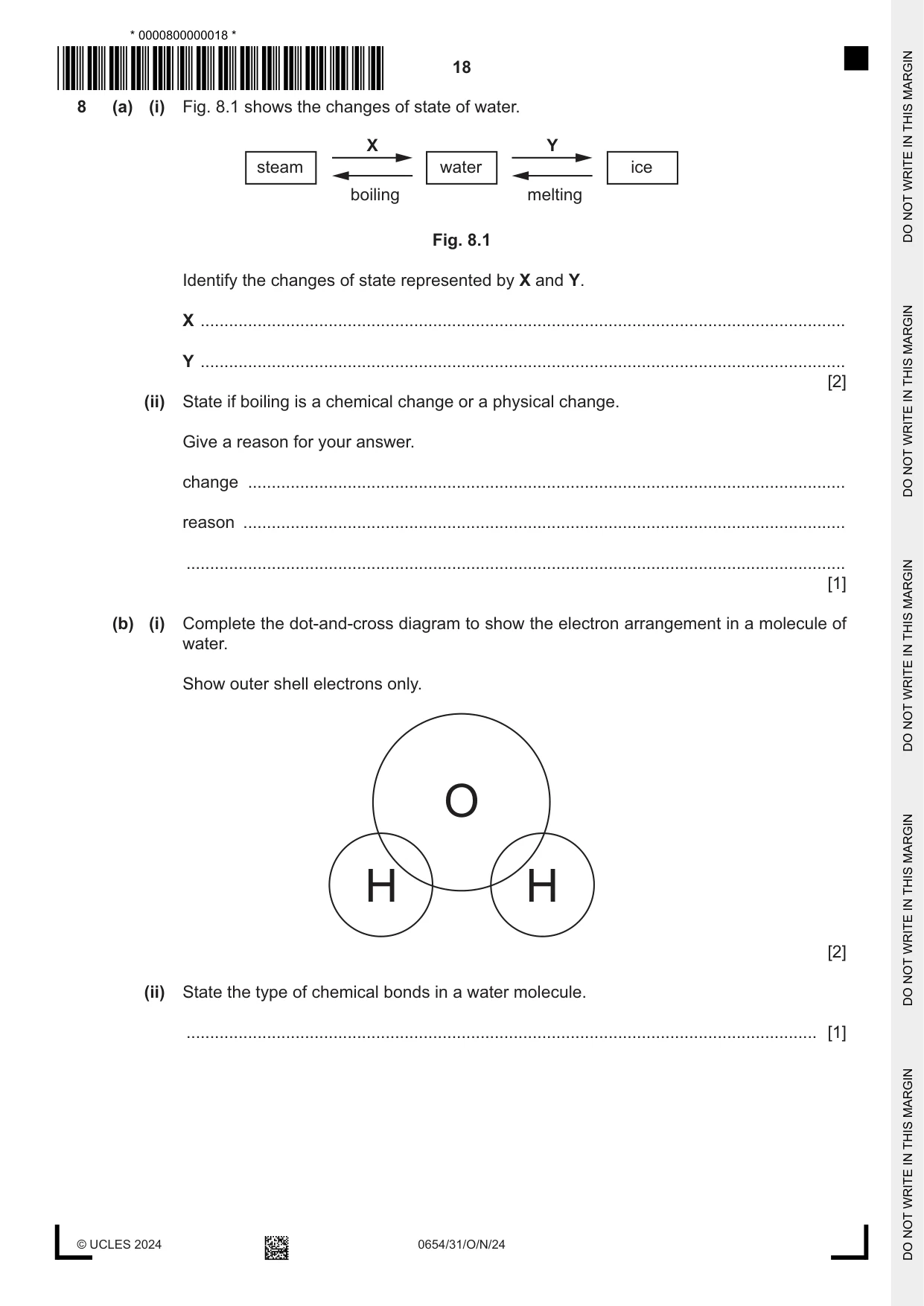
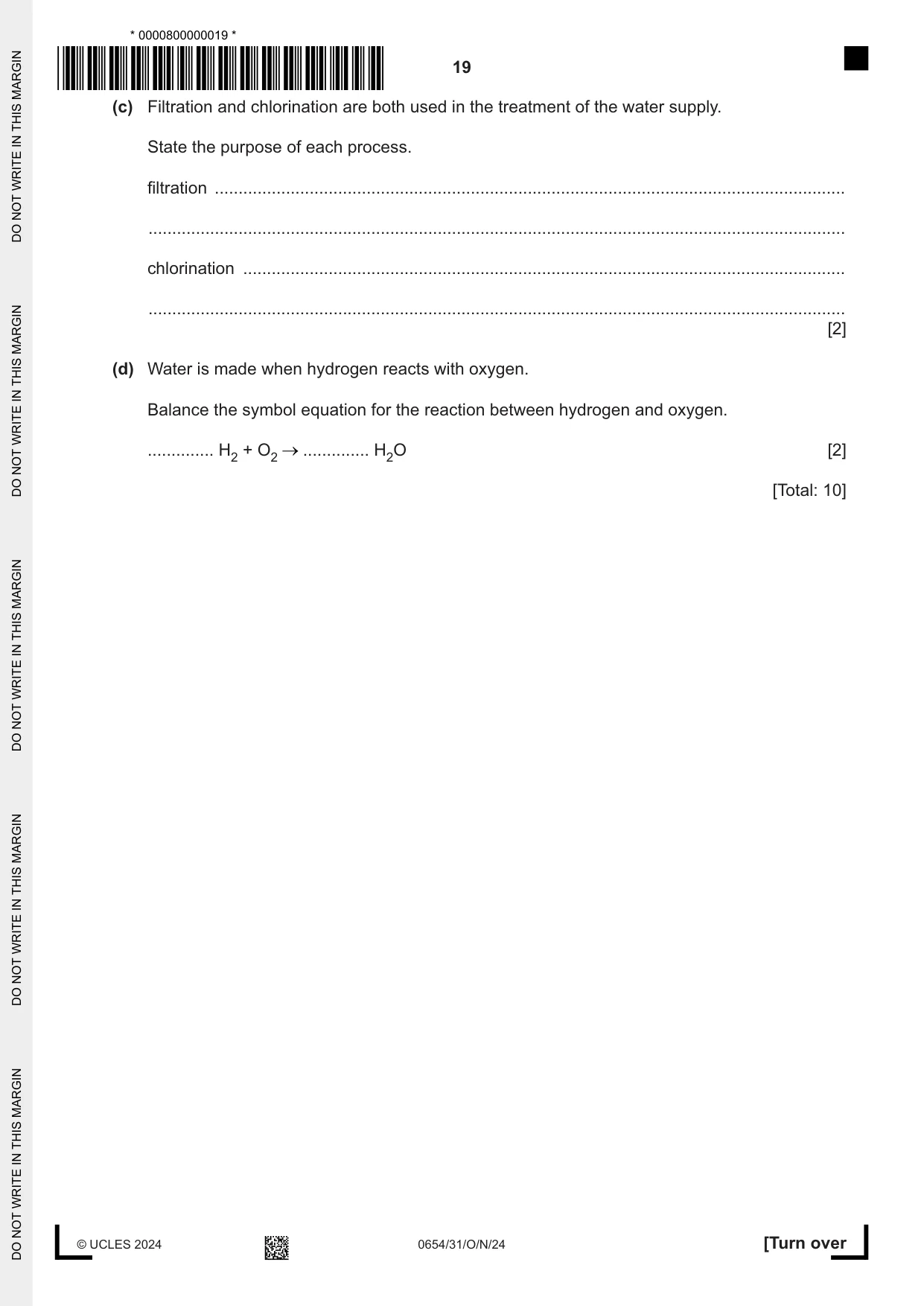
8 (a) (i) Fig. 8.1 shows the changes of state of water. X Y steam water ice boiling melting Fig. 8.1 Identify the changes of state represented by X and Y. X ........................................................................................................................................ Y ........................................................................................................................................ [2] (ii) State if boiling is a chemical change or a physical change. Give a reason for your answer. change .............................................................................................................................. reason ............................................................................................................................... ........................................................................................................................................... [1] (b) (i) Complete the dot-and-cross diagram to show the electron arrangement in a molecule of water. Show outer shell electrons only. O H H [2] (ii) State the type of chemical bonds in a water molecule. ..................................................................................................................................... [1] (c) Filtration and chlorination are both used in the treatment of the water supply. State the purpose of each process. filtration ..................................................................................................................................... ................................................................................................................................................... chlorination ............................................................................................................................... ................................................................................................................................................... [2] (d) Water is made when hydrogen reacts with oxygen. Balance the symbol equation for the reaction between hydrogen and oxygen. .............. H2 + O2 .............. H2O [2] [Total: 10]
Mark scheme: 8(a)(i) X = condensation ; 2 Y = solidification or freezing ; 8(a)(ii) physical (no mark) ; 1 no new substance formed / can be reversed ; 8(b)(i) 2 one pair of bonding electrons ; all else correct ; 8(b)(ii) covalent ; 1 8(c) filtration – remove solid matter OWTTE ; 2 chlorination – kill bacteria / microorganisms ; 8(d) 2 H2 + O2 → 2 H2O 2 2 H2 ; 2 H2O ;
Question 9
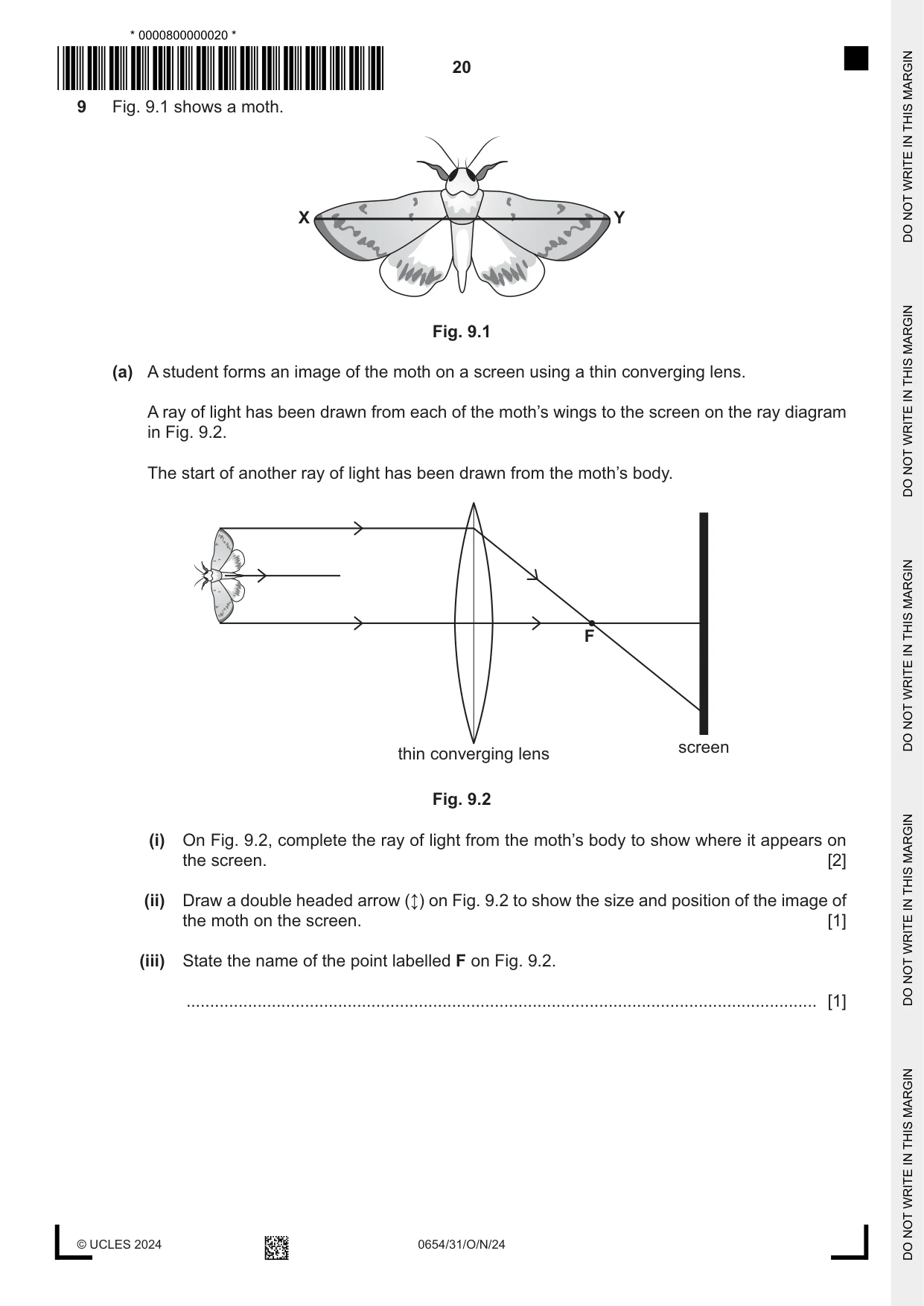
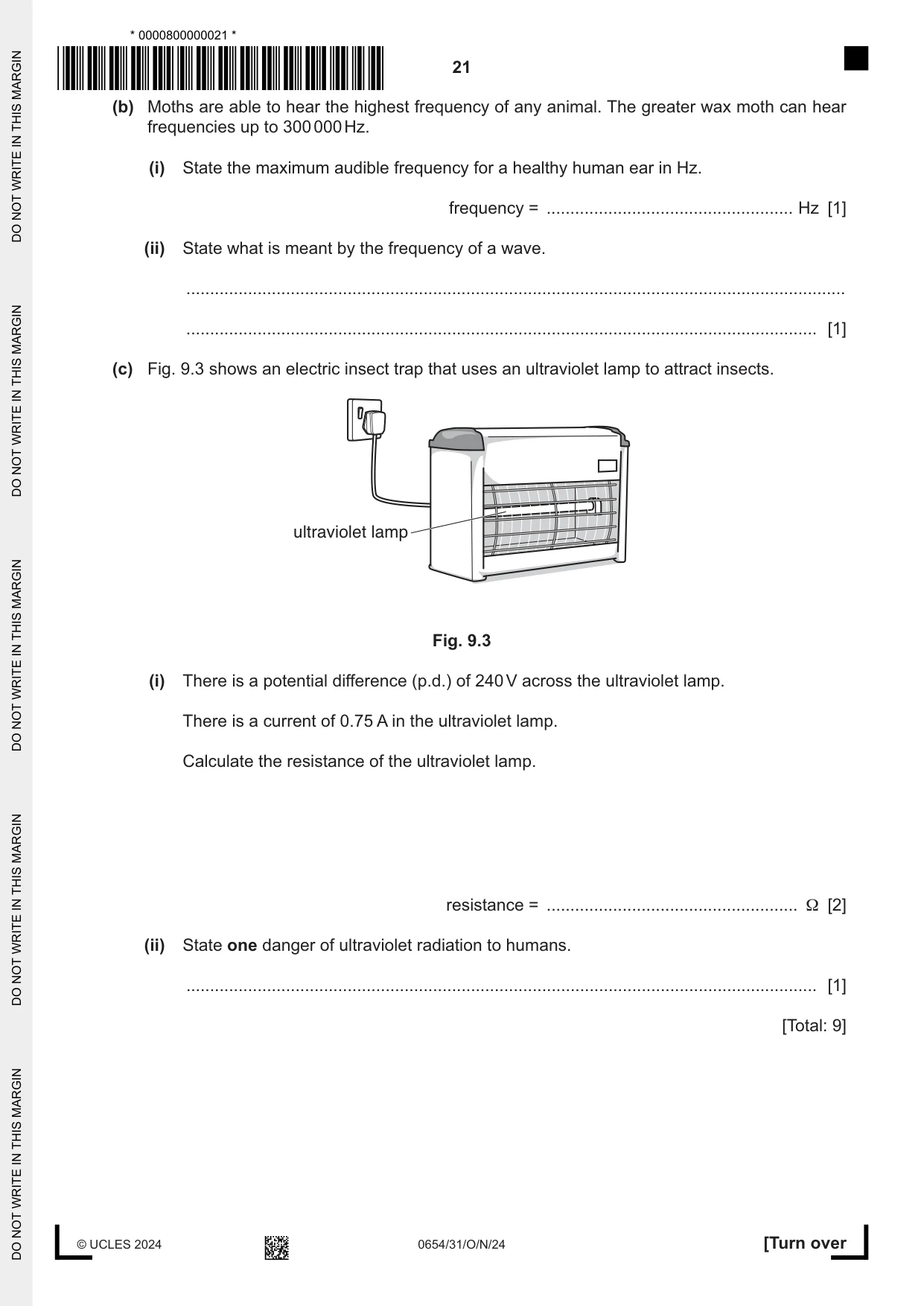
9 Fig. 9.1 shows a moth. X Y Fig. 9.1 (a) A student forms an image of the moth on a screen using a thin converging lens. A ray of light has been drawn from each of the moth’s wings to the screen on the ray diagram in Fig. 9.2. The start of another ray of light has been drawn from the moth’s body. F screen thin converging lens Fig. 9.2 (i) On Fig. 9.2, complete the ray of light from the moth’s body to show where it appears on the screen. [2] (ii) Draw a double headed arrow (↕) on Fig. 9.2 to show the size and position of the image of the moth on the screen. [1] (iii) State the name of the point labelled F on Fig. 9.2. ..................................................................................................................................... [1] (b) Moths are able to hear the highest frequency of any animal. The greater wax moth can hear frequencies up to 300 000 Hz. (i) State the maximum audible frequency for a healthy human ear in Hz. frequency = .................................................... Hz [1] (ii) State what is meant by the frequency of a wave. ........................................................................................................................................... ..................................................................................................................................... [1] (c) Fig. 9.3 shows an electric insect trap that uses an ultraviolet lamp to attract insects. ultraviolet lamp Fig. 9.3 (i) There is a potential difference (p.d.) of 240 V across the ultraviolet lamp. There is a current of 0.75 A in the ultraviolet lamp. Calculate the resistance of the ultraviolet lamp. resistance = ..................................................... Ω [2] (ii) State one danger of ultraviolet radiation to humans. ..................................................................................................................................... [1] [Total: 9]
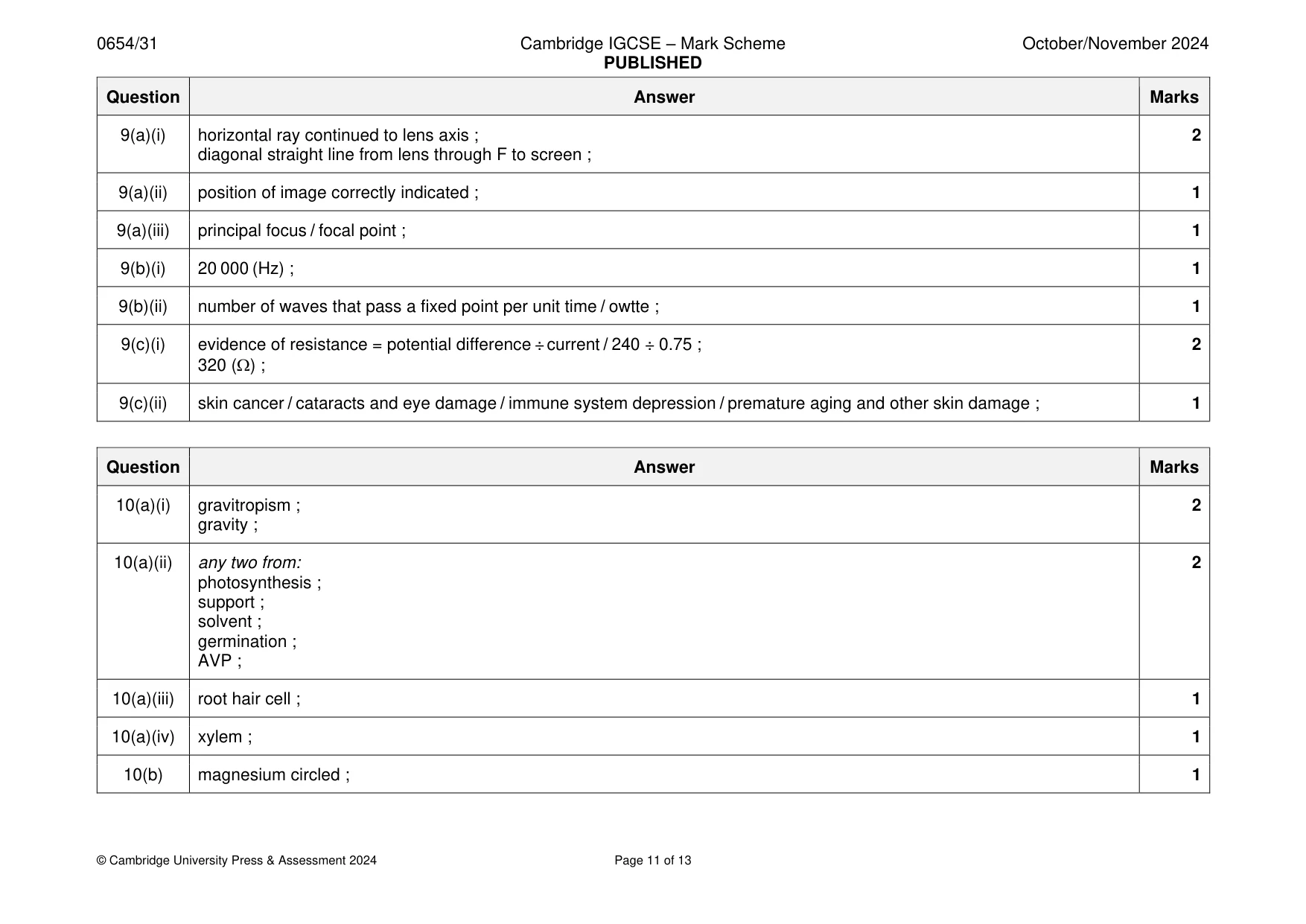
Mark scheme: 9(a)(i) horizontal ray continued to lens axis ; 2 diagonal straight line from lens through F to screen ; 9(a)(ii) position of image correctly indicated ; 1 9(a)(iii) principal focus / focal point ; 1 9(b)(i) 20 000 (Hz) ; 1 9(b)(ii) number of waves that pass a fixed point per unit time / owtte ; 1 9(c)(i) evidence of resistance = potential difference ÷ current / 240 ÷ 0.75 ; 2 320 () ; 9(c)(ii) skin cancer / cataracts and eye damage / immune system depression / premature aging and other skin damage ; 1
Q10 · A student investigates responses in seeds
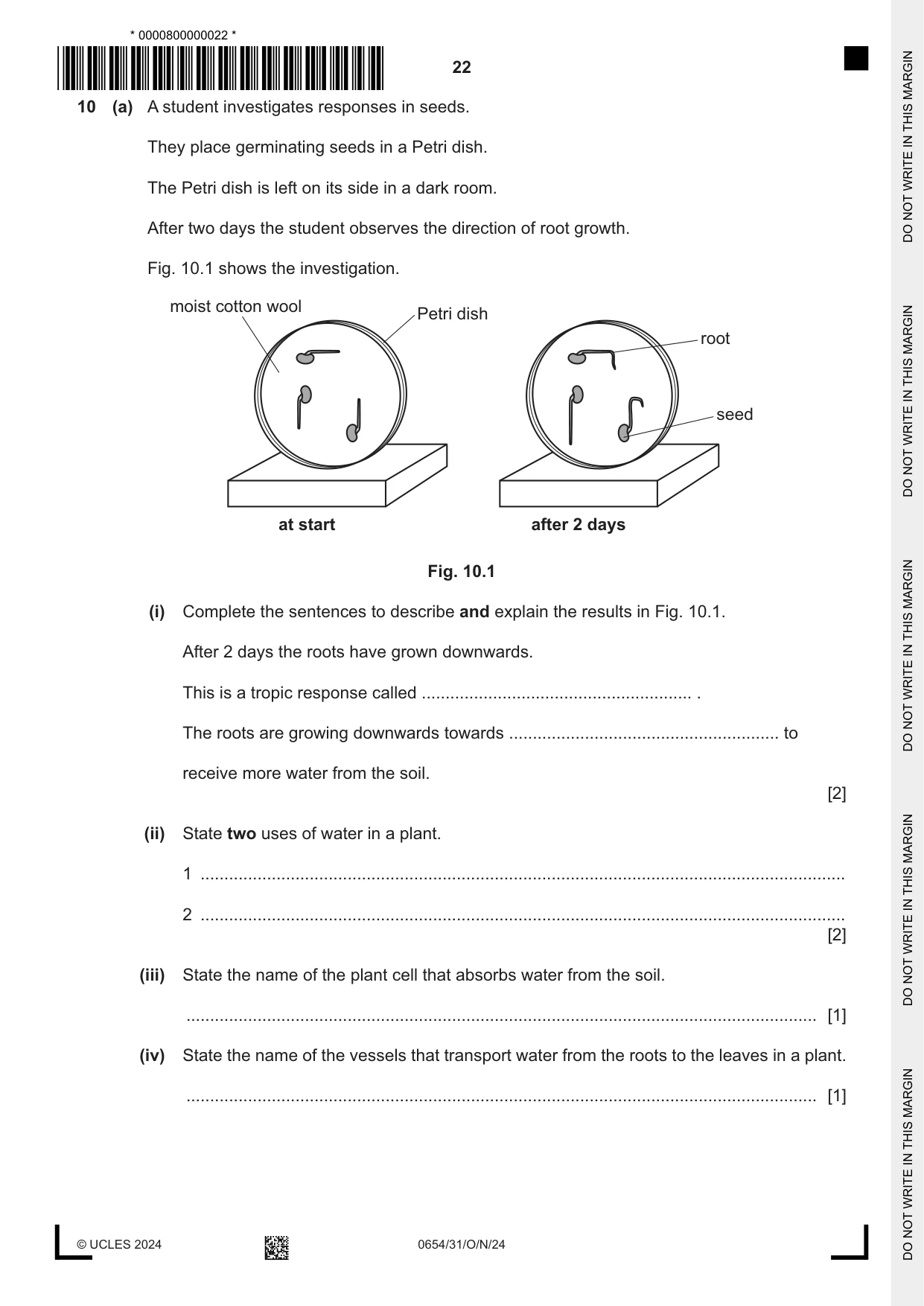
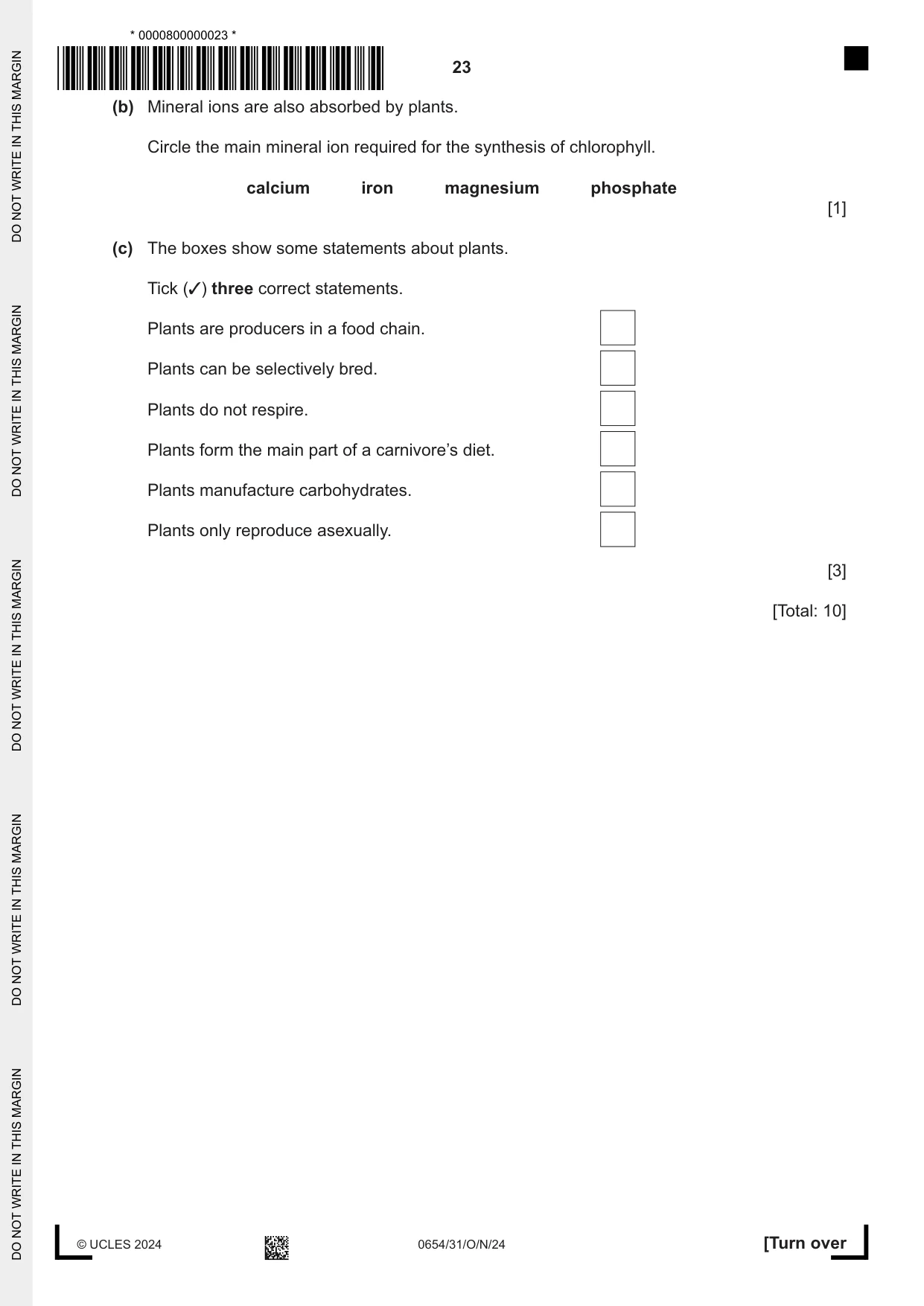
10 (a) A student investigates responses in seeds. They place germinating seeds in a Petri dish. The Petri dish is left on its side in a dark room. After two days the student observes the direction of root growth. Fig. 10.1 shows the investigation. moist cotton wool Petri dish root seed at start after 2 days Fig. 10.1 (i) Complete the sentences to describe and explain the results in Fig. 10.1. After 2 days the roots have grown downwards. This is a tropic response called ......................................................... . The roots are growing downwards towards ......................................................... to receive more water from the soil. [2] (ii) State two uses of water in a plant. 1 ........................................................................................................................................ 2 ........................................................................................................................................ [2] (iii) State the name of the plant cell that absorbs water from the soil. ..................................................................................................................................... [1] (iv) State the name of the vessels that transport water from the roots to the leaves in a plant. ..................................................................................................................................... [1] (b) Mineral ions are also absorbed by plants. Circle the main mineral ion required for the synthesis of chlorophyll. calcium iron magnesium phosphate [1] (c) The boxes show some statements about plants. Tick (3) three correct statements. Plants are producers in a food chain. Plants can be selectively bred. Plants do not respire. Plants form the main part of a carnivore’s diet. Plants manufacture carbohydrates. Plants only reproduce asexually. [3] [Total: 10]
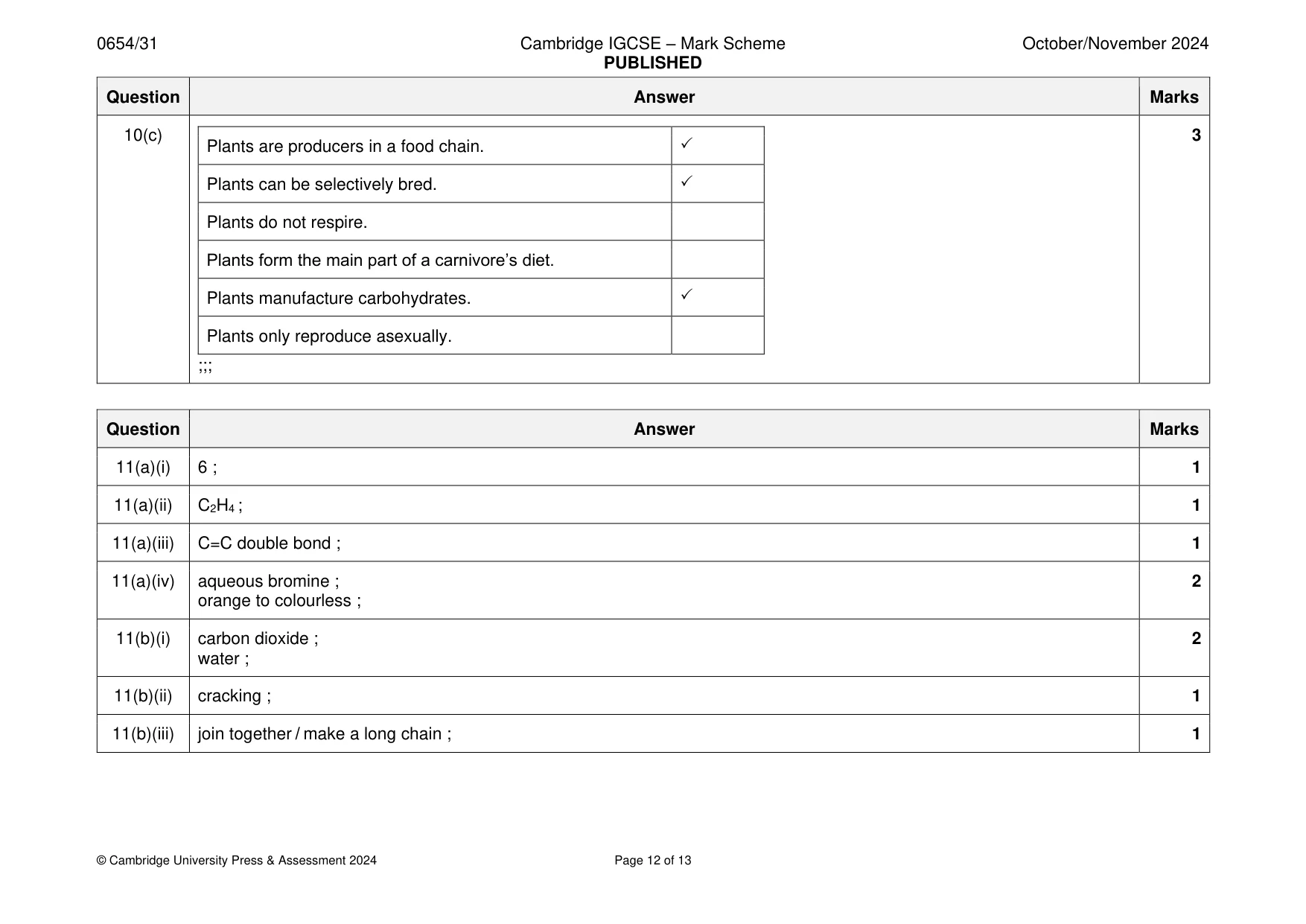
Mark scheme: 10(a)(i) gravitropism ; 2 gravity ; 10(a)(ii) any two from: 2 photosynthesis ; support ; solvent ; germination ; AVP ; 10(a)(iii) root hair cell ; 1 10(a)(iv) xylem ; 1 10(b) magnesium circled ; 1 10(c) 3 Plants are producers in a food chain. Plants can be selectively bred. Plants do not respire. Plants form the main part of a carnivore’s diet. Plants manufacture carbohydrates. Plants only reproduce asexually. ;;;
Q11 · The molecular structure of ethene
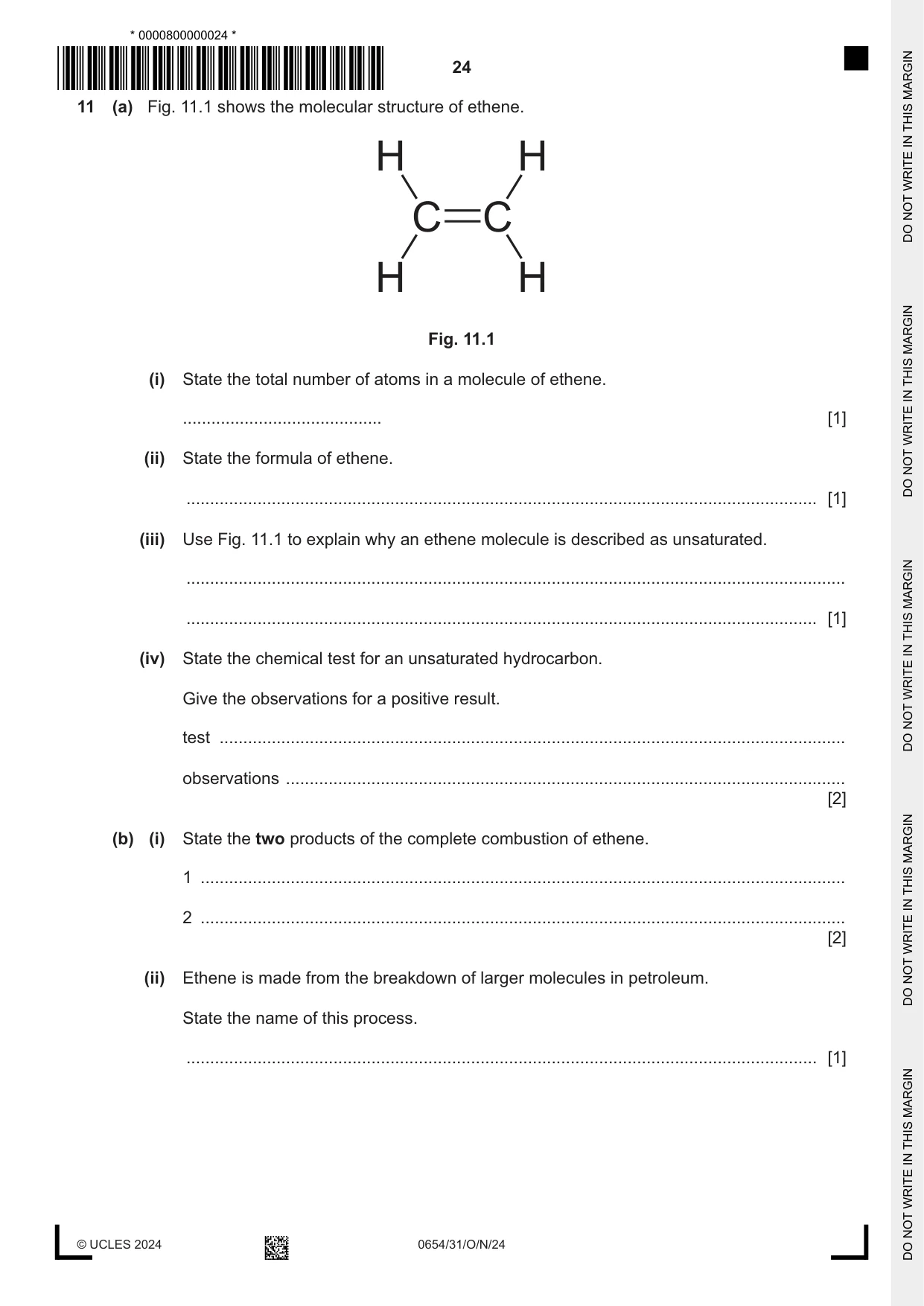
11 (a) Fig. 11.1 shows the molecular structure of ethene. H H C C H H Fig. 11.1 (i) State the total number of atoms in a molecule of ethene. .......................................... [1] (ii) State the formula of ethene. ..................................................................................................................................... [1] (iii) Use Fig. 11.1 to explain why an ethene molecule is described as unsaturated. ........................................................................................................................................... ..................................................................................................................................... [1] (iv) State the chemical test for an unsaturated hydrocarbon. Give the observations for a positive result. test .................................................................................................................................... observations ...................................................................................................................... [2] (b) (i) State the two products of the complete combustion of ethene. 1 ........................................................................................................................................ 2 ........................................................................................................................................ [2] (ii) Ethene is made from the breakdown of larger molecules in petroleum. State the name of this process. ..................................................................................................................................... [1] (iii) Polymerisation of ethene produces poly(ethene). Describe what happens to ethene molecules during polymerisation. ........................................................................................................................................... ..................................................................................................................................... [1] [Total: 9]
Mark scheme: 11(a)(i) 6 ; 1 11(a)(ii) C2H4 ; 1 11(a)(iii) C=C double bond ; 1 11(a)(iv) aqueous bromine ; 2 orange to colourless ; 11(b)(i) carbon dioxide ; 2 water ; 11(b)(ii) cracking ; 1 11(b)(iii) join together / make a long chain ; 1
Q12 · Visible light travels 1.5 × 10⁸ km from the Sun to the Earth
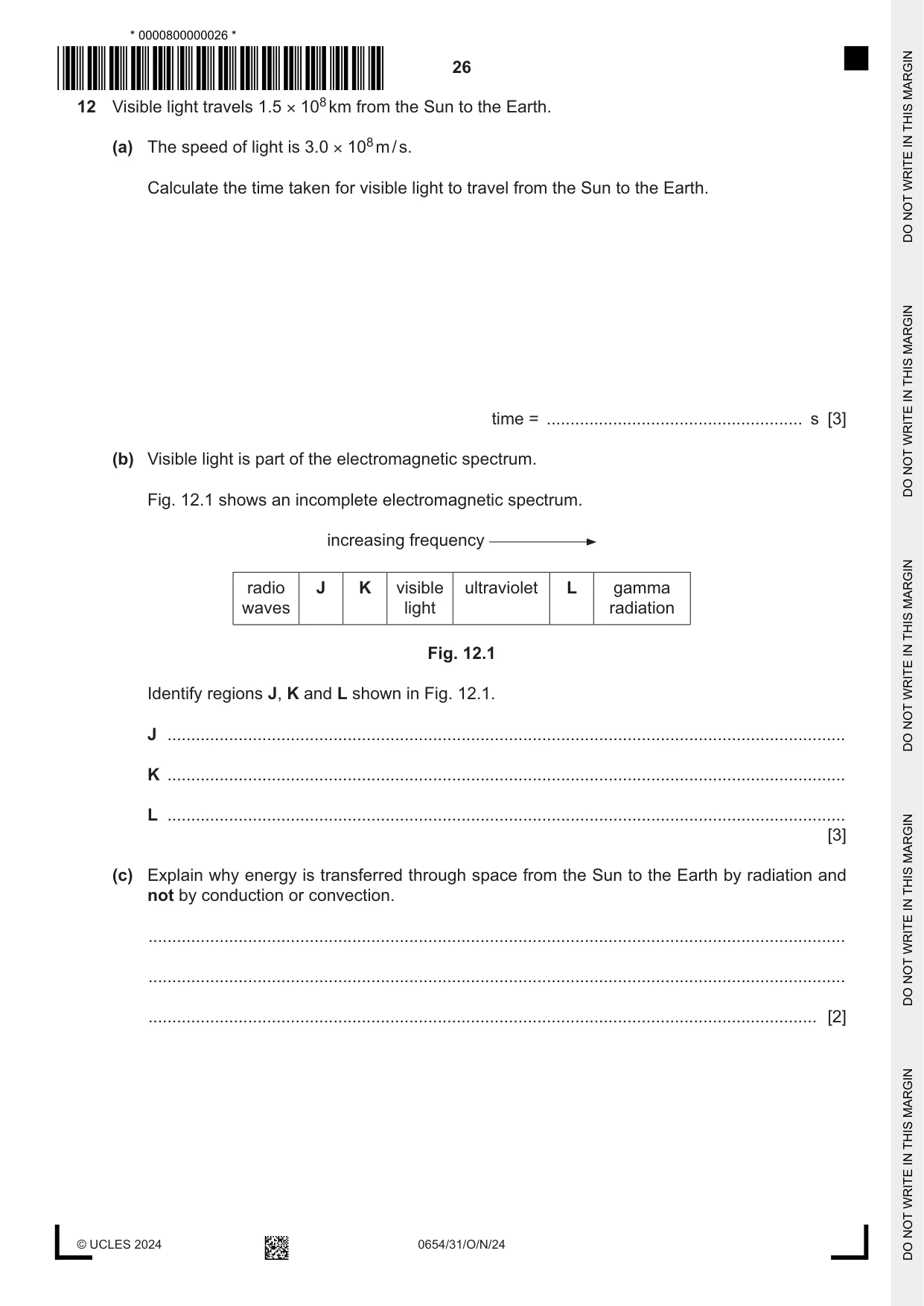
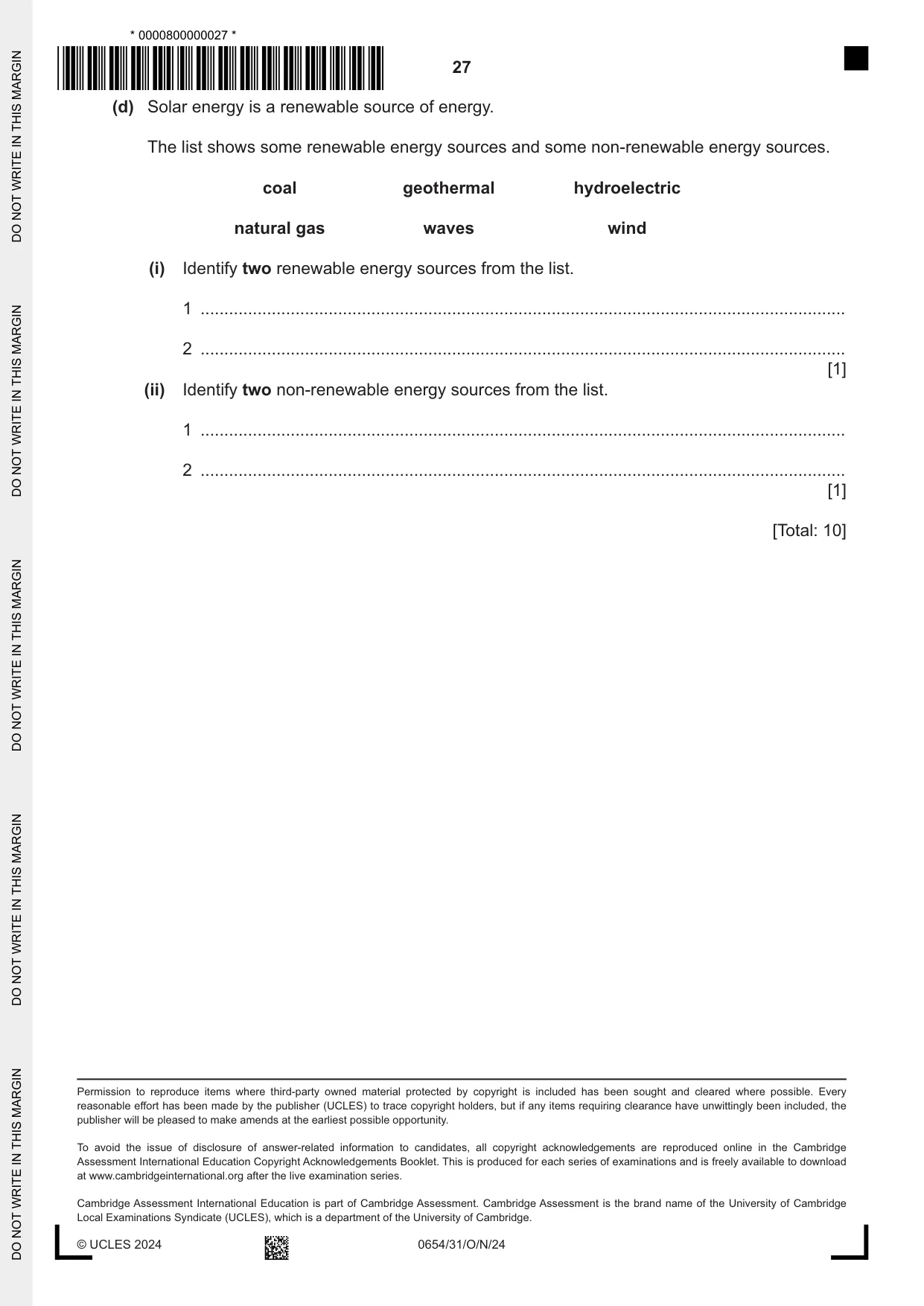
12 Visible light travels 1.5 × 10⁸ km from the Sun to the Earth. (a) The speed of light is 3.0 × 10⁸ m / s. Calculate the time taken for visible light to travel from the Sun to the Earth. time = ...................................................... s [3] (b) Visible light is part of the electromagnetic spectrum. Fig. 12.1 shows an incomplete electromagnetic spectrum. increasing frequency radio J K visible ultraviolet L gamma waves light radiation Fig. 12.1 Identify regions J, K and L shown in Fig. 12.1. J ............................................................................................................................................... K ............................................................................................................................................... L ............................................................................................................................................... [3] (c) Explain why energy is transferred through space from the Sun to the Earth by radiation and not by conduction or convection. ................................................................................................................................................... ................................................................................................................................................... ............................................................................................................................................. [2] (d) Solar energy is a renewable source of energy. The list shows some renewable energy sources and some non-renewable energy sources. coal geothermal hydroelectric natural gas waves wind (i) Identify two renewable energy sources from the list. 1 ........................................................................................................................................ 2 ........................................................................................................................................ [1] (ii) Identify two non-renewable energy sources from the list. 1 ........................................................................................................................................ 2 ........................................................................................................................................ [1] [Total: 10]
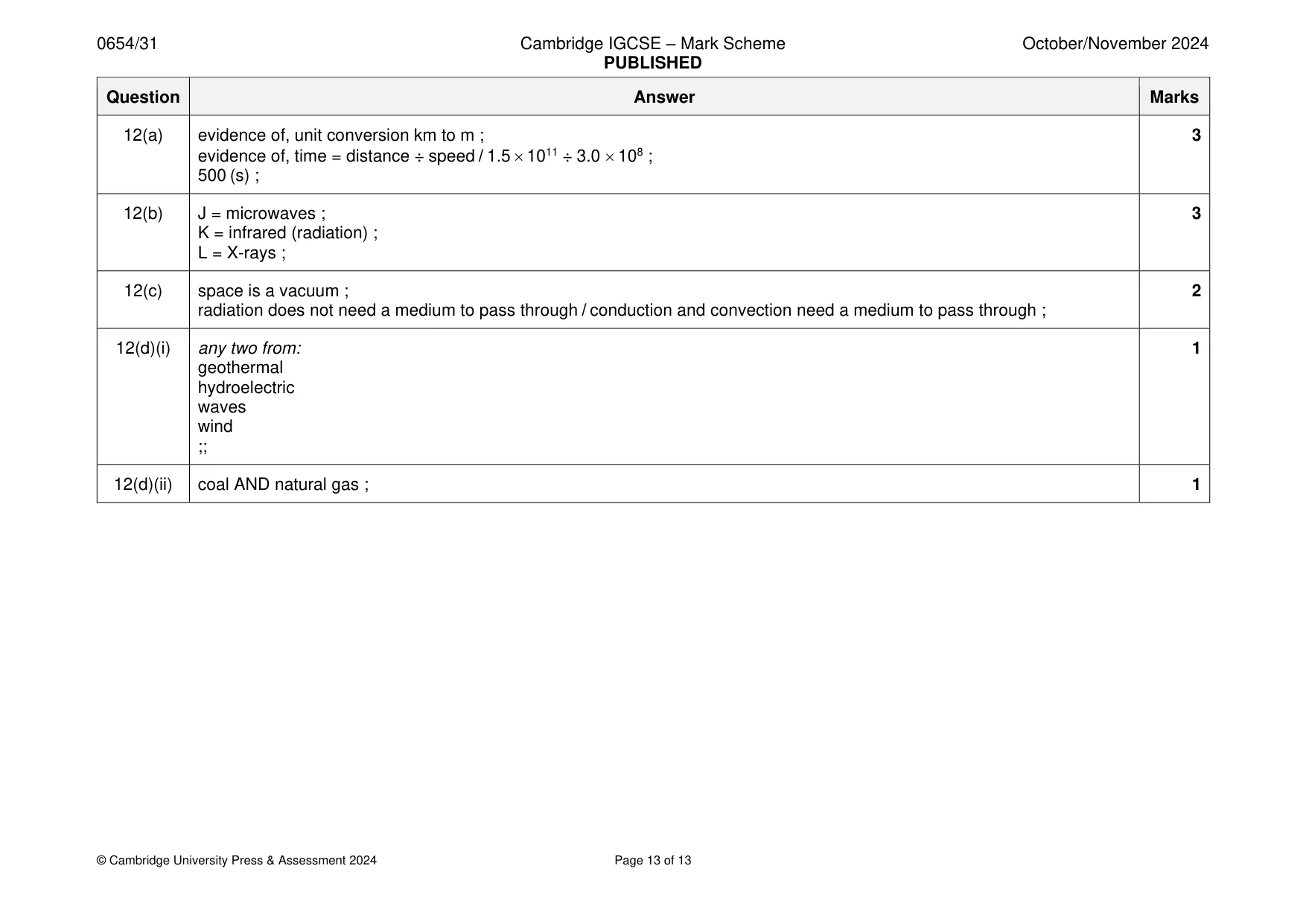
Mark scheme: 12(a) evidence of, unit conversion km to m ; 3 evidence of, time = distance ÷ speed / 1.5 1011 ÷ 3.0 108 ; 500 (s) ; 12(b) J = microwaves ; 3 K = infrared (radiation) ; L = X-rays ; 12(c) space is a vacuum ; 2 radiation does not need a medium to pass through / conduction and convection need a medium to pass through ; 12(d)(i) any two from: 1 geothermal hydroelectric waves wind ;; 12(d)(ii) coal AND natural gas ; 1
What was in this paper
The subtopics covered by these 12 questions, and how many questions each got. Open one in a new tab to see every Cambridge question on it.
What you needed in this session
Cambridge’s own grade thresholds for 2024 Oct/Nov, Paper 3 · Variant 1. A higher threshold means an easier paper — the bar moves with how the cohort did.