Cambridge IGCSE Sciences - Co-ordinated (Double) 0654 — 2017 Oct/Nov Paper 3 · Variant 3
0654/33/O/N/17 · 13 questions · 120 marks · ≈135 min
The question paper and its mark scheme, free to read here and free to download. This is Cambridge’s own paper, exactly as it was sat.
Question paper28 pages


Mark scheme9 pages
Answers below. Sit the paper first if you are practising.
Questions as text
Q1 · A diagram of a flower from a plant
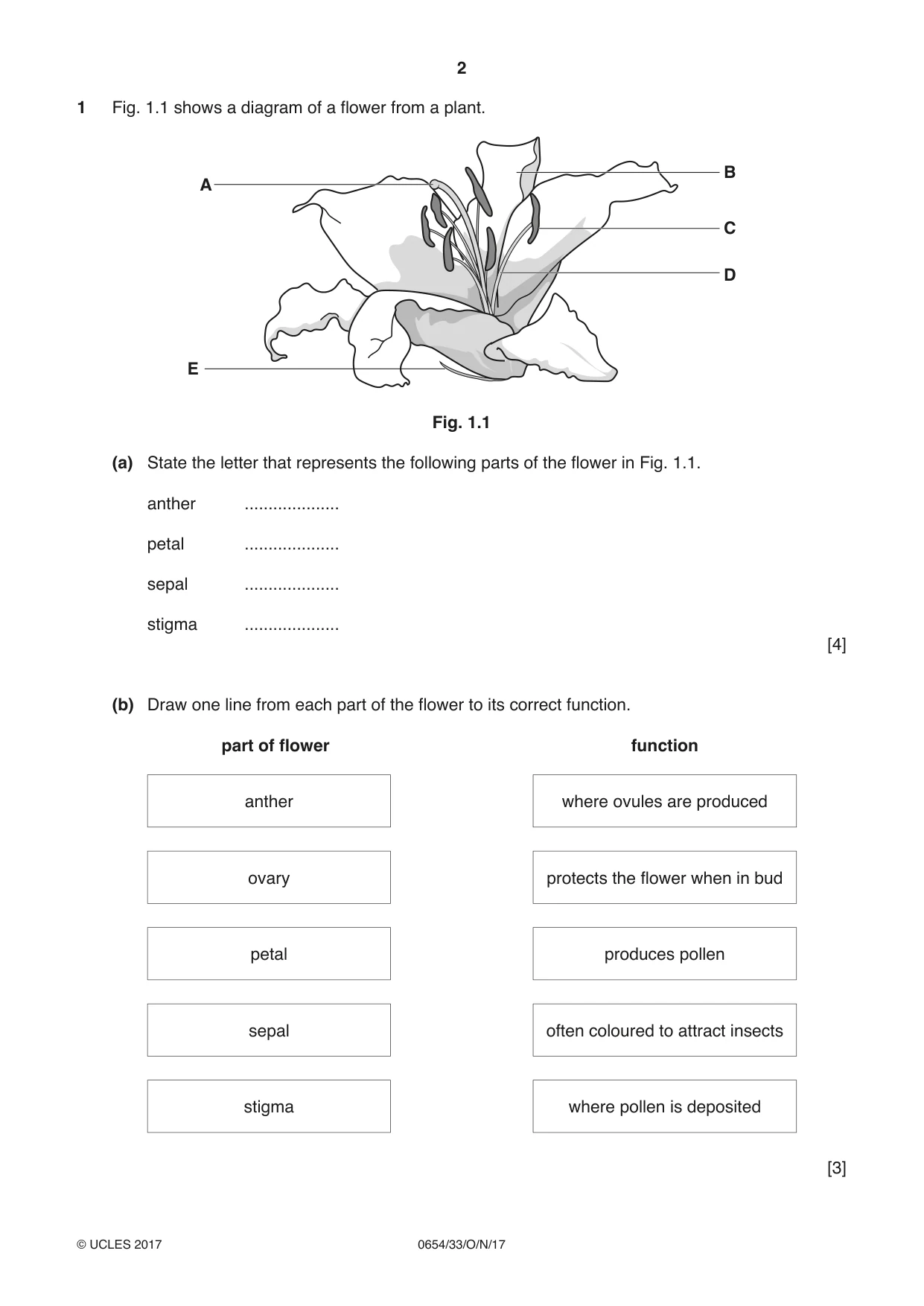
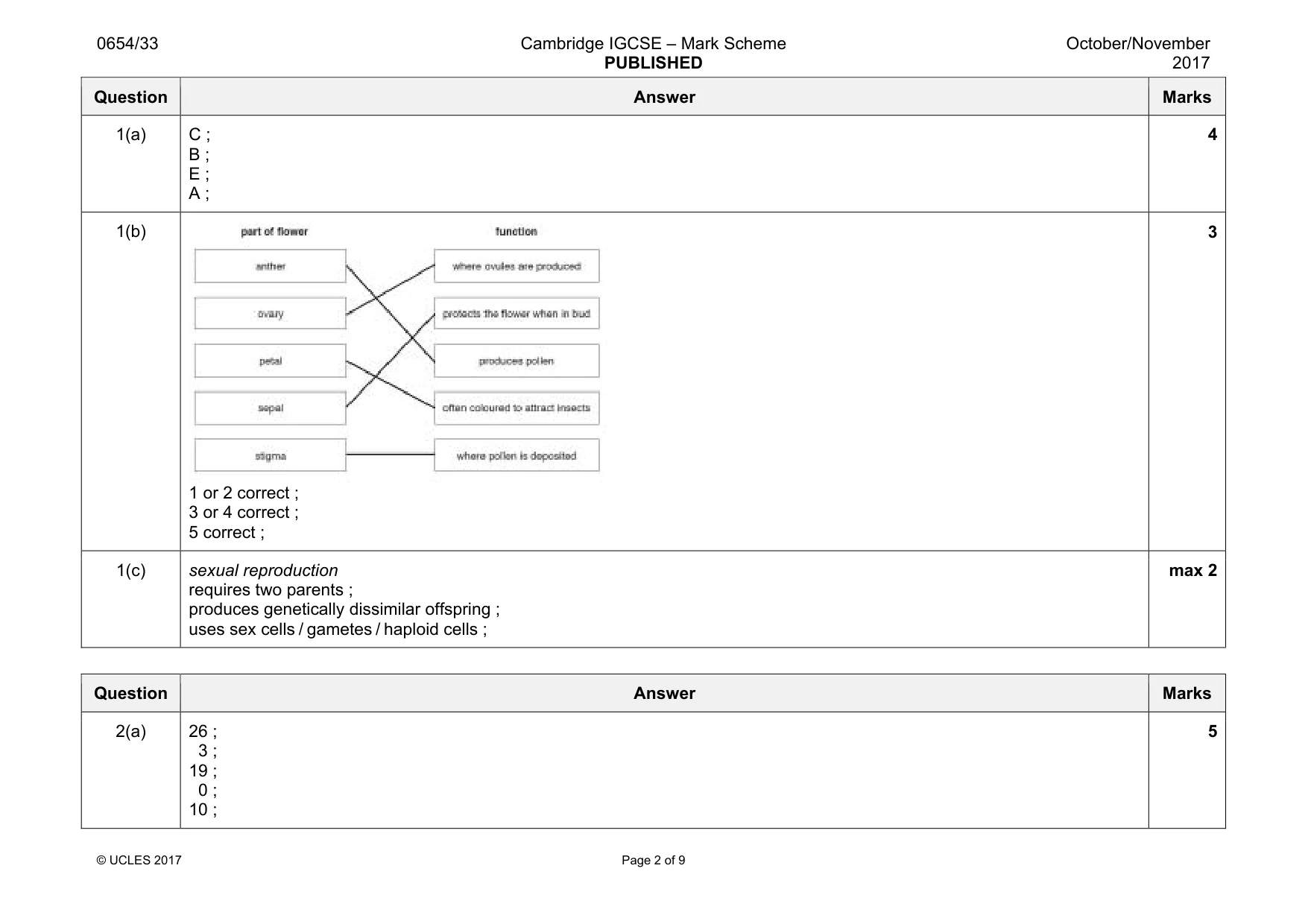
1 Fig. 1.1 shows a diagram of a flower from a plant. B A C D E Fig. 1.1 (a) State the letter that represents the following parts of the flower in Fig. 1.1. anther .................... petal .................... sepal .................... stigma .................... [4] (b) Draw one line from each part of the flower to its correct function. part of flower function anther where ovules are produced ovary protects the flower when in bud petal produces pollen sepal often coloured to attract insects stigma where pollen is deposited [3] (c) Plants can undergo sexual or asexual reproduction. State two ways in which sexual reproduction differs from asexual reproduction. 1 ................................................................................................................................................ 2 ................................................................................................................................................ [2]
Mark scheme: 1(a) C ; B ; E ; A ; 4 1(b) 1 or 2 correct ; 3 or 4 correct ; 5 correct ; 3 1(c) sexual reproduction requires two parents ; produces genetically dissimilar offspring ; uses sex cells / gametes / haploid cells ; max 2
Q2 · Complete Table 2.1 by choosing numbers from the list
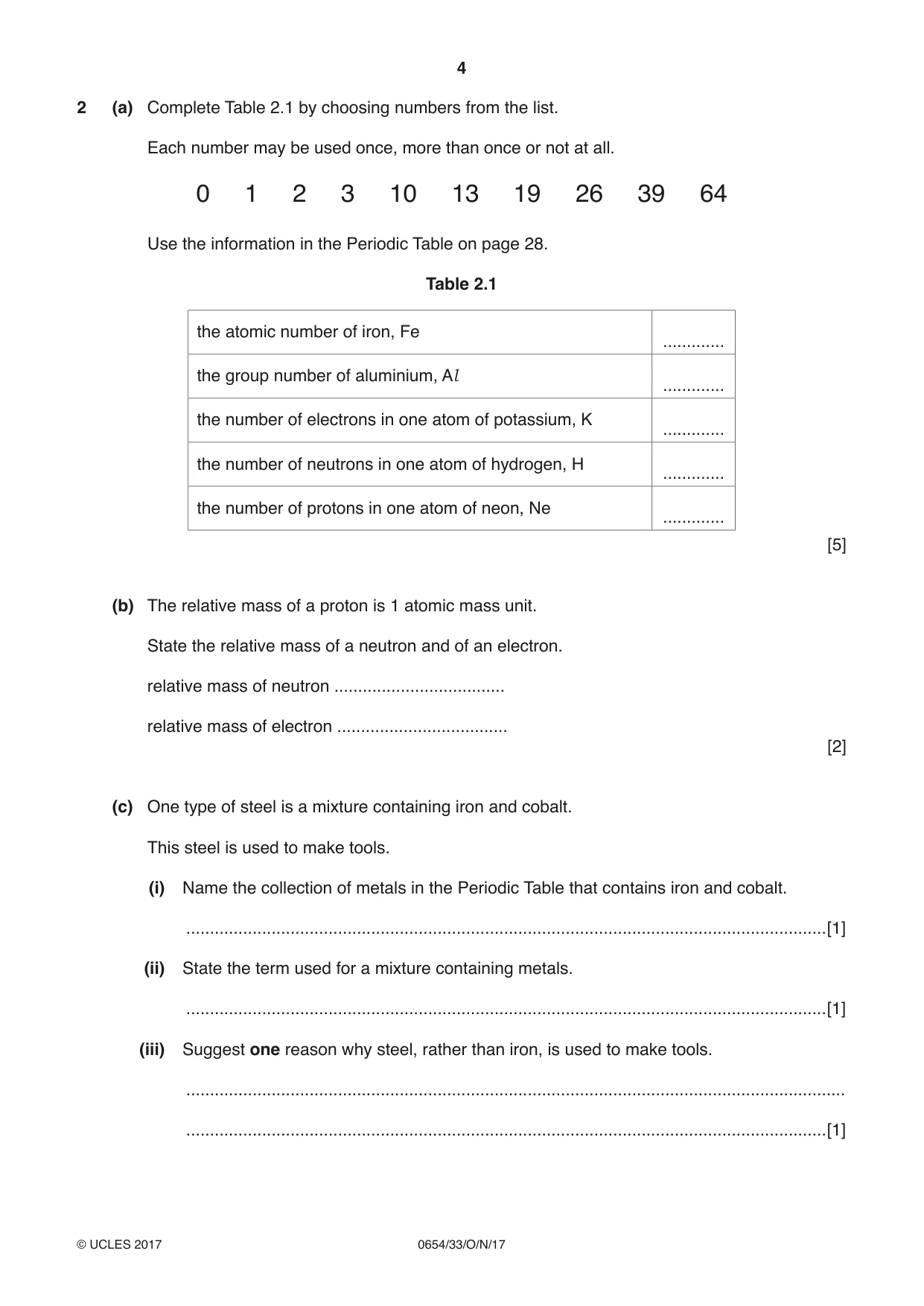
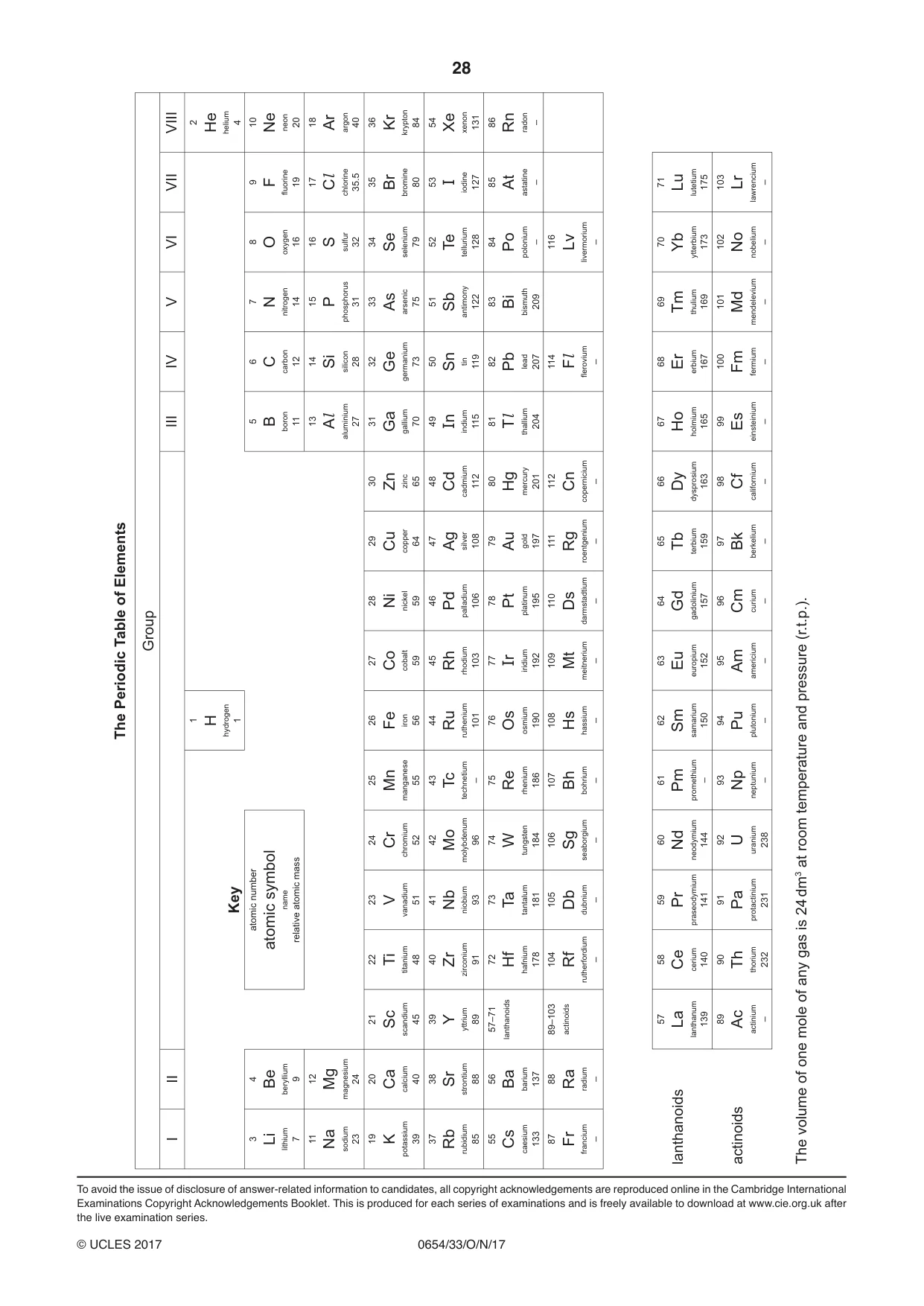
2 (a) Complete Table 2.1 by choosing numbers from the list. Each number may be used once, more than once or not at all. 0 1 2 3 10 13 19 26 39 64 Use the information in the Periodic Table on page 28. Table 2.1 the atomic number of iron, Fe ............. the group number of aluminium, Al ............. the number of electrons in one atom of potassium, K ............. the number of neutrons in one atom of hydrogen, H ............. the number of protons in one atom of neon, Ne ............. [5] (b) The relative mass of a proton is 1 atomic mass unit. State the relative mass of a neutron and of an electron. relative mass of neutron .................................... relative mass of electron .................................... [2] (c) One type of steel is a mixture containing iron and cobalt. This steel is used to make tools. (i) Name the collection of metals in the Periodic Table that contains iron and cobalt. .......................................................................................................................................[1] (ii) State the term used for a mixture containing metals. .......................................................................................................................................[1] (iii) Suggest one reason why steel, rather than iron, is used to make tools. ........................................................................................................................................... .......................................................................................................................................[1]
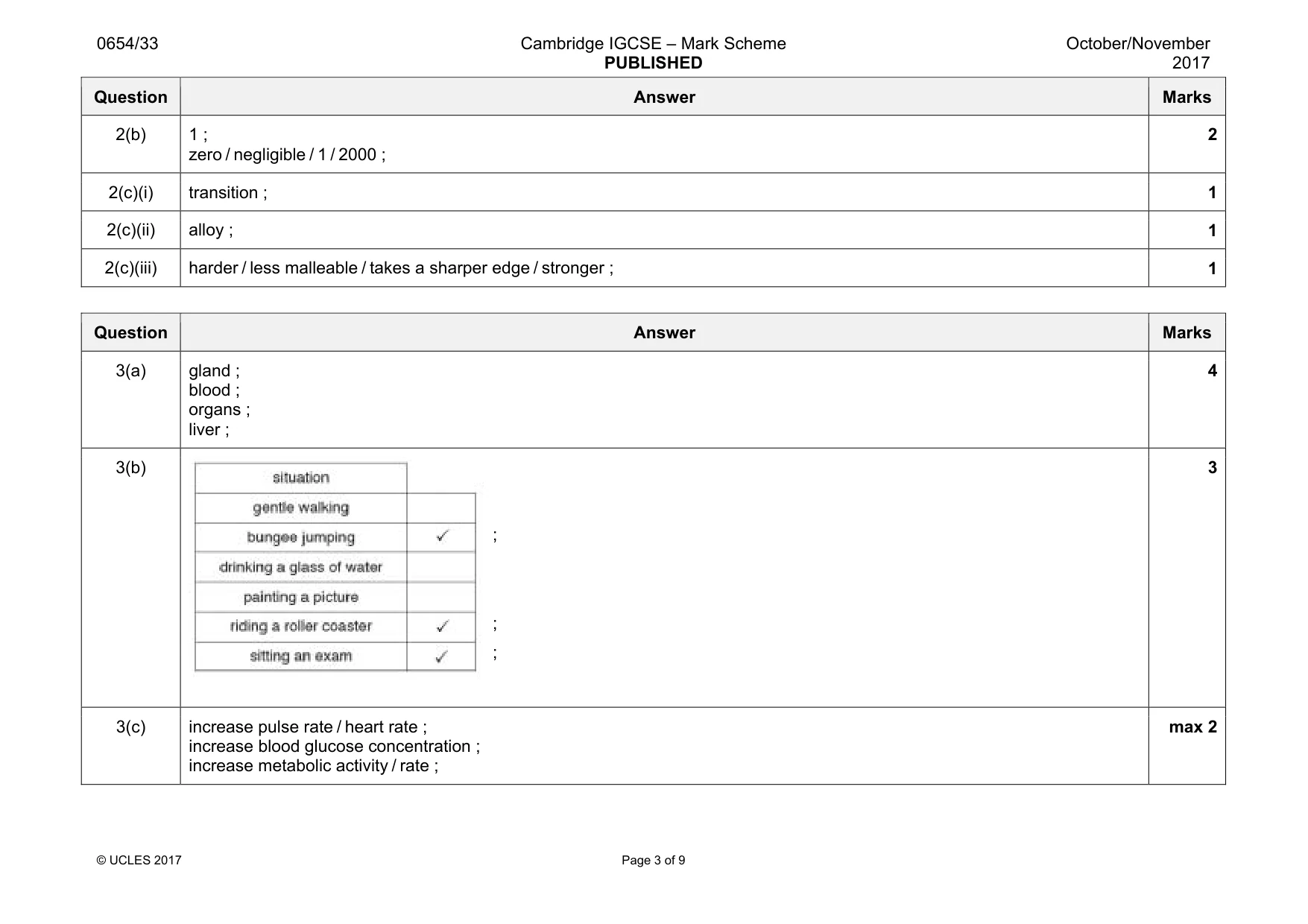
Mark scheme: 2(a) 26 ; 3 ; 19 ; 0 ; 10 ; 5 Question Answer Marks 2(b) 1 ; zero / negligible / 1 / 2000 ; 2 2(c)(i) transition ; 1 2(c)(ii) alloy ; 1 2(c)(iii) harder / less malleable / takes a sharper edge / stronger ; 1
Q3 · Adrenaline is a hormone released by the body in response to certain situations
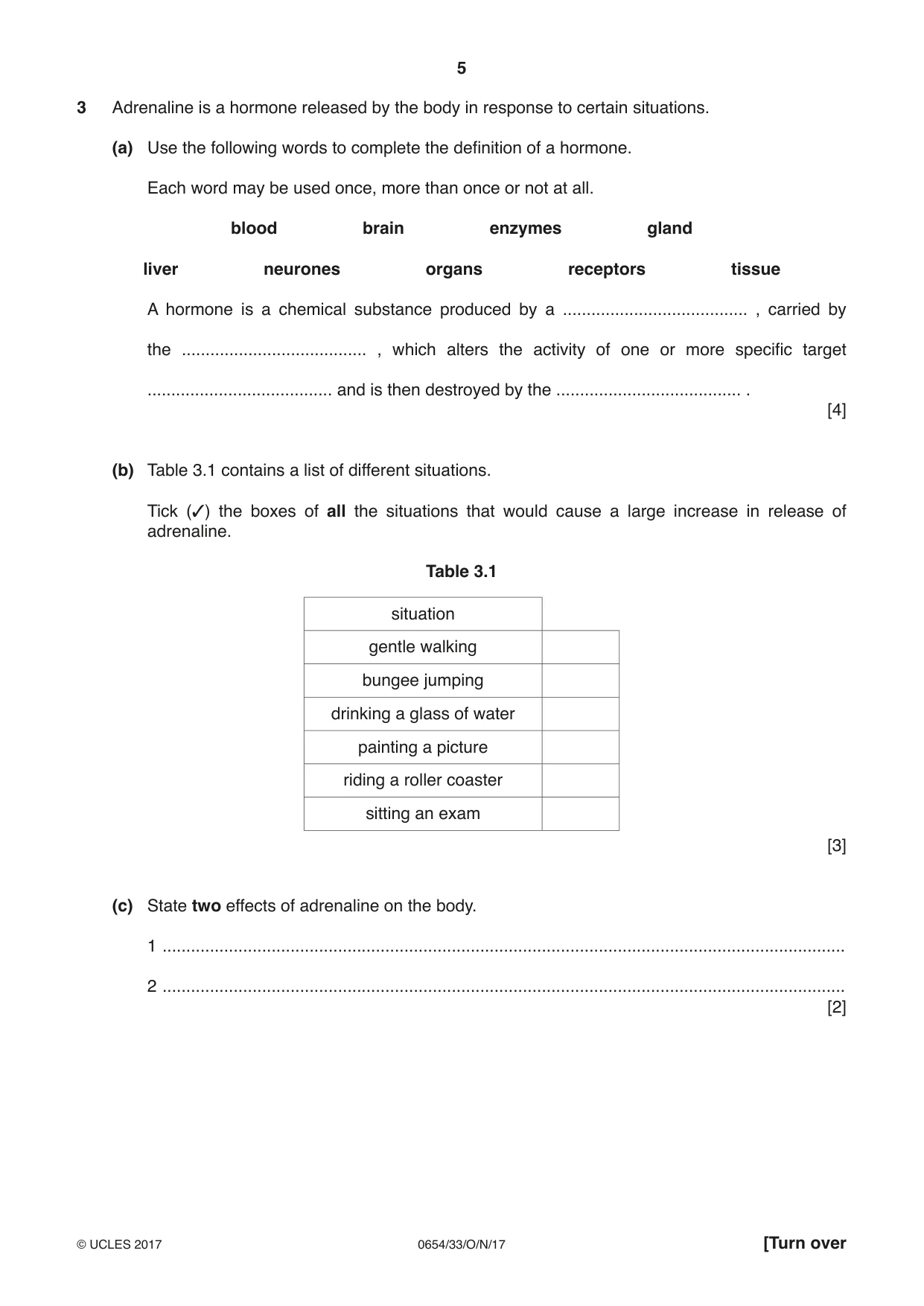
3 Adrenaline is a hormone released by the body in response to certain situations. (a) Use the following words to complete the definition of a hormone. Each word may be used once, more than once or not at all. blood brain enzymes gland liver neurones organs receptors tissue A hormone is a chemical substance produced by a ....................................... , carried by the ....................................... , which alters the activity of one or more specific target ....................................... and is then destroyed by the ....................................... . [4] (b) Table 3.1 contains a list of different situations. Tick (3) the boxes of all the situations that would cause a large increase in release of adrenaline. Table 3.1 situation gentle walking bungee jumping drinking a glass of water painting a picture riding a roller coaster sitting an exam [3] (c) State two effects of adrenaline on the body. 1 ................................................................................................................................................ 2 ................................................................................................................................................ [2]
Mark scheme: 3(a) gland ; blood ; organs ; liver ; 4 3(b) 3 3(c) increase pulse rate / heart rate ; increase blood glucose concentration ; increase metabolic activity / rate ; max 2 ; ; ; Que estion Answer Ma arks
Q4 · A radioactive isotope of iodine is used by a doctor to examine the thyroid gland of a…
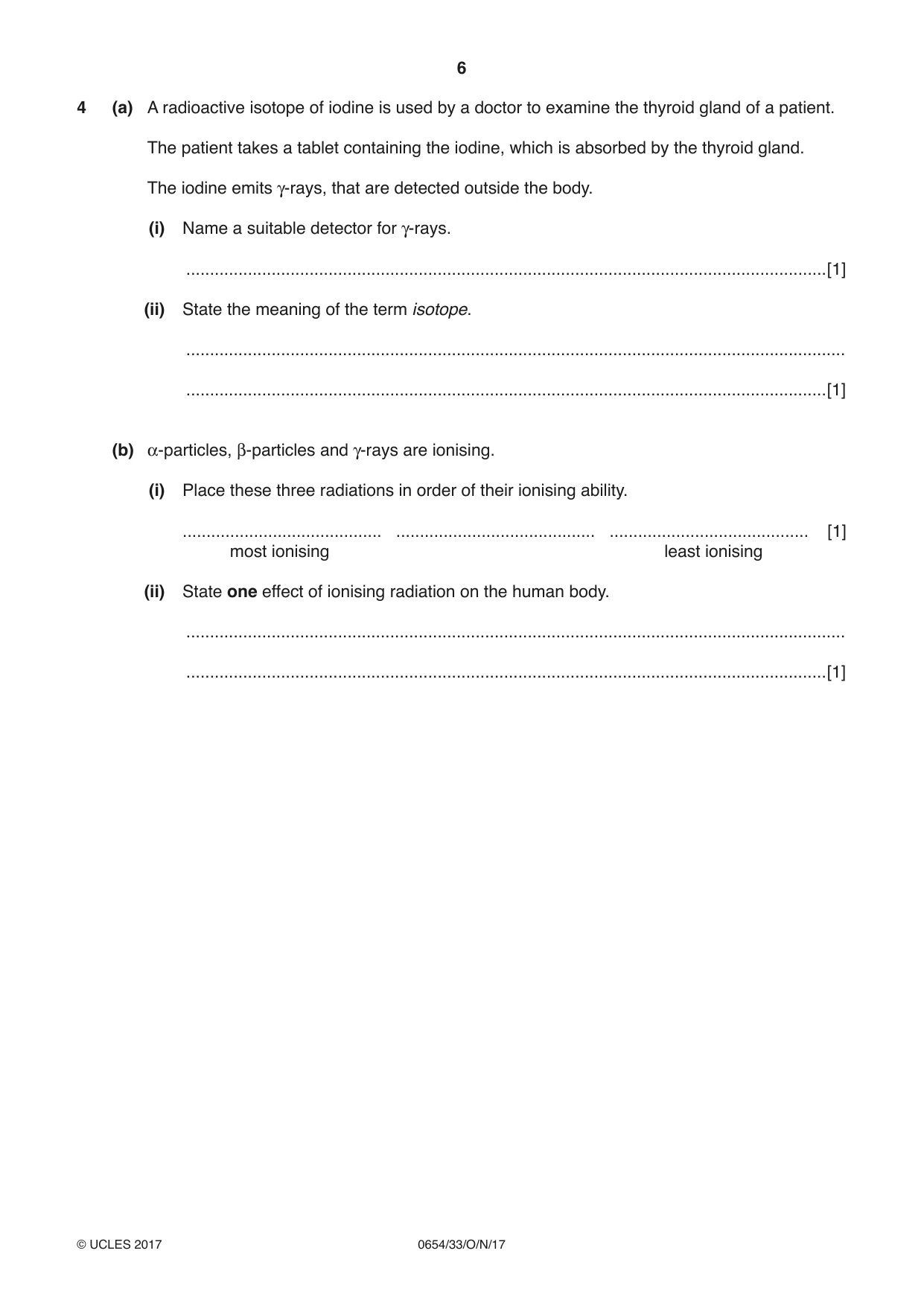
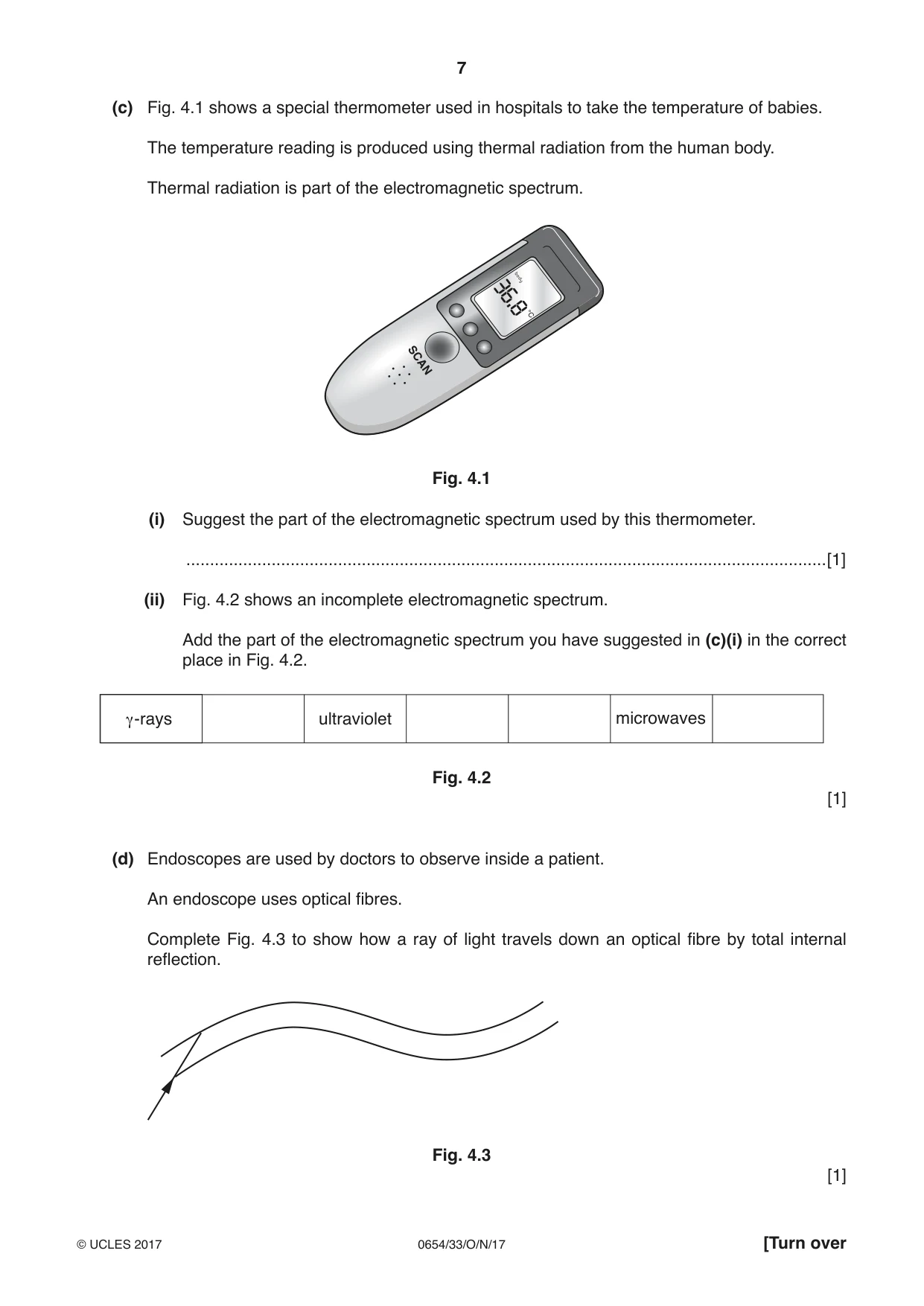
4 (a) A radioactive isotope of iodine is used by a doctor to examine the thyroid gland of a patient. The patient takes a tablet containing the iodine, which is absorbed by the thyroid gland. The iodine emits γ-rays, that are detected outside the body. (i) Name a suitable detector for γ-rays. .......................................................................................................................................[1] (ii) State the meaning of the term isotope. ........................................................................................................................................... .......................................................................................................................................[1] (b) α-particles, β-particles and γ-rays are ionising. (i) Place these three radiations in order of their ionising ability. .......................................... .......................................... .......................................... [1] most ionising least ionising (ii) State one effect of ionising radiation on the human body. ........................................................................................................................................... .......................................................................................................................................[1] (c) Fig. 4.1 shows a special thermometer used in hospitals to take the temperature of babies. The temperature reading is produced using thermal radiation from the human body. Thermal radiation is part of the electromagnetic spectrum. SCAN Fig. 4.1 (i) Suggest the part of the electromagnetic spectrum used by this thermometer. .......................................................................................................................................[1] (ii) Fig. 4.2 shows an incomplete electromagnetic spectrum. Add the part of the electromagnetic spectrum you have suggested in (c)(i) in the correct place in Fig. 4.2. γ -rays ultraviolet microwaves Fig. 4.2 [1] (d) Endoscopes are used by doctors to observe inside a patient. An endoscope uses optical fibres. Complete Fig. 4.3 to show how a ray of light travels down an optical fibre by total internal reflection. Fig. 4.3 [1]
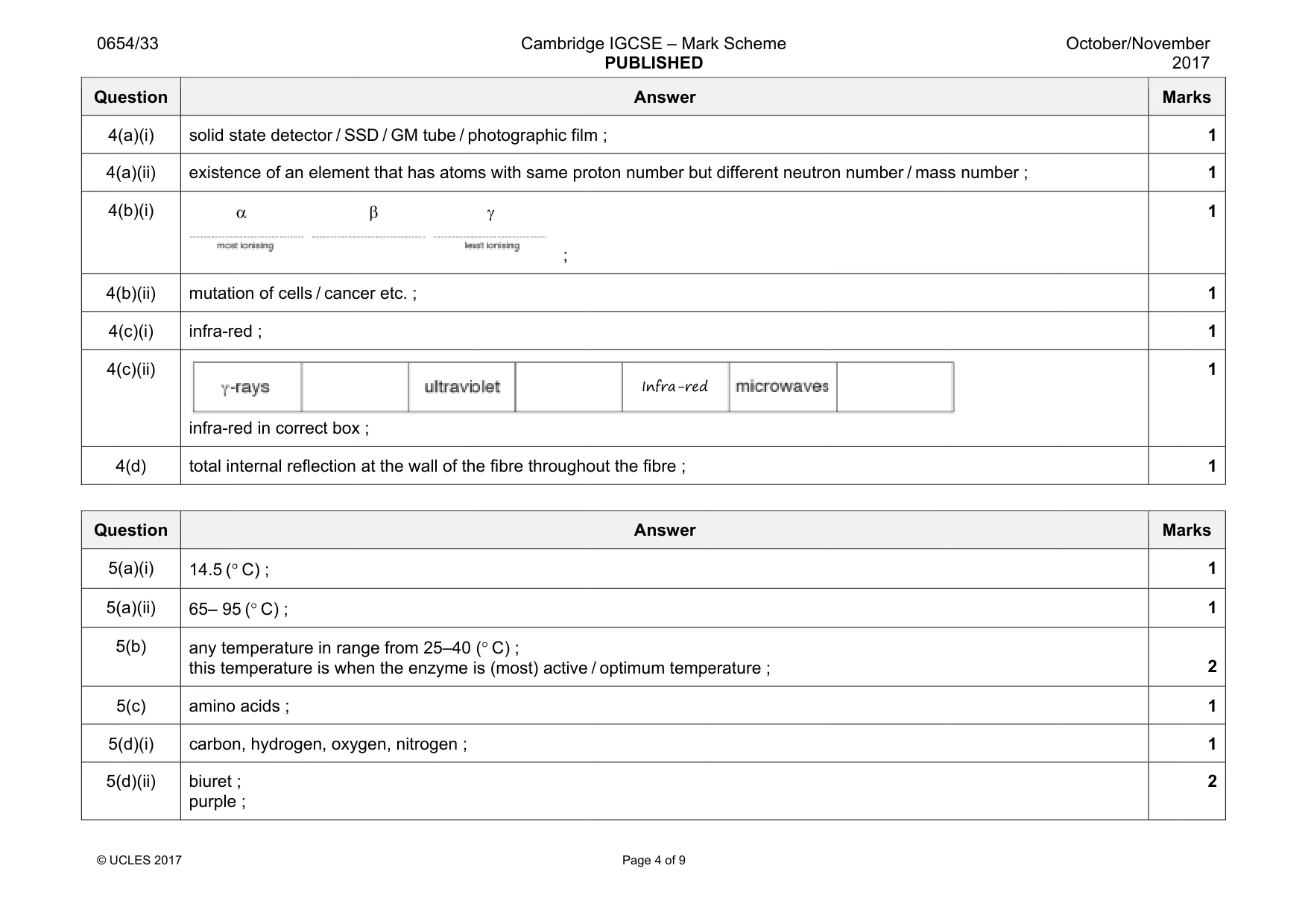
Mark scheme: 4 4( 4 4( 4 4( 4 Que (a)(i) solid s (a)(ii) existen (b)(i) (b)(ii) mutatio (c)(i) infra-re (c)(ii) infra-re 4(d) total in estion 14.5 (° state detector / S nce of an eleme α on of cells / canc ed ; ed in correct box nternal reflection ° C) ; SSD / GM tube / p nt that has atom β cer etc. ; x ; n at the wall of th photographic film ms with same pro γ ; he fibre througho m ; oton number but out the fibre ; Answer Infra-red t different neutro on number / mas ss number ; Ma 1 1 1 1 1 1 1 arks
Q5 · How the activity of three different enzymes, A, B and C, varies with temperature
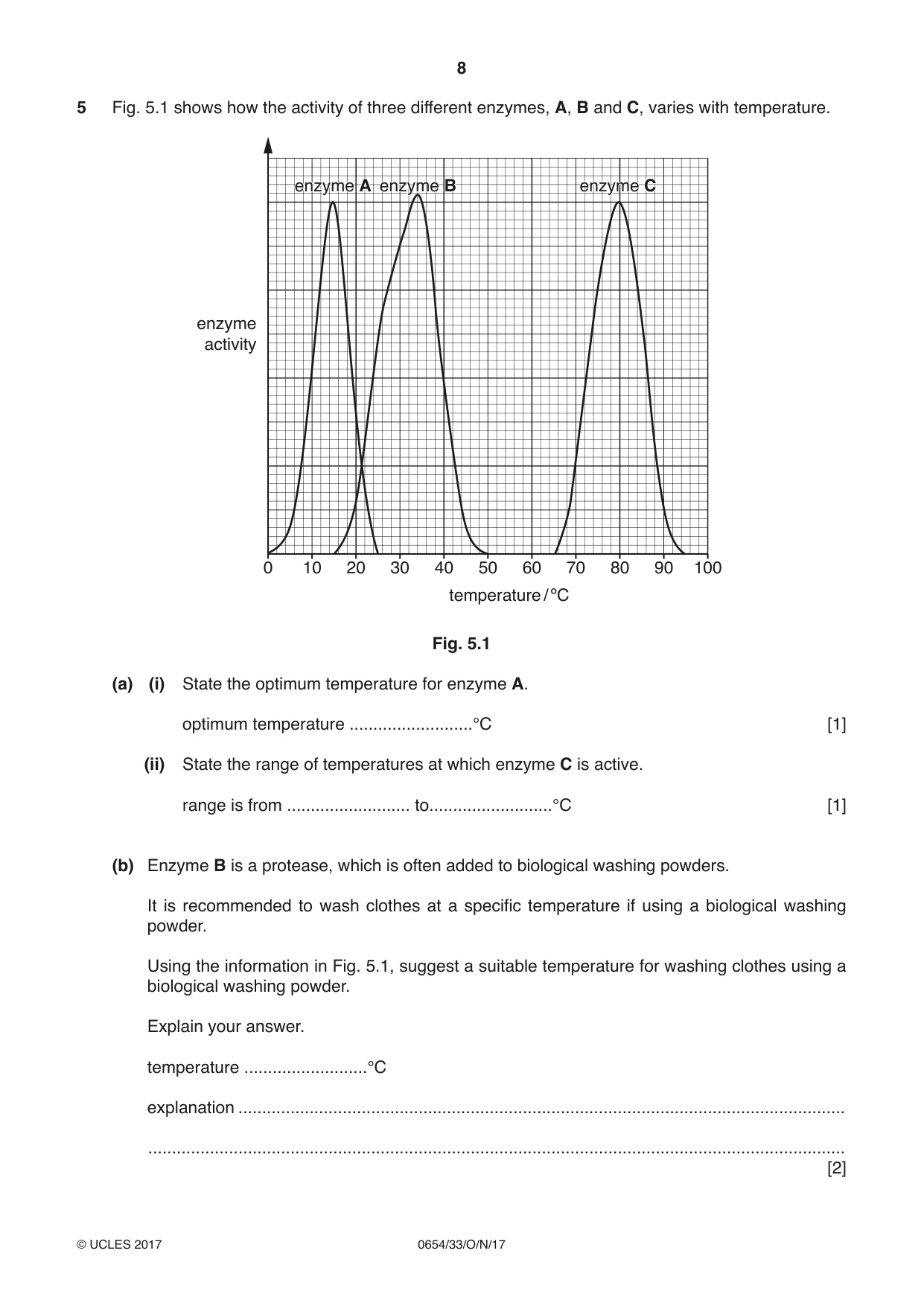
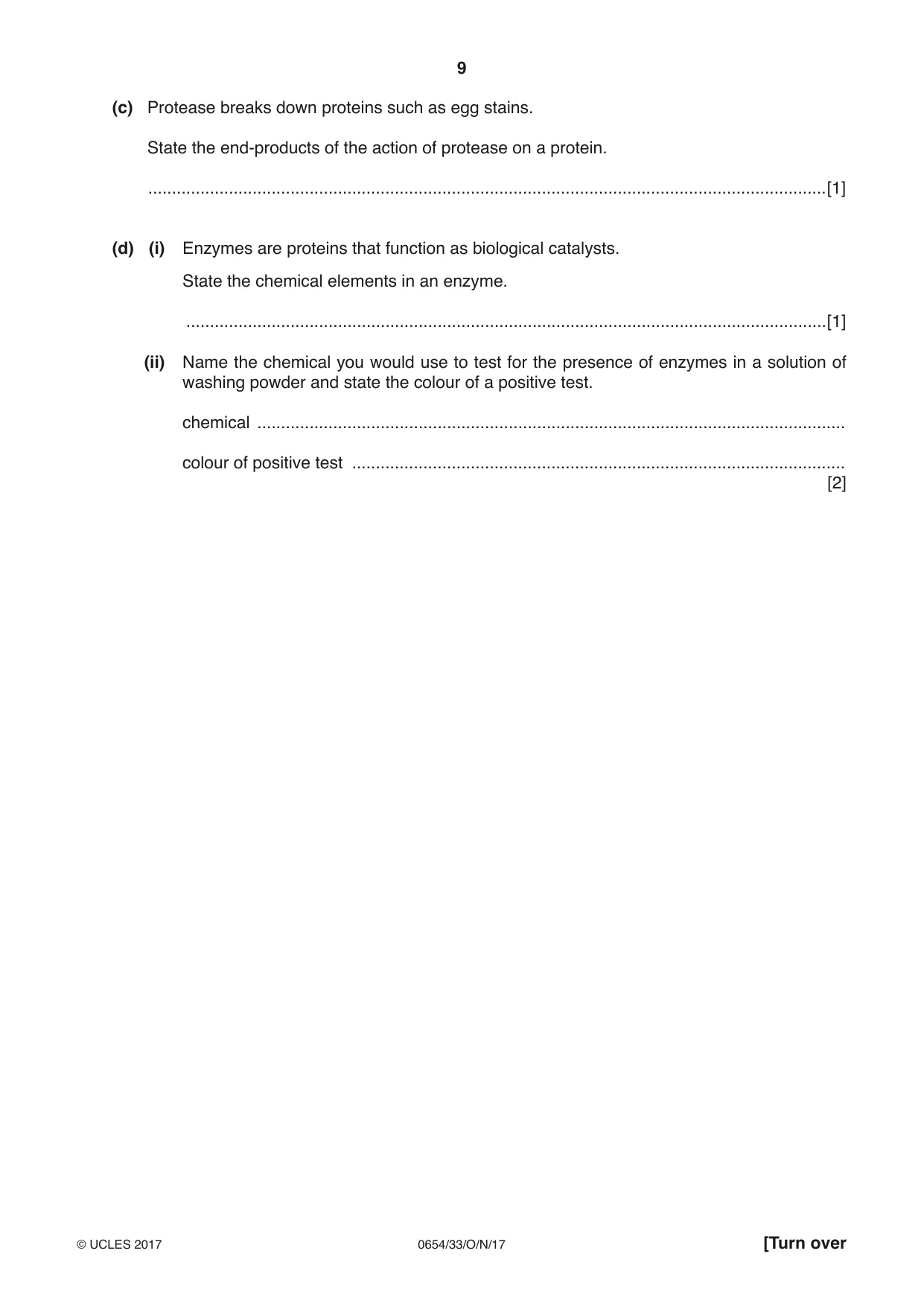
5 Fig. 5.1 shows how the activity of three different enzymes, A, B and C, varies with temperature. enzymeenzyme AA enzymeenzyme BB enzymeenzyme CC enzyme activity 0 10 20 30 40 50 60 70 80 90 100 temperature / ºC Fig. 5.1 (a) (i) State the optimum temperature for enzyme A. optimum temperature ..........................°C [1] (ii) State the range of temperatures at which enzyme C is active. range is from .......................... to..........................°C [1] (b) Enzyme B is a protease, which is often added to biological washing powders. It is recommended to wash clothes at a specific temperature if using a biological washing powder. Using the information in Fig. 5.1, suggest a suitable temperature for washing clothes using a biological washing powder. Explain your answer. temperature ..........................°C explanation ................................................................................................................................ ................................................................................................................................................... [2] (c) Protease breaks down proteins such as egg stains. State the end-products of the action of protease on a protein. ...............................................................................................................................................[1] (d) (i) Enzymes are proteins that function as biological catalysts. State the chemical elements in an enzyme. .......................................................................................................................................[1] (ii) Name the chemical you would use to test for the presence of enzymes in a solution of washing powder and state the colour of a positive test. chemical ............................................................................................................................ colour of positive test ........................................................................................................ [2]
Mark scheme: 5 5( 5 5 5 5( (a)(i) (a)(ii) 65– 95 5(b) any te this tem 5(c) amino (d)(i) carbon (d)(ii) biuret purple 5 (° C) ; mperature in ran mperature is wh acids ; n, hydrogen, oxy ; ; nge from 25–40 hen the enzyme ygen, nitrogen ; (° C) ; is (most) active / optimum tempe erature ; 1 1 2 1 1 2
Q6 · When lithium reacts with water, a gas is produced
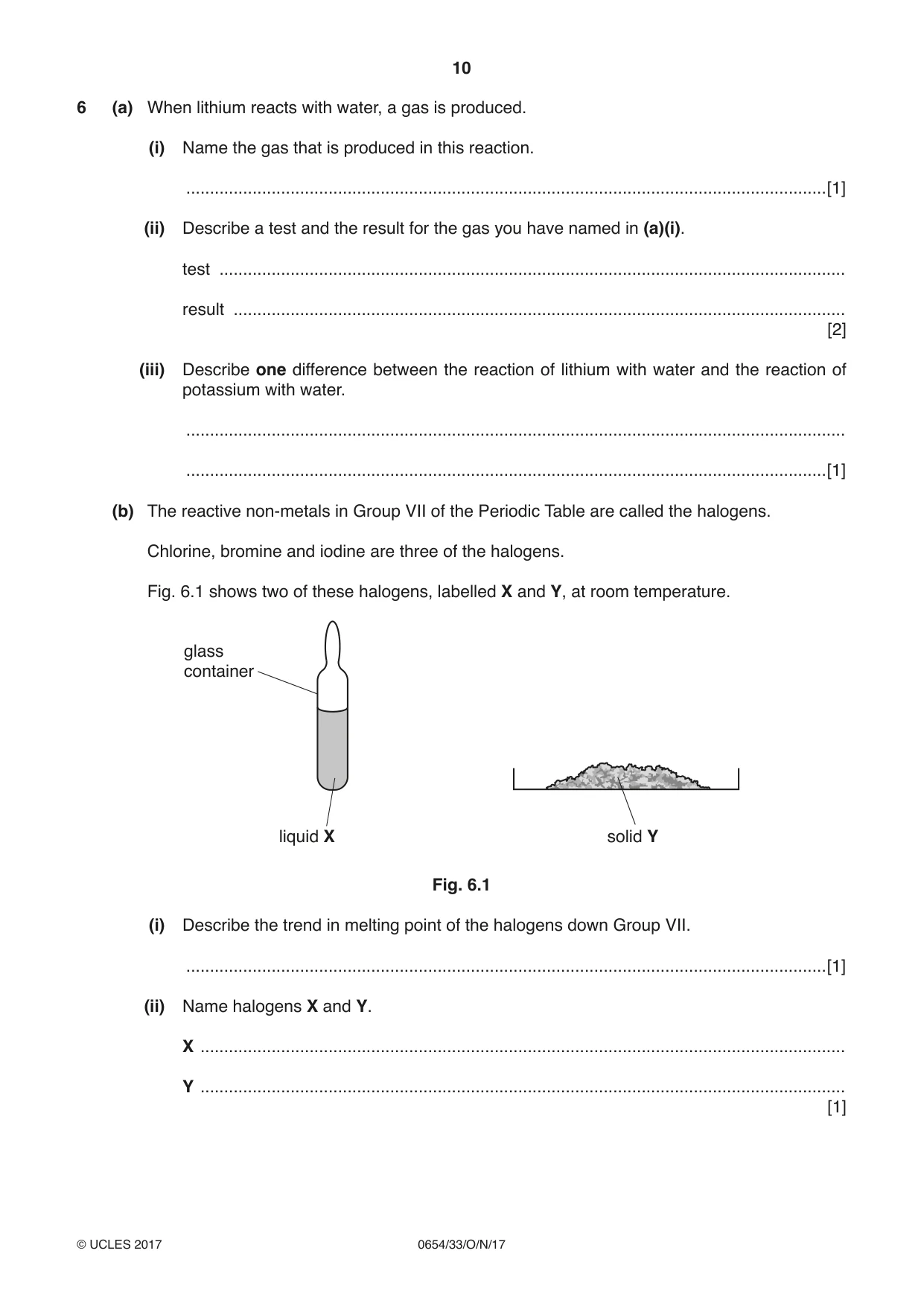
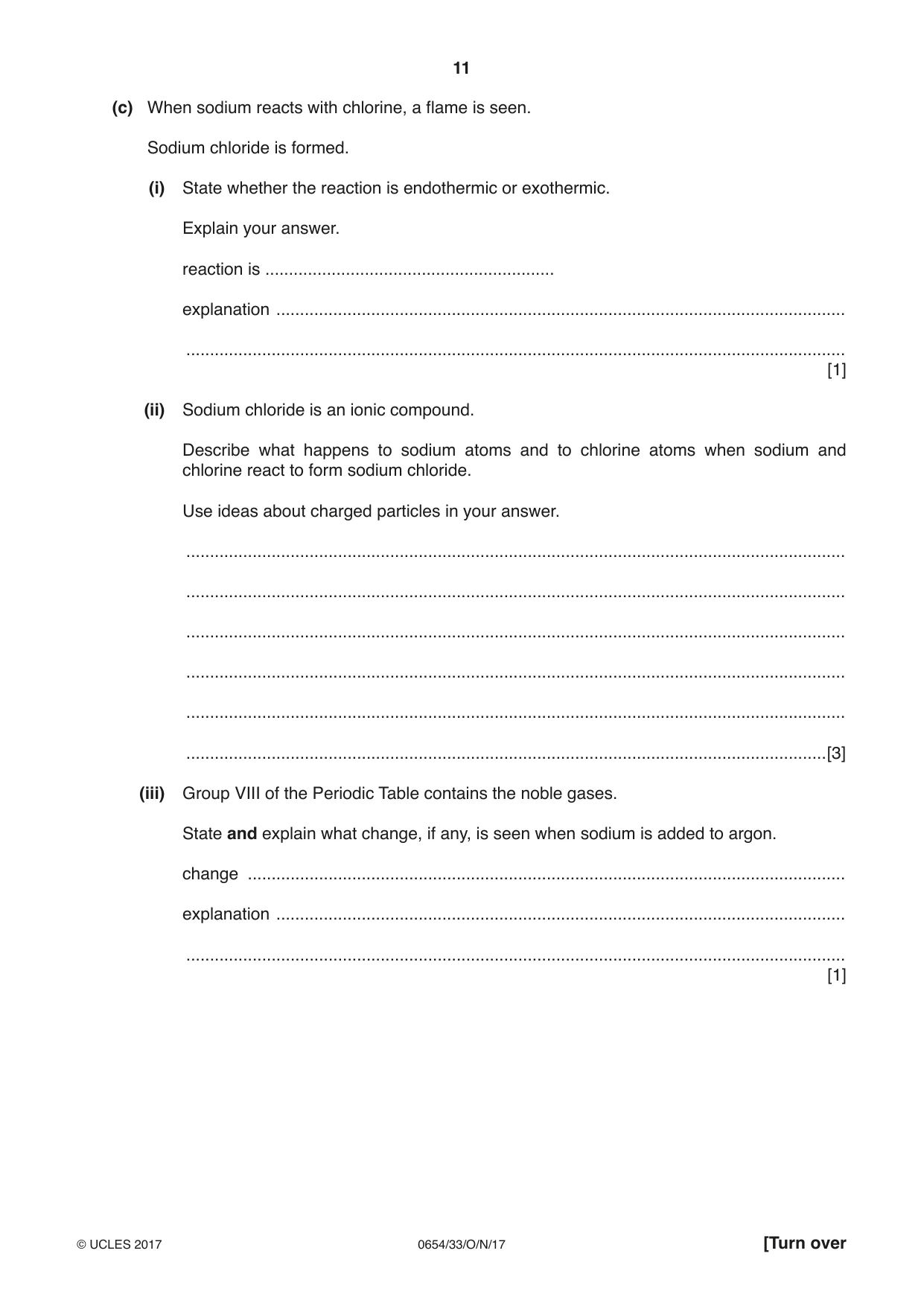
6 (a) When lithium reacts with water, a gas is produced. (i) Name the gas that is produced in this reaction. .......................................................................................................................................[1] (ii) Describe a test and the result for the gas you have named in (a)(i). test .................................................................................................................................... result ................................................................................................................................. [2] (iii) Describe one difference between the reaction of lithium with water and the reaction of potassium with water. ........................................................................................................................................... .......................................................................................................................................[1] (b) The reactive non-metals in Group VII of the Periodic Table are called the halogens. Chlorine, bromine and iodine are three of the halogens. Fig. 6.1 shows two of these halogens, labelled X and Y, at room temperature. glass container liquid X solid Y Fig. 6.1 (i) Describe the trend in melting point of the halogens down Group VII. .......................................................................................................................................[1] (ii) Name halogens X and Y. X ........................................................................................................................................ Y ........................................................................................................................................ [1] (c) When sodium reacts with chlorine, a flame is seen. Sodium chloride is formed. (i) State whether the reaction is endothermic or exothermic. Explain your answer. reaction is ............................................................. explanation ........................................................................................................................ ........................................................................................................................................... [1] (ii) Sodium chloride is an ionic compound. Describe what happens to sodium atoms and to chlorine atoms when sodium and chlorine react to form sodium chloride. Use ideas about charged particles in your answer. ........................................................................................................................................... ........................................................................................................................................... ........................................................................................................................................... ........................................................................................................................................... ........................................................................................................................................... .......................................................................................................................................[3] (iii) Group VIII of the Periodic Table contains the noble gases. State and explain what change, if any, is seen when sodium is added to argon. change .............................................................................................................................. explanation ........................................................................................................................ ........................................................................................................................................... [1]
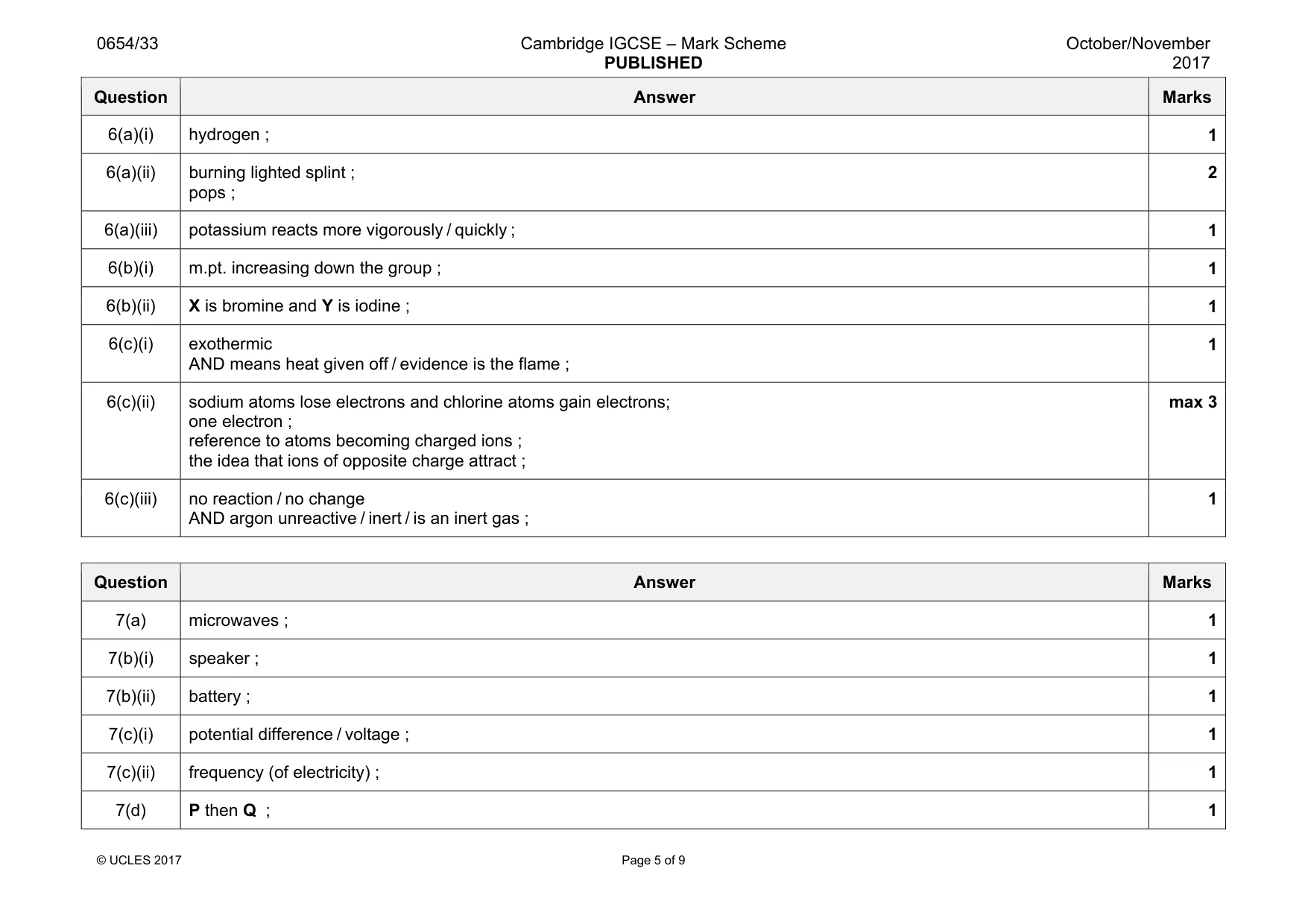
Mark scheme: 6(a)(i) hydrogen ; 1 6(a)(ii) burning lighted splint ; pops ; 2 6(a)(iii) potassium reacts more vigorously / quickly ; 1 6(b)(i) m.pt. increasing down the group ; 1 6(b)(ii) X is bromine and Y is iodine ; 1 6(c)(i) exothermic AND means heat given off / evidence is the flame ; 1 6(c)(ii) sodium atoms lose electrons and chlorine atoms gain electrons; one electron ; reference to atoms becoming charged ions ; the idea that ions of opposite charge attract ; max 3 6(c)(iii) no reaction / no change AND argon unreactive / inert / is an inert gas ; 1
Q7 · Name the electromagnetic wave used in mobile (cell) phone communication
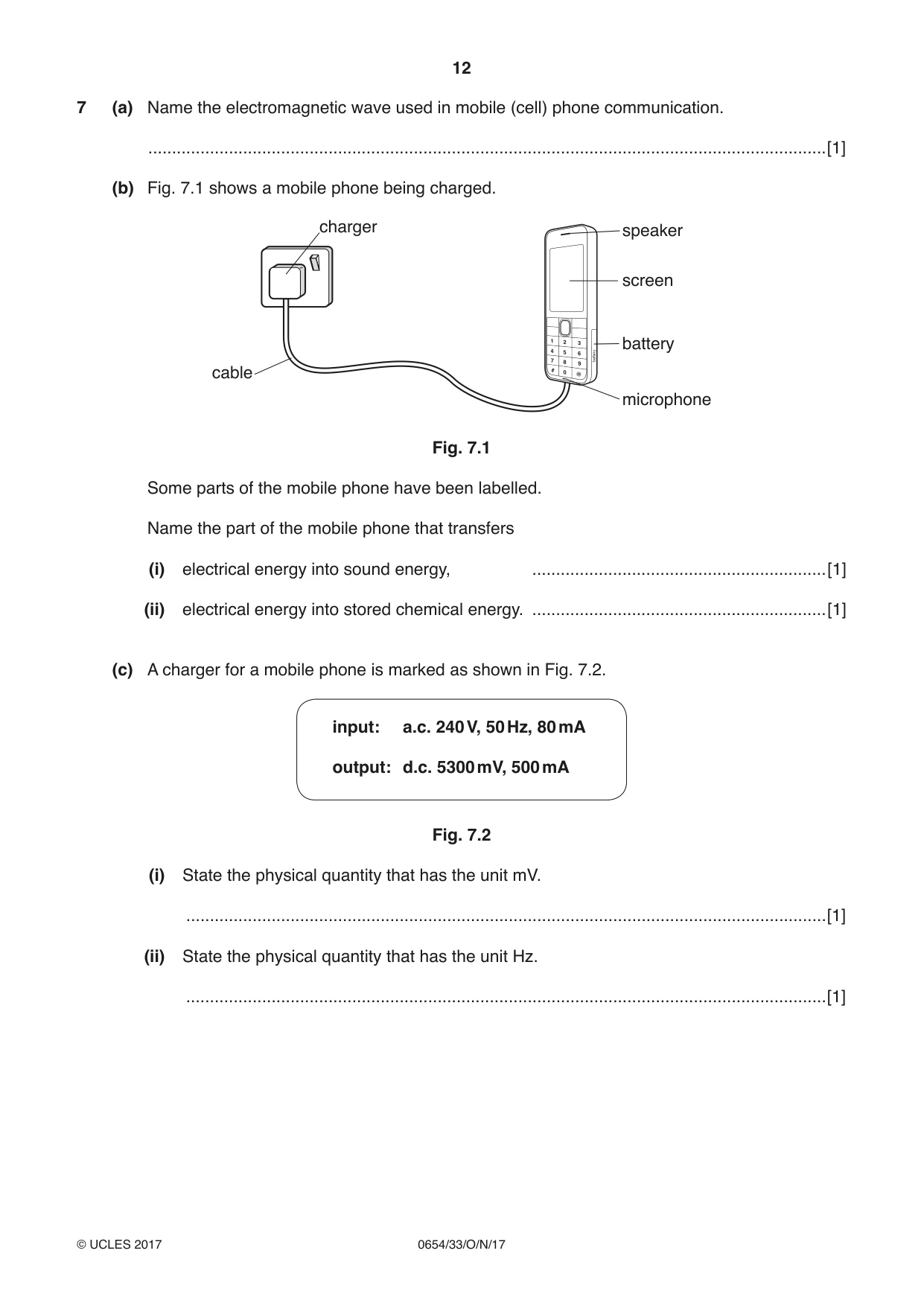
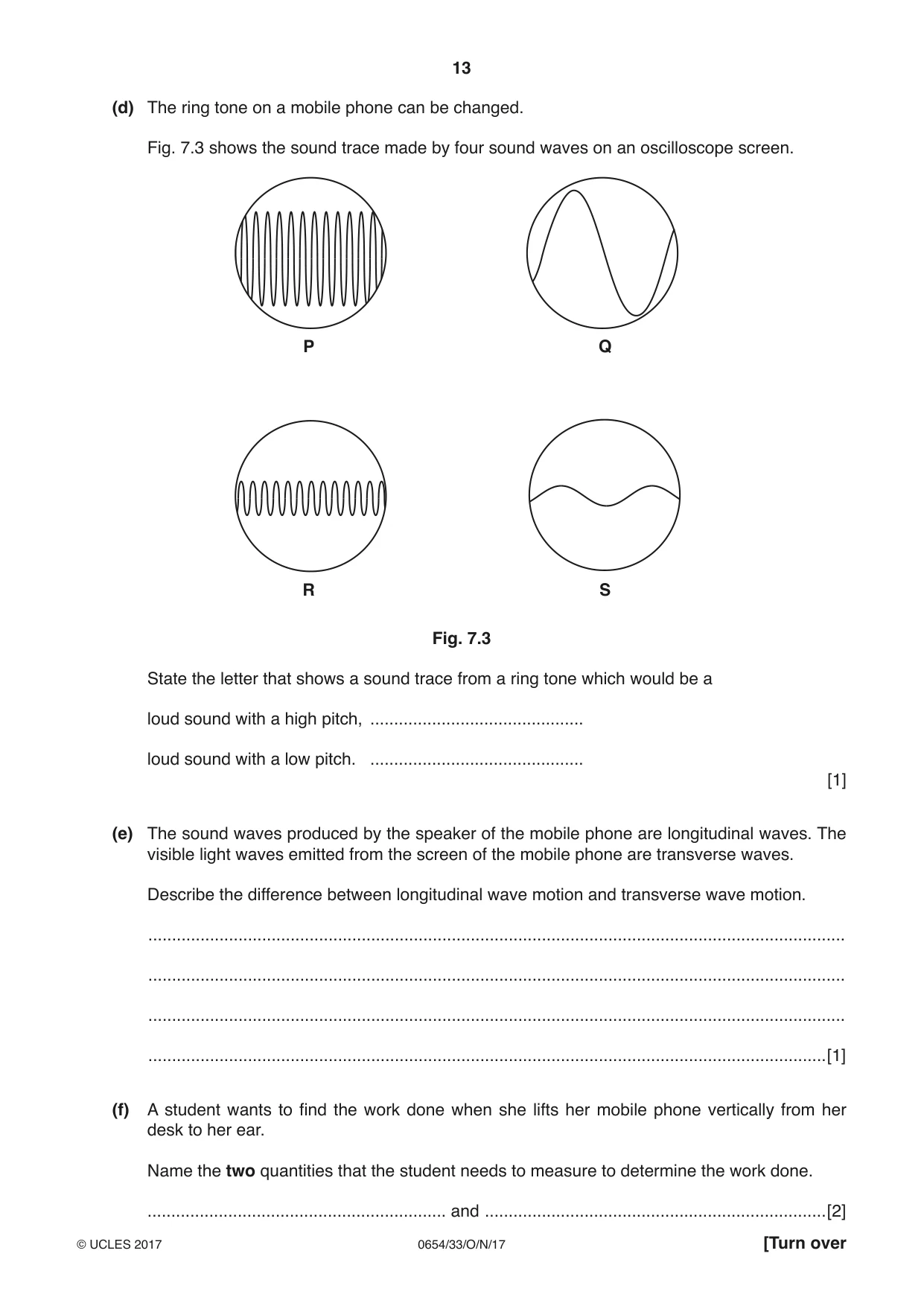
7 (a) Name the electromagnetic wave used in mobile (cell) phone communication. ...............................................................................................................................................[1] (b) Fig. 7.1 shows a mobile phone being charged. charger speaker screen 1 2 3 4 5 6 battery battery 7 8 9 # 0 @ cable microphone Fig. 7.1 Some parts of the mobile phone have been labelled. Name the part of the mobile phone that transfers (i) electrical energy into sound energy, ..............................................................[1] (ii) electrical energy into stored chemical energy. ..............................................................[1] (c) A charger for a mobile phone is marked as shown in Fig. 7.2. input: a.c. 240 V, 50 Hz, 80 mA output: d.c. 5300 mV, 500 mA Fig. 7.2 (i) State the physical quantity that has the unit mV. .......................................................................................................................................[1] (ii) State the physical quantity that has the unit Hz. .......................................................................................................................................[1] (d) The ring tone on a mobile phone can be changed. Fig. 7.3 shows the sound trace made by four sound waves on an oscilloscope screen. P Q R S Fig. 7.3 State the letter that shows a sound trace from a ring tone which would be a loud sound with a high pitch, ............................................. loud sound with a low pitch. ............................................. [1] (e) The sound waves produced by the speaker of the mobile phone are longitudinal waves. The visible light waves emitted from the screen of the mobile phone are transverse waves. Describe the difference between longitudinal wave motion and transverse wave motion. ................................................................................................................................................... ................................................................................................................................................... ................................................................................................................................................... ...............................................................................................................................................[1] (f) A student wants to find the work done when she lifts her mobile phone vertically from her desk to her ear. Name the two quantities that the student needs to measure to determine the work done. ............................................................... and ........................................................................[2]
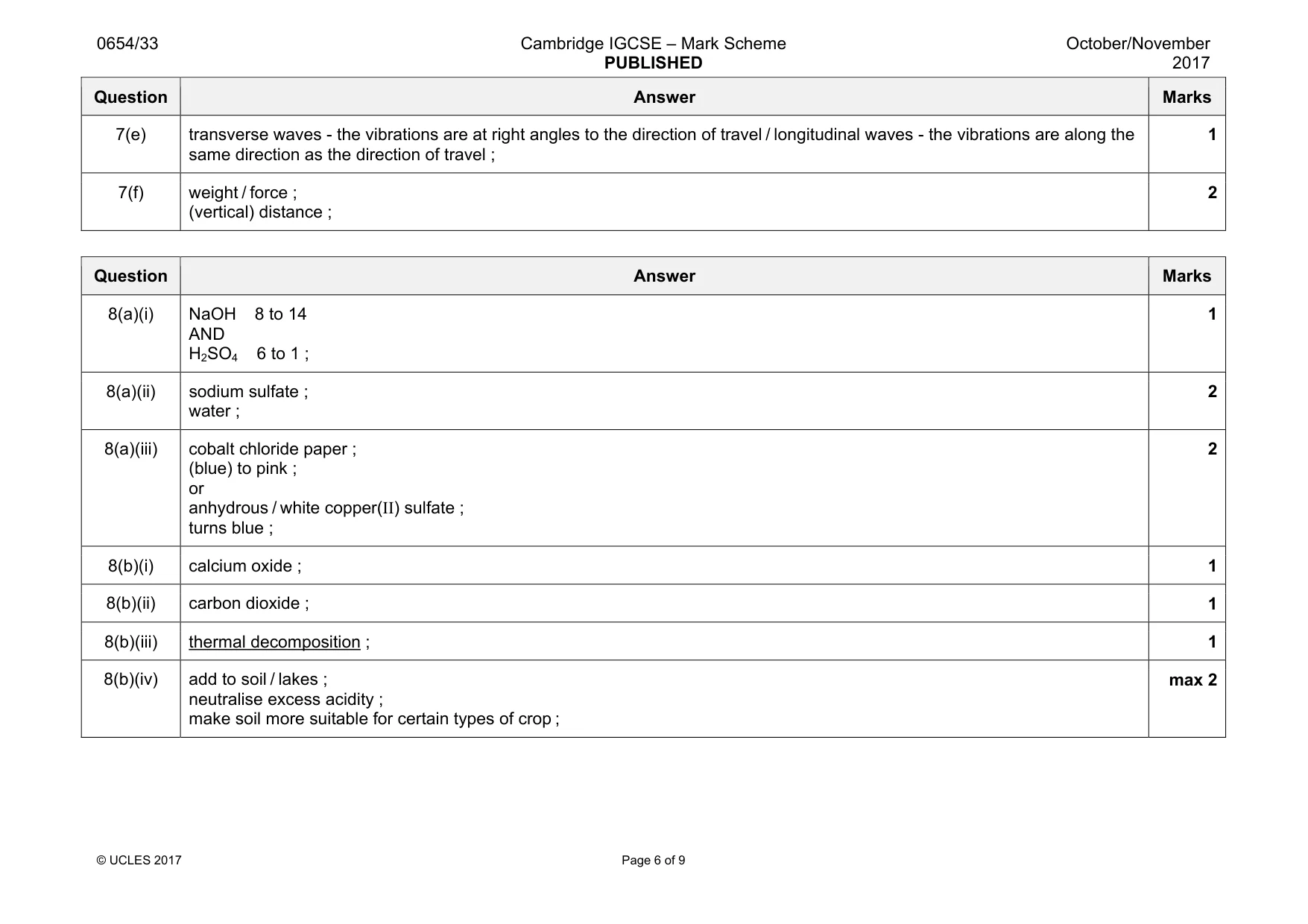
Mark scheme: 7(a) microwaves ; 1 7(b)(i) speaker ; 1 7(b)(ii) battery ; 1 7(c)(i) potential difference / voltage ; 1 7(c)(ii) frequency (of electricity) ; 1 7(d) P then Q ; 1 Question Answer Marks 7(e) transverse waves - the vibrations are at right angles to the direction of travel / longitudinal waves - the vibrations are along the same direction as the direction of travel ; 1 7(f) weight / force ; (vertical) distance ; 2
Q8 · PH meters being used to measure the pH of dilute sodium hydroxide solution and dilute…
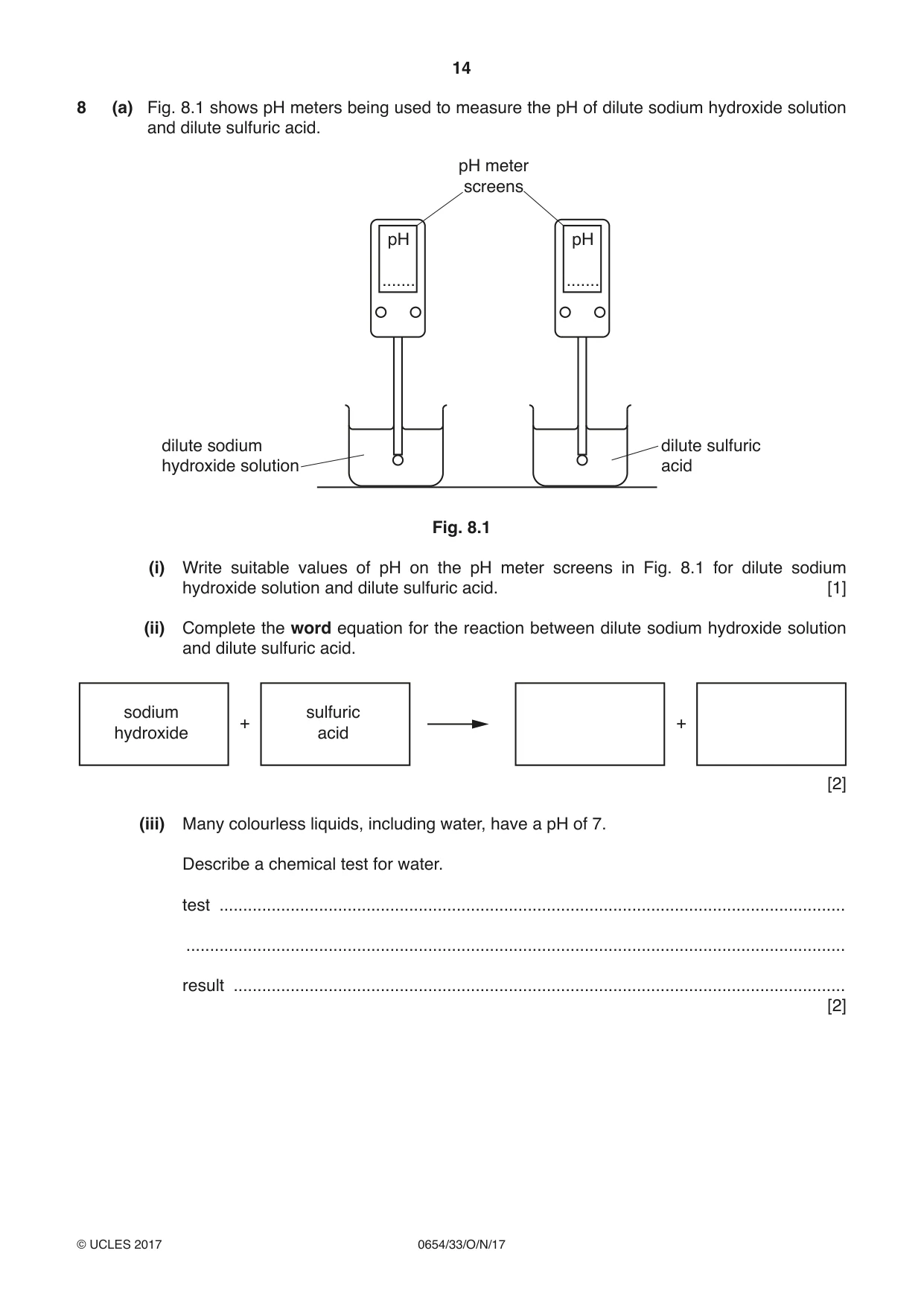
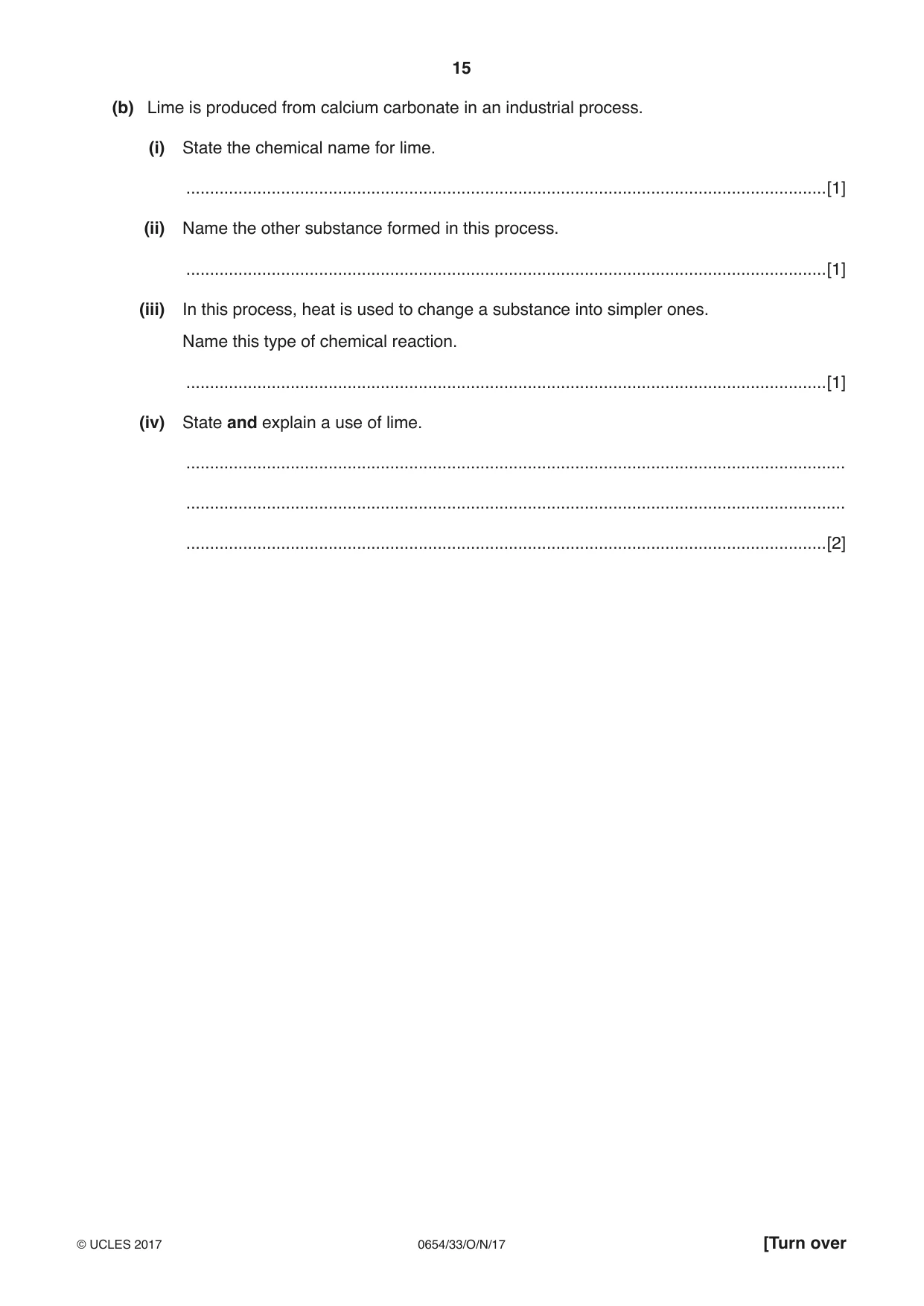
8 (a) Fig. 8.1 shows pH meters being used to measure the pH of dilute sodium hydroxide solution and dilute sulfuric acid. pH meter screens pH pH ....... ....... dilute sodium dilute sulfuric hydroxide solution acid Fig. 8.1 (i) Write suitable values of pH on the pH meter screens in Fig. 8.1 for dilute sodium hydroxide solution and dilute sulfuric acid. [1] (ii) Complete the word equation for the reaction between dilute sodium hydroxide solution and dilute sulfuric acid. sodium sulfuric + + hydroxide acid [2] (iii) Many colourless liquids, including water, have a pH of 7. Describe a chemical test for water. test .................................................................................................................................... ........................................................................................................................................... result ................................................................................................................................. [2] (b) Lime is produced from calcium carbonate in an industrial process. (i) State the chemical name for lime. .......................................................................................................................................[1] (ii) Name the other substance formed in this process. .......................................................................................................................................[1] (iii) In this process, heat is used to change a substance into simpler ones. Name this type of chemical reaction. .......................................................................................................................................[1] (iv) State and explain a use of lime. ........................................................................................................................................... ........................................................................................................................................... .......................................................................................................................................[2]
Mark scheme: 8(a)(i) NaOH 8 to 14 AND H2SO4 6 to 1 ; 1 8(a)(ii) sodium sulfate ; water ; 2 8(a)(iii) cobalt chloride paper ; (blue) to pink ; or anhydrous / white copper(II) sulfate ; turns blue ; 2 8(b)(i) calcium oxide ; 1 8(b)(ii) carbon dioxide ; 1 8(b)(iii) thermal decomposition ; 1 8(b)(iv) add to soil / lakes ; neutralise excess acidity ; make soil more suitable for certain types of crop ; max 2
More questions on The characteristic properties of acids and bases
Q9 · The distance-time graph for a bus travelling through part of a town
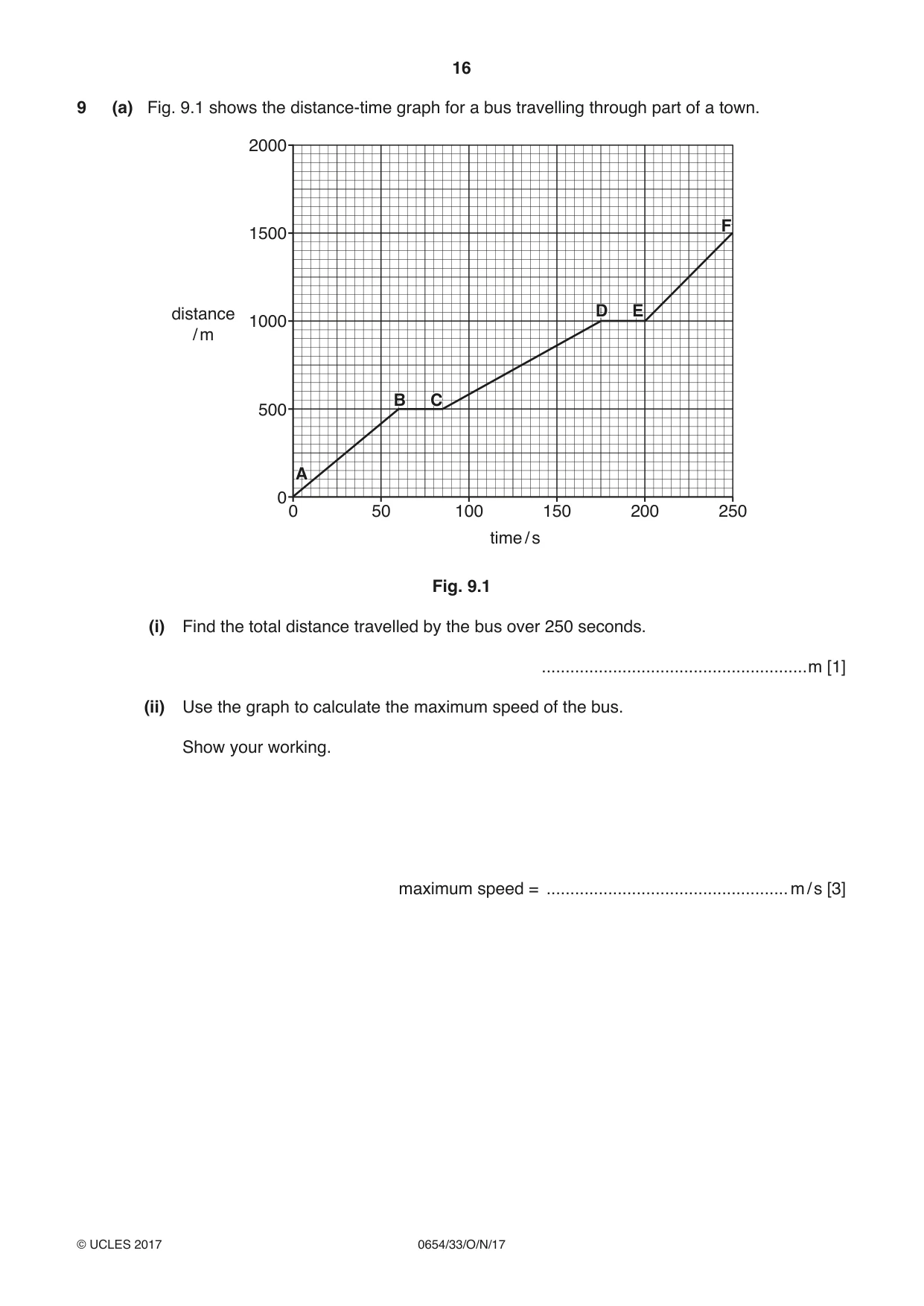
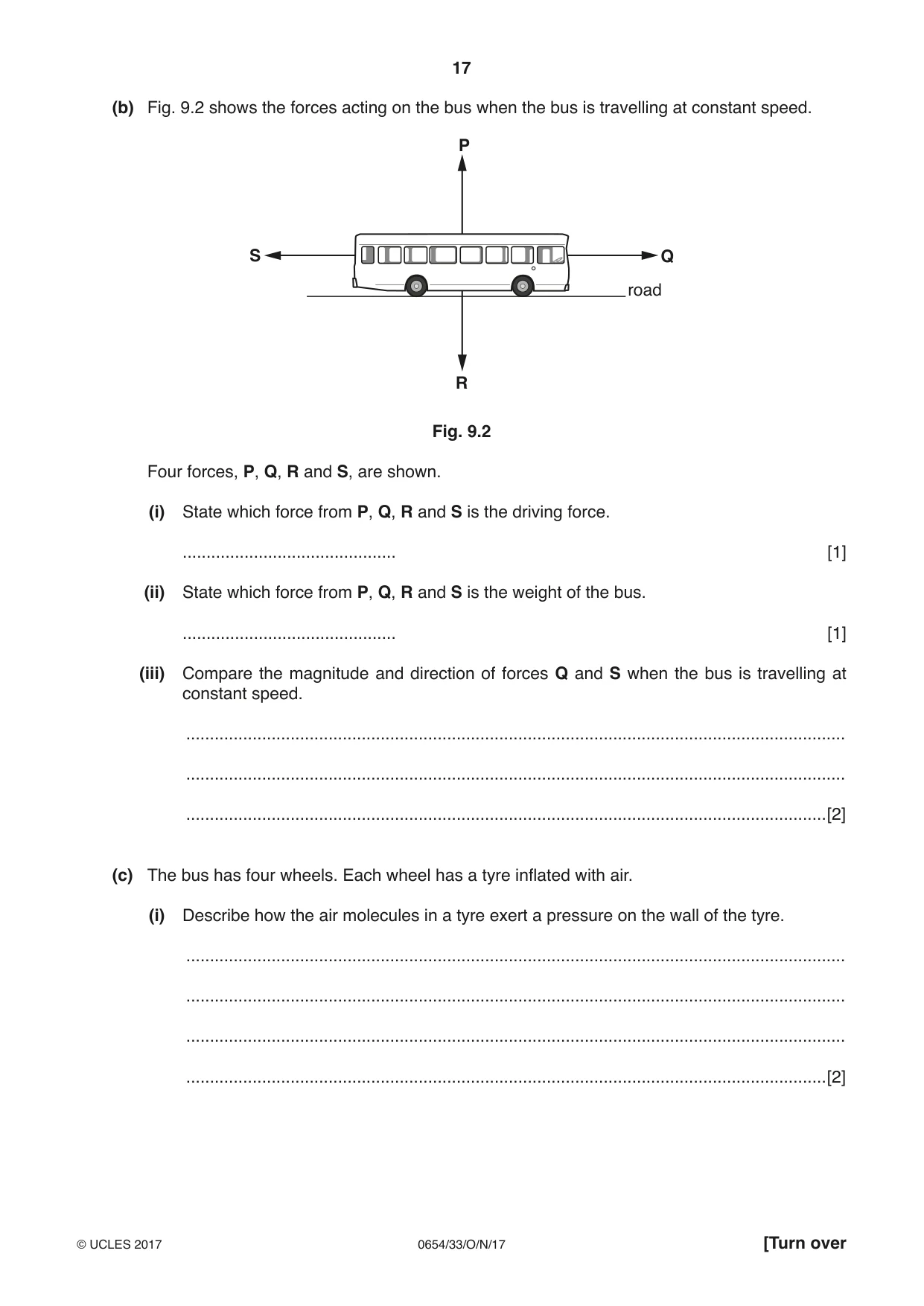
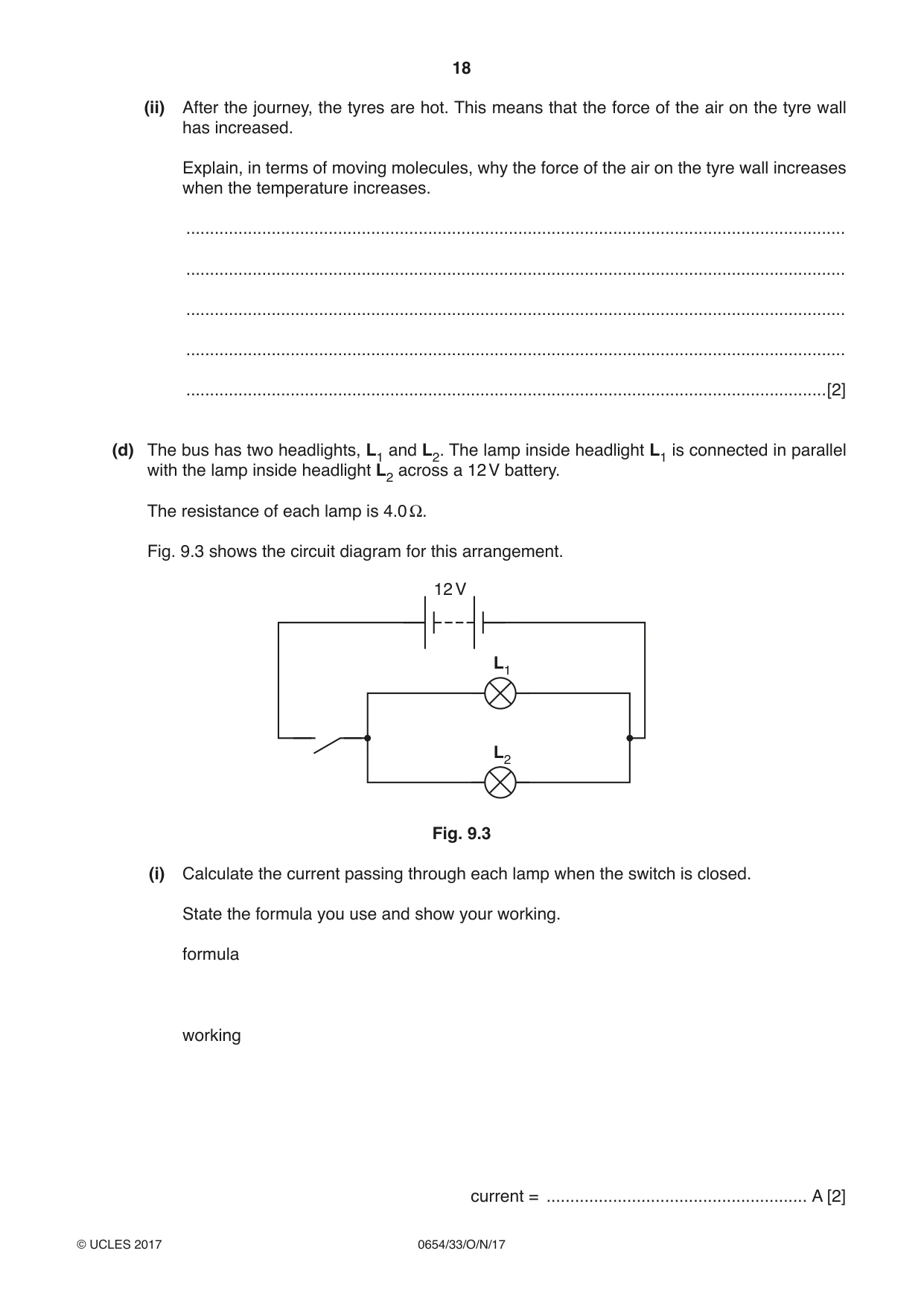
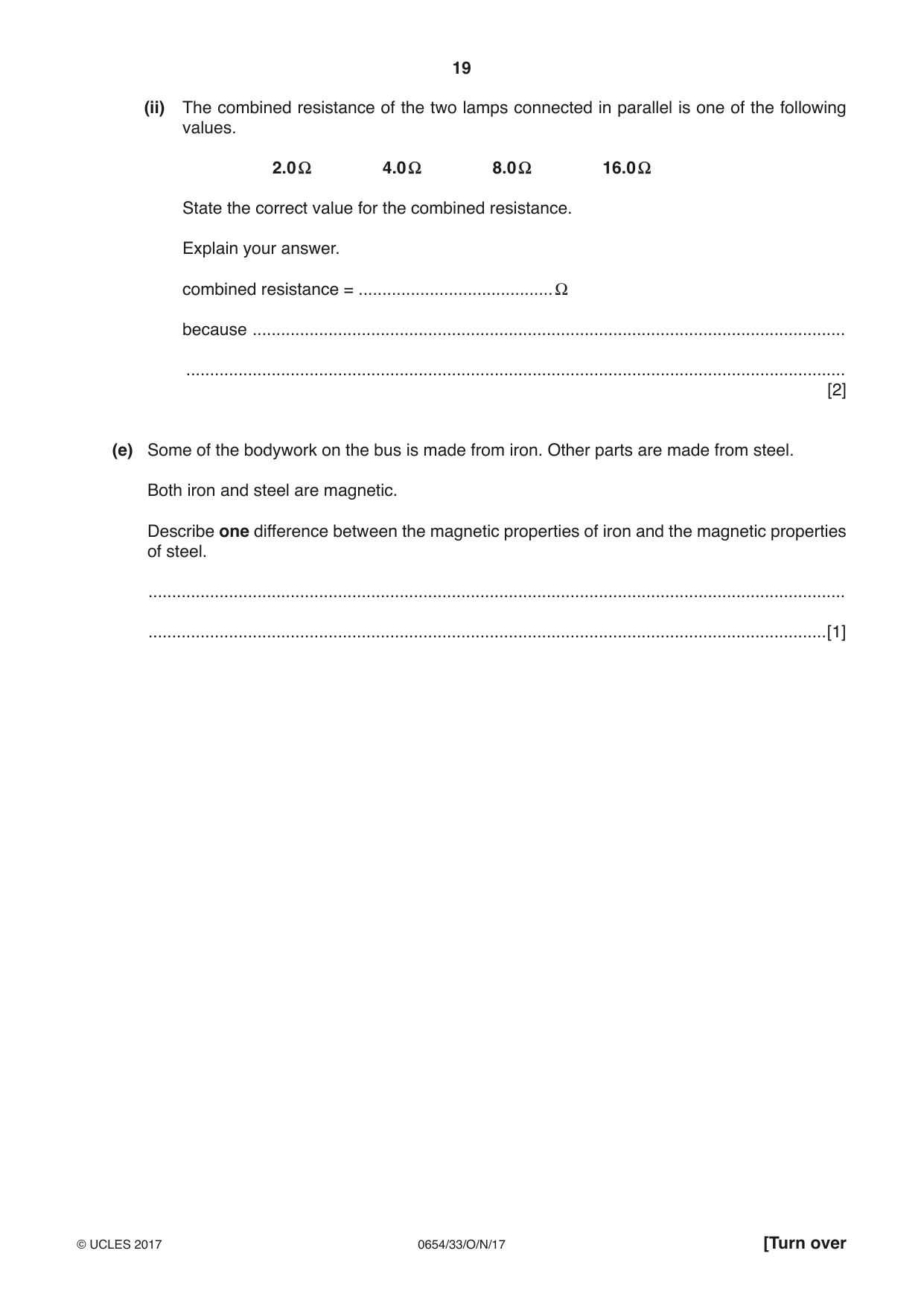
9 (a) Fig. 9.1 shows the distance-time graph for a bus travelling through part of a town. 2000 FF 1500 distance DD EE 1000 / m BB CC 500 AA 0 0 50 100 150 200 250 time / s Fig. 9.1 (i) Find the total distance travelled by the bus over 250 seconds. ........................................................m [1] (ii) Use the graph to calculate the maximum speed of the bus. Show your working. maximum speed = ...................................................m / s [3] (b) Fig. 9.2 shows the forces acting on the bus when the bus is travelling at constant speed. P S Q road R Fig. 9.2 Four forces, P, Q, R and S, are shown. (i) State which force from P, Q, R and S is the driving force. ............................................. [1] (ii) State which force from P, Q, R and S is the weight of the bus. ............................................. [1] (iii) Compare the magnitude and direction of forces Q and S when the bus is travelling at constant speed. ........................................................................................................................................... ........................................................................................................................................... .......................................................................................................................................[2] (c) The bus has four wheels. Each wheel has a tyre inflated with air. (i) Describe how the air molecules in a tyre exert a pressure on the wall of the tyre. ........................................................................................................................................... ........................................................................................................................................... ........................................................................................................................................... .......................................................................................................................................[2] (ii) After the journey, the tyres are hot. This means that the force of the air on the tyre wall has increased. Explain, in terms of moving molecules, why the force of the air on the tyre wall increases when the temperature increases. ........................................................................................................................................... ........................................................................................................................................... ........................................................................................................................................... ........................................................................................................................................... .......................................................................................................................................[2] (d) The bus has two headlights, L1 and L2. The lamp inside headlight L1 is connected in parallel with the lamp inside headlight L2 across a 12 V battery. The resistance of each lamp is 4.0 Ω. Fig. 9.3 shows the circuit diagram for this arrangement. 12 V L1 L2 Fig. 9.3 (i) Calculate the current passing through each lamp when the switch is closed. State the formula you use and show your working. formula working current = ....................................................... A [2] (ii) The combined resistance of the two lamps connected in parallel is one of the following values. 2.0 Ω 4.0 Ω 8.0 Ω 16.0 Ω State the correct value for the combined resistance. Explain your answer. combined resistance = ......................................... Ω because ............................................................................................................................. ........................................................................................................................................... [2] (e) Some of the bodywork on the bus is made from iron. Other parts are made from steel. Both iron and steel are magnetic. Describe one difference between the magnetic properties of iron and the magnetic properties of steel. ................................................................................................................................................... ...............................................................................................................................................[1]
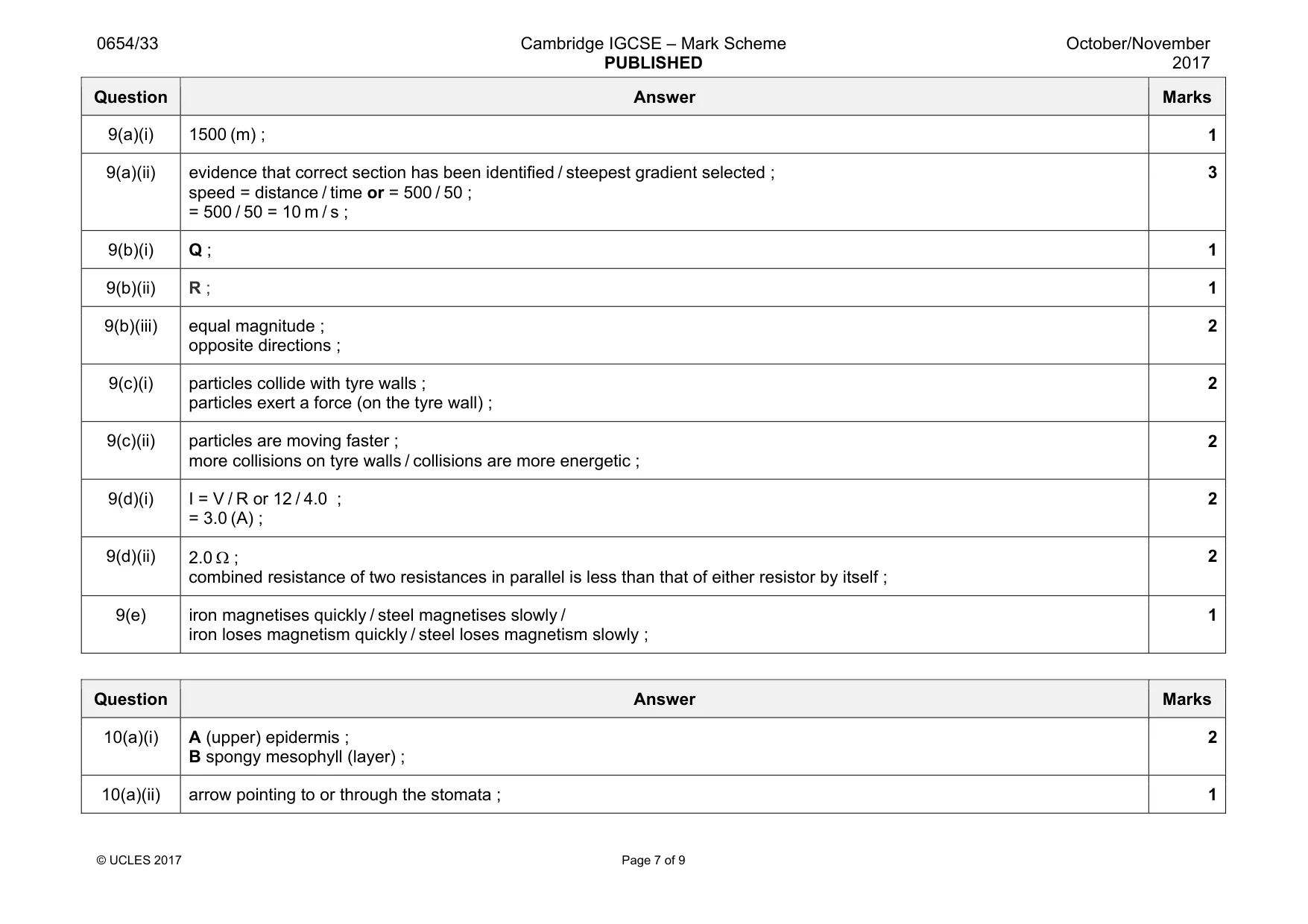
Mark scheme: 9(a)(i) 1500 (m) ; 1 9(a)(ii) evidence that correct section has been identified / steepest gradient selected ; speed = distance / time or = 500 / 50 ; = 500 / 50 = 10 m / s ; 3 9(b)(i) Q ; 1 9(b)(ii) R ; 1 9(b)(iii) equal magnitude ; opposite directions ; 2 9(c)(i) particles collide with tyre walls ; particles exert a force (on the tyre wall) ; 2 9(c)(ii) particles are moving faster ; more collisions on tyre walls / collisions are more energetic ; 2 9(d)(i) I = V / R or 12 / 4.0 ; = 3.0 (A) ; 2 9(d)(ii) 2.0 Ω ; combined resistance of two resistances in parallel is less than that of either resistor by itself ; 2 9(e) iron magnetises quickly / steel magnetises slowly / iron loses magnetism quickly / steel loses magnetism slowly ; 1
Q10 · A drawing of a cross-section of a leaf from a plant
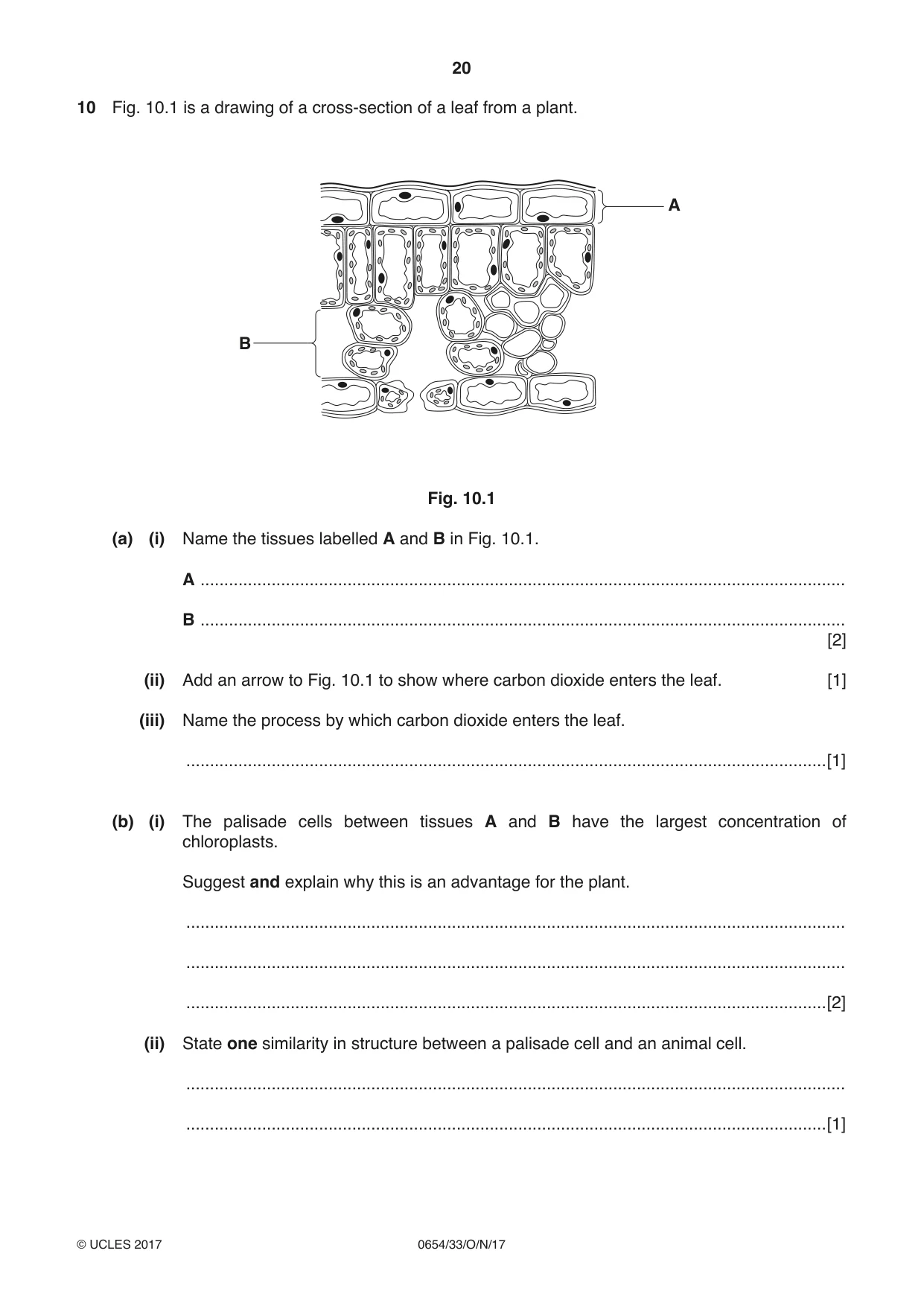
10 Fig. 10.1 is a drawing of a cross-section of a leaf from a plant. A B Fig. 10.1 (a) (i) Name the tissues labelled A and B in Fig. 10.1. A ........................................................................................................................................ B ........................................................................................................................................ [2] (ii) Add an arrow to Fig. 10.1 to show where carbon dioxide enters the leaf. [1] (iii) Name the process by which carbon dioxide enters the leaf. .......................................................................................................................................[1] (b) (i) The palisade cells between tissues A and B have the largest concentration of chloroplasts. Suggest and explain why this is an advantage for the plant. ........................................................................................................................................... ........................................................................................................................................... .......................................................................................................................................[2] (ii) State one similarity in structure between a palisade cell and an animal cell. ........................................................................................................................................... .......................................................................................................................................[1]
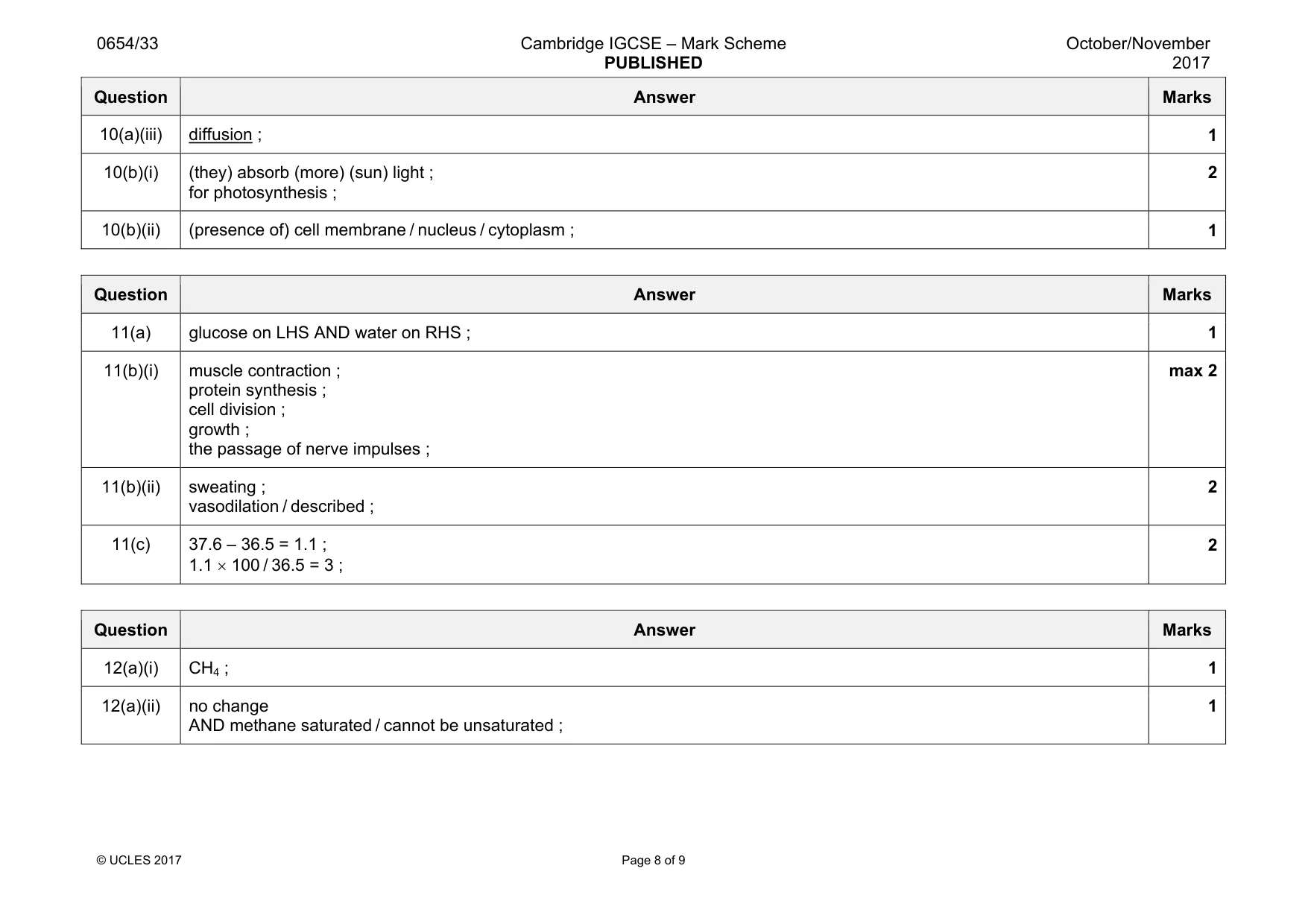
Mark scheme: 10(a)(i) A (upper) epidermis ; B spongy mesophyll (layer) ; 2 10(a)(ii) arrow pointing to or through the stomata ; 1 Question Answer Marks 10(a)(iii) diffusion ; 1 10(b)(i) (they) absorb (more) (sun) light ; for photosynthesis ; 2 10(b)(ii) (presence of) cell membrane / nucleus / cytoplasm ; 1
Q11 · Respiration is one of the characteristics of living things that takes place in all living…
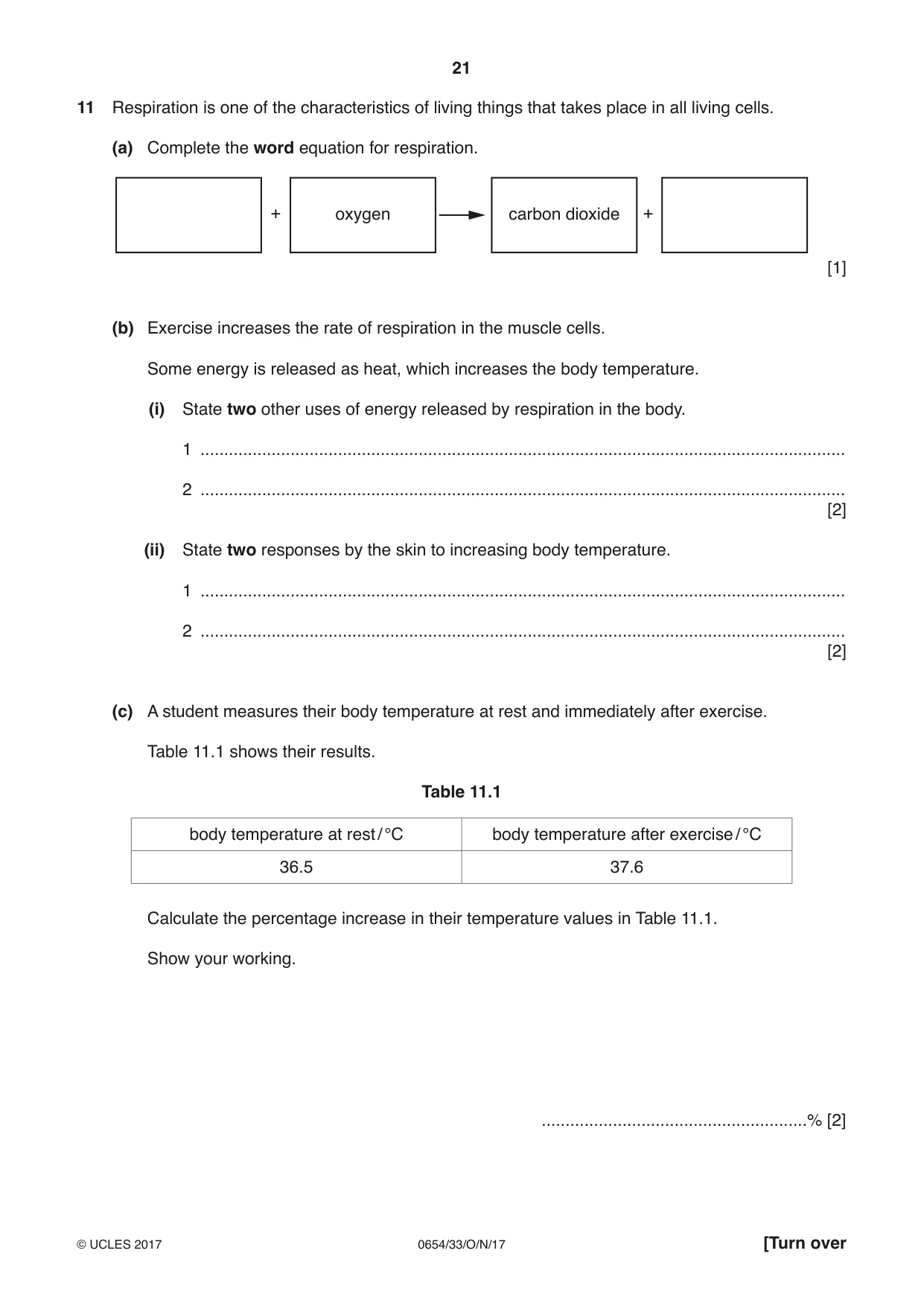
11 Respiration is one of the characteristics of living things that takes place in all living cells. (a) Complete the word equation for respiration. + oxygen carbon dioxide + [1] (b) Exercise increases the rate of respiration in the muscle cells. Some energy is released as heat, which increases the body temperature. (i) State two other uses of energy released by respiration in the body. 1 ........................................................................................................................................ 2 ........................................................................................................................................ [2] (ii) State two responses by the skin to increasing body temperature. 1 ........................................................................................................................................ 2 ........................................................................................................................................ [2] (c) A student measures their body temperature at rest and immediately after exercise. Table 11.1 shows their results. Table 11.1 body temperature at rest / °C body temperature after exercise / °C 36.5 37.6 Calculate the percentage increase in their temperature values in Table 11.1. Show your working. ........................................................% [2]
Mark scheme: 11(a) glucose on LHS AND water on RHS ; 1 11(b)(i) muscle contraction ; protein synthesis ; cell division ; growth ; the passage of nerve impulses ; max 2 11(b)(ii) sweating ; vasodilation / described ; 2 11(c) 37.6 – 36.5 = 1.1 ; 1.1 × 100 / 36.5 = 3 ; 2
Q12 · Coal, natural gas and biogas are all fuels that provide useful energy
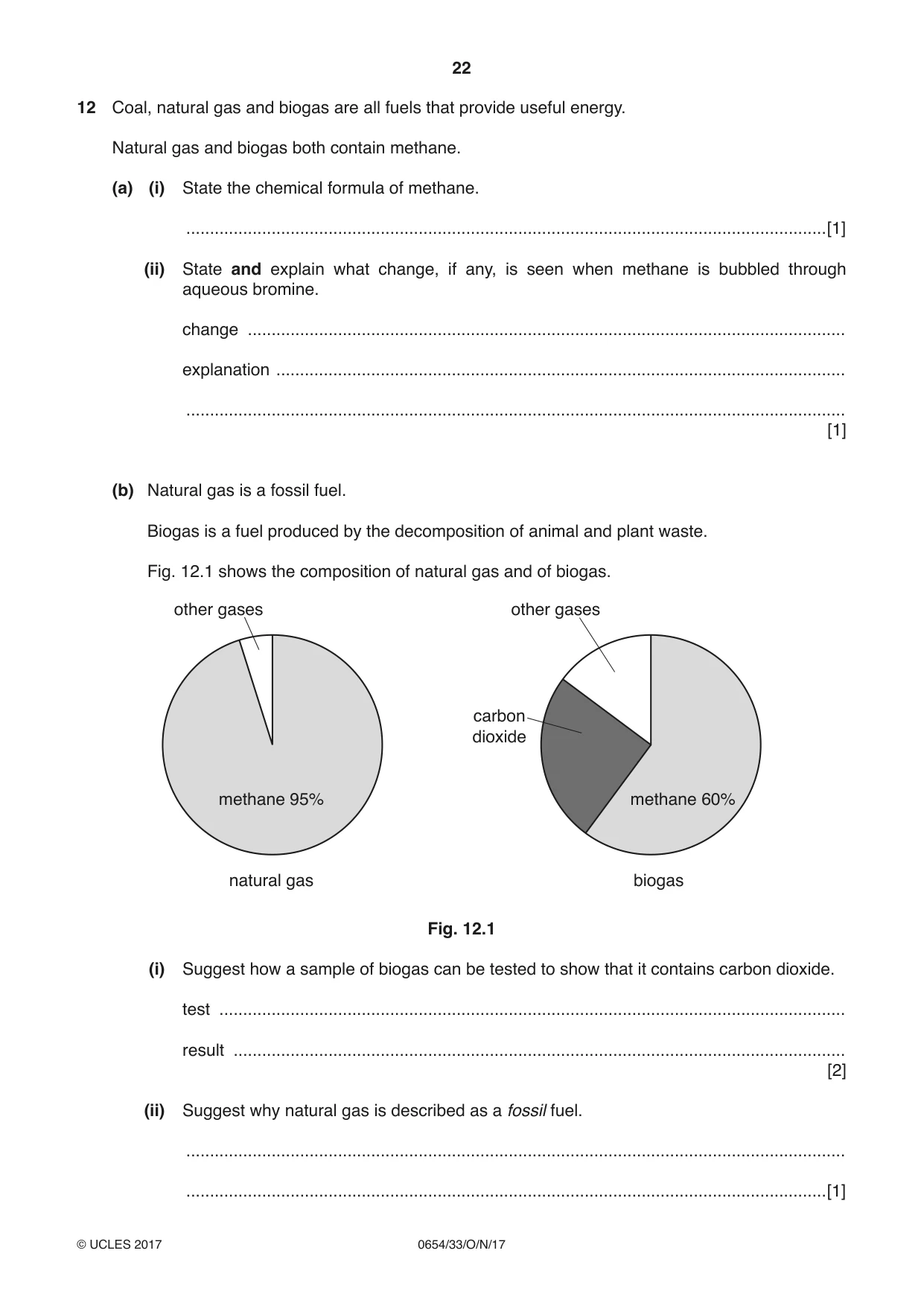
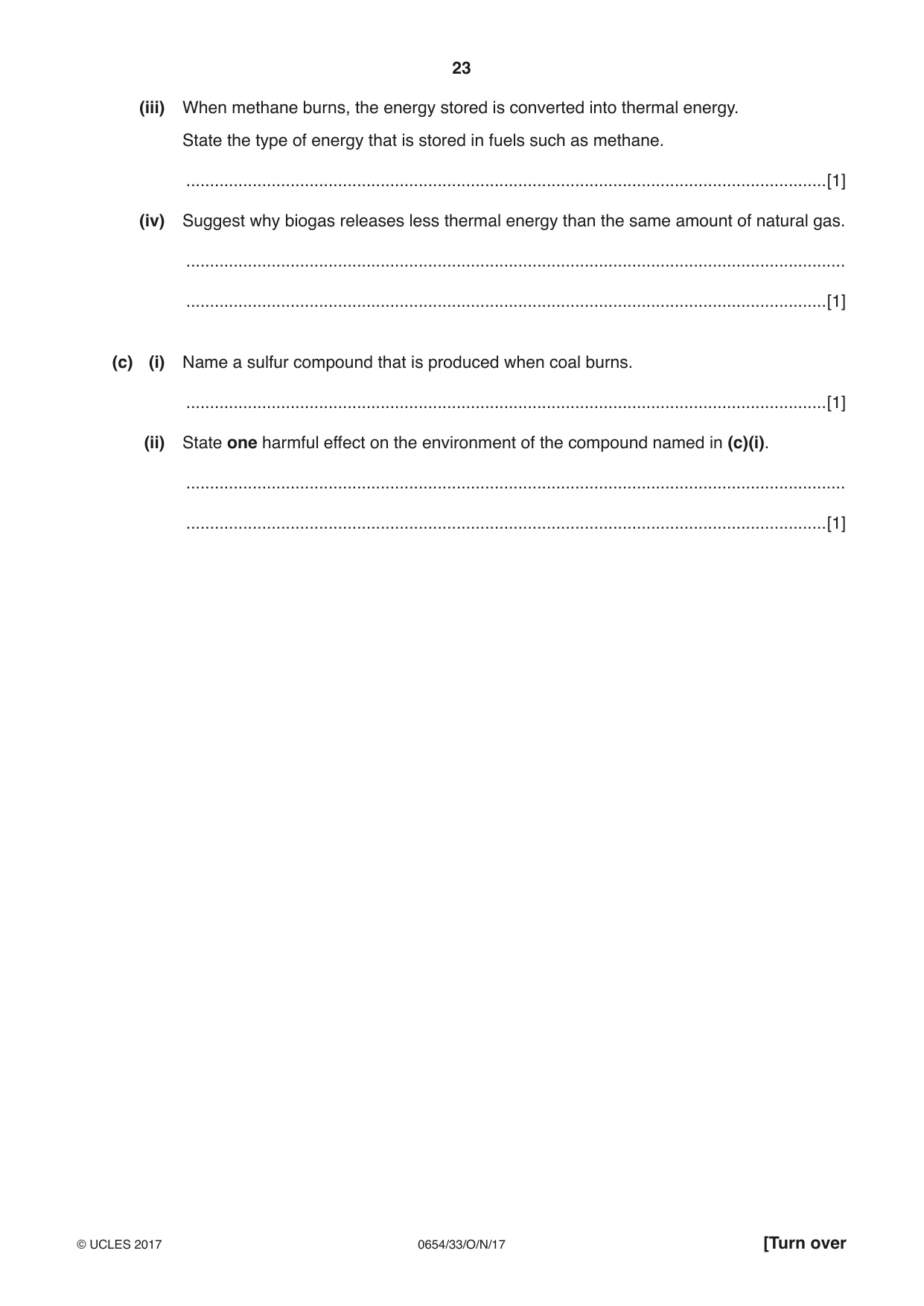
12 Coal, natural gas and biogas are all fuels that provide useful energy. Natural gas and biogas both contain methane. (a) (i) State the chemical formula of methane. .......................................................................................................................................[1] (ii) State and explain what change, if any, is seen when methane is bubbled through aqueous bromine. change .............................................................................................................................. explanation ........................................................................................................................ ........................................................................................................................................... [1] (b) Natural gas is a fossil fuel. Biogas is a fuel produced by the decomposition of animal and plant waste. Fig. 12.1 shows the composition of natural gas and of biogas. other gases other gases carbon dioxide methane 95% methane 60% natural gas biogas Fig. 12.1 (i) Suggest how a sample of biogas can be tested to show that it contains carbon dioxide. test .................................................................................................................................... result ................................................................................................................................. [2] (ii) Suggest why natural gas is described as a fossil fuel. ........................................................................................................................................... .......................................................................................................................................[1] (iii) When methane burns, the energy stored is converted into thermal energy. State the type of energy that is stored in fuels such as methane. .......................................................................................................................................[1] (iv) Suggest why biogas releases less thermal energy than the same amount of natural gas. ........................................................................................................................................... .......................................................................................................................................[1] (c) (i) Name a sulfur compound that is produced when coal burns. .......................................................................................................................................[1] (ii) State one harmful effect on the environment of the compound named in (c)(i). ........................................................................................................................................... .......................................................................................................................................[1]
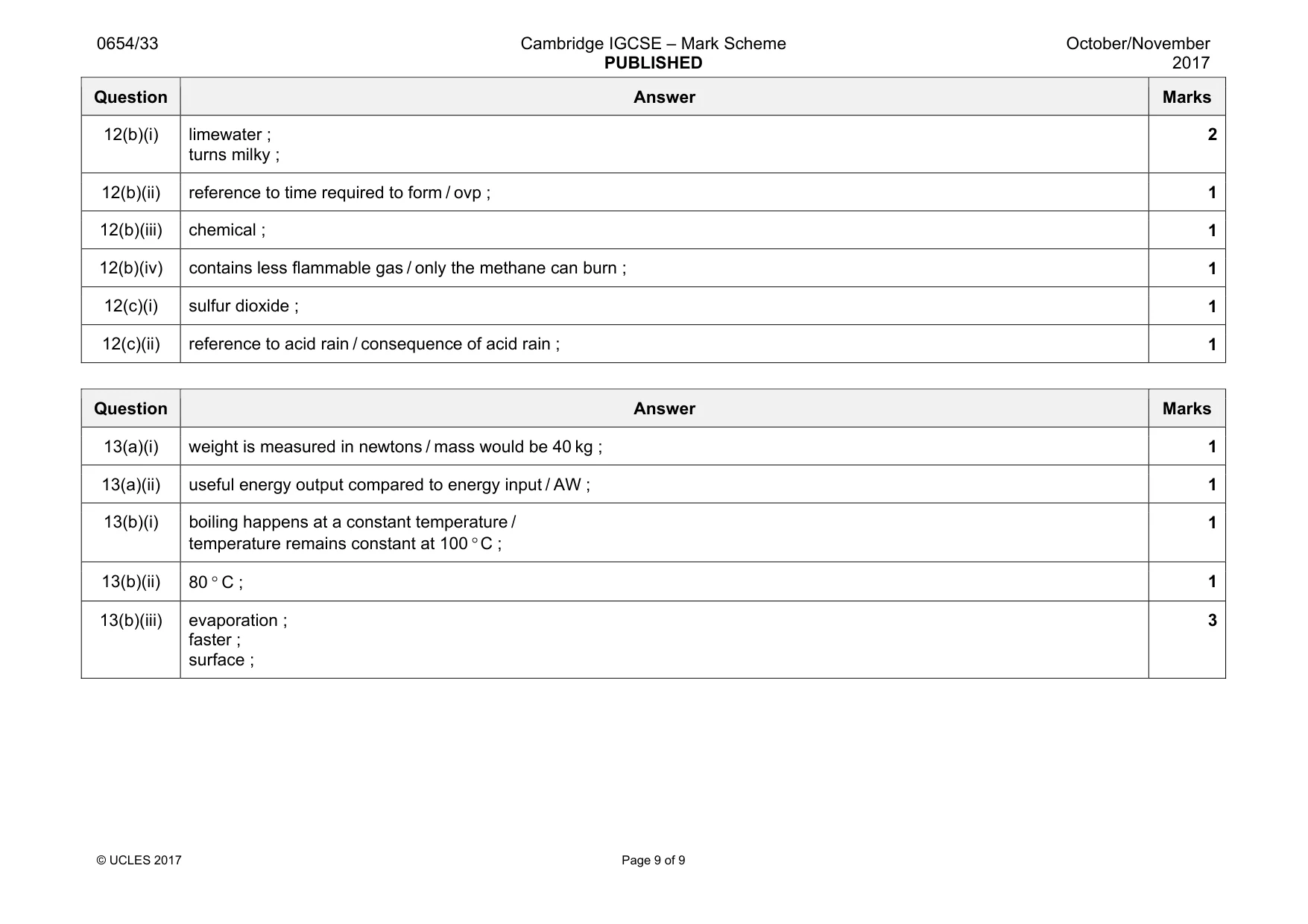
Mark scheme: 12(a)(i) CH4 ; 1 12(a)(ii) no change AND methane saturated / cannot be unsaturated ; 1 Question Answer Marks 12(b)(i) limewater ; turns milky ; 2 12(b)(ii) reference to time required to form / ovp ; 1 12(b)(iii) chemical ; 1 12(b)(iv) contains less flammable gas / only the methane can burn ; 1 12(c)(i) sulfur dioxide ; 1 12(c)(ii) reference to acid rain / consequence of acid rain ; 1
Q13 · An information booklet about a cooker states that the weight of the cooker is 40 kg
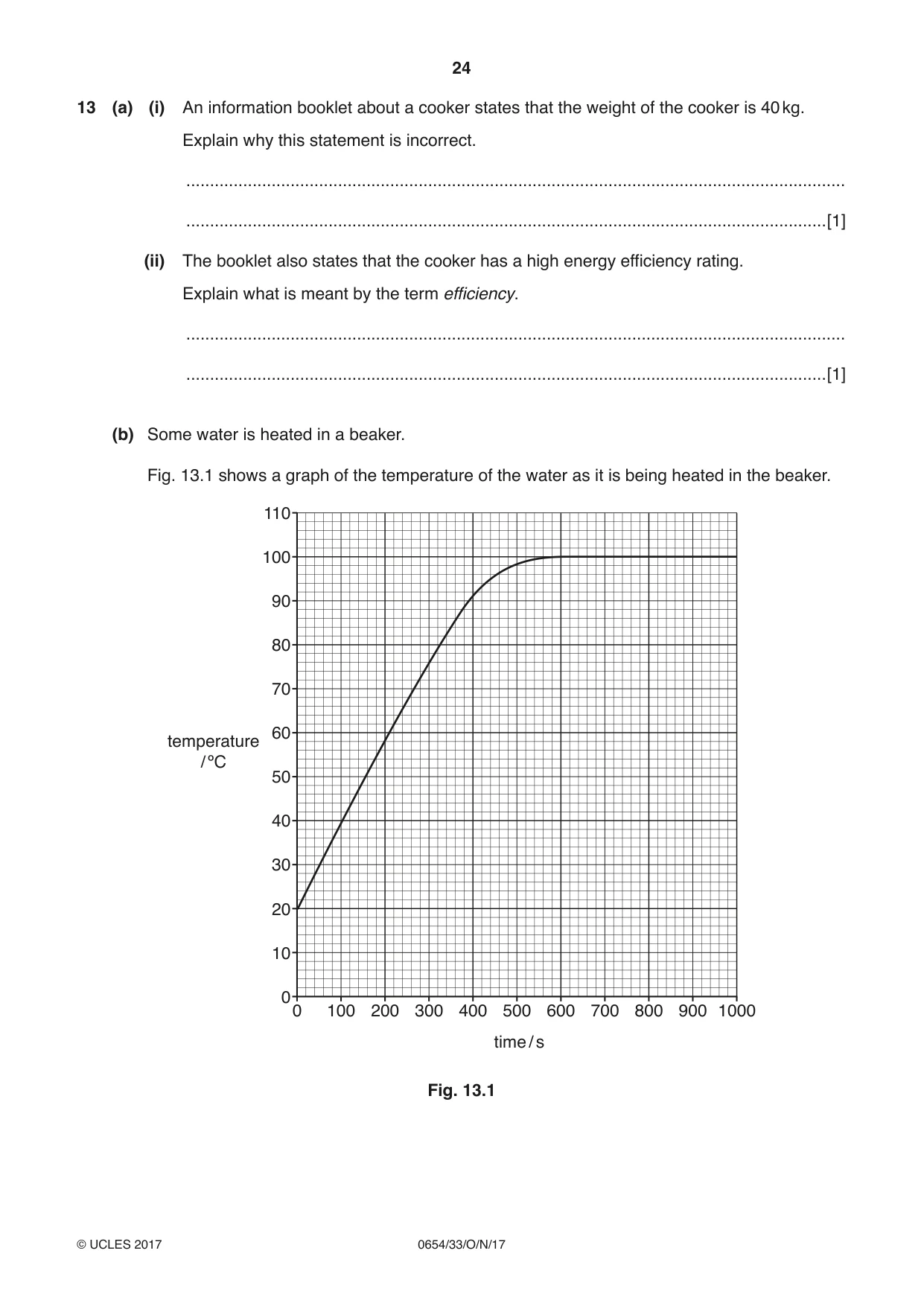
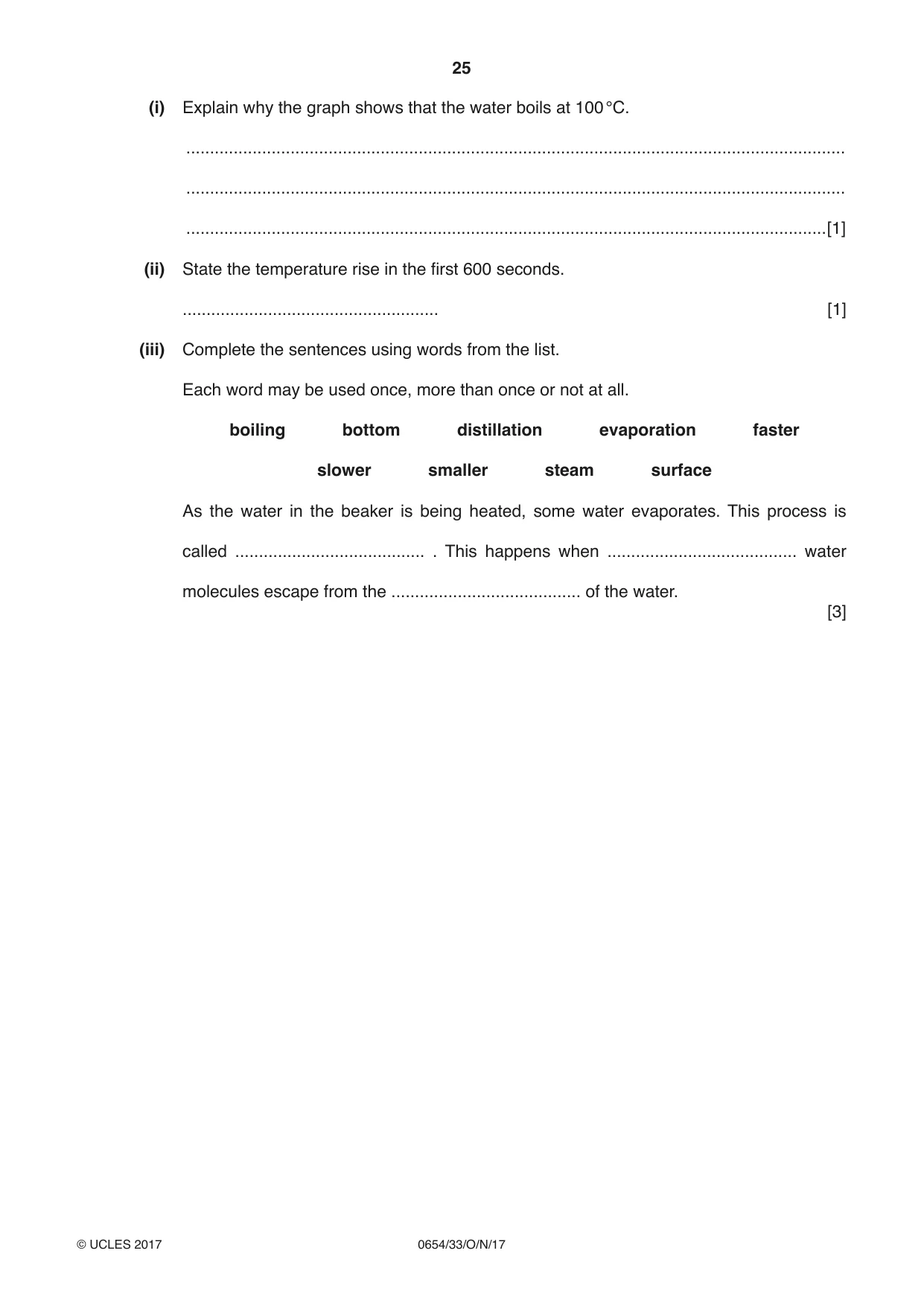
13 (a) (i) An information booklet about a cooker states that the weight of the cooker is 40 kg. Explain why this statement is incorrect. ........................................................................................................................................... .......................................................................................................................................[1] (ii) The booklet also states that the cooker has a high energy efficiency rating. Explain what is meant by the term efficiency. ........................................................................................................................................... .......................................................................................................................................[1] (b) Some water is heated in a beaker. Fig. 13.1 shows a graph of the temperature of the water as it is being heated in the beaker. 110 100 90 80 70 60 temperature / ºC 50 40 30 20 10 0 0 100 200 300 400 500 600 700 800 900 1000 time / s Fig. 13.1 (i) Explain why the graph shows that the water boils at 100 °C. ........................................................................................................................................... ........................................................................................................................................... .......................................................................................................................................[1] (ii) State the temperature rise in the first 600 seconds. ...................................................... [1] (iii) Complete the sentences using words from the list. Each word may be used once, more than once or not at all. boiling bottom distillation evaporation faster slower smaller steam surface As the water in the beaker is being heated, some water evaporates. This process is called ........................................ . This happens when ........................................ water molecules escape from the ........................................ of the water. [3]
Mark scheme: 13(a)(i) weight is measured in newtons / mass would be 40 kg ; 1 13(a)(ii) useful energy output compared to energy input / AW ; 1 13(b)(i) boiling happens at a constant temperature / temperature remains constant at 100 ° C ; 1 13(b)(ii) 80 ° C ; 1 13(b)(iii) evaporation ; faster ; surface ; 3
What was in this paper
The subtopics covered by these 13 questions, and how many questions each got. Open one in a new tab to see every Cambridge question on it.
What you needed in this session
Cambridge’s own grade thresholds for 2017 Oct/Nov, Paper 3 · Variant 3. A higher threshold means an easier paper — the bar moves with how the cohort did.