Cambridge IGCSE Sciences - Co-ordinated (Double) 0654 — 2022 Feb/March Paper 3 · Variant 2
0654/32/F/M/22 · 12 questions · 120 marks · ≈135 min
The question paper and its mark scheme, free to read here and free to download. This is Cambridge’s own paper, exactly as it was sat.
Question paper28 pages
Mark scheme13 pages
Answers below. Sit the paper first if you are practising.
Questions as text
Q1 · The total number of teeth of different animals
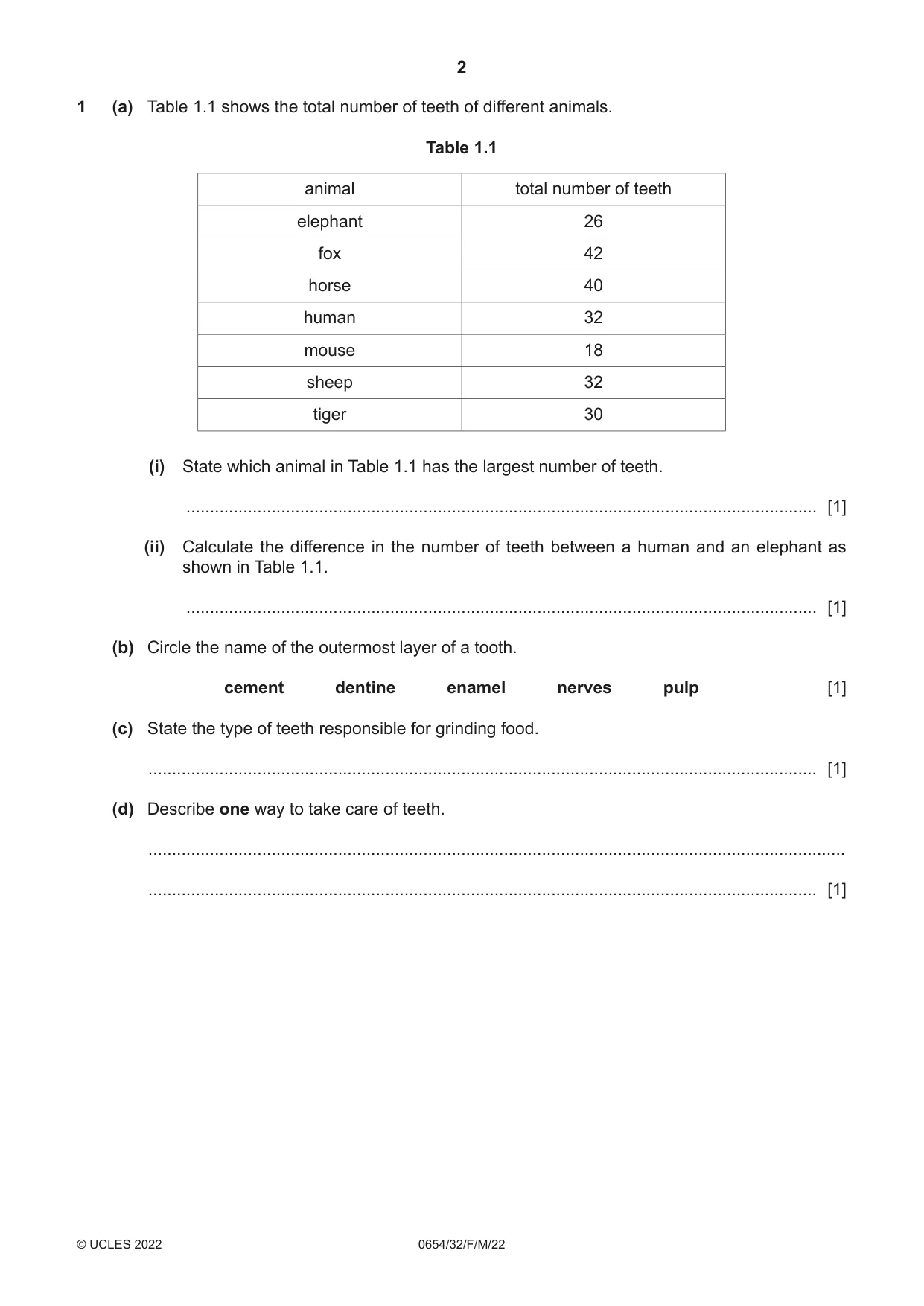
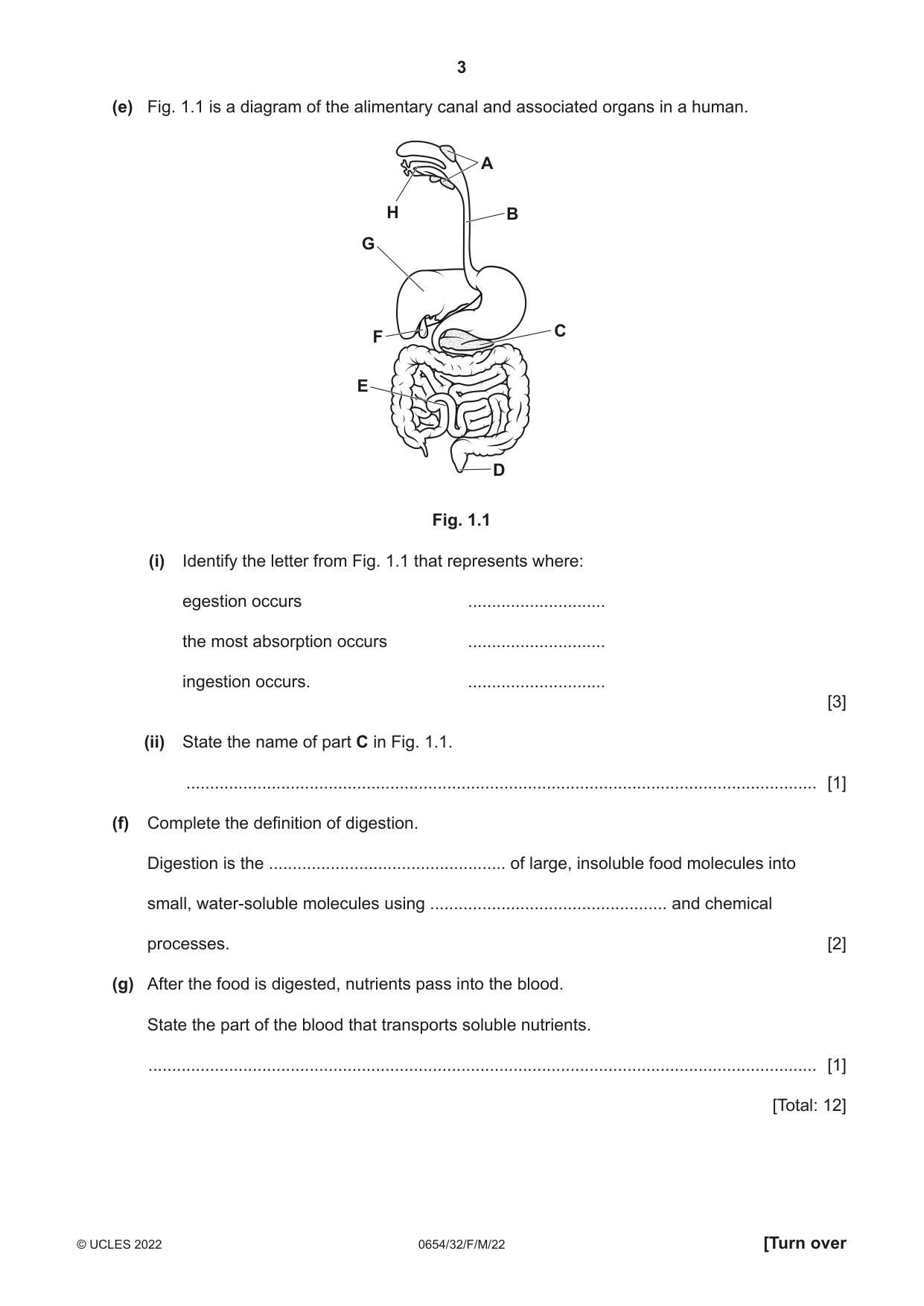
1 (a) Table 1.1 shows the total number of teeth of different animals. Table 1.1 animal total number of teeth elephant 26 fox 42 horse 40 human 32 mouse 18 sheep 32 tiger 30 (i) State which animal in Table 1.1 has the largest number of teeth. ..................................................................................................................................... [1] (ii) Calculate the difference in the number of teeth between a human and an elephant as shown in Table 1.1. ..................................................................................................................................... [1] (b) Circle the name of the outermost layer of a tooth. cement dentine enamel nerves pulp [1] (c) State the type of teeth responsible for grinding food. ............................................................................................................................................. [1] (d) Describe one way to take care of teeth. ................................................................................................................................................... ............................................................................................................................................. [1] (e) Fig. 1.1 is a diagram of the alimentary canal and associated organs in a human. A H B G C F E D Fig. 1.1 (i) Identify the letter from Fig. 1.1 that represents where: egestion occurs ............................. the most absorption occurs ............................. ingestion occurs. ............................. [3] (ii) State the name of part C in Fig. 1.1. ..................................................................................................................................... [1] (f) Complete the definition of digestion. Digestion is the .................................................. of large, insoluble food molecules into small, water-soluble molecules using .................................................. and chemical processes. [2] (g) After the food is digested, nutrients pass into the blood. State the part of the blood that transports soluble nutrients. ............................................................................................................................................. [1] [Total: 12]
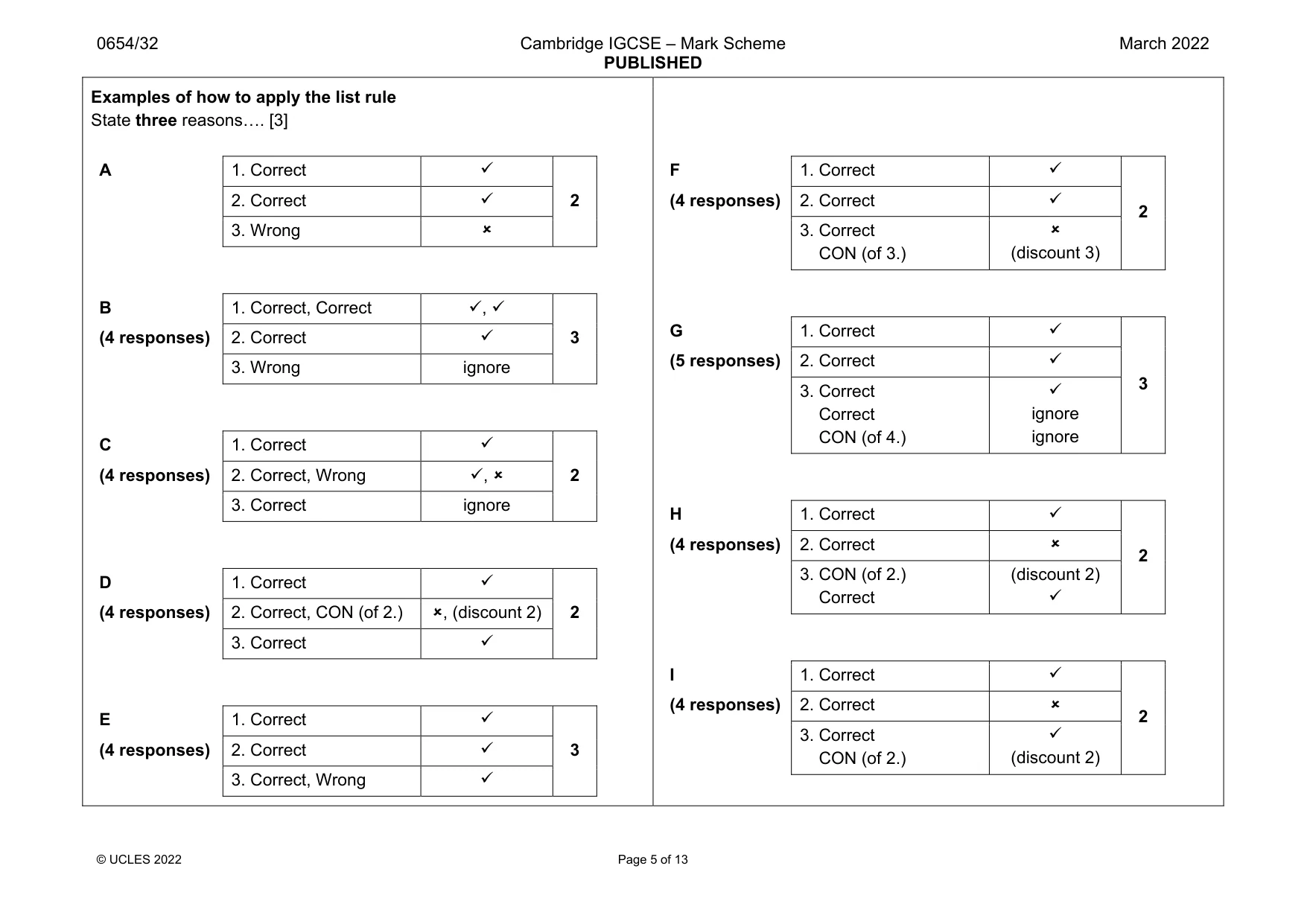
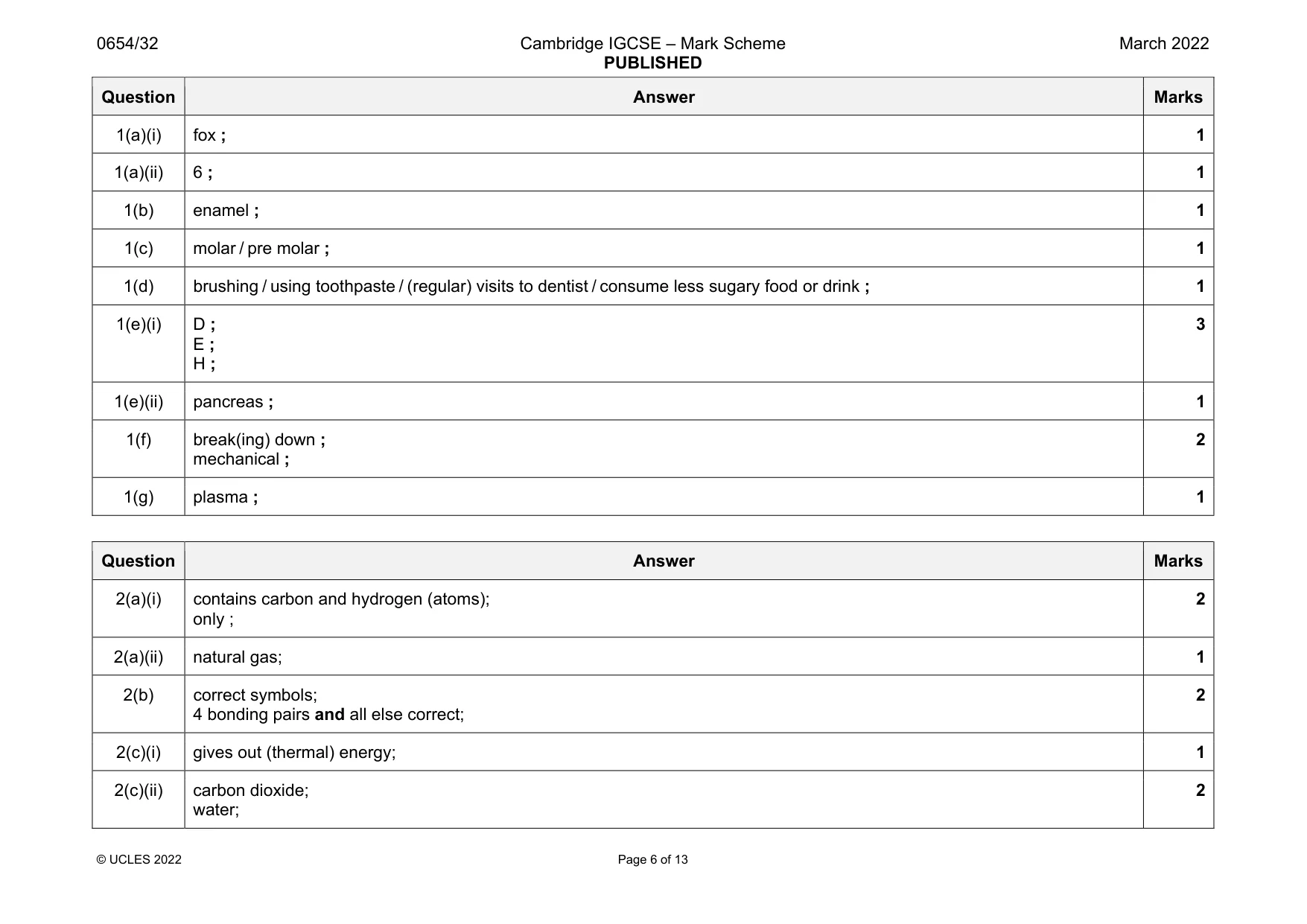
Mark scheme: 1(a)(i) fox ; 1 1(a)(ii) 6 ; 1 1(b) enamel ; 1 1(c) molar / pre molar ; 1 1(d) brushing / using toothpaste / (regular) visits to dentist / consume less sugary food or drink ; 1 1(e)(i) D ; E ; H ; 3 1(e)(ii) pancreas ; 1 1(f) break(ing) down ; mechanical ; 2 1(g) plasma ; 1
Q2 · Methane is a hydrocarbon
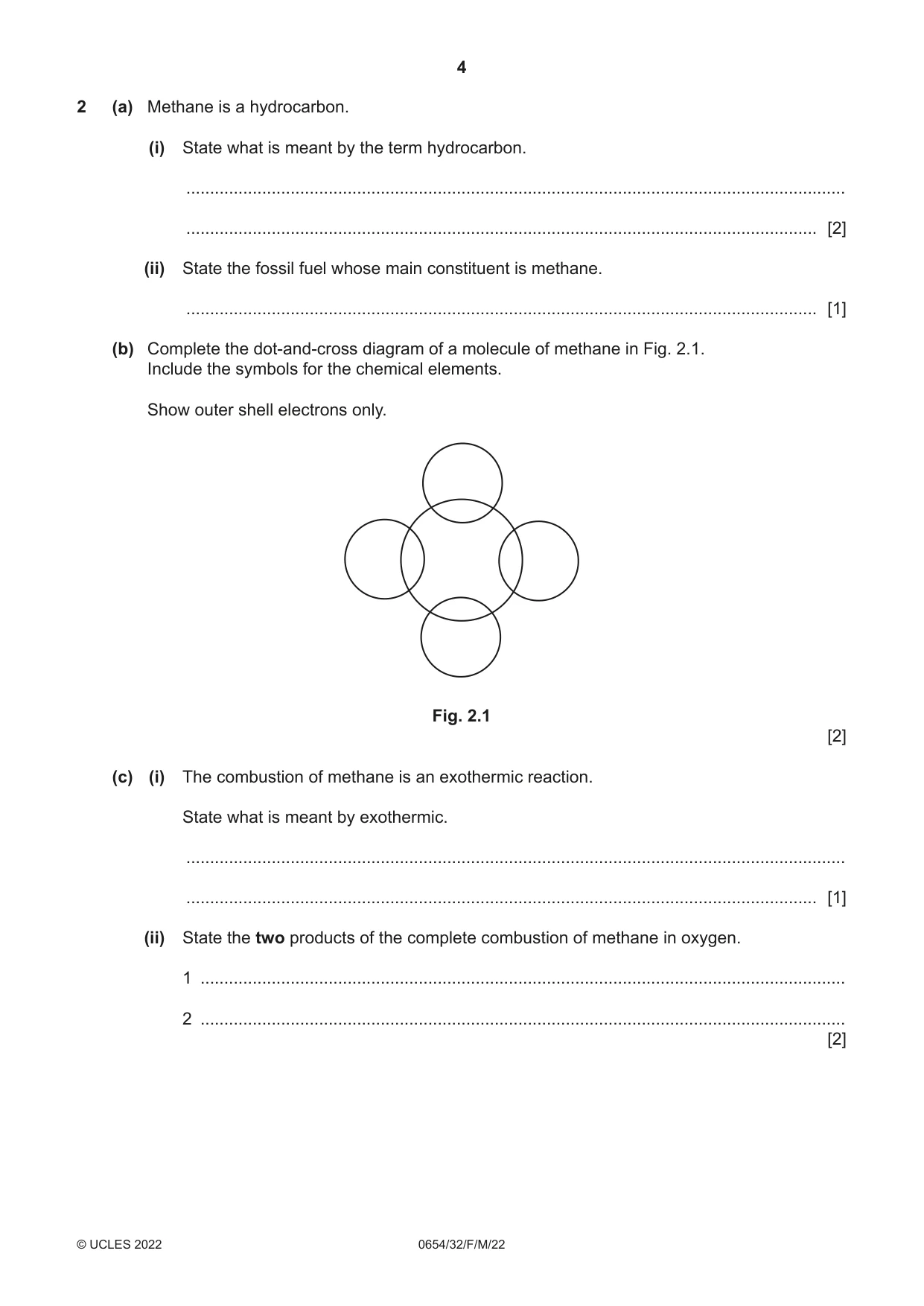
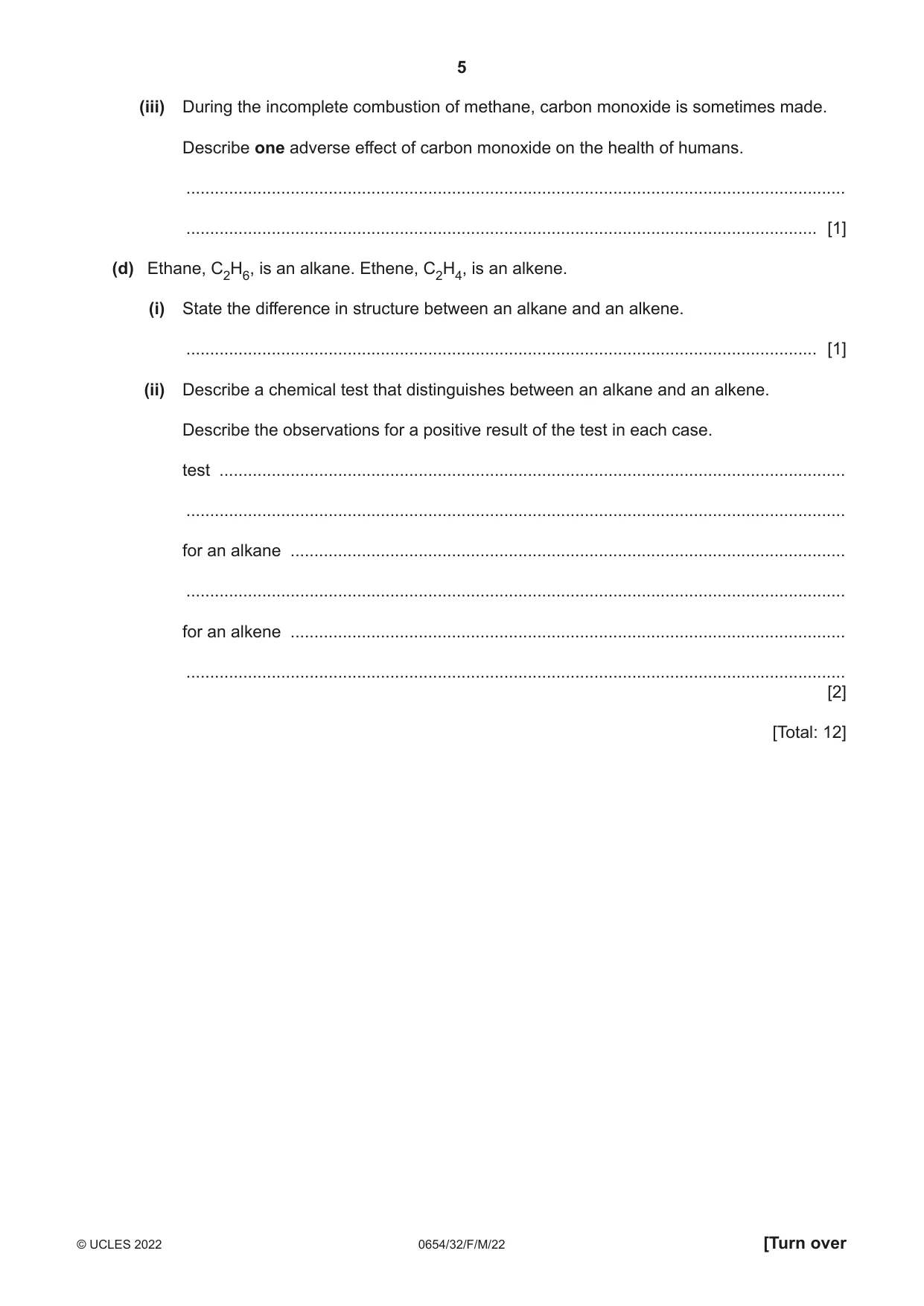
2 (a) Methane is a hydrocarbon. (i) State what is meant by the term hydrocarbon. ........................................................................................................................................... ..................................................................................................................................... [2] (ii) State the fossil fuel whose main constituent is methane. ..................................................................................................................................... [1] (b) Complete the dot-and-cross diagram of a molecule of methane in Fig. 2.1. Include the symbols for the chemical elements. Show outer shell electrons only. Fig. 2.1 [2] (c) (i) The combustion of methane is an exothermic reaction. State what is meant by exothermic. ........................................................................................................................................... ..................................................................................................................................... [1] (ii) State the two products of the complete combustion of methane in oxygen. 1 ........................................................................................................................................ 2 ........................................................................................................................................ [2] (iii) During the incomplete combustion of methane, carbon monoxide is sometimes made. Describe one adverse effect of carbon monoxide on the health of humans. ........................................................................................................................................... ..................................................................................................................................... [1] (d) Ethane, C2H6, is an alkane. Ethene, C2H4, is an alkene. (i) State the difference in structure between an alkane and an alkene. ..................................................................................................................................... [1] (ii) Describe a chemical test that distinguishes between an alkane and an alkene. Describe the observations for a positive result of the test in each case. test .................................................................................................................................... ........................................................................................................................................... for an alkane ..................................................................................................................... ........................................................................................................................................... for an alkene ..................................................................................................................... ........................................................................................................................................... [2] [Total: 12]
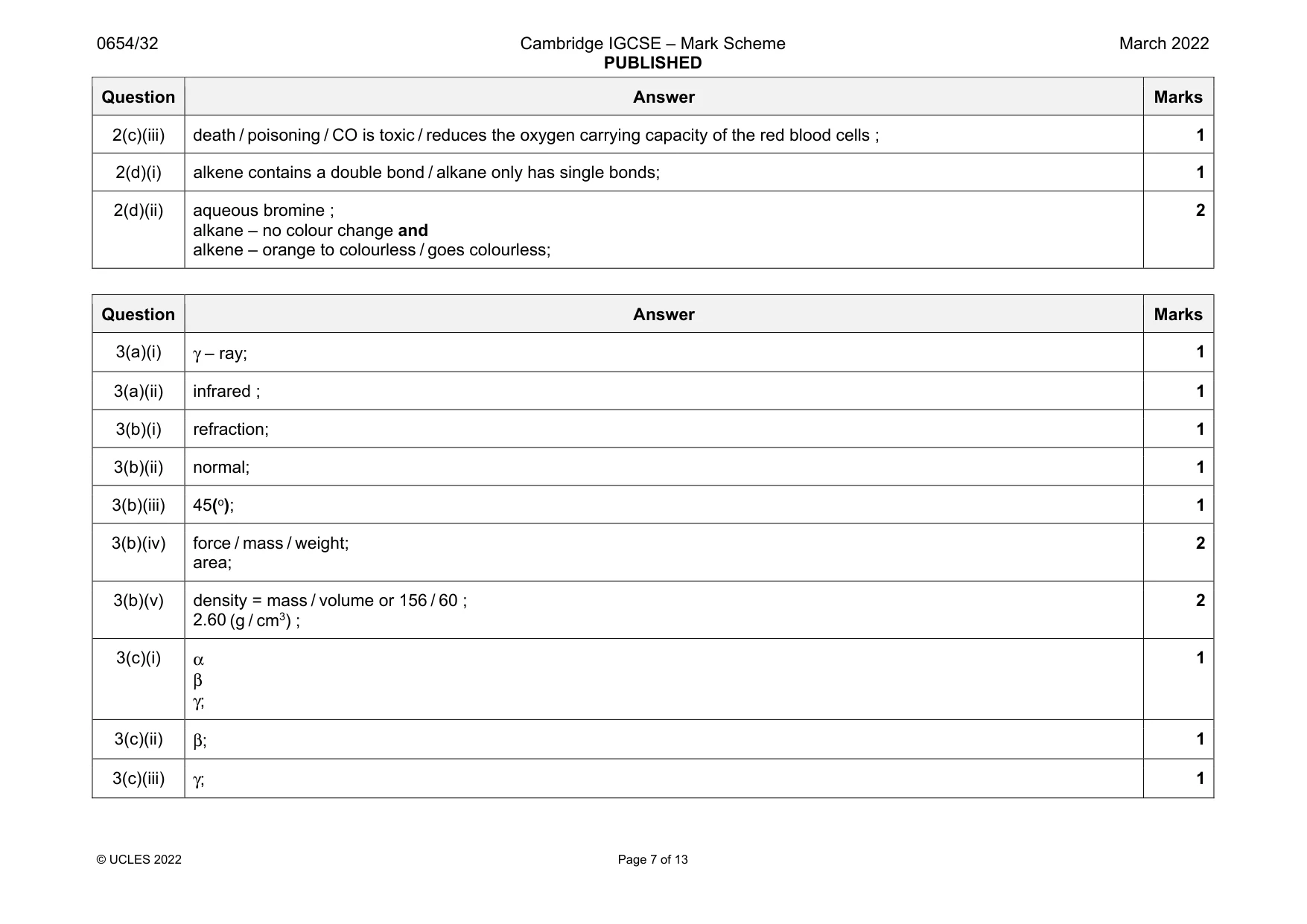
Mark scheme: 2(a)(i) contains carbon and hydrogen (atoms); only ; 2 2(a)(ii) natural gas; 1 2(b) correct symbols; 4 bonding pairs and all else correct; 2 2(c)(i) gives out (thermal) energy; 1 2(c)(ii) carbon dioxide; water; 2 Question Answer Marks 2(c)(iii) death / poisoning / CO is toxic / reduces the oxygen carrying capacity of the red blood cells ; 1 2(d)(i) alkene contains a double bond / alkane only has single bonds; 1 2(d)(ii) aqueous bromine ; alkane – no colour change and alkene – orange to colourless / goes colourless; 2
Q3 · Some examples of waves are listed
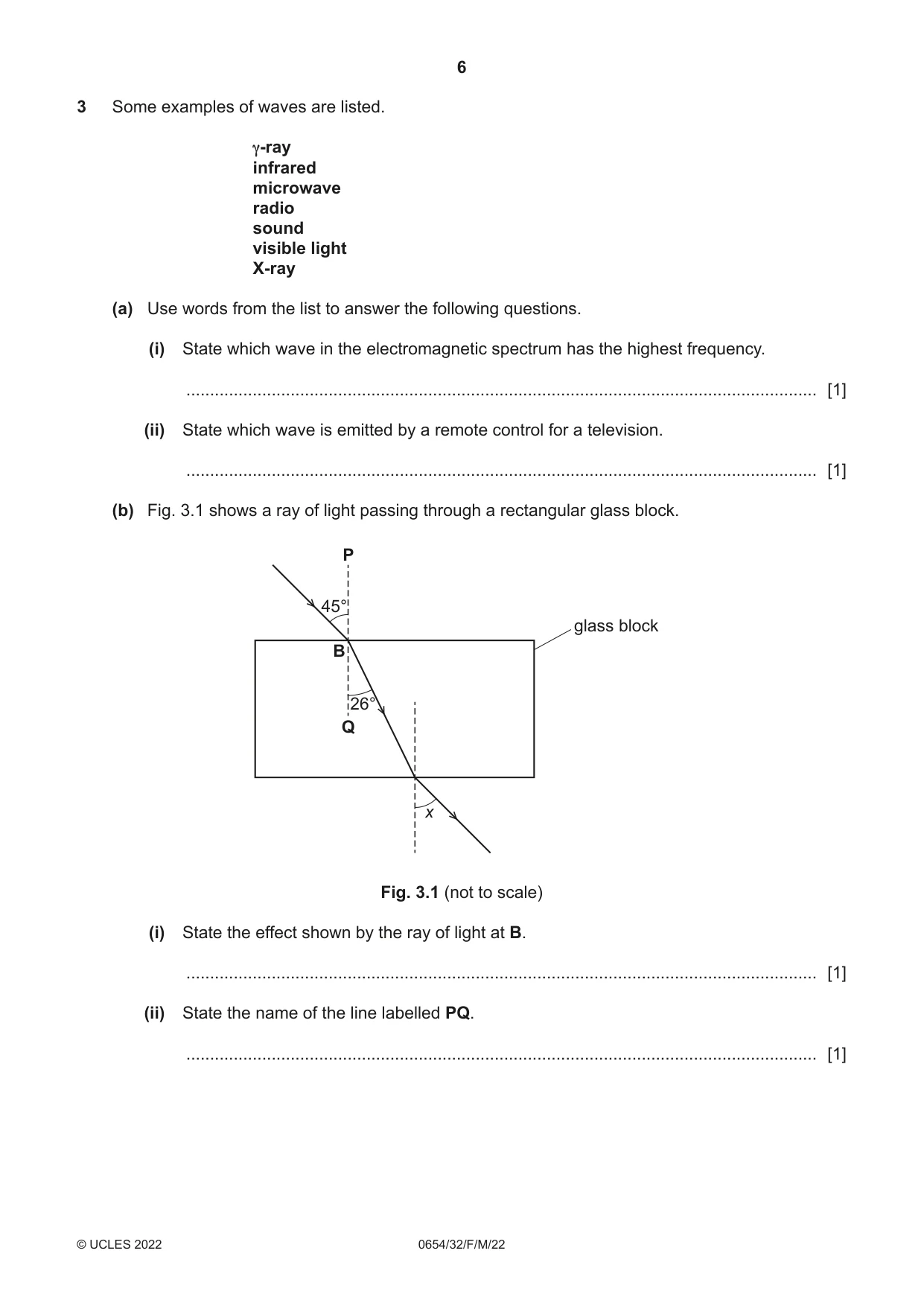
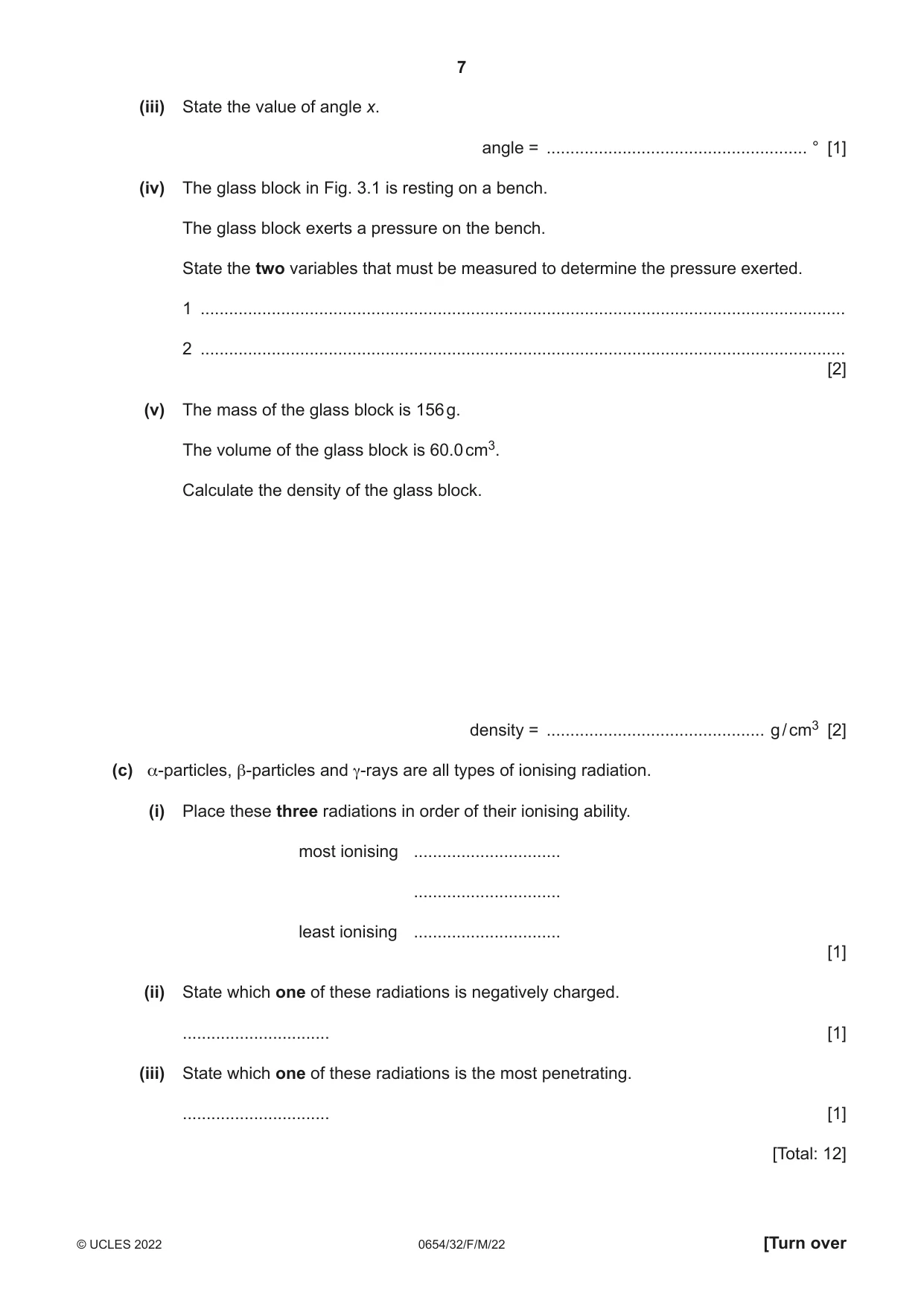
3 Some examples of waves are listed. γ-ray infrared microwave radio sound visible light X-ray (a) Use words from the list to answer the following questions. (i) State which wave in the electromagnetic spectrum has the highest frequency. ..................................................................................................................................... [1] (ii) State which wave is emitted by a remote control for a television. ..................................................................................................................................... [1] (b) Fig. 3.1 shows a ray of light passing through a rectangular glass block. P 45° glass block B 26° Q x Fig. 3.1 (not to scale) (i) State the effect shown by the ray of light at B. ..................................................................................................................................... [1] (ii) State the name of the line labelled PQ. ..................................................................................................................................... [1] (iii) State the value of angle x. angle = ....................................................... ° [1] (iv) The glass block in Fig. 3.1 is resting on a bench. The glass block exerts a pressure on the bench. State the two variables that must be measured to determine the pressure exerted. 1 ........................................................................................................................................ 2 ........................................................................................................................................ [2] (v) The mass of the glass block is 156 g. The volume of the glass block is 60.0 cm3. Calculate the density of the glass block. density = .............................................. g / cm3 [2] (c) α-particles, β-particles and γ-rays are all types of ionising radiation. (i) Place these three radiations in order of their ionising ability. most ionising ............................... ............................... least ionising ............................... [1] (ii) State which one of these radiations is negatively charged. ............................... [1] (iii) State which one of these radiations is the most penetrating. ............................... [1] [Total: 12]
Mark scheme: 3(a)(i) γ – ray; 1 3(a)(ii) infrared ; 1 3(b)(i) refraction; 1 3(b)(ii) normal; 1 3(b)(iii) 45(o); 1 3(b)(iv) force / mass / weight; area; 2 3(b)(v) density = mass / volume or 156 / 60 ; 2.60 (g / cm3) ; 2 3(c)(i) α β γ; 1 3(c)(ii) β; 1 3(c)(iii) γ; 1
Q4 · A photograph of a dissected flower
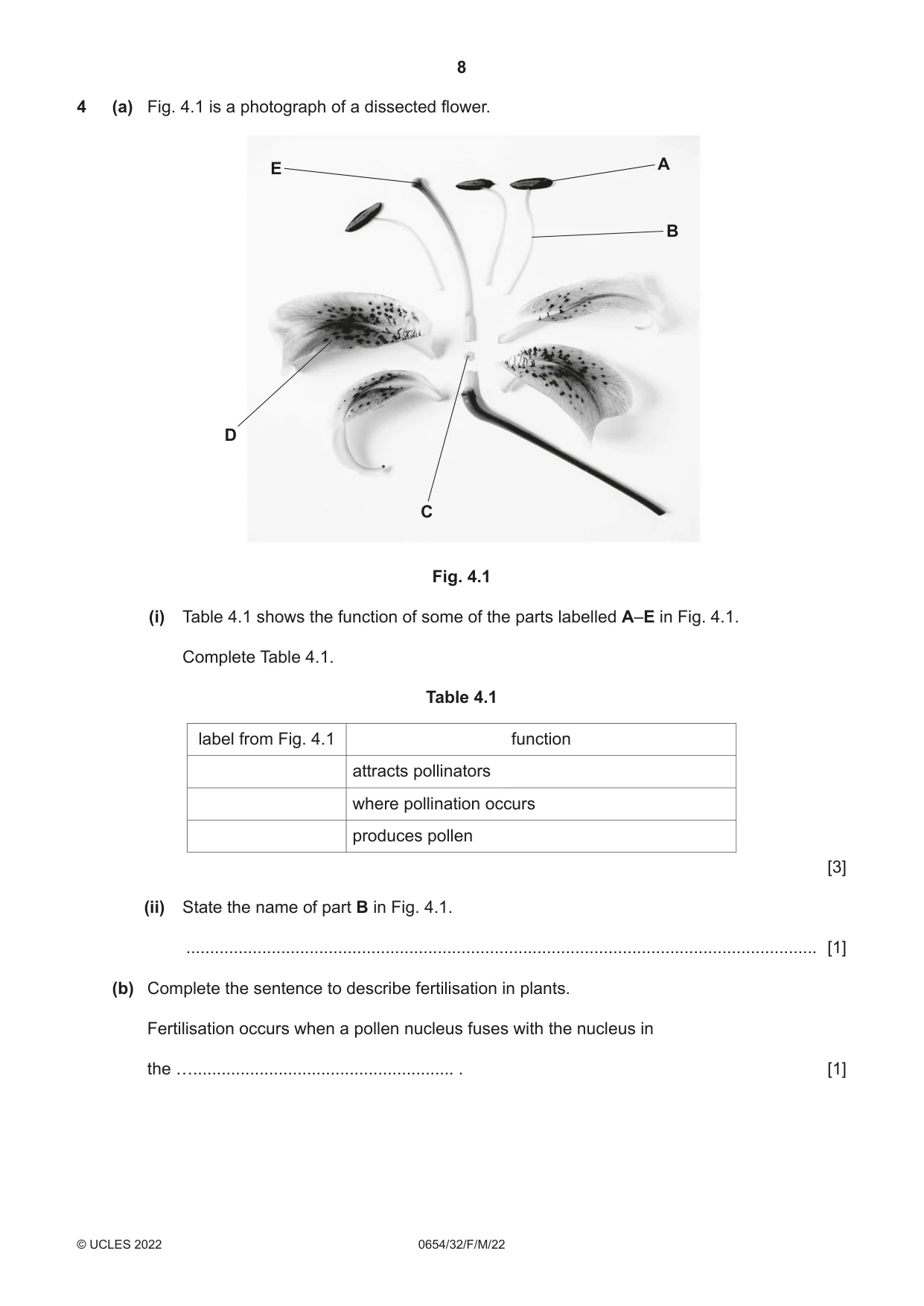
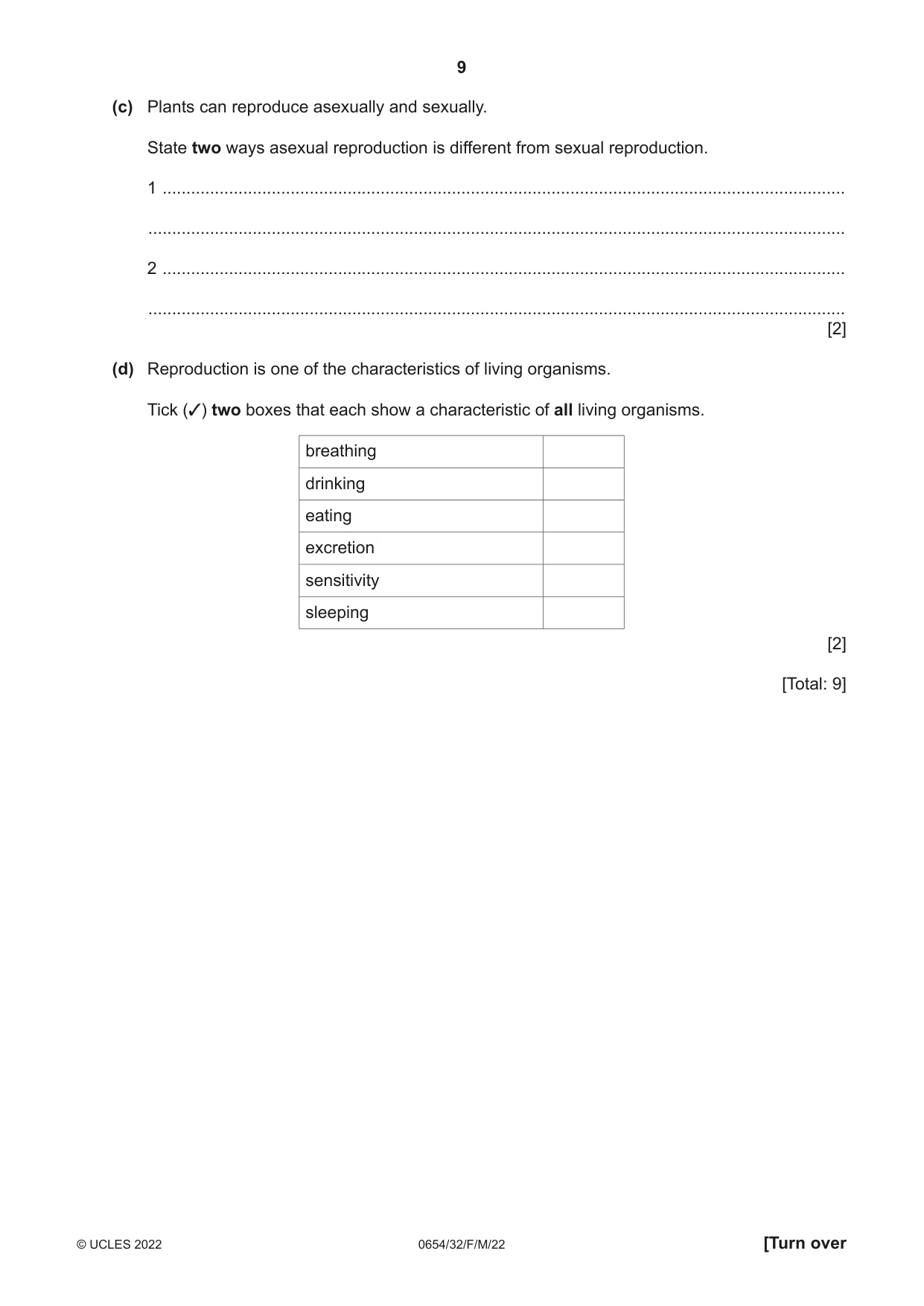
4 (a) Fig. 4.1 is a photograph of a dissected flower. E A B D C Fig. 4.1 (i) Table 4.1 shows the function of some of the parts labelled A–E in Fig. 4.1. Complete Table 4.1. Table 4.1 label from Fig. 4.1 function attracts pollinators where pollination occurs produces pollen [3] (ii) State the name of part B in Fig. 4.1. ..................................................................................................................................... [1] (b) Complete the sentence to describe fertilisation in plants. Fertilisation occurs when a pollen nucleus fuses with the nucleus in the …....................................................... . [1] (c) Plants can reproduce asexually and sexually. State two ways asexual reproduction is different from sexual reproduction. 1 ................................................................................................................................................ ................................................................................................................................................... 2 ................................................................................................................................................ ................................................................................................................................................... [2] (d) Reproduction is one of the characteristics of living organisms. Tick (3) two boxes that each show a characteristic of all living organisms. breathing drinking eating excretion sensitivity sleeping [2] [Total: 9]
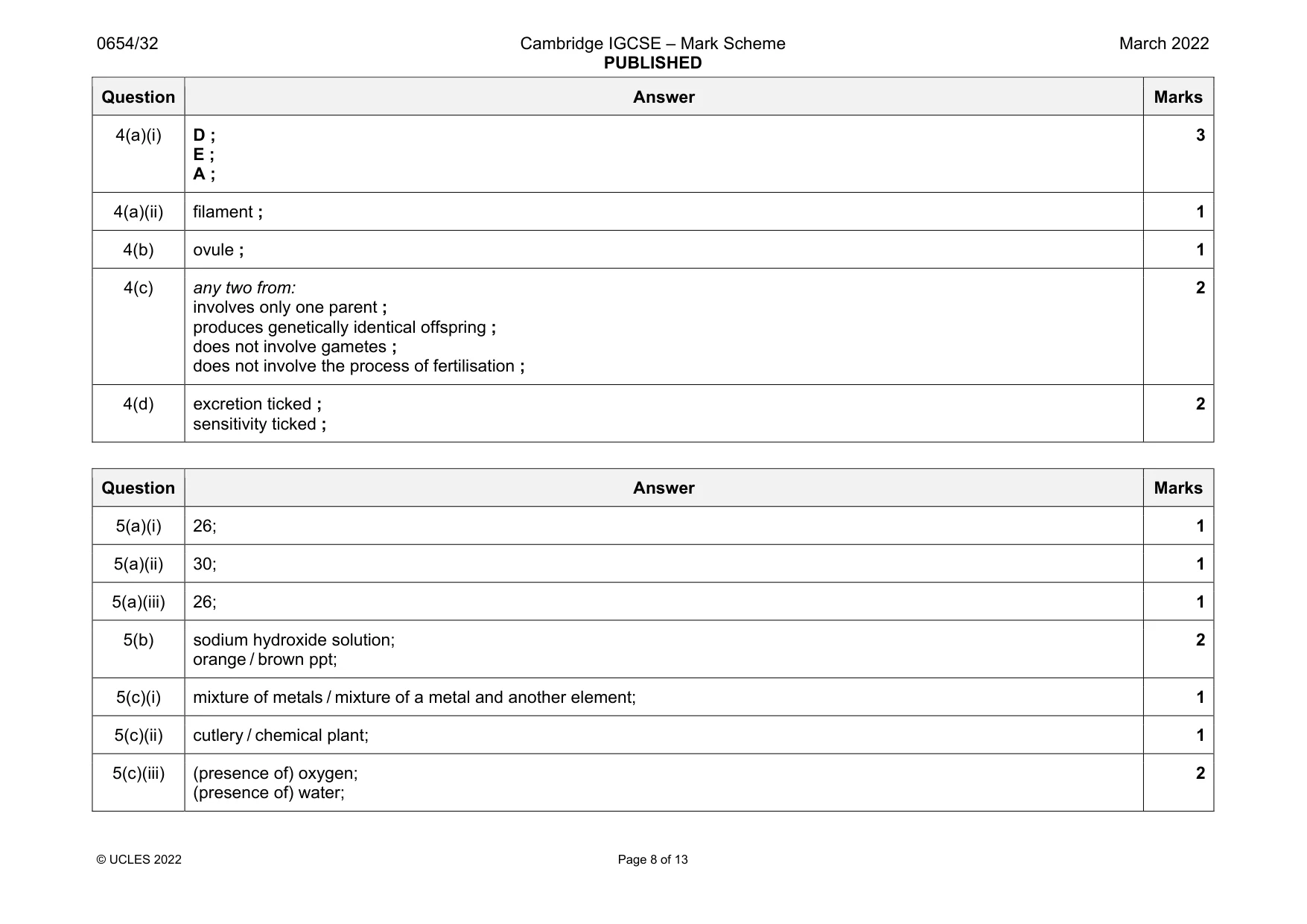
Mark scheme: 4(a)(i) D ; E ; A ; 3 4(a)(ii) filament ; 1 4(b) ovule ; 1 4(c) any two from: involves only one parent ; produces genetically identical offspring ; does not involve gametes ; does not involve the process of fertilisation ; 2 4(d) excretion ticked ; sensitivity ticked ; 2
Q5 · An atom of iron has a proton number of 26 and a nucleon number of 56
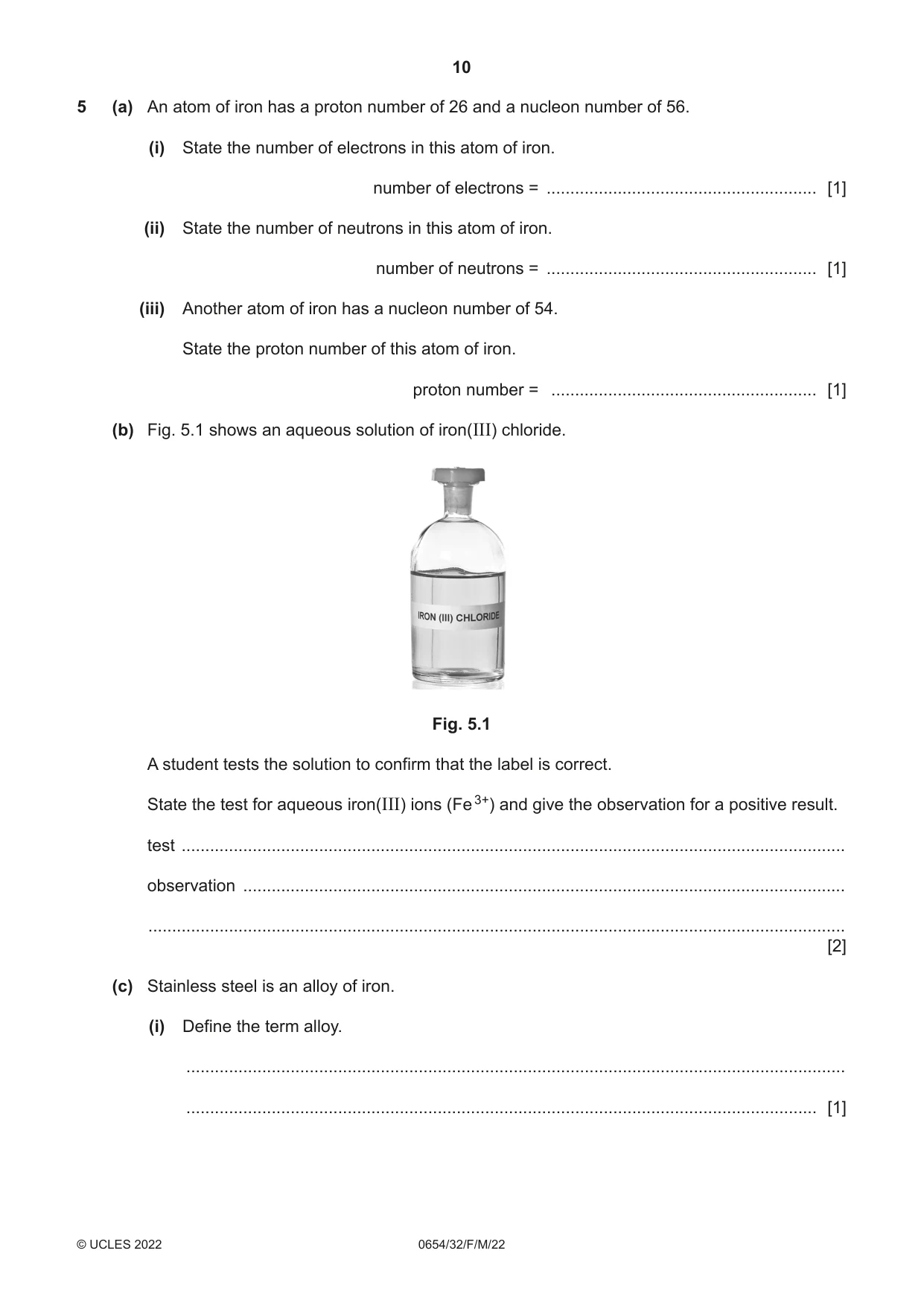
5 (a) An atom of iron has a proton number of 26 and a nucleon number of 56. (i) State the number of electrons in this atom of iron. number of electrons = ......................................................... [1] (ii) State the number of neutrons in this atom of iron. number of neutrons = ......................................................... [1] (iii) Another atom of iron has a nucleon number of 54. State the proton number of this atom of iron. proton number = ........................................................ [1] (b) Fig. 5.1 shows an aqueous solution of iron(III) chloride. Fig. 5.1 A student tests the solution to confirm that the label is correct. State the test for aqueous iron(III) ions (Fe 3+) and give the observation for a positive result. test ............................................................................................................................................ observation ............................................................................................................................... ................................................................................................................................................... [2] (c) Stainless steel is an alloy of iron. (i) Define the term alloy. ........................................................................................................................................... ..................................................................................................................................... [1] (ii) State one use for stainless steel. ..................................................................................................................................... [1] (iii) State the two conditions needed for the rusting of iron. 1 ........................................................................................................................................ 2 ........................................................................................................................................ [2] (iv) Describe and explain one method of rust prevention. ........................................................................................................................................... ........................................................................................................................................... ..................................................................................................................................... [2] [Total: 11]
Mark scheme: 5(a)(i) 26; 1 5(a)(ii) 30; 1 5(a)(iii) 26; 1 5(b) sodium hydroxide solution; orange / brown ppt; 2 5(c)(i) mixture of metals / mixture of a metal and another element; 1 5(c)(ii) cutlery / chemical plant; 1 5(c)(iii) (presence of) oxygen; (presence of) water; 2 Question Answer Marks 5(c)(iv) painting / galvanising / plating / greasing; relevant explanation for method chosen (e.g. stops water / oxygen); 2
Q6 · Two dolphins using sound waves to communicate with each other in the sea
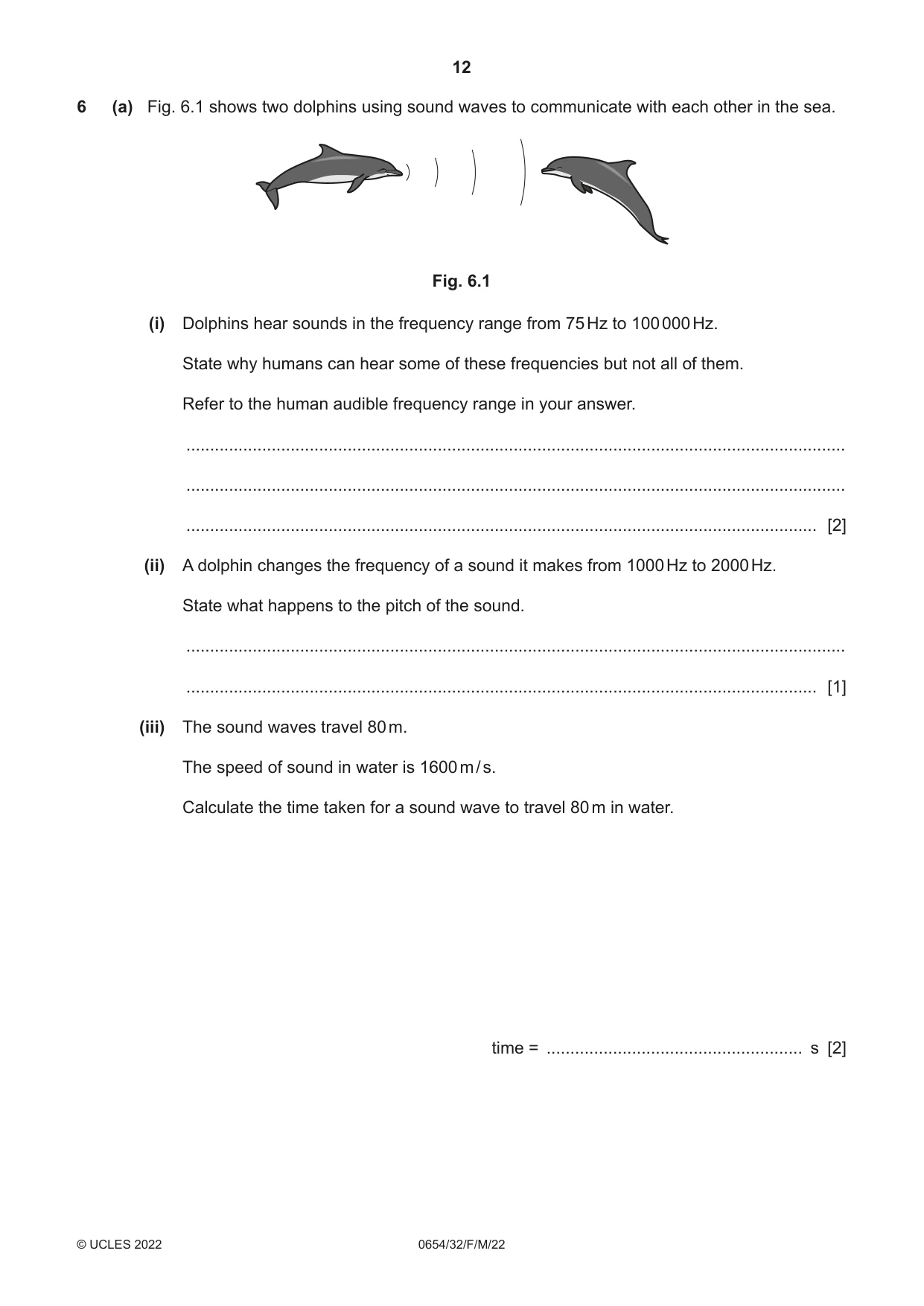
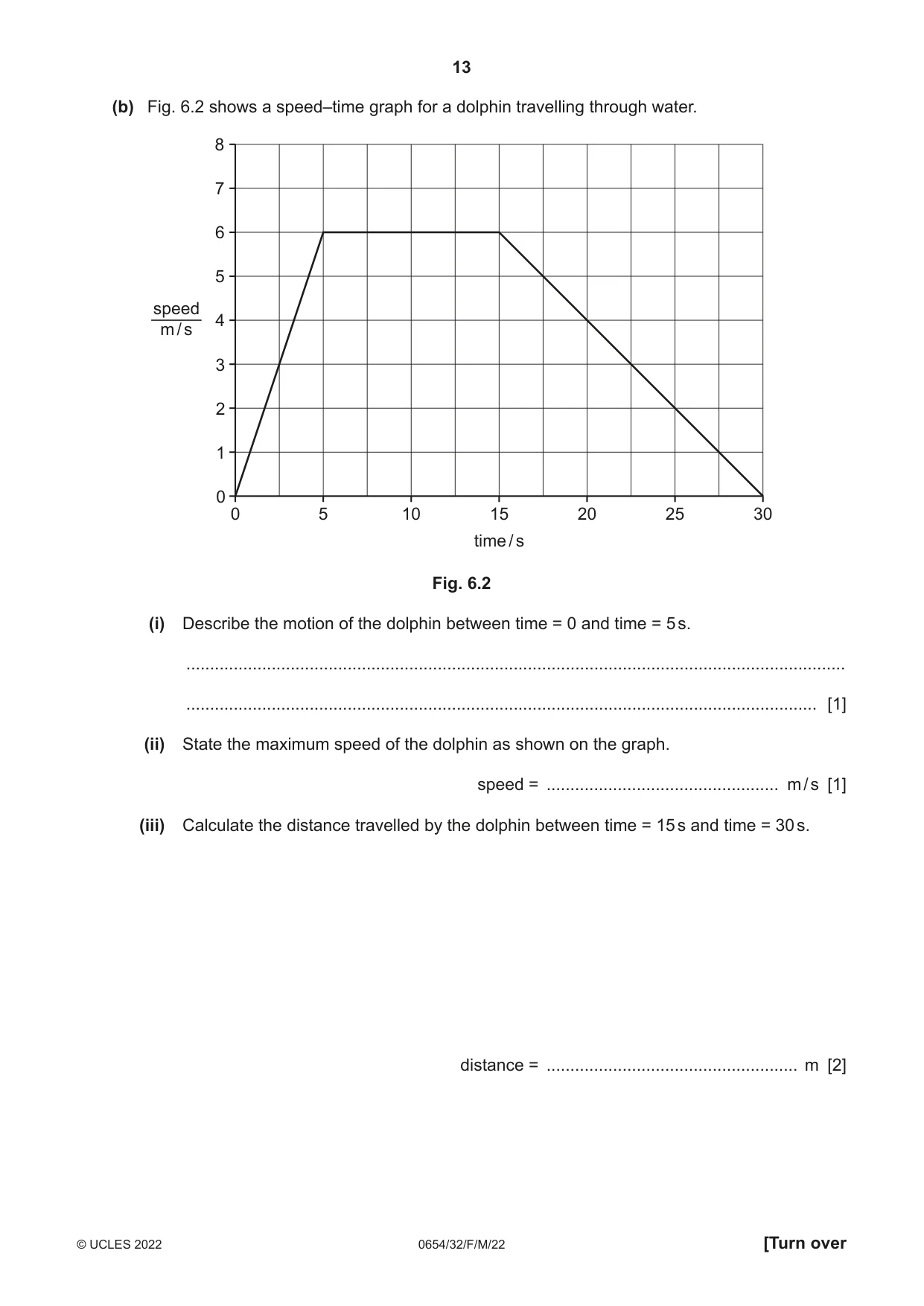
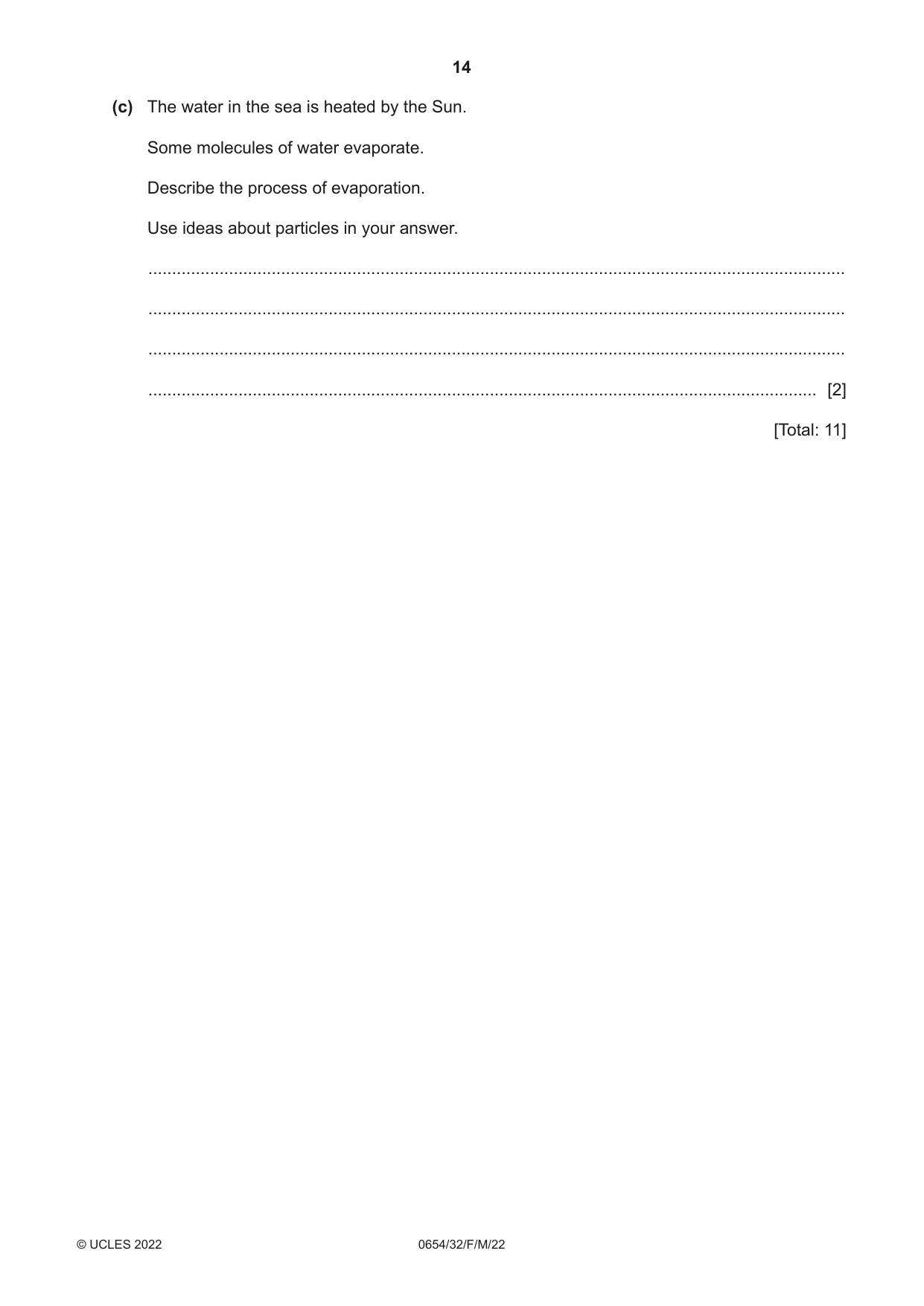
6 (a) Fig. 6.1 shows two dolphins using sound waves to communicate with each other in the sea. Fig. 6.1 (i) Dolphins hear sounds in the frequency range from 75 Hz to 100 000 Hz. State why humans can hear some of these frequencies but not all of them. Refer to the human audible frequency range in your answer. ........................................................................................................................................... ........................................................................................................................................... ..................................................................................................................................... [2] (ii) A dolphin changes the frequency of a sound it makes from 1000 Hz to 2000 Hz. State what happens to the pitch of the sound. ........................................................................................................................................... ..................................................................................................................................... [1] (iii) The sound waves travel 80 m. The speed of sound in water is 1600 m / s. Calculate the time taken for a sound wave to travel 80 m in water. time = ...................................................... s [2] (b) Fig. 6.2 shows a speed–time graph for a dolphin travelling through water. 8 7 6 5 speed 4 m / s 3 2 1 0 0 5 10 15 20 25 30 time / s Fig. 6.2 (i) Describe the motion of the dolphin between time = 0 and time = 5 s. ........................................................................................................................................... ..................................................................................................................................... [1] (ii) State the maximum speed of the dolphin as shown on the graph. speed = ................................................. m / s [1] (iii) Calculate the distance travelled by the dolphin between time = 15 s and time = 30 s. distance = ..................................................... m [2] (c) The water in the sea is heated by the Sun. Some molecules of water evaporate. Describe the process of evaporation. Use ideas about particles in your answer. ................................................................................................................................................... ................................................................................................................................................... ................................................................................................................................................... ............................................................................................................................................. [2] [Total: 11]
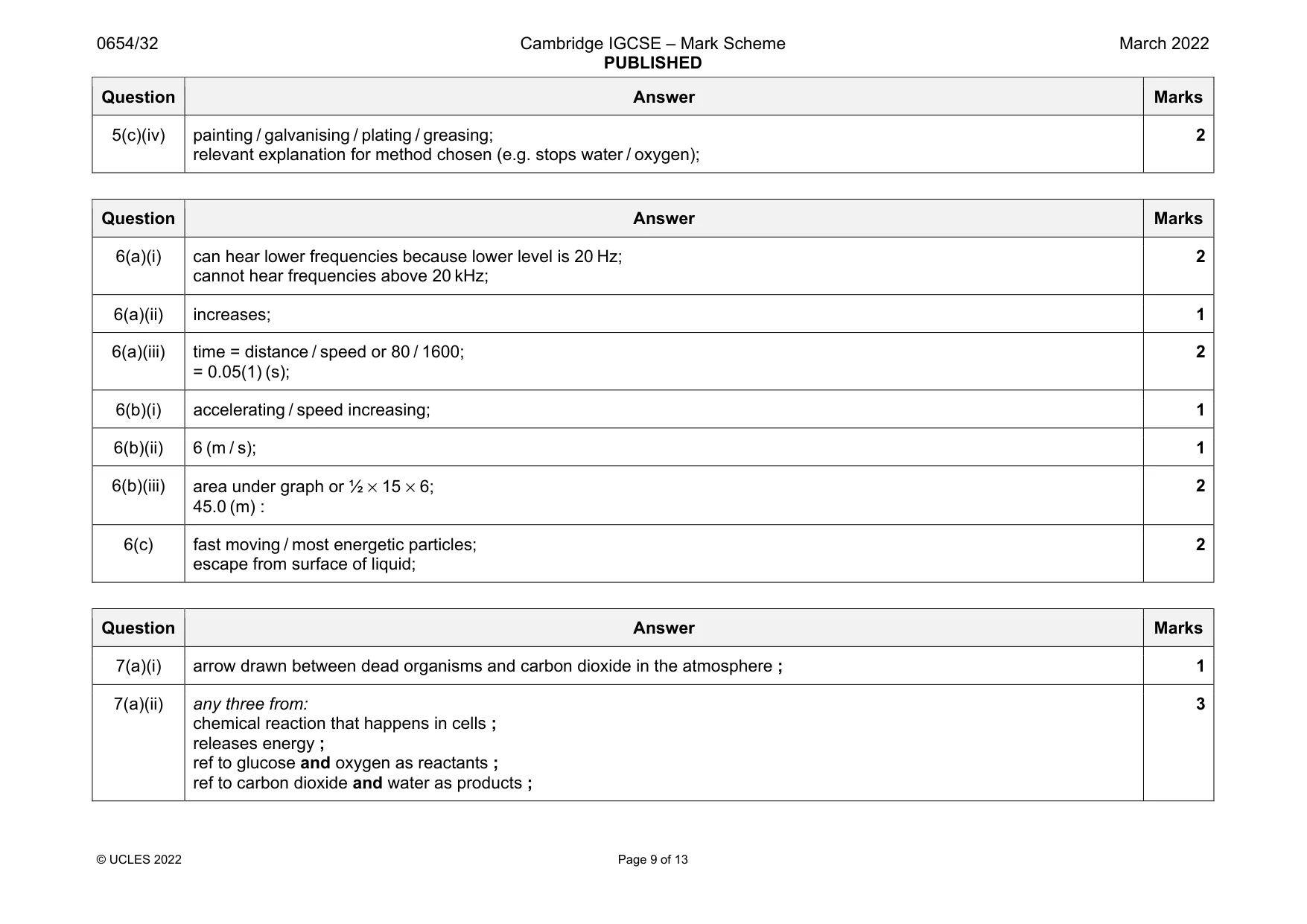
Mark scheme: 6(a)(i) can hear lower frequencies because lower level is 20 Hz; cannot hear frequencies above 20 kHz; 2 6(a)(ii) increases; 1 6(a)(iii) time = distance / speed or 80 / 1600; = 0.05(1) (s); 2 6(b)(i) accelerating / speed increasing; 1 6(b)(ii) 6 (m / s); 1 6(b)(iii) area under graph or ½ × 15 × 6; 45.0 (m) : 2 6(c) fast moving / most energetic particles; escape from surface of liquid; 2
Q7 · Part of the carbon cycle
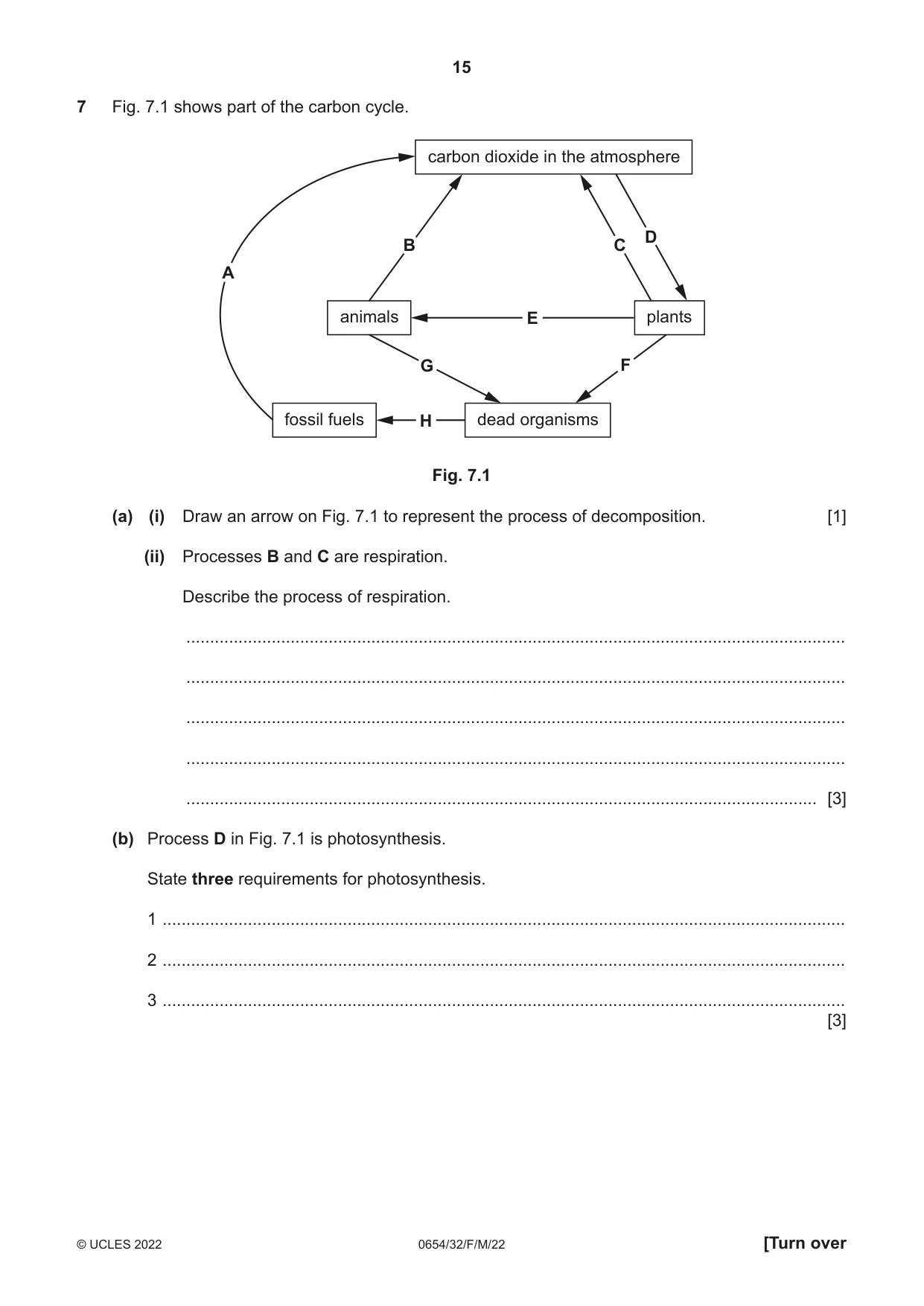
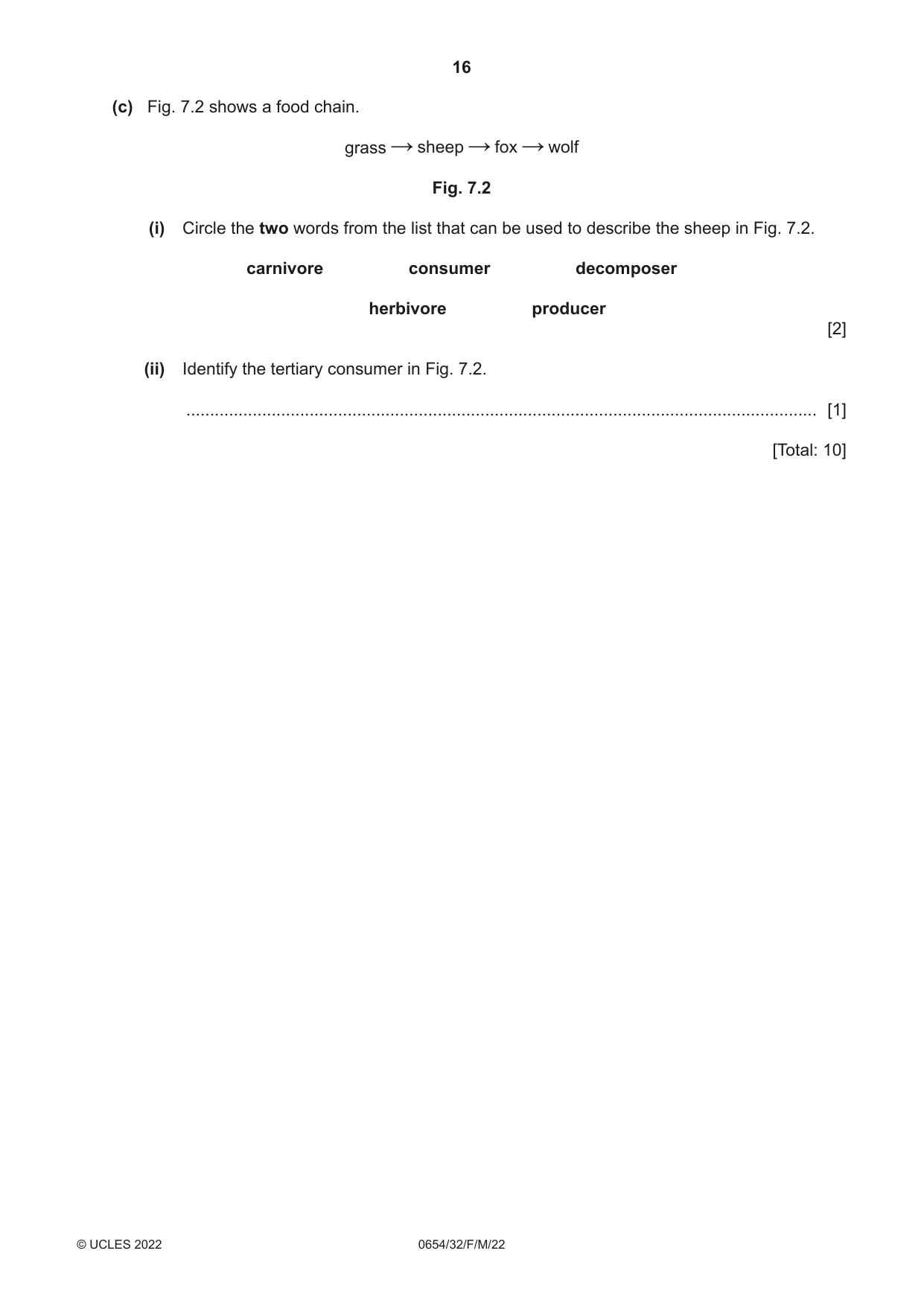
7 Fig. 7.1 shows part of the carbon cycle. carbon dioxide in the atmosphere D B C A animals E plants G F fossil fuels H dead organisms Fig. 7.1 (a) (i) Draw an arrow on Fig. 7.1 to represent the process of decomposition. [1] (ii) Processes B and C are respiration. Describe the process of respiration. ........................................................................................................................................... ........................................................................................................................................... ........................................................................................................................................... ........................................................................................................................................... ..................................................................................................................................... [3] (b) Process D in Fig. 7.1 is photosynthesis. State three requirements for photosynthesis. 1 ................................................................................................................................................ 2 ................................................................................................................................................ 3 ................................................................................................................................................ [3] (c) Fig. 7.2 shows a food chain. grass sheep fox wolf → → → Fig. 7.2 (i) Circle the two words from the list that can be used to describe the sheep in Fig. 7.2. carnivore consumer decomposer herbivore producer [2] (ii) Identify the tertiary consumer in Fig. 7.2. ..................................................................................................................................... [1] [Total: 10]
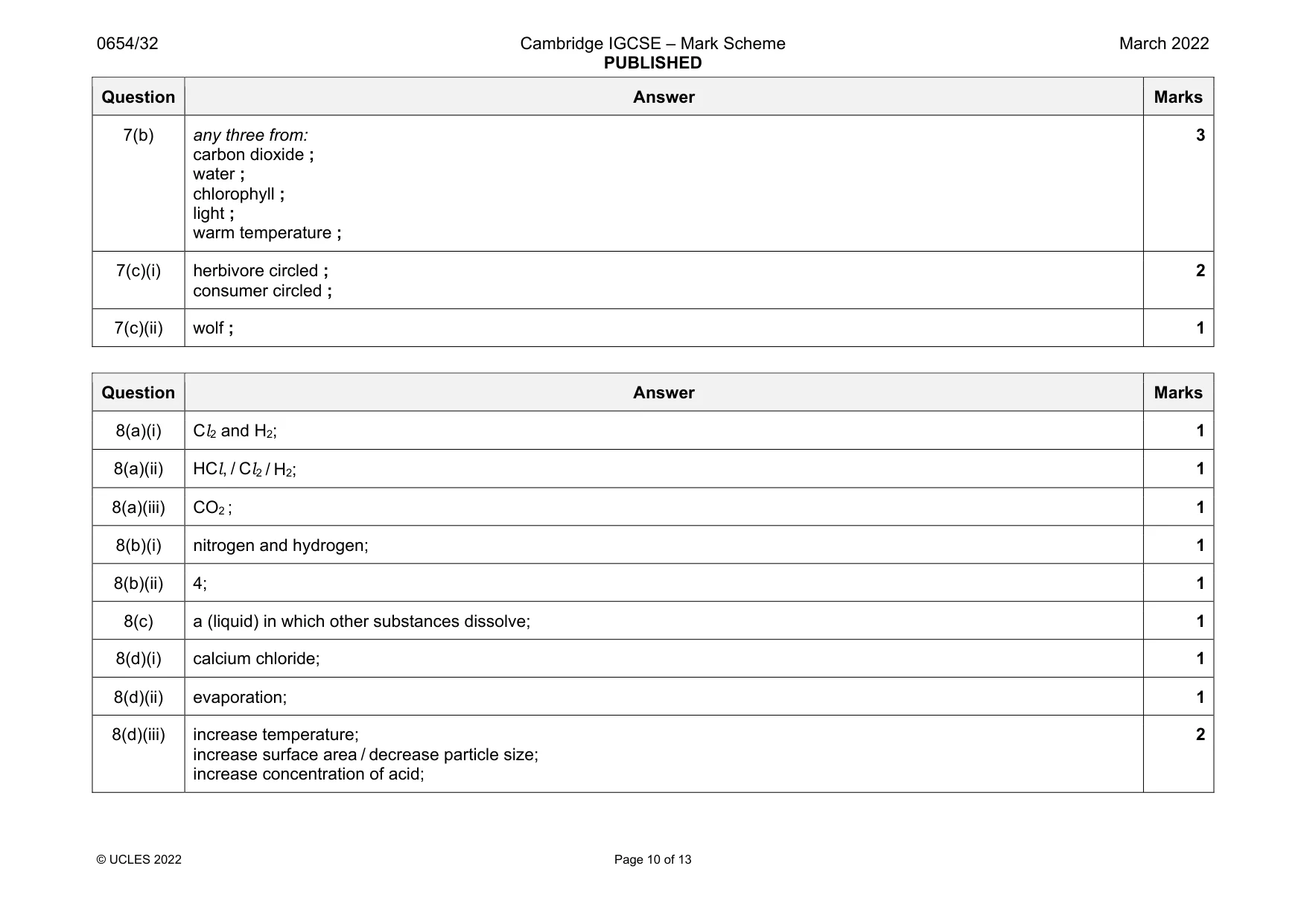
Mark scheme: 7(a)(i) arrow drawn between dead organisms and carbon dioxide in the atmosphere ; 1 7(a)(ii) any three from: chemical reaction that happens in cells ; releases energy ; ref to glucose and oxygen as reactants ; ref to carbon dioxide and water as products ; 3 Question Answer Marks 7(b) any three from: carbon dioxide ; water ; chlorophyll ; light ; warm temperature ; 3 7(c)(i) herbivore circled ; consumer circled ; 2 7(c)(ii) wolf ; 1
Q8 · A list of covalently bonded molecules
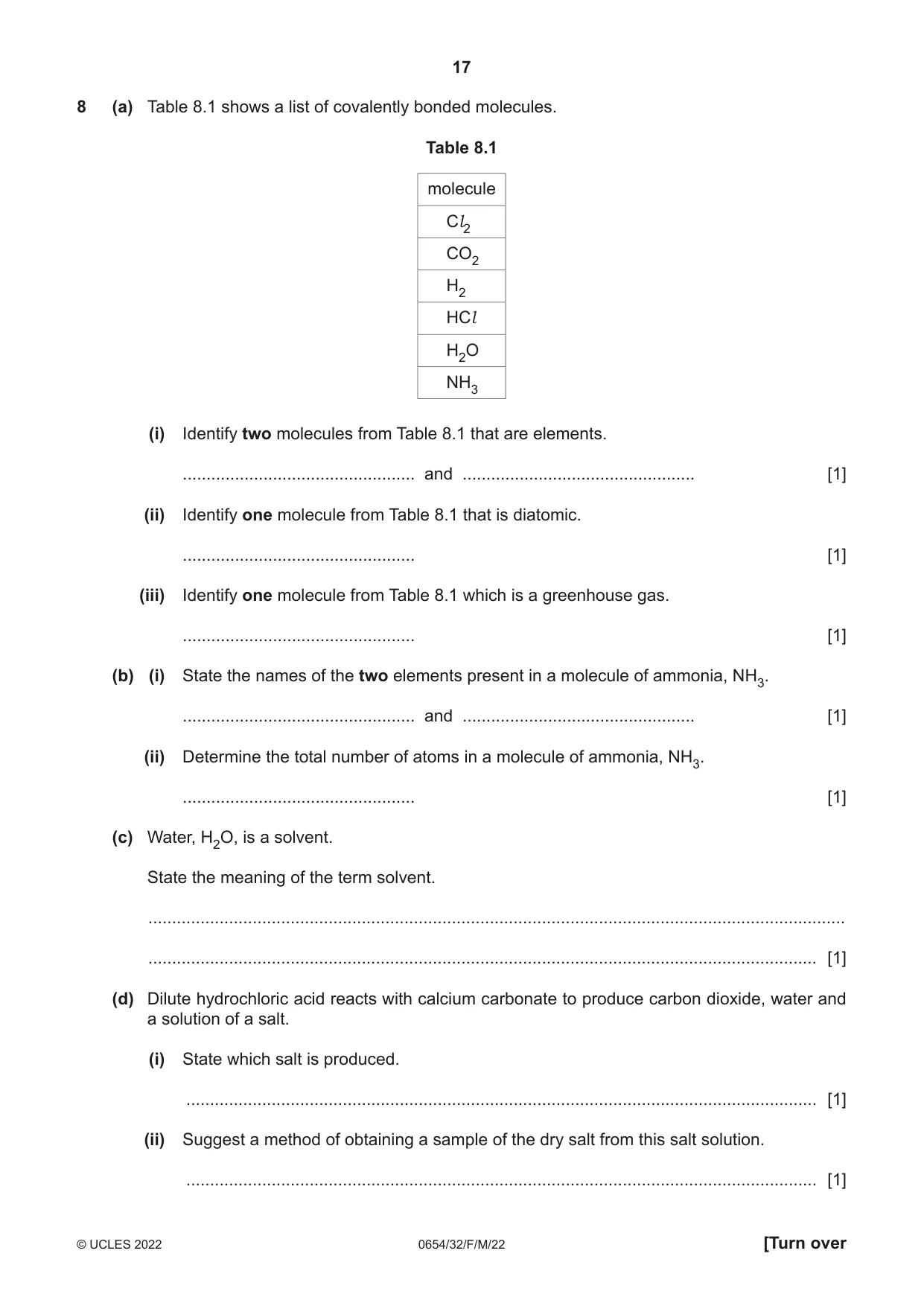
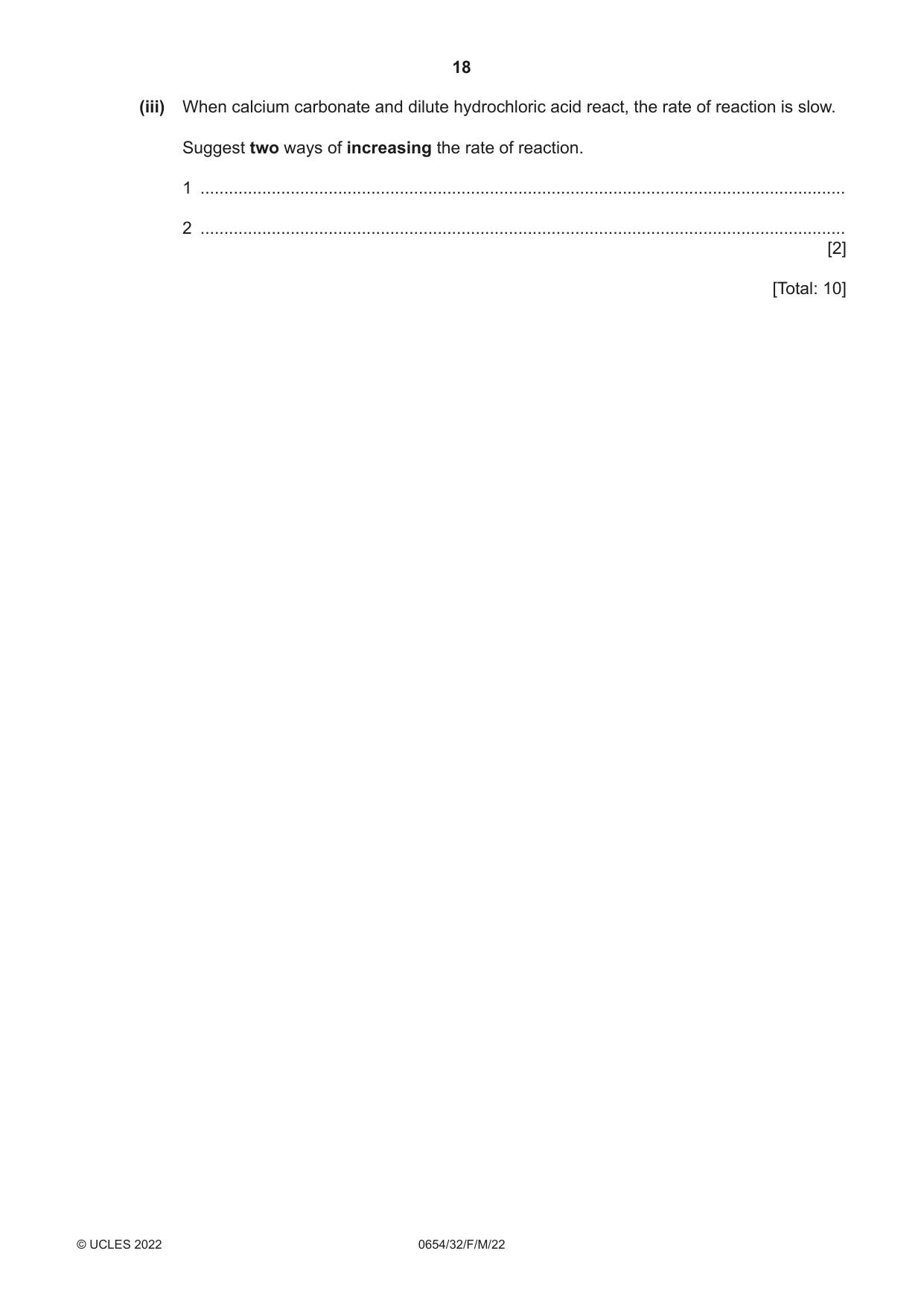
8 (a) Table 8.1 shows a list of covalently bonded molecules. Table 8.1 molecule Cl2 CO2 H2 HCl H2O NH3 (i) Identify two molecules from Table 8.1 that are elements. ................................................. and ................................................. [1] (ii) Identify one molecule from Table 8.1 that is diatomic. ................................................. [1] (iii) Identify one molecule from Table 8.1 which is a greenhouse gas. ................................................. [1] (b) (i) State the names of the two elements present in a molecule of ammonia, NH3. ................................................. and ................................................. [1] (ii) Determine the total number of atoms in a molecule of ammonia, NH3. ................................................. [1] (c) Water, H2O, is a solvent. State the meaning of the term solvent. ................................................................................................................................................... ............................................................................................................................................. [1] (d) Dilute hydrochloric acid reacts with calcium carbonate to produce carbon dioxide, water and a solution of a salt. (i) State which salt is produced. ..................................................................................................................................... [1] (ii) Suggest a method of obtaining a sample of the dry salt from this salt solution. ..................................................................................................................................... [1] (iii) When calcium carbonate and dilute hydrochloric acid react, the rate of reaction is slow. Suggest two ways of increasing the rate of reaction. 1 ........................................................................................................................................ 2 ........................................................................................................................................ [2] [Total: 10]
Mark scheme: 8(a)(i) 8(a)(ii) HCl, / Cl2 / H2; 1 8(a)(iii) CO2 ; 1 8(b)(i) nitrogen and hydrogen; 1 8(b)(ii) 4; 1 8(c) a (liquid) in which other substances dissolve; 1 8(d)(i) calcium chloride; 1 8(d)(ii) evaporation; 1 8(d)(iii) increase temperature; increase surface area / decrease particle size; increase concentration of acid; 2
Question 9
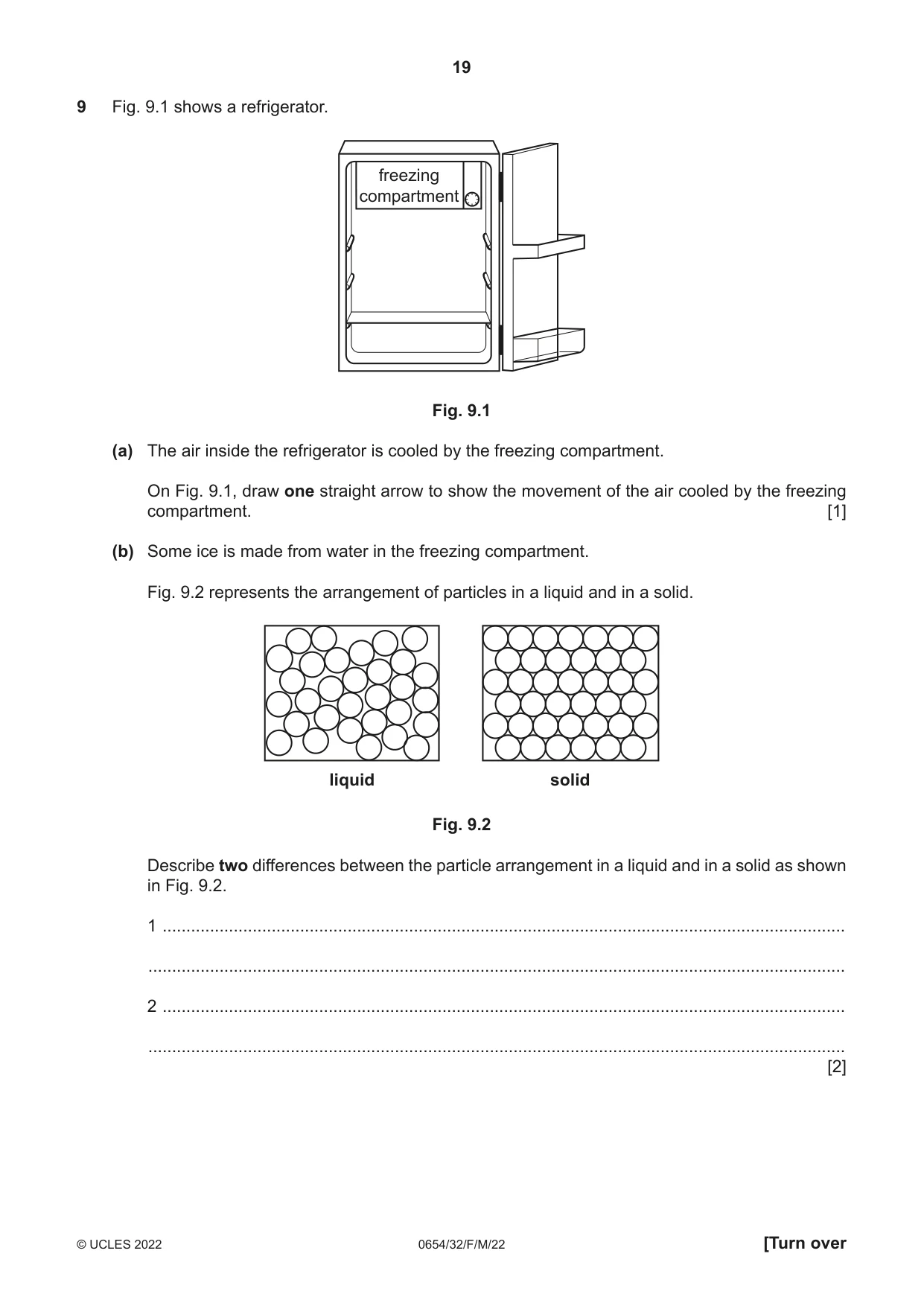
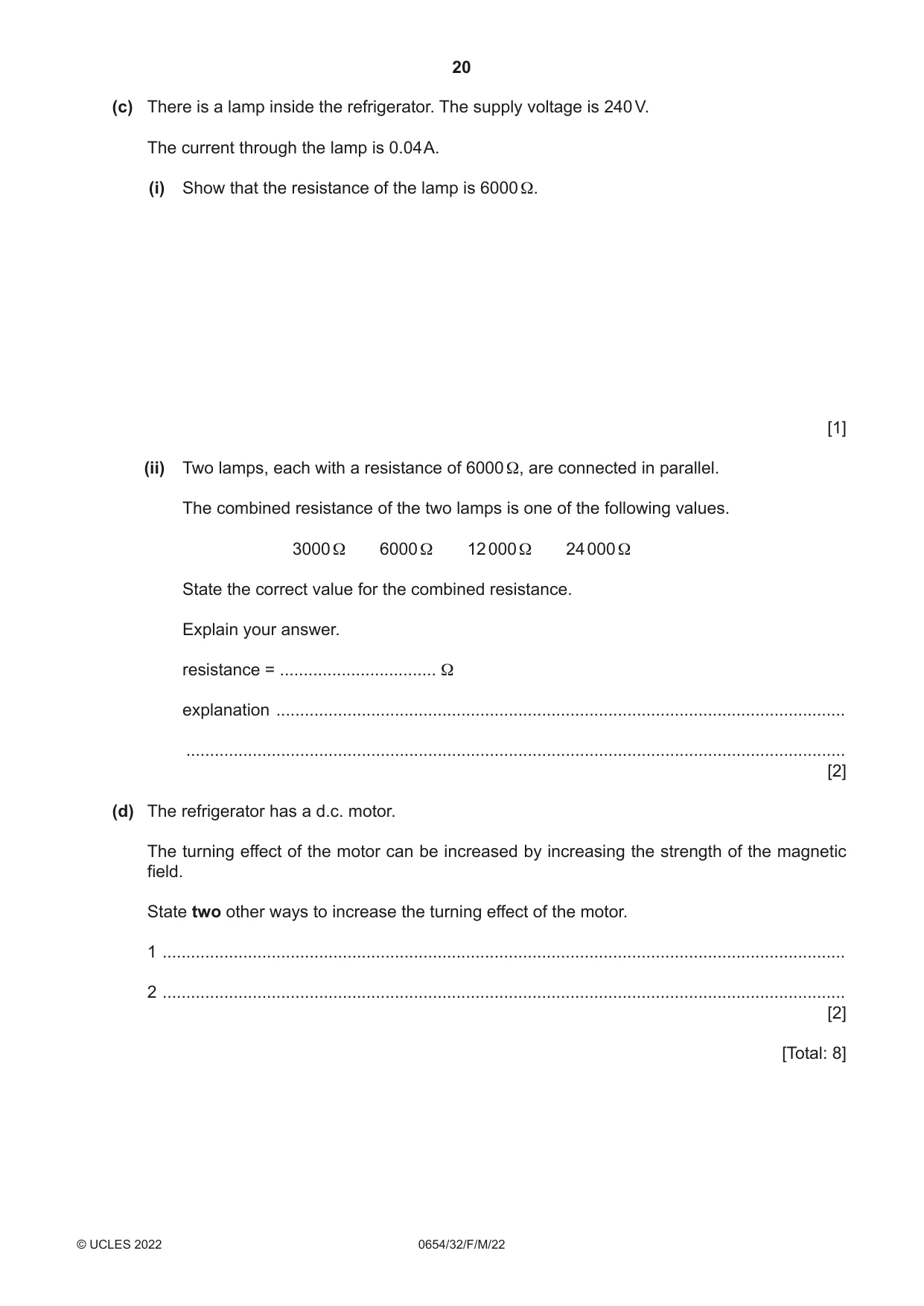
9 Fig. 9.1 shows a refrigerator. freezing compartment Fig. 9.1 (a) The air inside the refrigerator is cooled by the freezing compartment. On Fig. 9.1, draw one straight arrow to show the movement of the air cooled by the freezing compartment. [1] (b) Some ice is made from water in the freezing compartment. Fig. 9.2 represents the arrangement of particles in a liquid and in a solid. liquid solid Fig. 9.2 Describe two differences between the particle arrangement in a liquid and in a solid as shown in Fig. 9.2. 1 ................................................................................................................................................ ................................................................................................................................................... 2 ................................................................................................................................................ ................................................................................................................................................... [2] (c) There is a lamp inside the refrigerator. The supply voltage is 240 V. The current through the lamp is 0.04 A. (i) Show that the resistance of the lamp is 6000 Ω. [1] (ii) Two lamps, each with a resistance of 6000 Ω, are connected in parallel. The combined resistance of the two lamps is one of the following values. 3000 Ω 6000 Ω 12 000 Ω 24 000 Ω State the correct value for the combined resistance. Explain your answer. resistance = ................................. Ω explanation ........................................................................................................................ ........................................................................................................................................... [2] (d) The refrigerator has a d.c. motor. The turning effect of the motor can be increased by increasing the strength of the magnetic field. State two other ways to increase the turning effect of the motor. 1 ................................................................................................................................................ 2 ................................................................................................................................................ [2] [Total: 8]
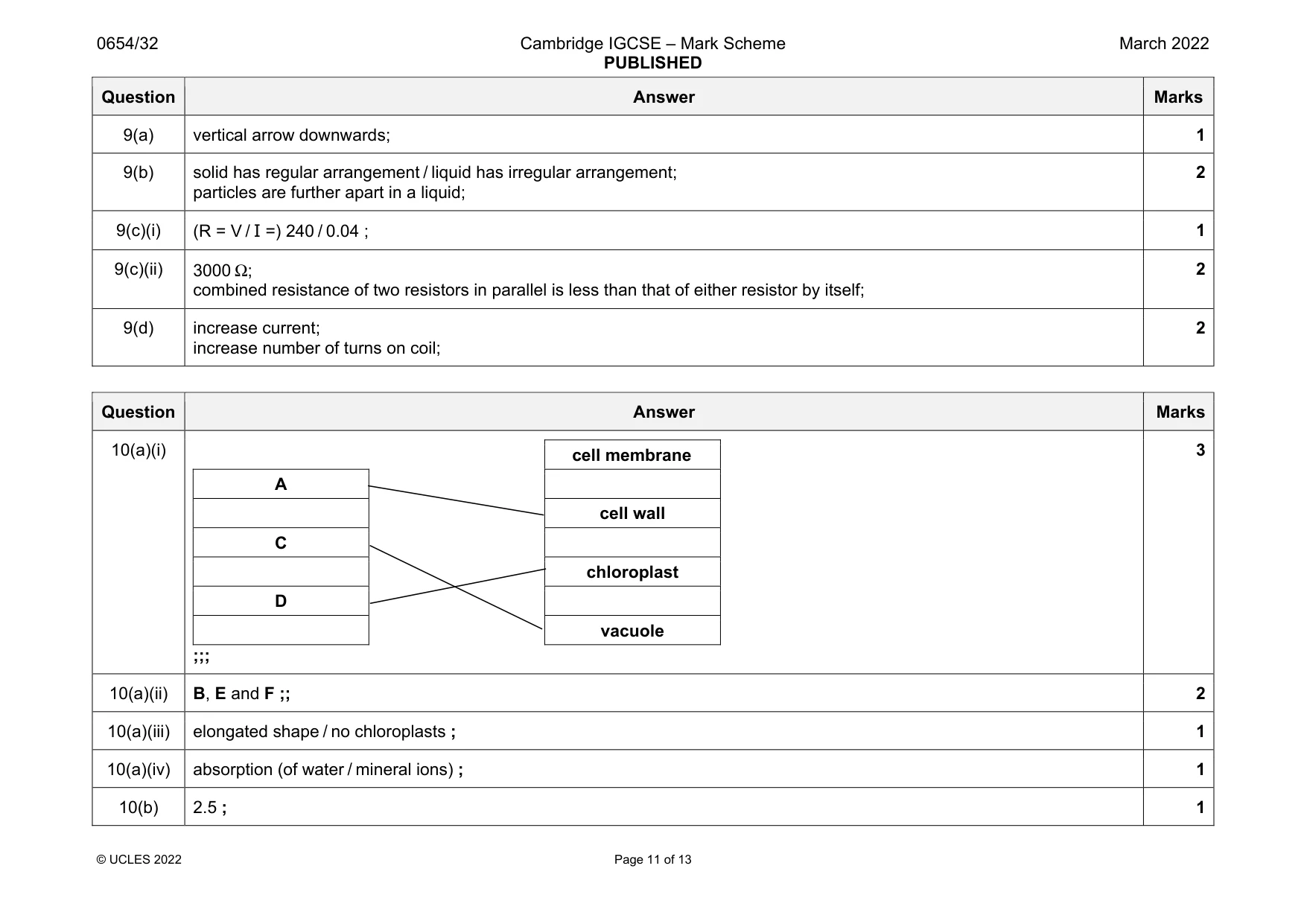
Mark scheme: 9(a) vertical arrow downwards; 1 9(b) solid has regular arrangement / liquid has irregular arrangement; particles are further apart in a liquid; 2 9(c)(i) (R = V / I =) 240 / 0.04 ; 1 9(c)(ii) 3000 Ω; combined resistance of two resistors in parallel is less than that of either resistor by itself; 2 9(d) increase current; increase number of turns on coil; 2
Q10 · A diagram of a plant cell
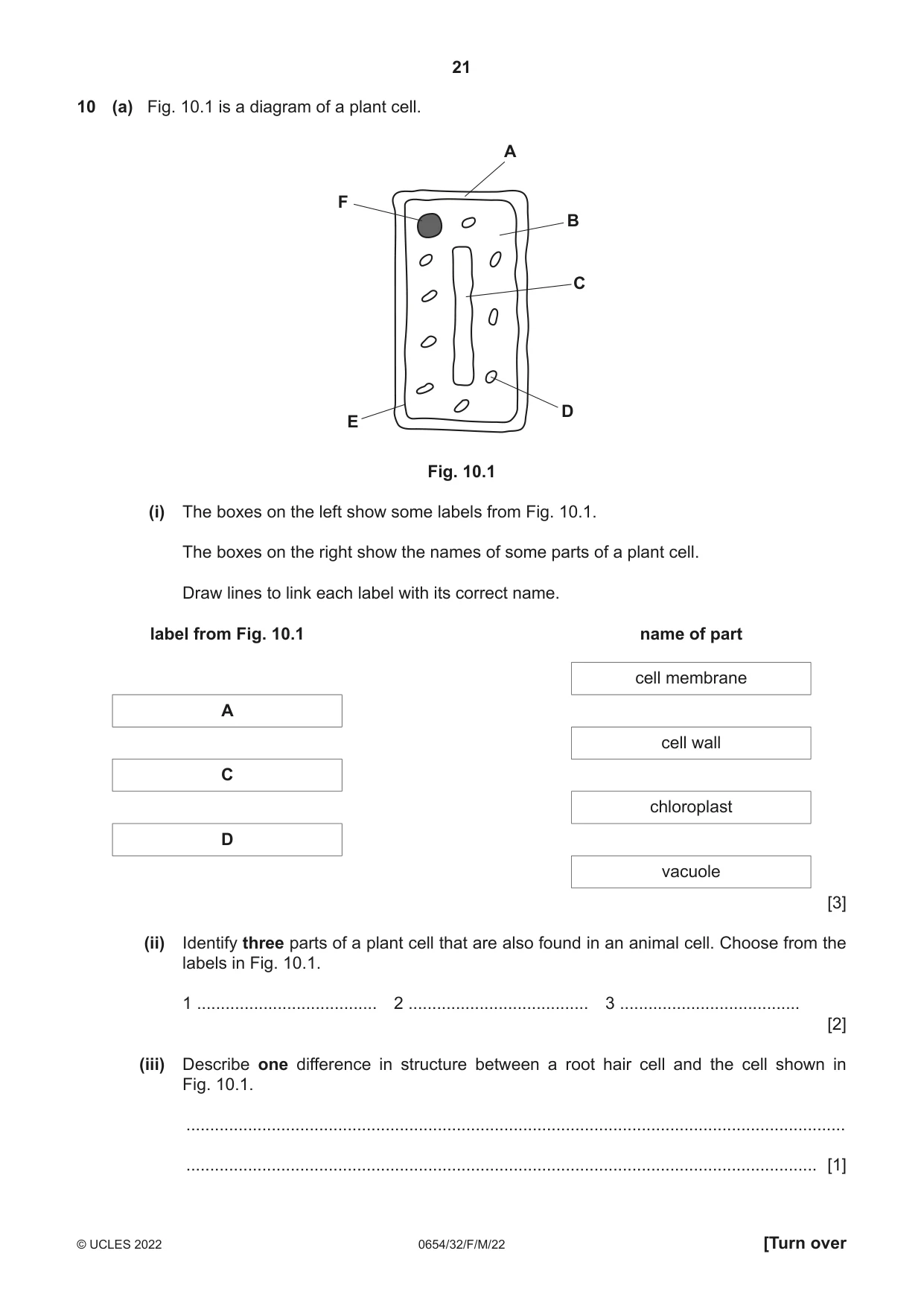
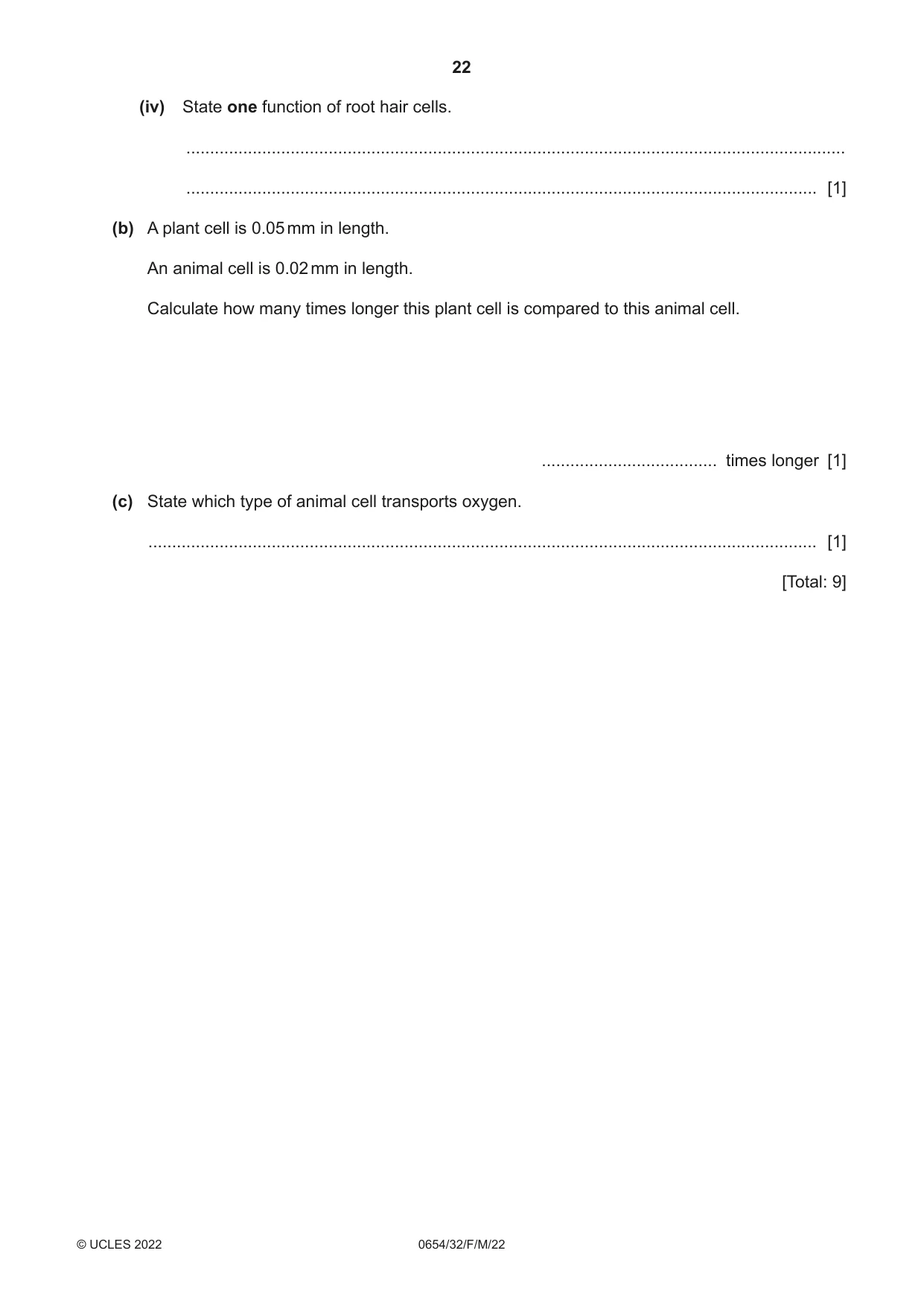
10 (a) Fig. 10.1 is a diagram of a plant cell. A F B C D E Fig. 10.1 (i) The boxes on the left show some labels from Fig. 10.1. The boxes on the right show the names of some parts of a plant cell. Draw lines to link each label with its correct name. label from Fig. 10.1 name of part cell membrane A cell wall C chloroplast D vacuole [3] (ii) Identify three parts of a plant cell that are also found in an animal cell. Choose from the labels in Fig. 10.1. 1 ...................................... 2 ...................................... 3 ...................................... [2] (iii) Describe one difference in structure between a root hair cell and the cell shown in Fig. 10.1. ........................................................................................................................................... ..................................................................................................................................... [1] (iv) State one function of root hair cells. ........................................................................................................................................... ..................................................................................................................................... [1] (b) A plant cell is 0.05 mm in length. An animal cell is 0.02 mm in length. Calculate how many times longer this plant cell is compared to this animal cell. ..................................... times longer [1] (c) State which type of animal cell transports oxygen. ............................................................................................................................................. [1] [Total: 9]
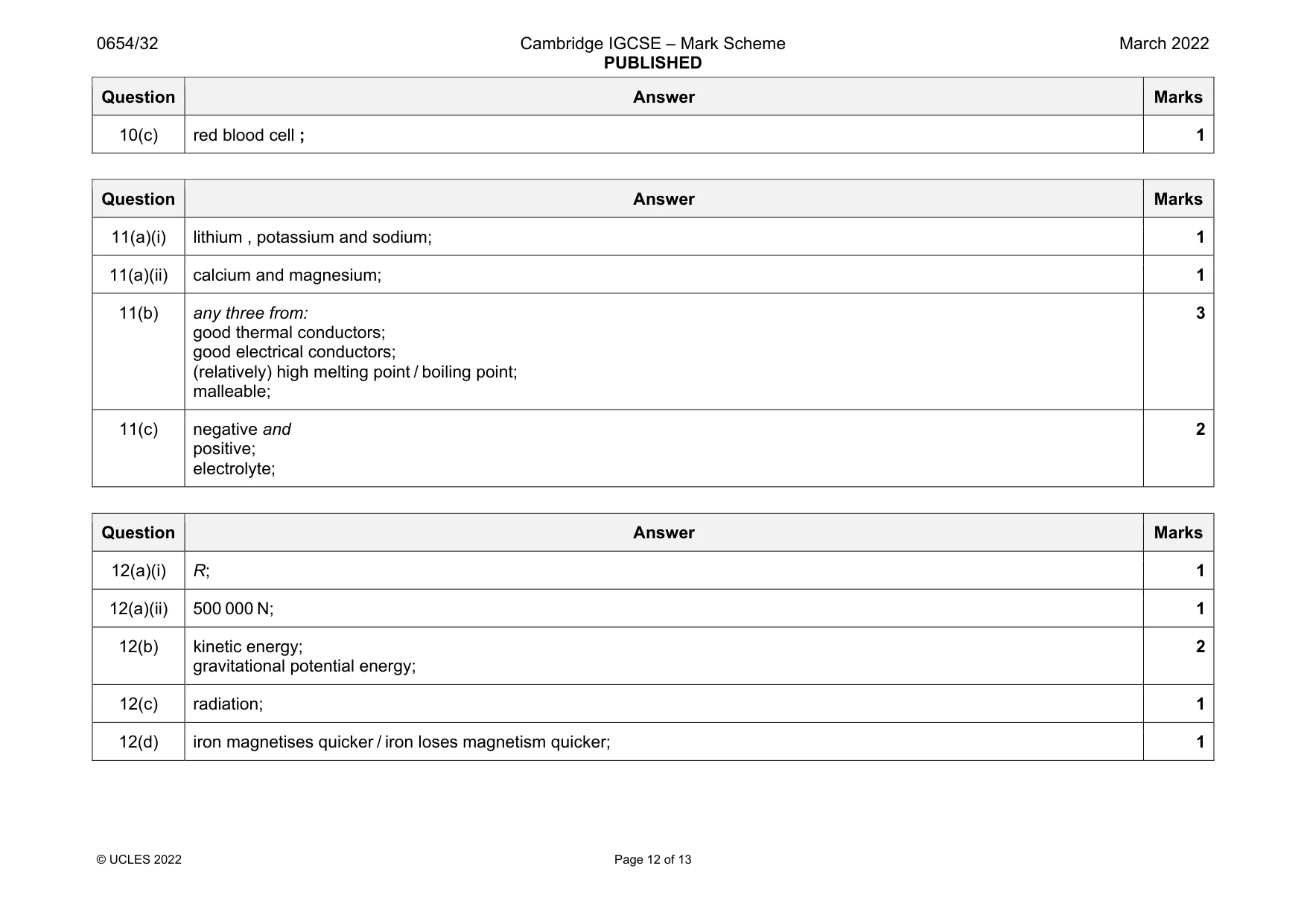
Mark scheme: 10(a)(i) cell membrane A cell wall C chloroplast D vacuole ;;; 10(a)(ii) B, E and F ;; 2 10(a)(iii) elongated shape / no chloroplasts ; 1 10(a)(iv) absorption (of water / mineral ions) ; 1 10(b) 2.5 ; 1 Question Answer Marks 10(c) red blood cell ; 1
Q11 · A list of seven metals from the Periodic Table
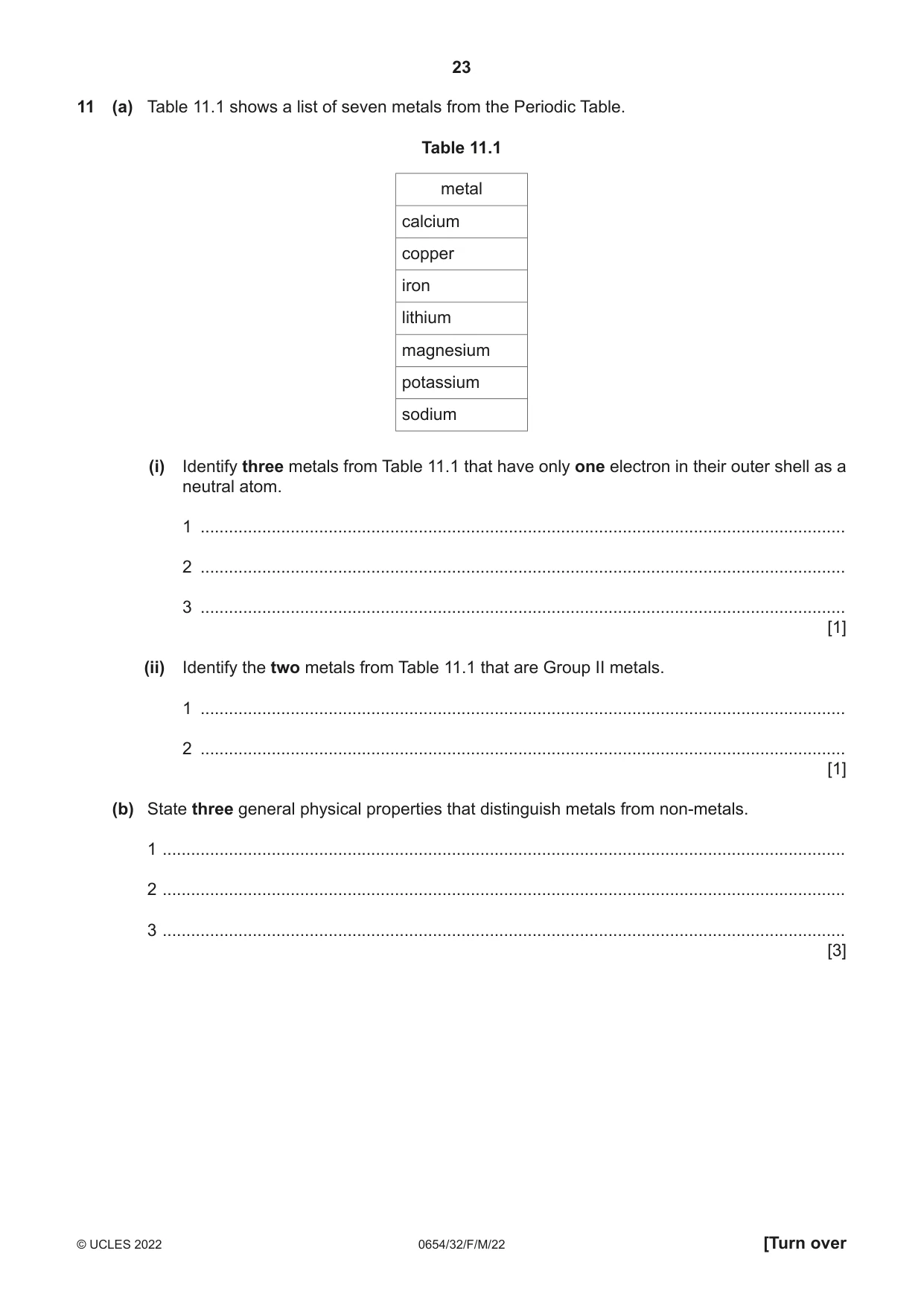
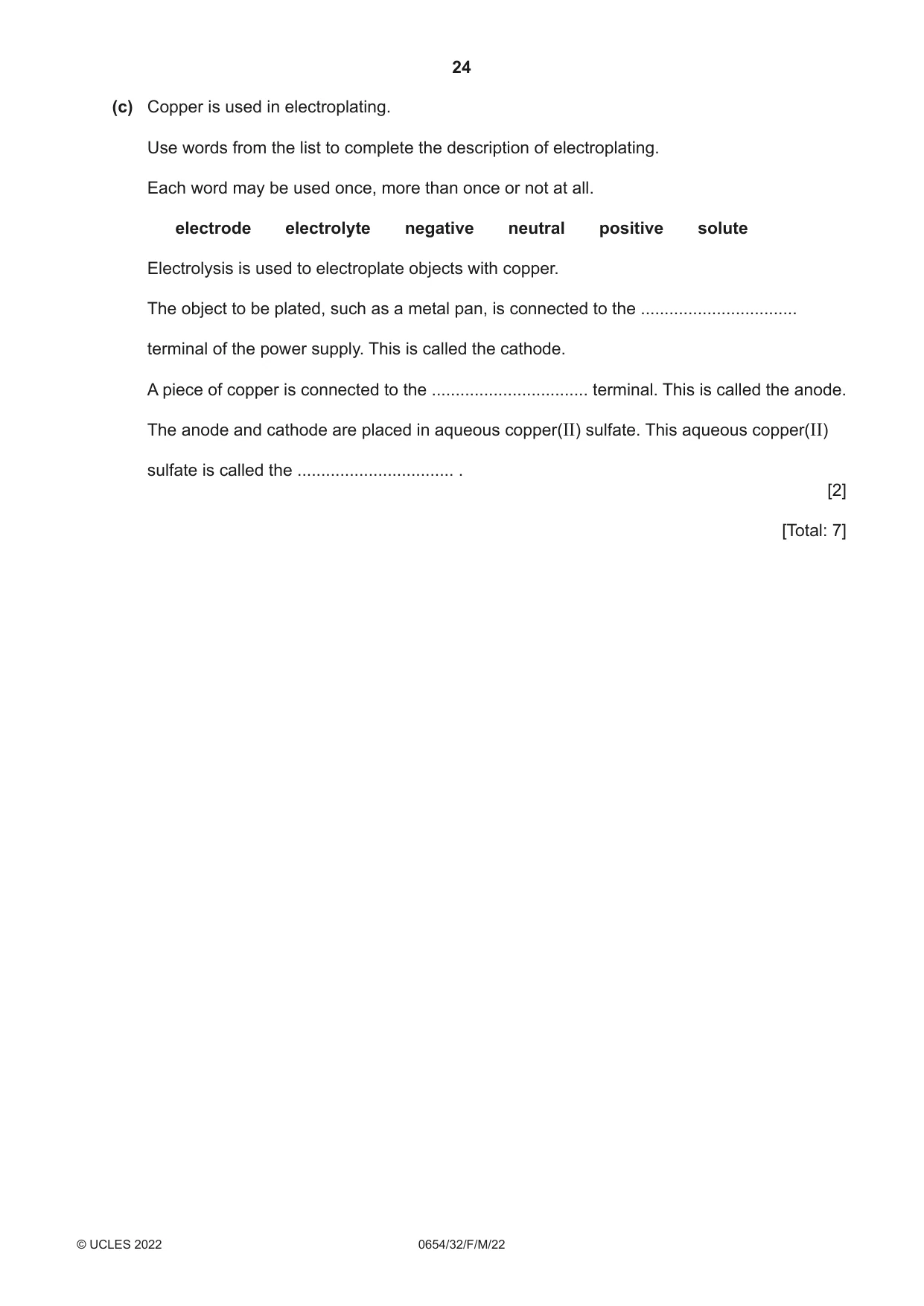
11 (a) Table 11.1 shows a list of seven metals from the Periodic Table. Table 11.1 metal calcium copper iron lithium magnesium potassium sodium (i) Identify three metals from Table 11.1 that have only one electron in their outer shell as a neutral atom. 1 ........................................................................................................................................ 2 ........................................................................................................................................ 3 ........................................................................................................................................ [1] (ii) Identify the two metals from Table 11.1 that are Group II metals. 1 ........................................................................................................................................ 2 ........................................................................................................................................ [1] (b) State three general physical properties that distinguish metals from non-metals. 1 ................................................................................................................................................ 2 ................................................................................................................................................ 3 ................................................................................................................................................ [3] (c) Copper is used in electroplating. Use words from the list to complete the description of electroplating. Each word may be used once, more than once or not at all. electrode electrolyte negative neutral positive solute Electrolysis is used to electroplate objects with copper. The object to be plated, such as a metal pan, is connected to the ................................. terminal of the power supply. This is called the cathode. A piece of copper is connected to the ................................. terminal. This is called the anode. The anode and cathode are placed in aqueous copper(II) sulfate. This aqueous copper(II) sulfate is called the ................................. . [2] [Total: 7]
Mark scheme: 11(a)(i) lithium , potassium and sodium; 1 11(a)(ii) calcium and magnesium; 1 11(b) any three from: good thermal conductors; good electrical conductors; (relatively) high melting point / boiling point; malleable; 3 11(c) negative and positive; electrolyte; 2
Q12 · Four forces, P, Q, R and S, acting on a bus travelling along a level road at constant…
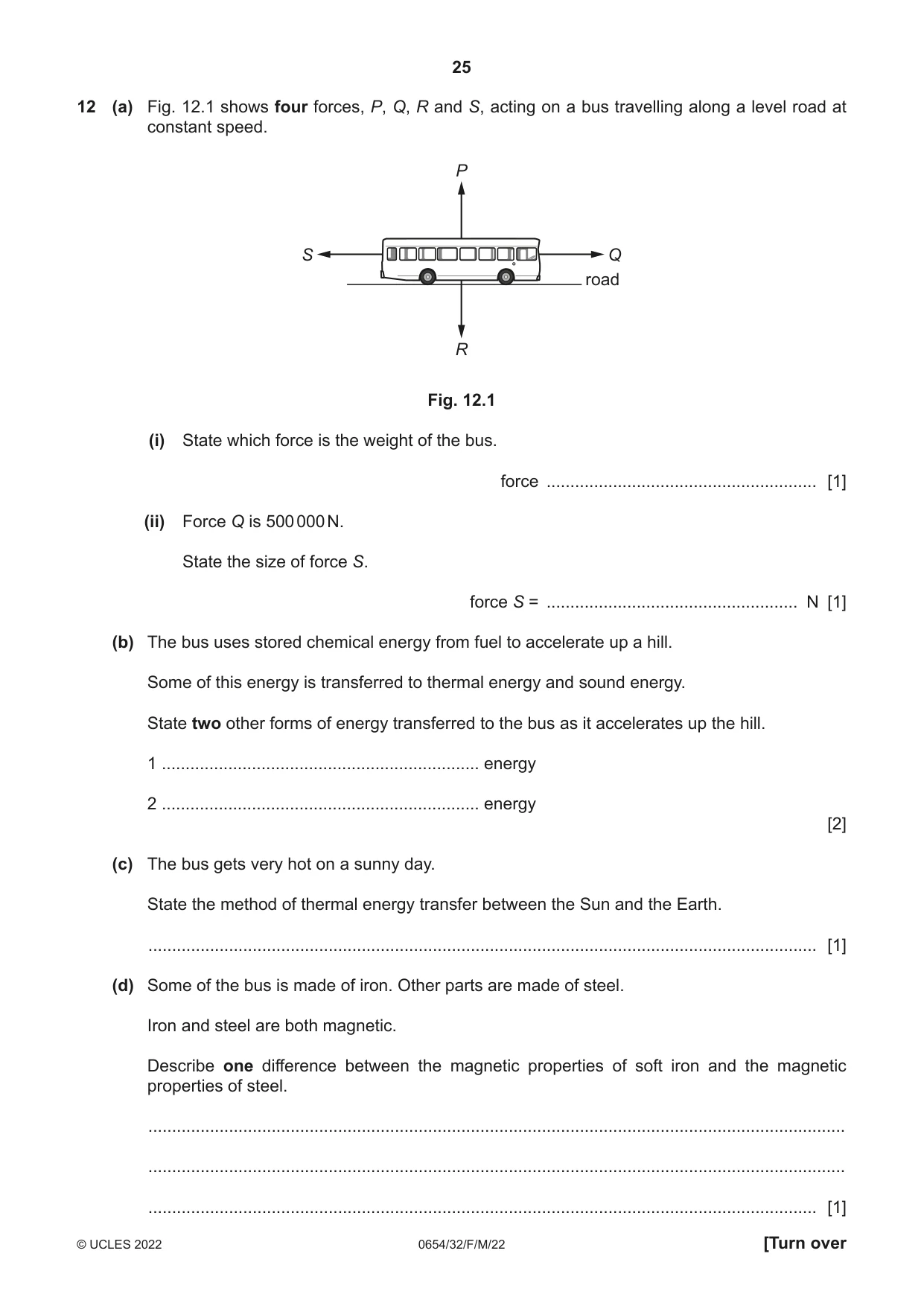
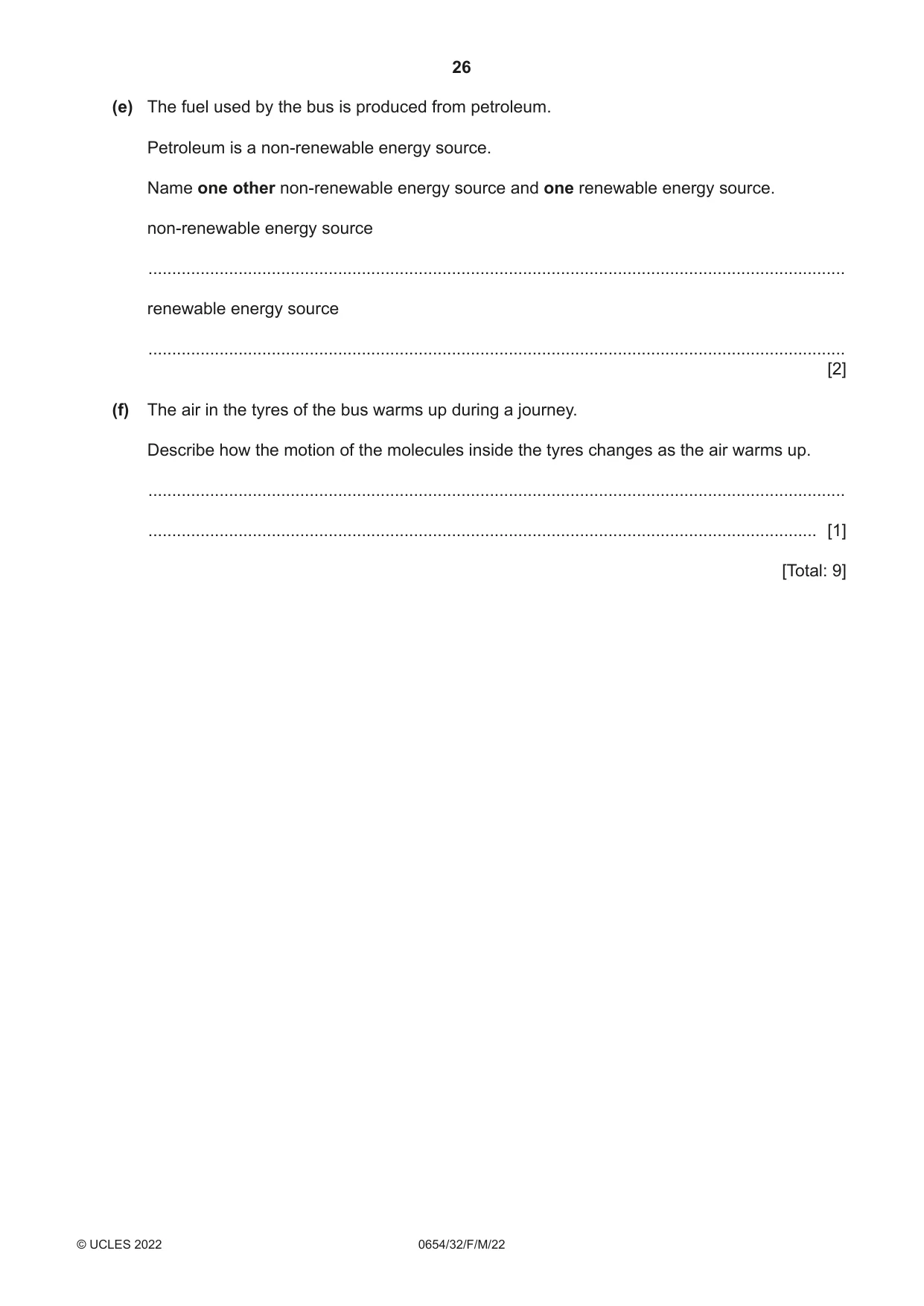
12 (a) Fig. 12.1 shows four forces, P, Q, R and S, acting on a bus travelling along a level road at constant speed. P S Q road R Fig. 12.1 (i) State which force is the weight of the bus. force ......................................................... [1] (ii) Force Q is 500 000 N. State the size of force S. force S = ..................................................... N [1] (b) The bus uses stored chemical energy from fuel to accelerate up a hill. Some of this energy is transferred to thermal energy and sound energy. State two other forms of energy transferred to the bus as it accelerates up the hill. 1 ................................................................... energy 2 ................................................................... energy [2] (c) The bus gets very hot on a sunny day. State the method of thermal energy transfer between the Sun and the Earth. ............................................................................................................................................. [1] (d) Some of the bus is made of iron. Other parts are made of steel. Iron and steel are both magnetic. Describe one difference between the magnetic properties of soft iron and the magnetic properties of steel. ................................................................................................................................................... ................................................................................................................................................... ............................................................................................................................................. [1] (e) The fuel used by the bus is produced from petroleum. Petroleum is a non-renewable energy source. Name one other non-renewable energy source and one renewable energy source. non-renewable energy source ................................................................................................................................................... renewable energy source ................................................................................................................................................... [2] (f) The air in the tyres of the bus warms up during a journey. Describe how the motion of the molecules inside the tyres changes as the air warms up. ................................................................................................................................................... ............................................................................................................................................. [1] [Total: 9]
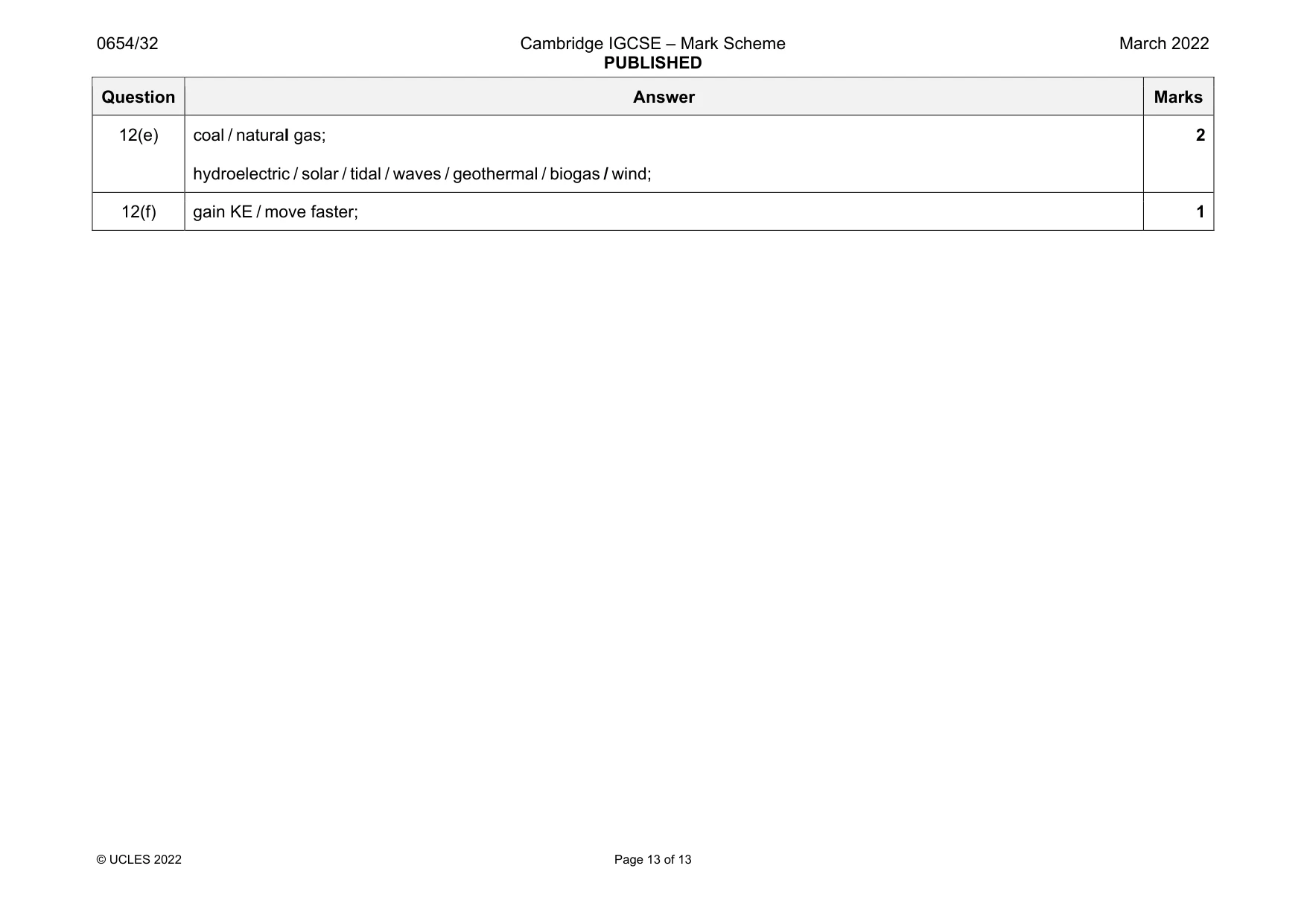
Mark scheme: 12(a)(i) R; 1 12(a)(ii) 500 000 N; 1 12(b) kinetic energy; gravitational potential energy; 2 12(c) radiation; 1 12(d) iron magnetises quicker / iron loses magnetism quicker; 1 Question Answer Marks 12(e) coal / natural gas; hydroelectric / solar / tidal / waves / geothermal / biogas / wind; 2 12(f) gain KE / move faster; 1
What was in this paper
The subtopics covered by these 12 questions, and how many questions each got. Open one in a new tab to see every Cambridge question on it.
What you needed in this session
Cambridge’s own grade thresholds for 2022 Feb/March, Paper 3 · Variant 2. A higher threshold means an easier paper — the bar moves with how the cohort did.