Questions as text
Q1 · A snowboarder moving down a ski slope 0654/41 Oct/Nov 2017
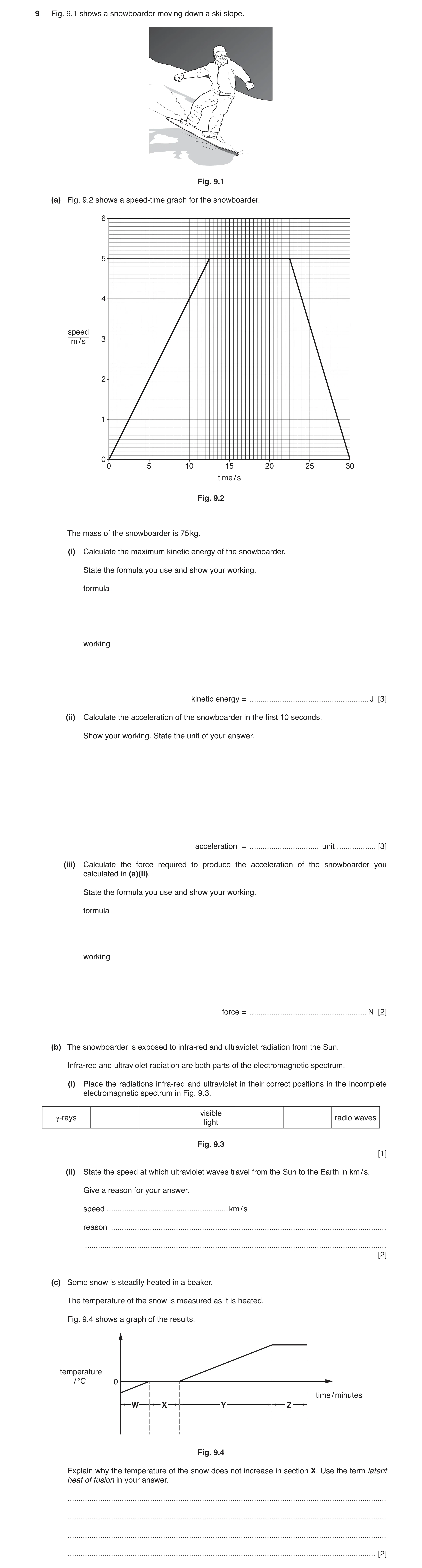
9 Fig. 9.1 shows a snowboarder moving down a ski slope. Fig. 9.1 (a) Fig. 9.2 shows a speed-time graph for the snowboarder. 6 5 4 speed 3 m / s 2 1 0 0 5 10 15 20 25 30 time / s Fig. 9.2 The mass of the snowboarder is 75 kg. (i) Calculate the maximum kinetic energy of the snowboarder. State the formula you use and show your working. formula working kinetic energy = … J [3] (ii) Calculate the acceleration of the snowboarder in the first 10 seconds. Show your working. State the unit of your answer. acceleration = … unit … [3] (iii) Calculate the force required to produce the acceleration of the snowboarder you calculated in (a)(ii). State the formula you use and show your working. formula working force = … N [2] (b) The snowboarder is exposed to infra-red and ultraviolet radiation from the Sun. Infra-red and ultraviolet radiation are both parts of the electromagnetic spectrum. (i) Place the radiations infra-red and ultraviolet in their correct positions in the incomplete electromagnetic spectrum in Fig. 9.3. visible γ-rays radio waves light Fig. 9.3 [1] (ii) State the speed at which ultraviolet waves travel from the Sun to the Earth in km / s. Give a reason for your answer. speed … km / s reason … … [2] (c) Some snow is steadily heated in a beaker. The temperature of the snow is measured as it is heated. Fig. 9.4 shows a graph of the results. temperature / °C 0 time / minutes W X Y Z Fig. 9.4 Explain why the temperature of the snow does not increase in section X. Use the term latent heat of fusion in your answer. … … … … [2]
13 marks
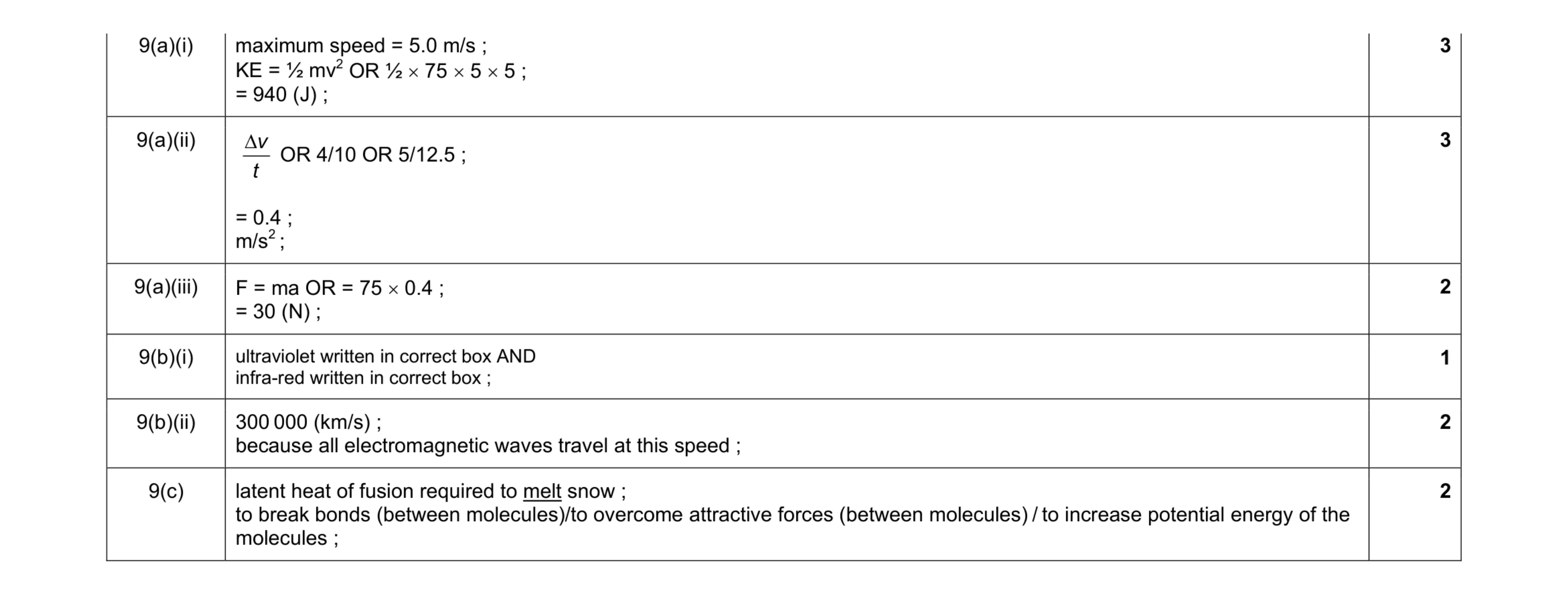
Mark scheme: 9(a)(i) maximum speed = 5.0 m/s ; KE = ½ mv2 OR ½ × 75 × 5 × 5 ; = 940 (J) ; 3 9(a)(ii) v t ∆ OR 4/10 OR 5/12.5 ; = 0.4 ; m/s2 ; 3 9(a)(iii) F = ma OR = 75 × 0.4 ; = 30 (N) ; 2 9(b)(i) ultraviolet written in correct box AND infra-red written in correct box ; 1 9(b)(ii) 300 000 (km/s) ; because all electromagnetic waves travel at this speed ; 2 9(c) latent heat of fusion required to melt snow ; to break bonds (between molecules)/to overcome attractive forces (between molecules) / to increase potential energy of the molecules ; 2
This question in 0654/41 Oct/Nov 2017
Q2 · The information label found on the back of a microwave oven 0654/42 Oct/Nov 2017
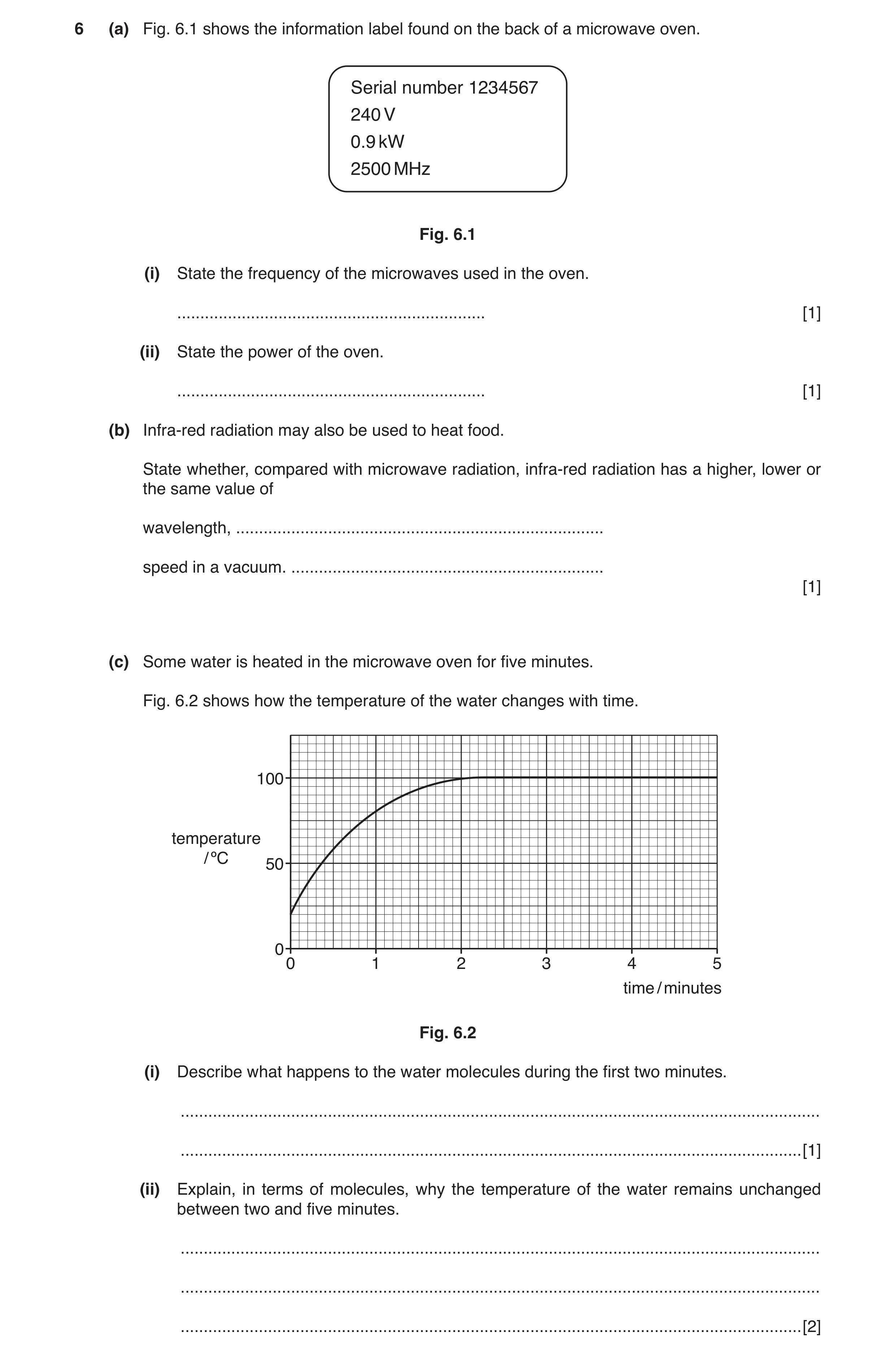
6 (a) Fig. 6.1 shows the information label found on the back of a microwave oven. Serial number 1234567 240 V 0.9 kW 2500 MHz Fig. 6.1 (i) State the frequency of the microwaves used in the oven. … [1] (ii) State the power of the oven. … [1] (b) Infra-red radiation may also be used to heat food. State whether, compared with microwave radiation, infra-red radiation has a higher, lower or the same value of wavelength, … speed in a vacuum. … [1] (c) Some water is heated in the microwave oven for five minutes. Fig. 6.2 shows how the temperature of the water changes with time. 100 temperature / ºC 50 0 0 1 2 3 4 5 time / minutes Fig. 6.2 (i) Describe what happens to the water molecules during the first two minutes. … … [1] (ii) Explain, in terms of molecules, why the temperature of the water remains unchanged between two and five minutes. … … … [2]
6 marks
Mark scheme: 6(a)(i) 2500 MHz ; 1 6(a)(ii) 0.9 kW ; 1 6(b) lower wavelength same speed ; 1 6(c)(i) water molecules gain kinetic energy / move faster ; 1 6(c)(ii) latent heat of vaporisation / energy used to increase potential energy of the molecules ; to break bonds between molecules / to overcome attractive forces between molecules ; no change in kinetic energy so no increase in temperature ; max 2
This question in 0654/42 Oct/Nov 2017
Q3 · State the name of the electromagnetic wave that is used in mobile (cell) phone… 0654/43 Oct/Nov 2017
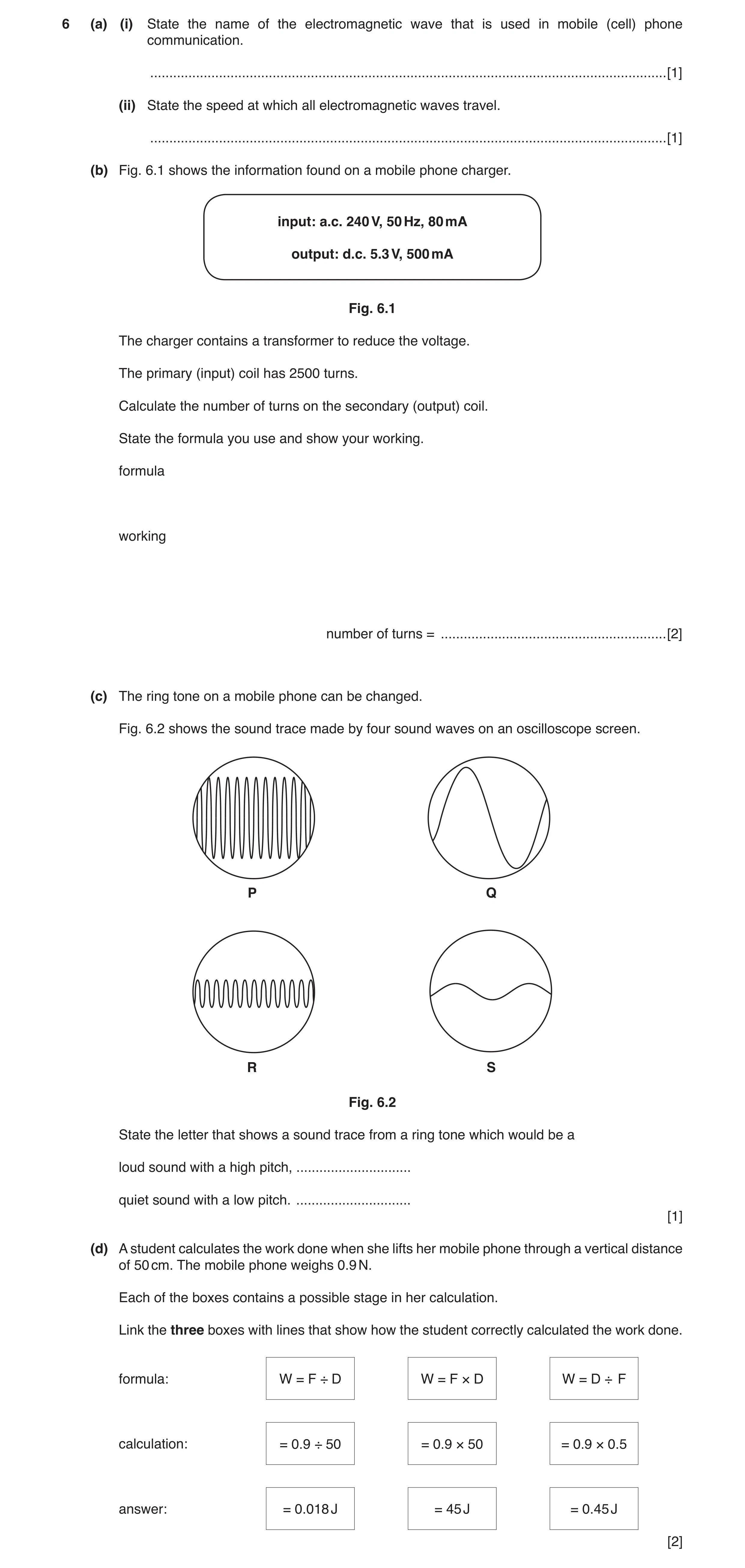
6 (a) (i) State the name of the electromagnetic wave that is used in mobile (cell) phone communication. … [1] (ii) State the speed at which all electromagnetic waves travel. … [1] (b) Fig. 6.1 shows the information found on a mobile phone charger. input: a.c. 240 V, 50 Hz, 80 mA output: d.c. 5.3 V, 500 mA Fig. 6.1 The charger contains a transformer to reduce the voltage. The primary (input) coil has 2500 turns. Calculate the number of turns on the secondary (output) coil. State the formula you use and show your working. formula working number of turns = … [2] (c) The ring tone on a mobile phone can be changed. Fig. 6.2 shows the sound trace made by four sound waves on an oscilloscope screen. P Q R S Fig. 6.2 State the letter that shows a sound trace from a ring tone which would be a loud sound with a high pitch, … quiet sound with a low pitch. … [1] (d) A student calculates the work done when she lifts her mobile phone through a vertical distance of 50 cm. The mobile phone weighs 0.9 N. Each of the boxes contains a possible stage in her calculation. Link the three boxes with lines that show how the student correctly calculated the work done. formula: W = F ÷ D W = F × D W = D ÷ F calculation: = 0.9 ÷ 50 = 0.9 × 50 = 0.9 × 0.5 answer: = 0.018 J = 45 J = 0.45 J [2]
7 marks
Mark scheme: 6(a)(i) microwaves ; 1 6(a)(ii) 300 000 000 / 3 × 10⁸ m / s ; 1 6(b) S S P P V N V N = OR ( ) 2500 5.3 240 s N × = ; = 55 (turns) ; 2 6(c) P then S ; 1 6(d) use of W = F × D ; answer 0.45 J ; 2
This question in 0654/43 Oct/Nov 2017
Q4 · A bat emitting ultrasound waves to detect obstacles and prey 0654/41 Oct/Nov 2018
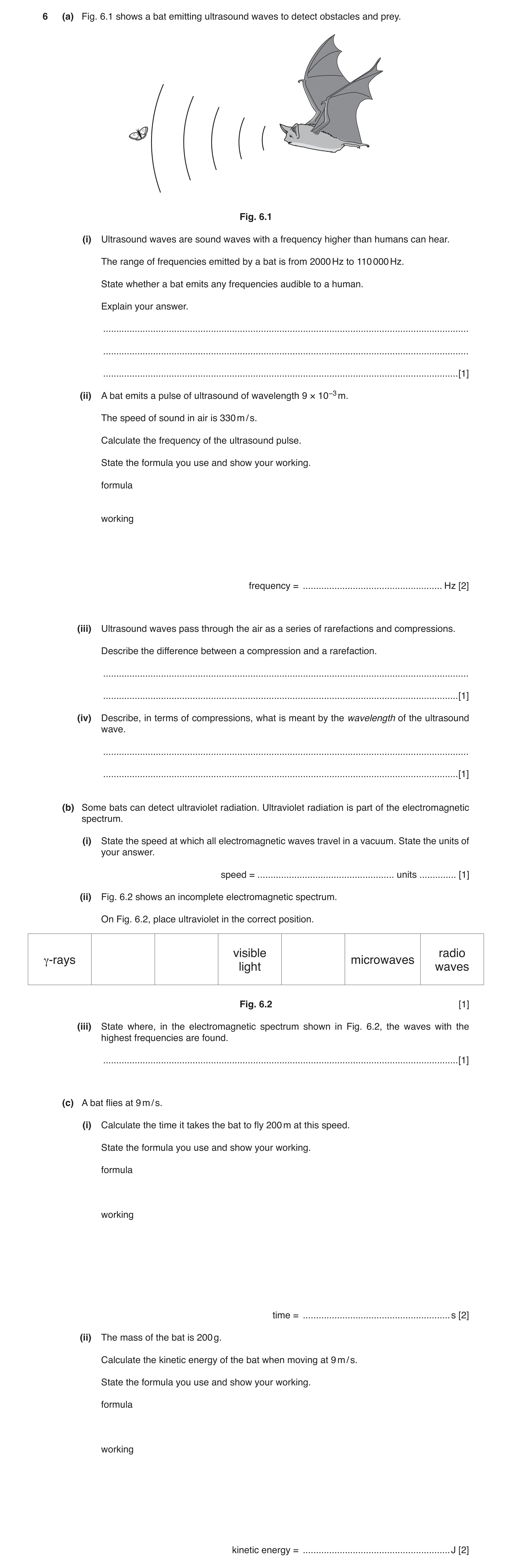
6 (a) Fig. 6.1 shows a bat emitting ultrasound waves to detect obstacles and prey. Fig. 6.1 (i) Ultrasound waves are sound waves with a frequency higher than humans can hear. The range of frequencies emitted by a bat is from 2000 Hz to 110 000 Hz. State whether a bat emits any frequencies audible to a human. Explain your answer. … … … [1] (ii) A bat emits a pulse of ultrasound of wavelength 9 × 10⁻³ m. The speed of sound in air is 330 m / s. Calculate the frequency of the ultrasound pulse. State the formula you use and show your working. formula working frequency = … Hz [2] (iii) Ultrasound waves pass through the air as a series of rarefactions and compressions. Describe the difference between a compression and a rarefaction. … … [1] (iv) Describe, in terms of compressions, what is meant by the wavelength of the ultrasound wave. … … [1] (b) Some bats can detect ultraviolet radiation. Ultraviolet radiation is part of the electromagnetic spectrum. (i) State the speed at which all electromagnetic waves travel in a vacuum. State the units of your answer. speed = … units … [1] (ii) Fig. 6.2 shows an incomplete electromagnetic spectrum. On Fig. 6.2, place ultraviolet in the correct position. visible radioγ-rays microwaves light waves Fig. 6.2 [1] (iii) State where, in the electromagnetic spectrum shown in Fig. 6.2, the waves with the highest frequencies are found. … [1] (c) A bat flies at 9 m / s. (i) Calculate the time it takes the bat to fly 200 m at this speed. State the formula you use and show your working. formula working time = … s [2] (ii) The mass of the bat is 200 g. Calculate the kinetic energy of the bat when moving at 9 m / s. State the formula you use and show your working. formula working kinetic energy = … J [2]
12 marks
Mark scheme: 6(a)(i) Yes, because human normally hears up to 20 000 Hz ; 1 6(a)(ii) frequency = speed / wavelength or 3 330 9 10− × or 330 0.009 ; 37 000 (Hz) ; 2 6(a)(iii) compression region of high pressure / where the particles are close together or rarefaction region of low pressure / where particles are further apart ; 1 6(a)(iv) distance between two (consecutive) compressions ; 1 6(b)(i) 300 000 000 m / s ; 1 6(b)(ii) box to the left of visible light ; 1 6(b)(iii) left hand side / gamma ; 1 6(c)(i) distance time= speed or 200 9 ; = 22 (s) ; 2 6(c)(ii) 2 1 KE mv 2 = or 1 0.2 9 9 2 × × × ; 8.1 (J) ; 2
This question in 0654/41 Oct/Nov 2018
Q5 · A fire engine communicates with the fire station using radio waves 0654/42 Oct/Nov 2018
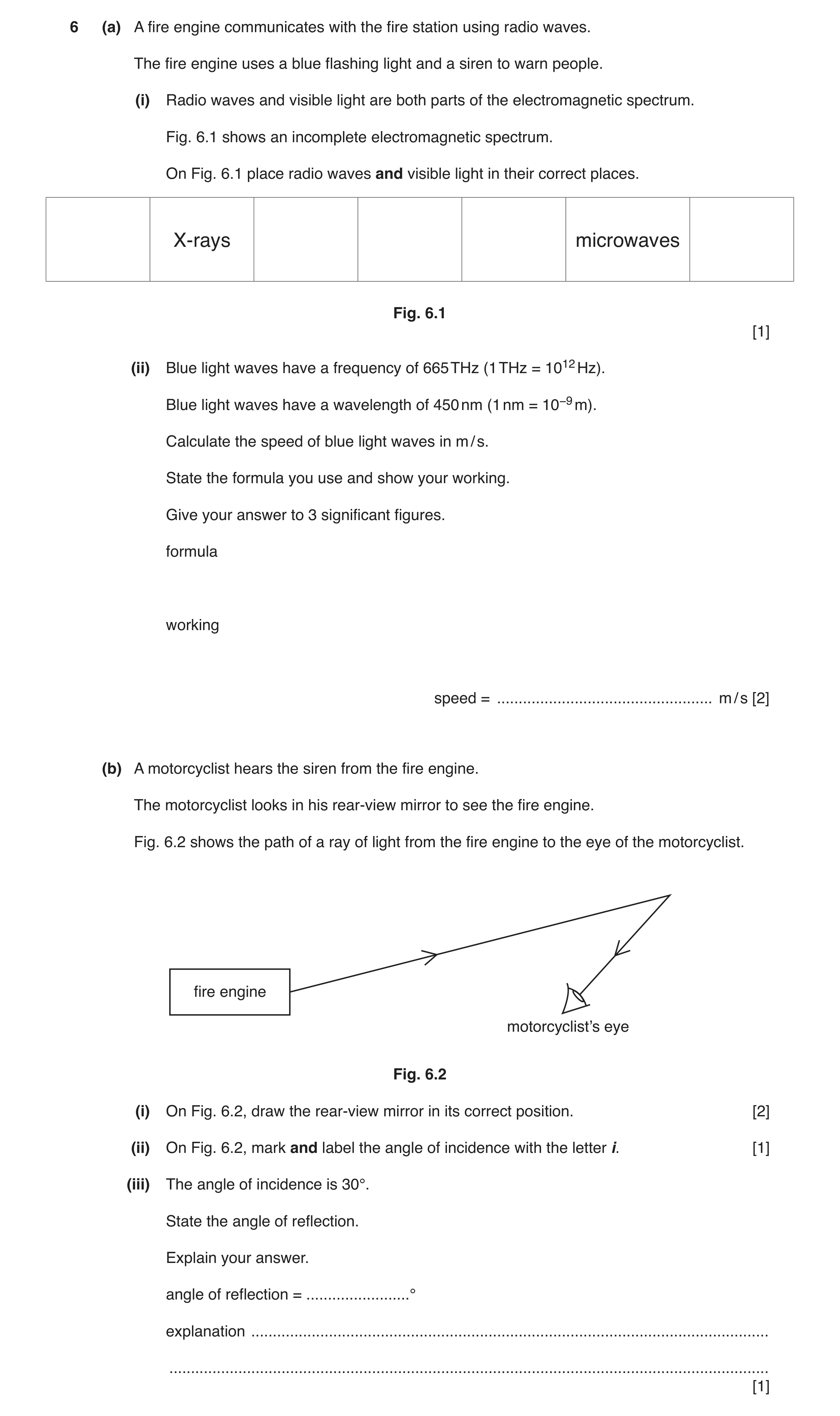
6 (a) A fire engine communicates with the fire station using radio waves. The fire engine uses a blue flashing light and a siren to warn people. (i) Radio waves and visible light are both parts of the electromagnetic spectrum. Fig. 6.1 shows an incomplete electromagnetic spectrum. On Fig. 6.1 place radio waves and visible light in their correct places. X-rays microwaves Fig. 6.1 [1] (ii) Blue light waves have a frequency of 665 THz (1 THz = 1012 Hz). Blue light waves have a wavelength of 450 nm (1 nm = 10−9 m). Calculate the speed of blue light waves in m / s. State the formula you use and show your working. Give your answer to 3 significant figures. formula working speed = … m / s [2] (b) A motorcyclist hears the siren from the fire engine. The motorcyclist looks in his rear-view mirror to see the fire engine. Fig. 6.2 shows the path of a ray of light from the fire engine to the eye of the motorcyclist. fire engine motorcyclist’s eye Fig. 6.2 (i) On Fig. 6.2, draw the rear-view mirror in its correct position. [2] (ii) On Fig. 6.2, mark and label the angle of incidence with the letter i. [1] (iii) The angle of incidence is 30°. State the angle of reflection. Explain your answer. angle of reflection = … ° explanation … … [1]
7 marks
Mark scheme: 6(a)(i) radio on right hand side and visible in the middle ; 1 6(a)(ii) speed = frequency × wavelength or 665 × 1012 × 450 × 10–9 / 299 250 000 (m/s) ; 299 000 000 (m / s) ; 2 6(b)(i) mirror drawn at point of reflection ; correct angle at point of reflection ; 2 6(b)(ii) angle i correctly labelled ; 1 6(b)(iii) 30° AND angle of incidence = angle of reflection ; 1
This question in 0654/42 Oct/Nov 2018
Q6 · X-rays and γ-rays are both used in hospitals 0654/43 Oct/Nov 2018
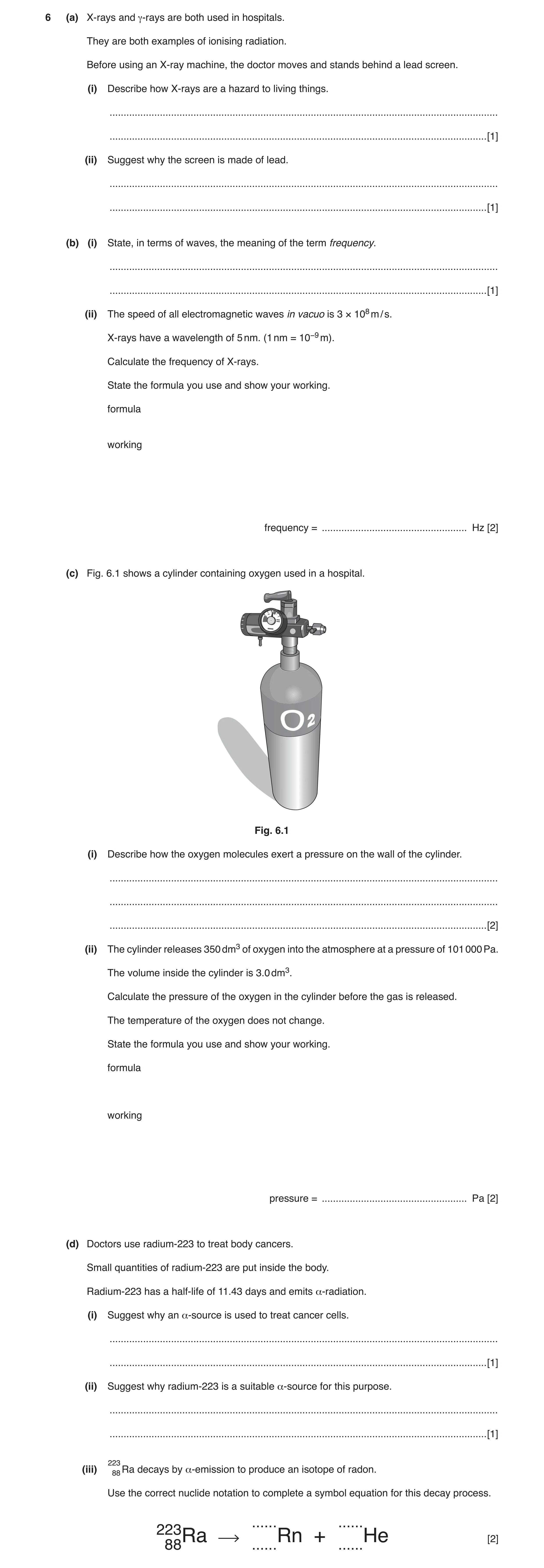
6 (a) X-rays and γ-rays are both used in hospitals. They are both examples of ionising radiation. Before using an X-ray machine, the doctor moves and stands behind a lead screen. (i) Describe how X-rays are a hazard to living things. … … [1] (ii) Suggest why the screen is made of lead. … … [1] (b) (i) State, in terms of waves, the meaning of the term frequency. … … [1] (ii) The speed of all electromagnetic waves in vacuo is 3 × 10⁸ m / s. X-rays have a wavelength of 5 nm. (1 nm = 10−9 m). Calculate the frequency of X-rays. State the formula you use and show your working. formula working frequency = … Hz [2] (c) Fig. 6.1 shows a cylinder containing oxygen used in a hospital. Fig. 6.1 (i) Describe how the oxygen molecules exert a pressure on the wall of the cylinder. … … … [2] (ii) The cylinder releases 350 dm3 of oxygen into the atmosphere at a pressure of 101 000 Pa. The volume inside the cylinder is 3.0 dm3. Calculate the pressure of the oxygen in the cylinder before the gas is released. The temperature of the oxygen does not change. State the formula you use and show your working. formula working pressure = … Pa [2] (d) Doctors use radium-223 to treat body cancers. Small quantities of radium-223 are put inside the body. Radium-223 has a half-life of 11.43 days and emits α-radiation. (i) Suggest why an α-source is used to treat cancer cells. … … [1] (ii) Suggest why radium-223 is a suitable α-source for this purpose. … … [1] 223 (iii) 88 Ra decays by α-emission to produce an isotope of radon. Use the correct nuclide notation to complete a symbol equation for this decay process. … … 223 [2] 88Ra … Rn + … He
13 marks
Mark scheme: 6(a)(i) reference to an effect of ionising radiation on body ; 1 6(a)(ii) lead absorbs X-rays / stops X-rays passing through ; 1 6(b)(i) number of oscillations per second ; 1 6(b)(ii) frequency = speed / wavelength or 3 × 10⁸/ 5 × 10⁻⁹ ; 6 × 10¹⁶ (Hz) ; 2 6(c)(i) collide with walls / cylinder ; (collisions exert a) force on the walls / cylinder ; 2 6(c)(ii) P1 = P2 V2 / V1 or 101 000 × 350 / 3.0 ; = 12 000 000 (Pa) ; 2 6(d)(i) (alpha radiation is) ionising OR kills cells OR low penetration ; 1 6(d)(ii) half life is short / will not radiate for long (in the body) ; 1 6(d)(iii) 223 88Ra → 219 86Rn + 4 2He radon correct ; helium correct ; 2
This question in 0654/43 Oct/Nov 2018
Q7 · The visible light produced by the headlamps of a train is part of the electromagnetic… 0654/41 May/June 2019
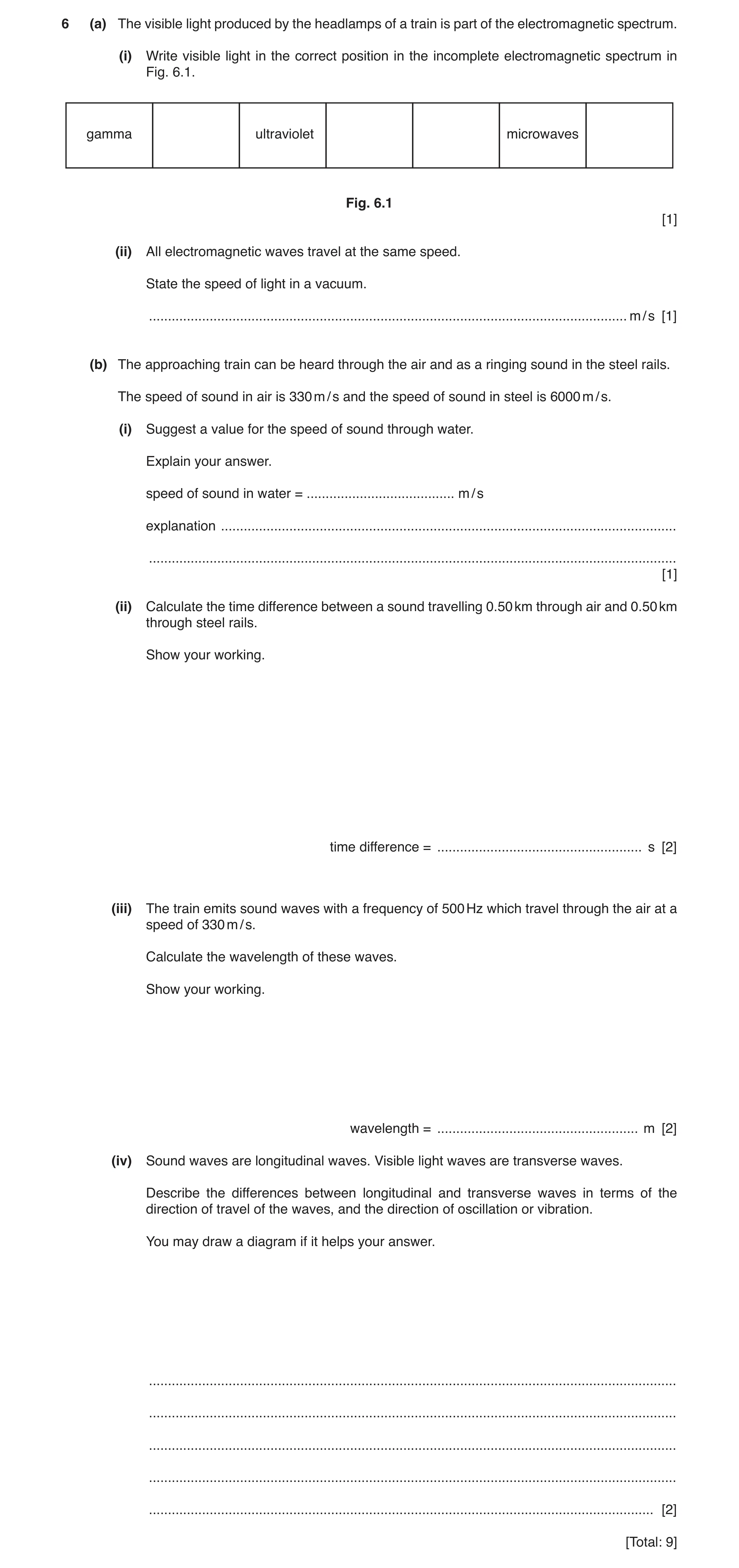
6 (a) The visible light produced by the headlamps of a train is part of the electromagnetic spectrum. (i) Write visible light in the correct position in the incomplete electromagnetic spectrum in Fig. 6.1. gamma ultraviolet microwaves Fig. 6.1 [1] (ii) All electromagnetic waves travel at the same speed. State the speed of light in a vacuum. … m / s [1] (b) The approaching train can be heard through the air and as a ringing sound in the steel rails. The speed of sound in air is 330 m / s and the speed of sound in steel is 6000 m / s. (i) Suggest a value for the speed of sound through water. Explain your answer. speed of sound in water = … m / s explanation … … [1] (ii) Calculate the time difference between a sound travelling 0.50 km through air and 0.50 km through steel rails. Show your working. time difference = … s [2] (iii) The train emits sound waves with a frequency of 500 Hz which travel through the air at a speed of 330 m / s. Calculate the wavelength of these waves. Show your working. wavelength = … m [2] (iv) Sound waves are longitudinal waves. Visible light waves are transverse waves. Describe the differences between longitudinal and transverse waves in terms of the direction of travel of the waves, and the direction of oscillation or vibration. You may draw a diagram if it helps your answer. … … … … … [2] [Total: 9]
9 marks
Mark scheme: 6(a)(i) visible placed correctly ; 1 6(a)(ii) 3 × 10⁸ (m/s) ; 1 6(b)(i) value above 330 m/s and below 6000 m/s and sound travels faster in a liquid than in a gas and sound travels slower in a liquid than in a solid ; 1 6(b)(ii) (time in air=) 500/330 or 1.515(s) and (time in steel =) 500/6000 or 0.0833(s) ; time difference = 1.4 (s) ; 2 6(b)(iii) (wavelength =) velocity / frequency or 330/500 ; = 0.66 (m) ; 2 6(b)(iv) transverse waves – direction of oscillation/vibration perpendicular to direction of wave travel ; longitudinal – direction of oscillation/vibration parallel to direction of wave travel ; 2
This question in 0654/41 May/June 2019
Q8 · A large snow tractor used by scientists working in the Arctic region 0654/42 May/June 2019
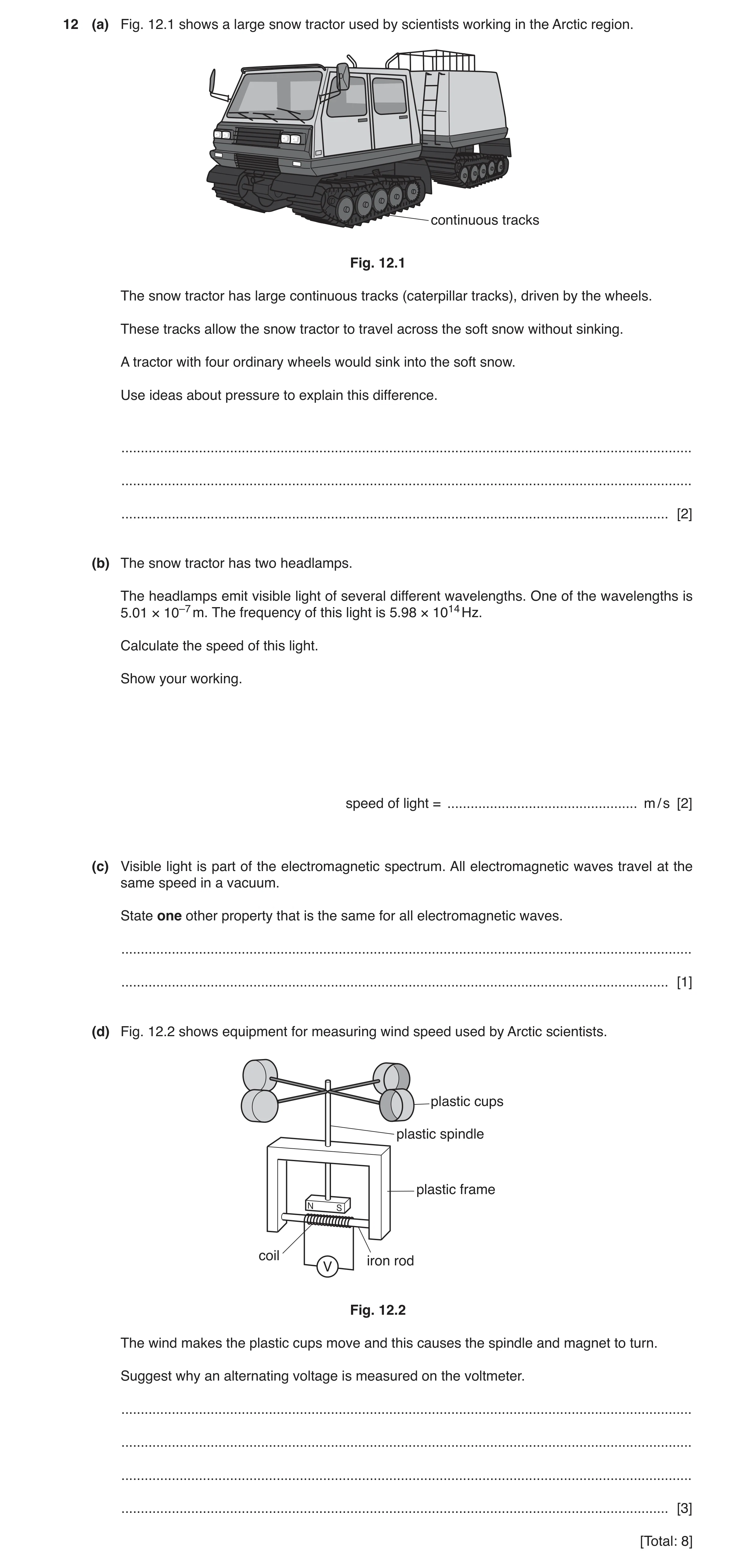
12 (a) Fig. 12.1 shows a large snow tractor used by scientists working in the Arctic region. continuous tracks Fig. 12.1 The snow tractor has large continuous tracks (caterpillar tracks), driven by the wheels. These tracks allow the snow tractor to travel across the soft snow without sinking. A tractor with four ordinary wheels would sink into the soft snow. Use ideas about pressure to explain this difference. … … … [2] (b) The snow tractor has two headlamps. The headlamps emit visible light of several different wavelengths. One of the wavelengths is 5.01 × 10⁻⁷ m. The frequency of this light is 5.98 × 10¹⁴ Hz. Calculate the speed of this light. Show your working. speed of light = … m / s [2] (c) Visible light is part of the electromagnetic spectrum. All electromagnetic waves travel at the same speed in a vacuum. State one other property that is the same for all electromagnetic waves. … … [1] (d) Fig. 12.2 shows equipment for measuring wind speed used by Arctic scientists. plastic cups plastic spindle plastic frame coil iron rod V Fig. 12.2 The wind makes the plastic cups move and this causes the spindle and magnet to turn. Suggest why an alternating voltage is measured on the voltmeter. … … … … [3] [Total: 8]
8 marks
Mark scheme: 12(a) tracks spread weight over larger (surface) area ; so pressure is less ; 2 12(b) (v) = f × λ or 5.98 × 1014 × 5.01 × 10-7 ; = 3.00 × 10⁸ (m) ; 2 12(c) all transverse waves ; 1 12(d) (coil experiences) changing magnetic field ; (changing magnetic field) induces emf ; direction of emf changes every half turn ; max 3
This question in 0654/42 May/June 2019
Q9 · X-rays and γ-radiation are both used in hospitals 0654/42 Oct/Nov 2019
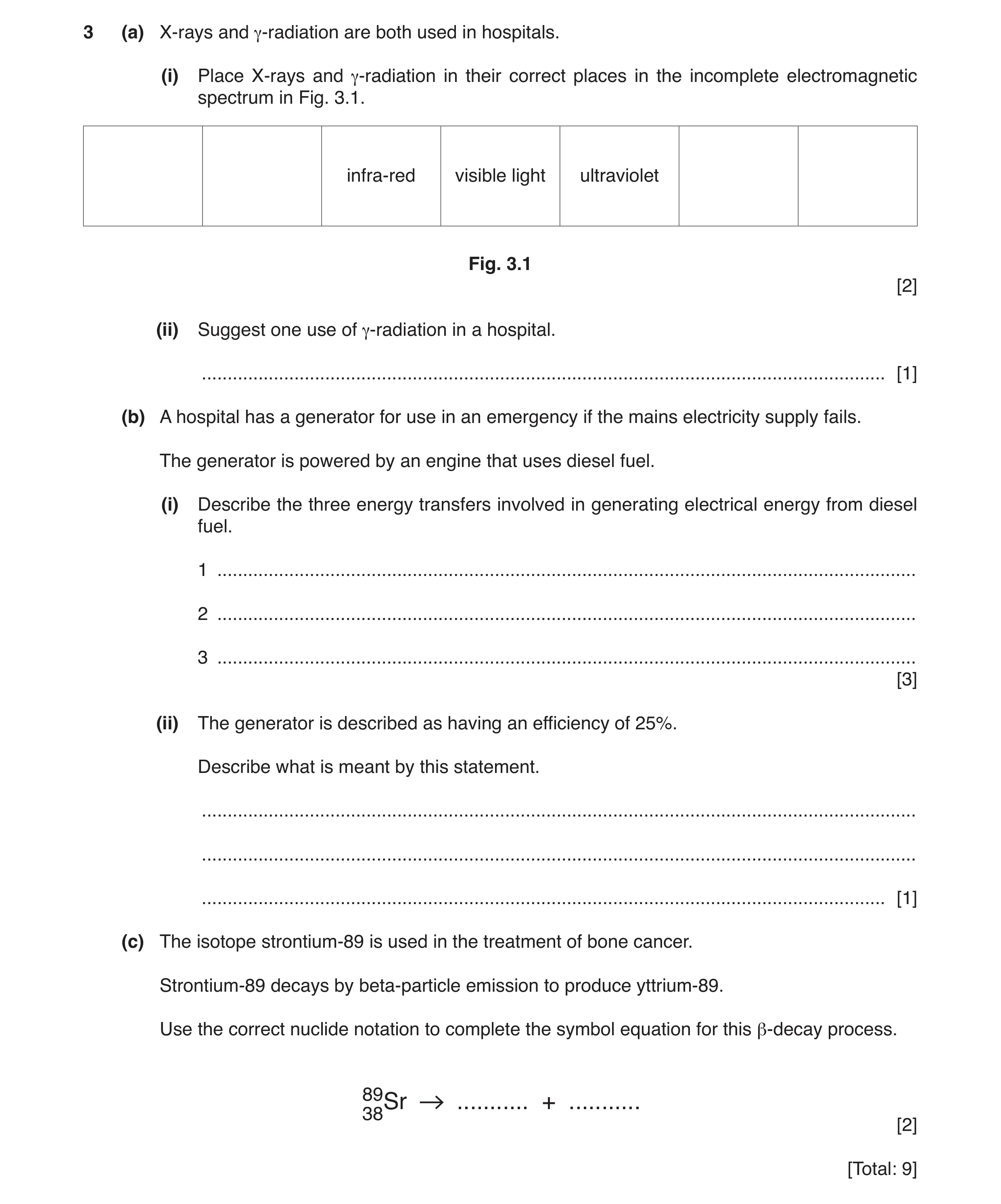
3 (a) X-rays and γ-radiation are both used in hospitals. (i) Place X-rays and γ-radiation in their correct places in the incomplete electromagnetic spectrum in Fig. 3.1. infra-red visible light ultraviolet Fig. 3.1 [2] (ii) Suggest one use of γ-radiation in a hospital. … [1] (b) A hospital has a generator for use in an emergency if the mains electricity supply fails. The generator is powered by an engine that uses diesel fuel. (i) Describe the three energy transfers involved in generating electrical energy from diesel fuel. 1 … 2 … 3 … [3] (ii) The generator is described as having an efficiency of 25%. Describe what is meant by this statement. … … … [1] (c) The isotope strontium-89 is used in the treatment of bone cancer. Strontium-89 decays by beta-particle emission to produce yttrium-89. Use the correct nuclide notation to complete the symbol equation for this β-decay process. 8938Sr … + … [2] [Total: 9]
9 marks
Mark scheme: 3(a)(i) X rays to right of UV ; gamma in far right box ; 2 3(a)(ii) cancer treatment / sterilising medical instruments / radioactive tracers ; 1 3(b)(i) chemical energy to thermal energy ; thermal to kinetic energy ; kinetic energy to electrical energy ; 3 3(b)(ii) 25% of energy input is transferred to, useful output / electrical energy ; 1 3(c) 89 Y ; 39 ; 0 e ; -1 ; 2
This question in 0654/42 Oct/Nov 2019
Q10 · Visible light and γ-radiation are both used in hospitals 0654/41 May/June 2020
9 (a) Visible light and γ-radiation are both used in hospitals. They are both examples of electromagnetic waves. γ-radiation travels at a speed of 3.0 × 10⁸ m / s in a vacuum. (i) State the speed at which visible light travels in a vacuum. speed = … m / s [1] (ii) γ-radiation has a wavelength of 8 × 10–12 m. Calculate the frequency of γ-radiation. State the unit of your answer. frequency = … unit … [3] (b) Doctors use visible light and optical fibres to see inside the human body. Visible light passes along optical fibres by total internal reflection. (i) Fig. 9.1 shows a ray of light passing into an optical fibre. On Fig. 9.1 continue the ray of light to show its path through the optical fibre. light ray optical fibre Fig. 9.1 [1] (ii) Explain why total internal reflection occurs. … … [1] (c) Doctors use an isotope of iodine, I-123, to examine the thyroid gland of a patient. Small quantities of I-123 are absorbed by the thyroid gland. I-123 emits γ-radiation which is detected outside the body. I-123 has a half-life of 13 hours. (i) Give two reasons why I-123 is suitable for use inside the body. 1 … … 2 … … [2] (ii) A sample of I-123 contains 8 × 10¹⁴ atoms. Sometime later 6 × 10¹⁴ atoms have decayed. Calculate the time needed for this number of atoms to decay. time = … hours [2] [Total: 10]
10 marks
Mark scheme: 9(a)(i) 3 × 10⁸ m/s; 9(a)(ii) v = frequency × wavelength or correct substitution; 3.75 × 10¹⁹ ; Hz; 3 9(b)(i) angles approximately correct for at least two reflections; 1 9(b)(ii) angle of incidence exceeds critical angle; 1 9(c)(i) relatively short half-life; γ-radiation can pass through body cells and be detected outside the body; γ-radiation is the least ionising; max 2 9(c)(ii) two half-lives (have occurred); 26 (hours); 2
This question in 0654/41 May/June 2020
Q11 · A mountaineer climbs a mountain 0654/42 May/June 2020
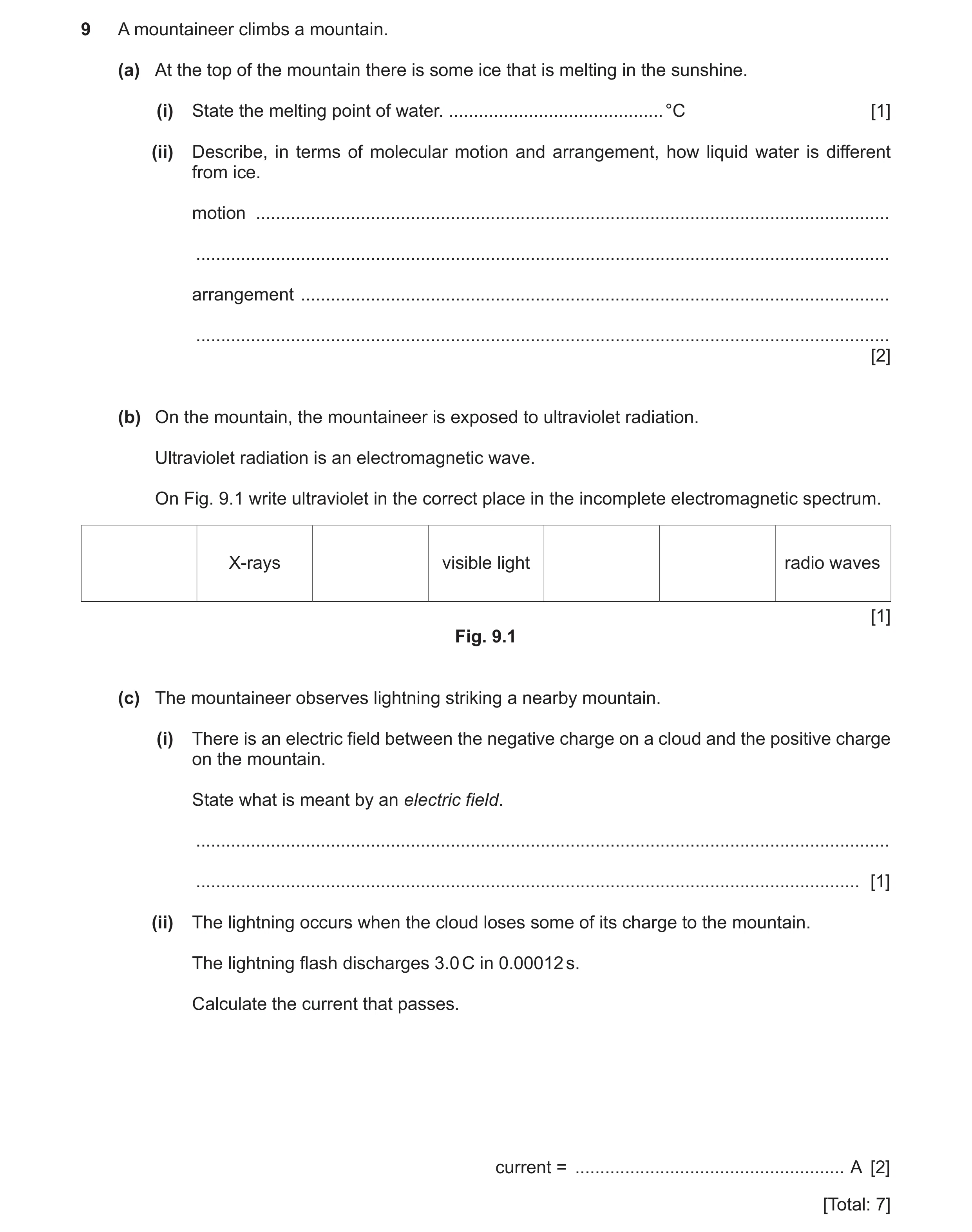
9 A mountaineer climbs a mountain. (a) At the top of the mountain there is some ice that is melting in the sunshine. (i) State the melting point of water. … °C [1] (ii) Describe, in terms of molecular motion and arrangement, how liquid water is different from ice. motion … … arrangement … … [2] (b) On the mountain, the mountaineer is exposed to ultraviolet radiation. Ultraviolet radiation is an electromagnetic wave. On Fig. 9.1 write ultraviolet in the correct place in the incomplete electromagnetic spectrum. X-rays visible light radio waves [1] Fig. 9.1 (c) The mountaineer observes lightning striking a nearby mountain. (i) There is an electric field between the negative charge on a cloud and the positive charge on the mountain. State what is meant by an electric field. … … [1] (ii) The lightning occurs when the cloud loses some of its charge to the mountain. The lightning flash discharges 3.0 C in 0.00012 s. Calculate the current that passes. current = … A [2] [Total: 7]
7 marks
Mark scheme: 9(a)(i) 0(°C); 1 9(a)(ii) molecular motion – molecules in liquid water can move throughout but molecules in ice vibrate about a fixed point ; molecular arrangement – molecules in liquid water in random arrangement / molecules in ice in regular arrangement ; 2 9(b) ultraviolet placed between X-rays and visible light; 1 9(c)(i) a region in which an electric charge experiences a force; 1 9(c)(ii) I = Q/t or correct substitution; 25 000 (A); 2
This question in 0654/42 May/June 2020
Q12 · State the speed of electromagnetic waves in a vacuum 0654/41 Oct/Nov 2021
3 (a) State the speed of electromagnetic waves in a vacuum. … [1] (b) Fig. 3.1 shows an incomplete electromagnetic spectrum. (i) Write visible light in its correct position in the spectrum. [1] ultraviolet infrared microwaves Fig. 3.1 (ii) State the form of electromagnetic radiation that has the highest frequency. … [1] (c) Visible light is an example of a transverse wave. (i) Use a double headed arrow (↔ or ↕) to label the wavelength of the transverse wave shown in Fig. 3.2. [1] Fig. 3.2 (ii) State the equation that links the frequency, speed and wavelength of a wave. … [1] (d) Fig. 3.3 shows an object placed close to a thin converging lens. object F F F = principal focus Fig. 3.3 (i) Complete Fig. 3.3 to show how the rays of light from the object form an image. [3] (ii) The image formed by this lens is real. State what is meant by a real image. … … [1] (iii) Suggest a use for a thin converging lens such as the one shown in Fig. 3.3. … … [1] [Total: 10]
10 marks
Mark scheme: 3(a) 3 × 10⁸ m / s ; 1 3(b)(i) ‘visible light’ placed in central box ; 1 3(b)(ii) gamma ; 1 3(c)(i) line drawn peak to peak / trough to trough / any identical points on adjacent waves ; 1 3(c)(ii) v = f λ ; 1 3(d)(i) any two from: ray parallel to the principal axis passing through F on image side ; ray passing through F on object side made parallel to the principal axis ; ray passing through optical centre of lens not refracted ; and image of correct size and position ; 3 3(d)(ii) can be formed on a screen / is formed from real rays of light / formed from converging rays ; 1 3(d)(iii) magnifying glass ; AVP ; max1
This question in 0654/41 Oct/Nov 2021
Q13 · Carbon-14 is an unstable isotope which decays to produce nitrogen -14 0654/43 Oct/Nov 2021
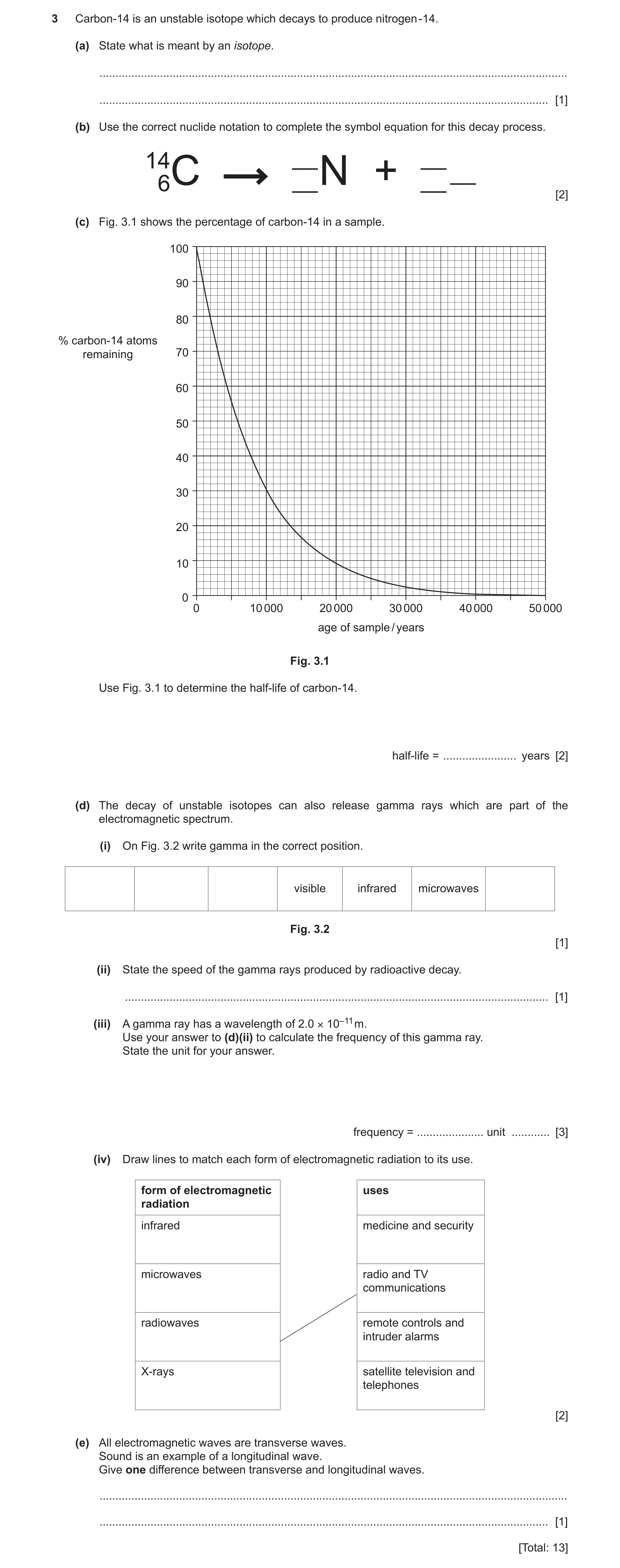
3 Carbon-14 is an unstable isotope which decays to produce nitrogen -14. (a) State what is meant by an isotope. … … [1] (b) Use the correct nuclide notation to complete the symbol equation for this decay process. 14 __ __ __ 6C __ N + __ [2] (c) Fig. 3.1 shows the percentage of carbon-14 in a sample. 100 90 80 % carbon-14 atoms remaining 70 60 50 40 30 20 10 0 0 10 000 20 000 30 000 40 000 50 000 age of sample / years Fig. 3.1 Use Fig. 3.1 to determine the half-life of carbon-14. half-life = … years [2] (d) The decay of unstable isotopes can also release gamma rays which are part of the electromagnetic spectrum. (i) On Fig. 3.2 write gamma in the correct position. visible infrared microwaves Fig. 3.2 [1] (ii) State the speed of the gamma rays produced by radioactive decay. … [1] (iii) A gamma ray has a wavelength of 2.0 × 10⁻¹¹ m. Use your answer to (d)(ii) to calculate the frequency of this gamma ray. State the unit for your answer. frequency = … unit … [3] (iv) Draw lines to match each form of electromagnetic radiation to its use. form of electromagnetic uses radiation infrared medicine and security microwaves radio and TV communications radiowaves remote controls and intruder alarms X-rays satellite television and telephones [2] (e) All electromagnetic waves are transverse waves. Sound is an example of a longitudinal wave. Give one difference between transverse and longitudinal waves. … … [1] [Total: 13]
13 marks
Mark scheme: 3(a) same proton number and different neutron number ; 1 3(b) 14 7N ; 0 1β − ; 2 3(c) use of graph ; 6000 years ; 2 3(d)(i) gamma in left box ; 1 3(d)(ii) 3 × 10⁸ m / s ; 1 3(d)(iii) (f=) v / λ or 3x10⁸ / 2.0x10⁻¹¹ ; 1.5 x 10¹⁹ ; Hz ; 3 3(d)(iv) ;; 2 3(e) transverse vibrations are perpendicular to energy transfer / longitudinal vibrations are parallel to energy transfer ; 1
This question in 0654/43 Oct/Nov 2021
Q14 · An incomplete electromagnetic spectrum 0654/42 Feb/March 2022
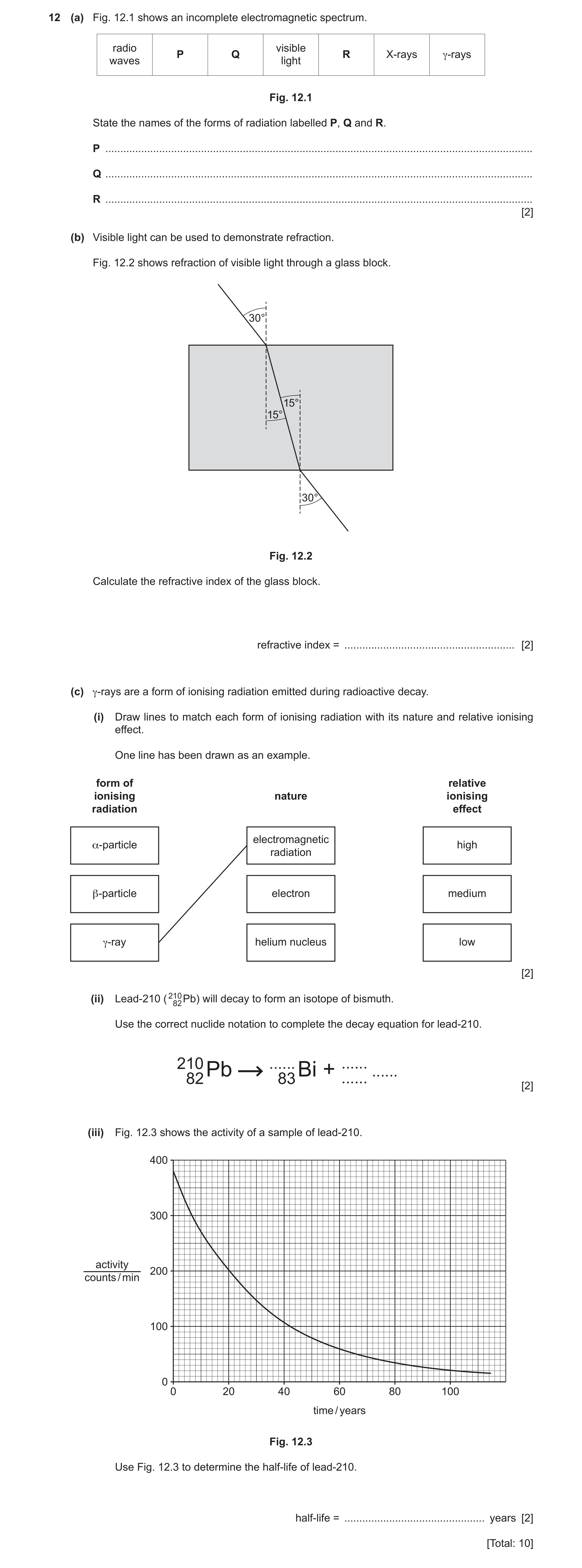
12 (a) Fig. 12.1 shows an incomplete electromagnetic spectrum. radio visible P Q R X-rays γ-rays waves light Fig. 12.1 State the names of the forms of radiation labelled P, Q and R. P … Q … R … [2] (b) Visible light can be used to demonstrate refraction. Fig. 12.2 shows refraction of visible light through a glass block. 30° 15° 15° 30° Fig. 12.2 Calculate the refractive index of the glass block. refractive index = … [2] (c) γ-rays are a form of ionising radiation emitted during radioactive decay. (i) Draw lines to match each form of ionising radiation with its nature and relative ionising effect. One line has been drawn as an example. form of relative ionising nature ionising radiation effect electromagnetic α-particle high radiation β-particle electron medium γ-ray helium nucleus low [2] (ii) Lead-210 ( 21082 Pb) will decay to form an isotope of bismuth. Use the correct nuclide notation to complete the decay equation for lead-210. 210 Pb … Bi + … … 82 83 … [2] (iii) Fig. 12.3 shows the activity of a sample of lead-210. 400 300 activity 200counts / min 100 0 0 20 40 60 80 100 time / years Fig. 12.3 Use Fig. 12.3 to determine the half-life of lead-210. half-life = … years [2] [Total: 10]
10 marks
Mark scheme: 12(a) microwaves infrared ultraviolet ;; 2 12(b) (n =) sin i / sin r or sin 30 / sin 15 ; (n =) 1.93 ; 2 12(c)(i) ;; 2 Question Answer Marks 12(c)(ii) ;; 2 12(c)(iii) identification of 190 counts per min / correct working on graph ; 22 (years) ; 2
This question in 0654/42 Feb/March 2022
Q15 · Α-particles, β-particles and γ-rays are all forms of ionising radiation 0654/41 Oct/Nov 2022
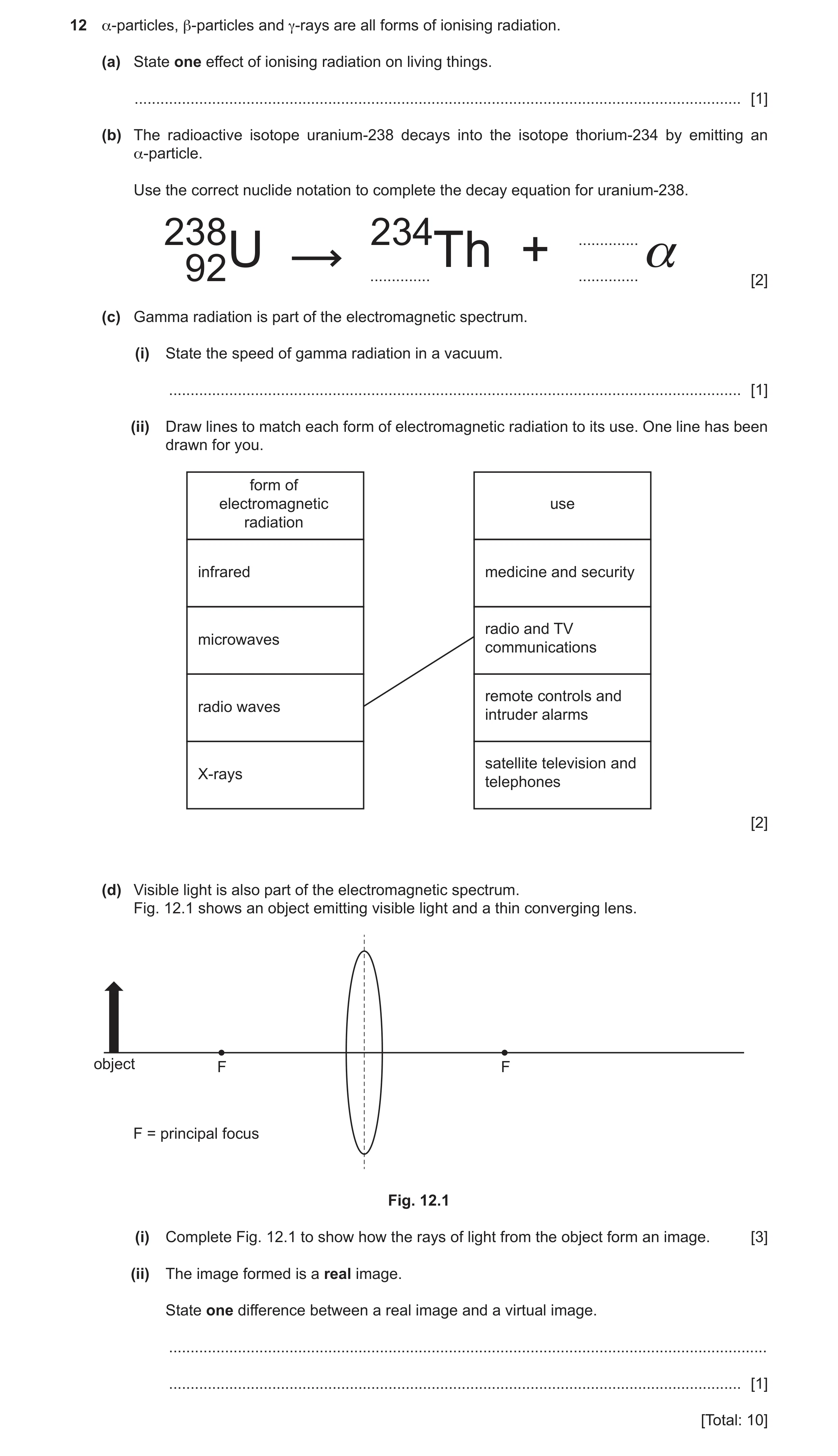
12 α-particles, β-particles and γ-rays are all forms of ionising radiation. (a) State one effect of ionising radiation on living things. … [1] (b) The radioactive isotope uranium-238 decays into the isotope thorium-234 by emitting an α-particle. Use the correct nuclide notation to complete the decay equation for uranium-238. … 238 234 … α [2] 92U … Th + (c) Gamma radiation is part of the electromagnetic spectrum. (i) State the speed of gamma radiation in a vacuum. … [1] (ii) Draw lines to match each form of electromagnetic radiation to its use. One line has been drawn for you. form of electromagnetic use radiation infrared medicine and security radio and TV microwaves communications remote controls and radio waves intruder alarms satellite television and X-rays telephones [2] (d) Visible light is also part of the electromagnetic spectrum. Fig. 12.1 shows an object emitting visible light and a thin converging lens. object F F F = principal focus Fig. 12.1 (i) Complete Fig. 12.1 to show how the rays of light from the object form an image. [3] (ii) The image formed is a real image. State one difference between a real image and a virtual image. … … [1] [Total: 10]
10 marks
Mark scheme: 12(a) cancer ; 1 12(b) 2 ; 12(c)(i) 3 108 m / s ; 1 12(c)(ii) 2 ;; 1 correct = 0 2 or 3 correct = 1 4 correct = 2 12(d)(i) 3 any 2 rays ; image ; 12(d)(i)(i) any one from: 1 real image can be projected on to a screen / ora ; real image is formed where rays of light actually converge / ora ;
This question in 0654/41 Oct/Nov 2022
Q16 · A person removing a damaged branch from a tree 0654/42 Feb/March 2023
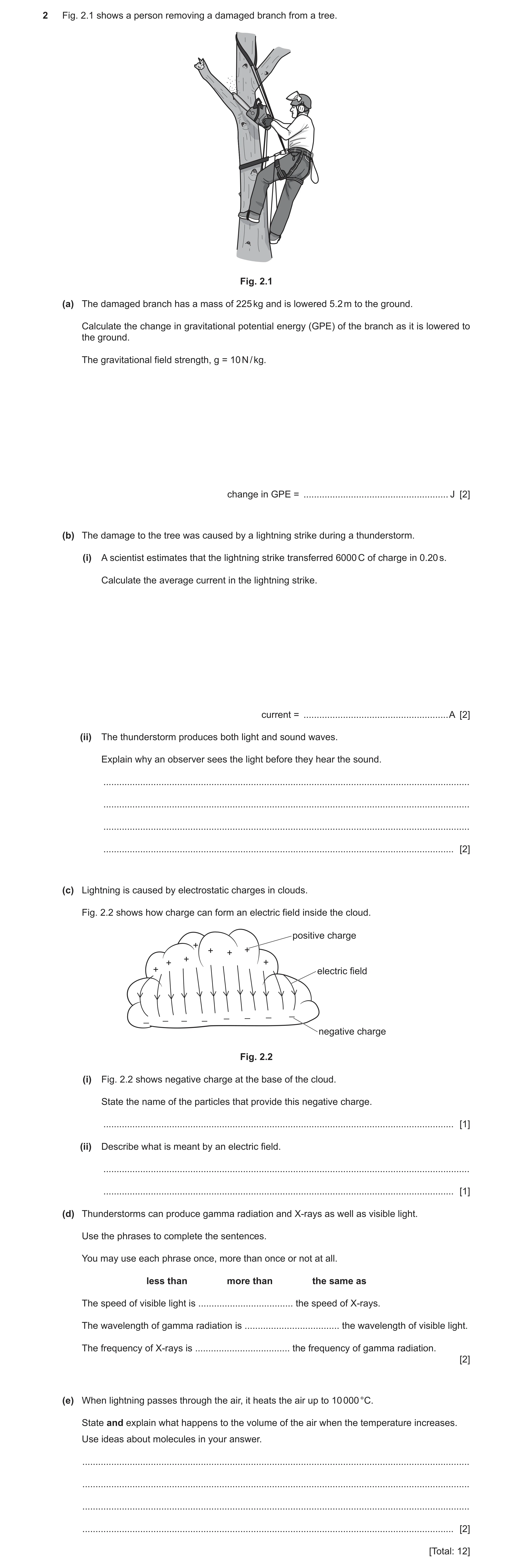
2 Fig. 2.1 shows a person removing a damaged branch from a tree. Fig. 2.1 (a) The damaged branch has a mass of 225 kg and is lowered 5.2 m to the ground. Calculate the change in gravitational potential energy (GPE) of the branch as it is lowered to the ground. The gravitational field strength, g = 10 N / kg. change in GPE = … J [2] (b) The damage to the tree was caused by a lightning strike during a thunderstorm. (i) A scientist estimates that the lightning strike transferred 6000 C of charge in 0.20 s. Calculate the average current in the lightning strike. current = … A [2] (ii) The thunderstorm produces both light and sound waves. Explain why an observer sees the light before they hear the sound. … … … … [2] (c) Lightning is caused by electrostatic charges in clouds. Fig. 2.2 shows how charge can form an electric field inside the cloud. positive charge + + + + + + + + electric field _ _ _ _ _ _ _ _ negative charge Fig. 2.2 (i) Fig. 2.2 shows negative charge at the base of the cloud. State the name of the particles that provide this negative charge. … [1] (ii) Describe what is meant by an electric field. … … [1] (d) Thunderstorms can produce gamma radiation and X‑rays as well as visible light. Use the phrases to complete the sentences. You may use each phrase once, more than once or not at all. less than more than the same as The speed of visible light is … the speed of X‑rays. The wavelength of gamma radiation is … the wavelength of visible light. The frequency of X‑rays is … the frequency of gamma radiation. [2] (e) When lightning passes through the air, it heats the air up to 10 000 °C. State and explain what happens to the volume of the air when the temperature increases. Use ideas about molecules in your answer. … … … … [2] [Total: 12]
12 marks
Mark scheme: 2(a) evidence of (GPE =) mgh (in any form) or 225 10 5.2 ; 2 (GPE =) 11 700 (J) ; 2(b)(i) evidence of (I =) Q / t (in any form) or 6000 / 0.20 ; 2 (I =) 30 000 (A) ; 2(b)(ii) light travels faster than sound ; 2 both waves travel the same distance / over a large distance the difference in time is noticeable ; 2(c)(i) electrons ; 1 2(c)(ii) a region in which charged particles experience a force ; 1 2(d) the same as ; 2 less than AND less than ; 2(e) (volume) increases / expands ; 2 molecules, have more (kinetic) energy / move faster or molecules move further apart ;
This question in 0654/42 Feb/March 2023
Q17 · A student investigates series and parallel circuits using filament lamps 0654/42 May/June 2023
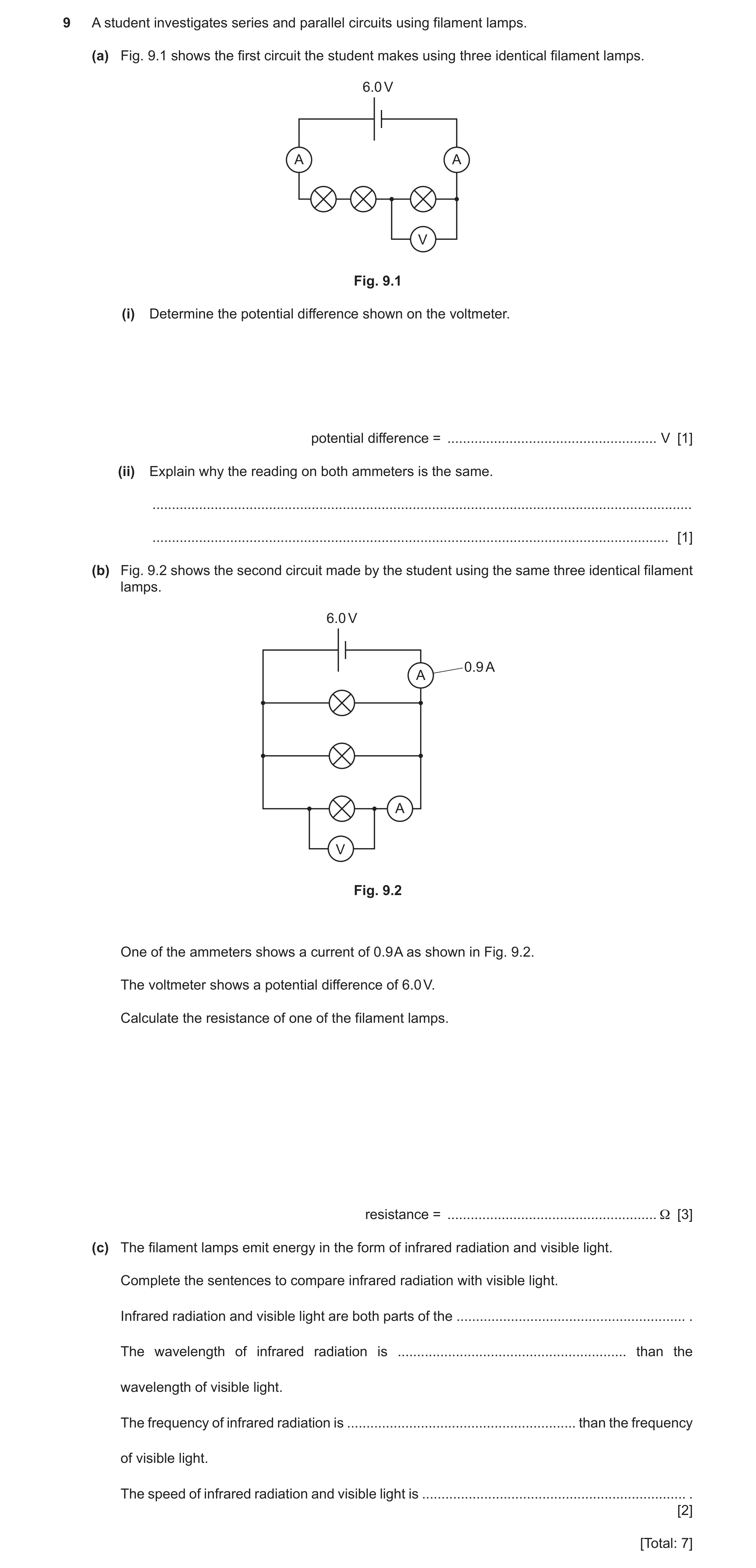
9 A student investigates series and parallel circuits using filament lamps. (a) Fig. 9.1 shows the first circuit the student makes using three identical filament lamps. 6.0 V A A V Fig. 9.1 (i) Determine the potential difference shown on the voltmeter. potential difference = … V [1] (ii) Explain why the reading on both ammeters is the same. … … [1] (b) Fig. 9.2 shows the second circuit made by the student using the same three identical filament lamps. 6.0 V 0.9 A A A V Fig. 9.2 One of the ammeters shows a current of 0.9 A as shown in Fig. 9.2. The voltmeter shows a potential difference of 6.0 V. Calculate the resistance of one of the filament lamps. resistance = … Ω [3] (c) The filament lamps emit energy in the form of infrared radiation and visible light. Complete the sentences to compare infrared radiation with visible light. Infrared radiation and visible light are both parts of the … . The wavelength of infrared radiation is … than the wavelength of visible light. The frequency of infrared radiation is … than the frequency of visible light. The speed of infrared radiation and visible light is … . [2] [Total: 7]
7 marks
Mark scheme: 9(a)(i) 2.0 (V) ; 1 9(a)(ii) in a series circuit the current is the same (everywhere) ; 1 9(b) (I =) 0.3 (A) ; (R = ) V / I or 6.0 / 0.3 ; (R = ) 20 () ; 3 9(c) electromagnetic spectrum longer lower the same / 3 108 m / s ;; 2
This question in 0654/42 May/June 2023
Q18 · X‑rays are part of the electromagnetic spectrum 0654/43 May/June 2023
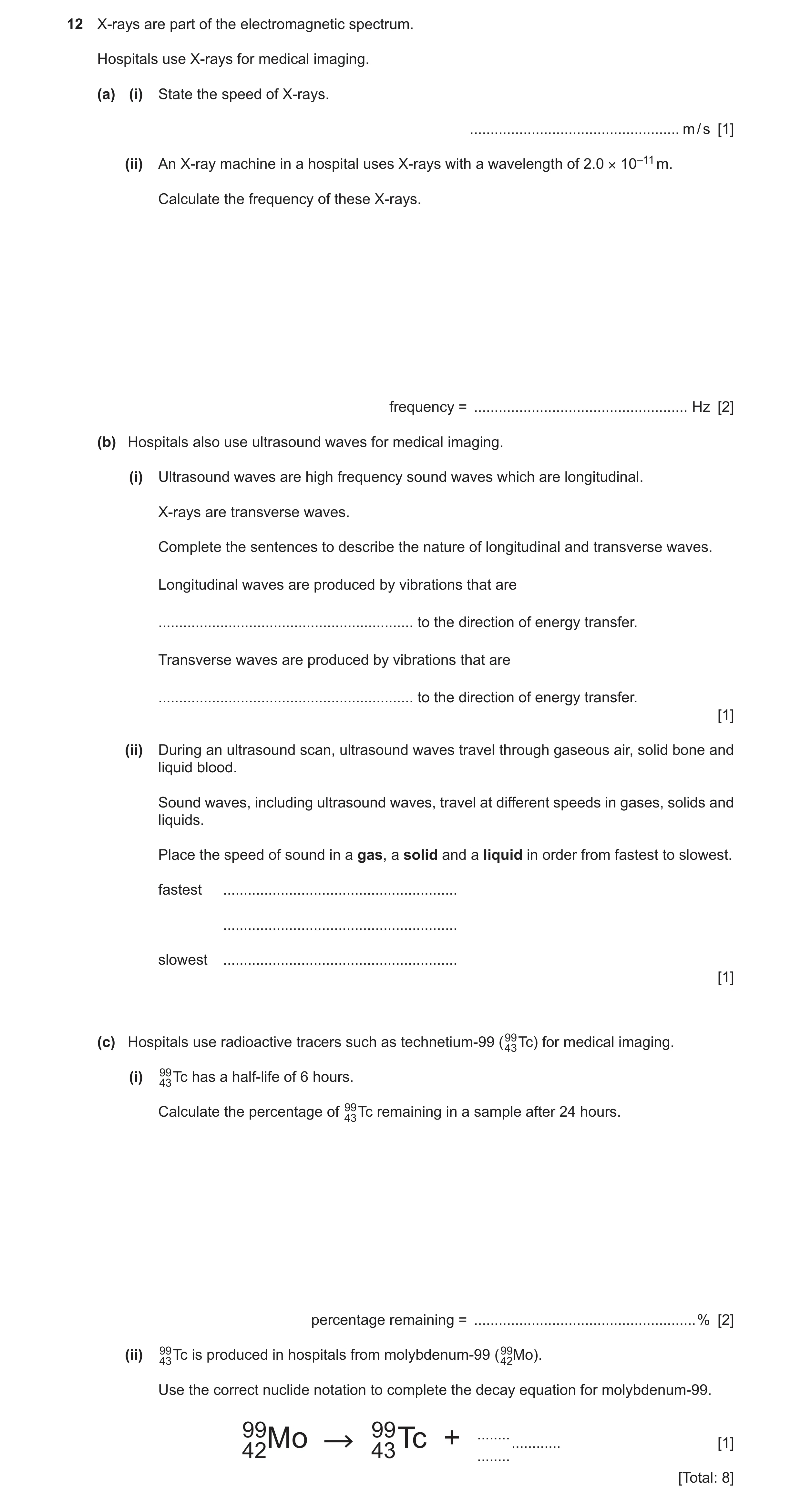
12 X‑rays are part of the electromagnetic spectrum. Hospitals use X‑rays for medical imaging. (a) (i) State the speed of X‑rays. … m / s [1] (ii) An X‑ray machine in a hospital uses X‑rays with a wavelength of 2.0 × 10⁻¹¹ m. Calculate the frequency of these X‑rays. frequency = … Hz [2] (b) Hospitals also use ultrasound waves for medical imaging. (i) Ultrasound waves are high frequency sound waves which are longitudinal. X‑rays are transverse waves. Complete the sentences to describe the nature of longitudinal and transverse waves. Longitudinal waves are produced by vibrations that are … to the direction of energy transfer. Transverse waves are produced by vibrations that are … to the direction of energy transfer. [1] (ii) During an ultrasound scan, ultrasound waves travel through gaseous air, solid bone and liquid blood. Sound waves, including ultrasound waves, travel at different speeds in gases, solids and liquids. Place the speed of sound in a gas, a solid and a liquid in order from fastest to slowest. fastest … … slowest … [1] (c) Hospitals use radioactive tracers such as technetium‑99 (9943 Tc) for medical imaging. (i) 9943 Tc has a half‑life of 6 hours. Calculate the percentage of 9943 Tc remaining in a sample after 24 hours. percentage remaining = … % [2] (ii) 9943 Tc is produced in hospitals from molybdenum‑99 (9942Mo). Use the correct nuclide notation to complete the decay equation for molybdenum‑99. 99 99 … … [1] 42Mo 43 Tc + … [Total: 8]
8 marks
Mark scheme: 12(a)(i) 12(a)(ii) (f =) v / / 3 108 / 2.0 10–11 ; (f =) 1.5 1019 (Hz) ; 2 12(b)(i) parallel AND perpendicular ; 1 12(b)(ii) solid liquid gas ; 1 12(c)(i) 4 half-lives ; 6.25 (%) ; 2 12(c)(ii) 0 1 ; 1
This question in 0654/43 May/June 2023
Q19 · A bee collecting pollen from a flower 0654/41 Oct/Nov 2023
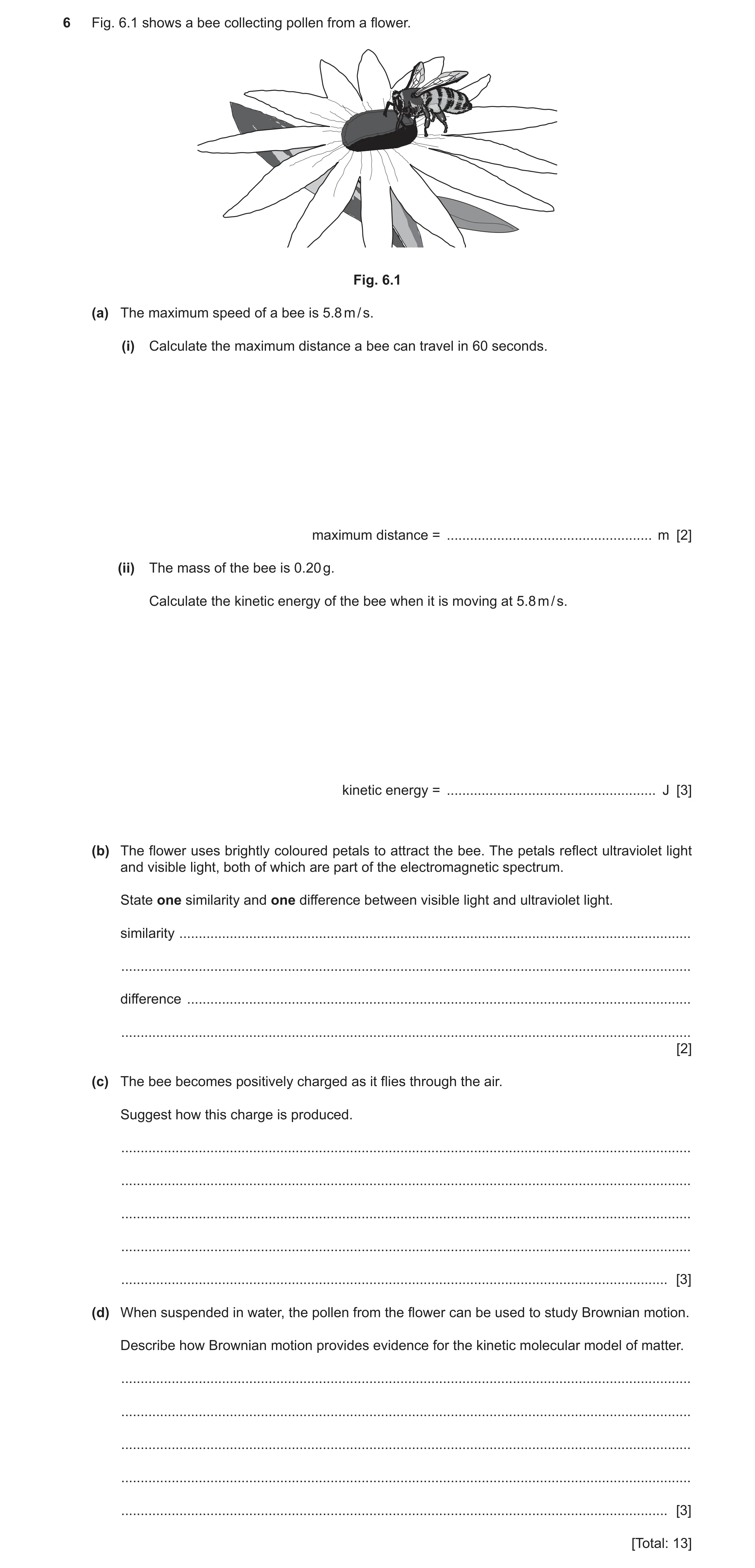
6 Fig. 6.1 shows a bee collecting pollen from a flower. Fig. 6.1 (a) The maximum speed of a bee is 5.8 m / s. (i) Calculate the maximum distance a bee can travel in 60 seconds. maximum distance = … m [2] (ii) The mass of the bee is 0.20 g. Calculate the kinetic energy of the bee when it is moving at 5.8 m / s. kinetic energy = … J [3] (b) The flower uses brightly coloured petals to attract the bee. The petals reflect ultraviolet light and visible light, both of which are part of the electromagnetic spectrum. State one similarity and one difference between visible light and ultraviolet light. similarity … … difference … … [2] (c) The bee becomes positively charged as it flies through the air. Suggest how this charge is produced. … … … … … [3] (d) When suspended in water, the pollen from the flower can be used to study Brownian motion. Describe how Brownian motion provides evidence for the kinetic molecular model of matter. … … … … … [3] [Total: 13]
13 marks
Mark scheme: 6(a)(i) (d =) v t / (d =) 5.8 60 ; 2 348 or 350 (m) ; 6(a)(ii) conversion: (0.20 g =) 0.00020 kg ; 3 (KE =) ½ mv2 / ½ 0.00020 5.82 ; (KE =) 0.0034 or 3.4 10–3 (J) ; 6(b) similarity: travel at speed of light / transverse waves ; 2 difference: (visible light has lower) frequency / (visible light has longer) wavelength / ORA ; 6(c) friction (with air) ; 3 (negative) electrons (move) ; (electrons move) off (surface of) bee ; 6(d) random motion (of pollen grains / particles) ; 3 caused by collisions with water / molecules / other particles ; (movement because of idea of) fast(er) moving small(er) particles ;
This question in 0654/41 Oct/Nov 2023
Question 20 0654/42 May/June 2024
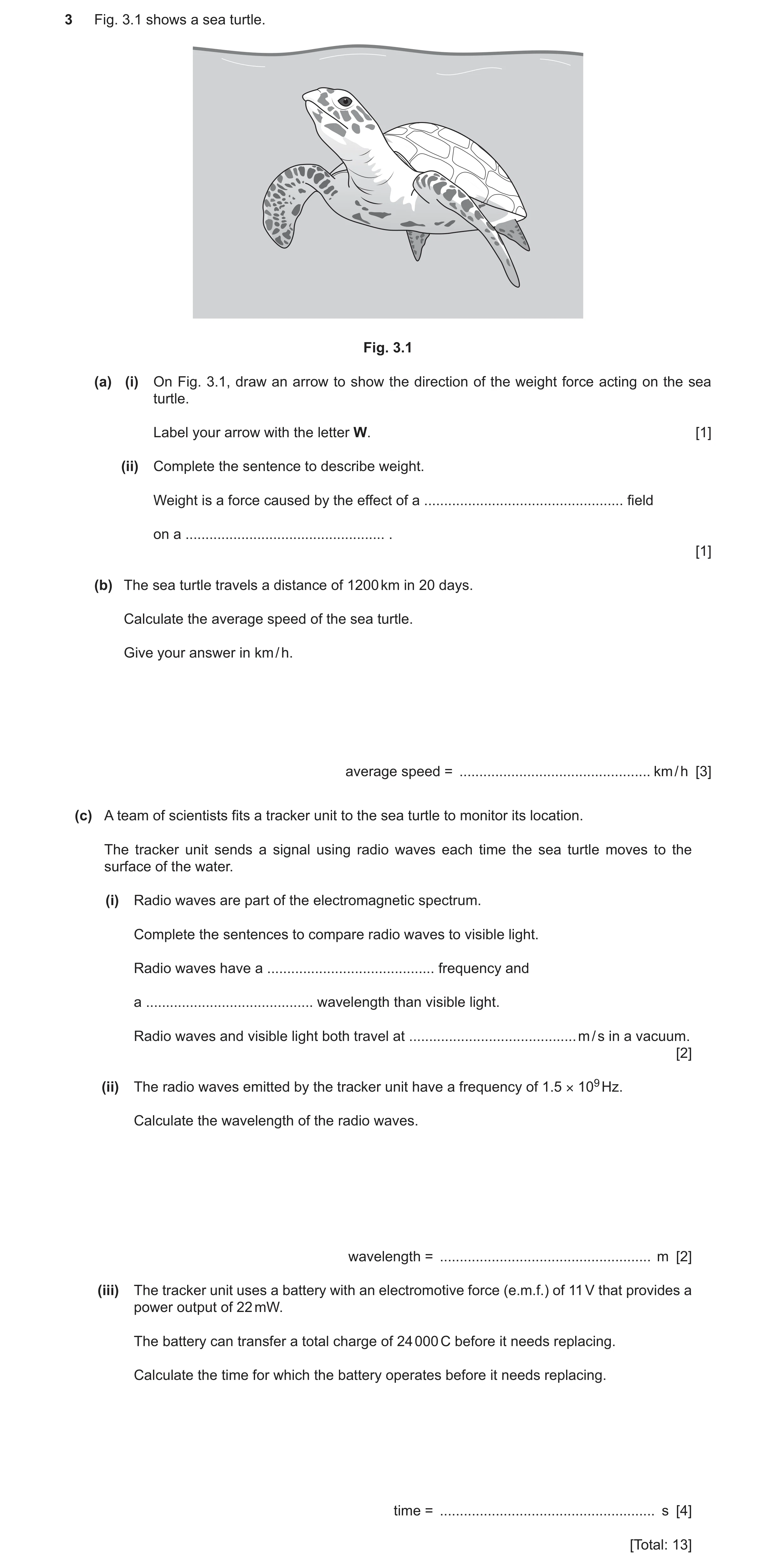
3 Fig. 3.1 shows a sea turtle. Fig. 3.1 (a) (i) On Fig. 3.1, draw an arrow to show the direction of the weight force acting on the sea turtle. Label your arrow with the letter W. [1] (ii) Complete the sentence to describe weight. Weight is a force caused by the effect of a … field on a … . [1] (b) The sea turtle travels a distance of 1200 km in 20 days. Calculate the average speed of the sea turtle. Give your answer in km / h. average speed = … km / h [3] (c) A team of scientists fits a tracker unit to the sea turtle to monitor its location. The tracker unit sends a signal using radio waves each time the sea turtle moves to the surface of the water. (i) Radio waves are part of the electromagnetic spectrum. Complete the sentences to compare radio waves to visible light. Radio waves have a … frequency and a … wavelength than visible light. Radio waves and visible light both travel at … m / s in a vacuum. [2] (ii) The radio waves emitted by the tracker unit have a frequency of 1.5 × 10⁹ Hz. Calculate the wavelength of the radio waves. wavelength = … m [2] (iii) The tracker unit uses a battery with an electromotive force (e.m.f.) of 11 V that provides a power output of 22 mW. The battery can transfer a total charge of 24 000 C before it needs replacing. Calculate the time for which the battery operates before it needs replacing. time = … s [4] [Total: 13]
13 marks
Mark scheme: 3(a)(i) downwards arrow labelled W ; 1 3(a)(ii) gravitational AND mass ; 1 3(b) (t=) 480 (hrs) ; (v=) d / t OR 1200 / 480 ; (v=) 2.5 (km / h) ; 3 3(c)(i) lower AND longer / bigger ; 3 108 ; 2 3(c)(ii) (=) v / f OR 3 108 / 1.5 109 ; (=) 0.20 (m) ; 2 Question Answer Marks 3(c)(iii) (P=) 0.022 (W) ; (I=) P / V OR 0.022 / 11 OR 0.002 ; (t=) Q / I OR 24000 / 0.002 ; (t=) 1.2 107 (s) ; 4
This question in 0654/42 May/June 2024
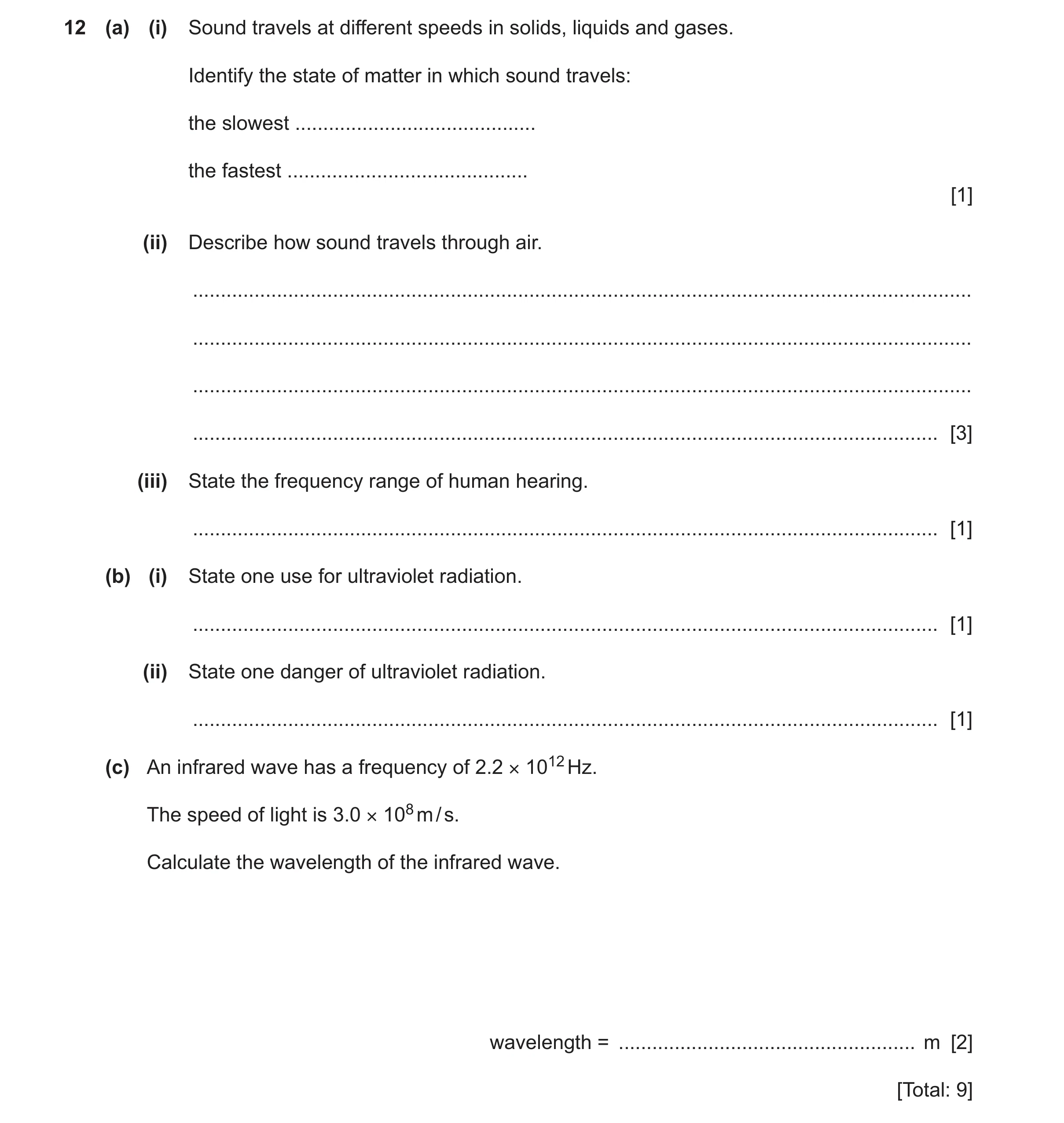
Q21 · Sound travels at different speeds in solids, liquids and gases 0654/42 Feb/March 2025
12 (a) (i) Sound travels at different speeds in solids, liquids and gases. Identify the state of matter in which sound travels: the slowest … the fastest … [1] (ii) Describe how sound travels through air. … … … … [3] (iii) State the frequency range of human hearing. … [1] (b) (i) State one use for ultraviolet radiation. … [1] (ii) State one danger of ultraviolet radiation. … [1] (c) An infrared wave has a frequency of 2.2 × 10¹² Hz. The speed of light is 3.0 × 10⁸ m / s. Calculate the wavelength of the infrared wave. wavelength = … m [2] [Total: 9]
9 marks
Mark scheme: 12(a)(i) gases and solid ; 1 12(a)(ii) any three from: 3 vibrations (vibrations) parallel to direction of energy transfer in a series of compressions and rarefactions AVP ; ; ; 12(a)(iii) 20–20 000 Hz ; 1 12(b)(i) detecting fake bank notes ; 1 (AVP) 12(b)(ii) damage to skin cells / damage to eyes / (skin) cancer / cell mutation ; 1 12(c) evidence of v = f or 3 108 = 2.2 1012 ; 2 1.4 10–4 (m) ;
This question in 0654/42 Feb/March 2025
 16 / 36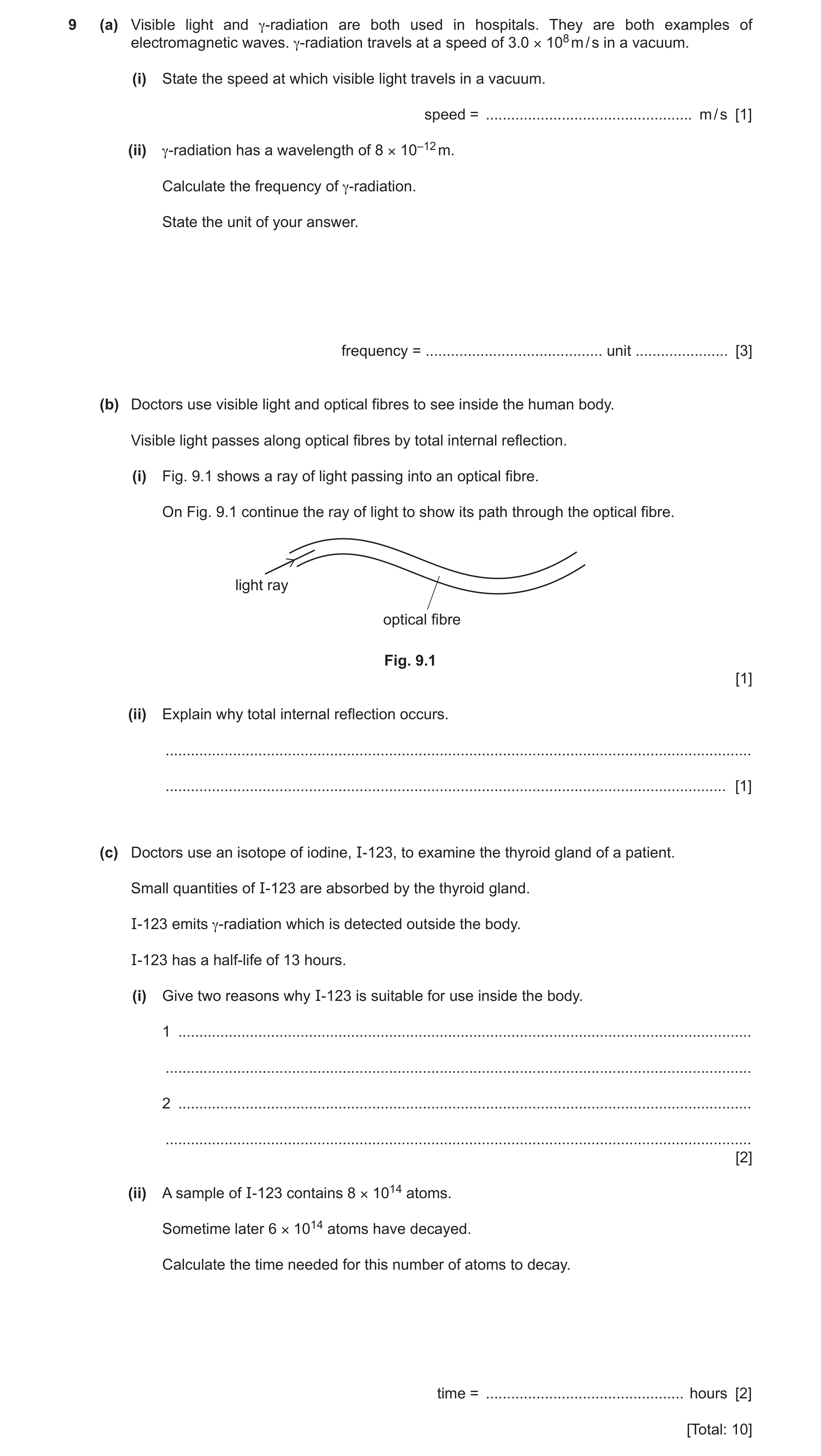
 19 / 36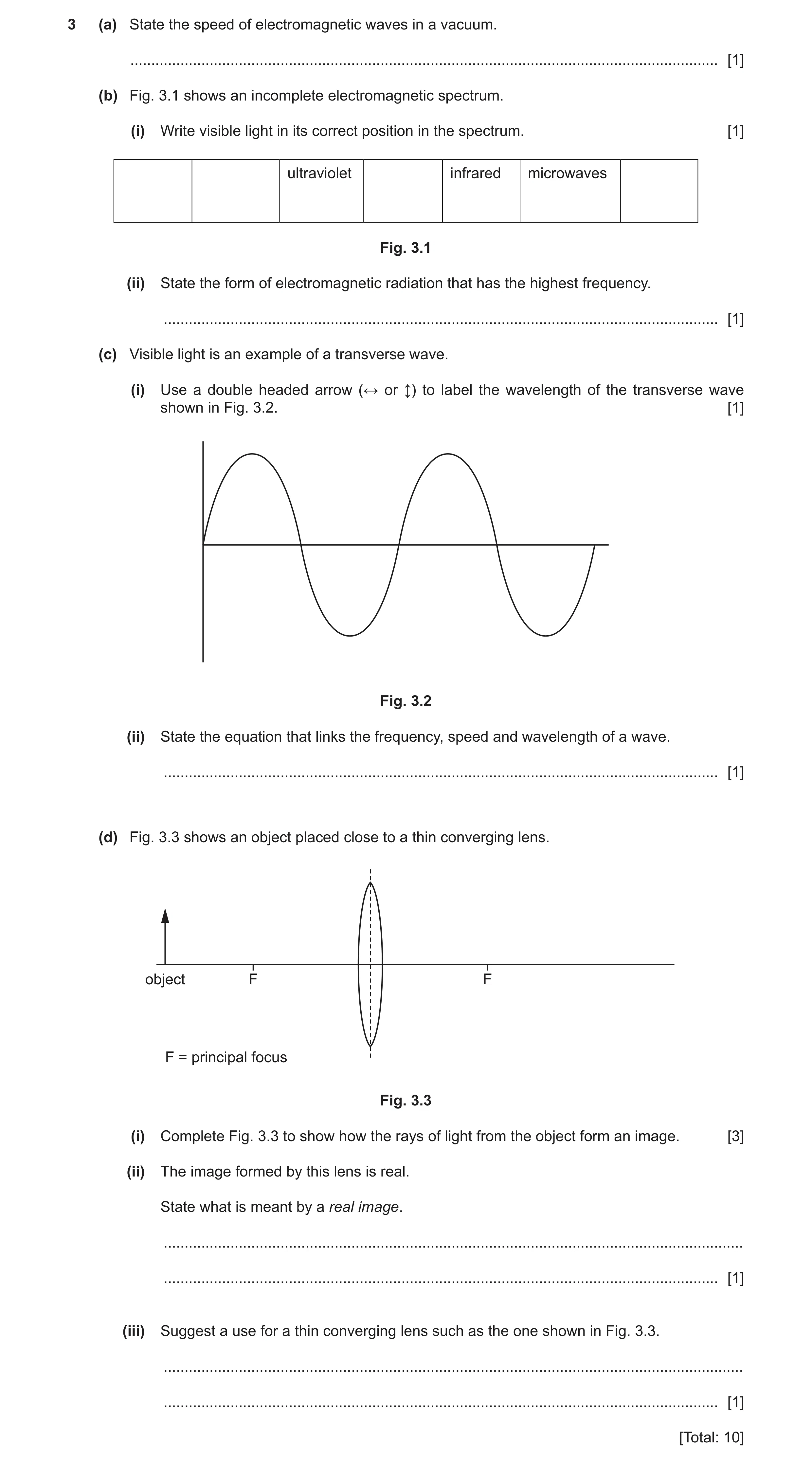
 36 / 36
 13
13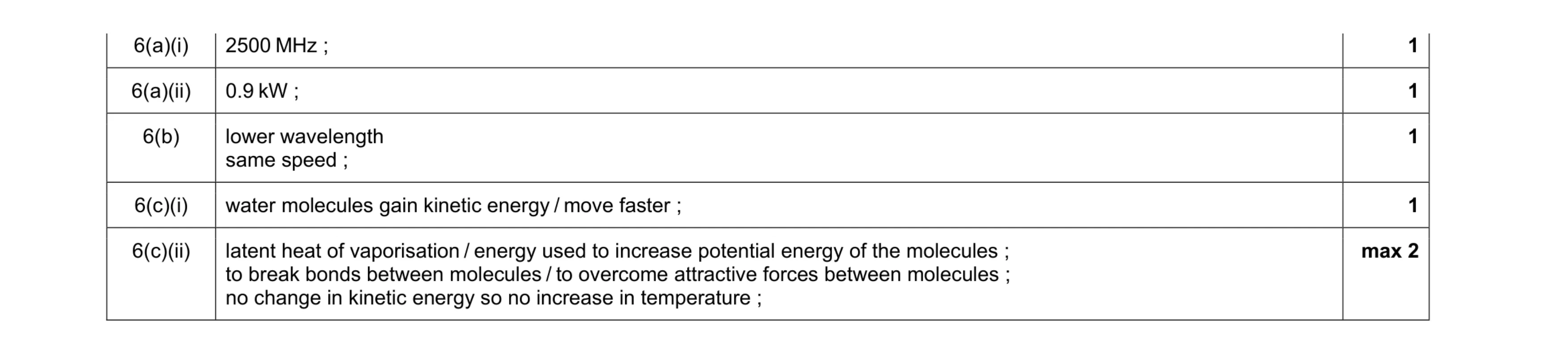 6
6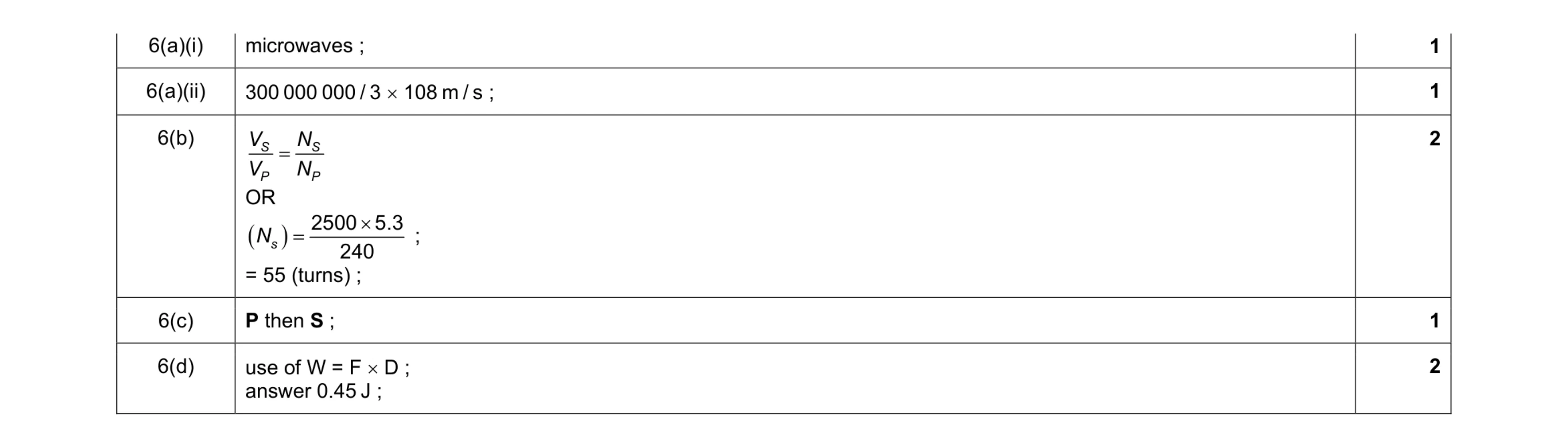 7
7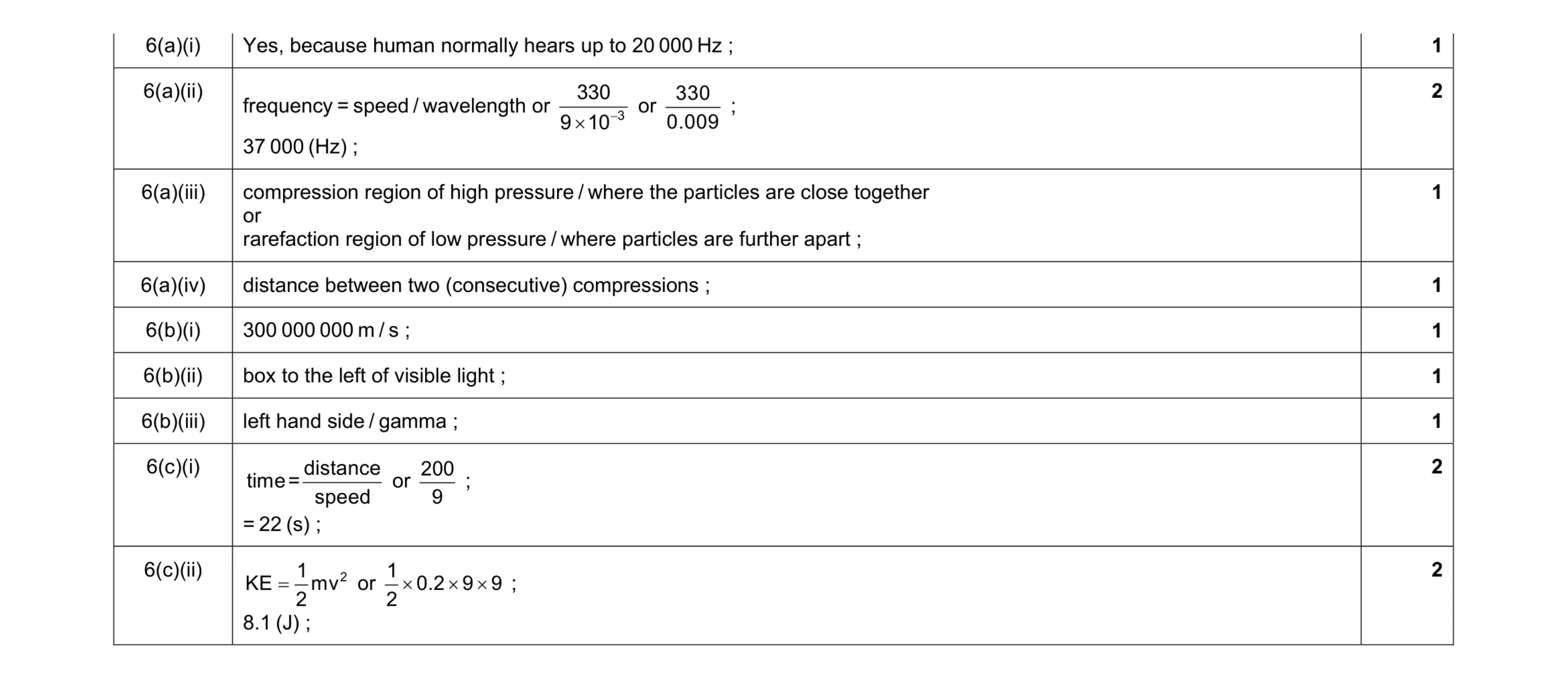 12
12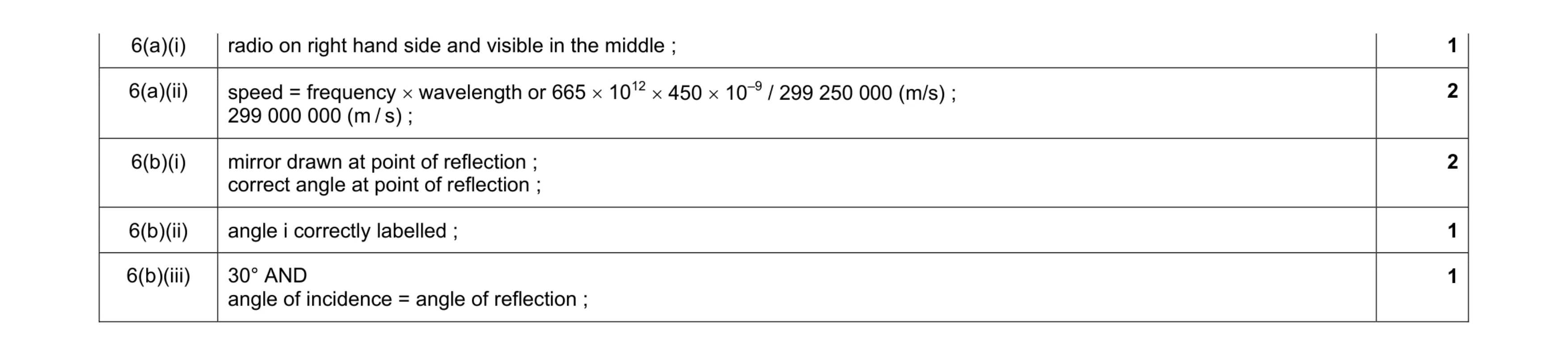 7
7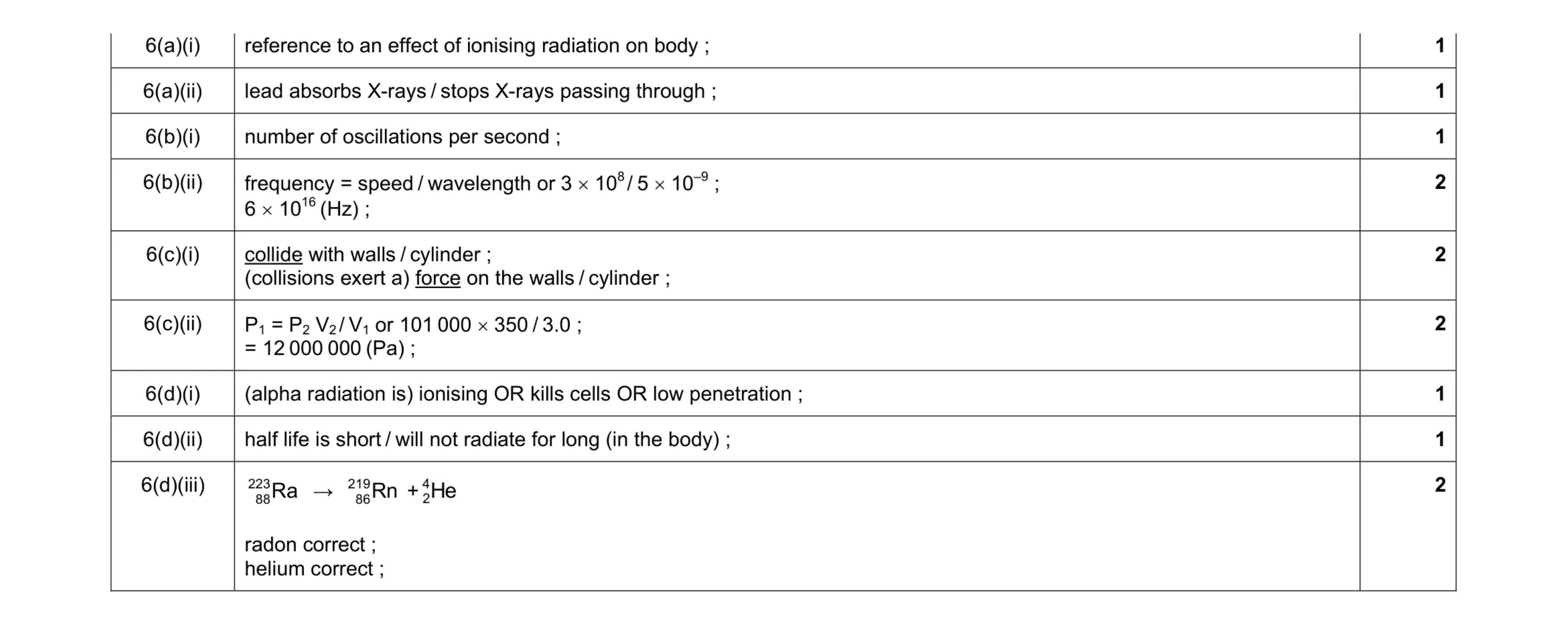 13
13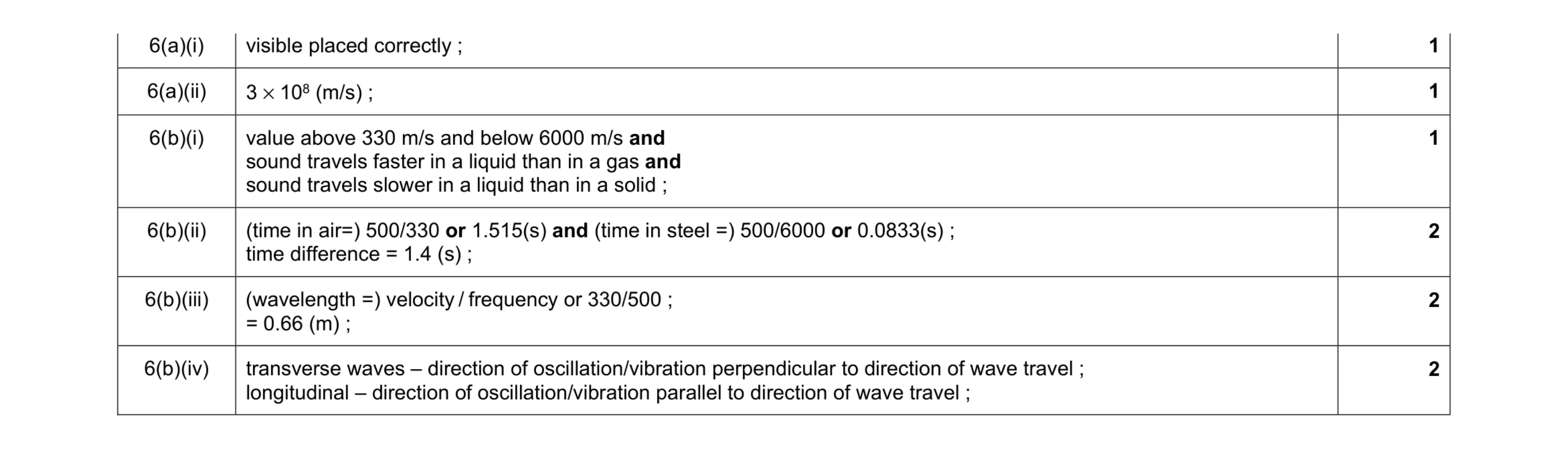 9
9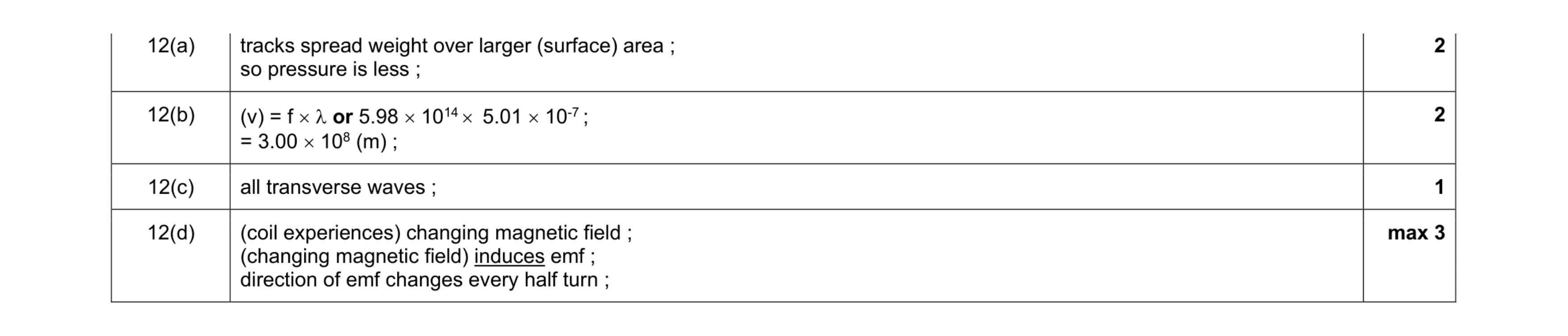 8
8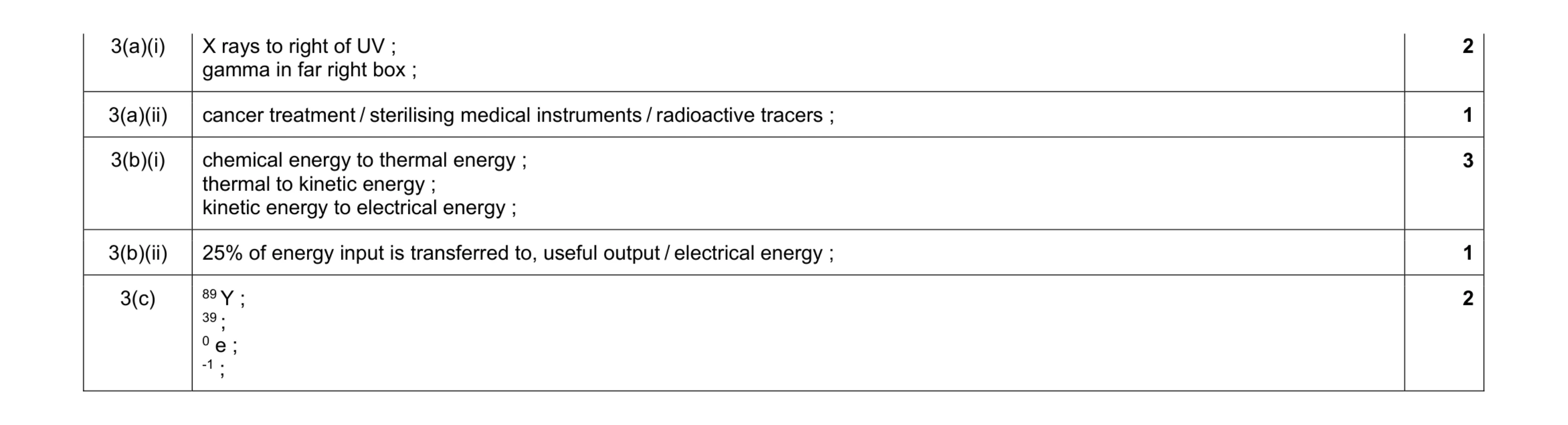 9
9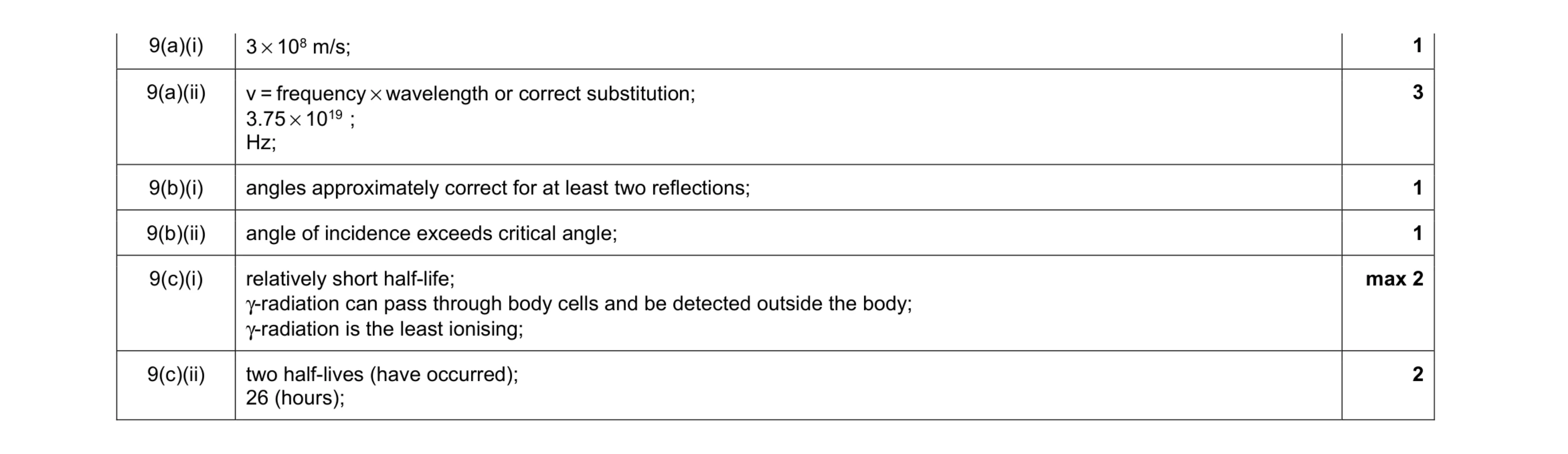 10
10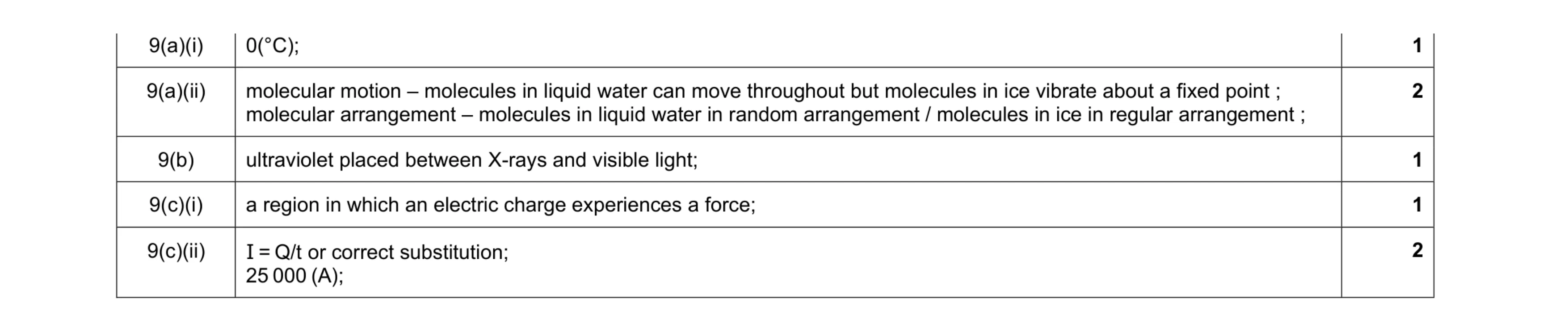 7
7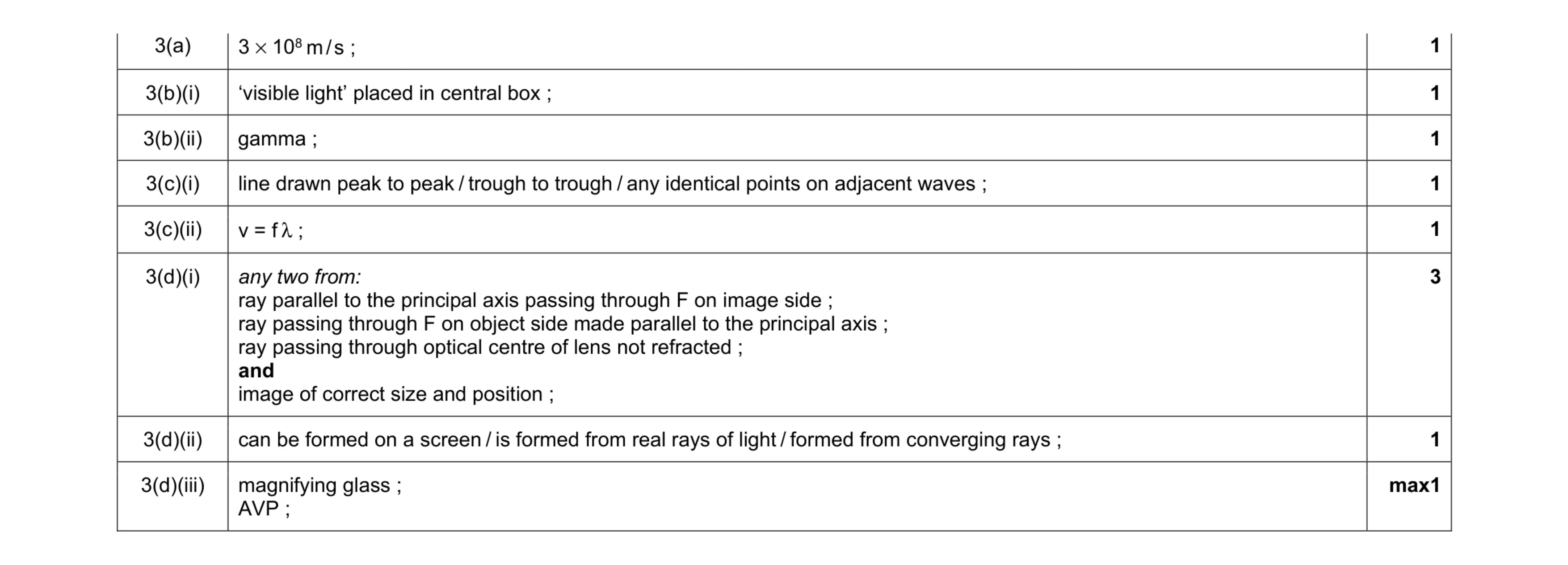 10
10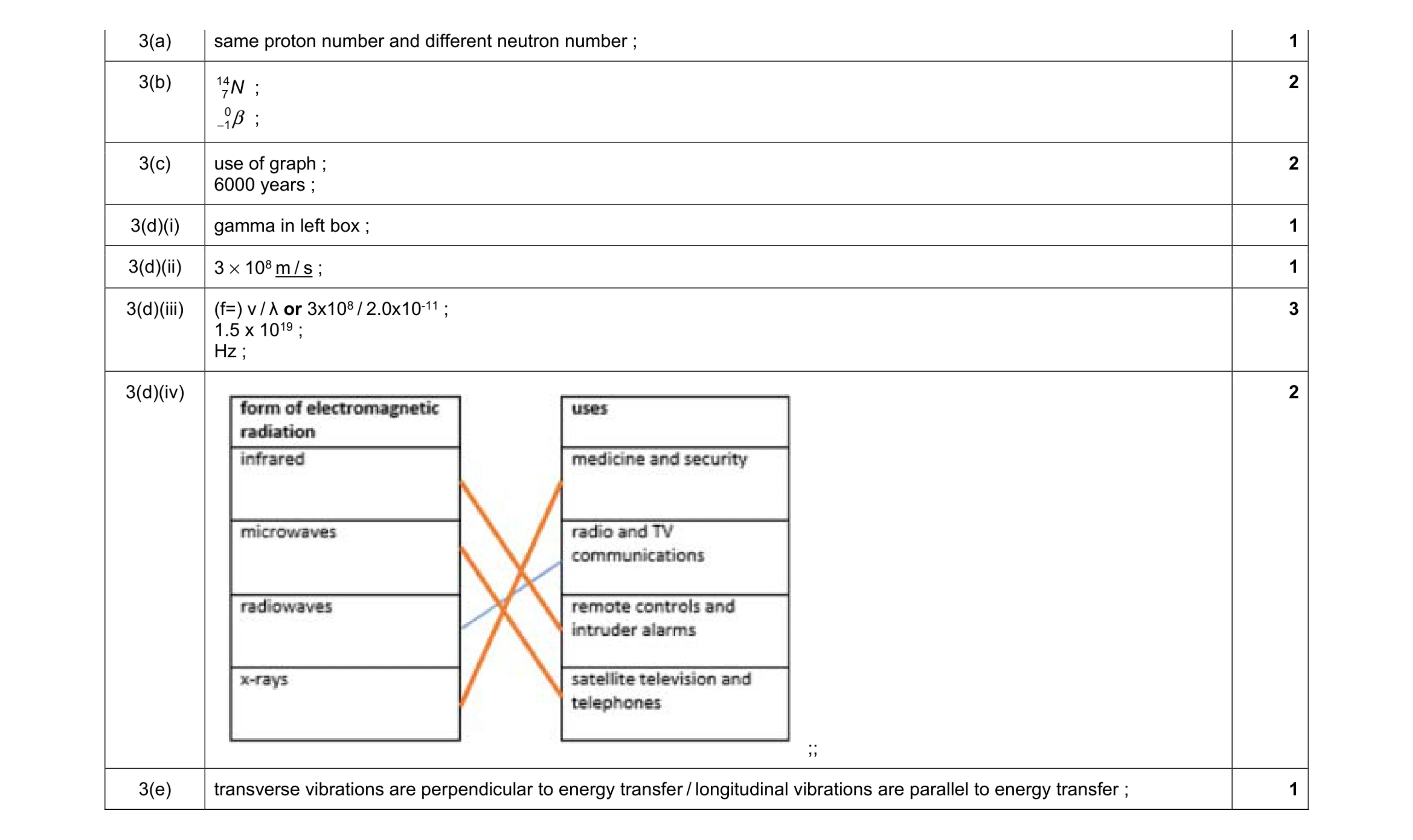 13
13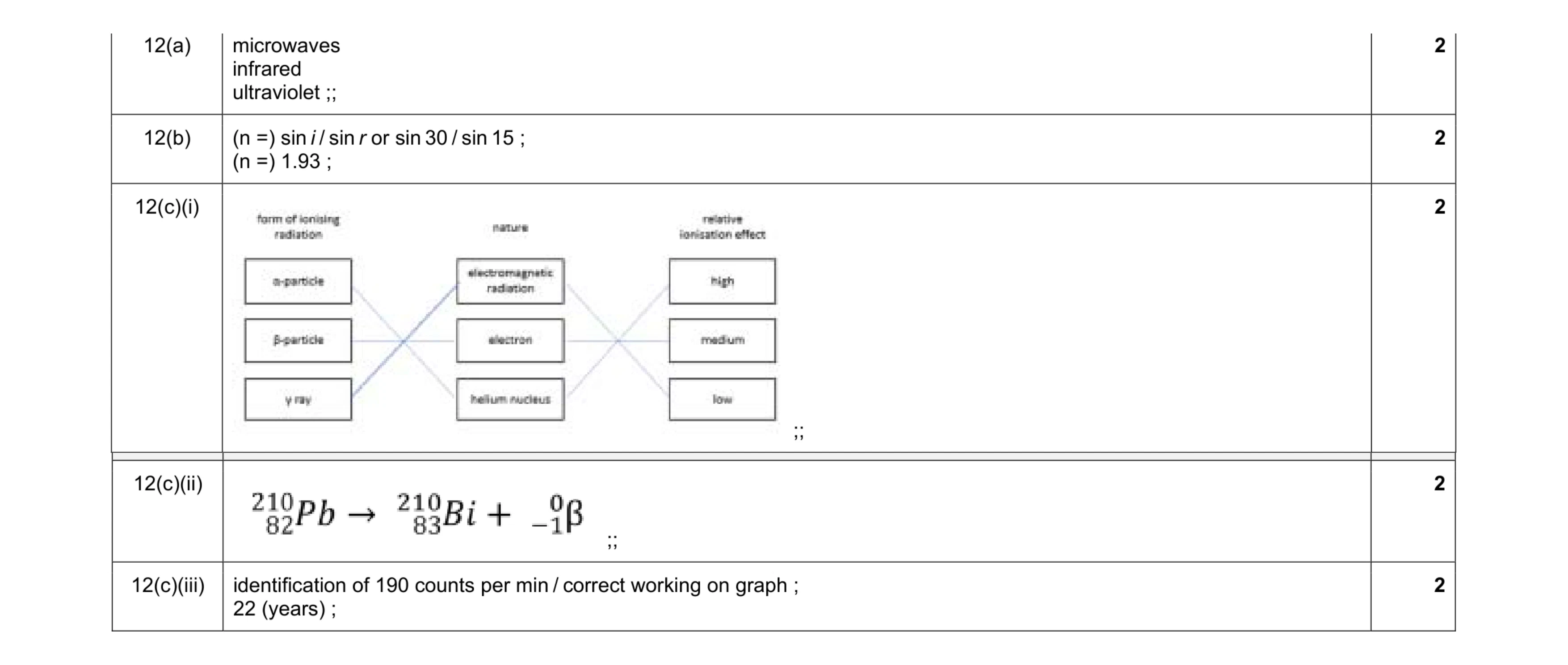 10
10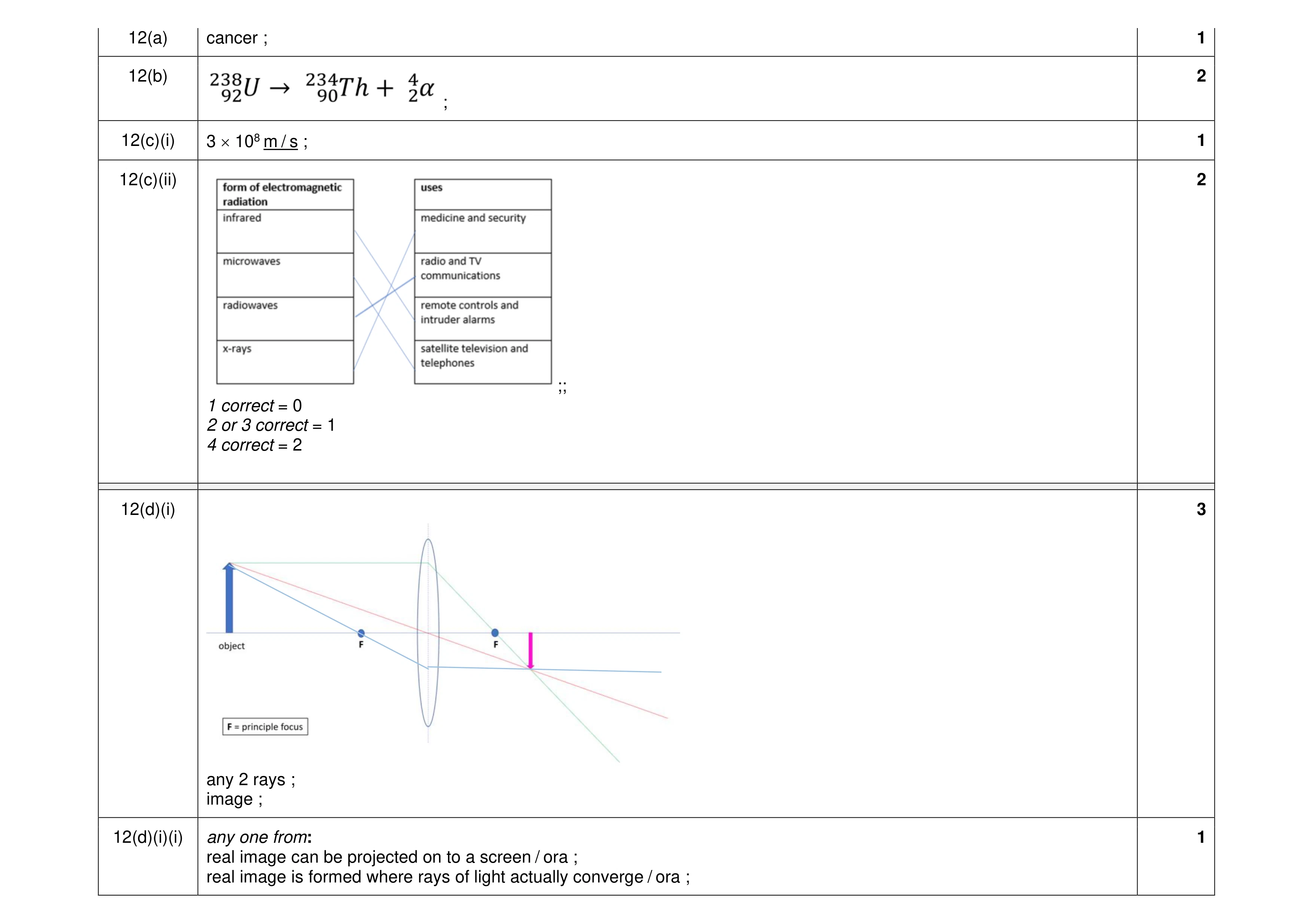 10
10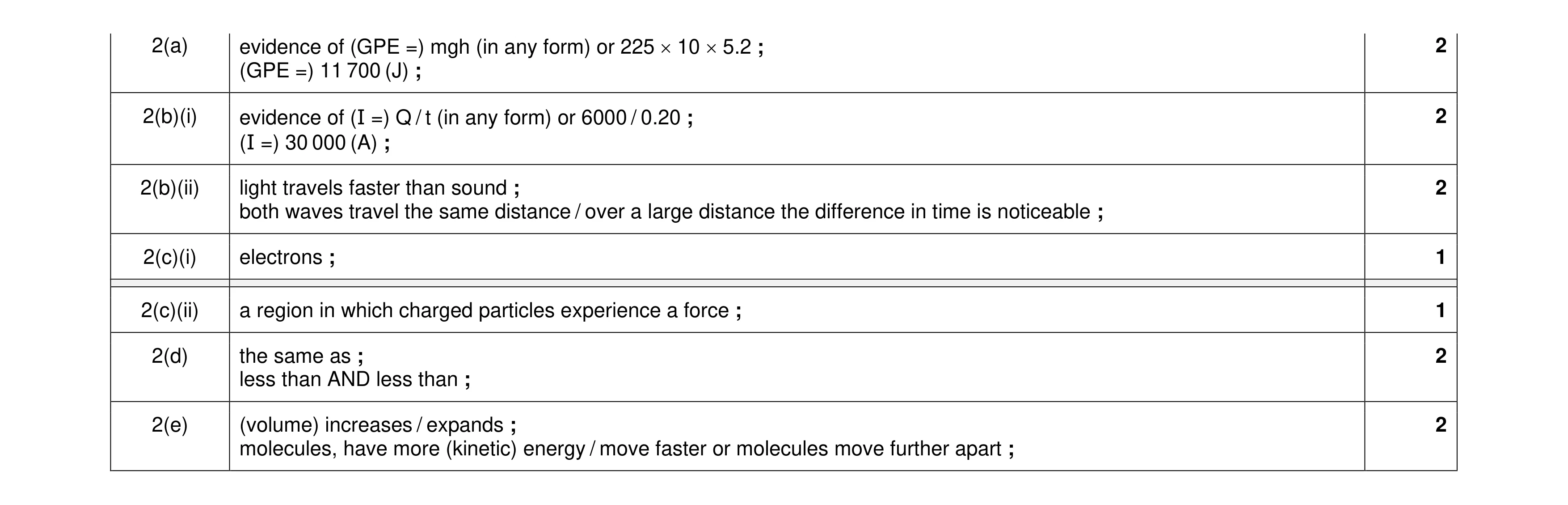 12
12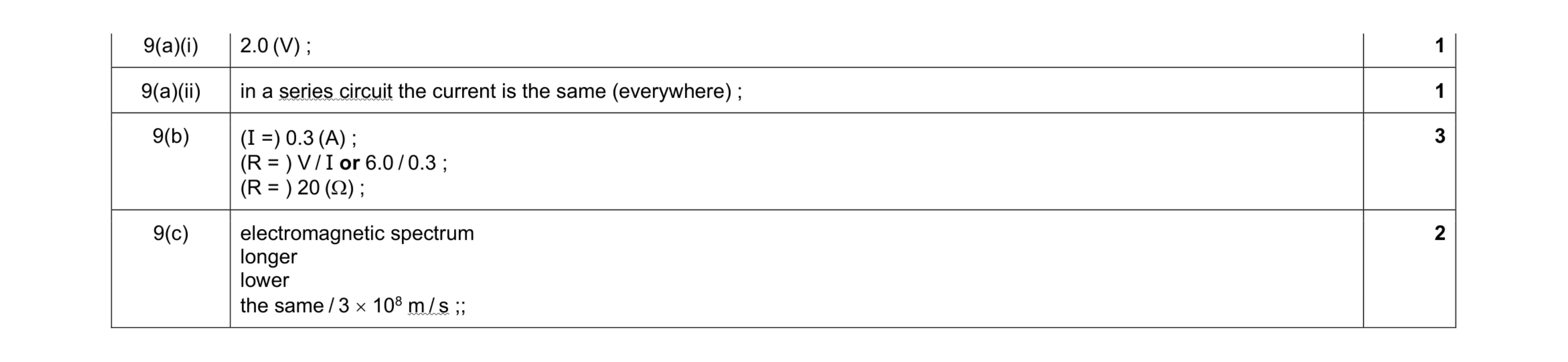 7
7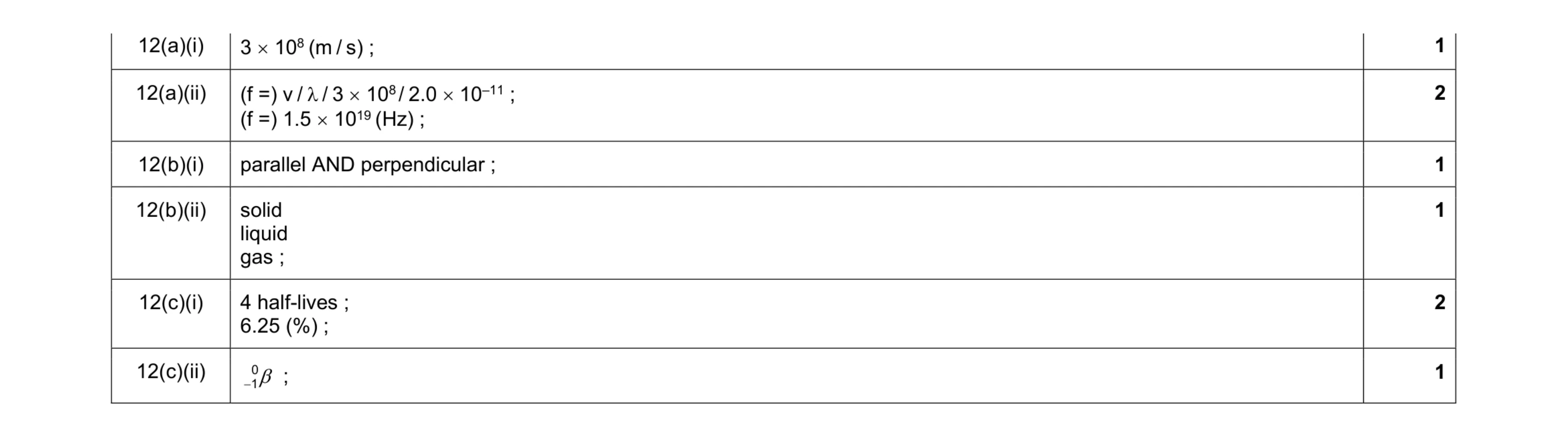 8
8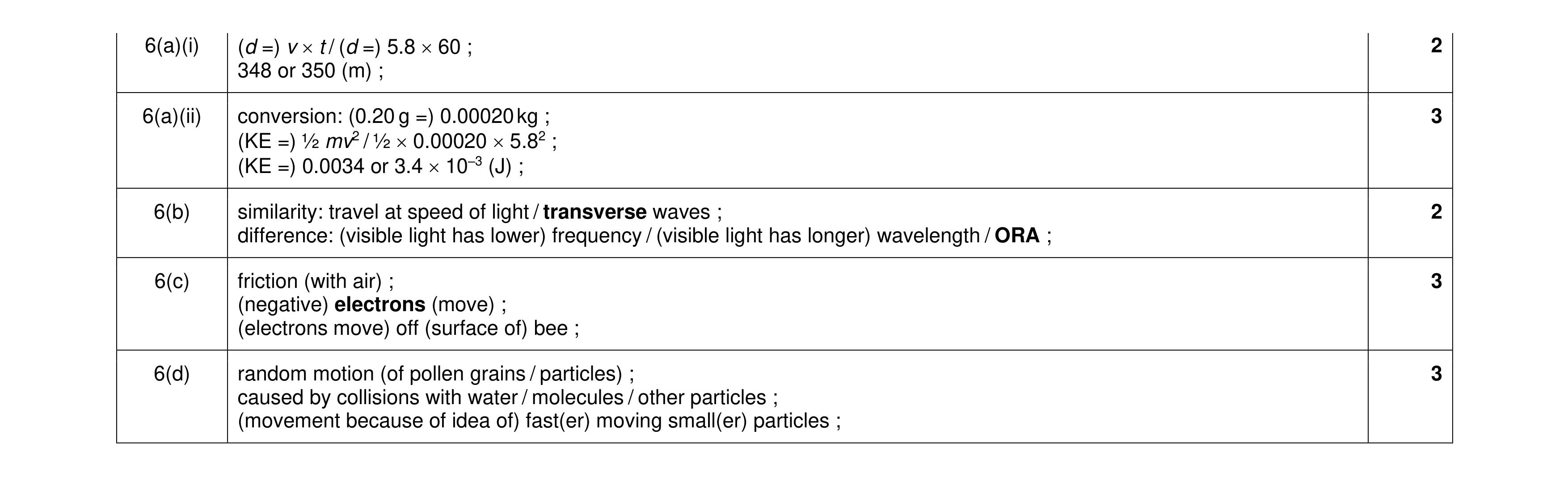 13
13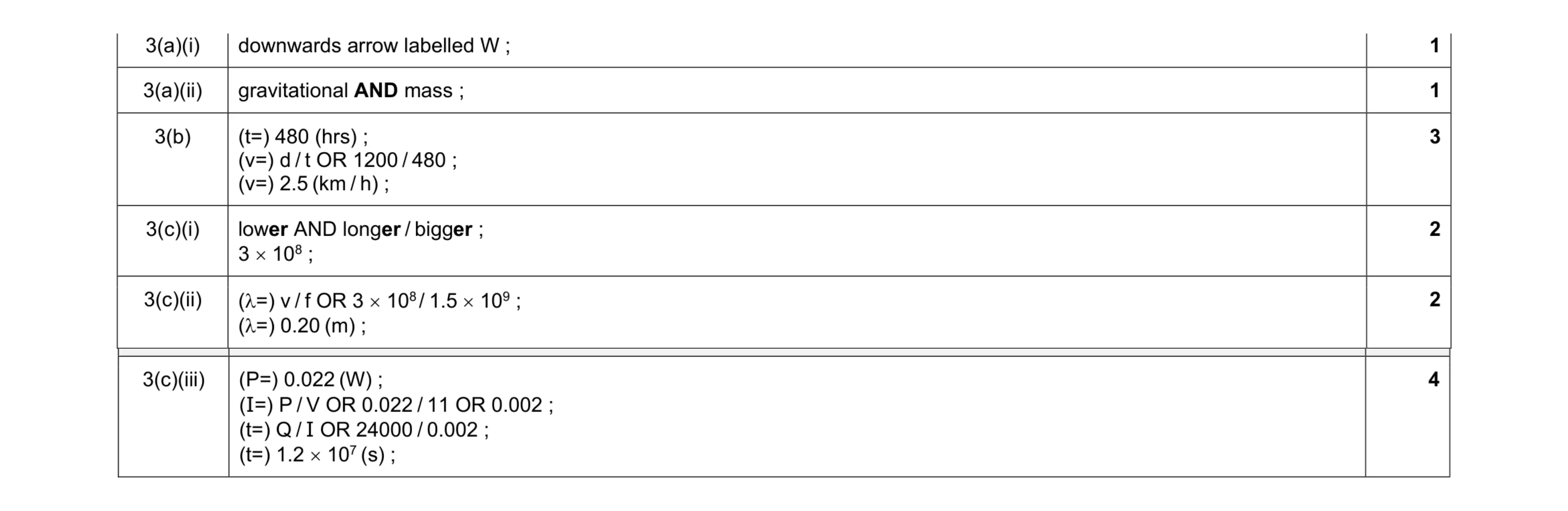 13
13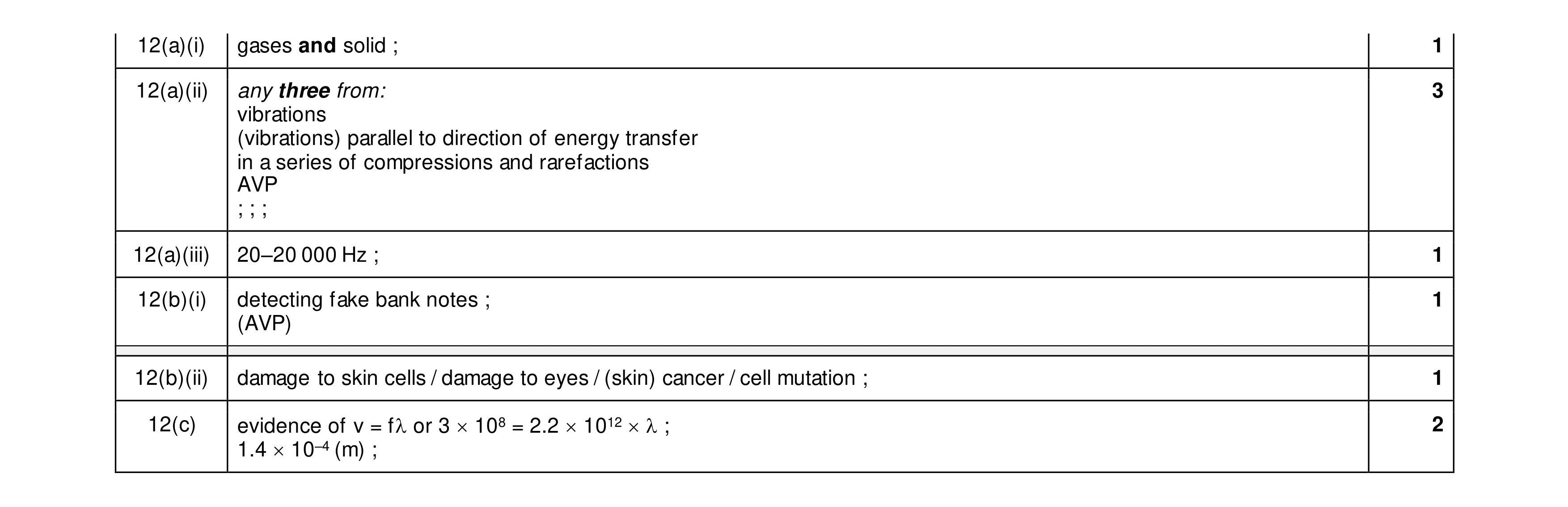 9
9