Cambridge IGCSE Sciences - Co-ordinated (Double) 0654 — 2025 May/June Paper 3 · Variant 1
0654/31/M/J/25 · 12 questions · 120 marks · 120 min
The question paper and its mark scheme, free to read here and free to download. This is Cambridge’s own paper, exactly as it was sat.
Question paper28 pages

Mark scheme15 pages
Answers below. Sit the paper first if you are practising.
Questions as text
Q1 · A part of a cross-section of a plant stem
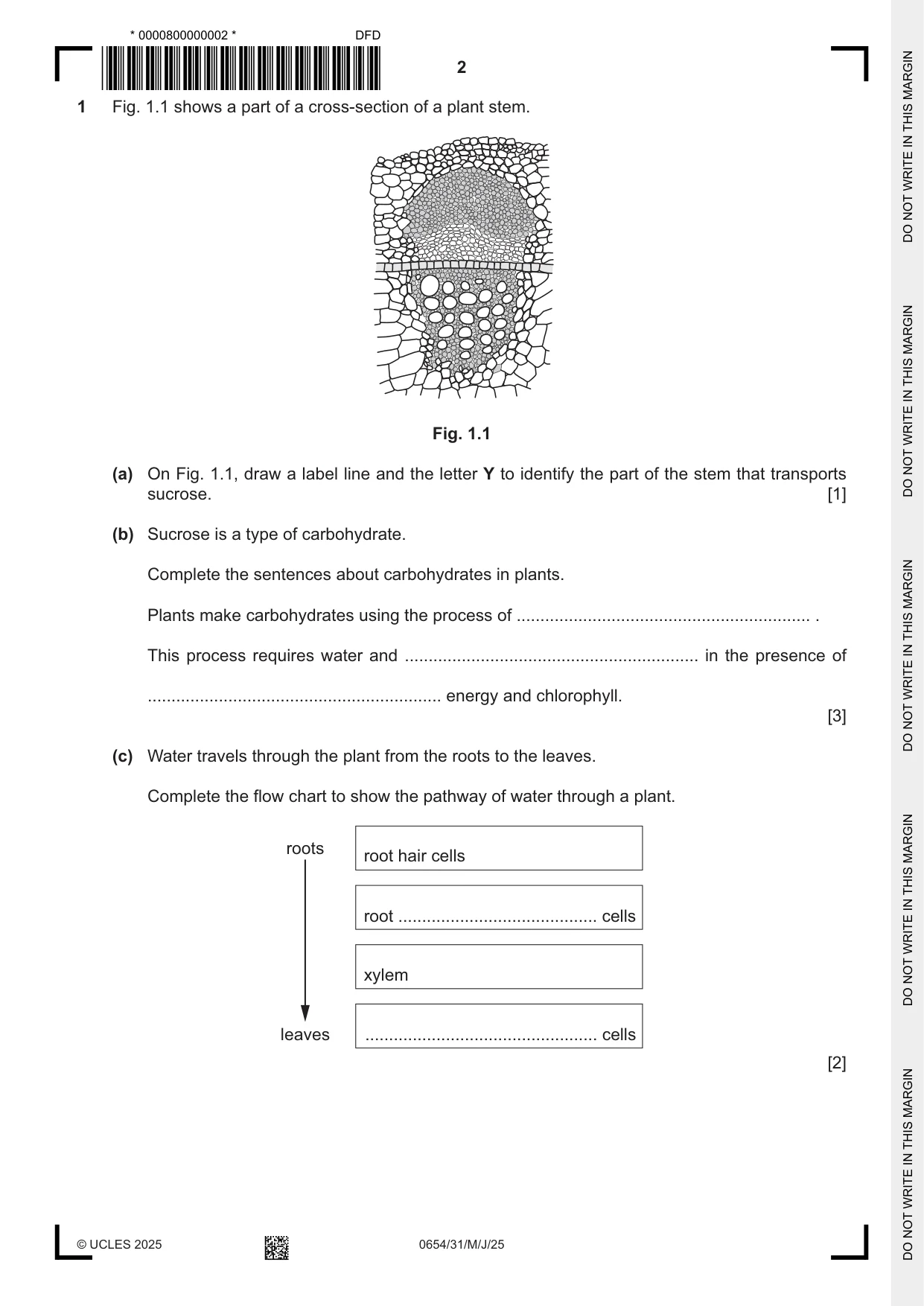
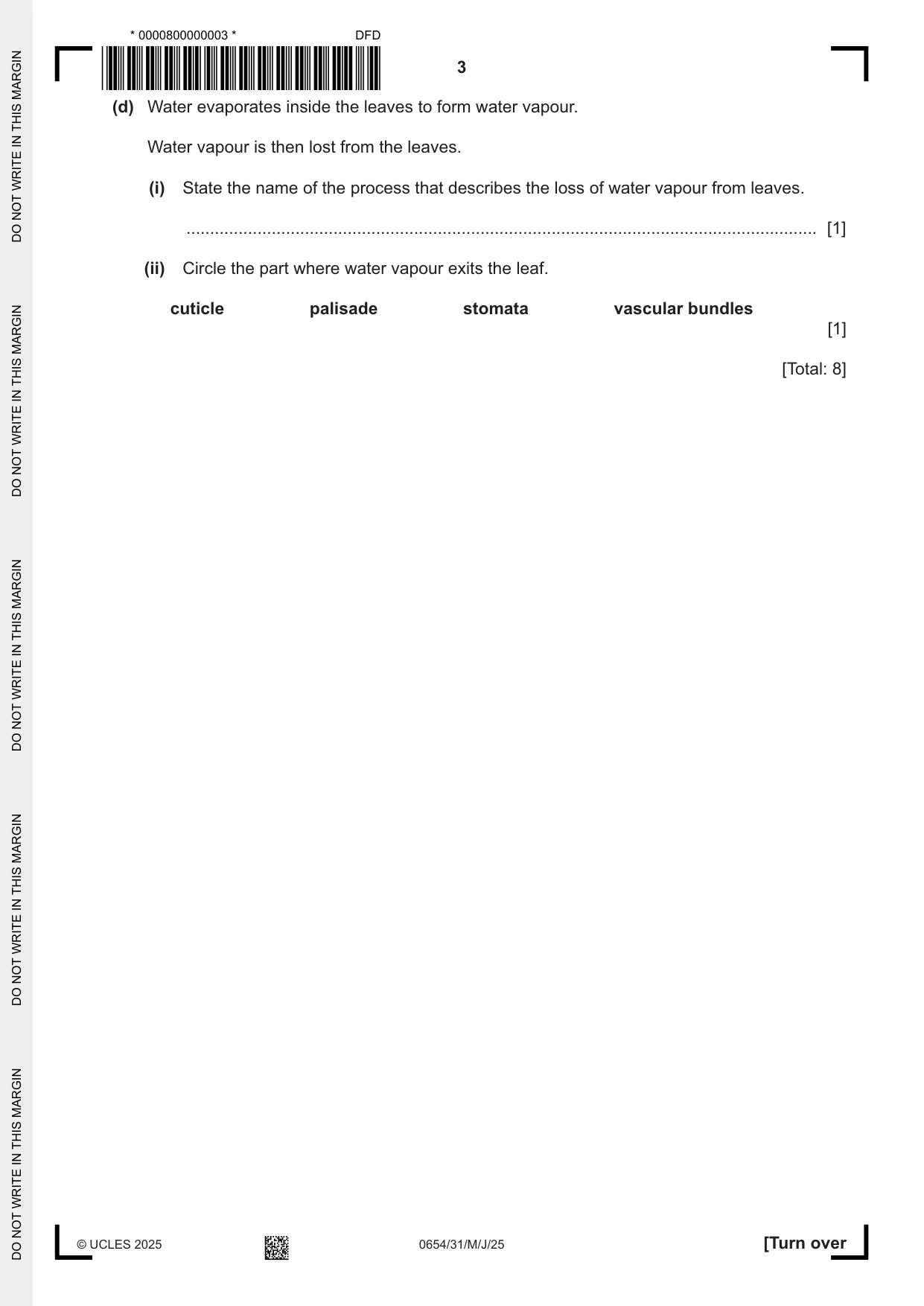
1 Fig. 1.1 shows a part of a cross-section of a plant stem. Fig. 1.1 (a) On Fig. 1.1, draw a label line and the letter Y to identify the part of the stem that transports sucrose. [1] (b) Sucrose is a type of carbohydrate. Complete the sentences about carbohydrates in plants. Plants make carbohydrates using the process of .............................................................. . This process requires water and .............................................................. in the presence of .............................................................. energy and chlorophyll. [3] (c) Water travels through the plant from the roots to the leaves. Complete the flow chart to show the pathway of water through a plant. roots root hair cells root .......................................... cells xylem leaves ................................................. cells [2] (d) Water evaporates inside the leaves to form water vapour. Water vapour is then lost from the leaves. (i) State the name of the process that describes the loss of water vapour from leaves. ..................................................................................................................................... [1] (ii) Circle the part where water vapour exits the leaf. cuticle palisade stomata vascular bundles [1] [Total: 8]
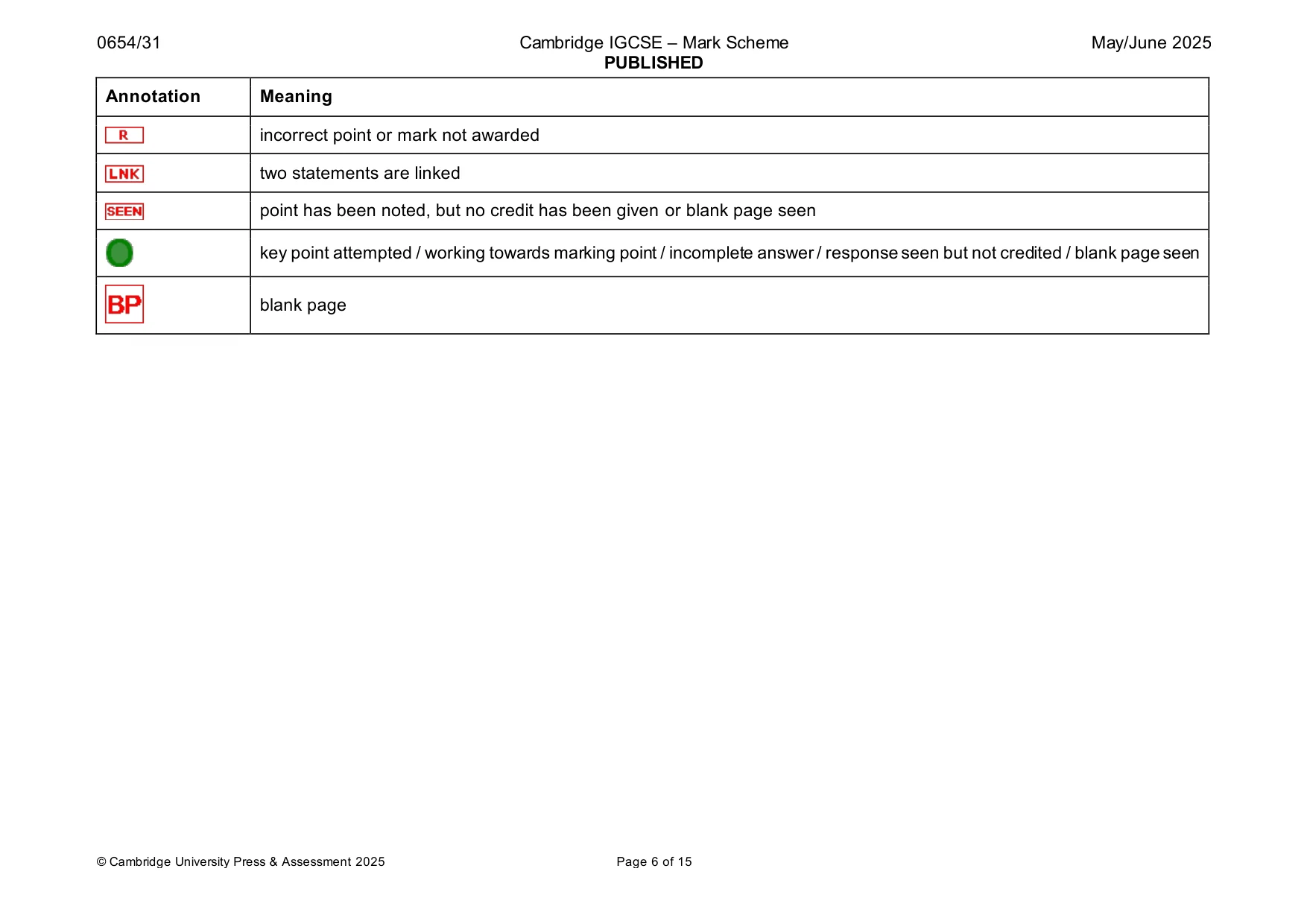
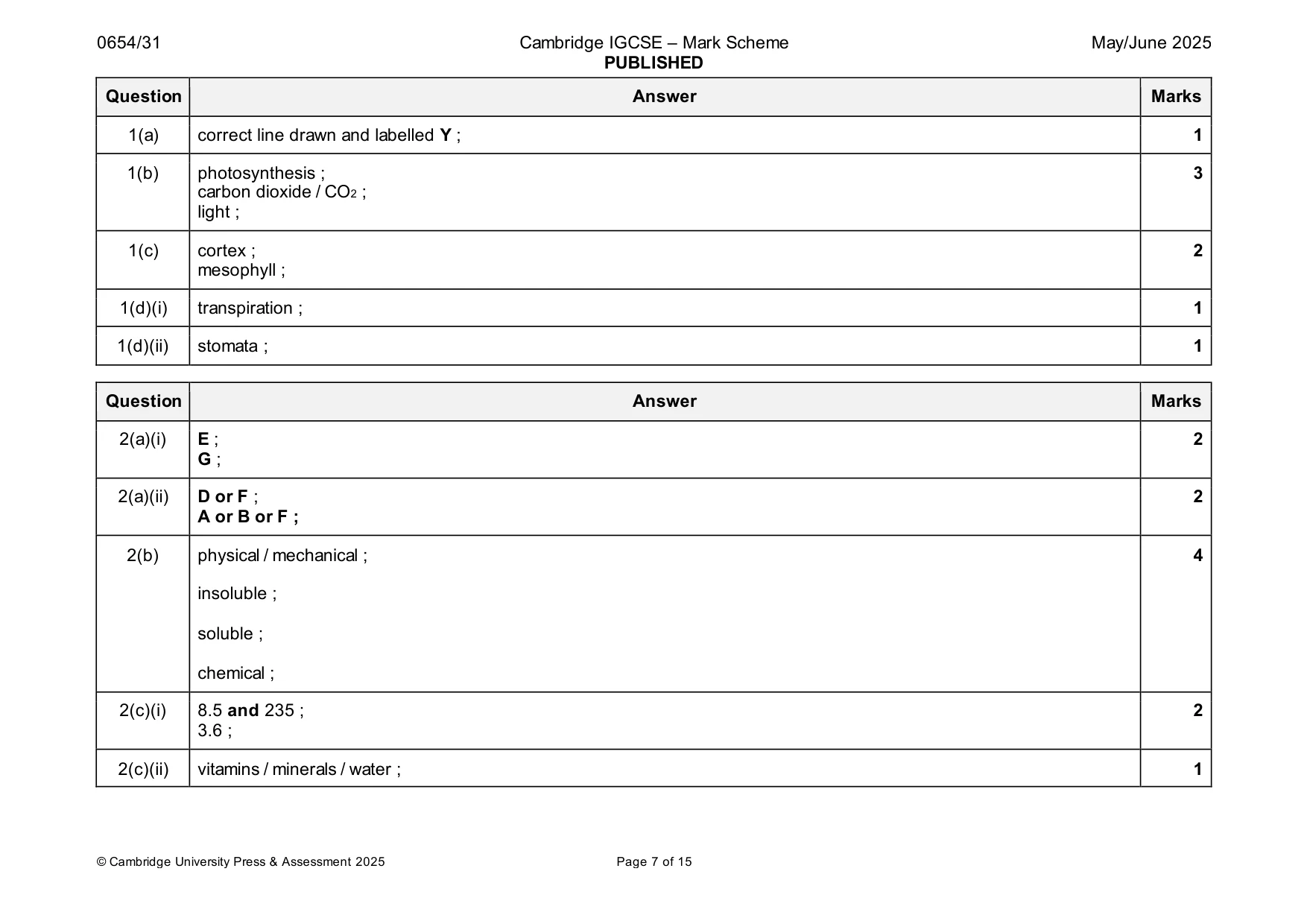
Mark scheme: Question Answer Marks 1(a) correct line drawn and labelled Y ; 1 1(b) photosynthesis ; 3 carbon dioxide / CO2 ; light ; 1(c) cortex ; 2 mesophyll ; 1(d)(i) transpiration ; 1 1(d)(ii) stomata ; 1
Q2 · A diagram of the human digestive system
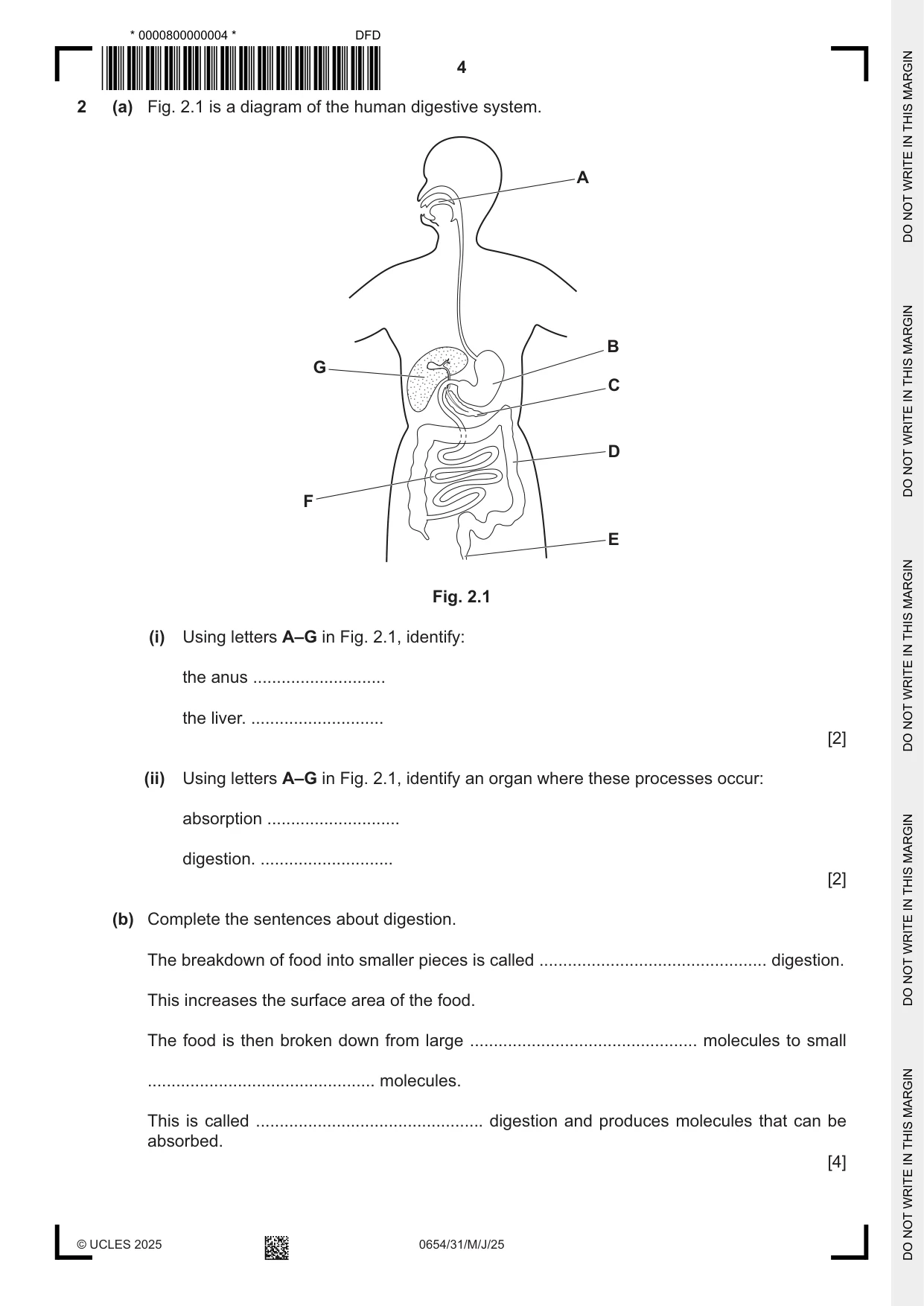
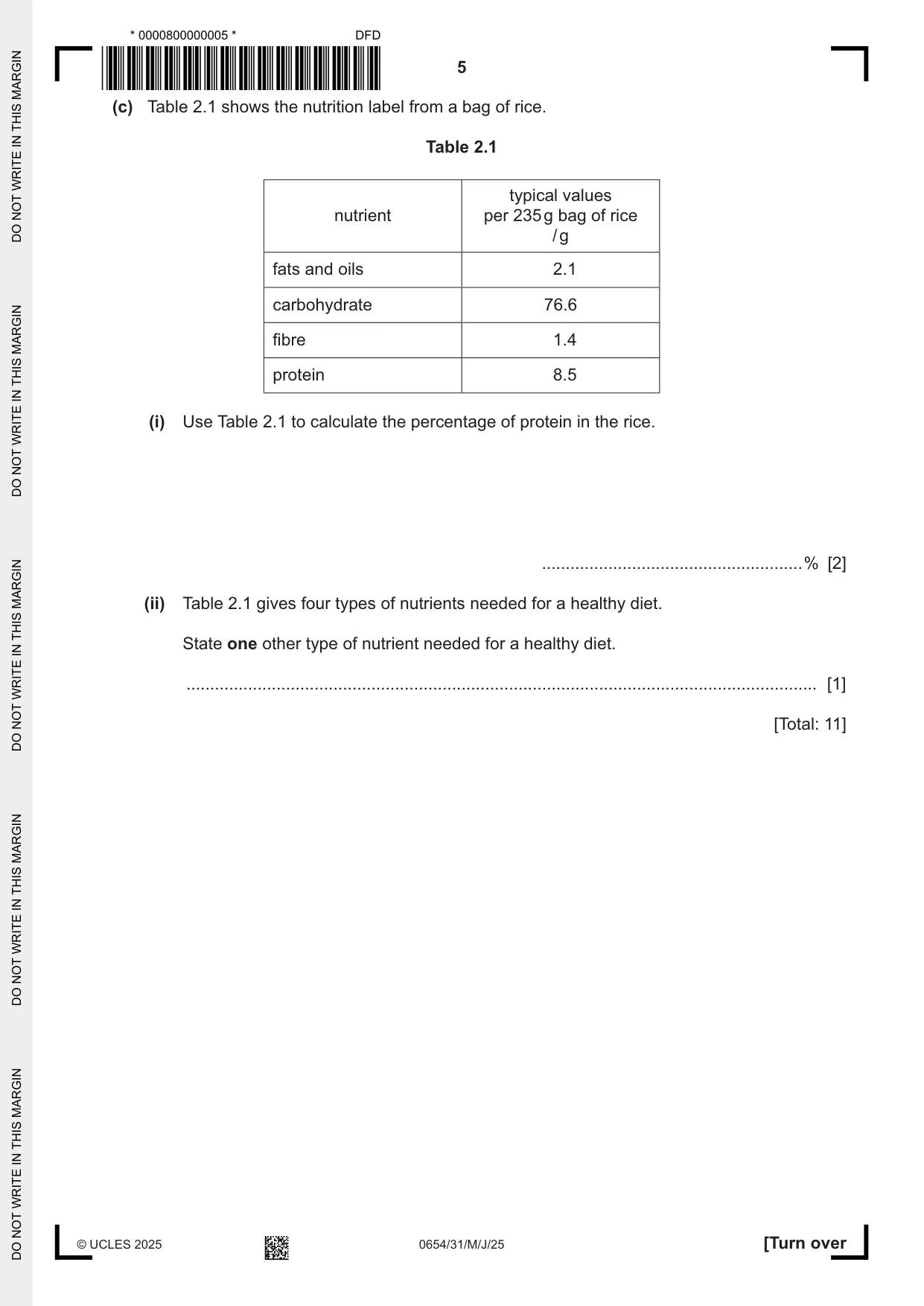
2 (a) Fig. 2.1 is a diagram of the human digestive system. A B G C D F E Fig. 2.1 (i) Using letters A–G in Fig. 2.1, identify: the anus ............................ the liver. ............................ [2] (ii) Using letters A–G in Fig. 2.1, identify an organ where these processes occur: absorption ............................ digestion. ............................ [2] (b) Complete the sentences about digestion. The breakdown of food into smaller pieces is called ................................................ digestion. This increases the surface area of the food. The food is then broken down from large ................................................ molecules to small ................................................ molecules. This is called ................................................ digestion and produces molecules that can be absorbed. [4] (c) Table 2.1 shows the nutrition label from a bag of rice. Table 2.1 typical values nutrient per 235 g bag of rice / g fats and oils 2.1 carbohydrate 76.6 fibre 1.4 protein 8.5 (i) Use Table 2.1 to calculate the percentage of protein in the rice. .......................................................% [2] (ii) Table 2.1 gives four types of nutrients needed for a healthy diet. State one other type of nutrient needed for a healthy diet. ..................................................................................................................................... [1] [Total: 11]
Mark scheme: 2(a)(i) E ; 2 G ; 2(a)(ii) D or F ; 2 A or B or F ; 2(b) physical / mechanical ; 4 insoluble ; soluble ; chemical ; 2(c)(i) 8.5 and 235 ; 2 3.6 ; 2(c)(ii) vitamins / minerals / water ; 1
Q3 · A diagram of a palisade cell from a potato plant
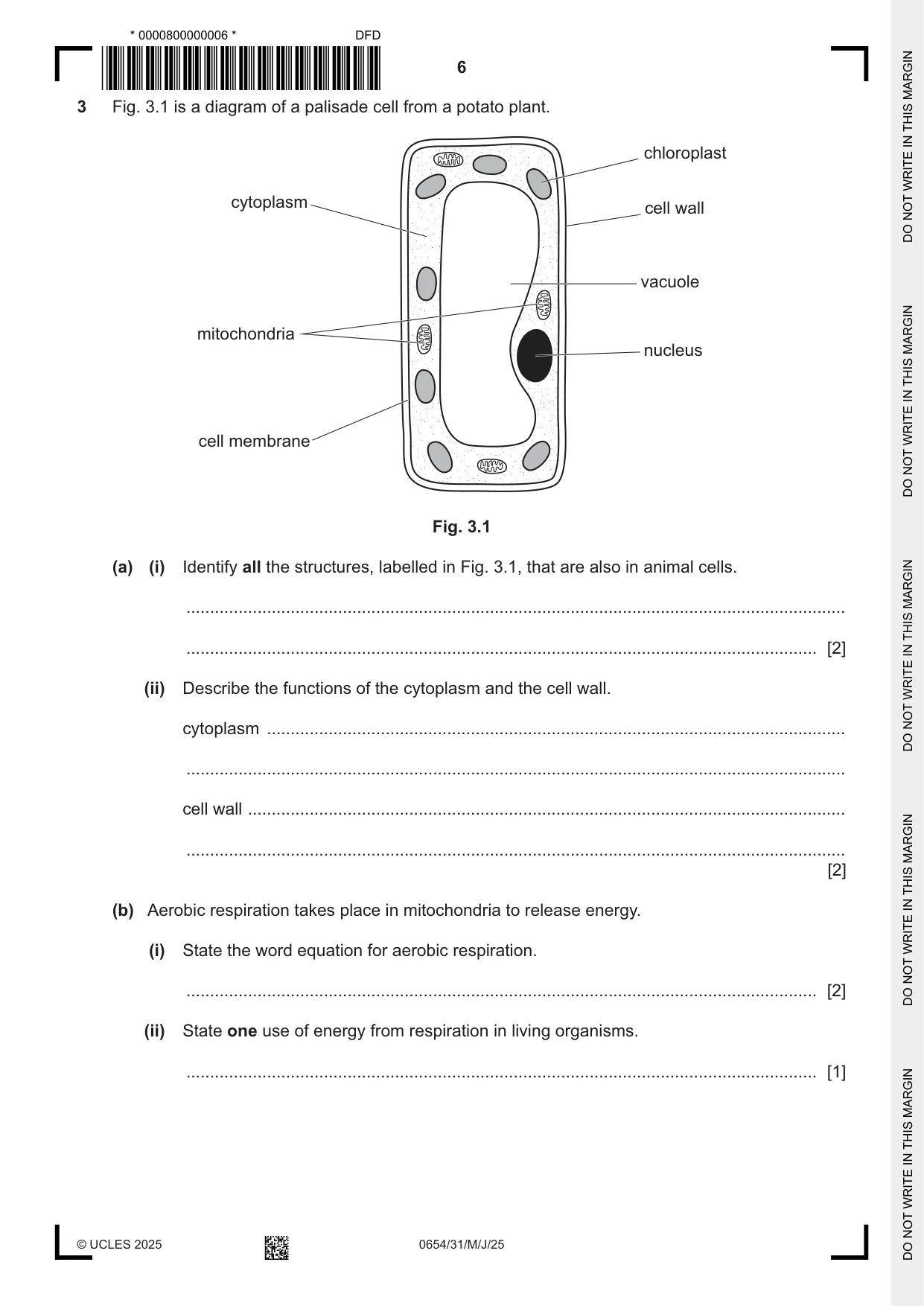
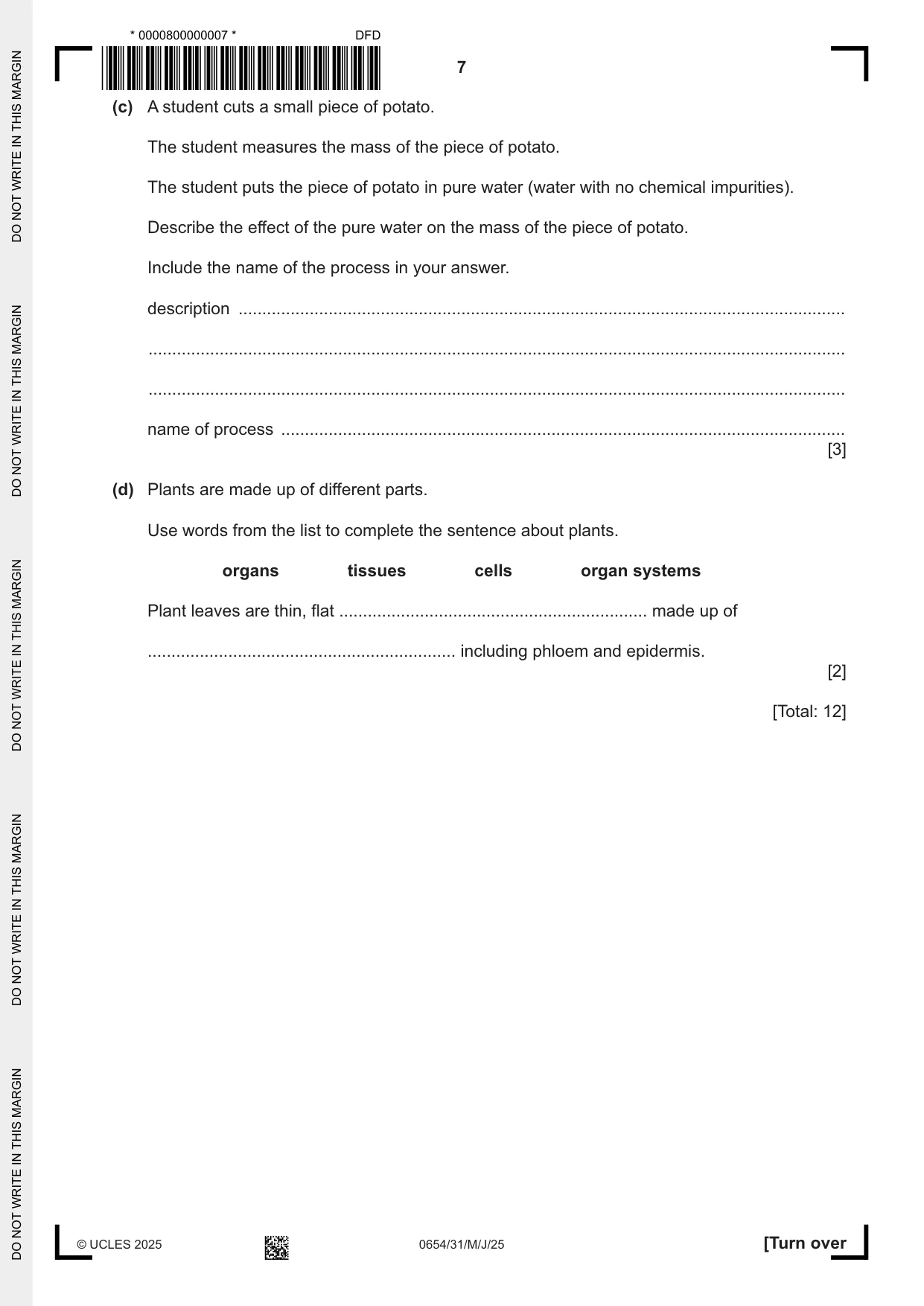
3 Fig. 3.1 is a diagram of a palisade cell from a potato plant. chloroplast cytoplasm cell wall vacuole mitochondria nucleus cell membrane Fig. 3.1 (a) (i) Identify all the structures, labelled in Fig. 3.1, that are also in animal cells. ........................................................................................................................................... ..................................................................................................................................... [2] (ii) Describe the functions of the cytoplasm and the cell wall. cytoplasm .......................................................................................................................... ........................................................................................................................................... cell wall .............................................................................................................................. ........................................................................................................................................... [2] (b) Aerobic respiration takes place in mitochondria to release energy. (i) State the word equation for aerobic respiration. ..................................................................................................................................... [2] (ii) State one use of energy from respiration in living organisms. ..................................................................................................................................... [1] (c) A student cuts a small piece of potato. The student measures the mass of the piece of potato. The student puts the piece of potato in pure water (water with no chemical impurities). Describe the effect of the pure water on the mass of the piece of potato. Include the name of the process in your answer. description ................................................................................................................................ ................................................................................................................................................... ................................................................................................................................................... name of process ....................................................................................................................... [3] (d) Plants are made up of different parts. Use words from the list to complete the sentence about plants. organs tissues cells organ systems Plant leaves are thin, flat ................................................................. made up of ................................................................. including phloem and epidermis. [2] [Total: 12]
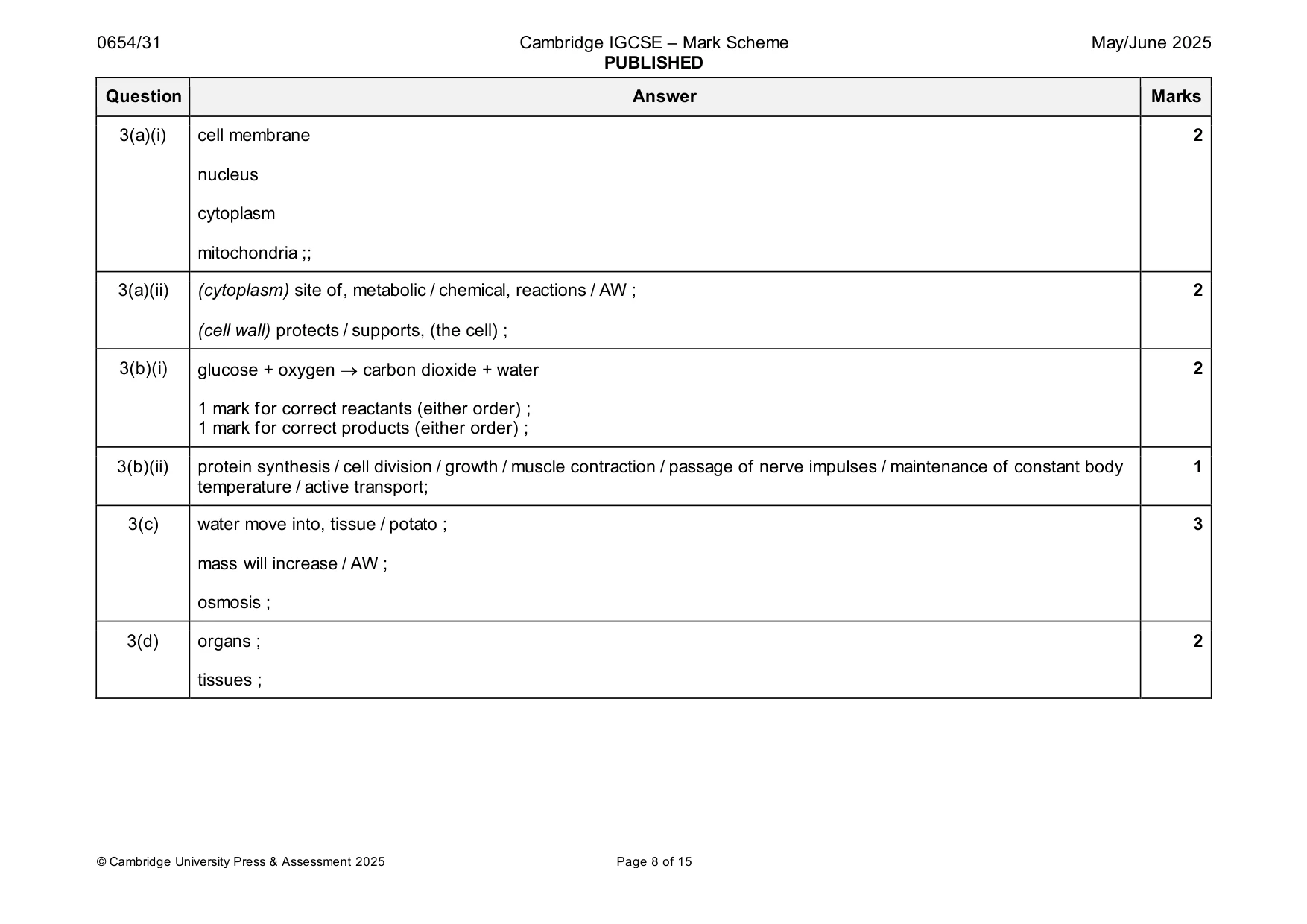
Mark scheme: 3(a)(i) cell membrane 2 nucleus cytoplasm mitochondria ;; 3(a)(ii) (cytoplasm) site of, metabolic / chemical, reactions / AW ; 2 (cell wall) protects / supports, (the cell) ; 3(b)(i) glucose + oxygen → carbon dioxide + water 2 1 mark for correct reactants (either order) ; 1 mark for correct products (either order) ; 3(b)(ii) protein synthesis / cell division / growth / muscle contraction / passage of nerve impulses / maintenance of constant body 1 temperature / active transport; 3(c) water move into, tissue / potato ; 3 mass will increase / AW ; osmosis ; 3(d) organs ; 2 tissues ;
Q4 · Part of a food web on a remote island
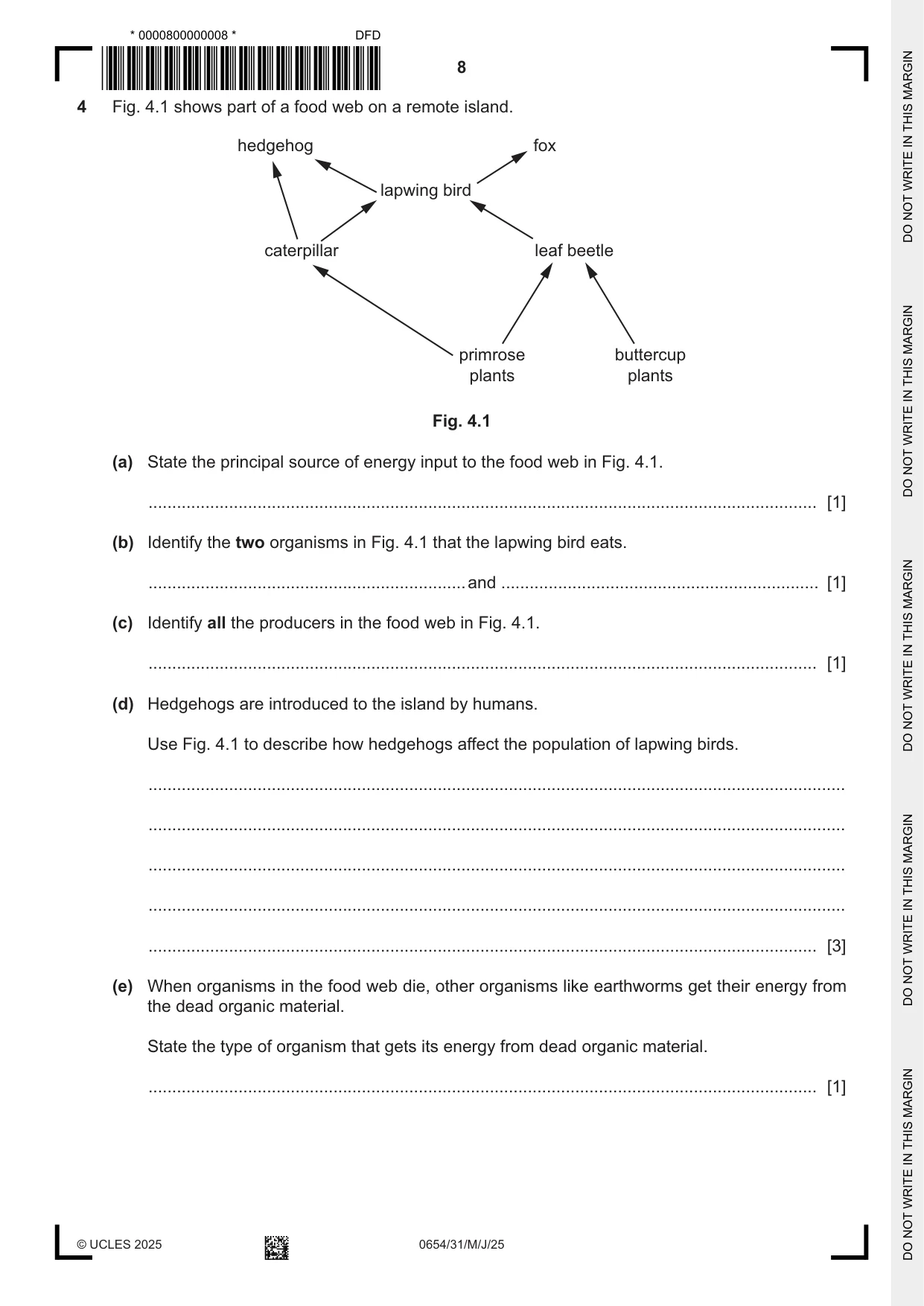
4 Fig. 4.1 shows part of a food web on a remote island. hedgehog fox lapwing bird caterpillar leaf beetle primrose buttercup plants plants Fig. 4.1 (a) State the principal source of energy input to the food web in Fig. 4.1. ............................................................................................................................................. [1] (b) Identify the two organisms in Fig. 4.1 that the lapwing bird eats. ...................................................................and ................................................................... [1] (c) Identify all the producers in the food web in Fig. 4.1. ............................................................................................................................................. [1] (d) Hedgehogs are introduced to the island by humans. Use Fig. 4.1 to describe how hedgehogs affect the population of lapwing birds. ................................................................................................................................................... ................................................................................................................................................... ................................................................................................................................................... ................................................................................................................................................... ............................................................................................................................................. [3] (e) When organisms in the food web die, other organisms like earthworms get their energy from the dead organic material. State the type of organism that gets its energy from dead organic material. ............................................................................................................................................. [1] (f) Hedgehogs hunt at night when it is dark. Complete the sentences about how hedgehogs detect their prey. Choose words from the list. ciliated chemicals light motor receptor sound Hedgehogs use their sense of smell to detect ........................................... in the air. Their nose contains groups of ........................................... cells which detect the smell. [2] [Total: 9]
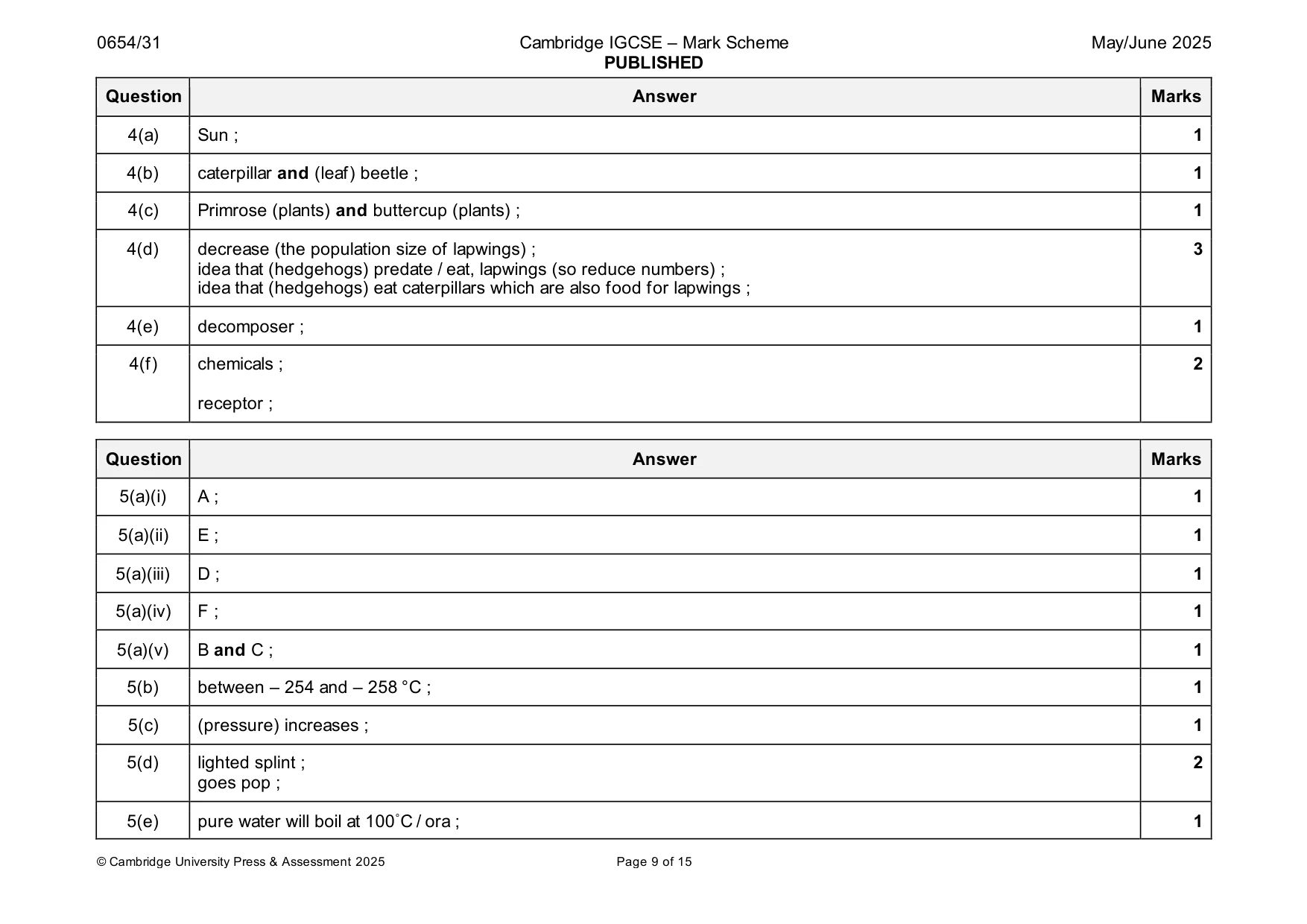
Mark scheme: 4(a) Sun ; 1 4(b) caterpillar and (leaf) beetle ; 1 4(c) Primrose (plants) and buttercup (plants) ; 1 4(d) decrease (the population size of lapwings) ; 3 idea that (hedgehogs) predate / eat, lapwings (so reduce numbers) ; idea that (hedgehogs) eat caterpillars which are also food for lapwings ; 4(e) decomposer ; 1 4(f) chemicals ; 2 receptor ;
Q5 · Table 5.1 contains information about 6 atoms or ions A, B, C, D, E and F
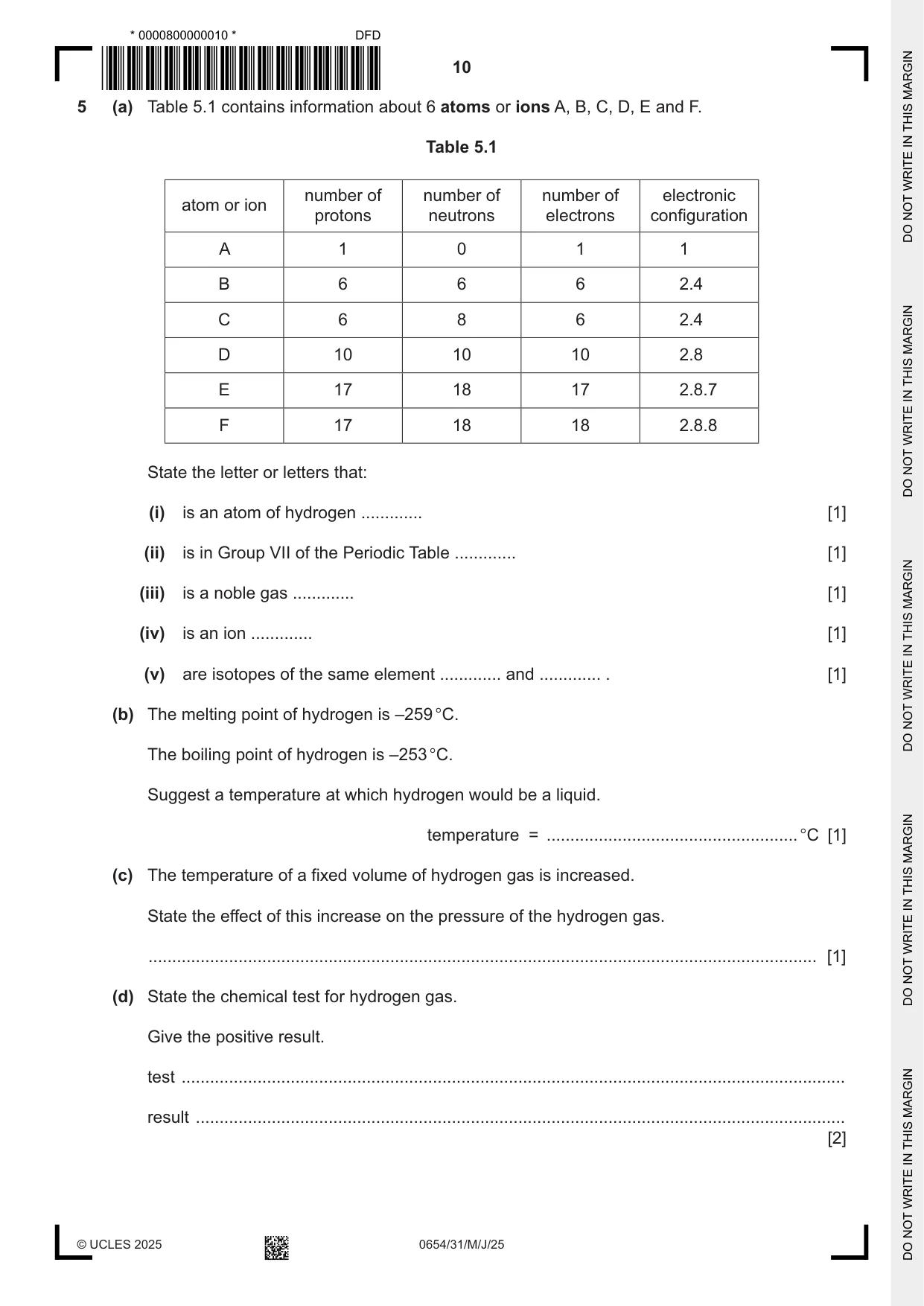
5 (a) Table 5.1 contains information about 6 atoms or ions A, B, C, D, E and F. Table 5.1 number of number of number of electronic atom or ion protons neutrons electrons configuration A 1 0 1 1 B 6 6 6 2.4 C 6 8 6 2.4 D 10 10 10 2.8 E 17 18 17 2.8.7 F 17 18 18 2.8.8 State the letter or letters that: (i) is an atom of hydrogen ............. [1] (ii) is in Group VII of the Periodic Table ............. [1] (iii) is a noble gas ............. [1] (iv) is an ion ............. [1] (v) are isotopes of the same element ............. and ............. . [1] (b) The melting point of hydrogen is –259 °C. The boiling point of hydrogen is –253 °C. Suggest a temperature at which hydrogen would be a liquid. temperature = ..................................................... °C [1] (c) The temperature of a fixed volume of hydrogen gas is increased. State the effect of this increase on the pressure of the hydrogen gas. ............................................................................................................................................. [1] (d) State the chemical test for hydrogen gas. Give the positive result. test ............................................................................................................................................ result ......................................................................................................................................... [2] (e) Some water is made by reacting hydrogen gas with oxygen gas. Describe how to test for the purity of the water made by using boiling point information. ................................................................................................................................................... ............................................................................................................................................. [1] [Total: 10]
Mark scheme: 5(a)(i) A ; 1 5(a)(ii) E ; 1 5(a)(iii) D ; 1 5(a)(iv) F ; 1 5(a)(v) B and C ; 1 5(b) between – 254 and – 258 °C ; 1 5(c) (pressure) increases ; 1 5(d) lighted splint ; 2 goes pop ; 5(e) pure water will boil at 100°C / ora ; 1
Q6 · Sulfuric acid has the formula H2SO4
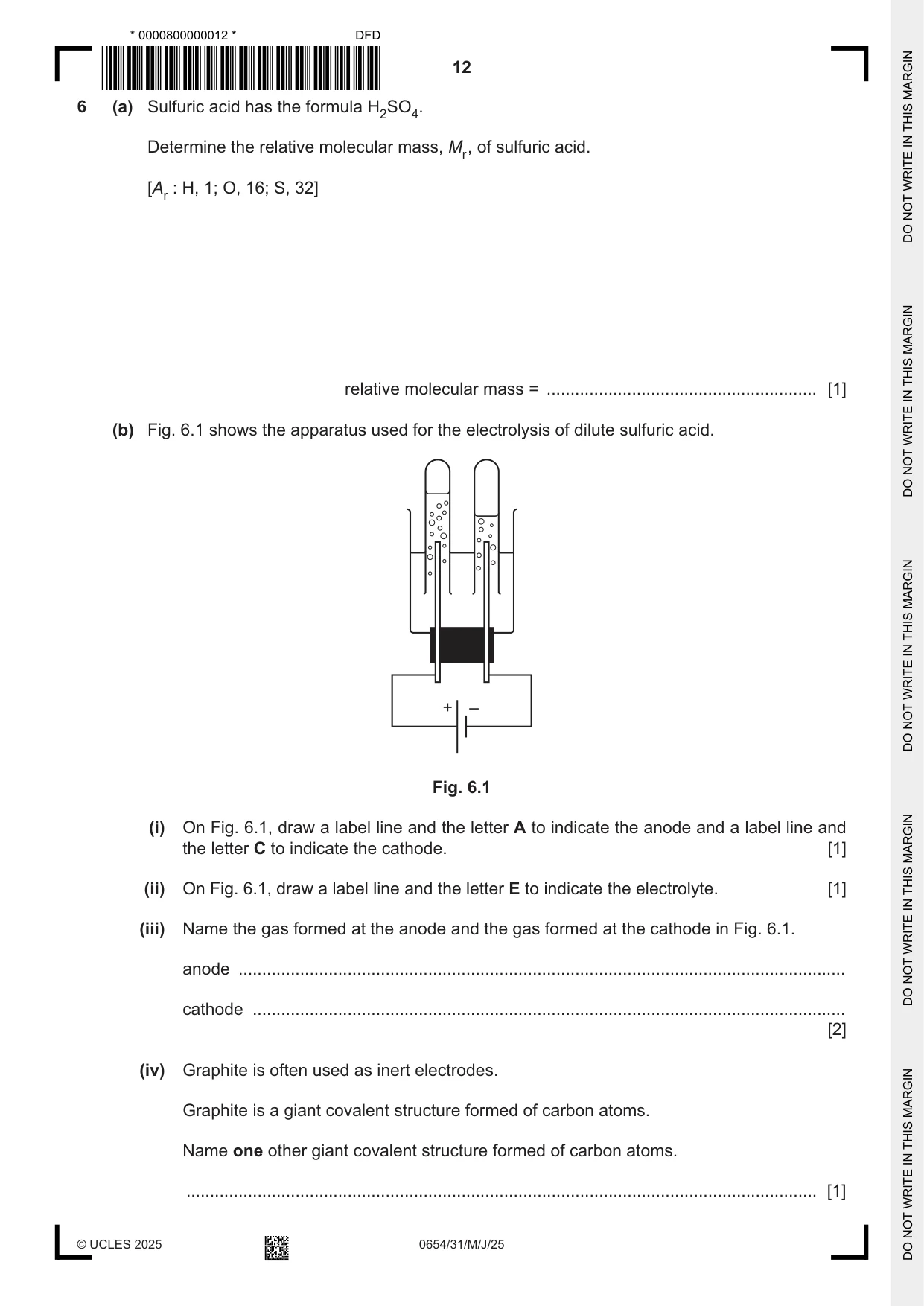
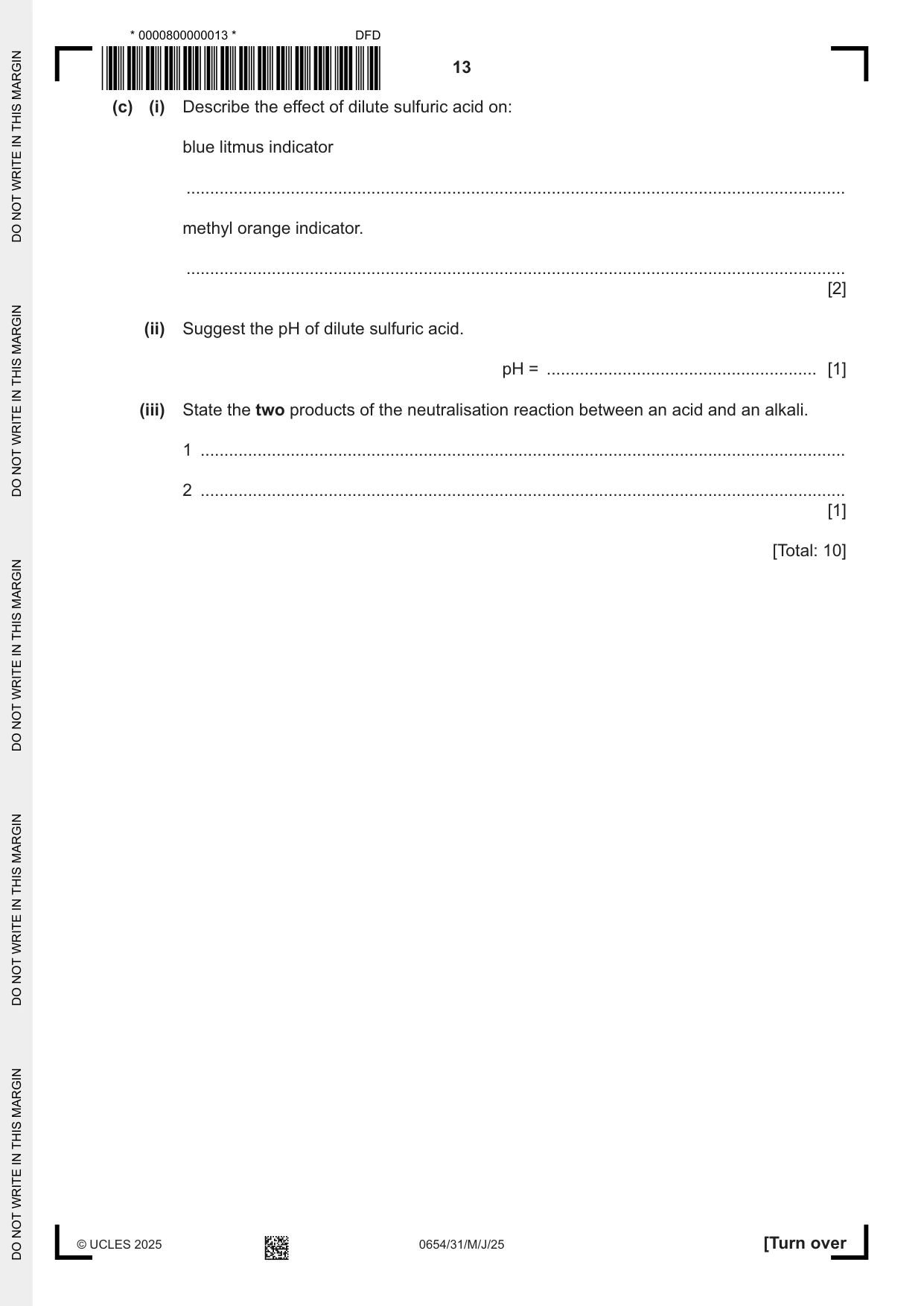
6 (a) Sulfuric acid has the formula H2SO4. Determine the relative molecular mass, Mr , of sulfuric acid. [Ar : H, 1; O, 16; S, 32] relative molecular mass = ......................................................... [1] (b) Fig. 6.1 shows the apparatus used for the electrolysis of dilute sulfuric acid. + – Fig. 6.1 (i) On Fig. 6.1, draw a label line and the letter A to indicate the anode and a label line and the letter C to indicate the cathode. [1] (ii) On Fig. 6.1, draw a label line and the letter E to indicate the electrolyte. [1] (iii) Name the gas formed at the anode and the gas formed at the cathode in Fig. 6.1. anode ................................................................................................................................ cathode ............................................................................................................................. [2] (iv) Graphite is often used as inert electrodes. Graphite is a giant covalent structure formed of carbon atoms. Name one other giant covalent structure formed of carbon atoms. ..................................................................................................................................... [1] (c) (i) Describe the effect of dilute sulfuric acid on: blue litmus indicator ........................................................................................................................................... methyl orange indicator. ........................................................................................................................................... [2] (ii) Suggest the pH of dilute sulfuric acid. pH = ......................................................... [1] (iii) State the two products of the neutralisation reaction between an acid and an alkali. 1 ........................................................................................................................................ 2 ........................................................................................................................................ [1] [Total: 10]
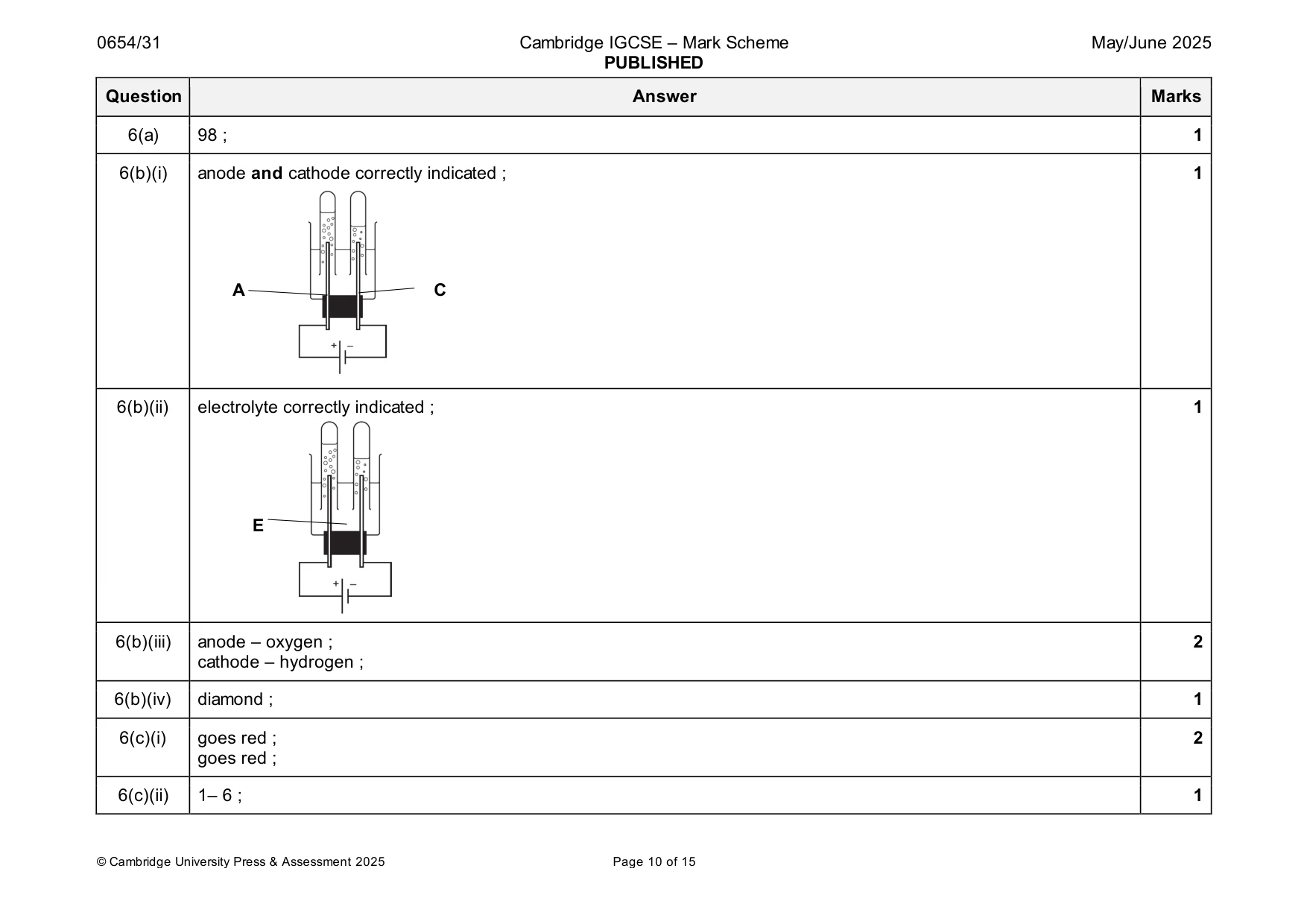
Mark scheme: 6(a) 98 ; 1 6(b)(i) anode and cathode correctly indicated ; 1 A C 6(b)(ii) electrolyte correctly indicated ; 1 E 6(b)(iii) anode – oxygen ; 2 cathode – hydrogen ; 6(b)(iv) diamond ; 1 6(c)(i) goes red ; 2 goes red ; 6(c)(ii) 1– 6 ; 1 6(c)(iii) salt and water ; 1
Q7 · Iron is extracted from its ore by reduction in a blast furnace
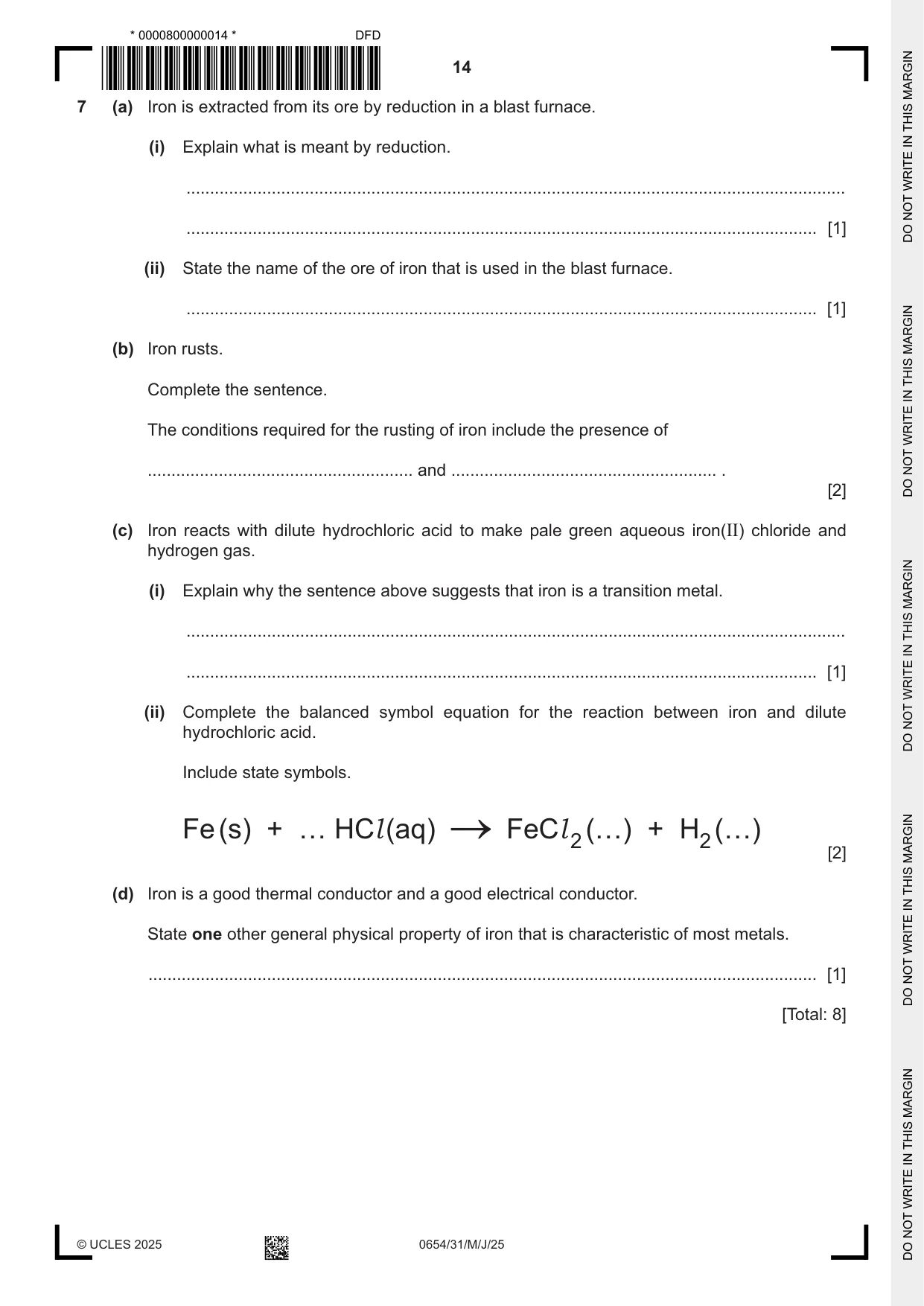
7 (a) Iron is extracted from its ore by reduction in a blast furnace. (i) Explain what is meant by reduction. ........................................................................................................................................... ..................................................................................................................................... [1] (ii) State the name of the ore of iron that is used in the blast furnace. ..................................................................................................................................... [1] (b) Iron rusts. Complete the sentence. The conditions required for the rusting of iron include the presence of ........................................................ and ........................................................ . [2] (c) Iron reacts with dilute hydrochloric acid to make pale green aqueous iron(II) chloride and hydrogen gas. (i) Explain why the sentence above suggests that iron is a transition metal. ........................................................................................................................................... ..................................................................................................................................... [1] (ii) Complete the balanced symbol equation for the reaction between iron and dilute hydrochloric acid. Include state symbols. Fe (s) + … HCl (aq) FeCl (…) + (…) 2 H2 [2] (d) Iron is a good thermal conductor and a good electrical conductor. State one other general physical property of iron that is characteristic of most metals. ............................................................................................................................................. [1] [Total: 8]
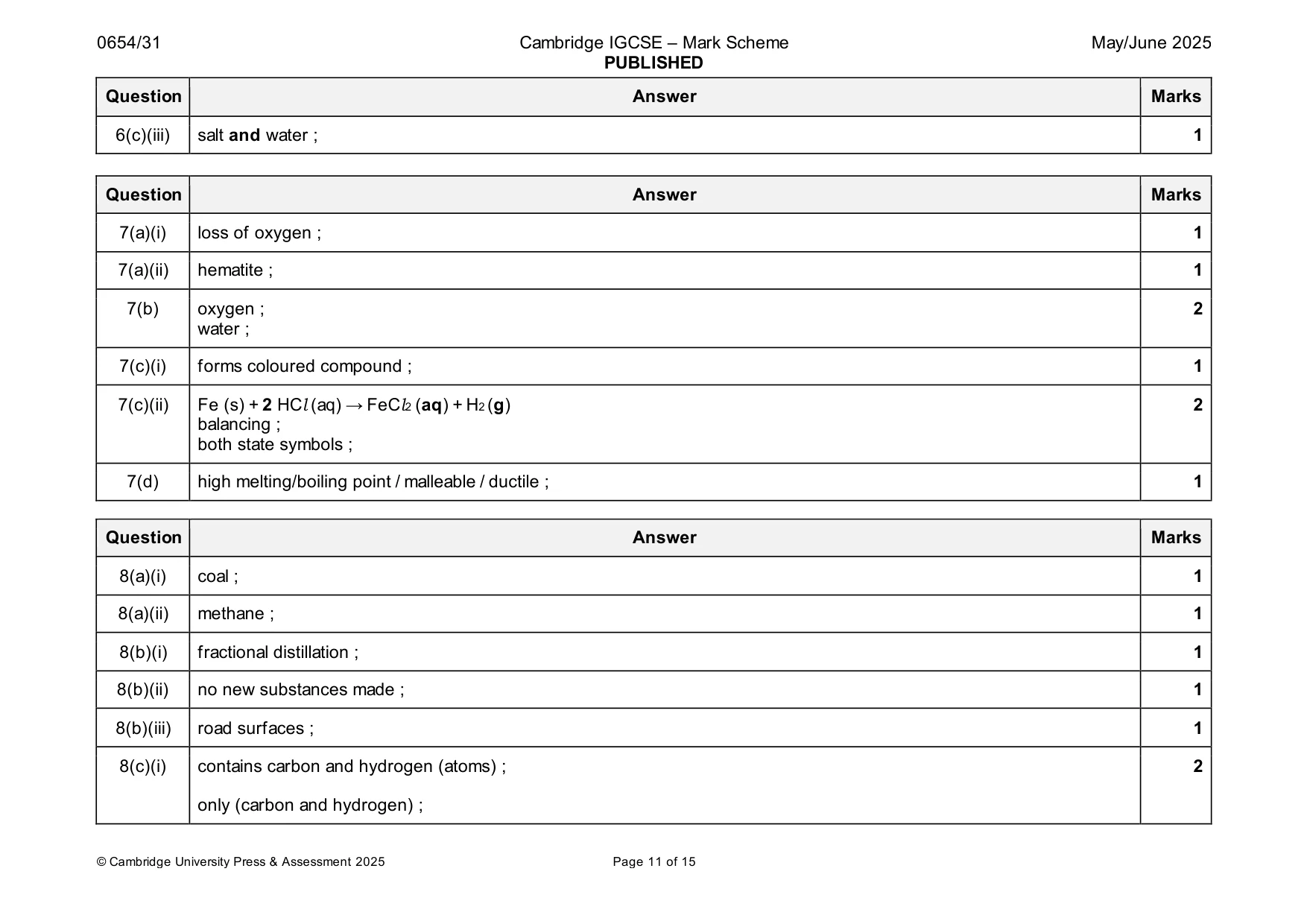
Mark scheme: 7(a)(i) loss of oxygen ; 1 7(a)(ii) hematite ; 1 7(b) oxygen ; 2 water ; 7(c)(i) forms coloured compound ; 1 7(c)(ii) Fe (s) + 2 HCl (aq) → FeCl2 (aq) + H2 (g) 2 balancing ; both state symbols ; 7(d) high melting/boiling point / malleable / ductile ; 1
Q8 · Natural gas and petroleum are two fossil fuels
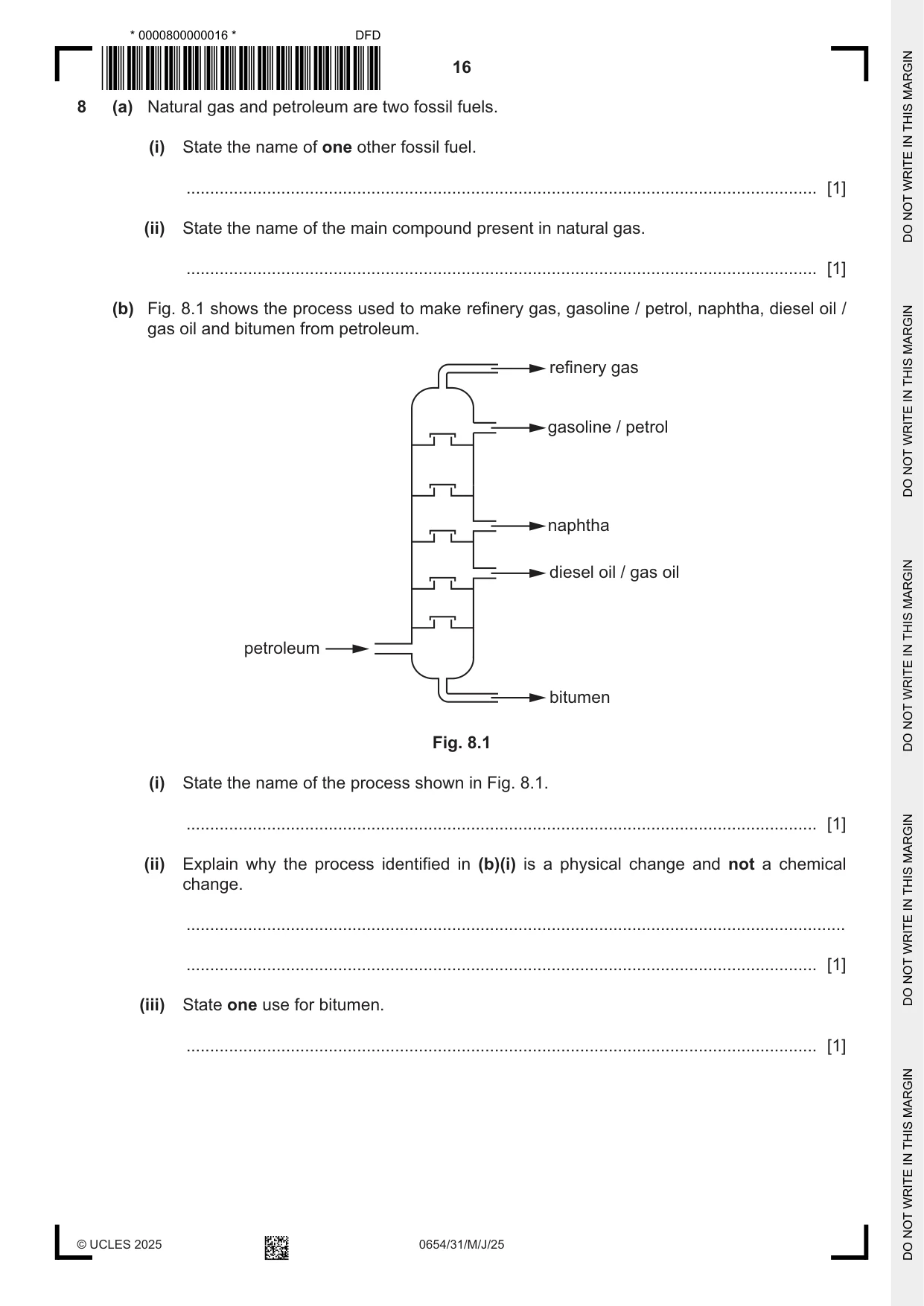
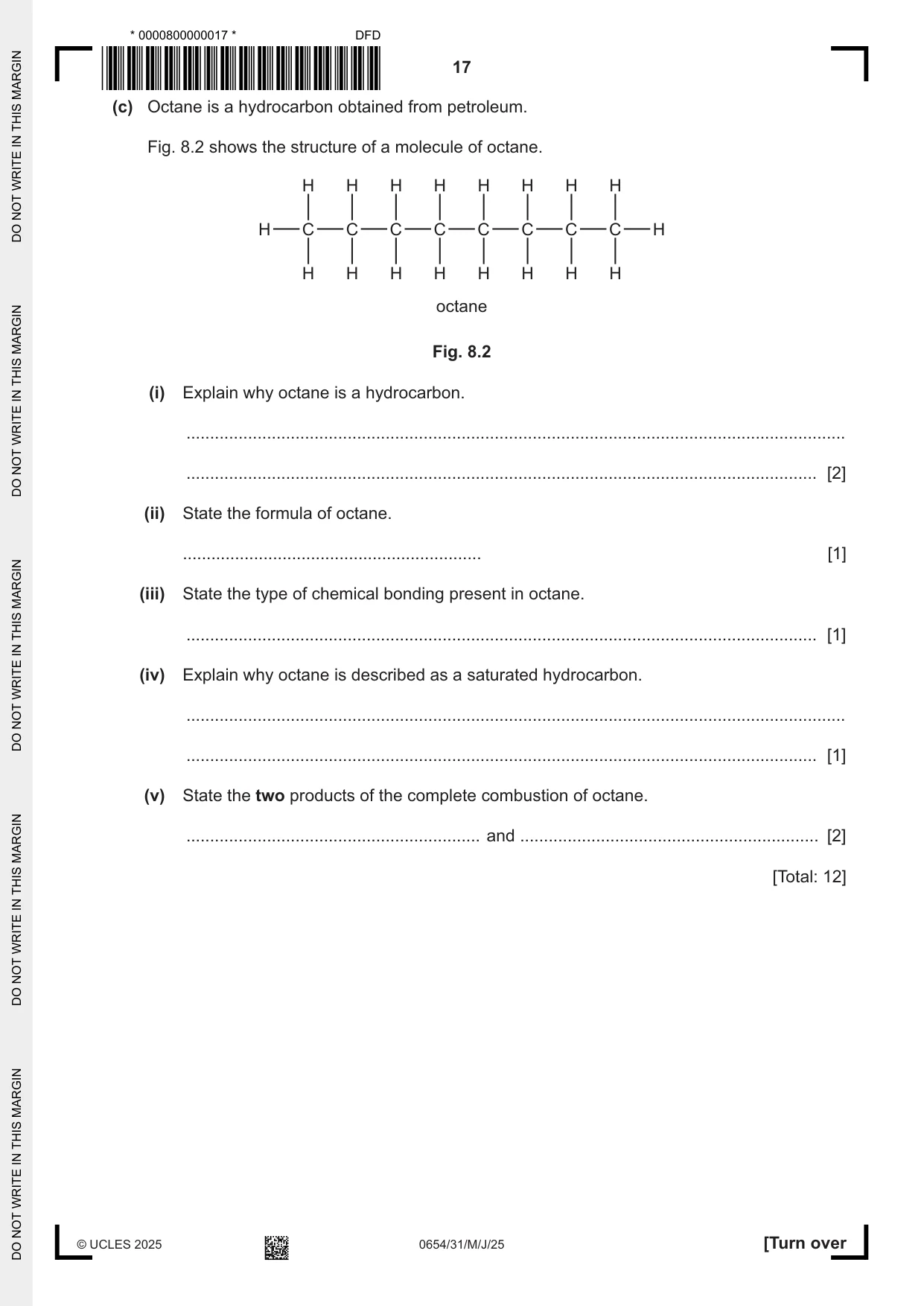
8 (a) Natural gas and petroleum are two fossil fuels. (i) State the name of one other fossil fuel. ..................................................................................................................................... [1] (ii) State the name of the main compound present in natural gas. ..................................................................................................................................... [1] (b) Fig. 8.1 shows the process used to make refinery gas, gasoline / petrol, naphtha, diesel oil / gas oil and bitumen from petroleum. refinery gas gasoline / petrol naphtha diesel oil / gas oil petroleum bitumen Fig. 8.1 (i) State the name of the process shown in Fig. 8.1. ..................................................................................................................................... [1] (ii) Explain why the process identified in (b)(i) is a physical change and not a chemical change. ........................................................................................................................................... ..................................................................................................................................... [1] (iii) State one use for bitumen. ..................................................................................................................................... [1] (c) Octane is a hydrocarbon obtained from petroleum. Fig. 8.2 shows the structure of a molecule of octane. H H H H H H H H H C C C C C C C C H H H H H H H H H octane Fig. 8.2 (i) Explain why octane is a hydrocarbon. ........................................................................................................................................... ..................................................................................................................................... [2] (ii) State the formula of octane. ............................................................... [1] (iii) State the type of chemical bonding present in octane. ..................................................................................................................................... [1] (iv) Explain why octane is described as a saturated hydrocarbon. ........................................................................................................................................... ..................................................................................................................................... [1] (v) State the two products of the complete combustion of octane. .............................................................. and ............................................................... [2] [Total: 12]
Mark scheme: 8(a)(i) coal ; 1 8(a)(ii) methane ; 1 8(b)(i) fractional distillation ; 1 8(b)(ii) no new substances made ; 1 8(b)(iii) road surfaces ; 1 8(c)(i) contains carbon and hydrogen (atoms) ; 2 only (carbon and hydrogen) ; 8(c)(ii) C8H18 ; 1 8(c)(iii) covalent ; 1 8(c)(iv) only C-C / single bonds / does not contain a C=C / double bond ; 1 8(c)(v) carbon dioxide ; 2 water ;
Q9 · A horse and cart
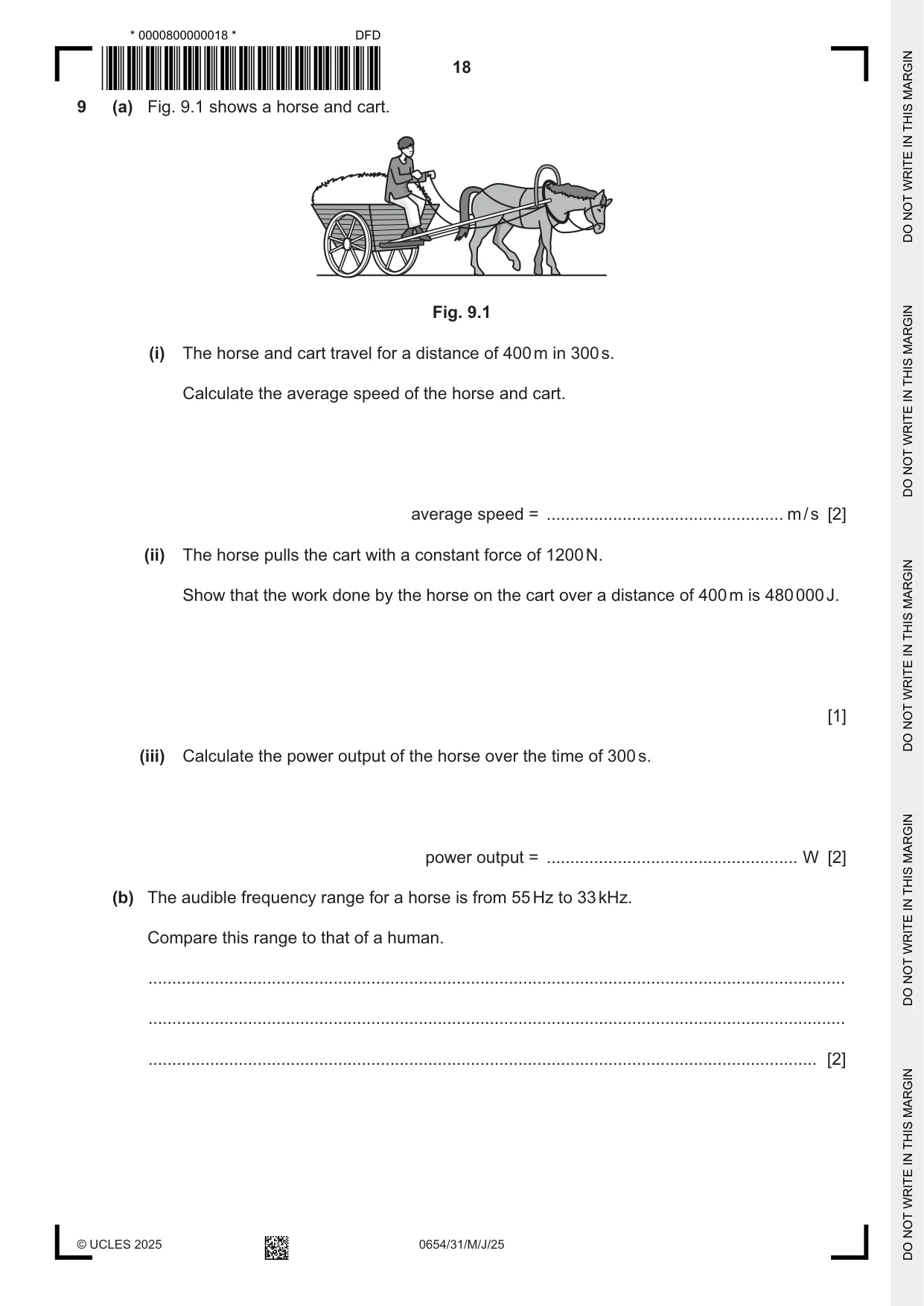
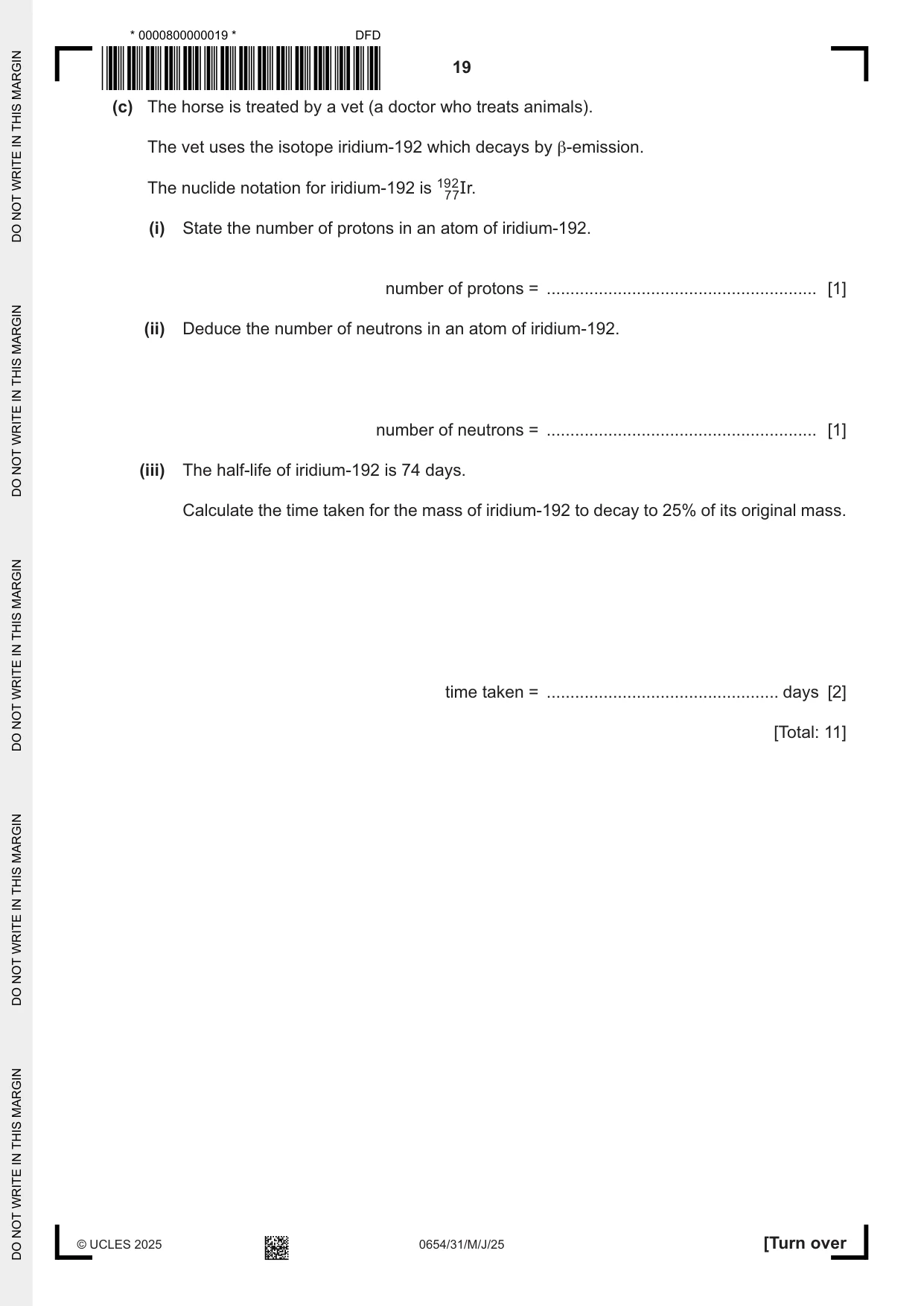
9 (a) Fig. 9.1 shows a horse and cart. Fig. 9.1 (i) The horse and cart travel for a distance of 400 m in 300 s. Calculate the average speed of the horse and cart. average speed = .................................................. m / s [2] (ii) The horse pulls the cart with a constant force of 1200 N. Show that the work done by the horse on the cart over a distance of 400 m is 480 000 J. [1] (iii) Calculate the power output of the horse over the time of 300 s. power output = ..................................................... W [2] (b) The audible frequency range for a horse is from 55 Hz to 33 kHz. Compare this range to that of a human. ................................................................................................................................................... ................................................................................................................................................... ............................................................................................................................................. [2] (c) The horse is treated by a vet (a doctor who treats animals). The vet uses the isotope iridium-192 which decays by β-emission. The nuclide notation for iridium-192 is 19 2 7 7Ir. (i) State the number of protons in an atom of iridium-192. number of protons = ......................................................... [1] (ii) Deduce the number of neutrons in an atom of iridium-192. number of neutrons = ......................................................... [1] (iii) The half-life of iridium-192 is 74 days. Calculate the time taken for the mass of iridium-192 to decay to 25% of its original mass. time taken = ................................................. days [2] [Total: 11]
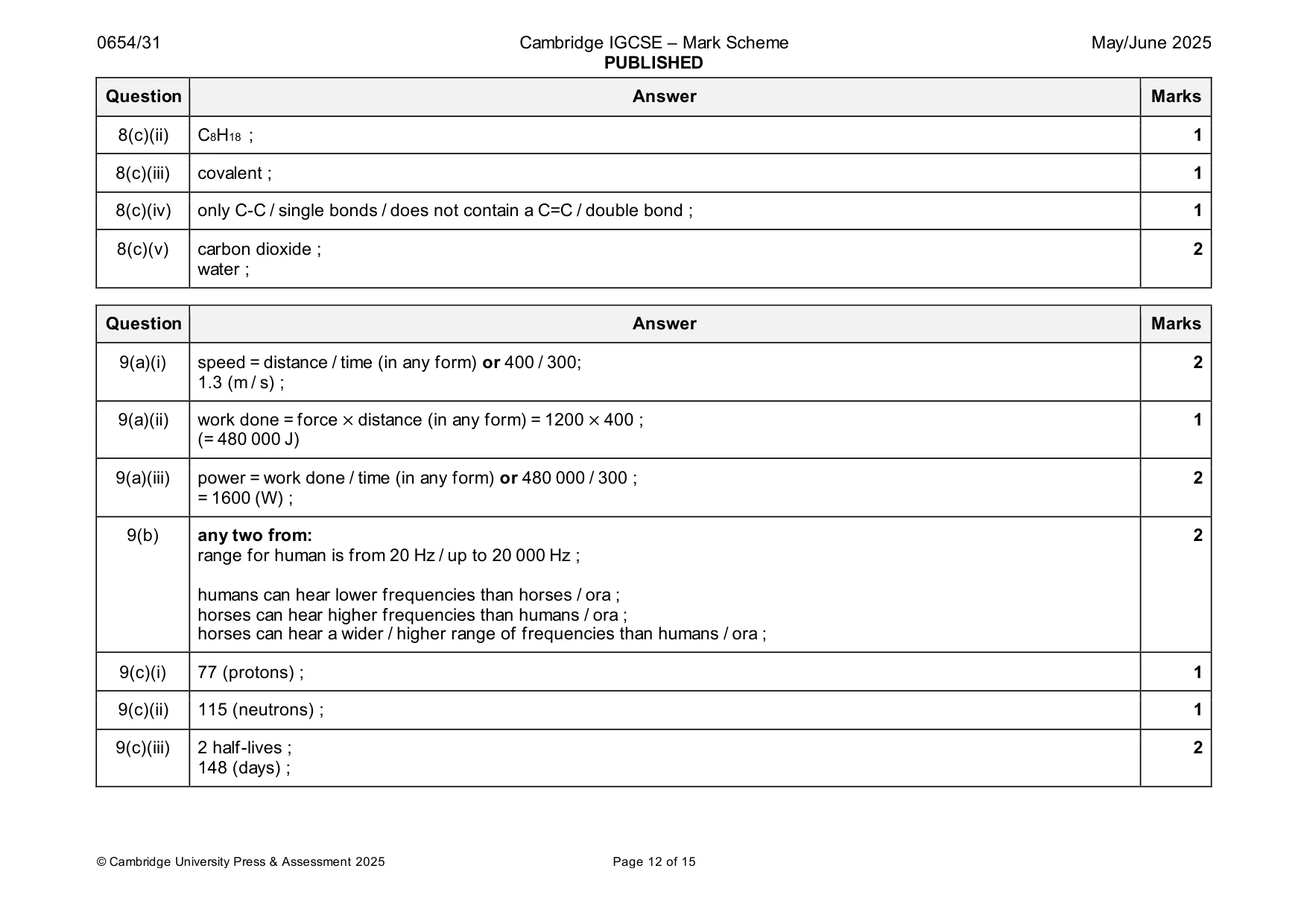
Mark scheme: 9(a)(i) speed = distance / time (in any form) or 400 / 300; 2 1.3 (m / s) ; 9(a)(ii) work done = force × distance (in any form) = 1200 × 400 ; 1 (= 480 000 J) 9(a)(iii) power = work done / time (in any form) or 480 000 / 300 ; 2 = 1600 (W) ; 9(b) any two from: 2 range for human is from 20 Hz / up to 20 000 Hz ; humans can hear lower frequencies than horses / ora ; horses can hear higher frequencies than humans / ora ; horses can hear a wider / higher range of frequencies than humans / ora ; 9(c)(i) 77 (protons) ; 1 9(c)(ii) 115 (neutrons) ; 1 9(c)(iii) 2 half-lives ; 2 148 (days) ;
Q10 · The Sun is the closest star to the Earth
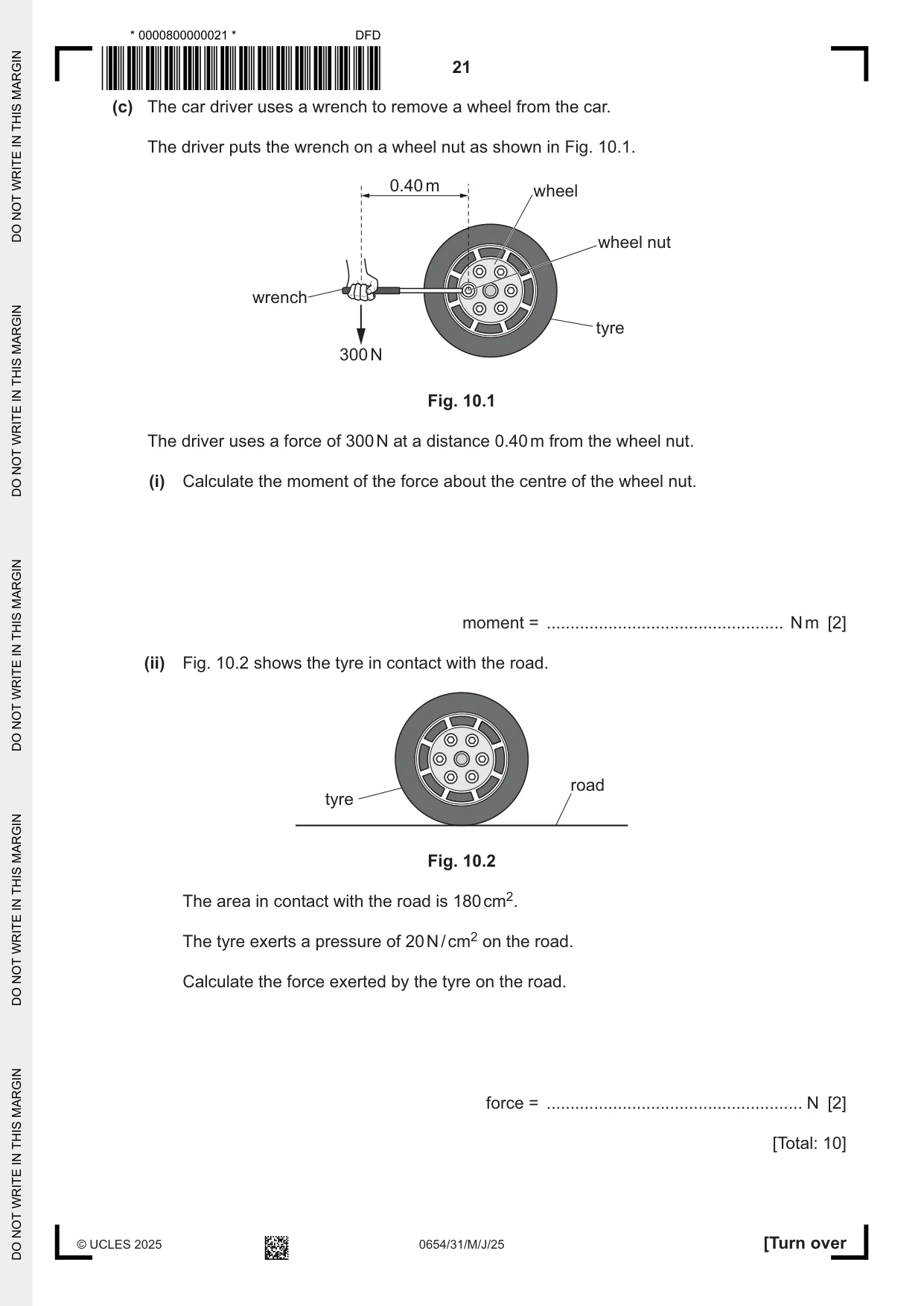
10 (a) The Sun is the closest star to the Earth. (i) State the name of the force that keeps the Earth in orbit around the Sun. ..................................................................................................................................... [1] (ii) State the name of the galaxy which contains the Sun. ..................................................................................................................................... [1] (b) Energy from the Sun is used to power an electric car. The energy is stored in a battery in the car. The battery supplies a current of 96 A at 120 V to the motor that drives the car. (i) Calculate the electrical energy transferred to the motor in 900 s. State the unit of your answer. energy = ........................................... unit .................... [3] (ii) The current supplied by the battery is direct current (d.c.). Describe the difference between direct current (d.c.) and alternating current (a.c.). ........................................................................................................................................... ..................................................................................................................................... [1] (c) The car driver uses a wrench to remove a wheel from the car. The driver puts the wrench on a wheel nut as shown in Fig. 10.1. 0.40 m wheel wheel nut wrench tyre 300 N Fig. 10.1 The driver uses a force of 300 N at a distance 0.40 m from the wheel nut. (i) Calculate the moment of the force about the centre of the wheel nut. moment = .................................................. N m [2] (ii) Fig. 10.2 shows the tyre in contact with the road. road tyre Fig. 10.2 The area in contact with the road is 180 cm2. The tyre exerts a pressure of 20 N / cm2 on the road. Calculate the force exerted by the tyre on the road. force = ...................................................... N [2] [Total: 10]
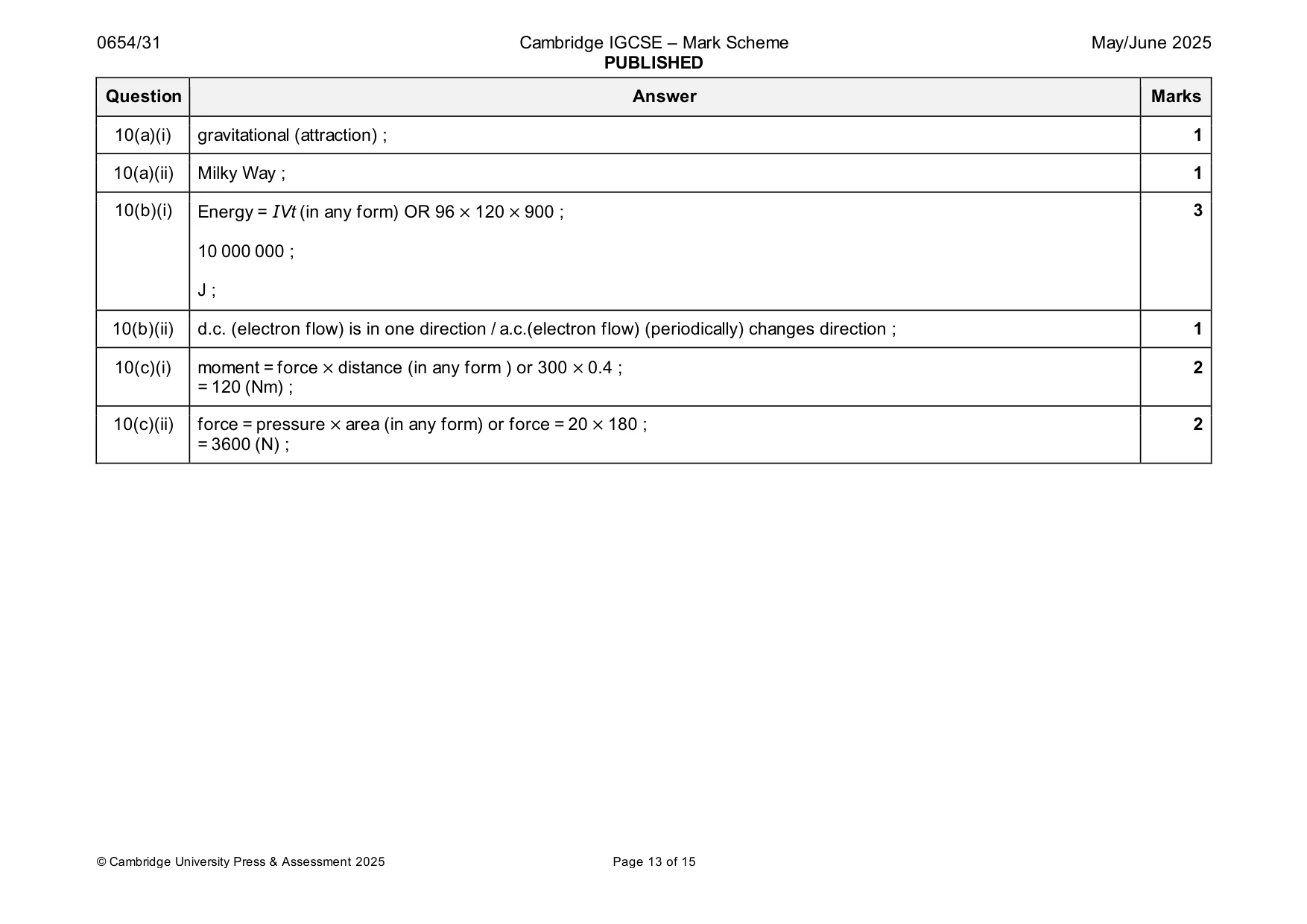
Mark scheme: 10(a)(i) gravitational (attraction) ; 1 10(a)(ii) Milky Way ; 1 10(b)(i) Energy = IVt (in any form) OR 96 × 120 × 900 ; 3 10 000 000 ; J ; 10(b)(ii) d.c. (electron flow) is in one direction / a.c.(electron flow) (periodically) changes direction ; 1 10(c)(i) moment = force × distance (in any form ) or 300 × 0.4 ; 2 = 120 (Nm) ; 10(c)(ii) force = pressure × area (in any form) or force = 20 × 180 ; 2 = 3600 (N) ;
Q11 · A student uses the following equipment to determine the resistance of a lamp
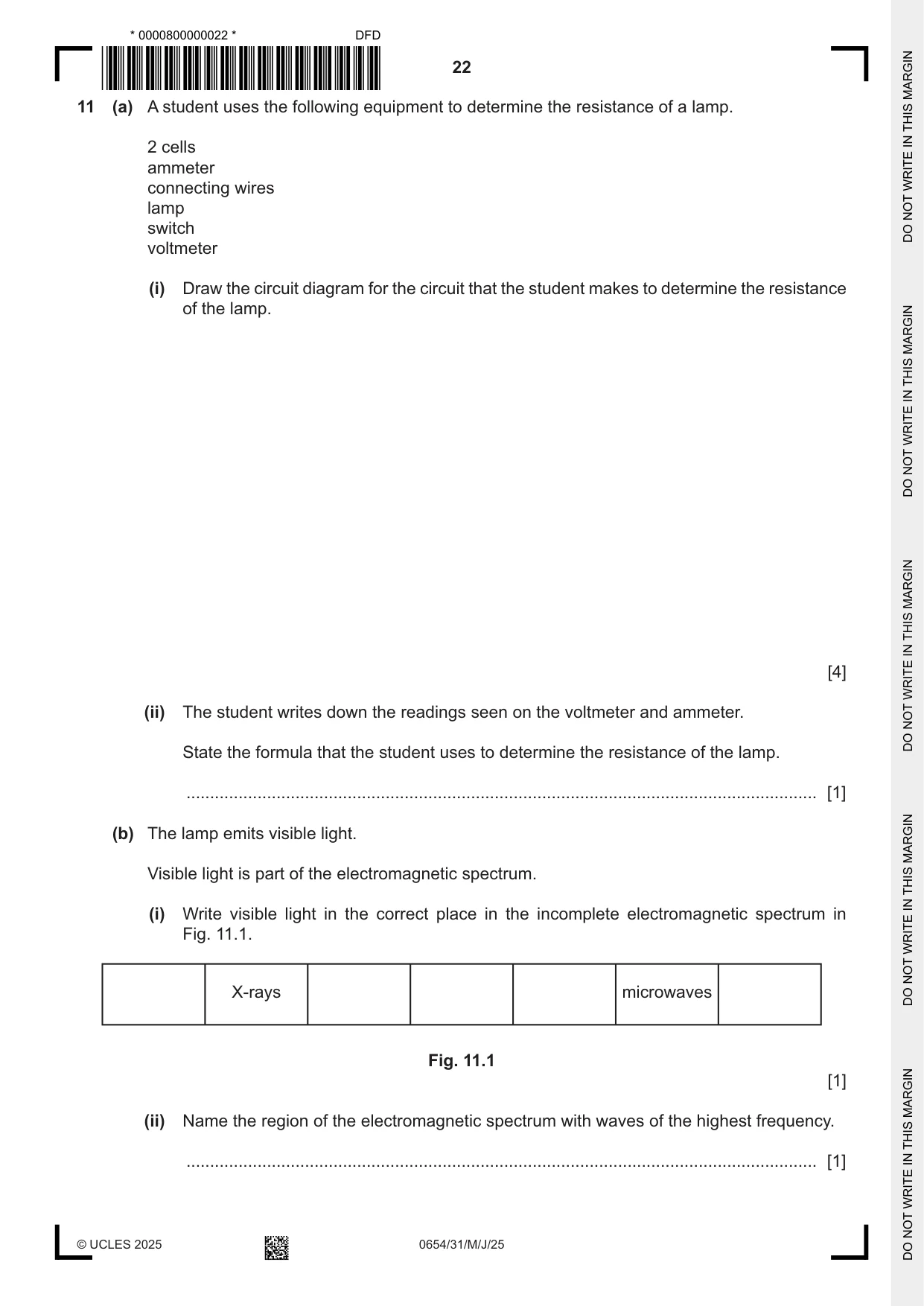
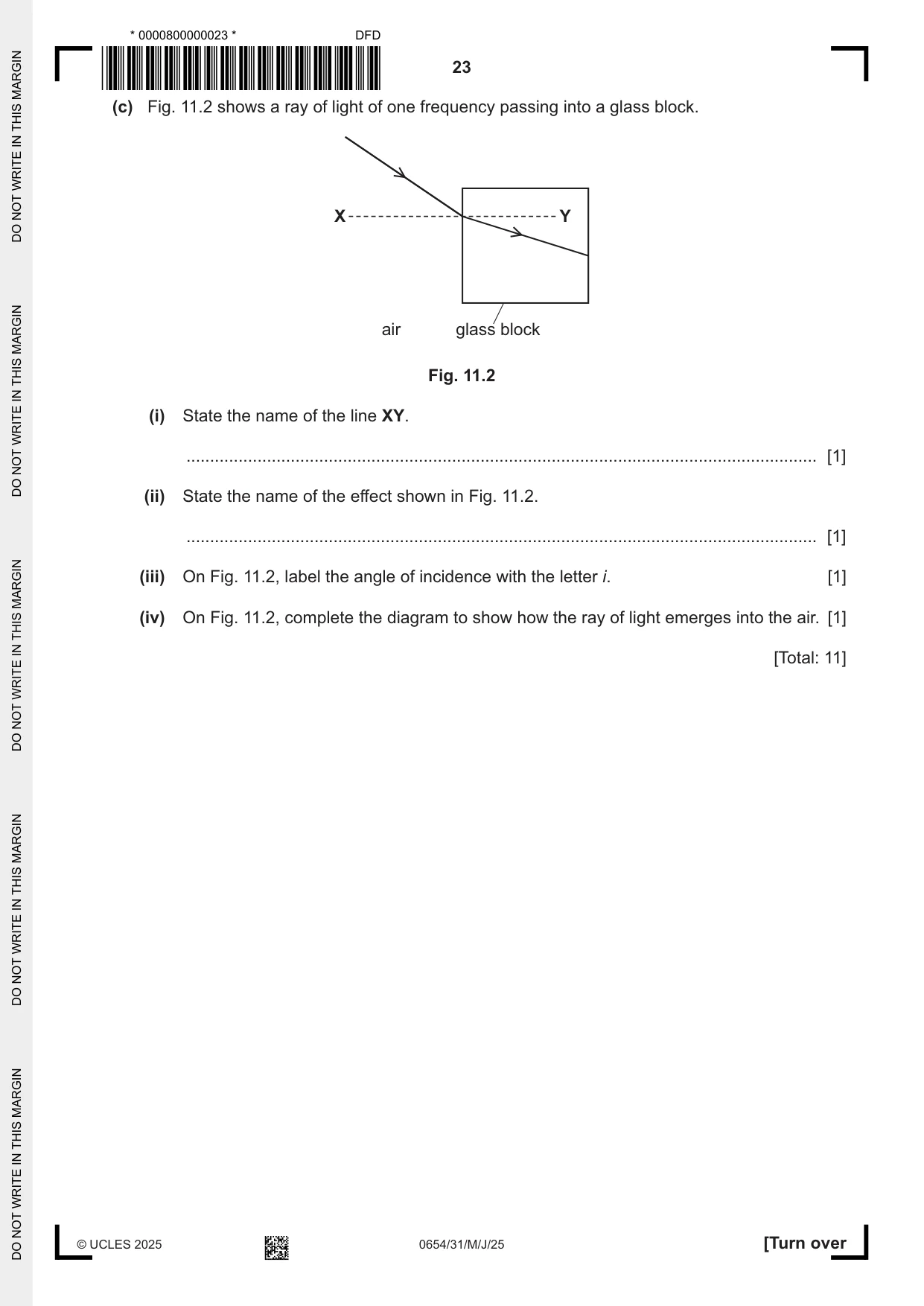
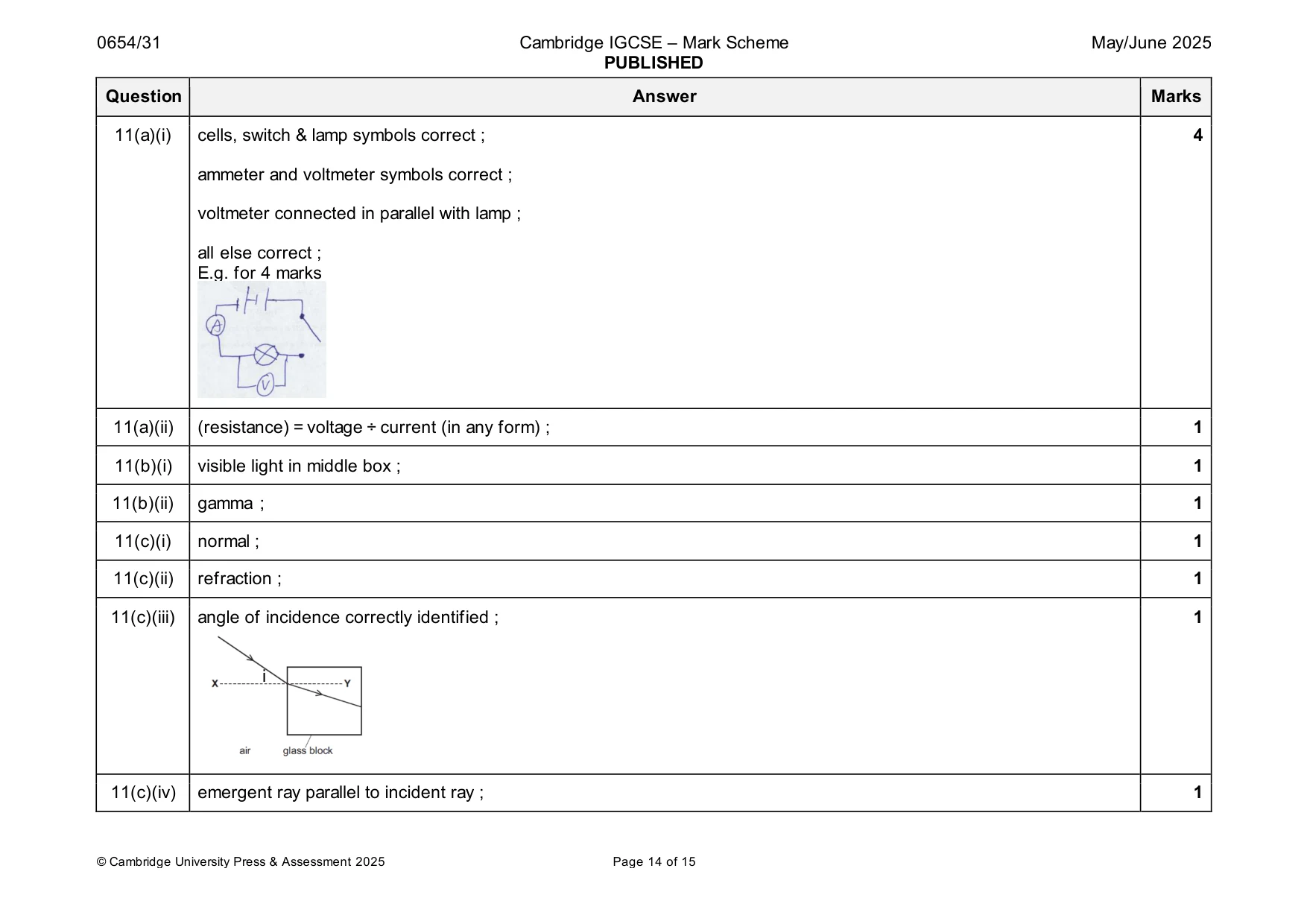
11 (a) A student uses the following equipment to determine the resistance of a lamp. 2 cells ammeter connecting wires lamp switch voltmeter (i) Draw the circuit diagram for the circuit that the student makes to determine the resistance of the lamp. [4] (ii) The student writes down the readings seen on the voltmeter and ammeter. State the formula that the student uses to determine the resistance of the lamp. ..................................................................................................................................... [1] (b) The lamp emits visible light. Visible light is part of the electromagnetic spectrum. (i) Write visible light in the correct place in the incomplete electromagnetic spectrum in Fig. 11.1. X-rays microwaves Fig. 11.1 [1] (ii) Name the region of the electromagnetic spectrum with waves of the highest frequency. ..................................................................................................................................... [1] (c) Fig. 11.2 shows a ray of light of one frequency passing into a glass block. X Y air glass block Fig. 11.2 (i) State the name of the line XY. ..................................................................................................................................... [1] (ii) State the name of the effect shown in Fig. 11.2. ..................................................................................................................................... [1] (iii) On Fig. 11.2, label the angle of incidence with the letter i. [1] (iv) On Fig. 11.2, complete the diagram to show how the ray of light emerges into the air. [1] [Total: 11]
Mark scheme: 11(a)(i) cells, switch & lamp symbols correct ; 4 ammeter and voltmeter symbols correct ; voltmeter connected in parallel with lamp ; all else correct ; E.g. for 4 marks 11(a)(ii) (resistance) = voltage ÷ current (in any form) ; 1 11(b)(i) visible light in middle box ; 1 11(b)(ii) gamma ; 1 11(c)(i) normal ; 1 11(c)(ii) refraction ; 1 11(c)(iii) angle of incidence correctly identified ; 1 i 11(c)(iv) emergent ray parallel to incident ray ; 1
Q12 · A climber climbs to the top of a rock face
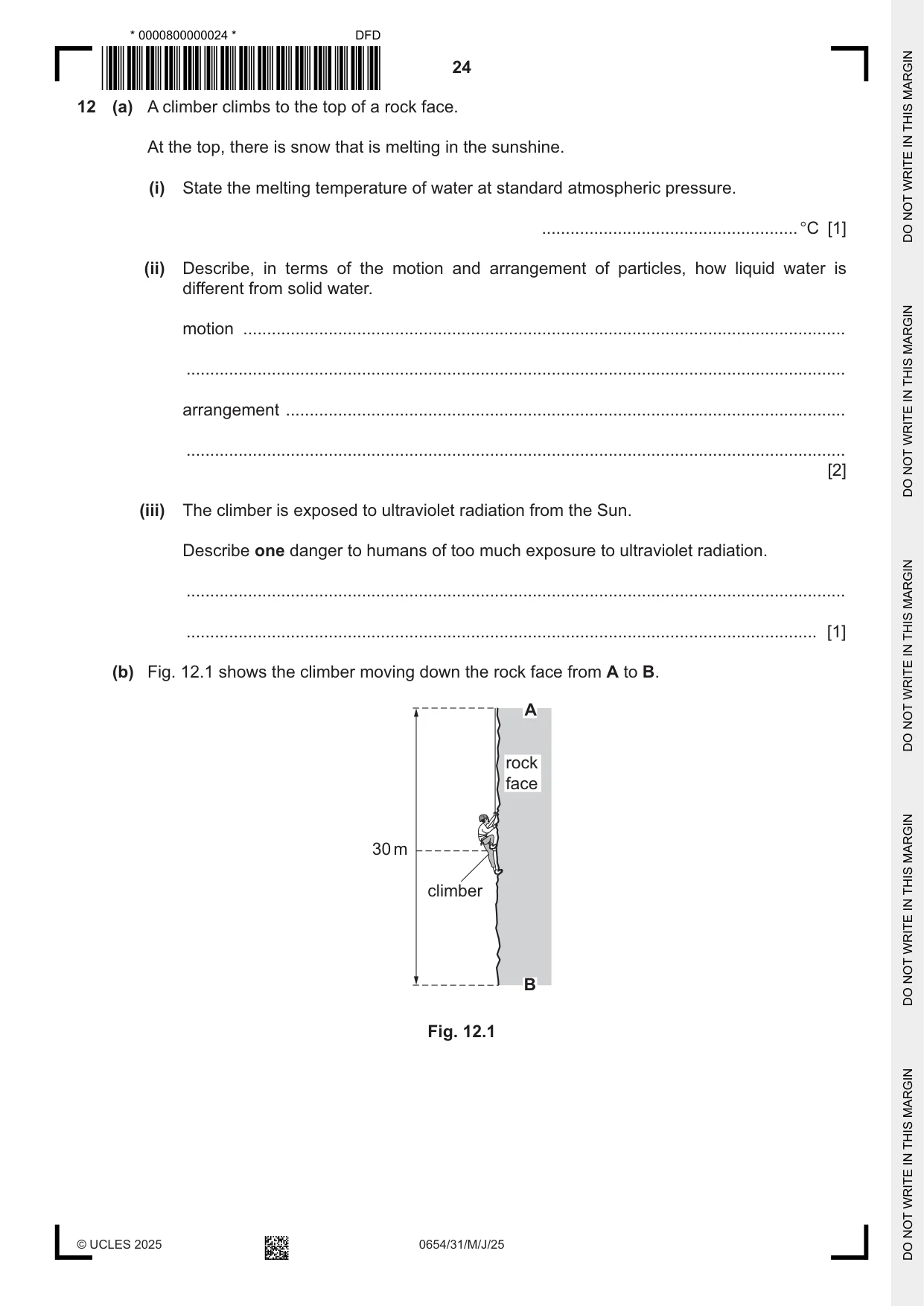
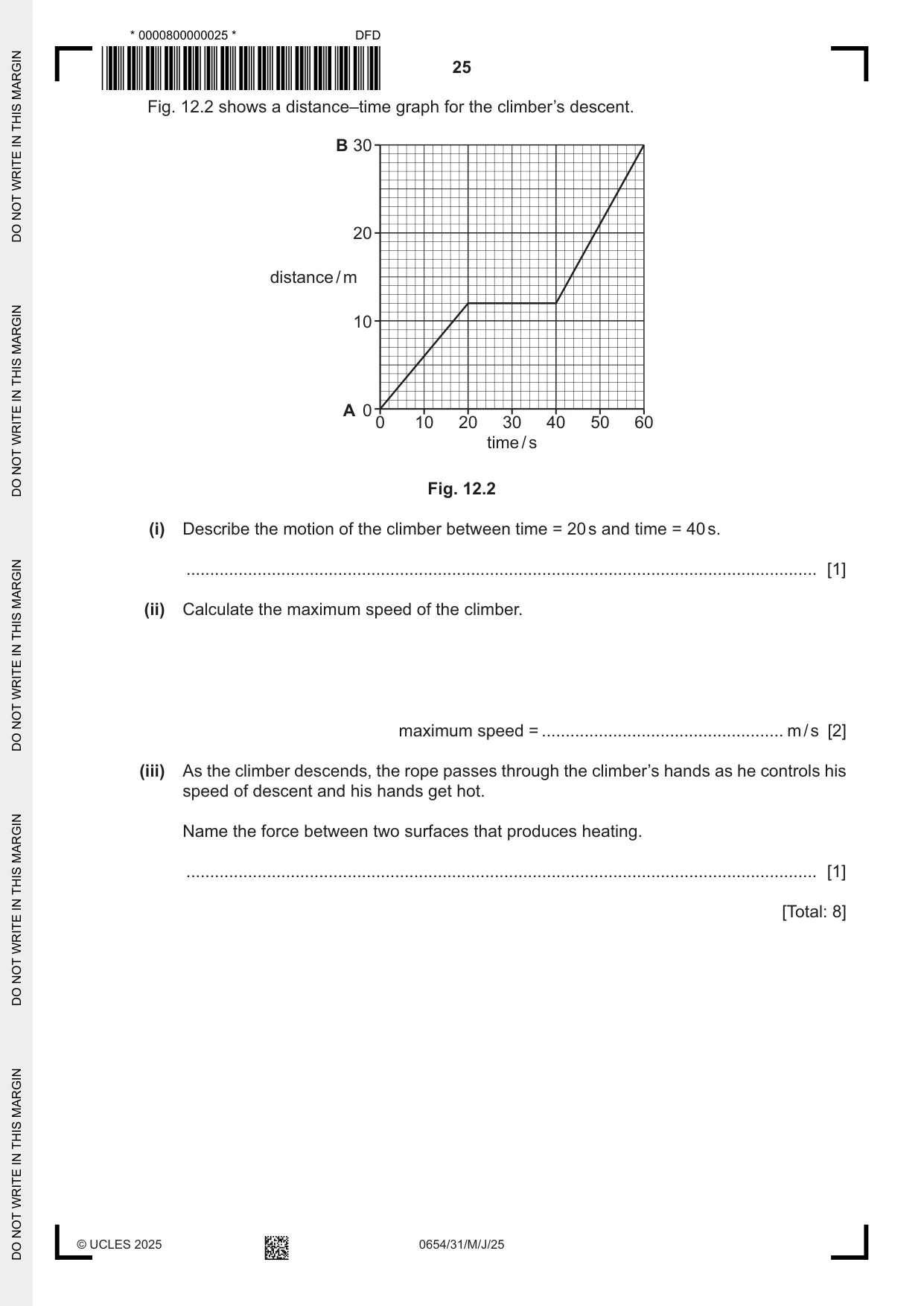
12 (a) A climber climbs to the top of a rock face. At the top, there is snow that is melting in the sunshine. (i) State the melting temperature of water at standard atmospheric pressure. ...................................................... °C [1] (ii) Describe, in terms of the motion and arrangement of particles, how liquid water is different from solid water. motion ............................................................................................................................... ........................................................................................................................................... arrangement ...................................................................................................................... ........................................................................................................................................... [2] (iii) The climber is exposed to ultraviolet radiation from the Sun. Describe one danger to humans of too much exposure to ultraviolet radiation. ........................................................................................................................................... ..................................................................................................................................... [1] (b) Fig. 12.1 shows the climber moving down the rock face from A to B. A rock face 30 m climber B Fig. 12.1 Fig. 12.2 shows a distance–time graph for the climber’s descent. B 30 20 distance / m 10 A 0 0 10 20 30 40 50 60 time / s Fig. 12.2 (i) Describe the motion of the climber between time = 20 s and time = 40 s. ..................................................................................................................................... [1] (ii) Calculate the maximum speed of the climber. maximum speed = ................................................... m / s [2] (iii) As the climber descends, the rope passes through the climber’s hands as he controls his speed of descent and his hands get hot. Name the force between two surfaces that produces heating. ..................................................................................................................................... [1] [Total: 8]
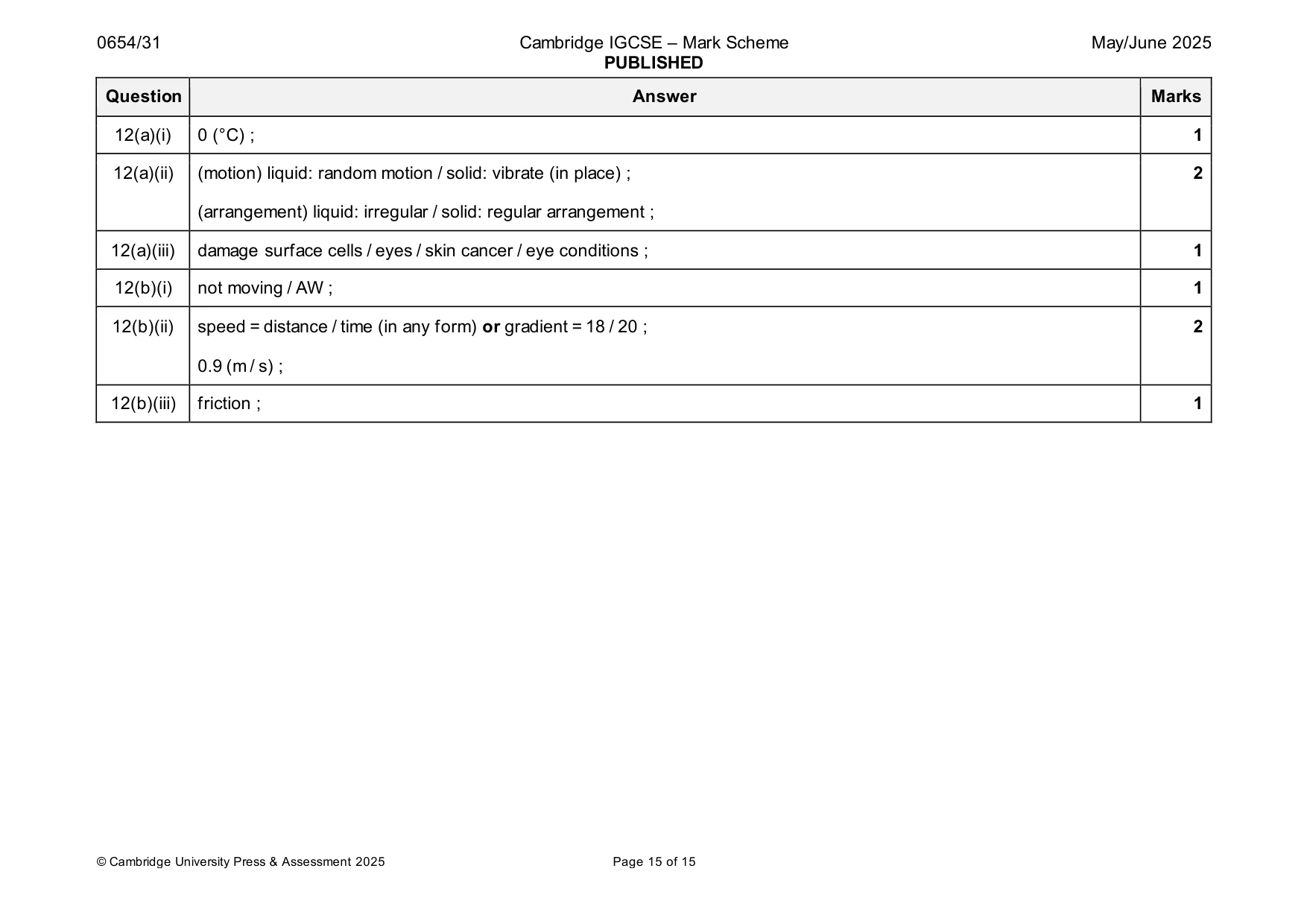
Mark scheme: 12(a)(i) 0 (°C) ; 1 12(a)(ii) (motion) liquid: random motion / solid: vibrate (in place) ; 2 (arrangement) liquid: irregular / solid: regular arrangement ; 12(a)(iii) damage surface cells / eyes / skin cancer / eye conditions ; 1 12(b)(i) not moving / AW ; 1 12(b)(ii) speed = distance / time (in any form) or gradient = 18 / 20 ; 2 0.9 (m / s) ; 12(b)(iii) friction ; 1
What was in this paper
The subtopics covered by these 12 questions, and how many questions each got. Open one in a new tab to see every Cambridge question on it.
What you needed in this session
Cambridge’s own grade thresholds for 2025 May/June, Paper 3 · Variant 1. A higher threshold means an easier paper — the bar moves with how the cohort did.