Cambridge IGCSE Sciences - Co-ordinated (Double) 0654 — 2020 May/June Paper 3 · Variant 1
0654/31/M/J/20 · 12 questions · 120 marks · ≈135 min
The question paper and its mark scheme, free to read here and free to download. This is Cambridge’s own paper, exactly as it was sat.
Question paper32 pages

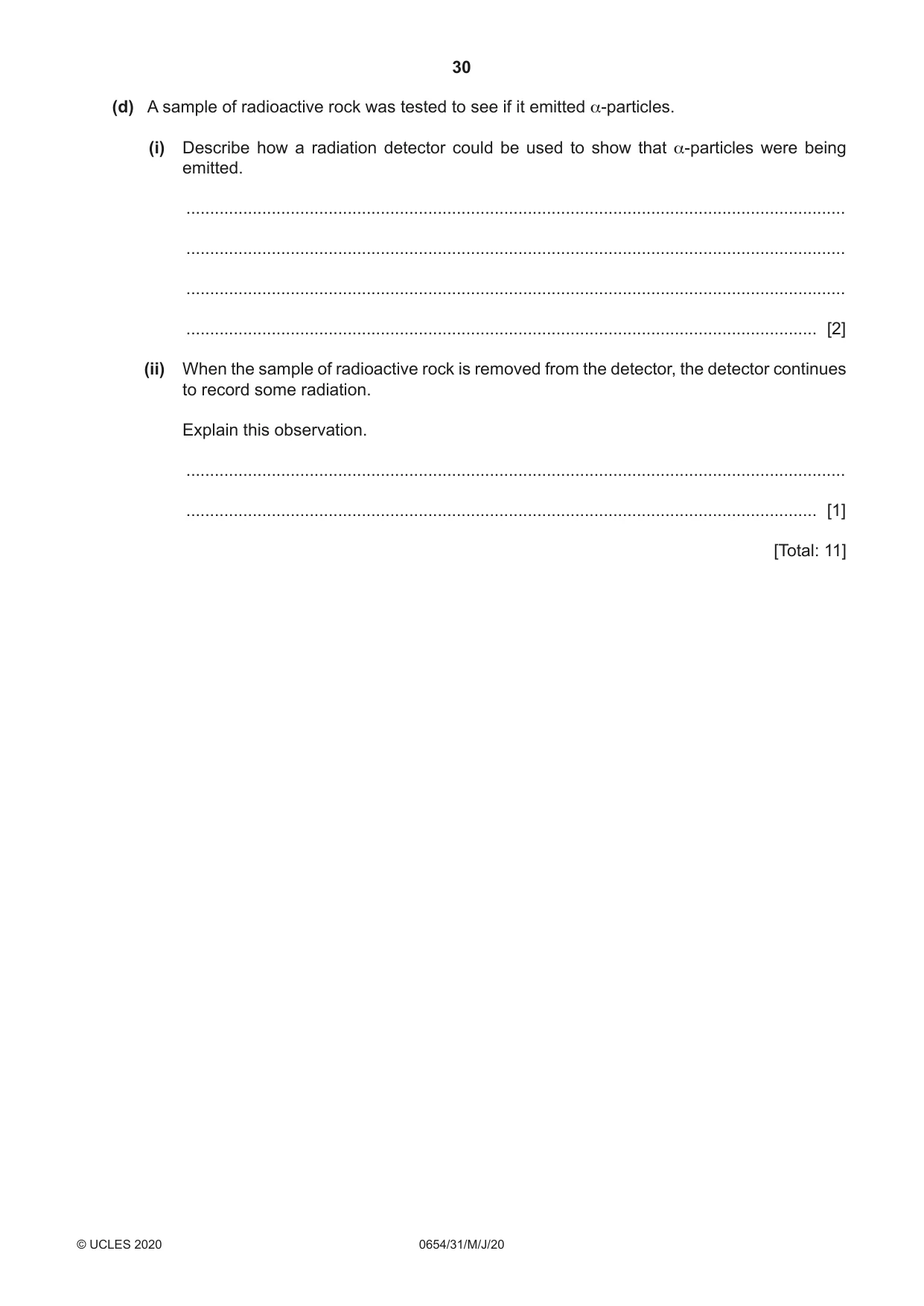

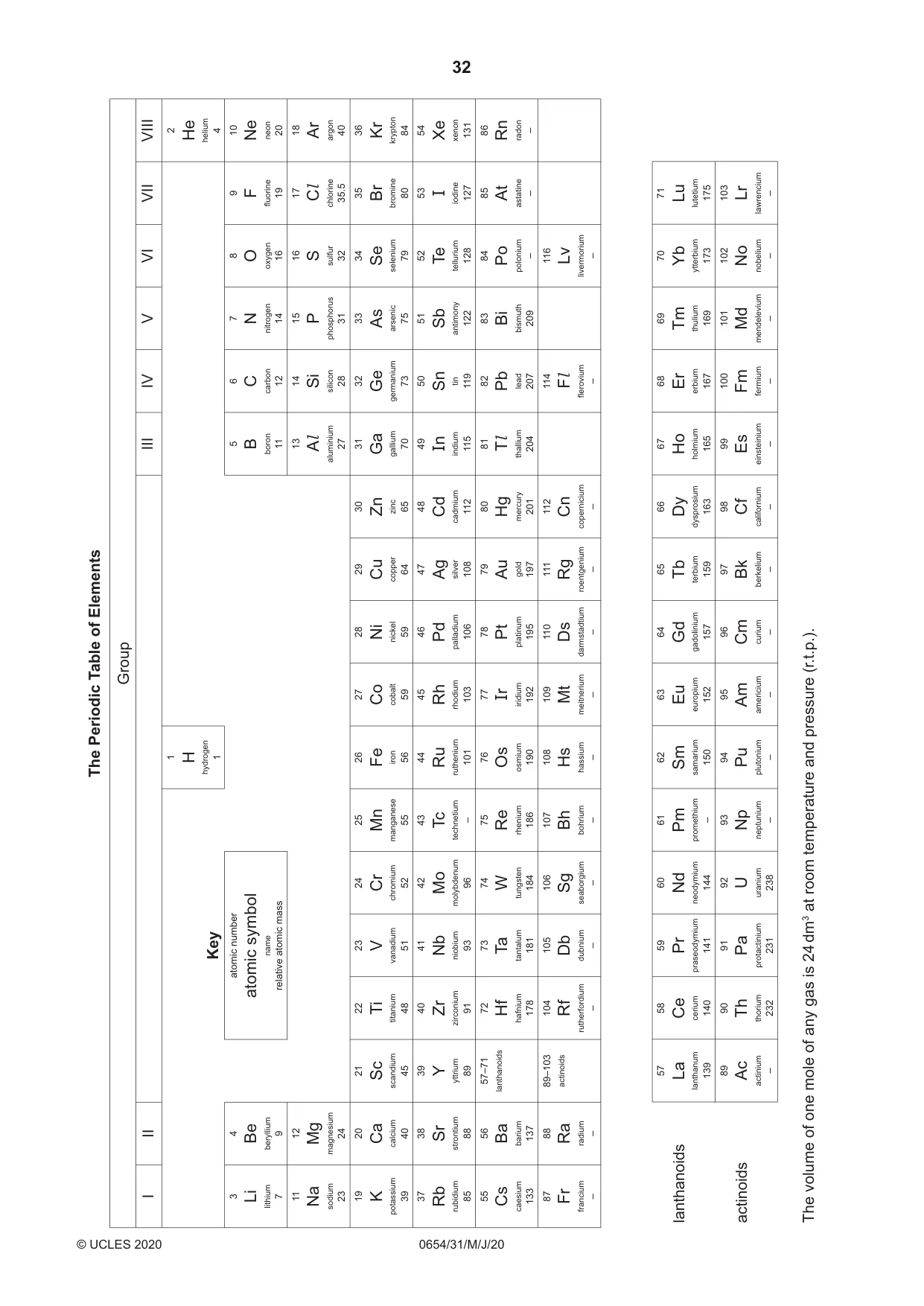
Mark scheme13 pages
Answers below. Sit the paper first if you are practising.
Questions as text
Q1 · A diagram of the human female reproductive system
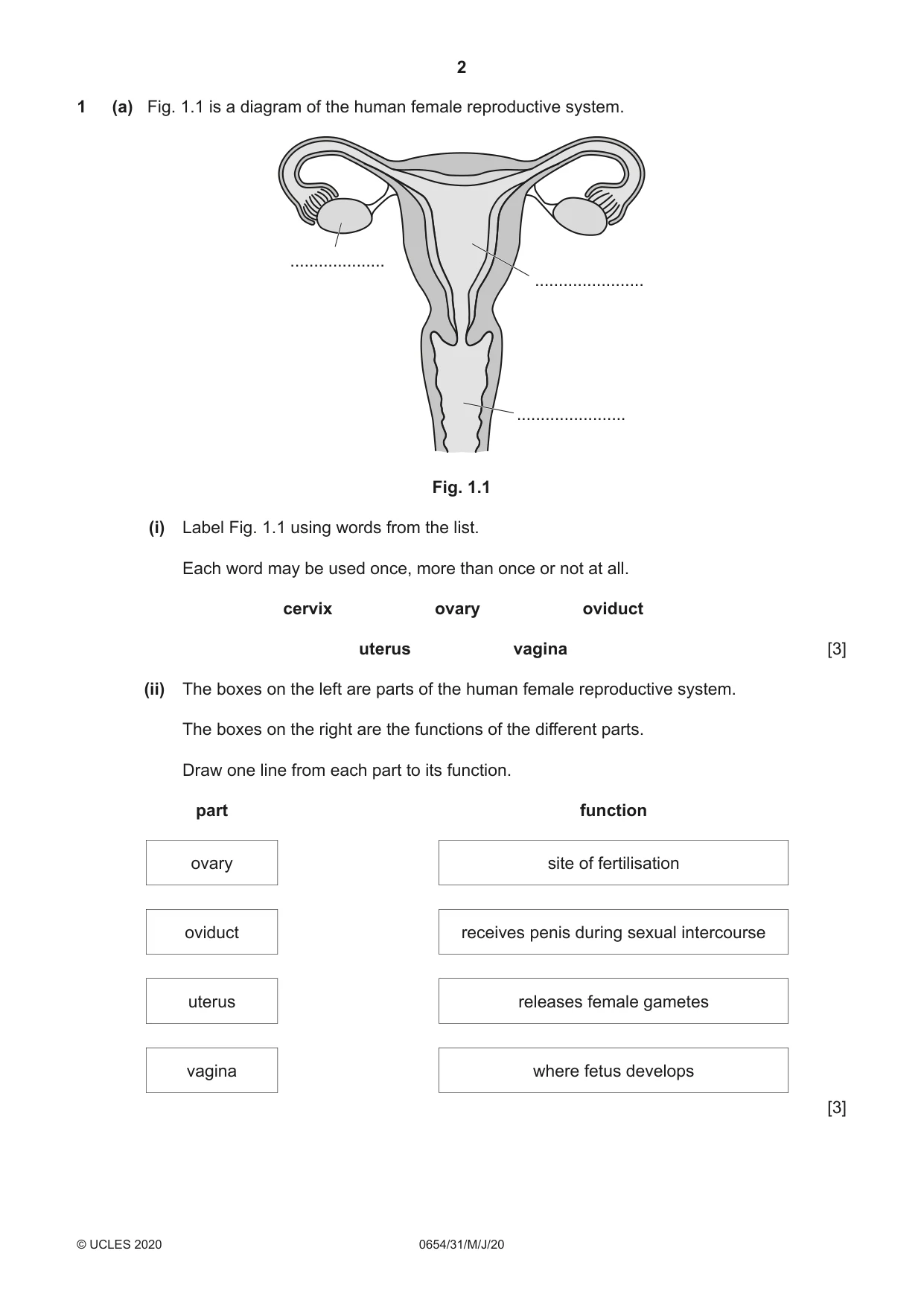
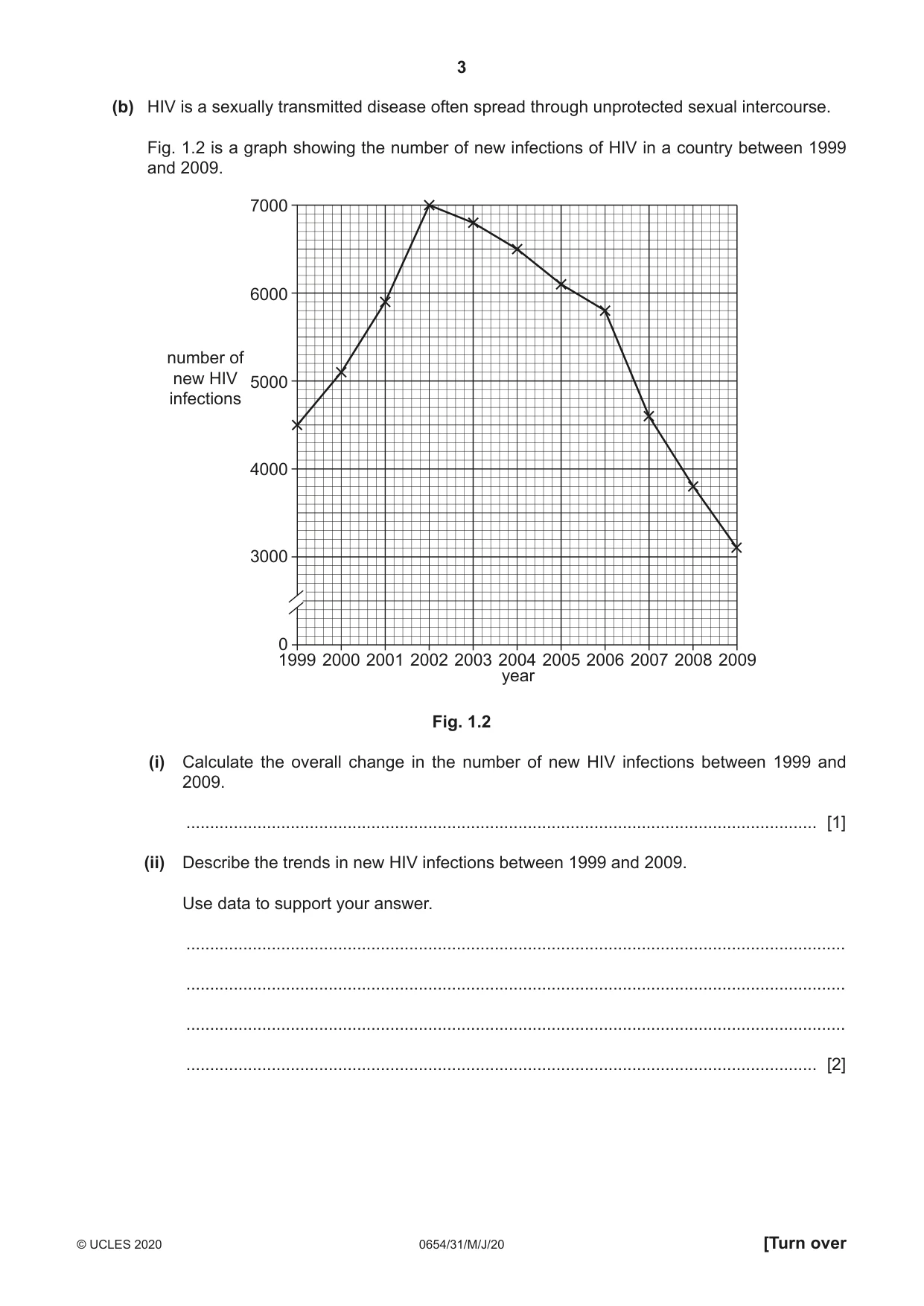
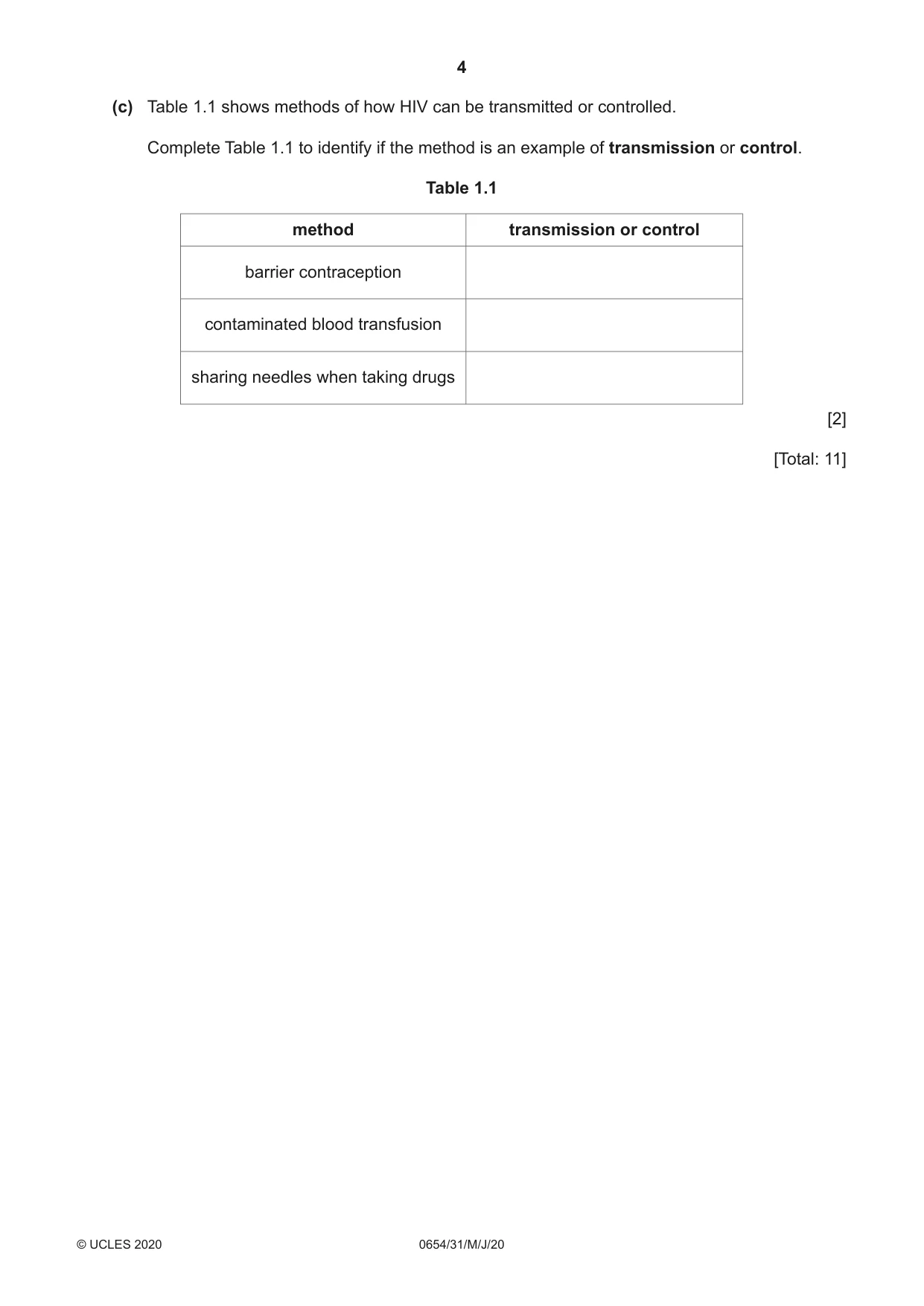
1 (a) Fig. 1.1 is a diagram of the human female reproductive system. .................... ....................... ....................... Fig. 1.1 (i) Label Fig. 1.1 using words from the list. Each word may be used once, more than once or not at all. cervix ovary oviduct uterus vagina [3] (ii) The boxes on the left are parts of the human female reproductive system. The boxes on the right are the functions of the different parts. Draw one line from each part to its function. part function ovary site of fertilisation oviduct receives penis during sexual intercourse uterus releases female gametes vagina where fetus develops [3] (b) HIV is a sexually transmitted disease often spread through unprotected sexual intercourse. Fig. 1.2 is a graph showing the number of new infections of HIV in a country between 1999 and 2009. 7000 6000 number of new HIV 5000 infections 4000 3000 0 1999 2000 2001 2002 2003 2004 2005 2006 2007 2008 2009 year Fig. 1.2 (i) Calculate the overall change in the number of new HIV infections between 1999 and 2009. ..................................................................................................................................... [1] (ii) Describe the trends in new HIV infections between 1999 and 2009. Use data to support your answer. ........................................................................................................................................... ........................................................................................................................................... ........................................................................................................................................... ..................................................................................................................................... [2] (c) Table 1.1 shows methods of how HIV can be transmitted or controlled. Complete Table 1.1 to identify if the method is an example of transmission or control. Table 1.1 method transmission or control barrier contraception contaminated blood transfusion sharing needles when taking drugs [2] [Total: 11]
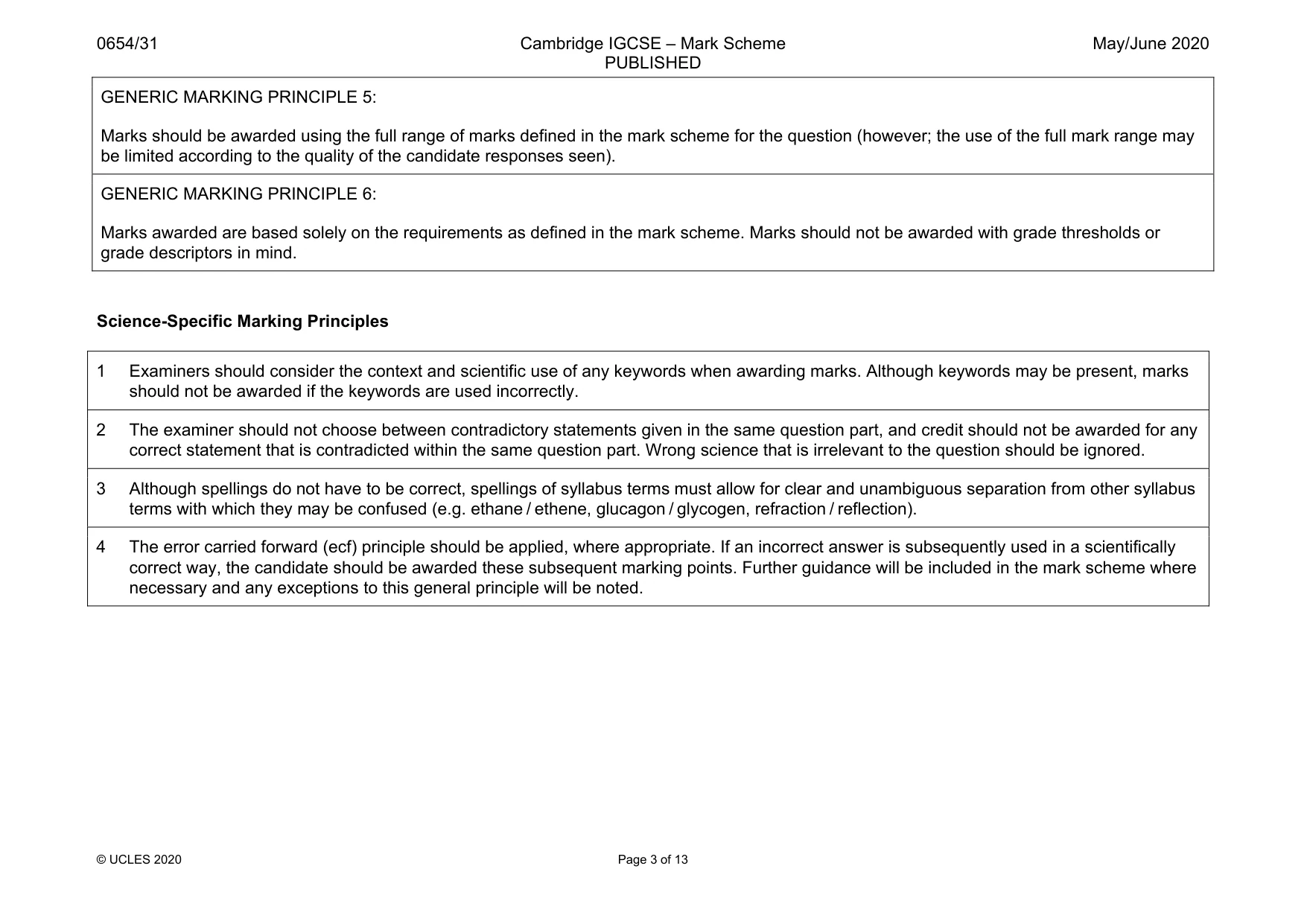
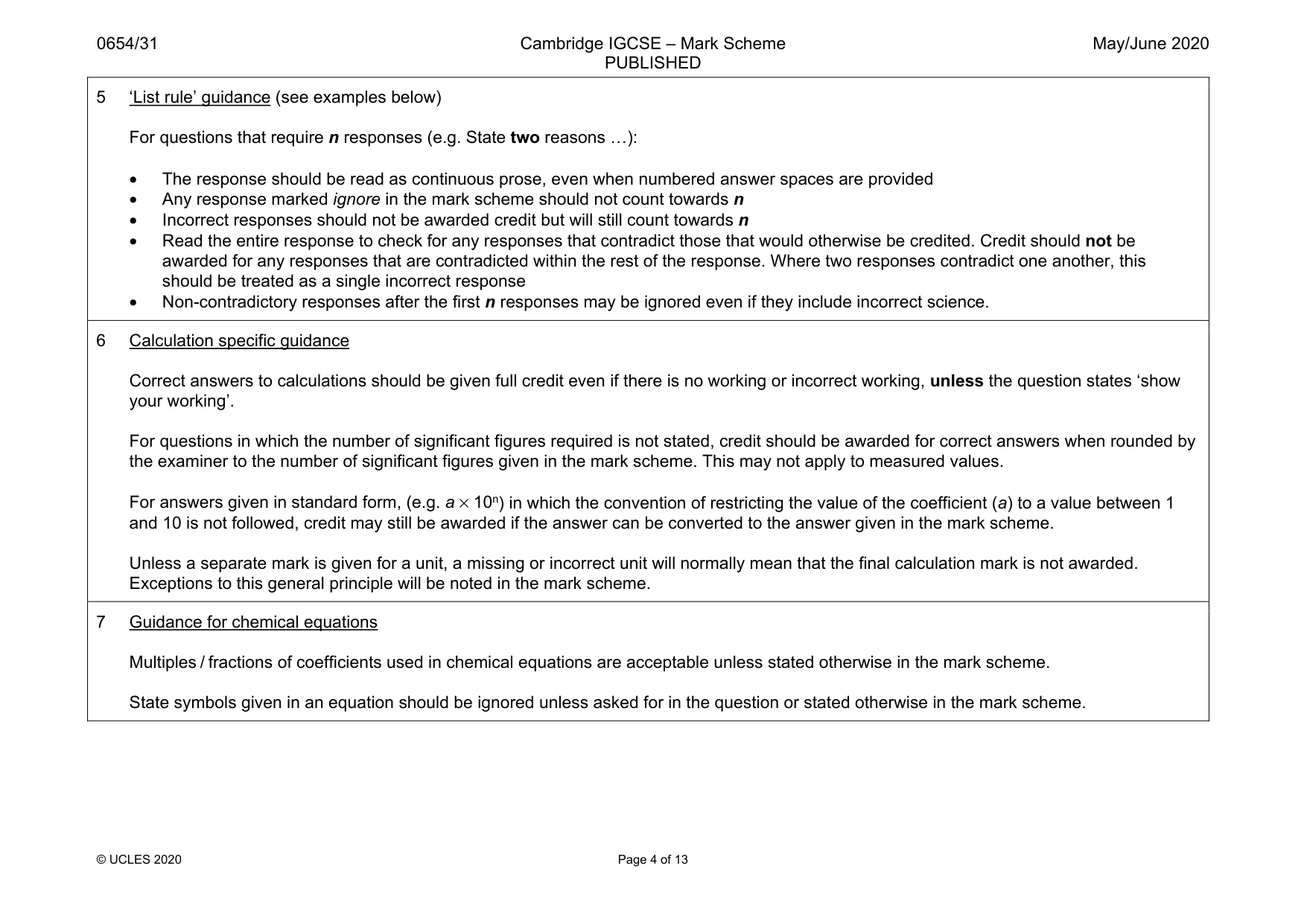
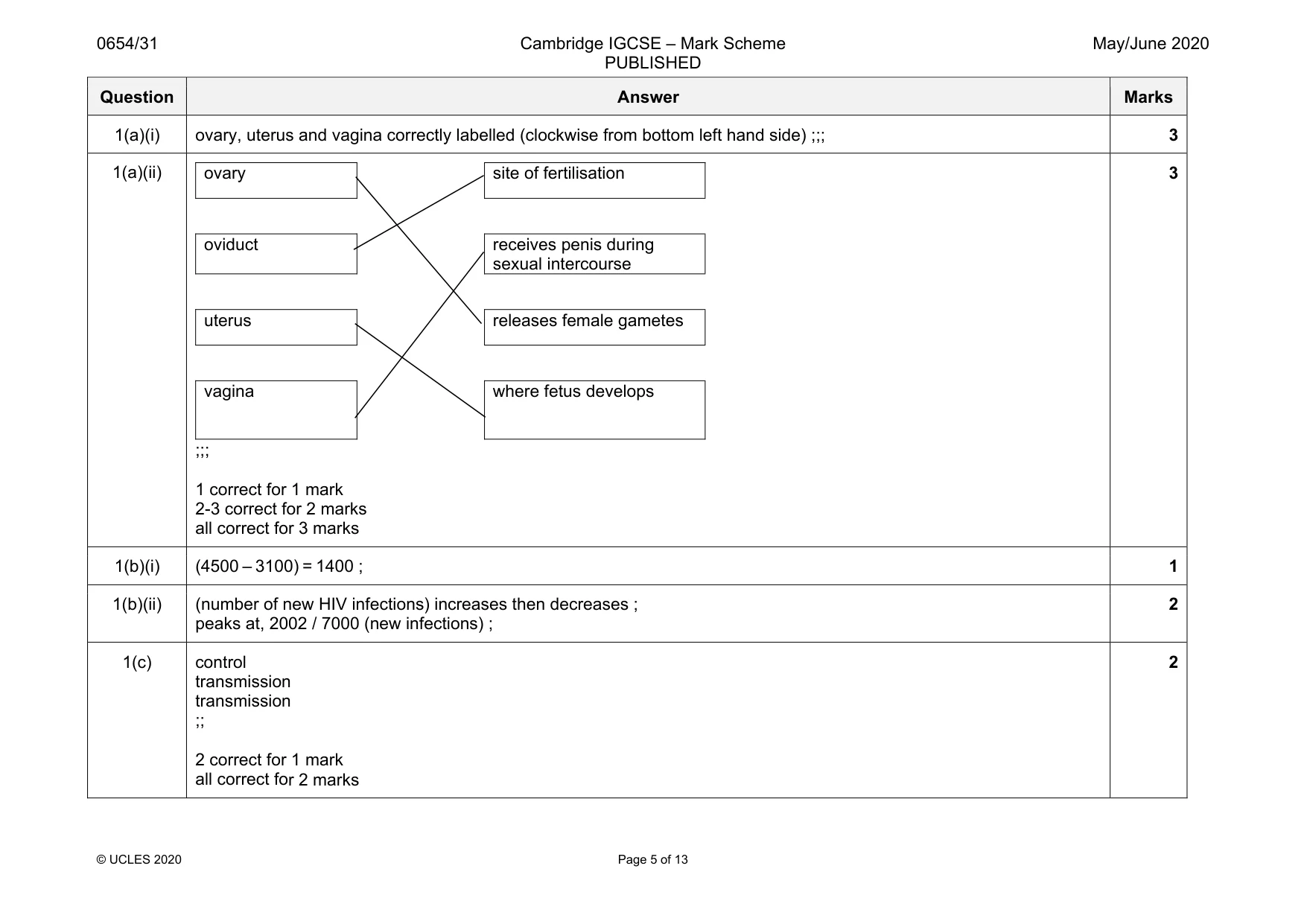
Mark scheme: 1(a)(i) ovary, uterus and vagina correctly labelled (clockwise from bottom left hand side) ;;; 3 1(a)(ii) ovary site of fertilisation oviduct receives penis during sexual intercourse uterus releases female gametes vagina where fetus develops ;;; 1 correct for 1 mark 2-3 correct for 2 marks all correct for 3 marks 3 1(b)(i) (4500 – 3100) = 1400 ; 1 1(b)(ii) (number of new HIV infections) increases then decreases ; peaks at, 2002 / 7000 (new infections) ; 2 1(c) control transmission transmission ;; 2 correct for 1 mark all correct for 2 marks 2
Q2 · The diagram in Fig
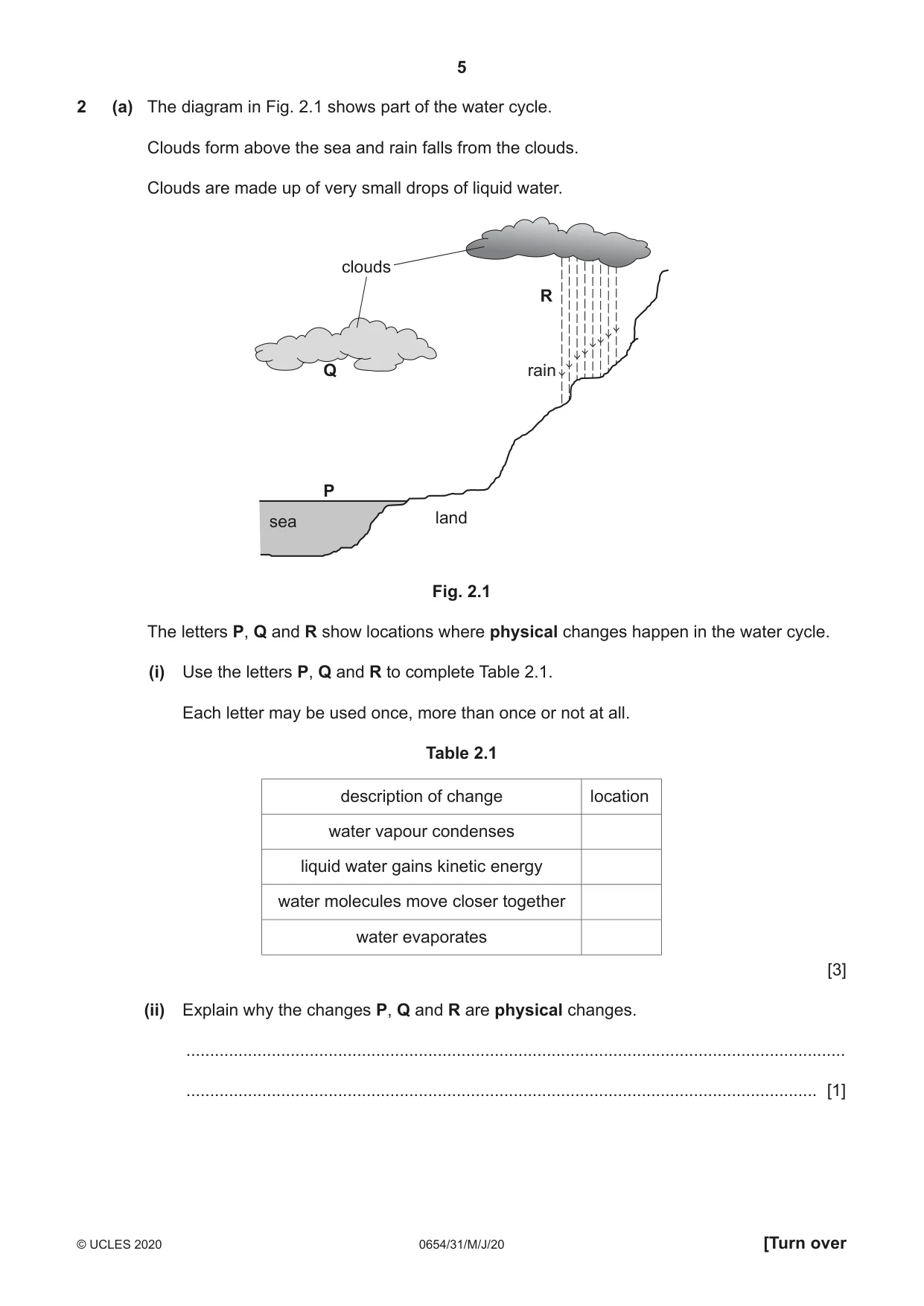
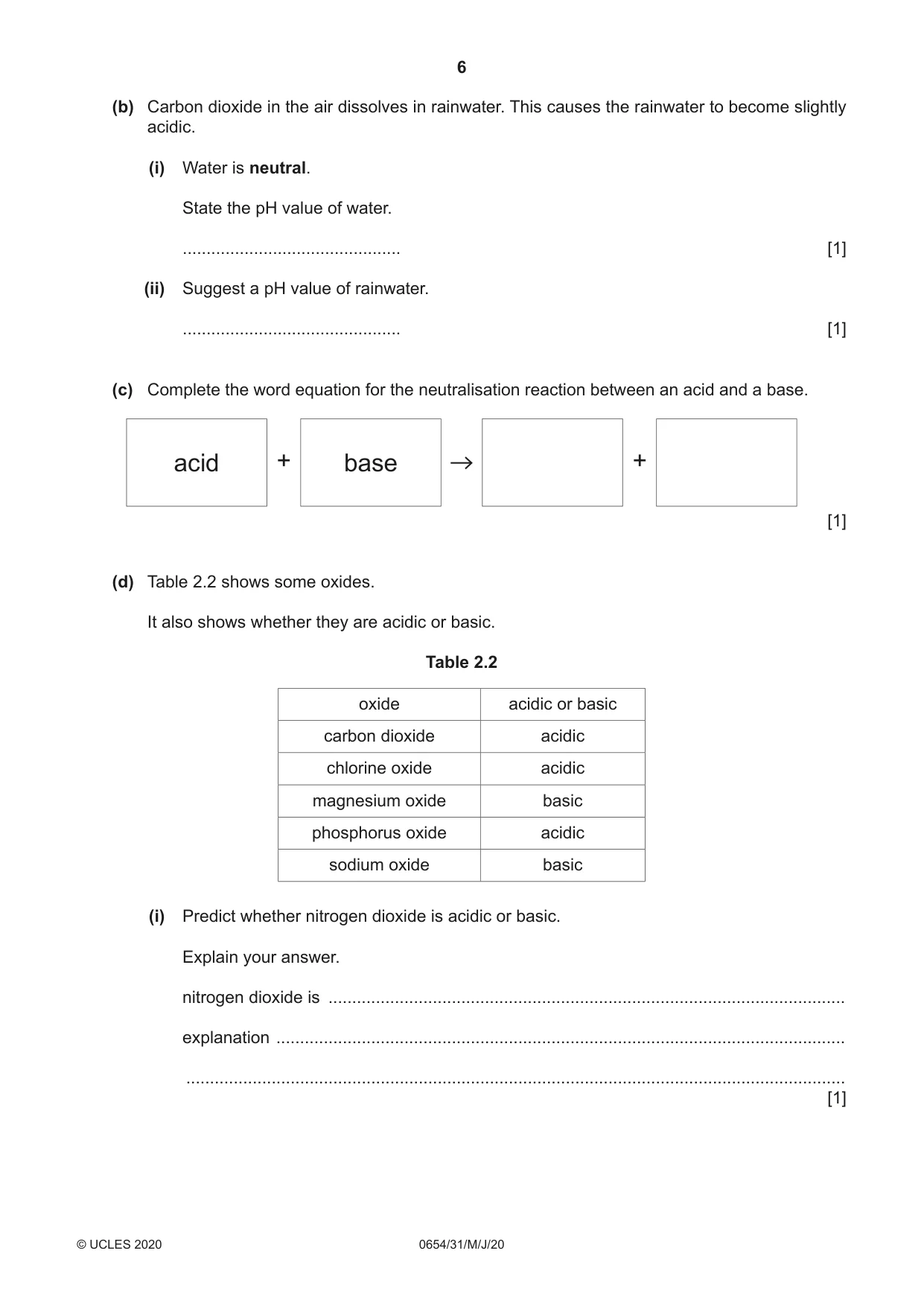
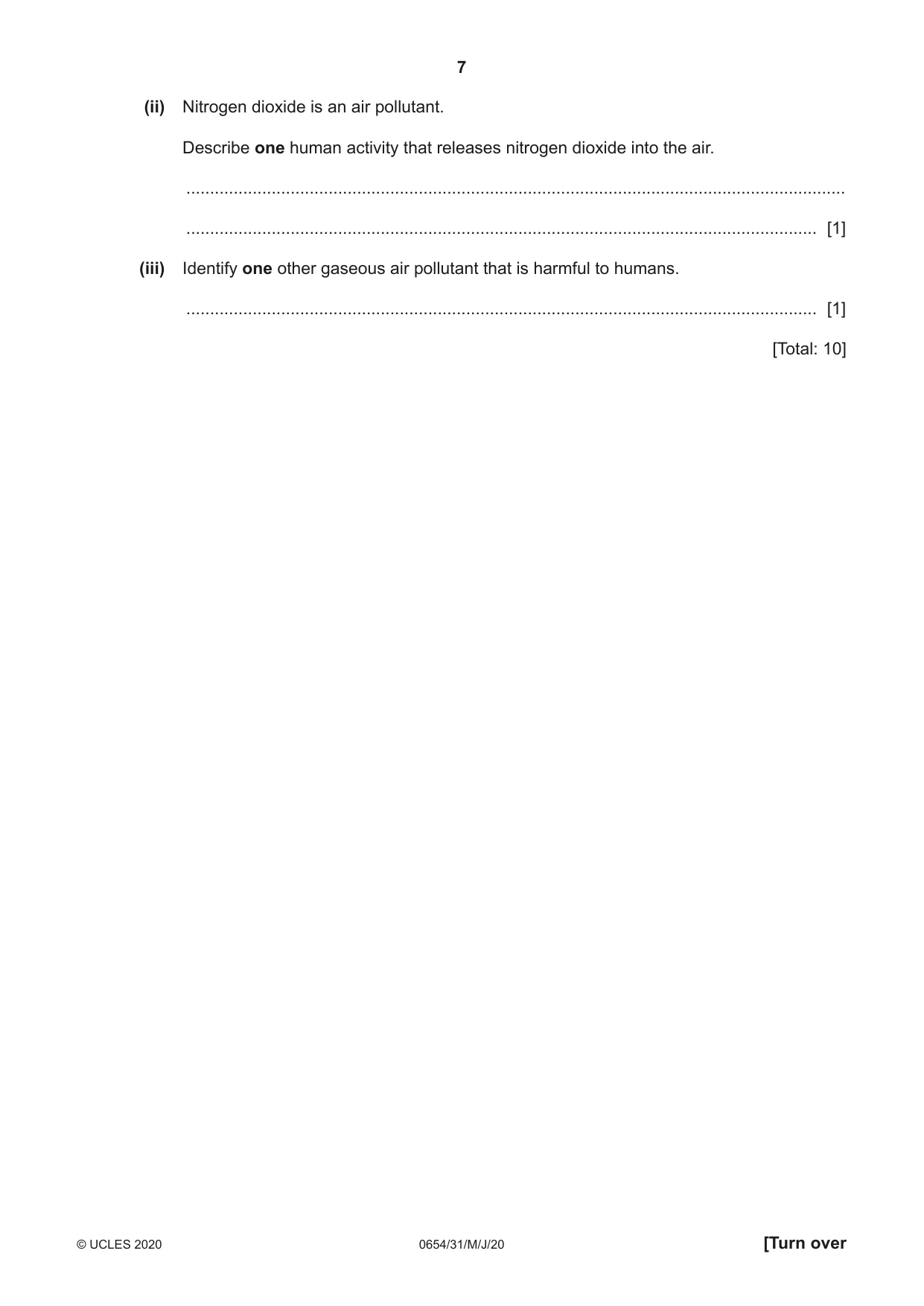
2 (a) The diagram in Fig. 2.1 shows part of the water cycle. Clouds form above the sea and rain falls from the clouds. Clouds are made up of very small drops of liquid water. clouds R Q rain P sea land Fig. 2.1 The letters P, Q and R show locations where physical changes happen in the water cycle. (i) Use the letters P, Q and R to complete Table 2.1. Each letter may be used once, more than once or not at all. Table 2.1 description of change location water vapour condenses liquid water gains kinetic energy water molecules move closer together water evaporates [3] (ii) Explain why the changes P, Q and R are physical changes. ........................................................................................................................................... ..................................................................................................................................... [1] (b) Carbon dioxide in the air dissolves in rainwater. This causes the rainwater to become slightly acidic. (i) Water is neutral. State the pH value of water. .............................................. [1] (ii) Suggest a pH value of rainwater. .............................................. [1] (c) Complete the word equation for the neutralisation reaction between an acid and a base. acid + base + [1] (d) Table 2.2 shows some oxides. It also shows whether they are acidic or basic. Table 2.2 oxide acidic or basic carbon dioxide acidic chlorine oxide acidic magnesium oxide basic phosphorus oxide acidic sodium oxide basic (i) Predict whether nitrogen dioxide is acidic or basic. Explain your answer. nitrogen dioxide is ............................................................................................................. explanation ........................................................................................................................ ........................................................................................................................................... [1] (ii) Nitrogen dioxide is an air pollutant. Describe one human activity that releases nitrogen dioxide into the air. ........................................................................................................................................... ..................................................................................................................................... [1] (iii) Identify one other gaseous air pollutant that is harmful to humans. ..................................................................................................................................... [1] [Total: 10]
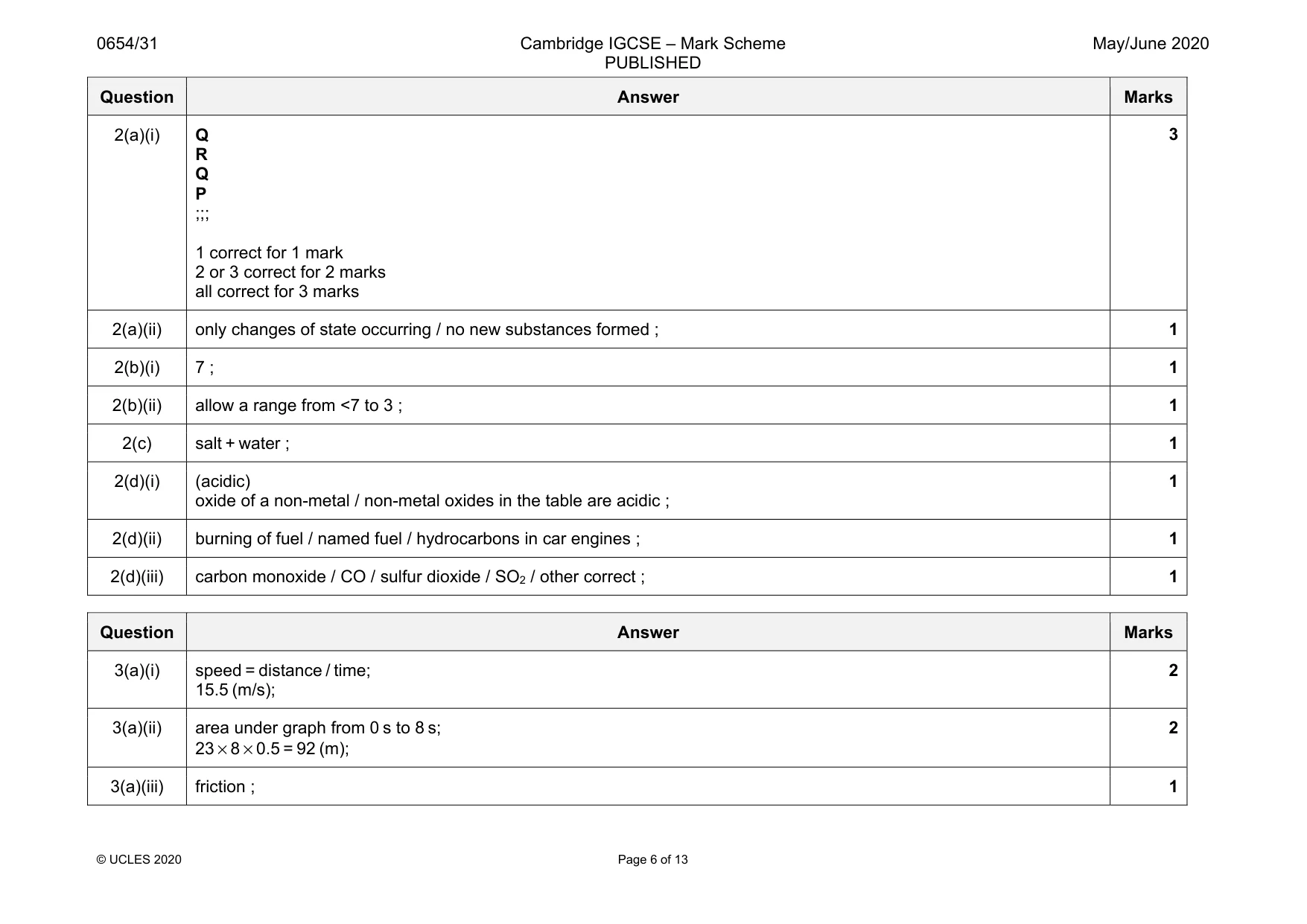
Mark scheme: 2(a)(i) Q R Q P ;;; 1 correct for 1 mark 2 or 3 correct for 2 marks all correct for 3 marks 2(a)(ii) only changes of state occurring / no new substances formed ; 1 2(b)(i) 7 ; 1 2(b)(ii) allow a range from <7 to 3 ; 1 2(c) salt + water ; 1 2(d)(i) (acidic) oxide of a non-metal / non-metal oxides in the table are acidic ; 1 2(d)(ii) burning of fuel / named fuel / hydrocarbons in car engines ; 1 2(d)(iii) carbon monoxide / CO / sulfur dioxide / SO2 / other correct ; 1
Q3 · A skier at the top of a slope
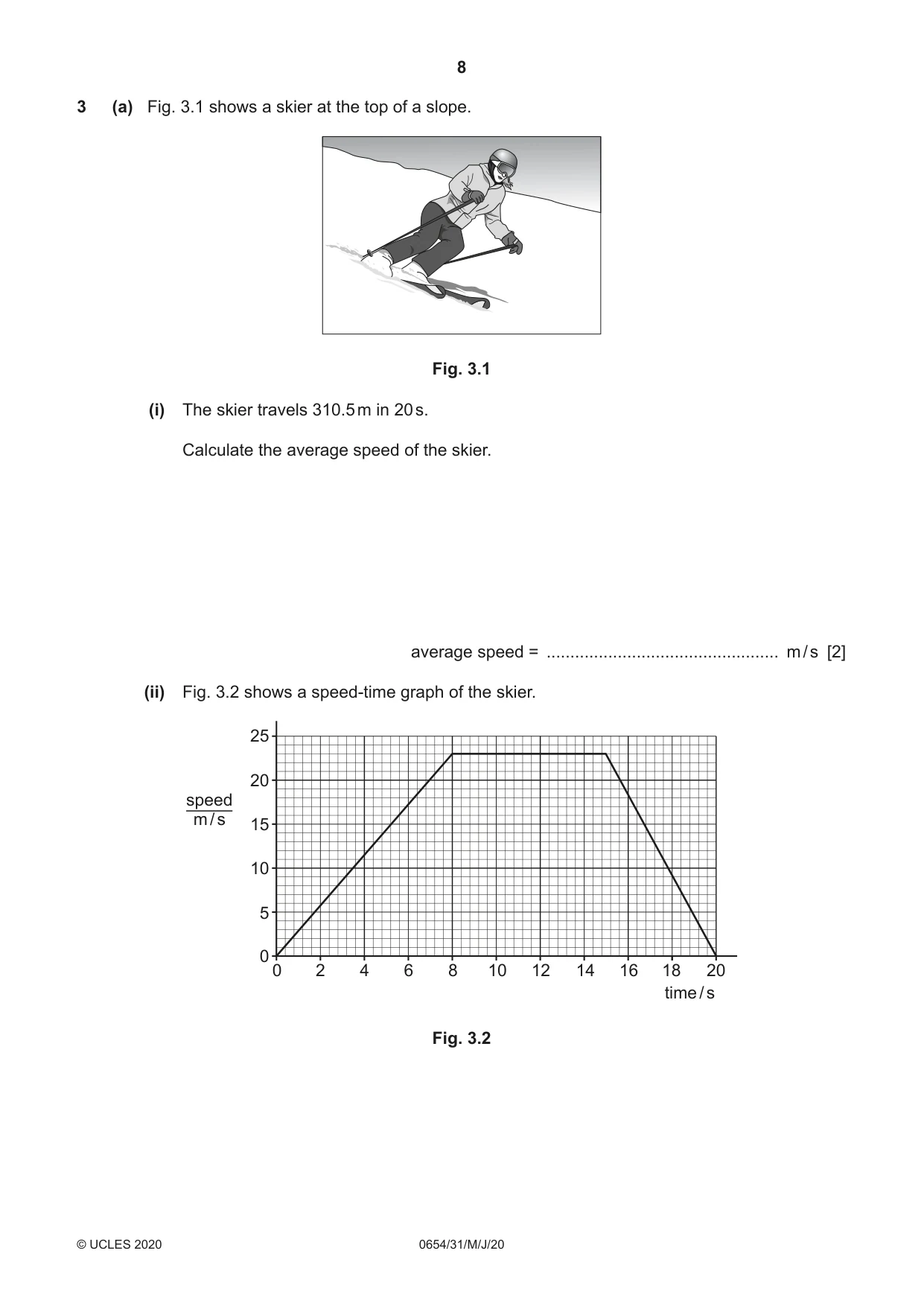
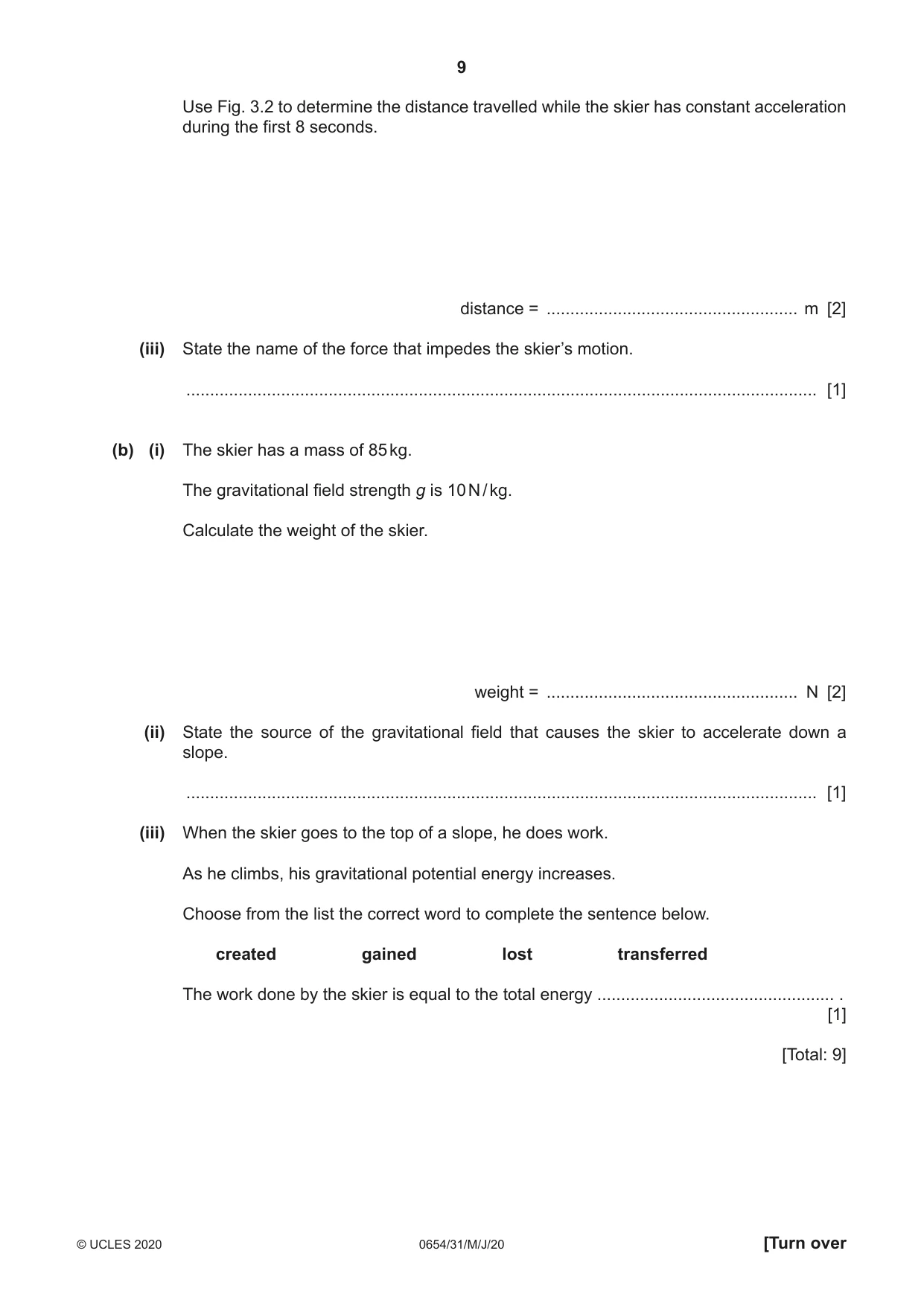
3 (a) Fig. 3.1 shows a skier at the top of a slope. Fig. 3.1 (i) The skier travels 310.5 m in 20 s. Calculate the average speed of the skier. average speed = ................................................. m / s [2] (ii) Fig. 3.2 shows a speed-time graph of the skier. 25 20 speed m / s 15 10 5 0 0 2 4 6 8 10 12 14 16 18 20 time / s Fig. 3.2 Use Fig. 3.2 to determine the distance travelled while the skier has constant acceleration during the first 8 seconds. distance = ..................................................... m [2] (iii) State the name of the force that impedes the skier’s motion. ..................................................................................................................................... [1] (b) (i) The skier has a mass of 85 kg. The gravitational field strength g is 10 N / kg. Calculate the weight of the skier. weight = ..................................................... N [2] (ii) State the source of the gravitational field that causes the skier to accelerate down a slope. ..................................................................................................................................... [1] (iii) When the skier goes to the top of a slope, he does work. As he climbs, his gravitational potential energy increases. Choose from the list the correct word to complete the sentence below. created gained lost transferred The work done by the skier is equal to the total energy .................................................. . [1] [Total: 9]
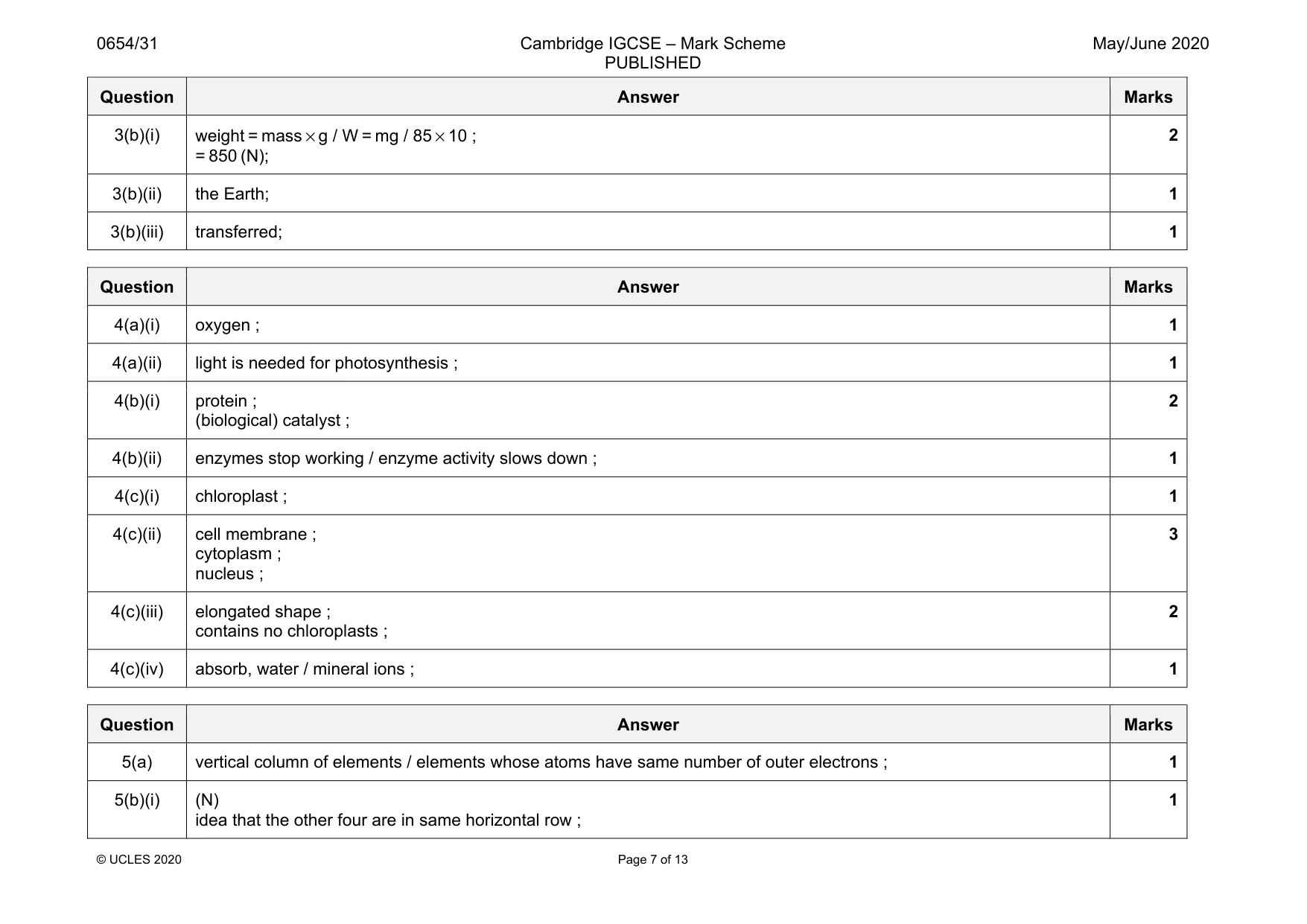
Mark scheme: 3(a)(i) speed = distance / time; 15.5 (m/s); 2 3(a)(ii) area under graph from 0 s to 8 s; 23 × 8 × 0.5 = 92 (m); 2 3(a)(iii) friction ; 1 Question Answer Marks 3(b)(i) weight = mass × g / W = mg / 85 × 10 ; = 850 (N); 2 3(b)(ii) the Earth; 1 3(b)(iii) transferred; 1
Q4 · A student investigates photosynthesis using an aquatic plant (Elodea)
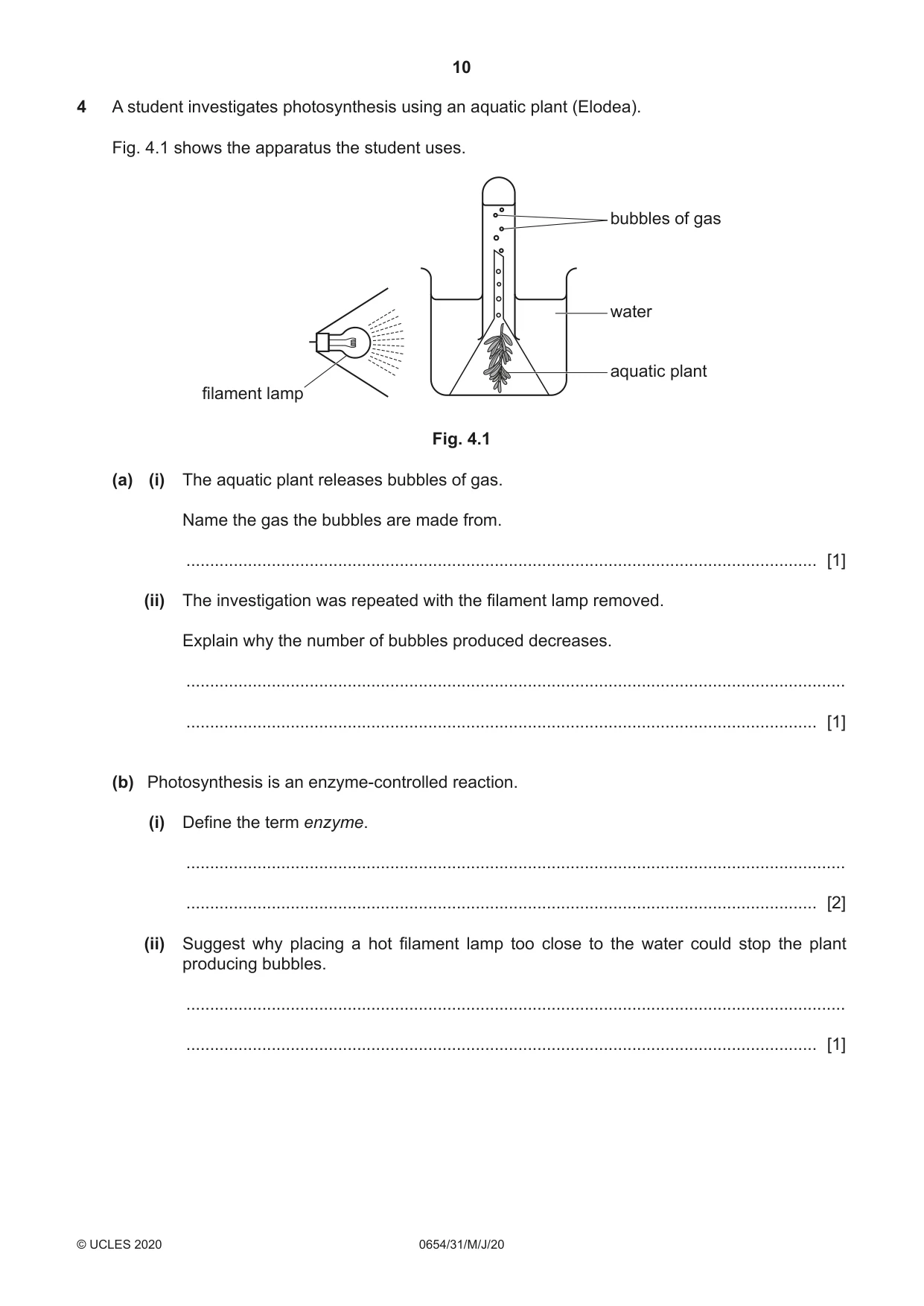
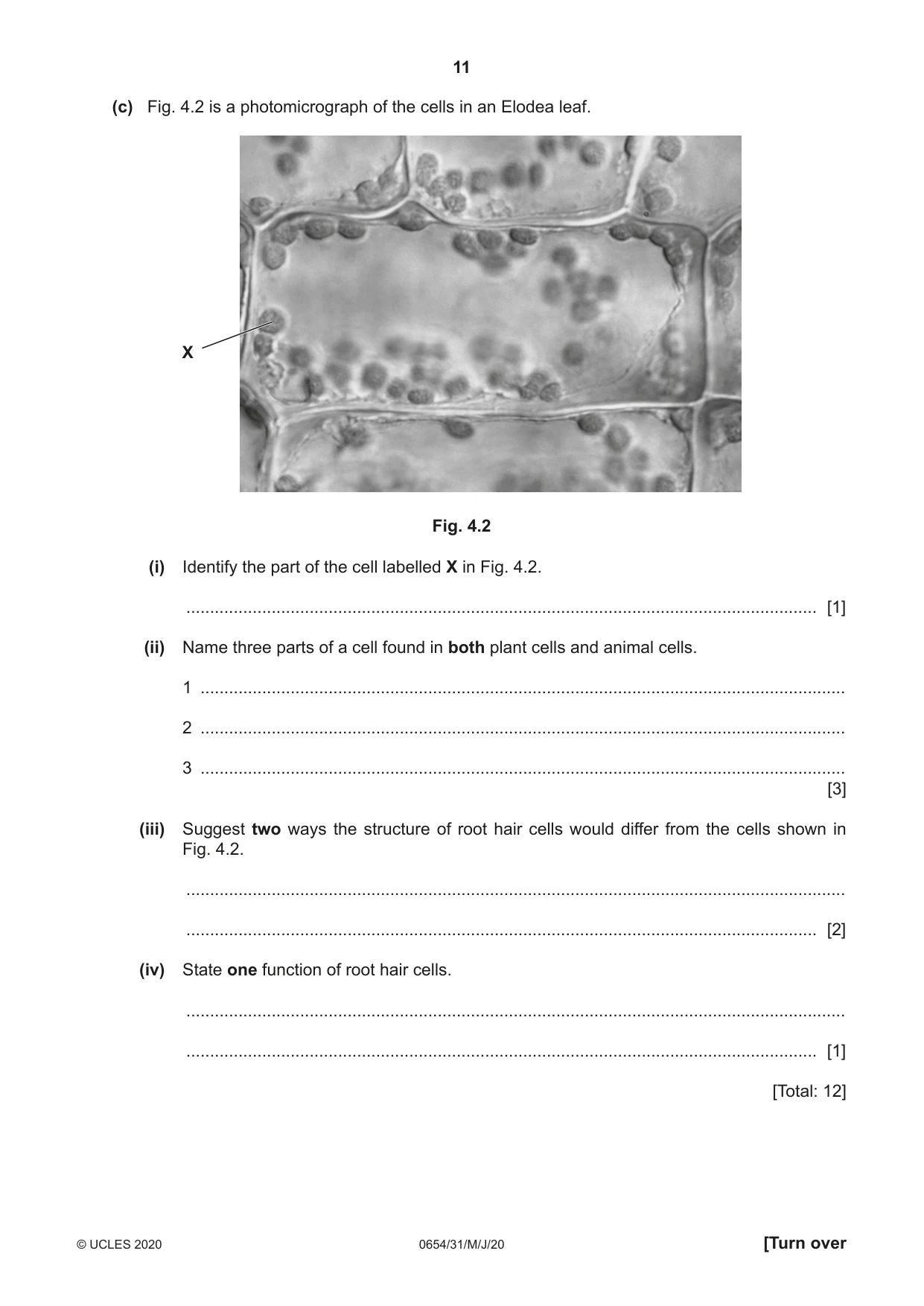
4 A student investigates photosynthesis using an aquatic plant (Elodea). Fig. 4.1 shows the apparatus the student uses. bubbles of gas water aquatic plant filament lamp Fig. 4.1 (a) (i) The aquatic plant releases bubbles of gas. Name the gas the bubbles are made from. ..................................................................................................................................... [1] (ii) The investigation was repeated with the filament lamp removed. Explain why the number of bubbles produced decreases. ........................................................................................................................................... ..................................................................................................................................... [1] (b) Photosynthesis is an enzyme-controlled reaction. (i) Define the term enzyme. ........................................................................................................................................... ..................................................................................................................................... [2] (ii) Suggest why placing a hot filament lamp too close to the water could stop the plant producing bubbles. ........................................................................................................................................... ..................................................................................................................................... [1] (c) Fig. 4.2 is a photomicrograph of the cells in an Elodea leaf. X Fig. 4.2 (i) Identify the part of the cell labelled X in Fig. 4.2. ..................................................................................................................................... [1] (ii) Name three parts of a cell found in both plant cells and animal cells. 1 ........................................................................................................................................ 2 ........................................................................................................................................ 3 ........................................................................................................................................ [3] (iii) Suggest two ways the structure of root hair cells would differ from the cells shown in Fig. 4.2. ........................................................................................................................................... ..................................................................................................................................... [2] (iv) State one function of root hair cells. ........................................................................................................................................... ..................................................................................................................................... [1] [Total: 12]
Mark scheme: 4(a)(i) oxygen ; 1 4(a)(ii) light is needed for photosynthesis ; 1 4(b)(i) protein ; (biological) catalyst ; 2 4(b)(ii) enzymes stop working / enzyme activity slows down ; 1 4(c)(i) chloroplast ; 1 4(c)(ii) cell membrane ; cytoplasm ; nucleus ; 3 4(c)(iii) elongated shape ; contains no chloroplasts ; 2 4(c)(iv) absorb, water / mineral ions ; 1
Q5 · Non-metallic elements are placed in groups towards the right hand side of the Periodic…
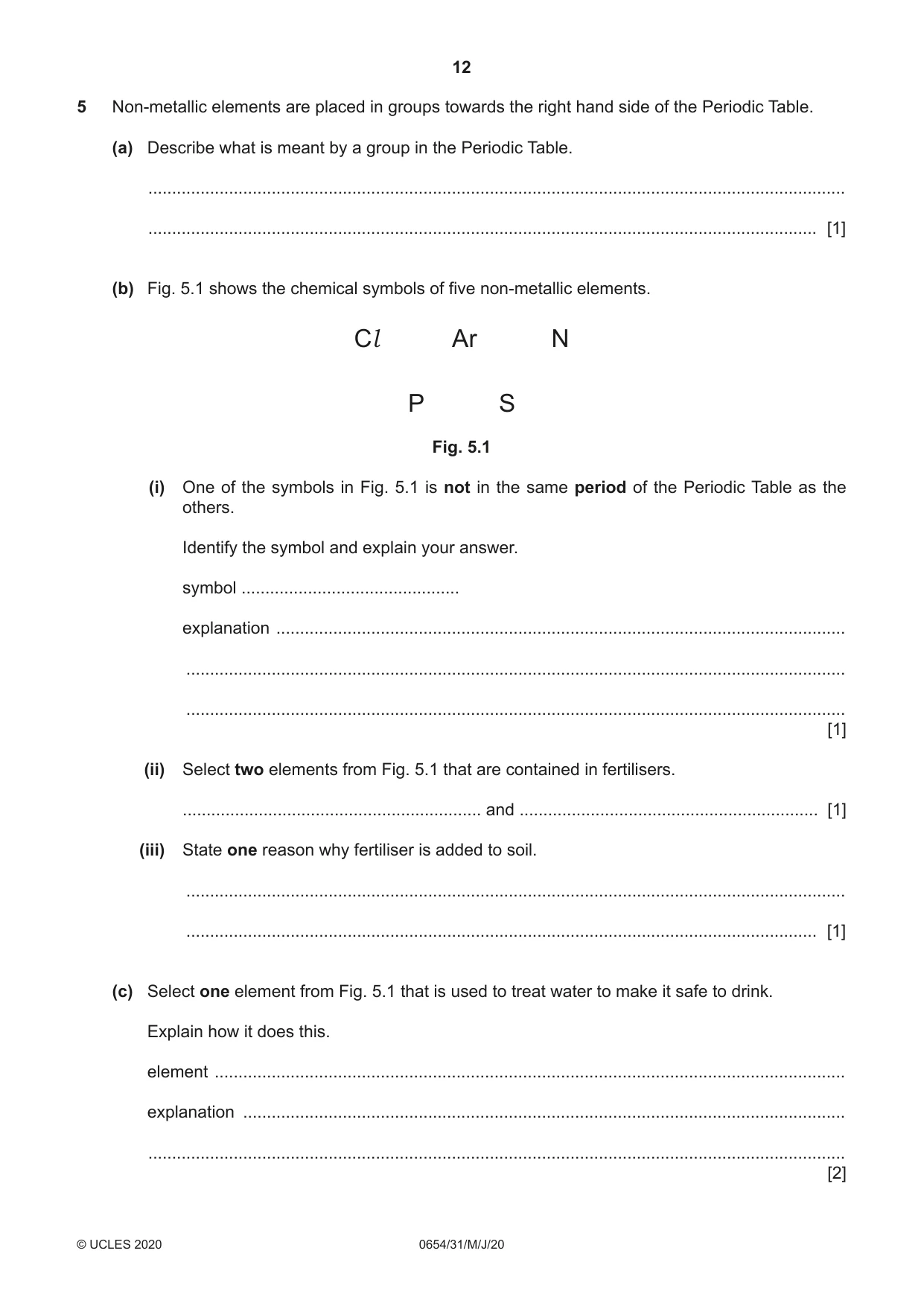
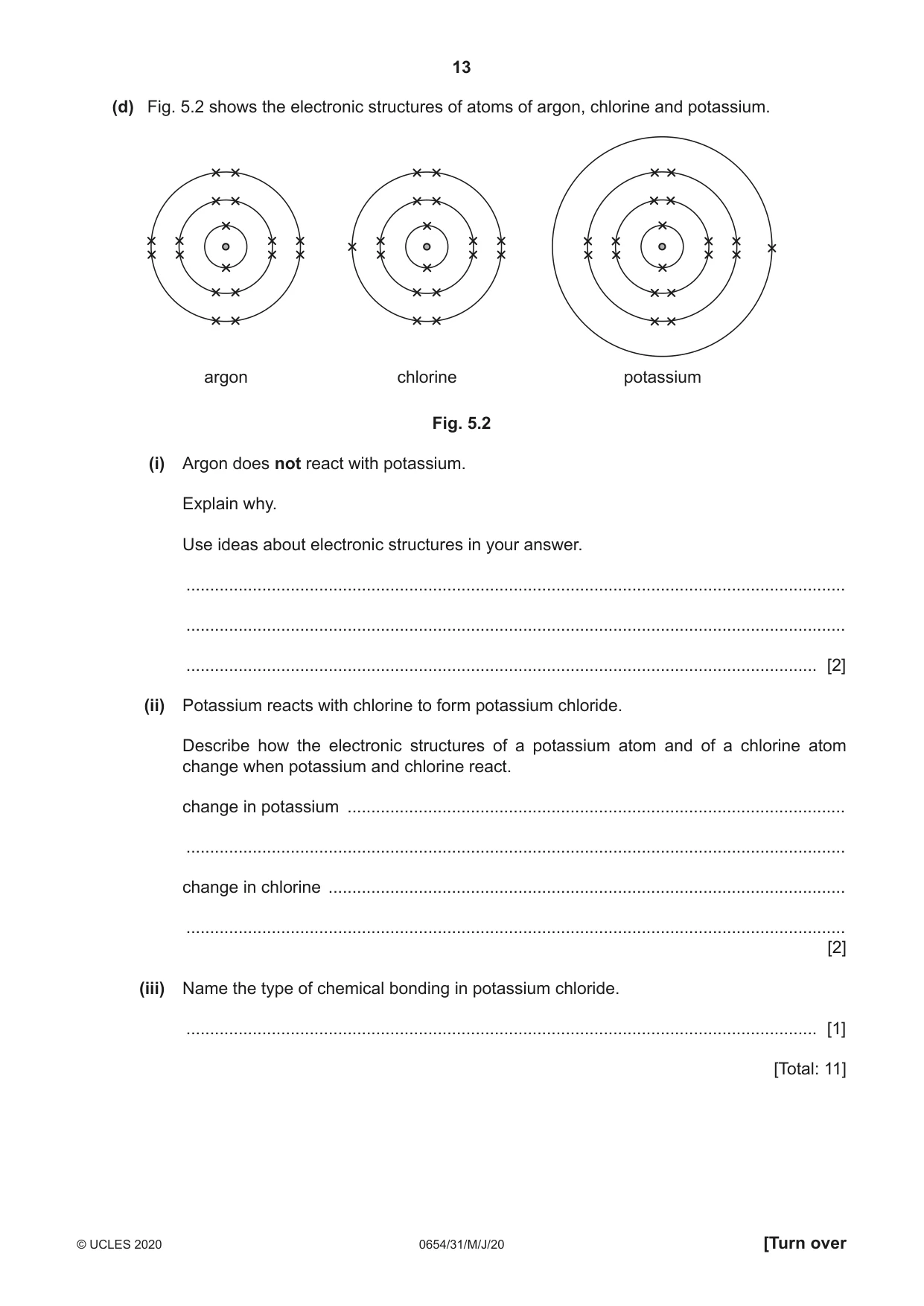
5 Non-metallic elements are placed in groups towards the right hand side of the Periodic Table. (a) Describe what is meant by a group in the Periodic Table. ................................................................................................................................................... ............................................................................................................................................. [1] (b) Fig. 5.1 shows the chemical symbols of five non-metallic elements. Cl Ar N P S Fig. 5.1 (i) One of the symbols in Fig. 5.1 is not in the same period of the Periodic Table as the others. Identify the symbol and explain your answer. symbol .............................................. explanation ........................................................................................................................ ........................................................................................................................................... ........................................................................................................................................... [1] (ii) Select two elements from Fig. 5.1 that are contained in fertilisers. ............................................................... and ............................................................... [1] (iii) State one reason why fertiliser is added to soil. ........................................................................................................................................... ..................................................................................................................................... [1] (c) Select one element from Fig. 5.1 that is used to treat water to make it safe to drink. Explain how it does this. element ..................................................................................................................................... explanation ............................................................................................................................... ................................................................................................................................................... [2] (d) Fig. 5.2 shows the electronic structures of atoms of argon, chlorine and potassium. argon chlorine potassium Fig. 5.2 (i) Argon does not react with potassium. Explain why. Use ideas about electronic structures in your answer. ........................................................................................................................................... ........................................................................................................................................... ..................................................................................................................................... [2] (ii) Potassium reacts with chlorine to form potassium chloride. Describe how the electronic structures of a potassium atom and of a chlorine atom change when potassium and chlorine react. change in potassium ......................................................................................................... ........................................................................................................................................... change in chlorine ............................................................................................................. ........................................................................................................................................... [2] (iii) Name the type of chemical bonding in potassium chloride. ..................................................................................................................................... [1] [Total: 11]
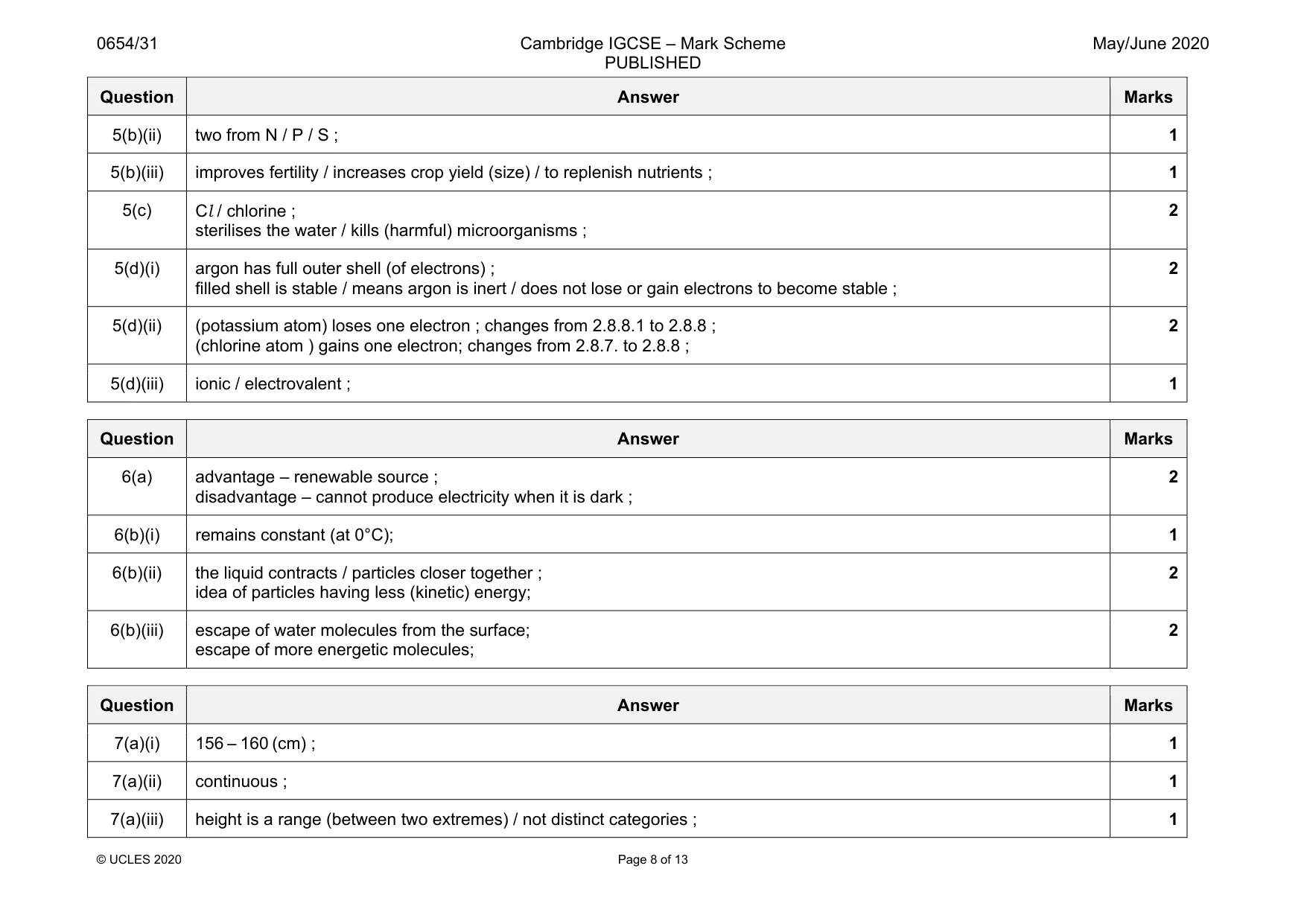
Mark scheme: 5(a) vertical column of elements / elements whose atoms have same number of outer electrons ; 1 5(b)(i) (N) idea that the other four are in same horizontal row ; 1 Question Answer Marks 5(b)(ii) two from N / P / S ; 1 5(b)(iii) improves fertility / increases crop yield (size) / to replenish nutrients ; 1 5(c) Cl / chlorine ; sterilises the water / kills (harmful) microorganisms ; 2 5(d)(i) argon has full outer shell (of electrons) ; filled shell is stable / means argon is inert / does not lose or gain electrons to become stable ; 2 5(d)(ii) (potassium atom) loses one electron ; changes from 2.8.8.1 to 2.8.8 ; (chlorine atom ) gains one electron; changes from 2.8.7. to 2.8.8 ; 2 5(d)(iii) ionic / electrovalent ; 1
Q6 · Solar cells can be used to generate electricity for a house
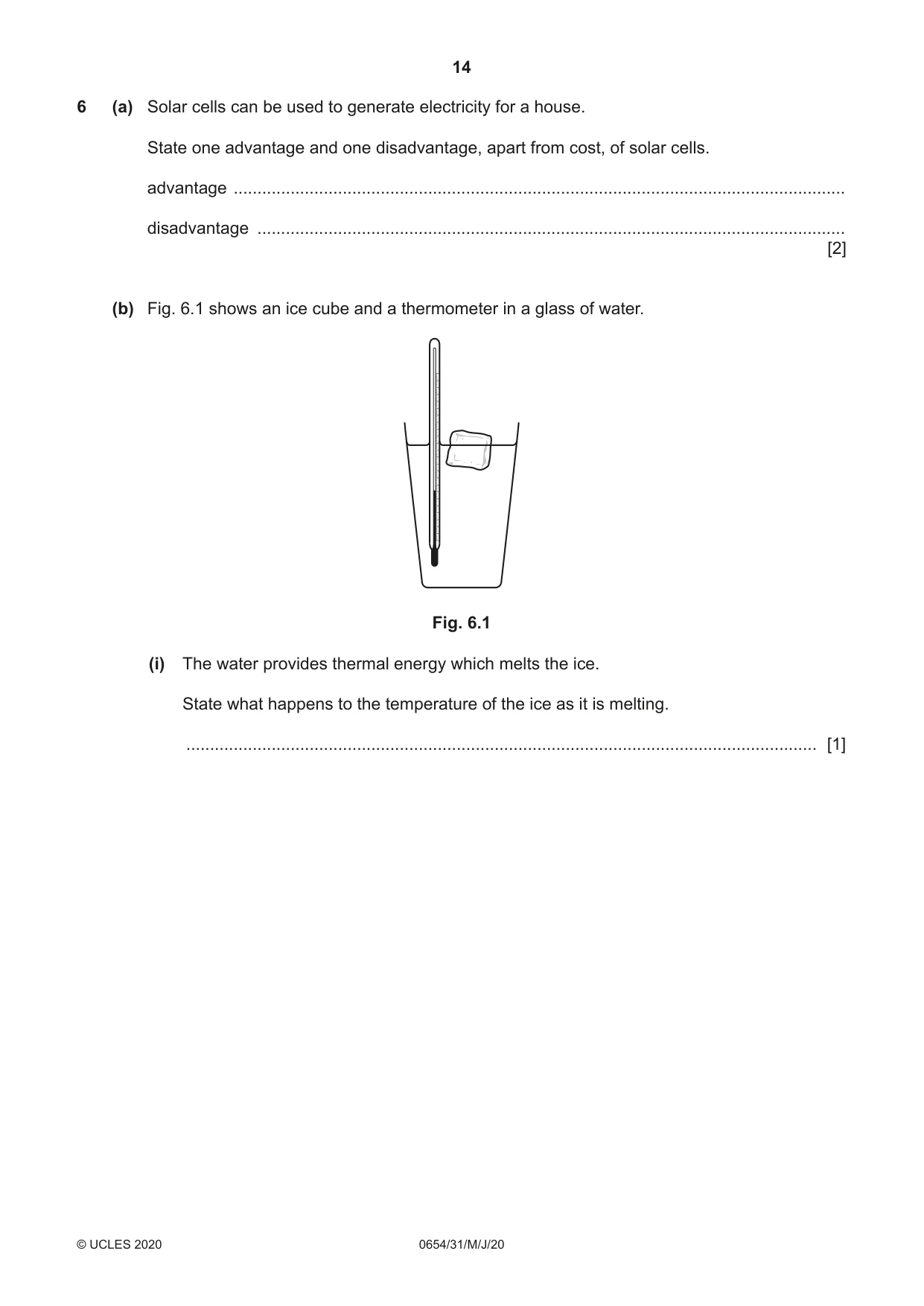
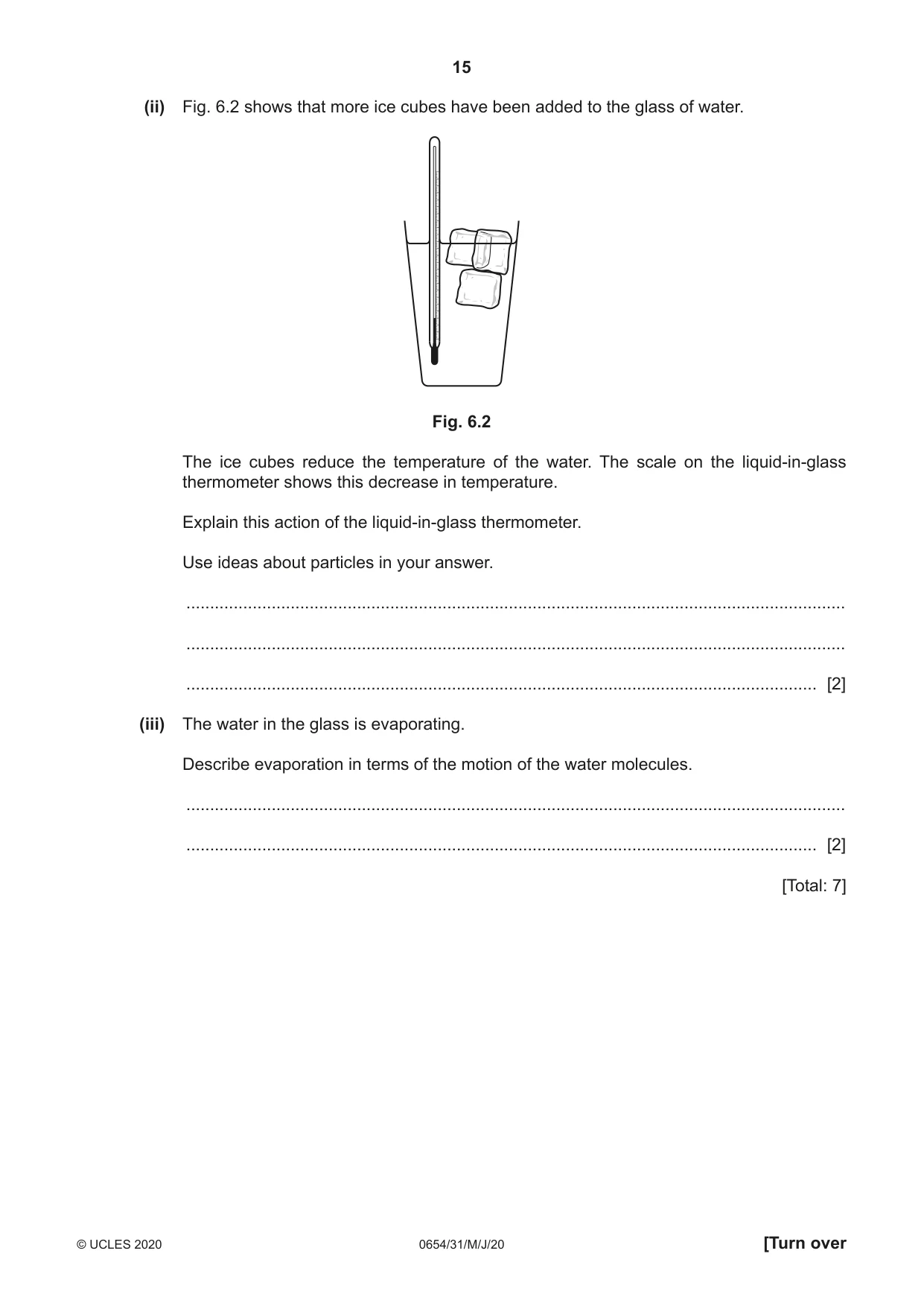
6 (a) Solar cells can be used to generate electricity for a house. State one advantage and one disadvantage, apart from cost, of solar cells. advantage ................................................................................................................................. disadvantage ............................................................................................................................ [2] (b) Fig. 6.1 shows an ice cube and a thermometer in a glass of water. Fig. 6.1 (i) The water provides thermal energy which melts the ice. State what happens to the temperature of the ice as it is melting. ..................................................................................................................................... [1] (ii) Fig. 6.2 shows that more ice cubes have been added to the glass of water. Fig. 6.2 The ice cubes reduce the temperature of the water. The scale on the liquid-in-glass thermometer shows this decrease in temperature. Explain this action of the liquid-in-glass thermometer. Use ideas about particles in your answer. ........................................................................................................................................... ........................................................................................................................................... ..................................................................................................................................... [2] (iii) The water in the glass is evaporating. Describe evaporation in terms of the motion of the water molecules. ........................................................................................................................................... ..................................................................................................................................... [2] [Total: 7]
Mark scheme: 6(a) advantage – renewable source ; disadvantage – cannot produce electricity when it is dark ; 2 6(b)(i) remains constant (at 0°C); 1 6(b)(ii) the liquid contracts / particles closer together ; idea of particles having less (kinetic) energy; 2 6(b)(iii) escape of water molecules from the surface; escape of more energetic molecules; 2
Q7 · A teacher measured the height of the students in a class to the nearest cm
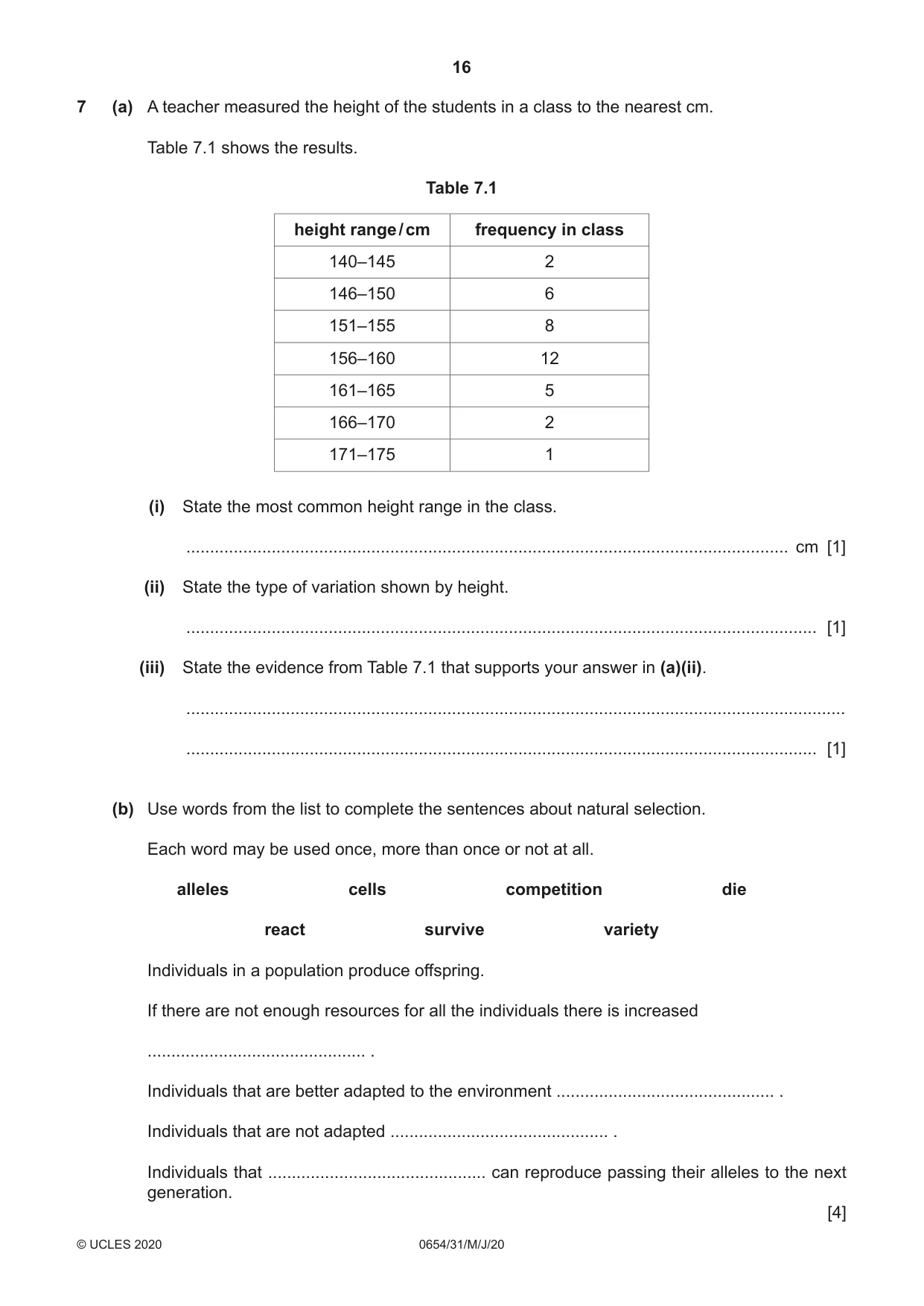
7 (a) A teacher measured the height of the students in a class to the nearest cm. Table 7.1 shows the results. Table 7.1 height range / cm frequency in class 140–145 2 146–150 6 151–155 8 156–160 12 161–165 5 166–170 2 171–175 1 (i) State the most common height range in the class. ............................................................................................................................... cm [1] (ii) State the type of variation shown by height. ..................................................................................................................................... [1] (iii) State the evidence from Table 7.1 that supports your answer in (a)(ii). ........................................................................................................................................... ..................................................................................................................................... [1] (b) Use words from the list to complete the sentences about natural selection. Each word may be used once, more than once or not at all. alleles cells competition die react survive variety Individuals in a population produce offspring. If there are not enough resources for all the individuals there is increased .............................................. . Individuals that are better adapted to the environment .............................................. . Individuals that are not adapted .............................................. . Individuals that .............................................. can reproduce passing their alleles to the next generation. [4] (c) Lack of resources can cause extinction of a species. Suggest two ways humans can cause extinction. 1 ................................................................................................................................................ 2 ................................................................................................................................................ [2] [Total: 9]
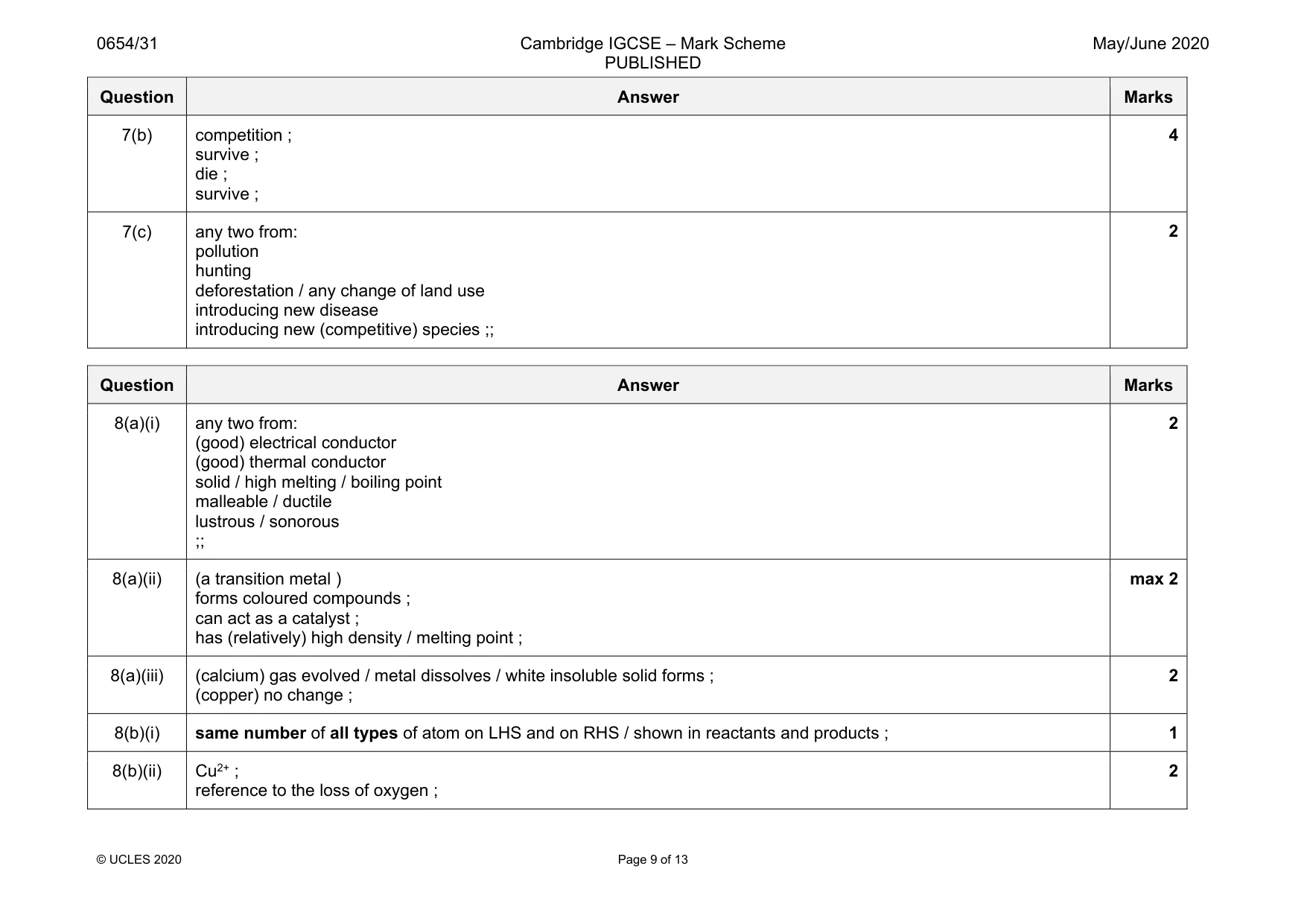
Mark scheme: 7(a)(i) 156 – 160 (cm) ; 1 7(a)(ii) continuous ; 1 7(a)(iii) height is a range (between two extremes) / not distinct categories ; 1 Question Answer Marks 7(b) competition ; survive ; die ; survive ; 4 7(c) any two from: pollution hunting deforestation / any change of land use introducing new disease introducing new (competitive) species ;; 2
Q8 · Calcium and copper are metals
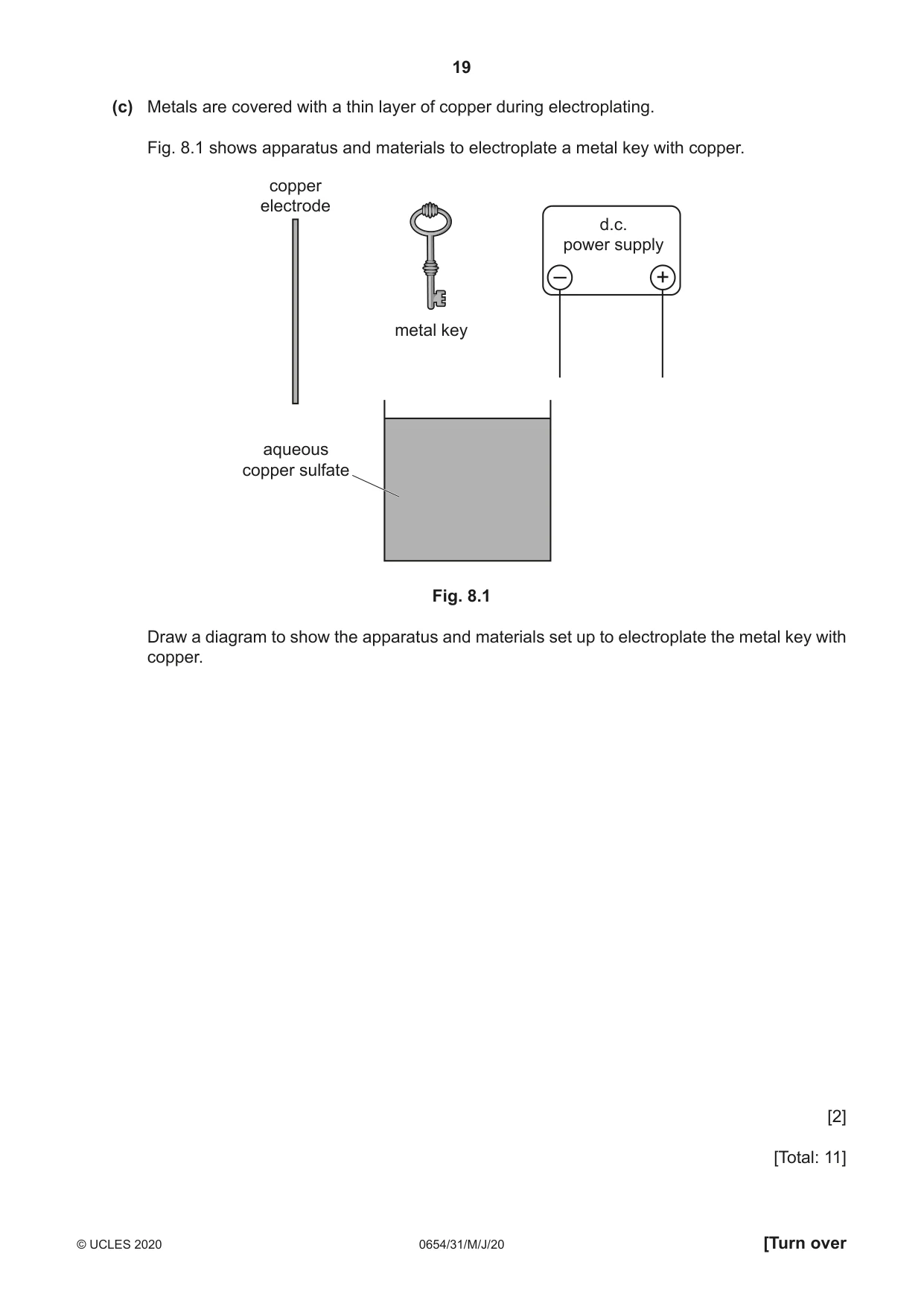
8 Calcium and copper are metals. (a) (i) State two physical properties of metals. 1 ........................................................................................................................................ 2 ........................................................................................................................................ [2] (ii) Copper is a transition metal. Calcium is not a transition metal. State two properties of transition metals that are not properties of calcium. 1 ........................................................................................................................................ ........................................................................................................................................... 2 ........................................................................................................................................ ........................................................................................................................................... [2] (iii) Calcium and copper are added to separate amounts of water. Describe the reaction, if any, for each metal. calcium .............................................................................................................................. copper ............................................................................................................................... [2] (b) Copper metal is produced when copper(II) oxide reacts with hydrogen gas. The equation for this reaction is shown. CuO + H2 Cu + H2O (i) Explain why this equation is described as balanced. ........................................................................................................................................... ..................................................................................................................................... [1] (ii) Identify which substance is reduced in this reaction. Explain your answer. substance .......................................................................................................................... explanation ........................................................................................................................ ........................................................................................................................................... [2] (c) Metals are covered with a thin layer of copper during electroplating. Fig. 8.1 shows apparatus and materials to electroplate a metal key with copper. copper electrode d.c. power supply – + metal key aqueous copper sulfate Fig. 8.1 Draw a diagram to show the apparatus and materials set up to electroplate the metal key with copper. [2] [Total: 11]
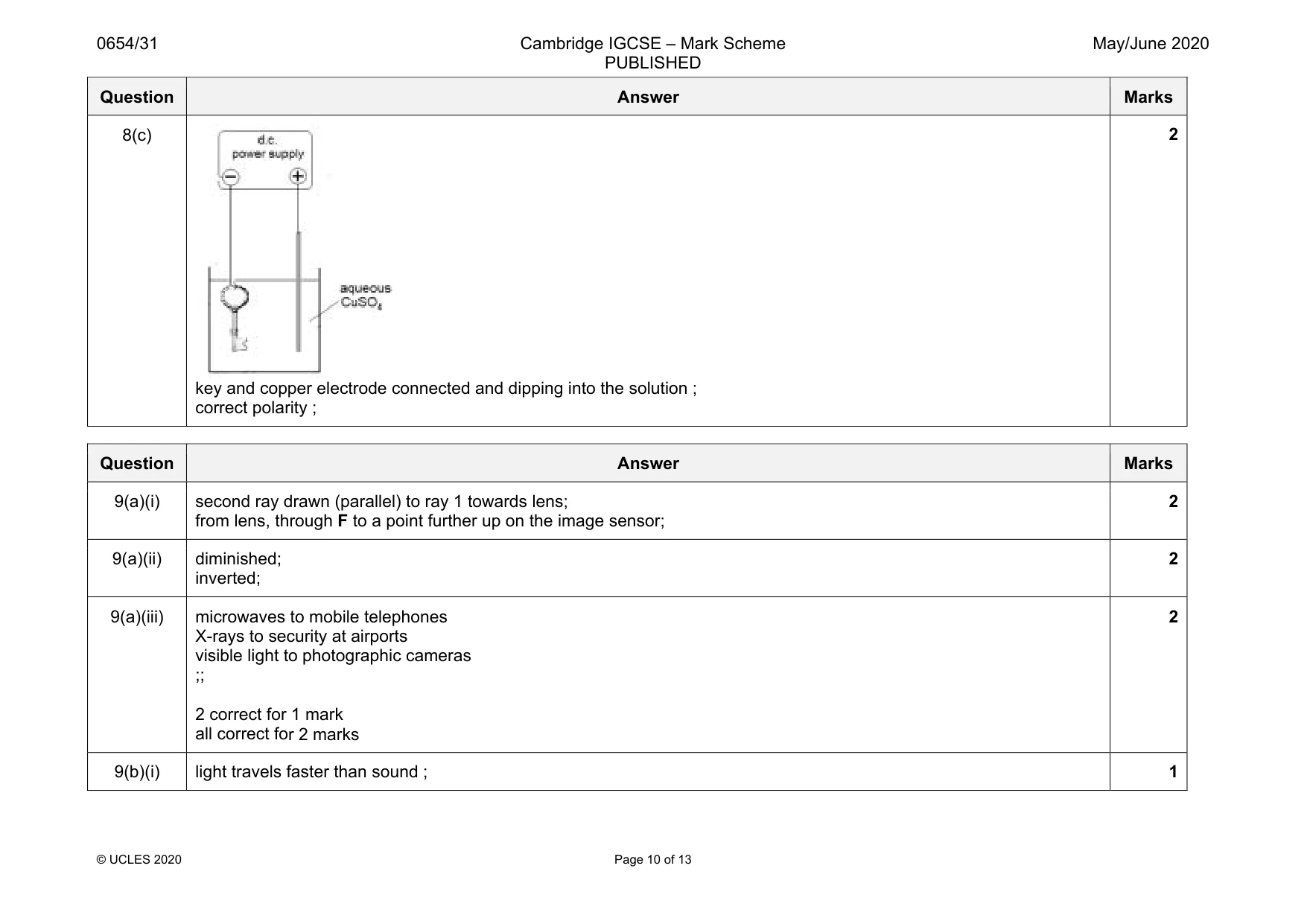
Mark scheme: 8(a)(i) any two from: (good) electrical conductor (good) thermal conductor solid / high melting / boiling point malleable / ductile lustrous / sonorous ;; 8(a)(ii) (a transition metal ) forms coloured compounds ; can act as a catalyst ; has (relatively) high density / melting point ; max 2 8(a)(iii) (calcium) gas evolved / metal dissolves / white insoluble solid forms ; (copper) no change ; 2 8(b)(i) same number of all types of atom on LHS and on RHS / shown in reactants and products ; 1 8(b)(ii) Cu2+ ; reference to the loss of oxygen ; 2 Question Answer Marks 8(c) key and copper electrode connected and dipping into the solution ; correct polarity ; 2
Q9 · A thin converging lens used in a digital camera
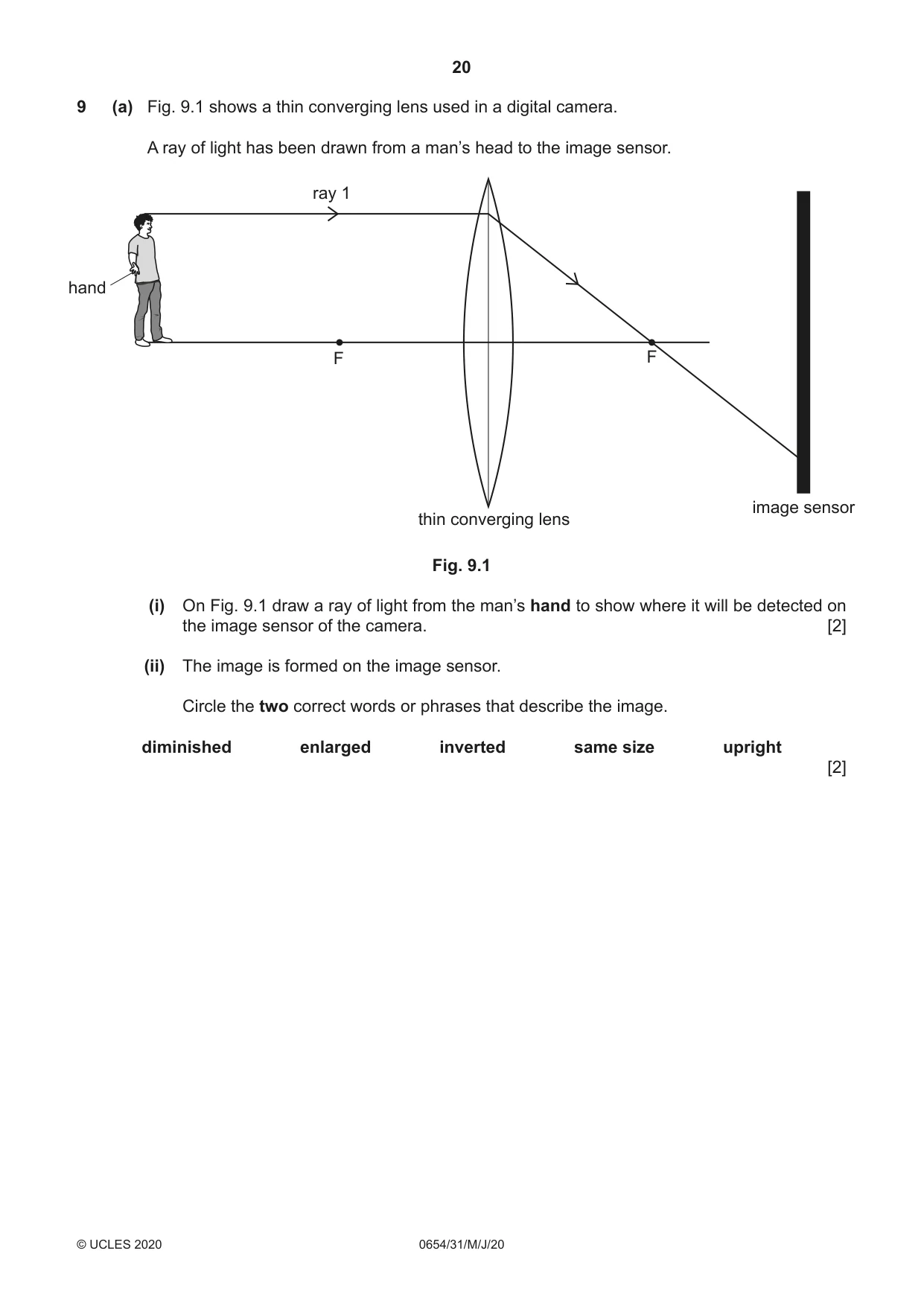
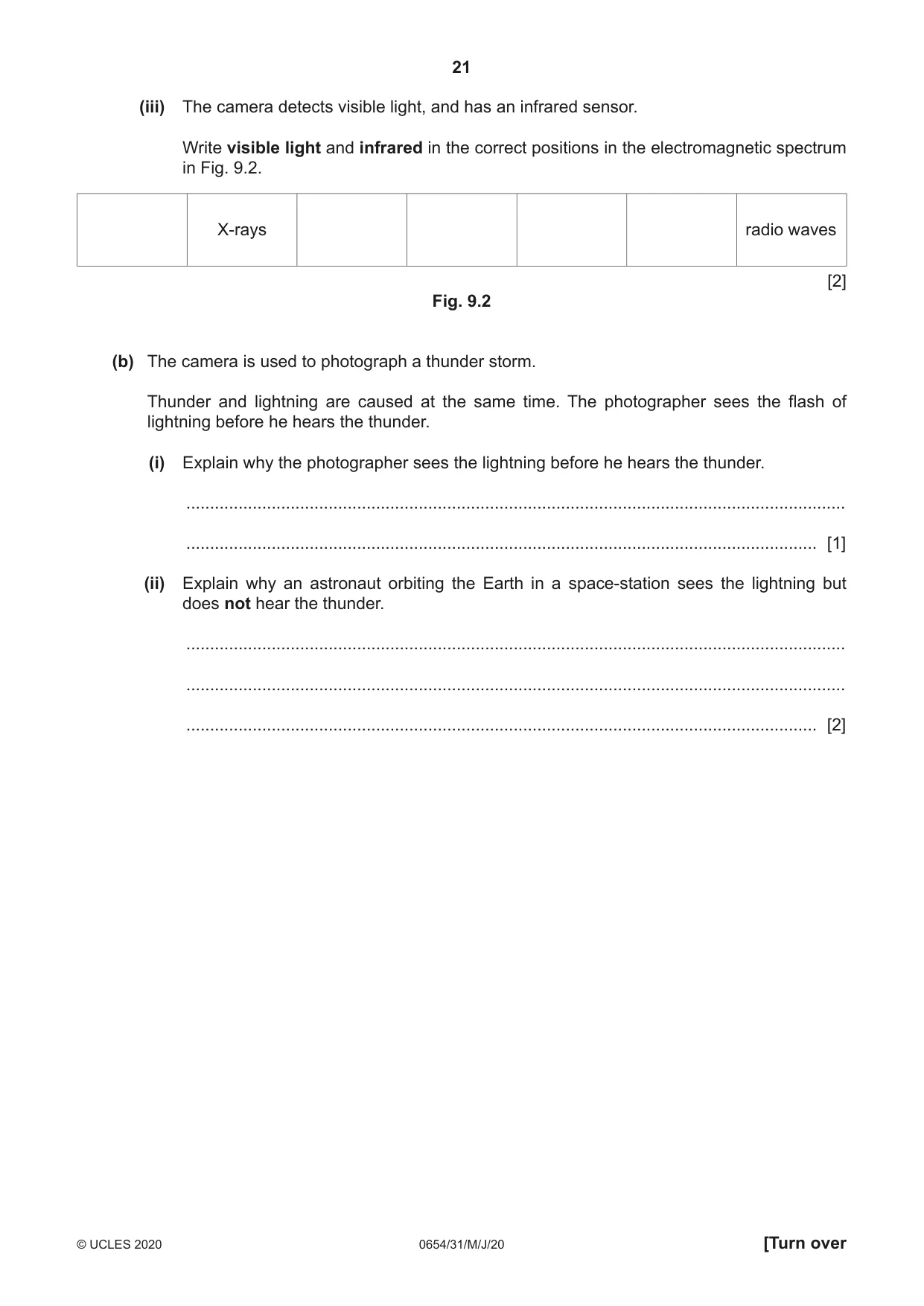
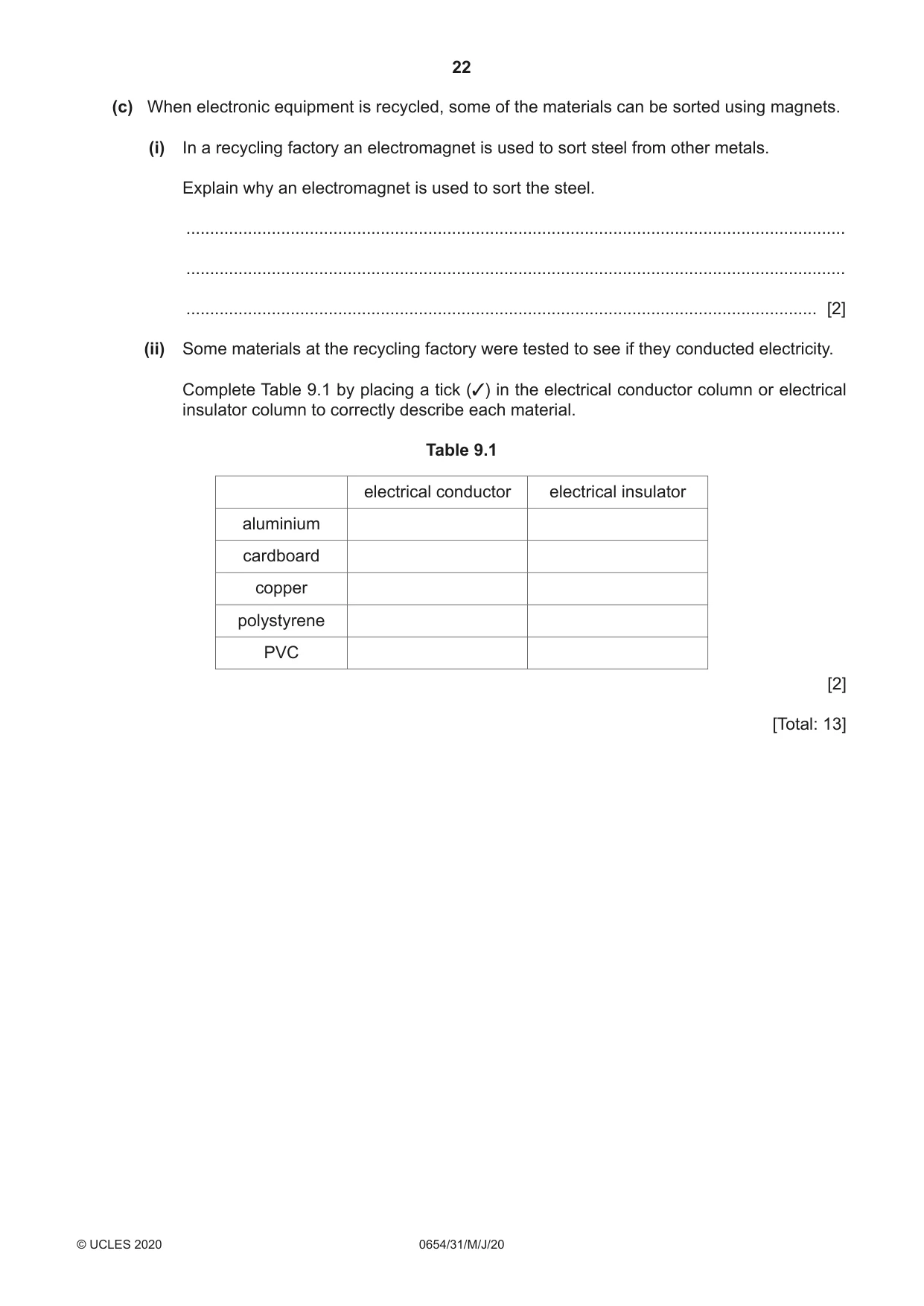
9 (a) Fig. 9.1 shows a thin converging lens used in a digital camera. A ray of light has been drawn from a man’s head to the image sensor. ray 1 hand F F image sensor thin converging lens Fig. 9.1 (i) On Fig. 9.1 draw a ray of light from the man’s hand to show where it will be detected on the image sensor of the camera. [2] (ii) The image is formed on the image sensor. Circle the two correct words or phrases that describe the image. diminished enlarged inverted same size upright [2] (iii) The camera detects visible light, and has an infrared sensor. Write visible light and infrared in the correct positions in the electromagnetic spectrum in Fig. 9.2. X-rays radio waves [2] Fig. 9.2 (b) The camera is used to photograph a thunder storm. Thunder and lightning are caused at the same time. The photographer sees the flash of lightning before he hears the thunder. (i) Explain why the photographer sees the lightning before he hears the thunder. ........................................................................................................................................... ..................................................................................................................................... [1] (ii) Explain why an astronaut orbiting the Earth in a space-station sees the lightning but does not hear the thunder. ........................................................................................................................................... ........................................................................................................................................... ..................................................................................................................................... [2] (c) When electronic equipment is recycled, some of the materials can be sorted using magnets. (i) In a recycling factory an electromagnet is used to sort steel from other metals. Explain why an electromagnet is used to sort the steel. ........................................................................................................................................... ........................................................................................................................................... ..................................................................................................................................... [2] (ii) Some materials at the recycling factory were tested to see if they conducted electricity. Complete Table 9.1 by placing a tick (3) in the electrical conductor column or electrical insulator column to correctly describe each material. Table 9.1 electrical conductor electrical insulator aluminium cardboard copper polystyrene PVC [2] [Total: 13]
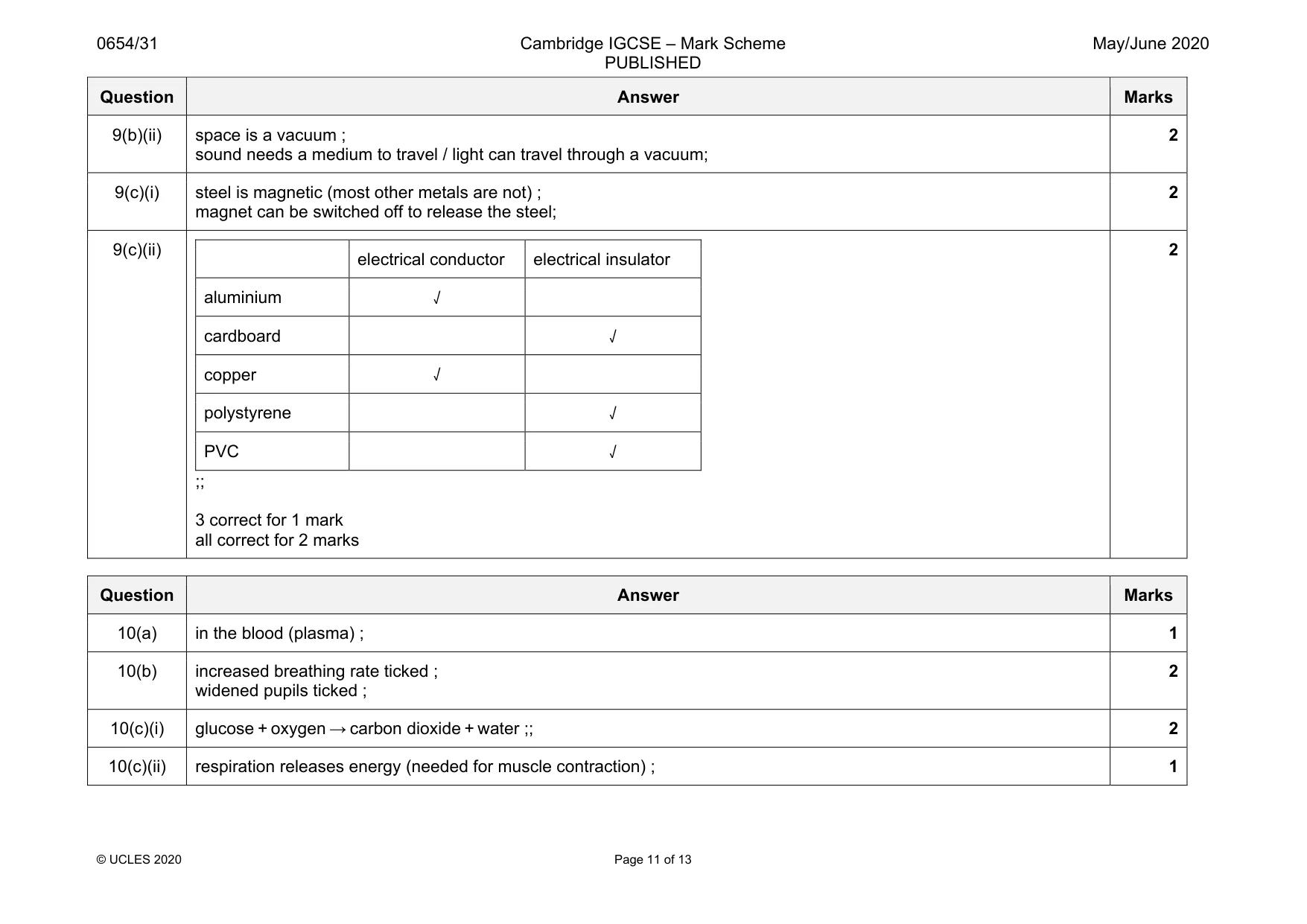
Mark scheme: 9(a)(i) second ray drawn (parallel) to ray 1 towards lens; from lens, through F to a point further up on the image sensor; 2 9(a)(ii) diminished; inverted; 2 9(a)(iii) microwaves to mobile telephones X-rays to security at airports visible light to photographic cameras ;; 2 correct for 1 mark all correct for 2 marks 2 9(b)(i) light travels faster than sound ; 1 Question Answer Marks 9(b)(ii) space is a vacuum ; sound needs a medium to travel / light can travel through a vacuum; 2 9(c)(i) steel is magnetic (most other metals are not) ; magnet can be switched off to release the steel; 2 9(c)(ii) electrical conductor electrical insulator aluminium √ cardboard √ copper √ polystyrene √ PVC √ ;; 3 correct for 1 mark all correct for 2 marks 2
Q10 · A drawing of a person doing a parachute jump
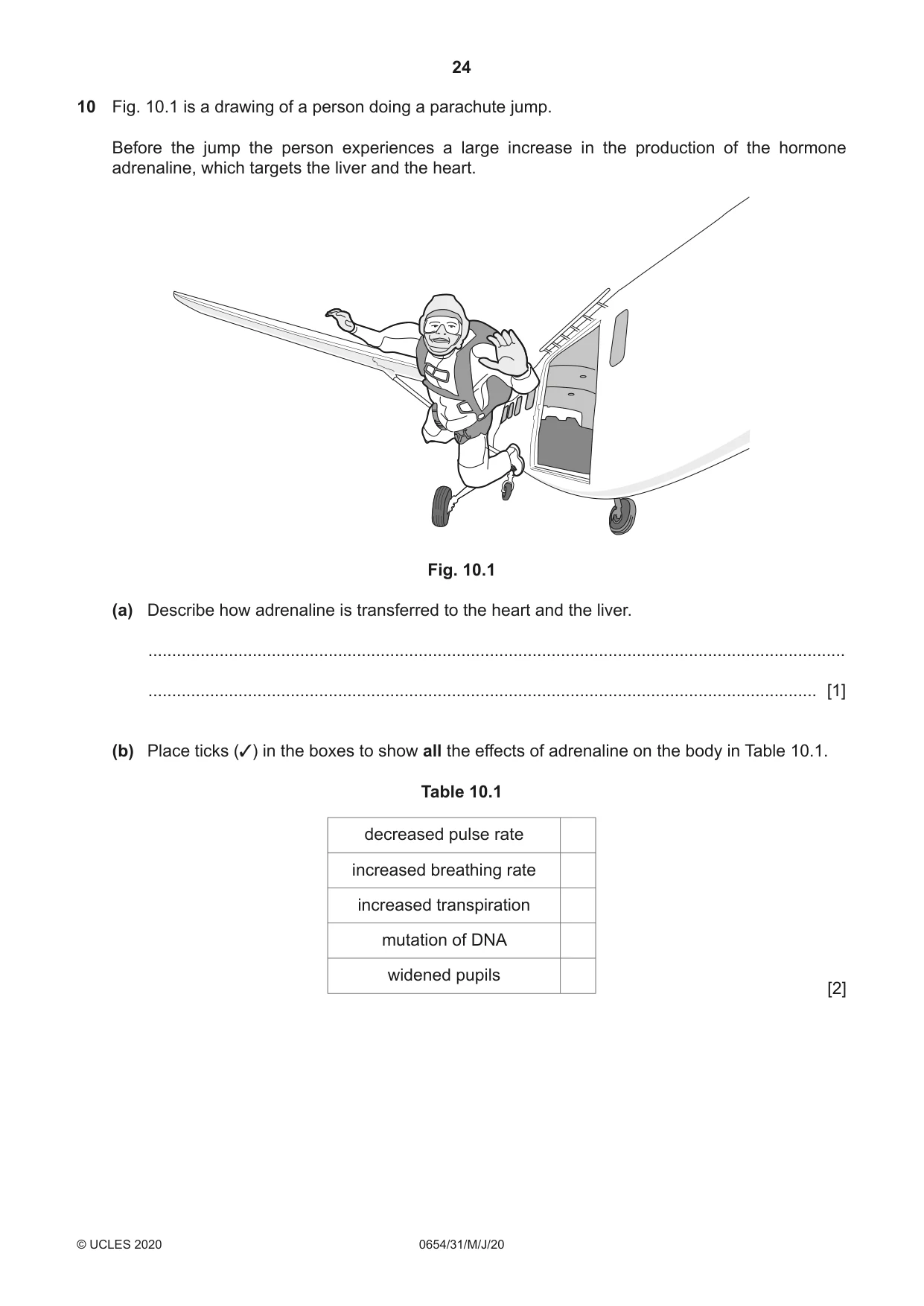
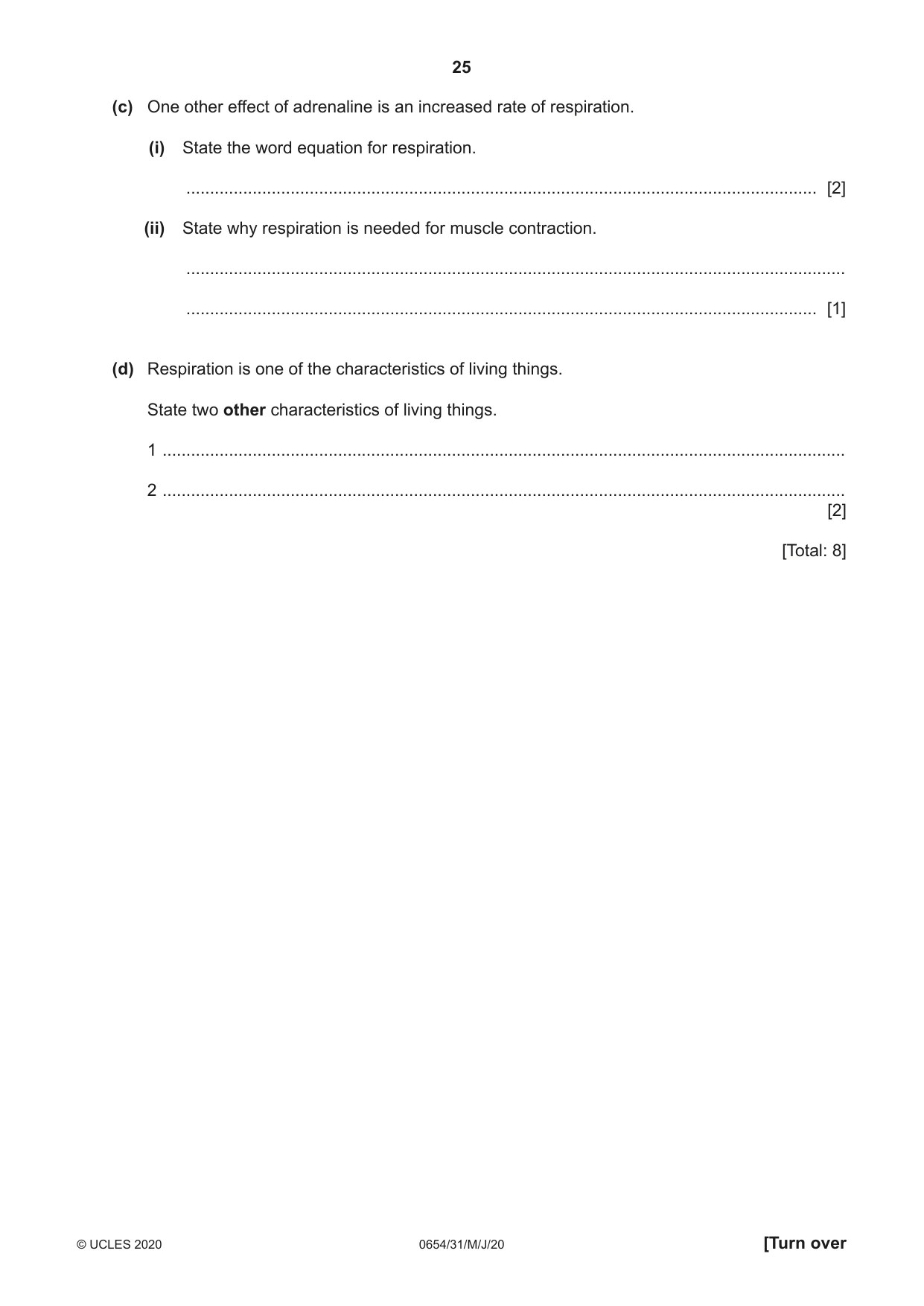
10 Fig. 10.1 is a drawing of a person doing a parachute jump. Before the jump the person experiences a large increase in the production of the hormone adrenaline, which targets the liver and the heart. Fig. 10.1 (a) Describe how adrenaline is transferred to the heart and the liver. ................................................................................................................................................... ............................................................................................................................................. [1] (b) Place ticks (3) in the boxes to show all the effects of adrenaline on the body in Table 10.1. Table 10.1 decreased pulse rate increased breathing rate increased transpiration mutation of DNA widened pupils [2] (c) One other effect of adrenaline is an increased rate of respiration. (i) State the word equation for respiration. ..................................................................................................................................... [2] (ii) State why respiration is needed for muscle contraction. ........................................................................................................................................... ..................................................................................................................................... [1] (d) Respiration is one of the characteristics of living things. State two other characteristics of living things. 1 ................................................................................................................................................ 2 ................................................................................................................................................ [2] [Total: 8]
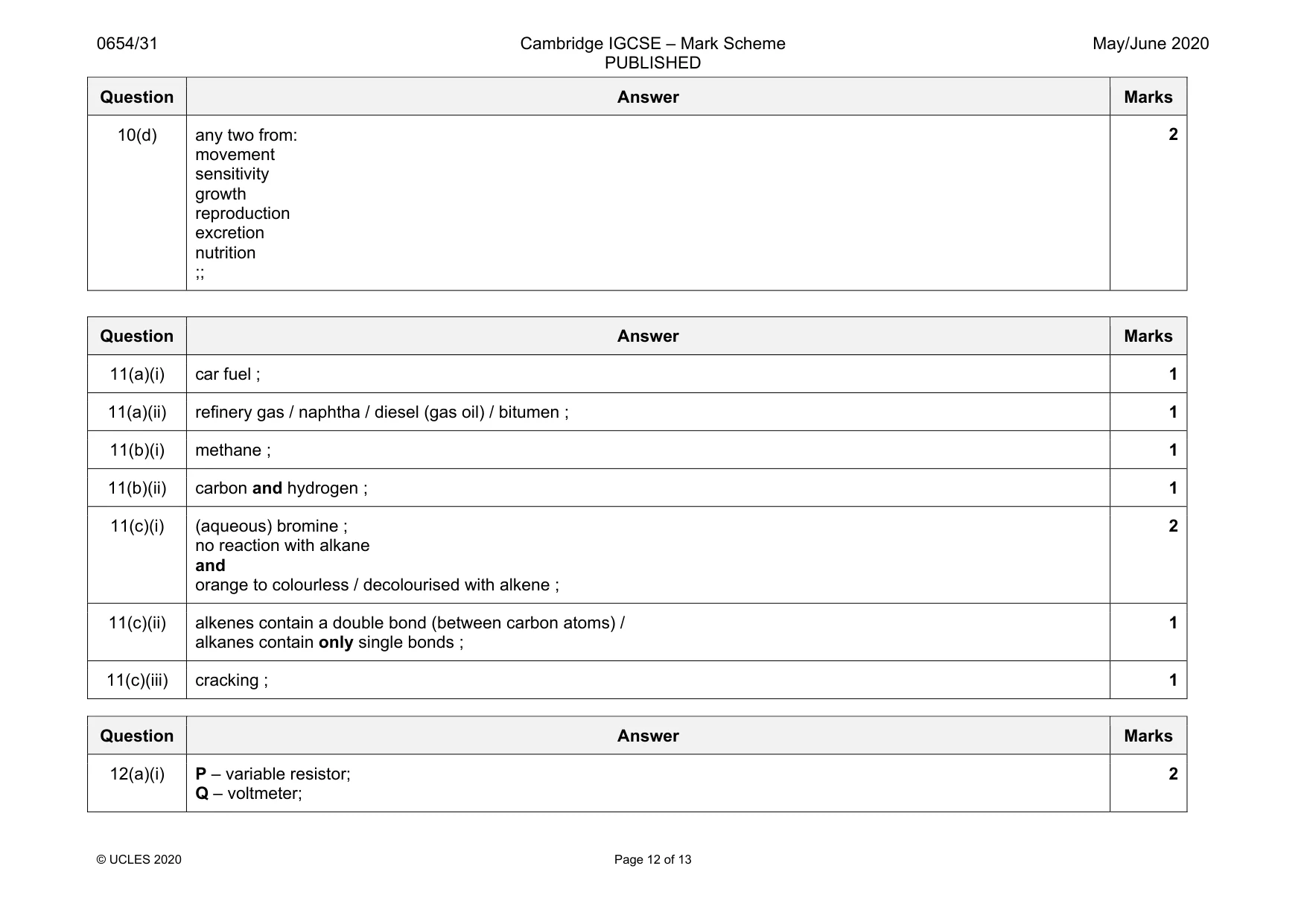
Mark scheme: 10(a) in the blood (plasma) ; 1 10(b) increased breathing rate ticked ; widened pupils ticked ; 2 10(c)(i) glucose + oxygen →carbon dioxide + water ;; 2 10(c)(ii) respiration releases energy (needed for muscle contraction) ; 1 Question Answer Marks 10(d) any two from: movement sensitivity growth reproduction excretion nutrition ;; 2
Q11 · Petroleum and natural gas are extracted from the Earth
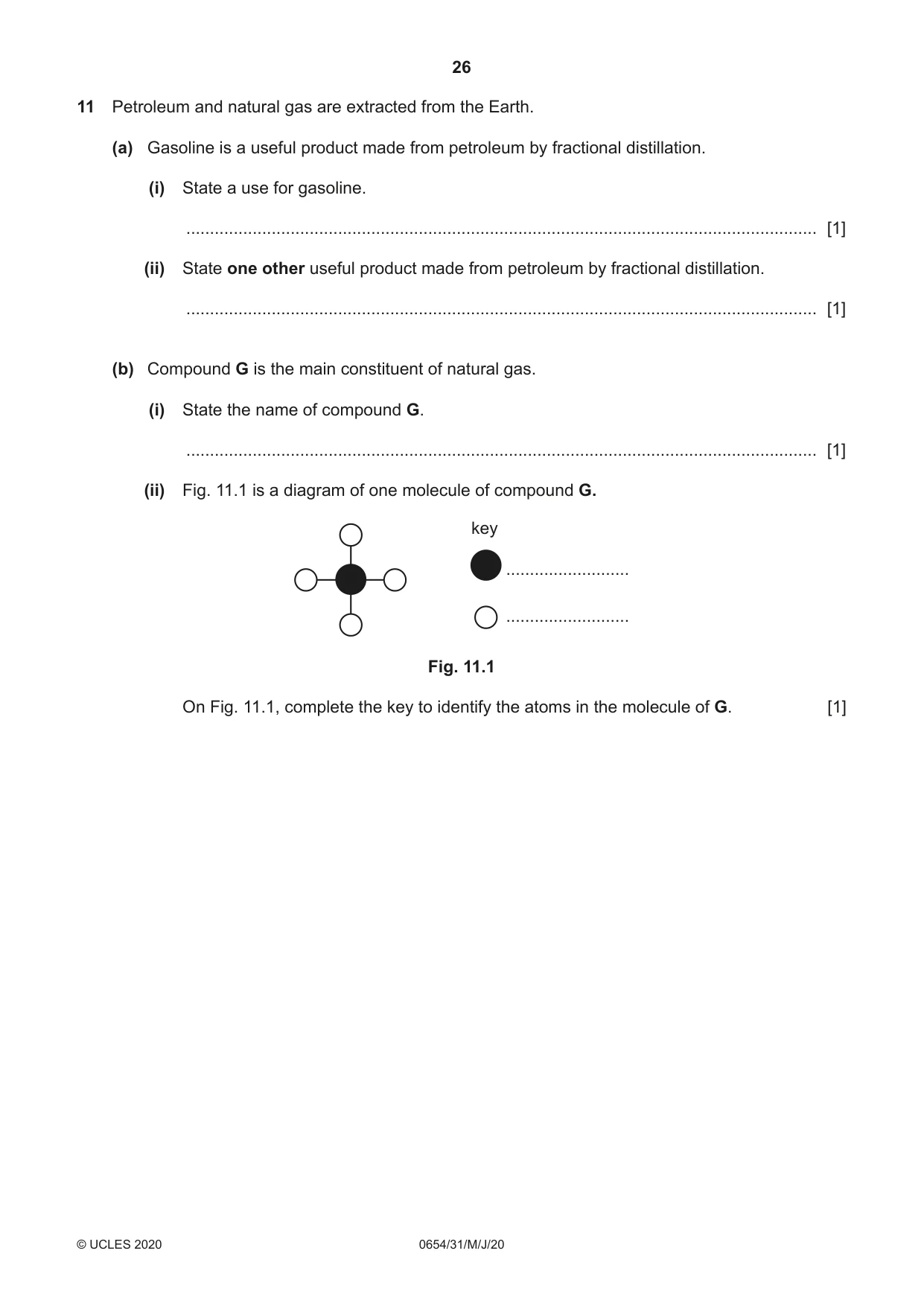
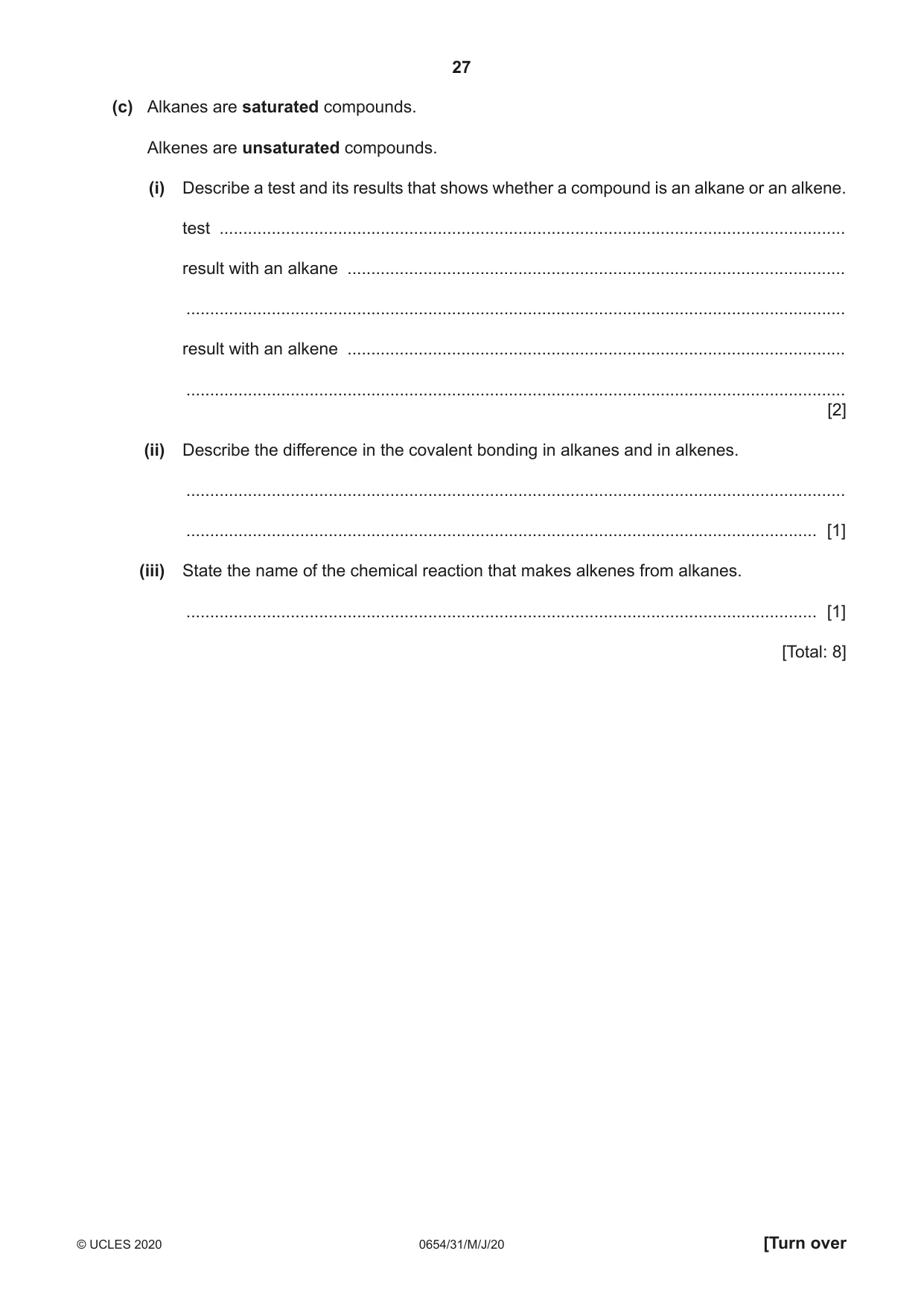
11 Petroleum and natural gas are extracted from the Earth. (a) Gasoline is a useful product made from petroleum by fractional distillation. (i) State a use for gasoline. ..................................................................................................................................... [1] (ii) State one other useful product made from petroleum by fractional distillation. ..................................................................................................................................... [1] (b) Compound G is the main constituent of natural gas. (i) State the name of compound G. ..................................................................................................................................... [1] (ii) Fig. 11.1 is a diagram of one molecule of compound G. key .......................... .......................... Fig. 11.1 On Fig. 11.1, complete the key to identify the atoms in the molecule of G. [1] (c) Alkanes are saturated compounds. Alkenes are unsaturated compounds. (i) Describe a test and its results that shows whether a compound is an alkane or an alkene. test .................................................................................................................................... result with an alkane ......................................................................................................... ........................................................................................................................................... result with an alkene ......................................................................................................... ........................................................................................................................................... [2] (ii) Describe the difference in the covalent bonding in alkanes and in alkenes. ........................................................................................................................................... ..................................................................................................................................... [1] (iii) State the name of the chemical reaction that makes alkenes from alkanes. ..................................................................................................................................... [1] [Total: 8]
Mark scheme: 11(a)(i) car fuel ; 1 11(a)(ii) refinery gas / naphtha / diesel (gas oil) / bitumen ; 1 11(b)(i) methane ; 1 11(b)(ii) carbon and hydrogen ; 1 11(c)(i) (aqueous) bromine ; no reaction with alkane and orange to colourless / decolourised with alkene ; 2 11(c)(ii) alkenes contain a double bond (between carbon atoms) / alkanes contain only single bonds ; 1 11(c)(iii) cracking ; 1
Q12 · A circuit containing a battery of 4 cells
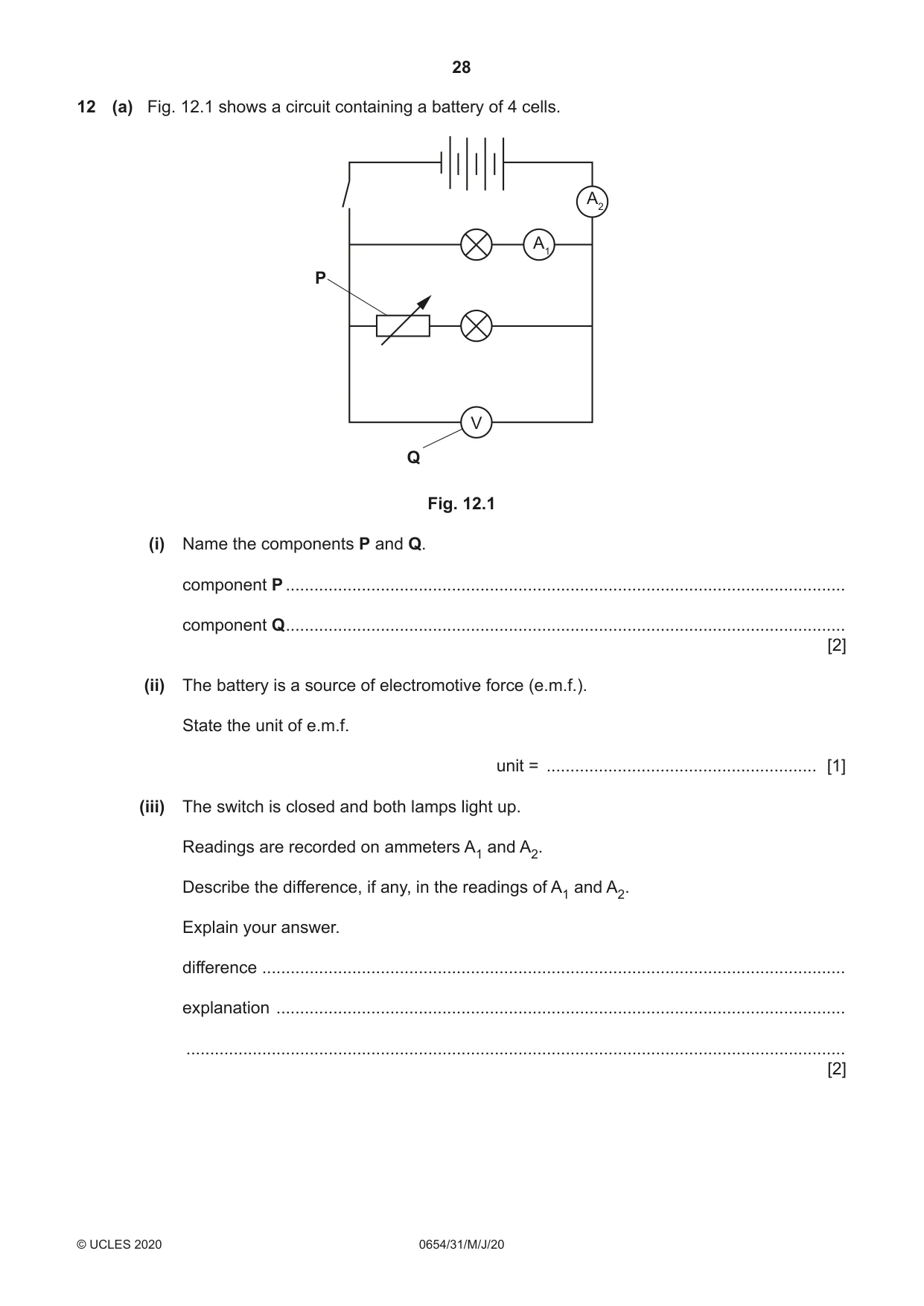
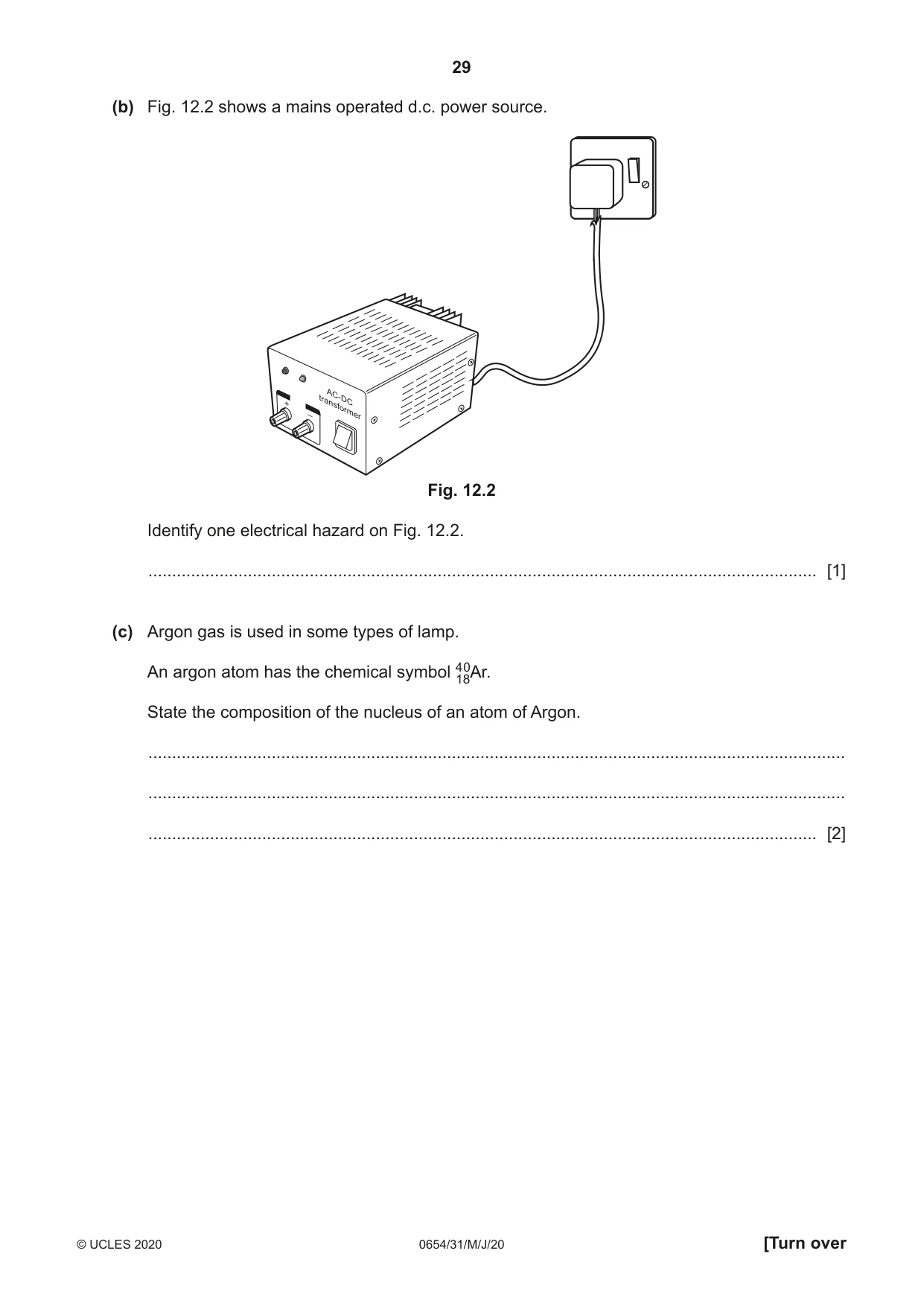
12 (a) Fig. 12.1 shows a circuit containing a battery of 4 cells. A2 A1 P V Q Fig. 12.1 (i) Name the components P and Q. component P ...................................................................................................................... component Q ...................................................................................................................... [2] (ii) The battery is a source of electromotive force (e.m.f.). State the unit of e.m.f. unit = ......................................................... [1] (iii) The switch is closed and both lamps light up. Readings are recorded on ammeters A1 and A2. Describe the difference, if any, in the readings of A1 and A2. Explain your answer. difference ........................................................................................................................... explanation ........................................................................................................................ ........................................................................................................................................... [2] (b) Fig. 12.2 shows a mains operated d.c. power source. + AC-DC – transformer Fig. 12.2 Identify one electrical hazard on Fig. 12.2. ............................................................................................................................................. [1] (c) Argon gas is used in some types of lamp. An argon atom has the chemical symbol 41 8Ar.0 State the composition of the nucleus of an atom of Argon. ................................................................................................................................................... ................................................................................................................................................... ............................................................................................................................................. [2] (d) A sample of radioactive rock was tested to see if it emitted α-particles. (i) Describe how a radiation detector could be used to show that α-particles were being emitted. ........................................................................................................................................... ........................................................................................................................................... ........................................................................................................................................... ..................................................................................................................................... [2] (ii) When the sample of radioactive rock is removed from the detector, the detector continues to record some radiation. Explain this observation. ........................................................................................................................................... ..................................................................................................................................... [1] [Total: 11]
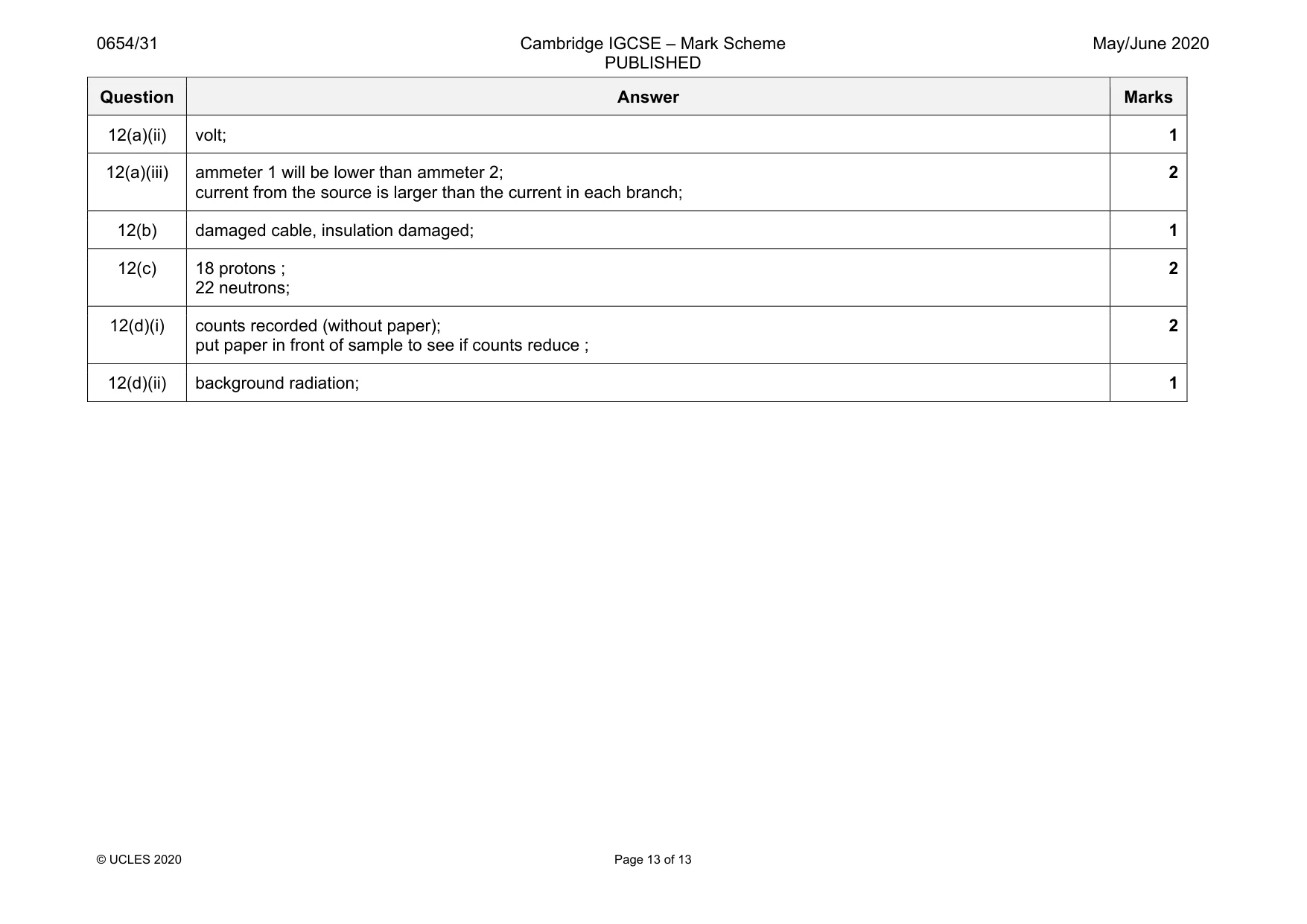
Mark scheme: 12(a)(i) P – variable resistor; Q – voltmeter; 2 Question Answer Marks 12(a)(ii) volt; 1 12(a)(iii) ammeter 1 will be lower than ammeter 2; current from the source is larger than the current in each branch; 2 12(b) damaged cable, insulation damaged; 1 12(c) 18 protons ; 22 neutrons; 2 12(d)(i) counts recorded (without paper); put paper in front of sample to see if counts reduce ; 2 12(d)(ii) background radiation; 1
What was in this paper
The subtopics covered by these 12 questions, and how many questions each got. Open one in a new tab to see every Cambridge question on it.