Cambridge IGCSE Sciences - Co-ordinated (Double) 0654 — 2022 Oct/Nov Paper 3 · Variant 2
0654/32/O/N/22 · 12 questions · 120 marks · ≈135 min
The question paper and its mark scheme, free to read here and free to download. This is Cambridge’s own paper, exactly as it was sat.
Question paper28 pages


Mark scheme14 pages
Answers below. Sit the paper first if you are practising.
Questions as text
Q1 · A diagram of a plant cell
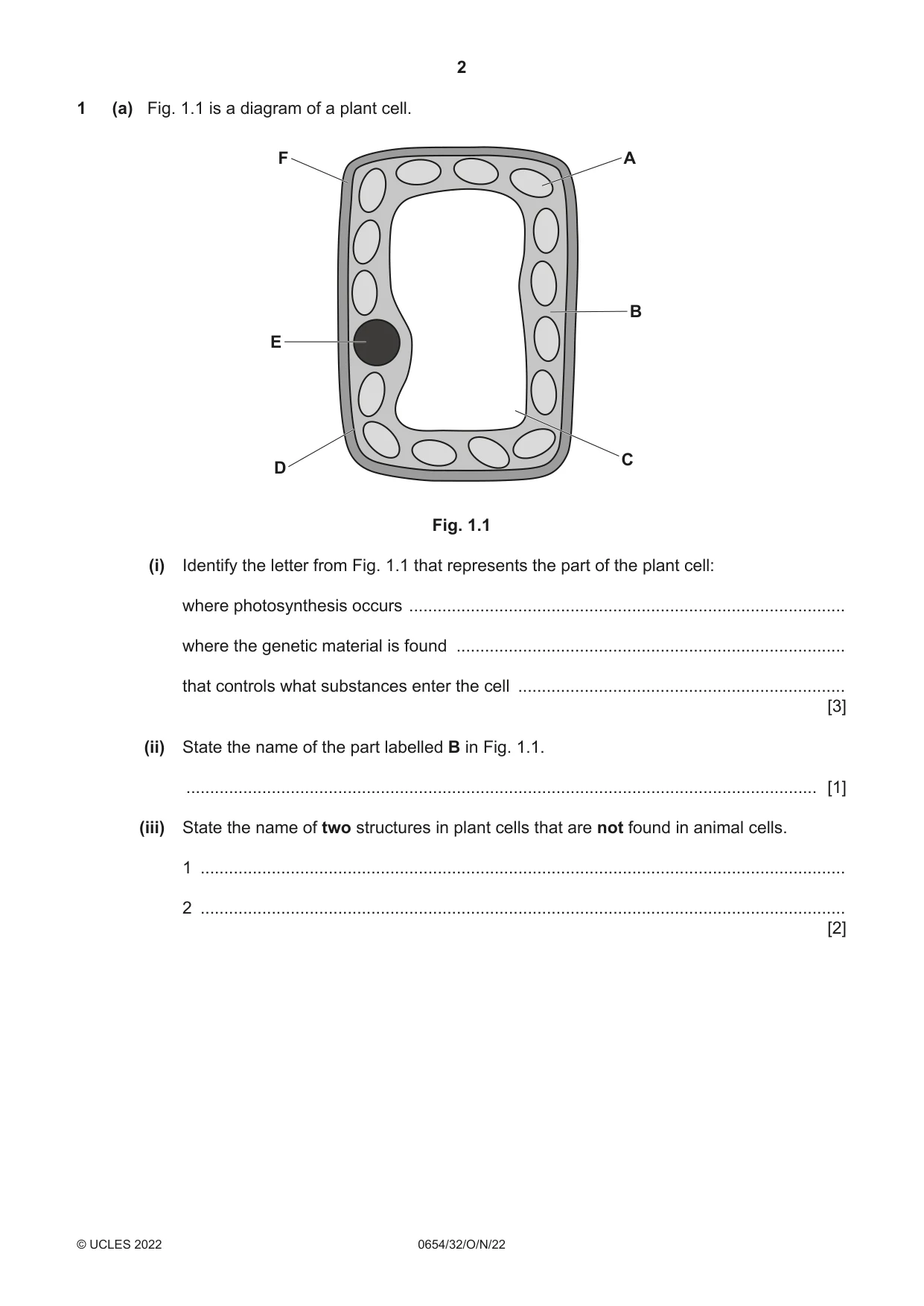
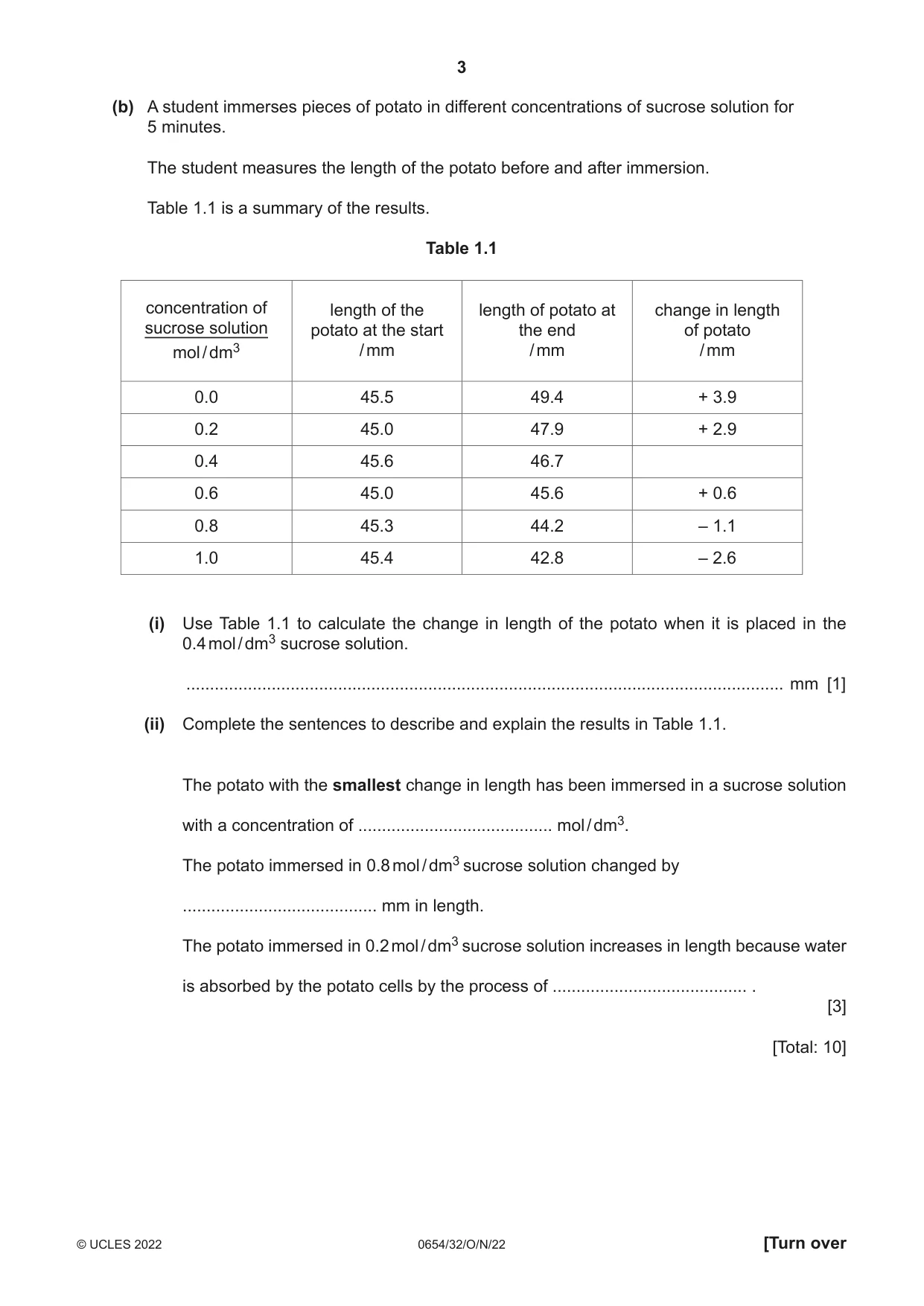
1 (a) Fig. 1.1 is a diagram of a plant cell. F A B E C D Fig. 1.1 (i) Identify the letter from Fig. 1.1 that represents the part of the plant cell: where photosynthesis occurs ............................................................................................ where the genetic material is found .................................................................................. that controls what substances enter the cell ..................................................................... [3] (ii) State the name of the part labelled B in Fig. 1.1. ..................................................................................................................................... [1] (iii) State the name of two structures in plant cells that are not found in animal cells. 1 ........................................................................................................................................ 2 ........................................................................................................................................ [2] (b) A student immerses pieces of potato in different concentrations of sucrose solution for 5 minutes. The student measures the length of the potato before and after immersion. Table 1.1 is a summary of the results. Table 1.1 concentration of length of the length of potato at change in length sucrose solution potato at the start the end of potato mol / dm3 / mm / mm / mm 0.0 45.5 49.4 + 3.9 0.2 45.0 47.9 + 2.9 0.4 45.6 46.7 0.6 45.0 45.6 + 0.6 0.8 45.3 44.2 – 1.1 1.0 45.4 42.8 – 2.6 (i) Use Table 1.1 to calculate the change in length of the potato when it is placed in the 0.4 mol / dm3 sucrose solution. .............................................................................................................................. mm [1] (ii) Complete the sentences to describe and explain the results in Table 1.1. The potato with the smallest change in length has been immersed in a sucrose solution with a concentration of ......................................... mol / dm3. The potato immersed in 0.8 mol / dm3 sucrose solution changed by ......................................... mm in length. The potato immersed in 0.2 mol / dm3 sucrose solution increases in length because water is absorbed by the potato cells by the process of ......................................... . [3] [Total: 10]
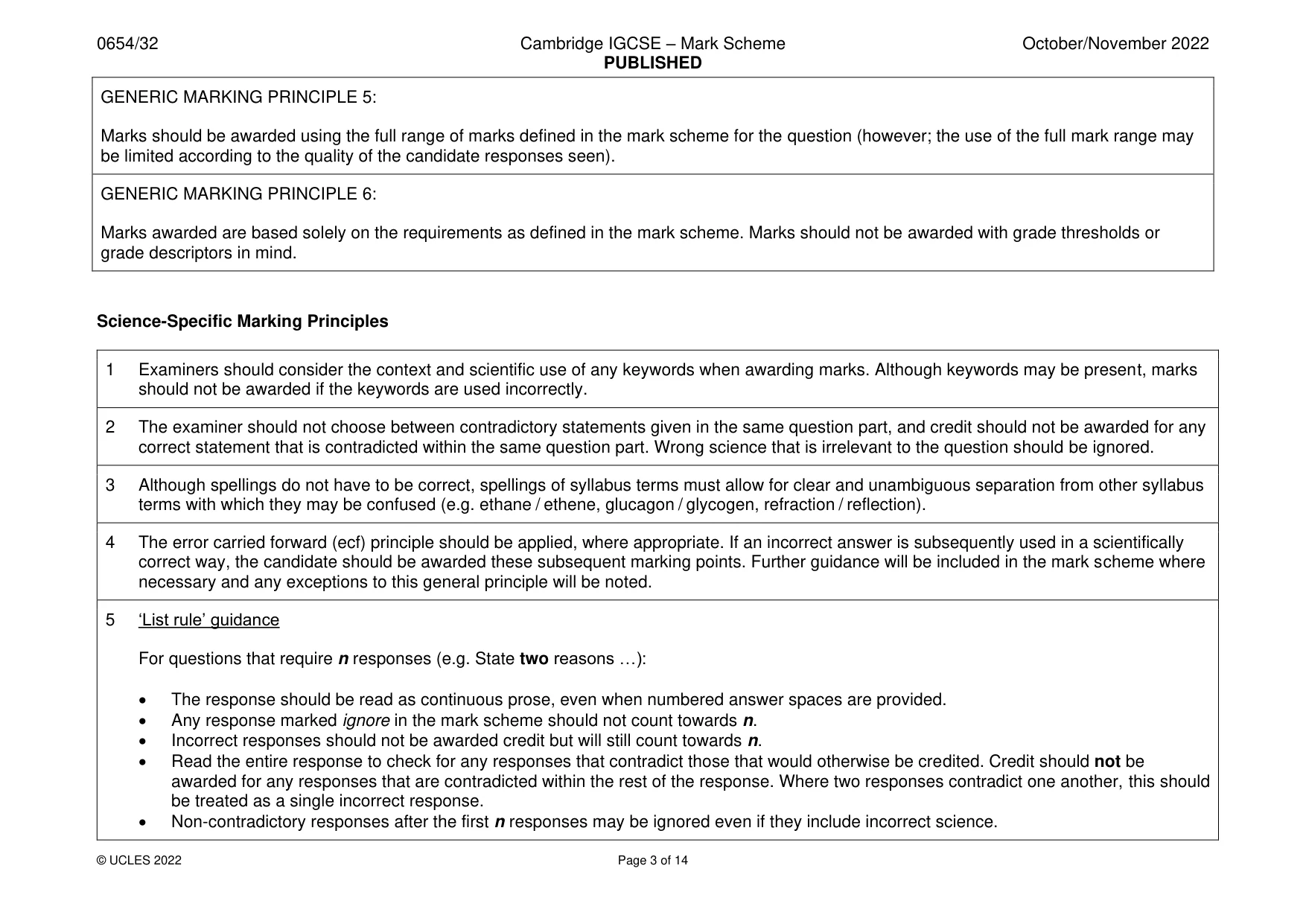
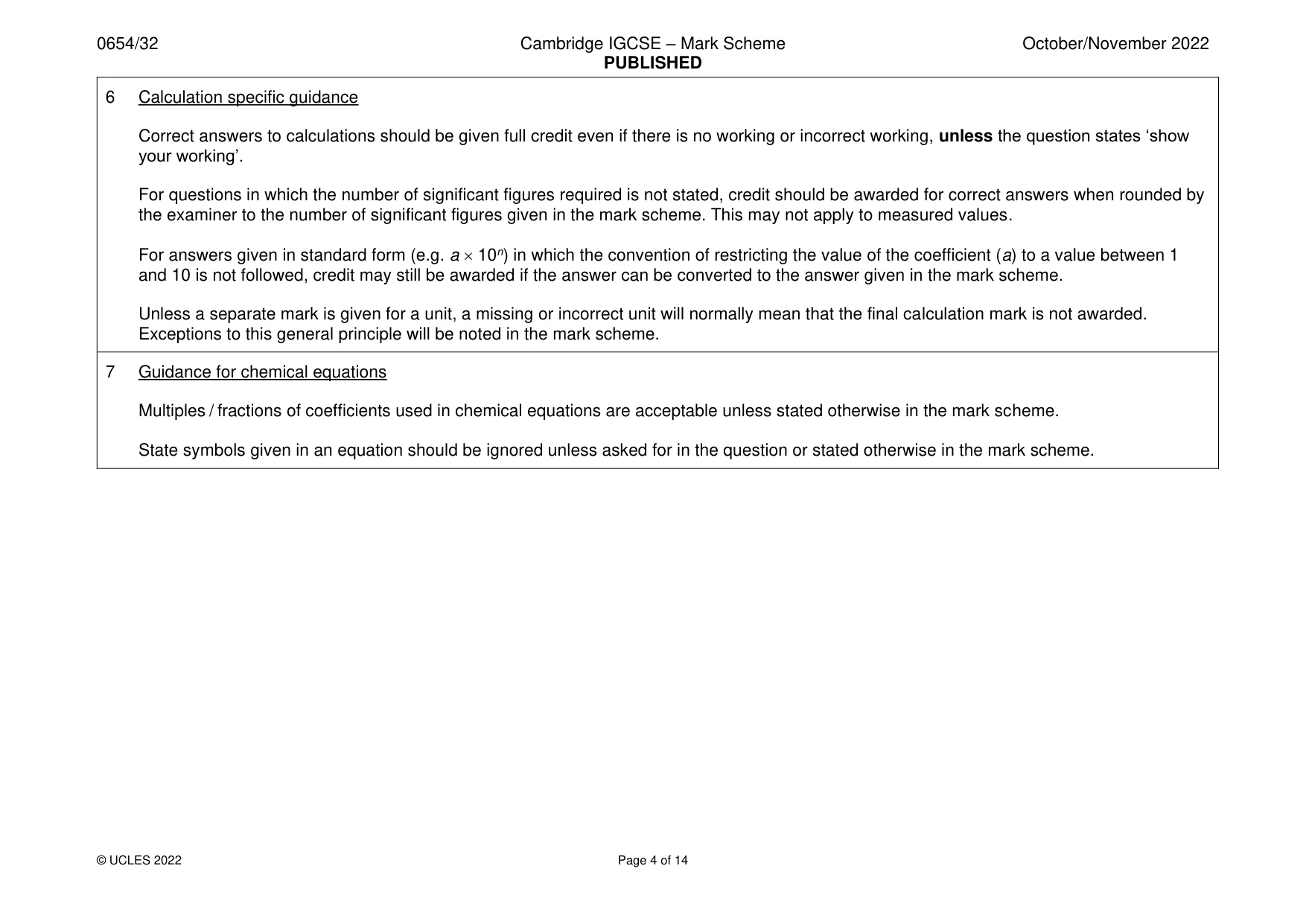
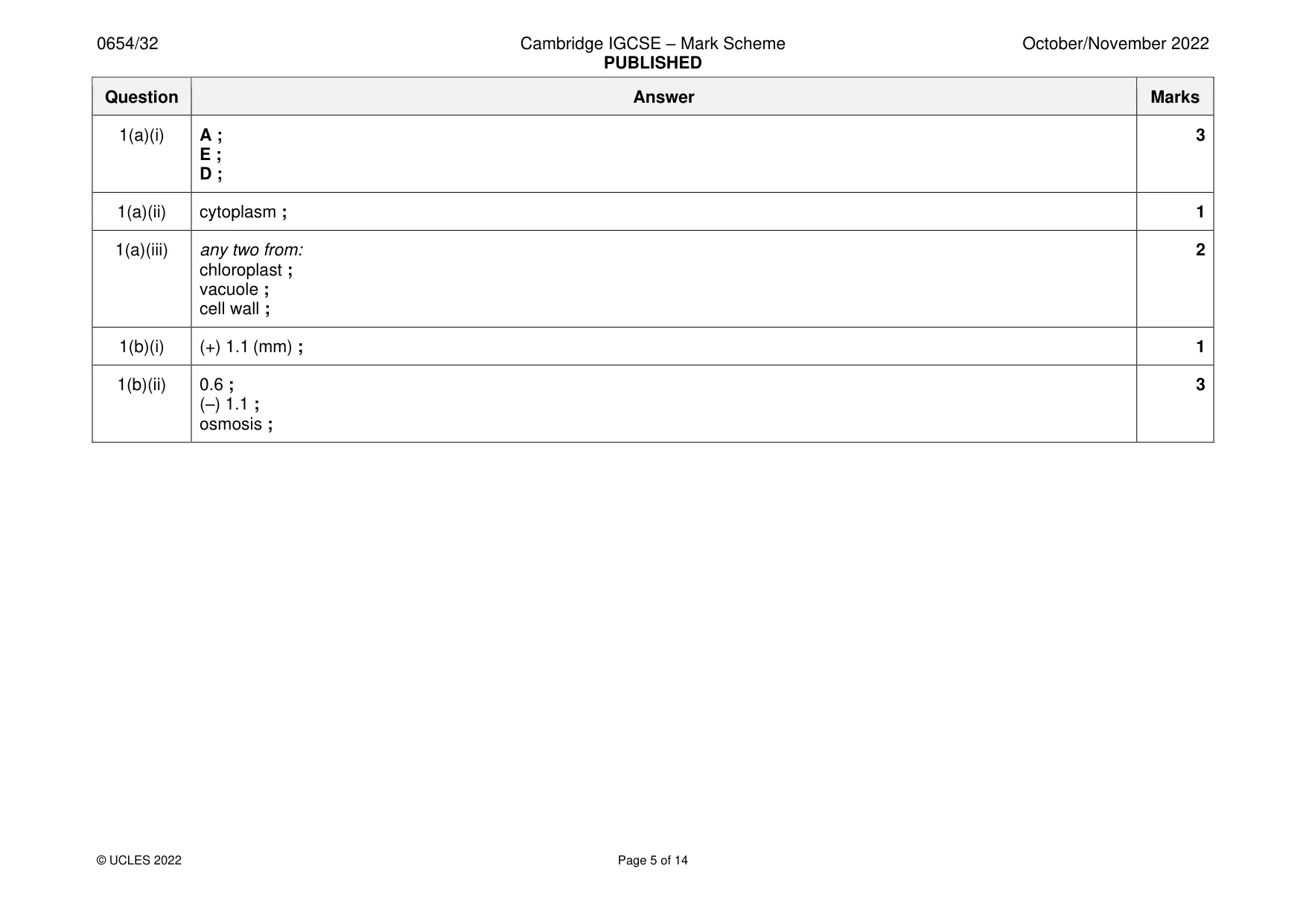
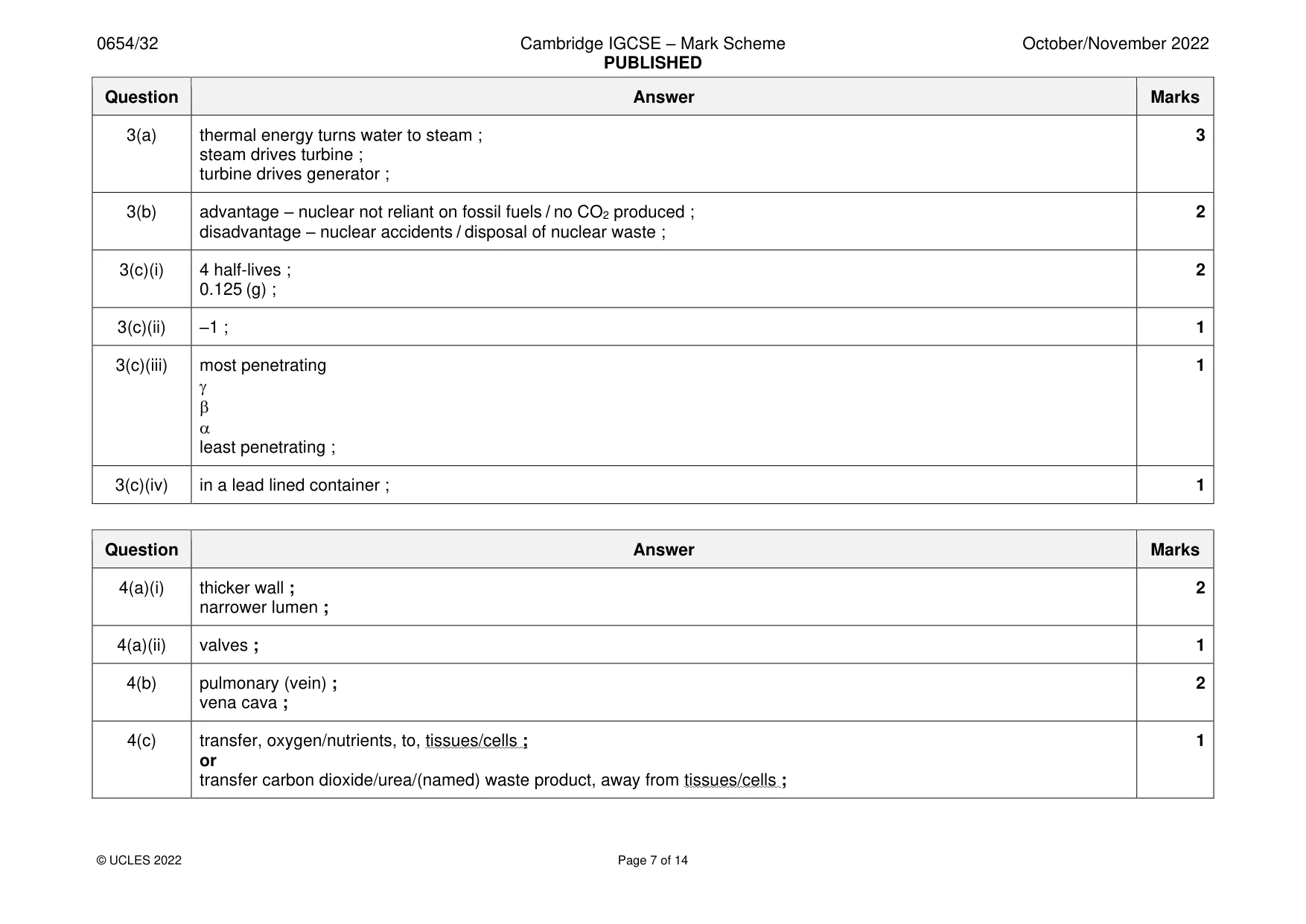
Mark scheme: Question Answer Marks 1(a)(i) A ; 3 E ; D ; 1(a)(ii) cytoplasm ; 1 1(a)(iii) any two from: 2 chloroplast ; vacuole ; cell wall ; 1(b)(i) (+) 1.1 (mm) ; 1 1(b)(ii) 0.6 ; 3 (–) 1.1 ; osmosis ;
Q2 · Five words are shown in the boxes on the left
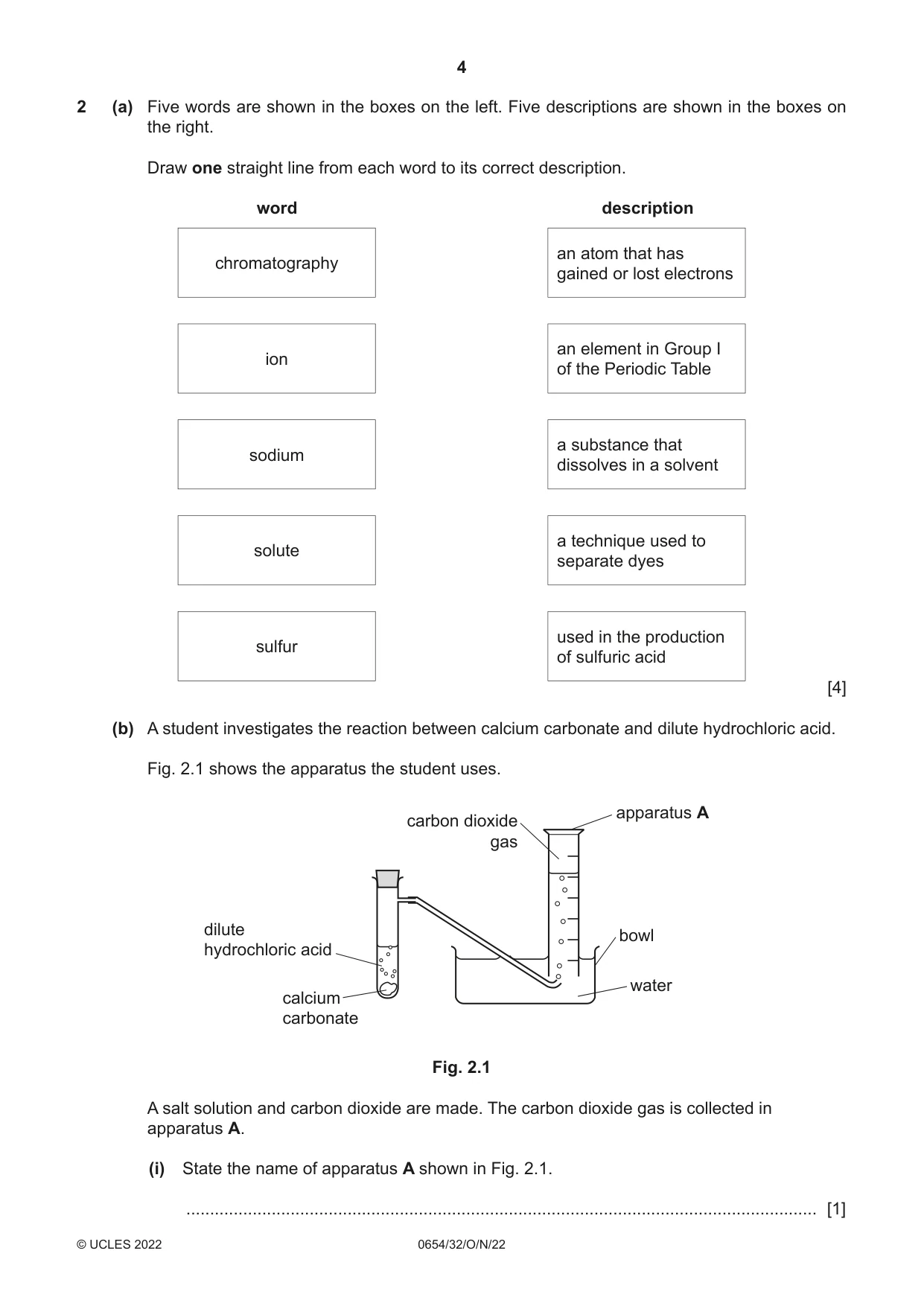
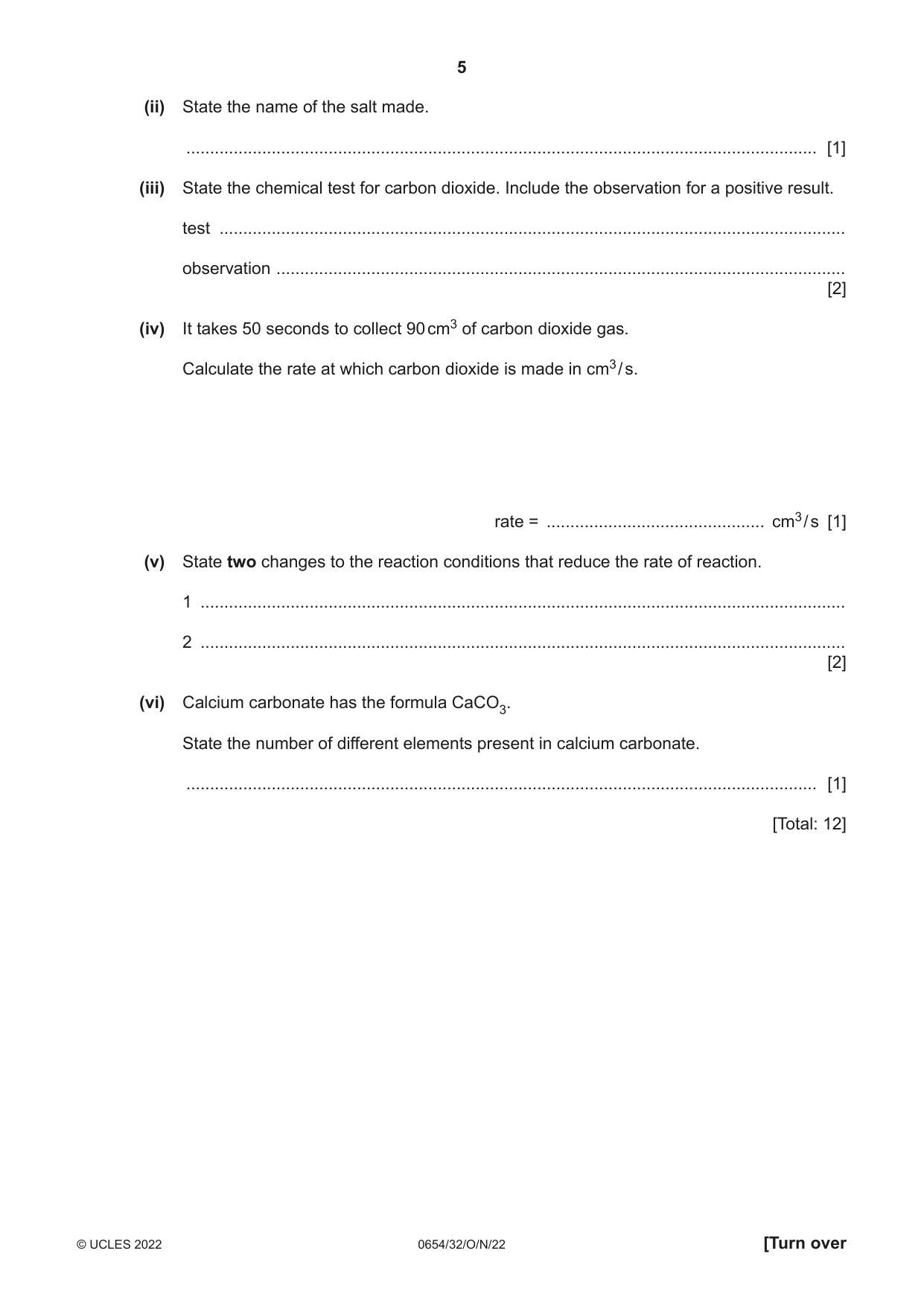
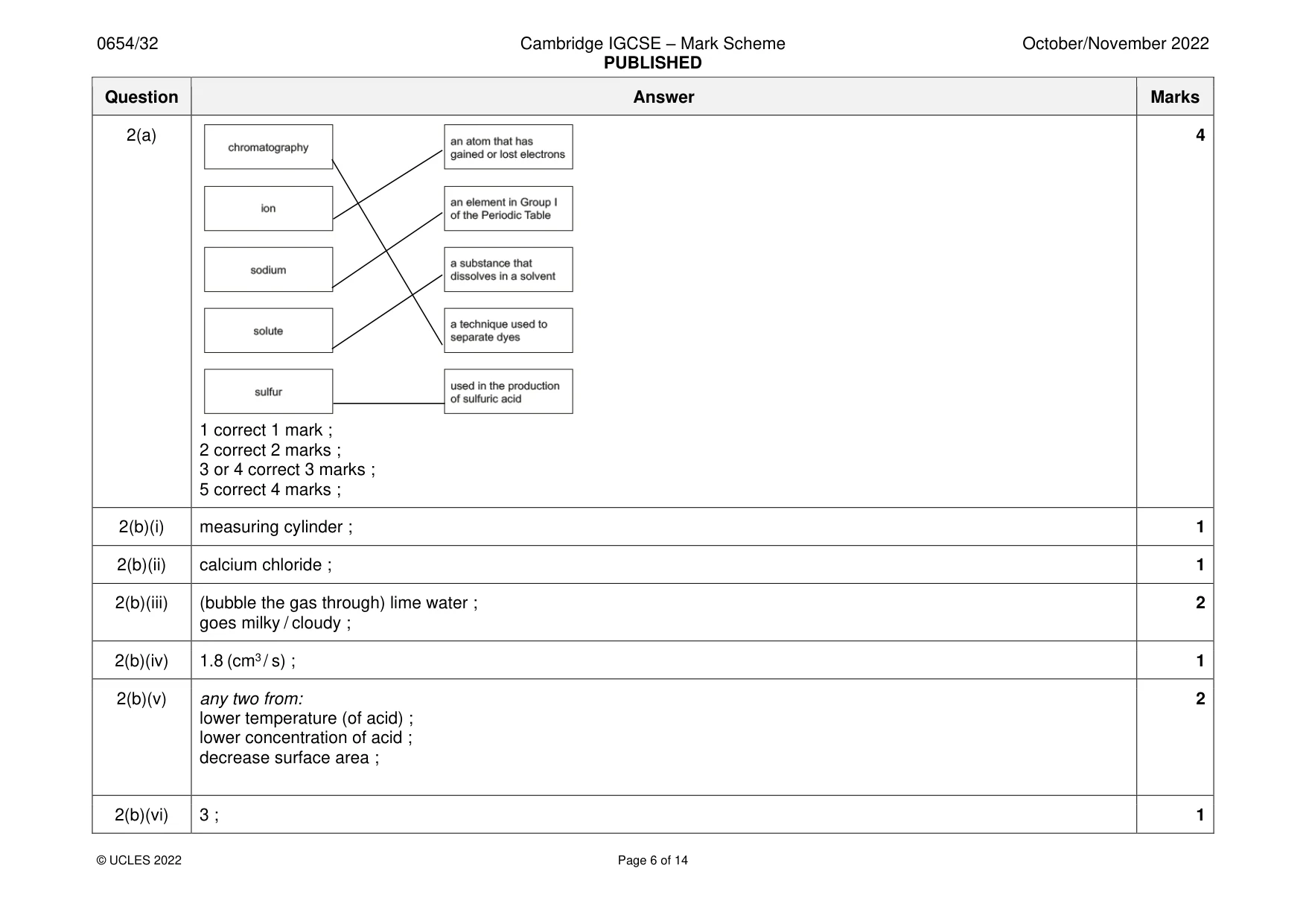
2 (a) Five words are shown in the boxes on the left. Five descriptions are shown in the boxes on the right. Draw one straight line from each word to its correct description. word description an atom that has chromatography gained or lost electrons an element in Group I ion of the Periodic Table a substance that sodium dissolves in a solvent a technique used to solute separate dyes used in the production sulfur of sulfuric acid [4] (b) A student investigates the reaction between calcium carbonate and dilute hydrochloric acid. Fig. 2.1 shows the apparatus the student uses. apparatus A carbon dioxide gas dilute bowl hydrochloric acid water calcium carbonate Fig. 2.1 A salt solution and carbon dioxide are made. The carbon dioxide gas is collected in apparatus A. (i) State the name of apparatus A shown in Fig. 2.1. ..................................................................................................................................... [1] (ii) State the name of the salt made. ..................................................................................................................................... [1] (iii) State the chemical test for carbon dioxide. Include the observation for a positive result. test .................................................................................................................................... observation ........................................................................................................................ [2] (iv) It takes 50 seconds to collect 90 cm3 of carbon dioxide gas. Calculate the rate at which carbon dioxide is made in cm3 / s. rate = .............................................. cm3 / s [1] (v) State two changes to the reaction conditions that reduce the rate of reaction. 1 ........................................................................................................................................ 2 ........................................................................................................................................ [2] (vi) Calcium carbonate has the formula CaCO3. State the number of different elements present in calcium carbonate. ..................................................................................................................................... [1] [Total: 12]
Mark scheme: 2(a) 4 1 correct 1 mark ; 2 correct 2 marks ; 3 or 4 correct 3 marks ; 5 correct 4 marks ; 2(b)(i) measuring cylinder ; 1 2(b)(ii) calcium chloride ; 1 2(b)(iii) (bubble the gas through) lime water ; 2 goes milky / cloudy ; 2(b)(iv) 1.8 (cm3 / s) ; 1 2(b)(v) any two from: 2 lower temperature (of acid) ; lower concentration of acid ; decrease surface area ; 2(b)(vi) 3 ; 1
Q3 · Thermal energy is released, by combustion, in a gas-fired power station
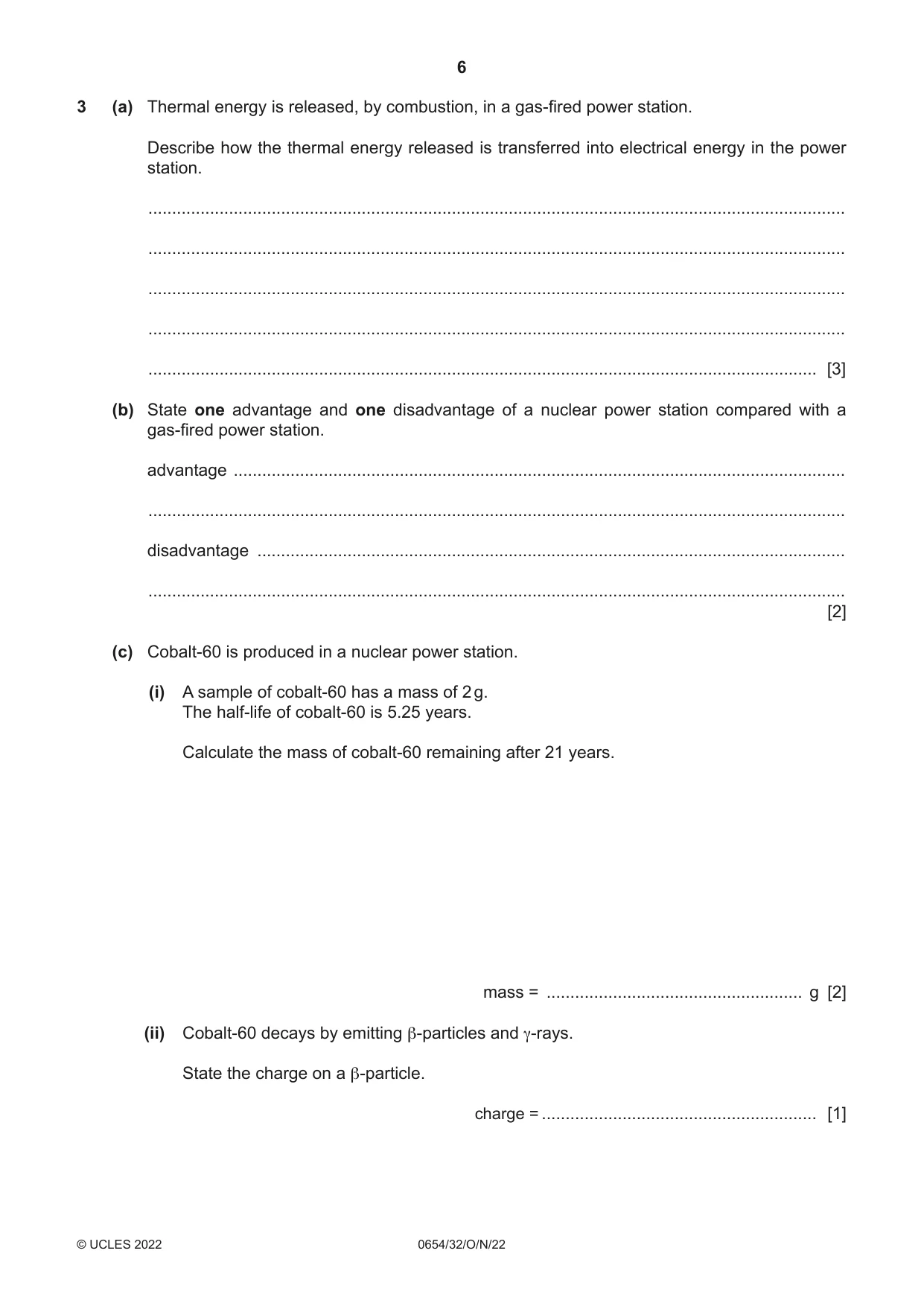
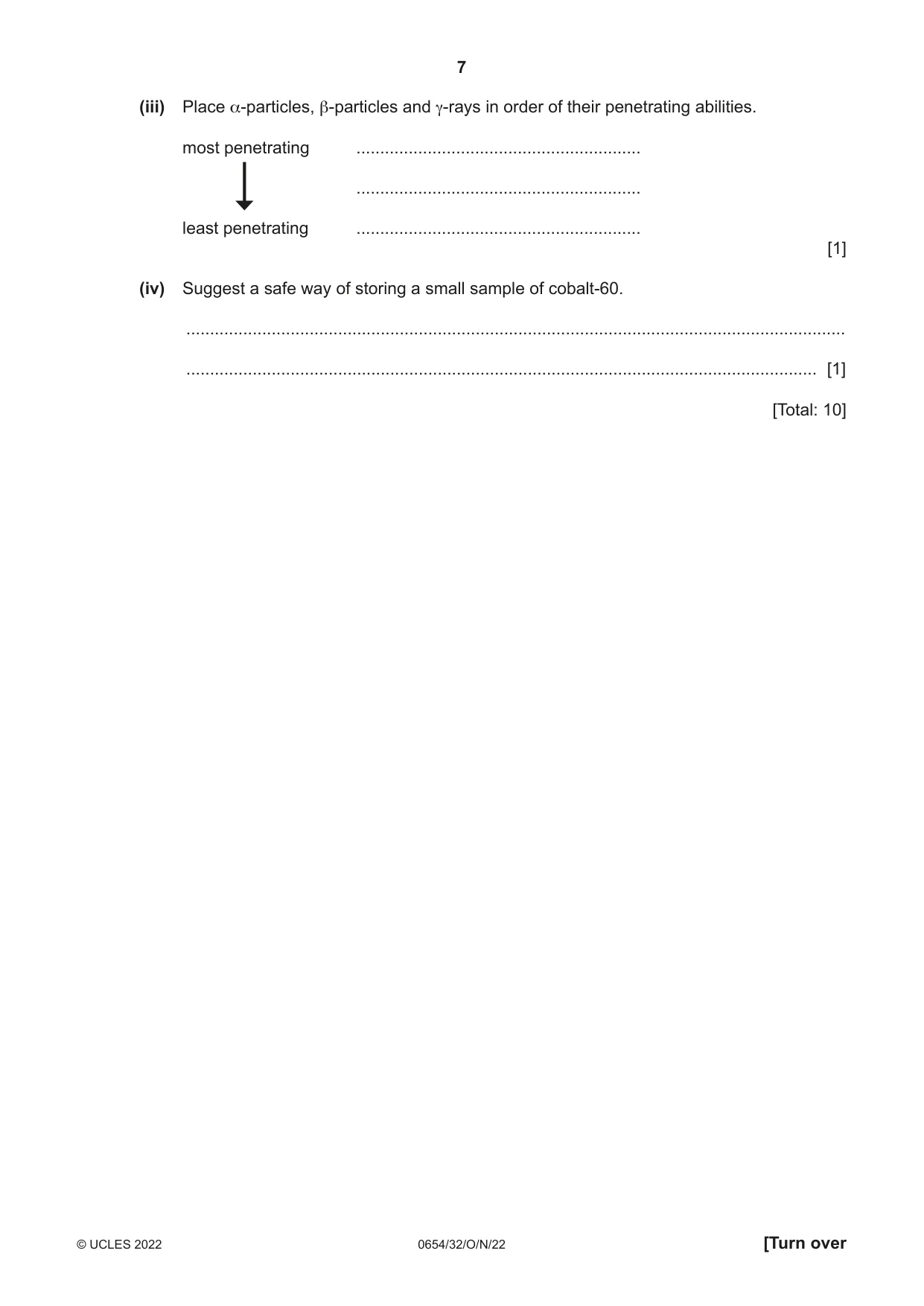
3 (a) Thermal energy is released, by combustion, in a gas-fired power station. Describe how the thermal energy released is transferred into electrical energy in the power station. ................................................................................................................................................... ................................................................................................................................................... ................................................................................................................................................... ................................................................................................................................................... ............................................................................................................................................. [3] (b) State one advantage and one disadvantage of a nuclear power station compared with a gas-fired power station. advantage ................................................................................................................................. ................................................................................................................................................... disadvantage ............................................................................................................................ ................................................................................................................................................... [2] (c) Cobalt-60 is produced in a nuclear power station. (i) A sample of cobalt-60 has a mass of 2 g. The half-life of cobalt-60 is 5.25 years. Calculate the mass of cobalt-60 remaining after 21 years. mass = ...................................................... g [2] (ii) Cobalt-60 decays by emitting β-particles and γ-rays. State the charge on a β-particle. charge = .......................................................... [1] (iii) Place α-particles, β-particles and γ-rays in order of their penetrating abilities. most penetrating ............................................................ ............................................................ least penetrating ............................................................ [1] (iv) Suggest a safe way of storing a small sample of cobalt-60. ........................................................................................................................................... ..................................................................................................................................... [1] [Total: 10]
Mark scheme: 3(a) thermal energy turns water to steam ; 3 steam drives turbine ; turbine drives generator ; 3(b) advantage – nuclear not reliant on fossil fuels / no CO2 produced ; 2 disadvantage – nuclear accidents / disposal of nuclear waste ; 3(c)(i) 4 half-lives ; 2 0.125 (g) ; 3(c)(ii) –1 ; 1 3(c)(iii) most penetrating 1 least penetrating ; 3(c)(iv) in a lead lined container ; 1
Q4 · A photomicrograph of a cross-section of a human vein
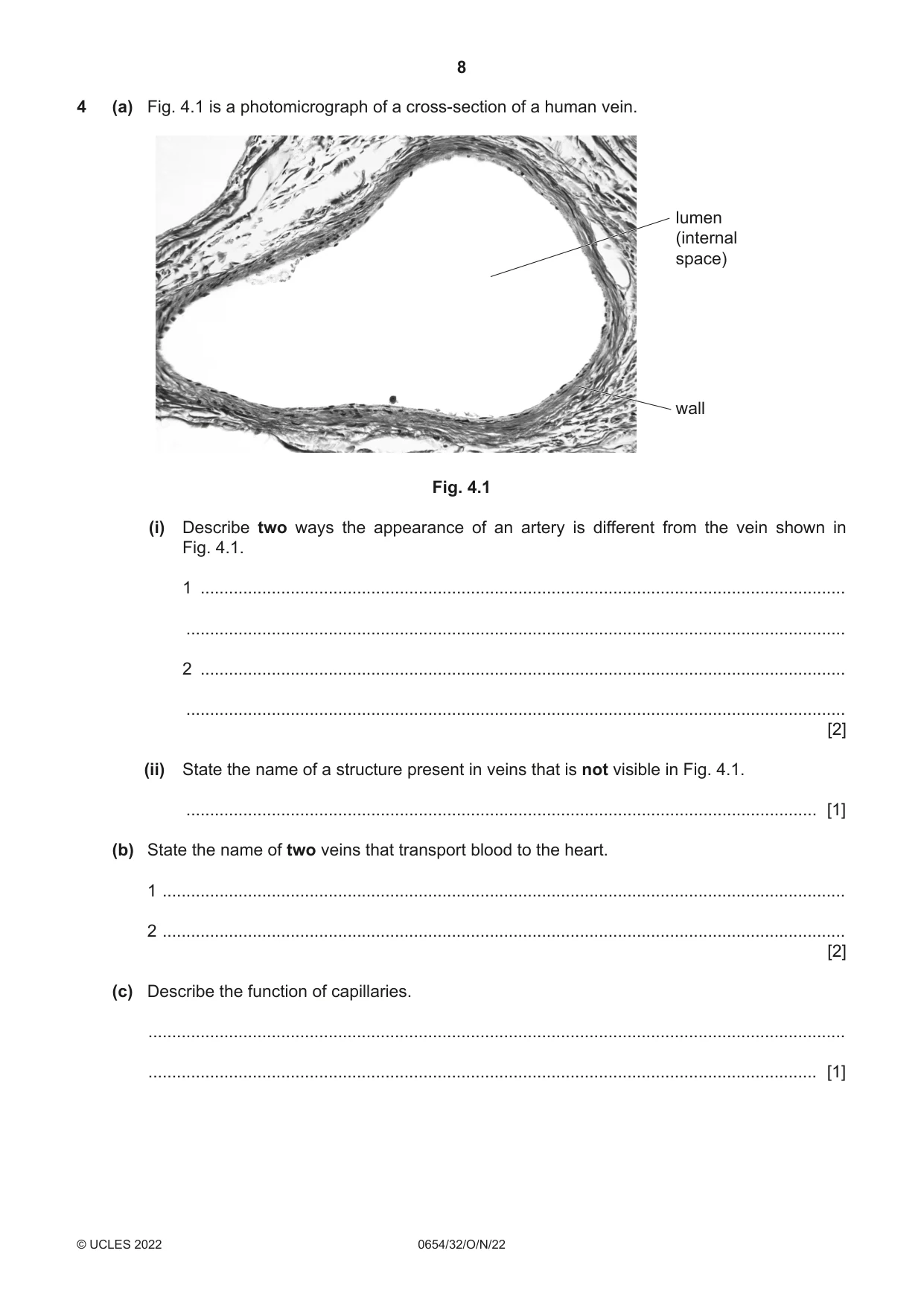
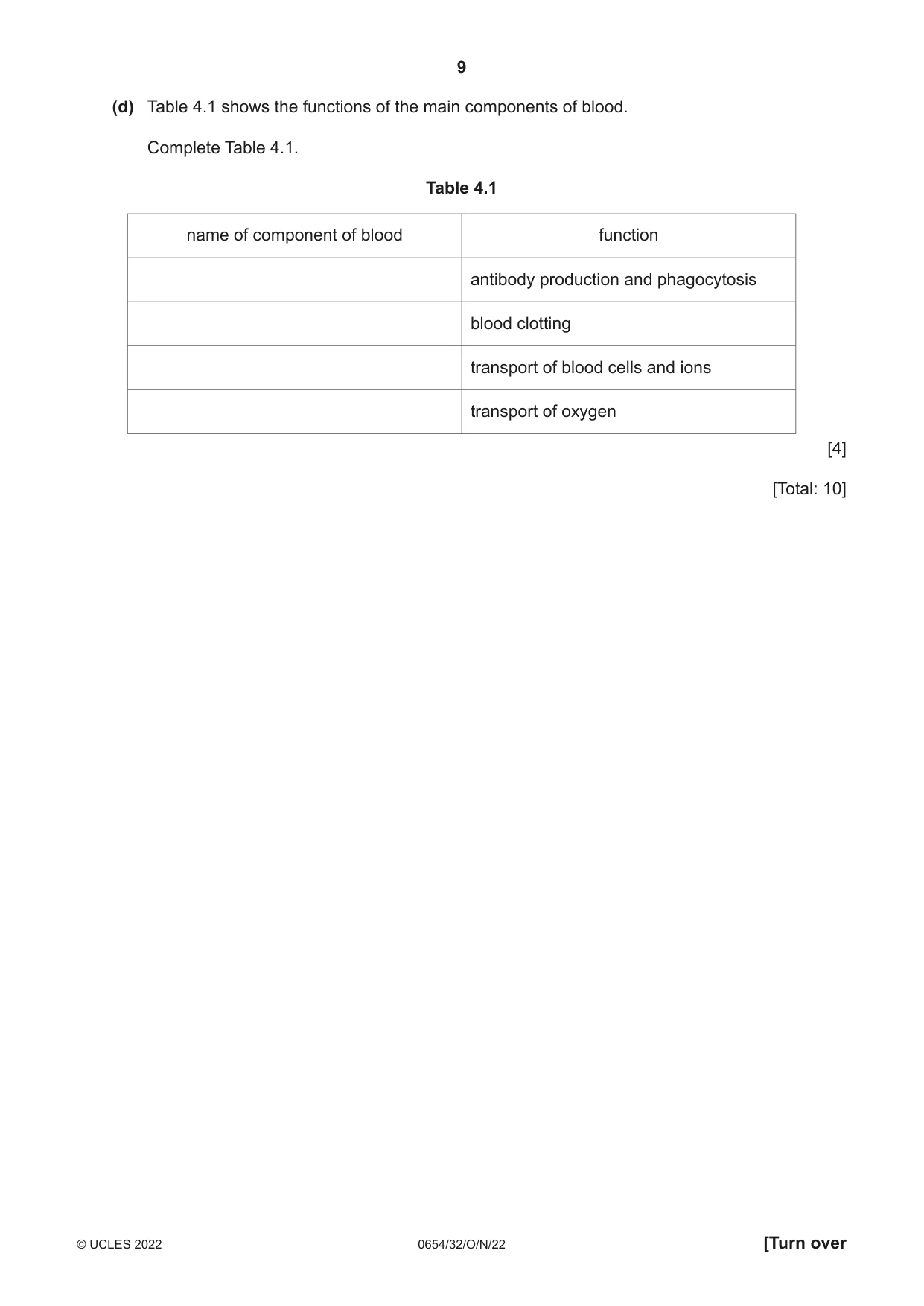
4 (a) Fig. 4.1 is a photomicrograph of a cross-section of a human vein. lumen (internal space) wall Fig. 4.1 (i) Describe two ways the appearance of an artery is different from the vein shown in Fig. 4.1. 1 ........................................................................................................................................ ........................................................................................................................................... 2 ........................................................................................................................................ ........................................................................................................................................... [2] (ii) State the name of a structure present in veins that is not visible in Fig. 4.1. ..................................................................................................................................... [1] (b) State the name of two veins that transport blood to the heart. 1 ................................................................................................................................................ 2 ................................................................................................................................................ [2] (c) Describe the function of capillaries. ................................................................................................................................................... ............................................................................................................................................. [1] (d) Table 4.1 shows the functions of the main components of blood. Complete Table 4.1. Table 4.1 name of component of blood function antibody production and phagocytosis blood clotting transport of blood cells and ions transport of oxygen [4] [Total: 10]
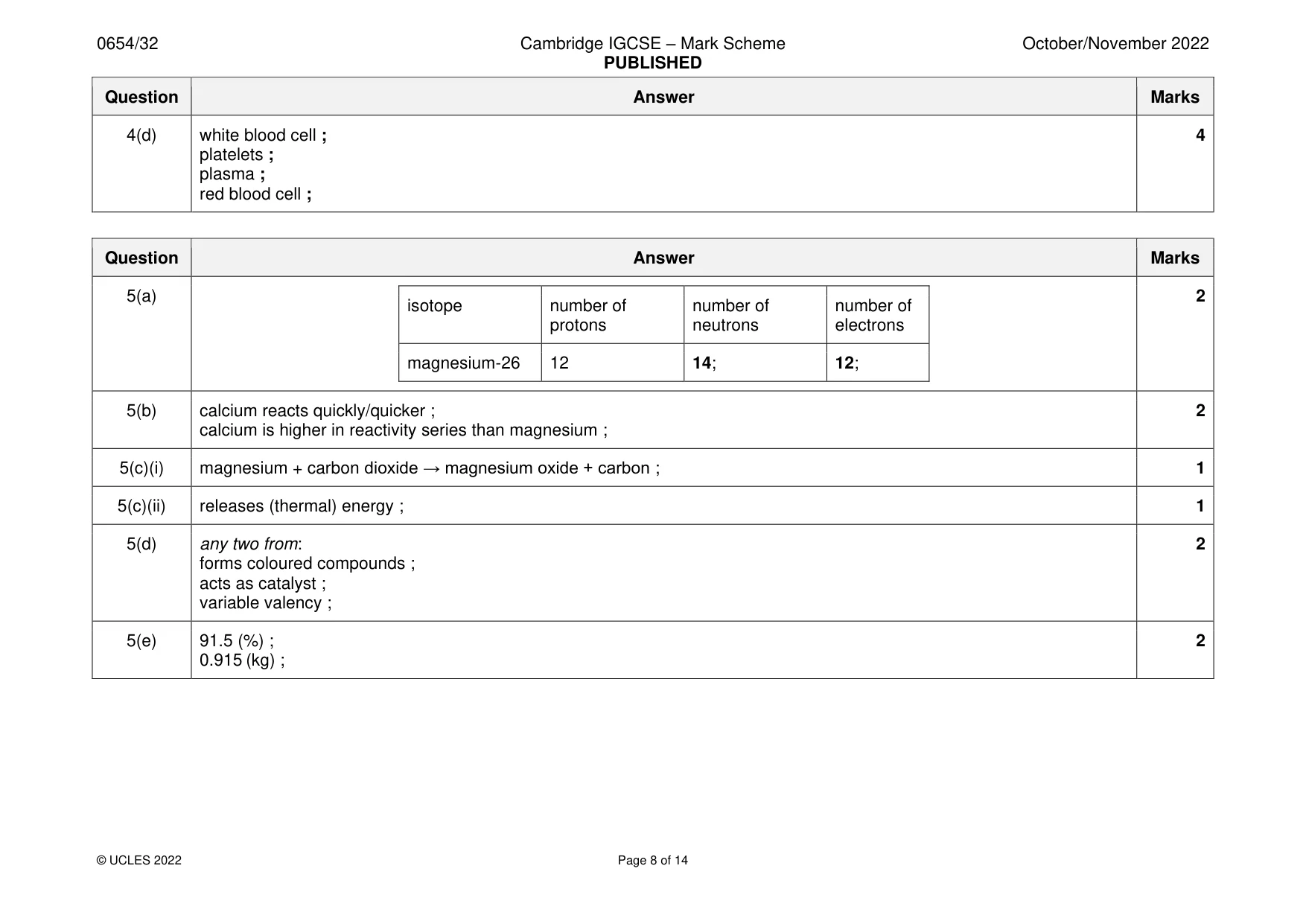
Mark scheme: 4(a)(i) thicker wall ; 2 narrower lumen ; 4(a)(ii) valves ; 1 4(b) pulmonary (vein) ; 2 vena cava ; 4(c) transfer, oxygen/nutrients, to, tissues/cells ; 1 or transfer carbon dioxide/urea/(named) waste product, away from tissues/cells ; 4(d) white blood cell ; 4 platelets ; plasma ; red blood cell ;
Q5 · An isotope of magnesium has a proton number (atomic number) of 12 and a nucleon number…
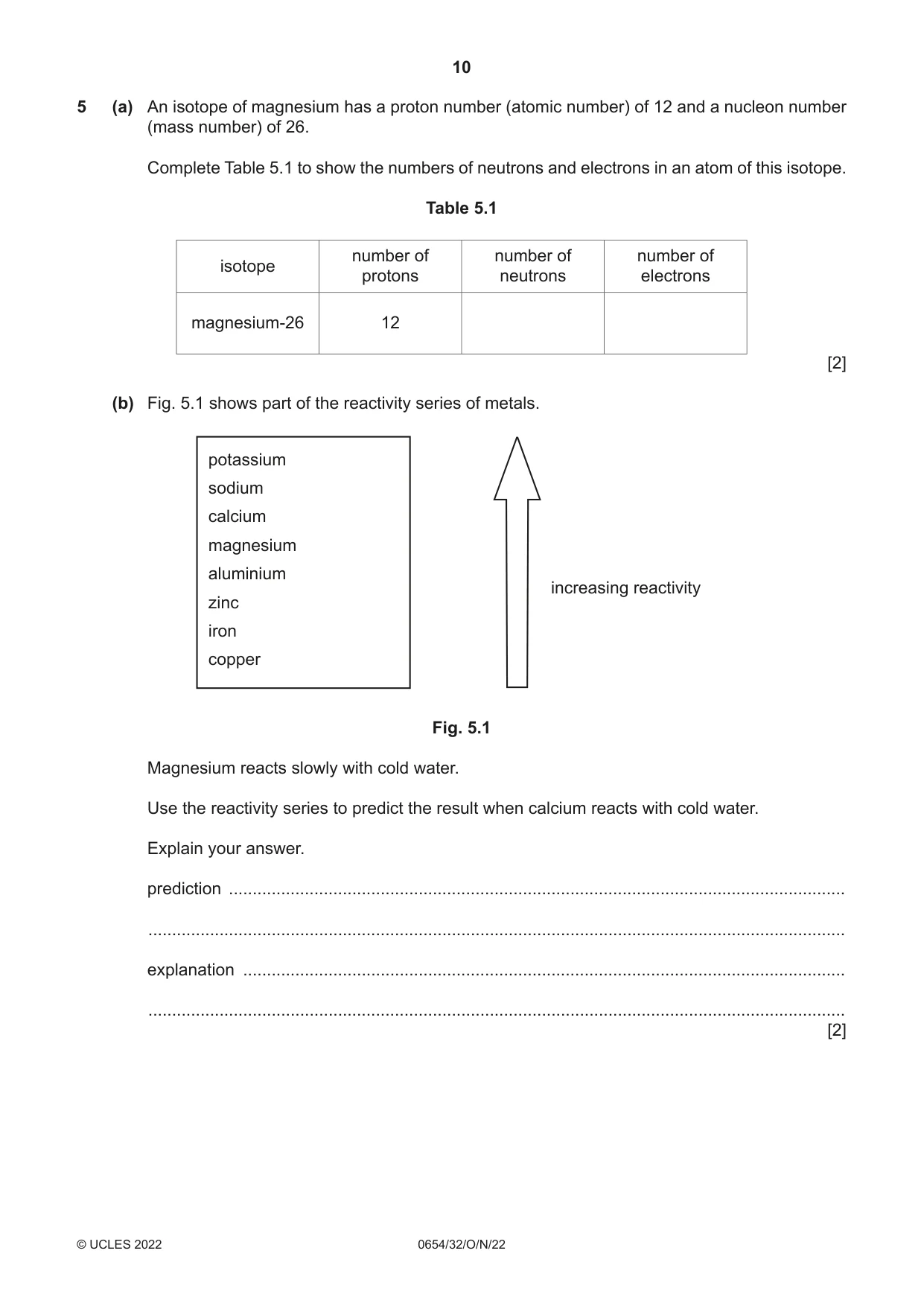
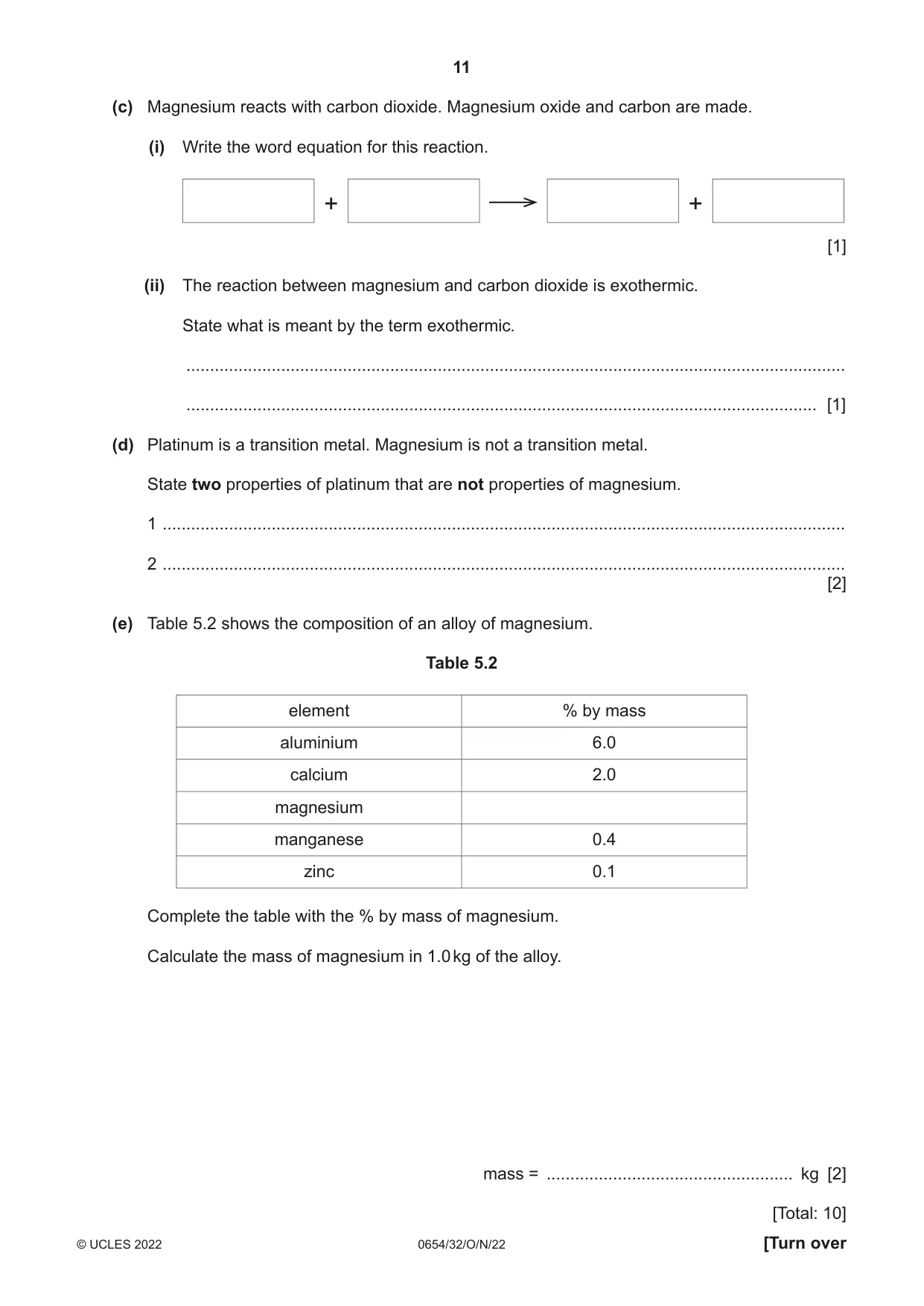
5 (a) An isotope of magnesium has a proton number (atomic number) of 12 and a nucleon number (mass number) of 26. Complete Table 5.1 to show the numbers of neutrons and electrons in an atom of this isotope. Table 5.1 number of number of number of isotope protons neutrons electrons magnesium-26 12 [2] (b) Fig. 5.1 shows part of the reactivity series of metals. potassium sodium calcium magnesium aluminium increasing reactivity zinc iron copper Fig. 5.1 Magnesium reacts slowly with cold water. Use the reactivity series to predict the result when calcium reacts with cold water. Explain your answer. prediction .................................................................................................................................. ................................................................................................................................................... explanation ............................................................................................................................... ................................................................................................................................................... [2] (c) Magnesium reacts with carbon dioxide. Magnesium oxide and carbon are made. (i) Write the word equation for this reaction. + + [1] (ii) The reaction between magnesium and carbon dioxide is exothermic. State what is meant by the term exothermic. ........................................................................................................................................... ..................................................................................................................................... [1] (d) Platinum is a transition metal. Magnesium is not a transition metal. State two properties of platinum that are not properties of magnesium. 1 ................................................................................................................................................ 2 ................................................................................................................................................ [2] (e) Table 5.2 shows the composition of an alloy of magnesium. Table 5.2 element % by mass aluminium 6.0 calcium 2.0 magnesium manganese 0.4 zinc 0.1 Complete the table with the % by mass of magnesium. Calculate the mass of magnesium in 1.0 kg of the alloy. mass = .................................................... kg [2] [Total: 10]
Mark scheme: 5(a) 2 isotope number of number of number of protons neutrons electrons magnesium-26 12 14; 12; 5(b) calcium reacts quickly/quicker ; 2 calcium is higher in reactivity series than magnesium ; 5(c)(i) magnesium + carbon dioxide → magnesium oxide + carbon ; 1 5(c)(ii) releases (thermal) energy ; 1 5(d) any two from: 2 forms coloured compounds ; acts as catalyst ; variable valency ; 5(e) 91.5 (%) ; 2 0.915 (kg) ;
Q6 · An elephant pushing a log up a hill
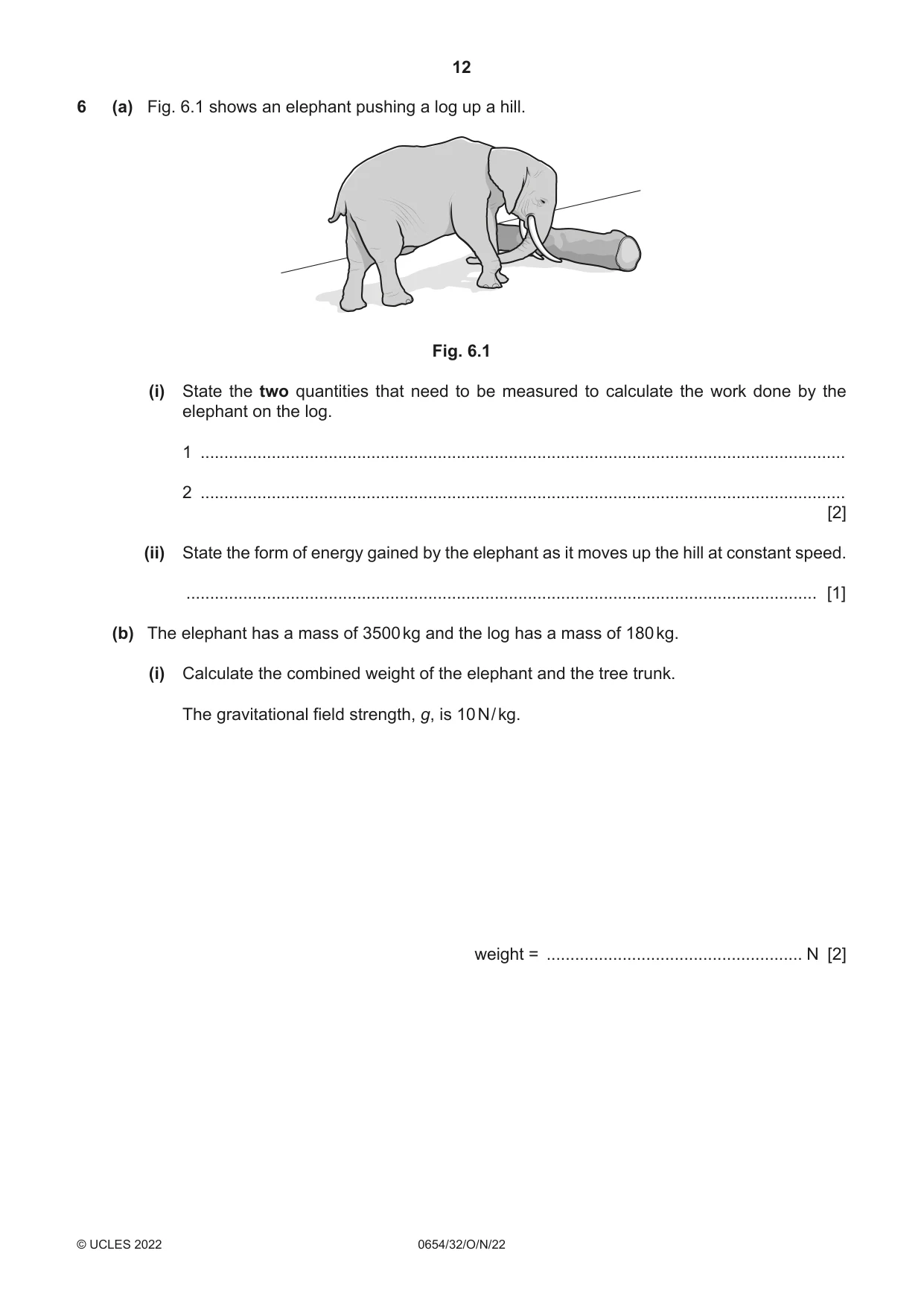
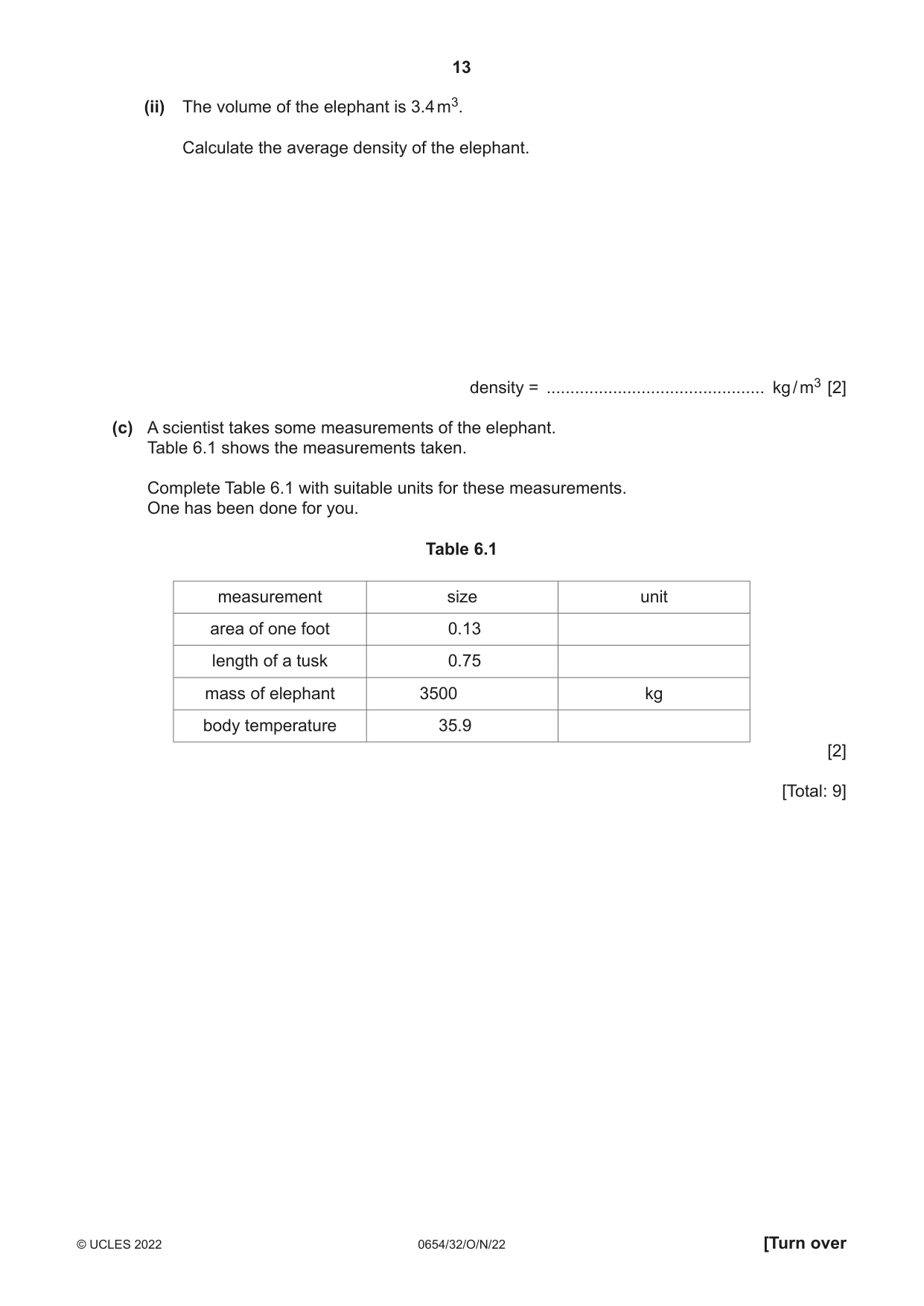
6 (a) Fig. 6.1 shows an elephant pushing a log up a hill. Fig. 6.1 (i) State the two quantities that need to be measured to calculate the work done by the elephant on the log. 1 ........................................................................................................................................ 2 ........................................................................................................................................ [2] (ii) State the form of energy gained by the elephant as it moves up the hill at constant speed. ..................................................................................................................................... [1] (b) The elephant has a mass of 3500 kg and the log has a mass of 180 kg. (i) Calculate the combined weight of the elephant and the tree trunk. The gravitational field strength, g, is 10 N / kg. weight = ...................................................... N [2] (ii) The volume of the elephant is 3.4 m3. Calculate the average density of the elephant. density = .............................................. kg / m3 [2] (c) A scientist takes some measurements of the elephant. Table 6.1 shows the measurements taken. Complete Table 6.1 with suitable units for these measurements. One has been done for you. Table 6.1 measurement size unit area of one foot 0.13 length of a tusk 0.75 mass of elephant 3500 kg body temperature 35.9 [2] [Total: 9]
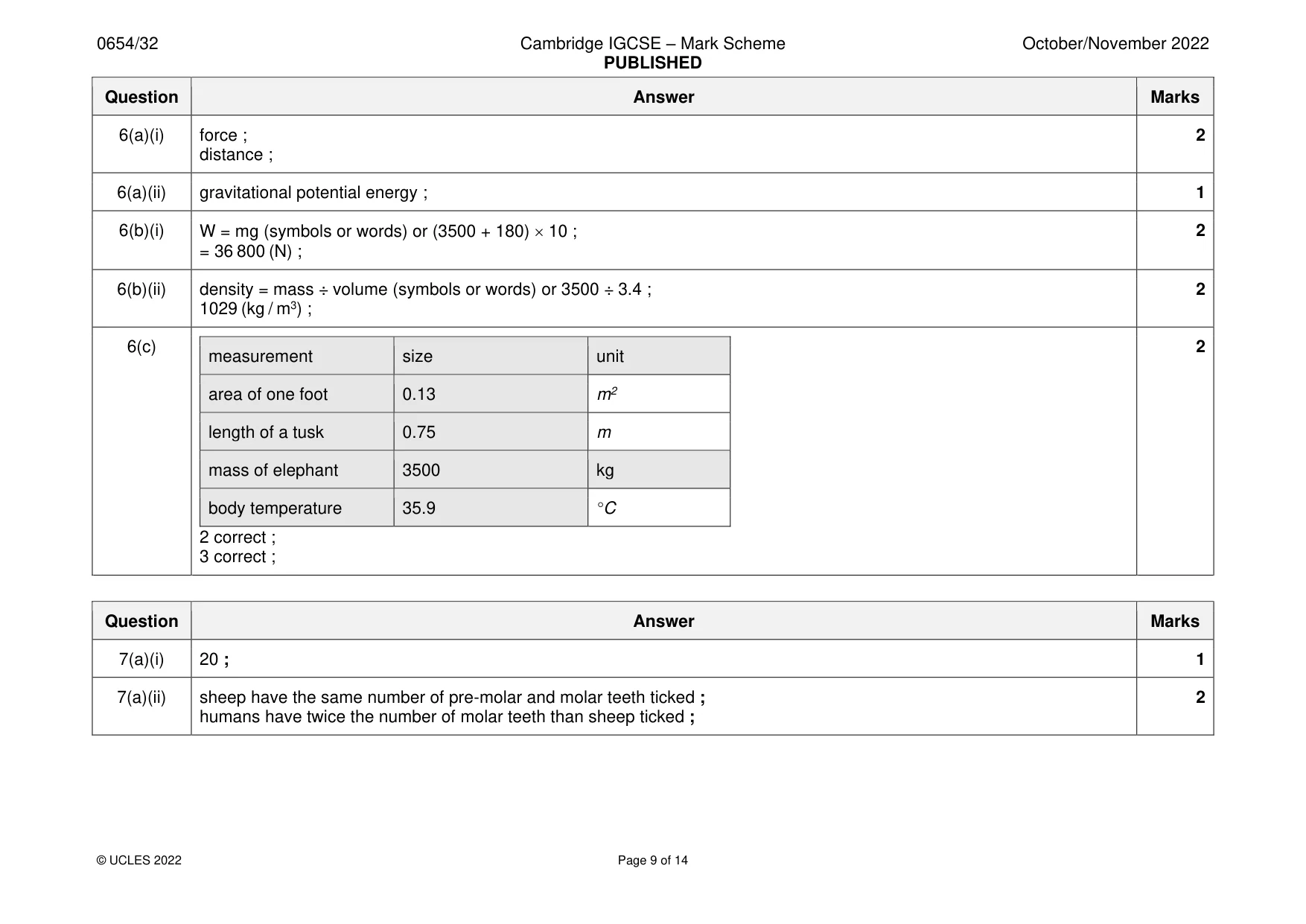
Mark scheme: 6(a)(i) force ; 2 distance ; 6(a)(ii) gravitational potential energy ; 1 6(b)(i) W = mg (symbols or words) or (3500 + 180) 10 ; 2 = 36 800 (N) ; 6(b)(ii) density = mass ÷ volume (symbols or words) or 3500 ÷ 3.4 ; 2 1029 (kg / m3) ; 6(c) 2 measurement size unit area of one foot 0.13 m2 length of a tusk 0.75 m mass of elephant 3500 kg body temperature 35.9 °C 2 correct ; 3 correct ;
Q7 · The number of different types of teeth in sheep and humans
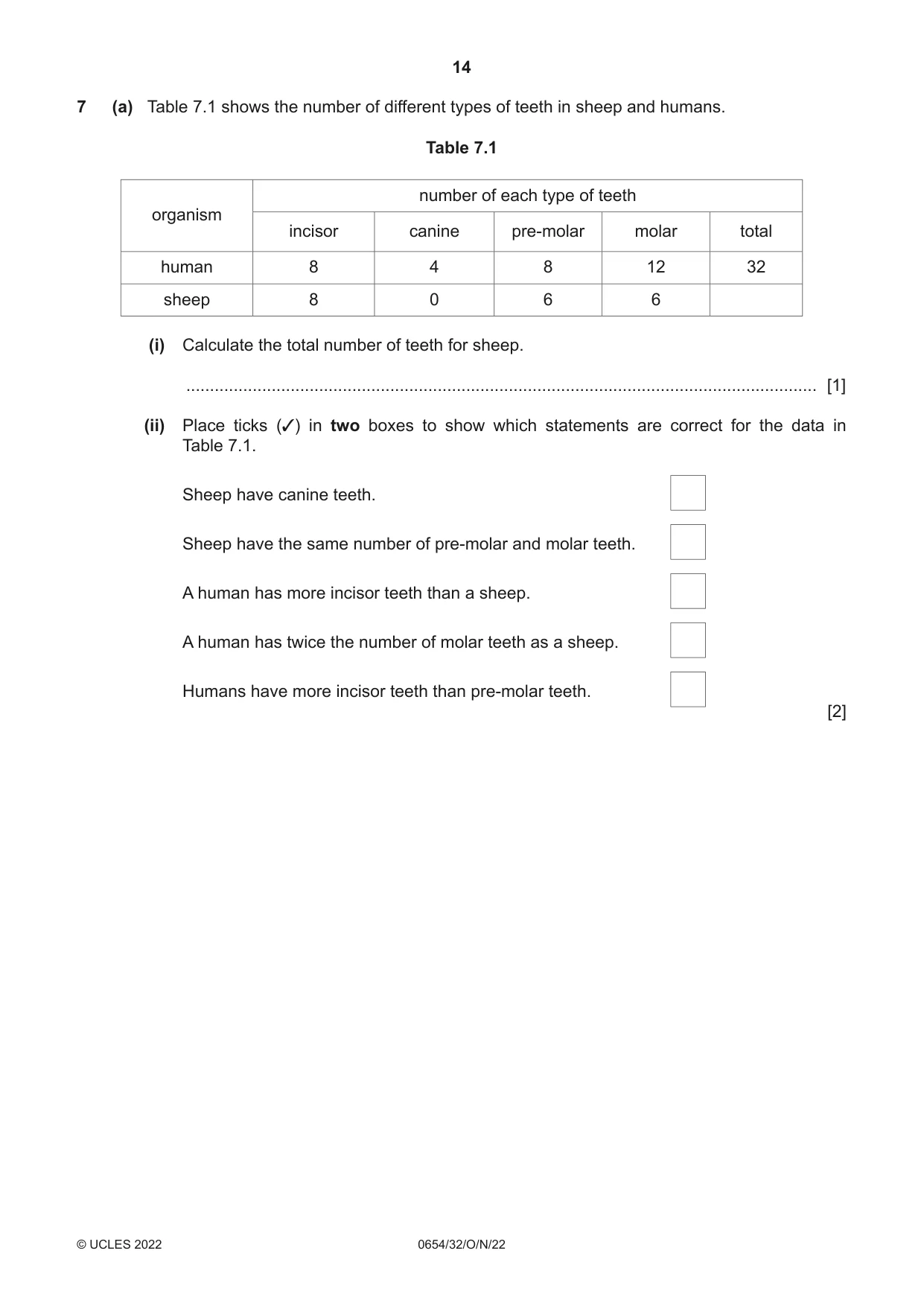
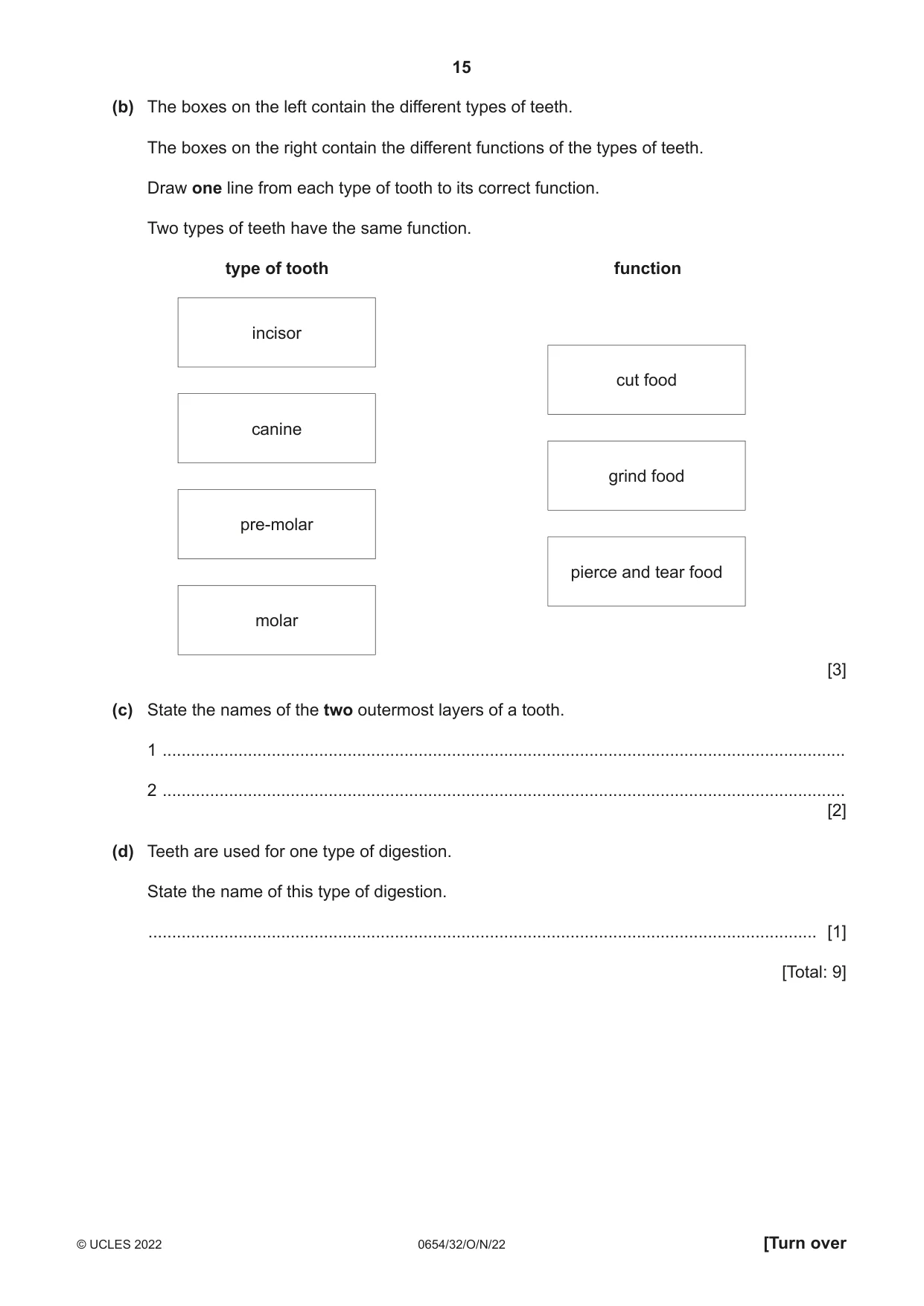
7 (a) Table 7.1 shows the number of different types of teeth in sheep and humans. Table 7.1 number of each type of teeth organism incisor canine pre-molar molar total human 8 4 8 12 32 sheep 8 0 6 6 (i) Calculate the total number of teeth for sheep. ..................................................................................................................................... [1] (ii) Place ticks (✓) in two boxes to show which statements are correct for the data in Table 7.1. Sheep have canine teeth. Sheep have the same number of pre-molar and molar teeth. A human has more incisor teeth than a sheep. A human has twice the number of molar teeth as a sheep. Humans have more incisor teeth than pre-molar teeth. [2] (b) The boxes on the left contain the different types of teeth. The boxes on the right contain the different functions of the types of teeth. Draw one line from each type of tooth to its correct function. Two types of teeth have the same function. type of tooth function incisor cut food canine grind food pre-molar pierce and tear food molar [3] (c) State the names of the two outermost layers of a tooth. 1 ................................................................................................................................................ 2 ................................................................................................................................................ [2] (d) Teeth are used for one type of digestion. State the name of this type of digestion. ............................................................................................................................................. [1] [Total: 9]
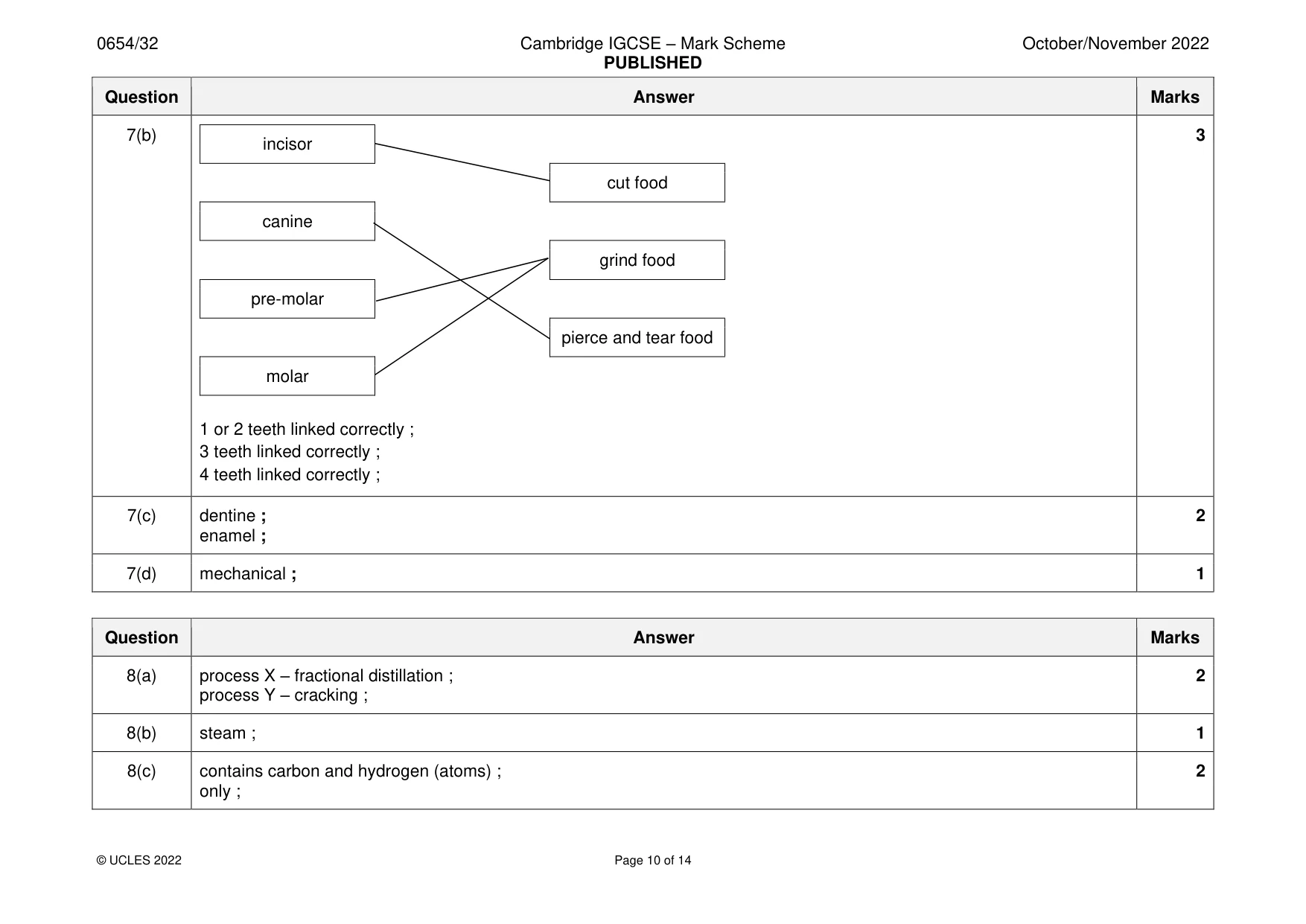
Mark scheme: 7(a)(i) 20 ; 1 7(a)(ii) sheep have the same number of pre-molar and molar teeth ticked ; 2 humans have twice the number of molar teeth than sheep ticked ; 7(b) 3 incisor cut food canine grind food pre-molar pierce and tear food molar 1 or 2 teeth linked correctly ; 3 teeth linked correctly ; 4 teeth linked correctly ; 7(c) dentine ; 2 enamel ; 7(d) mechanical ; 1
Q8 · Petroleum is a raw material for the production of useful substances
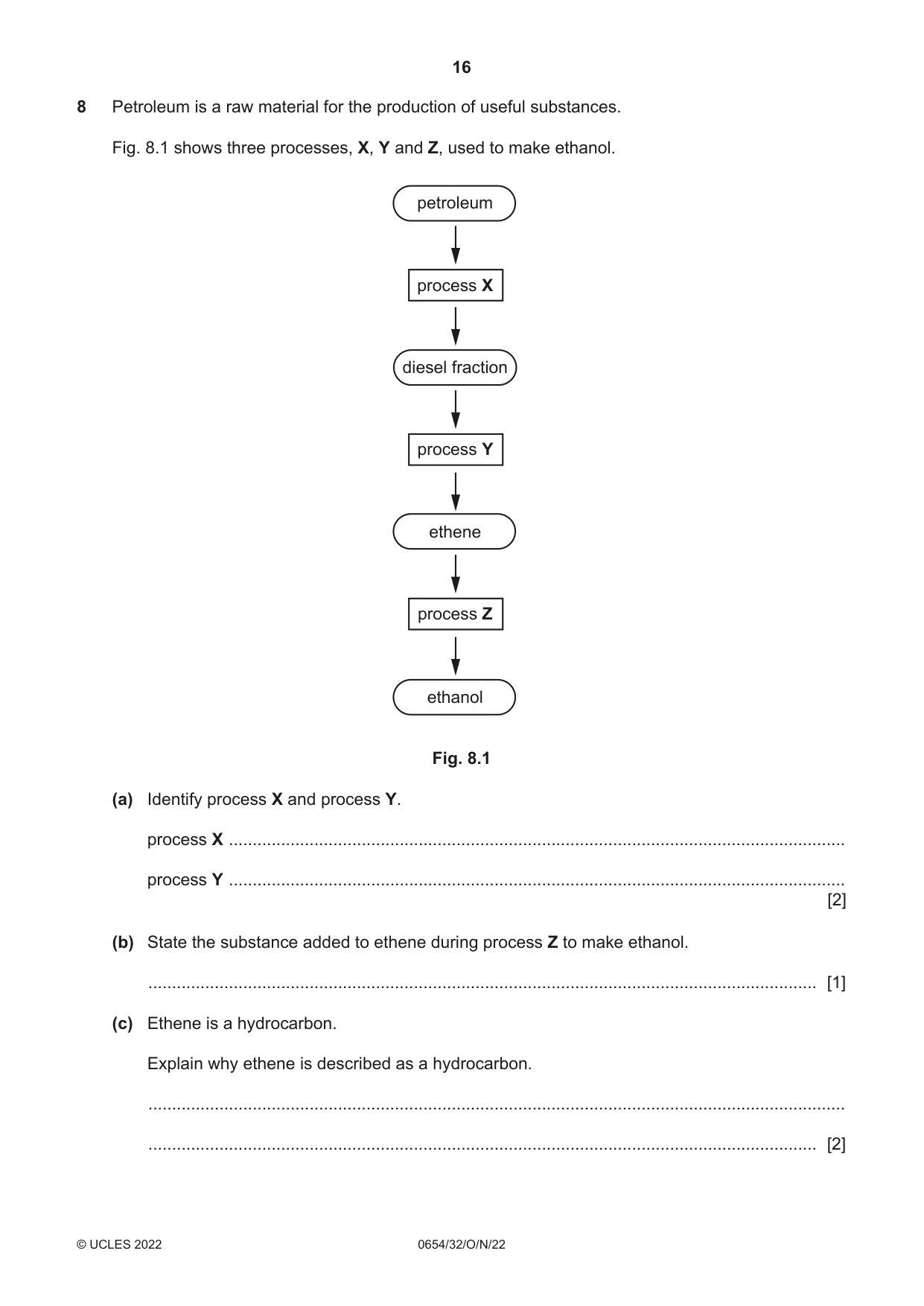
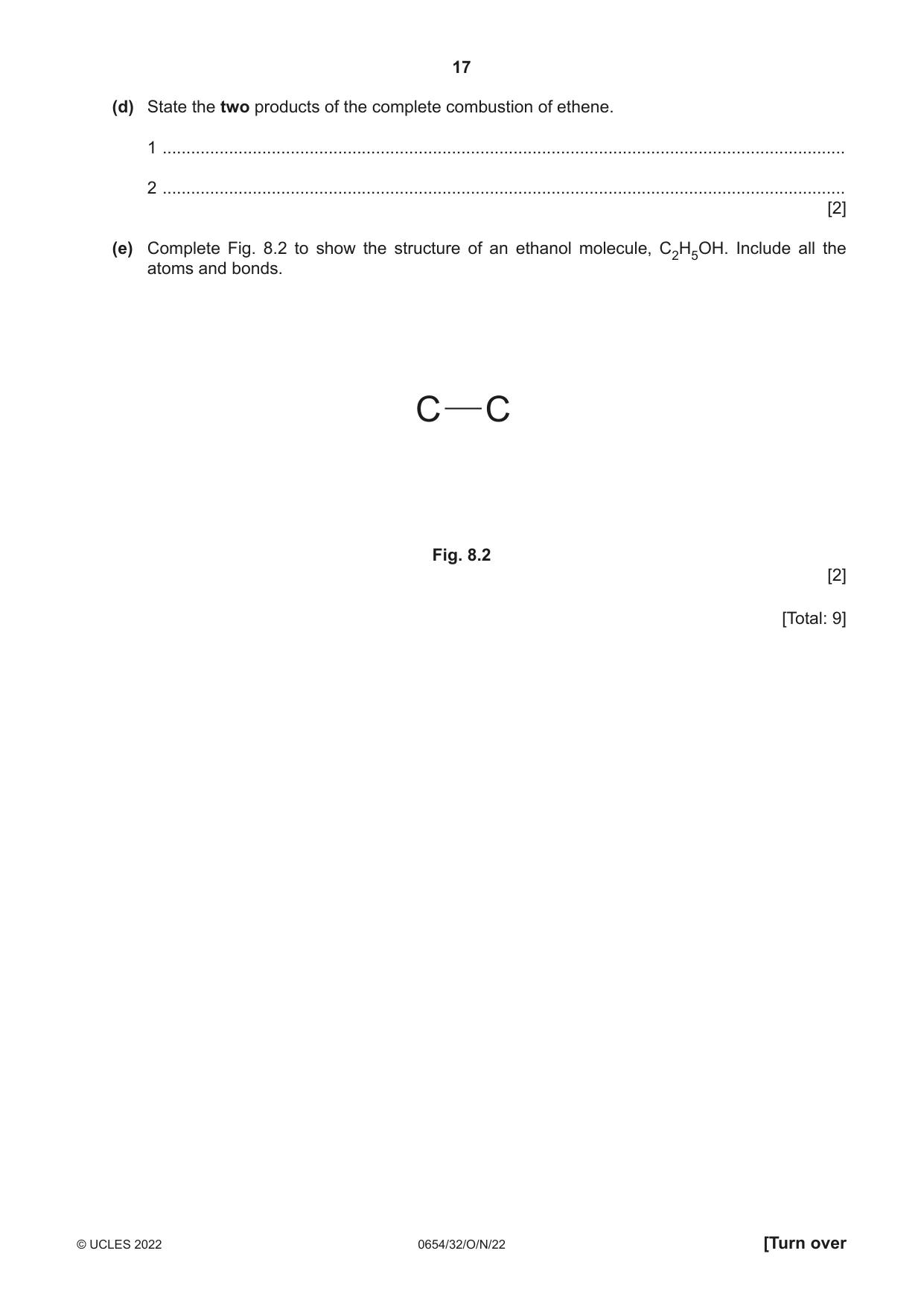
8 Petroleum is a raw material for the production of useful substances. Fig. 8.1 shows three processes, X, Y and Z, used to make ethanol. petroleum process X diesel fraction process Y ethene process Z ethanol Fig. 8.1 (a) Identify process X and process Y. process X .................................................................................................................................. process Y .................................................................................................................................. [2] (b) State the substance added to ethene during process Z to make ethanol. ............................................................................................................................................. [1] (c) Ethene is a hydrocarbon. Explain why ethene is described as a hydrocarbon. ................................................................................................................................................... ............................................................................................................................................. [2] (d) State the two products of the complete combustion of ethene. 1 ................................................................................................................................................ 2 ................................................................................................................................................ [2] (e) Complete Fig. 8.2 to show the structure of an ethanol molecule, C2H5OH. Include all the atoms and bonds. C C Fig. 8.2 [2] [Total: 9]
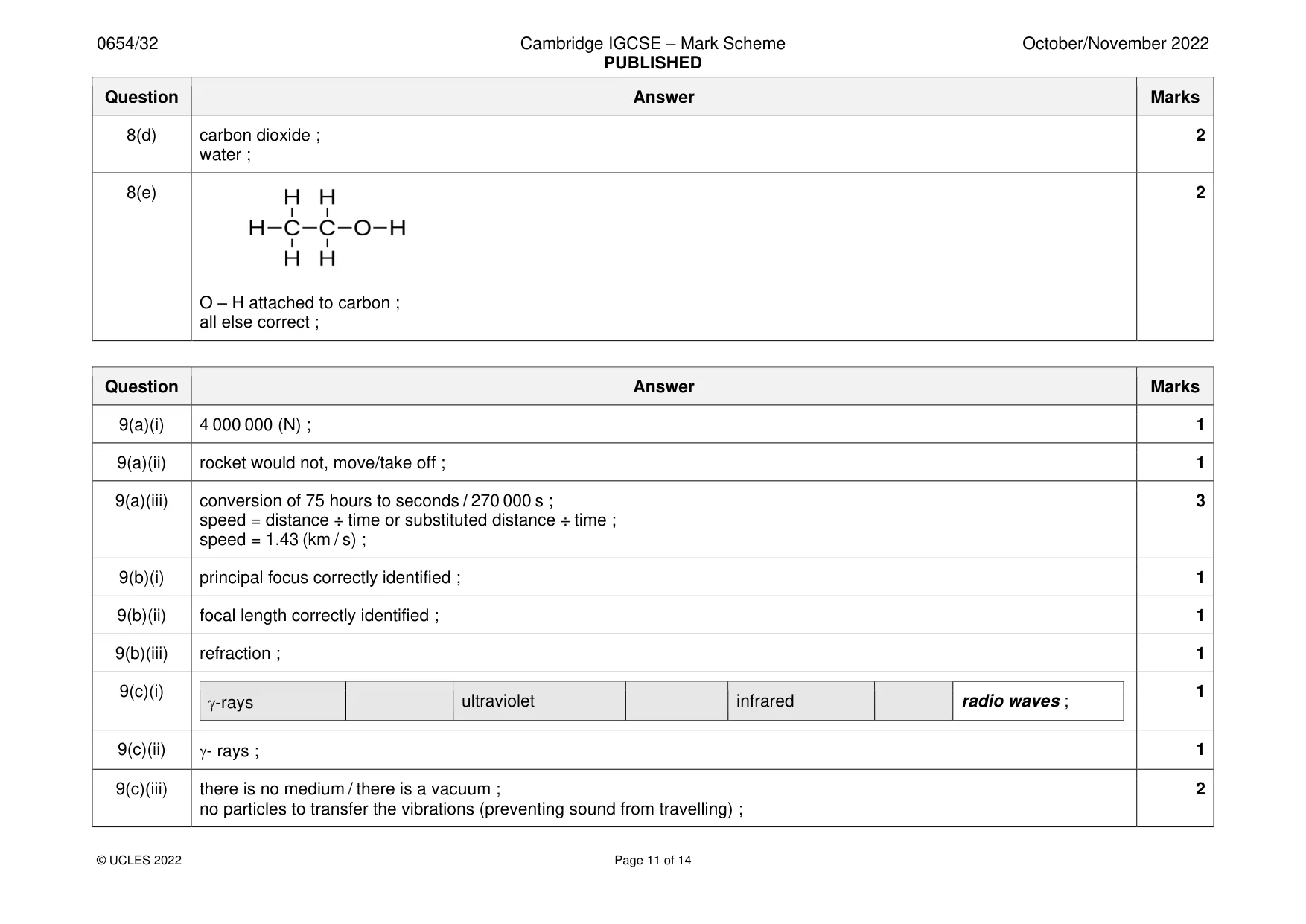
Mark scheme: 8(a) process X – fractional distillation ; 2 process Y – cracking ; 8(b) steam ; 1 8(c) contains carbon and hydrogen (atoms) ; 2 only ; 8(d) carbon dioxide ; 2 water ; 8(e) 2 O – H attached to carbon ; all else correct ;
Q9 · A rocket about to be launched
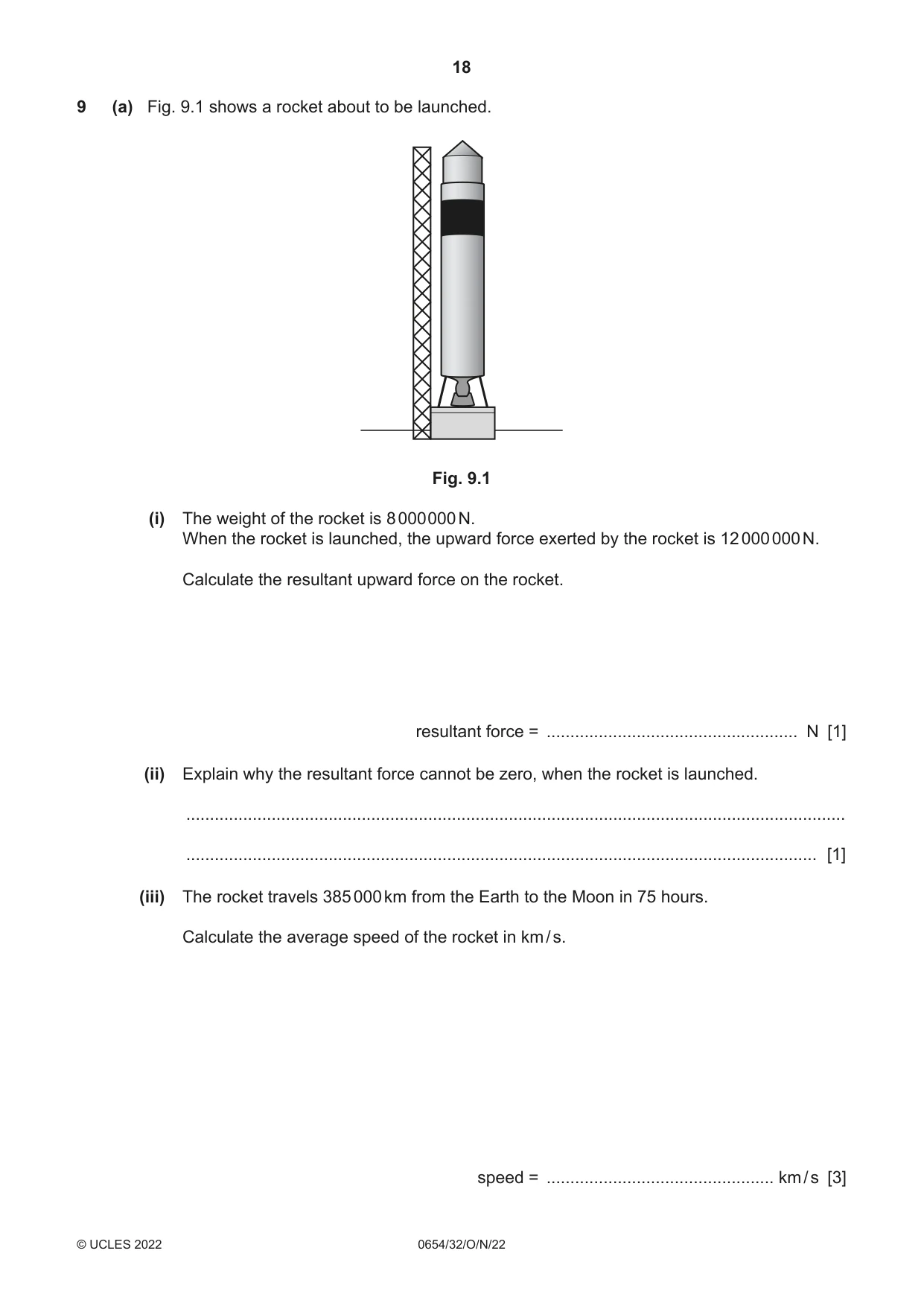
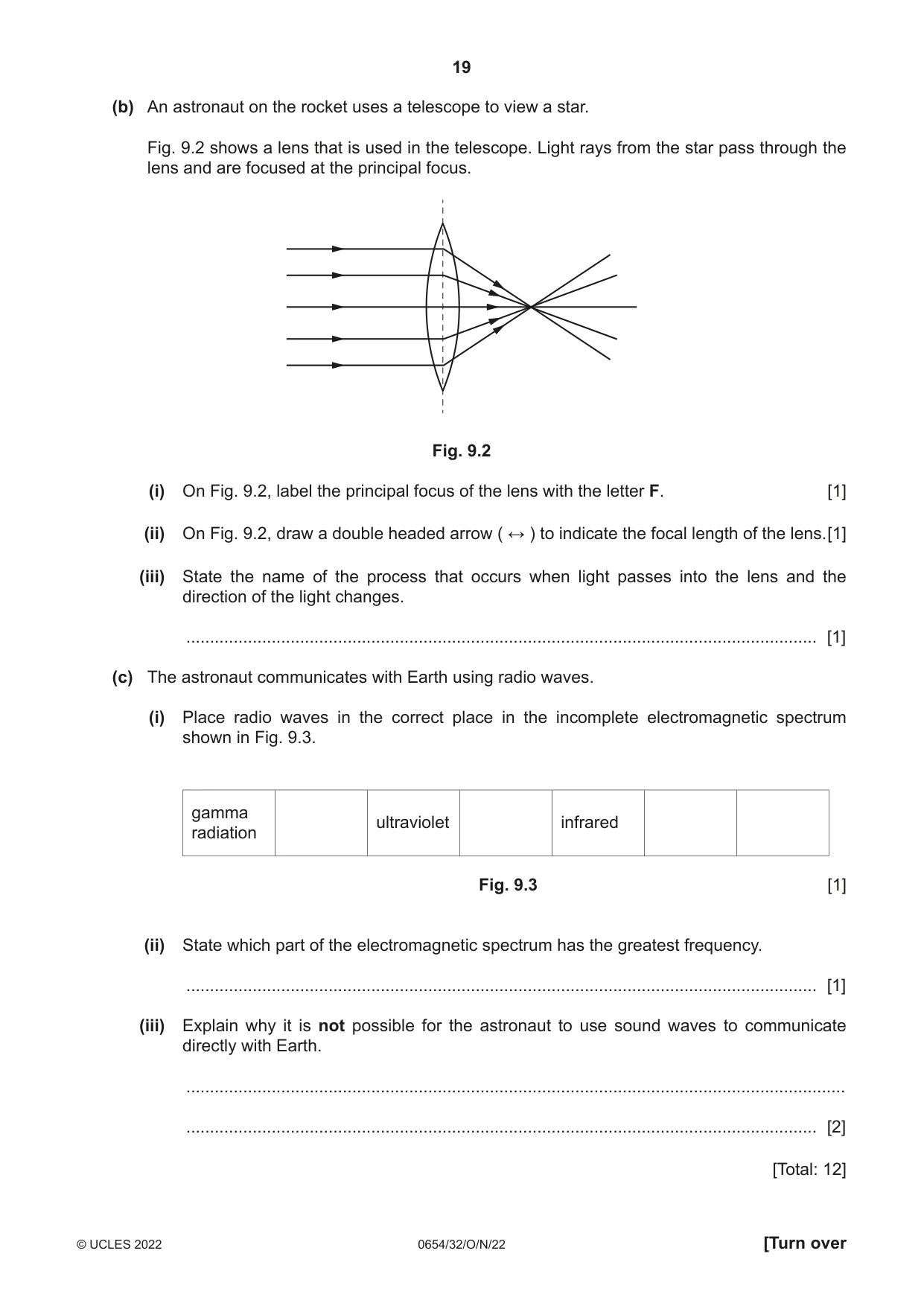
9 (a) Fig. 9.1 shows a rocket about to be launched. Fig. 9.1 (i) The weight of the rocket is 8 000 000 N. When the rocket is launched, the upward force exerted by the rocket is 12 000 000 N. Calculate the resultant upward force on the rocket. resultant force = ..................................................... N [1] (ii) Explain why the resultant force cannot be zero, when the rocket is launched. ........................................................................................................................................... ..................................................................................................................................... [1] (iii) The rocket travels 385 000 km from the Earth to the Moon in 75 hours. Calculate the average speed of the rocket in km / s. speed = ................................................ km / s [3] (b) An astronaut on the rocket uses a telescope to view a star. Fig. 9.2 shows a lens that is used in the telescope. Light rays from the star pass through the lens and are focused at the principal focus. Fig. 9.2 (i) On Fig. 9.2, label the principal focus of the lens with the letter F. [1] (ii) On Fig. 9.2, draw a double headed arrow ( ↔ ) to indicate the focal length of the lens. [1] (iii) State the name of the process that occurs when light passes into the lens and the direction of the light changes. ..................................................................................................................................... [1] (c) The astronaut communicates with Earth using radio waves. (i) Place radio waves in the correct place in the incomplete electromagnetic spectrum shown in Fig. 9.3. gamma ultraviolet infrared radiation Fig. 9.3 [1] (ii) State which part of the electromagnetic spectrum has the greatest frequency. ..................................................................................................................................... [1] (iii) Explain why it is not possible for the astronaut to use sound waves to communicate directly with Earth. ........................................................................................................................................... ..................................................................................................................................... [2] [Total: 12]
Mark scheme: 9(a)(i) 4 000 000 (N) ; 1 9(a)(ii) rocket would not, move/take off ; 1 9(a)(iii) conversion of 75 hours to seconds / 270 000 s ; 3 speed = distance ÷ time or substituted distance ÷ time ; speed = 1.43 (km / s) ; 9(b)(i) principal focus correctly identified ; 1 9(b)(ii) focal length correctly identified ; 1 9(b)(iii) refraction ; 1 9(c)(i) 1 -rays ultraviolet infrared radio waves ; 9(c)(ii) - rays ; 1 9(c)(iii) there is no medium / there is a vacuum ; 2 no particles to transfer the vibrations (preventing sound from travelling) ;
Q10 · A diagram of an insect-pollinated flower
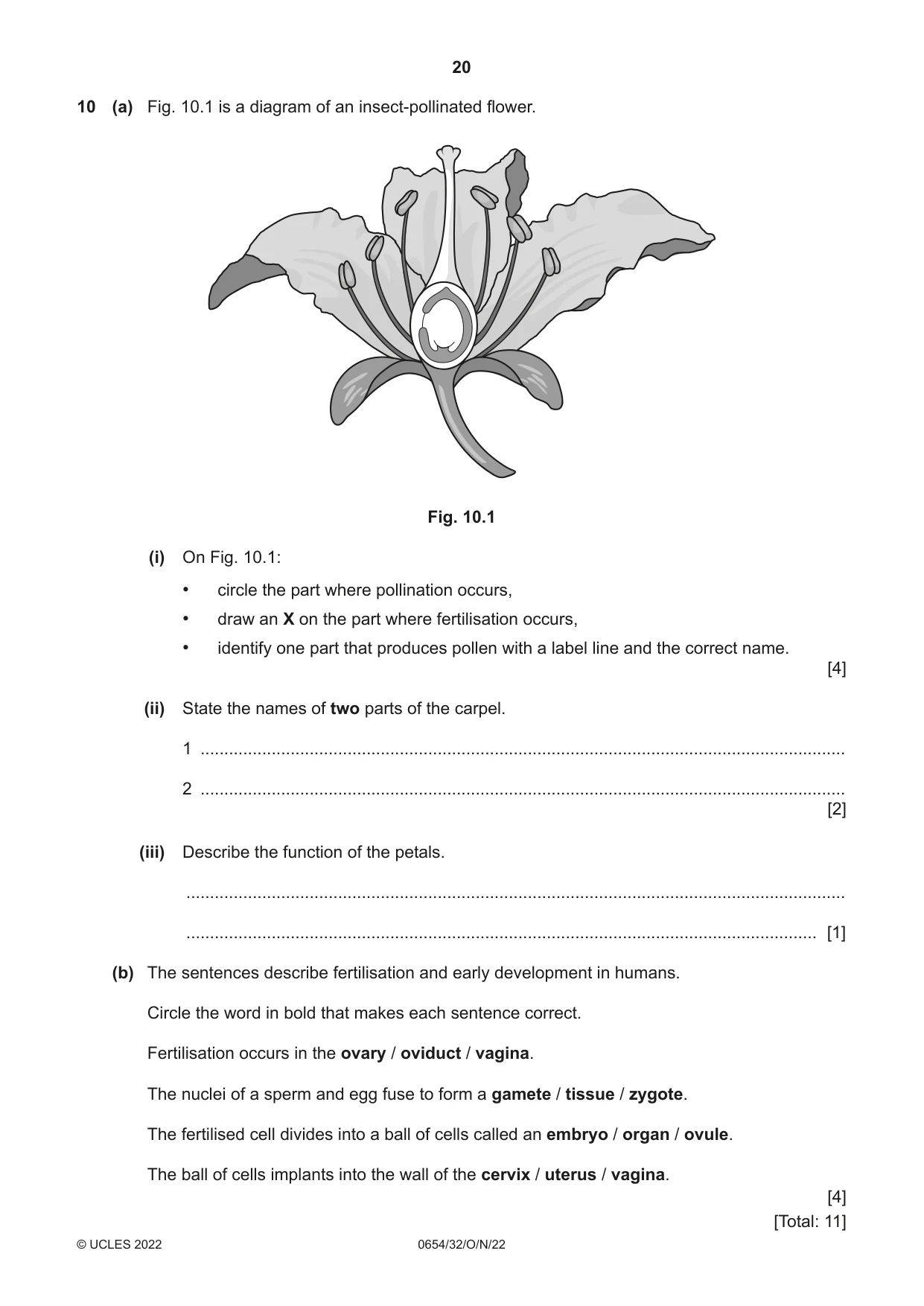
10 (a) Fig. 10.1 is a diagram of an insect-pollinated flower. Fig. 10.1 (i) On Fig. 10.1: • circle the part where pollination occurs, • draw an X on the part where fertilisation occurs, • identify one part that produces pollen with a label line and the correct name. [4] (ii) State the names of two parts of the carpel. 1 ........................................................................................................................................ 2 ........................................................................................................................................ [2] (iii) Describe the function of the petals. ........................................................................................................................................... ..................................................................................................................................... [1] (b) The sentences describe fertilisation and early development in humans. Circle the word in bold that makes each sentence correct. Fertilisation occurs in the ovary / oviduct / vagina. The nuclei of a sperm and egg fuse to form a gamete / tissue / zygote. The fertilised cell divides into a ball of cells called an embryo / organ / ovule. The ball of cells implants into the wall of the cervix / uterus / vagina. [4] [Total: 11]
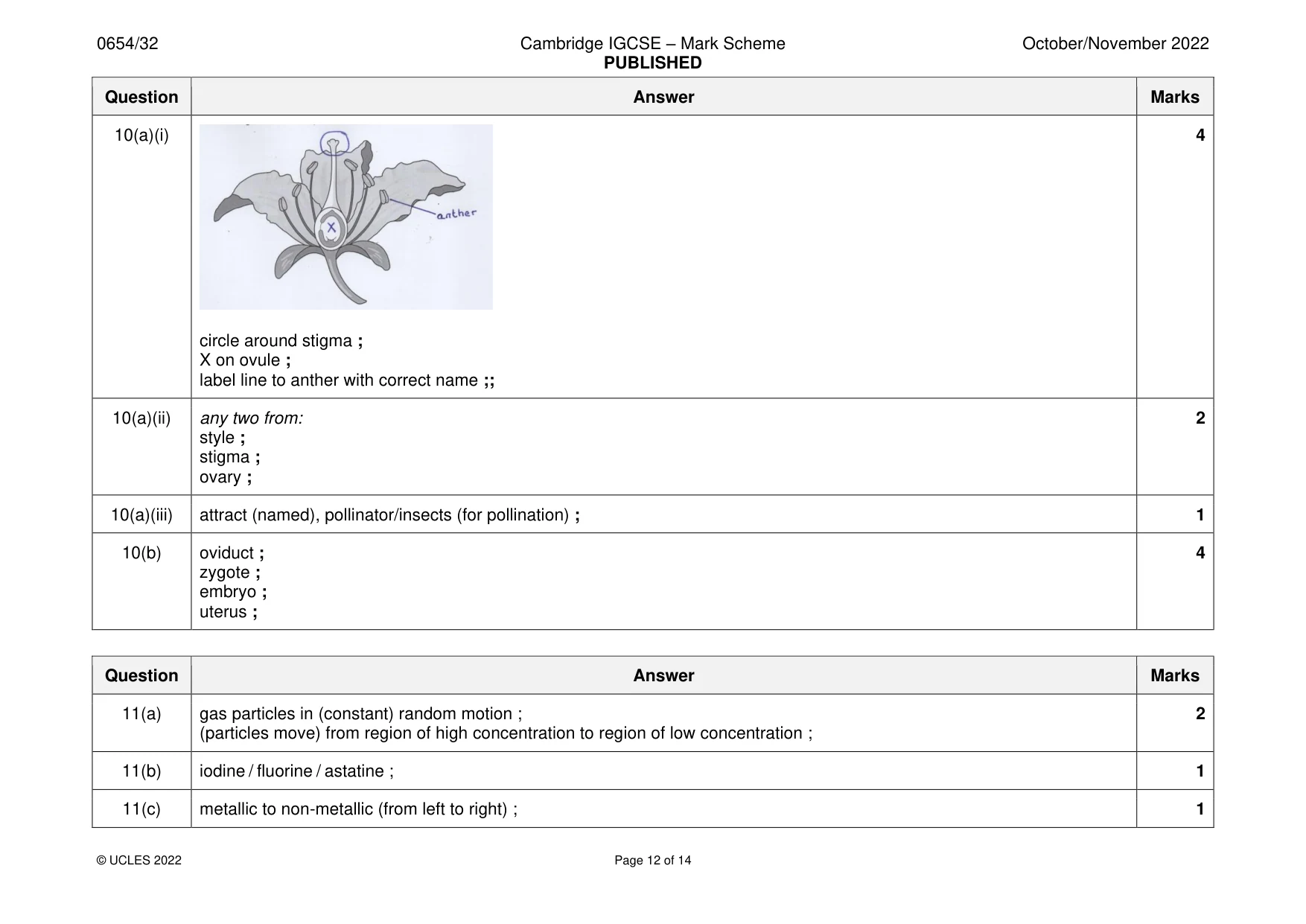
Mark scheme: 10(a)(i) 4 circle around stigma ; X on ovule ; label line to anther with correct name ;; 10(a)(ii) any two from: 2 style ; stigma ; ovary ; 10(a)(iii) attract (named), pollinator/insects (for pollination) ; 1 10(b) oviduct ; 4 zygote ; embryo ; uterus ;
Q11 · Orange bromine gas, Br2, is put into the bottom of a gas jar which is immediately sealed
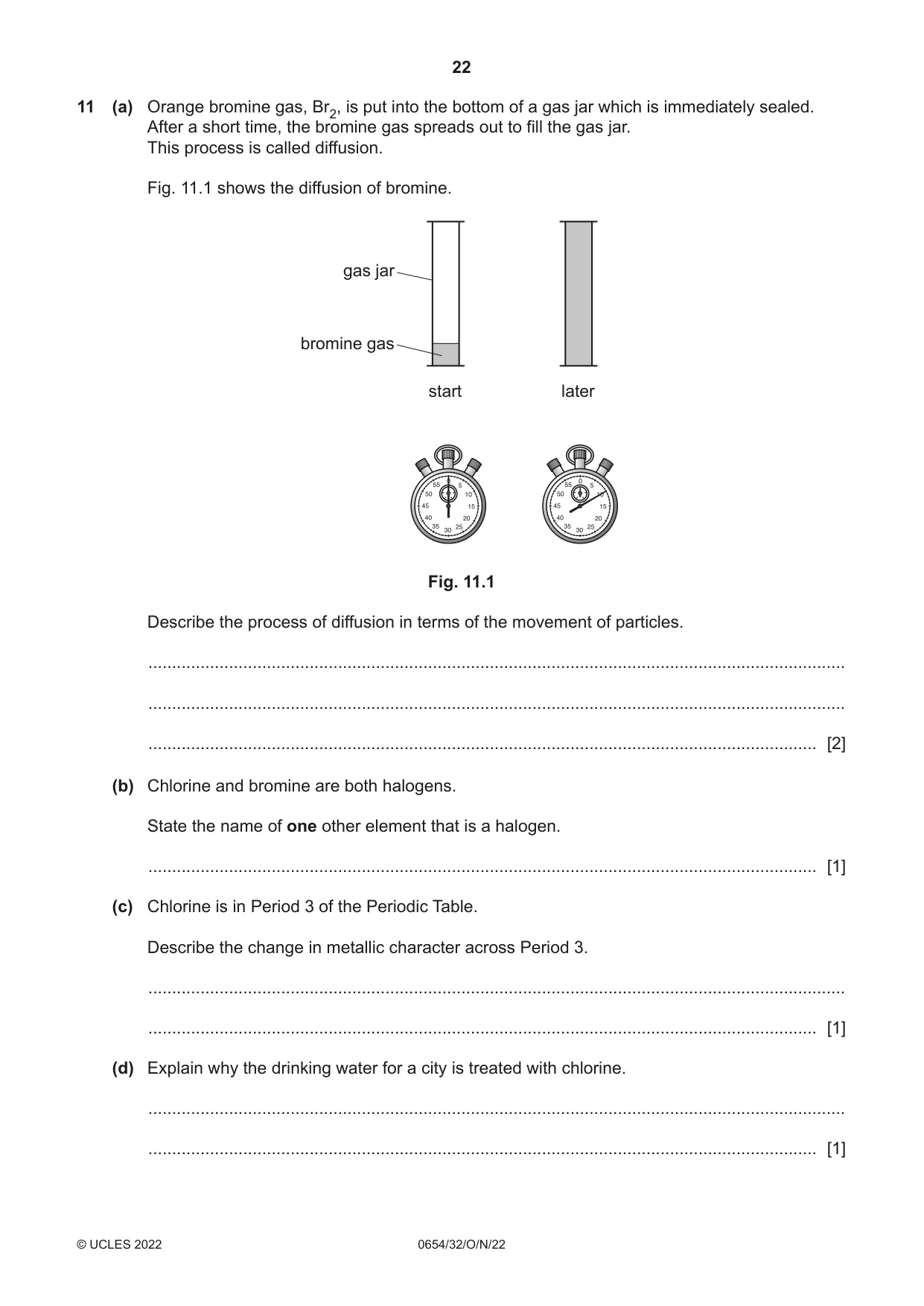
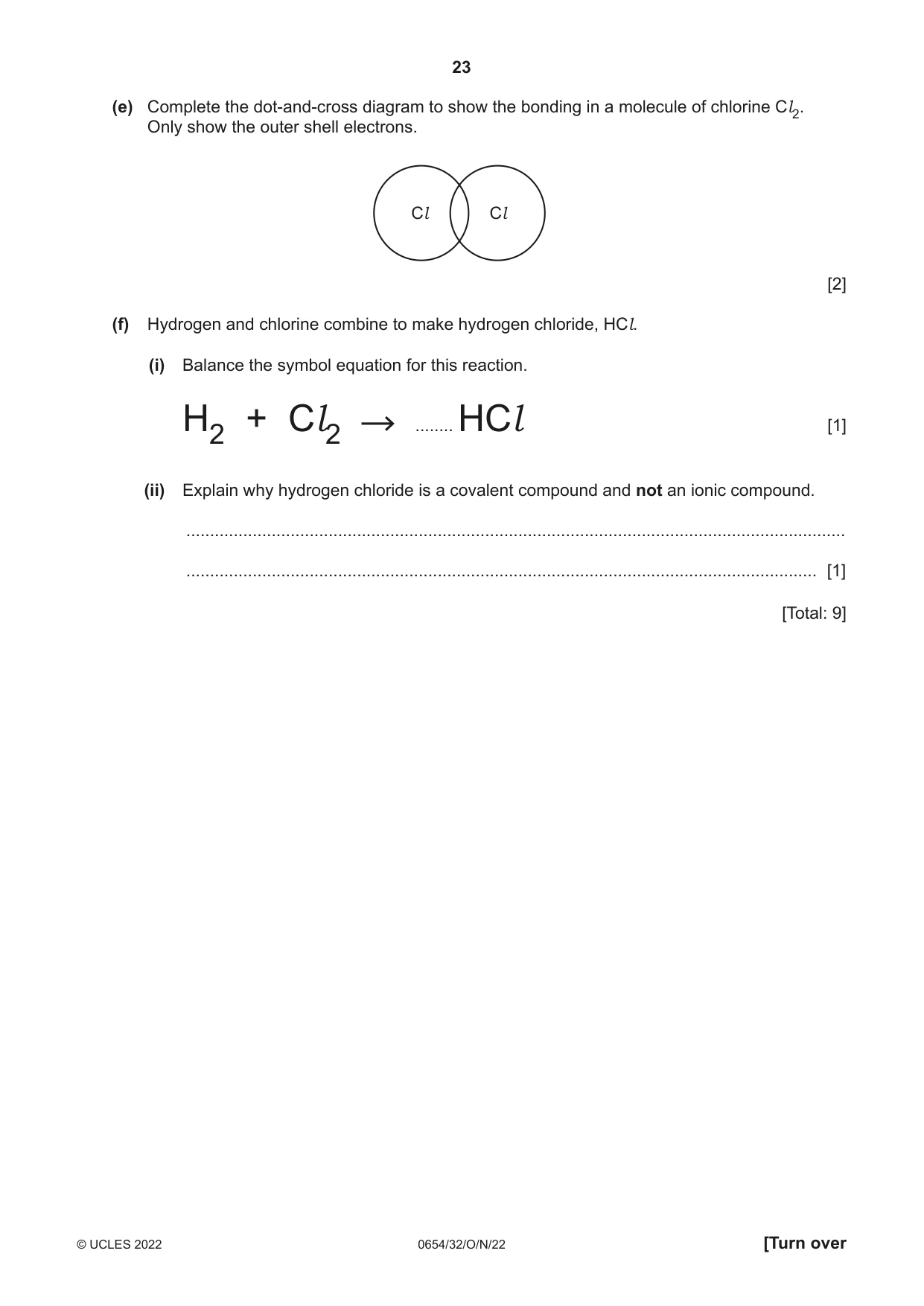
11 (a) Orange bromine gas, Br2, is put into the bottom of a gas jar which is immediately sealed. After a short time, the bromine gas spreads out to fill the gas jar. This process is called diffusion. Fig. 11.1 shows the diffusion of bromine. gas jar bromine gas start later Fig. 11.1 Describe the process of diffusion in terms of the movement of particles. ................................................................................................................................................... ................................................................................................................................................... ............................................................................................................................................. [2] (b) Chlorine and bromine are both halogens. State the name of one other element that is a halogen. ............................................................................................................................................. [1] (c) Chlorine is in Period 3 of the Periodic Table. Describe the change in metallic character across Period 3. ................................................................................................................................................... ............................................................................................................................................. [1] (d) Explain why the drinking water for a city is treated with chlorine. ................................................................................................................................................... ............................................................................................................................................. [1] (e) Complete the dot-and-cross diagram to show the bonding in a molecule of chlorine Cl2. Only show the outer shell electrons. Cl Cl [2] (f) Hydrogen and chlorine combine to make hydrogen chloride, HCl. (i) Balance the symbol equation for this reaction. ........ [1] H2 + Cl2 HCl (ii) Explain why hydrogen chloride is a covalent compound and not an ionic compound. ........................................................................................................................................... ..................................................................................................................................... [1] [Total: 9]
Mark scheme: 11(a) gas particles in (constant) random motion ; 2 (particles move) from region of high concentration to region of low concentration ; 11(b) iodine / fluorine / astatine ; 1 11(c) metallic to non-metallic (from left to right) ; 1 11(d) to kill, microorganisms/bacteria/pathogens ; 1 11(e) shared pair ; 2 correct number of electrons on each atom / 14 electrons in total ; 11(f)(i) 2 HCl ; 1 11(f)(ii) two non-metals bonding / shared pair of electrons ; 1
Q12 · An electric heater is used to heat a classroom in a school
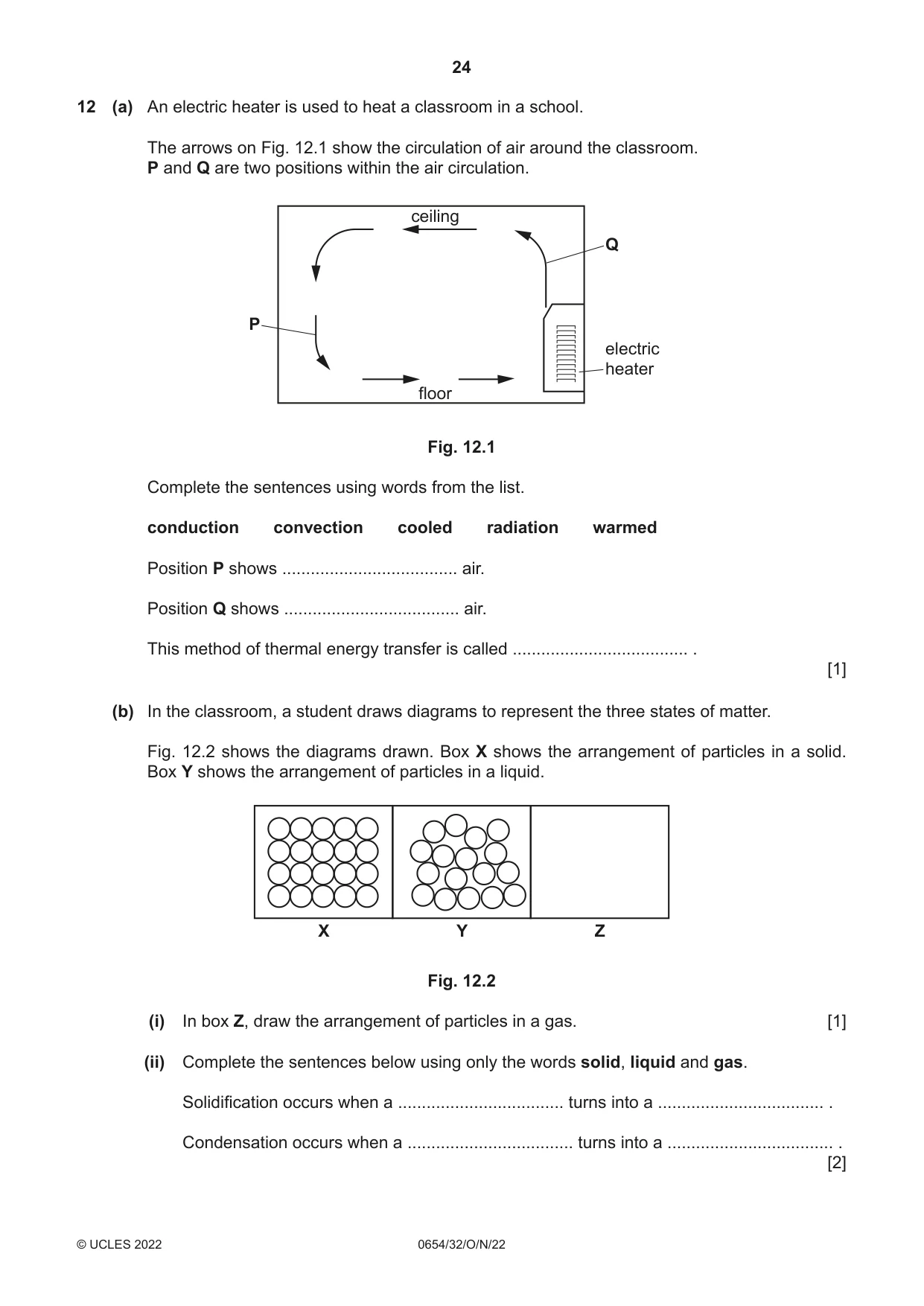
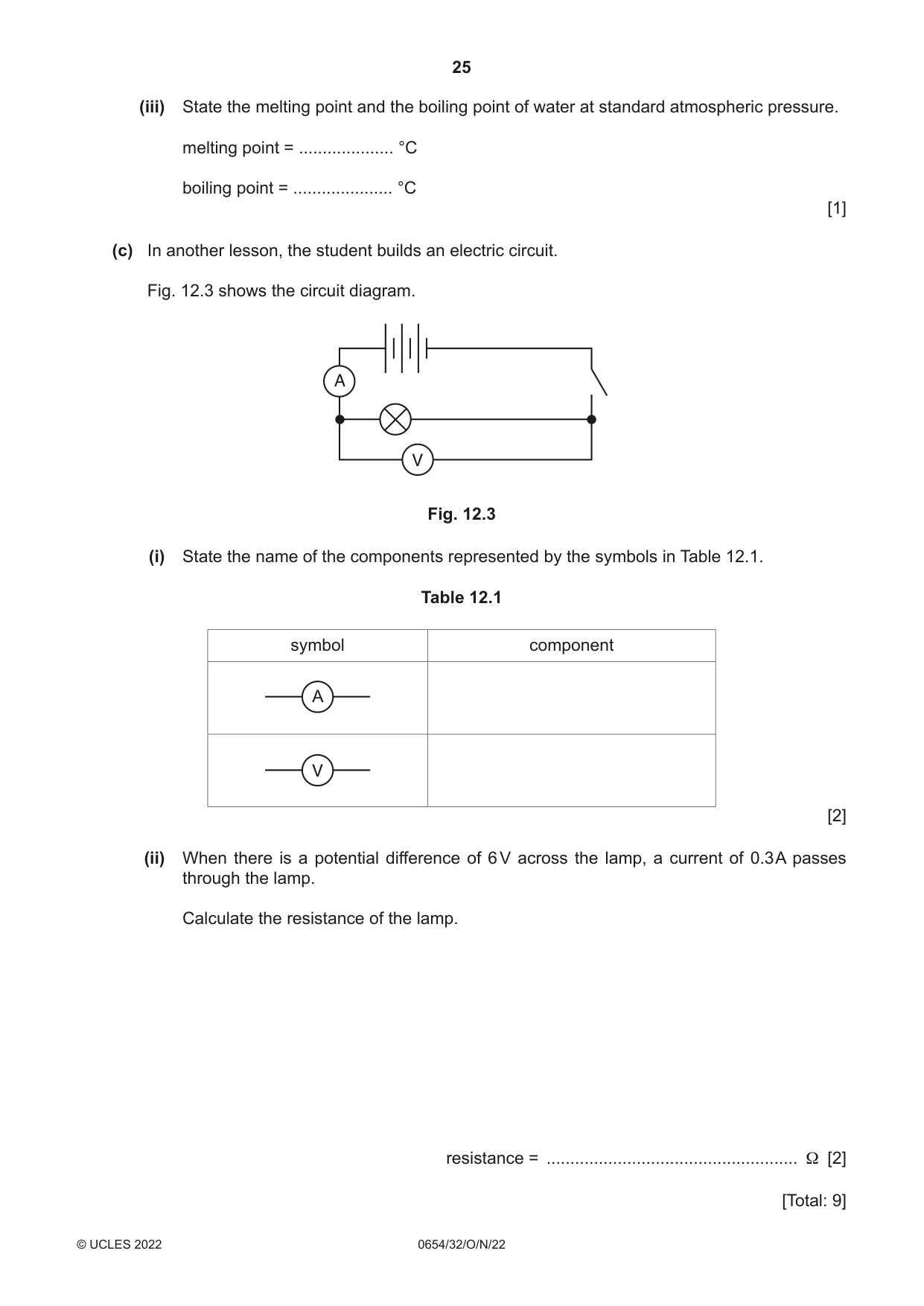
12 (a) An electric heater is used to heat a classroom in a school. The arrows on Fig. 12.1 show the circulation of air around the classroom. P and Q are two positions within the air circulation. ceiling Q P electric heater floor Fig. 12.1 Complete the sentences using words from the list. conduction convection cooled radiation warmed Position P shows ..................................... air. Position Q shows ..................................... air. This method of thermal energy transfer is called ..................................... . [1] (b) In the classroom, a student draws diagrams to represent the three states of matter. Fig. 12.2 shows the diagrams drawn. Box X shows the arrangement of particles in a solid. Box Y shows the arrangement of particles in a liquid. X Y Z Fig. 12.2 (i) In box Z, draw the arrangement of particles in a gas. [1] (ii) Complete the sentences below using only the words solid, liquid and gas. Solidification occurs when a ................................... turns into a ................................... . Condensation occurs when a ................................... turns into a ................................... . [2] (iii) State the melting point and the boiling point of water at standard atmospheric pressure. melting point = .................... °C boiling point = ..................... °C [1] (c) In another lesson, the student builds an electric circuit. Fig. 12.3 shows the circuit diagram. A V Fig. 12.3 (i) State the name of the components represented by the symbols in Table 12.1. Table 12.1 symbol component A V [2] (ii) When there is a potential difference of 6 V across the lamp, a current of 0.3 A passes through the lamp. Calculate the resistance of the lamp. resistance = ..................................................... Ω [2] [Total: 9]
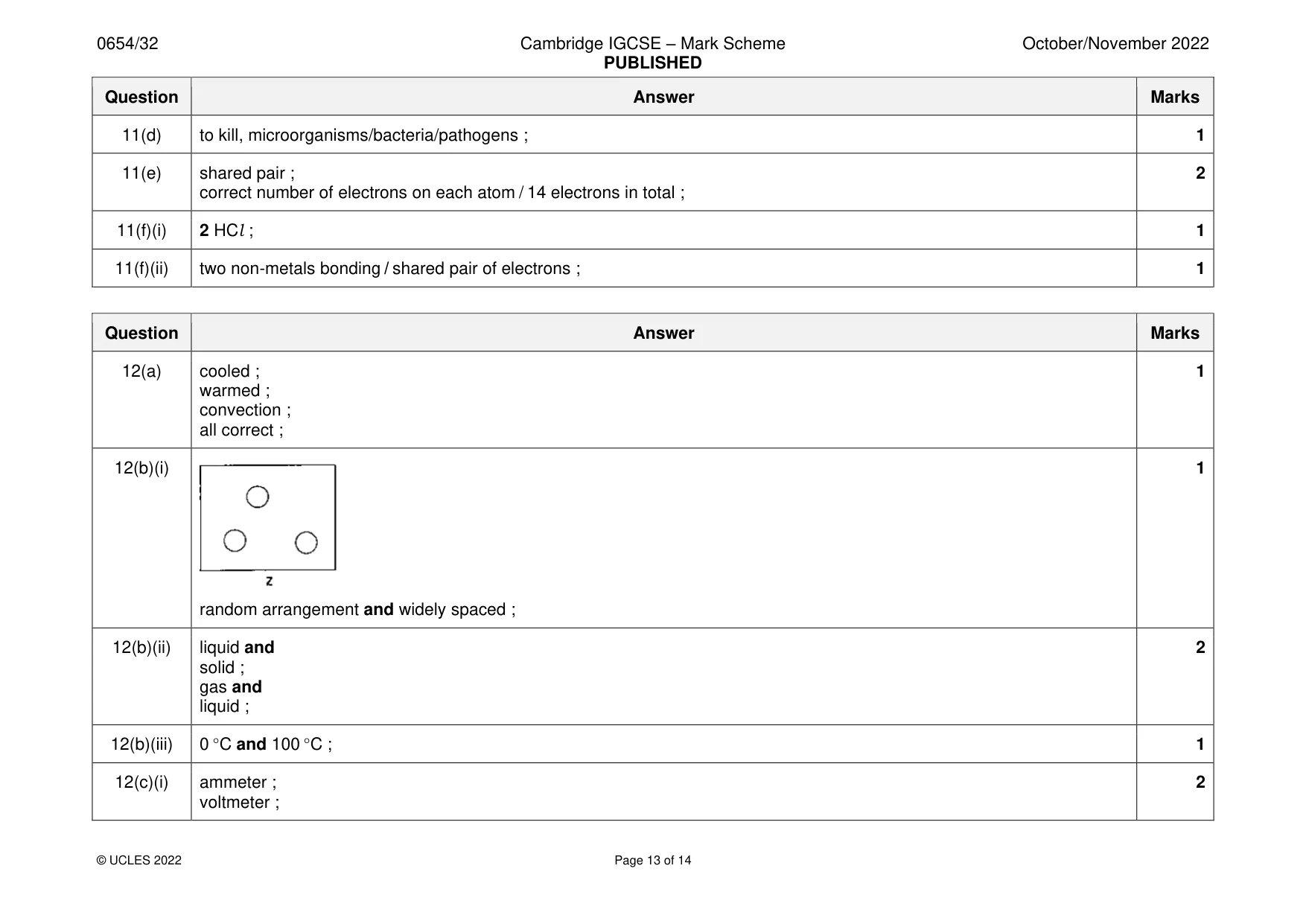
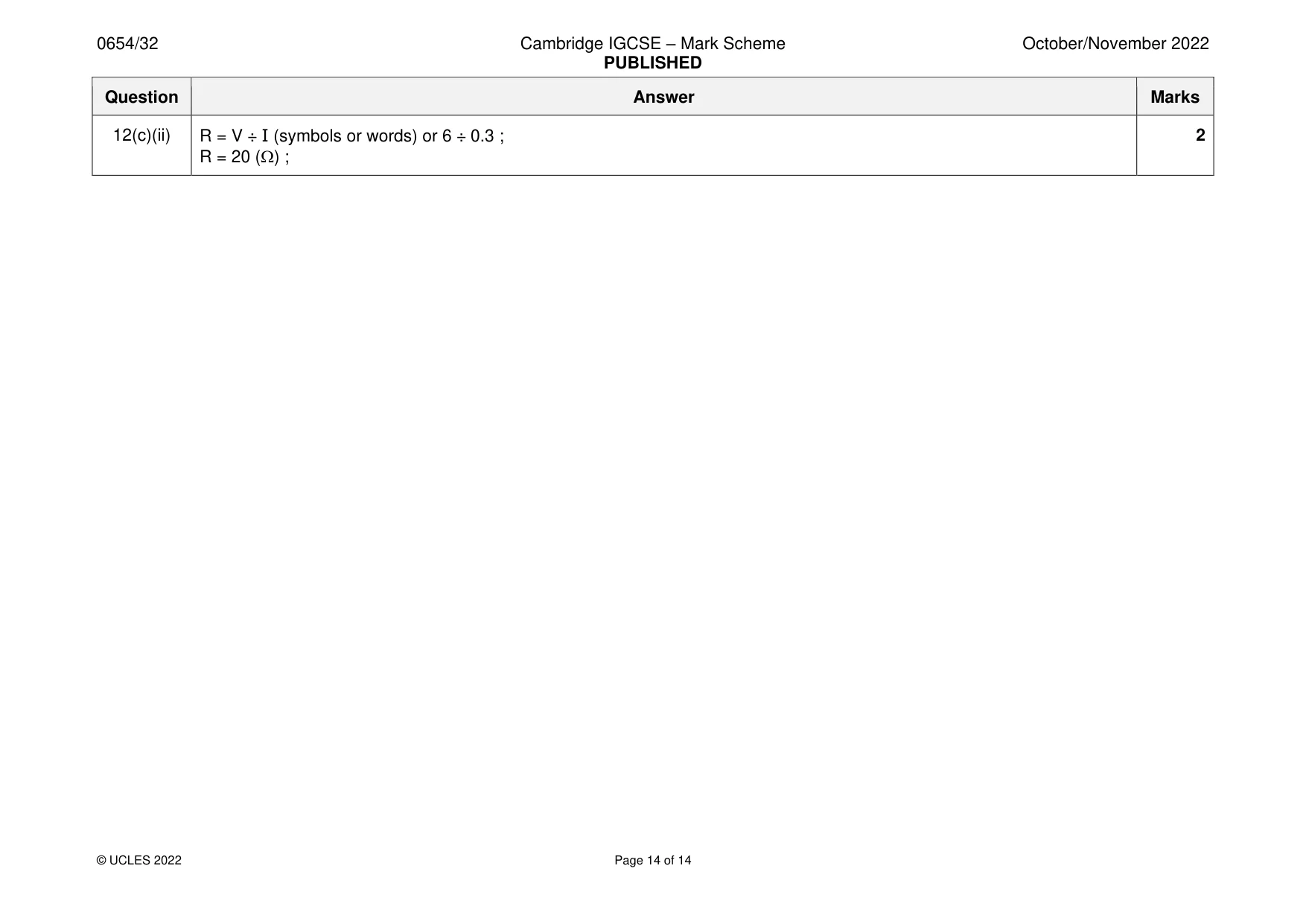
Mark scheme: 12(a) cooled ; 1 warmed ; convection ; all correct ; 12(b)(i) 1 random arrangement and widely spaced ; 12(b)(ii) liquid and 2 solid ; gas and liquid ; 12(b)(iii) 0 °C and 100 °C ; 1 12(c)(i) ammeter ; 2 voltmeter ; 12(c)(ii) R = V ÷ I (symbols or words) or 6 ÷ 0.3 ; 2 R = 20 () ;
What was in this paper
The subtopics covered by these 12 questions, and how many questions each got. Open one in a new tab to see every Cambridge question on it.
What you needed in this session
Cambridge’s own grade thresholds for 2022 Oct/Nov, Paper 3 · Variant 2. A higher threshold means an easier paper — the bar moves with how the cohort did.