Cambridge IGCSE Sciences - Co-ordinated (Double) 0654 — 2017 May/June Paper 3 · Variant 2
0654/32/M/J/17 · 13 questions · 120 marks · ≈135 min
The question paper and its mark scheme, free to read here and free to download. This is Cambridge’s own paper, exactly as it was sat.
Question paper28 pages
Mark scheme10 pages
Answers below. Sit the paper first if you are practising.
Questions as text
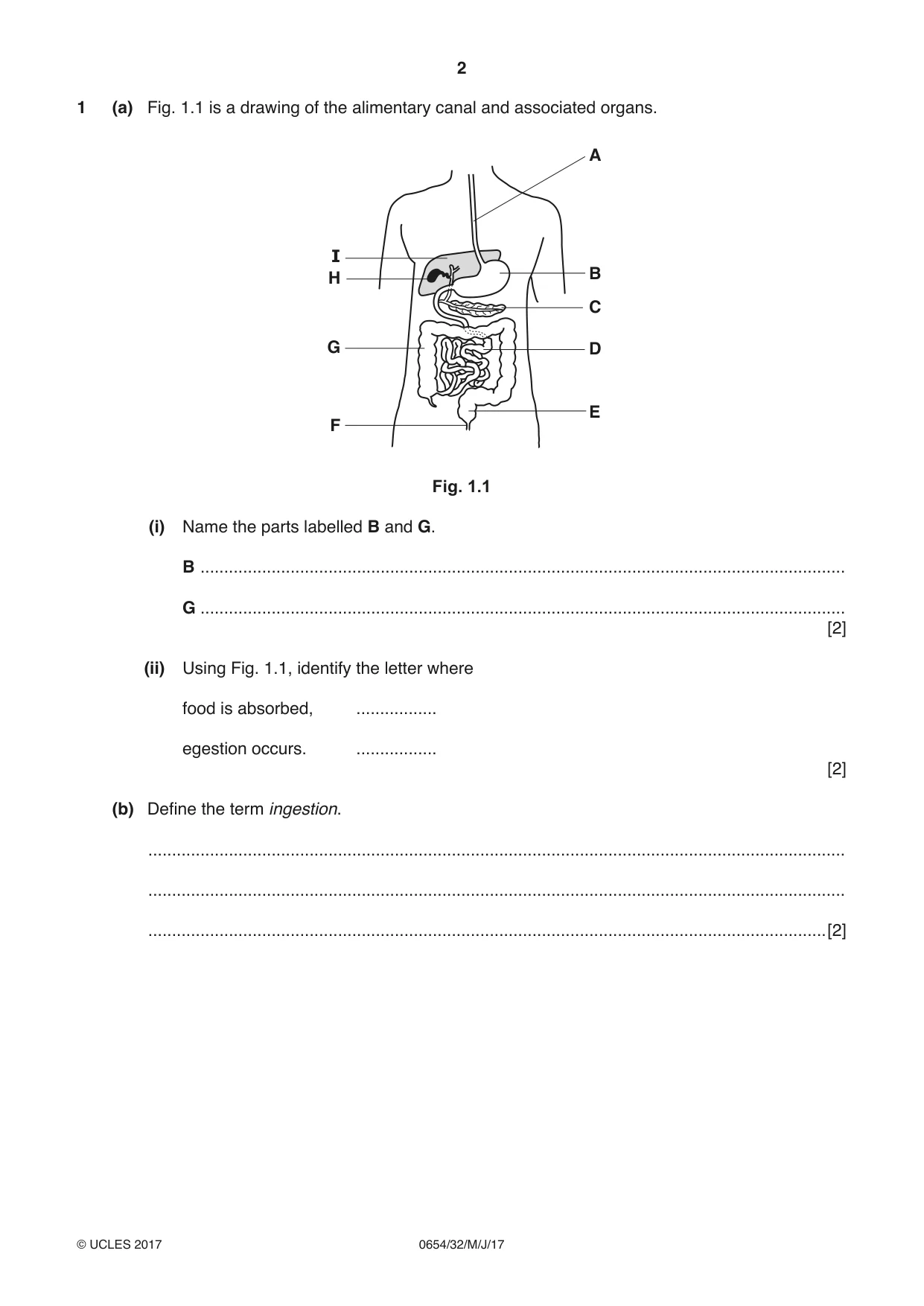
Q1 · A drawing of the alimentary canal and associated organs
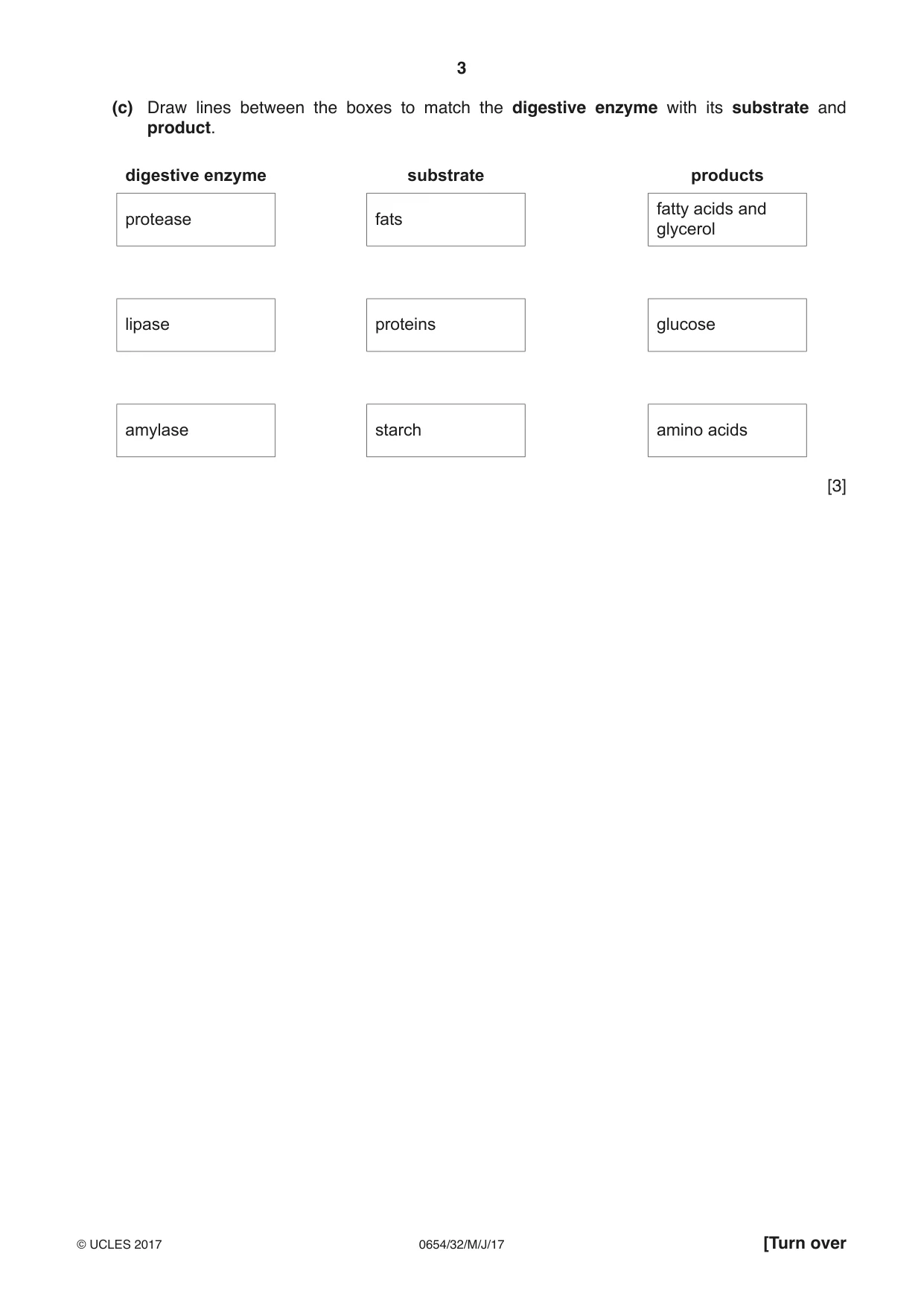
1 (a) Fig. 1.1 is a drawing of the alimentary canal and associated organs. A I H B C G D E F Fig. 1.1 (i) Name the parts labelled B and G. B ........................................................................................................................................ G ........................................................................................................................................ [2] (ii) Using Fig. 1.1, identify the letter where food is absorbed, ................. egestion occurs. ................. [2] (b) Define the term ingestion. ................................................................................................................................................... ................................................................................................................................................... ...............................................................................................................................................[2] (c) Draw lines between the boxes to match the digestive enzyme with its substrate and product. digestive enzyme substrate products fatty acids and protease fats glycerol lipase proteins glucose amylase starch amino acids [3]
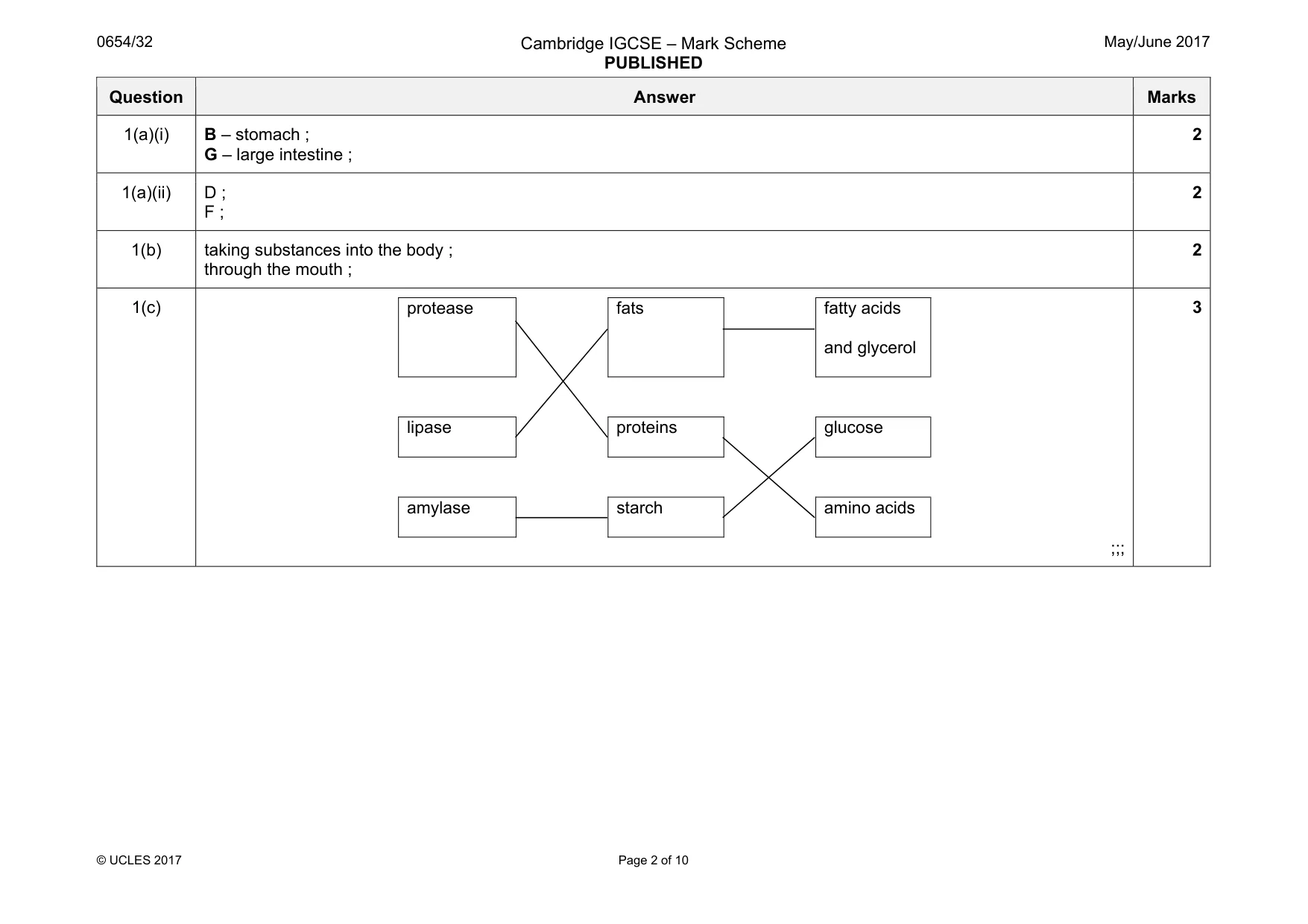
Mark scheme: 1(a)(i) B – stomach ; G – large intestine ; 2 1(a)(ii) D ; F ; 2 1(b) taking substances into the body ; through the mouth ; 2 1(c) protease fats fatty acids and glycerol lipase proteins glucose amylase starch amino acids ;;; 3
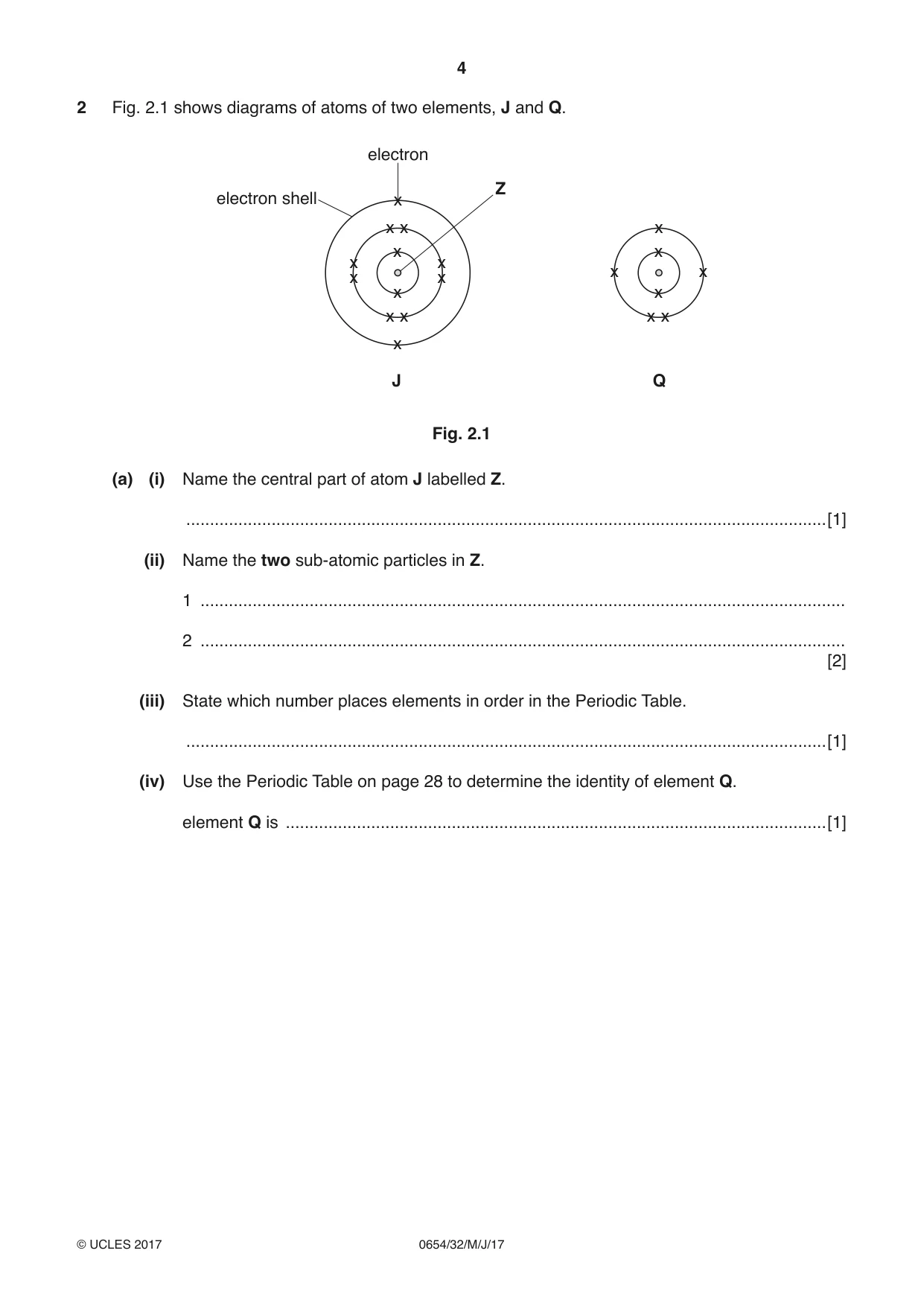
Q2 · Diagrams of atoms of two elements, J and Q
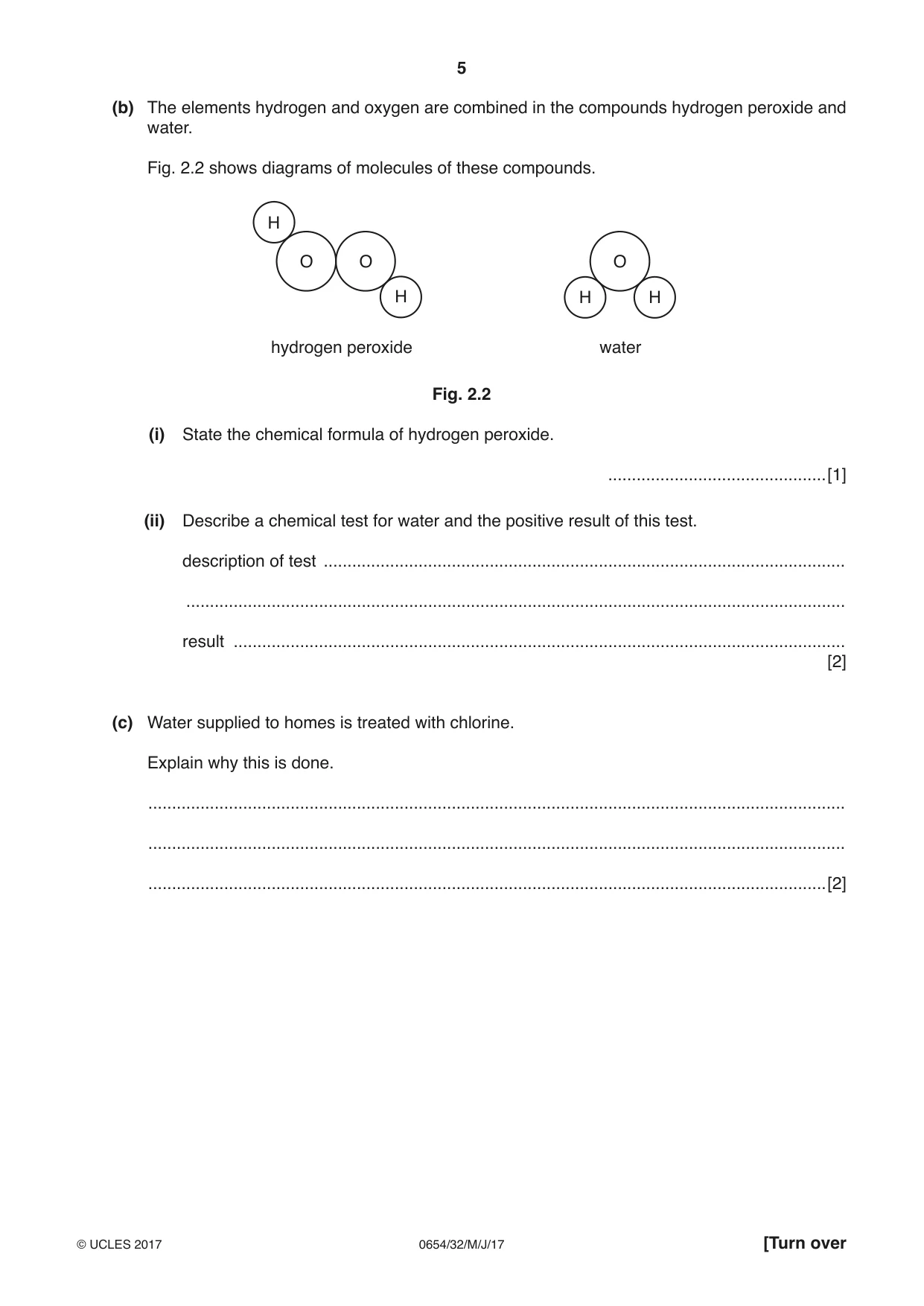
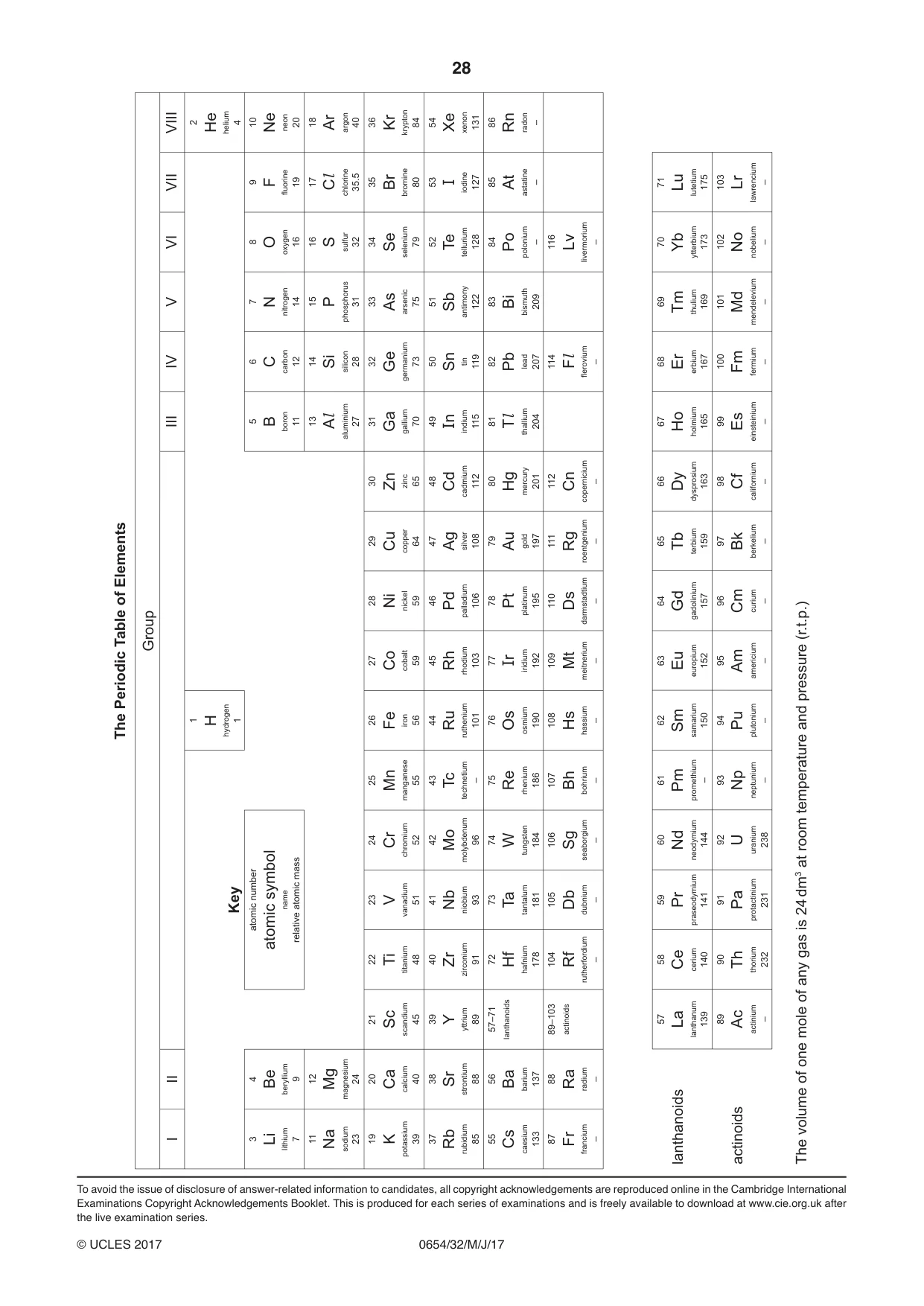
2 Fig. 2.1 shows diagrams of atoms of two elements, J and Q. electron Z electron shell x x x x x x x x x x x x x x x x x x x J Q Fig. 2.1 (a) (i) Name the central part of atom J labelled Z. .......................................................................................................................................[1] (ii) Name the two sub-atomic particles in Z. 1 ........................................................................................................................................ 2 ........................................................................................................................................ [2] (iii) State which number places elements in order in the Periodic Table. .......................................................................................................................................[1] (iv) Use the Periodic Table on page 28 to determine the identity of element Q. element Q is ..................................................................................................................[1] (b) The elements hydrogen and oxygen are combined in the compounds hydrogen peroxide and water. Fig. 2.2 shows diagrams of molecules of these compounds. H O O O H H H hydrogen peroxide water Fig. 2.2 (i) State the chemical formula of hydrogen peroxide. ..............................................[1] (ii) Describe a chemical test for water and the positive result of this test. description of test .............................................................................................................. ........................................................................................................................................... result ................................................................................................................................. [2] (c) Water supplied to homes is treated with chlorine. Explain why this is done. ................................................................................................................................................... ................................................................................................................................................... ...............................................................................................................................................[2]
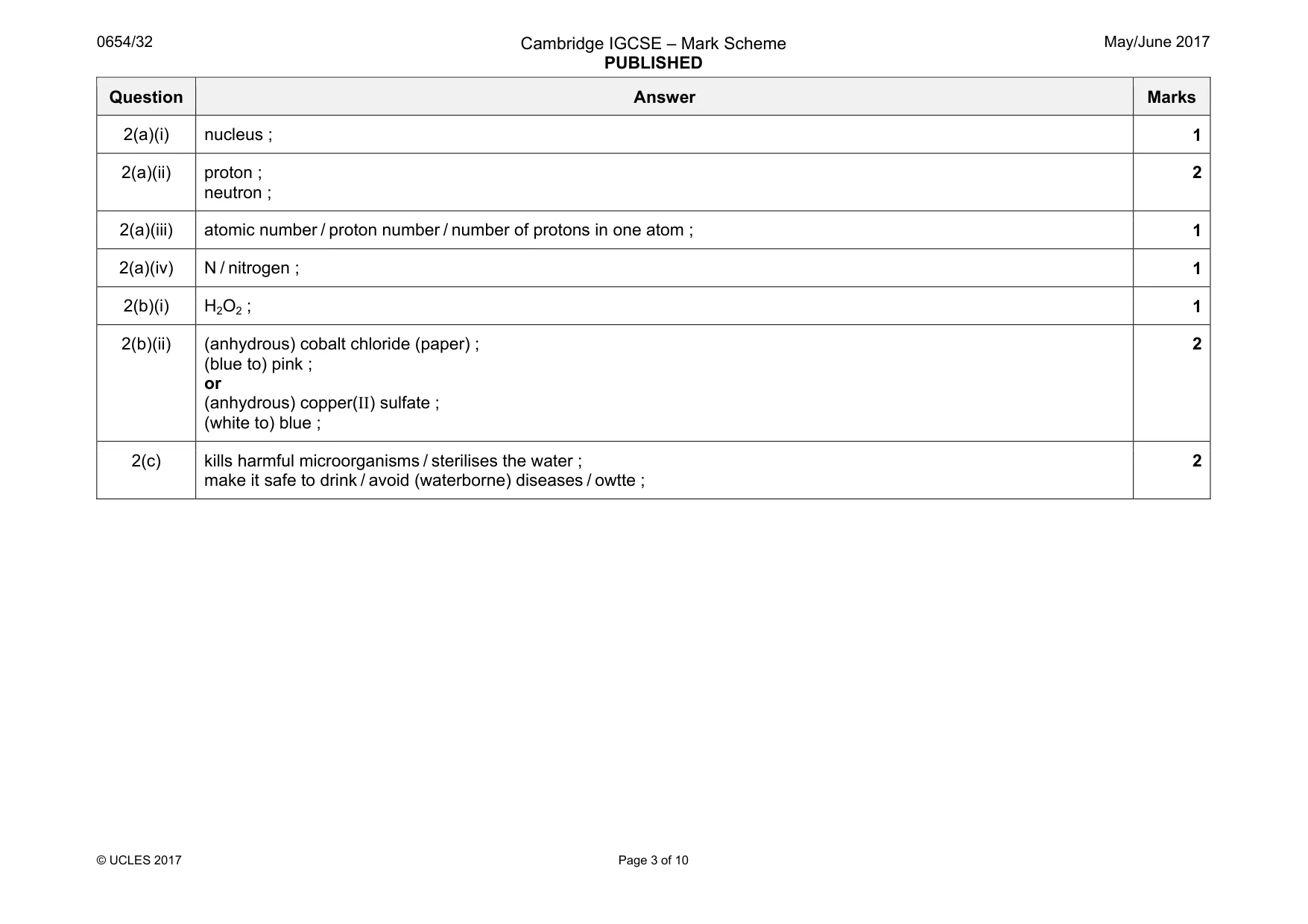
Mark scheme: 2(a)(i) nucleus ; 1 2(a)(ii) proton ; neutron ; 2 2(a)(iii) atomic number / proton number / number of protons in one atom ; 1 2(a)(iv) N / nitrogen ; 1 2(b)(i) H2O2 ; 1 2(b)(ii) (anhydrous) cobalt chloride (paper) ; (blue to) pink ; or (anhydrous) copper(II) sulfate ; (white to) blue ; 2 2(c) kills harmful microorganisms / sterilises the water ; make it safe to drink / avoid (waterborne) diseases / owtte ; 2
Q3 · A list of metals is shown below
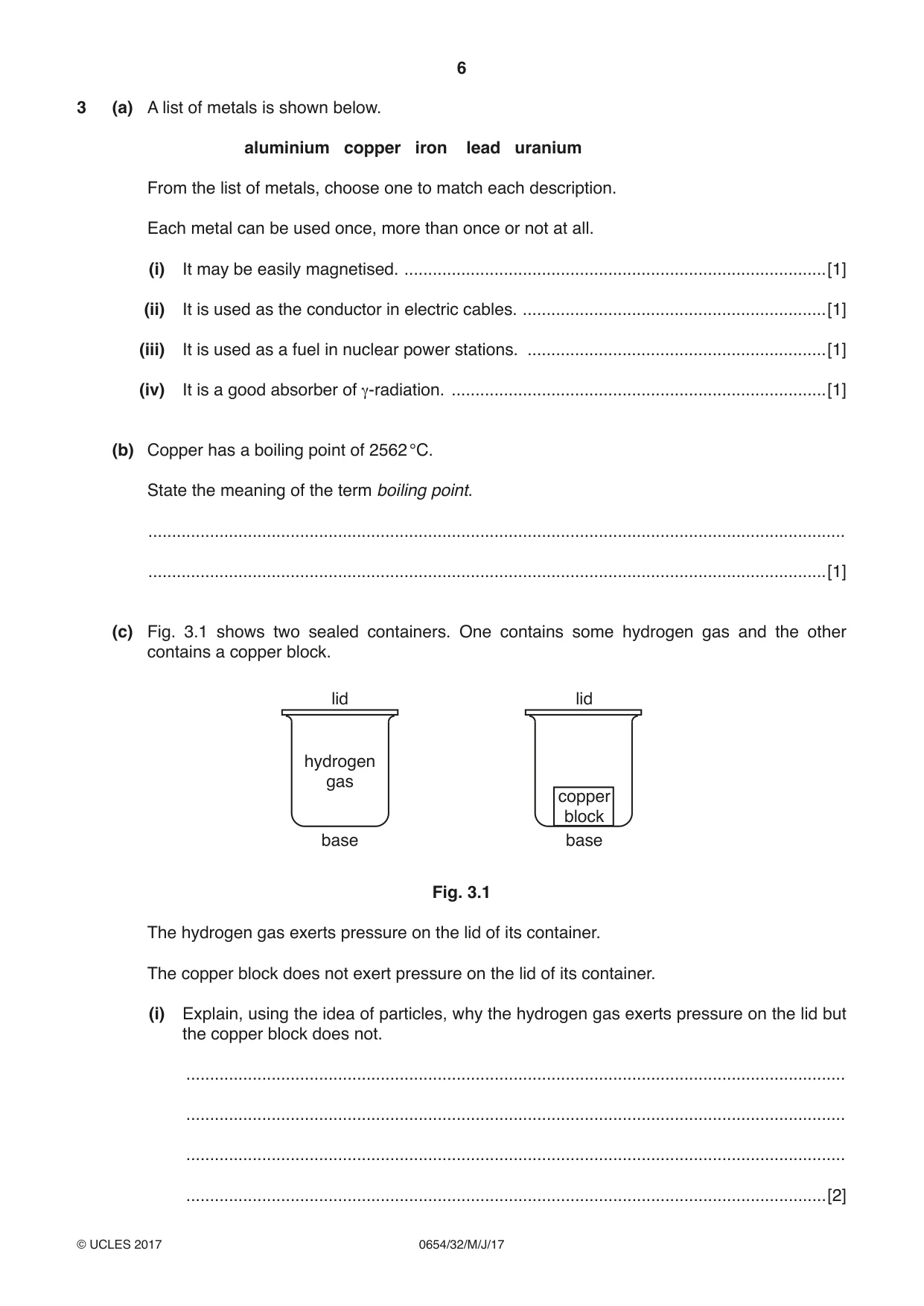
3 (a) A list of metals is shown below. aluminium copper iron lead uranium From the list of metals, choose one to match each description. Each metal can be used once, more than once or not at all. (i) It may be easily magnetised. .........................................................................................[1] (ii) It is used as the conductor in electric cables. ................................................................[1] (iii) It is used as a fuel in nuclear power stations. ...............................................................[1] (iv) It is a good absorber of γ-radiation. ...............................................................................[1] (b) Copper has a boiling point of 2562 °C. State the meaning of the term boiling point. ................................................................................................................................................... ...............................................................................................................................................[1] (c) Fig. 3.1 shows two sealed containers. One contains some hydrogen gas and the other contains a copper block. lid lid hydrogen gas copper block base base Fig. 3.1 The hydrogen gas exerts pressure on the lid of its container. The copper block does not exert pressure on the lid of its container. (i) Explain, using the idea of particles, why the hydrogen gas exerts pressure on the lid but the copper block does not. ........................................................................................................................................... ........................................................................................................................................... ........................................................................................................................................... .......................................................................................................................................[2] (ii) The copper block does exert pressure on the base of the container. Name the two quantities that need to be known to find the pressure exerted by the block on the base of the container. ............................................................. and ................................................................. [2]
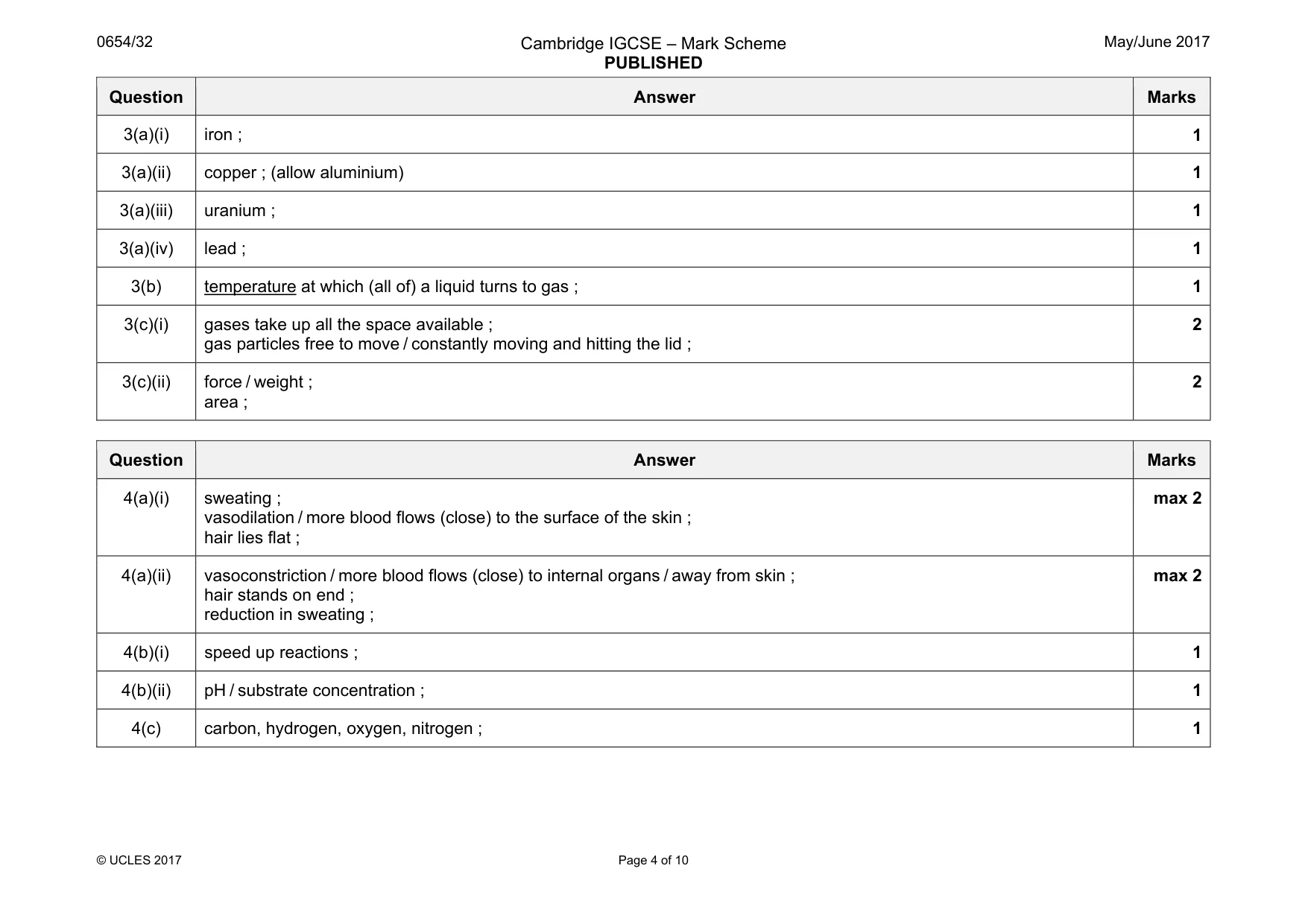
Mark scheme: 3(a)(i) iron ; 1 3(a)(ii) copper ; (allow aluminium) 1 3(a)(iii) uranium ; 1 3(a)(iv) lead ; 1 3(b) temperature at which (all of) a liquid turns to gas ; 1 3(c)(i) gases take up all the space available ; gas particles free to move / constantly moving and hitting the lid ; 2 3(c)(ii) force / weight ; area ; 2
Q4 · The diagram in Fig
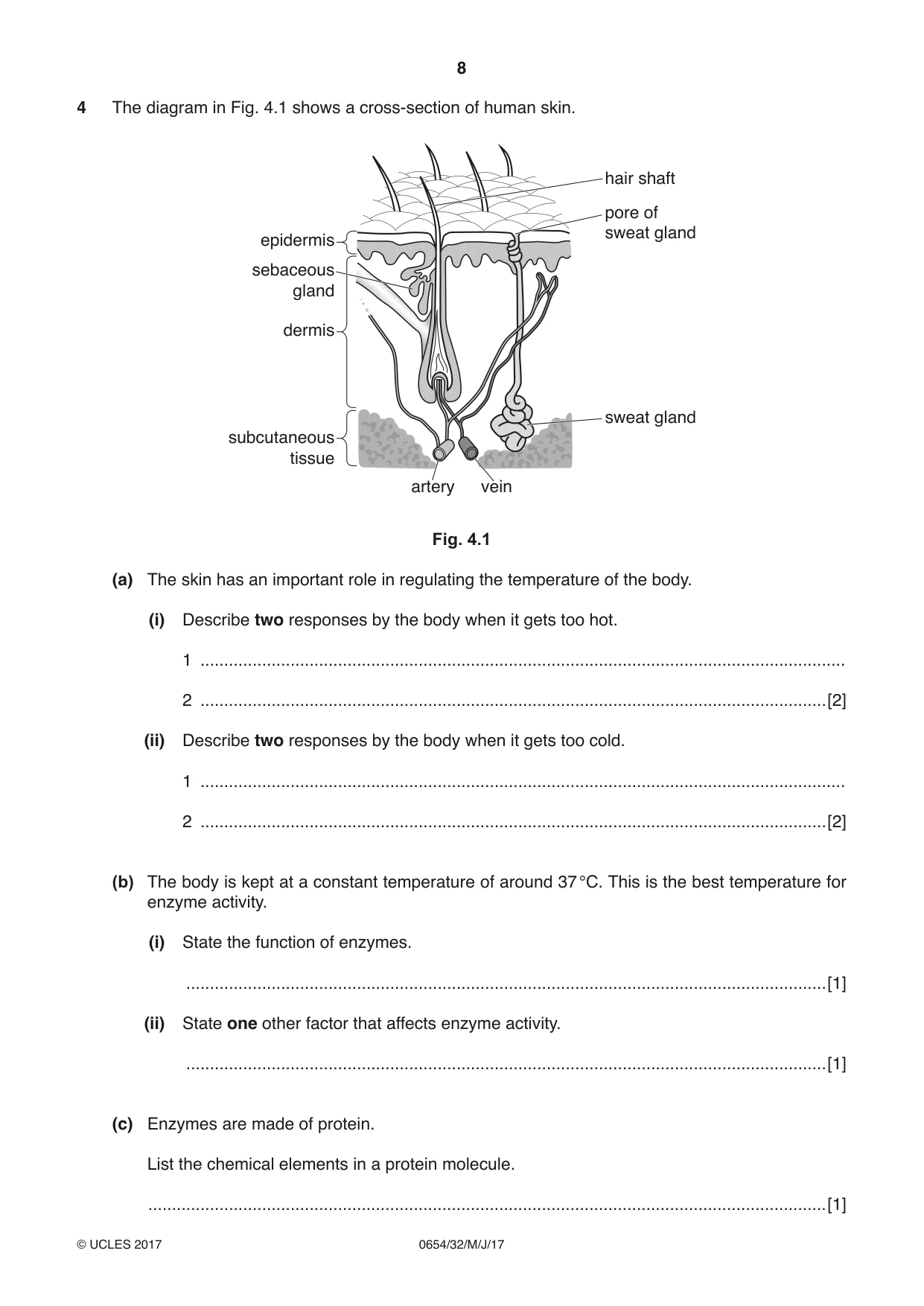
4 The diagram in Fig. 4.1 shows a cross-section of human skin. hair shaft pore of sweat gland epidermis sebaceous gland dermis sweat gland subcutaneous tissue artery vein Fig. 4.1 (a) The skin has an important role in regulating the temperature of the body. (i) Describe two responses by the body when it gets too hot. 1 ........................................................................................................................................ 2 ....................................................................................................................................[2] (ii) Describe two responses by the body when it gets too cold. 1 ........................................................................................................................................ 2 ....................................................................................................................................[2] (b) The body is kept at a constant temperature of around 37 °C. This is the best temperature for enzyme activity. (i) State the function of enzymes. .......................................................................................................................................[1] (ii) State one other factor that affects enzyme activity. .......................................................................................................................................[1] (c) Enzymes are made of protein. List the chemical elements in a protein molecule. ...............................................................................................................................................[1]
Mark scheme: 4(a)(i) sweating ; vasodilation / more blood flows (close) to the surface of the skin ; hair lies flat ; max 2 4(a)(ii) vasoconstriction / more blood flows (close) to internal organs / away from skin ; hair stands on end ; reduction in sweating ; max 2 4(b)(i) speed up reactions ; 1 4(b)(ii) pH / substrate concentration ; 1 4(c) carbon, hydrogen, oxygen, nitrogen ; 1
Q5 · A drawing of an insect-pollinated flower
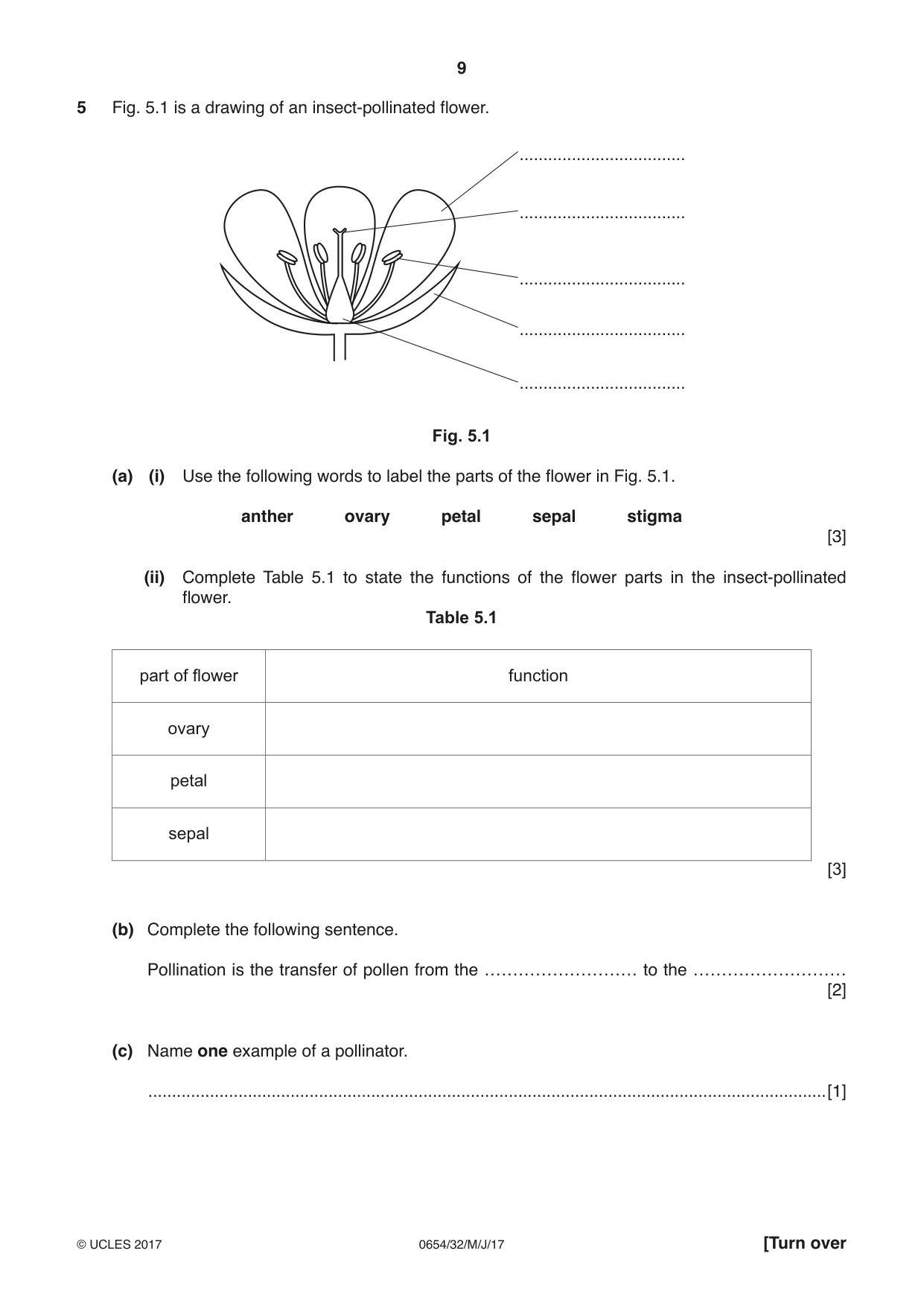
5 Fig. 5.1 is a drawing of an insect-pollinated flower. ................................... ................................... ................................... ................................... ................................... Fig. 5.1 (a) (i) Use the following words to label the parts of the flower in Fig. 5.1. anther ovary petal sepal stigma [3] (ii) Complete Table 5.1 to state the functions of the flower parts in the insect-pollinated flower. Table 5.1 part of flower function ovary petal sepal [3] (b) Complete the following sentence. Pollination is the transfer of pollen from the ……………………… to the ……………………… [2] (c) Name one example of a pollinator. ...............................................................................................................................................[1]
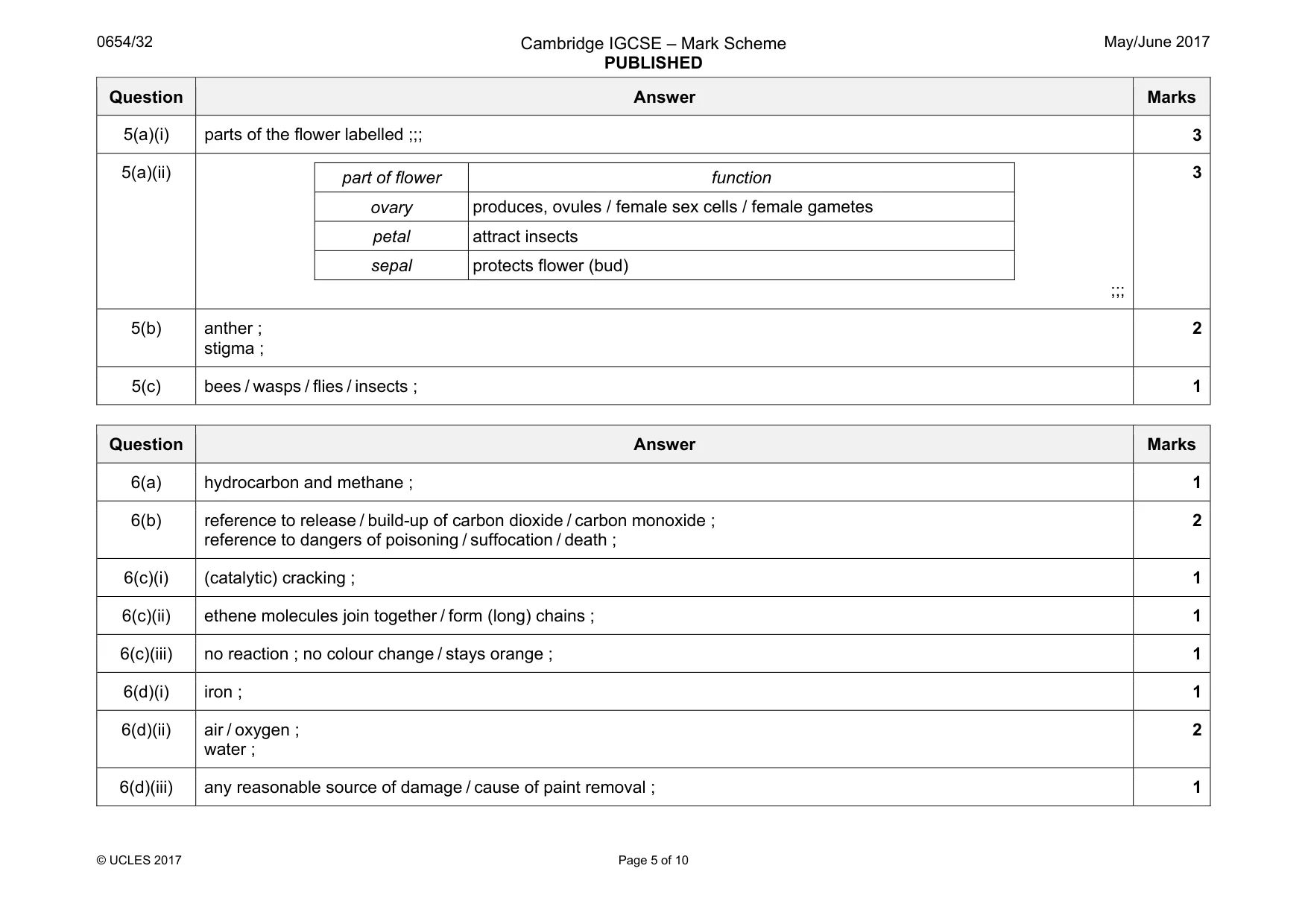
Mark scheme: 5(a)(i) parts of the flower labelled ;;; 3 5(a)(ii) part of flower function ovary produces, ovules / female sex cells / female gametes petal attract insects sepal protects flower (bud) ;;; 3 5(b) anther ; stigma ; 2 5(c) bees / wasps / flies / insects ; 1
Q6 · Most of the compounds in petroleum contain only the elements carbon and hydrogen
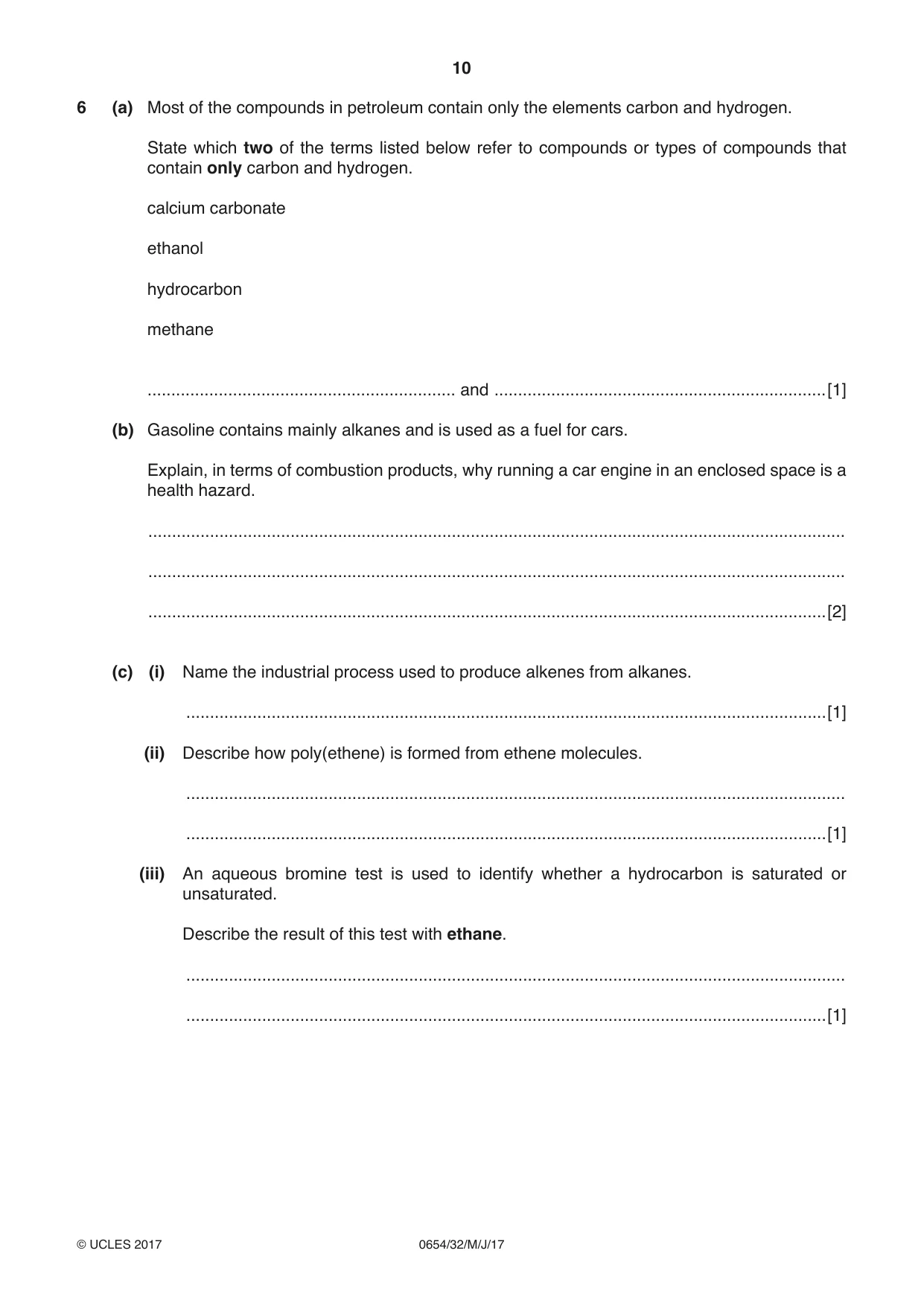
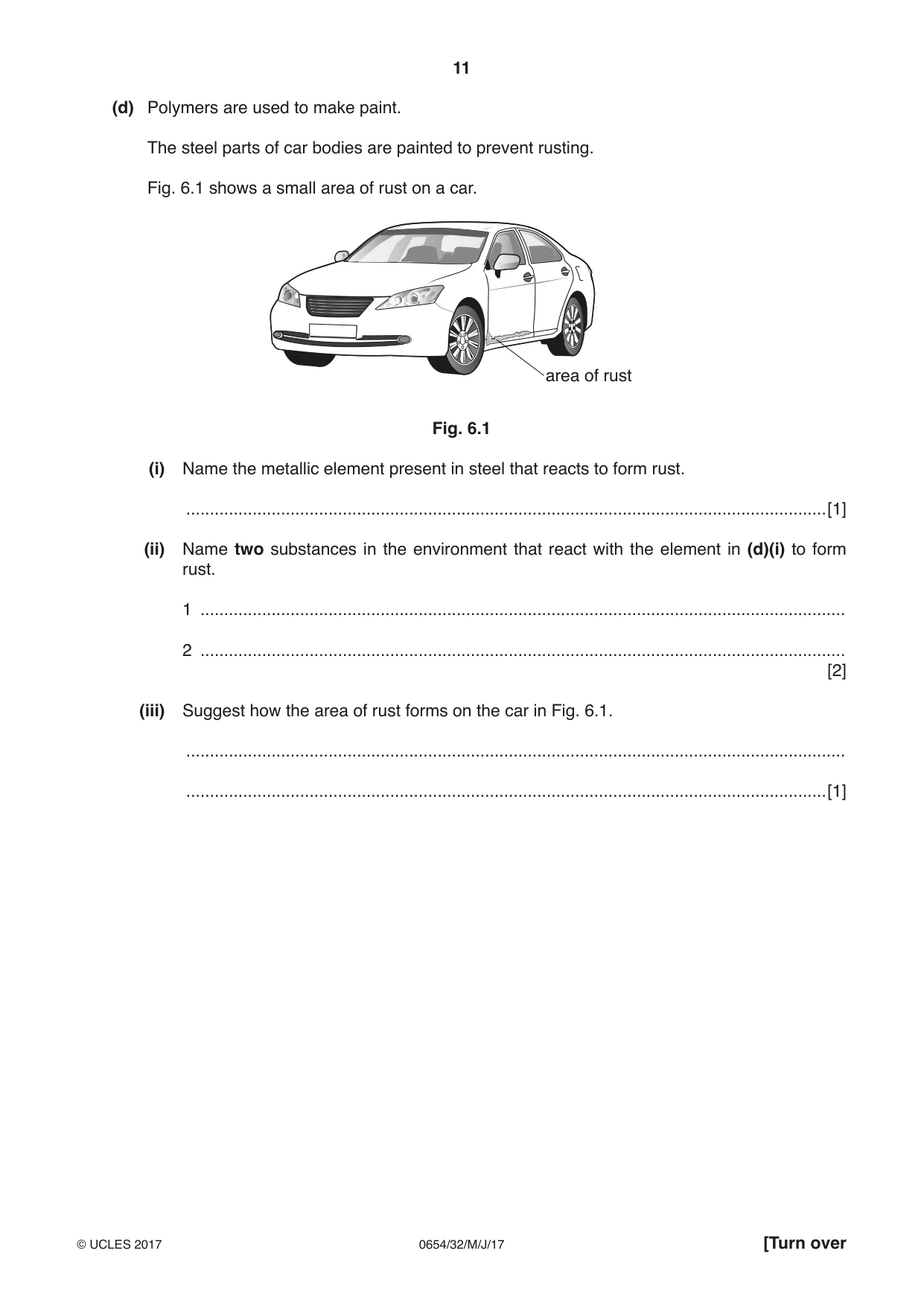
6 (a) Most of the compounds in petroleum contain only the elements carbon and hydrogen. State which two of the terms listed below refer to compounds or types of compounds that contain only carbon and hydrogen. calcium carbonate ethanol hydrocarbon methane ................................................................. and ......................................................................[1] (b) Gasoline contains mainly alkanes and is used as a fuel for cars. Explain, in terms of combustion products, why running a car engine in an enclosed space is a health hazard. ................................................................................................................................................... ................................................................................................................................................... ...............................................................................................................................................[2] (c) (i) Name the industrial process used to produce alkenes from alkanes. .......................................................................................................................................[1] (ii) Describe how poly(ethene) is formed from ethene molecules. ........................................................................................................................................... .......................................................................................................................................[1] (iii) An aqueous bromine test is used to identify whether a hydrocarbon is saturated or unsaturated. Describe the result of this test with ethane. ........................................................................................................................................... .......................................................................................................................................[1] (d) Polymers are used to make paint. The steel parts of car bodies are painted to prevent rusting. Fig. 6.1 shows a small area of rust on a car. area of rust Fig. 6.1 (i) Name the metallic element present in steel that reacts to form rust. .......................................................................................................................................[1] (ii) Name two substances in the environment that react with the element in (d)(i) to form rust. 1 ........................................................................................................................................ 2 ........................................................................................................................................ [2] (iii) Suggest how the area of rust forms on the car in Fig. 6.1. ........................................................................................................................................... .......................................................................................................................................[1]
Mark scheme: 6(a) hydrocarbon and methane ; 1 6(b) reference to release / build-up of carbon dioxide / carbon monoxide ; reference to dangers of poisoning / suffocation / death ; 2 6(c)(i) (catalytic) cracking ; 1 6(c)(ii) ethene molecules join together / form (long) chains ; 1 6(c)(iii) no reaction ; no colour change / stays orange ; 1 6(d)(i) iron ; 1 6(d)(ii) air / oxygen ; water ; 2 6(d)(iii) any reasonable source of damage / cause of paint removal ; 1
Q7 · A school orchestra is practising
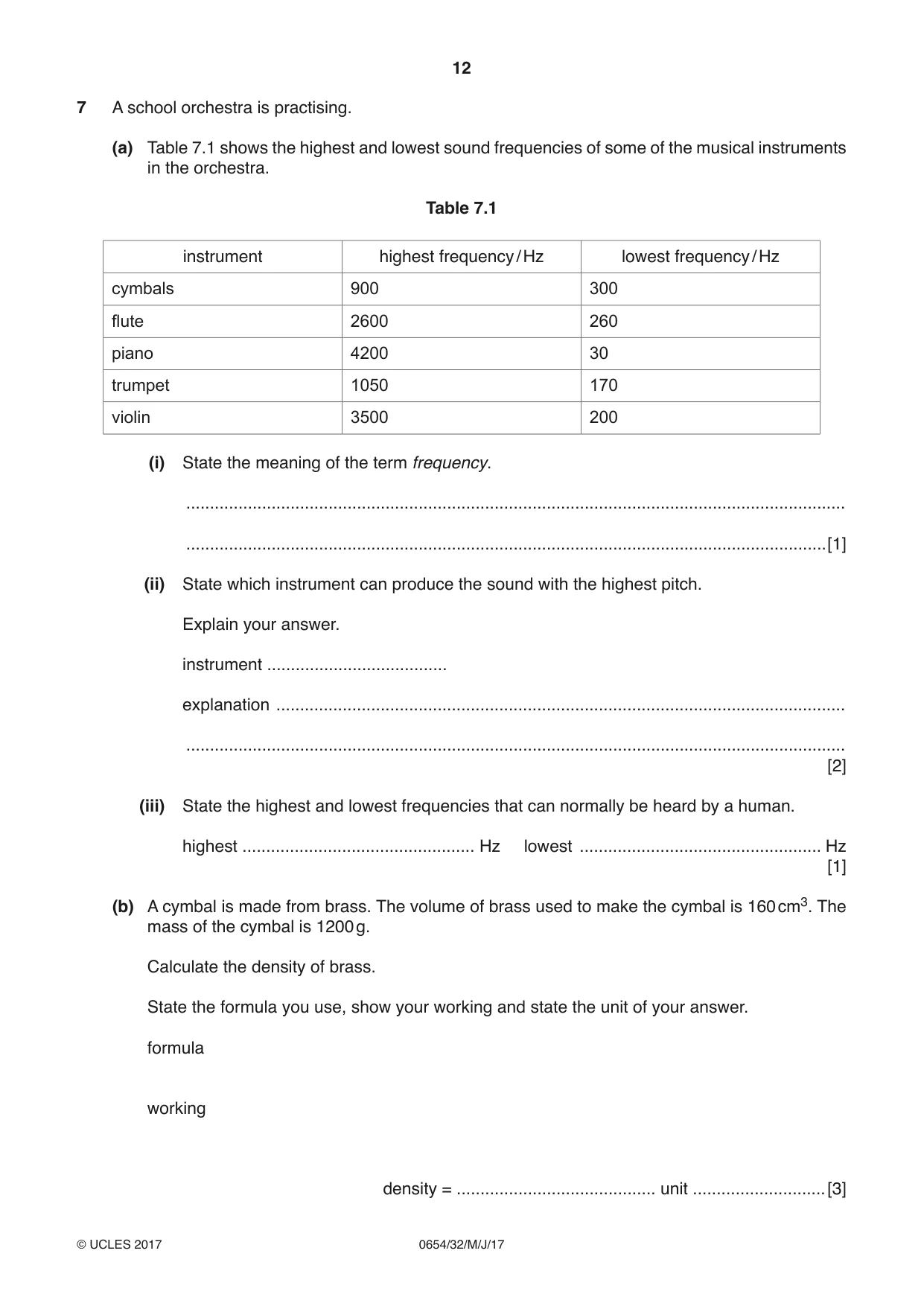
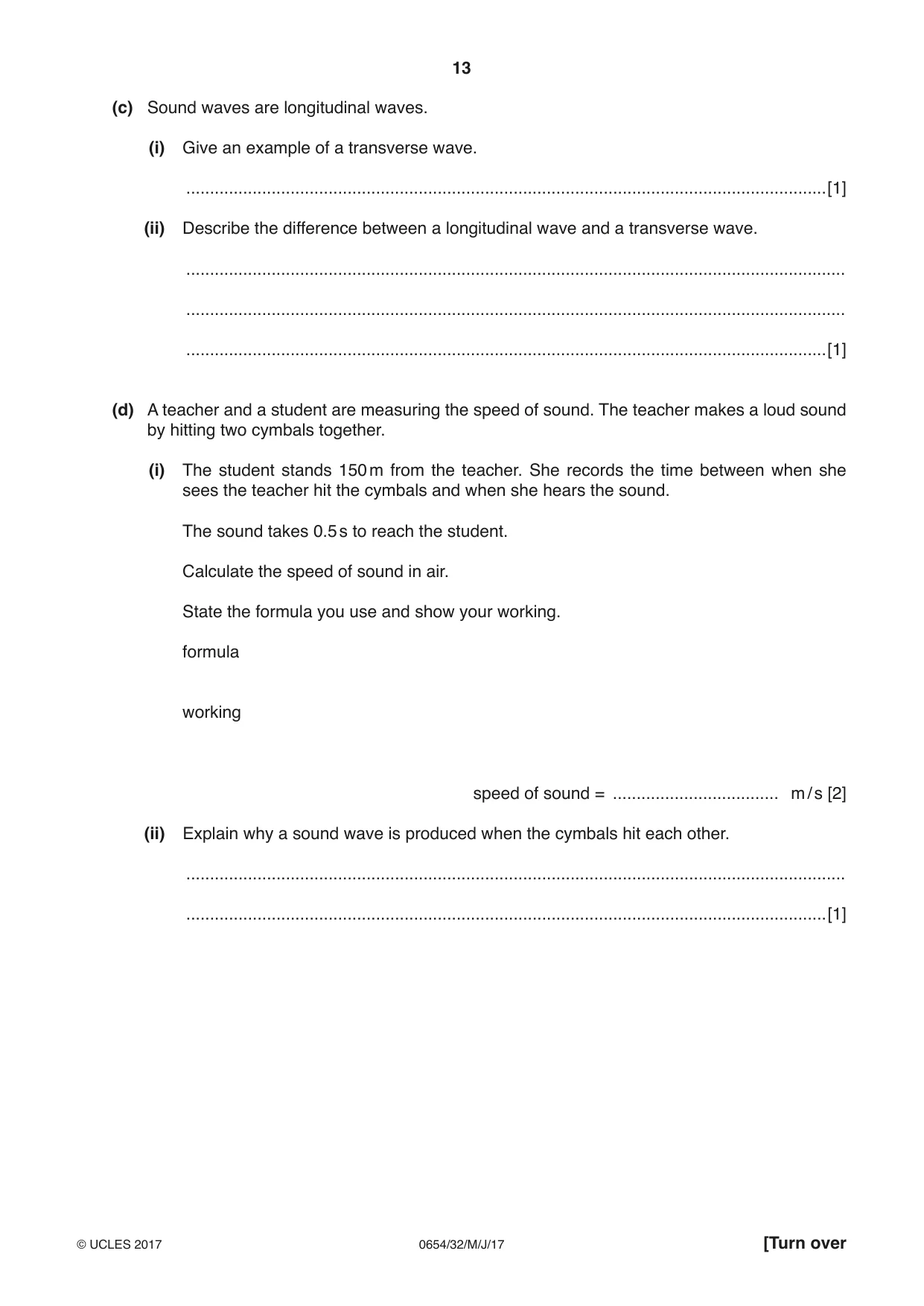
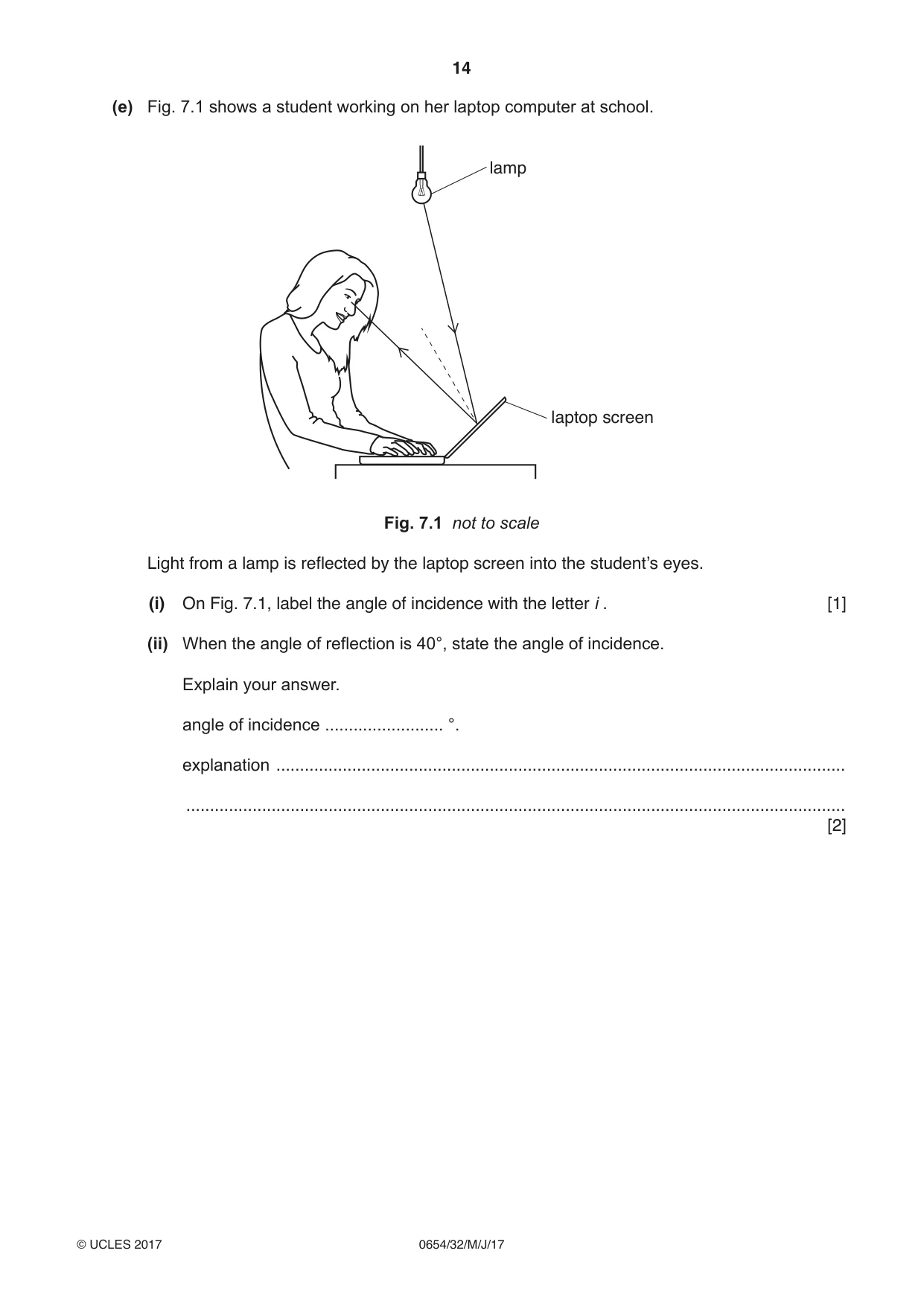
7 A school orchestra is practising. (a) Table 7.1 shows the highest and lowest sound frequencies of some of the musical instruments in the orchestra. Table 7.1 instrument highest frequency / Hz lowest frequency / Hz cymbals 900 300 flute 2600 260 piano 4200 30 trumpet 1050 170 violin 3500 200 (i) State the meaning of the term frequency. ........................................................................................................................................... .......................................................................................................................................[1] (ii) State which instrument can produce the sound with the highest pitch. Explain your answer. instrument ...................................... explanation ........................................................................................................................ ........................................................................................................................................... [2] (iii) State the highest and lowest frequencies that can normally be heard by a human. highest ................................................. Hz lowest ................................................... Hz [1] (b) A cymbal is made from brass. The volume of brass used to make the cymbal is 160 cm3. The mass of the cymbal is 1200 g. Calculate the density of brass. State the formula you use, show your working and state the unit of your answer. formula working density = .......................................... unit ............................ [3] (c) Sound waves are longitudinal waves. (i) Give an example of a transverse wave. .......................................................................................................................................[1] (ii) Describe the difference between a longitudinal wave and a transverse wave. ........................................................................................................................................... ........................................................................................................................................... .......................................................................................................................................[1] (d) A teacher and a student are measuring the speed of sound. The teacher makes a loud sound by hitting two cymbals together. (i) The student stands 150 m from the teacher. She records the time between when she sees the teacher hit the cymbals and when she hears the sound. The sound takes 0.5 s to reach the student. Calculate the speed of sound in air. State the formula you use and show your working. formula working speed of sound = ................................... m / s [2] (ii) Explain why a sound wave is produced when the cymbals hit each other. ........................................................................................................................................... .......................................................................................................................................[1] (e) Fig. 7.1 shows a student working on her laptop computer at school. lamp laptop screen Fig. 7.1 not to scale Light from a lamp is reflected by the laptop screen into the student’s eyes. (i) On Fig. 7.1, label the angle of incidence with the letter i . [1] (ii) When the angle of reflection is 40°, state the angle of incidence. Explain your answer. angle of incidence ......................... °. explanation ........................................................................................................................ ........................................................................................................................................... [2] Question 8 starts on page 16.
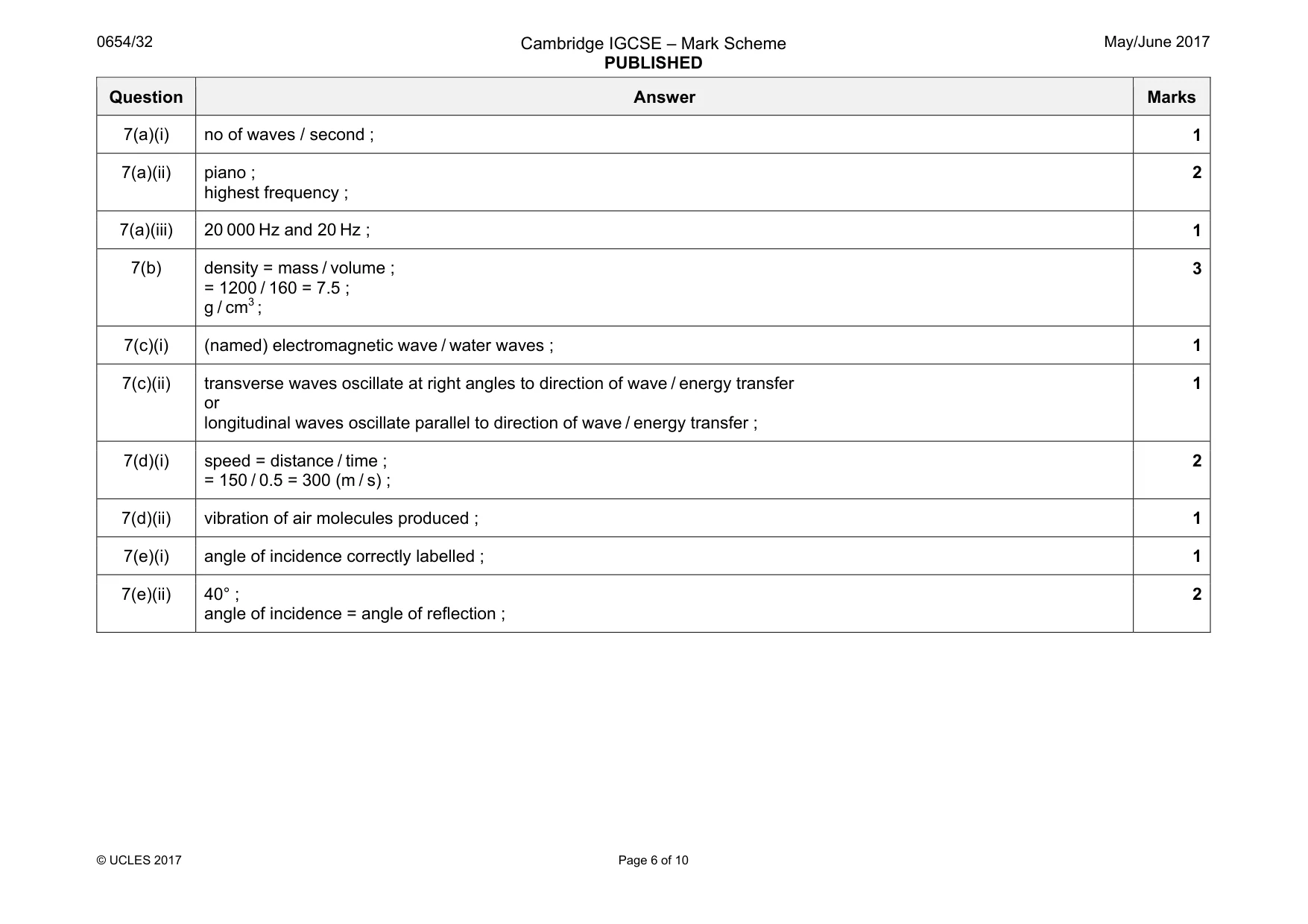
Mark scheme: 7(a)(i) no of waves / second ; 1 7(a)(ii) piano ; highest frequency ; 2 7(a)(iii) 20 000 Hz and 20 Hz ; 1 7(b) density = mass / volume ; = 1200 / 160 = 7.5 ; g / cm3 ; 3 7(c)(i) (named) electromagnetic wave / water waves ; 1 7(c)(ii) transverse waves oscillate at right angles to direction of wave / energy transfer or longitudinal waves oscillate parallel to direction of wave / energy transfer ; 1 7(d)(i) speed = distance / time ; = 150 / 0.5 = 300 (m / s) ; 2 7(d)(ii) vibration of air molecules produced ; 1 7(e)(i) angle of incidence correctly labelled ; 1 7(e)(ii) 40° ; angle of incidence = angle of reflection ; 2
Q8 · The reactivity of an element describes how easily the element forms compounds
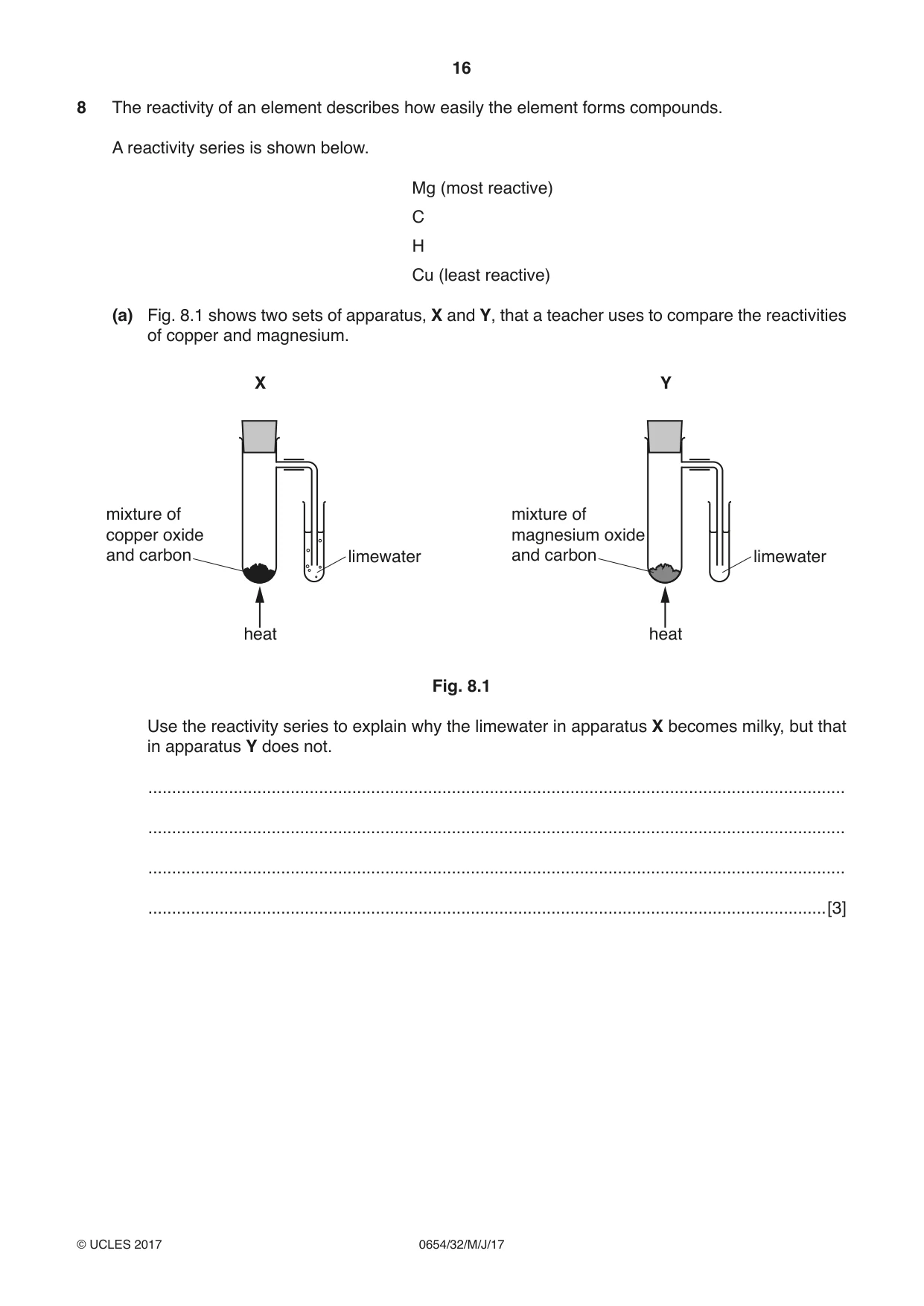
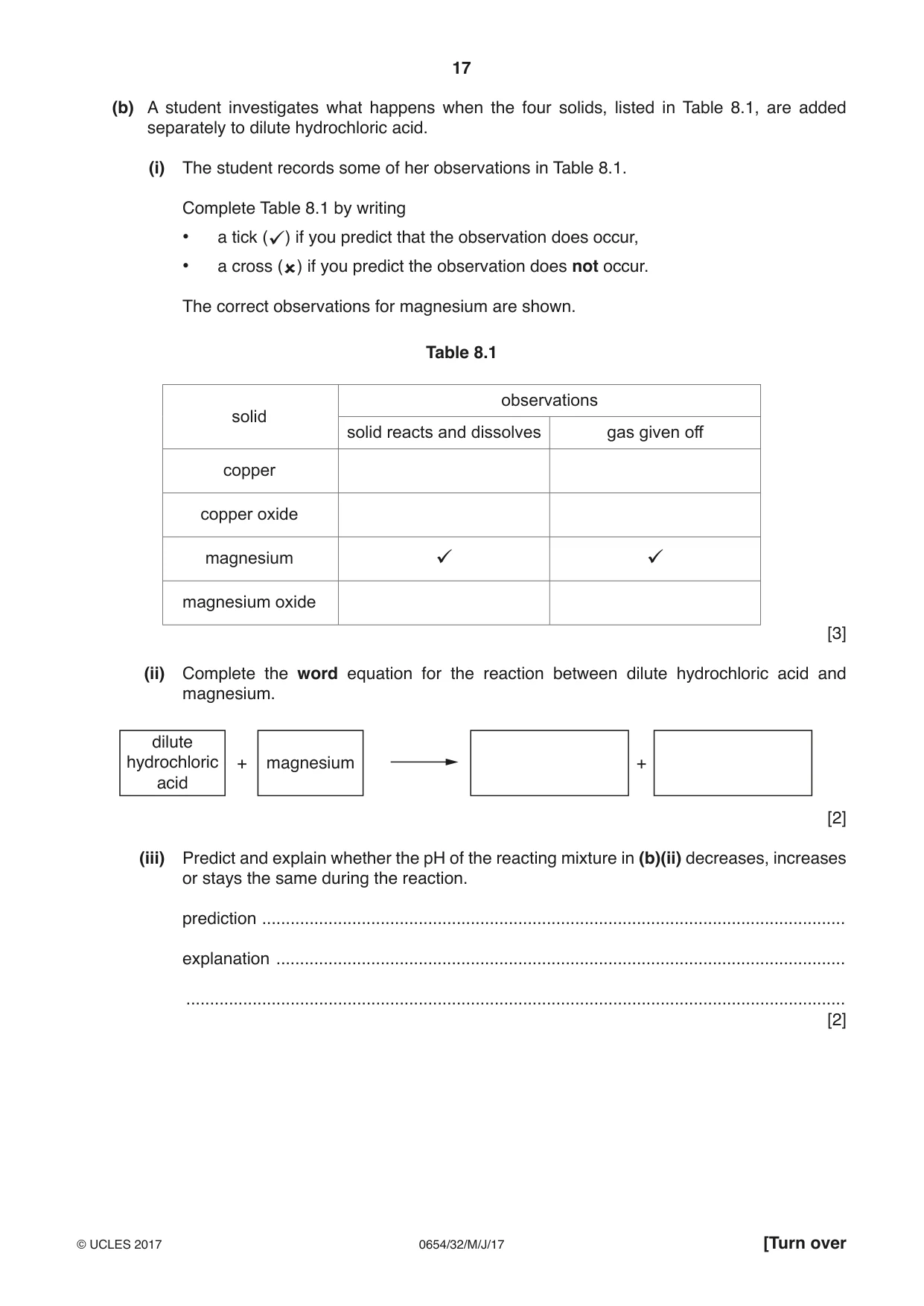
8 The reactivity of an element describes how easily the element forms compounds. A reactivity series is shown below. Mg (most reactive) C H Cu (least reactive) (a) Fig. 8.1 shows two sets of apparatus, X and Y, that a teacher uses to compare the reactivities of copper and magnesium. X Y mixture of mixture of copper oxide magnesium oxide and carbon limewater and carbon limewater heat heat Fig. 8.1 Use the reactivity series to explain why the limewater in apparatus X becomes milky, but that in apparatus Y does not. ................................................................................................................................................... ................................................................................................................................................... ................................................................................................................................................... ...............................................................................................................................................[3] (b) A student investigates what happens when the four solids, listed in Table 8.1, are added separately to dilute hydrochloric acid. (i) The student records some of her observations in Table 8.1. Complete Table 8.1 by writing • a tick () if you predict that the observation does occur, • a cross (û) if you predict the observation does not occur. The correct observations for magnesium are shown. Table 8.1 observations solid solid reacts and dissolves gas given off copper copper oxide magnesium magnesium oxide [3] (ii) Complete the word equation for the reaction between dilute hydrochloric acid and magnesium. dilute hydrochloric + magnesium + acid [2] (iii) Predict and explain whether the pH of the reacting mixture in (b)(ii) decreases, increases or stays the same during the reaction. prediction ........................................................................................................................... explanation ........................................................................................................................ ........................................................................................................................................... [2]
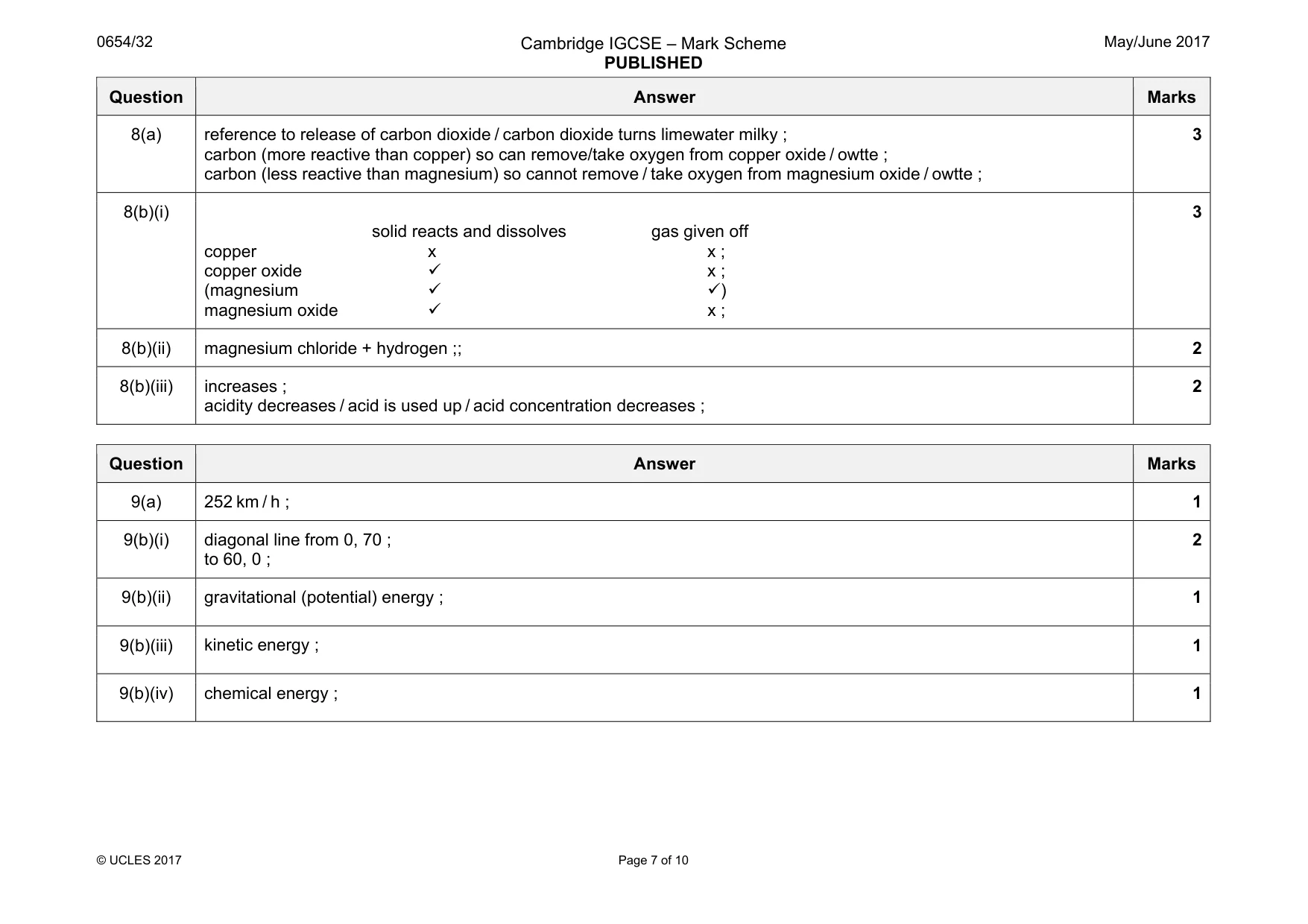
Mark scheme: 8(a) reference to release of carbon dioxide / carbon dioxide turns limewater milky ; carbon (more reactive than copper) so can remove/take oxygen from copper oxide / owtte ; carbon (less reactive than magnesium) so cannot remove / take oxygen from magnesium oxide / owtte ; 3 8(b)(i) solid reacts and dissolves gas given off copper x x ; copper oxide 9 x ; (magnesium 9 9) magnesium oxide 9 x ; 3 8(b)(ii) magnesium chloride + hydrogen ;; 2 8(b)(iii) increases ; acidity decreases / acid is used up / acid concentration decreases ; 2
Q9 · An aircraft landing with constant deceleration along an airport runway
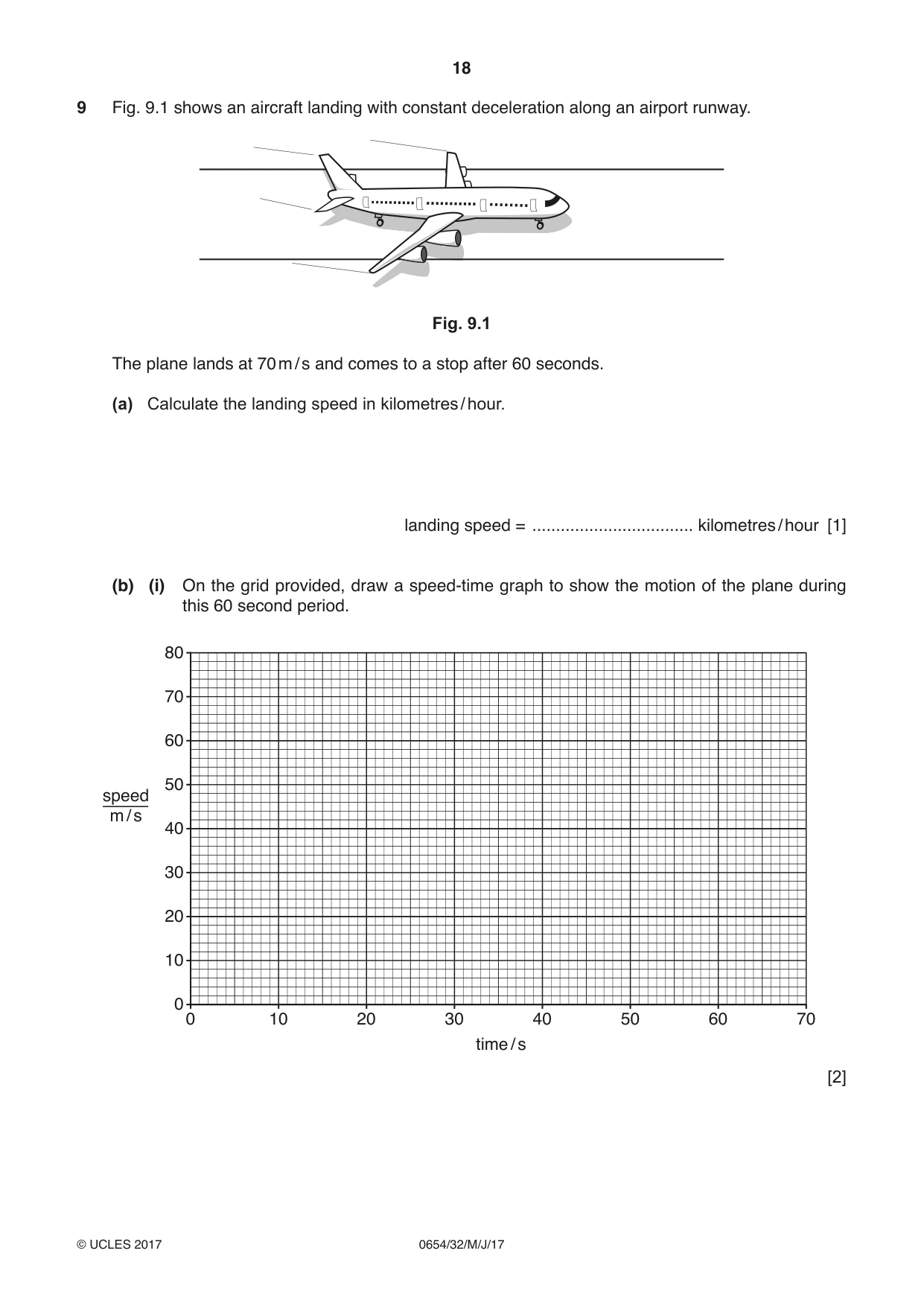
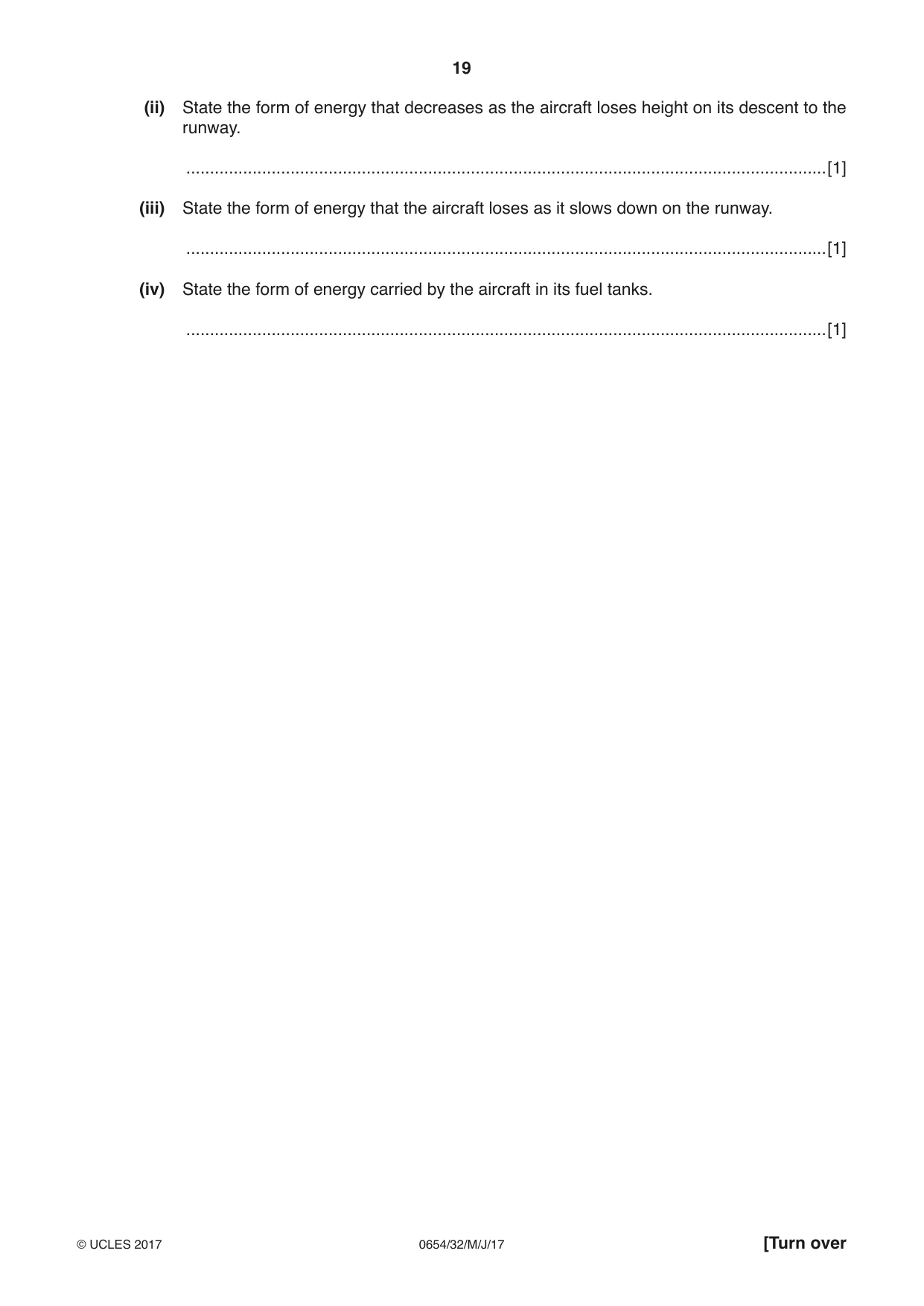
9 Fig. 9.1 shows an aircraft landing with constant deceleration along an airport runway. Fig. 9.1 The plane lands at 70 m / s and comes to a stop after 60 seconds. (a) Calculate the landing speed in kilometres / hour. landing speed = .................................. kilometres / hour [1] (b) (i) On the grid provided, draw a speed-time graph to show the motion of the plane during this 60 second period. 80 70 60 50 speed m / s 40 30 20 10 0 0 10 20 30 40 50 60 70 time / s [2] (ii) State the form of energy that decreases as the aircraft loses height on its descent to the runway. .......................................................................................................................................[1] (iii) State the form of energy that the aircraft loses as it slows down on the runway. .......................................................................................................................................[1] (iv) State the form of energy carried by the aircraft in its fuel tanks. .......................................................................................................................................[1]
Mark scheme: 9(a) 252 km / h ; 1 9(b)(i) diagonal line from 0, 70 ; to 60, 0 ; 2 9(b)(ii) gravitational (potential) energy ; 1 9(b)(iii) kinetic energy ; 1 9(b)(iv) chemical energy ; 1
Q10 · Information on the label attached to a television
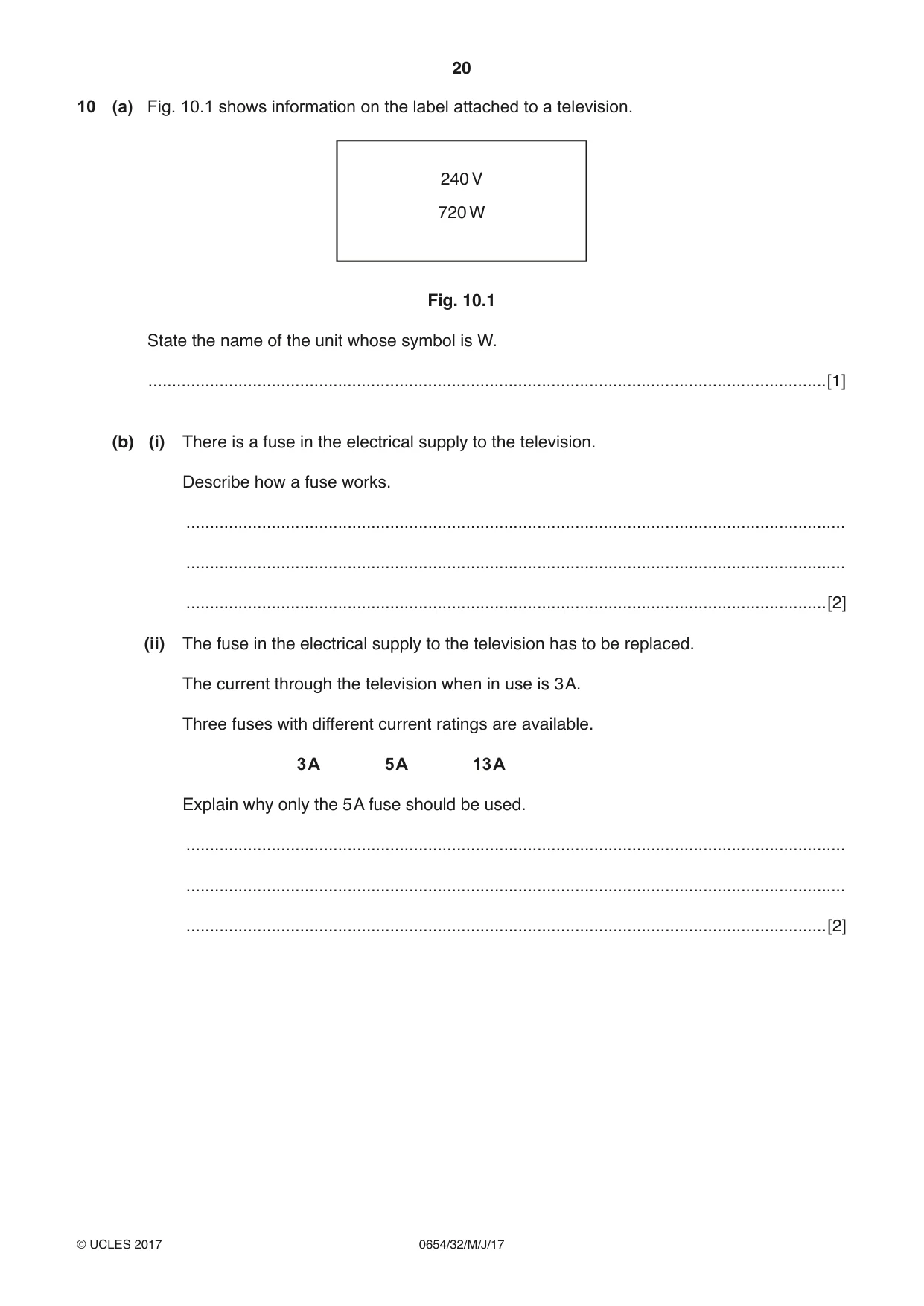
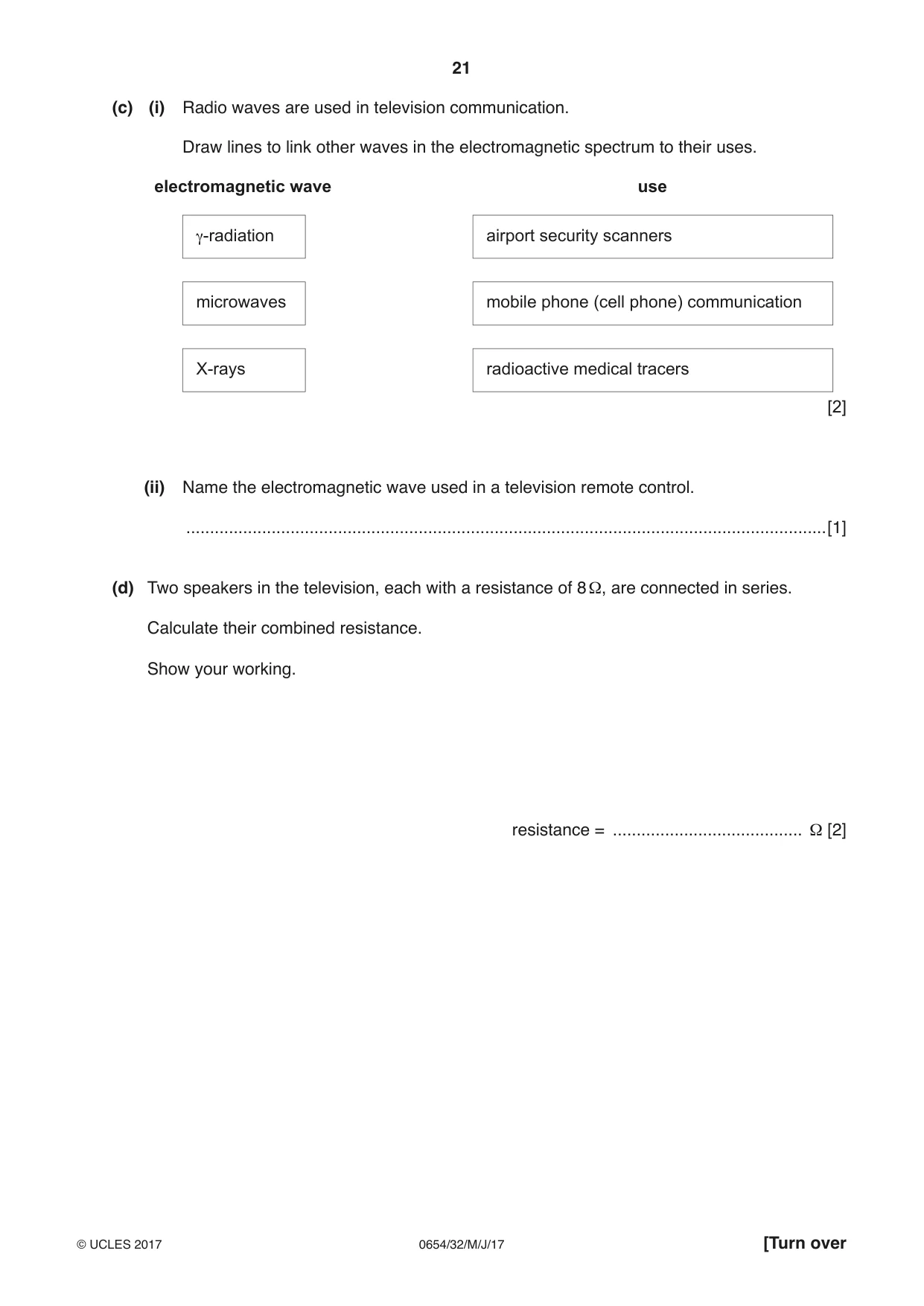
10 (a) Fig. 10.1 shows information on the label attached to a television. 240 V 720 W Fig. 10.1 State the name of the unit whose symbol is W. ...............................................................................................................................................[1] (b) (i) There is a fuse in the electrical supply to the television. Describe how a fuse works. ........................................................................................................................................... ........................................................................................................................................... .......................................................................................................................................[2] (ii) The fuse in the electrical supply to the television has to be replaced. The current through the television when in use is 3 A. Three fuses with different current ratings are available. 3 A 5 A 13 A Explain why only the 5 A fuse should be used. ........................................................................................................................................... ........................................................................................................................................... .......................................................................................................................................[2] (c) (i) Radio waves are used in television communication. Draw lines to link other waves in the electromagnetic spectrum to their uses. electromagnetic wave use γ-radiation airport security scanners microwaves mobile phone (cell phone) communication X-rays radioactive medical tracers [2] (ii) Name the electromagnetic wave used in a television remote control. .......................................................................................................................................[1] (d) Two speakers in the television, each with a resistance of 8 Ω, are connected in series. Calculate their combined resistance. Show your working. resistance = ........................................ Ω [2]
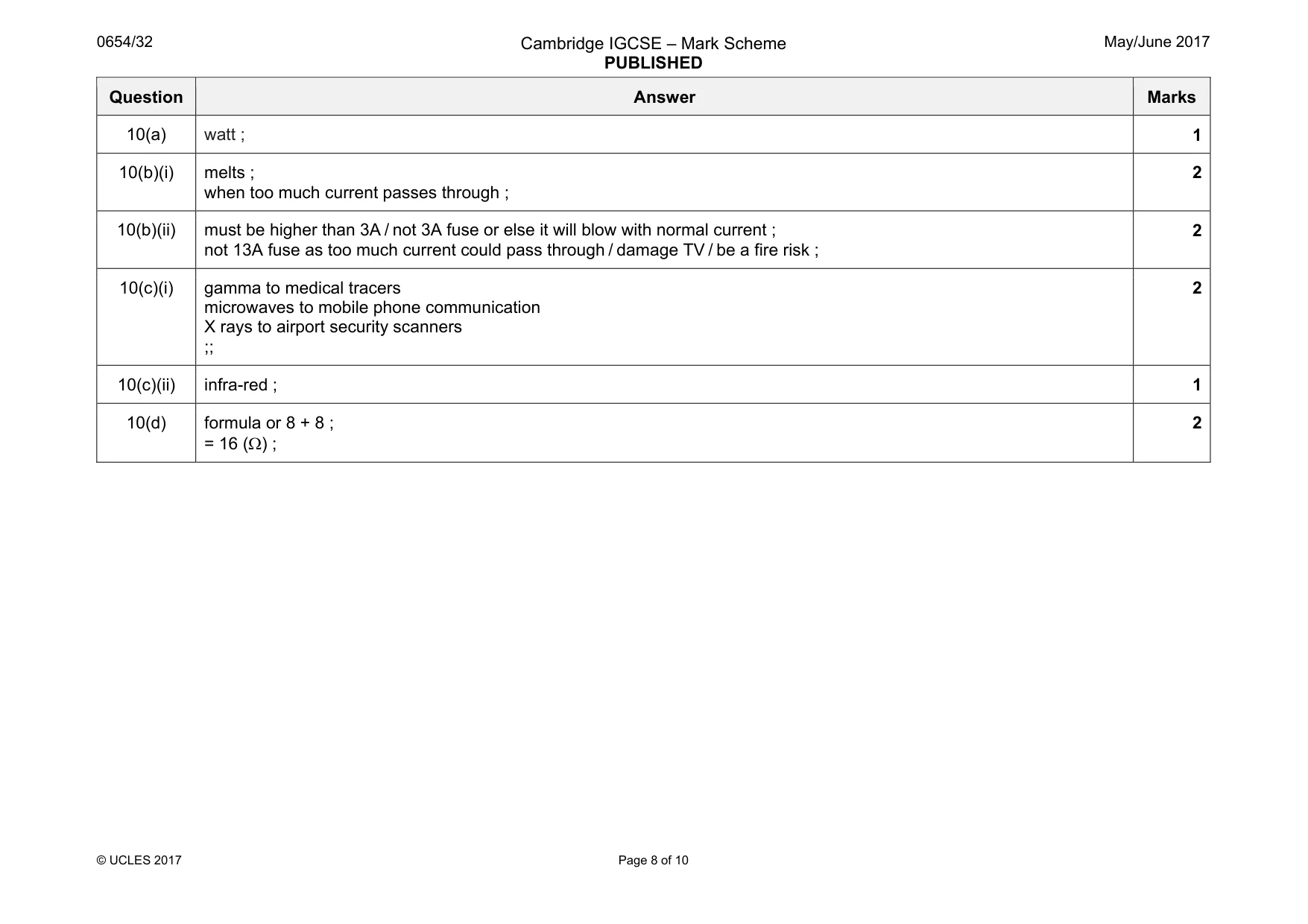
Mark scheme: 10(a) watt ; 1 10(b)(i) melts ; when too much current passes through ; 2 10(b)(ii) must be higher than 3A / not 3A fuse or else it will blow with normal current ; not 13A fuse as too much current could pass through / damage TV / be a fire risk ; 2 10(c)(i) gamma to medical tracers microwaves to mobile phone communication X rays to airport security scanners ;; 2 10(c)(ii) infra-red ; 1 10(d) formula or 8 + 8 ; = 16 (Ω) ; 2
Q11 · A student investigates the changes to her heart rate when she exercises
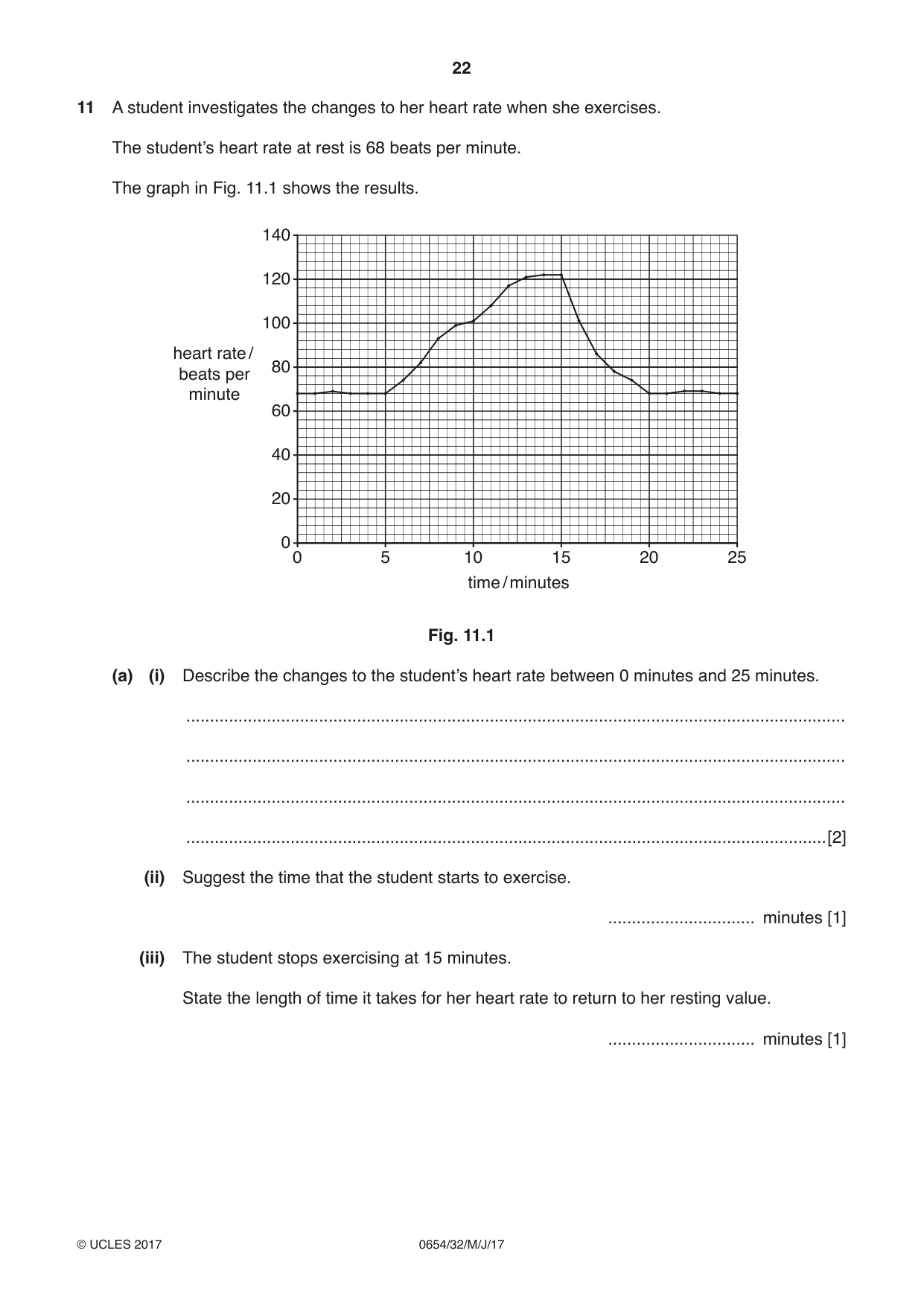
11 A student investigates the changes to her heart rate when she exercises. The student’s heart rate at rest is 68 beats per minute. The graph in Fig. 11.1 shows the results. 140 120 100 heart rate / 80 beats per minute 60 40 20 0 0 5 10 15 20 25 time / minutes Fig. 11.1 (a) (i) Describe the changes to the student’s heart rate between 0 minutes and 25 minutes. ........................................................................................................................................... ........................................................................................................................................... ........................................................................................................................................... .......................................................................................................................................[2] (ii) Suggest the time that the student starts to exercise. ............................... minutes [1] (iii) The student stops exercising at 15 minutes. State the length of time it takes for her heart rate to return to her resting value. ............................... minutes [1] (b) Blood delivers oxygen to the muscle cells for respiration. (i) State one other reactant required for respiration. .......................................................................................................................................[1] (ii) Name the component of the blood that transports oxygen. .......................................................................................................................................[1] (iii) State two other components of blood. 1 ......................................................................................................................................... 2 ......................................................................................................................................... [2]
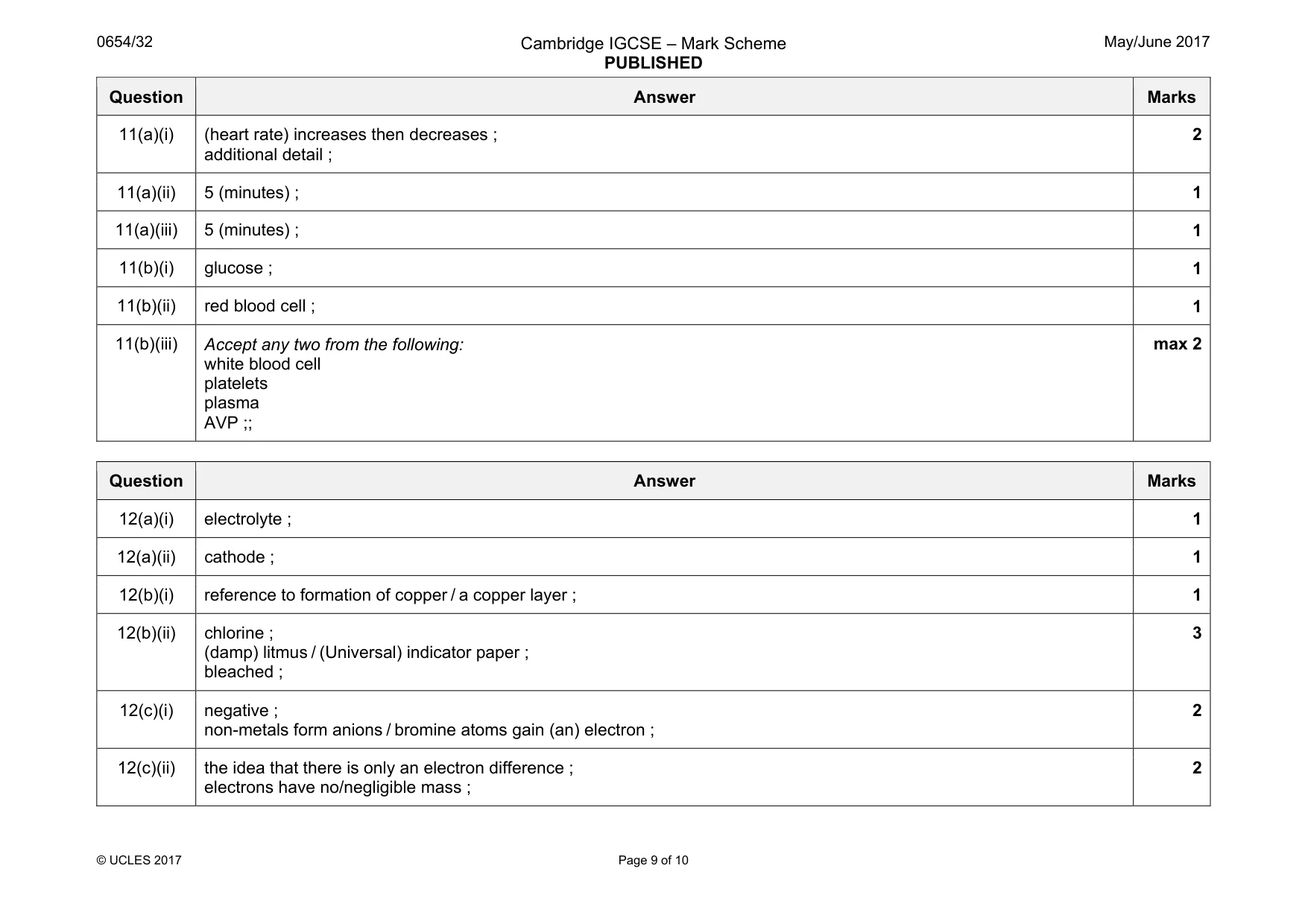
Mark scheme: 11(a)(i) (heart rate) increases then decreases ; additional detail ; 2 11(a)(ii) 5 (minutes) ; 1 11(a)(iii) 5 (minutes) ; 1 11(b)(i) glucose ; 1 11(b)(ii) red blood cell ; 1 11(b)(iii) Accept any two from the following: white blood cell platelets plasma AVP ;; max 2
Q12 · Electrolysis occurs when an electric current passes through a solution that contains ions
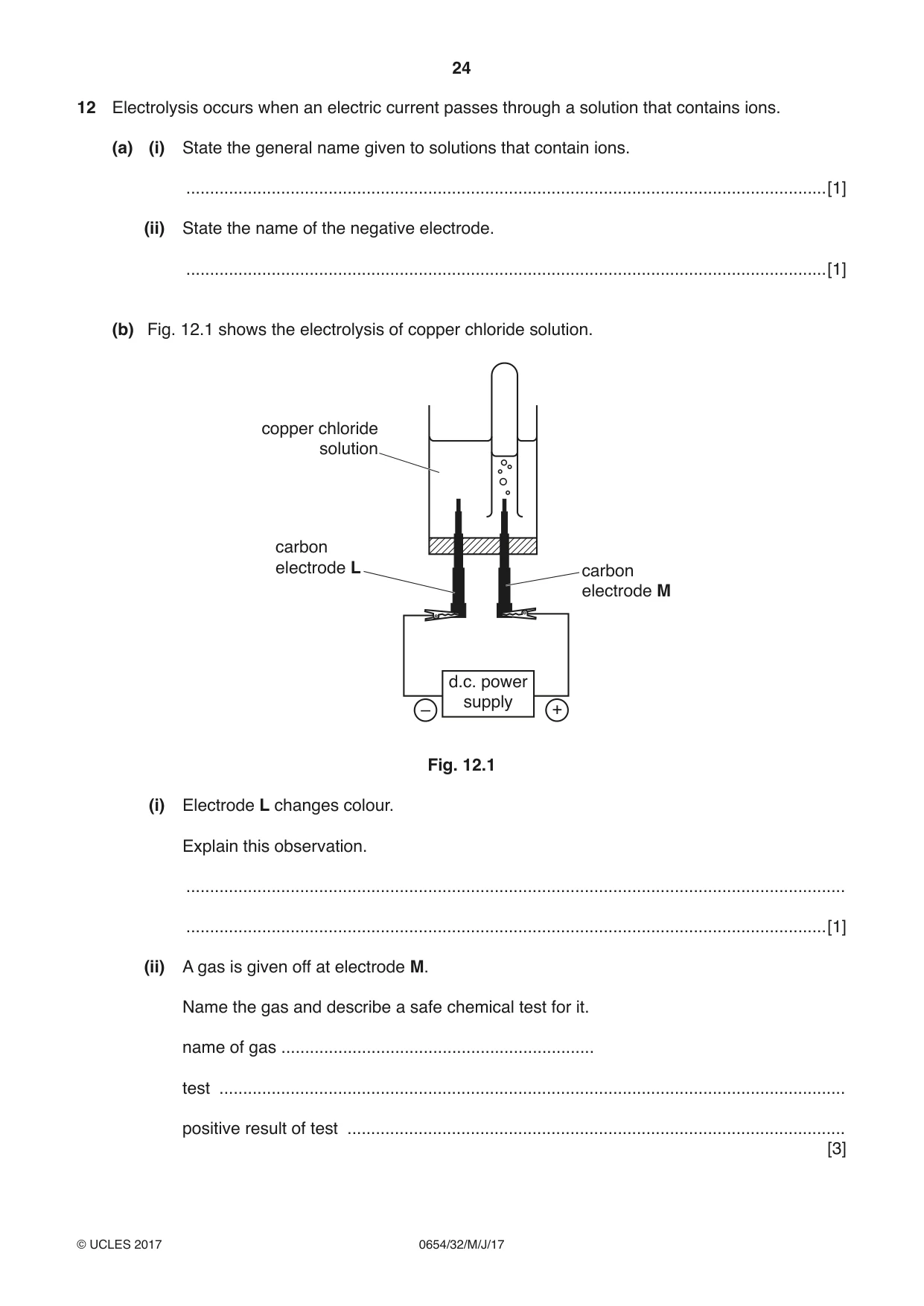
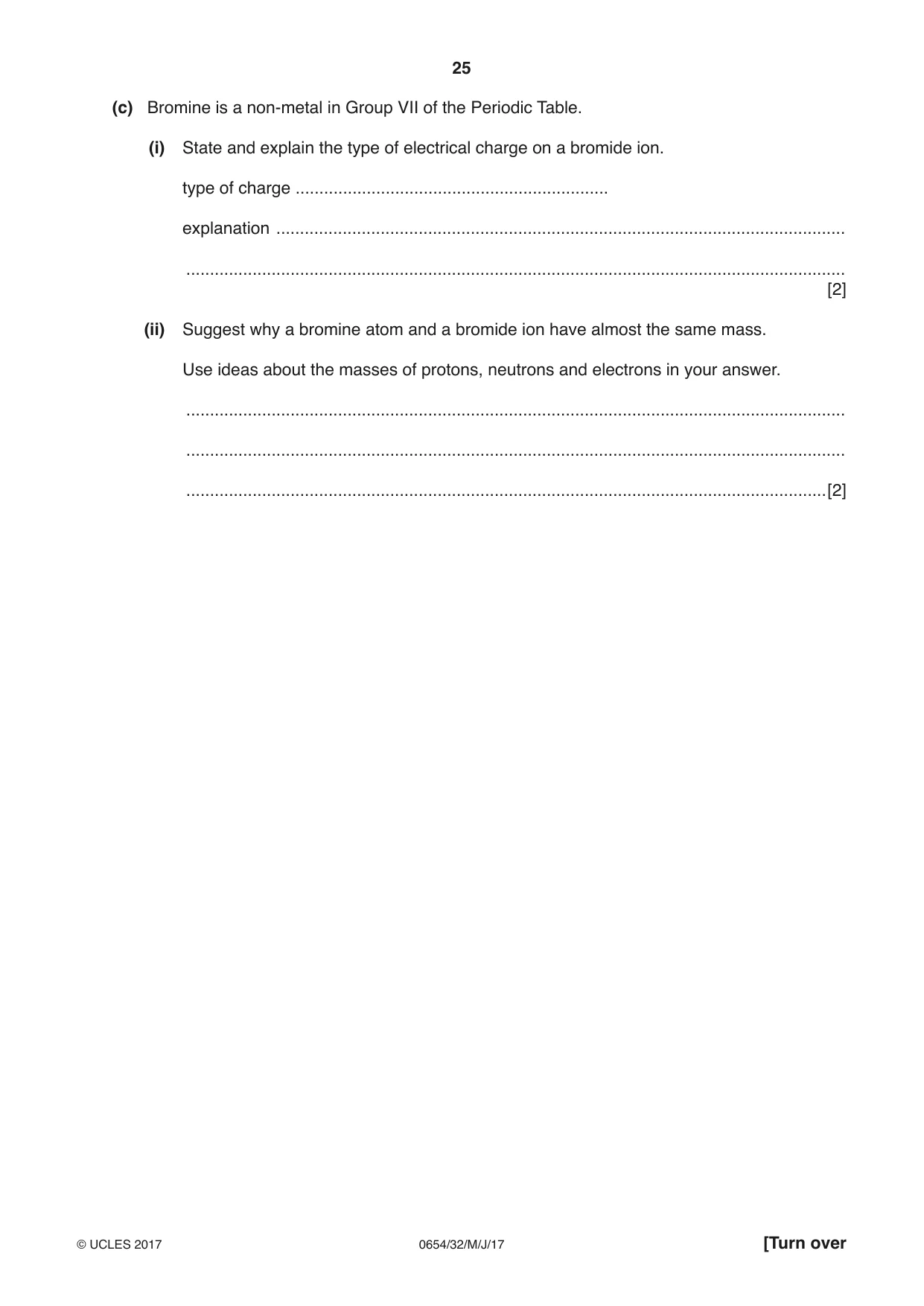
12 Electrolysis occurs when an electric current passes through a solution that contains ions. (a) (i) State the general name given to solutions that contain ions. .......................................................................................................................................[1] (ii) State the name of the negative electrode. .......................................................................................................................................[1] (b) Fig. 12.1 shows the electrolysis of copper chloride solution. copper chloride solution carbon electrode L carbon electrode M d.c. power supply – + Fig. 12.1 (i) Electrode L changes colour. Explain this observation. ........................................................................................................................................... .......................................................................................................................................[1] (ii) A gas is given off at electrode M. Name the gas and describe a safe chemical test for it. name of gas .................................................................. test .................................................................................................................................... positive result of test ......................................................................................................... [3] (c) Bromine is a non-metal in Group VII of the Periodic Table. (i) State and explain the type of electrical charge on a bromide ion. type of charge .................................................................. explanation ........................................................................................................................ ........................................................................................................................................... [2] (ii) Suggest why a bromine atom and a bromide ion have almost the same mass. Use ideas about the masses of protons, neutrons and electrons in your answer. ........................................................................................................................................... ........................................................................................................................................... .......................................................................................................................................[2]
Mark scheme: 12(a)(i) electrolyte ; 1 12(a)(ii) cathode ; 1 12(b)(i) reference to formation of copper / a copper layer ; 1 12(b)(ii) chlorine ; (damp) litmus / (Universal) indicator paper ; bleached ; 3 12(c)(i) negative ; non-metals form anions / bromine atoms gain (an) electron ; 2 12(c)(ii) the idea that there is only an electron difference ; electrons have no/negligible mass ; 2
Q13 · A family tree and the genotypes of the family members
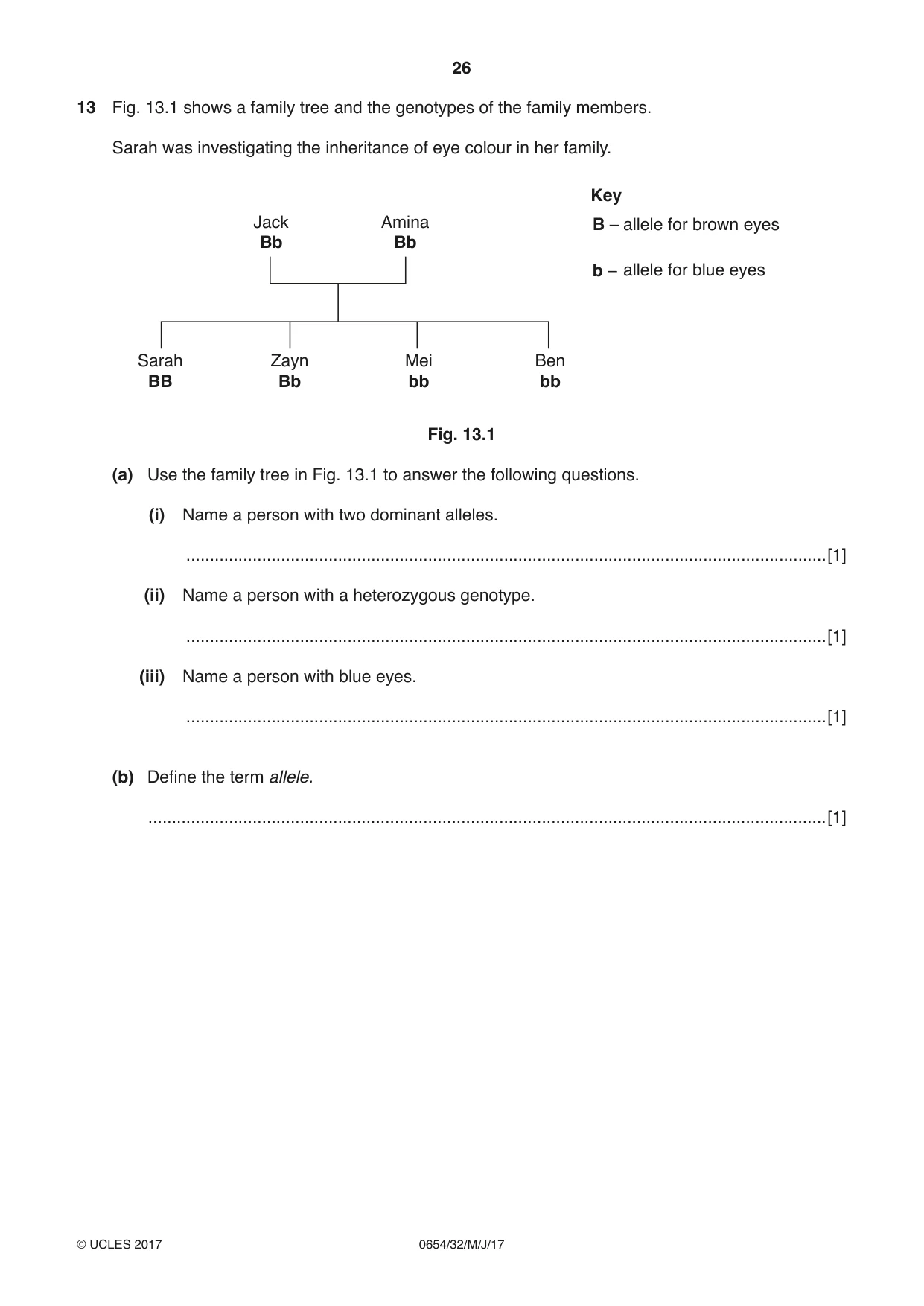
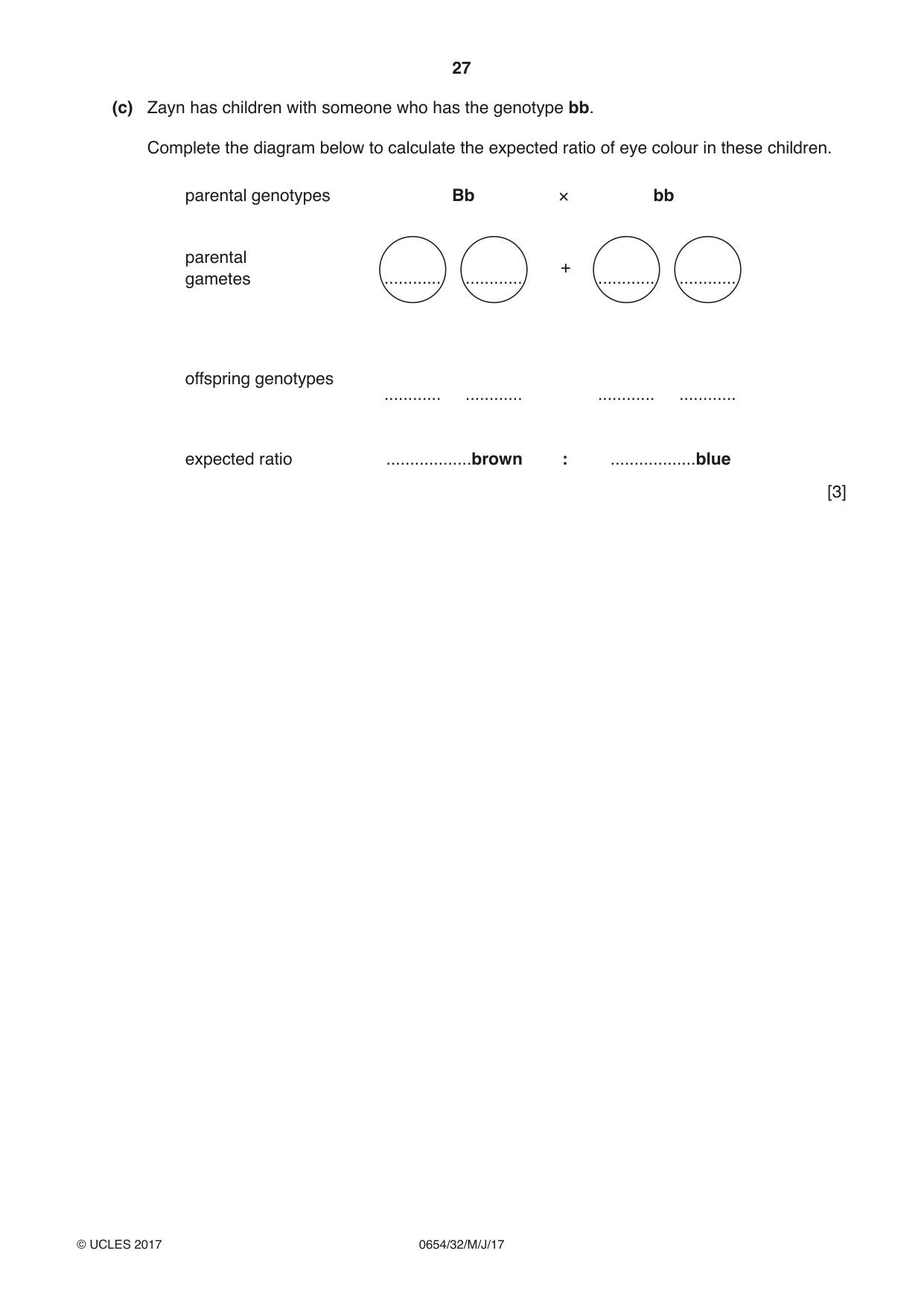
13 Fig. 13.1 shows a family tree and the genotypes of the family members. Sarah was investigating the inheritance of eye colour in her family. Key Jack Amina B – allele for brown eyes Bb Bb b – allele for blue eyes Sarah Zayn Mei Ben BB Bb bb bb Fig. 13.1 (a) Use the family tree in Fig. 13.1 to answer the following questions. (i) Name a person with two dominant alleles. .......................................................................................................................................[1] (ii) Name a person with a heterozygous genotype. .......................................................................................................................................[1] (iii) Name a person with blue eyes. .......................................................................................................................................[1] (b) Define the term allele. ...............................................................................................................................................[1] (c) Zayn has children with someone who has the genotype bb. Complete the diagram below to calculate the expected ratio of eye colour in these children. parental genotypes Bb × bb parental + gametes ............ ............ ............ ............ offspring genotypes ............ ............ ............ ............ expected ratio ..................brown : ..................blue [3]
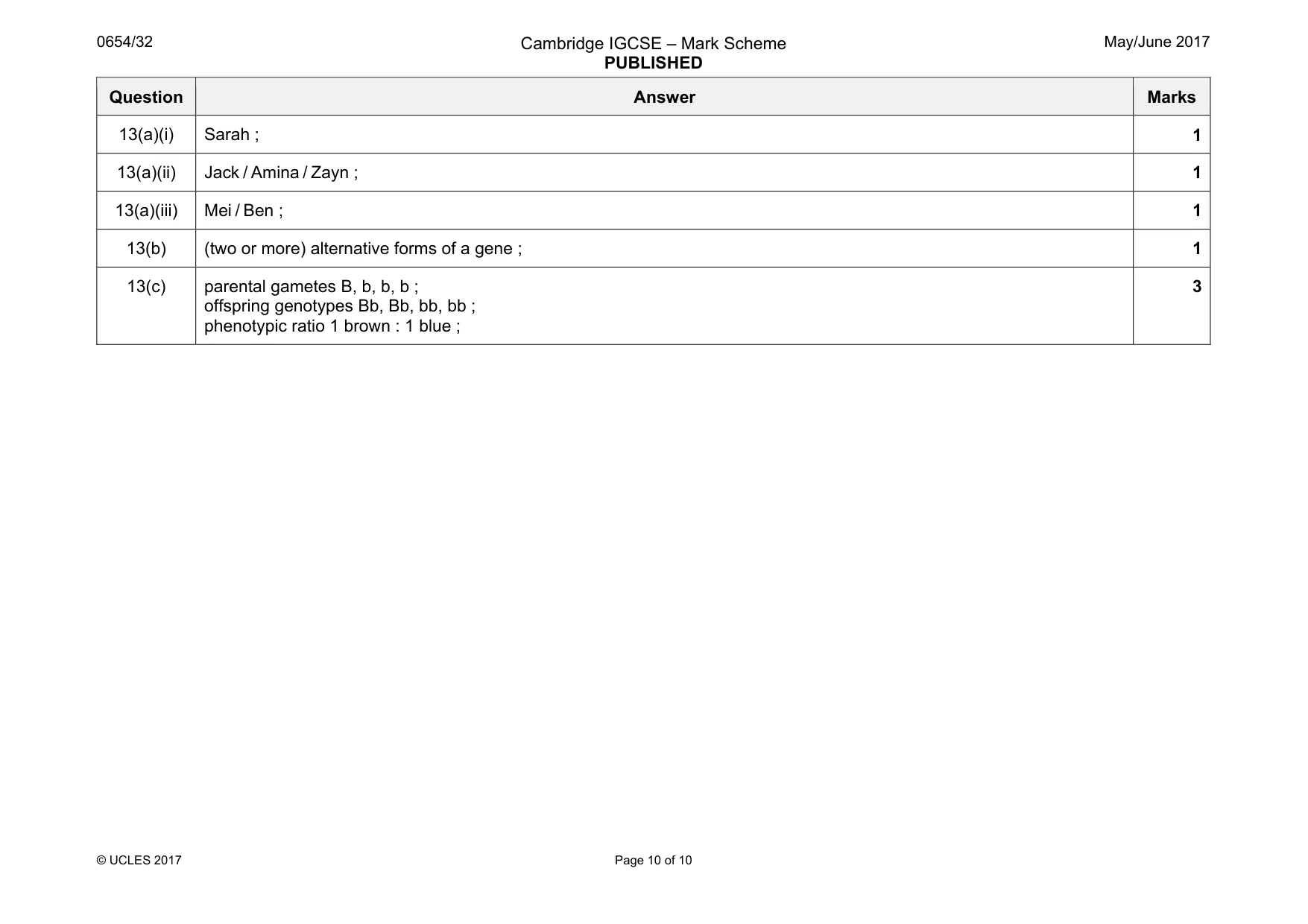
Mark scheme: 13(a)(i) Sarah ; 1 13(a)(ii) Jack / Amina / Zayn ; 1 13(a)(iii) Mei / Ben ; 1 13(b) (two or more) alternative forms of a gene ; 1 13(c) parental gametes B, b, b, b ; offspring genotypes Bb, Bb, bb, bb ; phenotypic ratio 1 brown : 1 blue ; 3
What was in this paper
The subtopics covered by these 13 questions, and how many questions each got. Open one in a new tab to see every Cambridge question on it.
What you needed in this session
Cambridge’s own grade thresholds for 2017 May/June, Paper 3 · Variant 2. A higher threshold means an easier paper — the bar moves with how the cohort did.