Questions as text
Q1 · A man standing in the sea on a sunny day 0653/41 May/June 2017
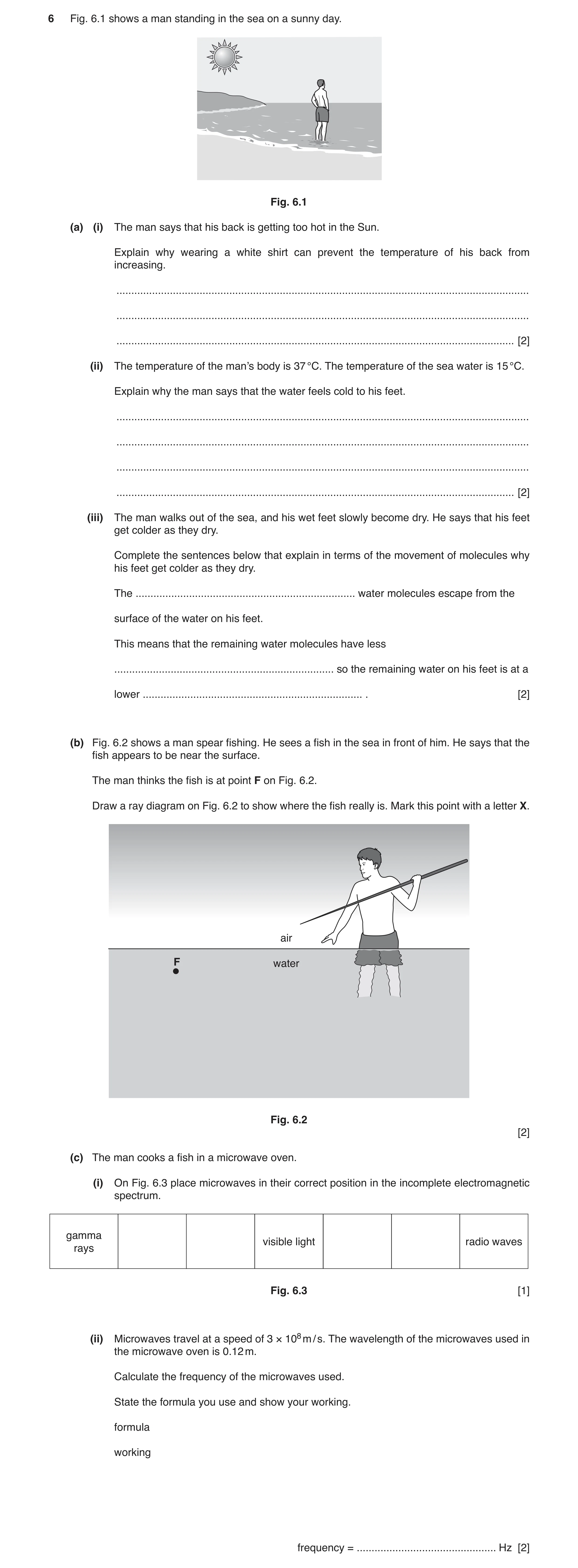
6 Fig. 6.1 shows a man standing in the sea on a sunny day. Fig. 6.1 (a) (i) The man says that his back is getting too hot in the Sun. Explain why wearing a white shirt can prevent the temperature of his back from increasing. … … … [2] (ii) The temperature of the man’s body is 37 °C. The temperature of the sea water is 15 °C. Explain why the man says that the water feels cold to his feet. … … … … [2] (iii) The man walks out of the sea, and his wet feet slowly become dry. He says that his feet get colder as they dry. Complete the sentences below that explain in terms of the movement of molecules why his feet get colder as they dry. The … water molecules escape from the surface of the water on his feet. This means that the remaining water molecules have less … so the remaining water on his feet is at a lower … . [2] (b) Fig. 6.2 shows a man spear fishing. He sees a fish in the sea in front of him. He says that the fish appears to be near the surface. The man thinks the fish is at point F on Fig. 6.2. Draw a ray diagram on Fig. 6.2 to show where the fish really is. Mark this point with a letter X. air F water Fig. 6.2 [2] (c) The man cooks a fish in a microwave oven. (i) On Fig. 6.3 place microwaves in their correct position in the incomplete electromagnetic spectrum. gamma visible light radio waves rays Fig. 6.3 [1] (ii) Microwaves travel at a speed of 3 × 10⁸ m / s. The wavelength of the microwaves used in the microwave oven is 0.12 m. Calculate the frequency of the microwaves used. State the formula you use and show your working. formula working frequency = … Hz [2]
11 marks
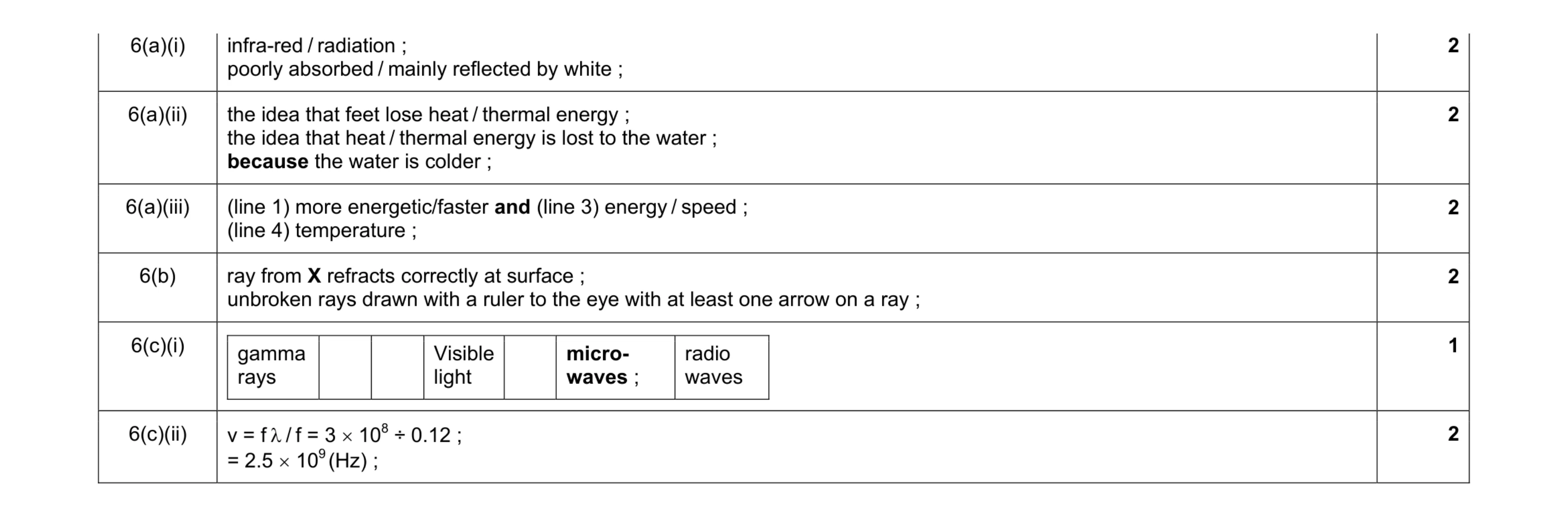
Mark scheme: 6(a)(i) infra-red / radiation ; poorly absorbed / mainly reflected by white ; 2 6(a)(ii) the idea that feet lose heat / thermal energy ; the idea that heat / thermal energy is lost to the water ; because the water is colder ; 2 6(a)(iii) (line 1) more energetic/faster and (line 3) energy / speed ; (line 4) temperature ; 2 6(b) ray from X refracts correctly at surface ; unbroken rays drawn with a ruler to the eye with at least one arrow on a ray ; 2 6(c)(i) gamma rays Visible light micro- waves ; radio waves 1 6(c)(ii) v = f λ / f = 3 × 10⁸ ÷ 0.12 ; = 2.5 × 10⁹ (Hz) ; 2
This question in 0653/41 May/June 2017
Q2 · A radiator which uses hot water to provide heating for people sitting in a room watching… 0653/42 Oct/Nov 2017
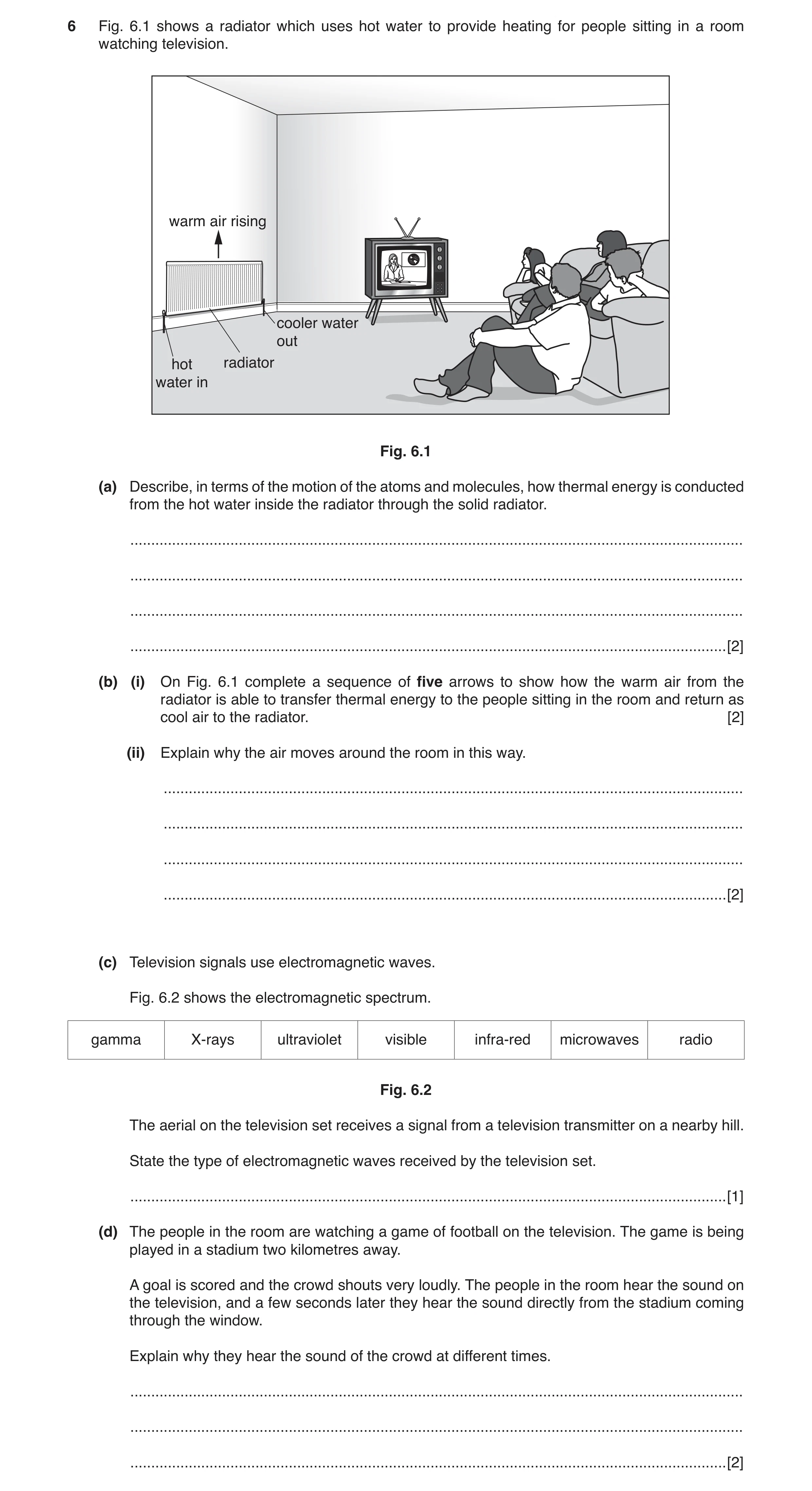
6 Fig. 6.1 shows a radiator which uses hot water to provide heating for people sitting in a room watching television. warm air rising cooler water out hot radiator water in Fig. 6.1 (a) Describe, in terms of the motion of the atoms and molecules, how thermal energy is conducted from the hot water inside the radiator through the solid radiator. … … … … [2] (b) (i) On Fig. 6.1 complete a sequence of five arrows to show how the warm air from the radiator is able to transfer thermal energy to the people sitting in the room and return as cool air to the radiator. [2] (ii) Explain why the air moves around the room in this way. … … … … [2] (c) Television signals use electromagnetic waves. Fig. 6.2 shows the electromagnetic spectrum. gamma X-rays ultraviolet visible infra-red microwaves radio Fig. 6.2 The aerial on the television set receives a signal from a television transmitter on a nearby hill. State the type of electromagnetic waves received by the television set. … [1] (d) The people in the room are watching a game of football on the television. The game is being played in a stadium two kilometres away. A goal is scored and the crowd shouts very loudly. The people in the room hear the sound on the television, and a few seconds later they hear the sound directly from the stadium coming through the window. Explain why they hear the sound of the crowd at different times. … … … [2]
9 marks
Mark scheme: 6(a) atoms / molecules (in contact with water) vibrate (more) ; the idea that energy / vibrations passed on through collisions / from particle to particle (owtte) ; 2 6(b)(i) arrows show rise (to ceiling), progress across (ceiling), downward progress (to floor) ; (past people) return to radiator ; 2 6(b)(ii) warm air is less dense / ora ; so warm air rises / ora ; 2 6(c) radio (waves) ; 1 6(d) TV signal travels at speed of e / m waves ; e / m waves travel (much) faster than sound (waves) ; 2
This question in 0653/42 Oct/Nov 2017
Q3 · Two people talking to each other using cordless telephones over a link to a… 0653/42 Feb/March 2018
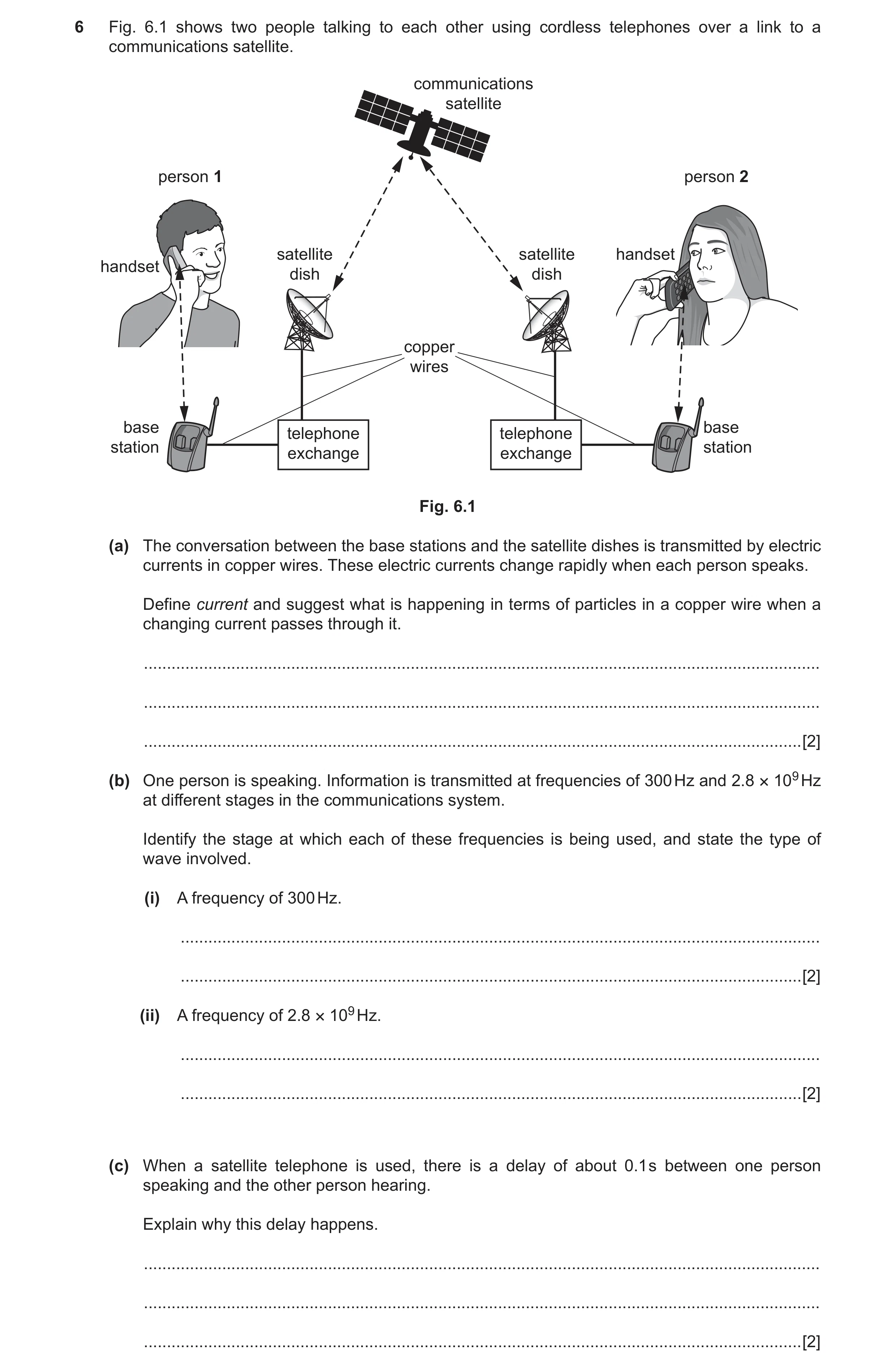
6 Fig. 6.1 shows two people talking to each other using cordless telephones over a link to a communications satellite. communications satellite person 1 person 2 satellite satellite handset handset dish dish copper wires base base telephone telephone station station exchange exchange Fig. 6.1 (a) The conversation between the base stations and the satellite dishes is transmitted by electric currents in copper wires. These electric currents change rapidly when each person speaks. Define current and suggest what is happening in terms of particles in a copper wire when a changing current passes through it. … … … [2] (b) One person is speaking. Information is transmitted at frequencies of 300 Hz and 2.8 × 10⁹ Hz at different stages in the communications system. Identify the stage at which each of these frequencies is being used, and state the type of wave involved. (i) A frequency of 300 Hz. … … [2] (ii) A frequency of 2.8 × 10⁹ Hz. … … [2] (c) When a satellite telephone is used, there is a delay of about 0.1 s between one person speaking and the other person hearing. Explain why this delay happens. … … … [2]
8 marks
Mark scheme: 6(a) the idea that current is flow of (electrical) charge ; identifies the charge carriers as electrons ; 2 6(b)(i) between mouth and handset / handset and ear ; sound waves ; 2 Question Answer Marks 6(b)(ii) between handset and base station / satellite dish and satellite ; microwaves or radio waves ; 2 6(c) the idea that waves (of any kind) have an associated speed of travel ; the idea that waves / signals will take time to cover distance ; reference to great distance / high speed of emr : max 2
This question in 0653/42 Feb/March 2018
Q4 · A man watching television 0653/41 May/June 2018
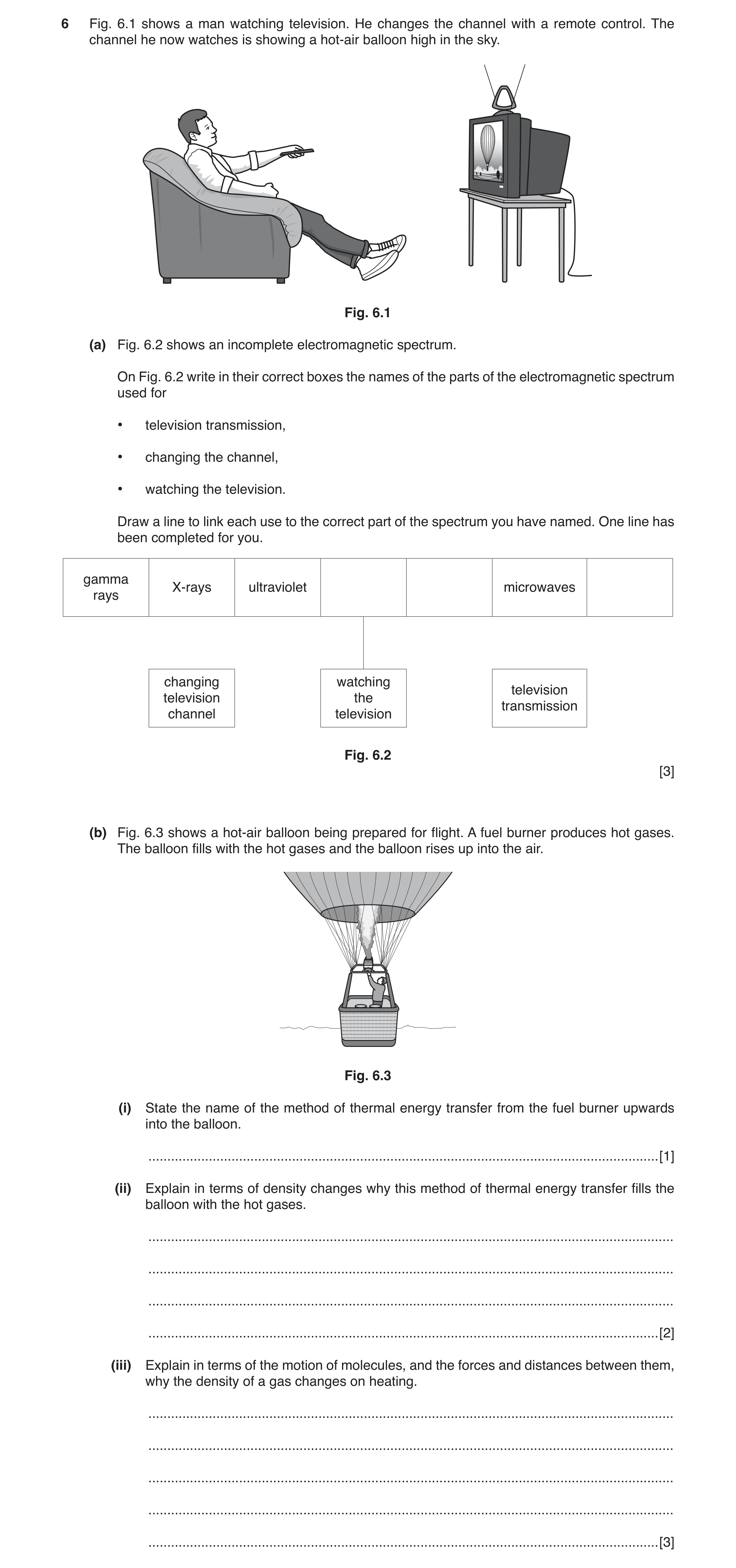
6 Fig. 6.1 shows a man watching television. He changes the channel with a remote control. The channel he now watches is showing a hot-air balloon high in the sky. Fig. 6.1 (a) Fig. 6.2 shows an incomplete electromagnetic spectrum. On Fig. 6.2 write in their correct boxes the names of the parts of the electromagnetic spectrum used for • television transmission, • changing the channel, • watching the television. Draw a line to link each use to the correct part of the spectrum you have named. One line has been completed for you. gamma X-rays ultraviolet microwaves rays changing watching television television the transmission channel television Fig. 6.2 [3] (b) Fig. 6.3 shows a hot-air balloon being prepared for flight. A fuel burner produces hot gases. The balloon fills with the hot gases and the balloon rises up into the air. Fig. 6.3 (i) State the name of the method of thermal energy transfer from the fuel burner upwards into the balloon. … [1] (ii) Explain in terms of density changes why this method of thermal energy transfer fills the balloon with the hot gases. … … … … [2] (iii) Explain in terms of the motion of molecules, and the forces and distances between them, why the density of a gas changes on heating. … … … … … [3]
9 marks
Mark scheme: 6(a) gamma rays X-rays ultraviolet visible light infra-red microwaves radio waves changing television channel watching the television television transmission 3 correctly named parts of the electromagnetic spectrum ; these named parts correctly located ; 2 correct links between action and part of the electromagnetic spectrum ; 3 6(b)(i) convection ; 1 6(b)(ii) the density of hot gases is lower (than air in balloon) ; hot gases / lower density gases rise / ora ; 2 6(b)(iii) molecules move faster / have greater kinetic energy ; (attractive) forces become weaker / less significant ; the separation between molecules increases ; 3
This question in 0653/41 May/June 2018
Q5 · An incomplete electromagnetic spectrum linked to some uses of different parts of the… 0653/42 May/June 2018
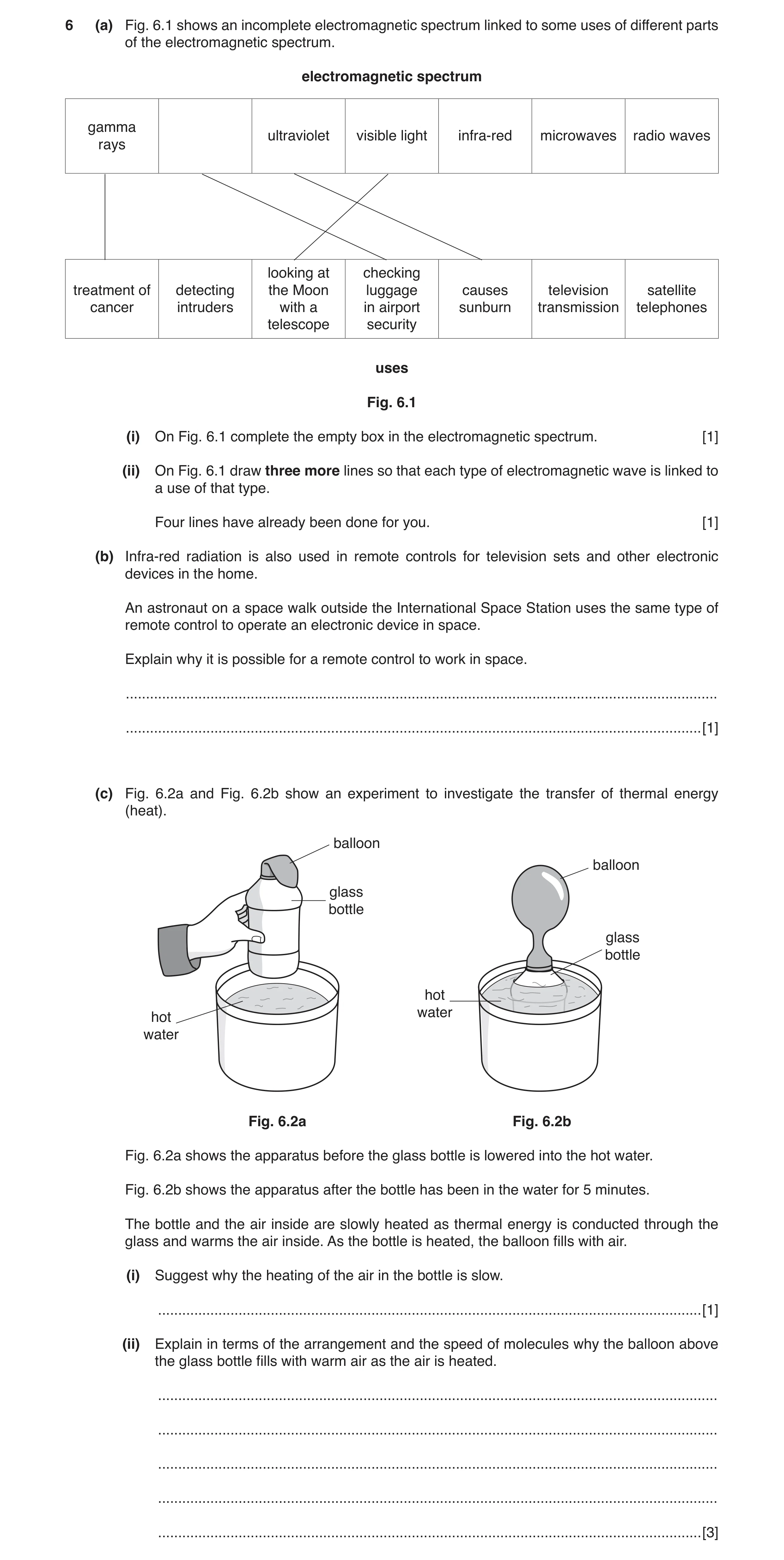
6 (a) Fig. 6.1 shows an incomplete electromagnetic spectrum linked to some uses of different parts of the electromagnetic spectrum. electromagnetic spectrum gamma ultraviolet visible light infra-red microwaves radio waves rays looking at checking treatment of detecting the Moon luggage causes television satellite cancer intruders with a in airport sunburn transmission telephones telescope security uses Fig. 6.1 (i) On Fig. 6.1 complete the empty box in the electromagnetic spectrum. [1] (ii) On Fig. 6.1 draw three more lines so that each type of electromagnetic wave is linked to a use of that type. Four lines have already been done for you. [1] (b) Infra-red radiation is also used in remote controls for television sets and other electronic devices in the home. An astronaut on a space walk outside the International Space Station uses the same type of remote control to operate an electronic device in space. Explain why it is possible for a remote control to work in space. … … [1] (c) Fig. 6.2a and Fig. 6.2b show an experiment to investigate the transfer of thermal energy (heat). balloon balloon glass bottle glass bottle hot water hot water Fig. 6.2a Fig. 6.2b Fig. 6.2a shows the apparatus before the glass bottle is lowered into the hot water. Fig. 6.2b shows the apparatus after the bottle has been in the water for 5 minutes. The bottle and the air inside are slowly heated as thermal energy is conducted through the glass and warms the air inside. As the bottle is heated, the balloon fills with air. (i) Suggest why the heating of the air in the bottle is slow. … [1] (ii) Explain in terms of the arrangement and the speed of molecules why the balloon above the glass bottle fills with warm air as the air is heated. … … … … … [3]
7 marks
Mark scheme: 6 6( 6 6 6( (a)(i) X-rays (a)(ii) all thre 6(b) electro (c)(i) glass i (c)(ii) air / ga molecu separa s ; ee correct ; omagnetic / infra is a bad / poor co as expands / volu ules move faste ation / distance b -red waves can onductor (of the ume increases ; r / gain kinetic e between molecu travel through a rmal energy) ; nergy ; les increases ; a vacuum / do no ot need a medium m to travel through ; 1 1 1 1 3
This question in 0653/42 May/June 2018
Q6 · A small quadcopter (drone with four rotors) being operated by radio control 0653/43 May/June 2018
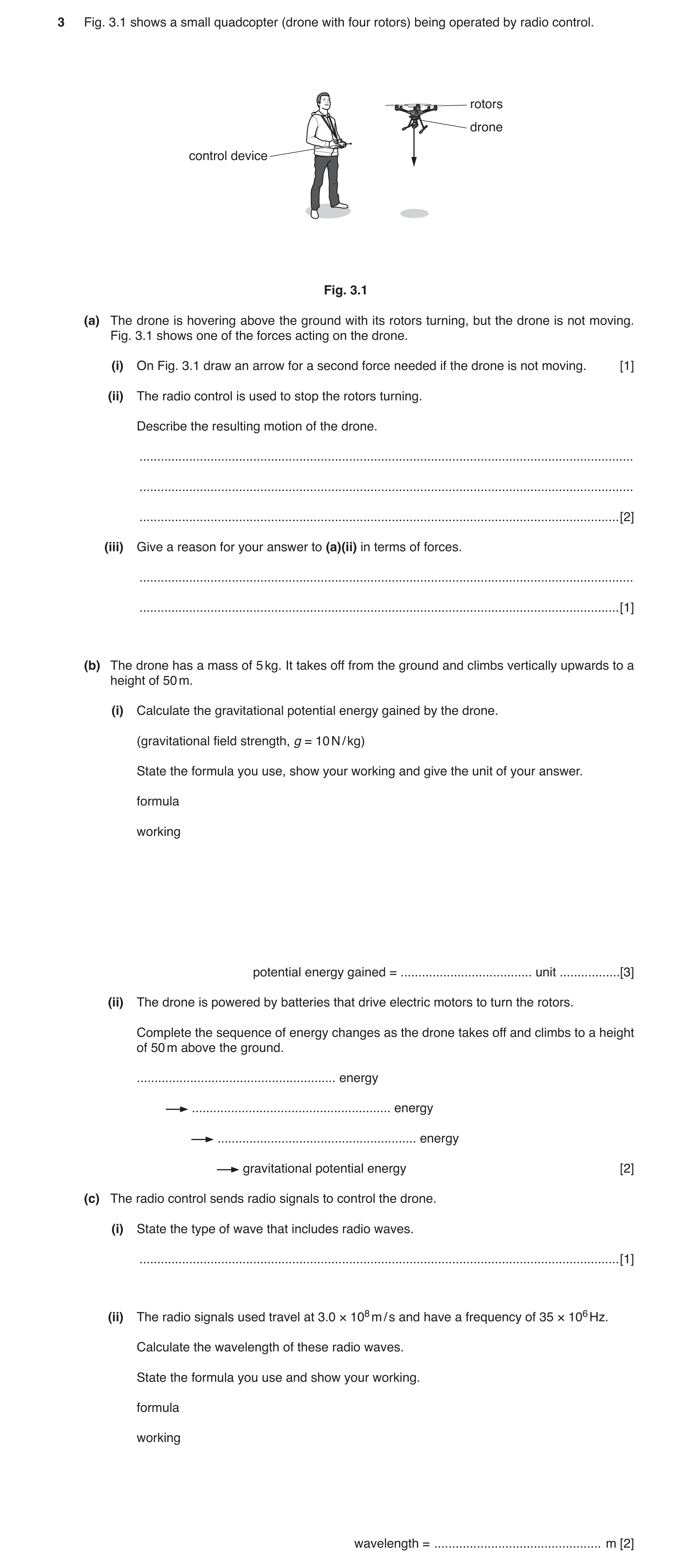
3 Fig. 3.1 shows a small quadcopter (drone with four rotors) being operated by radio control. rotors drone control device Fig. 3.1 (a) The drone is hovering above the ground with its rotors turning, but the drone is not moving. Fig. 3.1 shows one of the forces acting on the drone. (i) On Fig. 3.1 draw an arrow for a second force needed if the drone is not moving. [1] (ii) The radio control is used to stop the rotors turning. Describe the resulting motion of the drone. … … … [2] (iii) Give a reason for your answer to (a)(ii) in terms of forces. … … [1] (b) The drone has a mass of 5 kg. It takes off from the ground and climbs vertically upwards to a height of 50 m. (i) Calculate the gravitational potential energy gained by the drone. (gravitational field strength, g = 10 N / kg) State the formula you use, show your working and give the unit of your answer. formula working potential energy gained = … unit … [3] (ii) The drone is powered by batteries that drive electric motors to turn the rotors. Complete the sequence of energy changes as the drone takes off and climbs to a height of 50 m above the ground. … energy … energy … energy gravitational potential energy [2] (c) The radio control sends radio signals to control the drone. (i) State the type of wave that includes radio waves. … [1] (ii) The radio signals used travel at 3.0 × 10⁸ m / s and have a frequency of 35 × 106 Hz. Calculate the wavelength of these radio waves. State the formula you use and show your working. formula working wavelength = … m [2]
12 marks
Mark scheme: 3(a)(i) upward vertical force arrow acting on the drone at any point ; 1 Question Answer Marks 3(a)(ii) falls to ground ; accelerates ; 2 3(a)(iii) (moves / accelerates due to) unbalanced forces / weight / gravitational force ; 1 3(b)(i) PE gained = mgh = 5 × 10 × 50 ; = 2500 ; joules / J ; 3 3(b)(ii) chemical > electrical > kinetic > (grav PE) ;; all 3 correct for 2 marks; any 2 correct for 1 2 3(c)(i) electromagnetic waves ; 1 3(c)(ii) v = f λ OR rearranged / λ = 3.0 × 10⁸/ 35 × 106; = 8.6 m ; 2
This question in 0653/43 May/June 2018
Q7 · In many cities, sodium street lamps are used at night 0653/42 Feb/March 2019
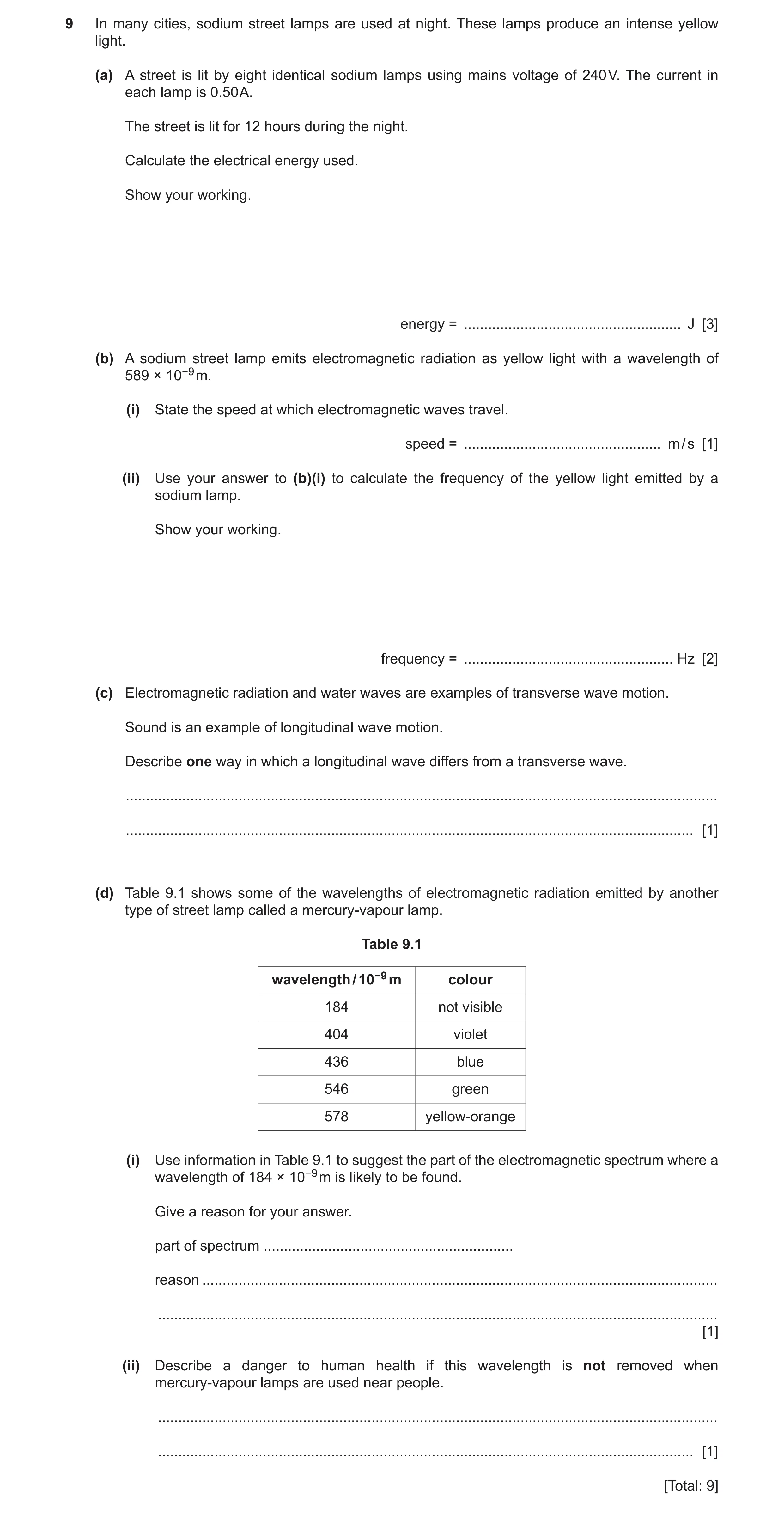
9 In many cities, sodium street lamps are used at night. These lamps produce an intense yellow light. (a) A street is lit by eight identical sodium lamps using mains voltage of 240 V. The current in each lamp is 0.50 A. The street is lit for 12 hours during the night. Calculate the electrical energy used. Show your working. energy = … J [3] (b) A sodium street lamp emits electromagnetic radiation as yellow light with a wavelength of 589 × 10−9 m. (i) State the speed at which electromagnetic waves travel. speed = … m / s [1] (ii) Use your answer to (b)(i) to calculate the frequency of the yellow light emitted by a sodium lamp. Show your working. frequency = … Hz [2] (c) Electromagnetic radiation and water waves are examples of transverse wave motion. Sound is an example of longitudinal wave motion. Describe one way in which a longitudinal wave differs from a transverse wave. … … [1] (d) Table 9.1 shows some of the wavelengths of electromagnetic radiation emitted by another type of street lamp called a mercury-vapour lamp. Table 9.1 wavelength / 10−9 m colour 184 not visible 404 violet 436 blue 546 green 578 yellow-orange (i) Use information in Table 9.1 to suggest the part of the electromagnetic spectrum where a wavelength of 184 × 10−9 m is likely to be found. Give a reason for your answer. part of spectrum … reason … … [1] (ii) Describe a danger to human health if this wavelength is not removed when mercury-vapour lamps are used near people. … … [1] [Total: 9]
9 marks
Mark scheme: 9(a) time in seconds = 60 × 60 × 12 / 43200 ; E = 240 × 0.5 × 8 × 60 × 60 × 12 = 41 472 000 J / 41(.5) MJ ; 3 9(b)(i) 3.0 × 10⁸ m / s ; 1 9(b)(ii) v = fλ ; f (= v / λ) = 3 × 10⁸ / 589 × 10–9 = 5.09 × 10¹⁴ (Hz) ; 2 9(c) transverse wave vibrations at right angles to direction of travel, longitudinal in same direction as direction of travel ; 1 9(d)(i) (ultraviolet) shorter wavelength than violet / visible ; 1 9(d)(ii) skin cancer / burning of skin / other known hazard ; 1
This question in 0653/42 Feb/March 2019
Q8 · The Sun is made of very hot gases 0653/42 May/June 2019
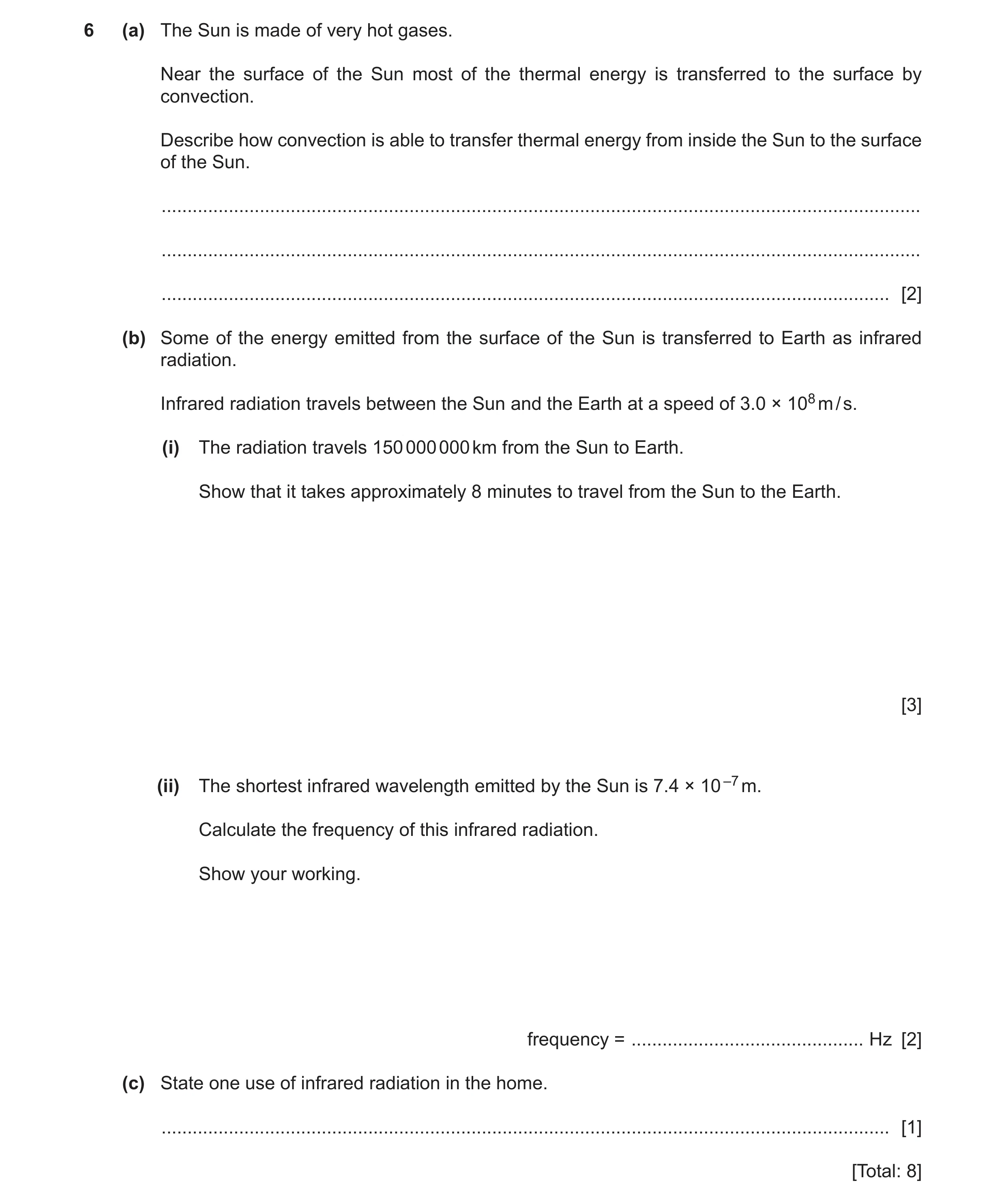
6 (a) The Sun is made of very hot gases. Near the surface of the Sun most of the thermal energy is transferred to the surface by convection. Describe how convection is able to transfer thermal energy from inside the Sun to the surface of the Sun. … … … [2] (b) Some of the energy emitted from the surface of the Sun is transferred to Earth as infrared radiation. Infrared radiation travels between the Sun and the Earth at a speed of 3.0 × 10⁸ m / s. (i) The radiation travels 150 000 000 km from the Sun to Earth. Show that it takes approximately 8 minutes to travel from the Sun to the Earth. [3] (ii) The shortest infrared wavelength emitted by the Sun is 7.4 × 10 –7 m. Calculate the frequency of this infrared radiation. Show your working. frequency = … Hz [2] (c) State one use of infrared radiation in the home. … [1] [Total: 8]
8 marks
Mark scheme: 6(a) hot gases less dense (than cooler gases) / owtte ; less dense / hotter gases rise (and cooler gases fall) / owtte ; 2 6(b)(i) ( ) distance time = speed ; ( ) = = 150000000000 500 s 300000000 ; = = 500 8.3min 60 ; 3 6(b)(ii) v = fλ or λ = v f or f = 3.0 × 10⁸ / 7.4 × 10⁻⁷; = 4.1 × 10¹⁴ (Hz) ; 2 6(c) remote control / movement detector / intruder alarm / heat lamps / other correct use ; 1
This question in 0653/42 May/June 2019
Q9 · How a small hydroelectric power station is used to supply electricity 0653/41 Oct/Nov 2019
3 Fig. 3.1 shows how a small hydroelectric power station is used to supply electricity. dam lake surface power lines to house house water generator penstock (pipe from dam to turbine) turbine Fig. 3.1 (a) The flowing water turns the turbine which then turns the generator. Identify, using the names on Fig. 3.1: (i) one place where the gravitational potential energy of the water is at a maximum … [1] (ii) two places where kinetic energy is part of the sequence of energy transfers. … and … [1] (b) Hydroelectric power is an example of a renewable source of energy. State one advantage and one disadvantage of hydroelectric power in terms of its environmental impact. advantage … … disadvantage … … [2] (c) In a house, electricity is used to power a television set. An aerial for the television set receives signals in the radio wave region of the electromagnetic spectrum with a frequency of 600 × 106 Hz (600 MHz). (i) State the speed at which these signals travel. … [1] (ii) Use your answer to (i) to calculate the wavelength of the signal. Show your working. wavelength = … m [2] (iii) Fig. 3.2 shows the electromagnetic spectrum. gamma X-rays ultraviolet visible light infrared microwaves radio wavesradiation Fig. 3.2 State the part of the electromagnetic spectrum used in television transmissions from satellites. … [1] (d) The television set emits sound waves. Describe how sound waves are transmitted in air. You may wish to draw a diagram as part of your answer. … … … [2] [Total: 10]
10 marks
Mark scheme: 3(a)(i) lake surface ; 1 3(a)(ii) any 2 from: penstock (pipe from dam to turbine) ; turbine ; generator ; 1 3(b) advantage: no emissions / can be used for flood control ; disadvantage: creating reservoirs can flood useful land / destroy local ecosystems ; 2 3(c)(i) 3 × 10⁸ m/s ; 1 3(c)(ii) use of v = fλ ; (λ = v ÷ f = 3 × 10⁸ ÷ 600 × 106 ) = 0.5 m ; 2 3(c)(iii) microwaves ; 1 3(d) vibrations / oscillations of particles / air molecules or compressions and rarefactions ; longitudinal / vibration (direction) is parallel to direction of wave propagation / energy propagation ; 2
This question in 0653/41 Oct/Nov 2019
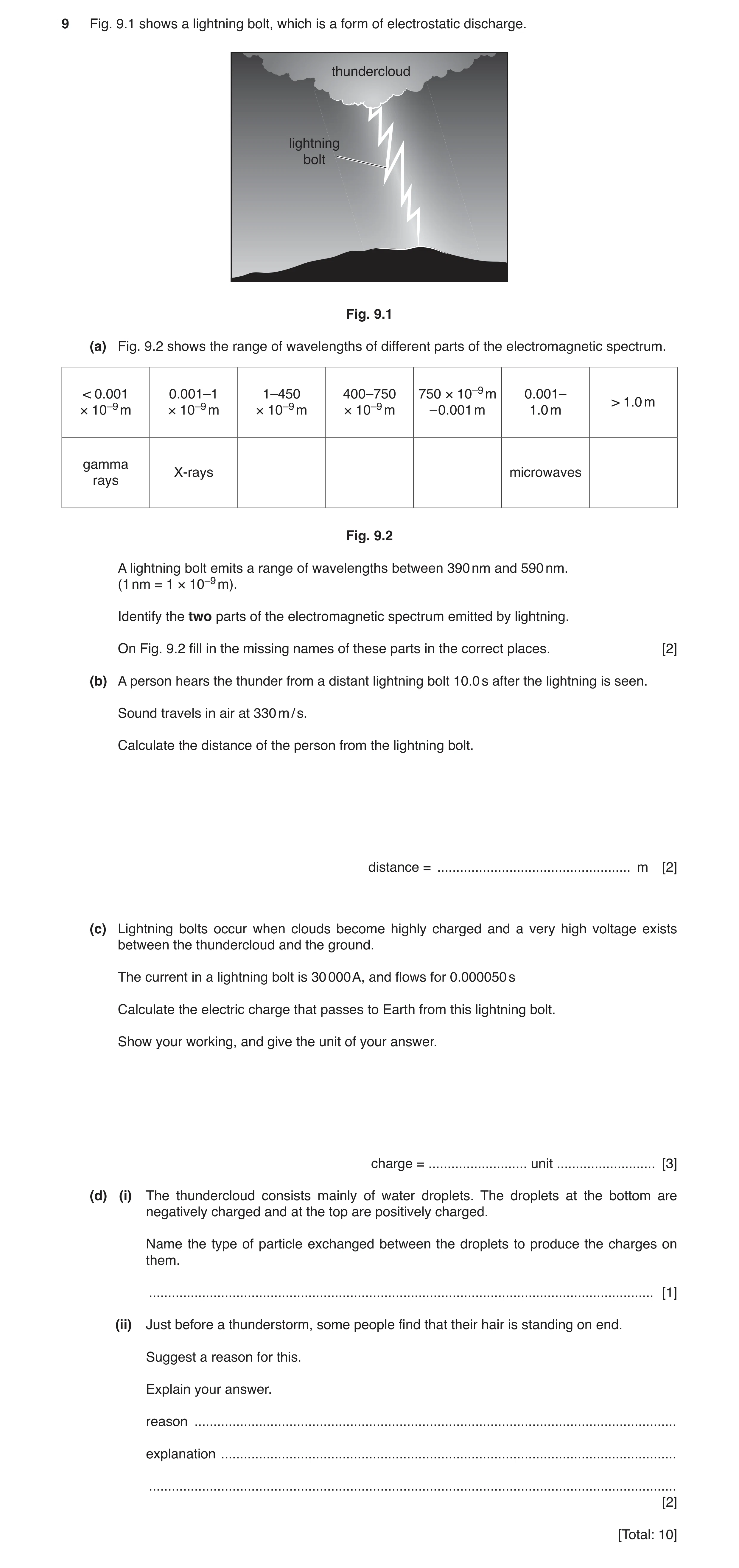
Q10 · A lightning bolt, which is a form of electrostatic discharge 0653/42 Oct/Nov 2019
9 Fig. 9.1 shows a lightning bolt, which is a form of electrostatic discharge. thundercloud lightning bolt Fig. 9.1 (a) Fig. 9.2 shows the range of wavelengths of different parts of the electromagnetic spectrum. < 0.001 0.001–1 1–450 400–750 750 × 10–9 m 0.001– > 1.0 m × 10–9 m × 10–9 m × 10–9 m × 10–9 m – 0.001 m 1.0 m gamma X-rays microwaves rays Fig. 9.2 A lightning bolt emits a range of wavelengths between 390 nm and 590 nm. (1 nm = 1 × 10⁻⁹ m). Identify the two parts of the electromagnetic spectrum emitted by lightning. On Fig. 9.2 fill in the missing names of these parts in the correct places. [2] (b) A person hears the thunder from a distant lightning bolt 10.0 s after the lightning is seen. Sound travels in air at 330 m / s. Calculate the distance of the person from the lightning bolt. distance = … m [2] (c) Lightning bolts occur when clouds become highly charged and a very high voltage exists between the thundercloud and the ground. The current in a lightning bolt is 30 000 A, and flows for 0.000050 s Calculate the electric charge that passes to Earth from this lightning bolt. Show your working, and give the unit of your answer. charge = … unit … [3] (d) (i) The thundercloud consists mainly of water droplets. The droplets at the bottom are negatively charged and at the top are positively charged. Name the type of particle exchanged between the droplets to produce the charges on them. … [1] (ii) Just before a thunderstorm, some people find that their hair is standing on end. Suggest a reason for this. Explain your answer. reason … explanation … … [2] [Total: 10]
10 marks
Mark scheme: 9(a) visible light in correct position ; ultraviolet in correct position ; 2 9(b) use of distance = speed × time ; (330 × 10) = 3300 m ; 2 9(c) use of Q = I t ; (30 000 × 0.00005) = 1.5 ; coulombs / C ; 3 9(d)(i) electron(s) ; 1 9(d)(ii) hair becomes (electrostatically) charged (due to transfer of electrons) ; like charges repel (causing hair to stand on end) ; 2
This question in 0653/42 Oct/Nov 2019
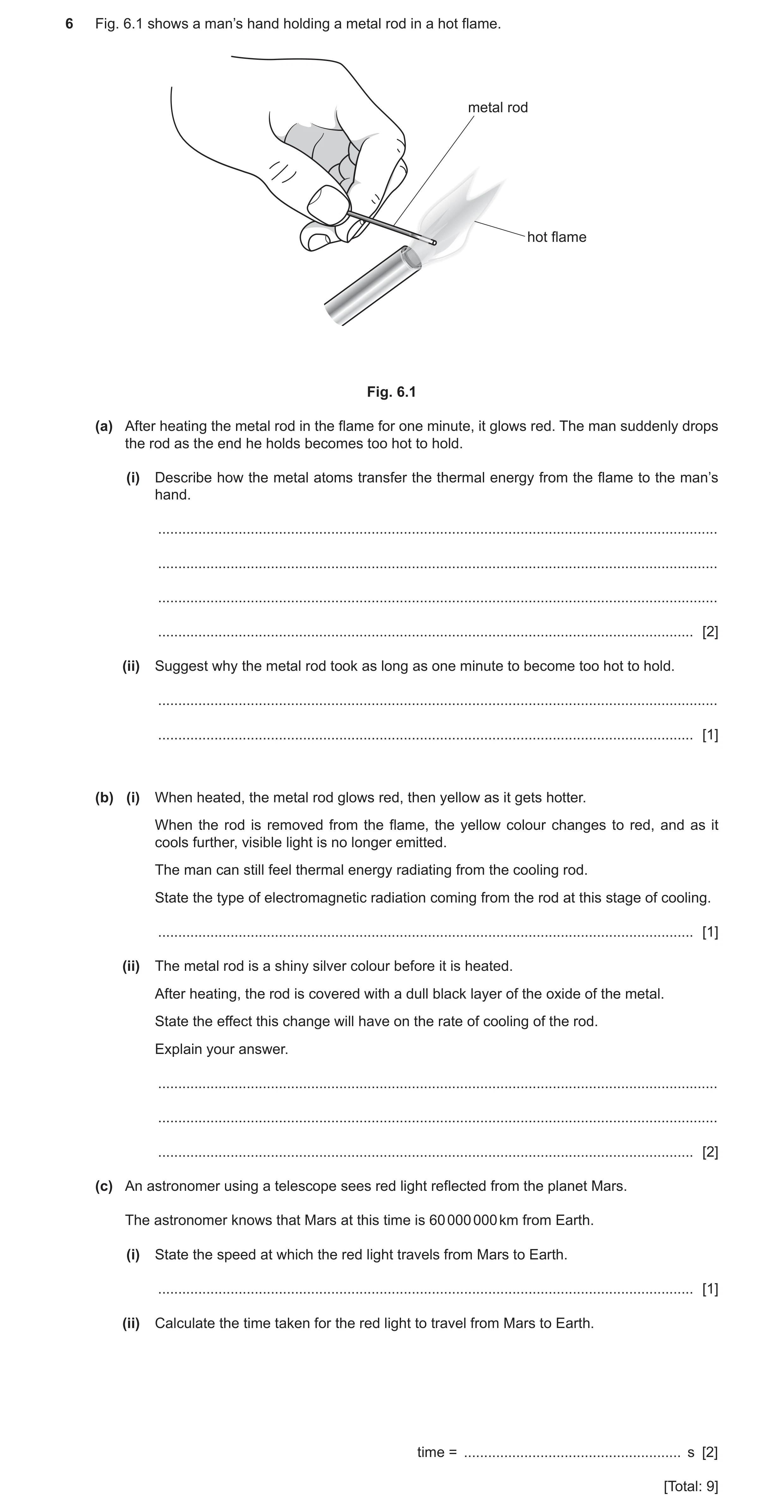
Q11 · A man’s hand holding a metal rod in a hot flame 0653/42 May/June 2020
6 Fig. 6.1 shows a man’s hand holding a metal rod in a hot flame. metal rod hot flame Fig. 6.1 (a) After heating the metal rod in the flame for one minute, it glows red. The man suddenly drops the rod as the end he holds becomes too hot to hold. (i) Describe how the metal atoms transfer the thermal energy from the flame to the man’s hand. … … … … [2] (ii) Suggest why the metal rod took as long as one minute to become too hot to hold. … … [1] (b) (i) When heated, the metal rod glows red, then yellow as it gets hotter. When the rod is removed from the flame, the yellow colour changes to red, and as it cools further, visible light is no longer emitted. The man can still feel thermal energy radiating from the cooling rod. State the type of electromagnetic radiation coming from the rod at this stage of cooling. … [1] (ii) The metal rod is a shiny silver colour before it is heated. After heating, the rod is covered with a dull black layer of the oxide of the metal. State the effect this change will have on the rate of cooling of the rod. Explain your answer. … … … [2] (c) An astronomer using a telescope sees red light reflected from the planet Mars. The astronomer knows that Mars at this time is 60 000 000 km from Earth. (i) State the speed at which the red light travels from Mars to Earth. … [1] (ii) Calculate the time taken for the red light to travel from Mars to Earth. time = … s [2] [Total: 9]
9 marks
Mark scheme: 6(a)(i) any two from: increasing vibrations ; passed from atom to atom by collisions ; reference to role of free electrons ; Question Answer Marks 6(a)(ii) loss of (thermal) energy along the rod by, radiation / convection ; 1 6(b)(i) infra-red ; 1 6(b)(ii) rate of cooling increased ; shiny silvery – poor radiator / dull black – better radiator ; 2 6(c)(i) 3 × 10⁸ m / s ; 1 6(c)(ii) time = 6 × 107 km × 1000 (to convert to m) / 3 × 10⁸ ; = 200 (s) ; 2
This question in 0653/42 May/June 2020
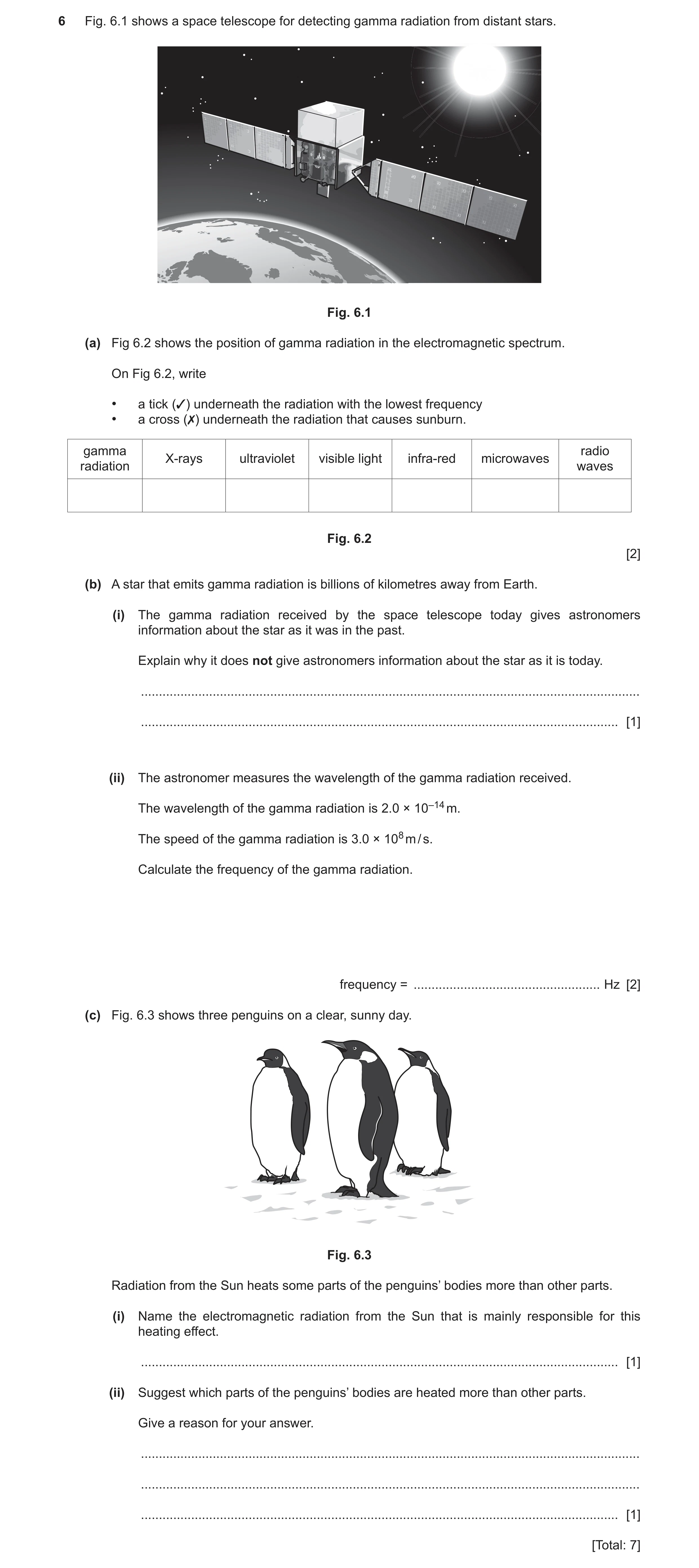
Q12 · A space telescope for detecting gamma radiation from distant stars 0653/43 Oct/Nov 2020
6 Fig. 6.1 shows a space telescope for detecting gamma radiation from distant stars. Fig. 6.1 (a) Fig 6.2 shows the position of gamma radiation in the electromagnetic spectrum. On Fig 6.2, write • a tick (✓) underneath the radiation with the lowest frequency • a cross (✗) underneath the radiation that causes sunburn. gamma radio X-rays ultraviolet visible light infra-red microwaves radiation waves Fig. 6.2 [2] (b) A star that emits gamma radiation is billions of kilometres away from Earth. (i) The gamma radiation received by the space telescope today gives astronomers information about the star as it was in the past. Explain why it does not give astronomers information about the star as it is today. … … [1] (ii) The astronomer measures the wavelength of the gamma radiation received. The wavelength of the gamma radiation is 2.0 × 10⁻¹⁴ m. The speed of the gamma radiation is 3.0 × 10⁸ m / s. Calculate the frequency of the gamma radiation. frequency = … Hz [2] (c) Fig. 6.3 shows three penguins on a clear, sunny day. Fig. 6.3 Radiation from the Sun heats some parts of the penguins’ bodies more than other parts. (i) Name the electromagnetic radiation from the Sun that is mainly responsible for this heating effect. … [1] (ii) Suggest which parts of the penguins’ bodies are heated more than other parts. Give a reason for your answer. … … … [1] [Total: 7]
7 marks
Mark scheme: 6(a) gamma X-rays ultraviolet visible light infrared microwaves radio waves x ✓ lowest frequency: tick in correct place ; causes sunburn: cross in correct place ; 6(b)(i) (even at speed of light) it takes the gamma radiation a (very) long time to travel (billions of kilometres) ; 1 6(b)(ii) v = f λ in any form / 3.0 × 10⁸ ÷ 2.0 × 10⁻¹⁴ ; 1.5 × 10²² (Hz) ; 2 6(c)(i) infrared ; 1 6(c)(ii) back / wings / head / darker areas, because black is a good absorber (of radiation) / ORA ; 1
This question in 0653/43 Oct/Nov 2020
Q13 · A man lying down on a sandy beach on a sunny day 0653/43 May/June 2021
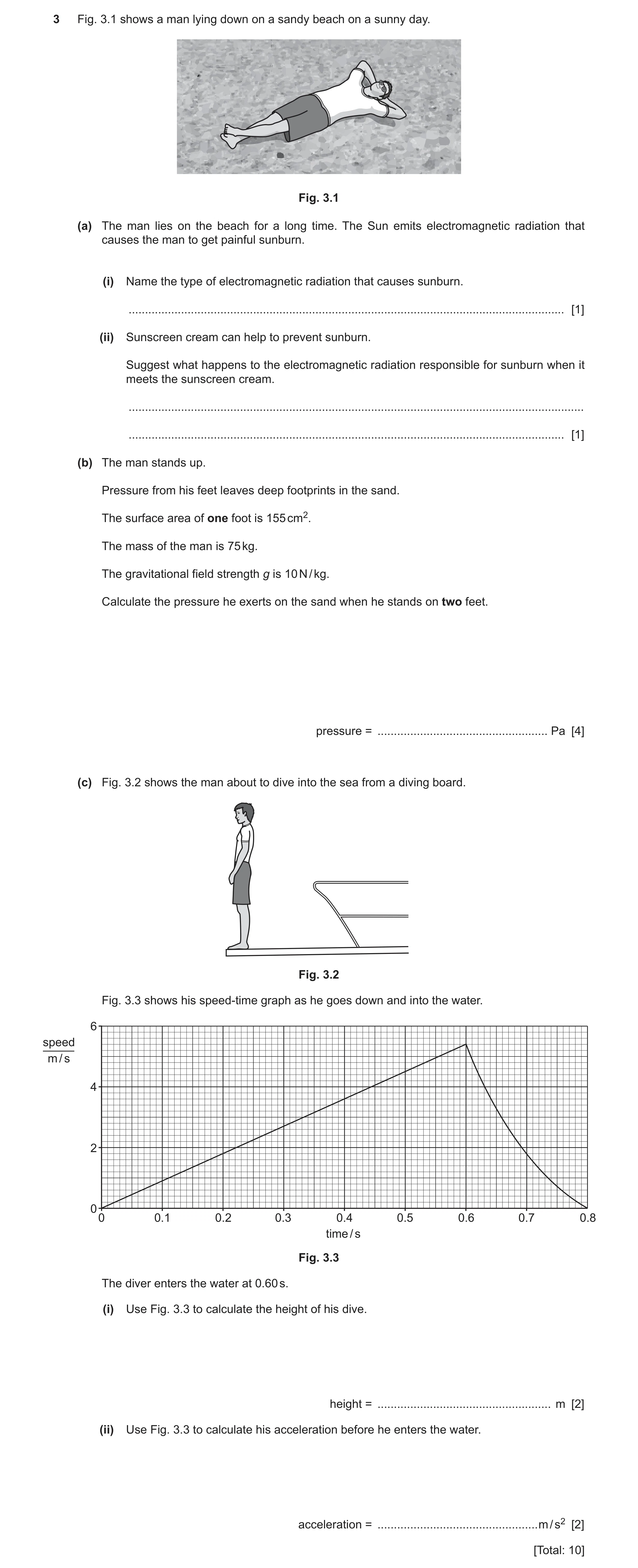
3 Fig. 3.1 shows a man lying down on a sandy beach on a sunny day. Fig. 3.1 (a) The man lies on the beach for a long time. The Sun emits electromagnetic radiation that causes the man to get painful sunburn. (i) Name the type of electromagnetic radiation that causes sunburn. … [1] (ii) Sunscreen cream can help to prevent sunburn. Suggest what happens to the electromagnetic radiation responsible for sunburn when it meets the sunscreen cream. … … [1] (b) The man stands up. Pressure from his feet leaves deep footprints in the sand. The surface area of one foot is 155 cm2. The mass of the man is 75 kg. The gravitational field strength g is 10 N / kg. Calculate the pressure he exerts on the sand when he stands on two feet. pressure = … Pa [4] (c) Fig. 3.2 shows the man about to dive into the sea from a diving board. Fig. 3.2 Fig. 3.3 shows his speed-time graph as he goes down and into the water. 6 speed m / s 4 2 0 0 0.1 0.2 0.3 0.4 0.5 0.6 0.7 0.8 time / s Fig. 3.3 The diver enters the water at 0.60 s. (i) Use Fig. 3.3 to calculate the height of his dive. height = … m [2] (ii) Use Fig. 3.3 to calculate his acceleration before he enters the water. acceleration = … m / s2 [2] [Total: 10]
10 marks
Mark scheme: 3(a)(i) ultraviolet ; 1 3(a)(ii) reflected / absorbed (by sunscreen) ; 1 3(b) p = F / A ; A = 2 ×155 (= 310) cm2 = 0.031 m2 ; F = mg = 75 × 10 = 750 N ; p = 750 / 0.031 = 24 194 / 24 200 (Pa) ; 4 3(c)(i) height = area under graph = ½ × 0.60 × 5.4 ; = 1.6(2) (m) ; 2 3(c)(ii) acceleration = change in speed / time = 5.4 / 0.60 ; = 9.0 (m / s2) ; 2
This question in 0653/43 May/June 2021
Q14 · A laser is a device that emits a beam of electromagnetic radiation 0653/43 Oct/Nov 2021
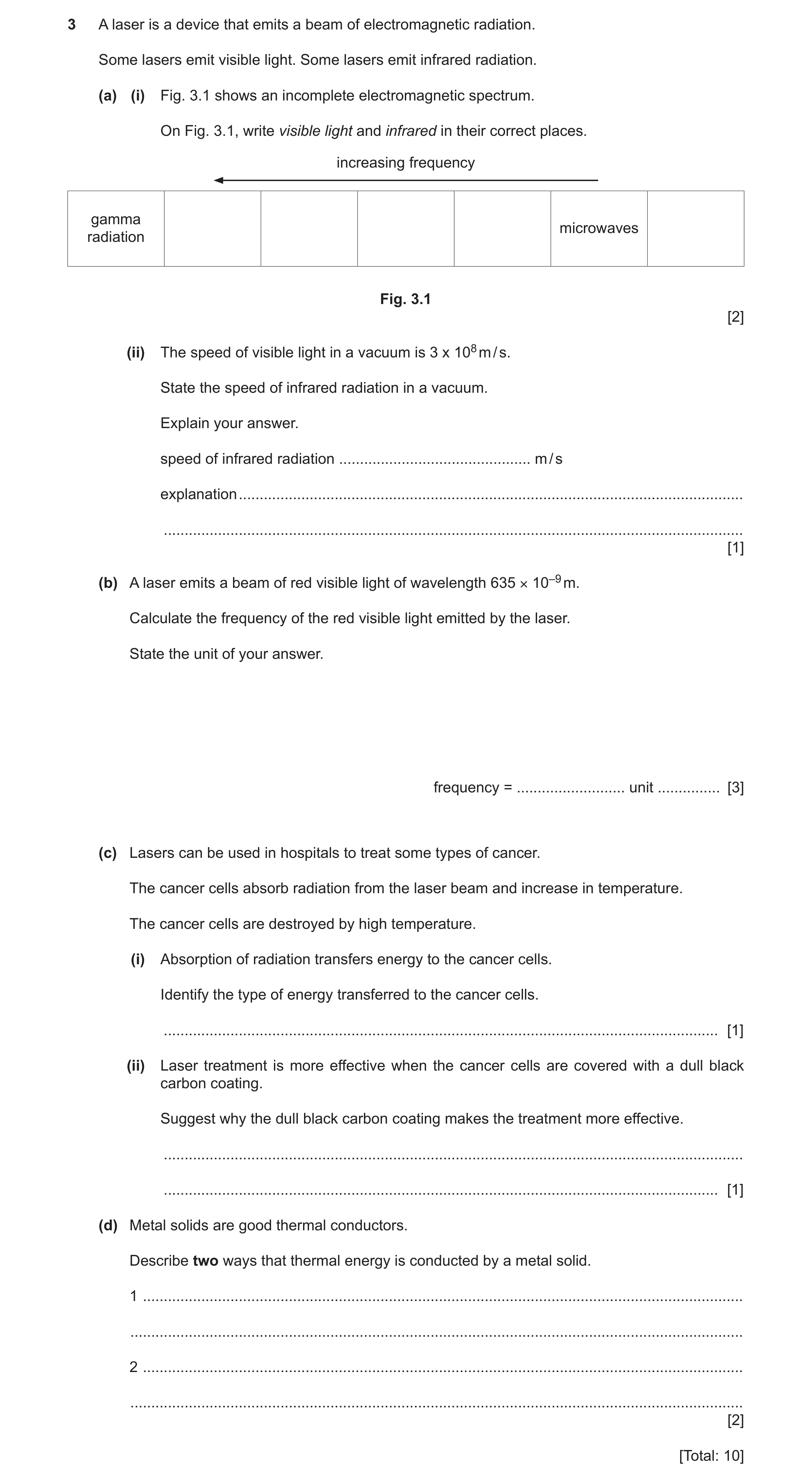
3 A laser is a device that emits a beam of electromagnetic radiation. Some lasers emit visible light. Some lasers emit infrared radiation. (a) (i) Fig. 3.1 shows an incomplete electromagnetic spectrum. On Fig. 3.1, write visible light and infrared in their correct places. increasing frequency gamma microwaves radiation Fig. 3.1 [2] (ii) The speed of visible light in a vacuum is 3 x 10⁸ m / s. State the speed of infrared radiation in a vacuum. Explain your answer. speed of infrared radiation … m / s explanation … … [1] (b) A laser emits a beam of red visible light of wavelength 635 × 10–9 m. Calculate the frequency of the red visible light emitted by the laser. State the unit of your answer. frequency = … unit … [3] (c) Lasers can be used in hospitals to treat some types of cancer. The cancer cells absorb radiation from the laser beam and increase in temperature. The cancer cells are destroyed by high temperature. (i) Absorption of radiation transfers energy to the cancer cells. Identify the type of energy transferred to the cancer cells. … [1] (ii) Laser treatment is more effective when the cancer cells are covered with a dull black carbon coating. Suggest why the dull black carbon coating makes the treatment more effective. … … [1] (d) Metal solids are good thermal conductors. Describe two ways that thermal energy is conducted by a metal solid. 1 … … 2 … … [2] [Total: 10]
10 marks
Mark scheme: 3(a)(i) (gamma radiation) visible light ; infrared ; (microwaves) 2 3(a)(ii) 3 × 10⁸ (m / s) AND all electromagnetic waves travel with same speed ; 1 3(b) v = fλ in any form / 3 × 10⁸ ÷ 635 × 10–9 ; 4.72 × 10¹⁴ ; Hz ; 3 3(c)(i) thermal ; 1 3(c)(ii) dull black surfaces are good absorbers (of radiation) ; 1 3(d) molecular vibration ; transfer by electrons ; 2
This question in 0653/43 Oct/Nov 2021
Q15 · Two lamps, A and B, used for lighting in a theatre 0653/42 Feb/March 2022
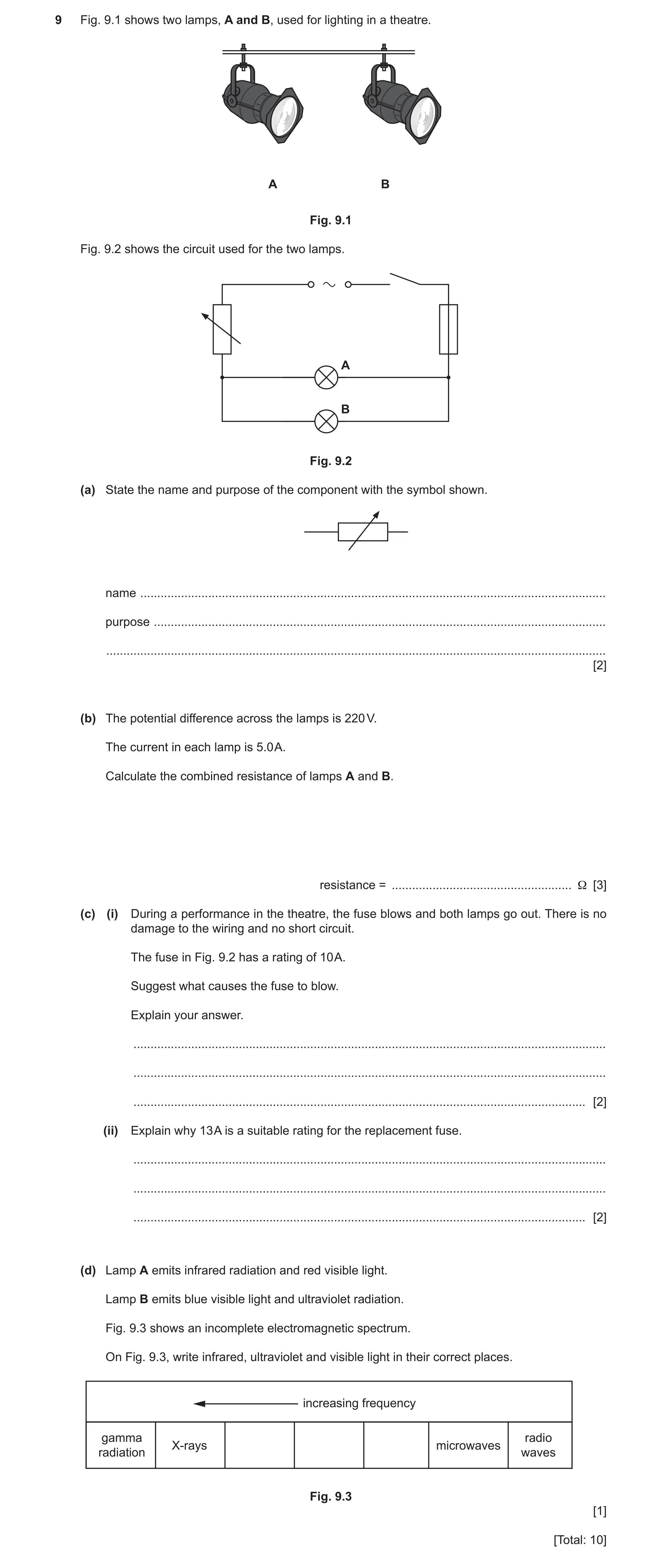
9 Fig. 9.1 shows two lamps, A and B, used for lighting in a theatre. A B Fig. 9.1 Fig. 9.2 shows the circuit used for the two lamps. A B Fig. 9.2 (a) State the name and purpose of the component with the symbol shown. name … purpose … … [2] (b) The potential difference across the lamps is 220 V. The current in each lamp is 5.0 A. Calculate the combined resistance of lamps A and B. resistance = … Ω [3] (c) (i) During a performance in the theatre, the fuse blows and both lamps go out. There is no damage to the wiring and no short circuit. The fuse in Fig. 9.2 has a rating of 10 A. Suggest what causes the fuse to blow. Explain your answer. … … … [2] (ii) Explain why 13 A is a suitable rating for the replacement fuse. … … … [2] (d) Lamp A emits infrared radiation and red visible light. Lamp B emits blue visible light and ultraviolet radiation. Fig. 9.3 shows an incomplete electromagnetic spectrum. On Fig. 9.3, write infrared, ultraviolet and visible light in their correct places. increasing frequency gamma radio X-rays microwaves radiation waves Fig. 9.3 [1] [Total: 10]
10 marks
Mark scheme: 9(a) variable resistor ; controls current / the idea that it controls the brightness of the lamps ; 2 9(b) resistance of each lamp = V ÷ I / 220 ÷ 5 / 44 (Ω) ; combined resistance = (R1 x R2) ÷ (R1 + R2) (in any form) / 44 × 44 ÷ 88 ; 22 (Ω) ; 3 9(c)(i) the current (through lamps) exceeded 10 A; because the current fluctuates / fuse needs to allow for fluctuations / fuse rating needs to be a little higher than expected current / owtte ; 2 9(c)(ii) the idea that a 13 A fuse allows normal operation / takes 10 A without blowing ; a rating greater than 13 A risks damaging the circuit / lamps / owtte ; 2 9(d) increasing frequency (gamma radiation) (X-rays) ultraviolet (radiation) visible (light) infrared (radiation) (microwaves) (radio waves) 1
This question in 0653/42 Feb/March 2022
Q16 · The Earth is heated by infrared radiation from the Sun 0653/41 May/June 2022
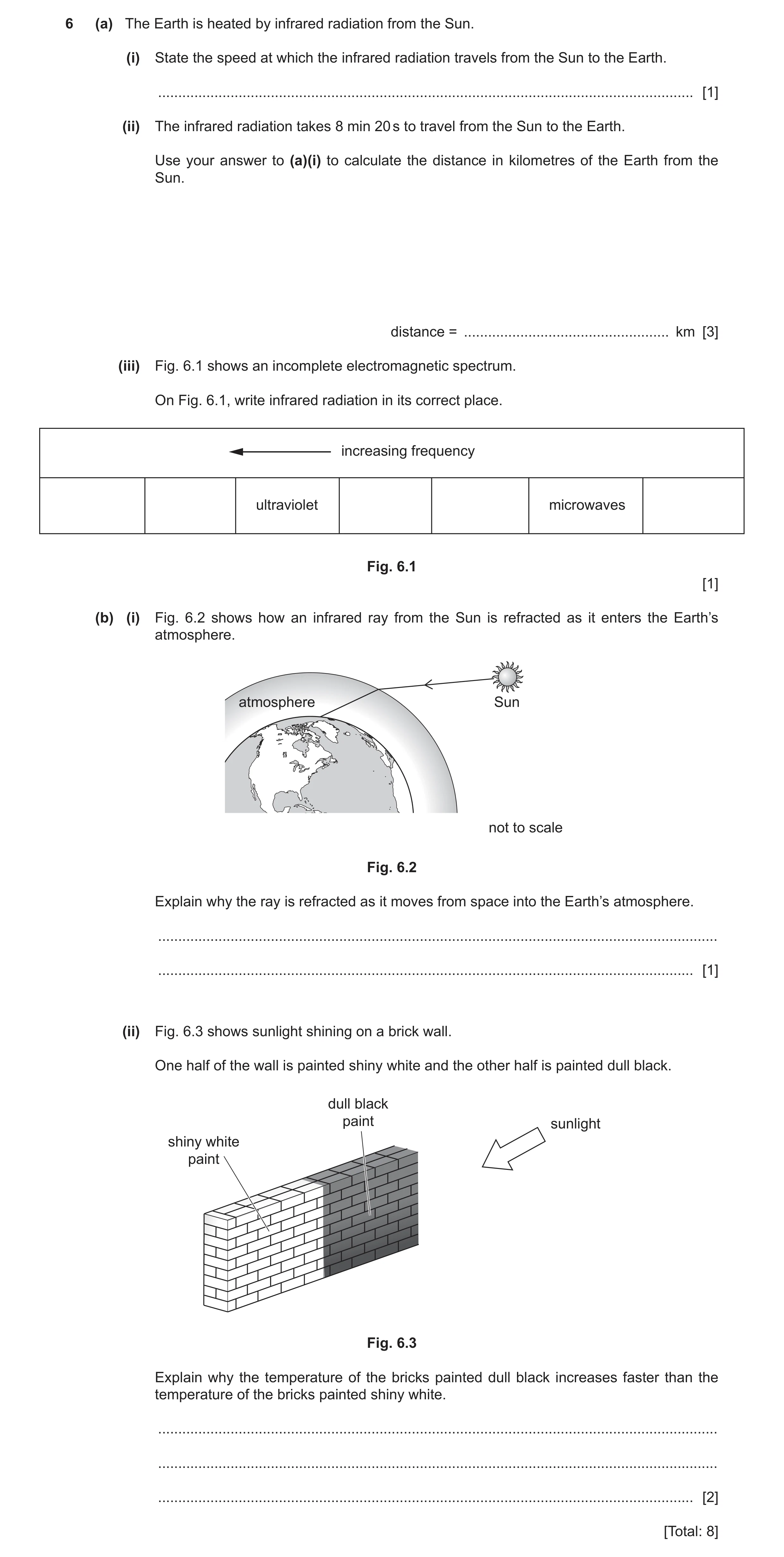
6 (a) The Earth is heated by infrared radiation from the Sun. (i) State the speed at which the infrared radiation travels from the Sun to the Earth. … [1] (ii) The infrared radiation takes 8 min 20 s to travel from the Sun to the Earth. Use your answer to (a)(i) to calculate the distance in kilometres of the Earth from the Sun. distance = … km [3] (iii) Fig. 6.1 shows an incomplete electromagnetic spectrum. On Fig. 6.1, write infrared radiation in its correct place. increasing frequency ultraviolet microwaves Fig. 6.1 [1] (b) (i) Fig. 6.2 shows how an infrared ray from the Sun is refracted as it enters the Earth’s atmosphere. atmosphere Sun not to scale Fig. 6.2 Explain why the ray is refracted as it moves from space into the Earth’s atmosphere. … … [1] (ii) Fig. 6.3 shows sunlight shining on a brick wall. One half of the wall is painted shiny white and the other half is painted dull black. dull black paint sunlight shiny white paint Fig. 6.3 Explain why the temperature of the bricks painted dull black increases faster than the temperature of the bricks painted shiny white. … … … [2] [Total: 8]
8 marks
Mark scheme: 6(a)(i) 1 6(a)(ii) speed = distance/time (in any form) ; 8 minutes 20 secs = (8 60 + 20) = 500 s OR speed = 3 105 km / s ; distance = 3 105 500 = 150 106 (km) / 1.5 108 km ; 3 6(a)(iii) (ultraviolet) infrared ; (microwaves) 1 6(b)(i) change in density (of the medium) / change in speed (of wave) ; 1 Question Answer Marks 6(b)(ii) radiation / heat / light reflected by shiny / white / absorbed by dull/black ; dull/black absorbs more radiation (than the shiny / white) ; 2
This question in 0653/41 May/June 2022
Q17 · Ultraviolet radiation and microwaves are part of the electromagnetic spectrum 0653/42 May/June 2022
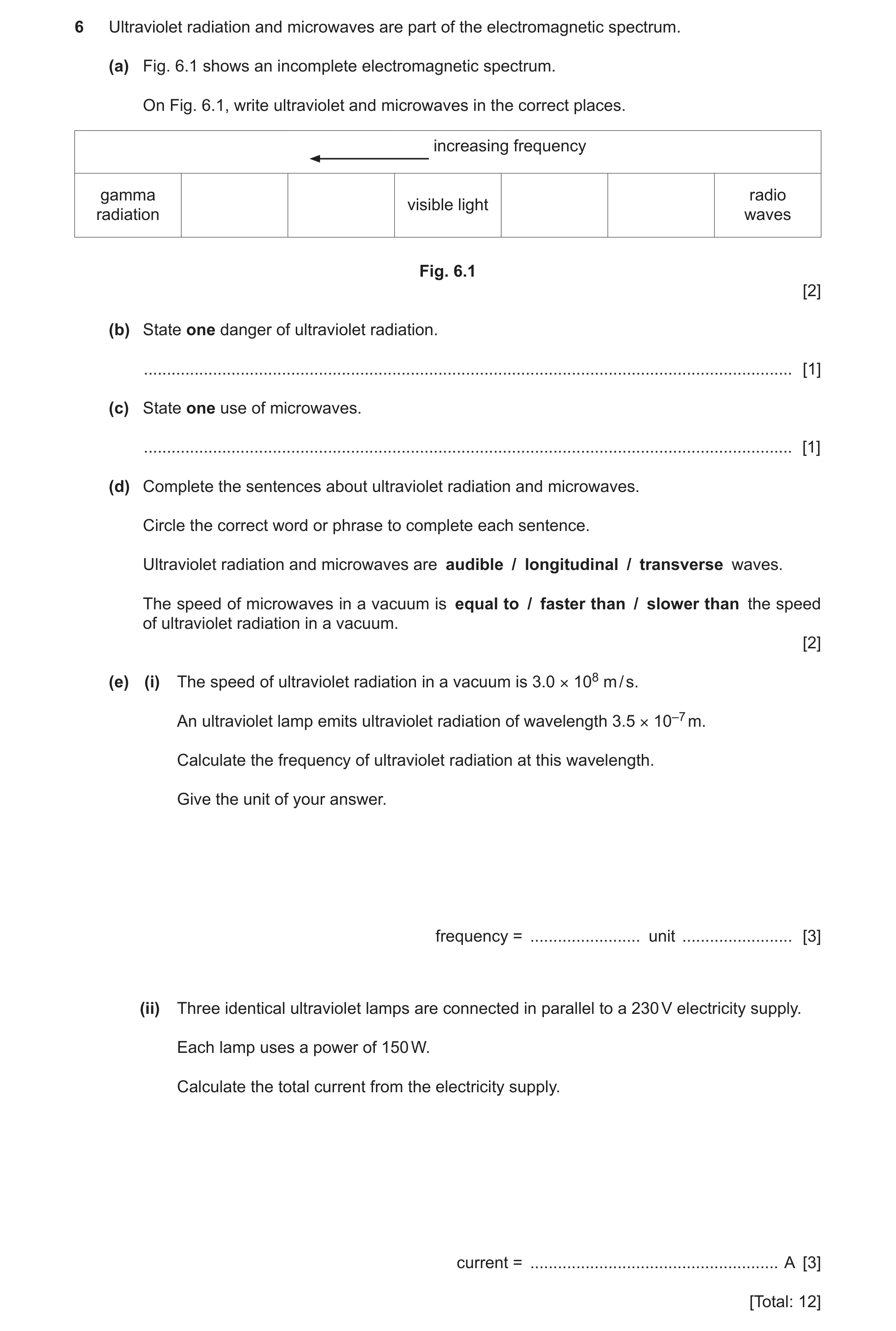
6 Ultraviolet radiation and microwaves are part of the electromagnetic spectrum. (a) Fig. 6.1 shows an incomplete electromagnetic spectrum. On Fig. 6.1, write ultraviolet and microwaves in the correct places. increasing frequency gamma radio visible light radiation waves Fig. 6.1 [2] (b) State one danger of ultraviolet radiation. … [1] (c) State one use of microwaves. … [1] (d) Complete the sentences about ultraviolet radiation and microwaves. Circle the correct word or phrase to complete each sentence. Ultraviolet radiation and microwaves are audible / longitudinal / transverse waves. The speed of microwaves in a vacuum is equal to / faster than / slower than the speed of ultraviolet radiation in a vacuum. [2] (e) (i) The speed of ultraviolet radiation in a vacuum is 3.0 × 10⁸ m / s. An ultraviolet lamp emits ultraviolet radiation of wavelength 3.5 × 10⁻⁷ m. Calculate the frequency of ultraviolet radiation at this wavelength. Give the unit of your answer. frequency = … unit … [3] (ii) Three identical ultraviolet lamps are connected in parallel to a 230 V electricity supply. Each lamp uses a power of 150 W. Calculate the total current from the electricity supply. current = … A [3] [Total: 12]
12 marks
Mark scheme: 6(a) (gamma radiation) ultraviolet ; (visible light) micro-waves ; (radio waves) 2 6(b) burns / DNA damage / (skin) cancer ; 1 6(c) satellite television / (mobile) telephones ; 1 6(d) transverse ; equal to ; 2 6(e)(i) v = f (in any form) / (f =) 3 108 ÷ 3.5 10–7 ; = 8.6 1014 ; Hz ; 3 6(e)(ii) P = VI or I = P ÷ V OR 450 ÷ 230 ; and either: current in each lamp = 150 ÷ 230 / 0.652(174) ; (total currect = 3 0.652(174)) = 1.96 / 2.0 (A) ; OR (total power supply needed = 3 150) 450 (W) ; (total current = 450 / 230 =) 1.96 / 2.0 (A) ; 3
This question in 0653/42 May/June 2022
Question 18 0653/43 May/June 2022
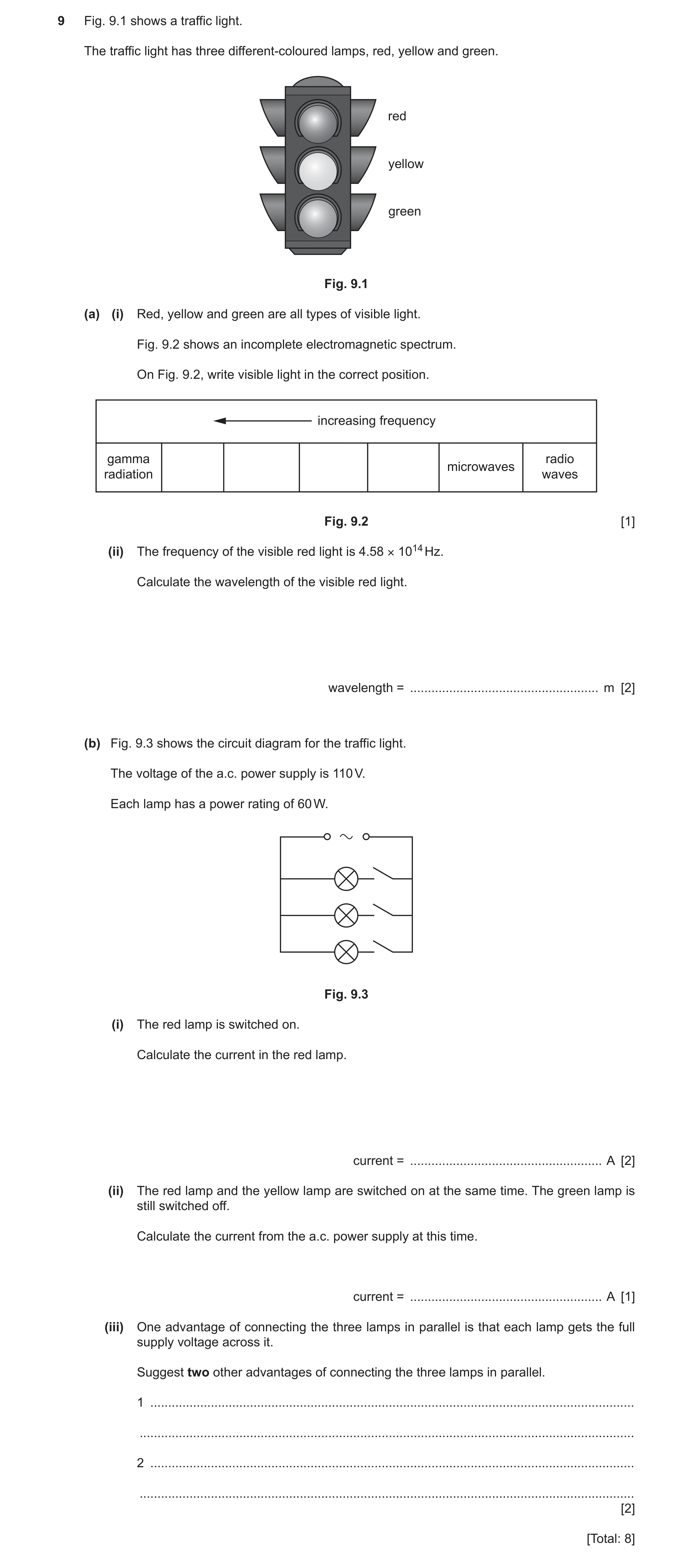
9 Fig. 9.1 shows a traffic light. The traffic light has three different-coloured lamps, red, yellow and green. red yellow green Fig. 9.1 (a) (i) Red, yellow and green are all types of visible light. Fig. 9.2 shows an incomplete electromagnetic spectrum. On Fig. 9.2, write visible light in the correct position. increasing frequency gamma radio microwaves radiation waves Fig. 9.2 [1] (ii) The frequency of the visible red light is 4.58 × 10¹⁴ Hz. Calculate the wavelength of the visible red light. wavelength = … m [2] (b) Fig. 9.3 shows the circuit diagram for the traffic light. The voltage of the a.c. power supply is 110 V. Each lamp has a power rating of 60 W. Fig. 9.3 (i) The red lamp is switched on. Calculate the current in the red lamp. current = … A [2] (ii) The red lamp and the yellow lamp are switched on at the same time. The green lamp is still switched off. Calculate the current from the a.c. power supply at this time. current = … A [1] (iii) One advantage of connecting the three lamps in parallel is that each lamp gets the full supply voltage across it. Suggest two other advantages of connecting the three lamps in parallel. 1 … … 2 … … [2] [Total: 8]
8 marks
Mark scheme: 9(a)(i) increasing frequency (gamma radiation) visible light ; (microwaves) (radio waves) 1 9(a)(ii) v = f (in any form) OR ( =) 3 108 ÷ 4.58 1014 ; = 6.55 10–7 (m) ; 2 9(b)(i) P = IV (in any form) OR ( I=) 60 ÷ 110 ; = 0.55 (A) ; 2 9(b)(ii) (0.55 + 0.55 =) 1.1 (A) ; 1 9(b)(iii) if one light breaks, the others still work ; each lamp can be individually / independently switched on and off ; 2
This question in 0653/43 May/June 2022
Q19 · A radar system in an airport uses microwaves to find and track an airplane in the sky 0653/41 Oct/Nov 2022
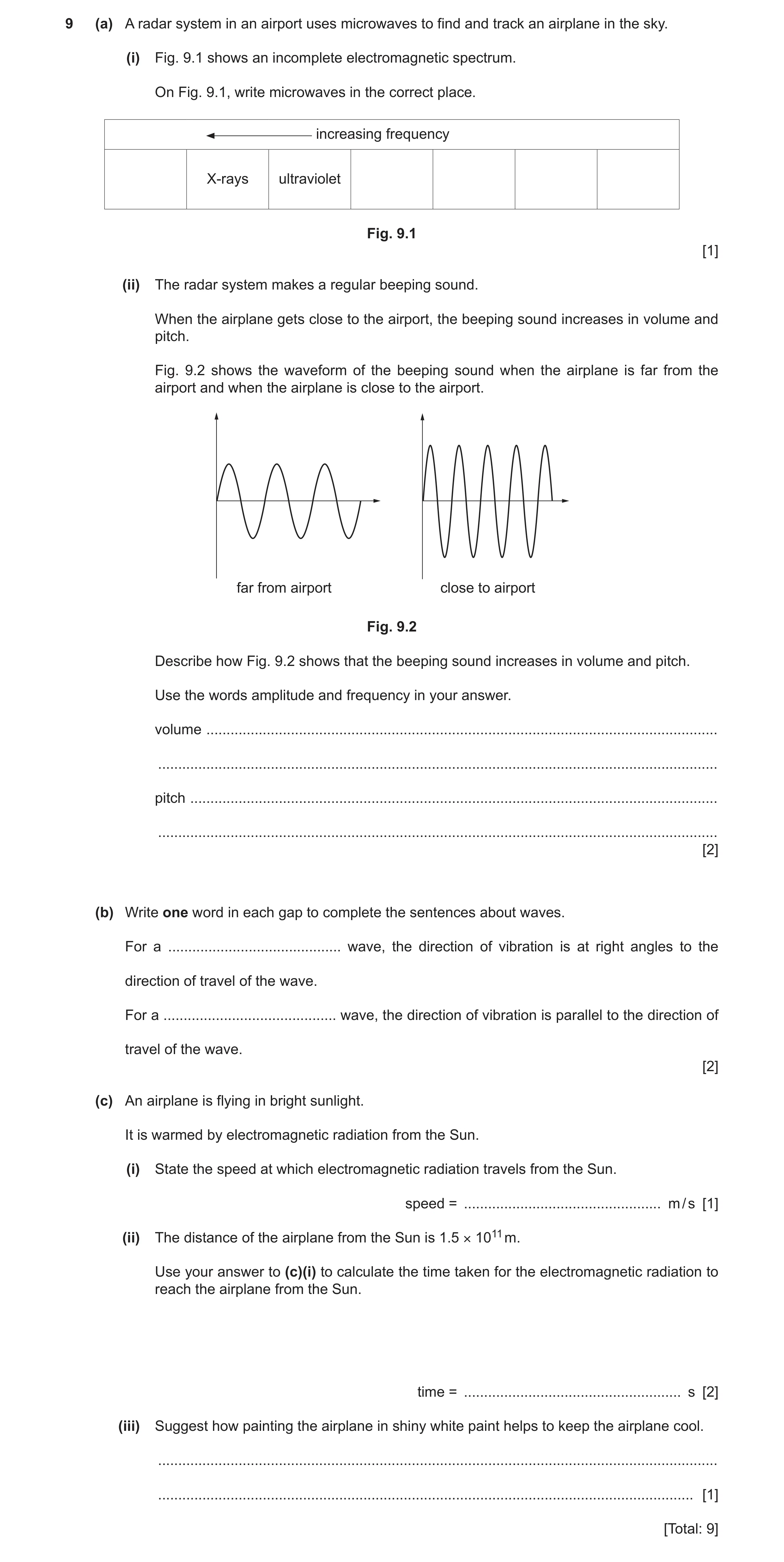
9 (a) A radar system in an airport uses microwaves to find and track an airplane in the sky. (i) Fig. 9.1 shows an incomplete electromagnetic spectrum. On Fig. 9.1, write microwaves in the correct place. increasing frequency X-rays ultraviolet Fig. 9.1 [1] (ii) The radar system makes a regular beeping sound. When the airplane gets close to the airport, the beeping sound increases in volume and pitch. Fig. 9.2 shows the waveform of the beeping sound when the airplane is far from the airport and when the airplane is close to the airport. far from airport close to airport Fig. 9.2 Describe how Fig. 9.2 shows that the beeping sound increases in volume and pitch. Use the words amplitude and frequency in your answer. volume … … pitch … … [2] (b) Write one word in each gap to complete the sentences about waves. For a … wave, the direction of vibration is at right angles to the direction of travel of the wave. For a … wave, the direction of vibration is parallel to the direction of travel of the wave. [2] (c) An airplane is flying in bright sunlight. It is warmed by electromagnetic radiation from the Sun. (i) State the speed at which electromagnetic radiation travels from the Sun. speed = … m / s [1] (ii) The distance of the airplane from the Sun is 1.5 × 10¹¹ m. Use your answer to (c)(i) to calculate the time taken for the electromagnetic radiation to reach the airplane from the Sun. time = … s [2] (iii) Suggest how painting the airplane in shiny white paint helps to keep the airplane cool. … … [1] [Total: 9]
9 marks
Mark scheme: 9(a)(i) 1 X-rays ultraviolet microwaves ; 9(a)(ii) volume large(r) amplitude ; 2 pitch high(er) frequency ; 9(b) transverse / named example ; 2 longitudinal / named example ; 9(c)(i) 3.0 108 / 300 000 000 (m / s) ; 1 9(c)(ii) evidence of, speed = distance ÷ time / 150 000 000 000 ÷ 300 000 000 ; 2 500 (s) (= 8 min 20 s) ; 9(c)(iii) a shiny white surface is a, poor absorber / (good) reflector (of radiation) ; 1
This question in 0653/41 Oct/Nov 2022
Q20 · The electromagnetic spectrum has seven different regions, including microwaves and X‑rays 0653/42 Oct/Nov 2022
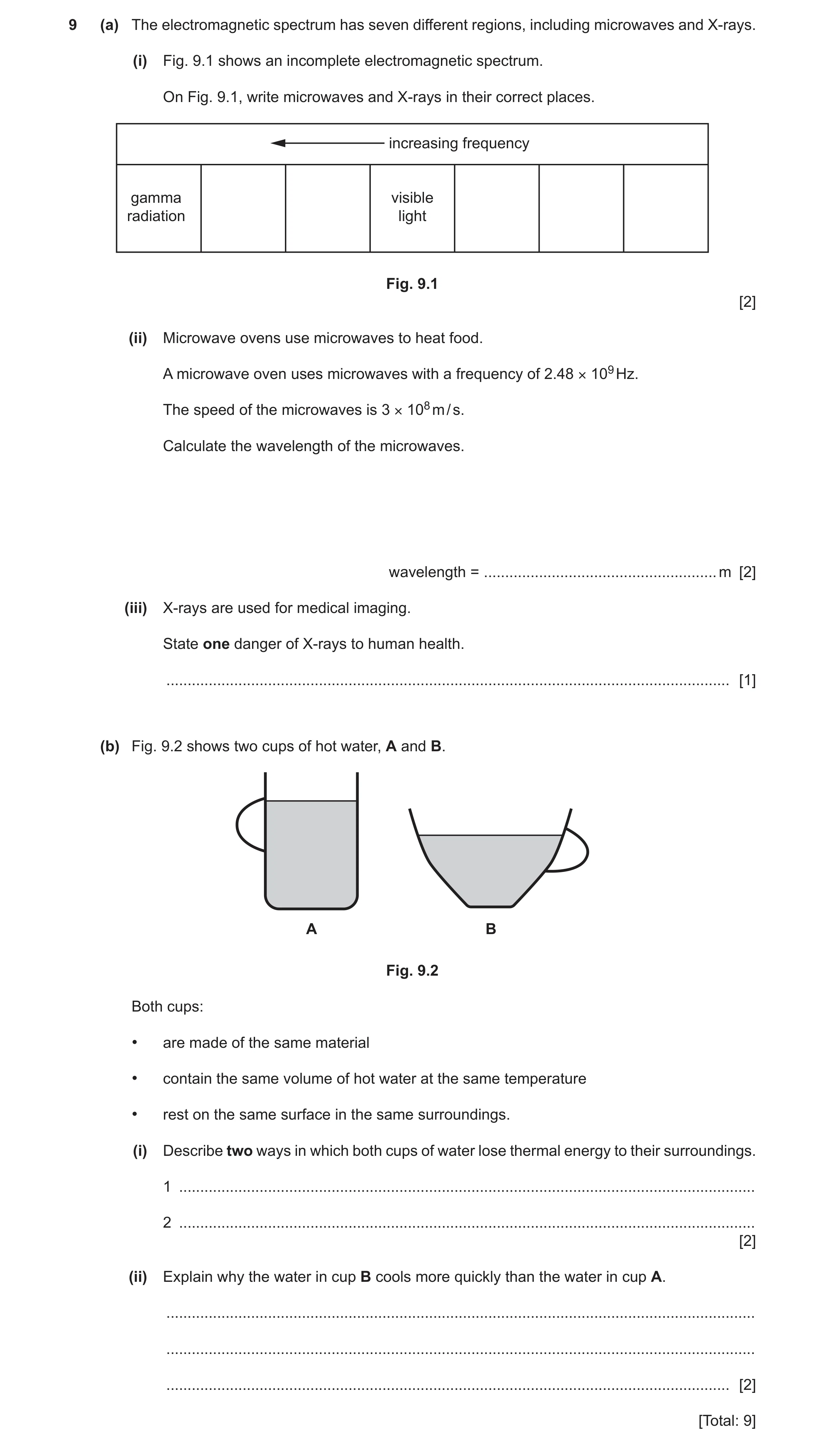
9 (a) The electromagnetic spectrum has seven different regions, including microwaves and X‑rays. (i) Fig. 9.1 shows an incomplete electromagnetic spectrum. On Fig. 9.1, write microwaves and X‑rays in their correct places. increasing frequency gamma visible radiation light Fig. 9.1 [2] (ii) Microwave ovens use microwaves to heat food. A microwave oven uses microwaves with a frequency of 2.48 × 10⁹ Hz. The speed of the microwaves is 3 × 10⁸ m / s. Calculate the wavelength of the microwaves. wavelength = … m [2] (iii) X‑rays are used for medical imaging. State one danger of X‑rays to human health. … [1] (b) Fig. 9.2 shows two cups of hot water, A and B. A B Fig. 9.2 Both cups: • are made of the same material • contain the same volume of hot water at the same temperature • rest on the same surface in the same surroundings. (i) Describe two ways in which both cups of water lose thermal energy to their surroundings. 1 … 2 … [2] (ii) Explain why the water in cup B cools more quickly than the water in cup A. … … … [2] [Total: 9]
9 marks
Mark scheme: 9(a)(i) 2 gamma visible X-rays ; microwaves ; radiation light 9(a)(ii) evidence of, v = f / 3 108 ÷ 2.48 109 ; 2 0.1(21) (m); 9(a)(iii) (X-rays) damage cells / cause cancer ; 1 9(b)(i) any two from: 2 evaporation (from surface of liquid) ; convection (by heating air above the surface) ; conduction (through cups) ; radiation (from outside of cup) ; 9(b)(ii) (cup B / ORA) 2 has greater surface area ; so increased (rate of) evaporation ;
This question in 0653/42 Oct/Nov 2022
Q21 · An incomplete electromagnetic spectrum 0653/43 Oct/Nov 2022
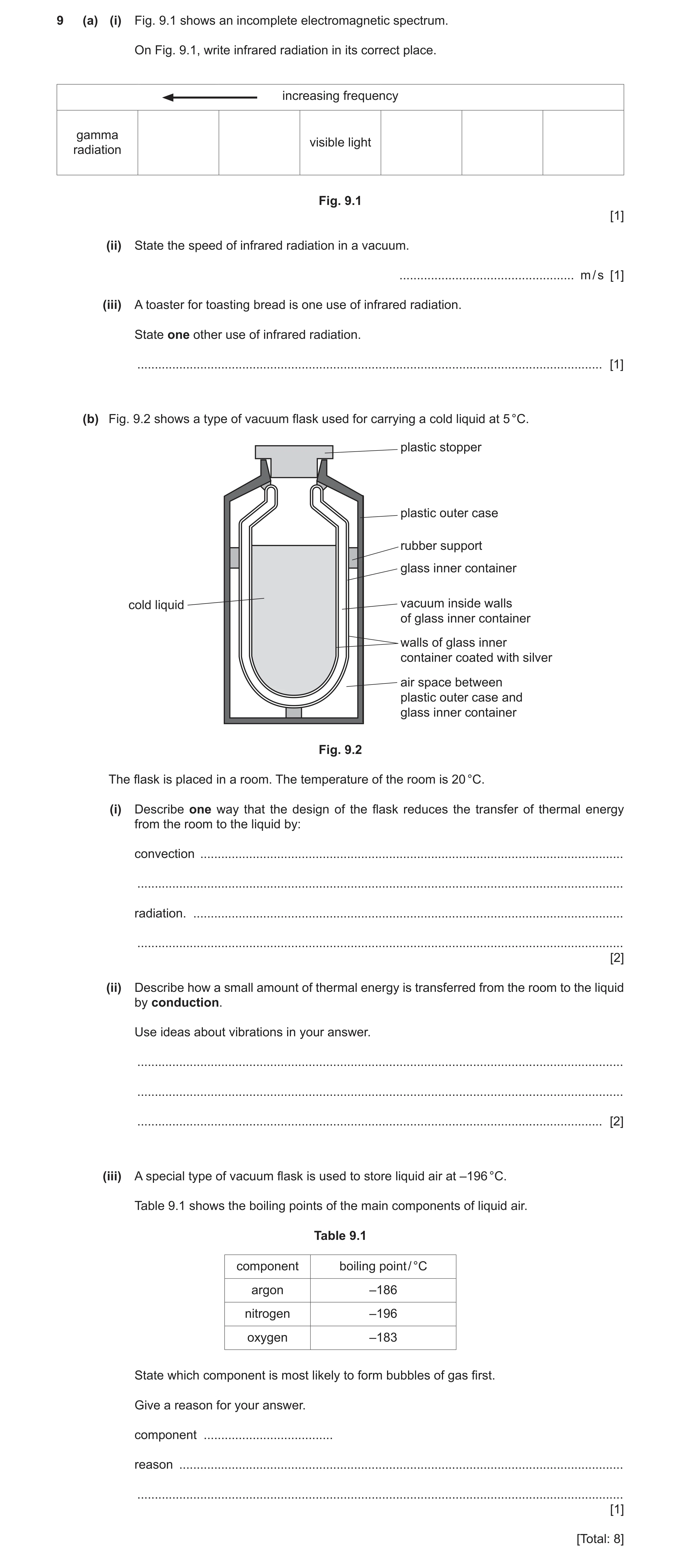
9 (a) (i) Fig. 9.1 shows an incomplete electromagnetic spectrum. On Fig. 9.1, write infrared radiation in its correct place. increasing frequency gamma visible light radiation Fig. 9.1 [1] (ii) State the speed of infrared radiation in a vacuum. … m / s [1] (iii) A toaster for toasting bread is one use of infrared radiation. State one other use of infrared radiation. … [1] (b) Fig. 9.2 shows a type of vacuum flask used for carrying a cold liquid at 5 °C. plastic stopper plastic outer case rubber support glass inner container cold liquid vacuum inside walls of glass inner container walls of glass inner container coated with silver air space between plastic outer case and glass inner container Fig. 9.2 The flask is placed in a room. The temperature of the room is 20 °C. (i) Describe one way that the design of the flask reduces the transfer of thermal energy from the room to the liquid by: convection … … radiation. … … [2] (ii) Describe how a small amount of thermal energy is transferred from the room to the liquid by conduction. Use ideas about vibrations in your answer. … … … [2] (iii) A special type of vacuum flask is used to store liquid air at –196 °C. Table 9.1 shows the boiling points of the main components of liquid air. Table 9.1 component boiling point / °C argon –186 nitrogen –196 oxygen –183 State which component is most likely to form bubbles of gas first. Give a reason for your answer. component … reason … … [1] [Total: 8]
8 marks
Mark scheme: 9(a)(i) 1 (gamma (visible infrared radiation) light) (radiation) ; 9(a)(ii) 3.0 108 (m / s) ; 1 9(a)(iii) remote controllers for televisions / intruder alarms / AVP ; 1 9(b)(i) convection (reduced by) vacuum / stopper ; 2 radiation (reduced by) silver (coating) ; 9(b)(ii) (conduction) through the, solid material / plastic outer case / rubber supports / walls of glass container / plastic stopper ; 2 molecular vibrations passed from one molecule to the next ; 9(b)(iii) component nitrogen AND 1 reason lowest boiling point (of the 3 components) ;
This question in 0653/43 Oct/Nov 2022
Q22 · A sound wave in air 0653/41 Oct/Nov 2023
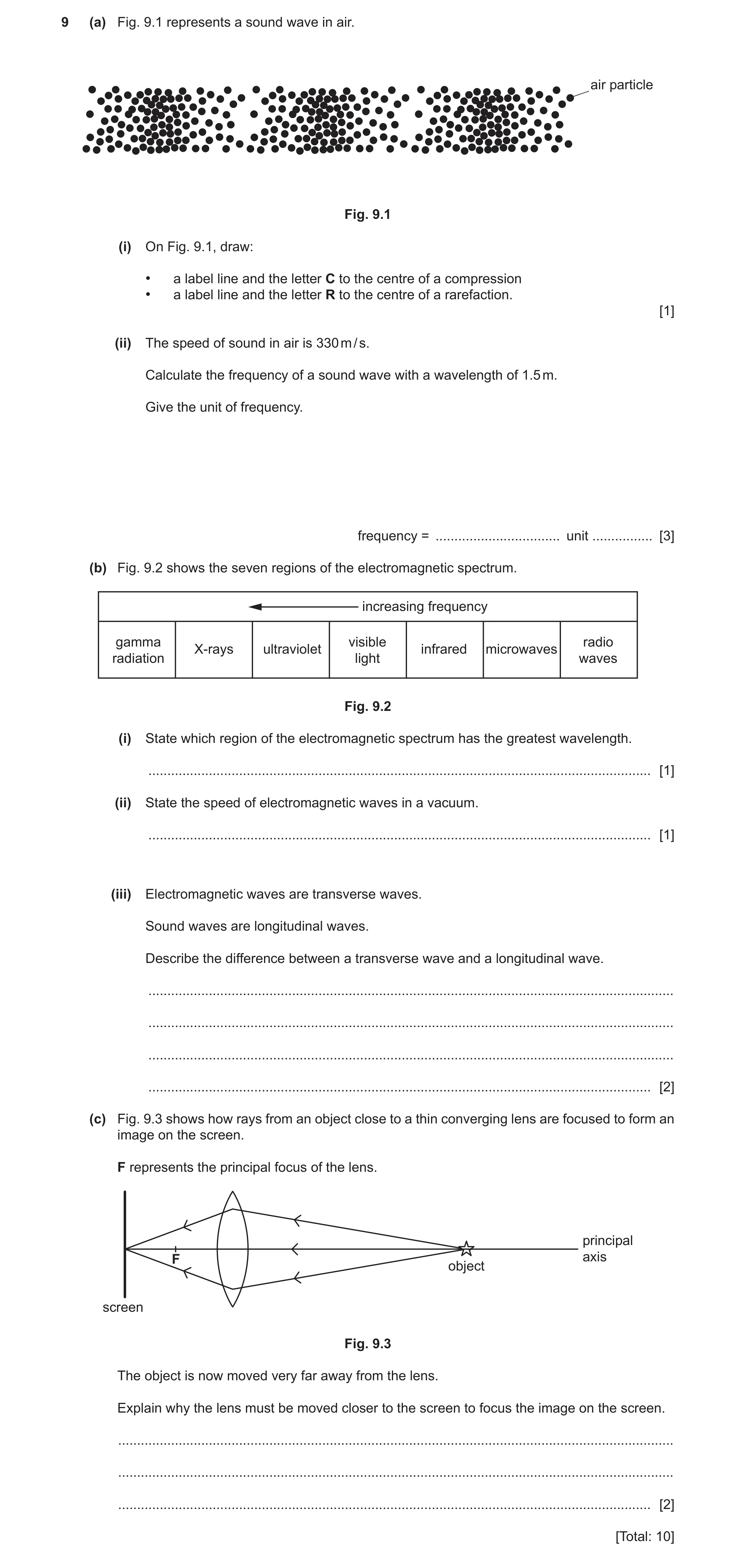
9 (a) Fig. 9.1 represents a sound wave in air. air particle Fig. 9.1 (i) On Fig. 9.1, draw: • a label line and the letter C to the centre of a compression • a label line and the letter R to the centre of a rarefaction. [1] (ii) The speed of sound in air is 330 m / s. Calculate the frequency of a sound wave with a wavelength of 1.5 m. Give the unit of frequency. frequency = … unit … [3] (b) Fig. 9.2 shows the seven regions of the electromagnetic spectrum. increasing frequency gamma visible radio X-rays ultraviolet infrared microwaves radiation light waves Fig. 9.2 (i) State which region of the electromagnetic spectrum has the greatest wavelength. … [1] (ii) State the speed of electromagnetic waves in a vacuum. … [1] (iii) Electromagnetic waves are transverse waves. Sound waves are longitudinal waves. Describe the difference between a transverse wave and a longitudinal wave. … … … … [2] (c) Fig. 9.3 shows how rays from an object close to a thin converging lens are focused to form an image on the screen. F represents the principal focus of the lens. principal F axis object screen Fig. 9.3 The object is now moved very far away from the lens. Explain why the lens must be moved closer to the screen to focus the image on the screen. … … … [2] [Total: 10]
10 marks
Mark scheme: 9(a)(i) compression correctly labelled with label line and letter C AND 1 rarefaction correctly labelled with label line and letter R ; 9(a)(ii) evidence of, v = f / 330 1.5 ; 3 220 ; Hz / hertz ; 9(b)(i) radio waves ; 1 9(b)(ii) 3.0 108 m / s ; 1 9(b)(iii) for longitudinal/sound waves, the direction of oscillation/vibration (of particles) is parallel to the (direction of) energy 2 transfer / AW ; for transverse/electromagnetic waves, the direction of oscillation/vibration (of particles) is perpendicular to the (direction of) energy transfer / AW ; 9(c) any two from: 2 incident rays now, parallel to axis / form a beam; idea that refracted rays now pass through, F / (principal) focus; lens must be moved so, (principal) focus / F, is, on / closer to, the screen (for focused image) ;
This question in 0653/41 Oct/Nov 2023
Q23 · A lighthouse used at night to warn ships of dangerous rocks in the sea 0653/42 Oct/Nov 2023
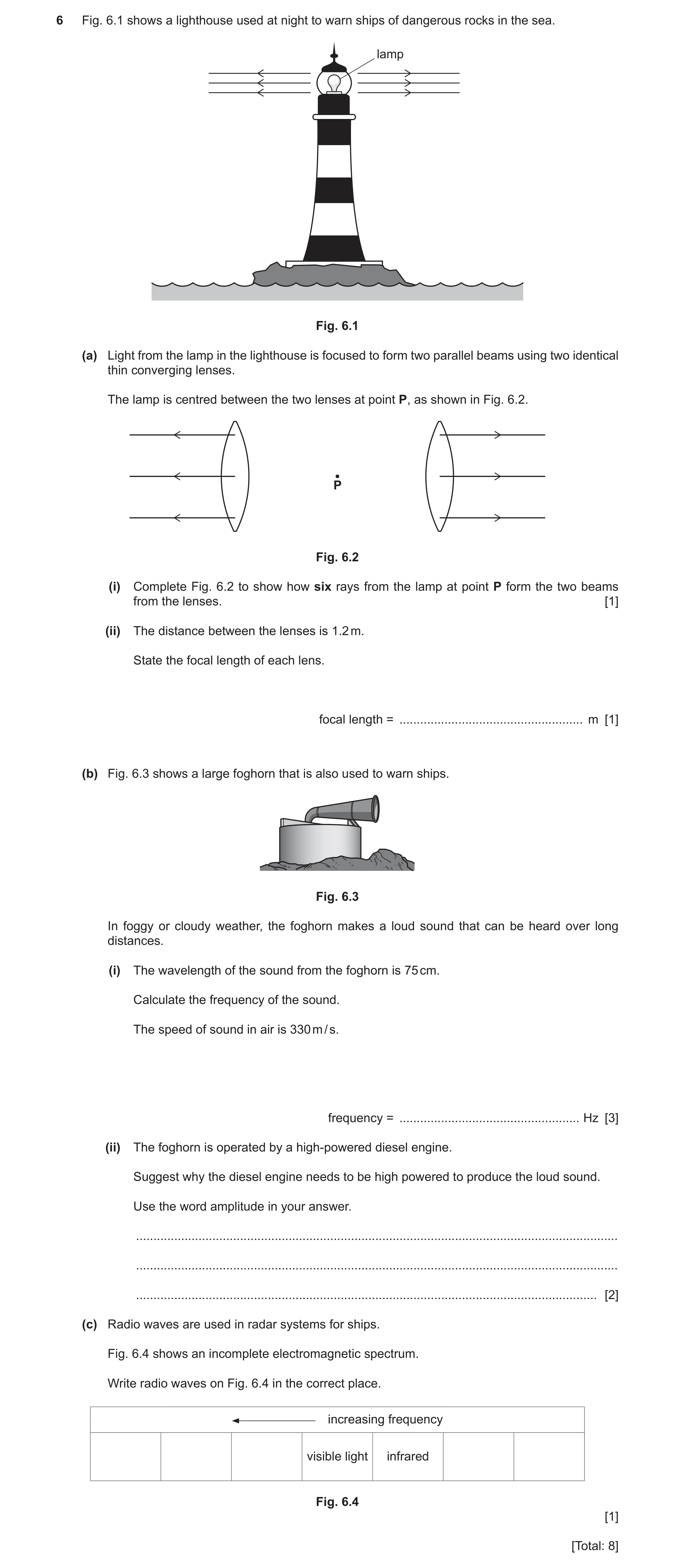
6 Fig. 6.1 shows a lighthouse used at night to warn ships of dangerous rocks in the sea. lamp Fig. 6.1 (a) Light from the lamp in the lighthouse is focused to form two parallel beams using two identical thin converging lenses. The lamp is centred between the two lenses at point P, as shown in Fig. 6.2. P Fig. 6.2 (i) Complete Fig. 6.2 to show how six rays from the lamp at point P form the two beams from the lenses. [1] (ii) The distance between the lenses is 1.2 m. State the focal length of each lens. focal length = … m [1] (b) Fig. 6.3 shows a large foghorn that is also used to warn ships. Fig. 6.3 In foggy or cloudy weather, the foghorn makes a loud sound that can be heard over long distances. (i) The wavelength of the sound from the foghorn is 75 cm. Calculate the frequency of the sound. The speed of sound in air is 330 m / s. frequency = … Hz [3] (ii) The foghorn is operated by a high-powered diesel engine. Suggest why the diesel engine needs to be high powered to produce the loud sound. Use the word amplitude in your answer. … … … [2] (c) Radio waves are used in radar systems for ships. Fig. 6.4 shows an incomplete electromagnetic spectrum. Write radio waves on Fig. 6.4 in the correct place. increasing frequency visible light infrared Fig. 6.4 [1] [Total: 8]
8 marks
Mark scheme: 6(a)(i) 1 all six emerging rays correctly linked back to principal focus at lamp ; 6(a)(ii) 0.6 (m) ; 1 6(b)(i) unit conversion cm to m ; 3 evidence of, v = f / 330 0.75 ; 440 (Hz) ; 6(b)(ii) (loud means) large amplitude ; 2 requires a lot of energy (from a powerful diesel engine) ; 6(c) 1 (visible (infrared) radio light) waves ;
This question in 0653/42 Oct/Nov 2023
Q24 · An ultraviolet torch used to kill bacteria and viruses on surfaces 0653/43 Oct/Nov 2023
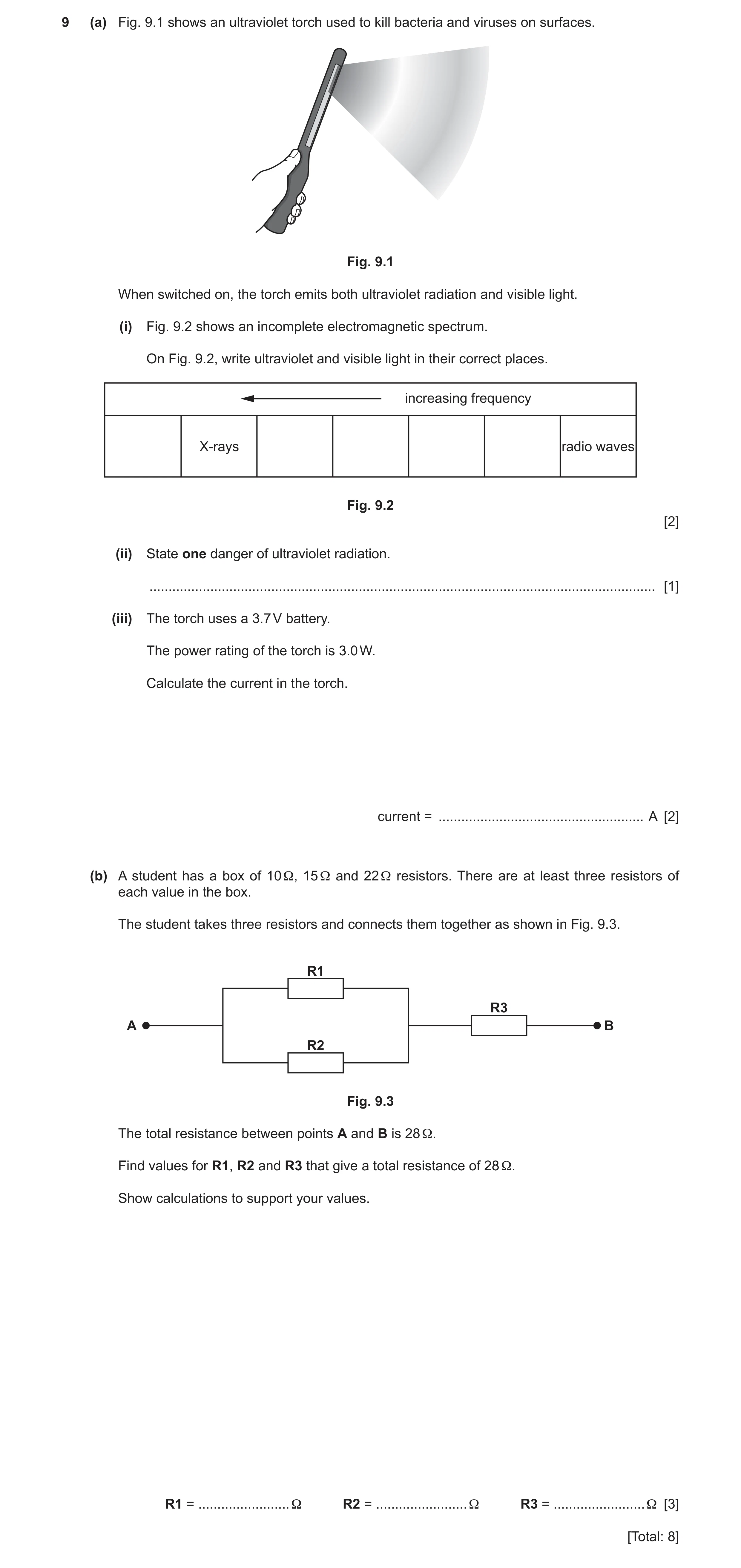
9 (a) Fig. 9.1 shows an ultraviolet torch used to kill bacteria and viruses on surfaces. Fig. 9.1 When switched on, the torch emits both ultraviolet radiation and visible light. (i) Fig. 9.2 shows an incomplete electromagnetic spectrum. On Fig. 9.2, write ultraviolet and visible light in their correct places. increasing frequency X-rays radio waves Fig. 9.2 [2] (ii) State one danger of ultraviolet radiation. … [1] (iii) The torch uses a 3.7 V battery. The power rating of the torch is 3.0 W. Calculate the current in the torch. current = … A [2] (b) A student has a box of 10 Ω, 15 Ω and 22 Ω resistors. There are at least three resistors of each value in the box. The student takes three resistors and connects them together as shown in Fig. 9.3. R1 R3 A B R2 Fig. 9.3 The total resistance between points A and B is 28 Ω. Find values for R1, R2 and R3 that give a total resistance of 28 Ω. Show calculations to support your values. R1 = … Ω R2 = … Ω R3 = … Ω [3] [Total: 8]
8 marks
Mark scheme: 9(a)(i) 2 (radio (X-rays) ultraviolet ; visible light ; waves) 9(a)(ii) burn (to skin) / damage to eyes / blindness ; 1 9(a)(iii) evidence of, P = IV / 3.0 3.7 ; 2 0.81 (A) ; 9(b) 1 1 1 3 evidence of, R = R1 R2 (R1 + R2) / = + , for R1 and R2 ; R R1 R2 use of series addition of resistors for R3 to result for R1 and R2 ; values for R1 and R2 of 10 and 15 AND R3 = 22 ;
This question in 0653/43 Oct/Nov 2023
Q25 · The Parker Solar Probe is a spacecraft designed to study the Sun and the planet Venus 0653/42 Feb/March 2024
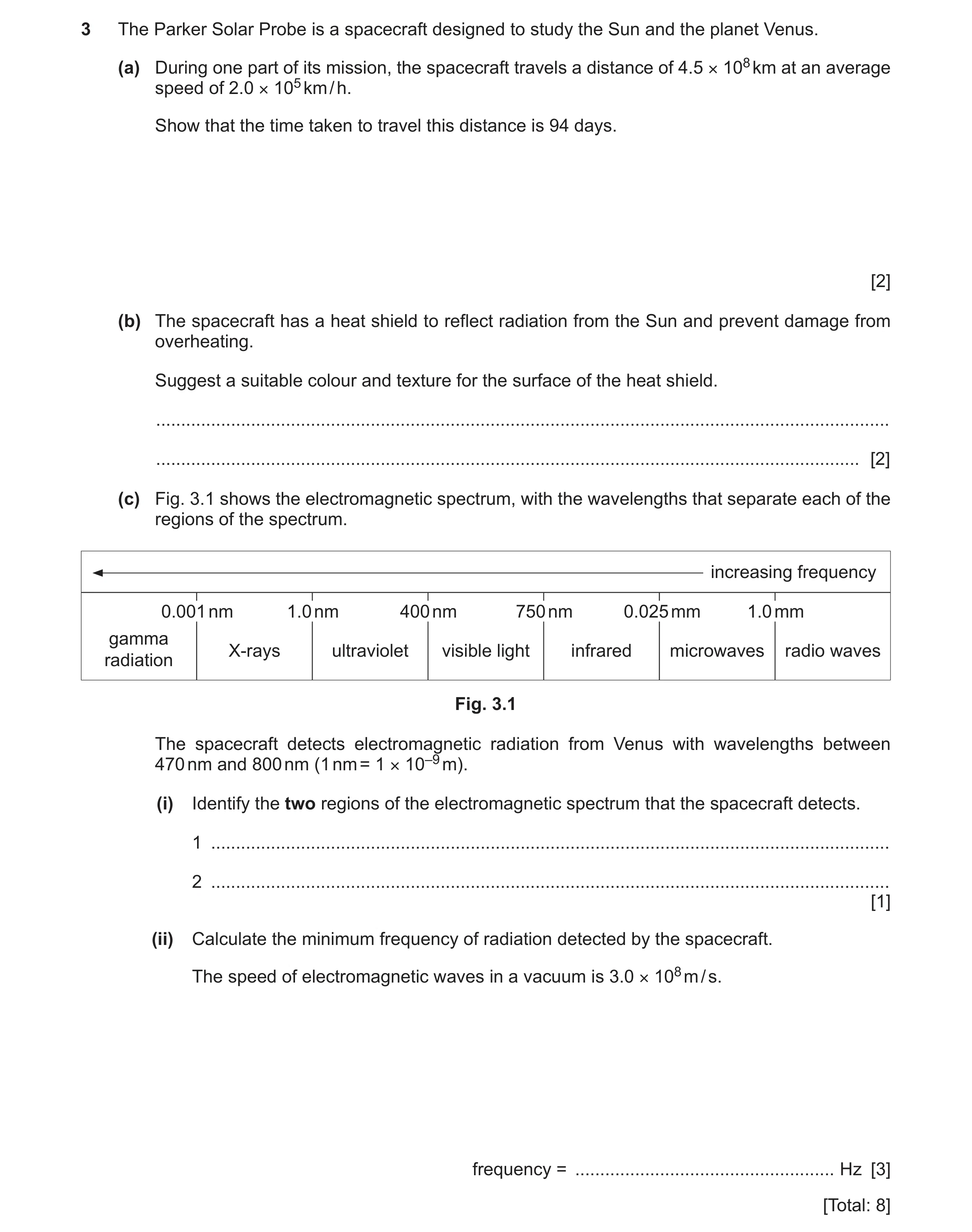
3 The Parker Solar Probe is a spacecraft designed to study the Sun and the planet Venus. (a) During one part of its mission, the spacecraft travels a distance of 4.5 × 10⁸ km at an average speed of 2.0 × 10⁵ km / h. Show that the time taken to travel this distance is 94 days. [2] (b) The spacecraft has a heat shield to reflect radiation from the Sun and prevent damage from overheating. Suggest a suitable colour and texture for the surface of the heat shield. … … [2] (c) Fig. 3.1 shows the electromagnetic spectrum, with the wavelengths that separate each of the regions of the spectrum. increasing frequency 0.001 nm 1.0 nm 400 nm 750 nm 0.025 mm 1.0 mm gamma X-rays ultraviolet visible light infrared microwaves radio waves radiation Fig. 3.1 The spacecraft detects electromagnetic radiation from Venus with wavelengths between 470 nm and 800 nm (1 nm = 1 × 10⁻⁹ m). (i) Identify the two regions of the electromagnetic spectrum that the spacecraft detects. 1 … 2 … [1] (ii) Calculate the minimum frequency of radiation detected by the spacecraft. The speed of electromagnetic waves in a vacuum is 3.0 × 10⁸ m / s. frequency = … Hz [3] [Total: 8]
8 marks
Mark scheme: 3(a) speed = distance ÷ time / 4.5 108 ÷ 2.0 105 ; 2 (conversion hours to days) 2250 ÷ 24 ; (= 94 / 93.8 / 93.75 days) 3(b) white ; 2 shiny ; 3(c)(i) visible (light) and infrared ; 1 3(c)(ii) 800 nm seen / states idea that minimum frequency has longest wavelength ; 3 f = 3.0 108 ÷ (800 10-9) ; = 3.8 1014 (Hz) ;
This question in 0653/42 Feb/March 2024
Q26 · An old-fashioned room heater made of iron 0653/42 May/June 2024
3 Fig. 3.1 shows an old-fashioned room heater made of iron. The heater burns oil as a fuel. flame inside heater Fig. 3.1 (a) Complete the sentence to state the energy transfers that occur when the oil burns with a visible flame. Energy is transferred from ……………………... potential energy to …………………. energy and light. [2] (b) Describe how the process of convection enables the transfer of energy from the flame to the top of the heater. … … … [2] (c) Fig. 3.2 shows a person warming their hand with radiation from the side of the heater. Fig. 3.2 Radiation from the heater is mainly in the infrared region of the electromagnetic spectrum. The flame emits infrared radiation from the heater with a frequency of 0.95 × 10¹⁴ Hz. (i) State what is meant by frequency. … … [1] (ii) State one region of the electromagnetic spectrum that has a lower frequency than infrared. … [1] (iii) Calculate the wavelength of radiation with a frequency of 0.95 × 10¹⁴ Hz. The speed of electromagnetic waves = 3.0 × 10⁸ m / s. wavelength = … m [2] [Total: 8]
8 marks
Mark scheme: 3(a) chemical ; thermal ; 3(b) air (above flame) is heated ; less dense air rises ; 2 3(c)(i) number of wavelengths, per unit time / per second ; 1 3(c)(ii) microwaves / radio waves ; 1 3(c)(iii) ( = ) v ÷ f or 3.0 108 0.95 1014 ; 3.2 (3.16) 10–6 (m) ; 2
This question in 0653/42 May/June 2024
Q27 · A television (TV) connected to a satellite dish 0653/43 May/June 2024
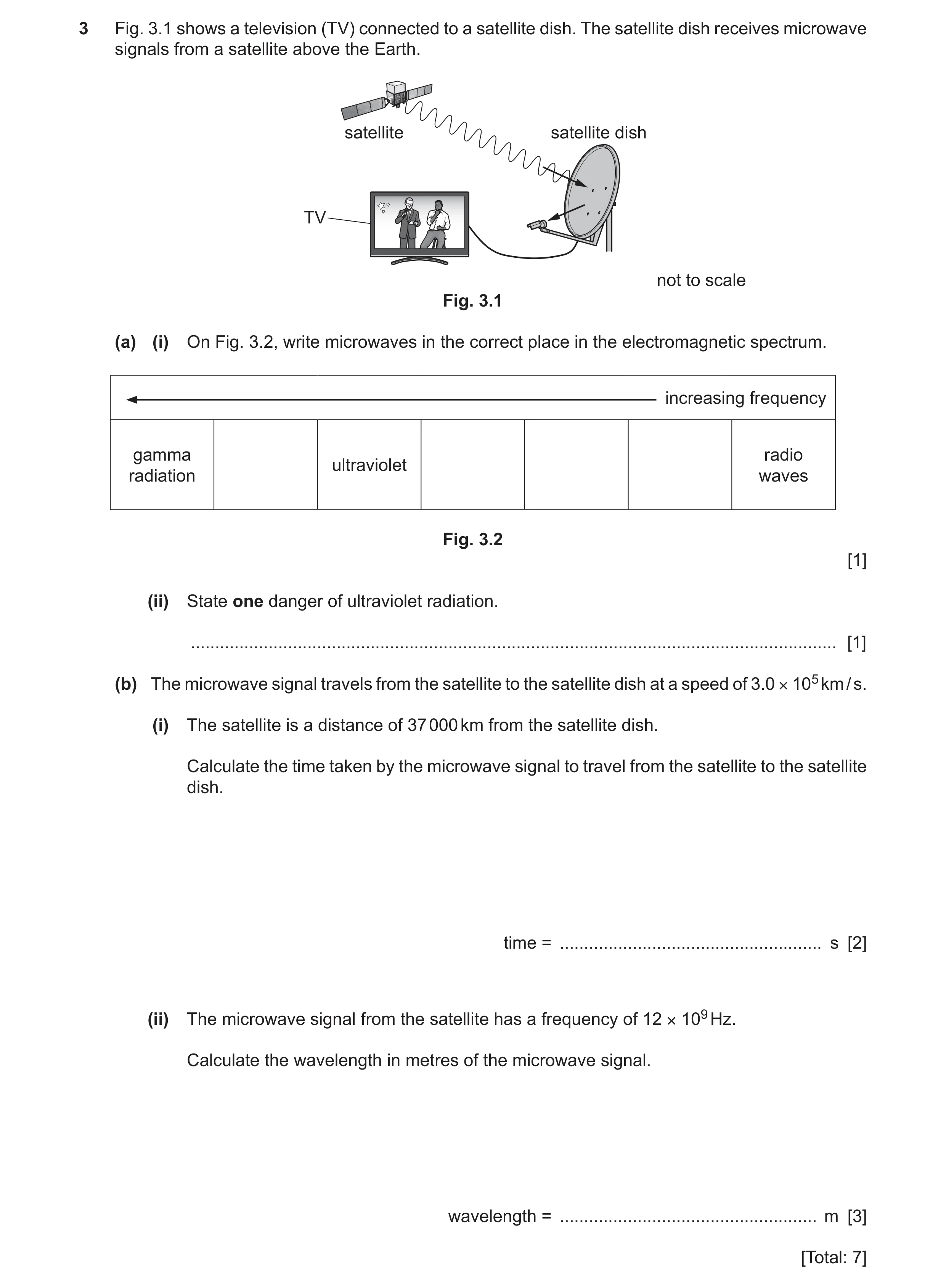
3 Fig. 3.1 shows a television (TV) connected to a satellite dish. The satellite dish receives microwave signals from a satellite above the Earth. satellite satellite dish TV not to scale Fig. 3.1 (a) (i) On Fig. 3.2, write microwaves in the correct place in the electromagnetic spectrum. increasing frequency gamma radio ultraviolet radiation waves Fig. 3.2 [1] (ii) State one danger of ultraviolet radiation. … [1] (b) The microwave signal travels from the satellite to the satellite dish at a speed of 3.0 × 10⁵ km / s. (i) The satellite is a distance of 37 000 km from the satellite dish. Calculate the time taken by the microwave signal to travel from the satellite to the satellite dish. time = … s [2] (ii) The microwave signal from the satellite has a frequency of 12 × 109 Hz. Calculate the wavelength in metres of the microwave signal. wavelength = … m [3] [Total: 7]
7 marks
Mark scheme: 3(a)(i) gamma radiation ultraviolet microwaves ; radio waves 1 3(a)(ii) sunburn / skin cancer / skin damage / eye damage ; 1 3(b)(i) speed = distance time in any form OR 37 000 3.0 105 ; 12(.3) 10–2 OR 0.12 (s) ; 2 Question Answer Marks 3(b)(ii) conversion km to m seen ; v = f in any form / 3 108 12 109 ; 0.025 (m) ; 3
This question in 0653/43 May/June 2024
Q28 · A helicopter hovering above the ground 0653/42 Feb/March 2025
8 Fig. 8.1 shows a helicopter hovering above the ground. green light engine ground Fig. 8.1 (a) The helicopter has a green light. State a colour in the visible spectrum that has a shorter wavelength than green light. … [1] (b) The helicopter transmits a radio signal vertically down to the ground below. The signal is reflected vertically upwards from the ground. The signal is received by the helicopter 3.3 × 10– 6 s after it is transmitted. Calculate the height of the helicopter above the ground. height = … m [4] (c) The engine of the helicopter contains pistons and cylinders. Fig. 8.2 shows a piston moving down a cylinder containing gas. cylinder piston gas Fig. 8.2 (i) Complete the sentences about the process shown in Fig. 8.2. The piston is pushed down. This causes the … of the gas to decrease. The gas remains at constant temperature. The pressure of the gas increases. [1] (ii) Explain why the force exerted by the gas on the bottom of the cylinder increases. Use ideas about particles in your answer. … … … … … [3] [Total: 9]
9 marks
Mark scheme: 8(a) blue / indigo / violet ; 1 8(b) speed of radio waves stated as 3.0 108 m / s ; 4 recognition that radio signal travels down and back (i.e. divide time or distance by 2) ; v = s ÷ t / 3.0 108 1.65 10–6 ; 495 (m) ; 8(c)(i) volume ; 1 8(c)(ii) three from: 3 mp1 idea that force = P A / higher pressure causes higher force (on bottom) ; mp2 reference to force / pressure, created by collisions between particles and wall ; mp3 (when piston moves / volume decreases) the number of wall particle collisions increases / frequency of wall particle collisions increases ; mp4 (if mp3 is awarded) (reason for more collisions / higher collision rate) the idea that particle concentration increases / idea of more particles in smaller volume / particles are closer together ;
This question in 0653/42 Feb/March 2025
Q29 · The two tyres of a motorcycle 0653/41 May/June 2025
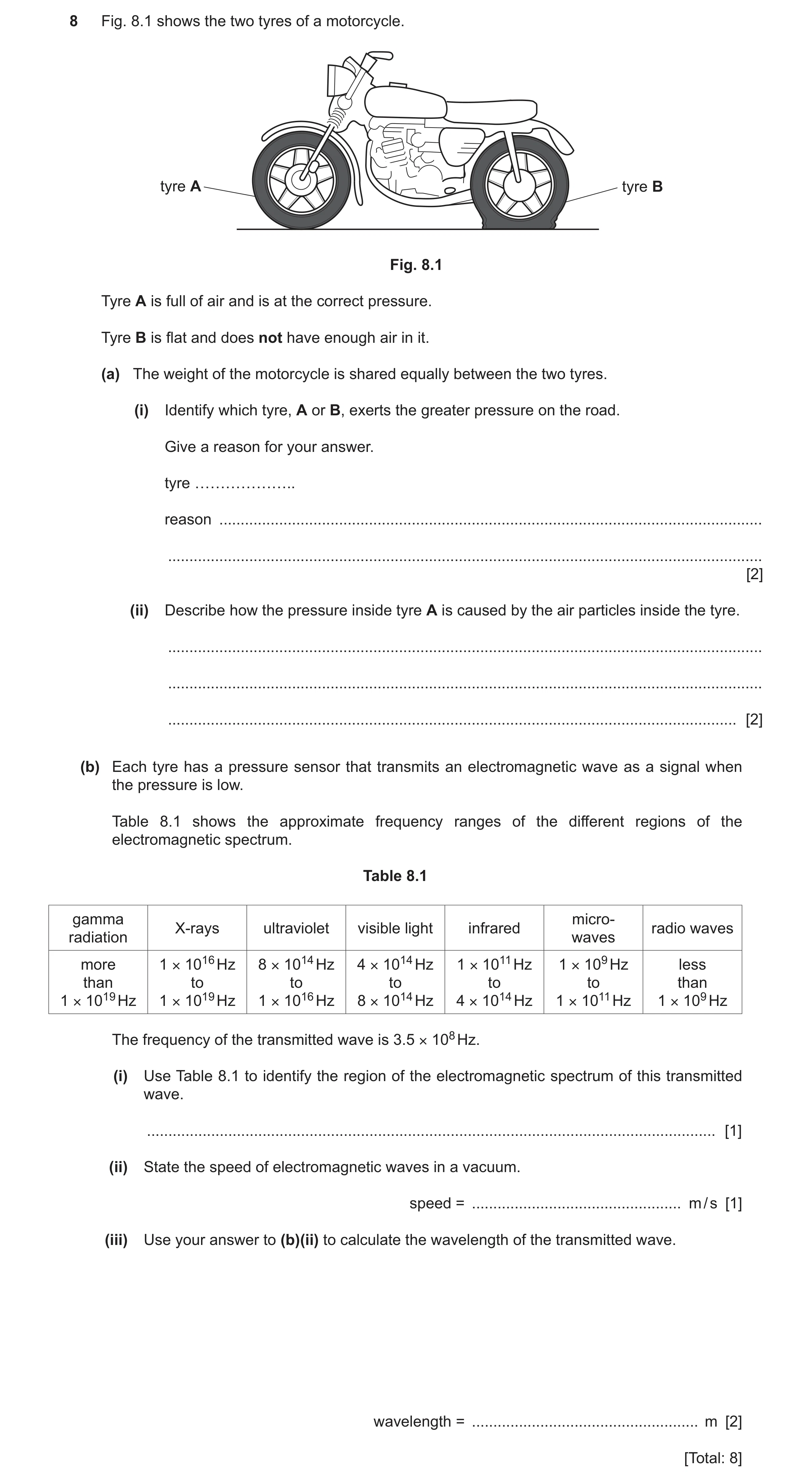
8 Fig. 8.1 shows the two tyres of a motorcycle. tyre A tyre B Fig. 8.1 Tyre A is full of air and is at the correct pressure. Tyre B is flat and does not have enough air in it. (a) The weight of the motorcycle is shared equally between the two tyres. (i) Identify which tyre, A or B, exerts the greater pressure on the road. Give a reason for your answer. tyre ……………….. reason … … [2] (ii) Describe how the pressure inside tyre A is caused by the air particles inside the tyre. … … … [2] (b) Each tyre has a pressure sensor that transmits an electromagnetic wave as a signal when the pressure is low. Table 8.1 shows the approximate frequency ranges of the different regions of the electromagnetic spectrum. Table 8.1 gamma micro‑ X‑rays ultraviolet visible light infrared radio waves radiation waves more 1 × 10¹⁶ Hz 8 × 10¹⁴ Hz 4 × 10¹⁴ Hz 1 × 10¹¹ Hz 1 × 10⁹ Hz less than to to to to to than 1 × 10¹⁹ Hz 1 × 10¹⁹ Hz 1 × 10¹⁶ Hz 8 × 10¹⁴ Hz 4 × 10¹⁴ Hz 1 × 10¹¹ Hz 1 × 10⁹ Hz The frequency of the transmitted wave is 3.5 × 10⁸ Hz. (i) Use Table 8.1 to identify the region of the electromagnetic spectrum of this transmitted wave. … [1] (ii) State the speed of electromagnetic waves in a vacuum. speed = … m / s [1] (iii) Use your answer to (b)(ii) to calculate the wavelength of the transmitted wave. wavelength = … m [2] [Total: 8]
8 marks
Mark scheme: 8(a)(i) tyre A (no mark) 2 same force (on both tyres due to shared weight of motorcycle) ; (over) smaller area (so greater pressure on road) / ORA ; 8(a)(ii) moving particles colliding with, tyre / wall / owtte ; 2 (particle / they) create / exert, a force and reference to area ; 8(b)(i) radio waves ; 1 8(b)(ii) 3.0 108 (m / s) ; 1 8(b)(iii) v = f/ 3.0 108 ÷ 3.5 108 ; 2 0.86 (m) ;
This question in 0653/41 May/June 2025
Q30 · State the approximate age of the Universe 0653/43 May/June 2025
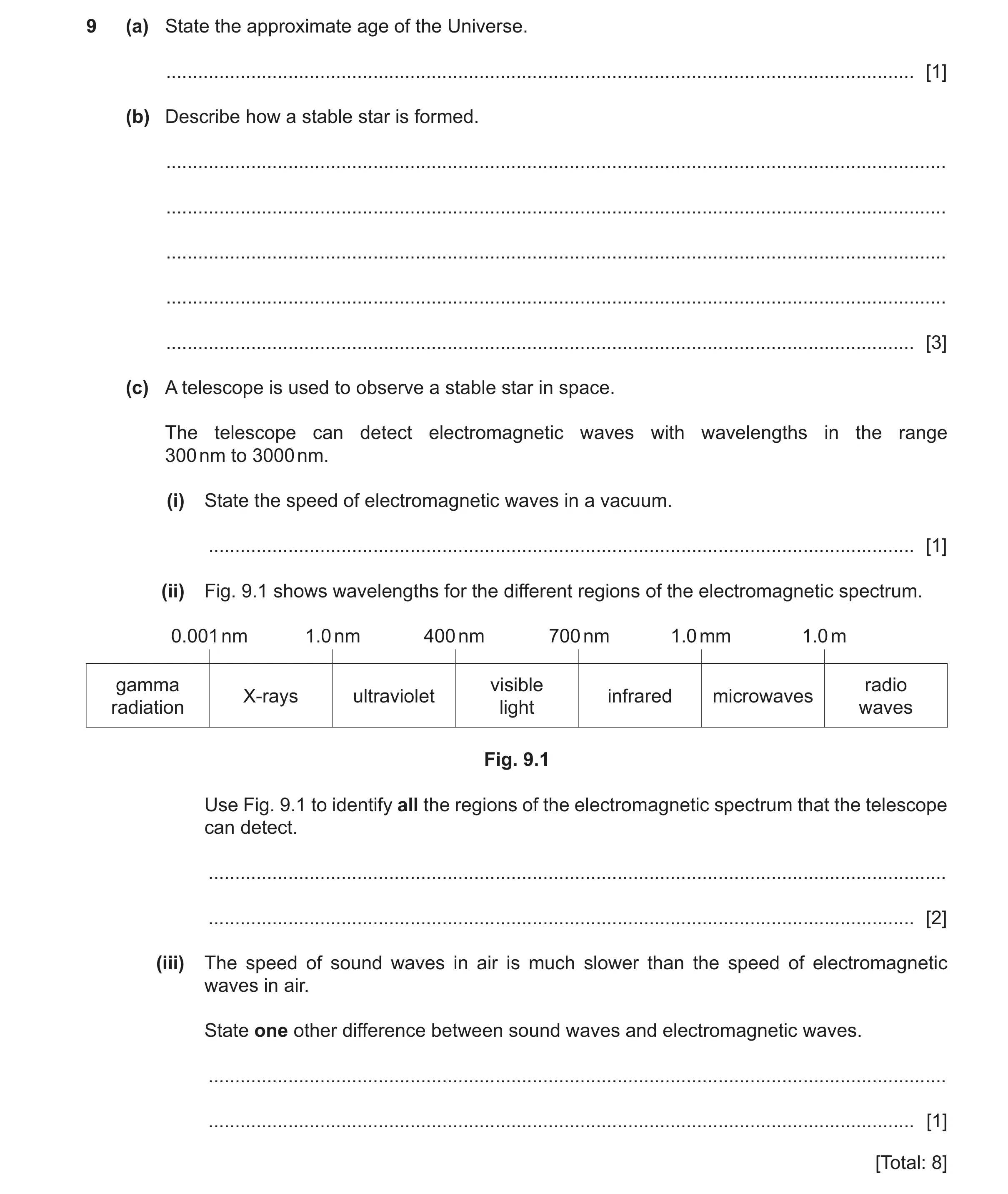
9 (a) State the approximate age of the Universe. … [1] (b) Describe how a stable star is formed. … … … … … [3] (c) A telescope is used to observe a stable star in space. The telescope can detect electromagnetic waves with wavelengths in the range 300 nm to 3000 nm. (i) State the speed of electromagnetic waves in a vacuum. … [1] (ii) Fig. 9.1 shows wavelengths for the different regions of the electromagnetic spectrum. 0.001 nm 1.0 nm 400 nm 700 nm 1.0 mm 1.0 m gamma visible radio X-rays ultraviolet infrared microwaves radiation light waves Fig. 9.1 Use Fig. 9.1 to identify all the regions of the electromagnetic spectrum that the telescope can detect. … … [2] (iii) The speed of sound waves in air is much slower than the speed of electromagnetic waves in air. State one other difference between sound waves and electromagnetic waves. … … [1] [Total: 8]
8 marks
Mark scheme: 9(a) 13.8 billion years ; 1 9(b) any three from: 3 (from interstellar clouds of) gas / dust / a nebula ; due to gravitational attraction ; (stable stars are formed from) protostars ; gravity and pressure are balanced ; 9(c)(i) 3.0 × 10⁸ m / s ; 1 9(c)(ii) ultraviolet ; 2 visible light AND infrared ; 9(c)(iii) sound waves need a medium (such as air) / cannot travel through a vacuum ORA 1 or sound waves are longitudinal waves AND electromagnetic waves are transverse waves ;
This question in 0653/43 May/June 2025
 12 / 46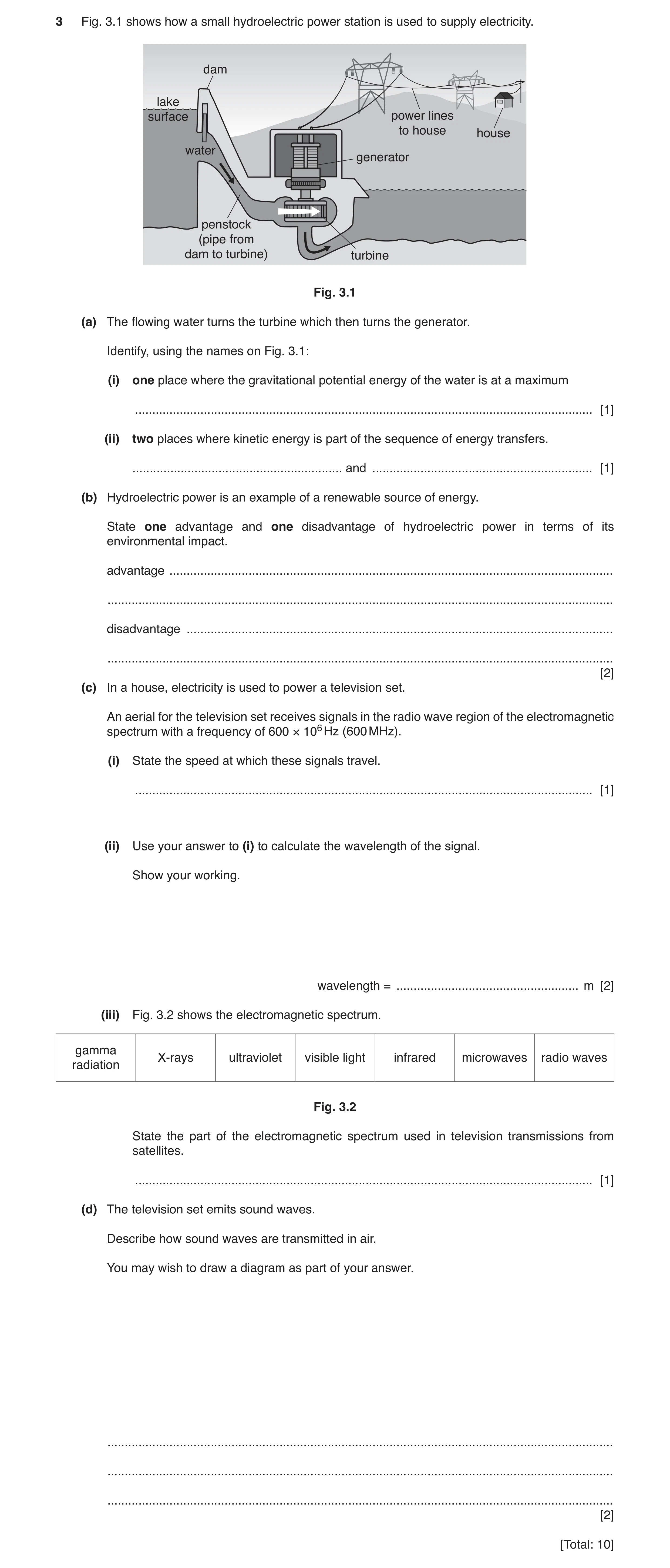
 39 / 46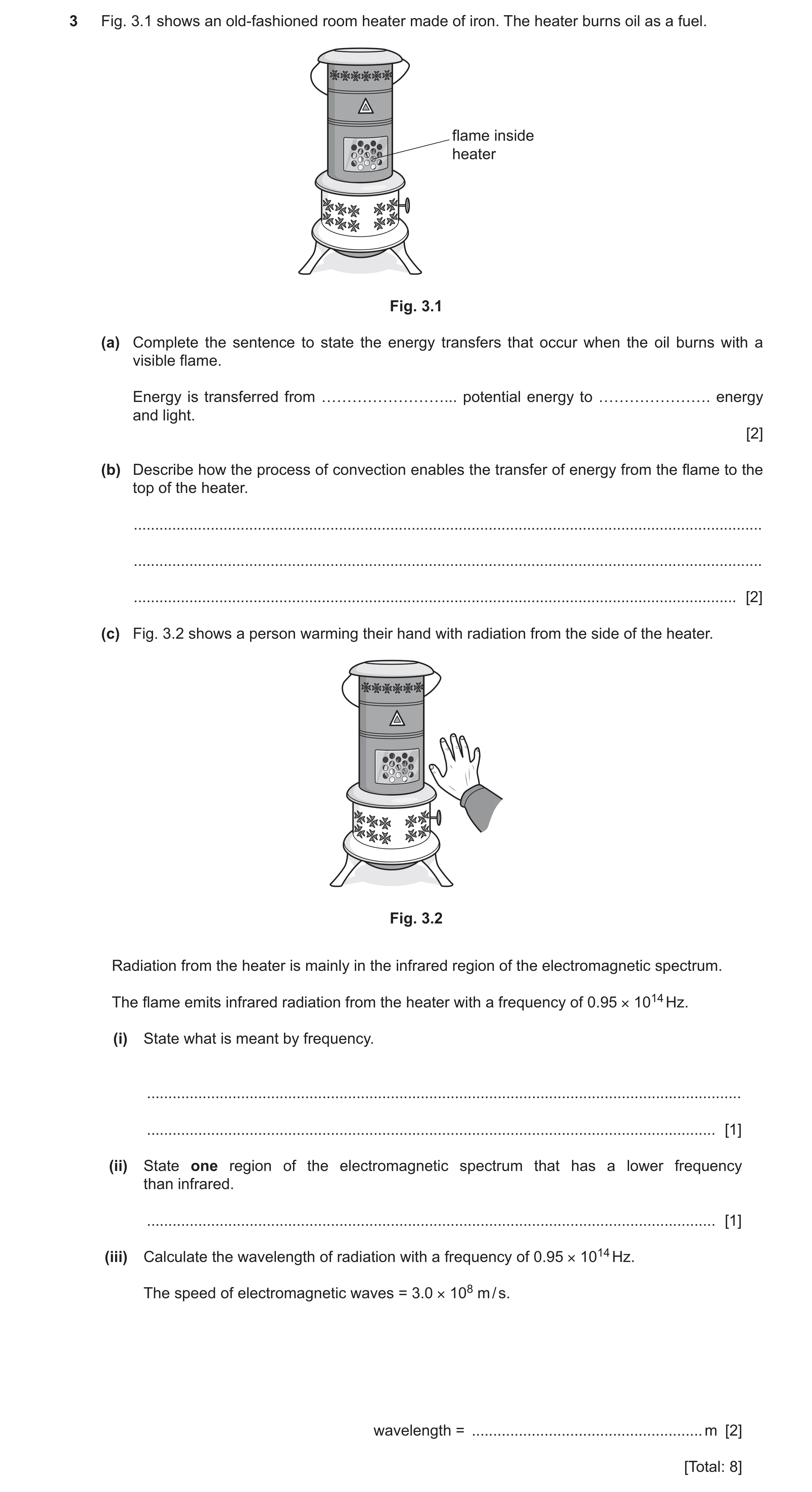
 42 / 46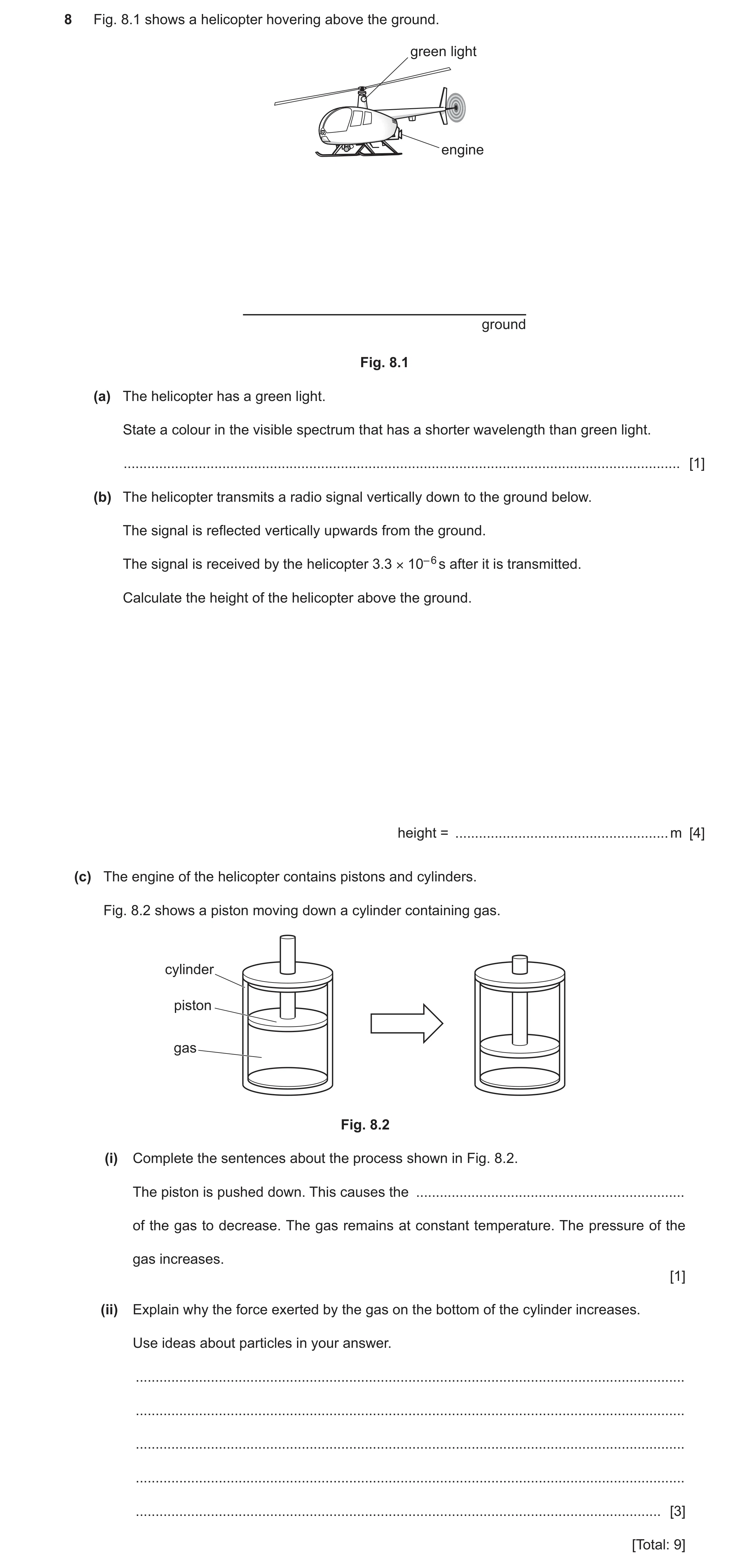
 46 / 46
 11
11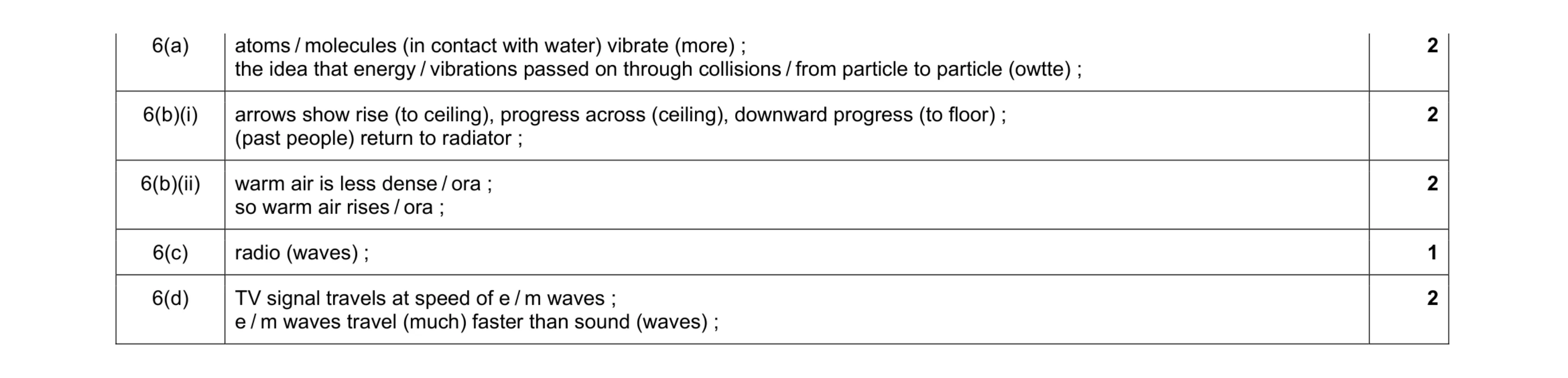 9
9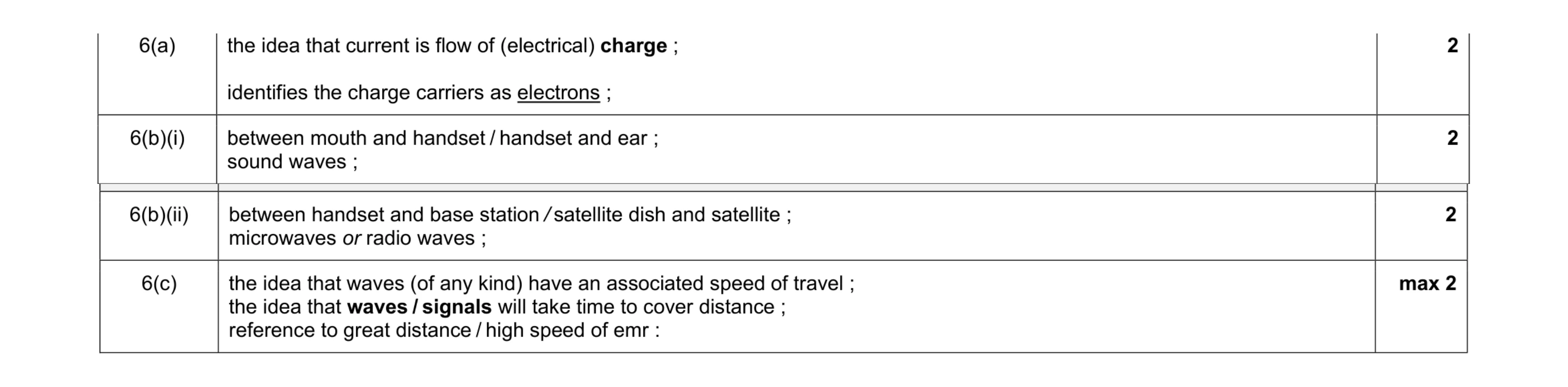 8
8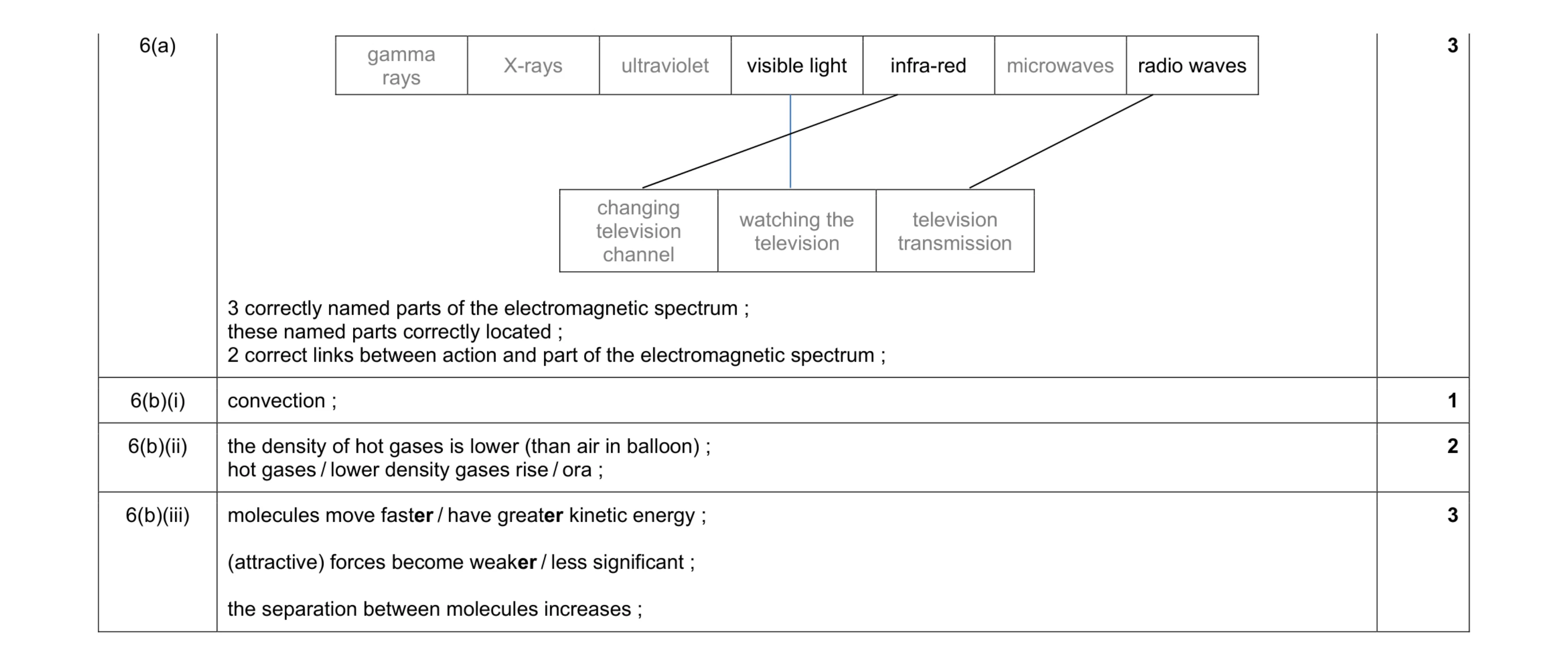 9
9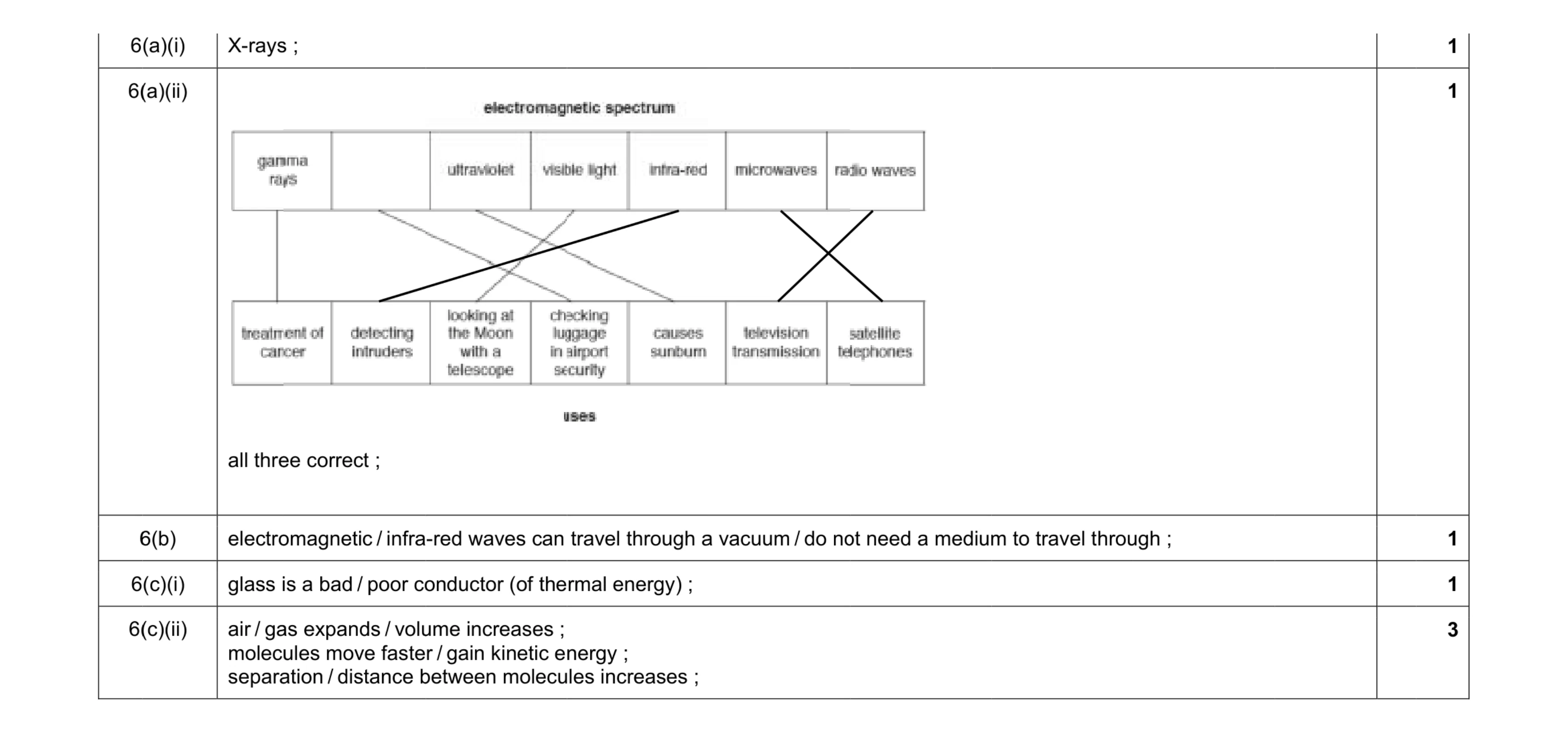 7
7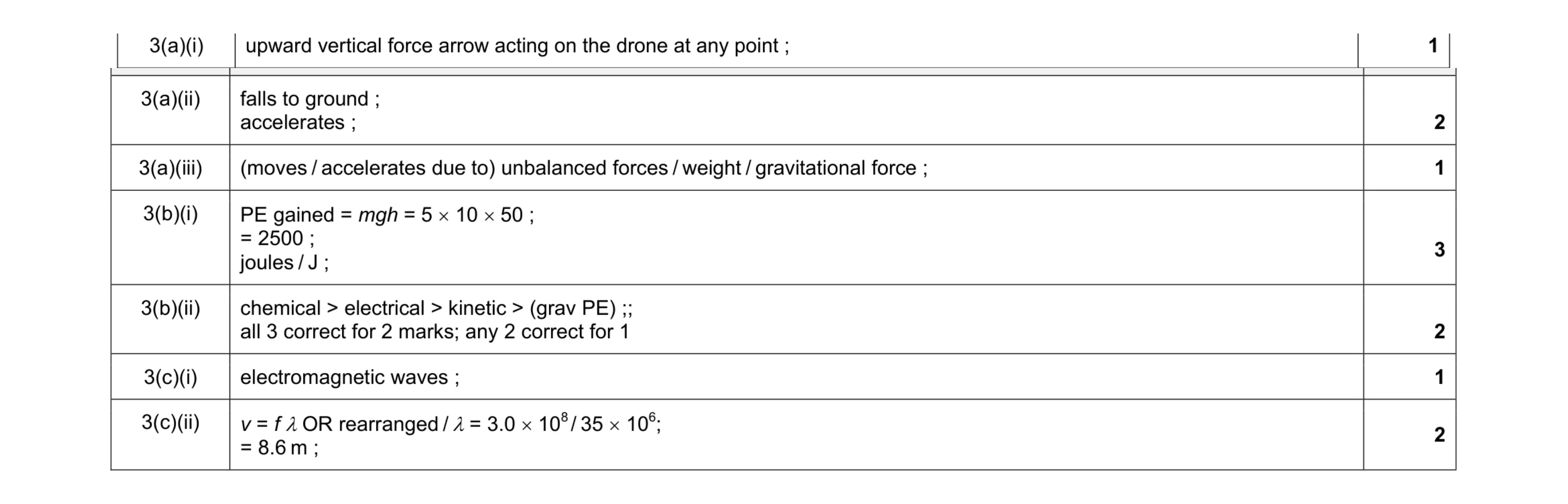 12
12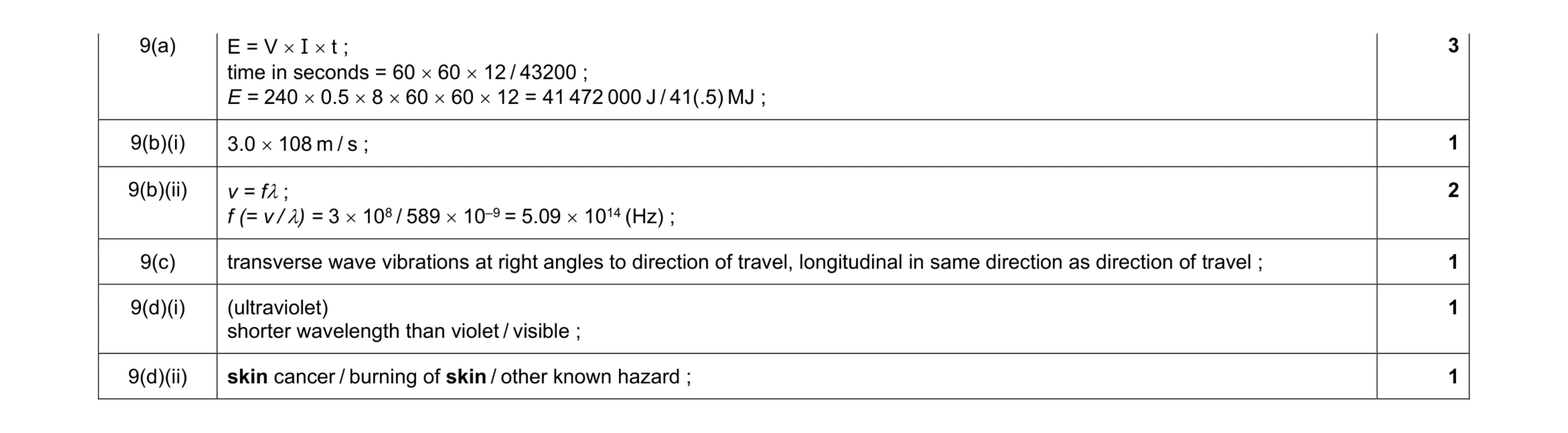 9
9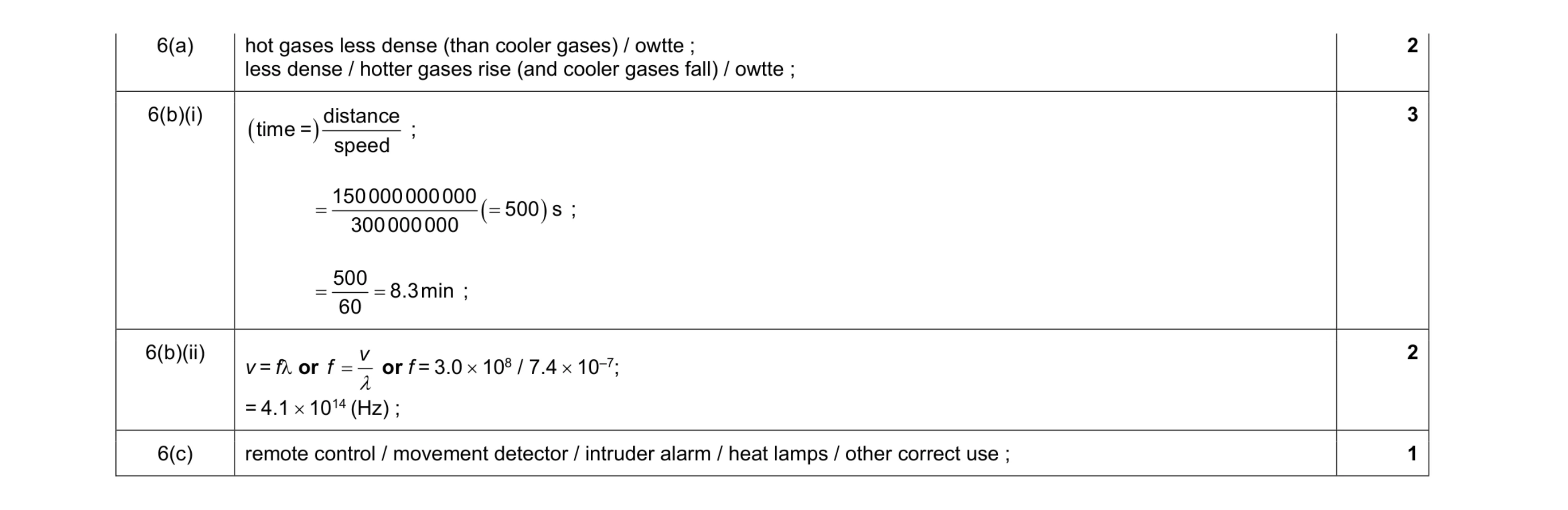 8
8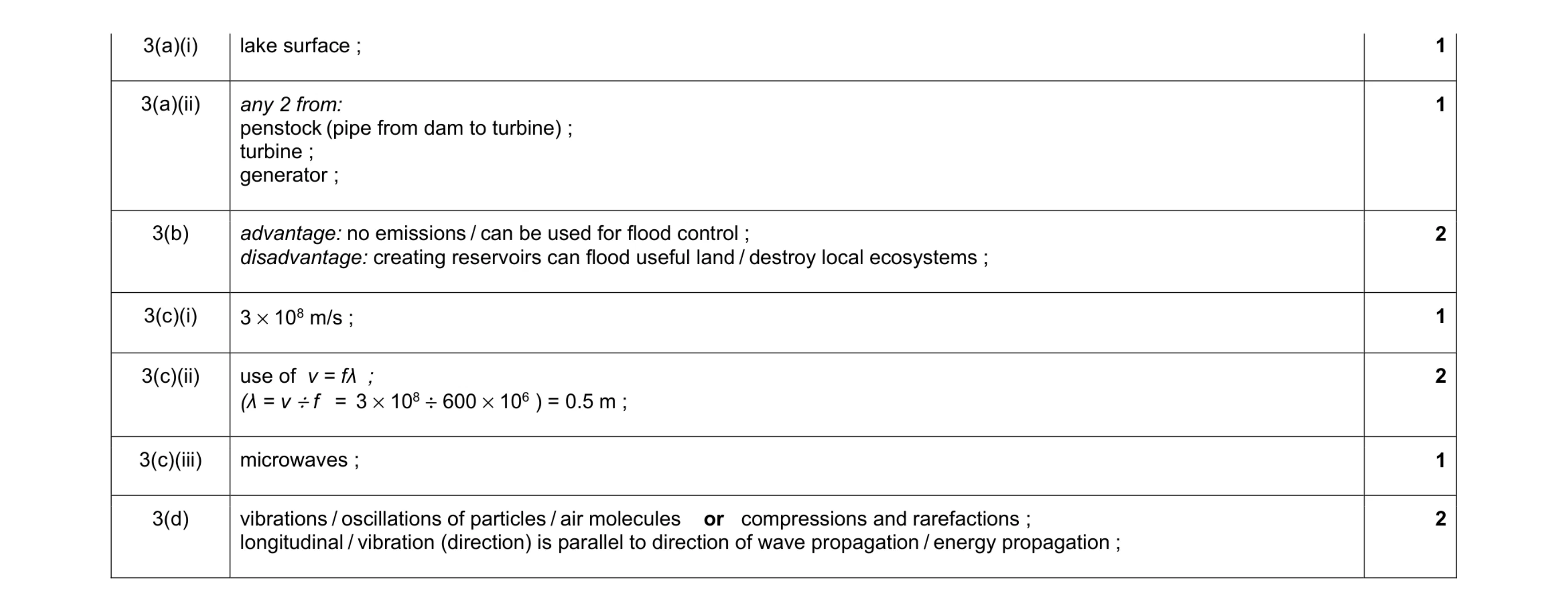 10
10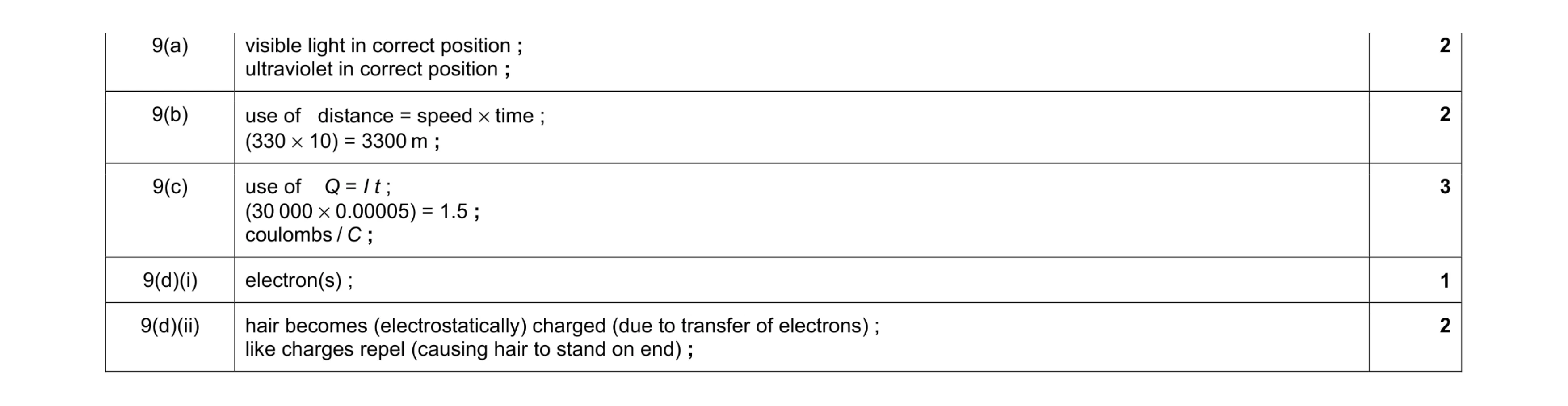 10
10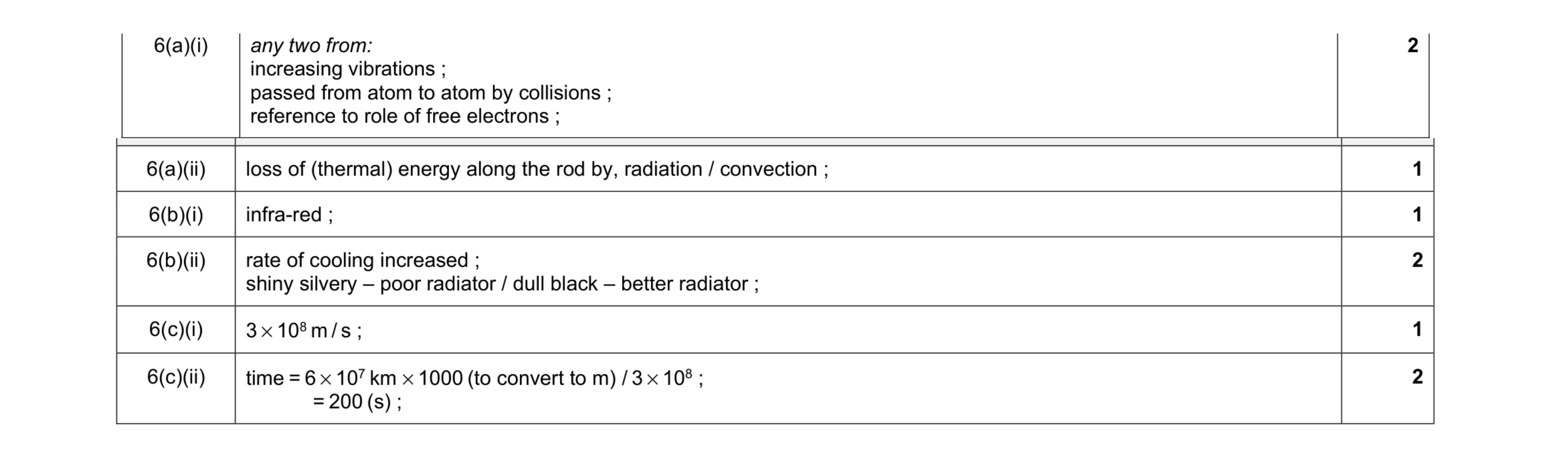 9
9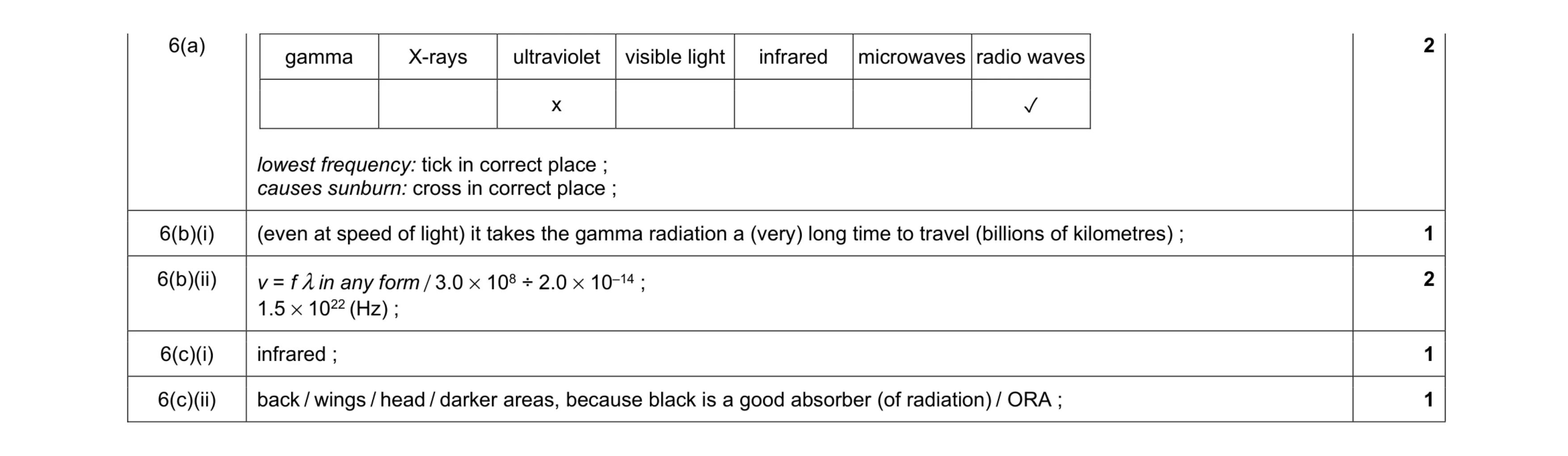 7
7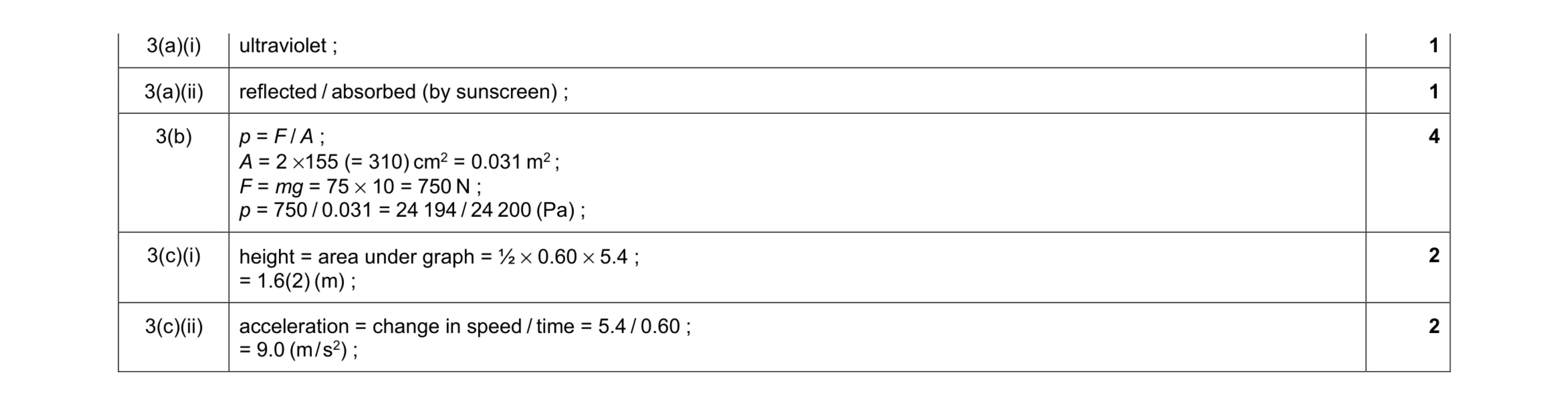 10
10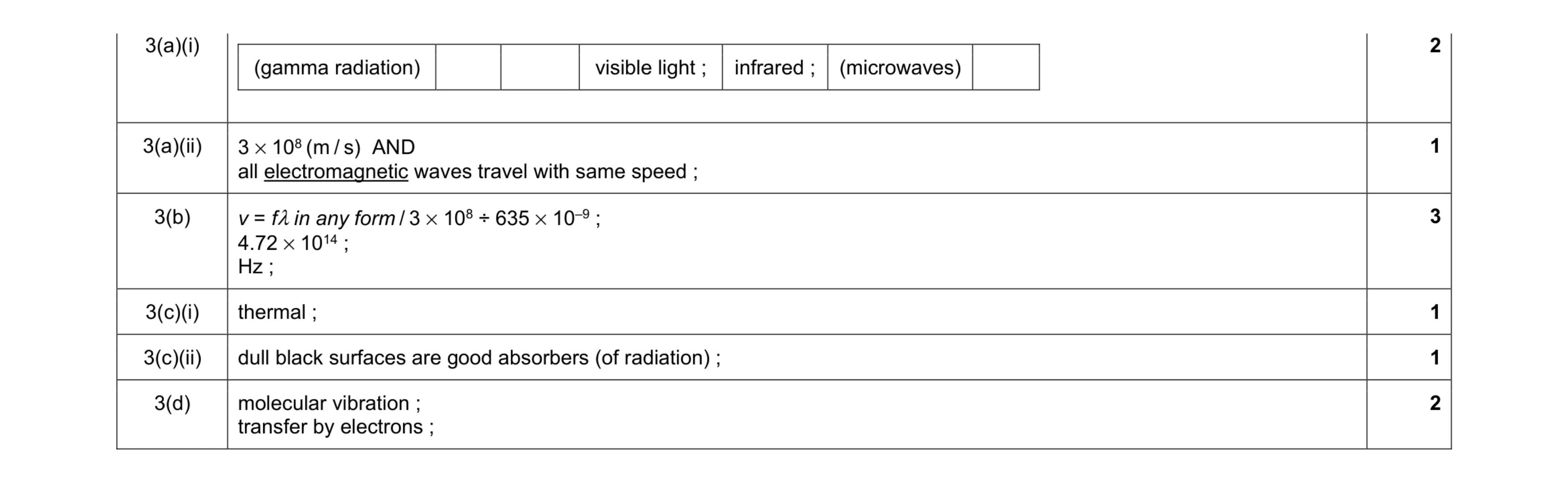 10
10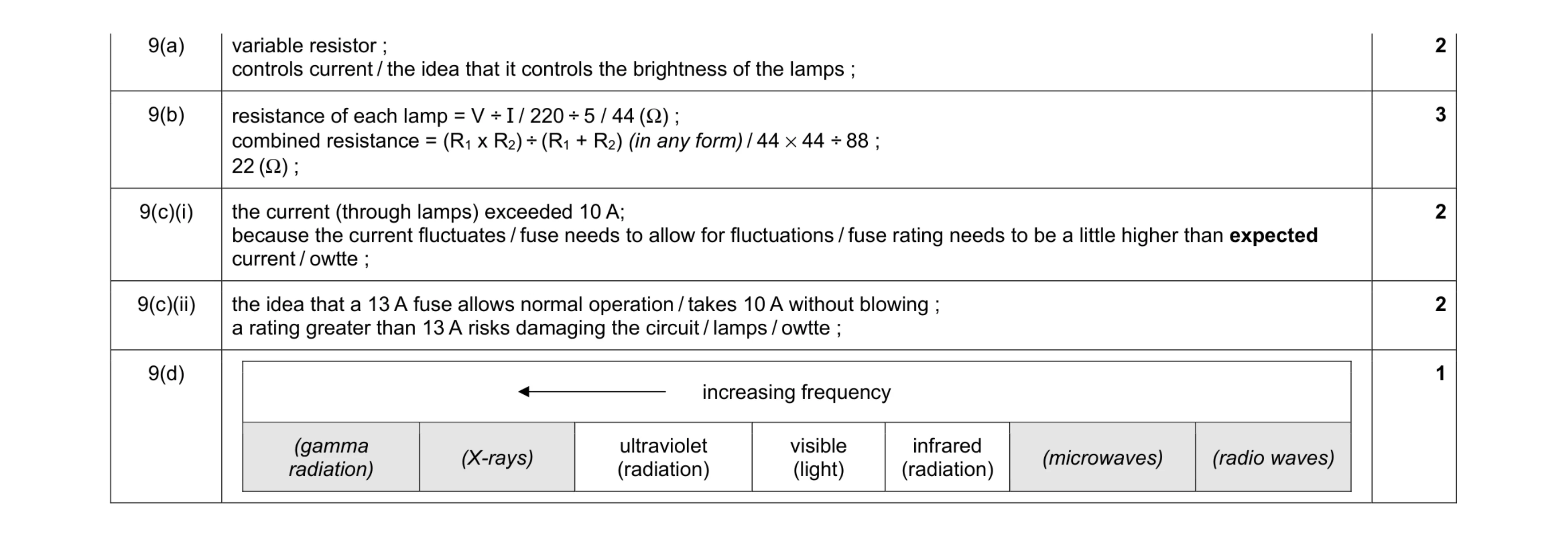 10
10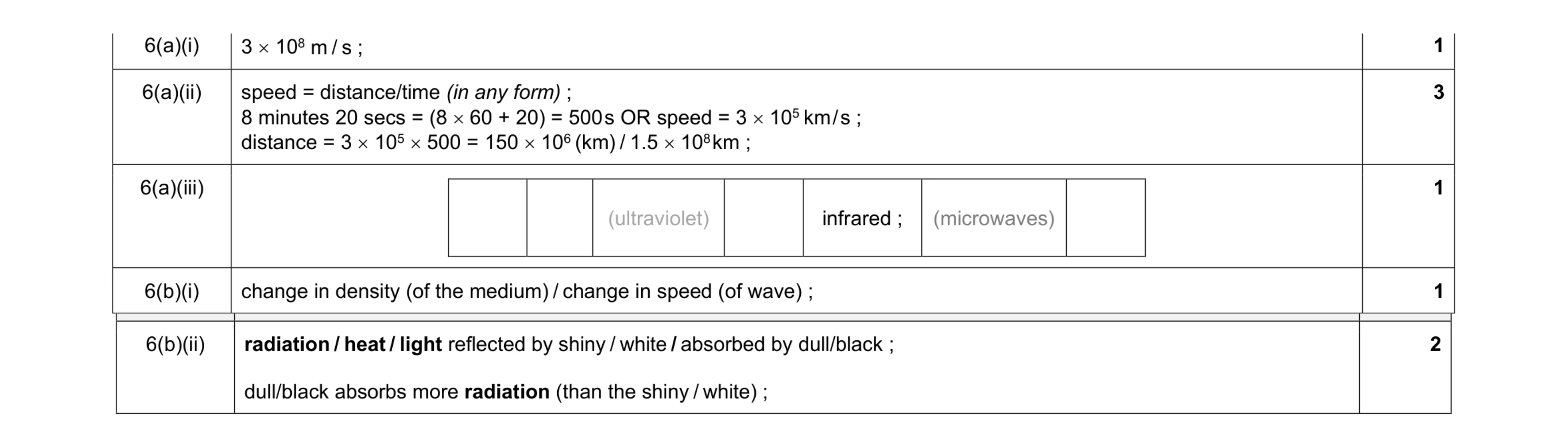 8
8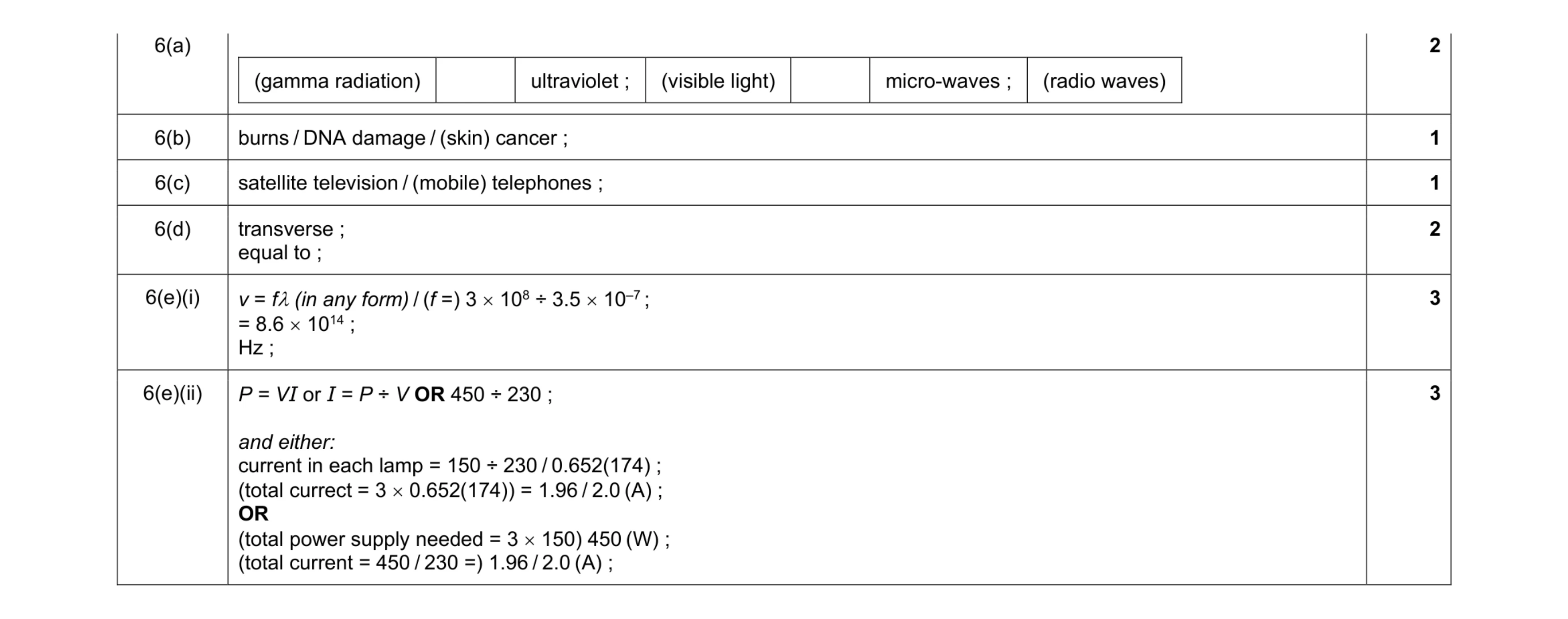 12
12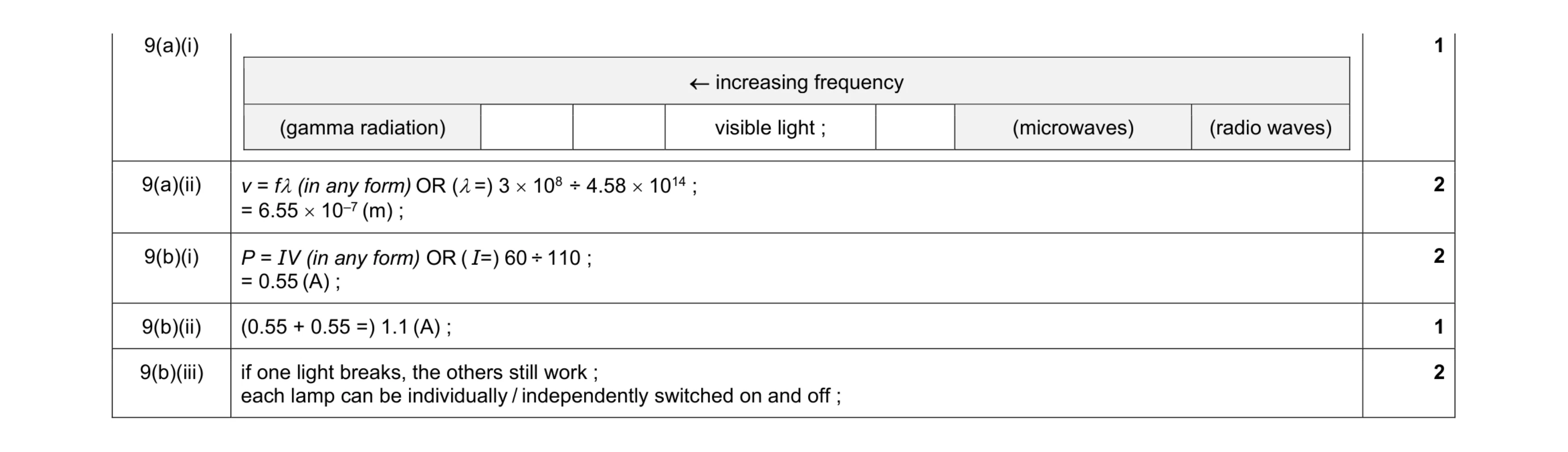 8
8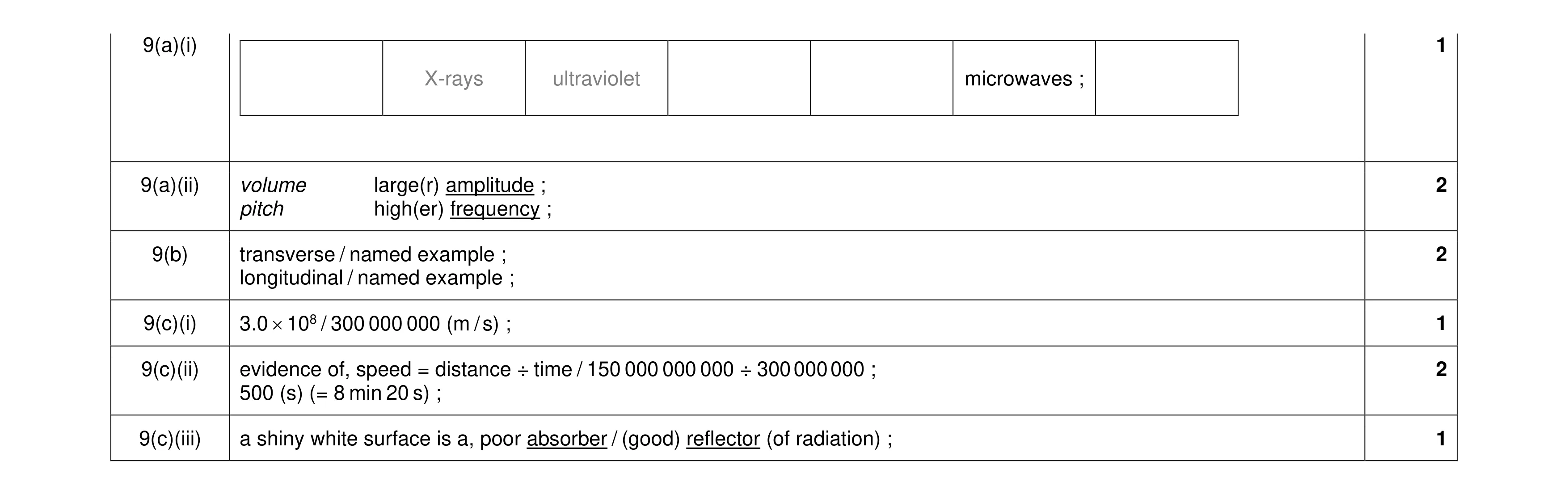 9
9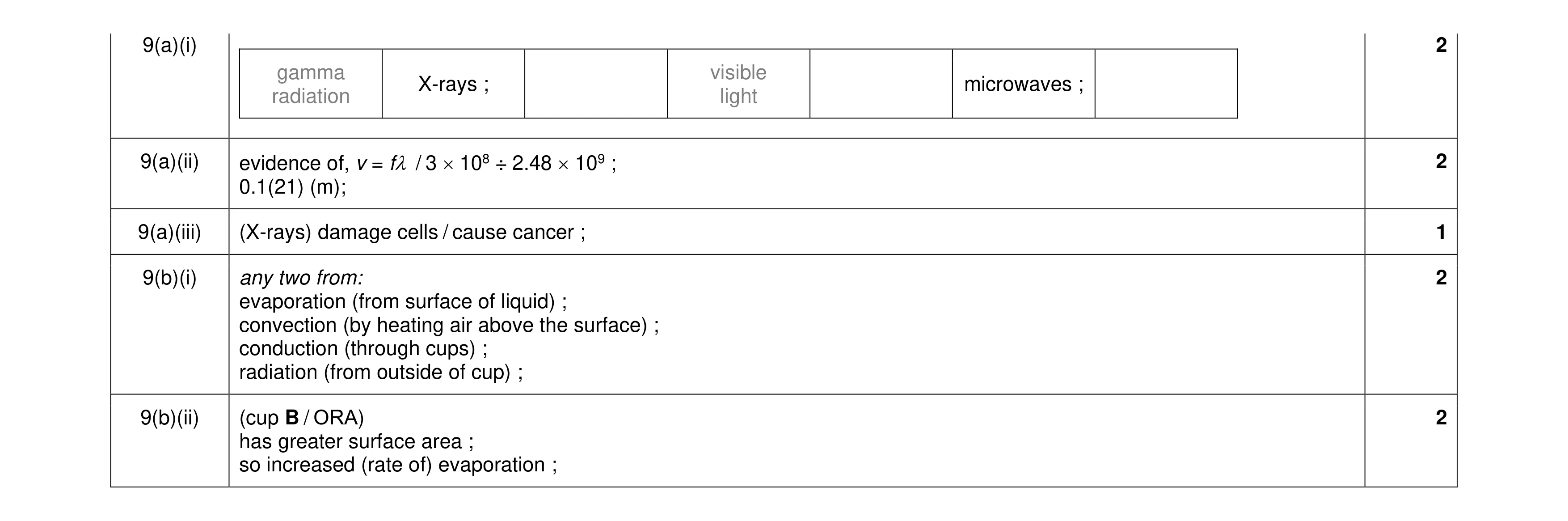 9
9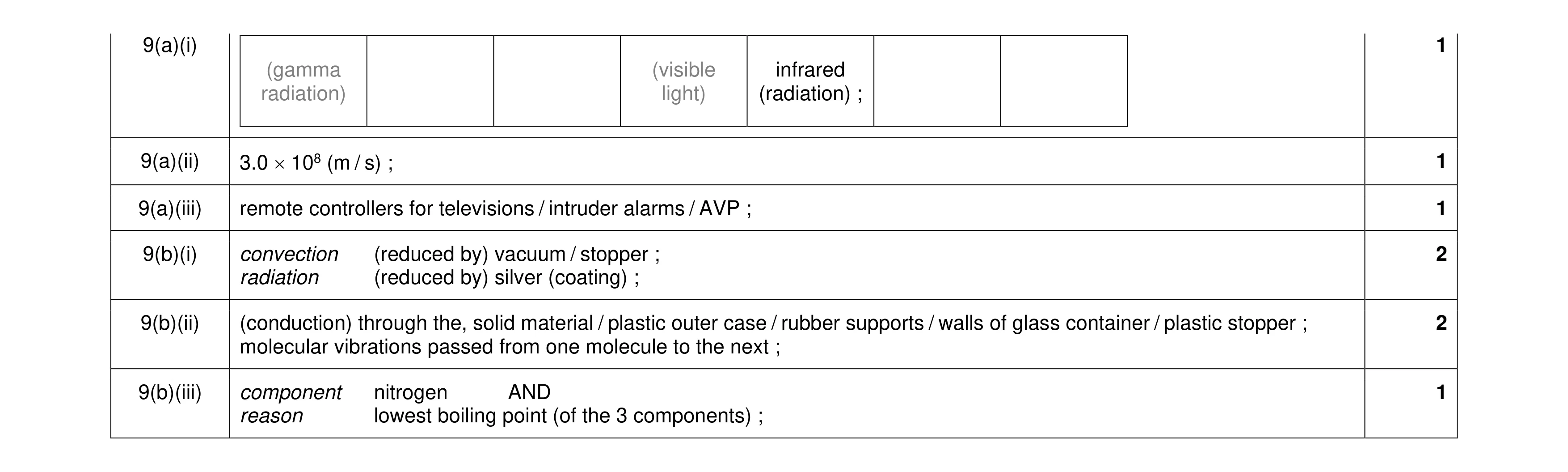 8
8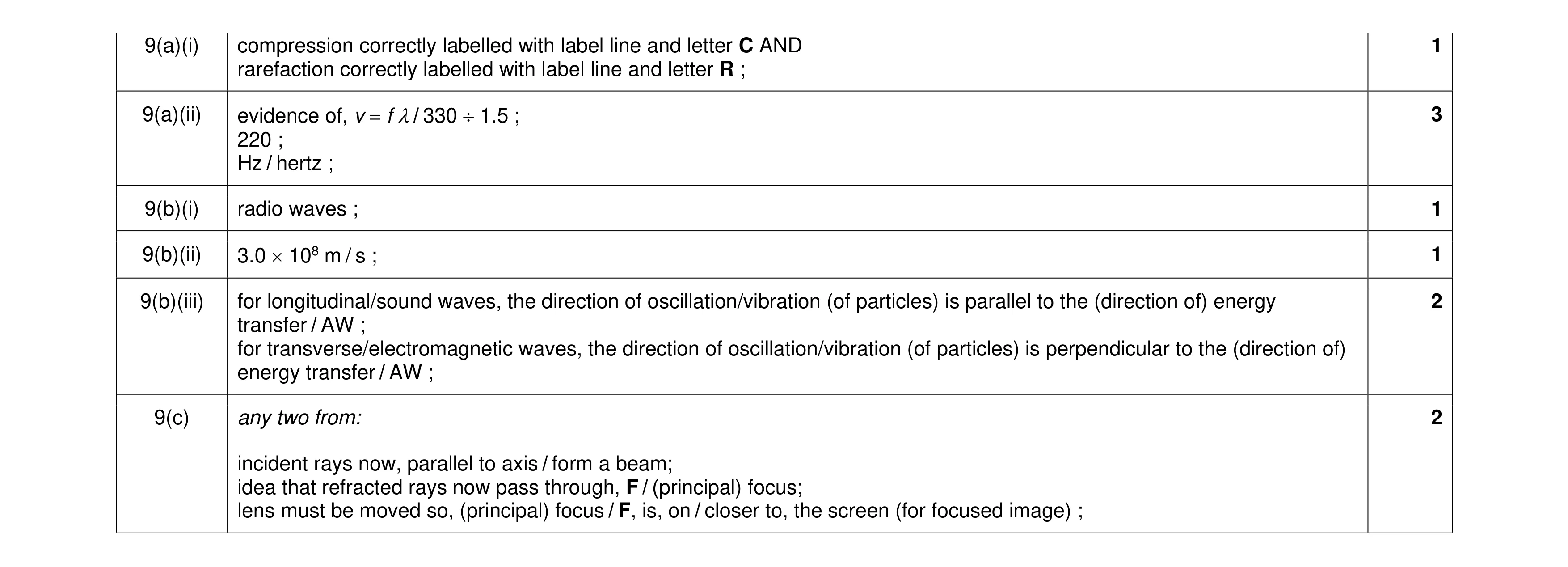 10
10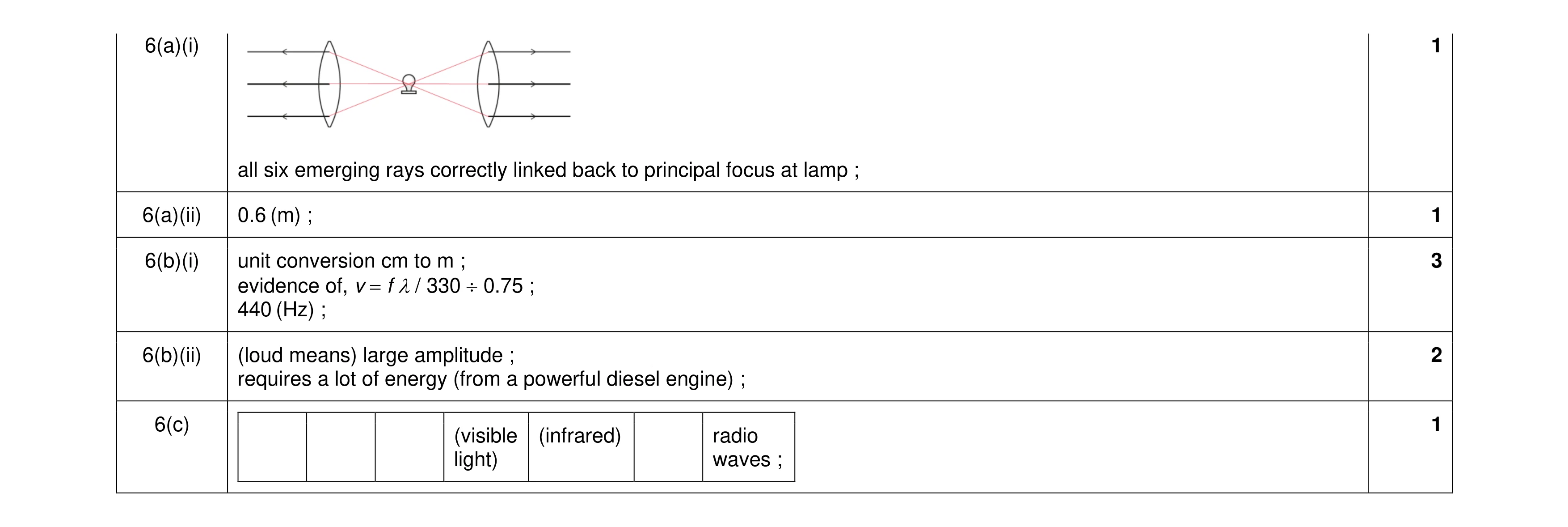 8
8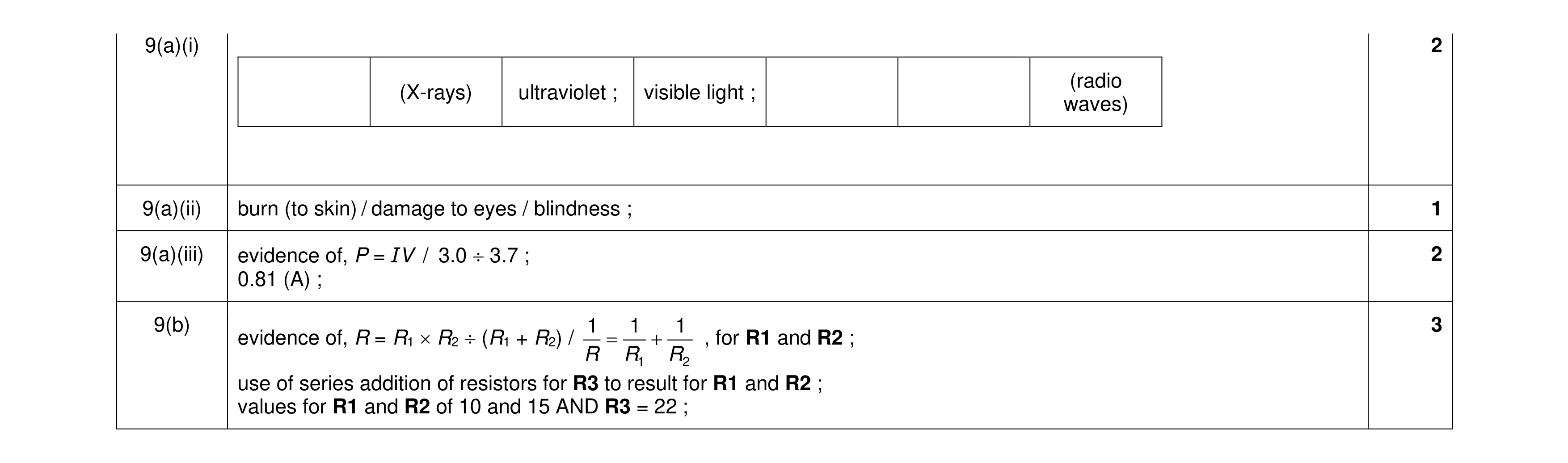 8
8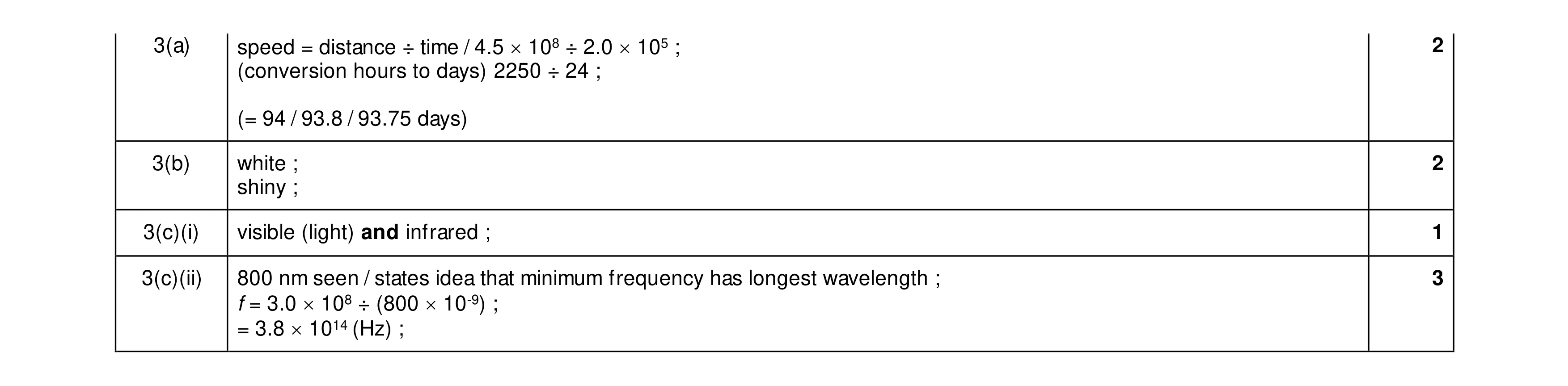 8
8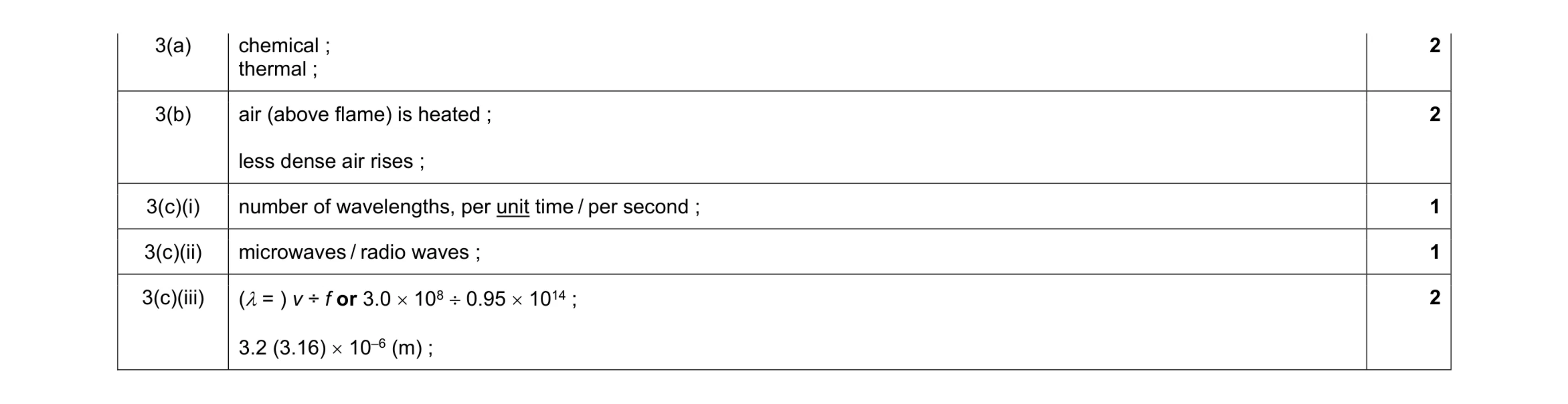 8
8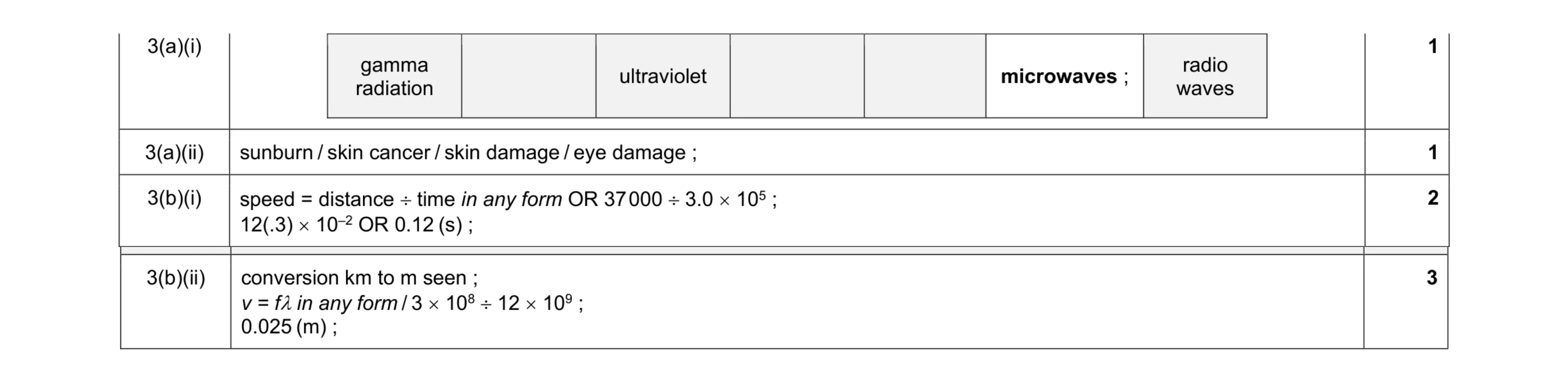 7
7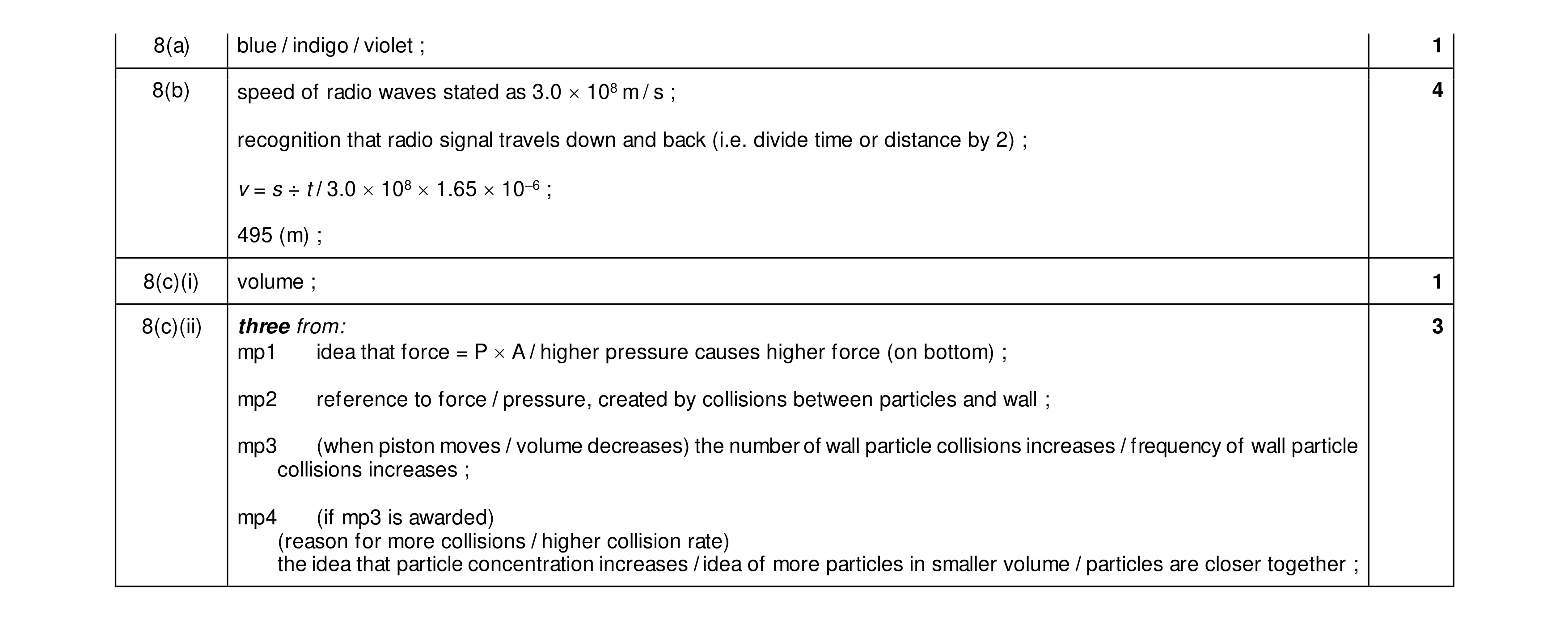 9
9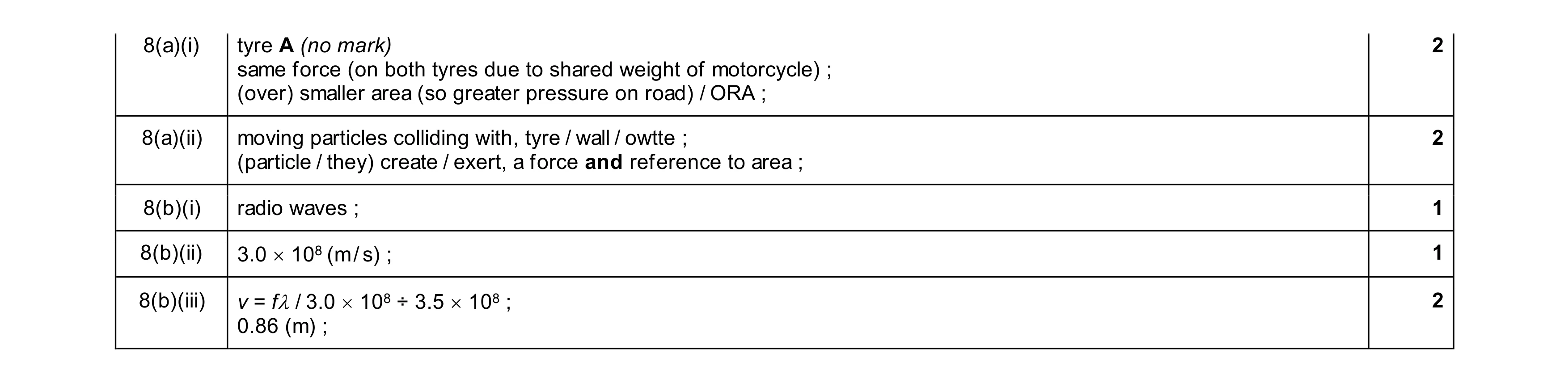 8
8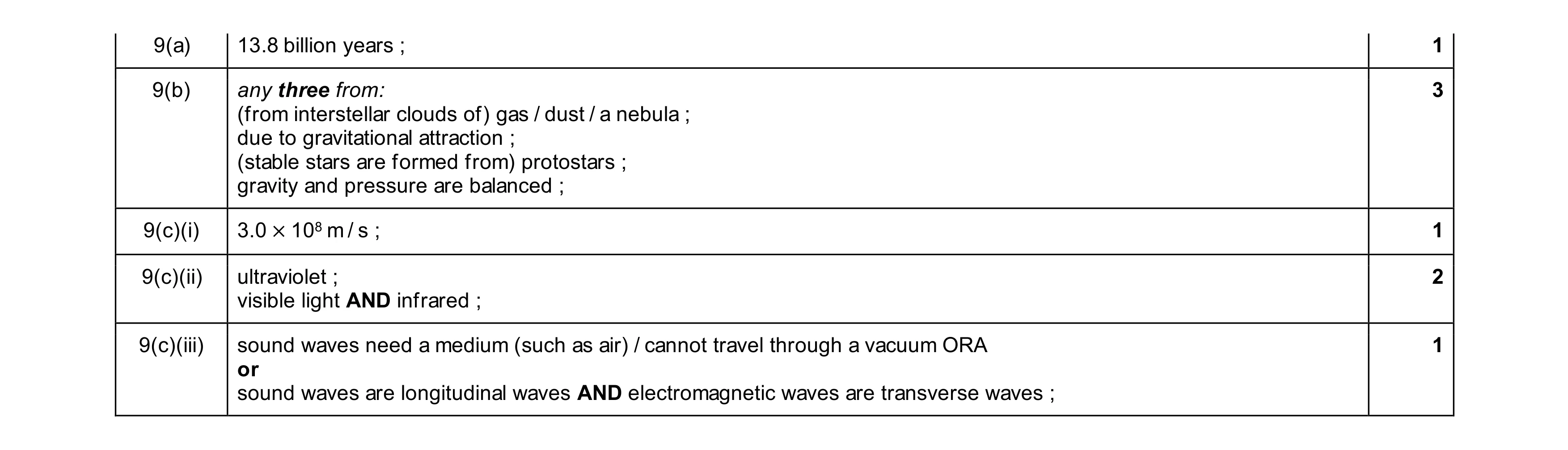 8
8