Cambridge IGCSE Science - Combined 0653 — 2019 Feb/March Paper 3 · Variant 2
0653/32/F/M/19 · 9 questions · 80 marks · ≈90 min
The question paper and its mark scheme, free to read here and free to download. This is Cambridge’s own paper, exactly as it was sat.
Question paper20 pages
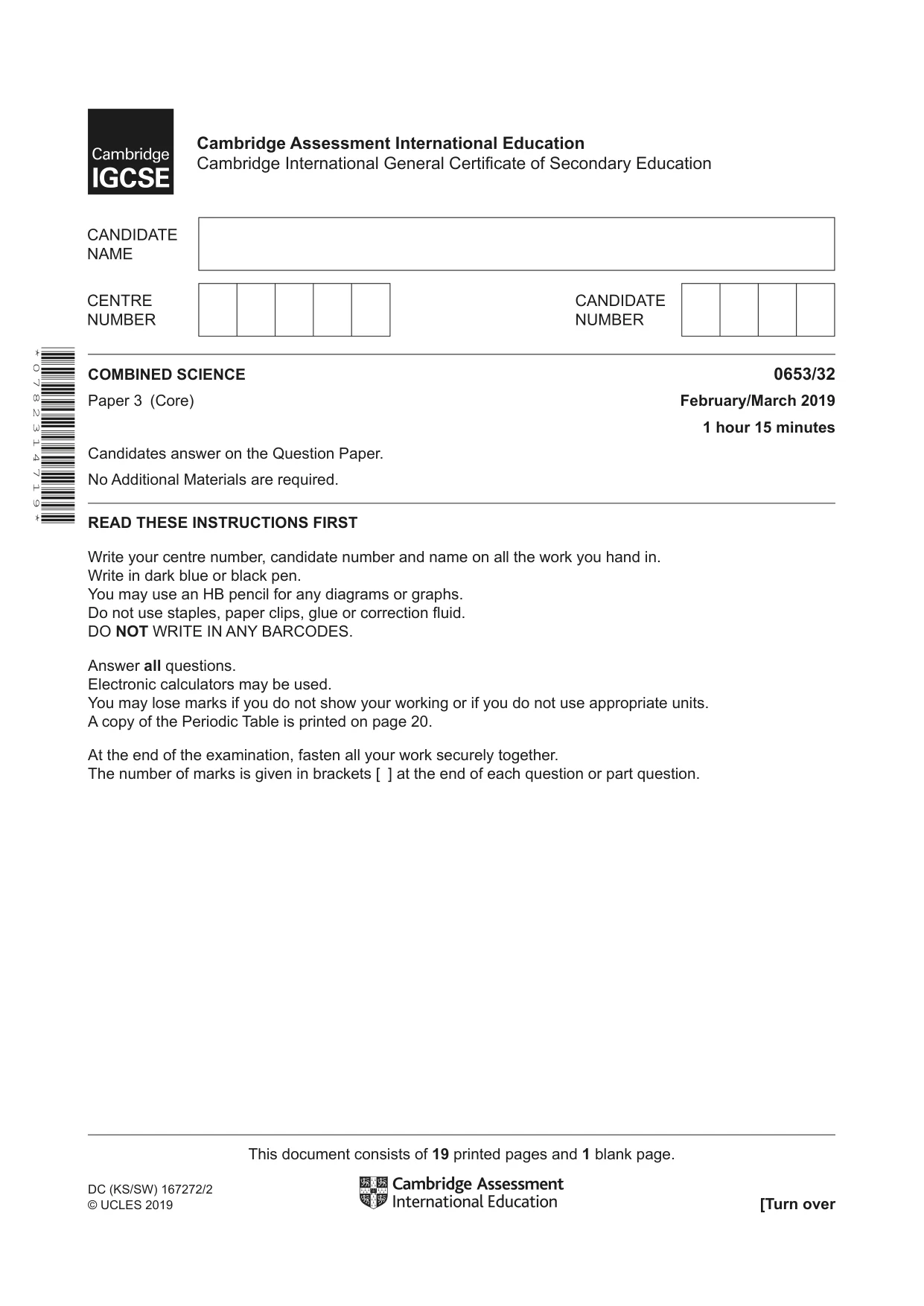

Mark scheme9 pages
Answers below. Sit the paper first if you are practising.
Questions as text
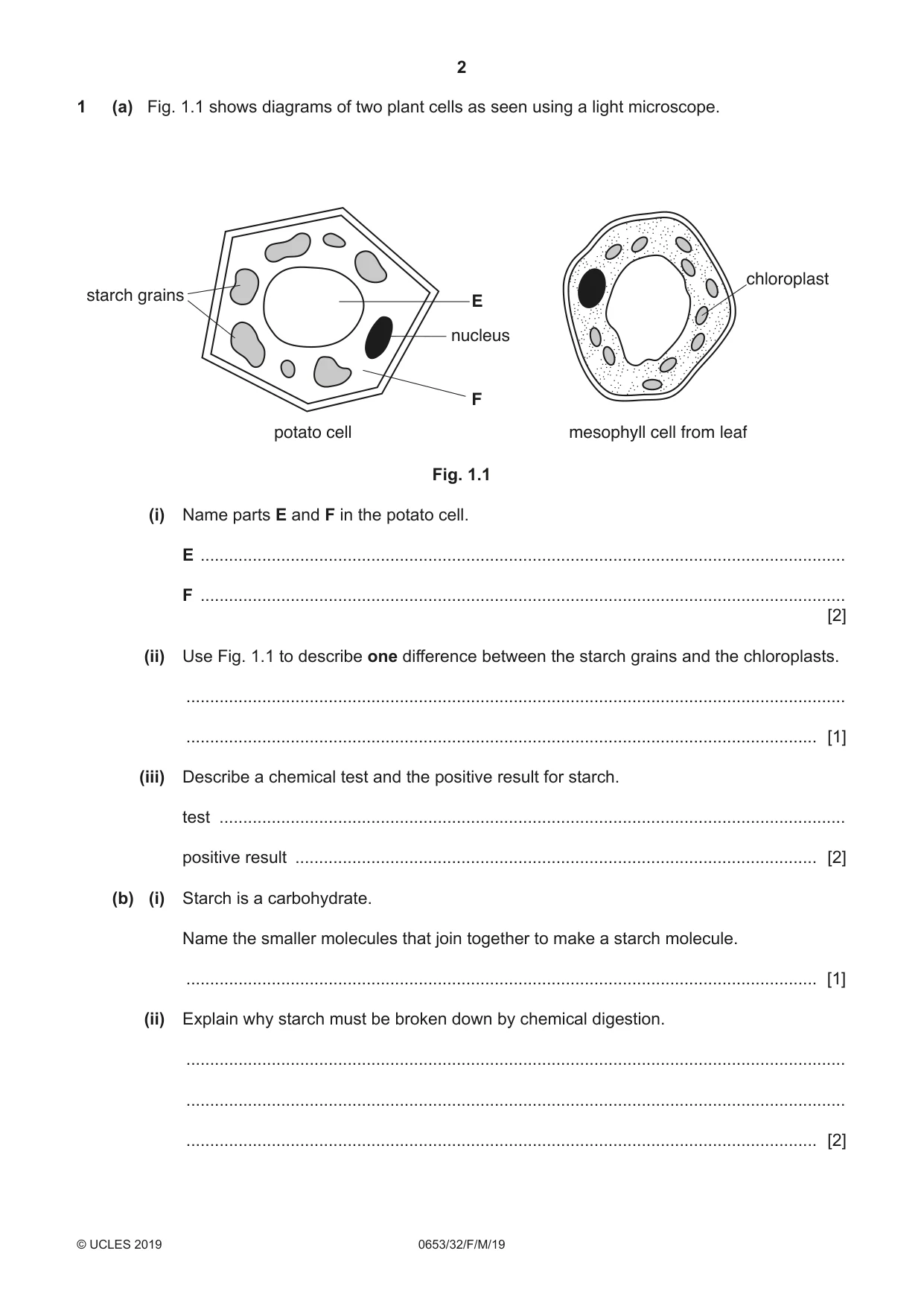
Q1 · Diagrams of two plant cells as seen using a light microscope
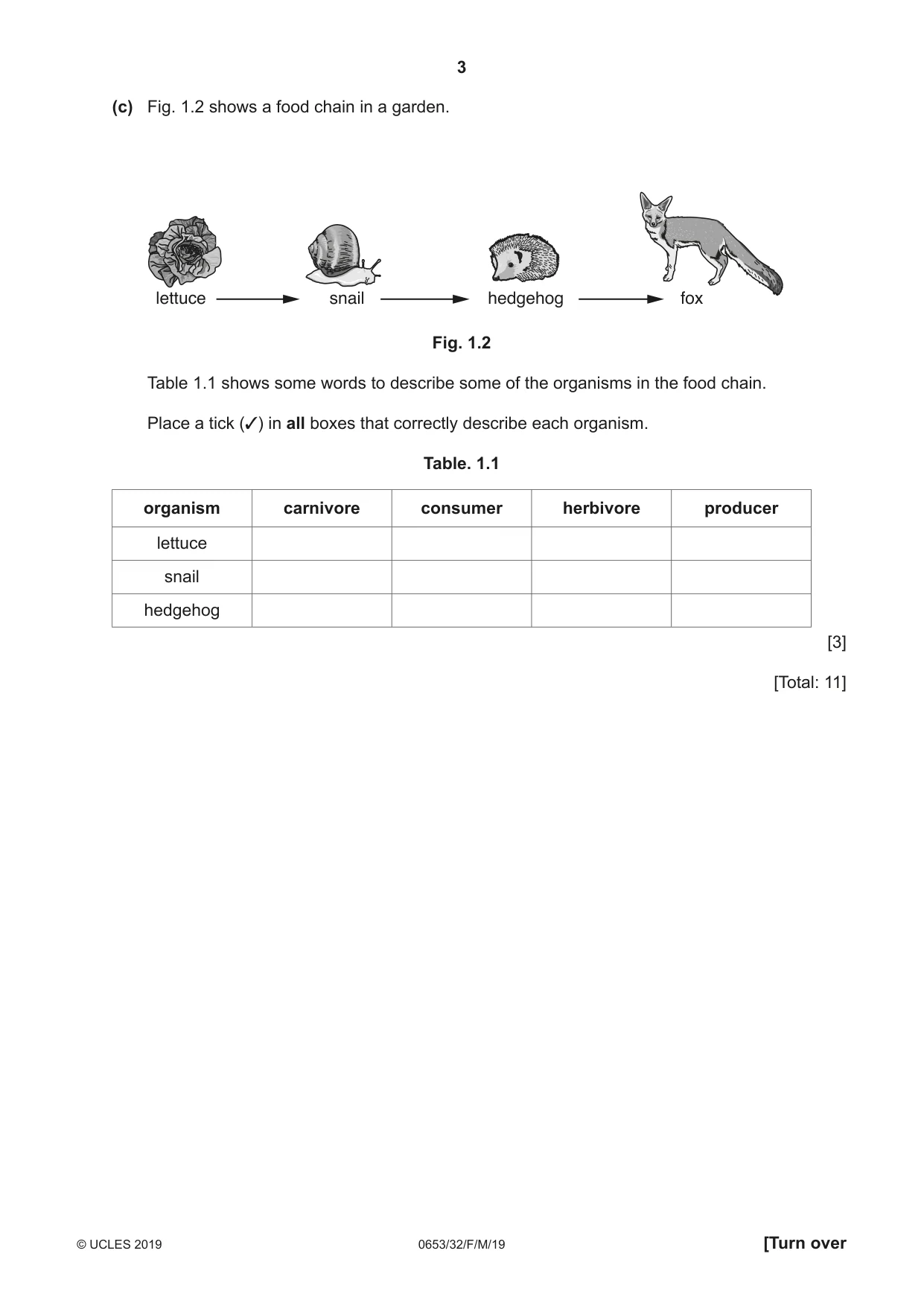
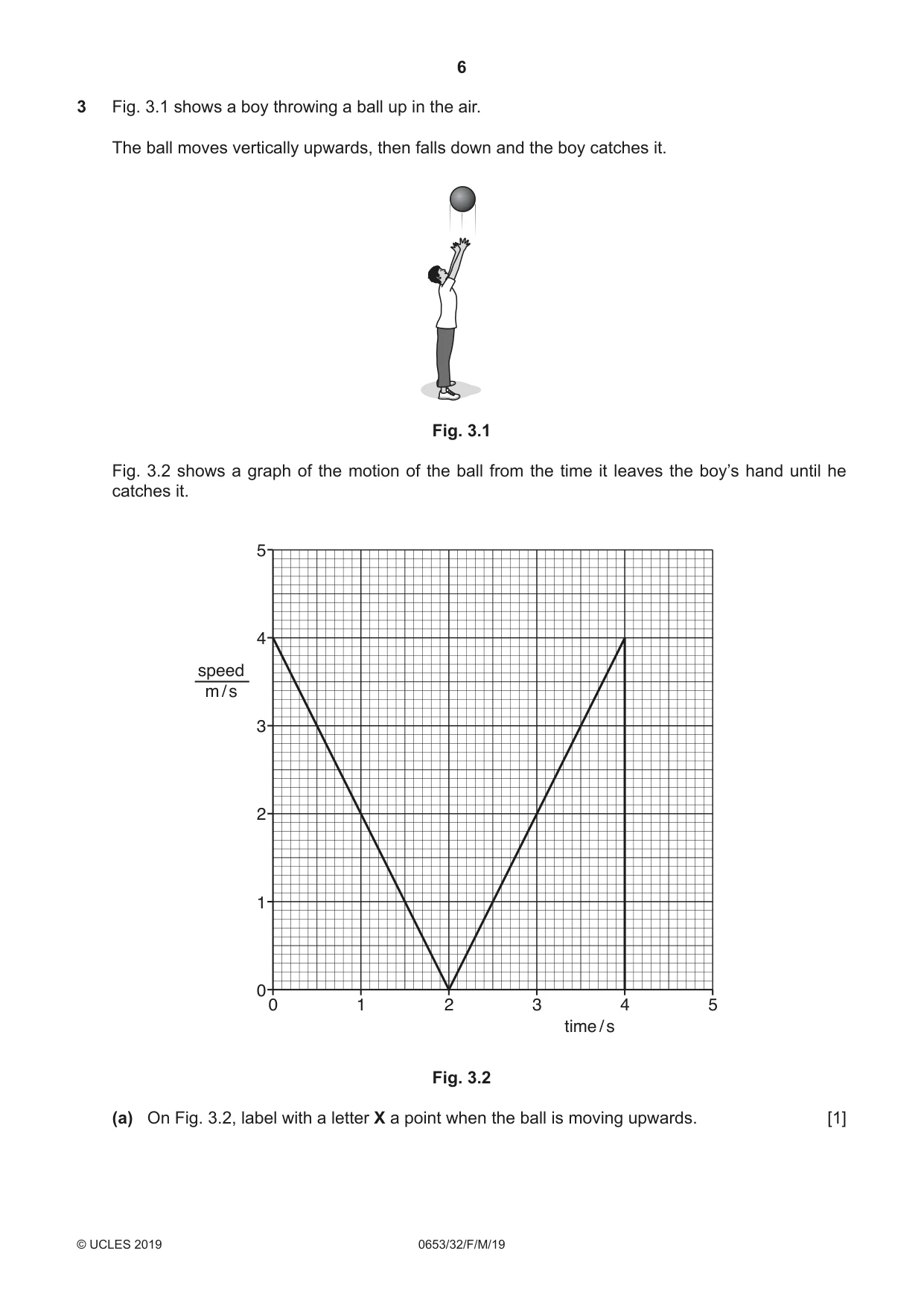
1 (a) Fig. 1.1 shows diagrams of two plant cells as seen using a light microscope. chloroplast starch grains E nucleus F potato cell mesophyll cell from leaf Fig. 1.1 (i) Name parts E and F in the potato cell. E ........................................................................................................................................ F ........................................................................................................................................ [2] (ii) Use Fig. 1.1 to describe one difference between the starch grains and the chloroplasts. ........................................................................................................................................... ..................................................................................................................................... [1] (iii) Describe a chemical test and the positive result for starch. test .................................................................................................................................... positive result .............................................................................................................. [2] (b) (i) Starch is a carbohydrate. Name the smaller molecules that join together to make a starch molecule. ..................................................................................................................................... [1] (ii) Explain why starch must be broken down by chemical digestion. ........................................................................................................................................... ........................................................................................................................................... ..................................................................................................................................... [2] (c) Fig. 1.2 shows a food chain in a garden. lettuce snail hedgehog fox Fig. 1.2 Table 1.1 shows some words to describe some of the organisms in the food chain. Place a tick (✓) in all boxes that correctly describe each organism. Table. 1.1 organism carnivore consumer herbivore producer lettuce snail hedgehog [3] [Total: 11]
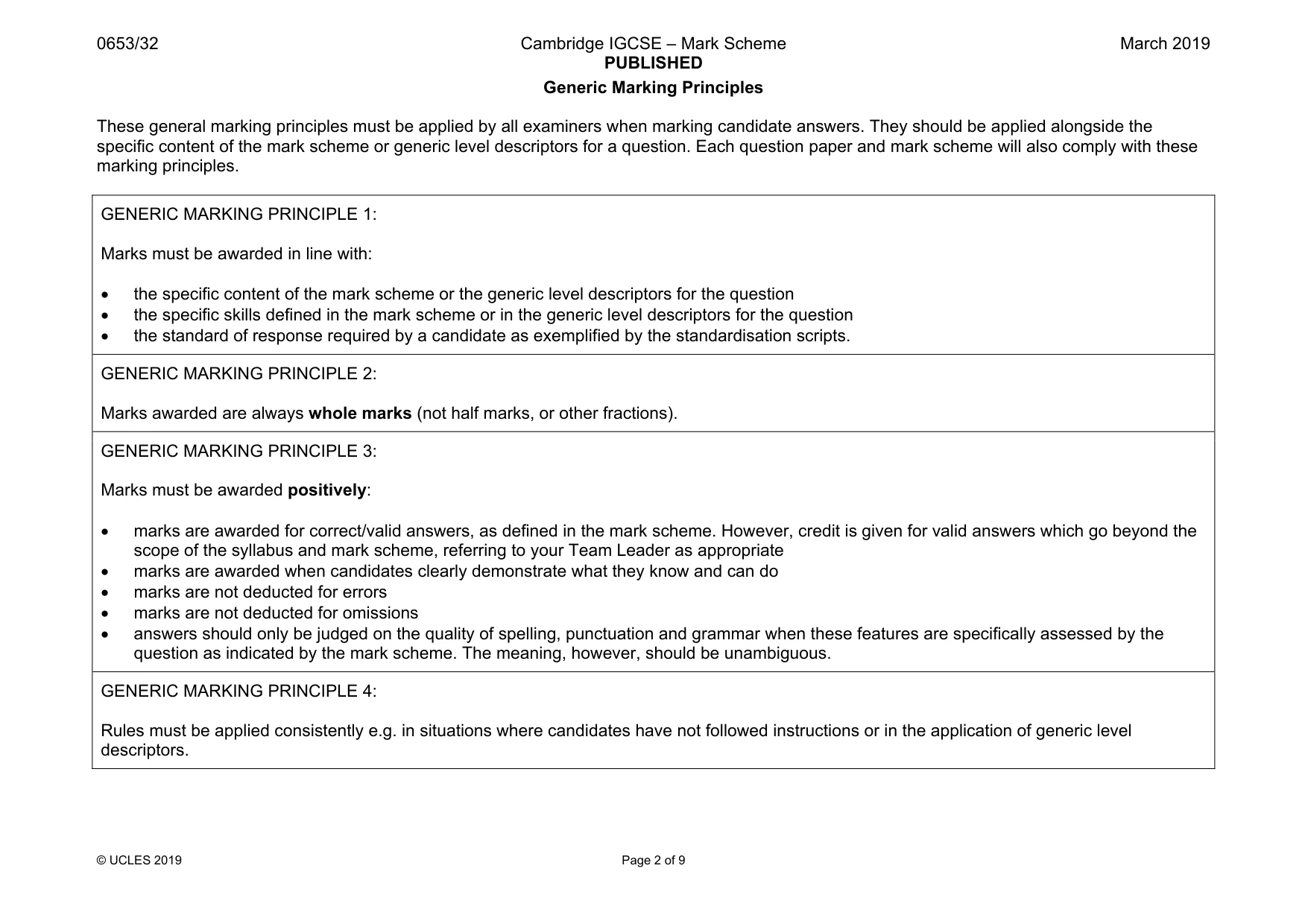
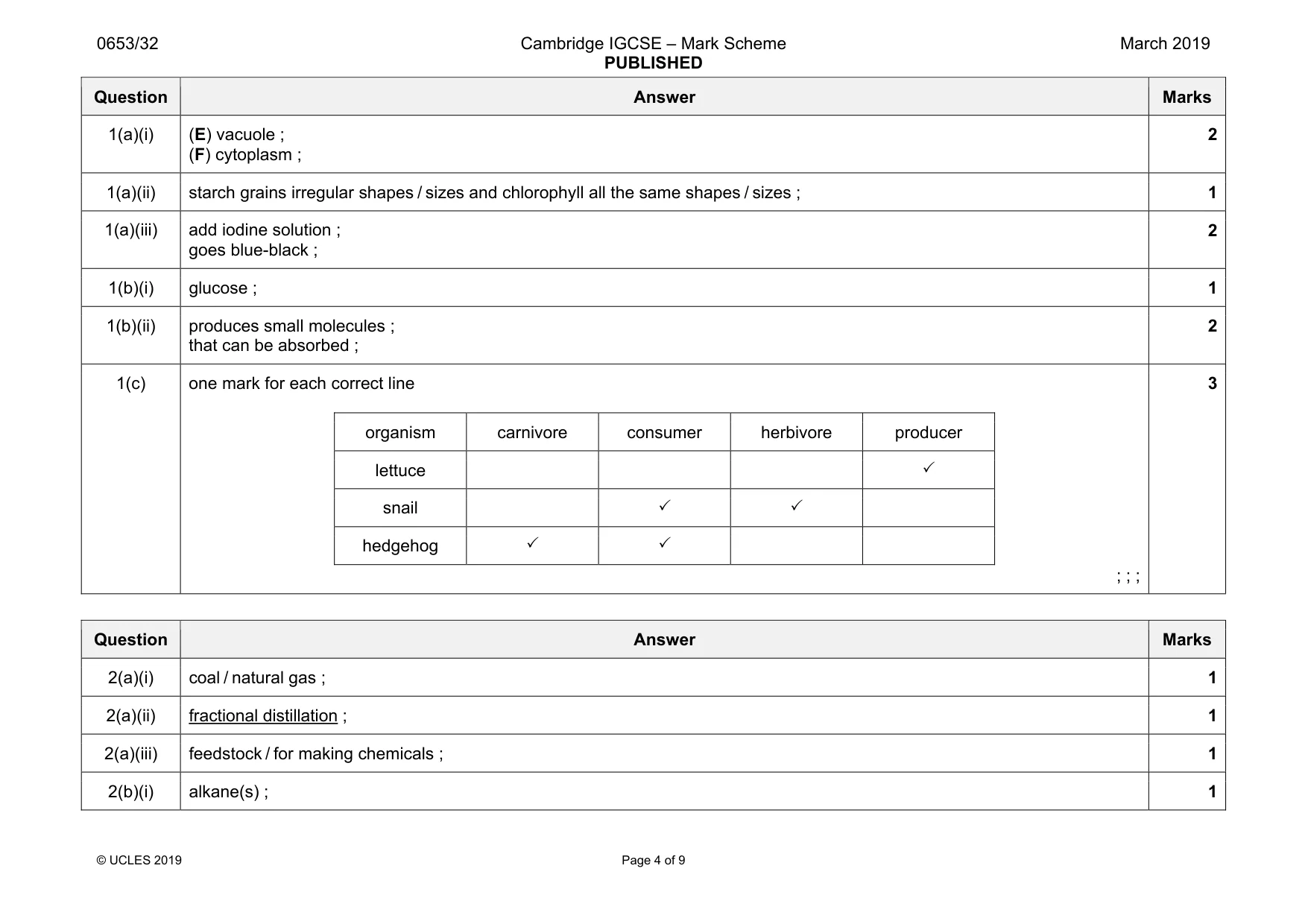
Mark scheme: 1(a)(i) (E) vacuole ; (F) cytoplasm ; 2 1(a)(ii) starch grains irregular shapes / sizes and chlorophyll all the same shapes / sizes ; 1 1(a)(iii) add iodine solution ; goes blue-black ; 2 1(b)(i) glucose ; 1 1(b)(ii) produces small molecules ; that can be absorbed ; 2 1(c) one mark for each correct line organism carnivore consumer herbivore producer lettuce 3 snail 3 3 hedgehog 3 3 ; ; ; 3
Q2 · Petroleum is a fossil fuel
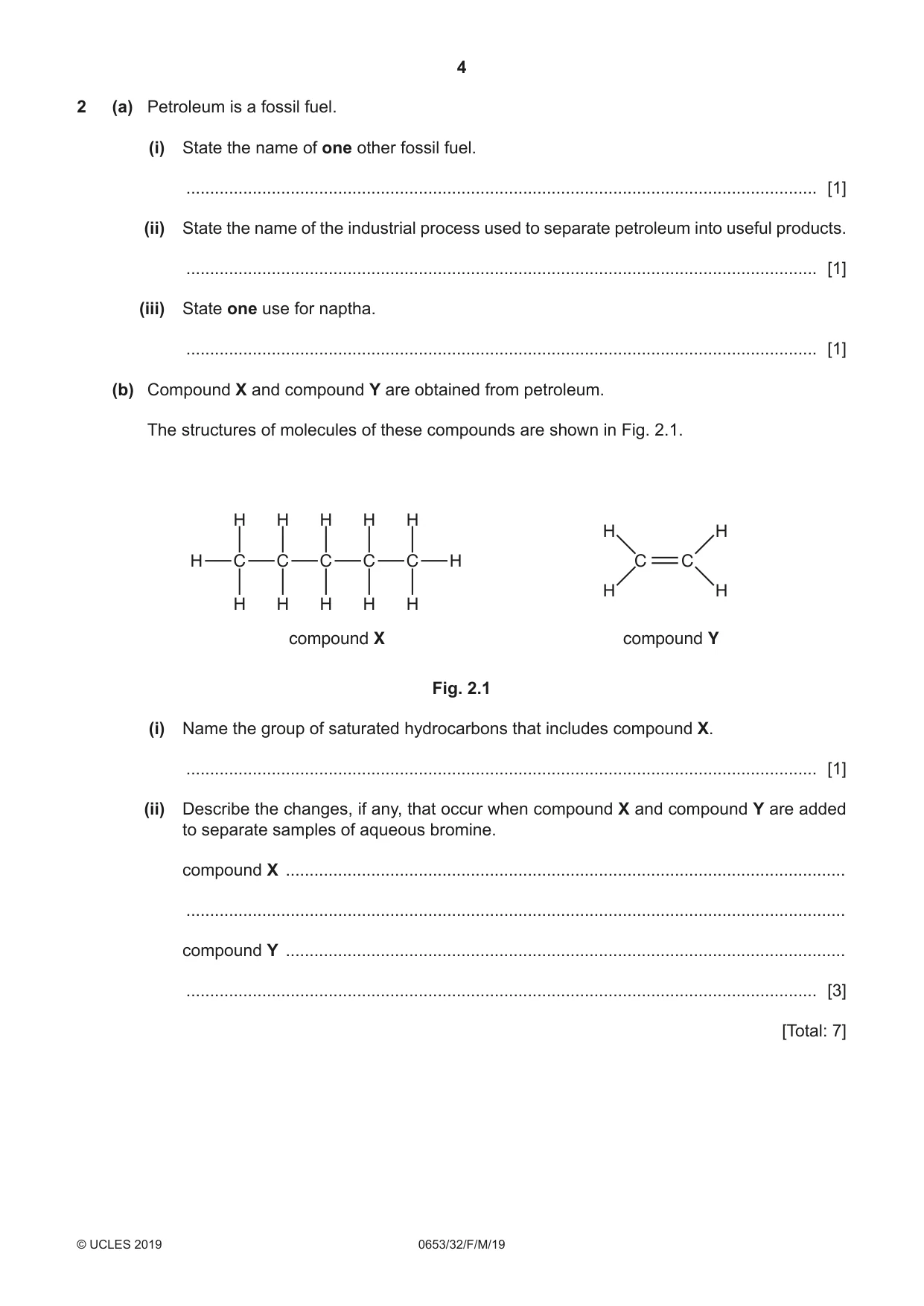
2 (a) Petroleum is a fossil fuel. (i) State the name of one other fossil fuel. ..................................................................................................................................... [1] (ii) State the name of the industrial process used to separate petroleum into useful products. ..................................................................................................................................... [1] (iii) State one use for naptha. ..................................................................................................................................... [1] (b) Compound X and compound Y are obtained from petroleum. The structures of molecules of these compounds are shown in Fig. 2.1. H H H H H H H H C C C C C H C C H H H H H H H compound X compound Y Fig. 2.1 (i) Name the group of saturated hydrocarbons that includes compound X. ..................................................................................................................................... [1] (ii) Describe the changes, if any, that occur when compound X and compound Y are added to separate samples of aqueous bromine. compound X ...................................................................................................................... ........................................................................................................................................... compound Y ...................................................................................................................... ..................................................................................................................................... [3] [Total: 7]
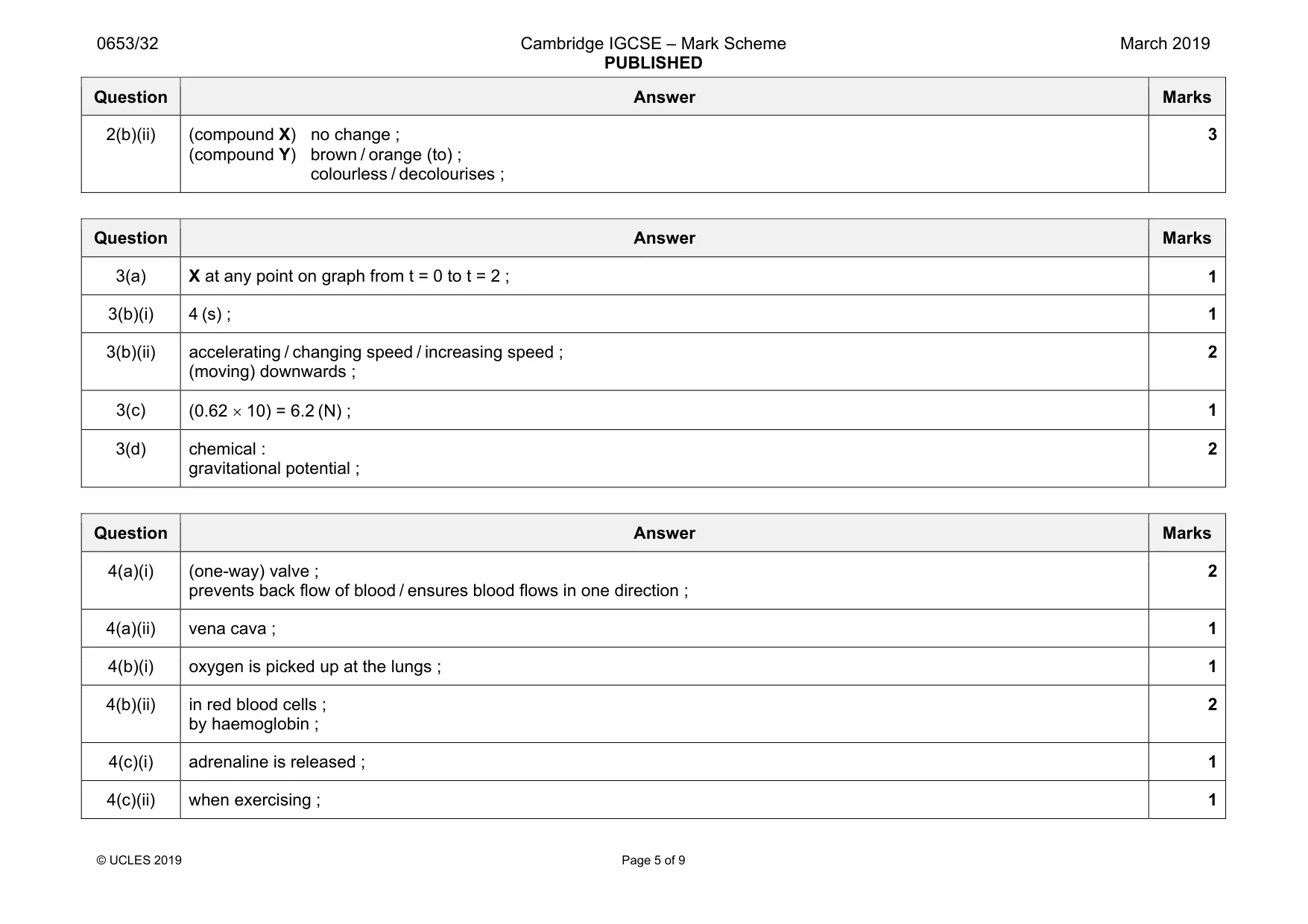
Mark scheme: 2(a)(i) coal / natural gas ; 1 2(a)(ii) fractional distillation ; 1 2(a)(iii) feedstock / for making chemicals ; 1 2(b)(i) alkane(s) ; 1 Question Answer Marks 2(b)(ii) (compound X) no change ; (compound Y) brown / orange (to) ; colourless / decolourises ; 3
Q3 · A boy throwing a ball up in the air
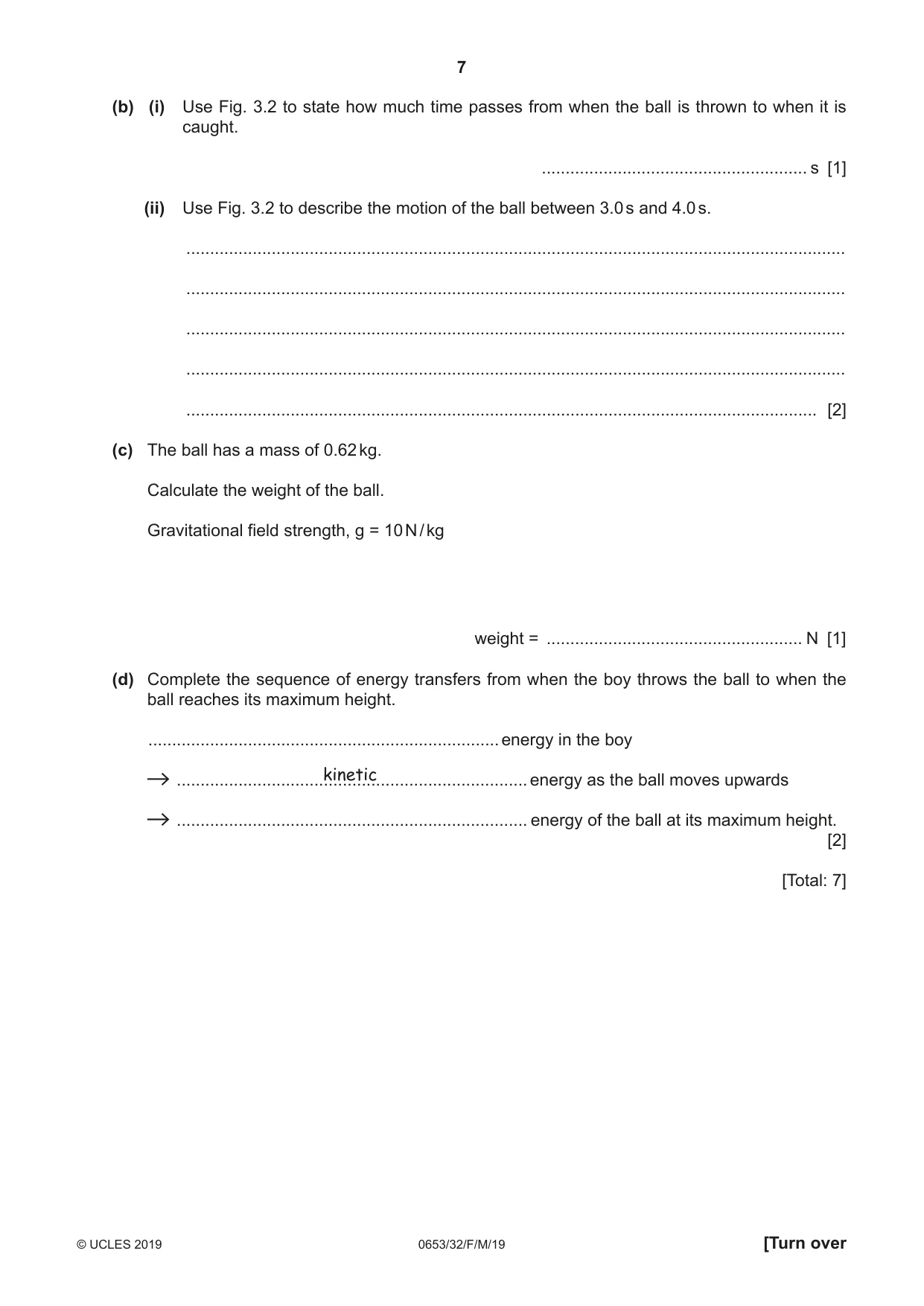
3 Fig. 3.1 shows a boy throwing a ball up in the air. The ball moves vertically upwards, then falls down and the boy catches it. Fig. 3.1 Fig. 3.2 shows a graph of the motion of the ball from the time it leaves the boy’s hand until he catches it. 5 4 speed m / s 3 2 1 0 0 1 2 3 4 5 time / s Fig. 3.2 (a) On Fig. 3.2, label with a letter X a point when the ball is moving upwards. [1] (b) (i) Use Fig. 3.2 to state how much time passes from when the ball is thrown to when it is caught. ........................................................ s [1] (ii) Use Fig. 3.2 to describe the motion of the ball between 3.0 s and 4.0 s. ........................................................................................................................................... ........................................................................................................................................... ........................................................................................................................................... ........................................................................................................................................... ..................................................................................................................................... [2] (c) The ball has a mass of 0.62 kg. Calculate the weight of the ball. Gravitational field strength, g = 10 N / kg weight = ...................................................... N [1] (d) Complete the sequence of energy transfers from when the boy throws the ball to when the ball reaches its maximum height. ..........................................................................energy in the boy kinetic ..........................................................................energy as the ball moves upwards .......................................................................... energy of the ball at its maximum height. [2] [Total: 7]
Mark scheme: 3(a) X at any point on graph from t = 0 to t = 2 ; 1 3(b)(i) 4 (s) ; 1 3(b)(ii) accelerating / changing speed / increasing speed ; (moving) downwards ; 2 3(c) (0.62 × 10) = 6.2 (N) ; 1 3(d) chemical : gravitational potential ; 2
Q4 · A diagram of the internal structure of the heart
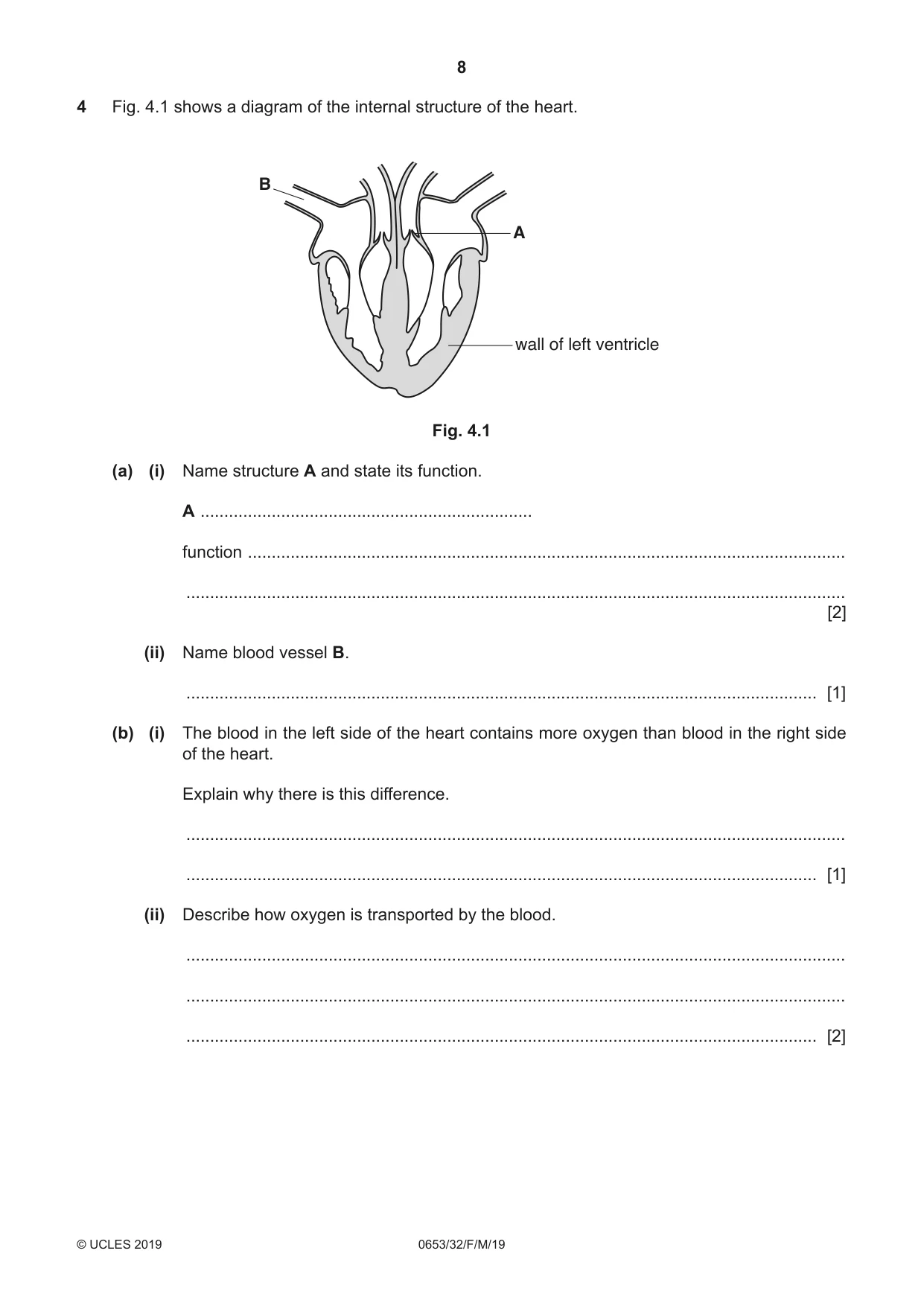
4 Fig. 4.1 shows a diagram of the internal structure of the heart. B A wall of left ventricle Fig. 4.1 (a) (i) Name structure A and state its function. A ...................................................................... function .............................................................................................................................. ........................................................................................................................................... [2] (ii) Name blood vessel B. ..................................................................................................................................... [1] (b) (i) The blood in the left side of the heart contains more oxygen than blood in the right side of the heart. Explain why there is this difference. ........................................................................................................................................... ..................................................................................................................................... [1] (ii) Describe how oxygen is transported by the blood. ........................................................................................................................................... ........................................................................................................................................... ..................................................................................................................................... [2] (c) A person’s pulse can be taken to measure their heart rate. (i) State what causes a person’s pulse rate to increase when they are frightened. ........................................................................................................................................... ..................................................................................................................................... [1] (ii) Suggest one other situation when a person’s pulse rate increases. ..................................................................................................................................... [1] [Total: 8]
Mark scheme: 4(a)(i) (one-way) valve ; prevents back flow of blood / ensures blood flows in one direction ; 2 4(a)(ii) vena cava ; 1 4(b)(i) oxygen is picked up at the lungs ; 1 4(b)(ii) in red blood cells ; by haemoglobin ; 2 4(c)(i) adrenaline is released ; 1 4(c)(ii) when exercising ; 1
Q5 · Sodium is a Group I metal
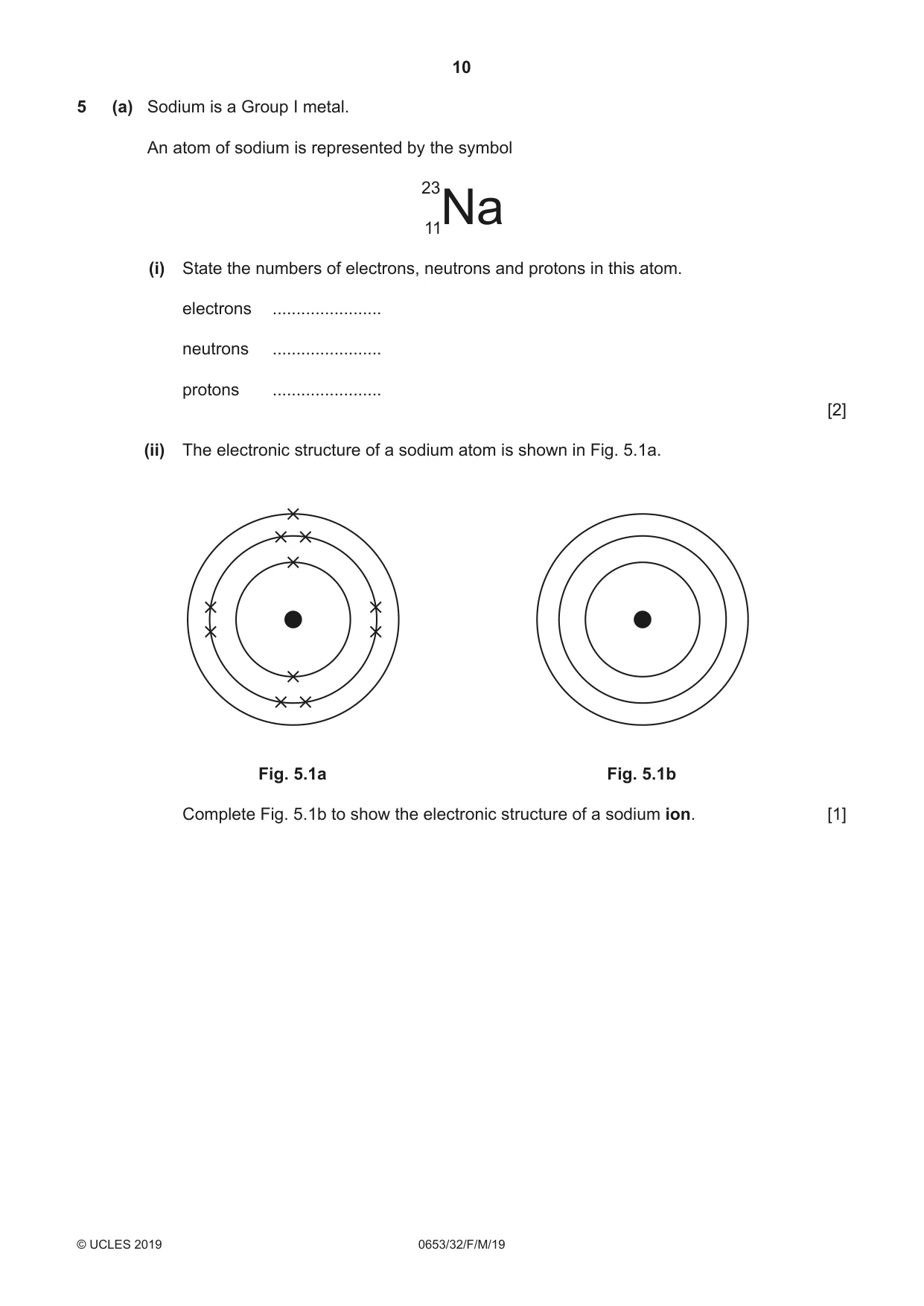
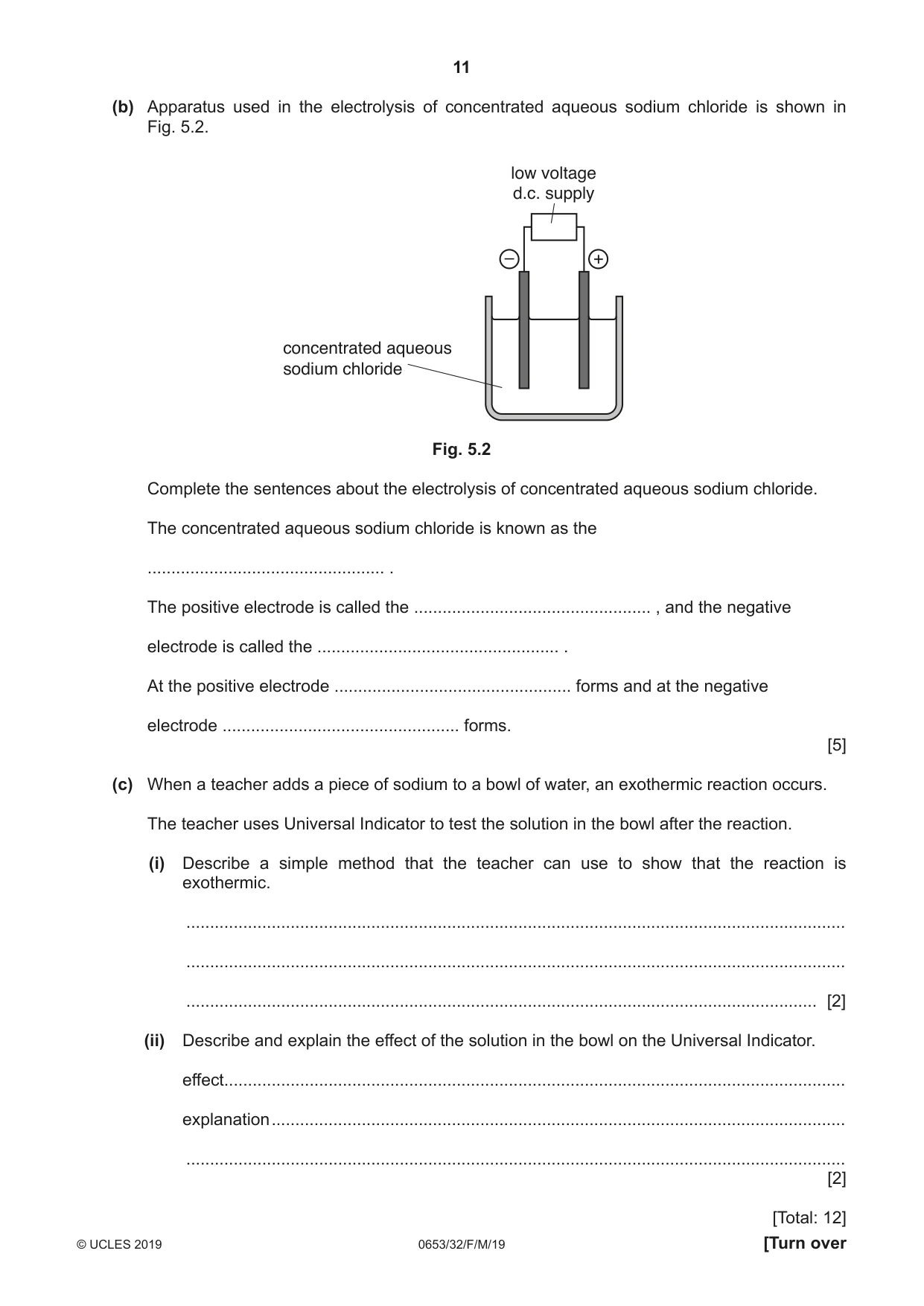
5 (a) Sodium is a Group I metal. An atom of sodium is represented by the symbol 23Na11 (i) State the numbers of electrons, neutrons and protons in this atom. electrons ....................... neutrons ....................... protons ....................... [2] (ii) The electronic structure of a sodium atom is shown in Fig. 5.1a. Fig. 5.1a Fig. 5.1b Complete Fig. 5.1b to show the electronic structure of a sodium ion. [1] (b) Apparatus used in the electrolysis of concentrated aqueous sodium chloride is shown in Fig. 5.2. low voltage d.c. supply – + concentrated aqueous sodium chloride Fig. 5.2 Complete the sentences about the electrolysis of concentrated aqueous sodium chloride. The concentrated aqueous sodium chloride is known as the .................................................. . The positive electrode is called the .................................................. , and the negative electrode is called the ................................................... . At the positive electrode .................................................. forms and at the negative electrode .................................................. forms. [5] (c) When a teacher adds a piece of sodium to a bowl of water, an exothermic reaction occurs. The teacher uses Universal Indicator to test the solution in the bowl after the reaction. (i) Describe a simple method that the teacher can use to show that the reaction is exothermic. ........................................................................................................................................... ........................................................................................................................................... ..................................................................................................................................... [2] (ii) Describe and explain the effect of the solution in the bowl on the Universal Indicator. effect ................................................................................................................................... explanation ......................................................................................................................... ........................................................................................................................................... [2] [Total: 12]
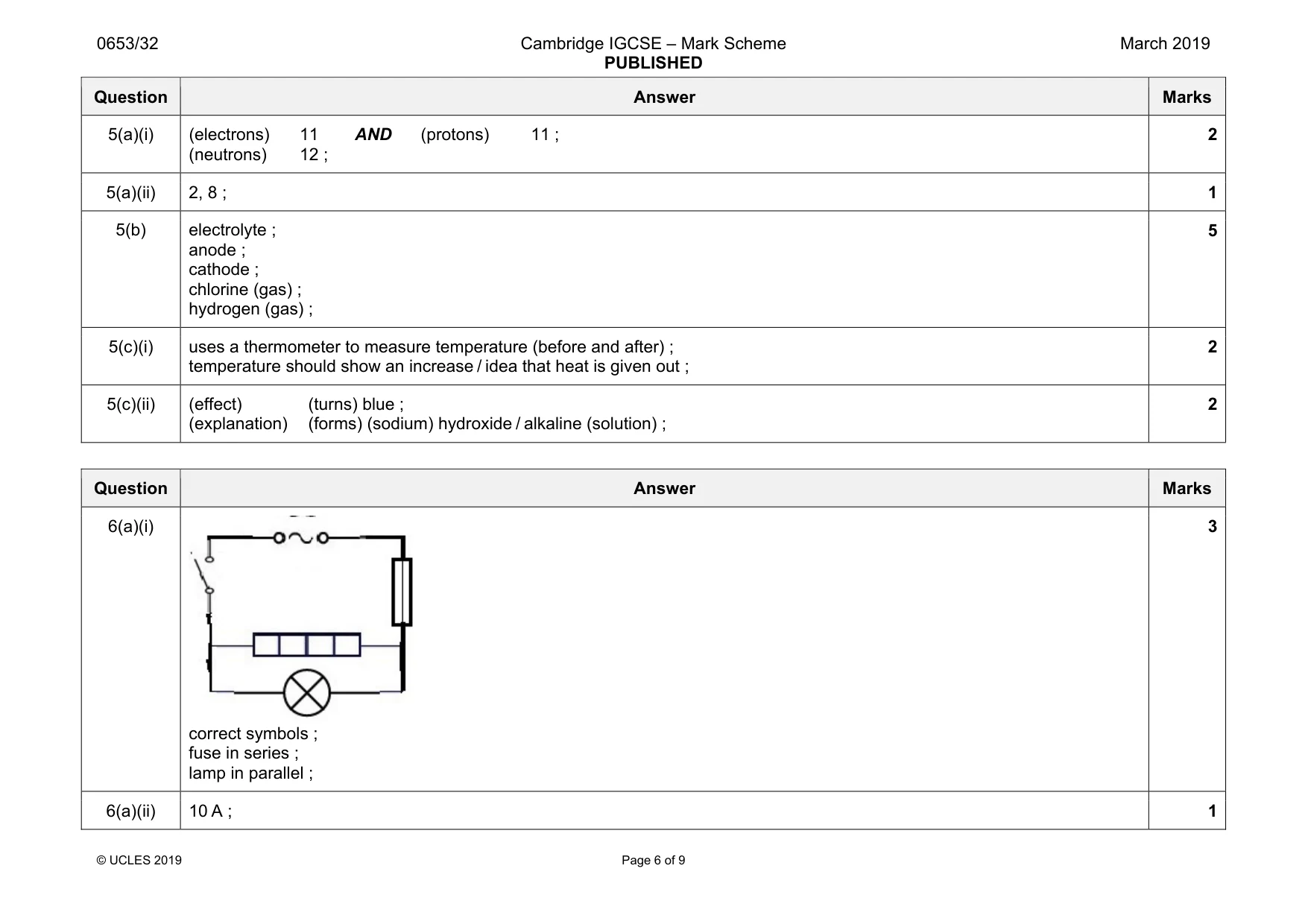
Mark scheme: 5(a)(i) (electrons) 11 AND (protons) 11 ; (neutrons) 12 ; 2 5(a)(ii) 2, 8 ; 1 5(b) electrolyte ; anode ; cathode ; chlorine (gas) ; hydrogen (gas) ; 5 5(c)(i) uses a thermometer to measure temperature (before and after) ; temperature should show an increase / idea that heat is given out ; 2 5(c)(ii) (effect) (turns) blue ; (explanation) (forms) (sodium) hydroxide / alkaline (solution) ; 2
Q6 · The bathroom in a house has an electric heater under the floor
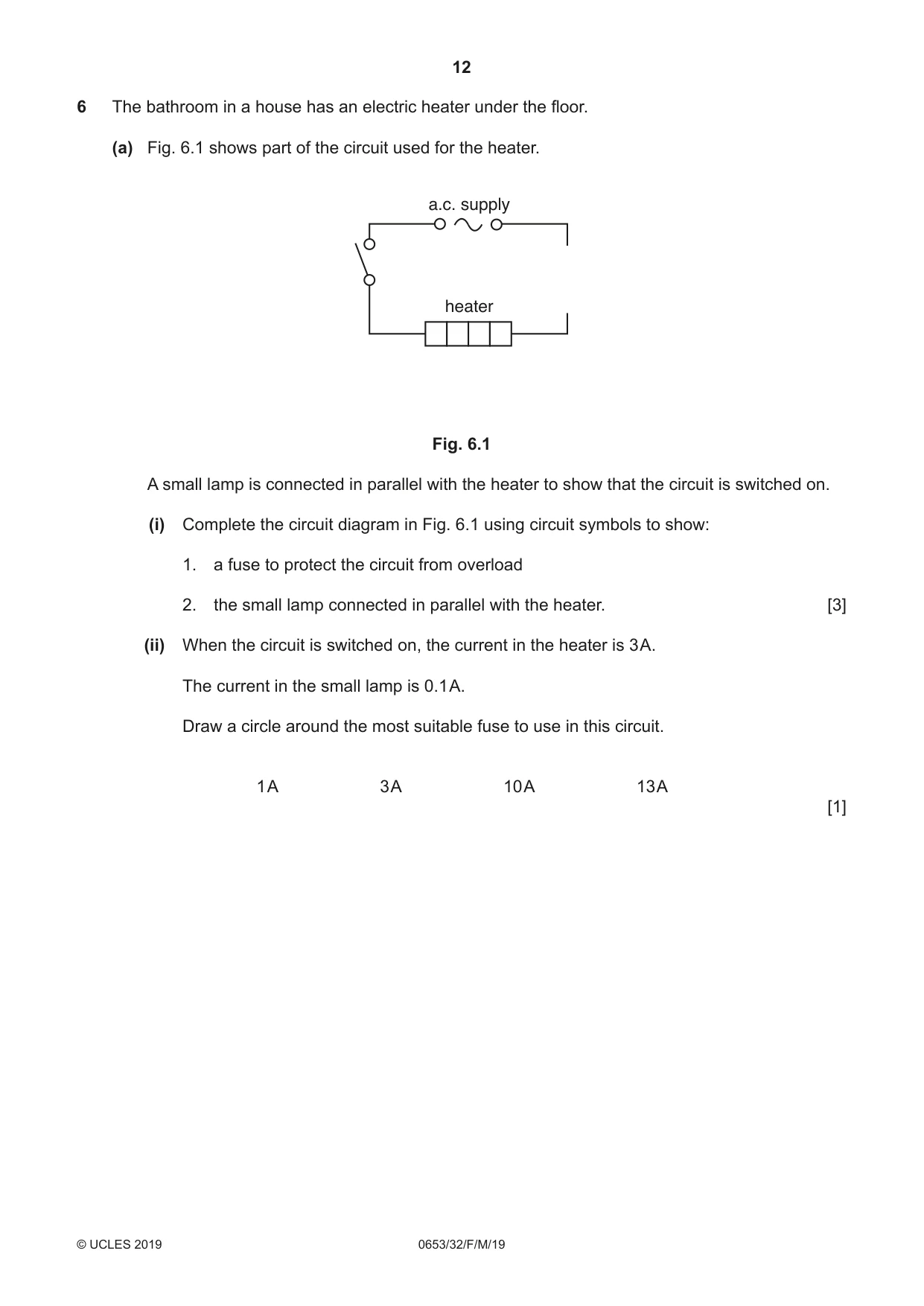
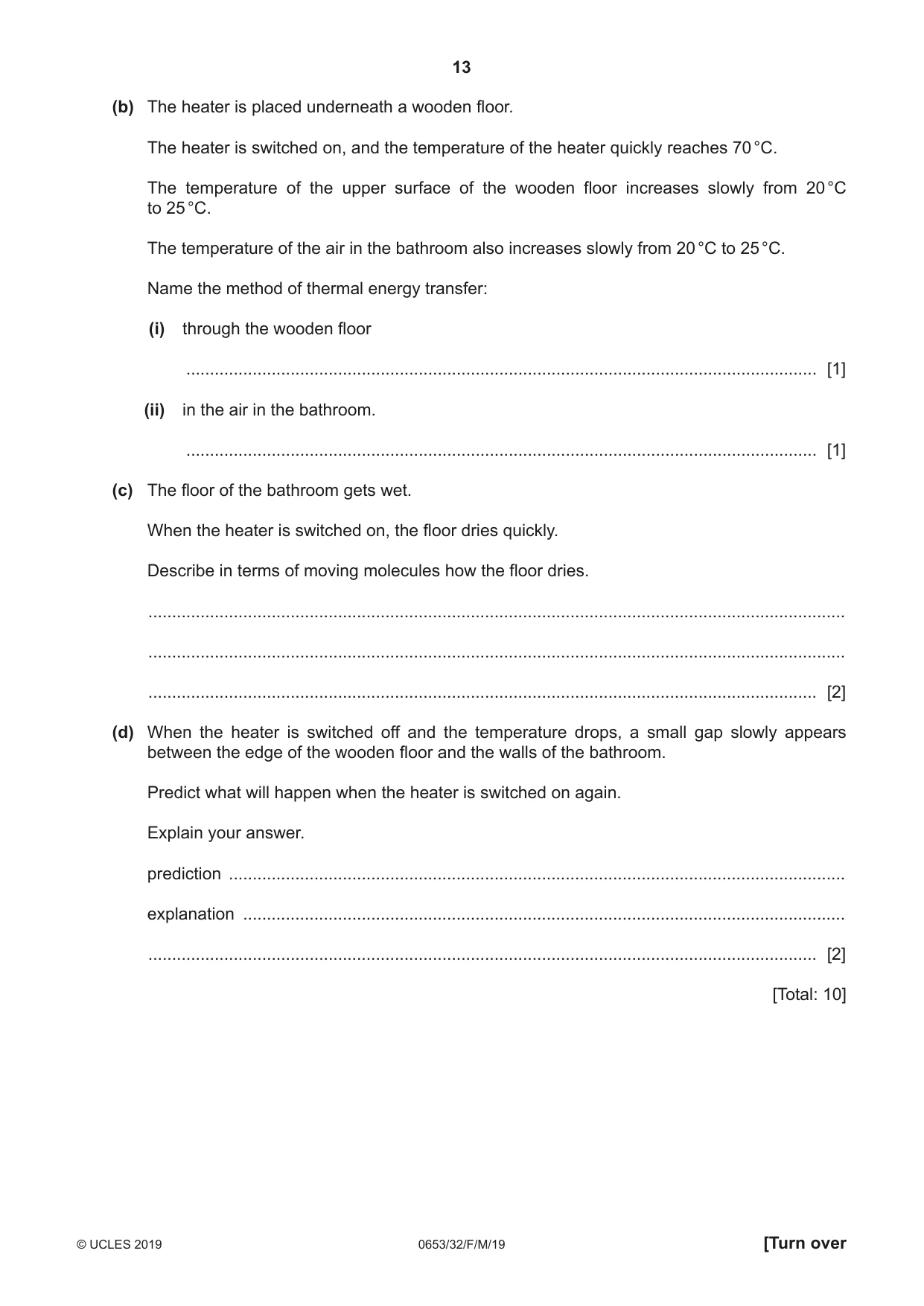
6 The bathroom in a house has an electric heater under the floor. (a) Fig. 6.1 shows part of the circuit used for the heater. a.c. supply heater Fig. 6.1 A small lamp is connected in parallel with the heater to show that the circuit is switched on. (i) Complete the circuit diagram in Fig. 6.1 using circuit symbols to show: 1. a fuse to protect the circuit from overload 2. the small lamp connected in parallel with the heater. [3] (ii) When the circuit is switched on, the current in the heater is 3 A. The current in the small lamp is 0.1 A. Draw a circle around the most suitable fuse to use in this circuit. 1 A 3 A 10 A 13 A [1] (b) The heater is placed underneath a wooden floor. The heater is switched on, and the temperature of the heater quickly reaches 70 °C. The temperature of the upper surface of the wooden floor increases slowly from 20 °C to 25 °C. The temperature of the air in the bathroom also increases slowly from 20 °C to 25 °C. Name the method of thermal energy transfer: (i) through the wooden floor ..................................................................................................................................... [1] (ii) in the air in the bathroom. ..................................................................................................................................... [1] (c) The floor of the bathroom gets wet. When the heater is switched on, the floor dries quickly. Describe in terms of moving molecules how the floor dries. ................................................................................................................................................... ................................................................................................................................................... ............................................................................................................................................. [2] (d) When the heater is switched off and the temperature drops, a small gap slowly appears between the edge of the wooden floor and the walls of the bathroom. Predict what will happen when the heater is switched on again. Explain your answer. prediction .................................................................................................................................. explanation ............................................................................................................................... ............................................................................................................................................. [2] [Total: 10]
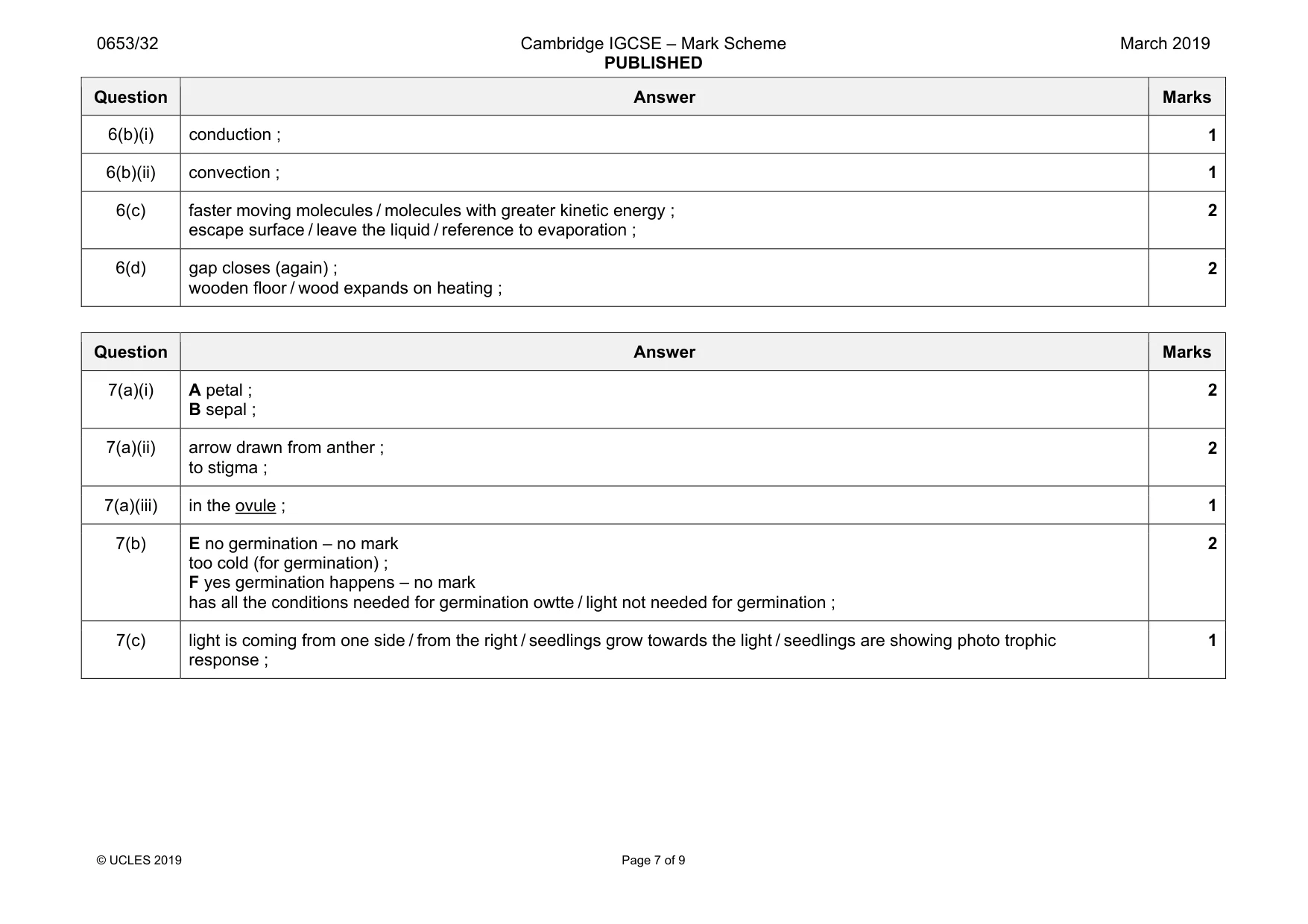
Mark scheme: 6(a)(i) correct symbols ; fuse in series ; lamp in parallel ; 3 6(a)(ii) 10 A ; 1 Question Answer Marks 6(b)(i) conduction ; 1 6(b)(ii) convection ; 1 6(c) faster moving molecules / molecules with greater kinetic energy ; escape surface / leave the liquid / reference to evaporation ; 2 6(d) gap closes (again) ; wooden floor / wood expands on heating ; 2
Q7 · Two diagrams of insect-pollinated flowers of the same species
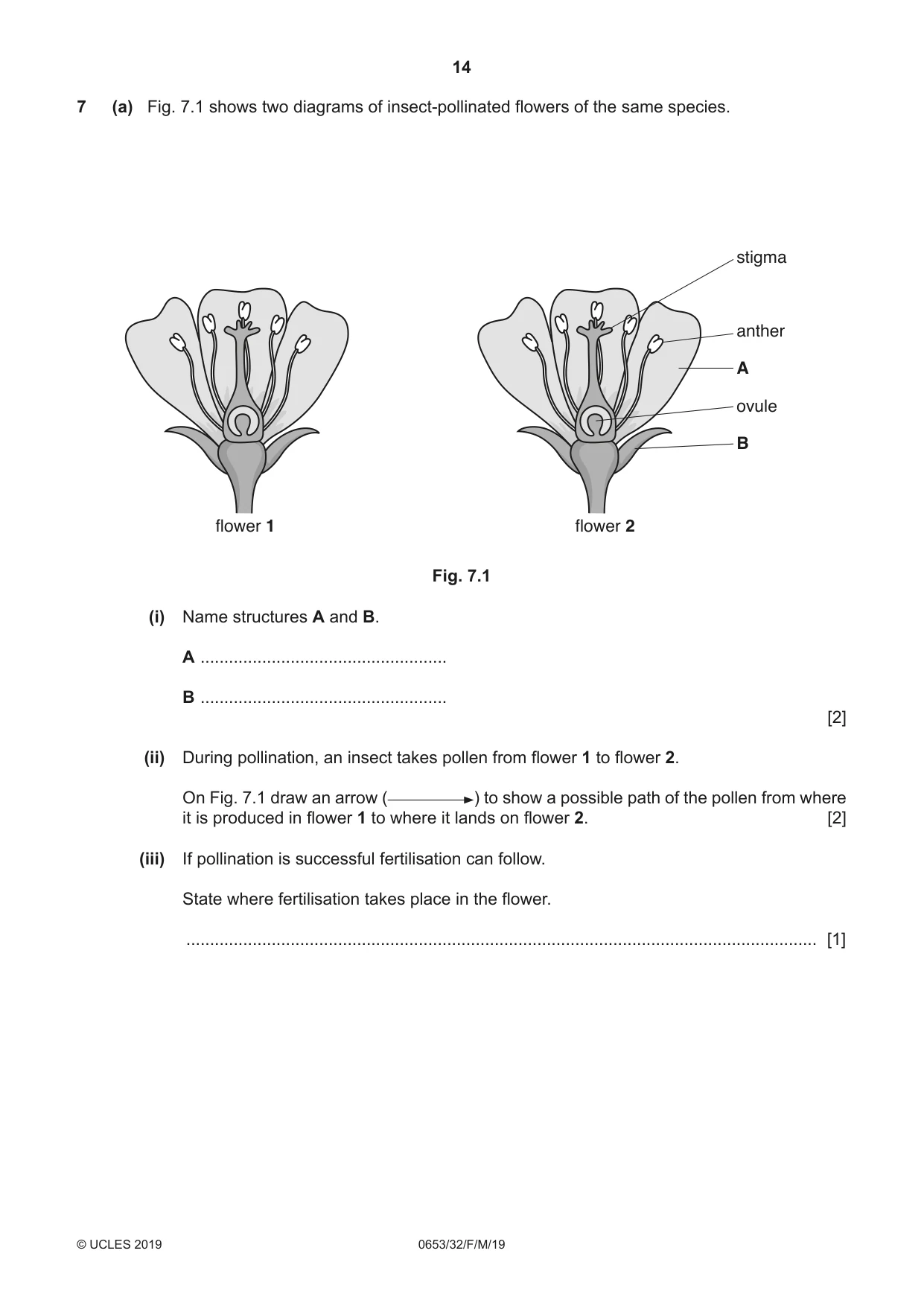
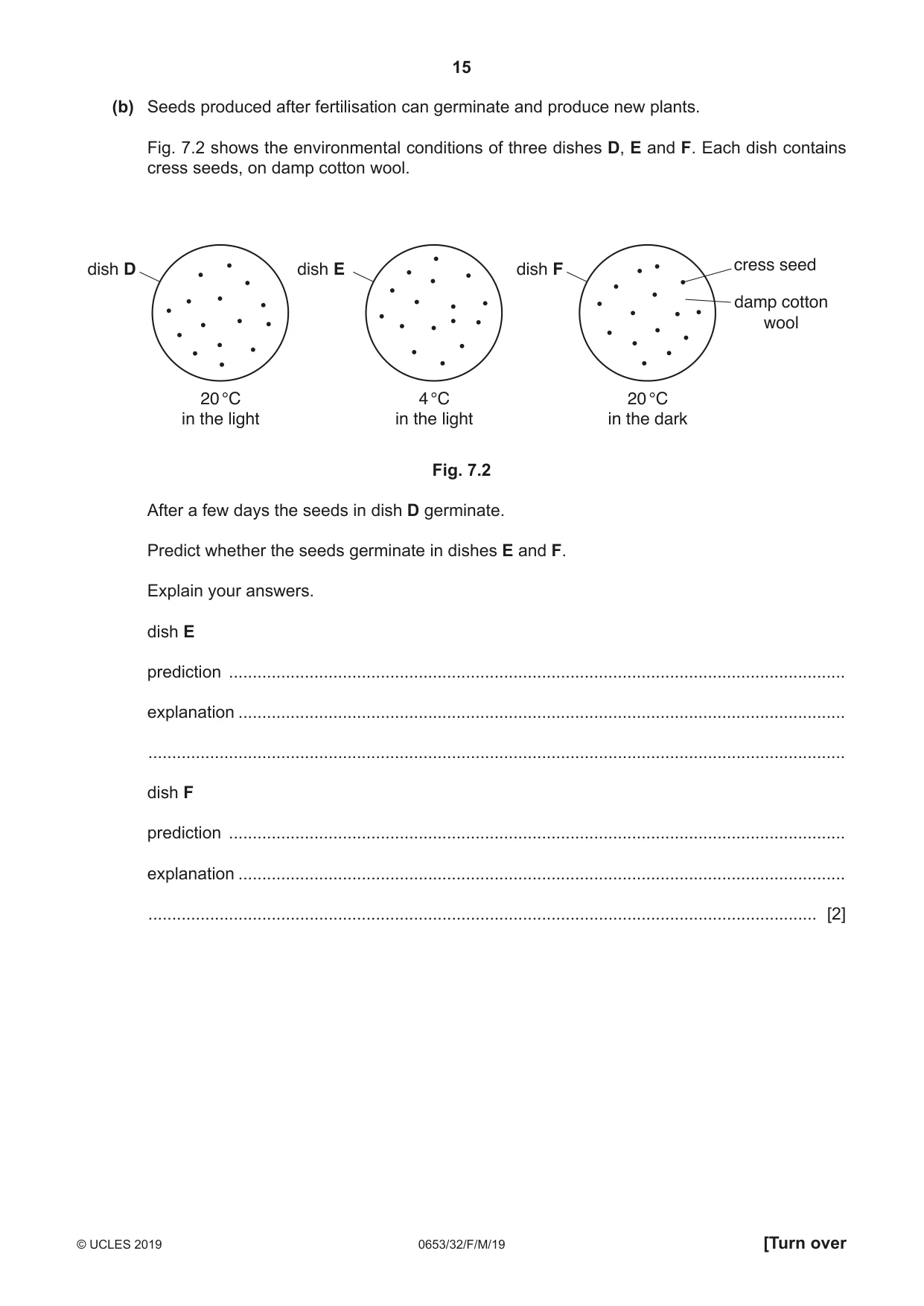
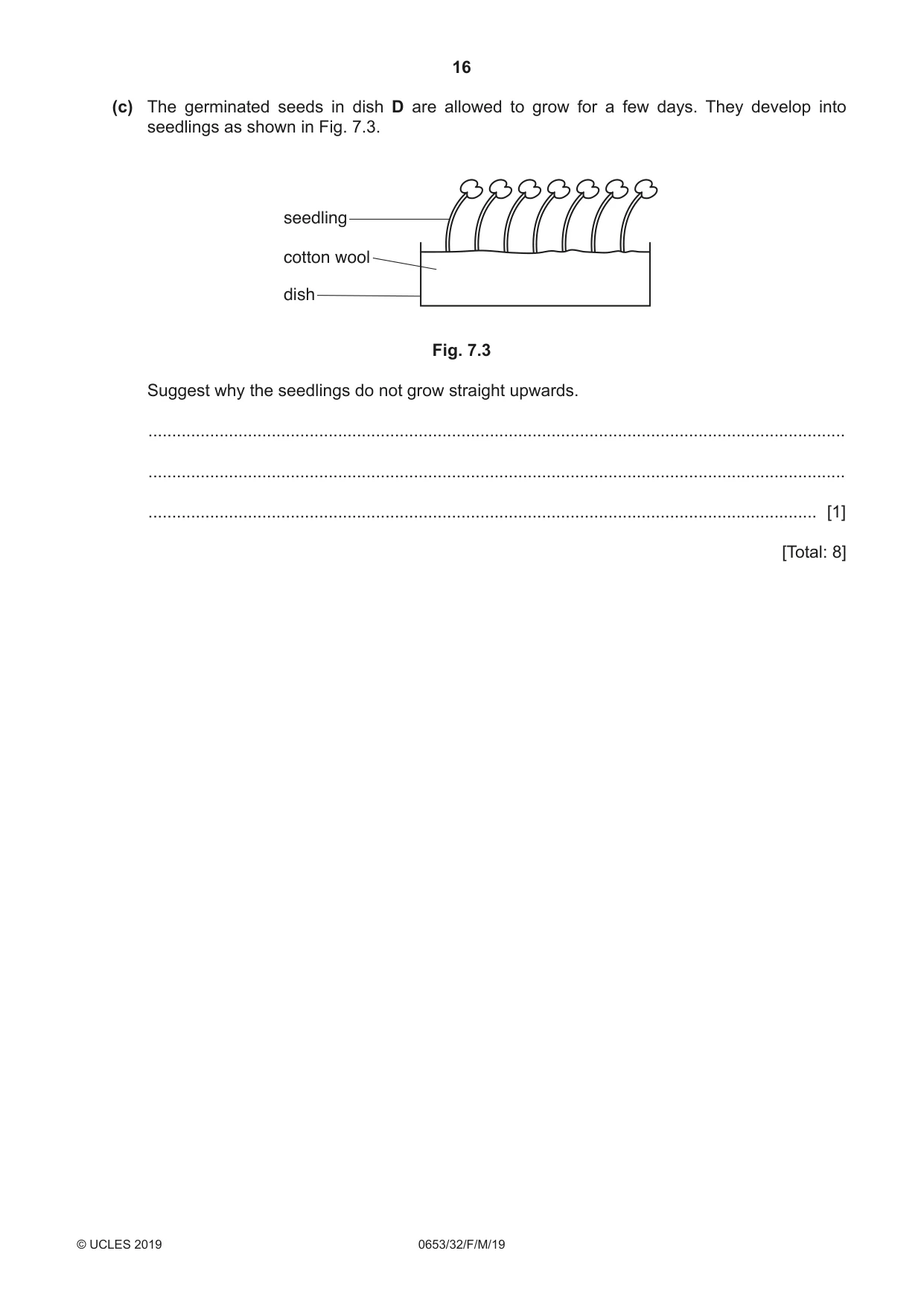
7 (a) Fig. 7.1 shows two diagrams of insect-pollinated flowers of the same species. stigma anther A ovule B flower 1 flower 2 Fig. 7.1 (i) Name structures A and B. A .................................................... B .................................................... [2] (ii) During pollination, an insect takes pollen from flower 1 to flower 2. On Fig. 7.1 draw an arrow ( ) to show a possible path of the pollen from where it is produced in flower 1 to where it lands on flower 2. [2] (iii) If pollination is successful fertilisation can follow. State where fertilisation takes place in the flower. ..................................................................................................................................... [1] (b) Seeds produced after fertilisation can germinate and produce new plants. Fig. 7.2 shows the environmental conditions of three dishes D, E and F. Each dish contains cress seeds, on damp cotton wool. dish D dish E dish F cress seed damp cotton wool 20 °C 4 °C 20 °C in the light in the light in the dark Fig. 7.2 After a few days the seeds in dish D germinate. Predict whether the seeds germinate in dishes E and F. Explain your answers. dish E prediction .................................................................................................................................. explanation ................................................................................................................................ ................................................................................................................................................... dish F prediction .................................................................................................................................. explanation ................................................................................................................................ ............................................................................................................................................. [2] (c) The germinated seeds in dish D are allowed to grow for a few days. They develop into seedlings as shown in Fig. 7.3. seedling cotton wool dish Fig. 7.3 Suggest why the seedlings do not grow straight upwards. ................................................................................................................................................... ................................................................................................................................................... ............................................................................................................................................. [1] [Total: 8]
Mark scheme: 7(a)(i) A petal ; B sepal ; 2 7(a)(ii) arrow drawn from anther ; to stigma ; 2 7(a)(iii) in the ovule ; 1 7(b) E no germination – no mark too cold (for germination) ; F yes germination happens – no mark has all the conditions needed for germination owtte / light not needed for germination ; 2 7(c) light is coming from one side / from the right / seedlings grow towards the light / seedlings are showing photo trophic response ; 1
Q8 · Air is a mixture of elements and compounds
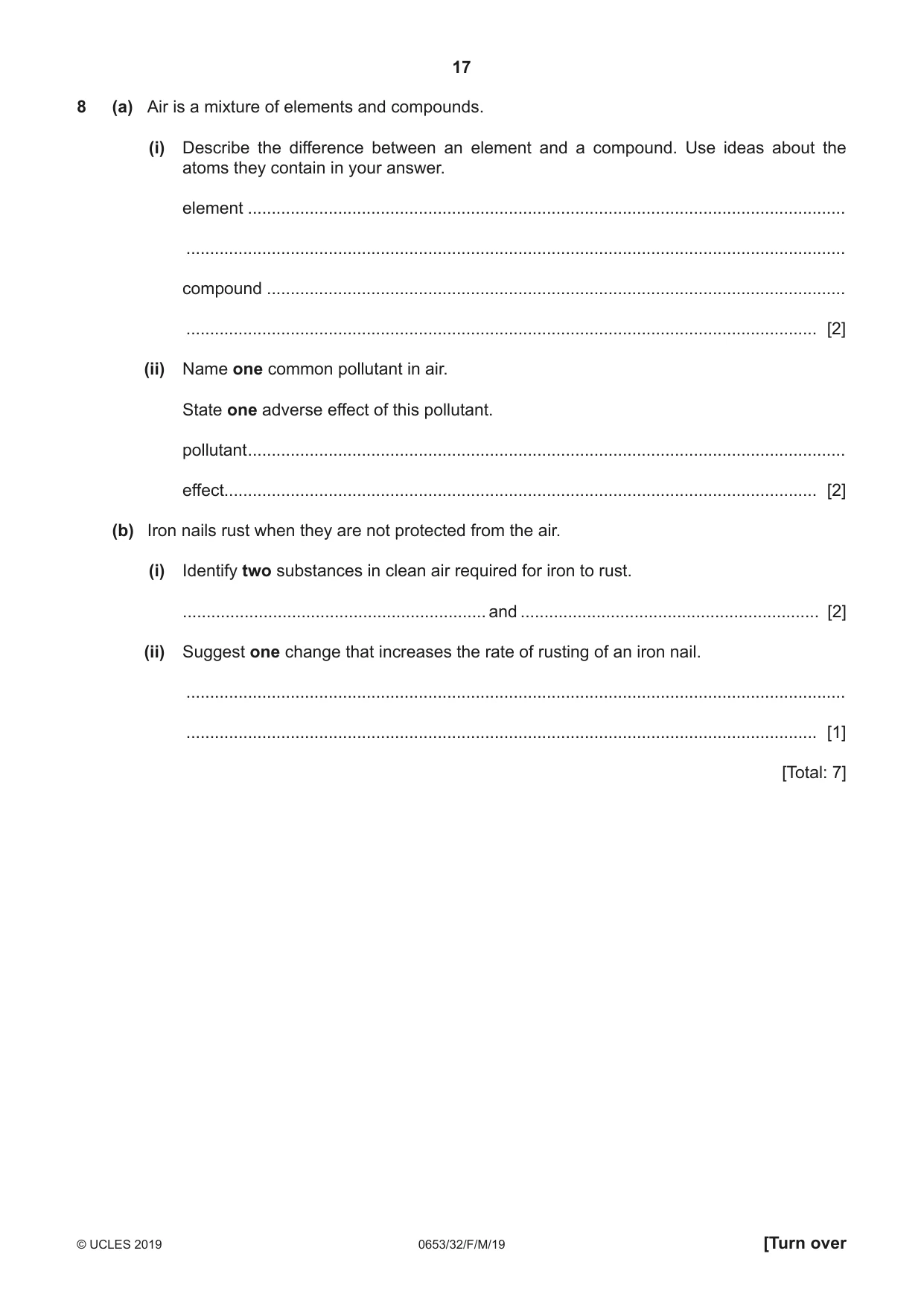
8 (a) Air is a mixture of elements and compounds. (i) Describe the difference between an element and a compound. Use ideas about the atoms they contain in your answer. element .............................................................................................................................. ........................................................................................................................................... compound .......................................................................................................................... ..................................................................................................................................... [2] (ii) Name one common pollutant in air. State one adverse effect of this pollutant. pollutant .............................................................................................................................. effect ............................................................................................................................. [2] (b) Iron nails rust when they are not protected from the air. (i) Identify two substances in clean air required for iron to rust. ................................................................ and ............................................................... [2] (ii) Suggest one change that increases the rate of rusting of an iron nail. ........................................................................................................................................... ..................................................................................................................................... [1] [Total: 7]
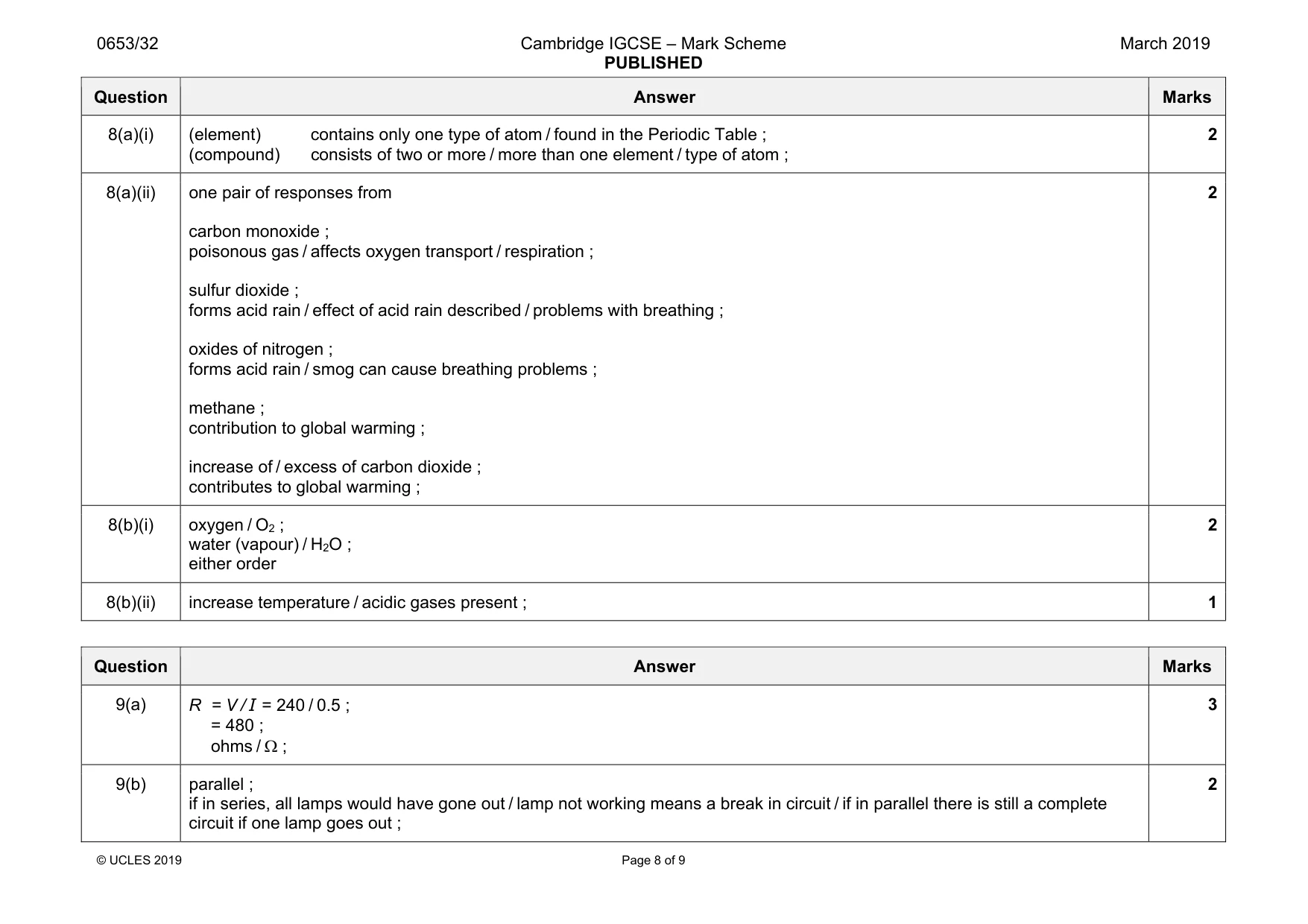
Mark scheme: 8(a)(i) (element) contains only one type of atom / found in the Periodic Table ; (compound) consists of two or more / more than one element / type of atom ; 2 8(a)(ii) one pair of responses from carbon monoxide ; poisonous gas / affects oxygen transport / respiration ; sulfur dioxide ; forms acid rain / effect of acid rain described / problems with breathing ; oxides of nitrogen ; forms acid rain / smog can cause breathing problems ; methane ; contribution to global warming ; increase of / excess of carbon dioxide ; contributes to global warming ; 2 8(b)(i) oxygen / O2 ; water (vapour) / H2O ; either order 2 8(b)(ii) increase temperature / acidic gases present ; 1
Q9 · In many cities, sodium street lamps are used at night
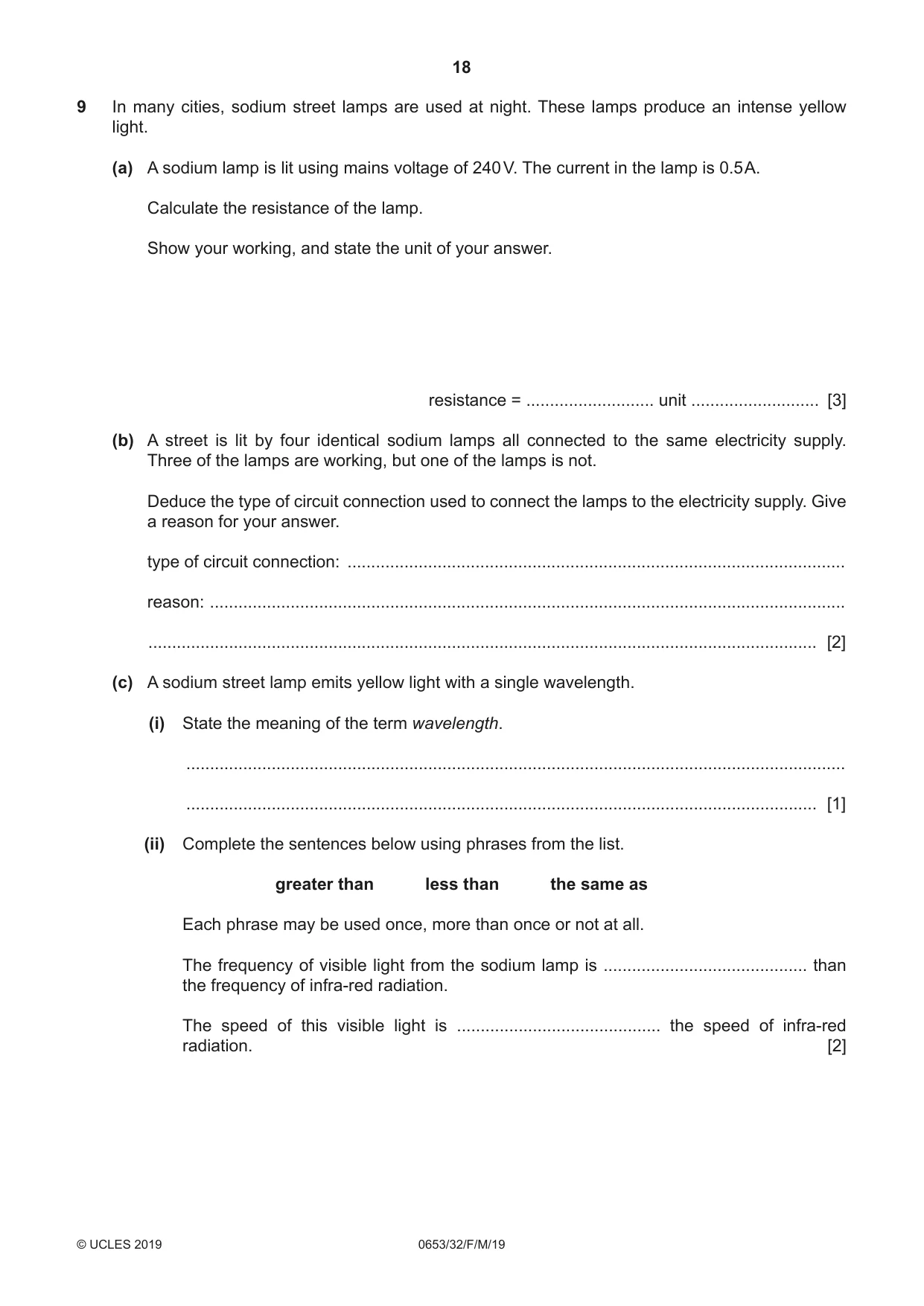
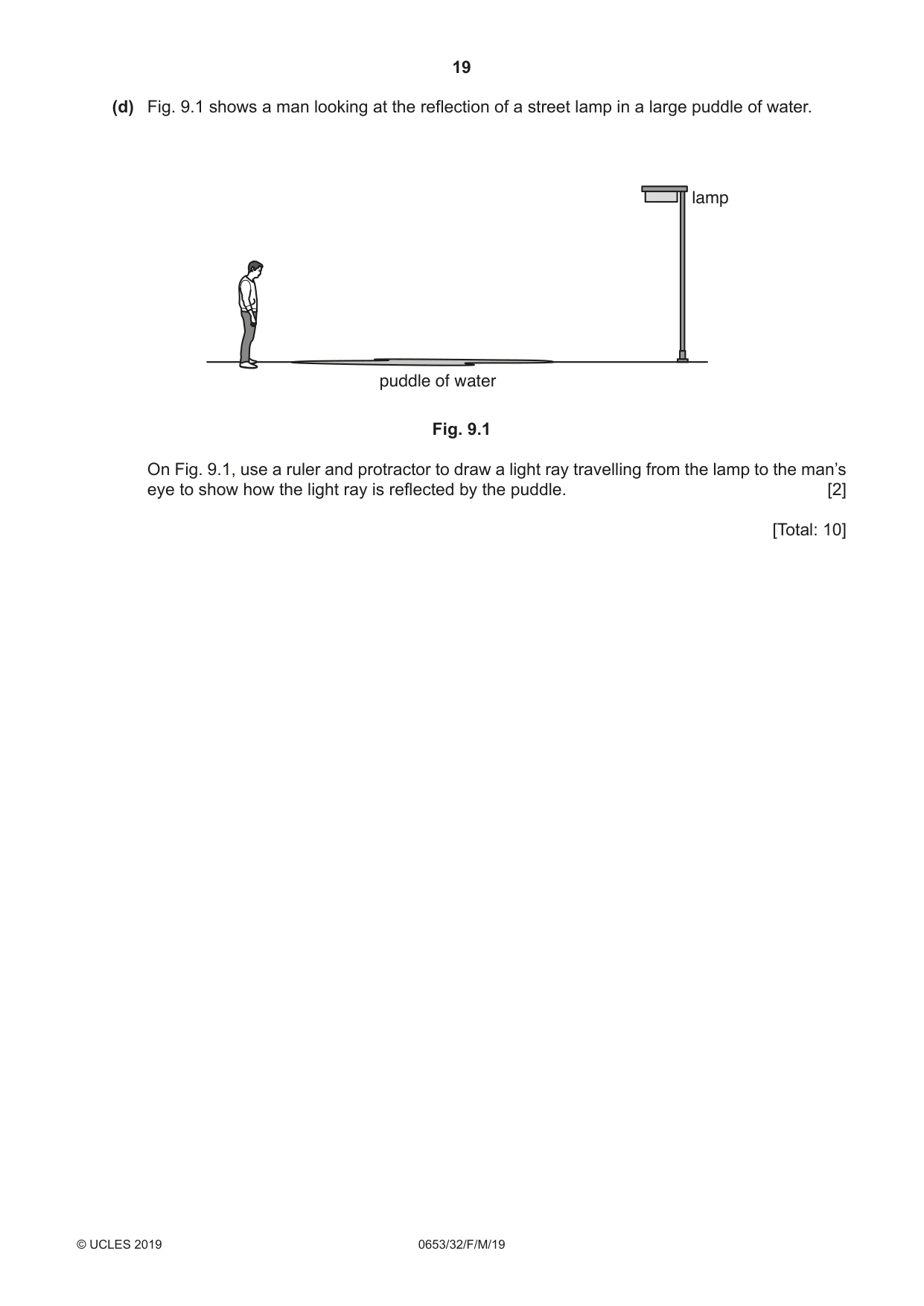
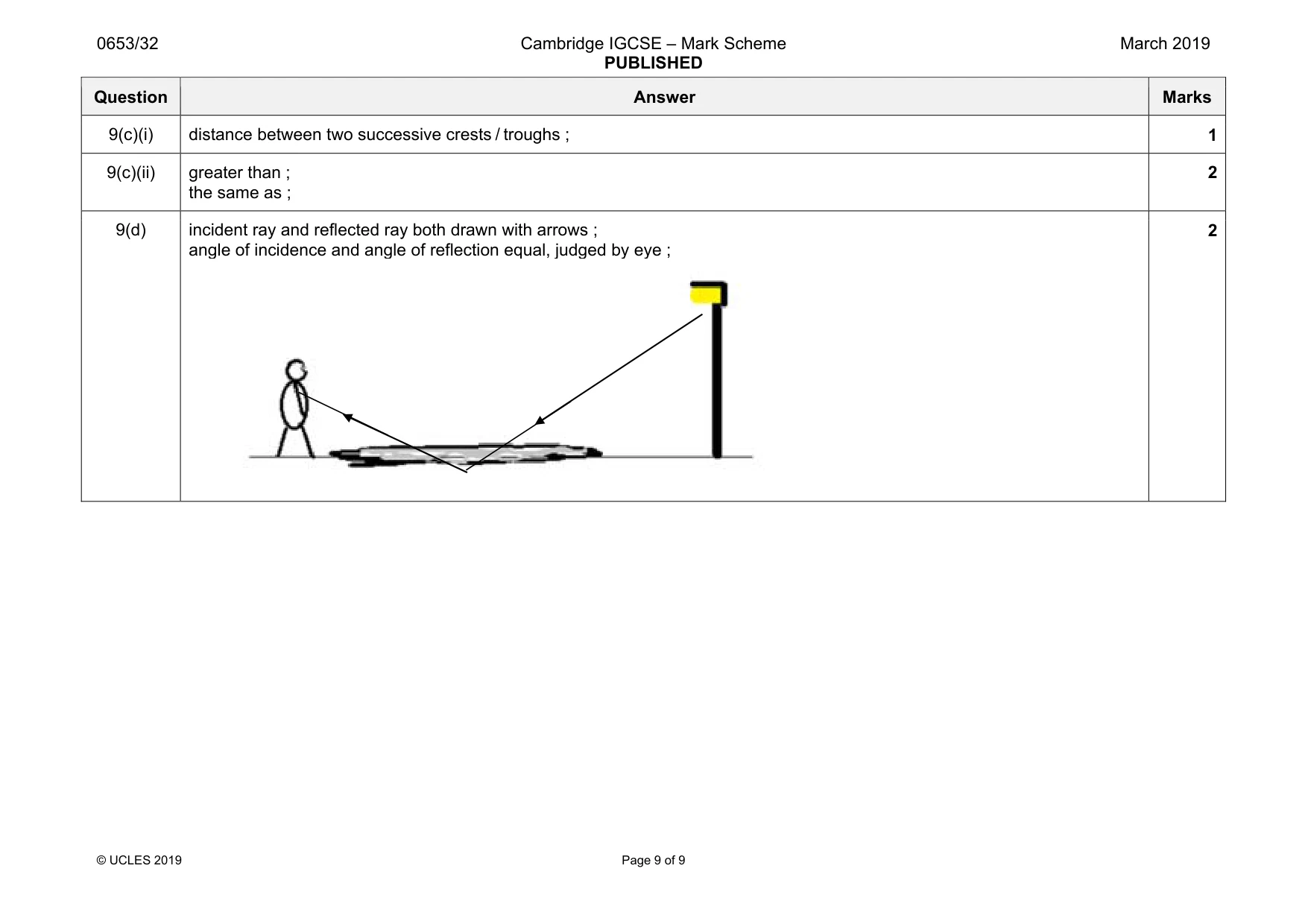
9 In many cities, sodium street lamps are used at night. These lamps produce an intense yellow light. (a) A sodium lamp is lit using mains voltage of 240 V. The current in the lamp is 0.5 A. Calculate the resistance of the lamp. Show your working, and state the unit of your answer. resistance = ........................... unit ........................... [3] (b) A street is lit by four identical sodium lamps all connected to the same electricity supply. Three of the lamps are working, but one of the lamps is not. Deduce the type of circuit connection used to connect the lamps to the electricity supply. Give a reason for your answer. type of circuit connection: ......................................................................................................... reason: ...................................................................................................................................... ............................................................................................................................................. [2] (c) A sodium street lamp emits yellow light with a single wavelength. (i) State the meaning of the term wavelength. ........................................................................................................................................... ..................................................................................................................................... [1] (ii) Complete the sentences below using phrases from the list. greater than less than the same as Each phrase may be used once, more than once or not at all. The frequency of visible light from the sodium lamp is ........................................... than the frequency of infra-red radiation. The speed of this visible light is ........................................... the speed of infra-red radiation. [2] (d) Fig. 9.1 shows a man looking at the reflection of a street lamp in a large puddle of water. lamp puddle of water Fig. 9.1 On Fig. 9.1, use a ruler and protractor to draw a light ray travelling from the lamp to the man’s eye to show how the light ray is reflected by the puddle. [2] [Total: 10]
Mark scheme: 9(a) = 480 ; ohms / Ω ; 3 9(b) parallel ; if in series, all lamps would have gone out / lamp not working means a break in circuit / if in parallel there is still a complete circuit if one lamp goes out ; 2 Question Answer Marks 9(c)(i) distance between two successive crests / troughs ; 1 9(c)(ii) greater than ; the same as ; 2 9(d) incident ray and reflected ray both drawn with arrows ; angle of incidence and angle of reflection equal, judged by eye ; 2
What was in this paper
The subtopics covered by these 9 questions, and how many questions each got. Open one in a new tab to see every Cambridge question on it.
What you needed in this session
Cambridge’s own grade thresholds for 2019 Feb/March, Paper 3 · Variant 2. A higher threshold means an easier paper — the bar moves with how the cohort did.