Cambridge IGCSE Science - Combined 0653 — 2018 May/June Paper 3 · Variant 1
0653/31/M/J/18 · 9 questions · 80 marks · ≈90 min
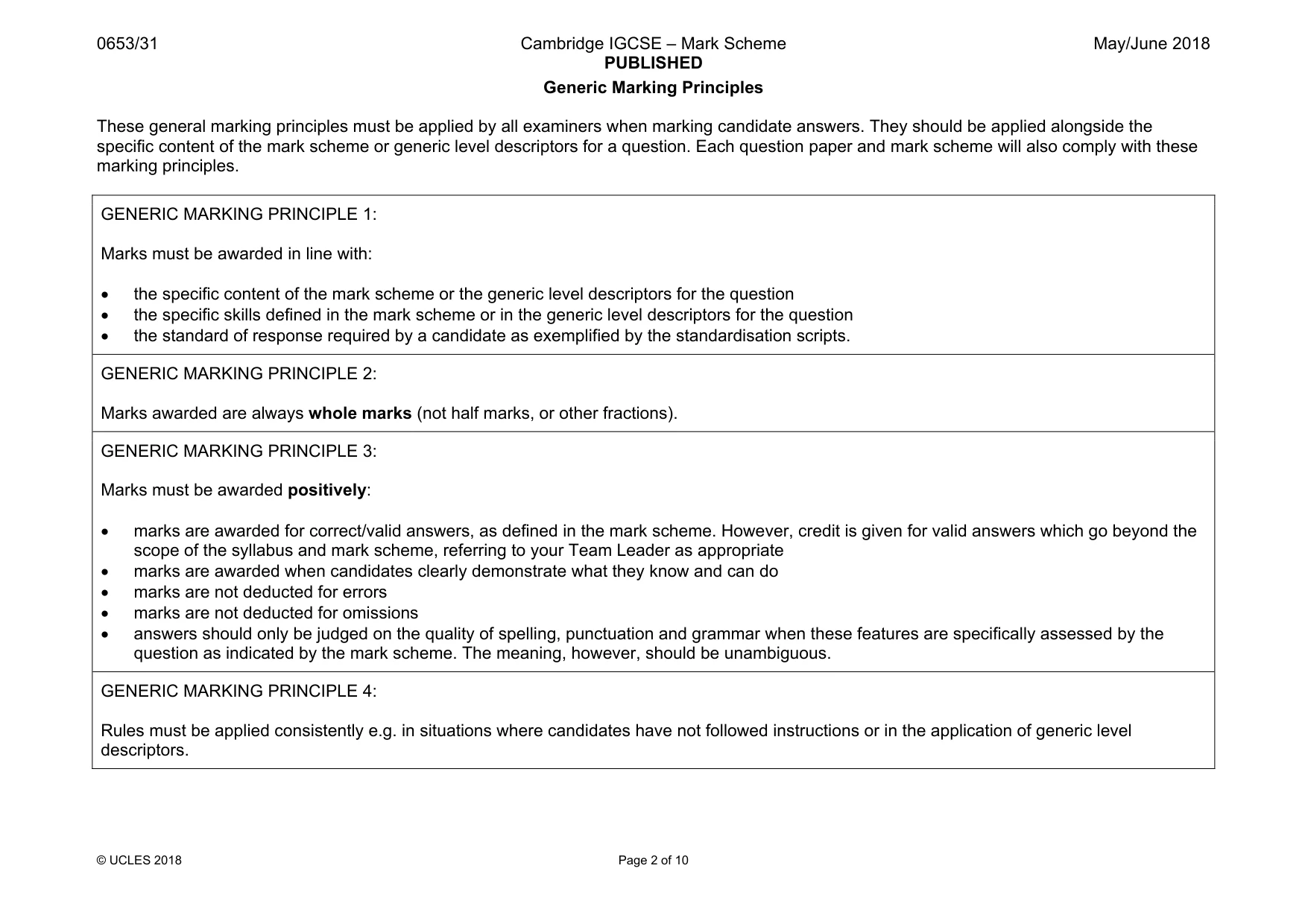
The question paper and its mark scheme, free to read here and free to download. This is Cambridge’s own paper, exactly as it was sat.
Question paper20 pages

Mark scheme10 pages
Answers below. Sit the paper first if you are practising.
Questions as text
Q1 · Substances in food can be identified using test solutions
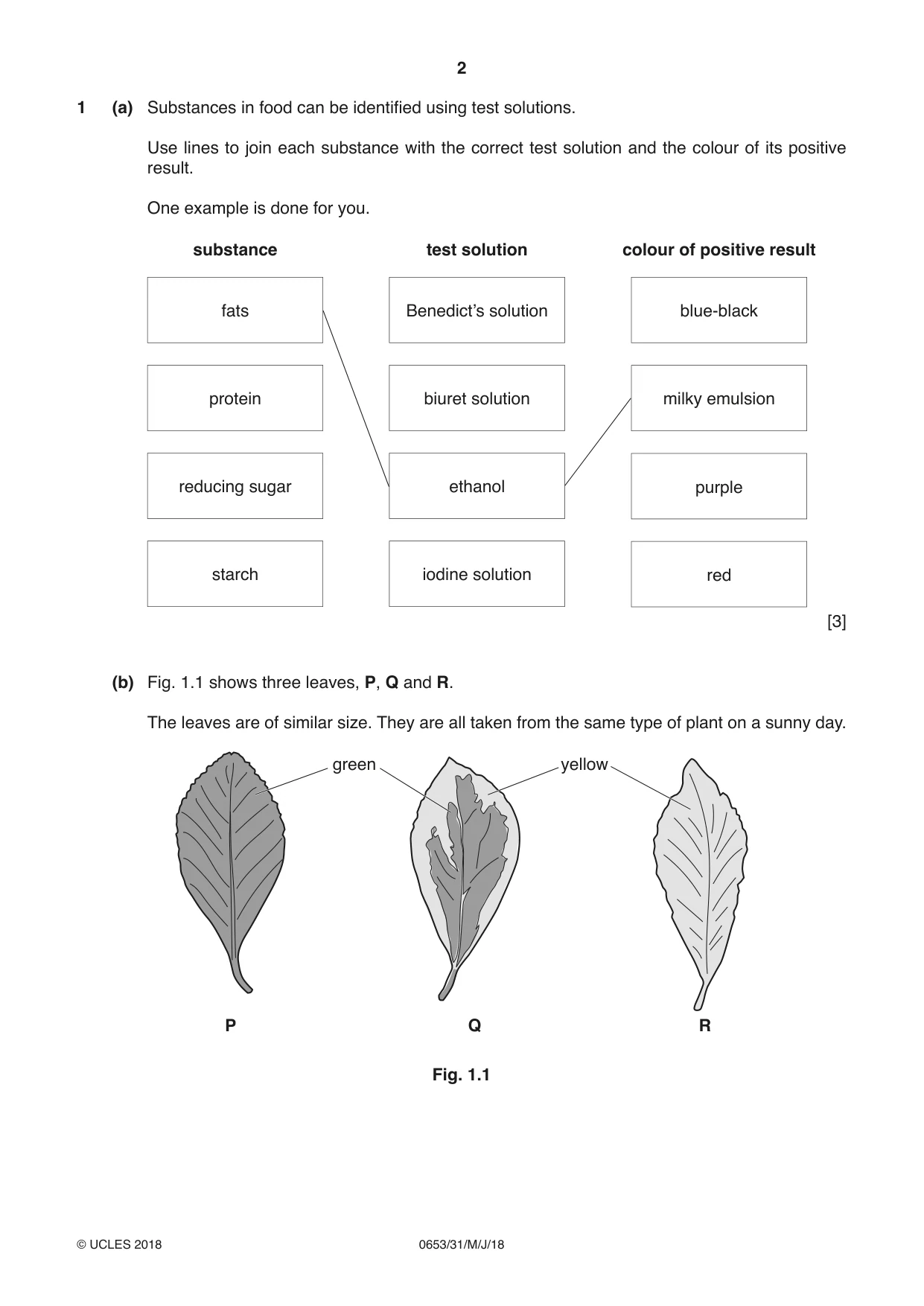
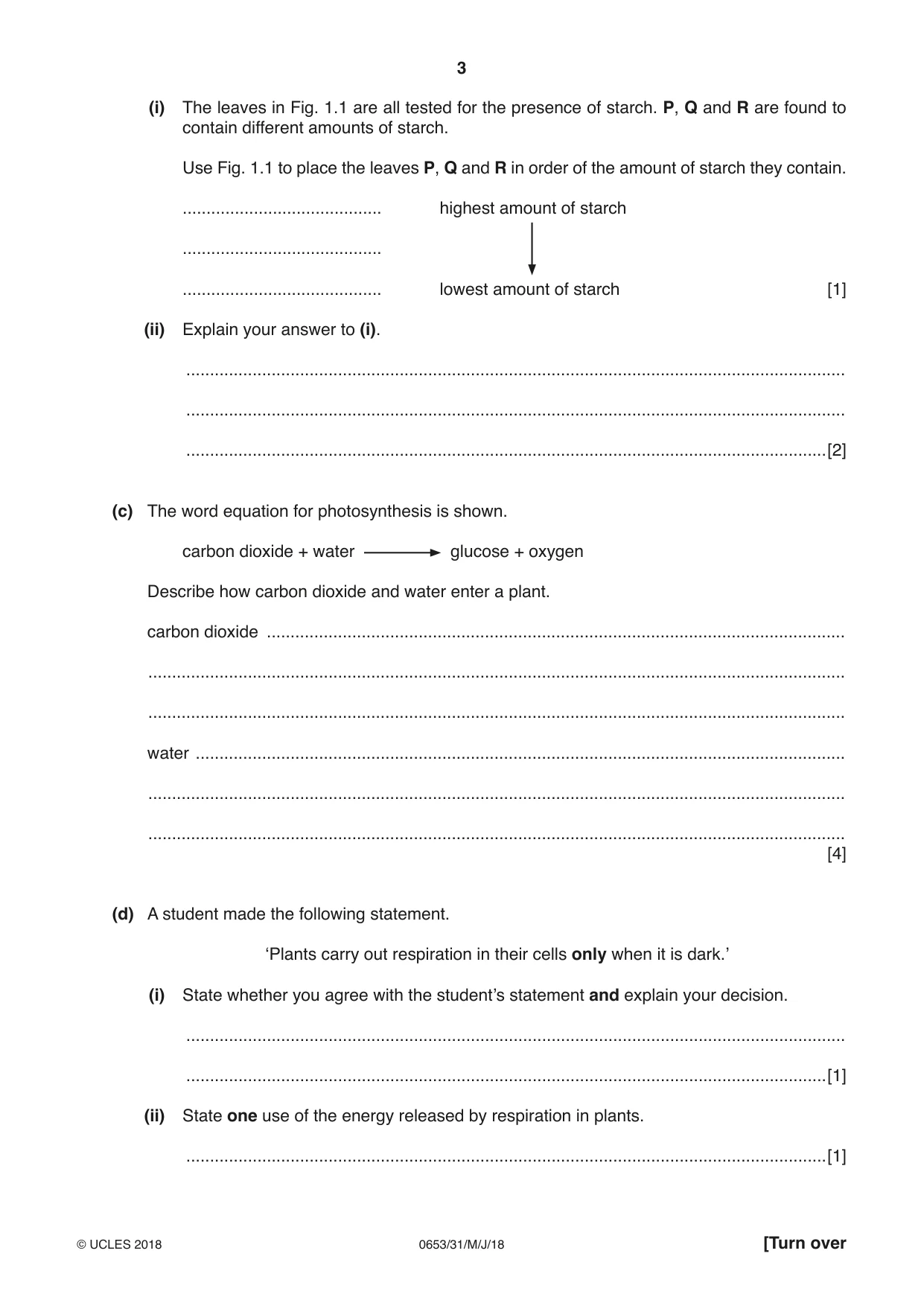
1 (a) Substances in food can be identified using test solutions. Use lines to join each substance with the correct test solution and the colour of its positive result. One example is done for you. substance test solution colour of positive result fats Benedict’s solution blue‑black protein biuret solution milky emulsion reducing sugar ethanol purple starch iodine solution red [3] (b) Fig. 1.1 shows three leaves, P, Q and R. The leaves are of similar size. They are all taken from the same type of plant on a sunny day. green yellow P Q R Fig. 1.1 (i) The leaves in Fig. 1.1 are all tested for the presence of starch. P, Q and R are found to contain different amounts of starch. Use Fig. 1.1 to place the leaves P, Q and R in order of the amount of starch they contain. .......................................... highest amount of starch .......................................... .......................................... lowest amount of starch [1] (ii) Explain your answer to (i). ........................................................................................................................................... ........................................................................................................................................... .......................................................................................................................................[2] (c) The word equation for photosynthesis is shown. carbon dioxide + water glucose + oxygen Describe how carbon dioxide and water enter a plant. carbon dioxide .......................................................................................................................... ................................................................................................................................................... ................................................................................................................................................... water ......................................................................................................................................... ................................................................................................................................................... ................................................................................................................................................... [4] (d) A student made the following statement. ‘Plants carry out respiration in their cells only when it is dark.’ (i) State whether you agree with the student’s statement and explain your decision. ........................................................................................................................................... .......................................................................................................................................[1] (ii) State one use of the energy released by respiration in plants. .......................................................................................................................................[1]
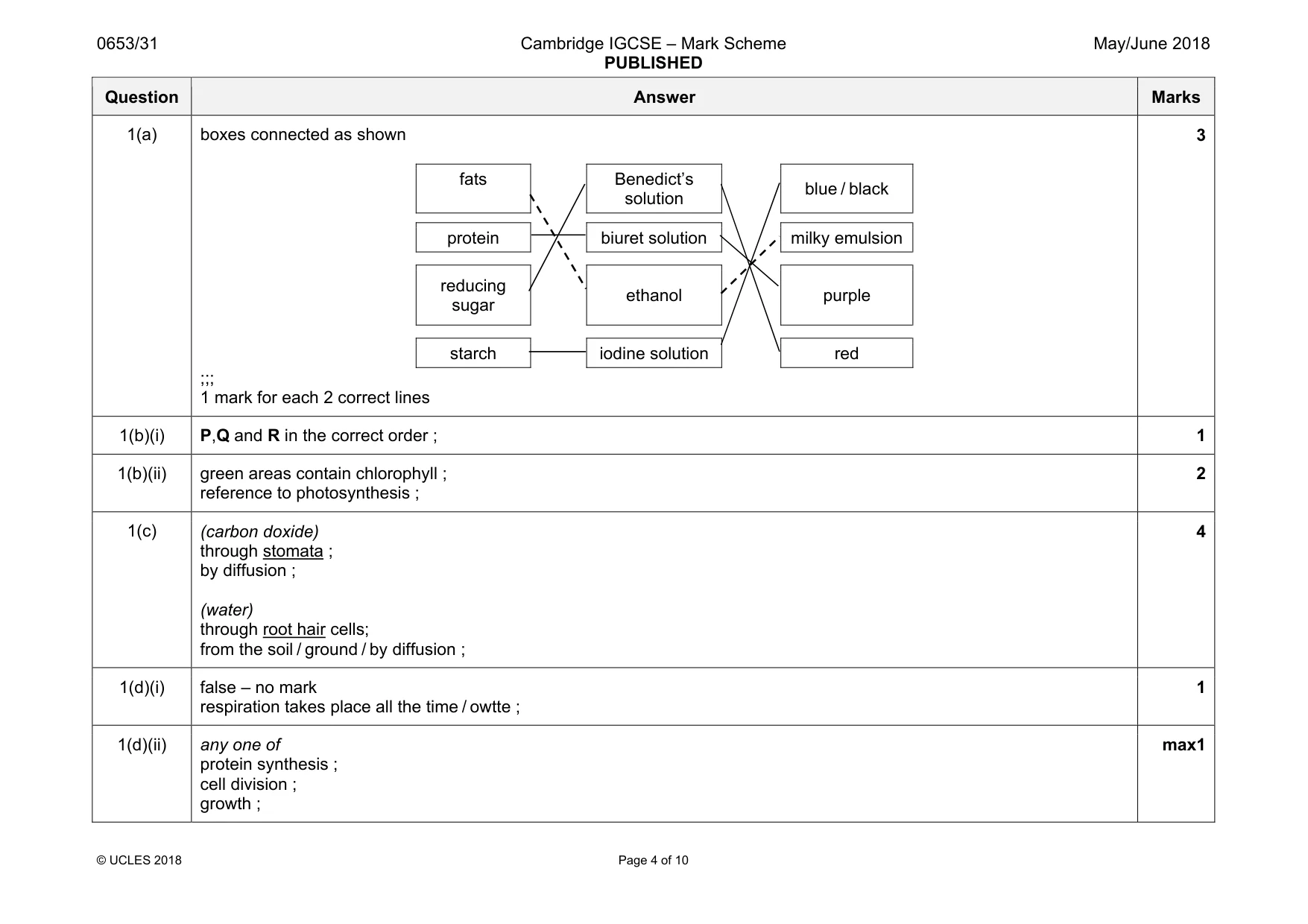
Mark scheme: 1(a) boxes connected as shown fats Benedict’s solution blue / black protein biuret solution milky emulsion reducing sugar ethanol purple starch iodine solution red ;;; 1 mark for each 2 correct lines 3 1(b)(i) P,Q and R in the correct order ; 1 1(b)(ii) green areas contain chlorophyll ; reference to photosynthesis ; 2 1(c) (carbon doxide) through stomata ; by diffusion ; (water) through root hair cells; from the soil / ground / by diffusion ; 4 1(d)(i) false – no mark respiration takes place all the time / owtte ; 1 1(d)(ii) any one of protein synthesis ; cell division ; growth ; max1
Q2 · A student investigates the reactivity of four different metals
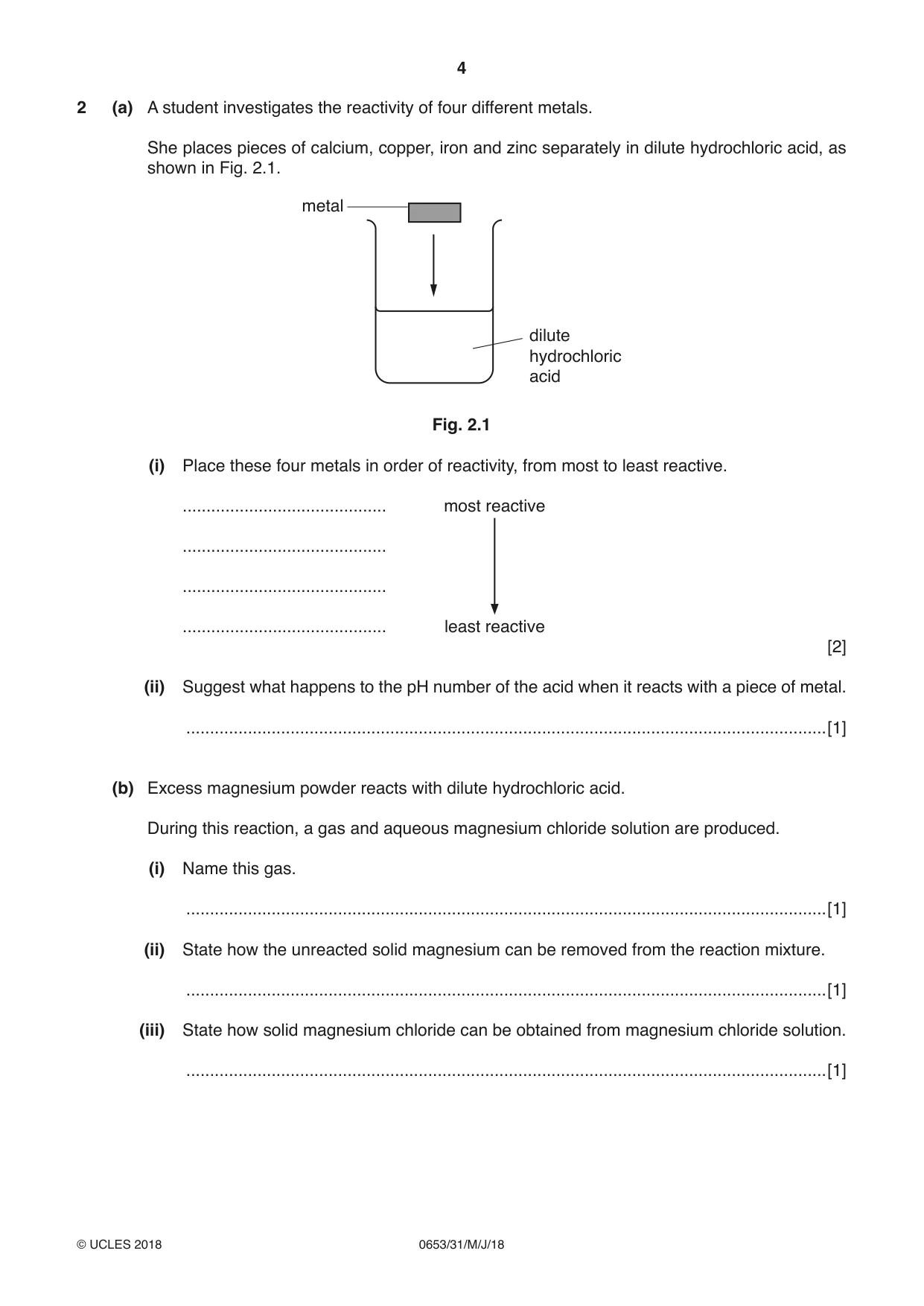
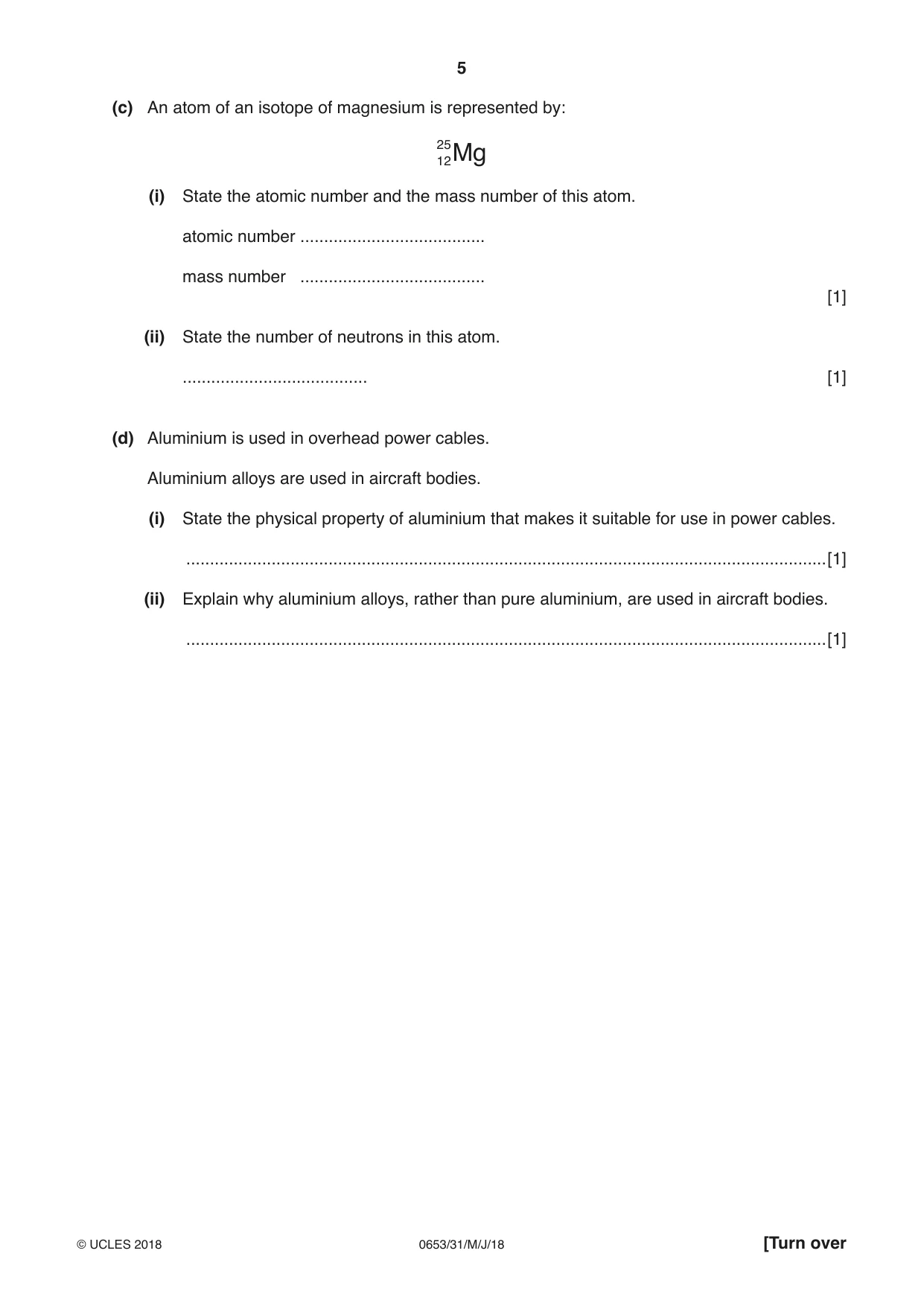
2 (a) A student investigates the reactivity of four different metals. She places pieces of calcium, copper, iron and zinc separately in dilute hydrochloric acid, as shown in Fig. 2.1. metal dilute hydrochloric acid Fig. 2.1 (i) Place these four metals in order of reactivity, from most to least reactive. ........................................... most reactive ........................................... ........................................... ........................................... least reactive [2] (ii) Suggest what happens to the pH number of the acid when it reacts with a piece of metal. .......................................................................................................................................[1] (b) Excess magnesium powder reacts with dilute hydrochloric acid. During this reaction, a gas and aqueous magnesium chloride solution are produced. (i) Name this gas. .......................................................................................................................................[1] (ii) State how the unreacted solid magnesium can be removed from the reaction mixture. .......................................................................................................................................[1] (iii) State how solid magnesium chloride can be obtained from magnesium chloride solution. .......................................................................................................................................[1] (c) An atom of an isotope of magnesium is represented by: 2512Mg (i) State the atomic number and the mass number of this atom. atomic number ....................................... mass number ....................................... [1] (ii) State the number of neutrons in this atom. ....................................... [1] (d) Aluminium is used in overhead power cables. Aluminium alloys are used in aircraft bodies. (i) State the physical property of aluminium that makes it suitable for use in power cables. .......................................................................................................................................[1] (ii) Explain why aluminium alloys, rather than pure aluminium, are used in aircraft bodies. .......................................................................................................................................[1]
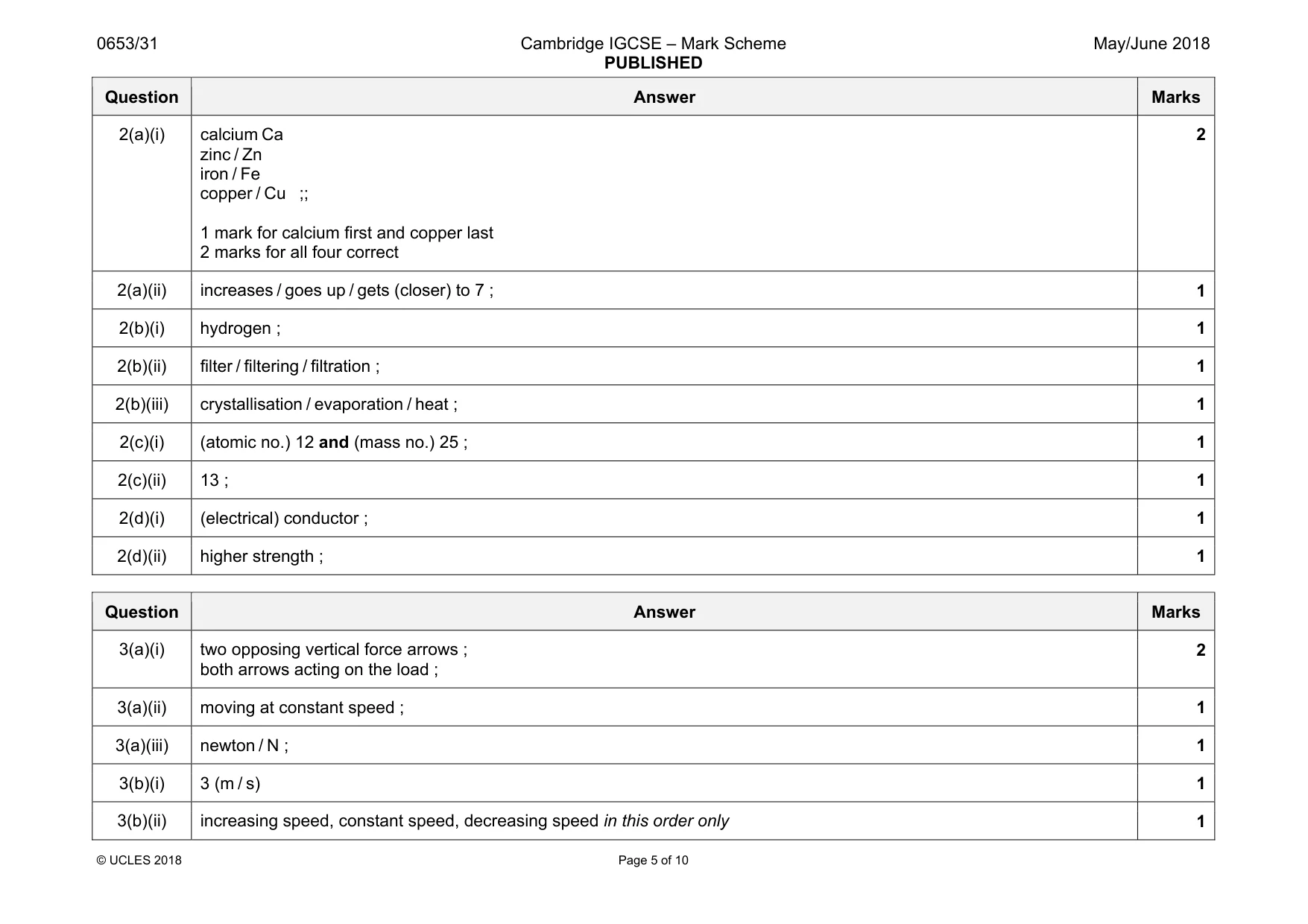
Mark scheme: 2(a)(i) calcium Ca zinc / Zn iron / Fe copper / Cu ;; 1 mark for calcium first and copper last 2 marks for all four correct 2 2(a)(ii) increases / goes up / gets (closer) to 7 ; 1 2(b)(i) hydrogen ; 1 2(b)(ii) filter / filtering / filtration ; 1 2(b)(iii) crystallisation / evaporation / heat ; 1 2(c)(i) (atomic no.) 12 and (mass no.) 25 ; 1 2(c)(ii) 13 ; 1 2(d)(i) (electrical) conductor ; 1 2(d)(ii) higher strength ; 1
Q3 · An airship carrying a heavy load
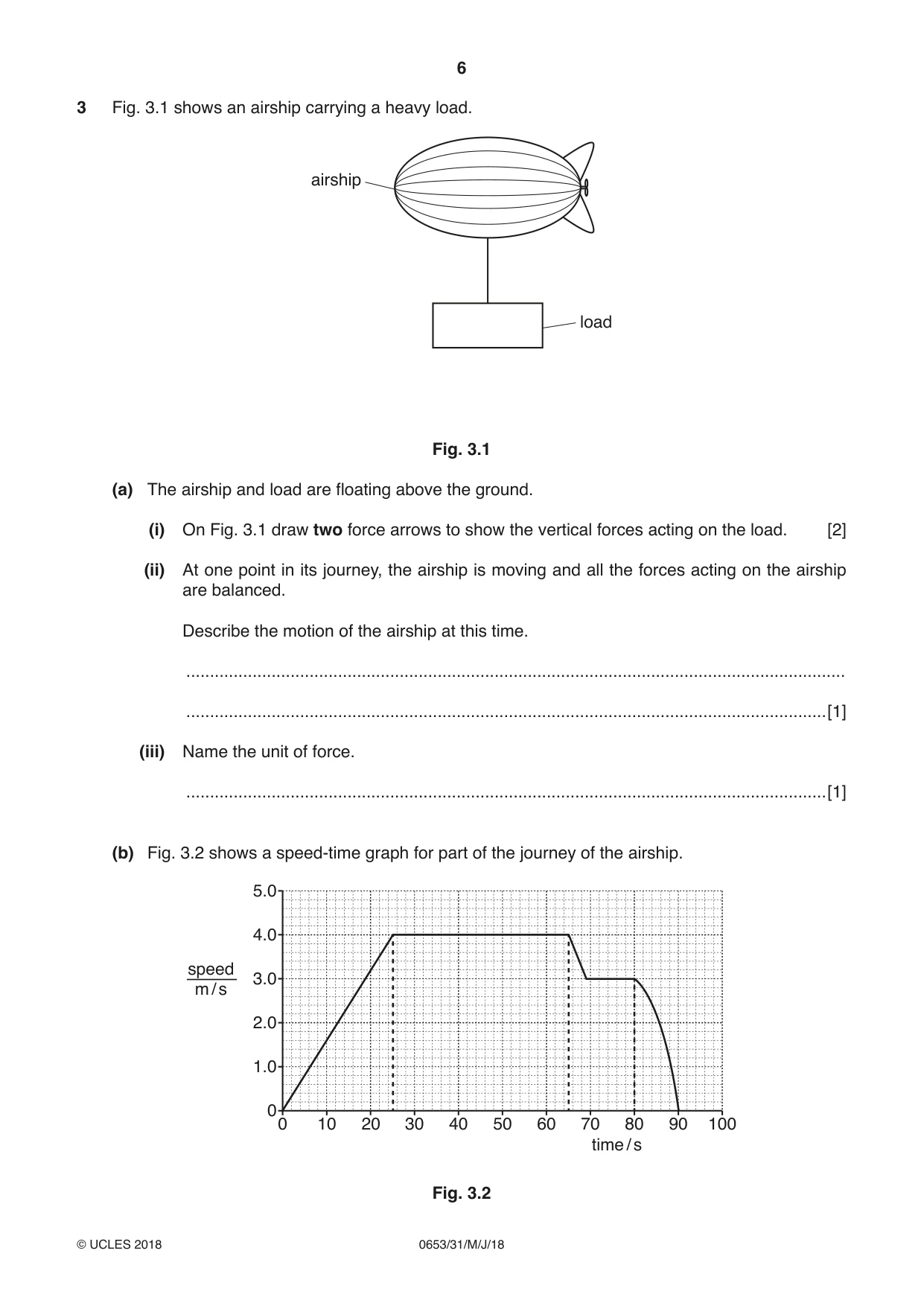
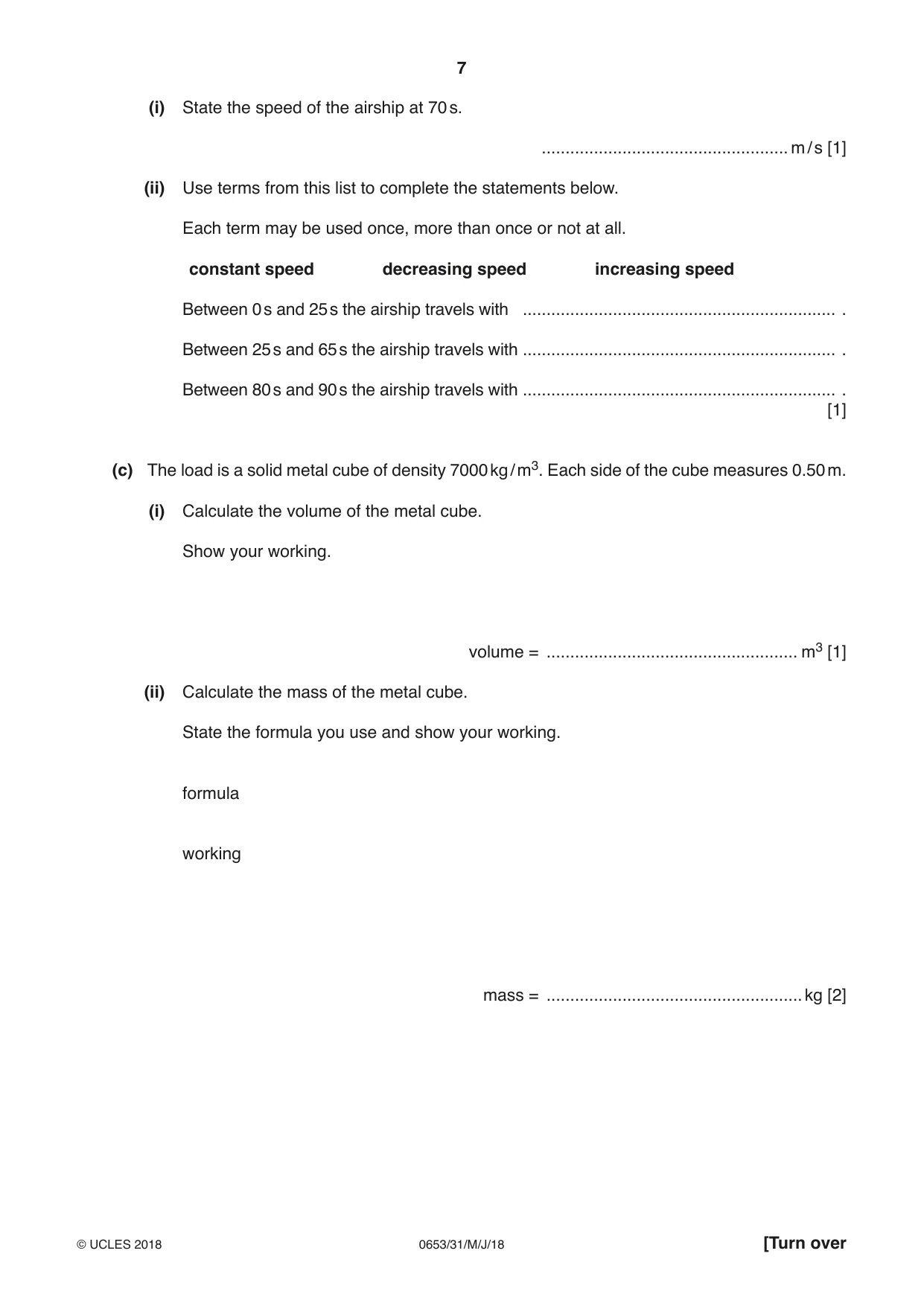
3 Fig. 3.1 shows an airship carrying a heavy load. airship load Fig. 3.1 (a) The airship and load are floating above the ground. (i) On Fig. 3.1 draw two force arrows to show the vertical forces acting on the load. [2] (ii) At one point in its journey, the airship is moving and all the forces acting on the airship are balanced. Describe the motion of the airship at this time. ........................................................................................................................................... .......................................................................................................................................[1] (iii) Name the unit of force. .......................................................................................................................................[1] (b) Fig. 3.2 shows a speed‑time graph for part of the journey of the airship. 5.0 4.0 speed 3.0 m / s 2.0 1.0 00 10 20 30 40 50 60 70 80 90 100 time / s Fig. 3.2 (i) State the speed of the airship at 70 s. .................................................... m / s [1] (ii) Use terms from this list to complete the statements below. Each term may be used once, more than once or not at all. constant speed decreasing speed increasing speed Between 0 s and 25 s the airship travels with .................................................................. . Between 25 s and 65 s the airship travels with .................................................................. . Between 80 s and 90 s the airship travels with .................................................................. . [1] (c) The load is a solid metal cube of density 7000 kg / m3. Each side of the cube measures 0.50 m. (i) Calculate the volume of the metal cube. Show your working. volume = ..................................................... m3 [1] (ii) Calculate the mass of the metal cube. State the formula you use and show your working. formula working mass = ......................................................kg [2]
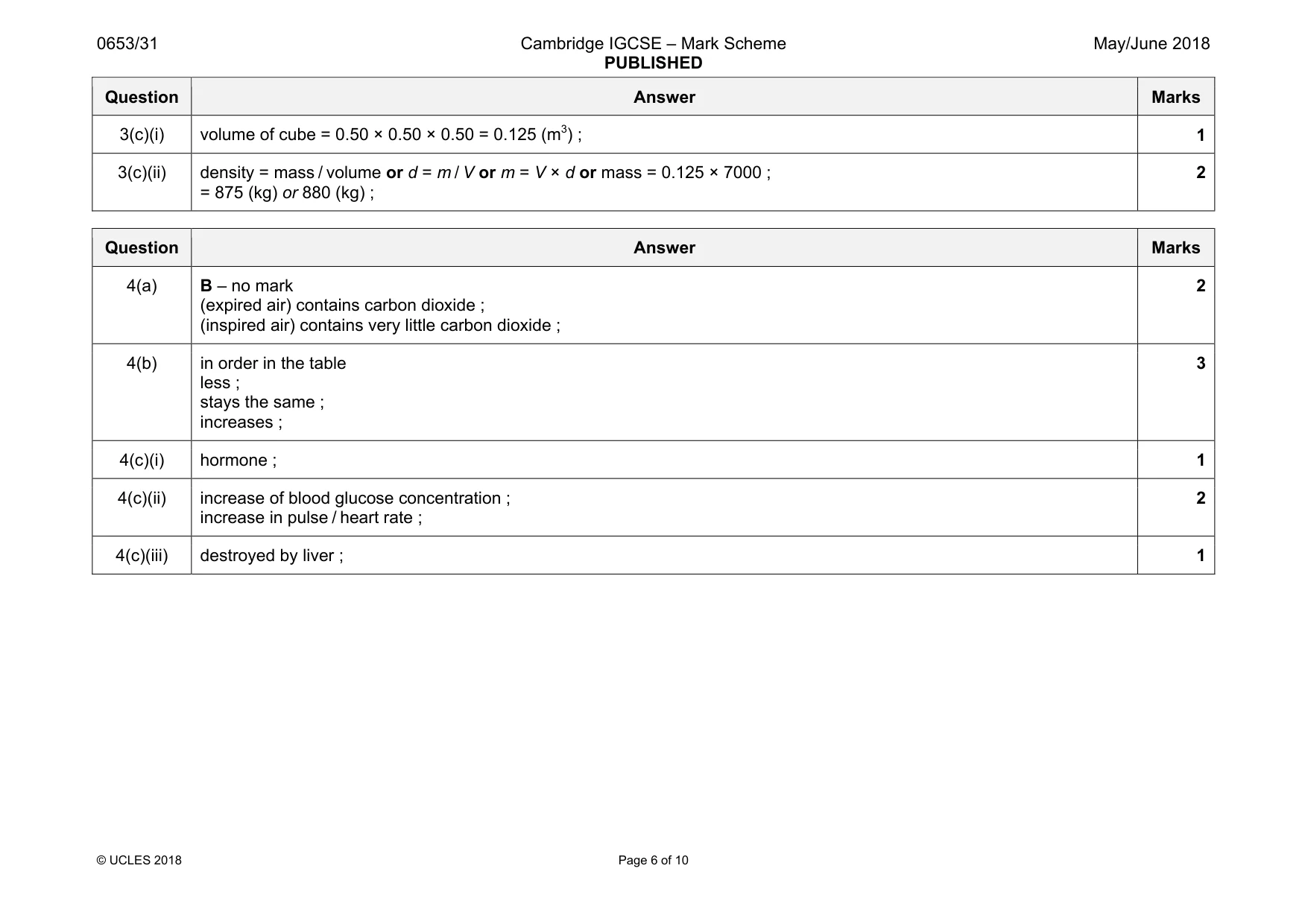
Mark scheme: 3(a)(i) two opposing vertical force arrows ; both arrows acting on the load ; 2 3(a)(ii) moving at constant speed ; 1 3(a)(iii) newton / N ; 1 3(b)(i) 3 (m / s) 1 3(b)(ii) increasing speed, constant speed, decreasing speed in this order only 1 Question Answer Marks 3(c)(i) volume of cube = 0.50 × 0.50 × 0.50 = 0.125 (m3) ; 1 3(c)(ii) density = mass / volume or d = m / V or m = V × d or mass = 0.125 × 7000 ; = 875 (kg) or 880 (kg) ; 2
Q4 · Apparatus which is used to compare the carbon dioxide content of inspired air with…
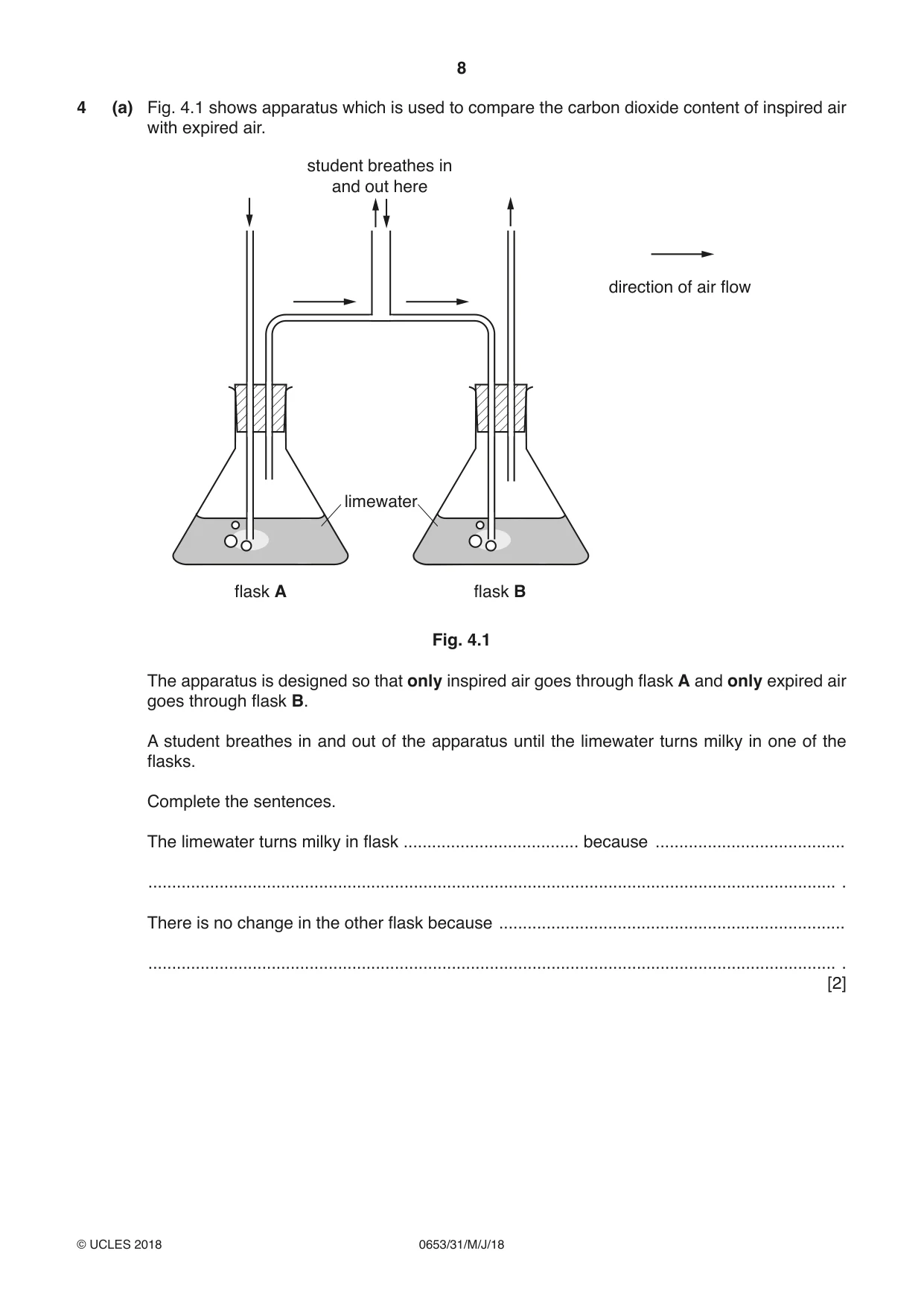
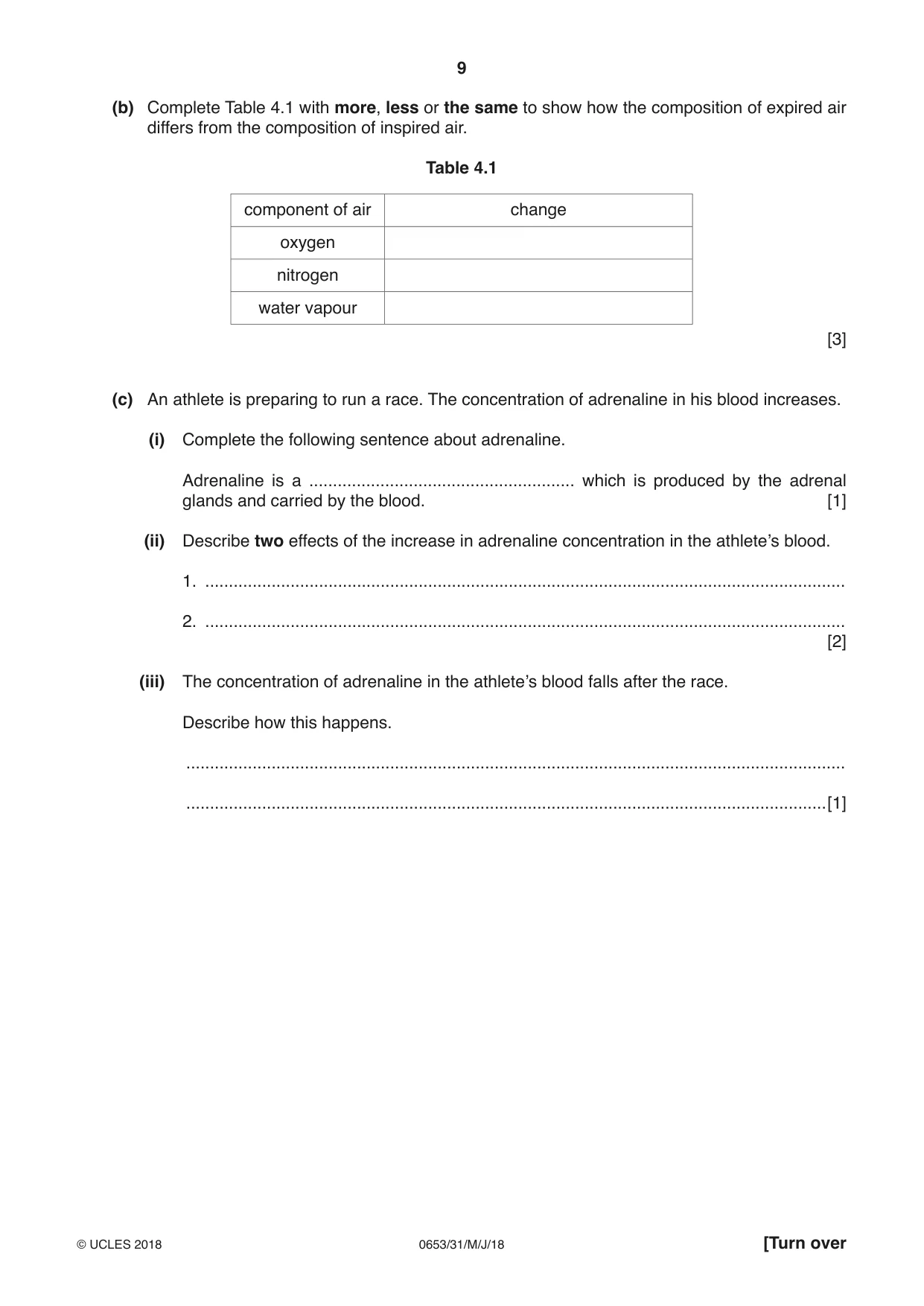
4 (a) Fig. 4.1 shows apparatus which is used to compare the carbon dioxide content of inspired air with expired air. student breathes in and out here direction of air flow limewater flask A flask B Fig. 4.1 The apparatus is designed so that only inspired air goes through flask A and only expired air goes through flask B. A student breathes in and out of the apparatus until the limewater turns milky in one of the flasks. Complete the sentences. The limewater turns milky in flask ..................................... because ........................................ ................................................................................................................................................. . There is no change in the other flask because ......................................................................... ................................................................................................................................................. . [2] (b) Complete Table 4.1 with more, less or the same to show how the composition of expired air differs from the composition of inspired air. Table 4.1 component of air change oxygen nitrogen water vapour [3] (c) An athlete is preparing to run a race. The concentration of adrenaline in his blood increases. (i) Complete the following sentence about adrenaline. Adrenaline is a ........................................................ which is produced by the adrenal glands and carried by the blood. [1] (ii) Describe two effects of the increase in adrenaline concentration in the athlete’s blood. 1. ....................................................................................................................................... 2. ....................................................................................................................................... [2] (iii) The concentration of adrenaline in the athlete’s blood falls after the race. Describe how this happens. ........................................................................................................................................... .......................................................................................................................................[1]
Mark scheme: 4(a) B – no mark (expired air) contains carbon dioxide ; (inspired air) contains very little carbon dioxide ; 2 4(b) in order in the table less ; stays the same ; increases ; 3 4(c)(i) hormone ; 1 4(c)(ii) increase of blood glucose concentration ; increase in pulse / heart rate ; 2 4(c)(iii) destroyed by liver ; 1
Q5 · The process used to produce refinery gas, gasoline and gas oil from petroleum is shown in…
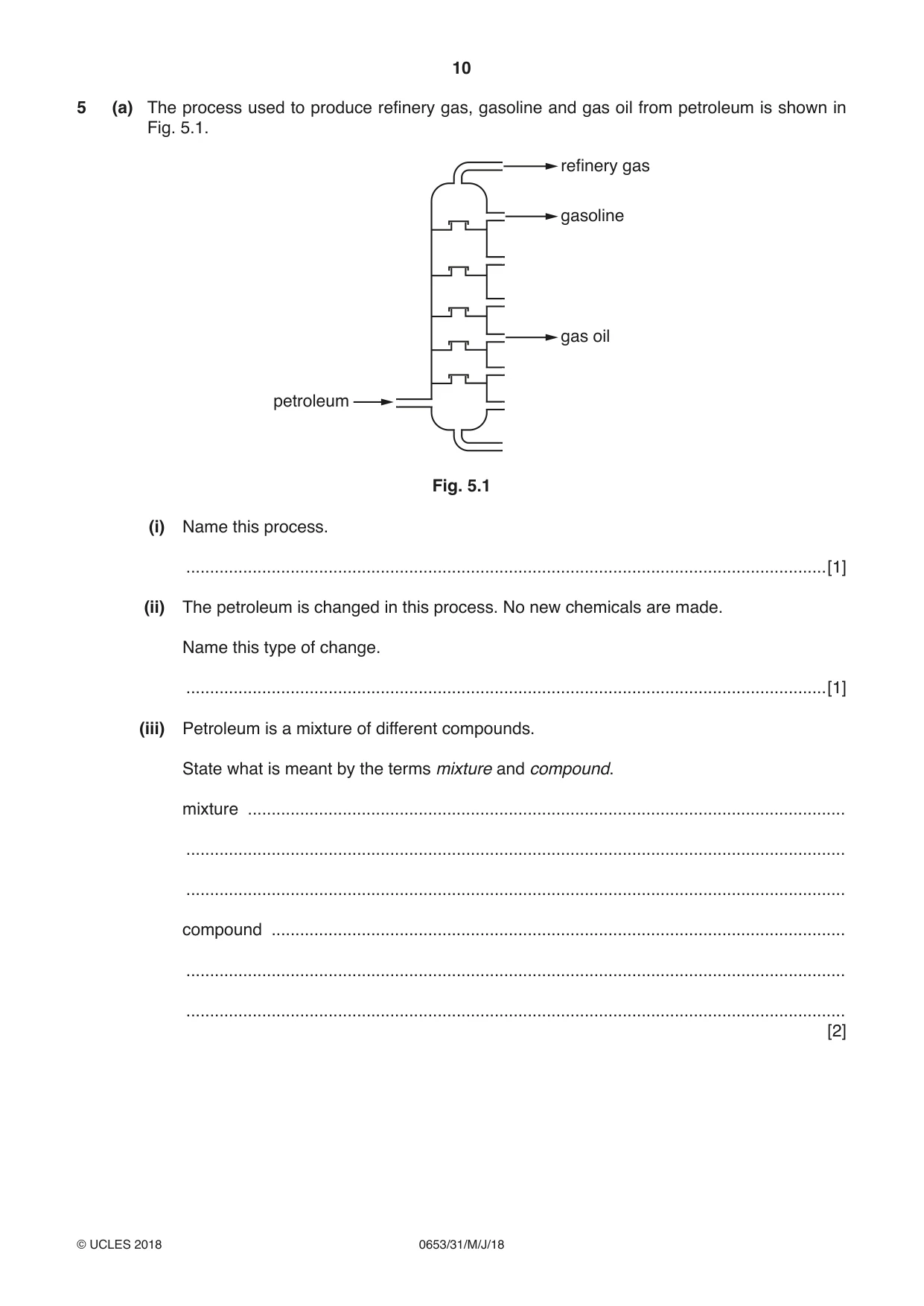
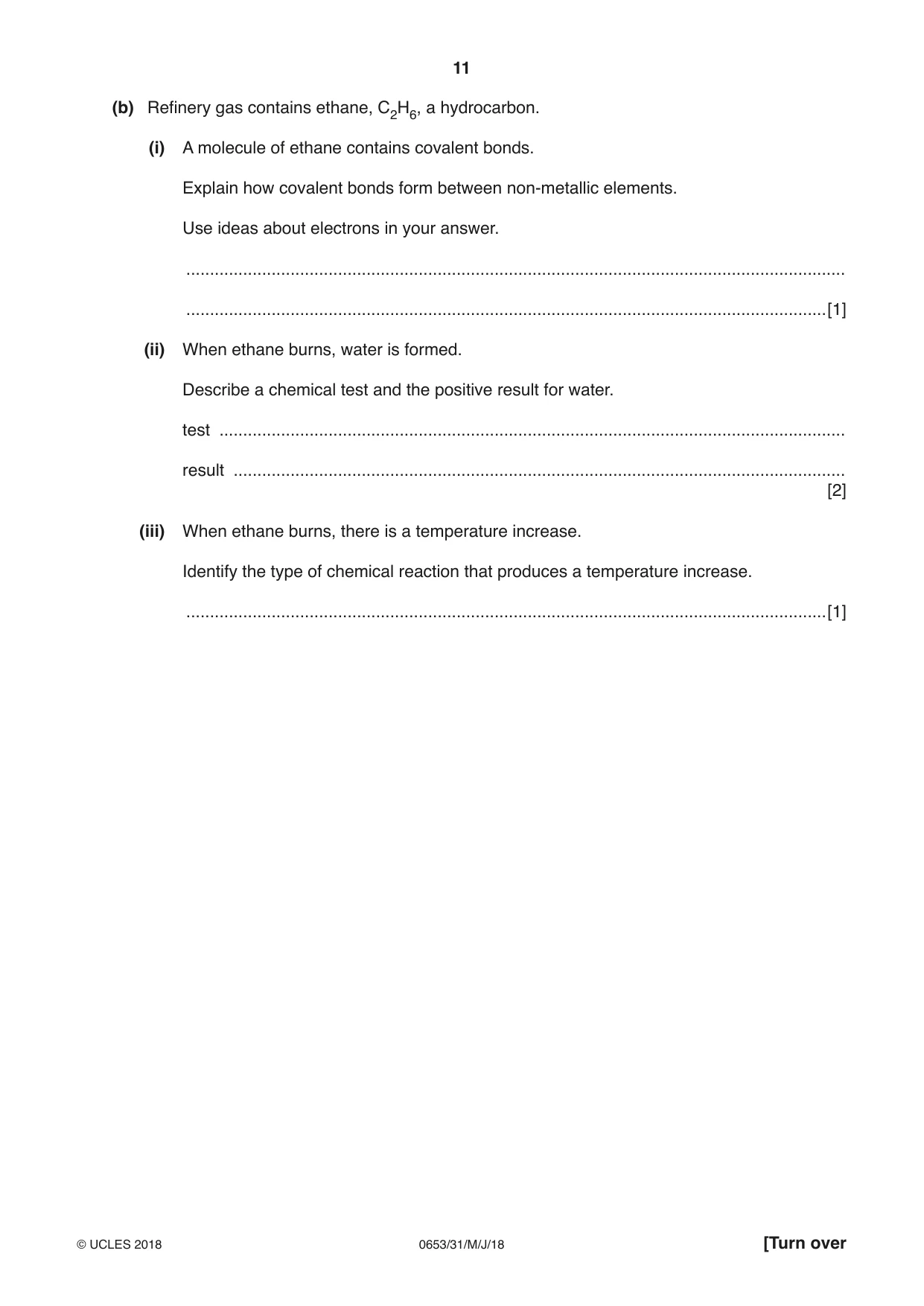
5 (a) The process used to produce refinery gas, gasoline and gas oil from petroleum is shown in Fig. 5.1. refinery gas gasoline gas oil petroleum Fig. 5.1 (i) Name this process. .......................................................................................................................................[1] (ii) The petroleum is changed in this process. No new chemicals are made. Name this type of change. .......................................................................................................................................[1] (iii) Petroleum is a mixture of different compounds. State what is meant by the terms mixture and compound. mixture .............................................................................................................................. ........................................................................................................................................... ........................................................................................................................................... compound ......................................................................................................................... ........................................................................................................................................... ........................................................................................................................................... [2] (b) Refinery gas contains ethane, C2H6, a hydrocarbon. (i) A molecule of ethane contains covalent bonds. Explain how covalent bonds form between non‑metallic elements. Use ideas about electrons in your answer. ........................................................................................................................................... .......................................................................................................................................[1] (ii) When ethane burns, water is formed. Describe a chemical test and the positive result for water. test .................................................................................................................................... result ................................................................................................................................. [2] (iii) When ethane burns, there is a temperature increase. Identify the type of chemical reaction that produces a temperature increase. .......................................................................................................................................[1]
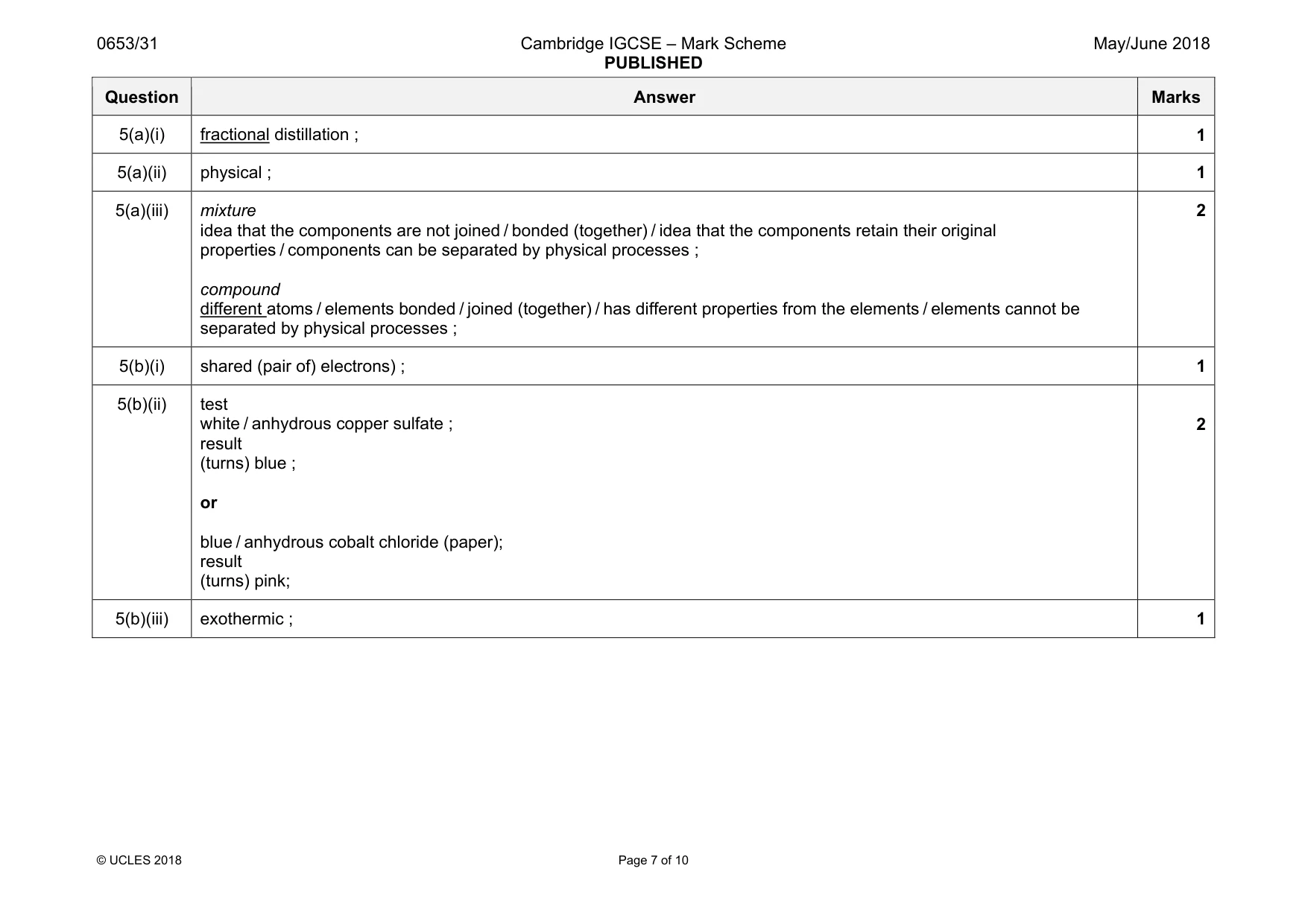
Mark scheme: 5(a)(i) fractional distillation ; 1 5(a)(ii) physical ; 1 5(a)(iii) mixture idea that the components are not joined / bonded (together) / idea that the components retain their original properties / components can be separated by physical processes ; compound different atoms / elements bonded / joined (together) / has different properties from the elements / elements cannot be separated by physical processes ; 2 5(b)(i) shared (pair of) electrons) ; 1 5(b)(ii) test white / anhydrous copper sulfate ; result (turns) blue ; or blue / anhydrous cobalt chloride (paper); result (turns) pink; 2 5(b)(iii) exothermic ; 1
Q6 · A man watching television
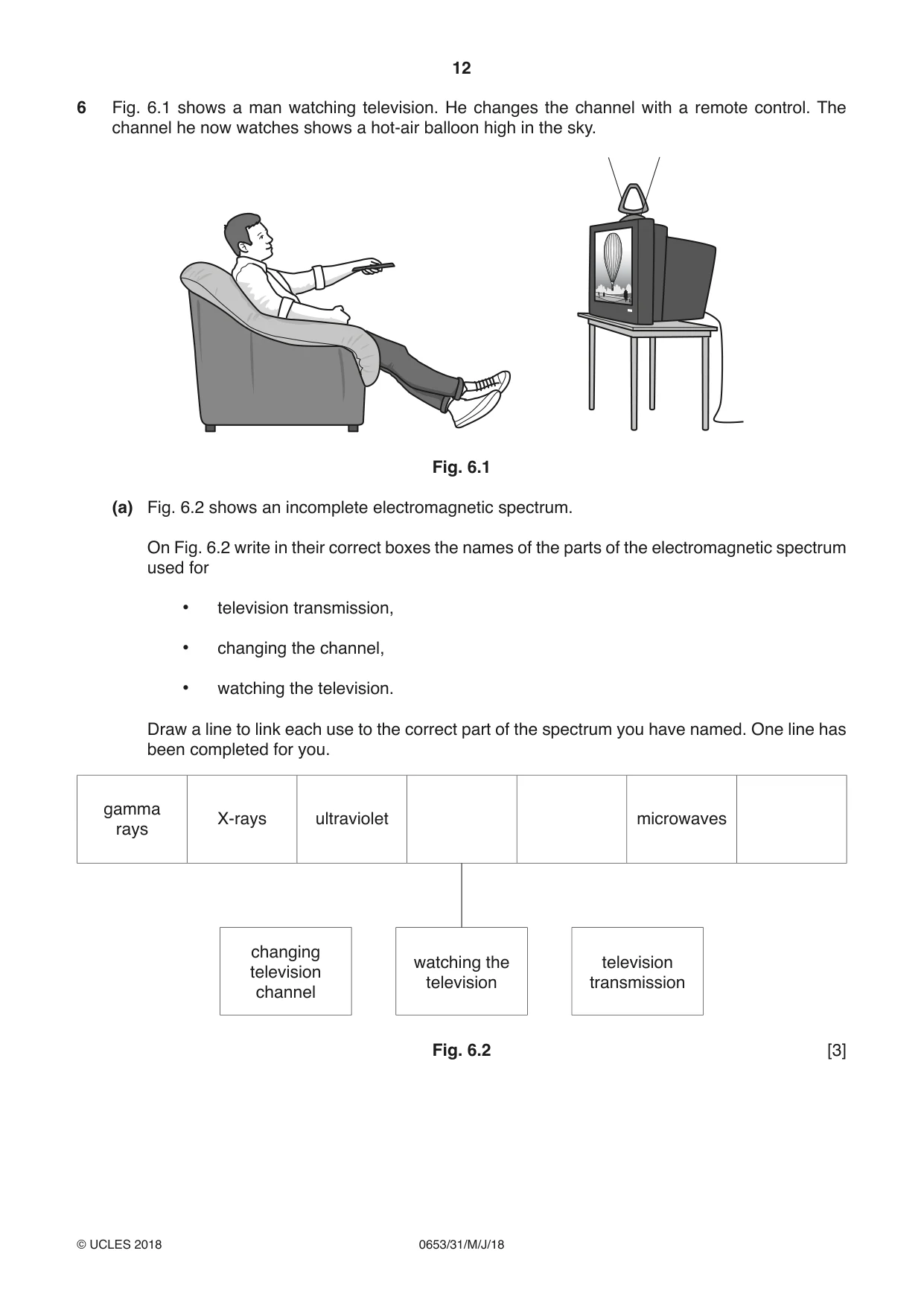
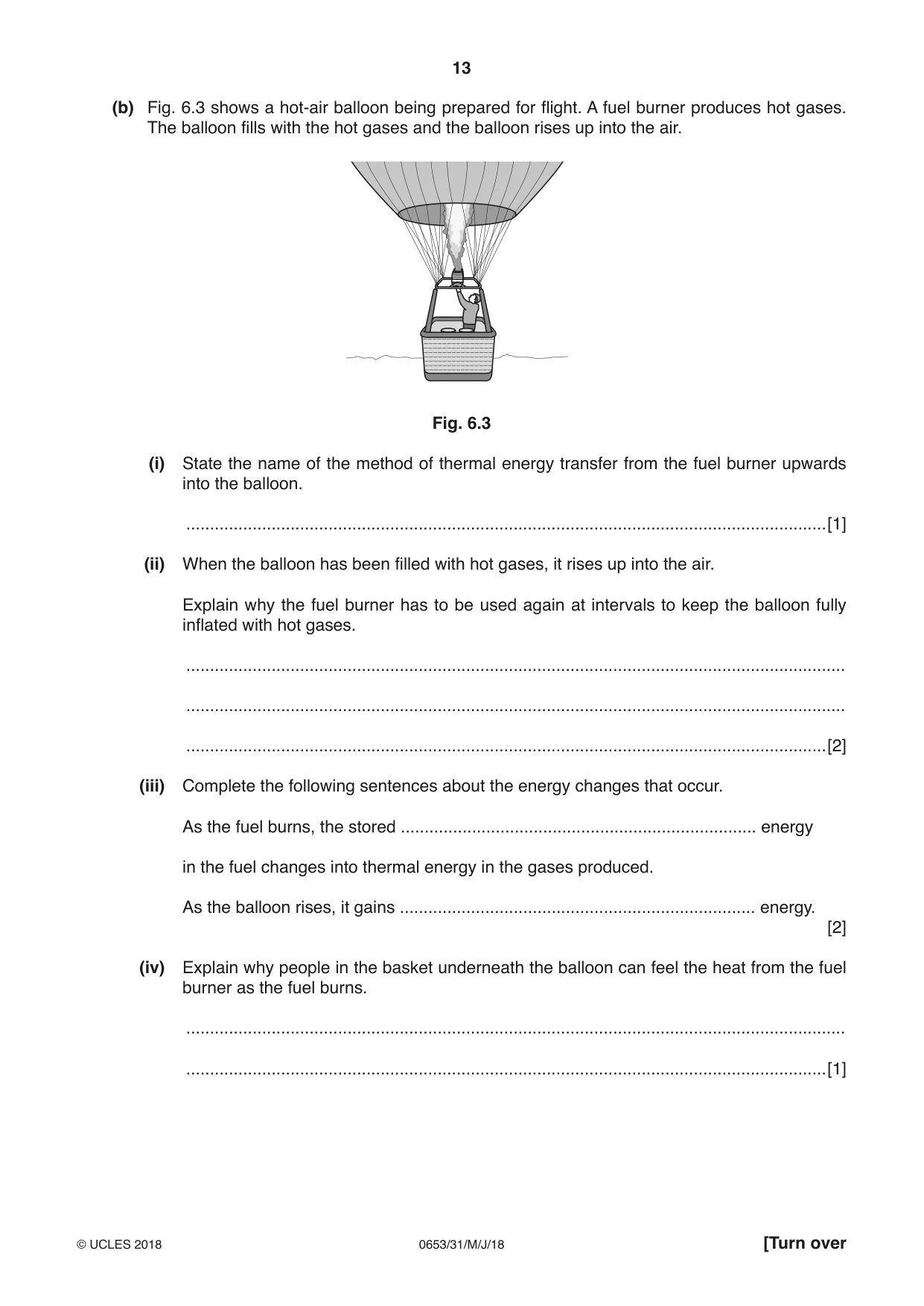
6 Fig. 6.1 shows a man watching television. He changes the channel with a remote control. The channel he now watches shows a hot‑air balloon high in the sky. Fig. 6.1 (a) Fig. 6.2 shows an incomplete electromagnetic spectrum. On Fig. 6.2 write in their correct boxes the names of the parts of the electromagnetic spectrum used for • television transmission, • changing the channel, • watching the television. Draw a line to link each use to the correct part of the spectrum you have named. One line has been completed for you. gamma X‑rays ultraviolet microwaves rays changing watching the television television television transmission channel Fig. 6.2 [3] (b) Fig. 6.3 shows a hot‑air balloon being prepared for flight. A fuel burner produces hot gases. The balloon fills with the hot gases and the balloon rises up into the air. Fig. 6.3 (i) State the name of the method of thermal energy transfer from the fuel burner upwards into the balloon. .......................................................................................................................................[1] (ii) When the balloon has been filled with hot gases, it rises up into the air. Explain why the fuel burner has to be used again at intervals to keep the balloon fully inflated with hot gases. ........................................................................................................................................... ........................................................................................................................................... .......................................................................................................................................[2] (iii) Complete the following sentences about the energy changes that occur. As the fuel burns, the stored ........................................................................... energy in the fuel changes into thermal energy in the gases produced. As the balloon rises, it gains ........................................................................... energy. [2] (iv) Explain why people in the basket underneath the balloon can feel the heat from the fuel burner as the fuel burns. ........................................................................................................................................... .......................................................................................................................................[1]
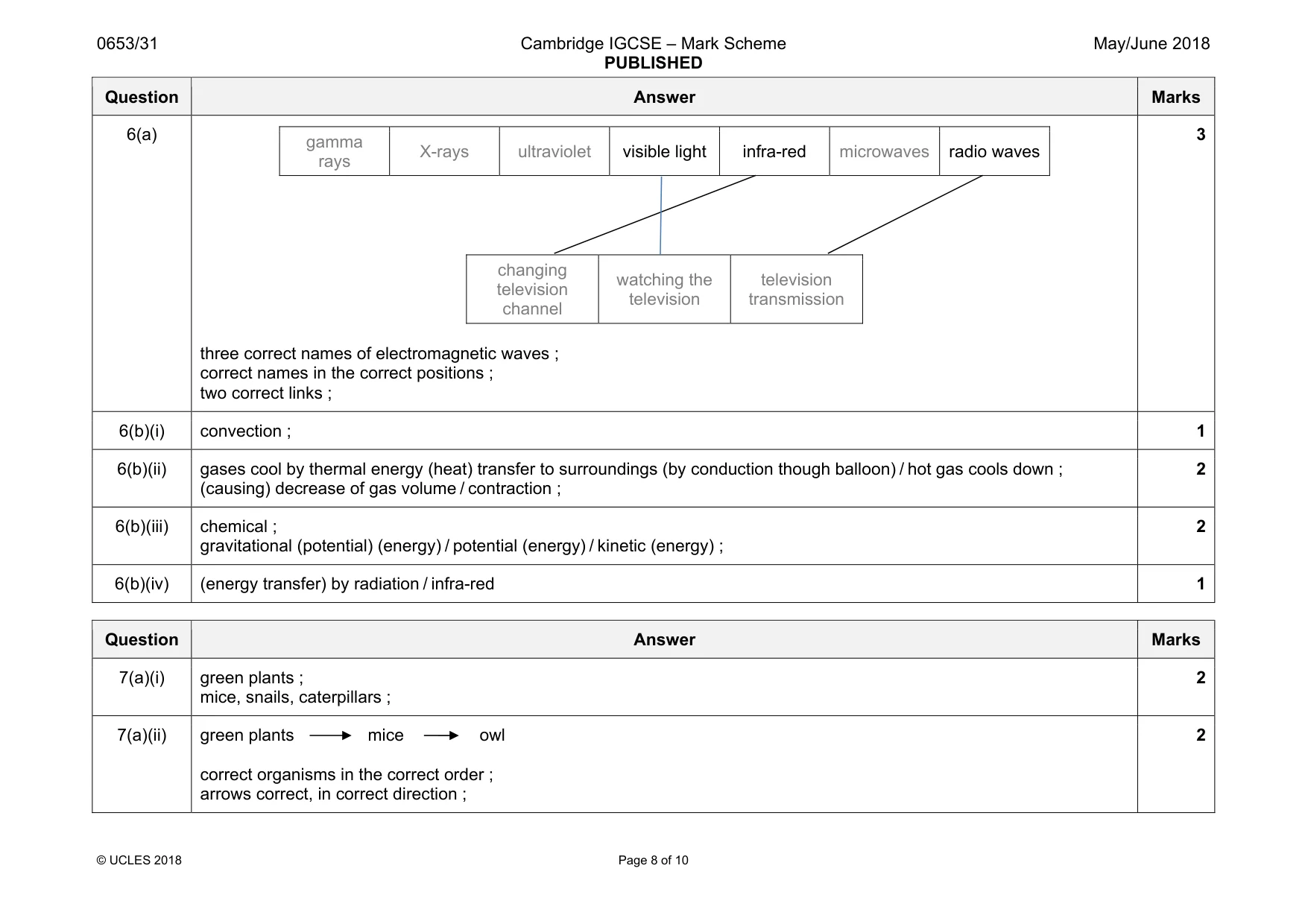
Mark scheme: 6(a) gamma rays X-rays ultraviolet visible light infra-red microwaves radio waves changing television channel watching the television television transmission three correct names of electromagnetic waves ; correct names in the correct positions ; two correct links ; 3 6(b)(i) convection ; 1 6(b)(ii) gases cool by thermal energy (heat) transfer to surroundings (by conduction though balloon) / hot gas cools down ; (causing) decrease of gas volume / contraction ; 2 6(b)(iii) chemical ; gravitational (potential) (energy) / potential (energy) / kinetic (energy) ; 2 6(b)(iv) (energy transfer) by radiation / infra-red 1
Q7 · A food web in a garden
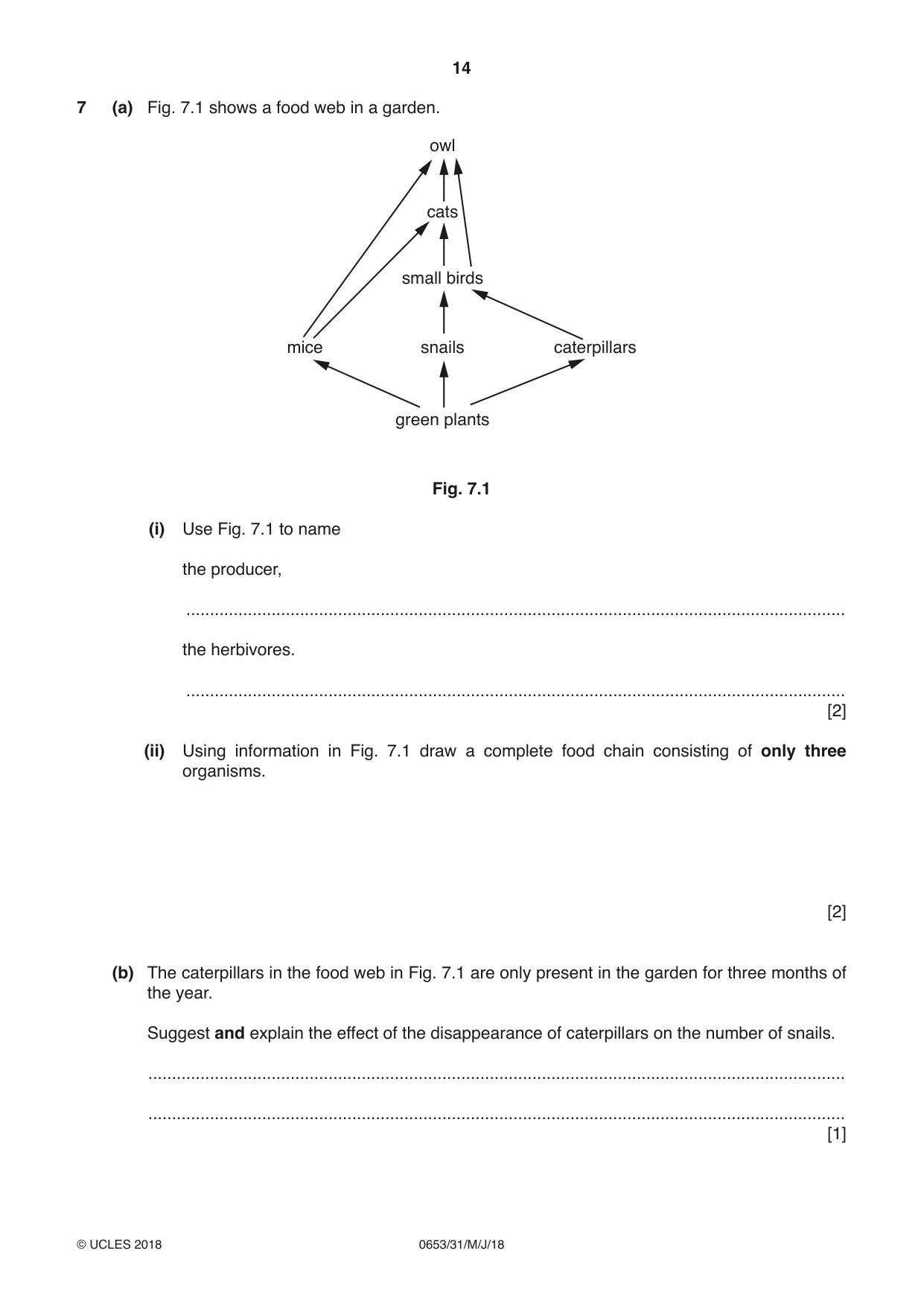
7 (a) Fig. 7.1 shows a food web in a garden. owl cats small birds mice snails caterpillars green plants Fig. 7.1 (i) Use Fig. 7.1 to name the producer, ........................................................................................................................................... the herbivores. ........................................................................................................................................... [2] (ii) Using information in Fig. 7.1 draw a complete food chain consisting of only three organisms. [2] (b) The caterpillars in the food web in Fig. 7.1 are only present in the garden for three months of the year. Suggest and explain the effect of the disappearance of caterpillars on the number of snails. ................................................................................................................................................... ................................................................................................................................................... [1]
Mark scheme: 7(a)(i) green plants ; mice, snails, caterpillars ; 2 7(a)(ii) green plants mice owl correct organisms in the correct order ; arrows correct, in correct direction ; 2 Question Answer Marks 7(b) decrease – no mark the small birds will eat more snails ; or increase – no mark more food for snails when caterpillars disappear ; 1
Q8 · The electrolysis of aqueous copper chloride is shown in Fig
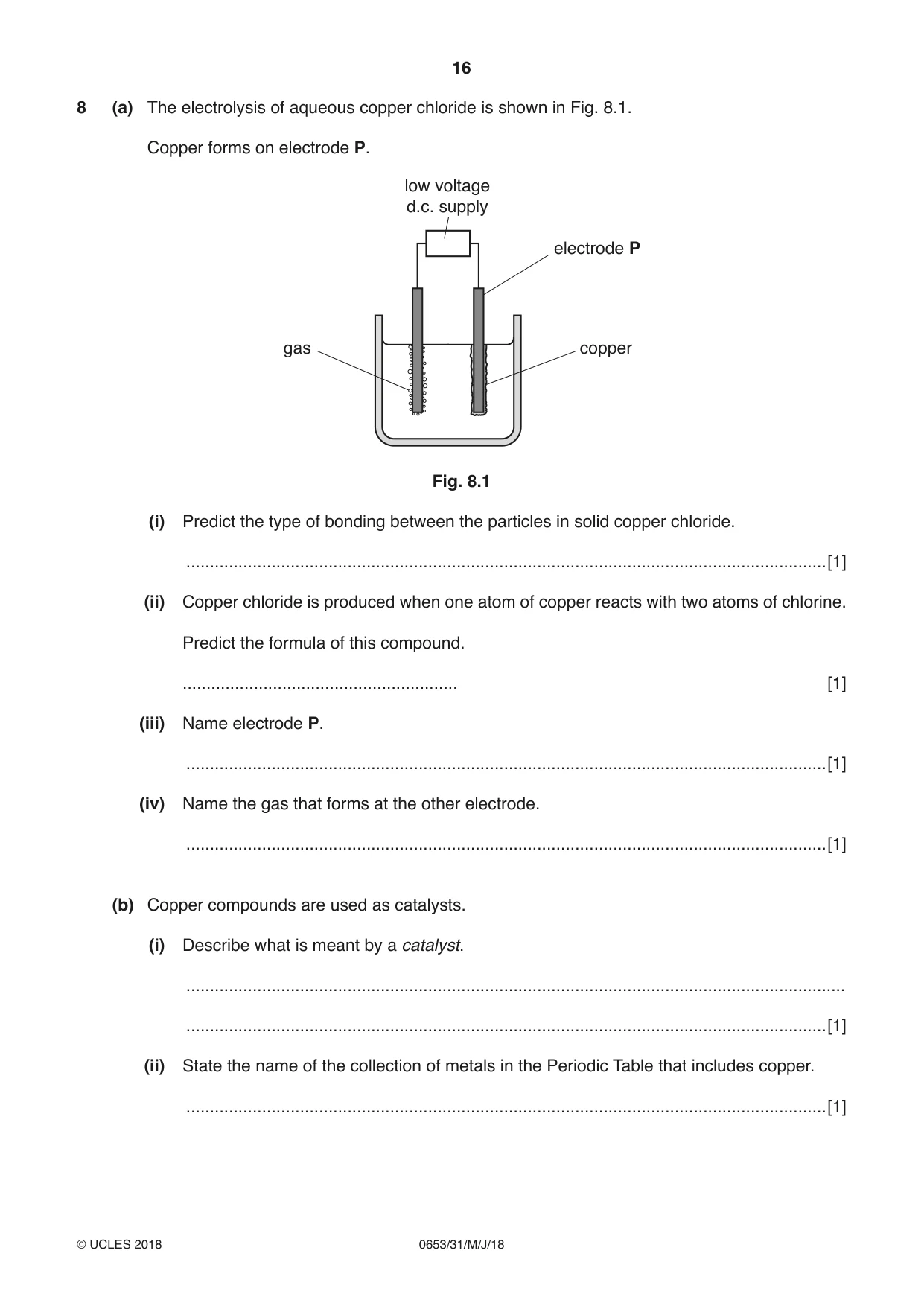
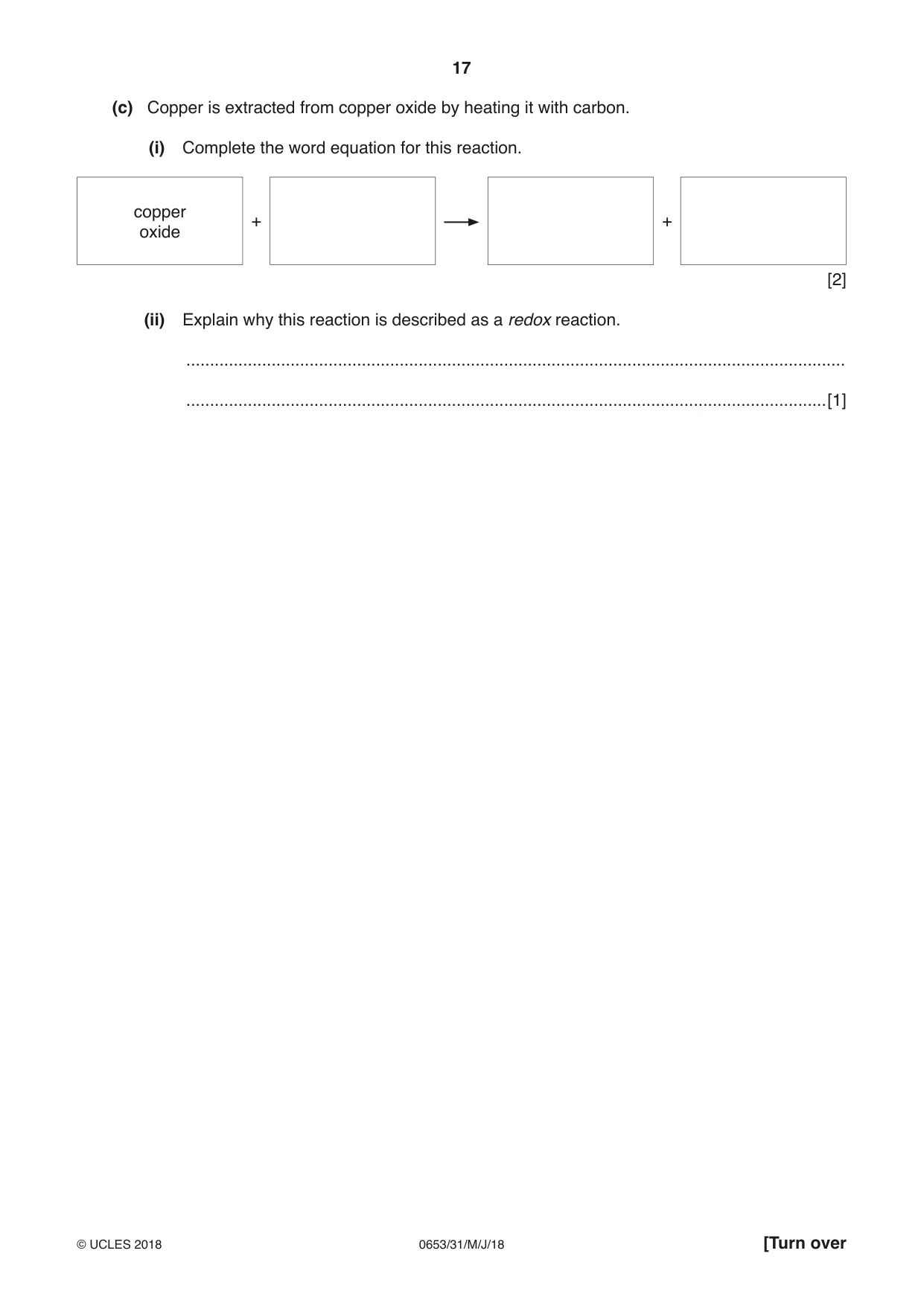
8 (a) The electrolysis of aqueous copper chloride is shown in Fig. 8.1. Copper forms on electrode P. low voltage d.c. supply electrode P gas copper Fig. 8.1 (i) Predict the type of bonding between the particles in solid copper chloride. .......................................................................................................................................[1] (ii) Copper chloride is produced when one atom of copper reacts with two atoms of chlorine. Predict the formula of this compound. .......................................................... [1] (iii) Name electrode P. .......................................................................................................................................[1] (iv) Name the gas that forms at the other electrode. .......................................................................................................................................[1] (b) Copper compounds are used as catalysts. (i) Describe what is meant by a catalyst. ........................................................................................................................................... .......................................................................................................................................[1] (ii) State the name of the collection of metals in the Periodic Table that includes copper. .......................................................................................................................................[1] (c) Copper is extracted from copper oxide by heating it with carbon. (i) Complete the word equation for this reaction. copper + + oxide [2] (ii) Explain why this reaction is described as a redox reaction. ........................................................................................................................................... .......................................................................................................................................[1]
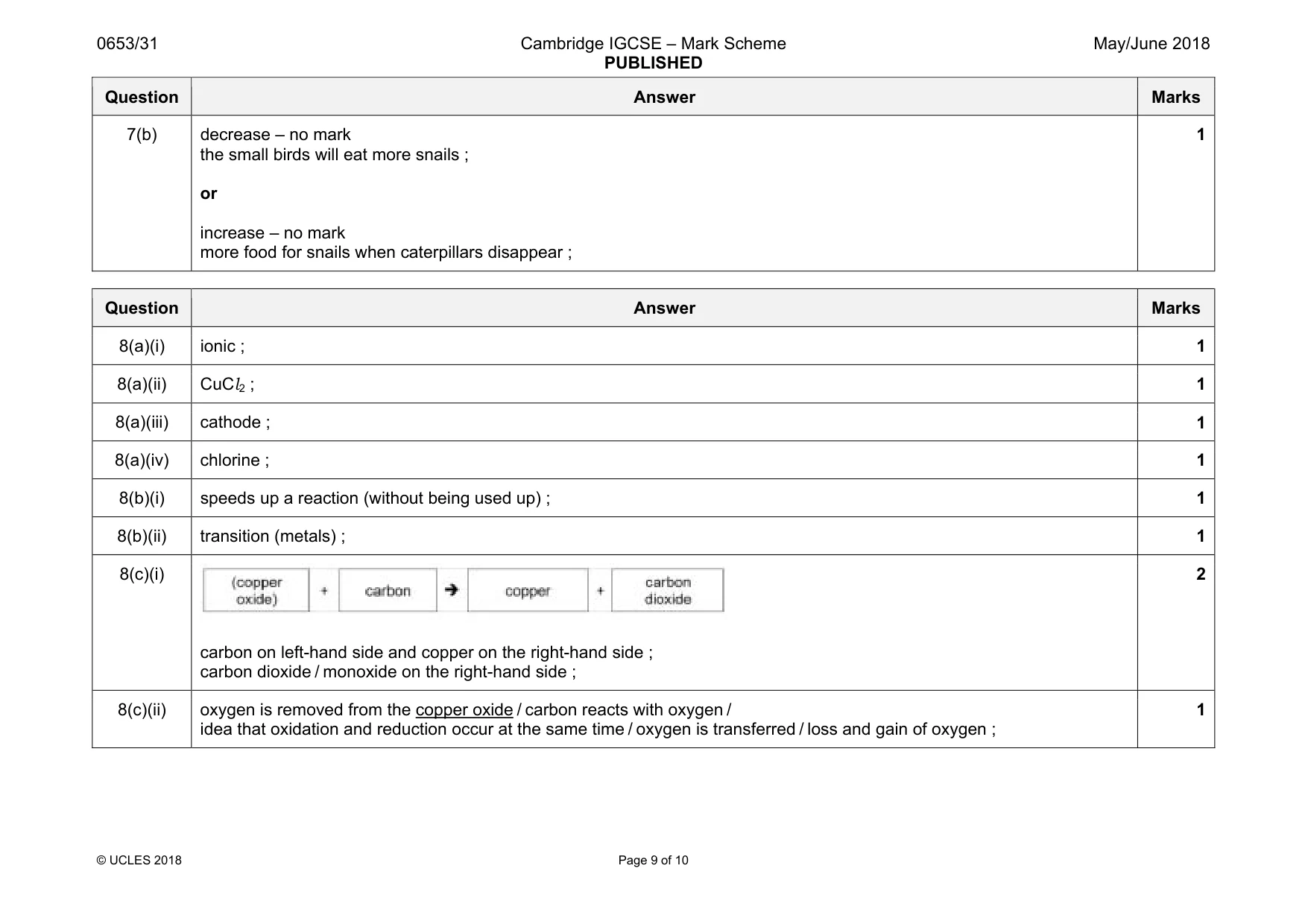
Mark scheme: 8(a)(i) ionic ; 1 8(a)(ii) CuCl2 ; 1 8(a)(iii) cathode ; 1 8(a)(iv) chlorine ; 1 8(b)(i) speeds up a reaction (without being used up) ; 1 8(b)(ii) transition (metals) ; 1 8(c)(i) carbon on left-hand side and copper on the right-hand side ; carbon dioxide / monoxide on the right-hand side ; 2 8(c)(ii) oxygen is removed from the copper oxide / carbon reacts with oxygen / idea that oxidation and reduction occur at the same time / oxygen is transferred / loss and gain of oxygen ; 1 Q uestion Answer Mar rks
Q9 · A small electric cooker with two hot plates
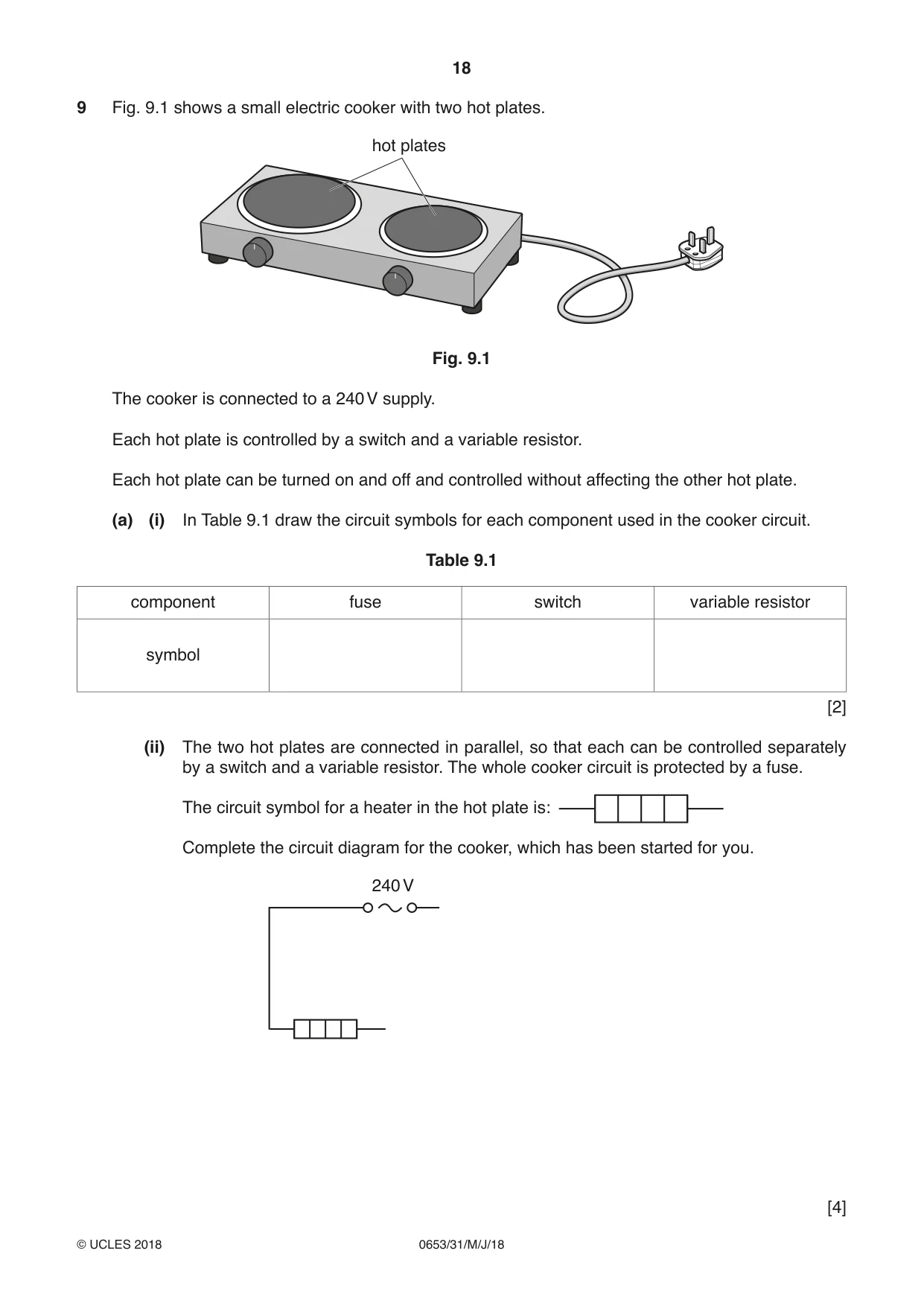
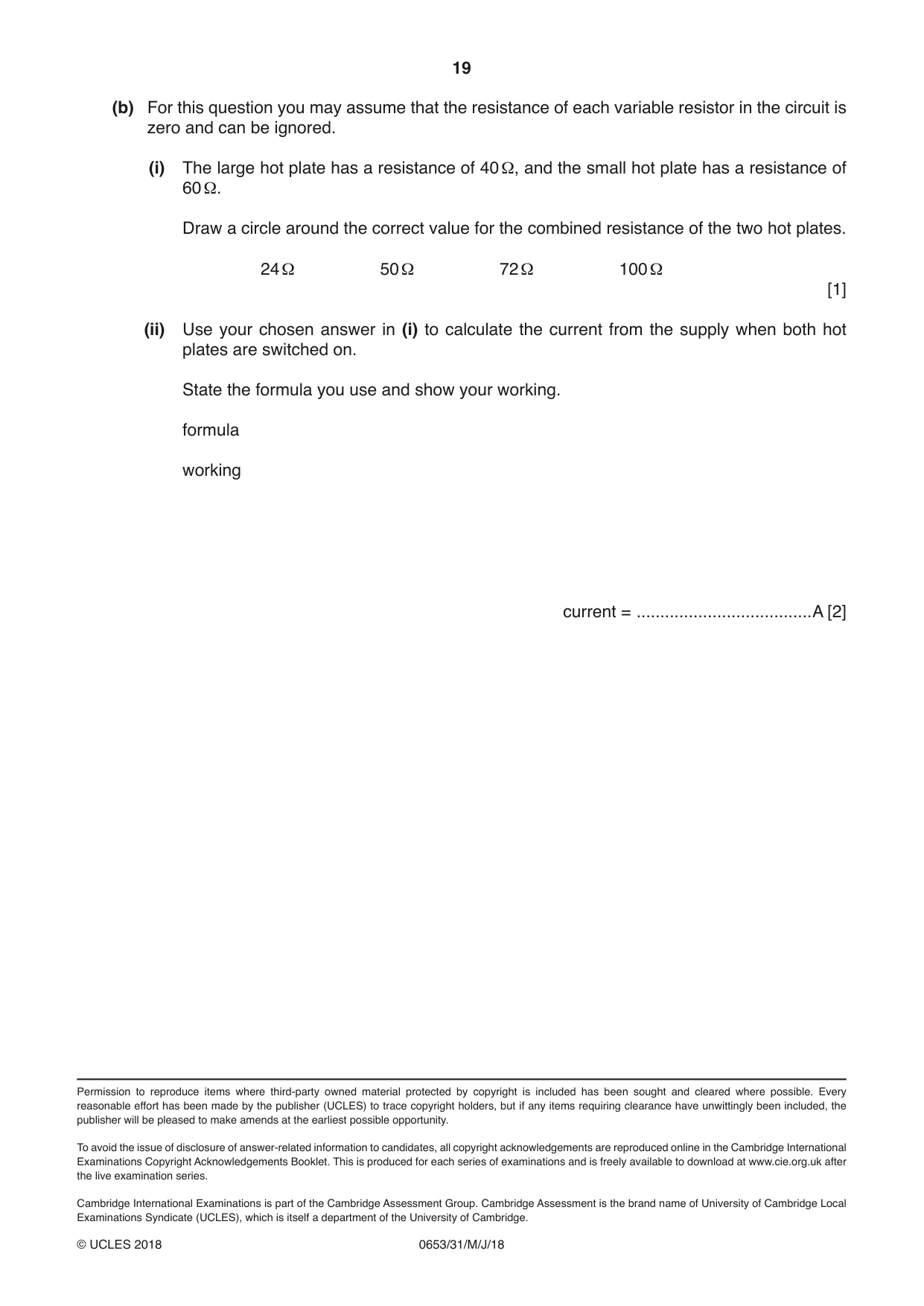
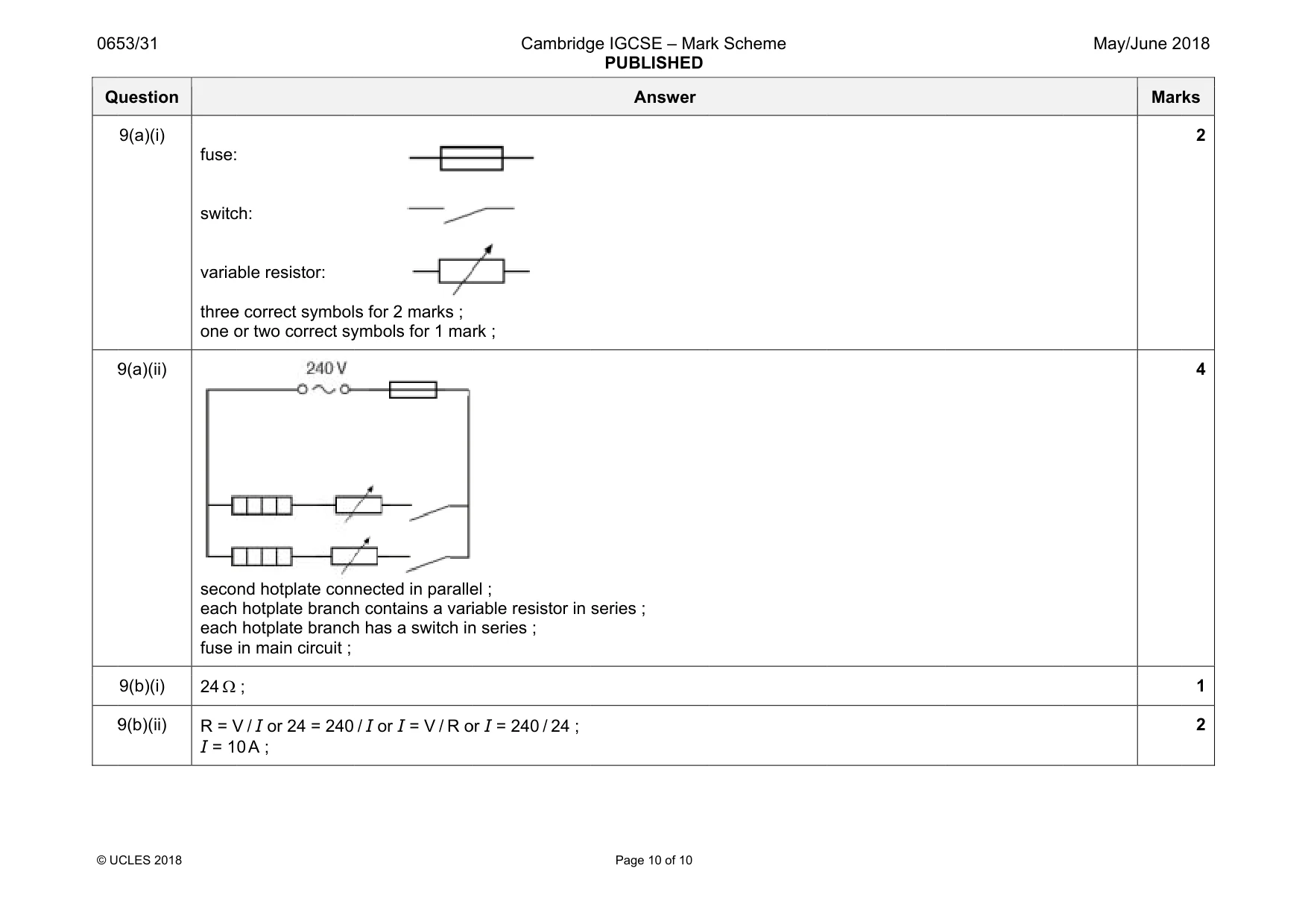
9 Fig. 9.1 shows a small electric cooker with two hot plates. hot plates Fig. 9.1 The cooker is connected to a 240 V supply. Each hot plate is controlled by a switch and a variable resistor. Each hot plate can be turned on and off and controlled without affecting the other hot plate. (a) (i) In Table 9.1 draw the circuit symbols for each component used in the cooker circuit. Table 9.1 component fuse switch variable resistor symbol [2] (ii) The two hot plates are connected in parallel, so that each can be controlled separately by a switch and a variable resistor. The whole cooker circuit is protected by a fuse. The circuit symbol for a heater in the hot plate is: Complete the circuit diagram for the cooker, which has been started for you. 240 V [4] (b) For this question you may assume that the resistance of each variable resistor in the circuit is zero and can be ignored. (i) The large hot plate has a resistance of 40 Ω, and the small hot plate has a resistance of 60 Ω. Draw a circle around the correct value for the combined resistance of the two hot plates. 24 Ω 50 Ω 72 Ω 100 Ω [1] (ii) Use your chosen answer in (i) to calculate the current from the supply when both hot plates are switched on. State the formula you use and show your working. formula working current = .....................................A [2]
Mark scheme: 9 9 9(a)(i) fuse: switc varia three one o 9(a)(ii) seco each each fuse 9(b)(i) 24 Ω 9(b)(ii) R = V I = 1 ch: able resistor: e correct symbol or two correct sy nd hotplate con hotplate branch hotplate branch in main circuit ; ; V / I or 24 = 240 0A ; s for 2 marks ; ymbols for 1 ma nected in paralle h contains a vari h has a switch in / I or I = V / R o rk ; el ; iable resistor in n series ; or I = 240 / 24 ; series ; 2 4 1 2
What was in this paper
The subtopics covered by these 9 questions, and how many questions each got. Open one in a new tab to see every Cambridge question on it.
What you needed in this session
Cambridge’s own grade thresholds for 2018 May/June, Paper 3 · Variant 1. A higher threshold means an easier paper — the bar moves with how the cohort did.