Cambridge IGCSE Science - Combined 0653 — 2025 Oct/Nov Paper 3 · Variant 2
0653/32/O/N/25 · 9 questions · 80 marks · 75 min
The question paper and its mark scheme, free to read here and free to download. This is Cambridge’s own paper, exactly as it was sat.
Question paper20 pages
Mark scheme15 pages
Answers below. Sit the paper first if you are practising.
Questions as text
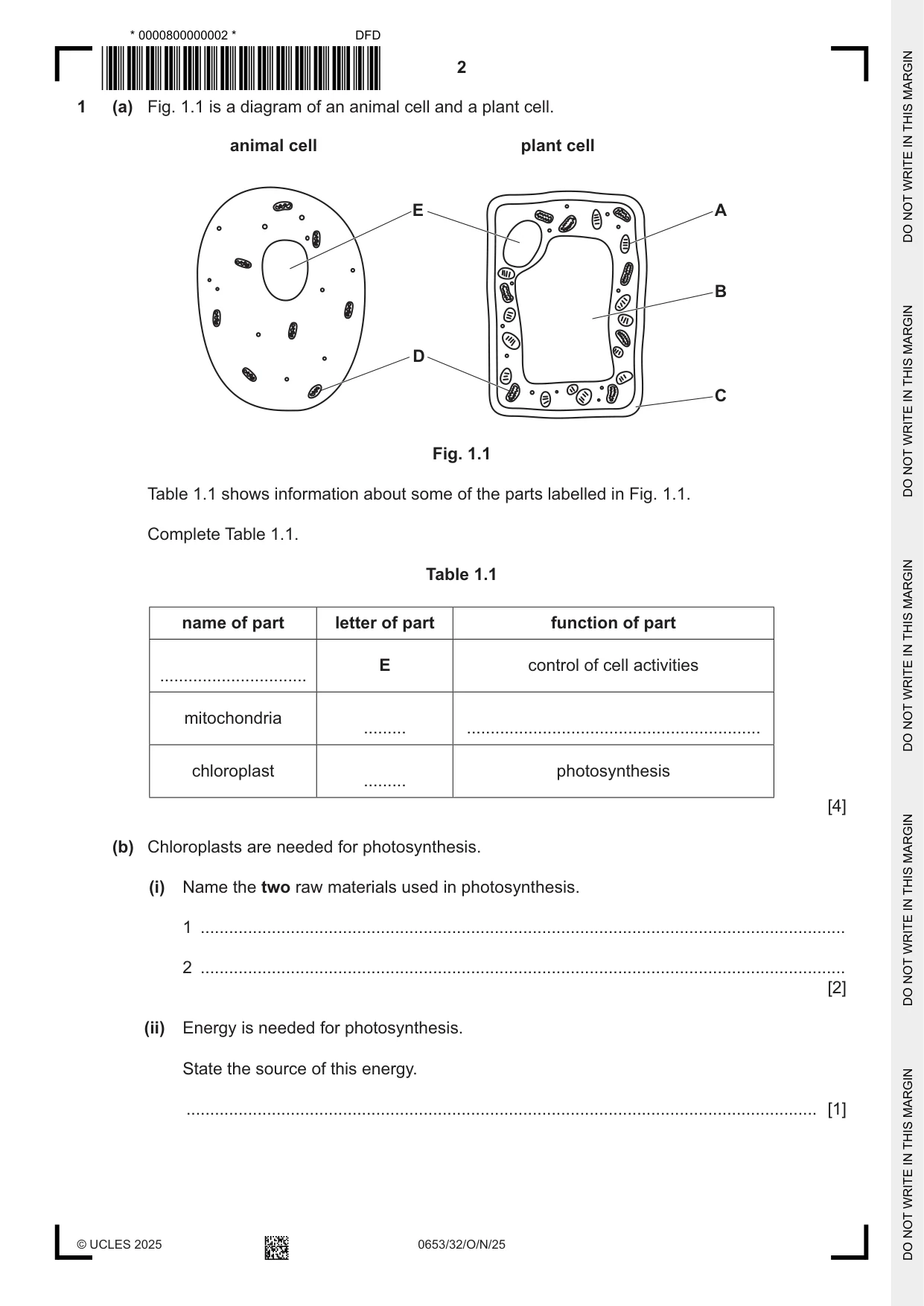
Q1 · A diagram of an animal cell and a plant cell
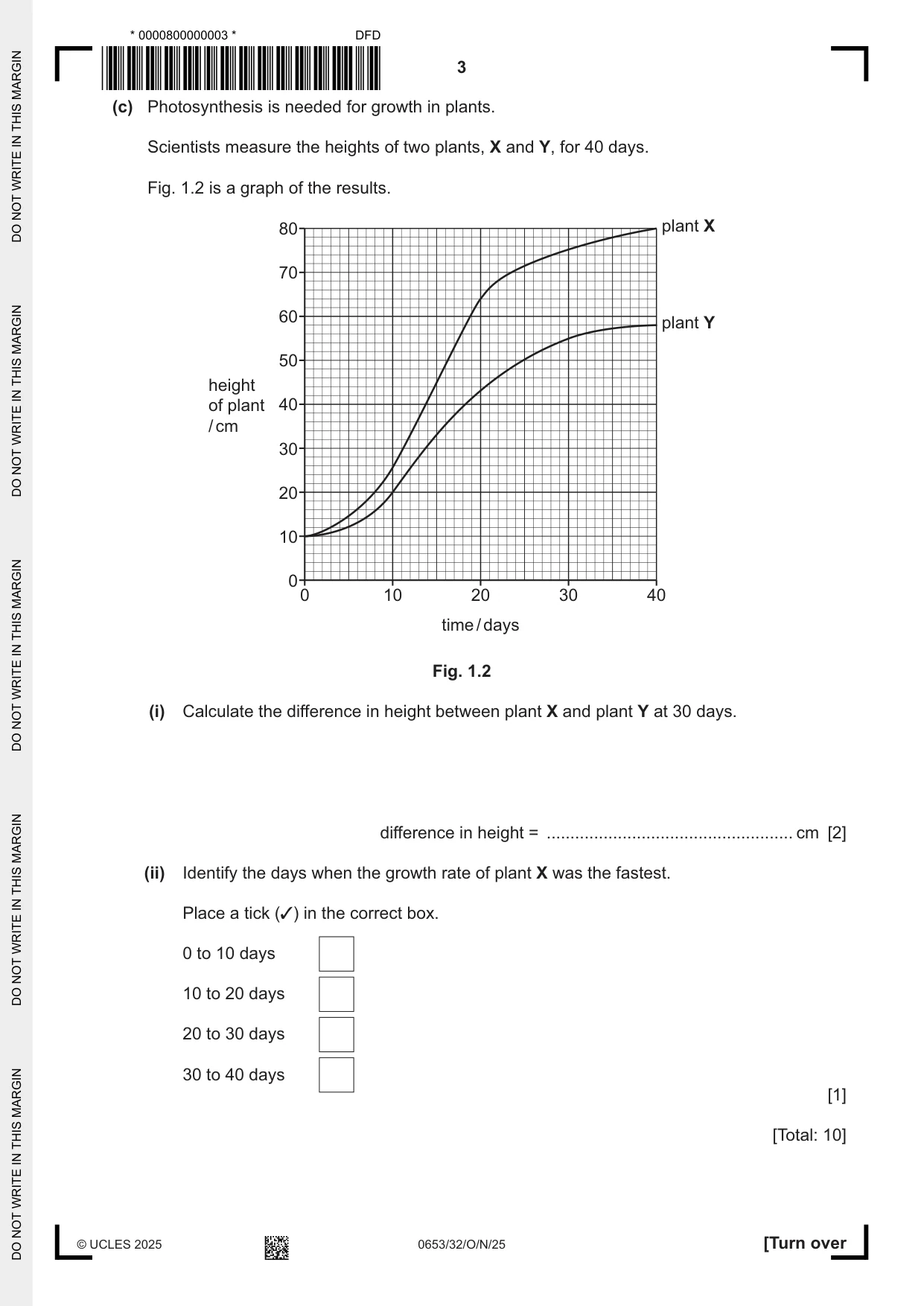
1 (a) Fig. 1.1 is a diagram of an animal cell and a plant cell. animal cell plant cell E A B D C Fig. 1.1 Table 1.1 shows information about some of the parts labelled in Fig. 1.1. Complete Table 1.1. Table 1.1 name of part letter of part function of part E control of cell activities ............................... mitochondria ......... .............................................................. chloroplast photosynthesis ......... [4] (b) Chloroplasts are needed for photosynthesis. (i) Name the two raw materials used in photosynthesis. 1 ........................................................................................................................................ 2 ........................................................................................................................................ [2] (ii) Energy is needed for photosynthesis. State the source of this energy. ..................................................................................................................................... [1] (c) Photosynthesis is needed for growth in plants. Scientists measure the heights of two plants, X and Y, for 40 days. Fig. 1.2 is a graph of the results. 80 plant X 70 60 plant Y 50 height of plant 40 / cm 30 20 10 0 0 10 20 30 40 time / days Fig. 1.2 (i) Calculate the difference in height between plant X and plant Y at 30 days. difference in height = .................................................... cm [2] (ii) Identify the days when the growth rate of plant X was the fastest. Place a tick (✓) in the correct box. 0 to 10 days 10 to 20 days 20 to 30 days 30 to 40 days [1] [Total: 10]
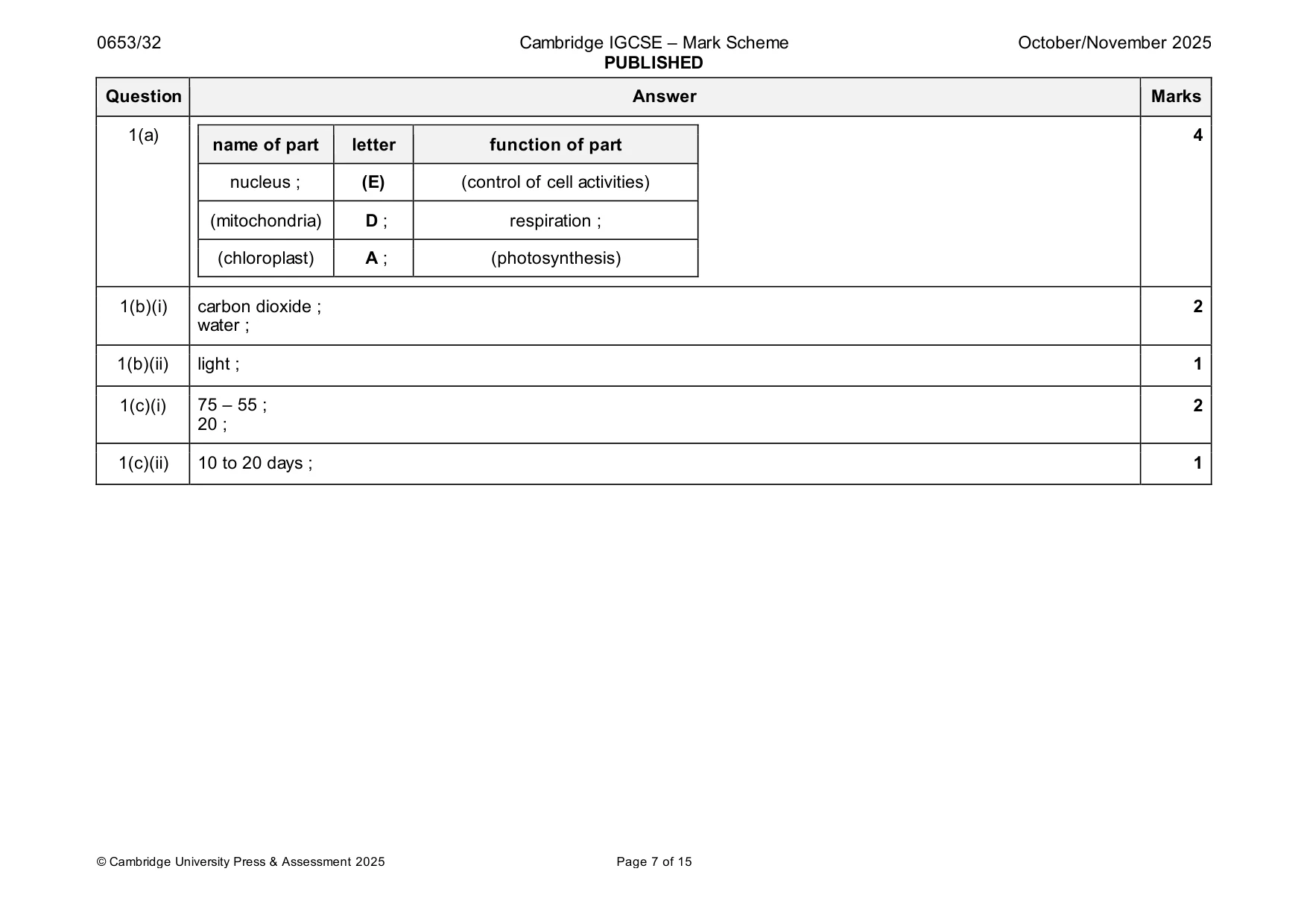
Mark scheme: Question Answer Marks 1(a) 4 name of part letter function of part nucleus ; (E) (control of cell activities) (mitochondria) D ; respiration ; (chloroplast) A ; (photosynthesis) 1(b)(i) carbon dioxide ; 2 water ; 1(b)(ii) light ; 1 1(c)(i) 75 – 55 ; 2 20 ; 1(c)(ii) 10 to 20 days ; 1
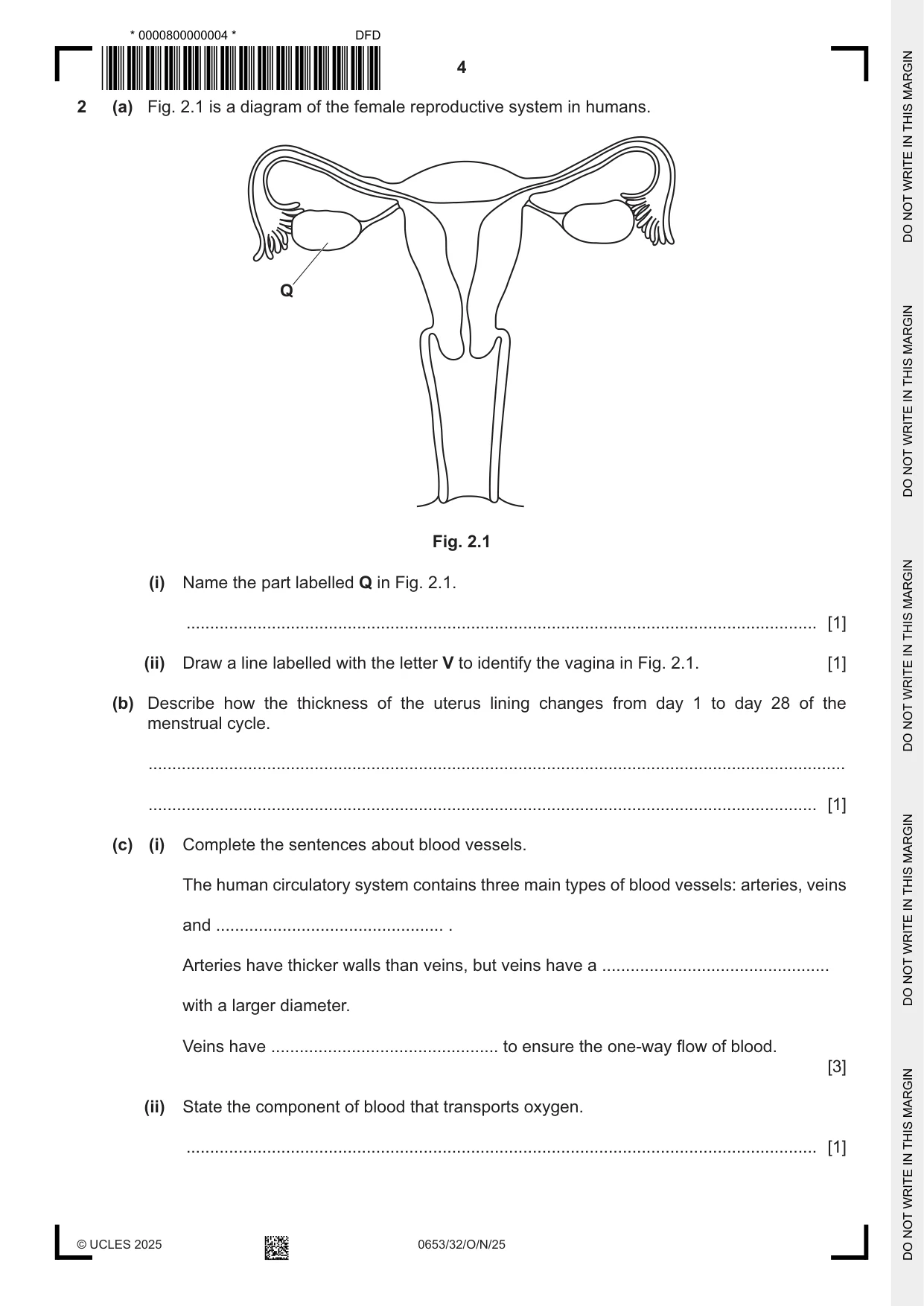
Q2 · A diagram of the female reproductive system in humans
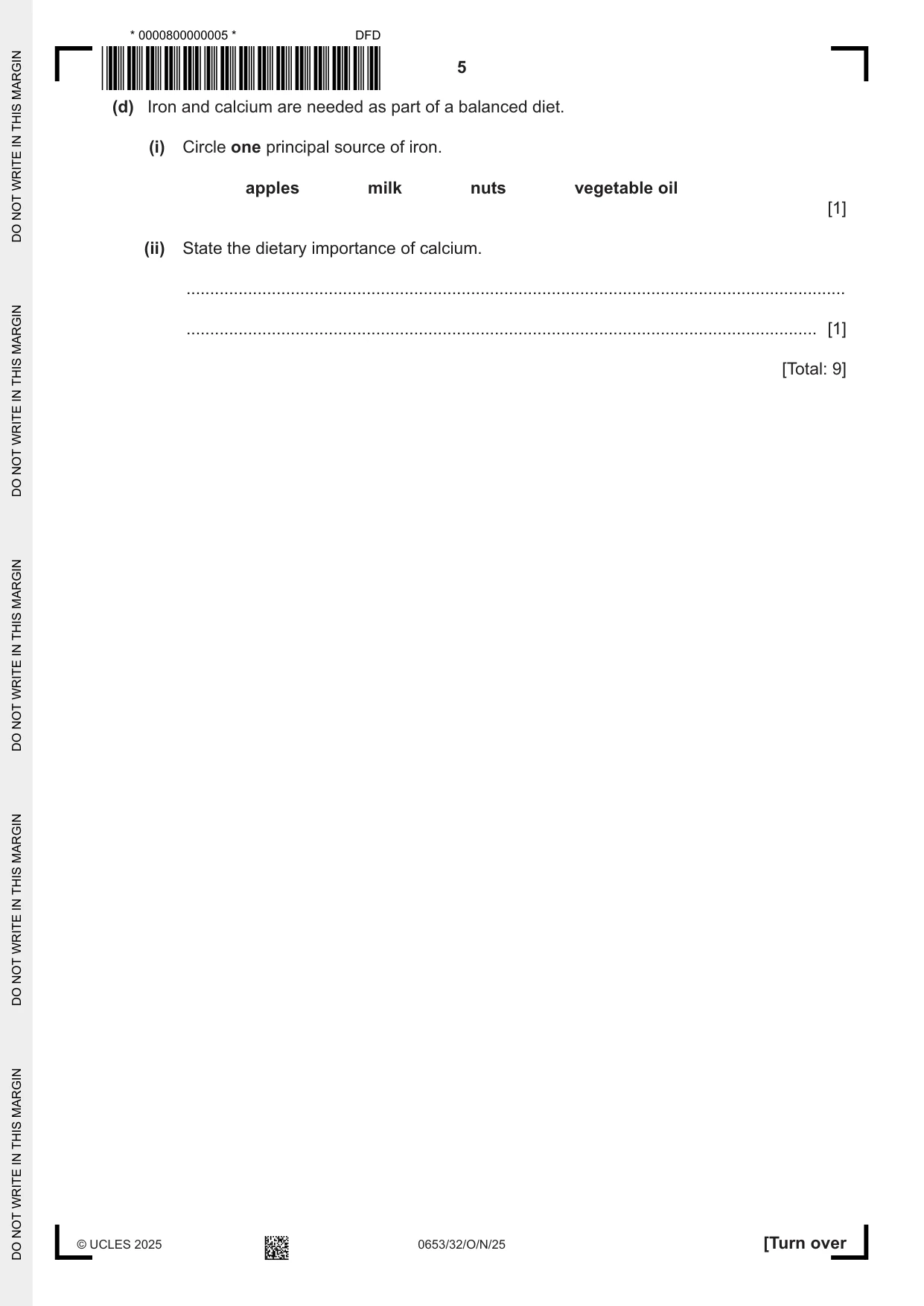
2 (a) Fig. 2.1 is a diagram of the female reproductive system in humans. Q Fig. 2.1 (i) Name the part labelled Q in Fig. 2.1. ..................................................................................................................................... [1] (ii) Draw a line labelled with the letter V to identify the vagina in Fig. 2.1. [1] (b) Describe how the thickness of the uterus lining changes from day 1 to day 28 of the menstrual cycle. ................................................................................................................................................... ............................................................................................................................................. [1] (c) (i) Complete the sentences about blood vessels. The human circulatory system contains three main types of blood vessels: arteries, veins and ................................................ . Arteries have thicker walls than veins, but veins have a ................................................ with a larger diameter. Veins have ................................................ to ensure the one-way flow of blood. [3] (ii) State the component of blood that transports oxygen. ..................................................................................................................................... [1] (d) Iron and calcium are needed as part of a balanced diet. (i) Circle one principal source of iron. apples milk nuts vegetable oil [1] (ii) State the dietary importance of calcium. ........................................................................................................................................... ..................................................................................................................................... [1] [Total: 9]
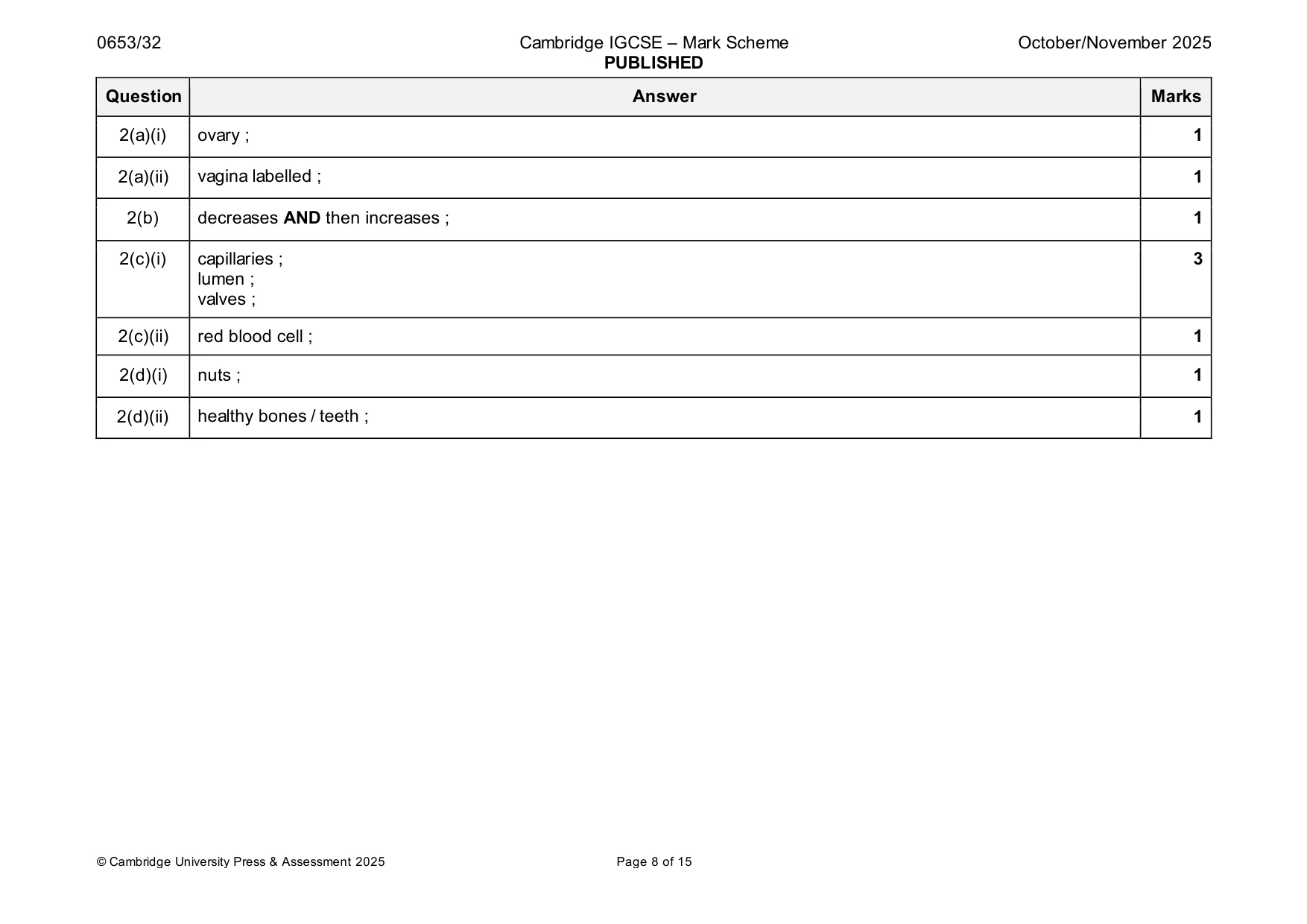
Mark scheme: 2(a)(i) ovary ; 1 2(a)(ii) vagina labelled ; 1 2(b) decreases AND then increases ; 1 2(c)(i) capillaries ; 3 lumen ; valves ; 2(c)(ii) red blood cell ; 1 2(d)(i) nuts ; 1 2(d)(ii) healthy bones / teeth ; 1
Q3 · Tigers are endangered animals that live wild only in parts of Asia
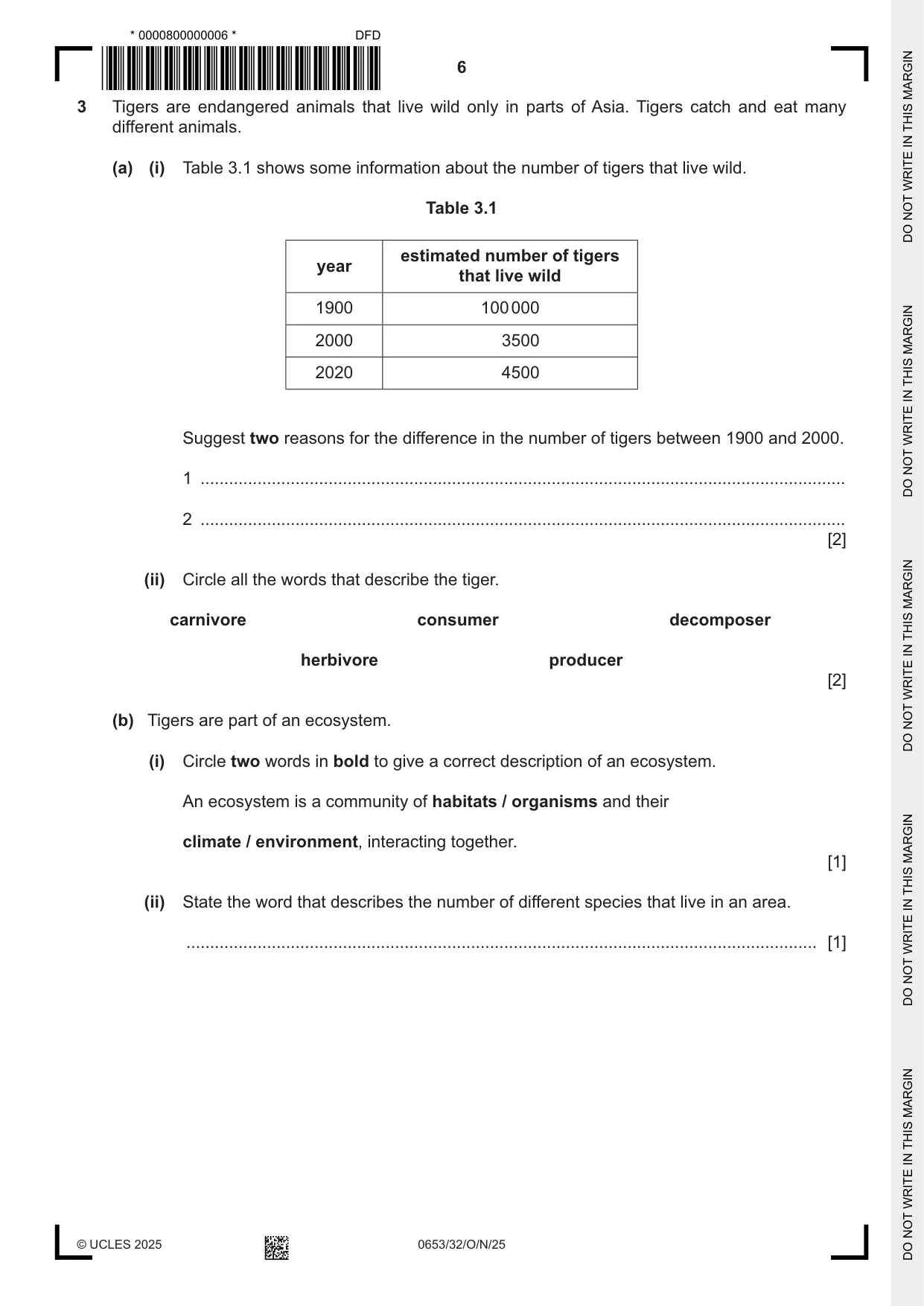
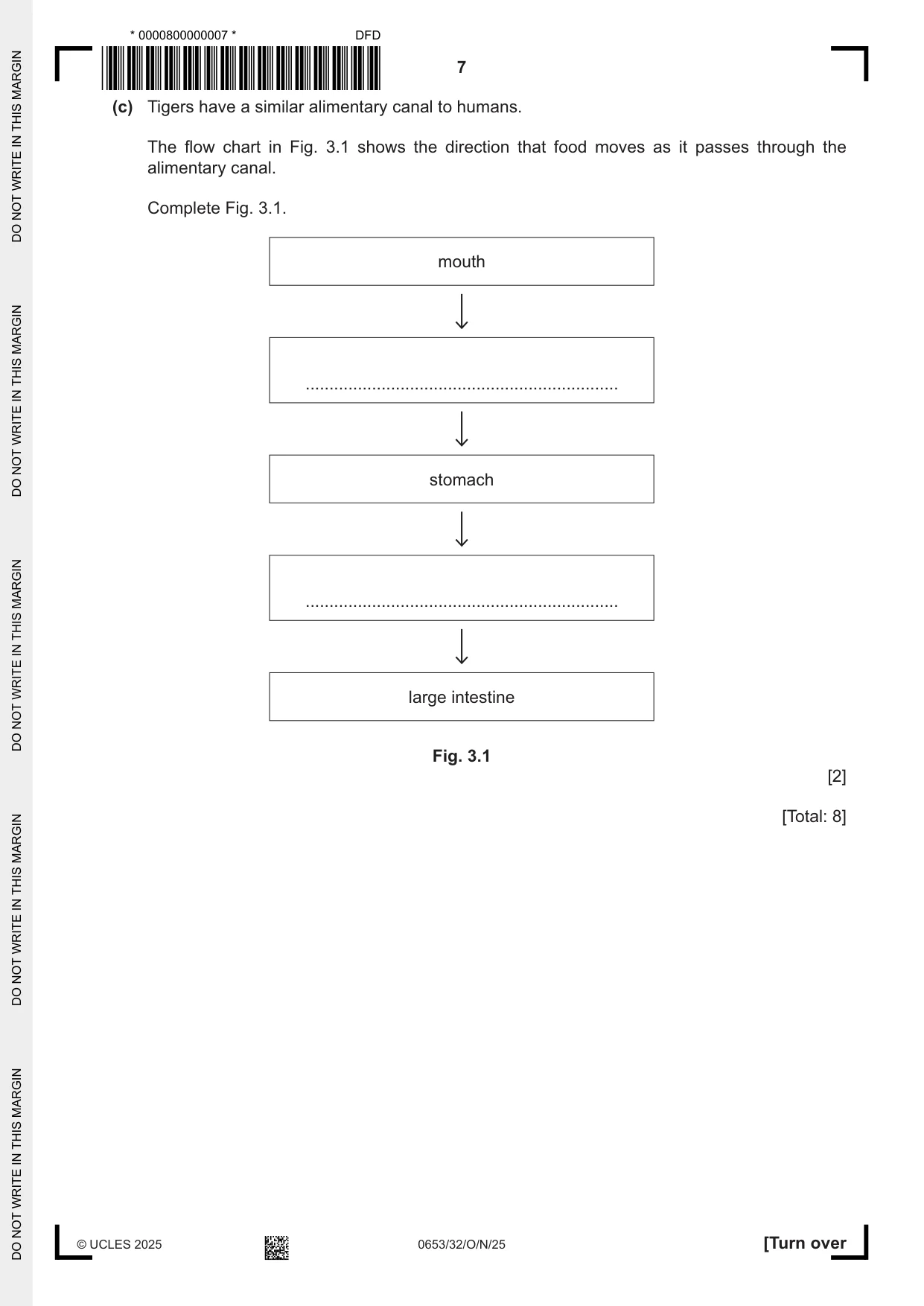
3 Tigers are endangered animals that live wild only in parts of Asia. Tigers catch and eat many different animals. (a) (i) Table 3.1 shows some information about the number of tigers that live wild. Table 3.1 estimated number of tigers year that live wild 1900 100 000 2000 3500 2020 4500 Suggest two reasons for the difference in the number of tigers between 1900 and 2000. 1 ........................................................................................................................................ 2 ........................................................................................................................................ [2] (ii) Circle all the words that describe the tiger. carnivore consumer decomposer herbivore producer [2] (b) Tigers are part of an ecosystem. (i) Circle two words in bold to give a correct description of an ecosystem. An ecosystem is a community of habitats / organisms and their climate / environment, interacting together. [1] (ii) State the word that describes the number of different species that live in an area. ..................................................................................................................................... [1] (c) Tigers have a similar alimentary canal to humans. The flow chart in Fig. 3.1 shows the direction that food moves as it passes through the alimentary canal. Complete Fig. 3.1. mouth .................................................................. stomach .................................................................. large intestine Fig. 3.1 [2] [Total: 8]
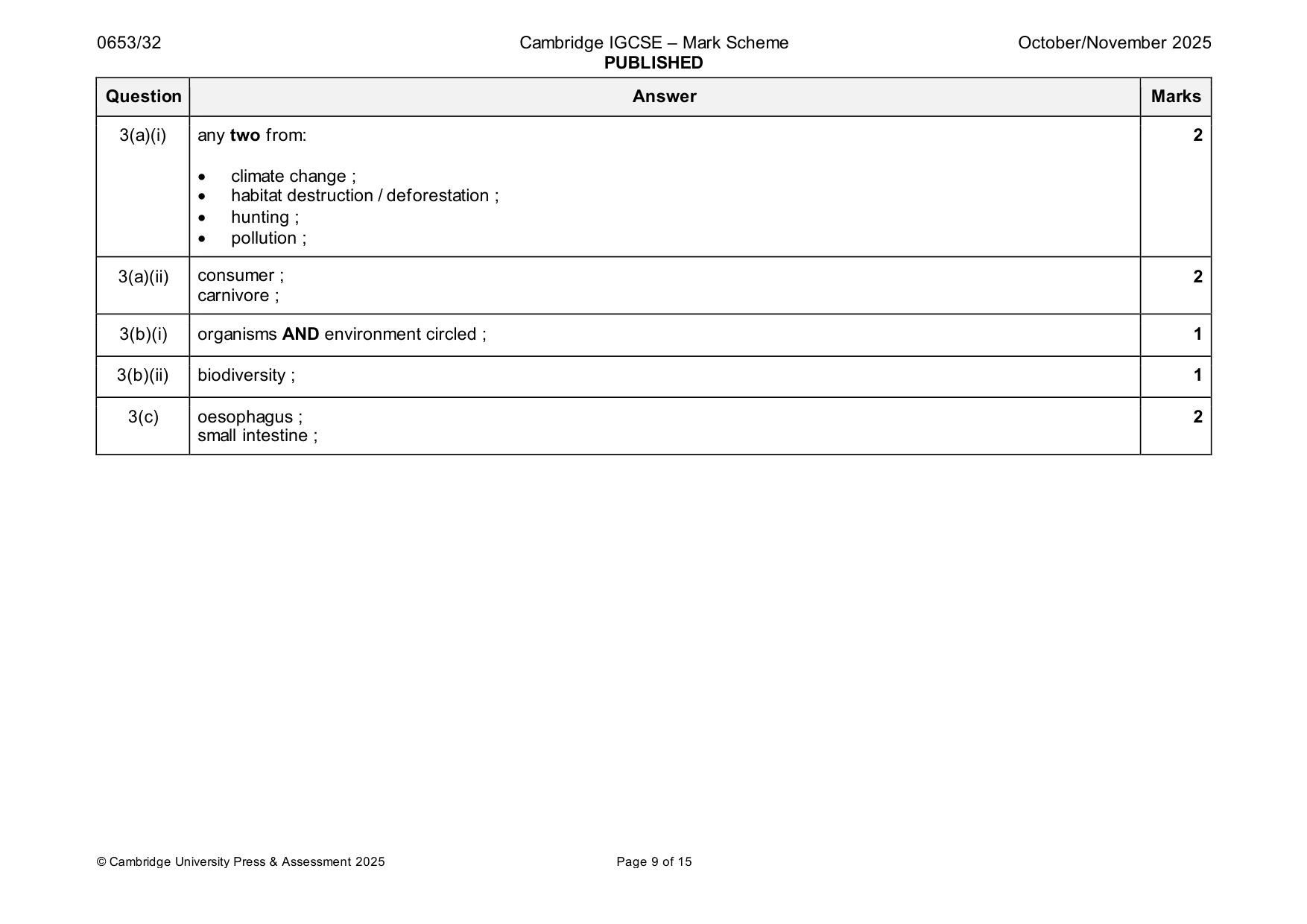
Mark scheme: 3(a)(i) any two from: 2 • climate change ; • habitat destruction / deforestation ; • hunting ; • pollution ; 3(a)(ii) consumer ; 2 carnivore ; 3(b)(i) organisms AND environment circled ; 1 3(b)(ii) biodiversity ; 1 3(c) oesophagus ; 2 small intestine ;
Q4 · A student investigates the reaction between magnesium and steam
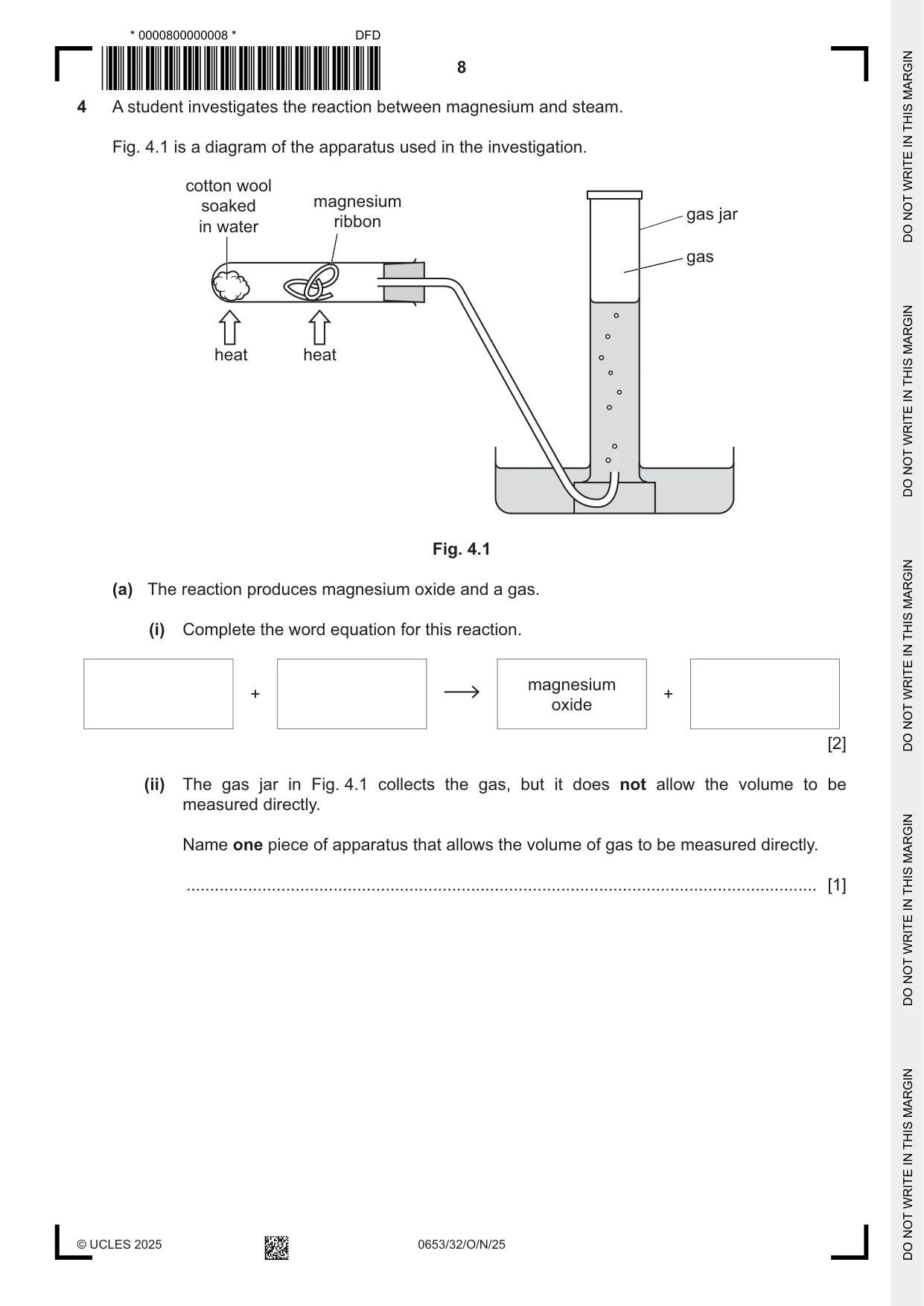
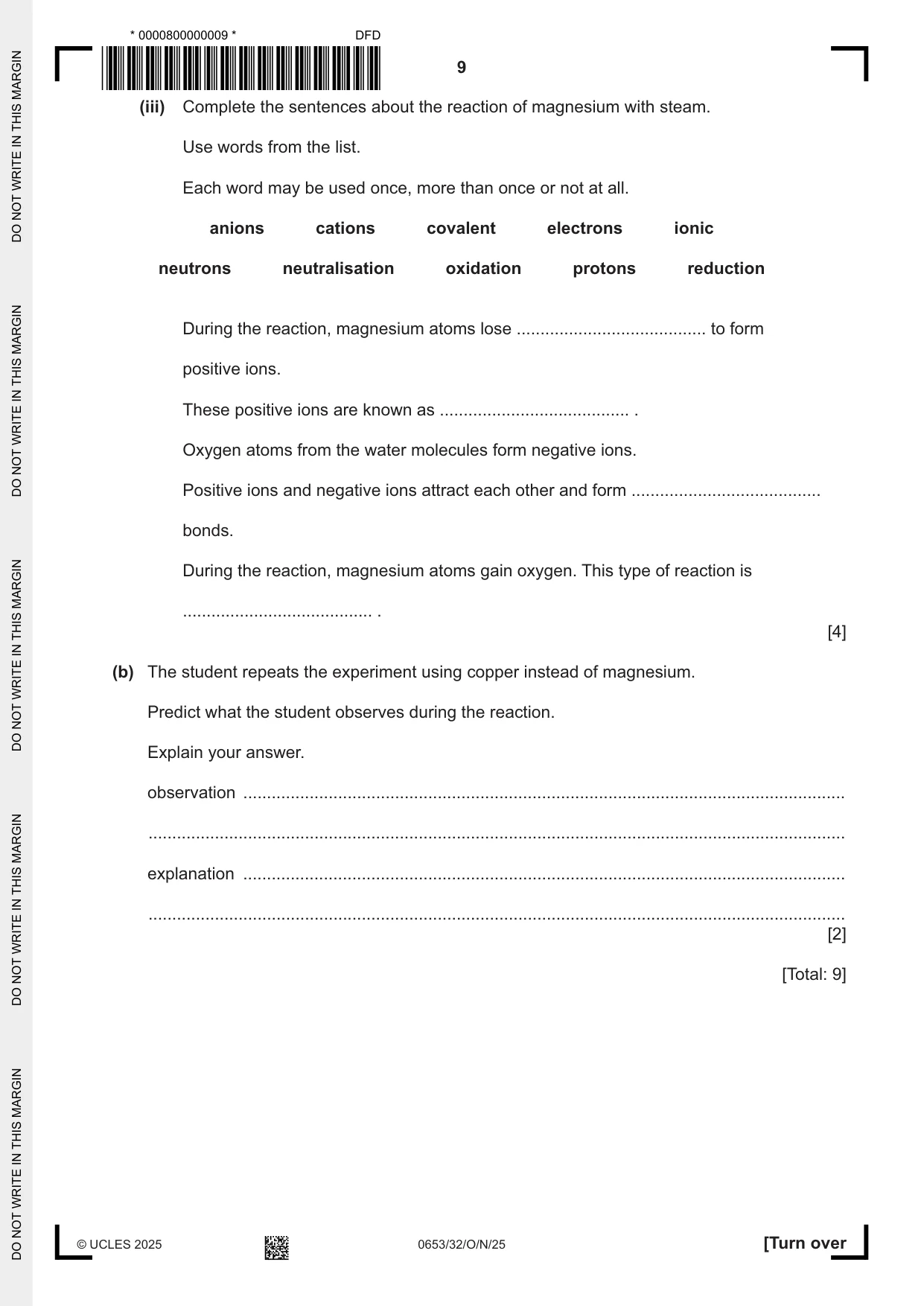
4 A student investigates the reaction between magnesium and steam. Fig. 4.1 is a diagram of the apparatus used in the investigation. cotton wool magnesium soaked gas jar ribbon in water gas heat heat Fig. 4.1 (a) The reaction produces magnesium oxide and a gas. (i) Complete the word equation for this reaction. magnesium + + oxide [2] (ii) The gas jar in Fig. 4.1 collects the gas, but it does not allow the volume to be measured directly. Name one piece of apparatus that allows the volume of gas to be measured directly. ..................................................................................................................................... [1] (iii) Complete the sentences about the reaction of magnesium with steam. Use words from the list. Each word may be used once, more than once or not at all. anions cations covalent electrons ionic neutrons neutralisation oxidation protons reduction During the reaction, magnesium atoms lose ........................................ to form positive ions. These positive ions are known as ........................................ . Oxygen atoms from the water molecules form negative ions. Positive ions and negative ions attract each other and form ........................................ bonds. During the reaction, magnesium atoms gain oxygen. This type of reaction is ........................................ . [4] (b) The student repeats the experiment using copper instead of magnesium. Predict what the student observes during the reaction. Explain your answer. observation ............................................................................................................................... ................................................................................................................................................... explanation ............................................................................................................................... ................................................................................................................................................... [2] [Total: 9]
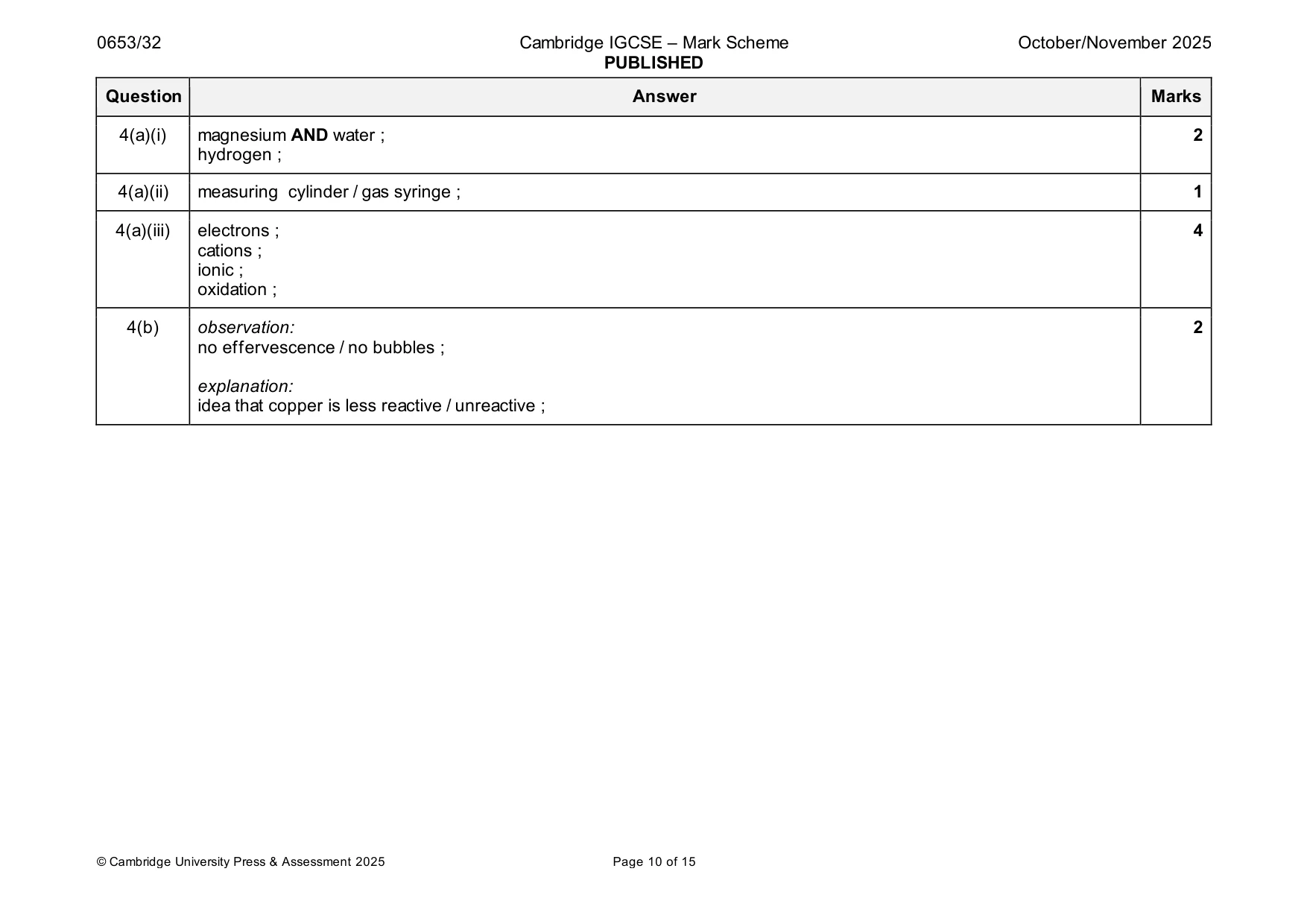
Mark scheme: 4(a)(i) magnesium AND water ; 2 hydrogen ; 4(a)(ii) measuring cylinder / gas syringe ; 1 4(a)(iii) electrons ; 4 cations ; ionic ; oxidation ; 4(b) observation: 2 no effervescence / no bubbles ; explanation: idea that copper is less reactive / unreactive ;
Question 5
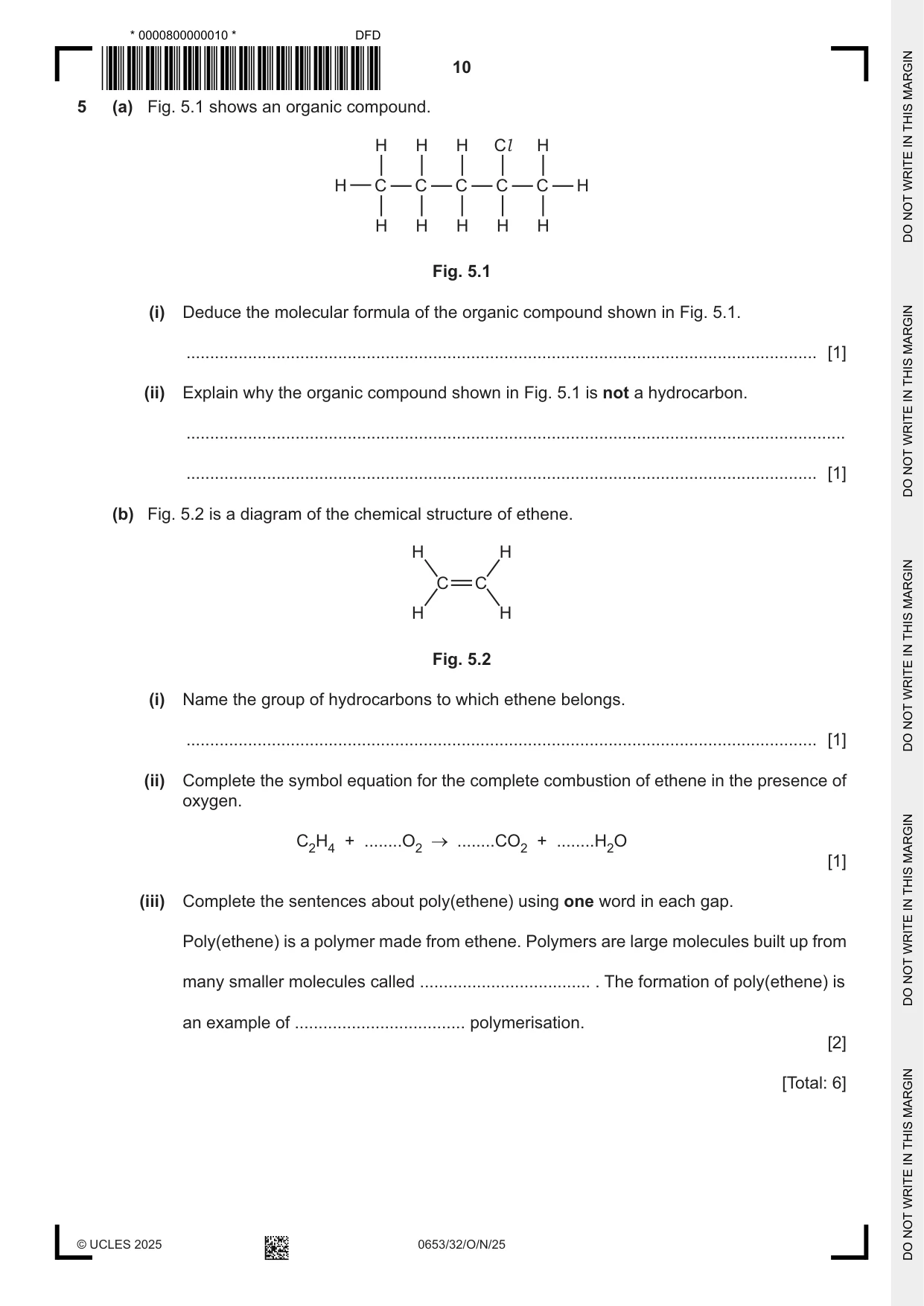
5 (a) Fig. 5.1 shows an organic compound. H H H Cl H H C C C C C H H H H H H Fig. 5.1 (i) Deduce the molecular formula of the organic compound shown in Fig. 5.1. ..................................................................................................................................... [1] (ii) Explain why the organic compound shown in Fig. 5.1 is not a hydrocarbon. ........................................................................................................................................... ..................................................................................................................................... [1] (b) Fig. 5.2 is a diagram of the chemical structure of ethene. H H C C H H Fig. 5.2 (i) Name the group of hydrocarbons to which ethene belongs. ..................................................................................................................................... [1] (ii) Complete the symbol equation for the complete combustion of ethene in the presence of oxygen. C2H4 + ........O2 ........CO2 + ........H2O [1] (iii) Complete the sentences about poly(ethene) using one word in each gap. Poly(ethene) is a polymer made from ethene. Polymers are large molecules built up from many smaller molecules called .................................... . The formation of poly(ethene) is an example of .................................... polymerisation. [2] [Total: 6]
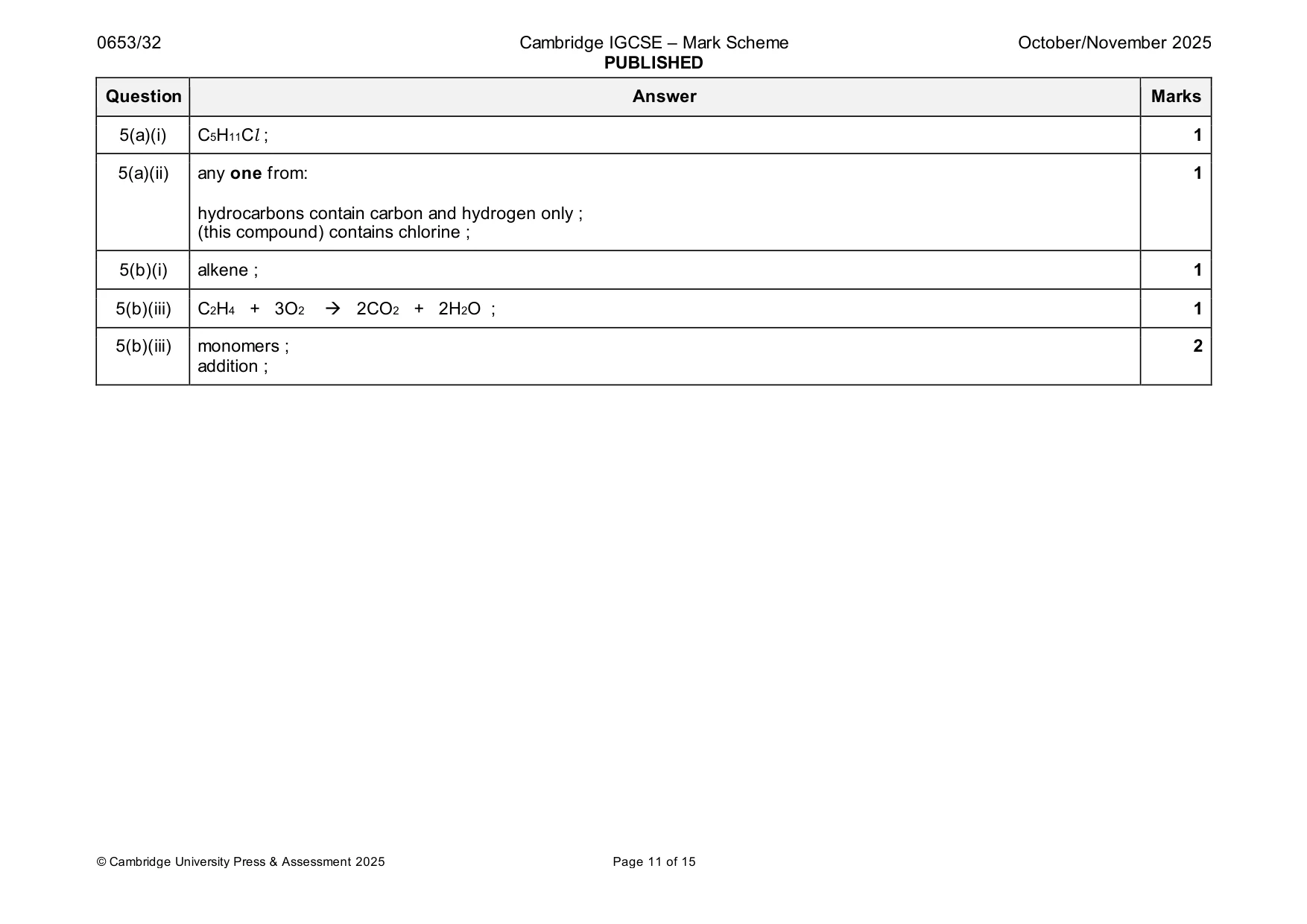
Mark scheme: 5(a)(i) C5H11Cl ; 1 5(a)(ii) any one from: 1 hydrocarbons contain carbon and hydrogen only ; (this compound) contains chlorine ; 5(b)(i) alkene ; 1 5(b)(iii) C2H4 + 3O2 → 2CO2 + 2H2O ; 1 5(b)(iii) monomers ; 2 addition ;
Q6 · Group I of the Periodic Table
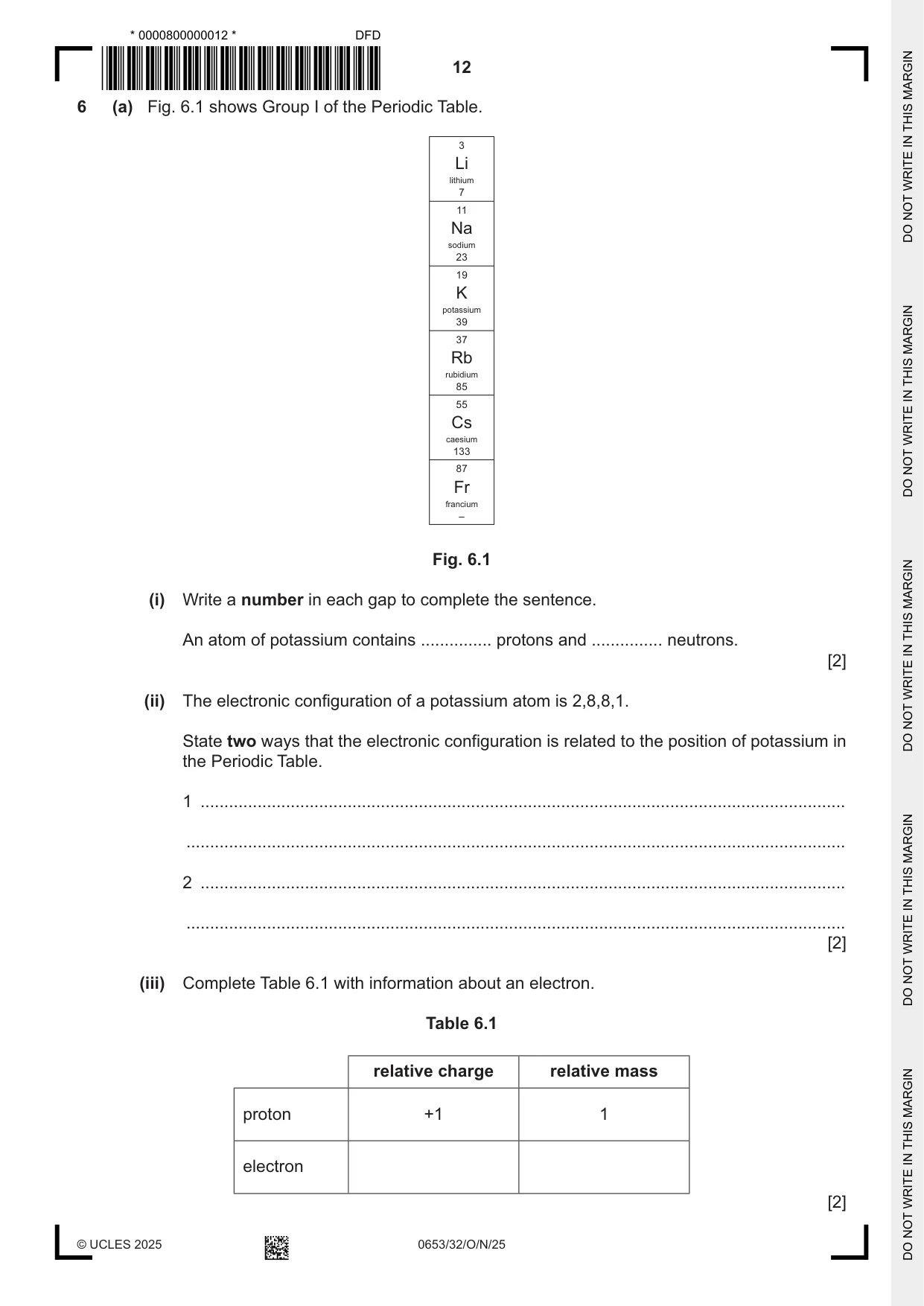
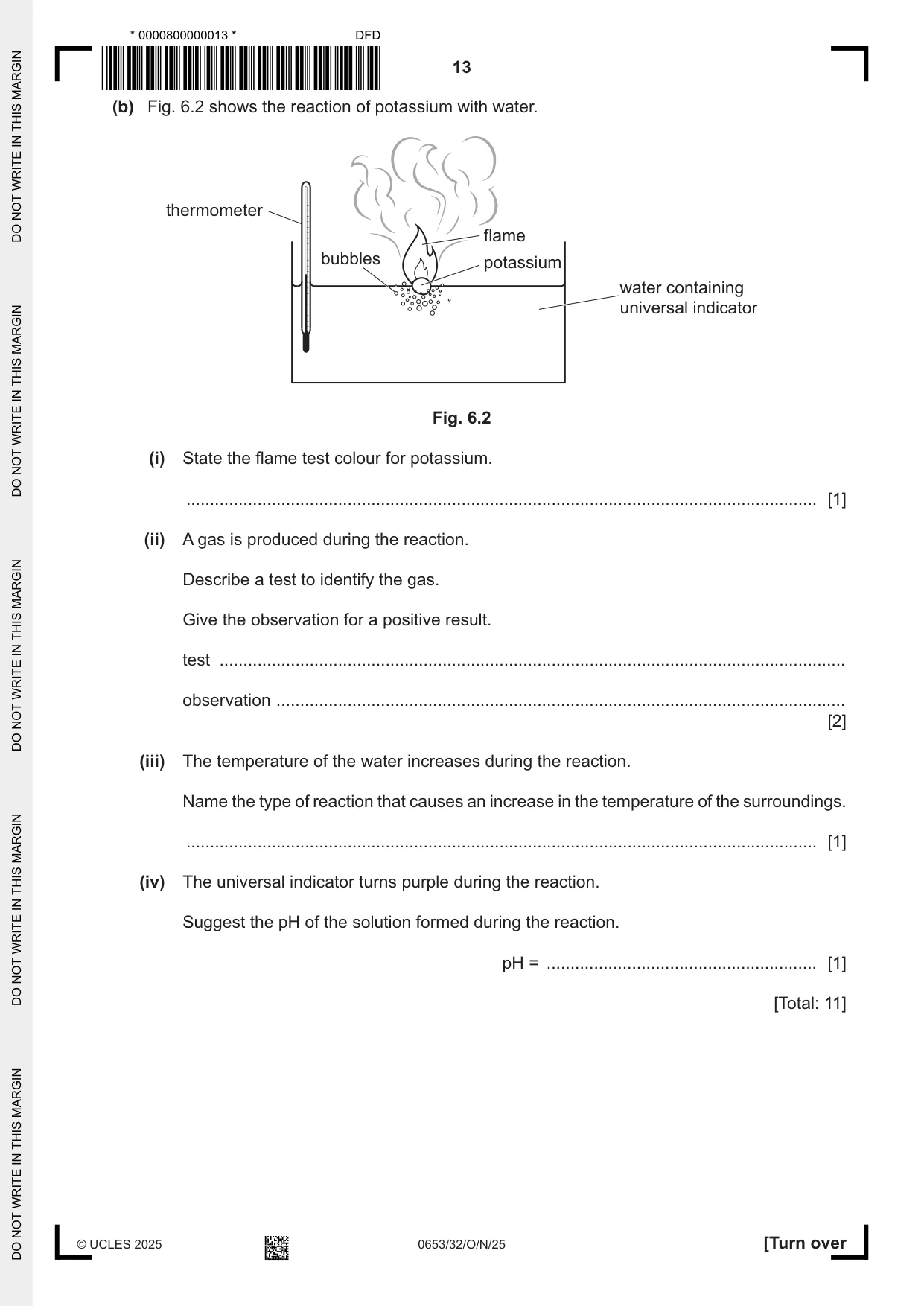
6 (a) Fig. 6.1 shows Group I of the Periodic Table. 3 Li lithium 7 11 Na sodium 23 19 K potassium 39 37 Rb rubidium 85 55 Cs caesium 133 87 Fr francium – Fig. 6.1 (i) Write a number in each gap to complete the sentence. An atom of potassium contains ............... protons and ............... neutrons. [2] (ii) The electronic configuration of a potassium atom is 2,8,8,1. State two ways that the electronic configuration is related to the position of potassium in the Periodic Table. 1 ........................................................................................................................................ ........................................................................................................................................... 2 ........................................................................................................................................ ........................................................................................................................................... [2] (iii) Complete Table 6.1 with information about an electron. Table 6.1 relative charge relative mass proton +1 1 electron [2] (b) Fig. 6.2 shows the reaction of potassium with water. thermometer flame bubbles potassium water containing universal indicator Fig. 6.2 (i) State the flame test colour for potassium. ..................................................................................................................................... [1] (ii) A gas is produced during the reaction. Describe a test to identify the gas. Give the observation for a positive result. test .................................................................................................................................... observation ........................................................................................................................ [2] (iii) The temperature of the water increases during the reaction. Name the type of reaction that causes an increase in the temperature of the surroundings. ..................................................................................................................................... [1] (iv) The universal indicator turns purple during the reaction. Suggest the pH of the solution formed during the reaction. pH = ......................................................... [1] [Total: 11]
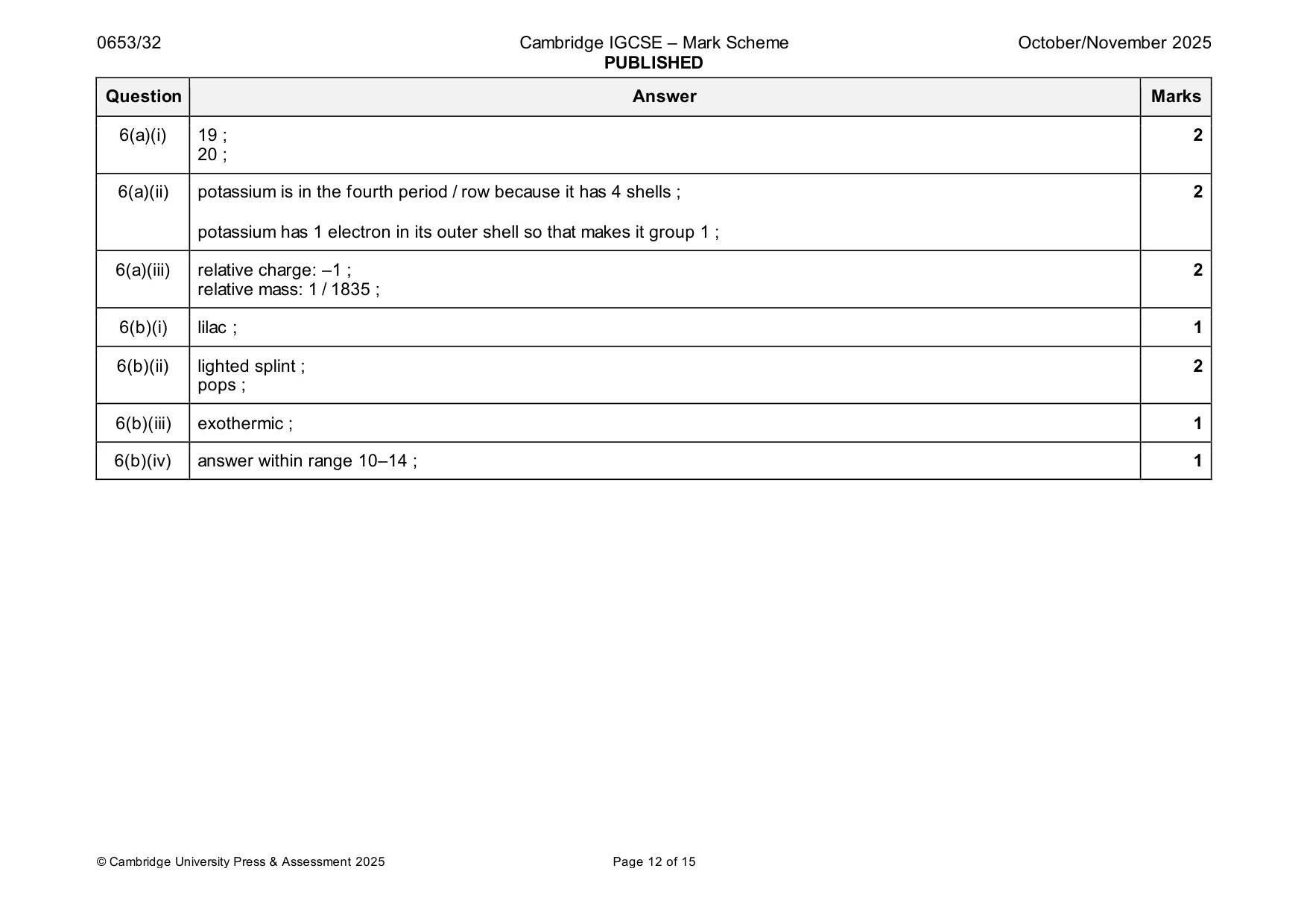
Mark scheme: 6(a)(i) 19 ; 2 20 ; 6(a)(ii) potassium is in the fourth period / row because it has 4 shells ; 2 potassium has 1 electron in its outer shell so that makes it group 1 ; 6(a)(iii) relative charge: –1 ; 2 relative mass: 1 / 1835 ; 6(b)(i) lilac ; 1 6(b)(ii) lighted splint ; 2 pops ; 6(b)(iii) exothermic ; 1 6(b)(iv) answer within range 10–14 ; 1
Q7 · A student wants to determine the density of a liquid
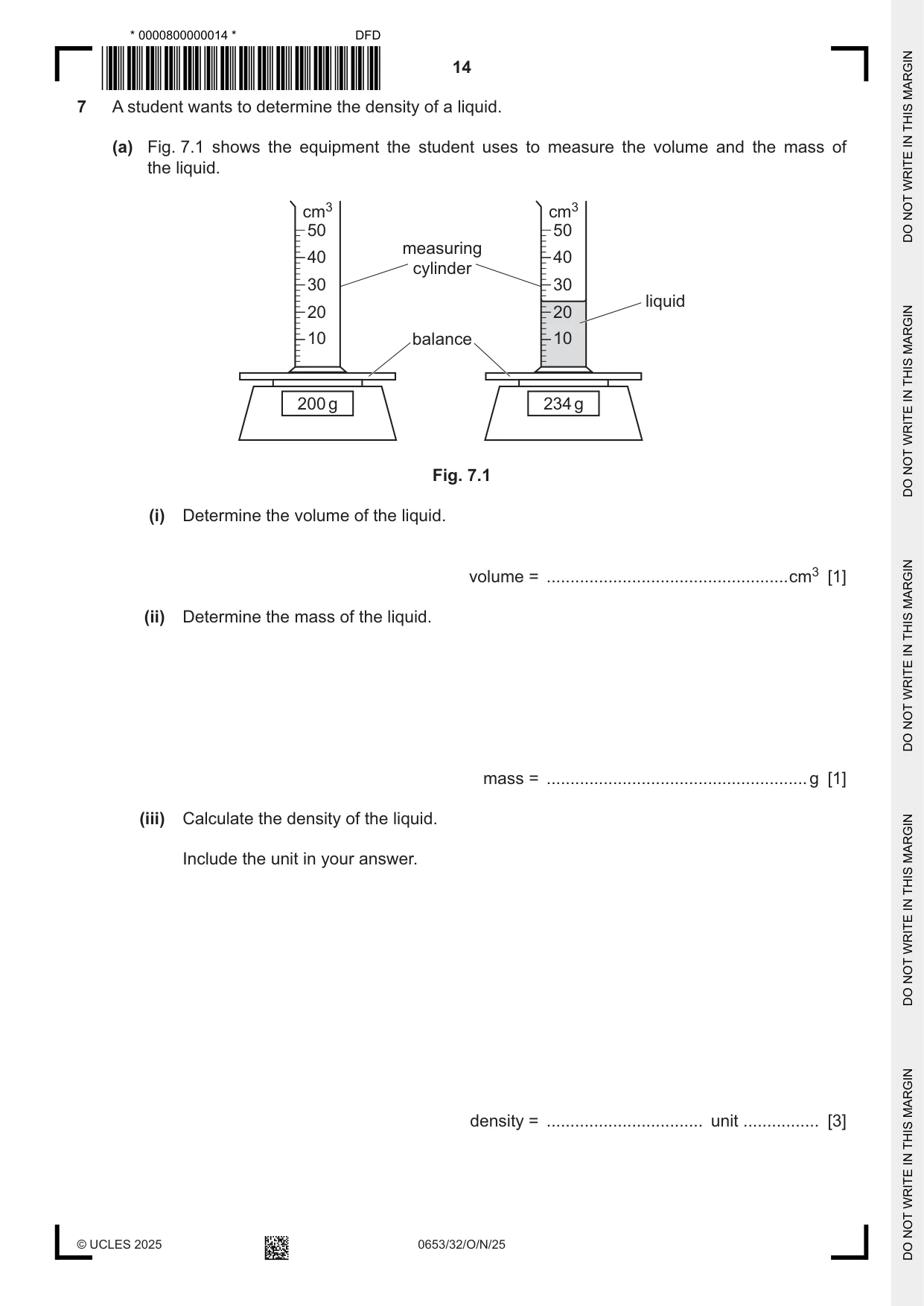
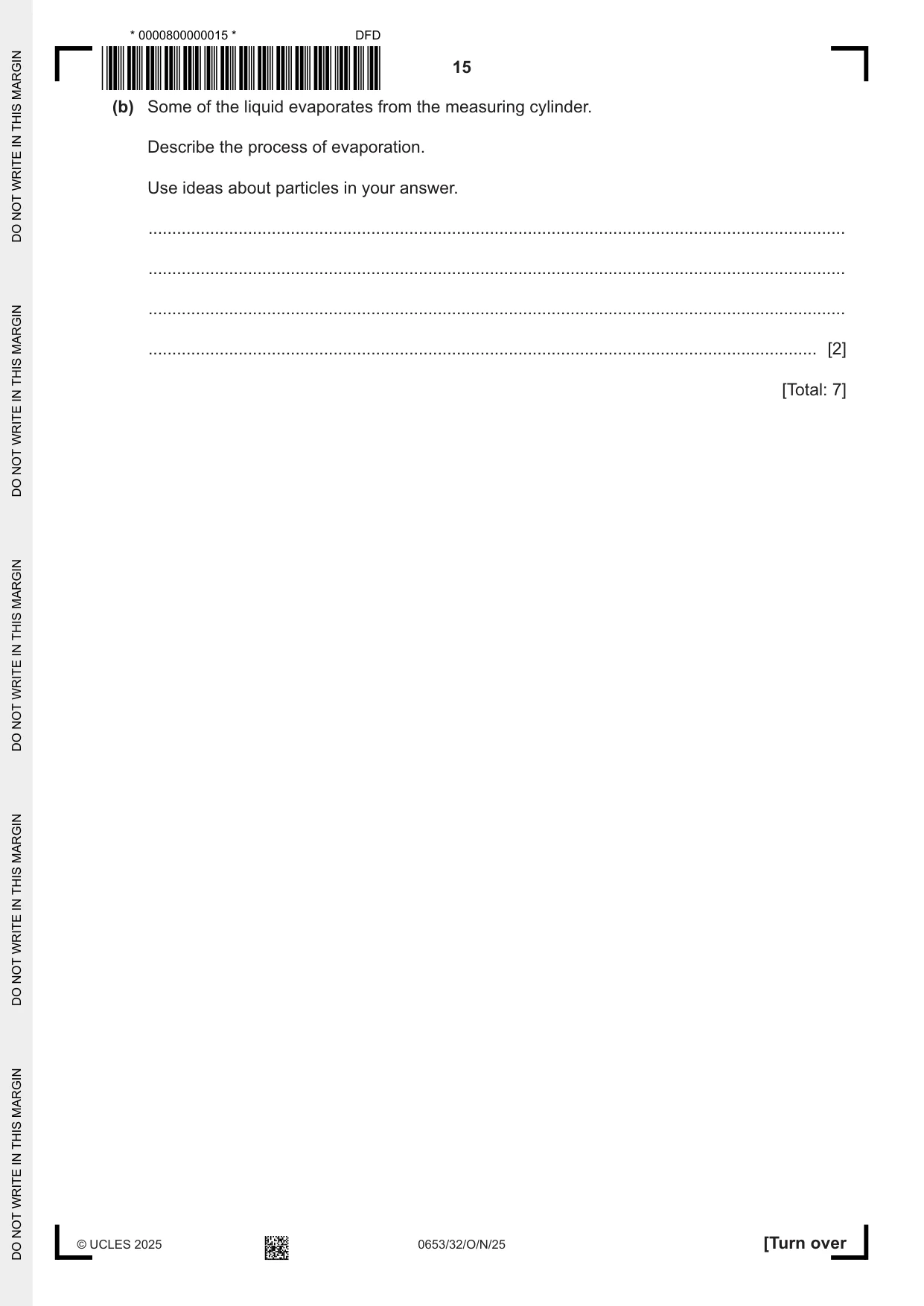
7 A student wants to determine the density of a liquid. (a) Fig. 7.1 shows the equipment the student uses to measure the volume and the mass of the liquid. cm3 cm3 50 50 measuring 40 40 cylinder 30 30 liquid 20 20 10 balance 10 200 g 234 g Fig. 7.1 (i) Determine the volume of the liquid. volume = ...................................................cm3 [1] (ii) Determine the mass of the liquid. mass = .......................................................g [1] (iii) Calculate the density of the liquid. Include the unit in your answer. density = ................................. unit ................ [3] (b) Some of the liquid evaporates from the measuring cylinder. Describe the process of evaporation. Use ideas about particles in your answer. ................................................................................................................................................... ................................................................................................................................................... ................................................................................................................................................... ............................................................................................................................................. [2] [Total: 7]
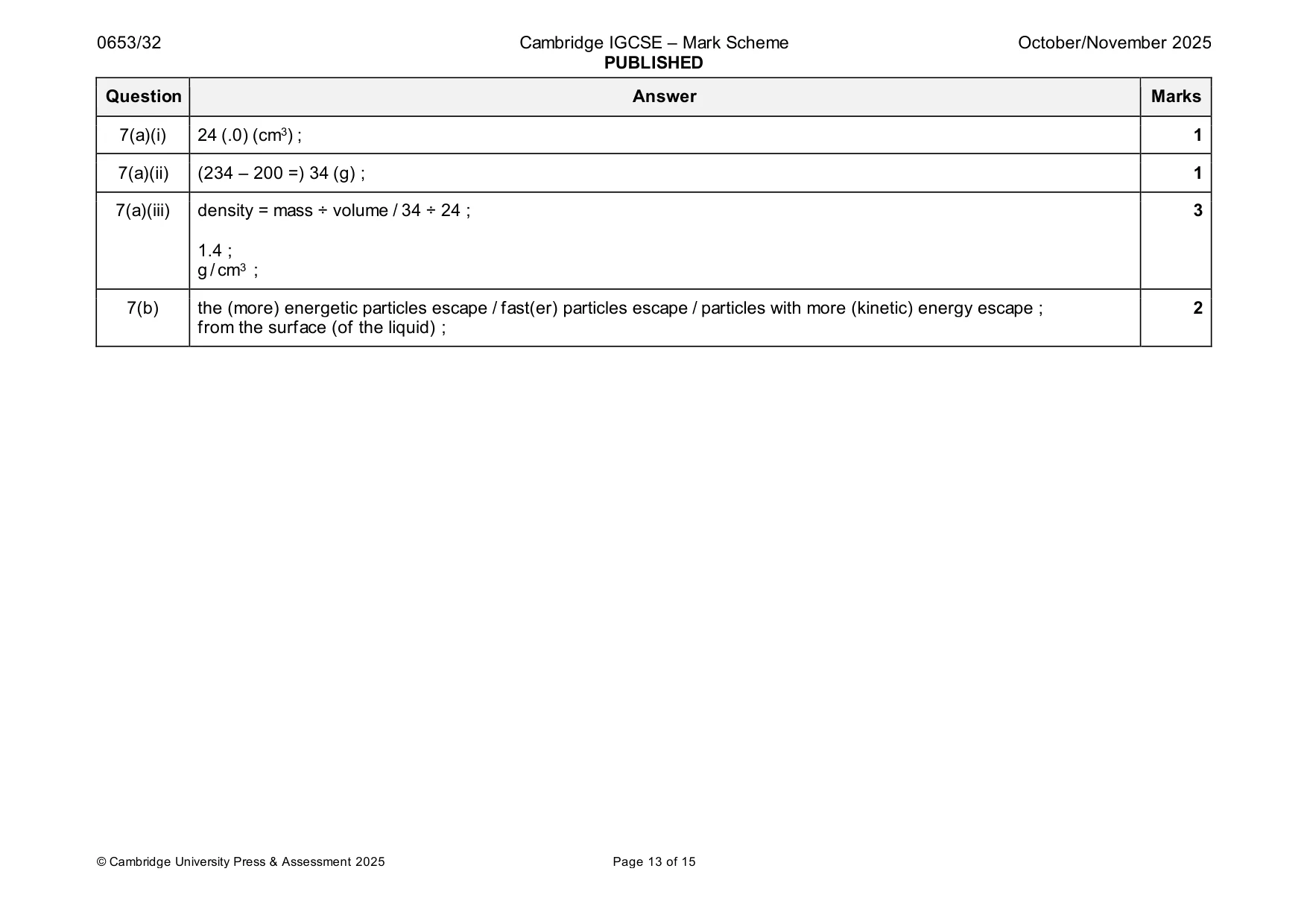
Mark scheme: 7(a)(i) 24 (.0) (cm3) ; 1 7(a)(ii) (234 – 200 =) 34 (g) ; 1 7(a)(iii) density = mass ÷ volume / 34 ÷ 24 ; 3 1.4 ; g / cm3 ; 7(b) the (more) energetic particles escape / fast(er) particles escape / particles with more (kinetic) energy escape ; 2 from the surface (of the liquid) ;
Q8 · A ray of light reflected by a plane mirror
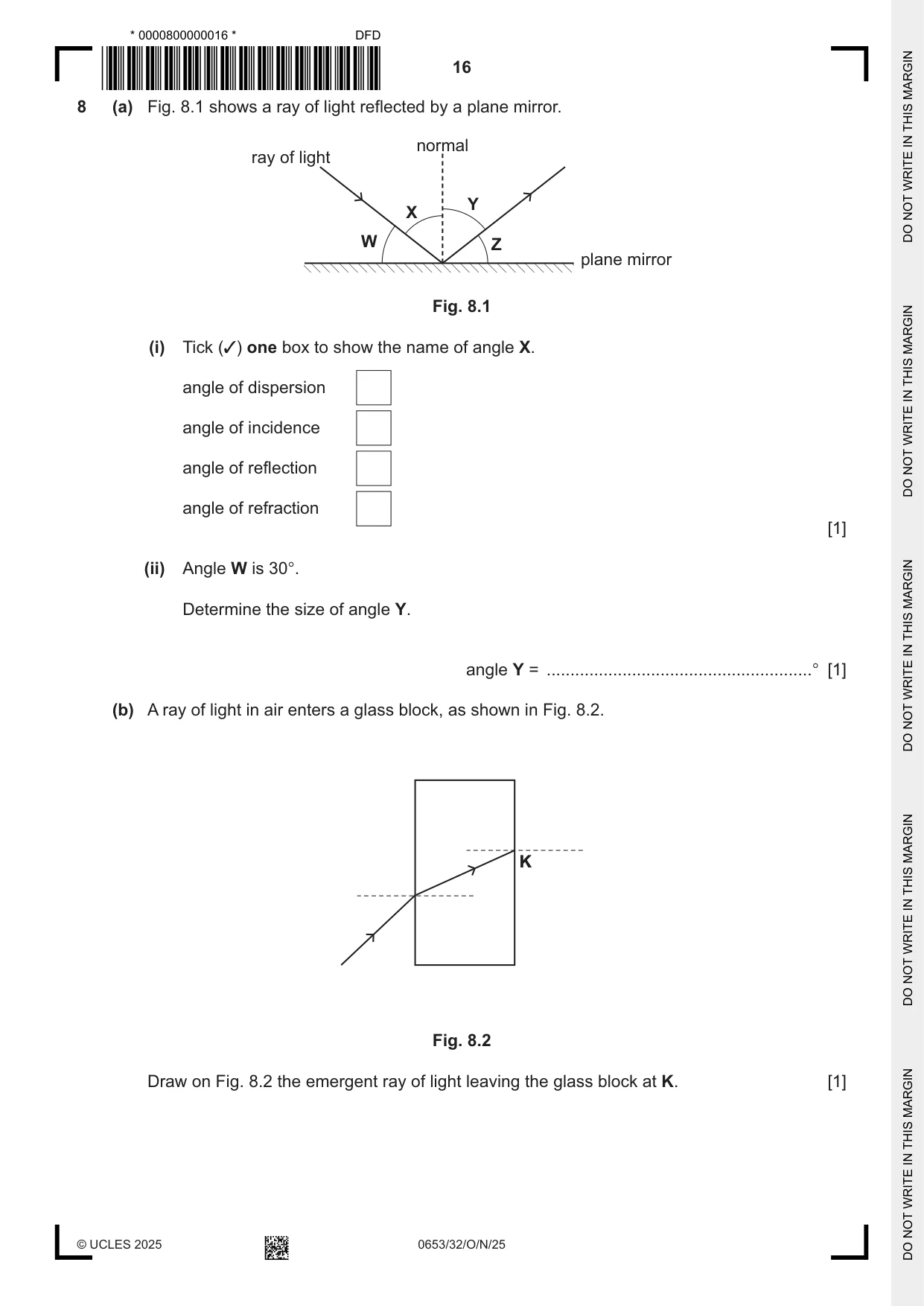
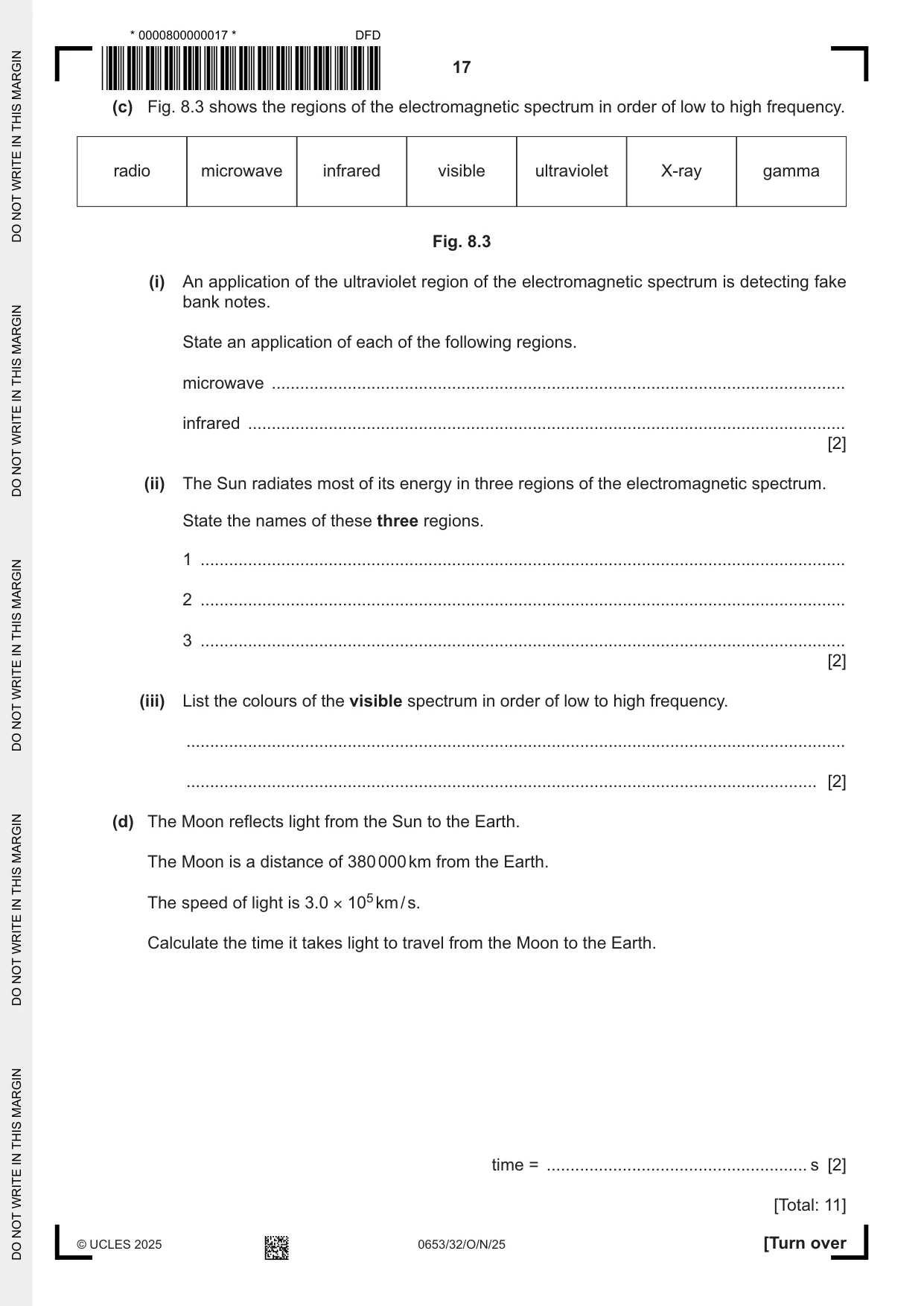
8 (a) Fig. 8.1 shows a ray of light reflected by a plane mirror. normal ray of light Y X W Z plane mirror Fig. 8.1 (i) Tick (✓) one box to show the name of angle X. angle of dispersion angle of incidence angle of reflection angle of refraction [1] (ii) Angle W is 30°. Determine the size of angle Y. angle Y = ........................................................° [1] (b) A ray of light in air enters a glass block, as shown in Fig. 8.2. K Fig. 8.2 Draw on Fig. 8.2 the emergent ray of light leaving the glass block at K. [1] (c) Fig. 8.3 shows the regions of the electromagnetic spectrum in order of low to high frequency. radio microwave infrared visible ultraviolet X-ray gamma Fig. 8.3 (i) An application of the ultraviolet region of the electromagnetic spectrum is detecting fake bank notes. State an application of each of the following regions. microwave ......................................................................................................................... infrared .............................................................................................................................. [2] (ii) The Sun radiates most of its energy in three regions of the electromagnetic spectrum. State the names of these three regions. 1 ........................................................................................................................................ 2 ........................................................................................................................................ 3 ........................................................................................................................................ [2] (iii) List the colours of the visible spectrum in order of low to high frequency. ........................................................................................................................................... ..................................................................................................................................... [2] (d) The Moon reflects light from the Sun to the Earth. The Moon is a distance of 380 000 km from the Earth. The speed of light is 3.0 × 10⁵ km / s. Calculate the time it takes light to travel from the Moon to the Earth. time = ....................................................... s [2] [Total: 11]
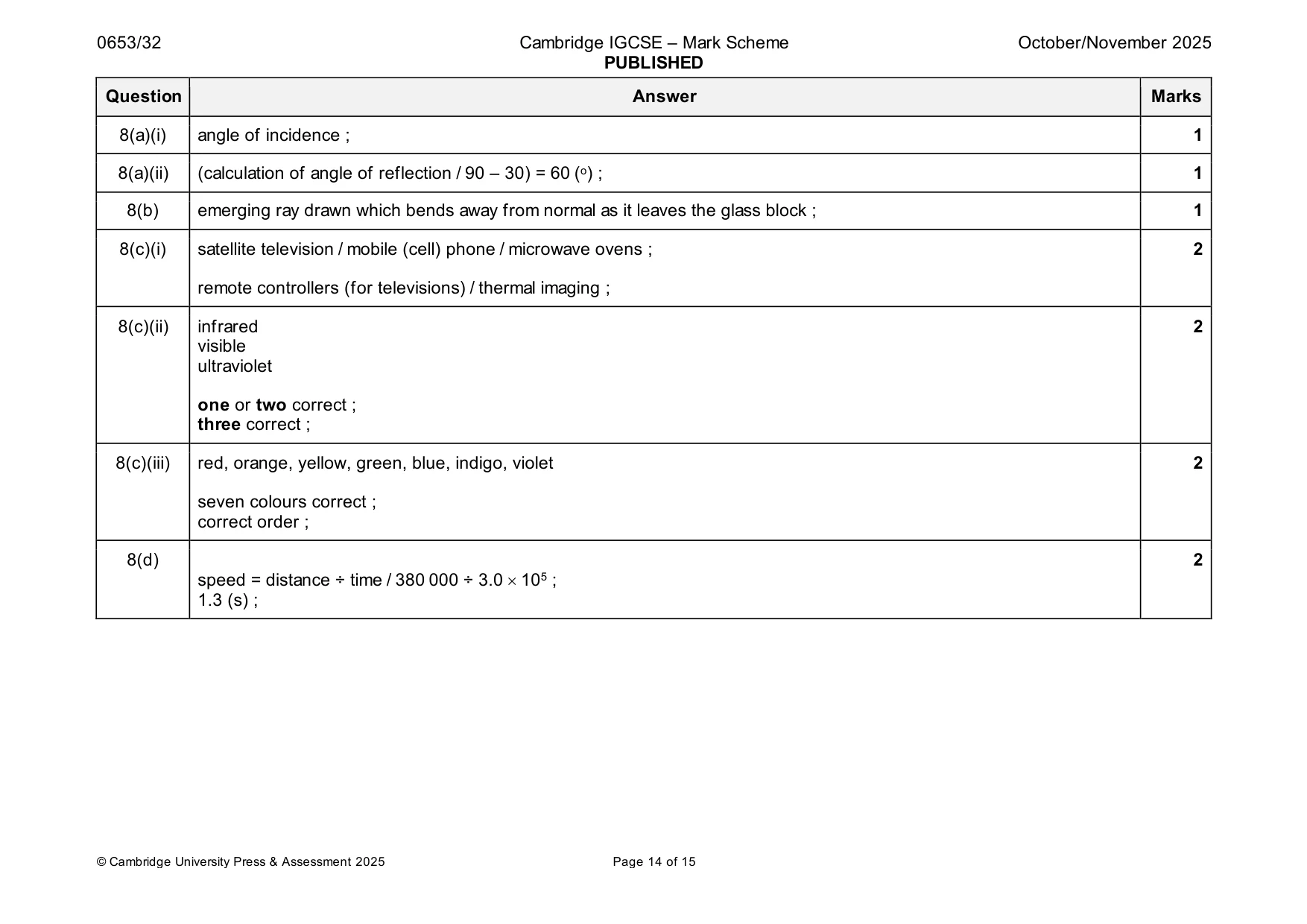
Mark scheme: 8(a)(i) angle of incidence ; 1 8(a)(ii) (calculation of angle of reflection / 90 – 30) = 60 (o) ; 1 8(b) emerging ray drawn which bends away from normal as it leaves the glass block ; 1 8(c)(i) satellite television / mobile (cell) phone / microwave ovens ; 2 remote controllers (for televisions) / thermal imaging ; 8(c)(ii) infrared 2 visible ultraviolet one or two correct ; three correct ; 8(c)(iii) red, orange, yellow, green, blue, indigo, violet 2 seven colours correct ; correct order ; 8(d) 2 speed = distance ÷ time / 380 000 ÷ 3.0 105 ; 1.3 (s) ;
Q9 · An electric kettle used to boil water
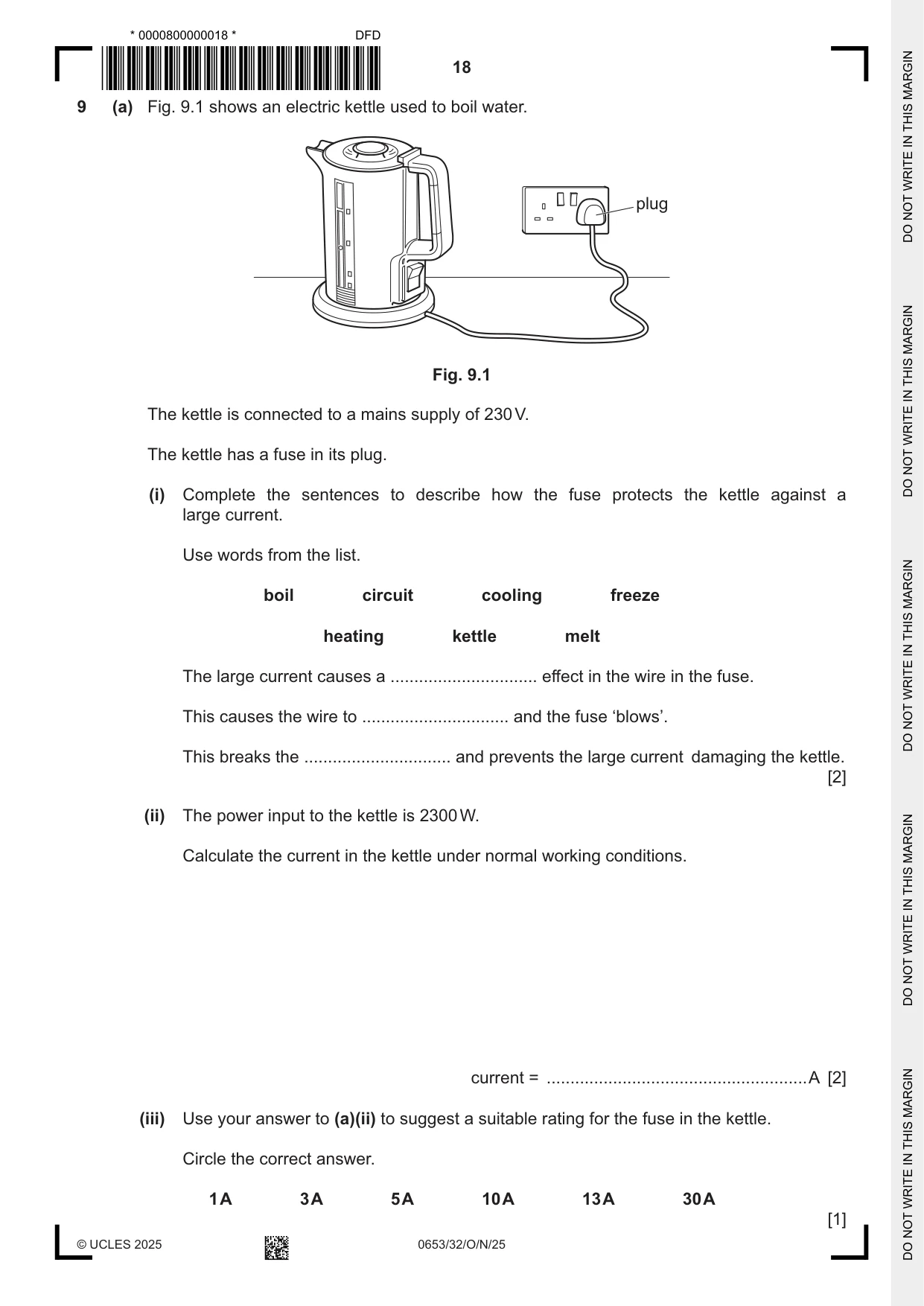
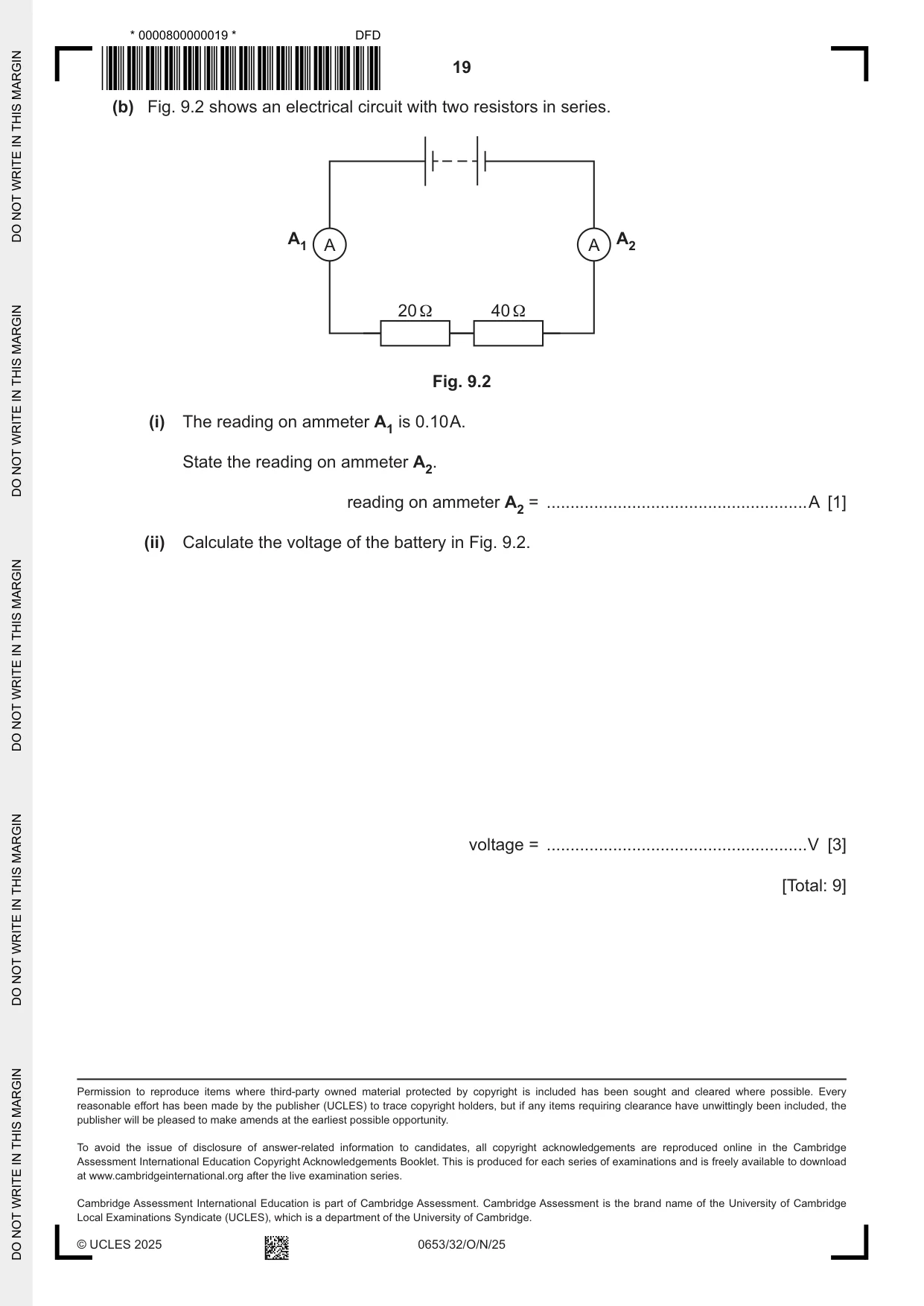
9 (a) Fig. 9.1 shows an electric kettle used to boil water. plug Fig. 9.1 The kettle is connected to a mains supply of 230 V. The kettle has a fuse in its plug. (i) Complete the sentences to describe how the fuse protects the kettle against a large current. Use words from the list. boil circuit cooling freeze heating kettle melt The large current causes a ............................... effect in the wire in the fuse. This causes the wire to ............................... and the fuse ‘blows’. This breaks the ............................... and prevents the large current damaging the kettle. [2] (ii) The power input to the kettle is 2300 W. Calculate the current in the kettle under normal working conditions. current = .......................................................A [2] (iii) Use your answer to (a)(ii) to suggest a suitable rating for the fuse in the kettle. Circle the correct answer. 1 A 3 A 5 A 10 A 13 A 30 A [1] (b) Fig. 9.2 shows an electrical circuit with two resistors in series. A1 A A A2 20 Ω 40 Ω Fig. 9.2 (i) The reading on ammeter A1 is 0.10 A. State the reading on ammeter A2. reading on ammeter A2 = .......................................................A [1] (ii) Calculate the voltage of the battery in Fig. 9.2. voltage = .......................................................V [3] [Total: 9]
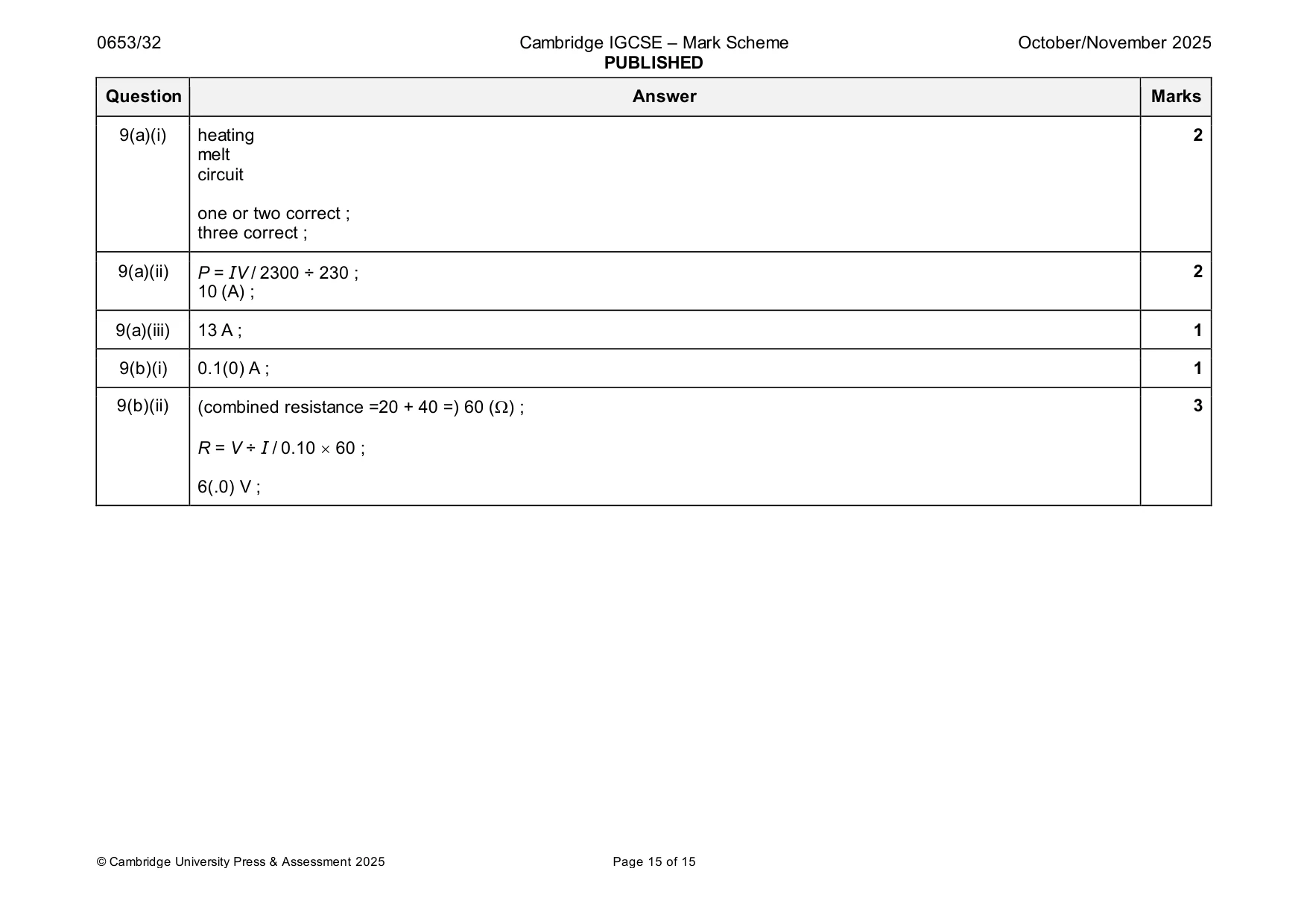
Mark scheme: 9(a)(i) heating 2 melt circuit one or two correct ; three correct ; 9(a)(ii) P = IV / 2300 ÷ 230 ; 2 10 (A) ; 9(a)(iii) 13 A ; 1 9(b)(i) 0.1(0) A ; 1 9(b)(ii) (combined resistance =20 + 40 =) 60 () ; 3 R = V ÷ I / 0.10 60 ; 6(.0) V ;
What was in this paper
The subtopics covered by these 9 questions, and how many questions each got. Open one in a new tab to see every Cambridge question on it.
What you needed in this session
Cambridge’s own grade thresholds for 2025 Oct/Nov, Paper 3 · Variant 2. A higher threshold means an easier paper — the bar moves with how the cohort did.