Cambridge IGCSE Science - Combined 0653 — 2021 May/June Paper 3 · Variant 3
0653/33/M/J/21 · 9 questions · 80 marks · ≈90 min
The question paper and its mark scheme, free to read here and free to download. This is Cambridge’s own paper, exactly as it was sat.
Question paper24 pages



Mark scheme11 pages
Answers below. Sit the paper first if you are practising.
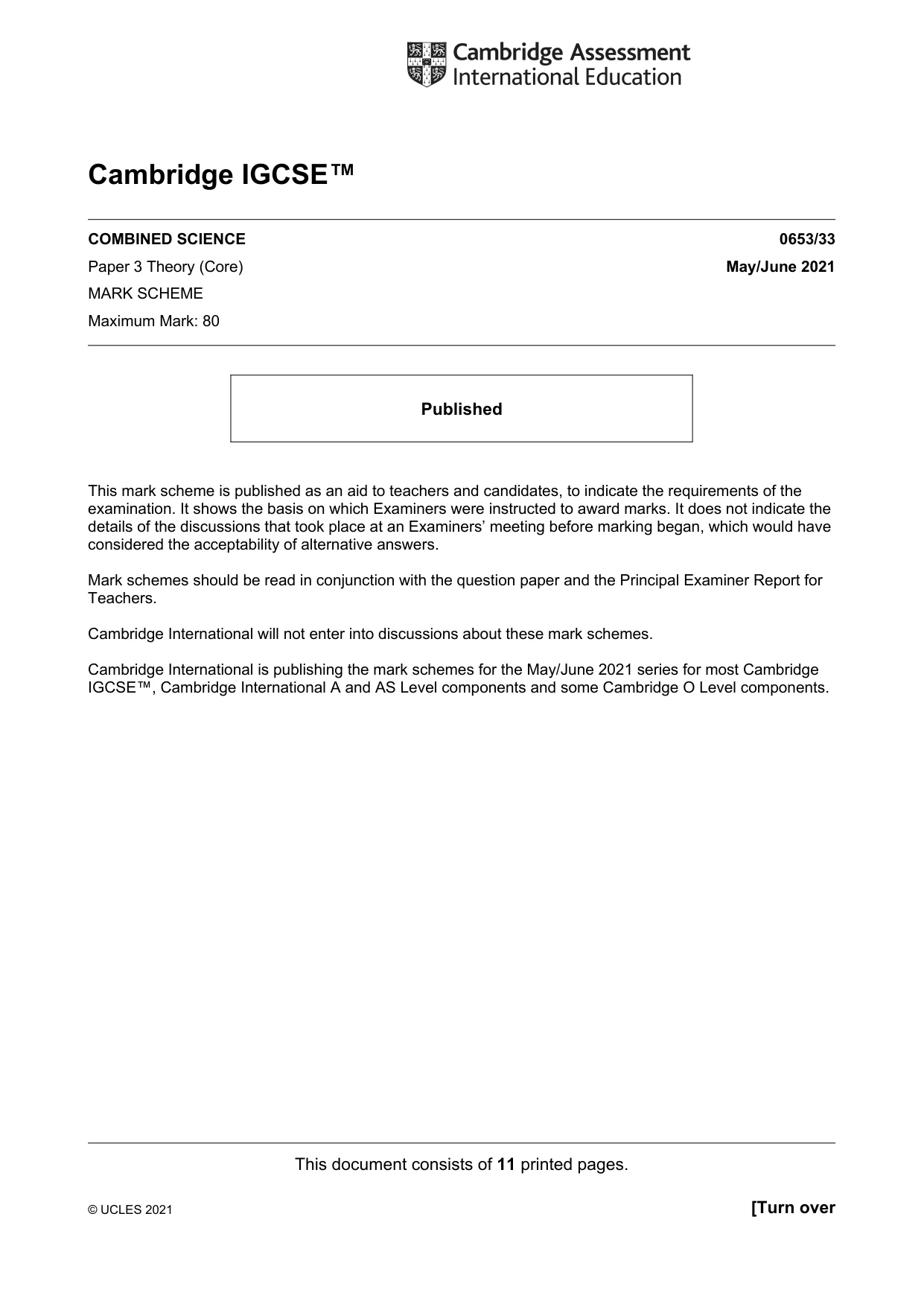
Questions as text
Q1 · Nutrition is one of the characteristics of living organisms
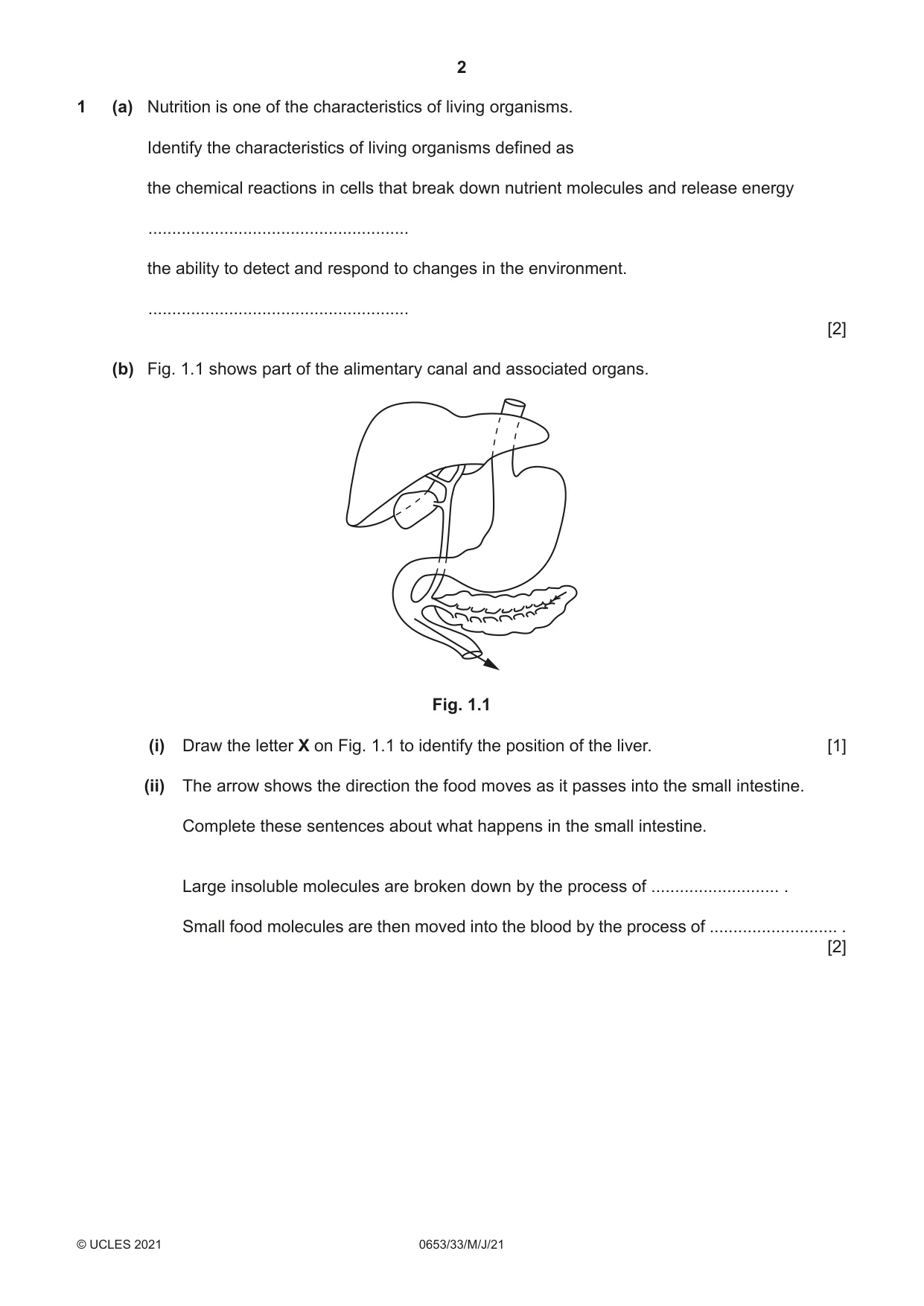
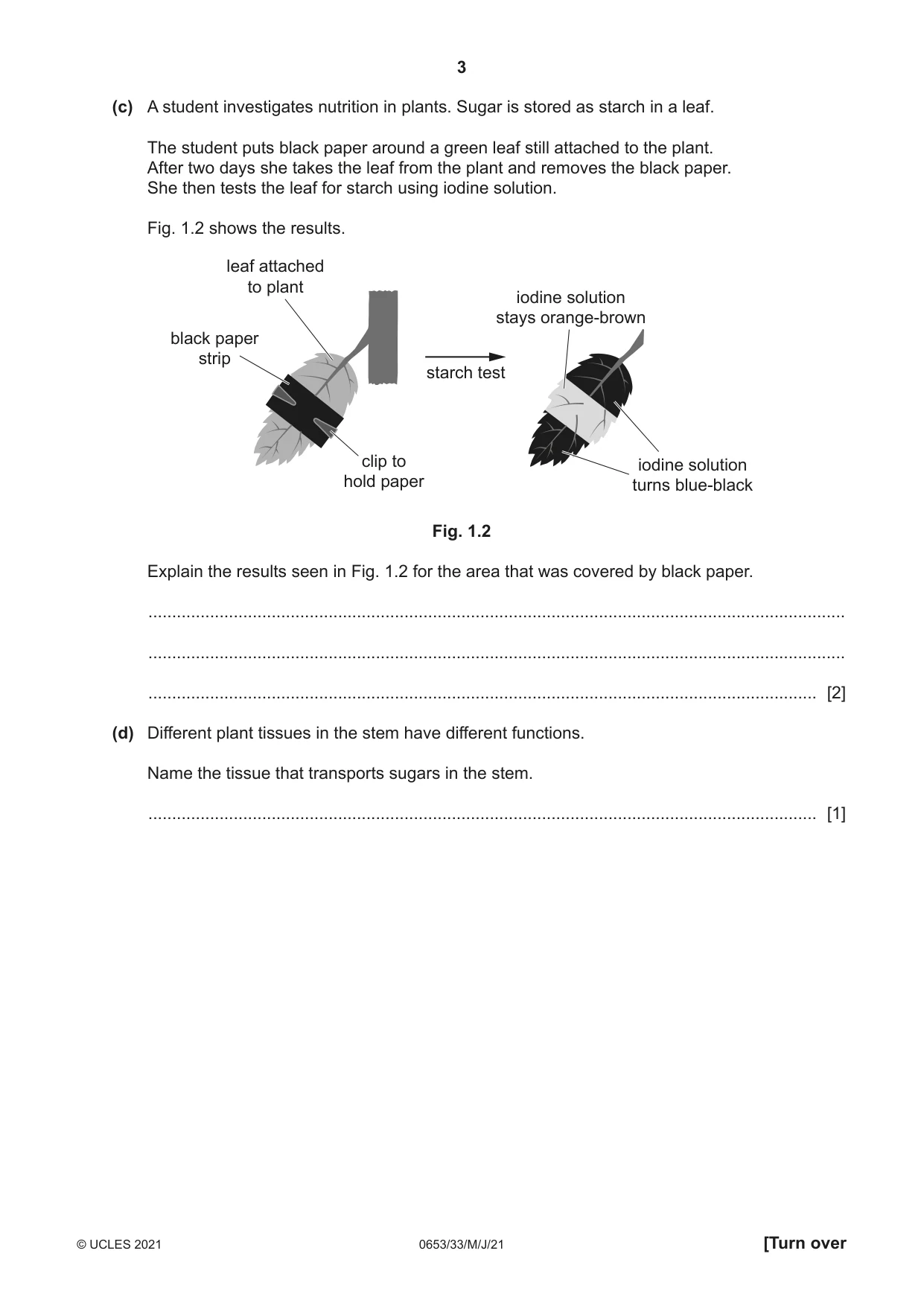
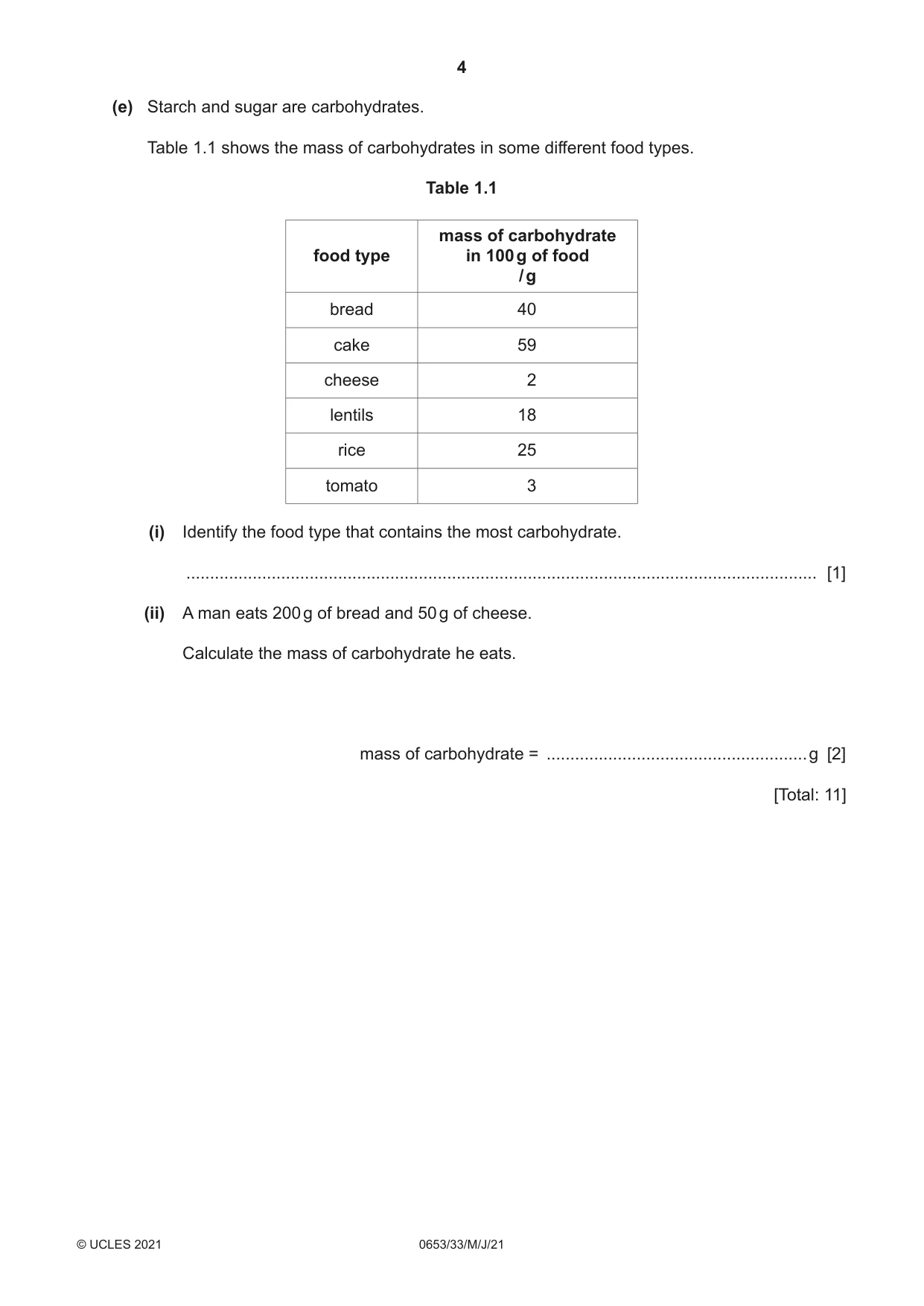
1 (a) Nutrition is one of the characteristics of living organisms. Identify the characteristics of living organisms defined as the chemical reactions in cells that break down nutrient molecules and release energy ....................................................... the ability to detect and respond to changes in the environment. ....................................................... [2] (b) Fig. 1.1 shows part of the alimentary canal and associated organs. Fig. 1.1 (i) Draw the letter X on Fig. 1.1 to identify the position of the liver. [1] (ii) The arrow shows the direction the food moves as it passes into the small intestine. Complete these sentences about what happens in the small intestine. Large insoluble molecules are broken down by the process of ........................... . Small food molecules are then moved into the blood by the process of ........................... . [2] (c) A student investigates nutrition in plants. Sugar is stored as starch in a leaf. The student puts black paper around a green leaf still attached to the plant. After two days she takes the leaf from the plant and removes the black paper. She then tests the leaf for starch using iodine solution. Fig. 1.2 shows the results. leaf attached to plant iodine solution stays orange-brown black paper strip starch test clip to iodine solution hold paper turns blue-black Fig. 1.2 Explain the results seen in Fig. 1.2 for the area that was covered by black paper. ................................................................................................................................................... ................................................................................................................................................... ............................................................................................................................................. [2] (d) Different plant tissues in the stem have different functions. Name the tissue that transports sugars in the stem. ............................................................................................................................................. [1] (e) Starch and sugar are carbohydrates. Table 1.1 shows the mass of carbohydrates in some different food types. Table 1.1 mass of carbohydrate food type in 100 g of food / g bread 40 cake 59 cheese 2 lentils 18 rice 25 tomato 3 (i) Identify the food type that contains the most carbohydrate. ..................................................................................................................................... [1] (ii) A man eats 200 g of bread and 50 g of cheese. Calculate the mass of carbohydrate he eats. mass of carbohydrate = ....................................................... g [2] [Total: 11]
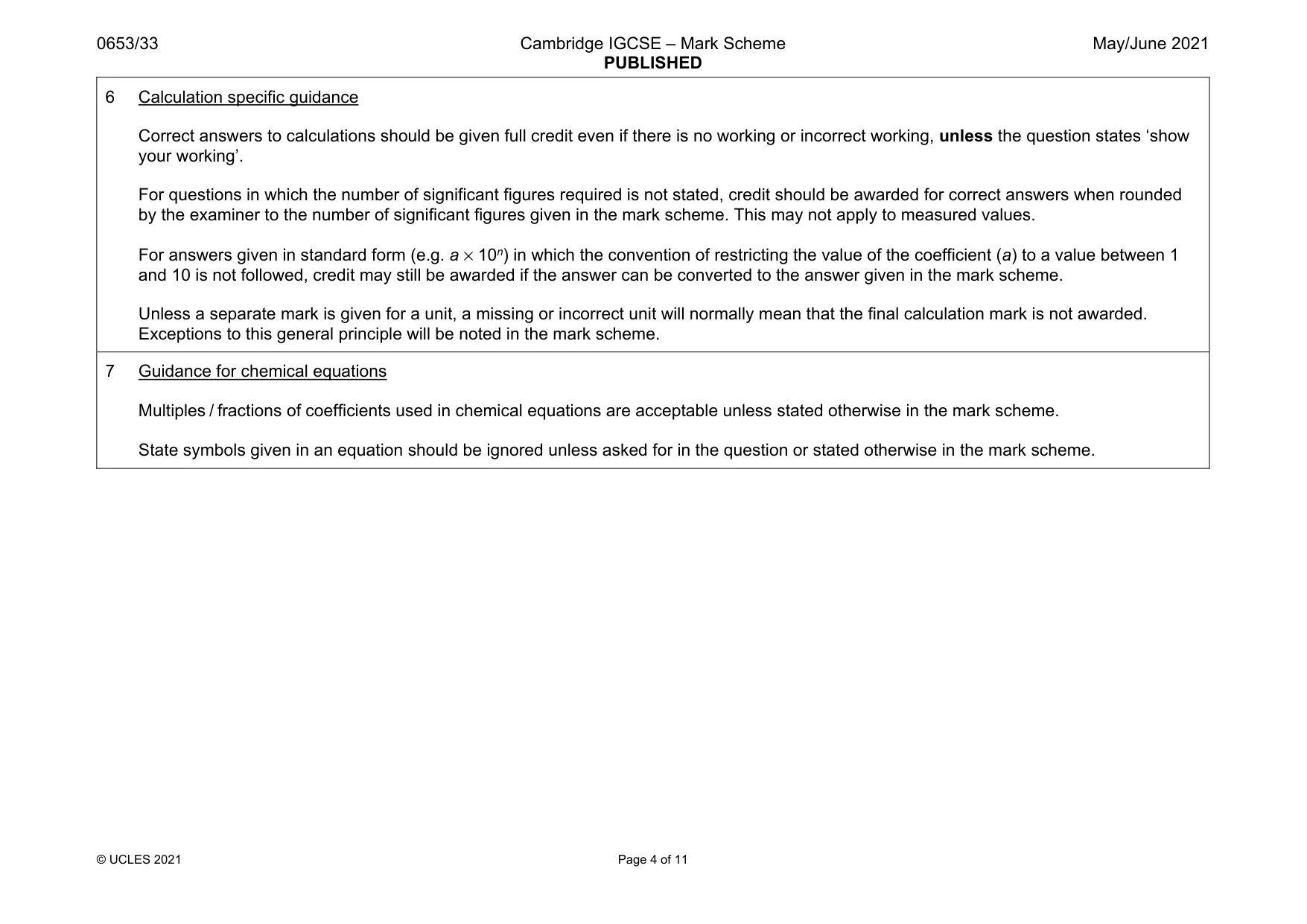
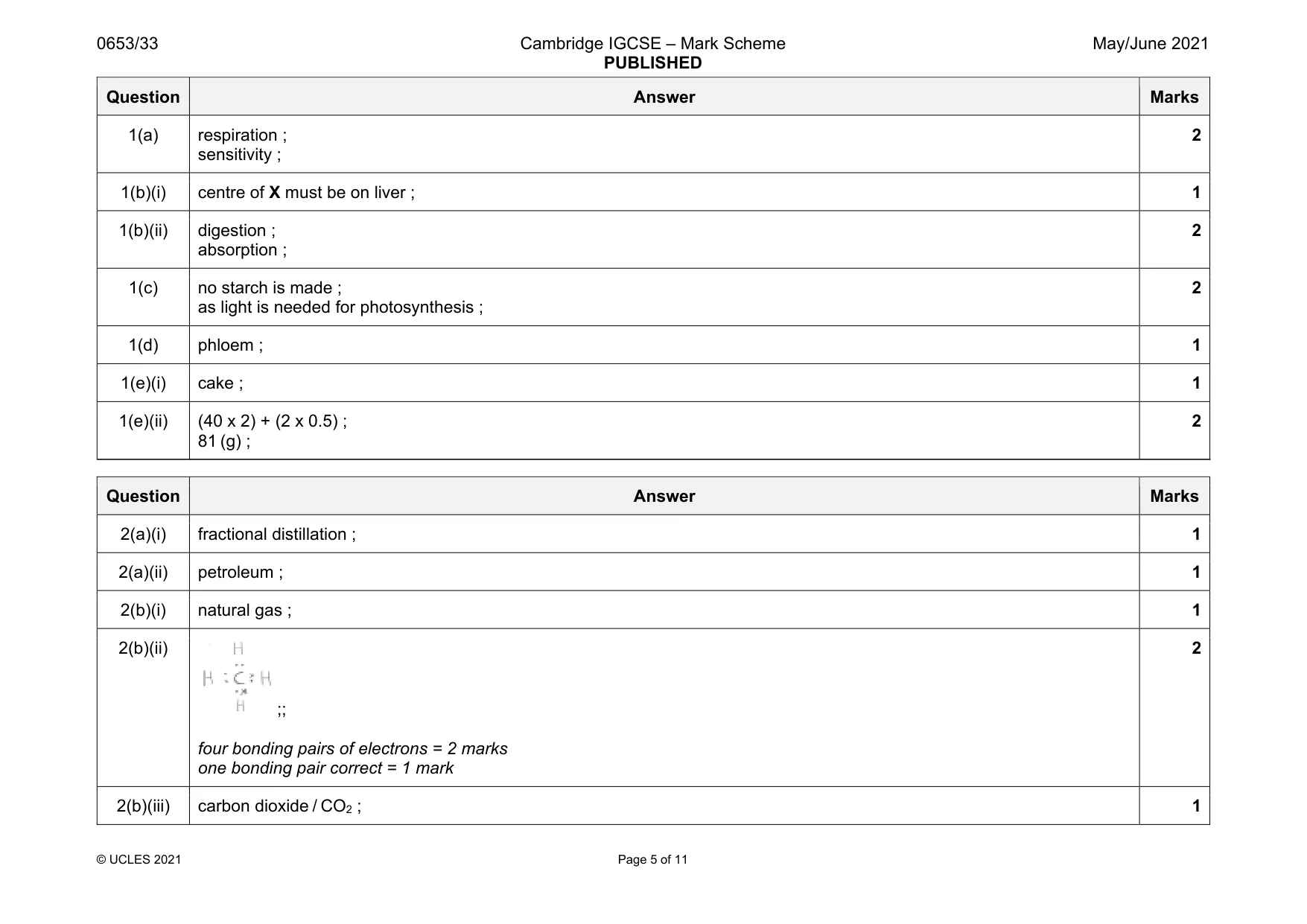
Mark scheme: 1(a) respiration ; sensitivity ; 2 1(b)(i) centre of X must be on liver ; 1 1(b)(ii) digestion ; absorption ; 2 1(c) no starch is made ; as light is needed for photosynthesis ; 2 1(d) phloem ; 1 1(e)(i) cake ; 1 1(e)(ii) (40 x 2) + (2 x 0.5) ; 81 (g) ; 2
Q2 · A process used to separate substances in a fossil fuel
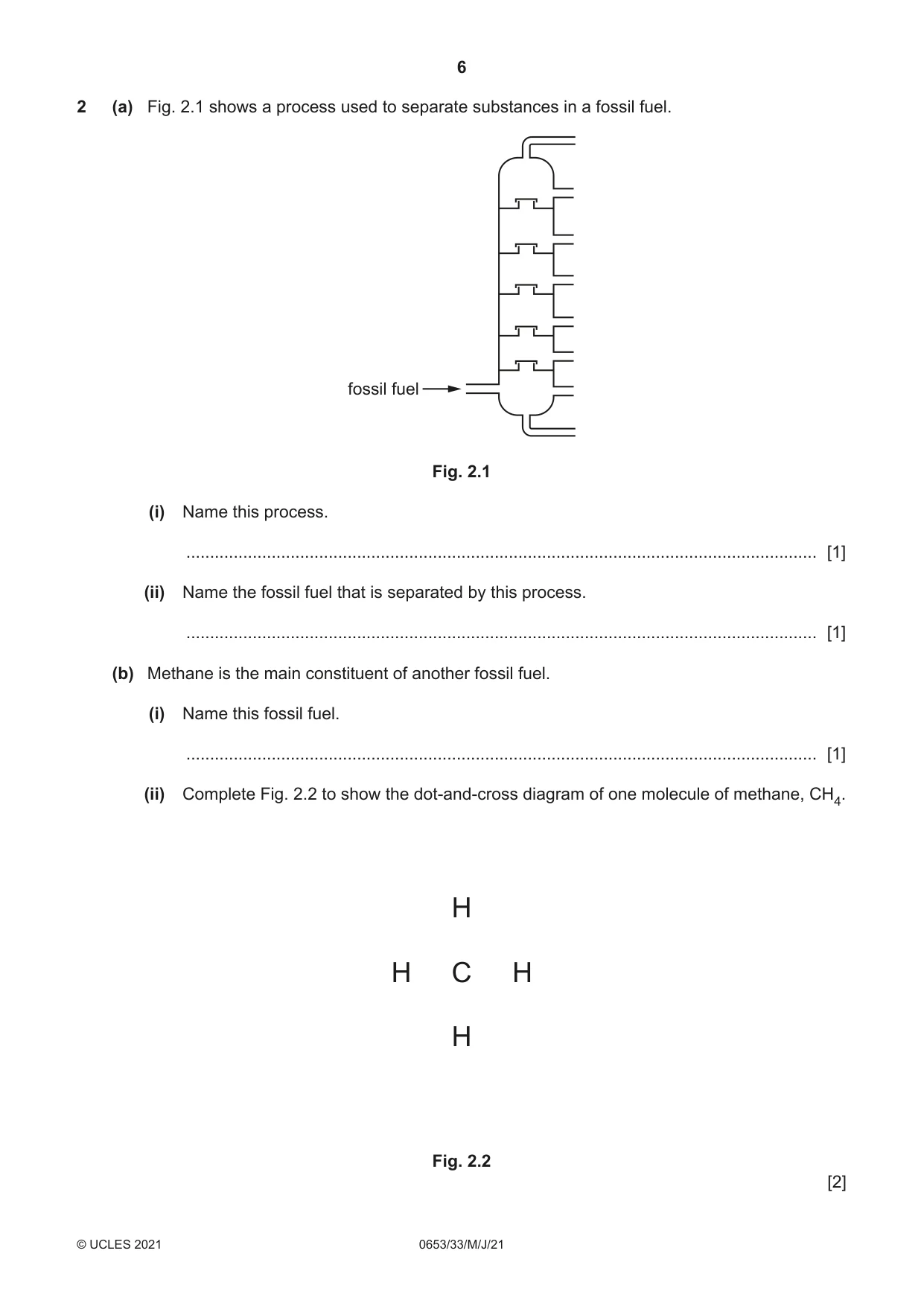
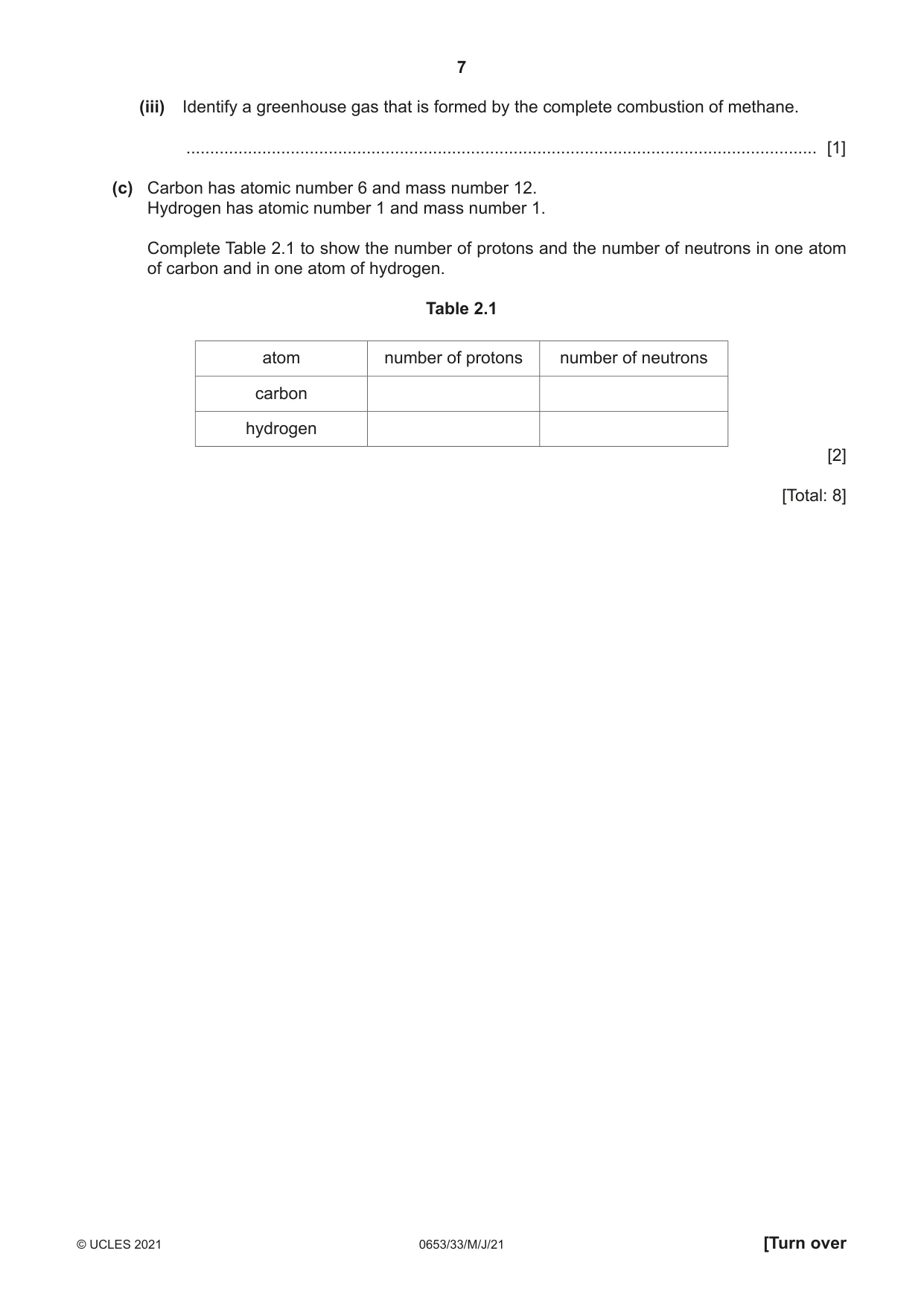
2 (a) Fig. 2.1 shows a process used to separate substances in a fossil fuel. fossil fuel Fig. 2.1 (i) Name this process. ..................................................................................................................................... [1] (ii) Name the fossil fuel that is separated by this process. ..................................................................................................................................... [1] (b) Methane is the main constituent of another fossil fuel. (i) Name this fossil fuel. ..................................................................................................................................... [1] (ii) Complete Fig. 2.2 to show the dot-and-cross diagram of one molecule of methane, CH4. H H C H H Fig. 2.2 [2] (iii) Identify a greenhouse gas that is formed by the complete combustion of methane. ..................................................................................................................................... [1] (c) Carbon has atomic number 6 and mass number 12. Hydrogen has atomic number 1 and mass number 1. Complete Table 2.1 to show the number of protons and the number of neutrons in one atom of carbon and in one atom of hydrogen. Table 2.1 atom number of protons number of neutrons carbon hydrogen [2] [Total: 8]
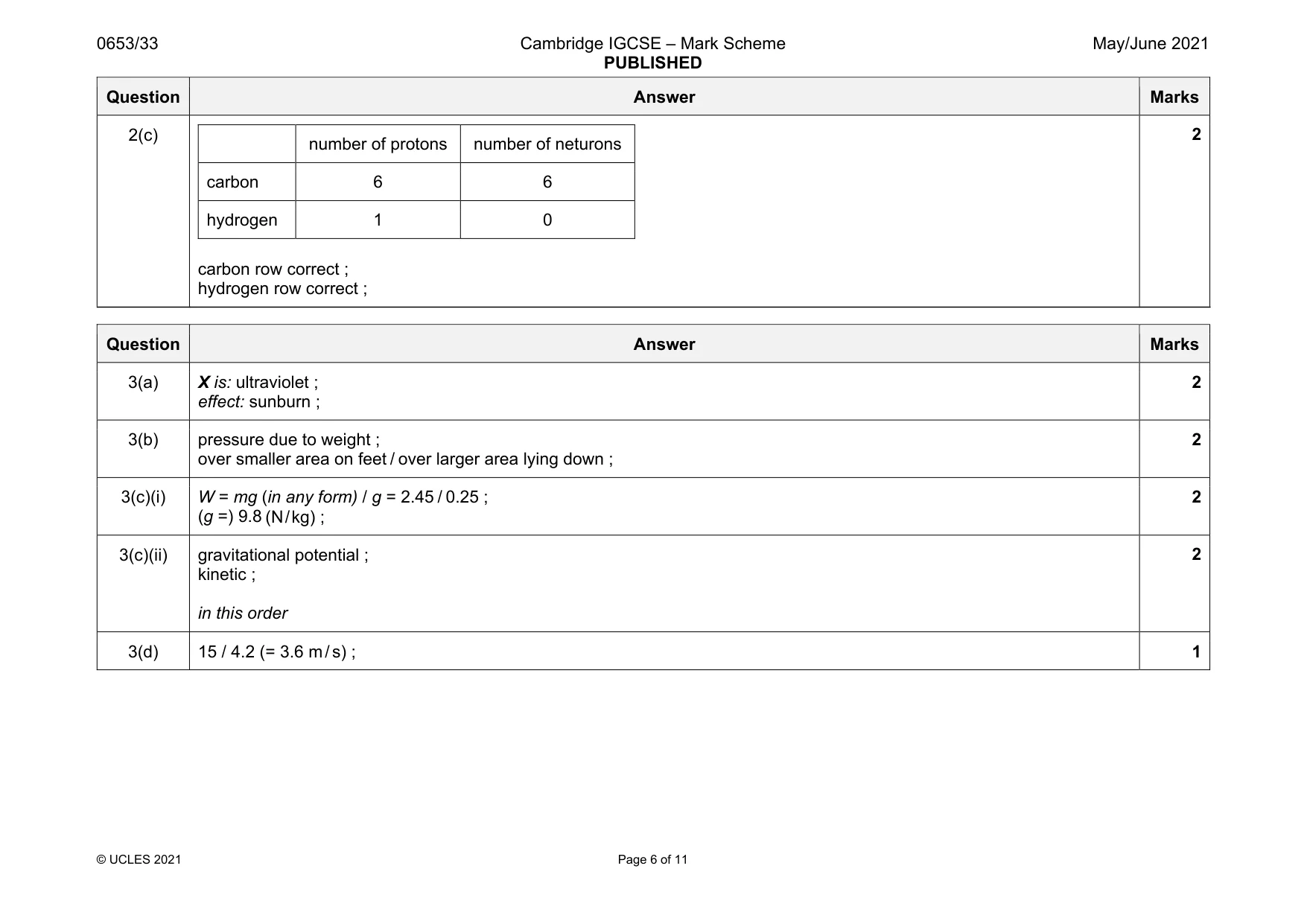
Mark scheme: 2(a)(i) fractional distillation ; 1 2(a)(ii) petroleum ; 1 2(b)(i) natural gas ; 1 2(b)(ii) ;; four bonding pairs of electrons = 2 marks one bonding pair correct = 1 mark 2 2(b)(iii) carbon dioxide / CO2 ; 1 Question Answer Marks 2(c) number of protons number of neturons carbon 6 6 hydrogen 1 0 carbon row correct ; hydrogen row correct ; 2
Q3 · A man lying down on a sandy beach on a sunny day
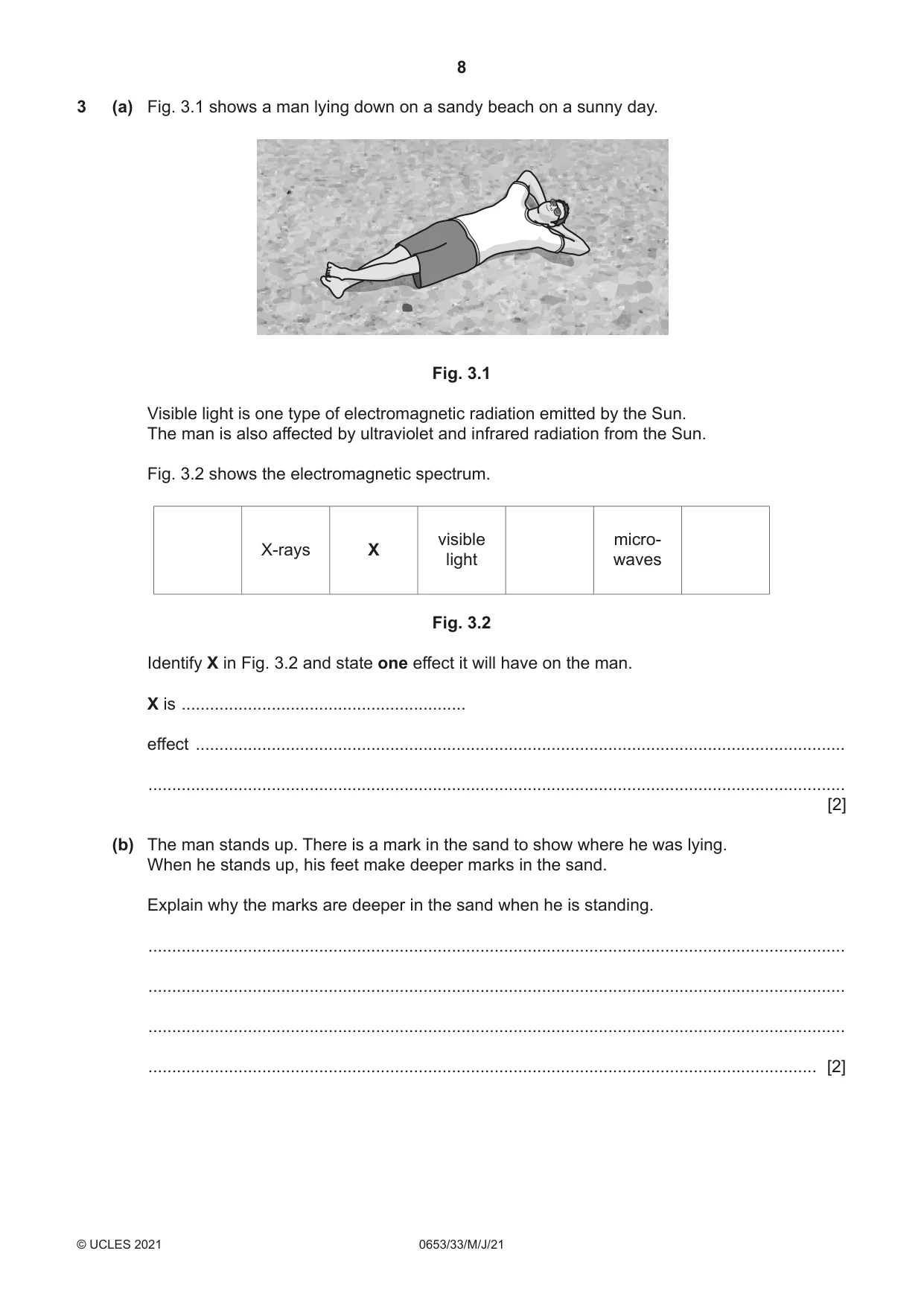
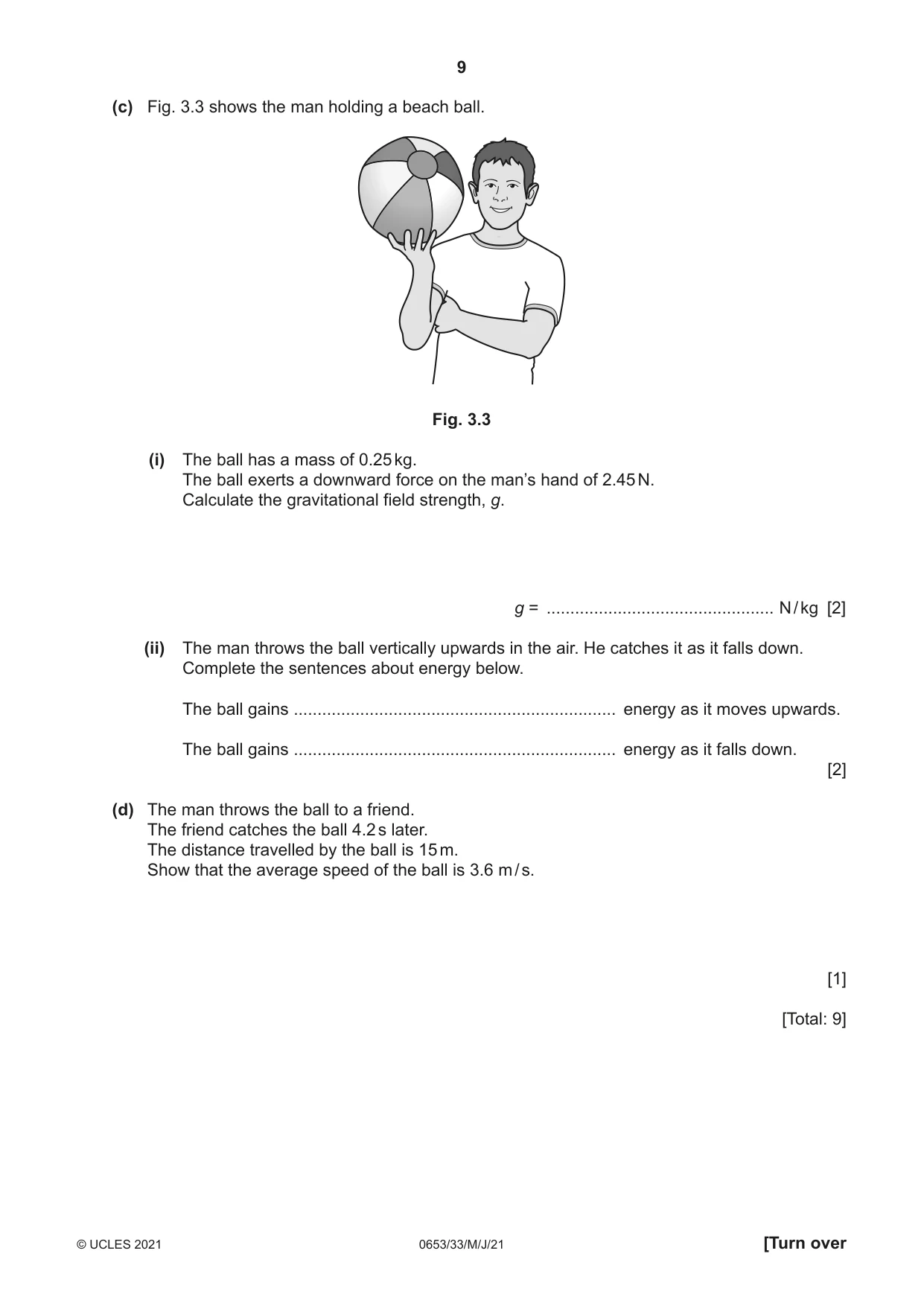
3 (a) Fig. 3.1 shows a man lying down on a sandy beach on a sunny day. Fig. 3.1 Visible light is one type of electromagnetic radiation emitted by the Sun. The man is also affected by ultraviolet and infrared radiation from the Sun. Fig. 3.2 shows the electromagnetic spectrum. visible micro- X-rays X light waves Fig. 3.2 Identify X in Fig. 3.2 and state one effect it will have on the man. X is ............................................................ effect ......................................................................................................................................... ................................................................................................................................................... [2] (b) The man stands up. There is a mark in the sand to show where he was lying. When he stands up, his feet make deeper marks in the sand. Explain why the marks are deeper in the sand when he is standing. ................................................................................................................................................... ................................................................................................................................................... ................................................................................................................................................... ............................................................................................................................................. [2] (c) Fig. 3.3 shows the man holding a beach ball. Fig. 3.3 (i) The ball has a mass of 0.25 kg. The ball exerts a downward force on the man’s hand of 2.45 N. Calculate the gravitational field strength, g. g = ................................................ N / kg [2] (ii) The man throws the ball vertically upwards in the air. He catches it as it falls down. Complete the sentences about energy below. The ball gains .................................................................... energy as it moves upwards. The ball gains .................................................................... energy as it falls down. [2] (d) The man throws the ball to a friend. The friend catches the ball 4.2 s later. The distance travelled by the ball is 15 m. Show that the average speed of the ball is 3.6 m / s. [1] [Total: 9]
Mark scheme: 3(a) X is: ultraviolet ; effect: sunburn ; 2 3(b) pressure due to weight ; over smaller area on feet / over larger area lying down ; 2 3(c)(i) W = mg (in any form) / g = 2.45 / 0.25 ; (g =) 9.8 (N / kg) ; 2 3(c)(ii) gravitational potential ; kinetic ; in this order 2 3(d) 15 / 4.2 (= 3.6 m / s) ; 1
Q4 · The boxes on the left show different components of blood
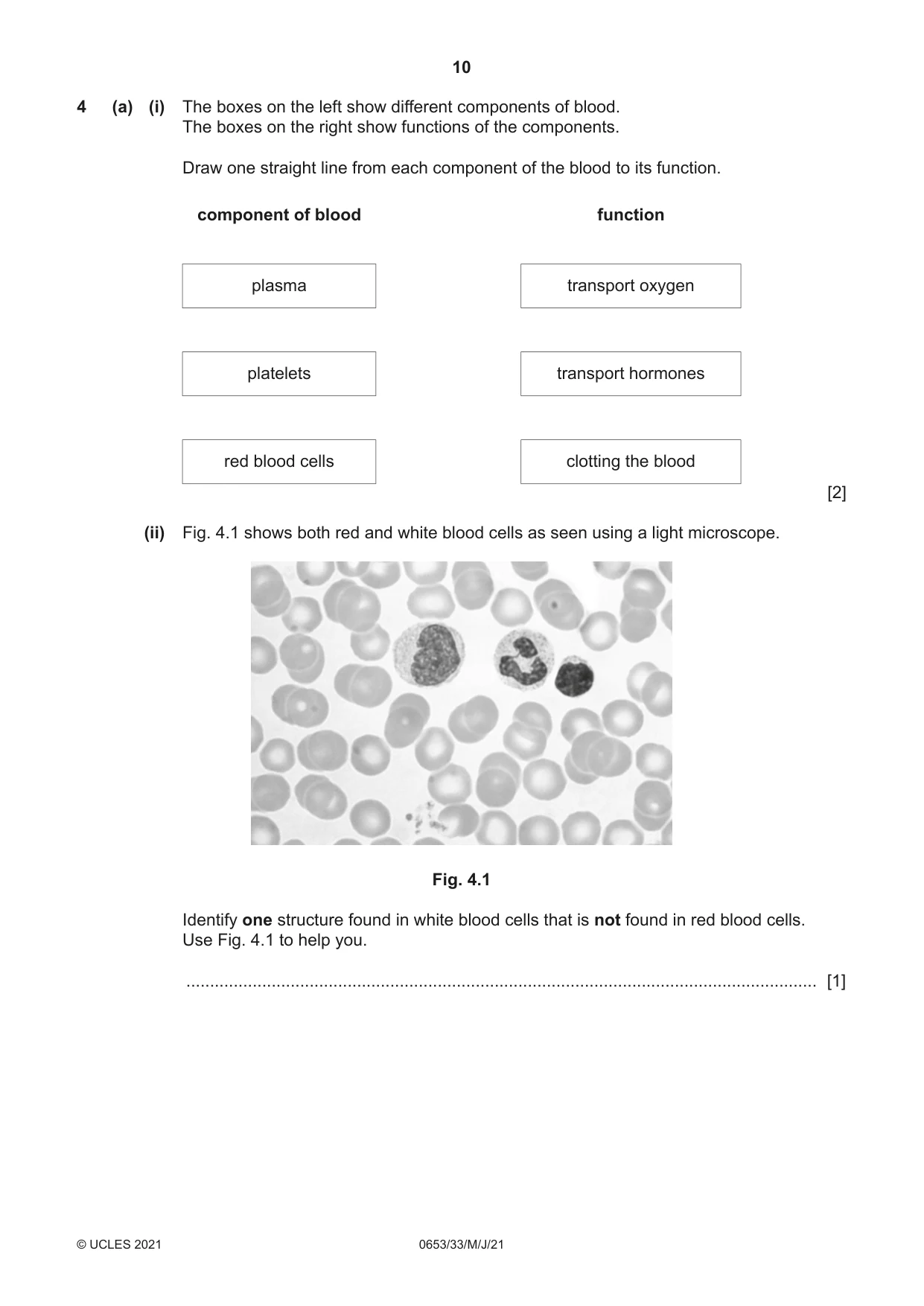
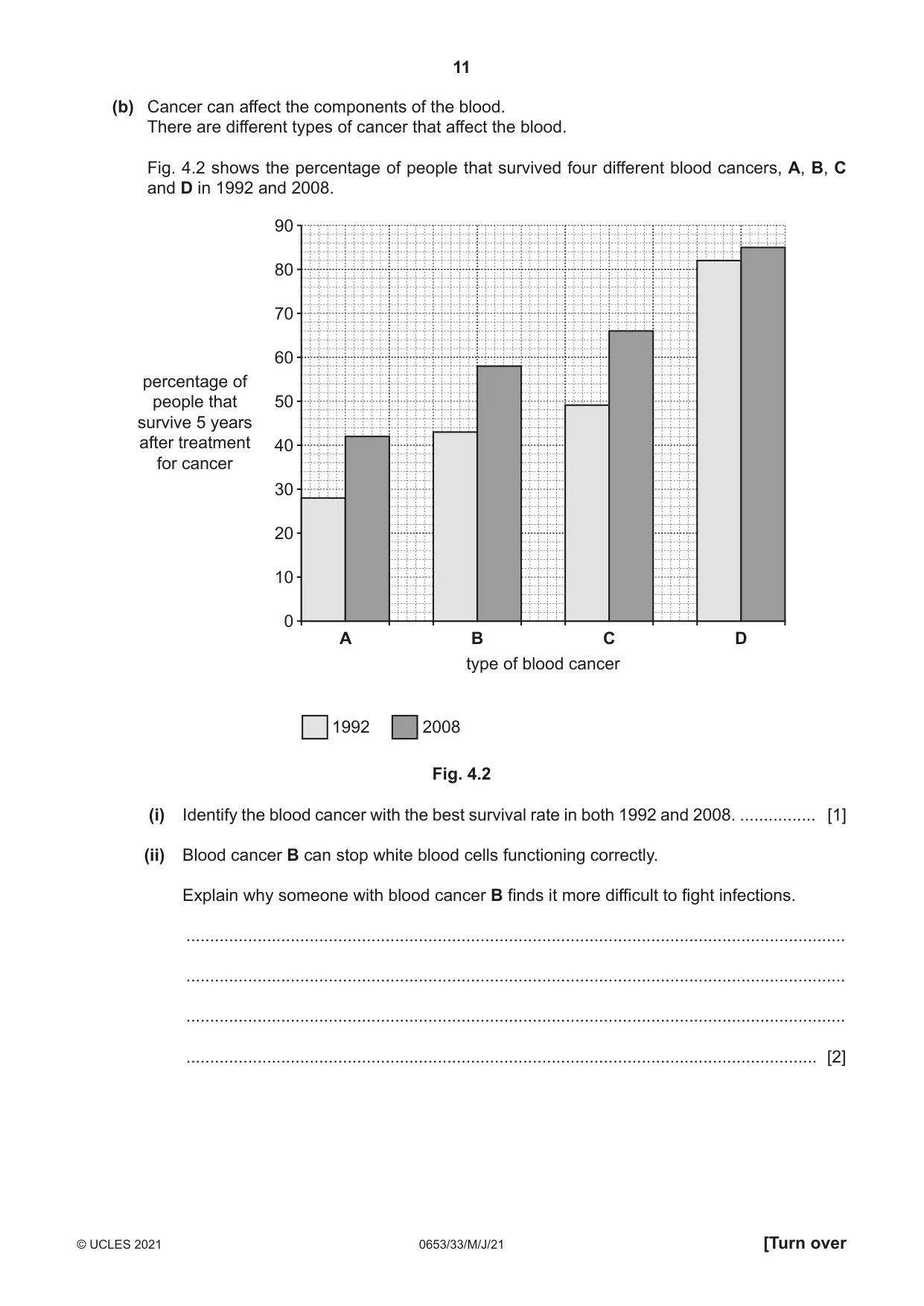
4 (a) (i) The boxes on the left show different components of blood. The boxes on the right show functions of the components. Draw one straight line from each component of the blood to its function. component of blood function plasma transport oxygen platelets transport hormones red blood cells clotting the blood [2] (ii) Fig. 4.1 shows both red and white blood cells as seen using a light microscope. Fig. 4.1 Identify one structure found in white blood cells that is not found in red blood cells. Use Fig. 4.1 to help you. ..................................................................................................................................... [1] (b) Cancer can affect the components of the blood. There are different types of cancer that affect the blood. Fig. 4.2 shows the percentage of people that survived four different blood cancers, A, B, C and D in 1992 and 2008. 90 80 70 60 percentage of people that 50 survive 5 years after treatment 40 for cancer 30 20 10 0 A B C D type of blood cancer 1992 2008 Fig. 4.2 (i) Identify the blood cancer with the best survival rate in both 1992 and 2008. ................ [1] (ii) Blood cancer B can stop white blood cells functioning correctly. Explain why someone with blood cancer B finds it more difficult to fight infections. ........................................................................................................................................... ........................................................................................................................................... ........................................................................................................................................... ..................................................................................................................................... [2] (c) Hepatitis is a sexually transmitted infection that can be passed on through body fluids and infected blood. (i) One way to prevent the spread of hepatitis is using sterilised needles. State two other ways to prevent the spread of hepatitis. 1 ........................................................................................................................................ 2 ........................................................................................................................................ [2] (ii) Name one other sexually transmitted infection. ..................................................................................................................................... [1] [Total: 9]
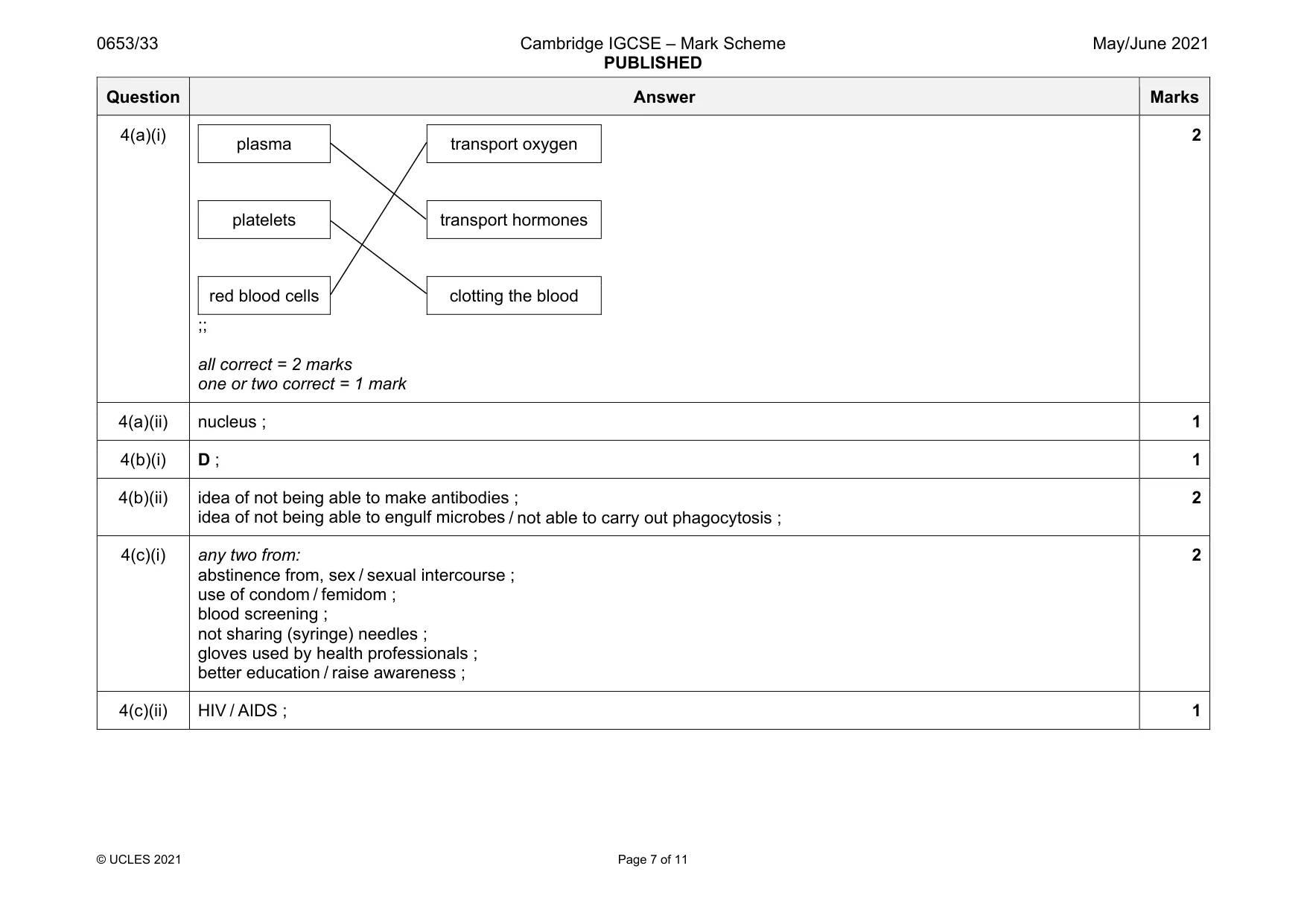
Mark scheme: 4(a)(i) plasma transport oxygen platelets transport hormones red blood cells clotting the blood ;; all correct = 2 marks one or two correct = 1 mark 2 4(a)(ii) nucleus ; 1 4(b)(i) D ; 1 4(b)(ii) idea of not being able to make antibodies ; idea of not being able to engulf microbes / not able to carry out phagocytosis ; 2 4(c)(i) any two from: abstinence from, sex / sexual intercourse ; use of condom / femidom ; blood screening ; not sharing (syringe) needles ; gloves used by health professionals ; better education / raise awareness ; 2 4(c)(ii) HIV / AIDS ; 1
Q5 · Copper is extracted from copper(II) oxide by heating with carbon
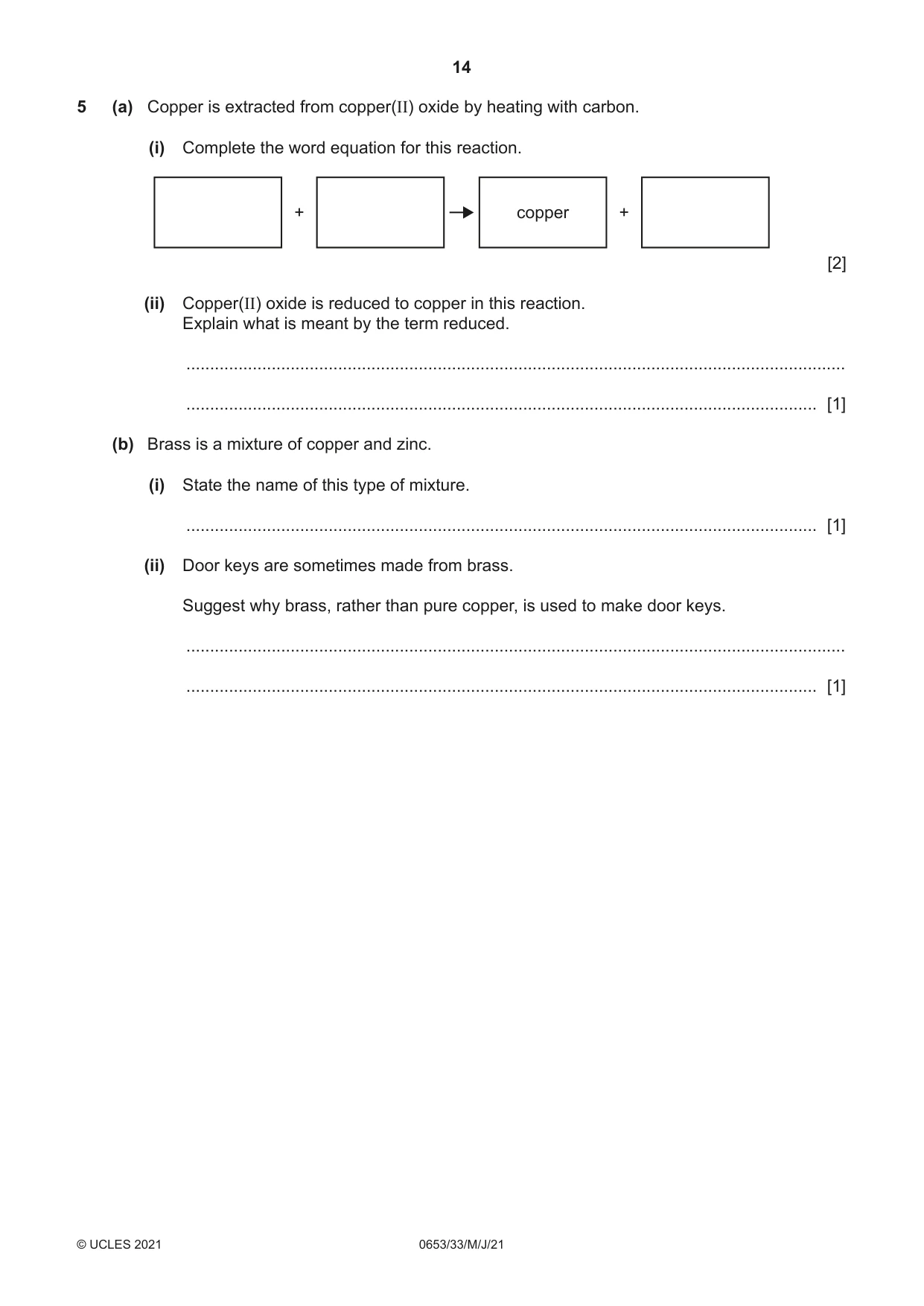
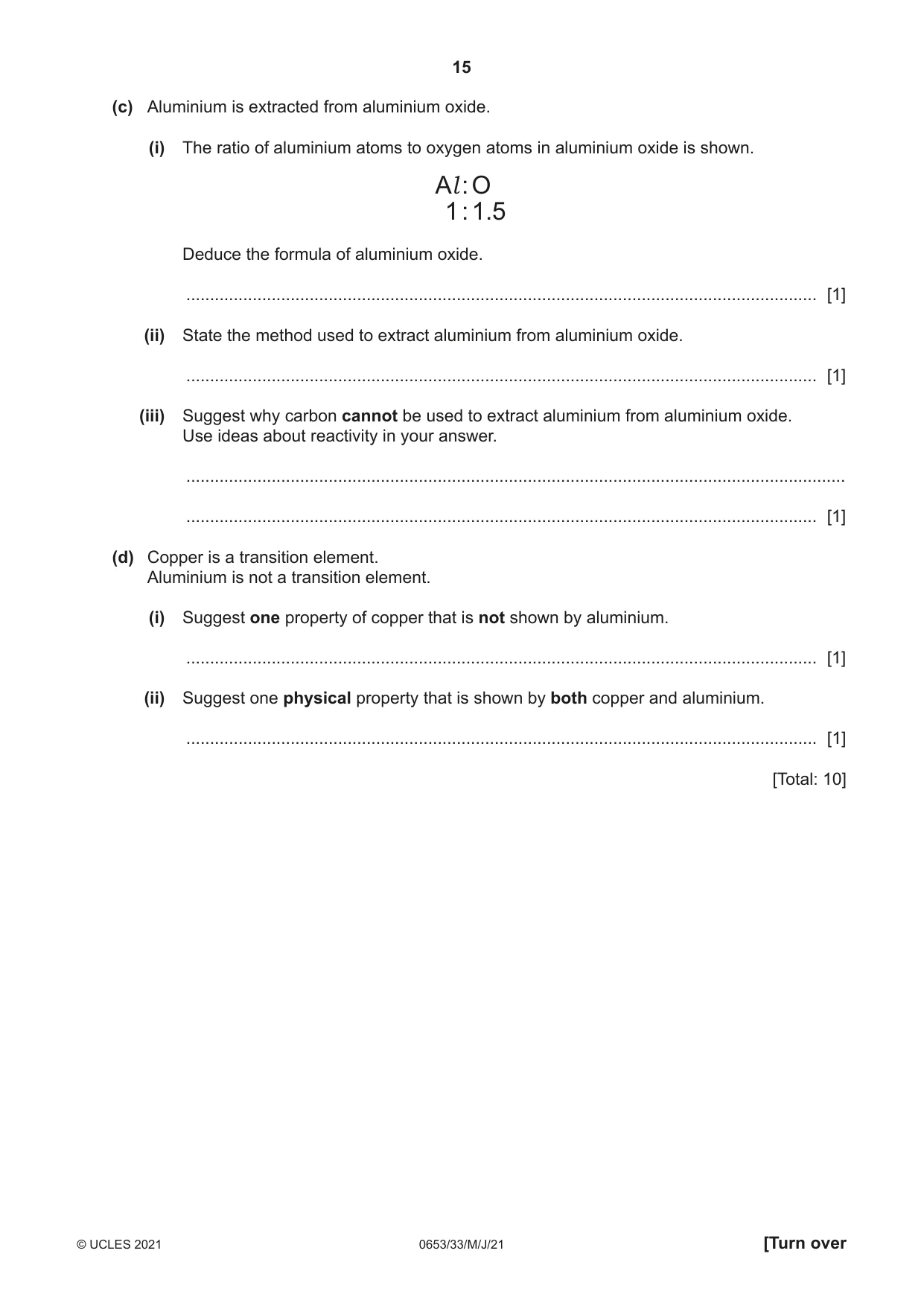
5 (a) Copper is extracted from copper(II) oxide by heating with carbon. (i) Complete the word equation for this reaction. + copper + [2] (ii) Copper(II) oxide is reduced to copper in this reaction. Explain what is meant by the term reduced. ........................................................................................................................................... ..................................................................................................................................... [1] (b) Brass is a mixture of copper and zinc. (i) State the name of this type of mixture. ..................................................................................................................................... [1] (ii) Door keys are sometimes made from brass. Suggest why brass, rather than pure copper, is used to make door keys. ........................................................................................................................................... ..................................................................................................................................... [1] (c) Aluminium is extracted from aluminium oxide. (i) The ratio of aluminium atoms to oxygen atoms in aluminium oxide is shown. Al : O 1 : 1.5 Deduce the formula of aluminium oxide. ..................................................................................................................................... [1] (ii) State the method used to extract aluminium from aluminium oxide. ..................................................................................................................................... [1] (iii) Suggest why carbon cannot be used to extract aluminium from aluminium oxide. Use ideas about reactivity in your answer. ........................................................................................................................................... ..................................................................................................................................... [1] (d) Copper is a transition element. Aluminium is not a transition element. (i) Suggest one property of copper that is not shown by aluminium. ..................................................................................................................................... [1] (ii) Suggest one physical property that is shown by both copper and aluminium. ..................................................................................................................................... [1] [Total: 10]
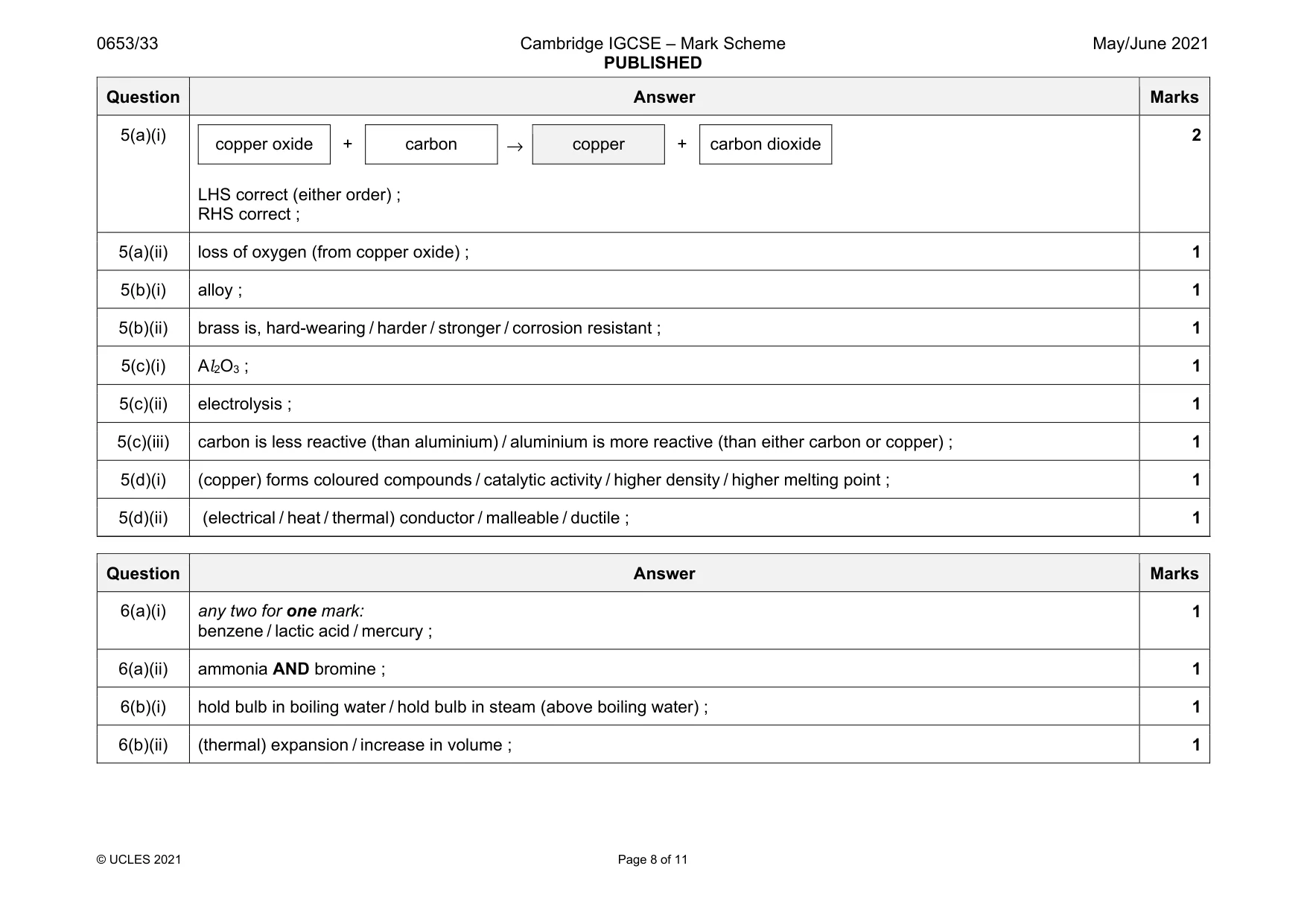
Mark scheme: 5(a)(i) copper oxide + carbon → copper + carbon dioxide LHS correct (either order) ; RHS correct ; 2 5(a)(ii) loss of oxygen (from copper oxide) ; 1 5(b)(i) alloy ; 1 5(b)(ii) brass is, hard-wearing / harder / stronger / corrosion resistant ; 1 5(c)(i) Al2O3 ; 1 5(c)(ii) electrolysis ; 1 5(c)(iii) carbon is less reactive (than aluminium) / aluminium is more reactive (than either carbon or copper) ; 1 5(d)(i) (copper) forms coloured compounds / catalytic activity / higher density / higher melting point ; 1 5(d)(ii) (electrical / heat / thermal) conductor / malleable / ductile ; 1
Q6 · The melting points and boiling points of six substances
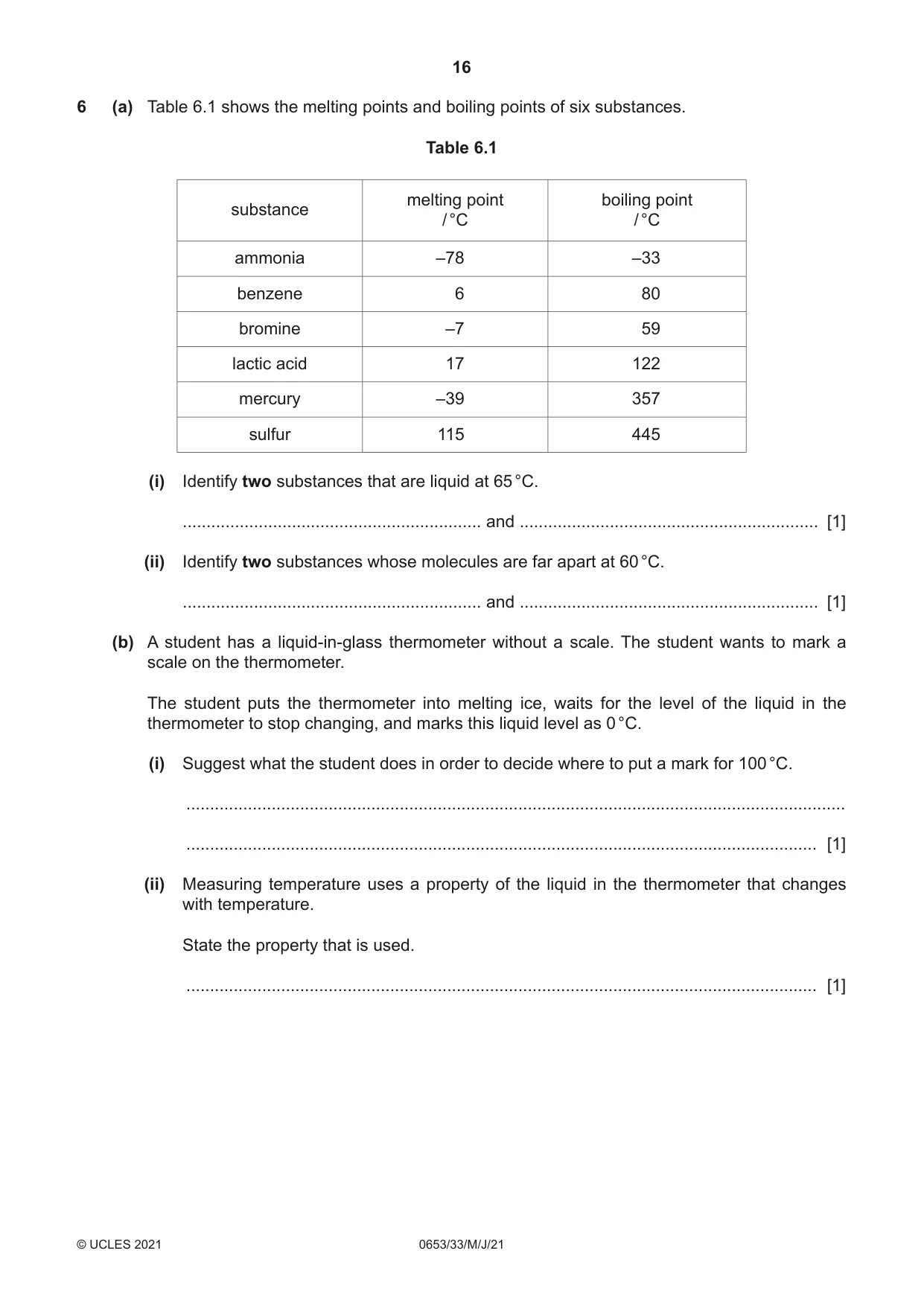
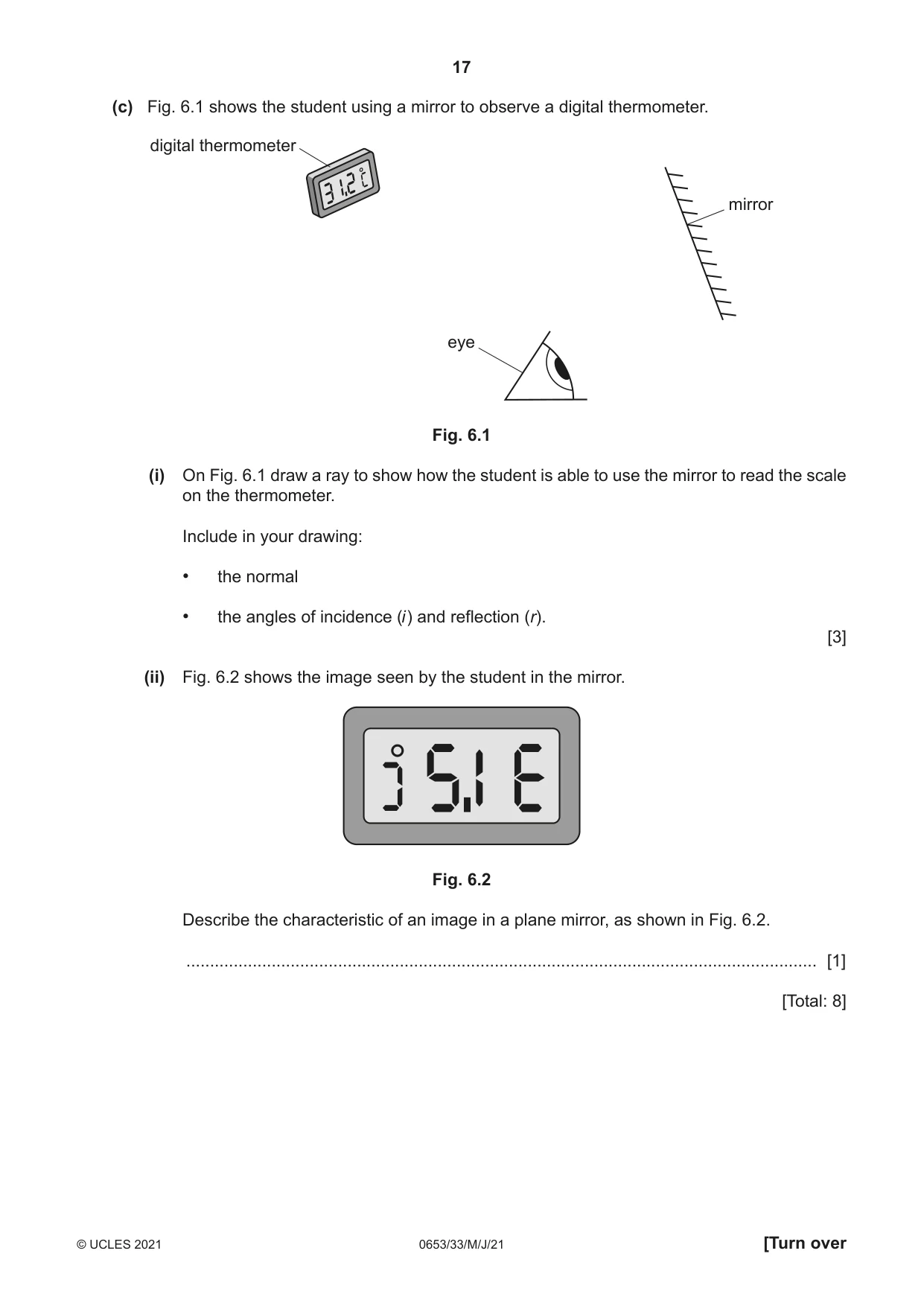
6 (a) Table 6.1 shows the melting points and boiling points of six substances. Table 6.1 melting point boiling point substance / °C / °C ammonia –78 –33 benzene 6 80 bromine –7 59 lactic acid 17 122 mercury –39 357 sulfur 115 445 (i) Identify two substances that are liquid at 65 °C. ............................................................... and ............................................................... [1] (ii) Identify two substances whose molecules are far apart at 60 °C. ............................................................... and ............................................................... [1] (b) A student has a liquid-in-glass thermometer without a scale. The student wants to mark a scale on the thermometer. The student puts the thermometer into melting ice, waits for the level of the liquid in the thermometer to stop changing, and marks this liquid level as 0 °C. (i) Suggest what the student does in order to decide where to put a mark for 100 °C. ........................................................................................................................................... ..................................................................................................................................... [1] (ii) Measuring temperature uses a property of the liquid in the thermometer that changes with temperature. State the property that is used. ..................................................................................................................................... [1] (c) Fig. 6.1 shows the student using a mirror to observe a digital thermometer. digital thermometer mirror eye Fig. 6.1 (i) On Fig. 6.1 draw a ray to show how the student is able to use the mirror to read the scale on the thermometer. Include in your drawing: • the normal • the angles of incidence (i) and reflection (r). [3] (ii) Fig. 6.2 shows the image seen by the student in the mirror. Fig. 6.2 Describe the characteristic of an image in a plane mirror, as shown in Fig. 6.2. ..................................................................................................................................... [1] [Total: 8]
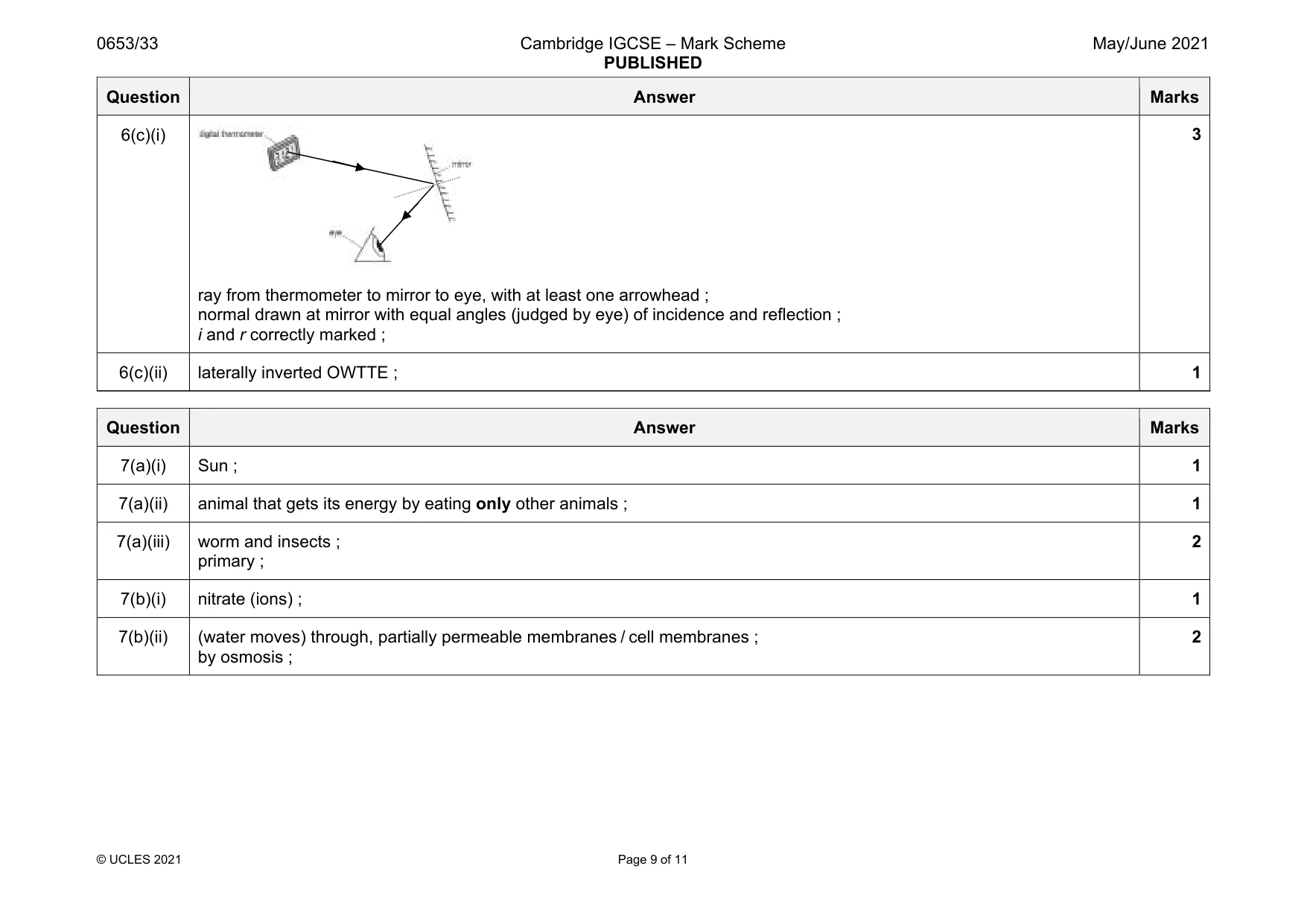
Mark scheme: 6(a)(i) any two for one mark: benzene / lactic acid / mercury ; 1 6(a)(ii) ammonia AND bromine ; 1 6(b)(i) hold bulb in boiling water / hold bulb in steam (above boiling water) ; 1 6(b)(ii) (thermal) expansion / increase in volume ; 1 Question Answer Marks 6(c)(i) ray from thermometer to mirror to eye, with at least one arrowhead ; normal drawn at mirror with equal angles (judged by eye) of incidence and reflection ; i and r correctly marked ; 3 6(c)(ii) laterally inverted OWTTE ; 1
Question 7
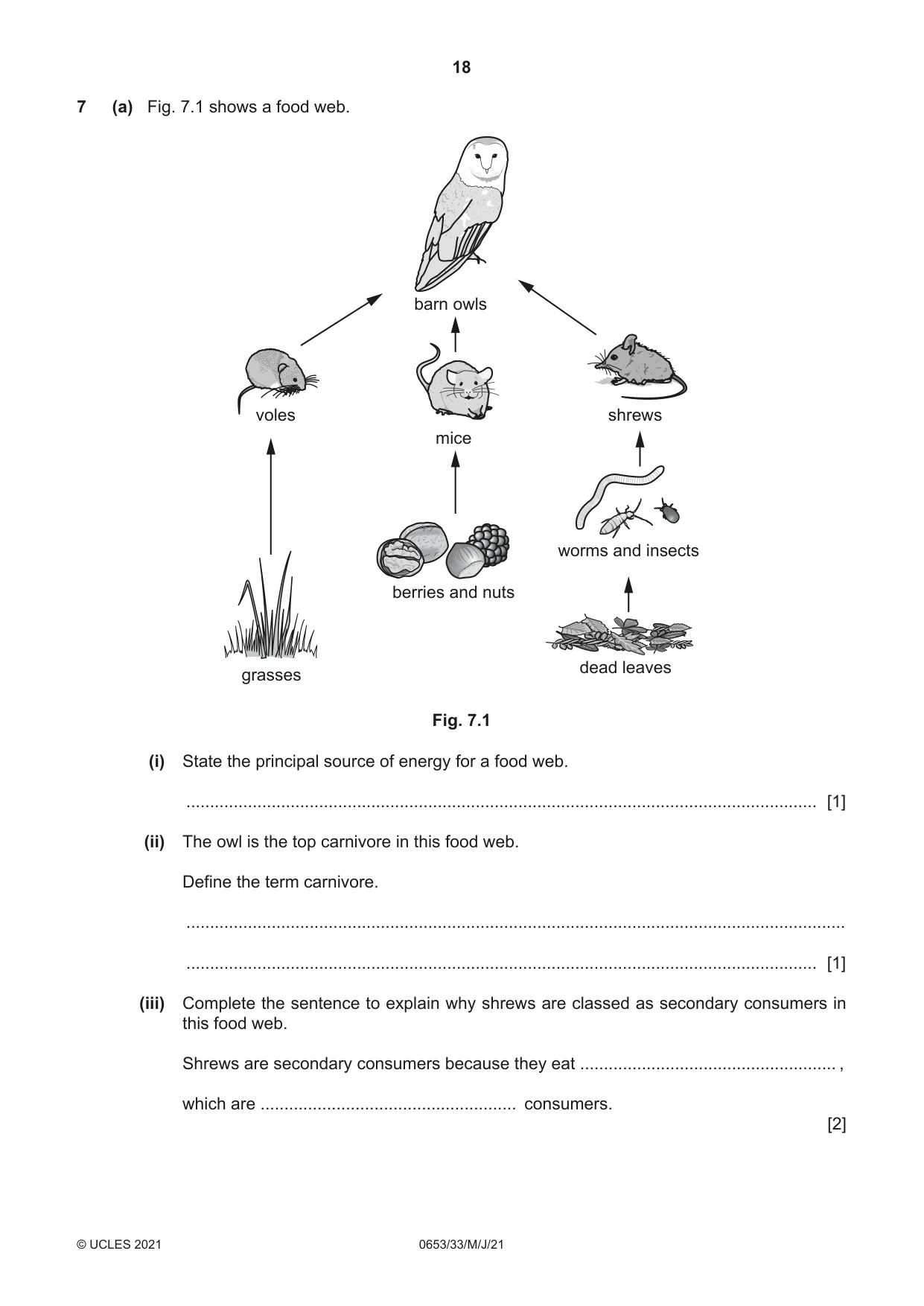
7 (a) Fig. 7.1 shows a food web. barn owls voles shrews mice worms and insects berries and nuts dead leaves grasses Fig. 7.1 (i) State the principal source of energy for a food web. ..................................................................................................................................... [1] (ii) The owl is the top carnivore in this food web. Define the term carnivore. ........................................................................................................................................... ..................................................................................................................................... [1] (iii) Complete the sentence to explain why shrews are classed as secondary consumers in this food web. Shrews are secondary consumers because they eat ...................................................... , which are ...................................................... consumers. [2] (b) Grass roots take in mineral ions from the soil to make amino acids. (i) State the name of the mineral ions needed to make amino acids. ..................................................................................................................................... [1] (ii) Grasses take in water from the soil through the root hair cells. Describe how water moves into root hair cells. ........................................................................................................................................... ........................................................................................................................................... ........................................................................................................................................... ..................................................................................................................................... [2] [Total: 7]
Mark scheme: 7(a)(i) Sun ; 1 7(a)(ii) animal that gets its energy by eating only other animals ; 1 7(a)(iii) worm and insects ; primary ; 2 7(b)(i) nitrate (ions) ; 1 7(b)(ii) (water moves) through, partially permeable membranes / cell membranes ; by osmosis ; 2
Q8 · Chlorine and bromine are diatomic non-metals in Group VII of the Periodic Table
8 (a) Chlorine and bromine are diatomic non-metals in Group VII of the Periodic Table. Chlorine is above bromine in Group VII. (i) Explain what is meant by diatomic. ........................................................................................................................................... ..................................................................................................................................... [2] (ii) State the trend in the colour and the boiling point of the elements going down Group VII. colour ................................................................................................................................ boiling point ....................................................................................................................... [1] (iii) State why chlorine is used in the treatment of the water supply. ........................................................................................................................................... ..................................................................................................................................... [1] (iv) Describe a chemical test for chlorine and give the observation for a positive result. test .................................................................................................................................... observation ........................................................................................................................ [2] (b) Chlorine reacts with sodium in an exothermic reaction. Argon, a Group VIII element, is next to chlorine in the Periodic Table. Argon does not react with sodium. (i) State what is meant by exothermic. ........................................................................................................................................... ..................................................................................................................................... [1] (ii) Explain why argon does not react with sodium. Use ideas about electrons in your answer. ........................................................................................................................................... ..................................................................................................................................... [1] [Total: 8]
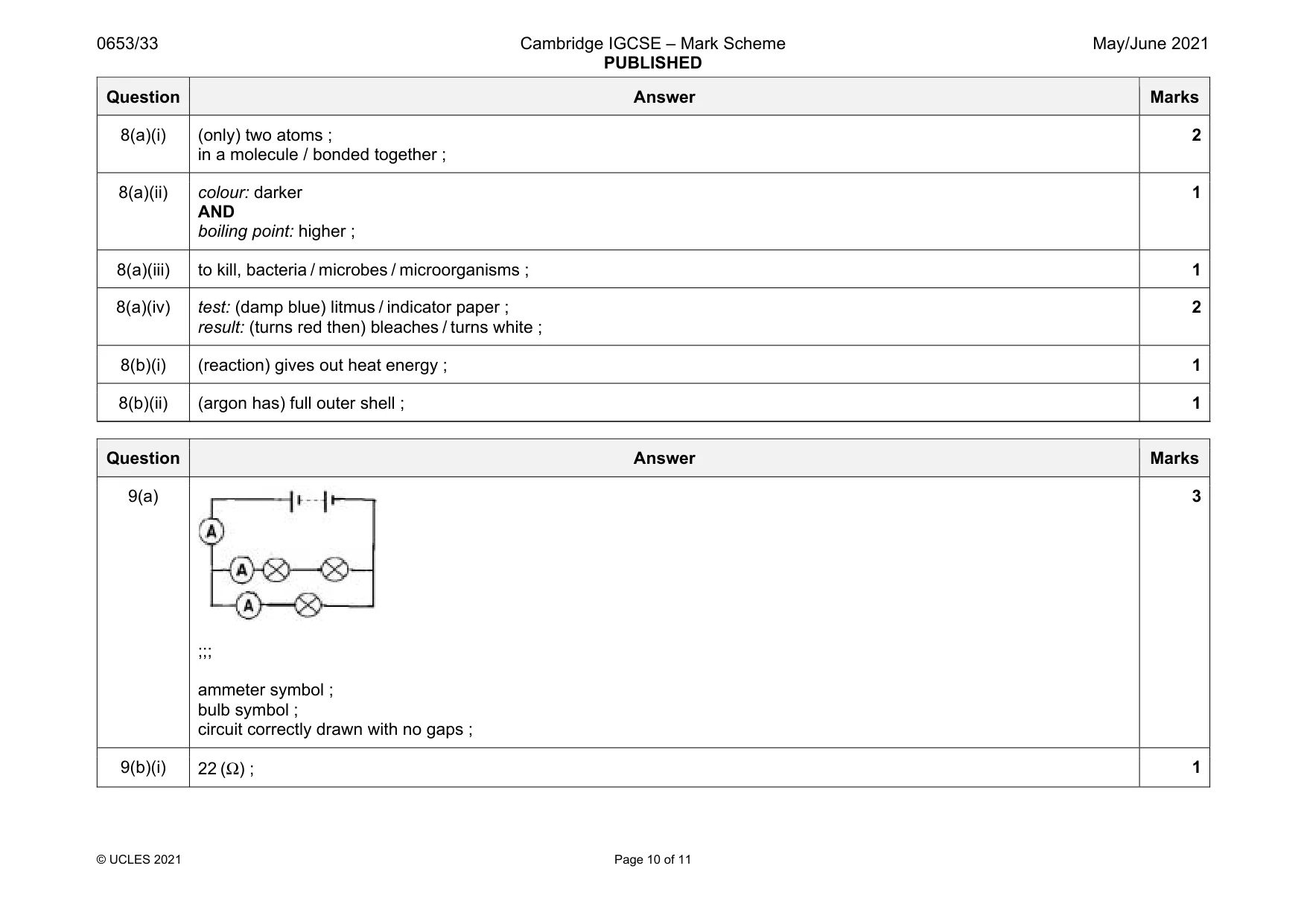
Mark scheme: 8(a)(i) (only) two atoms ; in a molecule / bonded together ; 2 8(a)(ii) colour: darker AND boiling point: higher ; 1 8(a)(iii) to kill, bacteria / microbes / microorganisms ; 1 8(a)(iv) test: (damp blue) litmus / indicator paper ; result: (turns red then) bleaches / turns white ; 2 8(b)(i) (reaction) gives out heat energy ; 1 8(b)(ii) (argon has) full outer shell ; 1
Q9 · Three ammeters, L, M and N, measuring the current in different parts of a circuit…
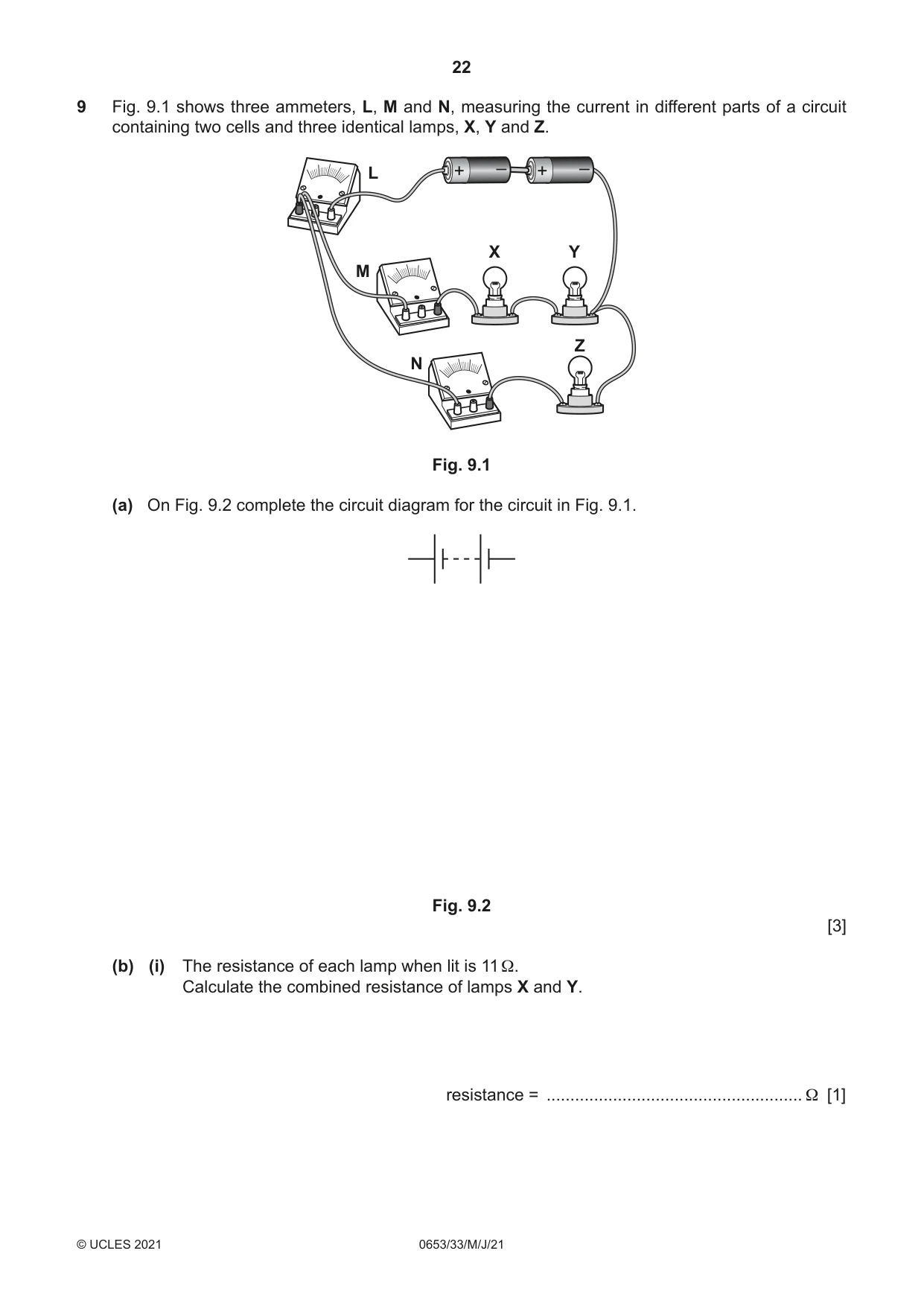
9 Fig. 9.1 shows three ammeters, L, M and N, measuring the current in different parts of a circuit containing two cells and three identical lamps, X, Y and Z. L + – + – X Y M Z N Fig. 9.1 (a) On Fig. 9.2 complete the circuit diagram for the circuit in Fig. 9.1. Fig. 9.2 [3] (b) (i) The resistance of each lamp when lit is 11 Ω. Calculate the combined resistance of lamps X and Y. resistance = ...................................................... Ω [1] (ii) State which ammeters will show the largest current and the smallest current. Give reasons for your answers. largest current ................................................................................................................... reason ............................................................................................................................... ........................................................................................................................................... smallest current ................................................................................................................. reason ............................................................................................................................... ........................................................................................................................................... [3] (c) Ammeter N shows a current of 0.31 A. The resistance of lamp Z when lit is 11 Ω. Calculate the potential difference across lamp Z. Give the unit of your answer. p.d. = .............. unit .............. [3] [Total: 10]
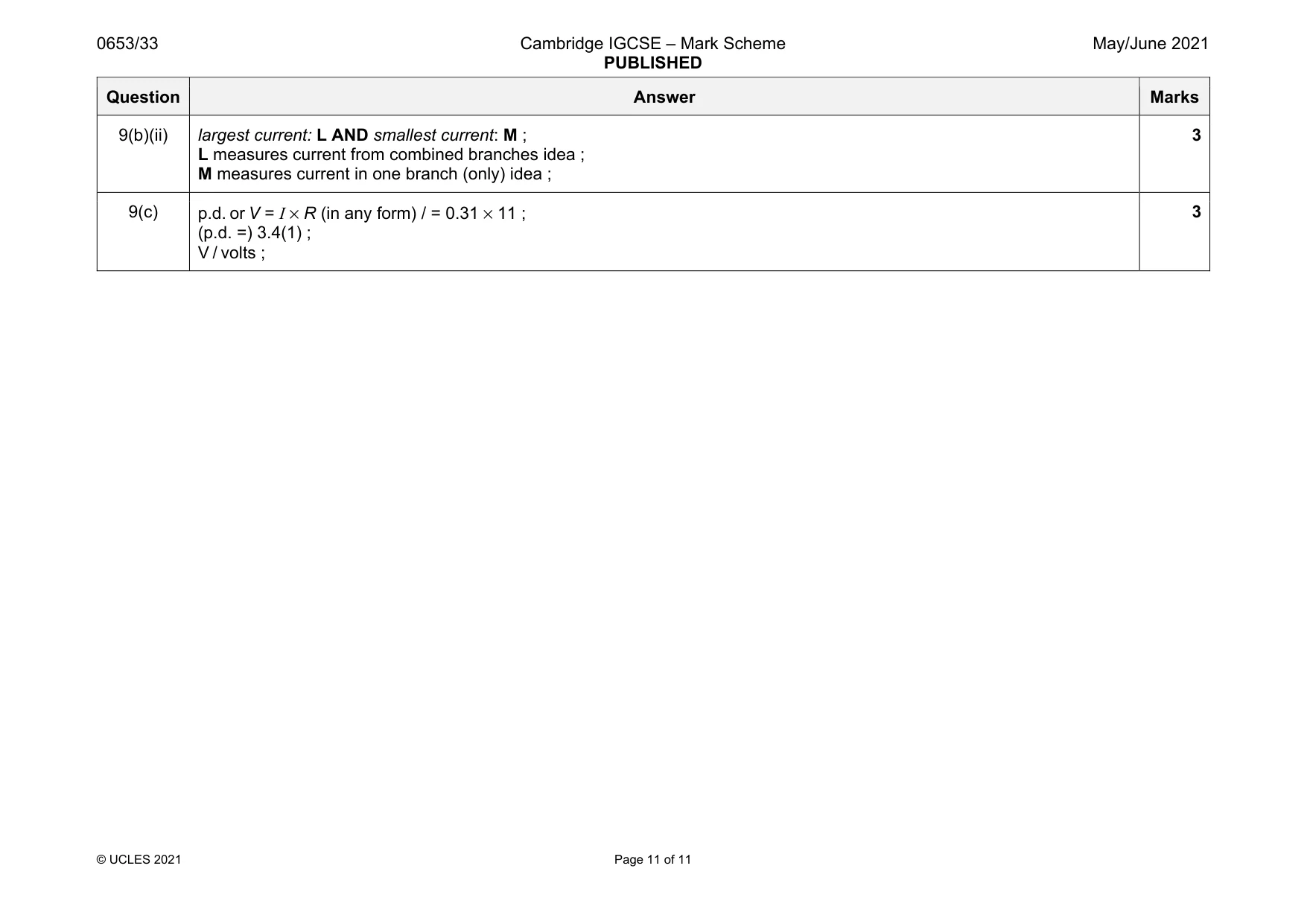
Mark scheme: 9(a) ;;; ammeter symbol ; bulb symbol ; circuit correctly drawn with no gaps ; 9(b)(i) 22 (Ω) ; 1 Question Answer Marks 9(b)(ii) largest current: L AND smallest current: M ; L measures current from combined branches idea ; M measures current in one branch (only) idea ; 3 9(c) p.d. or V = I × R (in any form) / = 0.31 × 11 ; (p.d. =) 3.4(1) ; V / volts ; 3
What was in this paper
The subtopics covered by these 9 questions, and how many questions each got. Open one in a new tab to see every Cambridge question on it.
What you needed in this session
Cambridge’s own grade thresholds for 2021 May/June, Paper 3 · Variant 3. A higher threshold means an easier paper — the bar moves with how the cohort did.