Questions as text
Q1 · A government announces that it has achieved its target of 2.5 % inflation per annum and… 9708/11 Oct/Nov 2005
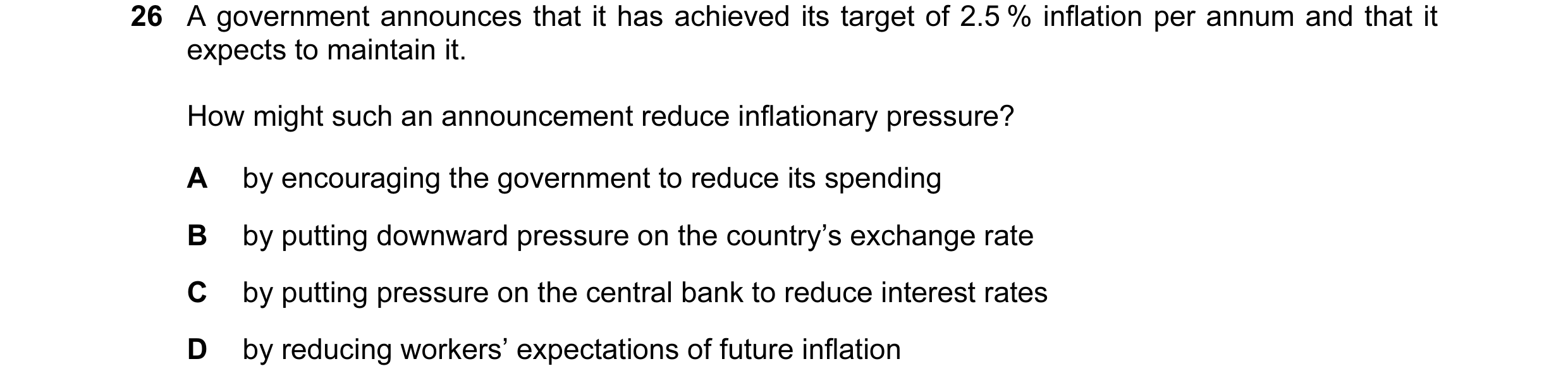
26 A government announces that it has achieved its target of 2.5 % inflation per annum and that it expects to maintain it. How might such an announcement reduce inflationary pressure? A by encouraging the government to reduce its spending B by putting downward pressure on the country’s exchange rate C by putting pressure on the central bank to reduce interest rates D by reducing workers’ expectations of future inflation
1 marks
Answer: D
This question in 9708/11 Oct/Nov 2005
Q2 · The diagram shows the demand for sterling and the supply of sterling in the foreign… 9708/11 May/June 2006
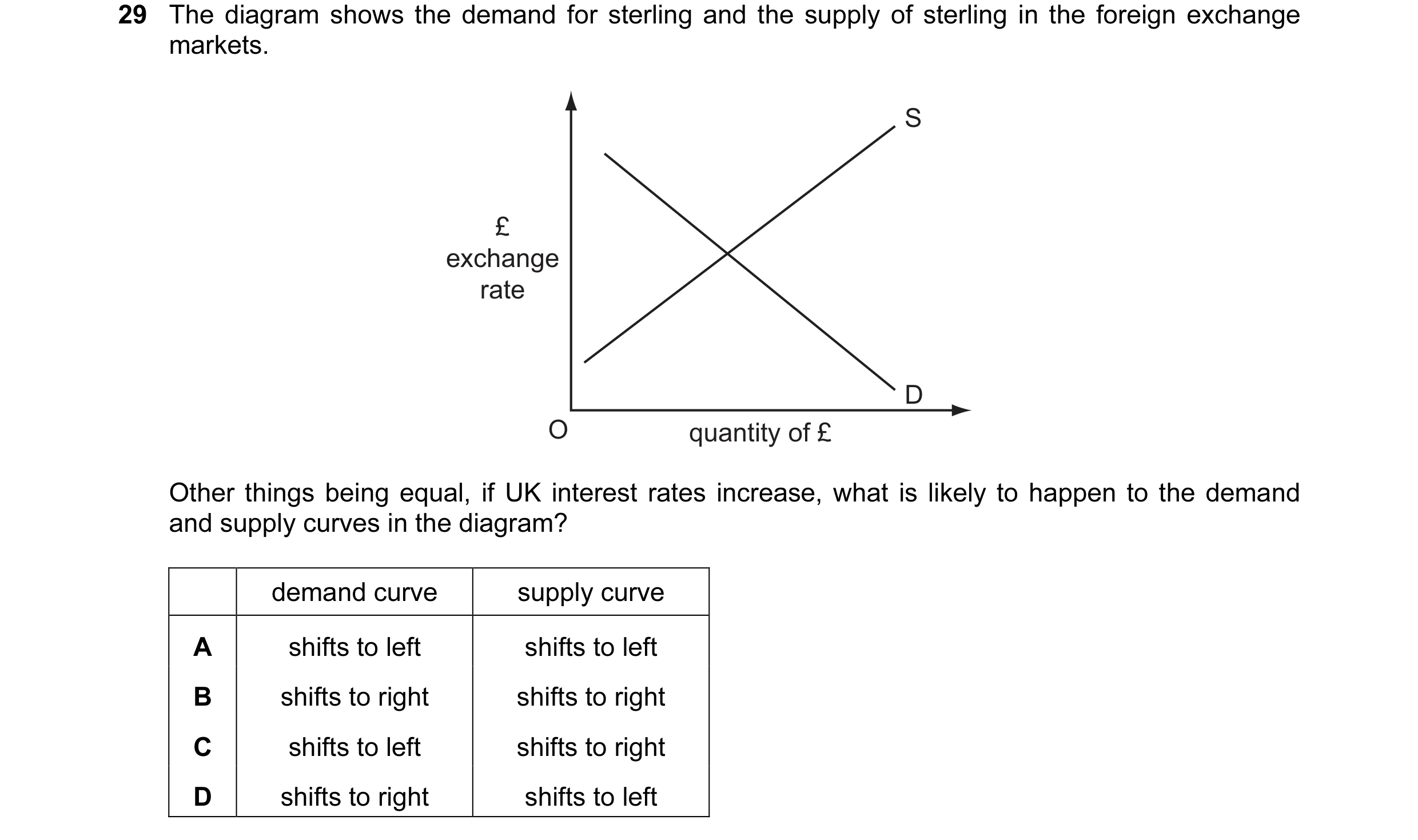
29 The diagram shows the demand for sterling and the supply of sterling in the foreign exchange markets. S £ exchange rate D O quantity of £ Other things being equal, if UK interest rates increase, what is likely to happen to the demand and supply curves in the diagram? demand curve supply curve A shifts to left shifts to left B shifts to right shifts to right C shifts to left shifts to right D shifts to right shifts to left
1 marks
Answer: D
This question in 9708/11 May/June 2006
Q3 · A government with a floating exchange rate wishes to encourage a rise in the… 9708/11 Oct/Nov 2009
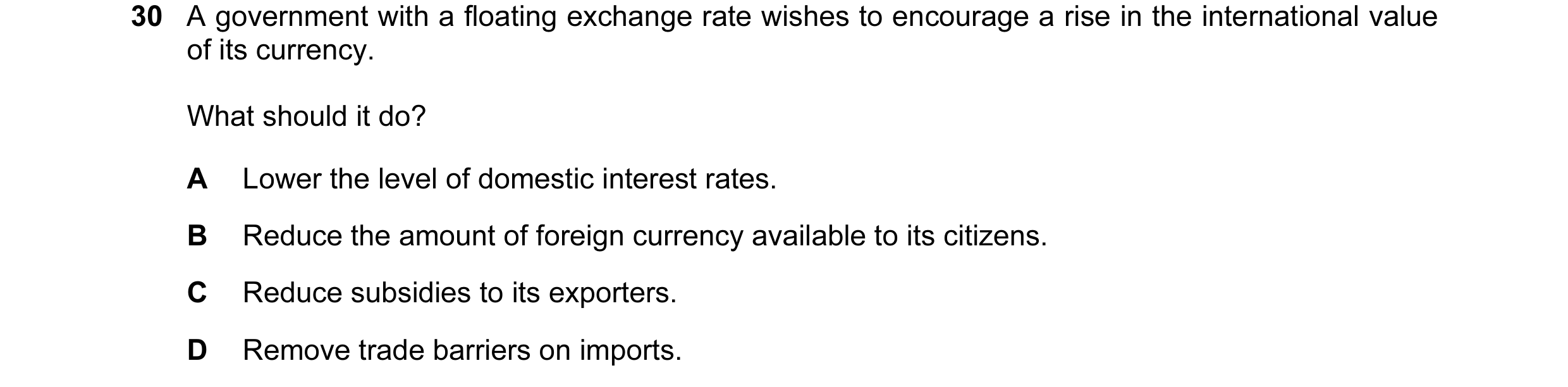
30 A government with a floating exchange rate wishes to encourage a rise in the international value of its currency. What should it do? A Lower the level of domestic interest rates. B Reduce the amount of foreign currency available to its citizens. C Reduce subsidies to its exporters. D Remove trade barriers on imports.
1 marks
Answer: B
This question in 9708/11 Oct/Nov 2009
Q4 · A government with a floating exchange rate wishes to encourage a rise in the… 9708/12 Oct/Nov 2009
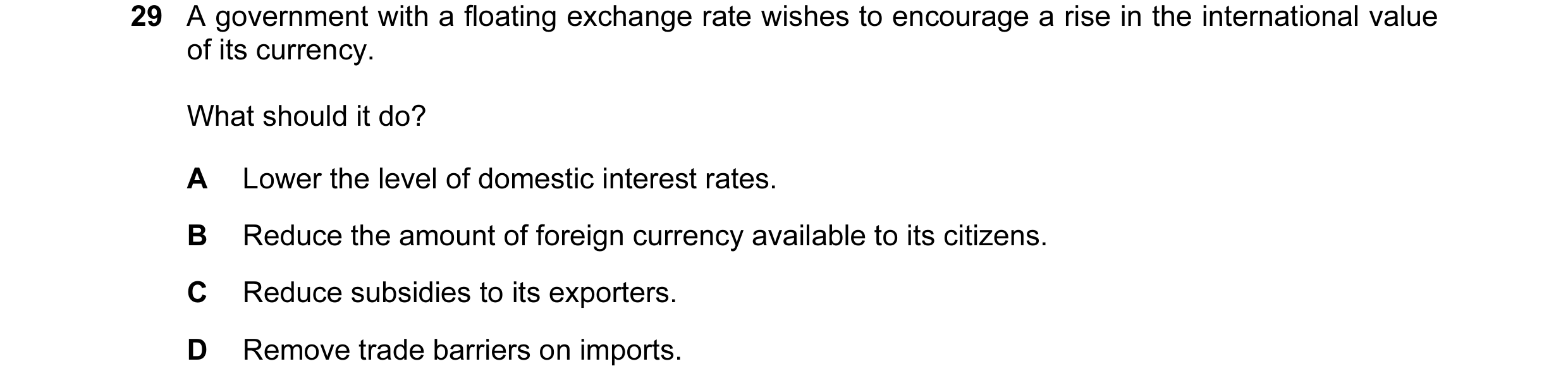
29 A government with a floating exchange rate wishes to encourage a rise in the international value of its currency. What should it do? A Lower the level of domestic interest rates. B Reduce the amount of foreign currency available to its citizens. C Reduce subsidies to its exporters. D Remove trade barriers on imports.
1 marks
Answer: B
This question in 9708/12 Oct/Nov 2009
Q5 · Following a long period of depreciation of the US$, both the US and UK monetary… 9708/13 May/June 2010
28 Following a long period of depreciation of the US$, both the US and UK monetary authorities raised their domestic interest rate. What will happen to the value of the exchange rate of the US$ in terms of UK£? A It will remain unchanged. B It will fall. C It will rise. D The outcome is uncertain.
1 marks
Answer: D
This question in 9708/13 May/June 2010
Q6 · Assume the Chinese monetary authorities are committed to maintaining the exchange rate of… 9708/11 Oct/Nov 2010
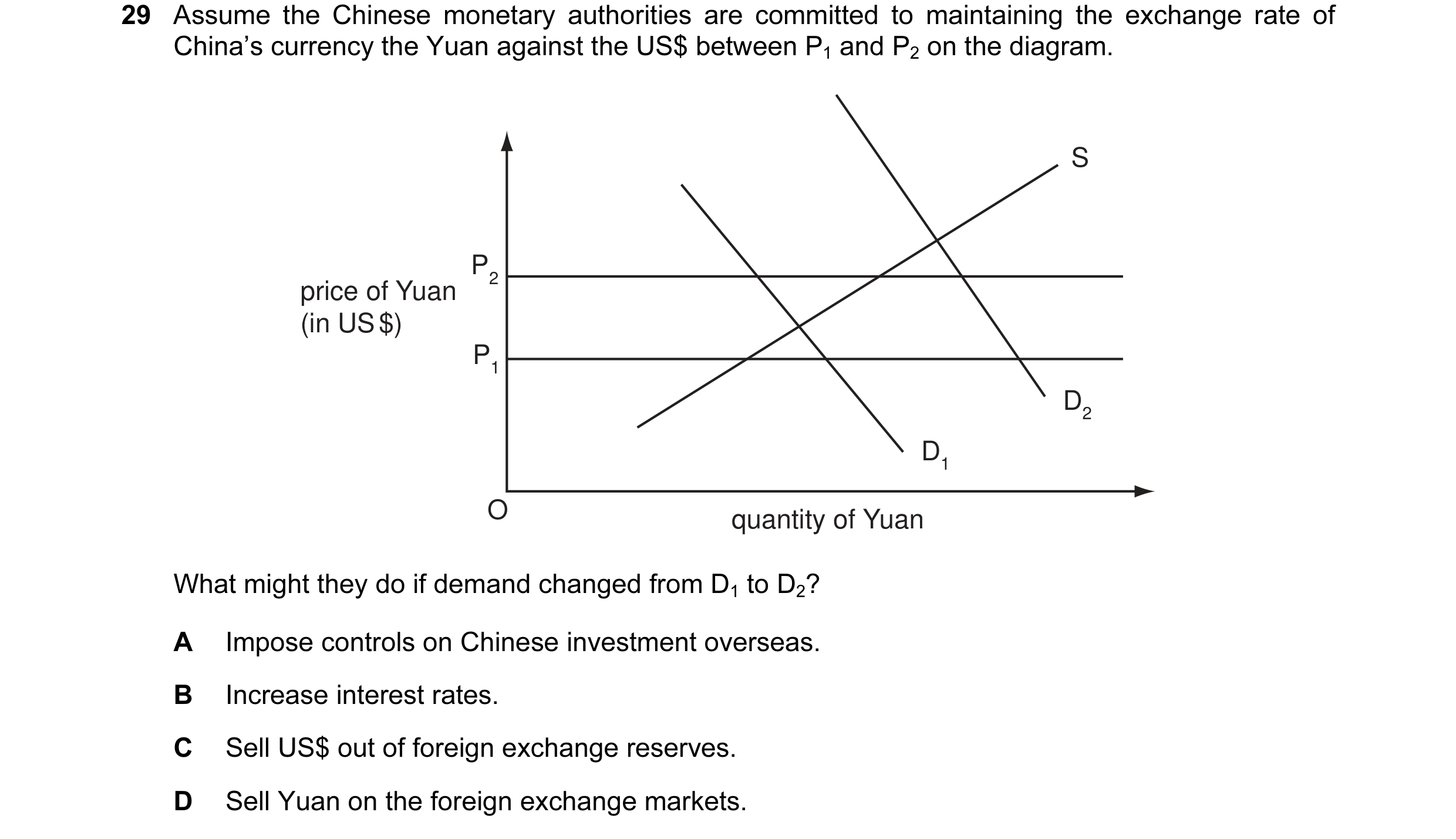
29 Assume the Chinese monetary authorities are committed to maintaining the exchange rate of China’s currency the Yuan against the US$ between P1 and P2 on the diagram. S P2 price of Yuan (in US $) P1 D2 D1 O quantity of Yuan What might they do if demand changed from D1 to D2? A Impose controls on Chinese investment overseas. B Increase interest rates. C Sell US$ out of foreign exchange reserves. D Sell Yuan on the foreign exchange markets.
1 marks
Answer: D
This question in 9708/11 Oct/Nov 2010
Q7 · The diagram shows the exchange rate for the UK£ in terms of the US$ 9708/11 May/June 2011
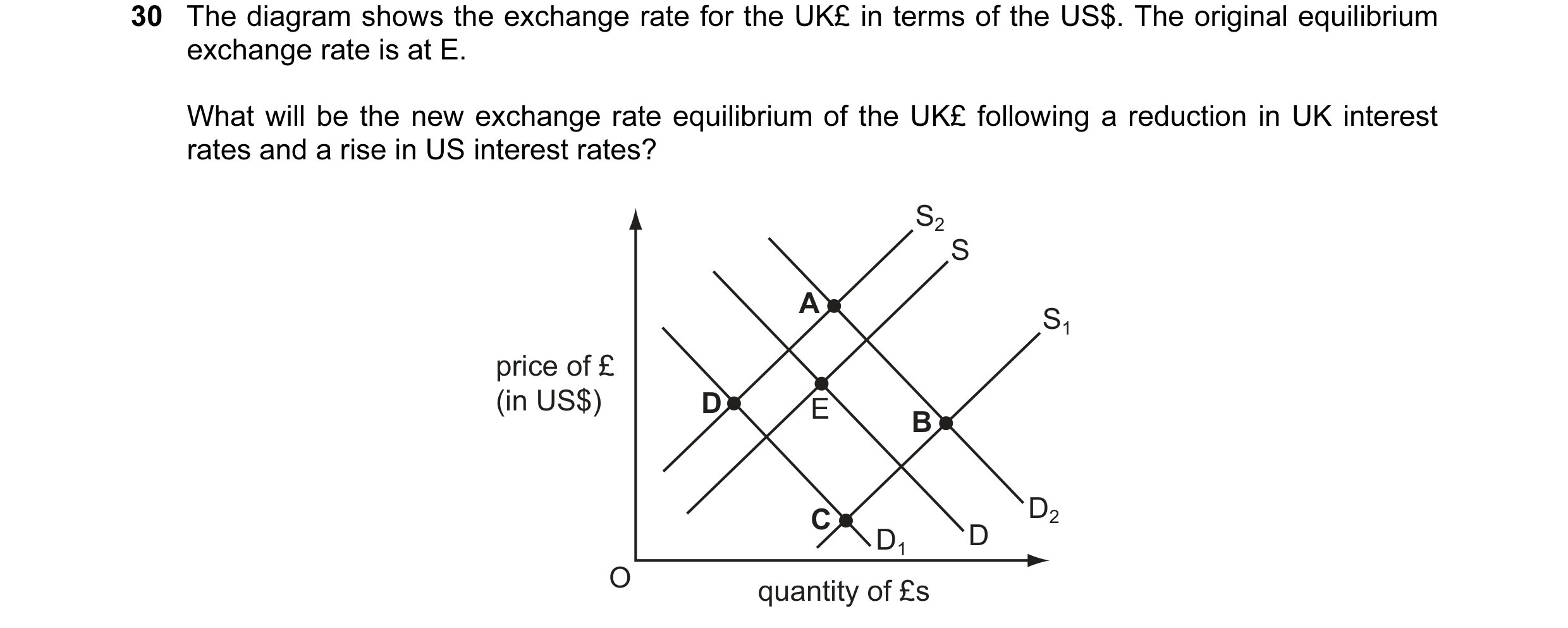
30 The diagram shows the exchange rate for the UK£ in terms of the US$. The original equilibrium exchange rate is at E. What will be the new exchange rate equilibrium of the UK£ following a reduction in UK interest rates and a rise in US interest rates? S2 S A S1 price of £ (in US$) D E B C D2 D1 D O quantity of £s
1 marks
Answer: C
This question in 9708/11 May/June 2011
Q8 · The diagram shows the exchange rate for the UK£ in terms of the US$ 9708/12 May/June 2011
29 The diagram shows the exchange rate for the UK£ in terms of the US$. The original equilibrium exchange rate is at E. What will be the new exchange rate equilibrium of the UK£ following a reduction in UK interest rates and a rise in US interest rates? S2 S A S1 price of £ (in US$) D E B C D2 D1 D O quantity of £s
1 marks
Answer: C
This question in 9708/12 May/June 2011
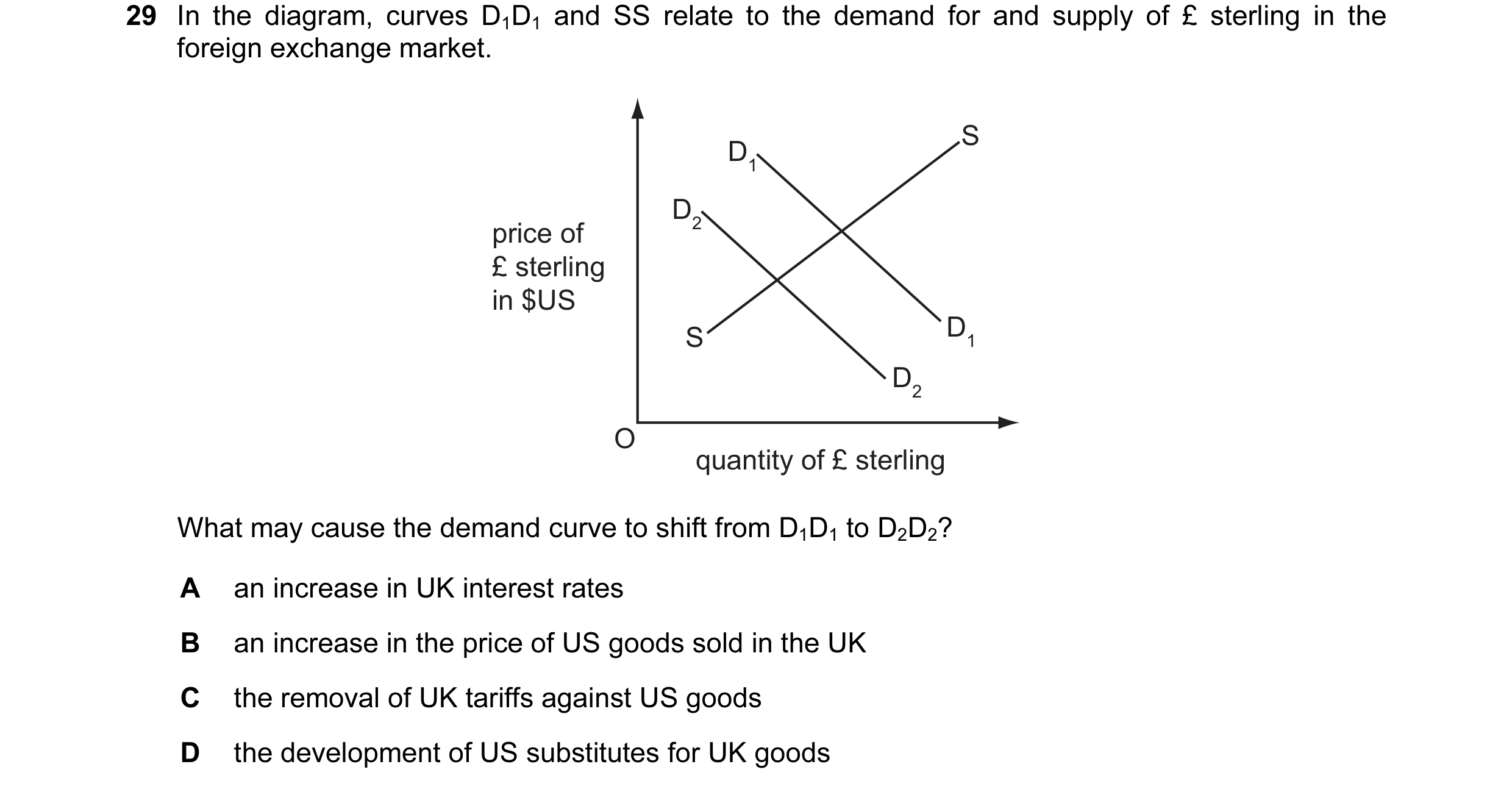
Q9 · In the diagram, curves D1D1 and SS relate to the demand for and supply of £ sterling in… 9708/11 Oct/Nov 2012
29 In the diagram, curves D1D1 and SS relate to the demand for and supply of £ sterling in the foreign exchange market. S D1 D2 price of £ sterling in $US S D1 D2 O quantity of £ sterling What may cause the demand curve to shift from D1D1 to D2D2? A an increase in UK interest rates B an increase in the price of US goods sold in the UK C the removal of UK tariffs against US goods D the development of US substitutes for UK goods
1 marks
Answer: D
This question in 9708/11 Oct/Nov 2012
Q10 · If interest rates are reduced, what is most likely to decrease? 9708/13 Oct/Nov 2012
27 If interest rates are reduced, what is most likely to decrease? A borrowing by firms B consumer spending C import prices D short-term capital inflows
1 marks
Answer: D
This question in 9708/13 Oct/Nov 2012
Q11 · The government wishes to encourage a rise in the external exchange rate of a currency in… 9708/13 Oct/Nov 2012
30 The government wishes to encourage a rise in the external exchange rate of a currency in order to dampen inflationary expectations. What should it do? A discourage inward foreign direct investment B raise interest rates C raise the level of aggregate demand in the economy D remove quotas on imported products
1 marks
Answer: B
This question in 9708/13 Oct/Nov 2012
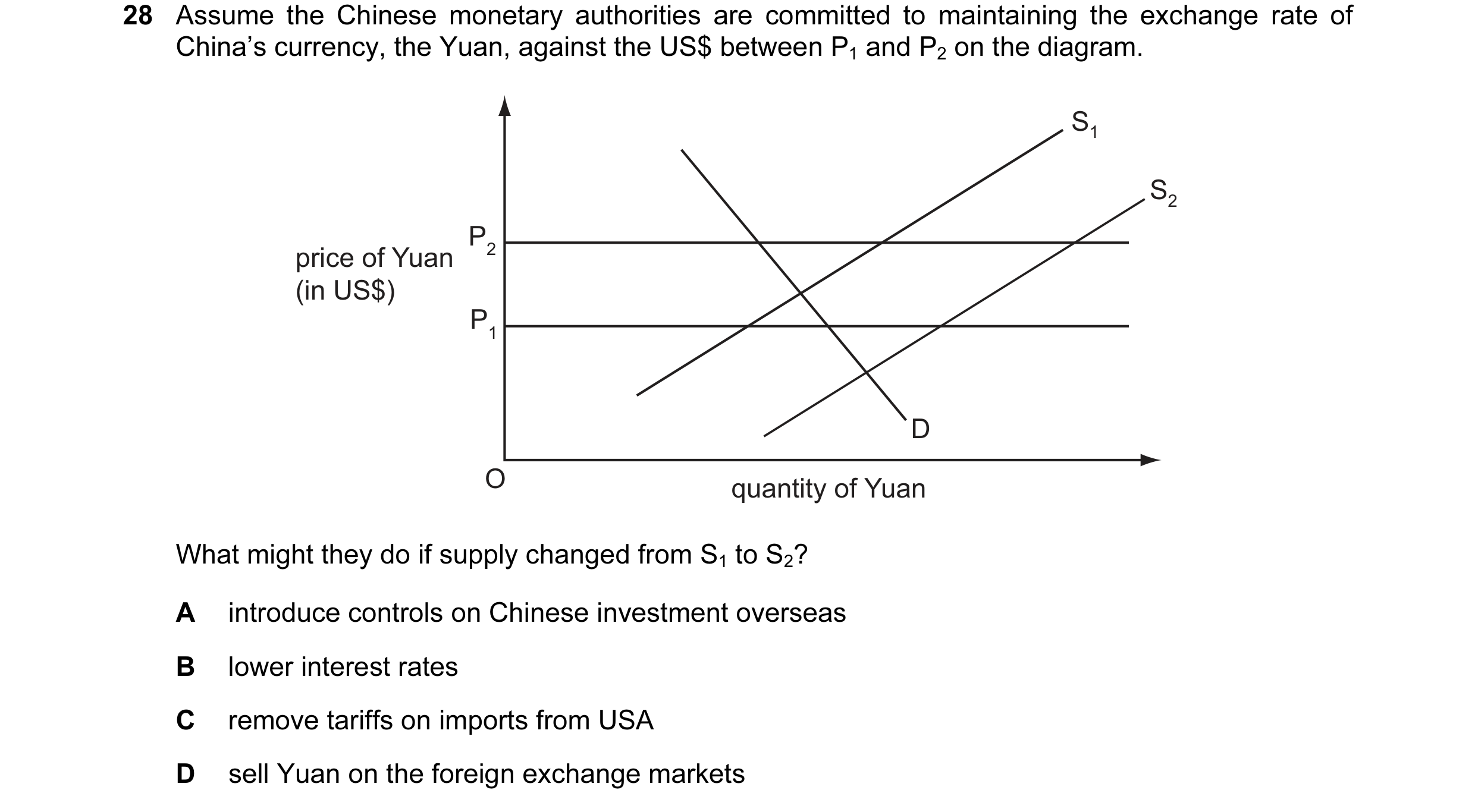
Q12 · Assume the Chinese monetary authorities are committed to maintaining the exchange rate of… 9708/11 May/June 2013
28 Assume the Chinese monetary authorities are committed to maintaining the exchange rate of China’s currency, the Yuan, against the US$ between P1 and P2 on the diagram. S1 S2 P2 price of Yuan (in US$) P1 D O quantity of Yuan What might they do if supply changed from S1 to S2? A introduce controls on Chinese investment overseas B lower interest rates C remove tariffs on imports from USA D sell Yuan on the foreign exchange markets
1 marks
Answer: A
This question in 9708/11 May/June 2013
Q13 · A country with a fixed exchange rate experiences a balance of payments surplus 9708/12 May/June 2013
30 A country with a fixed exchange rate experiences a balance of payments surplus. Which policy measure will enable it to maintain its exchange rate at its target level? A decreasing government borrowing B decreasing government spending C decreasing the interest rate D decreasing the money supply
1 marks
Answer: C
This question in 9708/12 May/June 2013
Q14 · In 2010 it was reported that there were concerns when a government kept interest rates… 9708/13 May/June 2013
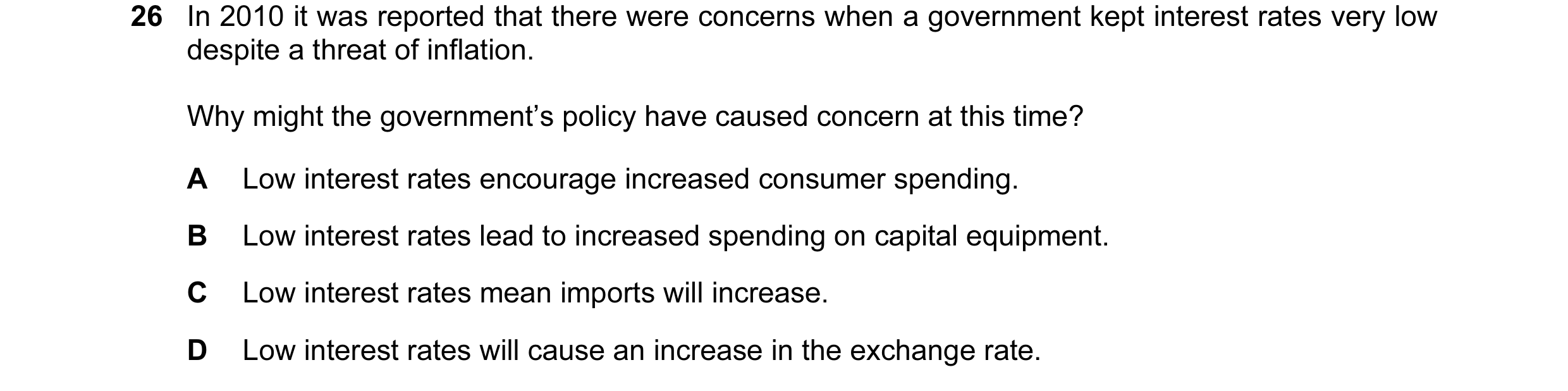
26 In 2010 it was reported that there were concerns when a government kept interest rates very low despite a threat of inflation. Why might the government’s policy have caused concern at this time? A Low interest rates encourage increased consumer spending. B Low interest rates lead to increased spending on capital equipment. C Low interest rates mean imports will increase. D Low interest rates will cause an increase in the exchange rate.
1 marks
Answer: A
This question in 9708/13 May/June 2013
Q15 · What is most likely to cause a rise in a country’s exchange rate? 9708/12 Oct/Nov 2013
29 What is most likely to cause a rise in a country’s exchange rate? A a fall in its direct taxes B a fall in its export orders C a rise in its interest rates D a rise in its imports
1 marks
Answer: C
This question in 9708/12 Oct/Nov 2013
Q16 · The US Central Bank raises its interest rate to improve its balance of payments position 9708/12 May/June 2014
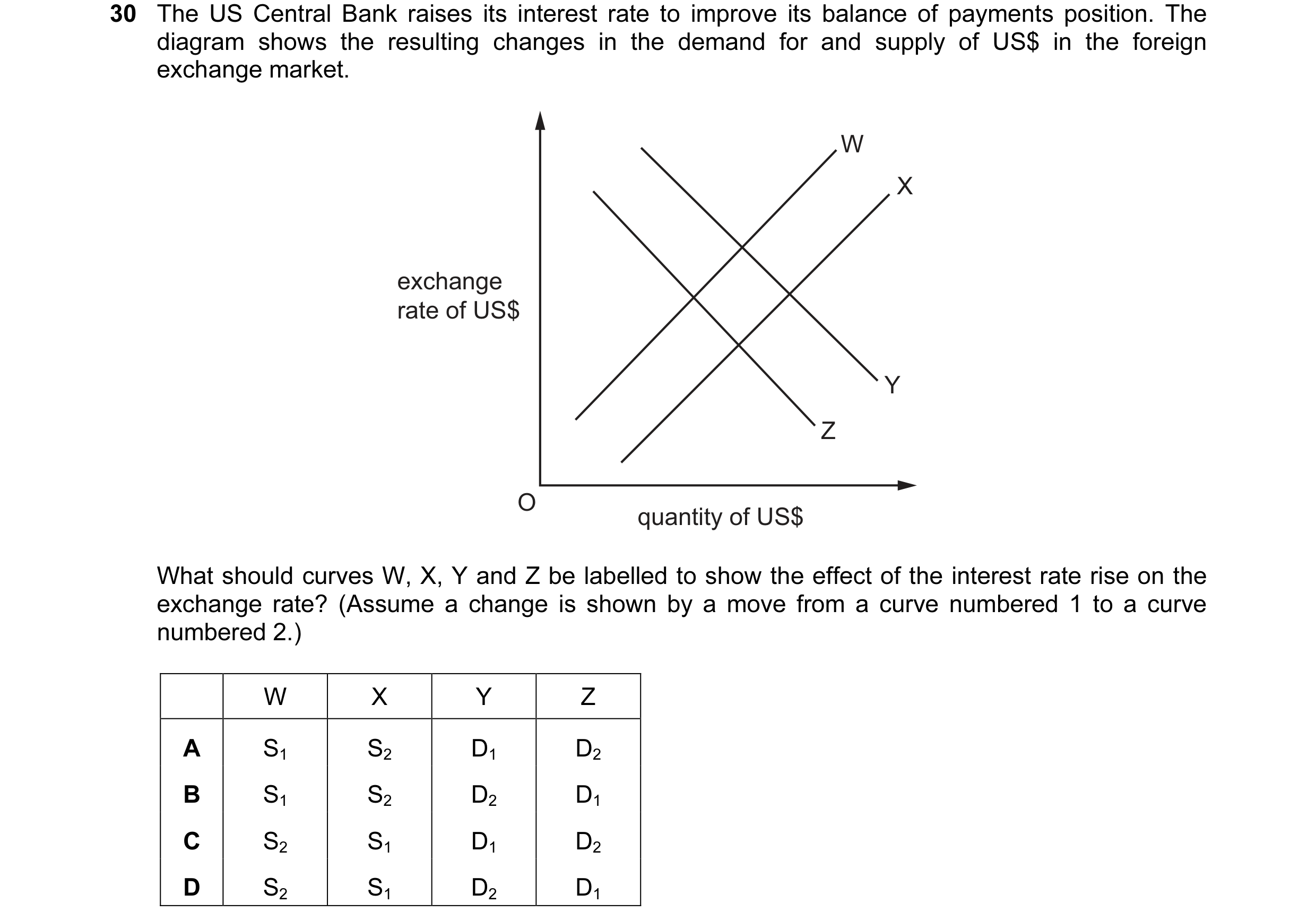
30 The US Central Bank raises its interest rate to improve its balance of payments position. The diagram shows the resulting changes in the demand for and supply of US$ in the foreign exchange market. W X exchange rate of US$ Y Z O quantity of US$ What should curves W, X, Y and Z be labelled to show the effect of the interest rate rise on the exchange rate? (Assume a change is shown by a move from a curve numbered 1 to a curve numbered 2.) W X Y Z A S1 S2 D1 D2 B S1 S2 D2 D1 C S2 S1 D1 D2 D S2 S1 D2 D1
1 marks
Answer: D
This question in 9708/12 May/June 2014
Q17 · The US Central Bank lowers its interest rate to raise aggregate demand 9708/11 Oct/Nov 2014
30 The US Central Bank lowers its interest rate to raise aggregate demand. This has an effect on the exchange rate of the US$. The diagram shows the resulting changes in the demand for and supply of US$ in the foreign exchange market. W X exchange rate of US$ Y Z O quantity of US$ Assume a change is shown by a move from a curve numbered 1 to a curve numbered 2. What should curves W, X, Y and Z be labelled to show the effect of the interest rate rise on the exchange rate? W X Y Z A S1 S2 D1 D2 B S1 S2 D2 D1 C S2 S1 D1 D2 D S2 S1 D2 D1
1 marks
This question in 9708/11 Oct/Nov 2014
Q18 · A government uses monetary policy to manage its economy 9708/12 May/June 2015
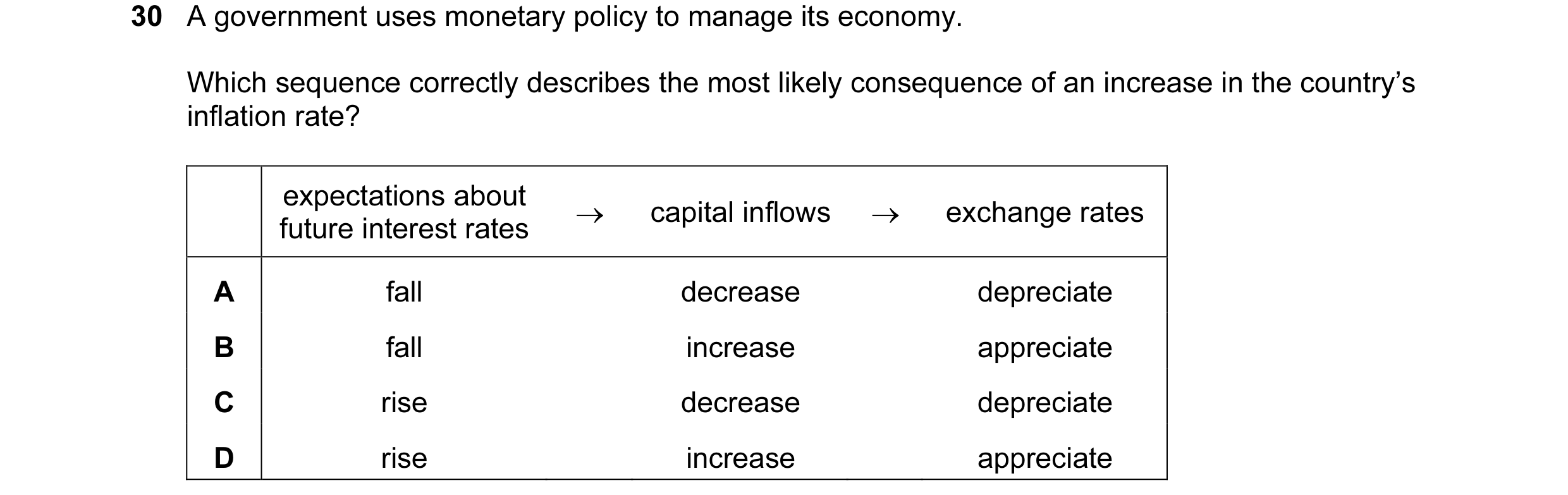
30 A government uses monetary policy to manage its economy. Which sequence correctly describes the most likely consequence of an increase in the country’s inflation rate? expectations about → capital inflows → exchange rates future interest rates A fall decrease depreciate B fall increase appreciate C rise decrease depreciate D rise increase appreciate
1 marks
Answer: D
This question in 9708/12 May/June 2015
Q19 · An economy with a fixed exchange rate experiences an increased deficit on the current… 9708/12 Oct/Nov 2015
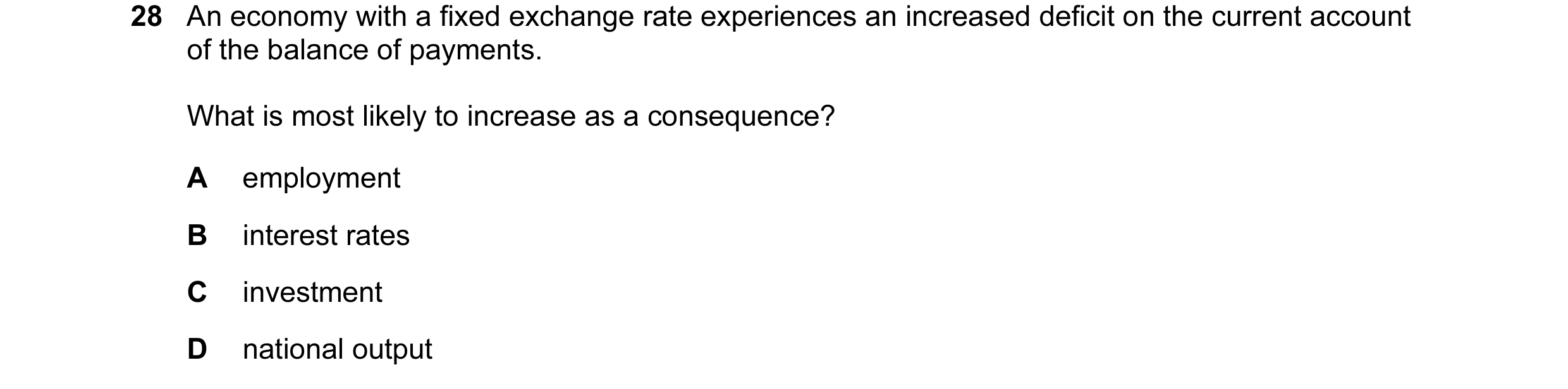
28 An economy with a fixed exchange rate experiences an increased deficit on the current account of the balance of payments. What is most likely to increase as a consequence? A employment B interest rates C investment D national output
1 marks
Answer: B
This question in 9708/12 Oct/Nov 2015
Q20 · In June 2013, the Governor of the Bank of Namibia announced that the Central Bank’s… 9708/13 Oct/Nov 2015
25 In June 2013, the Governor of the Bank of Namibia announced that the Central Bank’s lending rate would remain low as long as inflation remained low. What would not lead to a risk of inflation? A increased output in the mining, manufacturing and construction industries B Namibian dollar depreciation against the currencies of its trading partners C severe weather problems that harm crop production D the Namibian Government’s policy of increased public expenditure
1 marks
Answer: A
This question in 9708/13 Oct/Nov 2015
Q21 · The diagram shows the exchange rate for the UK£ in terms of the US$ 9708/12 Feb/March 2016
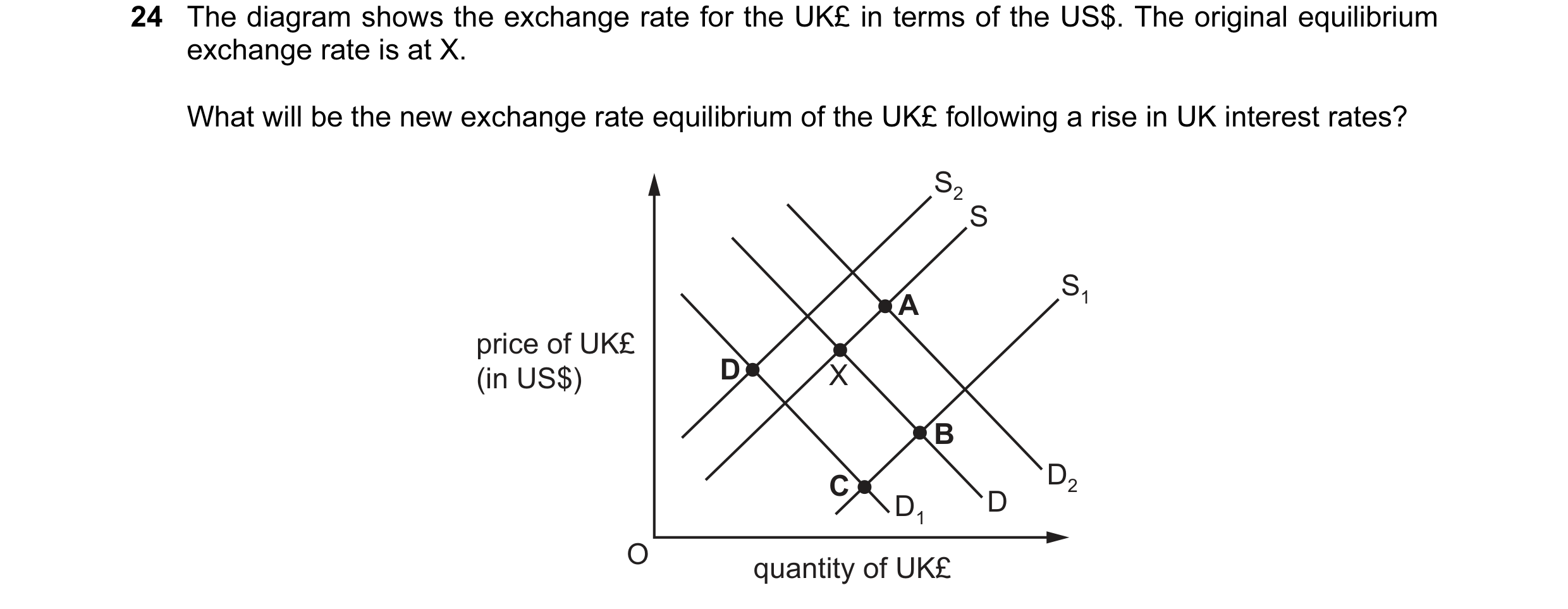
24 The diagram shows the exchange rate for the UK£ in terms of the US$. The original equilibrium exchange rate is at X. What will be the new exchange rate equilibrium of the UK£ following a rise in UK interest rates? S2 S S1 A price of UK£ (in US$) D X B C D2 D1 D O quantity of UK£
1 marks
Answer: A
This question in 9708/12 Feb/March 2016
Q22 · In March 2014, Sweden had a change in its Consumer Price Index of –0.6% 9708/12 Feb/March 2016
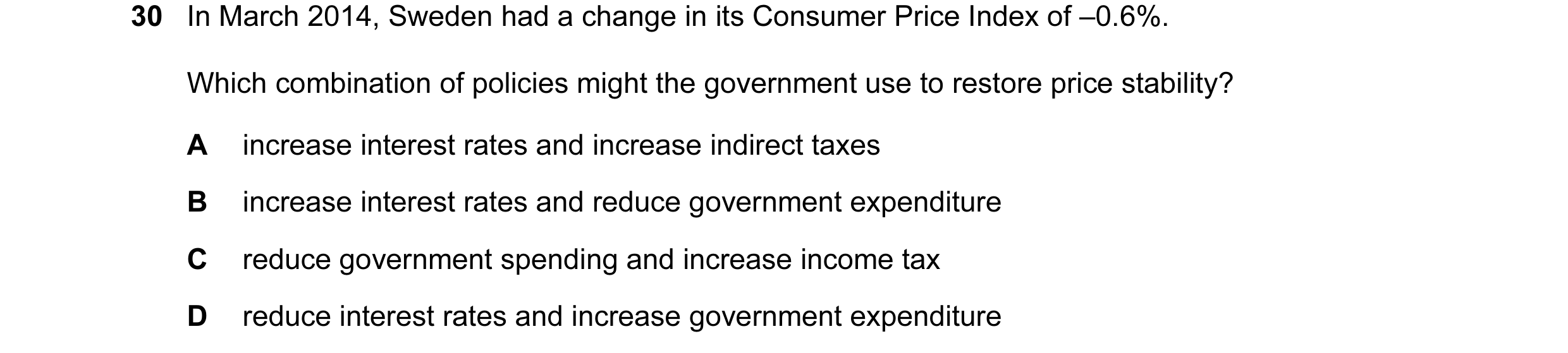
30 In March 2014, Sweden had a change in its Consumer Price Index of –0.6%. Which combination of policies might the government use to restore price stability? A increase interest rates and increase indirect taxes B increase interest rates and reduce government expenditure C reduce government spending and increase income tax D reduce interest rates and increase government expenditure
1 marks
Answer: D
This question in 9708/12 Feb/March 2016
Q23 · An increase in interest rates is an example of which type of policy? 9708/12 May/June 2016
28 An increase in interest rates is an example of which type of policy? A contractionary fiscal policy B contractionary monetary policy C expansionary monetary policy D restrictive supply-side policy
1 marks
Answer: B
This question in 9708/12 May/June 2016
Q24 · Which policy, adopted by a government with the intention of reducing the rate of… 9708/12 May/June 2016
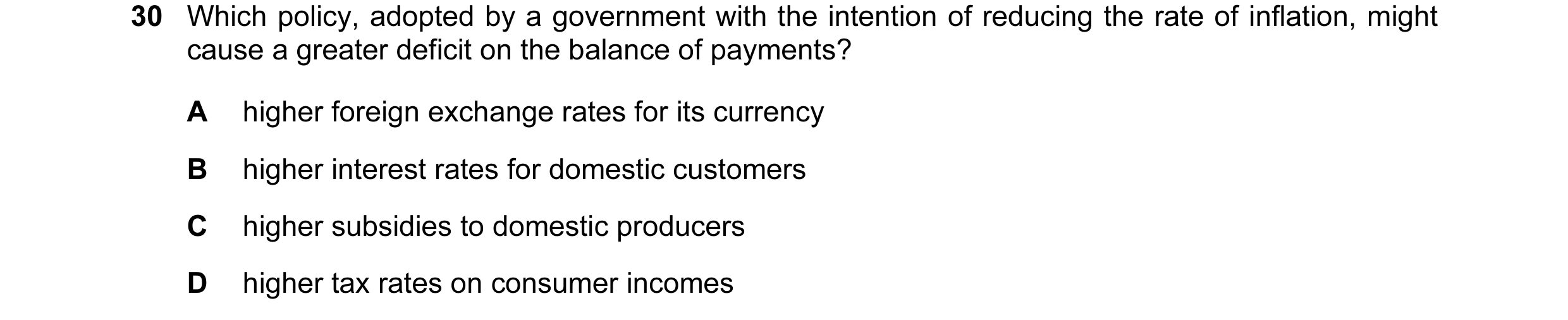
30 Which policy, adopted by a government with the intention of reducing the rate of inflation, might cause a greater deficit on the balance of payments? A higher foreign exchange rates for its currency B higher interest rates for domestic customers C higher subsidies to domestic producers D higher tax rates on consumer incomes
1 marks
Answer: A
This question in 9708/12 May/June 2016
Q25 · What would be the best policy for a country to reduce a balance of payments deficit? 9708/11 Oct/Nov 2016
29 What would be the best policy for a country to reduce a balance of payments deficit? A an increase in interest rates B an increase in the exchange rate C a reduction in direct taxes D a reduction in subsidies to domestic industry
1 marks
Answer: A
This question in 9708/11 Oct/Nov 2016
Q26 · Country X is an open economy with a fixed exchange rate 9708/11 Oct/Nov 2016
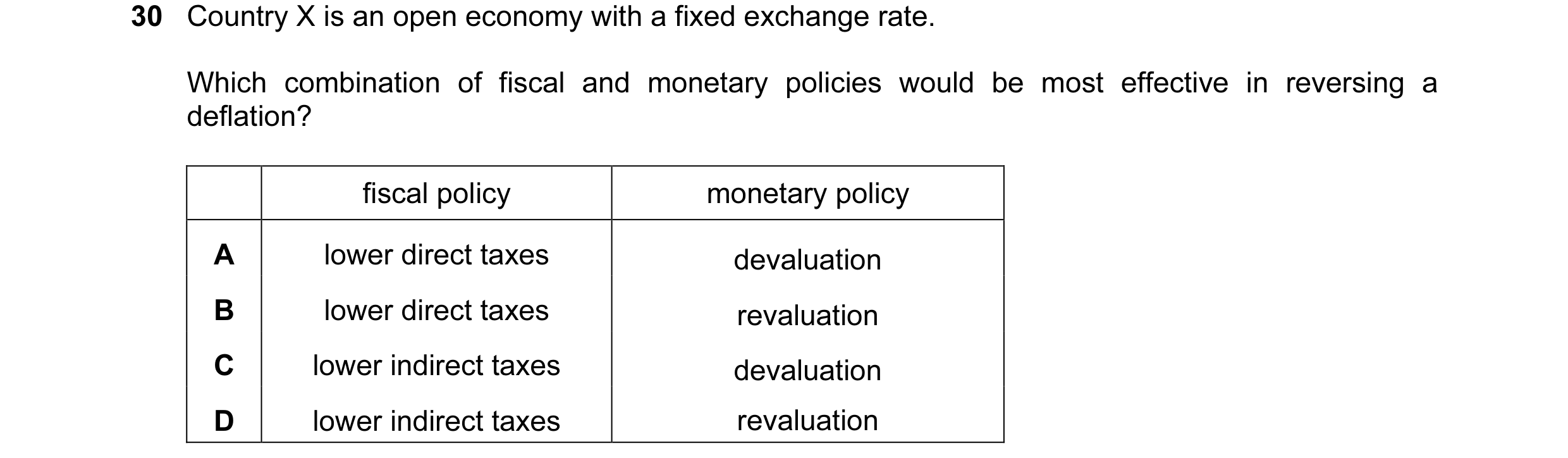
30 Country X is an open economy with a fixed exchange rate. Which combination of fiscal and monetary policies would be most effective in reversing a deflation? fiscal policy monetary policy A lower direct taxes devaluation B lower direct taxes revaluation C lower indirect taxes devaluation D lower indirect taxes revaluation
1 marks
Answer: A
This question in 9708/11 Oct/Nov 2016
Q27 · Which action might be part of an expansionary economic policy? 9708/13 Oct/Nov 2016
28 Which action might be part of an expansionary economic policy? A a lower budget deficit B a lower level of government spending C a lower money supply D a lower rate of interest
1 marks
Answer: D
This question in 9708/13 Oct/Nov 2016
Q28 · A government wants to operate a tighter monetary policy 9708/12 Feb/March 2017
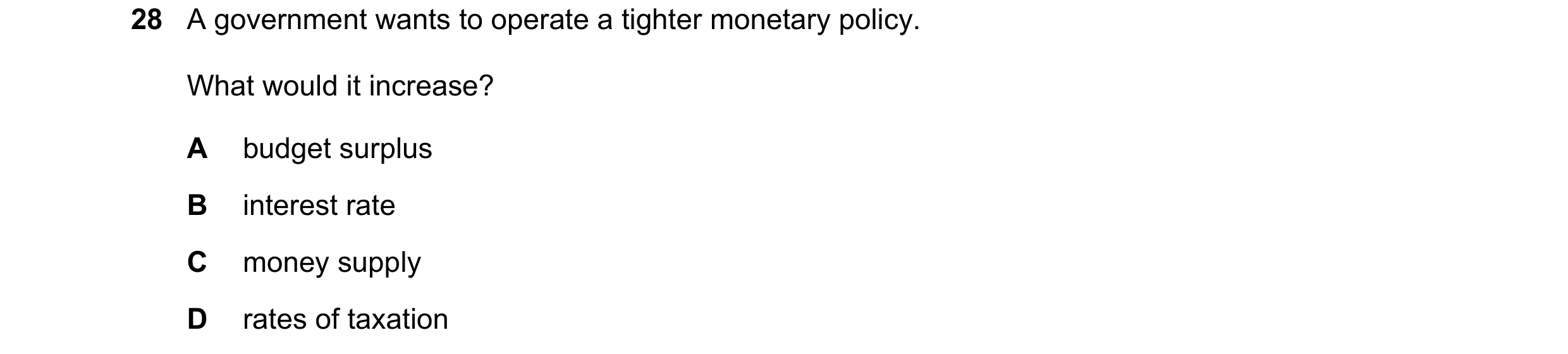
28 A government wants to operate a tighter monetary policy. What would it increase? A budget surplus B interest rate C money supply D rates of taxation
1 marks
Answer: B
This question in 9708/12 Feb/March 2017
Q29 · In recent years an economy has experienced changes in its price level as shown 9708/11 May/June 2017
30 In recent years an economy has experienced changes in its price level as shown. 6 percentage change of 4 price level 2 0 2010 2015 –2 Which government policy is most effective in reversing the trend shown in the price level? A encourage firms to expand production through tax incentives B introduce an incomes policy to directly control wage increases C promote household savings by issuing savings bonds D reduce interest rates and increase money supply
1 marks
Answer: D
This question in 9708/11 May/June 2017
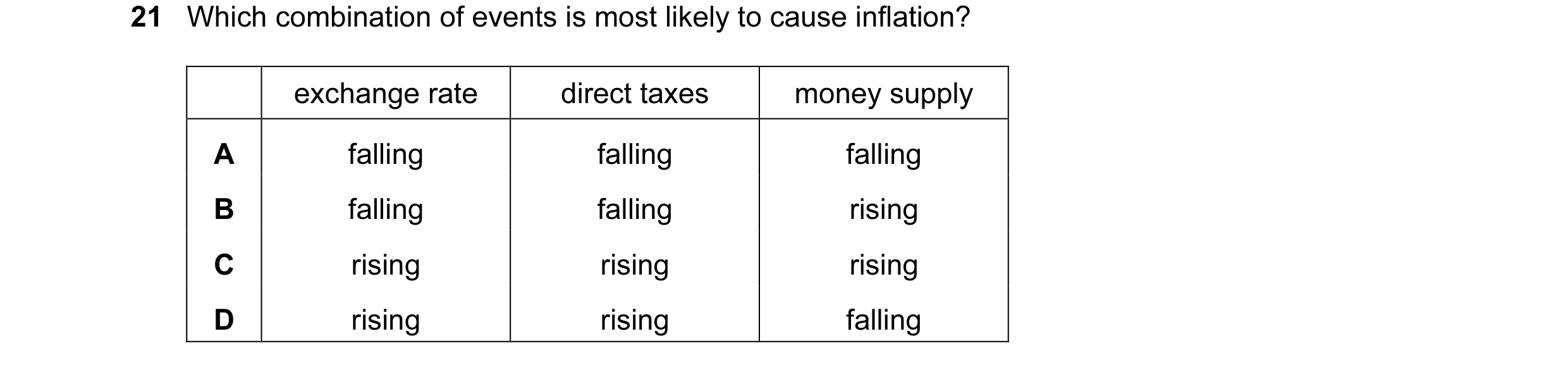
Q30 · Which combination of events is most likely to cause inflation? 9708/12 May/June 2017
21 Which combination of events is most likely to cause inflation? exchange rate direct taxes money supply A falling falling falling B falling falling rising C rising rising rising D rising rising falling
1 marks
Answer: B
This question in 9708/12 May/June 2017
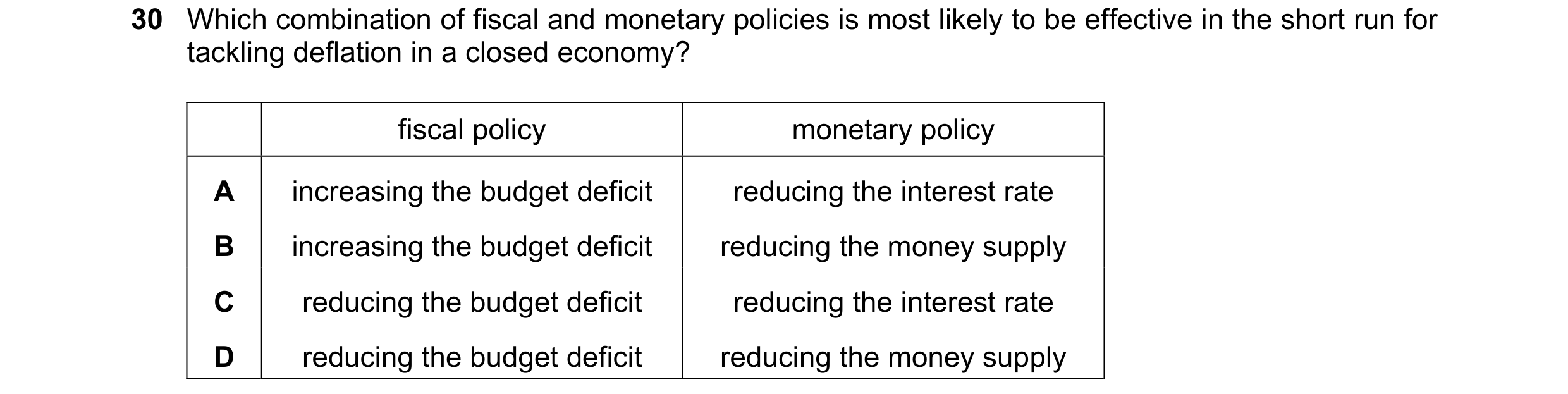
Q31 · Which combination of fiscal and monetary policies is most likely to be effective in the… 9708/11 Oct/Nov 2017
30 Which combination of fiscal and monetary policies is most likely to be effective in the short run for tackling deflation in a closed economy? fiscal policy monetary policy A increasing the budget deficit reducing the interest rate B increasing the budget deficit reducing the money supply C reducing the budget deficit reducing the interest rate D reducing the budget deficit reducing the money supply
1 marks
Answer: A
This question in 9708/11 Oct/Nov 2017
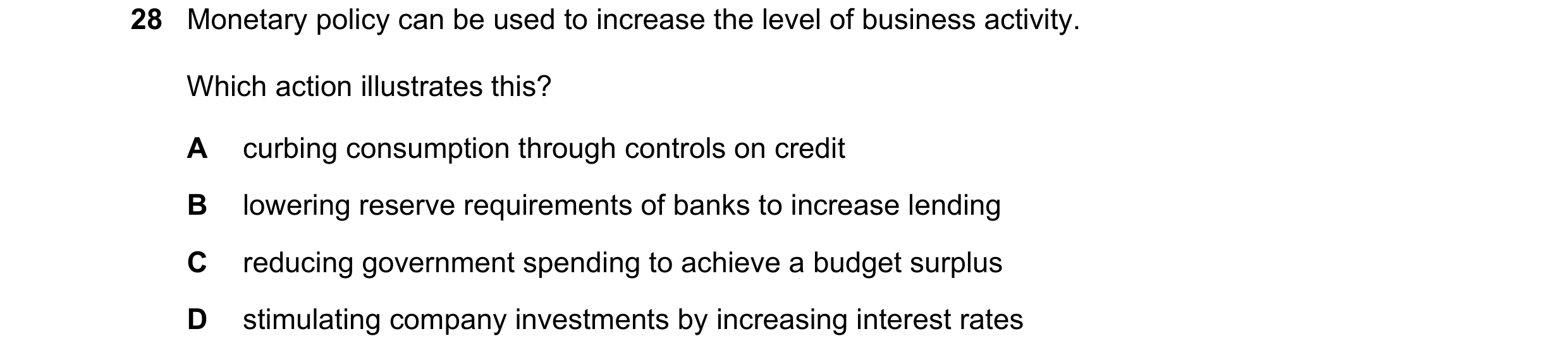
Q32 · Monetary policy can be used to increase the level of business activity 9708/12 Oct/Nov 2017
28 Monetary policy can be used to increase the level of business activity. Which action illustrates this? A curbing consumption through controls on credit B lowering reserve requirements of banks to increase lending C reducing government spending to achieve a budget surplus D stimulating company investments by increasing interest rates
1 marks
Answer: B
This question in 9708/12 Oct/Nov 2017
Q33 · Which type of policy would have the most immediate effect in dealing with a deflationary… 9708/12 Feb/March 2018
30 Which type of policy would have the most immediate effect in dealing with a deflationary economic downturn? A increasing the government’s budget surplus B increasing liquidity by assisting banks to lend more C investing in projects to improve transport networks D switching the burden of taxation from earning to spending
1 marks
Answer: B
This question in 9708/12 Feb/March 2018
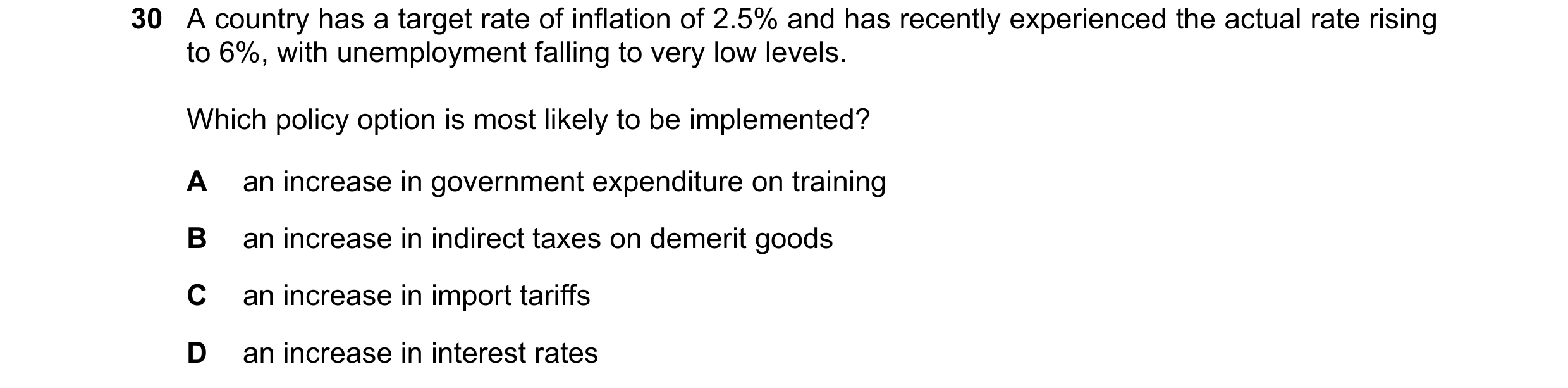
Q34 · A country has a target rate of inflation of 2.5% and has recently experienced the actual… 9708/11 May/June 2018
30 A country has a target rate of inflation of 2.5% and has recently experienced the actual rate rising to 6%, with unemployment falling to very low levels. Which policy option is most likely to be implemented? A an increase in government expenditure on training B an increase in indirect taxes on demerit goods C an increase in import tariffs D an increase in interest rates
1 marks
Answer: D
This question in 9708/11 May/June 2018
Q35 · What is an example of expansionary monetary policy? 9708/12 May/June 2018
28 What is an example of expansionary monetary policy? A the central bank buying government bonds in the money market B the central bank causing an appreciation of the country’s foreign exchange rate C the central bank increasing controls on credit lending D the central bank increasing the minimum lending rate of interest
1 marks
Answer: A
This question in 9708/12 May/June 2018
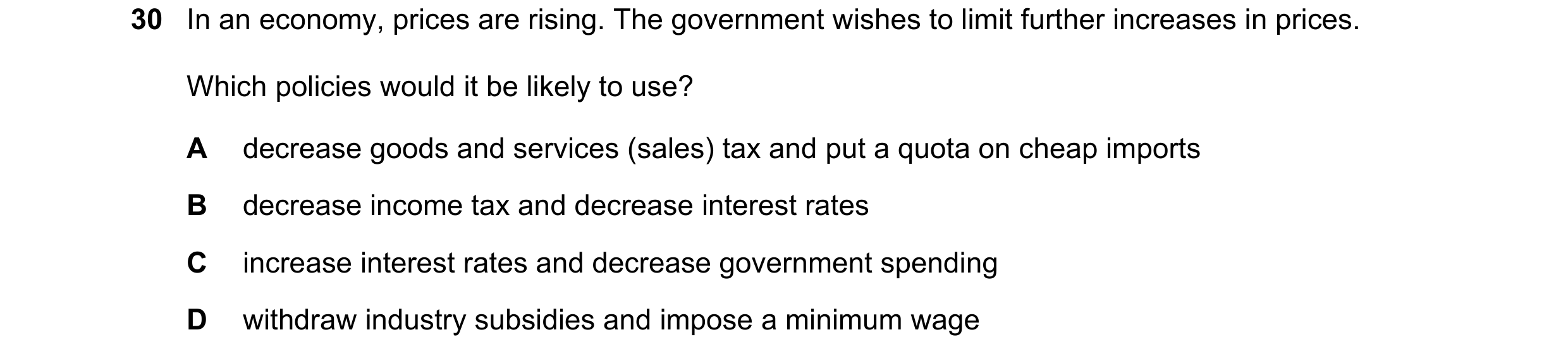
Q36 · In an economy, prices are rising 9708/12 May/June 2018
30 In an economy, prices are rising. The government wishes to limit further increases in prices. Which policies would it be likely to use? A decrease goods and services (sales) tax and put a quota on cheap imports B decrease income tax and decrease interest rates C increase interest rates and decrease government spending D withdraw industry subsidies and impose a minimum wage
1 marks
Answer: C
This question in 9708/12 May/June 2018
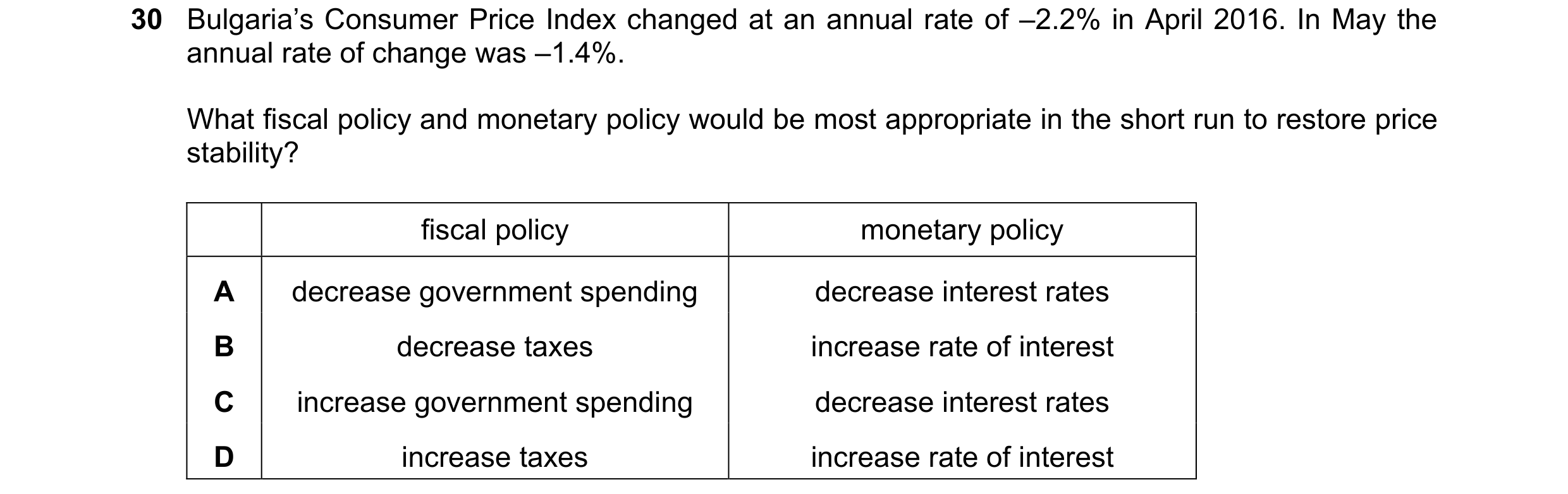
Q37 · Bulgaria’s Consumer Price Index changed at an annual rate of –2.2% in April 2016 9708/13 May/June 2018
30 Bulgaria’s Consumer Price Index changed at an annual rate of –2.2% in April 2016. In May the annual rate of change was –1.4%. What fiscal policy and monetary policy would be most appropriate in the short run to restore price stability? fiscal policy monetary policy A decrease government spending decrease interest rates B decrease taxes increase rate of interest C increase government spending decrease interest rates D increase taxes increase rate of interest
1 marks
Answer: C
This question in 9708/13 May/June 2018
Q38 · A government wishes to raise the value of the external exchange rate of its currency 9708/12 Oct/Nov 2018
23 A government wishes to raise the value of the external exchange rate of its currency. What should it do? A discourage inward foreign direct investment B raise interest rates C raise the level of aggregate demand in the economy D remove quotas on imported products
1 marks
Answer: B
This question in 9708/12 Oct/Nov 2018
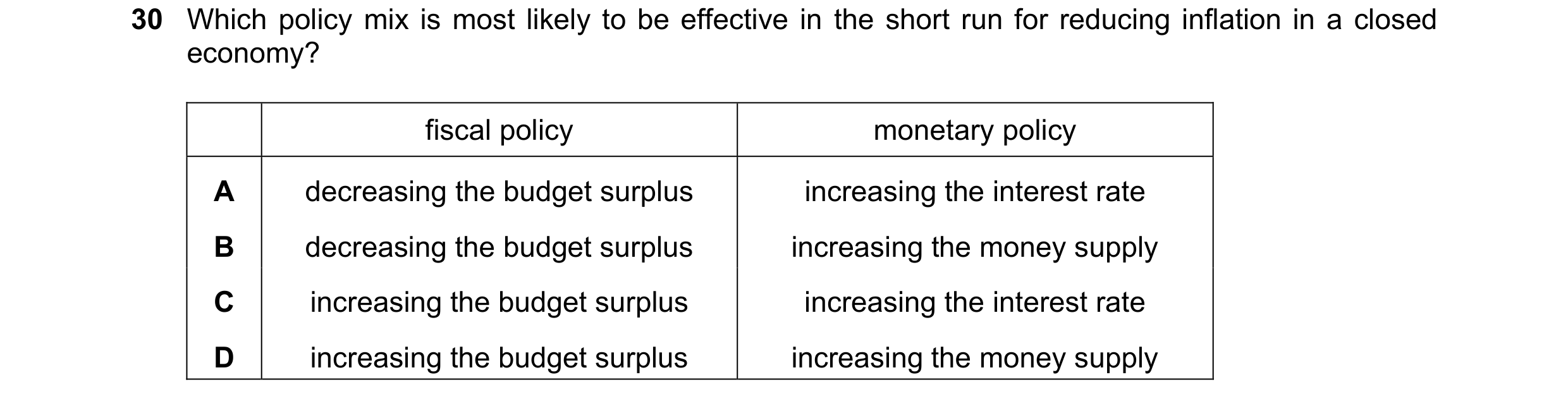
Q39 · Which policy mix is most likely to be effective in the short run for reducing inflation… 9708/12 Oct/Nov 2018
30 Which policy mix is most likely to be effective in the short run for reducing inflation in a closed economy? fiscal policy monetary policy A decreasing the budget surplus increasing the interest rate B decreasing the budget surplus increasing the money supply C increasing the budget surplus increasing the interest rate D increasing the budget surplus increasing the money supply
1 marks
Answer: C
This question in 9708/12 Oct/Nov 2018
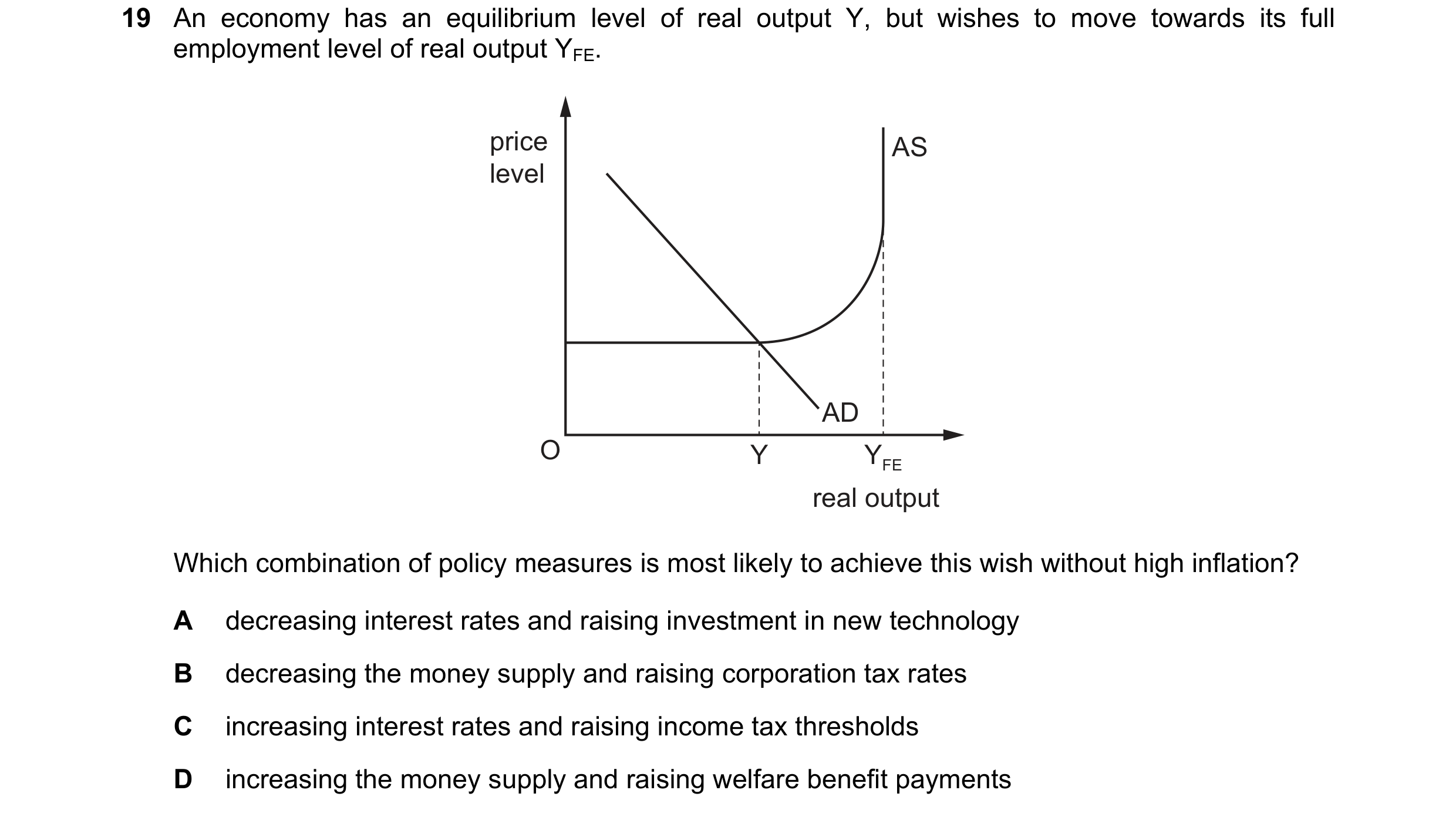
Q40 · An economy has an equilibrium level of real output Y, but wishes to move towards its full… 9708/13 Oct/Nov 2018
19 An economy has an equilibrium level of real output Y, but wishes to move towards its full employment level of real output YFE. price AS level AD O Y YFE real output Which combination of policy measures is most likely to achieve this wish without high inflation? A decreasing interest rates and raising investment in new technology B decreasing the money supply and raising corporation tax rates C increasing interest rates and raising income tax thresholds D increasing the money supply and raising welfare benefit payments
1 marks
Answer: A
This question in 9708/13 Oct/Nov 2018
Q41 · In the diagram, AD1 and AS are an economy’s original aggregate demand and aggregate… 9708/13 Oct/Nov 2018
20 In the diagram, AD1 and AS are an economy’s original aggregate demand and aggregate supply curves. price AS level AD2 AD1 O real output What will cause the aggregate demand curve to shift to AD2? A an appreciation of the currency B an increase in the money supply C an increase in the price level D an increase in the real wage
1 marks
Answer: A
This question in 9708/13 Oct/Nov 2018
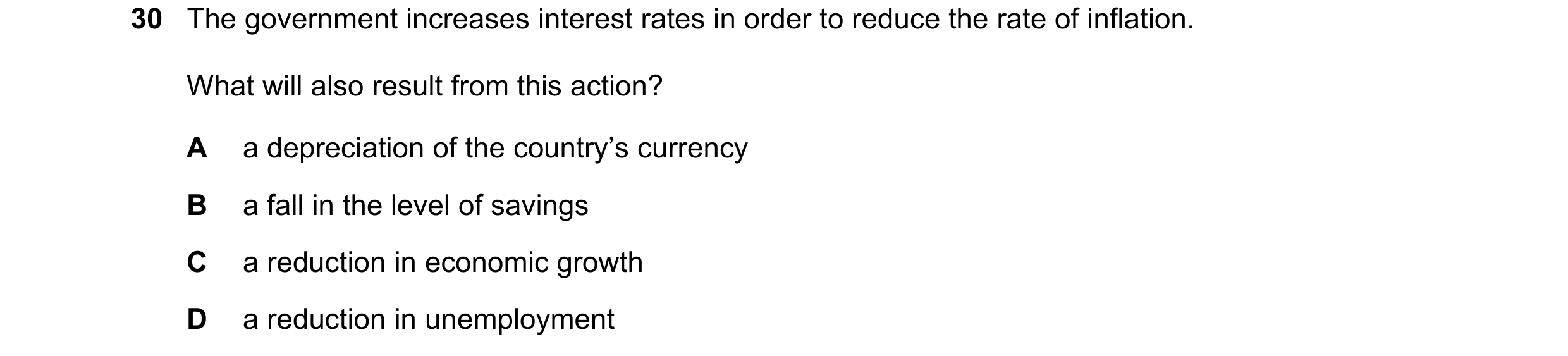
Q42 · The government increases interest rates in order to reduce the rate of inflation 9708/13 Oct/Nov 2018
30 The government increases interest rates in order to reduce the rate of inflation. What will also result from this action? A a depreciation of the country’s currency B a fall in the level of savings C a reduction in economic growth D a reduction in unemployment
1 marks
Answer: C
This question in 9708/13 Oct/Nov 2018
Q43 · Which action might be part of an expansionary economic policy? 9708/12 Feb/March 2019
28 Which action might be part of an expansionary economic policy? A reducing the budget deficit B reducing the level of government spending C reducing the money supply D reducing the rate of interest
1 marks
Answer: D
This question in 9708/12 Feb/March 2019
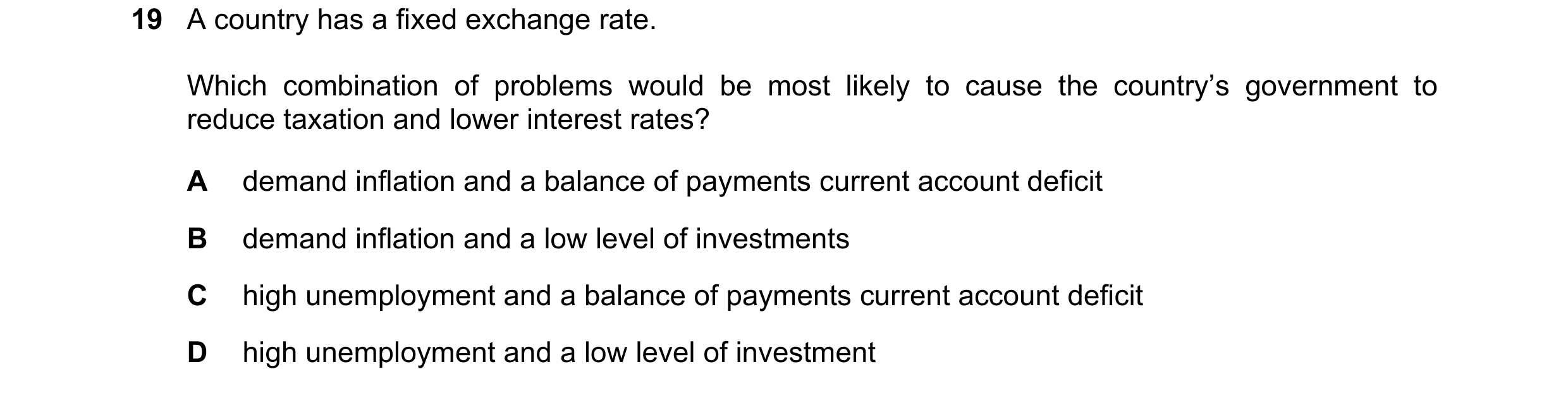
Q44 · A country has a fixed exchange rate 9708/12 May/June 2019
19 A country has a fixed exchange rate. Which combination of problems would be most likely to cause the country’s government to reduce taxation and lower interest rates? A demand inflation and a balance of payments current account deficit B demand inflation and a low level of investments C high unemployment and a balance of payments current account deficit D high unemployment and a low level of investment
1 marks
Answer: D
This question in 9708/12 May/June 2019
Q45 · A country with a balance of trade deficit raises interest rates 9708/12 May/June 2019
28 A country with a balance of trade deficit raises interest rates. How may this help to reduce the deficit in the short run? A by increasing the inflow of foreign direct investment B by lowering the foreign exchange rate C by raising the level of domestic capital investment D by reducing the level of domestic aggregate demand
1 marks
Answer: D
This question in 9708/12 May/June 2019
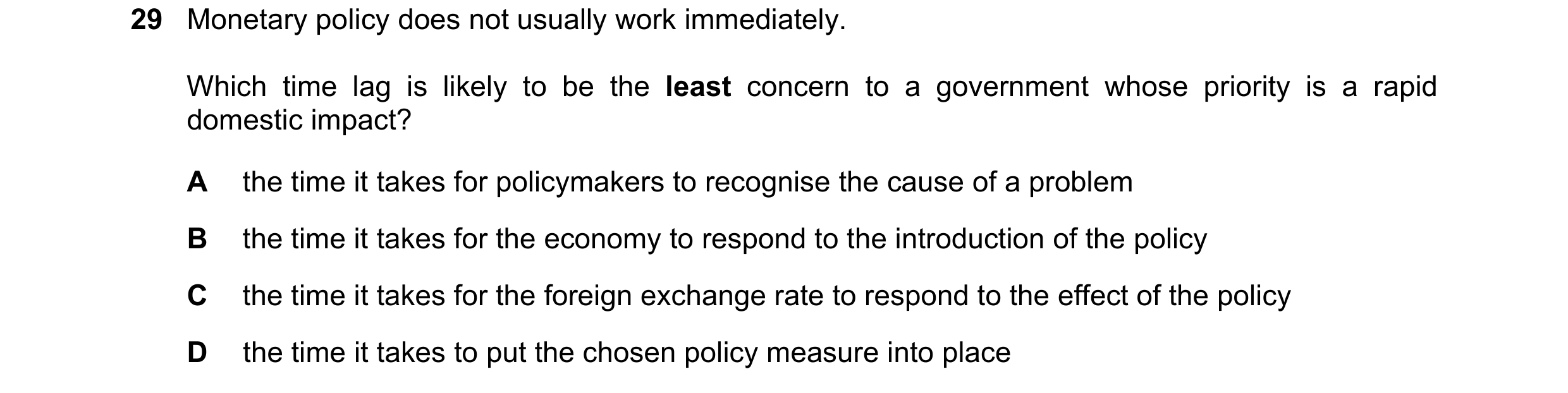
Q46 · Monetary policy does not usually work immediately 9708/13 May/June 2019
29 Monetary policy does not usually work immediately. Which time lag is likely to be the least concern to a government whose priority is a rapid domestic impact? A the time it takes for policymakers to recognise the cause of a problem B the time it takes for the economy to respond to the introduction of the policy C the time it takes for the foreign exchange rate to respond to the effect of the policy D the time it takes to put the chosen policy measure into place
1 marks
Answer: C
This question in 9708/13 May/June 2019
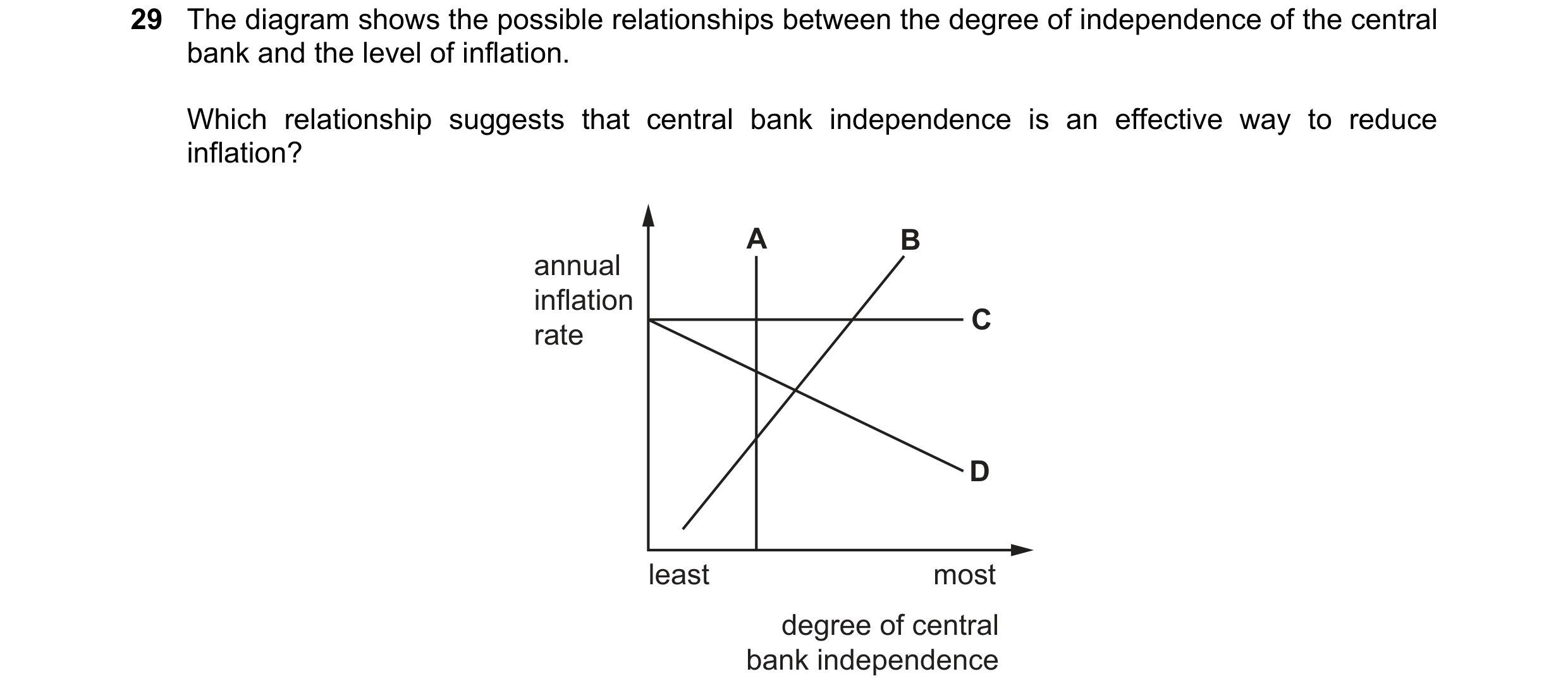
Q47 · The diagram shows the possible relationships between the degree of independence of the… 9708/11 Oct/Nov 2019
29 The diagram shows the possible relationships between the degree of independence of the central bank and the level of inflation. Which relationship suggests that central bank independence is an effective way to reduce inflation? A B annual inflation C rate D least most degree of central bank independence
1 marks
Answer: D
This question in 9708/11 Oct/Nov 2019
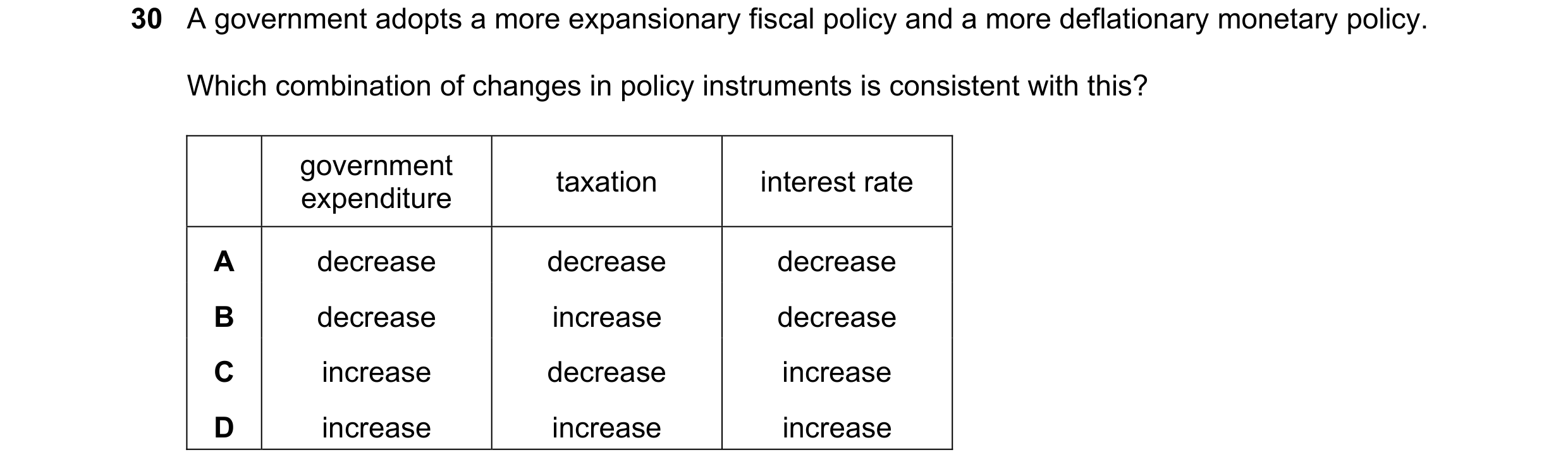
Q48 · A government adopts a more expansionary fiscal policy and a more deflationary monetary… 9708/13 Oct/Nov 2019
30 A government adopts a more expansionary fiscal policy and a more deflationary monetary policy. Which combination of changes in policy instruments is consistent with this? government taxation interest rate expenditure A decrease decrease decrease B decrease increase decrease C increase decrease increase D increase increase increase
1 marks
Answer: C
This question in 9708/13 Oct/Nov 2019
Q49 · A country with a fixed exchange rate experiences a balance of payments surplus 9708/12 Feb/March 2020
30 A country with a fixed exchange rate experiences a balance of payments surplus. Which policy measure will enable it to maintain its exchange rate? A decreasing government borrowing B decreasing government spending C decreasing the interest rate D decreasing the money supply
1 marks
Answer: C
This question in 9708/12 Feb/March 2020
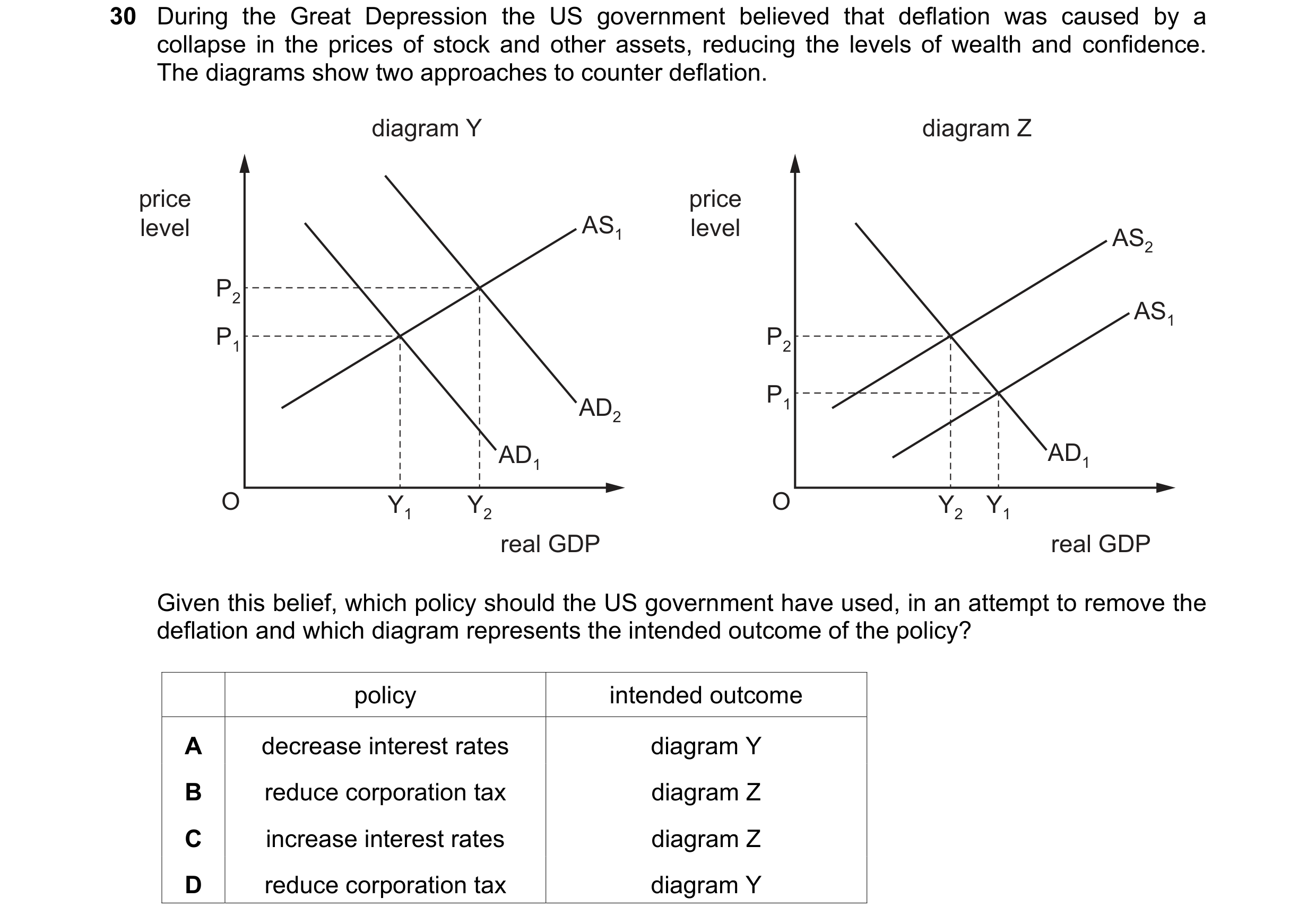
Q50 · During the Great Depression the US government believed that deflation was caused by a… 9708/12 May/June 2020
30 During the Great Depression the US government believed that deflation was caused by a collapse in the prices of stock and other assets, reducing the levels of wealth and confidence. The diagrams show two approaches to counter deflation. diagram Y diagram Z price price level AS1 level AS2 P2 AS1 P1 P2 P1 AD2 AD1 AD1 O Y1 Y2 O Y2 Y1 real GDP real GDP Given this belief, which policy should the US government have used, in an attempt to remove the deflation and which diagram represents the intended outcome of the policy? policy intended outcome A decrease interest rates diagram Y B reduce corporation tax diagram Z C increase interest rates diagram Z D reduce corporation tax diagram Y
1 marks
Answer: A
This question in 9708/12 May/June 2020
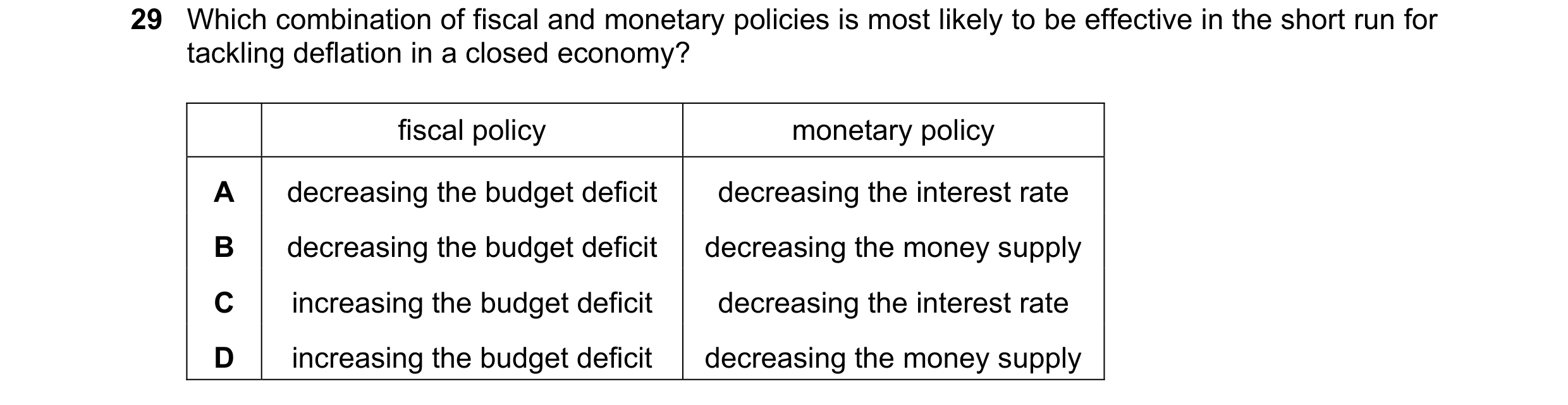
Q51 · Which combination of fiscal and monetary policies is most likely to be effective in the… 9708/13 May/June 2020
29 Which combination of fiscal and monetary policies is most likely to be effective in the short run for tackling deflation in a closed economy? fiscal policy monetary policy A decreasing the budget deficit decreasing the interest rate B decreasing the budget deficit decreasing the money supply C increasing the budget deficit decreasing the interest rate D increasing the budget deficit decreasing the money supply
1 marks
Answer: C
This question in 9708/13 May/June 2020
Q52 · A government with a floating exchange rate wishes to encourage a rise in the… 9708/11 Oct/Nov 2020
27 A government with a floating exchange rate wishes to encourage a rise in the international value of its currency. What should it do? A lower the level of domestic interest rates B reduce the amount of foreign currency available to its citizens C reduce subsidies to its exporters D remove trade barriers on imports
1 marks
Answer: B
This question in 9708/11 Oct/Nov 2020
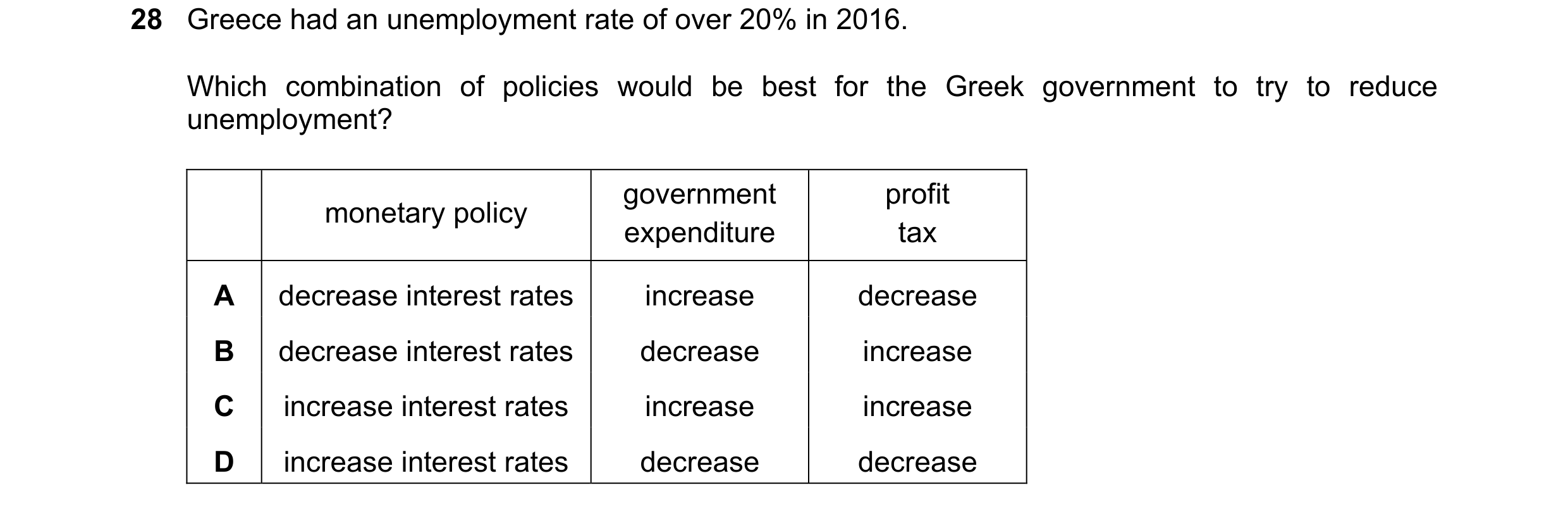
Q53 · Greece had an unemployment rate of over 20% in 2016 9708/11 Oct/Nov 2020
28 Greece had an unemployment rate of over 20% in 2016. Which combination of policies would be best for the Greek government to try to reduce unemployment? government profit monetary policy expenditure tax A decrease interest rates increase decrease B decrease interest rates decrease increase C increase interest rates increase increase D increase interest rates decrease decrease
1 marks
Answer: A
This question in 9708/11 Oct/Nov 2020
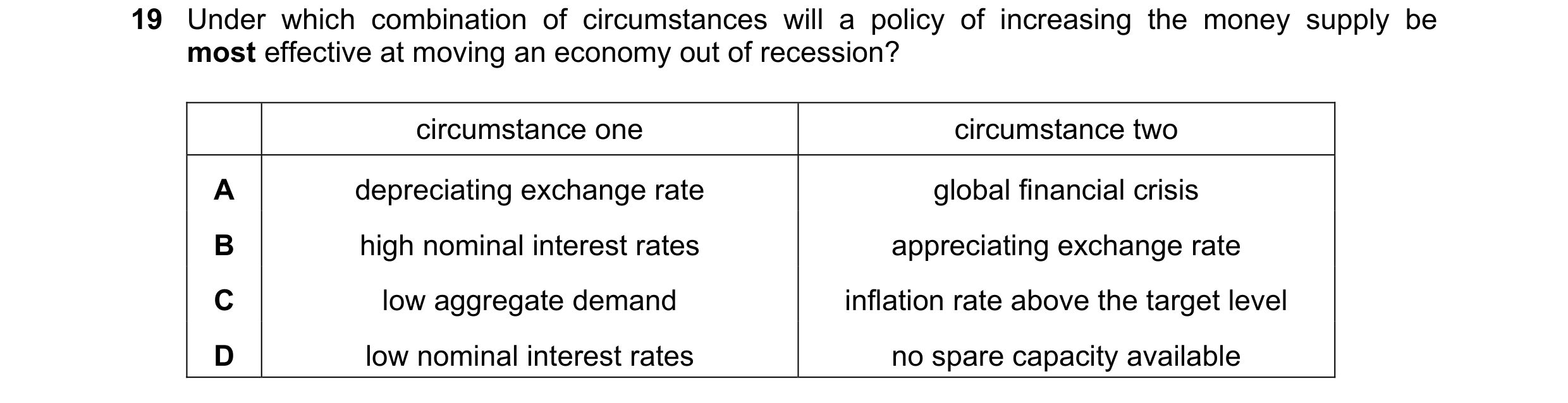
Q54 · Under which combination of circumstances will a policy of increasing the money supply be… 9708/12 Oct/Nov 2020
19 Under which combination of circumstances will a policy of increasing the money supply be most effective at moving an economy out of recession? circumstance one circumstance two A depreciating exchange rate global financial crisis B high nominal interest rates appreciating exchange rate C low aggregate demand inflation rate above the target level D low nominal interest rates no spare capacity available
1 marks
Answer: B
This question in 9708/12 Oct/Nov 2020
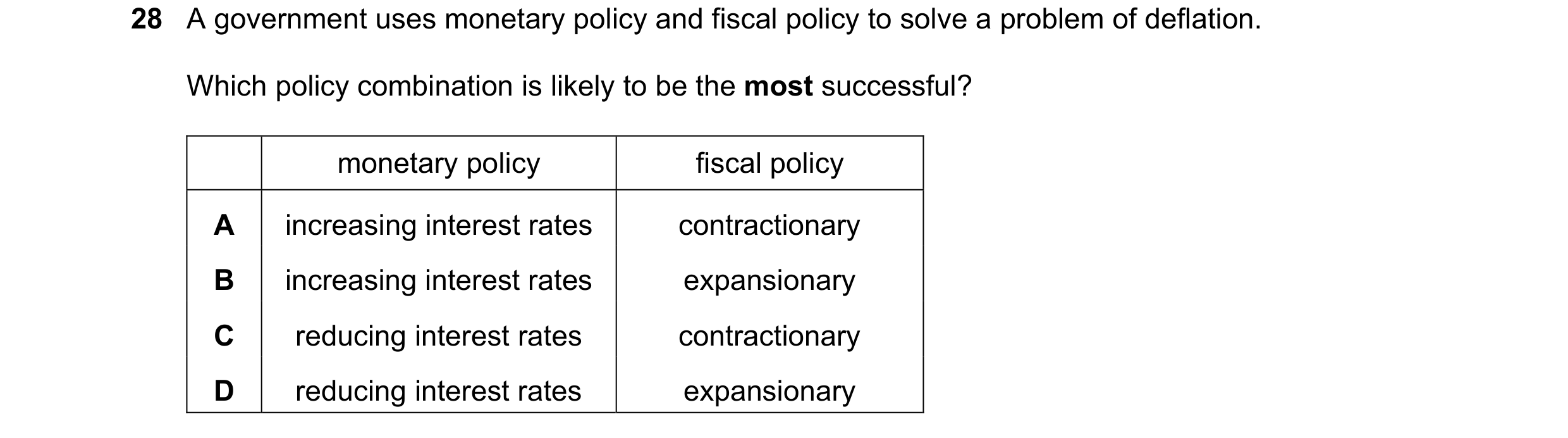
Q55 · A government uses monetary policy and fiscal policy to solve a problem of deflation 9708/12 Oct/Nov 2020
28 A government uses monetary policy and fiscal policy to solve a problem of deflation. Which policy combination is likely to be the most successful? monetary policy fiscal policy A increasing interest rates contractionary B increasing interest rates expansionary C reducing interest rates contractionary D reducing interest rates expansionary
1 marks
Answer: D
This question in 9708/12 Oct/Nov 2020
Q56 · A government reduces its expenditure on workplace training, increases the level of… 9708/12 Oct/Nov 2020
29 A government reduces its expenditure on workplace training, increases the level of indirect taxes, and reduces the rate of interest it pays on government debt. How would these government macroeconomic policies be categorised? supply-side fiscal monetary A con con exp key B exp con con con = contractionary C con exp exp exp = expansionary D exp exp con
1 marks
Answer: A
This question in 9708/12 Oct/Nov 2020
Q57 · To counter deflation a central bank uses expansionary monetary policy 9708/13 Oct/Nov 2020
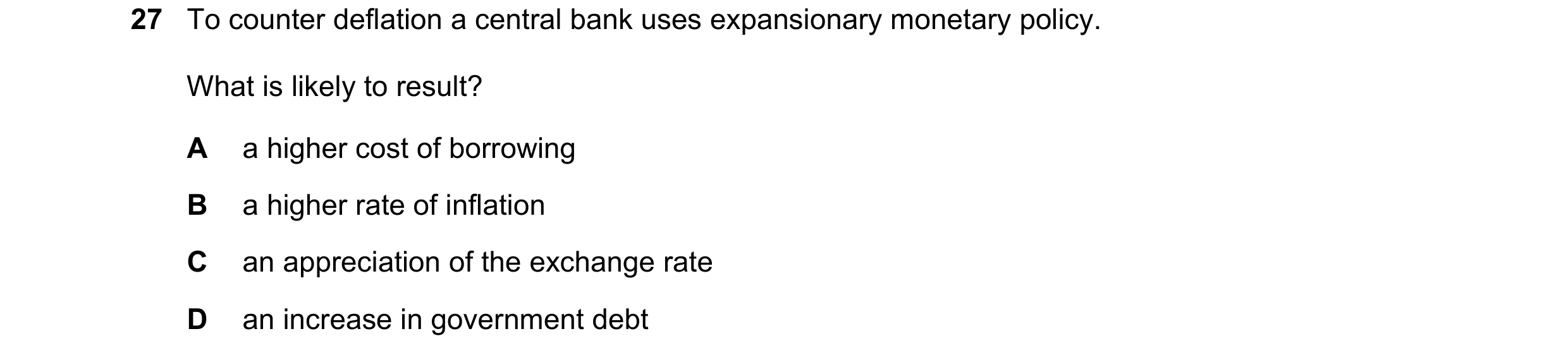
27 To counter deflation a central bank uses expansionary monetary policy. What is likely to result? A a higher cost of borrowing B a higher rate of inflation C an appreciation of the exchange rate D an increase in government debt
1 marks
Answer: B
This question in 9708/13 Oct/Nov 2020
Q58 · Country X is an open economy with a fixed exchange rate 9708/13 Oct/Nov 2020
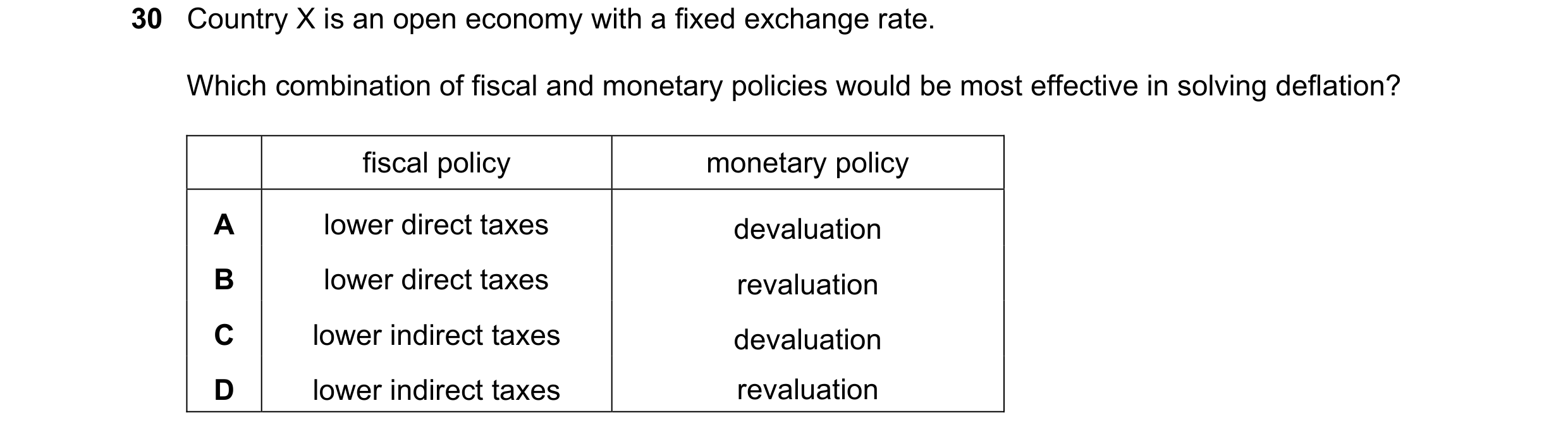
30 Country X is an open economy with a fixed exchange rate. Which combination of fiscal and monetary policies would be most effective in solving deflation? fiscal policy monetary policy A lower direct taxes devaluation B lower direct taxes revaluation C lower indirect taxes devaluation D lower indirect taxes revaluation
1 marks
Answer: A
This question in 9708/13 Oct/Nov 2020
Q59 · The table shows the consumer prices index (CPI) for an economy expressed as an index… 9708/12 Feb/March 2021
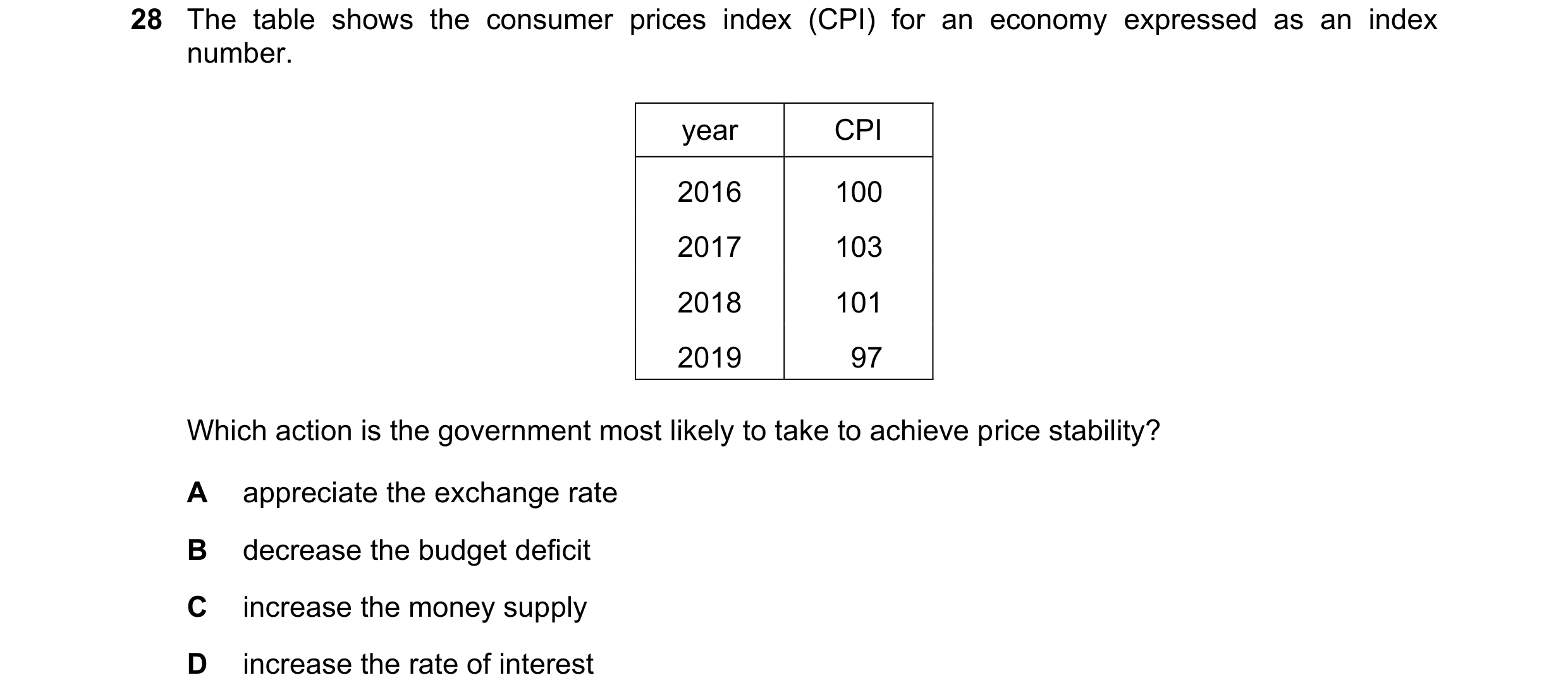
28 The table shows the consumer prices index (CPI) for an economy expressed as an index number. year CPI 2016 100 2017 103 2018 101 2019 97 Which action is the government most likely to take to achieve price stability? A appreciate the exchange rate B decrease the budget deficit C increase the money supply D increase the rate of interest
1 marks
Answer: C
This question in 9708/12 Feb/March 2021
Q60 · Why are higher interest rates together with increased taxation on expenditure likely to… 9708/12 May/June 2021
28 Why are higher interest rates together with increased taxation on expenditure likely to cause domestic deflation? A because the contractionary monetary policy will over-ride the expansionary fiscal policy B because the monetary and fiscal policies involved will reinforce each other C because the expansionary monetary policy will over-ride the contractionary fiscal policy D because the monetary and fiscal policies involved will cancel each other out
1 marks
Answer: B
This question in 9708/12 May/June 2021
Q61 · Which policy will not cause a reduction in the rate of inflation? 9708/12 May/June 2021
30 Which policy will not cause a reduction in the rate of inflation? A increasing income tax B reducing government spending C reducing interest rates D removing subsidies
1 marks
Answer: C
This question in 9708/12 May/June 2021
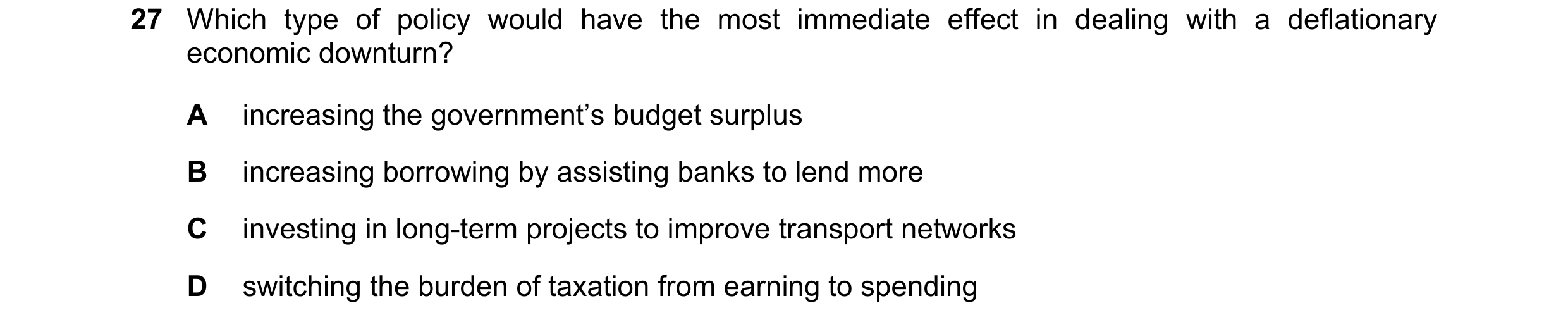
Q62 · Which type of policy would have the most immediate effect in dealing with a deflationary… 9708/13 May/June 2021
27 Which type of policy would have the most immediate effect in dealing with a deflationary economic downturn? A increasing the government’s budget surplus B increasing borrowing by assisting banks to lend more C investing in long-term projects to improve transport networks D switching the burden of taxation from earning to spending
1 marks
Answer: B
This question in 9708/13 May/June 2021
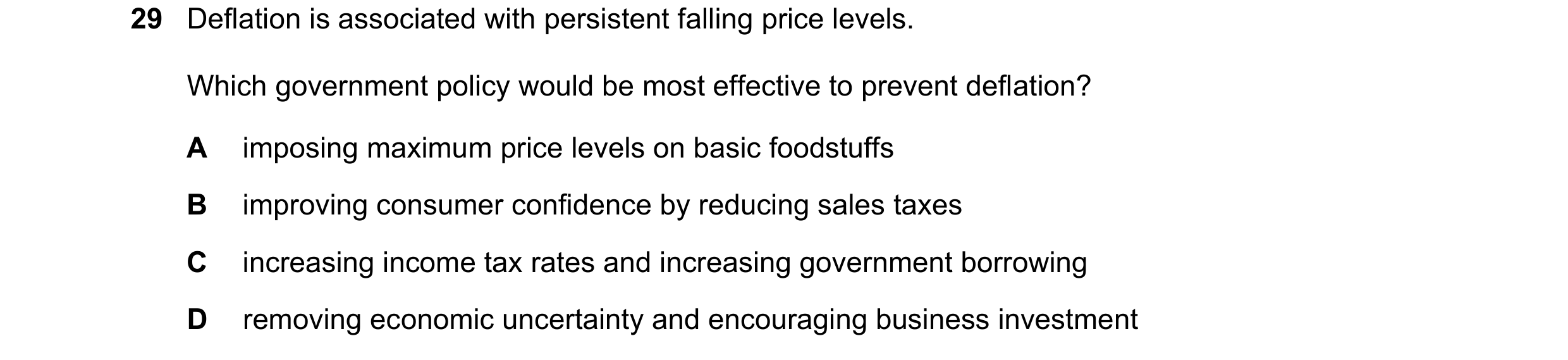
Q63 · Deflation is associated with persistent falling price levels 9708/13 May/June 2021
29 Deflation is associated with persistent falling price levels. Which government policy would be most effective to prevent deflation? A imposing maximum price levels on basic foodstuffs B improving consumer confidence by reducing sales taxes C increasing income tax rates and increasing government borrowing D removing economic uncertainty and encouraging business investment
1 marks
Answer: D
This question in 9708/13 May/June 2021
Q64 · The graph shows inflation rates over 10 years for selected emerging economies 9708/13 May/June 2021
30 The graph shows inflation rates over 10 years for selected emerging economies. 7 inflation % year on year 6 W 5 X 4 Y Z 3 2 2009 2010 2011 2012 2013 2014 2015 2016 2017 2018 year Government central banks set target minimum inflation rates before readjusting interest rates to stabilise the economy. If the minimum inflation rate target set by central banks was 4% per year, at which points would they allow interest rates to fall? A W and X B X and Y C Y and Z D Z and W
1 marks
Answer: C
This question in 9708/13 May/June 2021
Q65 · What would make a policy of raising interest rates less likely to be effective in… 9708/12 Oct/Nov 2021
29 What would make a policy of raising interest rates less likely to be effective in reducing inflation? A Aggregate supply is increasing faster than aggregate demand. B Consumers expect prices to rise even faster in the future. C Consumers’ spending is largely paid for on credit. D Interest rates are still higher abroad.
1 marks
Answer: B
This question in 9708/12 Oct/Nov 2021
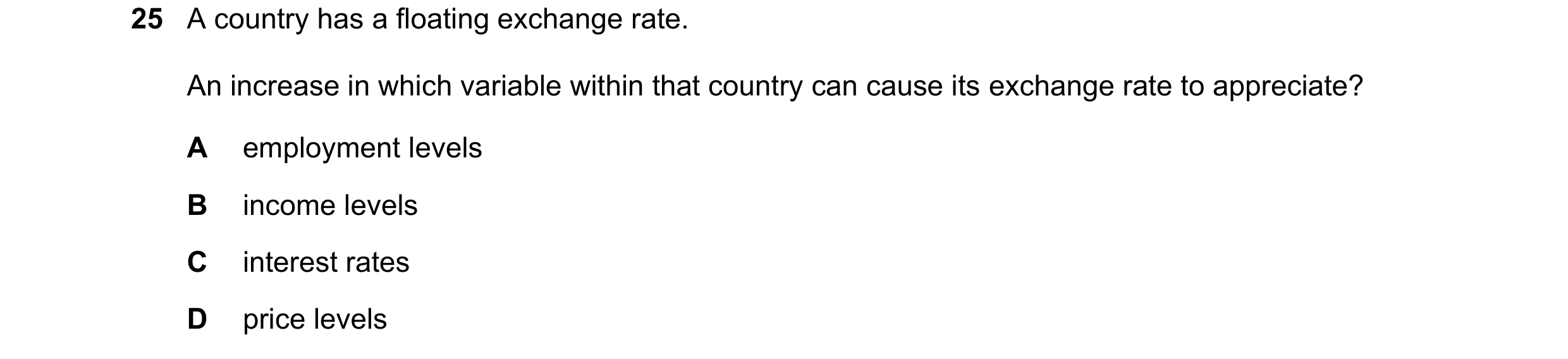
Q66 · A country has a floating exchange rate 9708/13 Oct/Nov 2021
25 A country has a floating exchange rate. An increase in which variable within that country can cause its exchange rate to appreciate? A employment levels B income levels C interest rates D price levels
1 marks
Answer: C
This question in 9708/13 Oct/Nov 2021
Q67 · What is an example of the use of monetary policy? 9708/13 Oct/Nov 2021
28 What is an example of the use of monetary policy? A a cut in the rate of corporation tax B a reduction in interest rates C a switch from direct to indirect taxation D the introduction of maximum price controls to reduce inflation
1 marks
Answer: B
This question in 9708/13 Oct/Nov 2021
Q68 · An increase in which variable is a contractionary monetary policy? 9708/12 Feb/March 2022
29 An increase in which variable is a contractionary monetary policy? A the budget deficit B the budget surplus C the interest rate D the money supply
1 marks
Answer: C
This question in 9708/12 Feb/March 2022
Q69 · What are government monetary policies that would be the most effective in a global… 9708/12 Feb/March 2022
30 What are government monetary policies that would be the most effective in a global recession? A allowing the rate of interest to fluctuate and increasing business taxation B increasing the budget surplus and raising tariffs on imports C keeping the rate of interest very low and increasing the money supply D raising the rate of interest and restricting the money supply
1 marks
Answer: C
This question in 9708/12 Feb/March 2022
Q70 · What would be the best policy to increase the value of a currency? 9708/11 May/June 2022
26 What would be the best policy to increase the value of a currency? A Impose tariffs on imported goods with price-inelastic demand. B Increase interest rates. C Reduce income tax. D Sell the currency on the foreign exchange markets.
1 marks
Answer: B
This question in 9708/11 May/June 2022
Q71 · Why will a contractionary monetary policy reduce inflation? 9708/11 May/June 2022
29 Why will a contractionary monetary policy reduce inflation? A Banks will lend more. B Consumers will have higher disposable income. C Consumers will pay more tax. D Consumers will save more.
1 marks
Answer: D
This question in 9708/11 May/June 2022
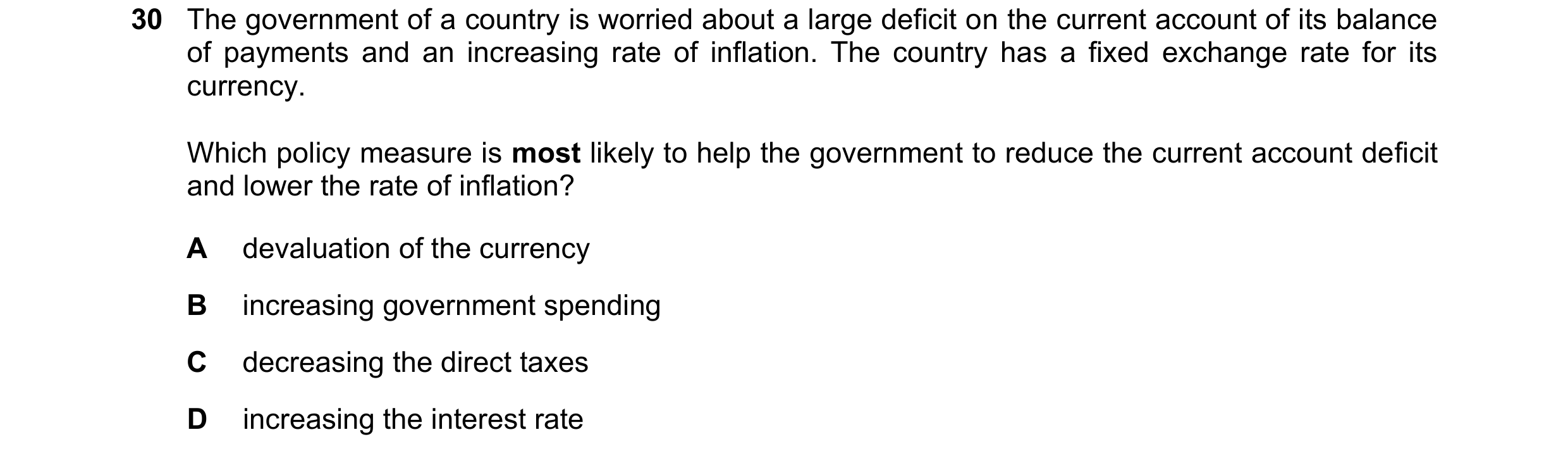
Q72 · The government of a country is worried about a large deficit on the current account of… 9708/11 May/June 2022
30 The government of a country is worried about a large deficit on the current account of its balance of payments and an increasing rate of inflation. The country has a fixed exchange rate for its currency. Which policy measure is most likely to help the government to reduce the current account deficit and lower the rate of inflation? A devaluation of the currency B increasing government spending C decreasing the direct taxes D increasing the interest rate
1 marks
Answer: D
This question in 9708/11 May/June 2022
Q73 · What, if decreased, will help to reduce the rate of inflation? 9708/12 May/June 2022
28 What, if decreased, will help to reduce the rate of inflation? A budget deficit B direct taxes C exchange rate D interest rate
1 marks
Answer: A
This question in 9708/12 May/June 2022
Q74 · A country has a floating exchange rate 9708/14 May/June 2022
26 A country has a floating exchange rate. An increase in which variable in the country will cause its currency to appreciate? A the budget deficit B the general price level C the interest rate D the trade deficit
1 marks
Answer: C
This question in 9708/14 May/June 2022
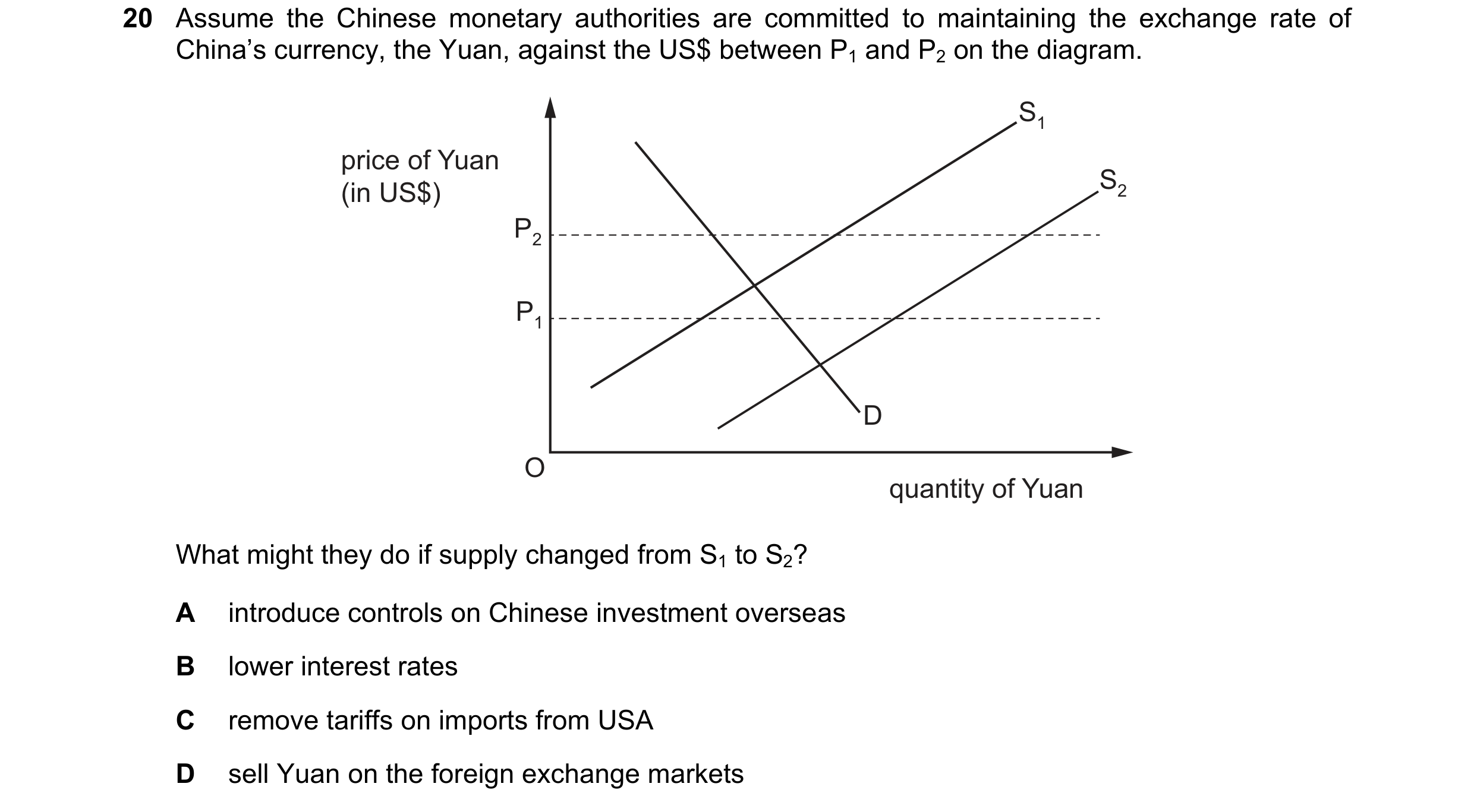
Q75 · Assume the Chinese monetary authorities are committed to maintaining the exchange rate of… 9708/11 Oct/Nov 2022
20 Assume the Chinese monetary authorities are committed to maintaining the exchange rate of China’s currency, the Yuan, against the US$ between P1 and P2 on the diagram. S1 price of Yuan S2 (in US$) P2 P1 D O quantity of Yuan What might they do if supply changed from S1 to S2? A introduce controls on Chinese investment overseas B lower interest rates C remove tariffs on imports from USA D sell Yuan on the foreign exchange markets
1 marks
Answer: A
This question in 9708/11 Oct/Nov 2022
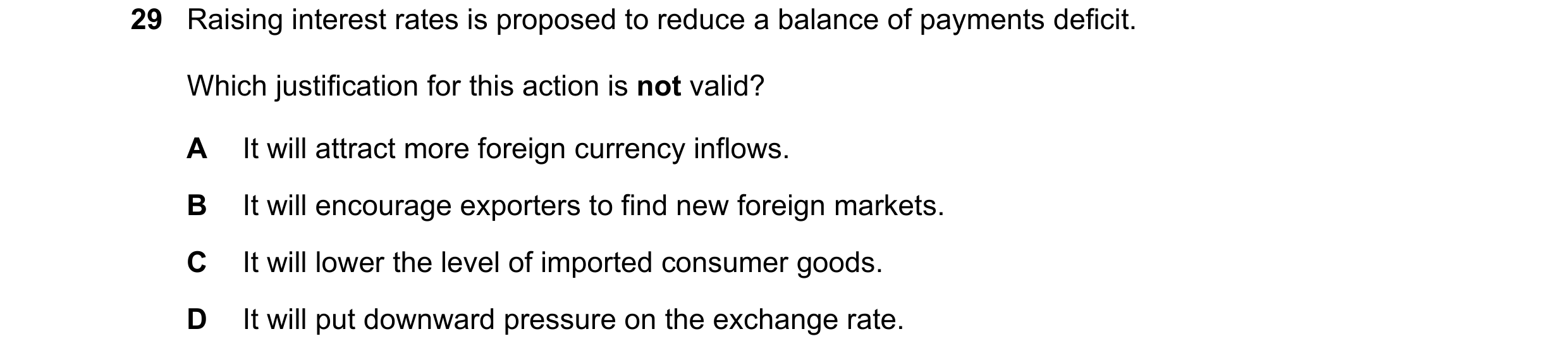
Q76 · Raising interest rates is proposed to reduce a balance of payments deficit 9708/11 Oct/Nov 2022
29 Raising interest rates is proposed to reduce a balance of payments deficit. Which justification for this action is not valid? A It will attract more foreign currency inflows. B It will encourage exporters to find new foreign markets. C It will lower the level of imported consumer goods. D It will put downward pressure on the exchange rate.
1 marks
Answer: D
This question in 9708/11 Oct/Nov 2022
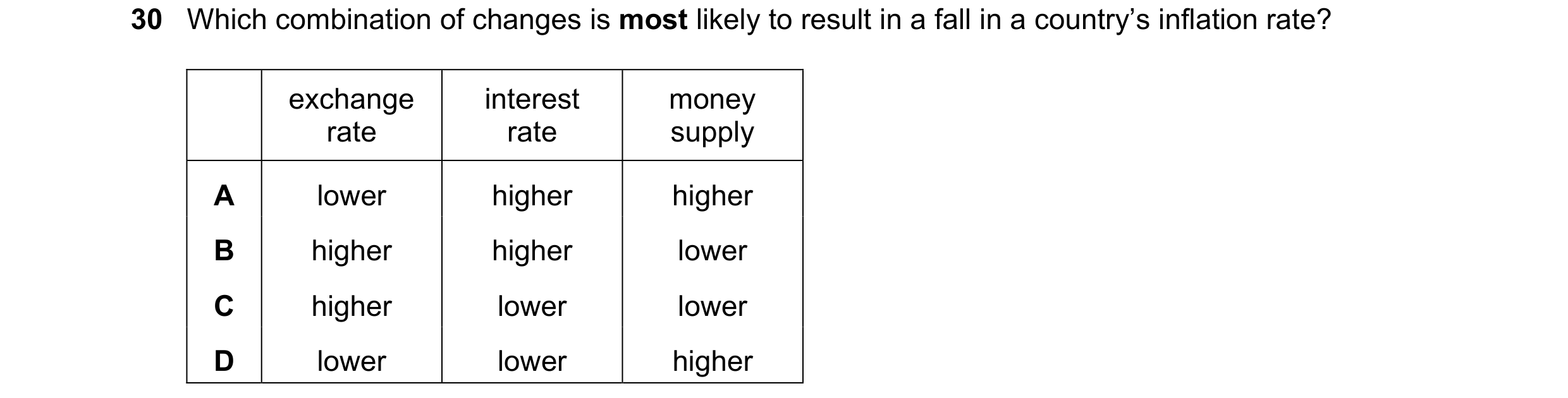
Q77 · Which combination of changes is most likely to result in a fall in a country’s inflation… 9708/11 Oct/Nov 2022
30 Which combination of changes is most likely to result in a fall in a country’s inflation rate? exchange interest money rate rate supply A lower higher higher B higher higher lower C higher lower lower D lower lower higher
1 marks
Answer: B
This question in 9708/11 Oct/Nov 2022
Q78 · A country is currently experiencing deflation 9708/13 Oct/Nov 2022
29 A country is currently experiencing deflation. It has a large national debt that is greater than its annual real income. Which combination of policies is most likely to increase the general price level without adding to the national debt? fiscal policy monetary policy A decrease the budget deficit decrease the money supply B decrease the budget deficit increase the money supply C increase the budget deficit decrease the money supply D increase the budget deficit increase the money supply
1 marks
Answer: B
This question in 9708/13 Oct/Nov 2022
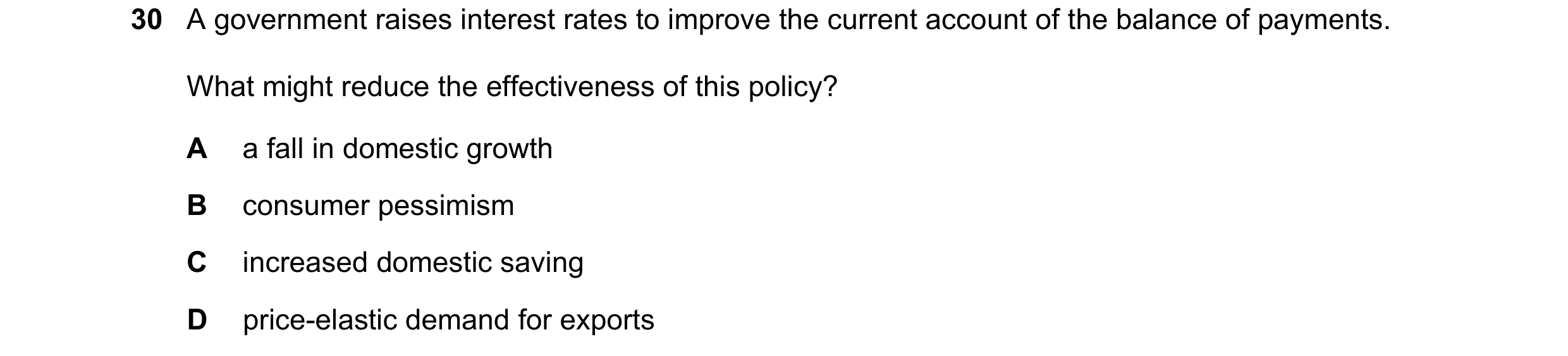
Q79 · A government raises interest rates to improve the current account of the balance of… 9708/12 Feb/March 2023
30 A government raises interest rates to improve the current account of the balance of payments. What might reduce the effectiveness of this policy? A a fall in domestic growth B consumer pessimism C increased domestic saving D price-elastic demand for exports
1 marks
Answer: D
This question in 9708/12 Feb/March 2023
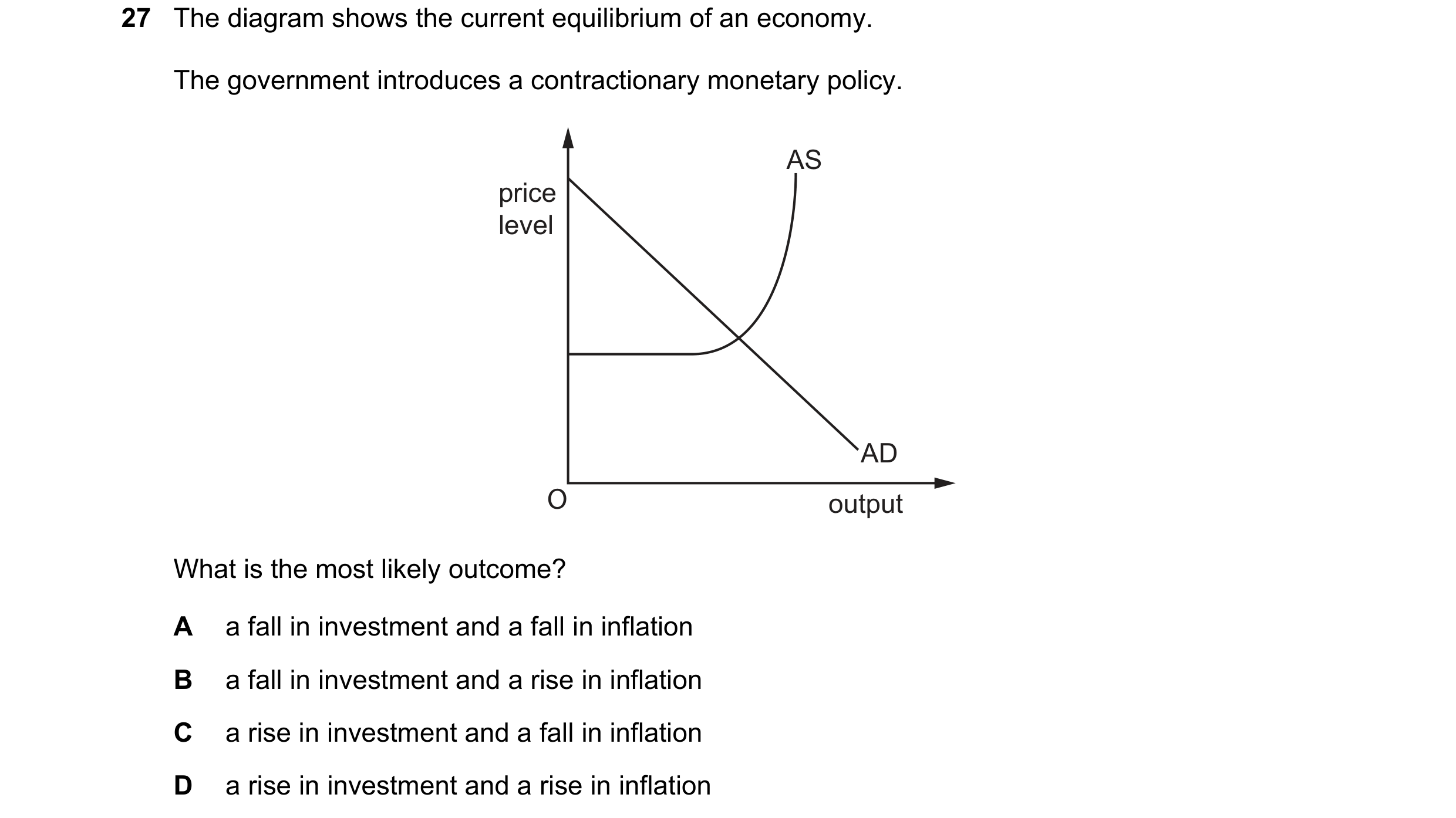
Q80 · The diagram shows the current equilibrium of an economy 9708/12 May/June 2023
27 The diagram shows the current equilibrium of an economy. The government introduces a contractionary monetary policy. AS price level AD O output What is the most likely outcome? A a fall in investment and a fall in inflation B a fall in investment and a rise in inflation C a rise in investment and a fall in inflation D a rise in investment and a rise in inflation
1 marks
Answer: A
This question in 9708/12 May/June 2023
Q81 · Which approach would a government be most likely to use to eliminate deflation? 9708/13 May/June 2023
30 Which approach would a government be most likely to use to eliminate deflation? A an increase in direct taxes B an increase in interest rates C a reduction in indirect taxes D a reduction in its budget surplus
1 marks
Answer: D
This question in 9708/13 May/June 2023
Q82 · Which combination would represent the most expansionary set of monetary policies? 9708/11 Oct/Nov 2023
29 Which combination would represent the most expansionary set of monetary policies? credit availability interest rates money supply A increased up reduced B increased down increased C reduced up increased D reduced down reduced
1 marks
Answer: B
This question in 9708/11 Oct/Nov 2023
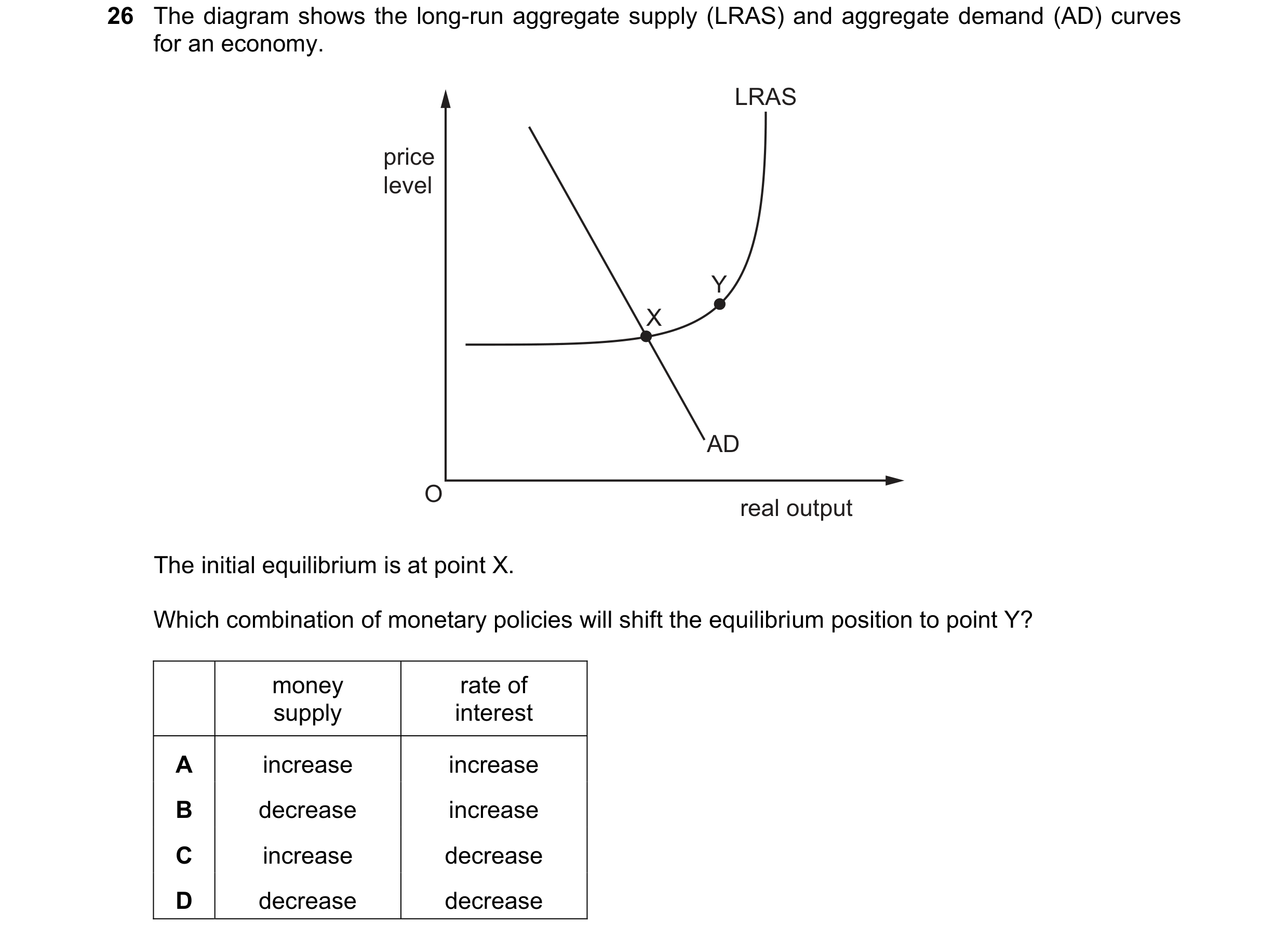
Q83 · The diagram shows the long-run aggregate supply (LRAS) and aggregate demand (AD) curves… 9708/13 Oct/Nov 2023
26 The diagram shows the long-run aggregate supply (LRAS) and aggregate demand (AD) curves for an economy. LRAS price level Y X AD O real output The initial equilibrium is at point X. Which combination of monetary policies will shift the equilibrium position to point Y? money rate of supply interest A increase increase B decrease increase C increase decrease D decrease decrease
1 marks
Answer: C
This question in 9708/13 Oct/Nov 2023
Q84 · A government aims to reduce unemployment through expansionary fiscal policy and borrows… 9708/13 Oct/Nov 2023
29 A government aims to reduce unemployment through expansionary fiscal policy and borrows more from the commercial banks, increasing its borrowing requirement. What will be the result? A a decrease in the budget deficit B a decrease in the national debt C an increase in the balance of payments deficit on the current account D an increase in the interest rates
1 marks
Answer: D
This question in 9708/13 Oct/Nov 2023
Q85 · A government wants to use an expansionary monetary policy 9708/13 Oct/Nov 2023
30 A government wants to use an expansionary monetary policy. What should the government increase? A credit regulations B the exchange rate C the interest rate D the money supply
1 marks
Answer: D
This question in 9708/13 Oct/Nov 2023
Q86 · An economy has an unemployment rate of 8%, an increase of 2% from the previous year 9708/12 Feb/March 2024
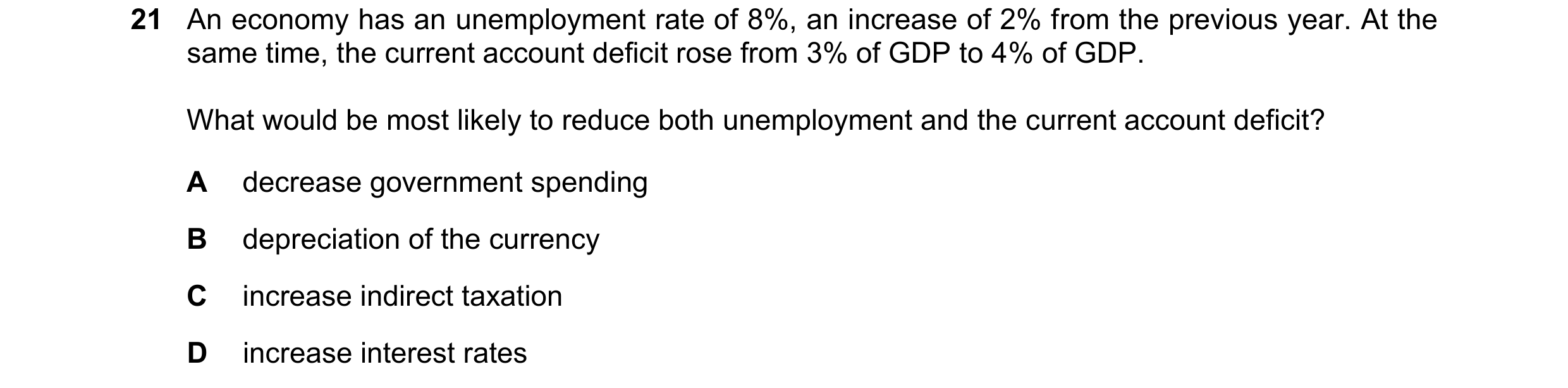
21 An economy has an unemployment rate of 8%, an increase of 2% from the previous year. At the same time, the current account deficit rose from 3% of GDP to 4% of GDP. What would be most likely to reduce both unemployment and the current account deficit? A decrease government spending B depreciation of the currency C increase indirect taxation D increase interest rates
1 marks
Answer: B
This question in 9708/12 Feb/March 2024
Q87 · To counter deflation a central bank uses expansionary monetary policy 9708/11 May/June 2024
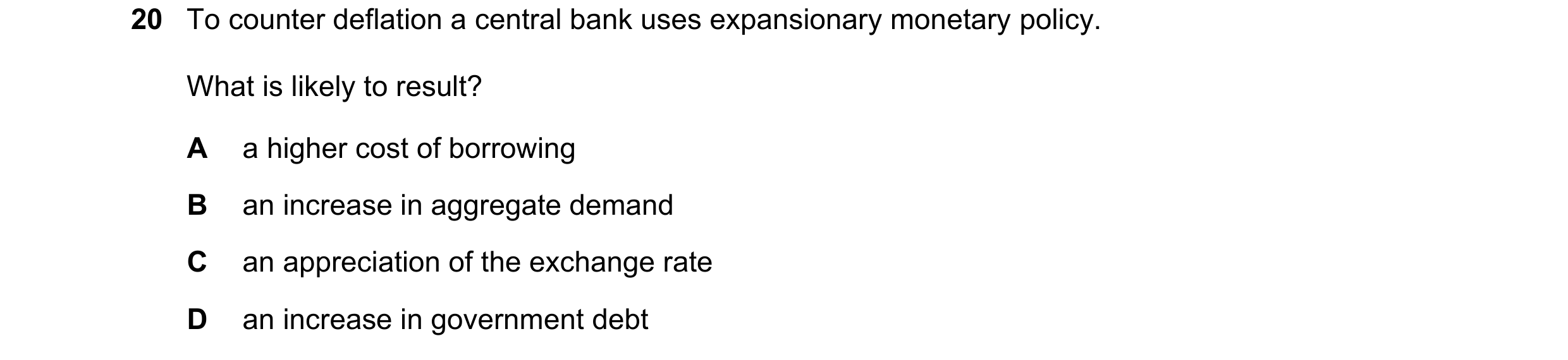
20 To counter deflation a central bank uses expansionary monetary policy. What is likely to result? A a higher cost of borrowing B an increase in aggregate demand C an appreciation of the exchange rate D an increase in government debt
1 marks
Answer: B
This question in 9708/11 May/June 2024
Q88 · Sweden had a change in its Consumer Prices Index (CPI) of –0.6% 9708/11 May/June 2024
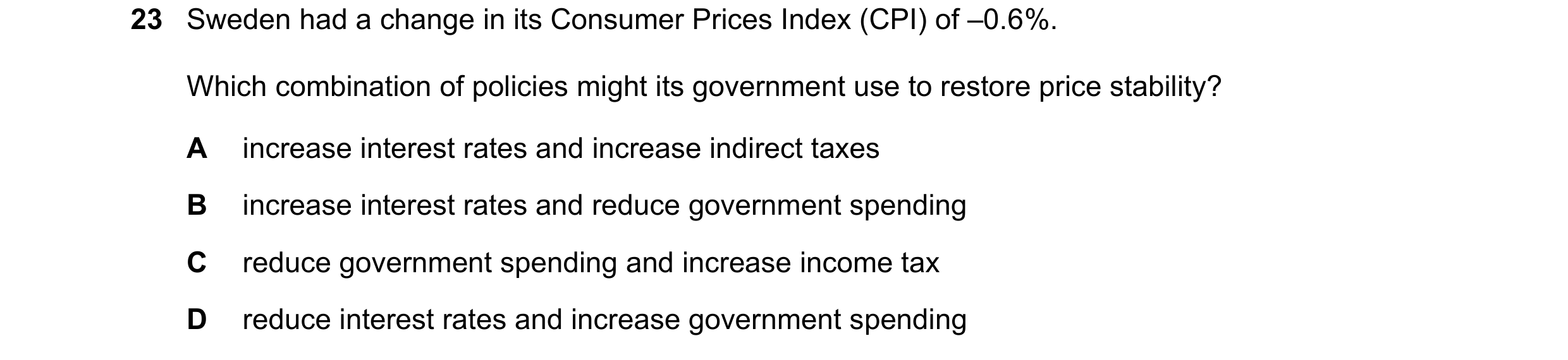
23 Sweden had a change in its Consumer Prices Index (CPI) of –0.6%. Which combination of policies might its government use to restore price stability? A increase interest rates and increase indirect taxes B increase interest rates and reduce government spending C reduce government spending and increase income tax D reduce interest rates and increase government spending
1 marks
Answer: D
This question in 9708/11 May/June 2024
Q89 · The original equilibrium in the economy is represented by point X, the intersection of… 9708/12 May/June 2024
21 The original equilibrium in the economy is represented by point X, the intersection of AD1 and AS1, on the AD / AS diagram shown. The government decreases the money supply. What is the new equilibrium point? price level AS2 AS1 AS3 A B X Pe D C AD2 AD1 AD3 O Ye national income
1 marks
Answer: D
This question in 9708/12 May/June 2024
Q90 · How does a government use its central bank to promote an expansionary monetary policy? 9708/12 May/June 2024
22 How does a government use its central bank to promote an expansionary monetary policy? A increasing interest rates for commercial banks B increasing the interest rate on the national debt C restricting bank credit for consumer durables D increasing the issue of notes and coins in circulation
1 marks
Answer: D
This question in 9708/12 May/June 2024
Q91 · What would be the best policy for a country to reduce a balance of payments deficit? 9708/12 May/June 2024
24 What would be the best policy for a country to reduce a balance of payments deficit? A an increase in interest rates B an increase in the exchange rate C a reduction in direct taxes D a reduction in subsidies to domestic industry
1 marks
Answer: A
This question in 9708/12 May/June 2024
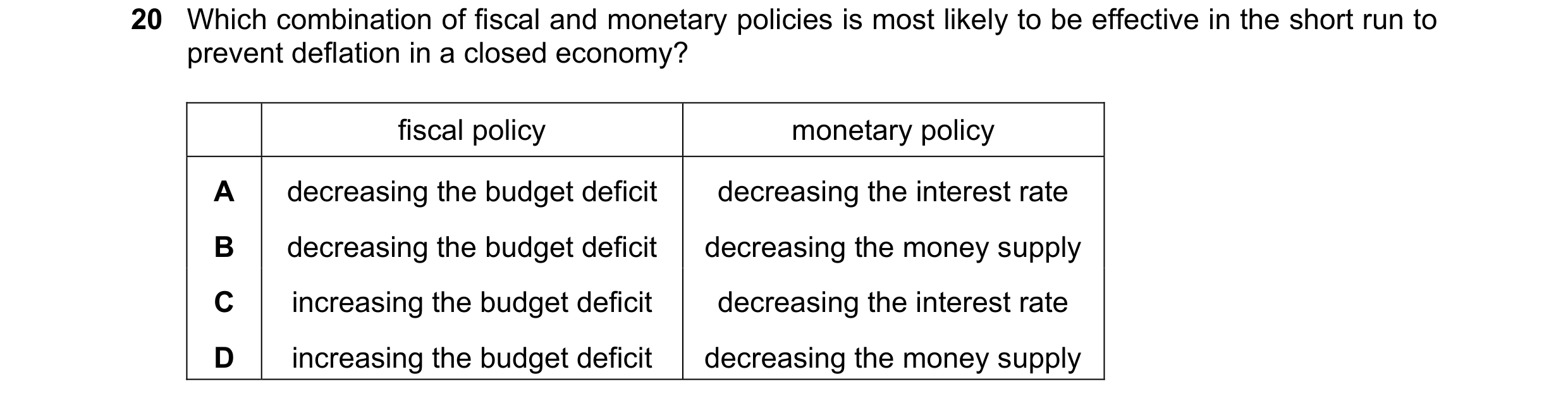
Q92 · Which combination of fiscal and monetary policies is most likely to be effective in the… 9708/13 May/June 2024
20 Which combination of fiscal and monetary policies is most likely to be effective in the short run to prevent deflation in a closed economy? fiscal policy monetary policy A decreasing the budget deficit decreasing the interest rate B decreasing the budget deficit decreasing the money supply C increasing the budget deficit decreasing the interest rate D increasing the budget deficit decreasing the money supply
1 marks
Answer: C
This question in 9708/13 May/June 2024
Q93 · What is not a supply-side policy? 9708/13 May/June 2024
22 What is not a supply-side policy? A increasing government expenditure on infrastructure B increasing research and development expenditure C increasing subsidies for education and training D increasing the supply of money
1 marks
Answer: D
This question in 9708/13 May/June 2024
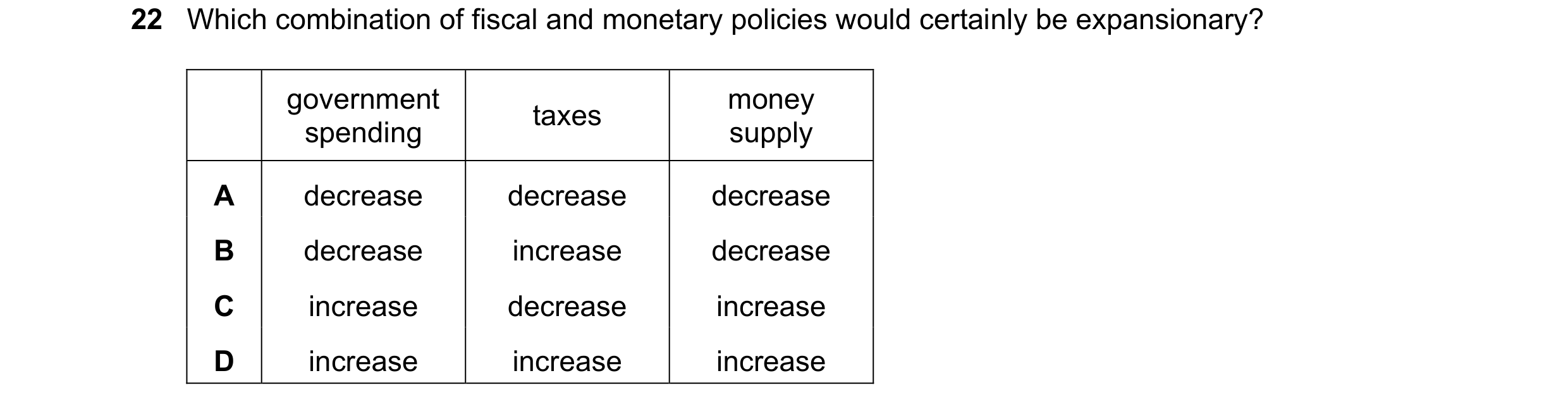
Q94 · Which combination of fiscal and monetary policies would certainly be expansionary? 9708/11 Oct/Nov 2024
22 Which combination of fiscal and monetary policies would certainly be expansionary? government money taxes spending supply A decrease decrease decrease B decrease increase decrease C increase decrease increase D increase increase increase
1 marks
Answer: C
This question in 9708/11 Oct/Nov 2024
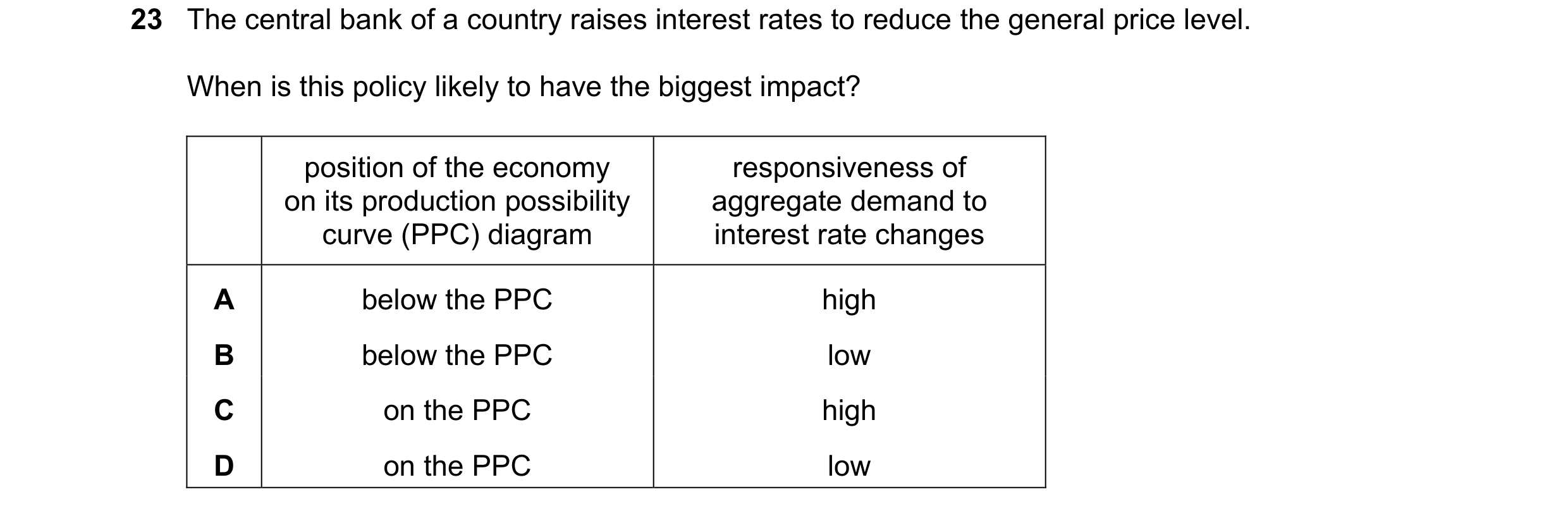
Q95 · The central bank of a country raises interest rates to reduce the general price level 9708/11 Oct/Nov 2024
23 The central bank of a country raises interest rates to reduce the general price level. When is this policy likely to have the biggest impact? position of the economy responsiveness of on its production possibility aggregate demand to curve (PPC) diagram interest rate changes A below the PPC high B below the PPC low C on the PPC high D on the PPC low
1 marks
Answer: C
This question in 9708/11 Oct/Nov 2024
Q96 · If interest rates are reduced, what is most likely to decrease? 9708/13 Oct/Nov 2024
20 If interest rates are reduced, what is most likely to decrease? A borrowing by firms B consumer spending C import prices D export prices
1 marks
Answer: D
This question in 9708/13 Oct/Nov 2024
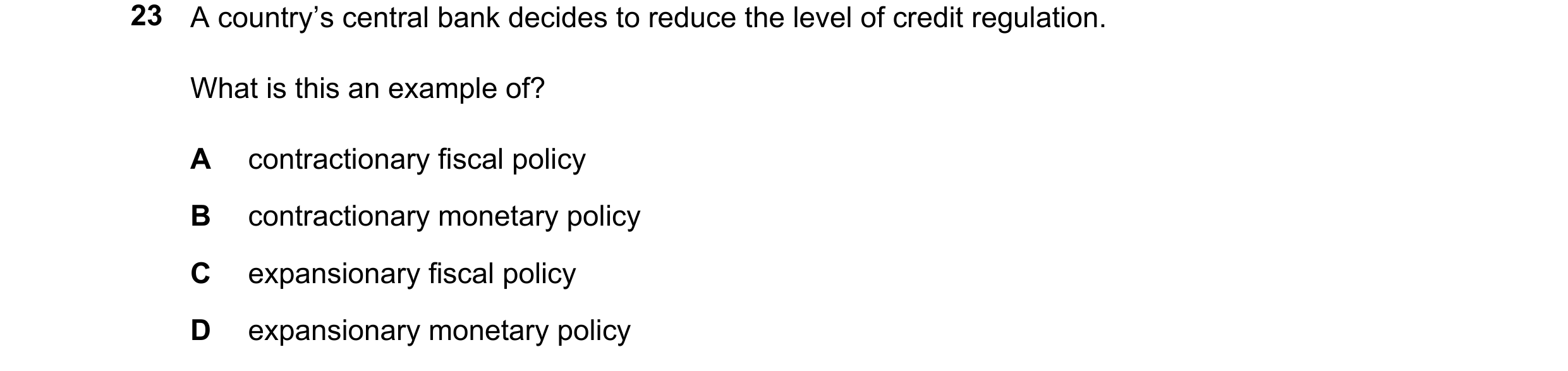
Q97 · A country’s central bank decides to reduce the level of credit regulation 9708/12 Feb/March 2025
23 A country’s central bank decides to reduce the level of credit regulation. What is this an example of? A contractionary fiscal policy B contractionary monetary policy C expansionary fiscal policy D expansionary monetary policy
1 marks
Answer: D
This question in 9708/12 Feb/March 2025
Q98 · What is not an example of monetary policy? 9708/11 May/June 2025
21 What is not an example of monetary policy? A a rise in import tariffs on manufactured goods B a rise in interest rates by the central bank C a rise in credit regulations D a rise in the money supply
1 marks
Answer: A
This question in 9708/11 May/June 2025
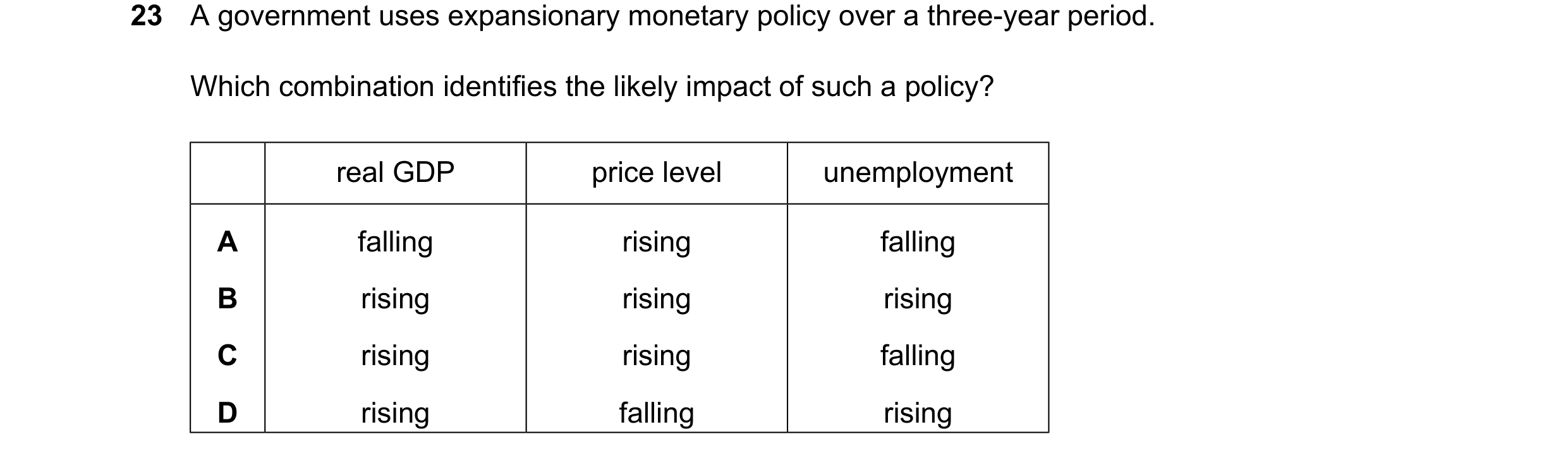
Q99 · A government uses expansionary monetary policy over a three-year period 9708/11 May/June 2025
23 A government uses expansionary monetary policy over a three-year period. Which combination identifies the likely impact of such a policy? real GDP price level unemployment A falling rising falling B rising rising rising C rising rising falling D rising falling rising
1 marks
Answer: C
This question in 9708/11 May/June 2025
Q100 · What is likely to be an expansionary monetary policy? 9708/12 May/June 2025
21 What is likely to be an expansionary monetary policy? A a decrease in the availability of credit B a decrease in the exchange rate C an increase in government spending D an increase in subsidies for training
1 marks
Answer: B
This question in 9708/12 May/June 2025
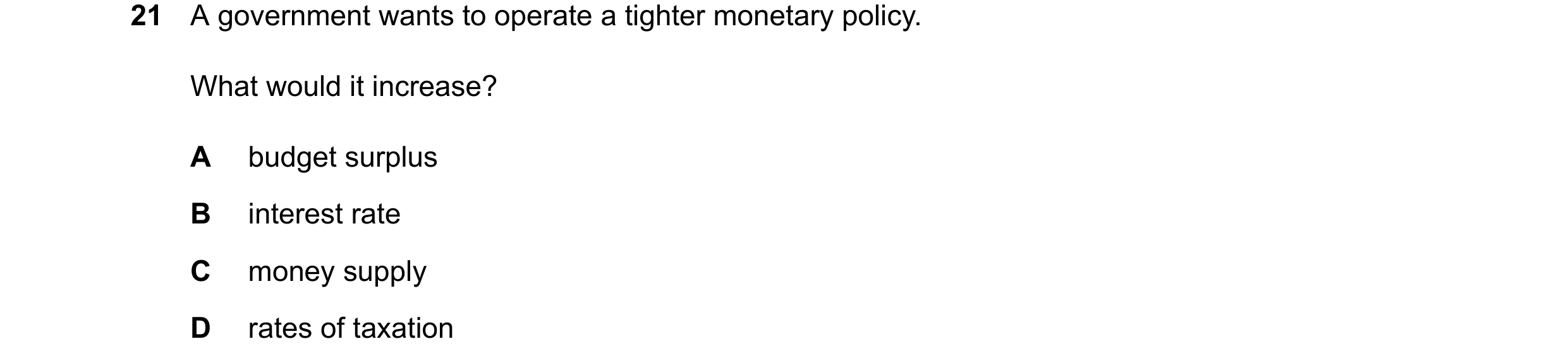
Q101 · A government wants to operate a tighter monetary policy 9708/13 May/June 2025
21 A government wants to operate a tighter monetary policy. What would it increase? A budget surplus B interest rate C money supply D rates of taxation
1 marks
Answer: B
This question in 9708/13 May/June 2025
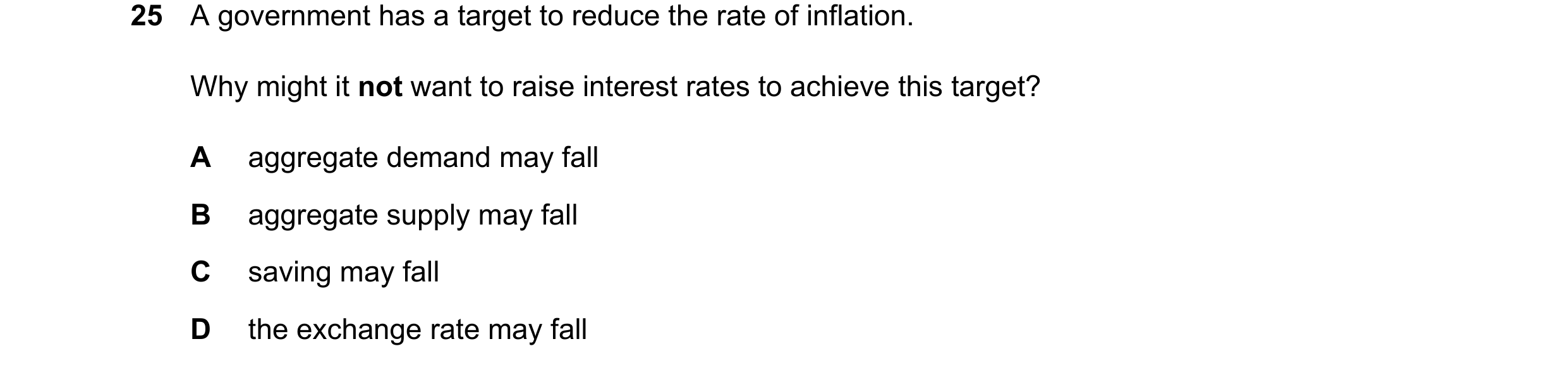
Q102 · A government has a target to reduce the rate of inflation 9708/13 May/June 2025
25 A government has a target to reduce the rate of inflation. Why might it not want to raise interest rates to achieve this target? A aggregate demand may fall B aggregate supply may fall C saving may fall D the exchange rate may fall
1 marks
Answer: B
This question in 9708/13 May/June 2025
Q103 · A central bank increases interest rates to reduce inflation 9708/11 Oct/Nov 2025
23 A central bank increases interest rates to reduce inflation. When will this policy be most likely to succeed? A When household spending is inelastic in response to interest rate changes. B When the country has a floating exchange rate that appreciates. C When the government has an increasing budget deficit. D When trade unions demand higher wages to protect the living standards of their members.
1 marks
Answer: B
This question in 9708/11 Oct/Nov 2025
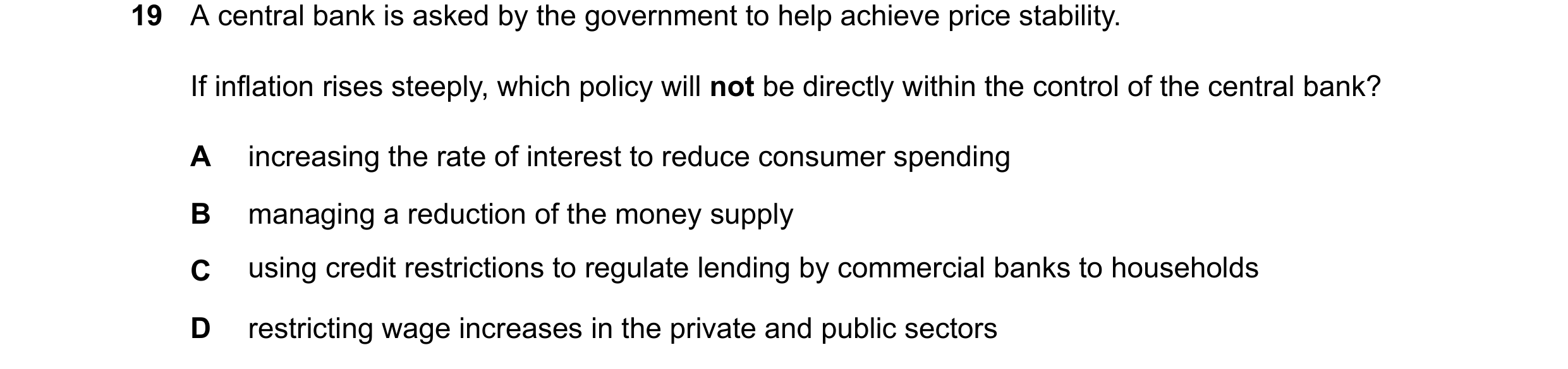
Q104 · A central bank is asked by the government to help achieve price stability 9708/12 Oct/Nov 2025
19 A central bank is asked by the government to help achieve price stability. If inflation rises steeply, which policy will not be directly within the control of the central bank? A increasing the rate of interest to reduce consumer spending B managing a reduction of the money supply C using credit restrictions to regulate lending by commercial banks to households D restricting wage increases in the private and public sectors
1 marks
Answer: D
This question in 9708/12 Oct/Nov 2025
Q105 · What is an example of expansionary monetary policy? 9708/12 Oct/Nov 2025
21 What is an example of expansionary monetary policy? A the central bank increasing the money supply B the central bank causing an appreciation of the country’s foreign exchange rate C the central bank increasing controls on credit lending D the central bank increasing the minimum lending rate of interest
1 marks
Answer: A
This question in 9708/12 Oct/Nov 2025
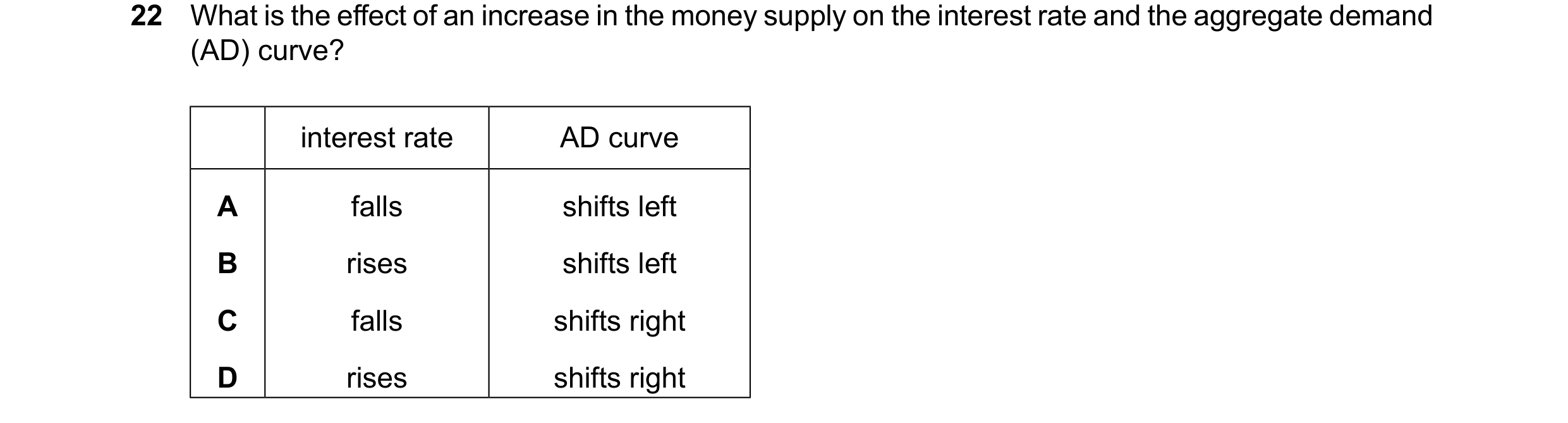
Q106 · What is the effect of an increase in the money supply on the interest rate and the… 9708/12 Oct/Nov 2025
22 What is the effect of an increase in the money supply on the interest rate and the aggregate demand (AD) curve? interest rate AD curve A falls shifts left B rises shifts left C falls shifts right D rises shifts right
1 marks
Answer: C
This question in 9708/12 Oct/Nov 2025
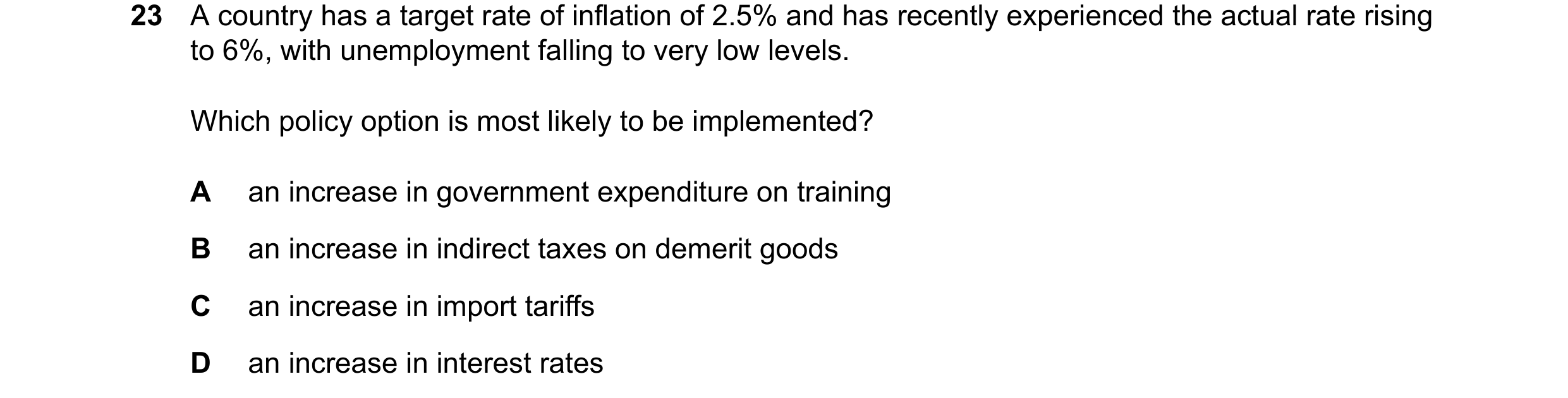
Q107 · A country has a target rate of inflation of 2.5% and has recently experienced the actual… 9708/12 Oct/Nov 2025
23 A country has a target rate of inflation of 2.5% and has recently experienced the actual rate rising to 6%, with unemployment falling to very low levels. Which policy option is most likely to be implemented? A an increase in government expenditure on training B an increase in indirect taxes on demerit goods C an increase in import tariffs D an increase in interest rates
1 marks
Answer: D
This question in 9708/12 Oct/Nov 2025
 1 / 27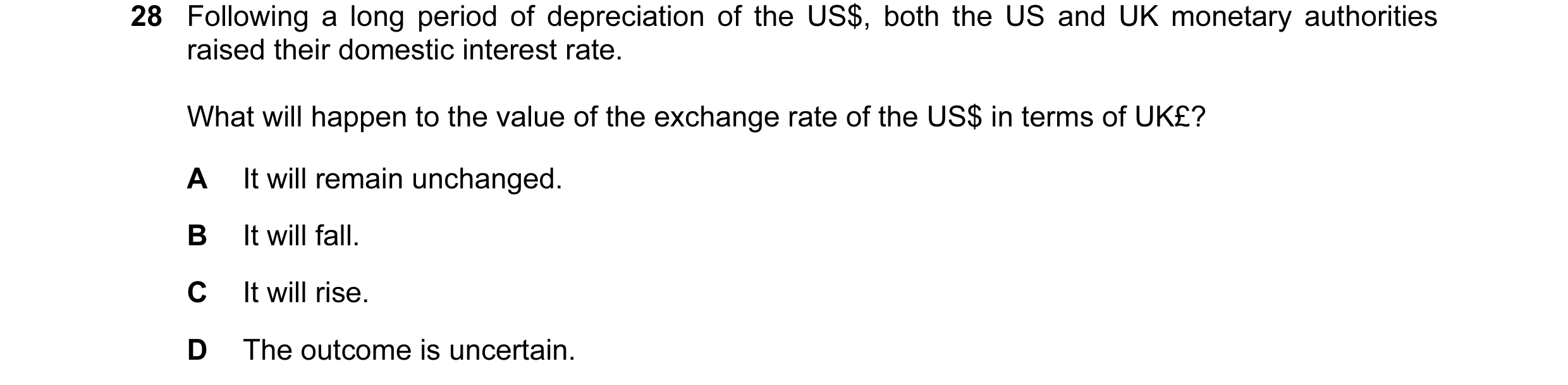
 2 / 27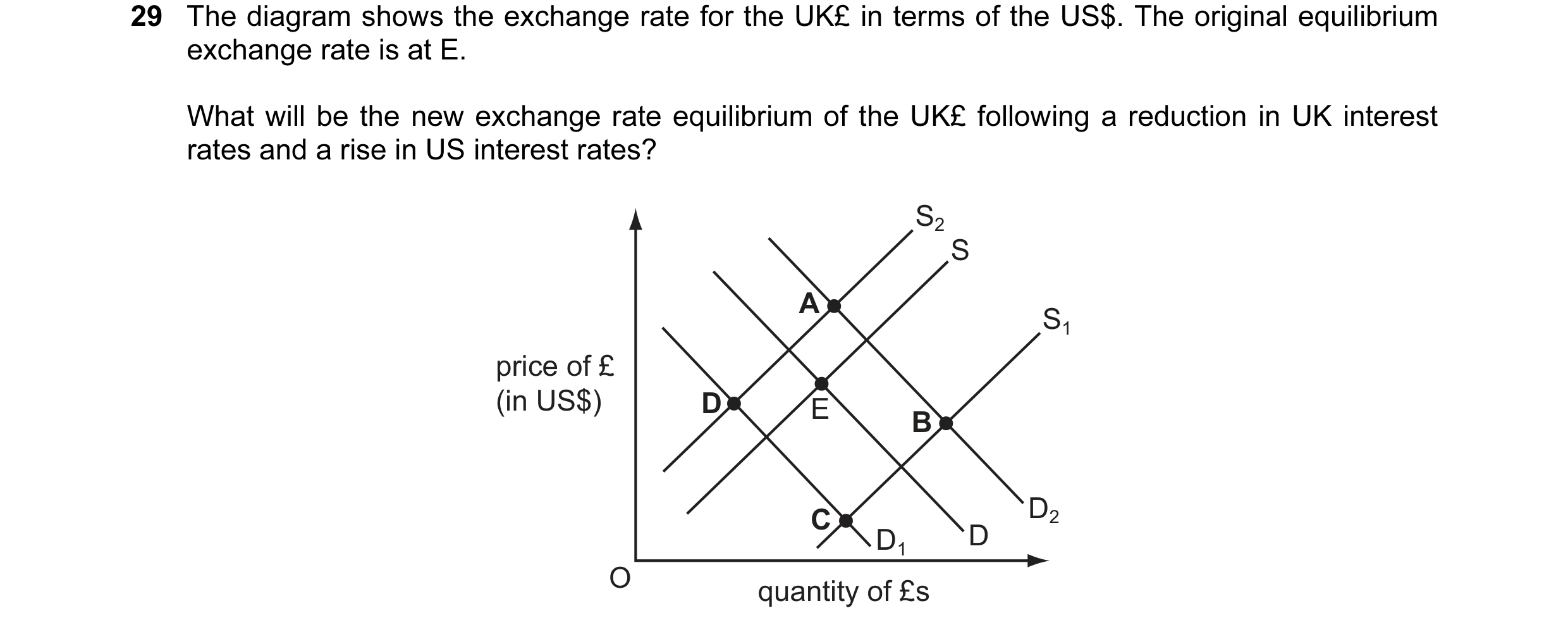
 3 / 27
 4 / 27
 5 / 27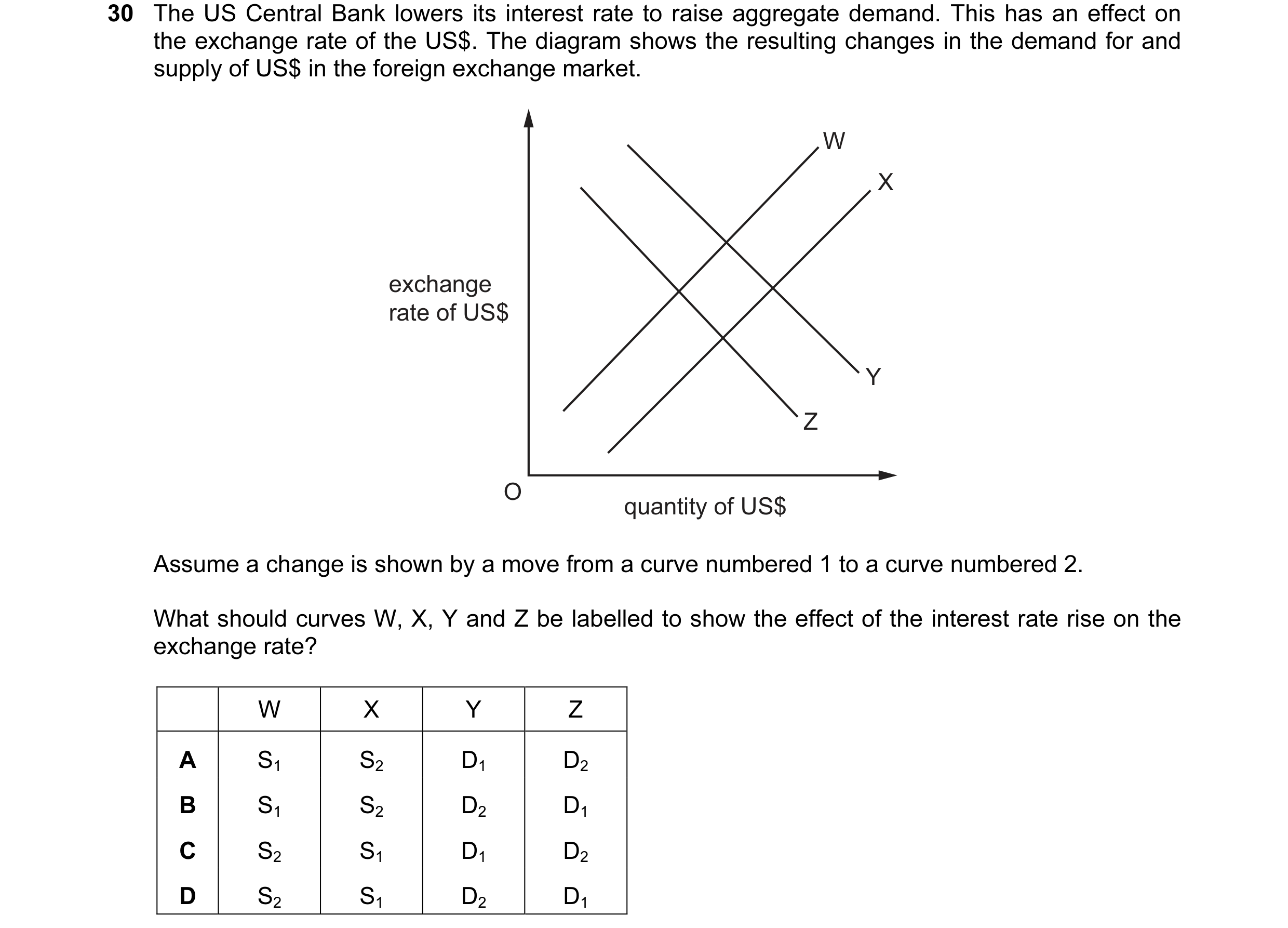
 6 / 27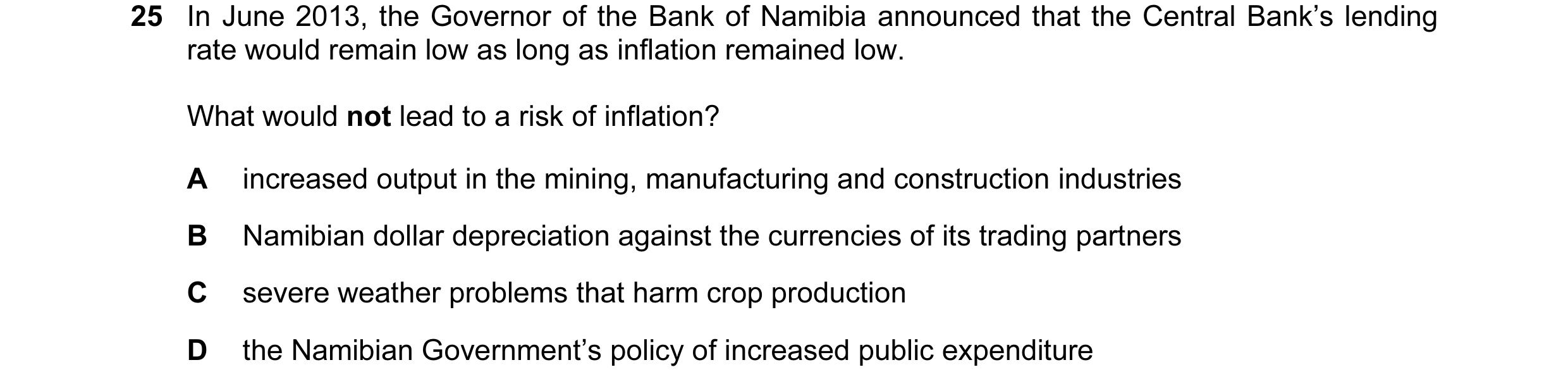

 7 / 27

 8 / 27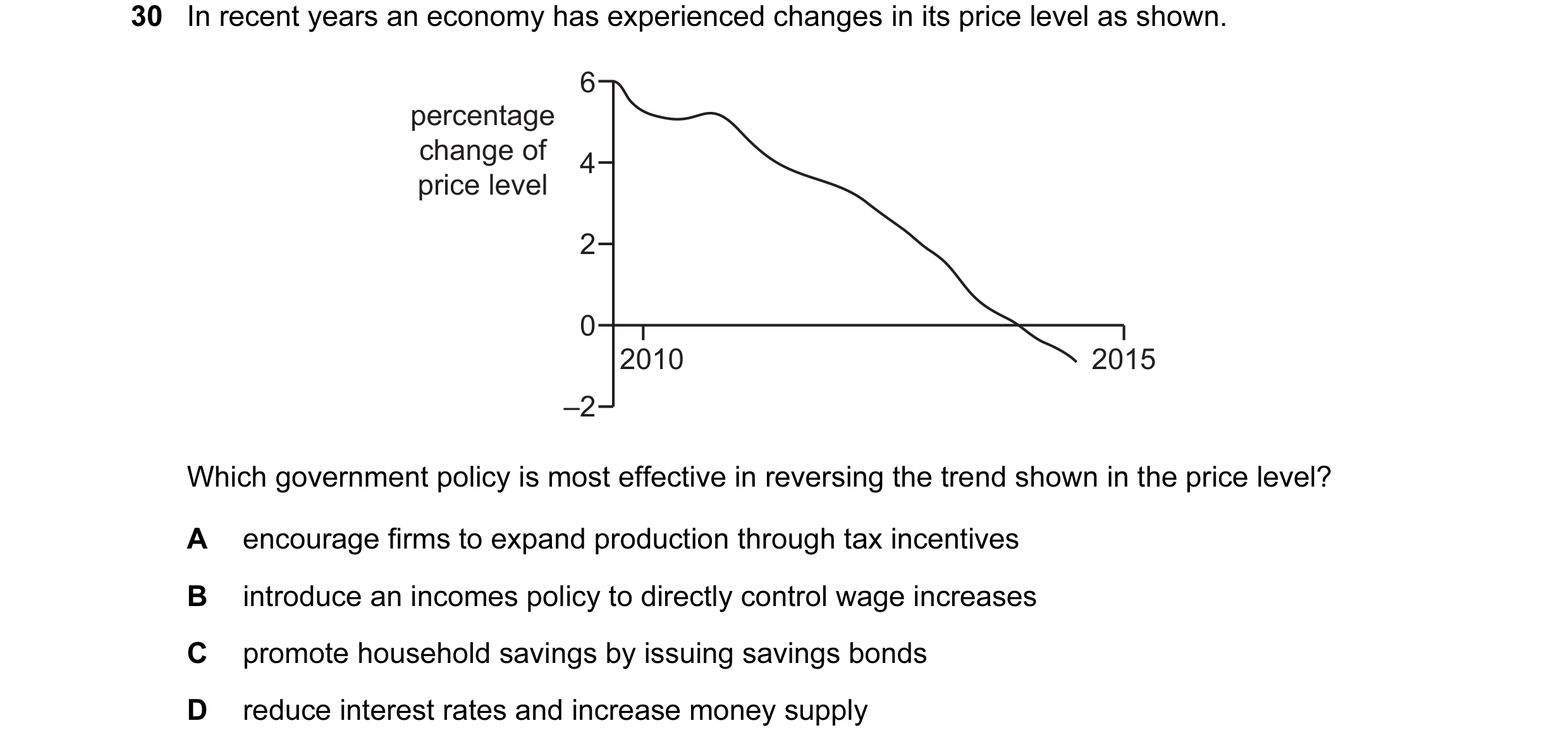
 9 / 27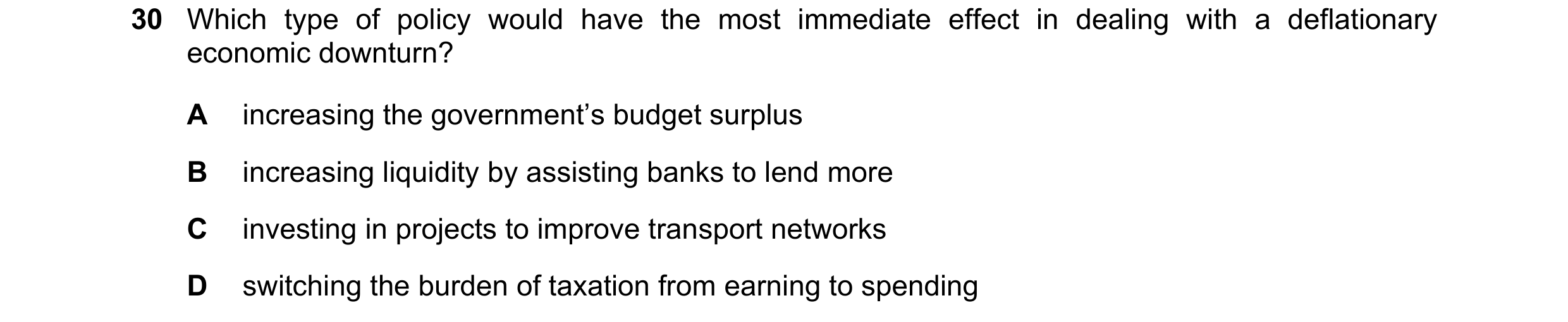

 10 / 27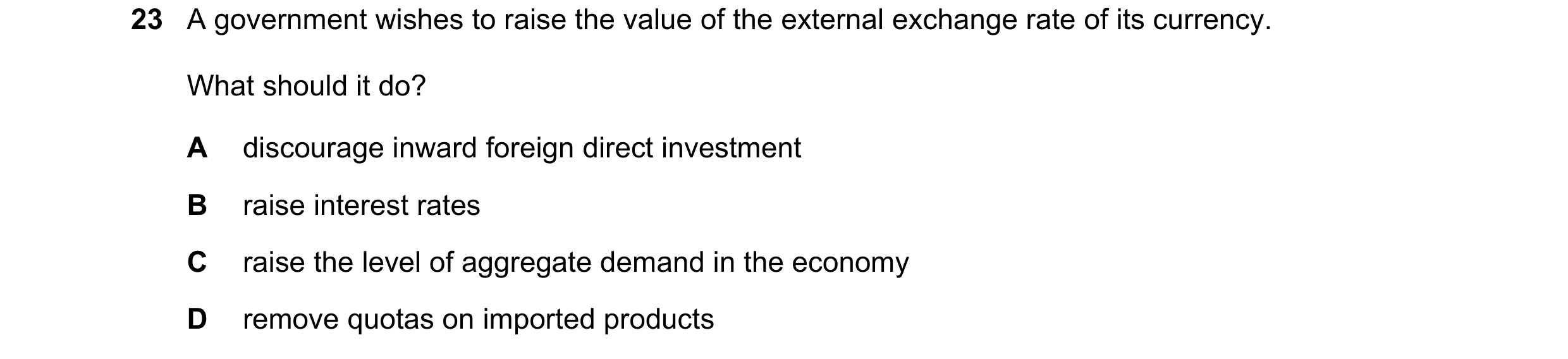
 11 / 27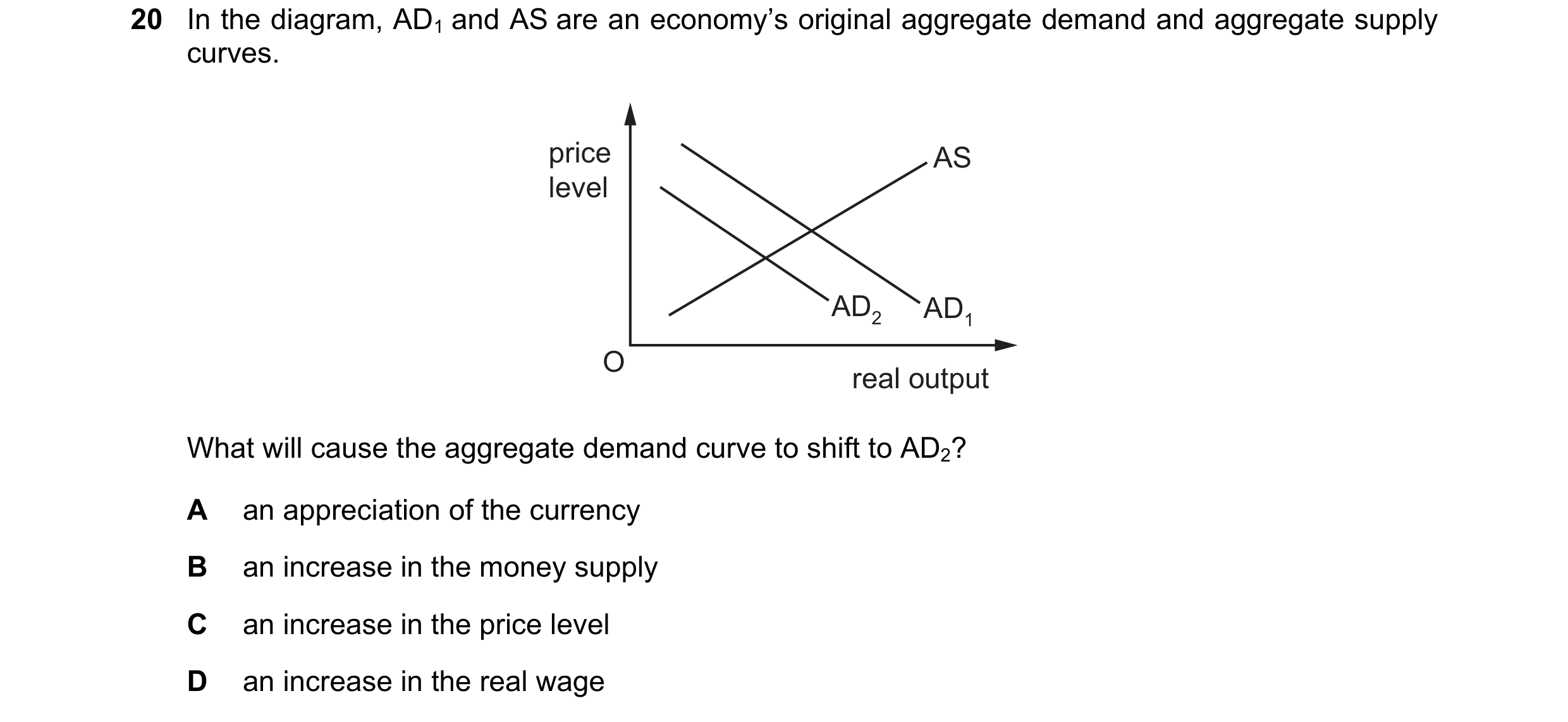

 12 / 27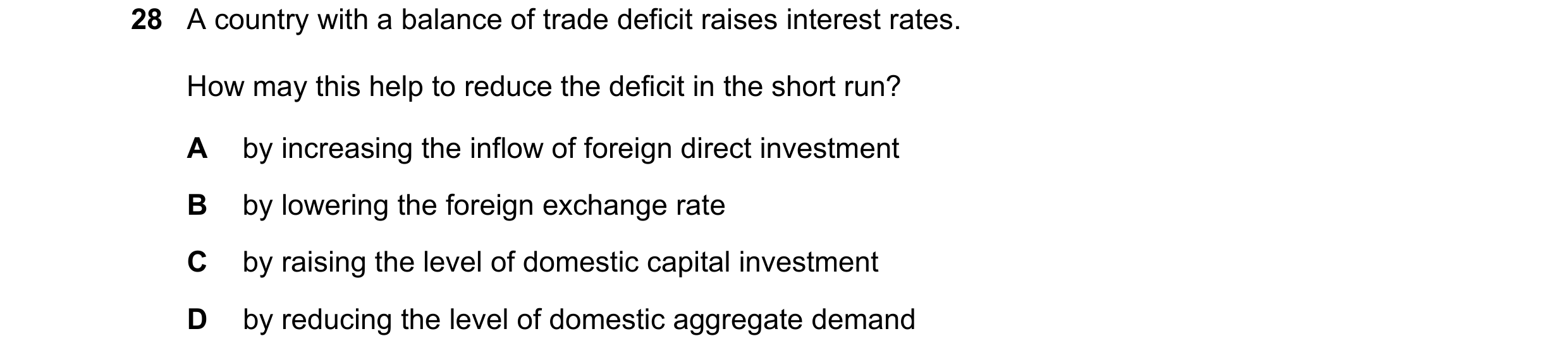
 13 / 27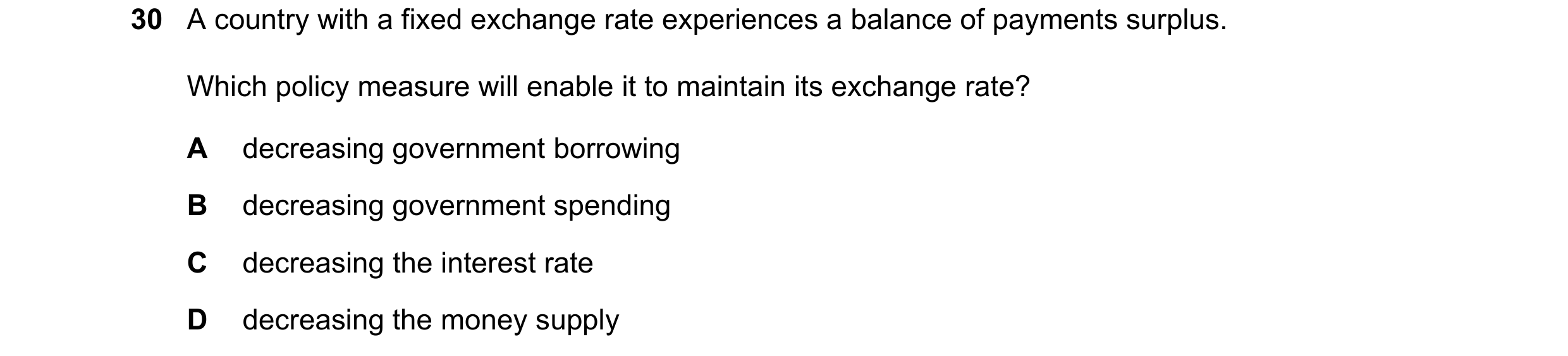
 14 / 27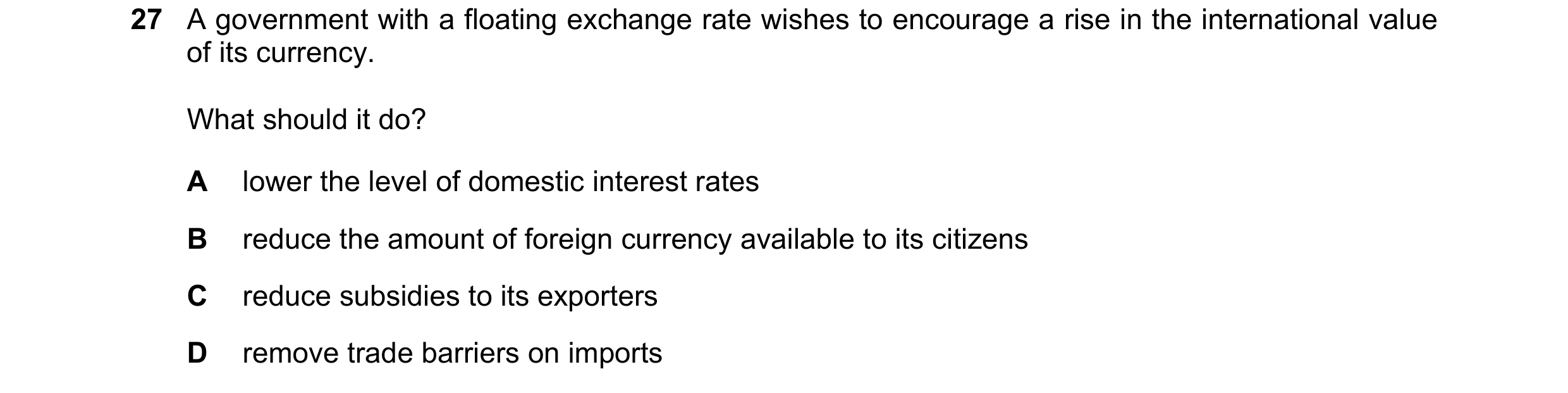
 15 / 27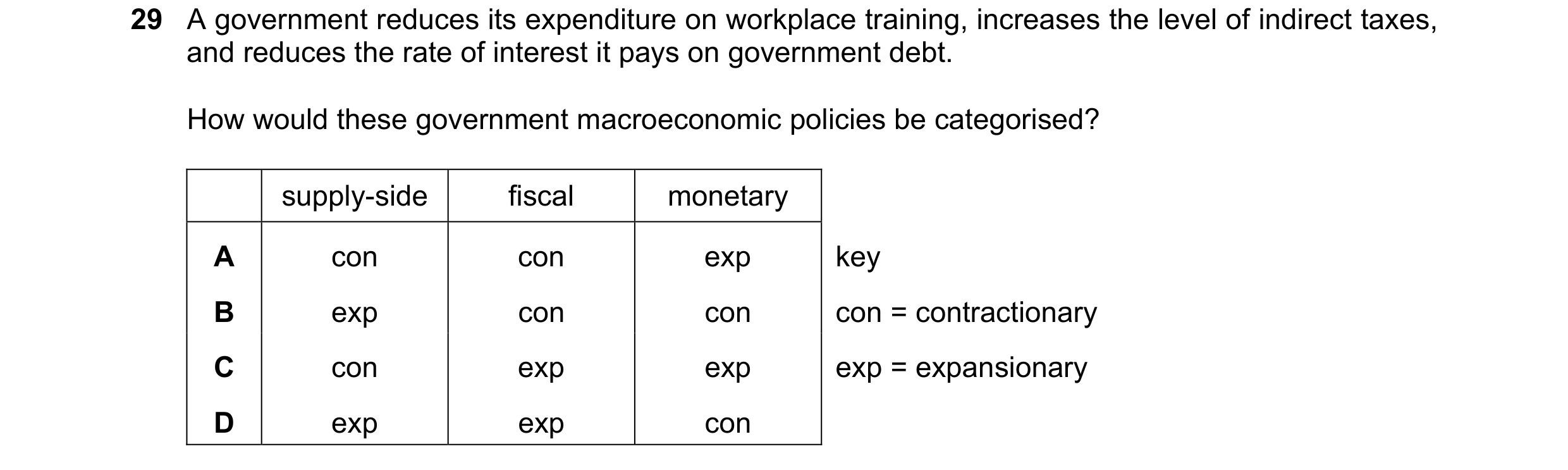
 16 / 27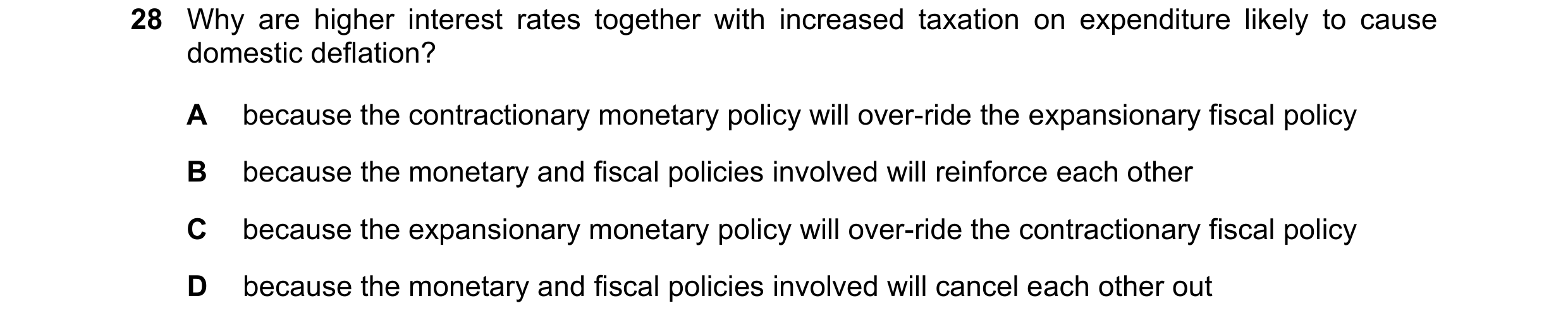

 17 / 27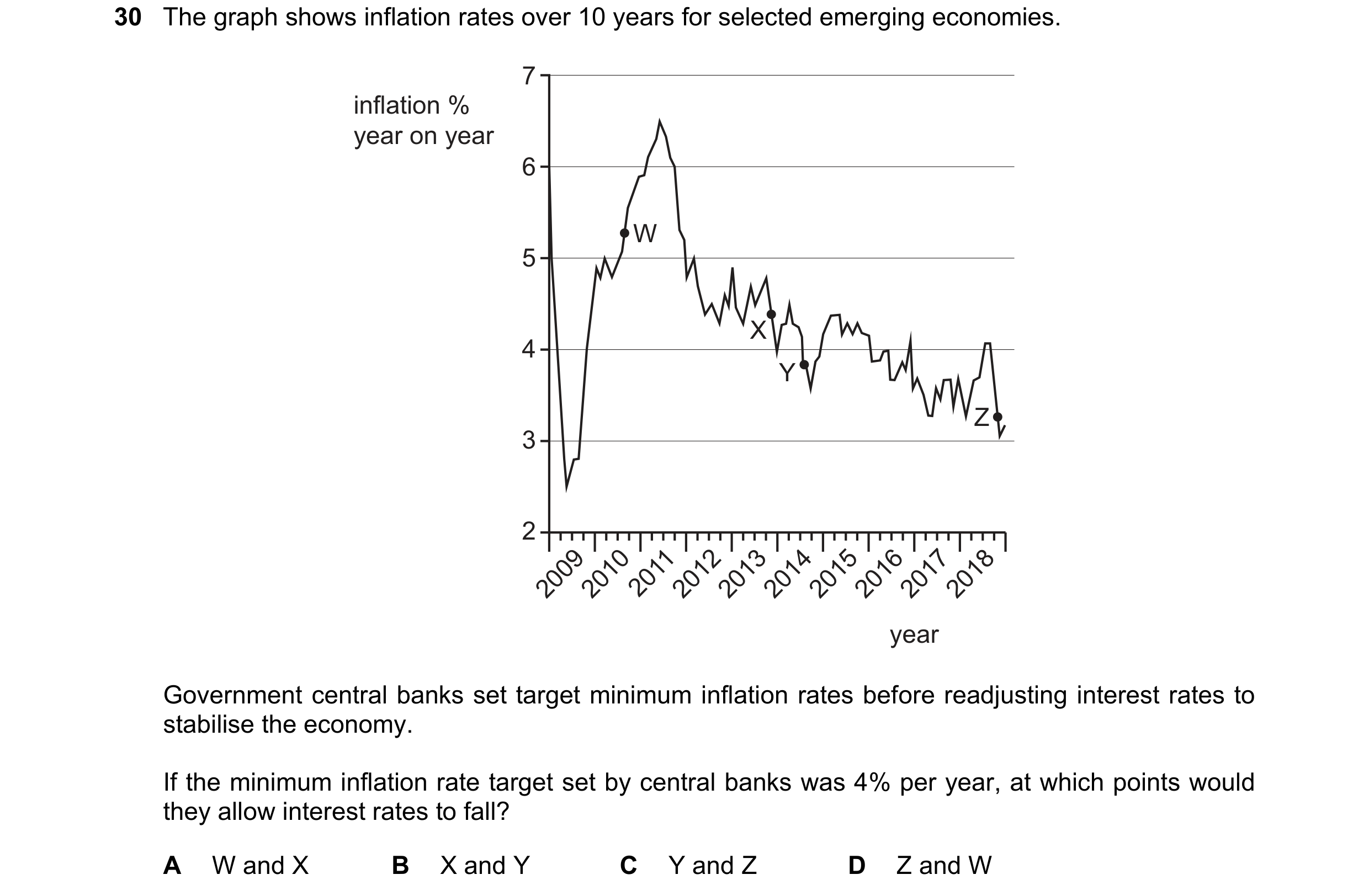

 18 / 27



 19 / 27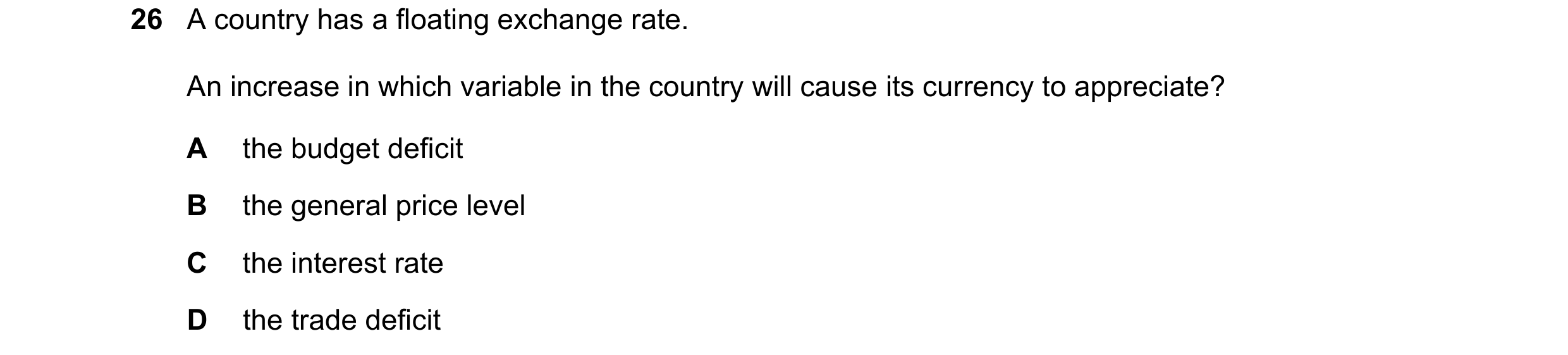
 20 / 27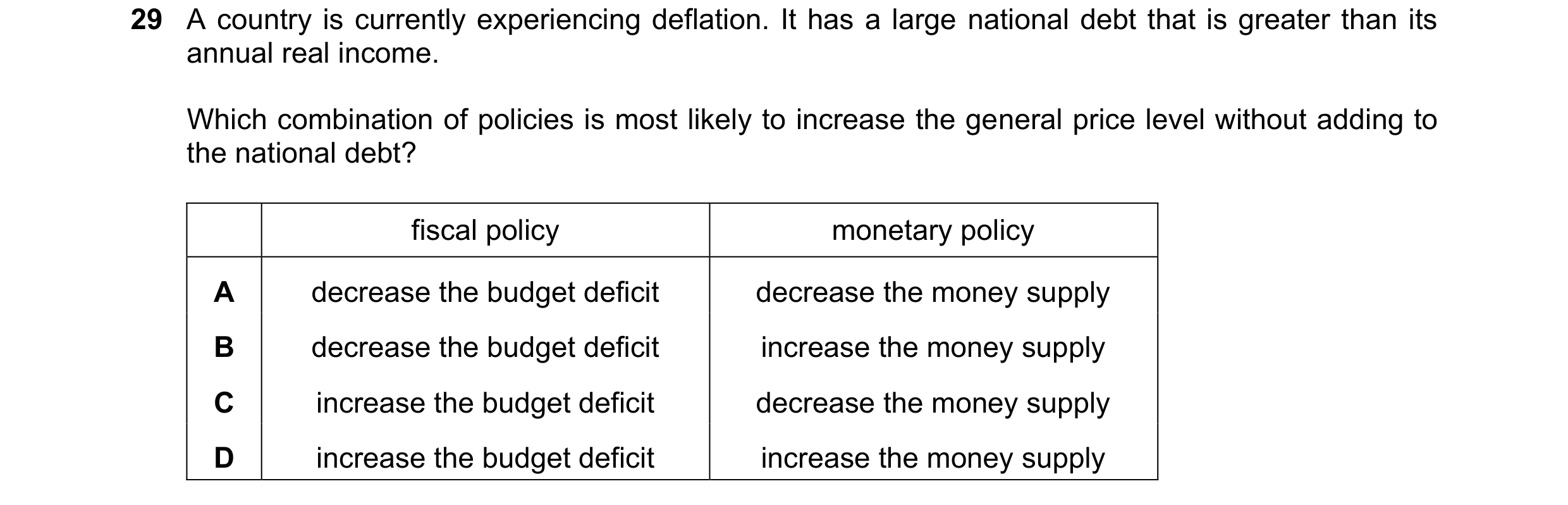
 21 / 27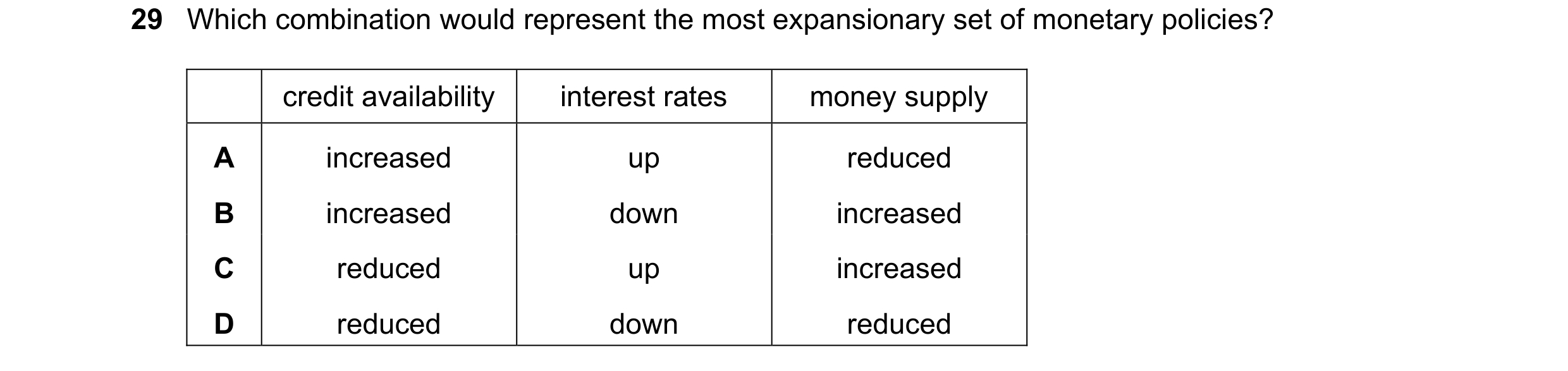
 22 / 27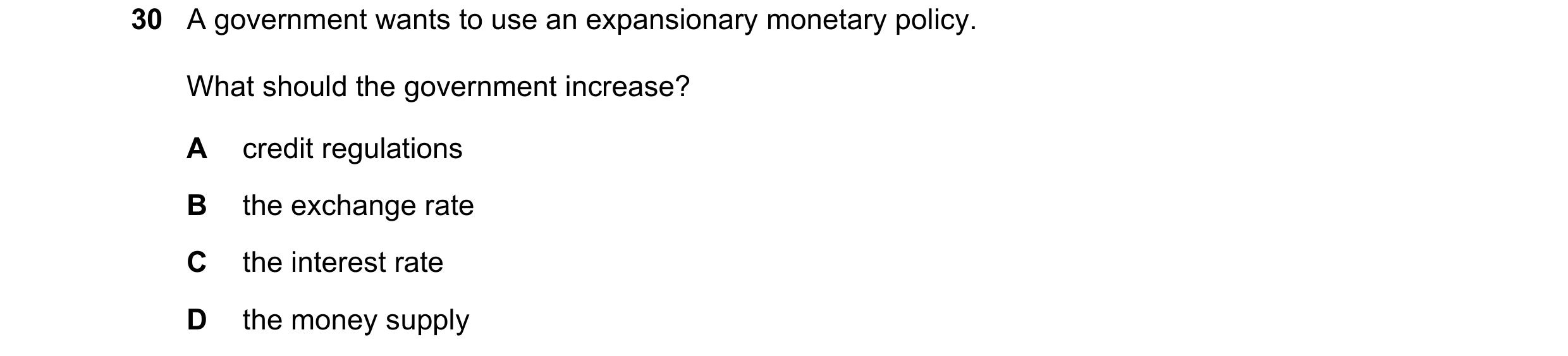
 23 / 27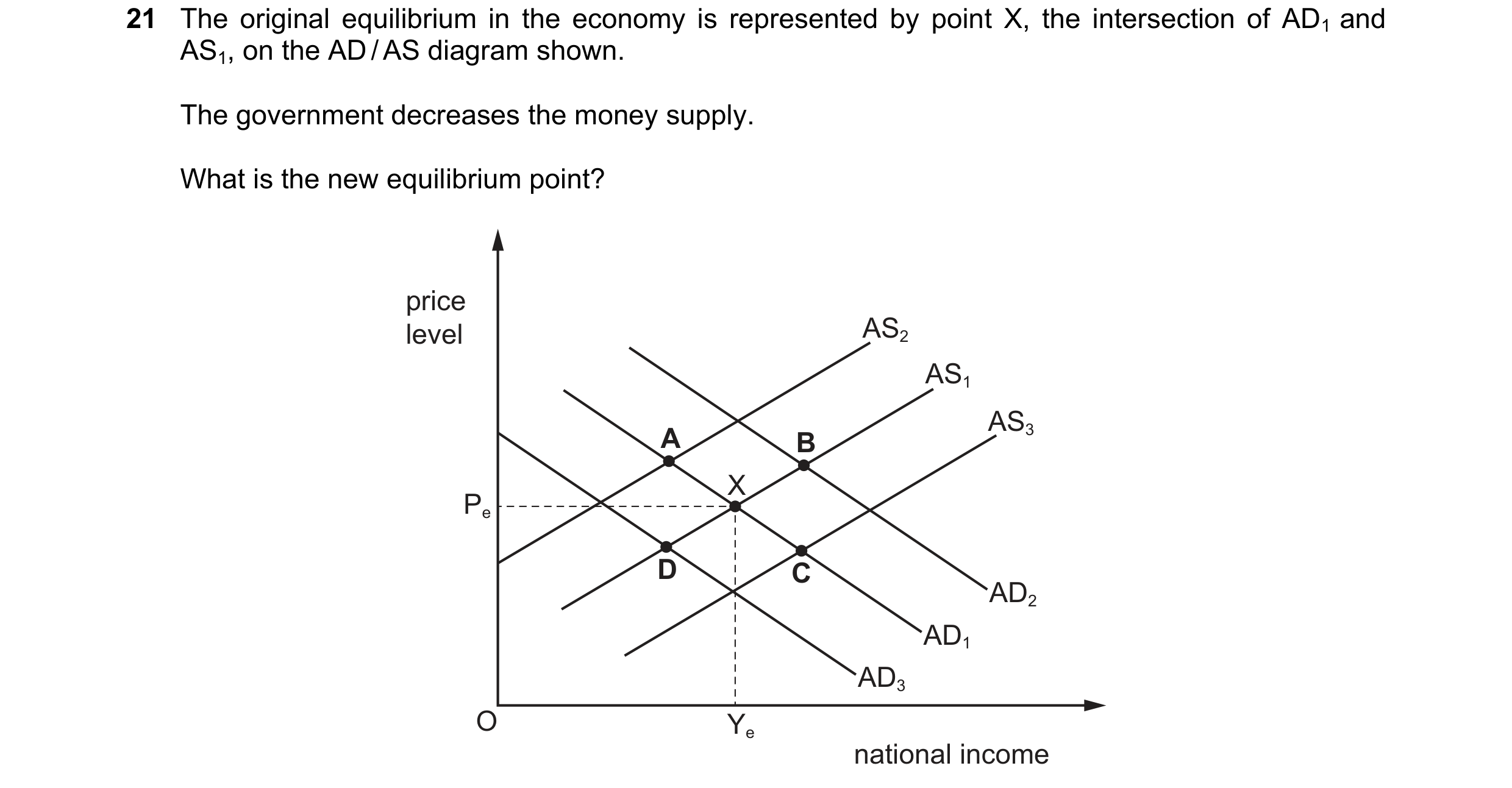


 24 / 27

 25 / 27

 26 / 27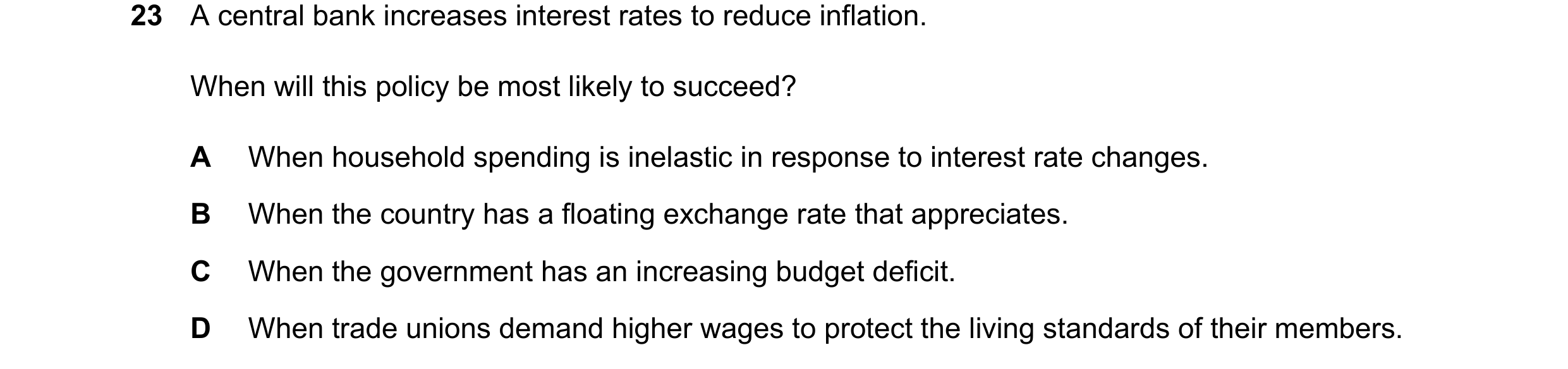

 27 / 27