Questions as text
Q1 · An economy has unemployed resources and a flexible exchange rate 9708/31 Oct/Nov 2009
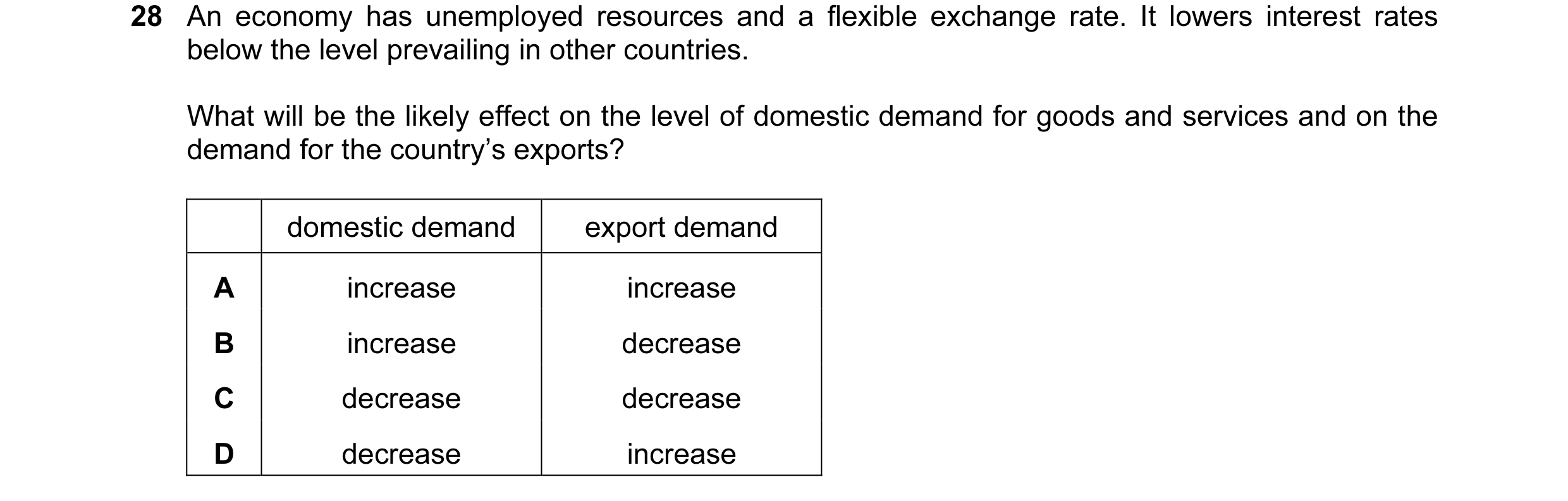
28 An economy has unemployed resources and a flexible exchange rate. It lowers interest rates below the level prevailing in other countries. What will be the likely effect on the level of domestic demand for goods and services and on the demand for the country’s exports? domestic demand export demand A increase increase B increase decrease C decrease decrease D decrease increase
1 marks
Answer: A
This question in 9708/31 Oct/Nov 2009
Q2 · A government decides to pursue a more deflationary fiscal policy and a more reflationary… 9708/31 Oct/Nov 2009
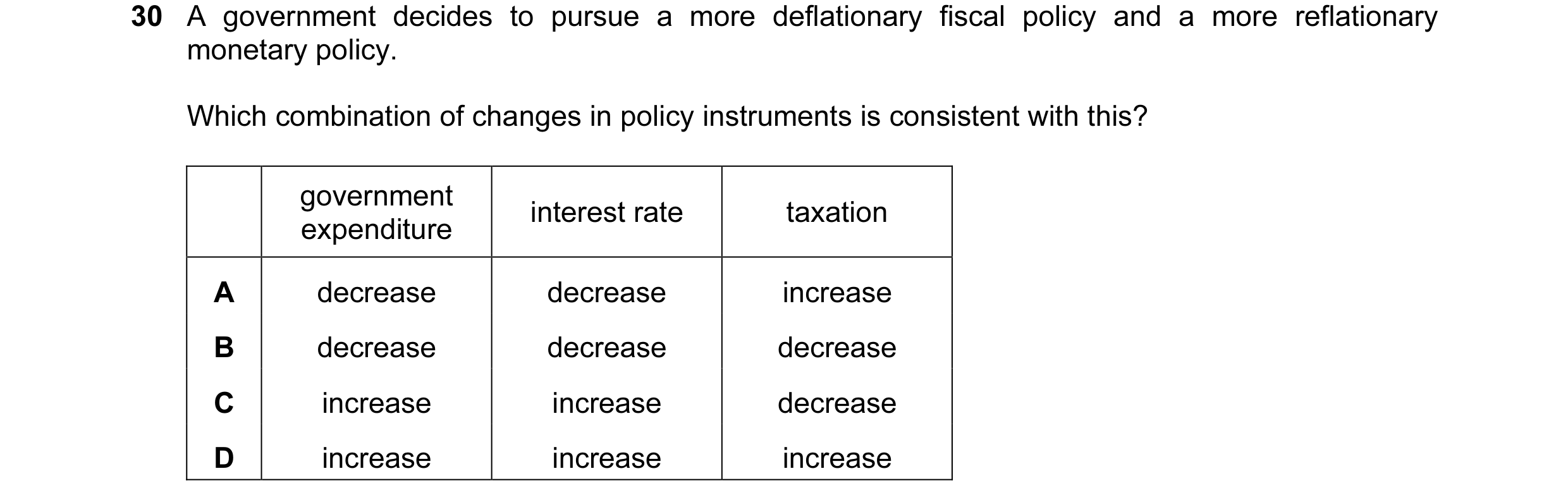
30 A government decides to pursue a more deflationary fiscal policy and a more reflationary monetary policy. Which combination of changes in policy instruments is consistent with this? government interest rate taxation expenditure A decrease decrease increase B decrease decrease decrease C increase increase decrease D increase increase increase
1 marks
Answer: A
This question in 9708/31 Oct/Nov 2009
Q3 · A government decides to pursue a more deflationary fiscal policy and a more reflationary… 9708/32 Oct/Nov 2009
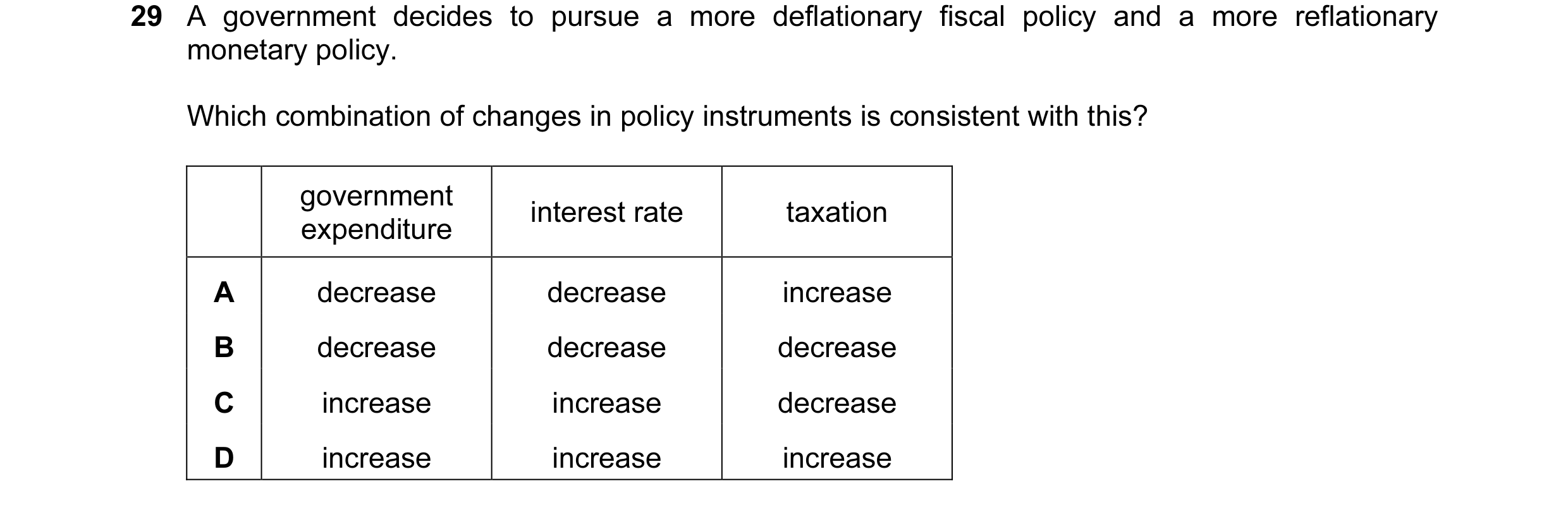
29 A government decides to pursue a more deflationary fiscal policy and a more reflationary monetary policy. Which combination of changes in policy instruments is consistent with this? government interest rate taxation expenditure A decrease decrease increase B decrease decrease decrease C increase increase decrease D increase increase increase
1 marks
Answer: A
This question in 9708/32 Oct/Nov 2009
Q4 · What is a central assertion of monetarist economics? 9708/32 May/June 2010
16 What is a central assertion of monetarist economics? A Fiscal policy should be used for the continuous management of the economy. B Major recessions can occur despite an unchanged money supply. C The money supply is the main determinant of aggregate monetary expenditure. D The velocity of circulation of money is unstable over time.
1 marks
Answer: C
This question in 9708/32 May/June 2010
Q5 · What is a central assertion of monetarist economics? 9708/33 May/June 2010
16 What is a central assertion of monetarist economics? A Fiscal policy should be used for the continuous management of the economy. B Major recessions can occur despite an unchanged money supply. C The money supply is the main determinant of aggregate monetary expenditure. D The velocity of circulation of money is unstable over time.
1 marks
Answer: C
This question in 9708/33 May/June 2010
Q6 · A country decides to join a group of countries which maintain fixed parities for their… 9708/31 May/June 2011
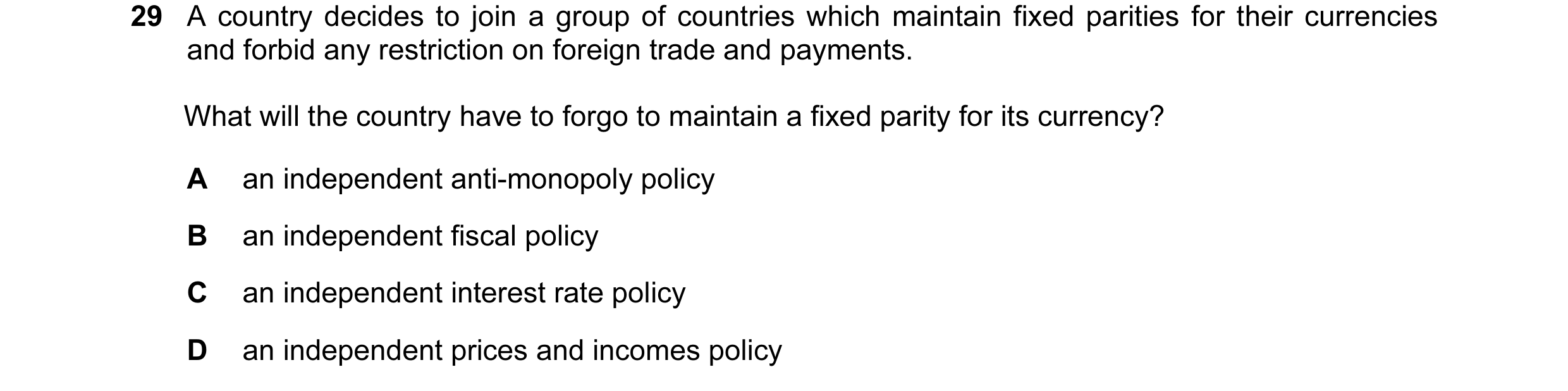
29 A country decides to join a group of countries which maintain fixed parities for their currencies and forbid any restriction on foreign trade and payments. What will the country have to forgo to maintain a fixed parity for its currency? A an independent anti-monopoly policy B an independent fiscal policy C an independent interest rate policy D an independent prices and incomes policy
1 marks
Answer: C
This question in 9708/31 May/June 2011
Q7 · The diagram shows an economy’s aggregate demand and aggregate supply curves 9708/32 Oct/Nov 2011
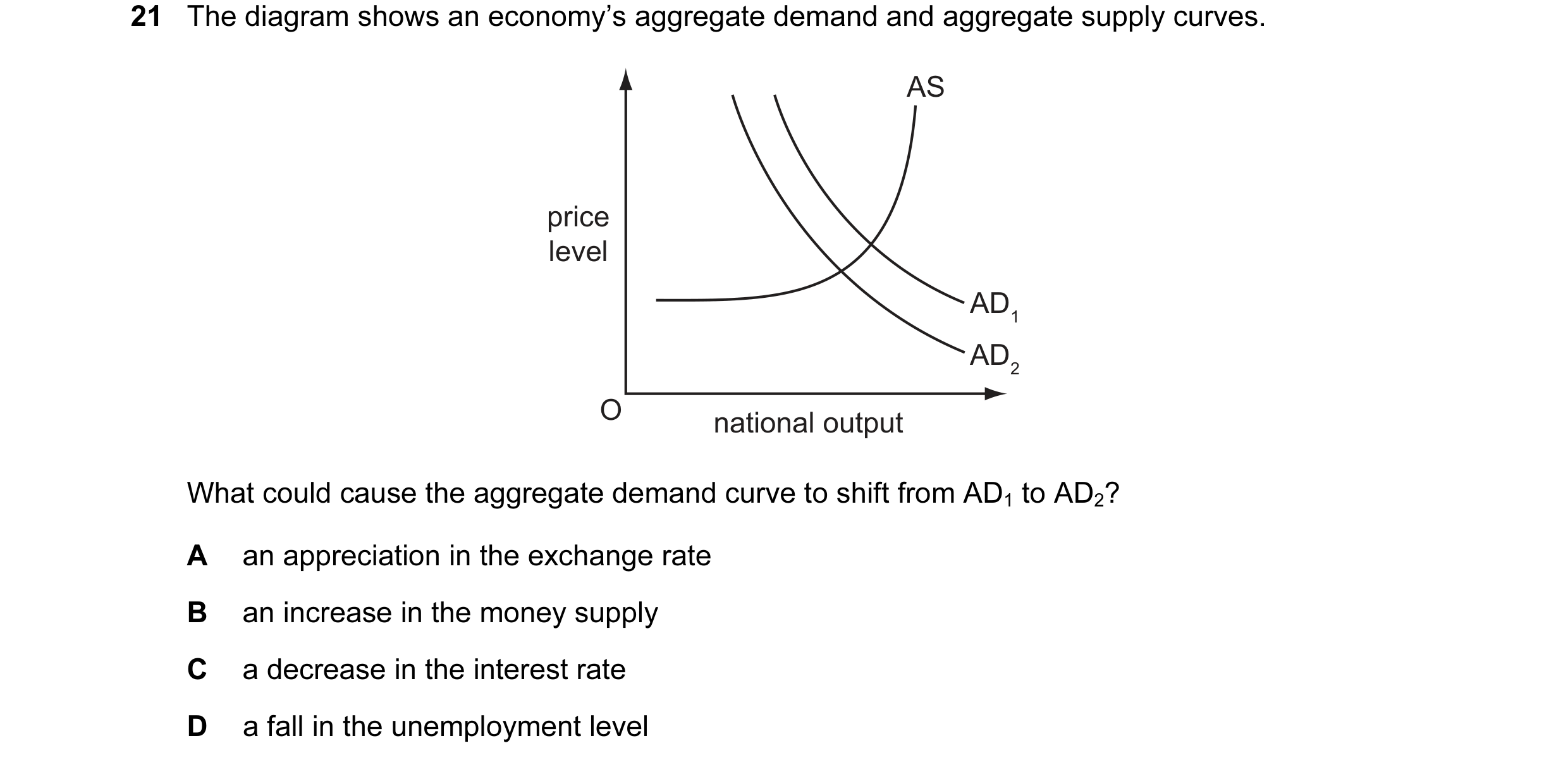
21 The diagram shows an economy’s aggregate demand and aggregate supply curves. AS price level AD1 AD2 O national output What could cause the aggregate demand curve to shift from AD1 to AD2? A an appreciation in the exchange rate B an increase in the money supply C a decrease in the interest rate D a fall in the unemployment level
1 marks
Answer: A
This question in 9708/32 Oct/Nov 2011
Q8 · An economy has a flexible exchange rate 9708/32 Oct/Nov 2011
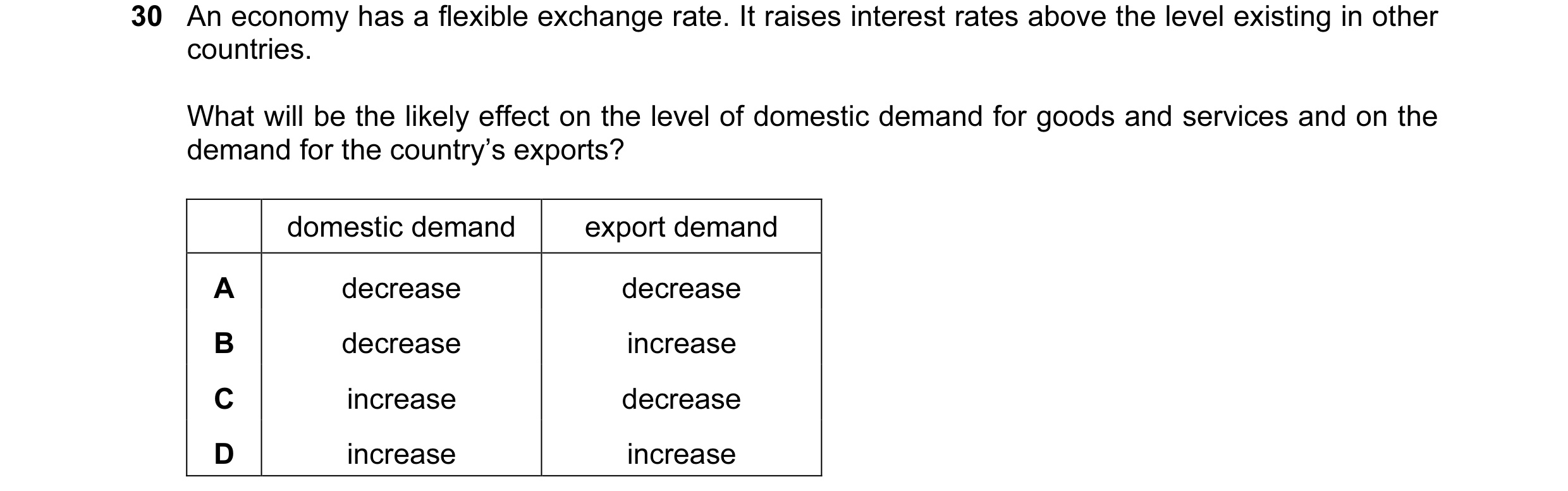
30 An economy has a flexible exchange rate. It raises interest rates above the level existing in other countries. What will be the likely effect on the level of domestic demand for goods and services and on the demand for the country’s exports? domestic demand export demand A decrease decrease B decrease increase C increase decrease D increase increase
1 marks
Answer: A
This question in 9708/32 Oct/Nov 2011
Q9 · When might the effectiveness of fiscal expansion in increasing the level of output be… 9708/33 Oct/Nov 2011
29 When might the effectiveness of fiscal expansion in increasing the level of output be increased? A when it is accompanied by an increase in the money supply B when it leads to an appreciation of the country’s exchange rate C when it results in a decrease in the price of government bonds D when the price level increases
1 marks
Answer: A
This question in 9708/33 Oct/Nov 2011
Q10 · Other things being equal, what is likely to result from a reduction in interest rates in… 9708/33 May/June 2012
28 Other things being equal, what is likely to result from a reduction in interest rates in a country? A an appreciation of the country’s currency B a decrease in consumption C a decrease in investment D an outflow of short-term capital
1 marks
Answer: D
This question in 9708/33 May/June 2012
Q11 · In 2009 the US central bank, the Federal Reserve, increased the money supply 9708/32 Oct/Nov 2012
20 In 2009 the US central bank, the Federal Reserve, increased the money supply. Which policy measure taken by the Federal Reserve would have achieved this outcome? A a purchase of government securities in the open market B a reduction in the issue of short-term government debt C a requirement for commercial banks to increase their liquidity ratios D an increase in the bank rate
1 marks
Answer: A
This question in 9708/32 Oct/Nov 2012
Q12 · During a recession a government’s expenditure exceeds its tax revenue 9708/33 Oct/Nov 2012
22 During a recession a government’s expenditure exceeds its tax revenue. Which policy might prevent upward pressure on interest rates? A privatisation of government owned enterprises B purchases of government bonds by the country’s central bank C sales of foreign currency from the official reserves D sales of government bonds to the general public
1 marks
This question in 9708/33 Oct/Nov 2012
Q13 · The diagram shows the determination of the rate of interest in an economy where MS… 9708/32 May/June 2013
22 The diagram shows the determination of the rate of interest in an economy where MS represents the money supply and LP represents liquidity preference. MS LP1 LP2 rate of interest r2 r1 O quantity of money The rate of interest rises as a result of a shift in the liquidity preference curve from LP1 to LP2. Which policy might be used to try to maintain the rate at r1? A increased government expenditure B increases in indirect taxes C reductions in income tax rates D the purchase of bonds in the open market
1 marks
Answer: D
This question in 9708/32 May/June 2013
Q14 · Other things being equal, what is likely to result from an increase in interest rates in… 9708/32 May/June 2013
27 Other things being equal, what is likely to result from an increase in interest rates in a country? A a capital outflow from the country B a depreciation of the country’s currency C a decrease in consumption D an increase in investment
1 marks
Answer: C
This question in 9708/32 May/June 2013
Q15 · What will result from a rise in interest rates? 9708/33 May/June 2013
19 What will result from a rise in interest rates? A a depreciation in the exchange rate B a fall in the price of bonds C an increase in capital spending D an increase in the demand for money
1 marks
Answer: B
This question in 9708/33 May/June 2013
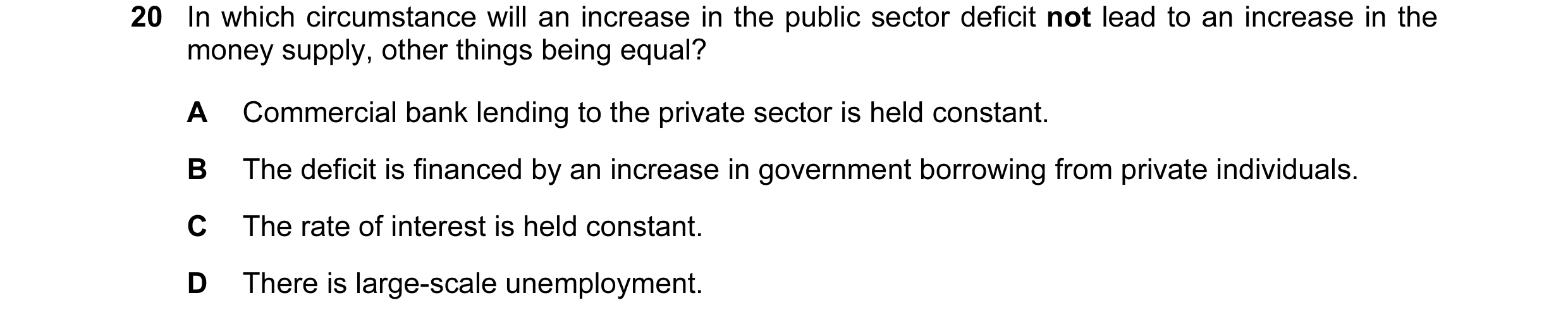
Q16 · In which circumstance will an increase in the public sector deficit not lead to an… 9708/33 May/June 2013
20 In which circumstance will an increase in the public sector deficit not lead to an increase in the money supply, other things being equal? A Commercial bank lending to the private sector is held constant. B The deficit is financed by an increase in government borrowing from private individuals. C The rate of interest is held constant. D There is large-scale unemployment.
1 marks
Answer: B
This question in 9708/33 May/June 2013
Q17 · A central bank purchases government securities as part of a policy of quantitative easing 9708/31 Oct/Nov 2014
18 A central bank purchases government securities as part of a policy of quantitative easing. What is likely to be the effect on interest rates and the supply of money? interest rates money supply A decrease decrease B decrease increase C increase decrease D increase increase
1 marks
Answer: B
This question in 9708/31 Oct/Nov 2014
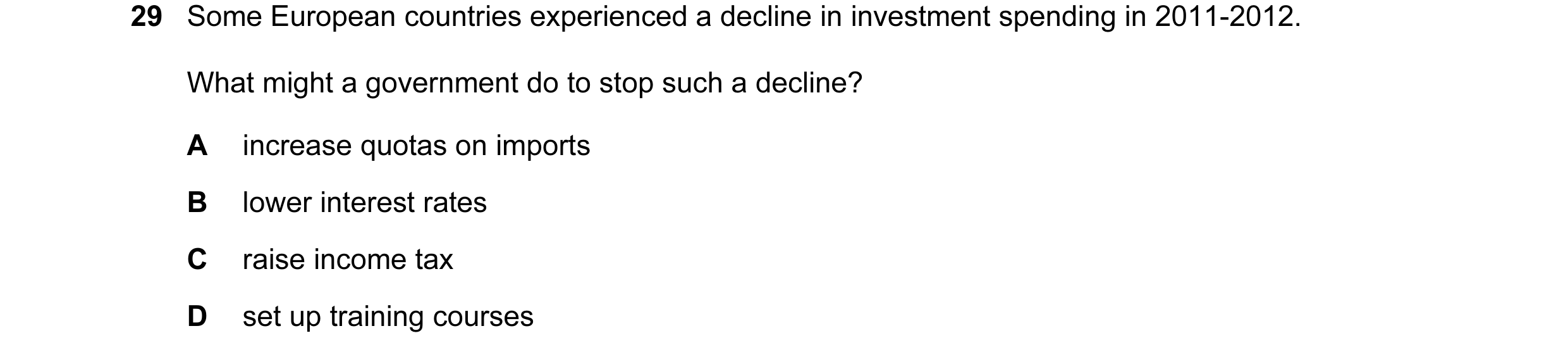
Q18 · Some European countries experienced a decline in investment spending in 2011-2012 9708/31 Oct/Nov 2015
29 Some European countries experienced a decline in investment spending in 2011-2012. What might a government do to stop such a decline? A increase quotas on imports B lower interest rates C raise income tax D set up training courses
1 marks
This question in 9708/31 Oct/Nov 2015
Q19 · What is likely to be the effect on interest rates and the supply of money of a purchase… 9708/32 Oct/Nov 2015
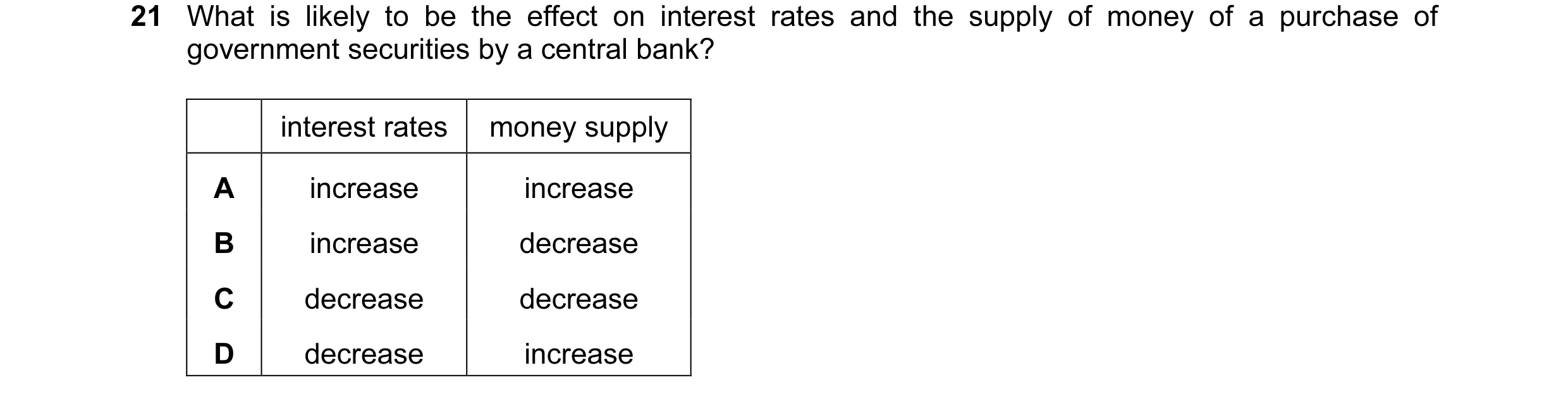
21 What is likely to be the effect on interest rates and the supply of money of a purchase of government securities by a central bank? interest rates money supply A increase increase B increase decrease C decrease decrease D decrease increase
1 marks
Answer: D
This question in 9708/32 Oct/Nov 2015
Q20 · An economy has underemployed resources 9708/32 Oct/Nov 2015
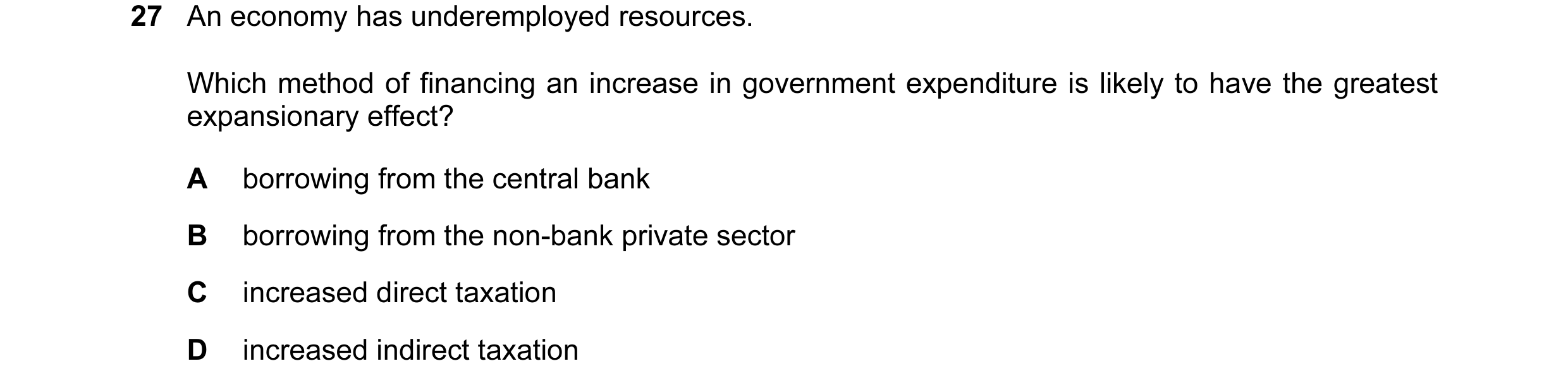
27 An economy has underemployed resources. Which method of financing an increase in government expenditure is likely to have the greatest expansionary effect? A borrowing from the central bank B borrowing from the non-bank private sector C increased direct taxation D increased indirect taxation
1 marks
Answer: A
This question in 9708/32 Oct/Nov 2015
Q21 · According to Keynesian theory, what will cause the rate of interest to rise? 9708/33 Oct/Nov 2015
27 According to Keynesian theory, what will cause the rate of interest to rise? A a decrease in liquidity preference B a decrease in the level of national income C a decrease in the rate of investment D a decrease in the supply of money
1 marks
Answer: D
This question in 9708/33 Oct/Nov 2015
Q22 · According to Keynesian theory, when will an increase in the money supply leave the level… 9708/32 May/June 2016
25 According to Keynesian theory, when will an increase in the money supply leave the level of output unchanged? A when the liquidity trap is operative B when the money supply increase was not anticipated C when there is a floating exchange rate D when there is an immediate adjustment to expectations about future price levels
1 marks
Answer: A
This question in 9708/32 May/June 2016
Q23 · Other things being equal, what is likely to result from a decrease in interest rates? 9708/33 Oct/Nov 2016
29 Other things being equal, what is likely to result from a decrease in interest rates? A a decrease in investment B a net capital inflow C an appreciation of the currency D an increase in consumption
1 marks
Answer: D
This question in 9708/33 Oct/Nov 2016
Q24 · In the absence of offsetting factors, how will an increase in interest rates affect share… 9708/33 Oct/Nov 2016
30 In the absence of offsetting factors, how will an increase in interest rates affect share prices? A It will decrease share prices because financial investors will prefer to purchase bonds. B It will decrease share prices because inflationary pressure will increase. C It will increase share prices because company profits will rise. D It will increase share prices because saving will become less attractive.
1 marks
Answer: A
This question in 9708/33 Oct/Nov 2016
Q25 · In 2015 a political party proposed a policy of quantitative easing (the creation of money… 9708/33 May/June 2017
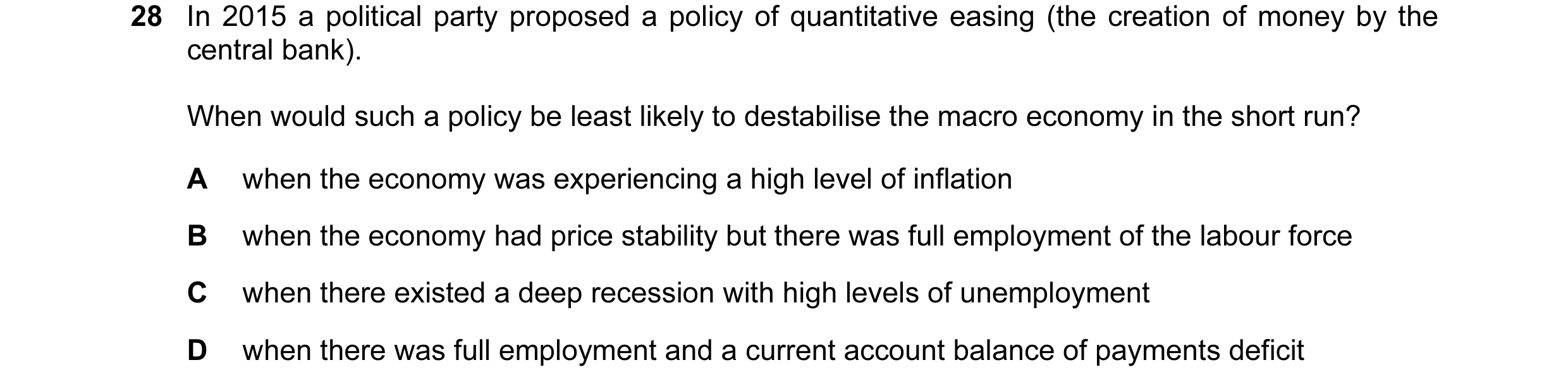
28 In 2015 a political party proposed a policy of quantitative easing (the creation of money by the central bank). When would such a policy be least likely to destabilise the macro economy in the short run? A when the economy was experiencing a high level of inflation B when the economy had price stability but there was full employment of the labour force C when there existed a deep recession with high levels of unemployment D when there was full employment and a current account balance of payments deficit
1 marks
Answer: C
This question in 9708/33 May/June 2017
Q26 · The diagram outlines the monetary transmission mechanism following an expansionary… 9708/32 Oct/Nov 2018
26 The diagram outlines the monetary transmission mechanism following an expansionary central bank intervention (quantitative easing). Key actions have been omitted from the process. central bank … 1 … government assets ↓ short-term interest rates … 2 … ↓ investment demand … 3 … ↓ real GDP rises Which words complete gaps 1, 2 and 3? 1 2 3 A buys fall rises B buys rise falls C sells fall rises D sells rise falls
1 marks
Answer: A
This question in 9708/32 Oct/Nov 2018
Q27 · The central bank of a country creates cash to purchase government bonds from the… 9708/32 Feb/March 2019
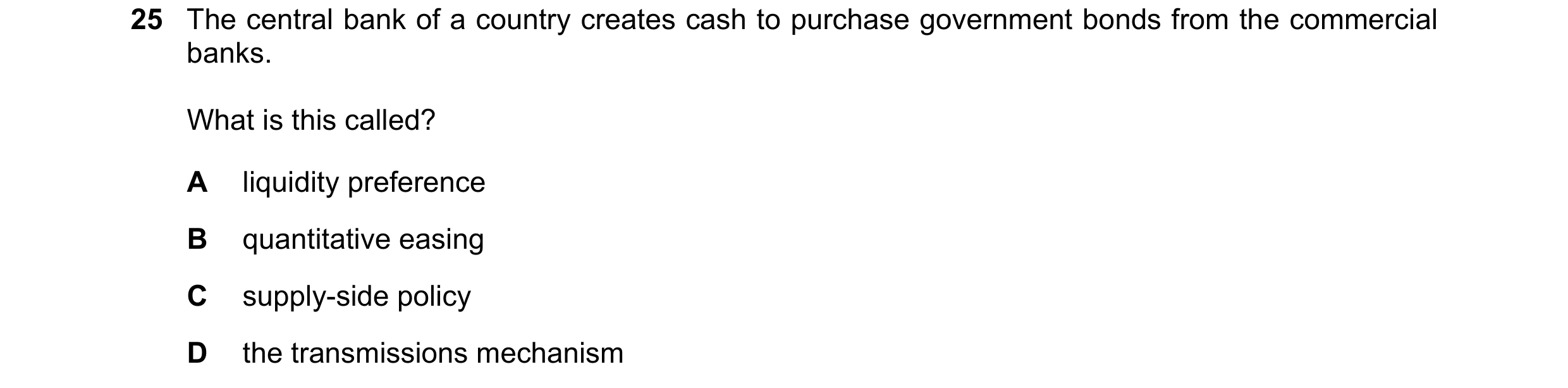
25 The central bank of a country creates cash to purchase government bonds from the commercial banks. What is this called? A liquidity preference B quantitative easing C supply-side policy D the transmissions mechanism
1 marks
Answer: B
This question in 9708/32 Feb/March 2019
Q28 · An economy adopts an expansionary monetary policy to boost employment 9708/32 Feb/March 2019
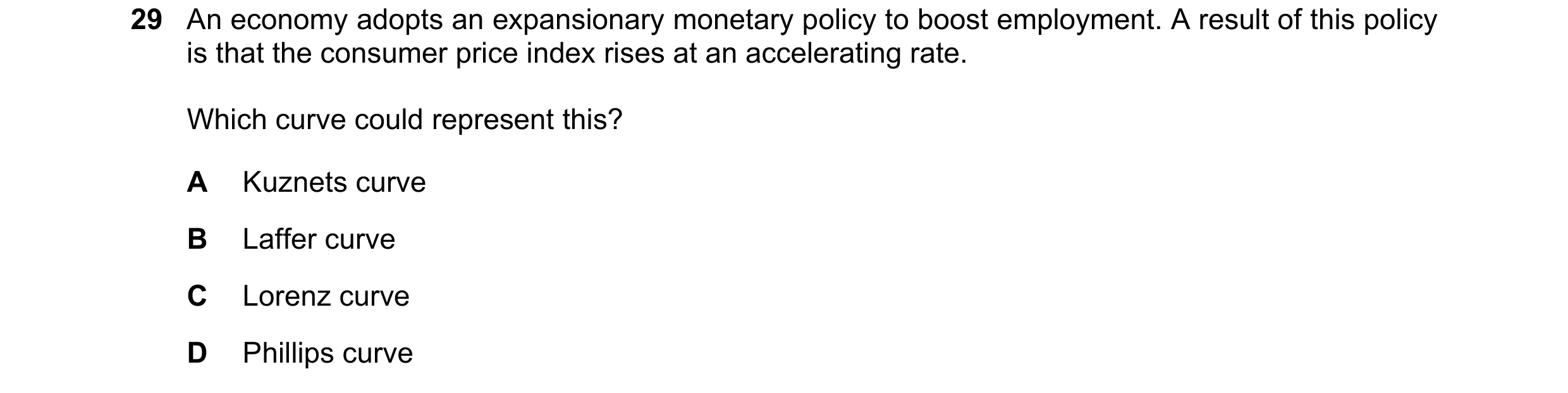
29 An economy adopts an expansionary monetary policy to boost employment. A result of this policy is that the consumer price index rises at an accelerating rate. Which curve could represent this? A Kuznets curve B Laffer curve C Lorenz curve D Phillips curve
1 marks
Answer: D
This question in 9708/32 Feb/March 2019
Q29 · Which combination of policies is most likely to increase output? 9708/32 May/June 2019
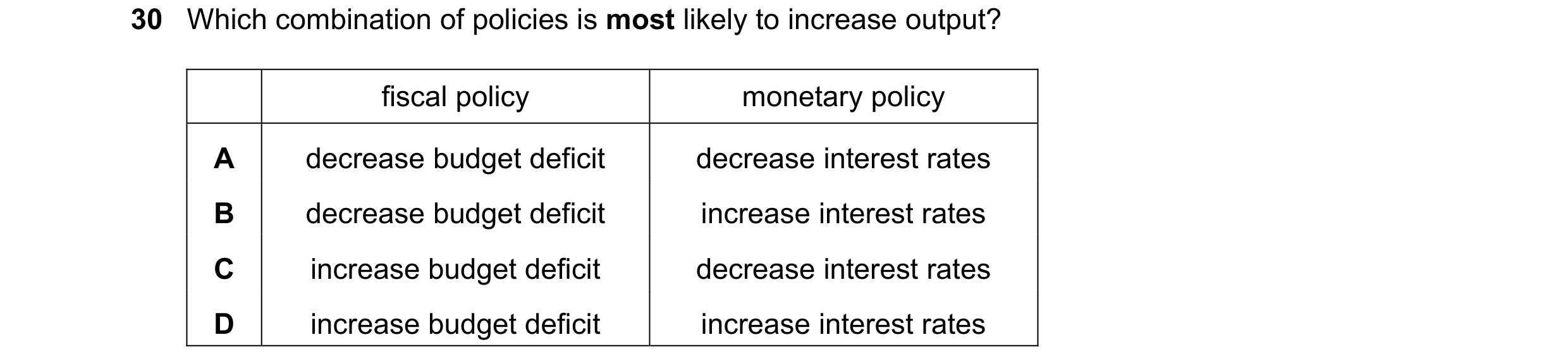
30 Which combination of policies is most likely to increase output? fiscal policy monetary policy A decrease budget deficit decrease interest rates B decrease budget deficit increase interest rates C increase budget deficit decrease interest rates D increase budget deficit increase interest rates
1 marks
Answer: C
This question in 9708/32 May/June 2019
Q30 · Which diagram shows the effect of a policy of quantitative easing on the rate of interest? 9708/32 Feb/March 2020
28 Which diagram shows the effect of a policy of quantitative easing on the rate of interest? A B rate of rate of interest interest LP2 LP1 LP1 O MS1 MS2 O MS1 quantity quantity of money of money C D rate of rate of interest interest LP1 LP1 LP2 O MS2 MS1 O MS1 quantity quantity of money of money
1 marks
Answer: A
This question in 9708/32 Feb/March 2020
Q31 · What would represent a monetarist anti-inflationary policy? 9708/31 Oct/Nov 2020
22 What would represent a monetarist anti-inflationary policy? A an increase in indirect taxation B direct foreign exchange rate intervention C the introduction of maximum prices D the sale of securities on the open market
1 marks
Answer: D
This question in 9708/31 Oct/Nov 2020
Q32 · A government attempts to stimulate growth by cutting its main interest rate 9708/31 May/June 2021
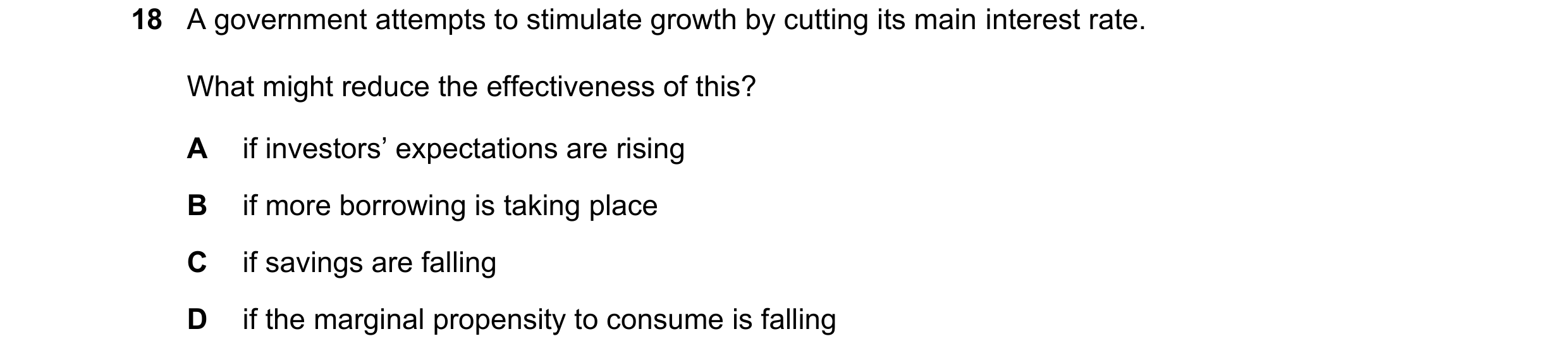
18 A government attempts to stimulate growth by cutting its main interest rate. What might reduce the effectiveness of this? A if investors’ expectations are rising B if more borrowing is taking place C if savings are falling D if the marginal propensity to consume is falling
1 marks
Answer: D
This question in 9708/31 May/June 2021
Q33 · A government is committed to increasing real GDP using only fiscal and monetary policies 9708/31 May/June 2021
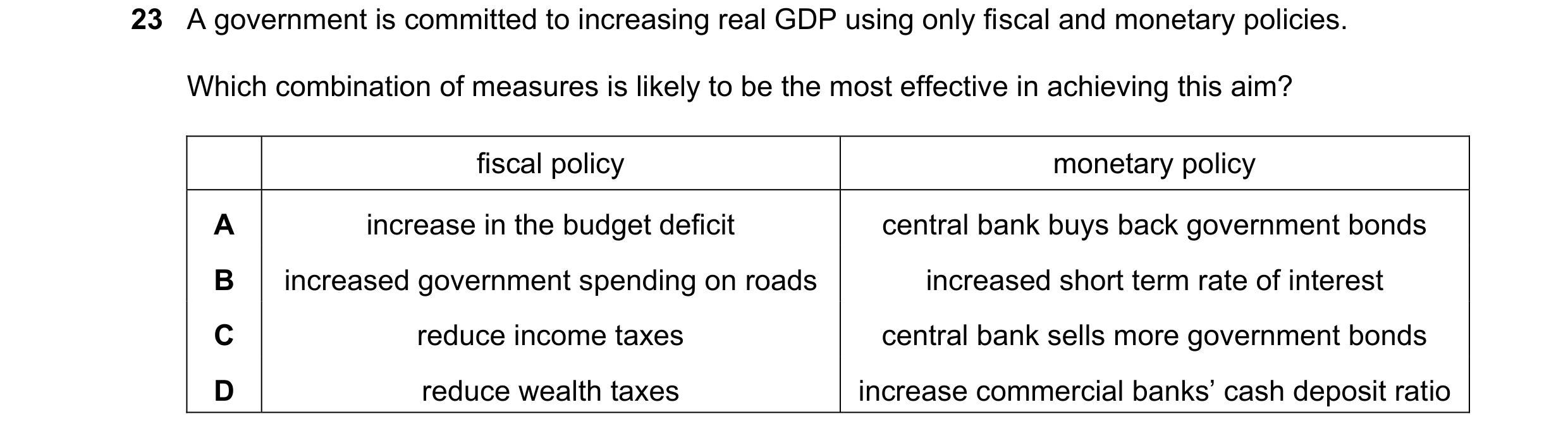
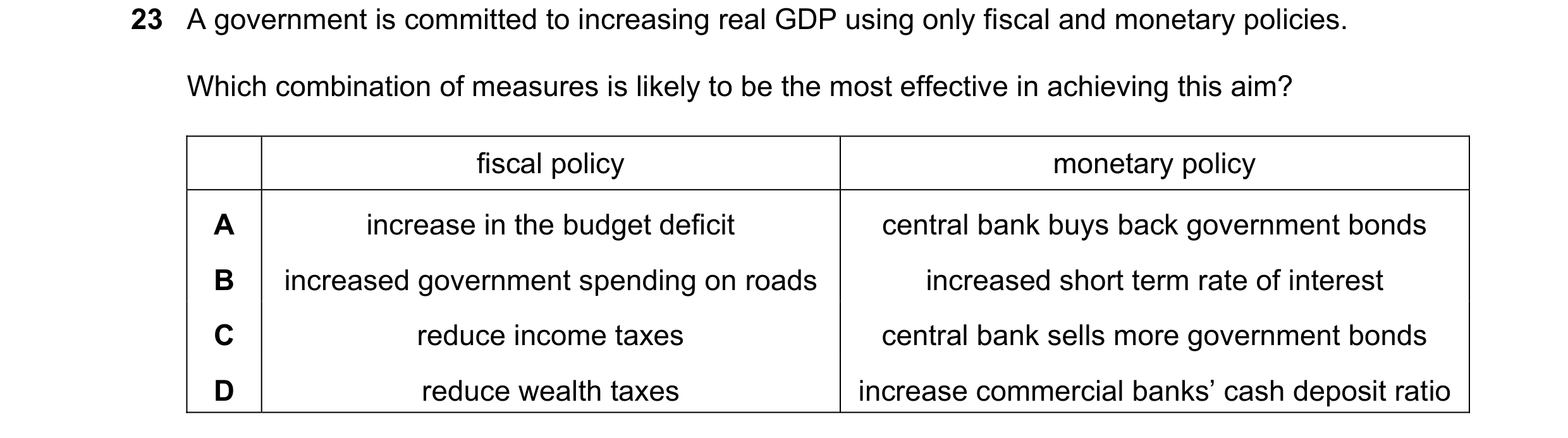
23 A government is committed to increasing real GDP using only fiscal and monetary policies. Which combination of measures is likely to be the most effective in achieving this aim? fiscal policy monetary policy A increase in the budget deficit central bank buys back government bonds B increased government spending on roads increased short term rate of interest C reduce income taxes central bank sells more government bonds D reduce wealth taxes increase commercial banks’ cash deposit ratio
1 marks
Answer: A
This question in 9708/31 May/June 2021
Q34 · Which policy does a central bank undertake to pursue quantitative easing? 9708/31 May/June 2021
26 Which policy does a central bank undertake to pursue quantitative easing? A purchase long-term government debt from the public B purchase short-term government debt from the public C sell long-term government debt to the public D sell short-term government debt to the public
1 marks
Answer: A
This question in 9708/31 May/June 2021
Q35 · Which change will allow an increase in an economy’s money supply? 9708/32 May/June 2021
25 Which change will allow an increase in an economy’s money supply? A An outflow of currency for trade and capital purposes becomes an inflow. B The central bank instructs commercial banks to keep higher ratios of cash to deposits. C The government budget balance moves from a deficit to a surplus. D The government replaces borrowing from the banks with borrowing from the general public.
1 marks
Answer: A
This question in 9708/32 May/June 2021
Q36 · A government attempts to stimulate growth by cutting its main interest rate 9708/33 May/June 2021
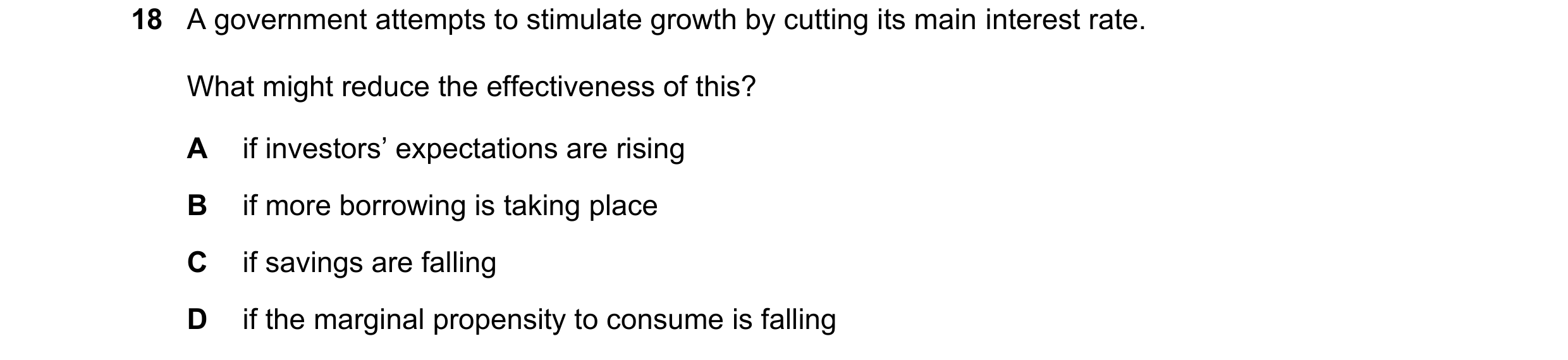
18 A government attempts to stimulate growth by cutting its main interest rate. What might reduce the effectiveness of this? A if investors’ expectations are rising B if more borrowing is taking place C if savings are falling D if the marginal propensity to consume is falling
1 marks
Answer: D
This question in 9708/33 May/June 2021
Q37 · A government is committed to increasing real GDP using only fiscal and monetary policies 9708/33 May/June 2021
23 A government is committed to increasing real GDP using only fiscal and monetary policies. Which combination of measures is likely to be the most effective in achieving this aim? fiscal policy monetary policy A increase in the budget deficit central bank buys back government bonds B increased government spending on roads increased short term rate of interest C reduce income taxes central bank sells more government bonds D reduce wealth taxes increase commercial banks’ cash deposit ratio
1 marks
Answer: A
This question in 9708/33 May/June 2021
Q38 · Which policy does a central bank undertake to pursue quantitative easing? 9708/33 May/June 2021
26 Which policy does a central bank undertake to pursue quantitative easing? A purchase long-term government debt from the public B purchase short-term government debt from the public C sell long-term government debt to the public D sell short-term government debt to the public
1 marks
Answer: A
This question in 9708/33 May/June 2021
Q39 · The bank cash deposit ratio changed from 5% to 10% 9708/32 Oct/Nov 2021
27 The bank cash deposit ratio changed from 5% to 10%. What will be the result? A Bank deposits will fall by 10%. B Banks deposits will rise by 5%. C The credit multiplier will fall by 50%. D The credit multiplier will increase by 5%.
1 marks
Answer: C
This question in 9708/32 Oct/Nov 2021
Q40 · The graph shows the percentage unemployed in a country for the period 2017–2021 9708/31 Oct/Nov 2022
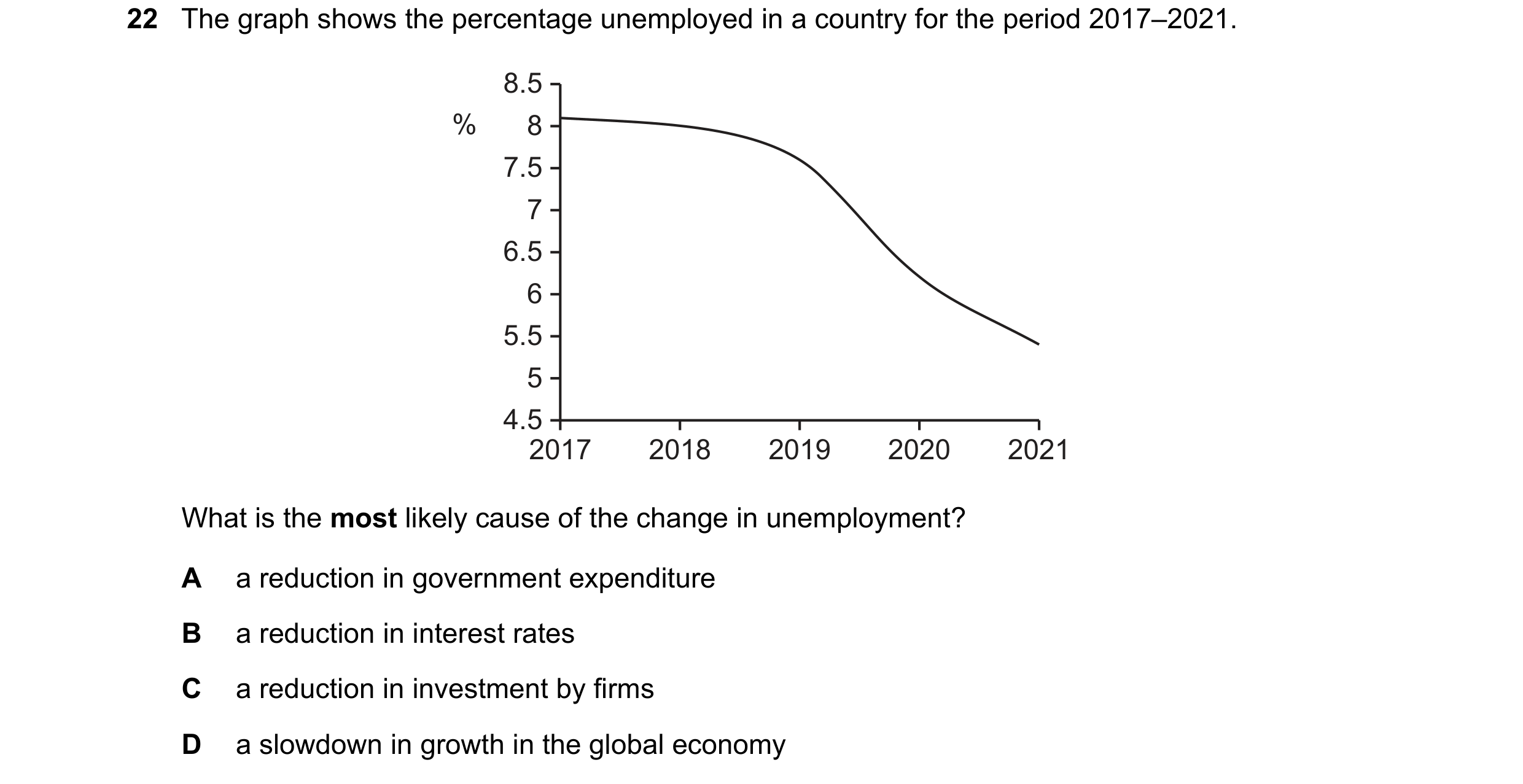
22 The graph shows the percentage unemployed in a country for the period 2017–2021. 8.5 % 8 7.5 7 6.5 6 5.5 5 4.5 2017 2018 2019 2020 2021 What is the most likely cause of the change in unemployment? A a reduction in government expenditure B a reduction in interest rates C a reduction in investment by firms D a slowdown in growth in the global economy
1 marks
Answer: B
This question in 9708/31 Oct/Nov 2022
Q41 · According to Keynesian theory, when will an increase in the money supply leave the level… 9708/32 Oct/Nov 2022
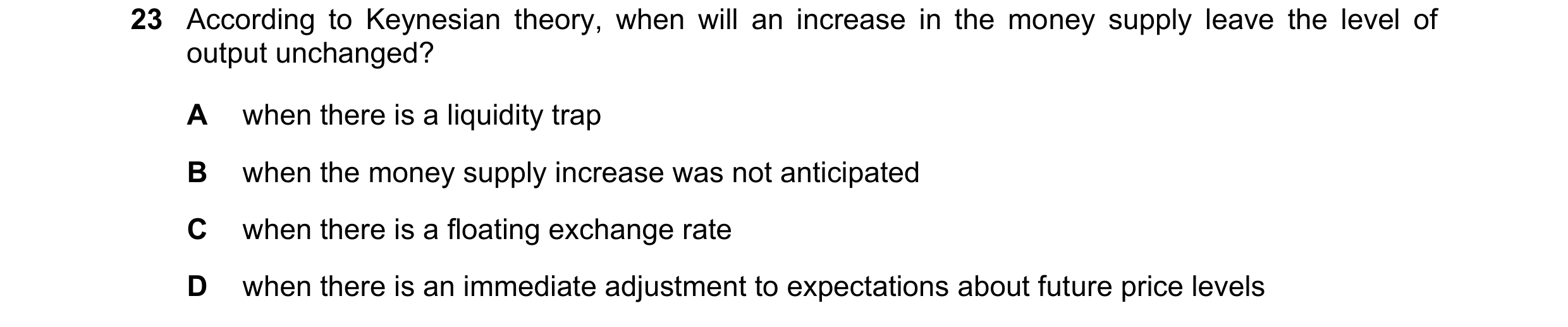
23 According to Keynesian theory, when will an increase in the money supply leave the level of output unchanged? A when there is a liquidity trap B when the money supply increase was not anticipated C when there is a floating exchange rate D when there is an immediate adjustment to expectations about future price levels
1 marks
Answer: A
This question in 9708/32 Oct/Nov 2022
Q42 · What do Monetarists believe? 9708/32 Oct/Nov 2022
25 What do Monetarists believe? A Economies are naturally unstable. B Policy makers should follow set rules targeting the money supply. C The aggregate supply curve has a slight slope. D Wage movements are ‘sticky’ downwards.
1 marks
Answer: B
This question in 9708/32 Oct/Nov 2022
Q43 · Which government aim is least likely to be achieved using macroeconomic monetary policy… 9708/32 Feb/March 2023
22 Which government aim is least likely to be achieved using macroeconomic monetary policy measures? A low unemployment level B more equal income distribution C stable exchange rate D steady price level
1 marks
Answer: B
This question in 9708/32 Feb/March 2023
Q44 · An economy has a sudden increase in inflation caused by a large rise in energy prices 9708/33 May/June 2024
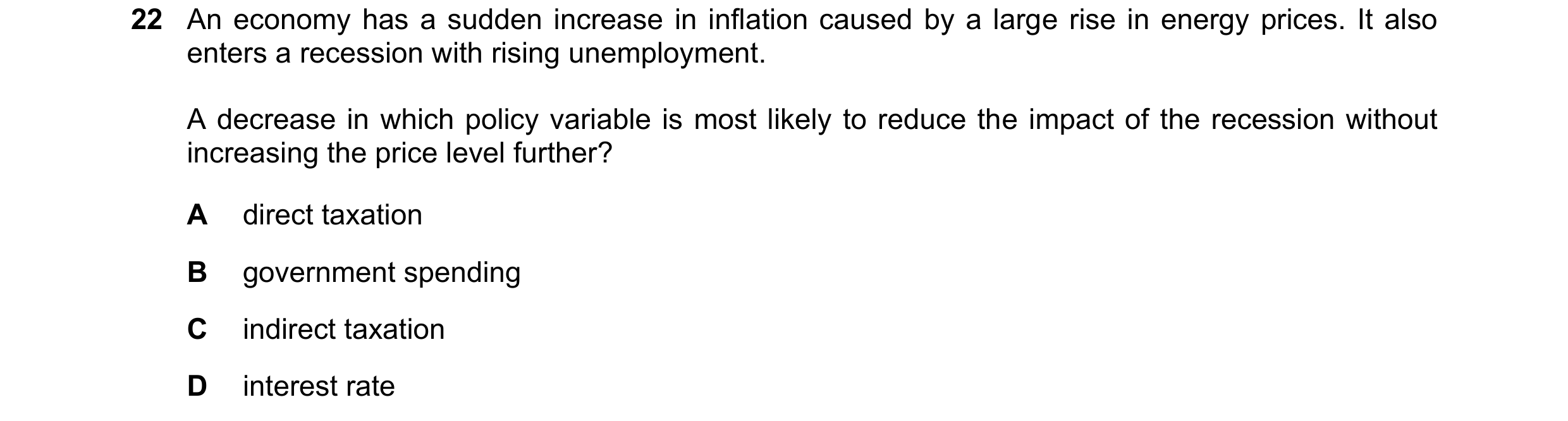
22 An economy has a sudden increase in inflation caused by a large rise in energy prices. It also enters a recession with rising unemployment. A decrease in which policy variable is most likely to reduce the impact of the recession without increasing the price level further? A direct taxation B government spending C indirect taxation D interest rate
1 marks
Answer: C
This question in 9708/33 May/June 2024
 1 / 11
 2 / 11

 3 / 11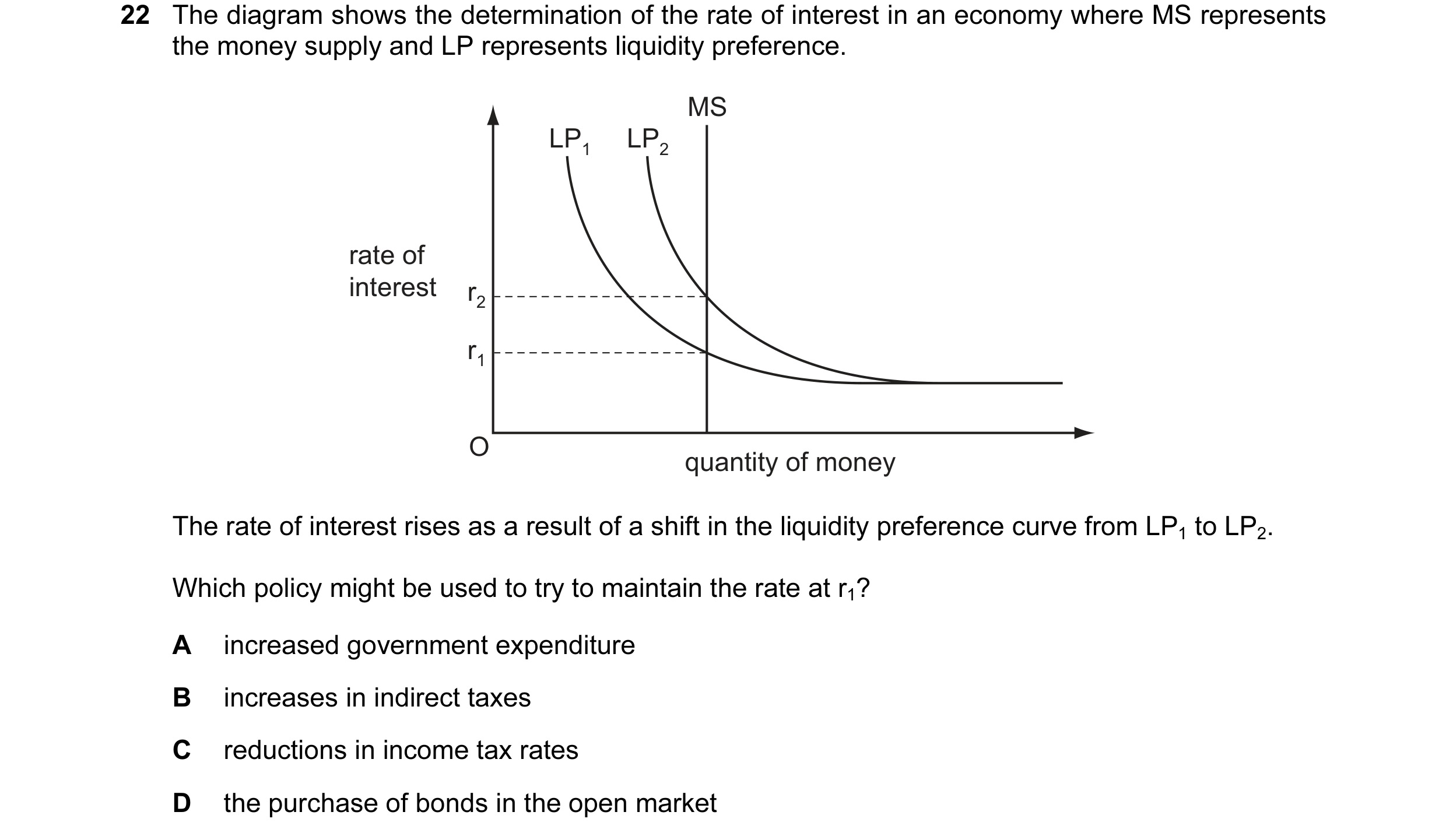


 4 / 11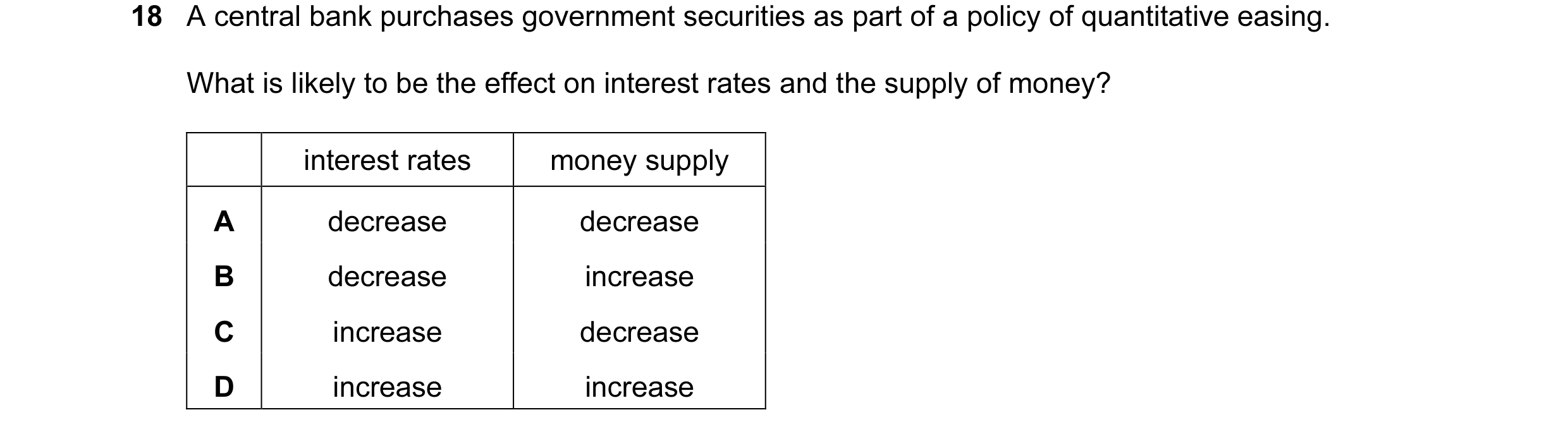
 5 / 11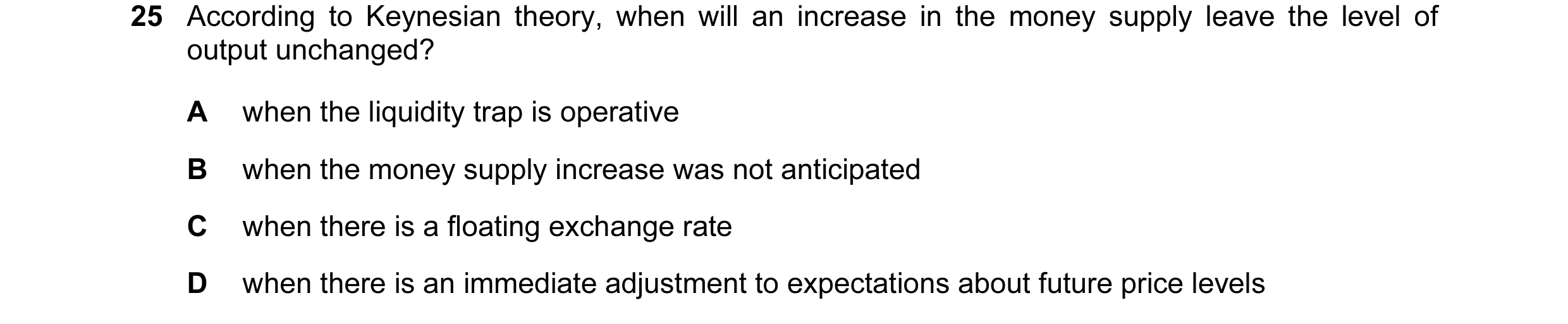


 6 / 11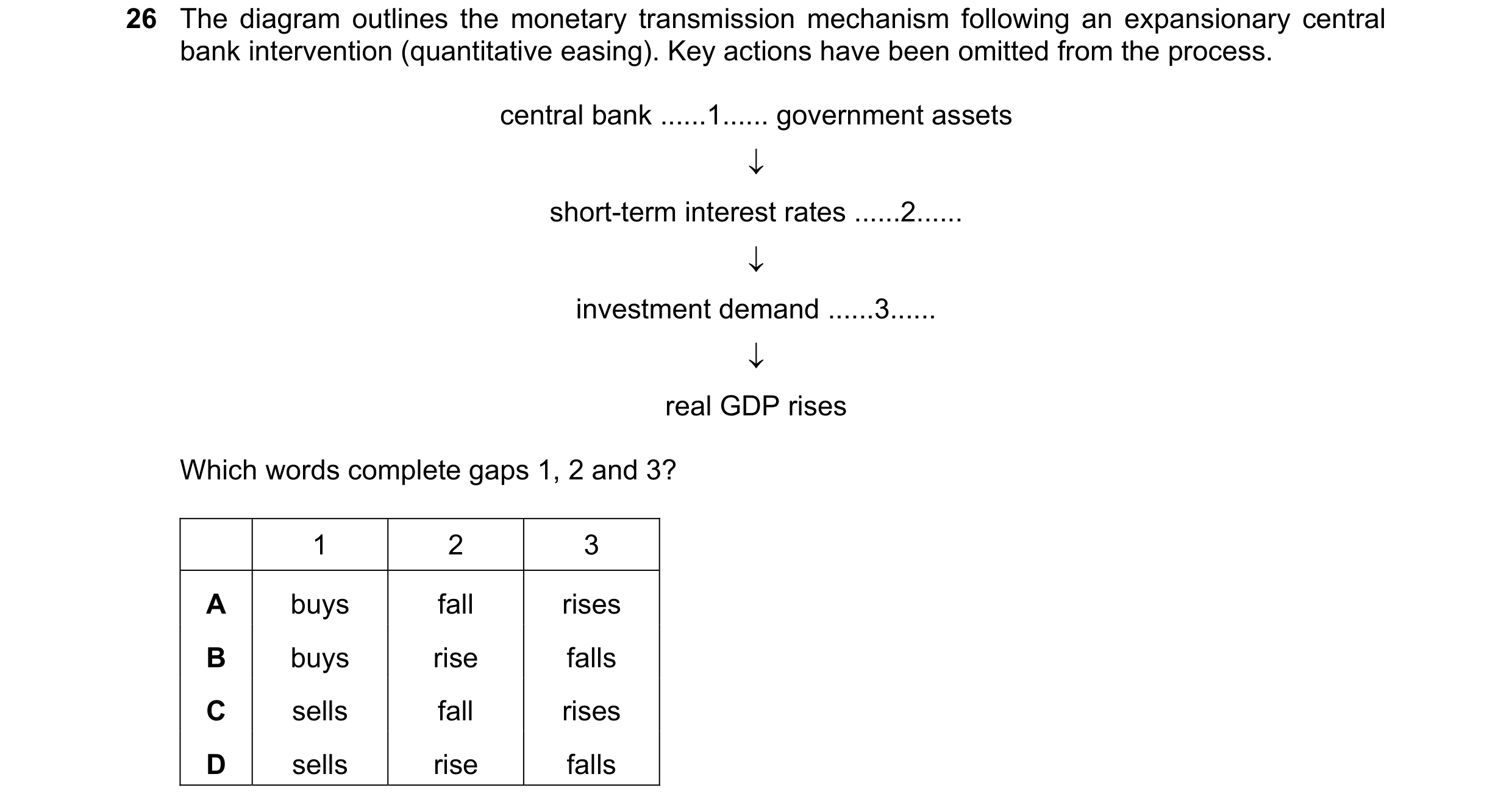
 7 / 11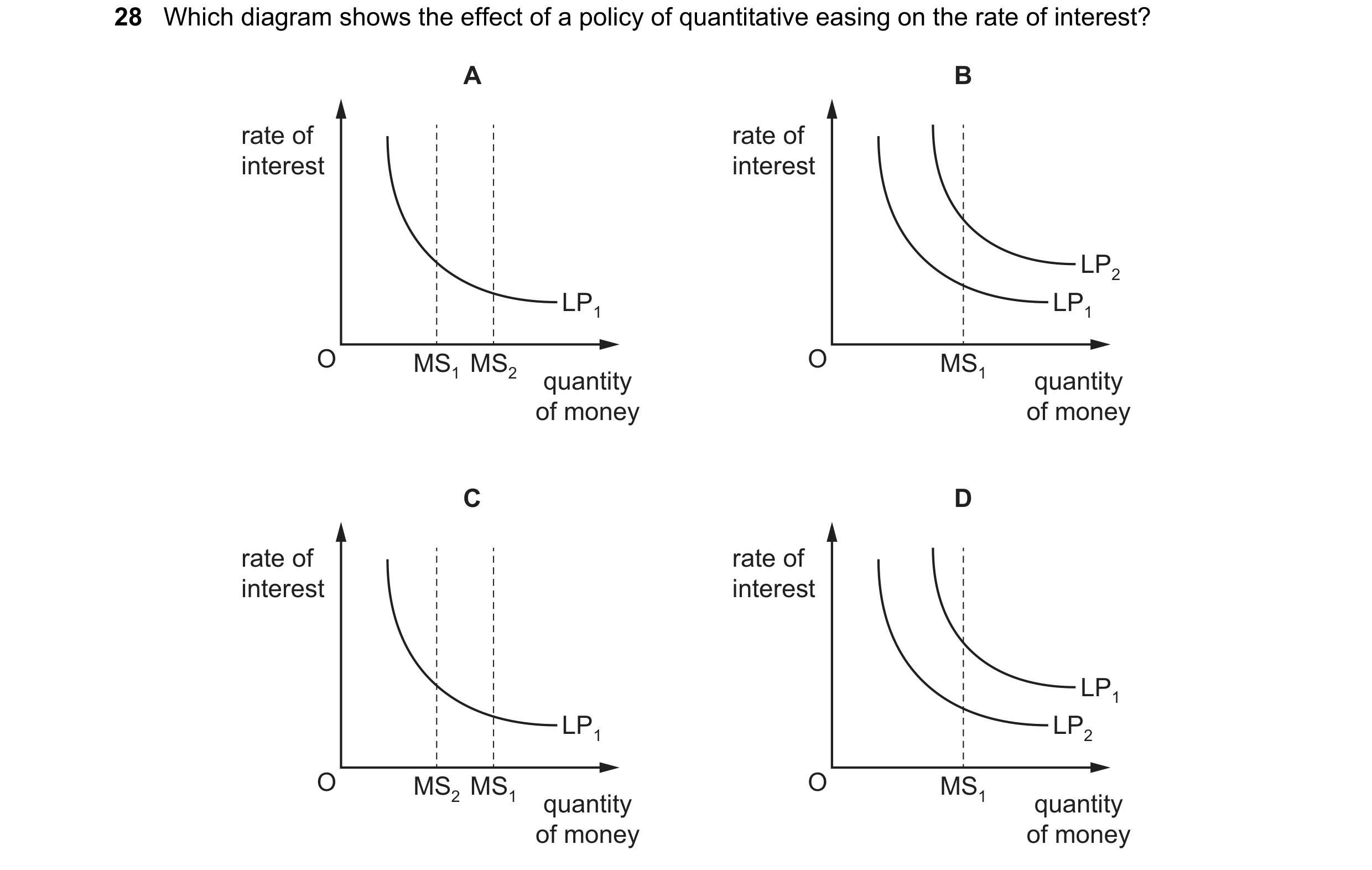

 8 / 11

 9 / 11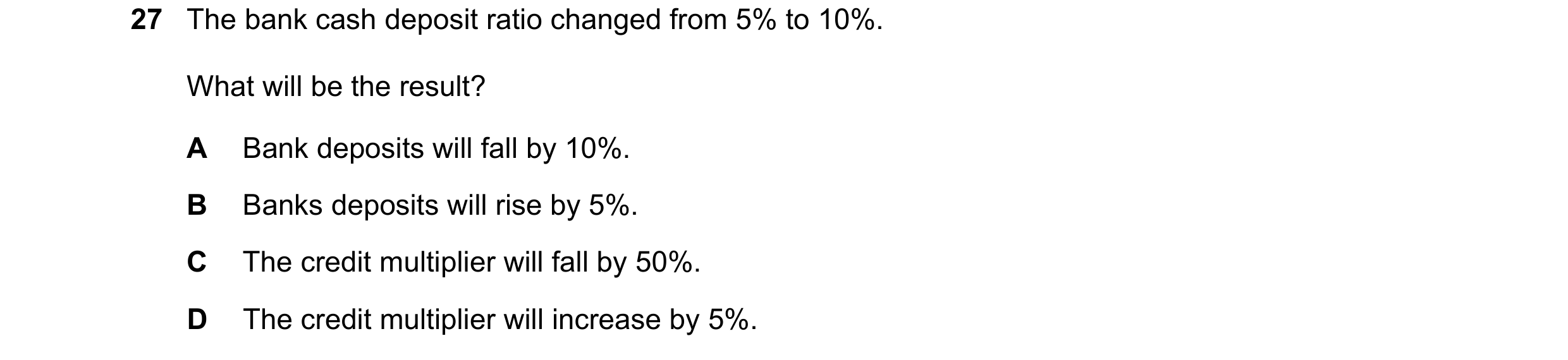
 10 / 11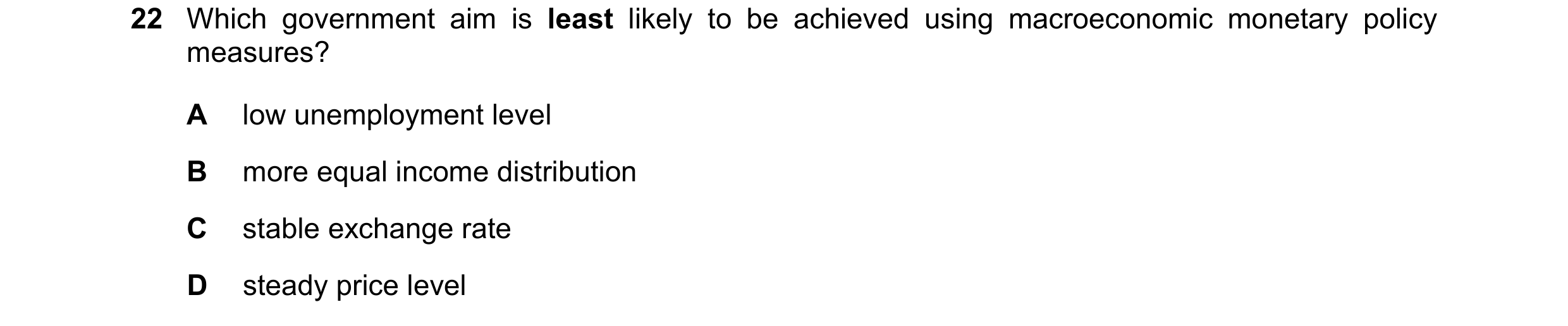
 11 / 11