Questions as text
Q1 · How many structural isomers with the molecular formula C4H10O give infra-red absorptions… 9701/12 Feb/March 2018
30 How many structural isomers with the molecular formula C4H10O give infra-red absorptions both at approximately 1200 cm–1 and at approximately 3400 cm–1? A 2 B 4 C 6 D 7
1 marks
Answer: B
This question in 9701/12 Feb/March 2018
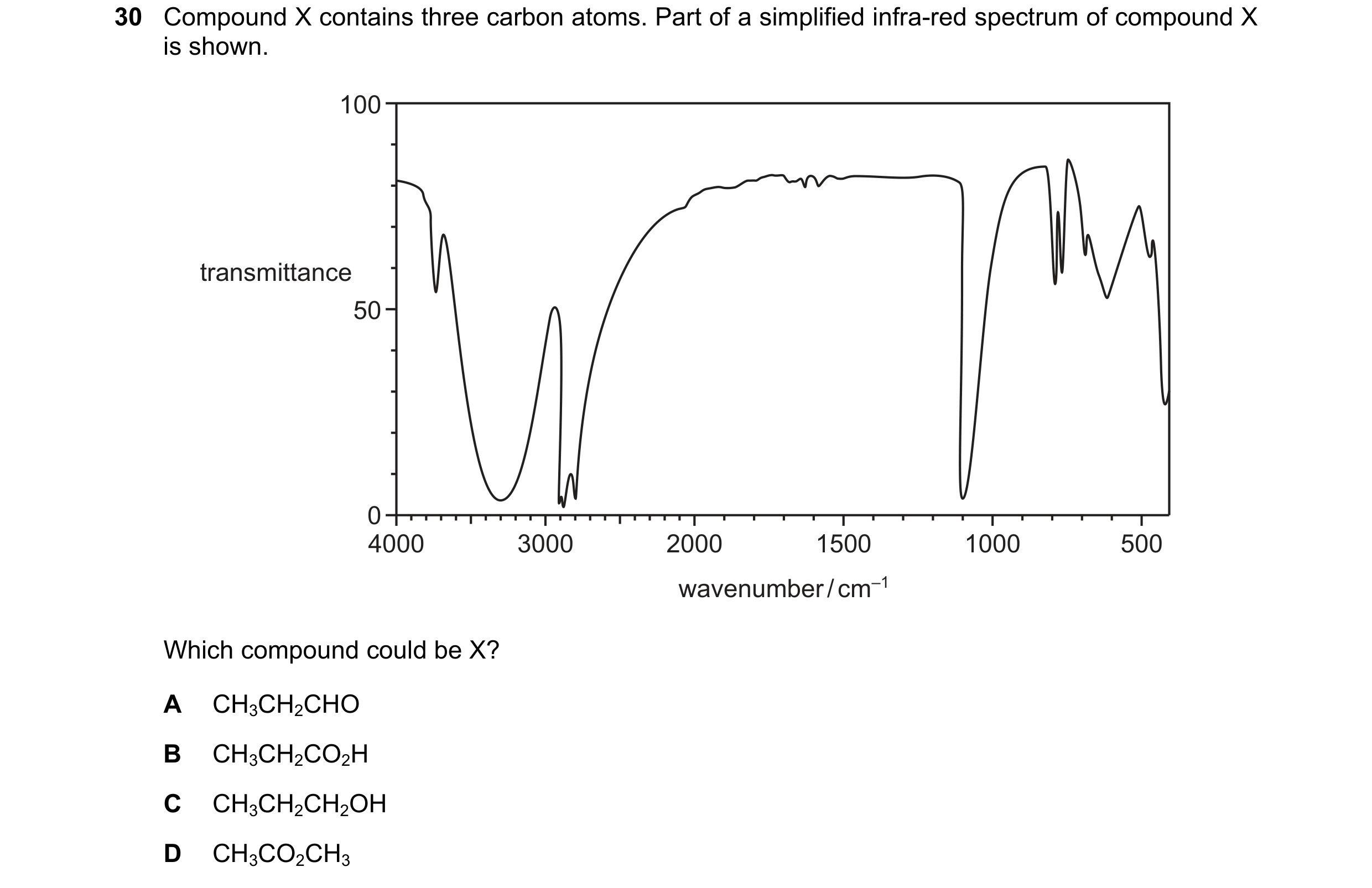
Q2 · Compound X contains three carbon atoms 9701/11 May/June 2018
30 Compound X contains three carbon atoms. Part of a simplified infra-red spectrum of compound X is shown. 100 transmittance 50 0 4000 3000 2000 1500 1000 500 wavenumber / cm–1 Which compound could be X? A CH3CH2CHO B CH3CH2CO2H C CH3CH2CH2OH D CH3CO2CH3
1 marks
Answer: C
This question in 9701/11 May/June 2018
Q3 · The infra-red spectrum of an organic compound is shown 9701/12 May/June 2018
30 The infra-red spectrum of an organic compound is shown. 100 transmittance % 50 0 4000 3000 2000 1500 1000 500 wavenumber / cm–1 Which compound could give this spectrum? A CH3CH2CO2H B CH3CH(OH)CH3 C CH3COCH3 D CH3COCH2OH Section B
1 marks
Answer: C
This question in 9701/12 May/June 2018
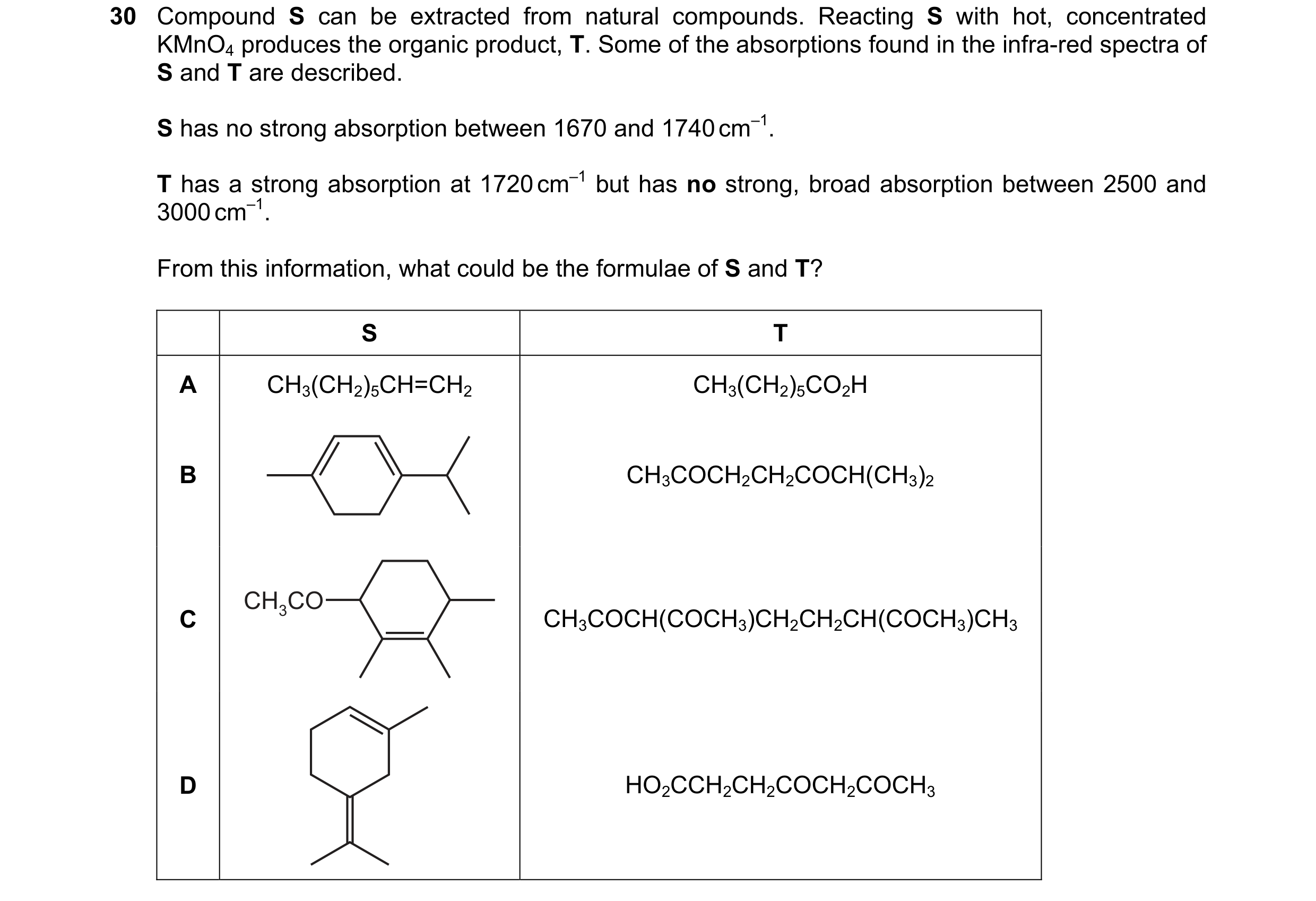
Q4 · Compound S can be extracted from natural compounds 9701/13 May/June 2018
30 Compound S can be extracted from natural compounds. Reacting S with hot, concentrated KMnO4 produces the organic product, T. Some of the absorptions found in the infra-red spectra of S and T are described. S has no strong absorption between 1670 and 1740 cm–1. T has a strong absorption at 1720 cm–1 but has no strong, broad absorption between 2500 and 3000 cm–1. From this information, what could be the formulae of S and T? S T A CH3(CH2)5CH=CH2 CH3(CH2)5CO2H B CH3COCH2CH2COCH(CH3)2 CH3CO C CH3COCH(COCH3)CH2CH2CH(COCH3)CH3 D HO2CCH2CH2COCH2COCH3
1 marks
Answer: B
This question in 9701/13 May/June 2018
Q5 · J is a branched-chain alcohol, C5H12O 9701/11 Oct/Nov 2018
30 J is a branched-chain alcohol, C5H12O. J is heated under reflux with an excess of Cr2O7 2– / H+ until no further reaction occurs. An organic compound K is formed in good yield. The infra-red spectrum of K is shown. 100 transmittance % 50 0 4000 3000 2000 1500 1000 500 wavenumber / cm–1 What are the structures of the branched-chain alcohol J and compound K? J K A CH3CH(CH3)CH2CH2OH CH3CH(CH3)CH2CHO B CH3CH2CH(OH)CH2CH3 CH3CH2COCH2CH3 C CH3CH(CH3)CH(OH)CH3 CH3CH(CH3)COCH3 D CH3CH(CH3)CH2CH2OH CH3CH(CH3)CH2COOH
1 marks
Answer: C
This question in 9701/11 Oct/Nov 2018
Q6 · The infra-red spectrum of compound L is shown 9701/12 Oct/Nov 2018
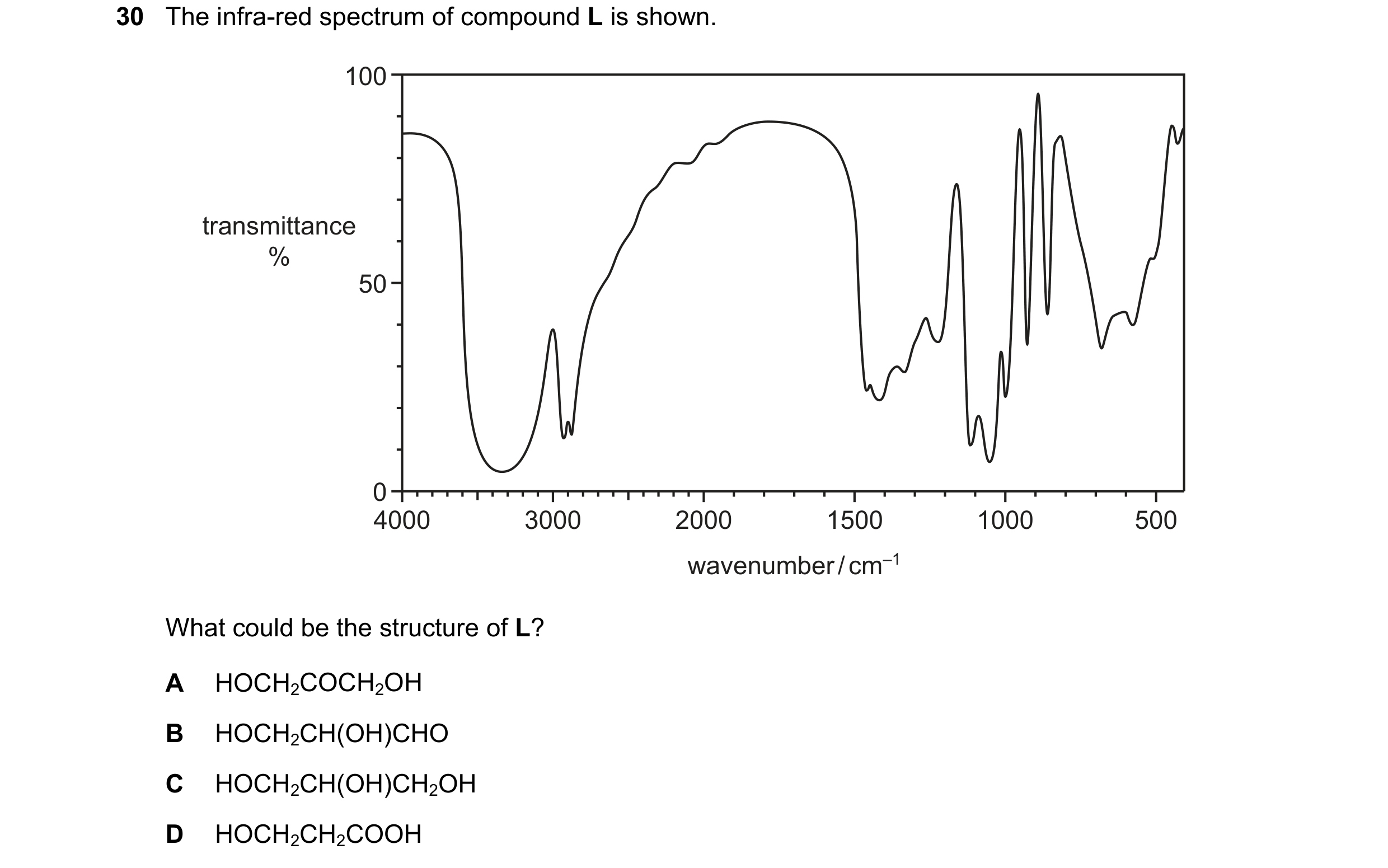
30 The infra-red spectrum of compound L is shown. 100 transmittance % 50 0 4000 3000 2000 1500 1000 500 wavenumber / cm–1 What could be the structure of L? A HOCH2COCH2OH B HOCH2CH(OH)CHO C HOCH2CH(OH)CH2OH D HOCH2CH2COOH
1 marks
Answer: C
This question in 9701/12 Oct/Nov 2018
Q7 · J is a branched-chain alcohol, C5H12O 9701/13 Oct/Nov 2018
30 J is a branched-chain alcohol, C5H12O. J is heated under reflux with an excess of Cr2O7 2– / H+ until no further reaction occurs. An organic compound K is formed in good yield. The infra-red spectrum of K is shown. 100 transmittance % 50 0 4000 3000 2000 1500 1000 500 wavenumber / cm–1 What are the structures of the branched-chain alcohol J and compound K? J K A CH3CH(CH3)CH2CH2OH CH3CH(CH3)CH2CHO B CH3CH2CH(OH)CH2CH3 CH3CH2COCH2CH3 C CH3CH(CH3)CH(OH)CH3 CH3CH(CH3)COCH3 D CH3CH(CH3)CH2CH2OH CH3CH(CH3)CH2COOH
1 marks
Answer: C
This question in 9701/13 Oct/Nov 2018
Q8 · An infra-red spectrum shows a broad peak at 3000 cm–1 and a strong peak at 1710 cm–1 9701/12 Feb/March 2019
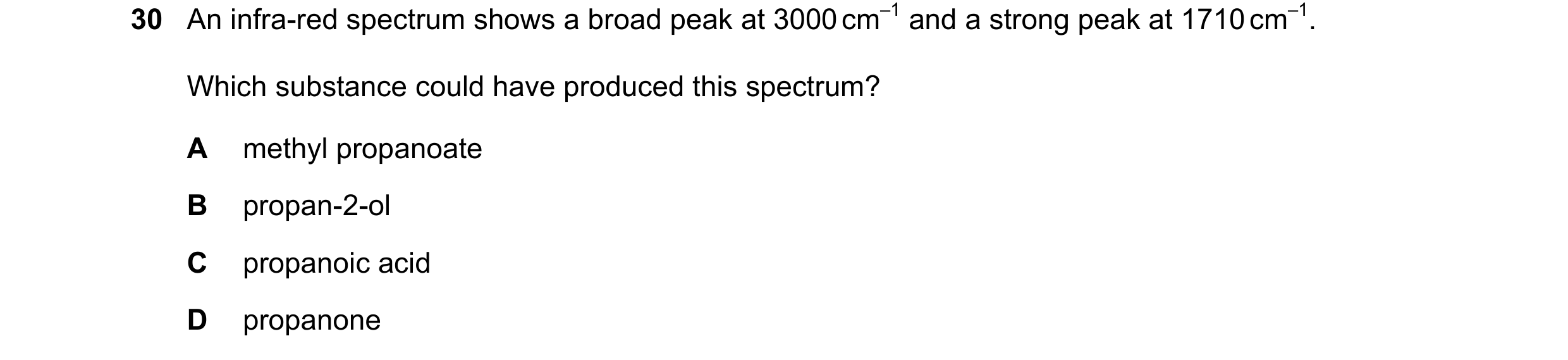
30 An infra-red spectrum shows a broad peak at 3000 cm–1 and a strong peak at 1710 cm–1. Which substance could have produced this spectrum? A methyl propanoate B propan-2-ol C propanoic acid D propanone
1 marks
Answer: C
This question in 9701/12 Feb/March 2019
Q9 · The infra-red spectrum of a substance with empirical formula C2H4O is shown 9701/11 May/June 2019
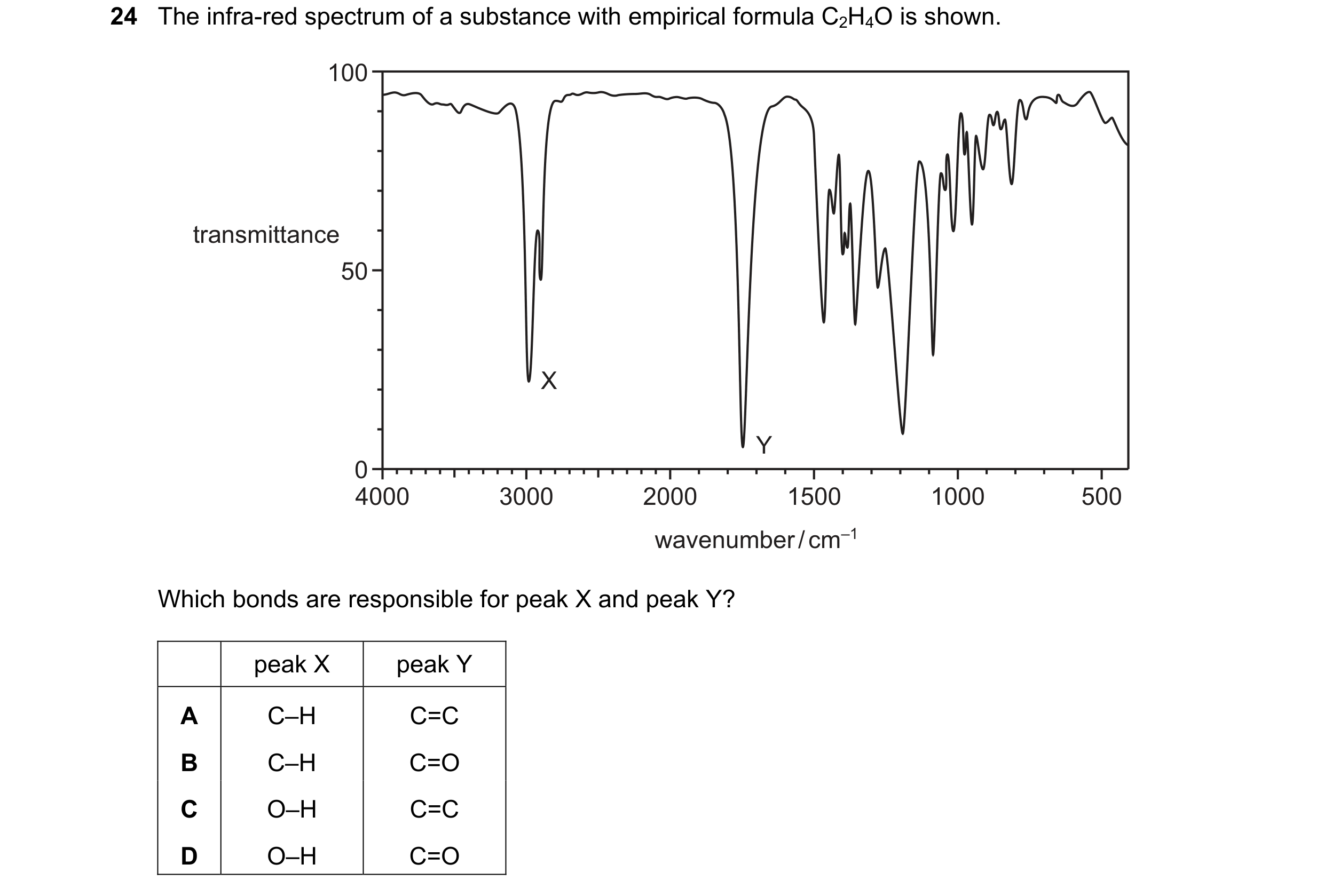
24 The infra-red spectrum of a substance with empirical formula C2H4O is shown. 100 transmittance 50 X Y 0 4000 3000 2000 1500 1000 500 wavenumber / cm–1 Which bonds are responsible for peak X and peak Y? peak X peak Y A C–H C=C B C–H C=O C O–H C=C D O–H C=O
1 marks
Answer: B
This question in 9701/11 May/June 2019
Q10 · The diagram shows the infra-red spectrum of Q 9701/12 May/June 2019
30 The diagram shows the infra-red spectrum of Q. 100 transmittance 50 0 4000 3000 2000 1500 1000 500 wavenumber / cm–1 What could be Q? A butan-1-ol B butanoic acid C butanone D 3-hydroxybutanal Section B
1 marks
Answer: C
This question in 9701/12 May/June 2019
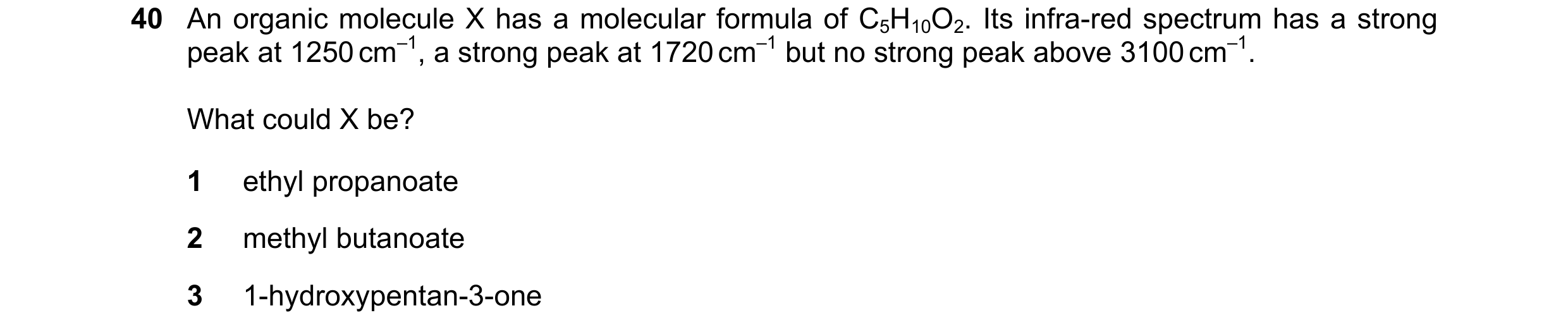
Q11 · An organic molecule X has a molecular formula of C5H10O2 9701/13 May/June 2019
40 An organic molecule X has a molecular formula of C5H10O2. Its infra-red spectrum has a strong peak at 1250 cm–1, a strong peak at 1720 cm–1 but no strong peak above 3100 cm–1. What could X be? 1 ethyl propanoate 2 methyl butanoate 3 1-hydroxypentan-3-one
1 marks
Answer: B
This question in 9701/13 May/June 2019
Q12 · The infra-red spectrum of compound P is shown 9701/11 Oct/Nov 2019
30 The infra-red spectrum of compound P is shown. 100 transmittance / % 50 0 4000 3000 2000 1500 1000 500 wavenumber / cm–1 What could be compound P? A methyl ethanoate B propanal C propanoic acid D propan-2-ol
1 marks
Answer: D
This question in 9701/11 Oct/Nov 2019
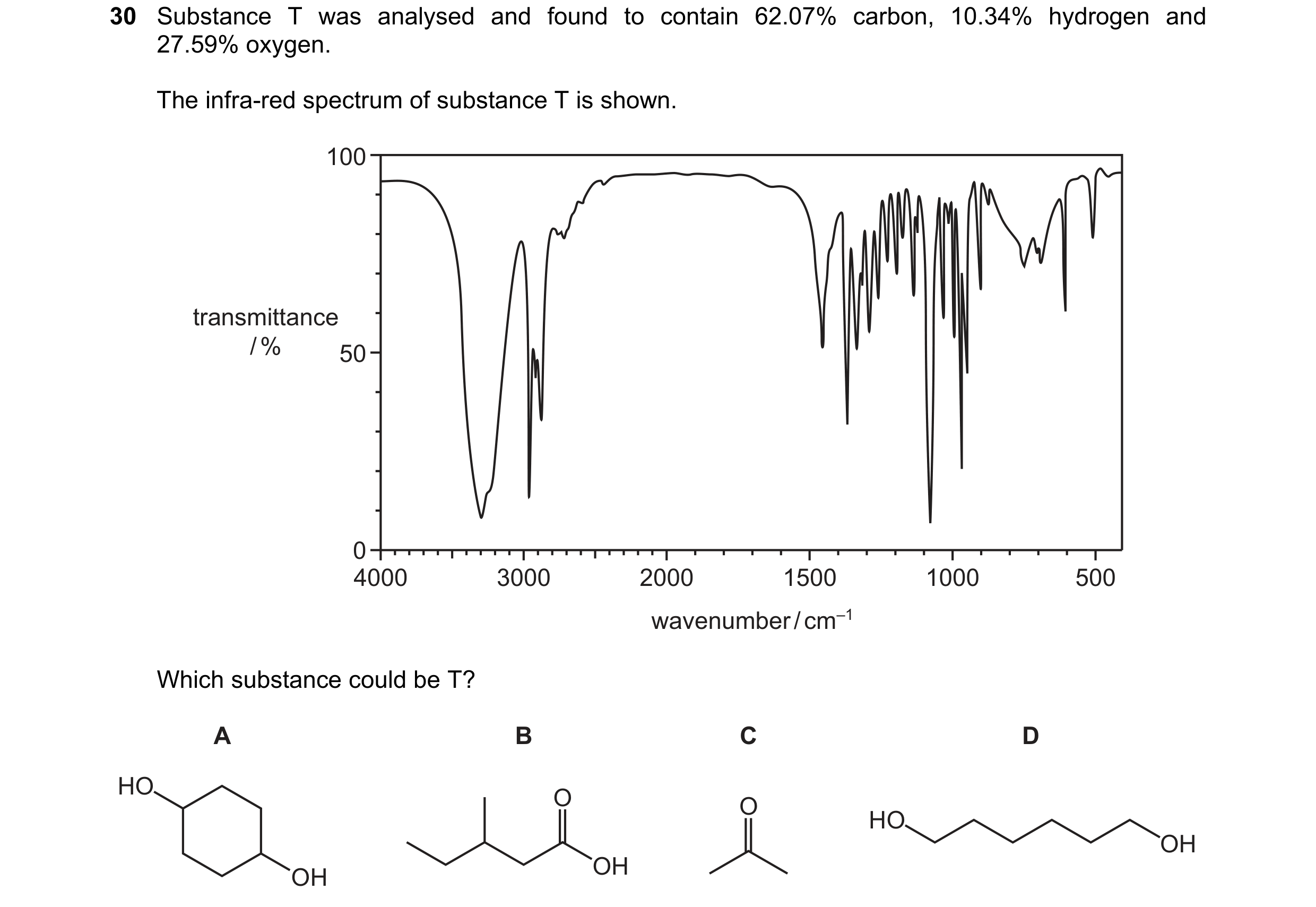
Q13 · Substance T was analysed and found to contain 62.07% carbon, 10.34% hydrogen and 27.59%… 9701/12 Oct/Nov 2019
30 Substance T was analysed and found to contain 62.07% carbon, 10.34% hydrogen and 27.59% oxygen. The infra-red spectrum of substance T is shown. 100 transmittance / % 50 0 4000 3000 2000 1500 1000 500 wavenumber / cm–1 Which substance could be T? A B C D HO O O HO OH OH OH
1 marks
Answer: A
This question in 9701/12 Oct/Nov 2019
Q14 · The infra-red spectrum of compound P is shown 9701/13 Oct/Nov 2019
30 The infra-red spectrum of compound P is shown. 100 transmittance / % 50 0 4000 3000 2000 1500 1000 500 wavenumber / cm–1 What could be compound P? A methyl ethanoate B propanal C propanoic acid D propan-2-ol
1 marks
Answer: D
This question in 9701/13 Oct/Nov 2019
Q15 · The infrared spectrum shown was obtained from a compound J 9701/12 Feb/March 2020
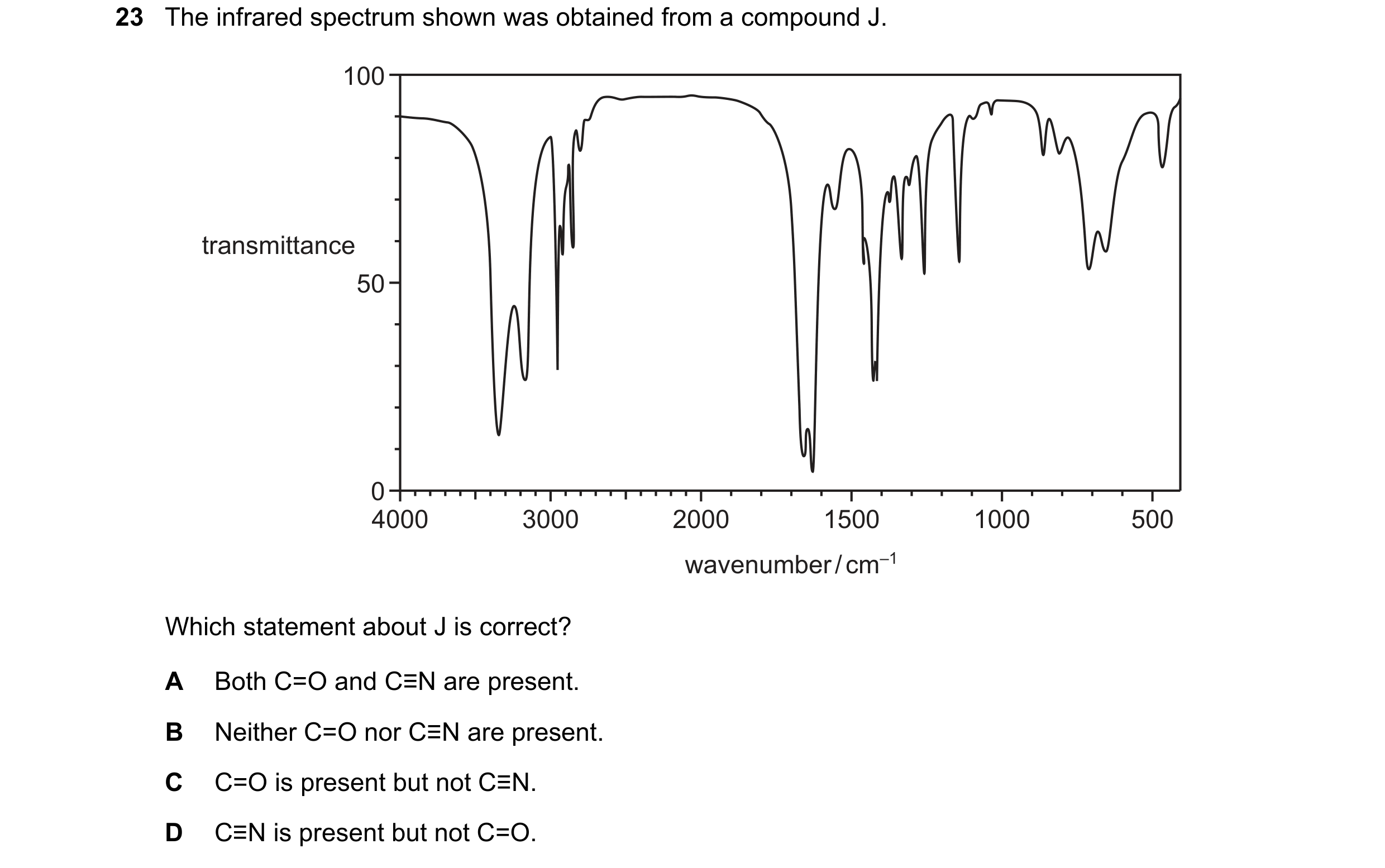
23 The infrared spectrum shown was obtained from a compound J. 100 transmittance 50 0 4000 3000 2000 1500 1000 500 wavenumber / cm–1 Which statement about J is correct? A Both C=O and C≡N are present. B Neither C=O nor C≡N are present. C C=O is present but not C≡N. D C≡N is present but not C=O.
1 marks
Answer: C
This question in 9701/12 Feb/March 2020
Q16 · Compound X has the infra-red spectrum shown 9701/11 May/June 2020
29 Compound X has the infra-red spectrum shown. 100 transmittance / % 50 0 4000 3000 2000 1500 1000 500 wavenumber / cm–1 What could be the identity of compound X? A ethanoic acid B ethanol C ethylethanoate D propanone
1 marks
Answer: A
This question in 9701/11 May/June 2020
Q17 · The table shows the molecular formulae of three molecules P, Q and R 9701/12 May/June 2020
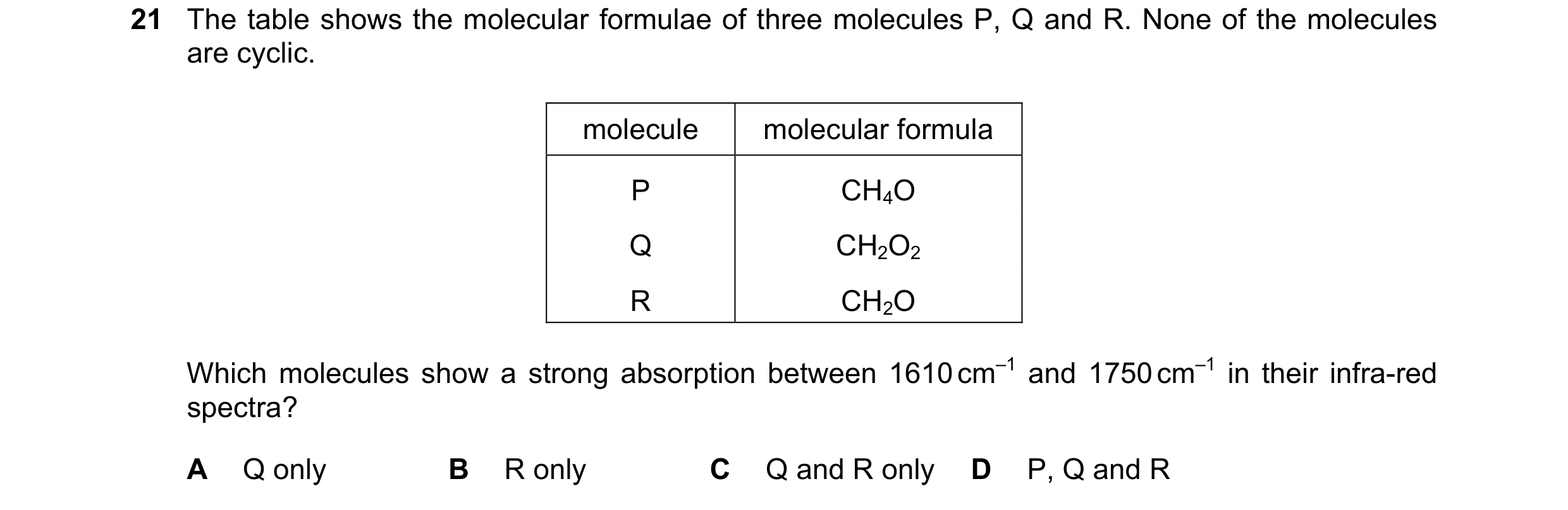
21 The table shows the molecular formulae of three molecules P, Q and R. None of the molecules are cyclic. molecule molecular formula P CH4O Q CH2O2 R CH2O Which molecules show a strong absorption between 1610 cm–1 and 1750 cm–1 in their infra-red spectra? A Q only B R only C Q and R only D P, Q and R
1 marks
Answer: C
This question in 9701/12 May/June 2020
Q18 · Propanal reacts with hydrogen cyanide 9701/12 May/June 2020
38 Propanal reacts with hydrogen cyanide. Which absorptions are present in the infra-red spectrum of the product? 1 a weak absorption in the range 2200–2250 cm–1 2 a strong absorption in the range 3200–3600 cm–1 3 a strong absorption in the range 1040–1300 cm–1
1 marks
Answer: A
This question in 9701/12 May/June 2020
Q19 · The diagram shows the infrared spectrum of an organic compound 9701/13 May/June 2020
25 The diagram shows the infrared spectrum of an organic compound. What could be the identity of this compound? A propan-1-ol B propanal C propanoic acid D propanone
1 marks
Answer: C
This question in 9701/13 May/June 2020
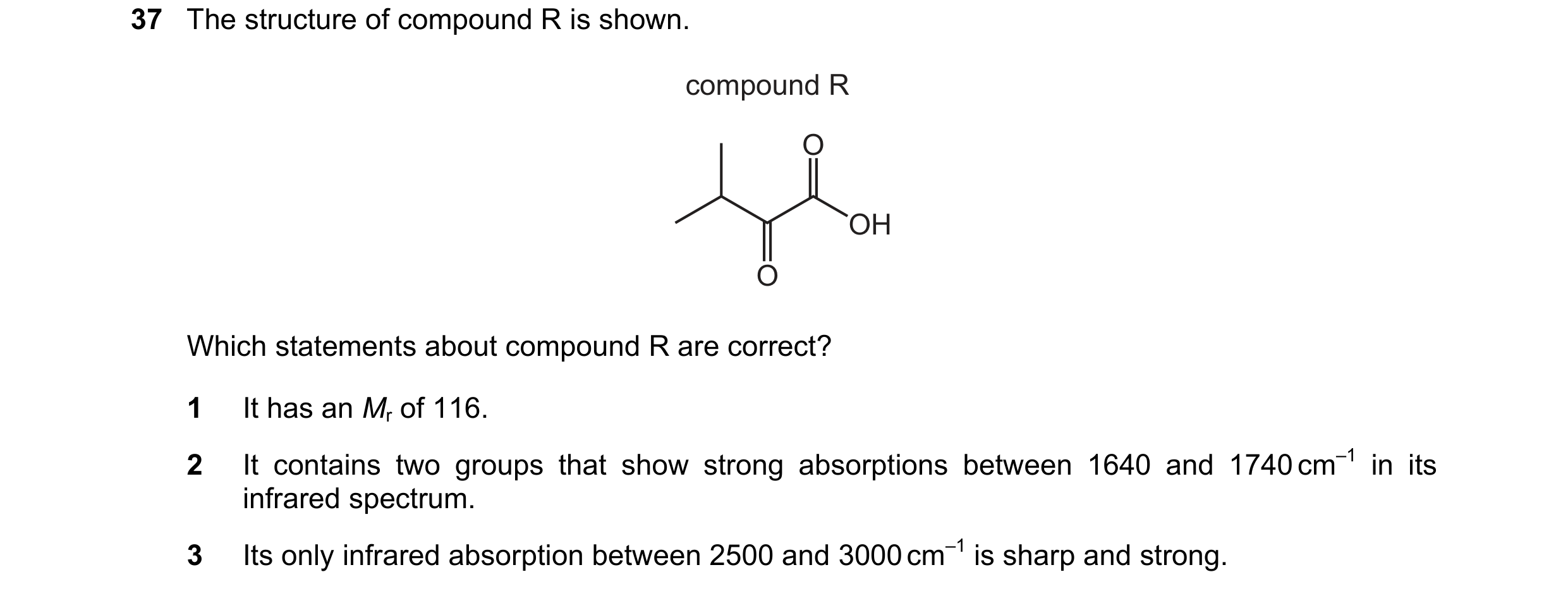
Q20 · The structure of compound R is shown 9701/11 Oct/Nov 2020
37 The structure of compound R is shown. compound R O OH O Which statements about compound R are correct? 1 It has an Mr of 116. 2 It contains two groups that show strong absorptions between 1640 and 1740 cm–1 in its infrared spectrum. 3 Its only infrared absorption between 2500 and 3000 cm–1 is sharp and strong.
1 marks
Answer: B
This question in 9701/11 Oct/Nov 2020
Q21 · The infra-red spectrum shown was obtained from compound G 9701/12 Oct/Nov 2020
30 The infra-red spectrum shown was obtained from compound G. 100 transmittance / % 50 0 4000 3000 2000 1500 1000 500 wavenumber / cm–1 What could be compound G? A CH3COCH2OH B CH3CH2CO2H C CH3CO2CH3 D CH3CHCHCH3
1 marks
Answer: C
This question in 9701/12 Oct/Nov 2020
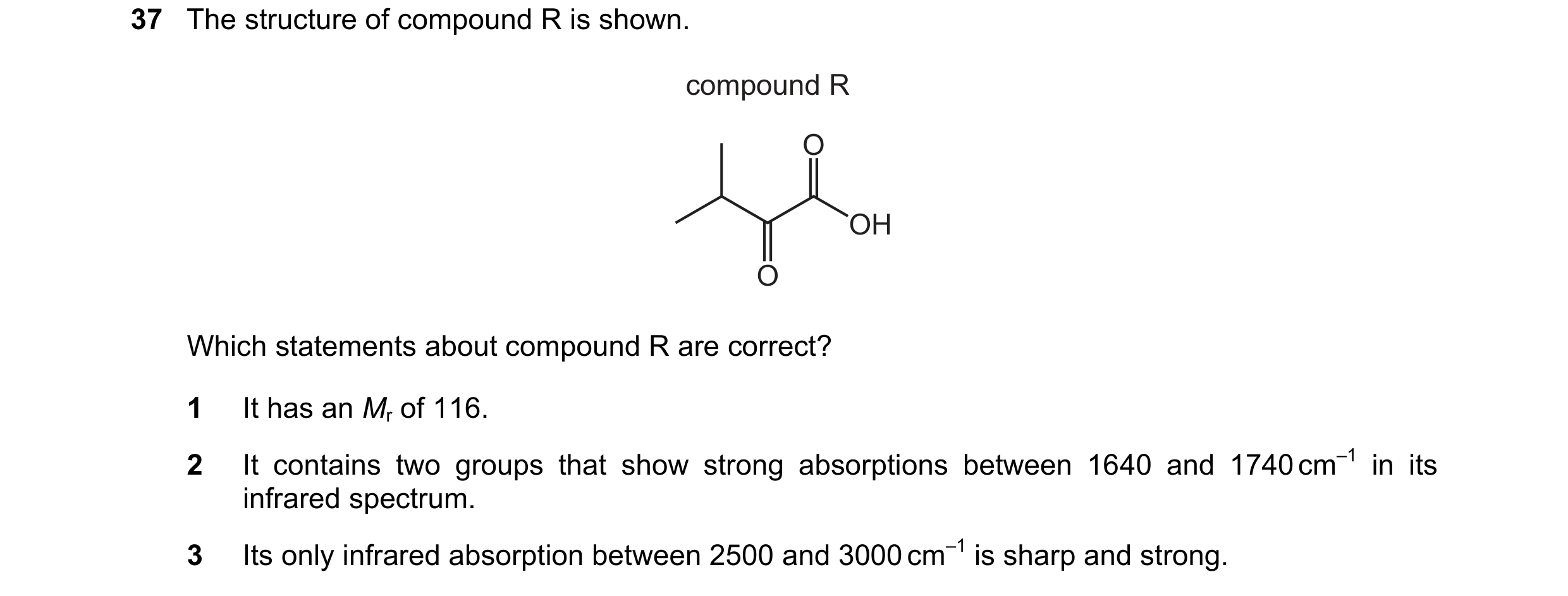
Q22 · The structure of compound R is shown 9701/13 Oct/Nov 2020
37 The structure of compound R is shown. compound R O OH O Which statements about compound R are correct? 1 It has an Mr of 116. 2 It contains two groups that show strong absorptions between 1640 and 1740 cm–1 in its infrared spectrum. 3 Its only infrared absorption between 2500 and 3000 cm–1 is sharp and strong.
1 marks
Answer: B
This question in 9701/13 Oct/Nov 2020
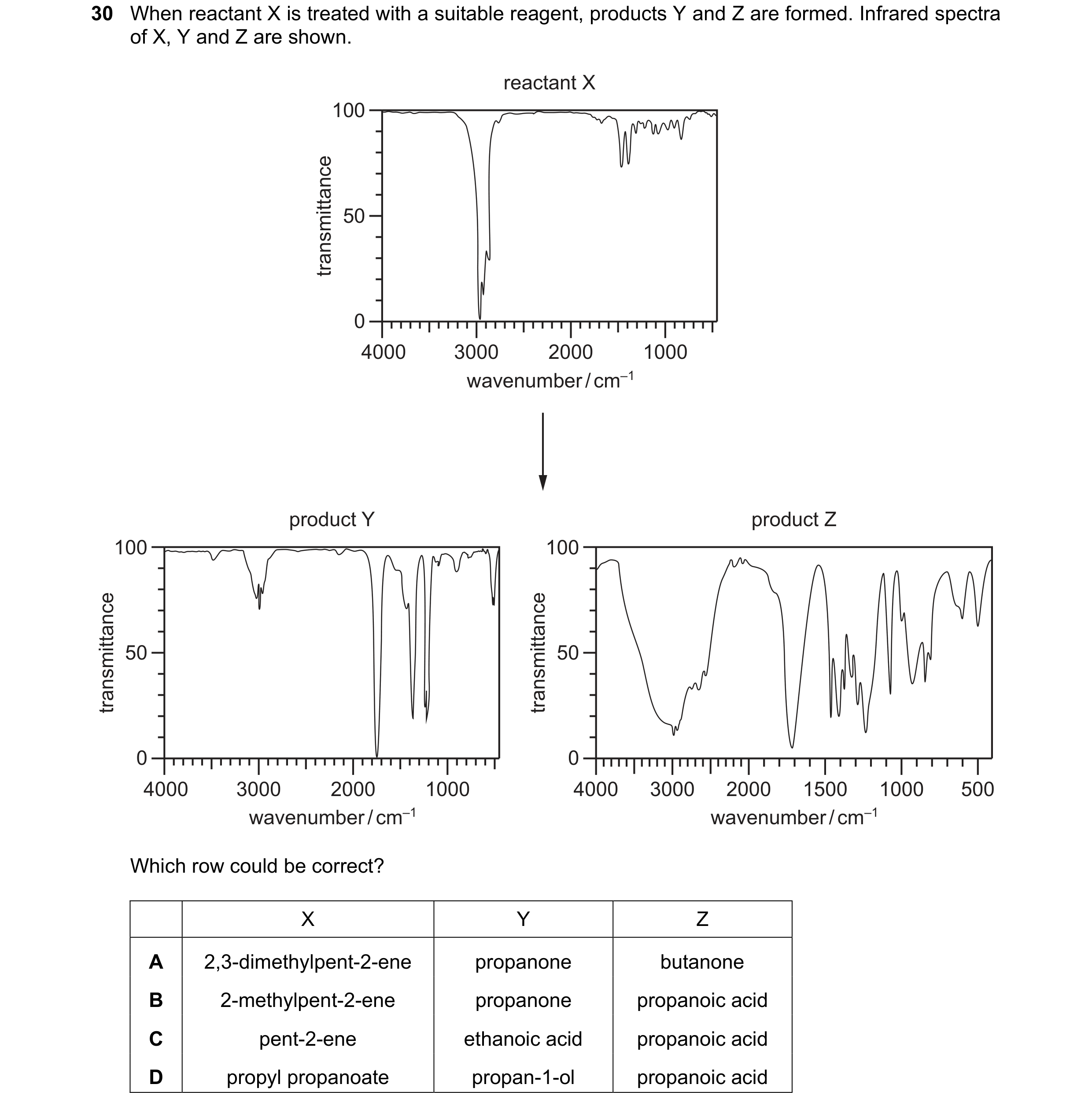
Q23 · When reactant X is treated with a suitable reagent, products Y and Z are formed 9701/12 Feb/March 2021
30 When reactant X is treated with a suitable reagent, products Y and Z are formed. Infrared spectra of X, Y and Z are shown. reactant X 100 transmittance 50 0 4000 3000 2000 1000 wavenumber / cm–1 product Y product Z 100 100 transmittance transmittance 50 50 0 0 4000 3000 2000 1000 4000 3000 2000 1500 1000 500 wavenumber / cm–1 wavenumber / cm–1 Which row could be correct? X Y Z A 2,3-dimethylpent-2-ene propanone butanone B 2-methylpent-2-ene propanone propanoic acid C pent-2-ene ethanoic acid propanoic acid D propyl propanoate propan-1-ol propanoic acid
1 marks
Answer: B
This question in 9701/12 Feb/March 2021
Q24 · Compound X has the empirical formula C2H4O 9701/11 May/June 2021
26 Compound X has the empirical formula C2H4O. Its infra-red spectrum is shown. 100 transmittance / % 50 0 4000 3000 2000 1500 1000 500 wavenumber / cm–1 What could be the skeletal formula of compound X? A B C D OH O O O O O O H OH
1 marks
Answer: A
This question in 9701/11 May/June 2021
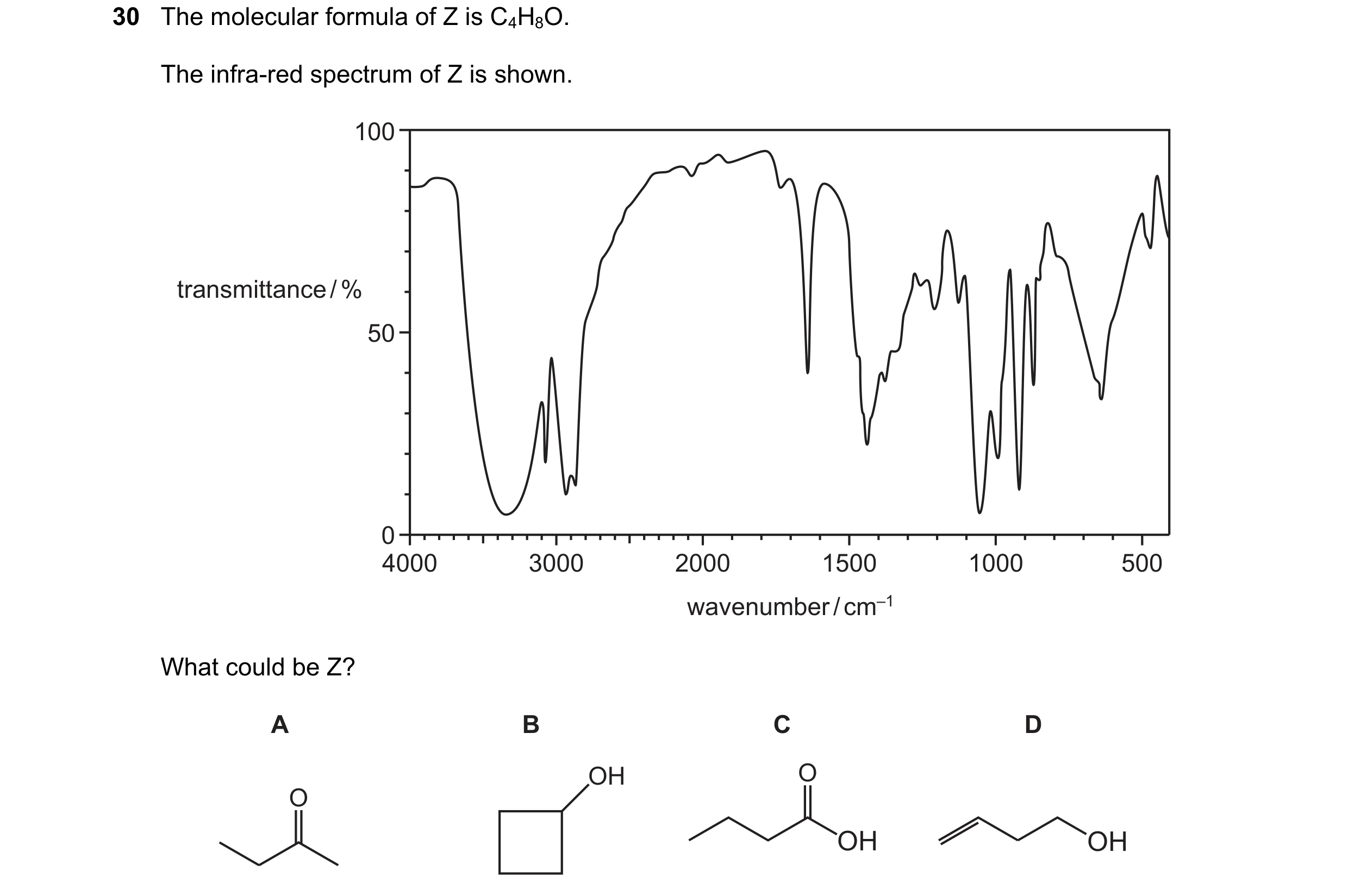
Q25 · The molecular formula of Z is C4H8O 9701/12 May/June 2021
30 The molecular formula of Z is C4H8O. The infra-red spectrum of Z is shown. 100 transmittance / % 50 0 4000 3000 2000 1500 1000 500 wavenumber / cm–1 What could be Z? A B C D OH O O OH OH
1 marks
Answer: D
This question in 9701/12 May/June 2021
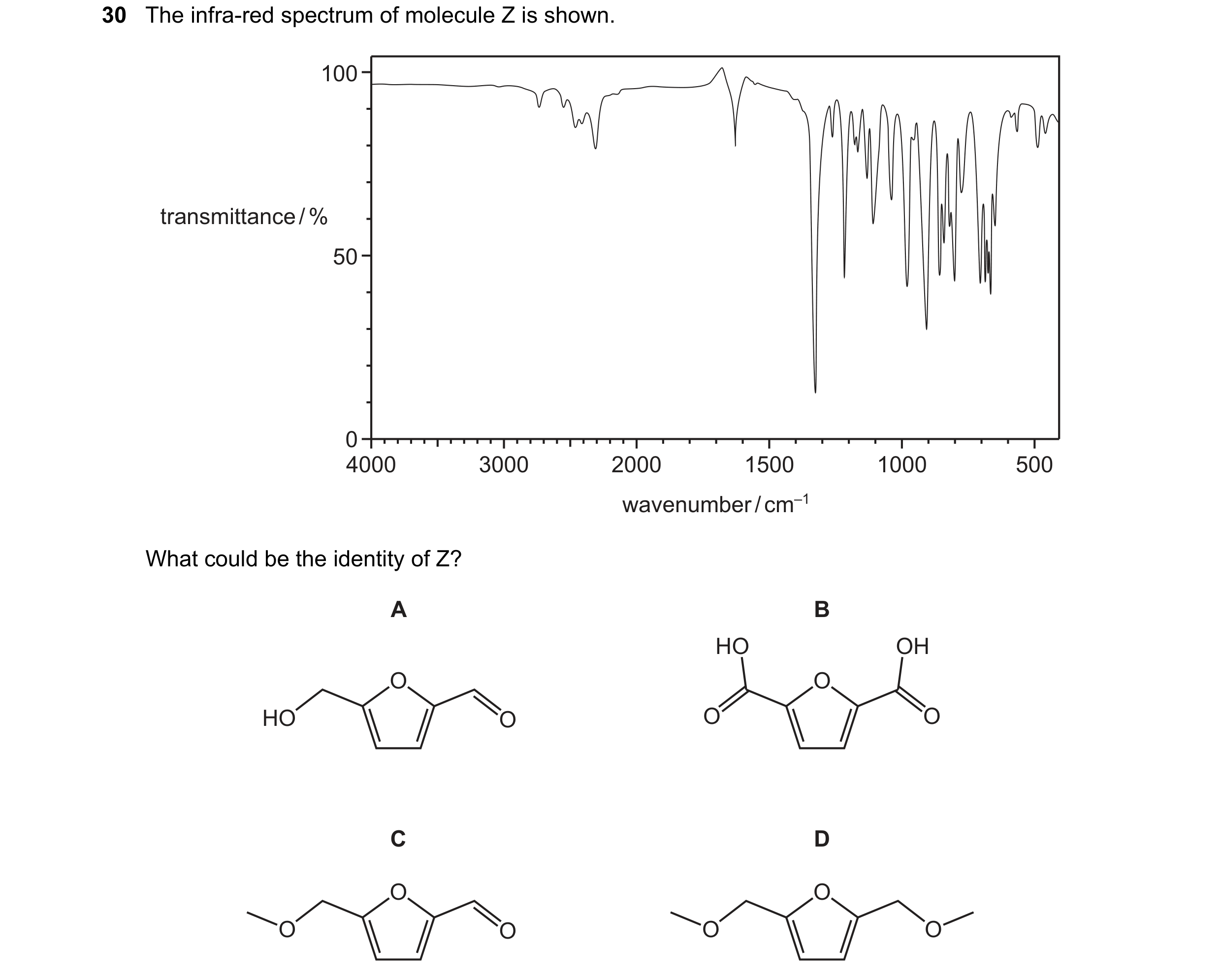
Q26 · The infra-red spectrum of molecule Z is shown 9701/13 May/June 2021
30 The infra-red spectrum of molecule Z is shown. 100 transmittance / % 50 0 4000 3000 2000 1500 1000 500 wavenumber / cm–1 What could be the identity of Z? A B HO OH O O HO O O O C D O O O O O O
1 marks
Answer: D
This question in 9701/13 May/June 2021
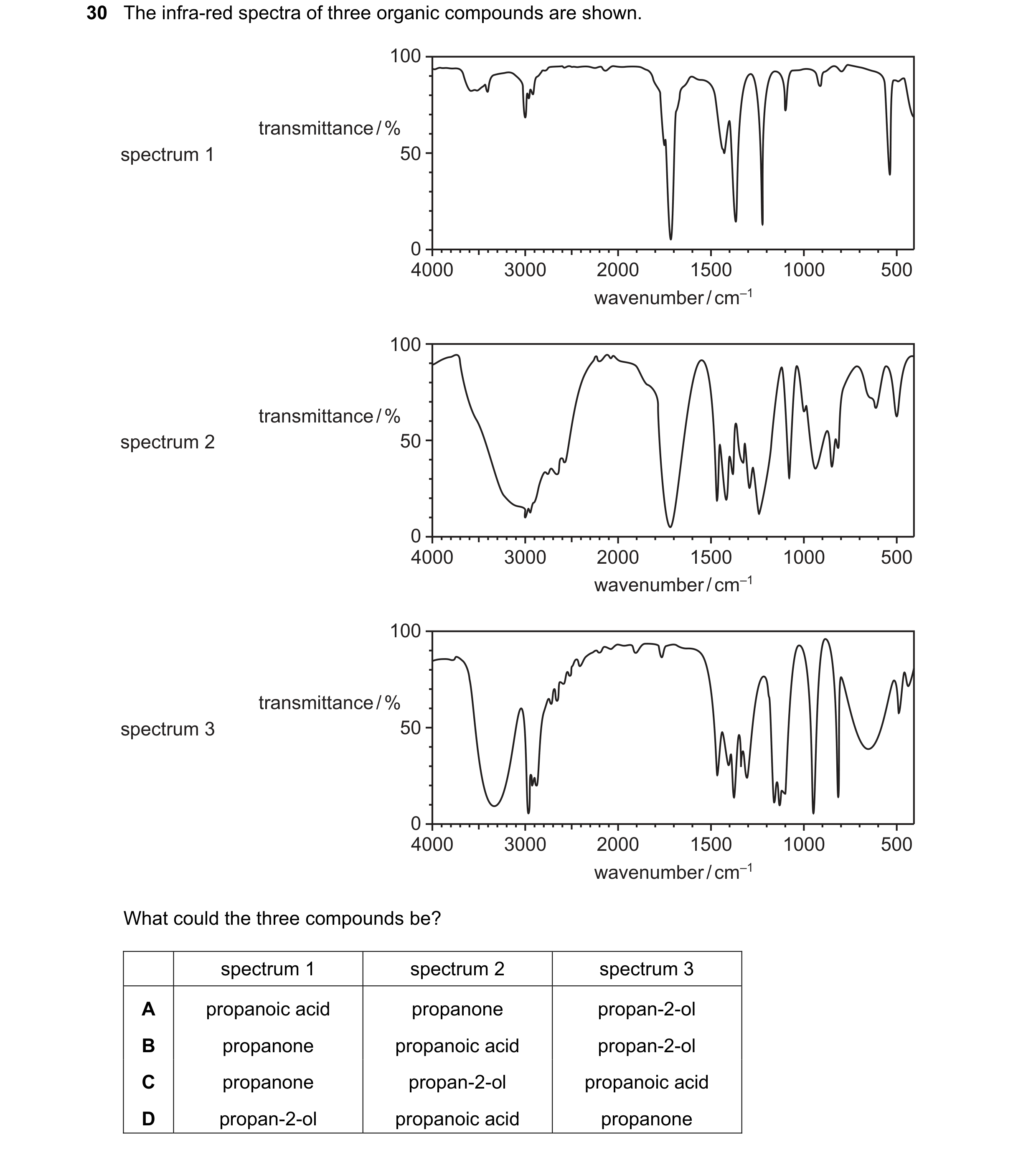
Q27 · The infra-red spectra of three organic compounds are shown 9701/11 Oct/Nov 2021
30 The infra-red spectra of three organic compounds are shown. 100 transmittance / % spectrum 1 50 0 4000 3000 2000 1500 1000 500 wavenumber / cm–1 100 transmittance / % spectrum 2 50 0 4000 3000 2000 1500 1000 500 wavenumber / cm–1 100 transmittance / % spectrum 3 50 0 4000 3000 2000 1500 1000 500 wavenumber / cm–1 What could the three compounds be? spectrum 1 spectrum 2 spectrum 3 A propanoic acid propanone propan-2-ol B propanone propanoic acid propan-2-ol C propanone propan-2-ol propanoic acid D propan-2-ol propanoic acid propanone
1 marks
Answer: B
This question in 9701/11 Oct/Nov 2021
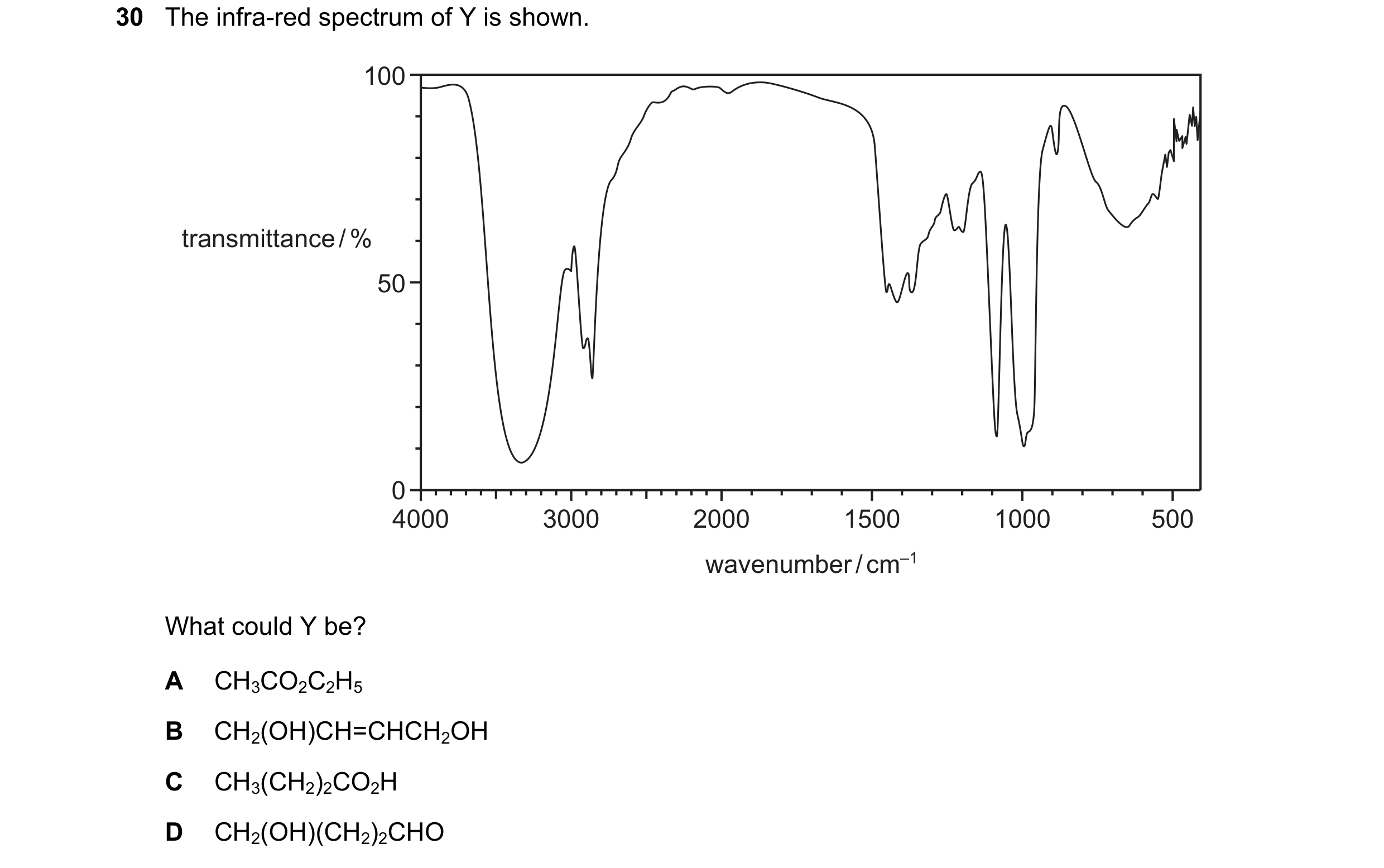
Q28 · The infra-red spectrum of Y is shown 9701/12 Oct/Nov 2021
30 The infra-red spectrum of Y is shown. 100 transmittance / % 50 0 4000 3000 2000 1500 1000 500 wavenumber / cm–1 What could Y be? A CH3CO2C2H5 B CH2(OH)CH=CHCH2OH C CH3(CH2)2CO2H D CH2(OH)(CH2)2CHO
1 marks
Answer: B
This question in 9701/12 Oct/Nov 2021
Q29 · The infra-red spectra of three organic compounds are shown 9701/13 Oct/Nov 2021
30 The infra-red spectra of three organic compounds are shown. 100 transmittance / % spectrum 1 50 0 4000 3000 2000 1500 1000 500 wavenumber / cm–1 100 transmittance / % spectrum 2 50 0 4000 3000 2000 1500 1000 500 wavenumber / cm–1 100 transmittance / % spectrum 3 50 0 4000 3000 2000 1500 1000 500 wavenumber / cm–1 What could the three compounds be? spectrum 1 spectrum 2 spectrum 3 A propanoic acid propanone propan-2-ol B propanone propanoic acid propan-2-ol C propanone propan-2-ol propanoic acid D propan-2-ol propanoic acid propanone
1 marks
Answer: B
This question in 9701/13 Oct/Nov 2021
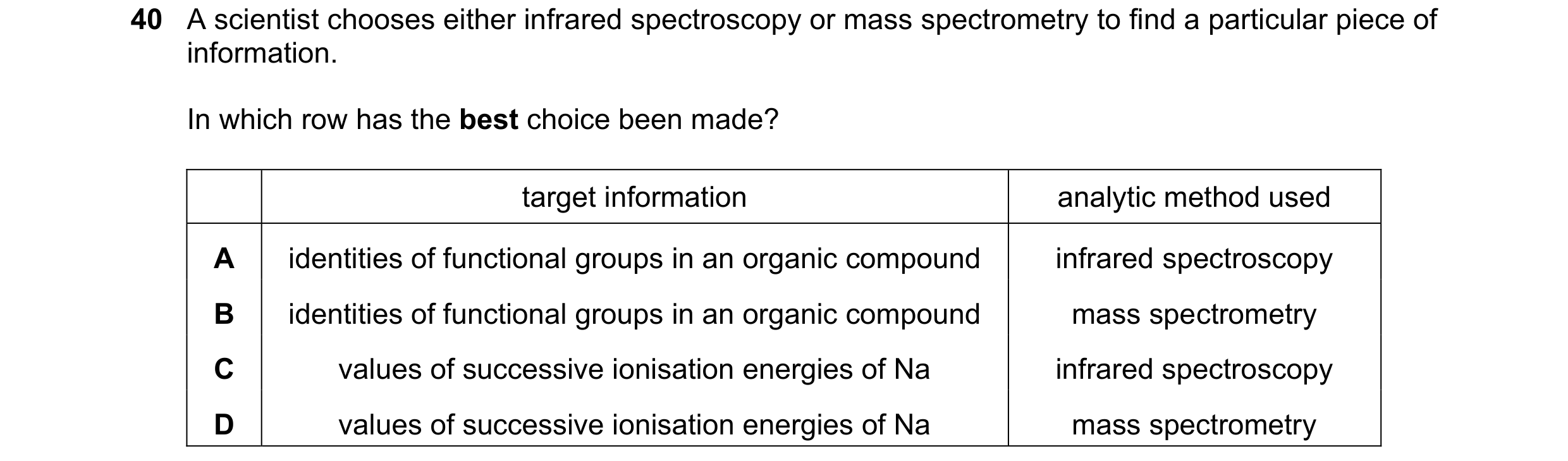
Q30 · A scientist chooses either infrared spectroscopy or mass spectrometry to find a… 9701/11 May/June 2022
40 A scientist chooses either infrared spectroscopy or mass spectrometry to find a particular piece of information. In which row has the best choice been made? target information analytic method used A identities of functional groups in an organic compound infrared spectroscopy B identities of functional groups in an organic compound mass spectrometry C values of successive ionisation energies of Na infrared spectroscopy D values of successive ionisation energies of Na mass spectrometry
1 marks
Answer: A
This question in 9701/11 May/June 2022
Q31 · A molecule of an organic compound, P, contains three carbon atoms and shows a strong… 9701/12 Oct/Nov 2022
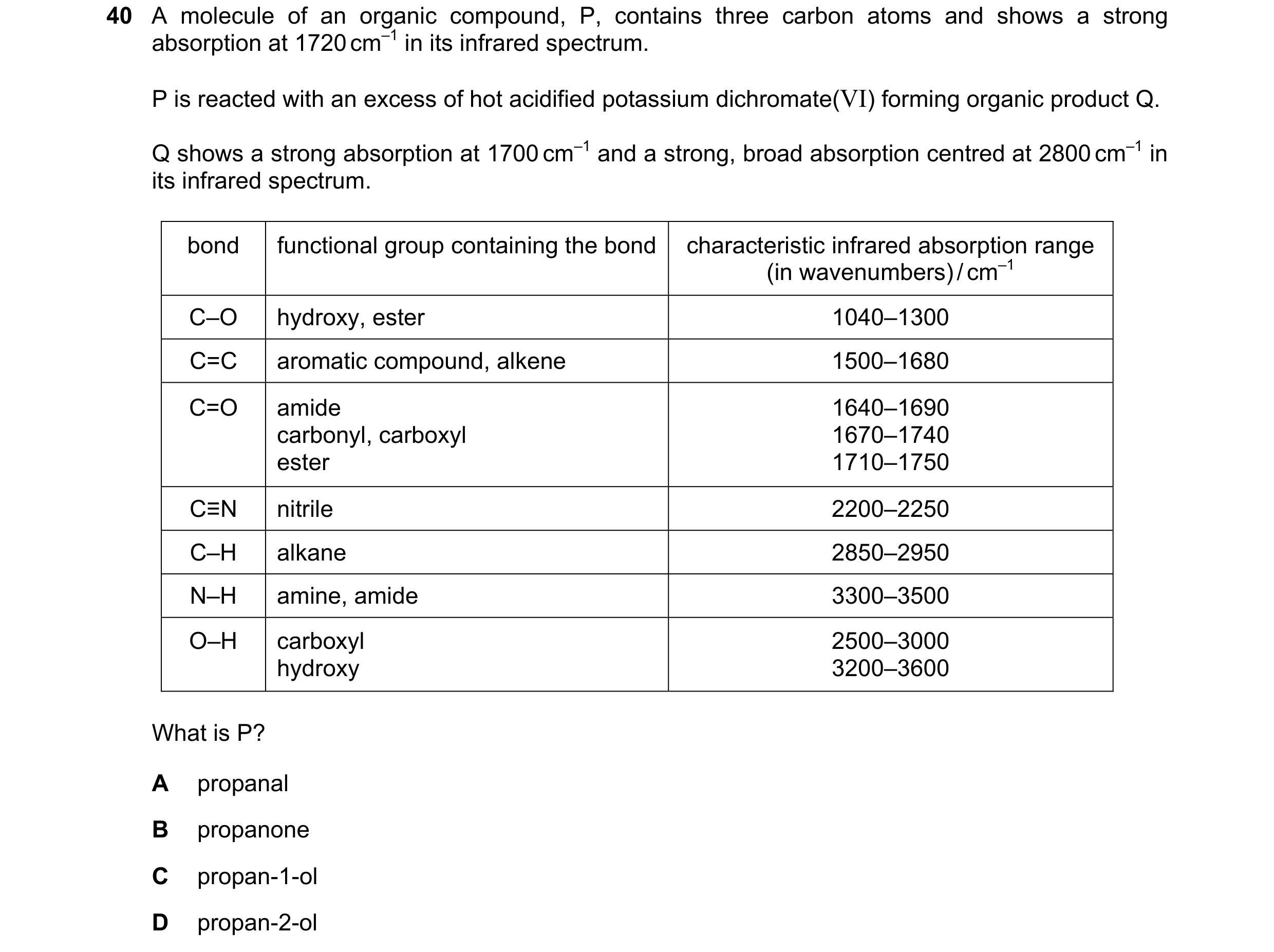
40 A molecule of an organic compound, P, contains three carbon atoms and shows a strong absorption at 1720 cm–1 in its infrared spectrum. P is reacted with an excess of hot acidified potassium dichromate(VI) forming organic product Q. Q shows a strong absorption at 1700 cm–1 and a strong, broad absorption centred at 2800 cm–1 in its infrared spectrum. bond functional group containing the bond characteristic infrared absorption range (in wavenumbers) / cm–1 C–O hydroxy, ester 1040–1300 C=C aromatic compound, alkene 1500–1680 C=O amide 1640–1690 carbonyl, carboxyl 1670–1740 ester 1710–1750 C≡N nitrile 2200–2250 C–H alkane 2850–2950 N–H amine, amide 3300–3500 O–H carboxyl 2500–3000 hydroxy 3200–3600 What is P? A propanal B propanone C propan-1-ol D propan-2-ol
1 marks
Answer: A
This question in 9701/12 Oct/Nov 2022
Q32 · The infrared spectrum of an organic compound is shown 9701/12 Feb/March 2023
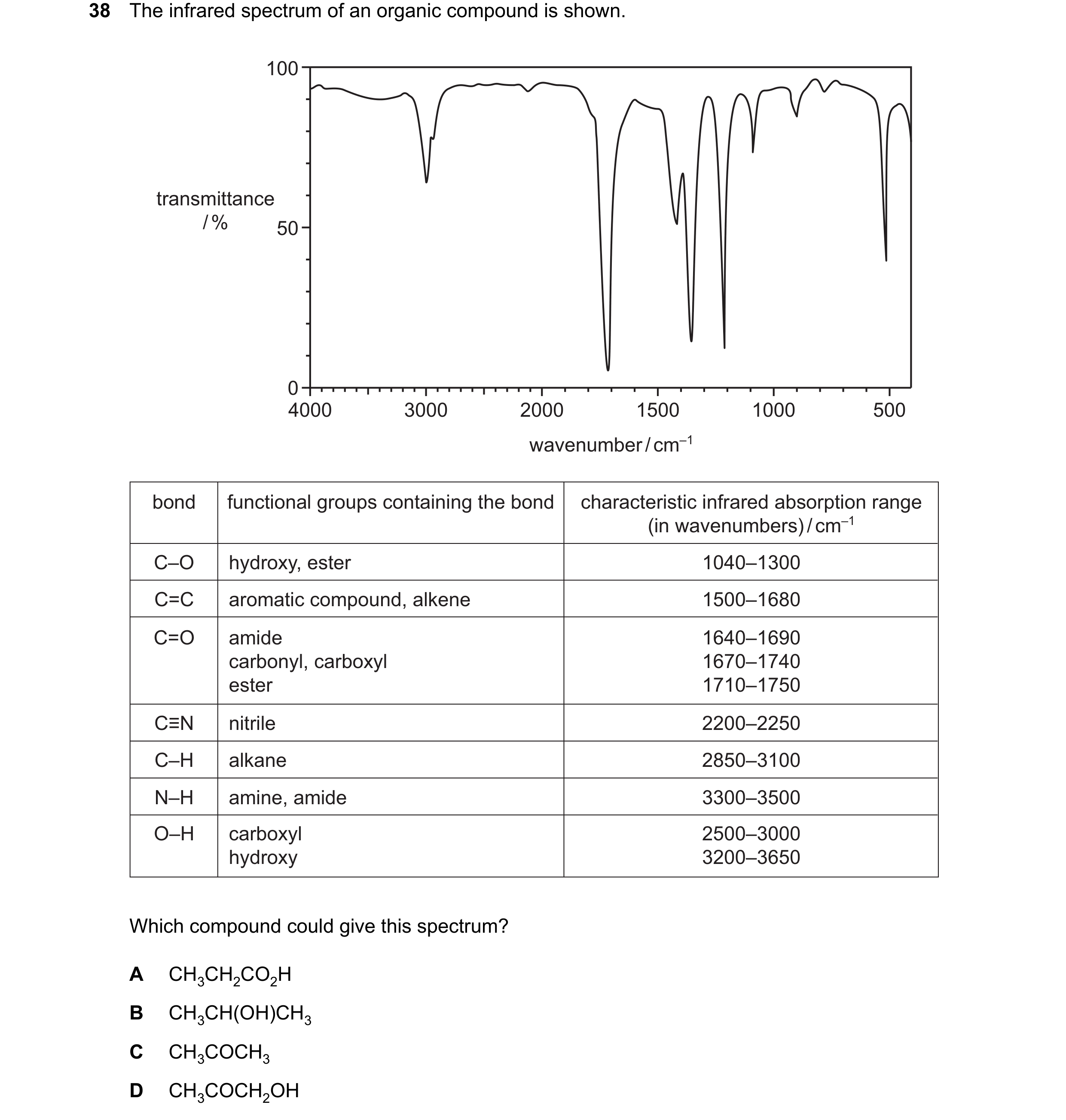
38 The infrared spectrum of an organic compound is shown. 100 transmittance / % 50 0 4000 3000 2000 1500 1000 500 wavenumber / cm–1 bond functional groups containing the bond characteristic infrared absorption range (in wavenumbers) / cm–1 C–O hydroxy, ester 1040–1300 C=C aromatic compound, alkene 1500–1680 C=O amide 1640–1690 carbonyl, carboxyl 1670–1740 ester 1710–1750 C≡N nitrile 2200–2250 C–H alkane 2850–3100 N–H amine, amide 3300–3500 O–H carboxyl 2500–3000 hydroxy 3200–3650 Which compound could give this spectrum? A CH3CH2CO2H B CH3CH(OH)CH3 C CH3COCH3 D CH3COCH2OH
1 marks
Answer: C
This question in 9701/12 Feb/March 2023
Q33 · The infrared spectrum of compound L is shown 9701/11 Oct/Nov 2023
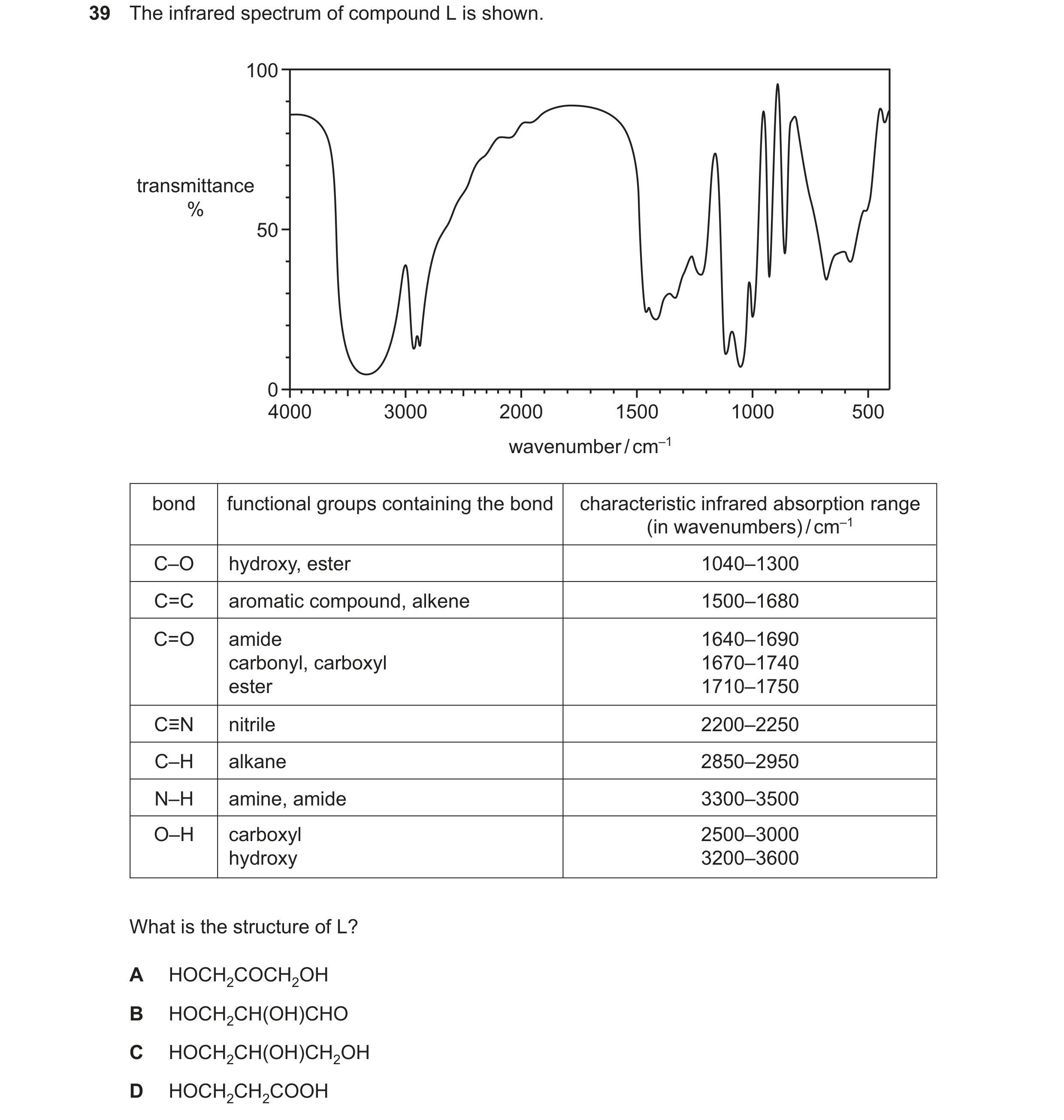
39 The infrared spectrum of compound L is shown. 100 transmittance % 50 0 4000 3000 2000 1500 1000 500 wavenumber / cm–1 bond functional groups containing the bond characteristic infrared absorption range (in wavenumbers) / cm–1 C–O hydroxy, ester 1040–1300 C=C aromatic compound, alkene 1500–1680 C=O amide 1640–1690 carbonyl, carboxyl 1670–1740 ester 1710–1750 C≡N nitrile 2200–2250 C–H alkane 2850–2950 N–H amine, amide 3300–3500 O–H carboxyl 2500–3000 hydroxy 3200–3600 What is the structure of L? A HOCH2COCH2OH B HOCH2CH(OH)CHO C HOCH2CH(OH)CH2OH D HOCH2CH2COOH
1 marks
Answer: C
This question in 9701/11 Oct/Nov 2023
Q34 · The infrared spectrum of compound L is shown 9701/13 Oct/Nov 2023
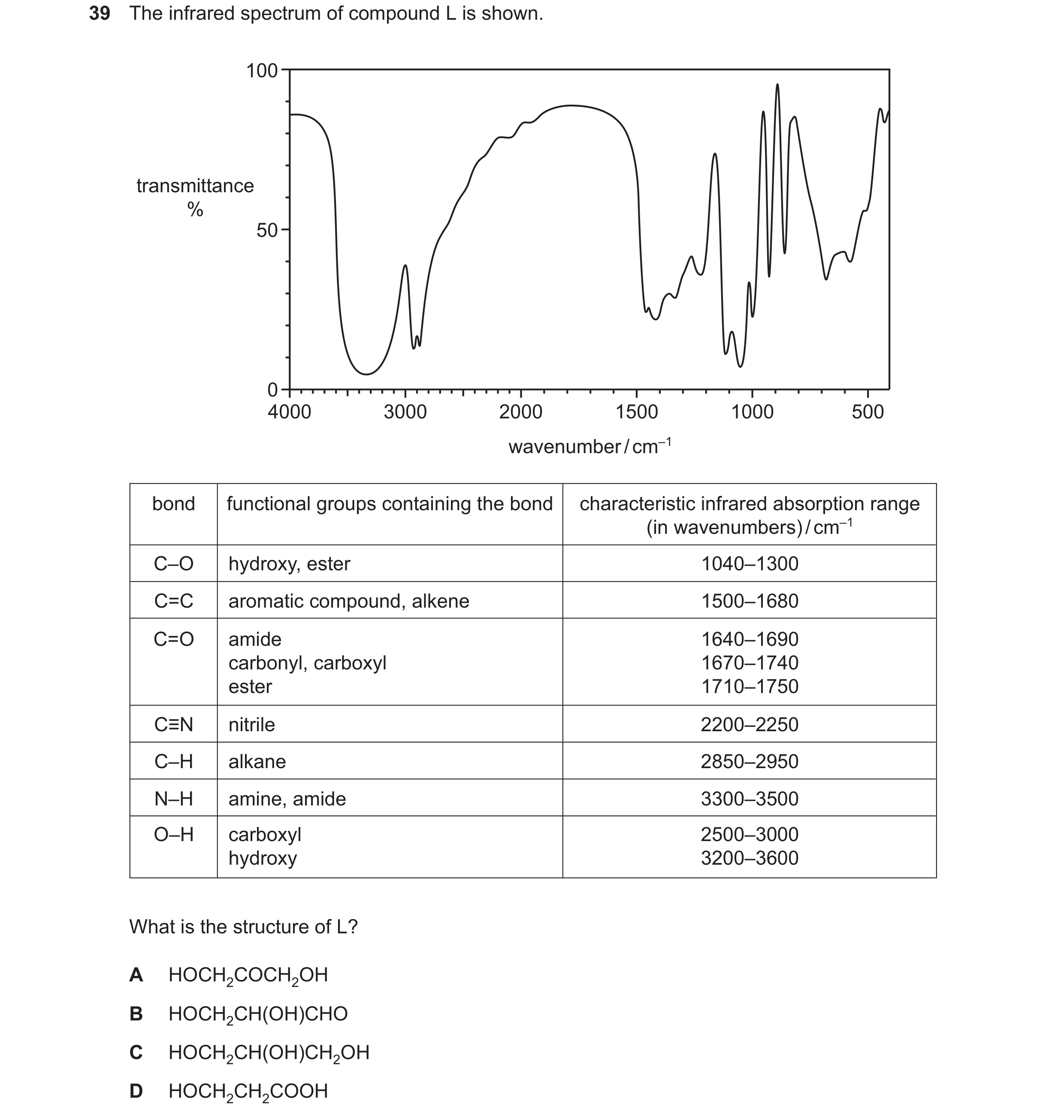
39 The infrared spectrum of compound L is shown. 100 transmittance % 50 0 4000 3000 2000 1500 1000 500 wavenumber / cm–1 bond functional groups containing the bond characteristic infrared absorption range (in wavenumbers) / cm–1 C–O hydroxy, ester 1040–1300 C=C aromatic compound, alkene 1500–1680 C=O amide 1640–1690 carbonyl, carboxyl 1670–1740 ester 1710–1750 C≡N nitrile 2200–2250 C–H alkane 2850–2950 N–H amine, amide 3300–3500 O–H carboxyl 2500–3000 hydroxy 3200–3600 What is the structure of L? A HOCH2COCH2OH B HOCH2CH(OH)CHO C HOCH2CH(OH)CH2OH D HOCH2CH2COOH
1 marks
Answer: C
This question in 9701/13 Oct/Nov 2023
Q35 · The infrared spectrum of a compound is shown 9701/12 Feb/March 2024
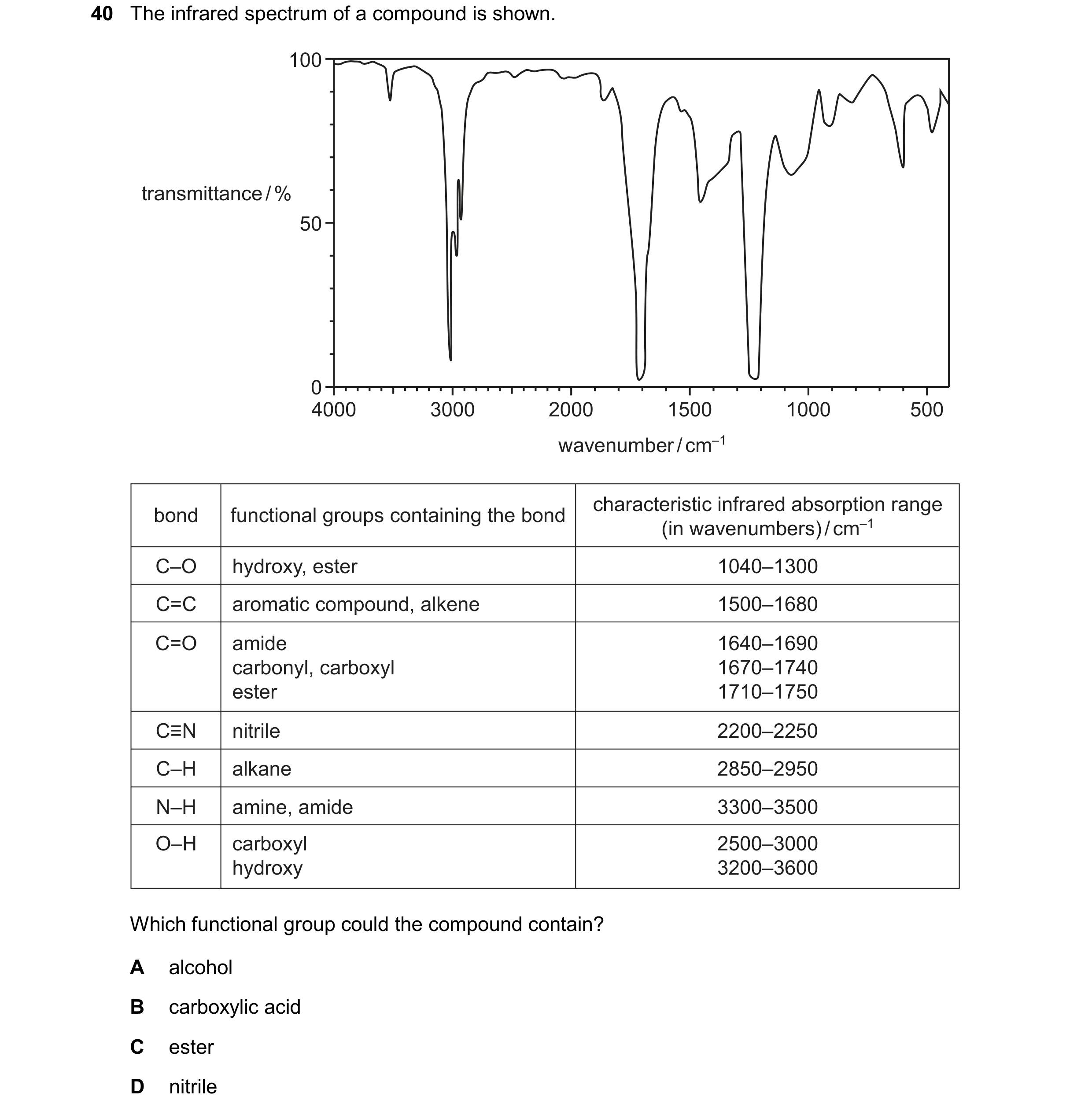
40 The infrared spectrum of a compound is shown. 100 transmittance / % 50 0 4000 3000 2000 1500 1000 500 wavenumber / cm–1 characteristic infrared absorption range bond functional groups containing the bond (in wavenumbers) / cm–1 C–O hydroxy, ester 1040–1300 C=C aromatic compound, alkene 1500–1680 C=O amide 1640–1690 carbonyl, carboxyl 1670–1740 ester 1710–1750 C≡N nitrile 2200–2250 C–H alkane 2850–2950 N–H amine, amide 3300–3500 O–H carboxyl 2500–3000 hydroxy 3200–3600 Which functional group could the compound contain? A alcohol B carboxylic acid C ester D nitrile
1 marks
Answer: C
This question in 9701/12 Feb/March 2024
Q36 · Compound X reacts with acidified K2Cr2O7 to form compound Y 9701/12 May/June 2024
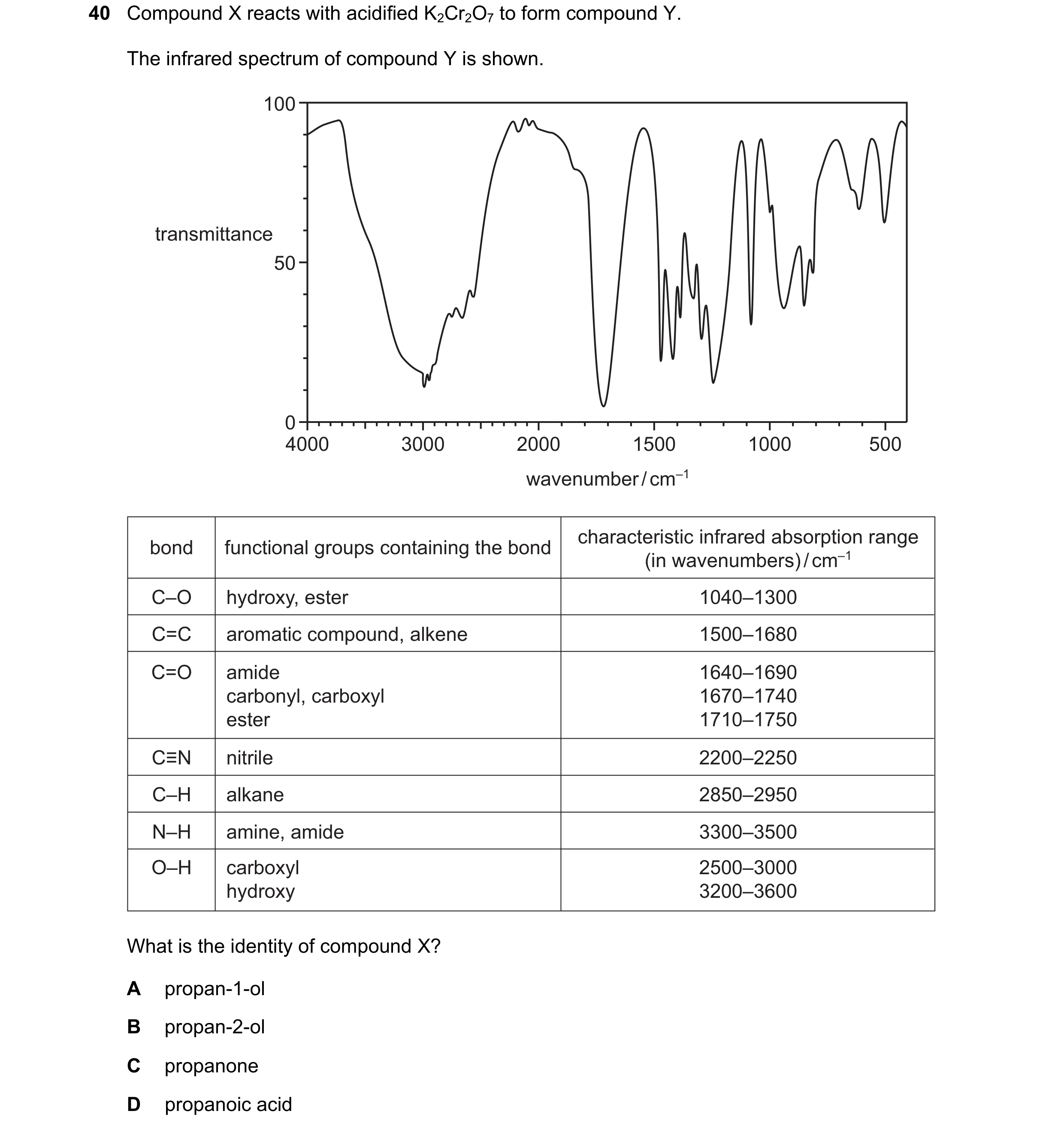
40 Compound X reacts with acidified K2Cr2O7 to form compound Y. The infrared spectrum of compound Y is shown. 100 transmittance 50 0 4000 3000 2000 1500 1000 500 wavenumber / cm–1 characteristic infrared absorption range bond functional groups containing the bond (in wavenumbers) / cm–1 C–O hydroxy, ester 1040–1300 C=C aromatic compound, alkene 1500–1680 C=O amide 1640–1690 carbonyl, carboxyl 1670–1740 ester 1710–1750 C≡N nitrile 2200–2250 C–H alkane 2850–2950 N–H amine, amide 3300–3500 O–H carboxyl 2500–3000 hydroxy 3200–3600 What is the identity of compound X? A propan-1-ol B propan-2-ol C propanone D propanoic acid
1 marks
Answer: A
This question in 9701/12 May/June 2024
Q37 · A sample of but-2-enoic acid, CH3CH=CHCOOH, is analysed using infrared spectroscopy 9701/13 May/June 2024
40 A sample of but-2-enoic acid, CH3CH=CHCOOH, is analysed using infrared spectroscopy. The infrared spectrum shows a broad peak in the range 2500–3000 cm–1. characteristic infrared absorption range bond functional groups containing the bond (in wavenumbers) / cm–1 C–O hydroxy, ester 1040–1300 C=C aromatic compound, alkene 1500–1680 C=O amide 1640–1690 carbonyl, carboxyl 1670–1740 ester 1710–1750 C≡N nitrile 2200–2250 C–H alkane 2850–2950 N–H amine, amide 3300–3500 O–H carboxyl 2500–3000 hydroxy 3200–3600 Which bond is responsible for this peak? A C=C B C=O C C–O D O–H
1 marks
Answer: D
This question in 9701/13 May/June 2024
Q38 · The purity of a compound can be determined using infrared spectroscopy 9701/12 Oct/Nov 2025
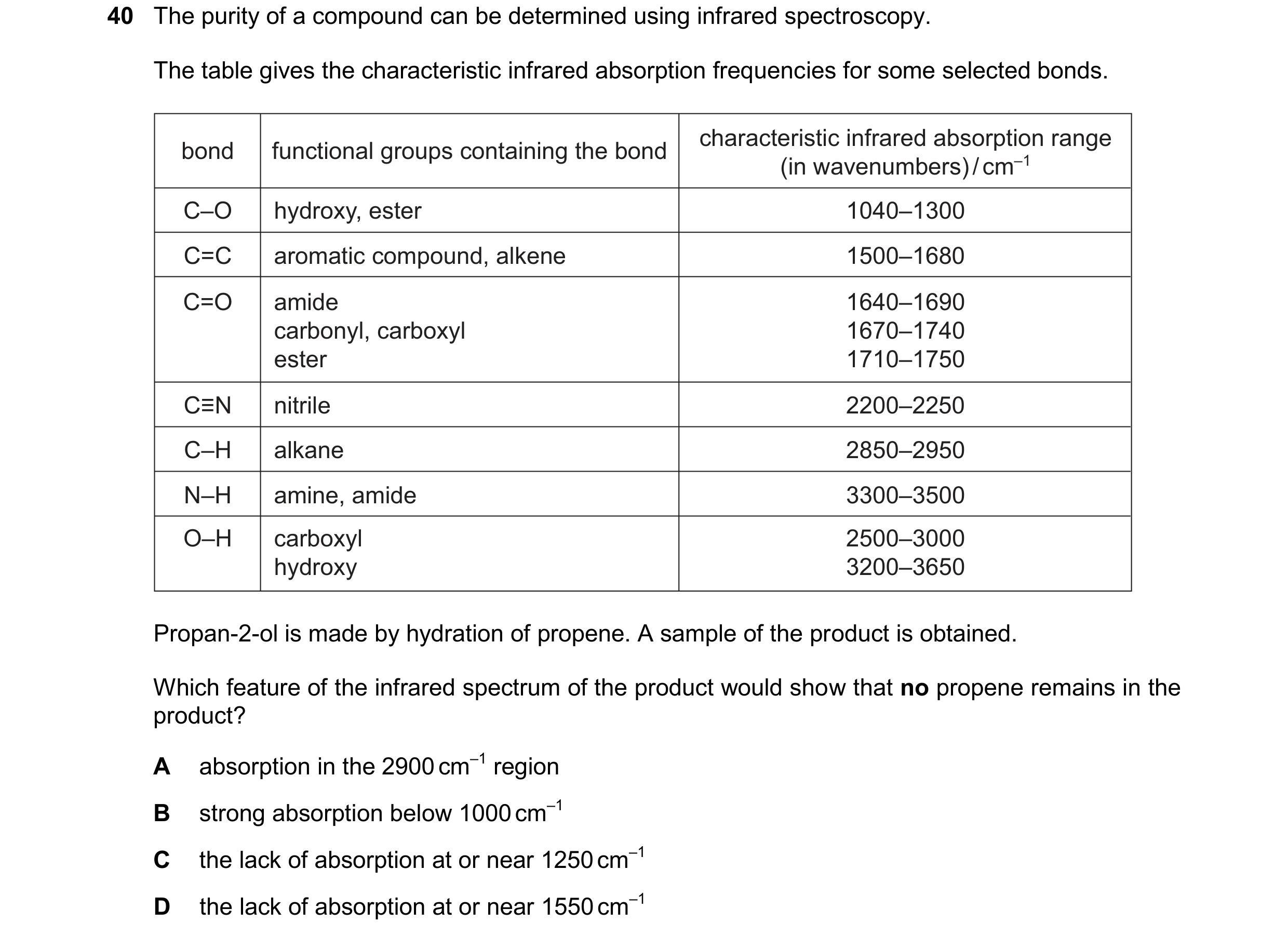
40 The purity of a compound can be determined using infrared spectroscopy. The table gives the characteristic infrared absorption frequencies for some selected bonds. characteristic infrared absorption range bond functional groups containing the bond (in wavenumbers) / cm–1 C–O hydroxy, ester 1040–1300 C=C aromatic compound, alkene 1500–1680 C=O amide 1640–1690 carbonyl, carboxyl 1670–1740 ester 1710–1750 C≡N nitrile 2200–2250 C–H alkane 2850–2950 N–H amine, amide 3300–3500 O–H carboxyl 2500–3000 hydroxy 3200–3650 Propan-2-ol is made by hydration of propene. A sample of the product is obtained. Which feature of the infrared spectrum of the product would show that no propene remains in the product? A absorption in the 2900 cm–1 region B strong absorption below 1000 cm–1 C the lack of absorption at or near 1250 cm–1 D the lack of absorption at or near 1550 cm–1
1 marks
Answer: D
This question in 9701/12 Oct/Nov 2025

 1 / 24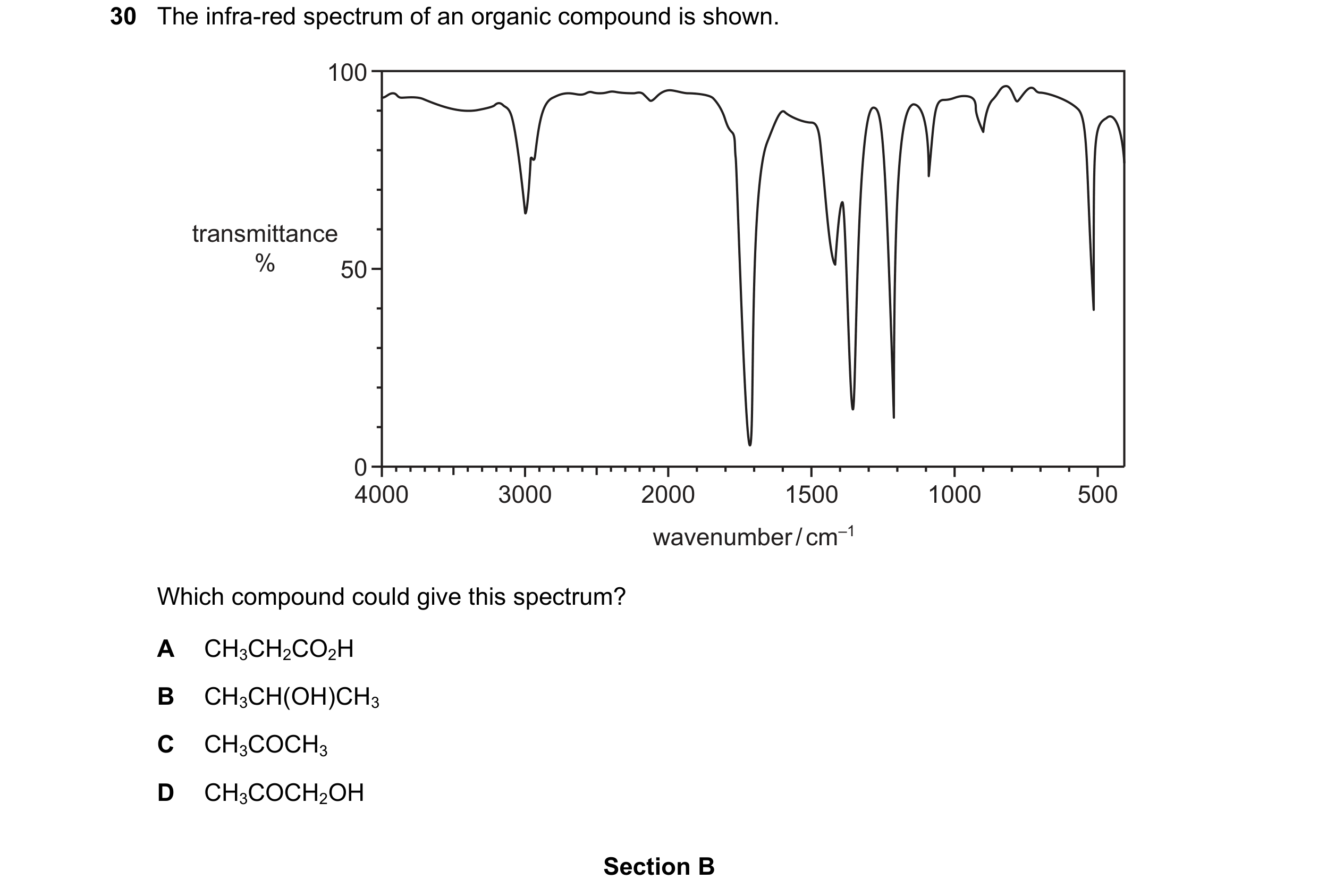
 2 / 24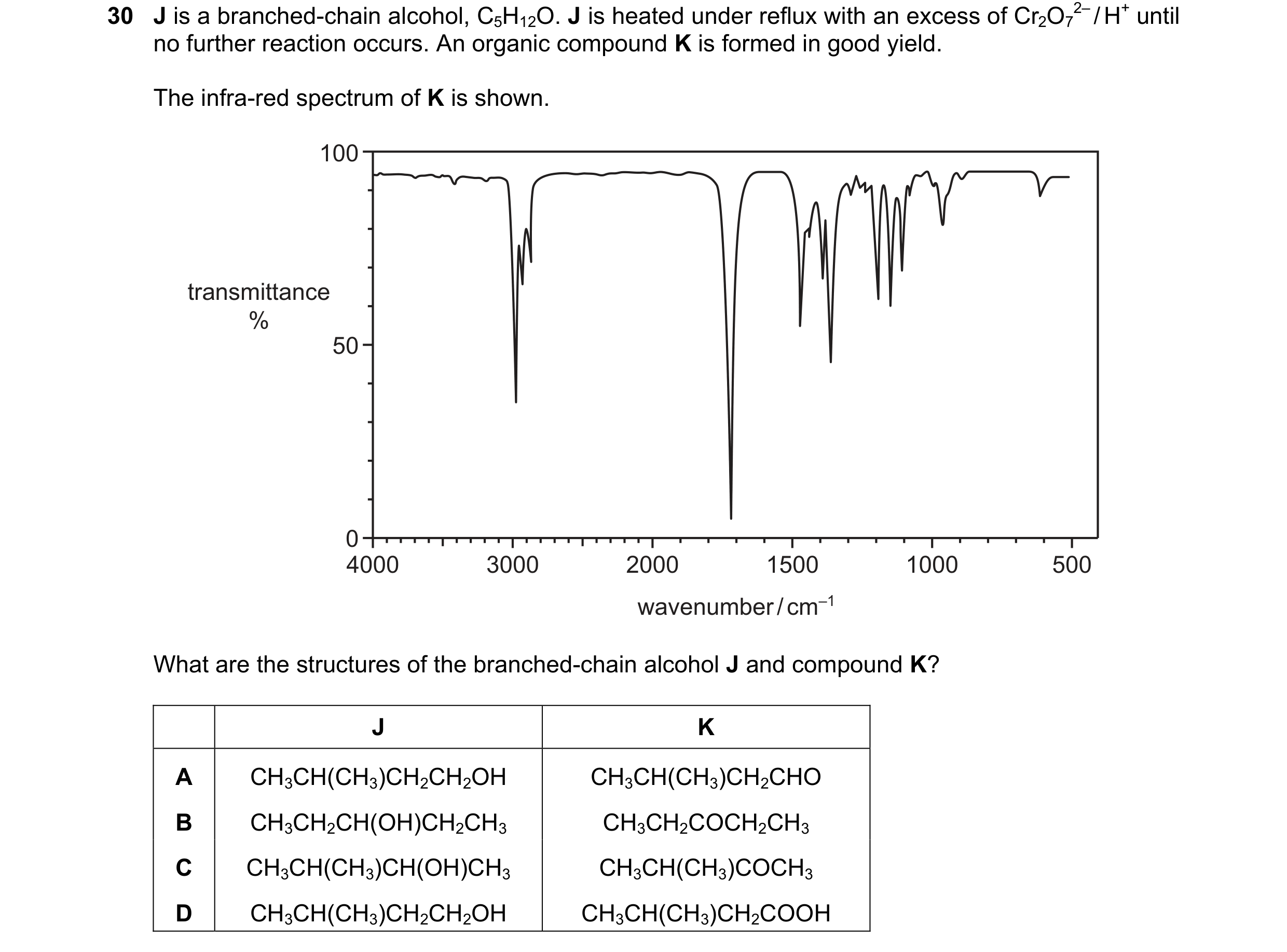
 3 / 24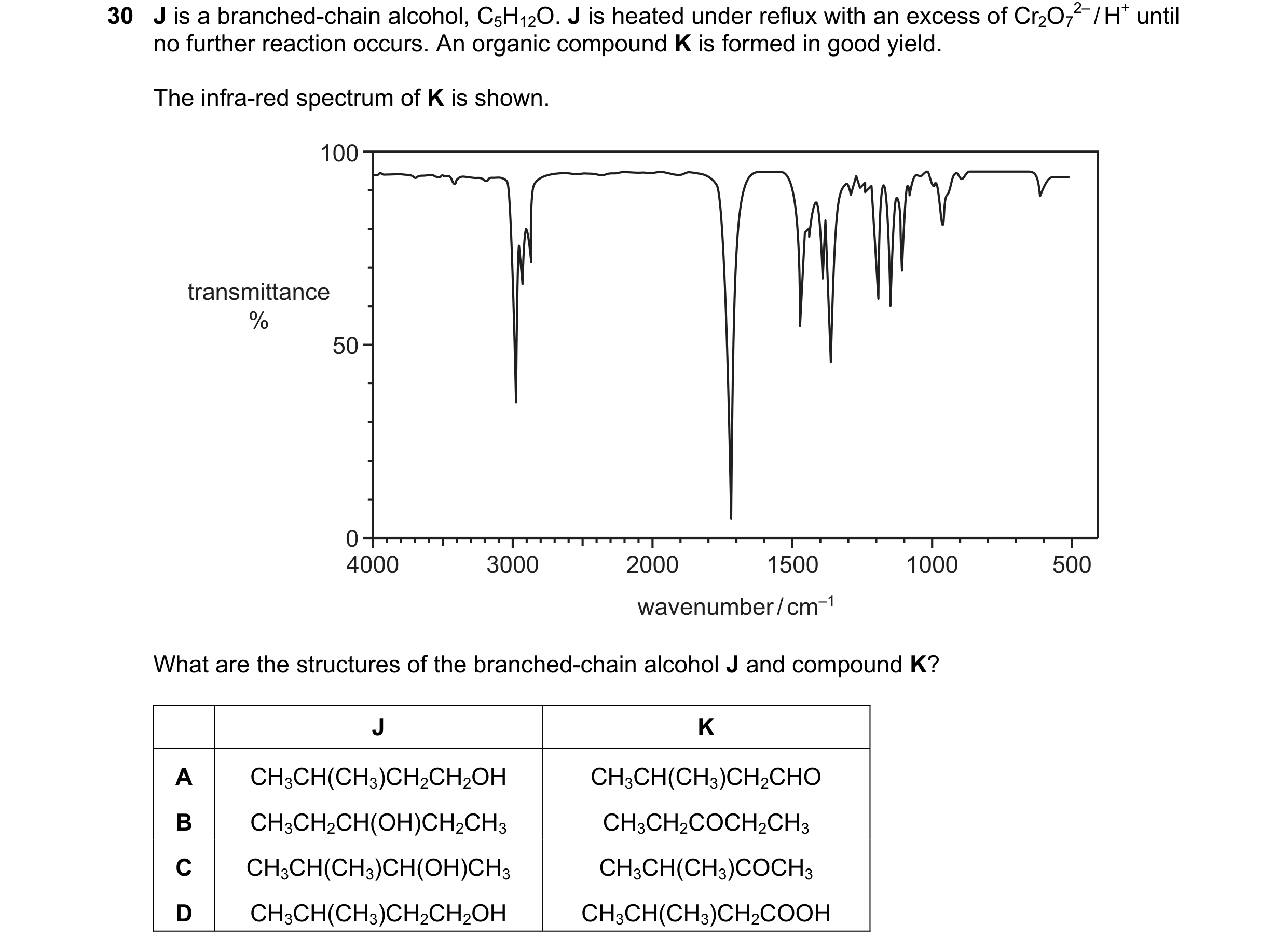
 4 / 24
 5 / 24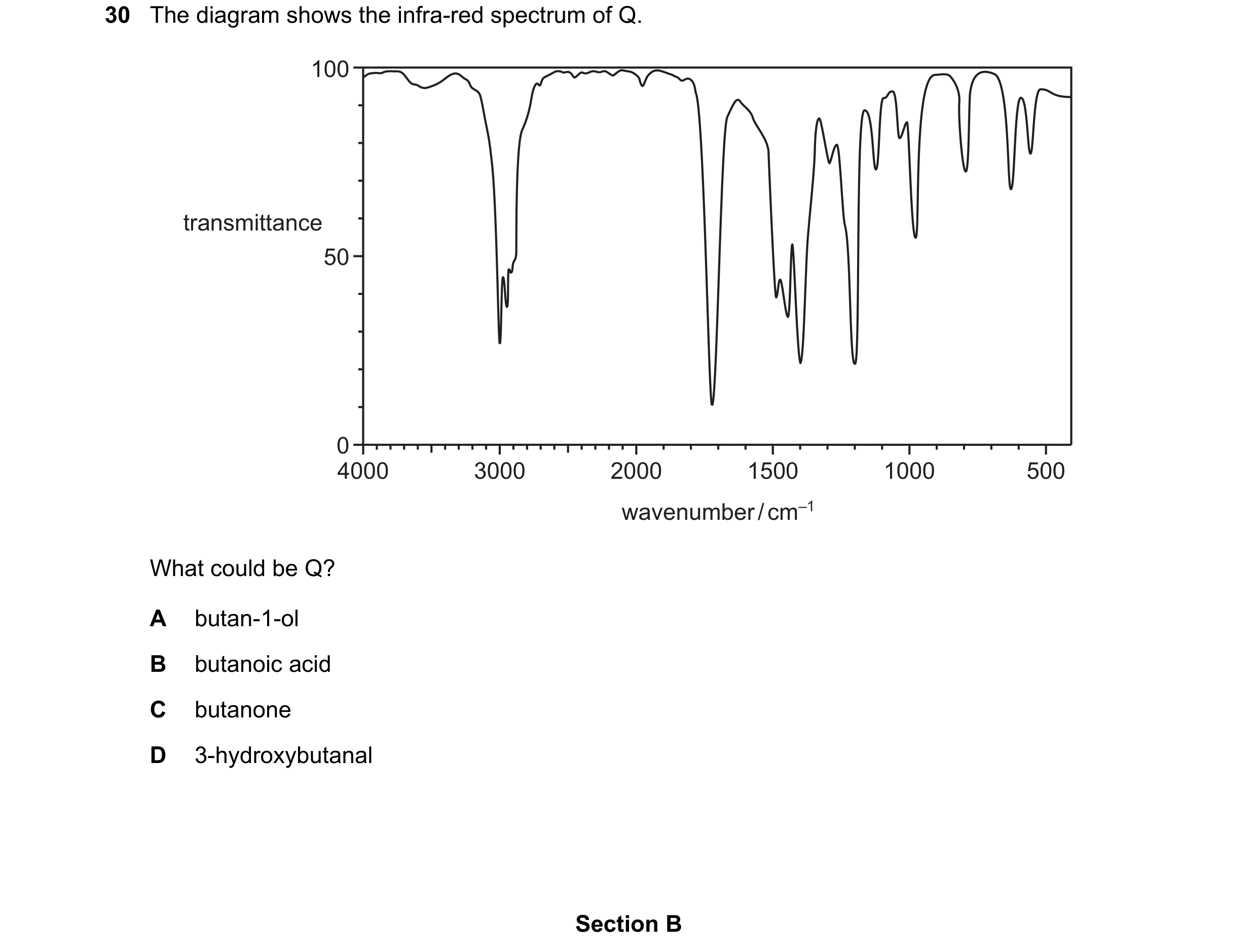
 6 / 24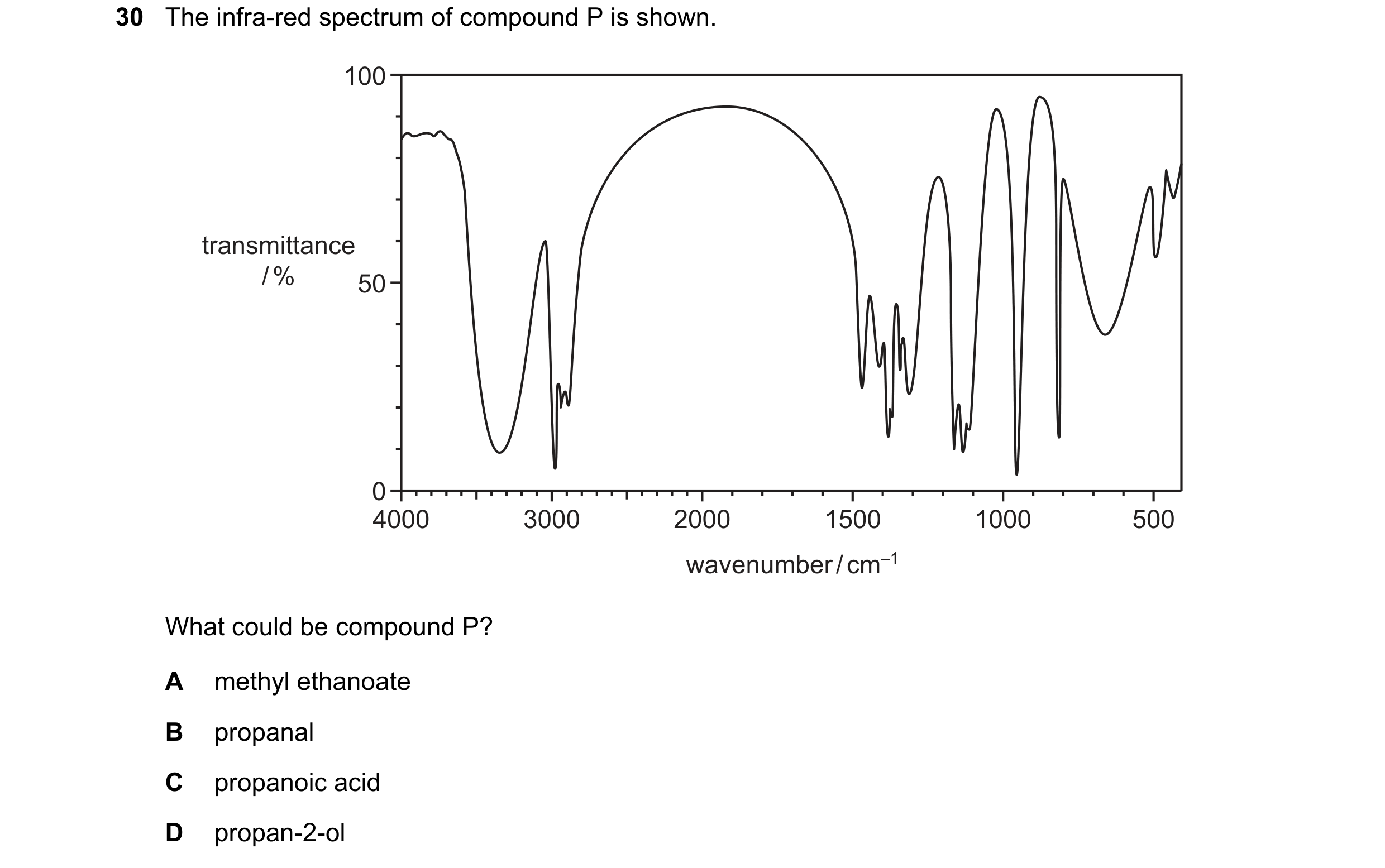
 7 / 24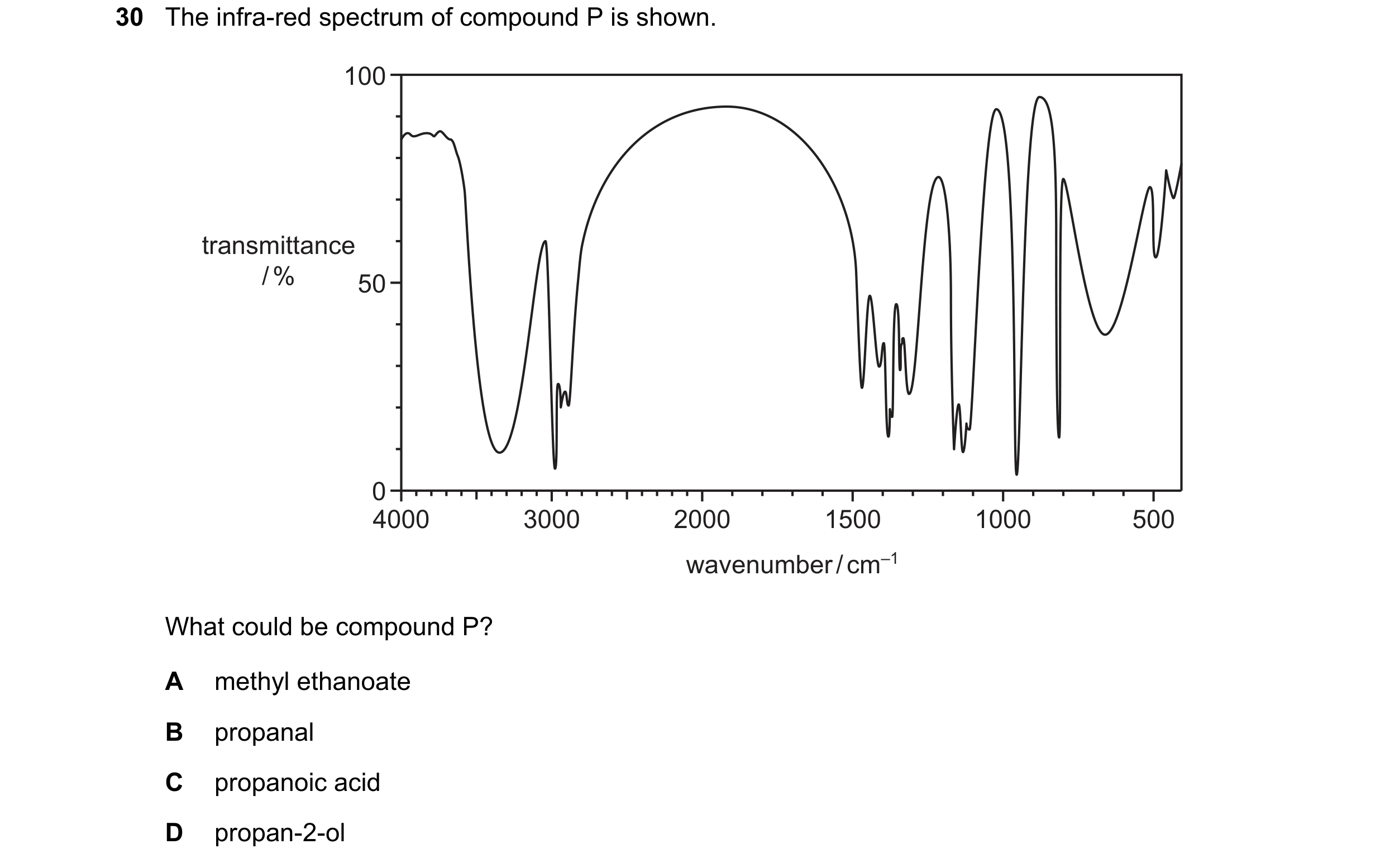
 8 / 24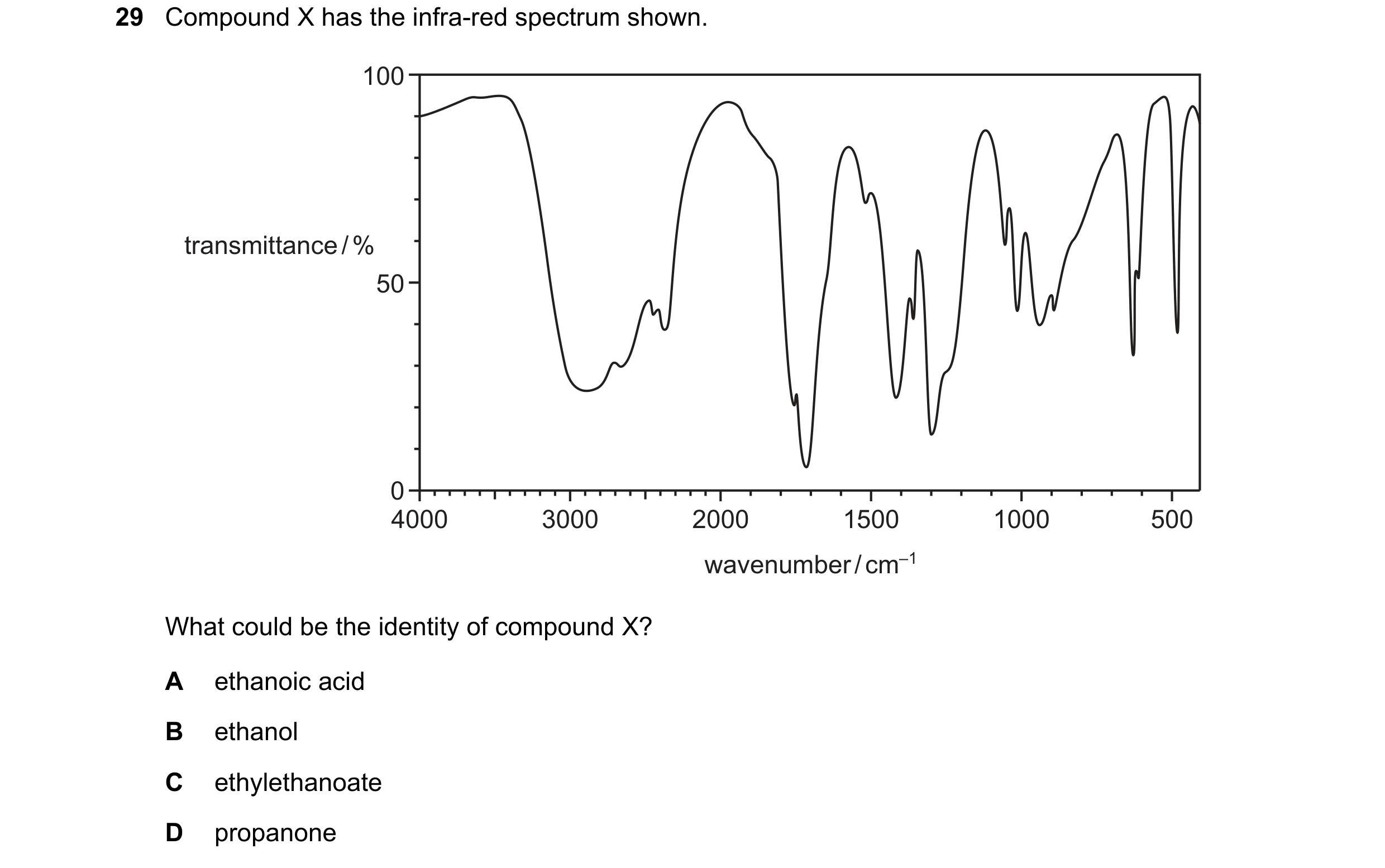
 9 / 24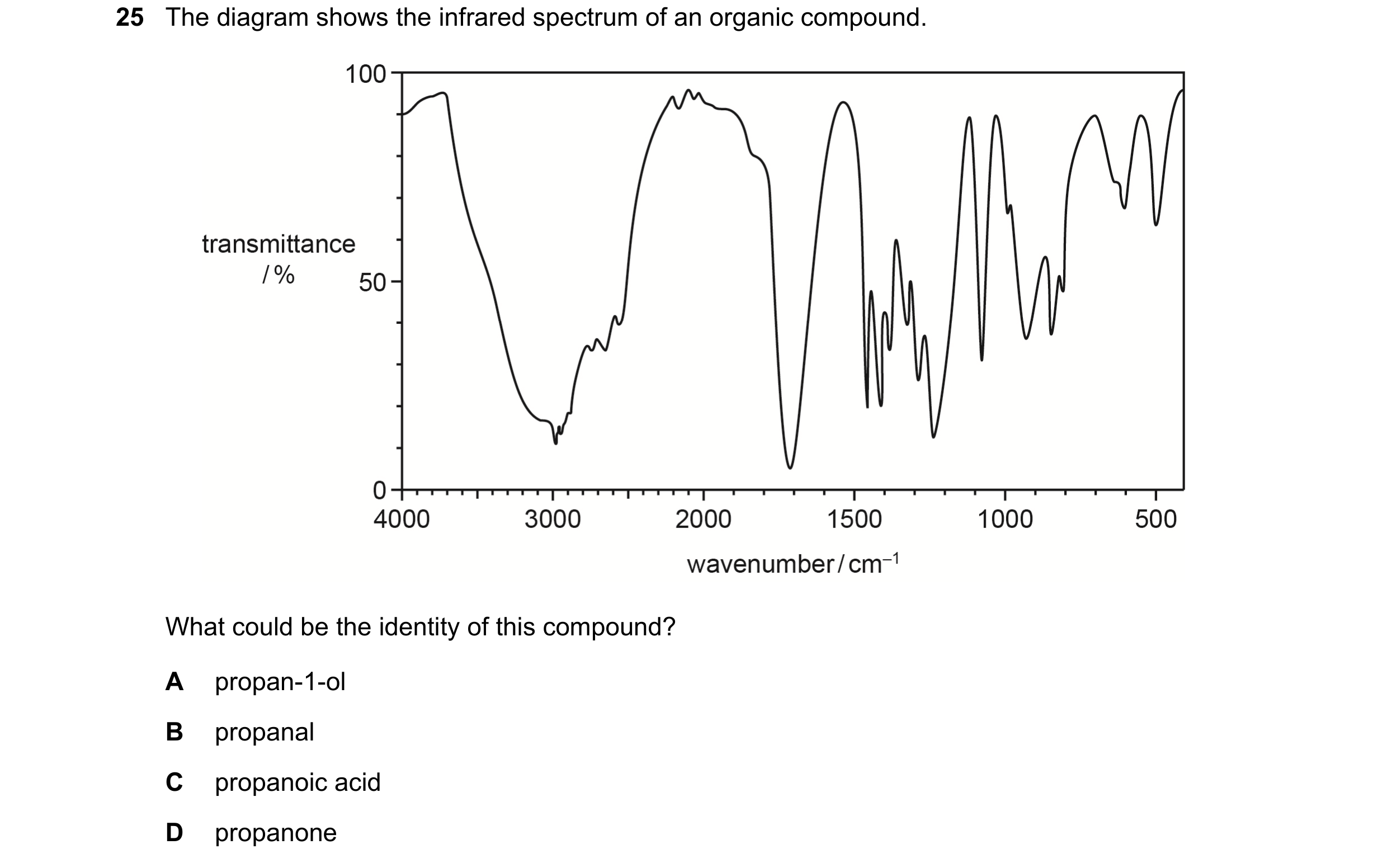
 10 / 24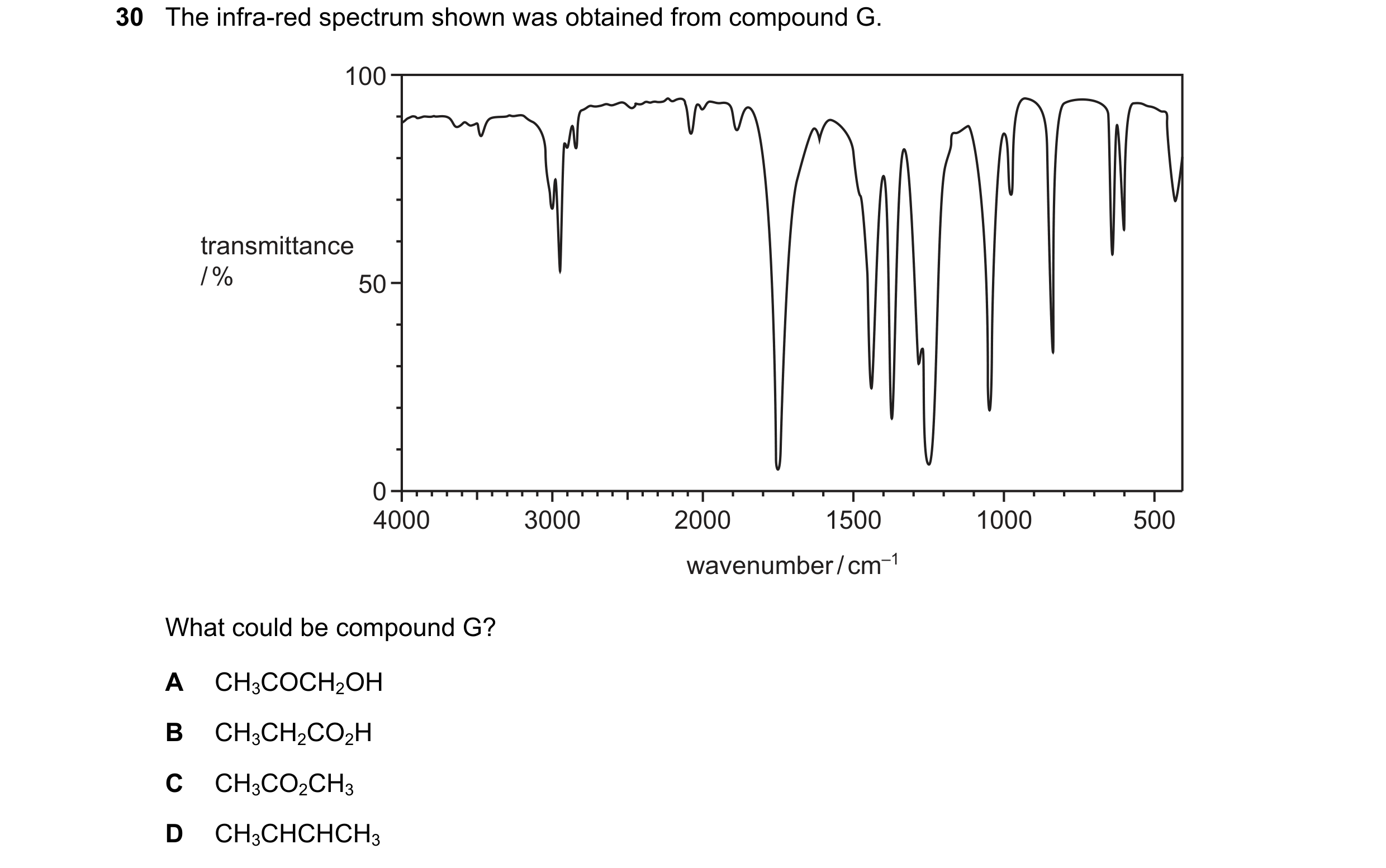
 11 / 24
 12 / 24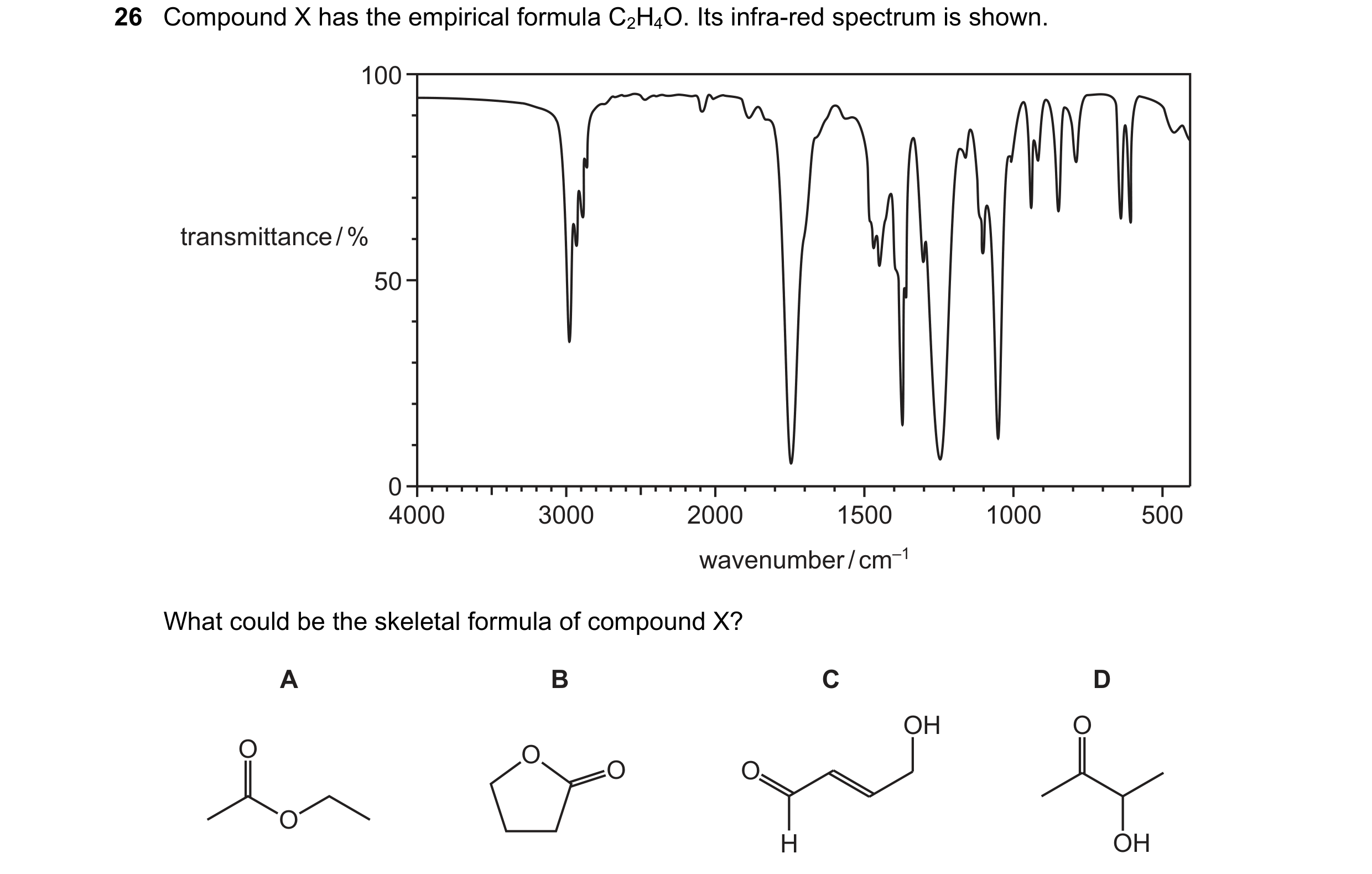
 13 / 24
 14 / 24
 15 / 24
 16 / 24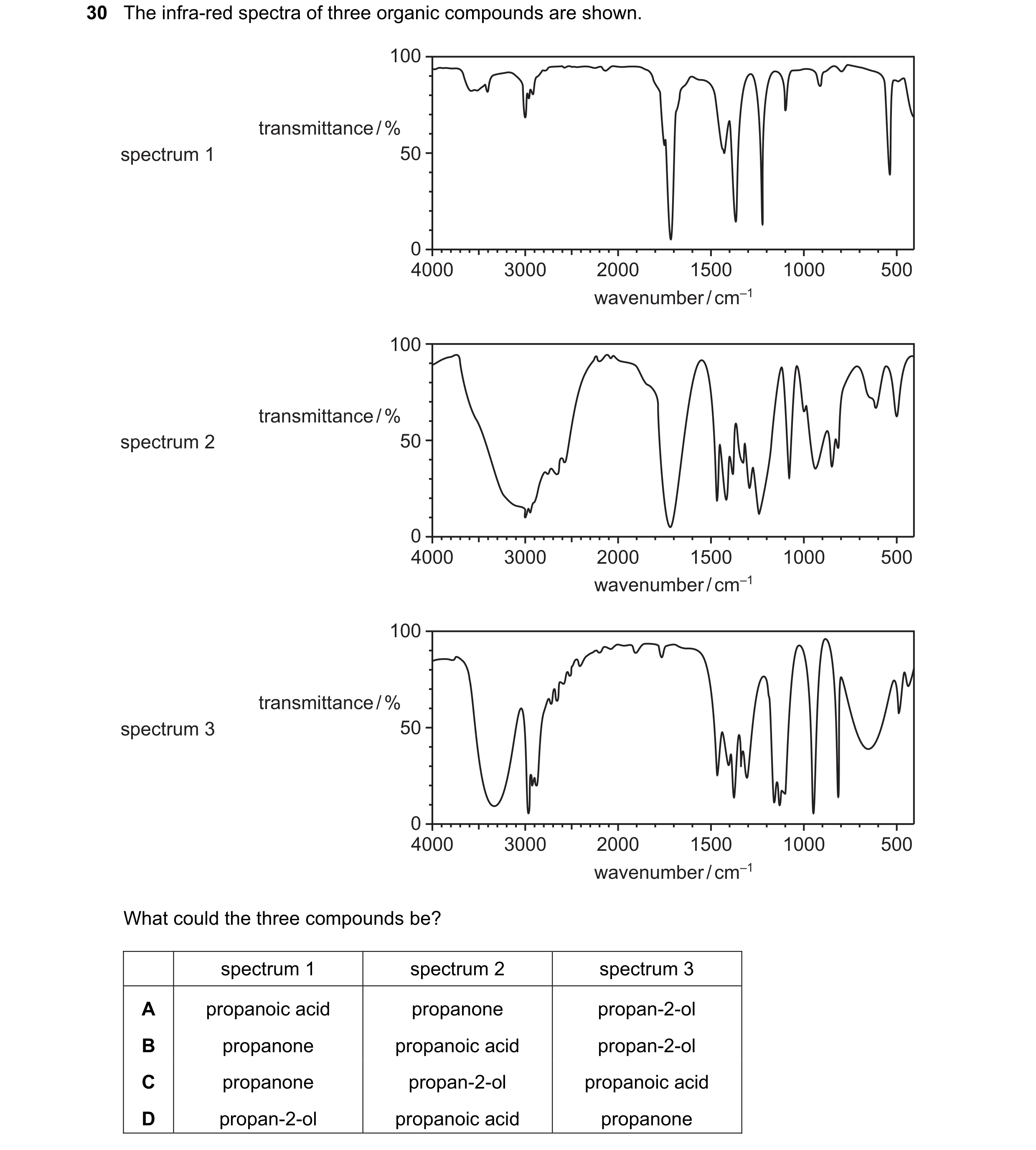
 17 / 24
 18 / 24
 19 / 24
 20 / 24
 21 / 24
 22 / 24
 23 / 24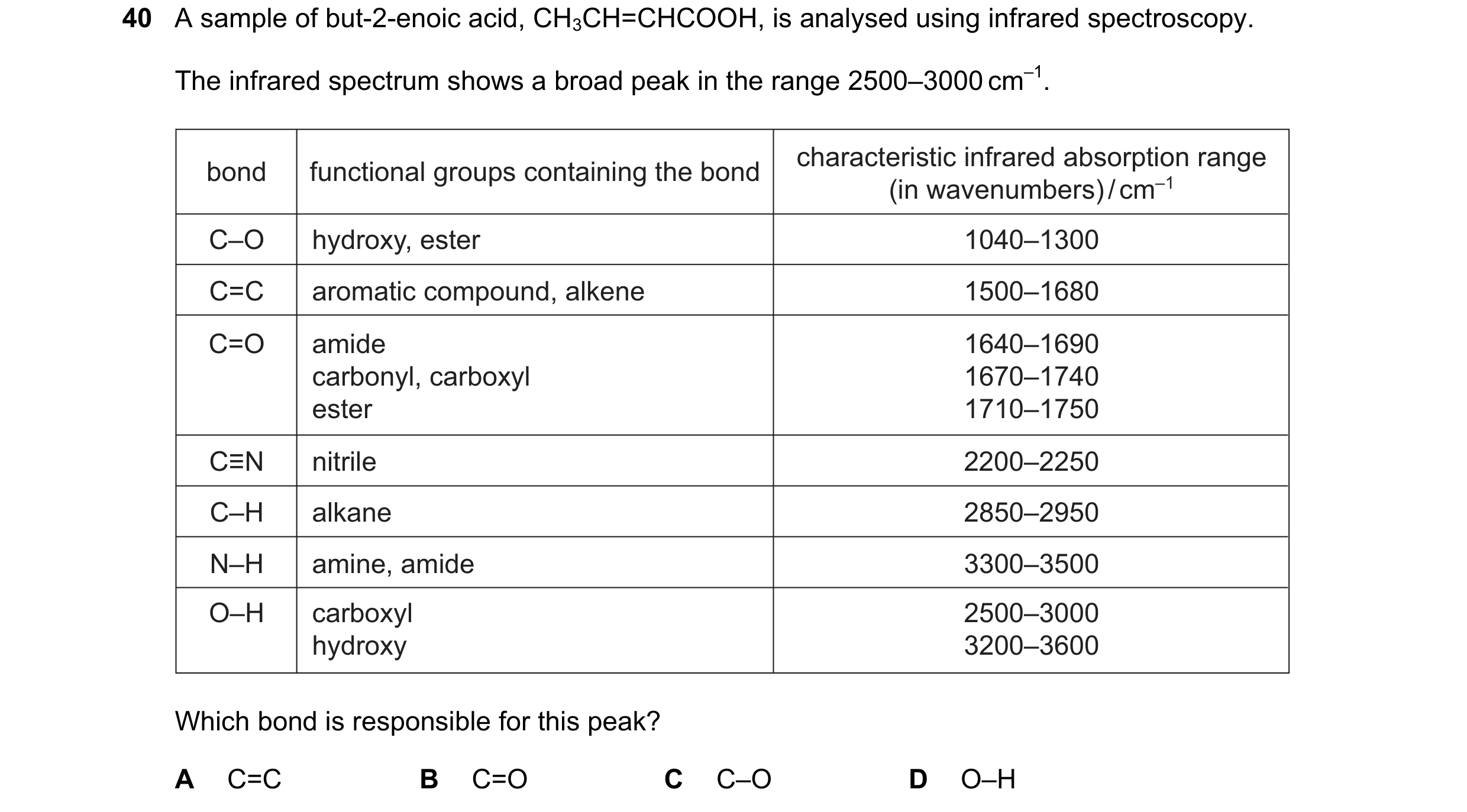
 24 / 24