Cambridge IGCSE Sciences - Co-ordinated (Double) 0654 — 2018 Oct/Nov Paper 3 · Variant 3
0654/33/O/N/18 · 13 questions · 120 marks · ≈135 min
The question paper and its mark scheme, free to read here and free to download. This is Cambridge’s own paper, exactly as it was sat.
Question paper28 pages

Mark scheme16 pages
Answers below. Sit the paper first if you are practising.
Questions as text
Q1 · A forest food web
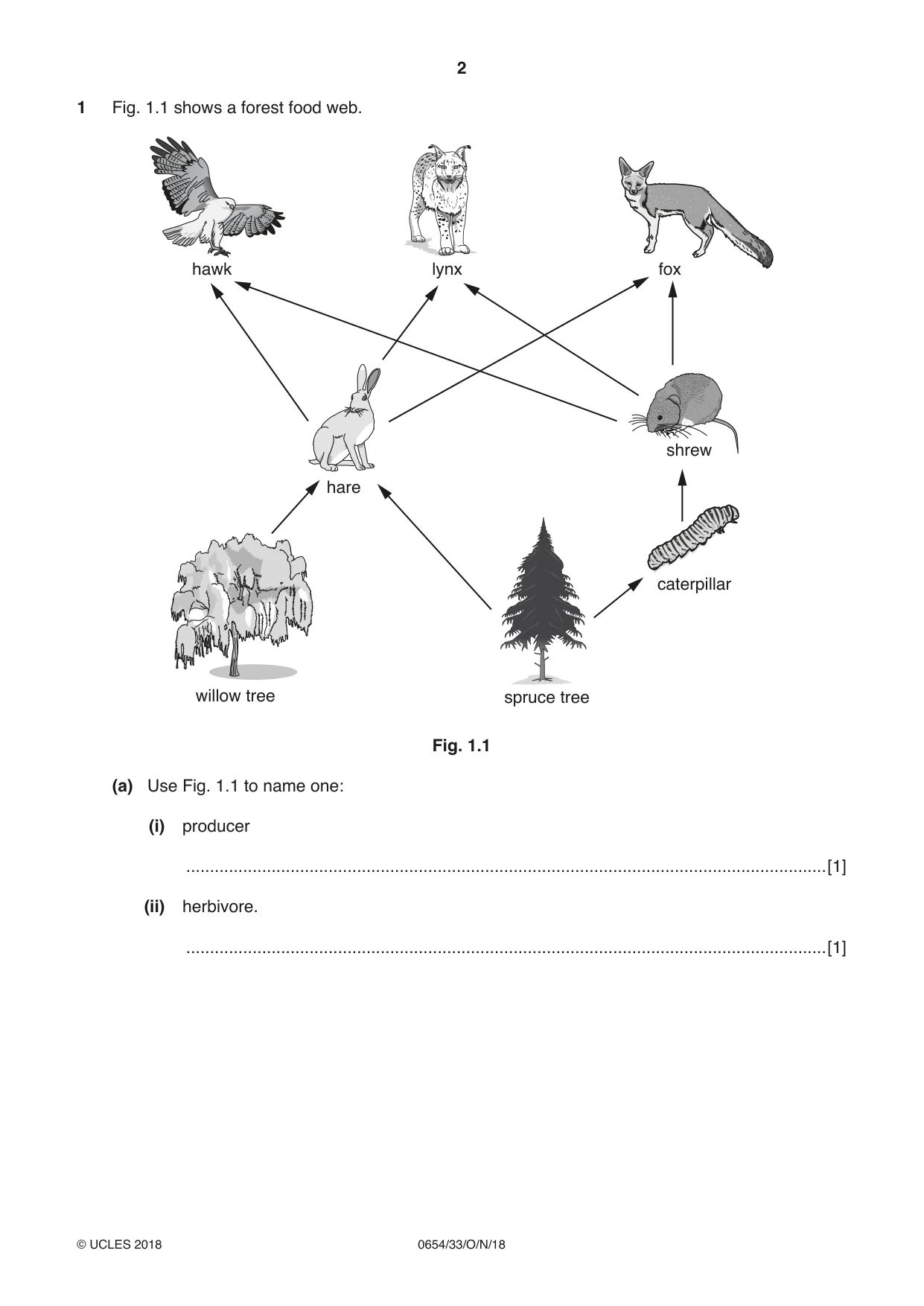
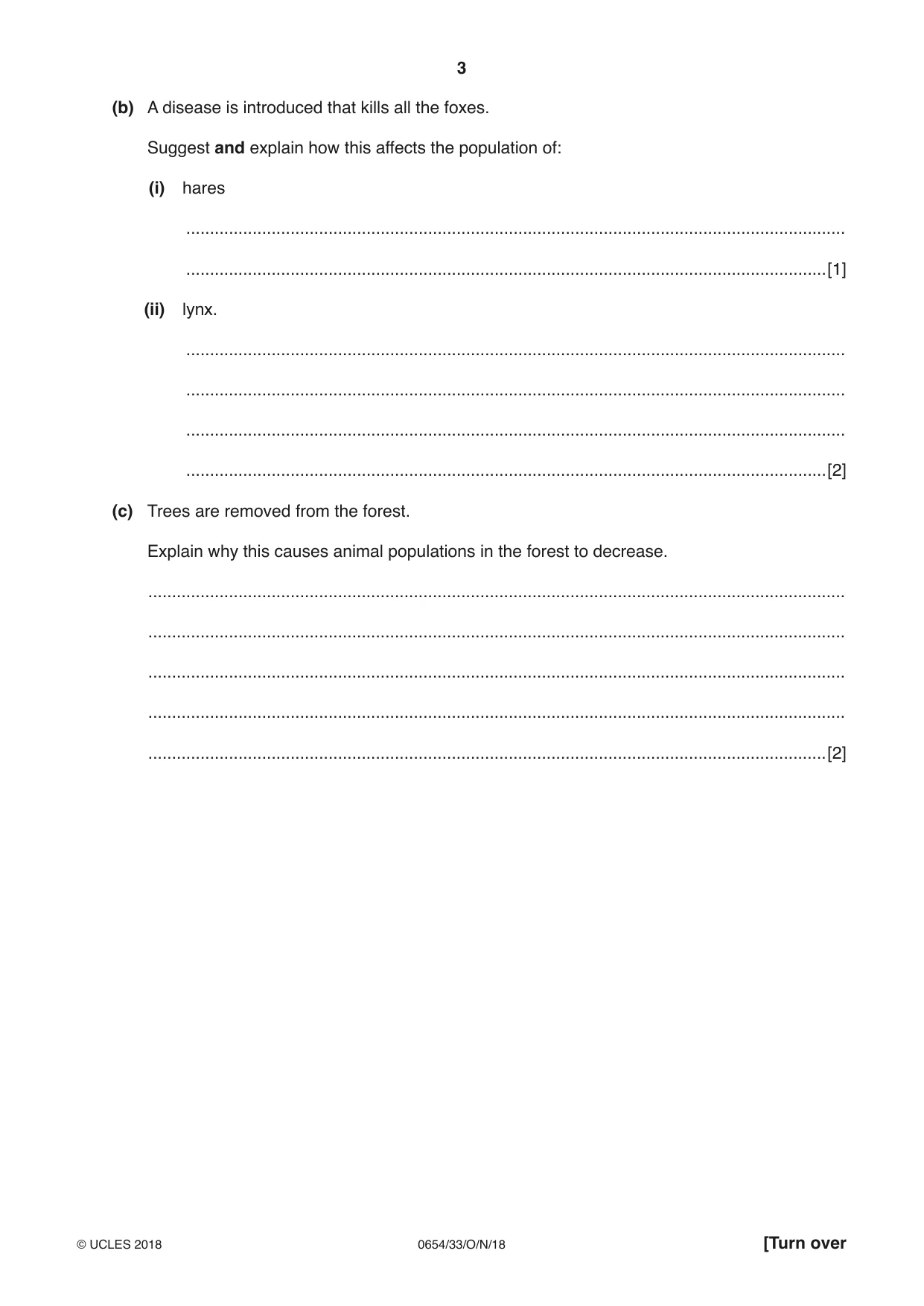
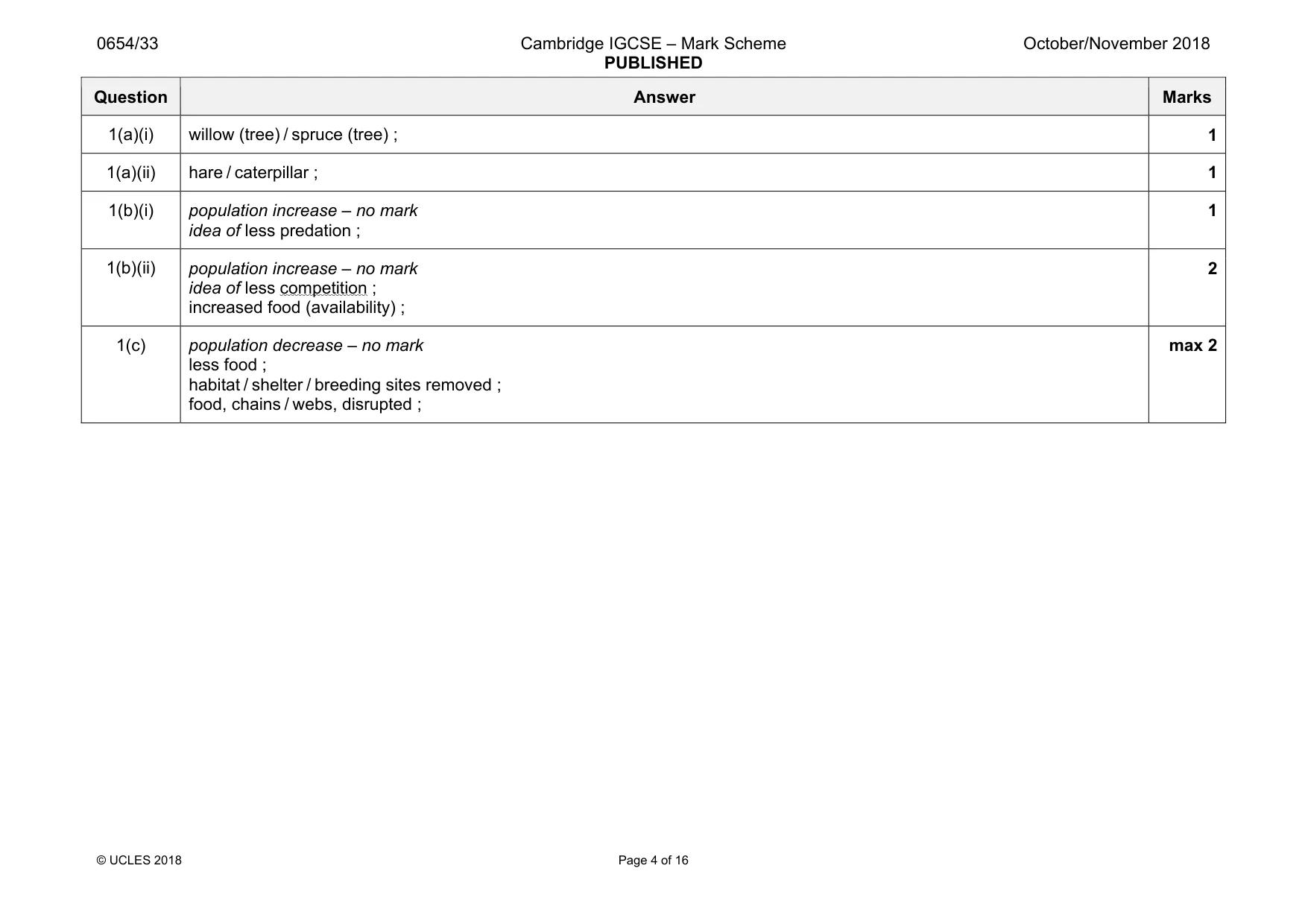
1 Fig. 1.1 shows a forest food web. hawk lynx fox shrew hare caterpillar willow tree spruce tree Fig. 1.1 (a) Use Fig. 1.1 to name one: (i) producer .......................................................................................................................................[1] (ii) herbivore. .......................................................................................................................................[1] (b) A disease is introduced that kills all the foxes. Suggest and explain how this affects the population of: (i) hares ........................................................................................................................................... .......................................................................................................................................[1] (ii) lynx. ........................................................................................................................................... ........................................................................................................................................... ........................................................................................................................................... .......................................................................................................................................[2] (c) Trees are removed from the forest. Explain why this causes animal populations in the forest to decrease. ................................................................................................................................................... ................................................................................................................................................... ................................................................................................................................................... ................................................................................................................................................... ...............................................................................................................................................[2]
Mark scheme: 1(a)(i) willow (tree) / spruce (tree) ; 1 1(a)(ii) hare / caterpillar ; 1 1(b)(i) population increase – no mark idea of less predation ; 1 1(b)(ii) population increase – no mark idea of less competition ; increased food (availability) ; 2 1(c) population decrease – no mark less food ; habitat / shelter / breeding sites removed ; food, chains / webs, disrupted ; max 2
Q2 · Information about some of the elements in Group VII of the Periodic Table
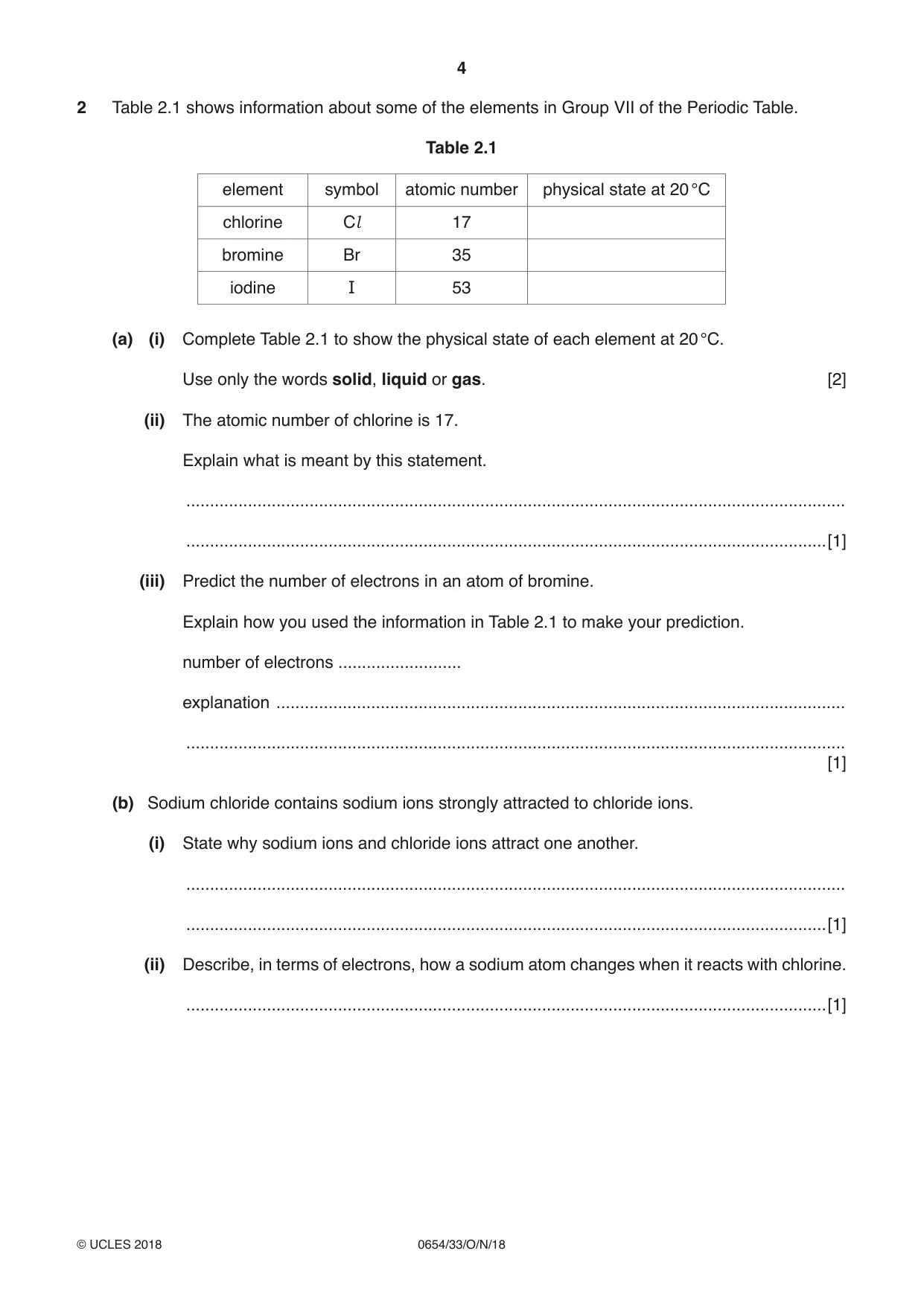
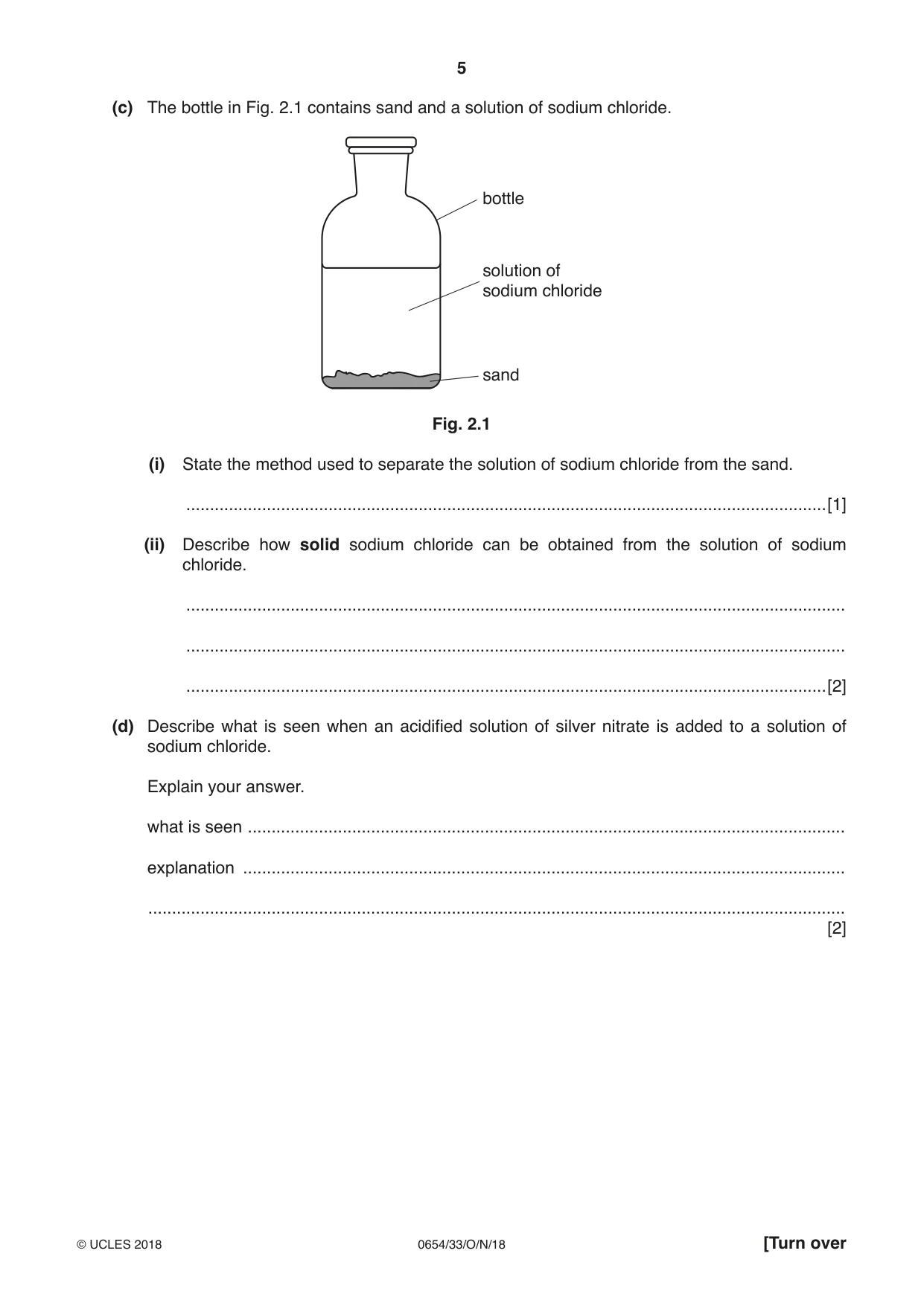
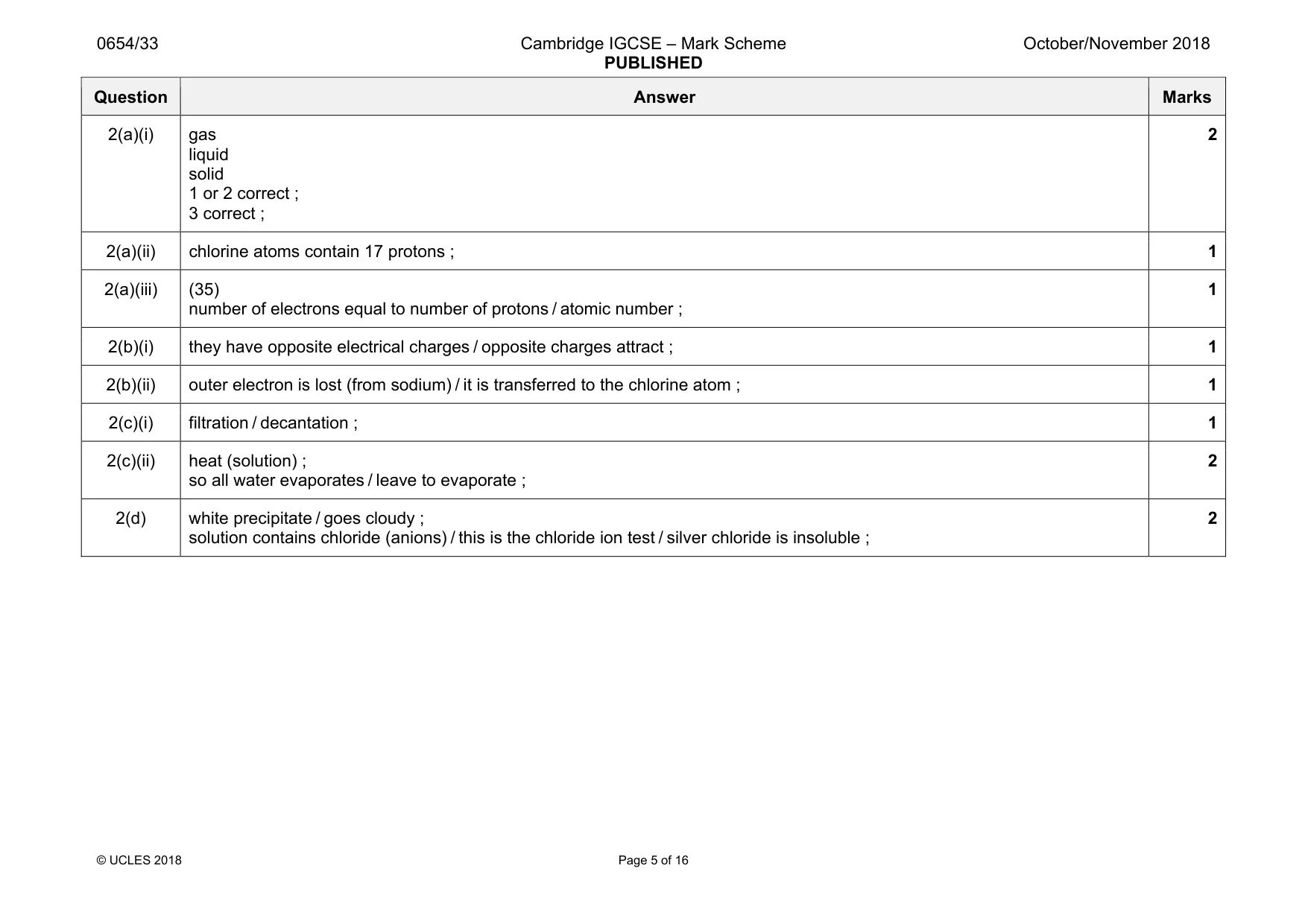
2 Table 2.1 shows information about some of the elements in Group VII of the Periodic Table. Table 2.1 element symbol atomic number physical state at 20 °C chlorine Cl 17 bromine Br 35 iodine I 53 (a) (i) Complete Table 2.1 to show the physical state of each element at 20 °C. Use only the words solid, liquid or gas. [2] (ii) The atomic number of chlorine is 17. Explain what is meant by this statement. ........................................................................................................................................... .......................................................................................................................................[1] (iii) Predict the number of electrons in an atom of bromine. Explain how you used the information in Table 2.1 to make your prediction. number of electrons .......................... explanation ........................................................................................................................ ........................................................................................................................................... [1] (b) Sodium chloride contains sodium ions strongly attracted to chloride ions. (i) State why sodium ions and chloride ions attract one another. ........................................................................................................................................... .......................................................................................................................................[1] (ii) Describe, in terms of electrons, how a sodium atom changes when it reacts with chlorine. .......................................................................................................................................[1] (c) The bottle in Fig. 2.1 contains sand and a solution of sodium chloride. bottle solution of sodium chloride sand Fig. 2.1 (i) State the method used to separate the solution of sodium chloride from the sand. .......................................................................................................................................[1] (ii) Describe how solid sodium chloride can be obtained from the solution of sodium chloride. ........................................................................................................................................... ........................................................................................................................................... .......................................................................................................................................[2] (d) Describe what is seen when an acidified solution of silver nitrate is added to a solution of sodium chloride. Explain your answer. what is seen .............................................................................................................................. explanation ............................................................................................................................... ................................................................................................................................................... [2]
Mark scheme: 2(a)(i) gas liquid solid 1 or 2 correct ; 3 correct ; 2 2(a)(ii) chlorine atoms contain 17 protons ; 1 2(a)(iii) (35) number of electrons equal to number of protons / atomic number ; 1 2(b)(i) they have opposite electrical charges / opposite charges attract ; 1 2(b)(ii) outer electron is lost (from sodium) / it is transferred to the chlorine atom ; 1 2(c)(i) filtration / decantation ; 1 2(c)(ii) heat (solution) ; so all water evaporates / leave to evaporate ; 2 2(d) white precipitate / goes cloudy ; solution contains chloride (anions) / this is the chloride ion test / silver chloride is insoluble ; 2
Q3 · An electric kettle, an electric fan and a torch (flashlight) all transform electrical…
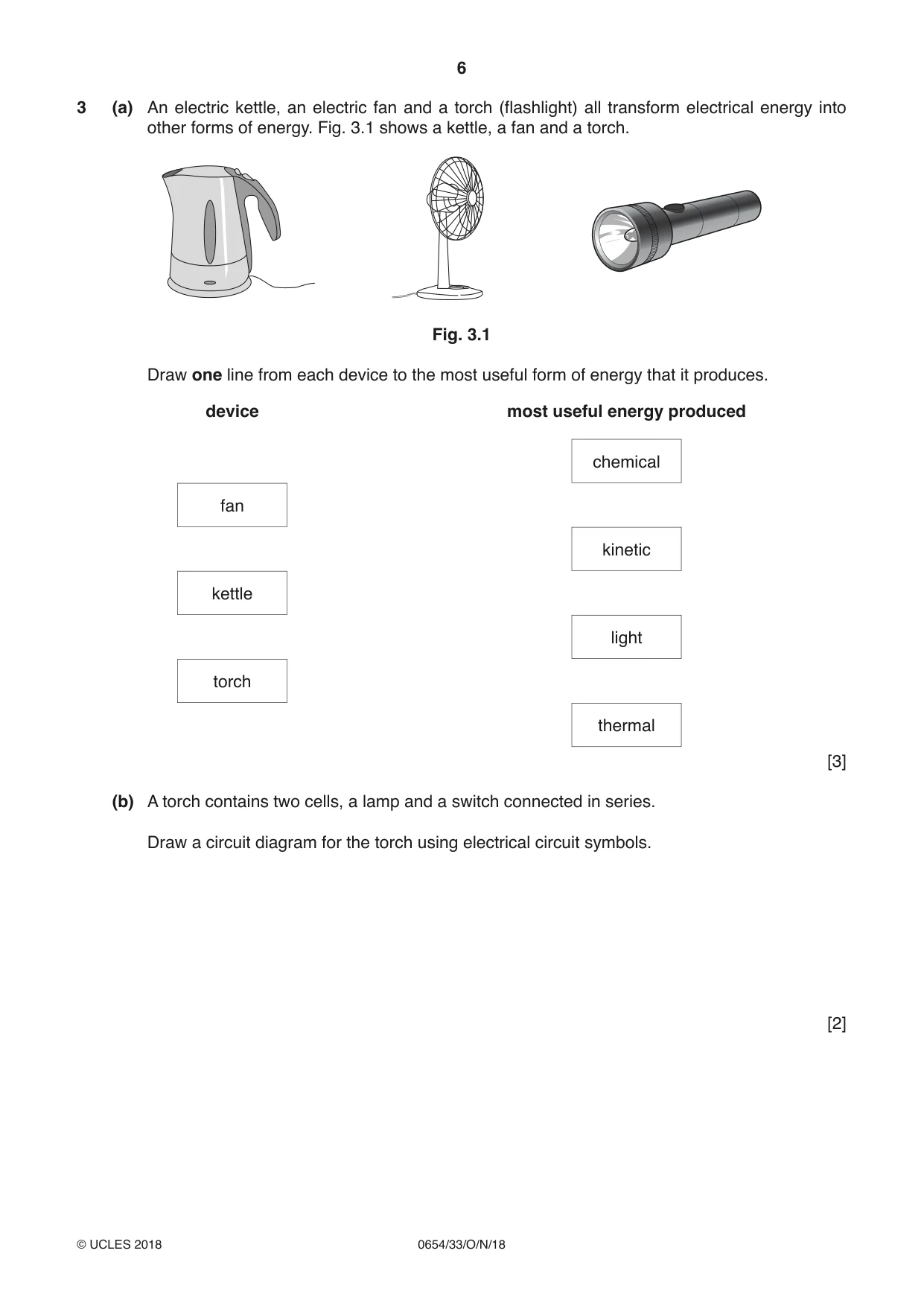
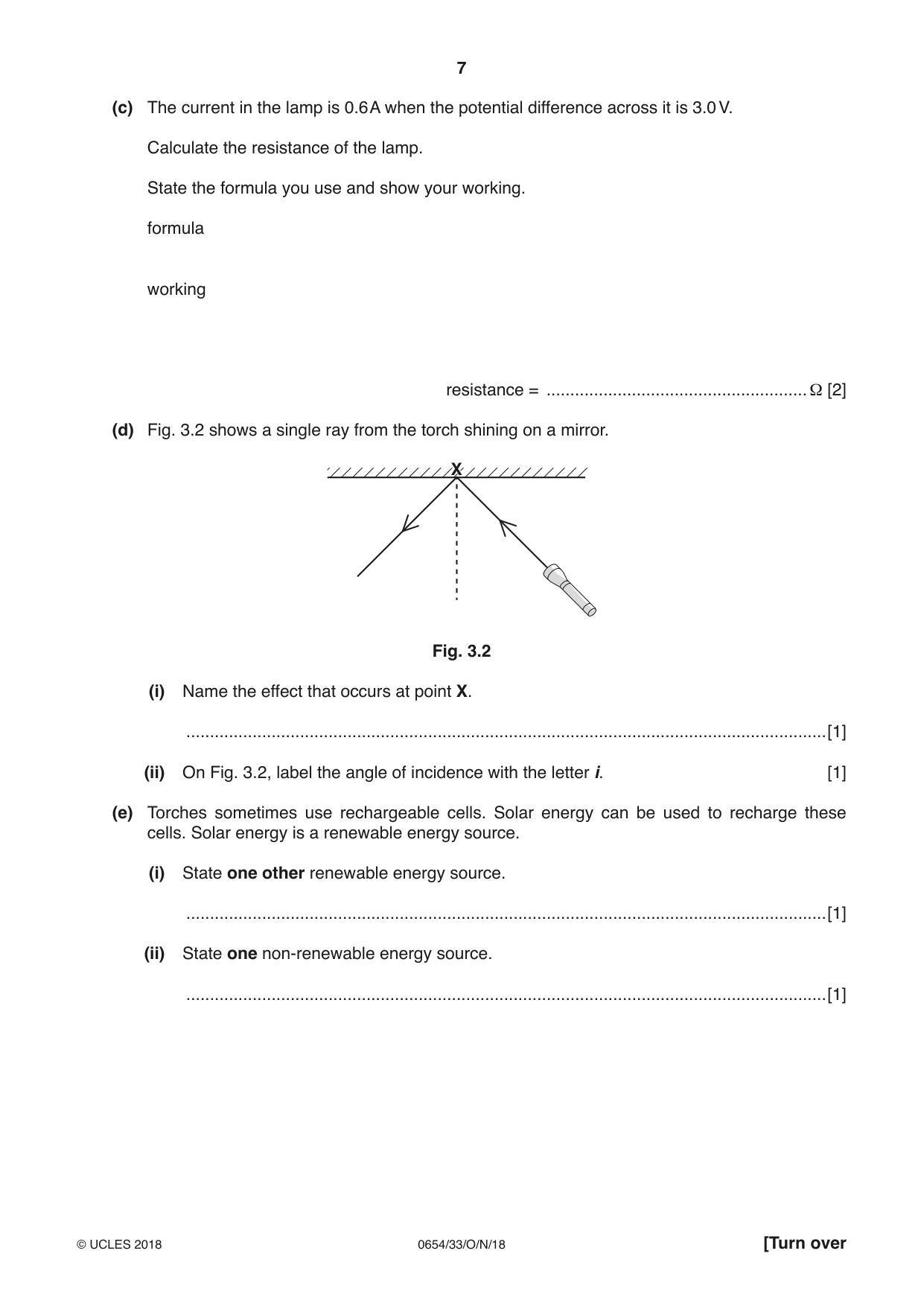
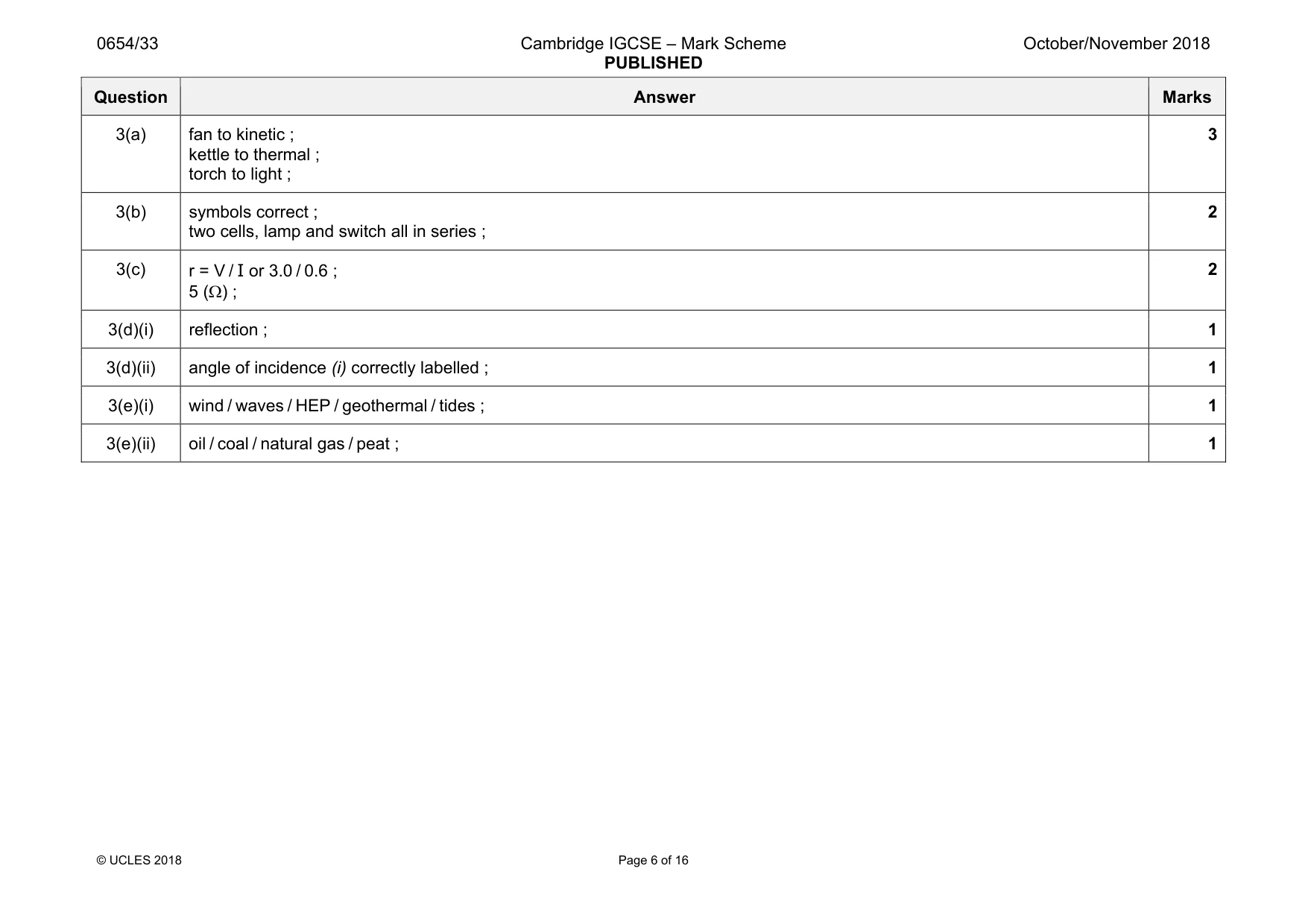
3 (a) An electric kettle, an electric fan and a torch (flashlight) all transform electrical energy into other forms of energy. Fig. 3.1 shows a kettle, a fan and a torch. Fig. 3.1 Draw one line from each device to the most useful form of energy that it produces. device most useful energy produced chemical fan kinetic kettle light torch thermal [3] (b) A torch contains two cells, a lamp and a switch connected in series. Draw a circuit diagram for the torch using electrical circuit symbols. [2] (c) The current in the lamp is 0.6 A when the potential difference across it is 3.0 V. Calculate the resistance of the lamp. State the formula you use and show your working. formula working resistance = .......................................................Ω [2] (d) Fig. 3.2 shows a single ray from the torch shining on a mirror. X Fig. 3.2 (i) Name the effect that occurs at point X. .......................................................................................................................................[1] (ii) On Fig. 3.2, label the angle of incidence with the letter i. [1] (e) Torches sometimes use rechargeable cells. Solar energy can be used to recharge these cells. Solar energy is a renewable energy source. (i) State one other renewable energy source. .......................................................................................................................................[1] (ii) State one non-renewable energy source. .......................................................................................................................................[1]
Mark scheme: 3(a) fan to kinetic ; kettle to thermal ; torch to light ; 3 3(b) symbols correct ; two cells, lamp and switch all in series ; 2 3(c) r = V / I or 3.0 / 0.6 ; 5 (Ω) ; 2 3(d)(i) reflection ; 1 3(d)(ii) angle of incidence (i) correctly labelled ; 1 3(e)(i) wind / waves / HEP / geothermal / tides ; 1 3(e)(ii) oil / coal / natural gas / peat ; 1
Q4 · State the term used to describe the loss of water from a leaf by evaporation
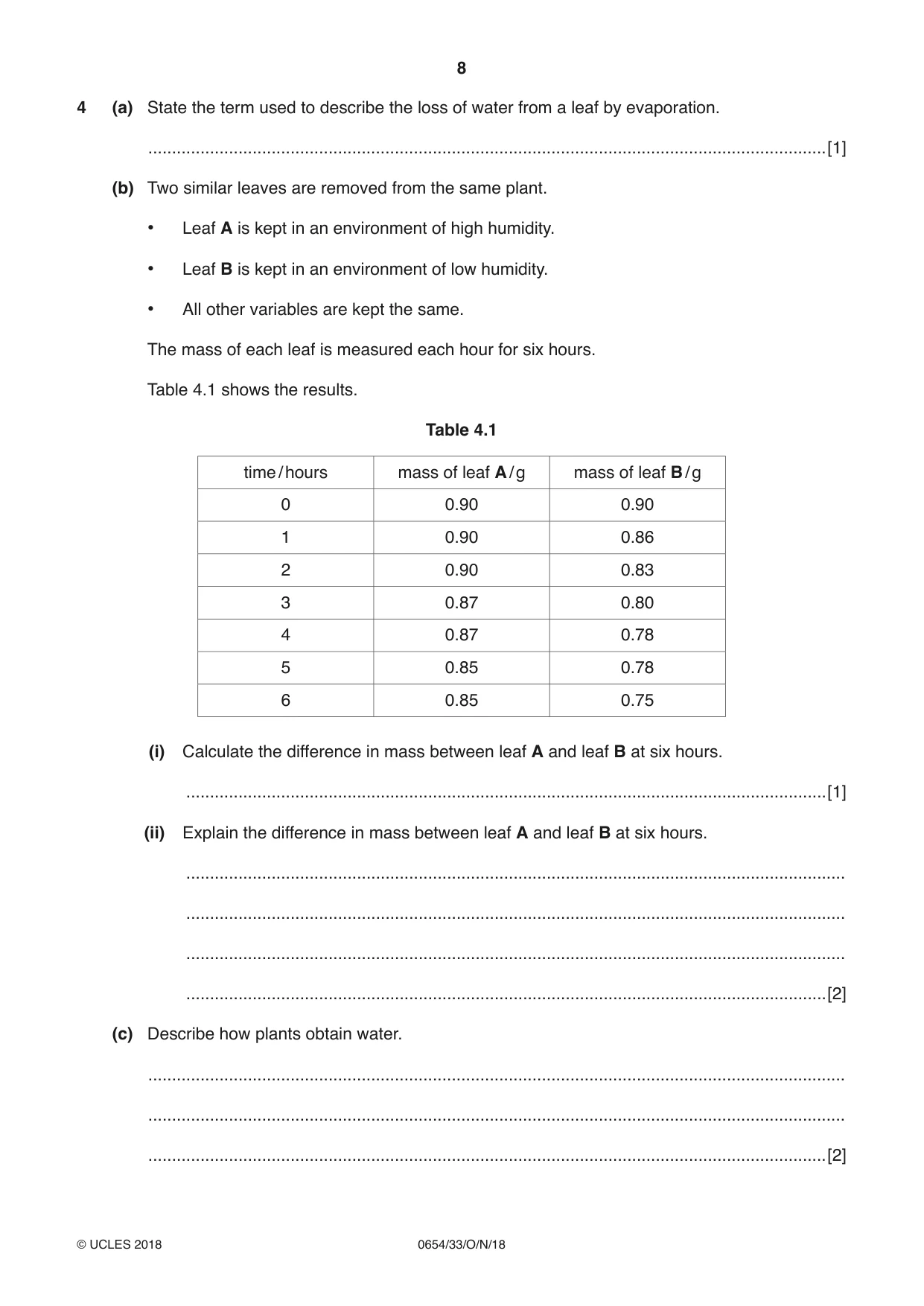
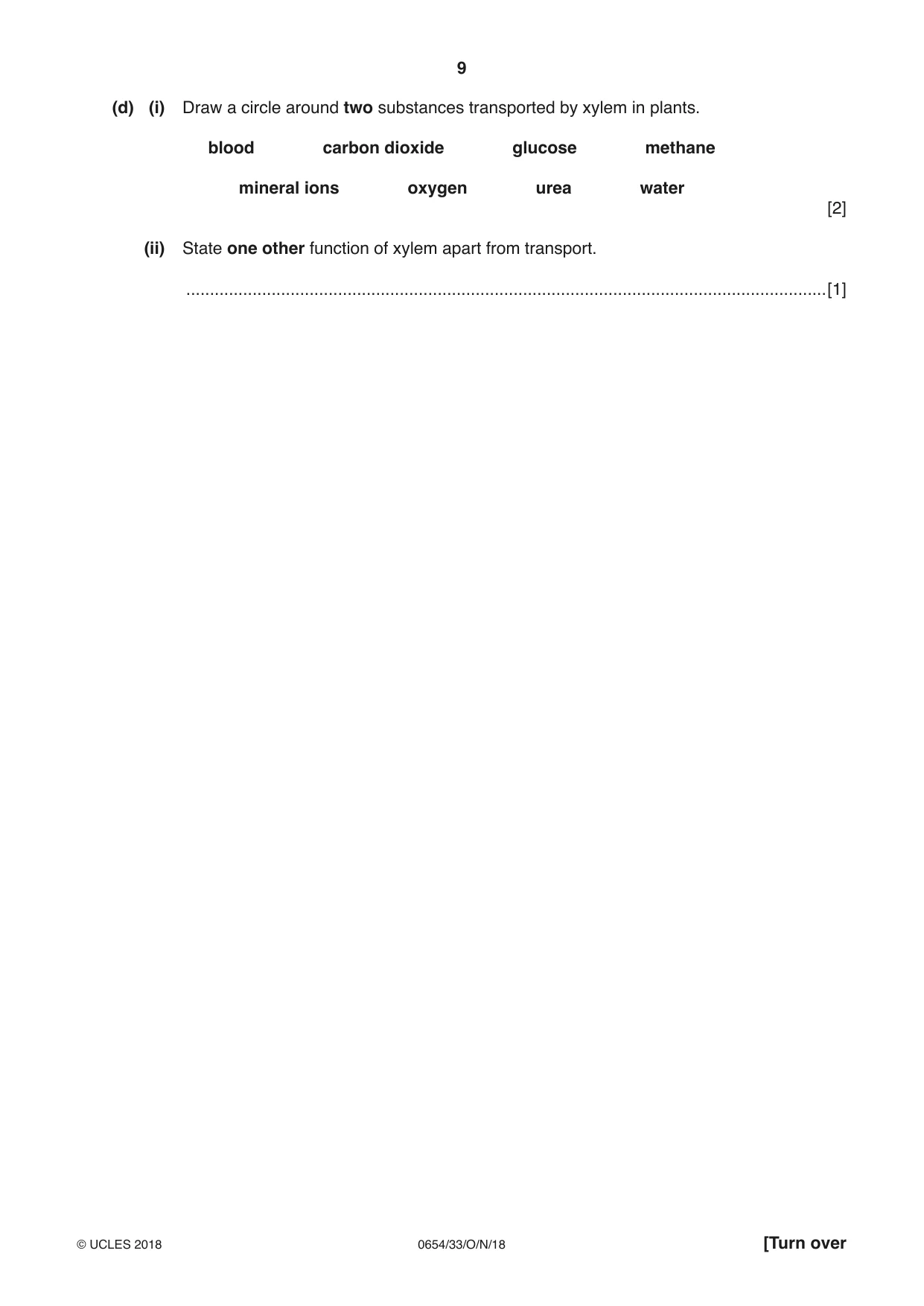
4 (a) State the term used to describe the loss of water from a leaf by evaporation. ...............................................................................................................................................[1] (b) Two similar leaves are removed from the same plant. • Leaf A is kept in an environment of high humidity. • Leaf B is kept in an environment of low humidity. • All other variables are kept the same. The mass of each leaf is measured each hour for six hours. Table 4.1 shows the results. Table 4.1 time / hours mass of leaf A / g mass of leaf B / g 0 0.90 0.90 1 0.90 0.86 2 0.90 0.83 3 0.87 0.80 4 0.87 0.78 5 0.85 0.78 6 0.85 0.75 (i) Calculate the difference in mass between leaf A and leaf B at six hours. .......................................................................................................................................[1] (ii) Explain the difference in mass between leaf A and leaf B at six hours. ........................................................................................................................................... ........................................................................................................................................... ........................................................................................................................................... .......................................................................................................................................[2] (c) Describe how plants obtain water. ................................................................................................................................................... ................................................................................................................................................... ...............................................................................................................................................[2] (d) (i) Draw a circle around two substances transported by xylem in plants. blood carbon dioxide glucose methane mineral ions oxygen urea water [2] (ii) State one other function of xylem apart from transport. .......................................................................................................................................[1]
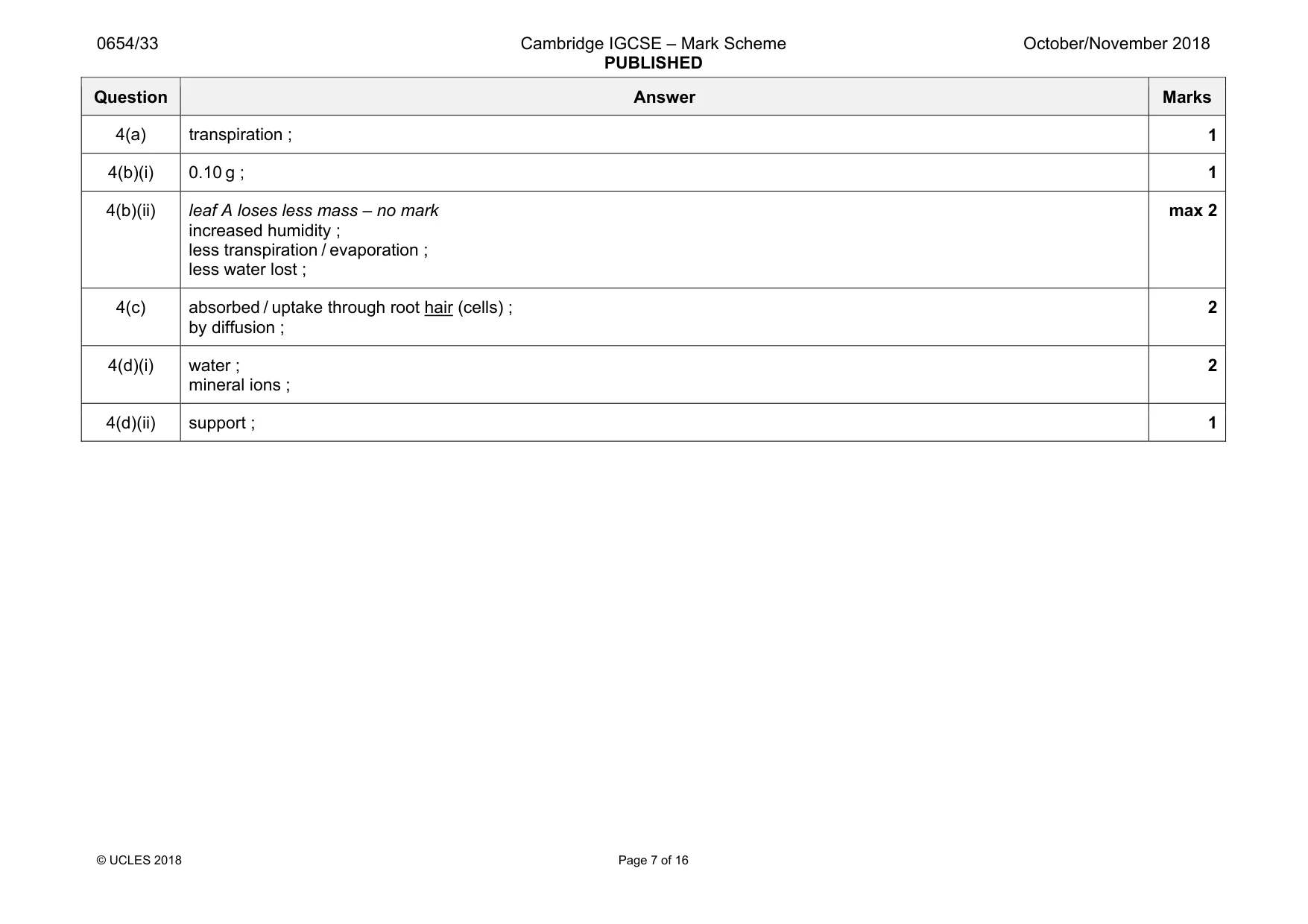
Mark scheme: 4(a) transpiration ; 1 4(b)(i) 0.10 g ; 1 4(b)(ii) leaf A loses less mass – no mark increased humidity ; less transpiration / evaporation ; less water lost ; max 2 4(c) absorbed / uptake through root hair (cells) ; by diffusion ; 2 4(d)(i) water ; mineral ions ; 2 4(d)(ii) support ; 1
Q5 · Calcium, copper, iron and potassium are metallic elements in the fourth period of the…
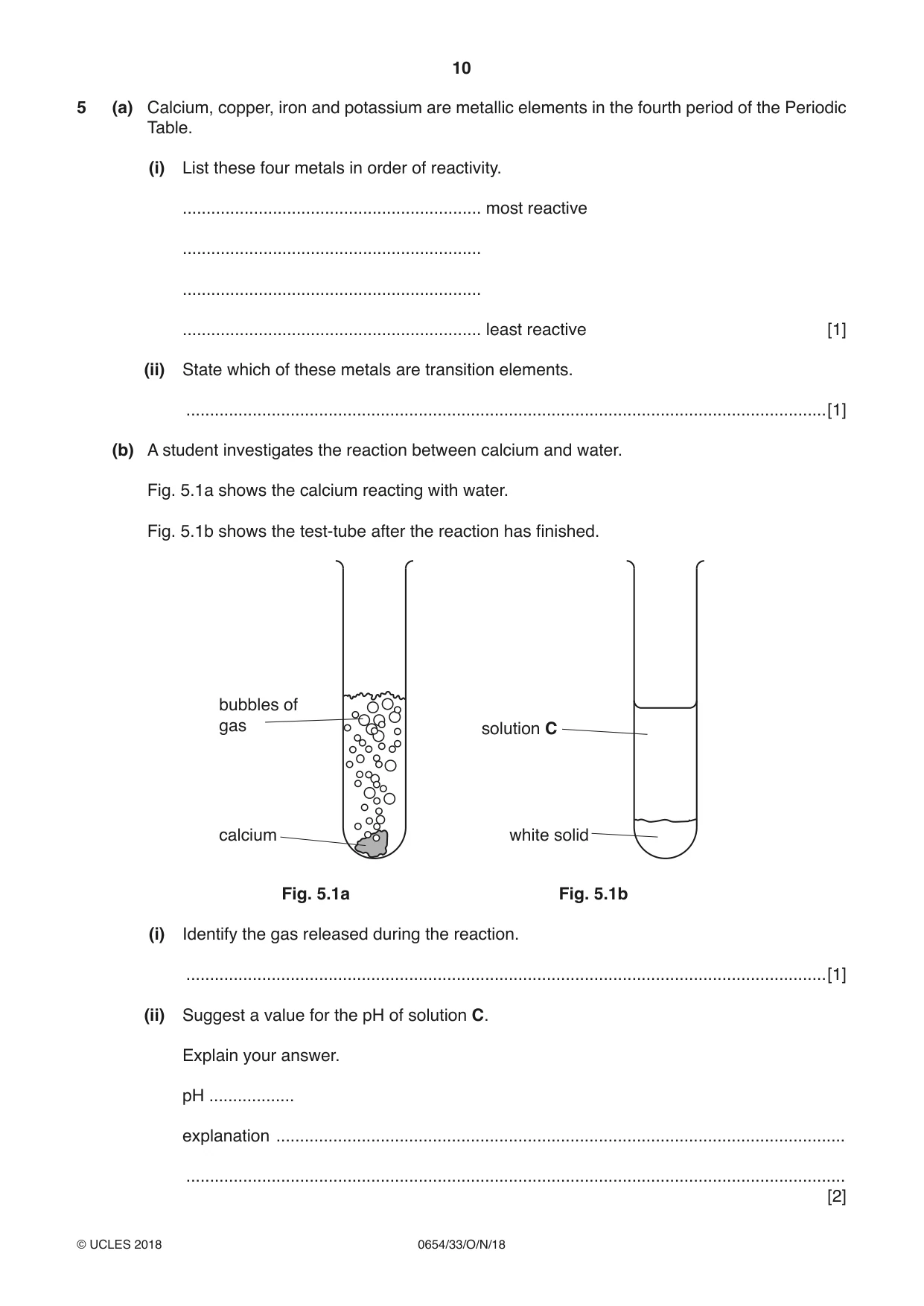
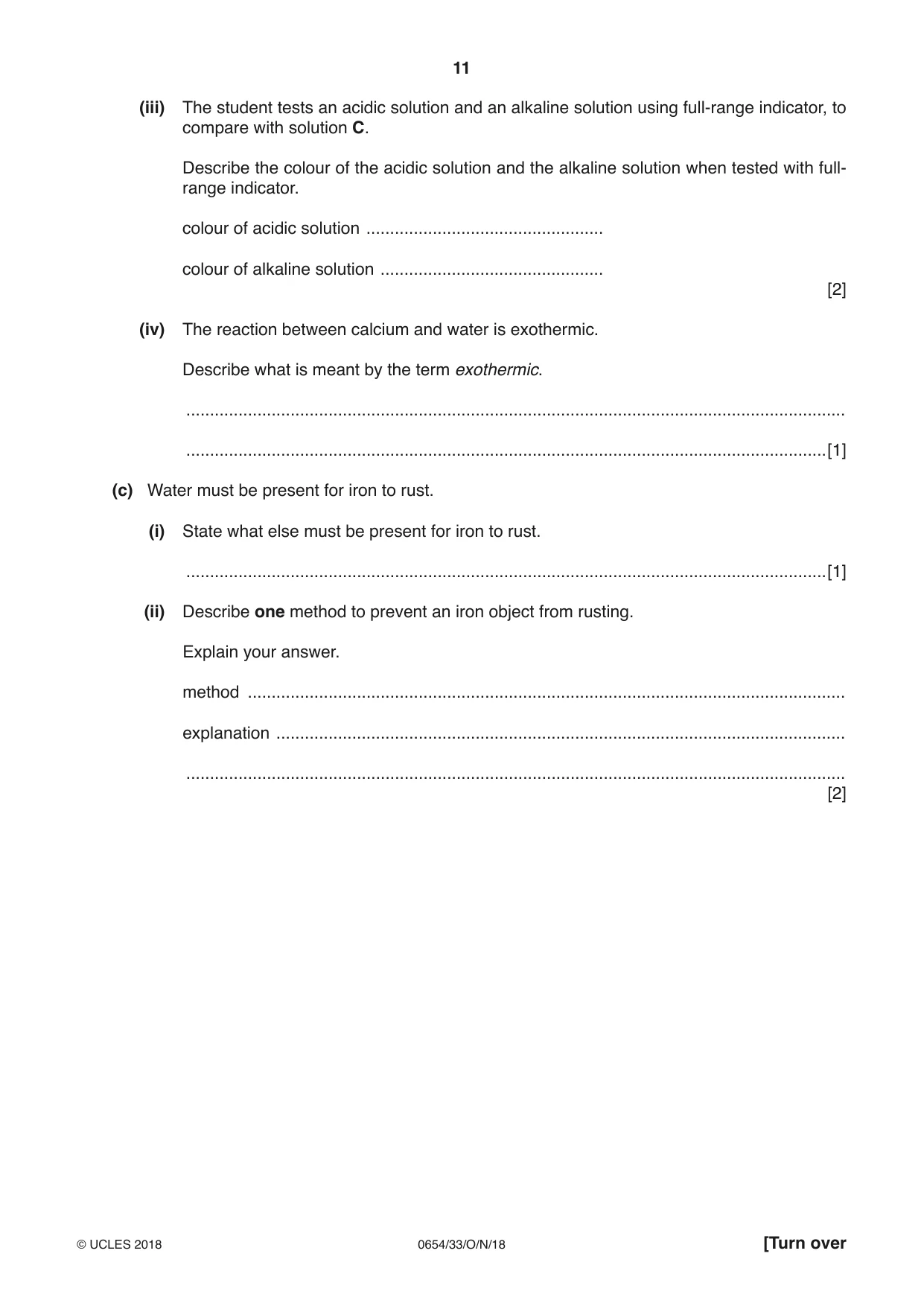
5 (a) Calcium, copper, iron and potassium are metallic elements in the fourth period of the Periodic Table. (i) List these four metals in order of reactivity. ............................................................... most reactive ............................................................... ............................................................... ............................................................... least reactive [1] (ii) State which of these metals are transition elements. .......................................................................................................................................[1] (b) A student investigates the reaction between calcium and water. Fig. 5.1a shows the calcium reacting with water. Fig. 5.1b shows the test-tube after the reaction has finished. bubbles of gas solution C calcium white solid Fig. 5.1a Fig. 5.1b (i) Identify the gas released during the reaction. .......................................................................................................................................[1] (ii) Suggest a value for the pH of solution C. Explain your answer. pH .................. explanation ........................................................................................................................ ........................................................................................................................................... [2] (iii) The student tests an acidic solution and an alkaline solution using full-range indicator, to compare with solution C. Describe the colour of the acidic solution and the alkaline solution when tested with full- range indicator. colour of acidic solution .................................................. colour of alkaline solution ............................................... [2] (iv) The reaction between calcium and water is exothermic. Describe what is meant by the term exothermic. ........................................................................................................................................... .......................................................................................................................................[1] (c) Water must be present for iron to rust. (i) State what else must be present for iron to rust. .......................................................................................................................................[1] (ii) Describe one method to prevent an iron object from rusting. Explain your answer. method .............................................................................................................................. explanation ........................................................................................................................ ........................................................................................................................................... [2]
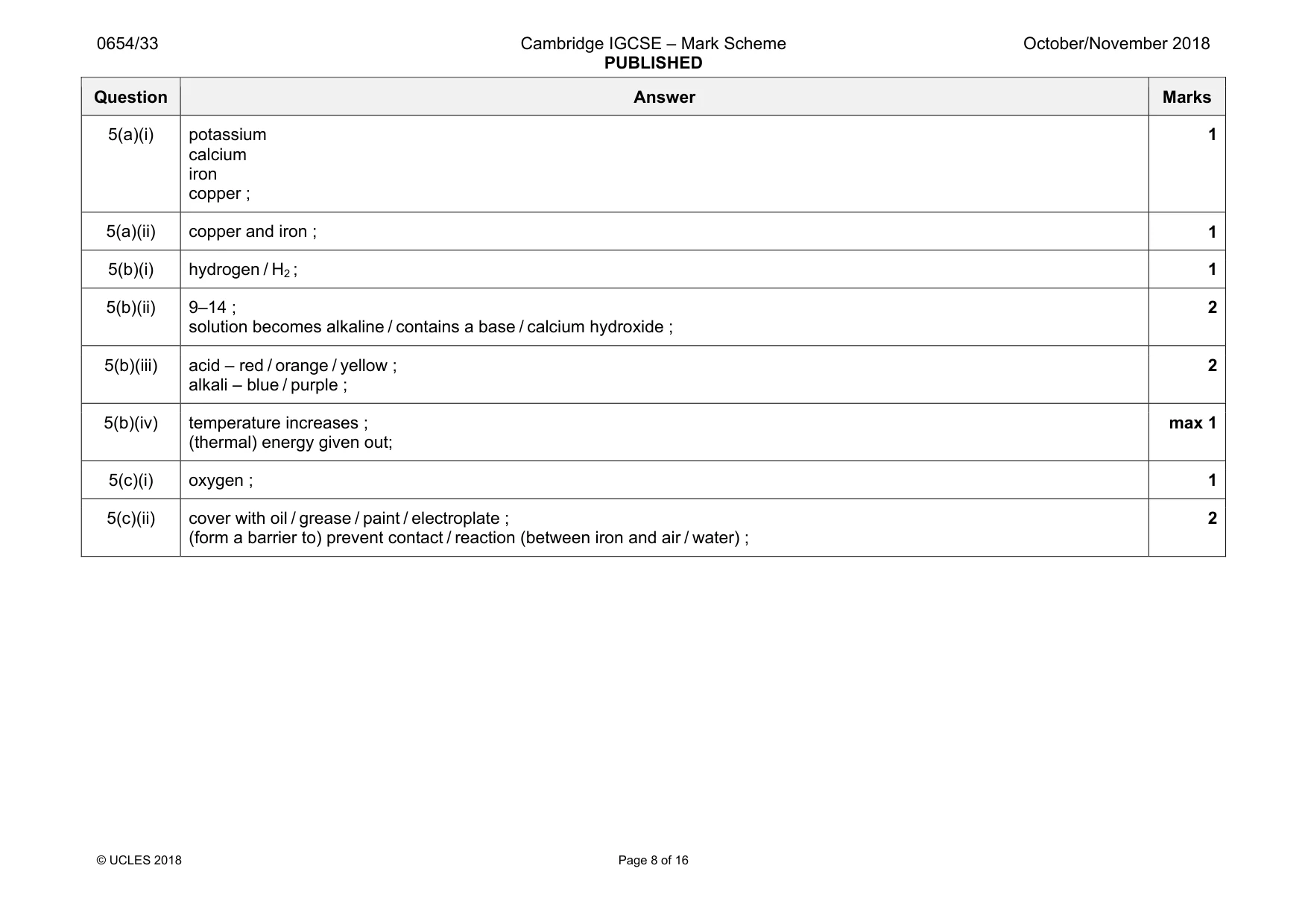
Mark scheme: 5(a)(i) potassium calcium iron copper ; 1 5(a)(ii) copper and iron ; 1 5(b)(i) hydrogen / H2 ; 1 5(b)(ii) 9–14 ; solution becomes alkaline / contains a base / calcium hydroxide ; 2 5(b)(iii) acid – red / orange / yellow ; alkali – blue / purple ; 2 5(b)(iv) temperature increases ; (thermal) energy given out; max 1 5(c)(i) oxygen ; 1 5(c)(ii) cover with oil / grease / paint / electroplate ; (form a barrier to) prevent contact / reaction (between iron and air / water) ; 2
Q6 · The audible frequency range of four animals
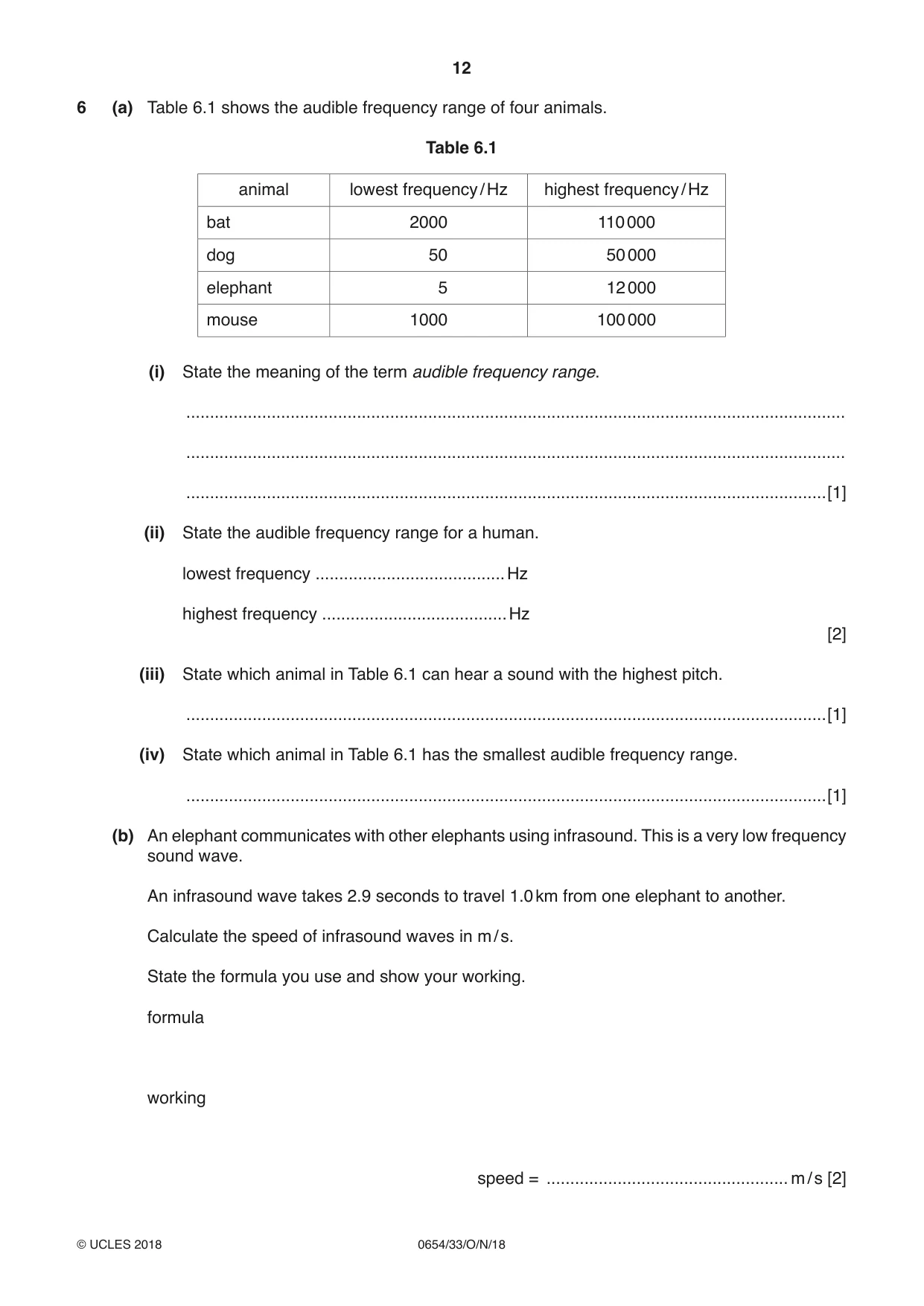
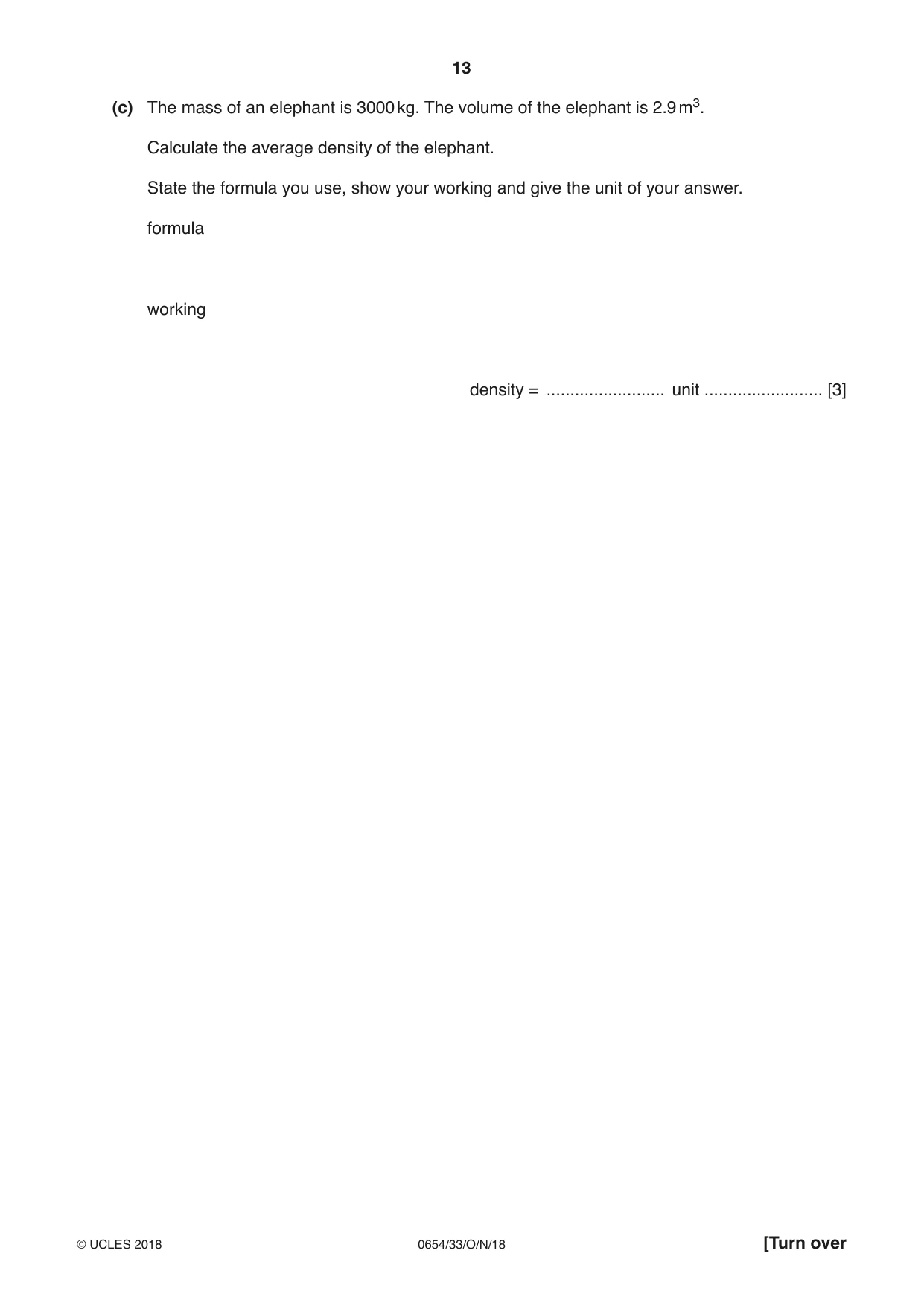
6 (a) Table 6.1 shows the audible frequency range of four animals. Table 6.1 animal lowest frequency / Hz highest frequency / Hz bat 2000 110 000 dog 50 50 000 elephant 5 12 000 mouse 1000 100 000 (i) State the meaning of the term audible frequency range. ........................................................................................................................................... ........................................................................................................................................... .......................................................................................................................................[1] (ii) State the audible frequency range for a human. lowest frequency ........................................ Hz highest frequency ....................................... Hz [2] (iii) State which animal in Table 6.1 can hear a sound with the highest pitch. .......................................................................................................................................[1] (iv) State which animal in Table 6.1 has the smallest audible frequency range. .......................................................................................................................................[1] (b) An elephant communicates with other elephants using infrasound. This is a very low frequency sound wave. An infrasound wave takes 2.9 seconds to travel 1.0 km from one elephant to another. Calculate the speed of infrasound waves in m / s. State the formula you use and show your working. formula working speed = ................................................... m / s [2] (c) The mass of an elephant is 3000 kg. The volume of the elephant is 2.9 m3. Calculate the average density of the elephant. State the formula you use, show your working and give the unit of your answer. formula working density = ......................... unit ......................... [3]
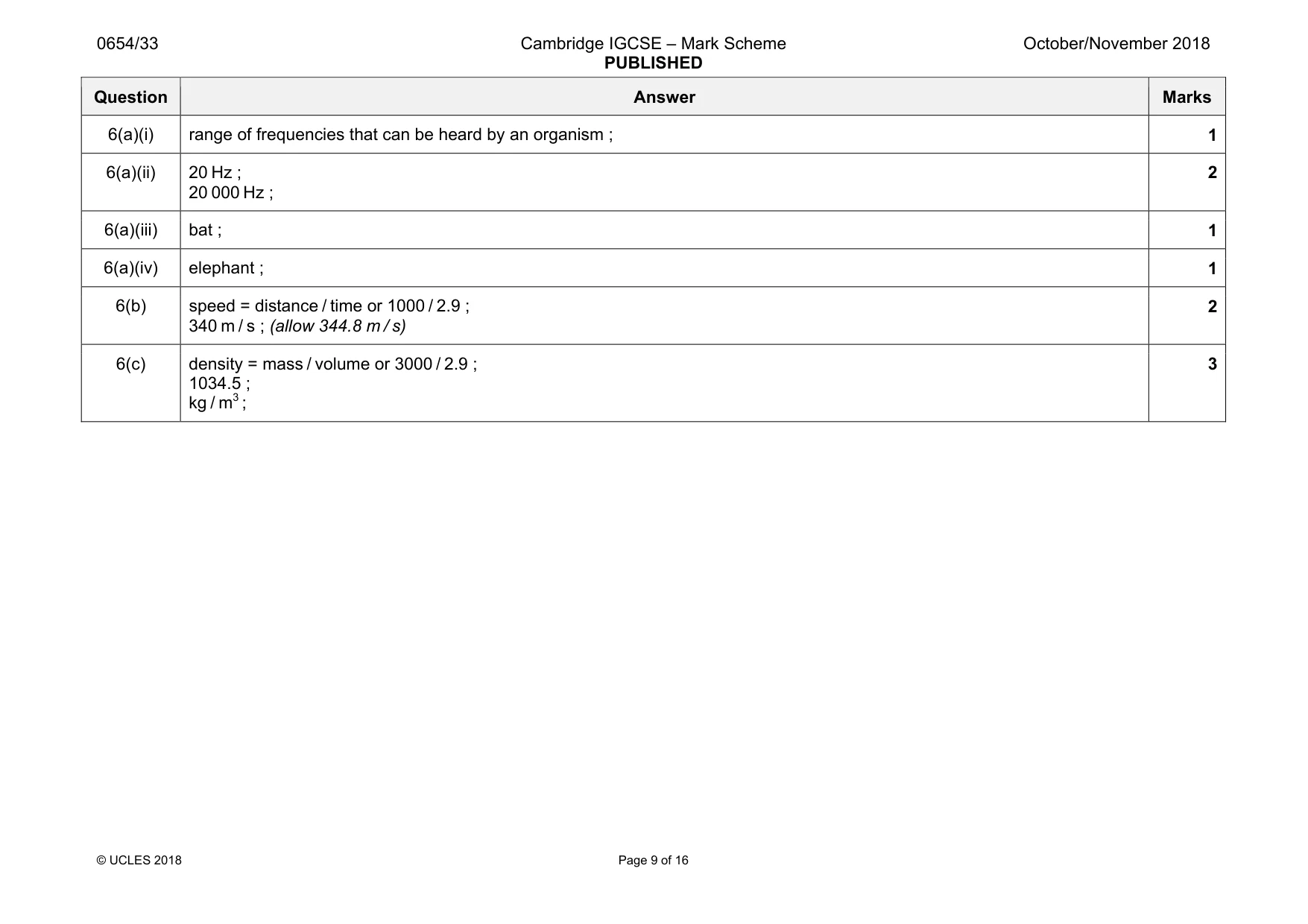
Mark scheme: 6(a)(i) range of frequencies that can be heard by an organism ; 1 6(a)(ii) 20 Hz ; 20 000 Hz ; 2 6(a)(iii) bat ; 1 6(a)(iv) elephant ; 1 6(b) speed = distance / time or 1000 / 2.9 ; 340 m / s ; (allow 344.8 m / s) 2 6(c) density = mass / volume or 3000 / 2.9 ; 1034.5 ; kg / m3 ; 3
Q7 · A diagram of the female reproductive system
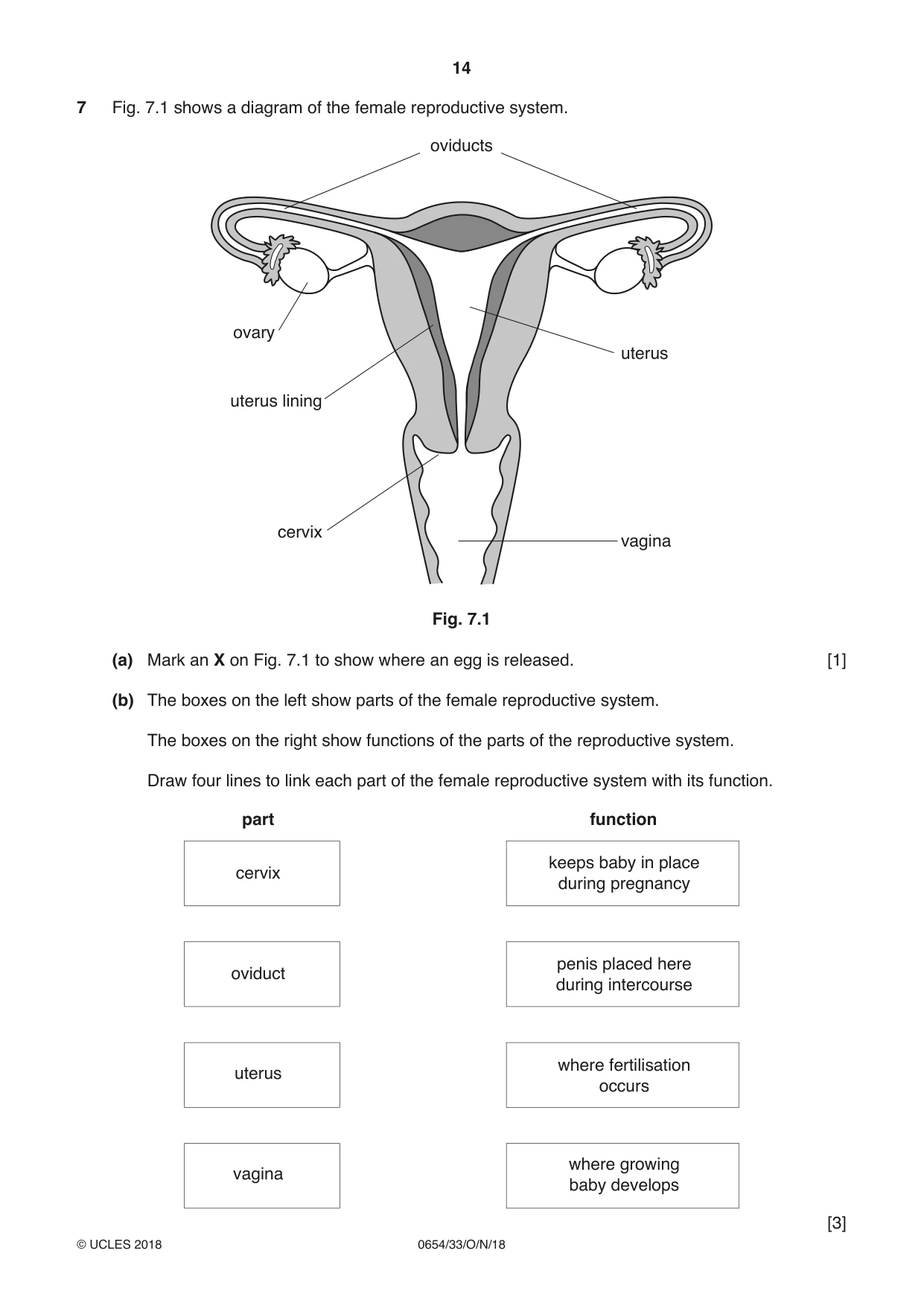
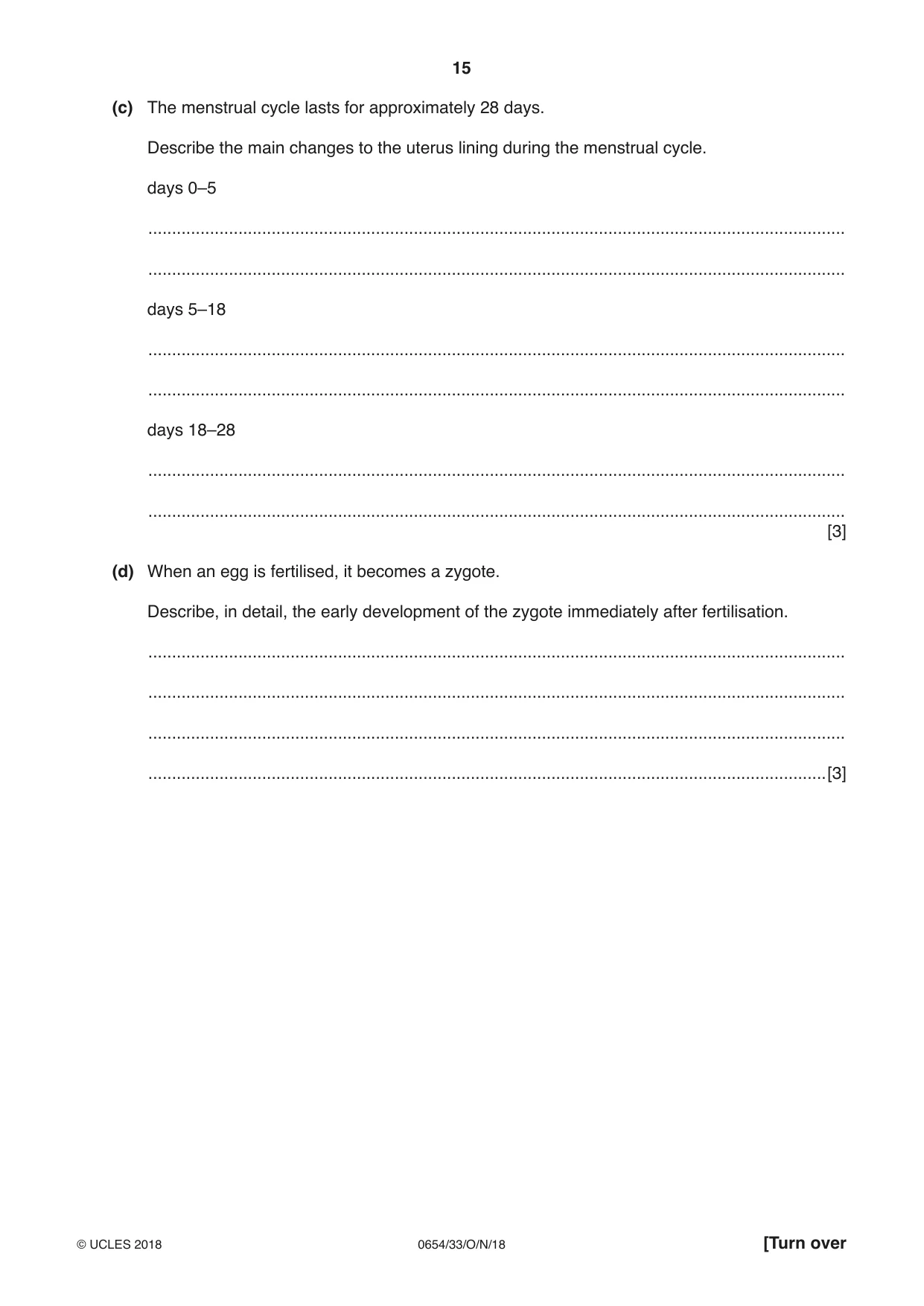
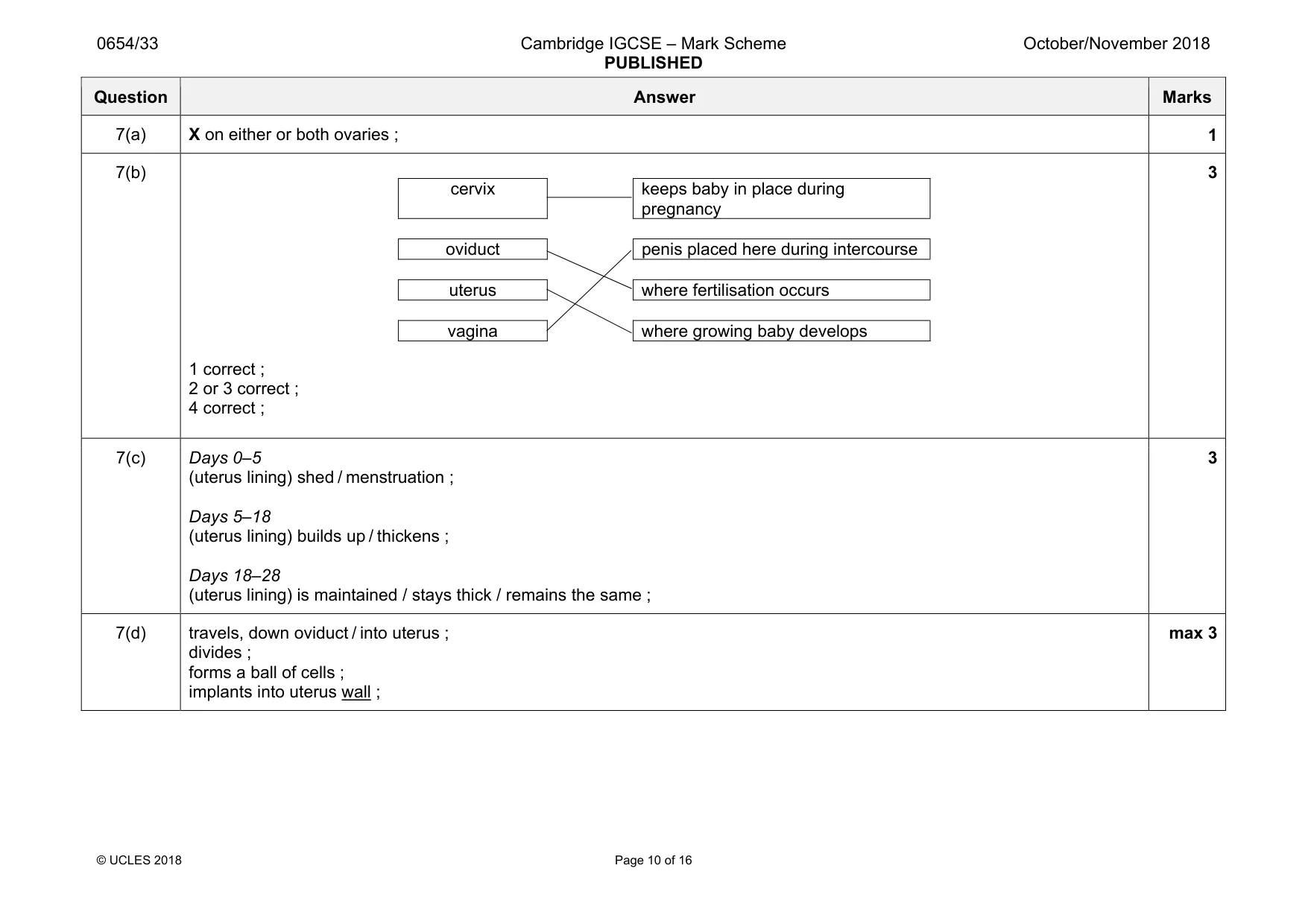
7 Fig. 7.1 shows a diagram of the female reproductive system. oviducts ovary uterus uterus lining cervix vagina Fig. 7.1 (a) Mark an X on Fig. 7.1 to show where an egg is released. [1] (b) The boxes on the left show parts of the female reproductive system. The boxes on the right show functions of the parts of the reproductive system. Draw four lines to link each part of the female reproductive system with its function. part function keeps baby in place cervix during pregnancy penis placed here oviduct during intercourse where fertilisation uterus occurs where growing vagina baby develops [3] (c) The menstrual cycle lasts for approximately 28 days. Describe the main changes to the uterus lining during the menstrual cycle. days 0–5 ................................................................................................................................................... ................................................................................................................................................... days 5–18 ................................................................................................................................................... ................................................................................................................................................... days 18–28 ................................................................................................................................................... ................................................................................................................................................... [3] (d) When an egg is fertilised, it becomes a zygote. Describe, in detail, the early development of the zygote immediately after fertilisation. ................................................................................................................................................... ................................................................................................................................................... ................................................................................................................................................... ...............................................................................................................................................[3]
Mark scheme: 7(a) X on either or both ovaries ; 1 7(b) 1 correct ; 2 or 3 correct ; 4 correct ; cervix keeps baby in place during pregnancy oviduct penis placed here during intercourse uterus where fertilisation occurs vagina where growing baby develops 3 7(c) Days 0–5 (uterus lining) shed / menstruation ; Days 5–18 (uterus lining) builds up / thickens ; Days 18–28 (uterus lining) is maintained / stays thick / remains the same ; 3 7(d) travels, down oviduct / into uterus ; divides ; forms a ball of cells ; implants into uterus wall ; max 3
Q8 · Some volcanoes release the element sulfur
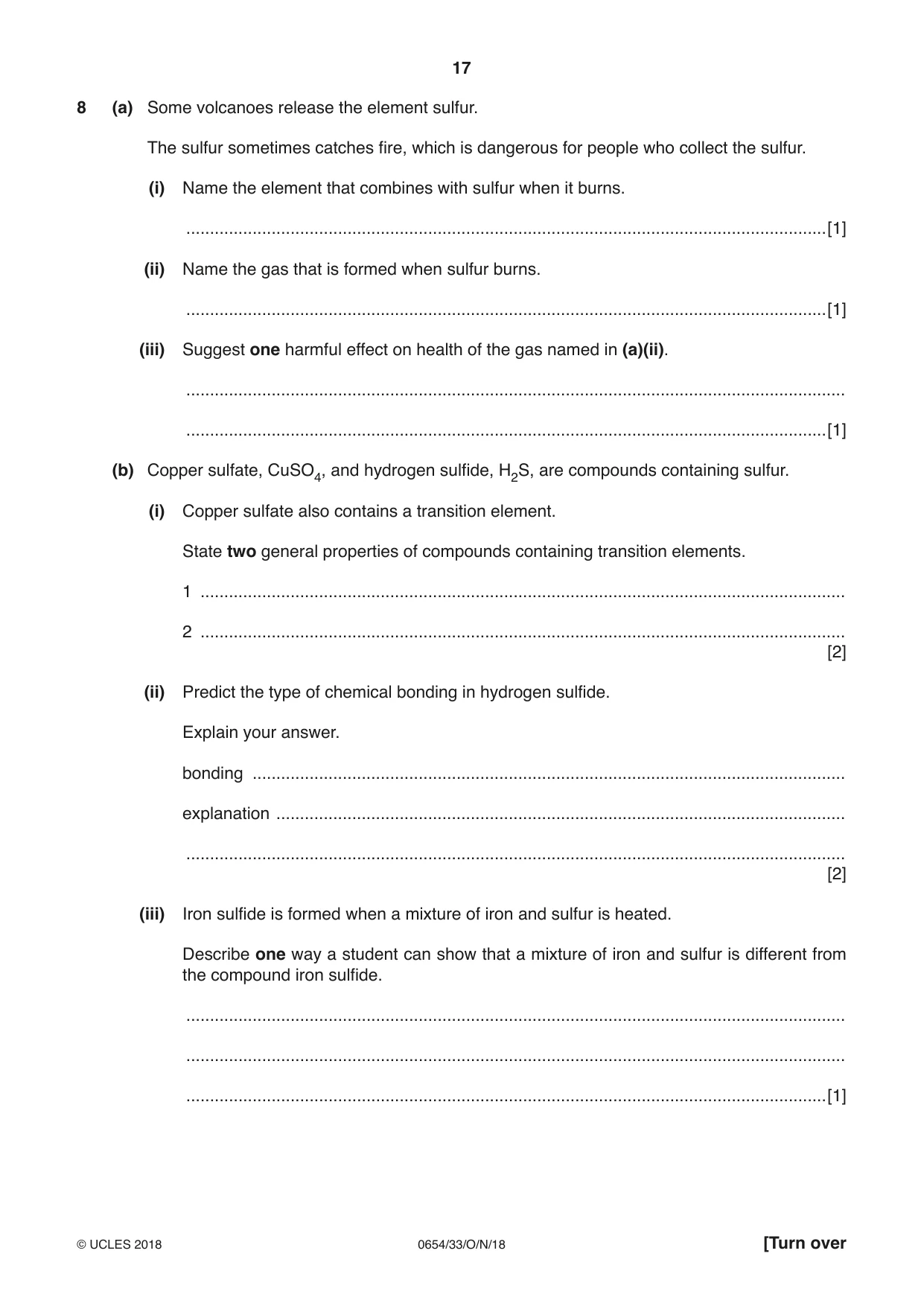
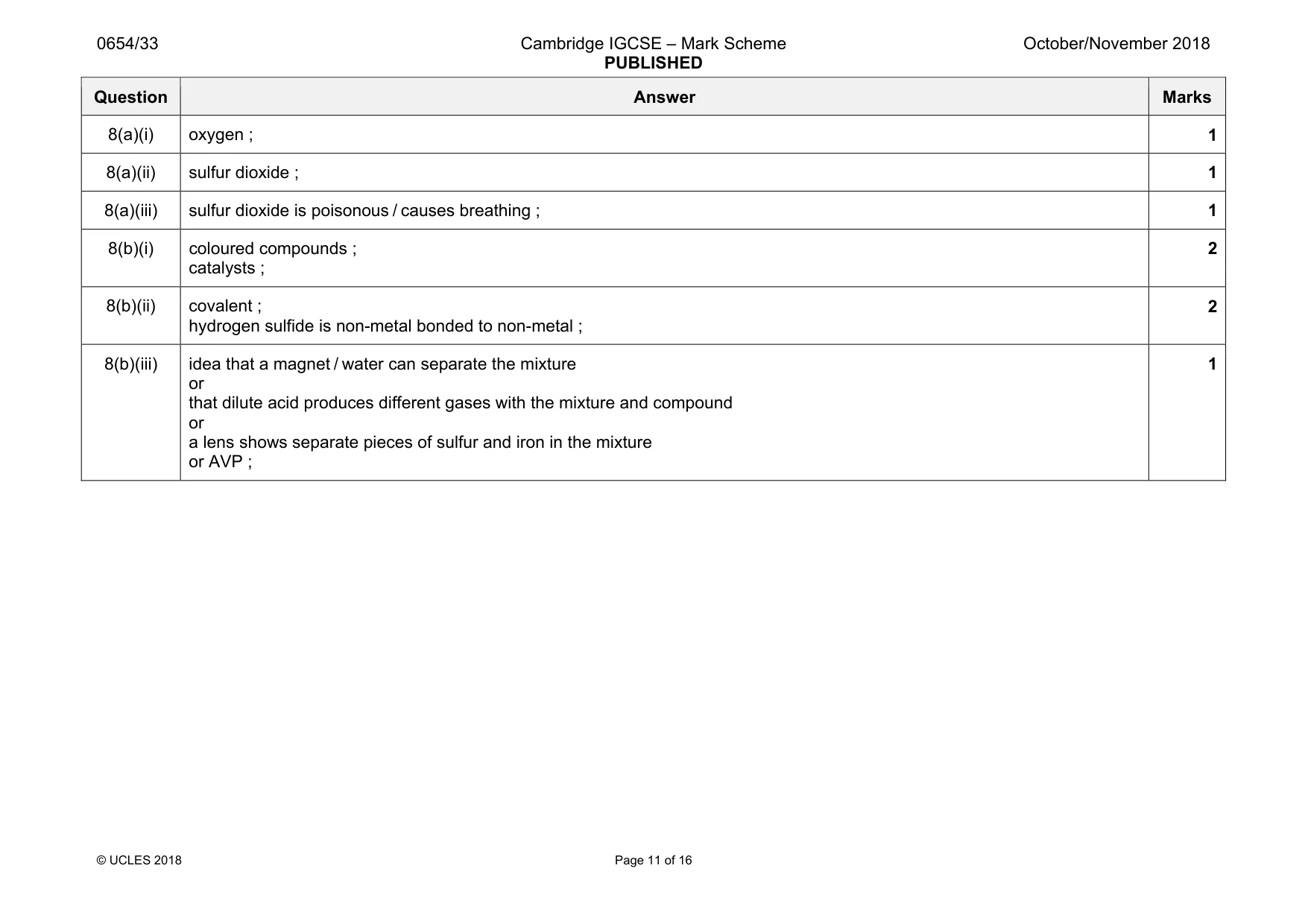
8 (a) Some volcanoes release the element sulfur. The sulfur sometimes catches fire, which is dangerous for people who collect the sulfur. (i) Name the element that combines with sulfur when it burns. .......................................................................................................................................[1] (ii) Name the gas that is formed when sulfur burns. .......................................................................................................................................[1] (iii) Suggest one harmful effect on health of the gas named in (a)(ii). ........................................................................................................................................... .......................................................................................................................................[1] (b) Copper sulfate, CuSO4, and hydrogen sulfide, H2S, are compounds containing sulfur. (i) Copper sulfate also contains a transition element. State two general properties of compounds containing transition elements. 1 ........................................................................................................................................ 2 ........................................................................................................................................ [2] (ii) Predict the type of chemical bonding in hydrogen sulfide. Explain your answer. bonding ............................................................................................................................. explanation ........................................................................................................................ ........................................................................................................................................... [2] (iii) Iron sulfide is formed when a mixture of iron and sulfur is heated. Describe one way a student can show that a mixture of iron and sulfur is different from the compound iron sulfide. ........................................................................................................................................... ........................................................................................................................................... .......................................................................................................................................[1]
Mark scheme: 8(a)(i) oxygen ; 1 8(a)(ii) sulfur dioxide ; 1 8(a)(iii) sulfur dioxide is poisonous / causes breathing ; 1 8(b)(i) coloured compounds ; catalysts ; 2 8(b)(ii) covalent ; hydrogen sulfide is non-metal bonded to non-metal ; 2 8(b)(iii) idea that a magnet / water can separate the mixture or that dilute acid produces different gases with the mixture and compound or a lens shows separate pieces of sulfur and iron in the mixture or AVP ; 1
Q9 · Aluminium can be easily shaped into containers to store food
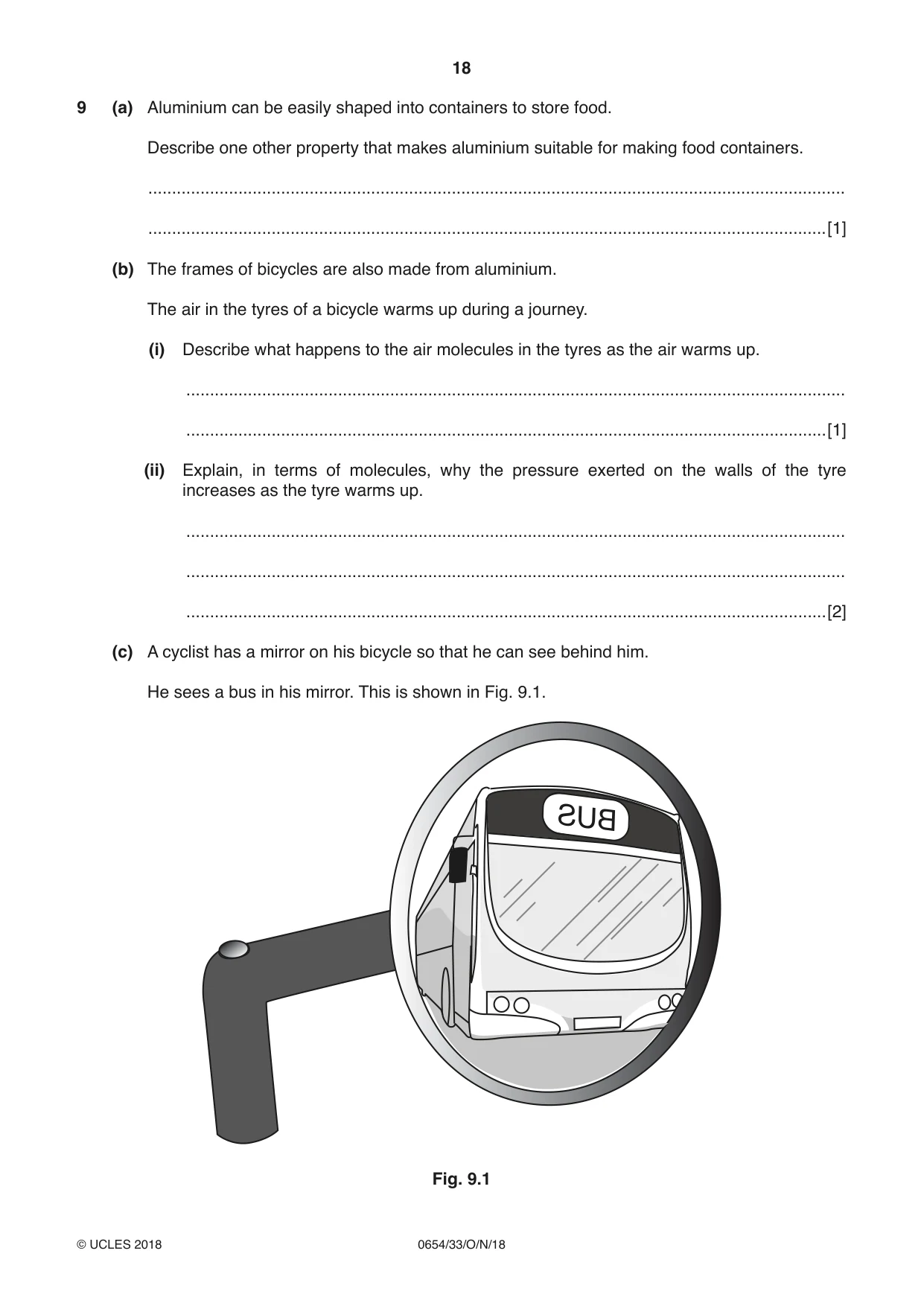
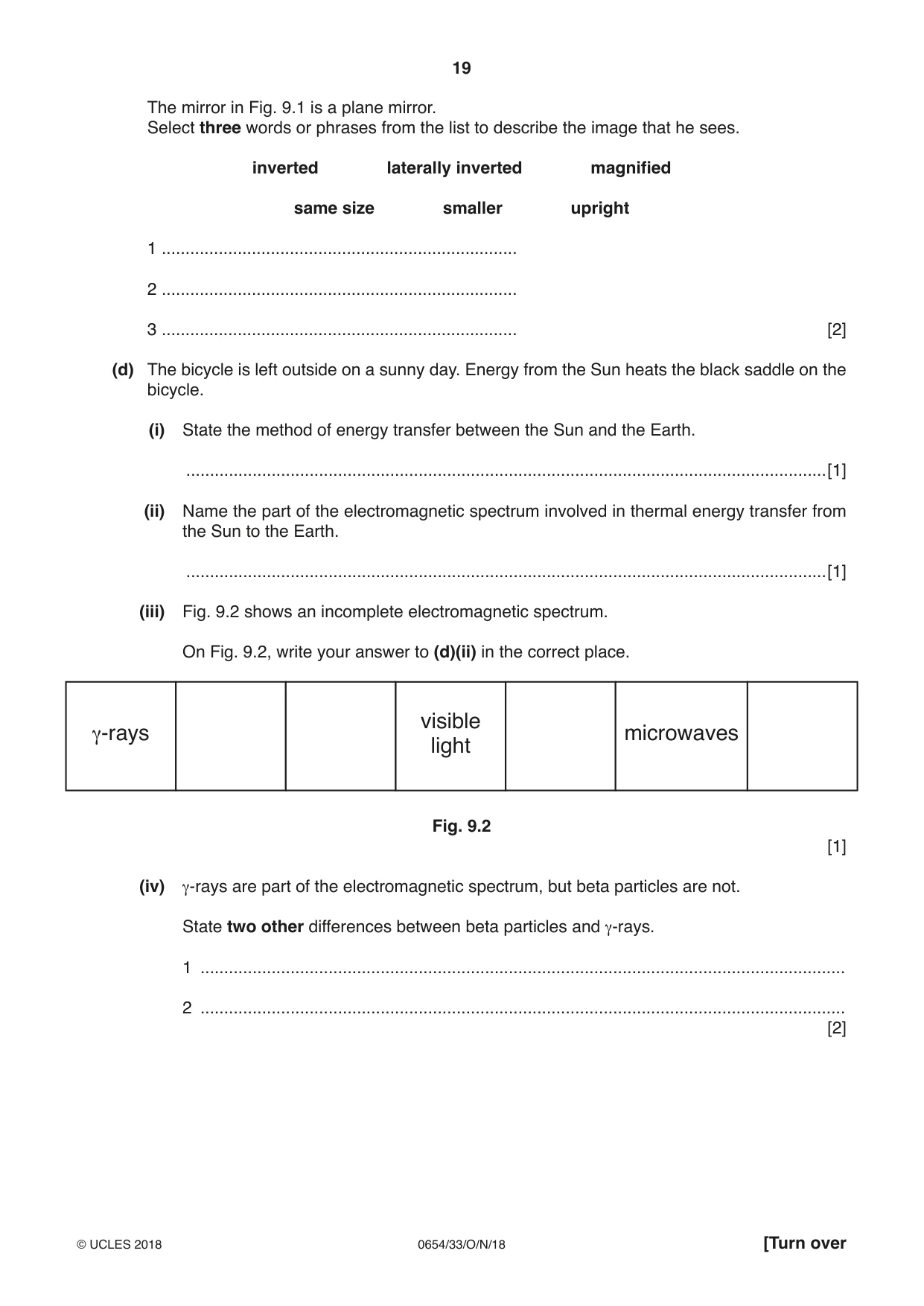
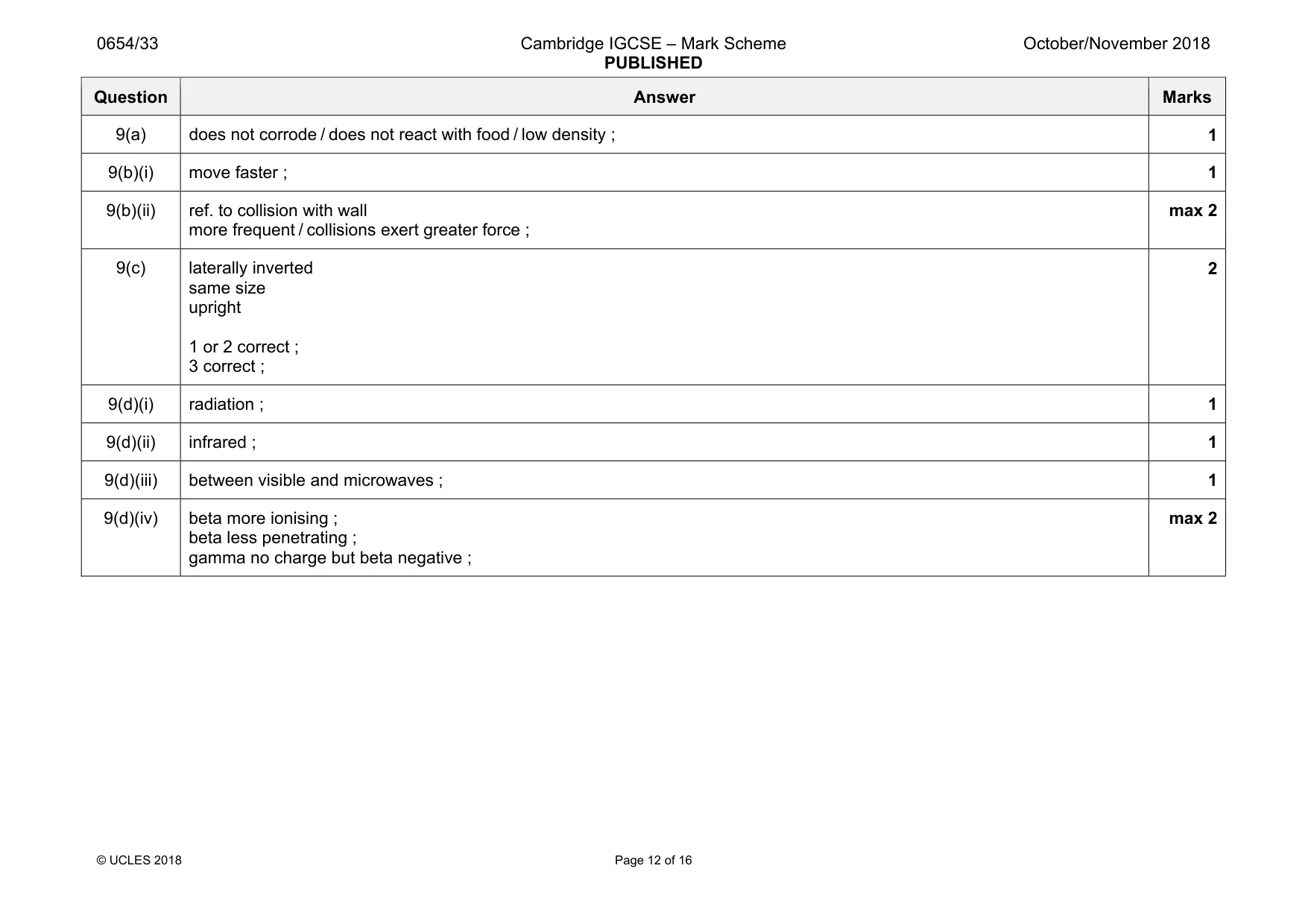
9 (a) Aluminium can be easily shaped into containers to store food. Describe one other property that makes aluminium suitable for making food containers. ................................................................................................................................................... ...............................................................................................................................................[1] (b) The frames of bicycles are also made from aluminium. The air in the tyres of a bicycle warms up during a journey. (i) Describe what happens to the air molecules in the tyres as the air warms up. ........................................................................................................................................... .......................................................................................................................................[1] (ii) Explain, in terms of molecules, why the pressure exerted on the walls of the tyre increases as the tyre warms up. ........................................................................................................................................... ........................................................................................................................................... .......................................................................................................................................[2] (c) A cyclist has a mirror on his bicycle so that he can see behind him. He sees a bus in his mirror. This is shown in Fig. 9.1. BUS Fig. 9.1 The mirror in Fig. 9.1 is a plane mirror. Select three words or phrases from the list to describe the image that he sees. inverted laterally inverted magnified same size smaller upright 1 ........................................................................... 2 ........................................................................... 3 ........................................................................... [2] (d) The bicycle is left outside on a sunny day. Energy from the Sun heats the black saddle on the bicycle. (i) State the method of energy transfer between the Sun and the Earth. .......................................................................................................................................[1] (ii) Name the part of the electromagnetic spectrum involved in thermal energy transfer from the Sun to the Earth. .......................................................................................................................................[1] (iii) Fig. 9.2 shows an incomplete electromagnetic spectrum. On Fig. 9.2, write your answer to (d)(ii) in the correct place. visibleγ-rays microwaves light Fig. 9.2 [1] (iv) γ-rays are part of the electromagnetic spectrum, but beta particles are not. State two other differences between beta particles and γ-rays. 1 ........................................................................................................................................ 2 ........................................................................................................................................ [2]
Mark scheme: 9(a) does not corrode / does not react with food / low density ; 1 9(b)(i) move faster ; 1 9(b)(ii) ref. to collision with wall more frequent / collisions exert greater force ; max 2 9(c) laterally inverted same size upright 1 or 2 correct ; 3 correct ; 2 9(d)(i) radiation ; 1 9(d)(ii) infrared ; 1 9(d)(iii) between visible and microwaves ; 1 9(d)(iv) beta more ionising ; beta less penetrating ; gamma no charge but beta negative ; max 2
Q10 · Albinism is an inherited condition where there is no pigment in the skin and hair
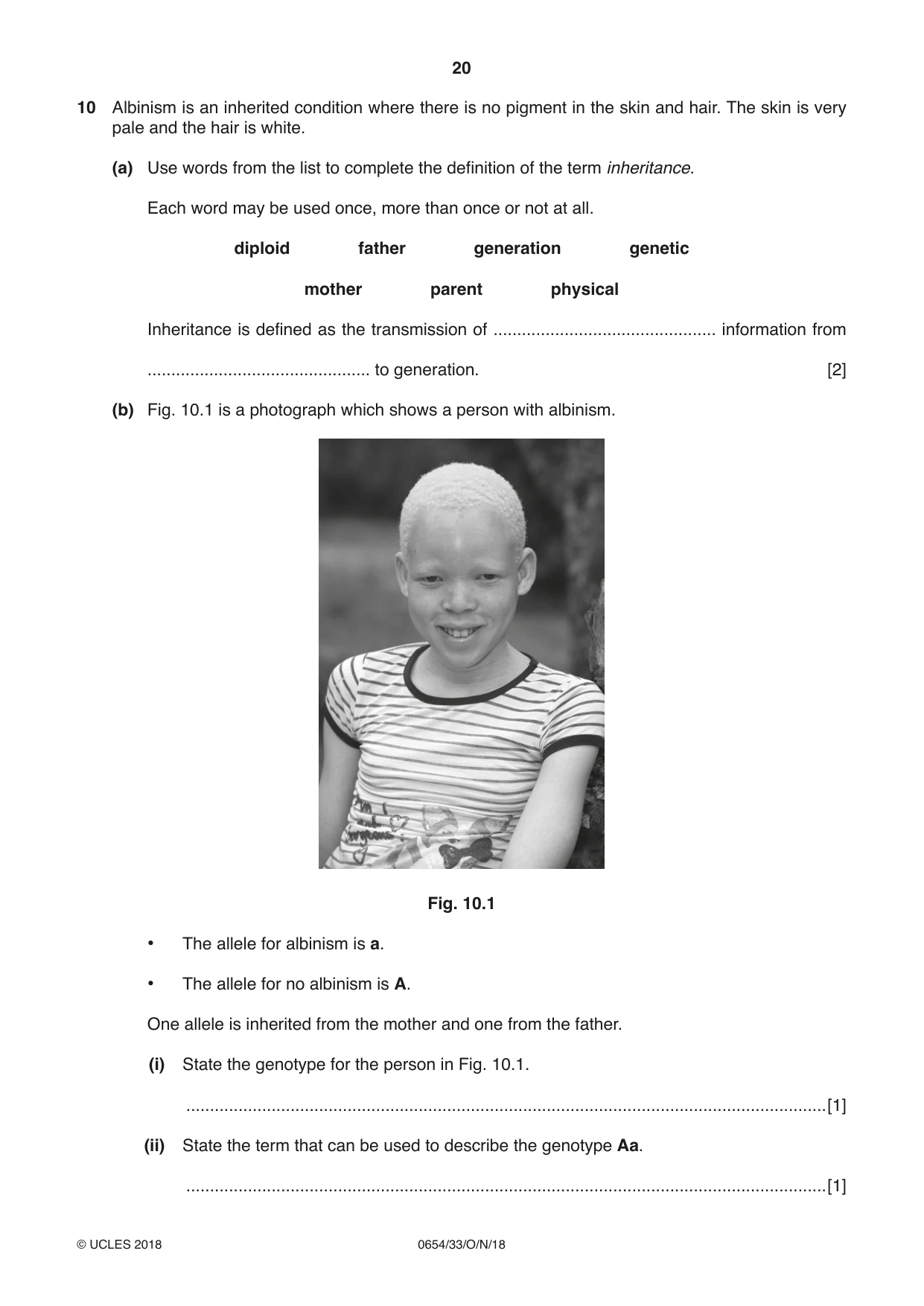
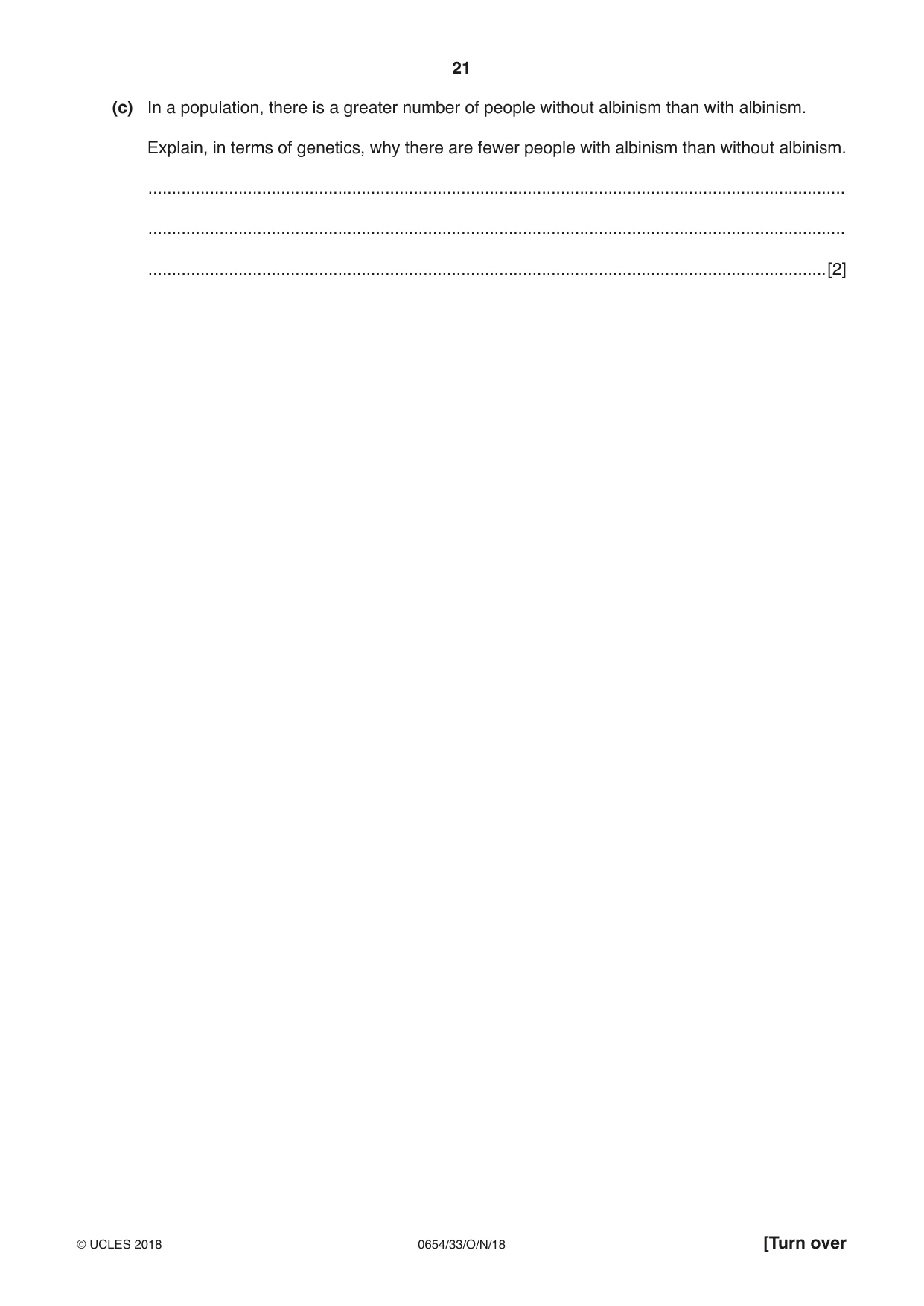
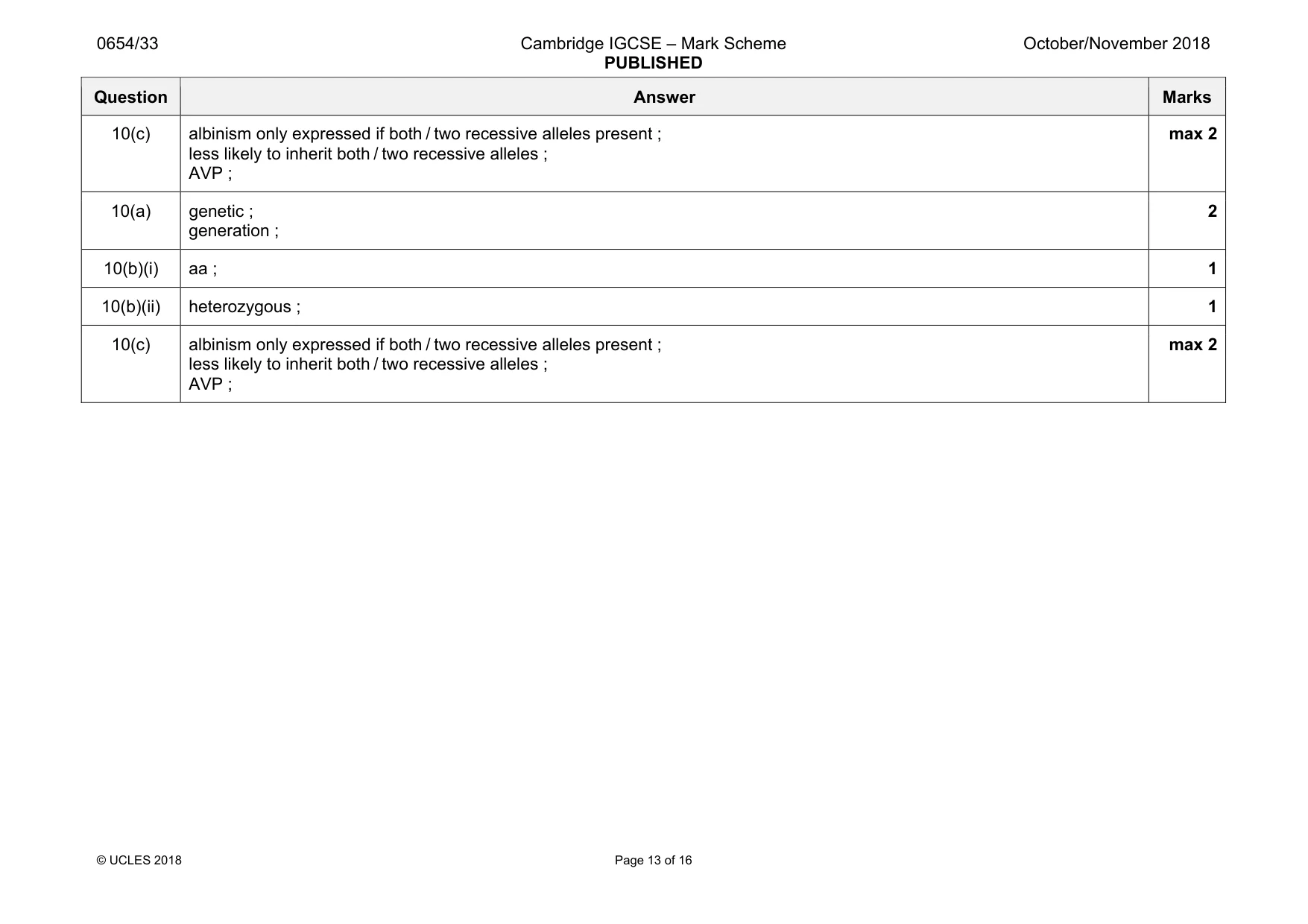
10 Albinism is an inherited condition where there is no pigment in the skin and hair. The skin is very pale and the hair is white. (a) Use words from the list to complete the definition of the term inheritance. Each word may be used once, more than once or not at all. diploid father generation genetic mother parent physical Inheritance is defined as the transmission of ............................................... information from ............................................... to generation. [2] (b) Fig. 10.1 is a photograph which shows a person with albinism. Fig. 10.1 • The allele for albinism is a. • The allele for no albinism is A. One allele is inherited from the mother and one from the father. (i) State the genotype for the person in Fig. 10.1. .......................................................................................................................................[1] (ii) State the term that can be used to describe the genotype Aa. .......................................................................................................................................[1] (c) In a population, there is a greater number of people without albinism than with albinism. Explain, in terms of genetics, why there are fewer people with albinism than without albinism. ................................................................................................................................................... ................................................................................................................................................... ...............................................................................................................................................[2]
Mark scheme: 10(c) albinism only expressed if both / two recessive alleles present ; less likely to inherit both / two recessive alleles ; AVP ; max 2 10(a) genetic ; generation ; 2 10(b)(i) aa ; 1 10(b)(ii) heterozygous ; 1 10(c) albinism only expressed if both / two recessive alleles present ; less likely to inherit both / two recessive alleles ; AVP ; max 2
Q11 · Alkanes and alkenes are types of hydrocarbons
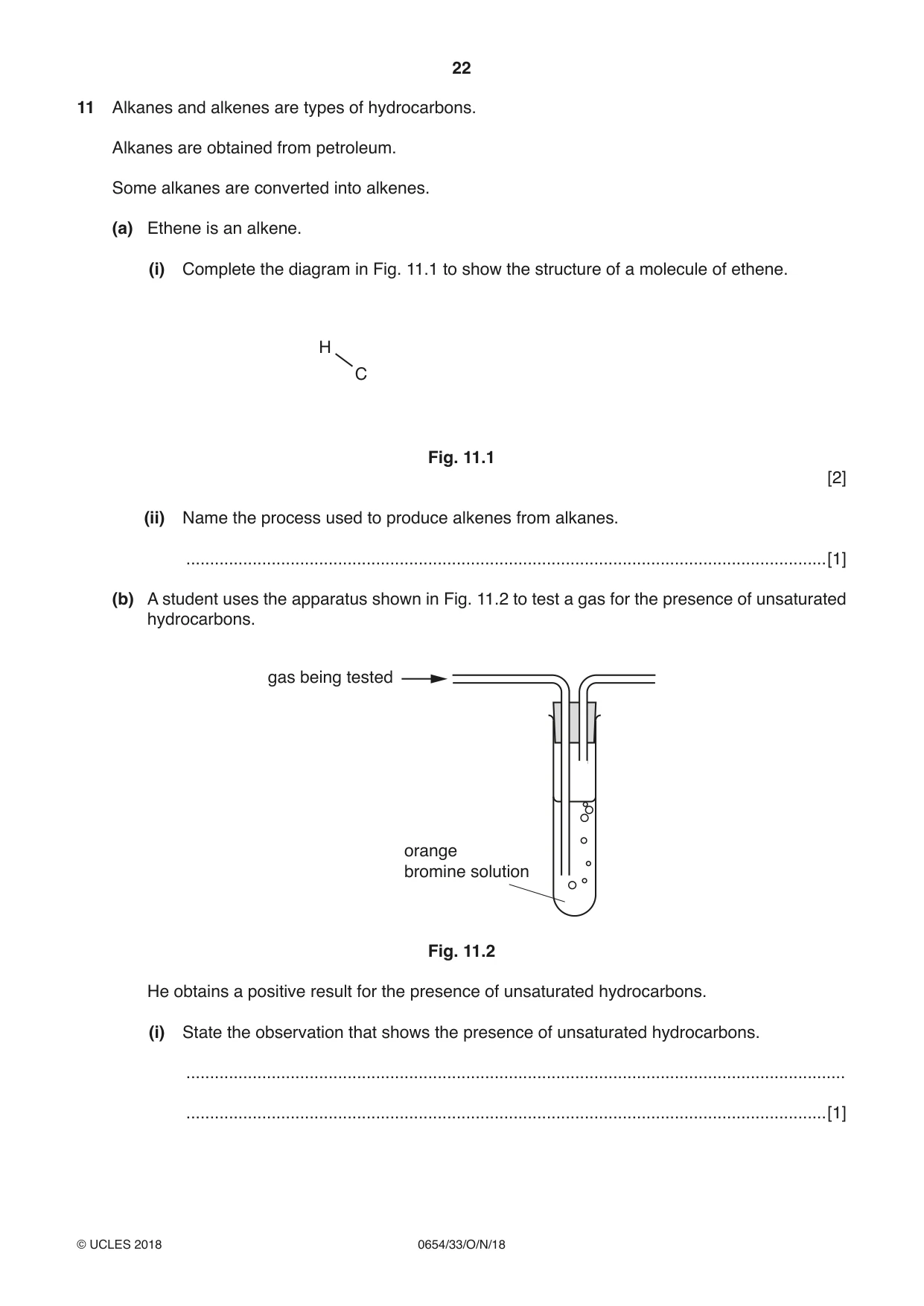
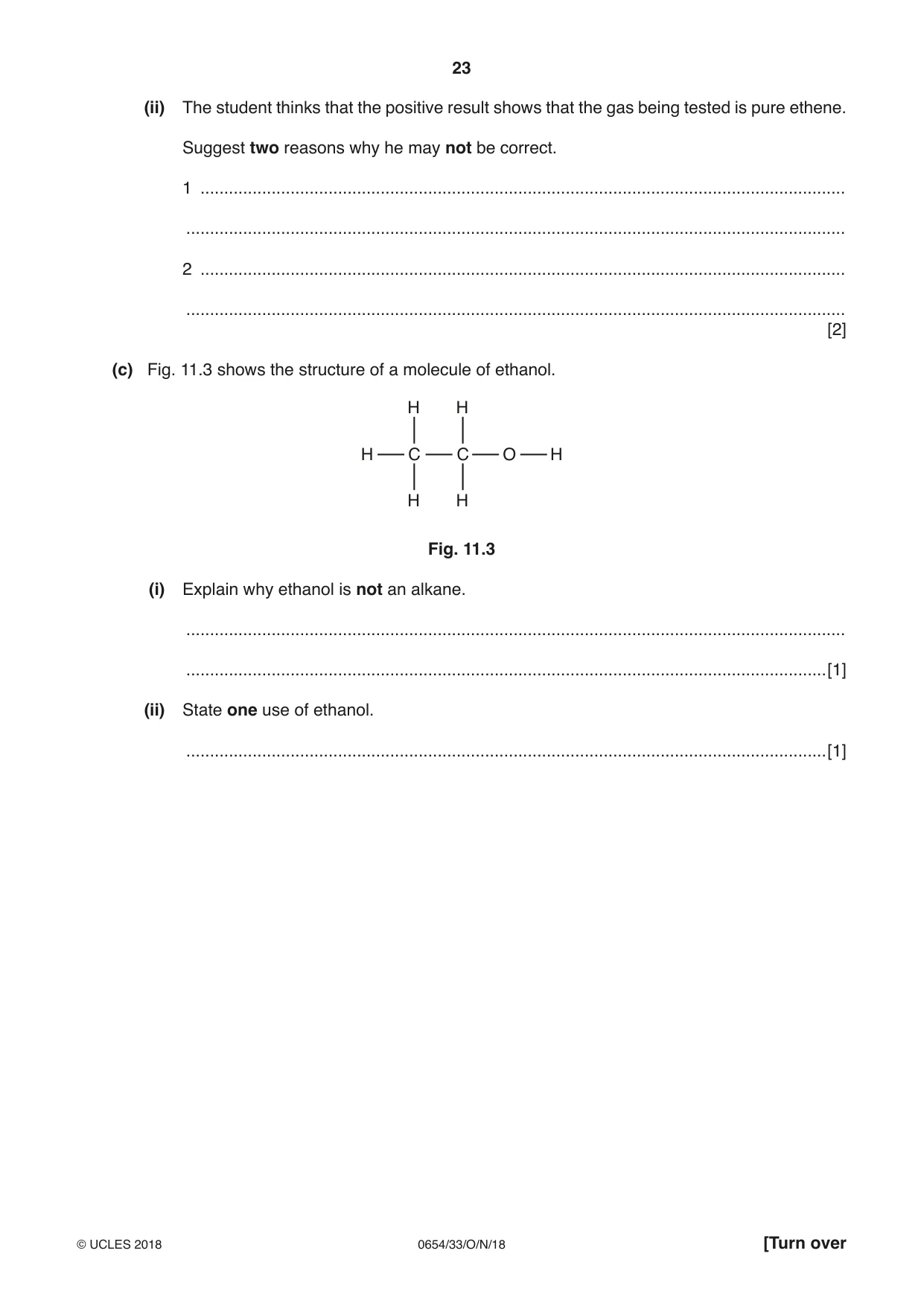
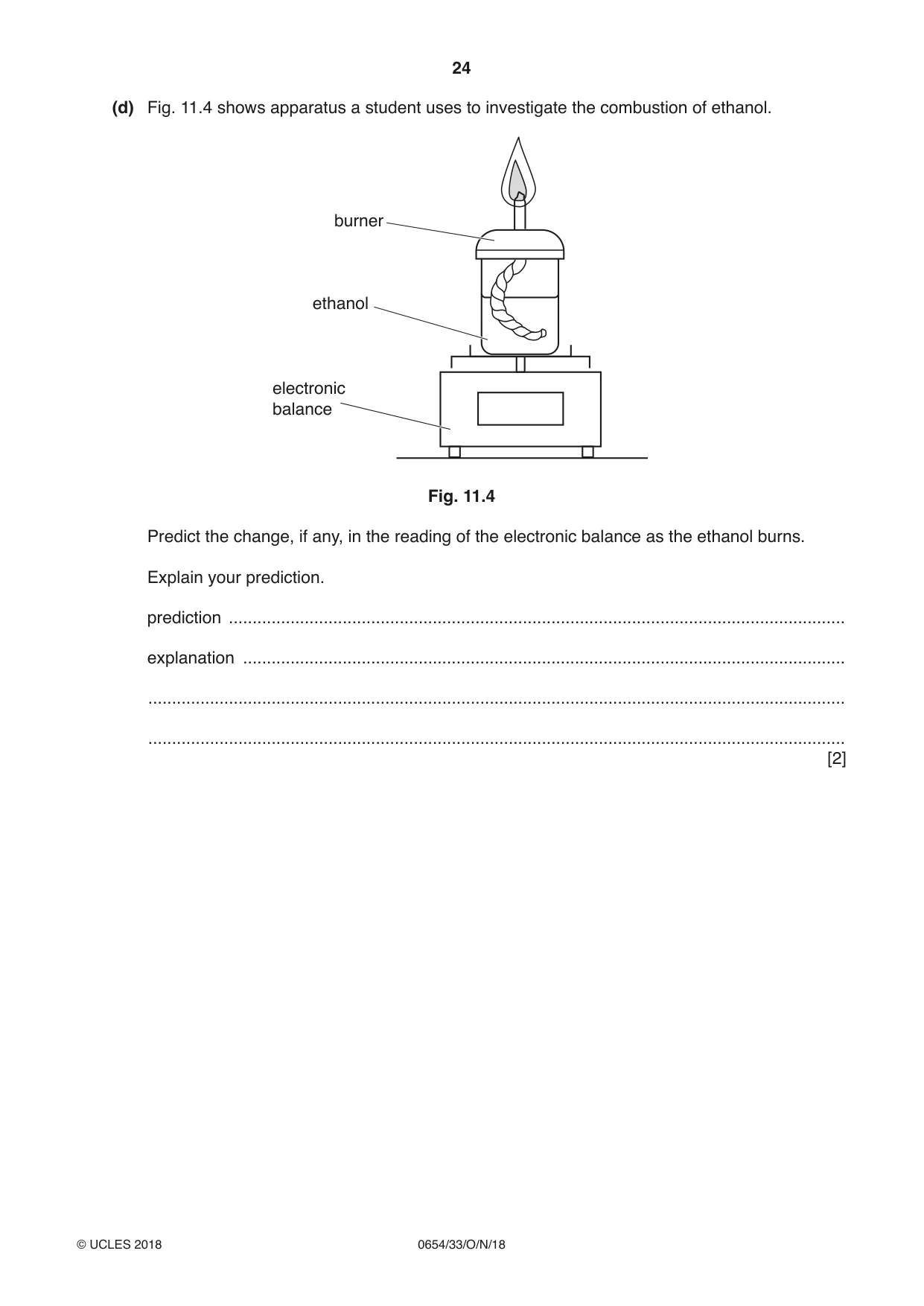
11 Alkanes and alkenes are types of hydrocarbons. Alkanes are obtained from petroleum. Some alkanes are converted into alkenes. (a) Ethene is an alkene. (i) Complete the diagram in Fig. 11.1 to show the structure of a molecule of ethene. H C Fig. 11.1 [2] (ii) Name the process used to produce alkenes from alkanes. .......................................................................................................................................[1] (b) A student uses the apparatus shown in Fig. 11.2 to test a gas for the presence of unsaturated hydrocarbons. gas being tested orange bromine solution Fig. 11.2 He obtains a positive result for the presence of unsaturated hydrocarbons. (i) State the observation that shows the presence of unsaturated hydrocarbons. ........................................................................................................................................... .......................................................................................................................................[1] (ii) The student thinks that the positive result shows that the gas being tested is pure ethene. Suggest two reasons why he may not be correct. 1 ........................................................................................................................................ ........................................................................................................................................... 2 ........................................................................................................................................ ........................................................................................................................................... [2] (c) Fig. 11.3 shows the structure of a molecule of ethanol. H H H C C O H H H Fig. 11.3 (i) Explain why ethanol is not an alkane. ........................................................................................................................................... .......................................................................................................................................[1] (ii) State one use of ethanol. .......................................................................................................................................[1] (d) Fig. 11.4 shows apparatus a student uses to investigate the combustion of ethanol. burner ethanol electronic balance Fig. 11.4 Predict the change, if any, in the reading of the electronic balance as the ethanol burns. Explain your prediction. prediction .................................................................................................................................. explanation ............................................................................................................................... ................................................................................................................................................... ................................................................................................................................................... [2]
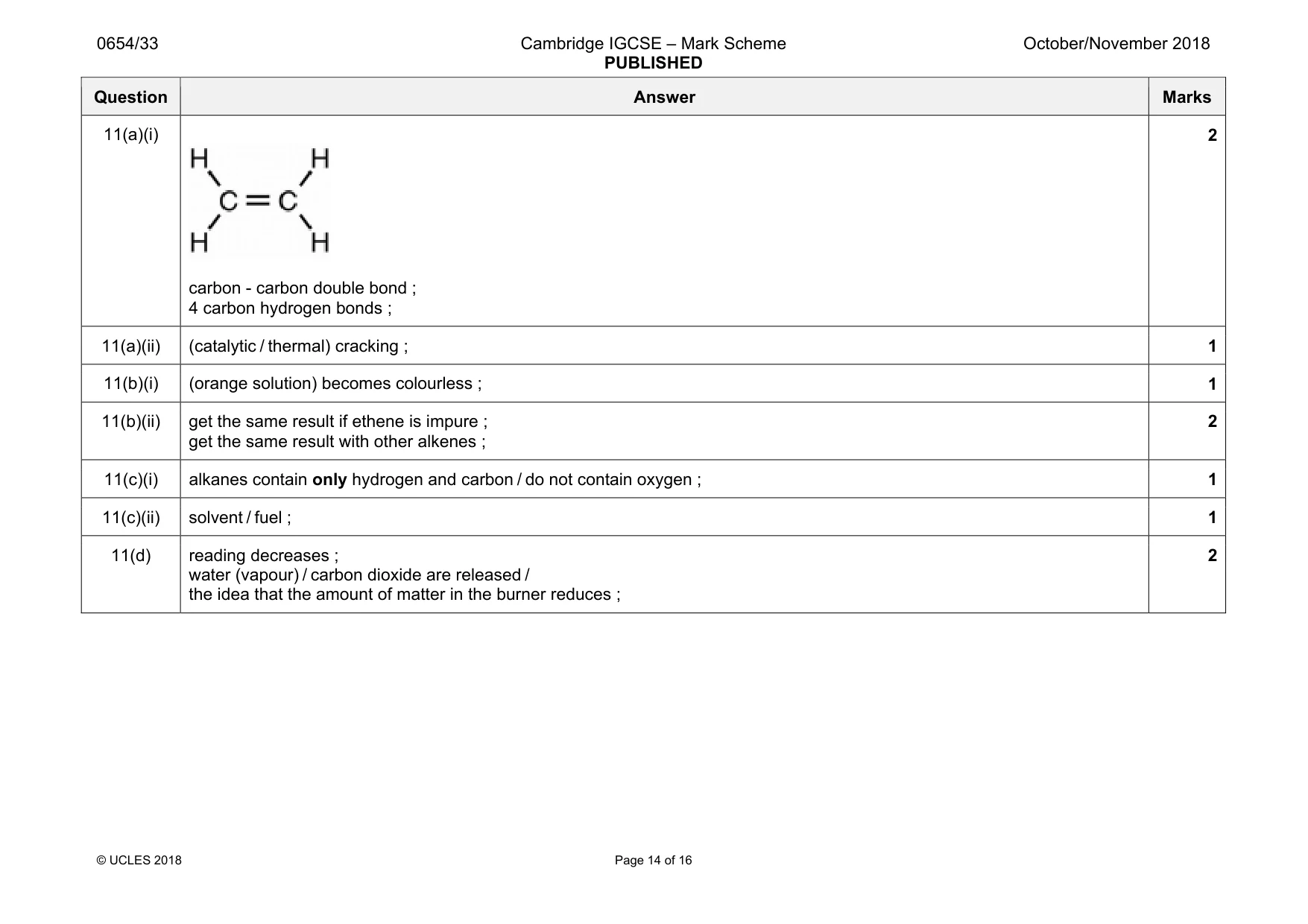
Mark scheme: 11(a)(i) carbon - carbon double bond ; 4 carbon hydrogen bonds ; 2 11(a)(ii) (catalytic / thermal) cracking ; 1 11(b)(i) (orange solution) becomes colourless ; 1 11(b)(ii) get the same result if ethene is impure ; get the same result with other alkenes ; 2 11(c)(i) alkanes contain only hydrogen and carbon / do not contain oxygen ; 1 11(c)(ii) solvent / fuel ; 1 11(d) reading decreases ; water (vapour) / carbon dioxide are released / the idea that the amount of matter in the burner reduces ; 2
Q12 · Some ice has been made by freezing water
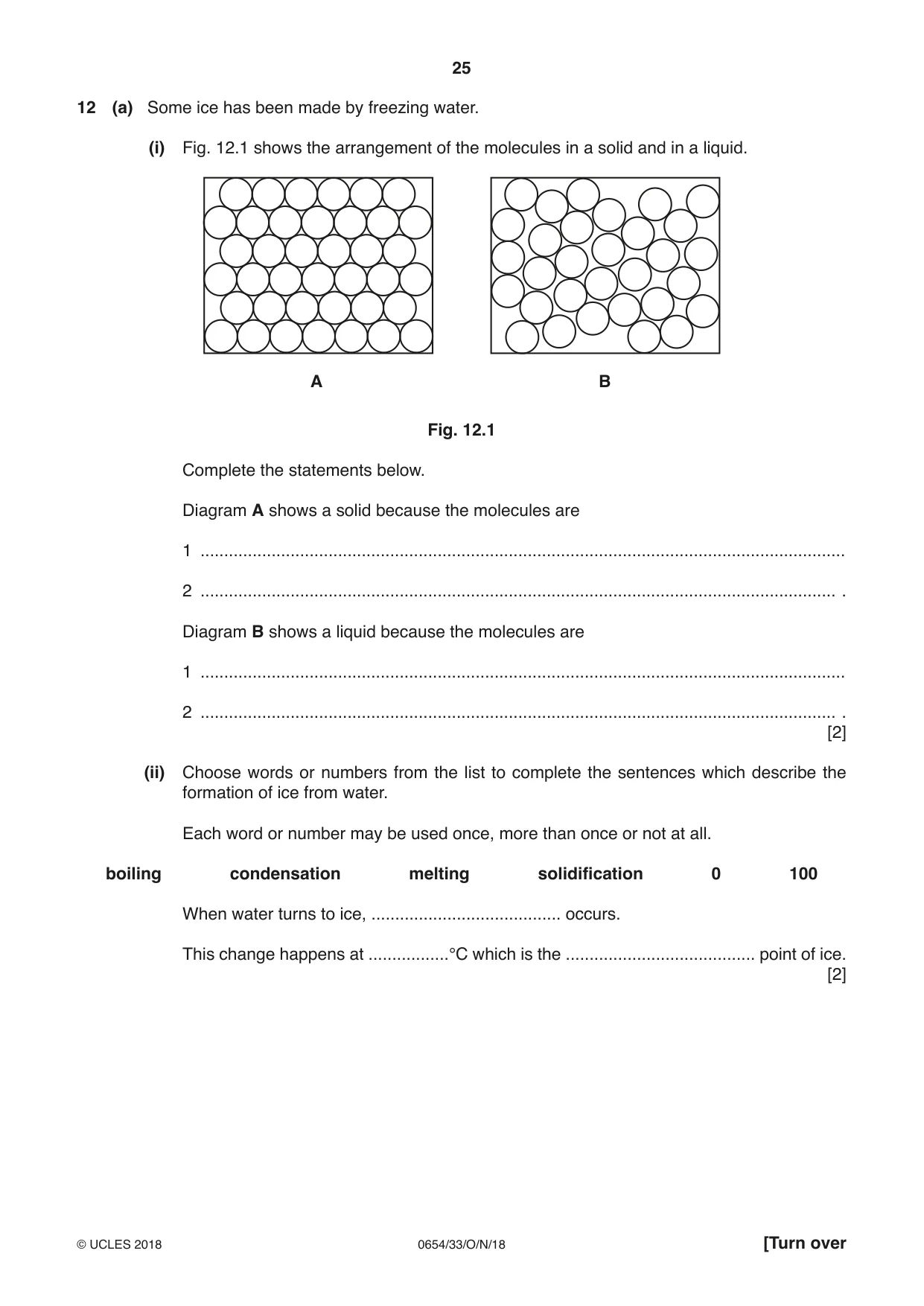
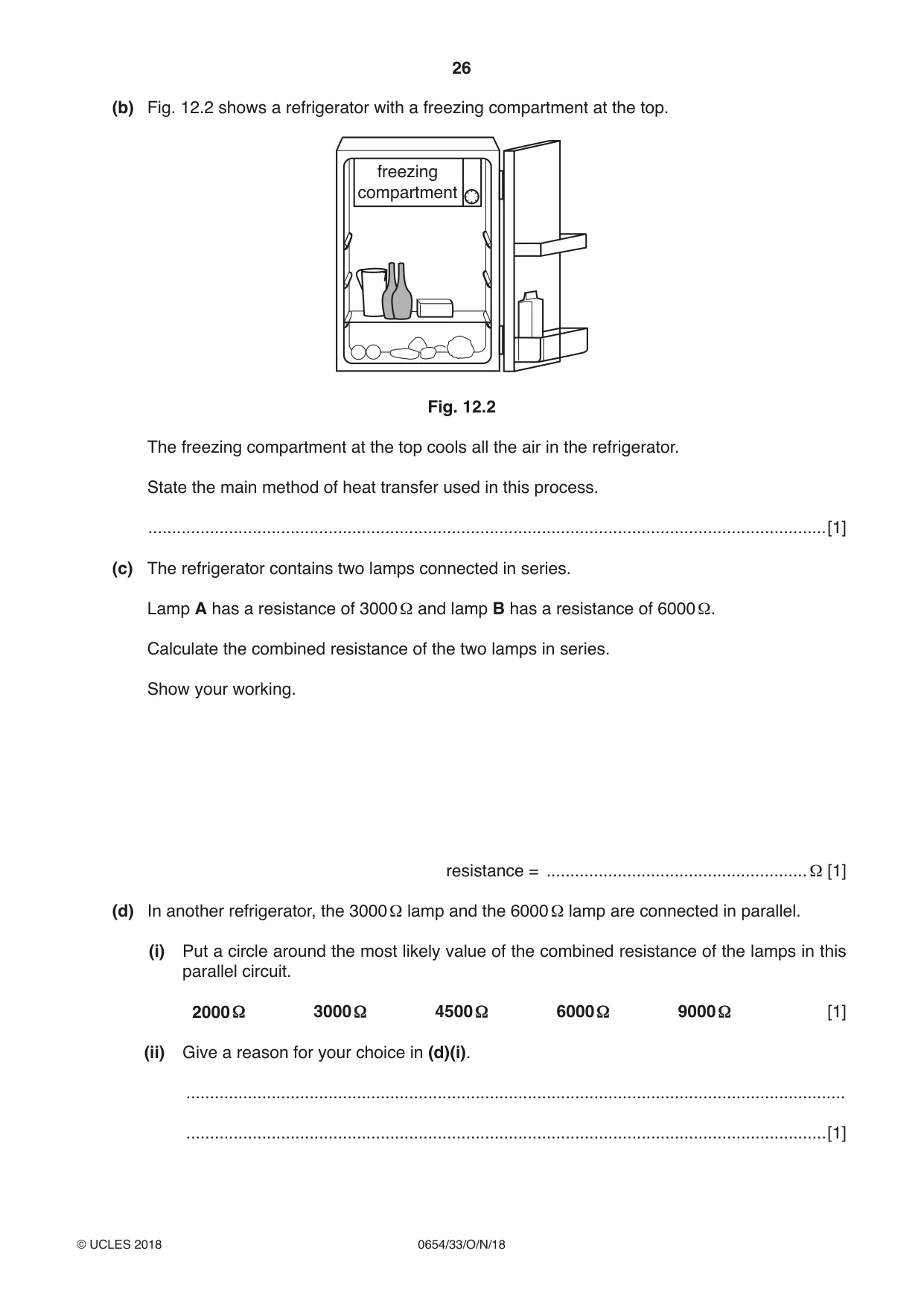
12 (a) Some ice has been made by freezing water. (i) Fig. 12.1 shows the arrangement of the molecules in a solid and in a liquid. A B Fig. 12.1 Complete the statements below. Diagram A shows a solid because the molecules are 1 ........................................................................................................................................ 2 ...................................................................................................................................... . Diagram B shows a liquid because the molecules are 1 ........................................................................................................................................ 2 ...................................................................................................................................... . [2] (ii) Choose words or numbers from the list to complete the sentences which describe the formation of ice from water. Each word or number may be used once, more than once or not at all. boiling condensation melting solidification 0 100 When water turns to ice, ........................................ occurs. This change happens at .................°C which is the ........................................ point of ice. [2] (b) Fig. 12.2 shows a refrigerator with a freezing compartment at the top. freezing compartment Fig. 12.2 The freezing compartment at the top cools all the air in the refrigerator. State the main method of heat transfer used in this process. ...............................................................................................................................................[1] (c) The refrigerator contains two lamps connected in series. Lamp A has a resistance of 3000 Ω and lamp B has a resistance of 6000 Ω. Calculate the combined resistance of the two lamps in series. Show your working. resistance = .......................................................Ω [1] (d) In another refrigerator, the 3000 Ω lamp and the 6000 Ω lamp are connected in parallel. (i) Put a circle around the most likely value of the combined resistance of the lamps in this parallel circuit. 2000 Ω 3000 Ω 4500 Ω 6000 Ω 9000 Ω [1] (ii) Give a reason for your choice in (d)(i). ........................................................................................................................................... .......................................................................................................................................[1]
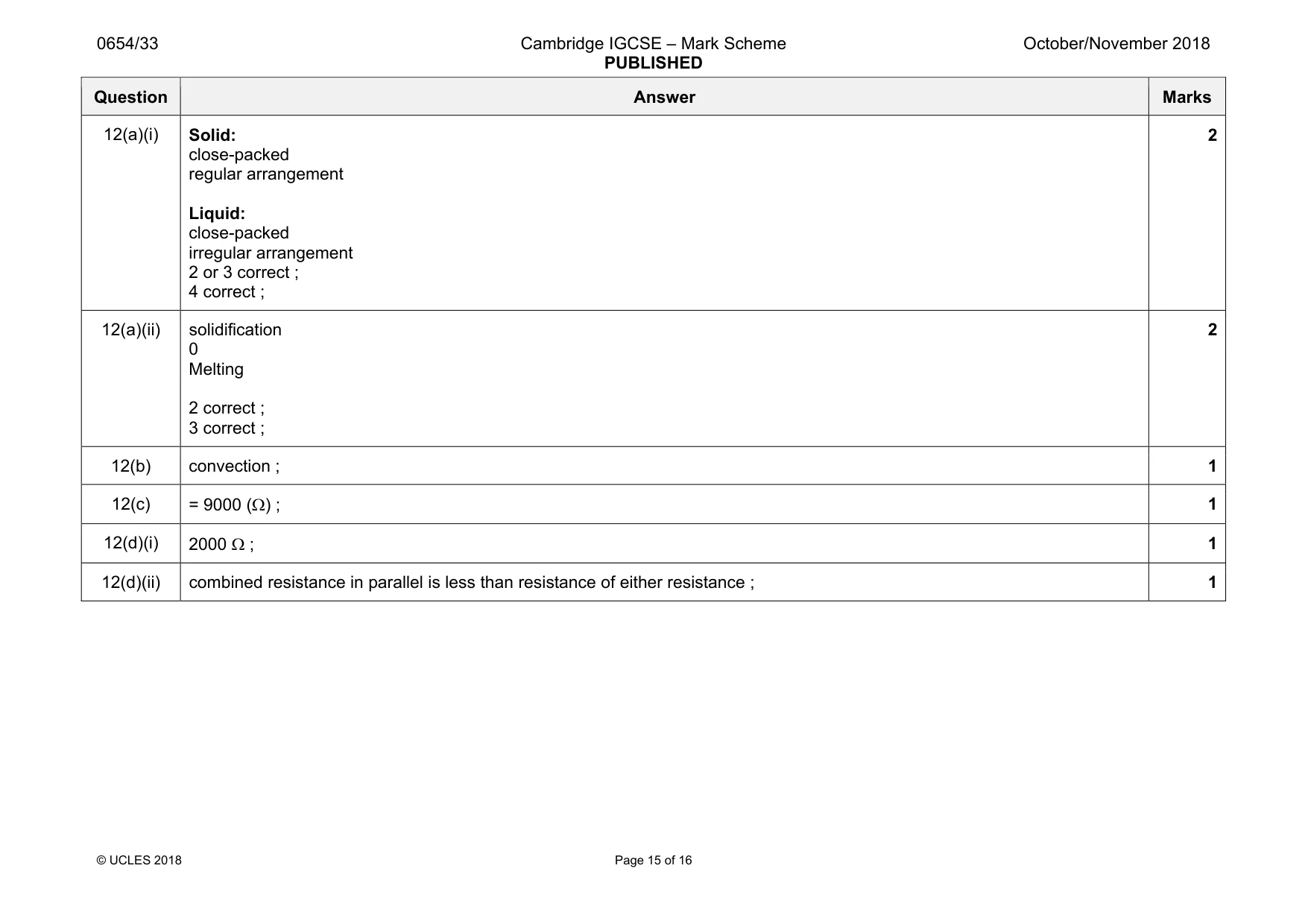
Mark scheme: 12(a)(i) Solid: close-packed regular arrangement Liquid: close-packed irregular arrangement 2 or 3 correct ; 4 correct ; 2 12(a)(ii) solidification 0 Melting 2 correct ; 3 correct ; 2 12(b) convection ; 1 12(c) = 9000 (Ω) ; 1 12(d)(i) 2000 Ω ; 1 12(d)(ii) combined resistance in parallel is less than resistance of either resistance ; 1
Q13 · A cross-section through an artery and a vein
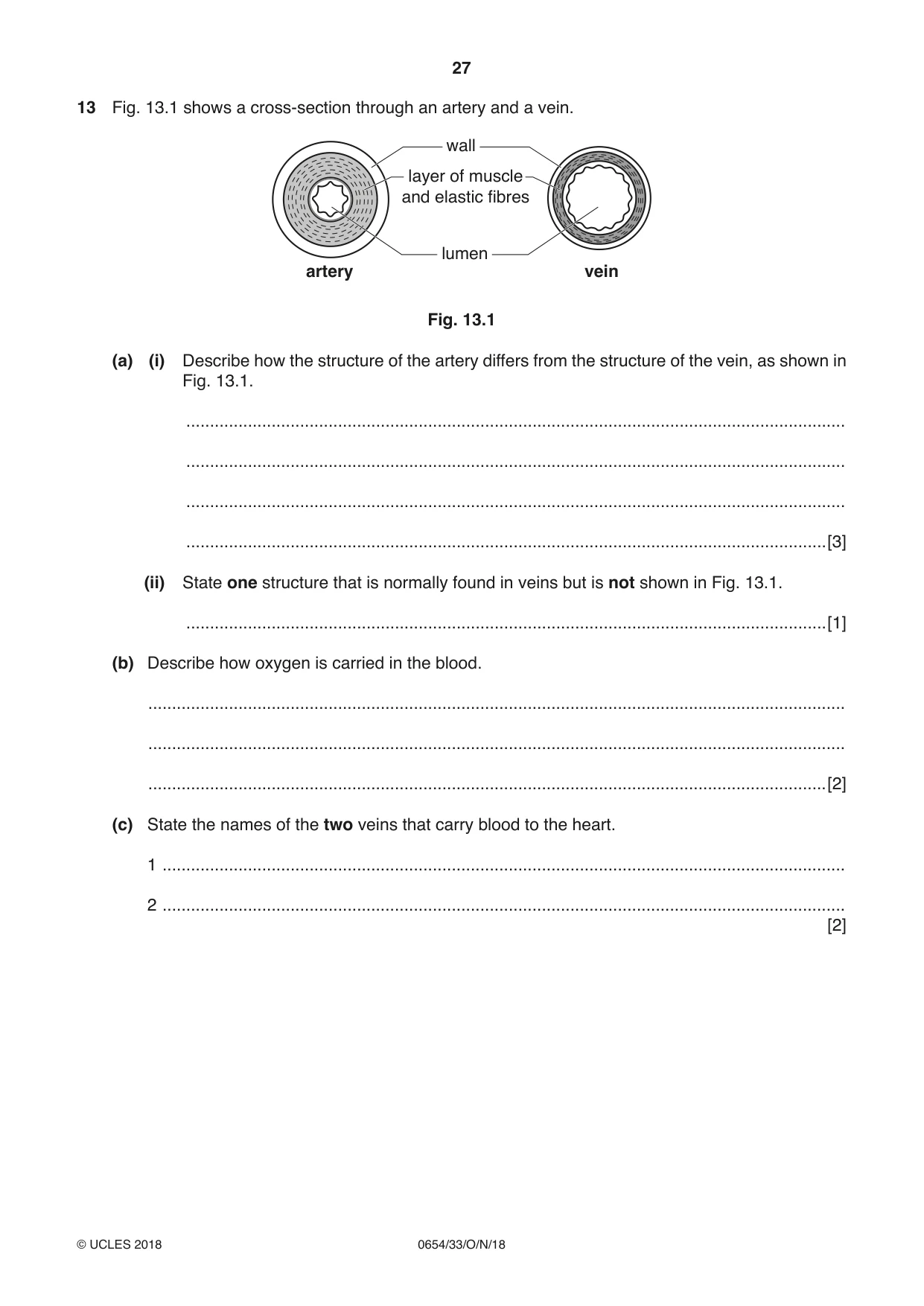
13 Fig. 13.1 shows a cross-section through an artery and a vein. wall layer of muscle and elastic fibres lumen artery vein Fig. 13.1 (a) (i) Describe how the structure of the artery differs from the structure of the vein, as shown in Fig. 13.1. ........................................................................................................................................... ........................................................................................................................................... ........................................................................................................................................... .......................................................................................................................................[3] (ii) State one structure that is normally found in veins but is not shown in Fig. 13.1. .......................................................................................................................................[1] (b) Describe how oxygen is carried in the blood. ................................................................................................................................................... ................................................................................................................................................... ...............................................................................................................................................[2] (c) State the names of the two veins that carry blood to the heart. 1 ................................................................................................................................................ 2 ................................................................................................................................................ [2]
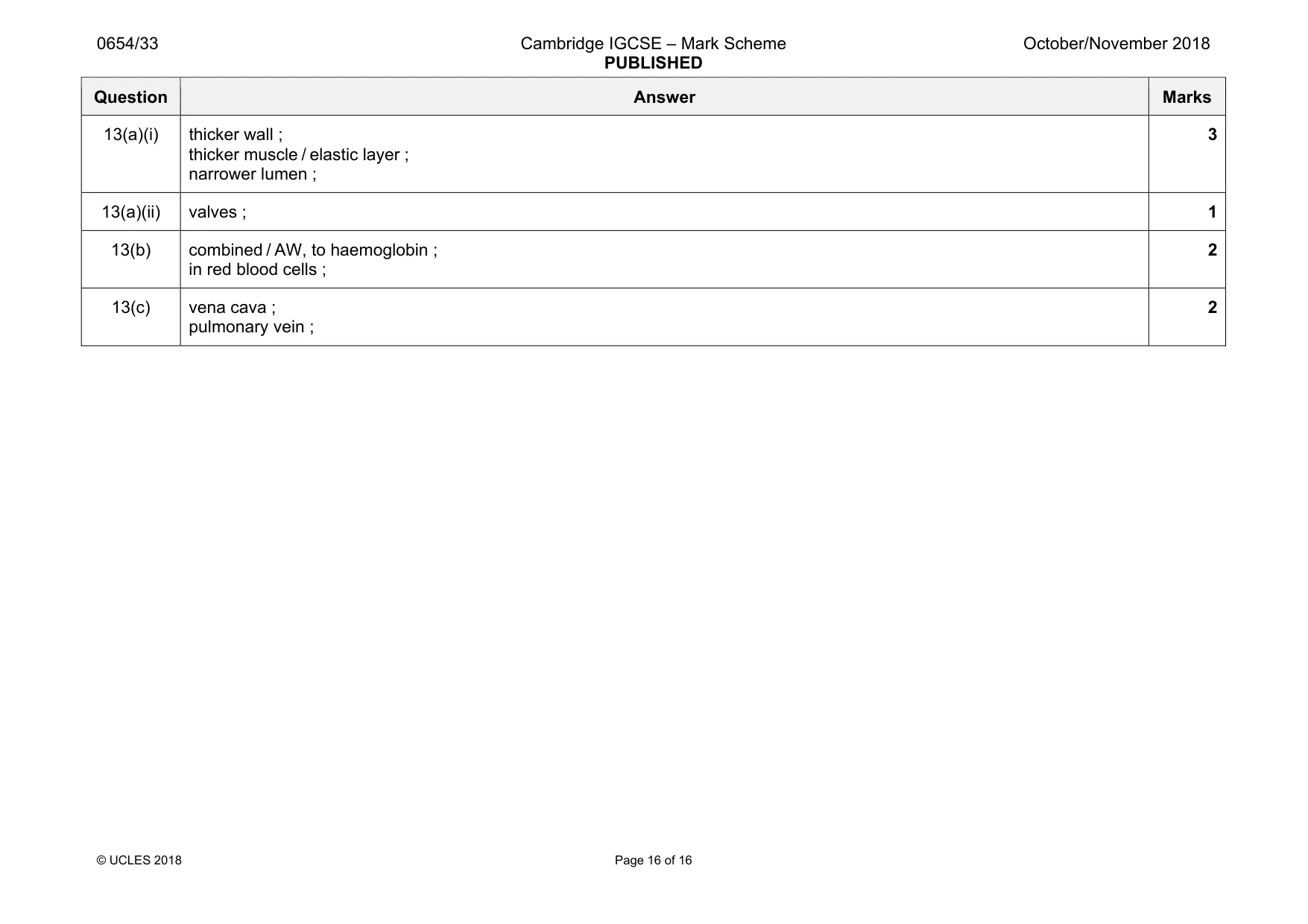
Mark scheme: 13(a)(i) thicker wall ; thicker muscle / elastic layer ; narrower lumen ; 3 13(a)(ii) valves ; 1 13(b) combined / AW, to haemoglobin ; in red blood cells ; 2 13(c) vena cava ; pulmonary vein ; 2
What was in this paper
The subtopics covered by these 13 questions, and how many questions each got. Open one in a new tab to see every Cambridge question on it.
What you needed in this session
Cambridge’s own grade thresholds for 2018 Oct/Nov, Paper 3 · Variant 3. A higher threshold means an easier paper — the bar moves with how the cohort did.