Cambridge IGCSE Sciences - Co-ordinated (Double) 0654 — 2021 Feb/March Paper 3 · Variant 2
0654/32/F/M/21 · 12 questions · 120 marks · ≈135 min
The question paper and its mark scheme, free to read here and free to download. This is Cambridge’s own paper, exactly as it was sat.
Question paper28 pages
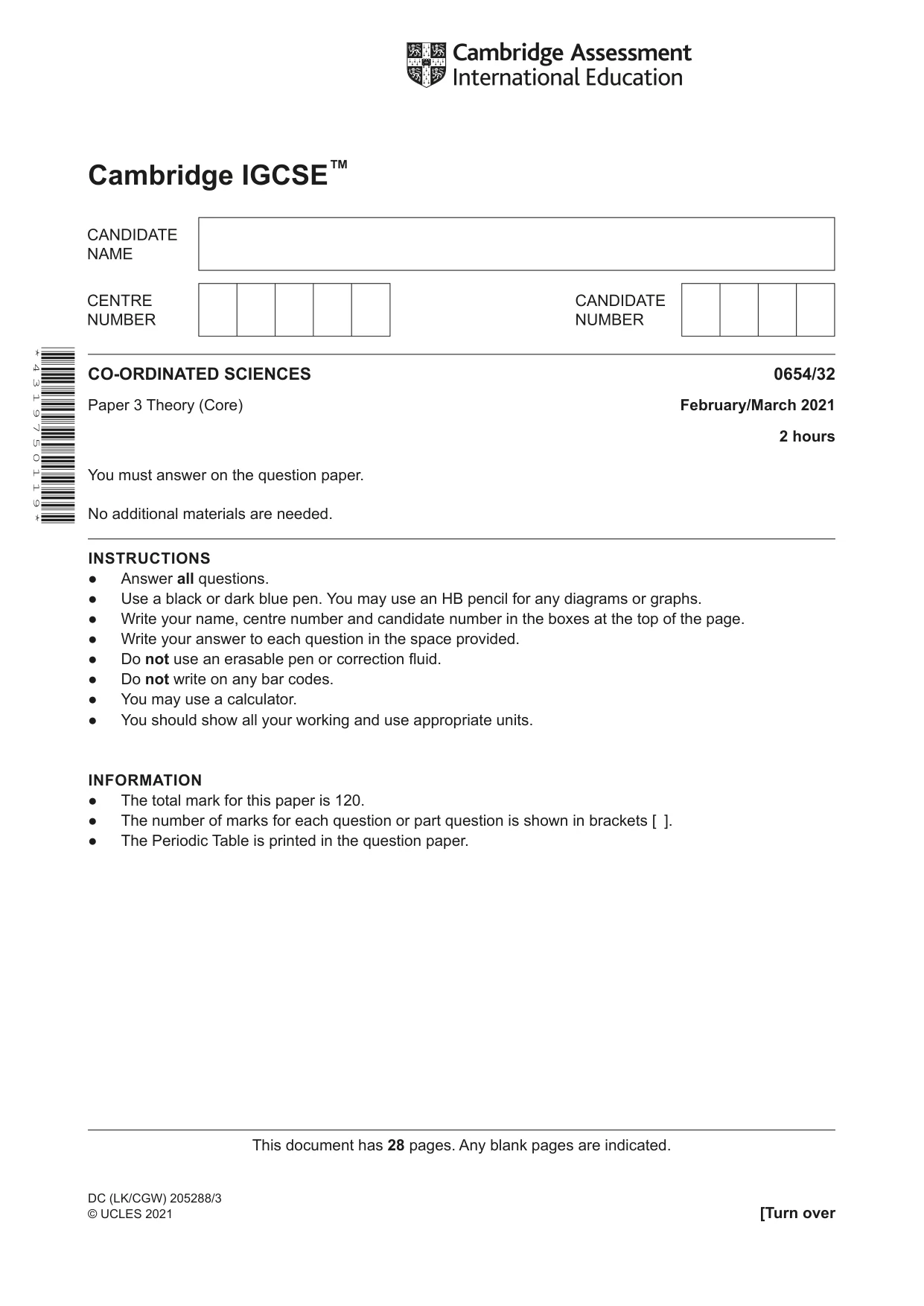

Mark scheme13 pages
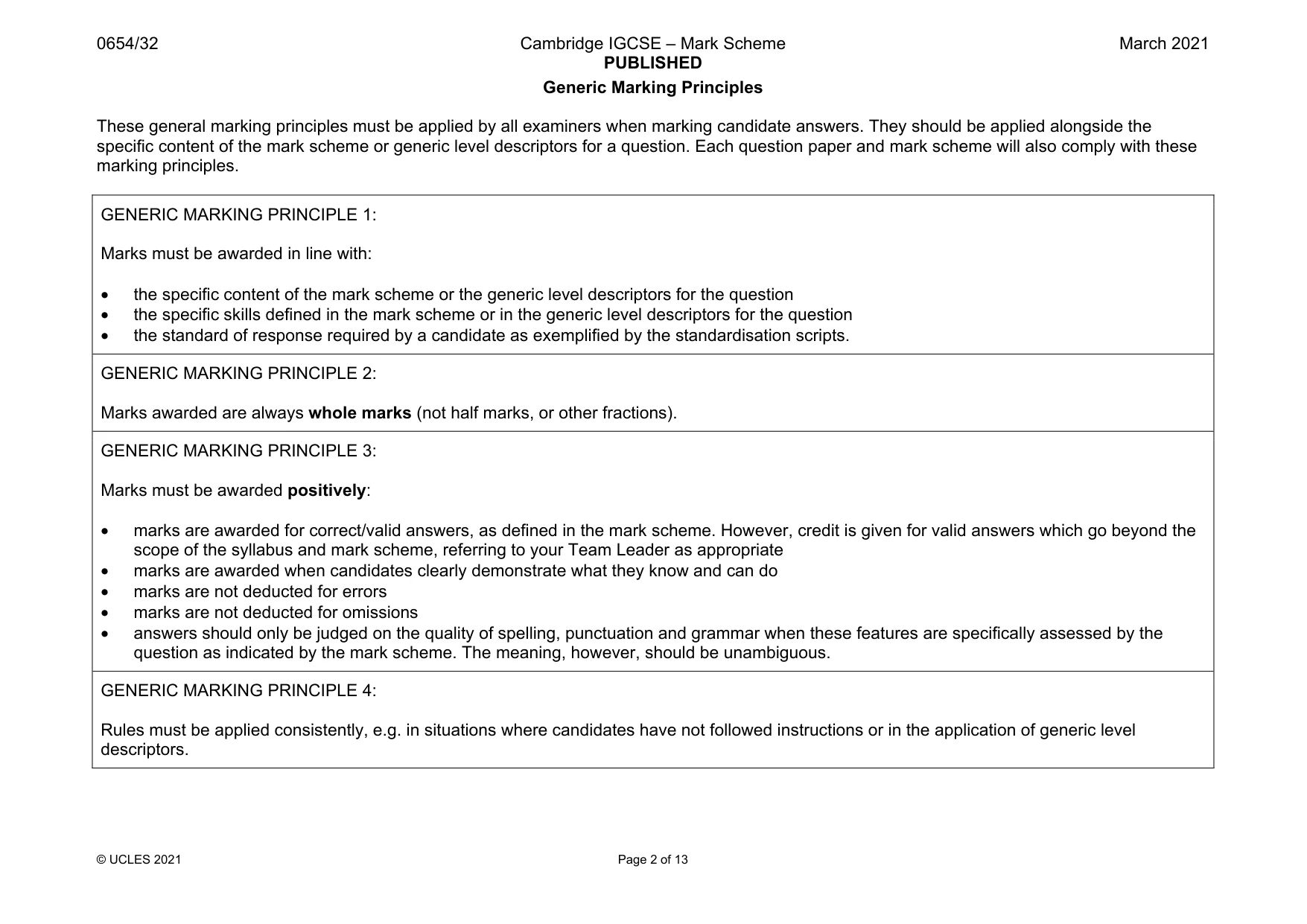
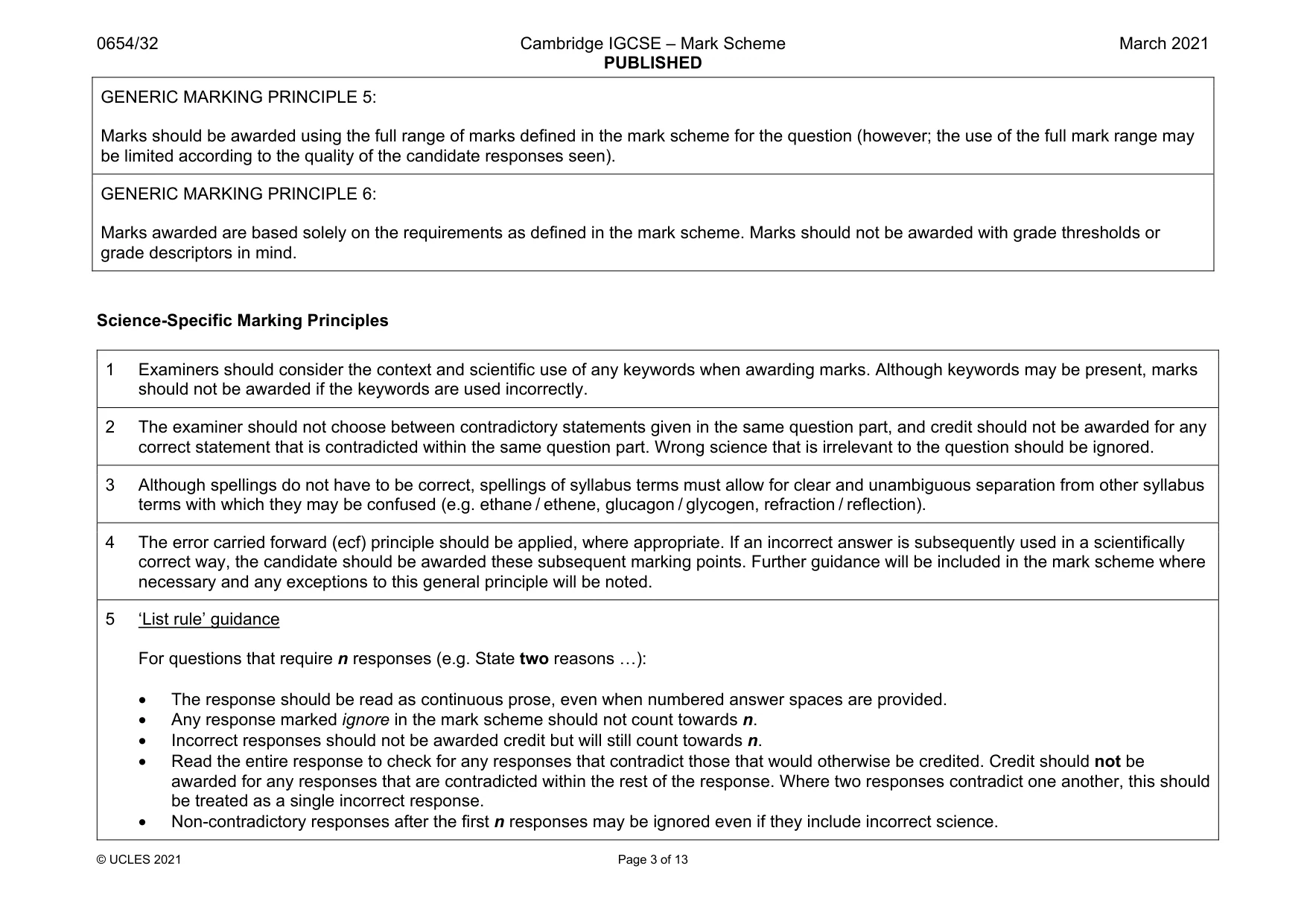
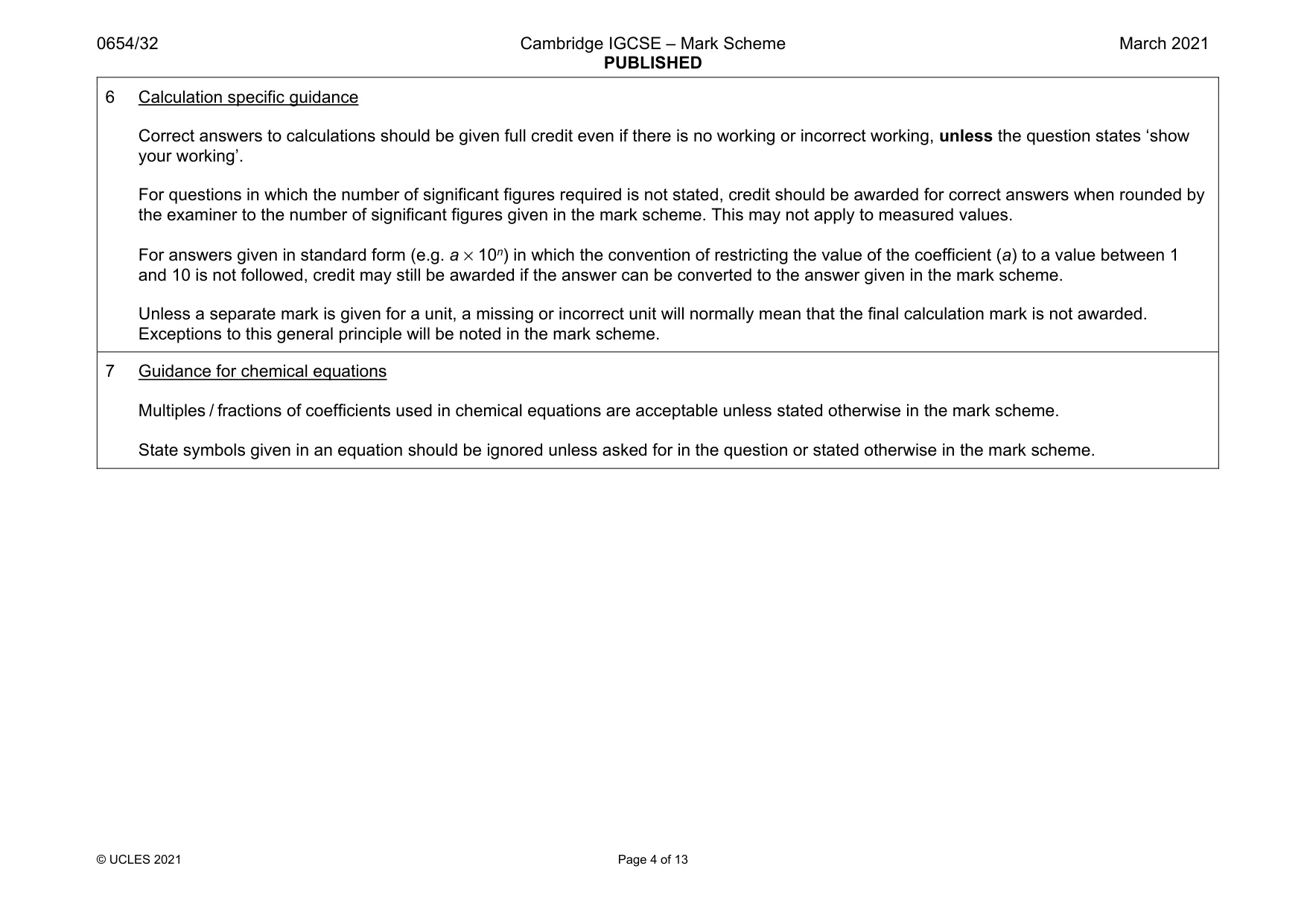
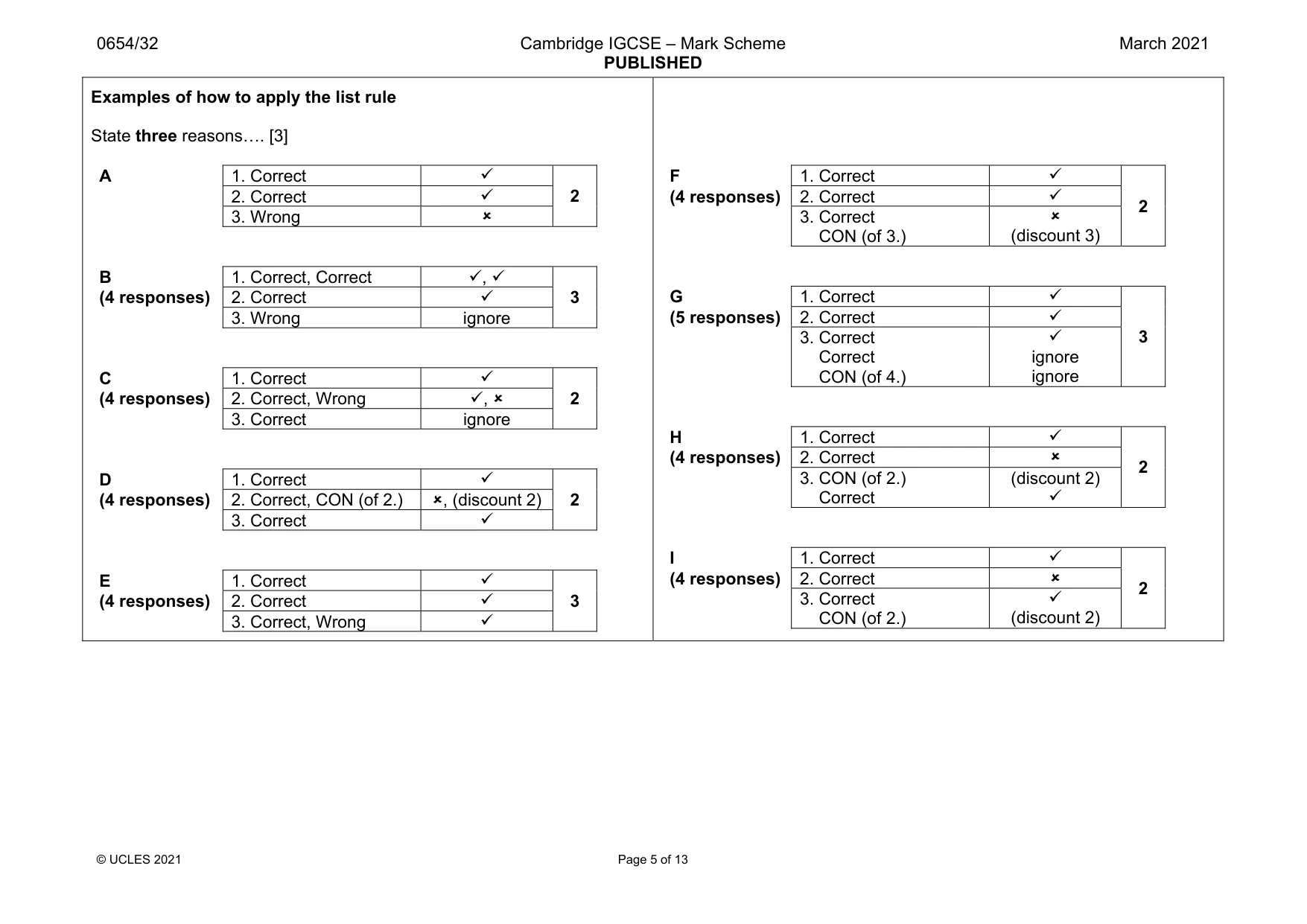
Answers below. Sit the paper first if you are practising.
Questions as text
Q1 · It is recommended that people eat a balanced diet
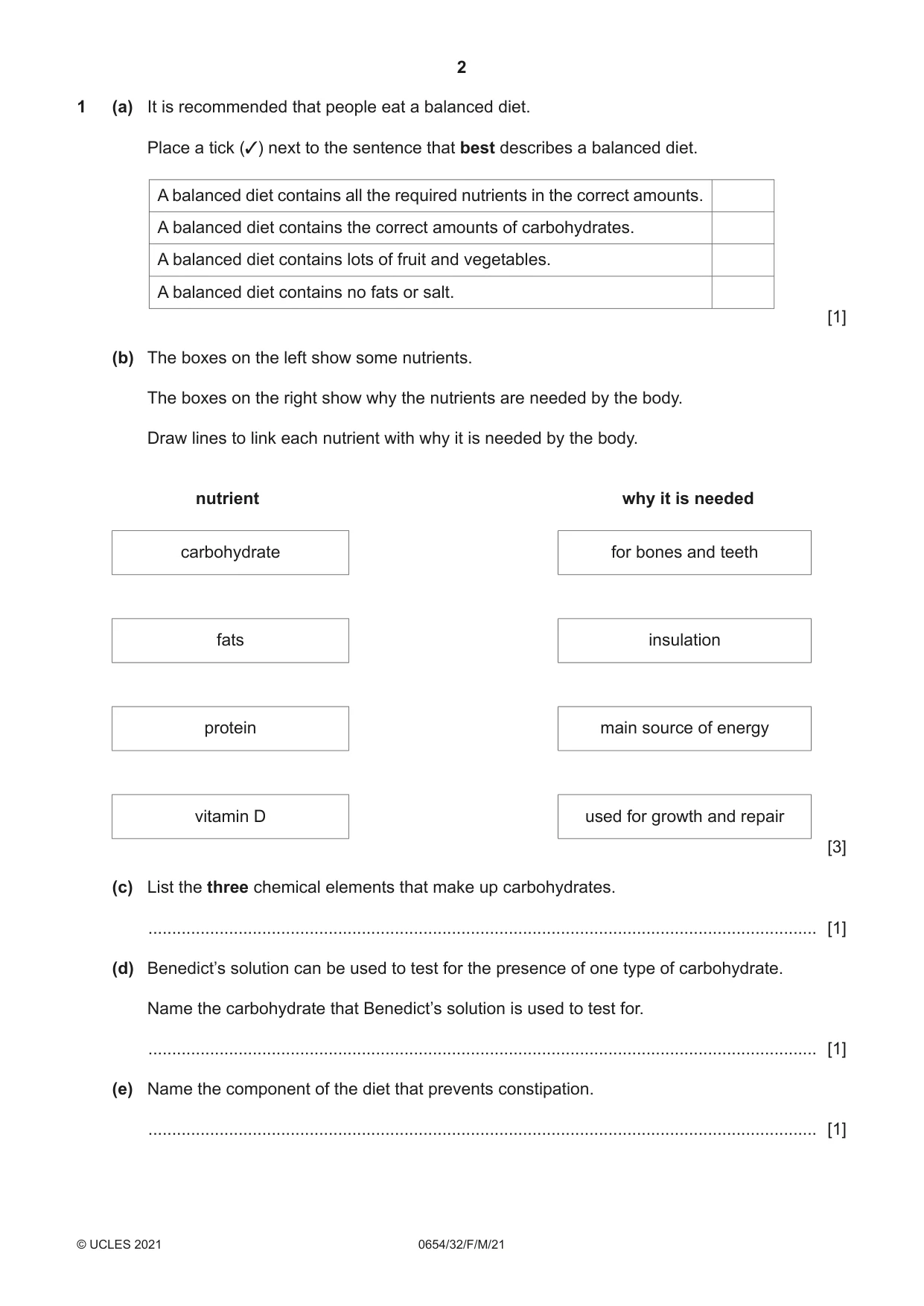
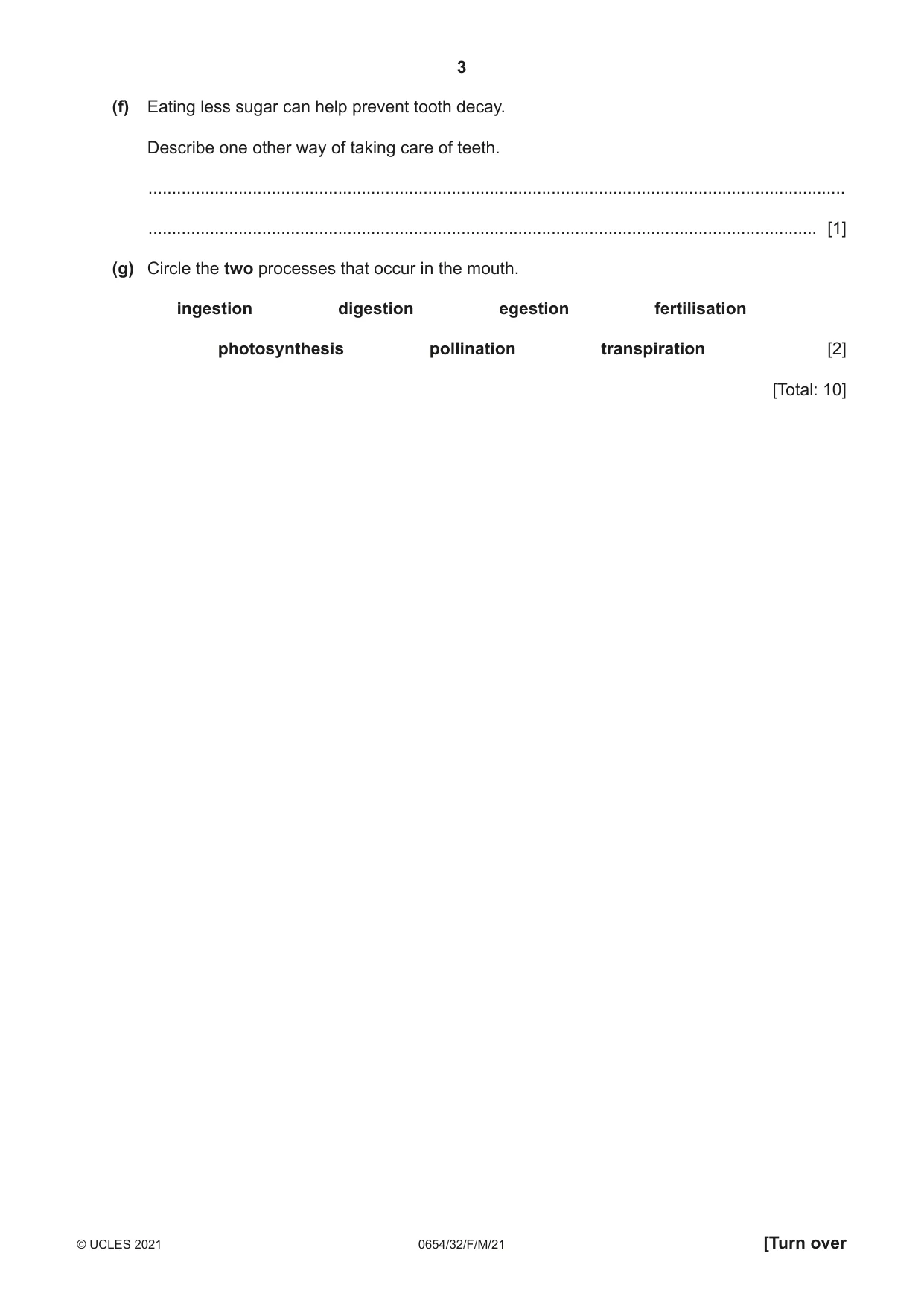
1 (a) It is recommended that people eat a balanced diet. Place a tick (3) next to the sentence that best describes a balanced diet. A balanced diet contains all the required nutrients in the correct amounts. A balanced diet contains the correct amounts of carbohydrates. A balanced diet contains lots of fruit and vegetables. A balanced diet contains no fats or salt. [1] (b) The boxes on the left show some nutrients. The boxes on the right show why the nutrients are needed by the body. Draw lines to link each nutrient with why it is needed by the body. nutrient why it is needed carbohydrate for bones and teeth fats insulation protein main source of energy vitamin D used for growth and repair [3] (c) List the three chemical elements that make up carbohydrates. ............................................................................................................................................. [1] (d) Benedict’s solution can be used to test for the presence of one type of carbohydrate. Name the carbohydrate that Benedict’s solution is used to test for. ............................................................................................................................................. [1] (e) Name the component of the diet that prevents constipation. ............................................................................................................................................. [1] (f) Eating less sugar can help prevent tooth decay. Describe one other way of taking care of teeth. ................................................................................................................................................... ............................................................................................................................................. [1] (g) Circle the two processes that occur in the mouth. ingestion digestion egestion fertilisation photosynthesis pollination transpiration [2] [Total: 10]
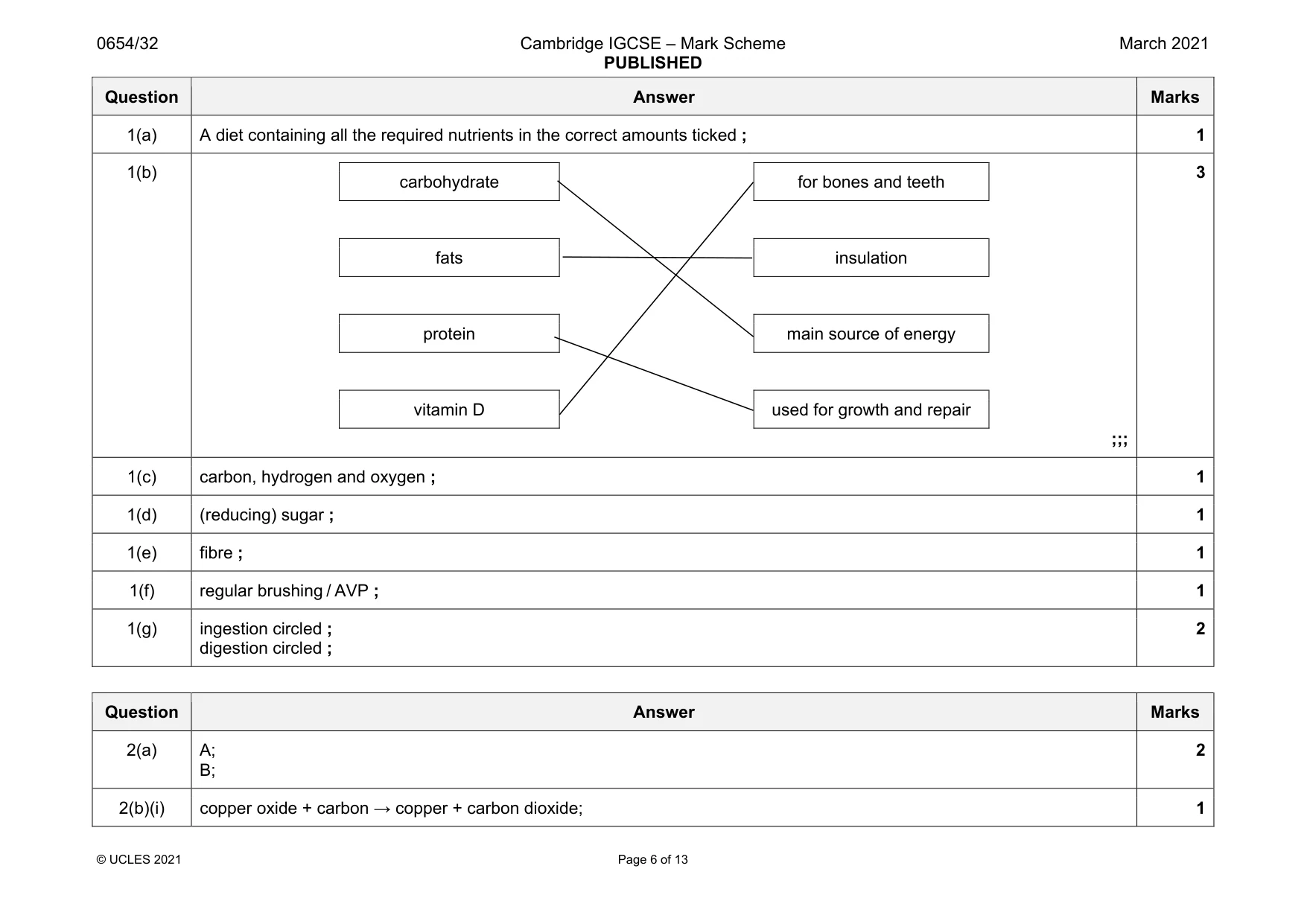
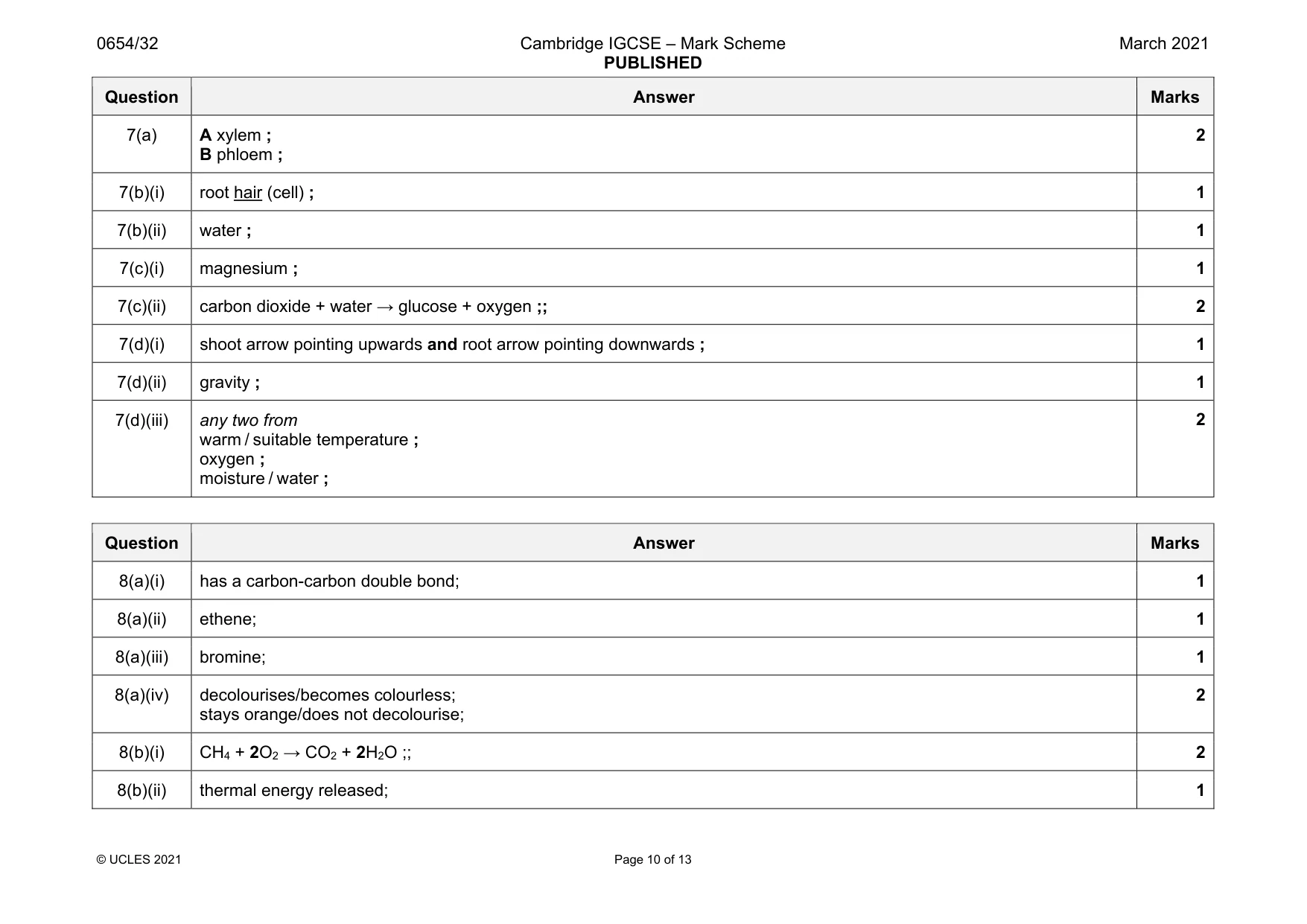
Mark scheme: 1(a) A diet containing all the required nutrients in the correct amounts ticked ; 1 1(b) carbohydrate for bones and teeth fats insulation protein main source of energy vitamin D used for growth and repair ;;; 3 1(c) carbon, hydrogen and oxygen ; 1 1(d) (reducing) sugar ; 1 1(e) fibre ; 1 1(f) regular brushing / AVP ; 1 1(g) ingestion circled ; digestion circled ; 2
Q2 · Copper and sodium are metals
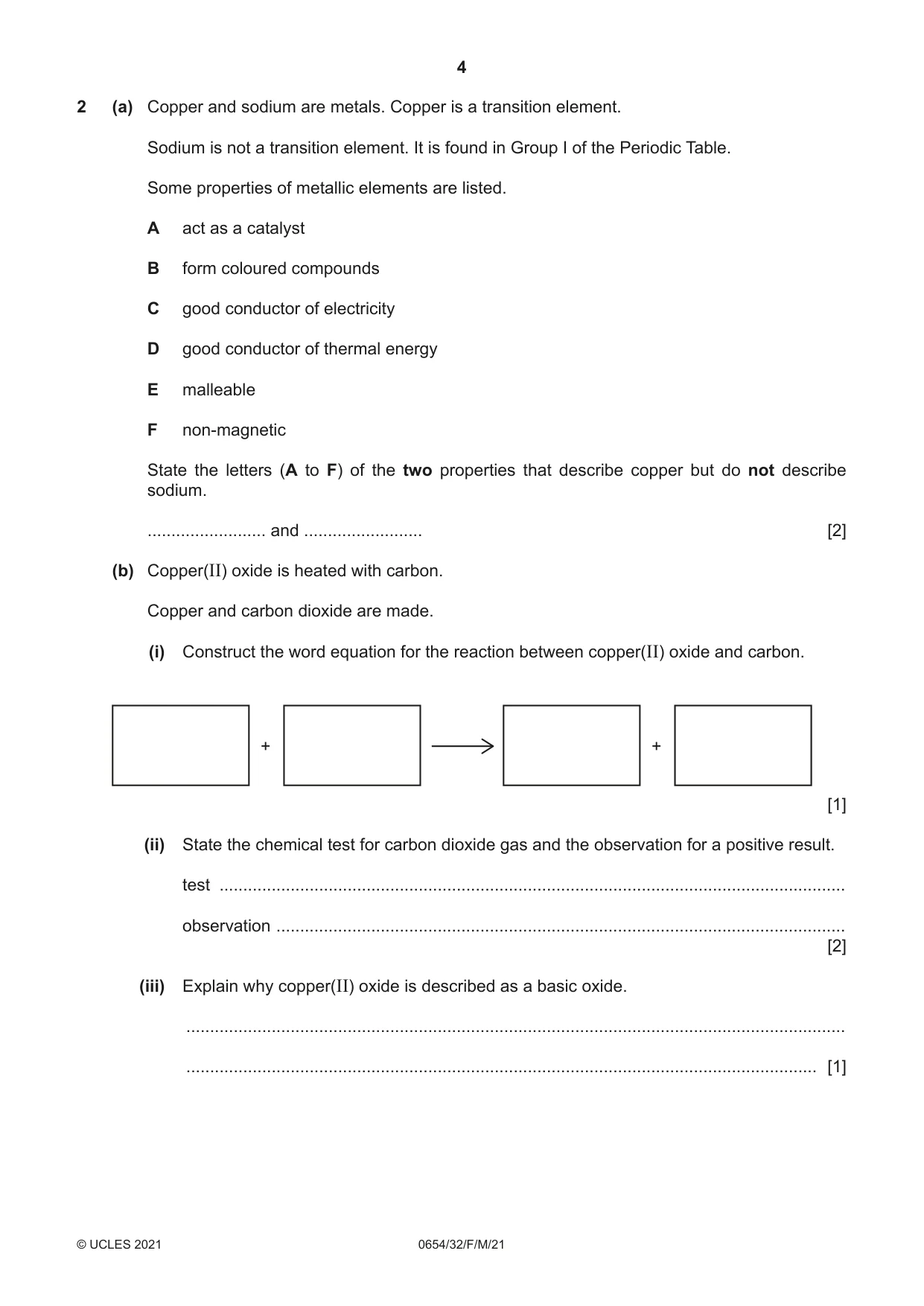
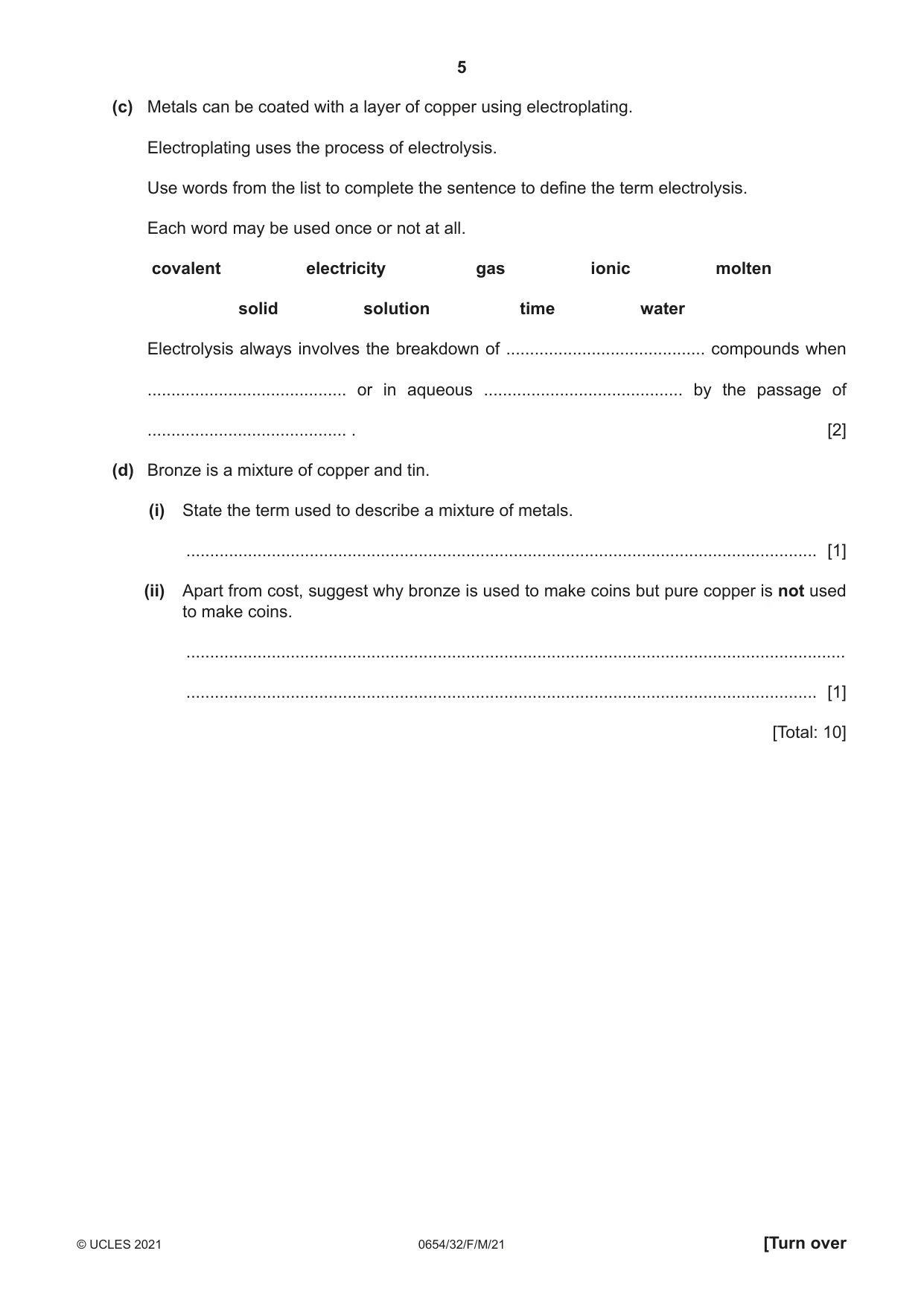
2 (a) Copper and sodium are metals. Copper is a transition element. Sodium is not a transition element. It is found in Group I of the Periodic Table. Some properties of metallic elements are listed. A act as a catalyst B form coloured compounds C good conductor of electricity D good conductor of thermal energy E malleable F non-magnetic State the letters (A to F) of the two properties that describe copper but do not describe sodium. ......................... and ......................... [2] (b) Copper(II) oxide is heated with carbon. Copper and carbon dioxide are made. (i) Construct the word equation for the reaction between copper(II) oxide and carbon. + + [1] (ii) State the chemical test for carbon dioxide gas and the observation for a positive result. test .................................................................................................................................... observation ........................................................................................................................ [2] (iii) Explain why copper(II) oxide is described as a basic oxide. ........................................................................................................................................... ..................................................................................................................................... [1] (c) Metals can be coated with a layer of copper using electroplating. Electroplating uses the process of electrolysis. Use words from the list to complete the sentence to define the term electrolysis. Each word may be used once or not at all. covalent electricity gas ionic molten solid solution time water Electrolysis always involves the breakdown of .......................................... compounds when .......................................... or in aqueous .......................................... by the passage of .......................................... . [2] (d) Bronze is a mixture of copper and tin. (i) State the term used to describe a mixture of metals. ..................................................................................................................................... [1] (ii) Apart from cost, suggest why bronze is used to make coins but pure copper is not used to make coins. ........................................................................................................................................... ..................................................................................................................................... [1] [Total: 10]
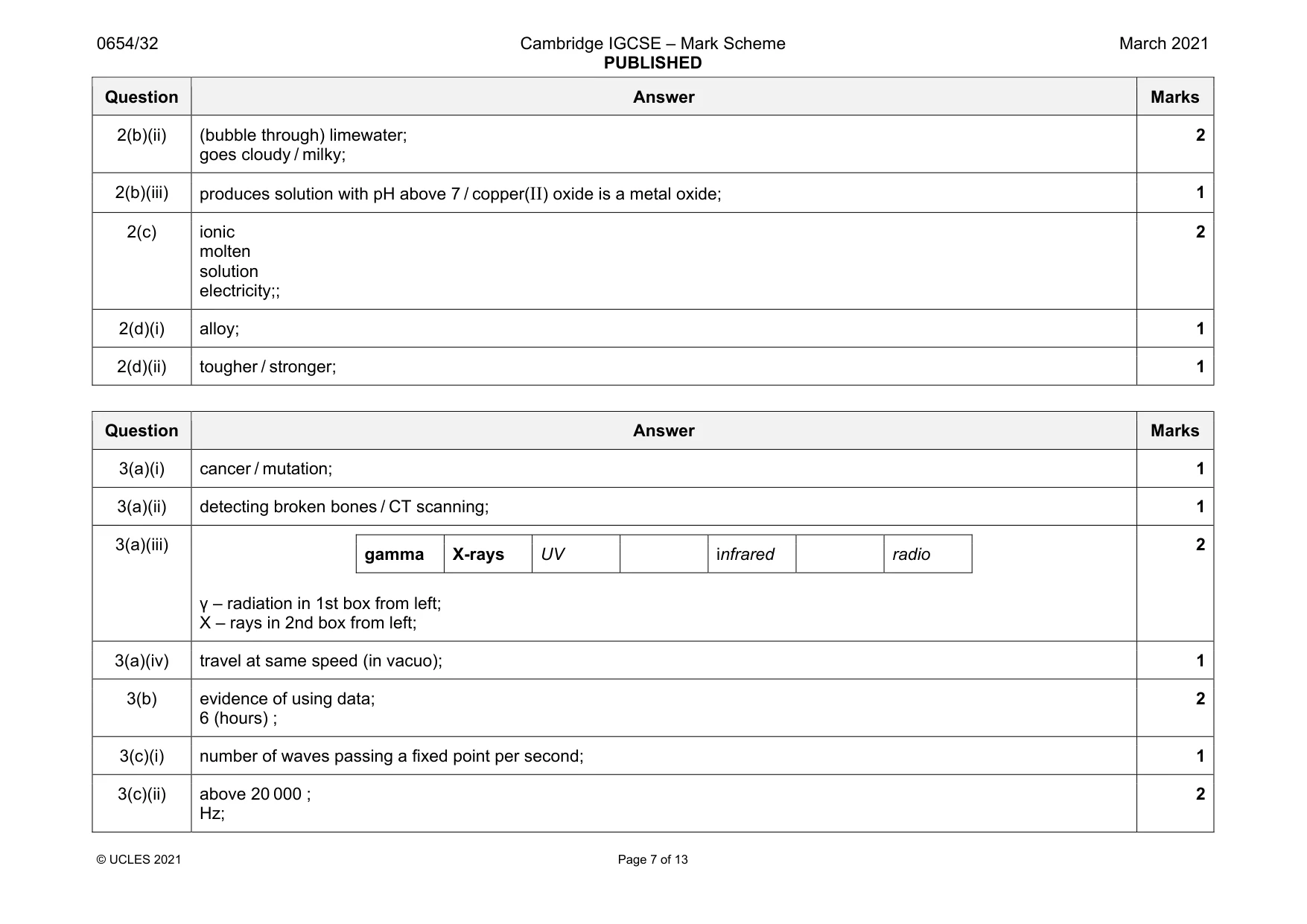
Mark scheme: 2(a) A; B; 2 2(b)(i) copper oxide + carbon → copper + carbon dioxide; 1 Question Answer Marks 2(b)(ii) (bubble through) limewater; goes cloudy / milky; 2 2(b)(iii) produces solution with pH above 7 / copper(II) oxide is a metal oxide; 1 2(c) ionic molten solution electricity;; 2 2(d)(i) alloy; 1 2(d)(ii) tougher / stronger; 1
Q3 · X-rays and γ-radiation are both forms of ionising radiation used in hospitals
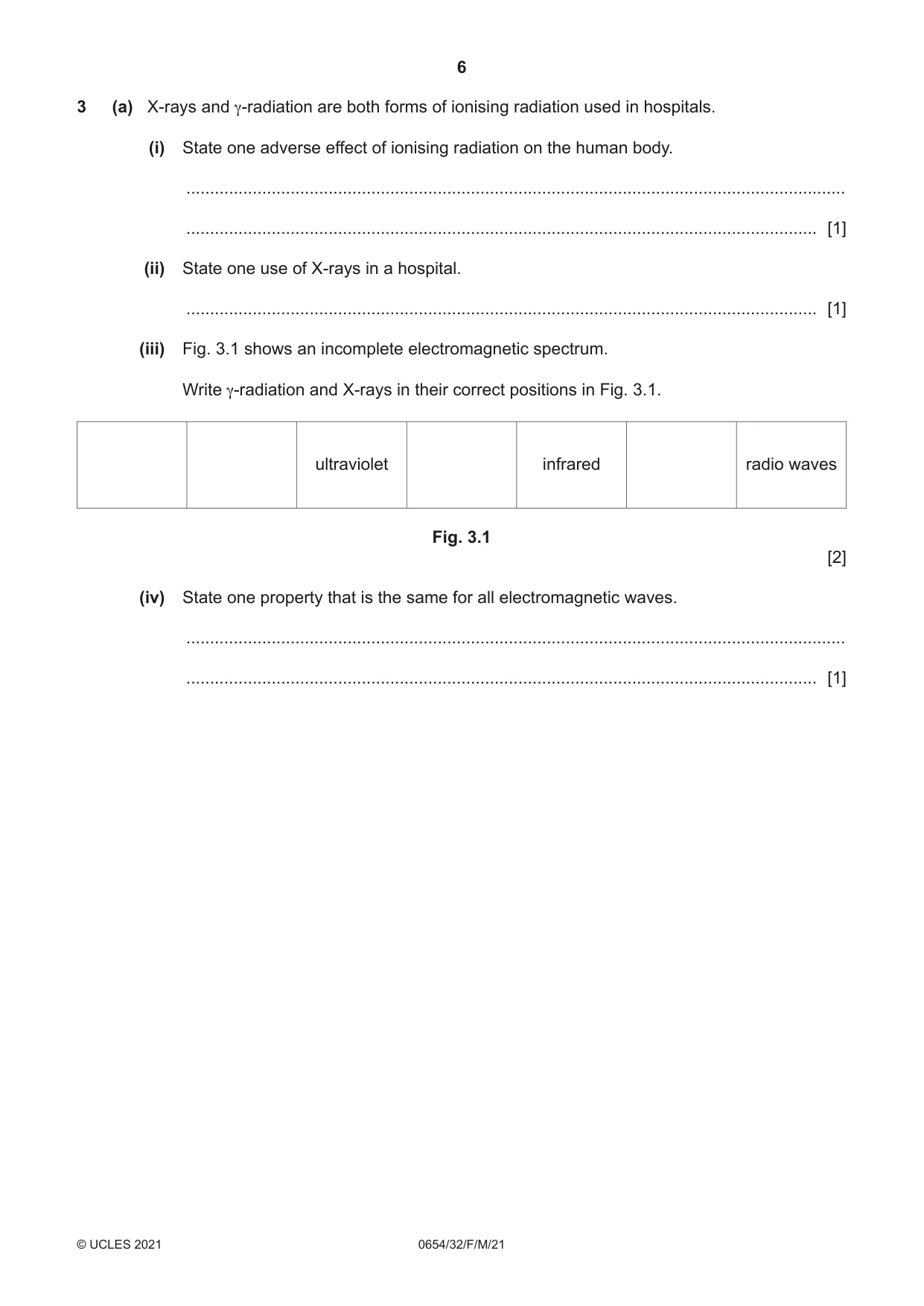
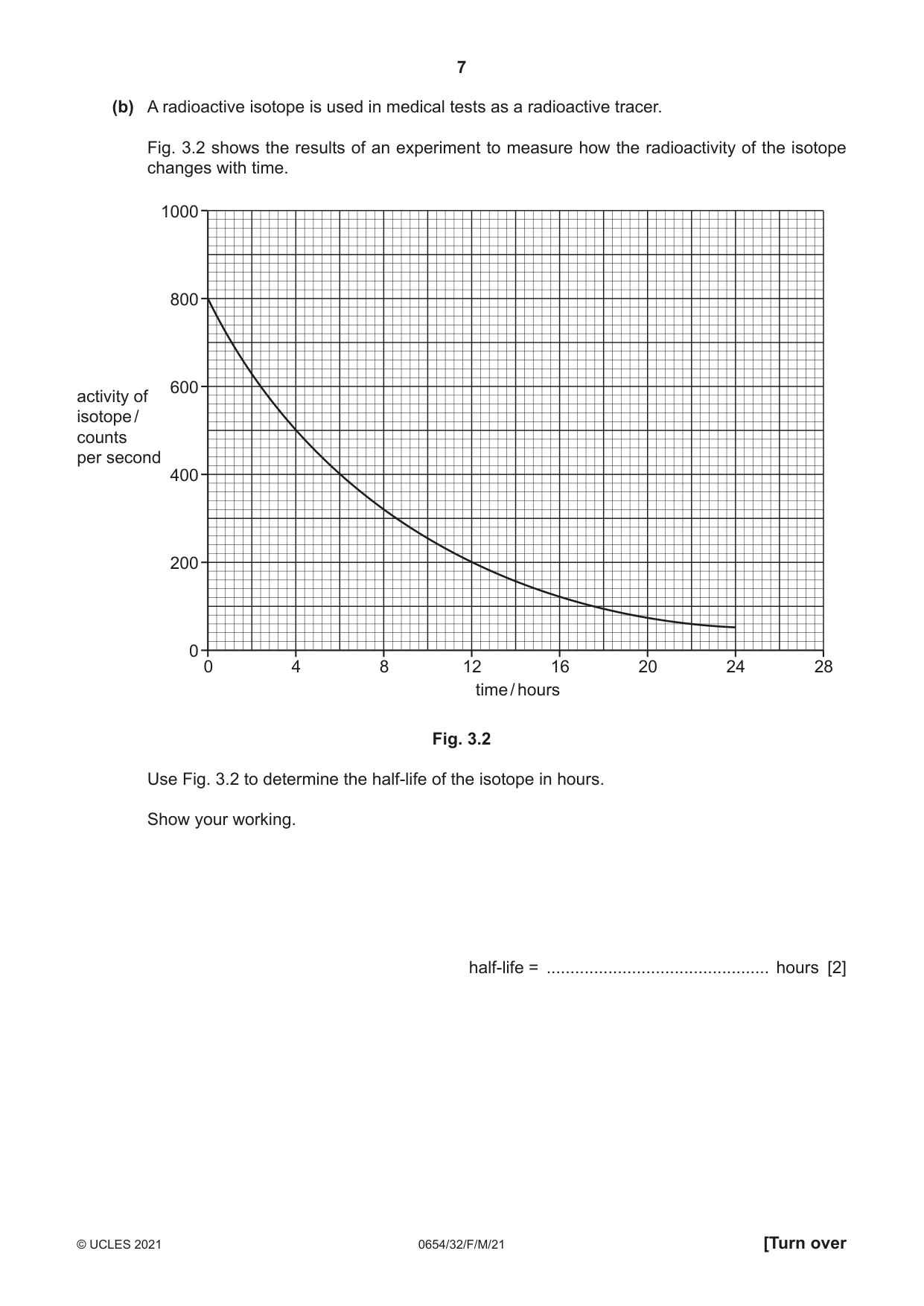
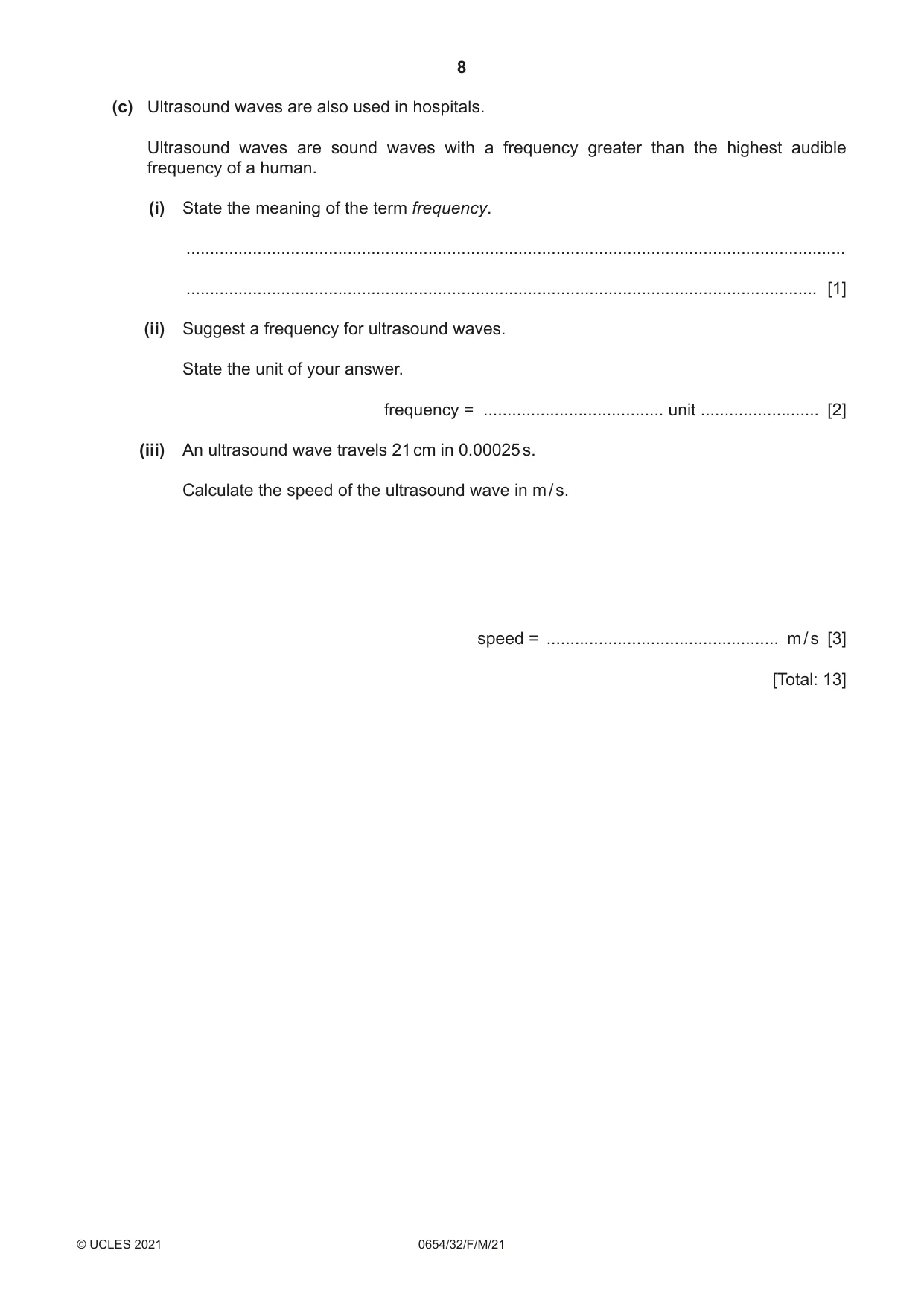
3 (a) X-rays and γ-radiation are both forms of ionising radiation used in hospitals. (i) State one adverse effect of ionising radiation on the human body. ........................................................................................................................................... ..................................................................................................................................... [1] (ii) State one use of X-rays in a hospital. ..................................................................................................................................... [1] (iii) Fig. 3.1 shows an incomplete electromagnetic spectrum. Write γ-radiation and X-rays in their correct positions in Fig. 3.1. ultraviolet infrared radio waves Fig. 3.1 [2] (iv) State one property that is the same for all electromagnetic waves. ........................................................................................................................................... ..................................................................................................................................... [1] (b) A radioactive isotope is used in medical tests as a radioactive tracer. Fig. 3.2 shows the results of an experiment to measure how the radioactivity of the isotope changes with time. 1000 800 600activity of isotope / counts per second 400 200 0 0 4 8 12 16 20 24 28 time / hours Fig. 3.2 Use Fig. 3.2 to determine the half-life of the isotope in hours. Show your working. half-life = ............................................... hours [2] (c) Ultrasound waves are also used in hospitals. Ultrasound waves are sound waves with a frequency greater than the highest audible frequency of a human. (i) State the meaning of the term frequency. ........................................................................................................................................... ..................................................................................................................................... [1] (ii) Suggest a frequency for ultrasound waves. State the unit of your answer. frequency = ...................................... unit ......................... [2] (iii) An ultrasound wave travels 21 cm in 0.00025 s. Calculate the speed of the ultrasound wave in m / s. speed = ................................................. m / s [3] [Total: 13]
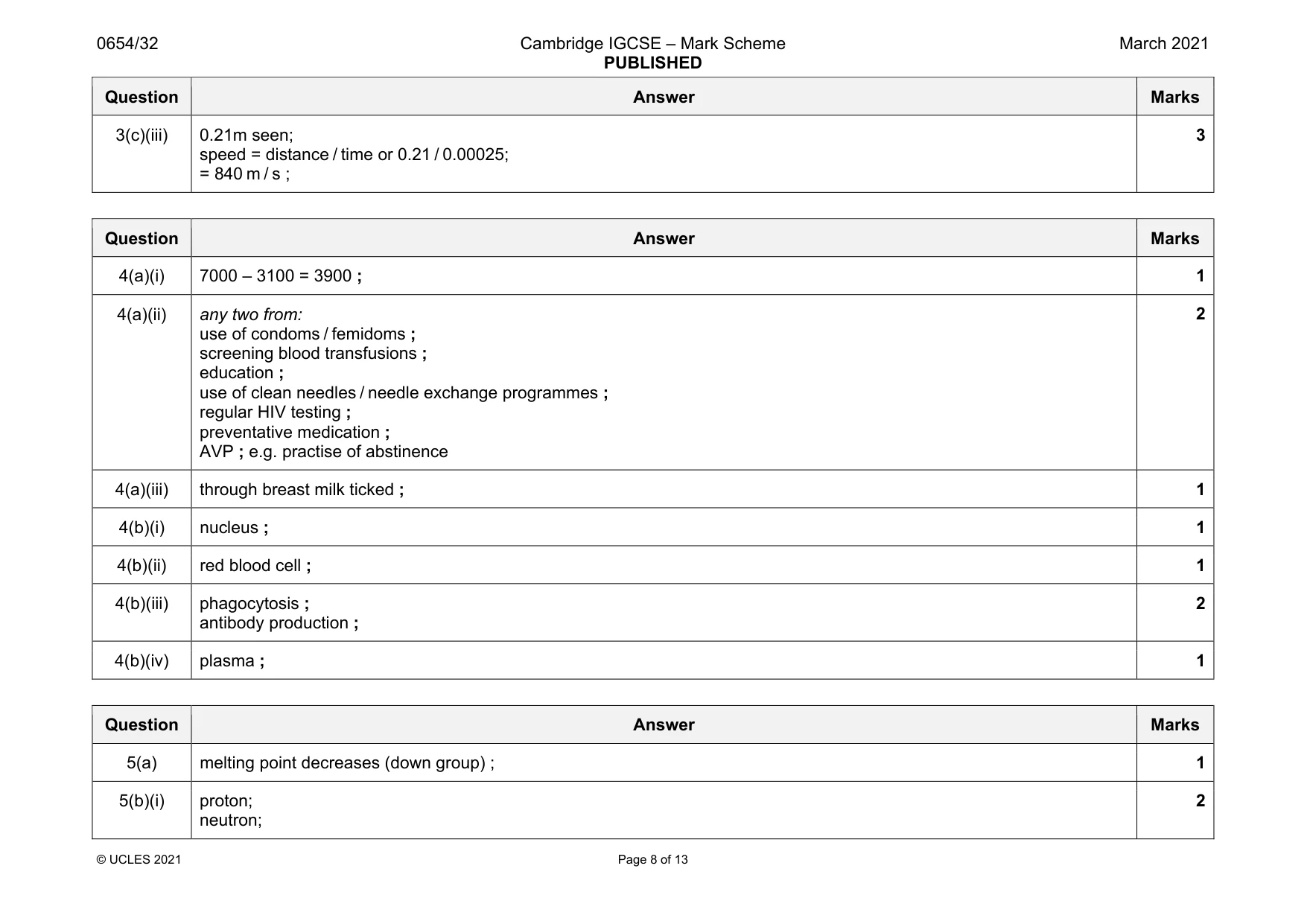
Mark scheme: 3(a)(i) cancer / mutation; 1 3(a)(ii) detecting broken bones / CT scanning; 1 3(a)(iii) gamma X-rays UV infrared radio γ – radiation in 1st box from left; X – rays in 2nd box from left; 2 3(a)(iv) travel at same speed (in vacuo); 1 3(b) evidence of using data; 6 (hours) ; 2 3(c)(i) number of waves passing a fixed point per second; 1 3(c)(ii) above 20 000 ; Hz; 2 Question Answer Marks 3(c)(iii) 0.21m seen; speed = distance / time or 0.21 / 0.00025; = 840 m / s ; 3
Q4 · Human immunodeficiency virus (HIV) is a sexually transmitted infection
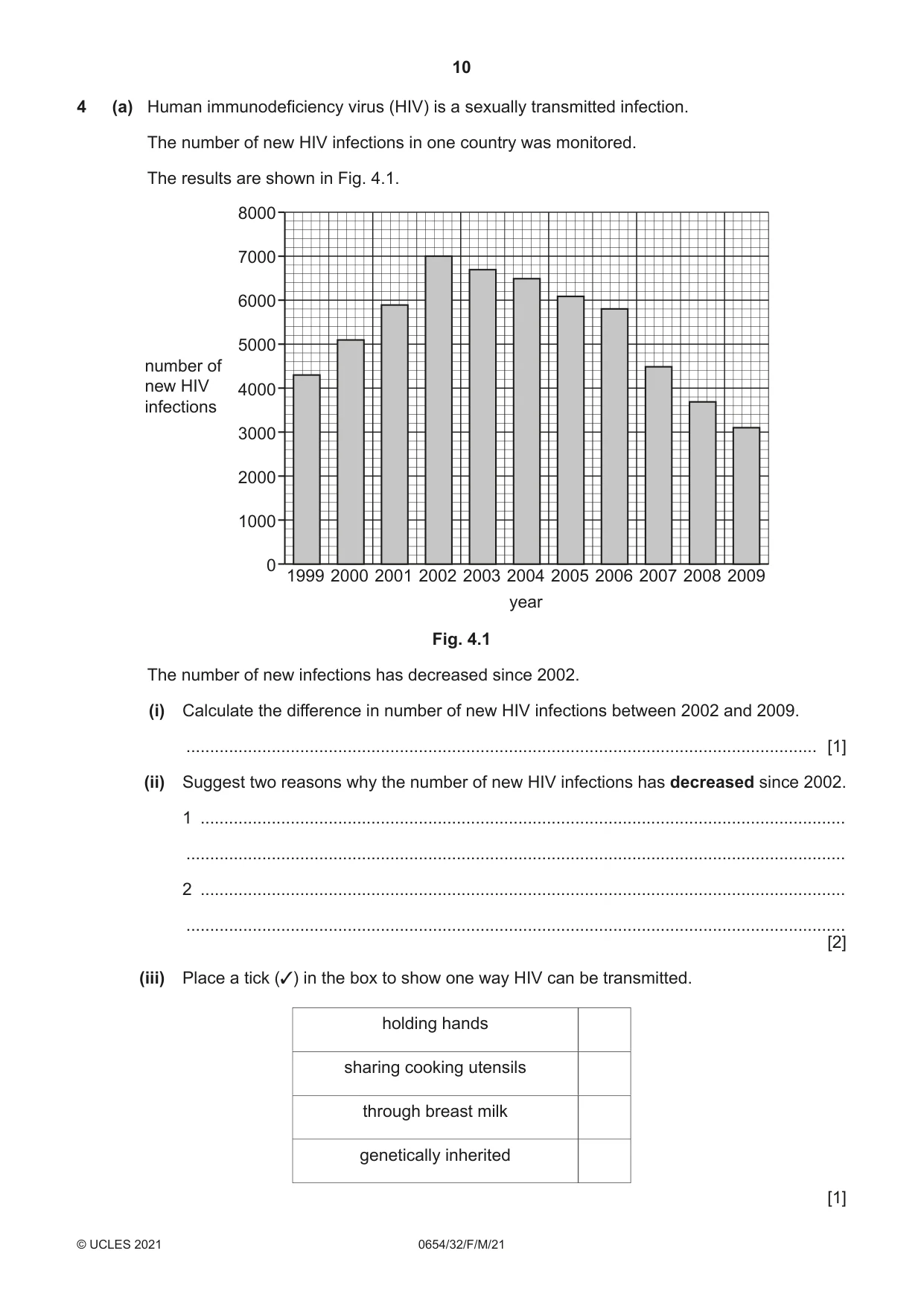
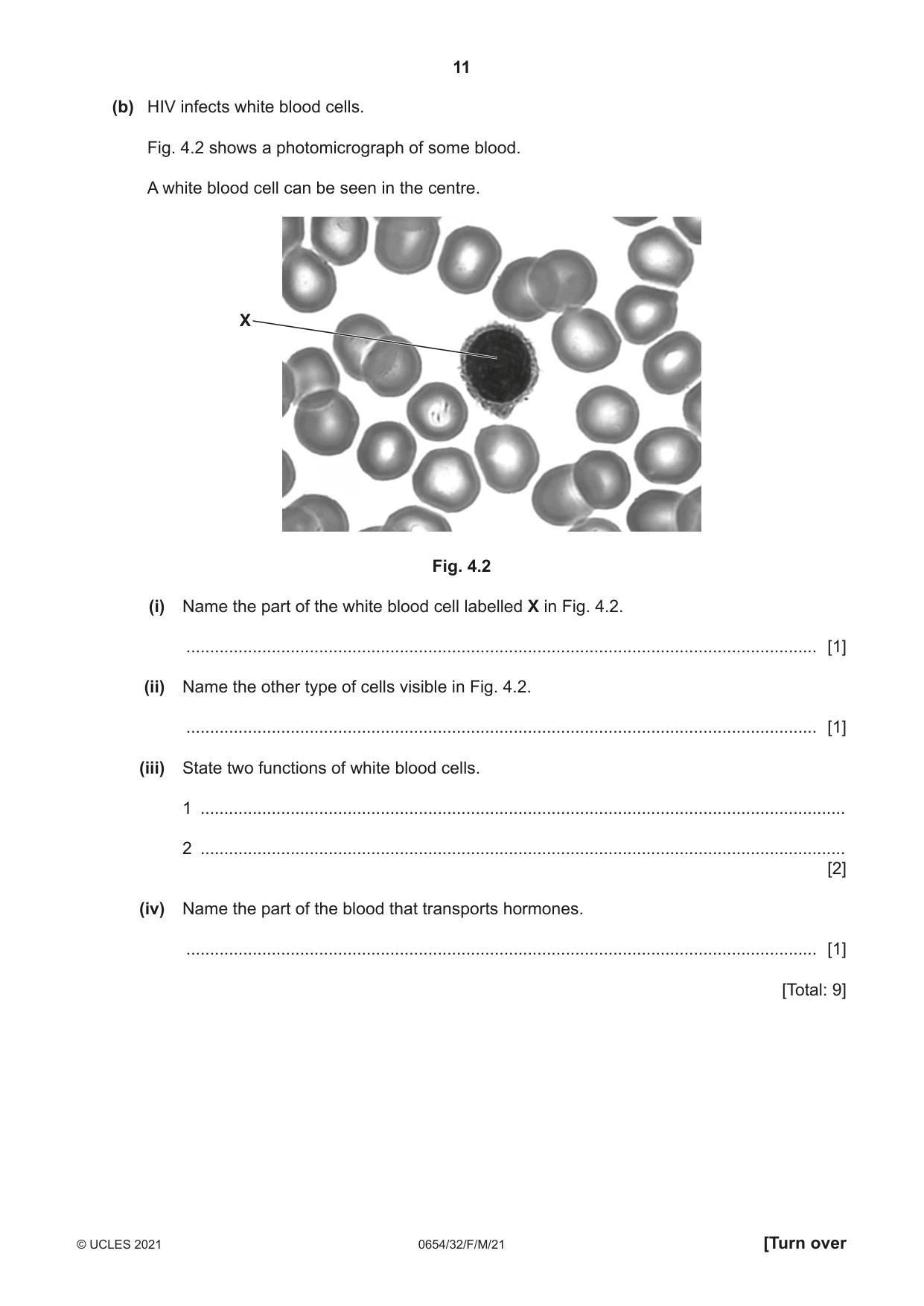
4 (a) Human immunodeficiency virus (HIV) is a sexually transmitted infection. The number of new HIV infections in one country was monitored. The results are shown in Fig. 4.1. 8000 7000 6000 5000 number of new HIV 4000 infections 3000 2000 1000 0 1999 2000 2001 2002 2003 2004 2005 2006 2007 2008 2009 year Fig. 4.1 The number of new infections has decreased since 2002. (i) Calculate the difference in number of new HIV infections between 2002 and 2009. ..................................................................................................................................... [1] (ii) Suggest two reasons why the number of new HIV infections has decreased since 2002. 1 ........................................................................................................................................ ........................................................................................................................................... 2 ........................................................................................................................................ ........................................................................................................................................... [2] (iii) Place a tick (3) in the box to show one way HIV can be transmitted. holding hands sharing cooking utensils through breast milk genetically inherited [1] (b) HIV infects white blood cells. Fig. 4.2 shows a photomicrograph of some blood. A white blood cell can be seen in the centre. X Fig. 4.2 (i) Name the part of the white blood cell labelled X in Fig. 4.2. ..................................................................................................................................... [1] (ii) Name the other type of cells visible in Fig. 4.2. ..................................................................................................................................... [1] (iii) State two functions of white blood cells. 1 ........................................................................................................................................ 2 ........................................................................................................................................ [2] (iv) Name the part of the blood that transports hormones. ..................................................................................................................................... [1] [Total: 9]
Mark scheme: 4(a)(i) 7000 – 3100 = 3900 ; 1 4(a)(ii) any two from: use of condoms / femidoms ; screening blood transfusions ; education ; use of clean needles / needle exchange programmes ; regular HIV testing ; preventative medication ; AVP ; e.g. practise of abstinence 2 4(a)(iii) through breast milk ticked ; 1 4(b)(i) nucleus ; 1 4(b)(ii) red blood cell ; 1 4(b)(iii) phagocytosis ; antibody production ; 2 4(b)(iv) plasma ; 1
Q5 · Lithium, sodium and potassium are alkali metal elements in the Periodic Table
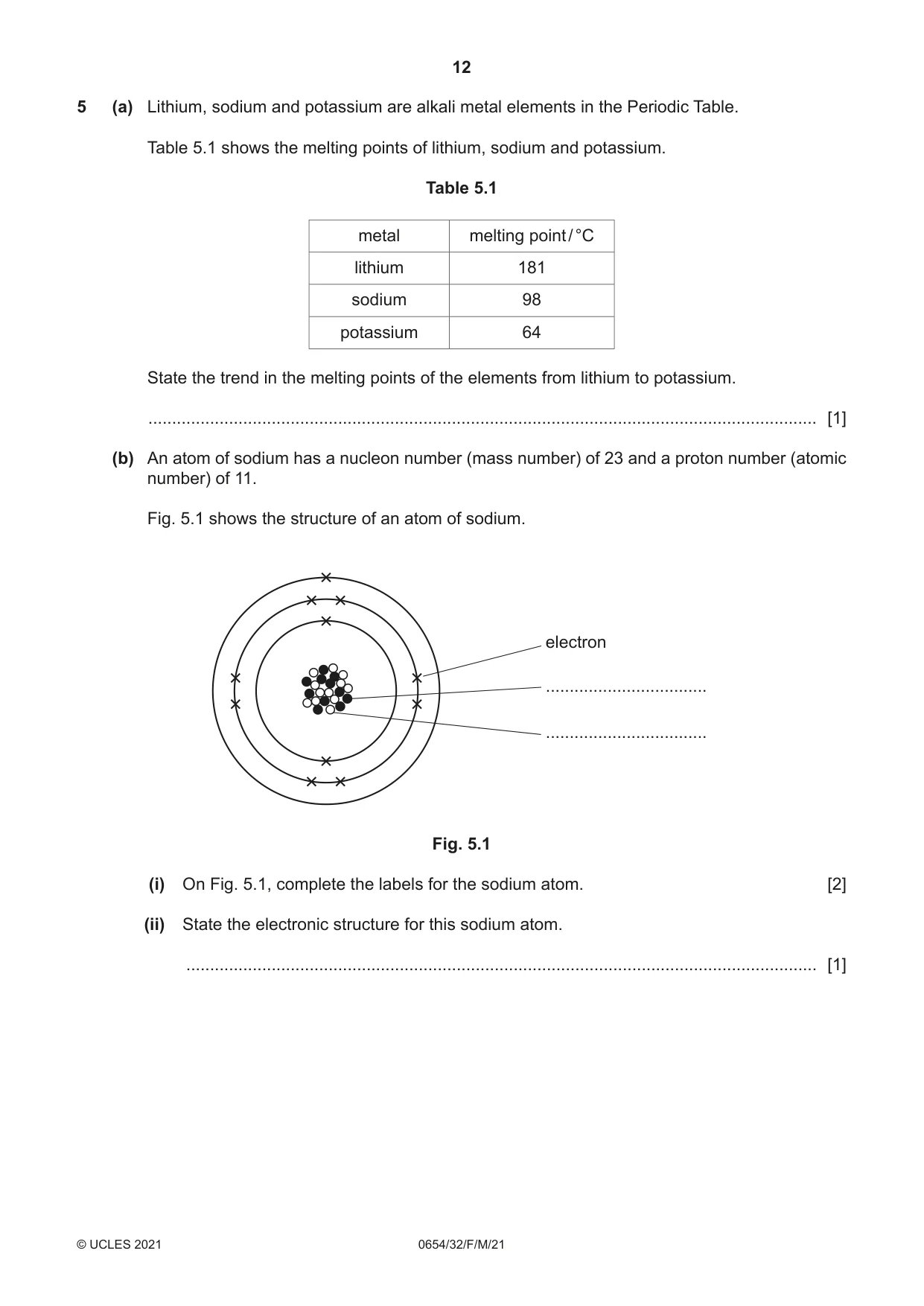
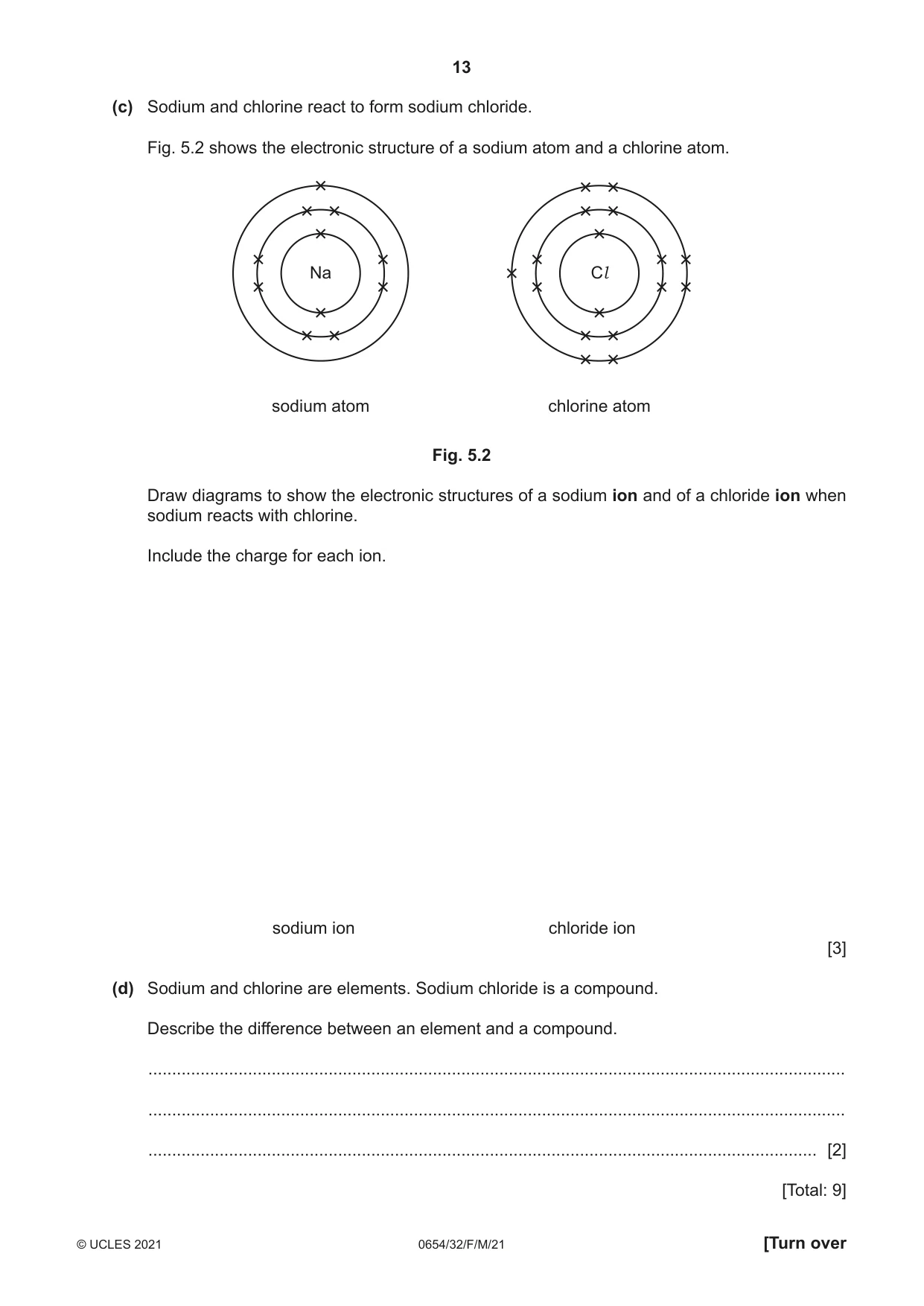
5 (a) Lithium, sodium and potassium are alkali metal elements in the Periodic Table. Table 5.1 shows the melting points of lithium, sodium and potassium. Table 5.1 metal melting point / °C lithium 181 sodium 98 potassium 64 State the trend in the melting points of the elements from lithium to potassium. ............................................................................................................................................. [1] (b) An atom of sodium has a nucleon number (mass number) of 23 and a proton number (atomic number) of 11. Fig. 5.1 shows the structure of an atom of sodium. electron .................................. .................................. Fig. 5.1 (i) On Fig. 5.1, complete the labels for the sodium atom. [2] (ii) State the electronic structure for this sodium atom. ..................................................................................................................................... [1] (c) Sodium and chlorine react to form sodium chloride. Fig. 5.2 shows the electronic structure of a sodium atom and a chlorine atom. Na Cl sodium atom chlorine atom Fig. 5.2 Draw diagrams to show the electronic structures of a sodium ion and of a chloride ion when sodium reacts with chlorine. Include the charge for each ion. sodium ion chloride ion [3] (d) Sodium and chlorine are elements. Sodium chloride is a compound. Describe the difference between an element and a compound. ................................................................................................................................................... ................................................................................................................................................... ............................................................................................................................................. [2] [Total: 9]
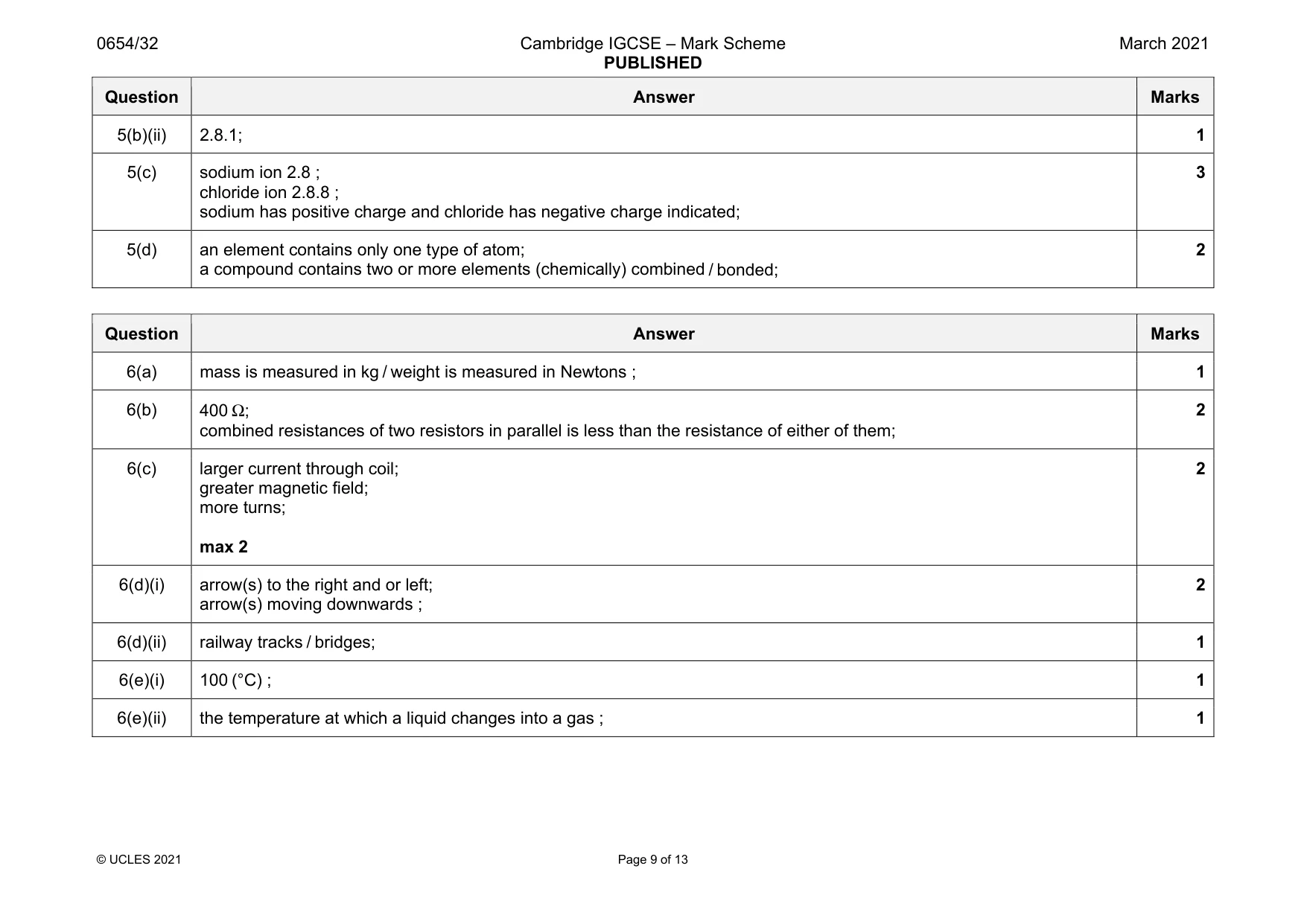
Mark scheme: 5(a) melting point decreases (down group) ; 1 5(b)(i) proton; neutron; 2 Question Answer Marks 5(b)(ii) 2.8.1; 1 5(c) sodium ion 2.8 ; chloride ion 2.8.8 ; sodium has positive charge and chloride has negative charge indicated; 3 5(d) an element contains only one type of atom; a compound contains two or more elements (chemically) combined / bonded; 2
Q6 · An information booklet about an electric oven states that the weight of the oven is 50 kg
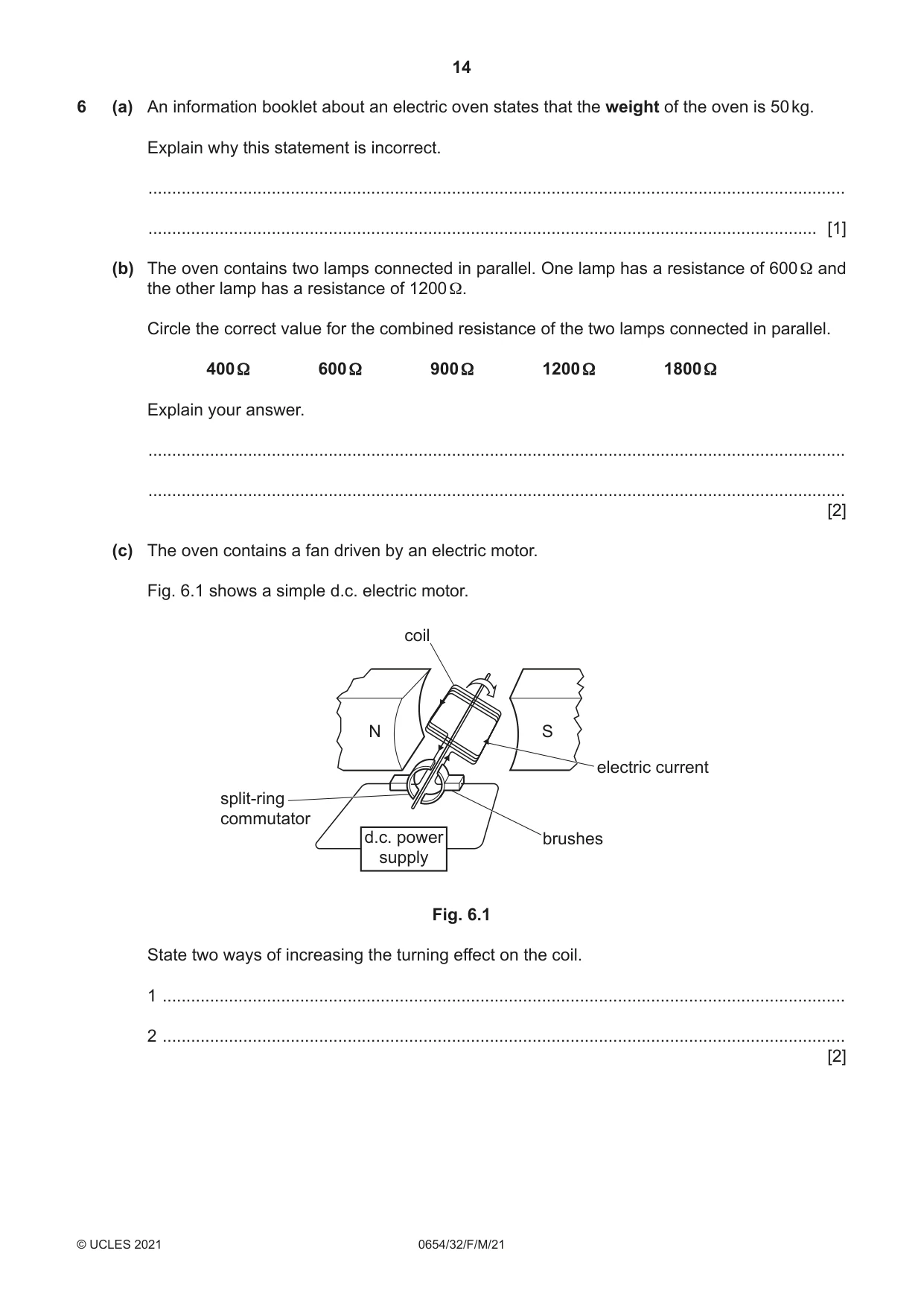
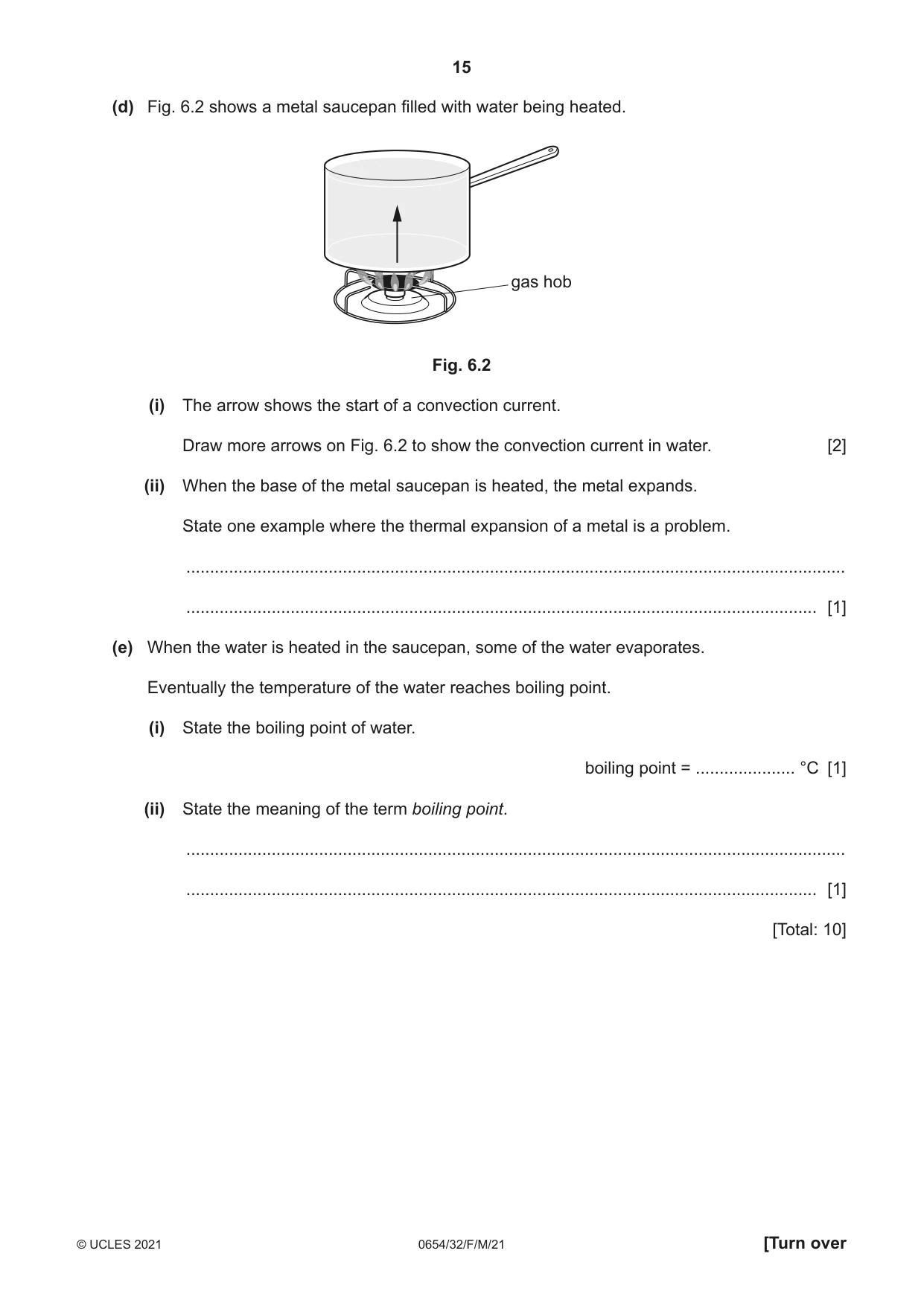
6 (a) An information booklet about an electric oven states that the weight of the oven is 50 kg. Explain why this statement is incorrect. ................................................................................................................................................... ............................................................................................................................................. [1] (b) The oven contains two lamps connected in parallel. One lamp has a resistance of 600 Ω and the other lamp has a resistance of 1200 Ω. Circle the correct value for the combined resistance of the two lamps connected in parallel. 400 Ω 600 Ω 900 Ω 1200 Ω 1800 Ω Explain your answer. ................................................................................................................................................... ................................................................................................................................................... [2] (c) The oven contains a fan driven by an electric motor. Fig. 6.1 shows a simple d.c. electric motor. coil N S electric current split-ring commutator d.c. power brushes supply Fig. 6.1 State two ways of increasing the turning effect on the coil. 1 ................................................................................................................................................ 2 ................................................................................................................................................ [2] (d) Fig. 6.2 shows a metal saucepan filled with water being heated. gas hob Fig. 6.2 (i) The arrow shows the start of a convection current. Draw more arrows on Fig. 6.2 to show the convection current in water. [2] (ii) When the base of the metal saucepan is heated, the metal expands. State one example where the thermal expansion of a metal is a problem. ........................................................................................................................................... ..................................................................................................................................... [1] (e) When the water is heated in the saucepan, some of the water evaporates. Eventually the temperature of the water reaches boiling point. (i) State the boiling point of water. boiling point = ..................... °C [1] (ii) State the meaning of the term boiling point. ........................................................................................................................................... ..................................................................................................................................... [1] [Total: 10]
Mark scheme: 6(a) mass is measured in kg / weight is measured in Newtons ; 1 6(b) 400 Ω; combined resistances of two resistors in parallel is less than the resistance of either of them; 2 6(c) larger current through coil; greater magnetic field; more turns; max 2 2 6(d)(i) arrow(s) to the right and or left; arrow(s) moving downwards ; 2 6(d)(ii) railway tracks / bridges; 1 6(e)(i) 100 (°C) ; 1 6(e)(ii) the temperature at which a liquid changes into a gas ; 1
Q7 · A photomicrograph of a cross-section of a root
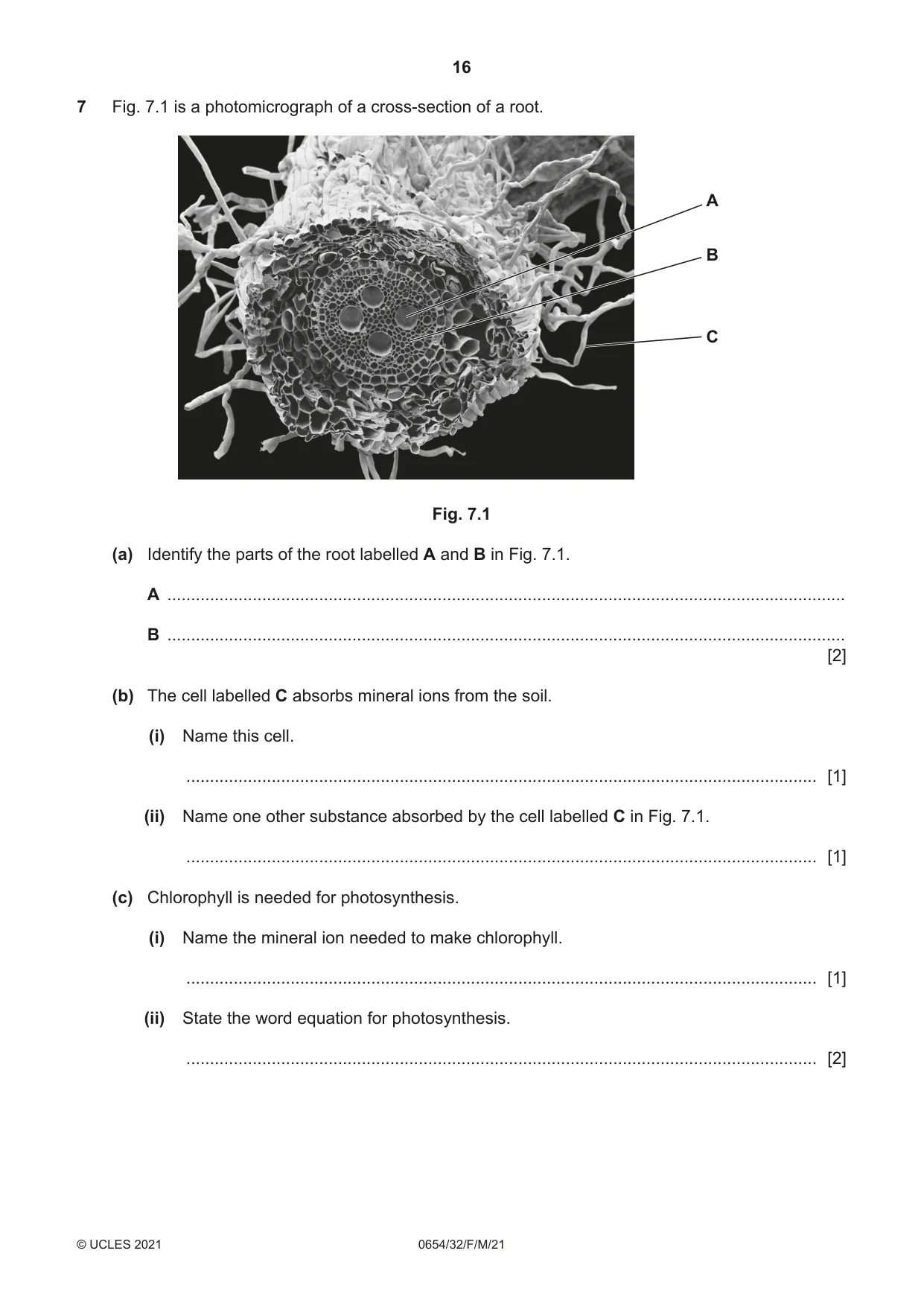
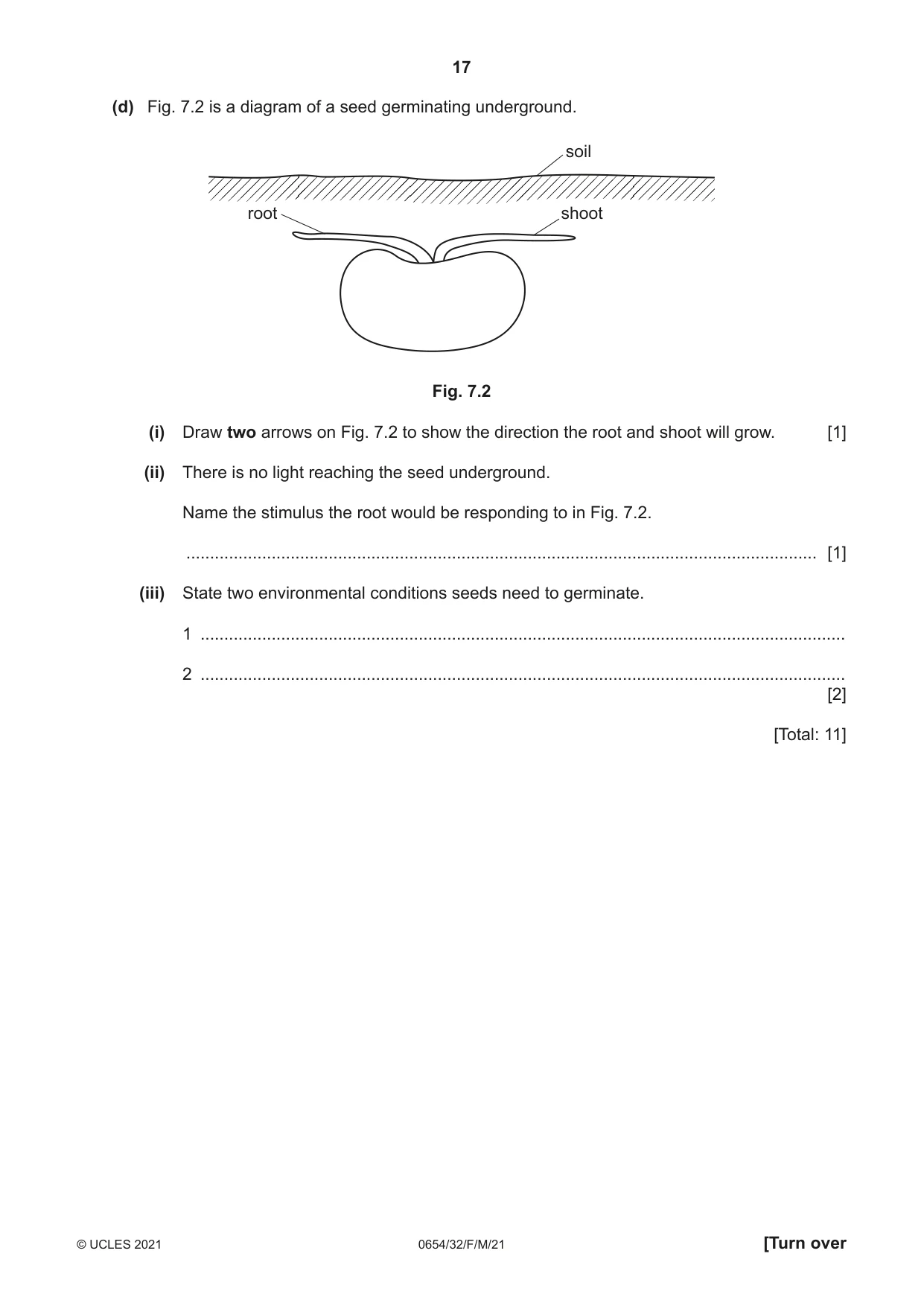
7 Fig. 7.1 is a photomicrograph of a cross-section of a root. A B C Fig. 7.1 (a) Identify the parts of the root labelled A and B in Fig. 7.1. A ............................................................................................................................................... B ............................................................................................................................................... [2] (b) The cell labelled C absorbs mineral ions from the soil. (i) Name this cell. ..................................................................................................................................... [1] (ii) Name one other substance absorbed by the cell labelled C in Fig. 7.1. ..................................................................................................................................... [1] (c) Chlorophyll is needed for photosynthesis. (i) Name the mineral ion needed to make chlorophyll. ..................................................................................................................................... [1] (ii) State the word equation for photosynthesis. ..................................................................................................................................... [2] (d) Fig. 7.2 is a diagram of a seed germinating underground. soil root shoot Fig. 7.2 (i) Draw two arrows on Fig. 7.2 to show the direction the root and shoot will grow. [1] (ii) There is no light reaching the seed underground. Name the stimulus the root would be responding to in Fig. 7.2. ..................................................................................................................................... [1] (iii) State two environmental conditions seeds need to germinate. 1 ........................................................................................................................................ 2 ........................................................................................................................................ [2] [Total: 11]
Mark scheme: 7(a) A xylem ; B phloem ; 2 7(b)(i) root hair (cell) ; 1 7(b)(ii) water ; 1 7(c)(i) magnesium ; 1 7(c)(ii) carbon dioxide + water → glucose + oxygen ;; 2 7(d)(i) shoot arrow pointing upwards and root arrow pointing downwards ; 1 7(d)(ii) gravity ; 1 7(d)(iii) any two from warm / suitable temperature ; oxygen ; moisture / water ; 2
Q8 · Three hydrocarbon molecules X, Y and Z
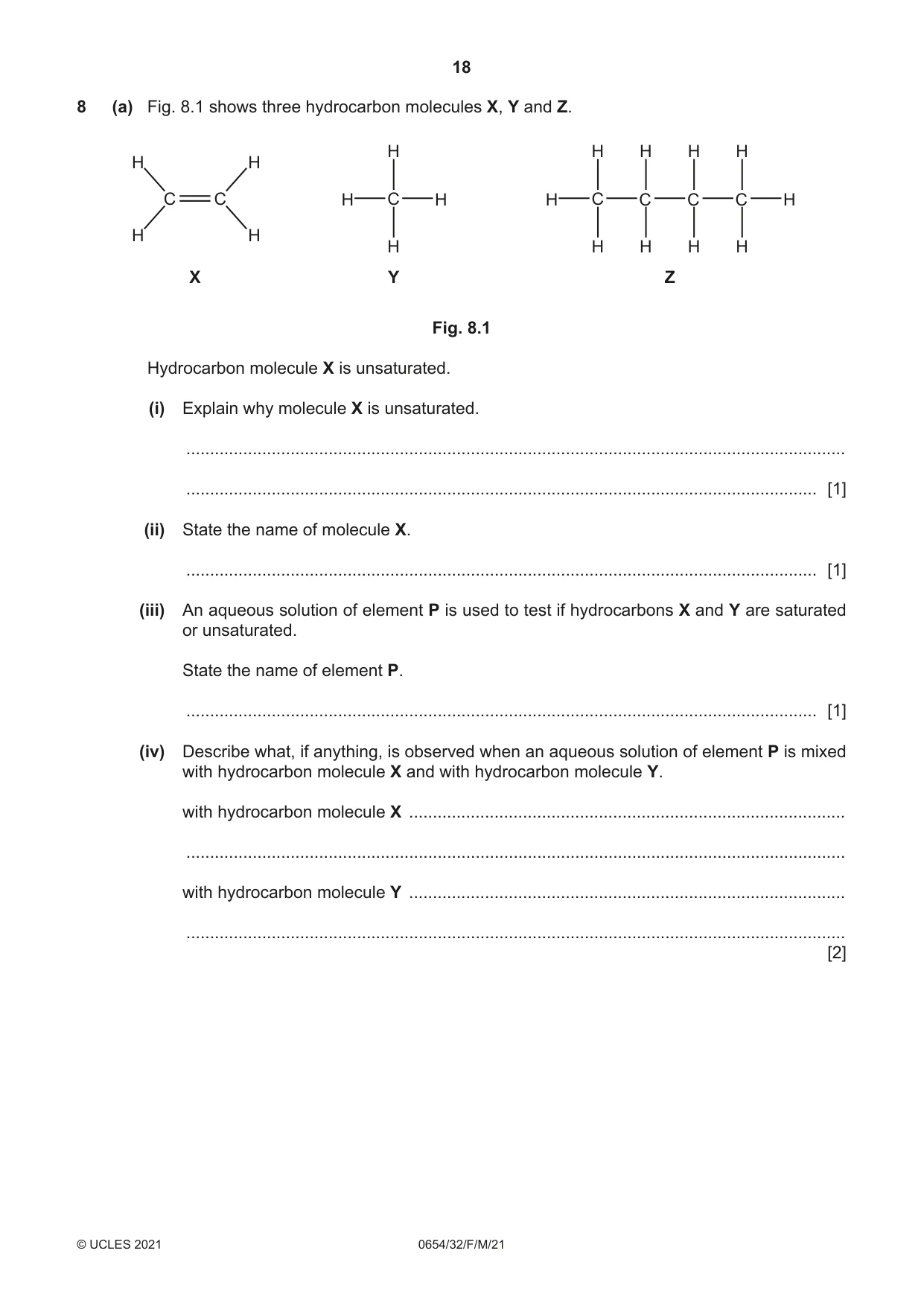
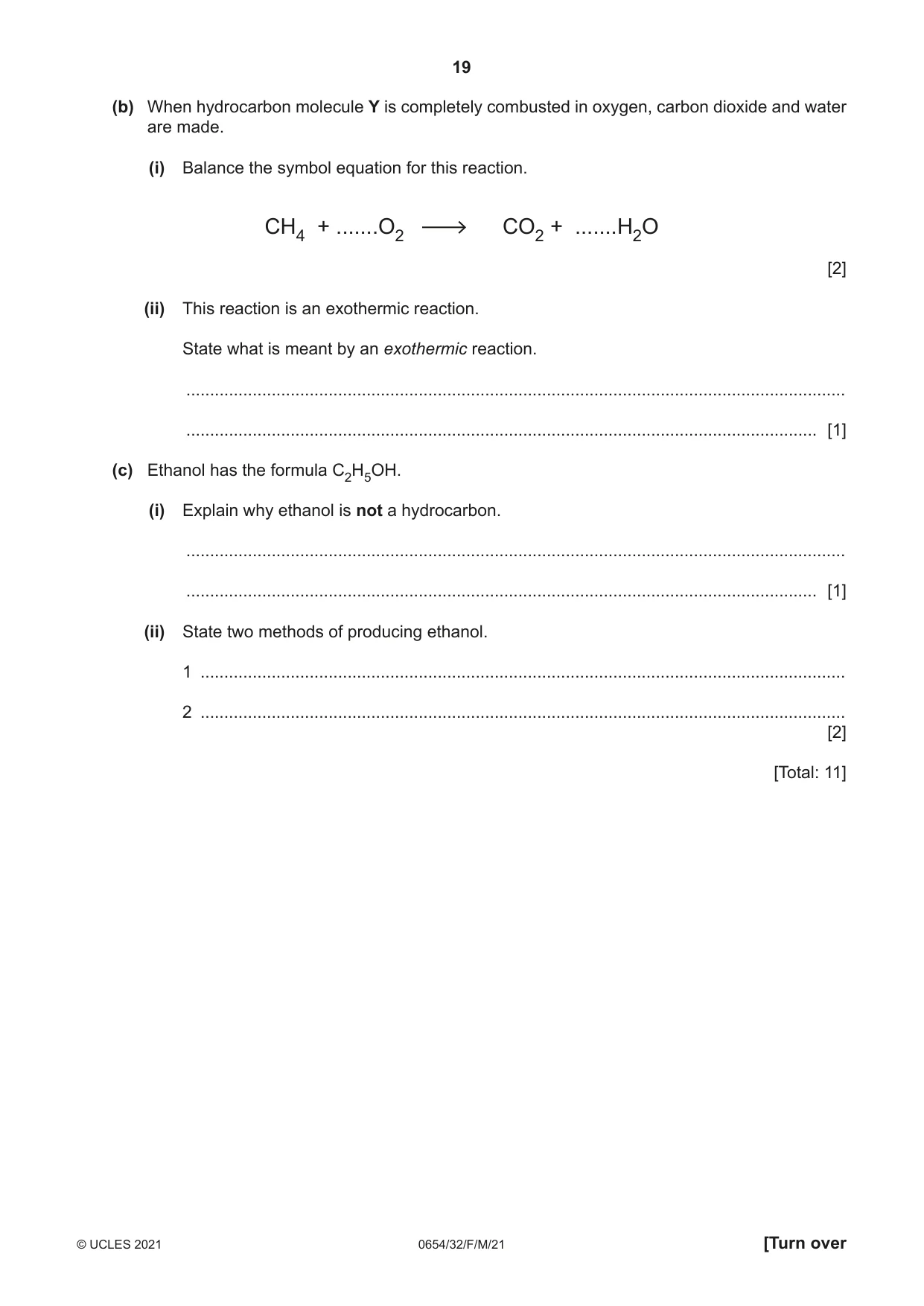
8 (a) Fig. 8.1 shows three hydrocarbon molecules X, Y and Z. H H H H H H H C C H C H H C C C C H H H H H H H H X Y Z Fig. 8.1 Hydrocarbon molecule X is unsaturated. (i) Explain why molecule X is unsaturated. ........................................................................................................................................... ..................................................................................................................................... [1] (ii) State the name of molecule X. ..................................................................................................................................... [1] (iii) An aqueous solution of element P is used to test if hydrocarbons X and Y are saturated or unsaturated. State the name of element P. ..................................................................................................................................... [1] (iv) Describe what, if anything, is observed when an aqueous solution of element P is mixed with hydrocarbon molecule X and with hydrocarbon molecule Y. with hydrocarbon molecule X ............................................................................................ ........................................................................................................................................... with hydrocarbon molecule Y ............................................................................................ ........................................................................................................................................... [2] (b) When hydrocarbon molecule Y is completely combusted in oxygen, carbon dioxide and water are made. (i) Balance the symbol equation for this reaction. CH4 + .......O2 CO2 + .......H2O [2] (ii) This reaction is an exothermic reaction. State what is meant by an exothermic reaction. ........................................................................................................................................... ..................................................................................................................................... [1] (c) Ethanol has the formula C2H5OH. (i) Explain why ethanol is not a hydrocarbon. ........................................................................................................................................... ..................................................................................................................................... [1] (ii) State two methods of producing ethanol. 1 ........................................................................................................................................ 2 ........................................................................................................................................ [2] [Total: 11]
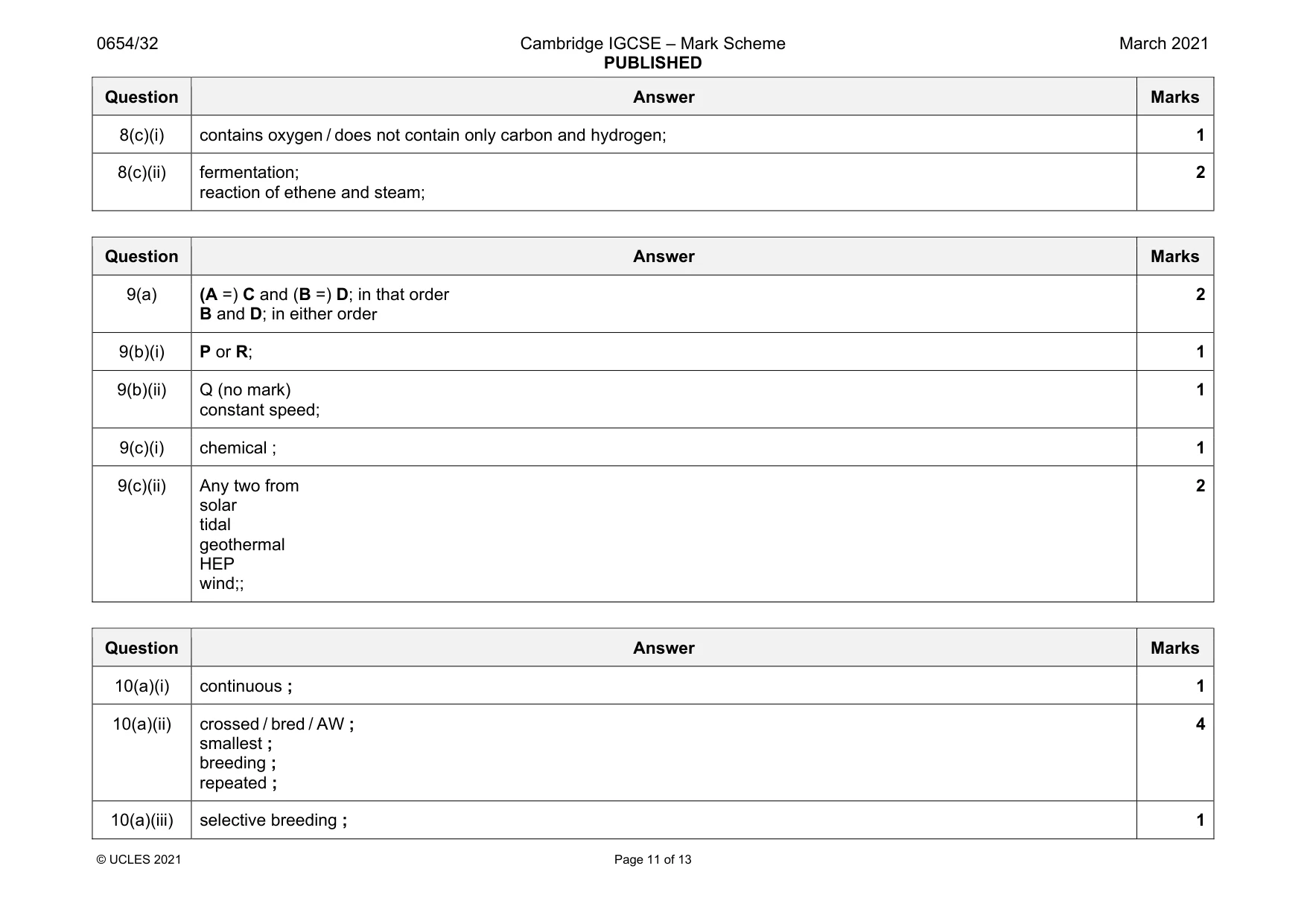
Mark scheme: 8(a)(i) has a carbon-carbon double bond; 1 8(a)(ii) ethene; 1 8(a)(iii) bromine; 1 8(a)(iv) decolourises/becomes colourless; stays orange/does not decolourise; 2 8(b)(i) CH4 + 2O2 → CO2 + 2H2O ;; 2 8(b)(ii) thermal energy released; 1 Question Answer Marks 8(c)(i) contains oxygen / does not contain only carbon and hydrogen; 1 8(c)(ii) fermentation; reaction of ethene and steam; 2
Q9 · An aircraft on a runway
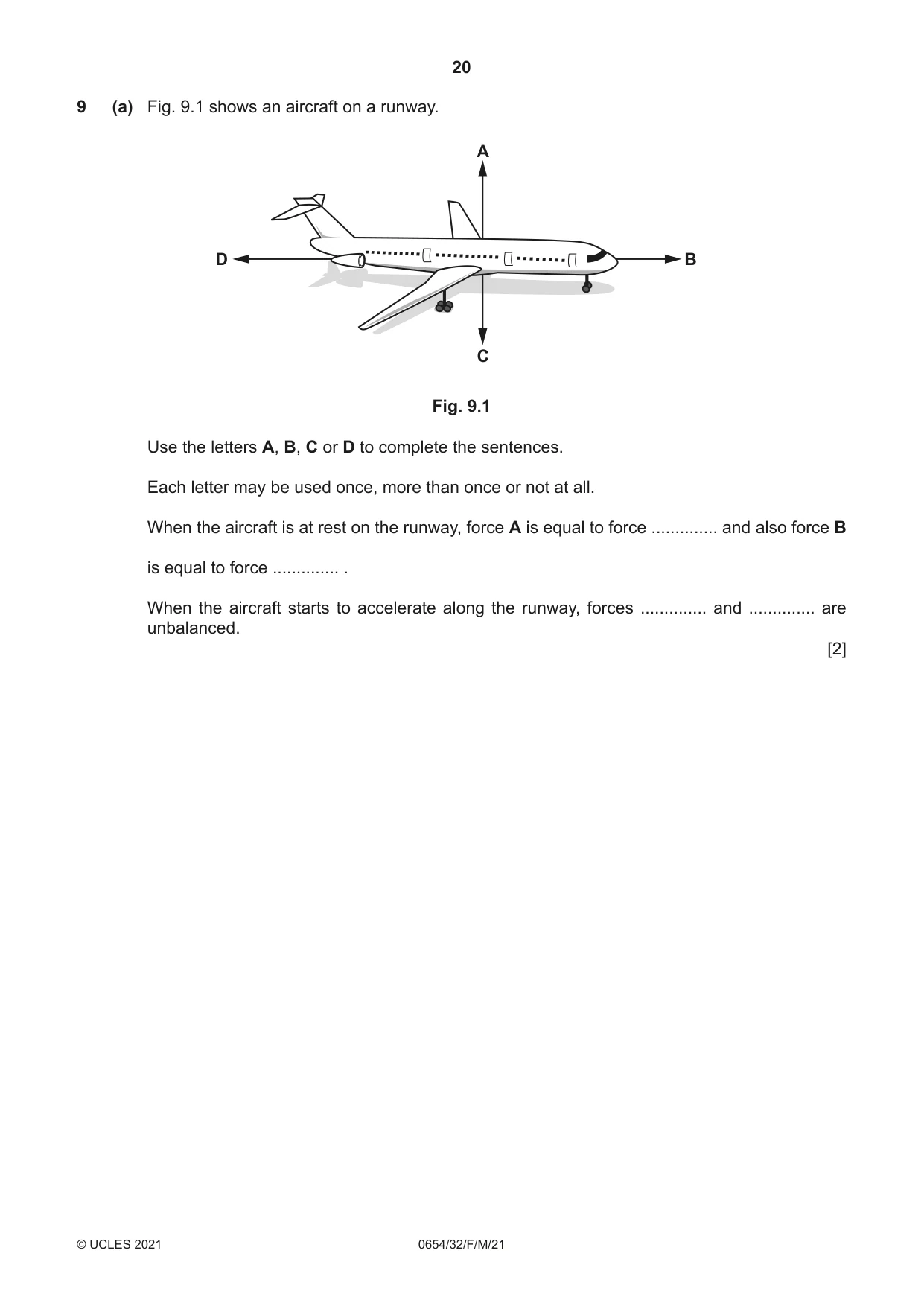
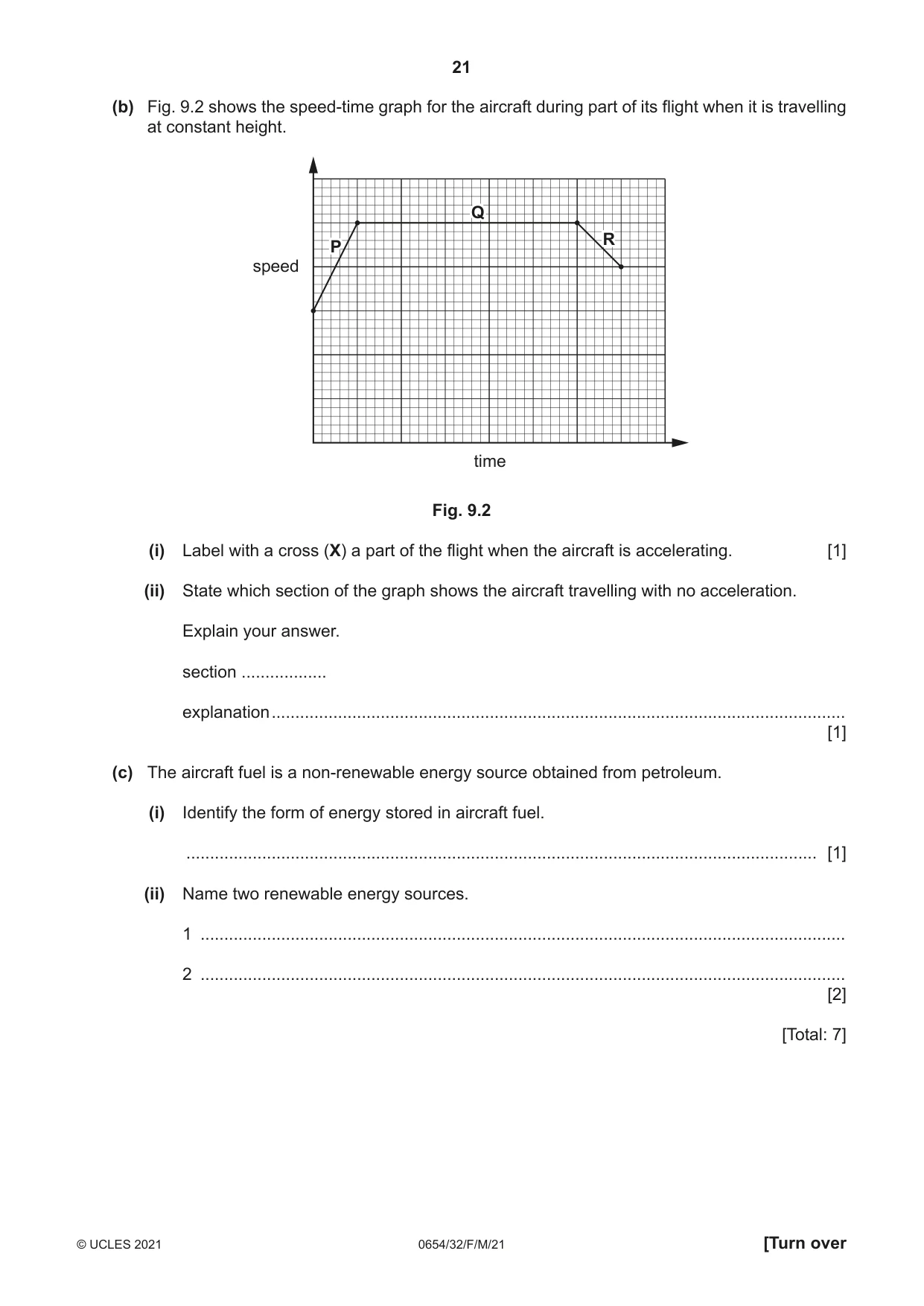
9 (a) Fig. 9.1 shows an aircraft on a runway. A D B C Fig. 9.1 Use the letters A, B, C or D to complete the sentences. Each letter may be used once, more than once or not at all. When the aircraft is at rest on the runway, force A is equal to force .............. and also force B is equal to force .............. . When the aircraft starts to accelerate along the runway, forces .............. and .............. are unbalanced. [2] (b) Fig. 9.2 shows the speed-time graph for the aircraft during part of its flight when it is travelling at constant height. Q R P speed time Fig. 9.2 (i) Label with a cross (X) a part of the flight when the aircraft is accelerating. [1] (ii) State which section of the graph shows the aircraft travelling with no acceleration. Explain your answer. section .................. explanation ......................................................................................................................... [1] (c) The aircraft fuel is a non-renewable energy source obtained from petroleum. (i) Identify the form of energy stored in aircraft fuel. ..................................................................................................................................... [1] (ii) Name two renewable energy sources. 1 ........................................................................................................................................ 2 ........................................................................................................................................ [2] [Total: 7]
Mark scheme: 9(a) (A =) C and (B =) D; in that order B and D; in either order 2 9(b)(i) P or R; 1 9(b)(ii) Q (no mark) constant speed; 1 9(c)(i) chemical ; 1 9(c)(ii) Any two from solar tidal geothermal HEP wind;; 2
Q10 · A farmer keeps ponies
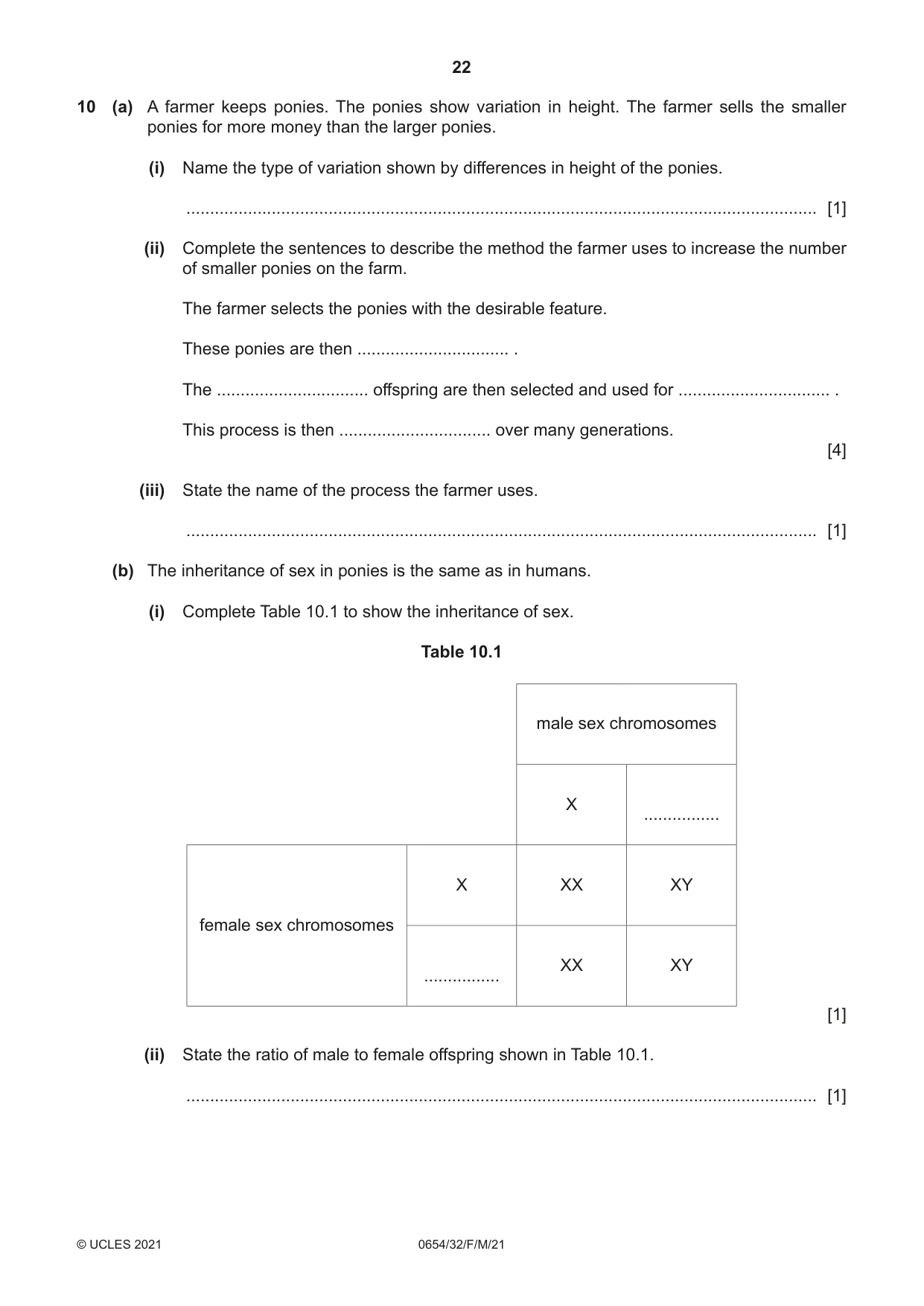
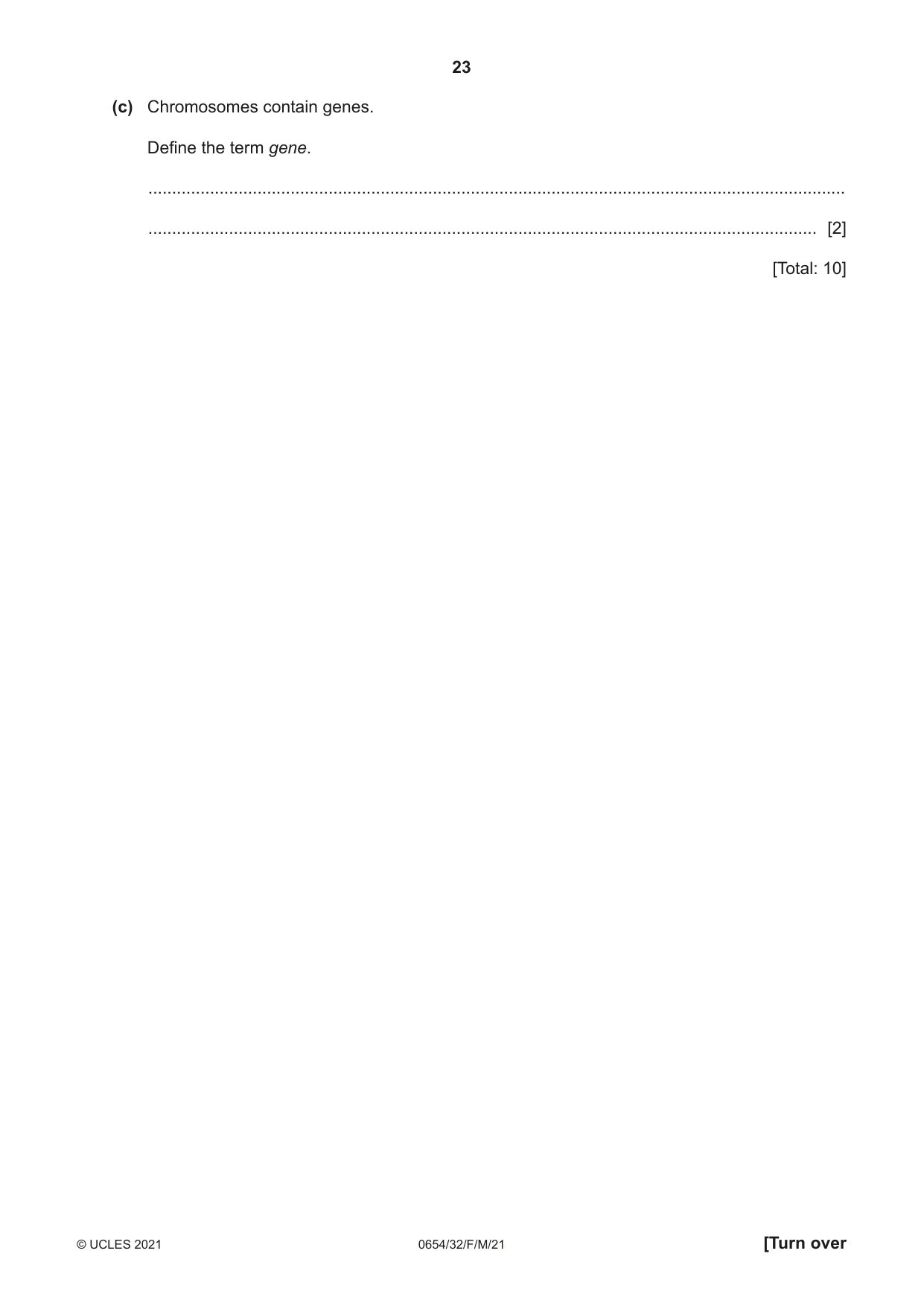
10 (a) A farmer keeps ponies. The ponies show variation in height. The farmer sells the smaller ponies for more money than the larger ponies. (i) Name the type of variation shown by differences in height of the ponies. ..................................................................................................................................... [1] (ii) Complete the sentences to describe the method the farmer uses to increase the number of smaller ponies on the farm. The farmer selects the ponies with the desirable feature. These ponies are then ................................ . The ................................ offspring are then selected and used for ................................ . This process is then ................................ over many generations. [4] (iii) State the name of the process the farmer uses. ..................................................................................................................................... [1] (b) The inheritance of sex in ponies is the same as in humans. (i) Complete Table 10.1 to show the inheritance of sex. Table 10.1 male sex chromosomes X ................ X XX XY female sex chromosomes XX XY ................ [1] (ii) State the ratio of male to female offspring shown in Table 10.1. ..................................................................................................................................... [1] (c) Chromosomes contain genes. Define the term gene. ................................................................................................................................................... ............................................................................................................................................. [2] [Total: 10]
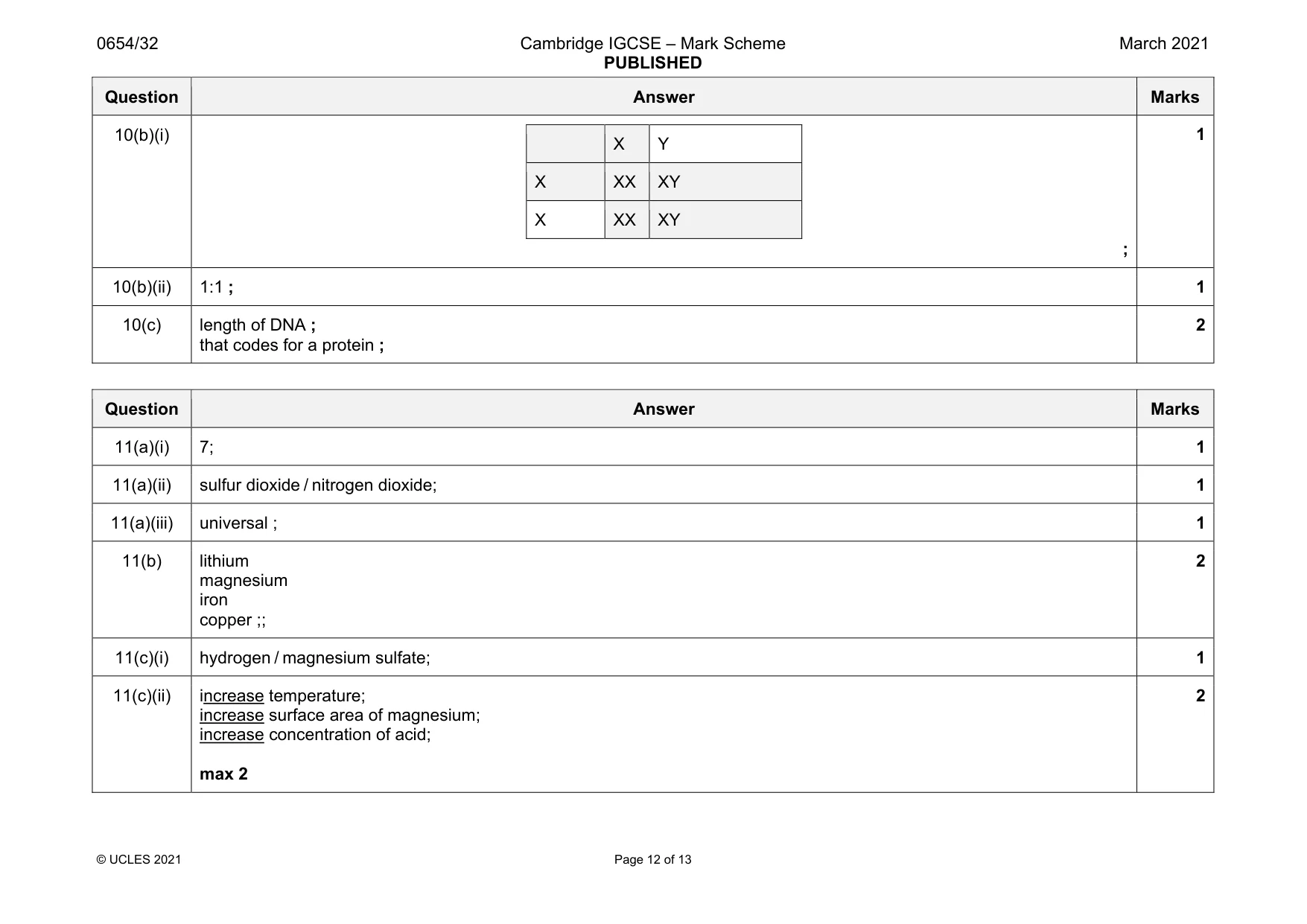
Mark scheme: 10(a)(i) continuous ; 1 10(a)(ii) crossed / bred / AW ; smallest ; breeding ; repeated ; 4 10(a)(iii) selective breeding ; 1 Question Answer Marks 10(b)(i) X Y X XX XY X XX XY ; 1 10(b)(ii) 1:1 ; 1 10(c) length of DNA ; that codes for a protein ; 2
Q11 · Information about three colourless liquids J, K and L
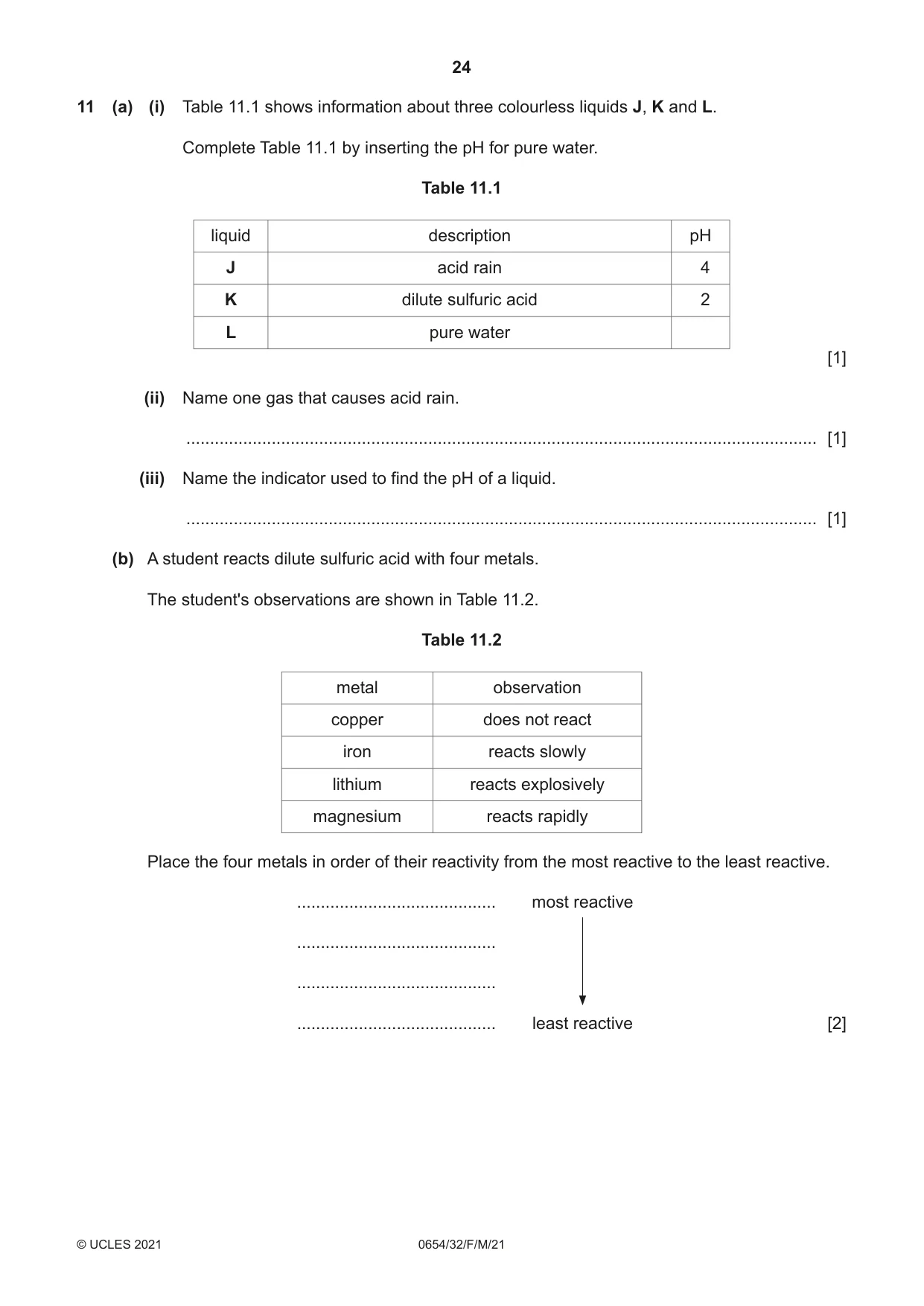
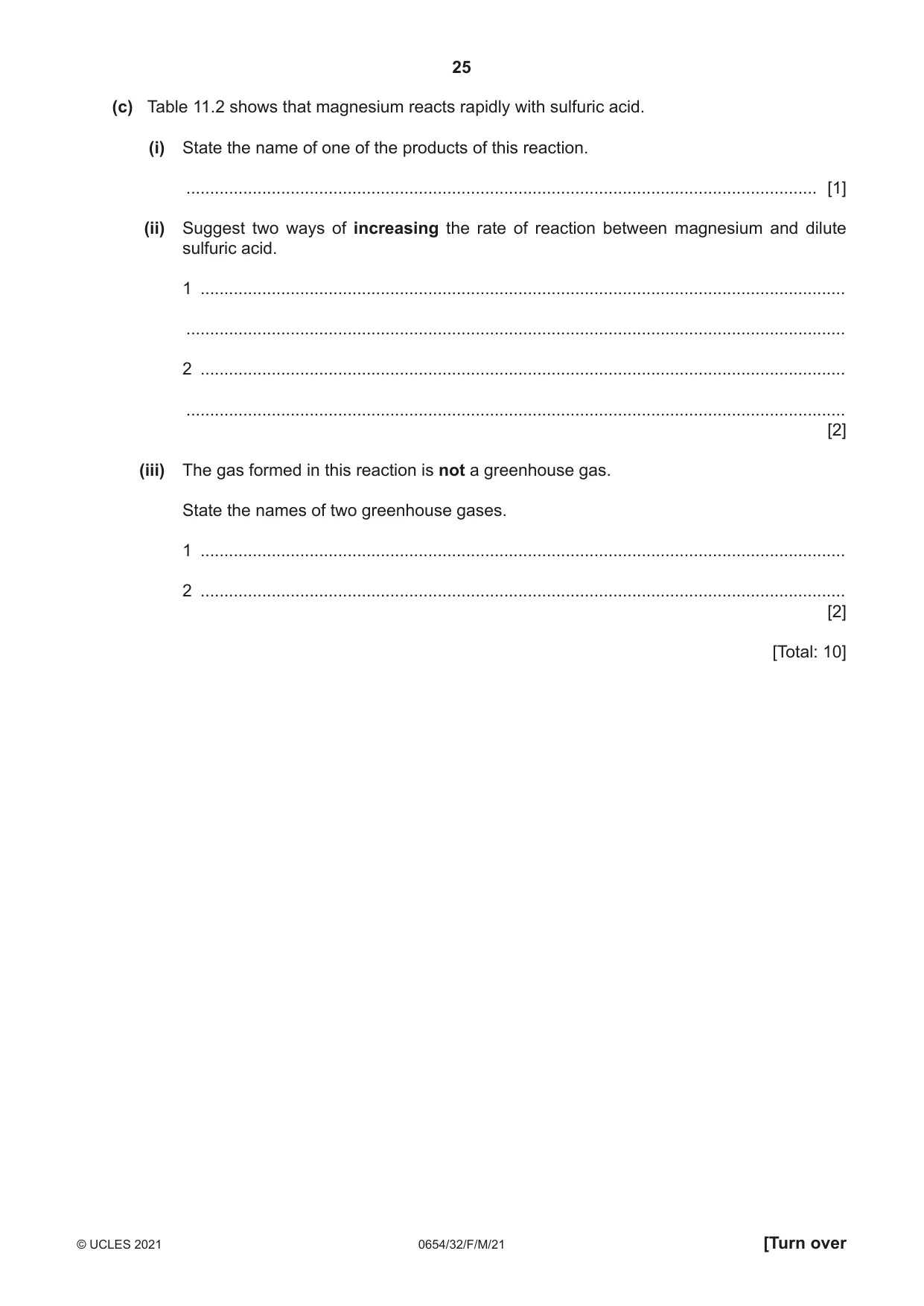
11 (a) (i) Table 11.1 shows information about three colourless liquids J, K and L. Complete Table 11.1 by inserting the pH for pure water. Table 11.1 liquid description pH J acid rain 4 K dilute sulfuric acid 2 L pure water [1] (ii) Name one gas that causes acid rain. ..................................................................................................................................... [1] (iii) Name the indicator used to find the pH of a liquid. ..................................................................................................................................... [1] (b) A student reacts dilute sulfuric acid with four metals. The student's observations are shown in Table 11.2. Table 11.2 metal observation copper does not react iron reacts slowly lithium reacts explosively magnesium reacts rapidly Place the four metals in order of their reactivity from the most reactive to the least reactive. .......................................... most reactive .......................................... .......................................... .......................................... least reactive [2] (c) Table 11.2 shows that magnesium reacts rapidly with sulfuric acid. (i) State the name of one of the products of this reaction. ..................................................................................................................................... [1] (ii) Suggest two ways of increasing the rate of reaction between magnesium and dilute sulfuric acid. 1 ........................................................................................................................................ ........................................................................................................................................... 2 ........................................................................................................................................ ........................................................................................................................................... [2] (iii) The gas formed in this reaction is not a greenhouse gas. State the names of two greenhouse gases. 1 ........................................................................................................................................ 2 ........................................................................................................................................ [2] [Total: 10]
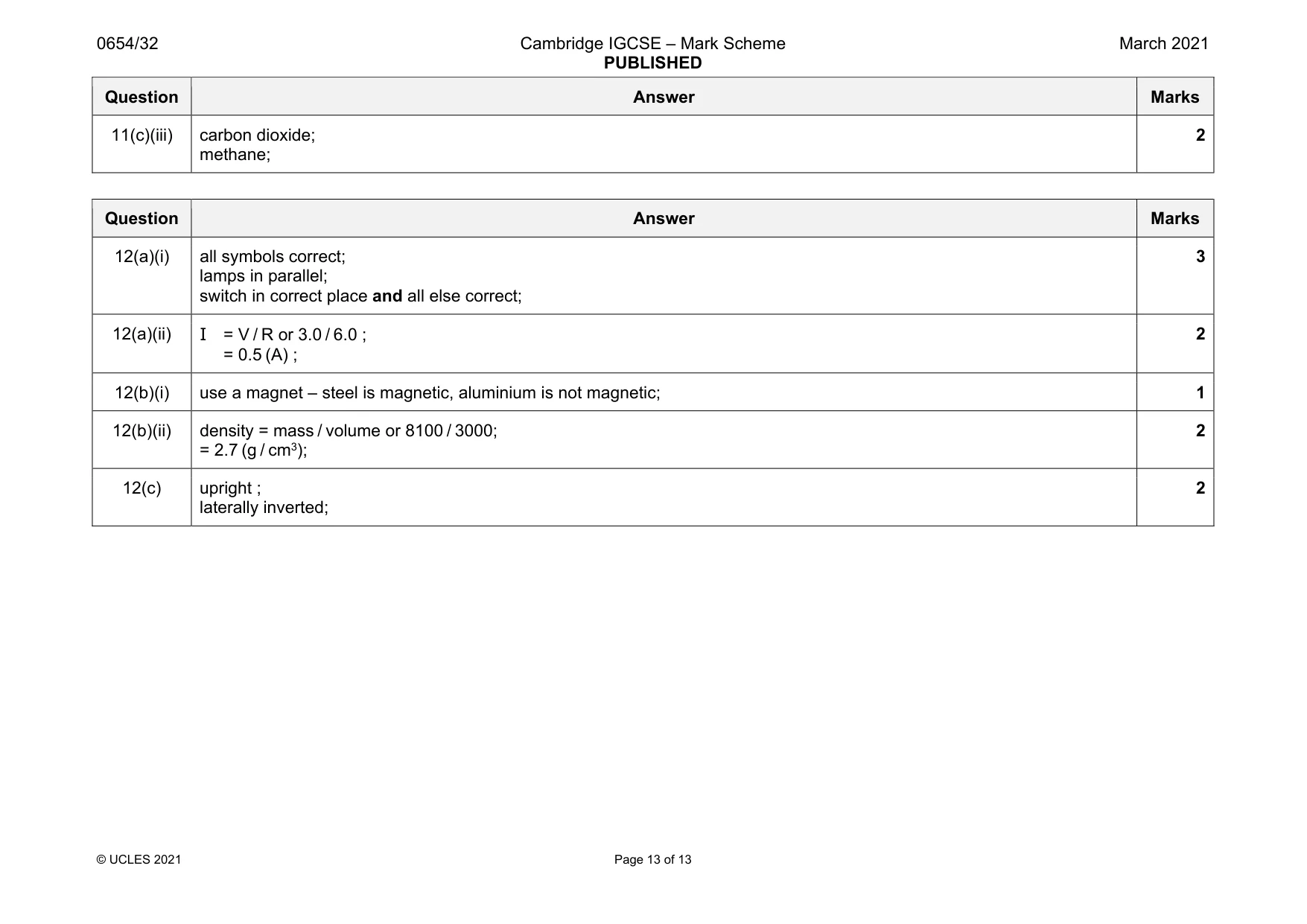
Mark scheme: 11(a)(i) 7; 1 11(a)(ii) sulfur dioxide / nitrogen dioxide; 1 11(a)(iii) universal ; 1 11(b) lithium magnesium iron copper ;; 2 11(c)(i) hydrogen / magnesium sulfate; 1 11(c)(ii) increase temperature; increase surface area of magnesium; increase concentration of acid; max 2 2 Question Answer Marks 11(c)(iii) carbon dioxide; methane; 2
Q12 · A bicycle has a front lamp, X, and a rear lamp, Y, connected in parallel across a battery
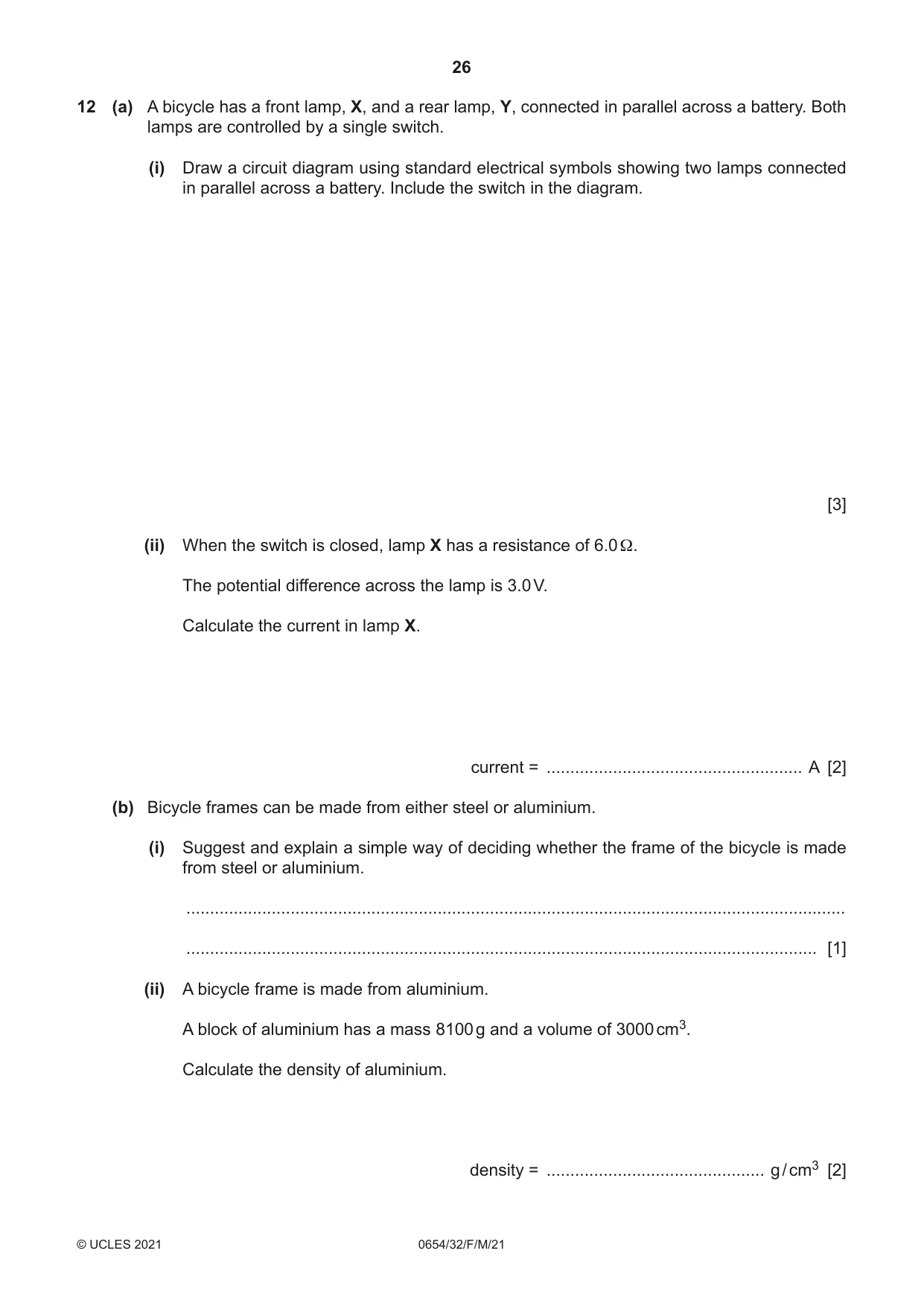
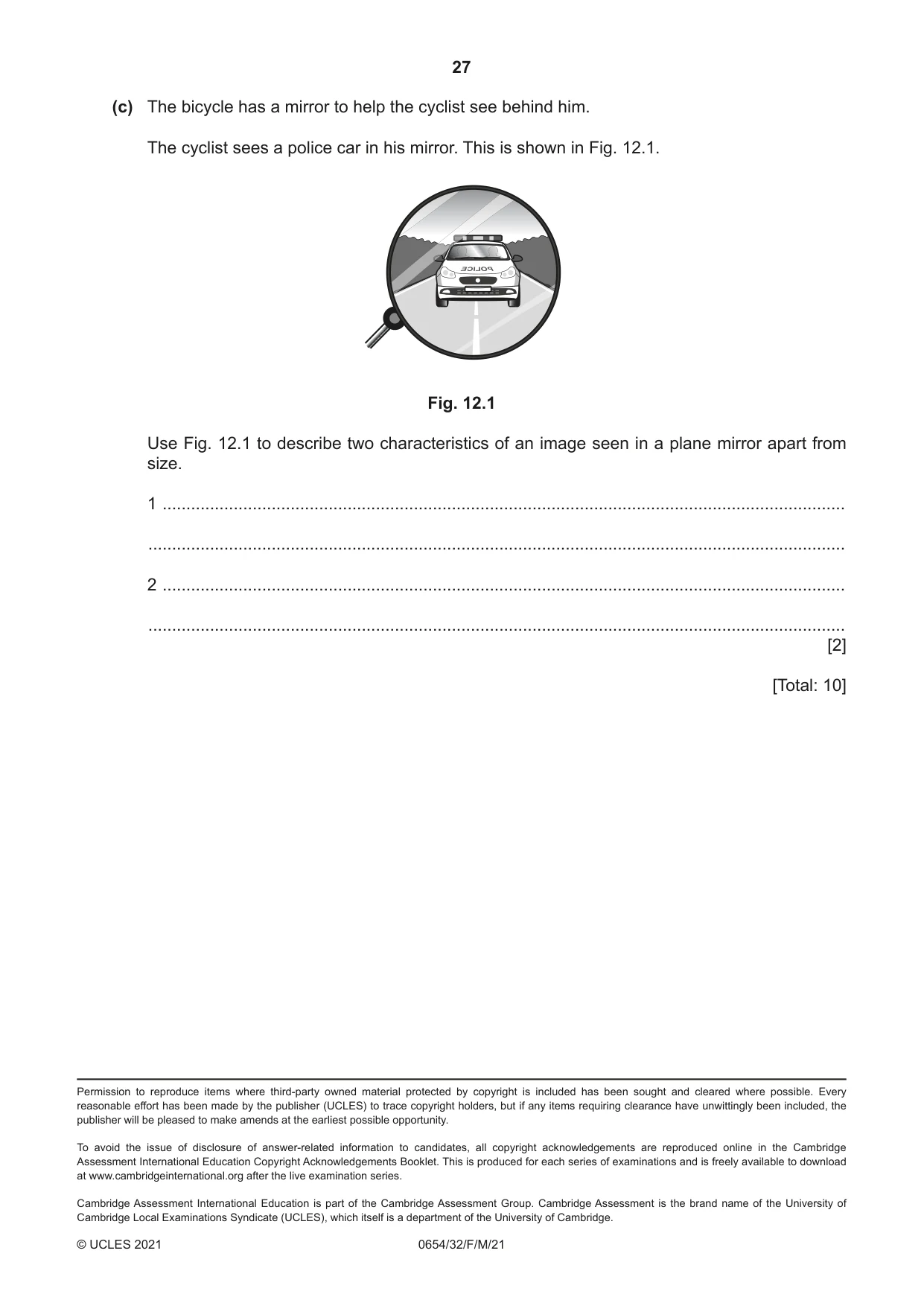
12 (a) A bicycle has a front lamp, X, and a rear lamp, Y, connected in parallel across a battery. Both lamps are controlled by a single switch. (i) Draw a circuit diagram using standard electrical symbols showing two lamps connected in parallel across a battery. Include the switch in the diagram. [3] (ii) When the switch is closed, lamp X has a resistance of 6.0 Ω. The potential difference across the lamp is 3.0 V. Calculate the current in lamp X. current = ...................................................... A [2] (b) Bicycle frames can be made from either steel or aluminium. (i) Suggest and explain a simple way of deciding whether the frame of the bicycle is made from steel or aluminium. ........................................................................................................................................... ..................................................................................................................................... [1] (ii) A bicycle frame is made from aluminium. A block of aluminium has a mass 8100 g and a volume of 3000 cm3. Calculate the density of aluminium. density = .............................................. g / cm3 [2] (c) The bicycle has a mirror to help the cyclist see behind him. The cyclist sees a police car in his mirror. This is shown in Fig. 12.1. Fig. 12.1 Use Fig. 12.1 to describe two characteristics of an image seen in a plane mirror apart from size. 1 ................................................................................................................................................ ................................................................................................................................................... 2 ................................................................................................................................................ ................................................................................................................................................... [2] [Total: 10]
Mark scheme: 12(a)(i) all symbols correct; lamps in parallel; switch in correct place and all else correct; 3 12(a)(ii) I = V / R or 3.0 / 6.0 ; = 0.5 (A) ; 2 12(b)(i) use a magnet – steel is magnetic, aluminium is not magnetic; 1 12(b)(ii) density = mass / volume or 8100 / 3000; = 2.7 (g / cm3); 2 12(c) upright ; laterally inverted; 2
What was in this paper
The subtopics covered by these 12 questions, and how many questions each got. Open one in a new tab to see every Cambridge question on it.
What you needed in this session
Cambridge’s own grade thresholds for 2021 Feb/March, Paper 3 · Variant 2. A higher threshold means an easier paper — the bar moves with how the cohort did.