Cambridge IGCSE Sciences - Co-ordinated (Double) 0654 — 2021 Oct/Nov Paper 3 · Variant 3
0654/33/O/N/21 · 12 questions · 120 marks · ≈135 min
The question paper and its mark scheme, free to read here and free to download. This is Cambridge’s own paper, exactly as it was sat.
Question paper28 pages


Mark scheme12 pages
Answers below. Sit the paper first if you are practising.
Questions as text
Q1 · A student measures their pulse rate at rest, during and after exercise
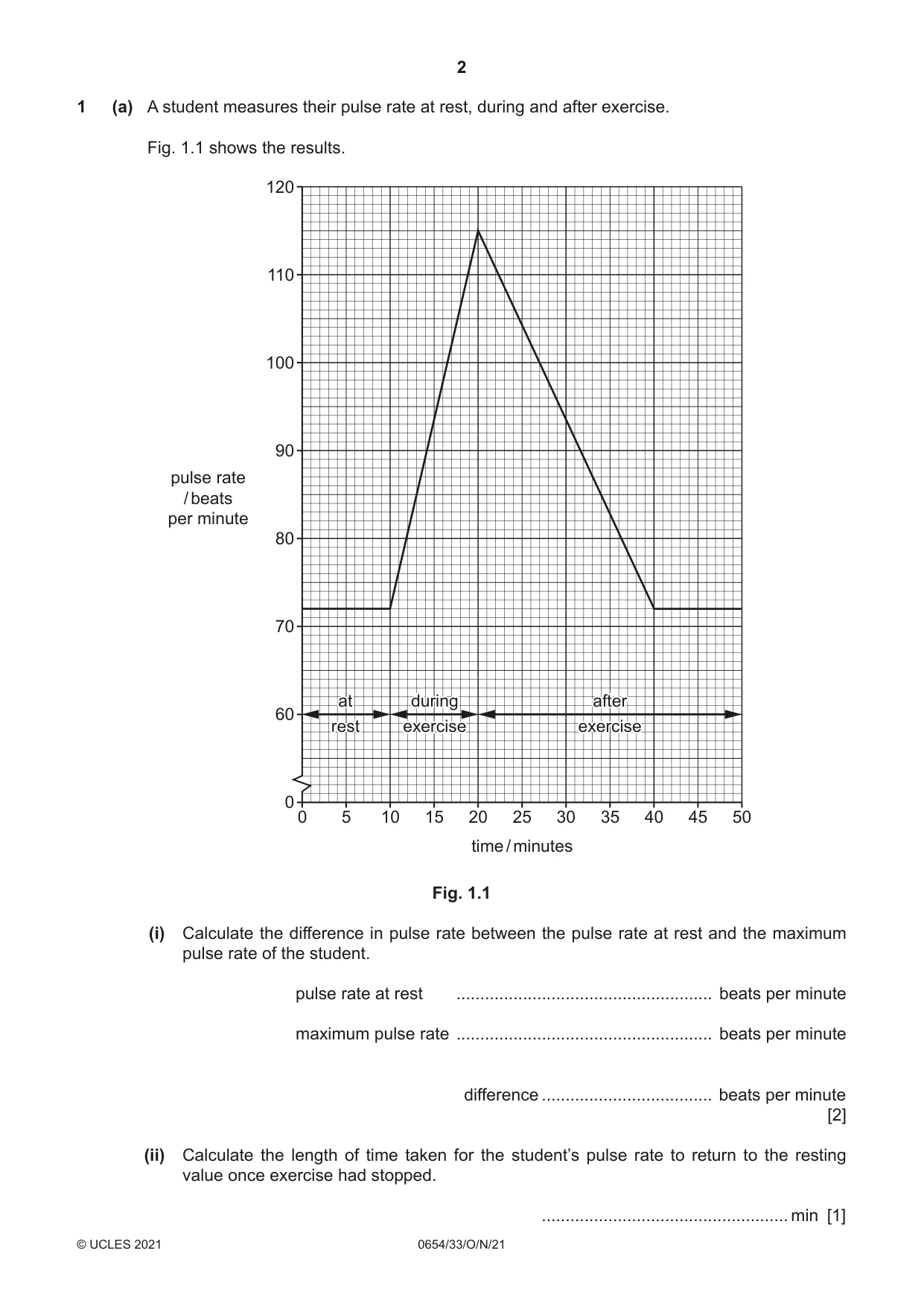
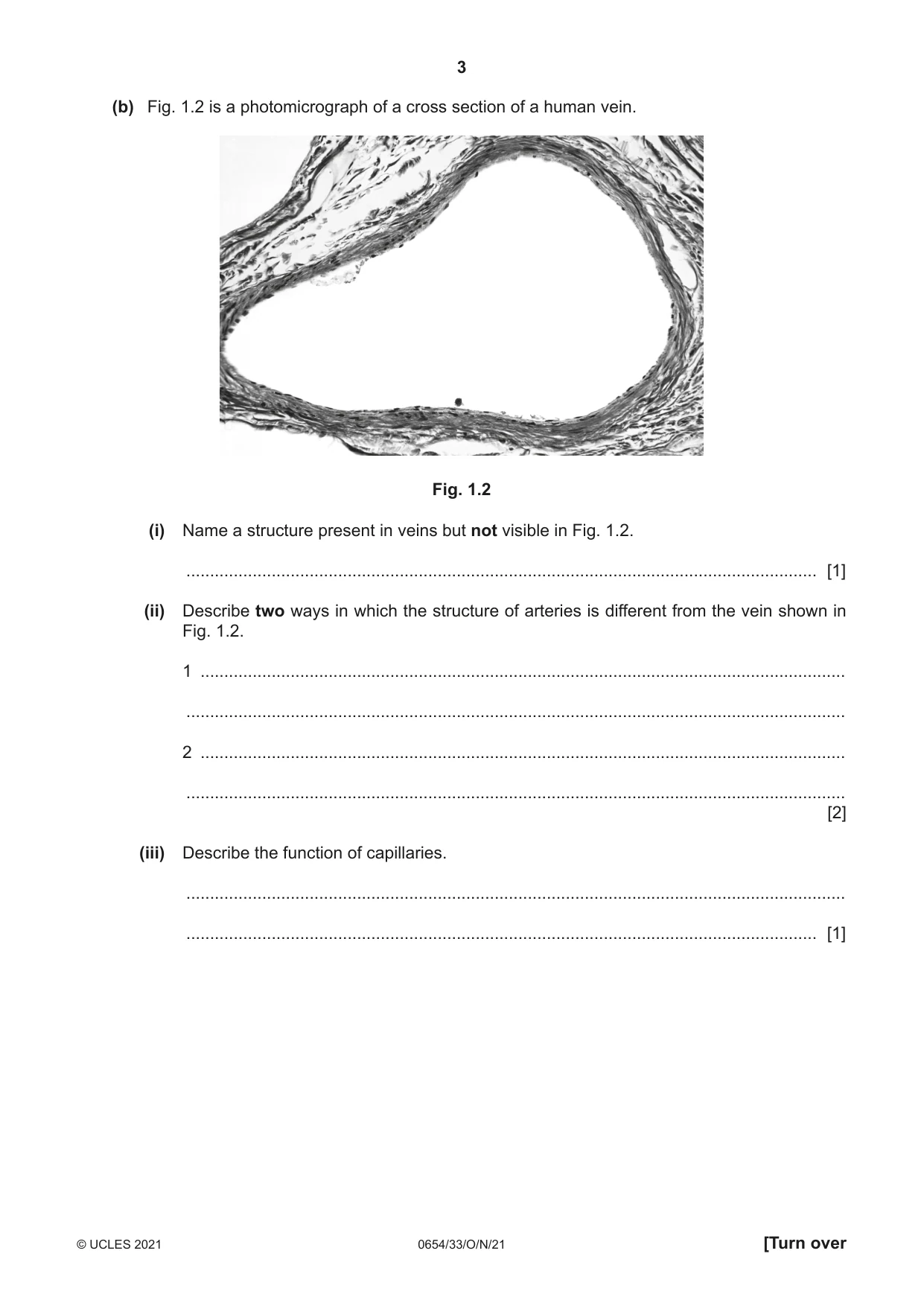
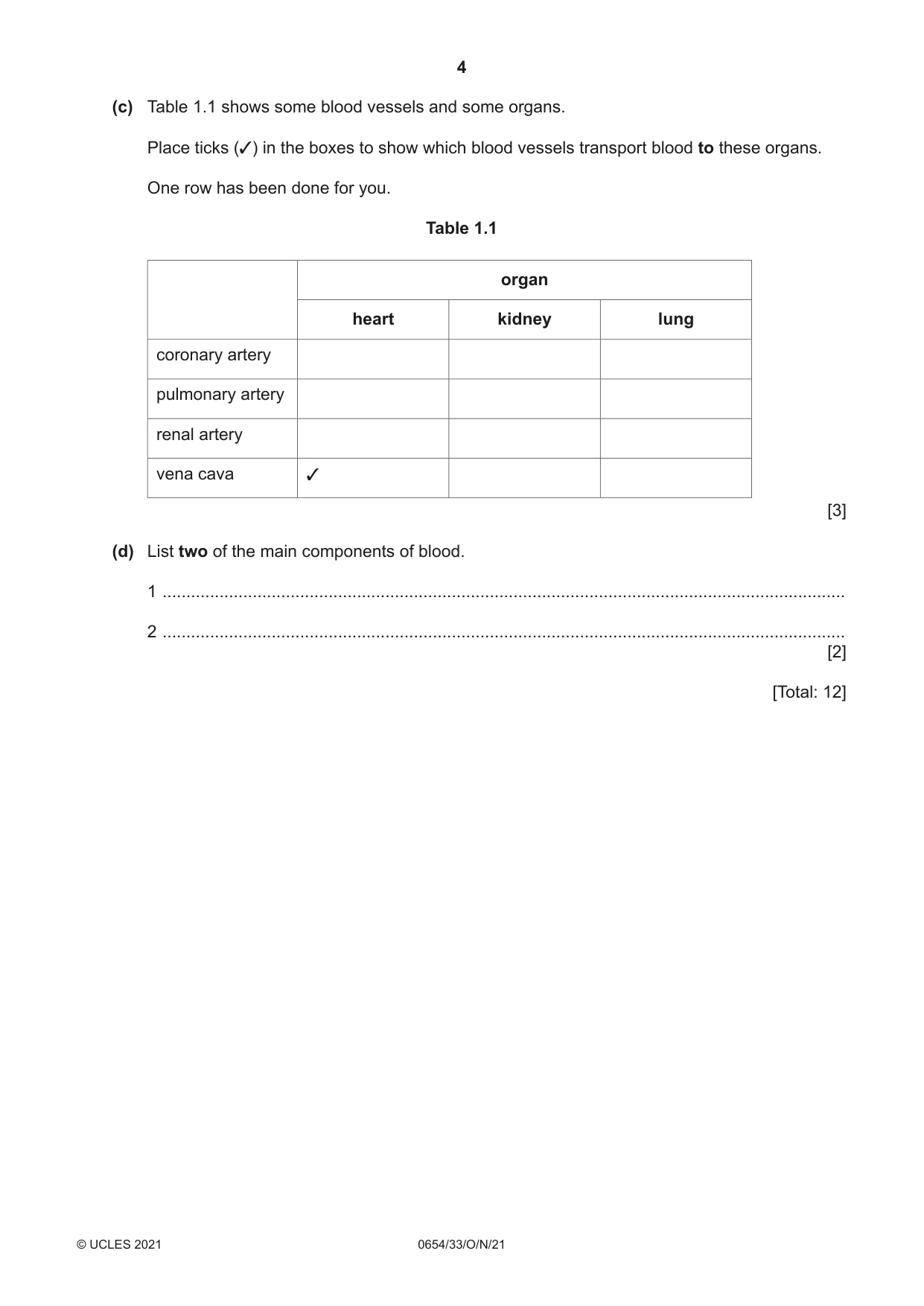
1 (a) A student measures their pulse rate at rest, during and after exercise. Fig. 1.1 shows the results. 120 110 100 90 pulse rate / beats per minute 80 70 atat duringduring afterafter 60 restrest exerciseexercise exerciseexercise 0 0 5 10 15 20 25 30 35 40 45 50 time / minutes Fig. 1.1 (i) Calculate the difference in pulse rate between the pulse rate at rest and the maximum pulse rate of the student. pulse rate at rest ...................................................... beats per minute maximum pulse rate ...................................................... beats per minute difference .................................... beats per minute [2] (ii) Calculate the length of time taken for the student’s pulse rate to return to the resting value once exercise had stopped. .................................................... min [1] (b) Fig. 1.2 is a photomicrograph of a cross section of a human vein. Fig. 1.2 (i) Name a structure present in veins but not visible in Fig. 1.2. ..................................................................................................................................... [1] (ii) Describe two ways in which the structure of arteries is different from the vein shown in Fig. 1.2. 1 ........................................................................................................................................ ........................................................................................................................................... 2 ........................................................................................................................................ ........................................................................................................................................... [2] (iii) Describe the function of capillaries. ........................................................................................................................................... ..................................................................................................................................... [1] (c) Table 1.1 shows some blood vessels and some organs. Place ticks (3) in the boxes to show which blood vessels transport blood to these organs. One row has been done for you. Table 1.1 organ heart kidney lung coronary artery pulmonary artery renal artery vena cava 3 [3] (d) List two of the main components of blood. 1 ................................................................................................................................................ 2 ................................................................................................................................................ [2] [Total: 12]
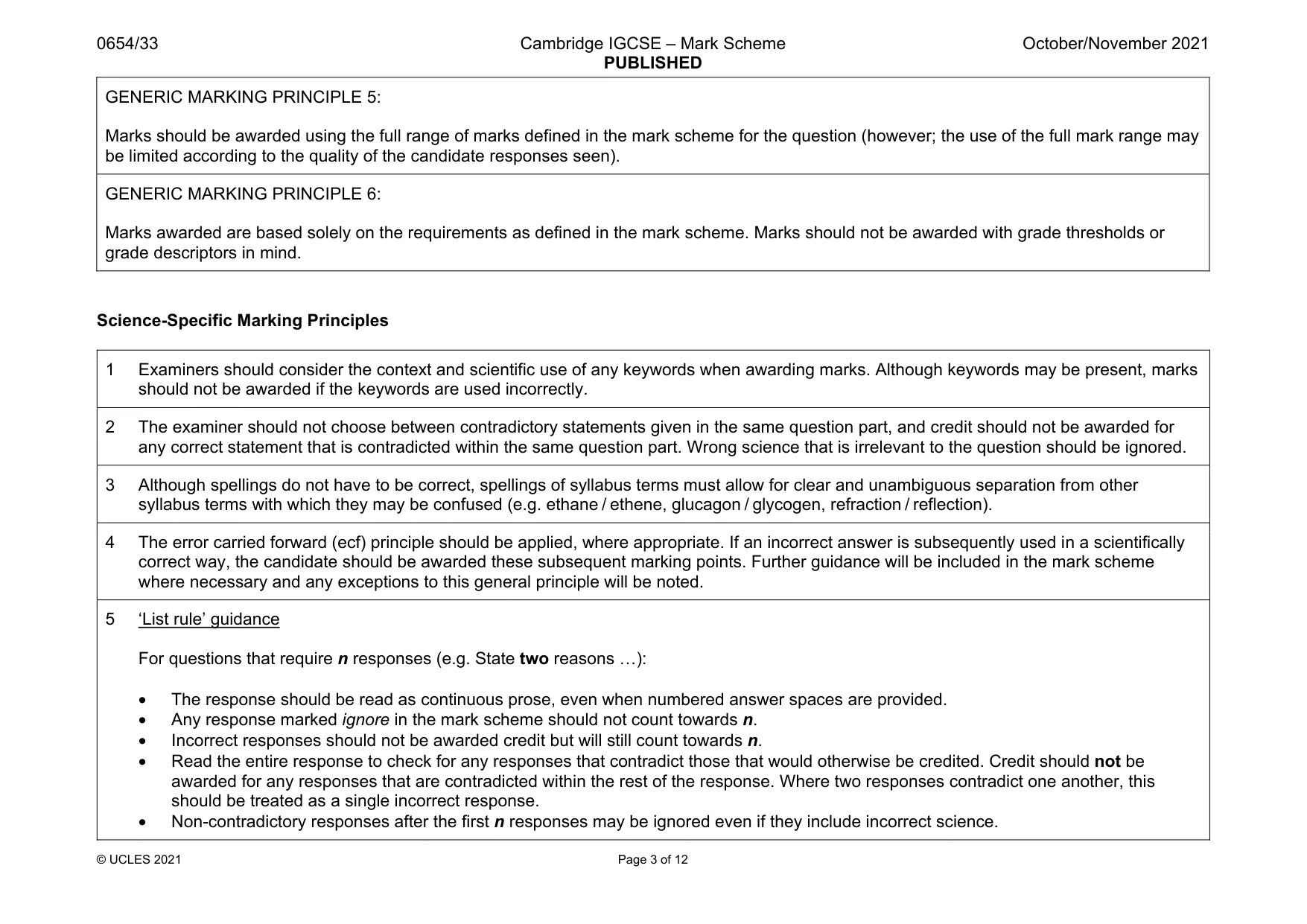
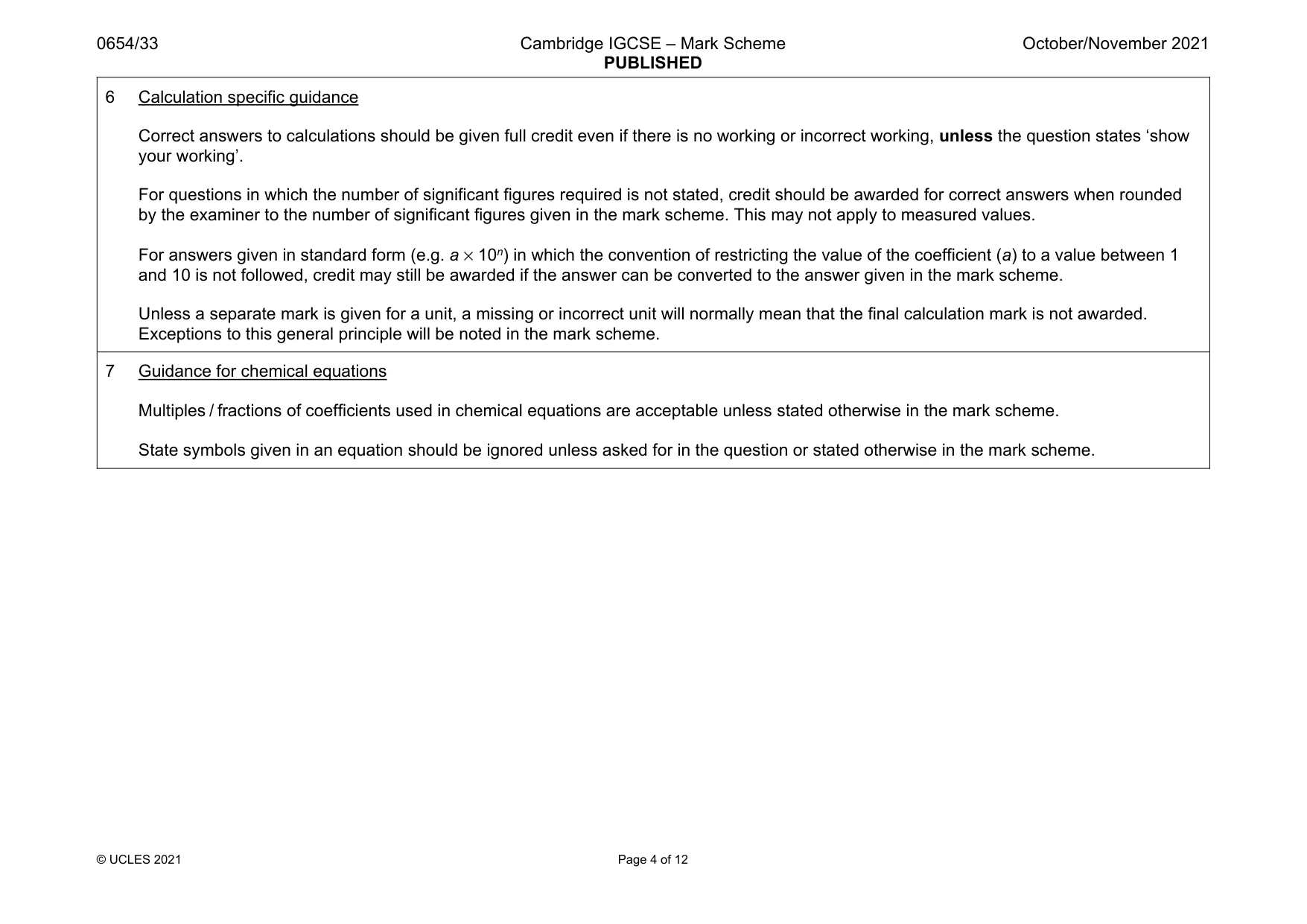
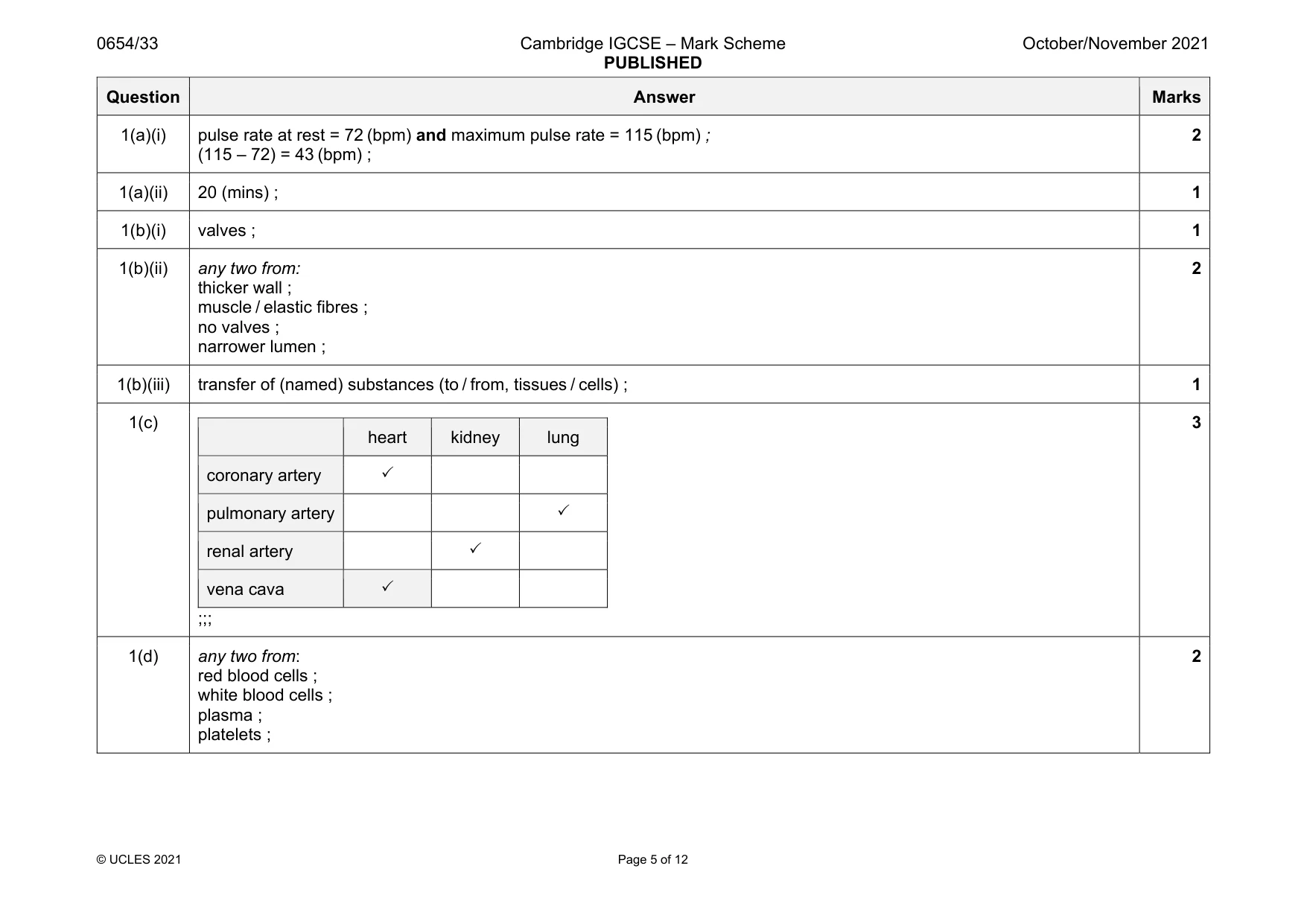
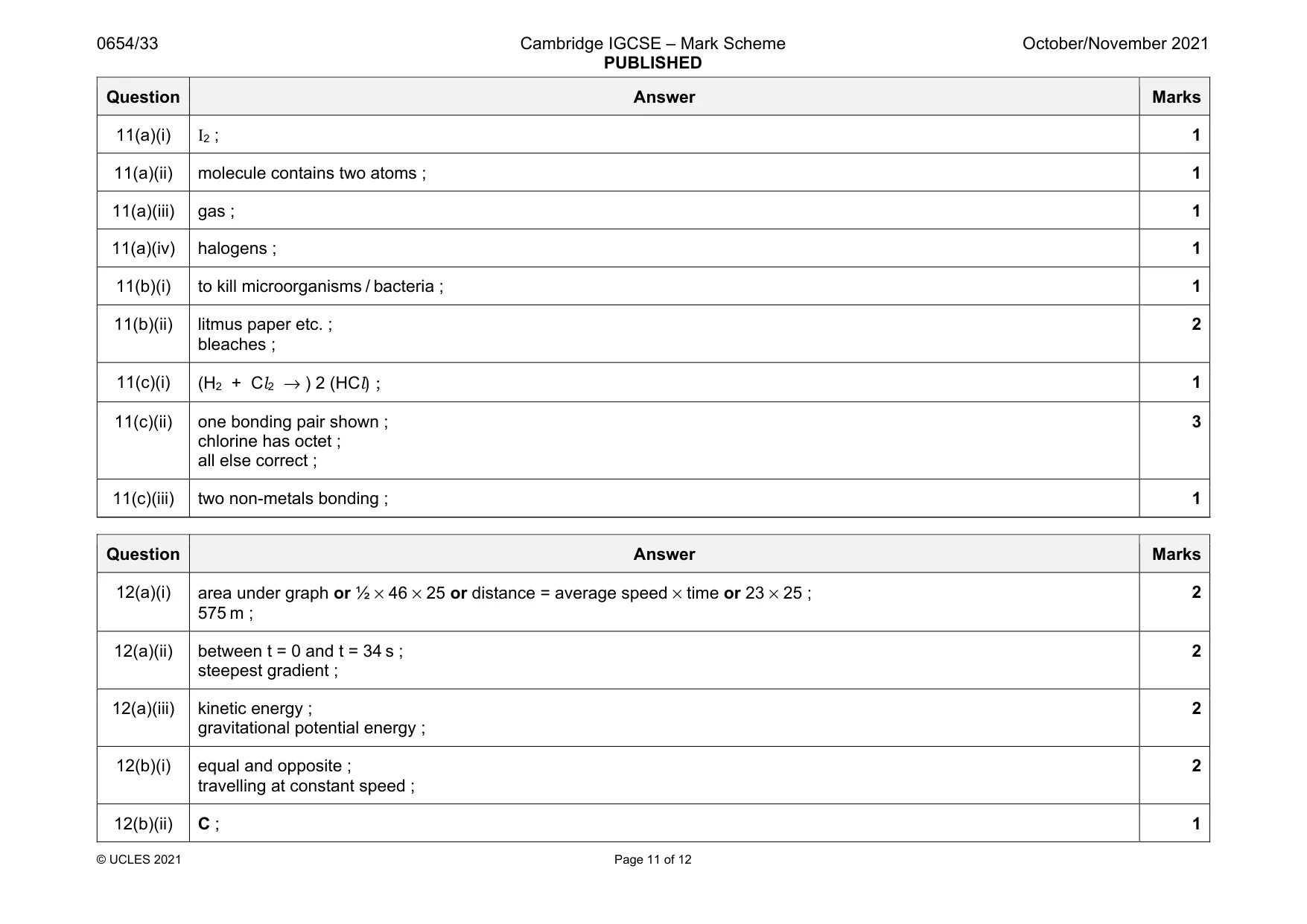
Mark scheme: 1(a)(i) pulse rate at rest = 72 (bpm) and maximum pulse rate = 115 (bpm) ; (115 – 72) = 43 (bpm) ; 2 1(a)(ii) 20 (mins) ; 1 1(b)(i) valves ; 1 1(b)(ii) any two from: thicker wall ; muscle / elastic fibres ; no valves ; narrower lumen ; 2 1(b)(iii) transfer of (named) substances (to / from, tissues / cells) ; 1 1(c) heart kidney lung coronary artery pulmonary artery renal artery vena cava ;;; 3 1(d) any two from: red blood cells ; white blood cells ; plasma ; platelets ; 2
Q2 · The formula of sulfuric acid is H2SO4
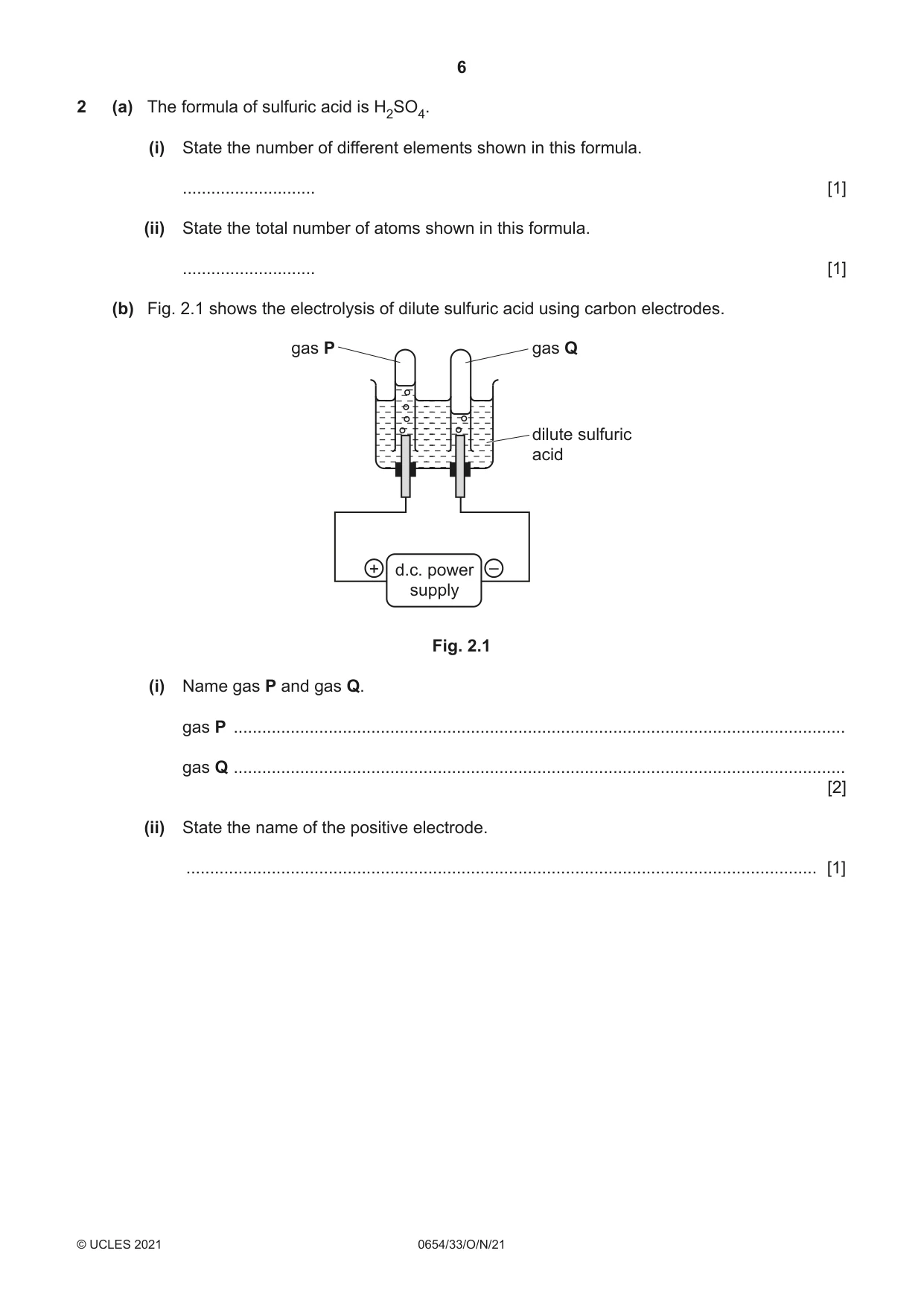
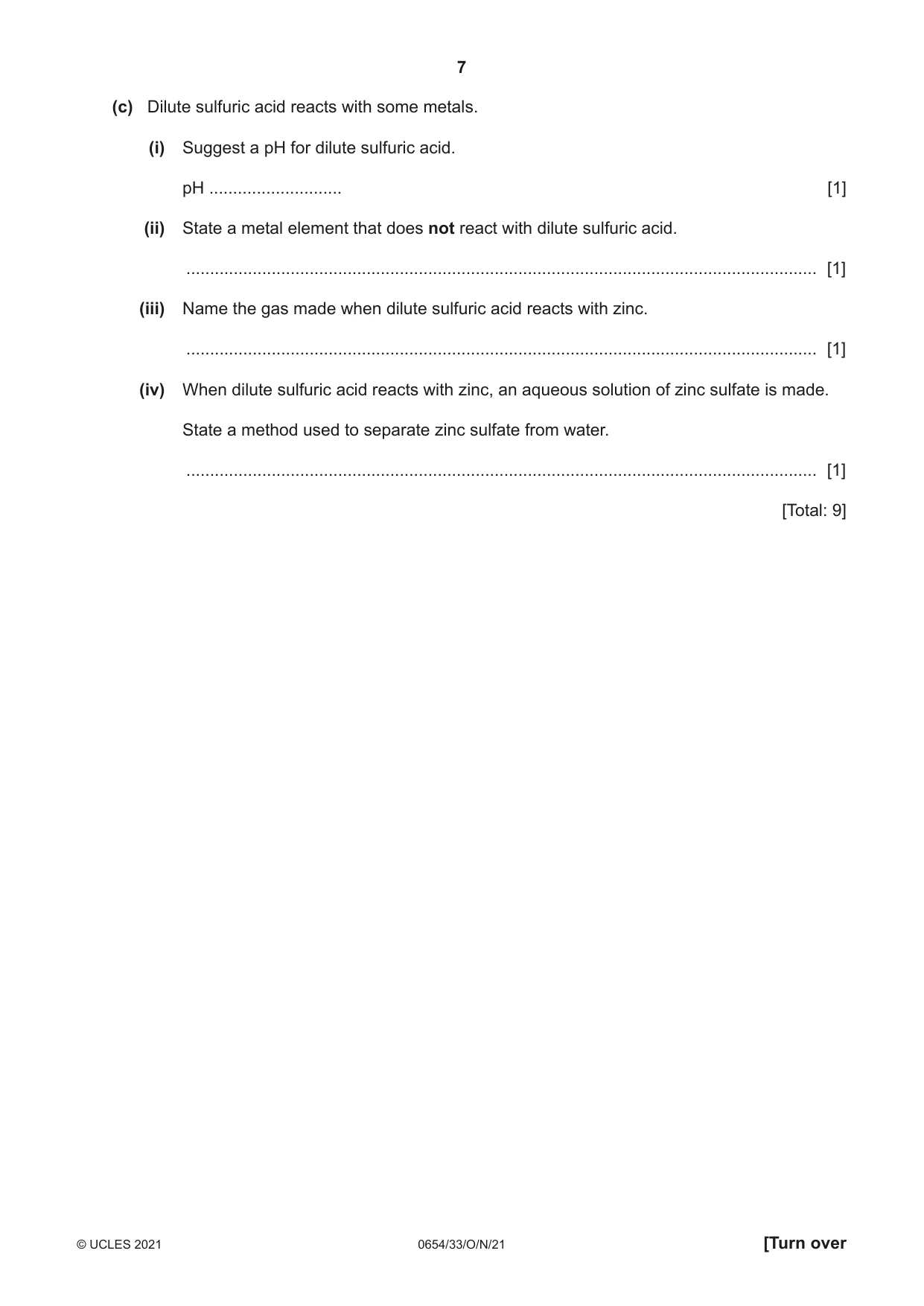
2 (a) The formula of sulfuric acid is H2SO4. (i) State the number of different elements shown in this formula. ............................ [1] (ii) State the total number of atoms shown in this formula. ............................ [1] (b) Fig. 2.1 shows the electrolysis of dilute sulfuric acid using carbon electrodes. gas P gas Q dilute sulfuric acid + d.c. power – supply Fig. 2.1 (i) Name gas P and gas Q. gas P ................................................................................................................................. gas Q ................................................................................................................................. [2] (ii) State the name of the positive electrode. ..................................................................................................................................... [1] (c) Dilute sulfuric acid reacts with some metals. (i) Suggest a pH for dilute sulfuric acid. pH ............................ [1] (ii) State a metal element that does not react with dilute sulfuric acid. ..................................................................................................................................... [1] (iii) Name the gas made when dilute sulfuric acid reacts with zinc. ..................................................................................................................................... [1] (iv) When dilute sulfuric acid reacts with zinc, an aqueous solution of zinc sulfate is made. State a method used to separate zinc sulfate from water. ..................................................................................................................................... [1] [Total: 9]
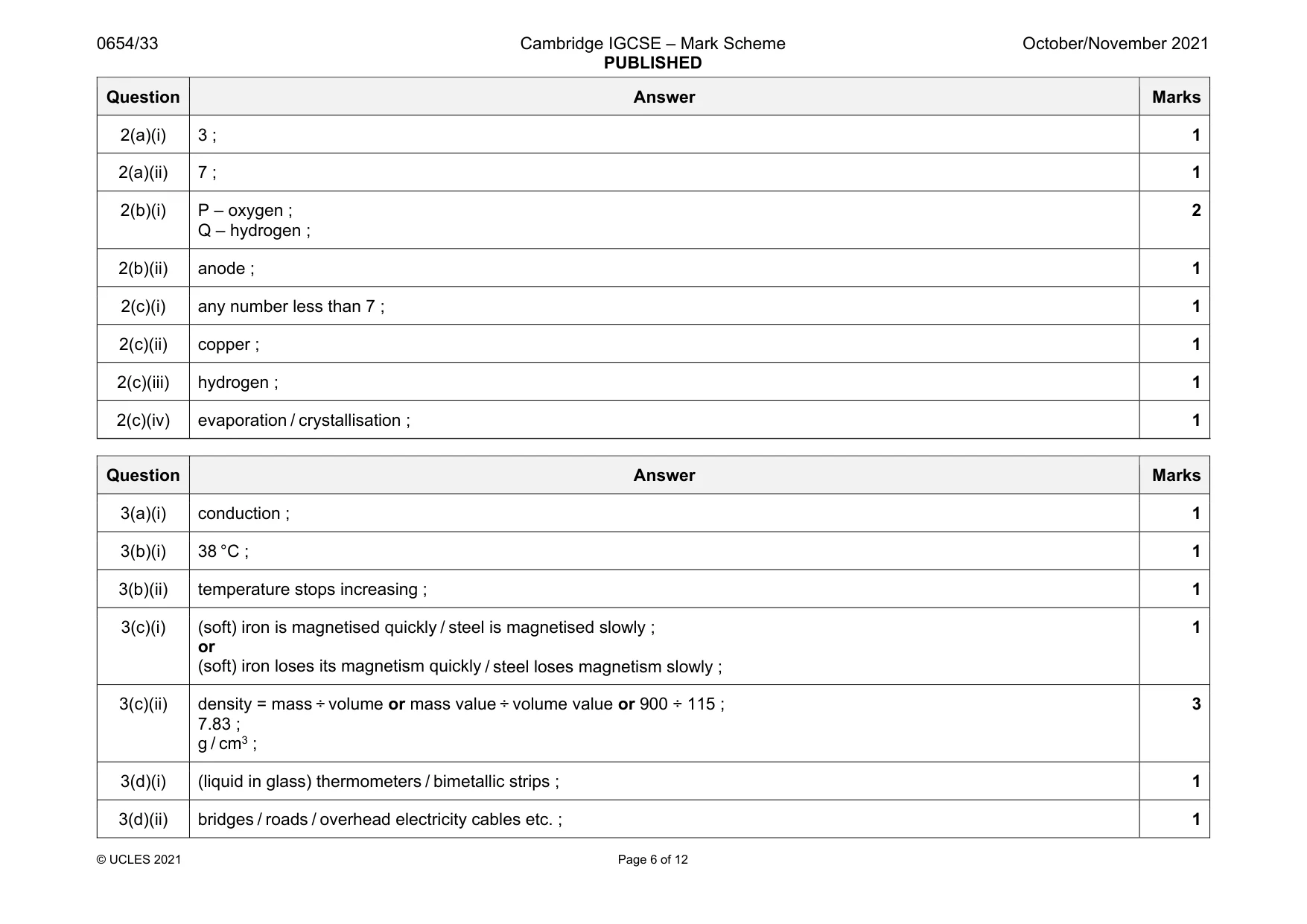
Mark scheme: 2(a)(i) 3 ; 1 2(a)(ii) 7 ; 1 2(b)(i) P – oxygen ; Q – hydrogen ; 2 2(b)(ii) anode ; 1 2(c)(i) any number less than 7 ; 1 2(c)(ii) copper ; 1 2(c)(iii) hydrogen ; 1 2(c)(iv) evaporation / crystallisation ; 1
Q3 · Water in a saucepan on an electric cooker
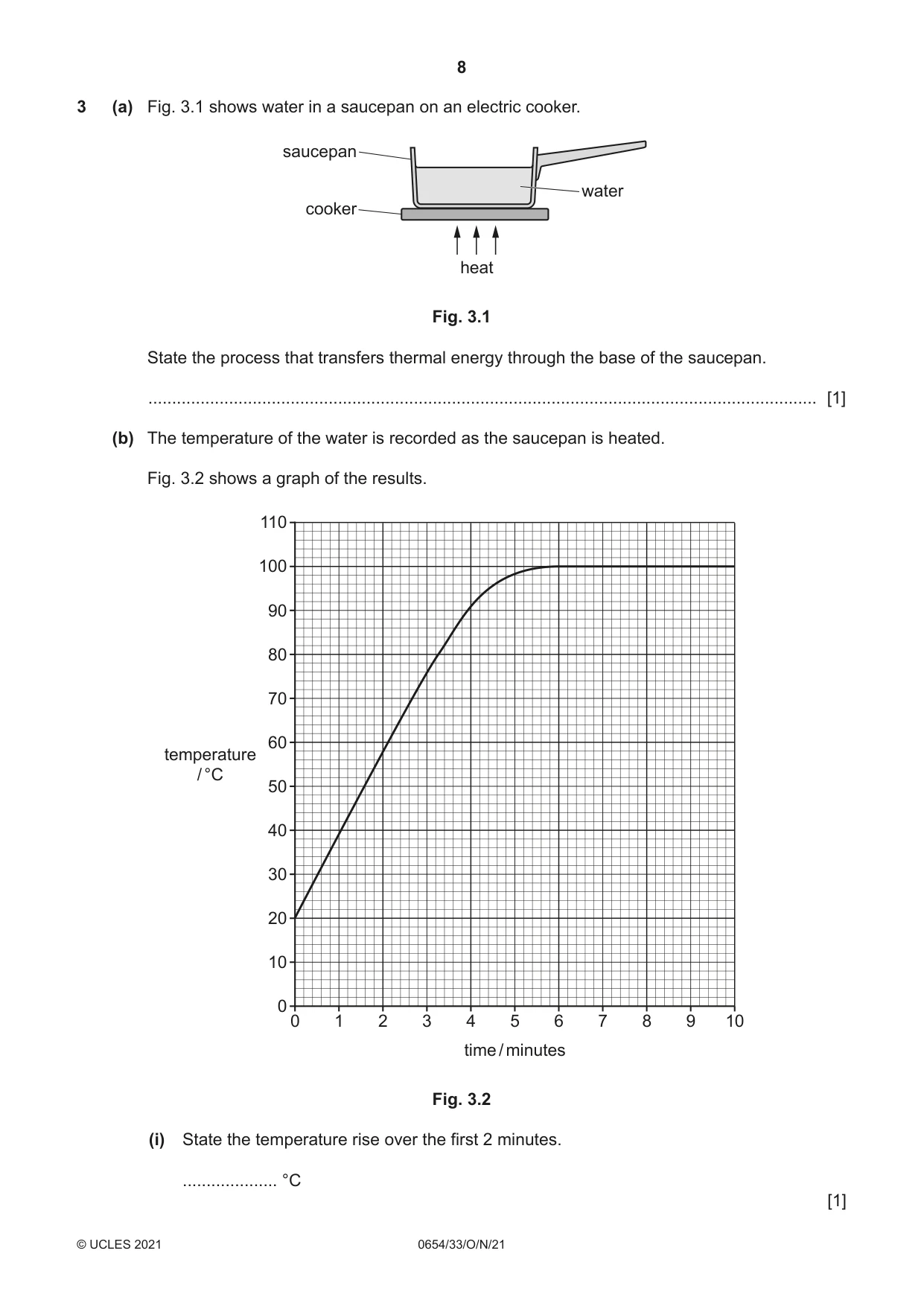
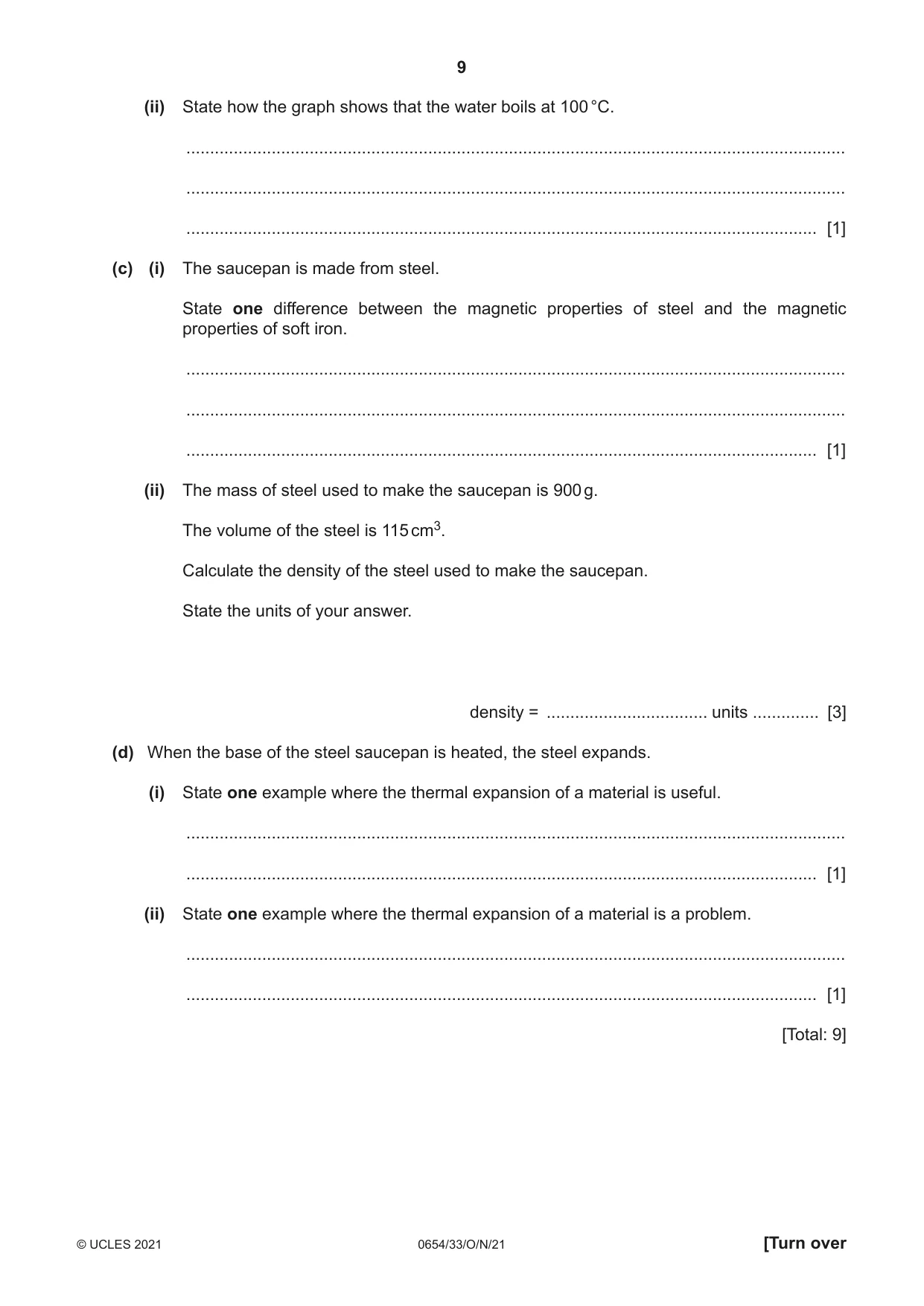
3 (a) Fig. 3.1 shows water in a saucepan on an electric cooker. saucepan water cooker heat Fig. 3.1 State the process that transfers thermal energy through the base of the saucepan. ............................................................................................................................................. [1] (b) The temperature of the water is recorded as the saucepan is heated. Fig. 3.2 shows a graph of the results. 110 100 90 80 70 60 temperature / °C 50 40 30 20 10 0 0 1 2 3 4 5 6 7 8 9 10 time / minutes Fig. 3.2 (i) State the temperature rise over the first 2 minutes. .................... °C [1] (ii) State how the graph shows that the water boils at 100 °C. ........................................................................................................................................... ........................................................................................................................................... ..................................................................................................................................... [1] (c) (i) The saucepan is made from steel. State one difference between the magnetic properties of steel and the magnetic properties of soft iron. ........................................................................................................................................... ........................................................................................................................................... ..................................................................................................................................... [1] (ii) The mass of steel used to make the saucepan is 900 g. The volume of the steel is 115 cm3. Calculate the density of the steel used to make the saucepan. State the units of your answer. density = .................................. units .............. [3] (d) When the base of the steel saucepan is heated, the steel expands. (i) State one example where the thermal expansion of a material is useful. ........................................................................................................................................... ..................................................................................................................................... [1] (ii) State one example where the thermal expansion of a material is a problem. ........................................................................................................................................... ..................................................................................................................................... [1] [Total: 9]
Mark scheme: 3(a)(i) conduction ; 1 3(b)(i) 38 °C ; 1 3(b)(ii) temperature stops increasing ; 1 3(c)(i) (soft) iron is magnetised quickly / steel is magnetised slowly ; or (soft) iron loses its magnetism quickly / steel loses magnetism slowly ; 1 3(c)(ii) density = mass ÷ volume or mass value ÷ volume value or 900 ÷ 115 ; 7.83 ; g / cm3 ; 3 3(d)(i) (liquid in glass) thermometers / bimetallic strips ; 1 3(d)(ii) bridges / roads / overhead electricity cables etc. ; 1
Q4 · Part of a desert food web
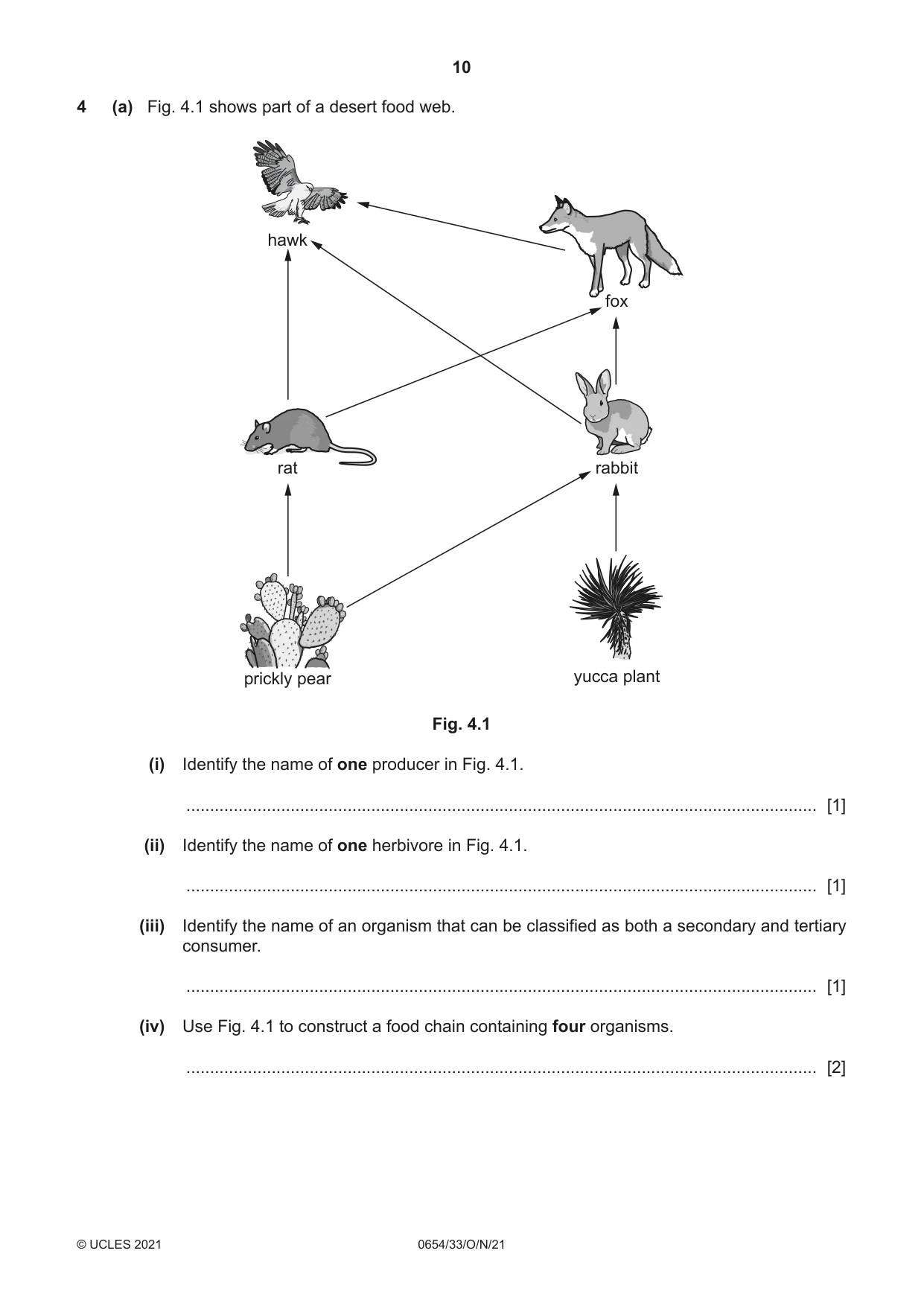
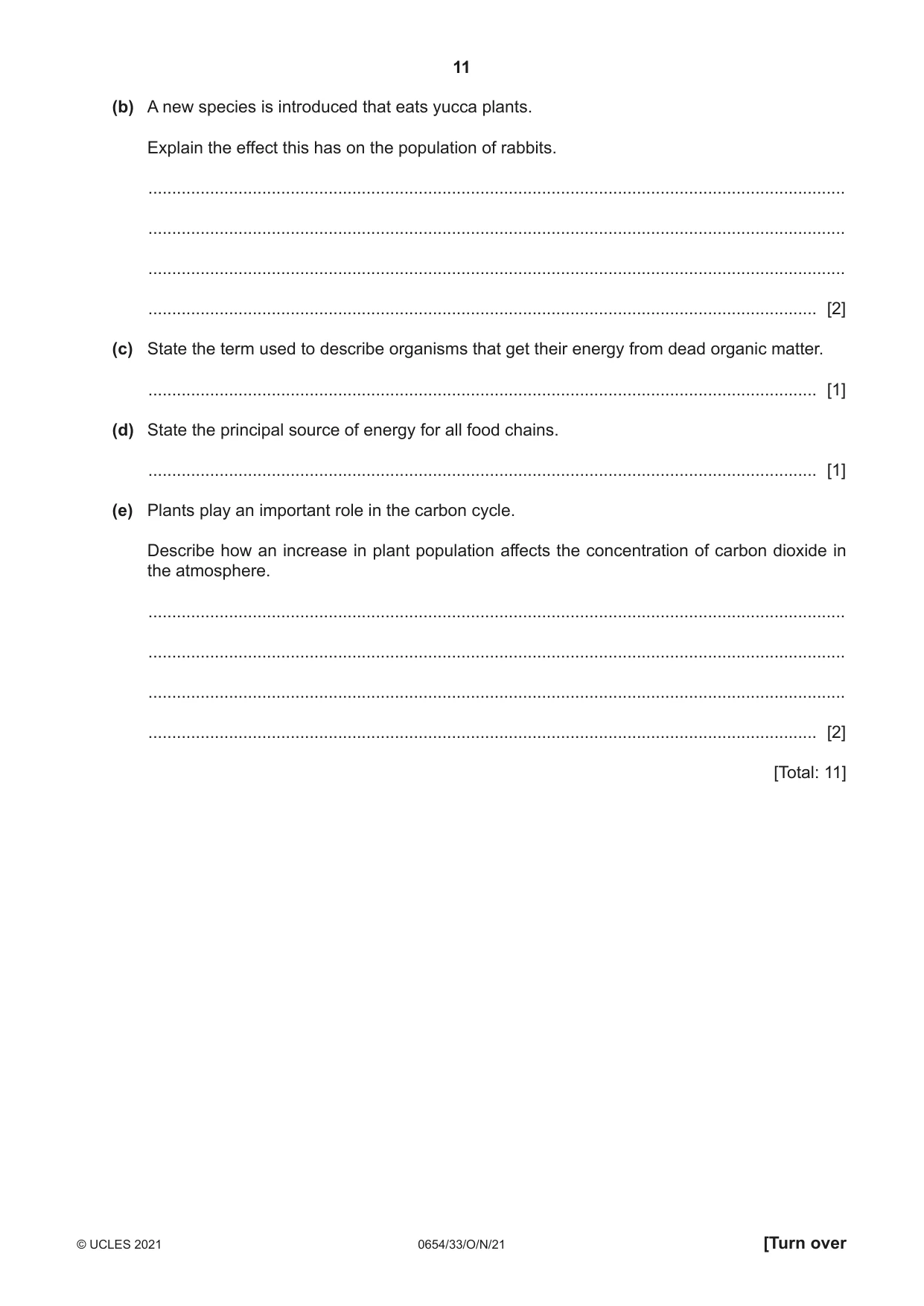
4 (a) Fig. 4.1 shows part of a desert food web. hawk fox rat rabbit prickly pear yucca plant Fig. 4.1 (i) Identify the name of one producer in Fig. 4.1. ..................................................................................................................................... [1] (ii) Identify the name of one herbivore in Fig. 4.1. ..................................................................................................................................... [1] (iii) Identify the name of an organism that can be classified as both a secondary and tertiary consumer. ..................................................................................................................................... [1] (iv) Use Fig. 4.1 to construct a food chain containing four organisms. ..................................................................................................................................... [2] (b) A new species is introduced that eats yucca plants. Explain the effect this has on the population of rabbits. ................................................................................................................................................... ................................................................................................................................................... ................................................................................................................................................... ............................................................................................................................................. [2] (c) State the term used to describe organisms that get their energy from dead organic matter. ............................................................................................................................................. [1] (d) State the principal source of energy for all food chains. ............................................................................................................................................. [1] (e) Plants play an important role in the carbon cycle. Describe how an increase in plant population affects the concentration of carbon dioxide in the atmosphere. ................................................................................................................................................... ................................................................................................................................................... ................................................................................................................................................... ............................................................................................................................................. [2] [Total: 11]
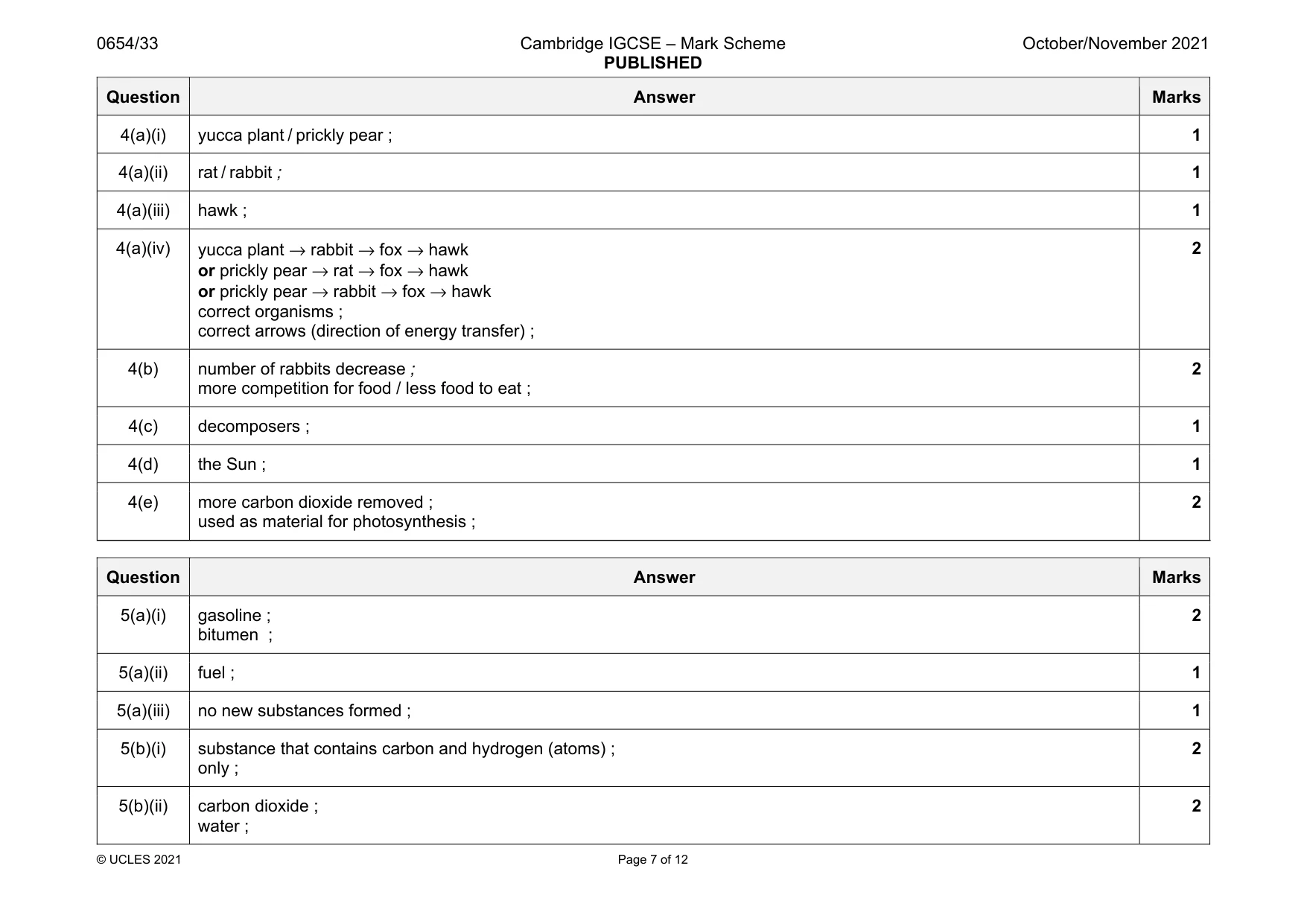
Mark scheme: 4(a)(i) yucca plant / prickly pear ; 1 4(a)(ii) rat / rabbit ; 1 4(a)(iii) hawk ; 1 4(a)(iv) yucca plant → rabbit → fox → hawk or prickly pear → rat → fox → hawk or prickly pear → rabbit → fox → hawk correct organisms ; correct arrows (direction of energy transfer) ; 2 4(b) number of rabbits decrease ; more competition for food / less food to eat ; 2 4(c) decomposers ; 1 4(d) the Sun ; 1 4(e) more carbon dioxide removed ; used as material for photosynthesis ; 2
Q5 · Petroleum is separated into useful fractions by fractional distillation
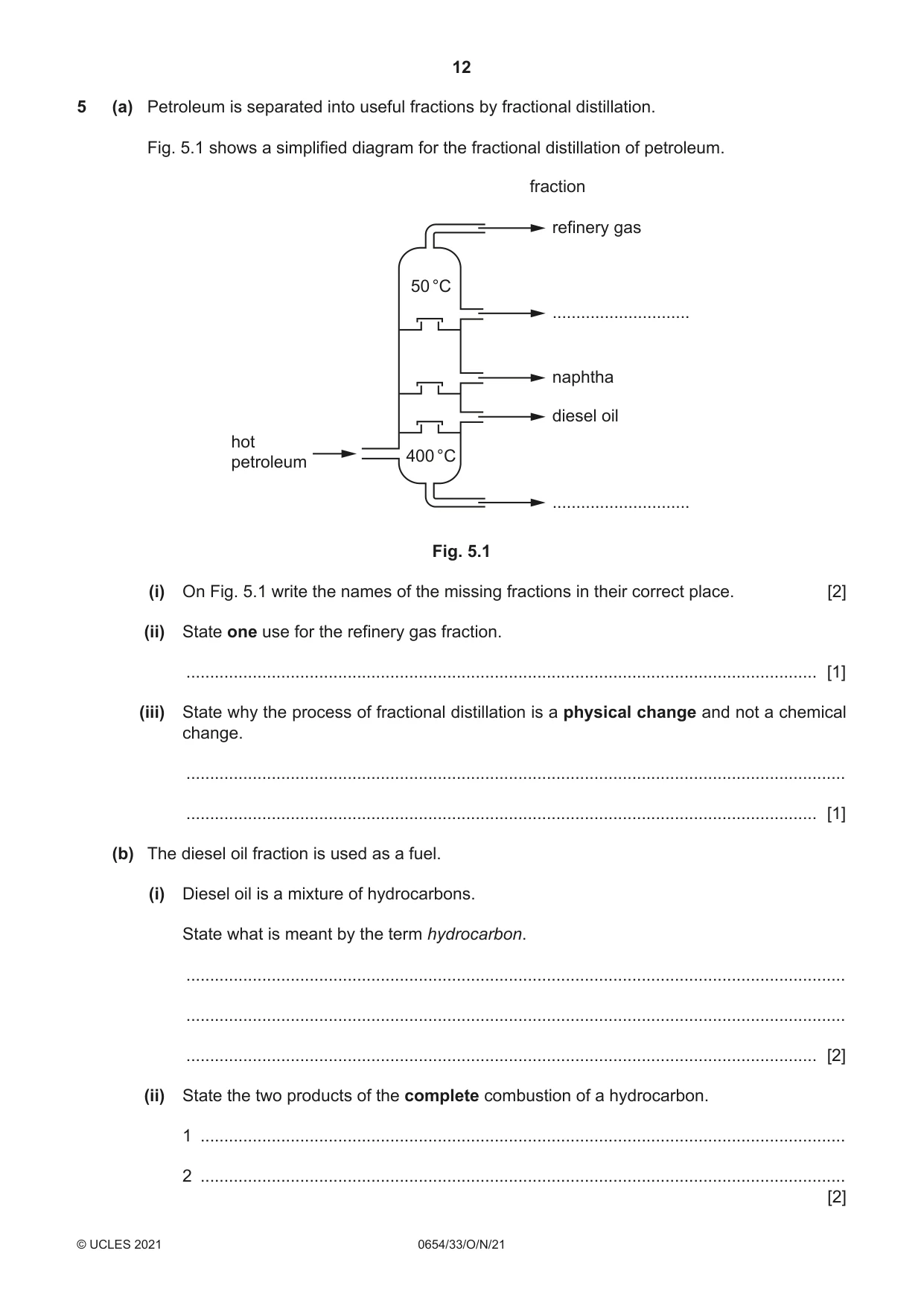
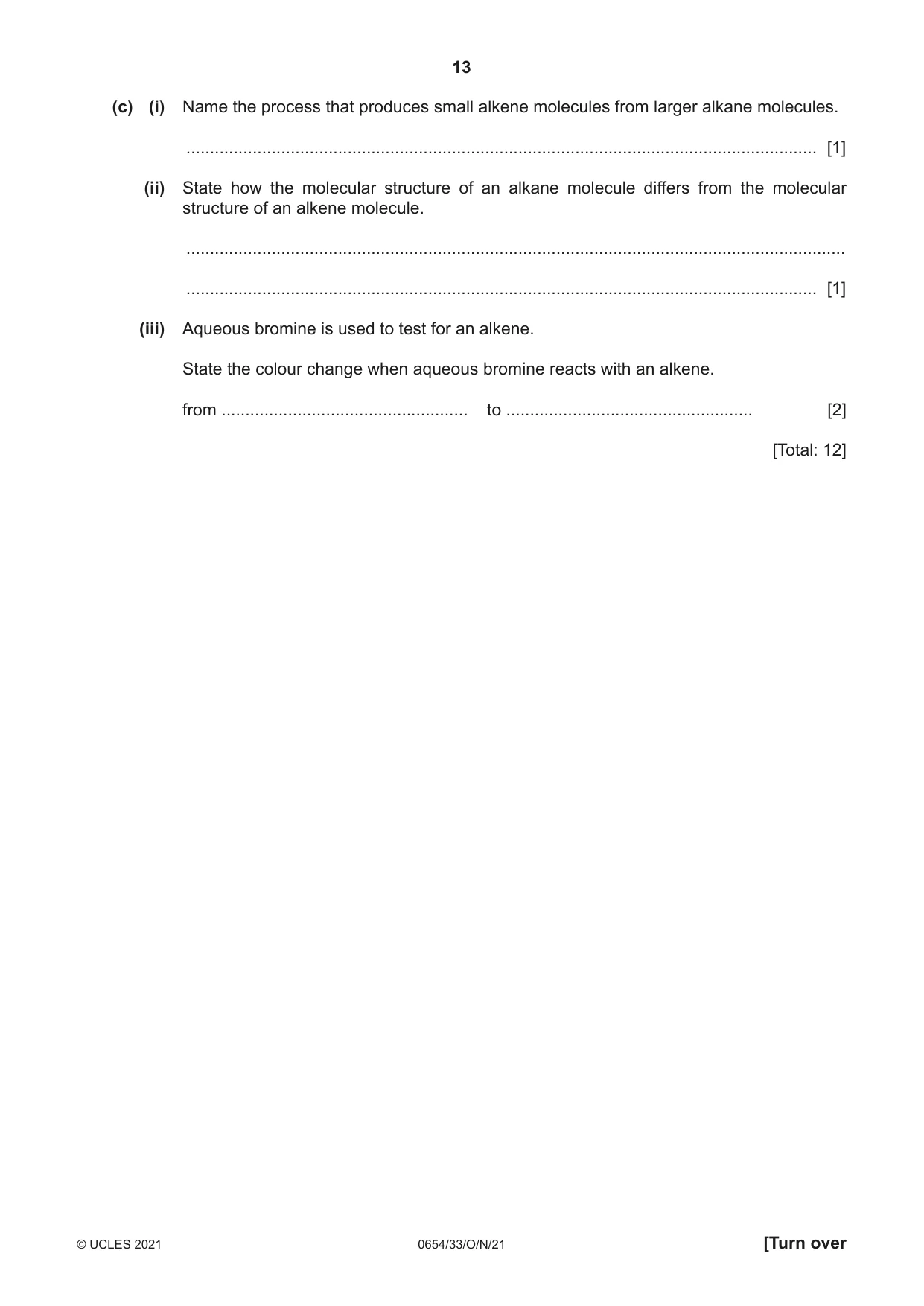
5 (a) Petroleum is separated into useful fractions by fractional distillation. Fig. 5.1 shows a simplified diagram for the fractional distillation of petroleum. fraction refinery gas 50 °C ............................. naphtha diesel oil hot 400 °C petroleum ............................. Fig. 5.1 (i) On Fig. 5.1 write the names of the missing fractions in their correct place. [2] (ii) State one use for the refinery gas fraction. ..................................................................................................................................... [1] (iii) State why the process of fractional distillation is a physical change and not a chemical change. ........................................................................................................................................... ..................................................................................................................................... [1] (b) The diesel oil fraction is used as a fuel. (i) Diesel oil is a mixture of hydrocarbons. State what is meant by the term hydrocarbon. ........................................................................................................................................... ........................................................................................................................................... ..................................................................................................................................... [2] (ii) State the two products of the complete combustion of a hydrocarbon. 1 ........................................................................................................................................ 2 ........................................................................................................................................ [2] (c) (i) Name the process that produces small alkene molecules from larger alkane molecules. ..................................................................................................................................... [1] (ii) State how the molecular structure of an alkane molecule differs from the molecular structure of an alkene molecule. ........................................................................................................................................... ..................................................................................................................................... [1] (iii) Aqueous bromine is used to test for an alkene. State the colour change when aqueous bromine reacts with an alkene. from .................................................... to .................................................... [2] [Total: 12]
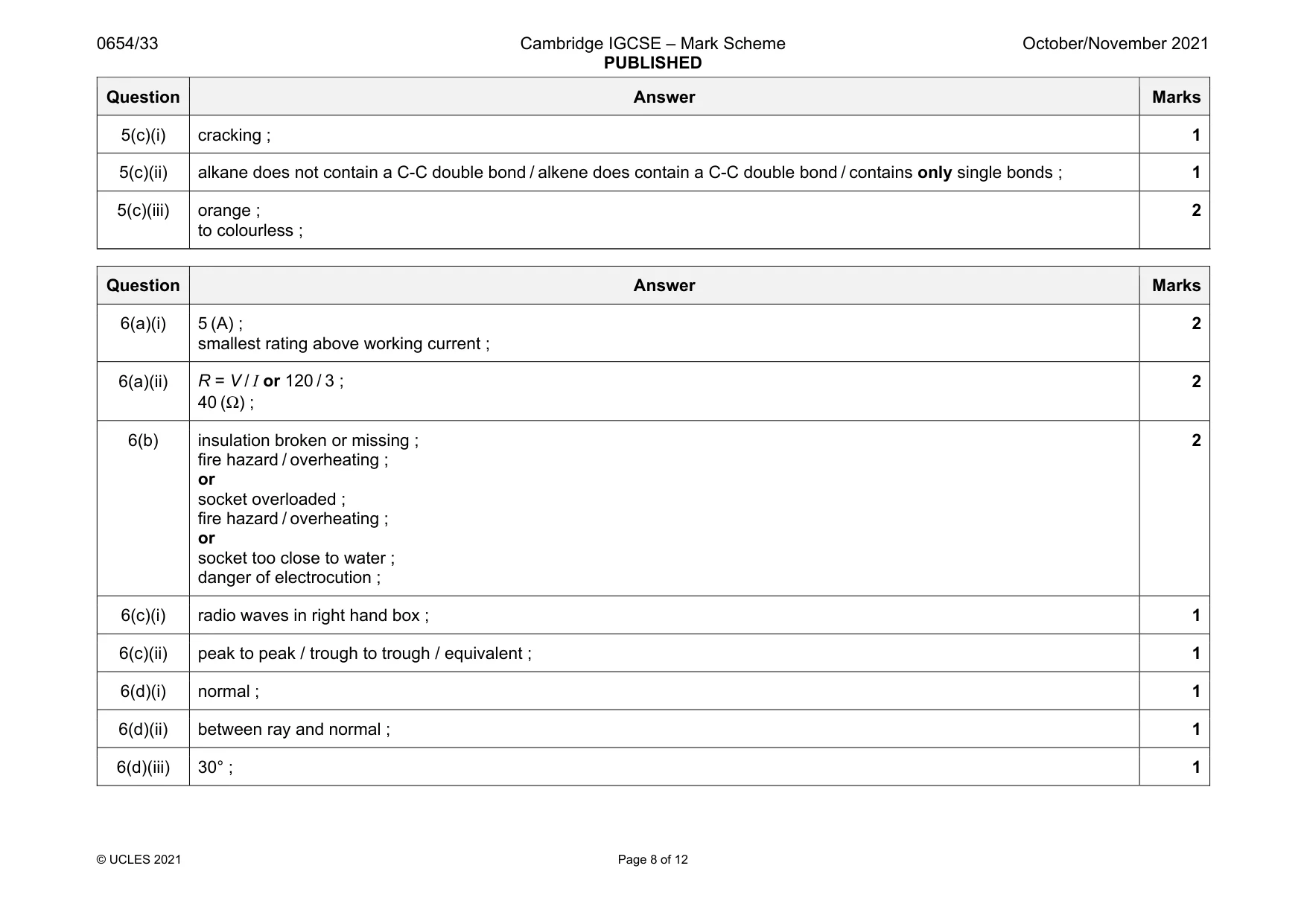
Mark scheme: 5(a)(i) gasoline ; bitumen ; 2 5(a)(ii) fuel ; 1 5(a)(iii) no new substances formed ; 1 5(b)(i) substance that contains carbon and hydrogen (atoms) ; only ; 2 5(b)(ii) carbon dioxide ; water ; 2 Question Answer Marks 5(c)(i) cracking ; 1 5(c)(ii) alkane does not contain a C-C double bond / alkene does contain a C-C double bond / contains only single bonds ; 1 5(c)(iii) orange ; to colourless ; 2
Q6 · The total current supplied to a television when in use is 3 A
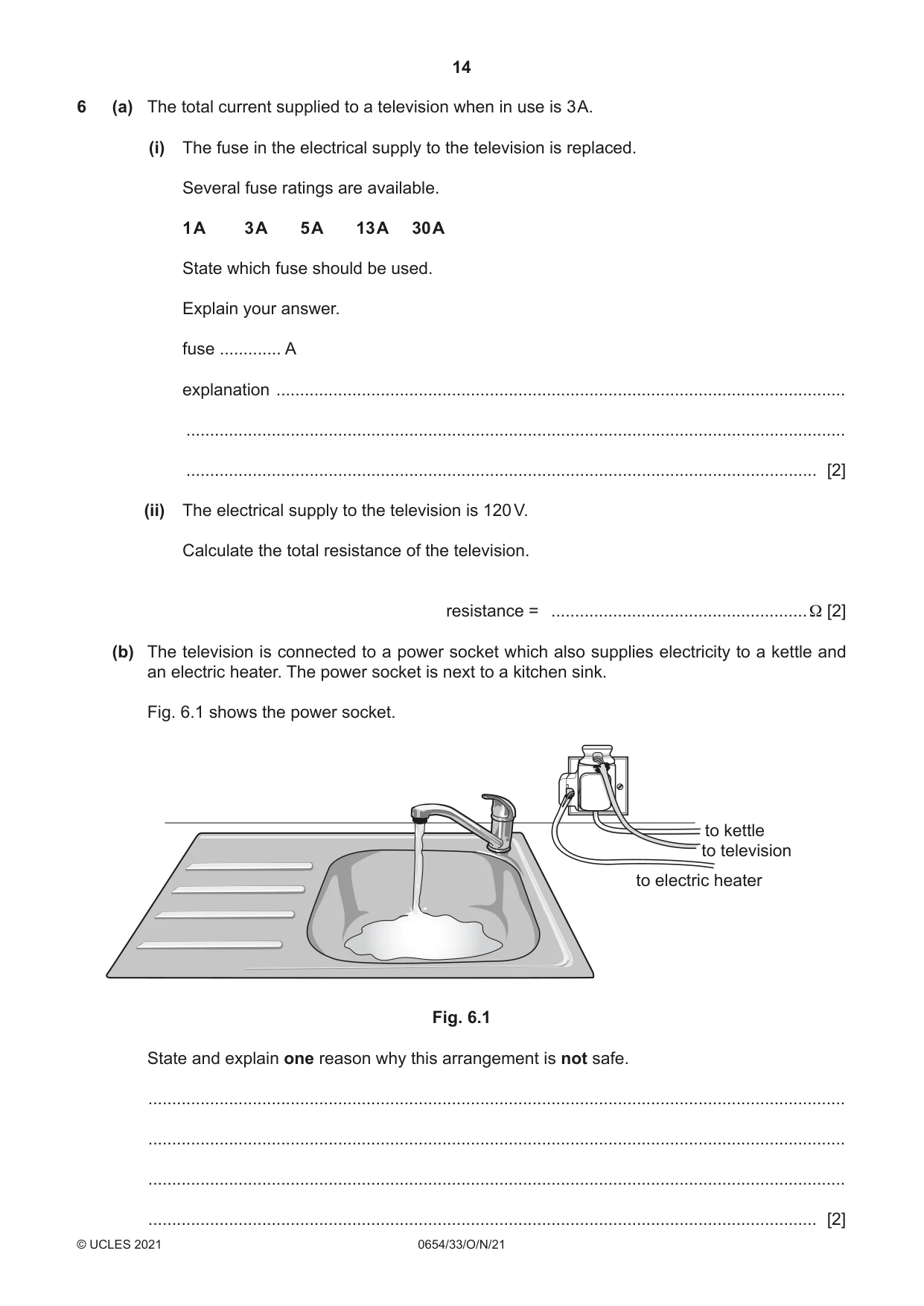
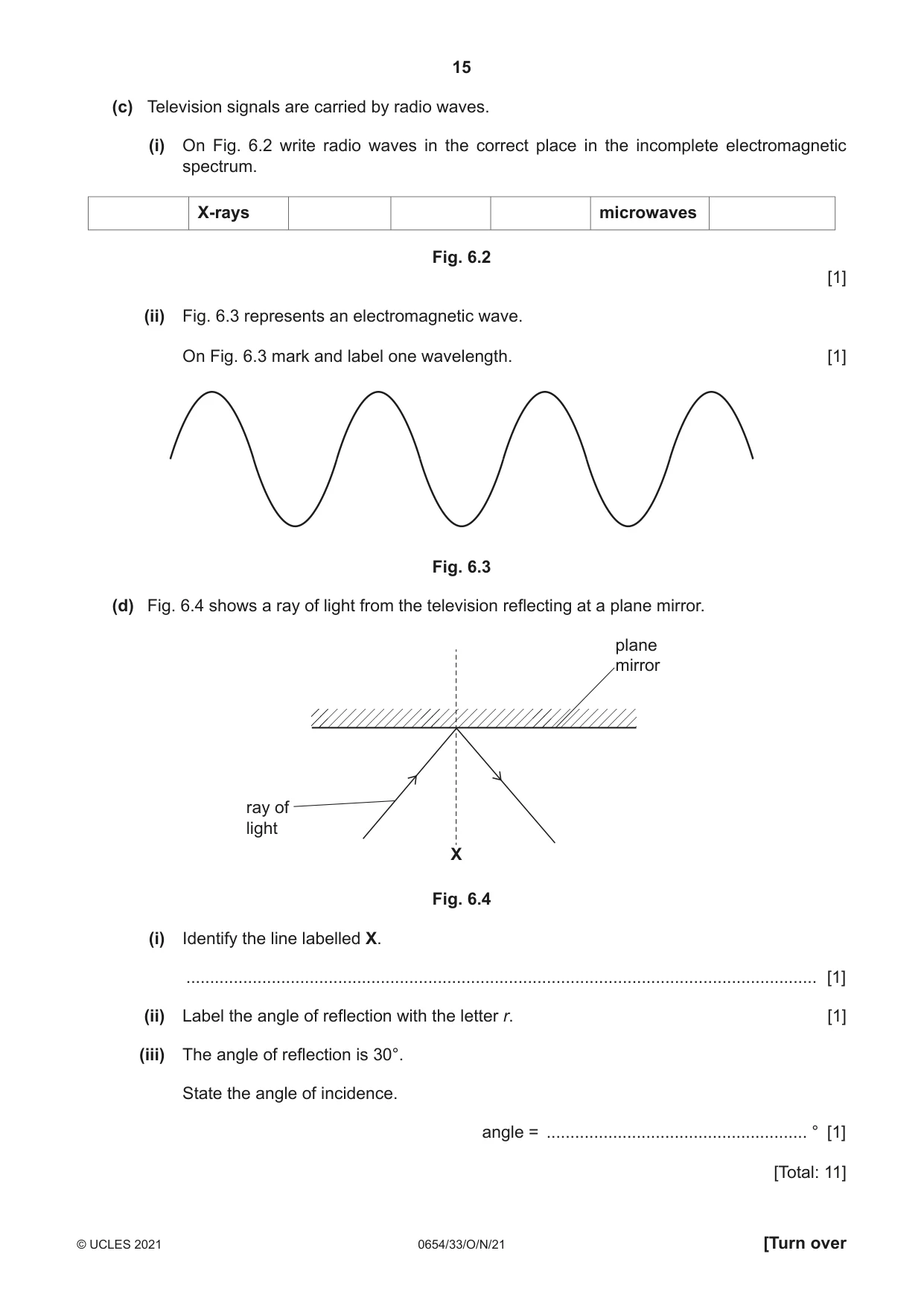
6 (a) The total current supplied to a television when in use is 3 A. (i) The fuse in the electrical supply to the television is replaced. Several fuse ratings are available. 1 A 3 A 5 A 13 A 30 A State which fuse should be used. Explain your answer. fuse ............. A explanation ........................................................................................................................ ........................................................................................................................................... ..................................................................................................................................... [2] (ii) The electrical supply to the television is 120 V. Calculate the total resistance of the television. resistance = ......................................................Ω [2] (b) The television is connected to a power socket which also supplies electricity to a kettle and an electric heater. The power socket is next to a kitchen sink. Fig. 6.1 shows the power socket. to kettle to television to electric heater Fig. 6.1 State and explain one reason why this arrangement is not safe. ................................................................................................................................................... ................................................................................................................................................... ................................................................................................................................................... ............................................................................................................................................. [2] (c) Television signals are carried by radio waves. (i) On Fig. 6.2 write radio waves in the correct place in the incomplete electromagnetic spectrum. X-rays microwaves Fig. 6.2 [1] (ii) Fig. 6.3 represents an electromagnetic wave. On Fig. 6.3 mark and label one wavelength. [1] Fig. 6.3 (d) Fig. 6.4 shows a ray of light from the television reflecting at a plane mirror. plane mirror ray of light X Fig. 6.4 (i) Identify the line labelled X. ..................................................................................................................................... [1] (ii) Label the angle of reflection with the letter r. [1] (iii) The angle of reflection is 30°. State the angle of incidence. angle = ....................................................... ° [1] [Total: 11]
Mark scheme: 6(a)(i) 5 (A) ; smallest rating above working current ; 2 6(a)(ii) R = V / I or 120 / 3 ; 40 (Ω) ; 2 6(b) insulation broken or missing ; fire hazard / overheating ; or socket overloaded ; fire hazard / overheating ; or socket too close to water ; danger of electrocution ; 2 6(c)(i) radio waves in right hand box ; 1 6(c)(ii) peak to peak / trough to trough / equivalent ; 1 6(d)(i) normal ; 1 6(d)(ii) between ray and normal ; 1 6(d)(iii) 30° ; 1
Q7 · A student puts potato cubes in sugar solutions of different concentrations
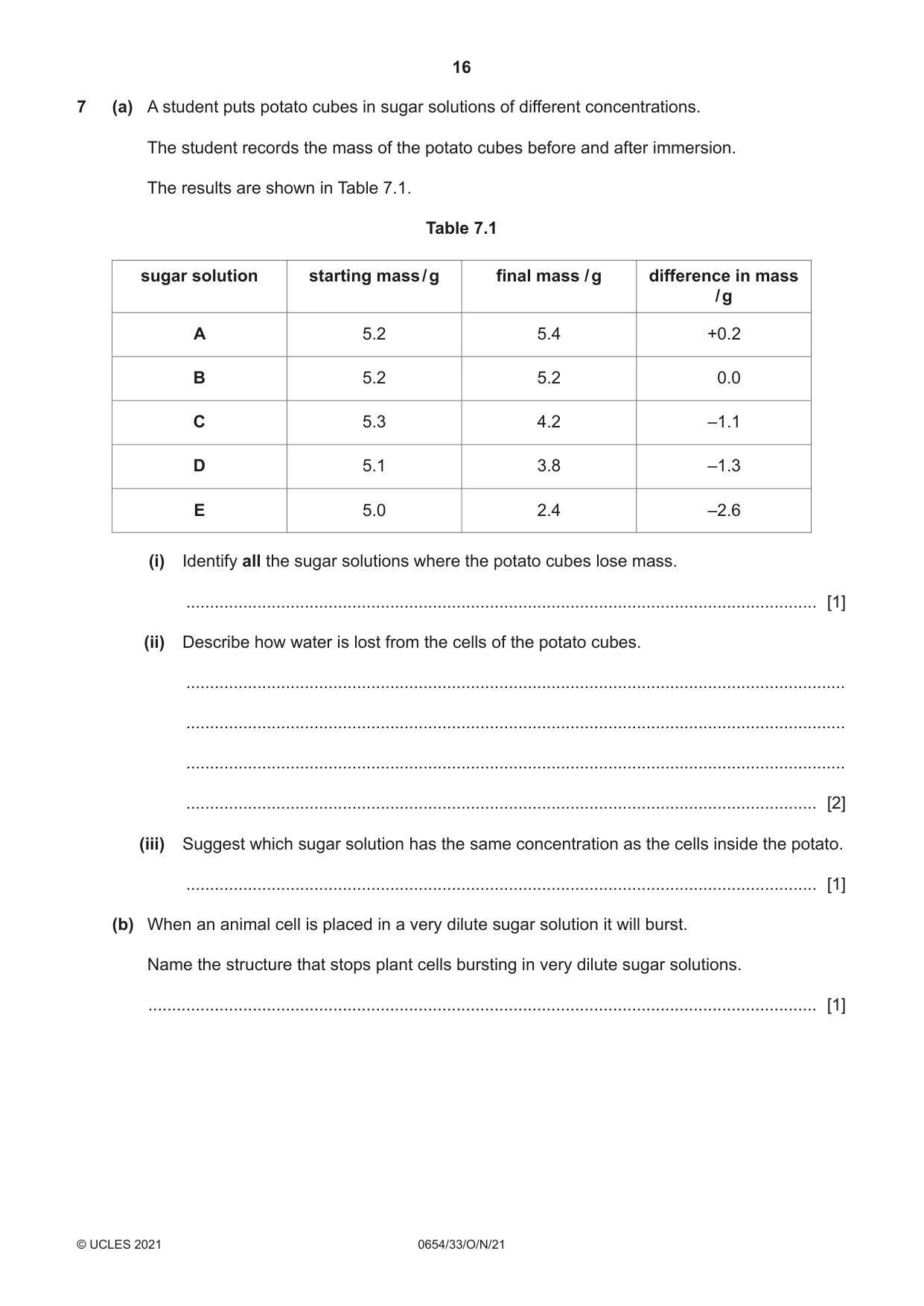
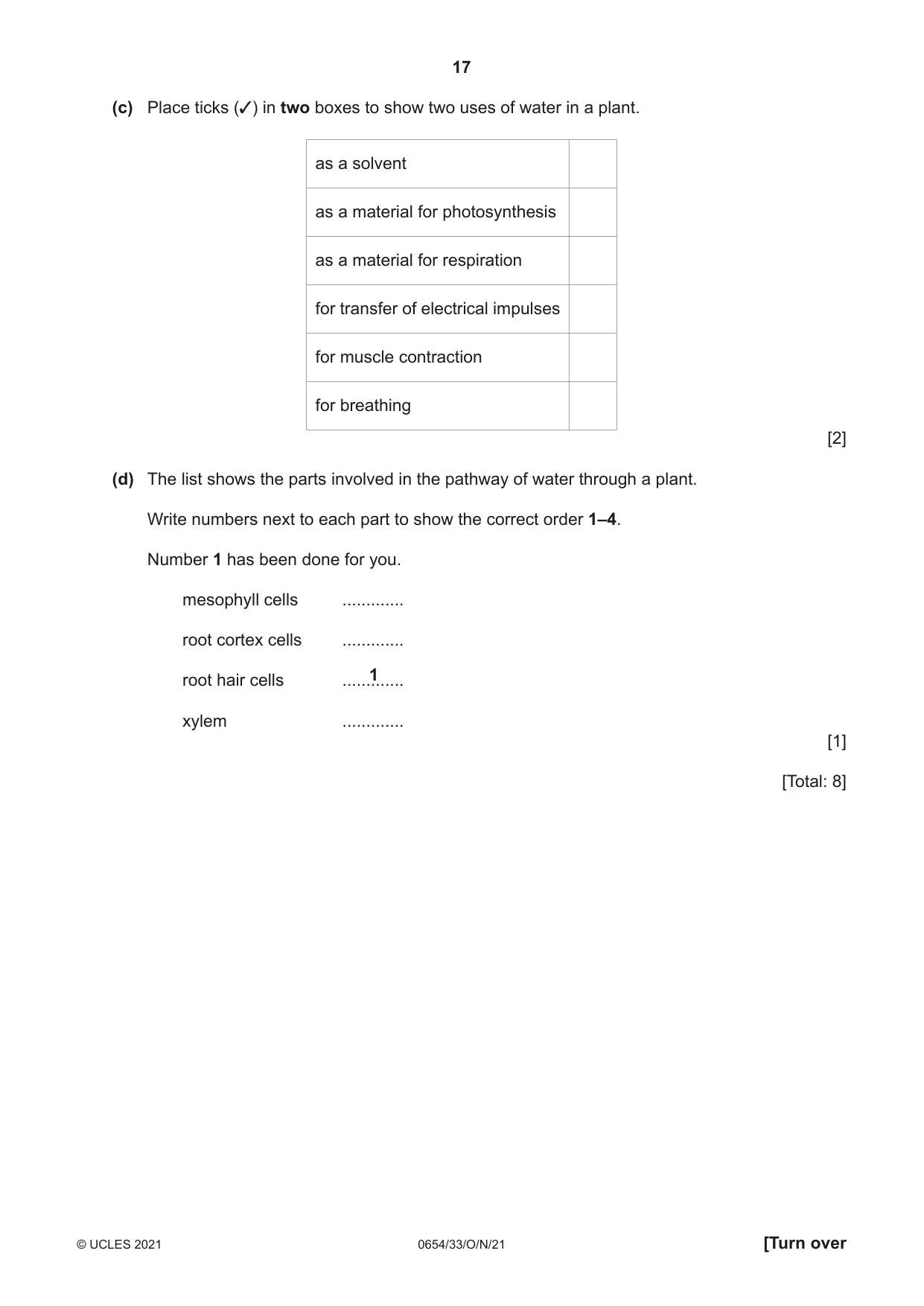
7 (a) A student puts potato cubes in sugar solutions of different concentrations. The student records the mass of the potato cubes before and after immersion. The results are shown in Table 7.1. Table 7.1 sugar solution starting mass / g final mass / g difference in mass / g A 5.2 5.4 +0.2 B 5.2 5.2 0.0 C 5.3 4.2 –1.1 D 5.1 3.8 –1.3 E 5.0 2.4 –2.6 (i) Identify all the sugar solutions where the potato cubes lose mass. ..................................................................................................................................... [1] (ii) Describe how water is lost from the cells of the potato cubes. ........................................................................................................................................... ........................................................................................................................................... ........................................................................................................................................... ..................................................................................................................................... [2] (iii) Suggest which sugar solution has the same concentration as the cells inside the potato. ..................................................................................................................................... [1] (b) When an animal cell is placed in a very dilute sugar solution it will burst. Name the structure that stops plant cells bursting in very dilute sugar solutions. ............................................................................................................................................. [1] (c) Place ticks (3) in two boxes to show two uses of water in a plant. as a solvent as a material for photosynthesis as a material for respiration for transfer of electrical impulses for muscle contraction for breathing [2] (d) The list shows the parts involved in the pathway of water through a plant. Write numbers next to each part to show the correct order 1–4. Number 1 has been done for you. mesophyll cells ............. root cortex cells ............. root hair cells .............1 xylem ............. [1] [Total: 8]
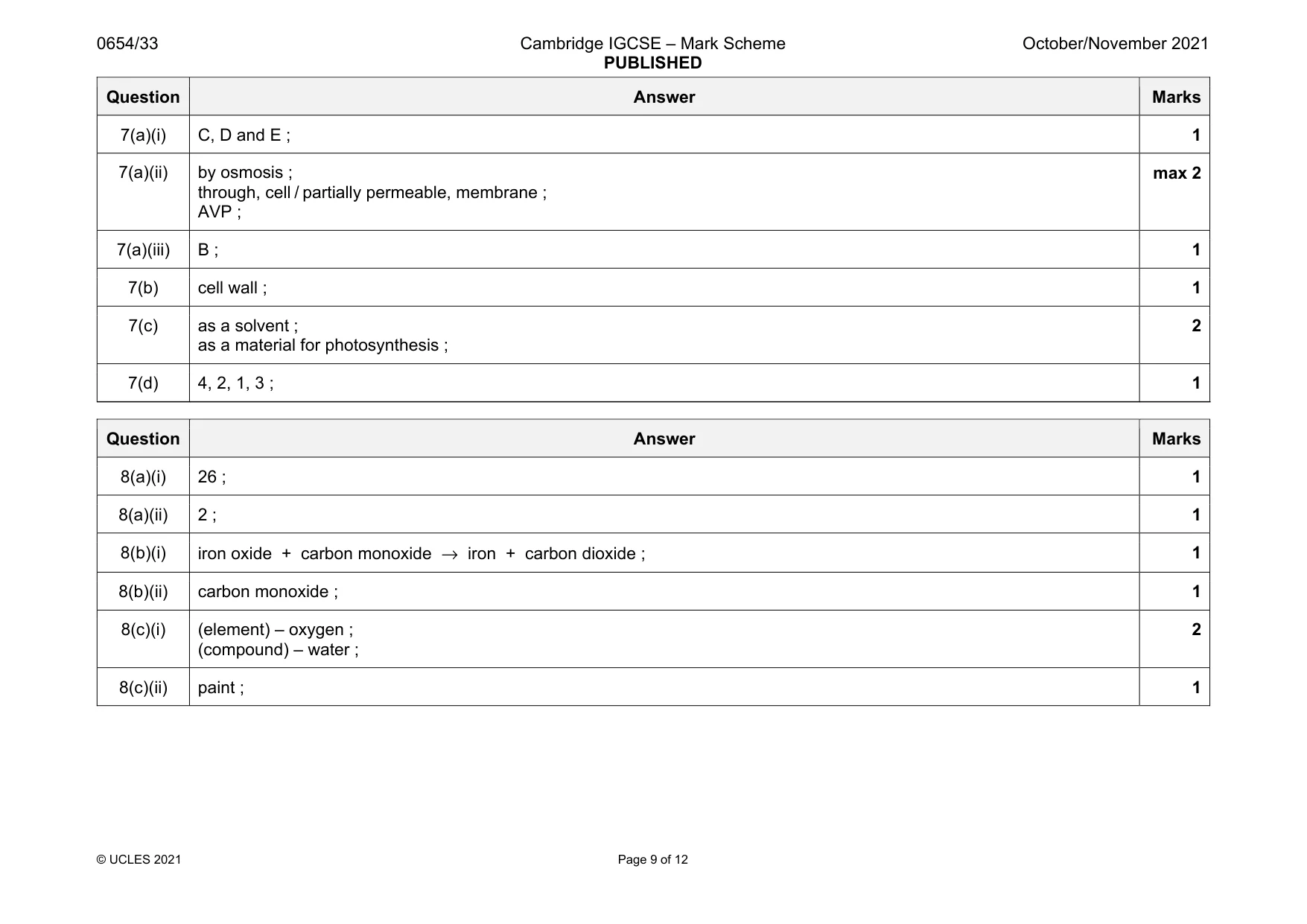
Mark scheme: 7(a)(i) C, D and E ; 1 7(a)(ii) by osmosis ; through, cell / partially permeable, membrane ; AVP ; max 2 7(a)(iii) B ; 1 7(b) cell wall ; 1 7(c) as a solvent ; as a material for photosynthesis ; 2 7(d) 4, 2, 1, 3 ; 1
Q8 · Two isotopes of iron are iron-54 and iron-56
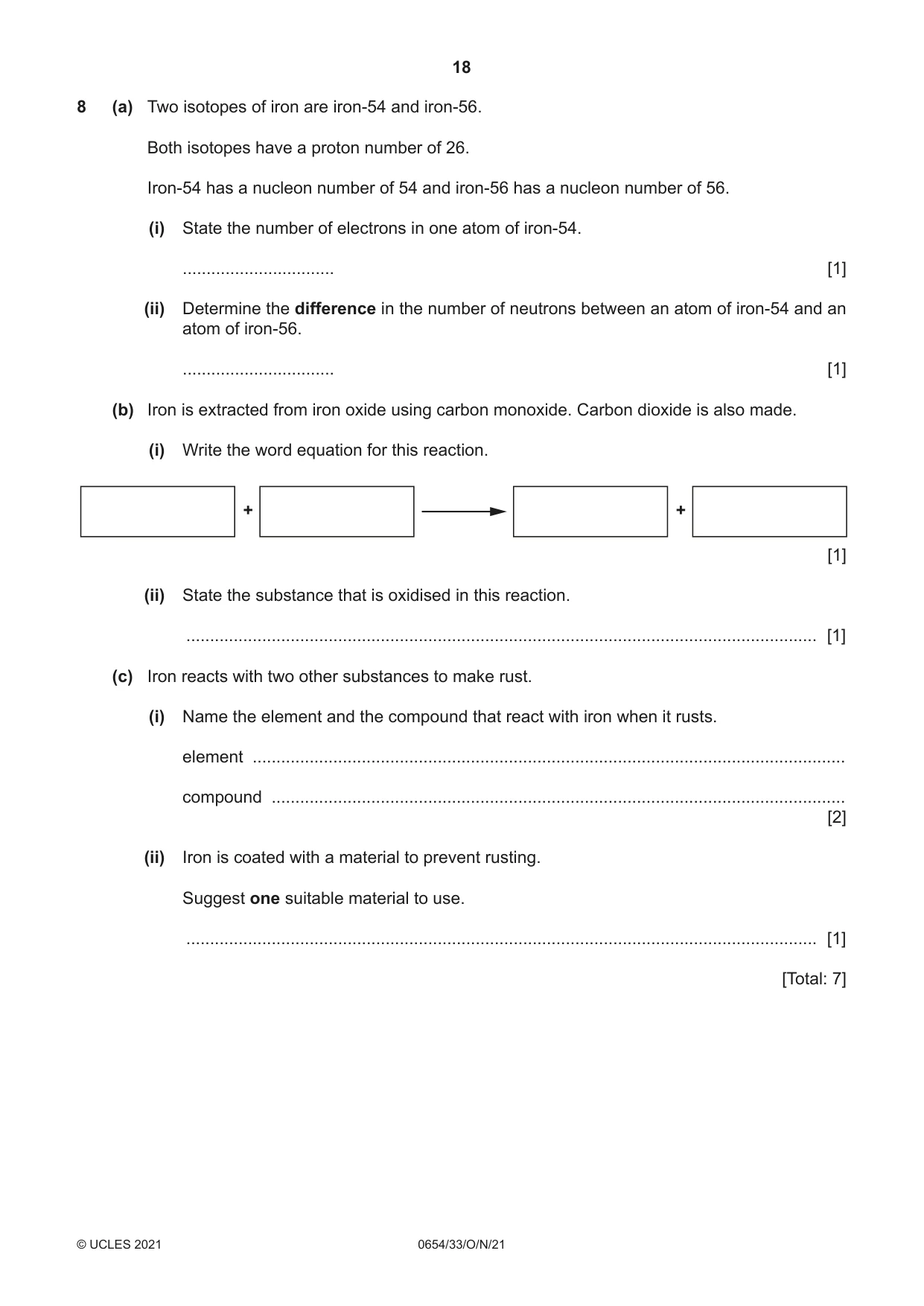
8 (a) Two isotopes of iron are iron-54 and iron-56. Both isotopes have a proton number of 26. Iron-54 has a nucleon number of 54 and iron-56 has a nucleon number of 56. (i) State the number of electrons in one atom of iron-54. ................................ [1] (ii) Determine the difference in the number of neutrons between an atom of iron-54 and an atom of iron-56. ................................ [1] (b) Iron is extracted from iron oxide using carbon monoxide. Carbon dioxide is also made. (i) Write the word equation for this reaction. + + [1] (ii) State the substance that is oxidised in this reaction. ..................................................................................................................................... [1] (c) Iron reacts with two other substances to make rust. (i) Name the element and the compound that react with iron when it rusts. element ............................................................................................................................. compound ......................................................................................................................... [2] (ii) Iron is coated with a material to prevent rusting. Suggest one suitable material to use. ..................................................................................................................................... [1] [Total: 7]
Mark scheme: 8(a)(i) 26 ; 1 8(a)(ii) 2 ; 1 8(b)(i) iron oxide + carbon monoxide → iron + carbon dioxide ; 1 8(b)(ii) carbon monoxide ; 1 8(c)(i) (element) – oxygen ; (compound) – water ; 2 8(c)(ii) paint ; 1
Q9 · Describe two advantages of generating electricity using nuclear fission compared to…
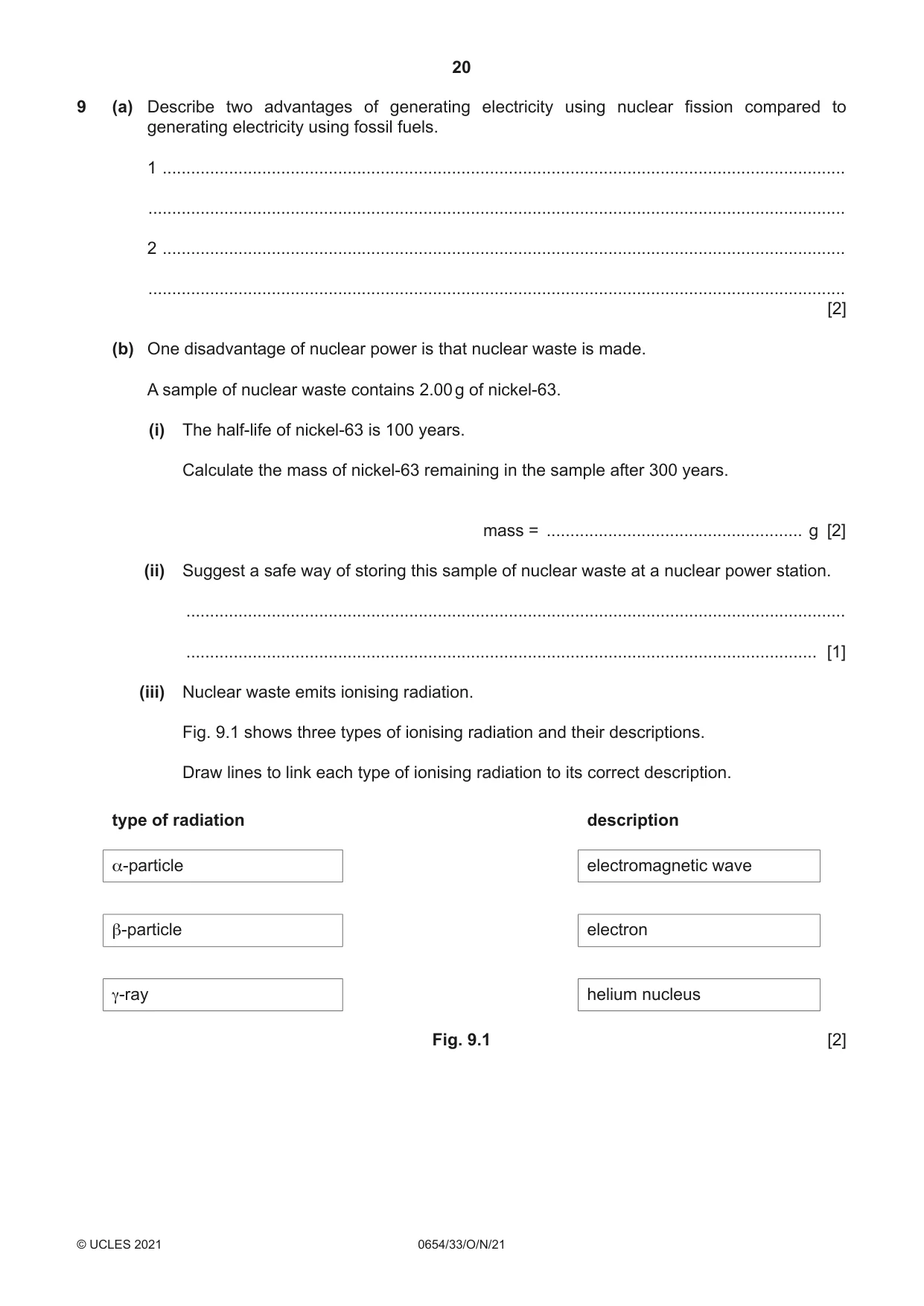
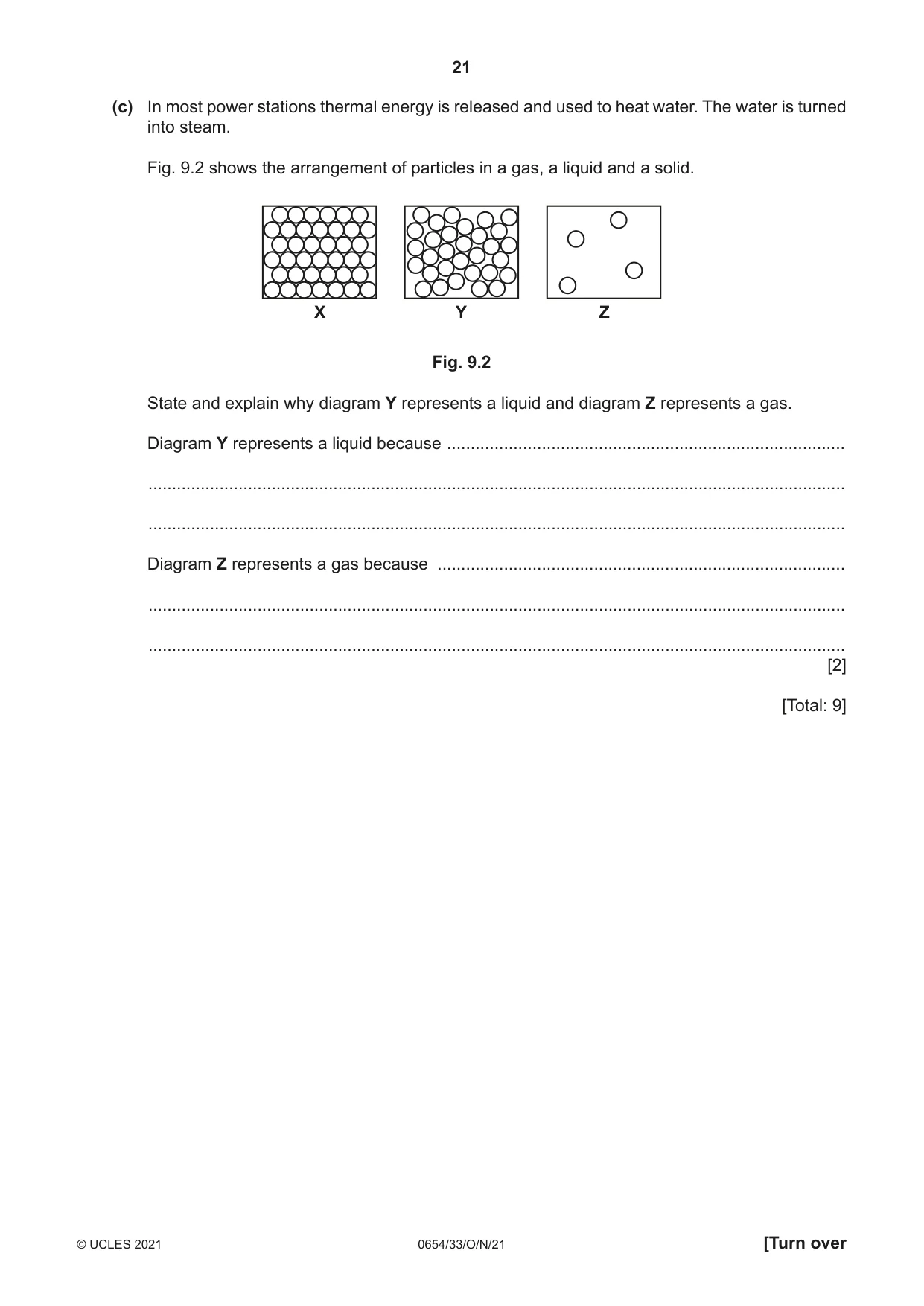
9 (a) Describe two advantages of generating electricity using nuclear fission compared to generating electricity using fossil fuels. 1 ................................................................................................................................................ ................................................................................................................................................... 2 ................................................................................................................................................ ................................................................................................................................................... [2] (b) One disadvantage of nuclear power is that nuclear waste is made. A sample of nuclear waste contains 2.00 g of nickel-63. (i) The half-life of nickel-63 is 100 years. Calculate the mass of nickel-63 remaining in the sample after 300 years. mass = ...................................................... g [2] (ii) Suggest a safe way of storing this sample of nuclear waste at a nuclear power station. ........................................................................................................................................... ..................................................................................................................................... [1] (iii) Nuclear waste emits ionising radiation. Fig. 9.1 shows three types of ionising radiation and their descriptions. Draw lines to link each type of ionising radiation to its correct description. type of radiation description α-particle electromagnetic wave β-particle electron γ-ray helium nucleus Fig. 9.1 [2] (c) In most power stations thermal energy is released and used to heat water. The water is turned into steam. Fig. 9.2 shows the arrangement of particles in a gas, a liquid and a solid. X Y Z Fig. 9.2 State and explain why diagram Y represents a liquid and diagram Z represents a gas. Diagram Y represents a liquid because .................................................................................... ................................................................................................................................................... ................................................................................................................................................... Diagram Z represents a gas because ...................................................................................... ................................................................................................................................................... ................................................................................................................................................... [2] [Total: 9]
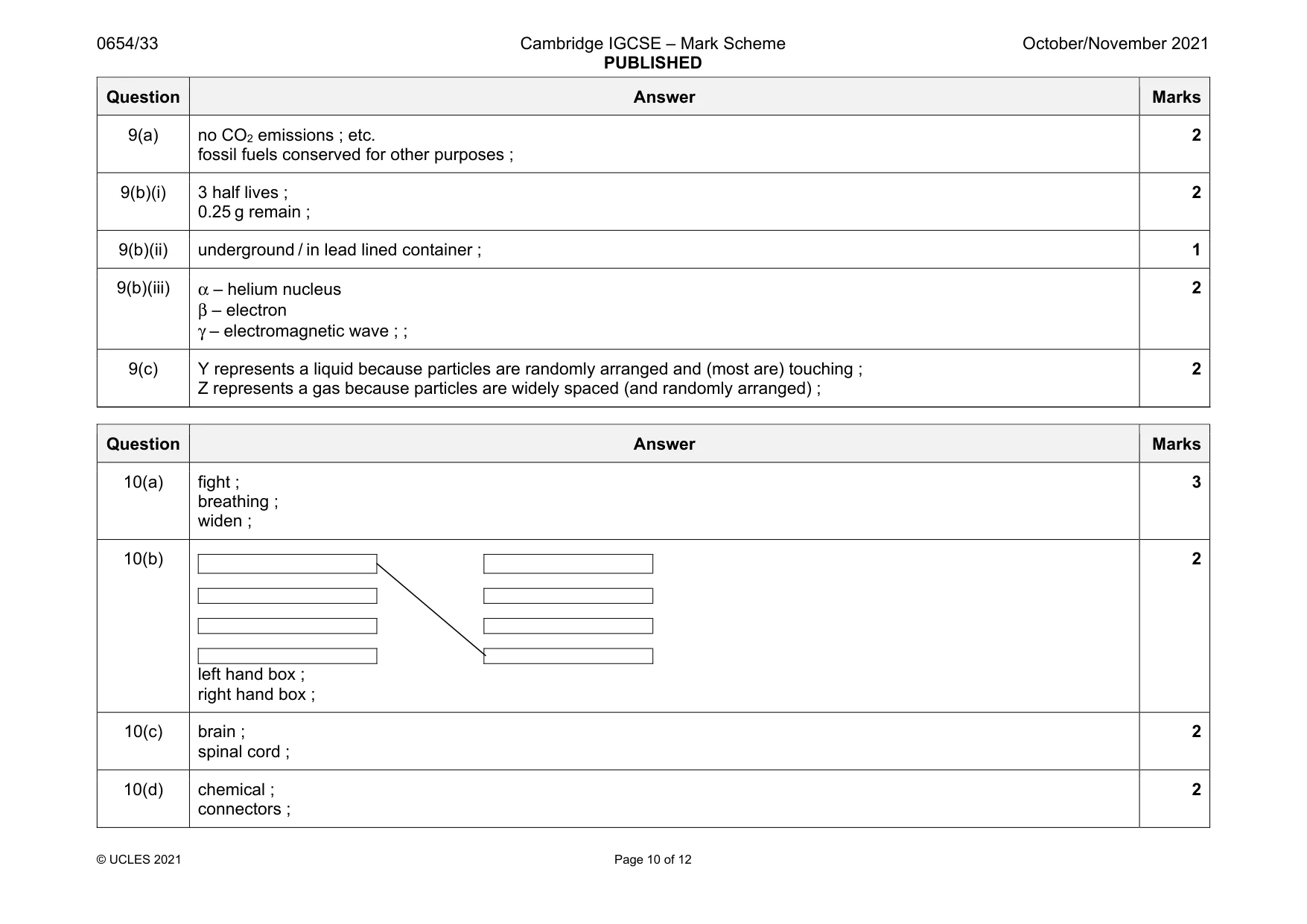
Mark scheme: 9(a) no CO2 emissions ; etc. fossil fuels conserved for other purposes ; 2 9(b)(i) 3 half lives ; 0.25 g remain ; 2 9(b)(ii) underground / in lead lined container ; 1 9(b)(iii) α – helium nucleus β – electron γ – electromagnetic wave ; ; 2 9(c) Y represents a liquid because particles are randomly arranged and (most are) touching ; Z represents a gas because particles are widely spaced (and randomly arranged) ; 2
Q10 · Use words from the list to complete the sentences about adrenaline
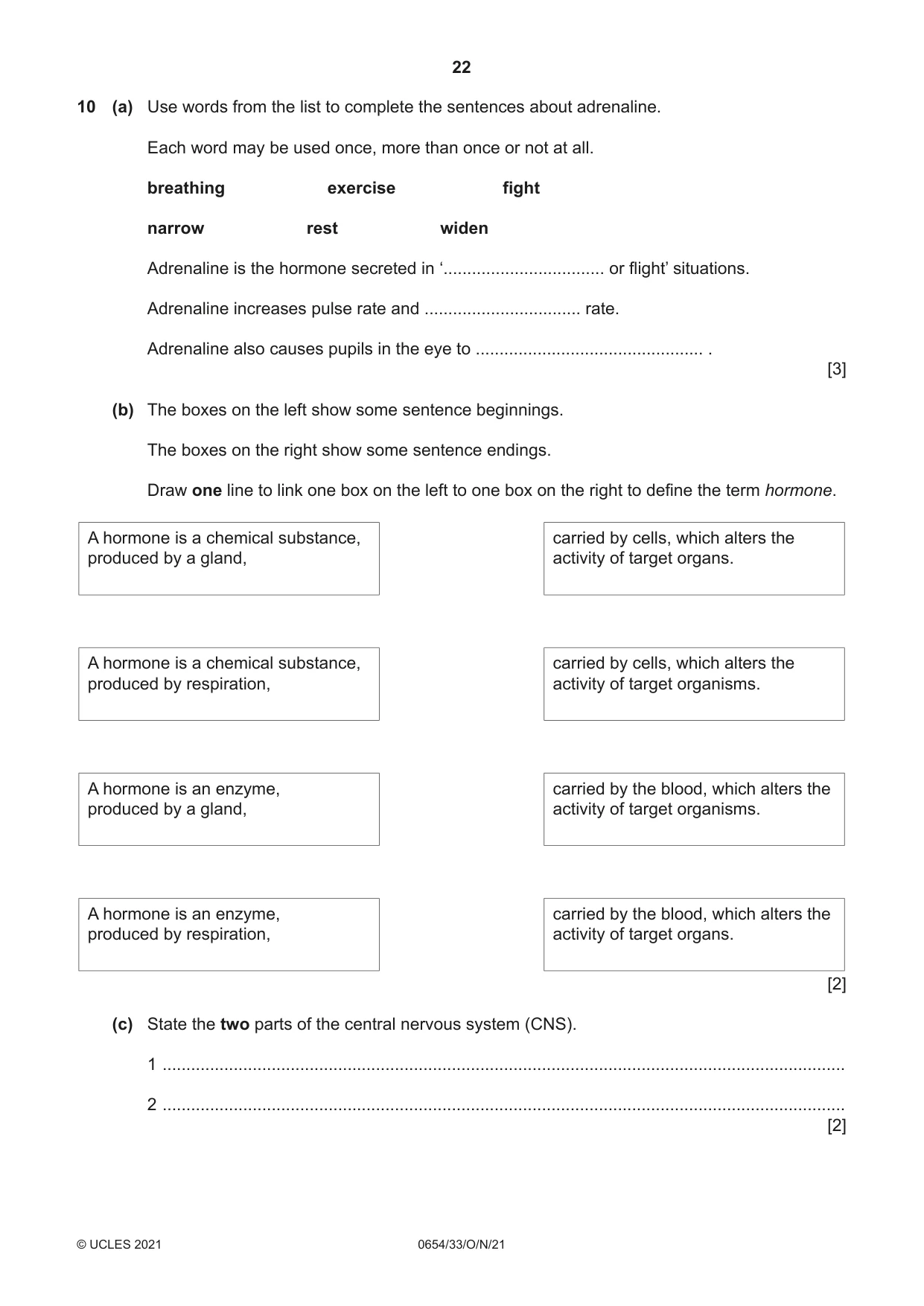
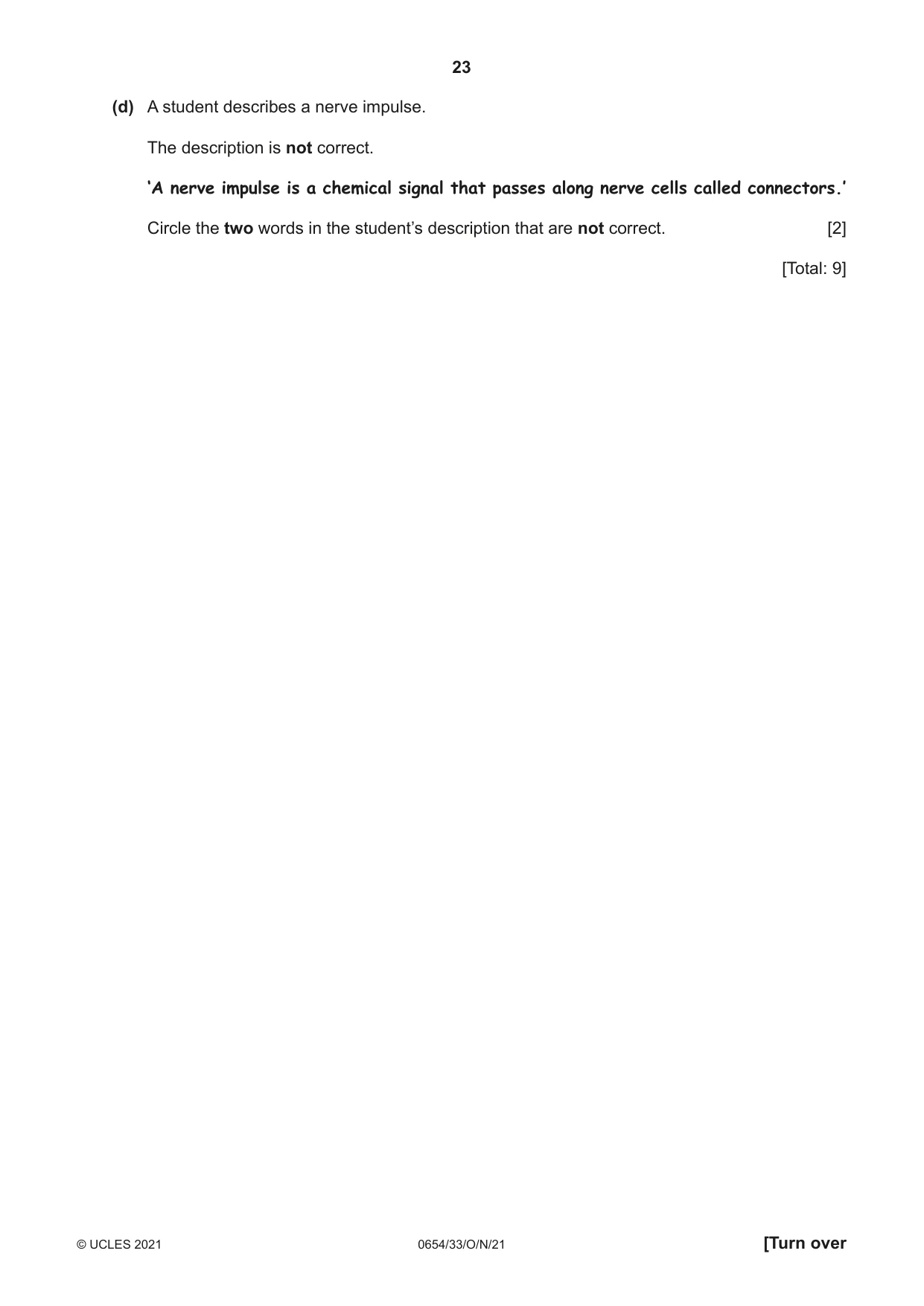
10 (a) Use words from the list to complete the sentences about adrenaline. Each word may be used once, more than once or not at all. breathing exercise fight narrow rest widen Adrenaline is the hormone secreted in ‘.................................. or flight’ situations. Adrenaline increases pulse rate and ................................. rate. Adrenaline also causes pupils in the eye to ................................................ . [3] (b) The boxes on the left show some sentence beginnings. The boxes on the right show some sentence endings. Draw one line to link one box on the left to one box on the right to define the term hormone. A hormone is a chemical substance, carried by cells, which alters the produced by a gland, activity of target organs. A hormone is a chemical substance, carried by cells, which alters the produced by respiration, activity of target organisms. A hormone is an enzyme, carried by the blood, which alters the produced by a gland, activity of target organisms. A hormone is an enzyme, carried by the blood, which alters the produced by respiration, activity of target organs. [2] (c) State the two parts of the central nervous system (CNS). 1 ................................................................................................................................................ 2 ................................................................................................................................................ [2] (d) A student describes a nerve impulse. The description is not correct. ‘A nerve impulse is a chemical signal that passes along nerve cells called connectors.’ Circle the two words in the student’s description that are not correct. [2] [Total: 9]
Mark scheme: 10(a) fight ; breathing ; widen ; 3 10(b) left hand box ; right hand box ; 2 10(c) brain ; spinal cord ; 2 10(d) chemical ; connectors ; 2
Q11 · Table 11.1 contains data for some elements in Group VII of the Periodic Table
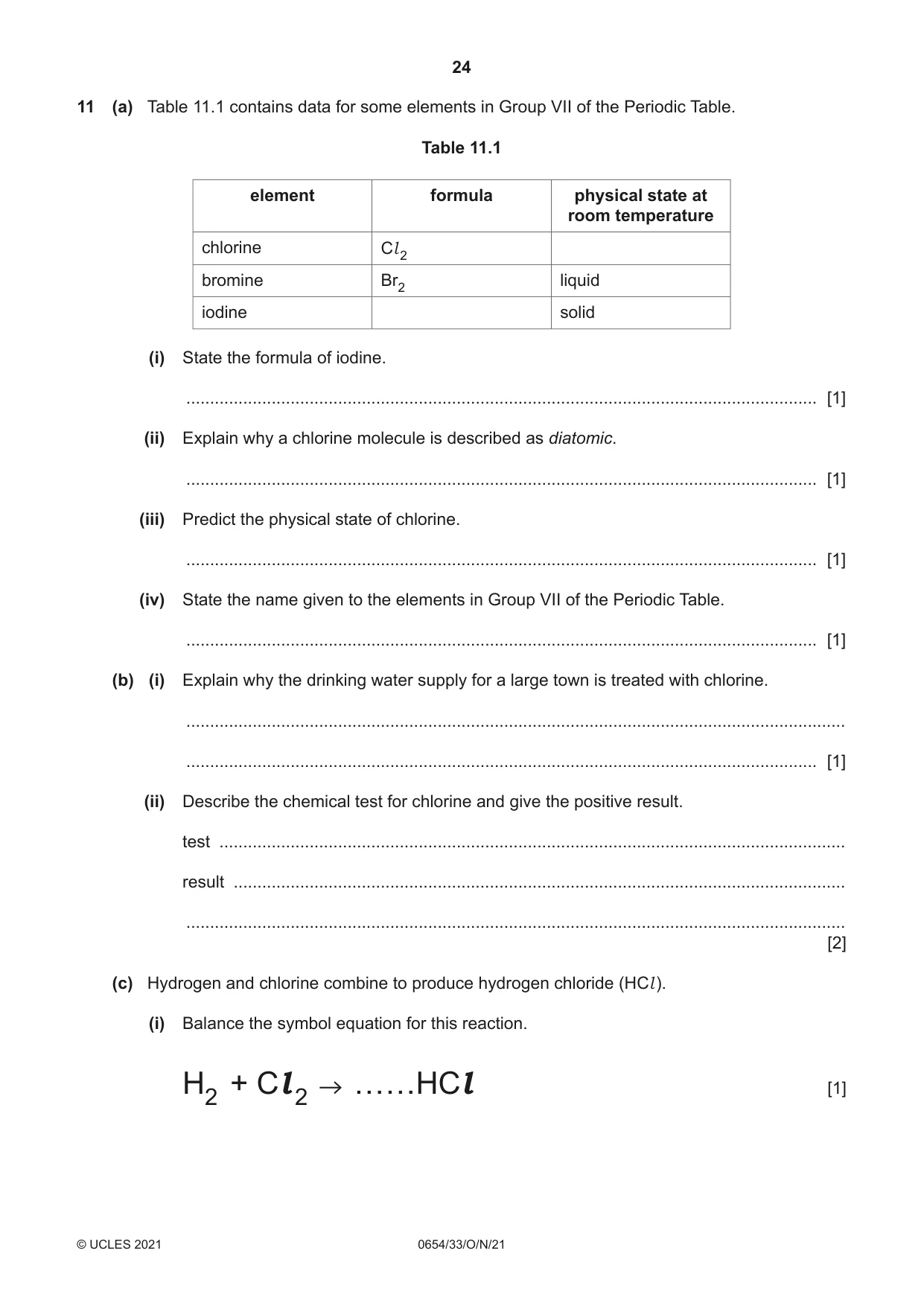
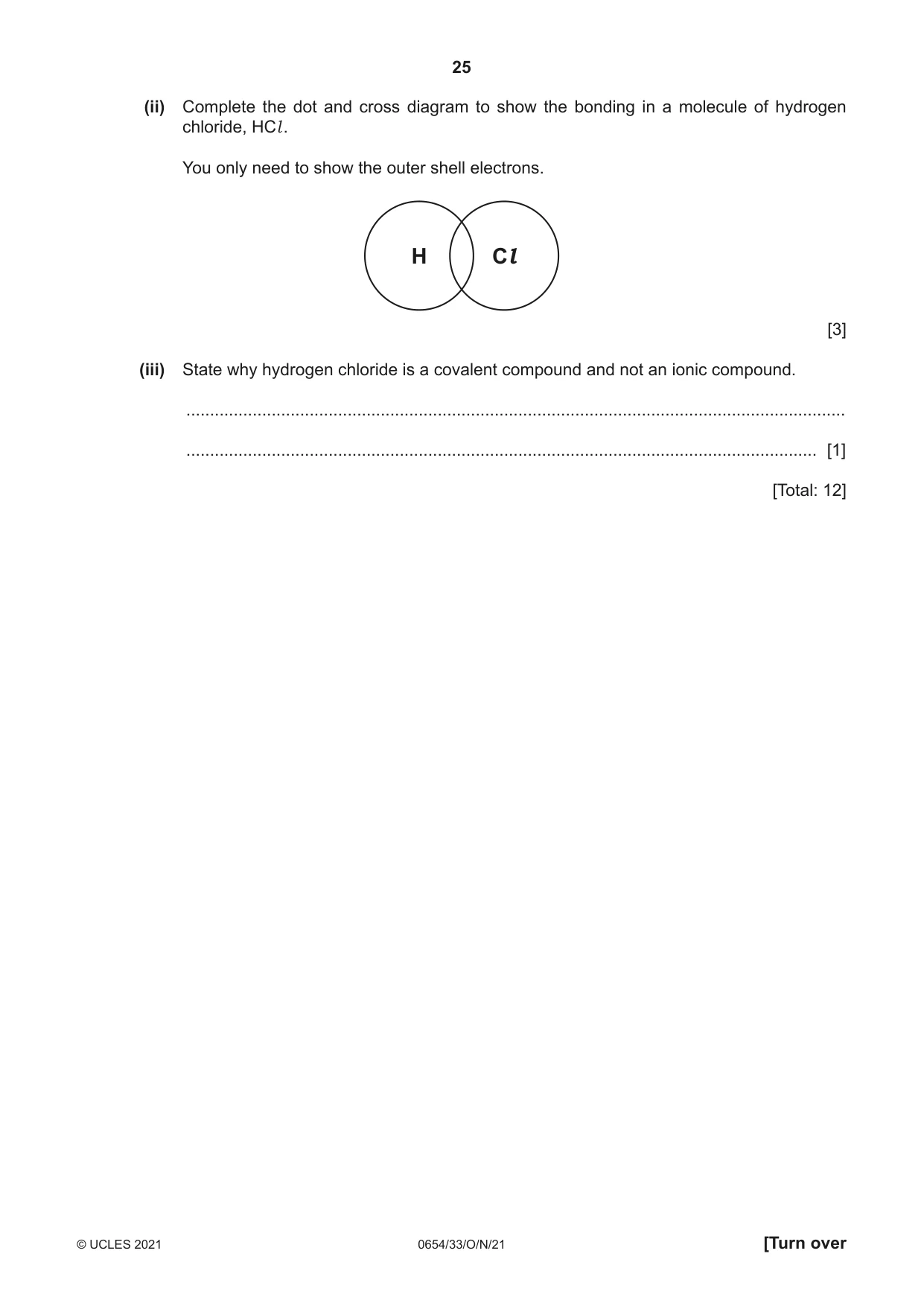
11 (a) Table 11.1 contains data for some elements in Group VII of the Periodic Table. Table 11.1 element formula physical state at room temperature chlorine Cl 2 bromine Br2 liquid iodine solid (i) State the formula of iodine. ..................................................................................................................................... [1] (ii) Explain why a chlorine molecule is described as diatomic. ..................................................................................................................................... [1] (iii) Predict the physical state of chlorine. ..................................................................................................................................... [1] (iv) State the name given to the elements in Group VII of the Periodic Table. ..................................................................................................................................... [1] (b) (i) Explain why the drinking water supply for a large town is treated with chlorine. ........................................................................................................................................... ..................................................................................................................................... [1] (ii) Describe the chemical test for chlorine and give the positive result. test .................................................................................................................................... result ................................................................................................................................. ........................................................................................................................................... [2] (c) Hydrogen and chlorine combine to produce hydrogen chloride (HCl ). (i) Balance the symbol equation for this reaction. [1] H2 + Cl 2 ……HCl (ii) Complete the dot and cross diagram to show the bonding in a molecule of hydrogen chloride, HCl . You only need to show the outer shell electrons. H Cl [3] (iii) State why hydrogen chloride is a covalent compound and not an ionic compound. ........................................................................................................................................... ..................................................................................................................................... [1] [Total: 12]
Mark scheme: 11(a)(i) I2 ; 1 11(a)(ii) molecule contains two atoms ; 1 11(a)(iii) gas ; 1 11(a)(iv) halogens ; 1 11(b)(i) to kill microorganisms / bacteria ; 1 11(b)(ii) litmus paper etc. ; bleaches ; 2 11(c)(i) (H2 + Cl2 → ) 2 (HCl) ; 1 11(c)(ii) one bonding pair shown ; chlorine has octet ; all else correct ; 3 11(c)(iii) two non-metals bonding ; 1
Q12 · A speed-time graph for an aircraft taking off
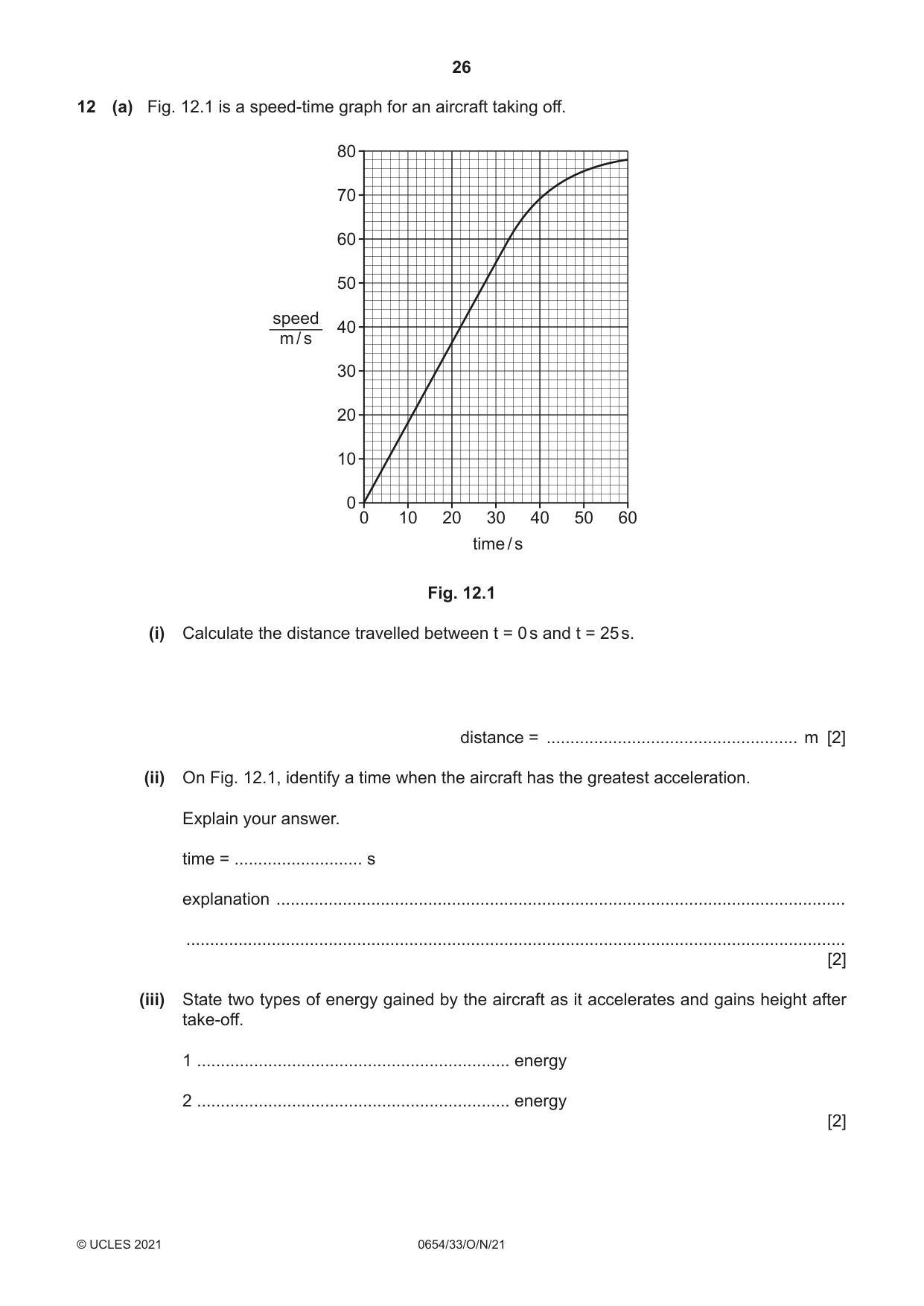
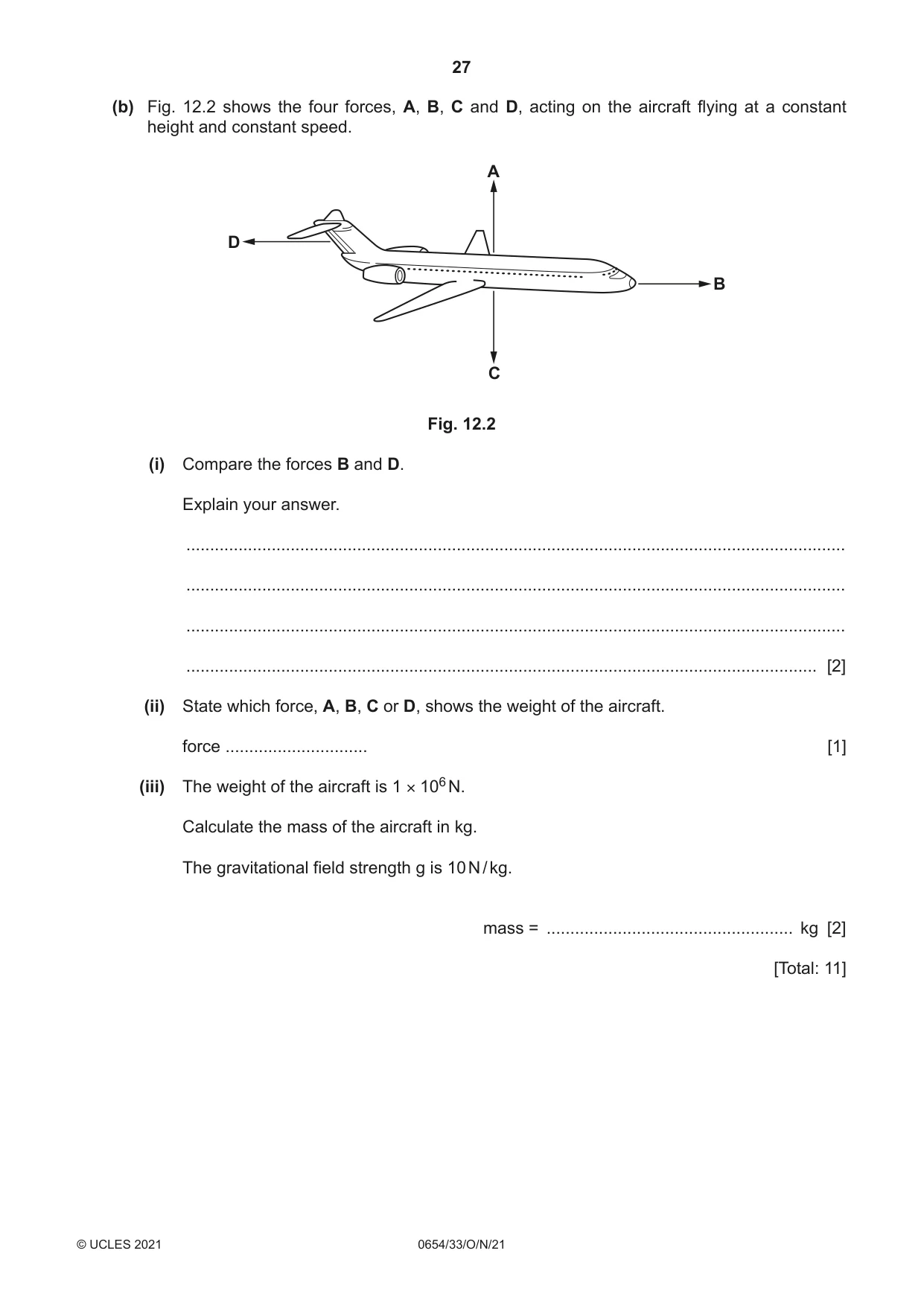
12 (a) Fig. 12.1 is a speed-time graph for an aircraft taking off. 80 70 60 50 speed 40 m / s 30 20 10 0 0 10 20 30 40 50 60 time / s Fig. 12.1 (i) Calculate the distance travelled between t = 0 s and t = 25 s. distance = ..................................................... m [2] (ii) On Fig. 12.1, identify a time when the aircraft has the greatest acceleration. Explain your answer. time = ........................... s explanation ........................................................................................................................ ........................................................................................................................................... [2] (iii) State two types of energy gained by the aircraft as it accelerates and gains height after take-off. 1 .................................................................. energy 2 .................................................................. energy [2] (b) Fig. 12.2 shows the four forces, A, B, C and D, acting on the aircraft flying at a constant height and constant speed. A D B C Fig. 12.2 (i) Compare the forces B and D. Explain your answer. ........................................................................................................................................... ........................................................................................................................................... ........................................................................................................................................... ..................................................................................................................................... [2] (ii) State which force, A, B, C or D, shows the weight of the aircraft. force .............................. [1] (iii) The weight of the aircraft is 1 × 10⁶ N. Calculate the mass of the aircraft in kg. The gravitational field strength g is 10 N / kg. mass = .................................................... kg [2] [Total: 11]
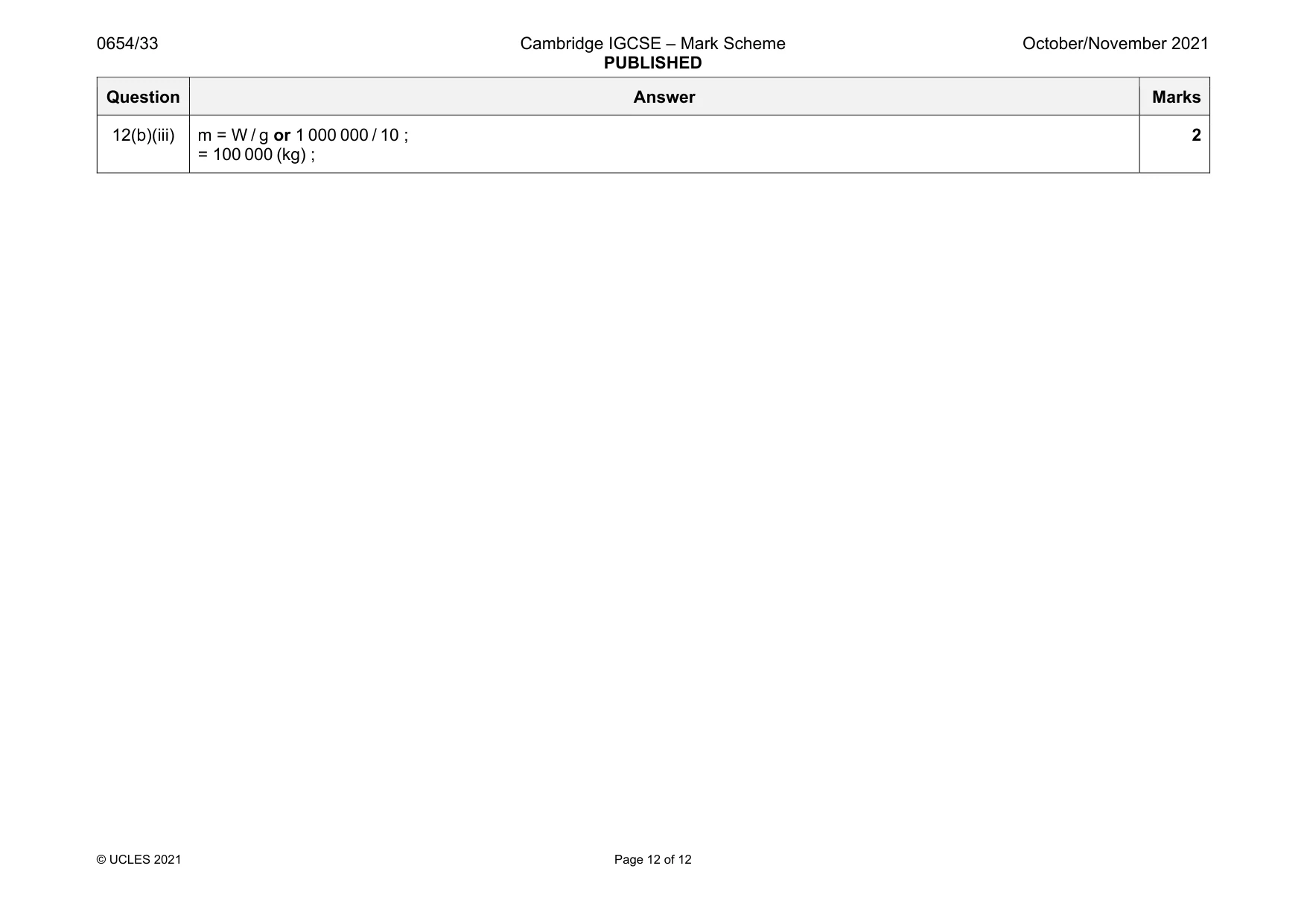
Mark scheme: 12(a)(i) area under graph or ½ × 46 × 25 or distance = average speed × time or 23 × 25 ; 575 m ; 2 12(a)(ii) between t = 0 and t = 34 s ; steepest gradient ; 2 12(a)(iii) kinetic energy ; gravitational potential energy ; 2 12(b)(i) equal and opposite ; travelling at constant speed ; 2 12(b)(ii) C ; 1 Question Answer Marks 12(b)(iii) m = W / g or 1 000 000 / 10 ; = 100 000 (kg) ; 2
What was in this paper
The subtopics covered by these 12 questions, and how many questions each got. Open one in a new tab to see every Cambridge question on it.
What you needed in this session
Cambridge’s own grade thresholds for 2021 Oct/Nov, Paper 3 · Variant 3. A higher threshold means an easier paper — the bar moves with how the cohort did.