Cambridge IGCSE Sciences - Co-ordinated (Double) 0654 — 2025 Oct/Nov Paper 3 · Variant 2
0654/32/O/N/25 · 12 questions · 120 marks · 120 min
The question paper and its mark scheme, free to read here and free to download. This is Cambridge’s own paper, exactly as it was sat.
Question paper28 pages

Mark scheme18 pages
Answers below. Sit the paper first if you are practising.
Questions as text
Q1 · A diagram of the alimentary canal and associated organs
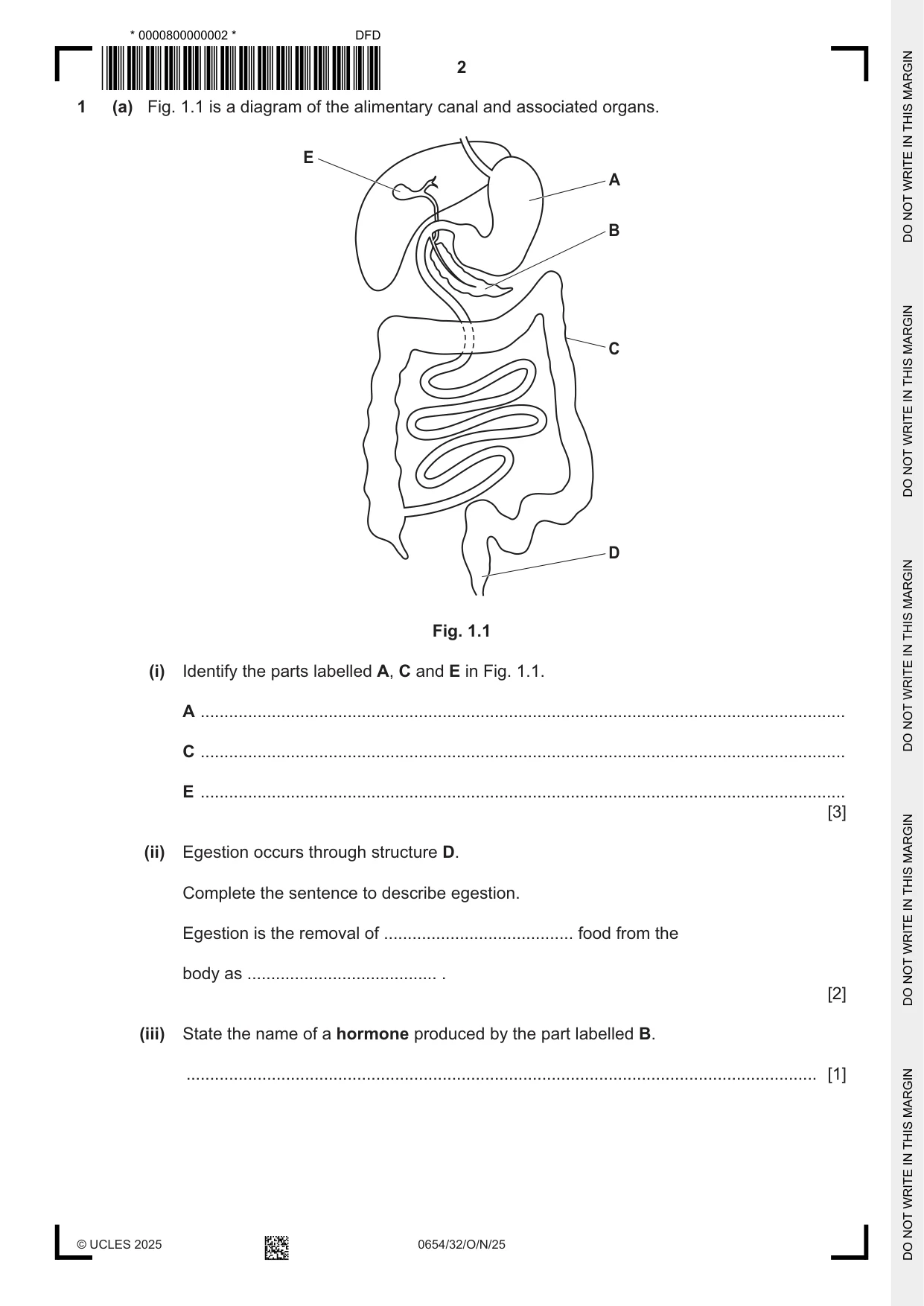
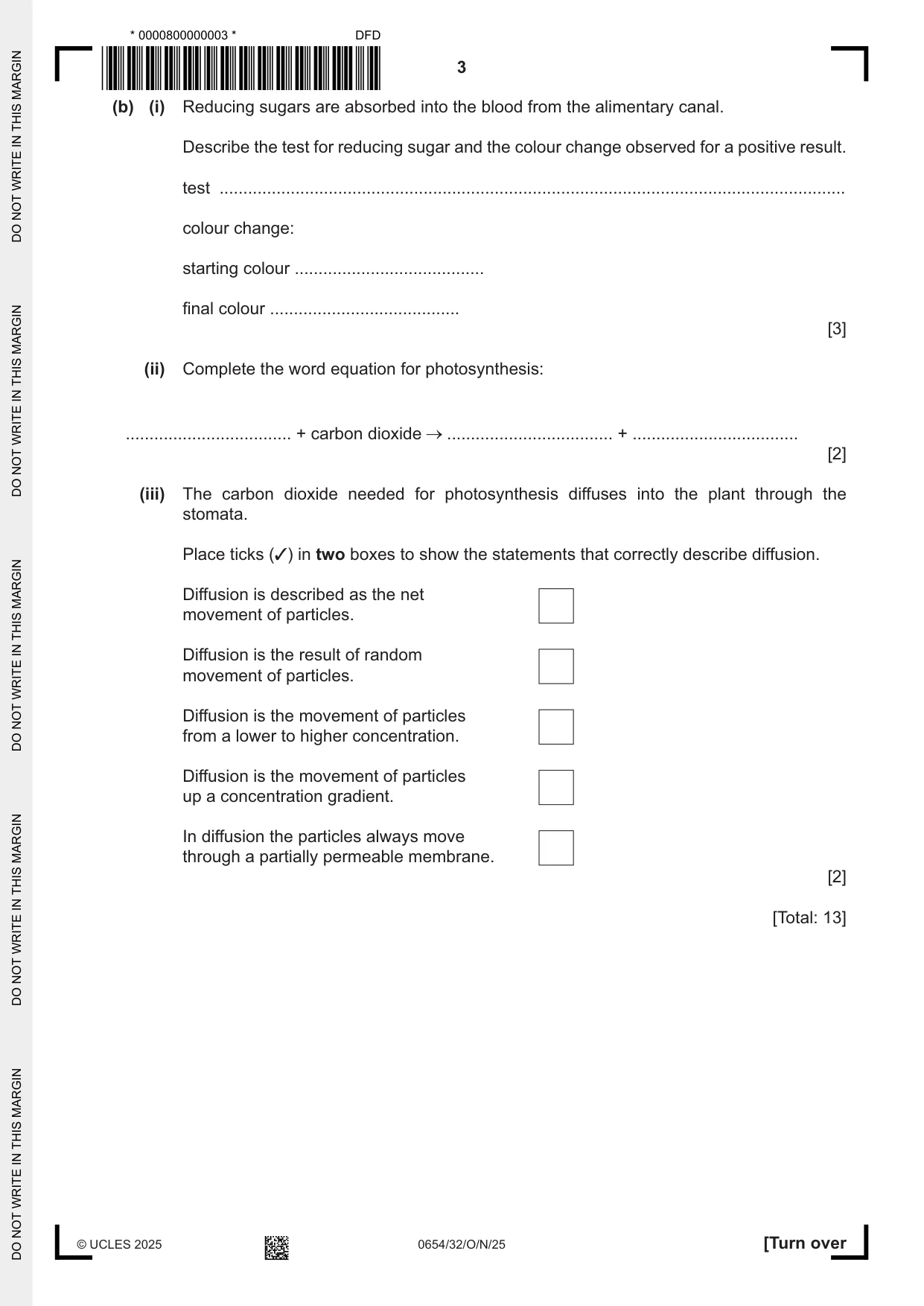
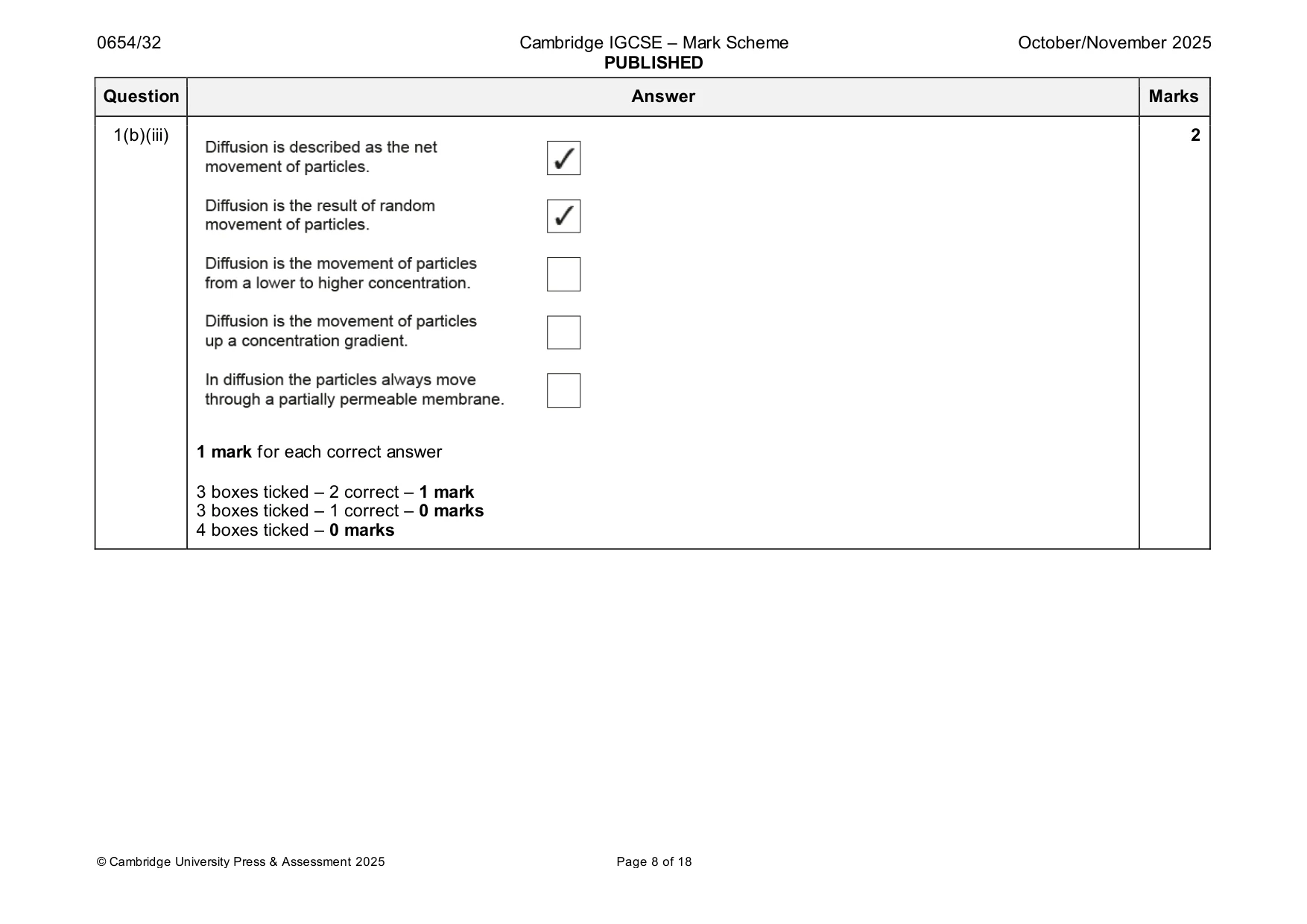
1 (a) Fig. 1.1 is a diagram of the alimentary canal and associated organs. E A B C D Fig. 1.1 (i) Identify the parts labelled A, C and E in Fig. 1.1. A ........................................................................................................................................ C ........................................................................................................................................ E ........................................................................................................................................ [3] (ii) Egestion occurs through structure D. Complete the sentence to describe egestion. Egestion is the removal of ........................................ food from the body as ........................................ . [2] (iii) State the name of a hormone produced by the part labelled B. ..................................................................................................................................... [1] (b) (i) Reducing sugars are absorbed into the blood from the alimentary canal. Describe the test for reducing sugar and the colour change observed for a positive result. test .................................................................................................................................... colour change: starting colour ........................................ final colour ........................................ [3] (ii) Complete the word equation for photosynthesis: ................................... + carbon dioxide ................................... + ................................... [2] (iii) The carbon dioxide needed for photosynthesis diffuses into the plant through the stomata. Place ticks (3) in two boxes to show the statements that correctly describe diffusion. Diffusion is described as the net movement of particles. Diffusion is the result of random movement of particles. Diffusion is the movement of particles from a lower to higher concentration. Diffusion is the movement of particles up a concentration gradient. In diffusion the particles always move through a partially permeable membrane. [2] [Total: 13]
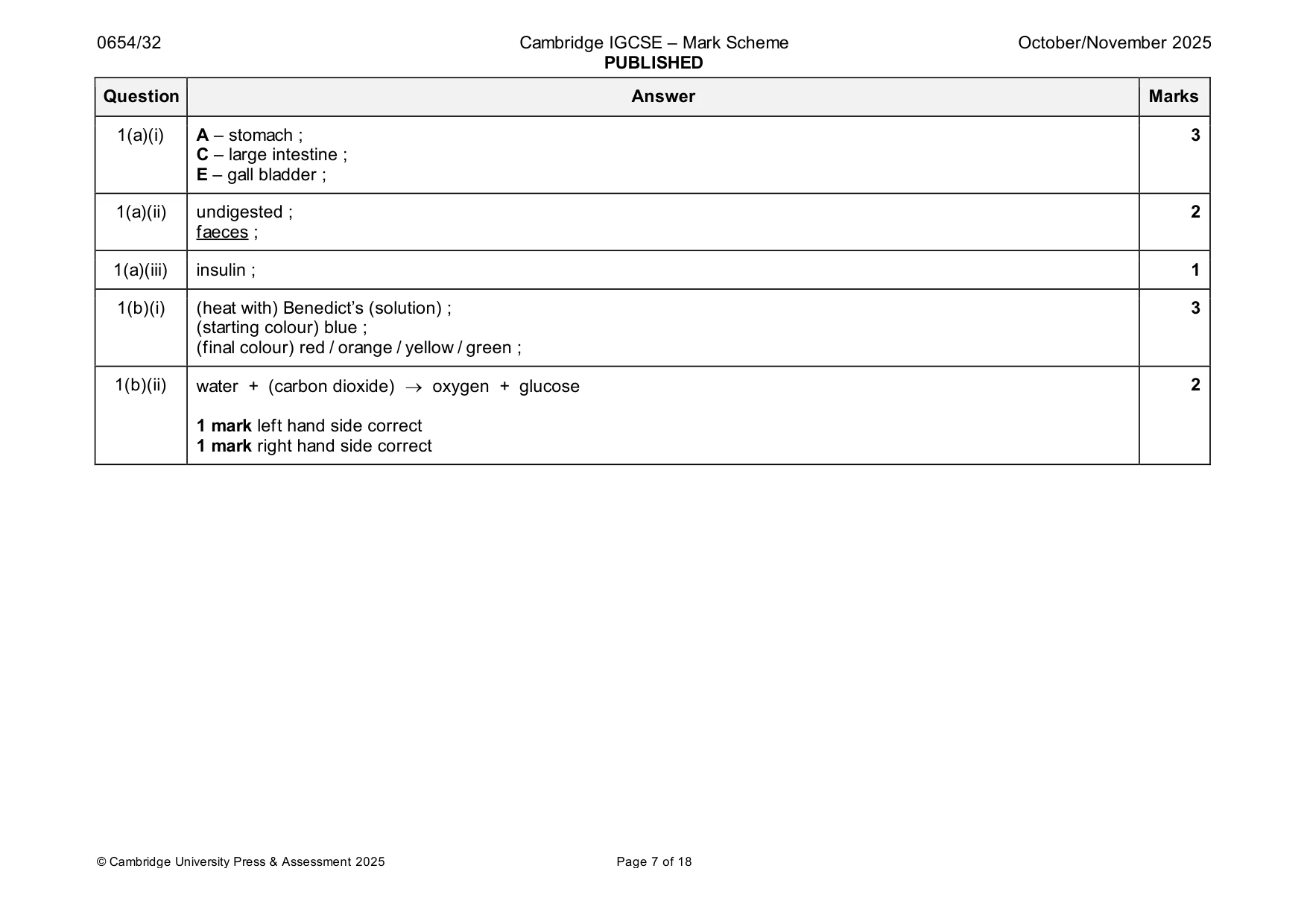
Mark scheme: Question Answer Marks 1(a)(i) A – stomach ; 3 C – large intestine ; E – gall bladder ; 1(a)(ii) undigested ; 2 faeces ; 1(a)(iii) insulin ; 1 1(b)(i) (heat with) Benedict’s (solution) ; 3 (starting colour) blue ; (final colour) red / orange / yellow / green ; 1(b)(ii) water + (carbon dioxide) → oxygen + glucose 2 1 mark left hand side correct 1 mark right hand side correct 1(b)(iii) 2 1 mark for each correct answer 3 boxes ticked – 2 correct – 1 mark 3 boxes ticked – 1 correct – 0 marks 4 boxes ticked – 0 marks
Q2 · An ancestor of the modern‑day elephant
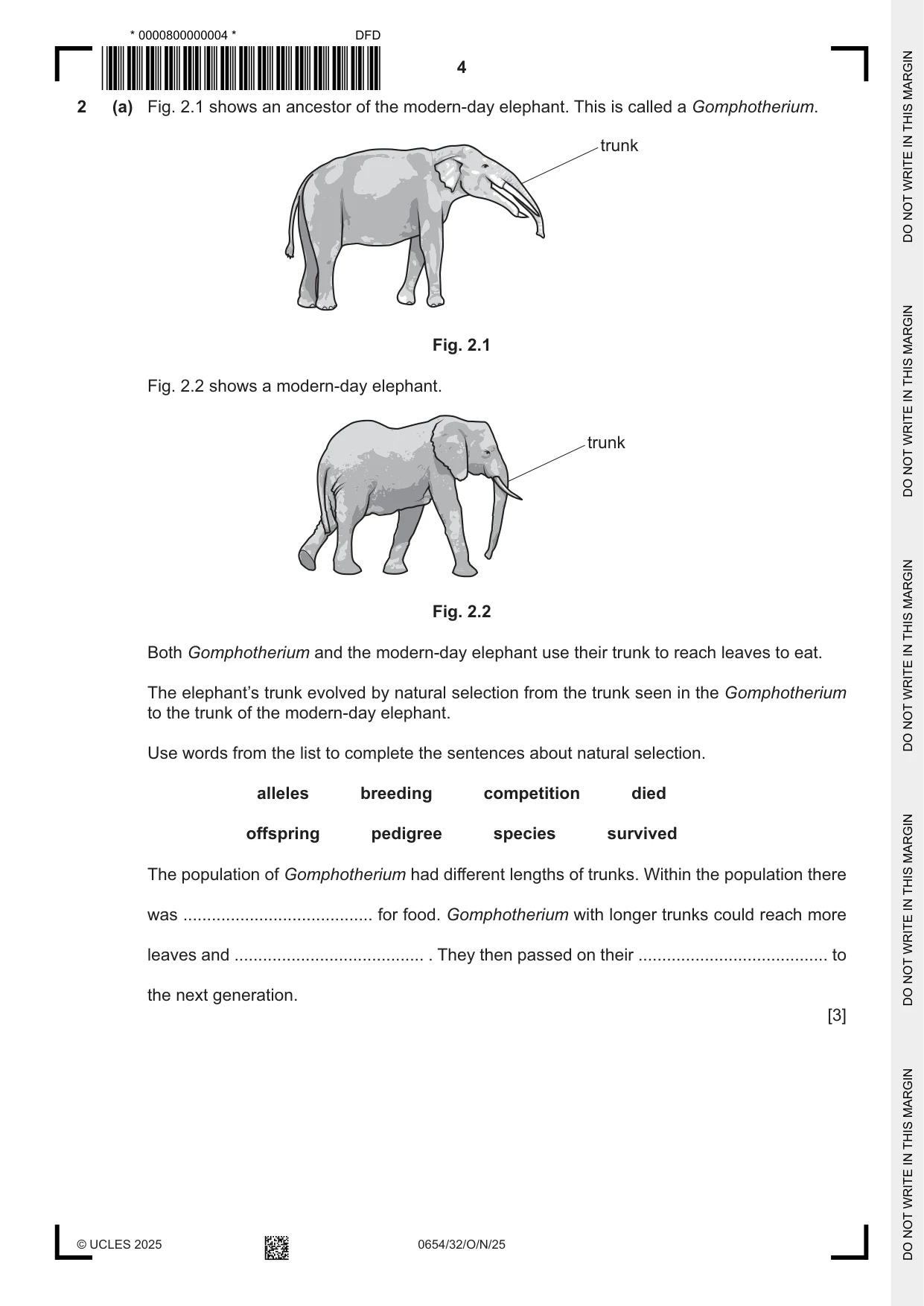
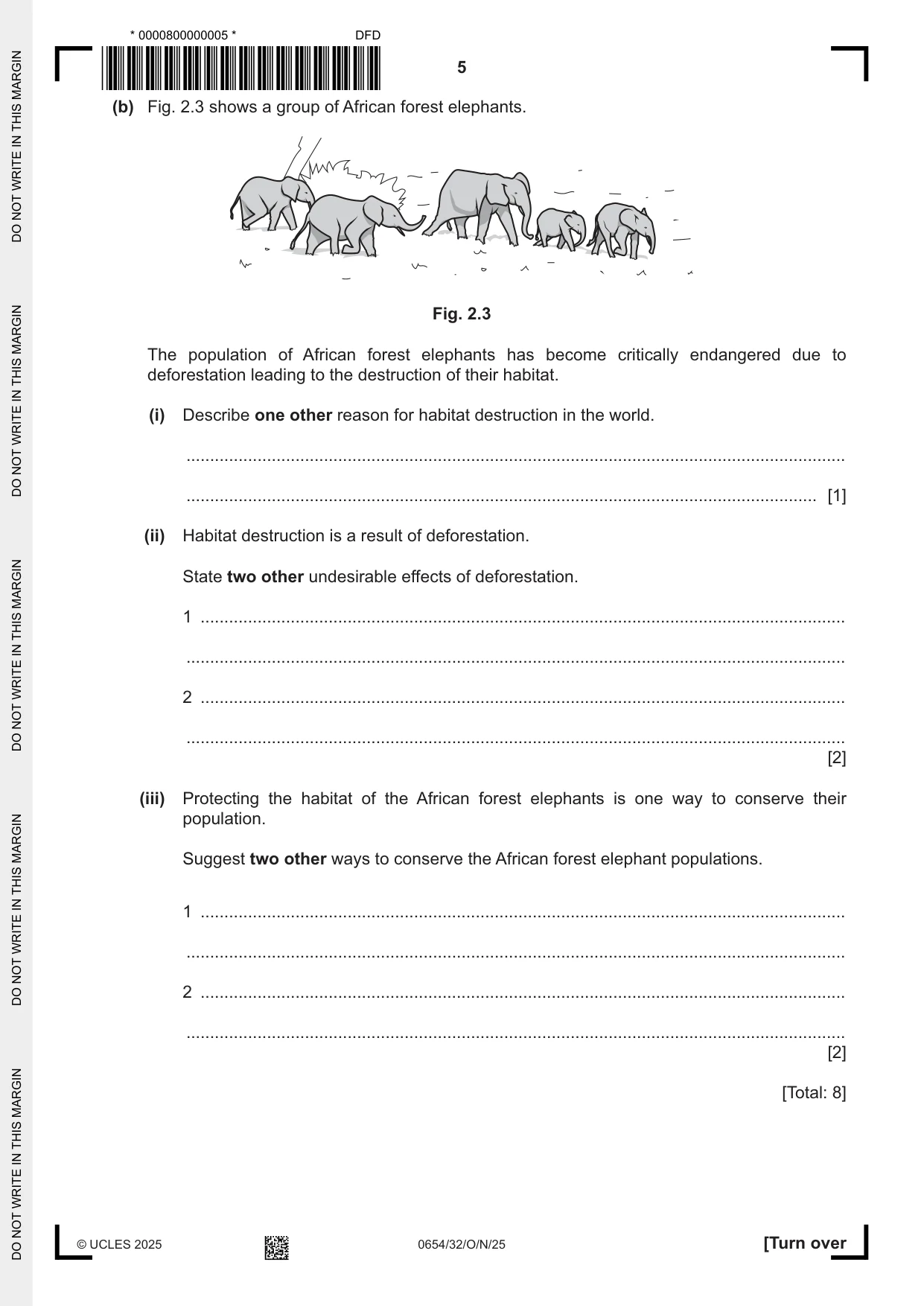
2 (a) Fig. 2.1 shows an ancestor of the modern‑day elephant. This is called a Gomphotherium. trunk Fig. 2.1 Fig. 2.2 shows a modern‑day elephant. trunk Fig. 2.2 Both Gomphotherium and the modern‑day elephant use their trunk to reach leaves to eat. The elephant’s trunk evolved by natural selection from the trunk seen in the Gomphotherium to the trunk of the modern‑day elephant. Use words from the list to complete the sentences about natural selection. alleles breeding competition died offspring pedigree species survived The population of Gomphotherium had different lengths of trunks. Within the population there was ........................................ for food. Gomphotherium with longer trunks could reach more leaves and ........................................ . They then passed on their ........................................ to the next generation. [3] (b) Fig. 2.3 shows a group of African forest elephants. Fig. 2.3 The population of African forest elephants has become critically endangered due to deforestation leading to the destruction of their habitat. (i) Describe one other reason for habitat destruction in the world. ........................................................................................................................................... ..................................................................................................................................... [1] (ii) Habitat destruction is a result of deforestation. State two other undesirable effects of deforestation. 1 ........................................................................................................................................ ........................................................................................................................................... 2 ........................................................................................................................................ ........................................................................................................................................... [2] (iii) Protecting the habitat of the African forest elephants is one way to conserve their population. Suggest two other ways to conserve the African forest elephant populations. 1 ........................................................................................................................................ ........................................................................................................................................... 2 ........................................................................................................................................ ........................................................................................................................................... [2] [Total: 8]
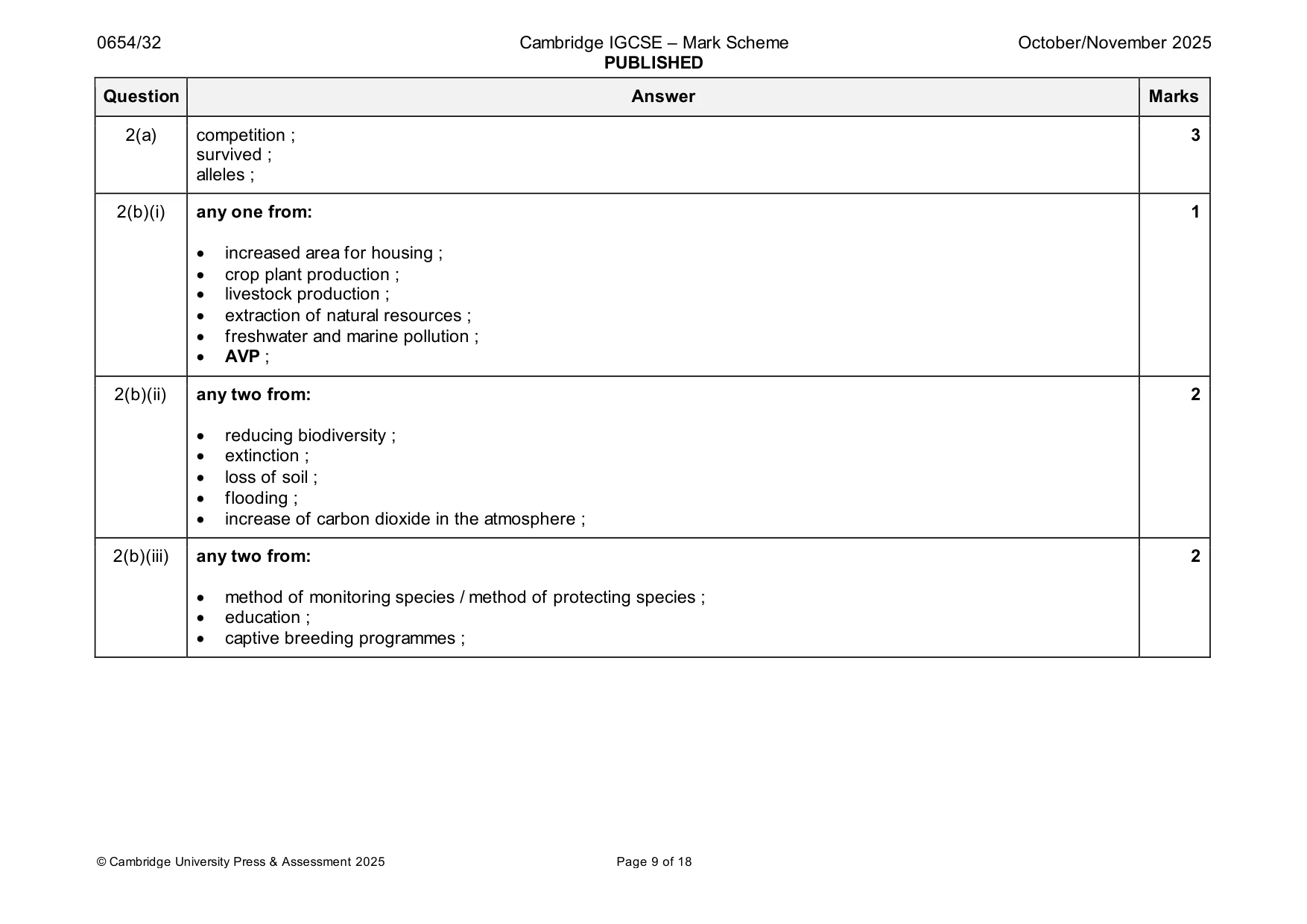
Mark scheme: 2(a) competition ; 3 survived ; alleles ; 2(b)(i) any one from: 1 • increased area for housing ; • crop plant production ; • livestock production ; • extraction of natural resources ; • freshwater and marine pollution ; • AVP ; 2(b)(ii) any two from: 2 • reducing biodiversity ; • extinction ; • loss of soil ; • flooding ; • increase of carbon dioxide in the atmosphere ; 2(b)(iii) any two from: 2 • method of monitoring species / method of protecting species ; • education ; • captive breeding programmes ;
Q3 · A diagram of the human breathing system
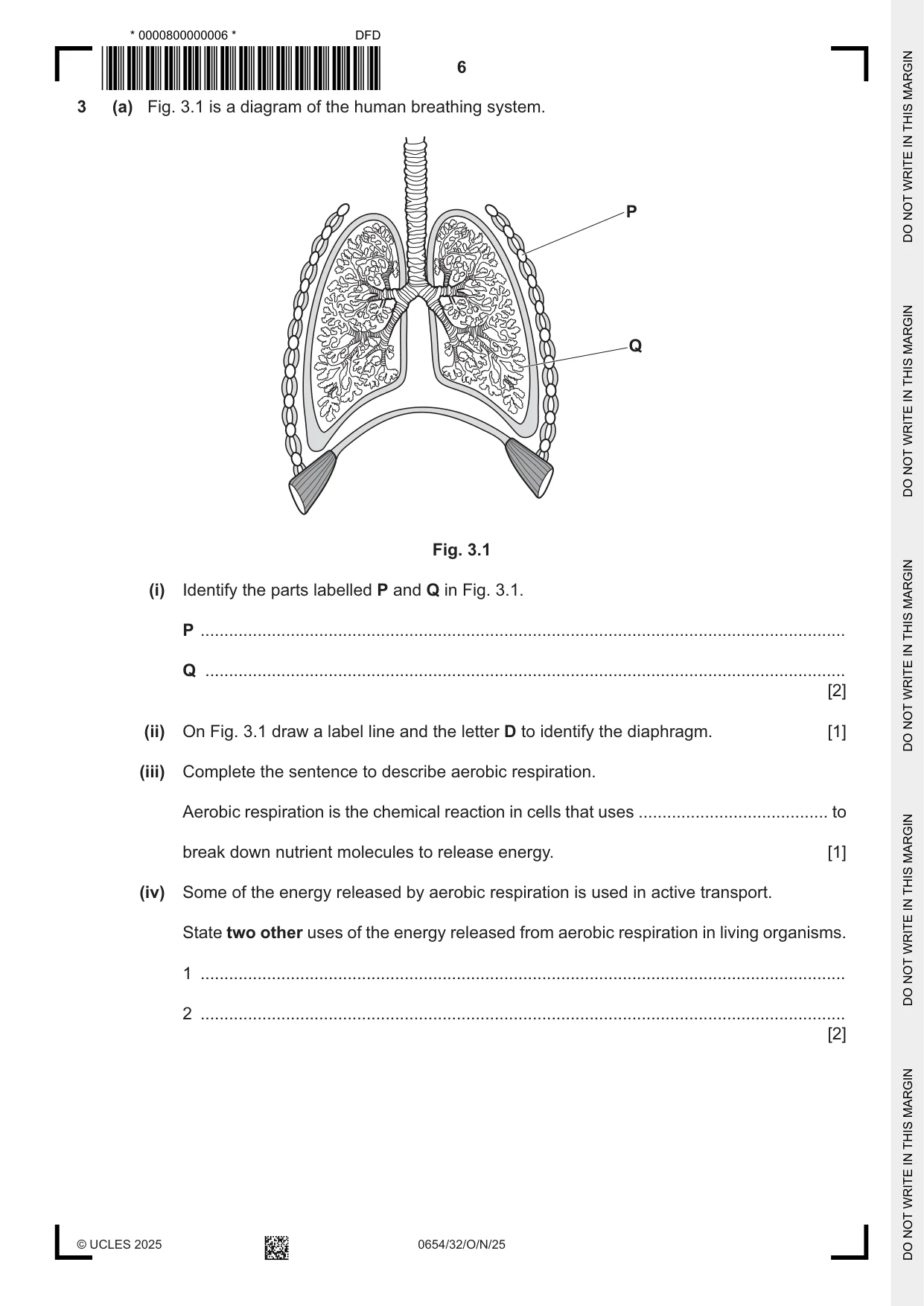
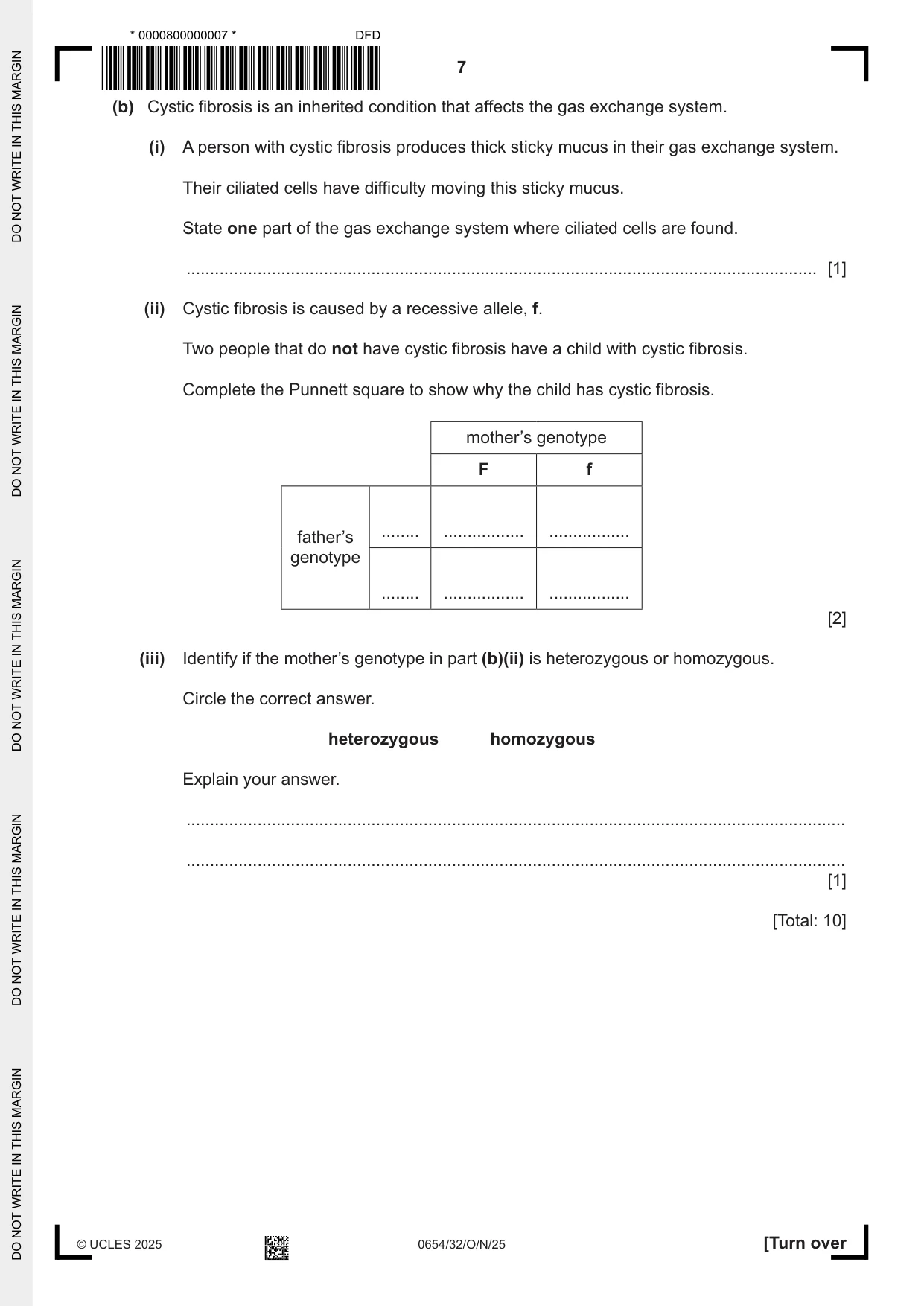
3 (a) Fig. 3.1 is a diagram of the human breathing system. P Q Fig. 3.1 (i) Identify the parts labelled P and Q in Fig. 3.1. P ........................................................................................................................................ Q ....................................................................................................................................... [2] (ii) On Fig. 3.1 draw a label line and the letter D to identify the diaphragm. [1] (iii) Complete the sentence to describe aerobic respiration. Aerobic respiration is the chemical reaction in cells that uses ........................................ to break down nutrient molecules to release energy. [1] (iv) Some of the energy released by aerobic respiration is used in active transport. State two other uses of the energy released from aerobic respiration in living organisms. 1 ........................................................................................................................................ 2 ........................................................................................................................................ [2] (b) Cystic fibrosis is an inherited condition that affects the gas exchange system. (i) A person with cystic fibrosis produces thick sticky mucus in their gas exchange system. Their ciliated cells have difficulty moving this sticky mucus. State one part of the gas exchange system where ciliated cells are found. ..................................................................................................................................... [1] (ii) Cystic fibrosis is caused by a recessive allele, f. Two people that do not have cystic fibrosis have a child with cystic fibrosis. Complete the Punnett square to show why the child has cystic fibrosis. mother’s genotype F f ........ ................. ................. father’s genotype ........ ................. ................. [2] (iii) Identify if the mother’s genotype in part (b)(ii) is heterozygous or homozygous. Circle the correct answer. heterozygous homozygous Explain your answer. ........................................................................................................................................... ........................................................................................................................................... [1] [Total: 10]
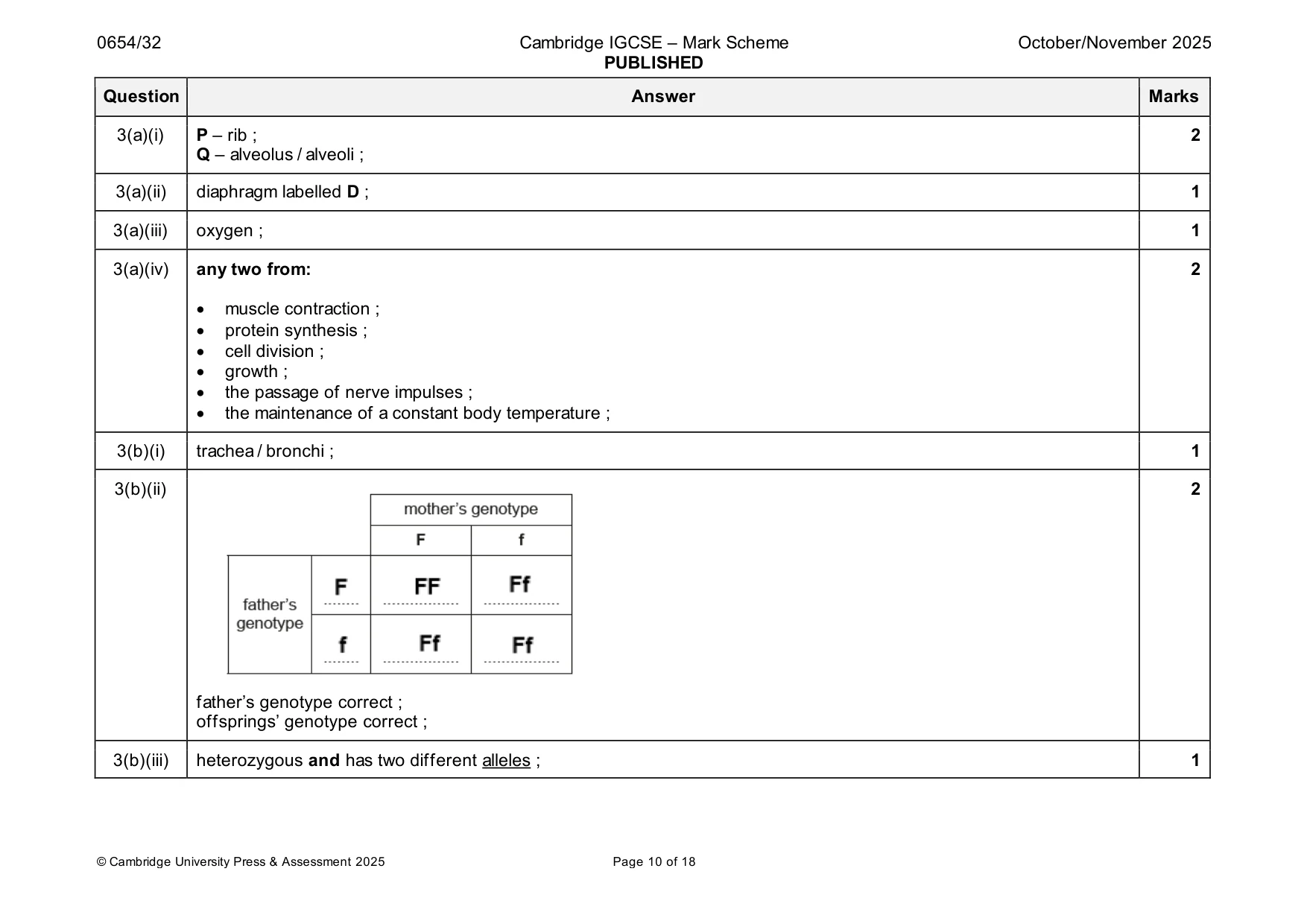
Mark scheme: 3(a)(i) P – rib ; 2 Q – alveolus / alveoli ; 3(a)(ii) diaphragm labelled D ; 1 3(a)(iii) oxygen ; 1 3(a)(iv) any two from: 2 • muscle contraction ; • protein synthesis ; • cell division ; • growth ; • the passage of nerve impulses ; • the maintenance of a constant body temperature ; 3(b)(i) trachea / bronchi ; 1 3(b)(ii) 2 father’s genotype correct ; offsprings’ genotype correct ; 3(b)(iii) heterozygous and has two different alleles ; 1
Question 4
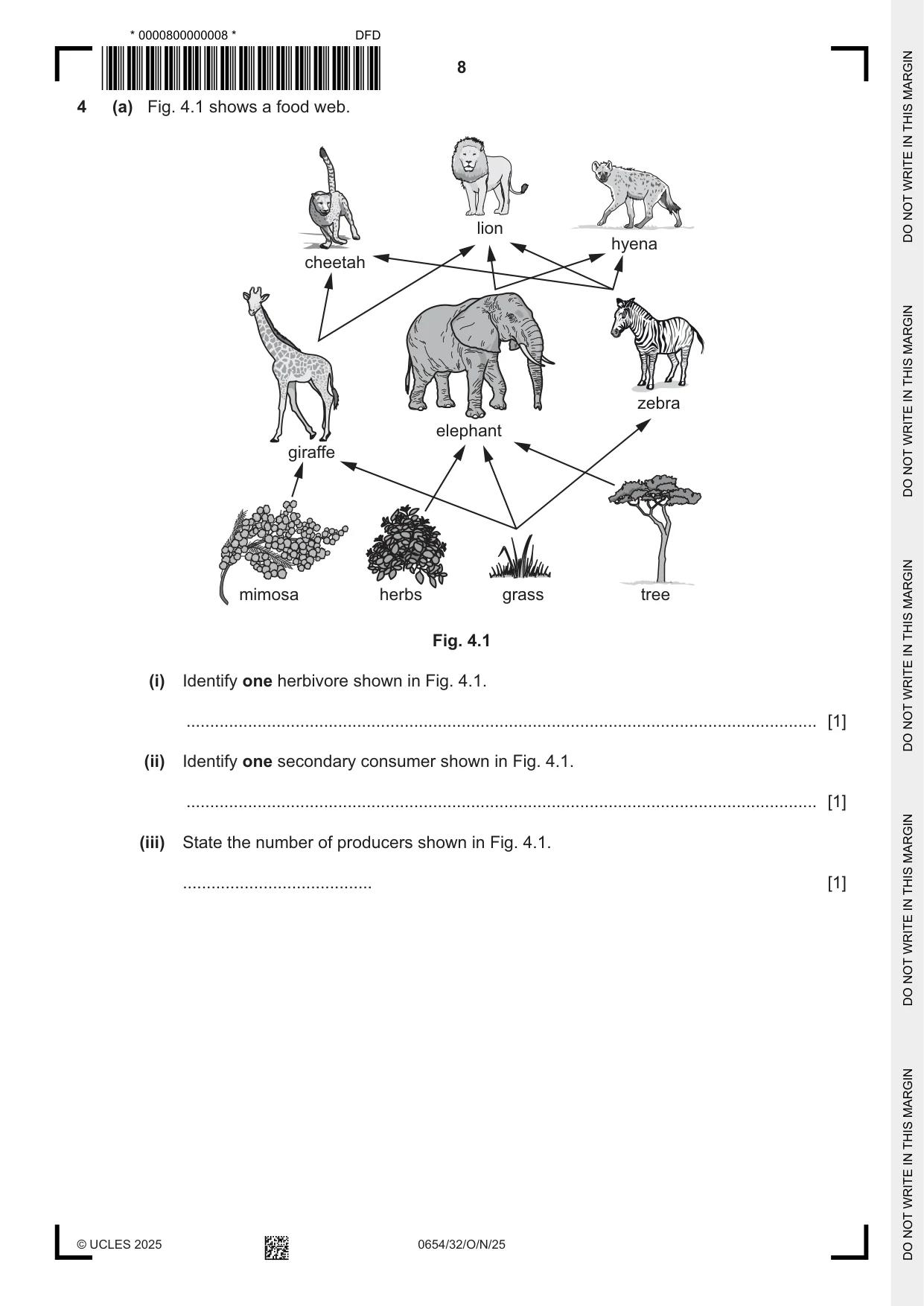
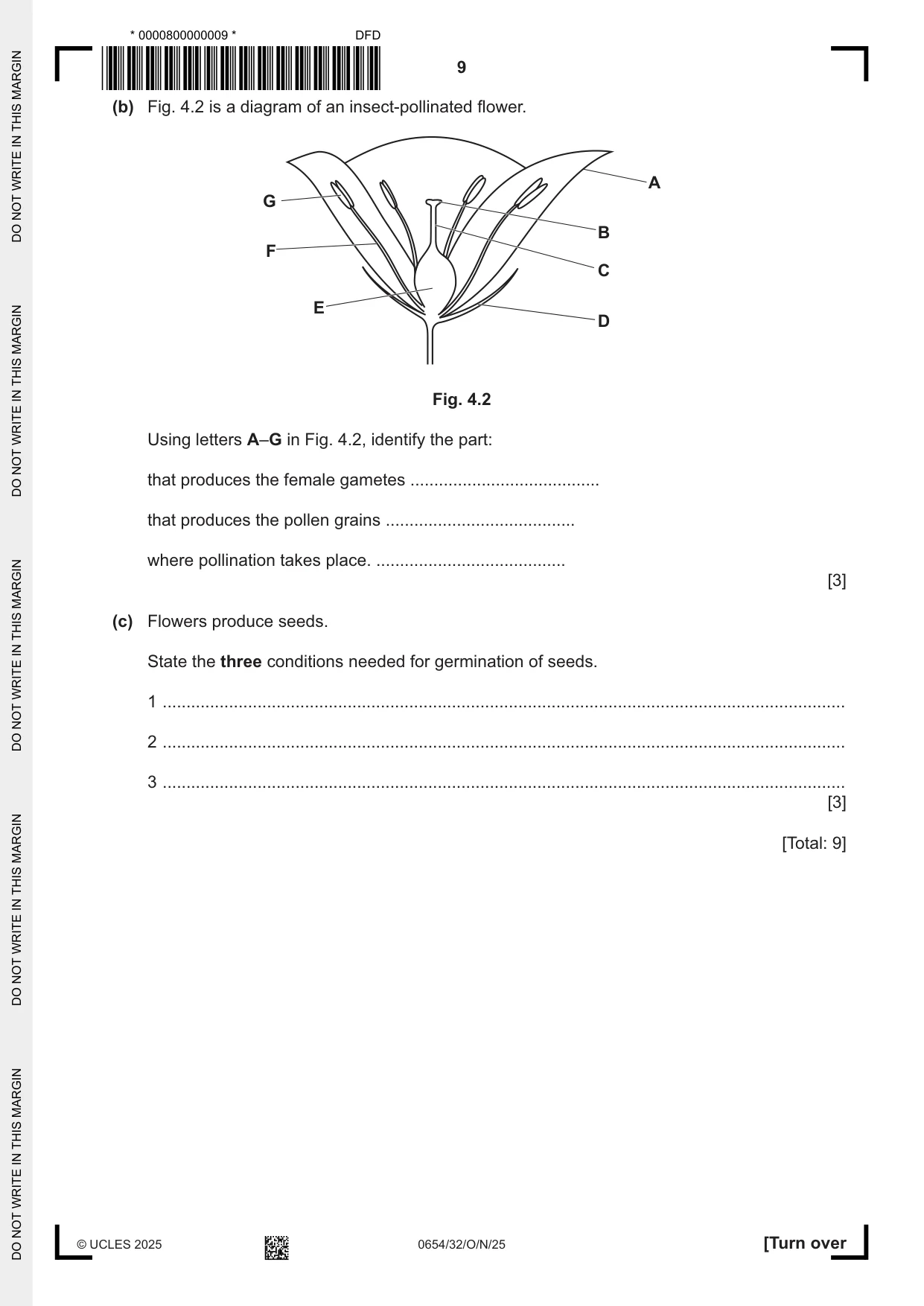
4 (a) Fig. 4.1 shows a food web. lion hyena cheetah zebra elephant giraffe mimosa herbs grass tree Fig. 4.1 (i) Identify one herbivore shown in Fig. 4.1. ..................................................................................................................................... [1] (ii) Identify one secondary consumer shown in Fig. 4.1. ..................................................................................................................................... [1] (iii) State the number of producers shown in Fig. 4.1. ........................................ [1] (b) Fig. 4.2 is a diagram of an insect‑pollinated flower. A G B F C E D Fig. 4.2 Using letters A–G in Fig. 4.2, identify the part: that produces the female gametes ........................................ that produces the pollen grains ........................................ where pollination takes place. ........................................ [3] (c) Flowers produce seeds. State the three conditions needed for germination of seeds. 1 ................................................................................................................................................ 2 ................................................................................................................................................ 3 ................................................................................................................................................ [3] [Total: 9]
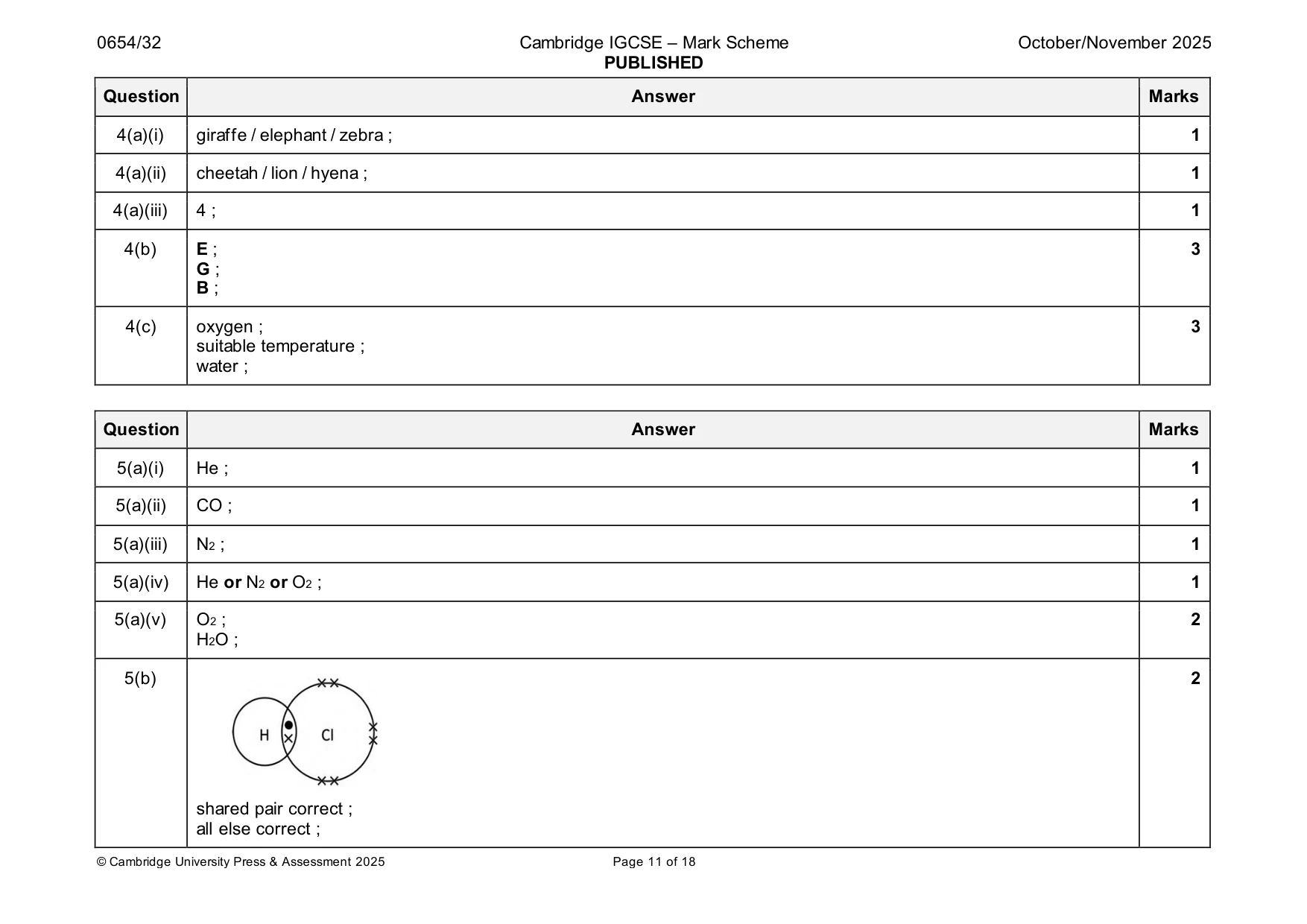
Mark scheme: 4(a)(i) giraffe / elephant / zebra ; 1 4(a)(ii) cheetah / lion / hyena ; 1 4(a)(iii) 4 ; 1 4(b) E ; 3 G ; B ; 4(c) oxygen ; 3 suitable temperature ; water ;
Q5 · The formulae of six gases found in the air are shown
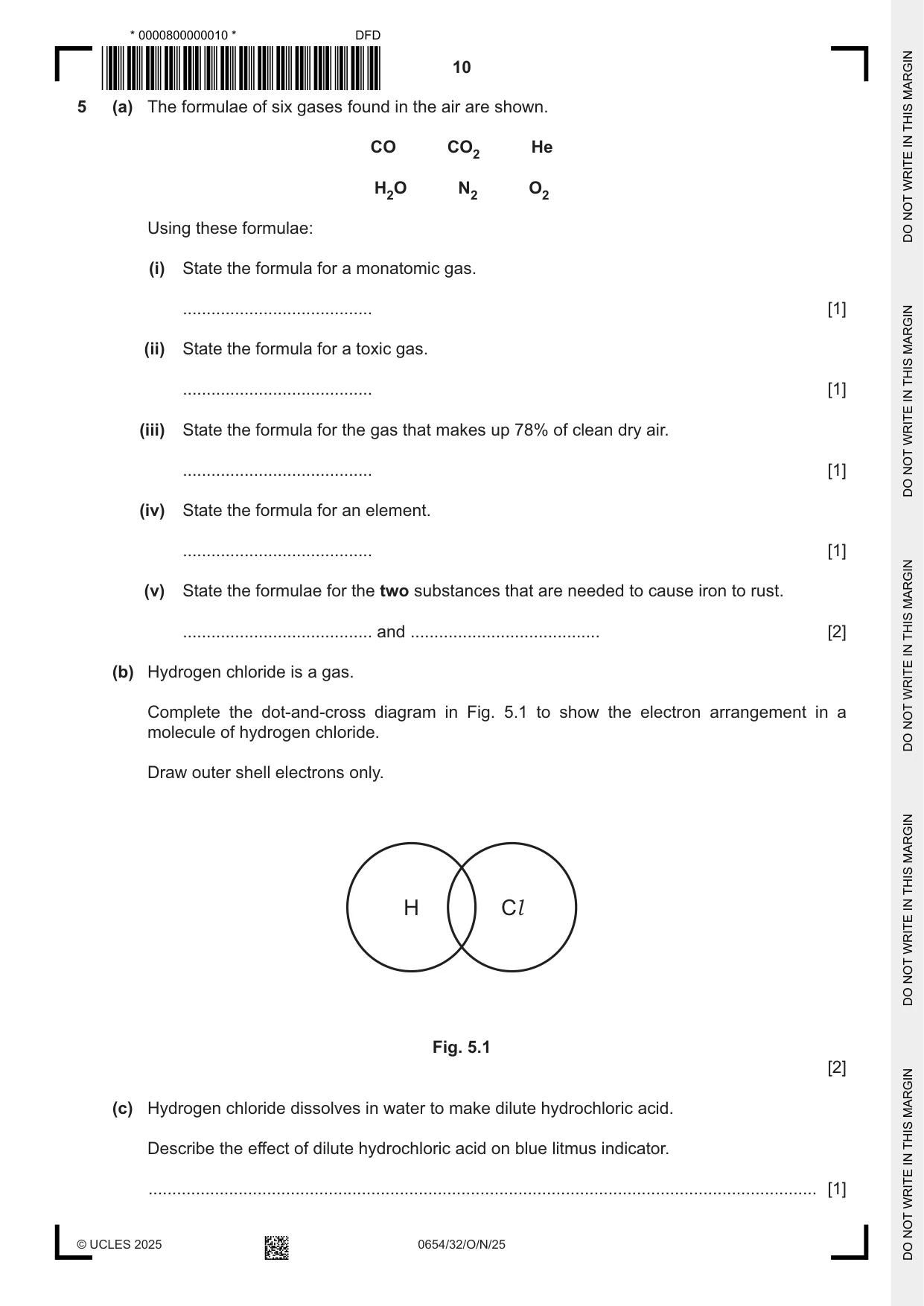
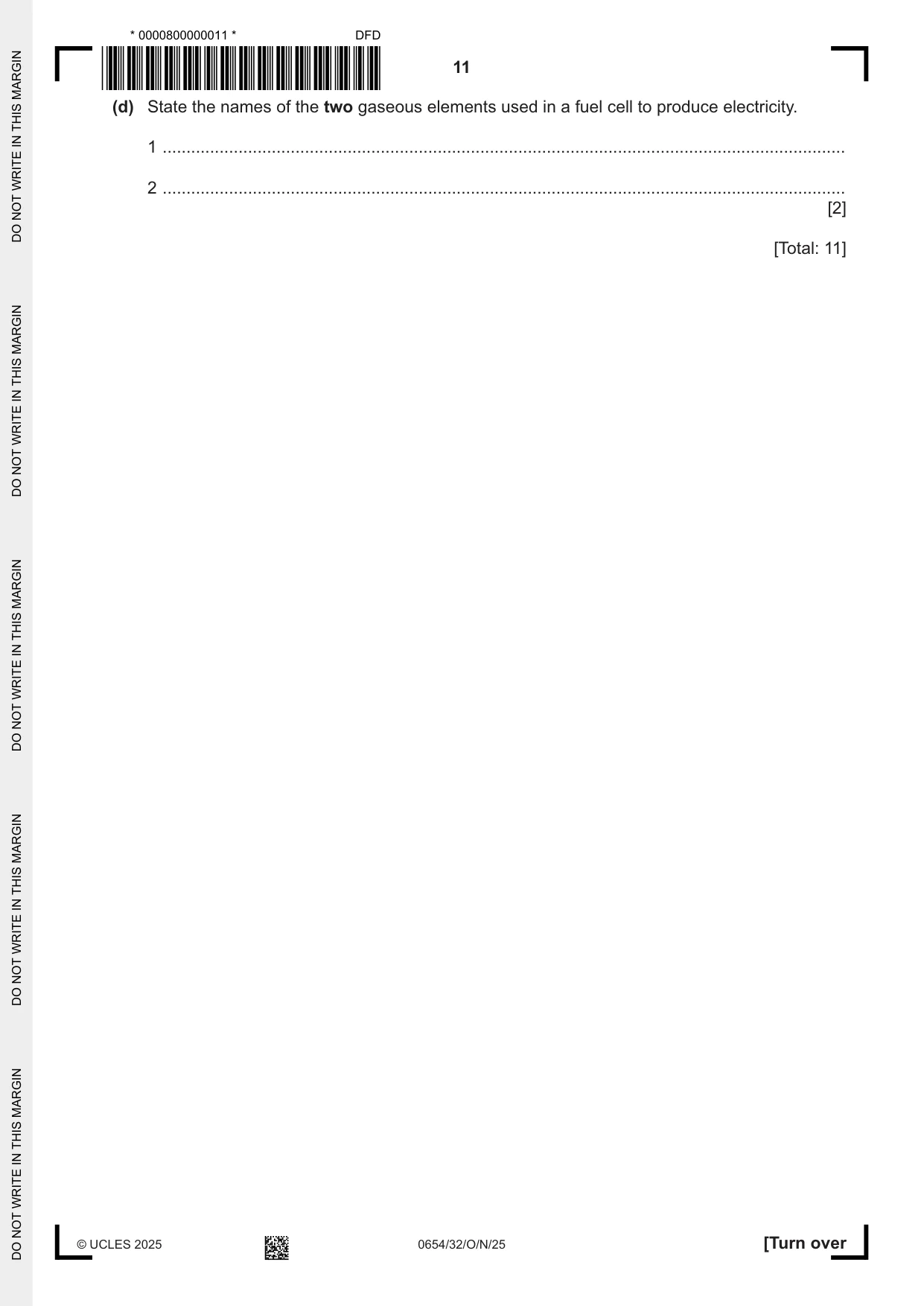
5 (a) The formulae of six gases found in the air are shown. CO CO2 He H2O N2 O2 Using these formulae: (i) State the formula for a monatomic gas. ........................................ [1] (ii) State the formula for a toxic gas. ........................................ [1] (iii) State the formula for the gas that makes up 78% of clean dry air. ........................................ [1] (iv) State the formula for an element. ........................................ [1] (v) State the formulae for the two substances that are needed to cause iron to rust. ........................................ and ........................................ [2] (b) Hydrogen chloride is a gas. Complete the dot‑and‑cross diagram in Fig. 5.1 to show the electron arrangement in a molecule of hydrogen chloride. Draw outer shell electrons only. H Cl Fig. 5.1 [2] (c) Hydrogen chloride dissolves in water to make dilute hydrochloric acid. Describe the effect of dilute hydrochloric acid on blue litmus indicator. ............................................................................................................................................. [1] (d) State the names of the two gaseous elements used in a fuel cell to produce electricity. 1 ................................................................................................................................................ 2 ................................................................................................................................................ [2] [Total: 11]
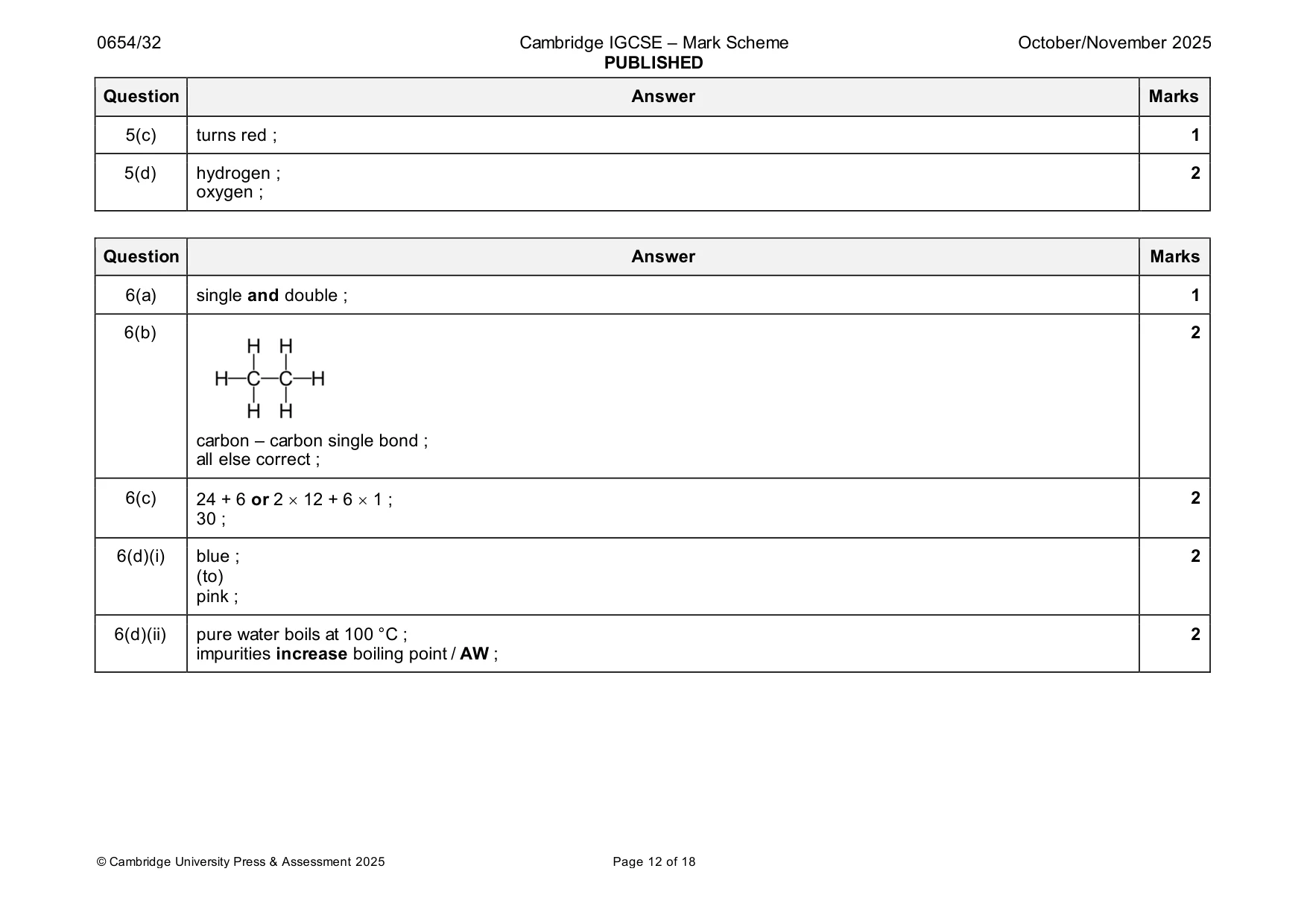
Mark scheme: 5(a)(i) He ; 1 5(a)(ii) CO ; 1 5(a)(iii) N2 ; 1 5(a)(iv) He or N2 or O2 ; 1 5(a)(v) O2 ; 2 H2O ; 5(b) 2 shared pair correct ; all else correct ; 5(c) turns red ; 1 5(d) hydrogen ; 2 oxygen ;
Q6 · Ethane, C2H6, is an alkane
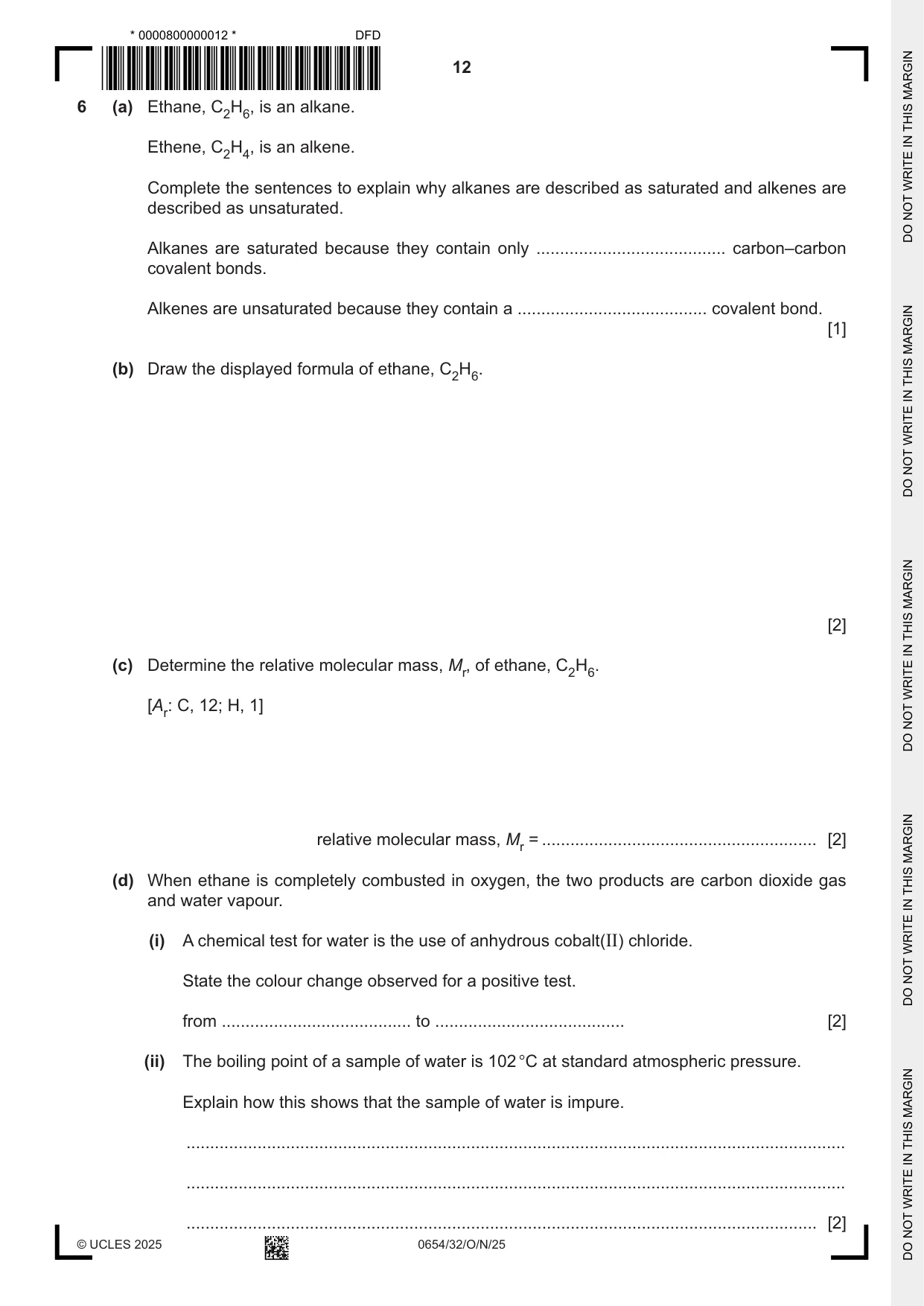
6 (a) Ethane, C2H6, is an alkane. Ethene, C2H4, is an alkene. Complete the sentences to explain why alkanes are described as saturated and alkenes are described as unsaturated. Alkanes are saturated because they contain only ........................................ carbon–carbon covalent bonds. Alkenes are unsaturated because they contain a ........................................ covalent bond. [1] (b) Draw the displayed formula of ethane, C2H6. [2] (c) Determine the relative molecular mass, Mr, of ethane, C2H6. [Ar: C, 12; H, 1] relative molecular mass, Mr = .......................................................... [2] (d) When ethane is completely combusted in oxygen, the two products are carbon dioxide gas and water vapour. (i) A chemical test for water is the use of anhydrous cobalt(II) chloride. State the colour change observed for a positive test. from ........................................ to ........................................ [2] (ii) The boiling point of a sample of water is 102 °C at standard atmospheric pressure. Explain how this shows that the sample of water is impure. ........................................................................................................................................... ........................................................................................................................................... ................ ............................................................................................................... [2] (iii) Higher levels of carbon dioxide in the atmosphere cause climate change. State and explain one strategy which will reduce the effects of climate change. strategy ........................................................................................................................................... ........................................................................................................................................... explanation ........................................................................................................................................... ........................................................................................................................................... ........................................................................................................................................... [2] [Total: 11]
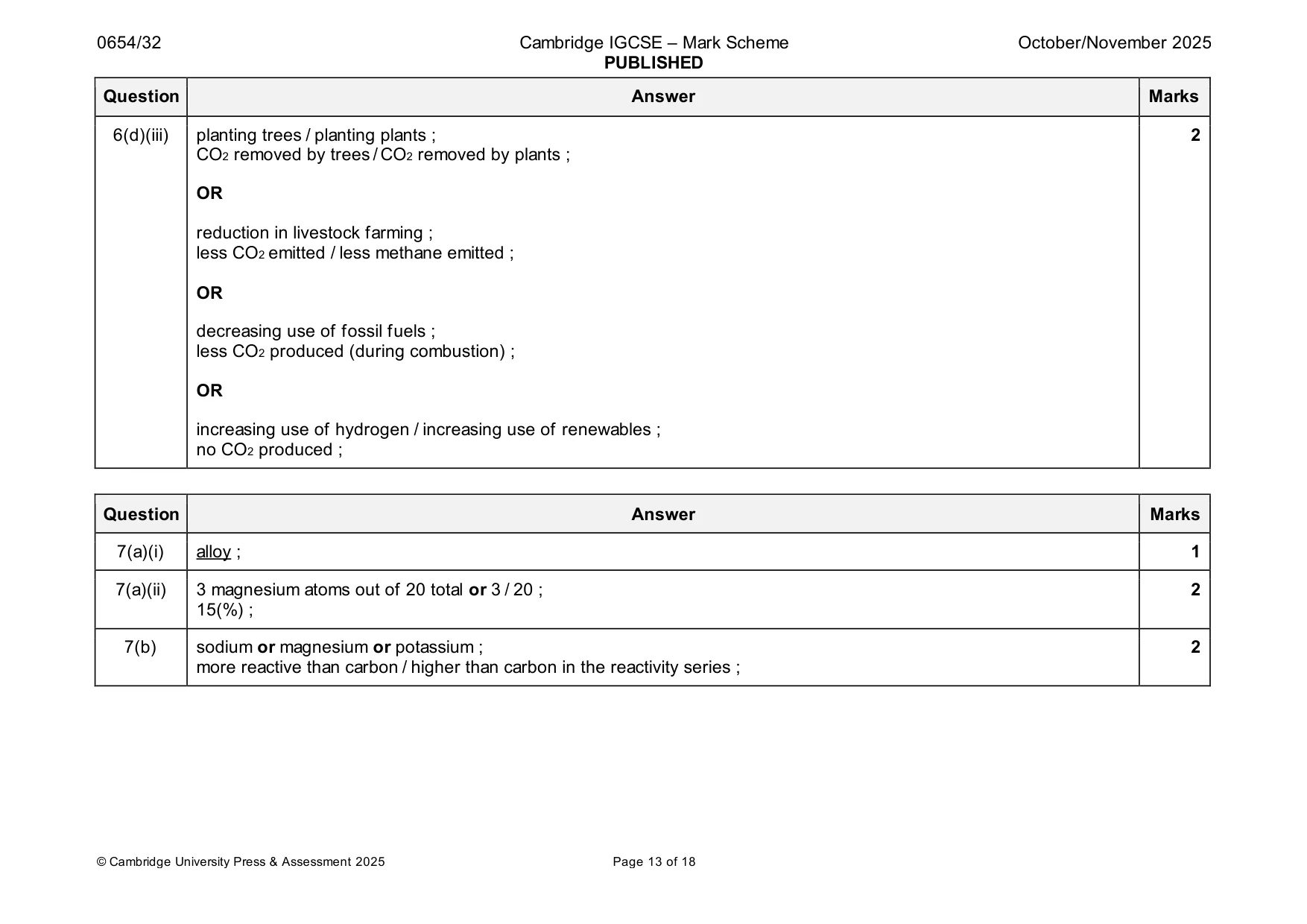
Mark scheme: 6(a) single and double ; 1 6(b) 2 carbon – carbon single bond ; all else correct ; 6(c) 24 + 6 or 2 12 + 6 1 ; 2 30 ; 6(d)(i) blue ; 2 (to) pink ; 6(d)(ii) pure water boils at 100 °C ; 2 impurities increase boiling point / AW ; 6(d)(iii) planting trees / planting plants ; 2 CO2 removed by trees / CO2 removed by plants ; OR reduction in livestock farming ; less CO2 emitted / less methane emitted ; OR decreasing use of fossil fuels ; less CO2 produced (during combustion) ; OR increasing use of hydrogen / increasing use of renewables ; no CO2 produced ;
Q7 · The arrangement of atoms in pure aluminium metal and in a mixture of aluminium and…
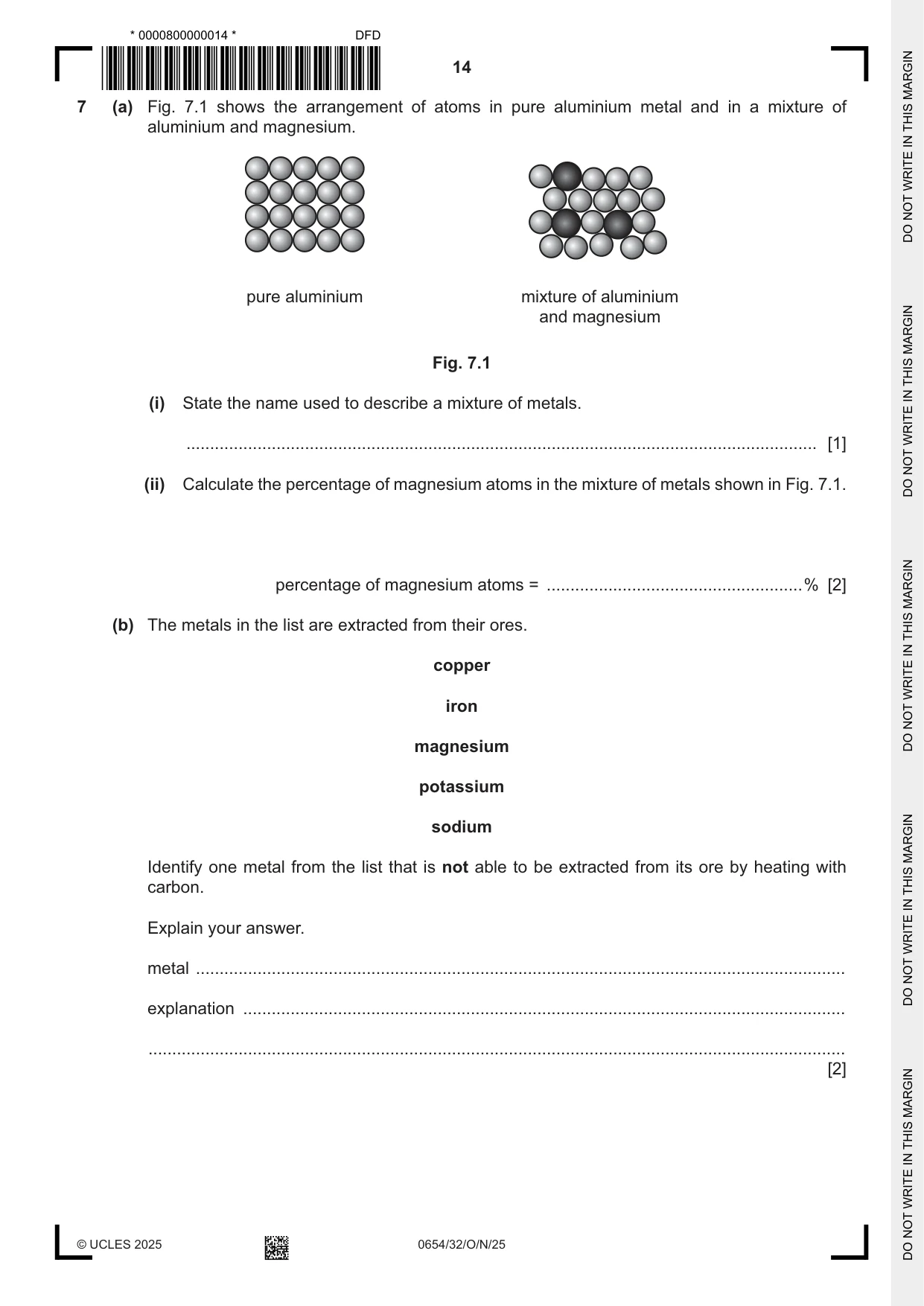
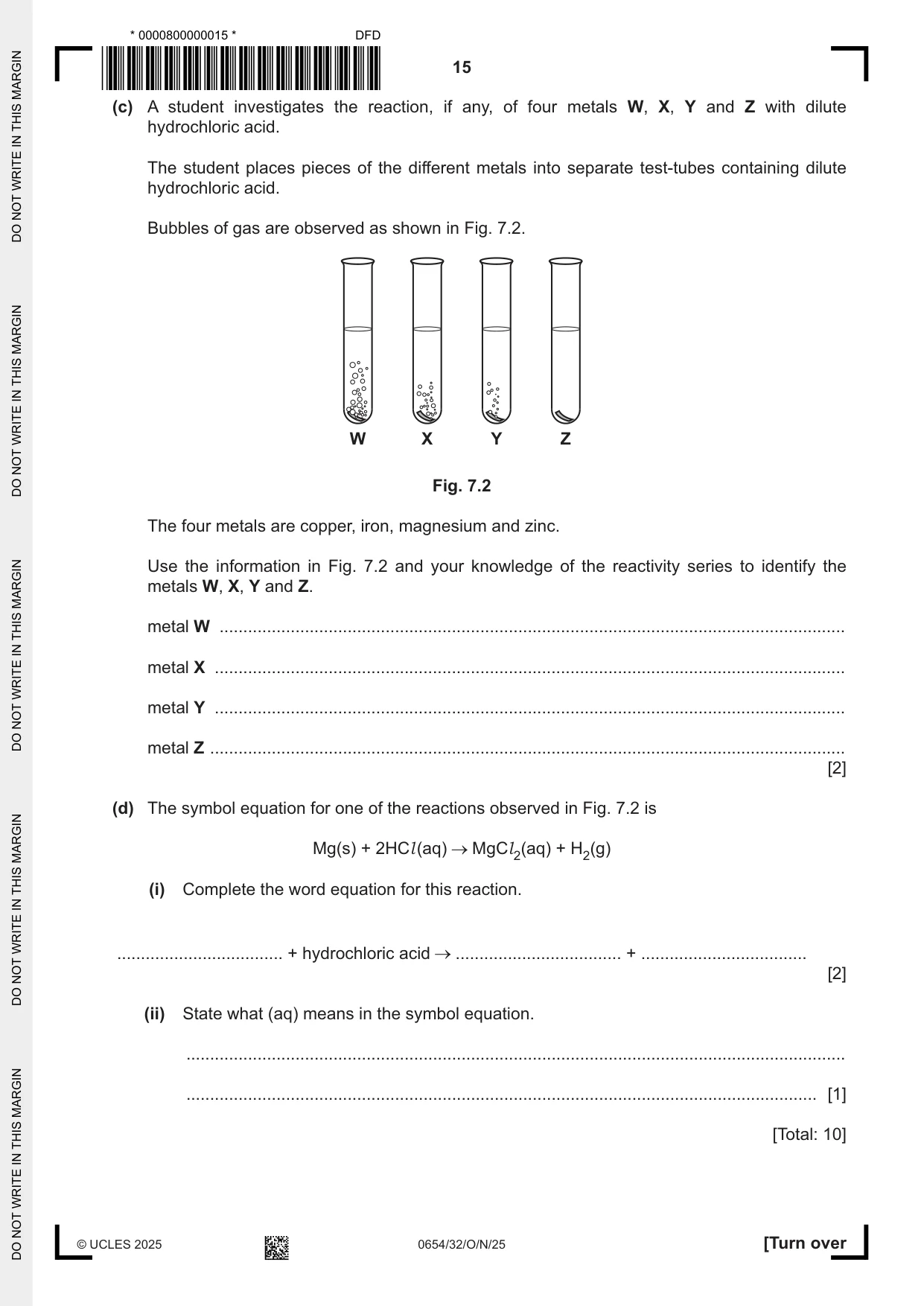
7 (a) Fig. 7.1 shows the arrangement of atoms in pure aluminium metal and in a mixture of aluminium and magnesium. pure aluminium mixture of aluminium and magnesium Fig. 7.1 (i) State the name used to describe a mixture of metals. ..................................................................................................................................... [1] (ii) Calculate the percentage of magnesium atoms in the mixture of metals shown in Fig. 7.1. percentage of magnesium atoms = ......................................................% [2] (b) The metals in the list are extracted from their ores. copper iron magnesium potassium sodium Identify one metal from the list that is not able to be extracted from its ore by heating with carbon. Explain your answer. metal ......................................................................................................................................... explanation ............................................................................................................................... ................................................................................................................................................... [2] (c) A student investigates the reaction, if any, of four metals W, X, Y and Z with dilute hydrochloric acid. The student places pieces of the different metals into separate test‑tubes containing dilute hydrochloric acid. Bubbles of gas are observed as shown in Fig. 7.2. W X Y Z Fig. 7.2 The four metals are copper, iron, magnesium and zinc. Use the information in Fig. 7.2 and your knowledge of the reactivity series to identify the metals W, X, Y and Z. metal W .................................................................................................................................... metal X ..................................................................................................................................... metal Y ..................................................................................................................................... metal Z ...................................................................................................................................... [2] (d) The symbol equation for one of the reactions observed in Fig. 7.2 is Mg(s) + 2HCl (aq) MgCl 2(aq) + H2(g) (i) Complete the word equation for this reaction. ................................... + hydrochloric acid ................................... + ................................... [2] (ii) State what (aq) means in the symbol equation. ........................................................................................................................................... ..................................................................................................................................... [1] [Total: 10]
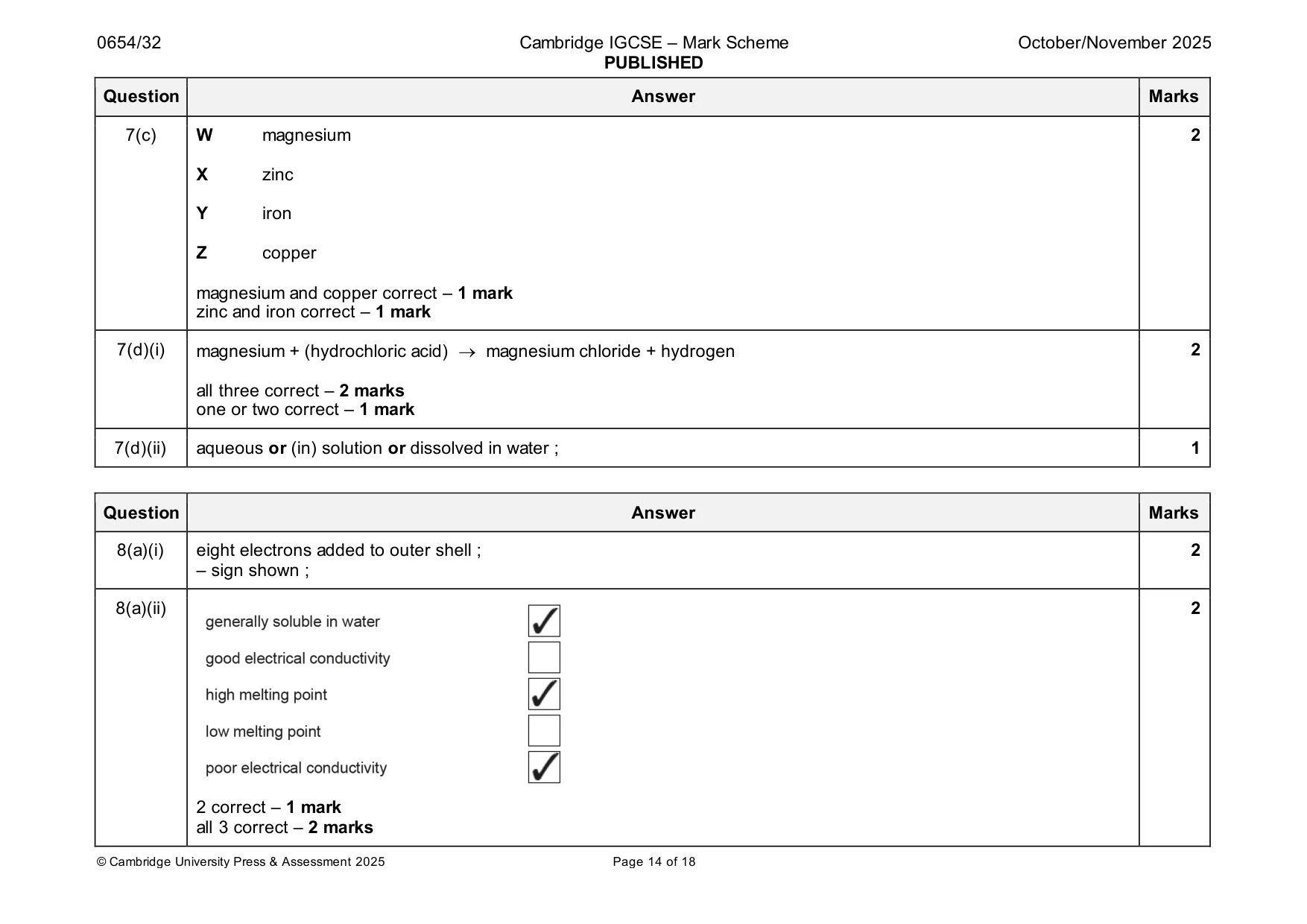
Mark scheme: 7(a)(i) alloy ; 1 7(a)(ii) 3 magnesium atoms out of 20 total or 3 / 20 ; 2 15(%) ; 7(b) sodium or magnesium or potassium ; 2 more reactive than carbon / higher than carbon in the reactivity series ; 7(c) W magnesium 2 X zinc Y iron Z copper magnesium and copper correct – 1 mark zinc and iron correct – 1 mark 7(d)(i) magnesium + (hydrochloric acid) → magnesium chloride + hydrogen 2 all three correct – 2 marks one or two correct – 1 mark 7(d)(ii) aqueous or (in) solution or dissolved in water ; 1
Q8 · Sodium reacts with chlorine to make sodium chloride
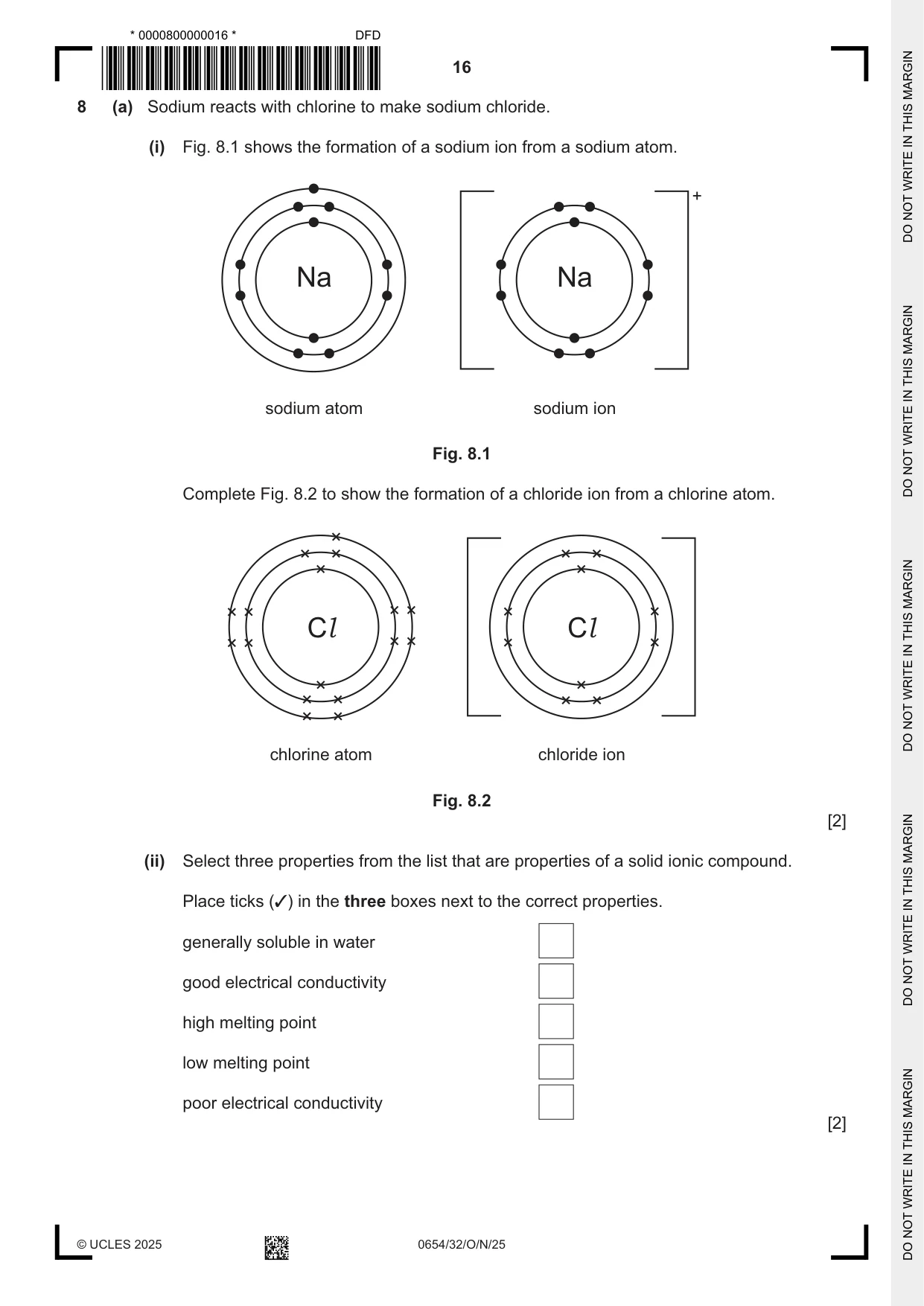
8 (a) Sodium reacts with chlorine to make sodium chloride. (i) Fig. 8.1 shows the formation of a sodium ion from a sodium atom. + Na Na sodium atom sodium ion Fig. 8.1 Complete Fig. 8.2 to show the formation of a chloride ion from a chlorine atom. Cl Cl chlorine atom chloride ion Fig. 8.2 [2] (ii) Select three properties from the list that are properties of a solid ionic compound. Place ticks (3) in the three boxes next to the correct properties. generally soluble in water good electrical conductivity high melting point low melting point poor electrical conductivity [2] (b) Chlorine is a halogen in Group VII of the Periodic Table. State the colour and physical state of chlorine at room temperature and pressure (r.t.p.). colour ........................................................................................................................................ physical state ............................................................................................................................ [2] (c) Sodium chloride is also made by the neutralisation of an acid with an alkali. State the name of a suitable acid and the name of a suitable alkali for this reaction. acid ........................................................................................................................................... alkali ......................................................................................................................................... [2] [Total: 8]
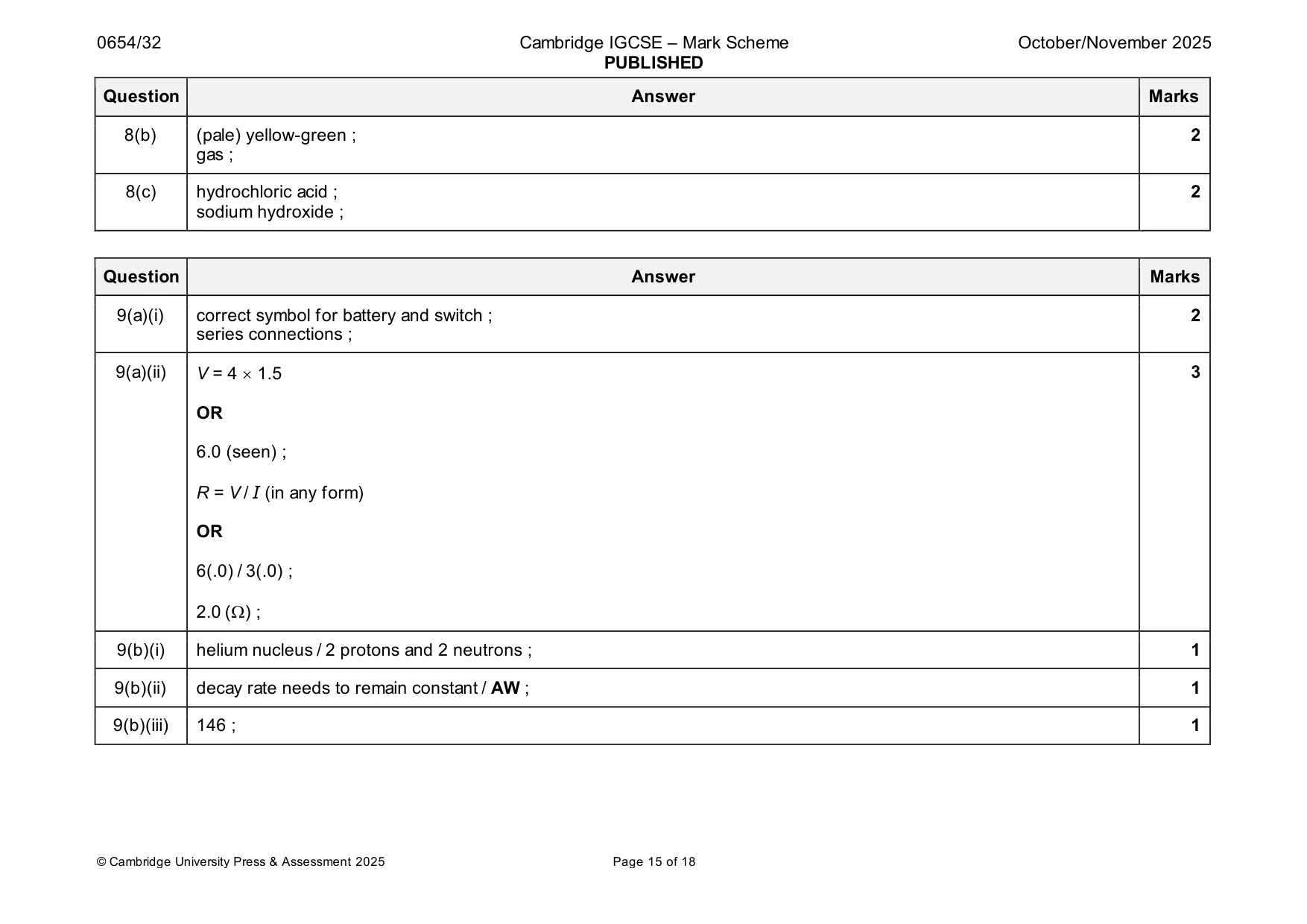
Mark scheme: 8(a)(i) eight electrons added to outer shell ; 2 – sign shown ; 8(a)(ii) 2 2 correct – 1 mark all 3 correct – 2 marks 8(b) (pale) yellow-green ; 2 gas ; 8(c) hydrochloric acid ; 2 sodium hydroxide ;
Q9 · A house has an electric doorbell
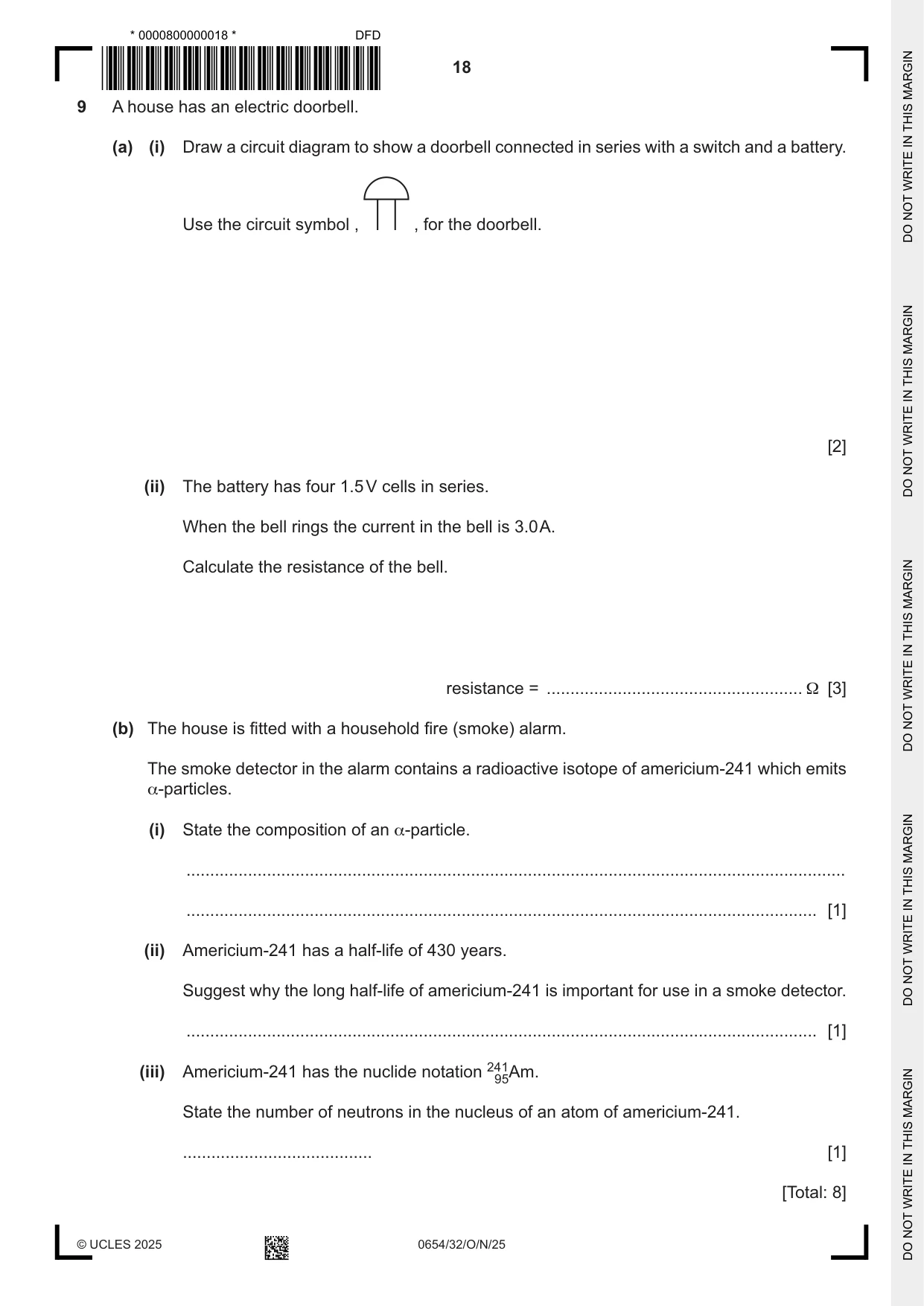
9 A house has an electric doorbell. (a) (i) Draw a circuit diagram to show a doorbell connected in series with a switch and a battery. Use the circuit symbol , , for the doorbell. [2] (ii) The battery has four 1.5 V cells in series. When the bell rings the current in the bell is 3.0 A. Calculate the resistance of the bell. resistance = ...................................................... Ω [3] (b) The house is fitted with a household fire (smoke) alarm. The smoke detector in the alarm contains a radioactive isotope of americium‑241 which emits α‑particles. (i) State the composition of an α‑particle. ........................................................................................................................................... ..................................................................................................................................... [1] (ii) Americium‑241 has a half‑life of 430 years. Suggest why the long half‑life of americium‑241 is important for use in a smoke detector. ..................................................................................................................................... [1] (iii) Americium‑241 has the nuclide notation 24 1 9 5Am. State the number of neutrons in the nucleus of an atom of americium‑241. ........................................ [1] [Total: 8]
Mark scheme: 9(a)(i) correct symbol for battery and switch ; 2 series connections ; 9(a)(ii) V = 4 1.5 3 OR 6.0 (seen) ; R = V / I (in any form) OR 6(.0) / 3(.0) ; 2.0 () ; 9(b)(i) helium nucleus / 2 protons and 2 neutrons ; 1 9(b)(ii) decay rate needs to remain constant / AW ; 1 9(b)(iii) 146 ; 1
Q10 · An electric kettle with a heating element
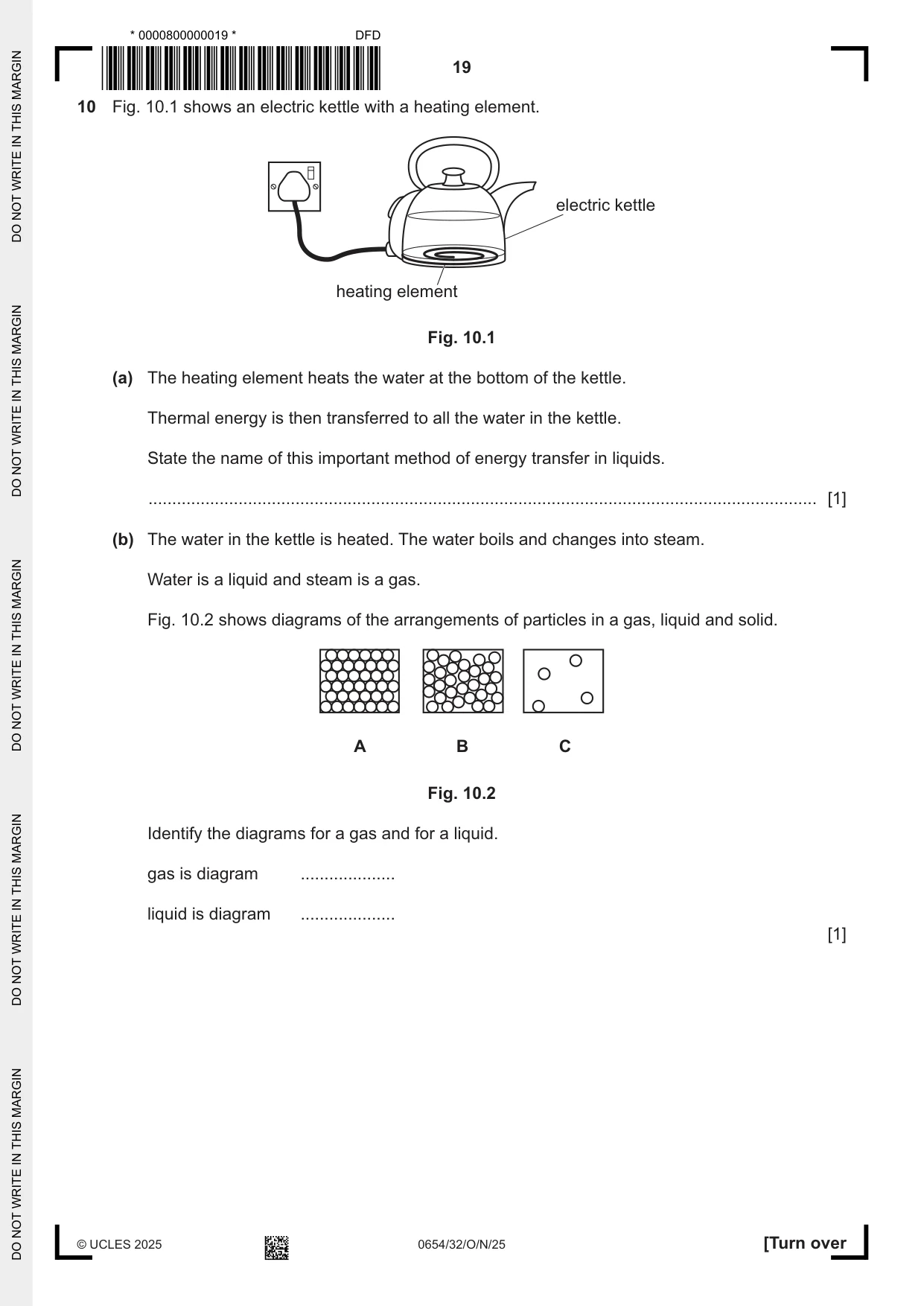
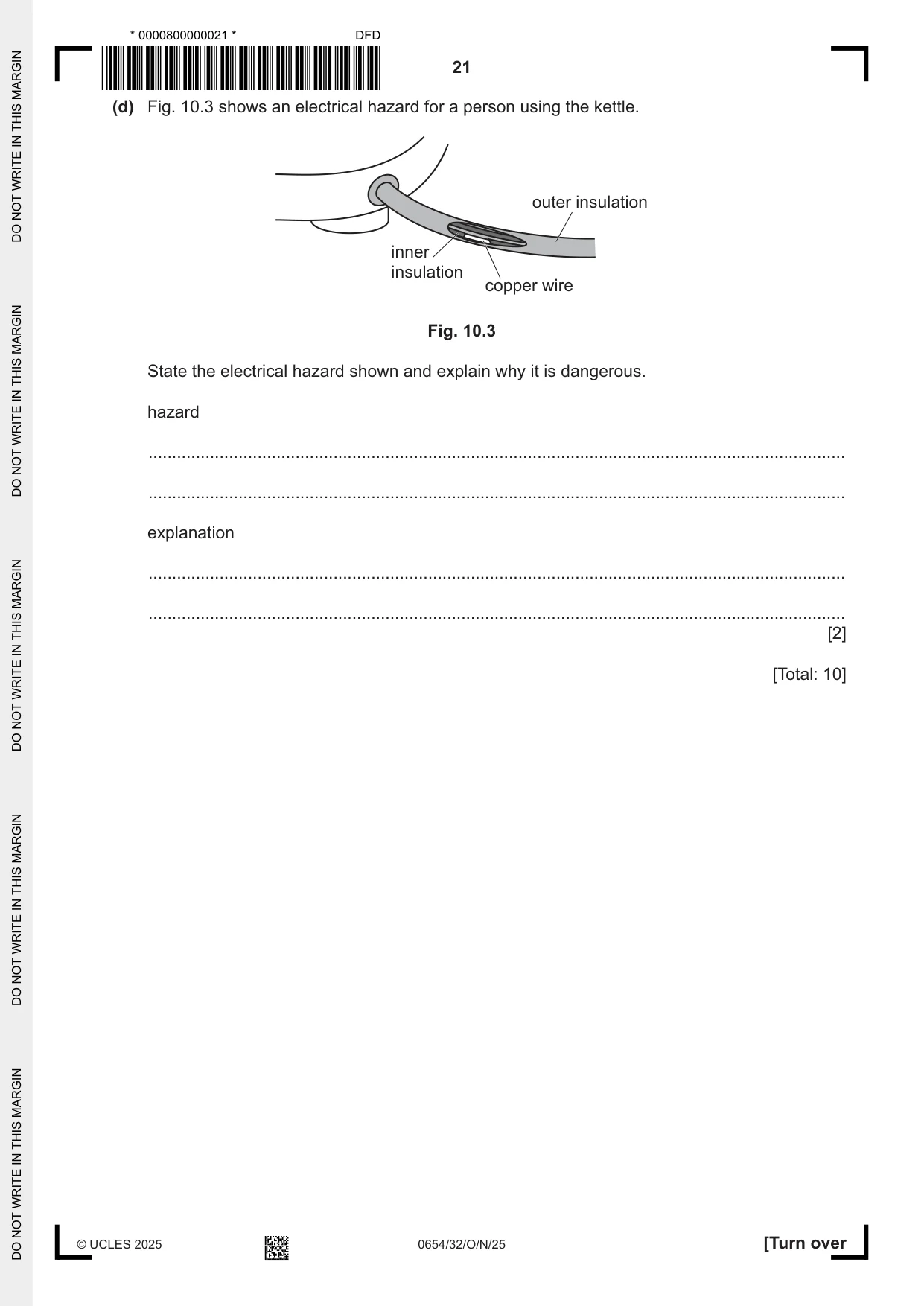
10 Fig. 10.1 shows an electric kettle with a heating element. electric kettle heating element Fig. 10.1 (a) The heating element heats the water at the bottom of the kettle. Thermal energy is then transferred to all the water in the kettle. State the name of this important method of energy transfer in liquids. ............................................................................................................................................. [1] (b) The water in the kettle is heated. The water boils and changes into steam. Water is a liquid and steam is a gas. Fig. 10.2 shows diagrams of the arrangements of particles in a gas, liquid and solid. A B C Fig. 10.2 Identify the diagrams for a gas and for a liquid. gas is diagram .................... liquid is diagram .................... [1] (c) The kettle is connected to a 240 V supply. Power is supplied to the kettle at 3000 W. (i) Calculate the current in the kettle. current = ....................................................... A [2] (ii) The kettle is used for 10 minutes. Show that the energy used is 0.50 kW h. [3] (iii) 1 kW h costs $0.50. Calculate the cost of the energy used in (ii). cost = $ .......................................................... [1] (d) Fig. 10.3 shows an electrical hazard for a person using the kettle. outer insulation inner insulation copper wire Fig. 10.3 State the electrical hazard shown and explain why it is dangerous. hazard ................................................................................................................................................... ................................................................................................................................................... explanation ................................................................................................................................................... ................................................................................................................................................... [2] [Total: 10]
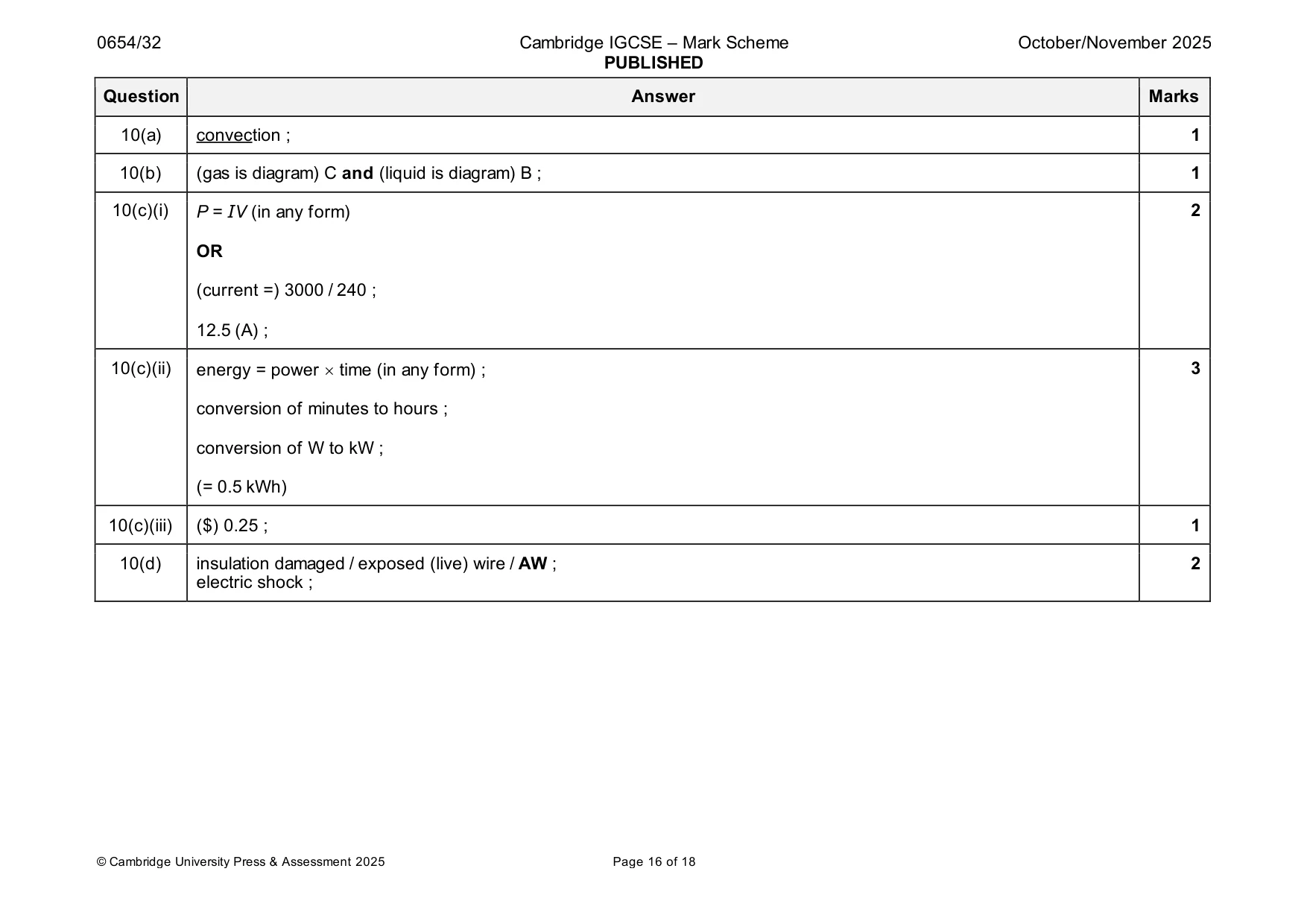
Mark scheme: 10(a) convection ; 1 10(b) (gas is diagram) C and (liquid is diagram) B ; 1 10(c)(i) P = IV (in any form) 2 OR (current =) 3000 / 240 ; 12.5 (A) ; 10(c)(ii) energy = power time (in any form) ; 3 conversion of minutes to hours ; conversion of W to kW ; (= 0.5 kWh) 10(c)(iii) ($) 0.25 ; 1 10(d) insulation damaged / exposed (live) wire / AW ; 2 electric shock ;
Q11 · A student runs 100 m
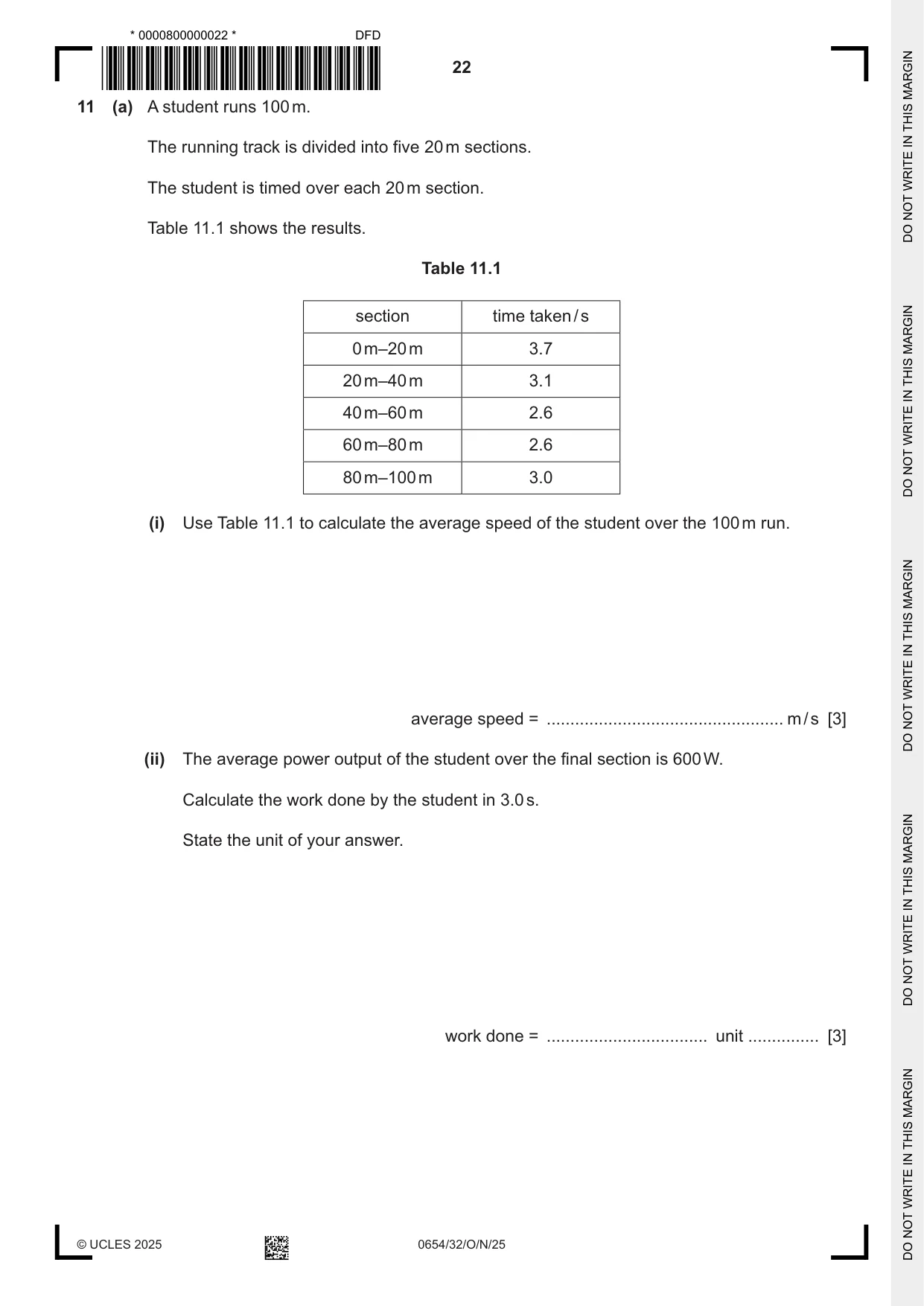
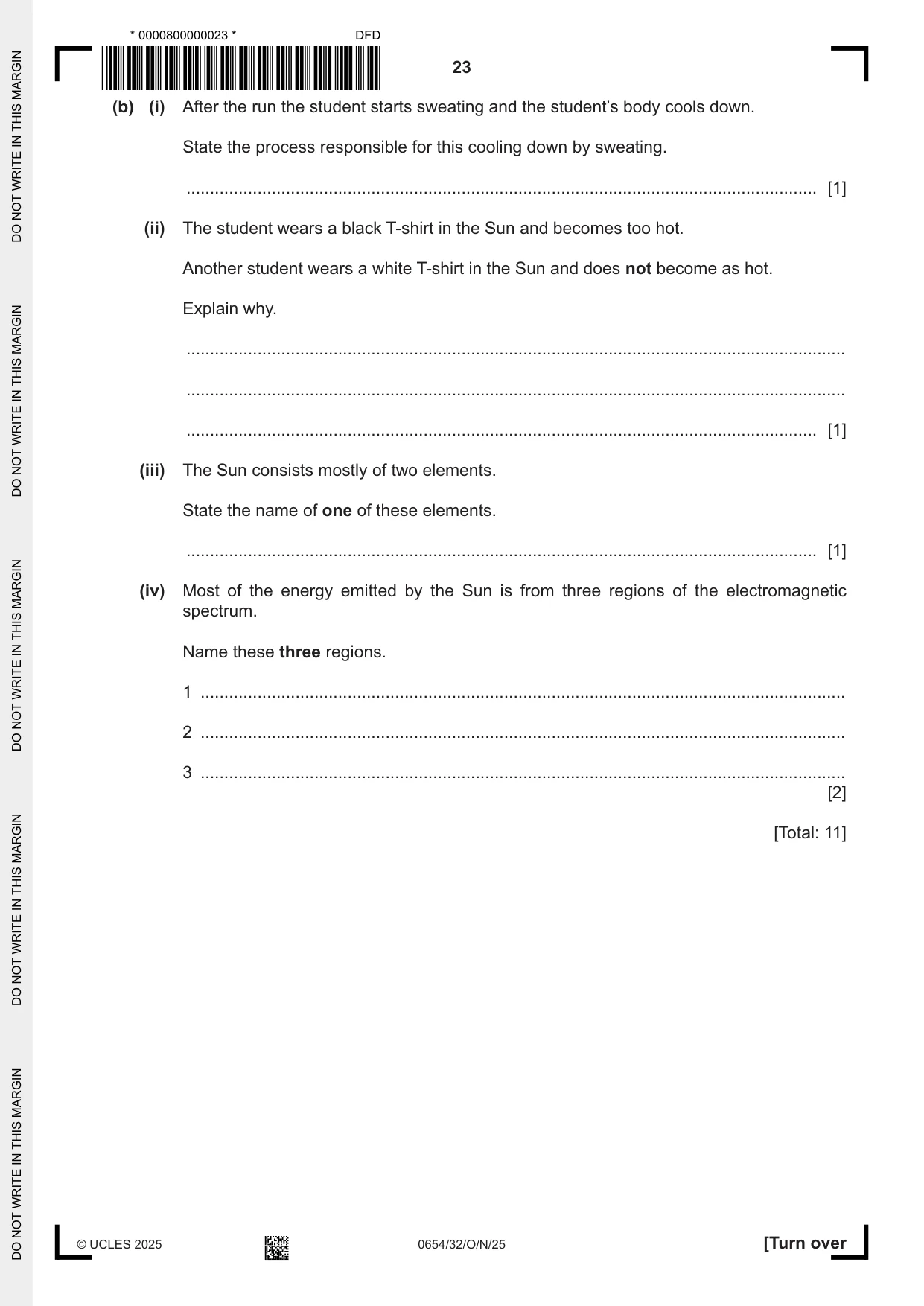
11 (a) A student runs 100 m. The running track is divided into five 20 m sections. The student is timed over each 20 m section. Table 11.1 shows the results. Table 11.1 section time taken / s 0 m–20 m 3.7 20 m–40 m 3.1 40 m–60 m 2.6 60 m–80 m 2.6 80 m–100 m 3.0 (i) Use Table 11.1 to calculate the average speed of the student over the 100 m run. average speed = .................................................. m / s [3] (ii) The average power output of the student over the final section is 600 W. Calculate the work done by the student in 3.0 s. State the unit of your answer. work done = .................................. unit ............... [3] (b) (i) After the run the student starts sweating and the student’s body cools down. State the process responsible for this cooling down by sweating. ..................................................................................................................................... [1] (ii) The student wears a black T‑shirt in the Sun and becomes too hot. Another student wears a white T‑shirt in the Sun and does not become as hot. Explain why. ........................................................................................................................................... ........................................................................................................................................... ..................................................................................................................................... [1] (iii) The Sun consists mostly of two elements. State the name of one of these elements. ..................................................................................................................................... [1] (iv) Most of the energy emitted by the Sun is from three regions of the electromagnetic spectrum. Name these three regions. 1 ........................................................................................................................................ 2 ........................................................................................................................................ 3 ........................................................................................................................................ [2] [Total: 11]
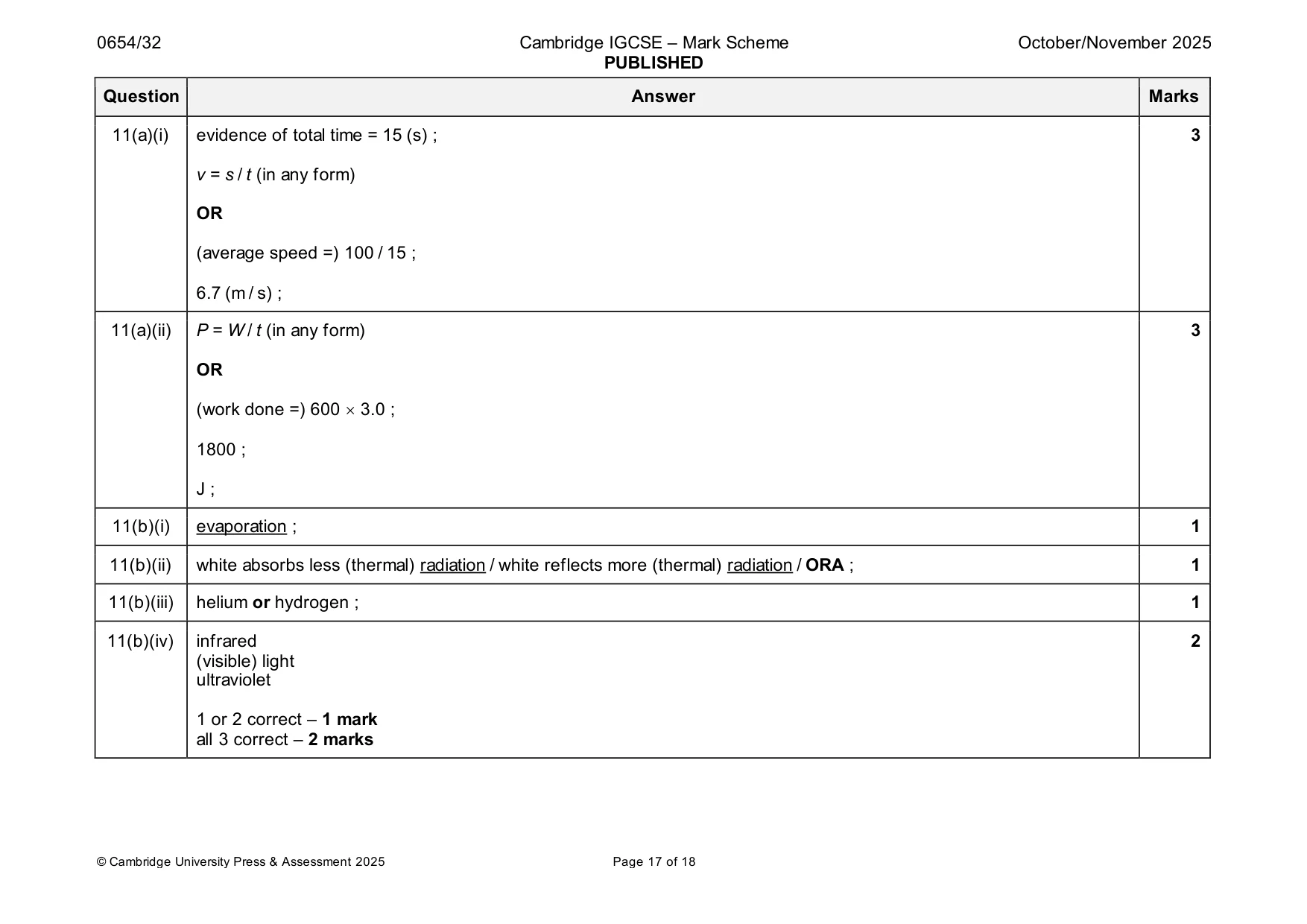
Mark scheme: 11(a)(i) evidence of total time = 15 (s) ; 3 v = s / t (in any form) OR (average speed =) 100 / 15 ; 6.7 (m / s) ; 11(a)(ii) P = W / t (in any form) 3 OR (work done =) 600 3.0 ; 1800 ; J ; 11(b)(i) evaporation ; 1 11(b)(ii) white absorbs less (thermal) radiation / white reflects more (thermal) radiation / ORA ; 1 11(b)(iii) helium or hydrogen ; 1 11(b)(iv) infrared 2 (visible) light ultraviolet 1 or 2 correct – 1 mark all 3 correct – 2 marks
Q12 · Four forces, A, B, C and D, acting on a car moving along a level road
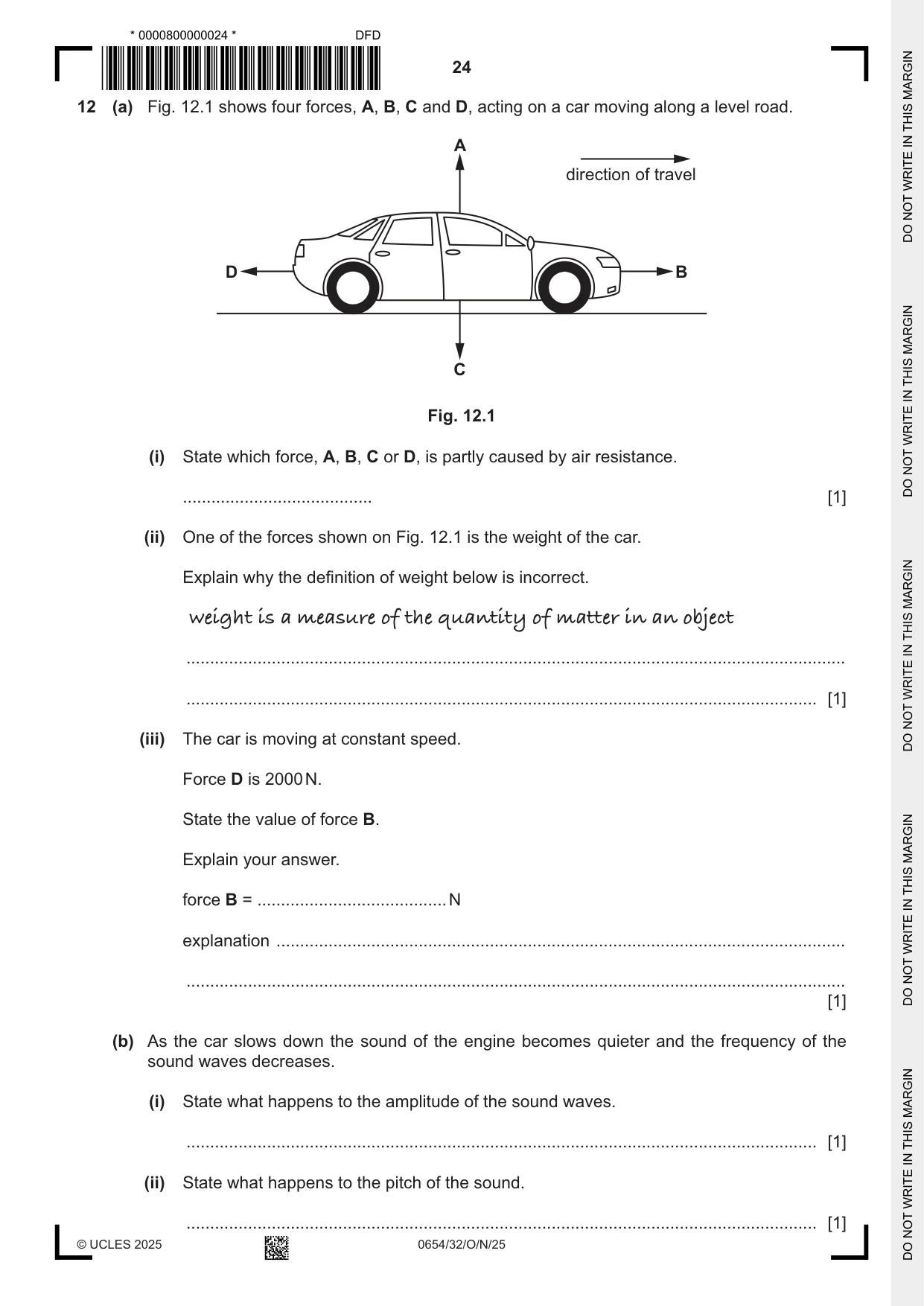
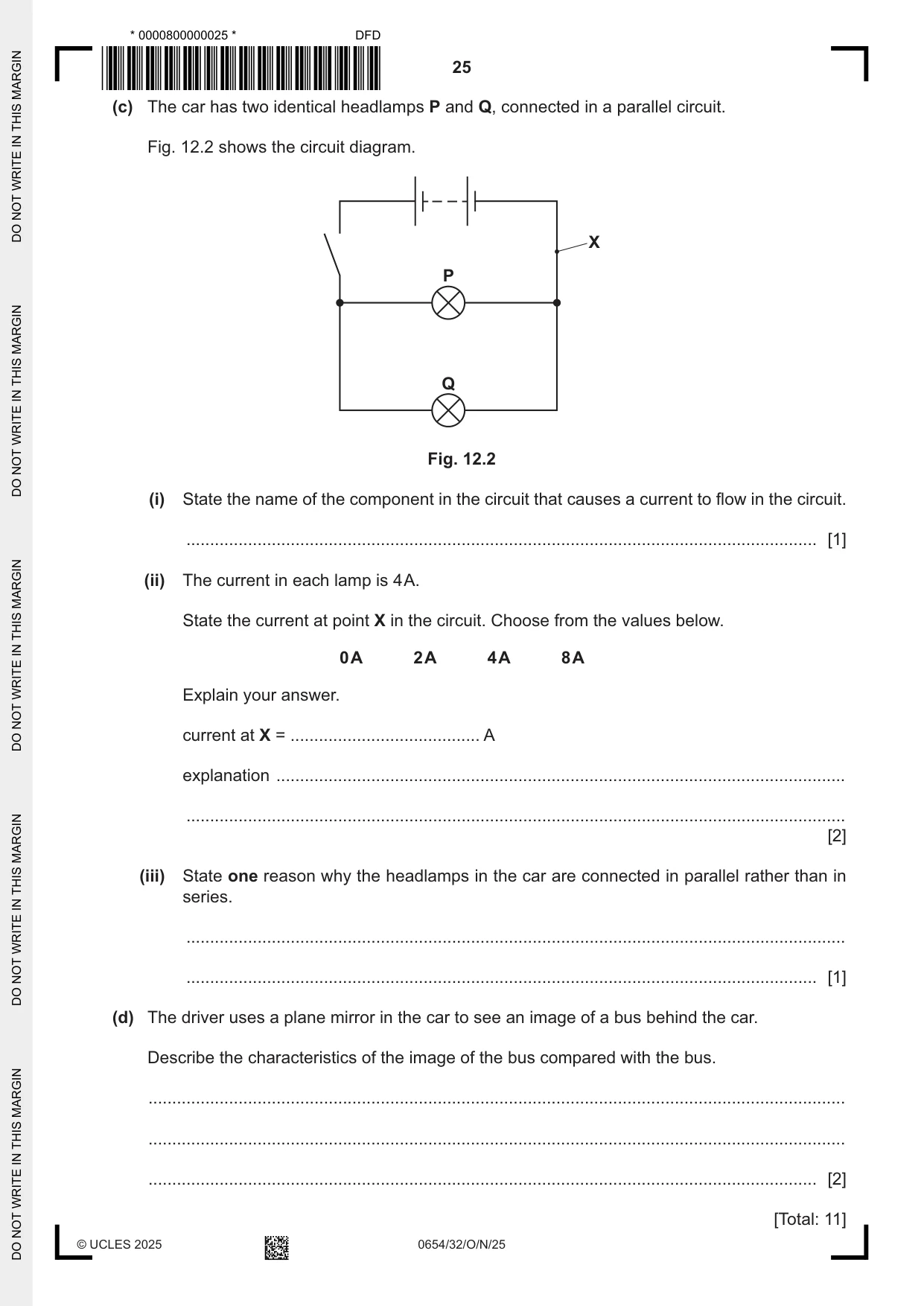
12 (a) Fig. 12.1 shows four forces, A, B, C and D, acting on a car moving along a level road. A direction of travel D B C Fig. 12.1 (i) State which force, A, B, C or D, is partly caused by air resistance. ........................................ [1] (ii) One of the forces shown on Fig. 12.1 is the weight of the car. Explain why the definition of weight below is incorrect. weight is a measure of the quantity of matter in an object ........................................................................................................................................... ..................................................................................................................................... [1] (iii) The car is moving at constant speed. Force D is 2000 N. State the value of force B. Explain your answer. force B = ........................................ N explanation ........................................................................................................................ ........................................................................................................................................... [1] (b) As the car slows down the sound of the engine becomes quieter and the frequency of the sound waves decreases. (i) State what happens to the amplitude of the sound waves. ..................................................................................................................................... [1] (ii) State what happens to the pitch of the sound. ................ ............................................................................................................... [1] (c) The car has two identical headlamps P and Q, connected in a parallel circuit. Fig. 12.2 shows the circuit diagram. X P Q Fig. 12.2 (i) State the name of the component in the circuit that causes a current to flow in the circuit. ..................................................................................................................................... [1] (ii) The current in each lamp is 4 A. State the current at point X in the circuit. Choose from the values below. 0 A 2 A 4 A 8 A Explain your answer. current at X = ........................................ A explanation ........................................................................................................................ ........................................................................................................................................... [2] (iii) State one reason why the headlamps in the car are connected in parallel rather than in series. ........................................................................................................................................... ..................................................................................................................................... [1] (d) The driver uses a plane mirror in the car to see an image of a bus behind the car. Describe the characteristics of the image of the bus compared with the bus. ................................................................................................................................................... ................................................................................................................................................... ............................................................................................................................................. [2] [Total: 11]
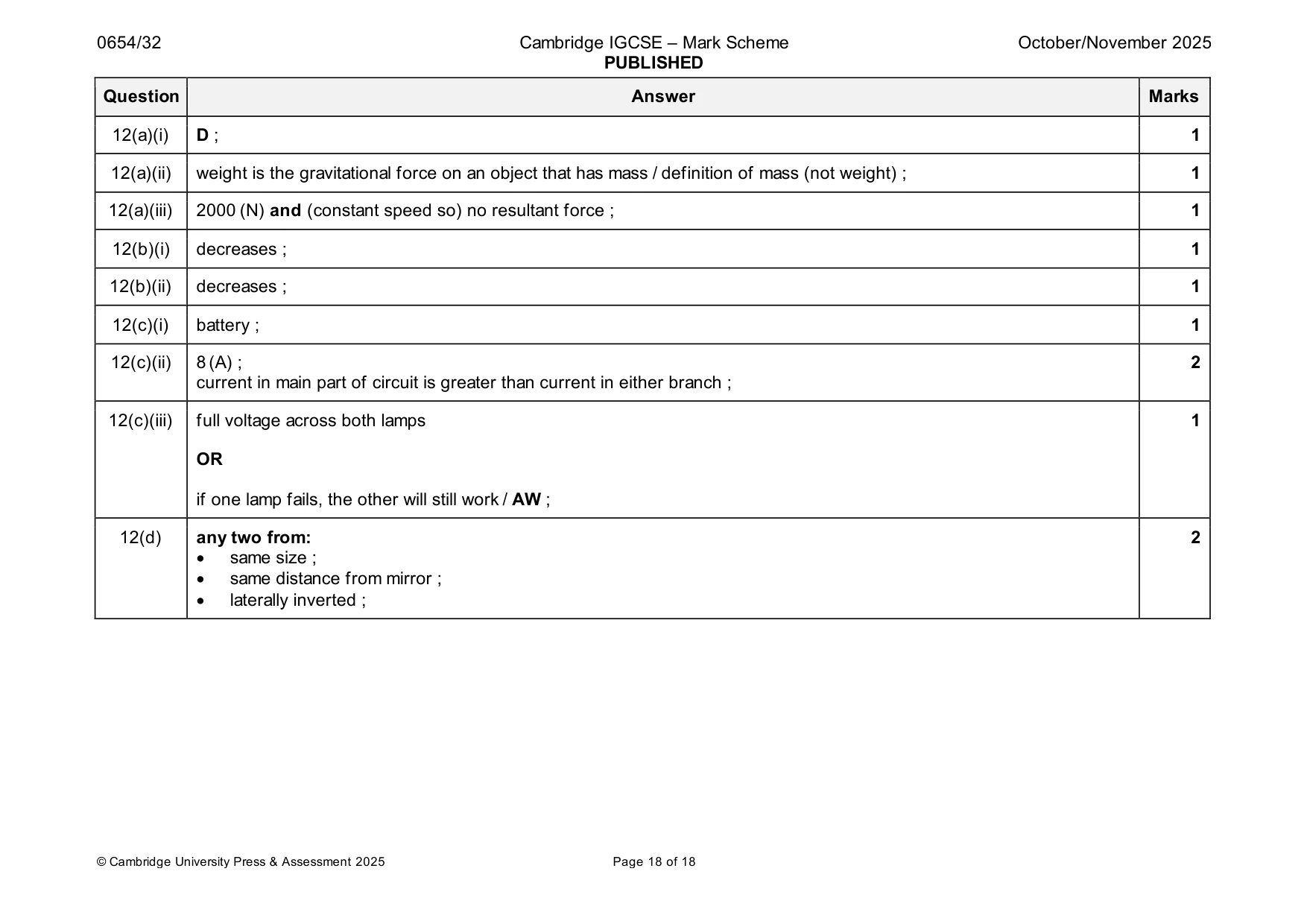
Mark scheme: 12(a)(i) D ; 1 12(a)(ii) weight is the gravitational force on an object that has mass / definition of mass (not weight) ; 1 12(a)(iii) 2000 (N) and (constant speed so) no resultant force ; 1 12(b)(i) decreases ; 1 12(b)(ii) decreases ; 1 12(c)(i) battery ; 1 12(c)(ii) 8 (A) ; 2 current in main part of circuit is greater than current in either branch ; 12(c)(iii) full voltage across both lamps 1 OR if one lamp fails, the other will still work / AW ; 12(d) any two from: 2 • same size ; • same distance from mirror ; • laterally inverted ;
What was in this paper
The subtopics covered by these 12 questions, and how many questions each got. Open one in a new tab to see every Cambridge question on it.
What you needed in this session
Cambridge’s own grade thresholds for 2025 Oct/Nov, Paper 3 · Variant 2. A higher threshold means an easier paper — the bar moves with how the cohort did.