Questions as text
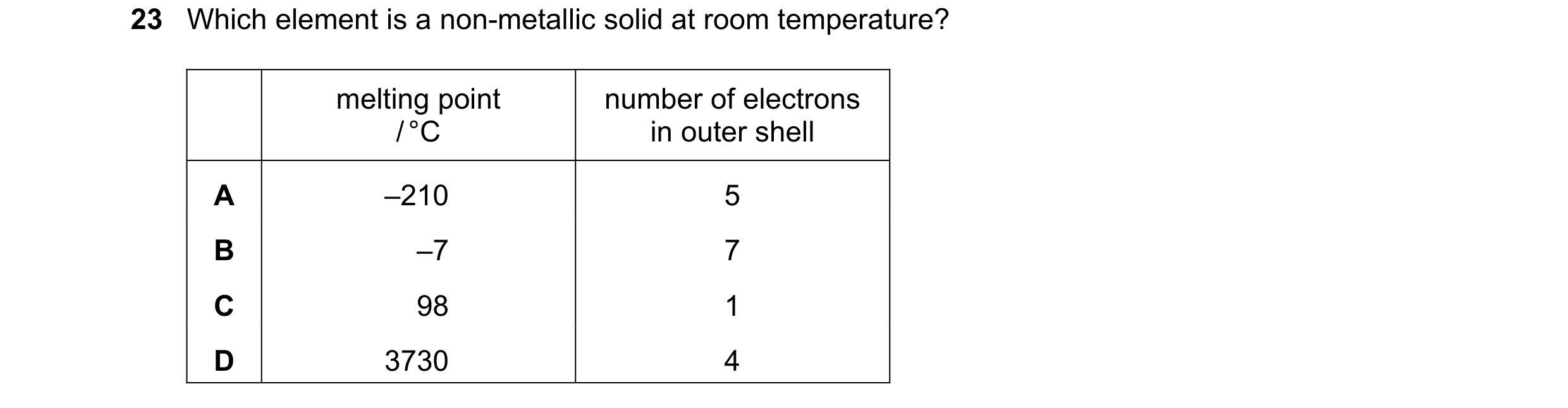
Q1 · Which element is a non-metallic solid at room temperature? 0653/21 May/June 2017
23 Which element is a non-metallic solid at room temperature? melting point number of electrons / °C in outer shell A –210 5 B –7 7 C 98 1 D 3730 4
1 marks
Answer: D
This question in 0653/21 May/June 2017
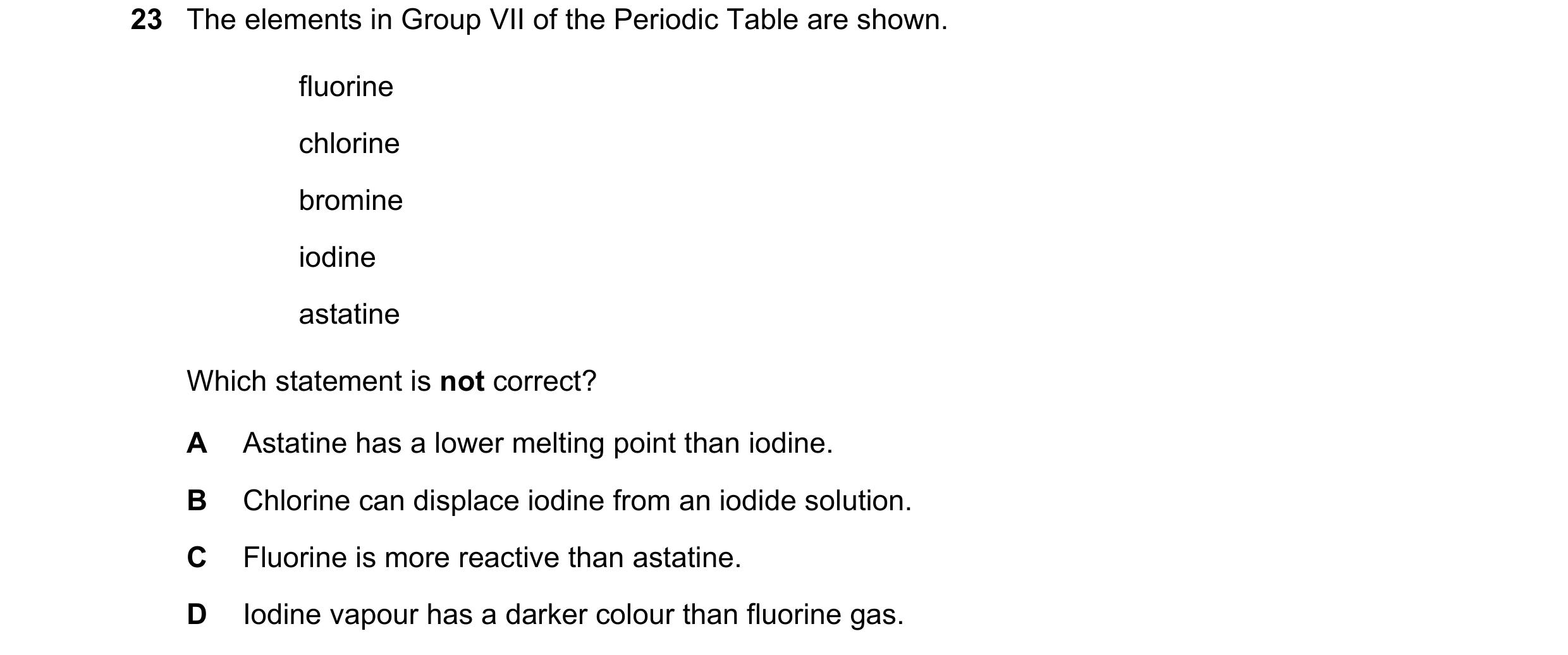
Q2 · The elements in Group VII of the Periodic Table are shown 0653/22 May/June 2017
23 The elements in Group VII of the Periodic Table are shown. fluorine chlorine bromine iodine astatine Which statement is not correct? A Astatine has a lower melting point than iodine. B Chlorine can displace iodine from an iodide solution. C Fluorine is more reactive than astatine. D Iodine vapour has a darker colour than fluorine gas.
1 marks
Answer: A
This question in 0653/22 May/June 2017
Q3 · Which statement about elements in the Periodic Table is correct? 0653/21 Oct/Nov 2017
24 Which statement about elements in the Periodic Table is correct? A Barium is a non-metal in Group II and its atoms have two electrons in their outer shells. B Chlorine is a non-metal in Group VII and its atoms have seven electrons in their outer shells. C Fluorine is a non-metal in Group VII and its atoms have one electron in their outer shells. D Sodium is a metal in Group II and its atoms have one electron in their outer shells.
1 marks
Answer: B
This question in 0653/21 Oct/Nov 2017
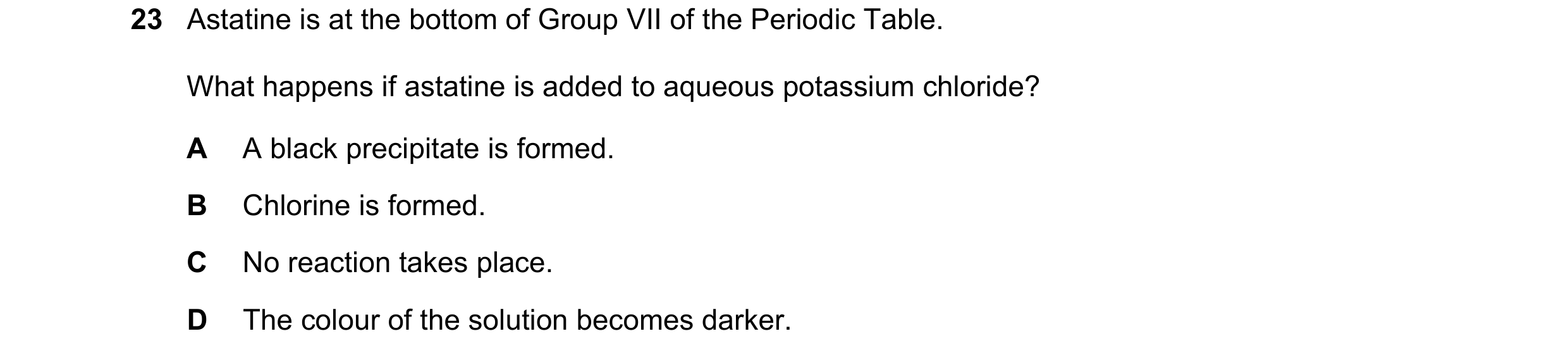
Q4 · Astatine is at the bottom of Group VII of the Periodic Table 0653/22 Feb/March 2018
23 Astatine is at the bottom of Group VII of the Periodic Table. What happens if astatine is added to aqueous potassium chloride? A A black precipitate is formed. B Chlorine is formed. C No reaction takes place. D The colour of the solution becomes darker.
1 marks
Answer: C
This question in 0653/22 Feb/March 2018
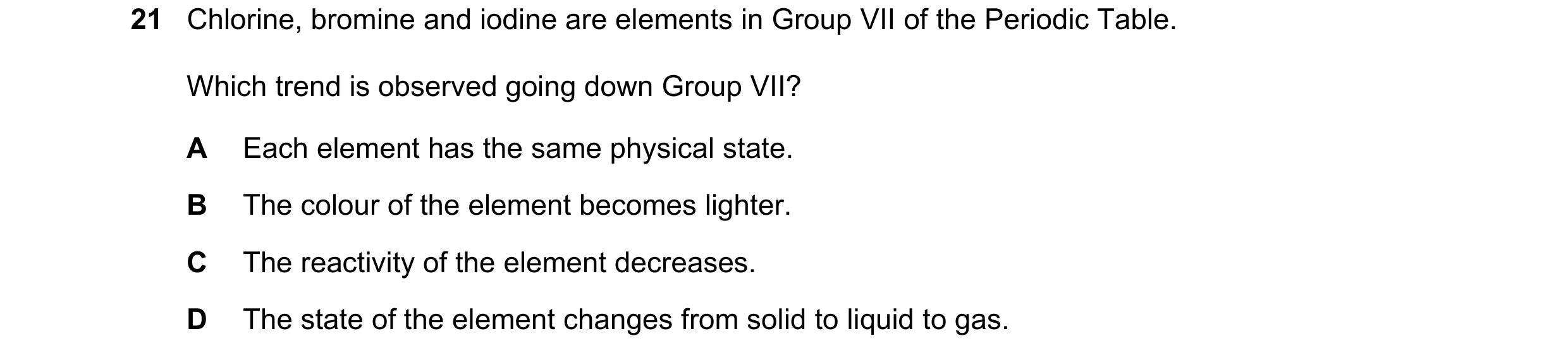
Q5 · Chlorine, bromine and iodine are elements in Group VII of the Periodic Table 0653/22 Feb/March 2019
21 Chlorine, bromine and iodine are elements in Group VII of the Periodic Table. Which trend is observed going down Group VII? A Each element has the same physical state. B The colour of the element becomes lighter. C The reactivity of the element decreases. D The state of the element changes from solid to liquid to gas.
1 marks
Answer: C
This question in 0653/22 Feb/March 2019
Q6 · Which pair of substances react together? 0653/21 May/June 2019
21 Which pair of substances react together? A bromine and potassium chloride B bromine and potassium iodide C iodine and potassium bromide D iodine and potassium chloride
1 marks
Answer: B
This question in 0653/21 May/June 2019
Q7 · Element X is a non-metal used in the treatment of the water supply 0653/21 Oct/Nov 2019
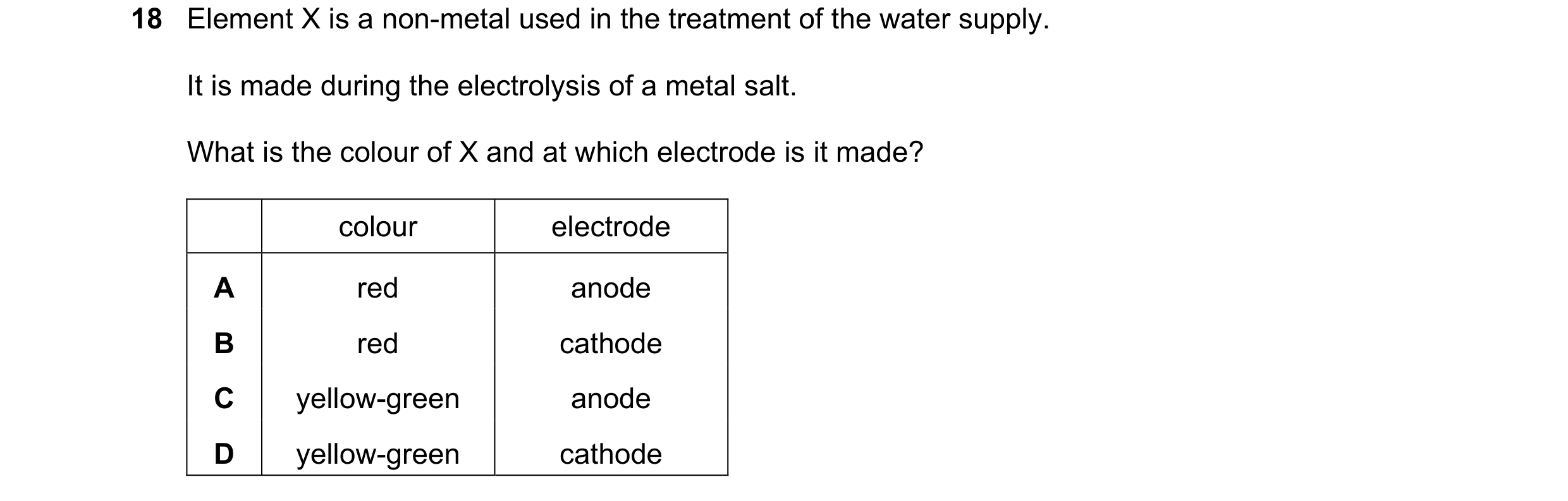
18 Element X is a non-metal used in the treatment of the water supply. It is made during the electrolysis of a metal salt. What is the colour of X and at which electrode is it made? colour electrode A red anode B red cathode C yellow-green anode D yellow-green cathode
1 marks
Answer: C
This question in 0653/21 Oct/Nov 2019
Q8 · Element X is a non-metal used in the treatment of the water supply 0653/22 Oct/Nov 2019
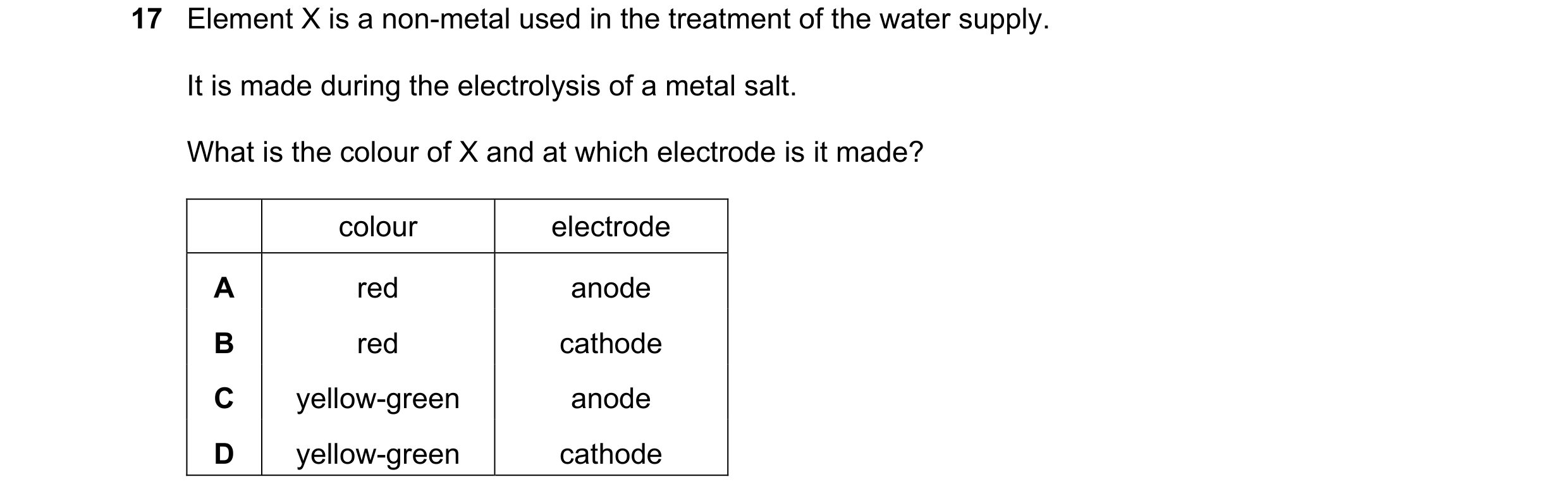
17 Element X is a non-metal used in the treatment of the water supply. It is made during the electrolysis of a metal salt. What is the colour of X and at which electrode is it made? colour electrode A red anode B red cathode C yellow-green anode D yellow-green cathode
1 marks
Answer: C
This question in 0653/22 Oct/Nov 2019
Q9 · Astatine is an element found at the bottom of Group VII in the Periodic Table 0653/22 May/June 2020
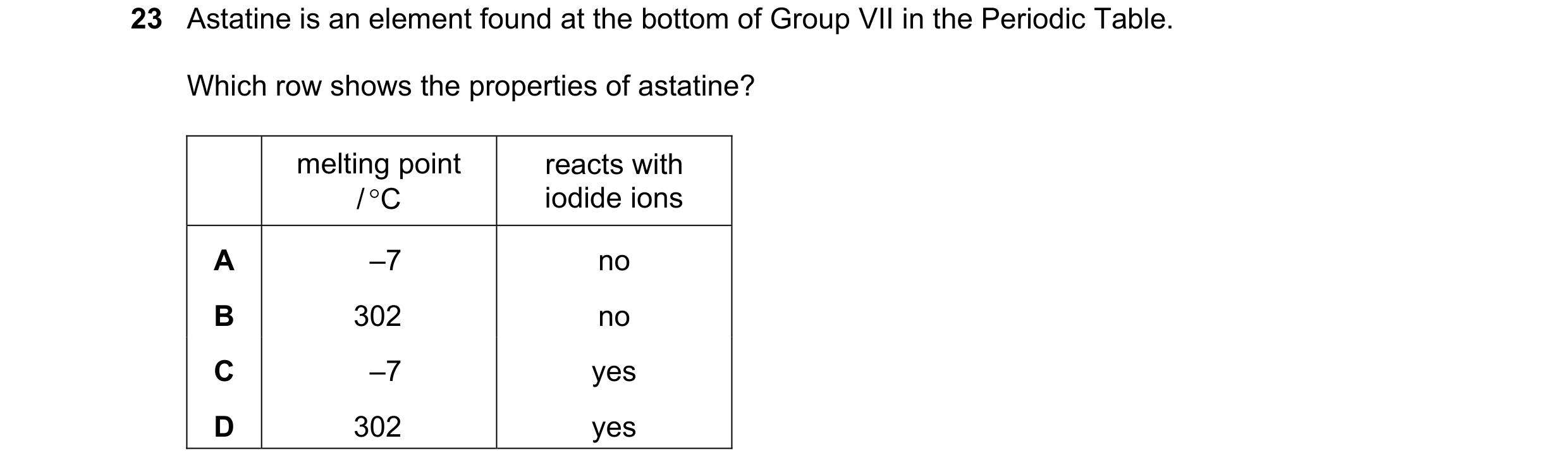
23 Astatine is an element found at the bottom of Group VII in the Periodic Table. Which row shows the properties of astatine? melting point reacts with / °C iodide ions A –7 no B 302 no C –7 yes D 302 yes
1 marks
Answer: B
This question in 0653/22 May/June 2020
Q10 · X, Y and Z are elements in Group VII 0653/23 Oct/Nov 2020
24 X, Y and Z are elements in Group VII. X reacts with potassium iodide but not with potassium bromide. Y reacts with potassium bromide but not with sodium chloride. Z does not react with potassium bromide or with potassium iodide. What are X, Y and Z? X Y Z A bromine chlorine iodine B bromine iodine chlorine C chlorine bromine iodine D iodine chlorine bromine
1 marks
Answer: A
This question in 0653/23 Oct/Nov 2020
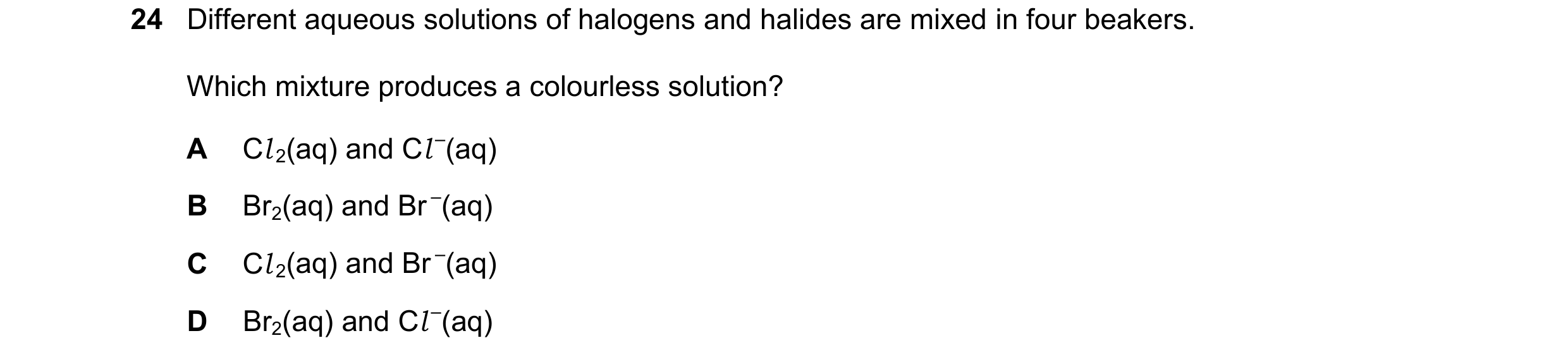
Q11 · Different aqueous solutions of halogens and halides are mixed in four beakers 0653/22 Feb/March 2021
24 Different aqueous solutions of halogens and halides are mixed in four beakers. Which mixture produces a colourless solution? A Cl 2(aq) and Cl –(aq) B Br2(aq) and Br –(aq) C Cl 2(aq) and Br –(aq) D Br2(aq) and Cl –(aq)
1 marks
Answer: A
This question in 0653/22 Feb/March 2021
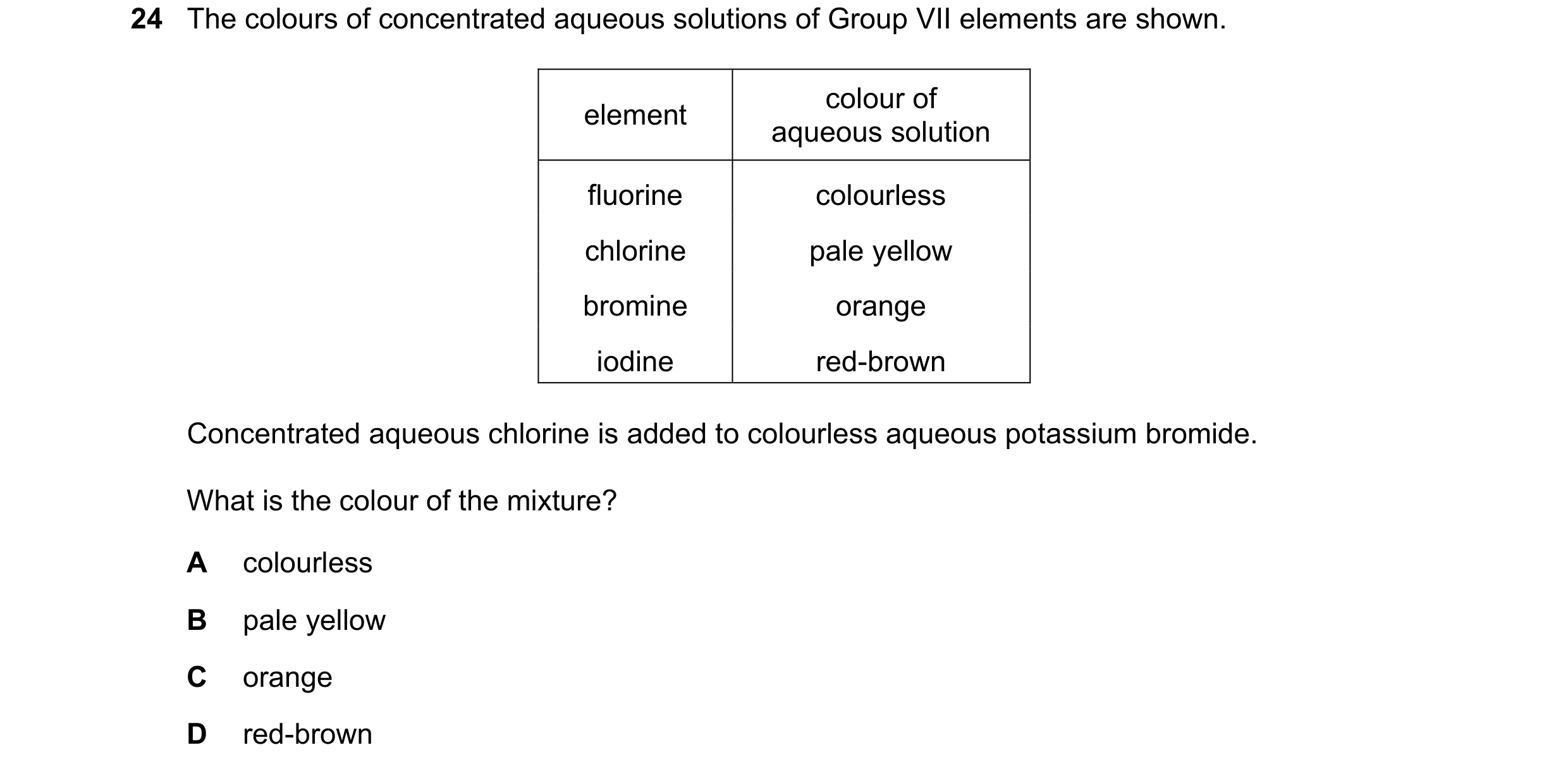
Q12 · The colours of concentrated aqueous solutions of Group VII elements are shown 0653/21 May/June 2021
24 The colours of concentrated aqueous solutions of Group VII elements are shown. colour of element aqueous solution fluorine colourless chlorine pale yellow bromine orange iodine red-brown Concentrated aqueous chlorine is added to colourless aqueous potassium bromide. What is the colour of the mixture? A colourless B pale yellow C orange D red-brown
1 marks
Answer: C
This question in 0653/21 May/June 2021
Q13 · Which equation represents a correct displacement reaction involving halogens? 0653/22 May/June 2021
24 Which equation represents a correct displacement reaction involving halogens? A 2NaBr + I2 Br2 + 2NaI B 2NaCl + Br2 Cl 2 + 2NaBr C 2NaF + I2 F2 + 2NaI D 2NaI + Cl 2 I2 + 2NaCl
1 marks
Answer: D
This question in 0653/22 May/June 2021
Q14 · Aqueous chlorine is added to aqueous sodium bromide 0653/23 May/June 2021
23 Aqueous chlorine is added to aqueous sodium bromide. aqueous chlorine aqueous sodium bromide Which statement about the reaction is correct? A The solution turns orange because bromine is formed. B The solution turns orange because bromide ions are reduced. C The solution remains colourless because bromine is less reactive than chlorine. D The solution remains colourless because chlorine is reduced.
1 marks
Answer: A
This question in 0653/23 May/June 2021
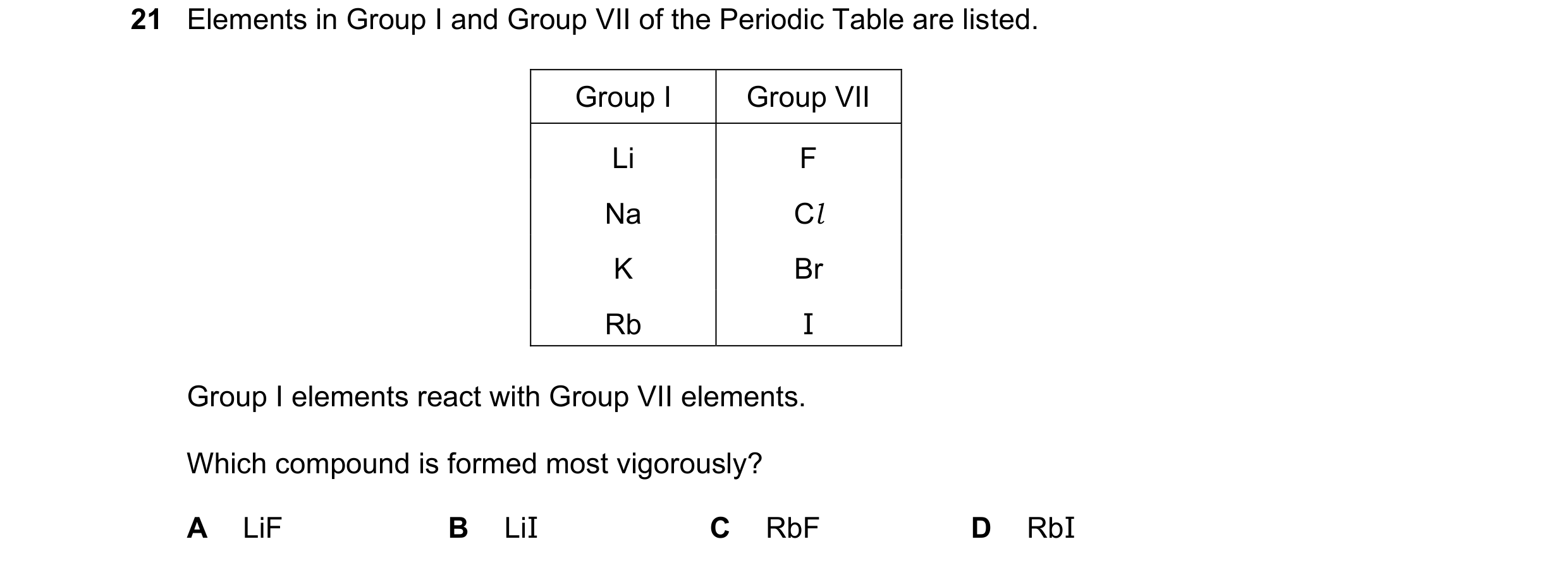
Q15 · Elements in Group I and Group VII of the Periodic Table are listed 0653/21 Oct/Nov 2021
21 Elements in Group I and Group VII of the Periodic Table are listed. Group I Group VII Li F Na Cl K Br Rb I Group I elements react with Group VII elements. Which compound is formed most vigorously? A LiF B LiI C RbF D RbI
1 marks
Answer: C
This question in 0653/21 Oct/Nov 2021
Q16 · A piece of damp blue litmus paper is placed in a gas 0653/22 Oct/Nov 2021
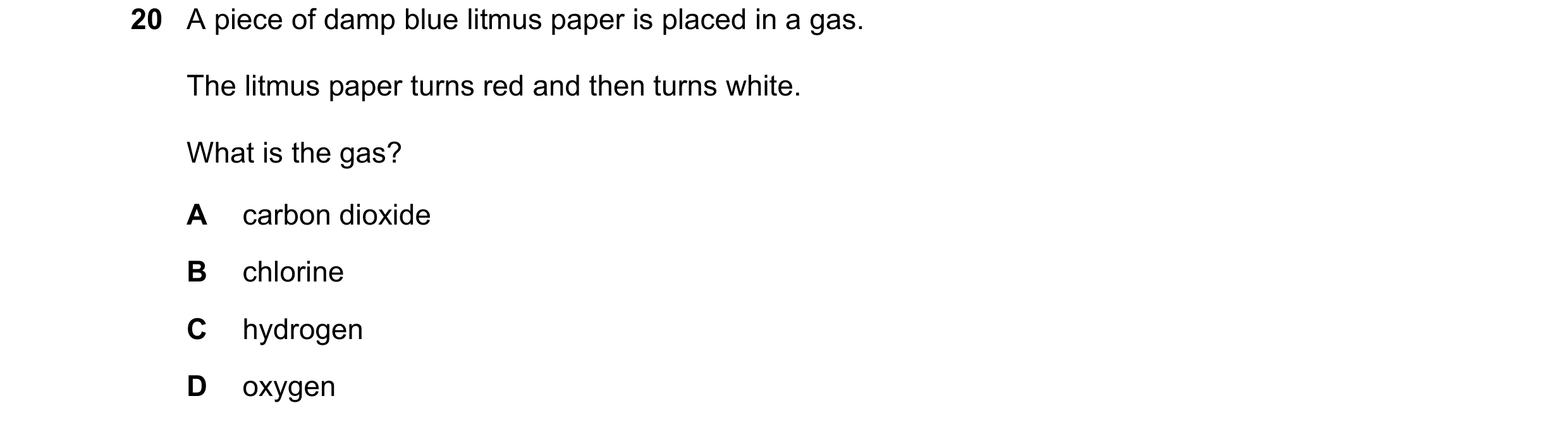
20 A piece of damp blue litmus paper is placed in a gas. The litmus paper turns red and then turns white. What is the gas? A carbon dioxide B chlorine C hydrogen D oxygen
1 marks
Answer: B
This question in 0653/22 Oct/Nov 2021
Q17 · Fluorine is an element in Group VII of the Periodic Table 0653/22 Oct/Nov 2021
21 Fluorine is an element in Group VII of the Periodic Table. Which statement about fluorine is correct? A Fluorine is a metal with a low melting point. B Fluorine is a gas and is less reactive than bromine. C Fluorine molecules are diatomic. D Chlorine displaces fluorine from its compounds.
1 marks
Answer: C
This question in 0653/22 Oct/Nov 2021
Q18 · A piece of damp blue litmus paper is placed in a gas 0653/23 Oct/Nov 2021
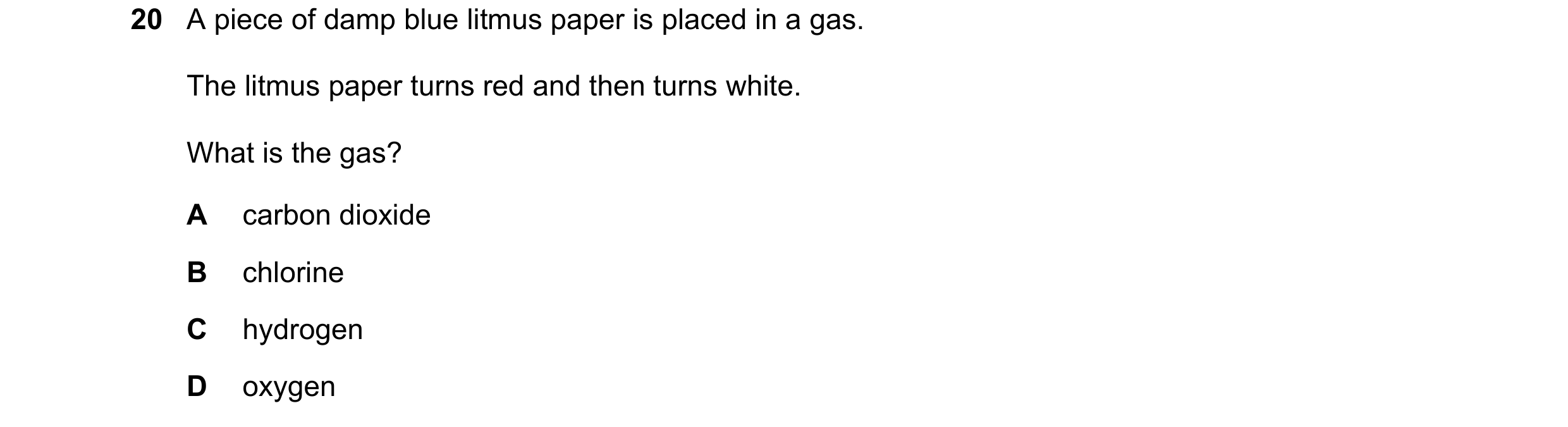
20 A piece of damp blue litmus paper is placed in a gas. The litmus paper turns red and then turns white. What is the gas? A carbon dioxide B chlorine C hydrogen D oxygen
1 marks
Answer: B
This question in 0653/23 Oct/Nov 2021
Q19 · Aqueous potassium halides are mixed with aqueous halogens as listed 0653/21 Oct/Nov 2022
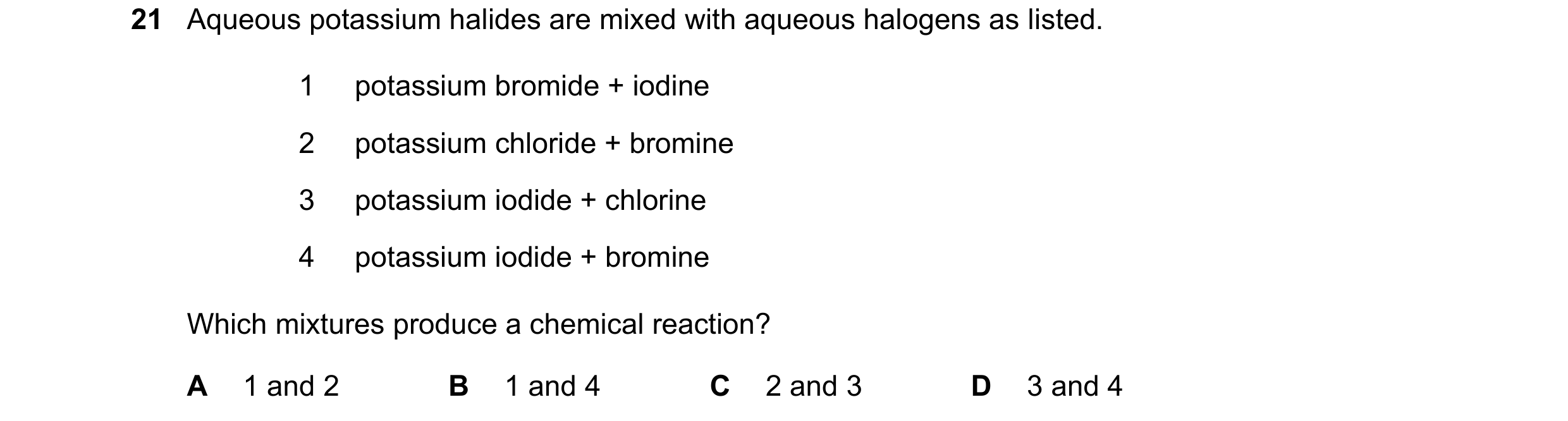
21 Aqueous potassium halides are mixed with aqueous halogens as listed. 1 potassium bromide + iodine 2 potassium chloride + bromine 3 potassium iodide + chlorine 4 potassium iodide + bromine Which mixtures produce a chemical reaction? A 1 and 2 B 1 and 4 C 2 and 3 D 3 and 4
1 marks
Answer: D
This question in 0653/21 Oct/Nov 2022
Q20 · Which statement about the elements in Group VII is correct? 0653/22 Oct/Nov 2022
21 Which statement about the elements in Group VII is correct? A Bromine reacts with potassium chloride to make chlorine. B Chlorine is the least reactive element in Group VII. C Chlorine reacts with potassium iodide to make iodine. D Potassium bromide reacts with all of the elements in Group VII.
1 marks
Answer: C
This question in 0653/22 Oct/Nov 2022
Q21 · Fluorine is at the top of Group VII in the Periodic Table 0653/21 Oct/Nov 2023
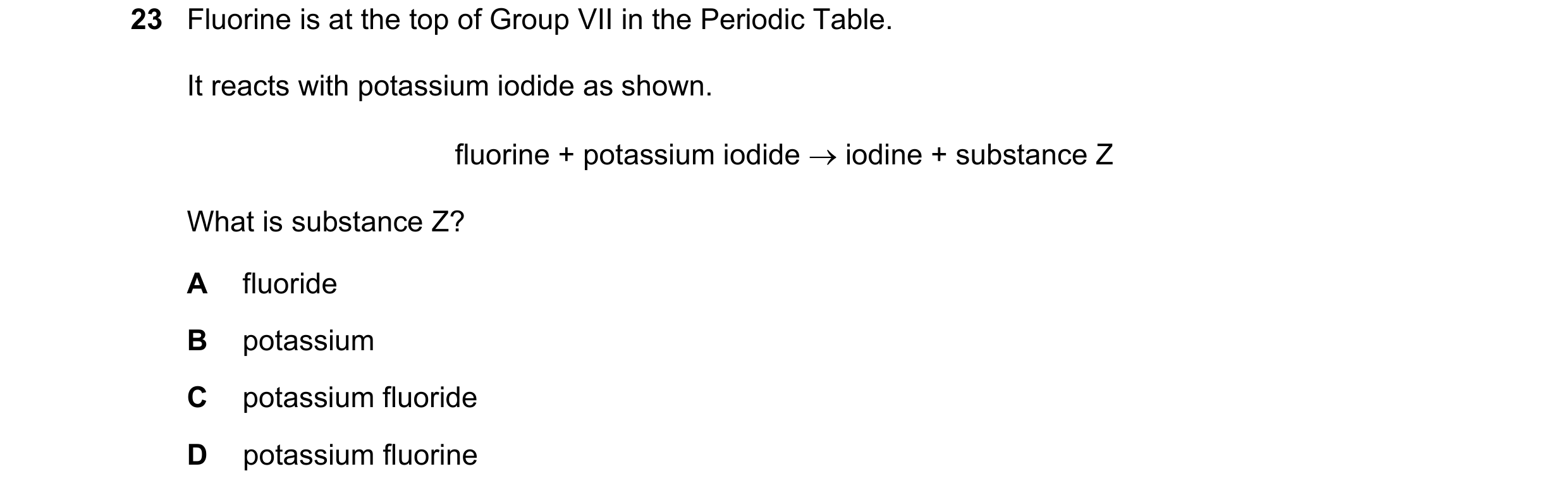
23 Fluorine is at the top of Group VII in the Periodic Table. It reacts with potassium iodide as shown. fluorine + potassium iodide iodine + substance Z What is substance Z? A fluoride B potassium C potassium fluoride D potassium fluorine
1 marks
Answer: C
This question in 0653/21 Oct/Nov 2023
Q22 · The equation for the reaction between aqueous potassium iodide and aqueous bromine is… 0653/22 Oct/Nov 2023
23 The equation for the reaction between aqueous potassium iodide and aqueous bromine is shown. 2KI + Br2 2KBr + I2 Which statement about this reaction is correct? A Bromine acts as a reducing agent. B Bromine molecules change to bromine atoms in the reaction. C Iodine is displaced from its salt because it is less reactive than bromine. D The mixture becomes colourless as the reaction proceeds.
1 marks
Answer: C
This question in 0653/22 Oct/Nov 2023
Q23 · Which equation represents a reaction that occurs when a halogen is added to an aqueous… 0653/23 Oct/Nov 2023
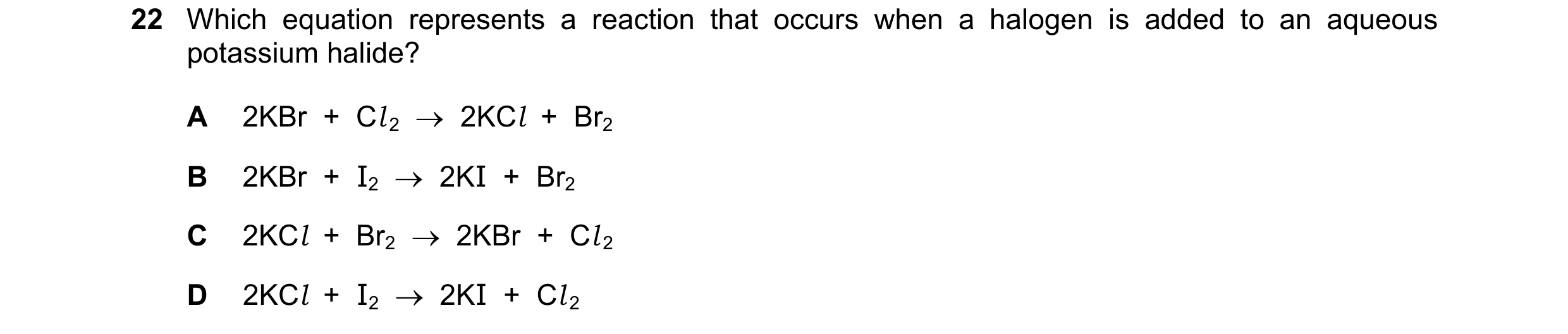
22 Which equation represents a reaction that occurs when a halogen is added to an aqueous potassium halide? A 2KBr + Cl 2 2KCl + Br2 B 2KBr + I2 2KI + Br2 C 2KCl + Br2 2KBr + Cl 2 D 2KCl + I2 2KI + Cl 2
1 marks
Answer: A
This question in 0653/23 Oct/Nov 2023
Q24 · Fluorine and chlorine are in Group VII of the Periodic Table 0653/22 Feb/March 2024
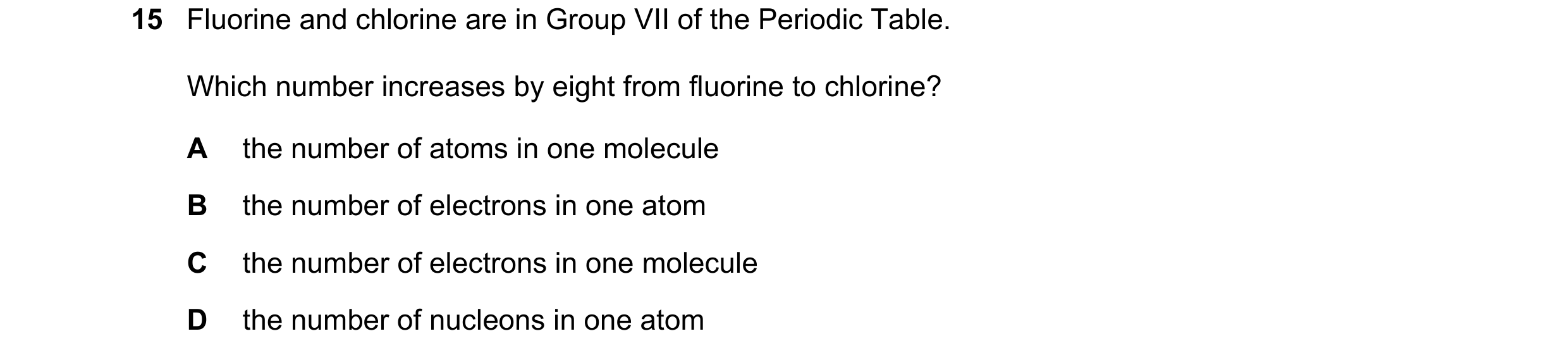
15 Fluorine and chlorine are in Group VII of the Periodic Table. Which number increases by eight from fluorine to chlorine? A the number of atoms in one molecule B the number of electrons in one atom C the number of electrons in one molecule D the number of nucleons in one atom
1 marks
Answer: B
This question in 0653/22 Feb/March 2024
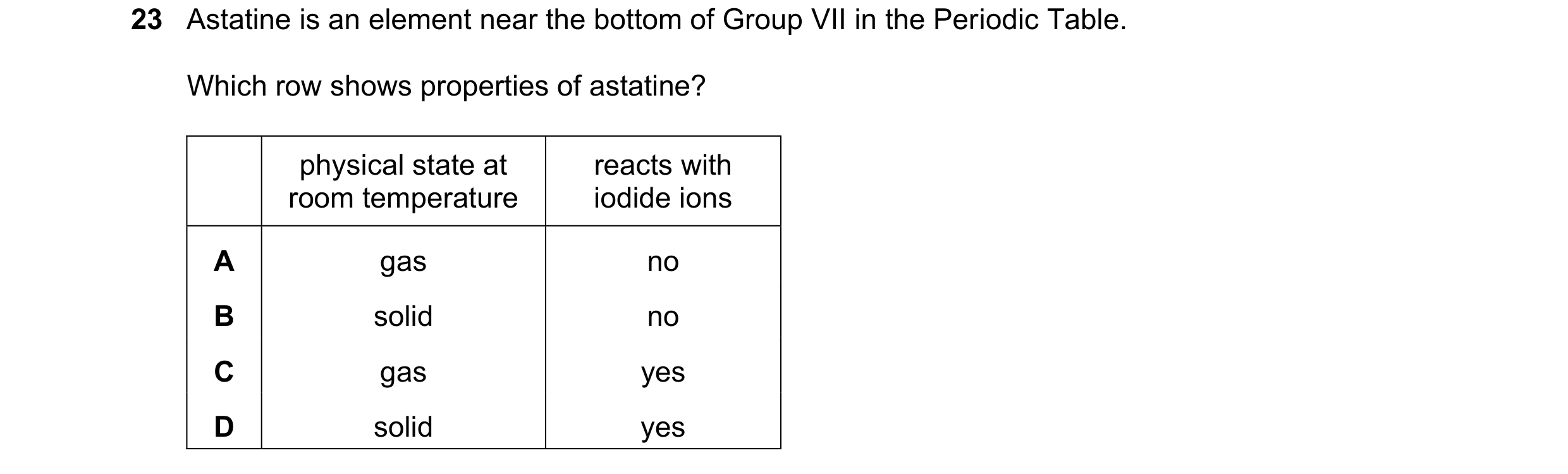
Q25 · Astatine is an element near the bottom of Group VII in the Periodic Table 0653/21 May/June 2024
23 Astatine is an element near the bottom of Group VII in the Periodic Table. Which row shows properties of astatine? physical state at reacts with room temperature iodide ions A gas no B solid no C gas yes D solid yes
1 marks
Answer: B
This question in 0653/21 May/June 2024
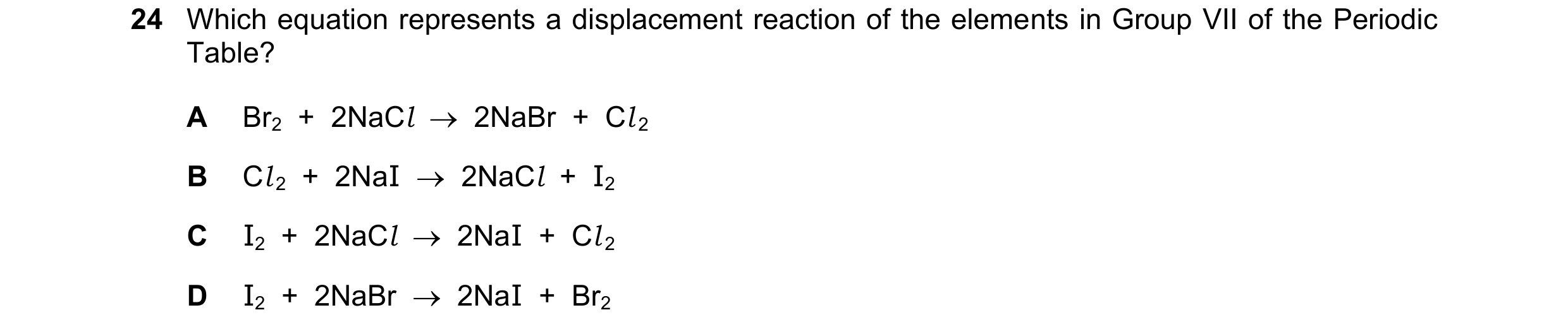
Q26 · Which equation represents a displacement reaction of the elements in Group VII of the… 0653/23 May/June 2024
24 Which equation represents a displacement reaction of the elements in Group VII of the Periodic Table? A Br2 + 2NaCl 2NaBr + Cl 2 B Cl 2 + 2NaI 2NaCl + I2 C I2 + 2NaCl 2NaI + Cl 2 D I2 + 2NaBr 2NaI + Br2
1 marks
Answer: B
This question in 0653/23 May/June 2024
Q27 · A piece of damp blue litmus paper is placed in a gas 0653/21 Oct/Nov 2024
22 A piece of damp blue litmus paper is placed in a gas. The litmus paper turns red and then turns white. What is the gas? A chlorine B hydrogen C carbon dioxide D oxygen
1 marks
Answer: A
This question in 0653/21 Oct/Nov 2024
Q28 · Which statement about the halogens is correct? 0653/23 Oct/Nov 2024
23 Which statement about the halogens is correct? A Aqueous sodium bromide reacts with chlorine to produce aqueous sodium chloride. B Aqueous sodium chloride reacts with iodine to produce aqueous sodium iodide. C Bromine reacts with aqueous sodium chloride to produce chlorine. D Iodine reacts with aqueous sodium bromide to produce bromine.
1 marks
Answer: A
This question in 0653/23 Oct/Nov 2024
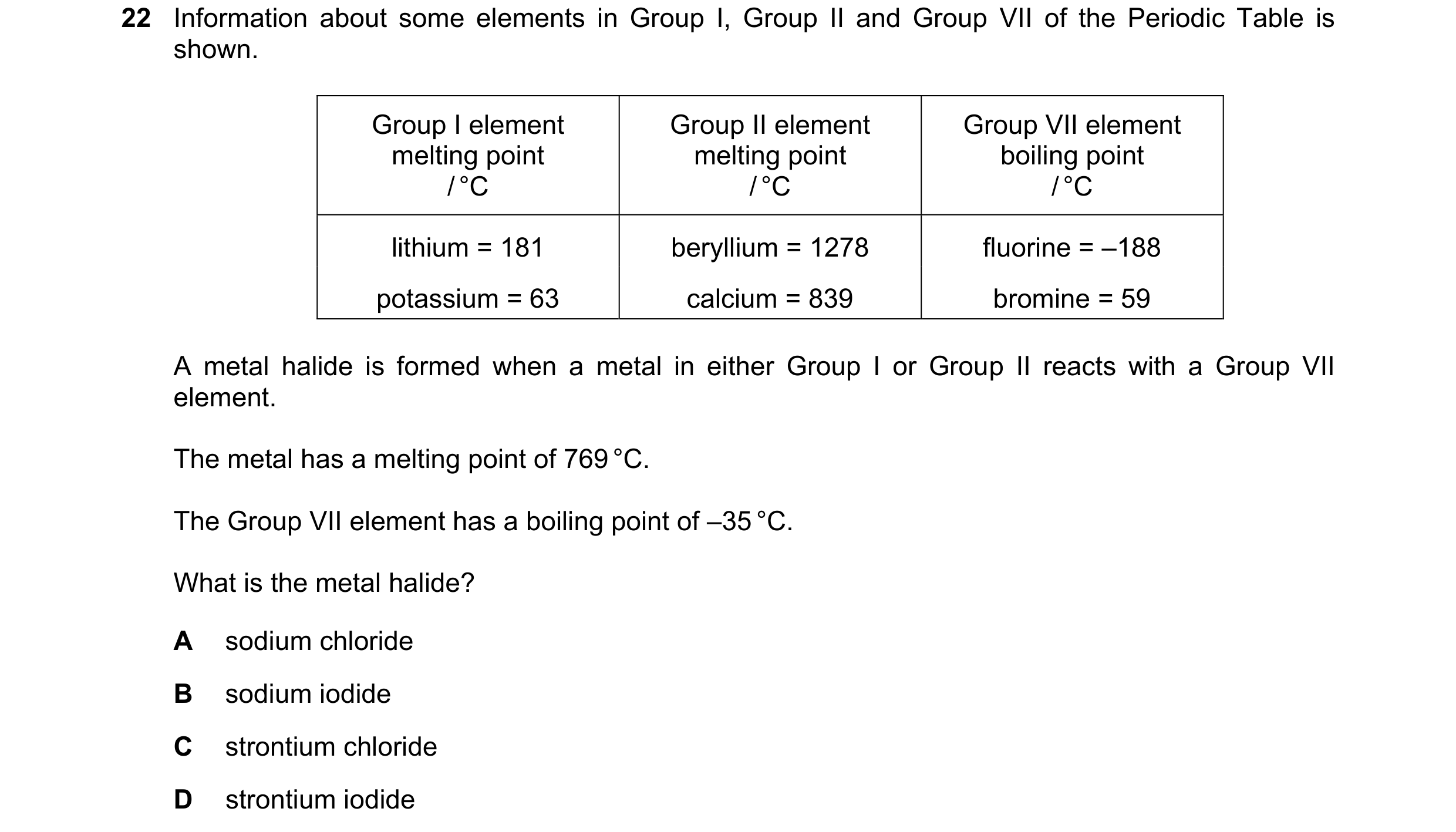
Q29 · Information about some elements in Group I, Group II and Group VII of the Periodic Table… 0653/22 Feb/March 2025
22 Information about some elements in Group I, Group II and Group VII of the Periodic Table is shown. Group I element Group II element Group VII element melting point melting point boiling point / °C / °C / °C lithium = 181 beryllium = 1278 fluorine = –188 potassium = 63 calcium = 839 bromine = 59 A metal halide is formed when a metal in either Group I or Group II reacts with a Group VII element. The metal has a melting point of 769 °C. The Group VII element has a boiling point of –35 °C. What is the metal halide? A sodium chloride B sodium iodide C strontium chloride D strontium iodide
1 marks
Answer: C
This question in 0653/22 Feb/March 2025
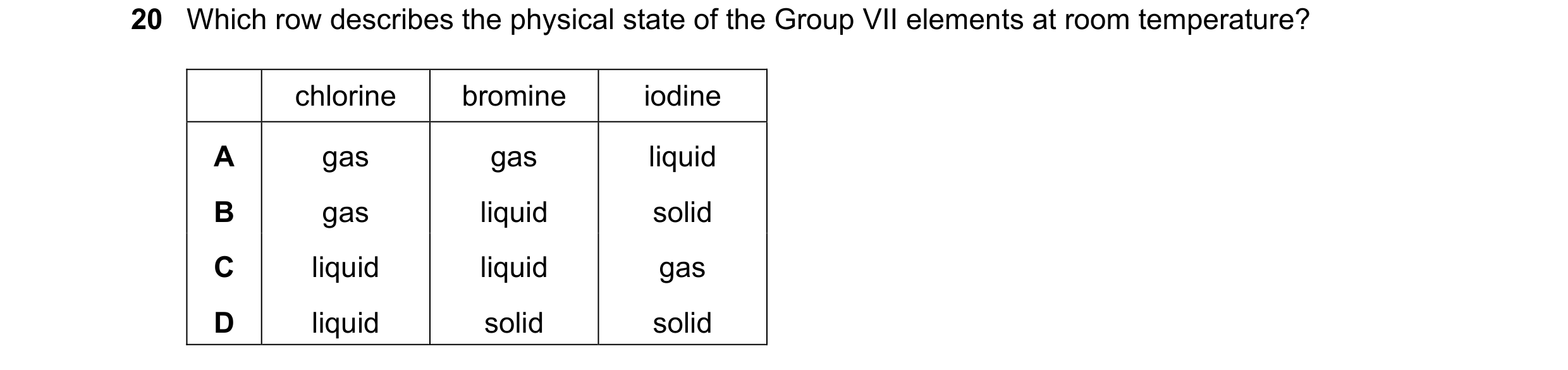
Q30 · Which row describes the physical state of the Group VII elements at room temperature? 0653/22 May/June 2025
20 Which row describes the physical state of the Group VII elements at room temperature? chlorine bromine iodine A gas gas liquid B gas liquid solid C liquid liquid gas D liquid solid solid
1 marks
Answer: B
This question in 0653/22 May/June 2025
Q31 · Aqueous chlorine is added to colourless aqueous potassium bromide 0653/23 May/June 2025
21 Aqueous chlorine is added to colourless aqueous potassium bromide. aqueous chlorine aqueous potassium bromide Which row describes and explains the observation? observation explanation A white precipitate forms solution contains chloride ions B effervescence bromine gas forms C orange solution forms solution contains aqueous bromine D solution remains colourless there is no change
1 marks
Answer: C
This question in 0653/23 May/June 2025
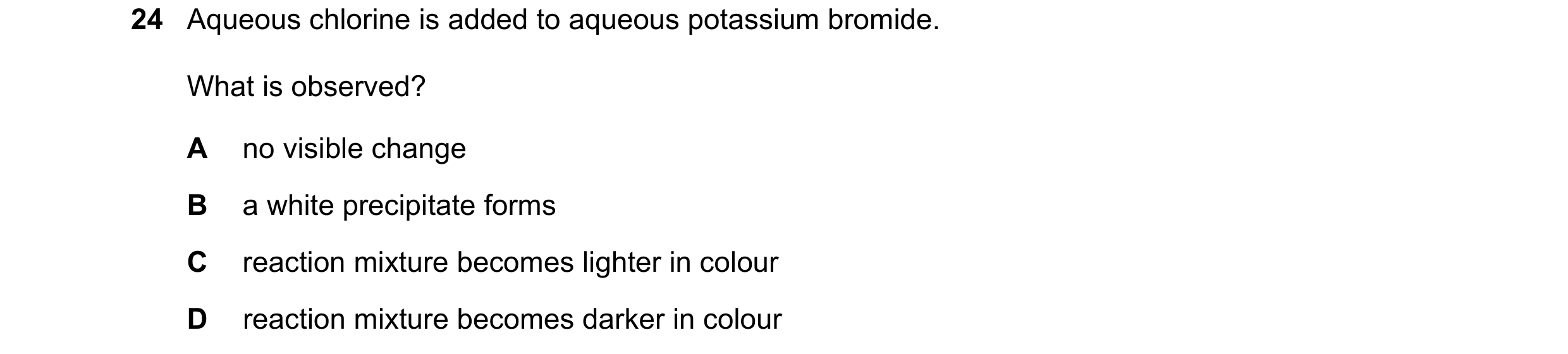
Q32 · Aqueous chlorine is added to aqueous potassium bromide 0653/21 Oct/Nov 2025
24 Aqueous chlorine is added to aqueous potassium bromide. What is observed? A no visible change B a white precipitate forms C reaction mixture becomes lighter in colour D reaction mixture becomes darker in colour
1 marks
Answer: D
This question in 0653/21 Oct/Nov 2025
Q33 · Which mixture results in the displacement of a halogen? 0653/22 Oct/Nov 2025
23 Which mixture results in the displacement of a halogen? A Br2(aq) and NaCl (aq) B Cl 2(g) and KI(aq) C I2(aq) and KBr(aq) D NaBr(aq) and KCl (aq)
1 marks
Answer: B
This question in 0653/22 Oct/Nov 2025
Q34 · Which statement describes a trend in the elements going down Group VII? 0653/23 Oct/Nov 2025
21 Which statement describes a trend in the elements going down Group VII? A They are darker in colour. B They are displaced from solutions of their halide ions by elements lower down the group. C They are more reactive. D They have lower boiling points.
1 marks
Answer: A
This question in 0653/23 Oct/Nov 2025

 1 / 8
1 / 8
 2 / 8
2 / 8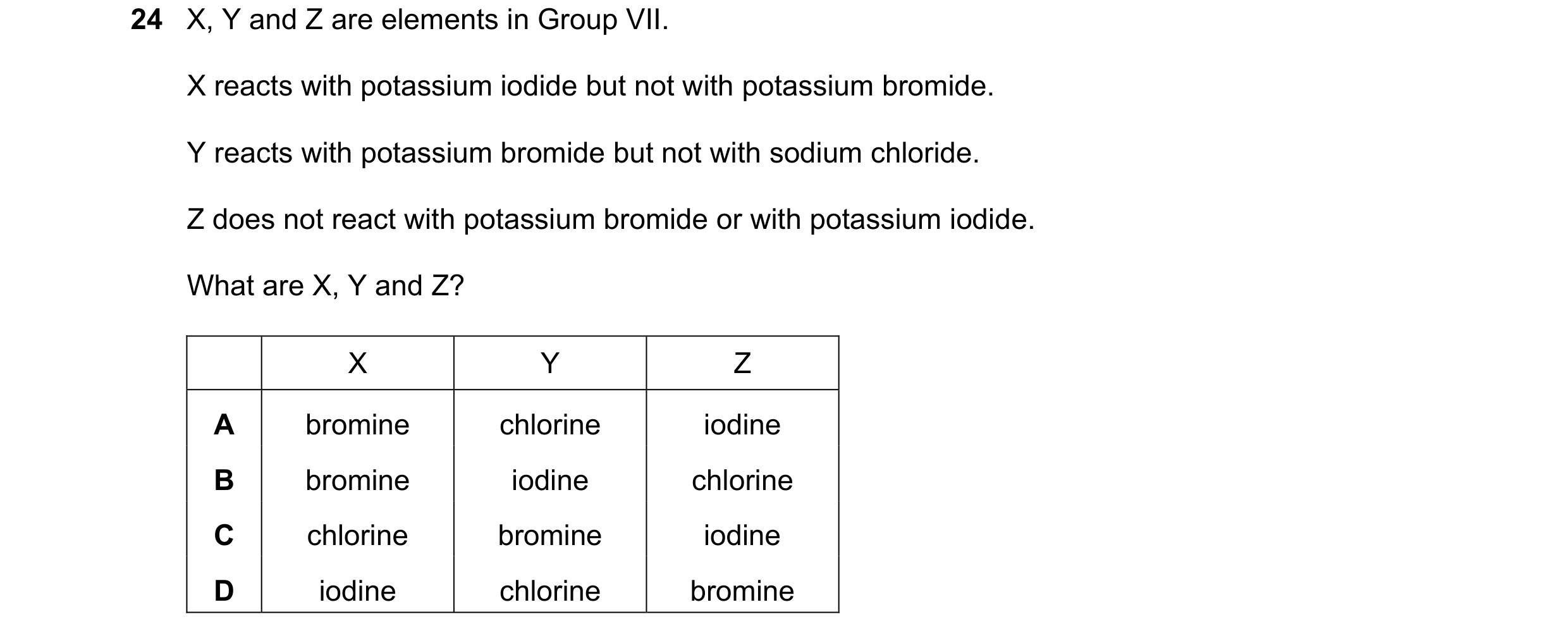
 3 / 8
3 / 8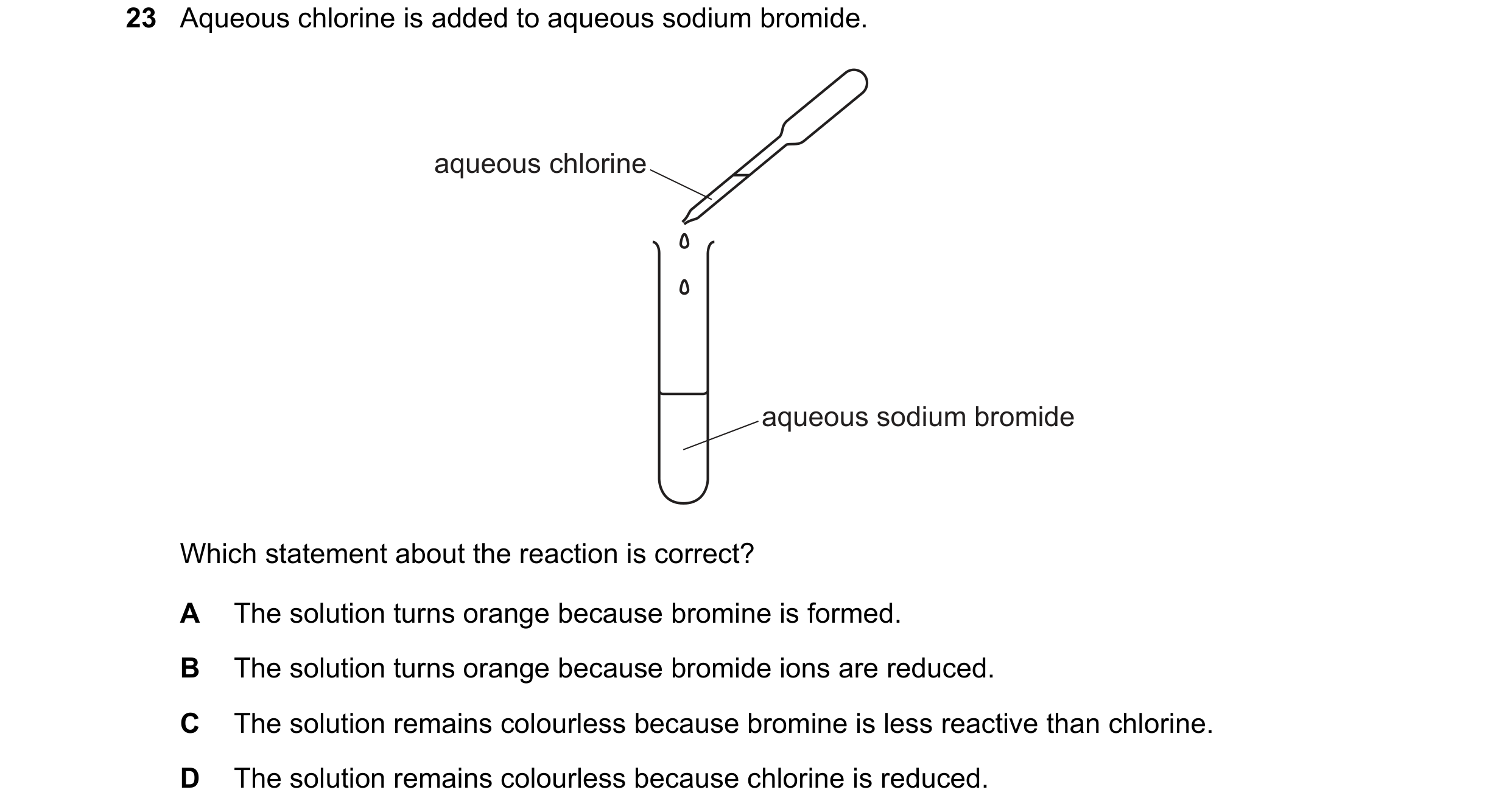
 4 / 8
4 / 8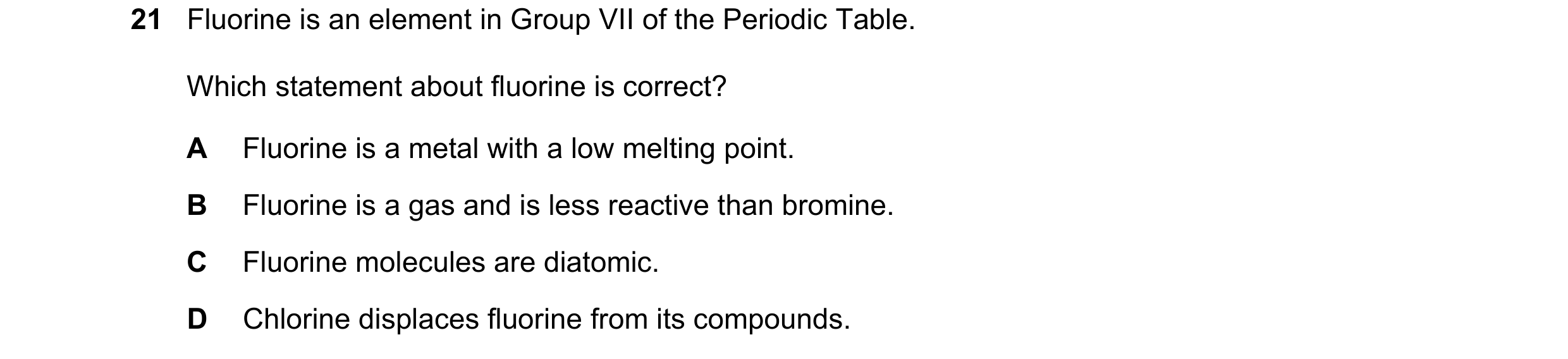

 5 / 8
5 / 8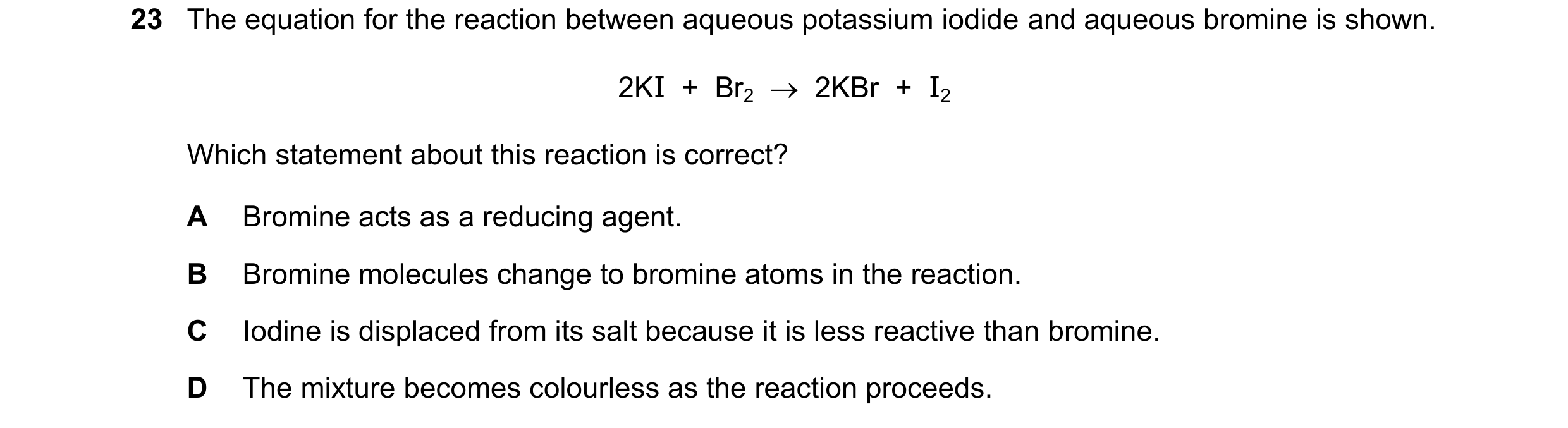
 6 / 8
6 / 8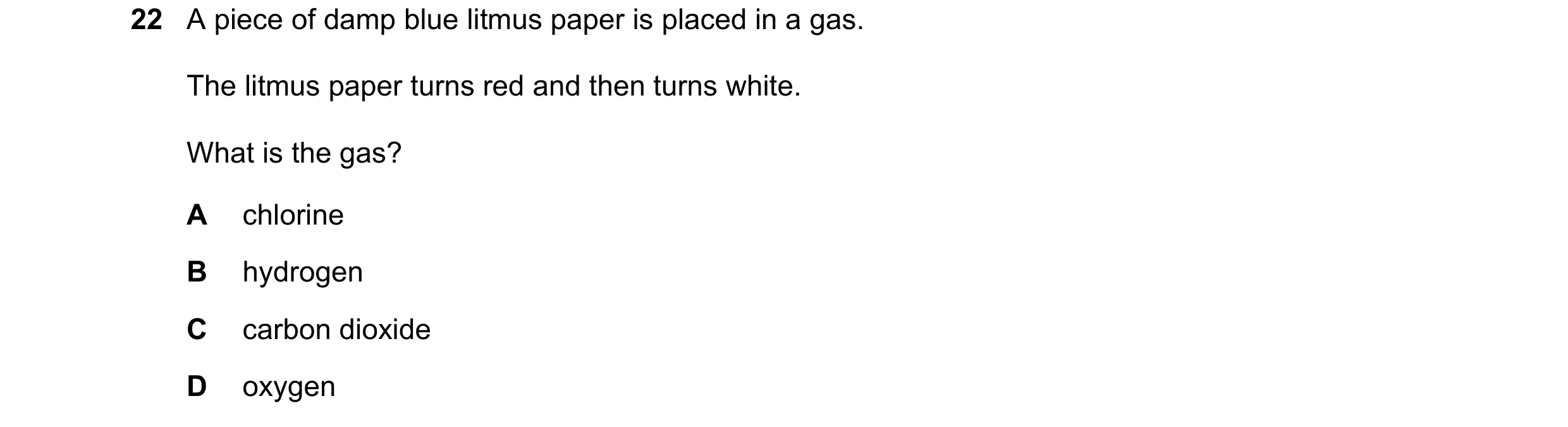

 7 / 8
7 / 8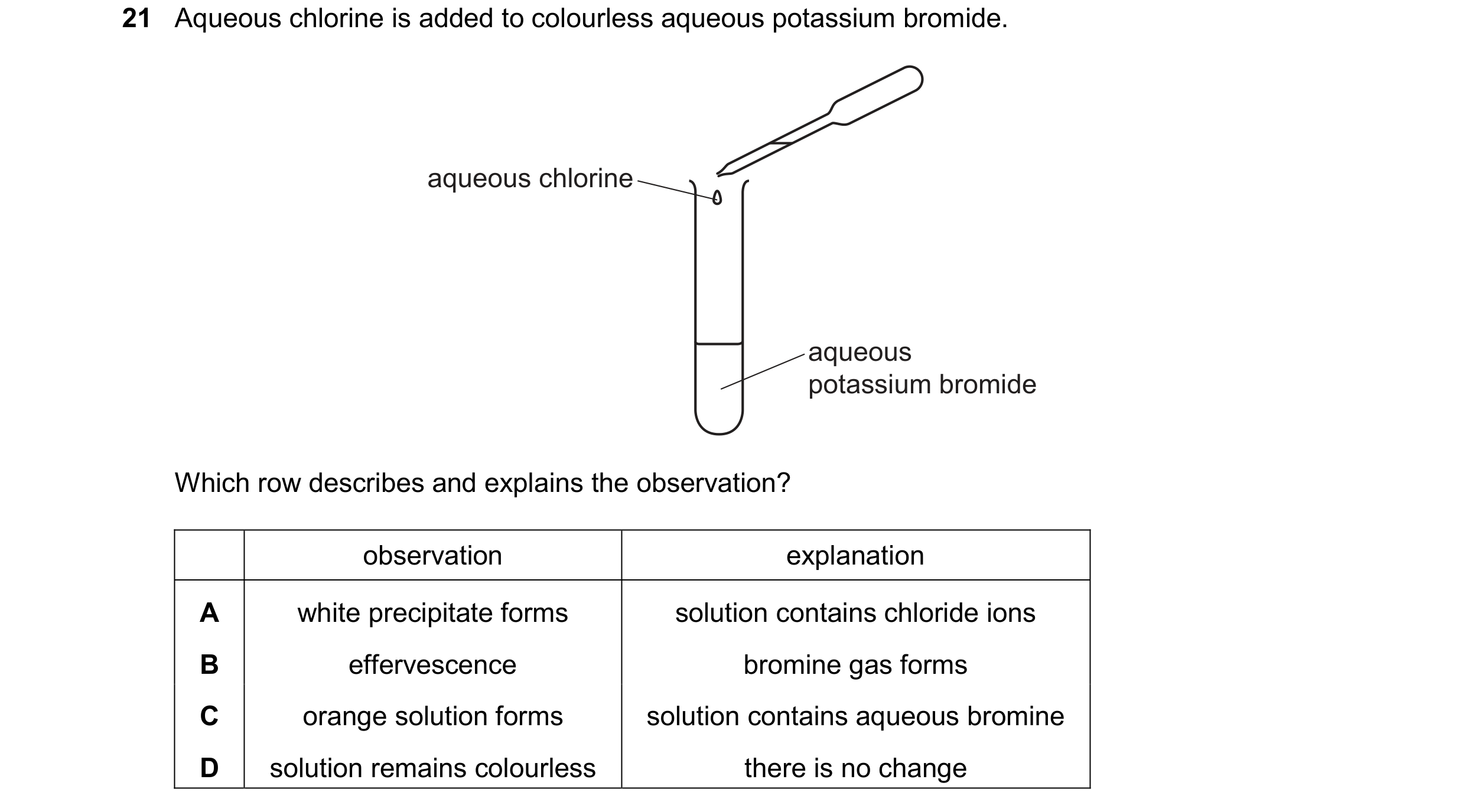

 8 / 8
8 / 8