Questions as text
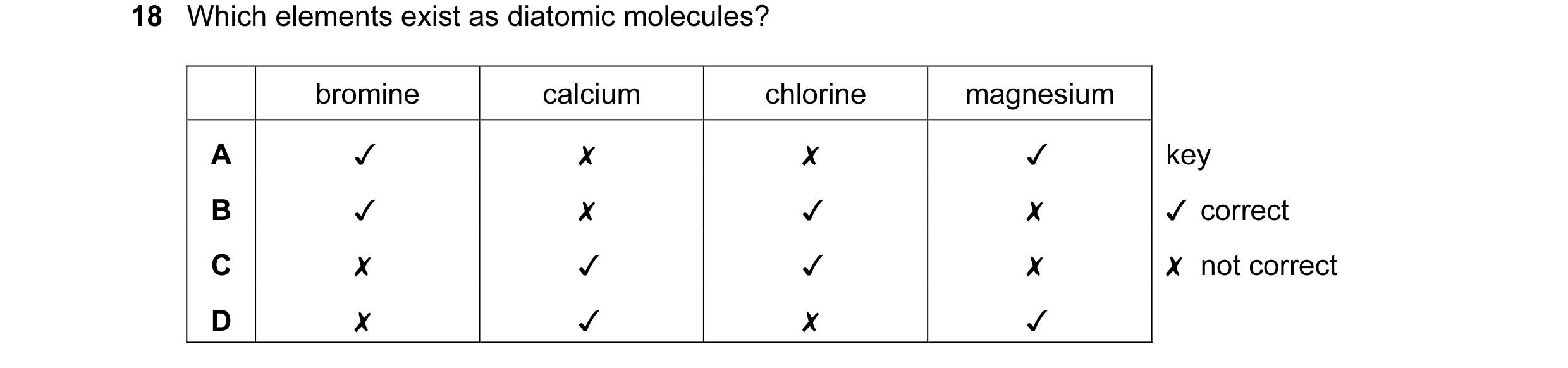
Q1 · Which elements exist as diatomic molecules? 0653/11 May/June 2007
18 Which elements exist as diatomic molecules?
bromine calcium chlorine magnesium
A v x x v
B v x v x
Cc x v v x
D x v x v
key
JY correct
X not correct
1 marks
Answer: B
This question in 0653/11 May/June 2007
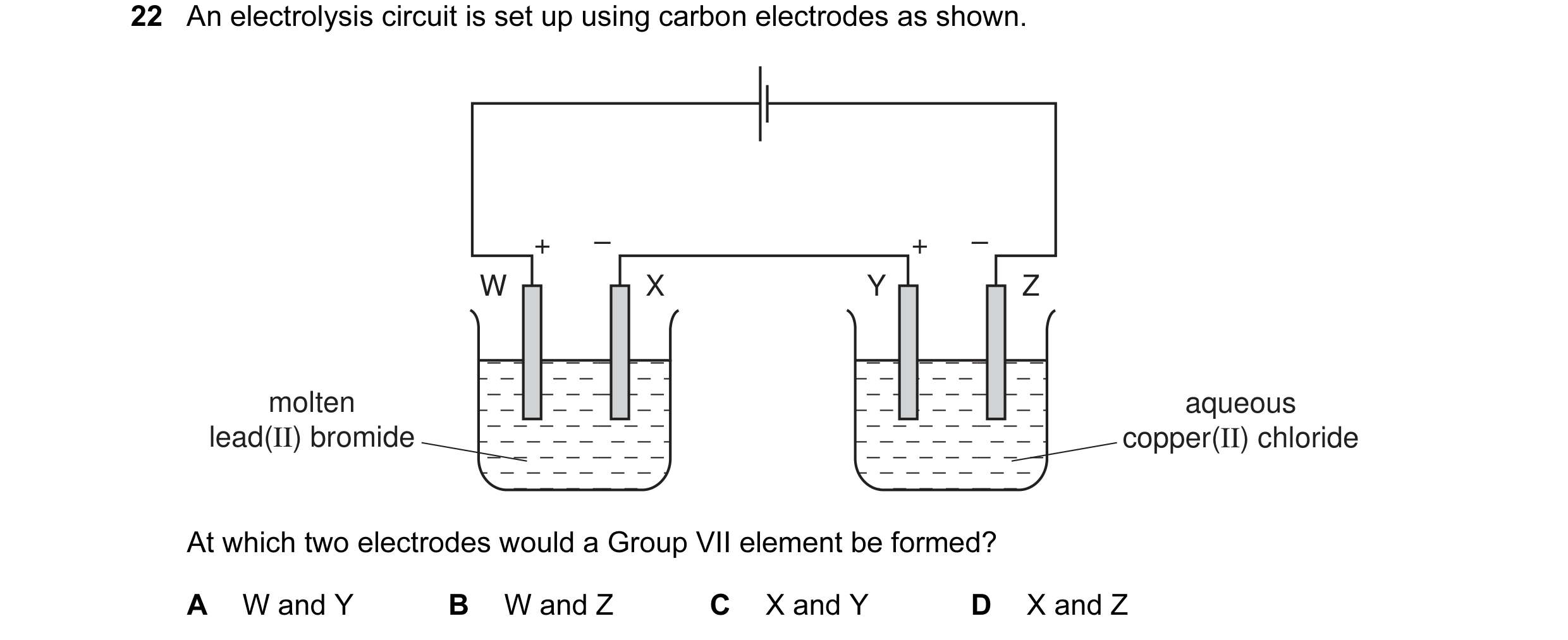
Q2 · An electrolysis circuit is set up using carbon electrodes as shown 0653/11 Oct/Nov 2010
22 An electrolysis circuit is set up using carbon electrodes as shown. + – + – W X Y Z molten aqueous lead(II) bromide copper(II) chloride At which two electrodes would a Group VII element be formed? A W and Y B W and Z C X and Y D X and Z
1 marks
Answer: A
This question in 0653/11 Oct/Nov 2010
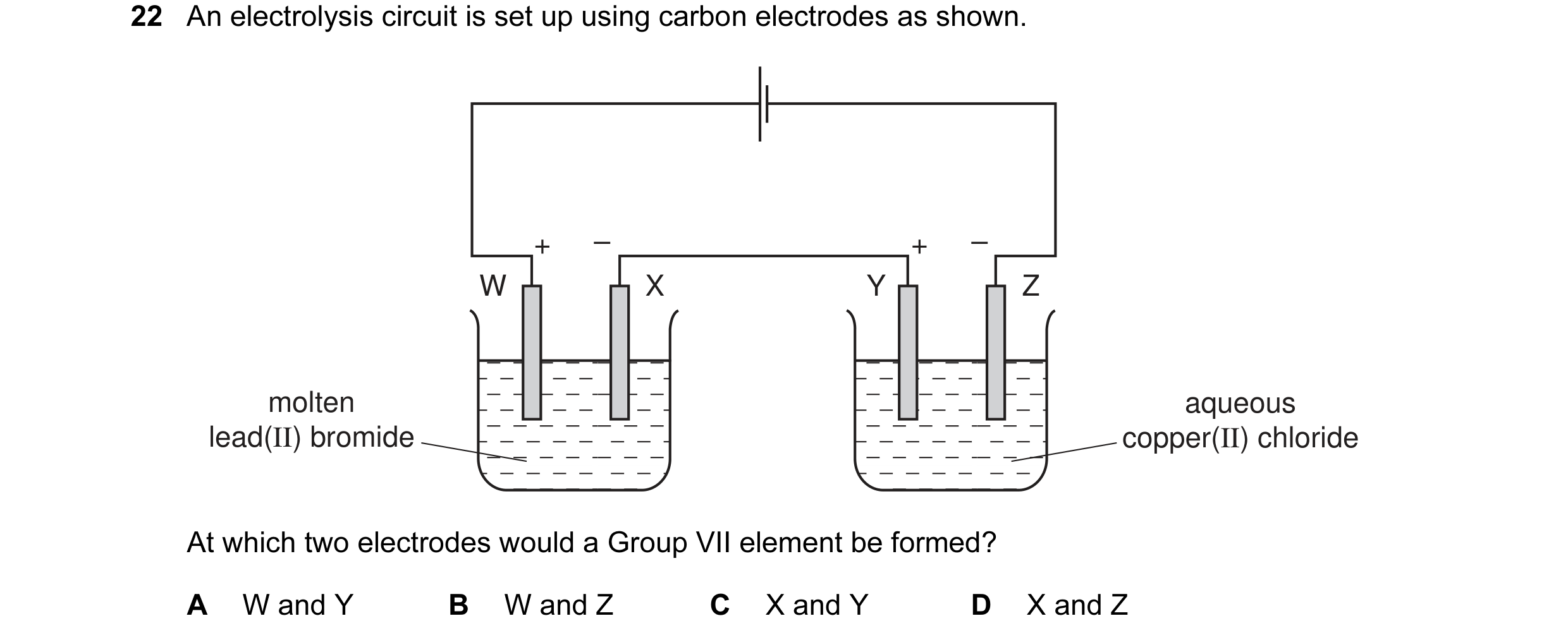
Q3 · An electrolysis circuit is set up using carbon electrodes as shown 0653/12 Oct/Nov 2010
22 An electrolysis circuit is set up using carbon electrodes as shown. + – + – W X Y Z molten aqueous lead(II) bromide copper(II) chloride At which two electrodes would a Group VII element be formed? A W and Y B W and Z C X and Y D X and Z
1 marks
Answer: A
This question in 0653/12 Oct/Nov 2010
Q4 · An electrolysis circuit is set up using carbon electrodes as shown 0653/13 Oct/Nov 2010
21 An electrolysis circuit is set up using carbon electrodes as shown. + – + – W X Y Z molten aqueous lead(II) bromide copper(II) chloride At which two electrodes would a Group VII element be formed? A W and Y B W and Z C X and Y D X and Z
1 marks
Answer: A
This question in 0653/13 Oct/Nov 2010
Q5 · Element X is non-metallic 0653/11 May/June 2011
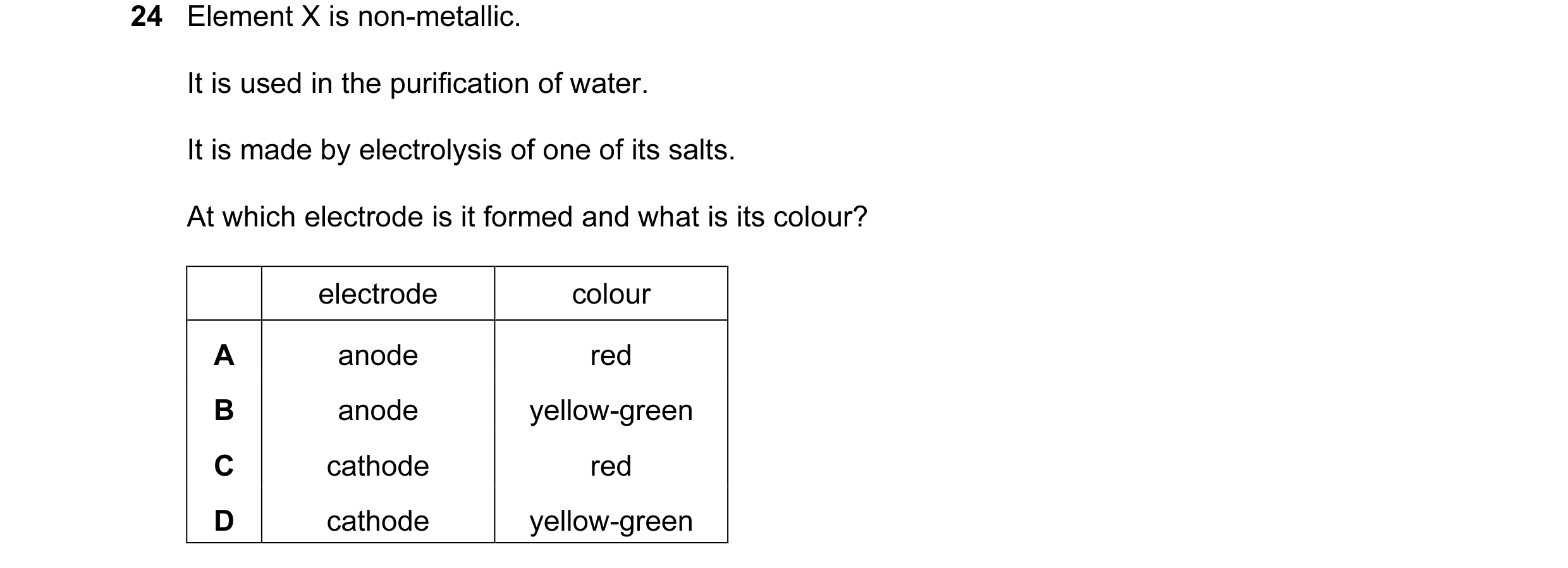
24 Element X is non-metallic. It is used in the purification of water. It is made by electrolysis of one of its salts. At which electrode is it formed and what is its colour? electrode colour A anode red B anode yellow-green C cathode red D cathode yellow-green
1 marks
Answer: B
This question in 0653/11 May/June 2011
Q6 · Element X is non-metallic 0653/12 May/June 2011
25 Element X is non-metallic. It is used in the purification of water. It is made by electrolysis of one of its salts. At which electrode is it formed and what is its colour? electrode colour A anode red B anode yellow-green C cathode red D cathode yellow-green
1 marks
Answer: B
This question in 0653/12 May/June 2011
Q7 · The properties of the elements in Groups I and VII of the Periodic Table change down the… 0653/12 May/June 2012
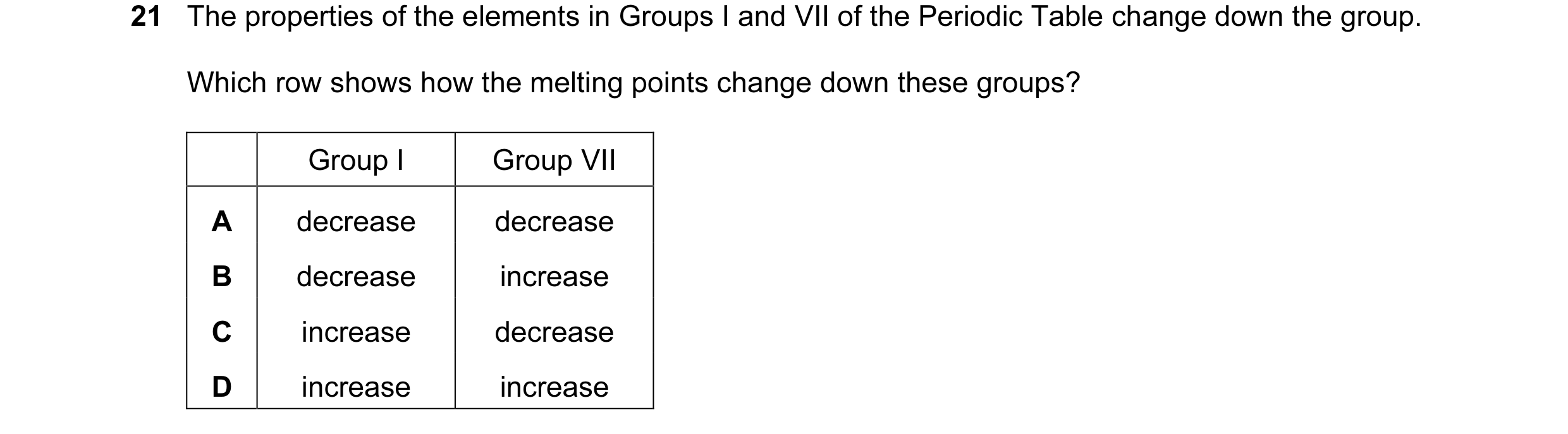
21 The properties of the elements in Groups I and VII of the Periodic Table change down the group. Which row shows how the melting points change down these groups? Group I Group VII A decrease decrease B decrease increase C increase decrease D increase increase
1 marks
Answer: B
This question in 0653/12 May/June 2012
Q8 · The properties of the elements in Groups I and VII of the Periodic Table change down the… 0653/13 May/June 2012
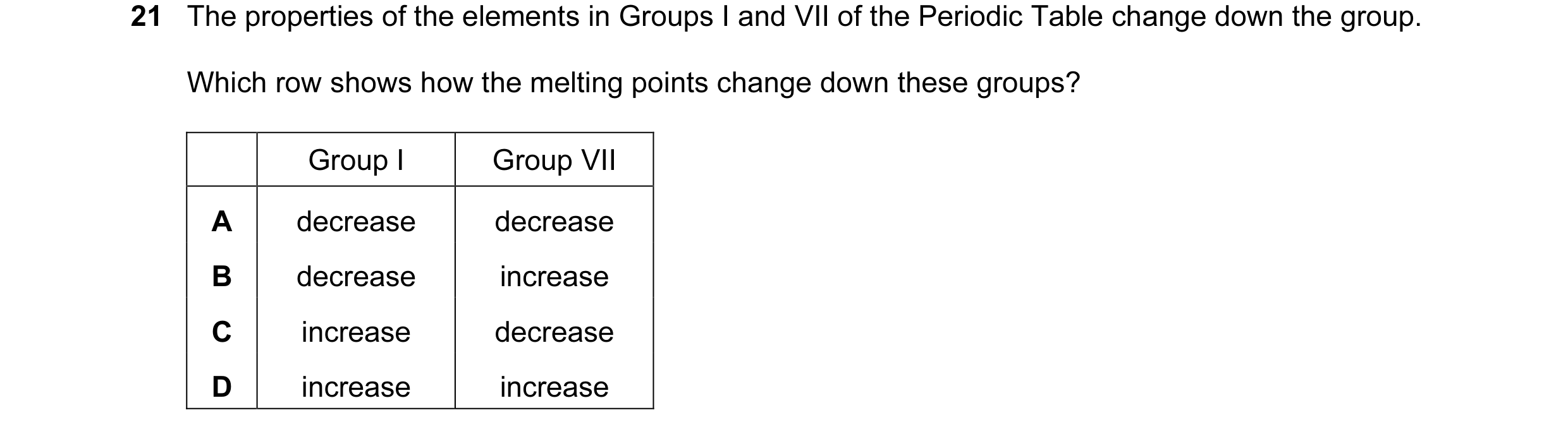
21 The properties of the elements in Groups I and VII of the Periodic Table change down the group. Which row shows how the melting points change down these groups? Group I Group VII A decrease decrease B decrease increase C increase decrease D increase increase
1 marks
Answer: B
This question in 0653/13 May/June 2012
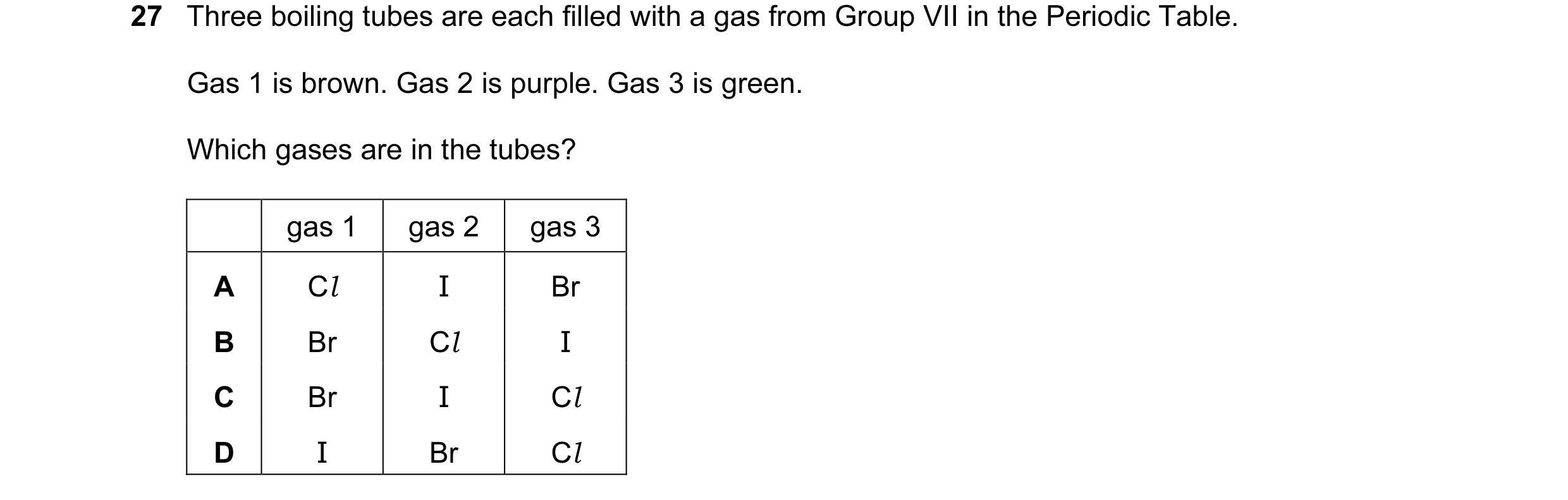
Q9 · Three boiling tubes are each filled with a gas from Group VII in the Periodic Table 0653/13 May/June 2013
27 Three boiling tubes are each filled with a gas from Group VII in the Periodic Table. Gas 1 is brown. Gas 2 is purple. Gas 3 is green. Which gases are in the tubes? gas 1 gas 2 gas 3 A Cl I Br B Br Cl I C Br I Cl D I Br Cl
1 marks
Answer: C
This question in 0653/13 May/June 2013
Q10 · Which row describes the physical state of some of the Group VII elements at room… 0653/13 Oct/Nov 2013
26 Which row describes the physical state of some of the Group VII elements at room temperature? chlorine bromine iodine A gas gas liquid B gas liquid solid C liquid liquid gas D liquid solid solid
1 marks
Answer: B
This question in 0653/13 Oct/Nov 2013
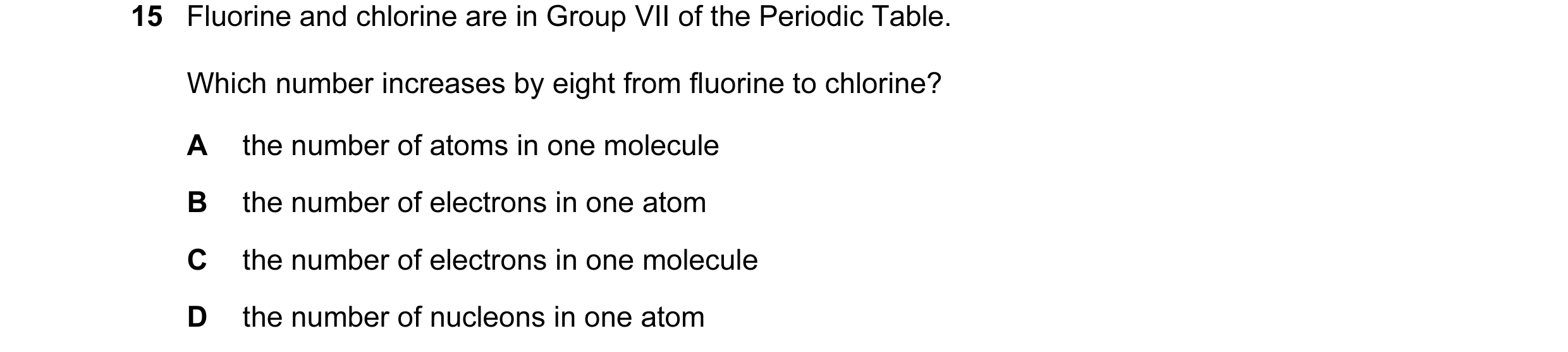
Q11 · Fluorine and chlorine are in Group VII of the Periodic Table 0653/11 May/June 2015
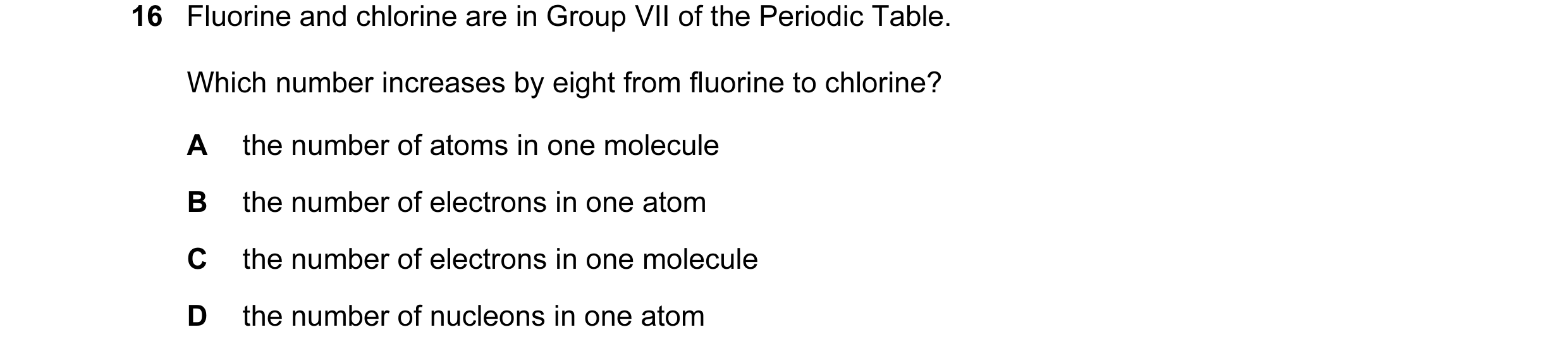
15 Fluorine and chlorine are in Group VII of the Periodic Table. Which number increases by eight from fluorine to chlorine? A the number of atoms in one molecule B the number of electrons in one atom C the number of electrons in one molecule D the number of nucleons in one atom
1 marks
Answer: B
This question in 0653/11 May/June 2015
Q12 · Which element has similar chemical properties to bromine? 0653/11 May/June 2015
22 Which element has similar chemical properties to bromine? A argon B iodine C selenium D sulfur
1 marks
Answer: B
This question in 0653/11 May/June 2015
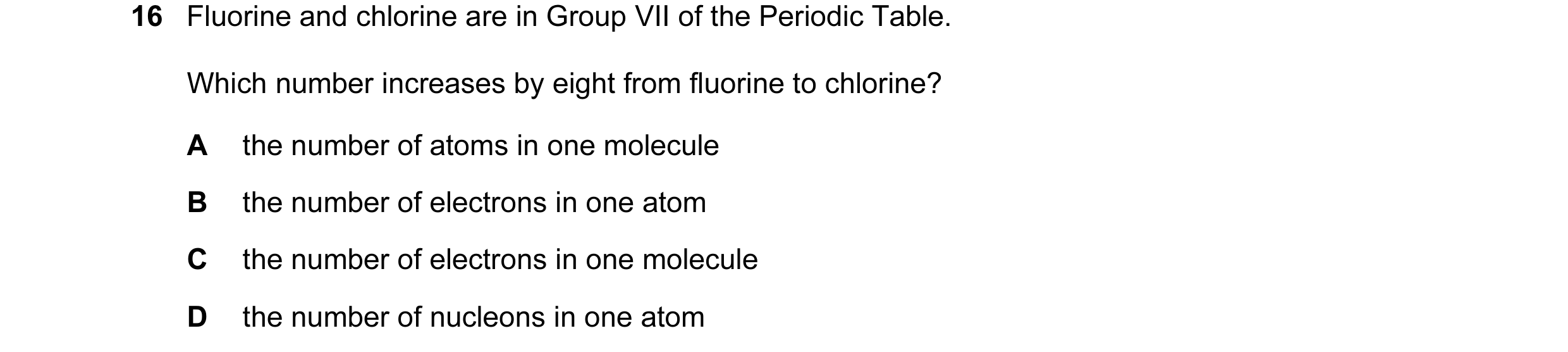
Q13 · Fluorine and chlorine are in Group VII of the Periodic Table 0653/12 May/June 2015
16 Fluorine and chlorine are in Group VII of the Periodic Table. Which number increases by eight from fluorine to chlorine? A the number of atoms in one molecule B the number of electrons in one atom C the number of electrons in one molecule D the number of nucleons in one atom
1 marks
Answer: B
This question in 0653/12 May/June 2015
Q14 · Fluorine and chlorine are in Group VII of the Periodic Table 0653/13 May/June 2015
16 Fluorine and chlorine are in Group VII of the Periodic Table. Which number increases by eight from fluorine to chlorine? A the number of atoms in one molecule B the number of electrons in one atom C the number of electrons in one molecule D the number of nucleons in one atom
1 marks
Answer: B
This question in 0653/13 May/June 2015
Q15 · Chlorine, bromine and iodine are elements in Group VII of the Periodic Table 0653/11 Oct/Nov 2015
24 Chlorine, bromine and iodine are elements in Group VII of the Periodic Table. Which trend is observed going down Group VII? A Each element has the same physical state. B The colour of the element becomes lighter. C The reactivity of the element decreases. D The state of the element changes from solid to liquid to gas.
1 marks
Answer: C
This question in 0653/11 Oct/Nov 2015
Q16 · Which statement describes a trend in the elements going down Group VII? 0653/11 Oct/Nov 2016
24 Which statement describes a trend in the elements going down Group VII? A They are darker in colour. B They are displaced from their salts by elements lower down the group. C They are more reactive. D They have lower boiling points.
1 marks
Answer: A
This question in 0653/11 Oct/Nov 2016
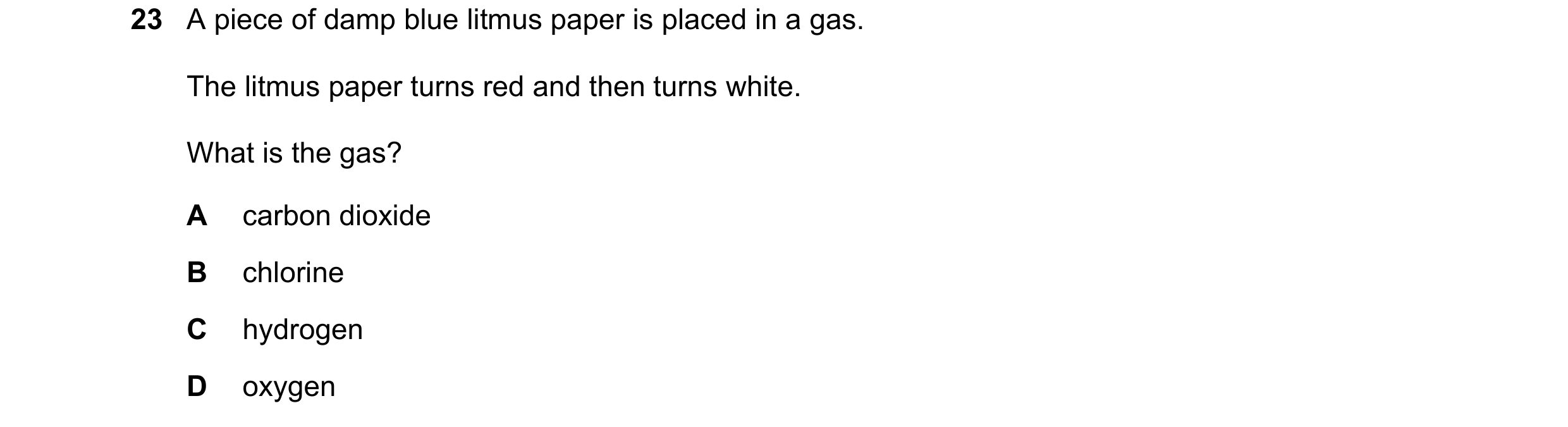
Q17 · A piece of damp blue litmus paper is placed in a gas 0653/13 Oct/Nov 2016
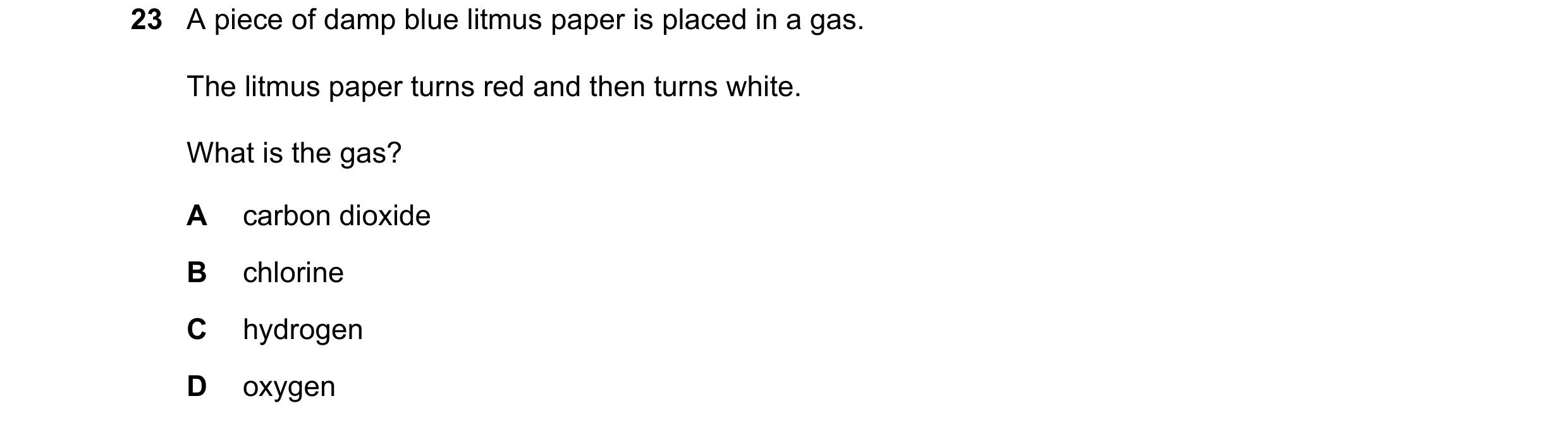
23 A piece of damp blue litmus paper is placed in a gas. The litmus paper turns red and then turns white. What is the gas? A carbon dioxide B chlorine C hydrogen D oxygen
1 marks
Answer: B
This question in 0653/13 Oct/Nov 2016
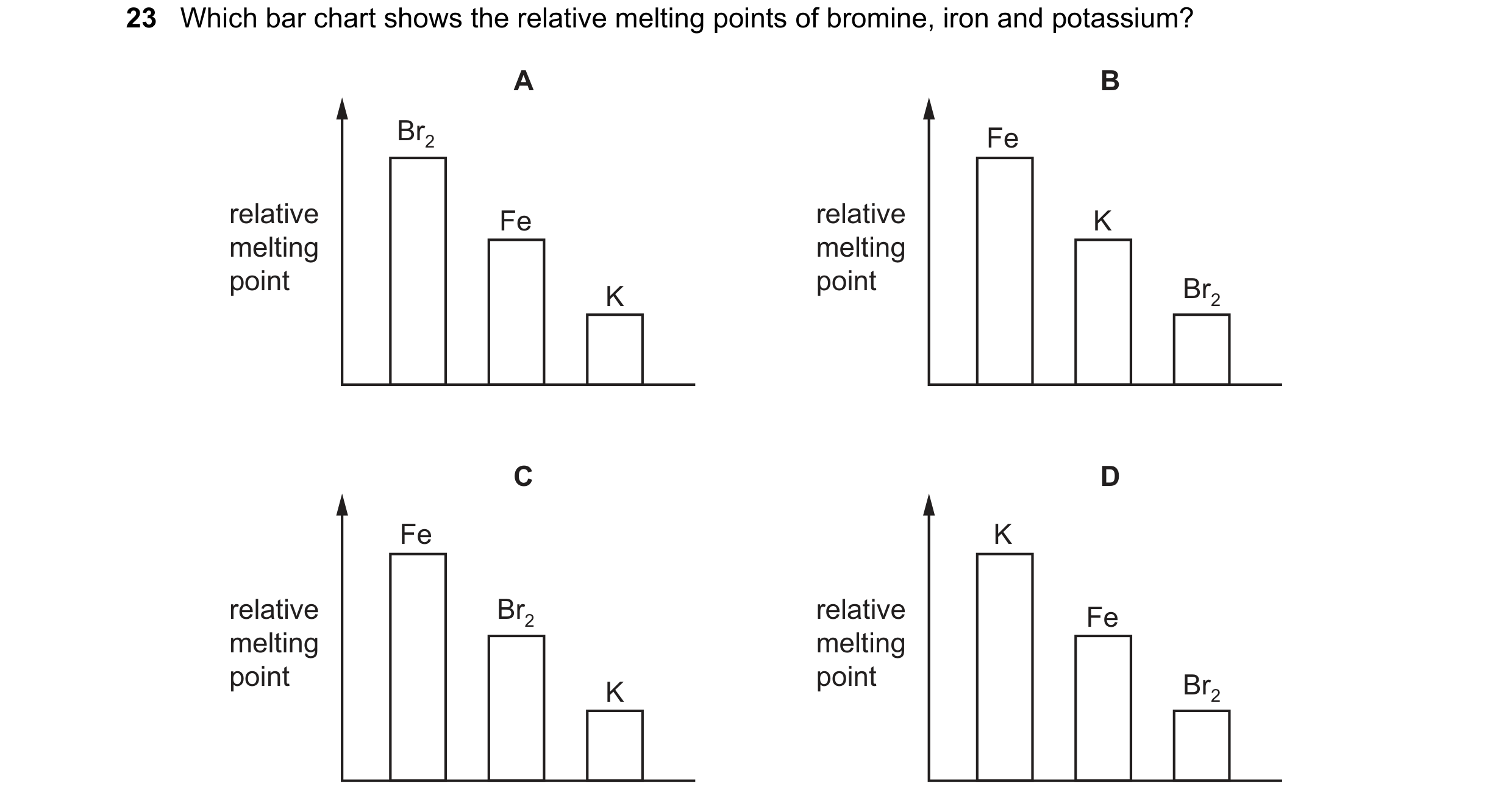
Q18 · Which bar chart shows the relative melting points of bromine, iron and potassium? 0653/12 Oct/Nov 2018
23 Which bar chart shows the relative melting points of bromine, iron and potassium? A B Br2 Fe relative Fe relative K melting melting point point Br2 K C D Fe K relative Br2 relative Fe melting melting point point Br2 K
1 marks
Answer: B
This question in 0653/12 Oct/Nov 2018
Q19 · Which substance does not react with chlorine? 0653/13 Oct/Nov 2018
23 Which substance does not react with chlorine? A H2 B Kr C Li D NaBr
1 marks
Answer: B
This question in 0653/13 Oct/Nov 2018
Q20 · Which statement about elements in the Periodic Table is not correct? 0653/12 Feb/March 2019
22 Which statement about elements in the Periodic Table is not correct? A The elements in Group I are hard metals. B The elements in Group I react with water to give hydrogen. C The elements in Group VII exist as diatomic molecules. D The elements in Group VII are non-metals.
1 marks
Answer: A
This question in 0653/12 Feb/March 2019
Q21 · Which row describes the physical state of the Group VII elements at room temperature? 0653/11 May/June 2019
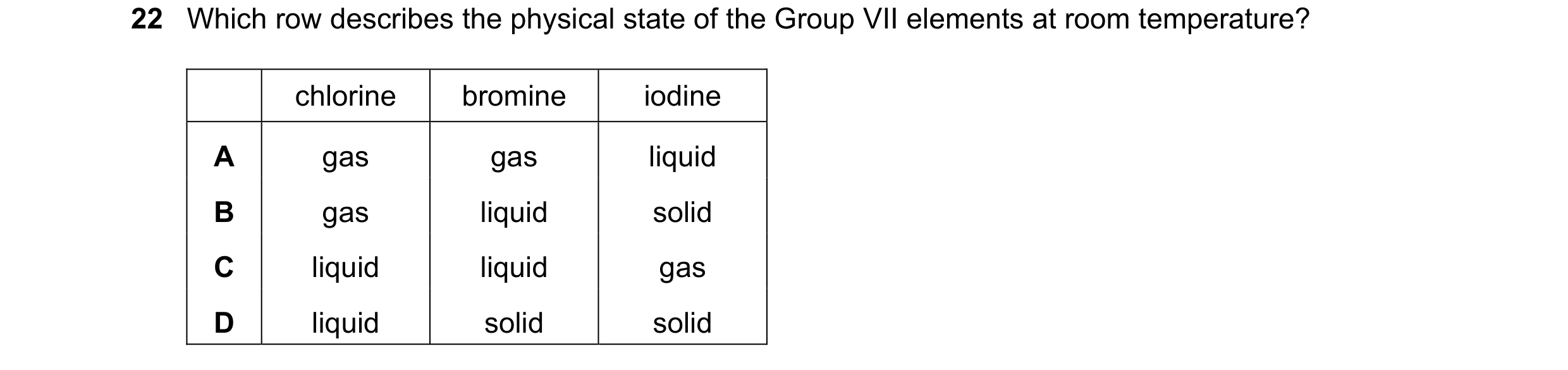
22 Which row describes the physical state of the Group VII elements at room temperature? chlorine bromine iodine A gas gas liquid B gas liquid solid C liquid liquid gas D liquid solid solid
1 marks
Answer: B
This question in 0653/11 May/June 2019
Q22 · Which row describes the physical state of the Group VII elements at room temperature? 0653/12 May/June 2019
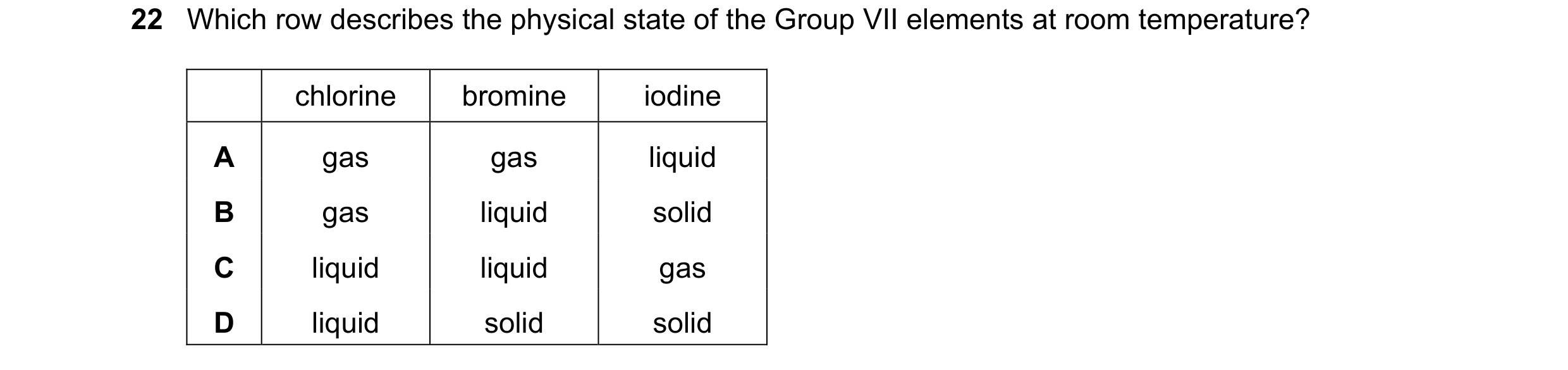
22 Which row describes the physical state of the Group VII elements at room temperature? chlorine bromine iodine A gas gas liquid B gas liquid solid C liquid liquid gas D liquid solid solid
1 marks
Answer: B
This question in 0653/12 May/June 2019
Q23 · Which row describes the physical state of the Group VII elements at room temperature? 0653/13 May/June 2019
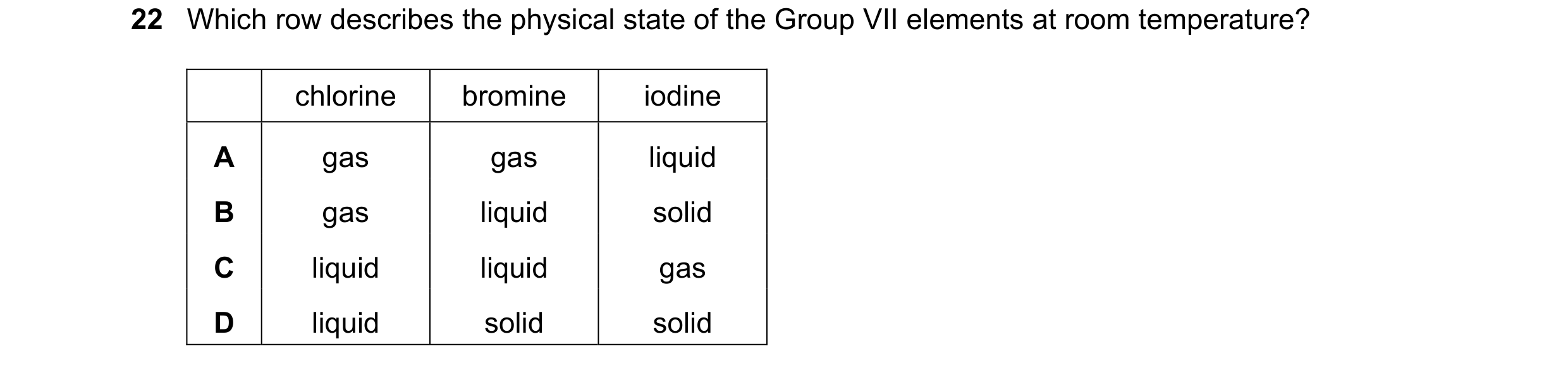
22 Which row describes the physical state of the Group VII elements at room temperature? chlorine bromine iodine A gas gas liquid B gas liquid solid C liquid liquid gas D liquid solid solid
1 marks
Answer: B
This question in 0653/13 May/June 2019
Q24 · Element X is a non-metal used in the treatment of the water supply 0653/11 Oct/Nov 2019
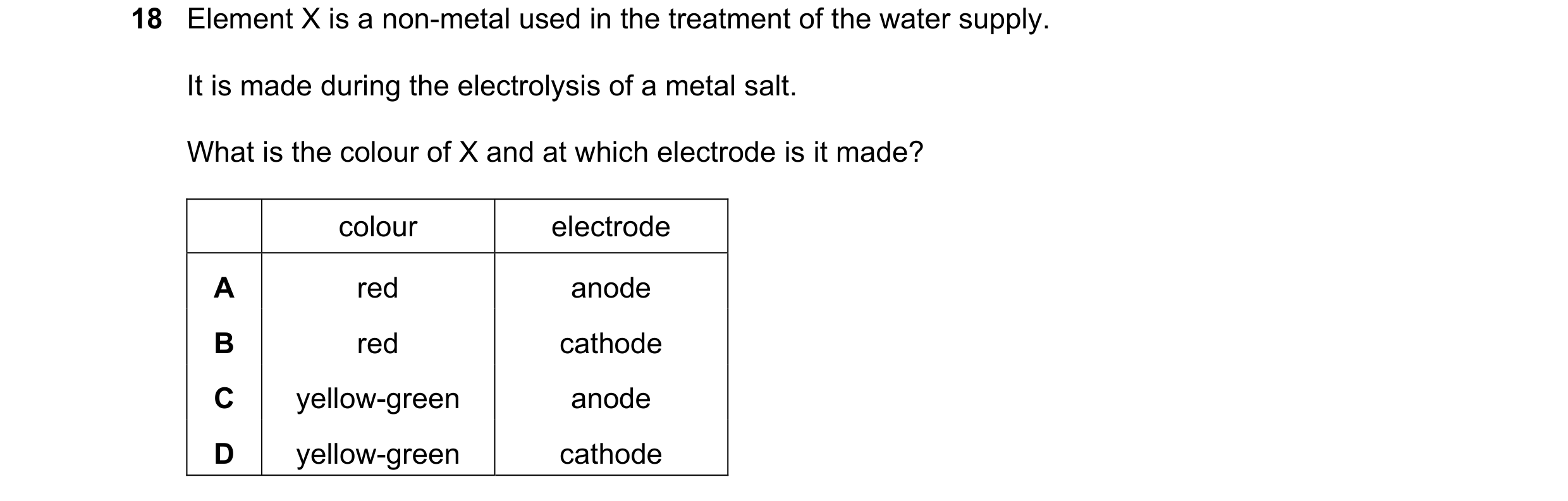
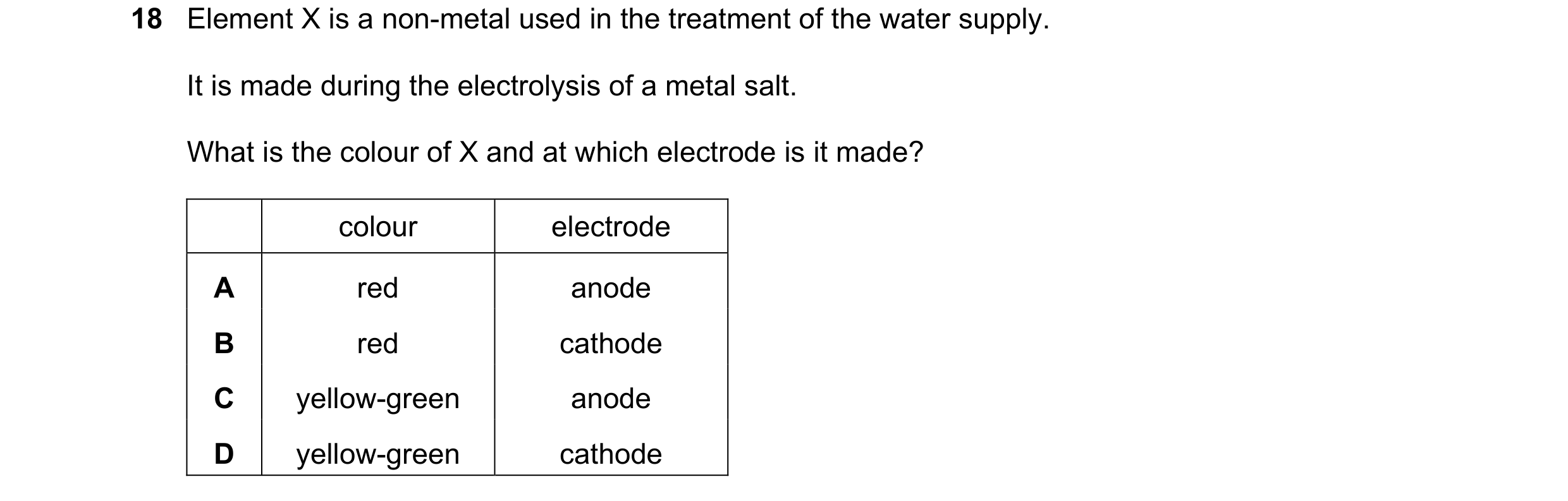
18 Element X is a non-metal used in the treatment of the water supply. It is made during the electrolysis of a metal salt. What is the colour of X and at which electrode is it made? colour electrode A red anode B red cathode C yellow-green anode D yellow-green cathode
1 marks
Answer: C
This question in 0653/11 Oct/Nov 2019
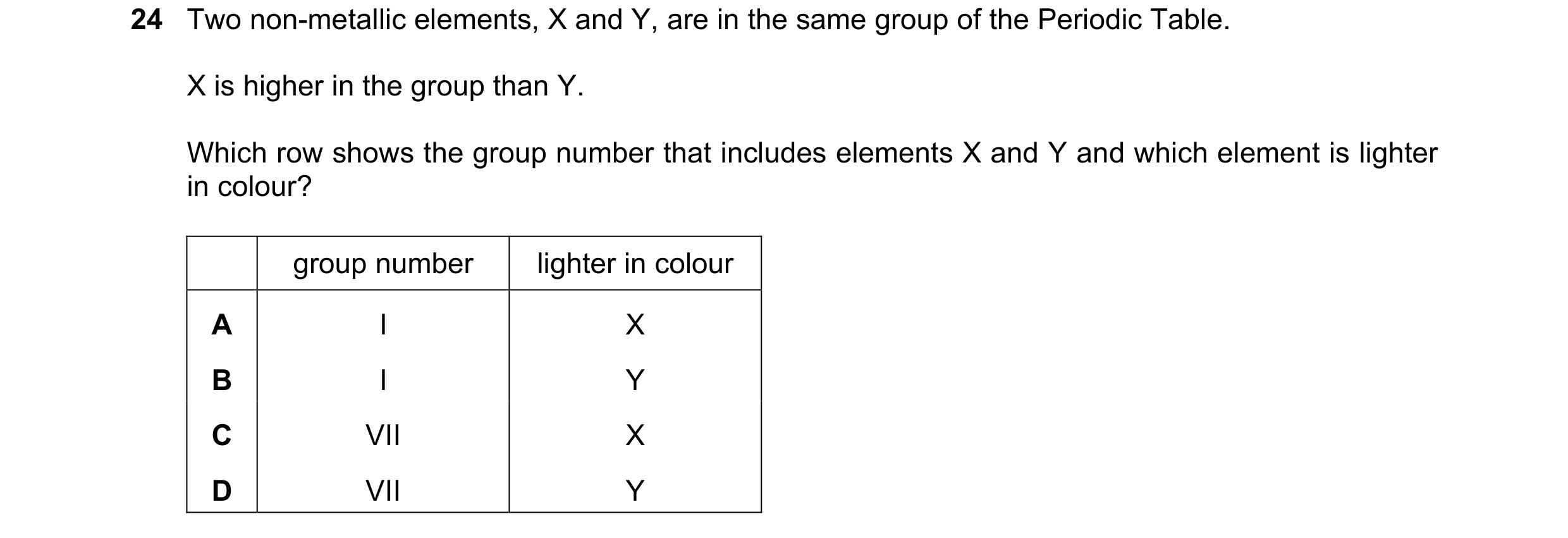
Q25 · Two non-metallic elements, X and Y, are in the same group of the Periodic Table 0653/11 Oct/Nov 2019
23 Two non-metallic elements, X and Y, are in the same group of the Periodic Table. X is higher in the group than Y. Which row shows the group number that includes elements X and Y and which element is lighter in colour? group number lighter in colour A I X B I Y C VII X D VII Y
1 marks
Answer: C
This question in 0653/11 Oct/Nov 2019
Q26 · Element X is a non-metal used in the treatment of the water supply 0653/12 Oct/Nov 2019
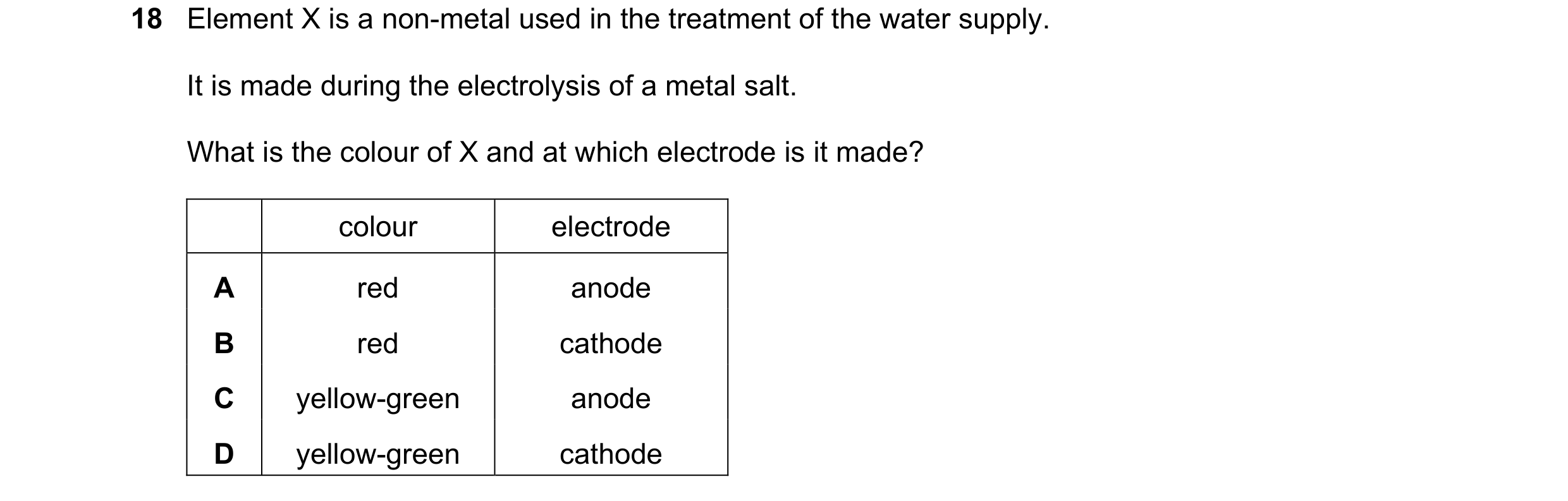
18 Element X is a non-metal used in the treatment of the water supply. It is made during the electrolysis of a metal salt. What is the colour of X and at which electrode is it made? colour electrode A red anode B red cathode C yellow-green anode D yellow-green cathode
1 marks
Answer: C
This question in 0653/12 Oct/Nov 2019
Q27 · Two non-metallic elements, X and Y, are in the same group of the Periodic Table 0653/12 Oct/Nov 2019
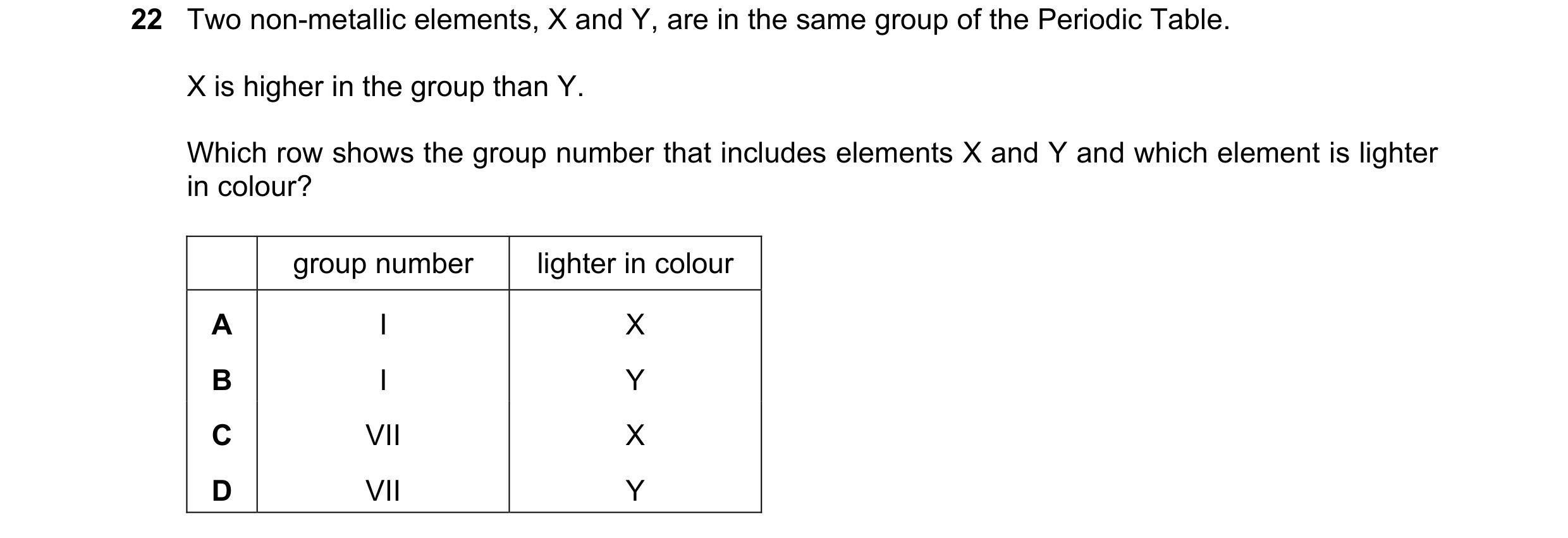
22 Two non-metallic elements, X and Y, are in the same group of the Periodic Table. X is higher in the group than Y. Which row shows the group number that includes elements X and Y and which element is lighter in colour? group number lighter in colour A I X B I Y C VII X D VII Y
1 marks
Answer: C
This question in 0653/12 Oct/Nov 2019
Q28 · Element X is a non-metal used in the treatment of the water supply 0653/13 Oct/Nov 2019
18 Element X is a non-metal used in the treatment of the water supply. It is made during the electrolysis of a metal salt. What is the colour of X and at which electrode is it made? colour electrode A red anode B red cathode C yellow-green anode D yellow-green cathode
1 marks
Answer: C
This question in 0653/13 Oct/Nov 2019
Q29 · Two non-metallic elements, X and Y, are in the same group of the Periodic Table 0653/13 Oct/Nov 2019
22 Two non-metallic elements, X and Y, are in the same group of the Periodic Table. X is higher in the group than Y. Which row shows the group number that includes elements X and Y and which element is lighter in colour? group number lighter in colour A I X B I Y C VII X D VII Y
1 marks
Answer: C
This question in 0653/13 Oct/Nov 2019
Q30 · A piece of damp blue litmus paper is placed in a gas 0653/11 Oct/Nov 2021
23 A piece of damp blue litmus paper is placed in a gas. The litmus paper turns red and then turns white. What is the gas? A carbon dioxide B chlorine C hydrogen D oxygen
1 marks
Answer: B
This question in 0653/11 Oct/Nov 2021
Q31 · Which substance does not react with chlorine? 0653/11 May/June 2022
25 Which substance does not react with chlorine? A H2 B Kr C Li D NaBr
1 marks
Answer: B
This question in 0653/11 May/June 2022
Q32 · Which substance does not react with chlorine? 0653/12 May/June 2022
24 Which substance does not react with chlorine? A H2 B Kr C Li D NaBr
1 marks
Answer: B
This question in 0653/12 May/June 2022
Q33 · Which substance does not react with chlorine? 0653/13 May/June 2022
24 Which substance does not react with chlorine? A H2 B Kr C Li D NaBr
1 marks
Answer: B
This question in 0653/13 May/June 2022
Q34 · Two non-metallic elements, X and Y, are in the same group of the Periodic Table 0653/13 May/June 2023
24 Two non-metallic elements, X and Y, are in the same group of the Periodic Table. X is higher in the group than Y. Which row shows the group number that includes elements X and Y and which element is lighter in colour? group number lighter in colour A I X B I Y C VII X D VII Y
1 marks
Answer: C
This question in 0653/13 May/June 2023
Q35 · Which row describes elements in Group I and Group VII of the Periodic Table? 0653/12 May/June 2024
24 Which row describes elements in Group I and Group VII of the Periodic Table? Group I elements Group VII elements A are solid at room temperature are solid, liquid or gas at room temperature B are poor conductors of are good conductors of heat and electricity heat and electricity C consist of consist of negatively charged ions diatomic molecules D gain electrons when they lose electrons when they react with Group VII elements react with Group I elements
1 marks
Answer: A
This question in 0653/12 May/June 2024
Q36 · Which row describes trends shown by the elements in Group I and Group VII of the Periodic… 0653/12 Oct/Nov 2024
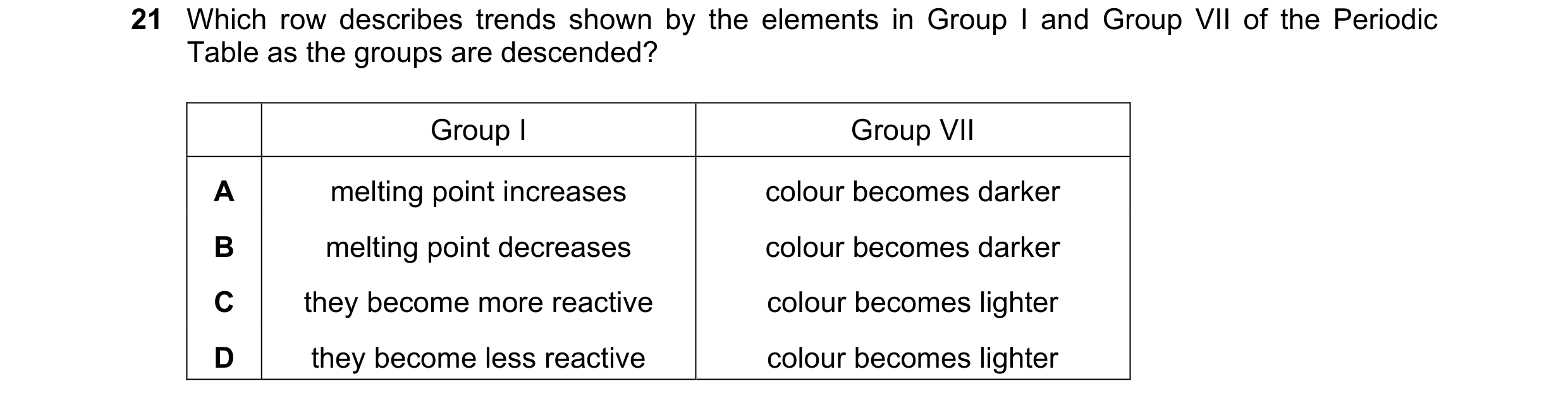
21 Which row describes trends shown by the elements in Group I and Group VII of the Periodic Table as the groups are descended? Group I Group VII A melting point increases colour becomes darker B melting point decreases colour becomes darker C they become more reactive colour becomes lighter D they become less reactive colour becomes lighter
1 marks
Answer: B
This question in 0653/12 Oct/Nov 2024
Q37 · Which row describes trends shown by the elements in Group I and Group VII of the Periodic… 0653/13 Oct/Nov 2024
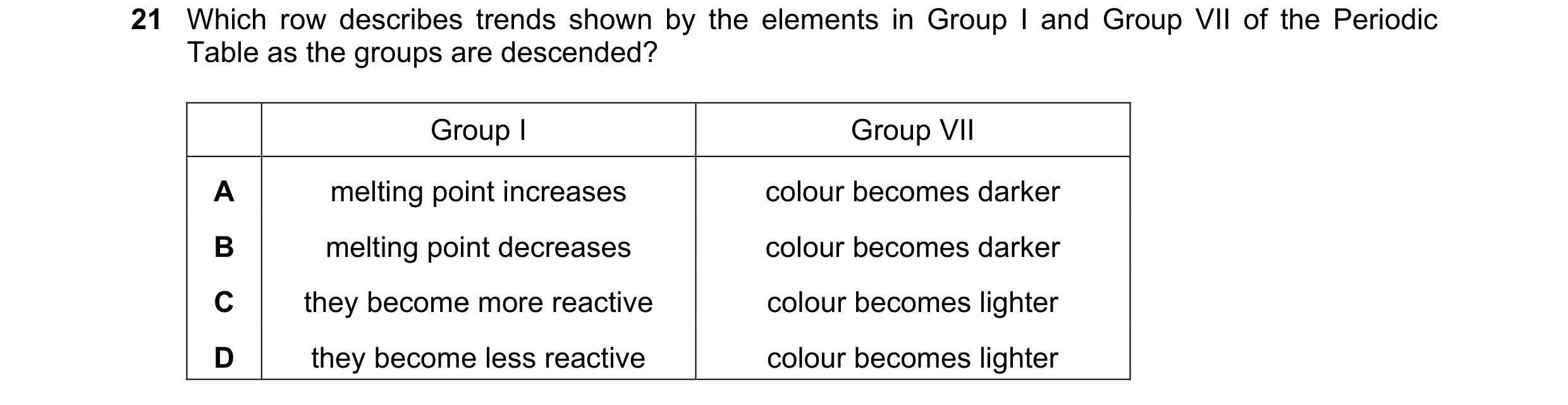
21 Which row describes trends shown by the elements in Group I and Group VII of the Periodic Table as the groups are descended? Group I Group VII A melting point increases colour becomes darker B melting point decreases colour becomes darker C they become more reactive colour becomes lighter D they become less reactive colour becomes lighter
1 marks
Answer: B
This question in 0653/13 Oct/Nov 2024
Q38 · Element Q is in Group VII of the Periodic Table 0653/12 Oct/Nov 2025
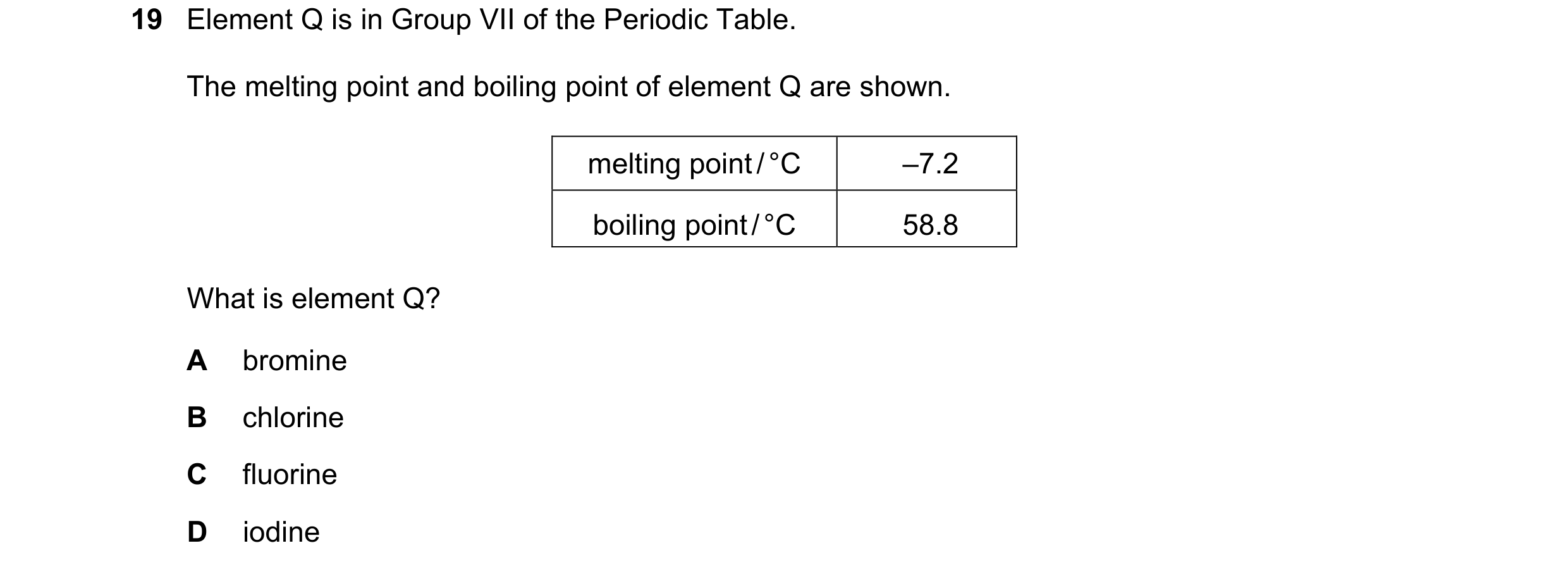
19 Element Q is in Group VII of the Periodic Table. The melting point and boiling point of element Q are shown. melting point / °C –7.2 boiling point / °C 58.8 What is element Q? A bromine B chlorine C fluorine D iodine
1 marks
Answer: A
This question in 0653/12 Oct/Nov 2025
Q39 · Element Q is in Group VII of the Periodic Table 0653/13 Oct/Nov 2025
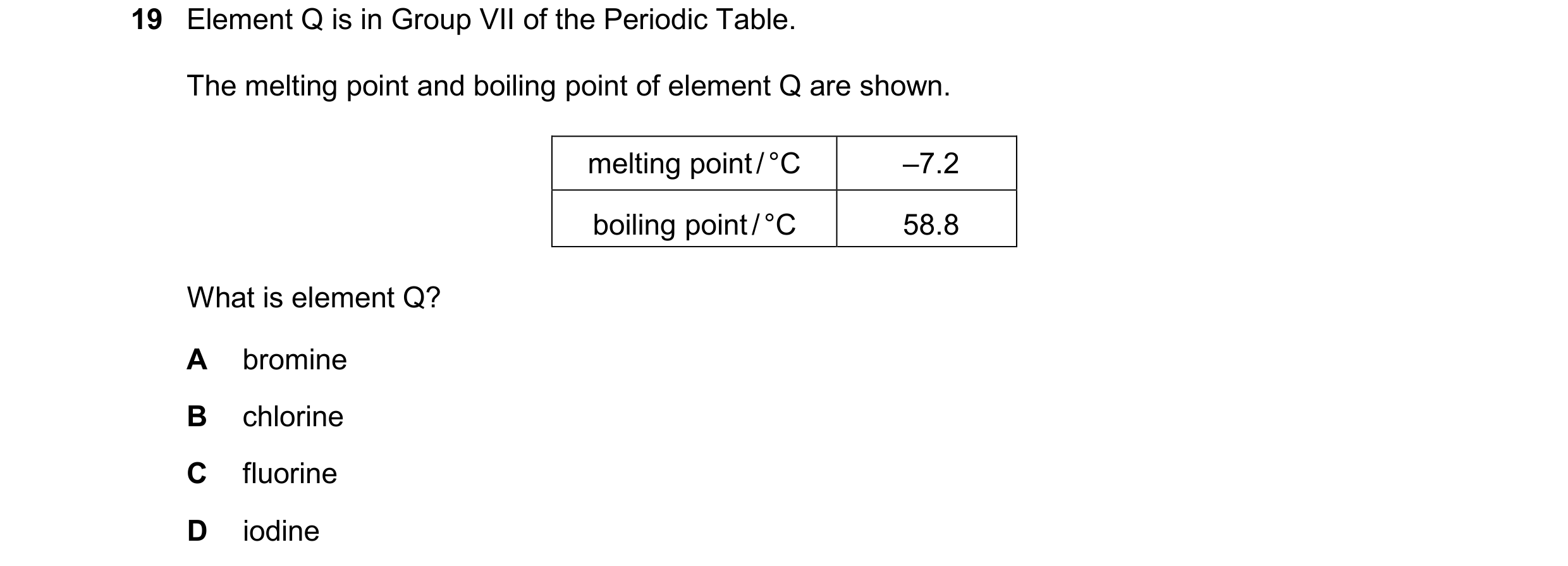
19 Element Q is in Group VII of the Periodic Table. The melting point and boiling point of element Q are shown. melting point / °C –7.2 boiling point / °C 58.8 What is element Q? A bromine B chlorine C fluorine D iodine
1 marks
Answer: A
This question in 0653/13 Oct/Nov 2025
 1 / 10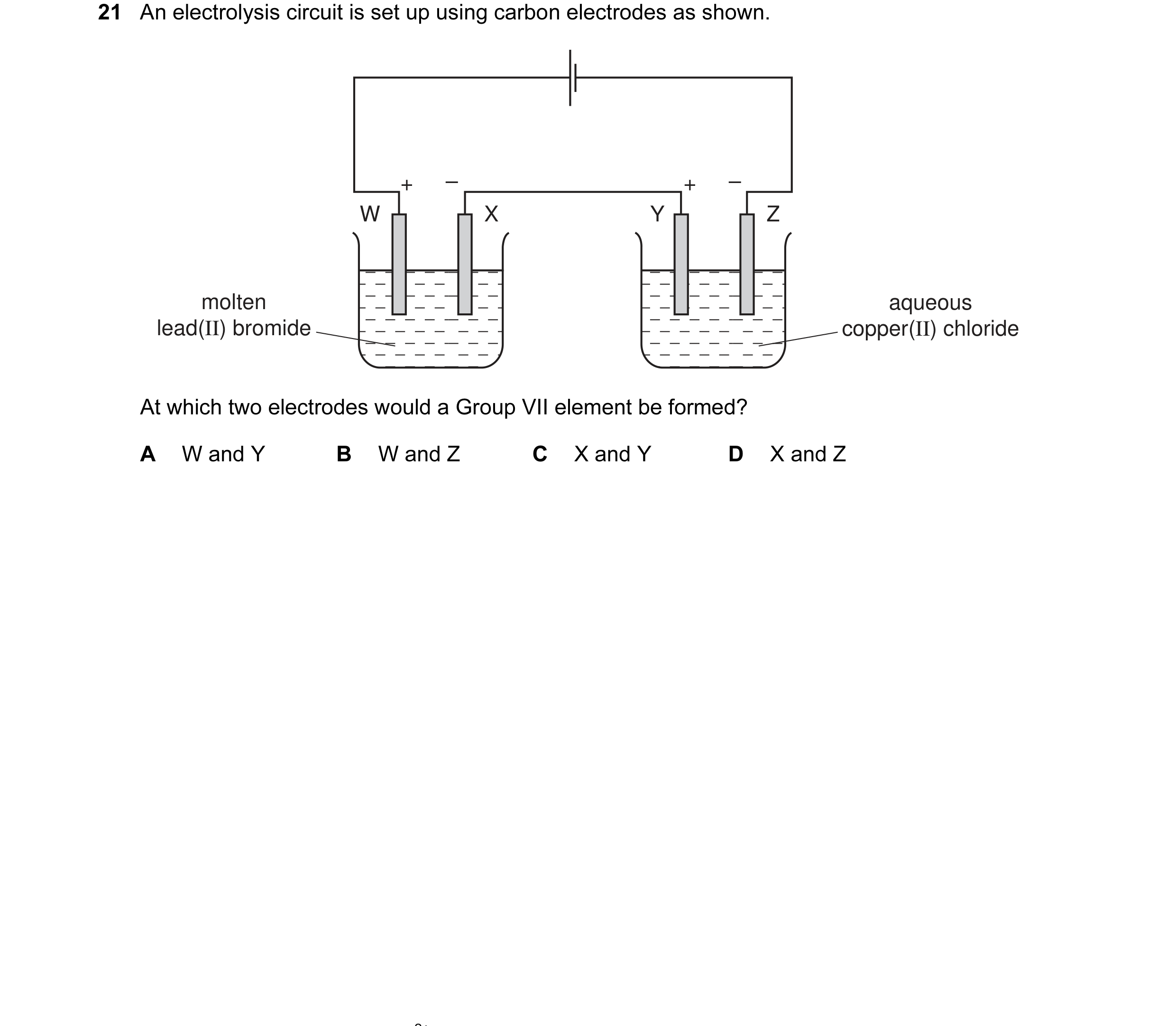
 2 / 10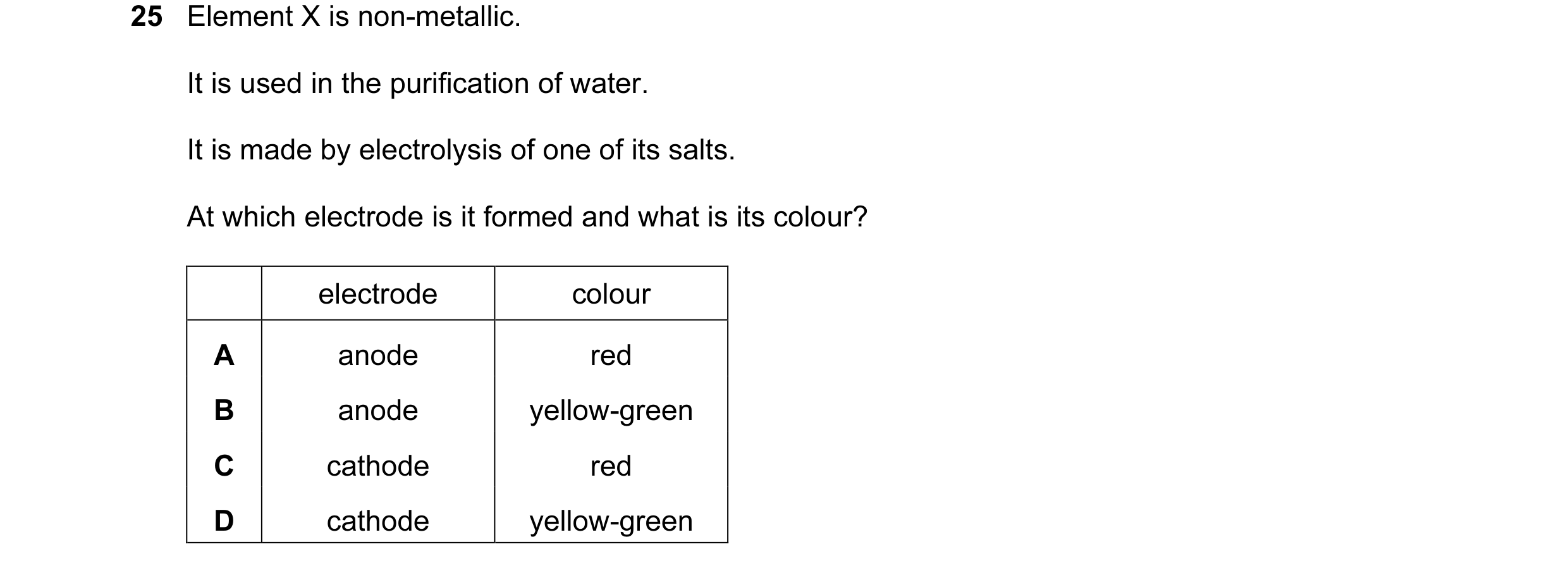
 3 / 10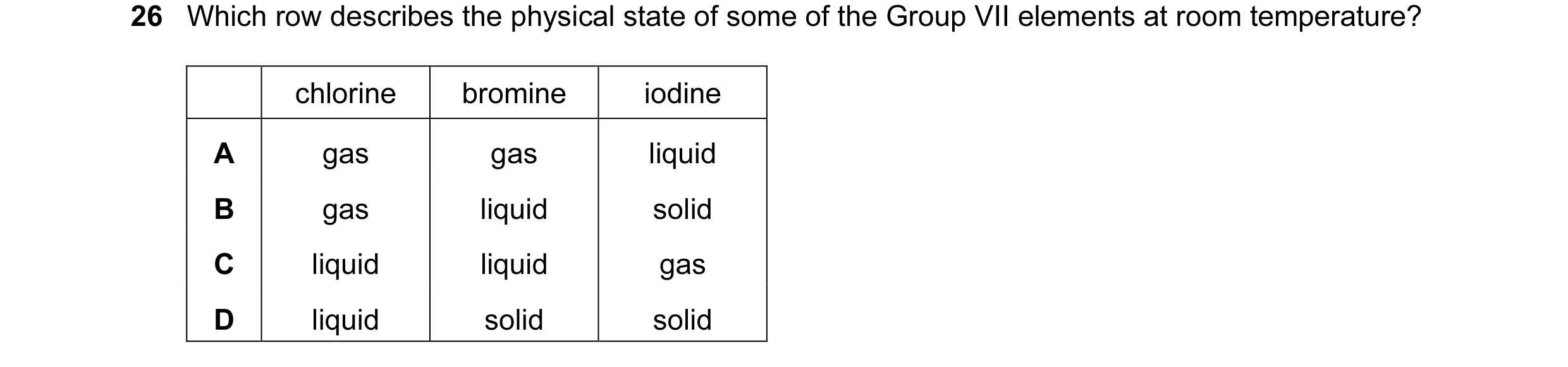

 4 / 10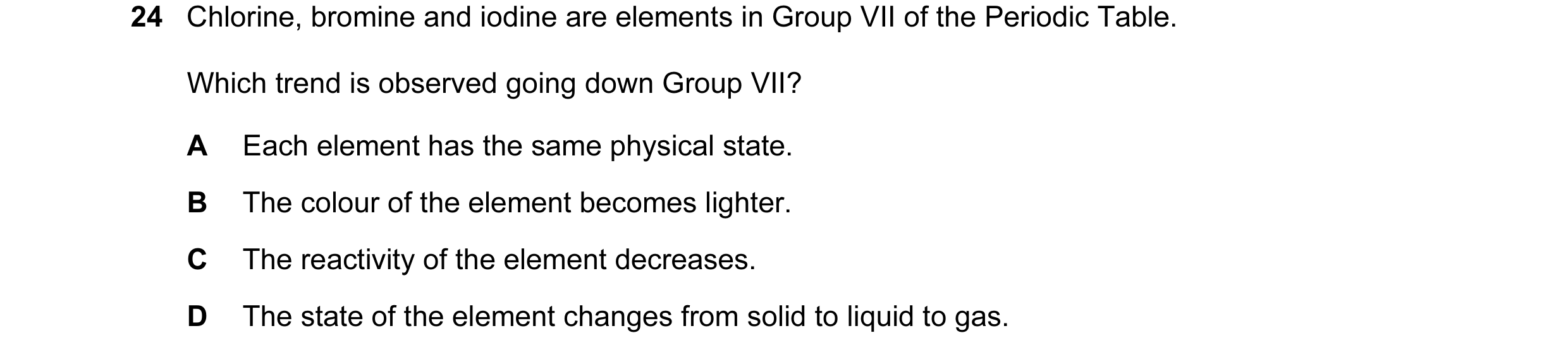

 5 / 10
 6 / 10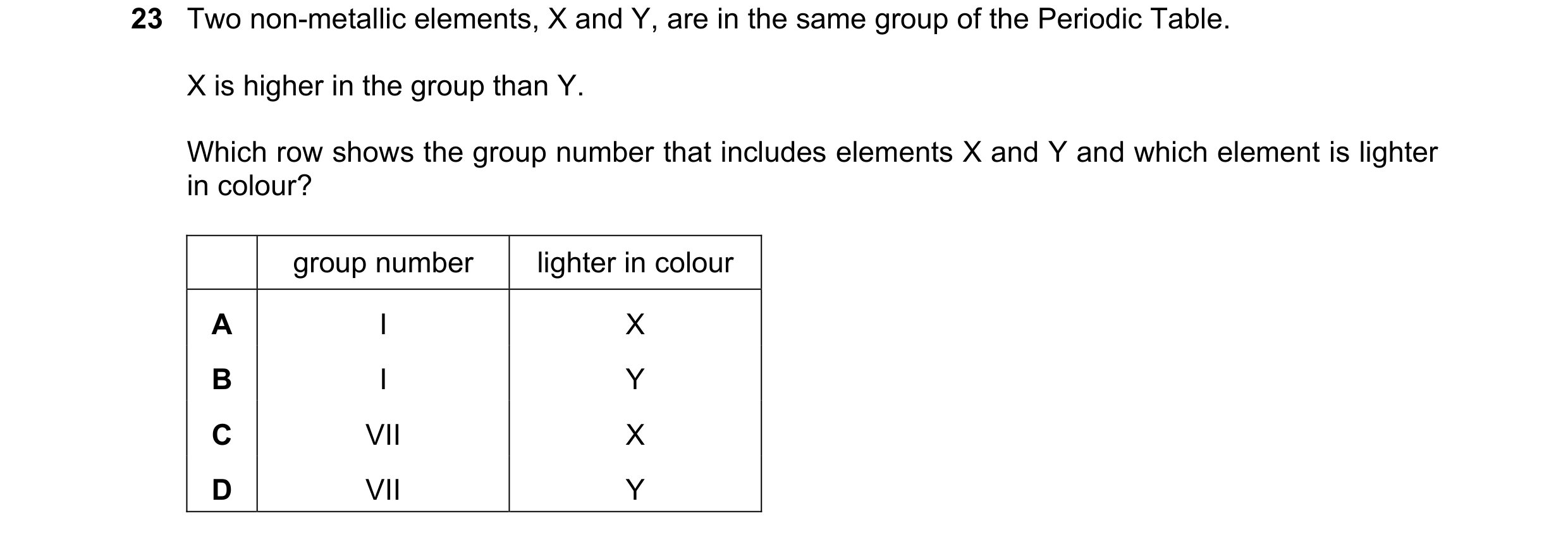
 7 / 10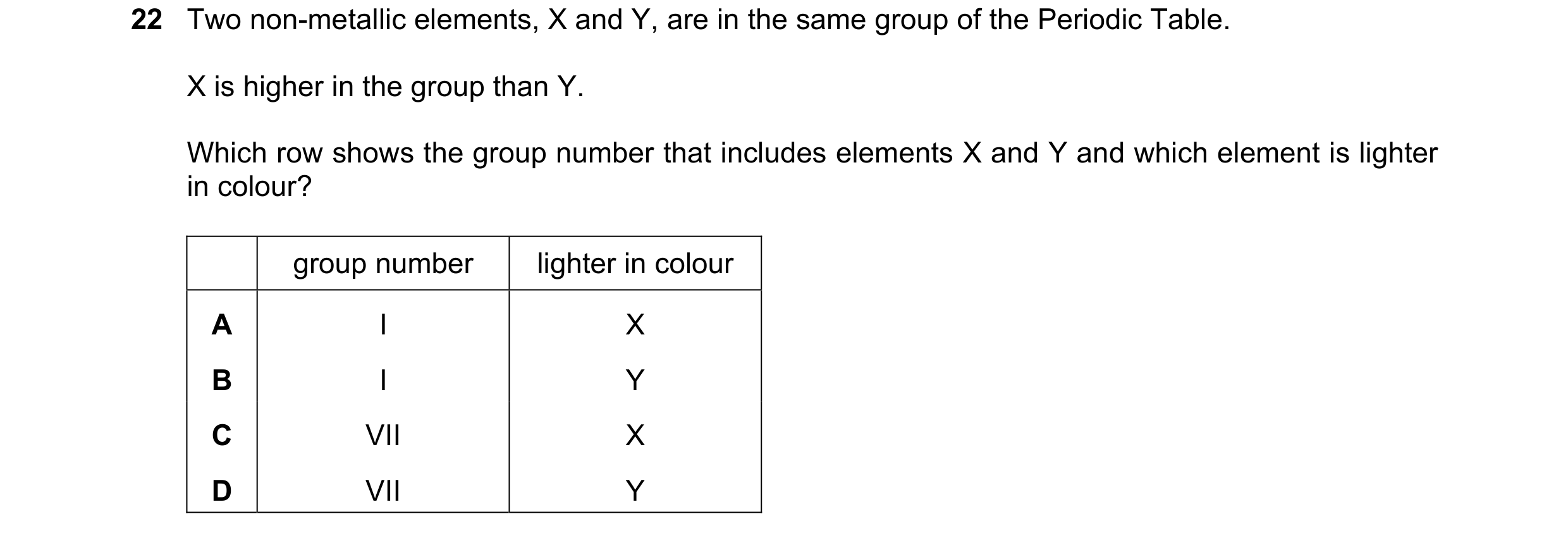



 8 / 10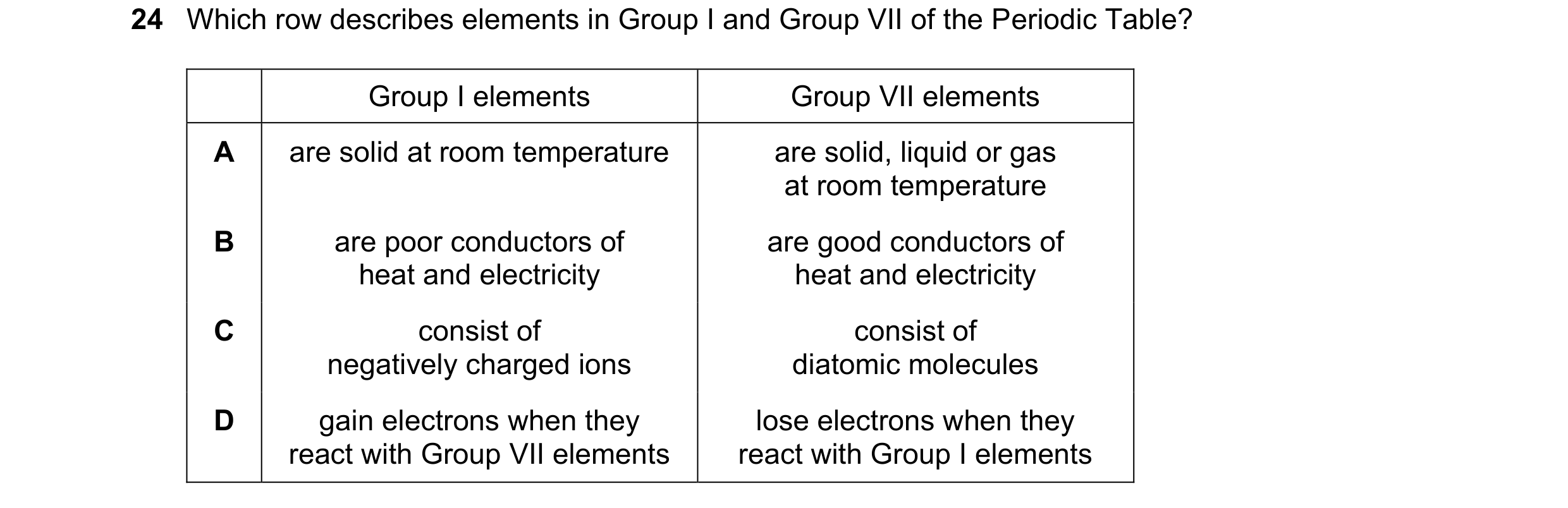
 9 / 10
 10 / 10