Questions as text
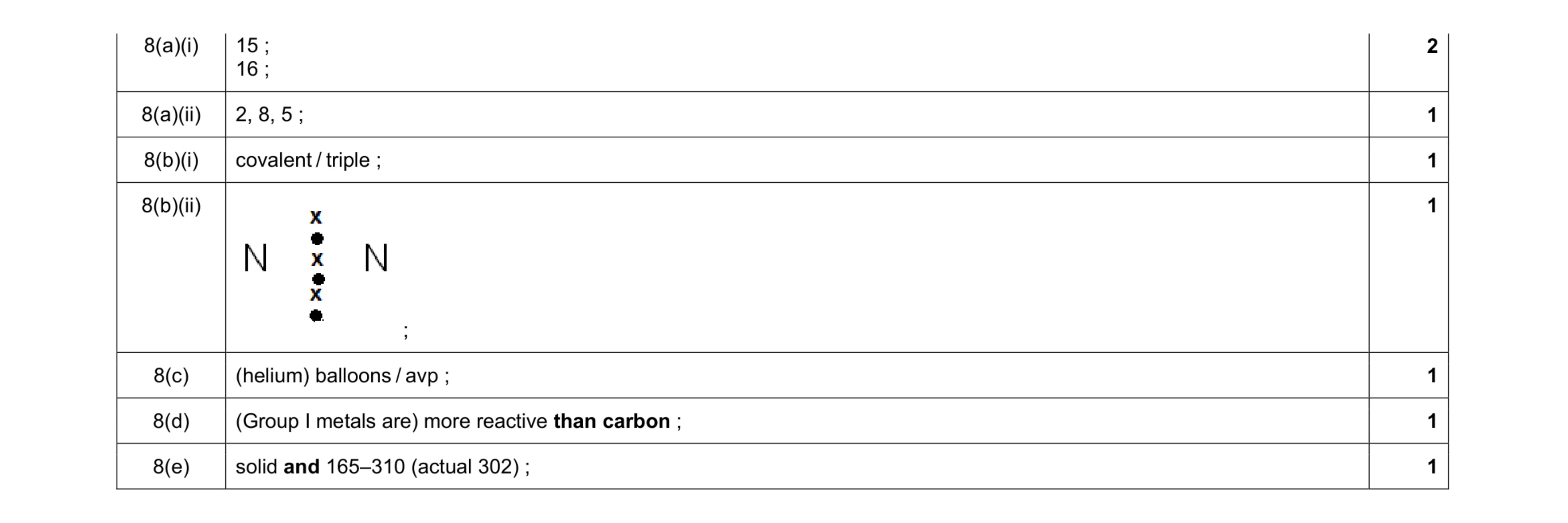
Q1 · An atom of phosphorus is represented as shown 0653/41 Oct/Nov 2017
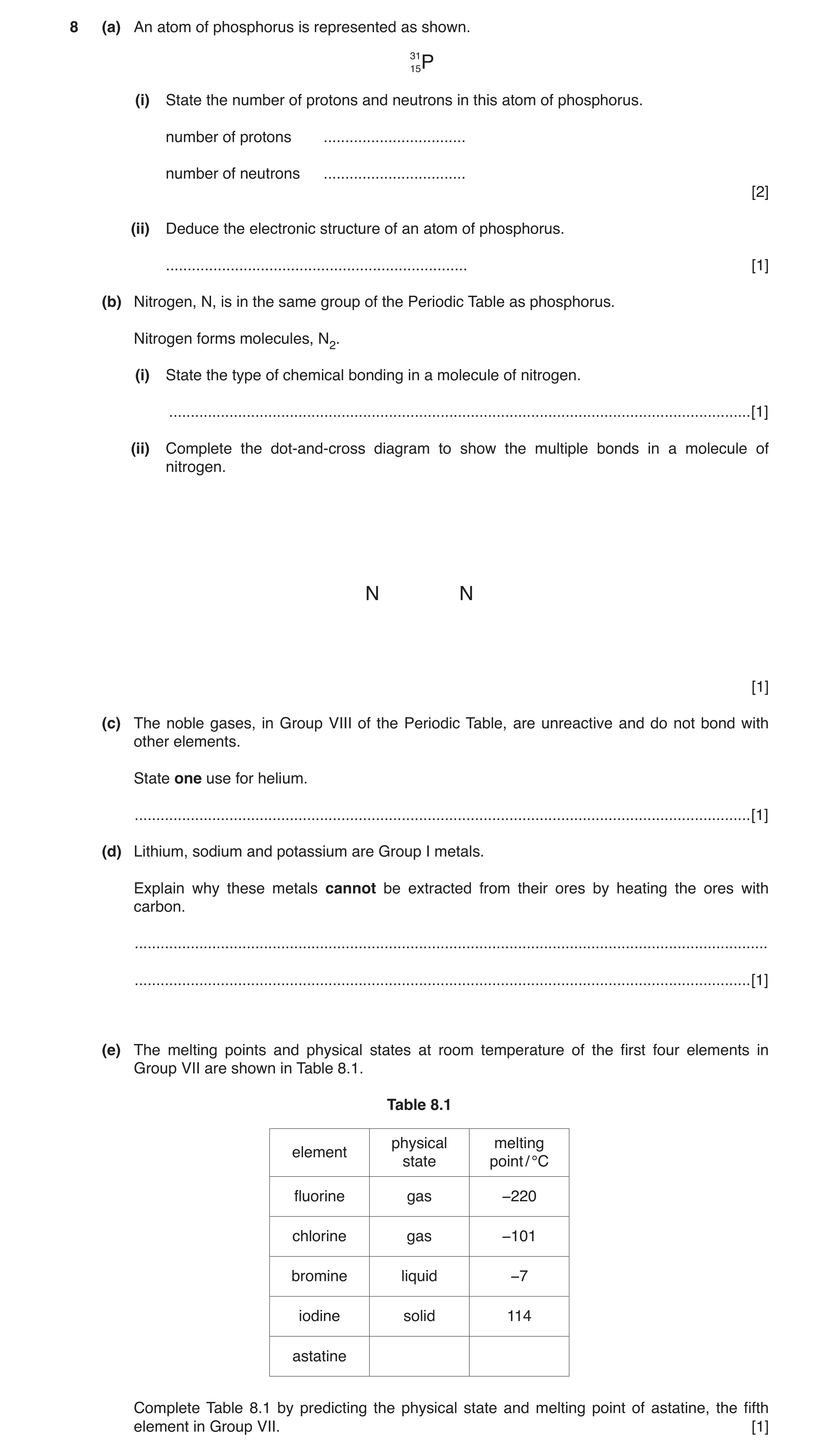
8 (a) An atom of phosphorus is represented as shown. 3115P (i) State the number of protons and neutrons in this atom of phosphorus. number of protons … number of neutrons … [2] (ii) Deduce the electronic structure of an atom of phosphorus. … [1] (b) Nitrogen, N, is in the same group of the Periodic Table as phosphorus. Nitrogen forms molecules, N2. (i) State the type of chemical bonding in a molecule of nitrogen. … [1] (ii) Complete the dot-and-cross diagram to show the multiple bonds in a molecule of nitrogen. N N [1] (c) The noble gases, in Group VIII of the Periodic Table, are unreactive and do not bond with other elements. State one use for helium. … [1] (d) Lithium, sodium and potassium are Group I metals. Explain why these metals cannot be extracted from their ores by heating the ores with carbon. … … [1] (e) The melting points and physical states at room temperature of the first four elements in Group VII are shown in Table 8.1. Table 8.1 physical melting element state point / °C fluorine gas −220 chlorine gas −101 bromine liquid −7 iodine solid 114 astatine Complete Table 8.1 by predicting the physical state and melting point of astatine, the fifth element in Group VII. [1]
8 marks
Mark scheme: 8(a)(i) 15 ; 16 ; 2 8(a)(ii) 2, 8, 5 ; 1 8(b)(i) covalent / triple ; 1 8(b)(ii) ; 1 8(c) (helium) balloons / avp ; 1 8(d) (Group I metals are) more reactive than carbon ; 1 8(e) solid and 165–310 (actual 302) ; 1
This question in 0653/41 Oct/Nov 2017
Q2 · An atom of bromine is represented by the symbol 3579Br (i) State the number of electrons… 0653/42 Feb/March 2018
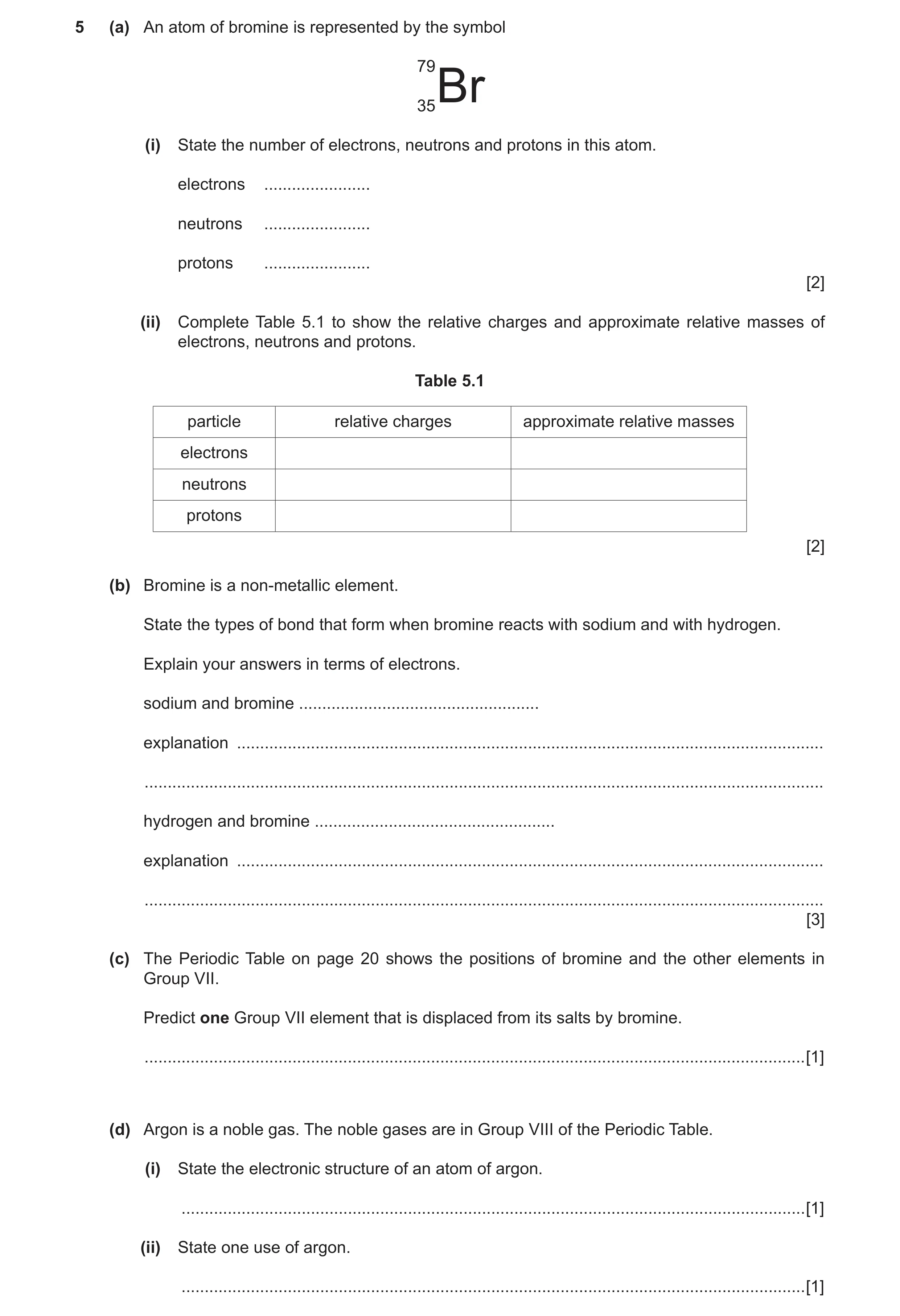
5 (a) An atom of bromine is represented by the symbol 3579Br (i) State the number of electrons, neutrons and protons in this atom. electrons … neutrons … protons … [2] (ii) Complete Table 5.1 to show the relative charges and approximate relative masses of electrons, neutrons and protons. Table 5.1 particle relative charges approximate relative masses electrons neutrons protons [2] (b) Bromine is a non-metallic element. State the types of bond that form when bromine reacts with sodium and with hydrogen. Explain your answers in terms of electrons. sodium and bromine … explanation … … hydrogen and bromine … explanation … … [3] (c) The Periodic Table on page 20 shows the positions of bromine and the other elements in Group VII. Predict one Group VII element that is displaced from its salts by bromine. … [1] (d) Argon is a noble gas. The noble gases are in Group VIII of the Periodic Table. (i) State the electronic structure of an atom of argon. … [1] (ii) State one use of argon. … [1]
10 marks
Mark scheme: 5(a)(i) (electrons) 35 (neutrons) 44 (protons) 35 ;; all three correct (2) one or two correct (1) 2 5(a)(ii) (particle) (relative charges) (approximate relative masses) (electrons) –1 / negative / –ve negligible / 1 / 2000 (neutrons) 0 / none / neutral 1 (protons) +1 / positive / +ve 1 each column correct ;; 2 5(b) (sodium) ionic / electrovalent and (hydrogen) covalent ; (ionic) idea of gain / loss / transfer of electrons ; (covalent) electrons are shared ; 3 5(c) iodine / astatine ; 1 5(d)(i) 2, 8, 8 ; 1 5(d)(ii) lamps / inert atmosphere / other valid answers ; 1
This question in 0653/42 Feb/March 2018
Q3 · A bromine atom contains seven electrons in its outer shell 0653/42 Feb/March 2020
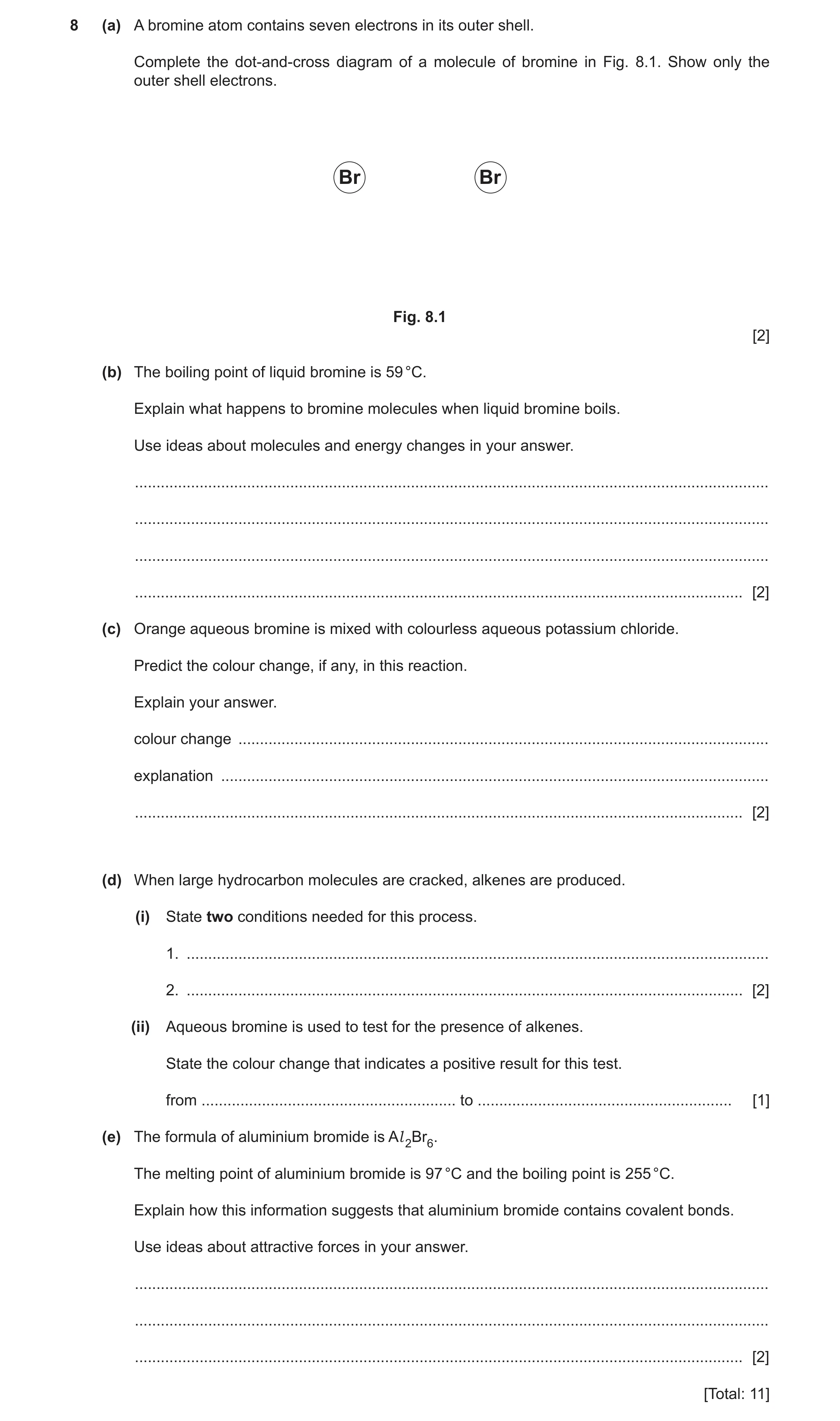
8 (a) A bromine atom contains seven electrons in its outer shell. Complete the dot-and-cross diagram of a molecule of bromine in Fig. 8.1. Show only the outer shell electrons. Br Br Fig. 8.1 [2] (b) The boiling point of liquid bromine is 59 °C. Explain what happens to bromine molecules when liquid bromine boils. Use ideas about molecules and energy changes in your answer. … … … … [2] (c) Orange aqueous bromine is mixed with colourless aqueous potassium chloride. Predict the colour change, if any, in this reaction. Explain your answer. colour change … explanation … … [2] (d) When large hydrocarbon molecules are cracked, alkenes are produced. (i) State two conditions needed for this process. 1. … 2. … [2] (ii) Aqueous bromine is used to test for the presence of alkenes. State the colour change that indicates a positive result for this test. from … to … [1] (e) The formula of aluminium bromide is Al 2Br6. The melting point of aluminium bromide is 97 °C and the boiling point is 255 °C. Explain how this information suggests that aluminium bromide contains covalent bonds. Use ideas about attractive forces in your answer. … … … [2] [Total: 11]
11 marks
Mark scheme: 8(a) shared pair ; seven outer electrons in each bromine atom ; 8(b) distance between bromine molecules increases ; (because) energy is used to, break / overcome intermolecular forces ; 2 8(c) no colour change ; bromine is less reactive than chlorine / bromine does not displace chlorine ; 2 8(d)(i) high temperature ; catalyst ; 2 8(d)(ii) (from) orange (to) colourless ; 1 8(e) covalently bonded substances have (relatively) low melting points and boiling points / ionic compounds would have much higher melting points and boiling points ; attractive intermolecular forces are (relatively) low ; 2
This question in 0653/42 Feb/March 2020
Q4 · Bromine, chlorine and iodine are in Group VII of the Periodic Table 0653/41 May/June 2021
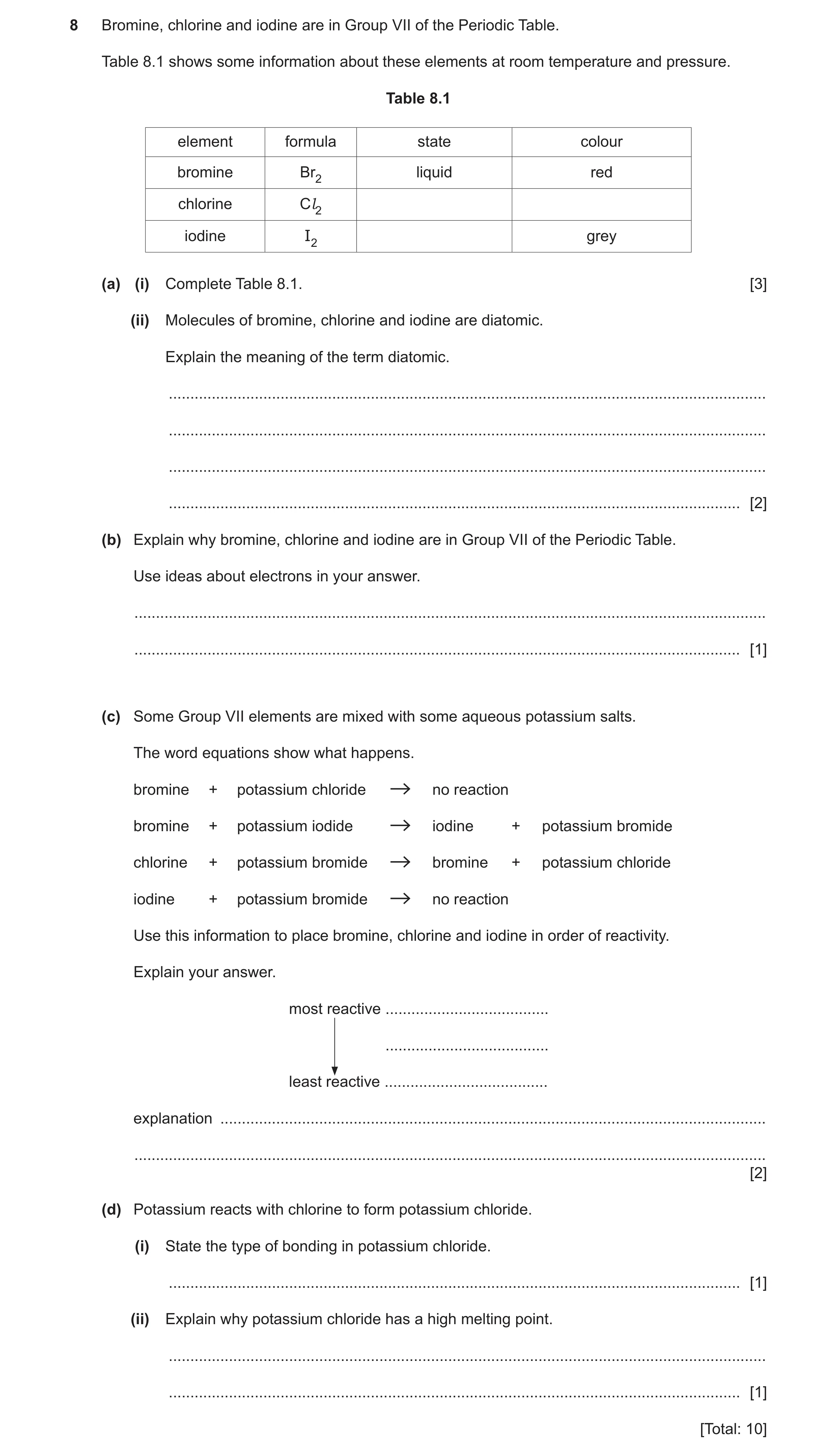
8 Bromine, chlorine and iodine are in Group VII of the Periodic Table. Table 8.1 shows some information about these elements at room temperature and pressure. Table 8.1 element formula state colour bromine Br2 liquid red chlorine Cl2 iodine I grey 2 (a) (i) Complete Table 8.1. [3] (ii) Molecules of bromine, chlorine and iodine are diatomic. Explain the meaning of the term diatomic. … … … … [2] (b) Explain why bromine, chlorine and iodine are in Group VII of the Periodic Table. Use ideas about electrons in your answer. … … [1] (c) Some Group VII elements are mixed with some aqueous potassium salts. The word equations show what happens. bromine + potassium chloride no reaction bromine + potassium iodide iodine + potassium bromide chlorine + potassium bromide bromine + potassium chloride iodine + potassium bromide no reaction Use this information to place bromine, chlorine and iodine in order of reactivity. Explain your answer. most reactive … … least reactive … explanation … … [2] (d) Potassium reacts with chlorine to form potassium chloride. (i) State the type of bonding in potassium chloride. … [1] (ii) Explain why potassium chloride has a high melting point. … … [1] [Total: 10]
10 marks
Mark scheme: 8(a)(i) element formula state colour bromine Br2 liquid red chlorine Cl2 gas green iodine I2 solid grey ;;; chlorine: (state) gas ; (colour) green ; iodine: (state) solid ; 8(a)(ii) (diatomic means) only two atoms ; (atoms) joined / combined / bonded together, (in a molecule) ; 2 8(b) they have 7 electrons in the outer shell ; 1 8(c) order of reactivity: chlorine, bromine, iodine ; explanation: a more reactive element can displace a less reactive element / a more reactive element can react with a salt of a less reactive element ; 2 8(d)(i) ionic ; 1 8(d)(ii) attraction (between ions) is very strong ; 1
This question in 0653/41 May/June 2021
Q5 · Some properties of three elements in Group VII of the Periodic Table 0653/43 Oct/Nov 2021
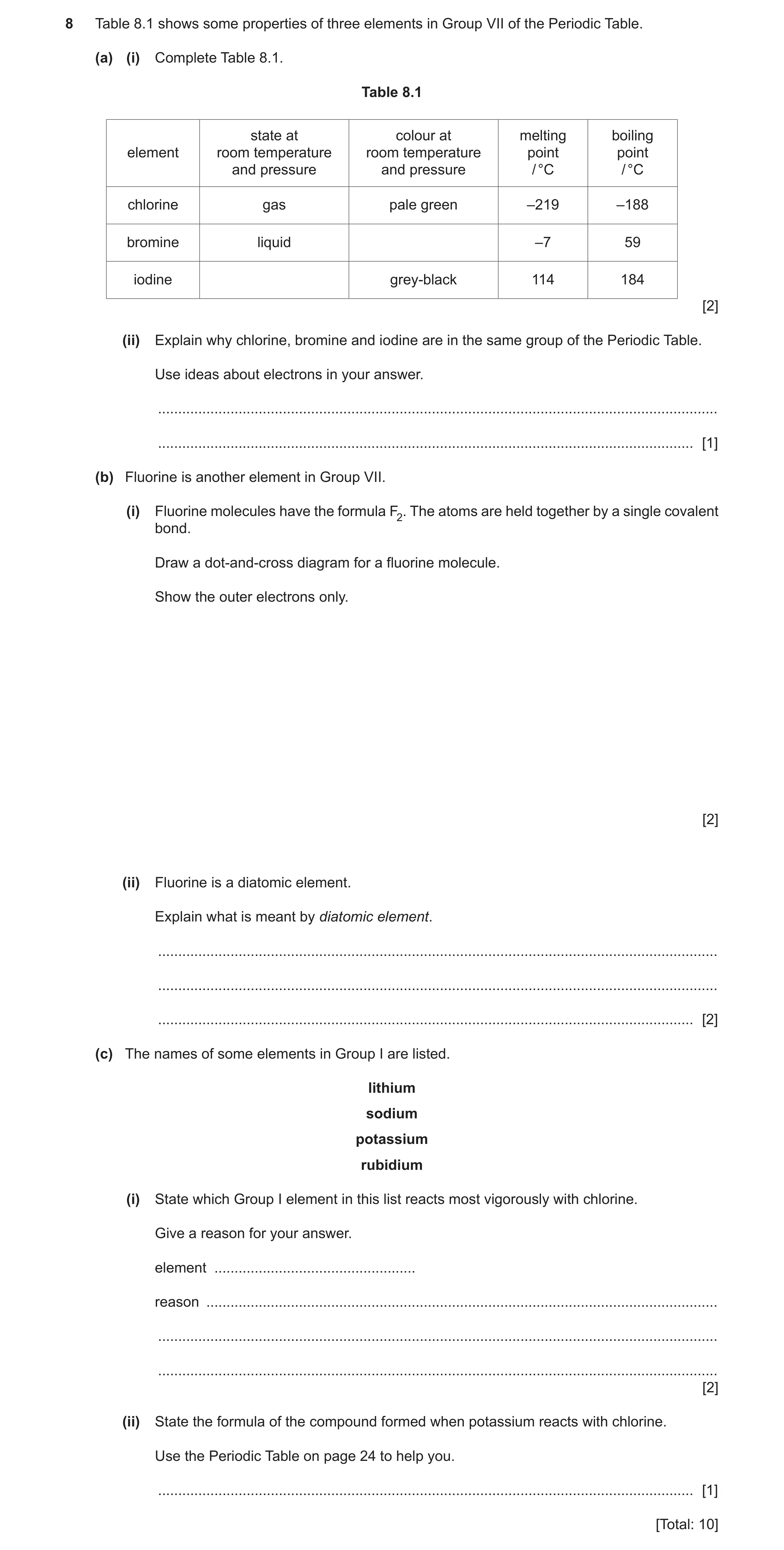
8 Table 8.1 shows some properties of three elements in Group VII of the Periodic Table. (a) (i) Complete Table 8.1. Table 8.1 state at colour at melting boiling element room temperature room temperature point point and pressure and pressure / °C / °C chlorine gas pale green –219 –188 bromine liquid –7 59 iodine grey-black 114 184 [2] (ii) Explain why chlorine, bromine and iodine are in the same group of the Periodic Table. Use ideas about electrons in your answer. … … [1] (b) Fluorine is another element in Group VII. (i) Fluorine molecules have the formula F2. The atoms are held together by a single covalent bond. Draw a dot-and-cross diagram for a fluorine molecule. Show the outer electrons only. [2] (ii) Fluorine is a diatomic element. Explain what is meant by diatomic element. … … … [2] (c) The names of some elements in Group I are listed. lithium sodium potassium rubidium (i) State which Group I element in this list reacts most vigorously with chlorine. Give a reason for your answer. element … reason … … … [2] (ii) State the formula of the compound formed when potassium reacts with chlorine. Use the Periodic Table on page 24 to help you. … [1] [Total: 10]
10 marks
Mark scheme: 8(a)(i) bromine: (dark) orange / brown ; iodine: solid ; 2 8(a)(ii) all contain the same number of electrons (seven electrons) in the outer shell ; 1 8(b)(i) single bond between atoms shown as two shared electrons ; (dependent mark) rest of molecule correct ; 2 8(b)(ii) molecules have only two atoms ; of the same type ; 2 8(c)(i) rubidium ; outer electron (is furthest from nucleus and so) more easily lost / rubidium is further down Group I ; 2 8(c)(ii) KCl ; 1
This question in 0653/43 Oct/Nov 2021
Q6 · Only the outer shell electrons in atoms of elements X, Y and Z 0653/42 Feb/March 2022
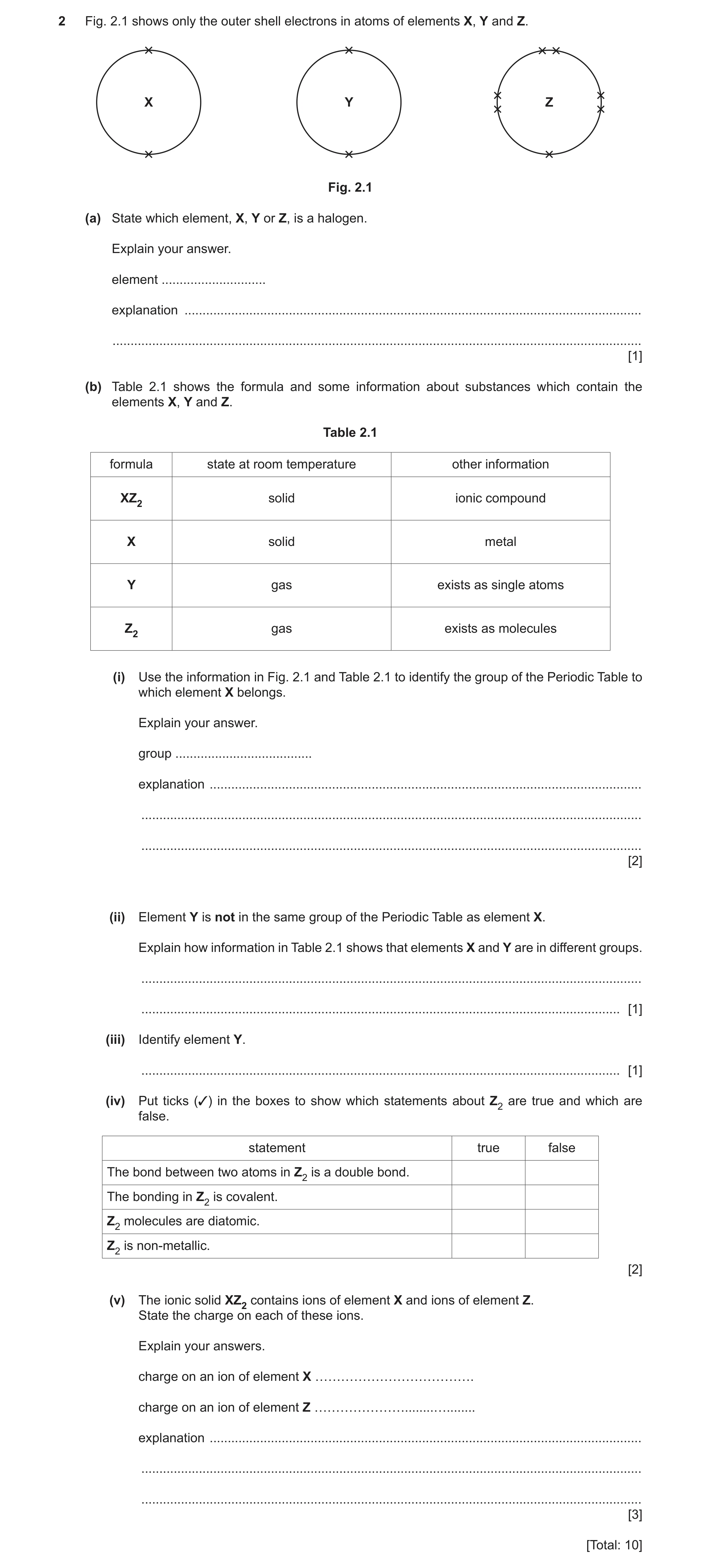
2 Fig. 2.1 shows only the outer shell electrons in atoms of elements X, Y and Z. X Y Z Fig. 2.1 (a) State which element, X, Y or Z, is a halogen. Explain your answer. element … explanation … … [1] (b) Table 2.1 shows the formula and some information about substances which contain the elements X, Y and Z. Table 2.1 formula state at room temperature other information XZ2 solid ionic compound X solid metal Y gas exists as single atoms Z2 gas exists as molecules (i) Use the information in Fig. 2.1 and Table 2.1 to identify the group of the Periodic Table to which element X belongs. Explain your answer. group … explanation … … … [2] (ii) Element Y is not in the same group of the Periodic Table as element X. Explain how information in Table 2.1 shows that elements X and Y are in different groups. … … [1] (iii) Identify element Y. … [1] (iv) Put ticks (3) in the boxes to show which statements about Z2 are true and which are false. statement true false The bond between two atoms in Z2 is a double bond. The bonding in Z2 is covalent. Z2 molecules are diatomic. Z2 is non-metallic. [2] (v) The ionic solid XZ2 contains ions of element X and ions of element Z. State the charge on each of these ions. Explain your answers. charge on an ion of element X ………………………………. charge on an ion of element Z ………………… … … … explanation … … … [3] [Total: 10]
10 marks
Mark scheme: 2(a) Z and has 7 electrons in its outer shell / 7 valence electrons ; 1 Question Answer Marks 2(b)(i) X in Group 2 (no mark) X atoms have two outer electrons; X is a metal ; 2 2(b)(ii) (X is metallic and) Y is non-metallic because it is a gas / exists as single atoms / X is a metal and Y is a noble gas / X atoms bond together and Y atoms not (normally) bonded / owtte ; 1 2(b)(iii) helium ; 1 2(b)(iv) Statement True False The bond between two atoms in Z2 is a double bond. The bonding in Z2 is covalent. Z2 molecules are diatomic. Z2 is non-metallic. All correct (2) 2 / 3 correct (1) 2 2(b)(v) X ion positive and Z ion negative ; X ion is +2 and Z ion is –1; (subsumes first point) X loses (2) electrons and Z gains (1) electron ; 3
This question in 0653/42 Feb/March 2022
Q7 · Lead(II) bromide is electrolysed using inert electrodes, as shown in Fig 0653/42 Oct/Nov 2022
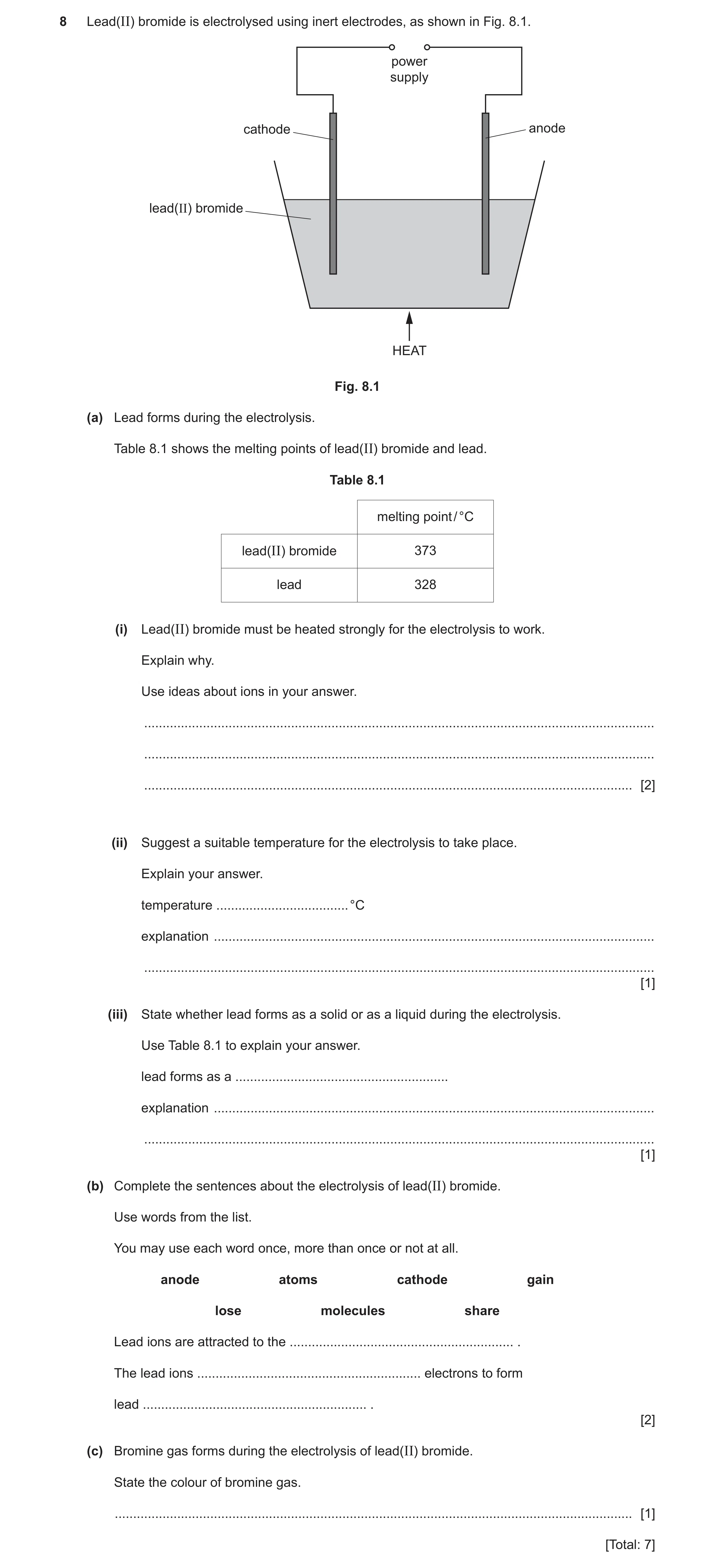
8 Lead(II) bromide is electrolysed using inert electrodes, as shown in Fig. 8.1. power supply cathode anode lead(II) bromide HEAT Fig. 8.1 (a) Lead forms during the electrolysis. Table 8.1 shows the melting points of lead(II) bromide and lead. Table 8.1 melting point / °C lead(II) bromide 373 lead 328 (i) Lead(II) bromide must be heated strongly for the electrolysis to work. Explain why. Use ideas about ions in your answer. … … … [2] (ii) Suggest a suitable temperature for the electrolysis to take place. Explain your answer. temperature … °C explanation … … [1] (iii) State whether lead forms as a solid or as a liquid during the electrolysis. Use Table 8.1 to explain your answer. lead forms as a … explanation … … [1] (b) Complete the sentences about the electrolysis of lead(II) bromide. Use words from the list. You may use each word once, more than once or not at all. anode atoms cathode gain lose molecules share Lead ions are attracted to the … . The lead ions … electrons to form lead … . [2] (c) Bromine gas forms during the electrolysis of lead(II) bromide. State the colour of bromine gas. … [1] [Total: 7]
7 marks
Mark scheme: 8(a)(i) any two from: 2 solid does not conduct / only liquid conducts / only conducts in molten state ; energy required to overcome forces (between ions) ; ions in a solid cannot move / ions in a liquid can move ; 8(a)(ii) temperature any temperature greater than 373 °C AND 1 explanation lead bromide must be, molten / a liquid / above the melting point of lead bromide ; 8(a)(iii) lead forms as a liquid AND 1 explanation lead has a lower melting point than lead bromide / idea that if lead bromide is liquid, it is above the melting point of lead / melting point of lead is below the temperature of the electrolysis / AW ; 8(b) cathode 2 gain atoms two correct ; all three correct ; 8(c) orange / brown ; 1
This question in 0653/42 Oct/Nov 2022
Q8 · The electrolysis of molten zinc chloride using inert electrodes 0653/42 Feb/March 2024
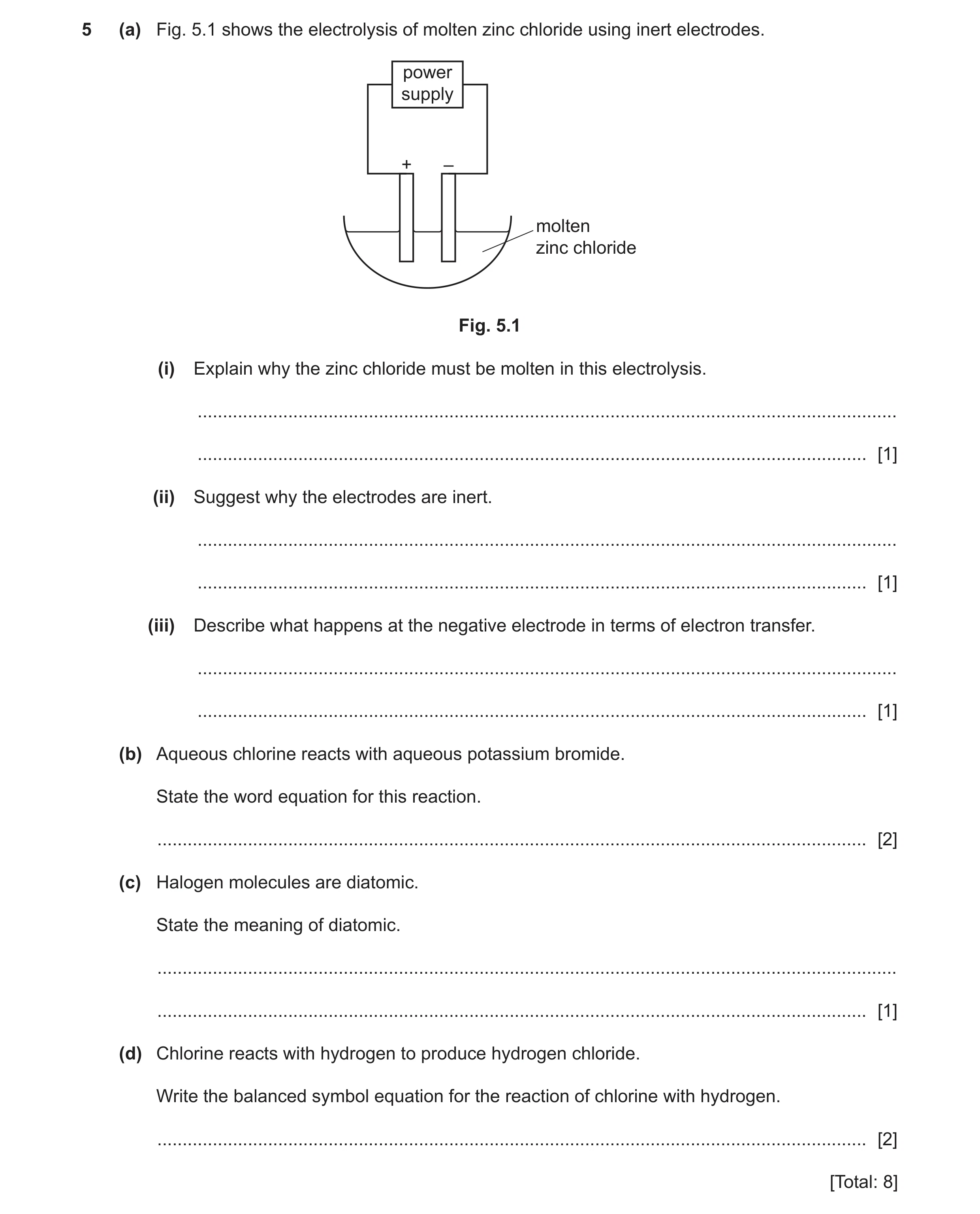
5 (a) Fig. 5.1 shows the electrolysis of molten zinc chloride using inert electrodes. power supply + – molten zinc chloride Fig. 5.1 (i) Explain why the zinc chloride must be molten in this electrolysis. … … [1] (ii) Suggest why the electrodes are inert. … … [1] (iii) Describe what happens at the negative electrode in terms of electron transfer. … … [1] (b) Aqueous chlorine reacts with aqueous potassium bromide. State the word equation for this reaction. … [2] (c) Halogen molecules are diatomic. State the meaning of diatomic. … … [1] (d) Chlorine reacts with hydrogen to produce hydrogen chloride. Write the balanced symbol equation for the reaction of chlorine with hydrogen. … [2] [Total: 8]
8 marks
Mark scheme: 5(a)(i) (molten because) ions must, be free to move / be mobile / migrate ; 1 5(a)(ii) (so that they) do not react / only provide a surface for electron transfer (to or from ions) ; 1 5(a)(iii) gain of electrons by, cations / (zinc) ions ; 1 5(b) chlorine + potassium bromide → ; ( → or = required) 2 potassium chloride + bromine ; 5(c) (molecule made of) two atoms, combined / bonded ; 1 5(d) Cl 2 + H2 → 2HCl ;; 2 reactants and products [1] balanced [1]
This question in 0653/42 Feb/March 2024
Q9 · Silver chloride, magnesium chloride and sodium chloride are salts 0653/41 Oct/Nov 2024
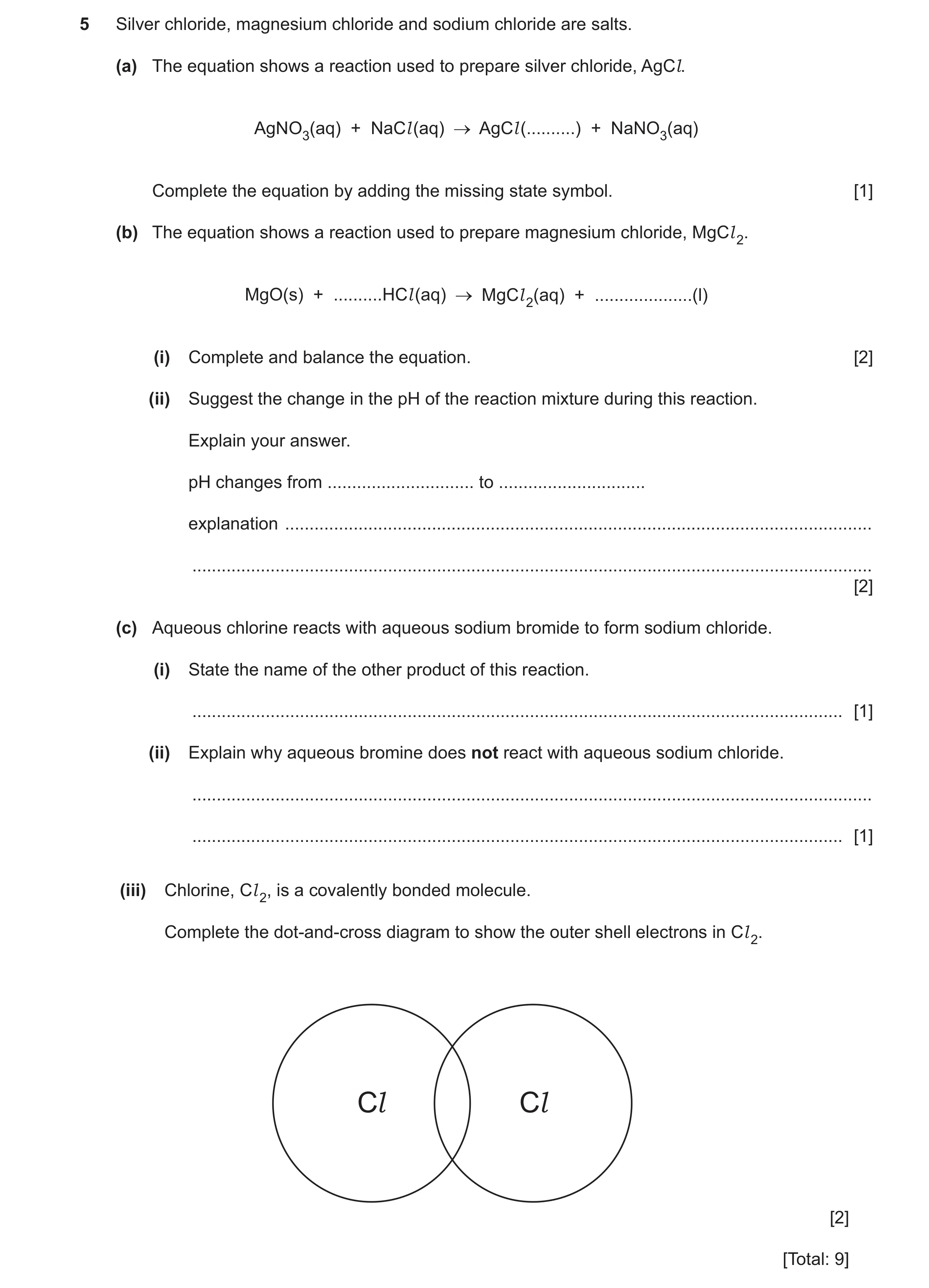
5 Silver chloride, magnesium chloride and sodium chloride are salts. (a) The equation shows a reaction used to prepare silver chloride, AgCl. AgNO3(aq) + NaCl (aq) AgCl ( … ) + NaNO3(aq) Complete the equation by adding the missing state symbol. [1] (b) The equation shows a reaction used to prepare magnesium chloride, MgCl 2. MgO(s) + … HCl (aq) MgCl 2(aq) + … (l) (i) Complete and balance the equation. [2] (ii) Suggest the change in the pH of the reaction mixture during this reaction. Explain your answer. pH changes from … to … explanation … … [2] (c) Aqueous chlorine reacts with aqueous sodium bromide to form sodium chloride. (i) State the name of the other product of this reaction. … [1] (ii) Explain why aqueous bromine does not react with aqueous sodium chloride. … … [1] (iii) Chlorine, Cl 2, is a covalently bonded molecule. Complete the dot-and-cross diagram to show the outer shell electrons in Cl 2. Cl Cl [2] [Total: 9]
9 marks
Mark scheme: 5(a) s ; 1 5(b)(i) 2HCl ; 2 H2O ; 5(b)(ii) from 1 – 3 to 4 – 7 ; 2 the idea that acid is being neutralised / used up ; 5(c)(i) bromine ; 1 5(c)(ii) bromine is less reactive than chlorine ORA ; 1 5(c)(iii) bonding pair shown ; 2 6 non-bonding electrons in each atom ;
This question in 0653/41 Oct/Nov 2024
Q10 · The formula for methanol is CH3OH 0653/43 Oct/Nov 2024
8 (a) The formula for methanol is CH3OH. Complete the dot-and-cross diagram in Fig. 8.1 to show the bonding in methanol. Show outer-shell electrons only. H H C O H H Fig. 8.1 [3] (b) Ethene, C2H4, is an alkene. Ethane, C2H6, is an alkane. (i) State one difference in the bonding of ethene and of ethane. … … [1] (ii) The complete combustion reactions of both ethene and ethane produce carbon dioxide and water. Identify whether the statements are true or false. Tick (3) one box for each statement. true false One molecule of ethene produces the same number of molecules of carbon dioxide as one molecule of ethane. One molecule of ethene produces the same number of molecules of water as one molecule of ethane. The combustion reactions of ethene and ethane are both endothermic. [2] (c) The general formulae for alkenes and alkanes are shown in Table 8.1. Table 8.1 alkenes alkanes CnH2n CnH2n+2 Write the formula for: an alkene with 10 hydrogen atoms … an alkane with 10 hydrogen atoms. … [2] (d) Aqueous bromine is added to a sample of an alkene and to a separate sample of an alkane. State the colour of each sample after the aqueous bromine is added. alkene … alkane … [2] [Total: 10]
10 marks
Mark scheme: 8(a) 3 four pairs bonding electrons around carbon correct ; one bonding pair between oxygen and hydrogen (O-H bond) correct ; four non-bonding electrons on oxygen shell AND no extra electrons (on hydrogen) ; 8(b)(i) ethene, has a double bond / shares 4 electrons OR 1 ethane, has only single bonds / has single bond between carbons / shares 2 electrons ; 8(b)(ii) 2 two correct ; three correct ; 8(c) alkene C5H10 ; 2 alkane C4H10 ; 8(d) alkene no colour / colourless ; 2 alkane orange ;
This question in 0653/43 Oct/Nov 2024
Q11 · Properties of some halogens at room temperature (25 °C) and pressure 0653/41 May/June 2025
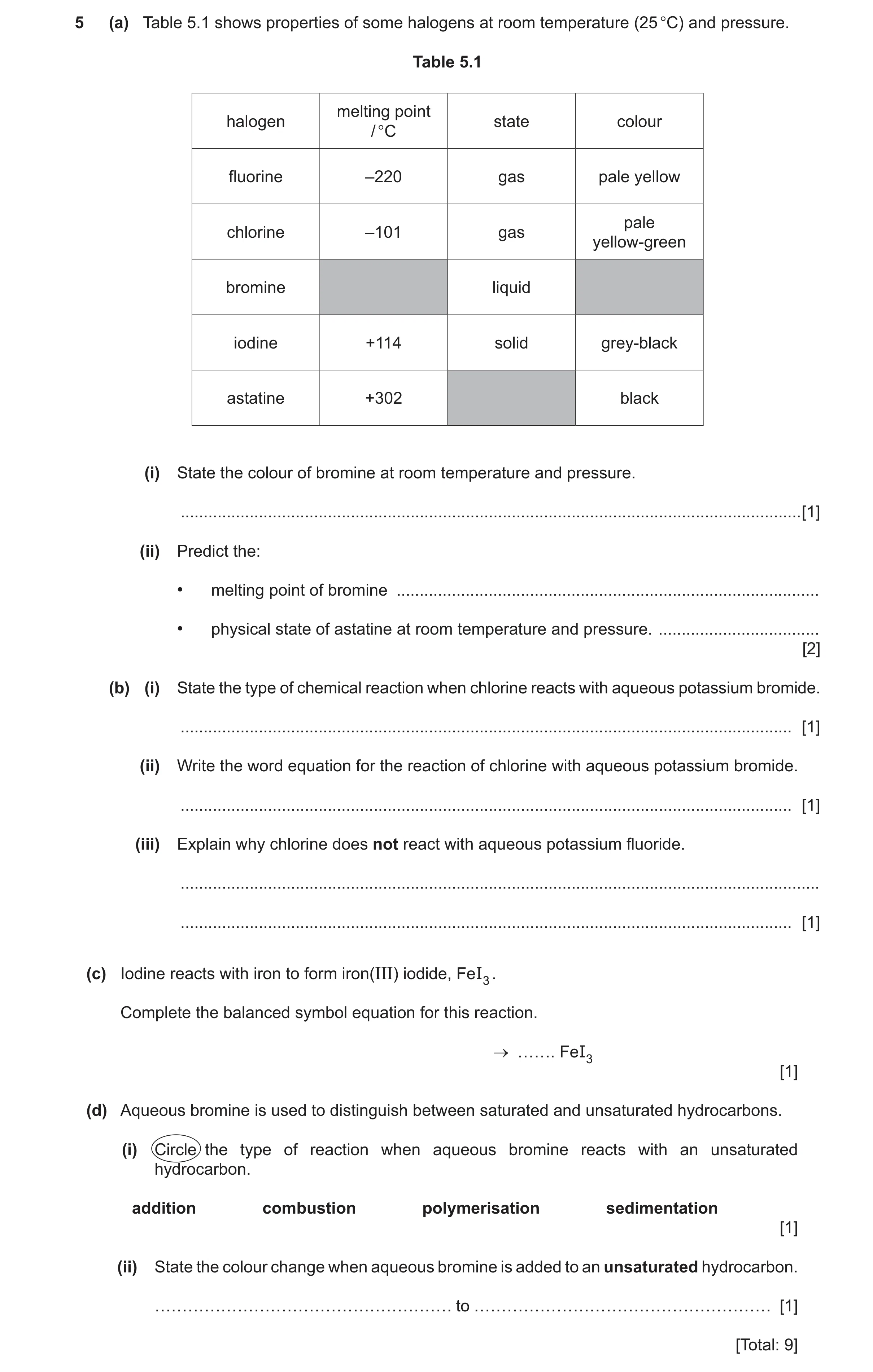
5 (a) Table 5.1 shows properties of some halogens at room temperature (25 °C) and pressure. Table 5.1 melting point halogen state colour / °C fluorine –220 gas pale yellow pale chlorine –101 gas yellow‑green bromine liquid iodine +114 solid grey‑black astatine +302 black (i) State the colour of bromine at room temperature and pressure. … [1] (ii) Predict the: • melting point of bromine … • physical state of astatine at room temperature and pressure. … [2] (b) (i) State the type of chemical reaction when chlorine reacts with aqueous potassium bromide. … [1] (ii) Write the word equation for the reaction of chlorine with aqueous potassium bromide. … [1] (iii) Explain why chlorine does not react with aqueous potassium fluoride. … … [1] (c) Iodine reacts with iron to form iron(III) iodide, FeI3 . Complete the balanced symbol equation for this reaction. ……. FeI3 [1] (d) Aqueous bromine is used to distinguish between saturated and unsaturated hydrocarbons. (i) Circle the type of reaction when aqueous bromine reacts with an unsaturated hydrocarbon. addition combustion polymerisation sedimentation [1] (ii) State the colour change when aqueous bromine is added to an unsaturated hydrocarbon. ……………………………………………… to ……………………………………………… [1] [Total: 9]
9 marks
Mark scheme: 5(a)(i) red-brown ; 1 5(a)(ii) melting point: from −100 to +24 (°C) inclusive ; 2 physical state: solid ; 5(b)(i) displacement ; 1 5(b)(ii) chlorine + potassium bromide → potassium chloride + bromine ; 1 5(b)(iii) (chlorine is) less reactive than fluorine ; 1 5(c) 3I2 + 2Fe → 2FeI3 ; 1 5(d)(i) addition ; 1 5(d)(ii) orange / orange brown to colourless ; 1
This question in 0653/41 May/June 2025
Q12 · Chlorine is in Group VII of the Periodic Table 0653/43 May/June 2025
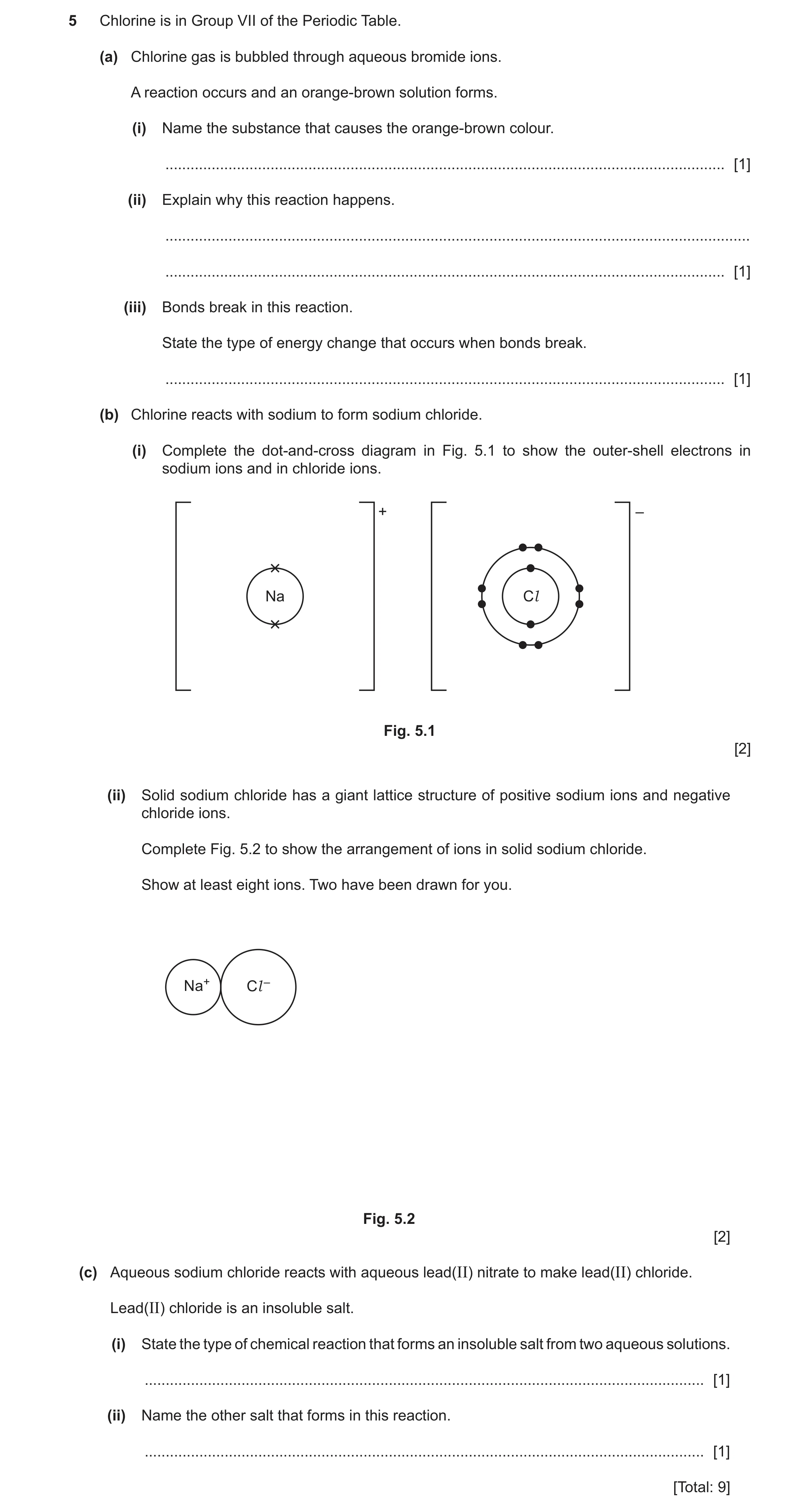
5 Chlorine is in Group VII of the Periodic Table. (a) Chlorine gas is bubbled through aqueous bromide ions. A reaction occurs and an orange-brown solution forms. (i) Name the substance that causes the orange-brown colour. … [1] (ii) Explain why this reaction happens. … … [1] (iii) Bonds break in this reaction. State the type of energy change that occurs when bonds break. … [1] (b) Chlorine reacts with sodium to form sodium chloride. (i) Complete the dot-and-cross diagram in Fig. 5.1 to show the outer-shell electrons in sodium ions and in chloride ions. + – Na Cl Fig. 5.1 [2] (ii) Solid sodium chloride has a giant lattice structure of positive sodium ions and negative chloride ions. Complete Fig. 5.2 to show the arrangement of ions in solid sodium chloride. Show at least eight ions. Two have been drawn for you. Na+ Cl – Fig. 5.2 [2] (c) Aqueous sodium chloride reacts with aqueous lead(II) nitrate to make lead(II) chloride. Lead(II) chloride is an insoluble salt. (i) State the type of chemical reaction that forms an insoluble salt from two aqueous solutions. … [1] (ii) Name the other salt that forms in this reaction. … [1] [Total: 9]
9 marks
Mark scheme: 5(a)(i) bromine ; 1 5(a)(ii) chlorine is more reactive than bromine ORA ; 1 5(a)(iii) endothermic ; 1 5(b)(i) sodium with 8 crosses in outer shell ; 2 chloride with 7 dots and 1 cross in outer shell ; 5(b)(ii) + and – ions alternate along a row or down a column ; 2 an adjacent row or column of correspondingly opposite ions ; 5(c)(i) precipitation ; 1 5(c)(ii) sodium nitrate ; 1 Question Answer Marks
This question in 0653/43 May/June 2025
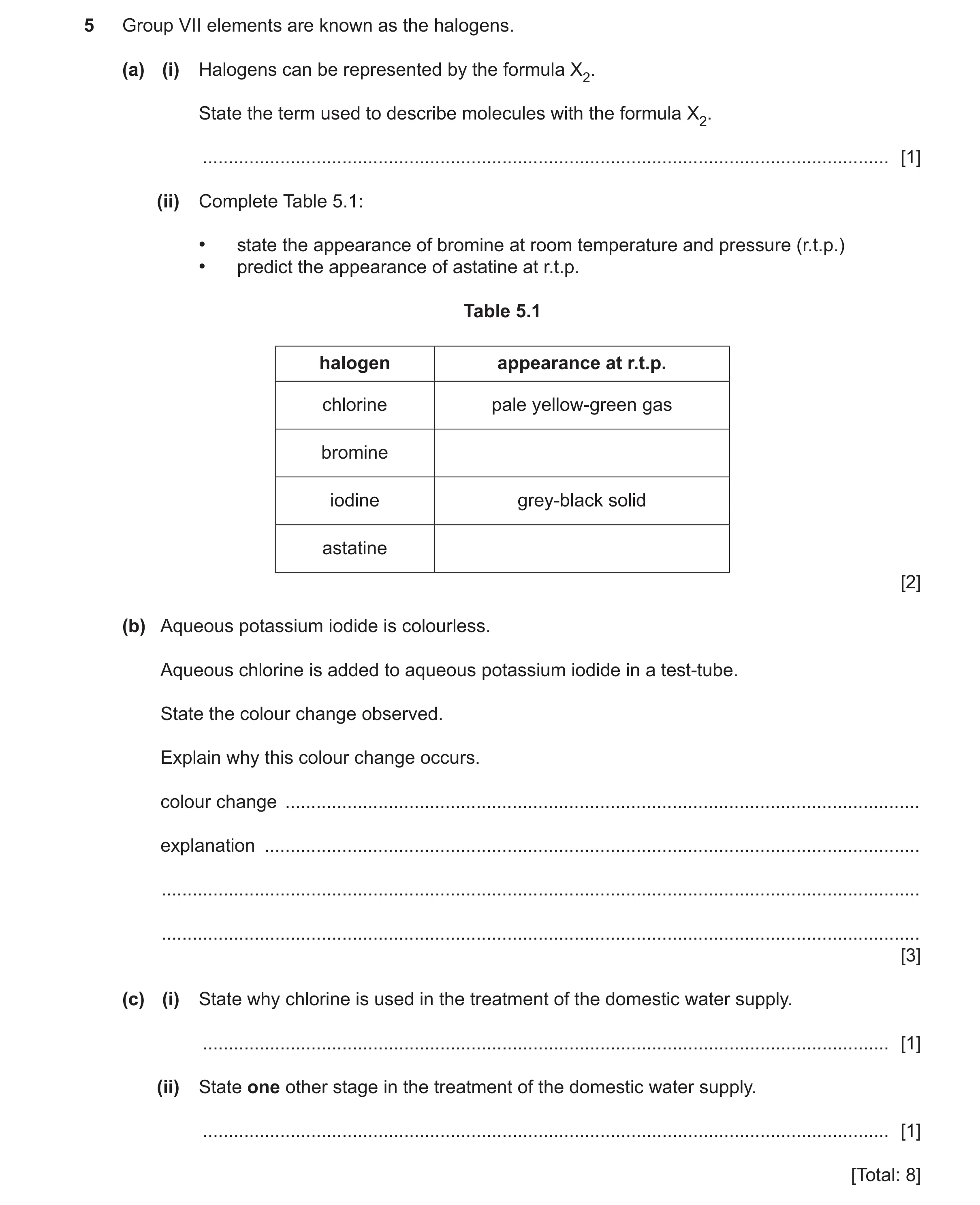
Q13 · Group VII elements are known as the halogens 0653/43 Oct/Nov 2025
5 Group VII elements are known as the halogens. (a) (i) Halogens can be represented by the formula X2. State the term used to describe molecules with the formula X2. … [1] (ii) Complete Table 5.1: • state the appearance of bromine at room temperature and pressure (r.t.p.) • predict the appearance of astatine at r.t.p. Table 5.1 halogen appearance at r.t.p. chlorine pale yellow-green gas bromine iodine grey-black solid astatine [2] (b) Aqueous potassium iodide is colourless. Aqueous chlorine is added to aqueous potassium iodide in a test-tube. State the colour change observed. Explain why this colour change occurs. colour change … explanation … … … [3] (c) (i) State why chlorine is used in the treatment of the domestic water supply. … [1] (ii) State one other stage in the treatment of the domestic water supply. … [1] [Total: 8]
8 marks
Mark scheme: 5(a)(i) diatomic ; 1 5(a)(ii) bromine – red-brown and liquid ; 2 astatine – black and solid ; 5(b) colour change: (from colourless) to brown ; 3 explanation: any two from: chlorine is more reactive than iodine ; chlorine displaces iodine ; iodine forms ; 5(c)(i) to kill microbes/pathogens/bacteria ; 1 5(c)(ii) sedimentation / filtration / addition/use of carbon ; 1
This question in 0653/43 Oct/Nov 2025
 11 / 17
 12 / 17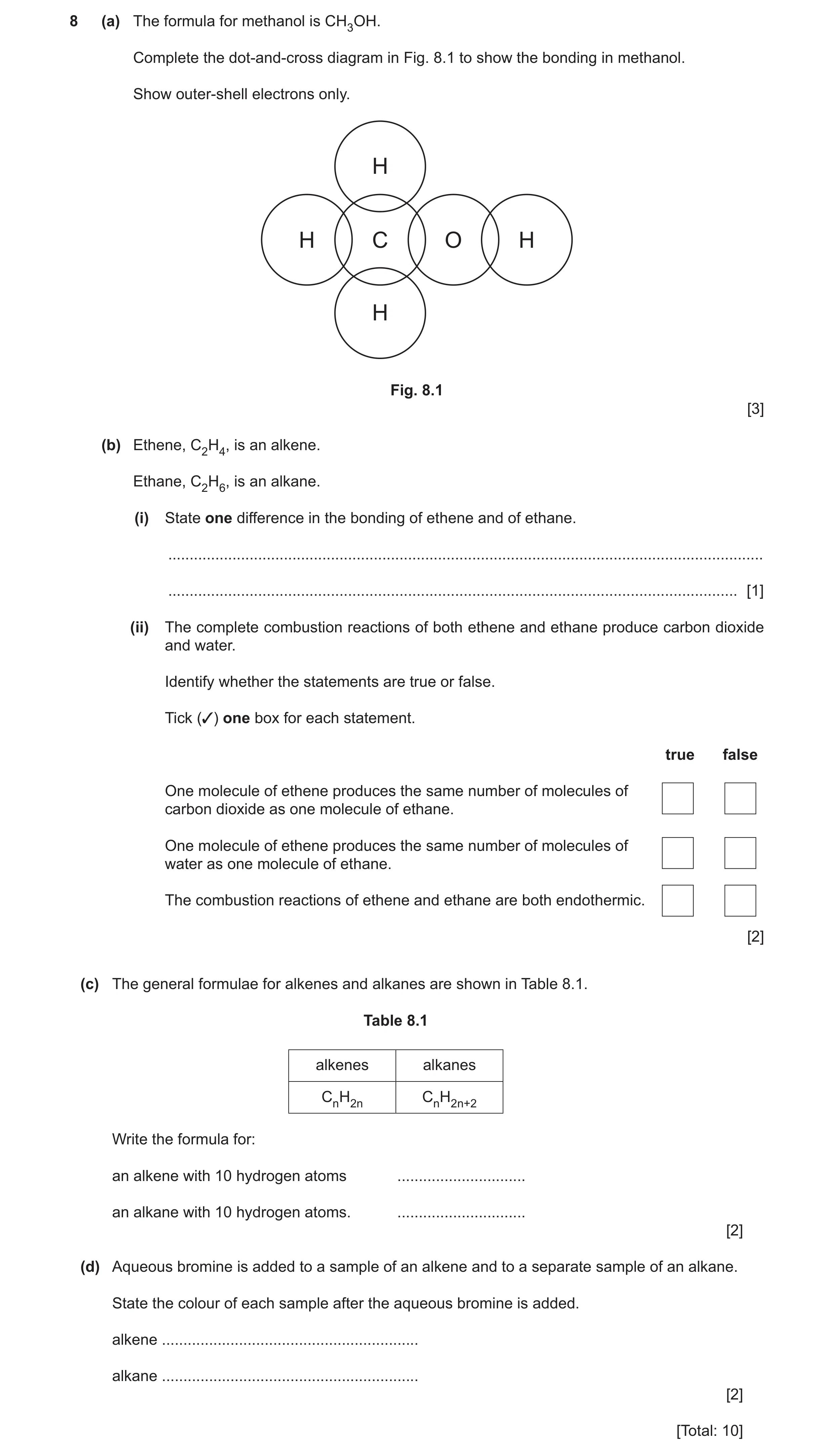
 17 / 17
 8
8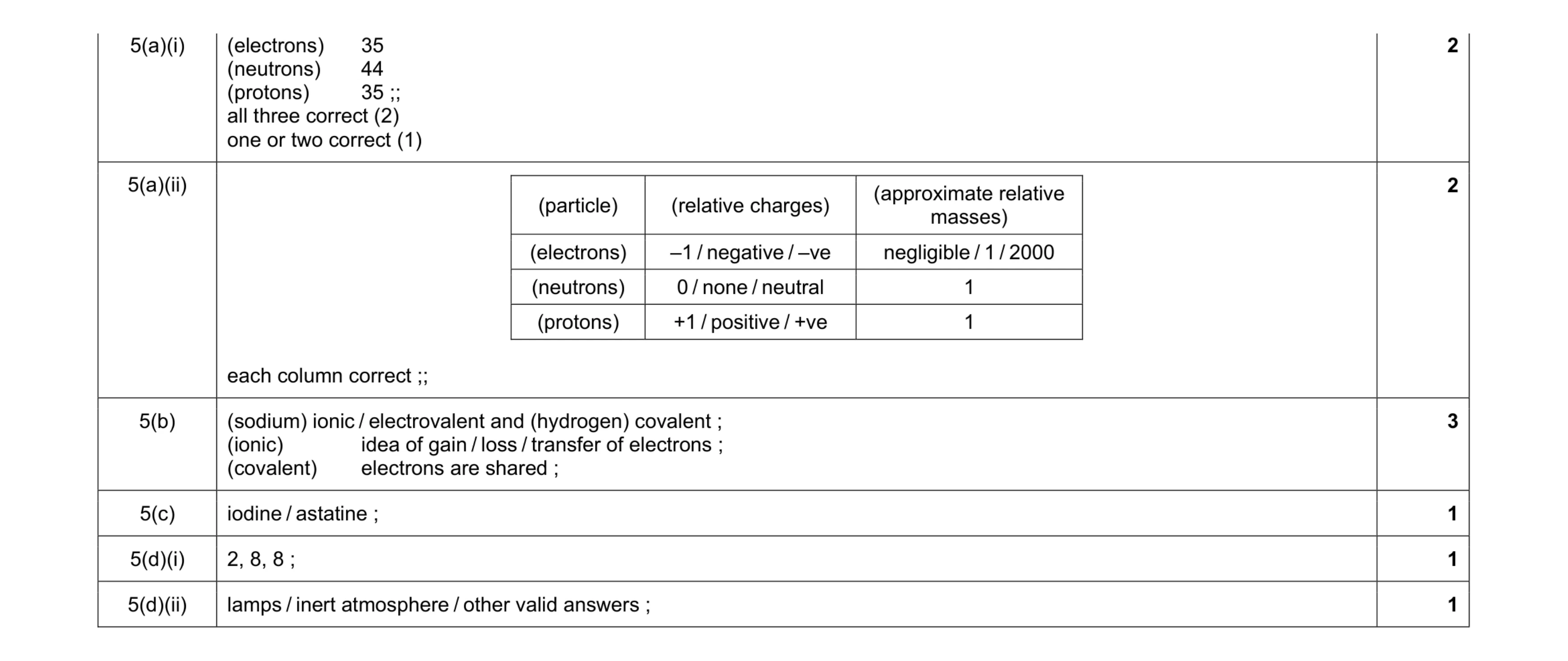 10
10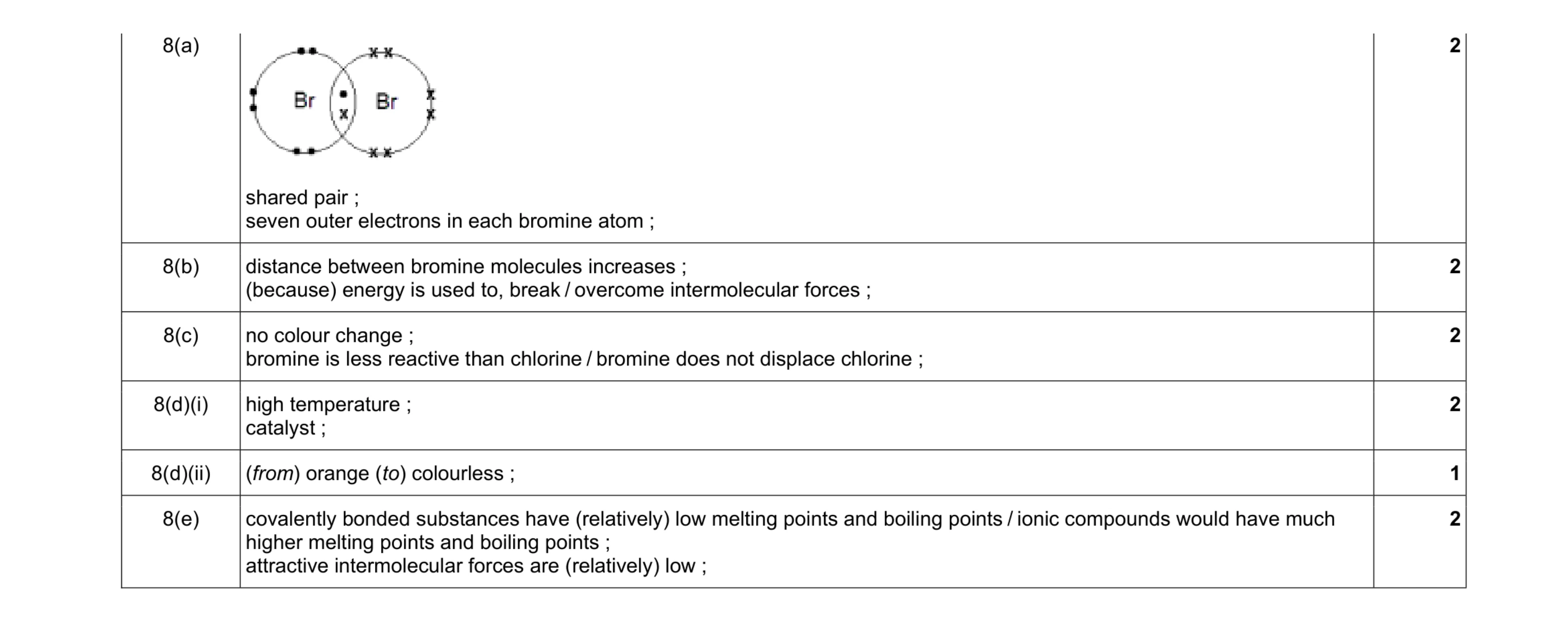 11
11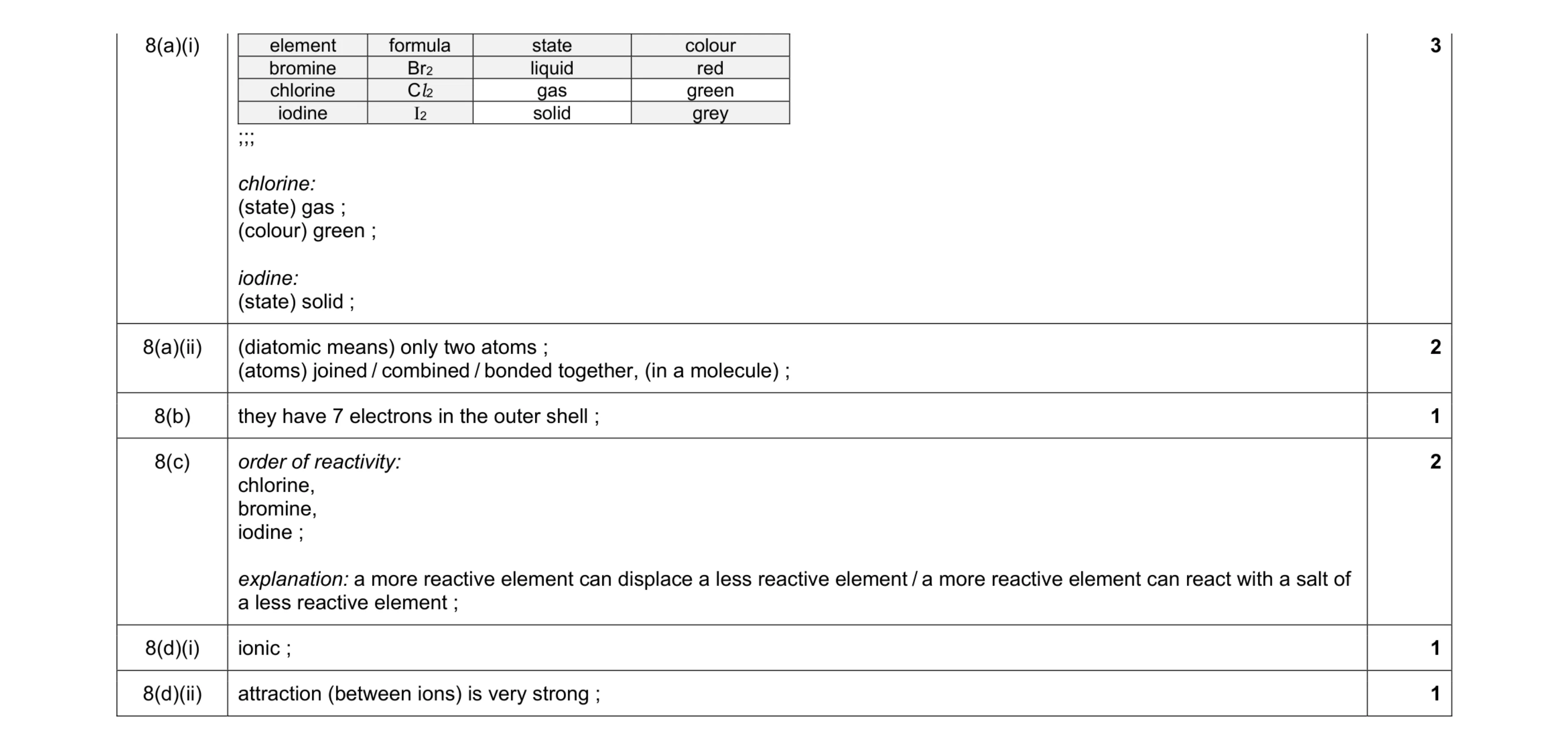 10
10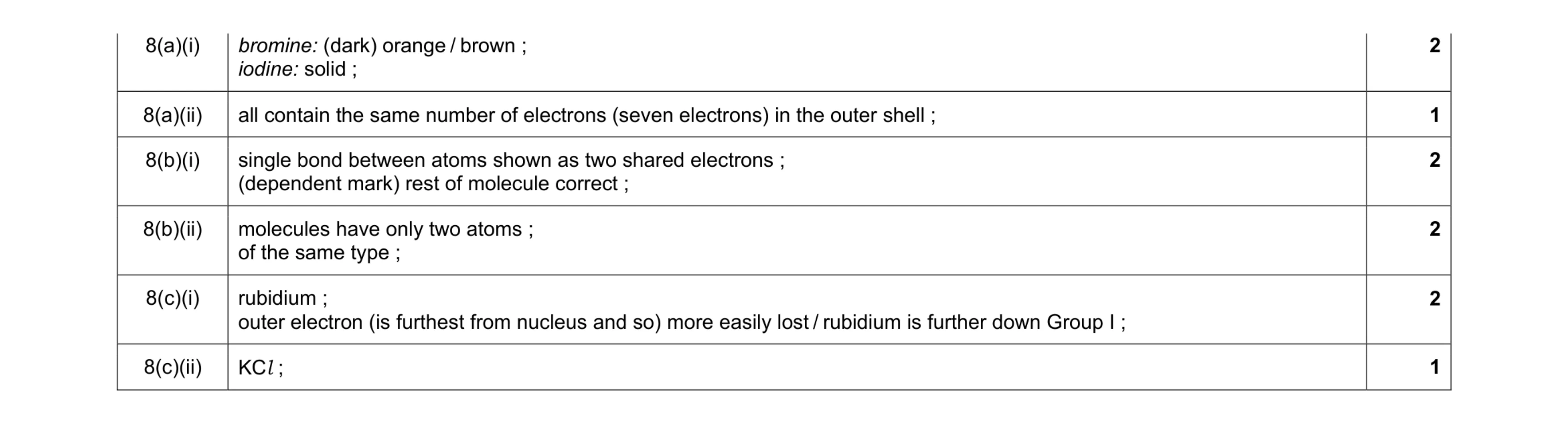 10
10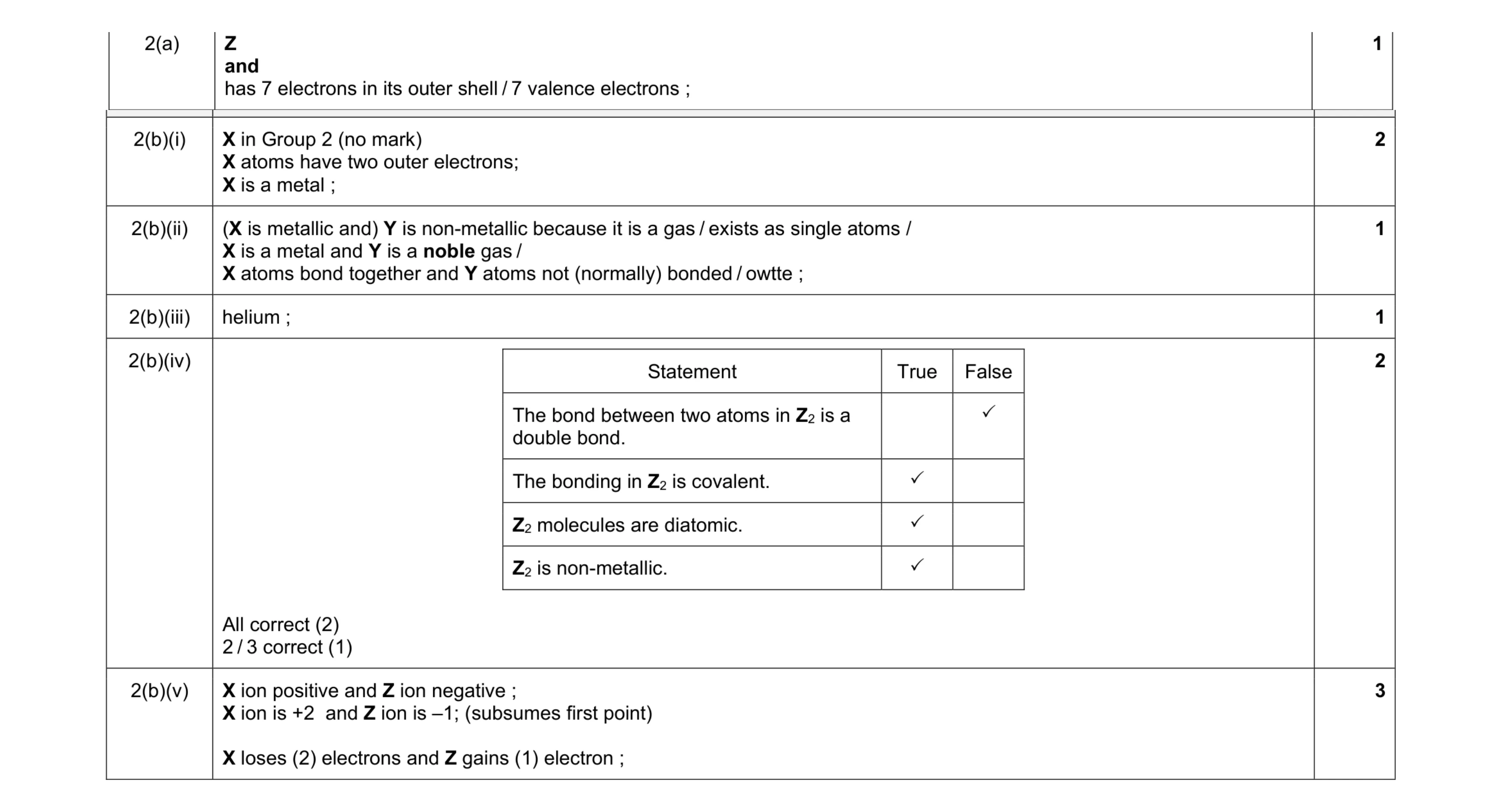 10
10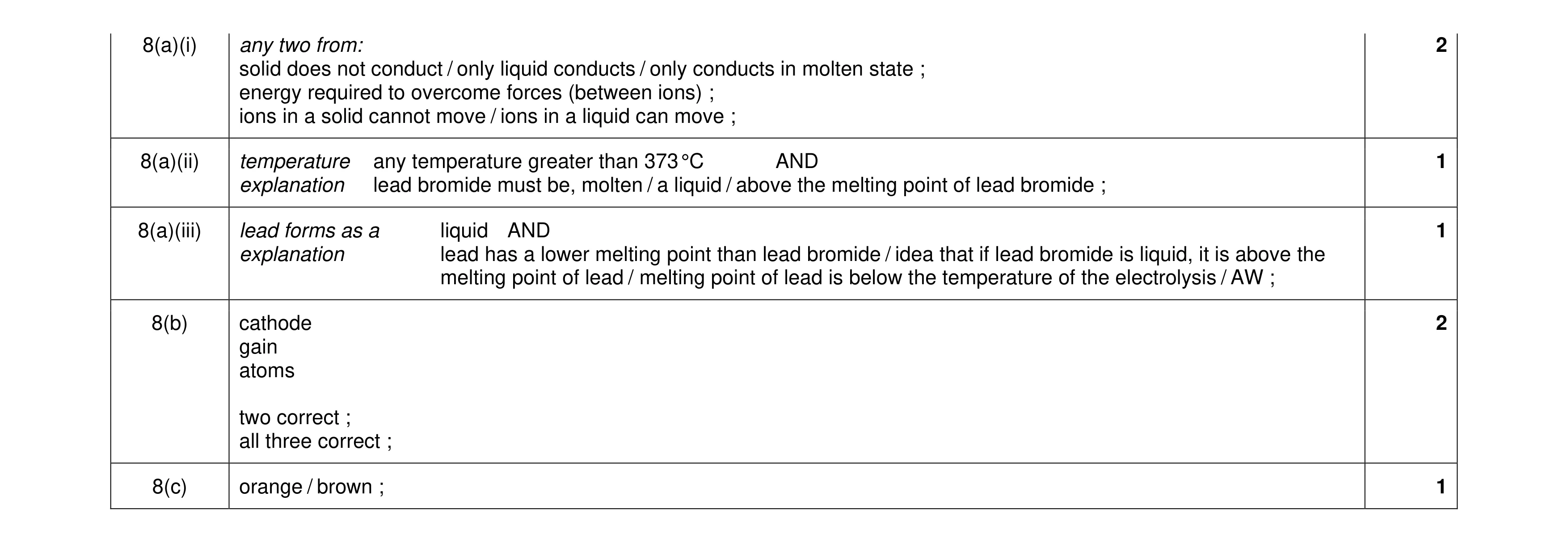 7
7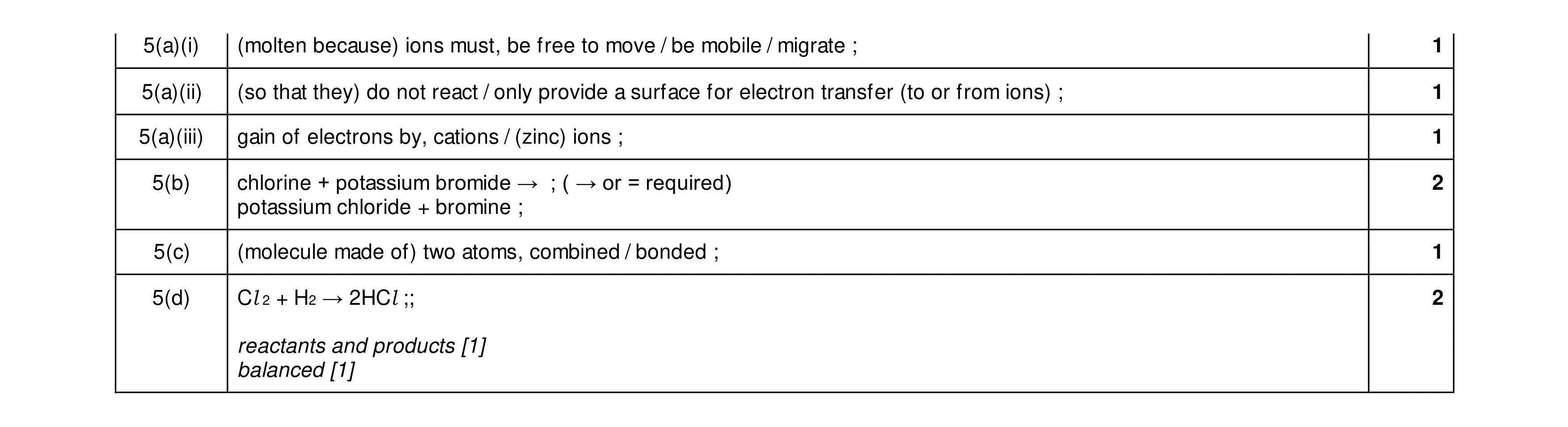 8
8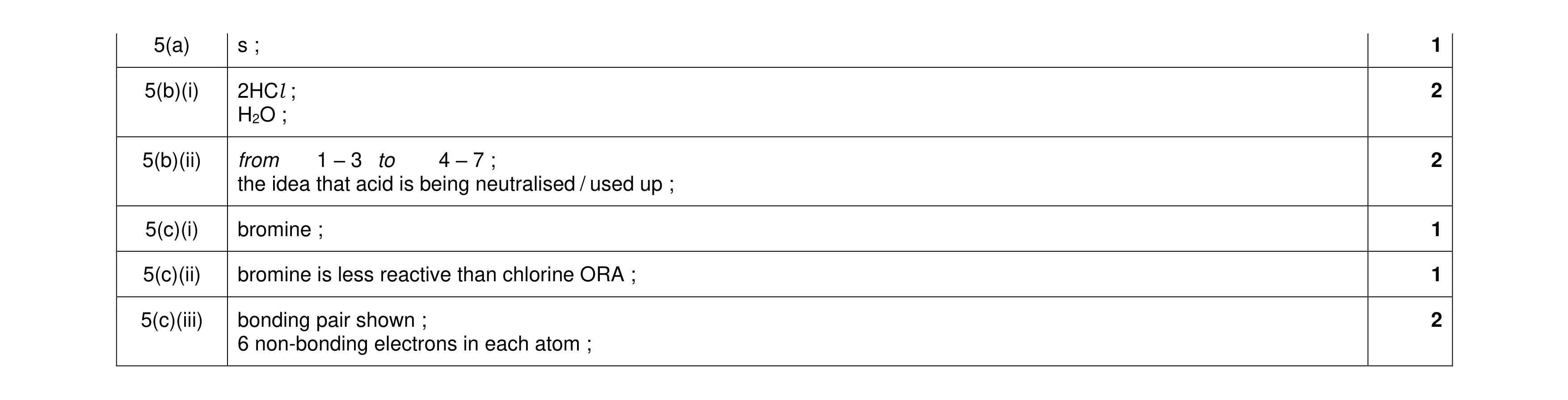 9
9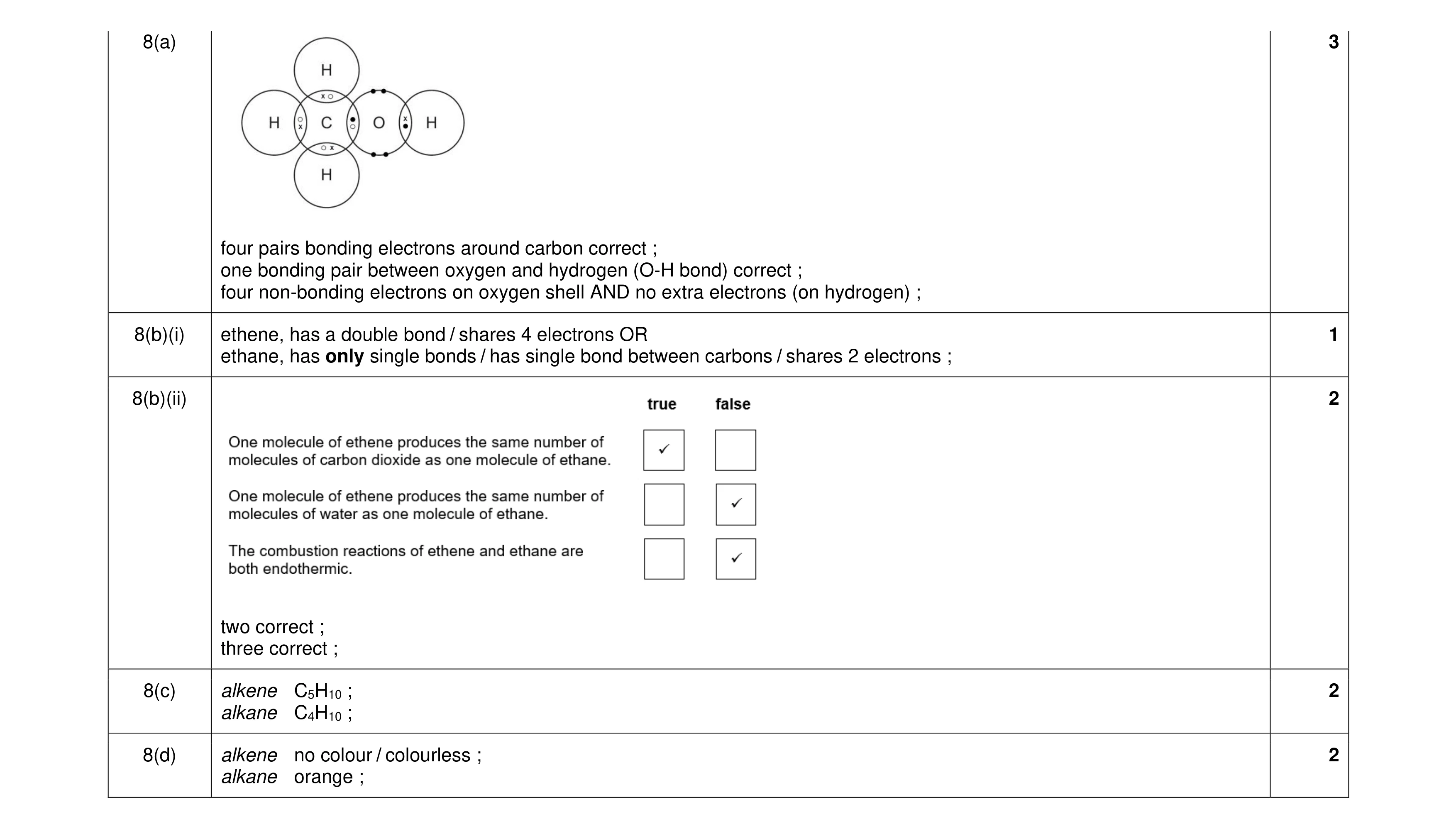 10
10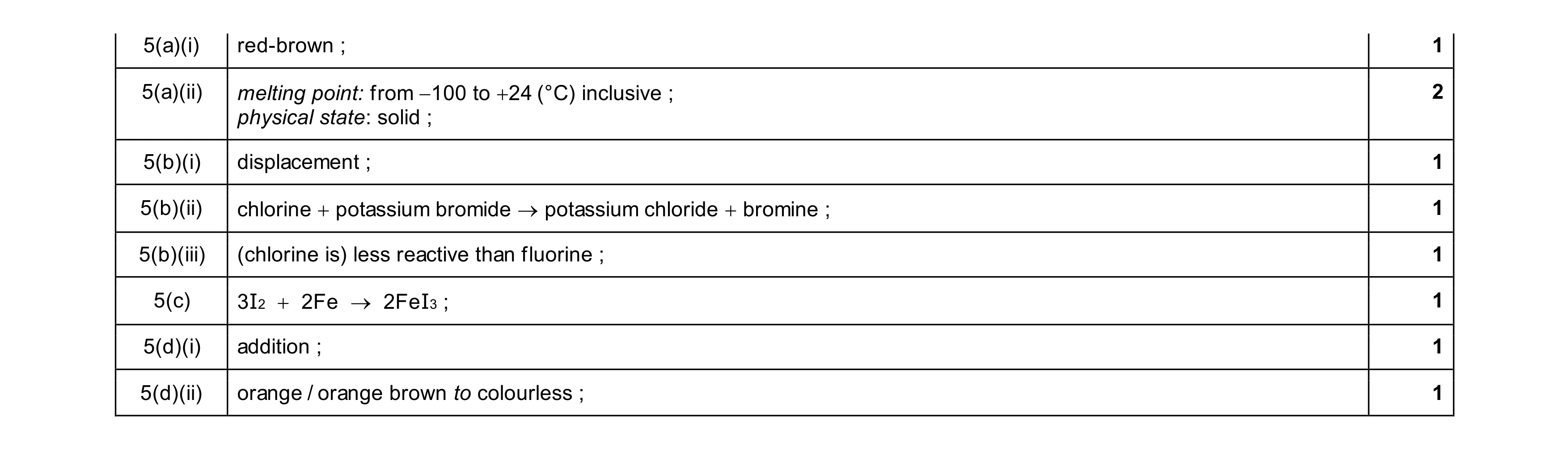 9
9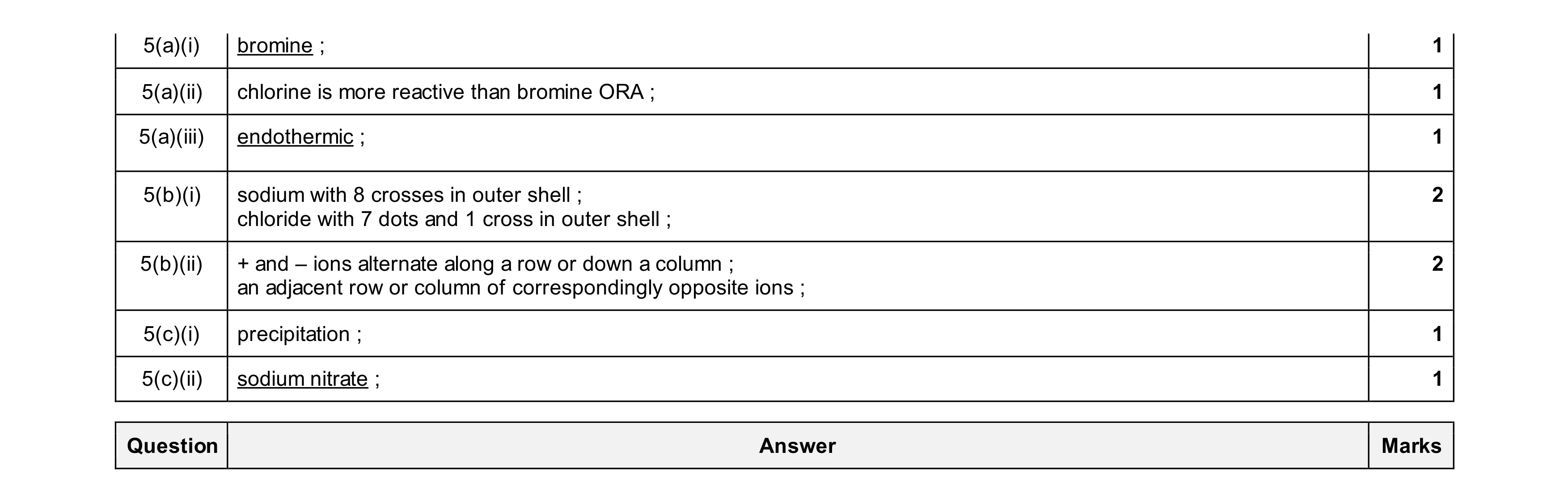 9
9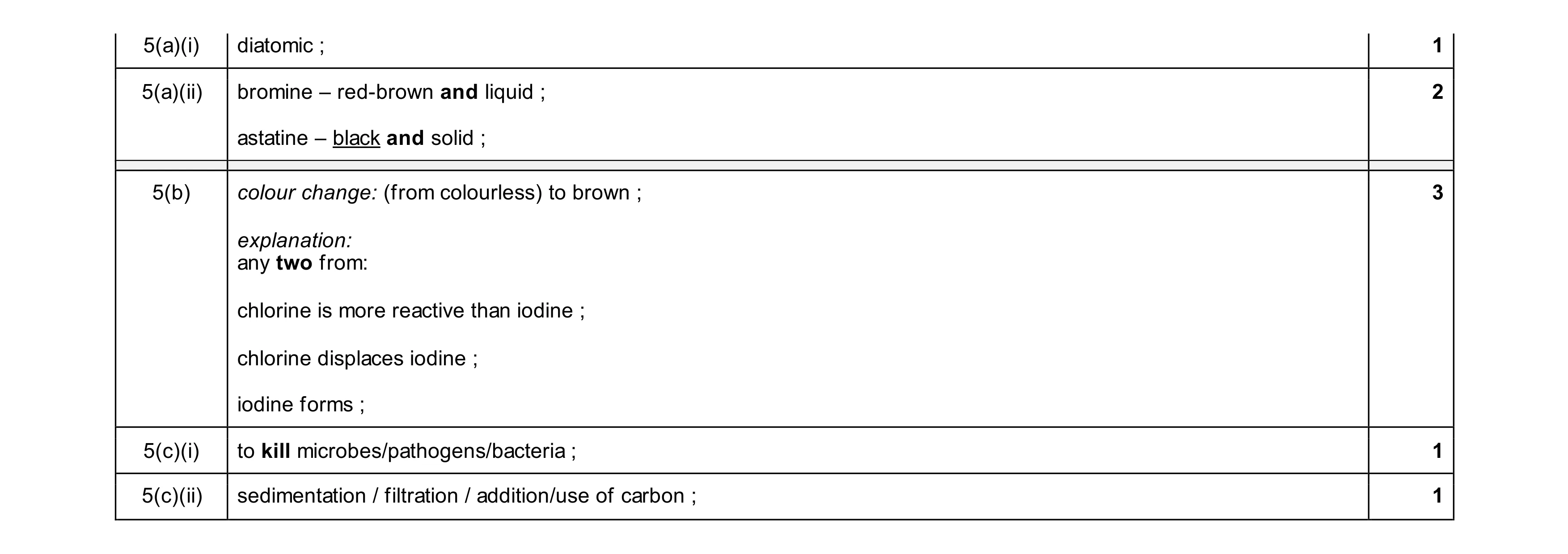 8
8