Questions as text
Q1 · The Periodic Table lists all of the elements in atomic number order 0653/32 Oct/Nov 2017
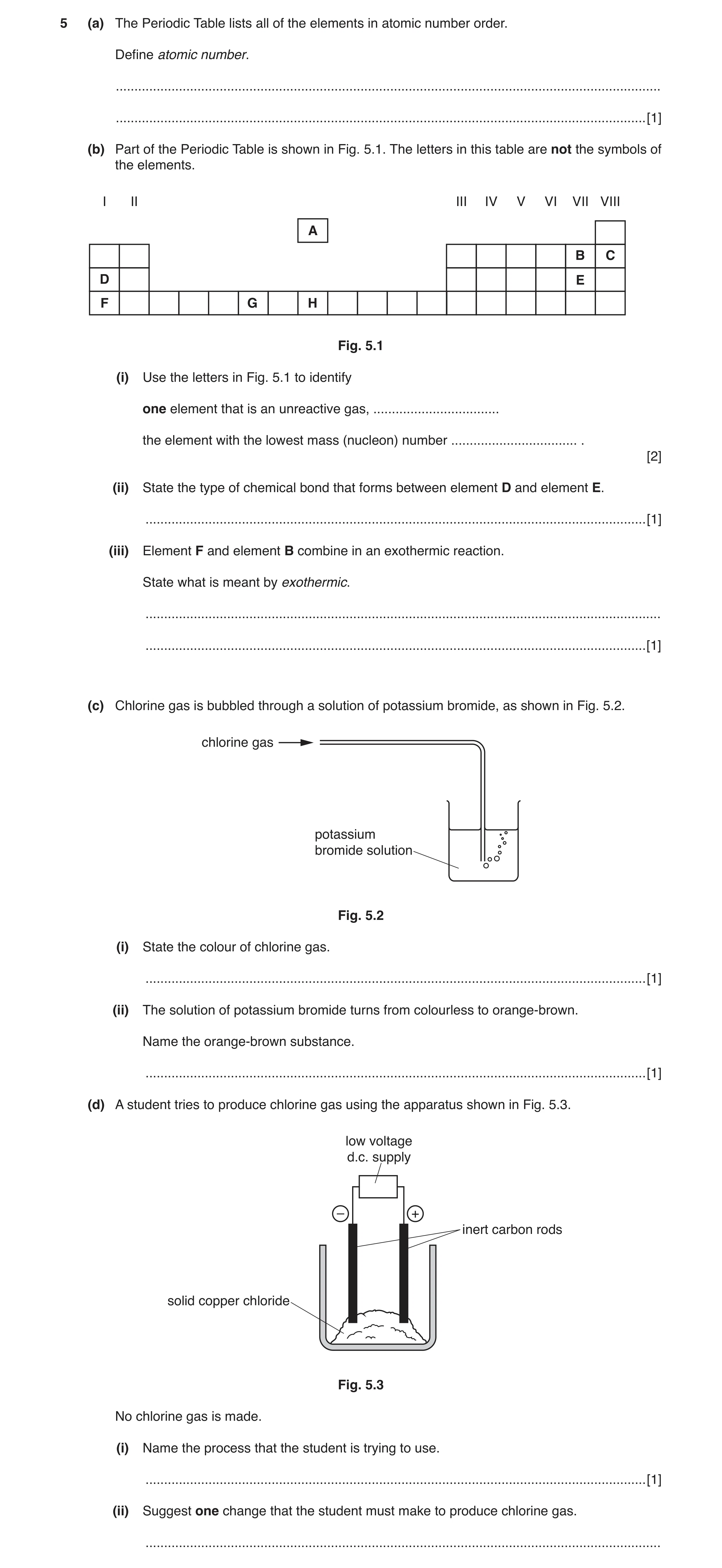
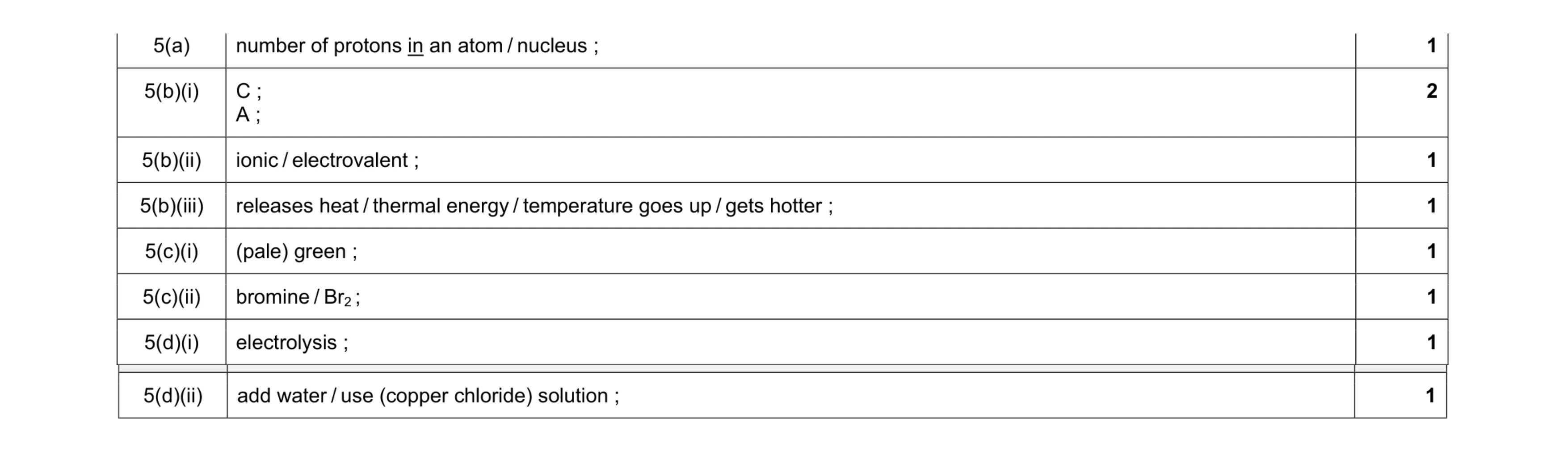
5 (a) The Periodic Table lists all of the elements in atomic number order. Define atomic number. … … [1] (b) Part of the Periodic Table is shown in Fig. 5.1. The letters in this table are not the symbols of the elements. I II III IV V VI VII VIII A B C D E F G H Fig. 5.1 (i) Use the letters in Fig. 5.1 to identify one element that is an unreactive gas, … the element with the lowest mass (nucleon) number … . [2] (ii) State the type of chemical bond that forms between element D and element E. … [1] (iii) Element F and element B combine in an exothermic reaction. State what is meant by exothermic. … … [1] (c) Chlorine gas is bubbled through a solution of potassium bromide, as shown in Fig. 5.2. chlorine gas potassium bromide solution Fig. 5.2 (i) State the colour of chlorine gas. … [1] (ii) The solution of potassium bromide turns from colourless to orange-brown. Name the orange-brown substance. … [1] (d) A student tries to produce chlorine gas using the apparatus shown in Fig. 5.3. low voltage d.c. supply – + inert carbon rods solid copper chloride Fig. 5.3 No chlorine gas is made. (i) Name the process that the student is trying to use. … [1] (ii) Suggest one change that the student must make to produce chlorine gas. …
9 marks
Mark scheme: 5(a) number of protons in an atom / nucleus ; 1 5(b)(i) C ; A ; 2 5(b)(ii) ionic / electrovalent ; 1 5(b)(iii) releases heat / thermal energy / temperature goes up / gets hotter ; 1 5(c)(i) (pale) green ; 1 5(c)(ii) bromine / Br2 ; 1 5(d)(i) electrolysis ; 1 Question Answer Marks 5(d)(ii) add water / use (copper chloride) solution ; 1
This question in 0653/32 Oct/Nov 2017
Q2 · An atom of chlorine is represented by the symbol: 1735Cl (i) State the number of… 0653/32 Feb/March 2018
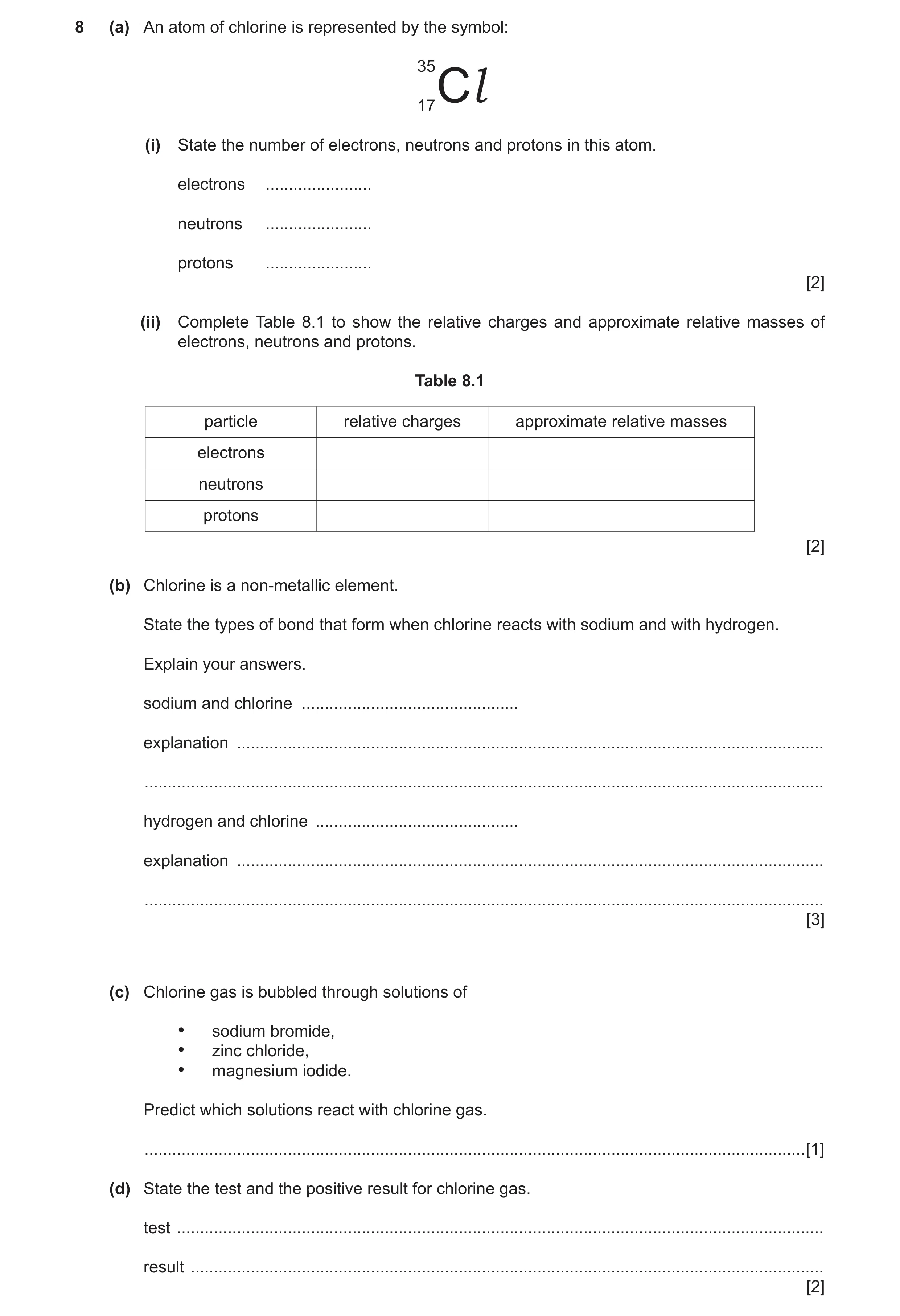
8 (a) An atom of chlorine is represented by the symbol: 1735Cl (i) State the number of electrons, neutrons and protons in this atom. electrons … neutrons … protons … [2] (ii) Complete Table 8.1 to show the relative charges and approximate relative masses of electrons, neutrons and protons. Table 8.1 particle relative charges approximate relative masses electrons neutrons protons [2] (b) Chlorine is a non-metallic element. State the types of bond that form when chlorine reacts with sodium and with hydrogen. Explain your answers. sodium and chlorine … explanation … … hydrogen and chlorine … explanation … … [3] (c) Chlorine gas is bubbled through solutions of • sodium bromide, • zinc chloride, • magnesium iodide. Predict which solutions react with chlorine gas. … [1] (d) State the test and the positive result for chlorine gas. test … result … [2]
10 marks
Mark scheme: 8(a)(i) (electrons) 17 (neutrons) 18 (protons) 17 ;; all three correct (2) one or two correct (1) 2 8(a)(ii) (particle) (relative charges) (approximate relative masses) (electrons) –1 negligible / 1/2000 (neutrons) 0 / none 1 (protons) +1 1 ;; all three relative charges (1) all three approximate relative masses (1) 2 8(b) (sodium and chlorine) ionic and (hydrogen and chlorine) covalent ; (sodium explanation) metal and non-metal / loss gain of electrons ; (hydrogen explanation) two non-metals / shared electrons ; 3 Question Answer Marks 8(c) (sodium) bromide AND (magnesium) iodide ; 1 8(d) (test) (damp) litmus paper ; (result) bleaches / turns white ; 2
This question in 0653/32 Feb/March 2018
Q3 · Period 3 of the Periodic Table contains the elements from sodium to argon 0653/32 May/June 2018
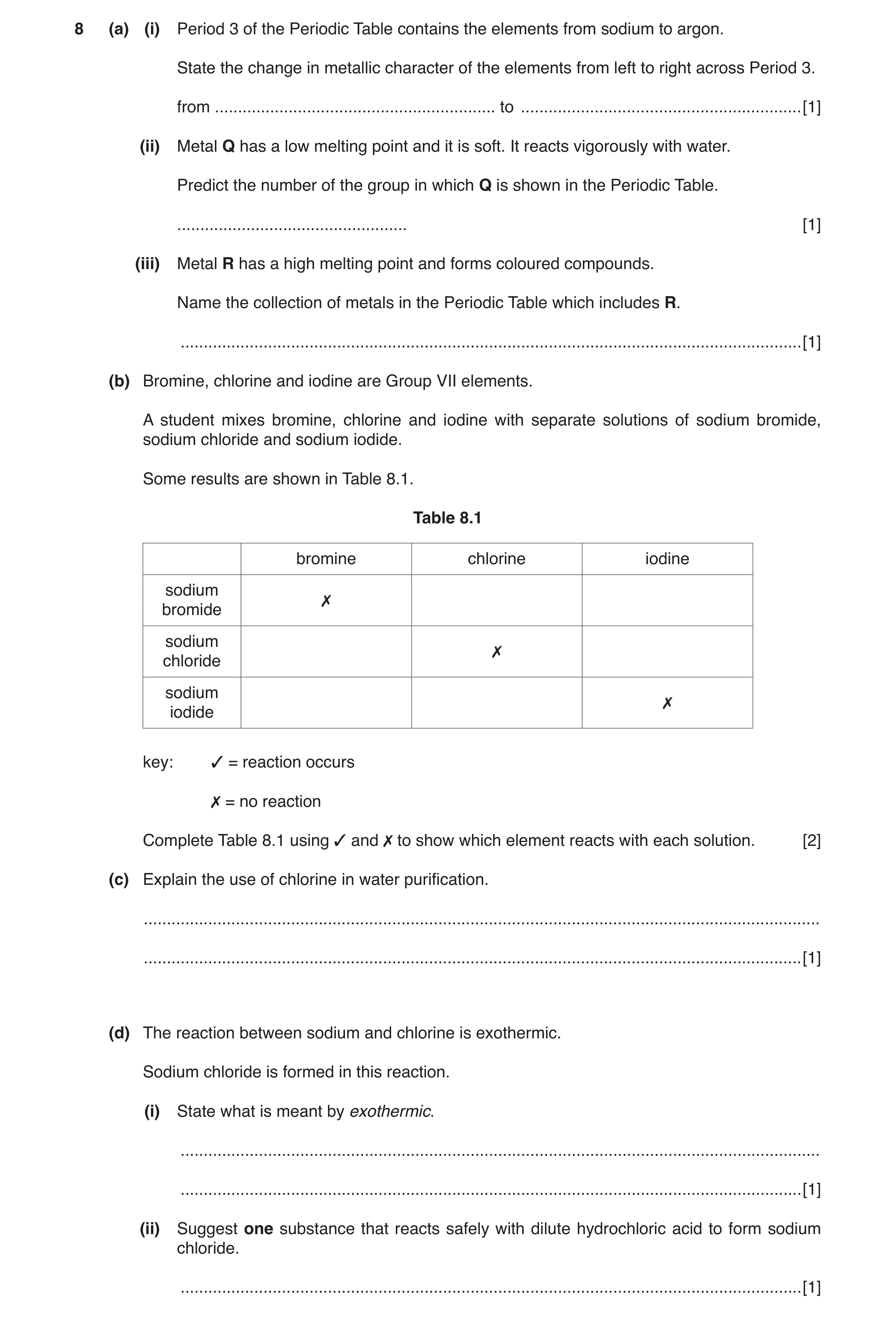
8 (a) (i) Period 3 of the Periodic Table contains the elements from sodium to argon. State the change in metallic character of the elements from left to right across Period 3. from … to … [1] (ii) Metal Q has a low melting point and it is soft. It reacts vigorously with water. Predict the number of the group in which Q is shown in the Periodic Table. … [1] (iii) Metal R has a high melting point and forms coloured compounds. Name the collection of metals in the Periodic Table which includes R. … [1] (b) Bromine, chlorine and iodine are Group VII elements. A student mixes bromine, chlorine and iodine with separate solutions of sodium bromide, sodium chloride and sodium iodide. Some results are shown in Table 8.1. Table 8.1 bromine chlorine iodine sodium ✗ bromide sodium ✗ chloride sodium ✗ iodide key: ✓ = reaction occurs ✗ = no reaction Complete Table 8.1 using ✓ and ✗ to show which element reacts with each solution. [2] (c) Explain the use of chlorine in water purification. … … [1] (d) The reaction between sodium and chlorine is exothermic. Sodium chloride is formed in this reaction. (i) State what is meant by exothermic. … … [1] (ii) Suggest one substance that reacts safely with dilute hydrochloric acid to form sodium chloride. … [1]
8 marks
Mark scheme: 8(a)(i) (left) metal(lic) and (right) non-metal(lic) ; 1 8(a)(ii) (Group) I / 1 / one ; 1 8(a)(iii) transition ; 1 8(b) (bromine) (chlorine) (iodine) (sodium bromide) (✗) 9 ✗ (sodium chloride) ✗ (✗) ✗ (sodium iodide) 9 9 (✗) Three correct 9 ; Three correct ✗ ; 2 8(c) kills / destroys bacteria / microbes / microorganisms / viruses ; 1 8(d)(i) releases heat / thermal energy / temperature increases ; 1 8(d)(ii) sodium hydroxide / NaOH / sodium carbonate / Na2CO3 / sodium hydrogen carbonate / sodium bicarbonate / NaHCO3 / sodium oxide / Na2O ; 1
This question in 0653/32 May/June 2018
Q4 · Period 3 of the Periodic Table contains the elements from sodium to argon 0653/33 May/June 2018
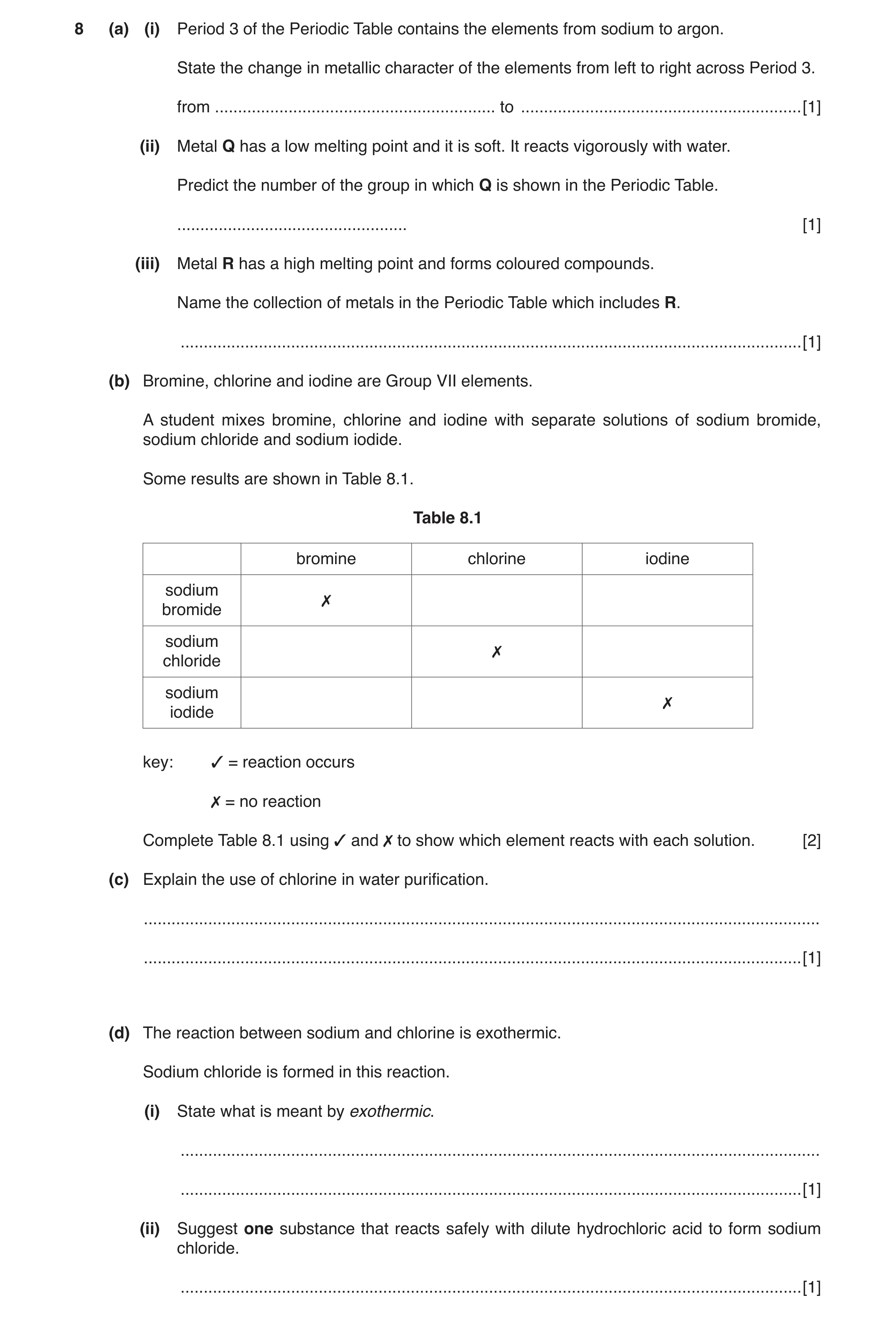
8 (a) (i) Period 3 of the Periodic Table contains the elements from sodium to argon. State the change in metallic character of the elements from left to right across Period 3. from … to … [1] (ii) Metal Q has a low melting point and it is soft. It reacts vigorously with water. Predict the number of the group in which Q is shown in the Periodic Table. … [1] (iii) Metal R has a high melting point and forms coloured compounds. Name the collection of metals in the Periodic Table which includes R. … [1] (b) Bromine, chlorine and iodine are Group VII elements. A student mixes bromine, chlorine and iodine with separate solutions of sodium bromide, sodium chloride and sodium iodide. Some results are shown in Table 8.1. Table 8.1 bromine chlorine iodine sodium ✗ bromide sodium ✗ chloride sodium ✗ iodide key: ✓ = reaction occurs ✗ = no reaction Complete Table 8.1 using ✓ and ✗ to show which element reacts with each solution. [2] (c) Explain the use of chlorine in water purification. … … [1] (d) The reaction between sodium and chlorine is exothermic. Sodium chloride is formed in this reaction. (i) State what is meant by exothermic. … … [1] (ii) Suggest one substance that reacts safely with dilute hydrochloric acid to form sodium chloride. … [1]
8 marks
Mark scheme: 8(a)(i) (left) metal(lic) and (right) non-metal(lic) ; 1 8(a)(ii) (Group) I / 1 / one ; 1 8(a)(iii) transition ; 1 8(b) (bromine) (chlorine) (iodine) (sodium bromide) (✗) 9 ✗ (sodium chloride) ✗ (✗) ✗ (sodium iodide) 9 9 (✗) Three correct 9 ; Three correct ✗ ; 2 8(c) kills / destroys bacteria / microbes / microorganisms / viruses ; 1 8(d)(i) releases heat / thermal energy / temperature increases ; 1 8(d)(ii) sodium hydroxide / NaOH / sodium carbonate / Na2CO3 / sodium hydrogen carbonate / sodium bicarbonate / NaHCO3 / sodium oxide / Na2O ; 1
This question in 0653/33 May/June 2018
Q5 · Sodium chloride, NaCl, is an ionic compound 0653/32 Feb/March 2020
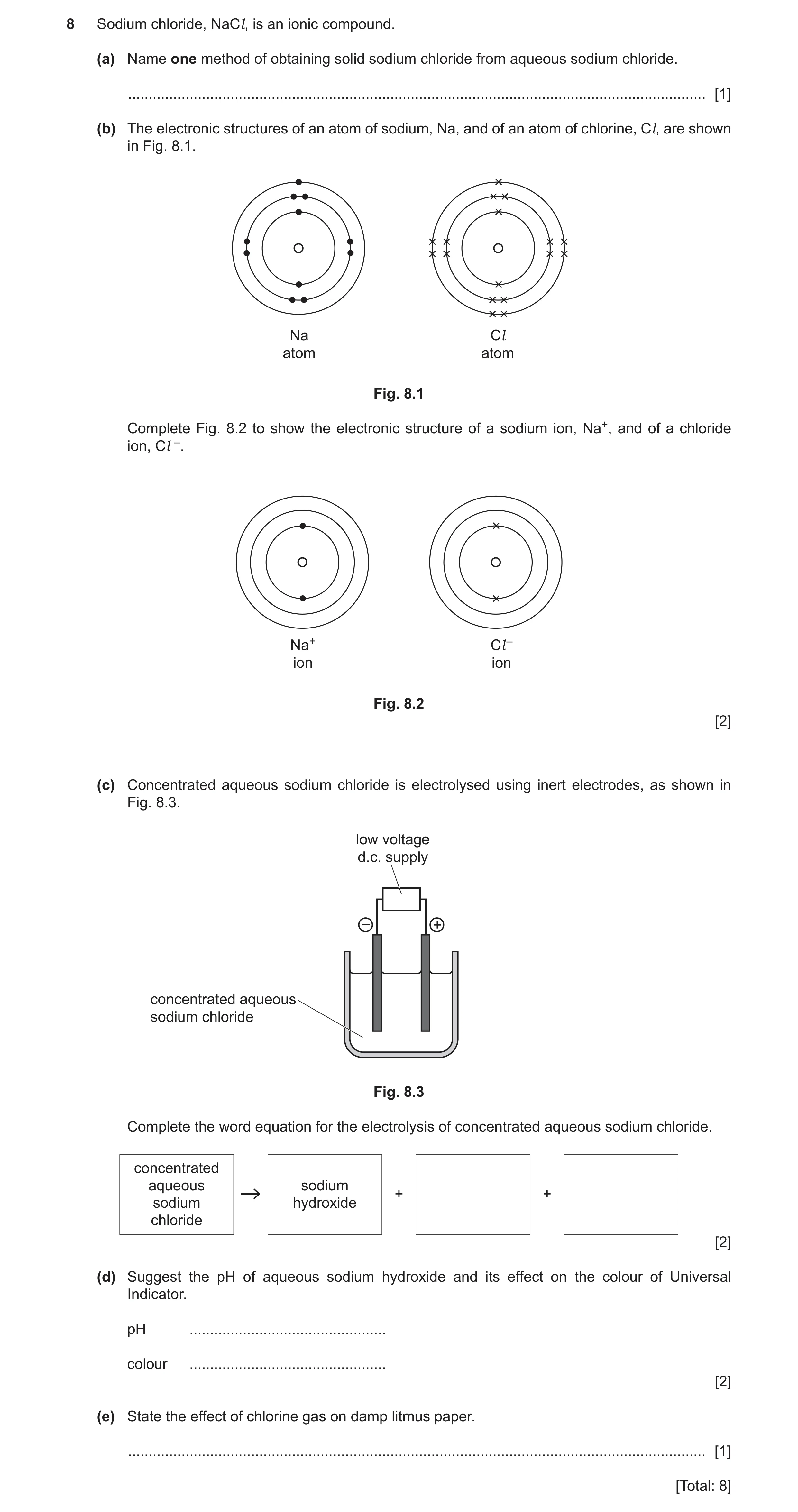
8 Sodium chloride, NaCl, is an ionic compound. (a) Name one method of obtaining solid sodium chloride from aqueous sodium chloride. … [1] (b) The electronic structures of an atom of sodium, Na, and of an atom of chlorine, Cl, are shown in Fig. 8.1. Na Cl atom atom Fig. 8.1 Complete Fig. 8.2 to show the electronic structure of a sodium ion, Na+, and of a chloride ion, Cl –. Na+ Cl – ion ion Fig. 8.2 [2] (c) Concentrated aqueous sodium chloride is electrolysed using inert electrodes, as shown in Fig. 8.3. low voltage d.c. supply – + concentrated aqueous sodium chloride Fig. 8.3 Complete the word equation for the electrolysis of concentrated aqueous sodium chloride. concentrated aqueous sodium + + sodium hydroxide chloride [2] (d) Suggest the pH of aqueous sodium hydroxide and its effect on the colour of Universal Indicator. pH … colour … [2] (e) State the effect of chlorine gas on damp litmus paper. … [1] [Total: 8]
8 marks
Mark scheme: 8(a) evaporate ; allow distil / crystallise / boil 1 8(b) drawn: Na+ 2, 8 ; Cl– 2, 8, 8 ; 2 8(c) (either order) concentrated aqueous sodium chloride sodium hydroxide + hydrogen ; + chlorine ; 2 8(d) pH > 7 to 14 ; colour blue-green / blue / purple ; 2 8(e) (blue / purple to) white / bleached ; 1
This question in 0653/32 Feb/March 2020
Q6 · Chlorine and bromine are diatomic non-metals in Group VII of the Periodic Table 0653/33 May/June 2021
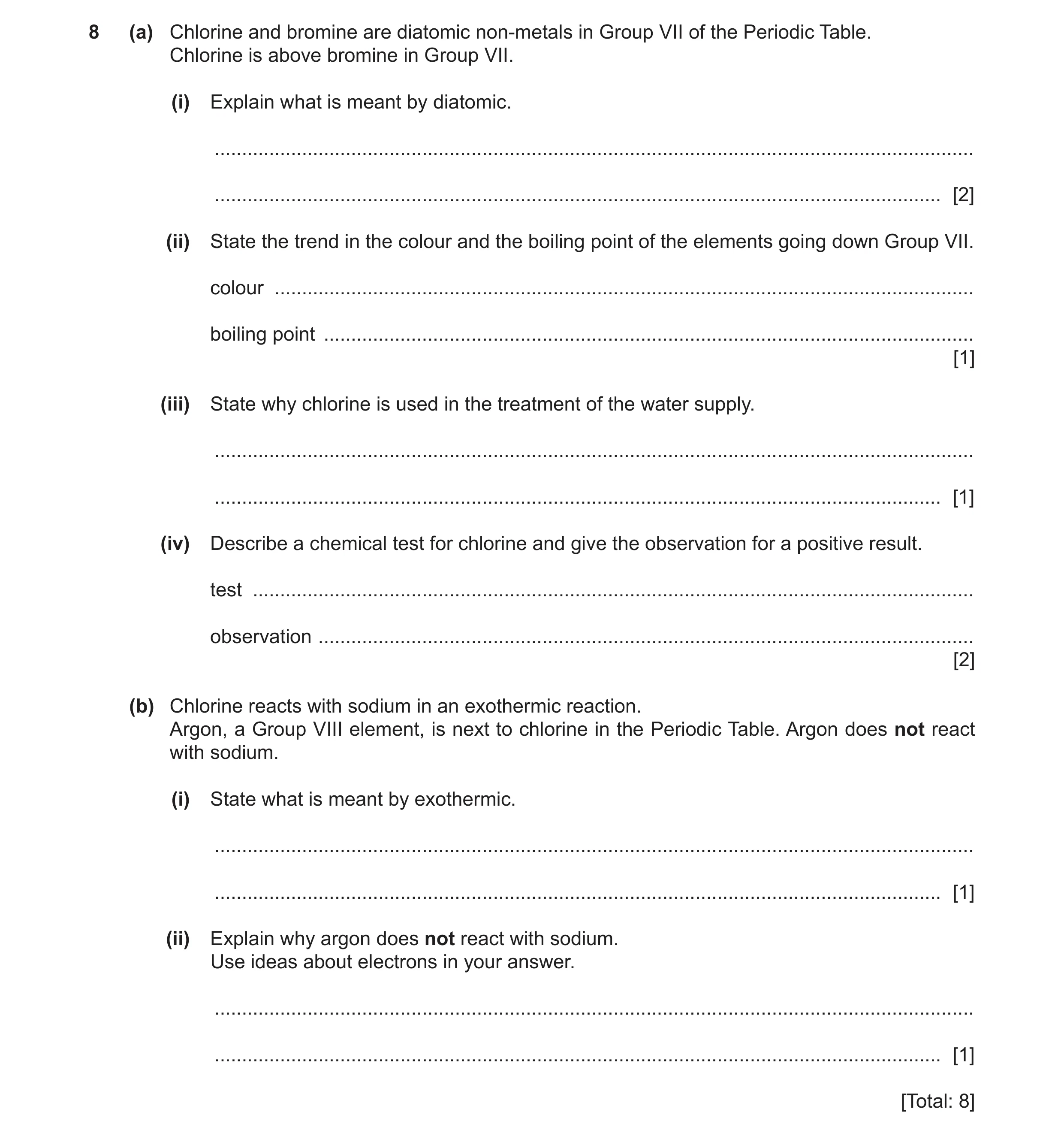
8 (a) Chlorine and bromine are diatomic non-metals in Group VII of the Periodic Table. Chlorine is above bromine in Group VII. (i) Explain what is meant by diatomic. … … [2] (ii) State the trend in the colour and the boiling point of the elements going down Group VII. colour … boiling point … [1] (iii) State why chlorine is used in the treatment of the water supply. … … [1] (iv) Describe a chemical test for chlorine and give the observation for a positive result. test … observation … [2] (b) Chlorine reacts with sodium in an exothermic reaction. Argon, a Group VIII element, is next to chlorine in the Periodic Table. Argon does not react with sodium. (i) State what is meant by exothermic. … … [1] (ii) Explain why argon does not react with sodium. Use ideas about electrons in your answer. … … [1] [Total: 8]
8 marks
Mark scheme: 8(a)(i) (only) two atoms ; in a molecule / bonded together ; 2 8(a)(ii) colour: darker AND boiling point: higher ; 1 8(a)(iii) to kill, bacteria / microbes / microorganisms ; 1 8(a)(iv) test: (damp blue) litmus / indicator paper ; result: (turns red then) bleaches / turns white ; 2 8(b)(i) (reaction) gives out heat energy ; 1 8(b)(ii) (argon has) full outer shell ; 1
This question in 0653/33 May/June 2021
Q7 · The Periodic Table lists all of the known elements 0653/32 Oct/Nov 2021
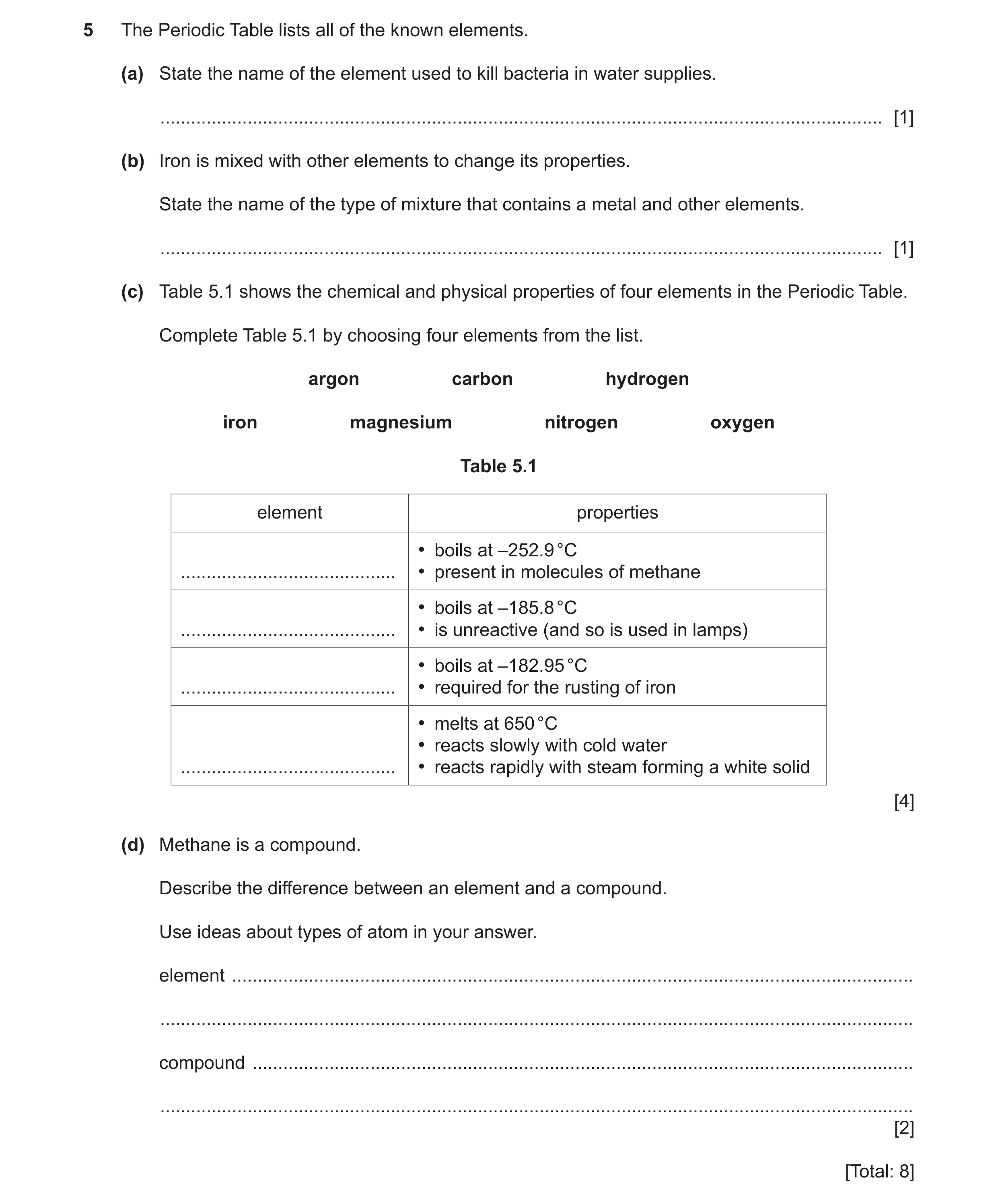
5 The Periodic Table lists all of the known elements. (a) State the name of the element used to kill bacteria in water supplies. … [1] (b) Iron is mixed with other elements to change its properties. State the name of the type of mixture that contains a metal and other elements. … [1] (c) Table 5.1 shows the chemical and physical properties of four elements in the Periodic Table. Complete Table 5.1 by choosing four elements from the list. argon carbon hydrogen iron magnesium nitrogen oxygen Table 5.1 element properties • boils at –252.9 °C … • present in molecules of methane • boils at –185.8 °C … • is unreactive (and so is used in lamps) • boils at –182.95 °C … • required for the rusting of iron • melts at 650 °C • reacts slowly with cold water … • reacts rapidly with steam forming a white solid [4] (d) Methane is a compound. Describe the difference between an element and a compound. Use ideas about types of atom in your answer. element … … compound … … [2] [Total: 8]
8 marks
Mark scheme: 5(a) chlorine ; 1 5(b) alloy(s) ; 1 5(c) hydrogen ; argon ; oxygen ; magnesium ; 4 5(d) element: contains only one type of atom ; compound: contains two (or more) types of atom ; 2 Question Answer Marks
This question in 0653/32 Oct/Nov 2021
Q8 · The Periodic Table lists all of the known elements 0653/33 Oct/Nov 2021
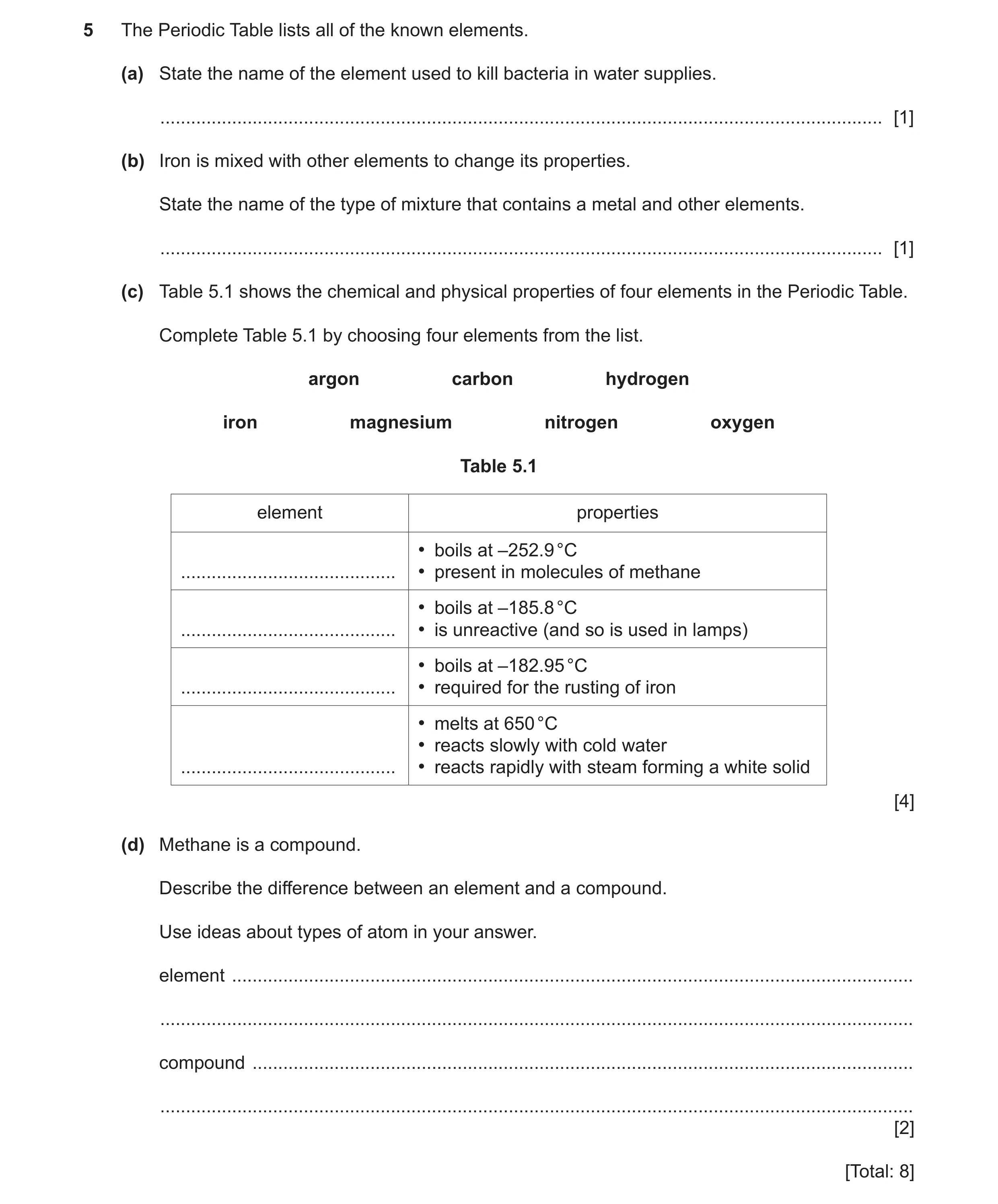
5 The Periodic Table lists all of the known elements. (a) State the name of the element used to kill bacteria in water supplies. … [1] (b) Iron is mixed with other elements to change its properties. State the name of the type of mixture that contains a metal and other elements. … [1] (c) Table 5.1 shows the chemical and physical properties of four elements in the Periodic Table. Complete Table 5.1 by choosing four elements from the list. argon carbon hydrogen iron magnesium nitrogen oxygen Table 5.1 element properties • boils at –252.9 °C … • present in molecules of methane • boils at –185.8 °C … • is unreactive (and so is used in lamps) • boils at –182.95 °C … • required for the rusting of iron • melts at 650 °C • reacts slowly with cold water … • reacts rapidly with steam forming a white solid [4] (d) Methane is a compound. Describe the difference between an element and a compound. Use ideas about types of atom in your answer. element … … compound … … [2] [Total: 8]
8 marks
Mark scheme: 5(a) chlorine ; 1 5(b) alloy(s) ; 1 5(c) hydrogen ; argon ; oxygen ; magnesium ; 4 5(d) element: contains only one type of atom ; compound: contains two (or more) types of atom ; 2 Question Answer Marks
This question in 0653/33 Oct/Nov 2021
Q9 · Part of the Periodic Table is shown in Fig 0653/32 Feb/March 2022
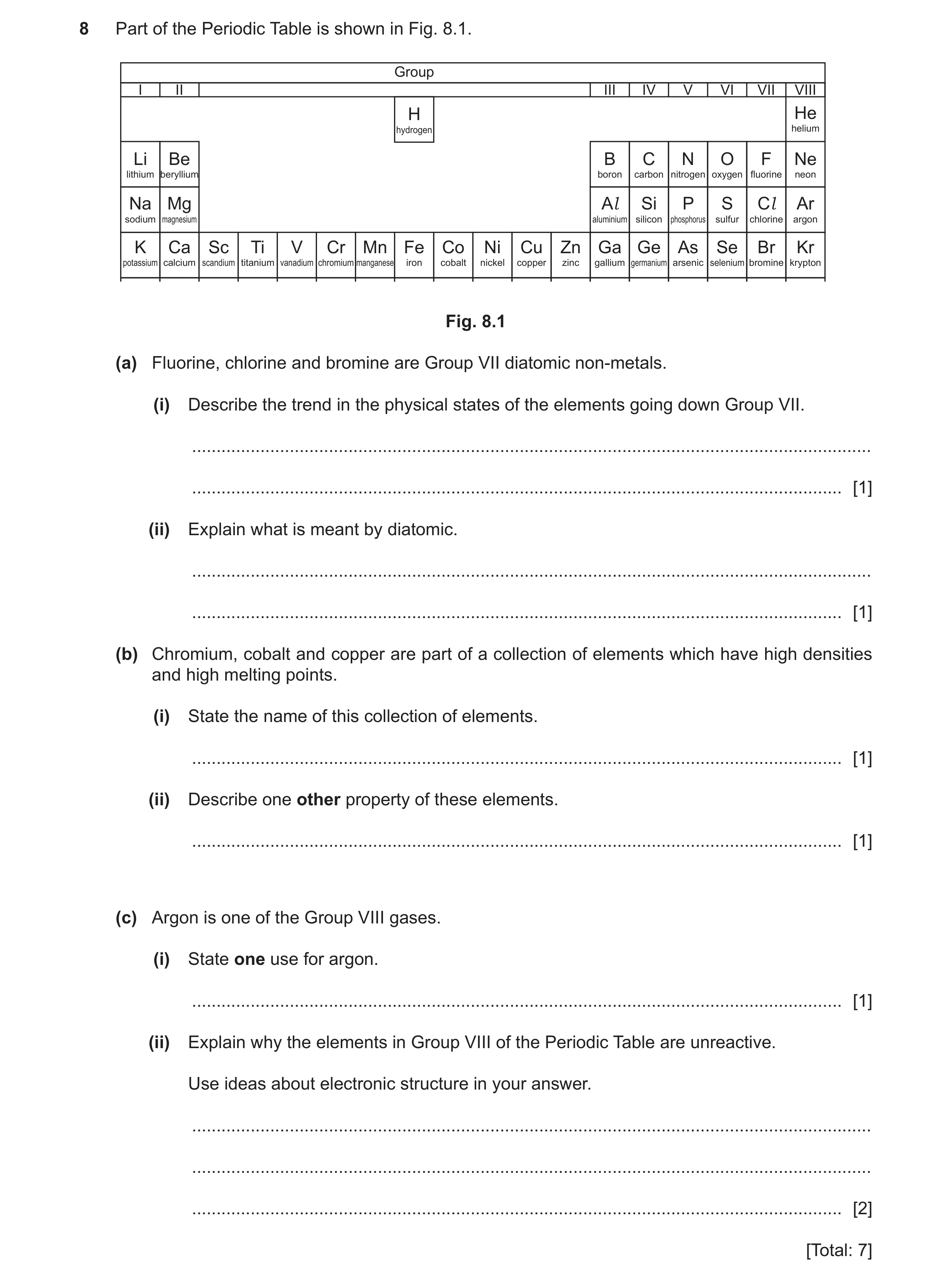
8 Part of the Periodic Table is shown in Fig. 8.1. Group I II III IV V VI VII VIII H He hydrogen helium Li Be B C N O F Ne lithium beryllium boron carbon nitrogen oxygen fluorine neon Na Mg Al Si P S Cl Ar sodium magnesium aluminium silicon phosphorus sulfur chlorine argon K Ca Sc Ti V Cr Mn Fe Co Ni Cu Zn Ga Ge As Se Br Kr potassium calcium scandium titanium vanadium chromium manganese iron cobalt nickel copper zinc gallium germanium arsenic selenium bromine krypton Fig. 8.1 (a) Fluorine, chlorine and bromine are Group VII diatomic non-metals. (i) Describe the trend in the physical states of the elements going down Group VII. … … [1] (ii) Explain what is meant by diatomic. … … [1] (b) Chromium, cobalt and copper are part of a collection of elements which have high densities and high melting points. (i) State the name of this collection of elements. … [1] (ii) Describe one other property of these elements. … [1] (c) Argon is one of the Group VIII gases. (i) State one use for argon. … [1] (ii) Explain why the elements in Group VIII of the Periodic Table are unreactive. Use ideas about electronic structure in your answer. … … … [2] [Total: 7]
7 marks
Mark scheme: 8(a)(i) gas to liquid (to solid) ; 1 8(a)(ii) two atoms in (one / each) molecule ; 1 8(b)(i) transition (elements / metals) ; 1 8(b)(ii) any one from: form coloured compounds ; (element or compounds) act as catalysts ; AVP e.g. good conductors of electricity ; 1 8(c)(i) (provides inert atmosphere) in lamps / light bulbs ; AVP e.g. used in welding 1 8(c)(ii) they have a full outer shell of electrons ; so are stable / they do not need to gain, lose or share electrons to become stable ; 2
This question in 0653/32 Feb/March 2022
Q10 · The Periodic Table contains groups and collections of different elements 0653/33 May/June 2023
8 The Periodic Table contains groups and collections of different elements. (a) Fig. 8.1 lists some of the elements in Group I. 3 Li lithium 7 11 Na sodium 23 19 K potassium 39 Fig. 8.1 The elements in Group I react with water to produce a gas. (i) State the name of this gas. … [1] (ii) State the trend in the reactivity of the elements down Group I. … [1] (b) Fig. 8.2 lists some of the elements in Group VII. 17 Cl chlorine 35.5 35 Br bromine 80 53 I iodine 127 Fig. 8.2 The elements in Group VII exist as diatomic molecules. (i) State what is meant by diatomic. … [1] (ii) State the trend in the colour of the elements down Group VII. … [1] (c) Iron and copper are part of a collection of metals which have high densities. (i) State the name of this collection of metals. … [1] (ii) Iron and copper and their compounds act as catalysts. State one other property of these metals that is not a property of Group I metals. … [1] (d) Argon and helium are noble gases. Argon is used in lamps, and helium is used in balloons, as shown in Fig. 8.3. argon helium Fig. 8.3 Identify one property of each element that makes it suitable for the use shown in Fig. 8.3. argon … helium … [2] [Total: 8]
8 marks
Mark scheme: 8(a)(i) hydrogen ; 1 8(a)(ii) increases (going down) ; 1 8(b)(i) contains two atoms (chemically) joined or bonded / a molecule containing two atoms ; 1 8(b)(ii) (become) darker / deeper ; 1 8(c)(i) transition (elements / metals) ; 1 8(c)(ii) high melting points / form coloured compounds ; 1 8(d) (argon) unreactive ; (helium) low density ; 2
This question in 0653/33 May/June 2023
Q11 · Chlorine is in Group VII of the Periodic Table 0653/31 Oct/Nov 2023
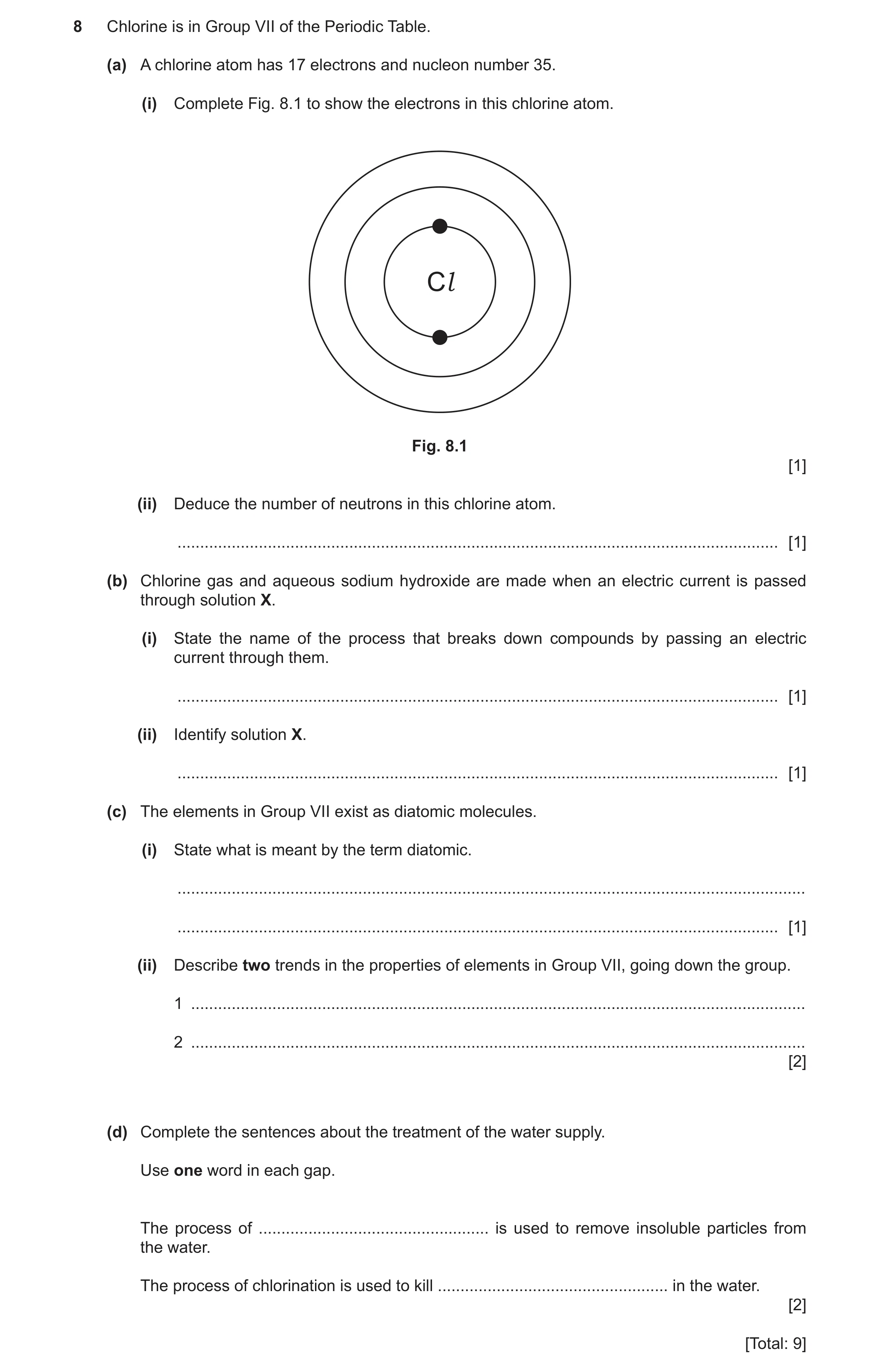
8 Chlorine is in Group VII of the Periodic Table. (a) A chlorine atom has 17 electrons and nucleon number 35. (i) Complete Fig. 8.1 to show the electrons in this chlorine atom. Cl Fig. 8.1 [1] (ii) Deduce the number of neutrons in this chlorine atom. … [1] (b) Chlorine gas and aqueous sodium hydroxide are made when an electric current is passed through solution X. (i) State the name of the process that breaks down compounds by passing an electric current through them. … [1] (ii) Identify solution X. … [1] (c) The elements in Group VII exist as diatomic molecules. (i) State what is meant by the term diatomic. … … [1] (ii) Describe two trends in the properties of elements in Group VII, going down the group. 1 … 2 … [2] (d) Complete the sentences about the treatment of the water supply. Use one word in each gap. The process of … is used to remove insoluble particles from the water. The process of chlorination is used to kill … in the water. [2] [Total: 9]
9 marks
Mark scheme: 8(a)(i) (2,) 8, 7 ; 1 8(a)(ii) 18 ; 1 8(b)(i) electrolysis ; 1 8(b)(ii) (concentrated, aqueous) sodium chloride / NaCl ; 1 8(c)(i) (consisting of) two atoms ; 1 8(c)(ii) (become) darker in colour ; 2 change from gas to liquid to solid ; 8(d) filtration ; 2 bacteria / microorganisms / microbes ;
This question in 0653/31 Oct/Nov 2023
Q12 · Lithium fluoride, LiF, is an ionic compound 0653/33 May/June 2025
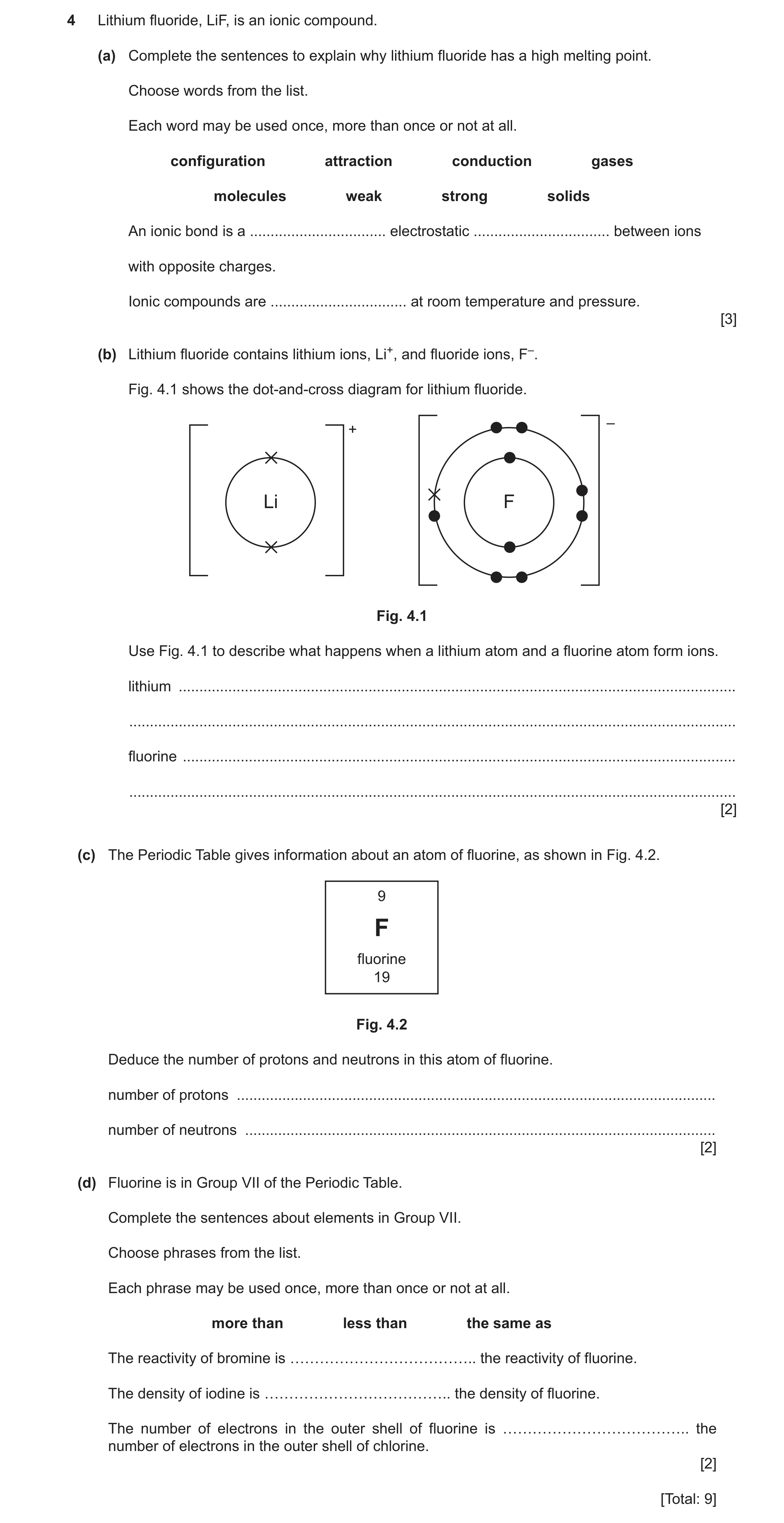
4 Lithium fluoride, LiF, is an ionic compound. (a) Complete the sentences to explain why lithium fluoride has a high melting point. Choose words from the list. Each word may be used once, more than once or not at all. configuration attraction conduction gases molecules weak strong solids An ionic bond is a … electrostatic … between ions with opposite charges. Ionic compounds are … at room temperature and pressure. [3] (b) Lithium fluoride contains lithium ions, Li+, and fluoride ions, F–. Fig. 4.1 shows the dot-and-cross diagram for lithium fluoride. – + Li F Fig. 4.1 Use Fig. 4.1 to describe what happens when a lithium atom and a fluorine atom form ions. lithium … … fluorine … … [2] (c) The Periodic Table gives information about an atom of fluorine, as shown in Fig. 4.2. 9 F fluorine 19 Fig. 4.2 Deduce the number of protons and neutrons in this atom of fluorine. number of protons … number of neutrons … [2] (d) Fluorine is in Group VII of the Periodic Table. Complete the sentences about elements in Group VII. Choose phrases from the list. Each phrase may be used once, more than once or not at all. more than less than the same as The reactivity of bromine is ……………………………….. the reactivity of fluorine. The density of iodine is ……………………………….. the density of fluorine. The number of electrons in the outer shell of fluorine is ……………………………….. the number of electrons in the outer shell of chlorine. [2] [Total: 9]
9 marks
Mark scheme: 4(a) strong ; 3 attraction ; solids ; 4(b) lithium atom loses one electron ; 2 fluorine atom gains one electron ; 4(c) 9 protons ; 2 10 neutrons ; 4(d) less than 2 more than the same as ;; all three correct = 2 marks one or two correct = 1 mark
This question in 0653/33 May/June 2025
 8 / 16
 9 / 16
 10 / 16
 11 / 16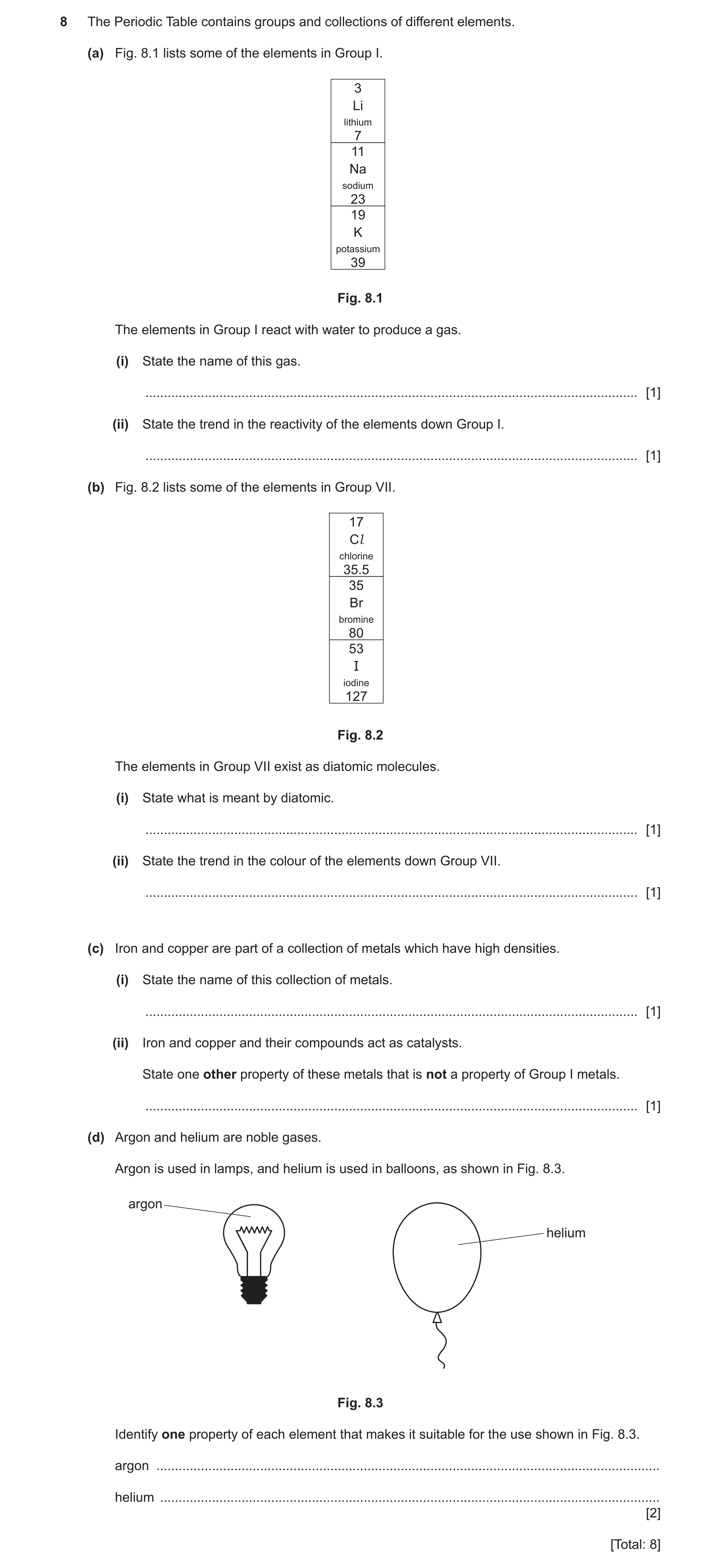
 9
9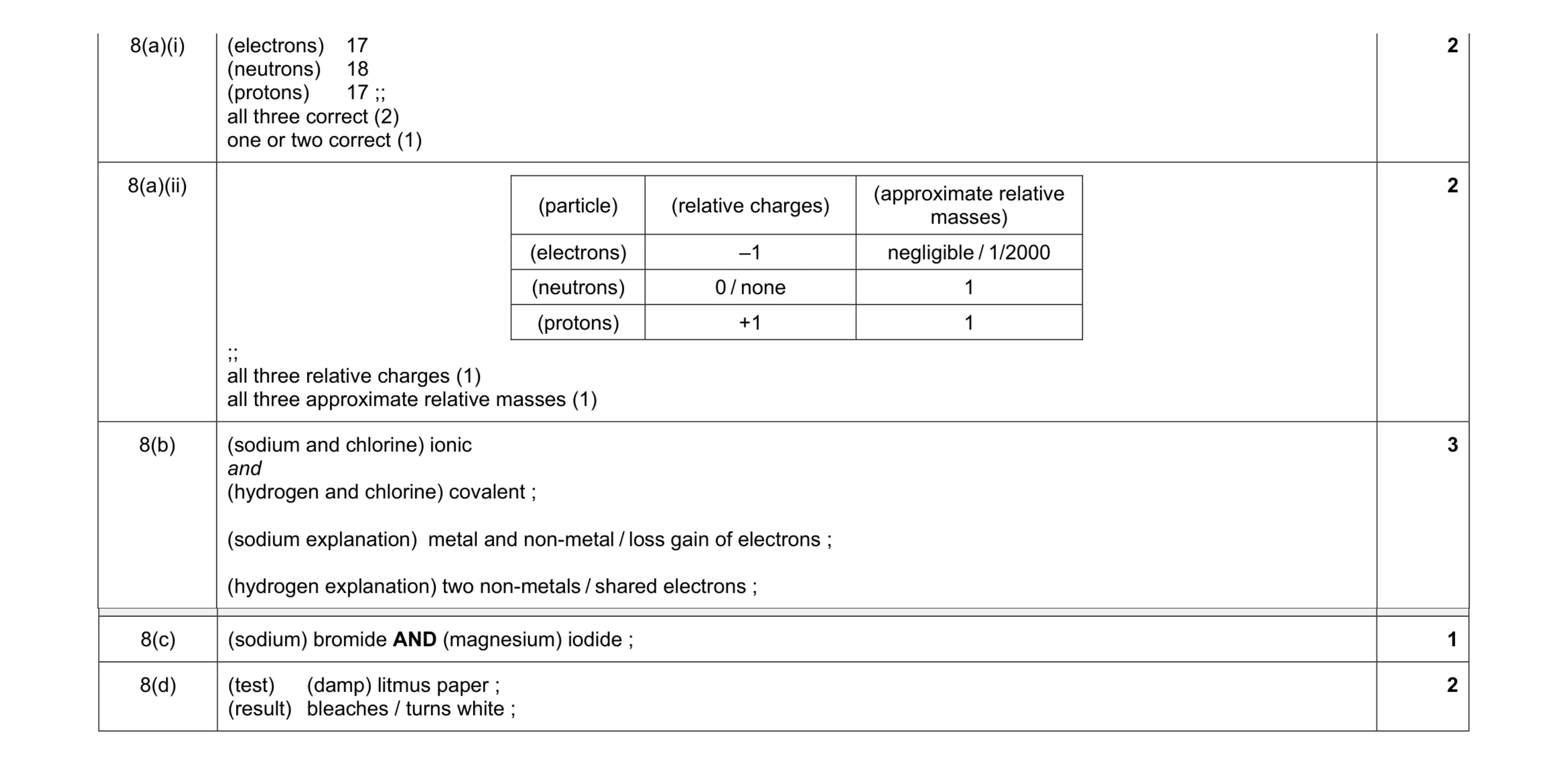 10
10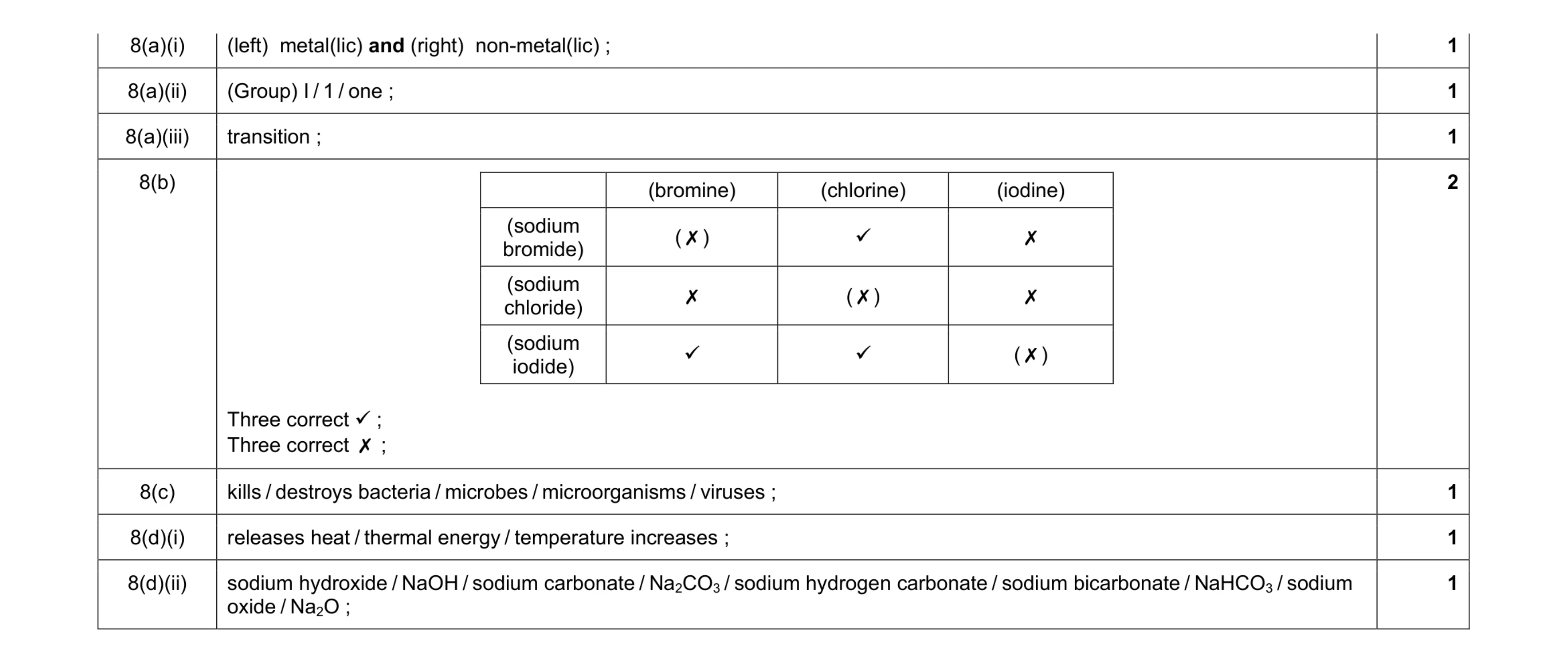 8
8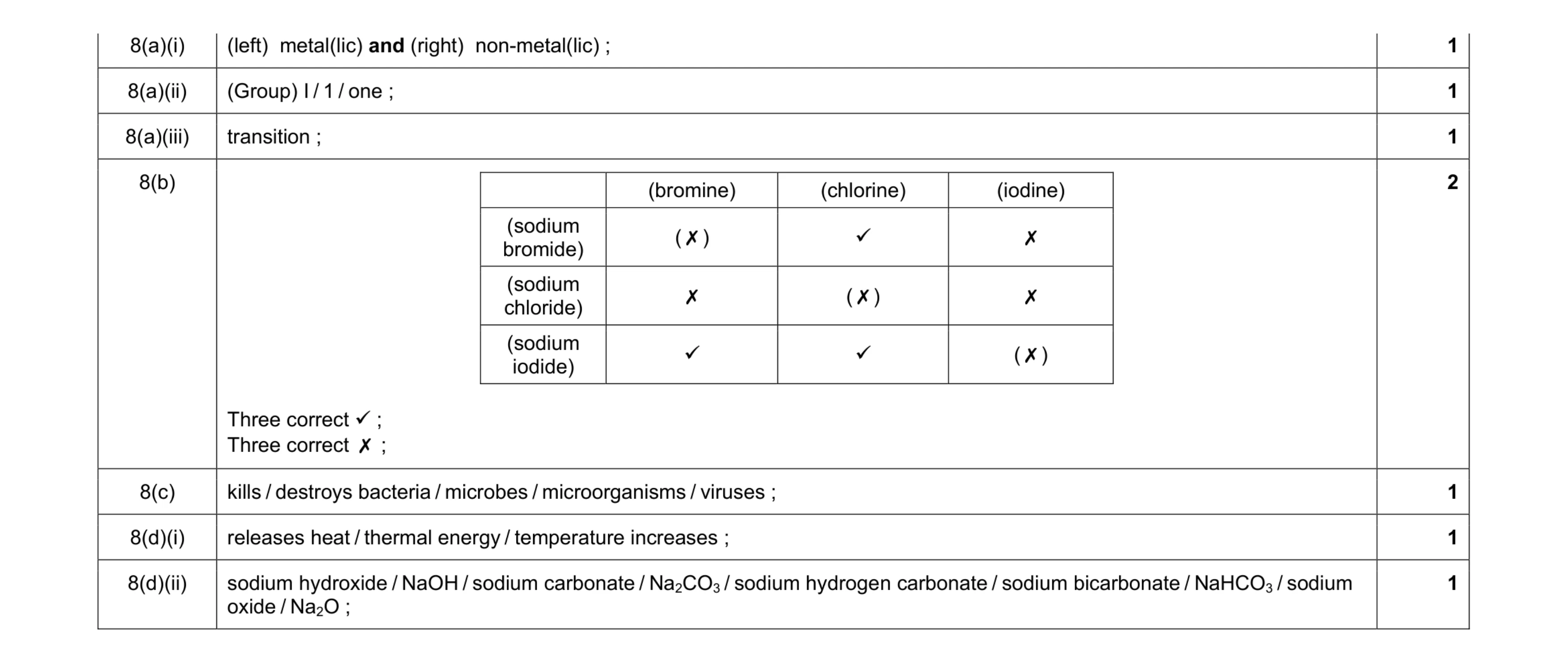 8
8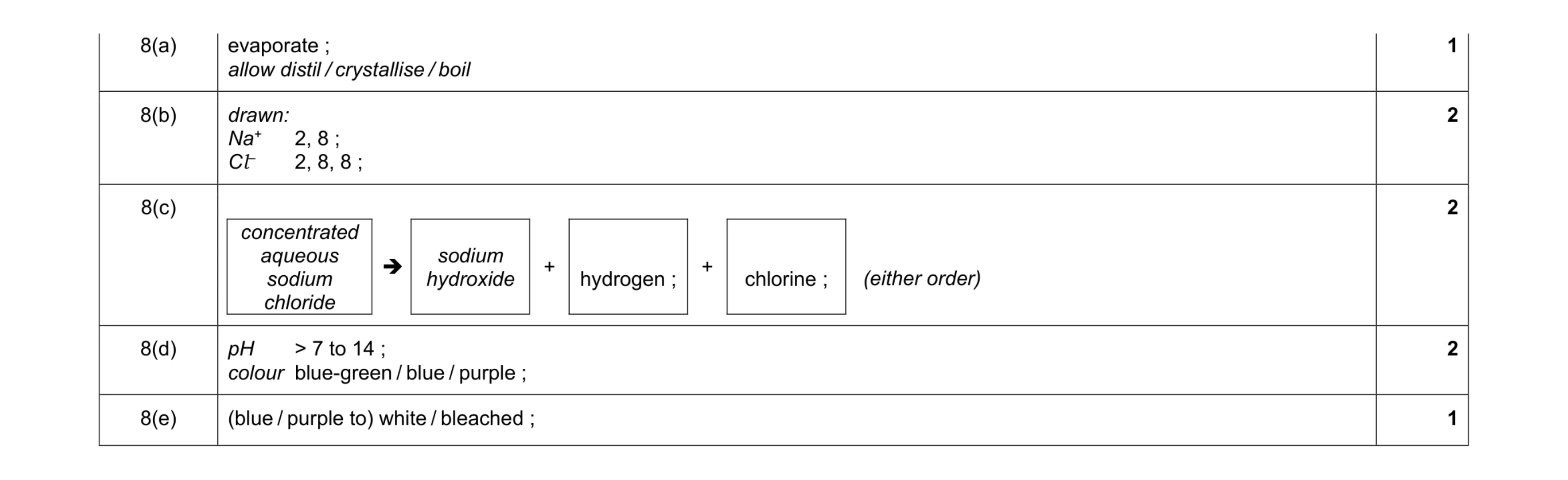 8
8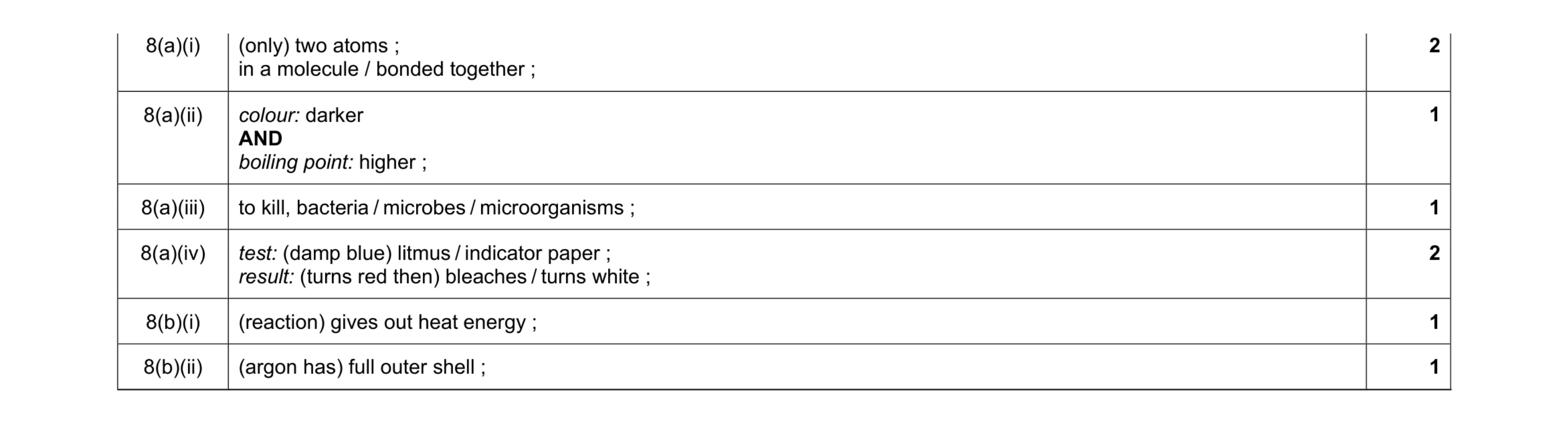 8
8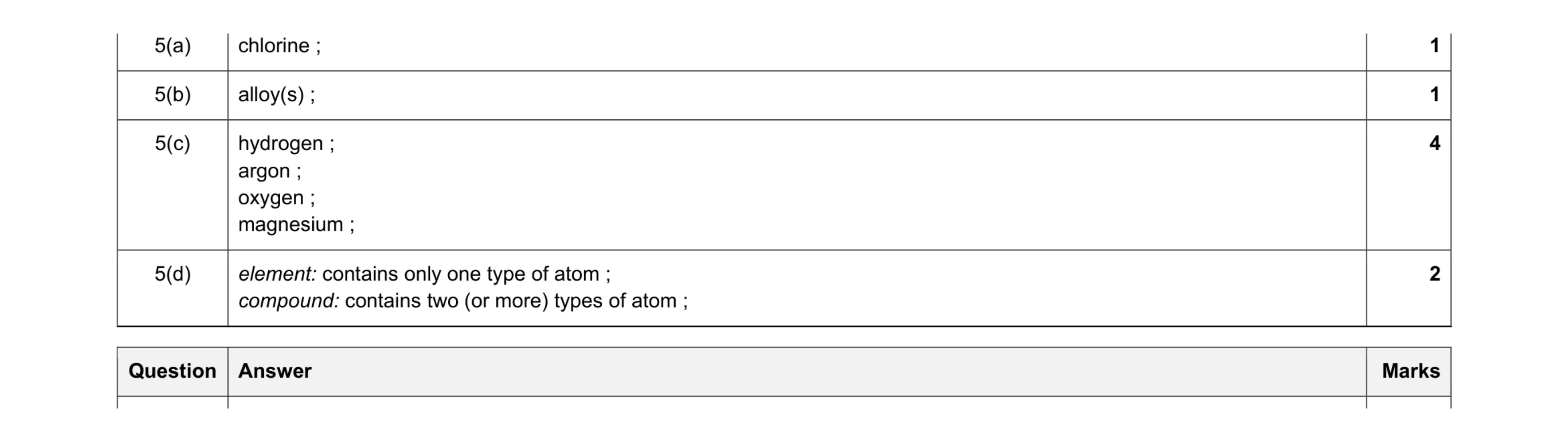 8
8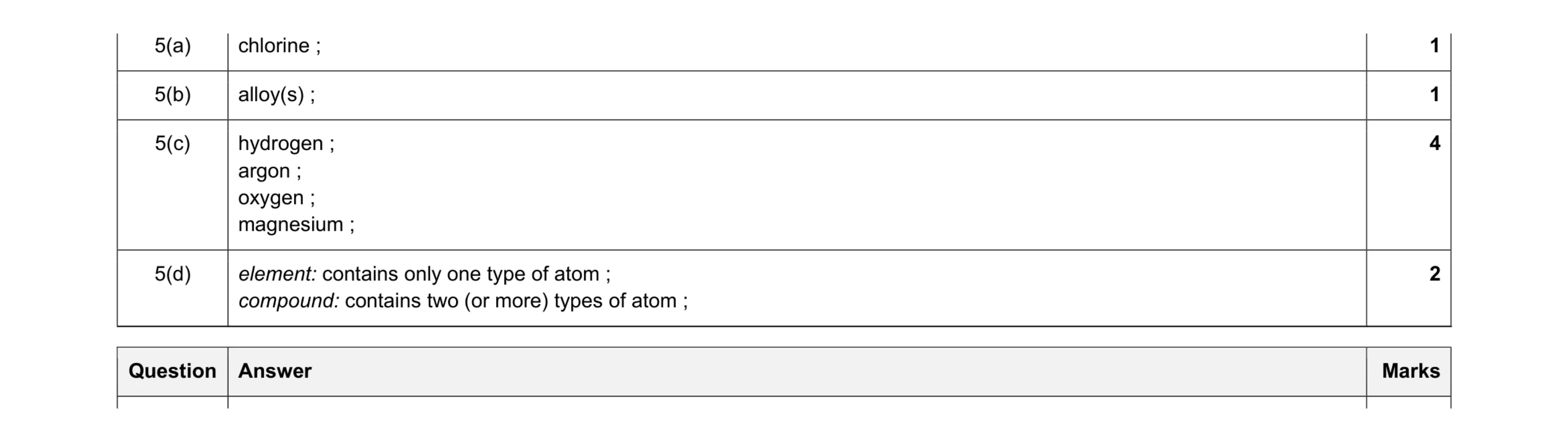 8
8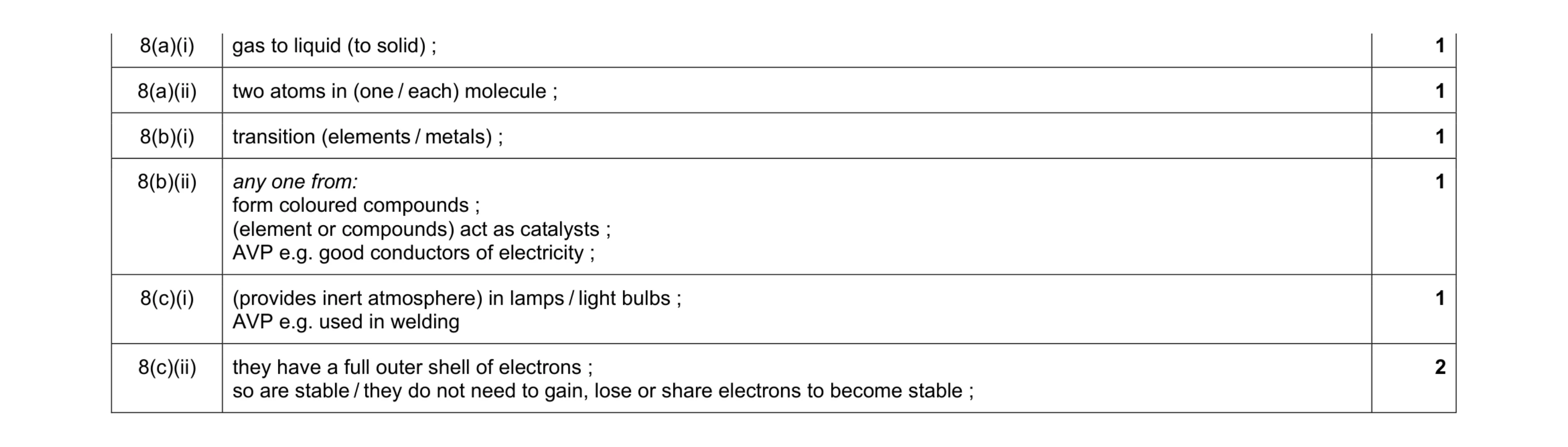 7
7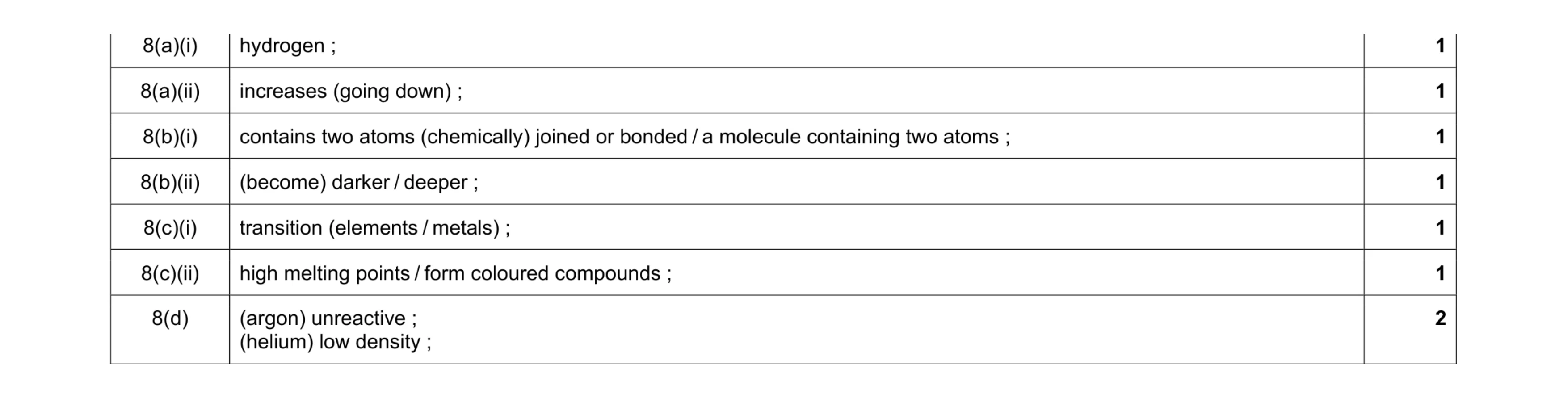 8
8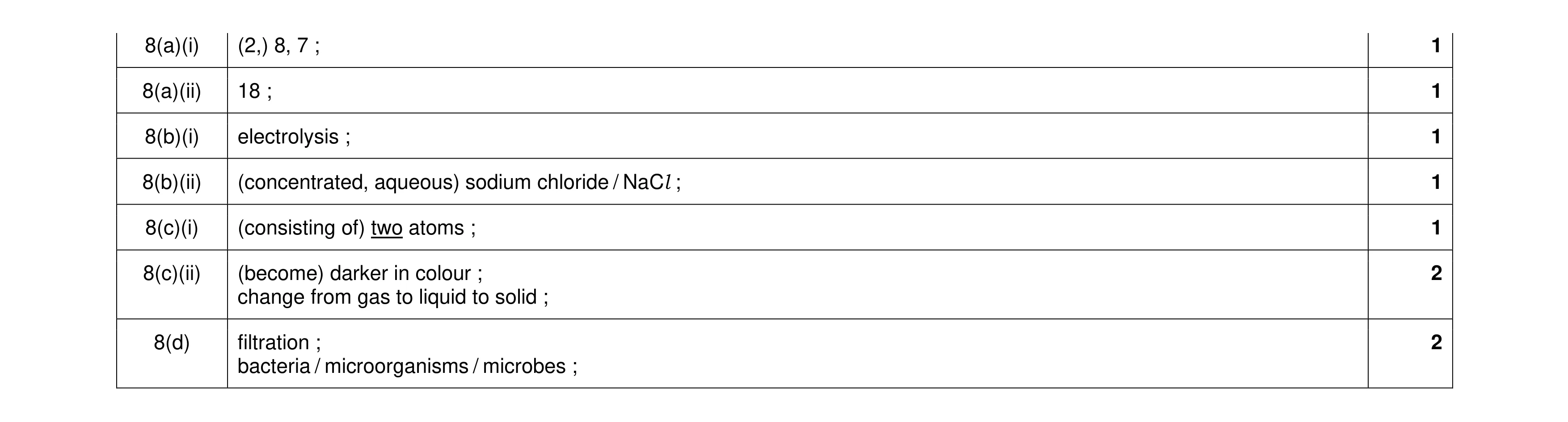 9
9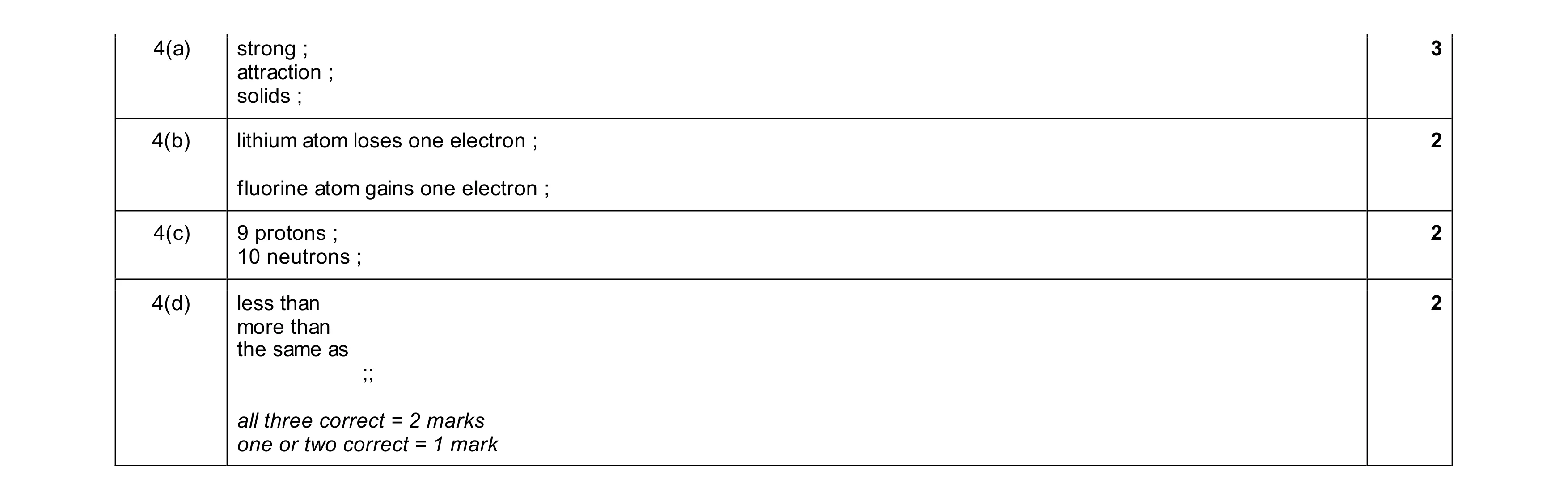 9
9