Questions as text
Q1 · A diagram of part of the carbon cycle 0653/42 Feb/March 2017
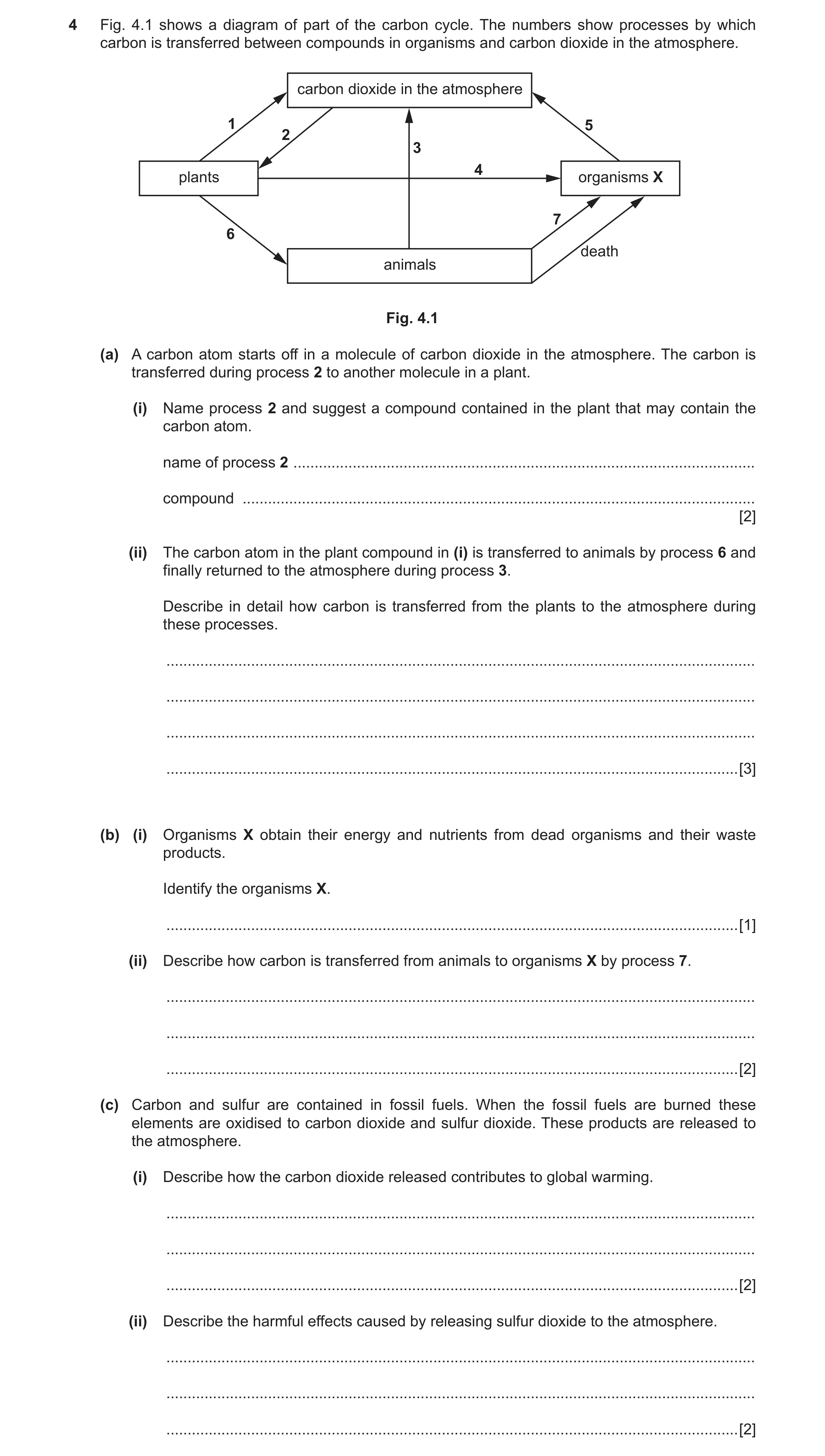
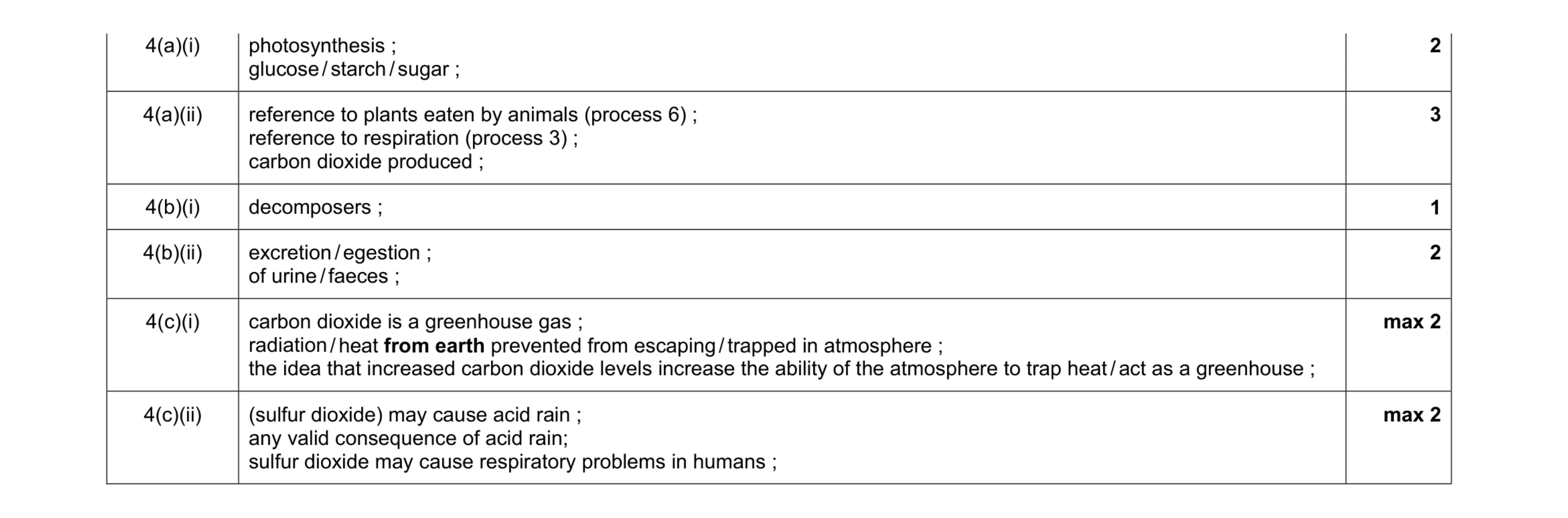
4 Fig. 4.1 shows a diagram of part of the carbon cycle. The numbers show processes by which carbon is transferred between compounds in organisms and carbon dioxide in the atmosphere. carbon dioxide in the atmosphere 1 5 2 3 4 plants organisms X 7 6 death animals Fig. 4.1 (a) A carbon atom starts off in a molecule of carbon dioxide in the atmosphere. The carbon is transferred during process 2 to another molecule in a plant. (i) Name process 2 and suggest a compound contained in the plant that may contain the carbon atom. name of process 2 … compound … [2] (ii) The carbon atom in the plant compound in (i) is transferred to animals by process 6 and finally returned to the atmosphere during process 3. Describe in detail how carbon is transferred from the plants to the atmosphere during these processes. … … … … [3] (b) (i) Organisms X obtain their energy and nutrients from dead organisms and their waste products. Identify the organisms X. … [1] (ii) Describe how carbon is transferred from animals to organisms X by process 7. … … … [2] (c) Carbon and sulfur are contained in fossil fuels. When the fossil fuels are burned these elements are oxidised to carbon dioxide and sulfur dioxide. These products are released to the atmosphere. (i) Describe how the carbon dioxide released contributes to global warming. … … … [2] (ii) Describe the harmful effects caused by releasing sulfur dioxide to the atmosphere. … … … [2]
12 marks
Mark scheme: 4(a)(i) photosynthesis ; glucose / starch / sugar ; 2 4(a)(ii) reference to plants eaten by animals (process 6) ; reference to respiration (process 3) ; carbon dioxide produced ; 3 4(b)(i) decomposers ; 1 4(b)(ii) excretion / egestion ; of urine / faeces ; 2 4(c)(i) carbon dioxide is a greenhouse gas ; radiation / heat from earth prevented from escaping / trapped in atmosphere ; the idea that increased carbon dioxide levels increase the ability of the atmosphere to trap heat / act as a greenhouse ; max 2 4(c)(ii) (sulfur dioxide) may cause acid rain ; any valid consequence of acid rain; sulfur dioxide may cause respiratory problems in humans ; max 2
This question in 0653/42 Feb/March 2017
Q2 · A boat sailing near a lighthouse at night 0653/42 Feb/March 2017
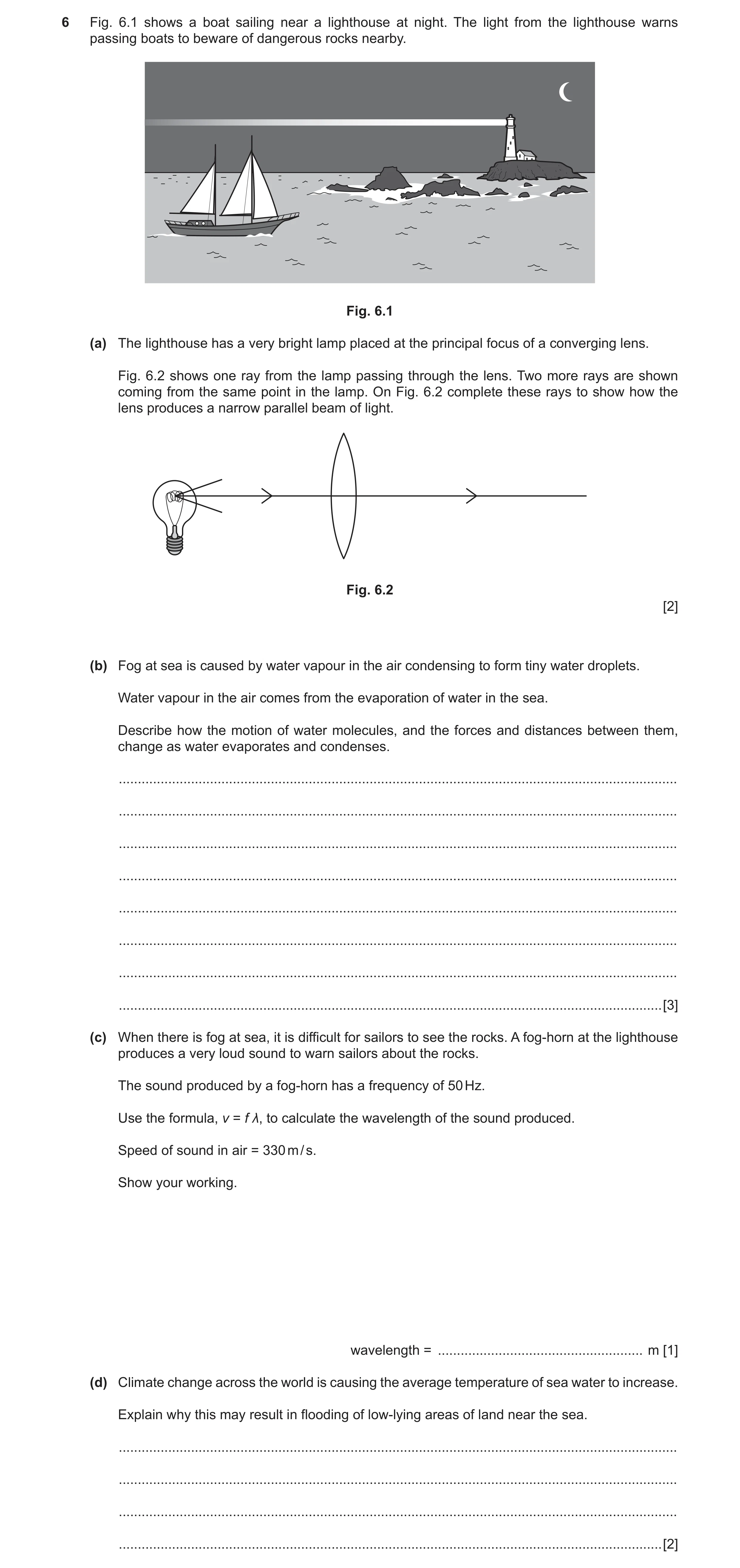
6 Fig. 6.1 shows a boat sailing near a lighthouse at night. The light from the lighthouse warns passing boats to beware of dangerous rocks nearby. Fig. 6.1 (a) The lighthouse has a very bright lamp placed at the principal focus of a converging lens. Fig. 6.2 shows one ray from the lamp passing through the lens. Two more rays are shown coming from the same point in the lamp. On Fig. 6.2 complete these rays to show how the lens produces a narrow parallel beam of light. Fig. 6.2 [2] (b) Fog at sea is caused by water vapour in the air condensing to form tiny water droplets. Water vapour in the air comes from the evaporation of water in the sea. Describe how the motion of water molecules, and the forces and distances between them, change as water evaporates and condenses. … … … … … … … … [3] (c) When there is fog at sea, it is difficult for sailors to see the rocks. A fog-horn at the lighthouse produces a very loud sound to warn sailors about the rocks. The sound produced by a fog-horn has a frequency of 50 Hz. Use the formula, v = f λ, to calculate the wavelength of the sound produced. Speed of sound in air = 330 m / s. Show your working. wavelength = … m [1] (d) Climate change across the world is causing the average temperature of sea water to increase. Explain why this may result in flooding of low-lying areas of land near the sea. … … … … [2]
8 marks
Mark scheme: 6(a) at least two diverging rays from filament to lens ; all rays emerging from lens parallel ; 2 6(b) the idea that water molecules are moving ; evaporation occurs when faster / more energetic molecules escape (from the surface) ; reference to decreasing force of attraction / increasing separation (as evaporation occurs) ; condensation occurs when molecules(in water vapour) slow down ; reference to increasing force of attraction / decreasing separation ; max3 6(c) (v = f λ or λ = v/f) λ = 330/50 = 6.6 (m) ; 1 6(d) volume of ocean increases / seawater expands ; sea level rises (to flood coastal land) ; 2
This question in 0653/42 Feb/March 2017
Q3 · Use lines to connect the box on the left to different boxes on the right to make correct… 0653/41 May/June 2017
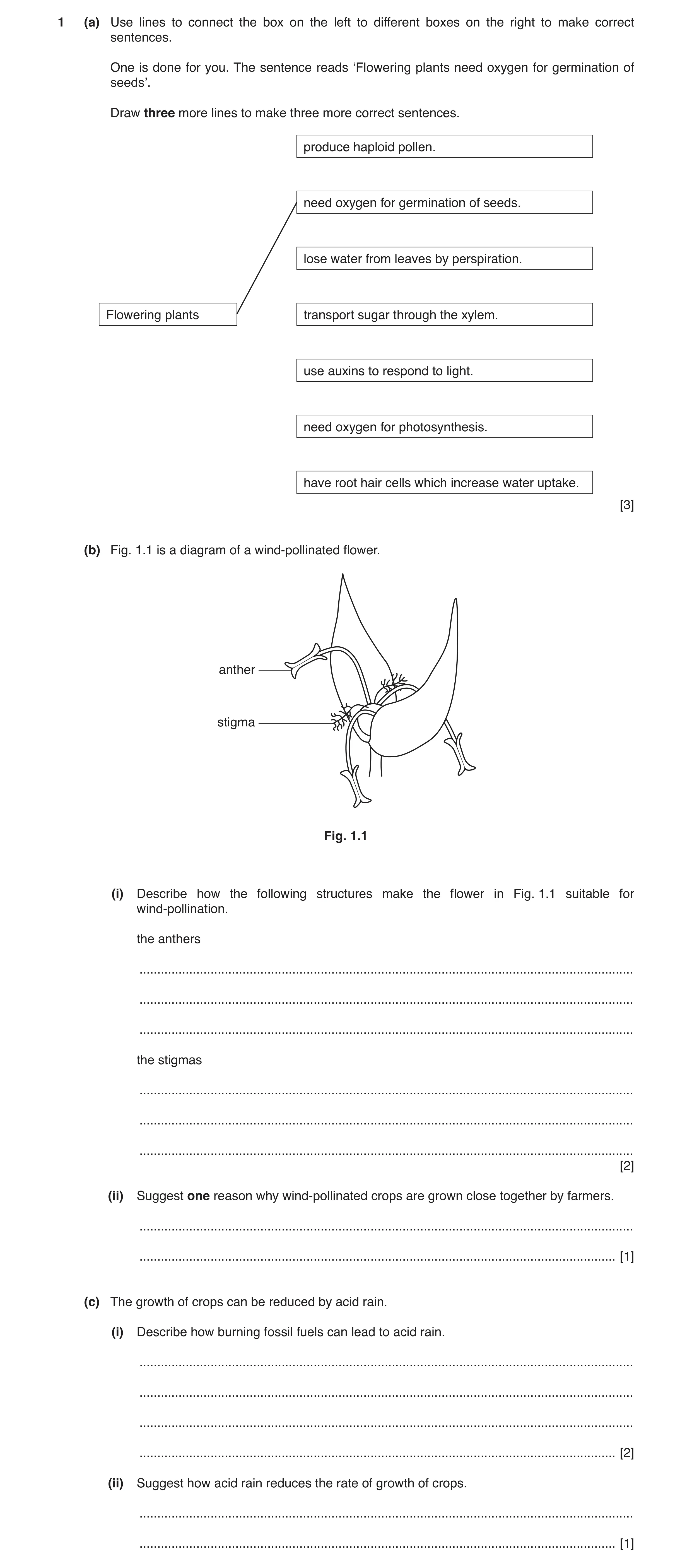
1 (a) Use lines to connect the box on the left to different boxes on the right to make correct sentences. One is done for you. The sentence reads ‘Flowering plants need oxygen for germination of seeds’. Draw three more lines to make three more correct sentences. produce haploid pollen. need oxygen for germination of seeds. lose water from leaves by perspiration. Flowering plants transport sugar through the xylem. use auxins to respond to light. need oxygen for photosynthesis. have root hair cells which increase water uptake. [3] (b) Fig. 1.1 is a diagram of a wind-pollinated flower. anther stigma Fig. 1.1 (i) Describe how the following structures make the flower in Fig. 1.1 suitable for wind-pollination. the anthers … … … the stigmas … … … [2] (ii) Suggest one reason why wind-pollinated crops are grown close together by farmers. … … [1] (c) The growth of crops can be reduced by acid rain. (i) Describe how burning fossil fuels can lead to acid rain. … … … … [2] (ii) Suggest how acid rain reduces the rate of growth of crops. … … [1]
9 marks
Mark scheme: 1(a) lines drawn from Flowering plants to produce haploid pollen ; use auxins to respond to light ; have root hair cells which increase water uptake ; 3 1(b)(i) (anthers) hang outside the flower so pollen is easily picked up by wind ; (stigmas) feathery / large surface area to collect pollen ; 2 1(b)(ii) to increase the chances of pollination between plants ; 1 1(c)(i) the idea that fossil fuels contain sulfur / sulfur compounds ; sulfur dioxide produced ; dissolves in water in the air ; Max 2 1(c)(ii) reduces activity / denatures enzymes present in the plants ; 1
This question in 0653/41 May/June 2017
Q4 · What happens to a seed after it is planted 0653/43 May/June 2017
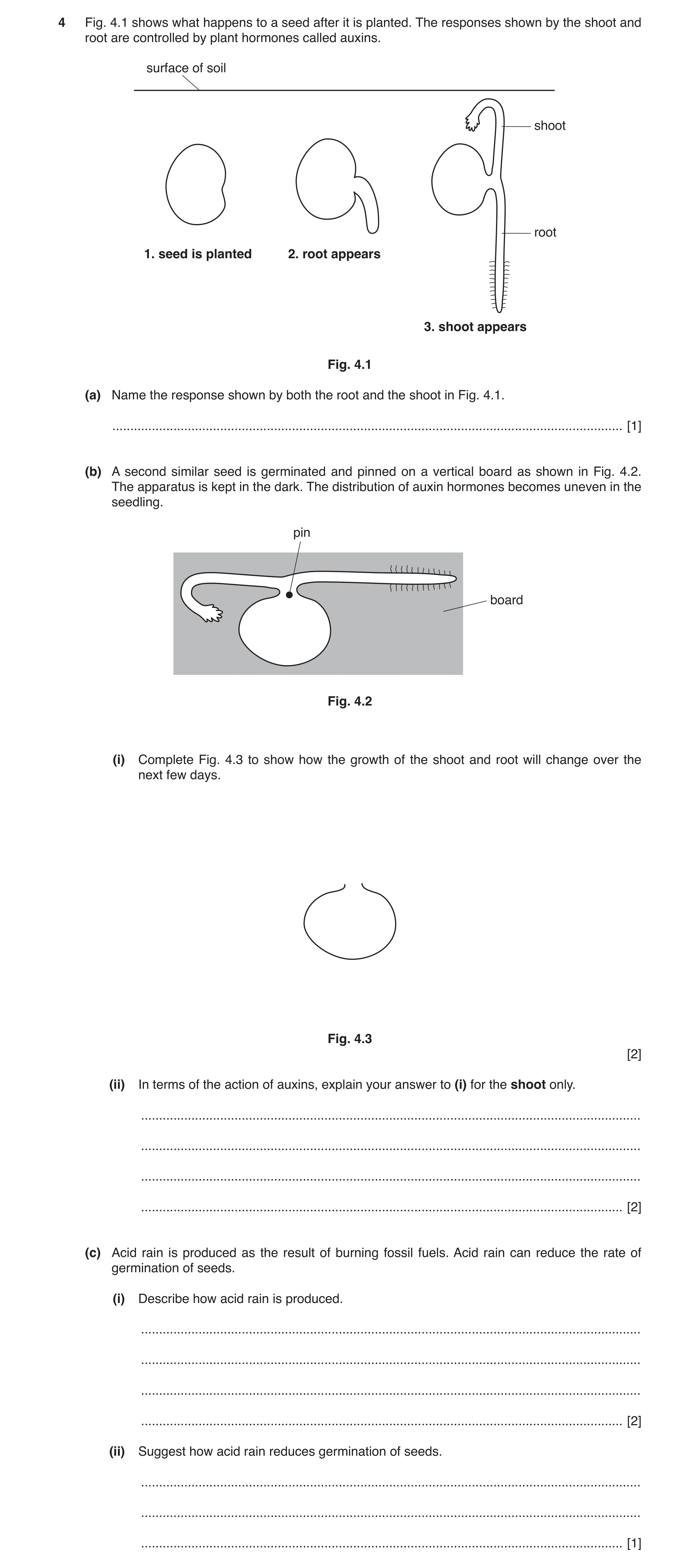
4 Fig. 4.1 shows what happens to a seed after it is planted. The responses shown by the shoot and root are controlled by plant hormones called auxins. surface of soil shoot root 1. seed is planted 2. root appears 3. shoot appears Fig. 4.1 (a) Name the response shown by both the root and the shoot in Fig. 4.1. … [1] (b) A second similar seed is germinated and pinned on a vertical board as shown in Fig. 4.2. The apparatus is kept in the dark. The distribution of auxin hormones becomes uneven in the seedling. pin board Fig. 4.2 (i) Complete Fig. 4.3 to show how the growth of the shoot and root will change over the next few days. Fig. 4.3 [2] (ii) In terms of the action of auxins, explain your answer to (i) for the shoot only. … … … … [2] (c) Acid rain is produced as the result of burning fossil fuels. Acid rain can reduce the rate of germination of seeds. (i) Describe how acid rain is produced. … … … … [2] (ii) Suggest how acid rain reduces germination of seeds. … … … [1]
8 marks
Mark scheme: 4(a) geotropism / gravitropism ; 1 4(b)(i) drawing with shoot bending upwards ; root bending downwards ; 2 4(b)(ii) auxins become more concentrated on lower surface ; cause more growth / cell elongation ; 2 4(c)(i) sulfur dioxide ; dissolves in rain water ; 2 4(c)(ii) denatures the enzymes / makes the enzymes less active ; 1
This question in 0653/43 May/June 2017
Q5 · Petroleum is separated into useful products by process W shown in Fig 0653/41 Oct/Nov 2017
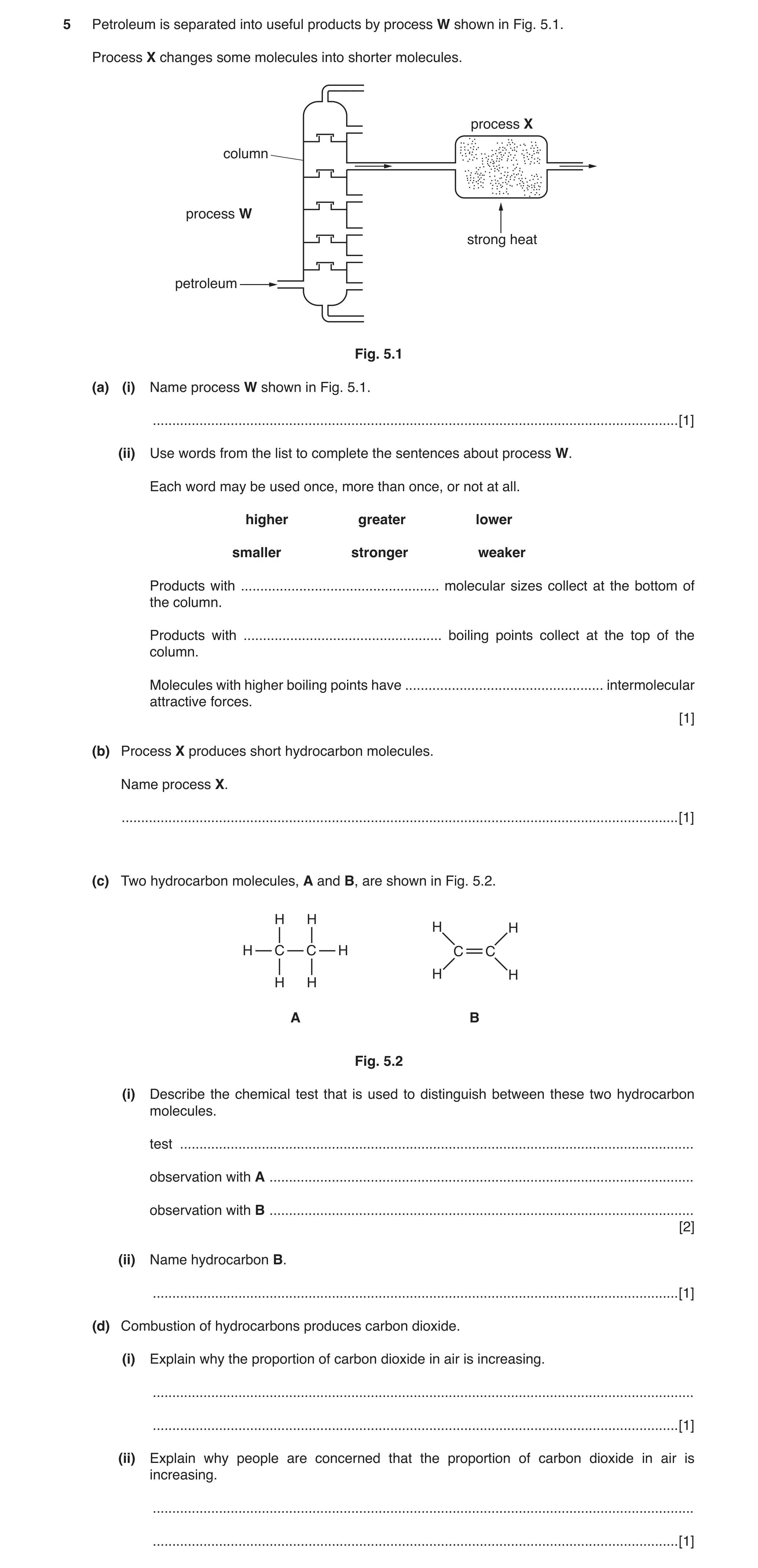
5 Petroleum is separated into useful products by process W shown in Fig. 5.1. Process X changes some molecules into shorter molecules. process X column process W strong heat petroleum Fig. 5.1 (a) (i) Name process W shown in Fig. 5.1. … [1] (ii) Use words from the list to complete the sentences about process W. Each word may be used once, more than once, or not at all. higher greater lower smaller stronger weaker Products with … molecular sizes collect at the bottom of the column. Products with … boiling points collect at the top of the column. Molecules with higher boiling points have … intermolecular attractive forces. [1] (b) Process X produces short hydrocarbon molecules. Name process X. … [1] (c) Two hydrocarbon molecules, A and B, are shown in Fig. 5.2. H H H H H C C H C C H H H H A B Fig. 5.2 (i) Describe the chemical test that is used to distinguish between these two hydrocarbon molecules. test … observation with A … observation with B … [2] (ii) Name hydrocarbon B. … [1] (d) Combustion of hydrocarbons produces carbon dioxide. (i) Explain why the proportion of carbon dioxide in air is increasing. … … [1] (ii) Explain why people are concerned that the proportion of carbon dioxide in air is increasing. … … [1]
8 marks
Mark scheme: 5(a)(i) fractional distillation ; 1 5(a)(ii) greater lower greater ; 1 5(b) cracking ; 1 Question Answer Marks 5(c)(i) (test) bromine (water) ; (observation A) no change and (observation B) decolourises / turns (brown to) colourless ; 2 5(c)(ii) ethene ; 1 5(d)(i) reference to use of (fossil) fuel / named fuel / industrialisation / deforestation ; 1 5(d)(ii) global warming / consequences of global warming ; 1
This question in 0653/41 Oct/Nov 2017
Q6 · Explain why the proportion of carbon dioxide in the air is increasing 0653/42 Oct/Nov 2017
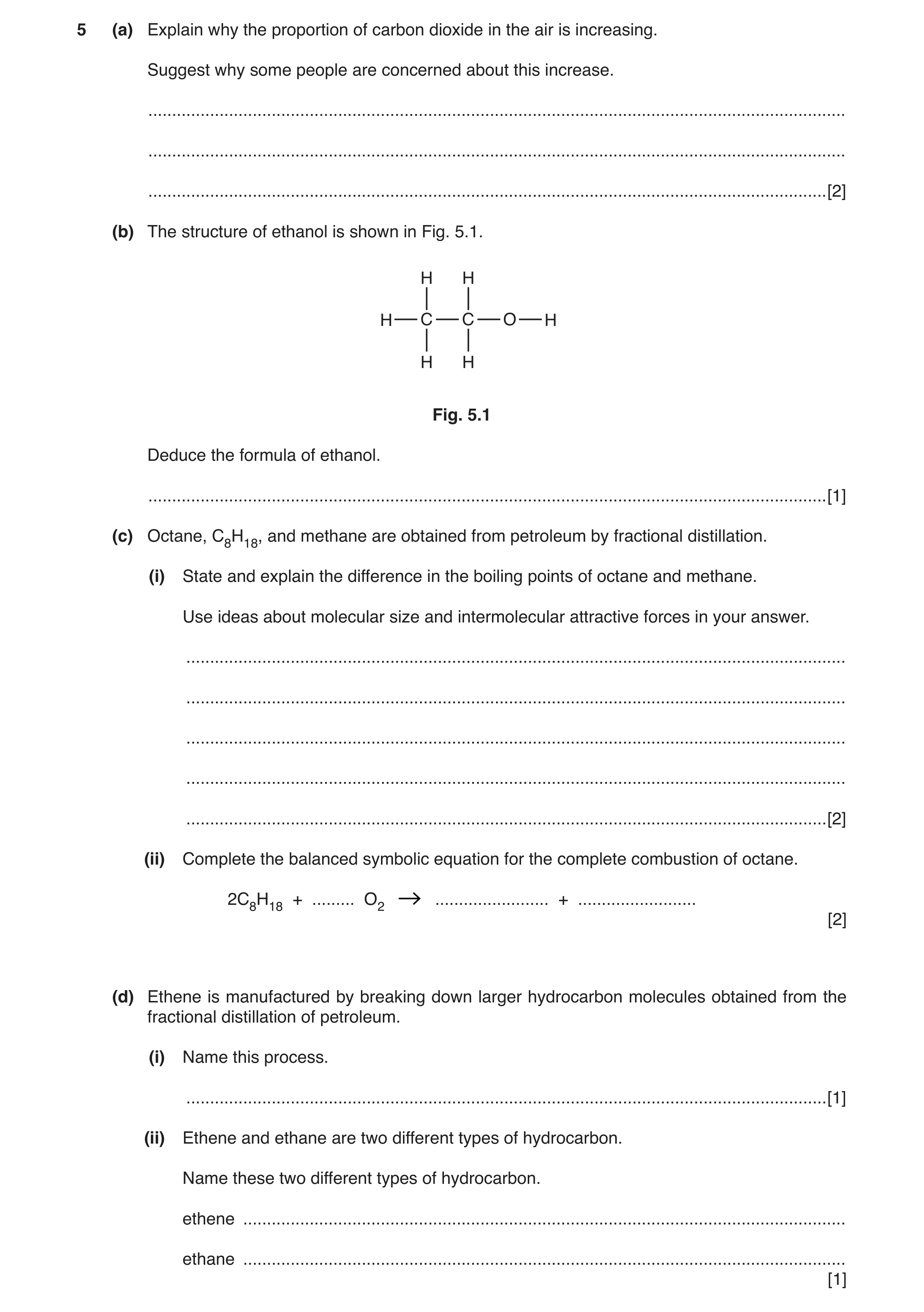
5 (a) Explain why the proportion of carbon dioxide in the air is increasing. Suggest why some people are concerned about this increase. … … … [2] (b) The structure of ethanol is shown in Fig. 5.1. H H H C C O H H H Fig. 5.1 Deduce the formula of ethanol. … [1] (c) Octane, C8H18, and methane are obtained from petroleum by fractional distillation. (i) State and explain the difference in the boiling points of octane and methane. Use ideas about molecular size and intermolecular attractive forces in your answer. … … … … … [2] (ii) Complete the balanced symbolic equation for the complete combustion of octane. 2C8H18 + … O2 … + … [2] (d) Ethene is manufactured by breaking down larger hydrocarbon molecules obtained from the fractional distillation of petroleum. (i) Name this process. … [1] (ii) Ethene and ethane are two different types of hydrocarbon. Name these two different types of hydrocarbon. ethene … ethane … [1]
9 marks
Mark scheme: 5(a) reference to use of (fossil) fuel / named fuel / industrialisation / deforestation ; global warming / any named effect of global warming ; 2 5(b) C2H5OH / C2H6O ; 1 5(c)(i) (octane has higher boiling point / ora) (octane has) larger molecules / ora ; (octane has ) greater intermolecular forces (of attraction) / ora ; 2 5(c)(ii) (2C8H18) + 25«(O2) → «16 CO2 + «18 H2O correct species ; balanced (dependent on correct species) ; 2 5(d)(i) cracking ; 1 5(d)(ii) (ethene) alkene / unsaturated and (ethane) alkane / saturated ; 1
This question in 0653/42 Oct/Nov 2017
Q7 · Petroleum is separated into useful fractions by fractional distillation 0653/42 Feb/March 2018
8 Petroleum is separated into useful fractions by fractional distillation. Process Y produces short alkene molecules from longer alkane molecules. These processes are shown in Fig. 8.1. fractional process Y powdered distillation fraction P solid catalyst column strong heat petroleum fraction Q Fig. 8.1 (a) Fraction P and fraction Q contain different compounds. Describe two of the differences between the compounds in fraction P and those in fraction Q. 1. … … 2. … … [2] (b) Name process Y. … [1] (c) The rate of reaction in process Y is increased by using a powdered solid catalyst and a high temperature. (i) State why the catalyst is used in the form of a powder. … … [1] (ii) Explain how a high temperature increases the rate of reaction in process Y. Use ideas about particles in your answer. … … [2] (d) Bromine is added to two different samples of hydrocarbons A and B. Hydrocarbon A decolourises the bromine. Hydrocarbon B has no effect on the bromine. State these two types of hydrocarbon. A … B … [1] (e) The combustion of hydrocarbons produces a gas that turns limewater milky. (i) State the formula of this gas. … [1] (ii) Suggest one concern that people have as the proportion of this gas is increasing in the air. … … [1]
9 marks
Mark scheme: 8(a) (fraction P) lower boiling point ; smaller molecules ; weaker intermolecular (attractive) forces ; greater flammability ; lower viscosity ; max2 8(b) (catalytic or thermal) cracking ; 1 8(c)(i) increases surface area ; 1 8(c)(ii) particles move faster / have greater kinetic energy ; particles collide (with the catalyst) more often ; 2 8(d) (A) alkene / unsaturated and (B) alkane / saturated ; 1 8(e)(i) CO2 ; 1 8(e)(ii) reference to global warming / excessive (runaway / enhanced) greenhouse effect / negative effects such as climate change / polar melting / rising sea levels / ocean acidification ; 1
This question in 0653/42 Feb/March 2018
Q8 · A simplified version of the carbon cycle 0653/42 May/June 2018
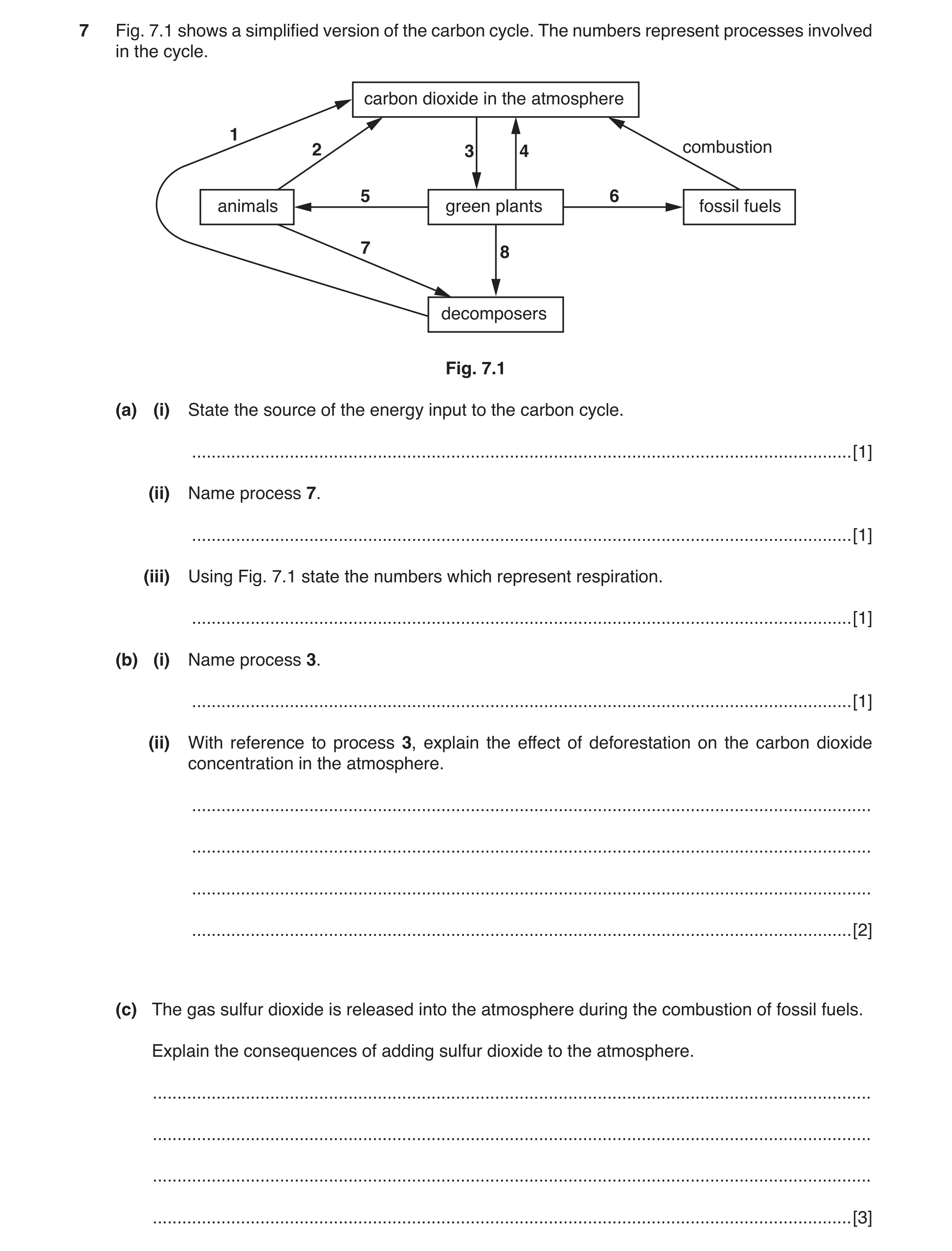
7 Fig. 7.1 shows a simplified version of the carbon cycle. The numbers represent processes involved in the cycle. carbon dioxide in the atmosphere 1 2 3 4 combustion 5 6 animals green plants fossil fuels 7 8 decomposers Fig. 7.1 (a) (i) State the source of the energy input to the carbon cycle. … [1] (ii) Name process 7. … [1] (iii) Using Fig. 7.1 state the numbers which represent respiration. … [1] (b) (i) Name process 3. … [1] (ii) With reference to process 3, explain the effect of deforestation on the carbon dioxide concentration in the atmosphere. … … … … [2] (c) The gas sulfur dioxide is released into the atmosphere during the combustion of fossil fuels. Explain the consequences of adding sulfur dioxide to the atmosphere. … … … … [3]
9 marks
Mark scheme: 7(a)(i) the Sun ; 1 7(a)(ii) death / egestion / excretion ; 1 7(a)(iii) 1, 2, 4 1 7(b)(i) photosynthesis ; 1 7(b)(ii) (concentration increases) less CO2 removed ; because photosynthesis reduced ; (CO2 continues to be) added to atmosphere by respiration / combustion ; max 2 7(c) dissolves in rainwater / owtte ; forms acid rain ; consequence of pollution by acid rain ; (e.g. harm to plants / animals / water courses damage to building materials) 3
This question in 0653/42 May/June 2018
Q9 · A student is investigating photosynthesis in an aquatic plant 0653/41 Oct/Nov 2018
7 A student is investigating photosynthesis in an aquatic plant. (a) Complete the balanced symbol equation for photosynthesis. … + … CO2 … + … O2 [2] (b) Fig. 7.1 shows the apparatus that the student uses in the investigation. after a few hours oxygen bubbles of oxygen test-tube water plant Fig. 7.1 The test-tube is full of water at the start. The apparatus is placed on a laboratory bench and left for a few hours. Explain why the water in the test-tube moves downwards in the test-tube in Fig. 7.1. … … [1] (c) The investigation is repeated in conditions of much greater light intensity. The apparatus is left for the same length of time as before. test-tube water plant Fig. 7.2 (i) On Fig. 7.2 draw a line to suggest the new level of water in the test-tube. [1] (ii) Explain your answer to (c)(i). … … [1] (d) (i) Explain why acid rain reduces the rate of photosynthesis in plants. … … [1] (ii) Describe two measures that can be taken to reduce acid rain. 1. … 2. … [2]
8 marks
Mark scheme: 7(a) 6H2O + 6(CO2) → C6H12O + 6(O2) 1 mark for correct formulae ; 1 mark for balanced (dependent on formulae) ; 2 7(b) oxygen / gas produced (by the plant and displaces water) ; 1 7(c)(i) line (meniscus) drawn on Fig.7.1 at a lower position than in Fig. 7.2 ; 1 7(c)(ii) reference to increased (rate of) photosynthesis ; 1 Question Answer Marks 7(d)(i) due to denaturation of enzymes / damage to leaves / increased soil toxicity ; 1 7(d)(ii) use cleaner / alternative energy sources / reduce usage of fossil fuels ; remove sulfur dioxide from factory emissions ; catalytic converters ; avp ; Max 2 2
This question in 0653/41 Oct/Nov 2018
Q10 · Rainforest is often cleared for agriculture by cutting down the trees and burning them 0653/43 Oct/Nov 2018
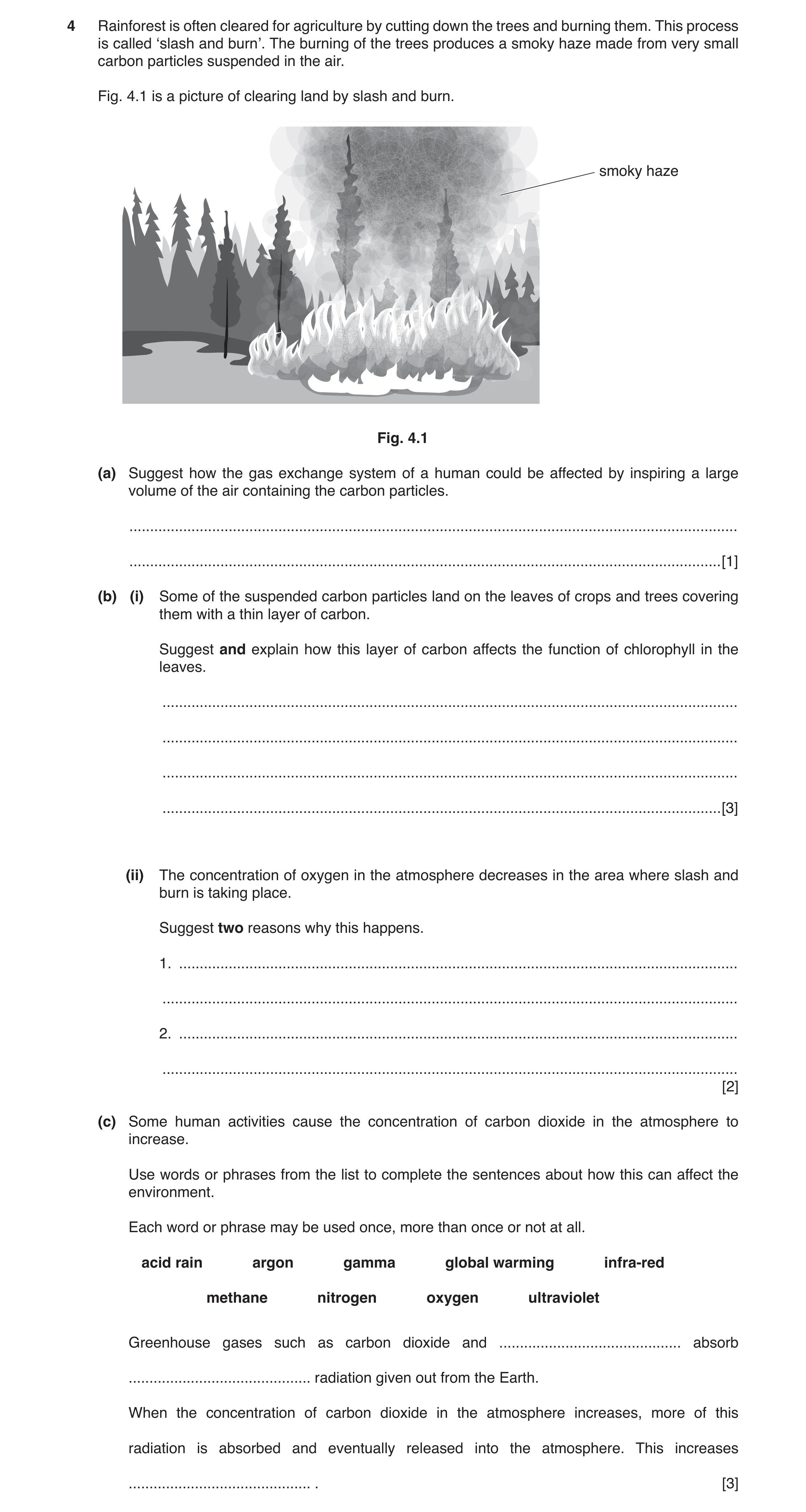
4 Rainforest is often cleared for agriculture by cutting down the trees and burning them. This process is called ‘slash and burn’. The burning of the trees produces a smoky haze made from very small carbon particles suspended in the air. Fig. 4.1 is a picture of clearing land by slash and burn. smoky haze Fig. 4.1 (a) Suggest how the gas exchange system of a human could be affected by inspiring a large volume of the air containing the carbon particles. … … [1] (b) (i) Some of the suspended carbon particles land on the leaves of crops and trees covering them with a thin layer of carbon. Suggest and explain how this layer of carbon affects the function of chlorophyll in the leaves. … … … … [3] (ii) The concentration of oxygen in the atmosphere decreases in the area where slash and burn is taking place. Suggest two reasons why this happens. 1. … … 2. … … [2] (c) Some human activities cause the concentration of carbon dioxide in the atmosphere to increase. Use words or phrases from the list to complete the sentences about how this can affect the environment. Each word or phrase may be used once, more than once or not at all. acid rain argon gamma global warming infra-red methane nitrogen oxygen ultraviolet Greenhouse gases such as carbon dioxide and … absorb … radiation given out from the Earth. When the concentration of carbon dioxide in the atmosphere increases, more of this radiation is absorbed and eventually released into the atmosphere. This increases … . [3]
9 marks
Mark scheme: 4(a) produces irritation / cough / more mucus production ; 1 4(b)(i) thin layer of carbon reduces the amount of light (energy) reaching leaves / chlorophyll ; (chlorophyll) traps less light (energy) ; less conversion to chemical energy ; reduces rate of photosynthesis ; Max 3 3 4(b)(ii) oxygen used during combustion (of wood) ; oxygen not produced by plants ; 2 4(c) methane ; infra-red ; global warming ; 3
This question in 0653/43 Oct/Nov 2018
Q11 · Hydrocarbons are composed of the two elements carbon and hydrogen 0653/41 Oct/Nov 2019
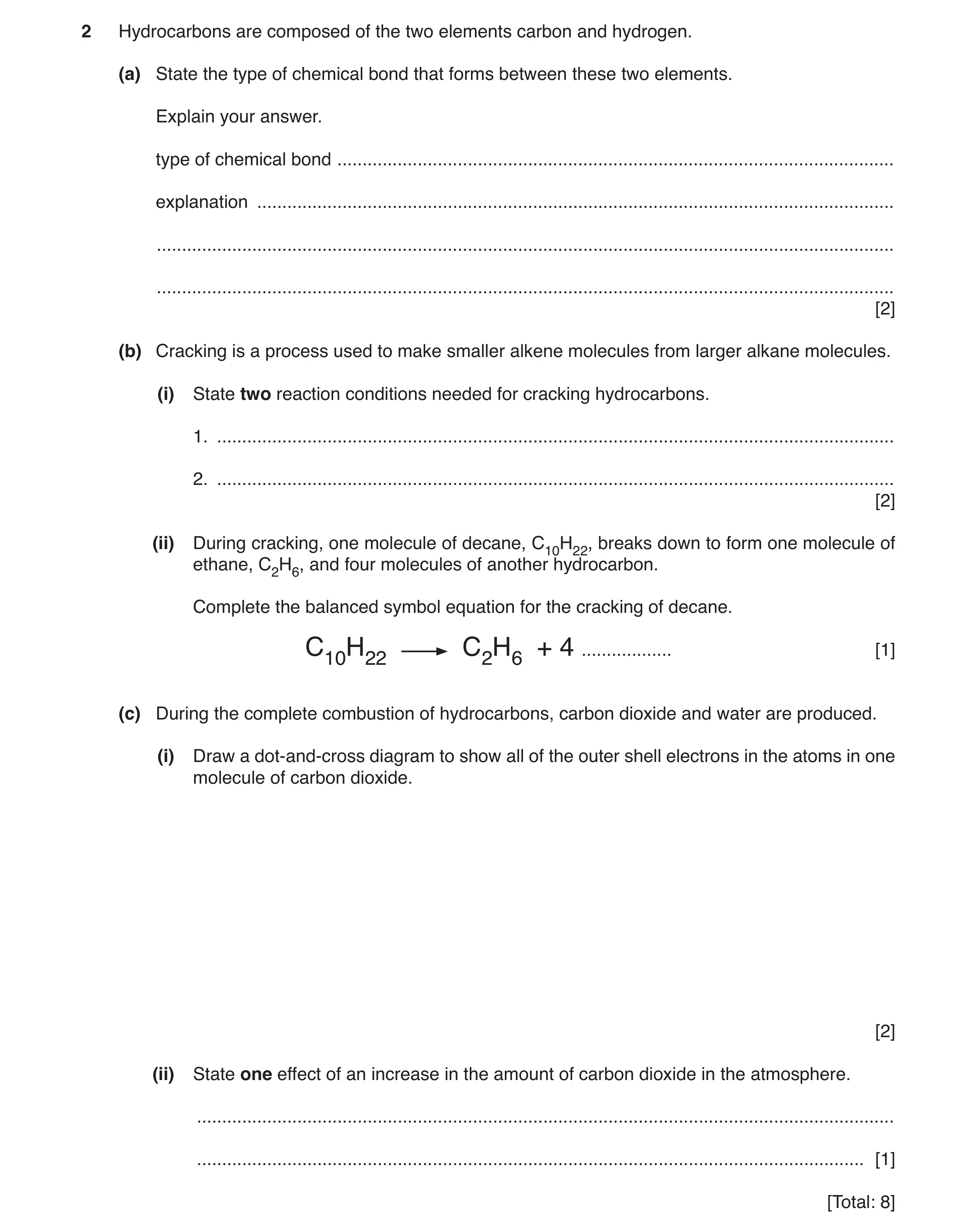
2 Hydrocarbons are composed of the two elements carbon and hydrogen. (a) State the type of chemical bond that forms between these two elements. Explain your answer. type of chemical bond … explanation … … … [2] (b) Cracking is a process used to make smaller alkene molecules from larger alkane molecules. (i) State two reaction conditions needed for cracking hydrocarbons. 1. … 2. … [2] (ii) During cracking, one molecule of decane, C10H22, breaks down to form one molecule of ethane, C2H6, and four molecules of another hydrocarbon. Complete the balanced symbol equation for the cracking of decane. … [1] C10H22 C2H6 + 4 (c) During the complete combustion of hydrocarbons, carbon dioxide and water are produced. (i) Draw a dot-and-cross diagram to show all of the outer shell electrons in the atoms in one molecule of carbon dioxide. [2] (ii) State one effect of an increase in the amount of carbon dioxide in the atmosphere. … … [1] [Total: 8]
8 marks
Mark scheme: 2(a) covalent ; bond between two non-metals ; 2 2(b)(i) heat / high temperature ; catalyst ; 2 2(b)(ii) (4) C2H4 ; 1 2(c)(i) one carbon atom and two oxygen atoms shown and correct electron distribution for carbon atom ; correct electron distribution for both oxygen atoms/lone pairs on both oxygen atoms ; 2 2(c)(ii) enhanced greenhouse effect / global warming / climate change / consequence of climate change ; 1
This question in 0653/41 Oct/Nov 2019
Q12 · The formula of methanol is CH3OH 0653/43 Oct/Nov 2019
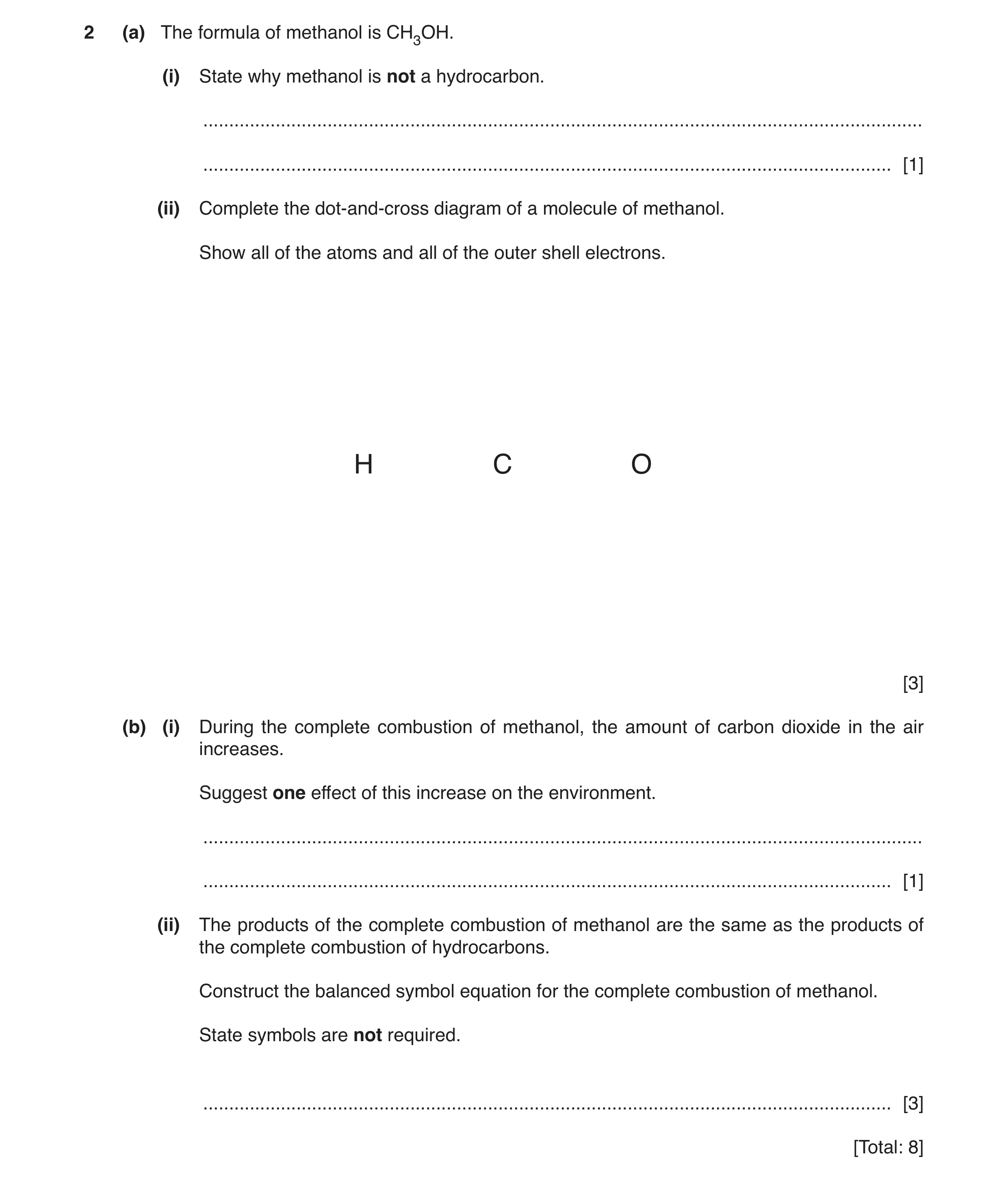
2 (a) The formula of methanol is CH3OH. (i) State why methanol is not a hydrocarbon. … … [1] (ii) Complete the dot-and-cross diagram of a molecule of methanol. Show all of the atoms and all of the outer shell electrons. H C O [3] (b) (i) During the complete combustion of methanol, the amount of carbon dioxide in the air increases. Suggest one effect of this increase on the environment. … … [1] (ii) The products of the complete combustion of methanol are the same as the products of the complete combustion of hydrocarbons. Construct the balanced symbol equation for the complete combustion of methanol. State symbols are not required. … [3] [Total: 8]
8 marks
Mark scheme: 2(a)(i) (methanol contains oxygen and) hydrocarbons contain only carbon atoms and hydrogen atoms ; 1 2(a)(ii) all hydrogen atoms correctly located ; correct electron distribution around carbon atom ; correct electron distribution around the oxygen atom ; 3 2(b)(i) enhanced greenhouse effect / global warming / climate change ; 1 2(b)(ii) 2CH3OH + 3O2 → 2CO2 + 4H2O correct formulae on LHS ; correct formulae on RHS ; correctly balanced ; 3
This question in 0653/43 Oct/Nov 2019
Q13 · The formula of methanol is CH3OH 0653/42 Feb/March 2020
2 (a) The formula of methanol is CH3OH. Complete the structure of a molecule of methanol. Include all atoms and all bonds. C O [1] (b) (i) Explain why methanol is not an alkane. … … [1] (ii) Explain why a molecule of methanol contains only covalent bonds. … … [1] (c) Methanol can be used as a fuel. It burns in oxygen and releases energy. (i) Complete the equation for the complete combustion of methanol. 2CH3OH + … … + … [2] (ii) The combustion of methanol is an exothermic reaction. Describe what is meant by exothermic. Use ideas about energy, bond breaking and bond forming in your answer. … … … [2] (d) Methane is a greenhouse gas. State one effect of increased levels of greenhouse gases in the atmosphere. … … [1] [Total: 8]
8 marks
Mark scheme: 2(a) ; 2(b)(i) contains oxygen / is not carbon and hydrogen only ; 1 2(b)(ii) all bonds are between non-metal atoms ; 1 2(c)(i) (2CH3OH +) 3O2 → 2CO2 + 4H2O all formulae correct ; (correct formulae) balanced ; 2 Question Answer Marks 2(c)(ii) idea that energy is taken in to break bonds / that energy is released when bonds form ; (exothermic means) energy released is greater (than taken in) / (during an exothermic reaction) temperature increases / chemical energy converted to thermal ; 2 2(d) global warming / climate change / consequence of climate change, e.g. extreme weather events / rising sea level ; 1
This question in 0653/42 Feb/March 2020
Q14 · The formula of methanol is CH3OH 0653/41 May/June 2020
2 The formula of methanol is CH3OH. (a) Explain why methanol is not a hydrocarbon. … … [1] (b) (i) Complete the dot-and-cross diagram for a molecule of methanol. C O [2] (ii) Explain why a molecule of methanol contains only covalent bonds. … … [1] (c) Methanol is used as a fuel because it burns in oxygen. Complete the equation for the complete combustion of methanol. 2CH3OH + … … + … [2] (d) Fig. 2.1 shows the energy level diagram for the complete combustion of methanol. X energy progress of reaction Fig. 2.1 (i) On Fig. 2.1, write the words reactants and products in suitable places. [1] (ii) State what the energy value X on Fig. 2.1 represents. … [1] (e) During the combustion of methanol, the amount of carbon dioxide in the atmosphere increases. Suggest one effect of this increase. … … [1] [Total: 9]
9 marks
Mark scheme: 2(a) contains oxygen / is not just carbon and hydrogen ; 1 2(b)(i) correct electrons around carbon atom ; correct electrons around oxygen atom ; 2 2(b)(ii) all atoms are non-metallic elements ; 1 Question Answer Marks 2(c) (2CH3OH) + 3O2 → 2CO2 + 4H2O correct formulae ; correctly balanced ; 2 2(d)(i) reactants on left and products on right ; 1 2(d)(ii) activation energy ; 1 2(e) (carbon dioxide is a greenhouse gas) so enhanced greenhouse effect / global warming / climate change / example of an effect of climate change ; 1
This question in 0653/41 May/June 2020
Q15 · The equation for the reaction between magnesium carbonate and dilute hydrochloric acid is… 0653/42 May/June 2020
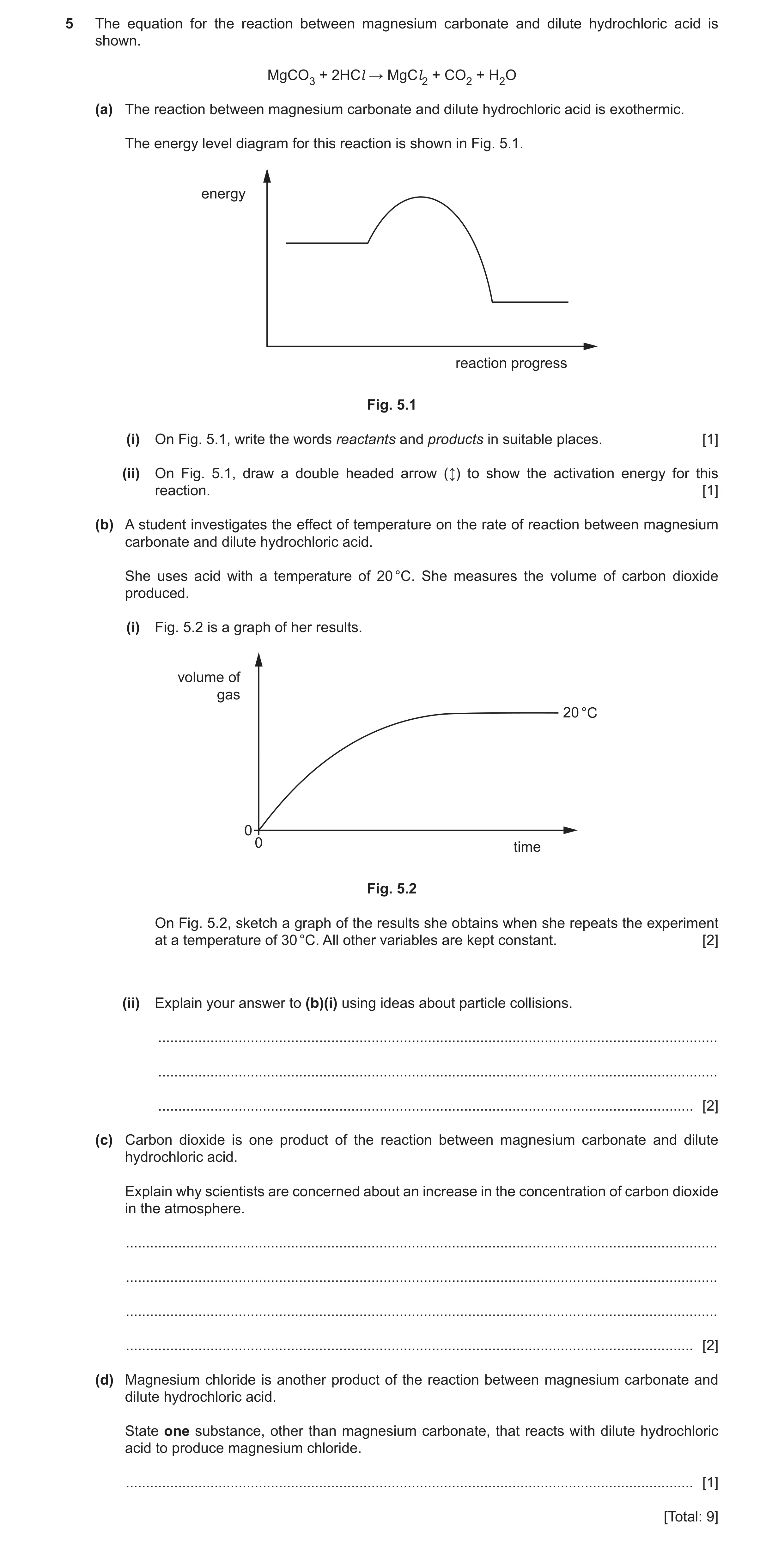
5 The equation for the reaction between magnesium carbonate and dilute hydrochloric acid is shown. MgCO3 + 2HCl → MgCl2 + CO2 + H2O (a) The reaction between magnesium carbonate and dilute hydrochloric acid is exothermic. The energy level diagram for this reaction is shown in Fig. 5.1. energy reaction progress Fig. 5.1 (i) On Fig. 5.1, write the words reactants and products in suitable places. [1] (ii) On Fig. 5.1, draw a double headed arrow (↕) to show the activation energy for this reaction. [1] (b) A student investigates the effect of temperature on the rate of reaction between magnesium carbonate and dilute hydrochloric acid. She uses acid with a temperature of 20 °C. She measures the volume of carbon dioxide produced. (i) Fig. 5.2 is a graph of her results. volume of gas 20 °C 0 0 time Fig. 5.2 On Fig. 5.2, sketch a graph of the results she obtains when she repeats the experiment at a temperature of 30 °C. All other variables are kept constant. [2] (ii) Explain your answer to (b)(i) using ideas about particle collisions. … … … [2] (c) Carbon dioxide is one product of the reaction between magnesium carbonate and dilute hydrochloric acid. Explain why scientists are concerned about an increase in the concentration of carbon dioxide in the atmosphere. … … … … [2] (d) Magnesium chloride is another product of the reaction between magnesium carbonate and dilute hydrochloric acid. State one substance, other than magnesium carbonate, that reacts with dilute hydrochloric acid to produce magnesium chloride. … [1] [Total: 9]
9 marks
Mark scheme: 5(a)(i) reactants on left and products on right ; 1 5(a)(ii) activation energy correctly identified ; 1 5(b)(i) steeper ; finish at same volume ; 2 5(b)(ii) particles move faster / have more kinetic energy / move more ; particles collide more frequently / more energetically ; 2 5(c) carbon dioxide is a greenhouse gas ; (which contributes to) enhanced greenhouse effect / global warming / climate change ; 2 5(d) magnesium / magnesium oxide / magnesium hydroxide ; 1
This question in 0653/42 May/June 2020
Q16 · A simplified diagram of the fractional distillation of petroleum 0653/41 Oct/Nov 2020
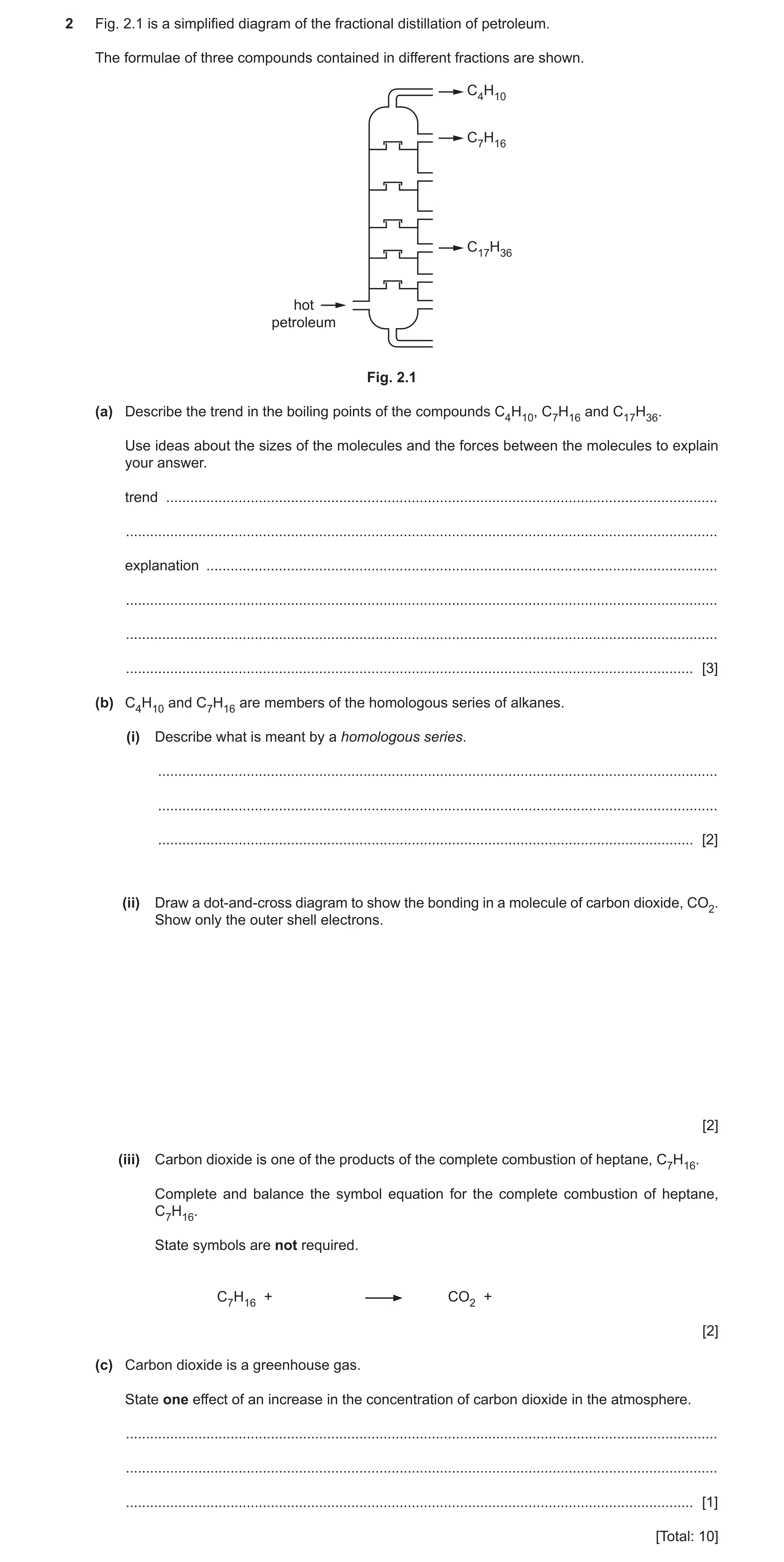
2 Fig. 2.1 is a simplified diagram of the fractional distillation of petroleum. The formulae of three compounds contained in different fractions are shown. C4H10 C7H16 C17H36 hot petroleum Fig. 2.1 (a) Describe the trend in the boiling points of the compounds C4H10, C7H16 and C17H36. Use ideas about the sizes of the molecules and the forces between the molecules to explain your answer. trend … … explanation … … … … [3] (b) C4H10 and C7H16 are members of the homologous series of alkanes. (i) Describe what is meant by a homologous series. … … … [2] (ii) Draw a dot-and-cross diagram to show the bonding in a molecule of carbon dioxide, CO2. Show only the outer shell electrons. [2] (iii) Carbon dioxide is one of the products of the complete combustion of heptane, C7H16. Complete and balance the symbol equation for the complete combustion of heptane, C7H16. State symbols are not required. C7H16 + CO2 + [2] (c) Carbon dioxide is a greenhouse gas. State one effect of an increase in the concentration of carbon dioxide in the atmosphere. … … … [1] [Total: 10]
10 marks
Mark scheme: 2(a) trend: boiling point increases ; explanation: molecules are larger ; stronger (intermolecular) forces ; 2(b)(i) (family of compounds with) the same general formula ; similar chemical properties ; 2 2(b)(ii) two double bonds shown ; all else correct including chemical symbols ; 2 Question Answer Marks 2(b)(iii) (C7H16) + 11 O2 → 7 (CO2) + 8 H2O all formulae correct ; balanced correctly dependent on correct formulae ; 2 2(c) global warming / enhanced greenhouse effect / climate change / consequence of climate change ; 1
This question in 0653/41 Oct/Nov 2020
Q17 · When 1 g of copper carbonate powder is added to excess dilute hydrochloric acid, aqueous… 0653/42 Oct/Nov 2020
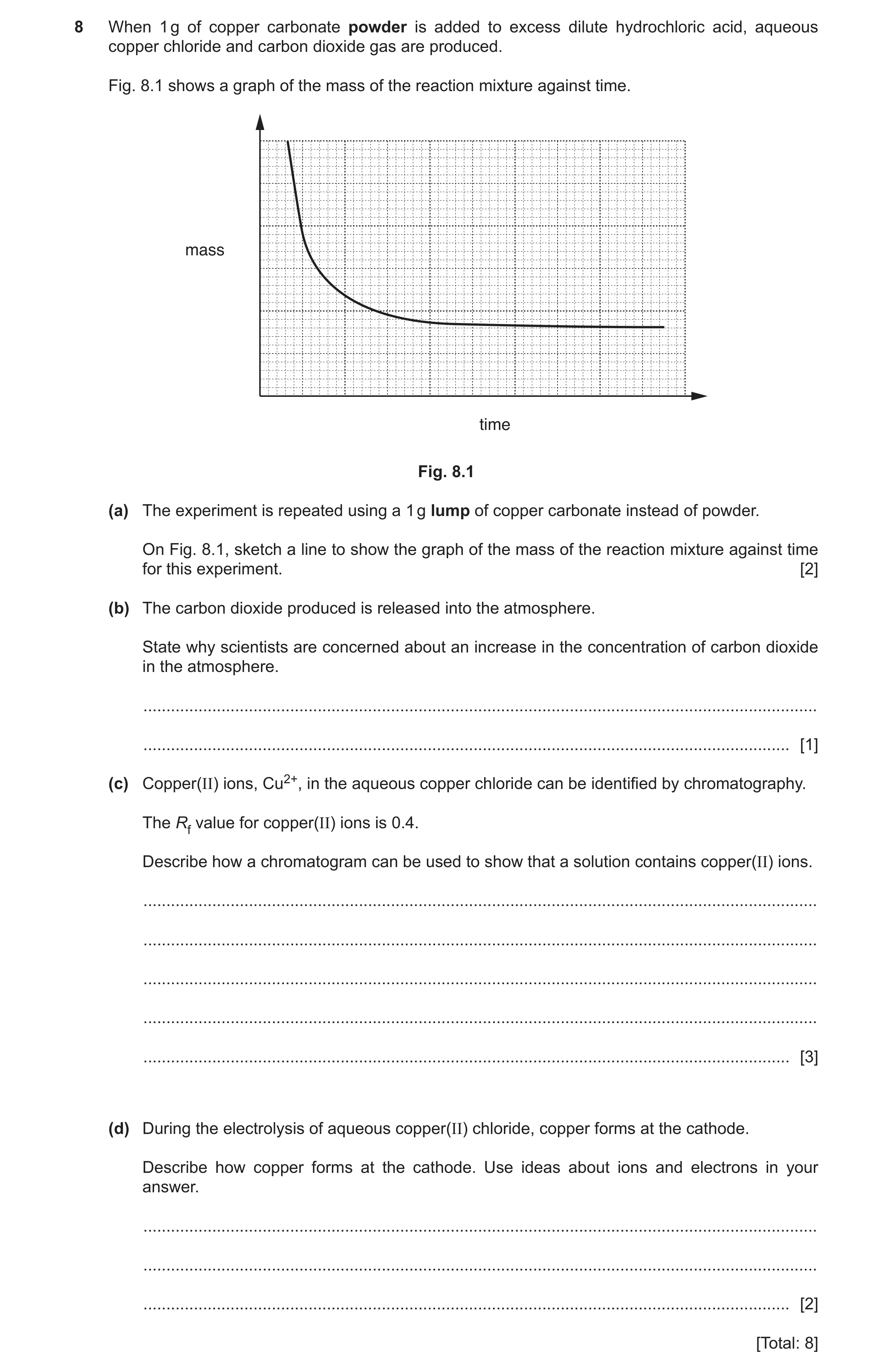
8 When 1 g of copper carbonate powder is added to excess dilute hydrochloric acid, aqueous copper chloride and carbon dioxide gas are produced. Fig. 8.1 shows a graph of the mass of the reaction mixture against time. mass time Fig. 8.1 (a) The experiment is repeated using a 1 g lump of copper carbonate instead of powder. On Fig. 8.1, sketch a line to show the graph of the mass of the reaction mixture against time for this experiment. [2] (b) The carbon dioxide produced is released into the atmosphere. State why scientists are concerned about an increase in the concentration of carbon dioxide in the atmosphere. … … [1] (c) Copper(II) ions, Cu2+, in the aqueous copper chloride can be identified by chromatography. The Rf value for copper(II) ions is 0.4. Describe how a chromatogram can be used to show that a solution contains copper(II) ions. … … … … … [3] (d) During the electrolysis of aqueous copper(II) chloride, copper forms at the cathode. Describe how copper forms at the cathode. Use ideas about ions and electrons in your answer. … … … [2] [Total: 8]
8 marks
Mark scheme: 8(a) line with shallower gradient showing slower rate of reaction ; line starting and finishing at same mass ; 2 8(b) enhanced greenhouse effect / global warming / example of a consequence of climate change ; 1 8(c) measure distance to spot (from base line) ; measure distance to solvent front (from base line) ; show that Rf = distance to spot ÷ distance to solvent front = 0.4 ; 3 8(d) idea of electrons gained by copper ions ; two electrons gained (per ion) / ions discharged ; 2
This question in 0653/42 Oct/Nov 2020
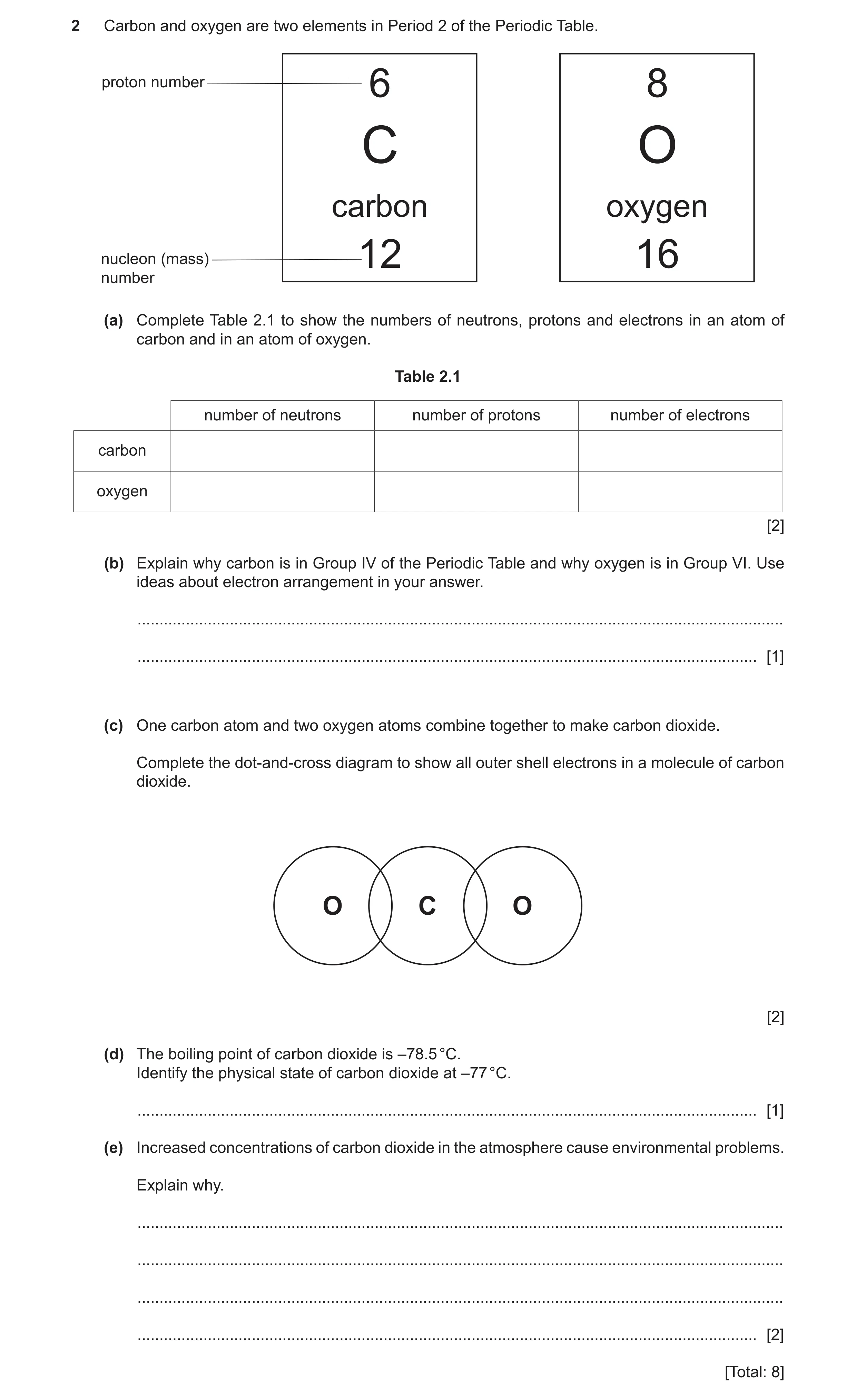
Q18 · Carbon and oxygen are two elements in Period 2 of the Periodic Table 0653/42 Feb/March 2021
2 Carbon and oxygen are two elements in Period 2 of the Periodic Table. proton number 6 8 C O carbon oxygen nucleon (mass) 12 16 number (a) Complete Table 2.1 to show the numbers of neutrons, protons and electrons in an atom of carbon and in an atom of oxygen. Table 2.1 number of neutrons number of protons number of electrons carbon oxygen [2] (b) Explain why carbon is in Group IV of the Periodic Table and why oxygen is in Group VI. Use ideas about electron arrangement in your answer. … … [1] (c) One carbon atom and two oxygen atoms combine together to make carbon dioxide. Complete the dot-and-cross diagram to show all outer shell electrons in a molecule of carbon dioxide. O C O [2] (d) The boiling point of carbon dioxide is –78.5 °C. Identify the physical state of carbon dioxide at –77 °C. … [1] (e) Increased concentrations of carbon dioxide in the atmosphere cause environmental problems. Explain why. … … … … [2] [Total: 8]
8 marks
Mark scheme: 2(a) number of neutrons number of protons number of electrons 6 6 6 8 8 8 ;; one mark neutrons correct second mark protons and electrons correct 2 2(b) carbon has 4 outer shell electrons and oxygen has 6 ; 1 Question Answer Marks 2(c) four bonding electrons shown between carbon and each oxygen ; (dependent on MP1) rest of molecule correct ; 2 2(d) gas ; 1 2(e) one point from: CO2 is a greenhouse gas / causes enhanced greenhouse effect / causes atmosphere to heat up / traps excess heat in atmosphere / causes global warming ; and one point from: climate change ; extreme weather events / named example, e.g. hurricanes ; sea level rise / flooding (of coastal areas) ; polar ice caps melt ; 2
This question in 0653/42 Feb/March 2021
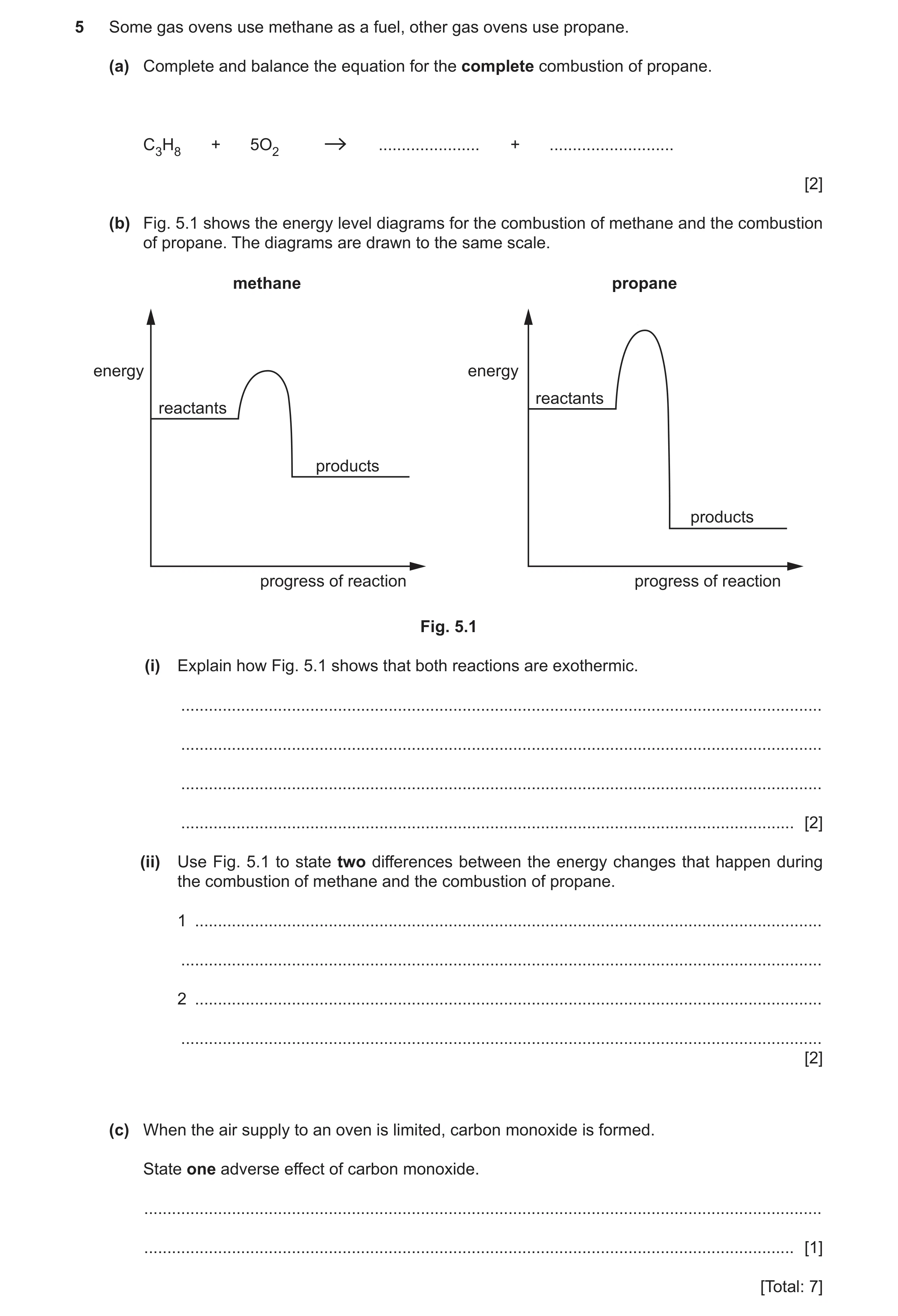
Q19 · Some gas ovens use methane as a fuel, other gas ovens use propane 0653/41 May/June 2021
5 Some gas ovens use methane as a fuel, other gas ovens use propane. (a) Complete and balance the equation for the complete combustion of propane. C3H8 + 5O2 … + … [2] (b) Fig. 5.1 shows the energy level diagrams for the combustion of methane and the combustion of propane. The diagrams are drawn to the same scale. methane propane energy energy reactants reactants products products progress of reaction progress of reaction Fig. 5.1 (i) Explain how Fig. 5.1 shows that both reactions are exothermic. … … … … [2] (ii) Use Fig. 5.1 to state two differences between the energy changes that happen during the combustion of methane and the combustion of propane. 1 … … 2 … … [2] (c) When the air supply to an oven is limited, carbon monoxide is formed. State one adverse effect of carbon monoxide. … … [1] [Total: 7]
7 marks
Mark scheme: 5(a) CO2 AND H2O given as products ; balanced equation 3CO2 + 4H2O ; 2 5(b)(i) (in both reactions) energy is given out ; energy change is negative / energy of the products is lower than energy of the reactants OWTTE ; 2 5(b)(ii) propane has a higher activation energy ; propane gives out more energy / gives a more exothermic reaction ; 2 5(c) toxic / poisonous ; 1
This question in 0653/41 May/June 2021
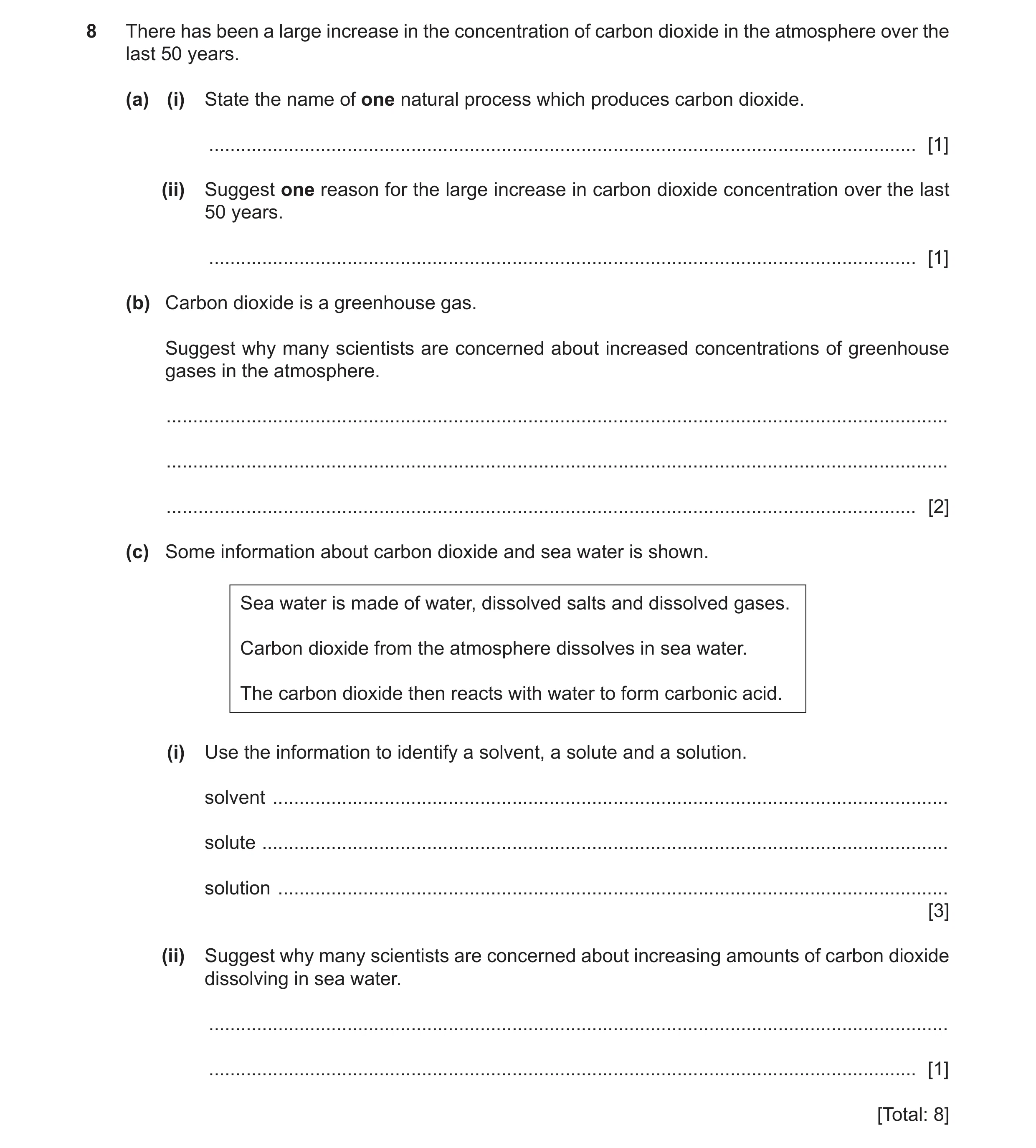
Q20 · There has been a large increase in the concentration of carbon dioxide in the atmosphere… 0653/42 Oct/Nov 2021
8 There has been a large increase in the concentration of carbon dioxide in the atmosphere over the last 50 years. (a) (i) State the name of one natural process which produces carbon dioxide. … [1] (ii) Suggest one reason for the large increase in carbon dioxide concentration over the last 50 years. … [1] (b) Carbon dioxide is a greenhouse gas. Suggest why many scientists are concerned about increased concentrations of greenhouse gases in the atmosphere. … … … [2] (c) Some information about carbon dioxide and sea water is shown. Sea water is made of water, dissolved salts and dissolved gases. Carbon dioxide from the atmosphere dissolves in sea water. The carbon dioxide then reacts with water to form carbonic acid. (i) Use the information to identify a solvent, a solute and a solution. solvent … solute … solution … [3] (ii) Suggest why many scientists are concerned about increasing amounts of carbon dioxide dissolving in sea water. … … [1] [Total: 8]
8 marks
Mark scheme: 8(a)(i) respiration / AVP ; 1 8(a)(ii) combustion of fossil fuels / AVP ; 1 8(b) causes enhanced greenhouse effect / global warming ; leads to, climate change / named harmful effect of climate change e.g. sea level rise ; 2 8(c)(i) solvent: water ; solute: salts / gases ; solution: carbonic acid / sea (water) ; 3 8(c)(ii) seas are becoming more acidic / acidification / named harmful effect ; 1
This question in 0653/42 Oct/Nov 2021
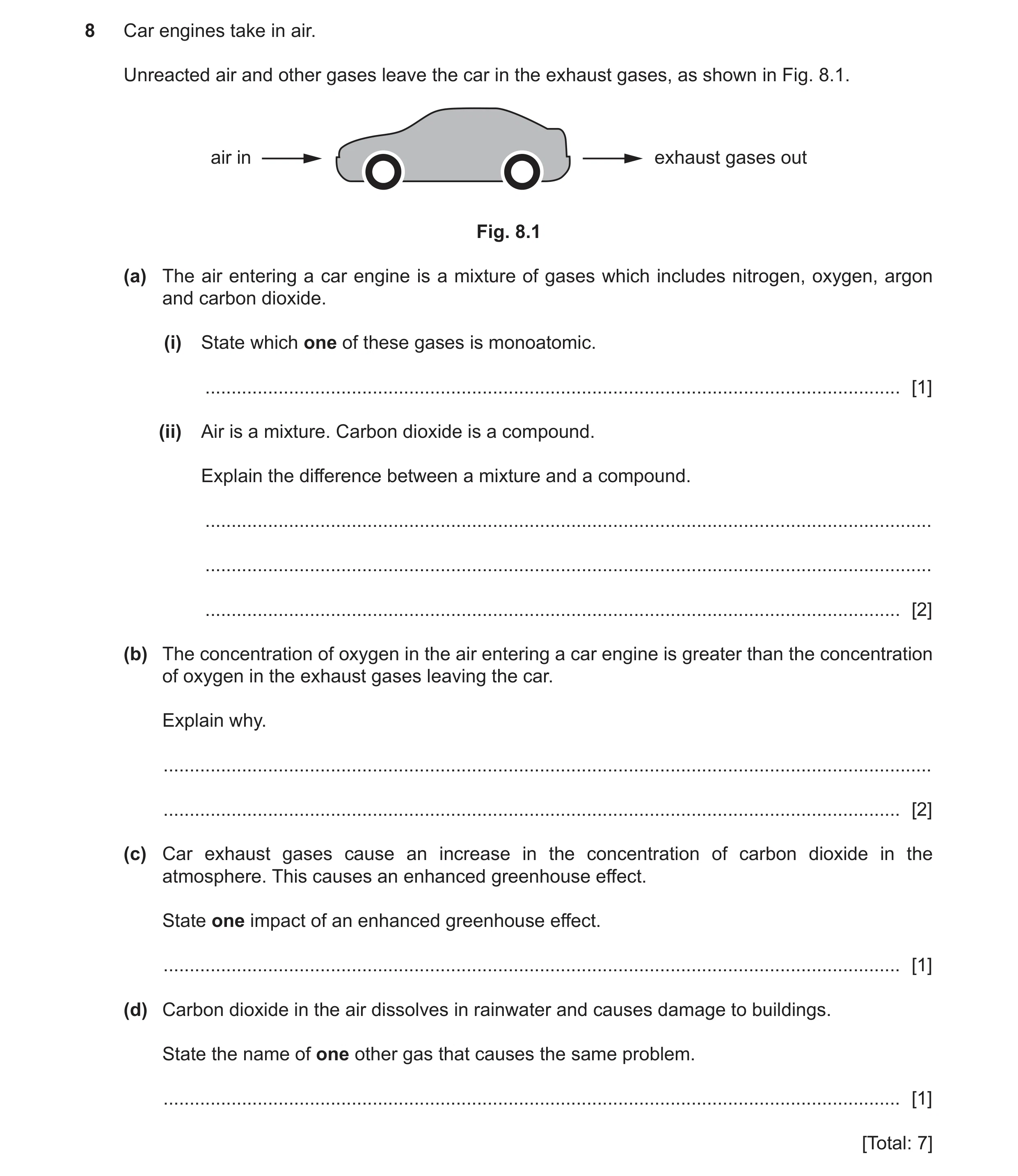
Q21 · Car engines take in air 0653/43 Oct/Nov 2022
8 Car engines take in air. Unreacted air and other gases leave the car in the exhaust gases, as shown in Fig. 8.1. air in exhaust gases out Fig. 8.1 (a) The air entering a car engine is a mixture of gases which includes nitrogen, oxygen, argon and carbon dioxide. (i) State which one of these gases is monoatomic. … [1] (ii) Air is a mixture. Carbon dioxide is a compound. Explain the difference between a mixture and a compound. … … … [2] (b) The concentration of oxygen in the air entering a car engine is greater than the concentration of oxygen in the exhaust gases leaving the car. Explain why. … … [2] (c) Car exhaust gases cause an increase in the concentration of carbon dioxide in the atmosphere. This causes an enhanced greenhouse effect. State one impact of an enhanced greenhouse effect. … [1] (d) Carbon dioxide in the air dissolves in rainwater and causes damage to buildings. State the name of one other gas that causes the same problem. … [1] [Total: 7]
7 marks
Mark scheme: 8(a)(i) argon ; 1 8(a)(ii) the relative amounts of constituents can be changed in a mixture ; 2 the relative amounts of constituents are fixed in a compound ; OR a mixture contains two or more substances not combined / joined / bonded ; a compound contains two or more elements chemically combined / joined / bonded ; OR mixtures maintain the properties of constituents ; compounds have properties different to those of the elements it contains ; 8(b) (oxygen) is used in the, combustion / burning ; 2 of, fuel / carbon compounds / hydrocarbons ; 8(c) climate change / named environmental impact due to climate change ; 1 8(d) sulfur dioxide ; 1
This question in 0653/43 Oct/Nov 2022
Q22 · Information on the percentage composition of the atmosphere of the planet Mars 0653/41 Oct/Nov 2023
8 Table 8.1 gives information on the percentage composition of the atmosphere of the planet Mars. Table 8.1 gas percentage of the atmosphere of Mars carbon dioxide 95.0 nitrogen 1.9 argon 1.9 (a) (i) State how Table 8.1 shows that the atmosphere of Mars contains gases that are not listed in Table 8.1. … … [1] (ii) Describe how the percentage composition of the atmosphere of Earth is different from that of Mars. … … … … [3] (b) The bonding in carbon dioxide and nitrogen is represented in Fig. 8.1. O C O N N carbon dioxide nitrogen Fig. 8.1 (i) State the number of electrons that are shared between atoms in one molecule of nitrogen. … [1] (ii) Complete Fig. 8.2 to show the dot-and-cross diagram for carbon dioxide. Show only the outer shell electrons. O C O Fig. 8.2 [2] (iii) The percentage of carbon dioxide in Earth’s atmosphere is increasing. State how this affects the environment. … … … [2] [Total: 9]
9 marks
Mark scheme: 8(a)(i) the values, only add to 98.8% / do not add up to 100% ; 1 8(a)(ii) any three from: 3 Earth has (a significant amount of), oxygen / water vapour ; Earth has less carbon dioxide ; Earth has more nitrogen ; Earth has less argon ; 8(b)(i) 6 ; 1 8(b)(ii) 2 bonding electrons correct ; non-bonding electrons correct ; 8(b)(iii) (causes) enhanced greenhouse effect ; 2 leading to, climate change / stated outcome of climate change, e.g. sea level rise, melting of ice caps, extreme weather events, flooding, crop failure ;
This question in 0653/41 Oct/Nov 2023
Q23 · Information on the percentage composition of the atmosphere of the planet Mars 0653/43 Oct/Nov 2023
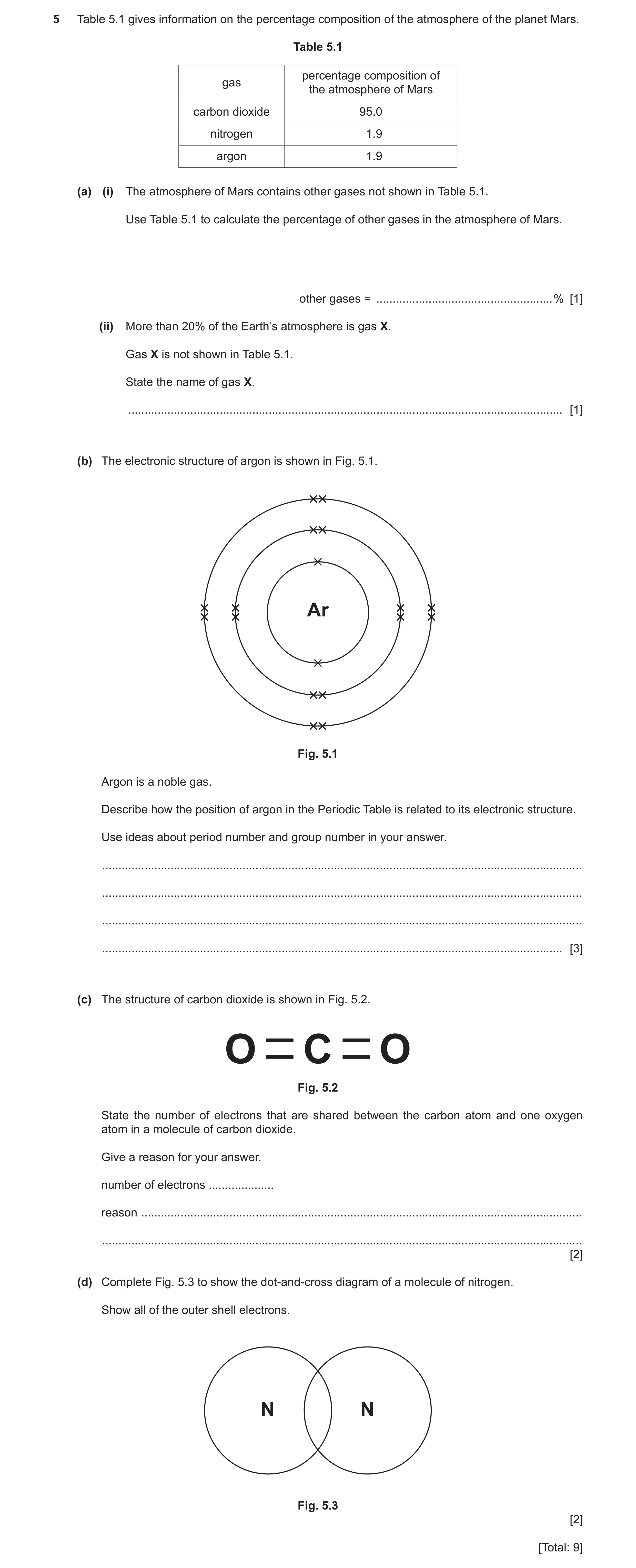
5 Table 5.1 gives information on the percentage composition of the atmosphere of the planet Mars. Table 5.1 percentage composition of gas the atmosphere of Mars carbon dioxide 95.0 nitrogen 1.9 argon 1.9 (a) (i) The atmosphere of Mars contains other gases not shown in Table 5.1. Use Table 5.1 to calculate the percentage of other gases in the atmosphere of Mars. other gases = … % [1] (ii) More than 20% of the Earth’s atmosphere is gas X. Gas X is not shown in Table 5.1. State the name of gas X. … [1] (b) The electronic structure of argon is shown in Fig. 5.1. Ar Fig. 5.1 Argon is a noble gas. Describe how the position of argon in the Periodic Table is related to its electronic structure. Use ideas about period number and group number in your answer. … … … … [3] (c) The structure of carbon dioxide is shown in Fig. 5.2. Fig. 5.2 State the number of electrons that are shared between the carbon atom and one oxygen atom in a molecule of carbon dioxide. Give a reason for your answer. number of electrons … reason … … [2] (d) Complete Fig. 5.3 to show the dot‑and‑cross diagram of a molecule of nitrogen. Show all of the outer shell electrons. N N Fig. 5.3 [2] [Total: 9]
9 marks
Mark scheme: 5(a)(i) 1.2 (%) ; 1 5(a)(ii) oxygen ; 1 5(b) in Group VIII AND period 3 ; 3 in VIII because 8 electrons in outer shell ; period 3 because 3 shells ; 5(c) 4 ; 2 it has a double bond / 2 electrons in each bond / 2 pairs of electrons are shared / oxygen shares 2 electrons and carbon shares 2 electrons ; 5(d) 2 bonding electrons correct ; non-bonding electons correct ;
This question in 0653/43 Oct/Nov 2023
Q24 · Nitrogen and oxygen react together in a car engine to make nitrogen monoxide, NO 0653/41 May/June 2024
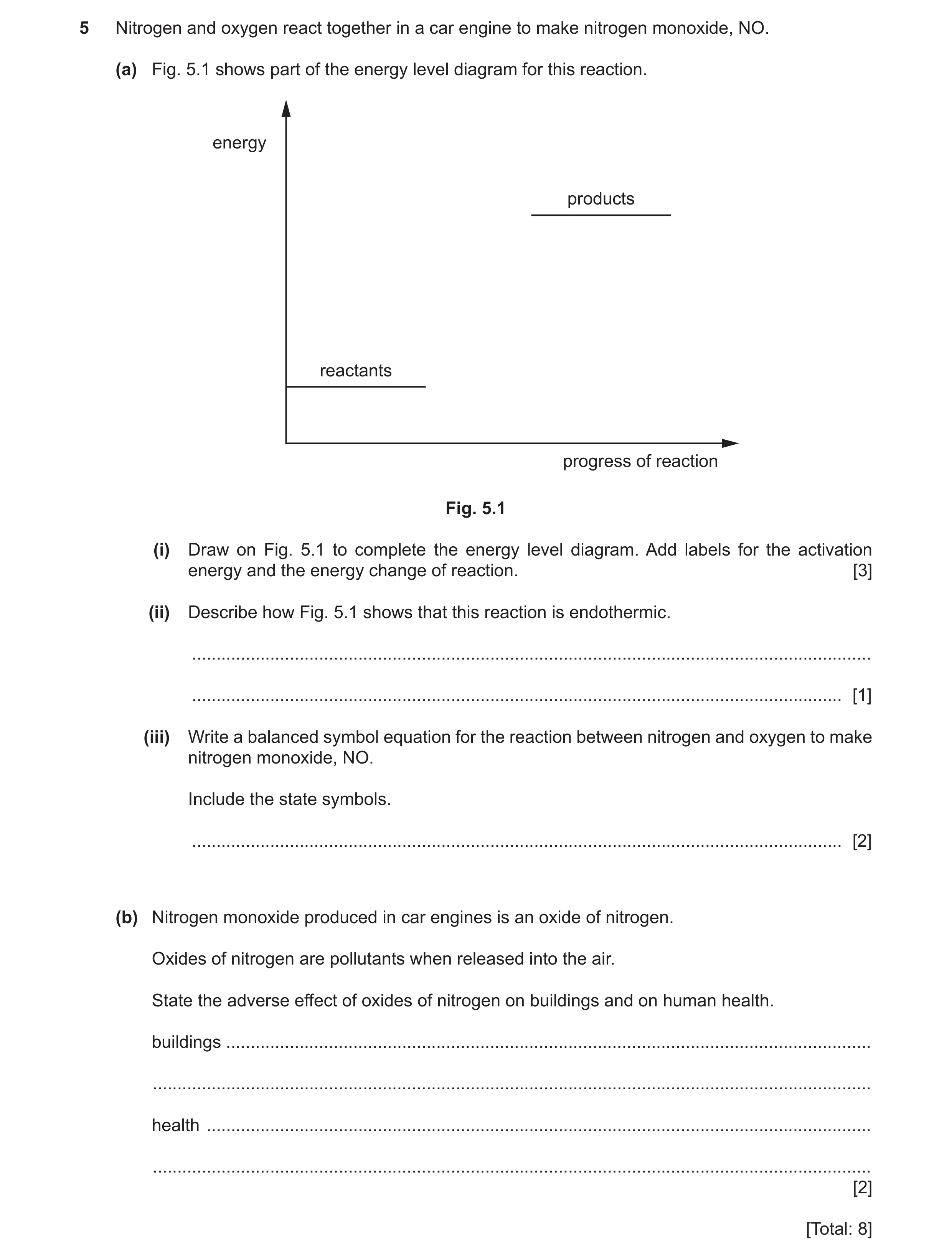
5 Nitrogen and oxygen react together in a car engine to make nitrogen monoxide, NO. (a) Fig. 5.1 shows part of the energy level diagram for this reaction. energy products reactants progress of reaction Fig. 5.1 (i) Draw on Fig. 5.1 to complete the energy level diagram. Add labels for the activation energy and the energy change of reaction. [3] (ii) Describe how Fig. 5.1 shows that this reaction is endothermic. … … [1] (iii) Write a balanced symbol equation for the reaction between nitrogen and oxygen to make nitrogen monoxide, NO. Include the state symbols. … [2] (b) Nitrogen monoxide produced in car engines is an oxide of nitrogen. Oxides of nitrogen are pollutants when released into the air. State the adverse effect of oxides of nitrogen on buildings and on human health. buildings … … health … … [2] [Total: 8]
8 marks
Mark scheme: 5(a)(i) activation energy shown as a maximum between reactants and products ; activation energy labelled correctly ; energy change of reaction labelled with upwards arrow ; 5(a)(ii) products are at a higher energy level than reactants / products have more energy than reactants / ORA ; 1 5(a)(iii) N2 (g) + O2 (g) → 2NO (g) ; ; correctly balanced equation = (1) state symbols (g) (g) (g) = (1) 2 Question Answer Marks 5(b) buildings: the idea of (chemical) reaction with, metal / building materials ; health: adverse effect on, heart / lungs / breathing ; 2
This question in 0653/41 May/June 2024
Q25 · Carbon dioxide is a greenhouse gas 0653/41 Oct/Nov 2024
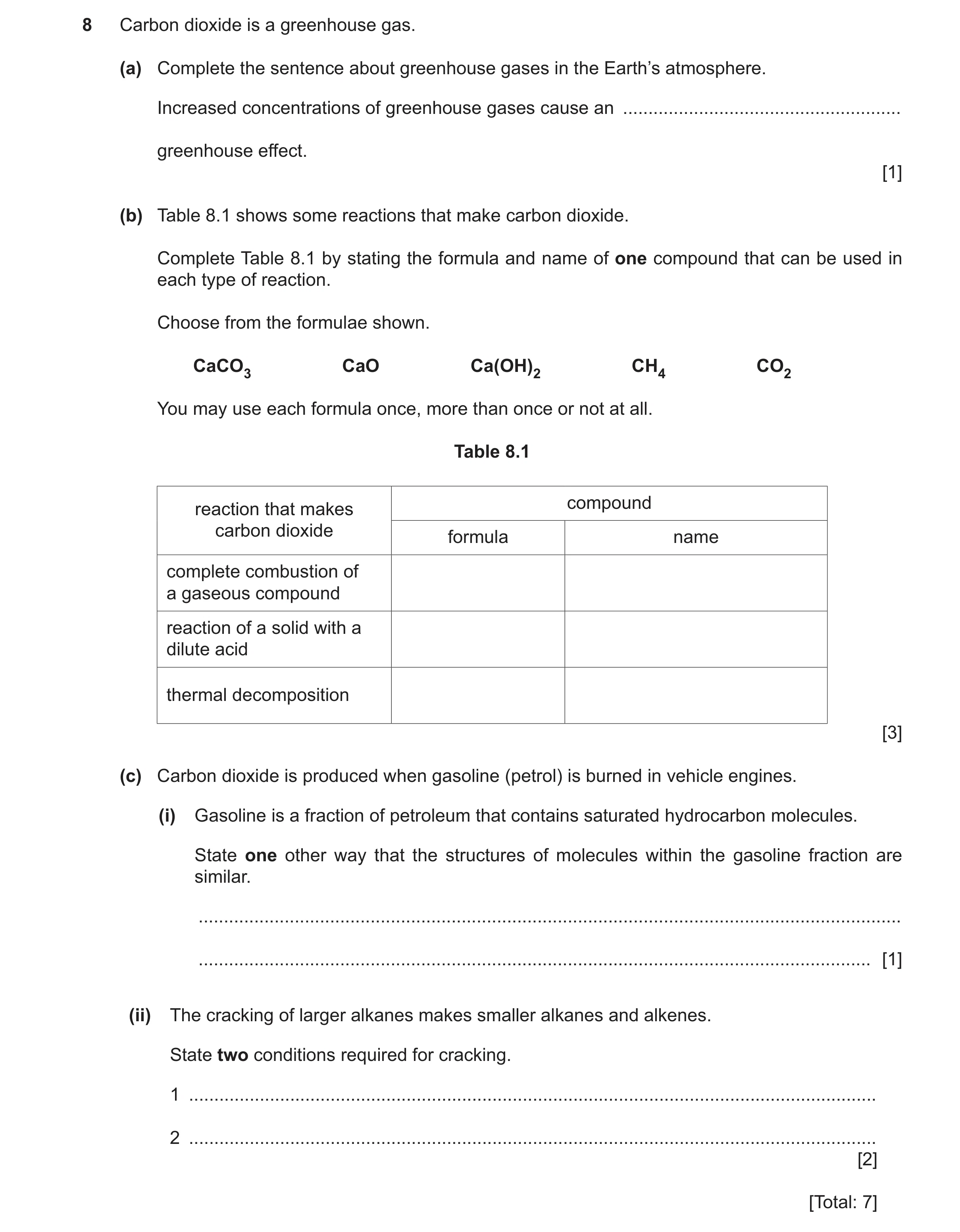
8 Carbon dioxide is a greenhouse gas. (a) Complete the sentence about greenhouse gases in the Earth’s atmosphere. Increased concentrations of greenhouse gases cause an … greenhouse effect. [1] (b) Table 8.1 shows some reactions that make carbon dioxide. Complete Table 8.1 by stating the formula and name of one compound that can be used in each type of reaction. Choose from the formulae shown. CaCO3 CaO Ca(OH)2 CH4 CO2 You may use each formula once, more than once or not at all. Table 8.1 compound reaction that makes carbon dioxide formula name complete combustion of a gaseous compound reaction of a solid with a dilute acid thermal decomposition [3] (c) Carbon dioxide is produced when gasoline (petrol) is burned in vehicle engines. (i) Gasoline is a fraction of petroleum that contains saturated hydrocarbon molecules. State one other way that the structures of molecules within the gasoline fraction are similar. … … [1] (ii) The cracking of larger alkanes makes smaller alkanes and alkenes. State two conditions required for cracking. 1 … 2 … [2] [Total: 7]
7 marks
Mark scheme: 8(a) enhanced ; 1 8(b) 3 reaction that makes compound carbon dioxide formula name complete combustion of a gaseous compound CH4 methane a solid with a dilute acid CaCO3 calcium carbonate thermal decomposition CaCO3 calcium carbonate one mark for each correct row ;;; 8(c)(i) (similar) size / chain length ; 1 8(c)(ii) any two from: 2 high temperature ; high pressure ; catalyst ;
This question in 0653/41 Oct/Nov 2024
Q26 · Carbon dioxide is a gas in air 0653/42 Oct/Nov 2024
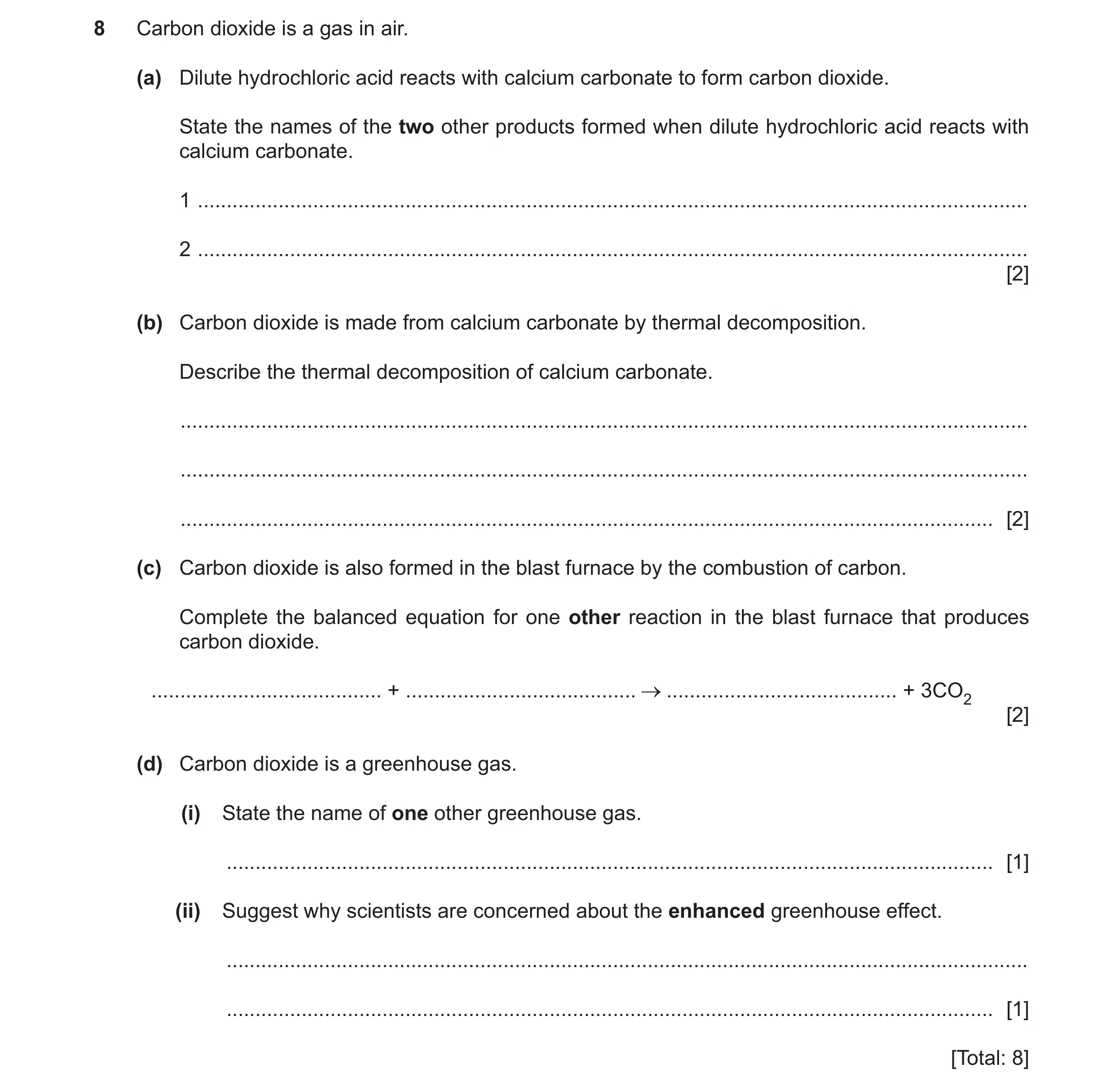
8 Carbon dioxide is a gas in air. (a) Dilute hydrochloric acid reacts with calcium carbonate to form carbon dioxide. State the names of the two other products formed when dilute hydrochloric acid reacts with calcium carbonate. 1 … 2 … [2] (b) Carbon dioxide is made from calcium carbonate by thermal decomposition. Describe the thermal decomposition of calcium carbonate. … … … [2] (c) Carbon dioxide is also formed in the blast furnace by the combustion of carbon. Complete the balanced equation for one other reaction in the blast furnace that produces carbon dioxide. … + … … + 3CO2 [2] (d) Carbon dioxide is a greenhouse gas. (i) State the name of one other greenhouse gas. … [1] (ii) Suggest why scientists are concerned about the enhanced greenhouse effect. … … [1] [Total: 8]
8 marks
Mark scheme: 8(a) calcium chloride ; 2 water ; 8(b) calcium carbonate is heated (to a high temperature) ; 2 (and) breaks down / breaks bonds / separates atoms ; 8(c) Fe2O3 + 3CO → 2Fe + (3CO2) 2 correct formulae ; balanced ; 8(d)(i) methane / AVP ; 1 8(d)(ii) increase in global temperature / climate change / named effect of climate change, e.g. ice caps melting, flooding, etc. ; 1
This question in 0653/42 Oct/Nov 2024
Q27 · Calcium oxide, CaO, is used to make cement 0653/42 May/June 2025
5 (a) Calcium oxide, CaO, is used to make cement. Calcium oxide is formed by the decomposition of calcium carbonate, CaCO3, at a very high temperature. The equation for the reaction is shown. CaCO3(s) CaO(s) + CO2(g) (i) Suggest why making cement contributes to global warming. … … … … [2] (ii) The reaction is endothermic. Explain what is meant by an endothermic reaction. Use ideas about making bonds and breaking bonds in your answer. … … … … … [3] (iii) Fig. 5.1 shows the incomplete reaction pathway diagram for an endothermic reaction. Complete Fig. 5.1. Include: • the energy level of the products • a labelled arrow to show the activation energy, Ea • a labelled arrow to show the overall energy change of the reaction. energy reactants progress of reaction Fig. 5.1 [3] (b) Calcium oxide reacts with water to form calcium hydroxide. (i) The ions in calcium hydroxide are Ca2+ and OH–. Deduce the formula for calcium hydroxide. … [1] (ii) Aqueous calcium hydroxide is an alkali. State the colour of methyl orange indicator in aqueous calcium hydroxide. … [1] [Total: 10]
10 marks
Mark scheme: 5(a)(i) (because decomposition / use of fossil fuels) produces CO2 ; 2 (CO2) is a greenhouse gas ; 5(a)(ii) bond breaking takes in energy ; 3 bond forming gives out energy ; more energy taken in than given out ; 5(a)(iii) products labelled and higher than reactants and a maximum shown ; 3 Ea correctly labelled ; overall energy change labelled and upward arrow only ; 5(b)(i) Ca(OH)2 ; 1 5(b)(ii) yellow ; 1
This question in 0653/42 May/June 2025
Q28 · Copper metal reacts with oxygen to form copper oxide, CuO 0653/41 Oct/Nov 2025
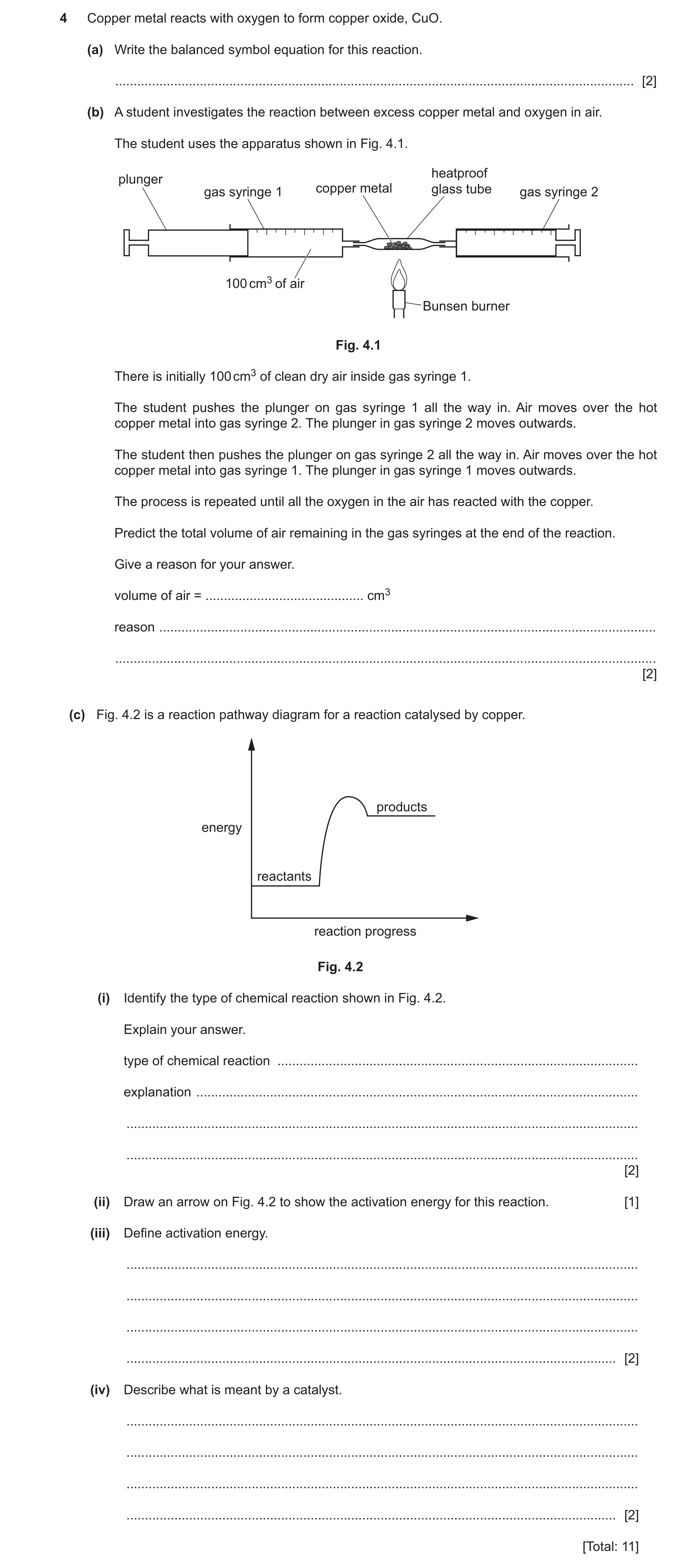
4 Copper metal reacts with oxygen to form copper oxide, CuO. (a) Write the balanced symbol equation for this reaction. … [2] (b) A student investigates the reaction between excess copper metal and oxygen in air. The student uses the apparatus shown in Fig. 4.1. heatproof plunger gas syringe 1 copper metal glass tube gas syringe 2 100 cm3 of air Bunsen burner Fig. 4.1 There is initially 100 cm3 of clean dry air inside gas syringe 1. The student pushes the plunger on gas syringe 1 all the way in. Air moves over the hot copper metal into gas syringe 2. The plunger in gas syringe 2 moves outwards. The student then pushes the plunger on gas syringe 2 all the way in. Air moves over the hot copper metal into gas syringe 1. The plunger in gas syringe 1 moves outwards. The process is repeated until all the oxygen in the air has reacted with the copper. Predict the total volume of air remaining in the gas syringes at the end of the reaction. Give a reason for your answer. volume of air = … cm3 reason … … [2] (c) Fig. 4.2 is a reaction pathway diagram for a reaction catalysed by copper. products energy reactants reaction progress Fig. 4.2 (i) Identify the type of chemical reaction shown in Fig. 4.2. Explain your answer. type of chemical reaction … explanation … … … [2] (ii) Draw an arrow on Fig. 4.2 to show the activation energy for this reaction. [1] (iii) Define activation energy. … … … … [2] (iv) Describe what is meant by a catalyst. … … … … [2] [Total: 11]
11 marks
Mark scheme: 4(a) 2Cu + O2 → 2CuO 2 correct formulae ; correct balancing ; 4(b) 79 (cm3) ; 2 oxygen is 21% of air ; 4(c)(i) M1 endothermic ; 2 M2 EITHER products have higher energy than reactants / (thermal) energy is taken in OR Energy required for bond breaking greater than energy released when bonds form; 4(c)(ii) any label showing activation energy from level of reactants to top of peak ; 1 4(c)(iii) M1 energy needed for a reaction ; 2 but M2 minimum energy needed to for a reaction ; ; 4(c)(iv) increases rate of reaction ; 2 is unchanged at the end of the reaction / idea that catalyst is not used up ;
This question in 0653/41 Oct/Nov 2025
Q29 · Iron is extracted from hematite in the blast furnace 0653/42 Oct/Nov 2025
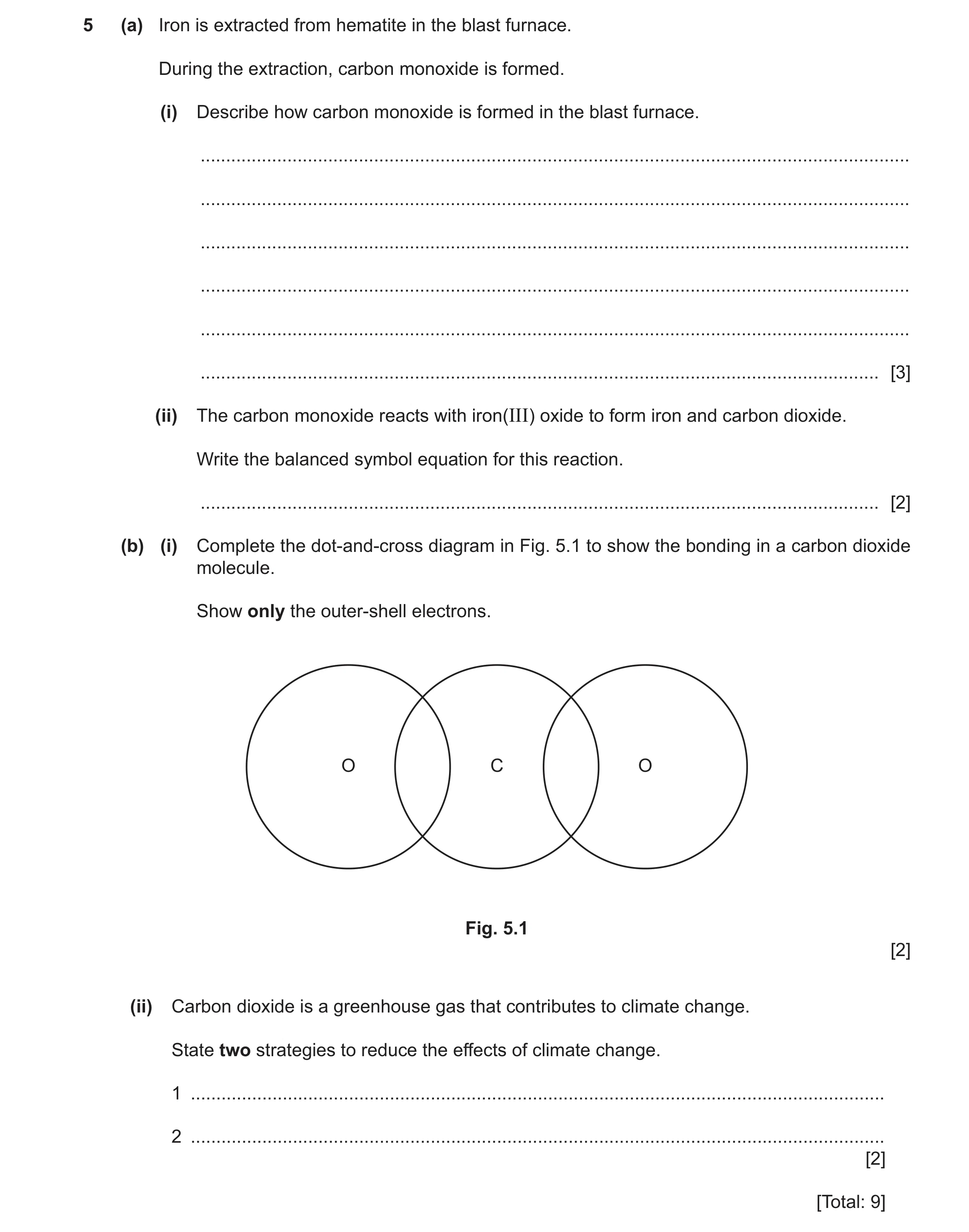
5 (a) Iron is extracted from hematite in the blast furnace. During the extraction, carbon monoxide is formed. (i) Describe how carbon monoxide is formed in the blast furnace. … … … … … … [3] (ii) The carbon monoxide reacts with iron(III) oxide to form iron and carbon dioxide. Write the balanced symbol equation for this reaction. … [2] (b) (i) Complete the dot-and-cross diagram in Fig. 5.1 to show the bonding in a carbon dioxide molecule. Show only the outer-shell electrons. O C O Fig. 5.1 [2] (ii) Carbon dioxide is a greenhouse gas that contributes to climate change. State two strategies to reduce the effects of climate change. 1 … 2 … [2] [Total: 9]
9 marks
Mark scheme: 5(a)(i) carbon / coke, is combusted or coke / C reacts with oxygen ; 3 carbon dioxide is formed / produced (during the extraction) ; carbon reacts with (reduces) carbon dioxide ; 5(a)(ii) Fe2O3 + 3CO → 2Fe + 3CO2 2 correct formulae ; correct balancing ; 5(b)(i) two bonding pairs between each oxygen and the carbon ; 2 4 non-bonding electrons / 2 lone pairs, on each oxygen ; 5(b)(ii) any two from: 2 use of renewable energy, e.g. wind, solar ; decreasing use of fossil fuels ; planting trees ; reduction in livestock farming ; AVP;
This question in 0653/42 Oct/Nov 2025
Q30 · Pentene is an alkene that contains one double carbon–carbon bond 0653/43 Oct/Nov 2025
6 Pentene is an alkene that contains one double carbon–carbon bond. (a) Fig. 6.1 shows the structure of one form of pentene. H H H H C C C C C H H H H H H Fig. 6.1 (i) Use Fig. 6.1 to deduce the molecular formula of pentene. … [1] (ii) The double carbon–carbon bond in pentene can be in different positions. Complete Fig. 6.2 to show the structure of one other form of pentene. C C C C C Fig. 6.2 [1] (iii) Pentene is a member of a homologous series. State what is meant by a homologous series. … … … … [2] (iv) Draw lines to show which descriptions are true for pentene. One has been drawn for you. description is the main constituent of natural gas reacts with hydrogen in the presence of a nickel catalyst reacts with steam in the presence of pentene an acid catalyst is a saturated hydrocarbon decolourises aqueous bromine [2] (b) Pentene combusts in a limited supply of oxygen to form two air pollutants: carbon monoxide and carbon particulates. (i) Complete the balanced symbol equation by adding the missing state symbols. C5H10(g) + 4O2(g) 3CO( … ) + 2C( … ) + 5H2O(l) [1] (ii) Name this type of combustion reaction. … [1] (iii) State one adverse effect of carbon particulates on human health. … [1] [Total: 9]
9 marks
Mark scheme: 6(a)(i) C5H10 ; 1 6(a)(ii) 1 ; 6(a)(iii) any two from 2 (family of similar compounds with) similar chemical properties ; trend in physical properties ; same general formula ; 6(a)(iv) lines to: 2 reacts with hydrogen in the presence of a nickel catalyst ; reacts with steam in the presence of an acid catalyst ; 6(b)(i) (g) and (s) ; 1 6(b)(ii) incomplete ; 1 6(b)(iii) respiratory problems / named respiratory disorder / cancer ; 1
This question in 0653/43 Oct/Nov 2025
 9 / 41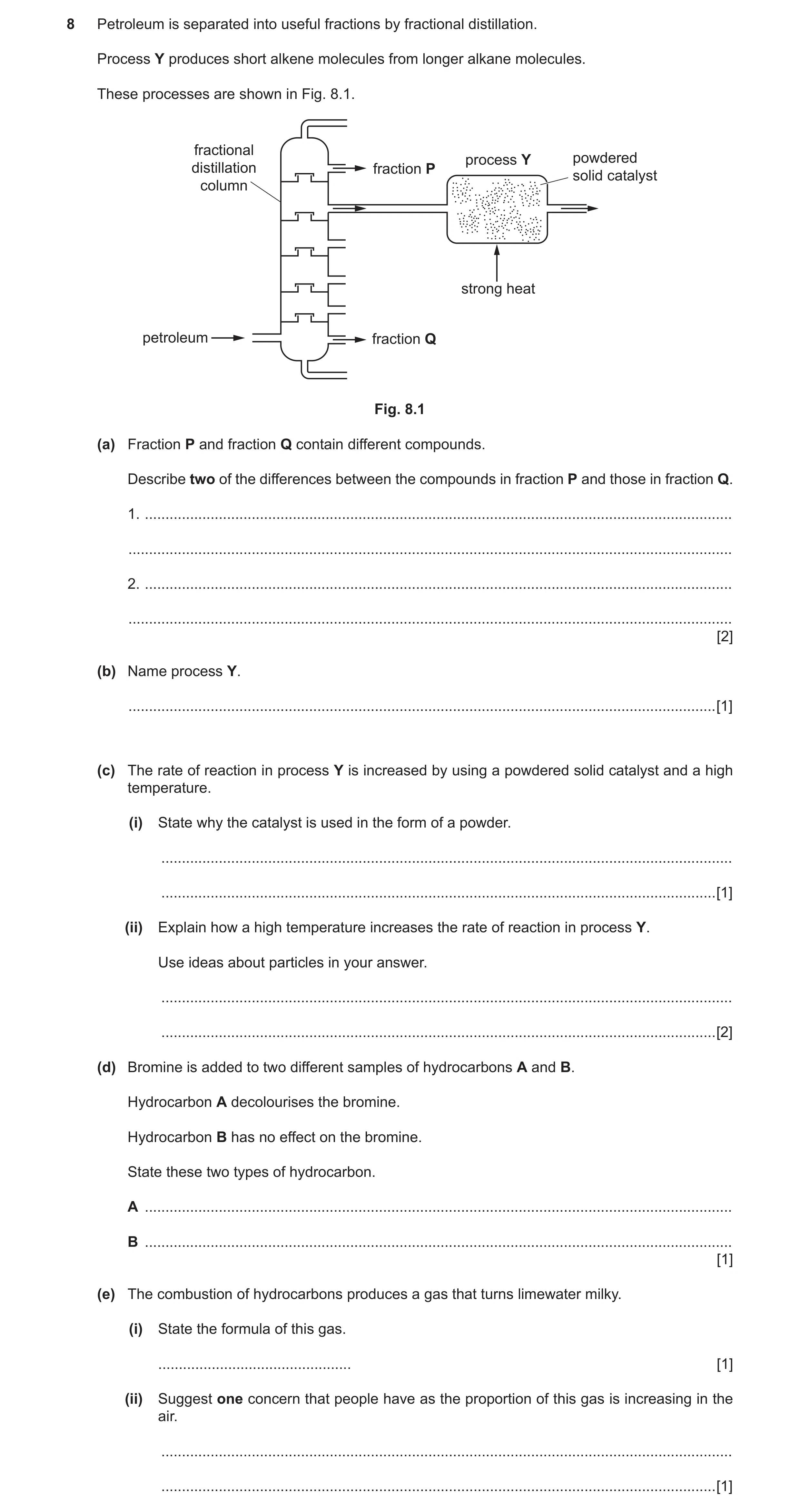
 12 / 41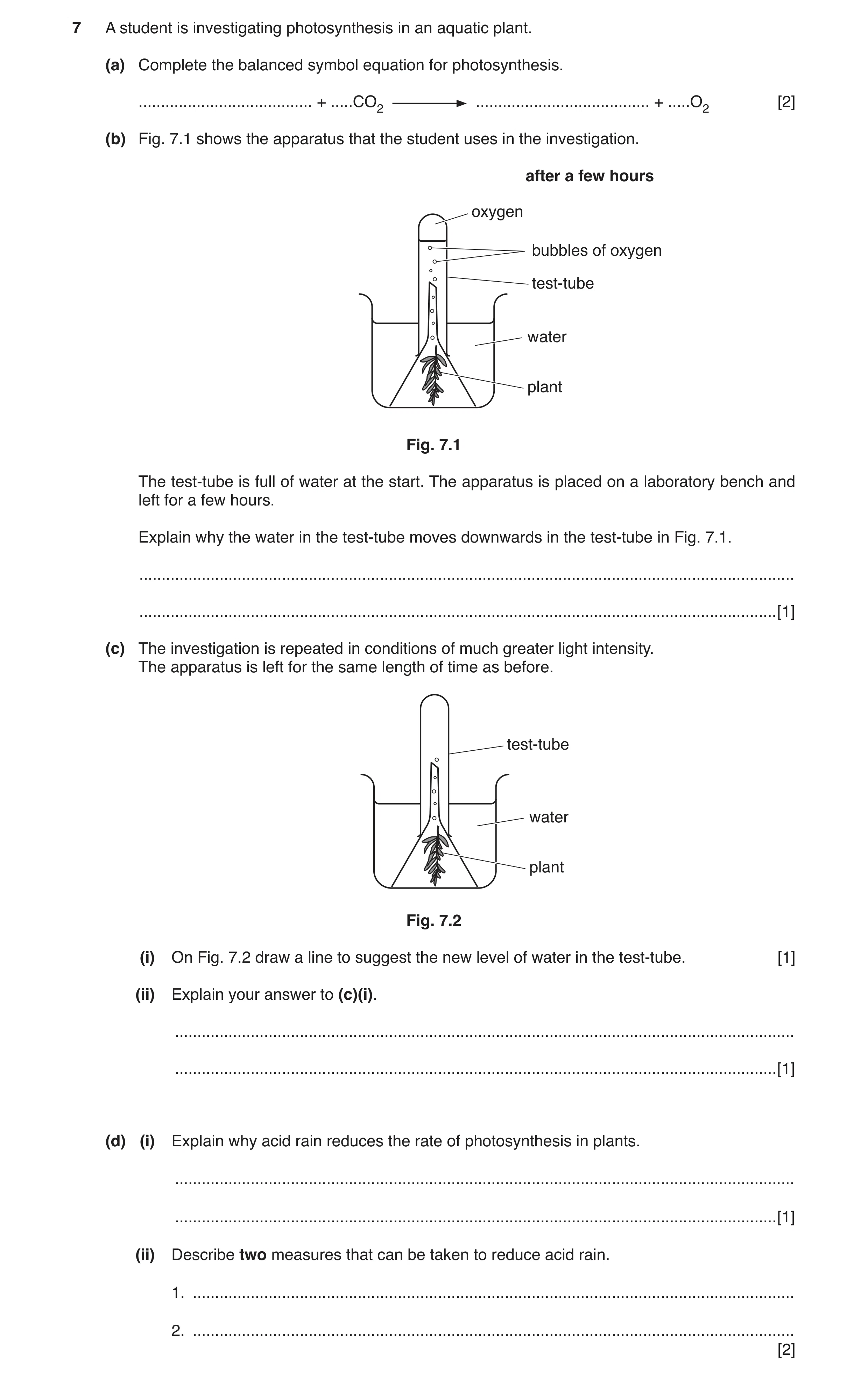
 16 / 41
 17 / 41
![Question 13: (a) The formula of methanol is CH3OH. Complete the structure of a molecule of methanol. Include all atoms and all bonds. C O [1] (b) (i) Ex…](https://img.pastlit.com/crops/ce89baf8-7d64-4617-851e-c29da4d5ba90/q2.webp) 18 / 41
18 / 41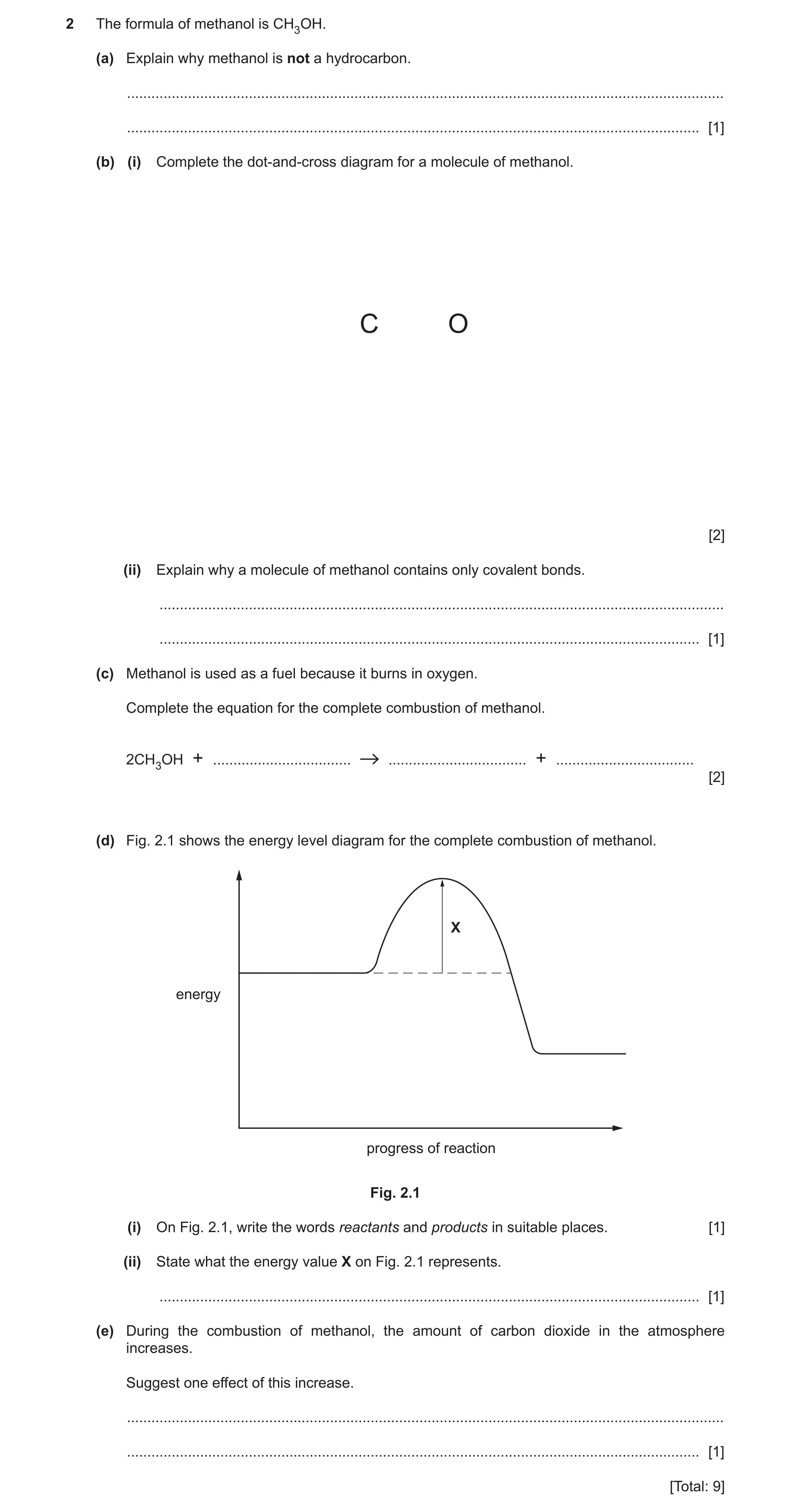
 27 / 41
 28 / 41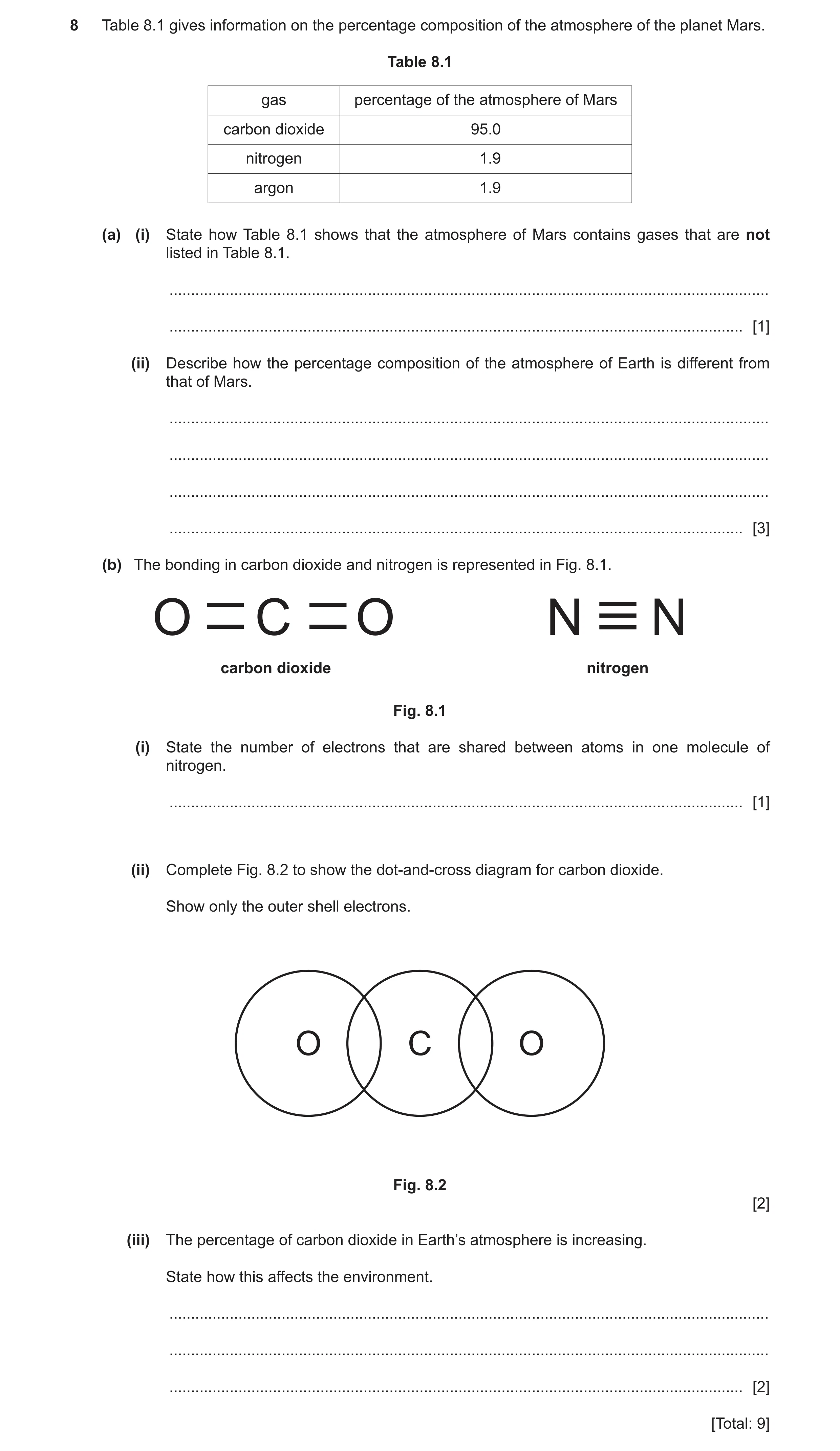
 33 / 41
 34 / 41
 35 / 41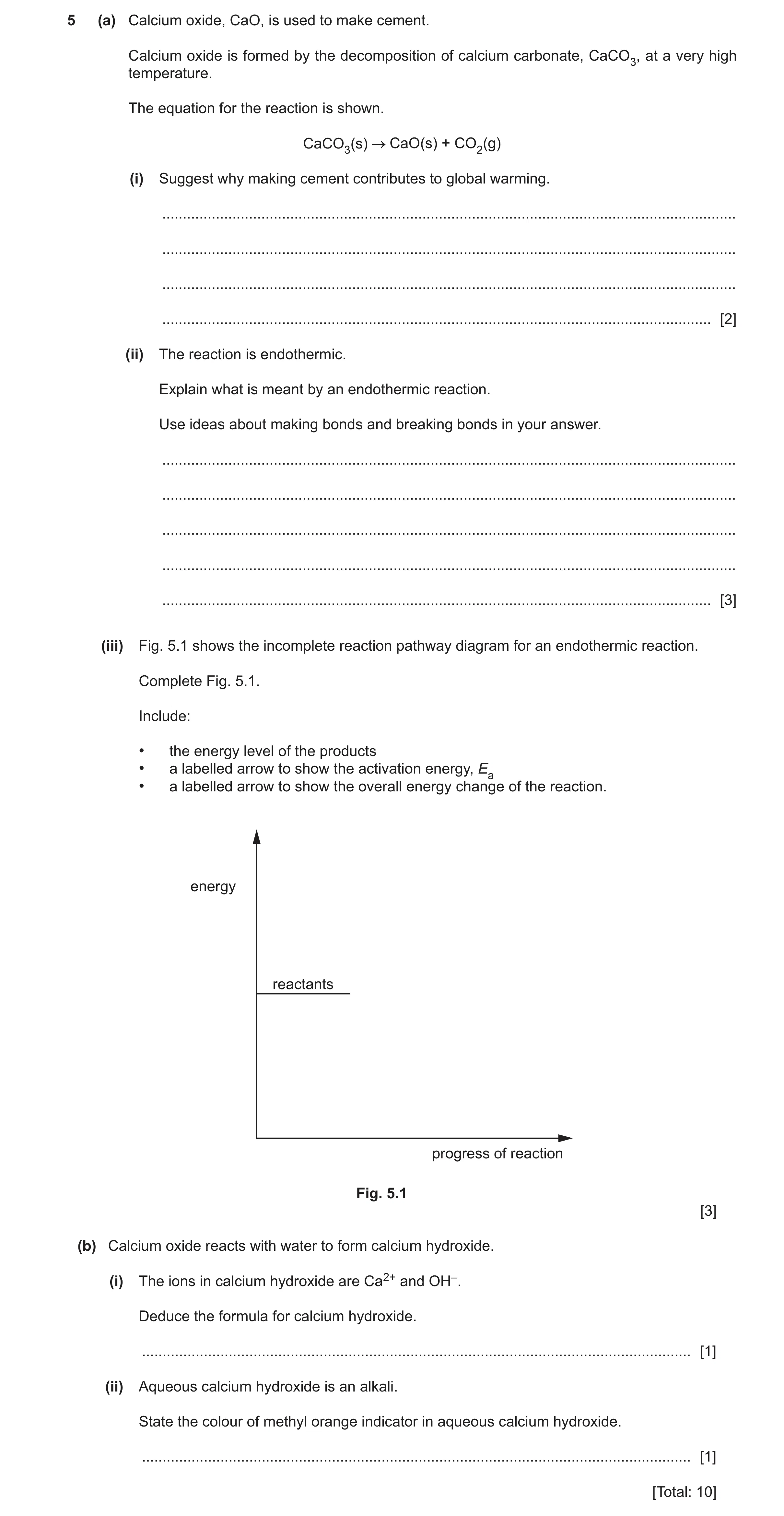
 39 / 41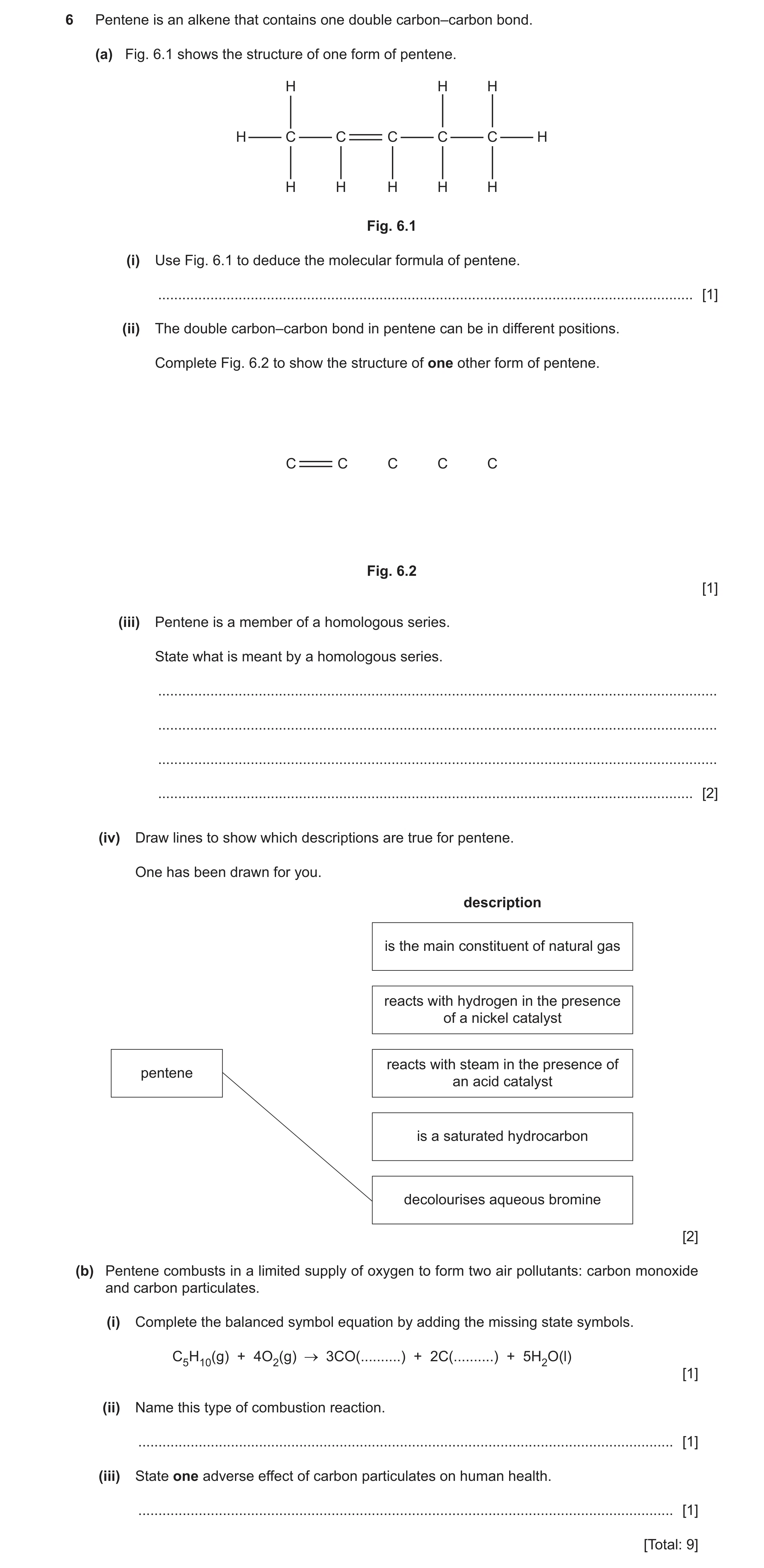
 12
12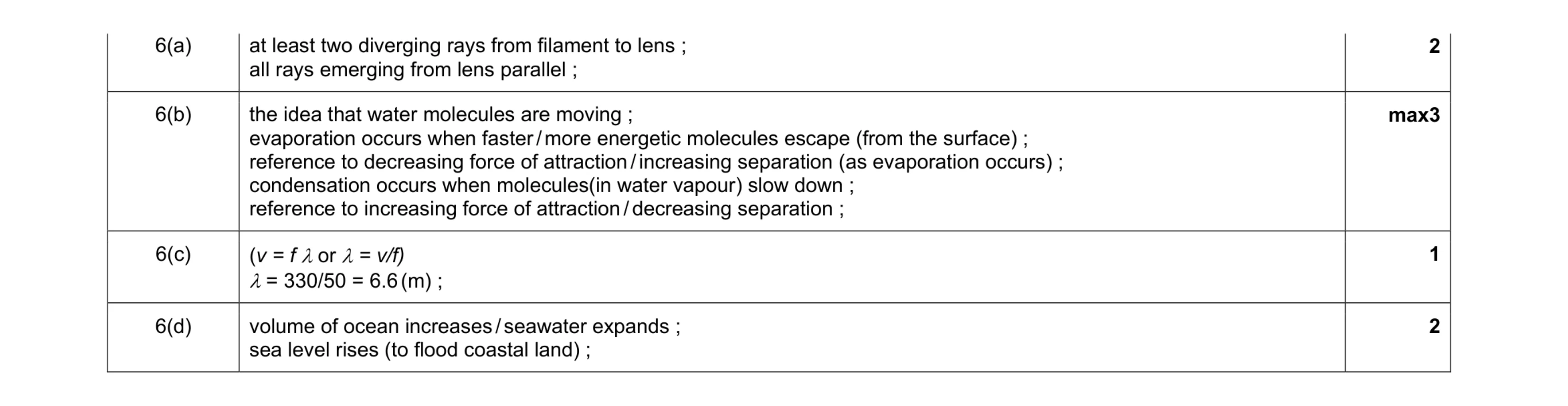 8
8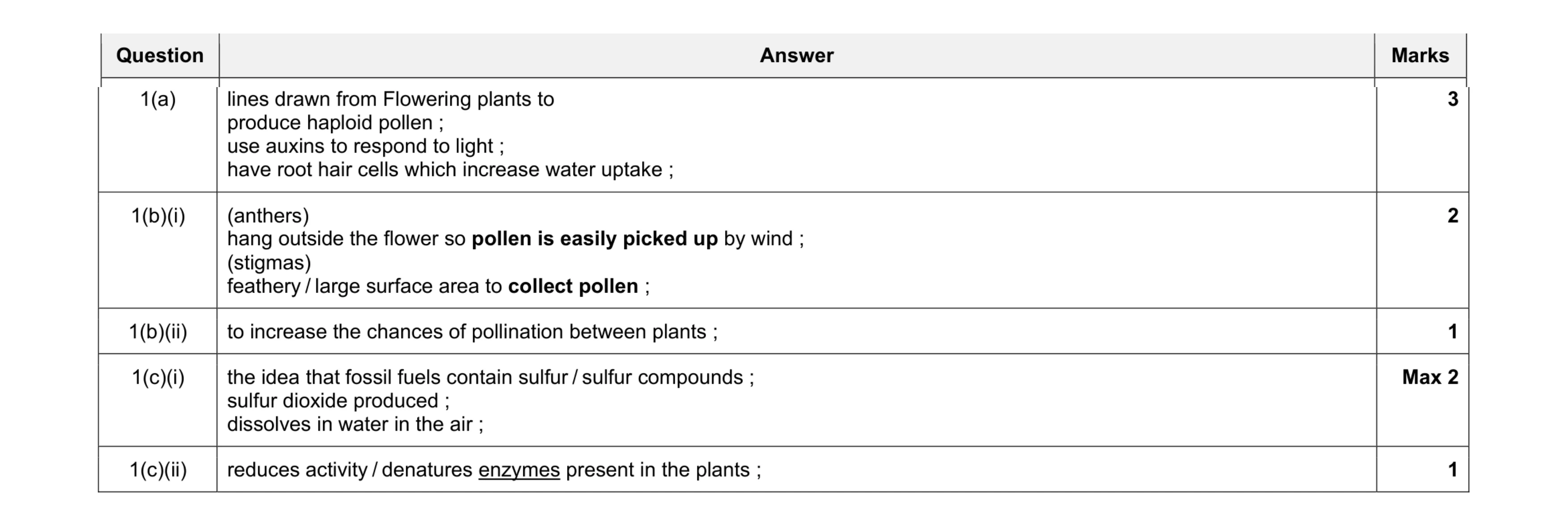 9
9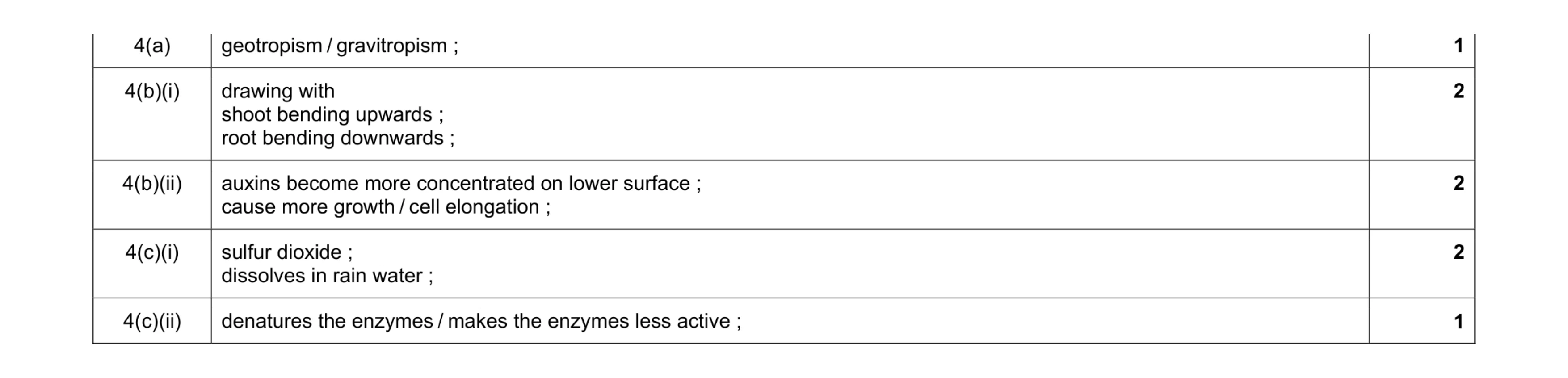 8
8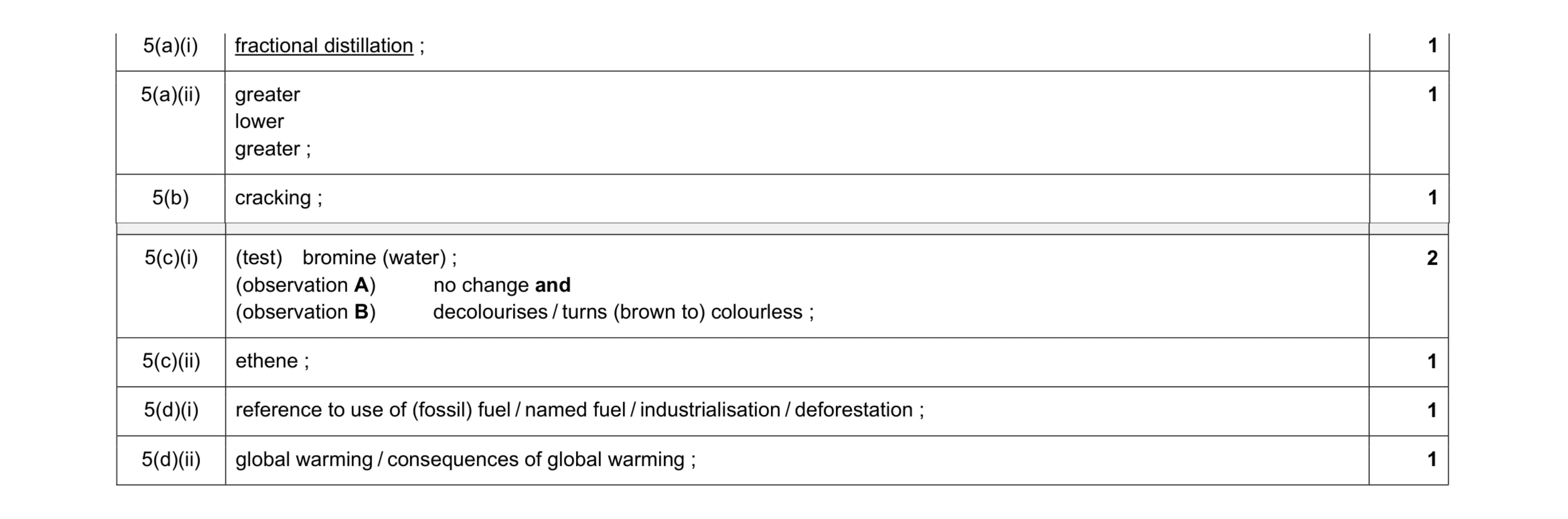 8
8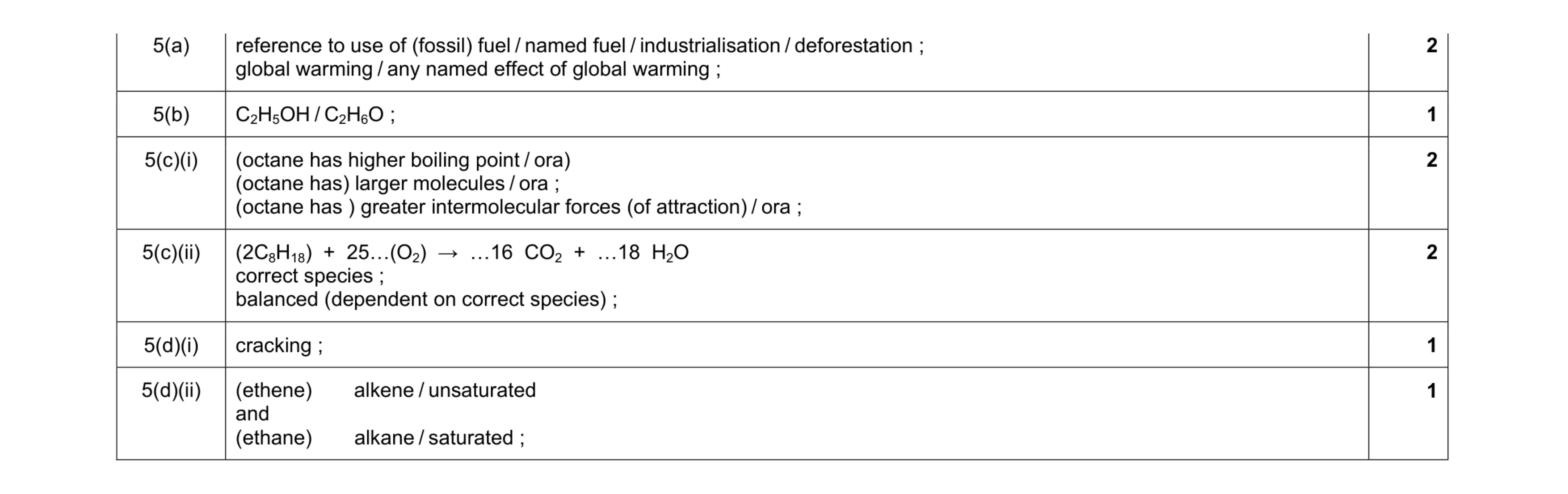 9
9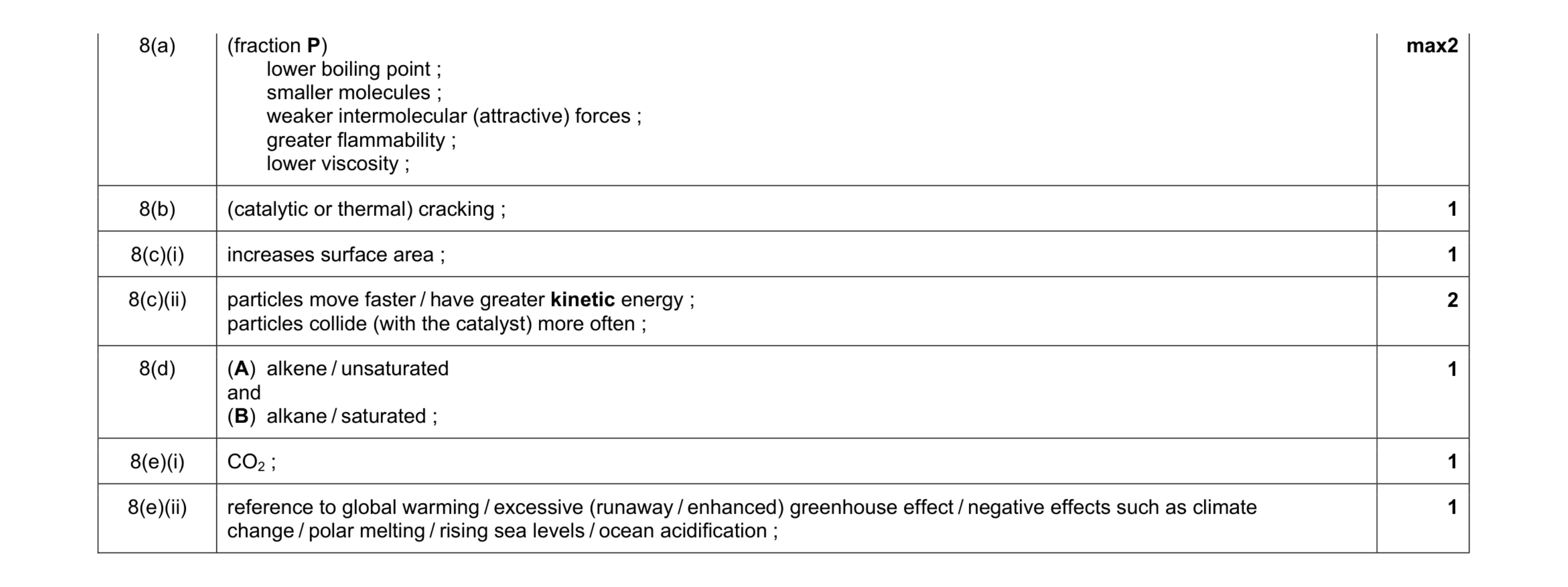 9
9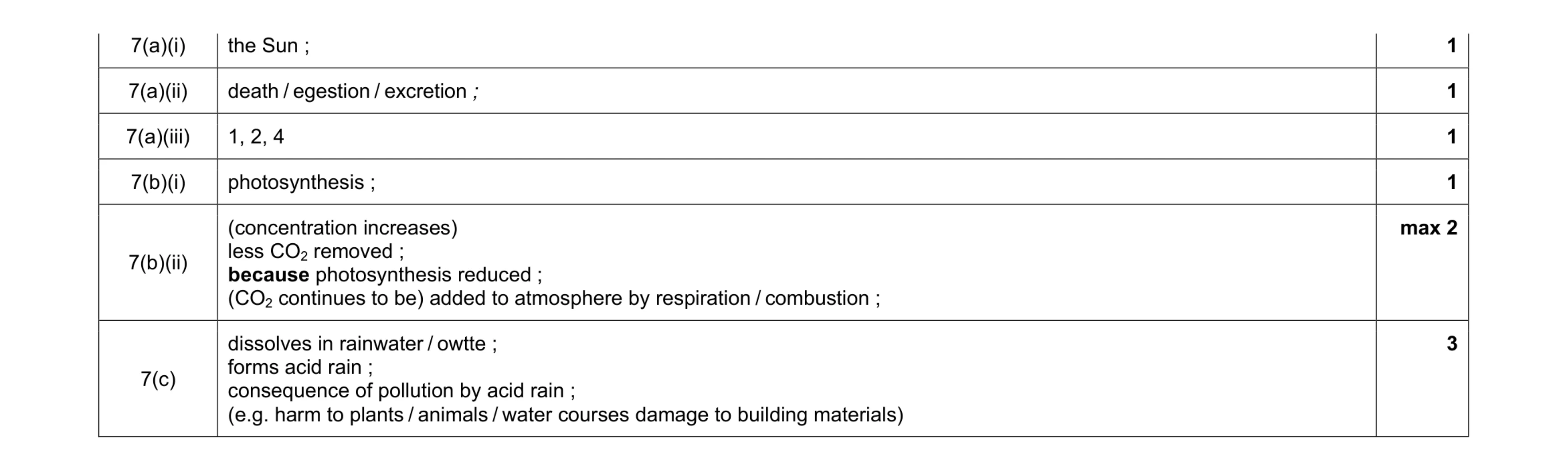 9
9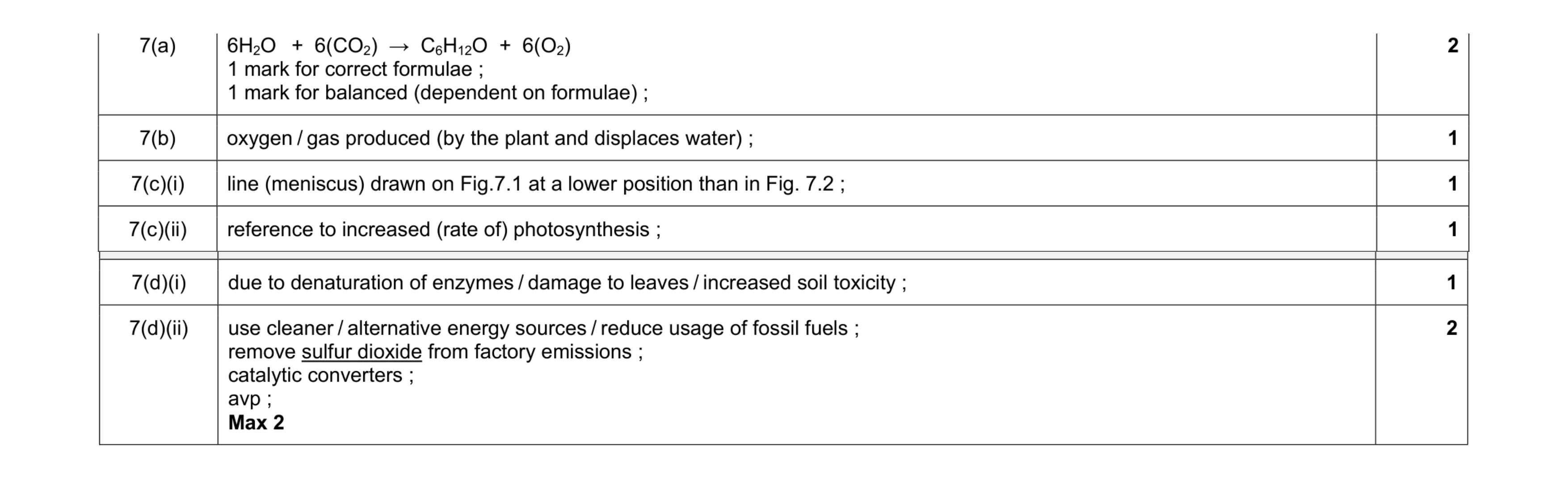 8
8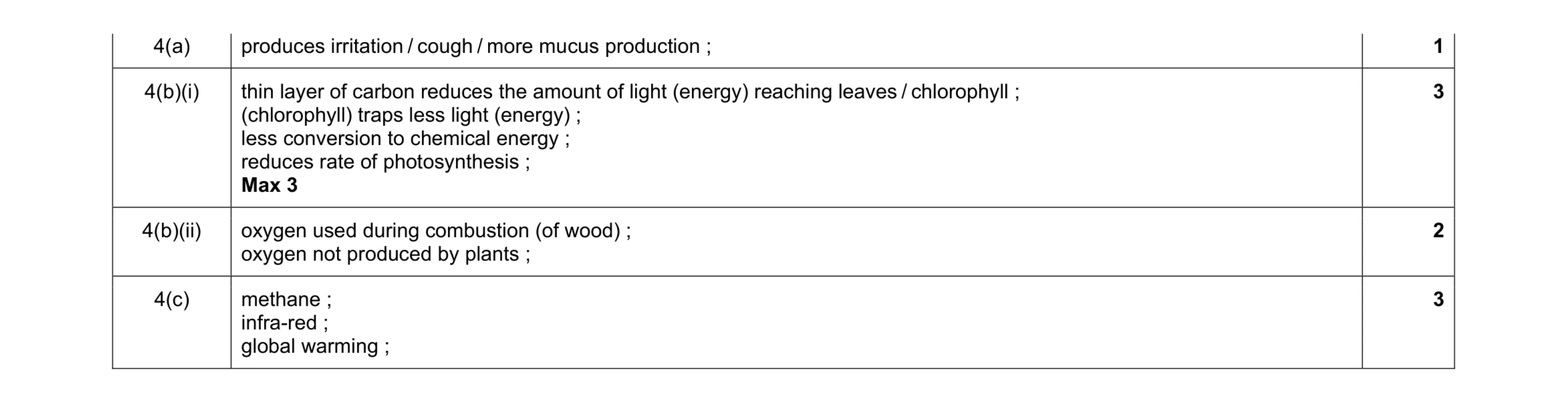 9
9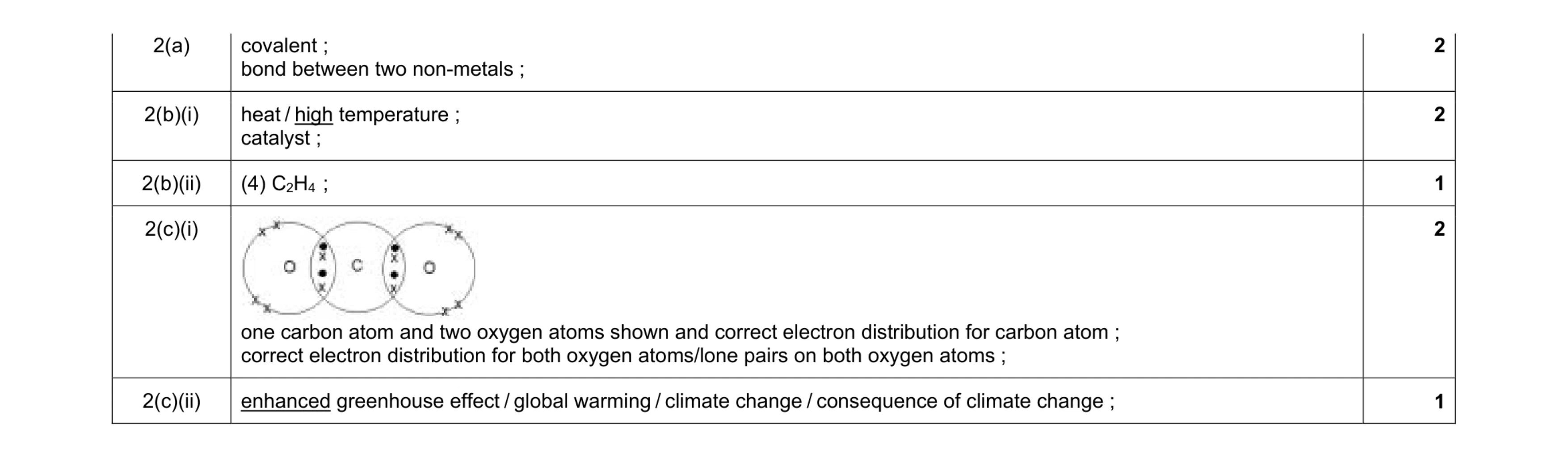 8
8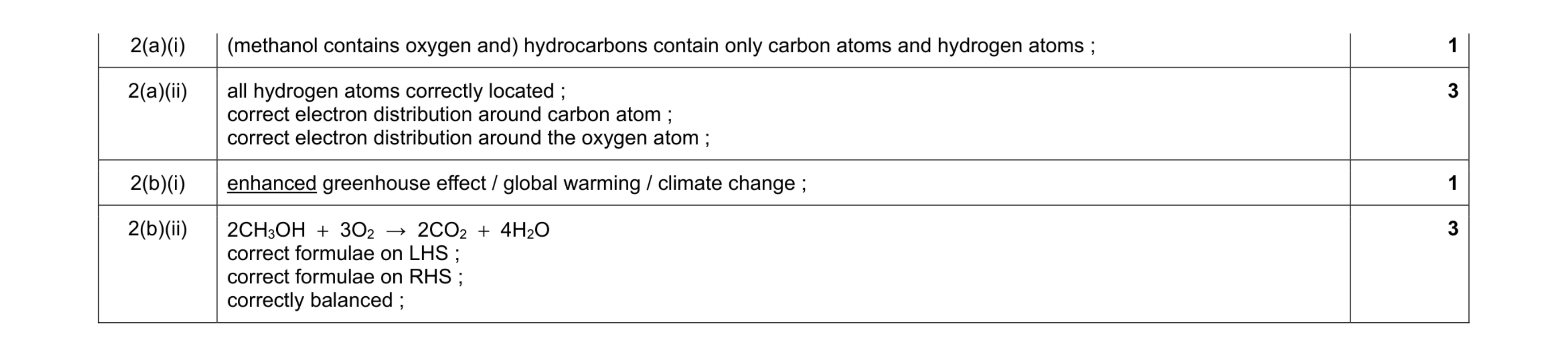 8
8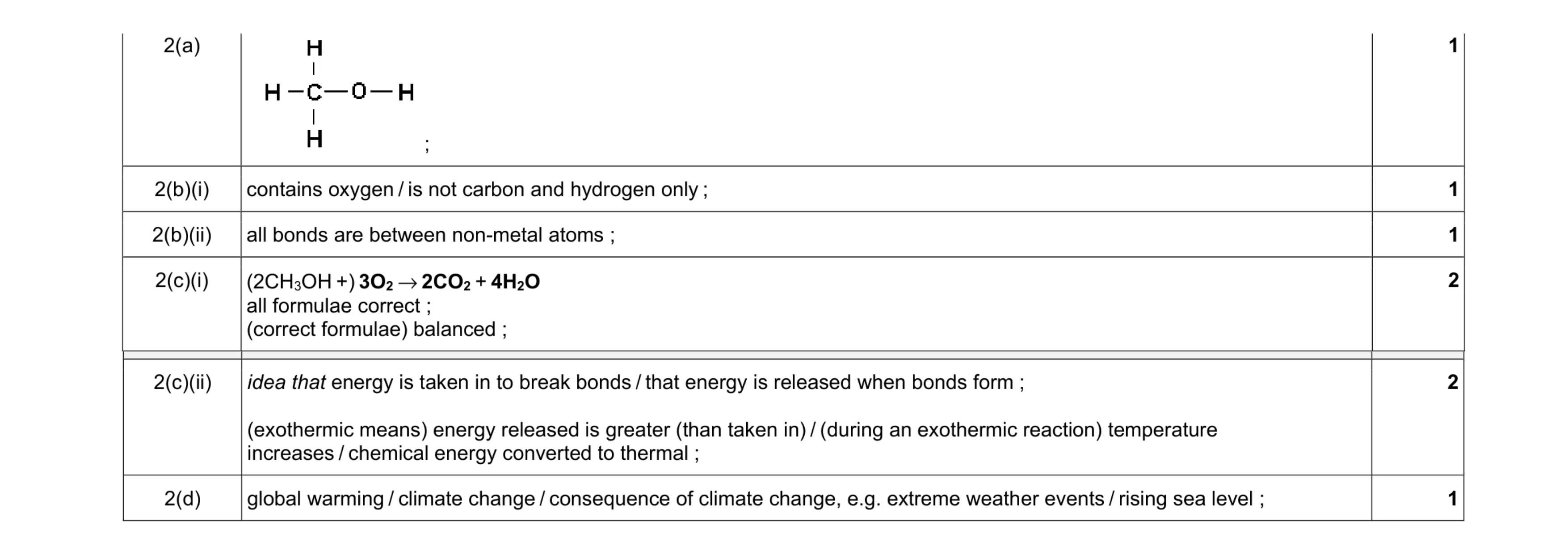 8
8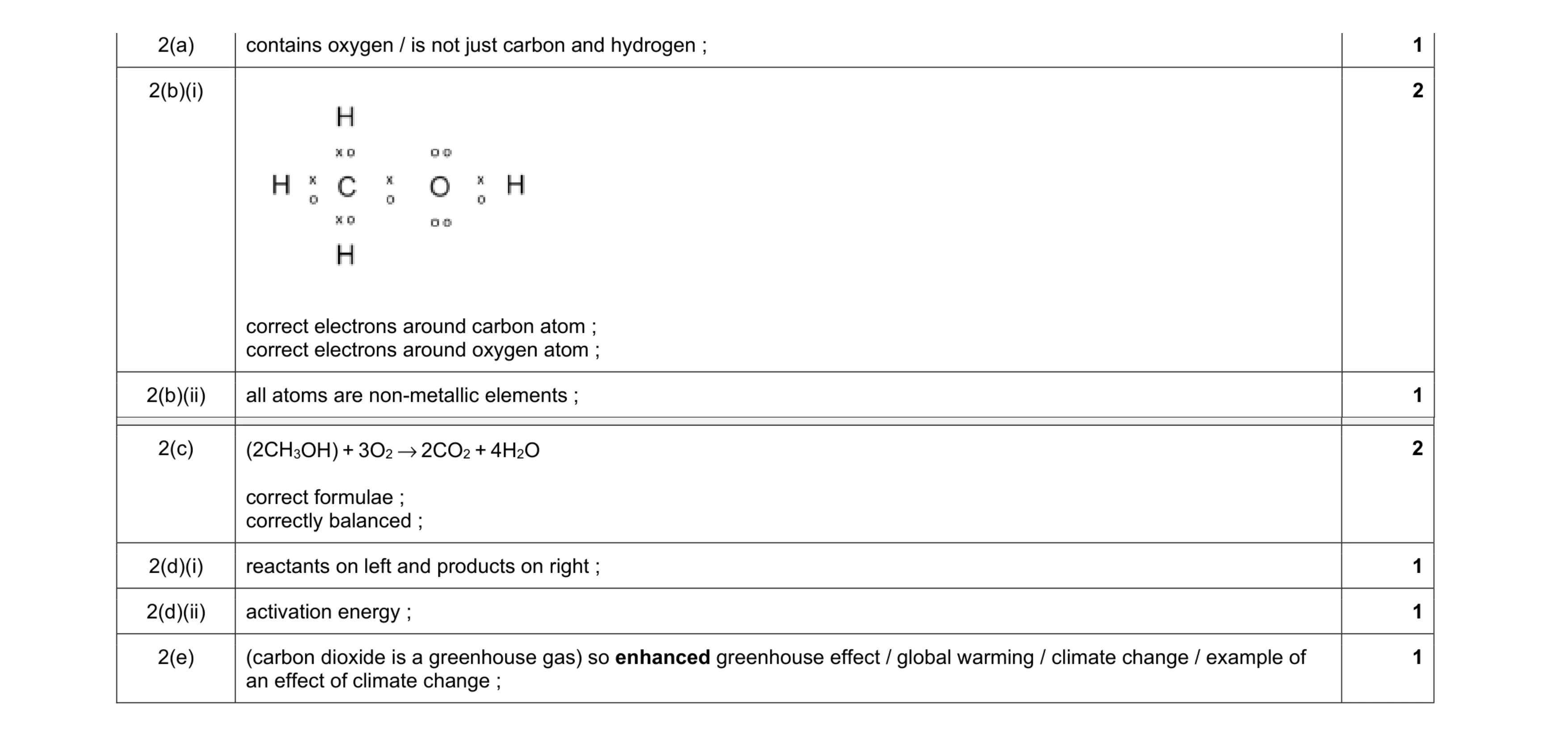 9
9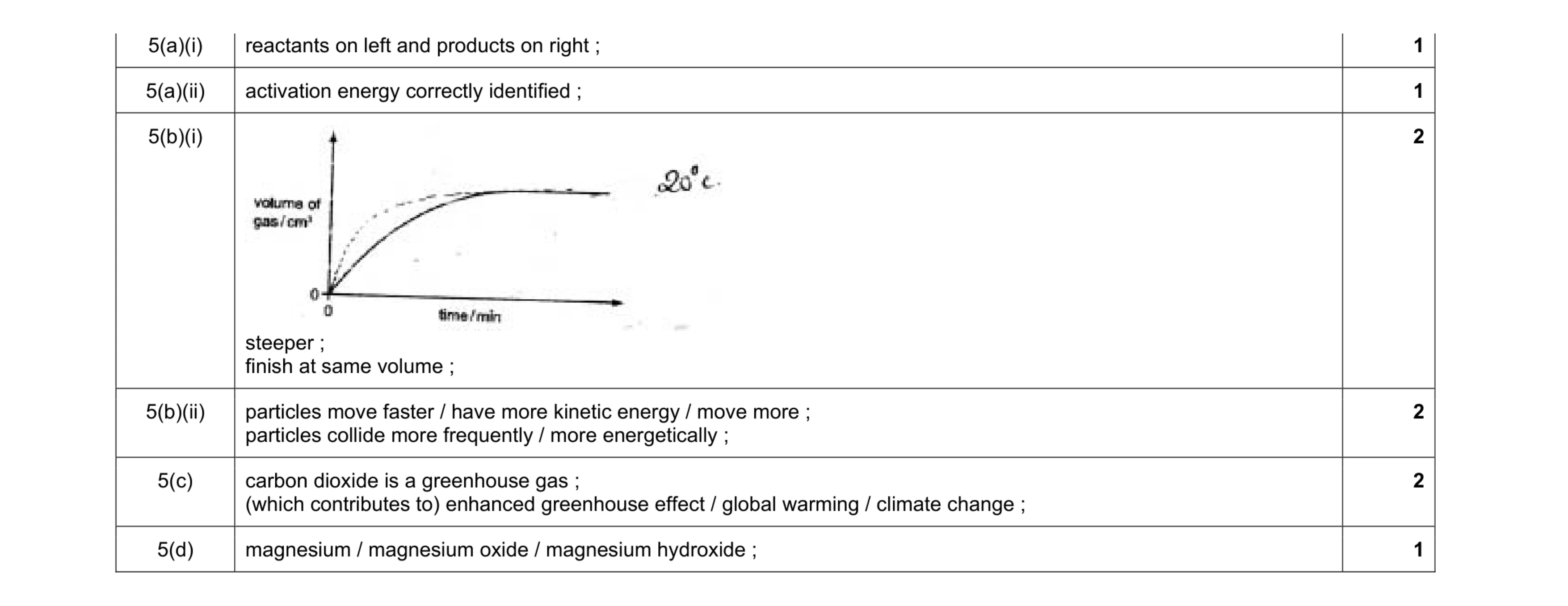 9
9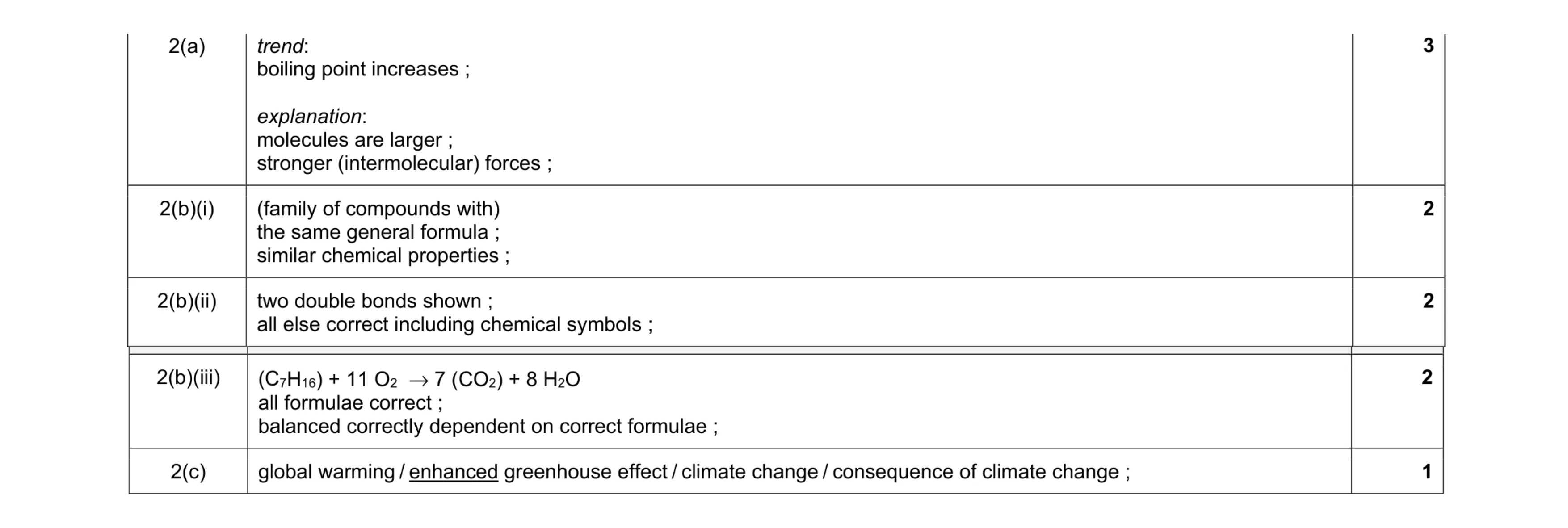 10
10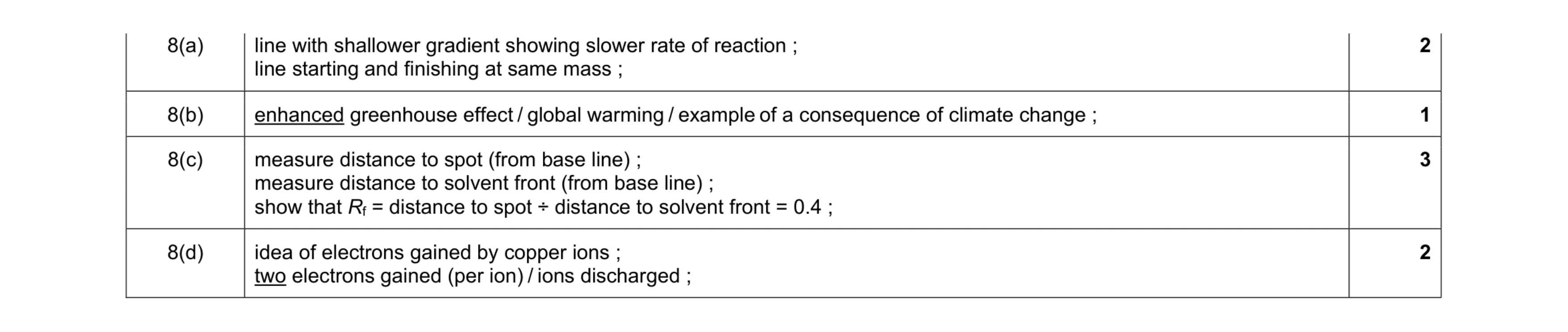 8
8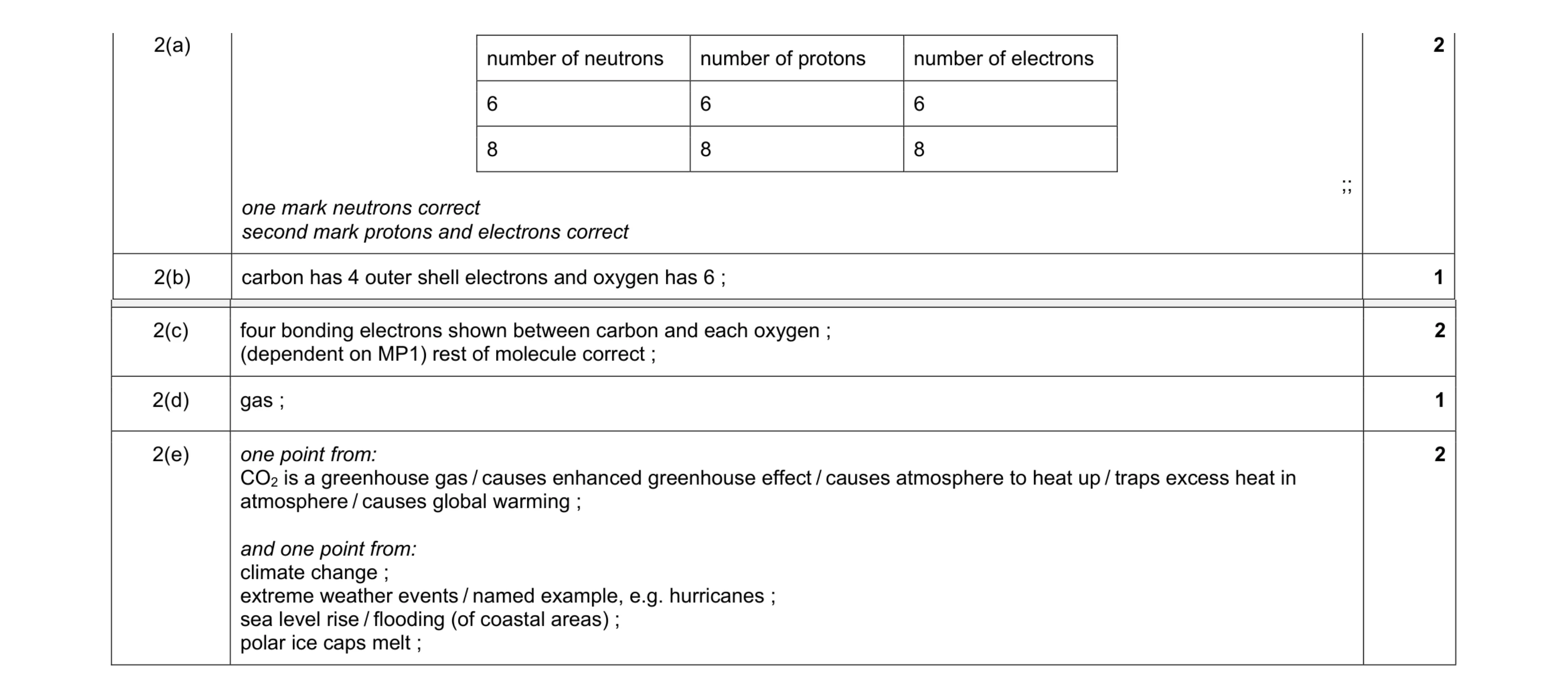 8
8 7
7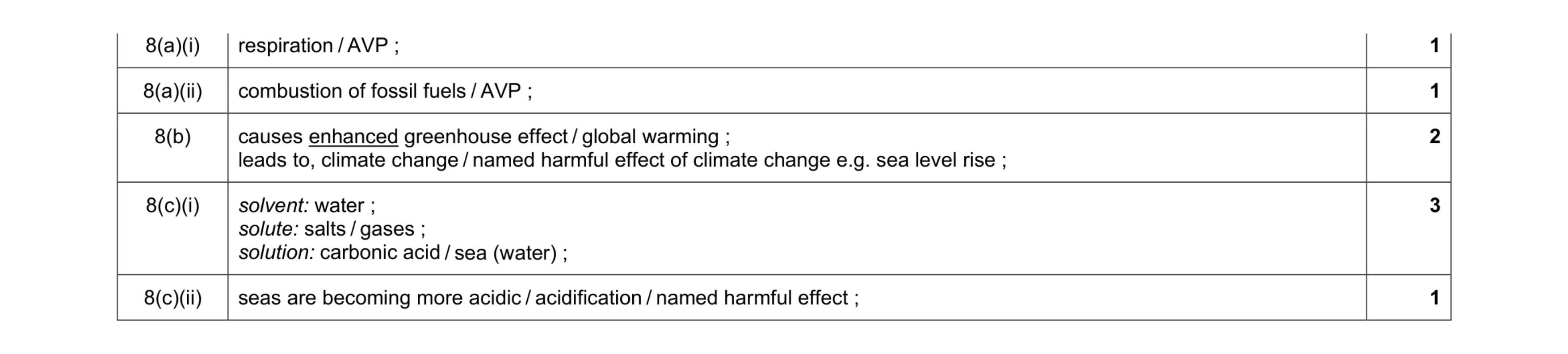 8
8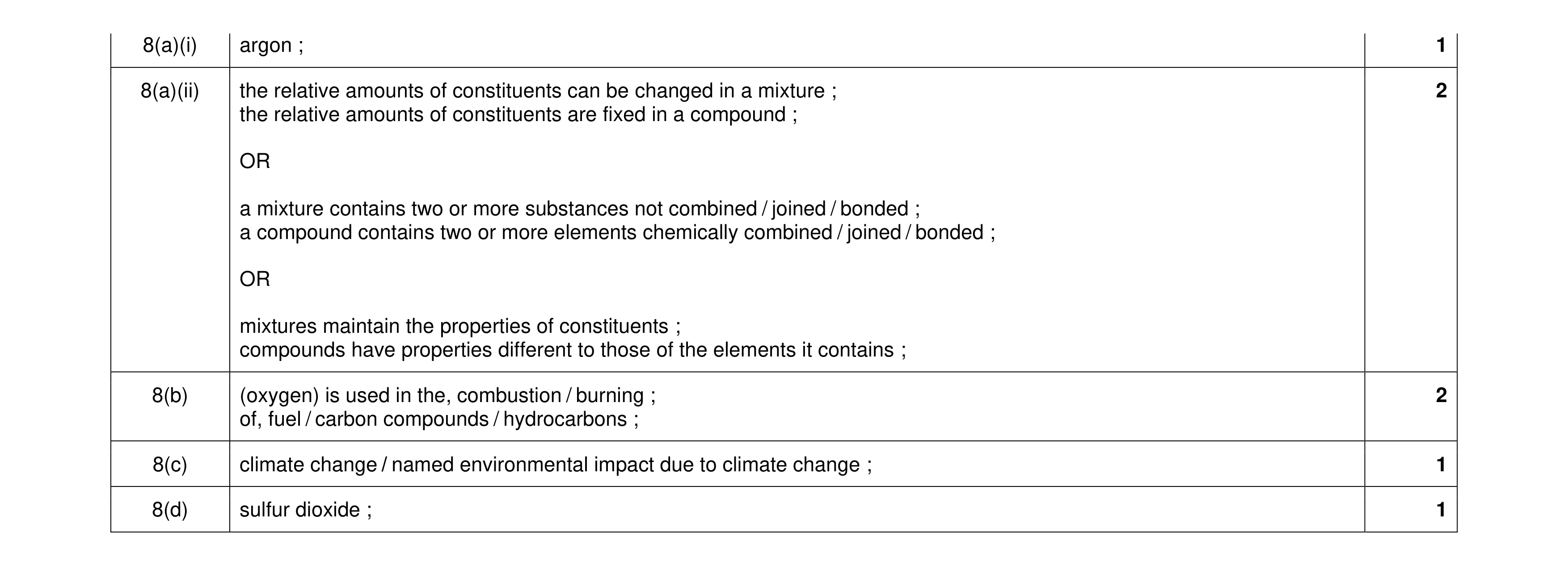 7
7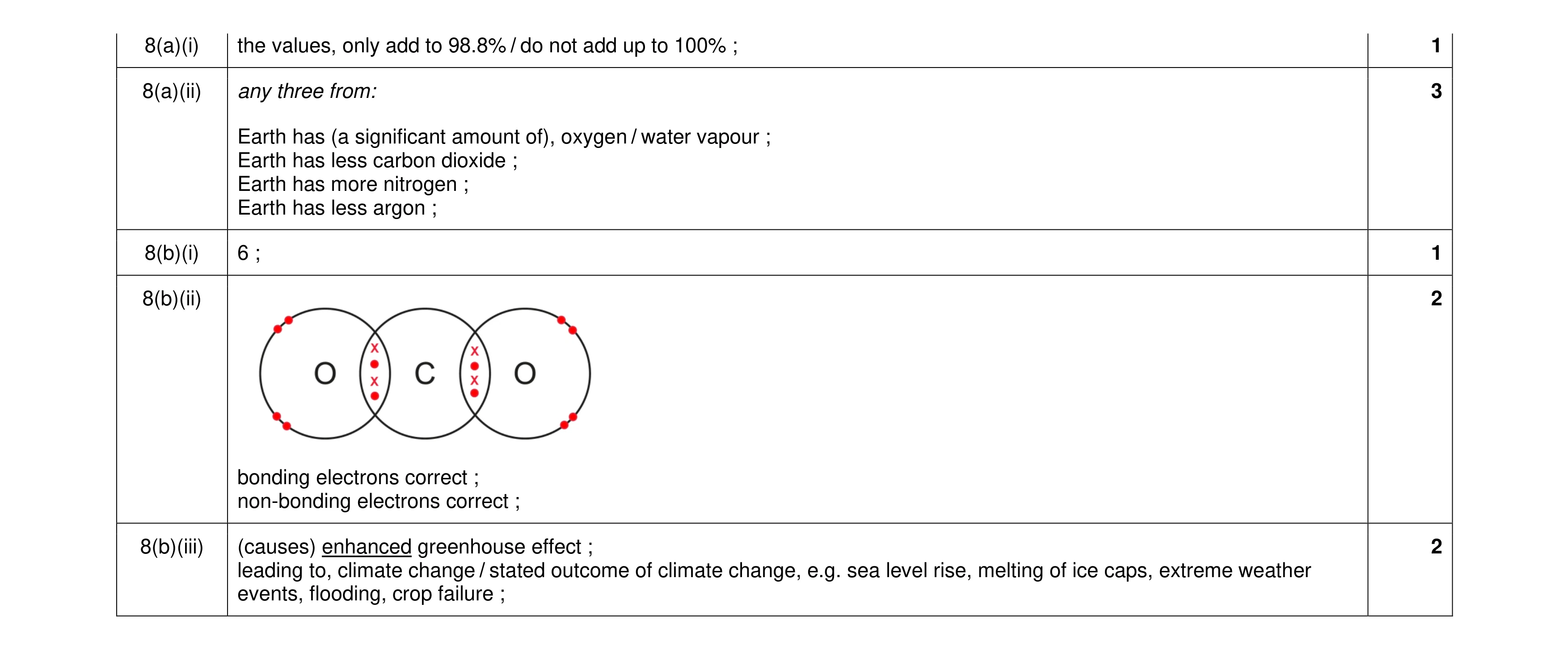 9
9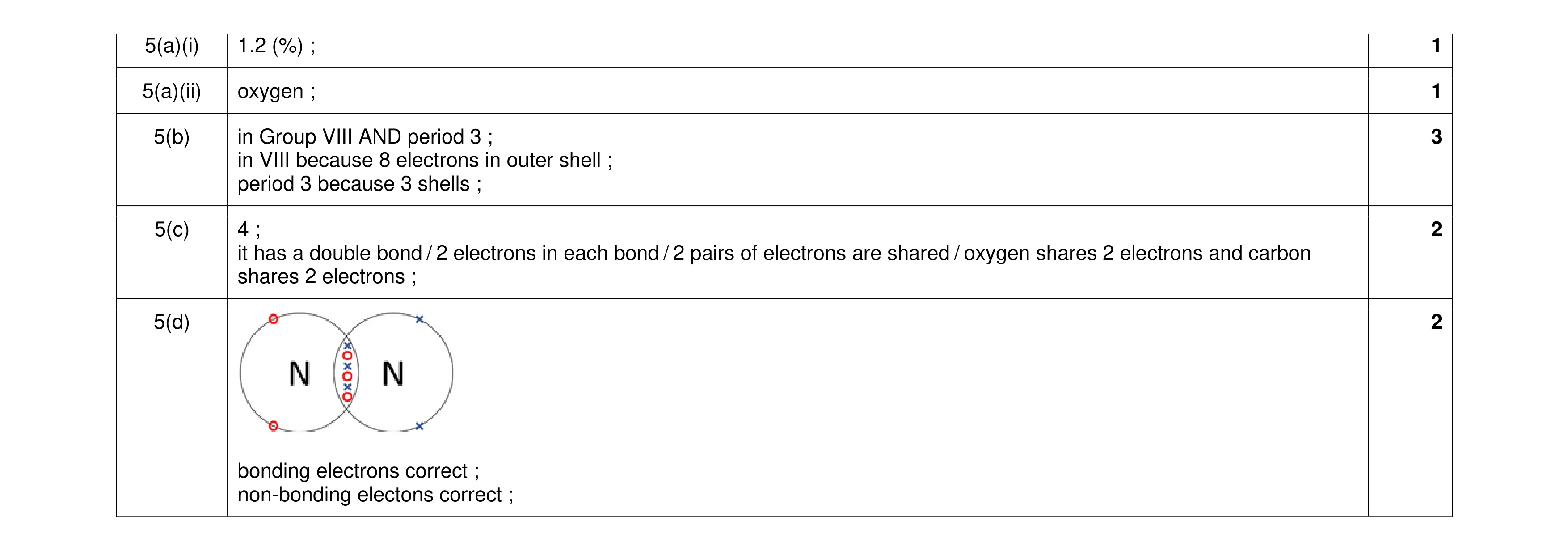 9
9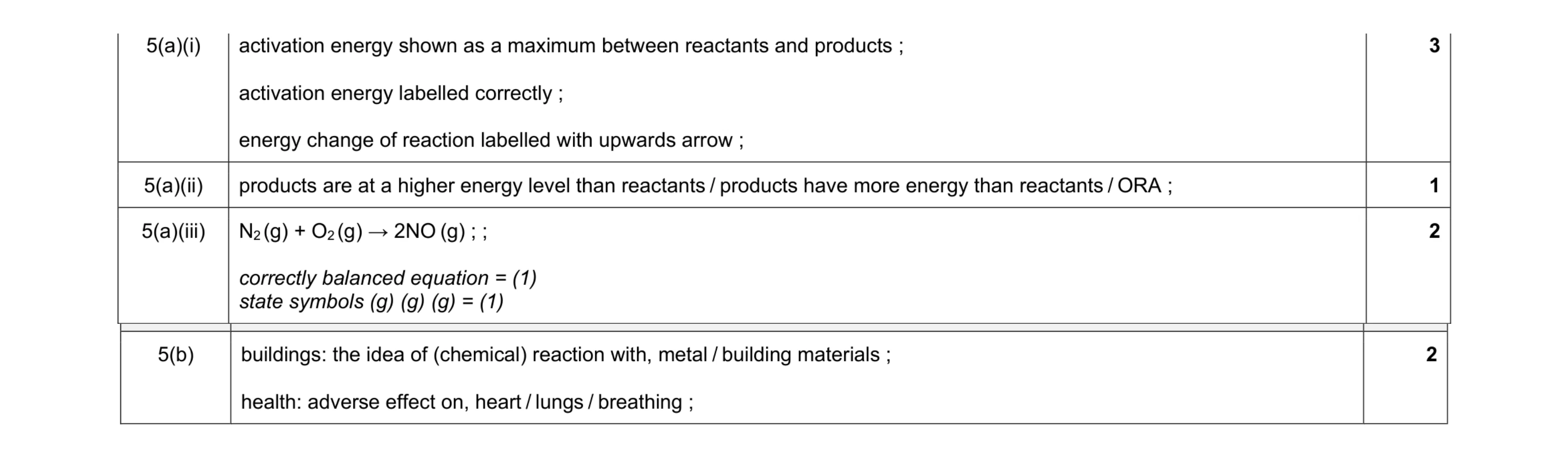 8
8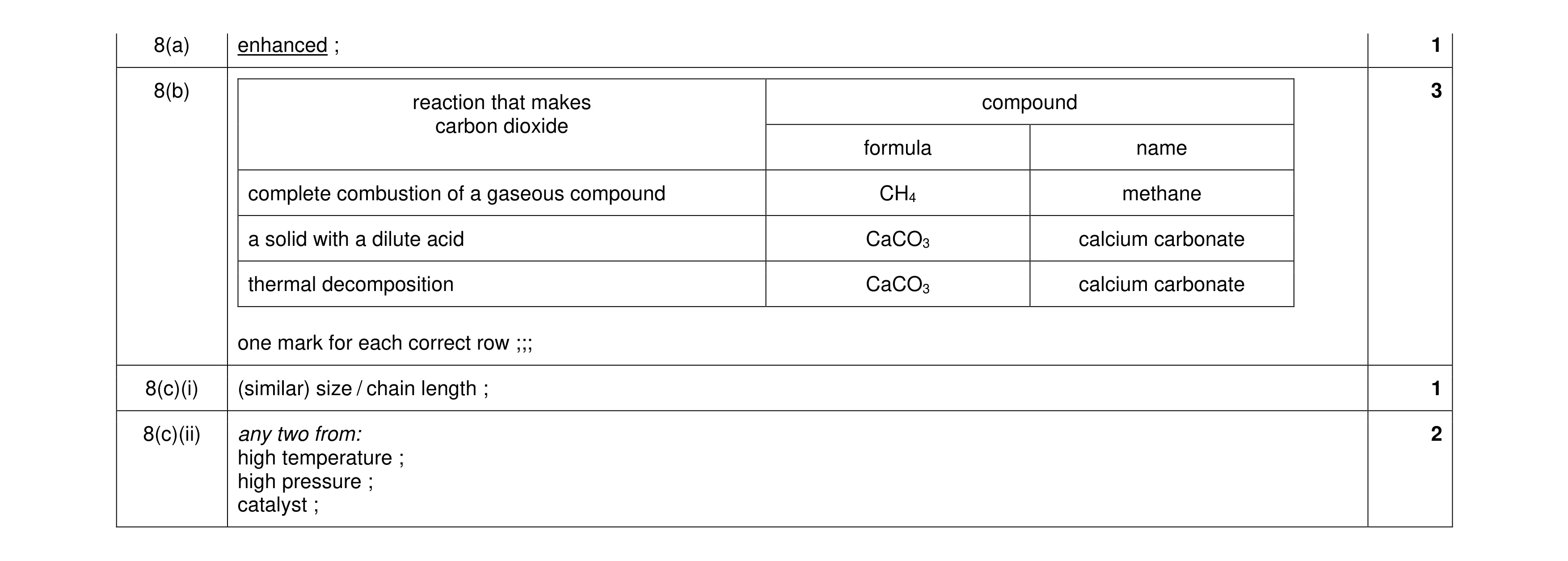 7
7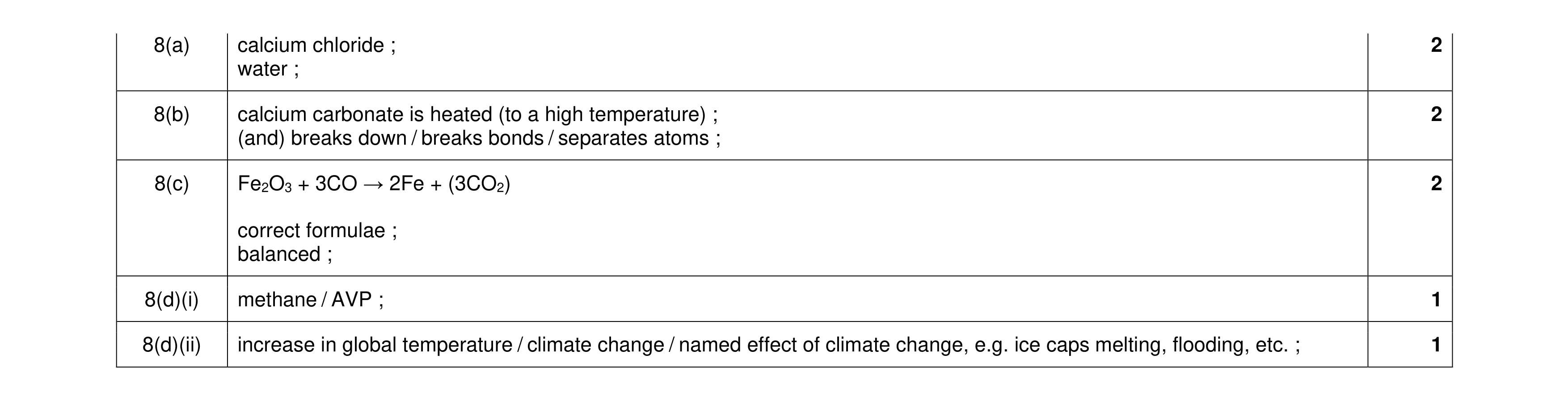 8
8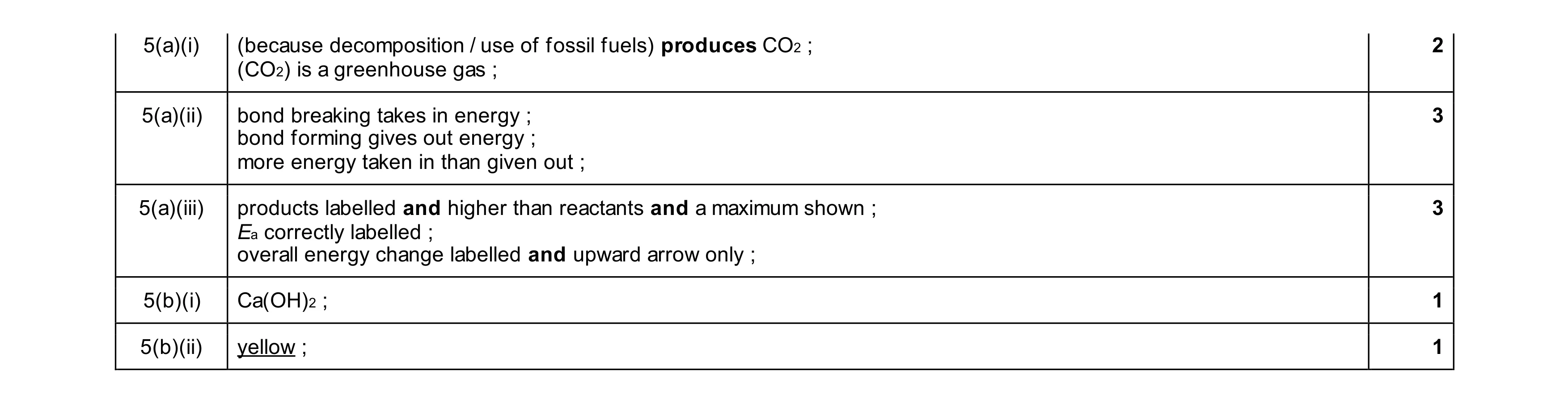 10
10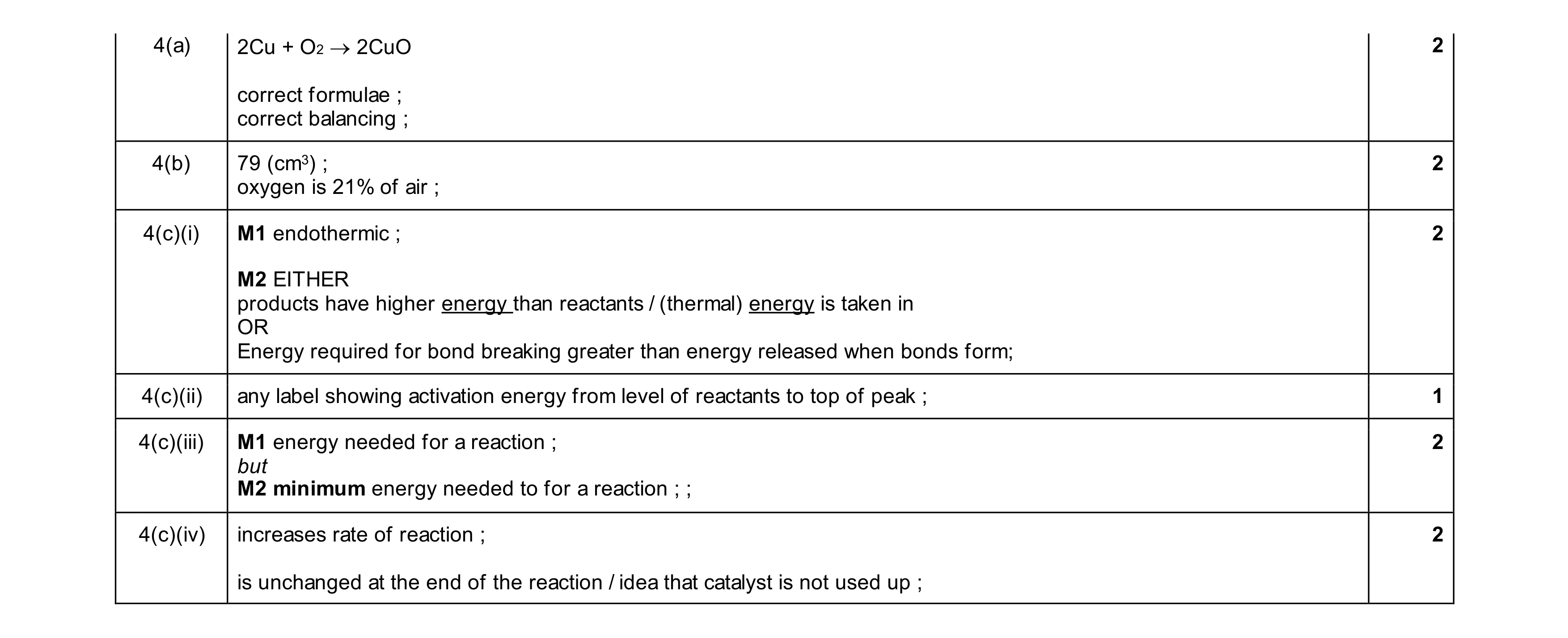 11
11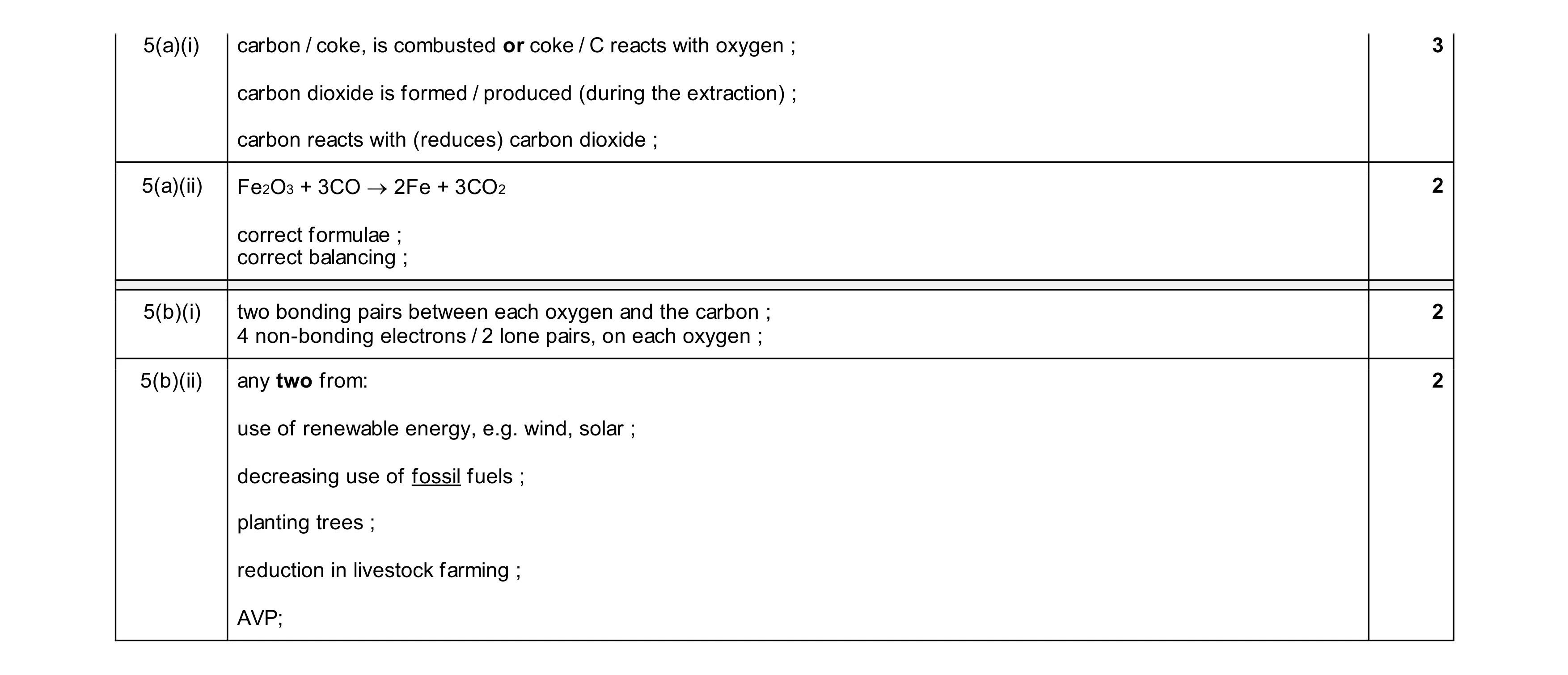 9
9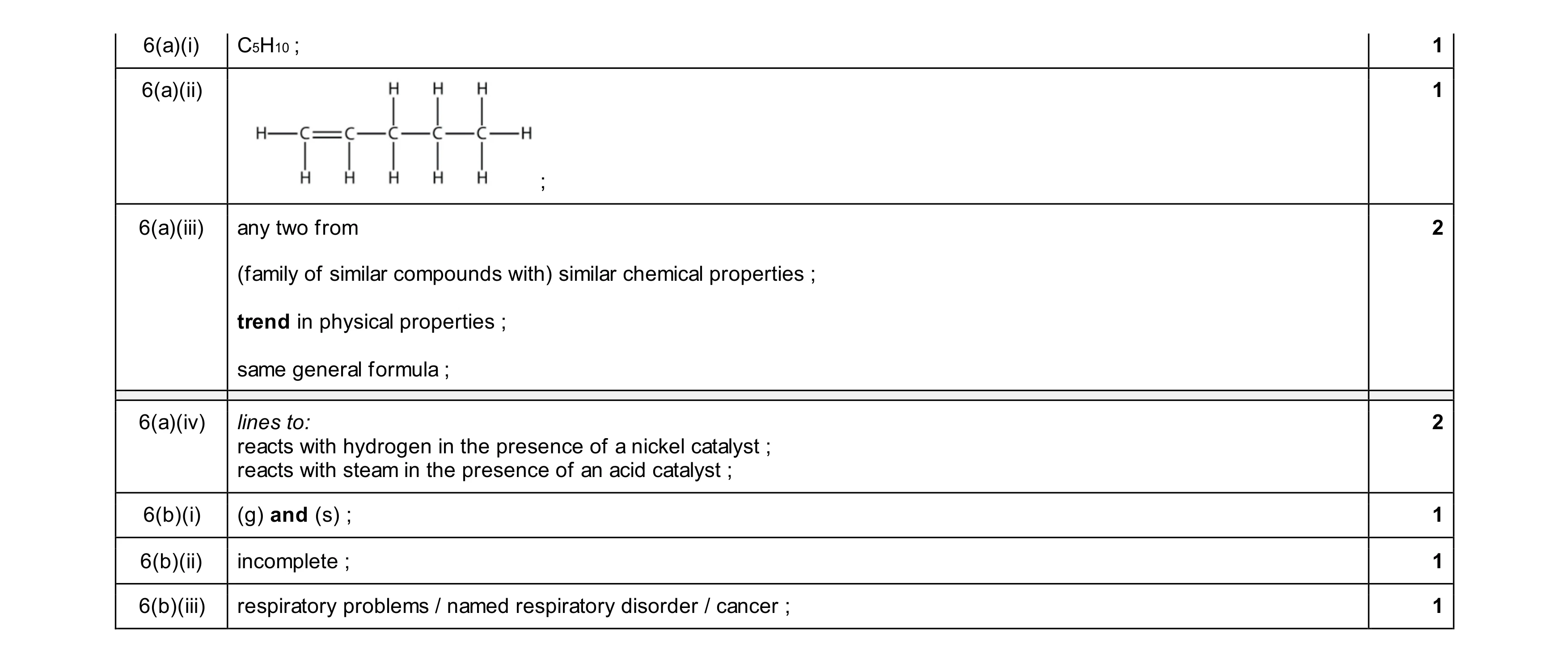 9
9