Questions as text
Q1 · A diagram of part of the carbon cycle 0653/32 Feb/March 2017
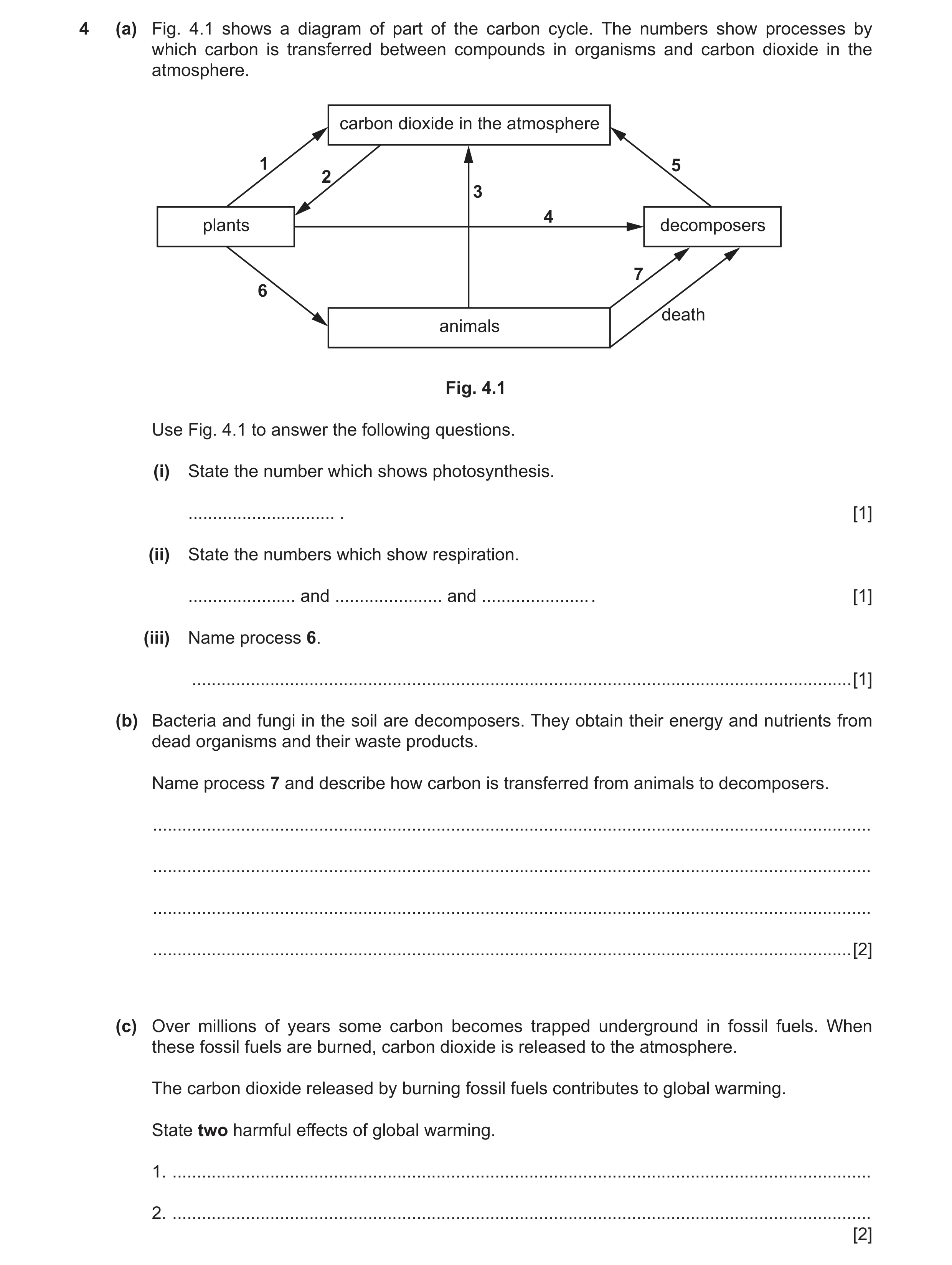
4 (a) Fig. 4.1 shows a diagram of part of the carbon cycle. The numbers show processes by which carbon is transferred between compounds in organisms and carbon dioxide in the atmosphere. carbon dioxide in the atmosphere 1 5 2 3 4 plants decomposers 7 6 death animals Fig. 4.1 Use Fig. 4.1 to answer the following questions. (i) State the number which shows photosynthesis. … . [1] (ii) State the numbers which show respiration. … and … and … . [1] (iii) Name process 6. … [1] (b) Bacteria and fungi in the soil are decomposers. They obtain their energy and nutrients from dead organisms and their waste products. Name process 7 and describe how carbon is transferred from animals to decomposers. … … … … [2] (c) Over millions of years some carbon becomes trapped underground in fossil fuels. When these fossil fuels are burned, carbon dioxide is released to the atmosphere. The carbon dioxide released by burning fossil fuels contributes to global warming. State two harmful effects of global warming. 1. … 2. … [2]
7 marks
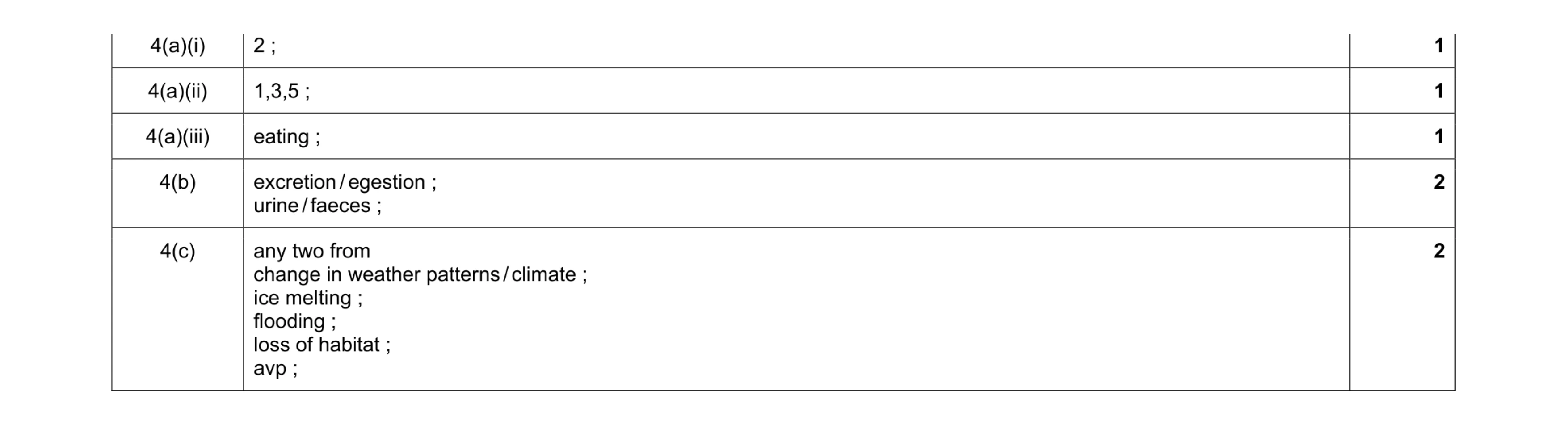
Mark scheme: 4(a)(i) 2 ; 1 4(a)(ii) 1,3,5 ; 1 4(a)(iii) eating ; 1 4(b) excretion / egestion ; urine / faeces ; 2 4(c) any two from change in weather patterns / climate ; ice melting ; flooding ; loss of habitat ; avp ; 2
This question in 0653/32 Feb/March 2017
Q2 · A teacher uses the apparatus shown in Fig 0653/32 Oct/Nov 2018
8 (a) A teacher uses the apparatus shown in Fig. 8.1 to demonstrate the electrolysis of lead(II) bromide. low voltage d.c. supply solid lead(II) bromide Fig. 8.1 Predict whether this electrolysis works. Explain your answer. prediction … explanation … … … [1] (b) A student electrolyses aqueous copper chloride using the apparatus shown in Fig. 8.2. low voltage d.c. supply aqueous copper chloride Fig. 8.2 Copper forms on the negative electrode. A gas forms at the positive electrode. The student tests this gas with damp litmus paper. Name the gas and predict its effect on the colour of the litmus paper. name … effect … [2] (c) Copper can be extracted by heating copper oxide with carbon. The equation for this reaction is: copper oxide + carbon carbon dioxide + copper Identify one substance which is oxidised and one substance which is reduced during this reaction. oxidised … reduced … [2] (d) Carbon dioxide is present in clean air in small quantities. (i) Name one other gas which is present in clean air in small quantities. … [1] (ii) Name two substances present in clean air which cause rusting. 1. … 2. … [1]
7 marks
Mark scheme: 8(a) (prediction) no reaction AND (explanation) lead bromide is solid / needs to be molten / liquid ; 1 8(b) (name) chlorine ; (effect) bleaches / (turns) white / decolourises ; 2 8(c) (oxidised) carbon ; (reduced) copper oxide ; 2 8(d)(i) water (vapour) / noble gas / named noble gas ; 1 8(d)(ii) oxygen / O2 AND water (vapour) / H2O ; 1
This question in 0653/32 Oct/Nov 2018
Q3 · Rainforest is often cleared for agriculture 0653/33 Oct/Nov 2018
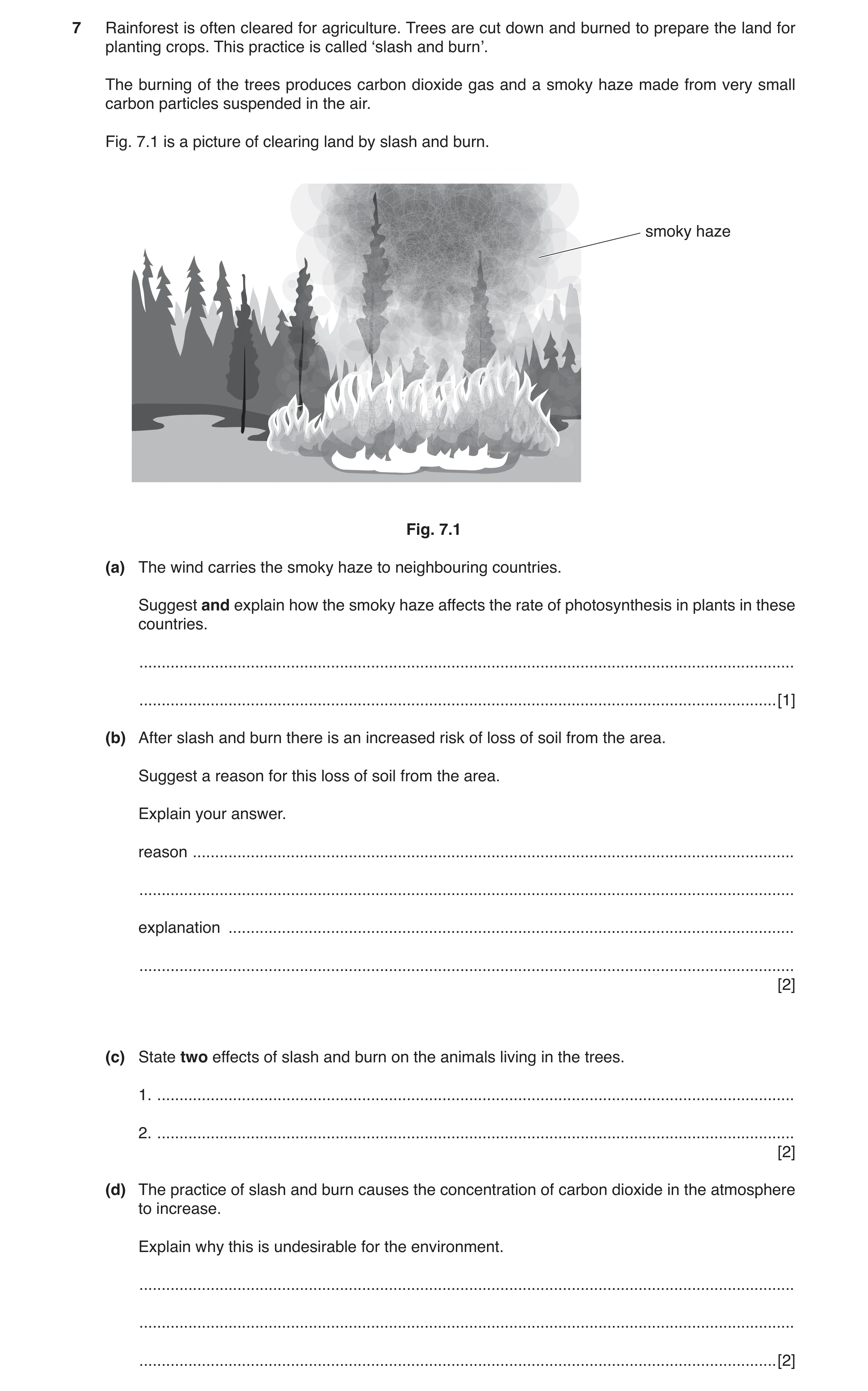
7 Rainforest is often cleared for agriculture. Trees are cut down and burned to prepare the land for planting crops. This practice is called ‘slash and burn’. The burning of the trees produces carbon dioxide gas and a smoky haze made from very small carbon particles suspended in the air. Fig. 7.1 is a picture of clearing land by slash and burn. smoky haze Fig. 7.1 (a) The wind carries the smoky haze to neighbouring countries. Suggest and explain how the smoky haze affects the rate of photosynthesis in plants in these countries. … … [1] (b) After slash and burn there is an increased risk of loss of soil from the area. Suggest a reason for this loss of soil from the area. Explain your answer. reason … … explanation … … [2] (c) State two effects of slash and burn on the animals living in the trees. 1. … 2. … [2] (d) The practice of slash and burn causes the concentration of carbon dioxide in the atmosphere to increase. Explain why this is undesirable for the environment. … … … [2]
7 marks
Mark scheme: 7(a) rate is reduced (no mark) haze / smoke particles reduce light / block stomata ; 1 7(b) (reason) lack of tree roots in soil ; (explanation) roots stabilise the soil ; or (reason) trees and plants not present to protect soil / bare soil is exposed ; (explanation) wind and rain can easily reach soil to erode it ; 2 7(c) any two of lose their habitats / move to new areas ; lose food supplies ; may be suffocated / burned by the burning process ; Max 2 2 7(d) carbon dioxide is a greenhouse gas ; contributes to global warming ; any valid consequence of global warming ; Max 2 2
This question in 0653/33 Oct/Nov 2018
Q4 · The composition of clean air is shown in Fig 0653/31 May/June 2019
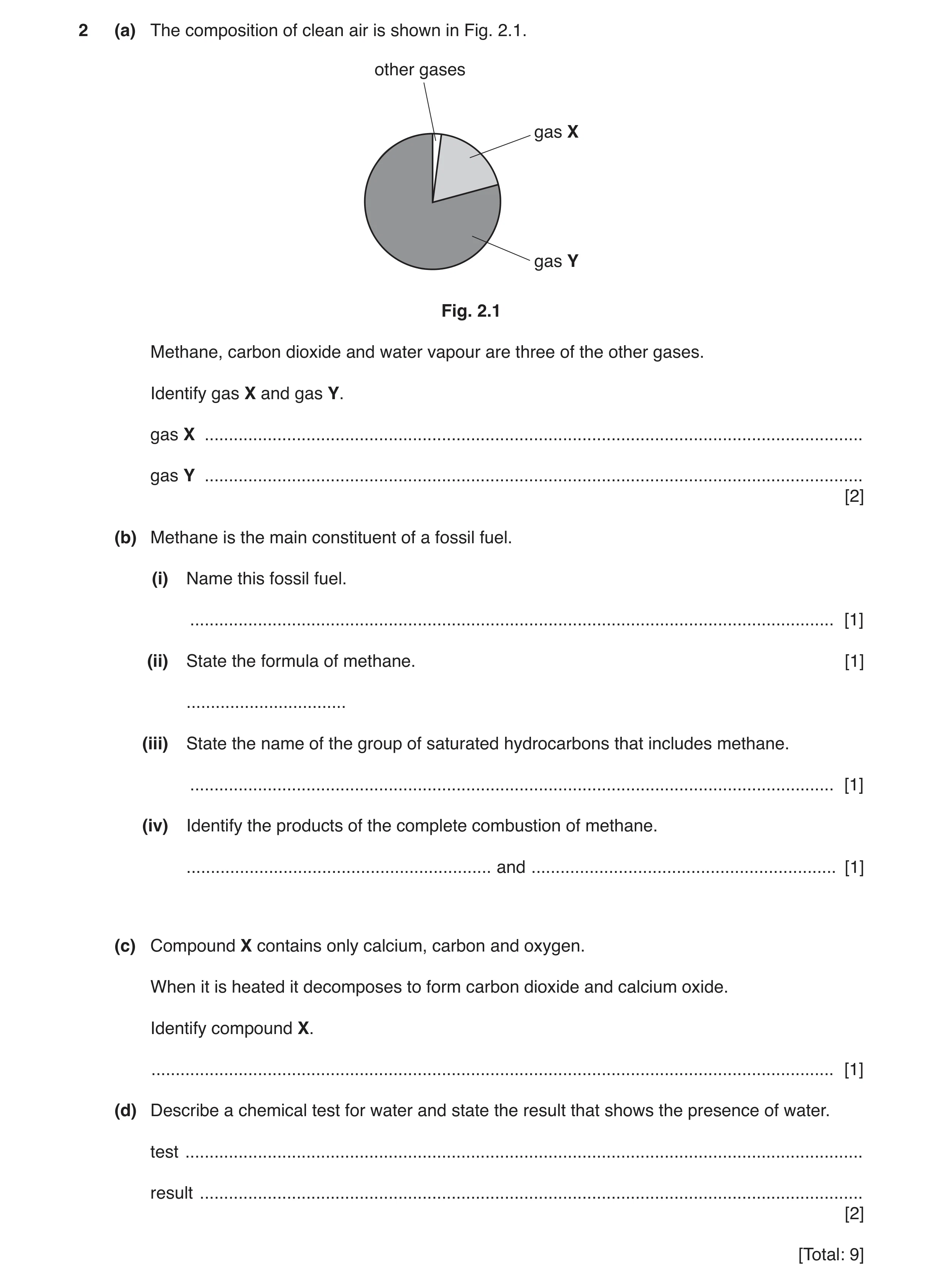
2 (a) The composition of clean air is shown in Fig. 2.1. other gases gas X gas Y Fig. 2.1 Methane, carbon dioxide and water vapour are three of the other gases. Identify gas X and gas Y. gas X … gas Y … [2] (b) Methane is the main constituent of a fossil fuel. (i) Name this fossil fuel. … [1] (ii) State the formula of methane. [1] … (iii) State the name of the group of saturated hydrocarbons that includes methane. … [1] (iv) Identify the products of the complete combustion of methane. … and … [1] (c) Compound X contains only calcium, carbon and oxygen. When it is heated it decomposes to form carbon dioxide and calcium oxide. Identify compound X. … [1] (d) Describe a chemical test for water and state the result that shows the presence of water. test … result … [2] [Total: 9]
9 marks
Mark scheme: 2(a) (gas X) oxygen / O2 ; (gas Y) nitrogen / N2 ; 2 2(b)(i) natural gas ; 1 2(b)(ii) CH4 ; 1 2(b)(iii) alkane ; 1 2(b)(iv) carbon dioxide / CO2 and water / H2O ; 1 Question Answer Marks 2(c) calcium carbonate / CaCO3 ; 1 2(d) (test) (anhydrous) copper ((II)) sulfate ; (result) turns (from white to) blue ; or (test) (anhydrous) cobalt ((II)) chloride ; (result) turns (from blue to) pink / red ; 2
This question in 0653/31 May/June 2019
Q5 · The hydrocarbons in petroleum are separated into useful products using the process shown… 0653/31 Oct/Nov 2019
8 (a) The hydrocarbons in petroleum are separated into useful products using the process shown in Fig. 8.1. refinery gas gasoline naphtha gas oil petroleum bitumen Fig. 8.1 (i) Name this process. … [1] (ii) State what is meant by hydrocarbon. … … [2] (iii) State one use for naphtha. … [1] (b) When hydrocarbons burn, they may produce carbon dioxide, carbon monoxide and water. (i) Describe one test to show the presence of water. State the positive result. test … result … [2] (ii) Describe one adverse effect of carbon monoxide on humans. … … [1] (iii) Suggest the percentage of carbon dioxide in clean air. percentage = … % [1] (iv) Using your knowledge of the amounts of other gases in clean air, explain your answer to (iii). … … [1] [Total: 9]
9 marks
Mark scheme: 8(a)(i) fractional distillation ; 1 8(a)(ii) compound/molecule that contains carbon and hydrogen ; only ; 2 8(a)(iii) (raw material) to make chemicals ; 1 8(b)(i) (test) copper((II)) sulfate or cobalt((II)) chloride ; (result) (white) turns blue (blue) turns pink ; 2 8(b)(ii) toxic / poisonous (to humans/animals) / breathing difficulties / combines with haemoglobin in place of oxygen / reduces oxygen carrying capacity of the blood ; 1 8(b)(iii) (percentage) ≤ 1(%) ; 1 8(b)(iv) nitrogen = 78% and oxygen = 21% or nitrogen + oxygen = 99% ; 1
This question in 0653/31 Oct/Nov 2019
Q6 · Air is a mixture of different gases 0653/31 Oct/Nov 2020
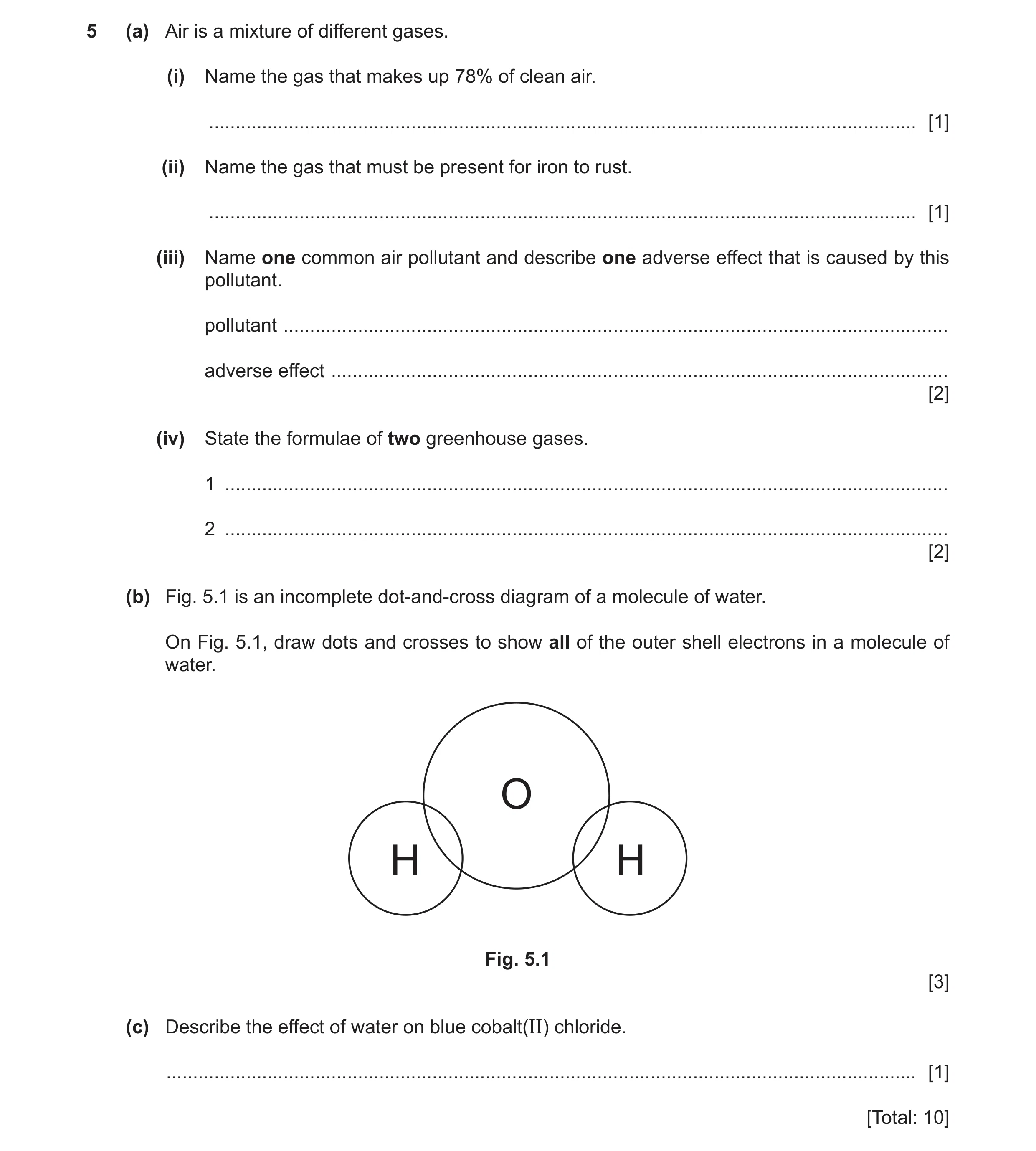
5 (a) Air is a mixture of different gases. (i) Name the gas that makes up 78% of clean air. … [1] (ii) Name the gas that must be present for iron to rust. … [1] (iii) Name one common air pollutant and describe one adverse effect that is caused by this pollutant. pollutant … adverse effect … [2] (iv) State the formulae of two greenhouse gases. 1 … 2 … [2] (b) Fig. 5.1 is an incomplete dot-and-cross diagram of a molecule of water. On Fig. 5.1, draw dots and crosses to show all of the outer shell electrons in a molecule of water. O H H Fig. 5.1 [3] (c) Describe the effect of water on blue cobalt(II) chloride. … [1] [Total: 10]
10 marks
Mark scheme: 5(a)(i) nitrogen ; 1 5(a)(ii) oxygen ; 1 5(a)(iii) (pollutant) carbon monoxide / CO ; (effect) suffocation / less oxygen absorbed/transported ; OR (pollutant) sulfur dioxide / SO2 ; (effect) damages buildings / asthma / acid rain ; OR (pollutant) oxides of nitrogen / NO / NO2 ; (effect) damages buildings / asthma / acid rain ; 2 5(a)(iv) CO2 ; CH4 ; 2 5(b) one hydrogen oxygen bond correct ; 4 electrons on oxygen outside bonds ; all else correct ; 3 5(c) (turns to) pink; 1
This question in 0653/31 Oct/Nov 2020
Q7 · The molecular structures and names of three compounds are shown in Fig 0653/32 May/June 2022
8 The molecular structures and names of three compounds are shown in Fig. 8.1. H H H H H H C C C H H C C O H H H H propene ethanol H H C C n H H poly(ethene) Fig. 8.1 (a) Complete Table 8.1 using the information in Fig. 8.1. Explain how the molecular structures in Fig. 8.1 help you to identify each type of compound. Table 8.1 type of name of compound explanation compound … alkane … … … alkene … … not a … … hydrocarbon … [3] (b) The complete combustion of each of the three compounds shown in Fig. 8.1 produces the greenhouse gas carbon dioxide. Identify the gas in the air that reacts with these compounds during combustion. … [1] (c) Propene and poly(ethene) are made from compounds obtained from petroleum. State the processes in which propene and poly(ethene) are made. propene … poly(ethene) … [2] [Total: 6]
6 marks
Mark scheme: 8(a) (alkane) poly(ethene) only has single (covalent) bonds ; (alkene) propene has a double (C=C) (covalent) bond ; (not a hydrocarbon) ethanol has oxygen / not just carbon and hydrogen ; 3 8(b) oxygen / O2 ; 1 8(c) (propene) cracking ; (poly(ethene)) (addition) polymerisation ; 2
This question in 0653/32 May/June 2022
Q8 · A student investigates the gases in air 0653/33 May/June 2022
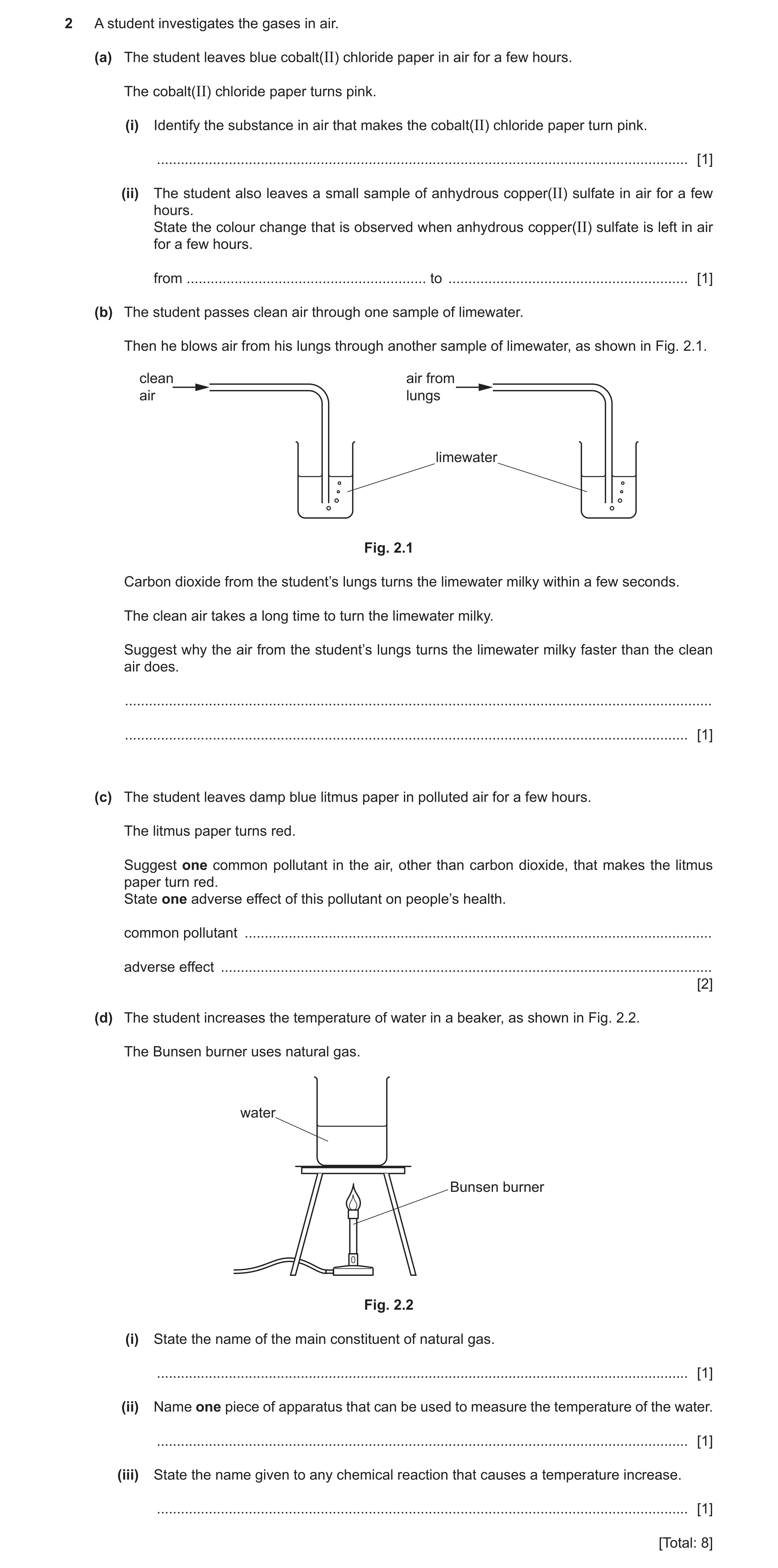
2 A student investigates the gases in air. (a) The student leaves blue cobalt(II) chloride paper in air for a few hours. The cobalt(II) chloride paper turns pink. (i) Identify the substance in air that makes the cobalt(II) chloride paper turn pink. … [1] (ii) The student also leaves a small sample of anhydrous copper(II) sulfate in air for a few hours. State the colour change that is observed when anhydrous copper(II) sulfate is left in air for a few hours. from … to … [1] (b) The student passes clean air through one sample of limewater. Then he blows air from his lungs through another sample of limewater, as shown in Fig. 2.1. clean air from air lungs limewater Fig. 2.1 Carbon dioxide from the student’s lungs turns the limewater milky within a few seconds. The clean air takes a long time to turn the limewater milky. Suggest why the air from the student’s lungs turns the limewater milky faster than the clean air does. … … [1] (c) The student leaves damp blue litmus paper in polluted air for a few hours. The litmus paper turns red. Suggest one common pollutant in the air, other than carbon dioxide, that makes the litmus paper turn red. State one adverse effect of this pollutant on people’s health. common pollutant … adverse effect … [2] (d) The student increases the temperature of water in a beaker, as shown in Fig. 2.2. The Bunsen burner uses natural gas. water Bunsen burner Fig. 2.2 (i) State the name of the main constituent of natural gas. … [1] (ii) Name one piece of apparatus that can be used to measure the temperature of the water. … [1] (iii) State the name given to any chemical reaction that causes a temperature increase. … [1] [Total: 8]
8 marks
Mark scheme: 2(a)(i) water (vapour) / H2O ; 1 2(a)(ii) (from) white (to) blue ; 1 2(b) (air from lungs has) higher concentration of carbon dioxide ; 1 2(c) common pollutant: sulfur dioxide / SO2 OR oxide of nitrogen / NOx ; adverse effect: causes, inflammation/irritation of the respiratory system/eyes/nose/throat / causes asthma / breathing problems / causes skin irritation ; 2 2(d)(i) methane ; 1 2(d)(ii) thermometer ; 1 2(d)(iii) exothermic ; 1
This question in 0653/33 May/June 2022
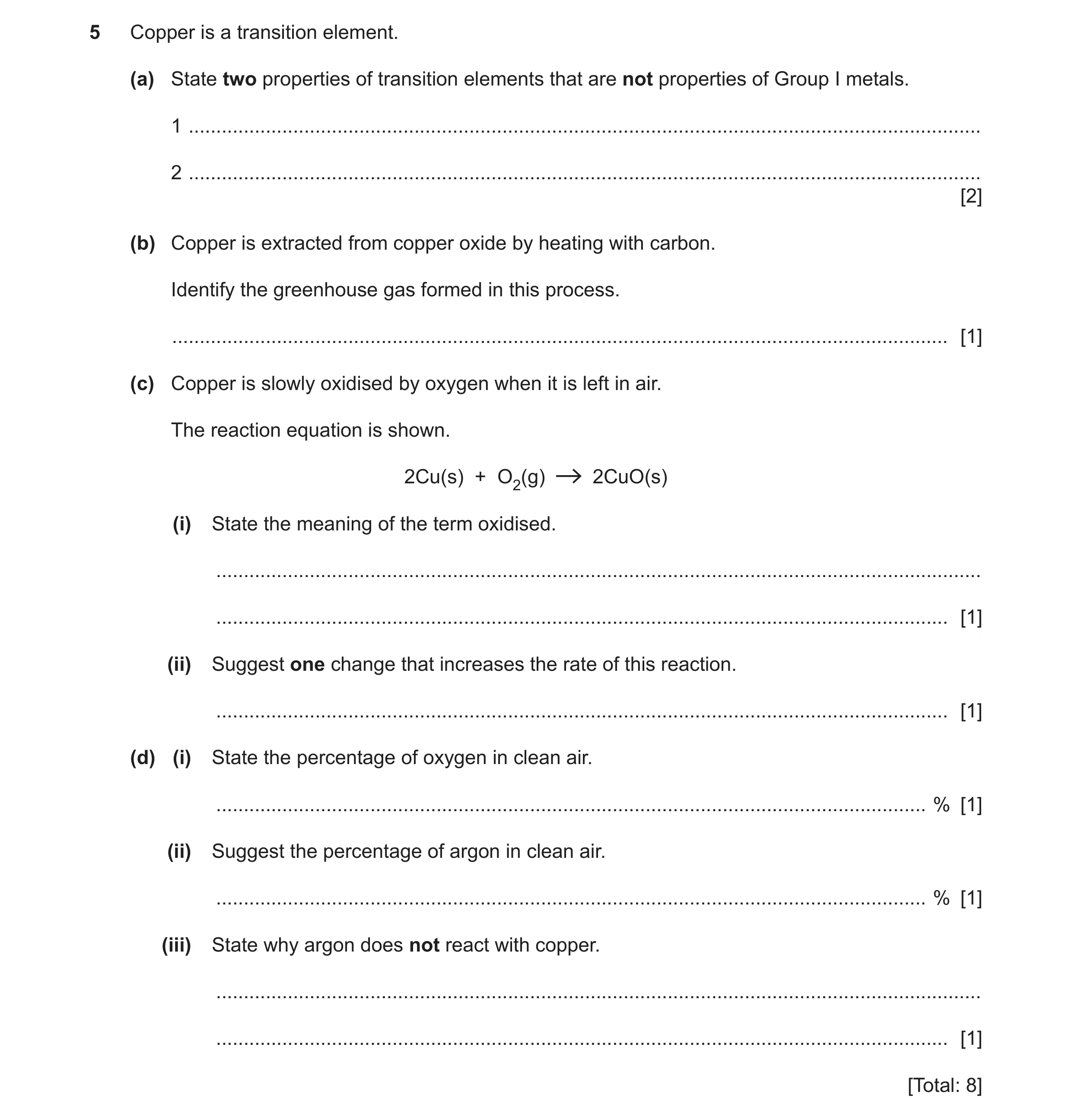
Q9 · Copper is a transition element 0653/32 Feb/March 2023
5 Copper is a transition element. (a) State two properties of transition elements that are not properties of Group I metals. 1 … 2 … [2] (b) Copper is extracted from copper oxide by heating with carbon. Identify the greenhouse gas formed in this process. … [1] (c) Copper is slowly oxidised by oxygen when it is left in air. The reaction equation is shown. 2Cu(s) + O2(g) 2CuO(s) (i) State the meaning of the term oxidised. … … [1] (ii) Suggest one change that increases the rate of this reaction. … [1] (d) (i) State the percentage of oxygen in clean air. … % [1] (ii) Suggest the percentage of argon in clean air. … % [1] (iii) State why argon does not react with copper. … … [1] [Total: 8]
8 marks
Mark scheme: 5(a) any two from: 2 high density ; high melting point ; (forms) coloured compounds ; (can) act as catalysts (as element or compound) ; 5(b) carbon dioxide / CO2 ; 1 5(c)(i) (it) gains oxygen ; 1 5(c)(ii) any one from: 1 increase / higher, temperature / heat (it) ; increase surface area ; 5(d)(i) 21(%) ; 1 5(d)(ii) less than 1(%) ; 1 5(d)(iii) argon is inert / argon is a noble gas / argon atoms have full outer shell ; 1
This question in 0653/32 Feb/March 2023
Q10 · A pie chart showing the composition of clean air 0653/32 Feb/March 2024
5 (a) Fig. 5.1 is a pie chart showing the composition of clean air. Fig. 5.1 Identify the gases in clean air by completing the key for the pie chart shown in Fig. 5.1. Key … … … and … and … [3] (b) Carbon monoxide and the oxides of nitrogen are common pollutants in air. State one adverse effect that each of these air pollutants causes. carbon monoxide … … oxides of nitrogen … … [2] (c) Carbon dioxide is a gas. (i) Carbon dioxide forms during the thermal decomposition of calcium carbonate. Calcium oxide is the other product. Write the word equation for this reaction in the boxes. + [1] (ii) Calcium carbonate reacts with dilute hydrochloric acid to form carbon dioxide. Suggest a value for the pH of dilute hydrochloric acid. pH = … [1] (d) Hydrogen chloride, HCl , is a covalent molecule. Complete Fig. 5.2 to show the dot-and-cross diagram for a molecule of hydrogen chloride. Show only the electrons in the outer shells. H Cl Fig. 5.2 [2] [Total: 9]
9 marks
Mark scheme: 5(a) (grey shading) nitrogen 3 (dots shading) oxygen (white shading) noble gases / named noble gas (white shading) water vapour (white shading) carbon dioxide ;;; 5 correct = [3] 3–4 correct = [2] 1–2 correct = [1] 5(b) carbon monoxide: 2 headaches / tiredness / confusion / toxic ; oxides of nitrogen: acid rain / damages buildings ; 5(c)(i) calcium carbonate → calcium oxide + carbon dioxide ; 1 5(c)(ii) 1–4 ; 1 5(d) shared pair of electrons ; 2 3 lone pairs in Cl and no other electrons in H ;
This question in 0653/32 Feb/March 2024
Q11 · Complete the sentences about air 0653/32 Oct/Nov 2024
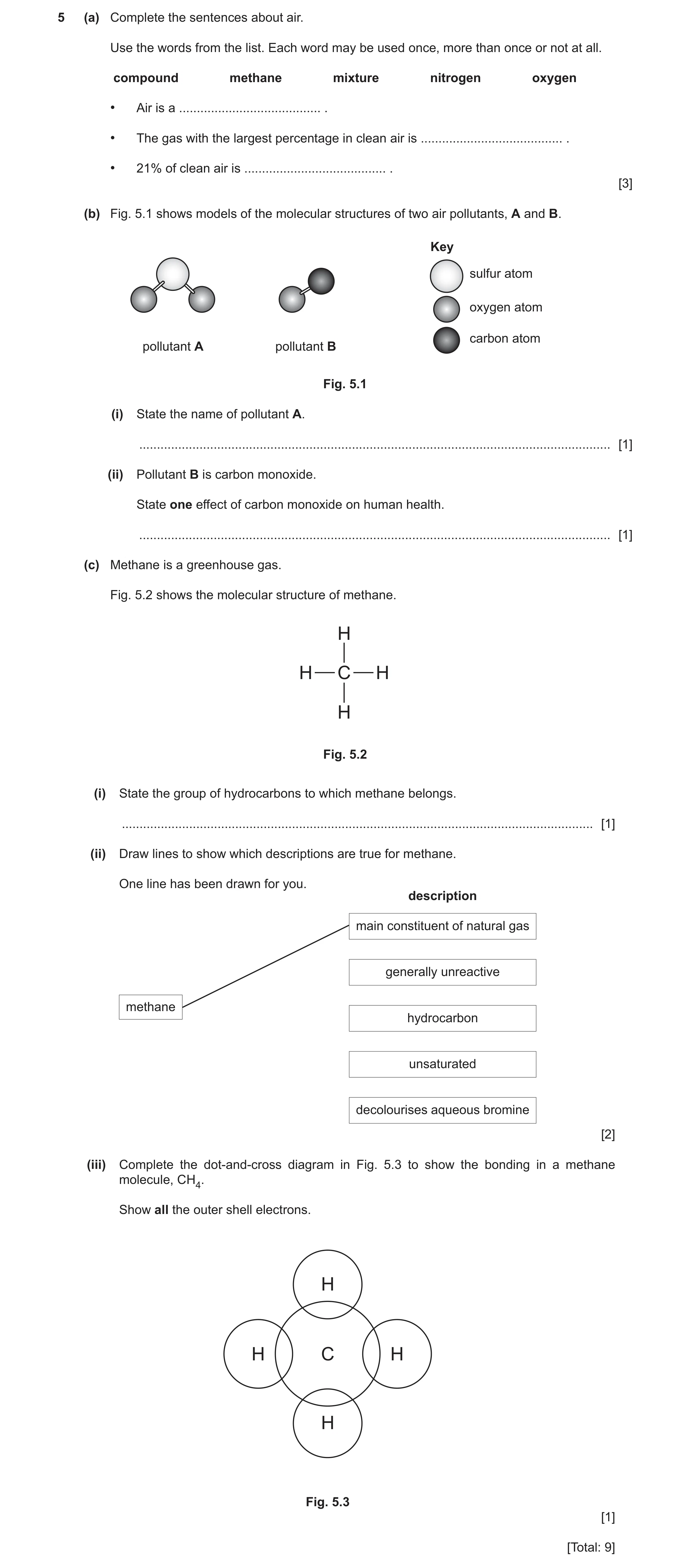
5 (a) Complete the sentences about air. Use the words from the list. Each word may be used once, more than once or not at all. compound methane mixture nitrogen oxygen • Air is a … . • The gas with the largest percentage in clean air is … . • 21% of clean air is … . [3] (b) Fig. 5.1 shows models of the molecular structures of two air pollutants, A and B. Key sulfur atom oxygen atom carbon atom pollutant A pollutant B Fig. 5.1 (i) State the name of pollutant A. … [1] (ii) Pollutant B is carbon monoxide. State one effect of carbon monoxide on human health. … [1] (c) Methane is a greenhouse gas. Fig. 5.2 shows the molecular structure of methane. H H C H H Fig. 5.2 (i) State the group of hydrocarbons to which methane belongs. … [1] (ii) Draw lines to show which descriptions are true for methane. One line has been drawn for you. description main constituent of natural gas generally unreactive methane hydrocarbon unsaturated decolourises aqueous bromine [2] (iii) Complete the dot-and-cross diagram in Fig. 5.3 to show the bonding in a methane molecule, CH4. Show all the outer shell electrons. H H C H H Fig. 5.3 [1] [Total: 9]
9 marks
Mark scheme: 5(a) mixture ; 3 nitrogen ; oxygen ; 5(b)(i) sulfur dioxide ; 1 5(b)(ii) fatigue / headache / drowsiness / confusion / dizziness / death ; 1 5(c)(i) alkane ; 1 5(c)(ii) line drawn to ‘generally unreactive’ ; 2 line drawn to ‘hydrocarbon’ ; 5(c)(iii) 1 bonding pair between each hydrogen and the carbon ;
This question in 0653/32 Oct/Nov 2024
Q12 · Complete the sentences about air 0653/33 Oct/Nov 2024
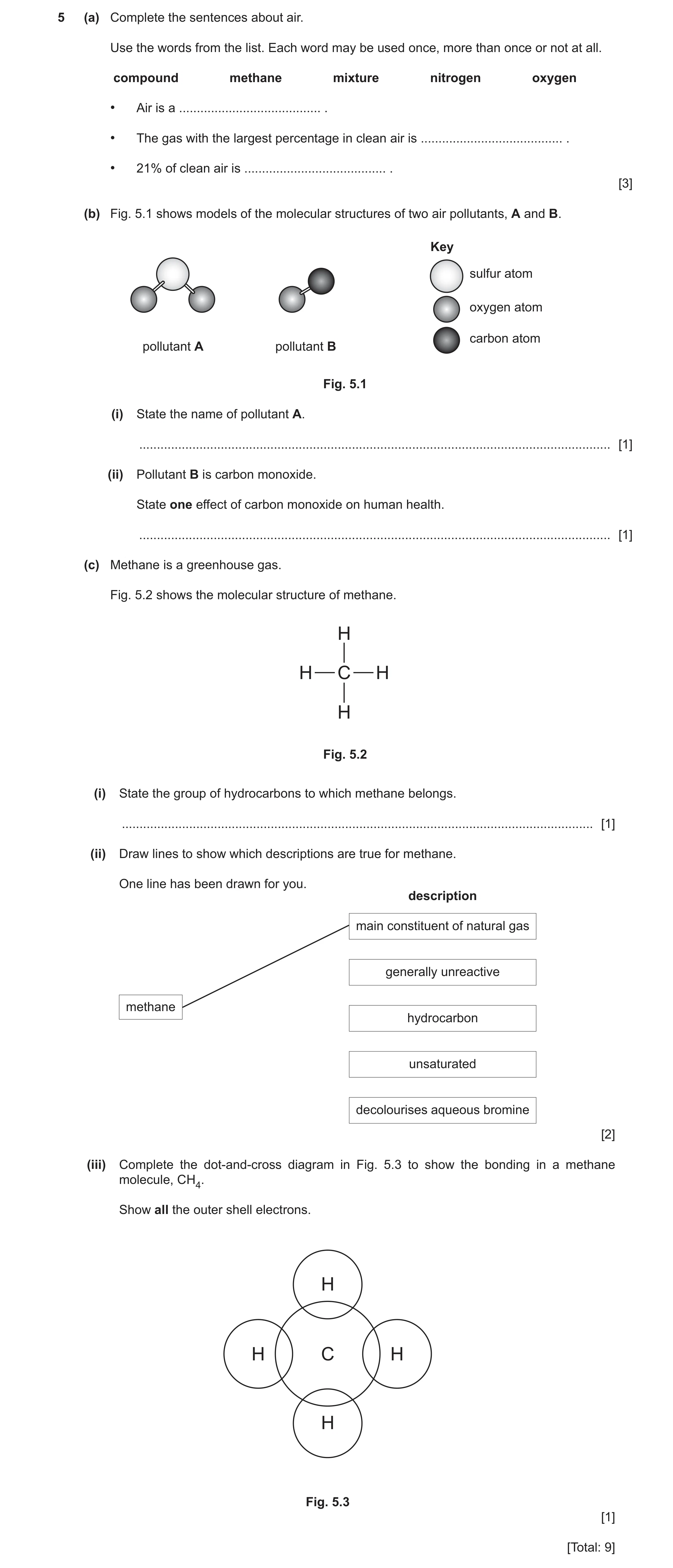
5 (a) Complete the sentences about air. Use the words from the list. Each word may be used once, more than once or not at all. compound methane mixture nitrogen oxygen • Air is a … . • The gas with the largest percentage in clean air is … . • 21% of clean air is … . [3] (b) Fig. 5.1 shows models of the molecular structures of two air pollutants, A and B. Key sulfur atom oxygen atom carbon atom pollutant A pollutant B Fig. 5.1 (i) State the name of pollutant A. … [1] (ii) Pollutant B is carbon monoxide. State one effect of carbon monoxide on human health. … [1] (c) Methane is a greenhouse gas. Fig. 5.2 shows the molecular structure of methane. H H C H H Fig. 5.2 (i) State the group of hydrocarbons to which methane belongs. … [1] (ii) Draw lines to show which descriptions are true for methane. One line has been drawn for you. description main constituent of natural gas generally unreactive methane hydrocarbon unsaturated decolourises aqueous bromine [2] (iii) Complete the dot-and-cross diagram in Fig. 5.3 to show the bonding in a methane molecule, CH4. Show all the outer shell electrons. H H C H H Fig. 5.3 [1] [Total: 9]
9 marks
Mark scheme: 5(a) mixture ; 3 nitrogen ; oxygen ; 5(b)(i) sulfur dioxide ; 1 5(b)(ii) fatigue / headache / drowsiness / confusion / dizziness / death ; 1 5(c)(i) alkane ; 1 5(c)(ii) line drawn to ‘generally unreactive’ ; 2 line drawn to ‘hydrocarbon’ ; 5(c)(iii) 1 bonding pair between each hydrogen and the carbon ;
This question in 0653/33 Oct/Nov 2024
Q13 · The percentage of gases in a sample of natural gas 0653/32 Feb/March 2025
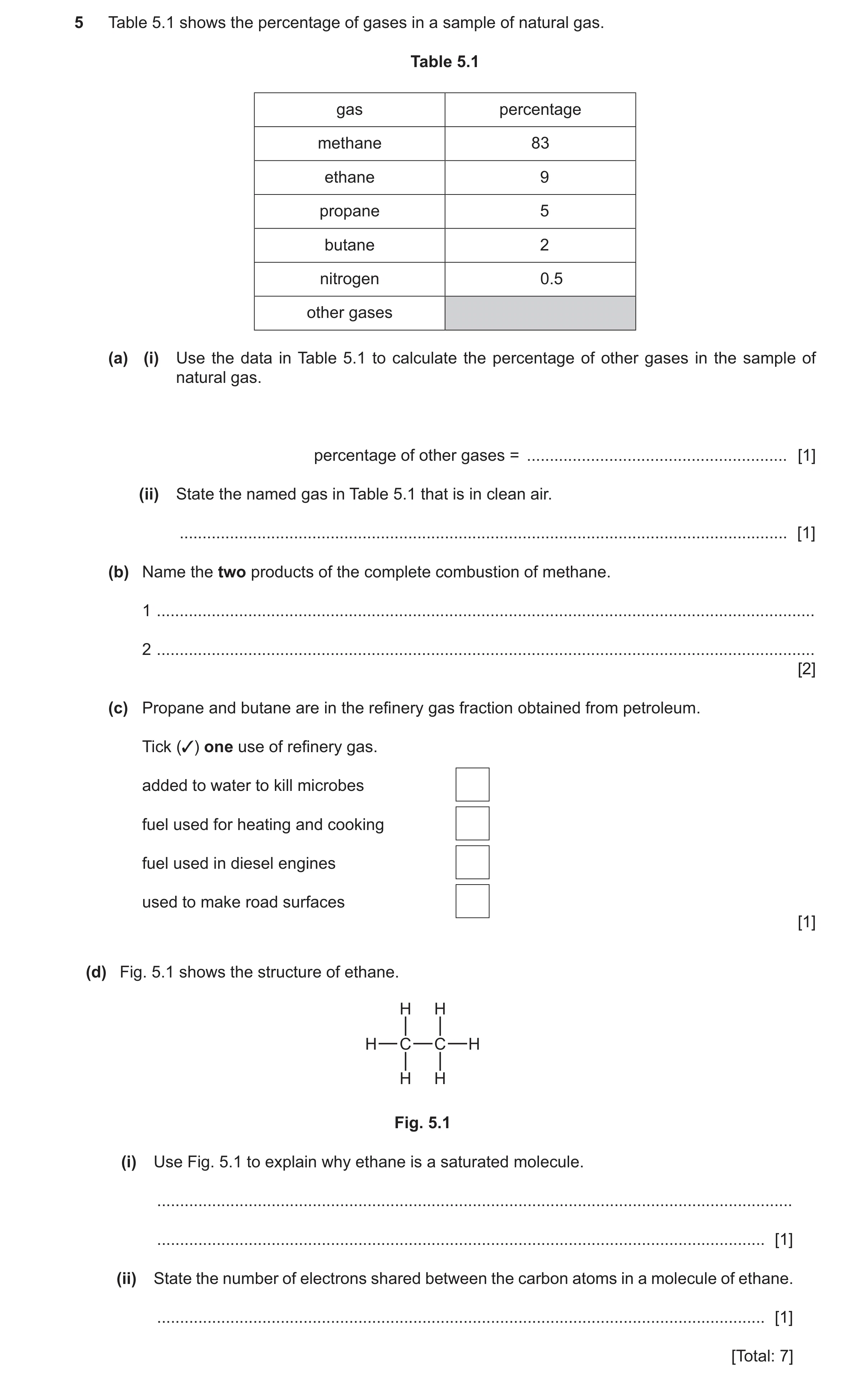
5 Table 5.1 shows the percentage of gases in a sample of natural gas. Table 5.1 gas percentage methane 83 ethane 9 propane 5 butane 2 nitrogen 0.5 other gases (a) (i) Use the data in Table 5.1 to calculate the percentage of other gases in the sample of natural gas. percentage of other gases = … [1] (ii) State the named gas in Table 5.1 that is in clean air. … [1] (b) Name the two products of the complete combustion of methane. 1 … 2 … [2] (c) Propane and butane are in the refinery gas fraction obtained from petroleum. Tick (3) one use of refinery gas. added to water to kill microbes fuel used for heating and cooking fuel used in diesel engines used to make road surfaces [1] (d) Fig. 5.1 shows the structure of ethane. H H H C C H H H Fig. 5.1 (i) Use Fig. 5.1 to explain why ethane is a saturated molecule. … … [1] (ii) State the number of electrons shared between the carbon atoms in a molecule of ethane. … [1] [Total: 7]
7 marks
Mark scheme: 5(a)(i) 0.5 (%) ; 1 5(a)(ii) nitrogen ; 1 5(b) carbon dioxide ; 2 water ; either order 5(c) fuel used for heating and cooking ; 1 more than one answer ticked = 0 marks 5(d)(i) the (C-C) bond is single / contains single bonds only ; 1 5(d)(ii) two / 2 ; 1
This question in 0653/32 Feb/March 2025
Q14 · The formulas of some compounds of carbon are shown 0653/31 May/June 2025
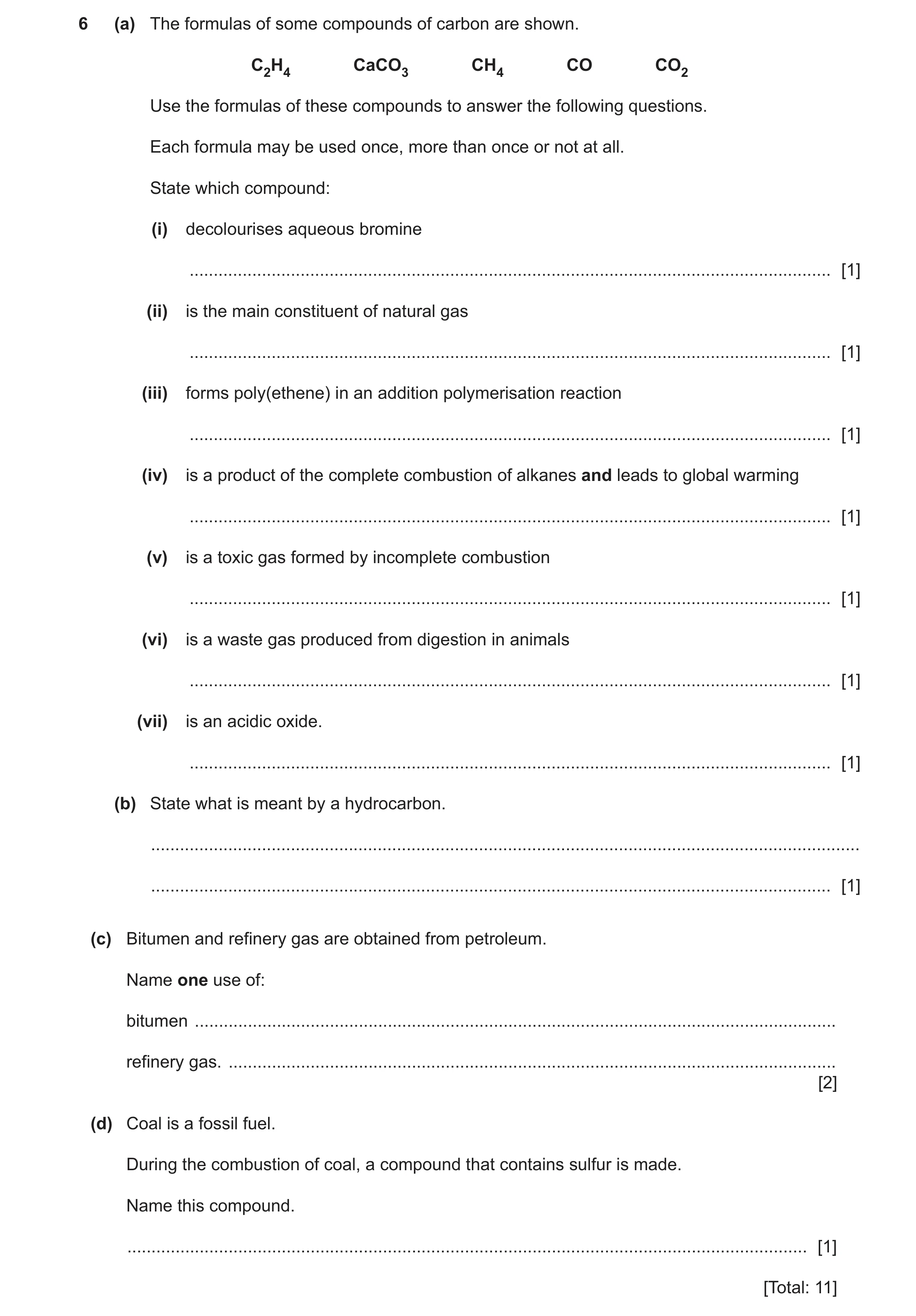
6 (a) The formulas of some compounds of carbon are shown. C2H4 CaCO3 CH4 CO CO2 Use the formulas of these compounds to answer the following questions. Each formula may be used once, more than once or not at all. State which compound: (i) decolourises aqueous bromine … [1] (ii) is the main constituent of natural gas … [1] (iii) forms poly(ethene) in an addition polymerisation reaction … [1] (iv) is a product of the complete combustion of alkanes and leads to global warming … [1] (v) is a toxic gas formed by incomplete combustion … [1] (vi) is a waste gas produced from digestion in animals … [1] (vii) is an acidic oxide. … [1] (b) State what is meant by a hydrocarbon. … … [1] (c) Bitumen and refinery gas are obtained from petroleum. Name one use of: bitumen … refinery gas. … [2] (d) Coal is a fossil fuel. During the combustion of coal, a compound that contains sulfur is made. Name this compound. … [1] [Total: 11]
11 marks
Mark scheme: 6(a)(i) C2H4 ; 1 6(a)(ii) CH4 ; 1 6(a)(iii) C2H4 ; 1 6(a)(iv) CO2 ; 1 6(a)(v) CO ; 1 6(a)(vi) CH4 ; 1 6(a)(vii) CO2 ; 1 6(b) (a compound that contains) carbon and hydrogen only ; 1 6(c) (bitumen) road surfaces ; 2 (refinery gas) heating / cooking ; 6(d) sulfur dioxide ; 1
This question in 0653/31 May/June 2025
Q15 · The combustion of magnesium ribbon in air 0653/31 Oct/Nov 2025
6 (a) Fig. 6.1 shows the combustion of magnesium ribbon in air. A white powder of magnesium oxide is formed. tongs magnesium ribbon white powder Fig. 6.1 (i) Name the gas that reacts with the magnesium. … [1] (ii) Magnesium oxide is a metallic oxide. Circle the term that describes this type of oxide. acidic aqueous basic carbonate solvent [1] (iii) This reaction is exothermic. Describe what is meant by exothermic. … … [1] (iv) Magnesium oxide reacts with dilute hydrochloric acid. Complete the word equation for this reaction. magnesium hydrochloric + + oxide acid [2] (b) Sulfur dioxide and oxides of nitrogen are air pollutants that cause the same adverse effect to the environment. (i) Name this adverse effect. … [1] (ii) State one source of sulfur dioxide. … [1] (c) Iron is extracted from iron(III) oxide in the blast furnace. (i) Name this type of reaction. … [1] (ii) Name an ore that contains iron(III) oxide. … [1] [Total: 9]
9 marks
Mark scheme: 6(a)(i) oxygen ; 1 6(a)(ii) basic ; 1 6(a)(iii) (reaction that transfers) thermal energy to the surroundings ; 1 6(a)iv) magnesium chloride ; 2 water ; 6(b)(i) acid rain ; 1 6(b)(ii) burning fossil fuels ; 1 6(c)(i) reduction ; 1 6(c)(ii) hematite ; 1
This question in 0653/31 Oct/Nov 2025
 1 / 21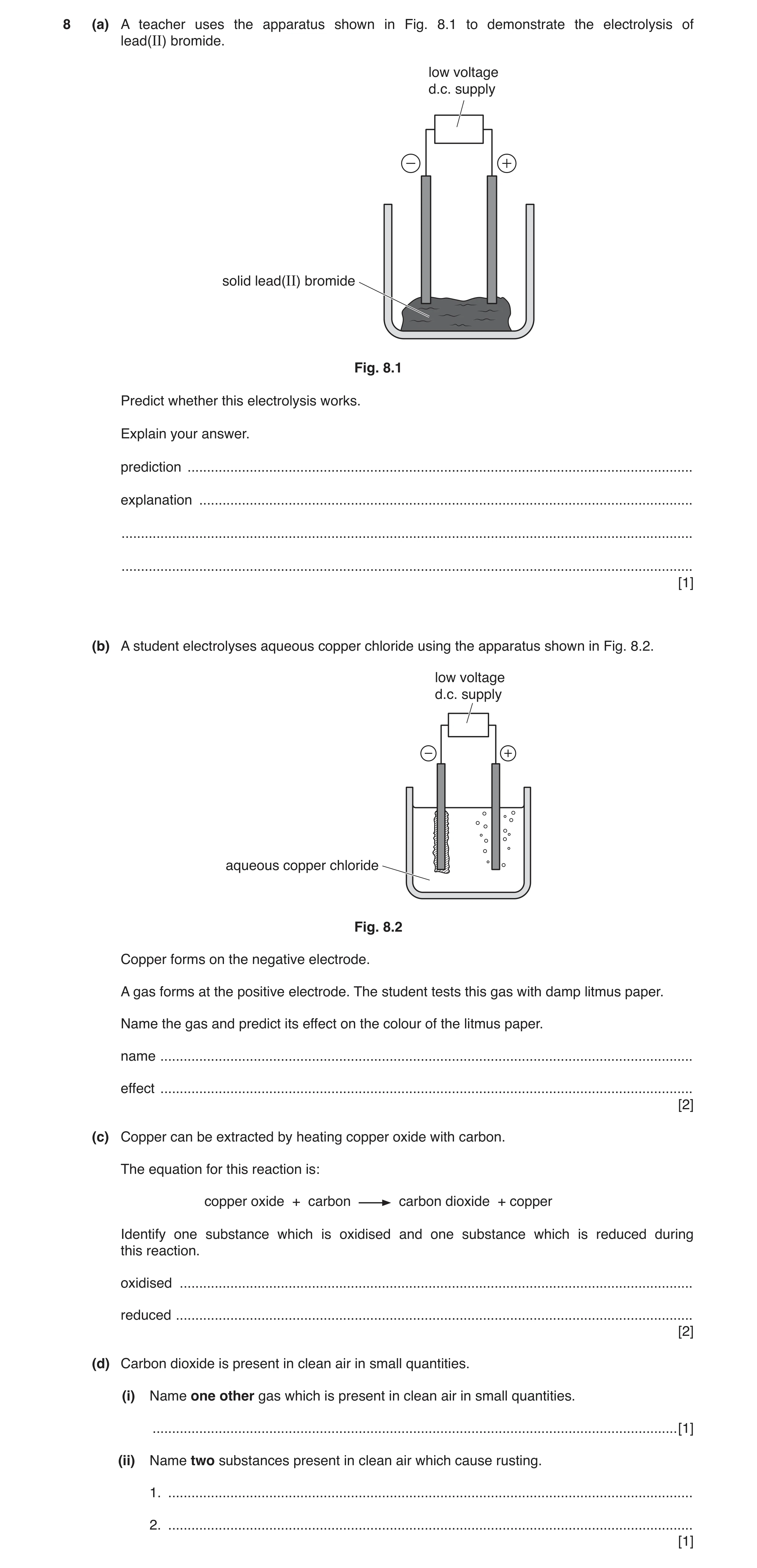
 5 / 21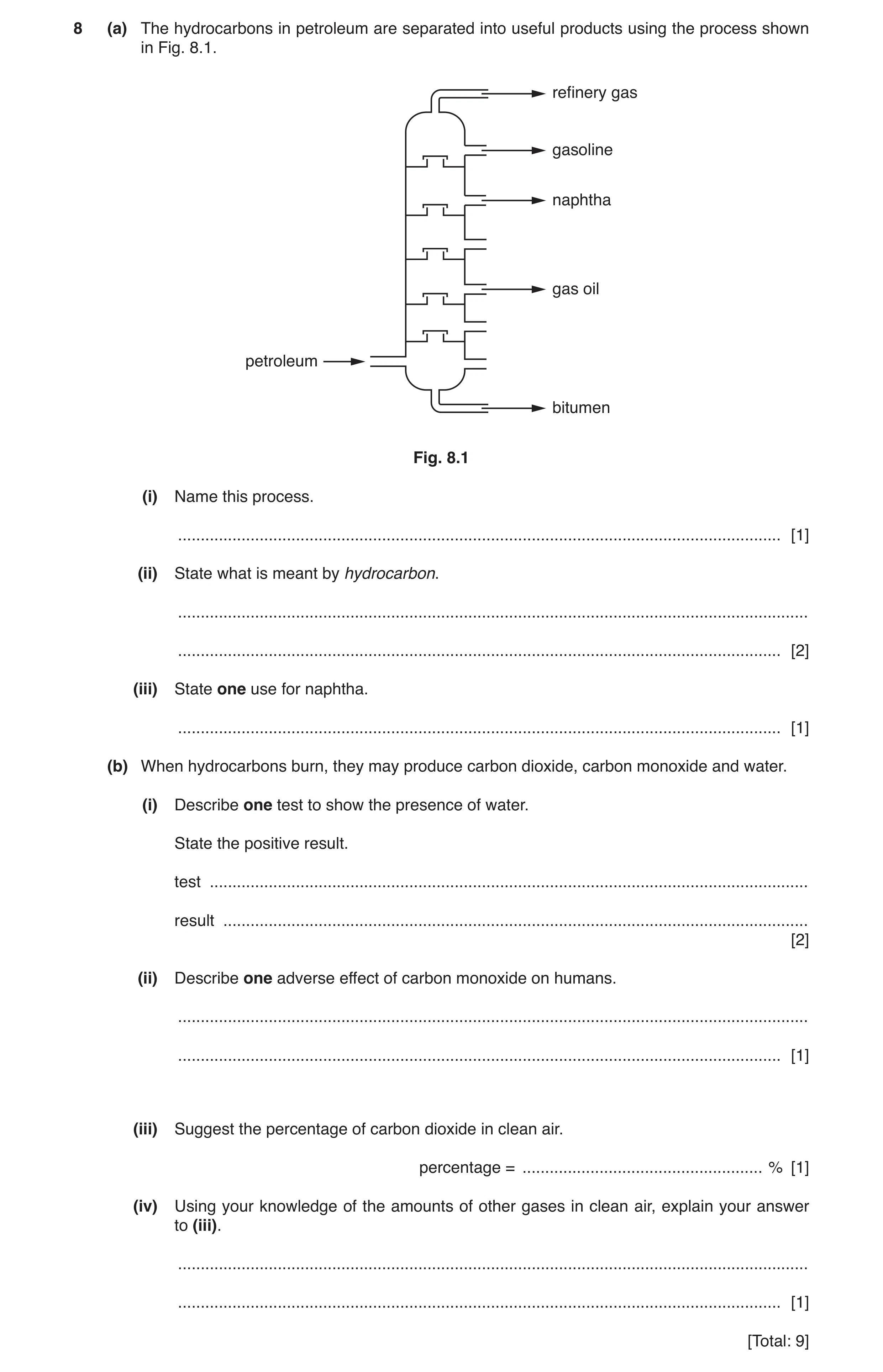
 7 / 21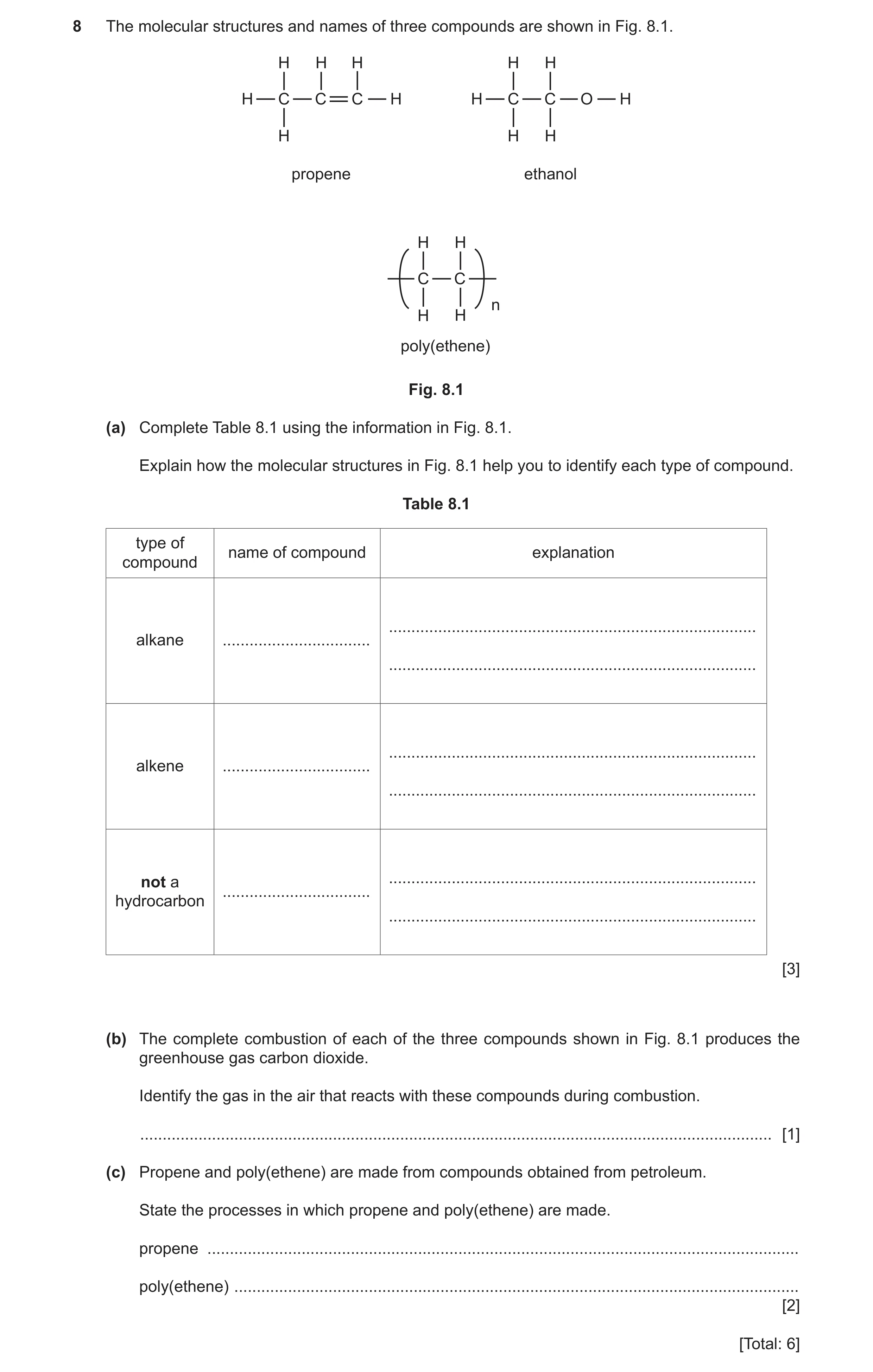
 11 / 21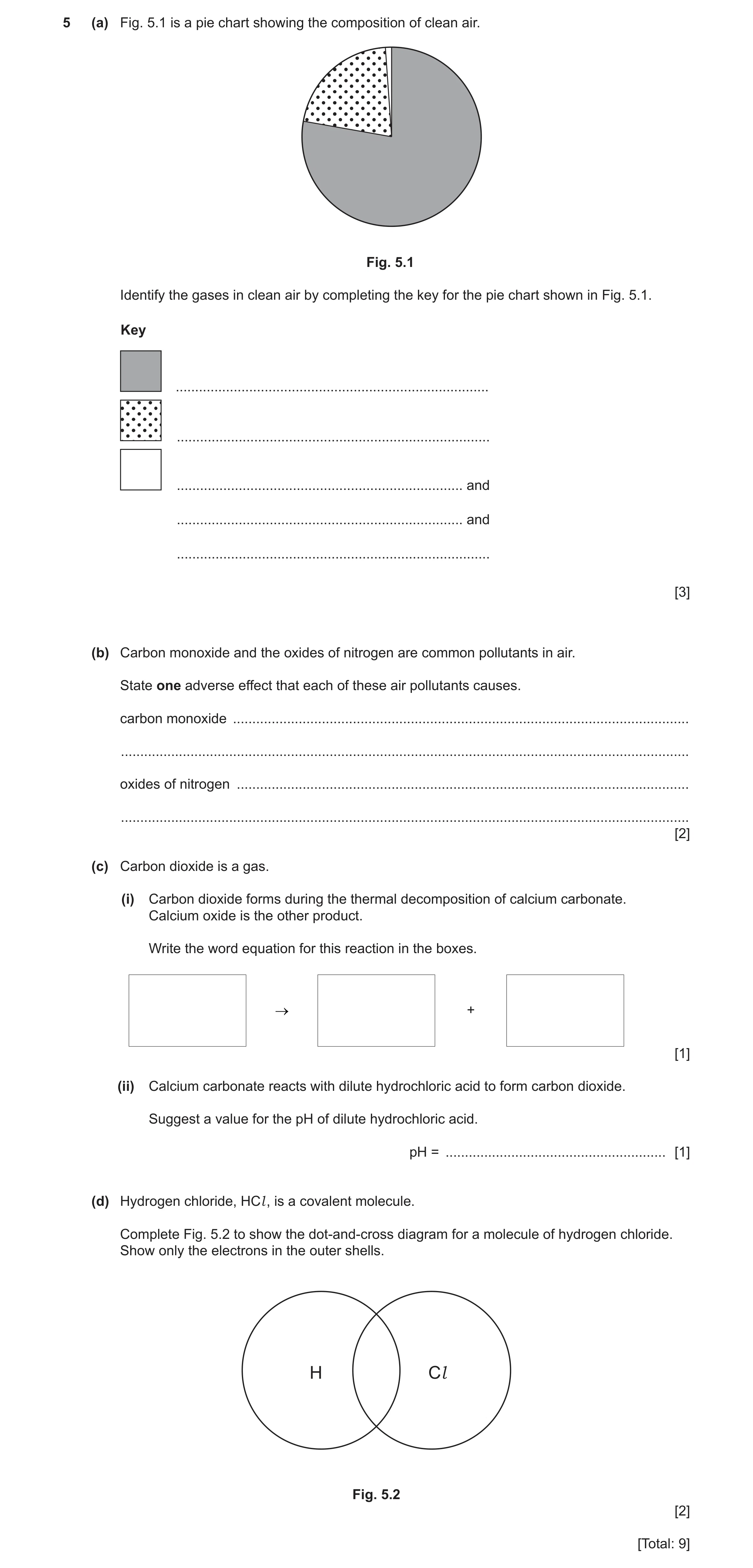
 19 / 21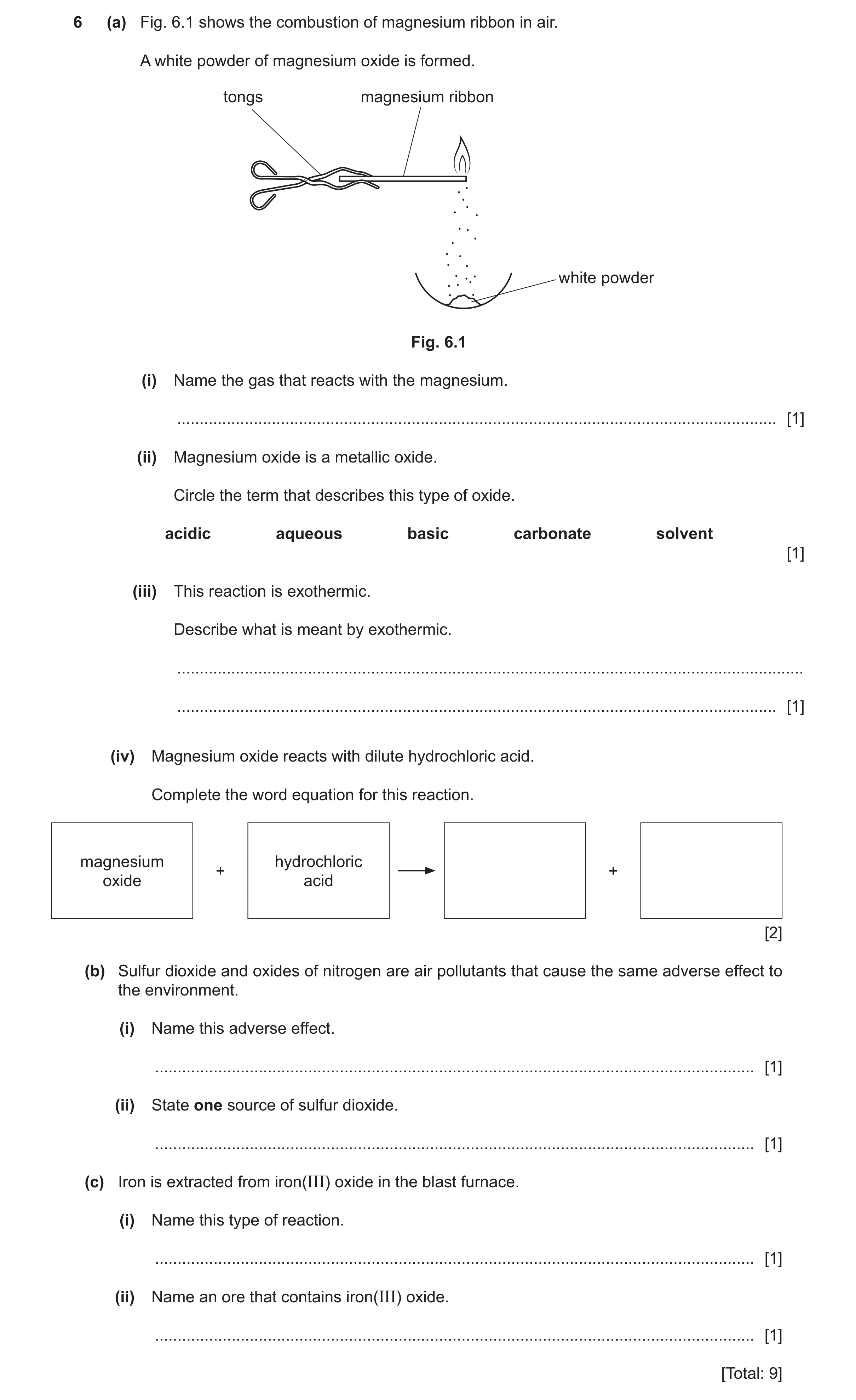
 7
7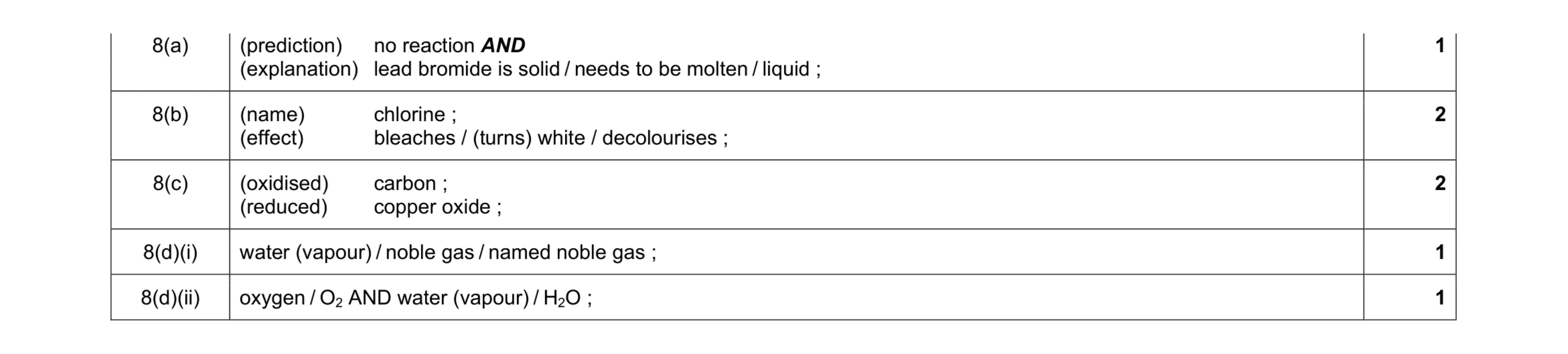 7
7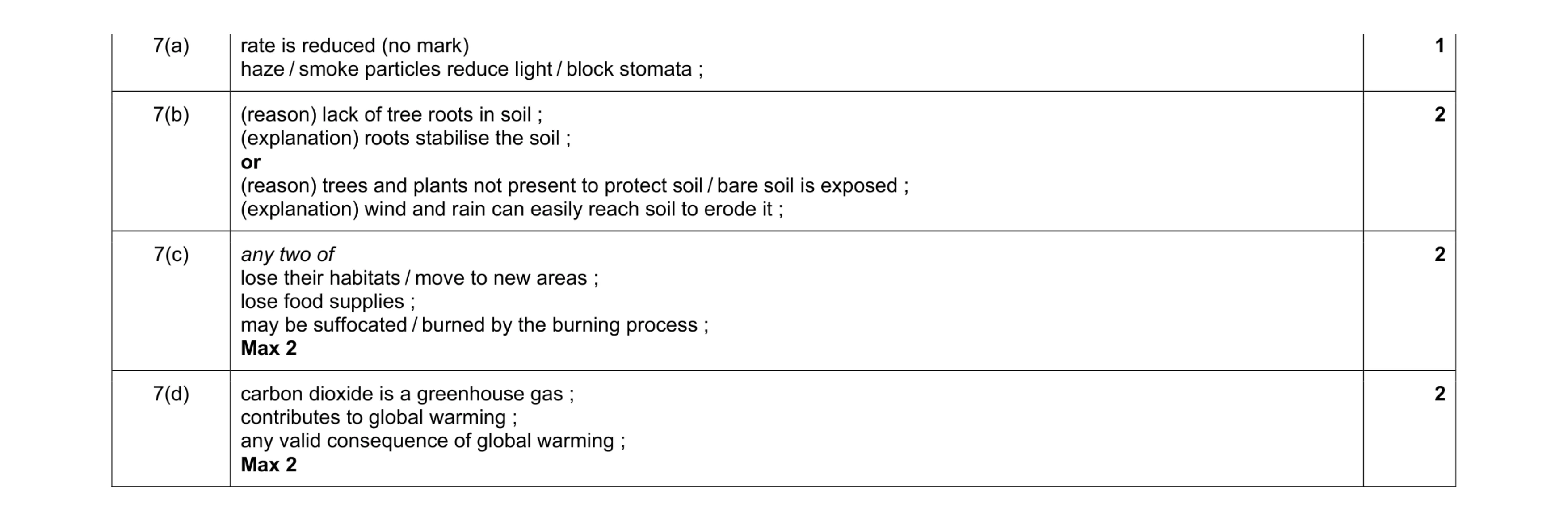 7
7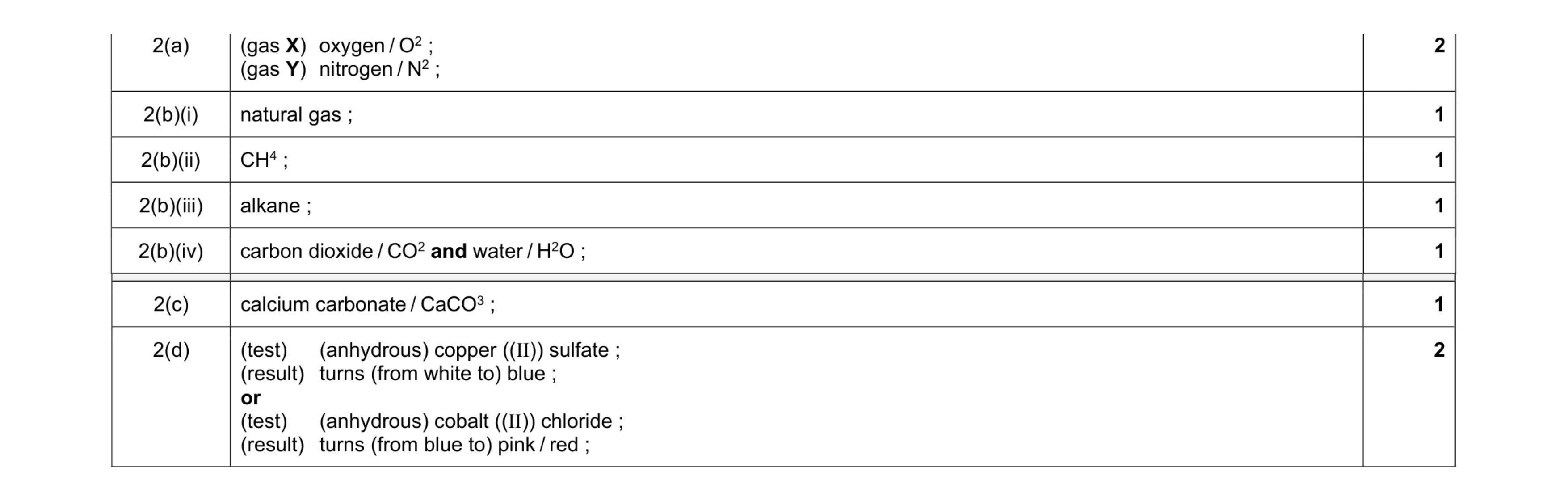 9
9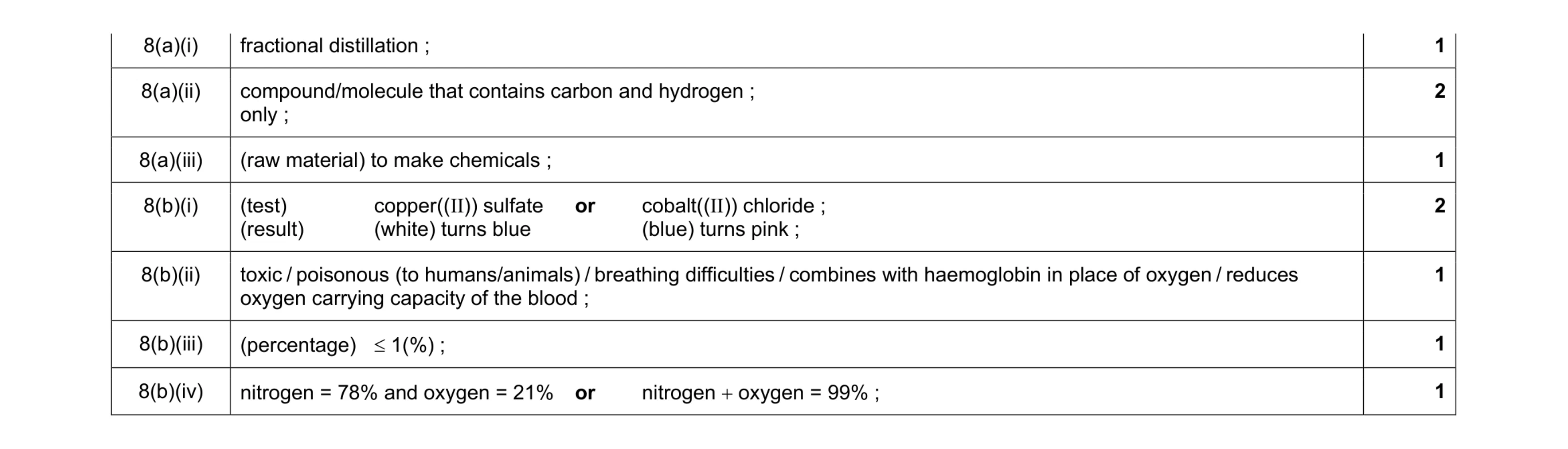 9
9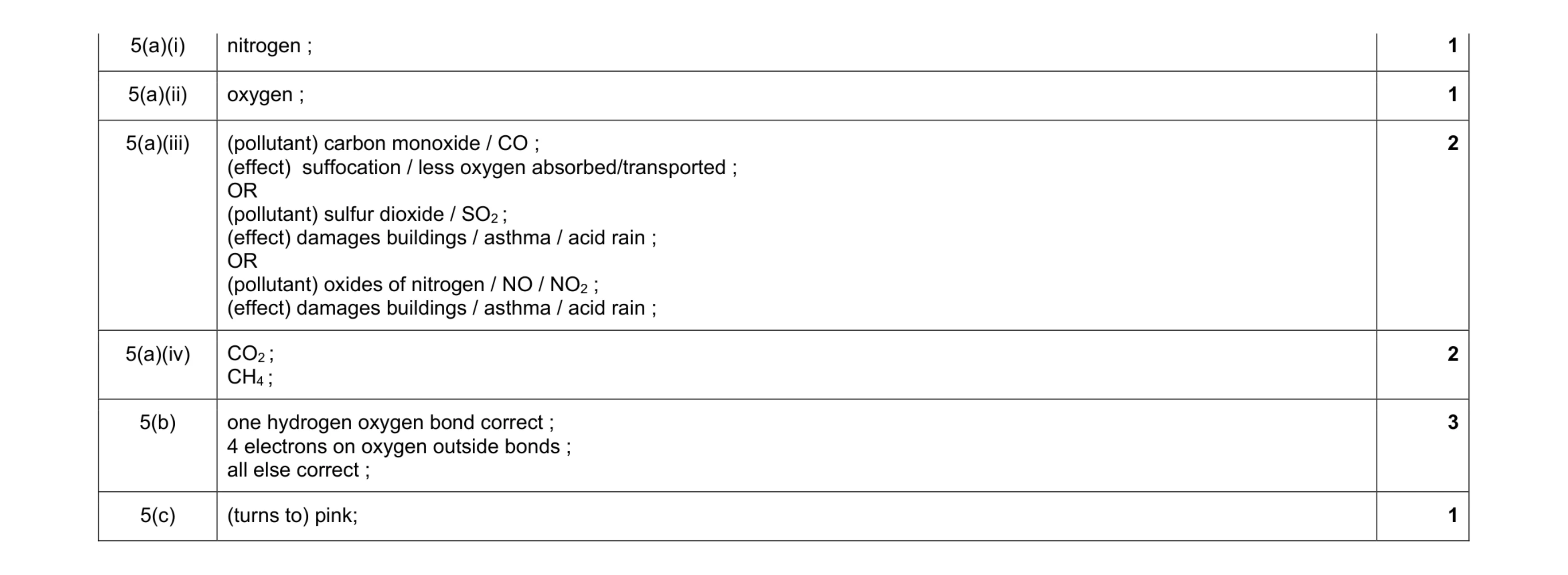 10
10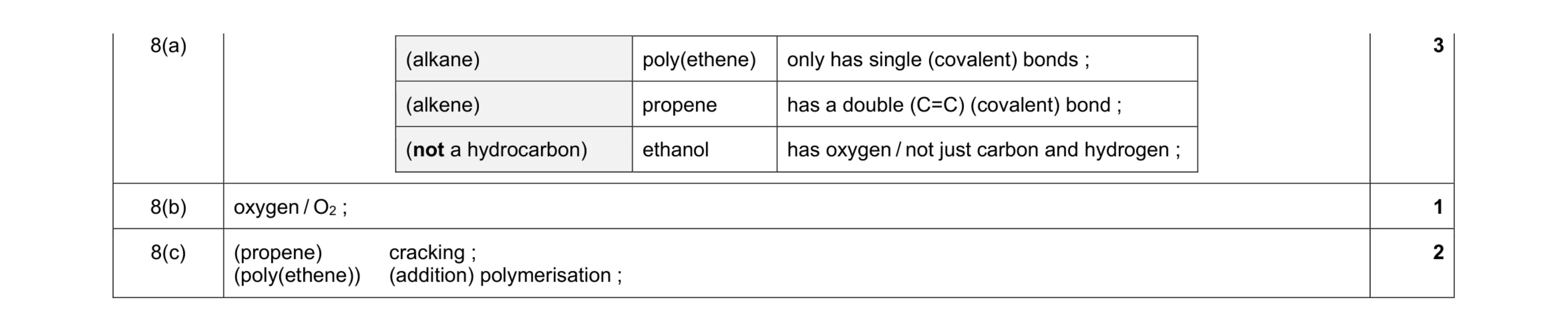 6
6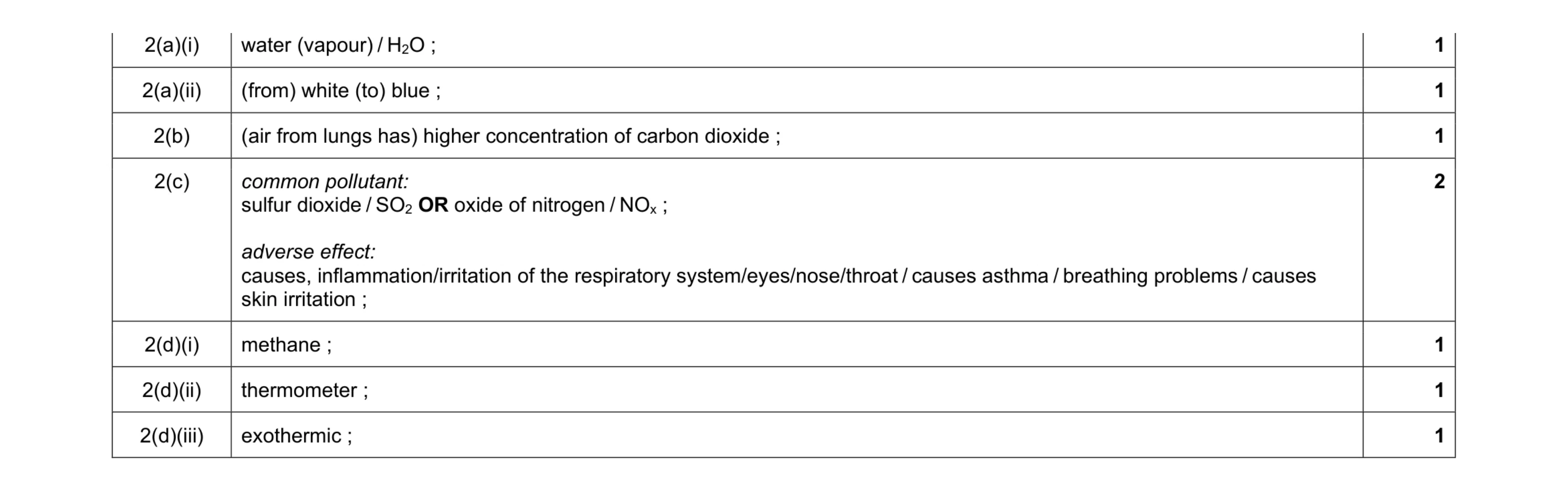 8
8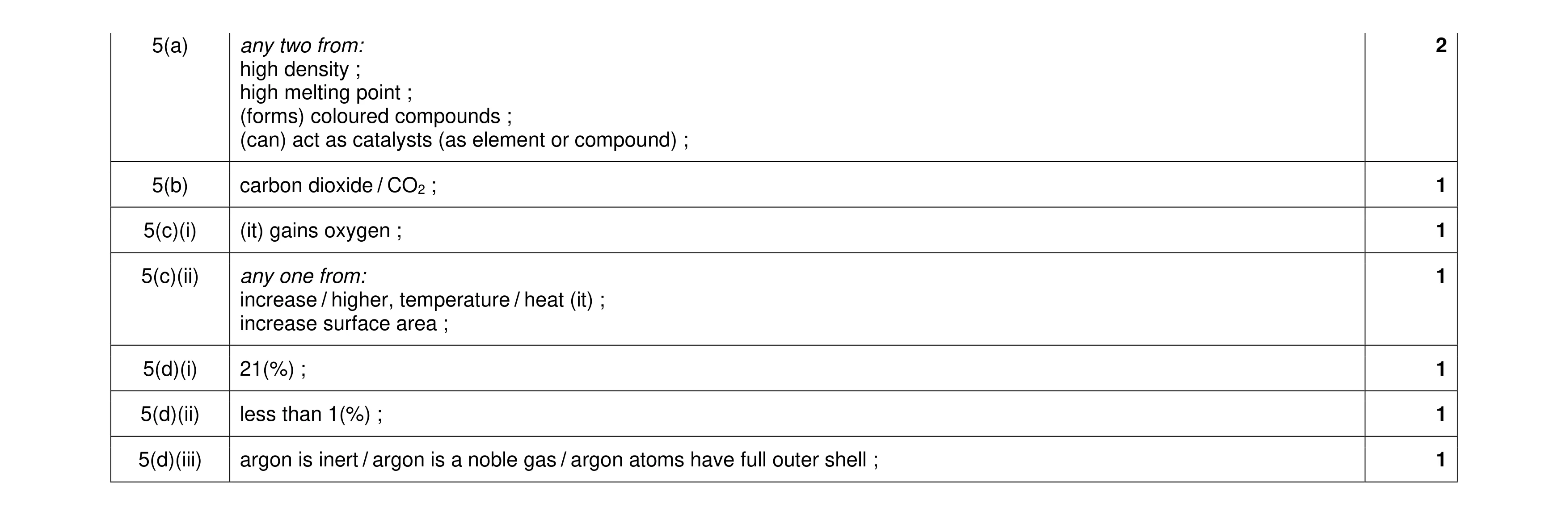 8
8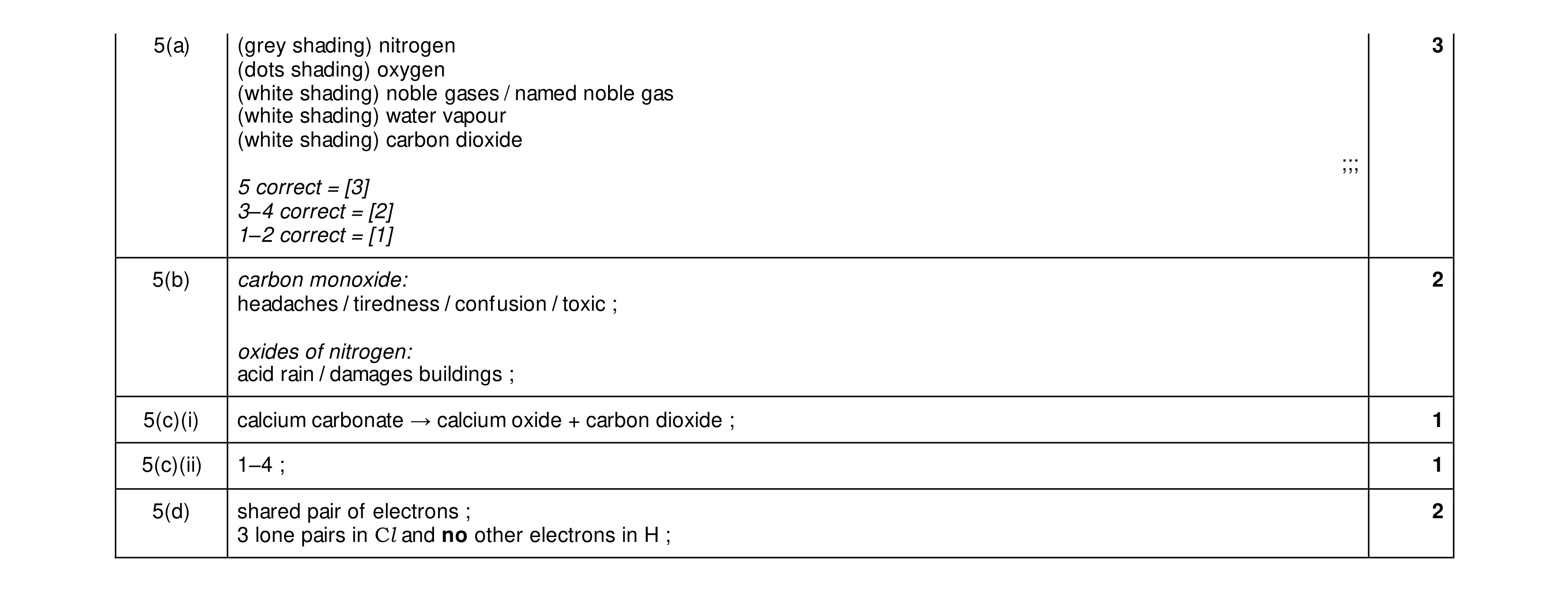 9
9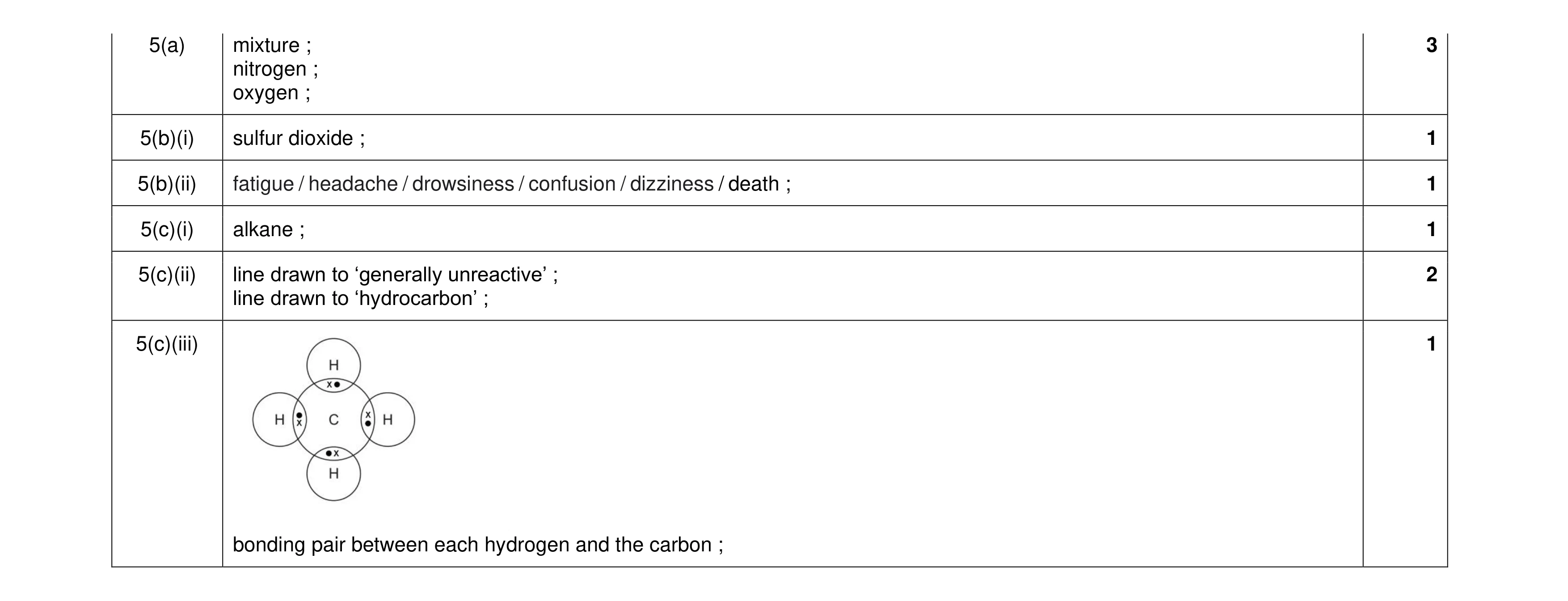 9
9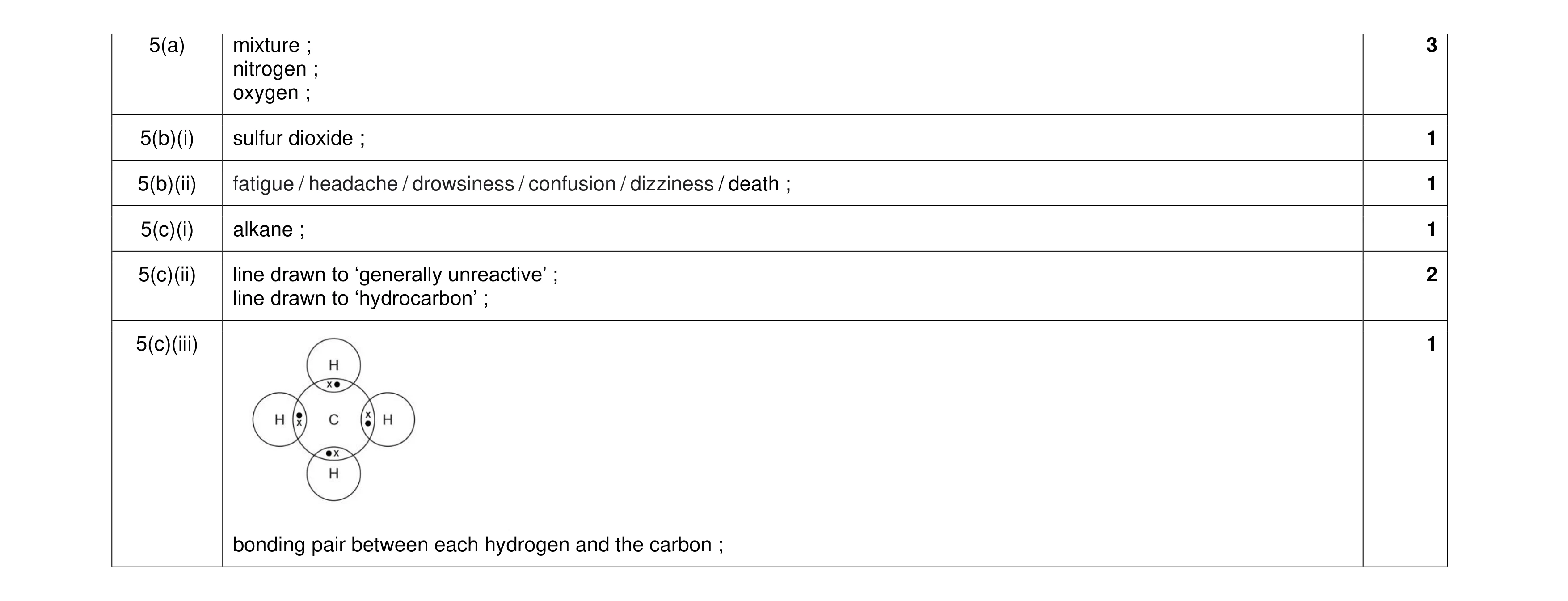 9
9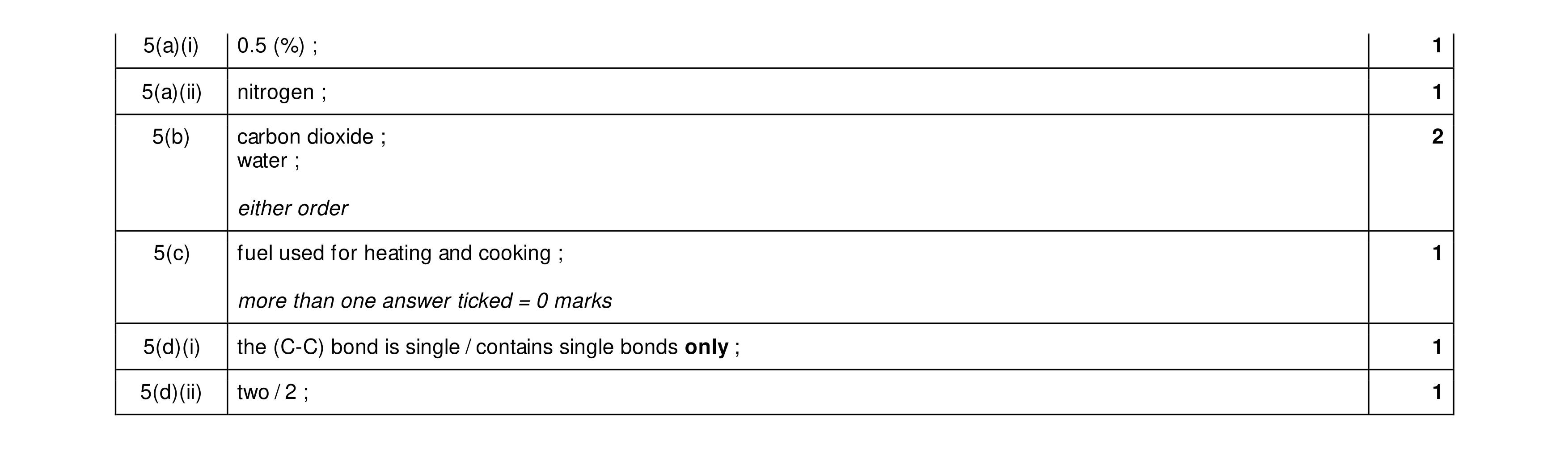 7
7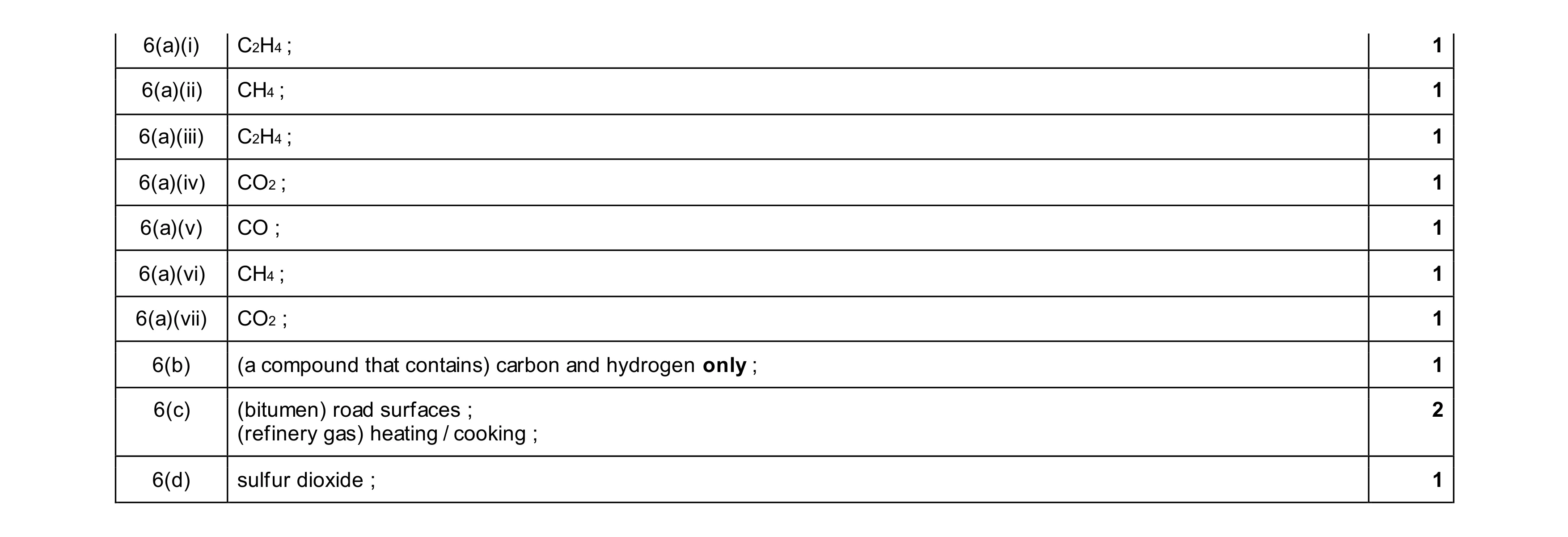 11
11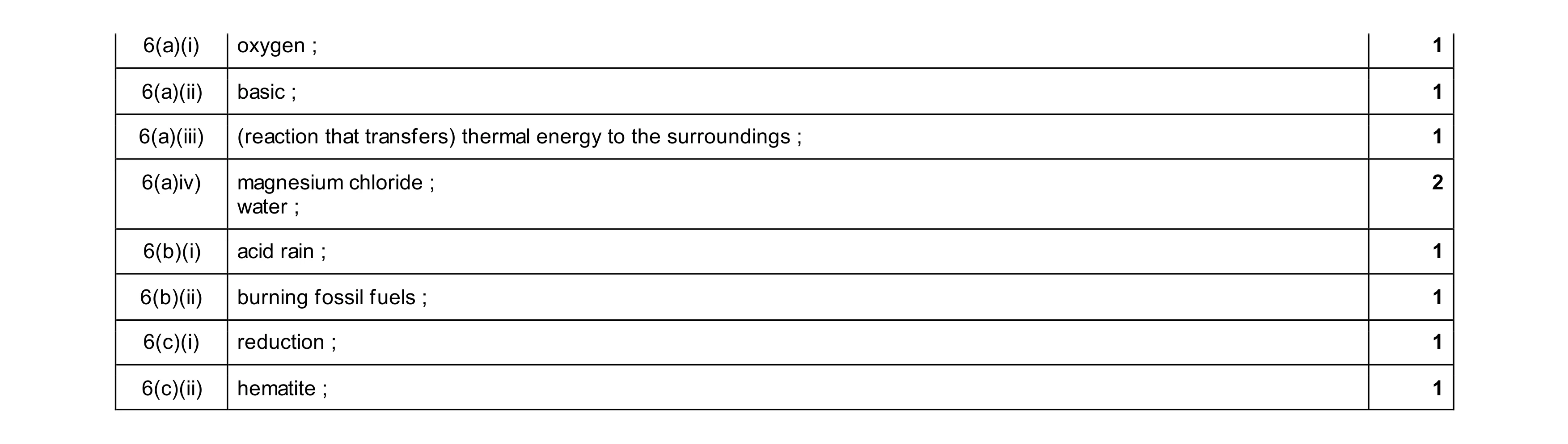 9
9