Questions as text
Q1 · The following is a headline from a newspaper 0455/11 May/June 2006
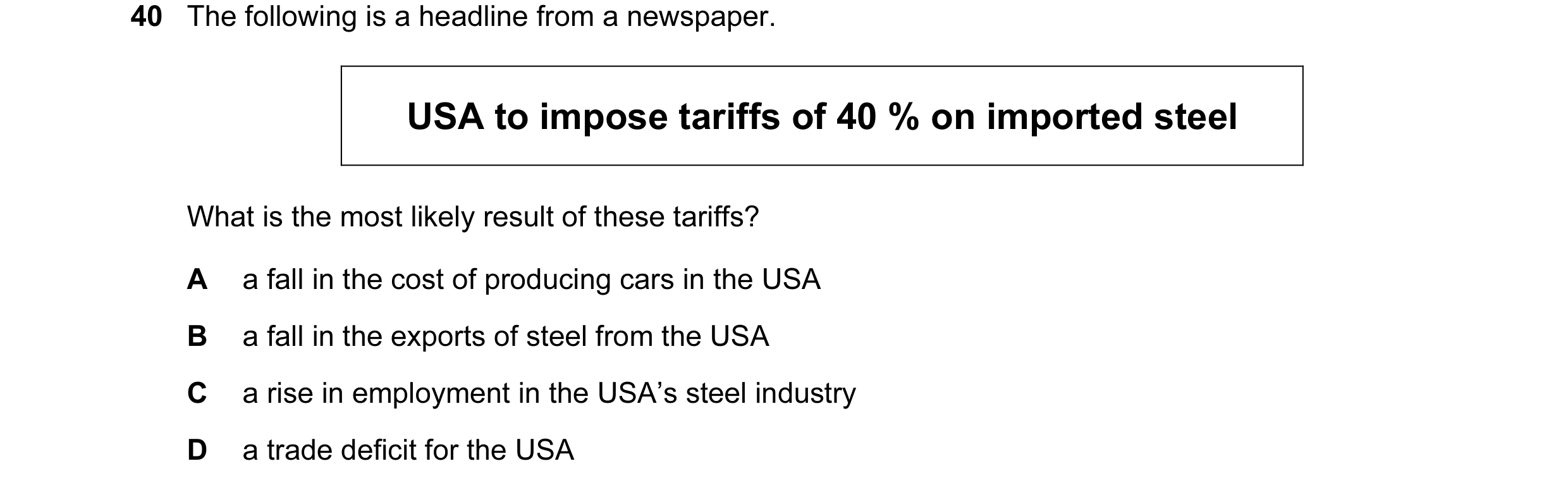
40 The following is a headline from a newspaper. USA to impose tariffs of 40 % on imported steel What is the most likely result of these tariffs? A a fall in the cost of producing cars in the USA B a fall in the exports of steel from the USA C a rise in employment in the USA’s steel industry D a trade deficit for the USA
1 marks
Answer: C
This question in 0455/11 May/June 2006
Q2 · The French government bought 30 % of a private French industrial group which was facing… 0455/11 Oct/Nov 2006
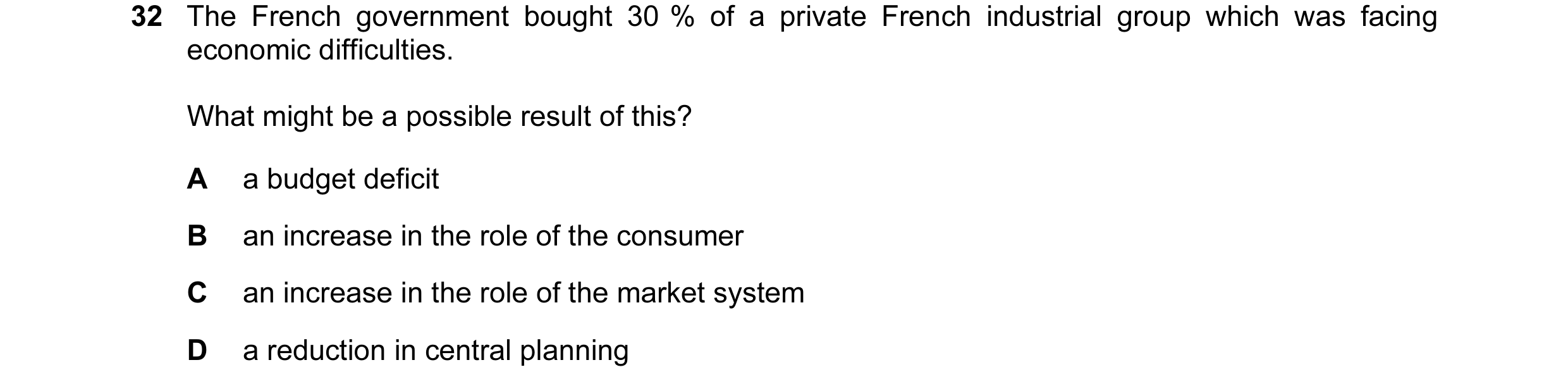
32 The French government bought 30 % of a private French industrial group which was facing economic difficulties. What might be a possible result of this? A a budget deficit B an increase in the role of the consumer C an increase in the role of the market system D a reduction in central planning
1 marks
Answer: A
This question in 0455/11 Oct/Nov 2006
Q3 · A government establishes a body to control monopolies and mergers 0455/11 May/June 2007
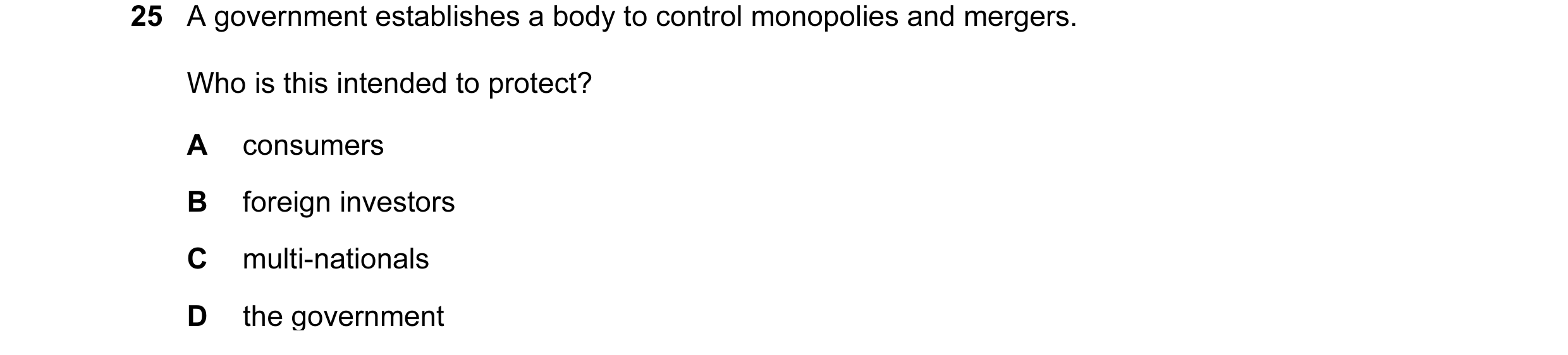
25 A government establishes a body to control monopolies and mergers. Who is this intended to protect? A consumers B foreign investors C multi-nationals D the government
1 marks
Answer: A
This question in 0455/11 May/June 2007
Q4 · Why may it be better to increase public expenditure while reducing private expenditure? 0455/11 May/June 2007
38 Why may it be better to increase public expenditure while reducing private expenditure? A Goods and services which the market ignores can be provided. B Government officials are likely to be more careful spending money than private individuals. C The profit motive makes government departments more efficient than private firms. D The government is the best judge of the satisfaction gained from goods and services.
1 marks
Answer: A
This question in 0455/11 May/June 2007
Q5 · What would cause disposable incomes to become less equal? 0455/11 Oct/Nov 2007
16 What would cause disposable incomes to become less equal? A increased employment B increased welfare benefits C more progressive taxes D more regressive taxes
1 marks
Answer: D
This question in 0455/11 Oct/Nov 2007
Q6 · What is the main reason why the government, rather than the private sector, builds and… 0455/11 May/June 2008
39 What is the main reason why the government, rather than the private sector, builds and runs hospitals? A Hospitals are expensive to build. B The government has enough tax revenue to pay for hospitals. C The government needs to be sure that the doctors are well-trained. D The whole country can benefit from the provision of good health facilities.
1 marks
Answer: D
This question in 0455/11 May/June 2008
Q7 · Which of the following is not included in public expenditure? 0455/11 Oct/Nov 2008
25 Which of the following is not included in public expenditure? A capital spending by public companies B expenditure by government departments C investment by nationalised industries D spending by local governments
1 marks
Answer: A
This question in 0455/11 Oct/Nov 2008
Q8 · A government decides that an economy should make more use of the market 0455/11 Oct/Nov 2009
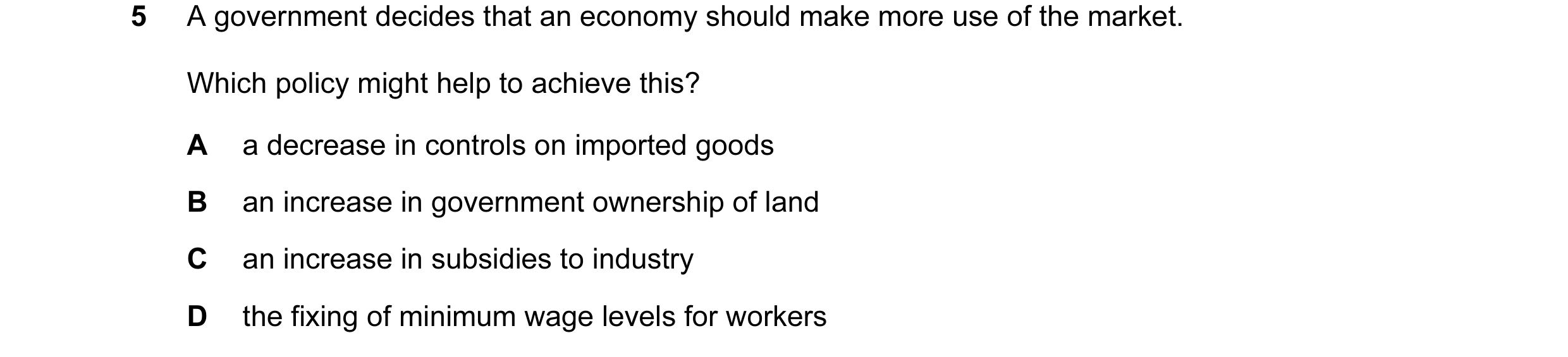
5 A government decides that an economy should make more use of the market. Which policy might help to achieve this? A a decrease in controls on imported goods B an increase in government ownership of land C an increase in subsidies to industry D the fixing of minimum wage levels for workers
1 marks
Answer: A
This question in 0455/11 Oct/Nov 2009
Q9 · The directors of a firm have to discuss the following topics 0455/11 May/June 2010
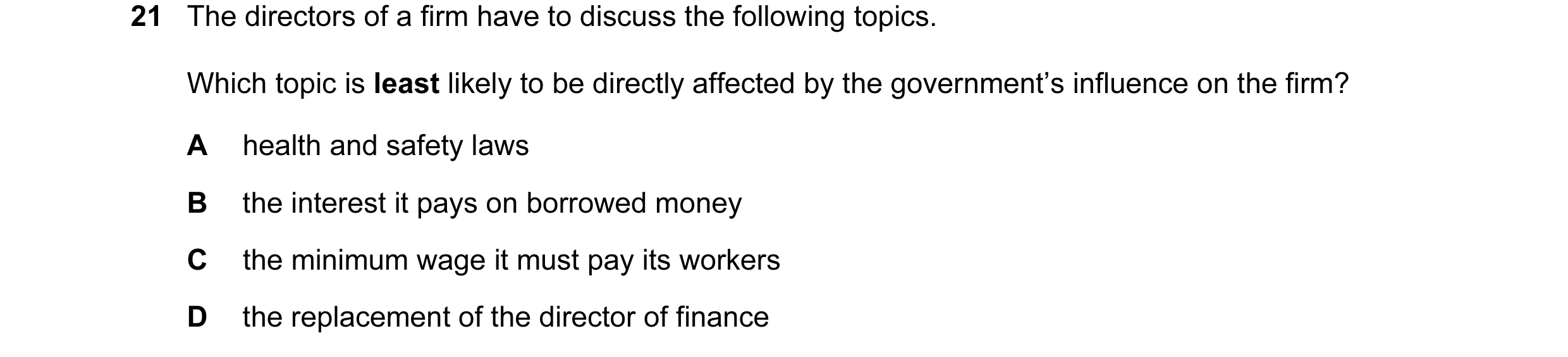
21 The directors of a firm have to discuss the following topics. Which topic is least likely to be directly affected by the government’s influence on the firm? A health and safety laws B the interest it pays on borrowed money C the minimum wage it must pay its workers D the replacement of the director of finance
1 marks
Answer: D
This question in 0455/11 May/June 2010
Q10 · The directors of a firm have to discuss the following topics 0455/12 May/June 2010
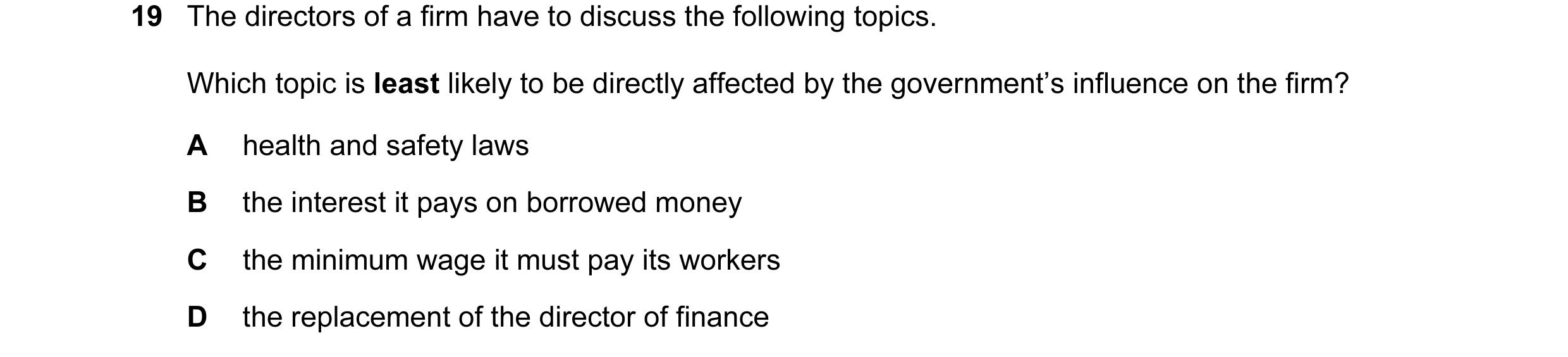
19 The directors of a firm have to discuss the following topics. Which topic is least likely to be directly affected by the government’s influence on the firm? A health and safety laws B the interest it pays on borrowed money C the minimum wage it must pay its workers D the replacement of the director of finance
1 marks
Answer: D
This question in 0455/12 May/June 2010
Q11 · What is most likely to be the responsibility of a central government? 0455/11 Oct/Nov 2010
21 What is most likely to be the responsibility of a central government? A the provision of immigration officials at an airport B the provision of security cameras in a shopping centre C the provision of security staff at a bank D the provision of ticket inspectors on a train
1 marks
Answer: A
This question in 0455/11 Oct/Nov 2010
Q12 · The diagram shows that when a tax of $2 on a good raises the supply curve from S1 to S2… 0455/12 Oct/Nov 2010
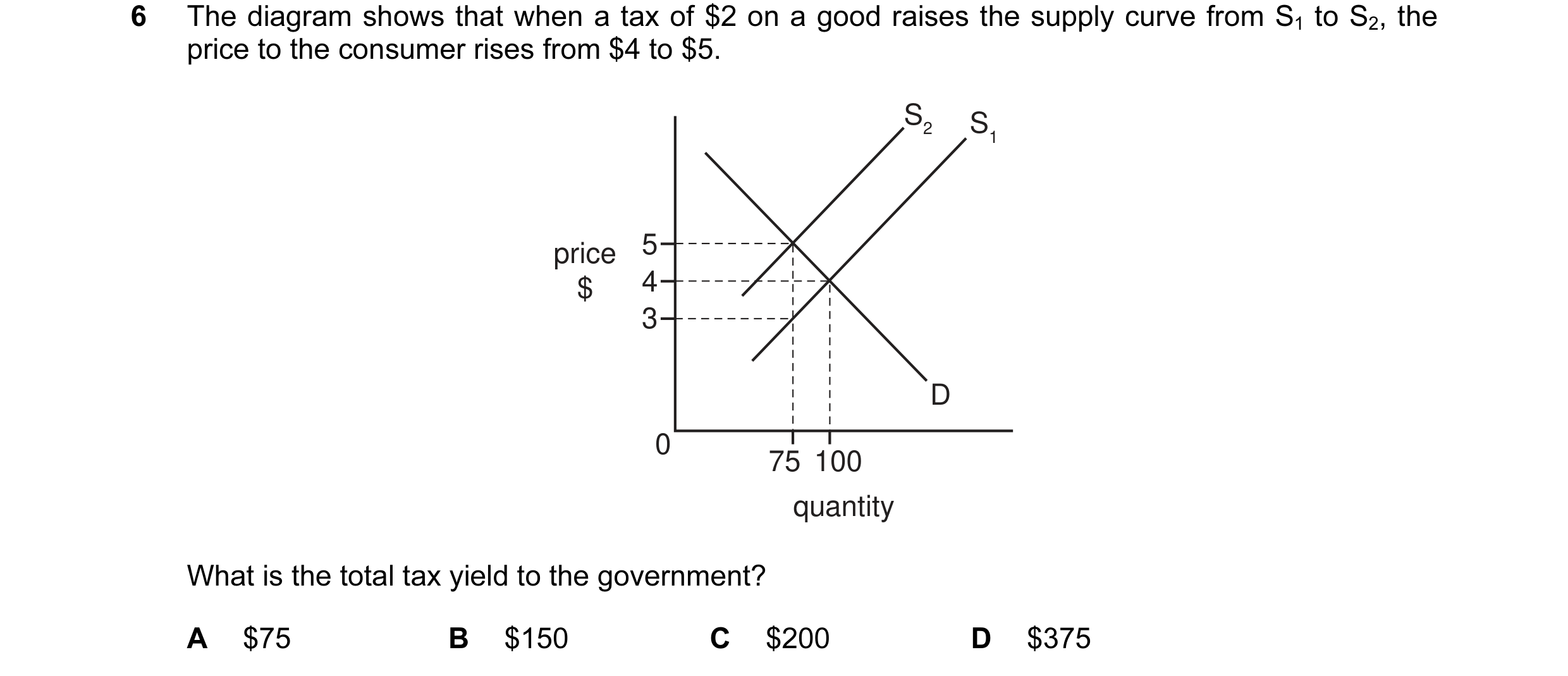
5 The diagram shows that when a tax of $2 on a good raises the supply curve from S1 to S2, the price to the consumer rises from $4 to $5. S2 S1 price 5 $ 4 3 D 0 75 100 quantity What is the total tax yield to the government? A $75 B $150 C $200 D $375
1 marks
Answer: B
This question in 0455/12 Oct/Nov 2010
Q13 · What is most likely to be the responsibility of a central government? 0455/12 Oct/Nov 2010
22 What is most likely to be the responsibility of a central government? A the provision of immigration officials at an airport B the provision of security cameras in a shopping centre C the provision of security staff at a bank D the provision of ticket inspectors on a train
1 marks
Answer: A
This question in 0455/12 Oct/Nov 2010
Q14 · The diagram shows that when a tax of $2 on a good raises the supply curve from S1 to S2… 0455/13 Oct/Nov 2010
6 The diagram shows that when a tax of $2 on a good raises the supply curve from S1 to S2, the price to the consumer rises from $4 to $5. S2 S1 price 5 $ 4 3 D 0 75 100 quantity What is the total tax yield to the government? A $75 B $150 C $200 D $375
1 marks
Answer: B
This question in 0455/13 Oct/Nov 2010
Q15 · The diagram shows demand and supply curves for a product at its equilibrium price P 0455/13 Oct/Nov 2010
7 The diagram shows demand and supply curves for a product at its equilibrium price P. S1 S S2 price P D1 D D2 O Q quantity How would the introduction of a subsidy be shown? A Demand would shift to D1. B Demand would shift to D2. C Supply would shift to S1. D Supply would shift to S2.
1 marks
Answer: D
This question in 0455/13 Oct/Nov 2010
Q16 · What is most likely to be the responsibility of a central government? 0455/13 Oct/Nov 2010
19 What is most likely to be the responsibility of a central government? A the provision of immigration officials at an airport B the provision of security cameras in a shopping centre C the provision of security staff at a bank D the provision of ticket inspectors on a train
1 marks
Answer: A
This question in 0455/13 Oct/Nov 2010
Q17 · A tax on which of the following is usually progressive and is paid by a large number of… 0455/11 Oct/Nov 2011
21 A tax on which of the following is usually progressive and is paid by a large number of tax payers? A company profits B goods and services C incomes D sales of shares
1 marks
Answer: C
This question in 0455/11 Oct/Nov 2011
Q18 · Which government policy would be likely to help local companies expand? 0455/11 Oct/Nov 2011
22 Which government policy would be likely to help local companies expand? A encouraging investment by foreign companies B increasing income tax C providing a subsidy D raising interest rates
1 marks
Answer: C
This question in 0455/11 Oct/Nov 2011
Q19 · A country has a tax system which places no tax on incomes below $5000, is proportional on… 0455/13 May/June 2012
23 A country has a tax system which places no tax on incomes below $5000, is proportional on incomes between $5000 and $10 000 and is progressive on incomes above $10 000. Which graph illustrates this tax system? A B % of income % of income paid in tax paid in tax 0 5 10 15 0 5 10 15 income $000s income $000s C D % of income % of income paid in tax paid in tax 0 5 10 15 0 5 10 15 income $000s income $000s
1 marks
Answer: A
This question in 0455/13 May/June 2012
Q20 · In China the government is concerned about the level of poverty and the need for more… 0455/11 Oct/Nov 2012
11 In China the government is concerned about the level of poverty and the need for more resources in the poorer regions of the country. As a result, it is increasing its expenditure there and reducing it in the wealthier regions. Which economic concept does this government policy illustrate best? A diseconomies of scale B market forces C opportunity cost D specialisation
1 marks
Answer: C
This question in 0455/11 Oct/Nov 2012
Q21 · Which government policy would best protect the environment? 0455/11 Oct/Nov 2012
25 Which government policy would best protect the environment? A encouraging economic growth B exploiting natural resources C increasing tax on fuel D removing controls on industry
1 marks
Answer: C
This question in 0455/11 Oct/Nov 2012
Q22 · Which government policy would best protect the environment? 0455/12 Oct/Nov 2012
20 Which government policy would best protect the environment? A encouraging economic growth B exploiting natural resources C increasing tax on fuel D removing controls on industry
1 marks
Answer: C
This question in 0455/12 Oct/Nov 2012
Q23 · Which government policy would best protect the environment? 0455/13 Oct/Nov 2012
20 Which government policy would best protect the environment? A encouraging economic growth B exploiting natural resources C increasing tax on fuel D removing controls on industry
1 marks
Answer: C
This question in 0455/13 Oct/Nov 2012
Q24 · What is most likely to be the responsibility of a central government? 0455/11 May/June 2013
21 What is most likely to be the responsibility of a central government? A the provision of immigration officials at an airport B the provision of security cameras in a shopping centre C the provision of security staff at a bank D the provision of ticket inspectors on a train
1 marks
Answer: A
This question in 0455/11 May/June 2013
Q25 · The graph shows the impact of a tax on the supply of petrol (gas) 0455/11 May/June 2013
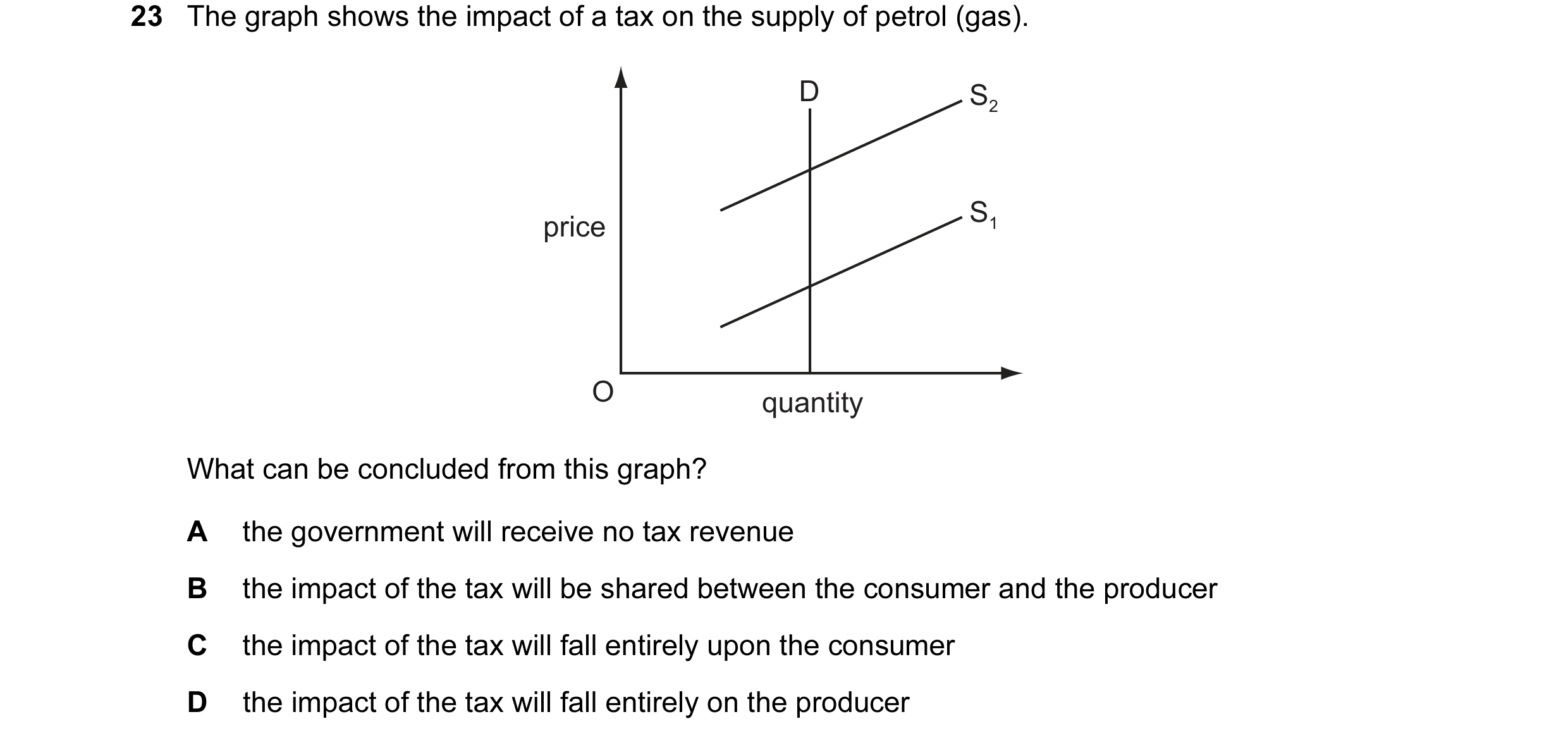
23 The graph shows the impact of a tax on the supply of petrol (gas). D S2 S1 price O quantity What can be concluded from this graph? A the government will receive no tax revenue B the impact of the tax will be shared between the consumer and the producer C the impact of the tax will fall entirely upon the consumer D the impact of the tax will fall entirely on the producer
1 marks
Answer: C
This question in 0455/11 May/June 2013
Q26 · What is most likely to be the responsibility of a central government? 0455/12 May/June 2013
21 What is most likely to be the responsibility of a central government? A the provision of immigration officials at an airport B the provision of security cameras in a shopping centre C the provision of security staff at a bank D the provision of ticket inspectors on a train
1 marks
Answer: A
This question in 0455/12 May/June 2013
Q27 · What is most likely to be the responsibility of a central government? 0455/13 May/June 2013
7 What is most likely to be the responsibility of a central government? A the provision of immigration officials at an airport B the provision of security cameras in a shopping centre C the provision of security staff at a bank D the provision of ticket inspectors on a train
1 marks
Answer: A
This question in 0455/13 May/June 2013
Q28 · Which will encourage domestic producers to grow more maize? 0455/12 Oct/Nov 2013
9 Which will encourage domestic producers to grow more maize? A granting subsidies to maize producers B increasing the sales tax on maize C removing guaranteed minimum prices for maize D removing quotas on imported maize
1 marks
Answer: A
This question in 0455/12 Oct/Nov 2013
Q29 · Why might a government encourage a monopoly? 0455/12 Oct/Nov 2013
21 Why might a government encourage a monopoly? A It can have high average costs. B It can compete against foreign firms. C It can prevent innovation. D It can make excessive profits.
1 marks
Answer: B
This question in 0455/12 Oct/Nov 2013
Q30 · Which will encourage domestic producers to grow more maize? 0455/13 Oct/Nov 2013
9 Which will encourage domestic producers to grow more maize? A granting subsidies to maize producers B increasing the sales tax on maize C removing guaranteed minimum prices for maize D removing quotas on imported maize
1 marks
Answer: A
This question in 0455/13 Oct/Nov 2013
Q31 · Why might a government encourage a monopoly? 0455/13 Oct/Nov 2013
21 Why might a government encourage a monopoly? A It can have high average costs. B It can compete against foreign firms. C It can prevent innovation. D It can make excessive profits.
1 marks
Answer: B
This question in 0455/13 Oct/Nov 2013
Q32 · The Mexican government has passed a law which prevents any monopoly charging a price… 0455/11 May/June 2014
17 The Mexican government has passed a law which prevents any monopoly charging a price significantly above its production costs. Any monopoly that breaks the law is fined. Which type of policy measure is this? A minimum price B regulation C subsidy D tax
1 marks
Answer: B
This question in 0455/11 May/June 2014
Q33 · In 2012 the local government of a city decided to increase parking charges for motorists 0455/12 May/June 2014
6 In 2012 the local government of a city decided to increase parking charges for motorists. It was intended to raise money to correct a deficit in the local government’s budget. The local government said if they did not increase charges they would not be able to provide all their current services. Businesses complained about the likely loss of revenue if parking charges were increased. Which concepts does this statement involve? A inflation and the private sector B opportunity cost and public expenditure C private benefit and the free market D unlimited resources and a centrally planned economy
1 marks
Answer: B
This question in 0455/12 May/June 2014
Q34 · What is not a public sector expenditure? 0455/12 May/June 2014
17 What is not a public sector expenditure? A claims paid on travel insurance for cancelled flights B collections of rubbish by a local council to meet regulations on recycling waste C grants from central funds to compensate people whose property has been damaged by storms D the establishment of a national database to assist the police in finding criminals
1 marks
Answer: A
This question in 0455/12 May/June 2014
Q35 · The Mexican government has passed a law which prevents any monopoly charging a price… 0455/13 May/June 2014
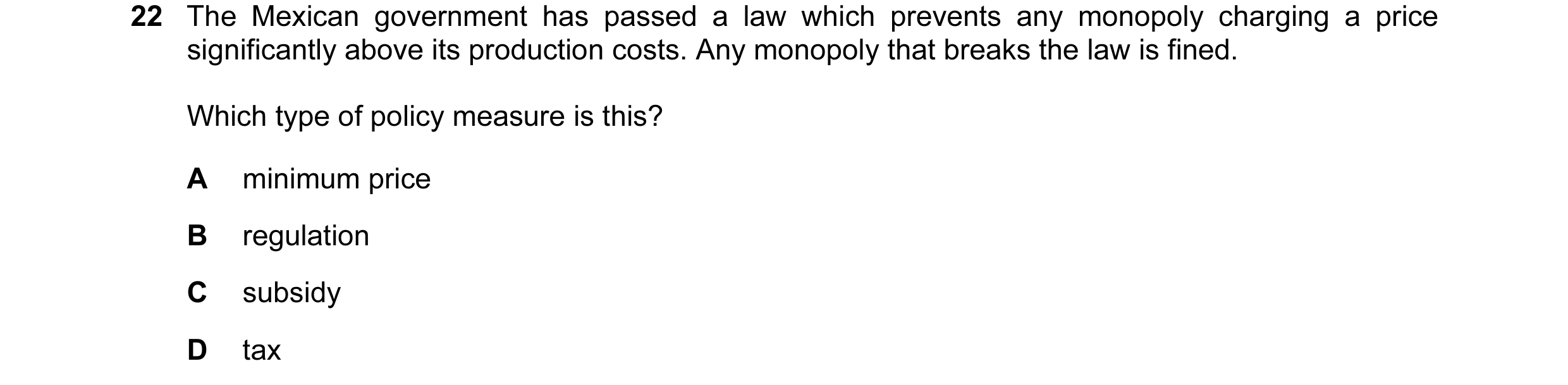
22 The Mexican government has passed a law which prevents any monopoly charging a price significantly above its production costs. Any monopoly that breaks the law is fined. Which type of policy measure is this? A minimum price B regulation C subsidy D tax
1 marks
Answer: B
This question in 0455/13 May/June 2014
Q36 · The following is a headline from the newspaper 0455/12 Oct/Nov 2014
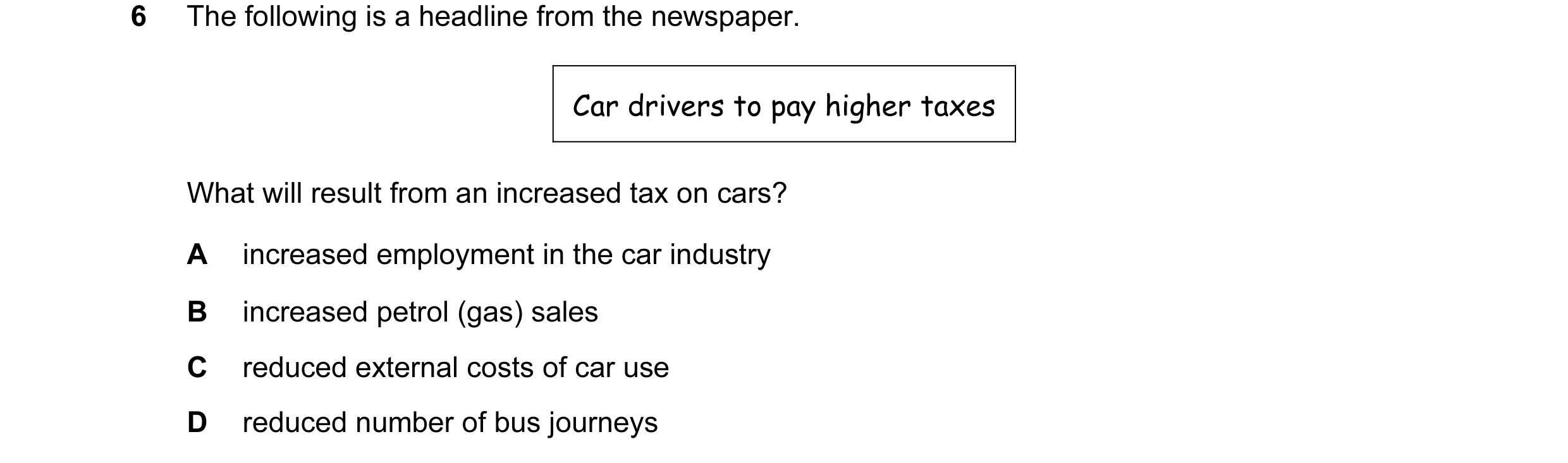
6 The following is a headline from the newspaper. Car drivers to pay higher taxes What will result from an increased tax on cars? A increased employment in the car industry B increased petrol (gas) sales C reduced external costs of car use D reduced number of bus journeys
1 marks
Answer: C
This question in 0455/12 Oct/Nov 2014
Q37 · A government policy results in an increase in government spending and a fall in the… 0455/13 Oct/Nov 2014
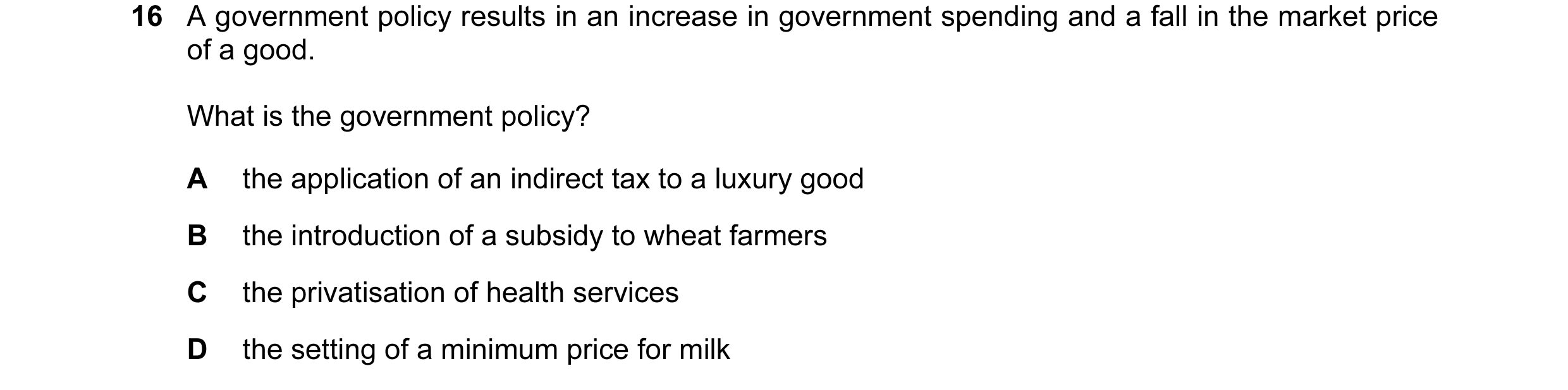
16 A government policy results in an increase in government spending and a fall in the market price of a good. What is the government policy? A the application of an indirect tax to a luxury good B the introduction of a subsidy to wheat farmers C the privatisation of health services D the setting of a minimum price for milk
1 marks
Answer: B
This question in 0455/13 Oct/Nov 2014
Q38 · What is most likely to be the responsibility of a government? 0455/12 Oct/Nov 2015
16 What is most likely to be the responsibility of a government? A the building of a food processing plant B the building of a housing estate C the building of a large shopping centre D the building of a major rail link
1 marks
Answer: D
This question in 0455/12 Oct/Nov 2015
Q39 · A government taxes the production of cars 0455/12 May/June 2016
4 A government taxes the production of cars. What is likely to decrease? A the cost of supplying cars B the price of cars C the revenue for the government D the supply of cars at every price
1 marks
Answer: D
This question in 0455/12 May/June 2016
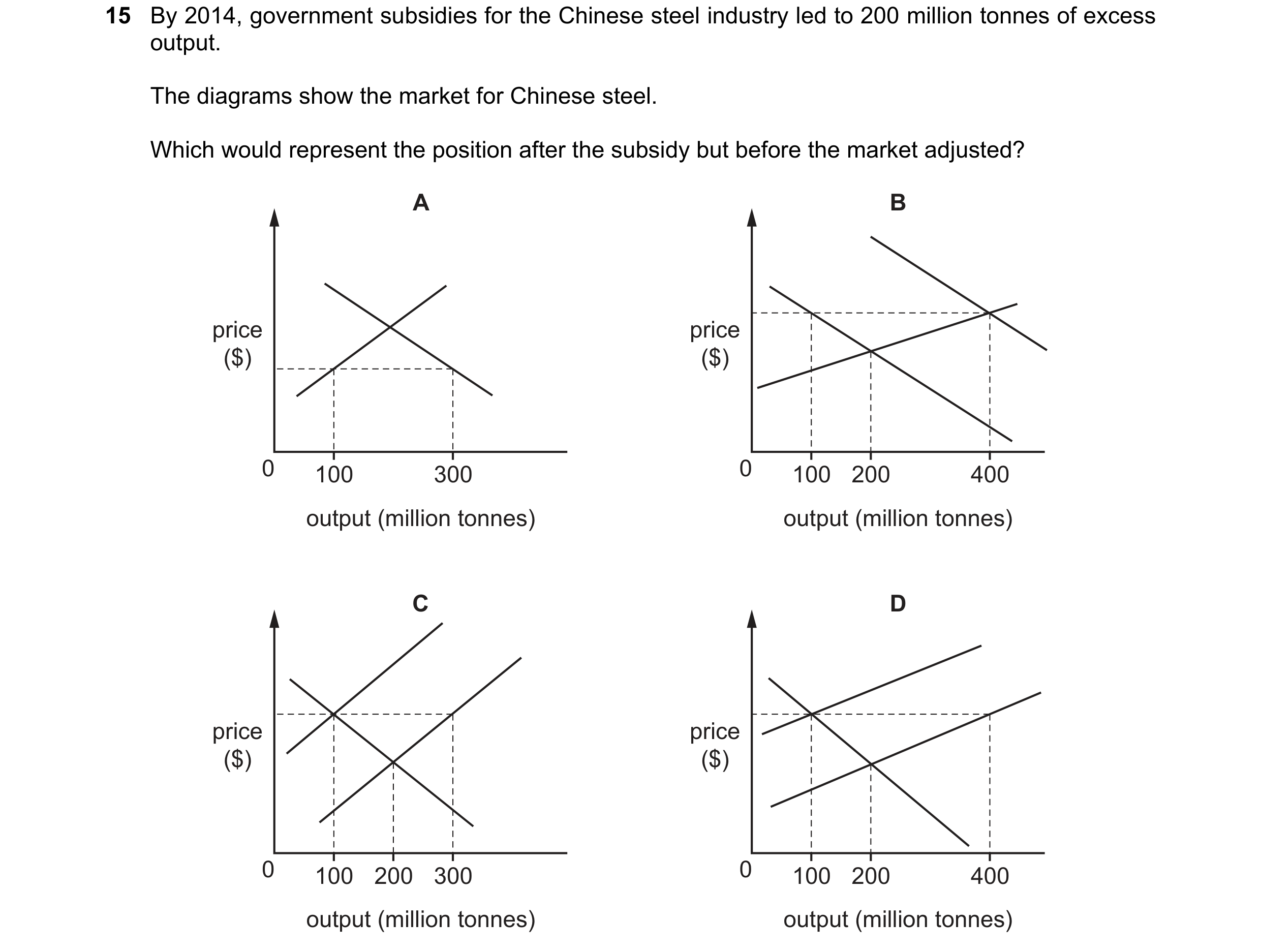
Q40 · By 2014, government subsidies for the Chinese steel industry led to 200 million tonnes of… 0455/12 May/June 2016
15 By 2014, government subsidies for the Chinese steel industry led to 200 million tonnes of excess output. The diagrams show the market for Chinese steel. Which would represent the position after the subsidy but before the market adjusted? A B price price ($) ($) 0 100 300 0 100 200 400 output (million tonnes) output (million tonnes) C D price price ($) ($) 0 100 200 300 0 100 200 400 output (million tonnes) output (million tonnes)
1 marks
Answer: C
This question in 0455/12 May/June 2016
Q41 · Which type of government policy would be most suitable to control external costs of… 0455/13 May/June 2016
23 Which type of government policy would be most suitable to control external costs of production? A employment policy B fiscal policy C monetary policy D trade policy
1 marks
Answer: B
This question in 0455/13 May/June 2016
Q42 · A government subsidises the production of pineapples 0455/12 Oct/Nov 2016
6 A government subsidises the production of pineapples. This is likely to A increase the price of pineapples B raise the costs of supplying pineapples C raise revenue for the government D cause the supply of pineapples to increase at every price
1 marks
This question in 0455/12 Oct/Nov 2016
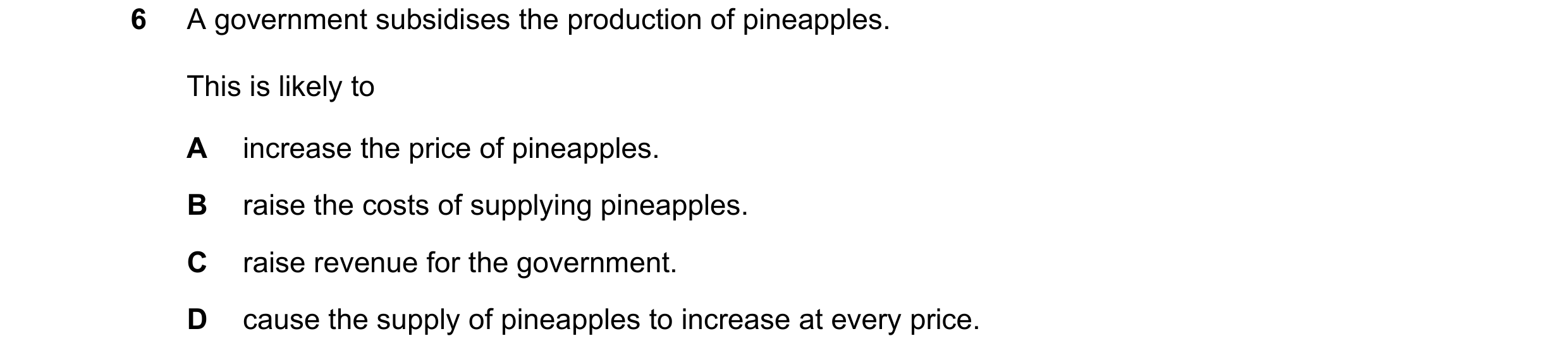
Q43 · A government subsidises the production of pineapples 0455/13 Oct/Nov 2016
6 A government subsidises the production of pineapples. This is likely to A increase the price of pineapples. B raise the costs of supplying pineapples. C raise revenue for the government. D cause the supply of pineapples to increase at every price.
1 marks
Answer: D
This question in 0455/13 Oct/Nov 2016
Q44 · A government decides to sell the monopoly supply of gas to households to a private firm 0455/13 Oct/Nov 2016
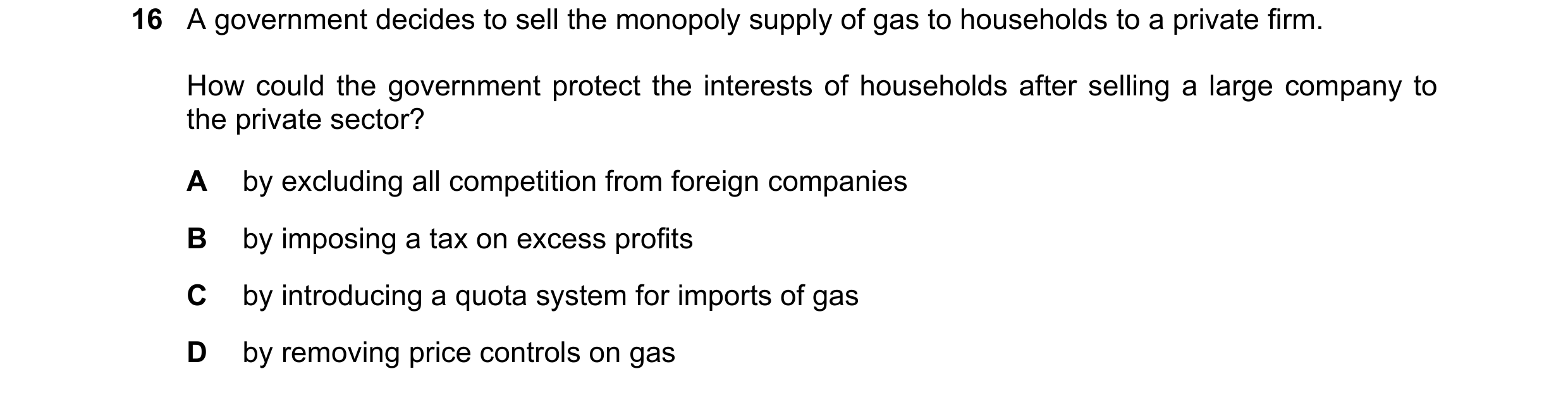
16 A government decides to sell the monopoly supply of gas to households to a private firm. How could the government protect the interests of households after selling a large company to the private sector? A by excluding all competition from foreign companies B by imposing a tax on excess profits C by introducing a quota system for imports of gas D by removing price controls on gas
1 marks
Answer: B
This question in 0455/13 Oct/Nov 2016
Q45 · What is not a public sector expenditure? 0455/12 Feb/March 2017
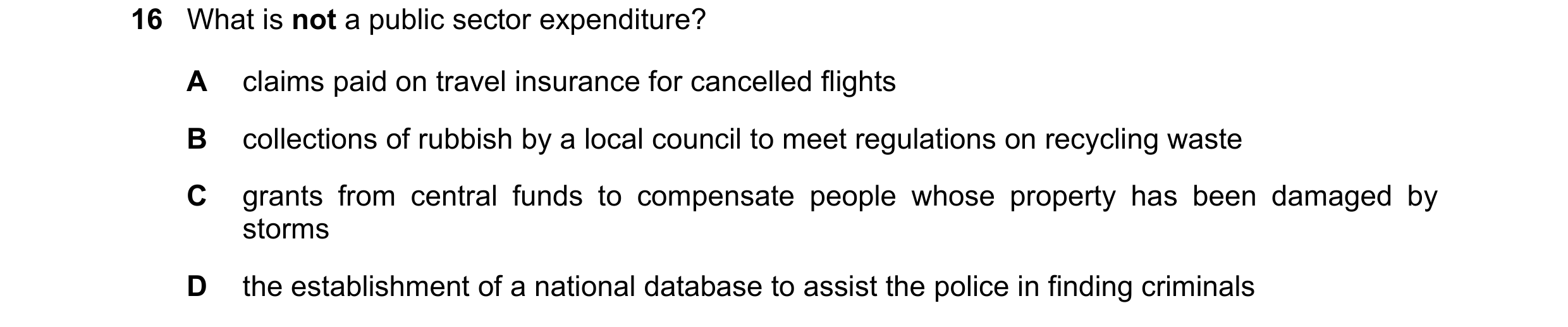
16 What is not a public sector expenditure? A claims paid on travel insurance for cancelled flights B collections of rubbish by a local council to meet regulations on recycling waste C grants from central funds to compensate people whose property has been damaged by storms D the establishment of a national database to assist the police in finding criminals
1 marks
Answer: A
This question in 0455/12 Feb/March 2017
Q46 · The Indian government gives farmers a subsidy of $5 per kilo to supply food in a market… 0455/12 Feb/March 2017
19 The Indian government gives farmers a subsidy of $5 per kilo to supply food in a market where X is the equilibrium position. The effect is illustrated in the diagram below. S3 S1 20 S2 price ($ per kilo) X 15 10 D1 5 0 5 10 15 20 25 30 quantity supplied (’000 kilos) What will be the new equilibrium price and quantity supplied as a result of the subsidy? equilibrium price quantity supplied ($ per kilo) (’000 kilos) A 10 20 B 13 25 C 15 20 D 20 10
1 marks
Answer: B
This question in 0455/12 Feb/March 2017
Q47 · Helium is a gas that is limited in supply 0455/11 May/June 2017
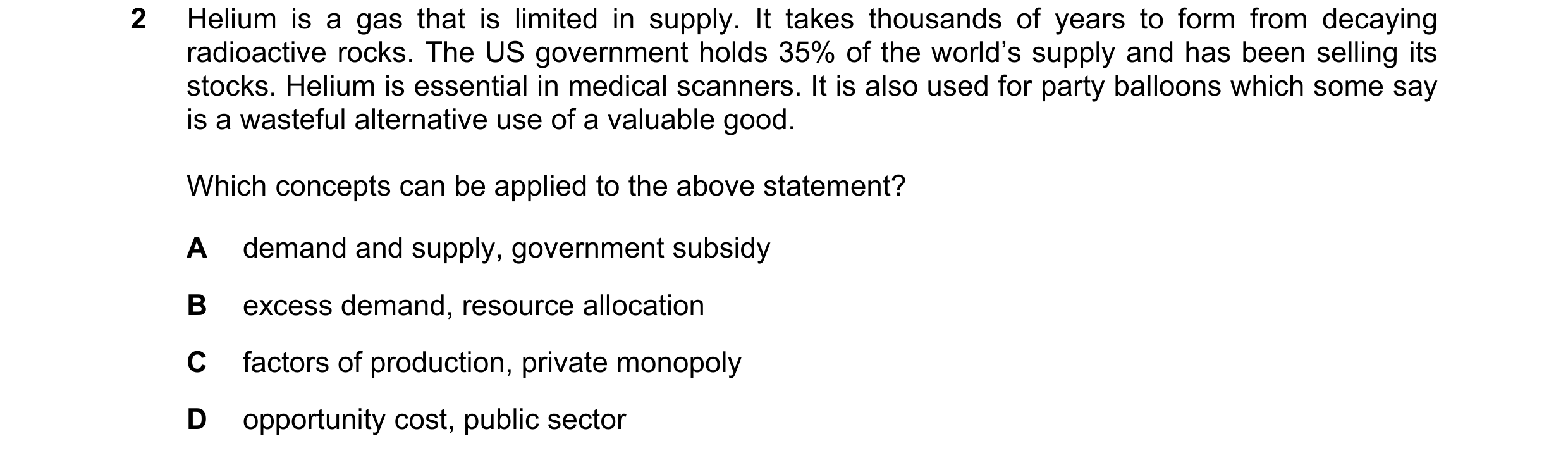
2 Helium is a gas that is limited in supply. It takes thousands of years to form from decaying radioactive rocks. The US government holds 35% of the world’s supply and has been selling its stocks. Helium is essential in medical scanners. It is also used for party balloons which some say is a wasteful alternative use of a valuable good. Which concepts can be applied to the above statement? A demand and supply, government subsidy B excess demand, resource allocation C factors of production, private monopoly D opportunity cost, public sector
1 marks
Answer: D
This question in 0455/11 May/June 2017
Q48 · When is a tax progressive? 0455/12 May/June 2017
16 When is a tax progressive? A when some goods have a higher tax than others B when the rate of tax increases as income increases C when the tax is linked to the rate of inflation D when the tax is on incomes rather than on goods or services
1 marks
Answer: B
This question in 0455/12 May/June 2017
Q49 · The government introduces a new tax 0455/12 Oct/Nov 2017
17 The government introduces a new tax. It adds $1 to the price of every $10 good and $2 to the price of every $20 good. What can be concluded about the nature of this tax? it is a it is a it is a direct tax specific tax progressive tax A no no no B no no yes C yes yes no D yes yes yes
1 marks
Answer: A
This question in 0455/12 Oct/Nov 2017
Q50 · The graph shows the percentage of income paid in taxation 0455/12 Oct/Nov 2017
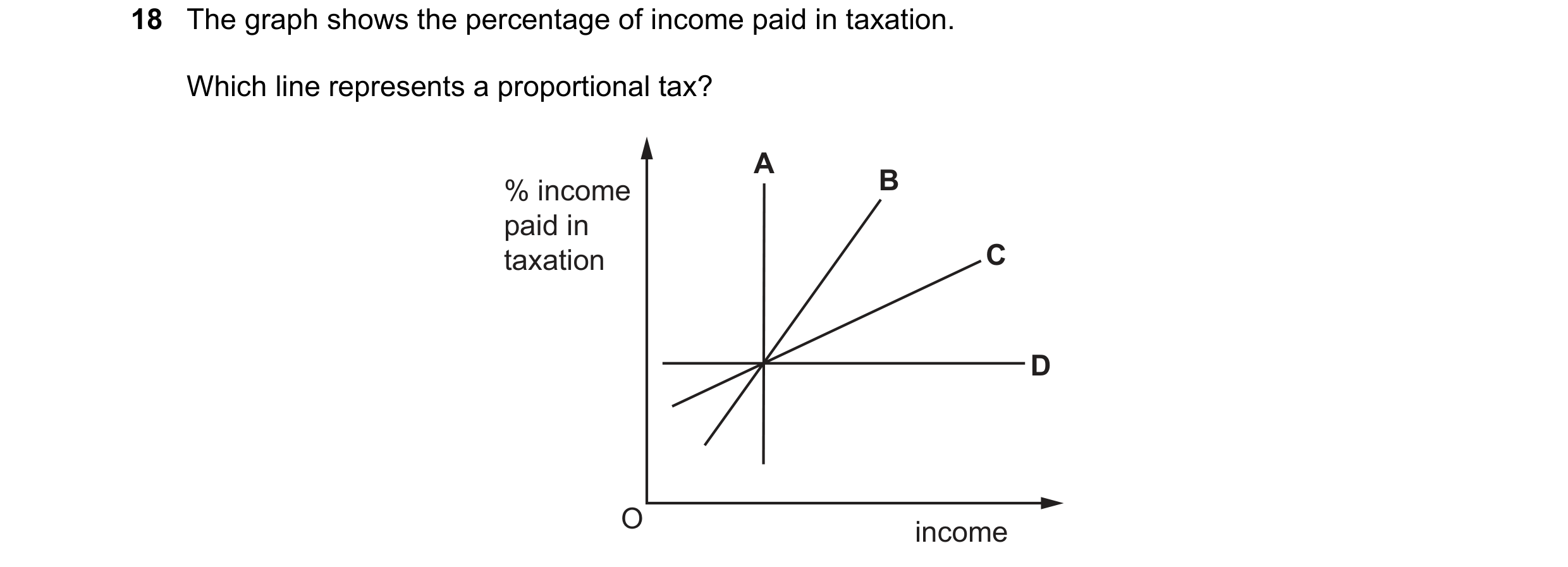
18 The graph shows the percentage of income paid in taxation. Which line represents a proportional tax? A % income B paid in taxation C D O income
1 marks
Answer: D
This question in 0455/12 Oct/Nov 2017
Q51 · In many countries the government provides financial help to firms who wish to produce… 0455/13 May/June 2018
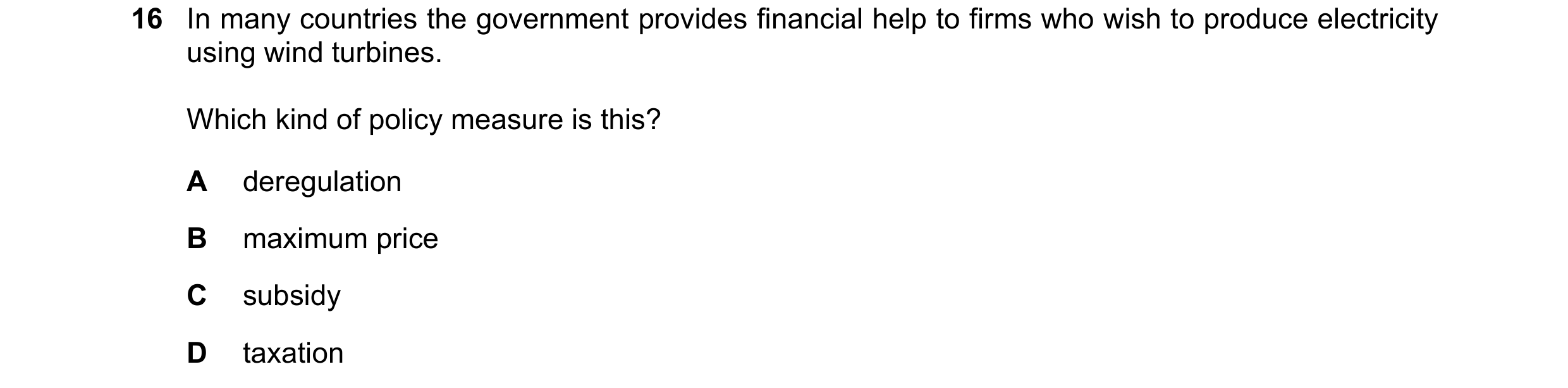
16 In many countries the government provides financial help to firms who wish to produce electricity using wind turbines. Which kind of policy measure is this? A deregulation B maximum price C subsidy D taxation
1 marks
Answer: C
This question in 0455/13 May/June 2018
Q52 · In the diagram, which level of subsidy per kilo would a government have to give to… 0455/11 Oct/Nov 2018
18 In the diagram, which level of subsidy per kilo would a government have to give to producers to encourage them to increase production from 20 kilos per week to 30 kilos per week? S1 price (US$) 20 S2 15 12 D 0 0 20 30 kilos per week A US$3 per kilo B US$5 per kilo C US$8 per kilo D US$15 per kilo
1 marks
Answer: C
This question in 0455/11 Oct/Nov 2018
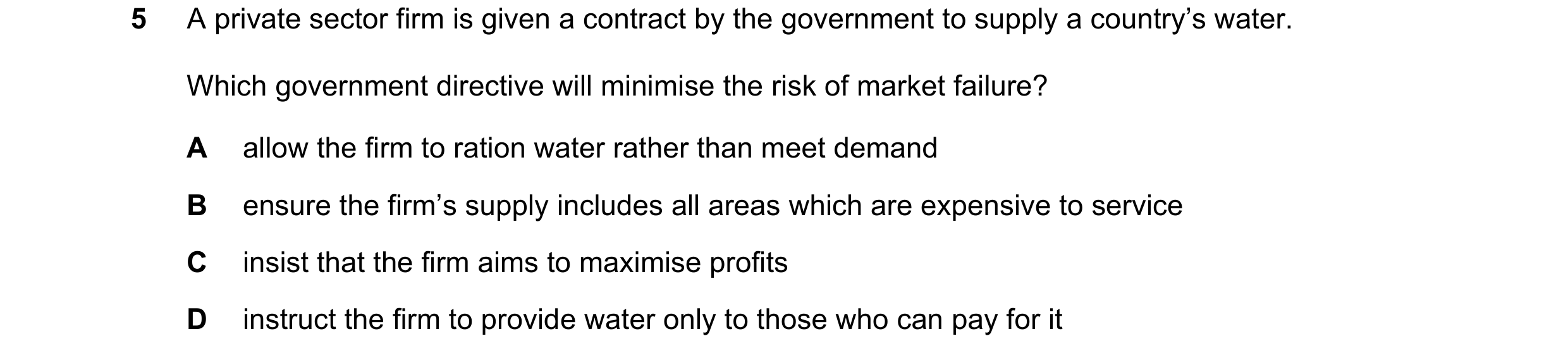
Q53 · A private sector firm is given a contract by the government to supply a country’s water 0455/12 Feb/March 2019
5 A private sector firm is given a contract by the government to supply a country’s water. Which government directive will minimise the risk of market failure? A allow the firm to ration water rather than meet demand B ensure the firm’s supply includes all areas which are expensive to service C insist that the firm aims to maximise profits D instruct the firm to provide water only to those who can pay for it
1 marks
Answer: B
This question in 0455/12 Feb/March 2019
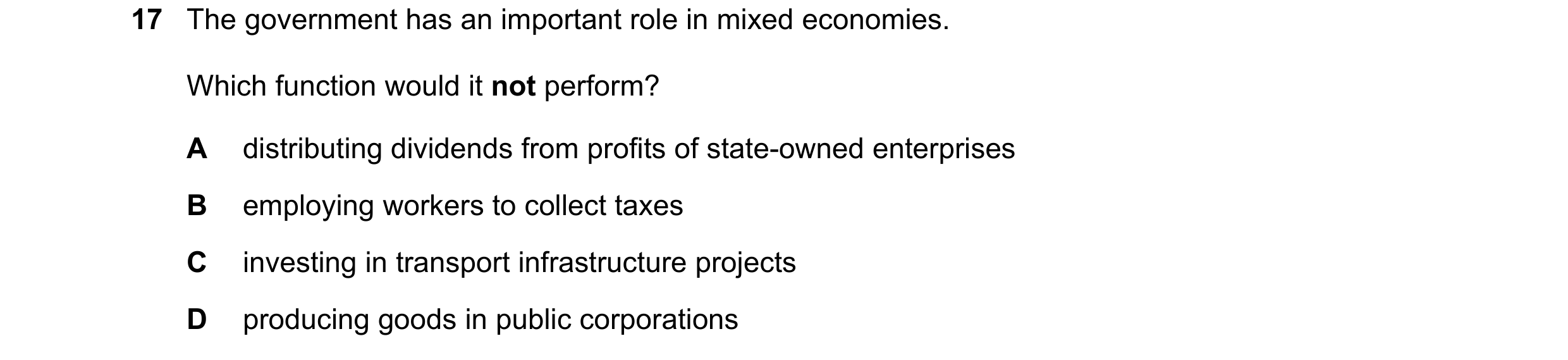
Q54 · The government has an important role in mixed economies 0455/12 Oct/Nov 2019
17 The government has an important role in mixed economies. Which function would it not perform? A distributing dividends from profits of state-owned enterprises B employing workers to collect taxes C investing in transport infrastructure projects D producing goods in public corporations
1 marks
Answer: A
This question in 0455/12 Oct/Nov 2019
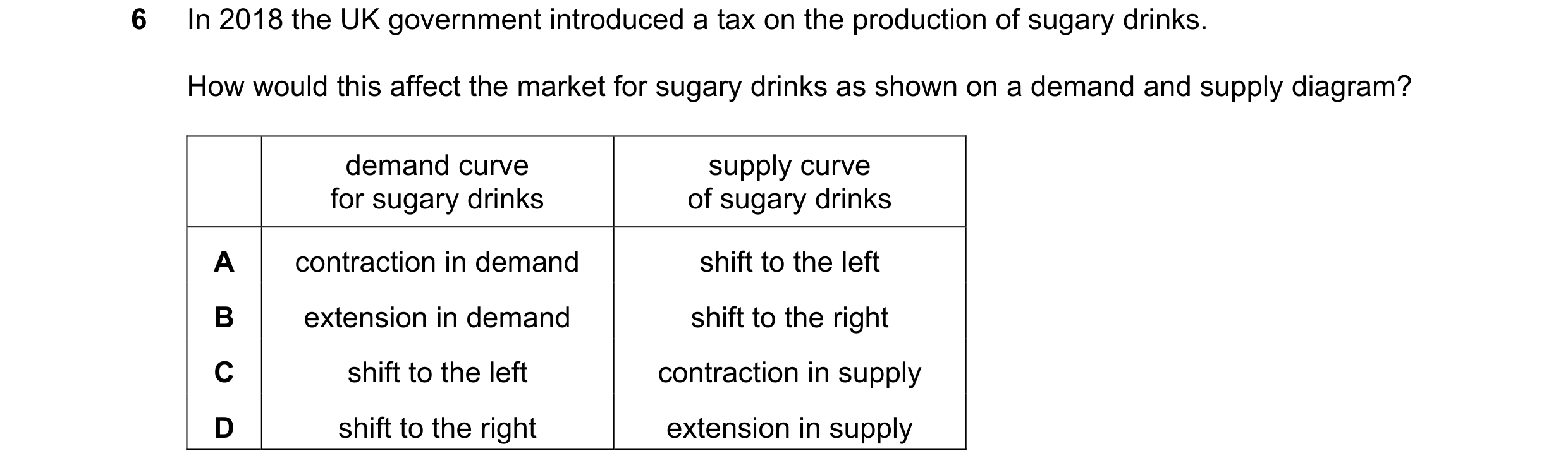
Q55 · In 2018 the UK government introduced a tax on the production of sugary drinks 0455/12 Feb/March 2020
6 In 2018 the UK government introduced a tax on the production of sugary drinks. How would this affect the market for sugary drinks as shown on a demand and supply diagram? demand curve supply curve for sugary drinks of sugary drinks A contraction in demand shift to the left B extension in demand shift to the right C shift to the left contraction in supply D shift to the right extension in supply
1 marks
This question in 0455/12 Feb/March 2020
Q56 · What is not included in public expenditure? 0455/11 May/June 2020
16 What is not included in public expenditure? A capital spending by firms B interest payments on government borrowing C investment in defence by the central government D subsidies to bus companies from local government
1 marks
Answer: A
This question in 0455/11 May/June 2020
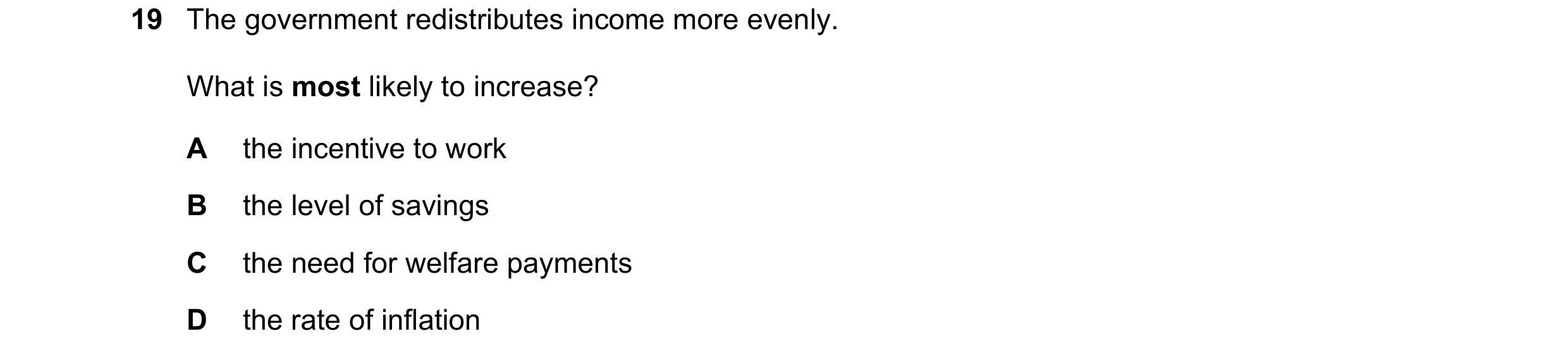
Q57 · The government redistributes income more evenly 0455/11 May/June 2020
19 The government redistributes income more evenly. What is most likely to increase? A the incentive to work B the level of savings C the need for welfare payments D the rate of inflation
1 marks
Answer: D
This question in 0455/11 May/June 2020
Q58 · Which person makes macroeconomic decisions? 0455/11 Oct/Nov 2020
4 Which person makes macroeconomic decisions? A a bank manager B a government finance minister C a shareholder in a firm D a worker
1 marks
Answer: B
This question in 0455/11 Oct/Nov 2020
Q59 · What is most likely to be the responsibility of a central government? 0455/11 Oct/Nov 2020
17 What is most likely to be the responsibility of a central government? A the provision of immigration officials at an airport B the provision of security cameras in a shopping centre C the provision of security staff at a bank D the provision of ticket inspectors on a train
1 marks
Answer: A
This question in 0455/11 Oct/Nov 2020
Q60 · The diagram shows how a government policy influences the market for biofuel crops in the… 0455/11 Oct/Nov 2020
19 The diagram shows how a government policy influences the market for biofuel crops in the private sector. price supply of biofuel crops supply after policy applied demand for biofuel crops O quantity According to the diagram, which policy does the government use and what effect does it have on the market? policy effect A subsidy increases supply B subsidy lowers quantity demanded C tax decreases demand D tax increases supply costs
1 marks
Answer: A
This question in 0455/11 Oct/Nov 2020
Q61 · What is most likely to be the responsibility of a central government? 0455/12 Oct/Nov 2020
17 What is most likely to be the responsibility of a central government? A the provision of immigration officials at an airport B the provision of security cameras in a shopping centre C the provision of security staff at a bank D the provision of ticket inspectors on a train
1 marks
Answer: A
This question in 0455/12 Oct/Nov 2020
Q62 · What is most likely to be the responsibility of a central government? 0455/13 Oct/Nov 2020
17 What is most likely to be the responsibility of a central government? A the provision of immigration officials at an airport B the provision of security cameras in a shopping centre C the provision of security staff at a bank D the provision of ticket inspectors on a train
1 marks
Answer: A
This question in 0455/13 Oct/Nov 2020
Q63 · Due to a rise in the number of retired people, there has been increased demand for some… 0455/13 Oct/Nov 2020
20 Due to a rise in the number of retired people, there has been increased demand for some government expenditure. Which type of government expenditure is most likely to be directly affected? A defence B health services C re-training grants D street lighting
1 marks
Answer: B
This question in 0455/13 Oct/Nov 2020
Q64 · A government reduces social security spending by $10 bn in order to increase defence… 0455/12 Feb/March 2021
2 A government reduces social security spending by $10 bn in order to increase defence spending by $10 bn. What is this an example of? A expansionary fiscal policy B market forces C price stability D reallocation of resources
1 marks
Answer: D
This question in 0455/12 Feb/March 2021
Q65 · The diagram shows selected areas of government spending for a country 0455/12 Feb/March 2021
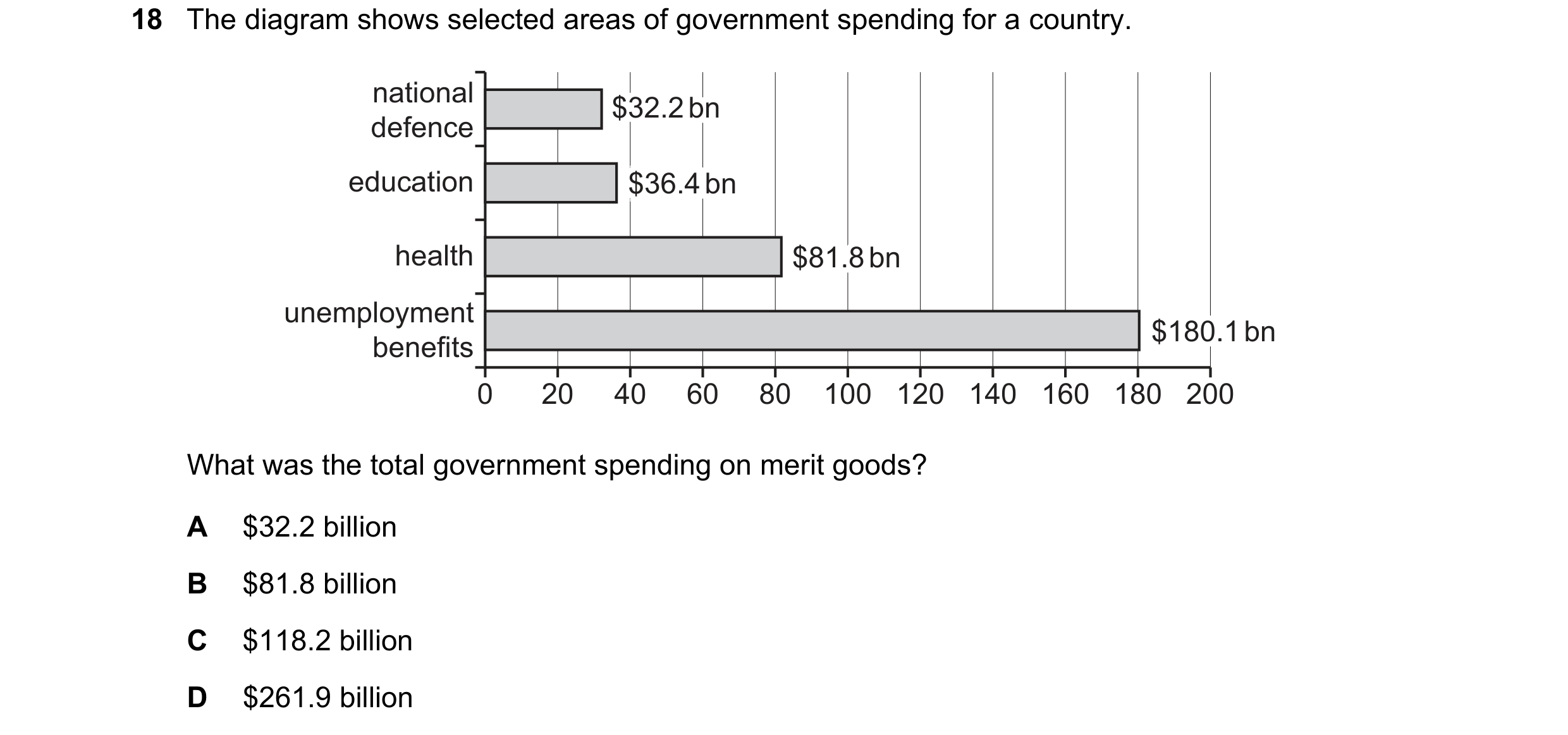
18 The diagram shows selected areas of government spending for a country. national $32.2 $32.2 bn $32.2 bn bn defence education $36.4 bn $36.4 $36.4 bn bn health $81.8 bn $81.8 $81.8 bn bn unemployment $180.1 $180.1 bn $180.1 bn bn benefits 0 20 40 60 80 100 120 140 160 180 200 What was the total government spending on merit goods? A $32.2 billion B $81.8 billion C $118.2 billion D $261.9 billion
1 marks
Answer: C
This question in 0455/12 Feb/March 2021
Q66 · Which problem will be reduced by a government subsidy to a firm? 0455/12 May/June 2021
6 Which problem will be reduced by a government subsidy to a firm? A absence of a public good B abuse of monopoly power C overconsumption of a demerit good D underconsumption of a merit good
1 marks
Answer: D
This question in 0455/12 May/June 2021
Q67 · The diagrams show changes in the demand and supply curves for a good 0455/11 Oct/Nov 2021
7 The diagrams show changes in the demand and supply curves for a good. Which diagram shows the effect of a government providing a subsidy for the good? A B price price S1 S1 S2 P2 P1 P1 P2 D2 D1 D1 O Q1 Q2 O Q1 Q2 quantity quantity C D S2 price price S1 S1 P1 P2 P2 P1 D1 D2 D1 O Q2 Q1 O Q2 Q1 quantity quantity
1 marks
Answer: A
This question in 0455/11 Oct/Nov 2021
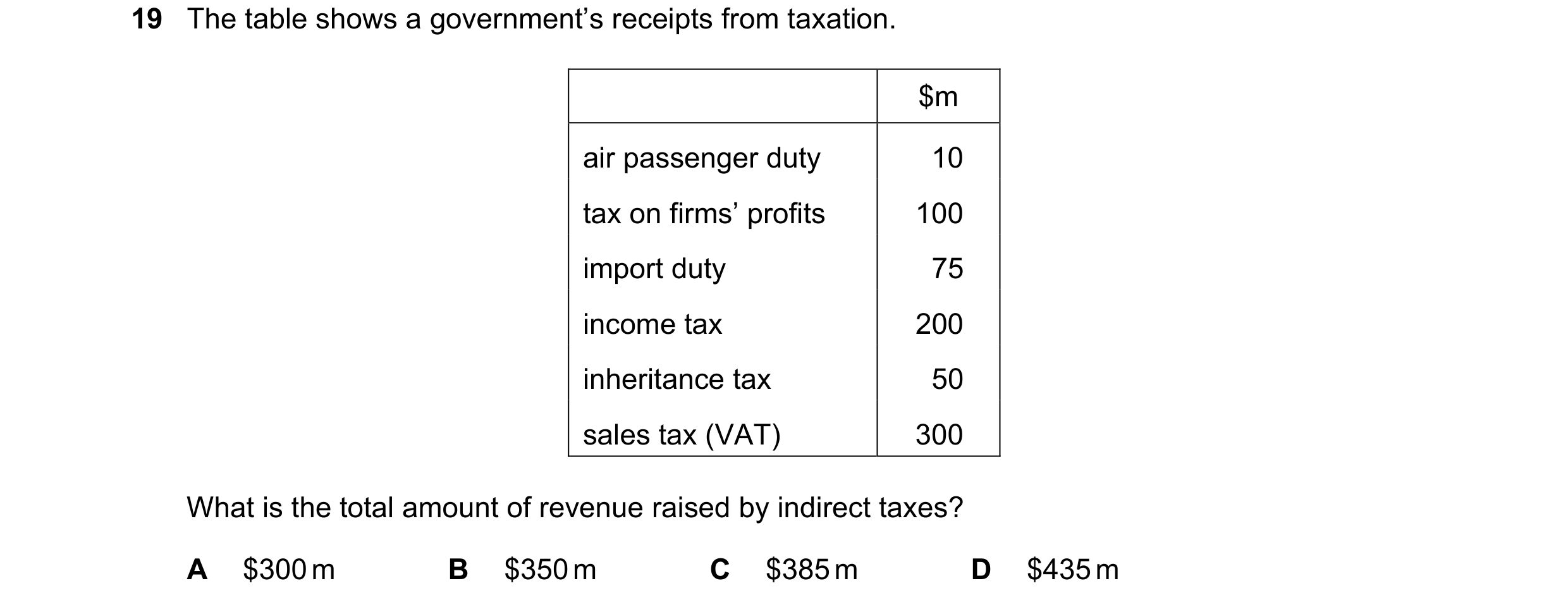
Q68 · The table shows a government’s receipts from taxation 0455/11 Oct/Nov 2021
19 The table shows a government’s receipts from taxation. $m air passenger duty 10 tax on firms’ profits 100 import duty 75 income tax 200 inheritance tax 50 sales tax (VAT) 300 What is the total amount of revenue raised by indirect taxes? A $300 m B $350 m C $385 m D $435 m
1 marks
Answer: C
This question in 0455/11 Oct/Nov 2021
Q69 · The diagram shows the imposition of a subsidy on a product supplied by a firm 0455/12 Oct/Nov 2021
12 The diagram shows the imposition of a subsidy on a product supplied by a firm. S1 price S2 G H F J E K D O L M quantity Which area represents the total revenue of the firm including the subsidy? A EGHK B OEKM C OFJL D OGHM
1 marks
Answer: D
This question in 0455/12 Oct/Nov 2021
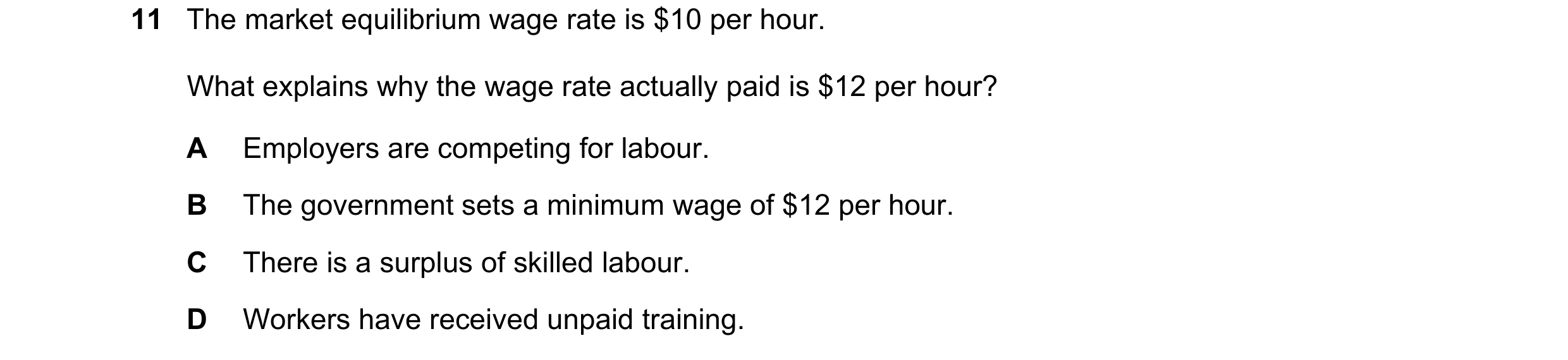
Q70 · The market equilibrium wage rate is $10 per hour 0455/13 Oct/Nov 2021
11 The market equilibrium wage rate is $10 per hour. What explains why the wage rate actually paid is $12 per hour? A Employers are competing for labour. B The government sets a minimum wage of $12 per hour. C There is a surplus of skilled labour. D Workers have received unpaid training.
1 marks
Answer: B
This question in 0455/13 Oct/Nov 2021
Q71 · The chart shows a government’s spending in a year 0455/12 May/June 2022
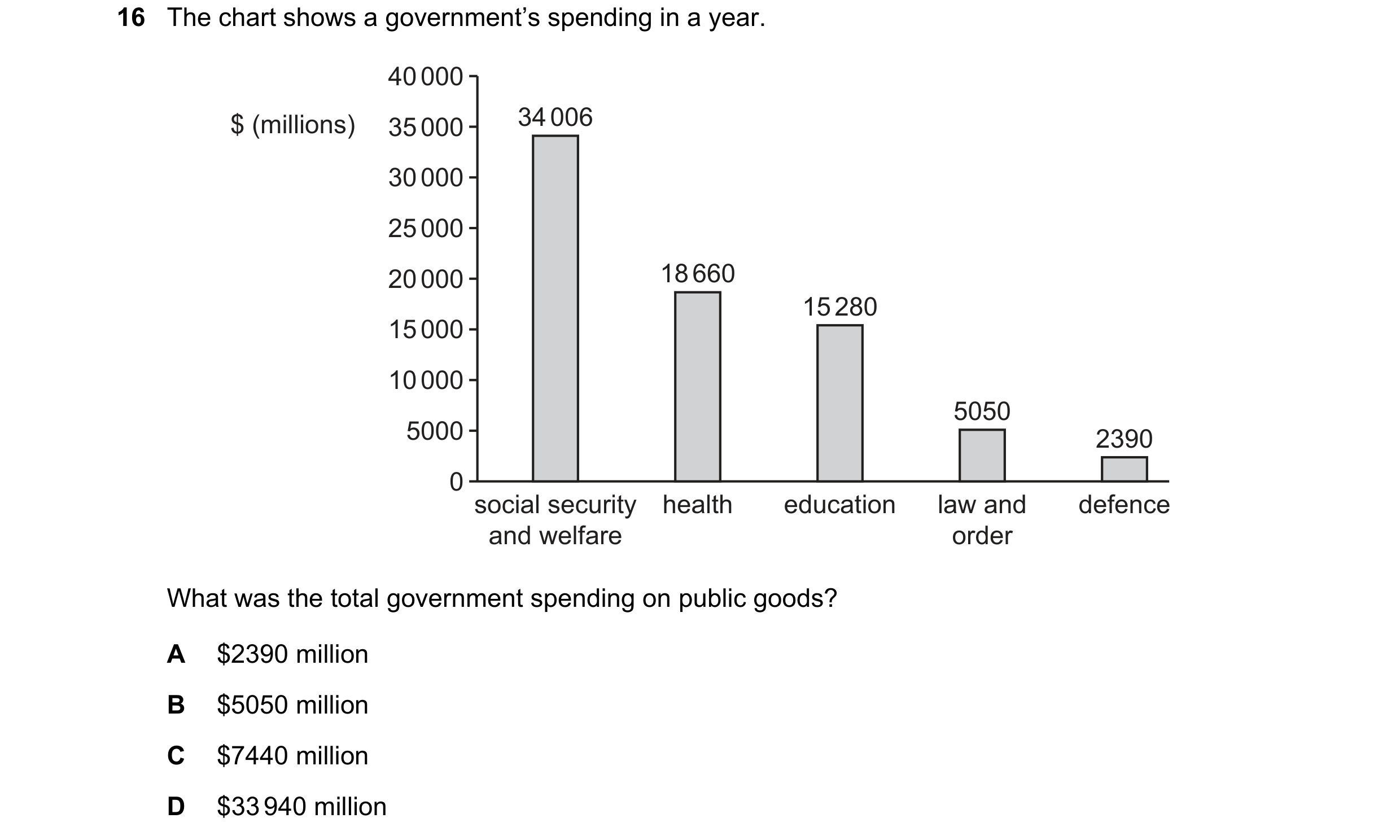
16 The chart shows a government’s spending in a year. 40 000 $ (millions) 35 000 34 006 30 000 25 000 20 000 18 660 15 280 15 000 10 000 5050 5000 2390 0 social security health education law and defence and welfare order What was the total government spending on public goods? A $2390 million B $5050 million C $7440 million D $33 940 million
1 marks
Answer: C
This question in 0455/12 May/June 2022
Q72 · Which action is not performed by a government as part of its international role? 0455/13 May/June 2022
23 Which action is not performed by a government as part of its international role? A building offshore wind farms B imposing tariffs on imports C issuing visas to foreign tourists D providing humanitarian aid to refugees
1 marks
Answer: A
This question in 0455/13 May/June 2022
Q73 · The Chinese government is concerned about the level of poverty and the need for more… 0455/11 Oct/Nov 2022
1 The Chinese government is concerned about the level of poverty and the need for more resources in low-income regions of the country. As a result, it is increasing its expenditure in those regions and reducing it in high-income regions. Which economic concept does this government policy illustrate? A diseconomies of scale B market forces C opportunity cost D specialisation
1 marks
Answer: C
This question in 0455/11 Oct/Nov 2022
Q74 · To reduce traffic congestion, a government decides to build a new road 0455/12 Oct/Nov 2022
8 To reduce traffic congestion, a government decides to build a new road. There is a toll charge on the new road. What is the main purpose of this government intervention? A to address the problem of market failure B to discourage people from using public transport C to ensure the supply of transport through the free market D to obtain revenue from the levy of a toll
1 marks
Answer: A
This question in 0455/12 Oct/Nov 2022
Q75 · A government places an indirect tax on a good which has price-elastic demand 0455/12 Feb/March 2023
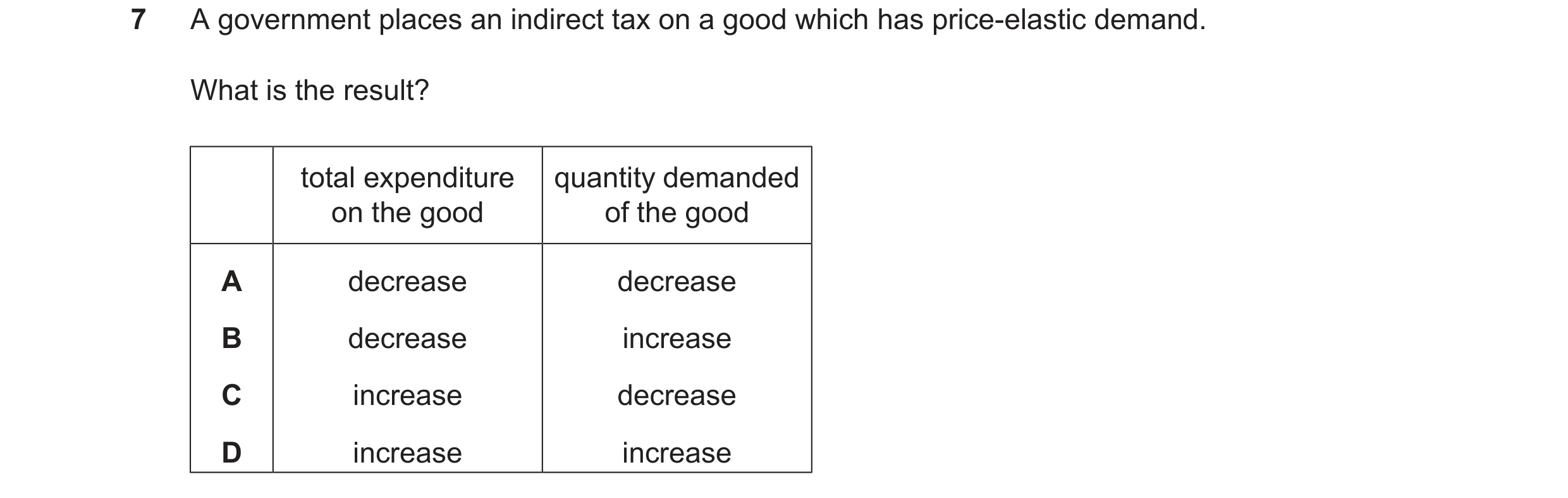
7 A government places an indirect tax on a good which has price-elastic demand. What is the result? total expenditure quantity demanded on the good of the good A decrease decrease B decrease increase C increase decrease D increase increase
1 marks
Answer: A
This question in 0455/12 Feb/March 2023
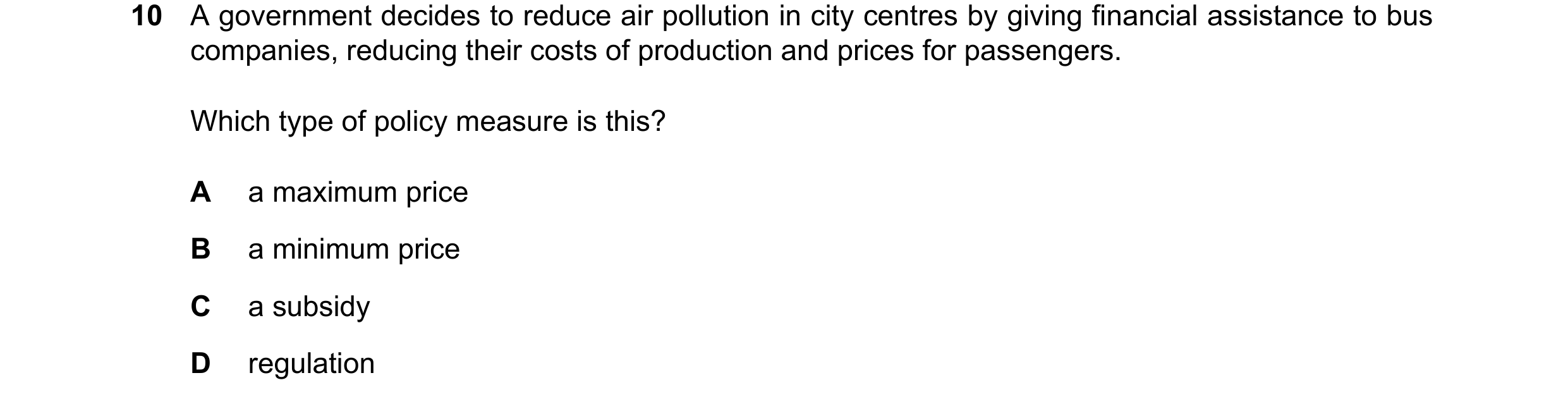
Q76 · A government decides to reduce air pollution in city centres by giving financial… 0455/11 May/June 2023
10 A government decides to reduce air pollution in city centres by giving financial assistance to bus companies, reducing their costs of production and prices for passengers. Which type of policy measure is this? A a maximum price B a minimum price C a subsidy D regulation
1 marks
Answer: C
This question in 0455/11 May/June 2023
Q77 · Imposing a maximum price for a good is an example of which type of government policy? 0455/12 May/June 2023
10 Imposing a maximum price for a good is an example of which type of government policy? A fiscal B monetary C regulation D supply-side
1 marks
Answer: C
This question in 0455/12 May/June 2023
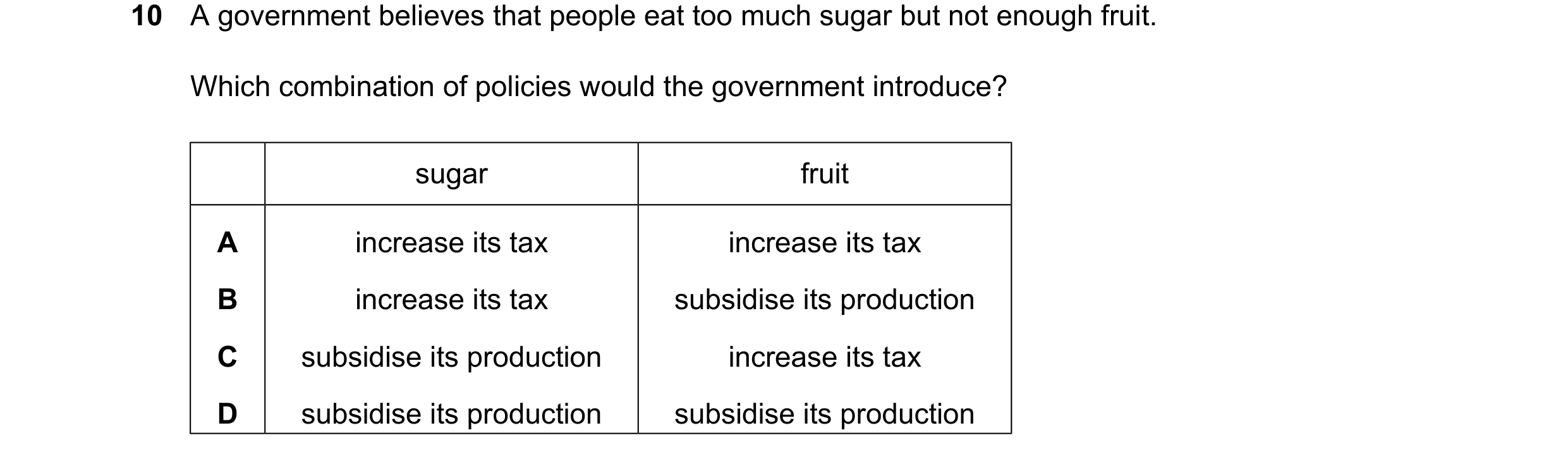
Q78 · A government believes that people eat too much sugar but not enough fruit 0455/13 May/June 2023
10 A government believes that people eat too much sugar but not enough fruit. Which combination of policies would the government introduce? sugar fruit A increase its tax increase its tax B increase its tax subsidise its production C subsidise its production increase its tax D subsidise its production subsidise its production
1 marks
Answer: B
This question in 0455/13 May/June 2023
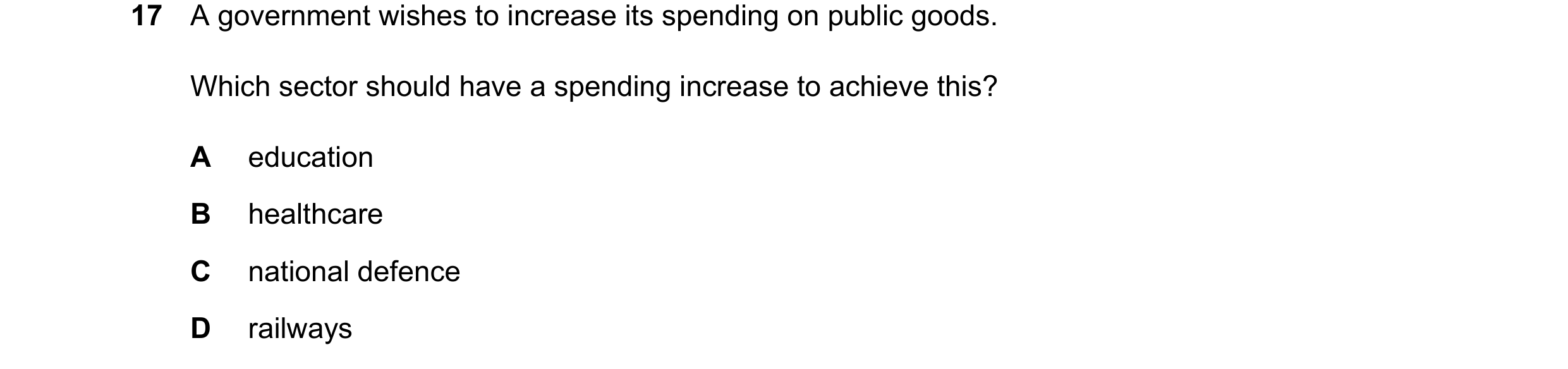
Q79 · A government wishes to increase its spending on public goods 0455/13 May/June 2023
17 A government wishes to increase its spending on public goods. Which sector should have a spending increase to achieve this? A education B healthcare C national defence D railways
1 marks
Answer: C
This question in 0455/13 May/June 2023
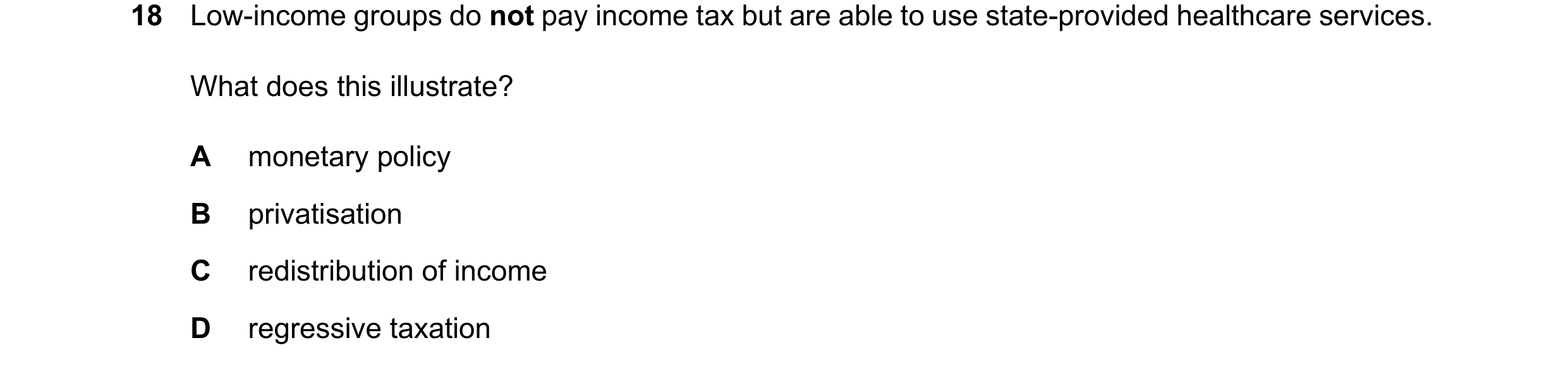
Q80 · Low-income groups do not pay income tax but are able to use state-provided healthcare… 0455/11 Oct/Nov 2023
18 Low-income groups do not pay income tax but are able to use state-provided healthcare services. What does this illustrate? A monetary policy B privatisation C redistribution of income D regressive taxation
1 marks
Answer: C
This question in 0455/11 Oct/Nov 2023
Q81 · What is an example of government macroeconomic policy? 0455/12 Oct/Nov 2023
17 What is an example of government macroeconomic policy? A increasing the money supply B preventing price rises in the food industry C removing a monopoly’s barriers to entry D setting a maximum price for wheat
1 marks
Answer: A
This question in 0455/12 Oct/Nov 2023
Q82 · What is the most likely goal of a state-owned enterprise providing health services? 0455/13 Oct/Nov 2023
14 What is the most likely goal of a state-owned enterprise providing health services? A profits B public satisfaction C sales revenue D survival
1 marks
Answer: B
This question in 0455/13 Oct/Nov 2023
Q83 · Which government measure is most likely to cause a fall both in price and in quantity… 0455/12 May/June 2024
9 Which government measure is most likely to cause a fall both in price and in quantity traded? A indirect tax B maximum price C minimum price D subsidy
1 marks
Answer: B
This question in 0455/12 May/June 2024
Q84 · The government wishes to reduce the harmful emissions from road transport 0455/13 May/June 2024
9 The government wishes to reduce the harmful emissions from road transport. Which measure would be effective in helping to achieve this aim? A increased expenditure on oil exploration B introducing a subsidy on public transport C reduced taxation on the production of private vehicles D reducing incentives to purchase electric vehicles
1 marks
Answer: B
This question in 0455/13 May/June 2024
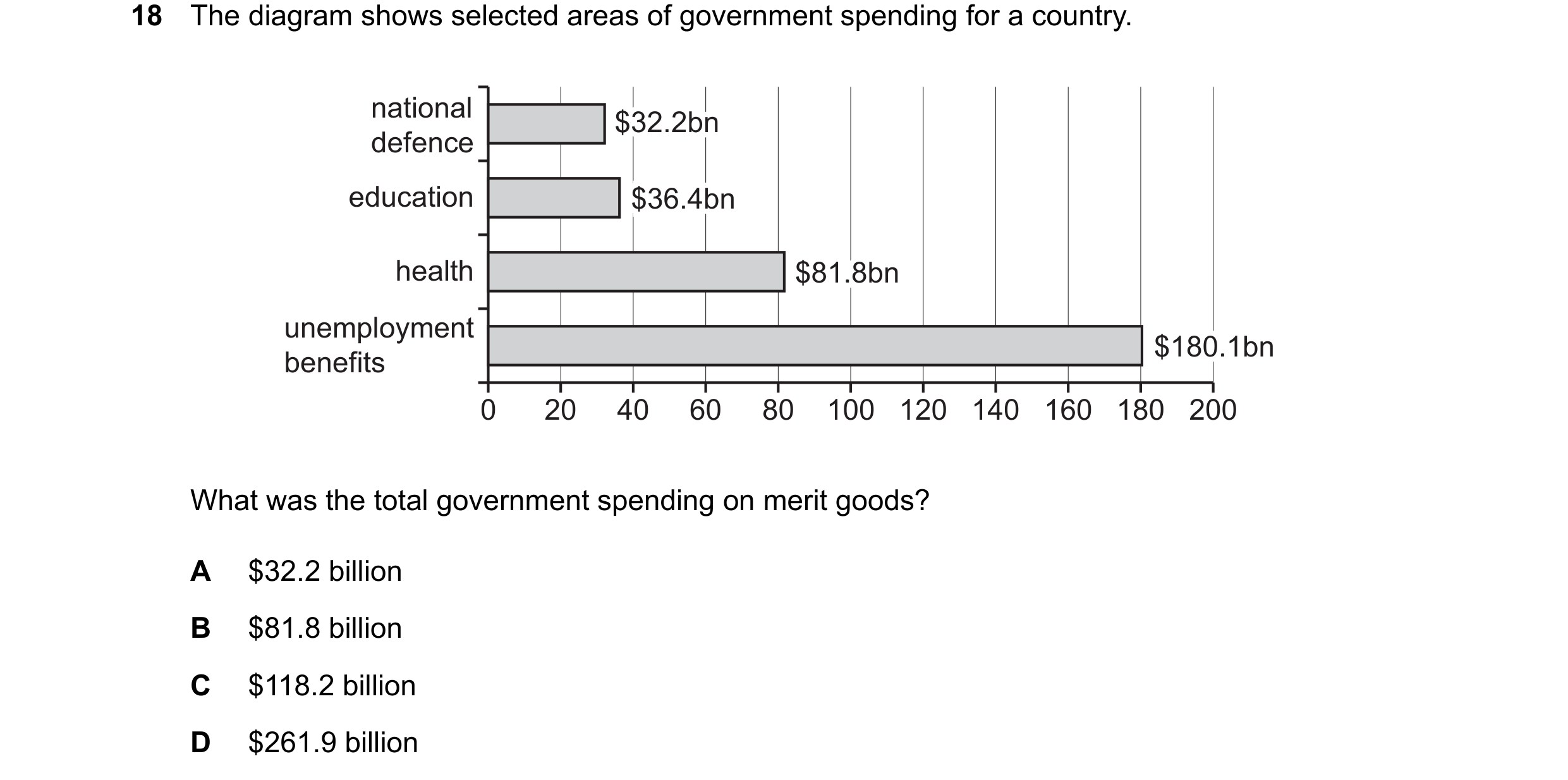
Q85 · The diagram shows selected areas of government spending for a country 0455/13 May/June 2024
18 The diagram shows selected areas of government spending for a country. national $32.2bn $32.2 bn defence education $36.4bn $36.4 bn health $81.8bn $81.8 bn unemployment $180.1bn $180.1 bn benefits 0 20 40 60 80 100 120 140 160 180 200 What was the total government spending on merit goods? A $32.2 billion B $81.8 billion C $118.2 billion D $261.9 billion
1 marks
Answer: C
This question in 0455/13 May/June 2024
Q86 · The graph shows the impact of a tax on the supply of petrol (gas) 0455/11 Oct/Nov 2024
19 The graph shows the impact of a tax on the supply of petrol (gas). D S2 price S1 O quantity What can be concluded from this graph? A The government will receive no tax revenue. B The impact of the tax will be shared between the consumer and the producer. C The impact of the tax will fall entirely upon the consumer. D The impact of the tax will fall entirely on the producer.
1 marks
Answer: C
This question in 0455/11 Oct/Nov 2024
Q87 · What is a principle of taxation? 0455/11 May/June 2025
18 What is a principle of taxation? A equality between social cost and social benefit B fairness between taxpayers C profit maximisation by firms D tax revenue maximisation
1 marks
Answer: B
This question in 0455/11 May/June 2025
Q88 · What is most likely to be a reason for taxing oil? 0455/13 May/June 2025
20 What is most likely to be a reason for taxing oil? A to conserve oil resources B to create employment C to encourage economic growth D to reduce oil prices
1 marks
Answer: A
This question in 0455/13 May/June 2025
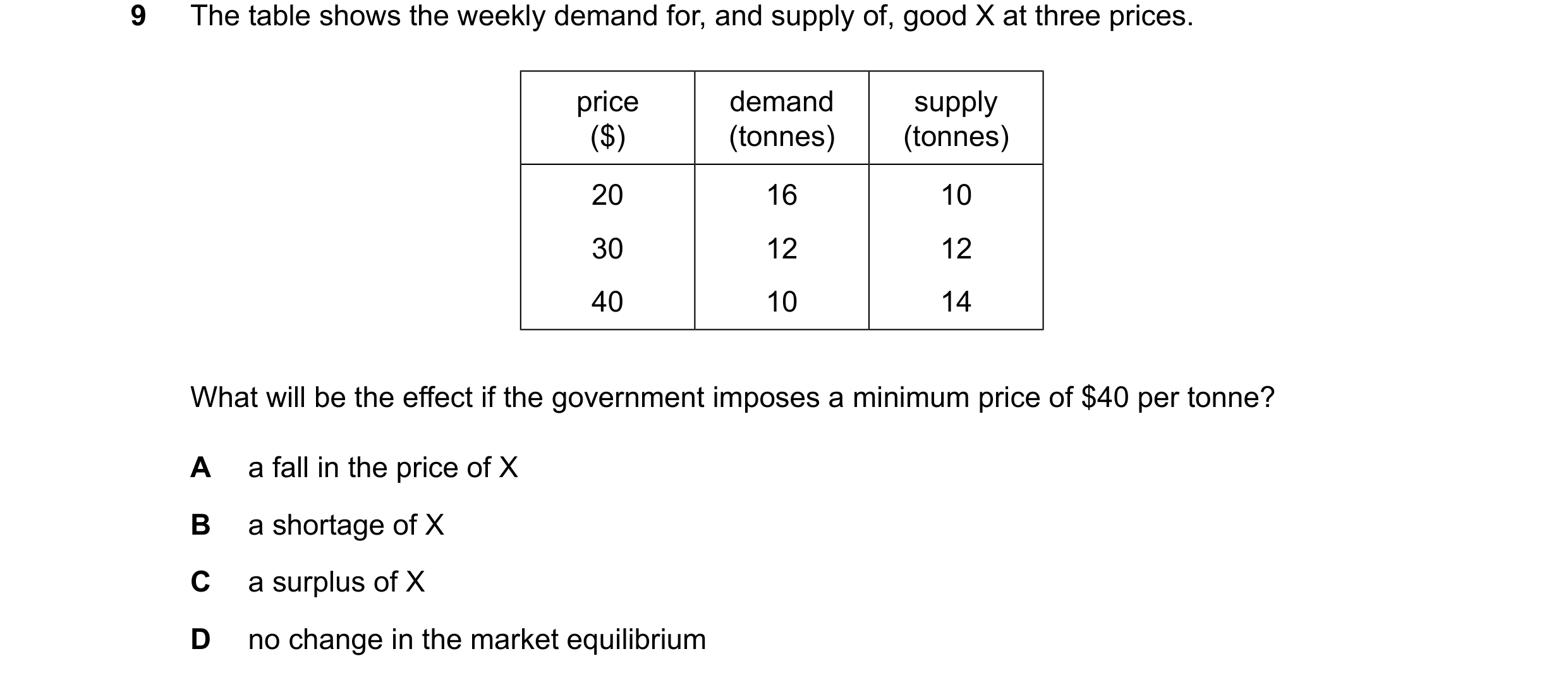
Q89 · The table shows the weekly demand for, and supply of, good X at three prices 0455/11 Oct/Nov 2025
9 The table shows the weekly demand for, and supply of, good X at three prices. price demand supply ($) (tonnes) (tonnes) 20 16 10 30 12 12 40 10 14 What will be the effect if the government imposes a minimum price of $40 per tonne? A a fall in the price of X B a shortage of X C a surplus of X D no change in the market equilibrium
1 marks
Answer: C
This question in 0455/11 Oct/Nov 2025
Q90 · Which role is not performed by a government? 0455/13 Oct/Nov 2025
17 Which role is not performed by a government? A paying dividends to shareholders B promoting international trade agreements C providing state benefits D subsidising merit goods
1 marks
Answer: A
This question in 0455/13 Oct/Nov 2025

 1 / 23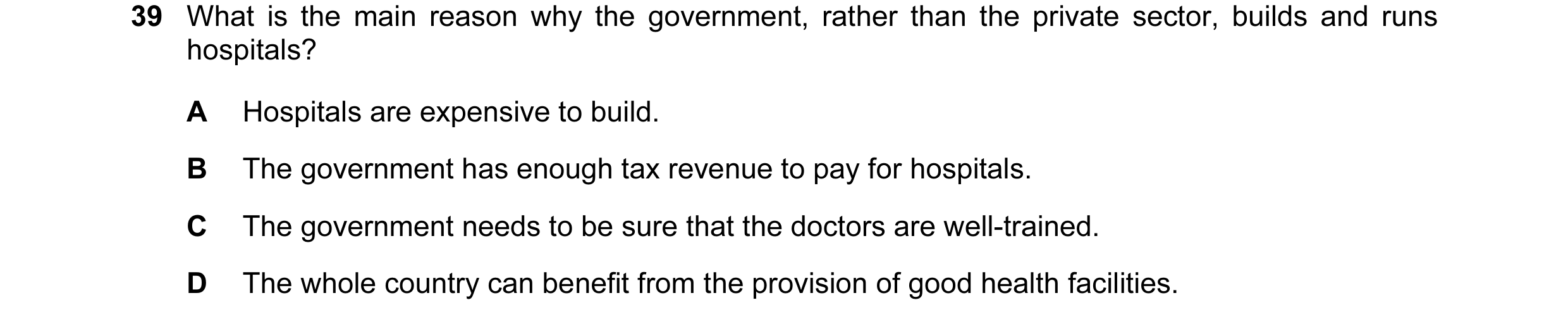

 2 / 23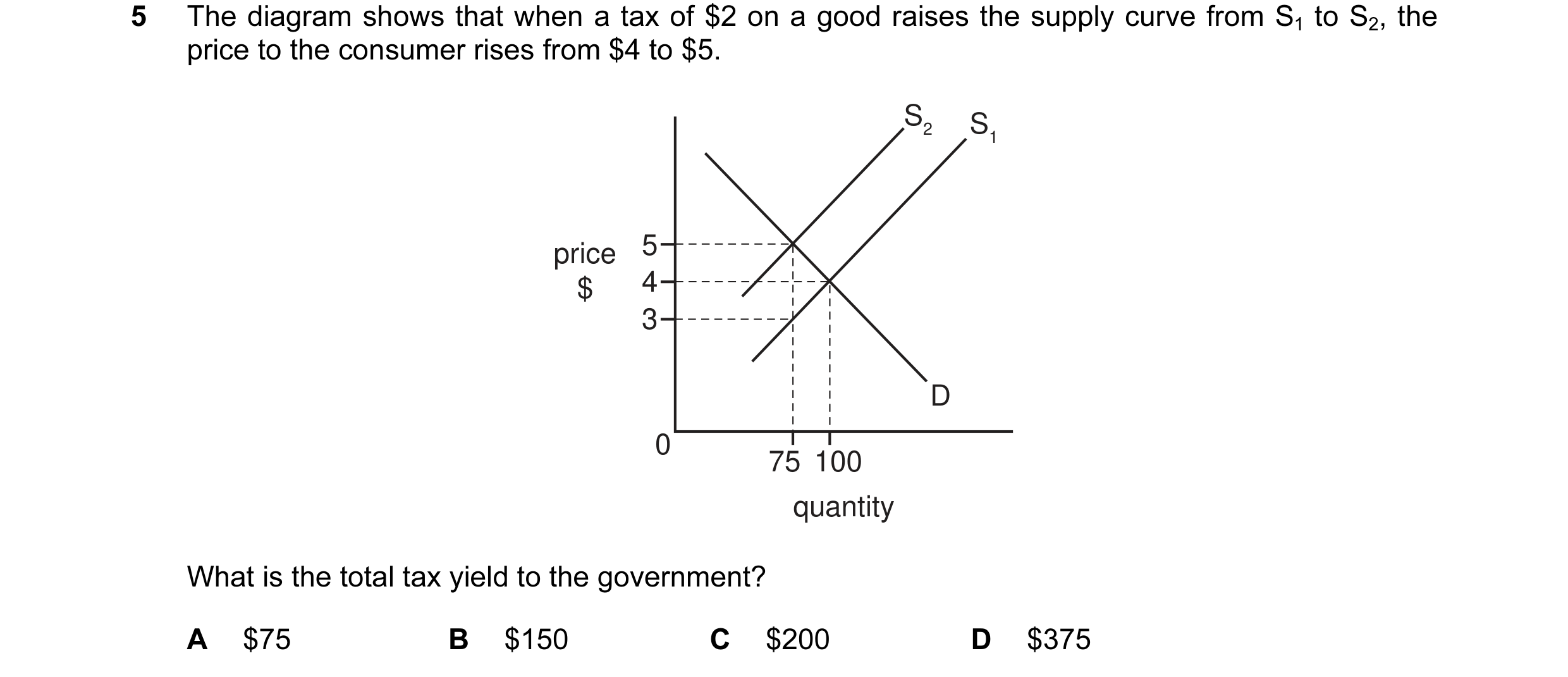

 3 / 23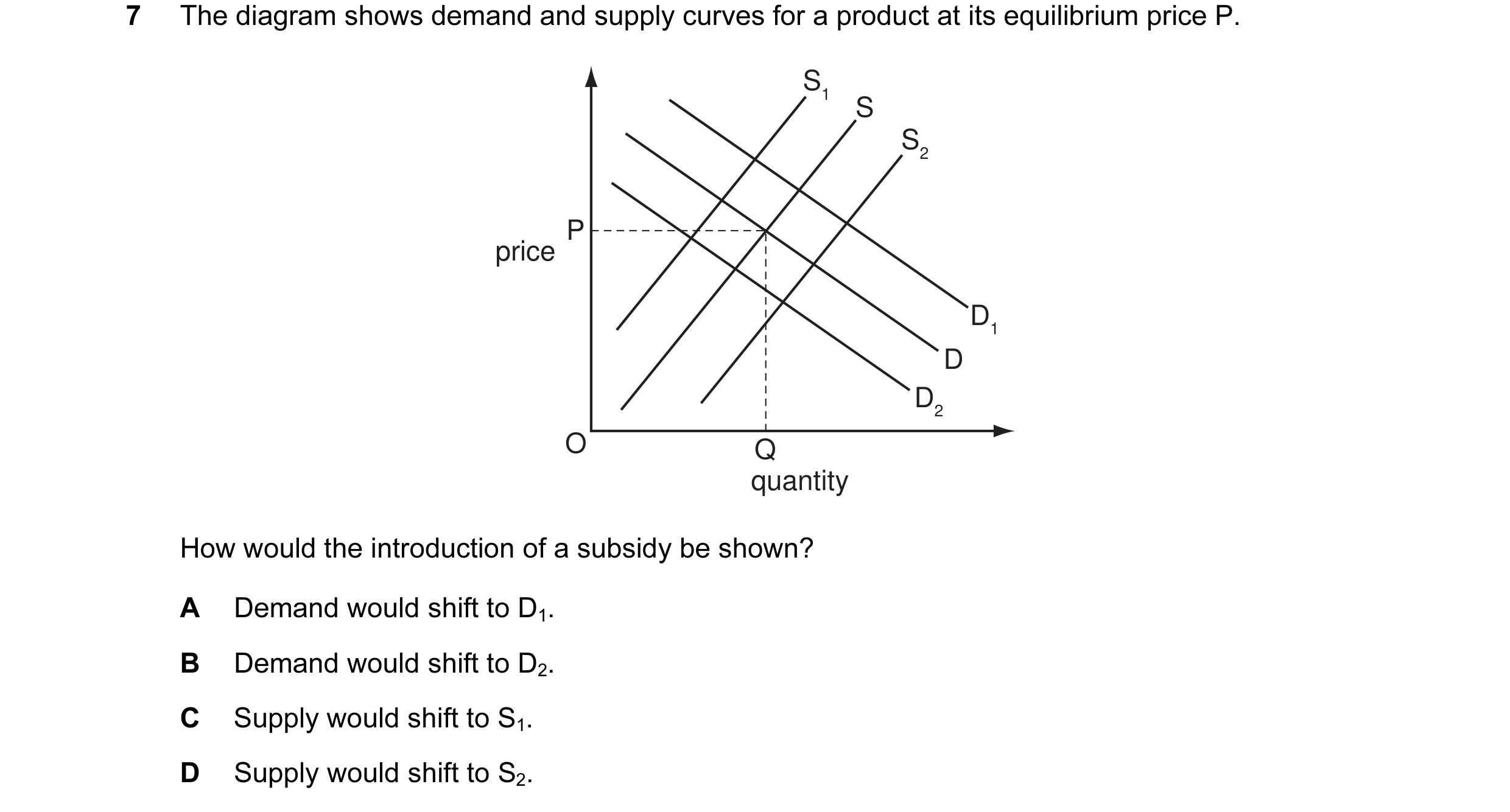

 4 / 23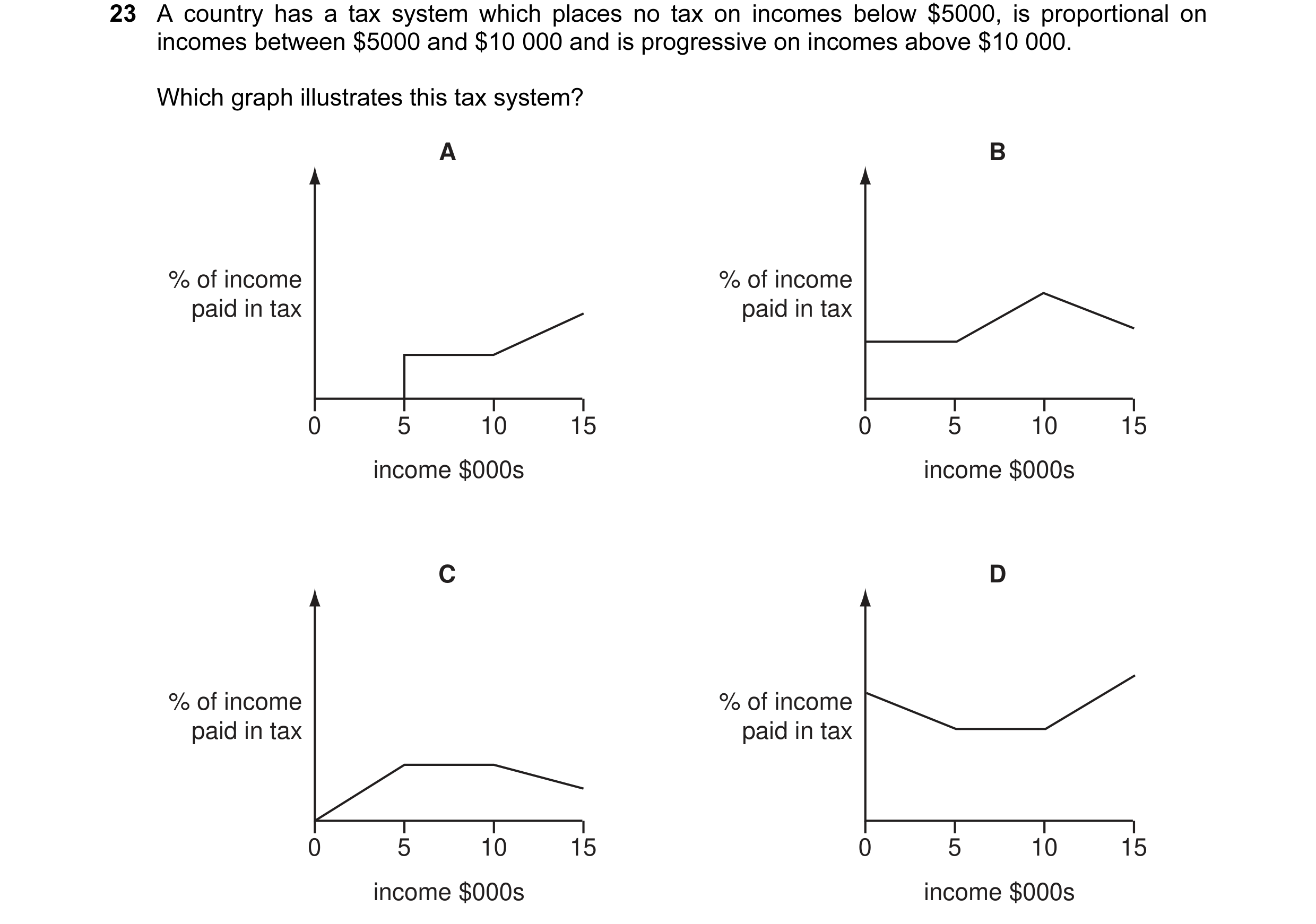

 5 / 23


 6 / 23



 7 / 23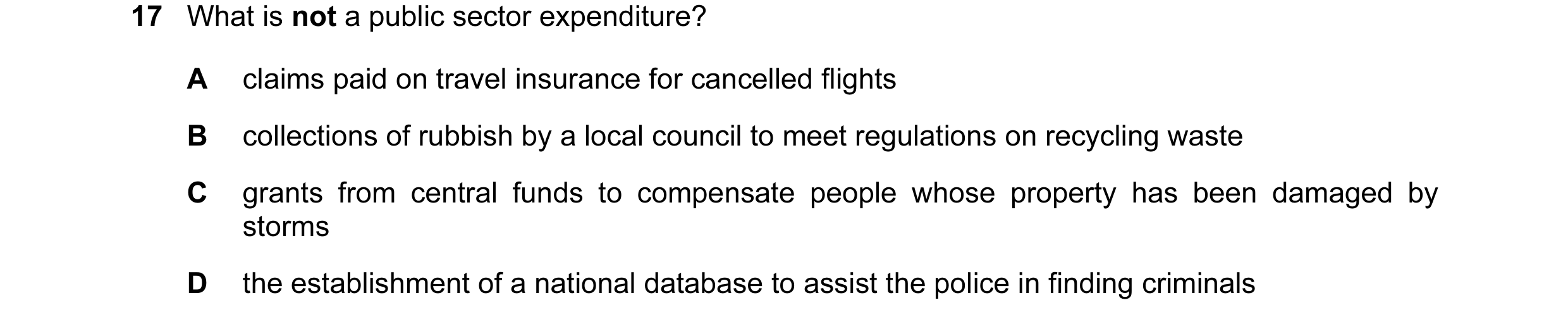
 8 / 23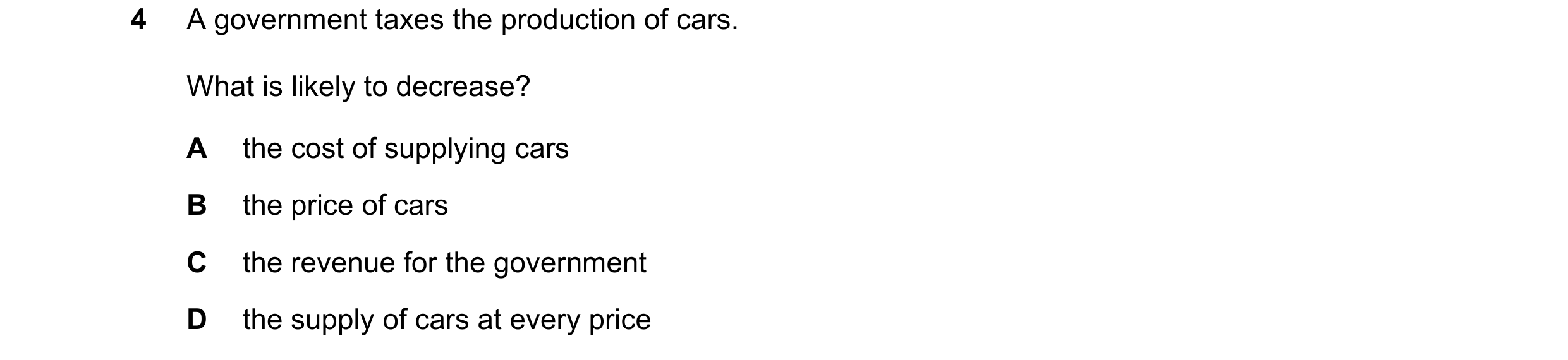
 9 / 23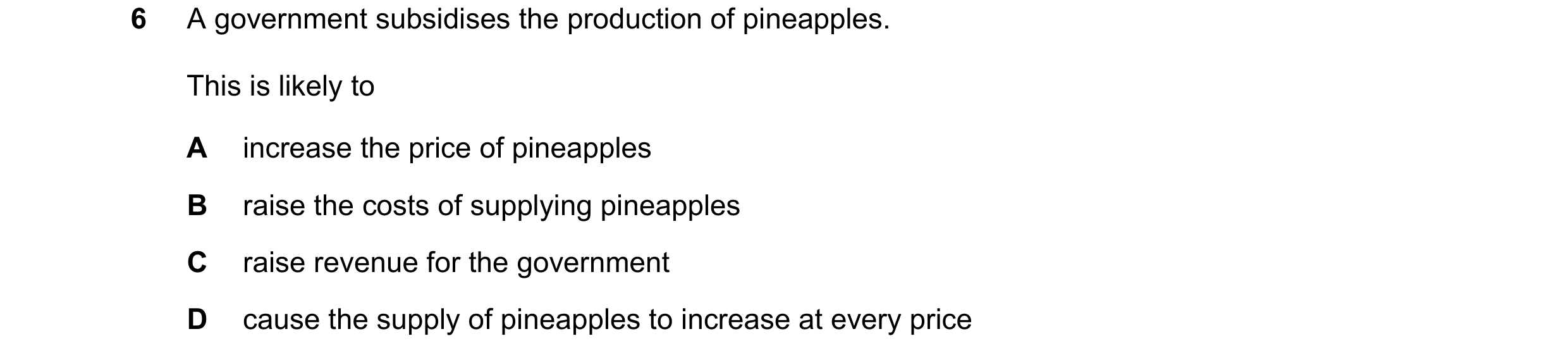
 10 / 23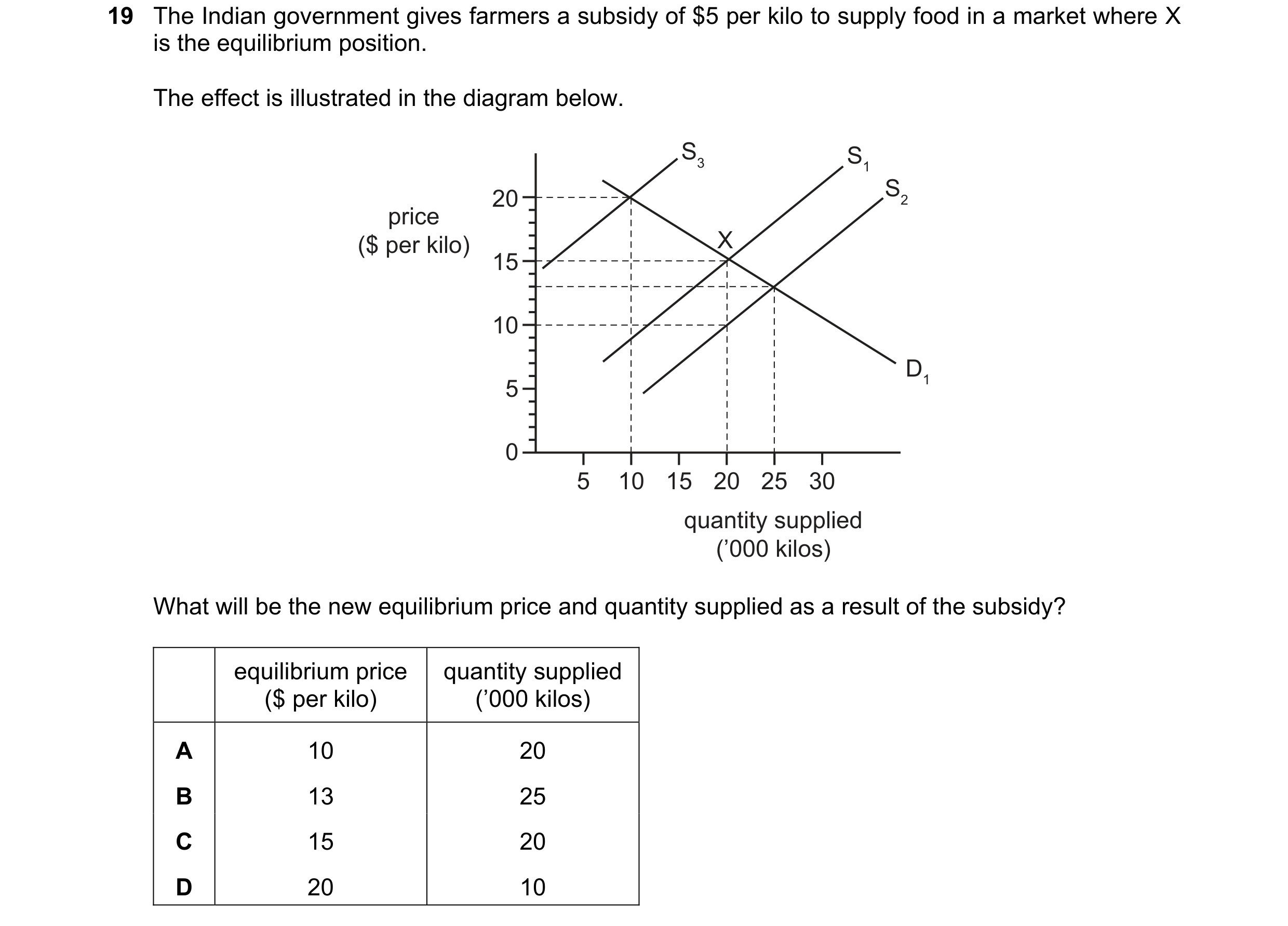
 11 / 23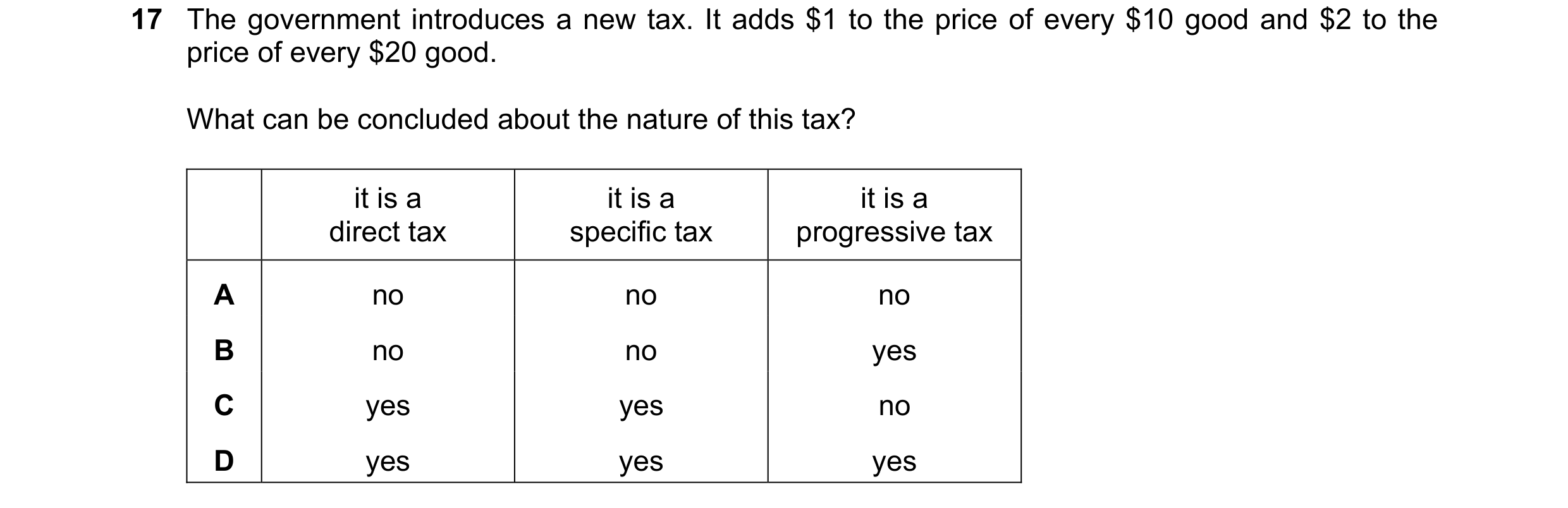
 12 / 23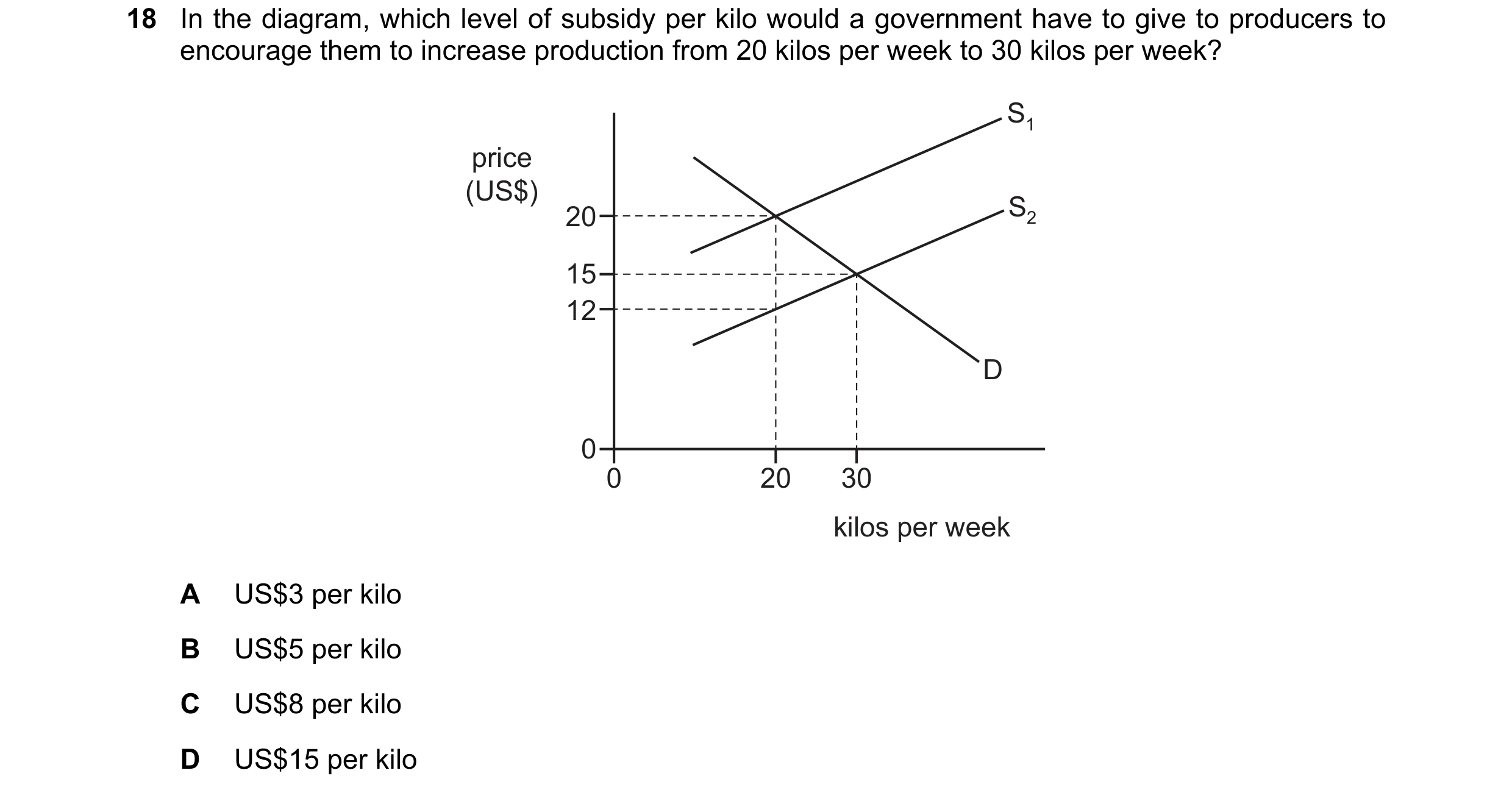
 13 / 23

 14 / 23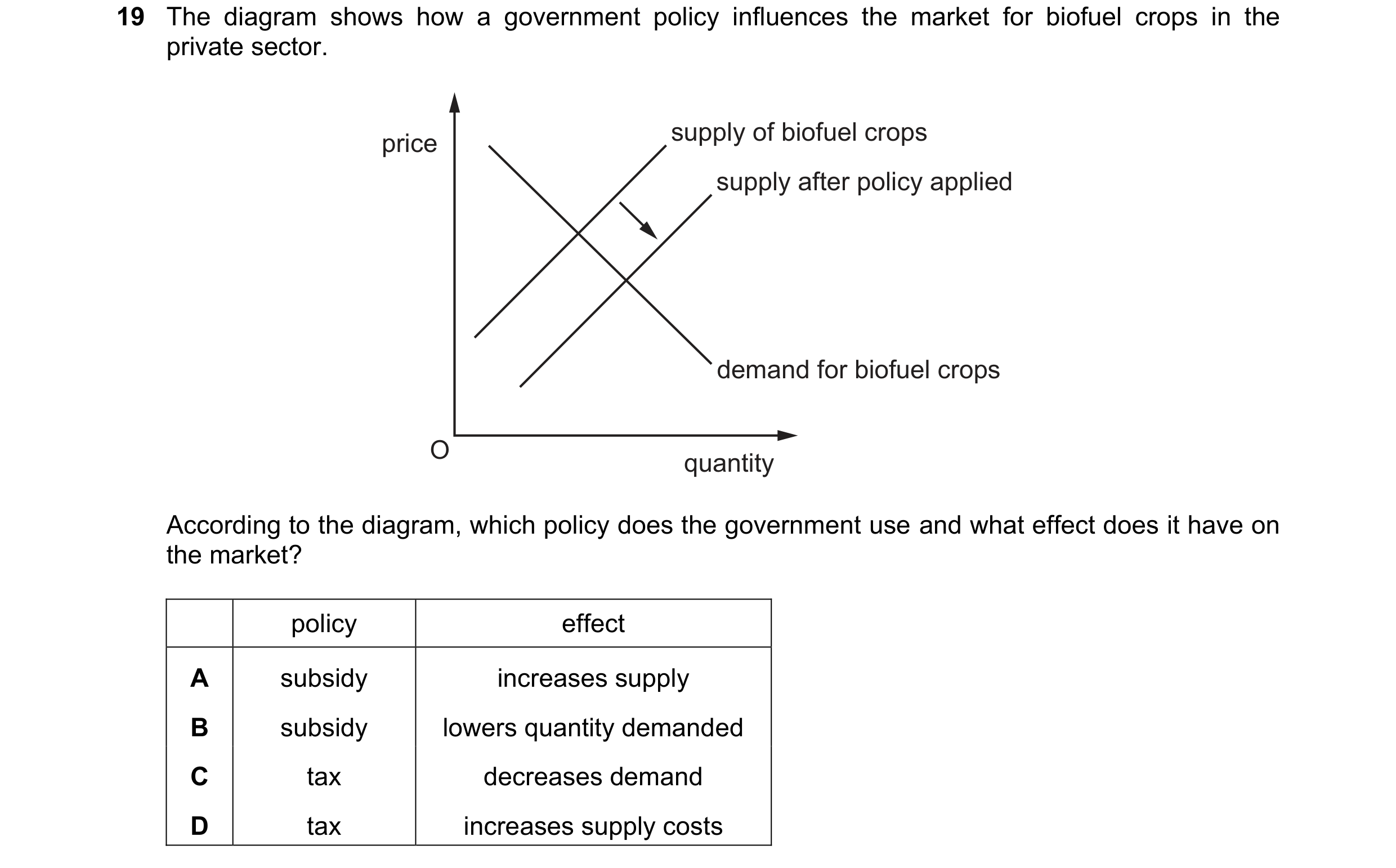


 15 / 23
 16 / 23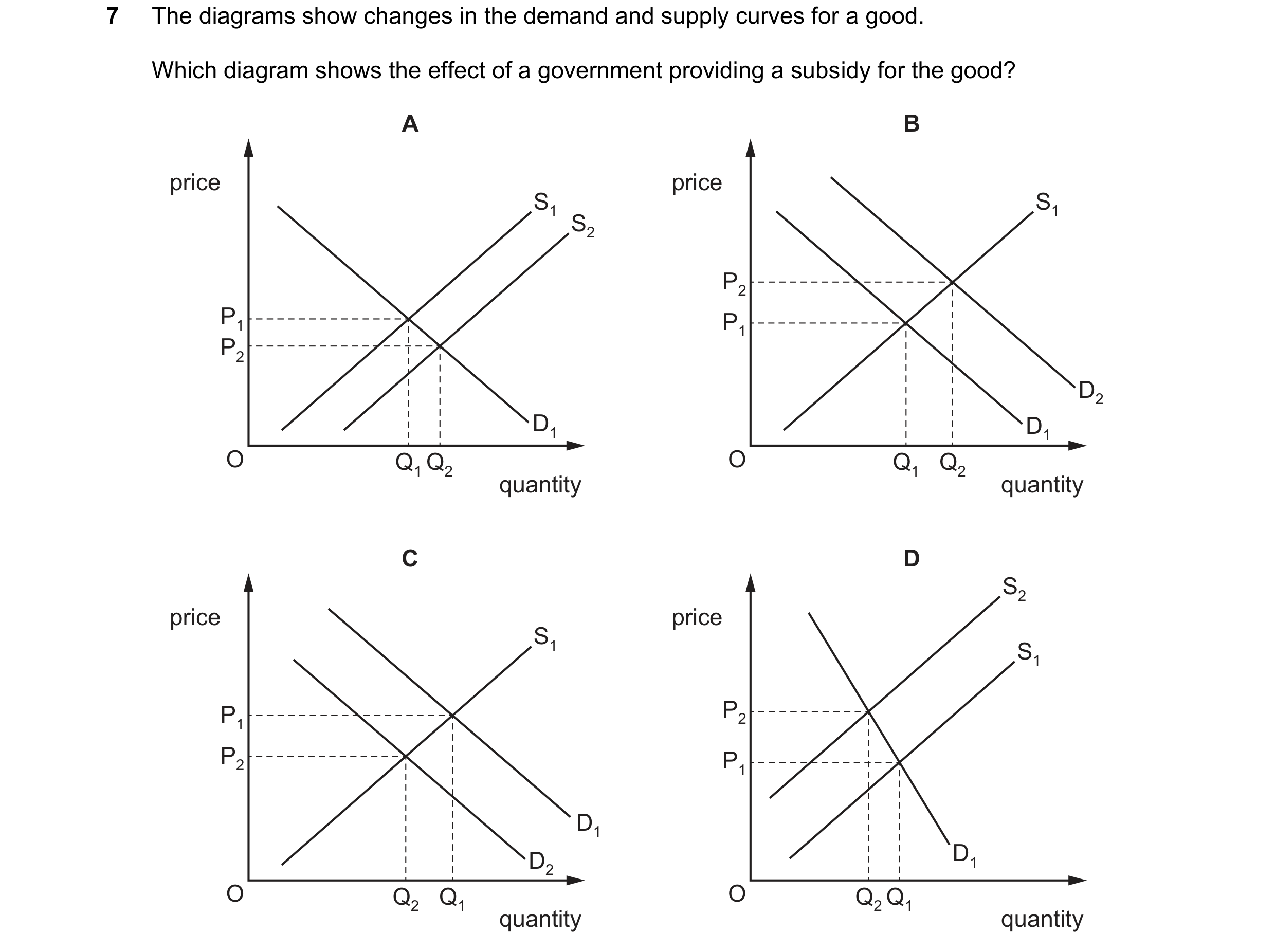
 17 / 23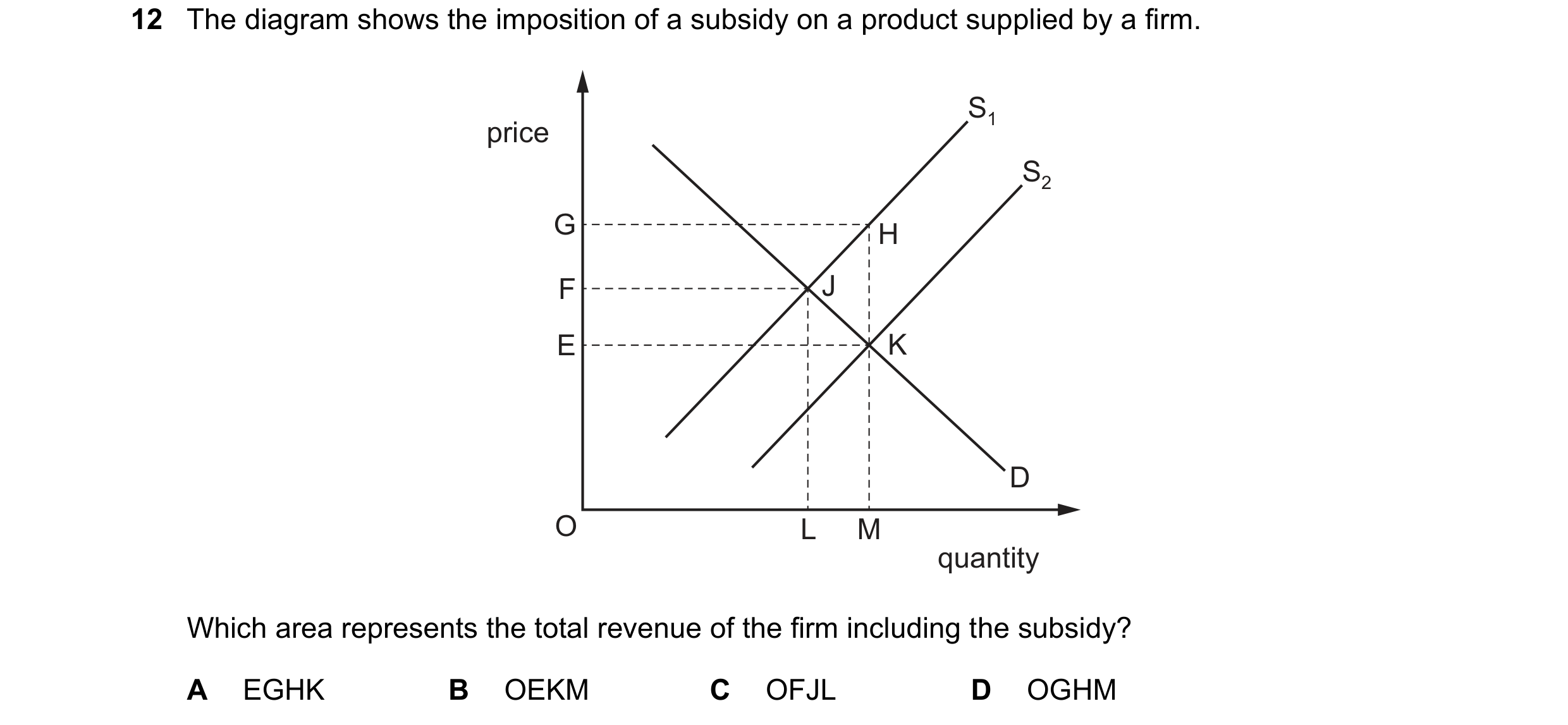
 18 / 23
 19 / 23
 20 / 23

 21 / 23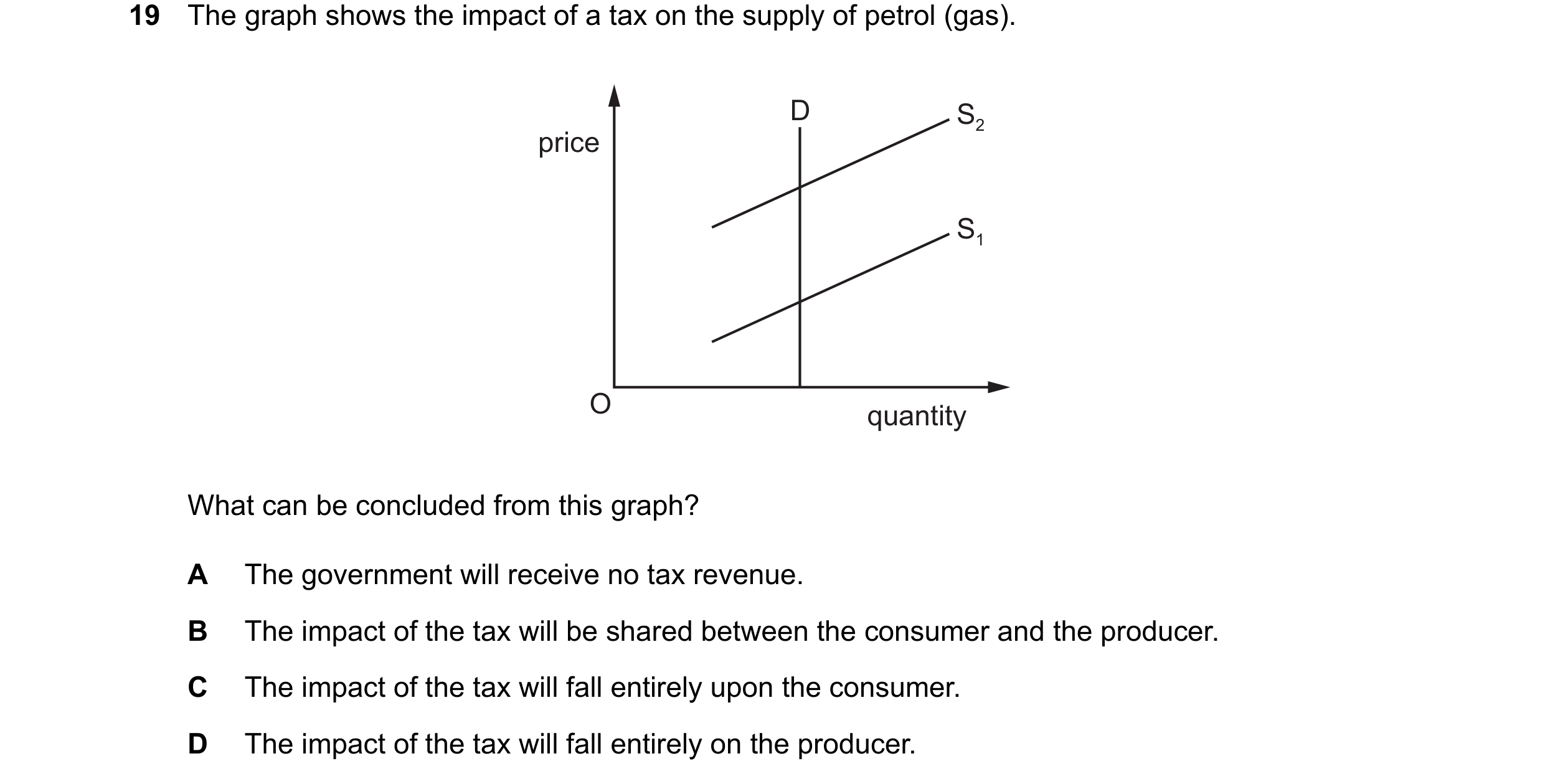


 22 / 23
 23 / 23