Cambridge IGCSE Sciences - Co-ordinated (Double) 0654 — 2017 Oct/Nov Paper 3 · Variant 1
0654/31/O/N/17 · 13 questions · 120 marks · ≈135 min
The question paper and its mark scheme, free to read here and free to download. This is Cambridge’s own paper, exactly as it was sat.
Question paper28 pages

Mark scheme10 pages
Answers below. Sit the paper first if you are practising.
Questions as text
Q1 · A diagram of a plant cell
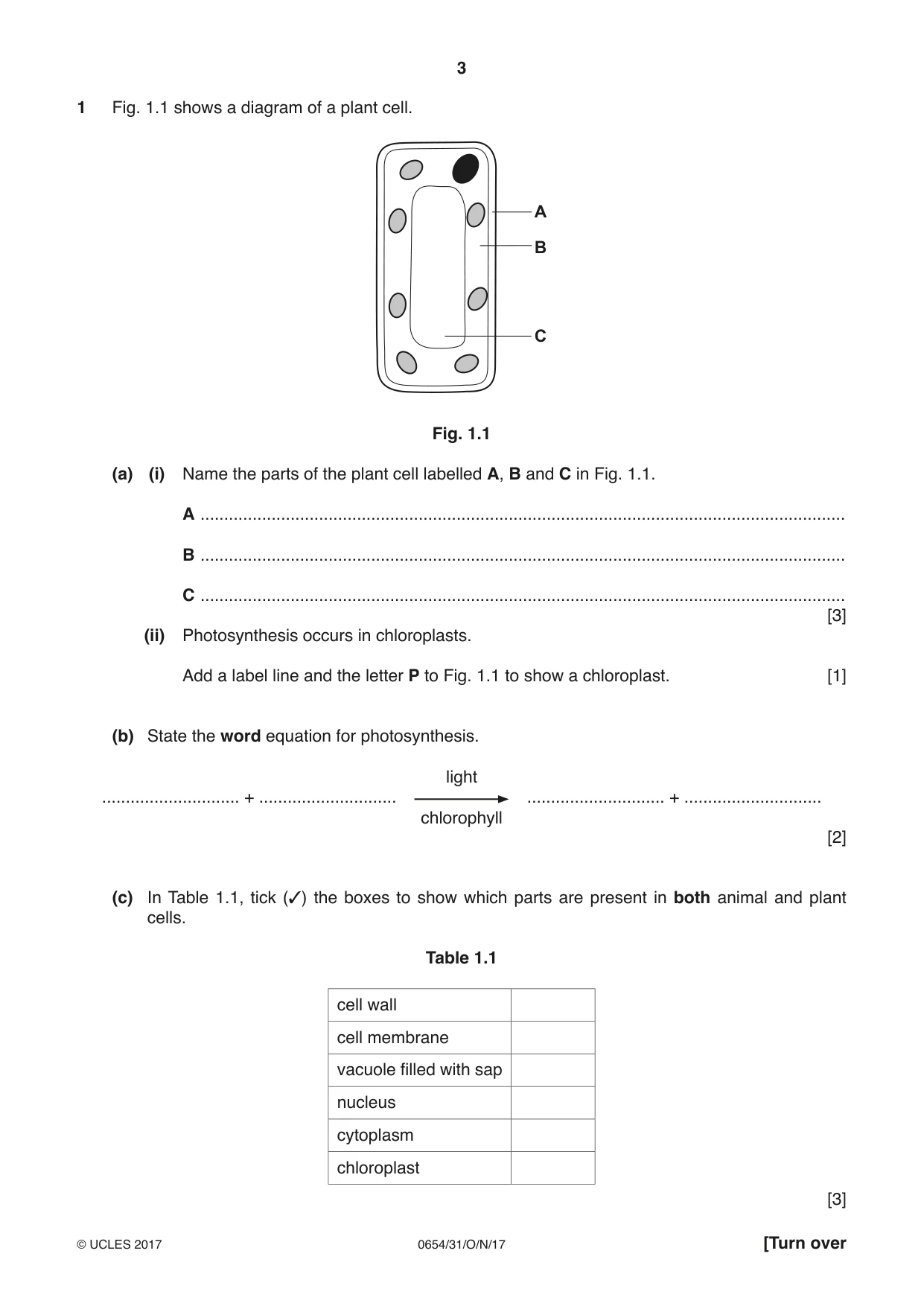
1 Fig. 1.1 shows a diagram of a plant cell. A B C Fig. 1.1 (a) (i) Name the parts of the plant cell labelled A, B and C in Fig. 1.1. A ........................................................................................................................................ B ........................................................................................................................................ C ........................................................................................................................................ [3] (ii) Photosynthesis occurs in chloroplasts. Add a label line and the letter P to Fig. 1.1 to show a chloroplast. [1] (b) State the word equation for photosynthesis. light ............................. + ............................. ............................. + ............................. chlorophyll [2] (c) In Table 1.1, tick (3) the boxes to show which parts are present in both animal and plant cells. Table 1.1 cell wall cell membrane vacuole filled with sap nucleus cytoplasm chloroplast [3]
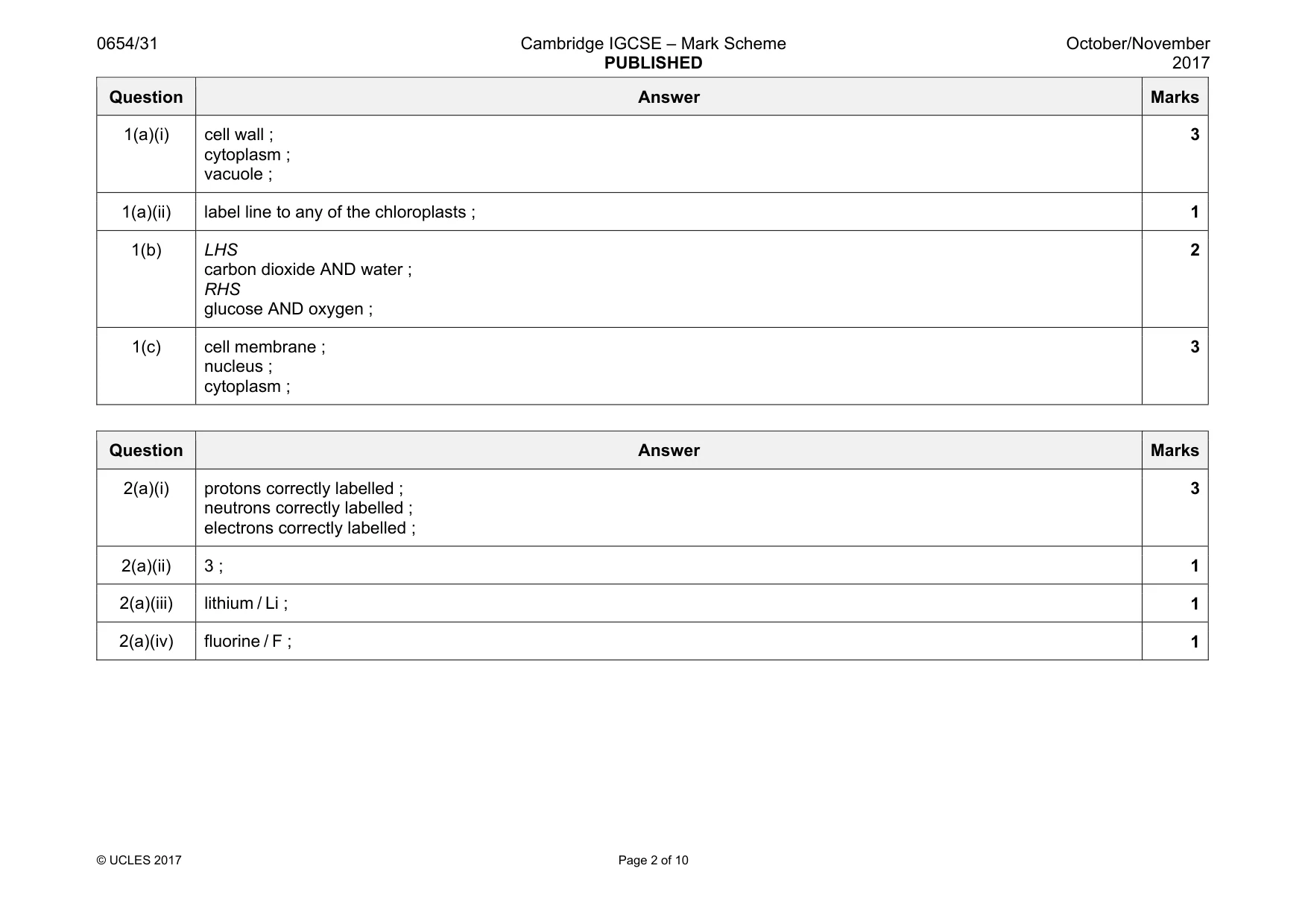
Mark scheme: 1(a)(i) cell wall ; cytoplasm ; vacuole ; 3 1(a)(ii) label line to any of the chloroplasts ; 1 1(b) LHS carbon dioxide AND water ; RHS glucose AND oxygen ; 2 1(c) cell membrane ; nucleus ; cytoplasm ; 3
Q2 · The Periodic Table shows the chemical elements arranged in order of atomic number
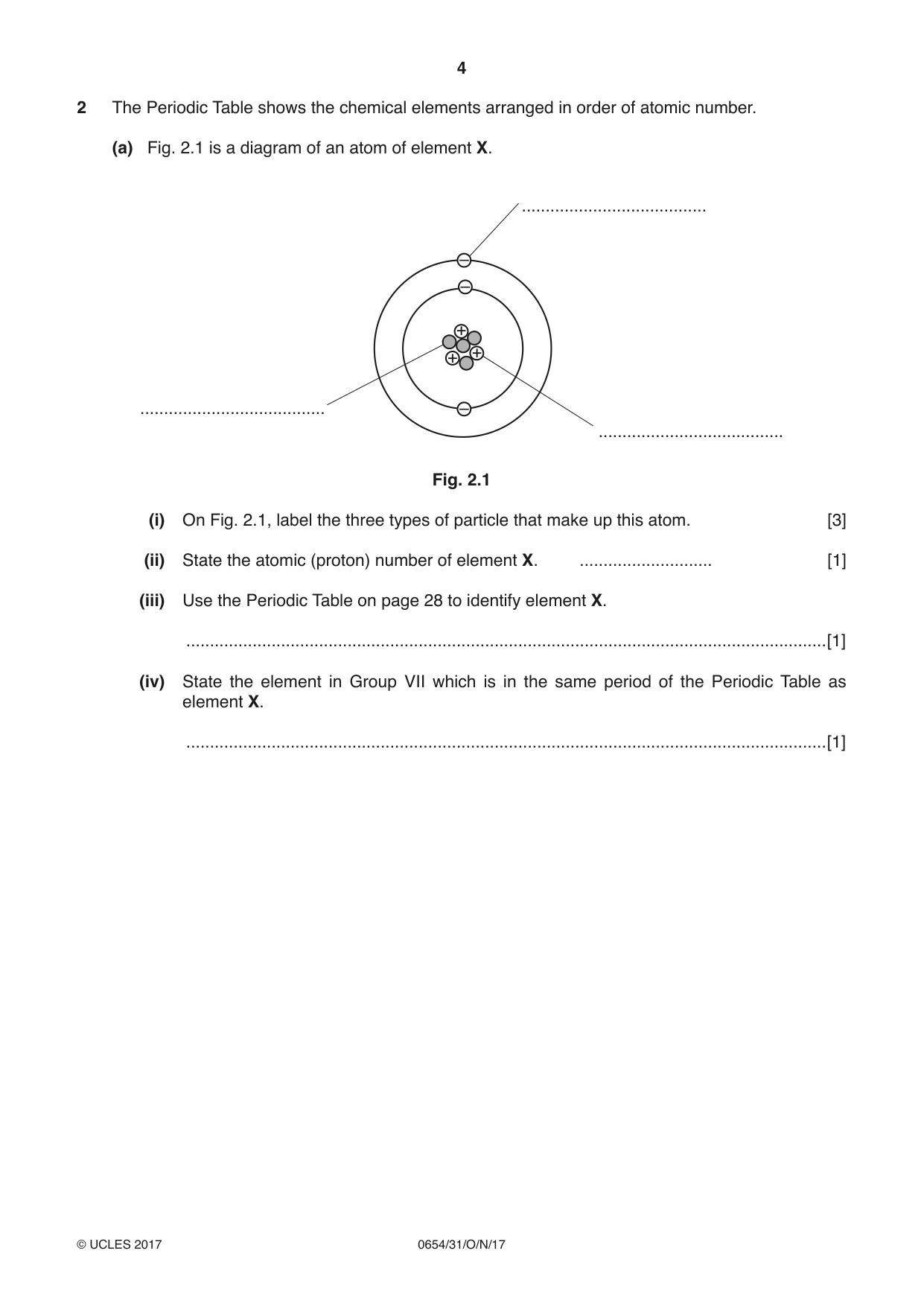
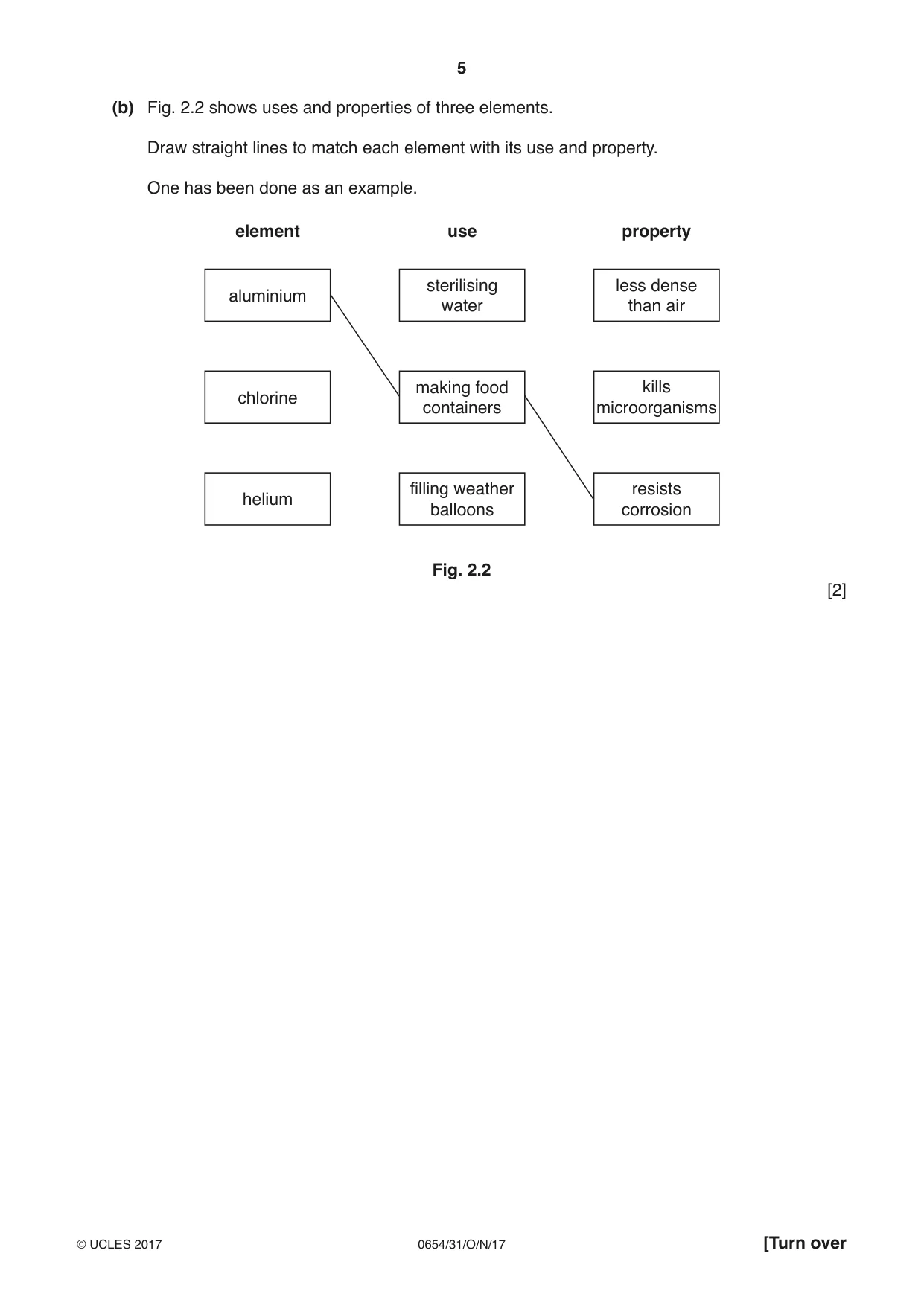
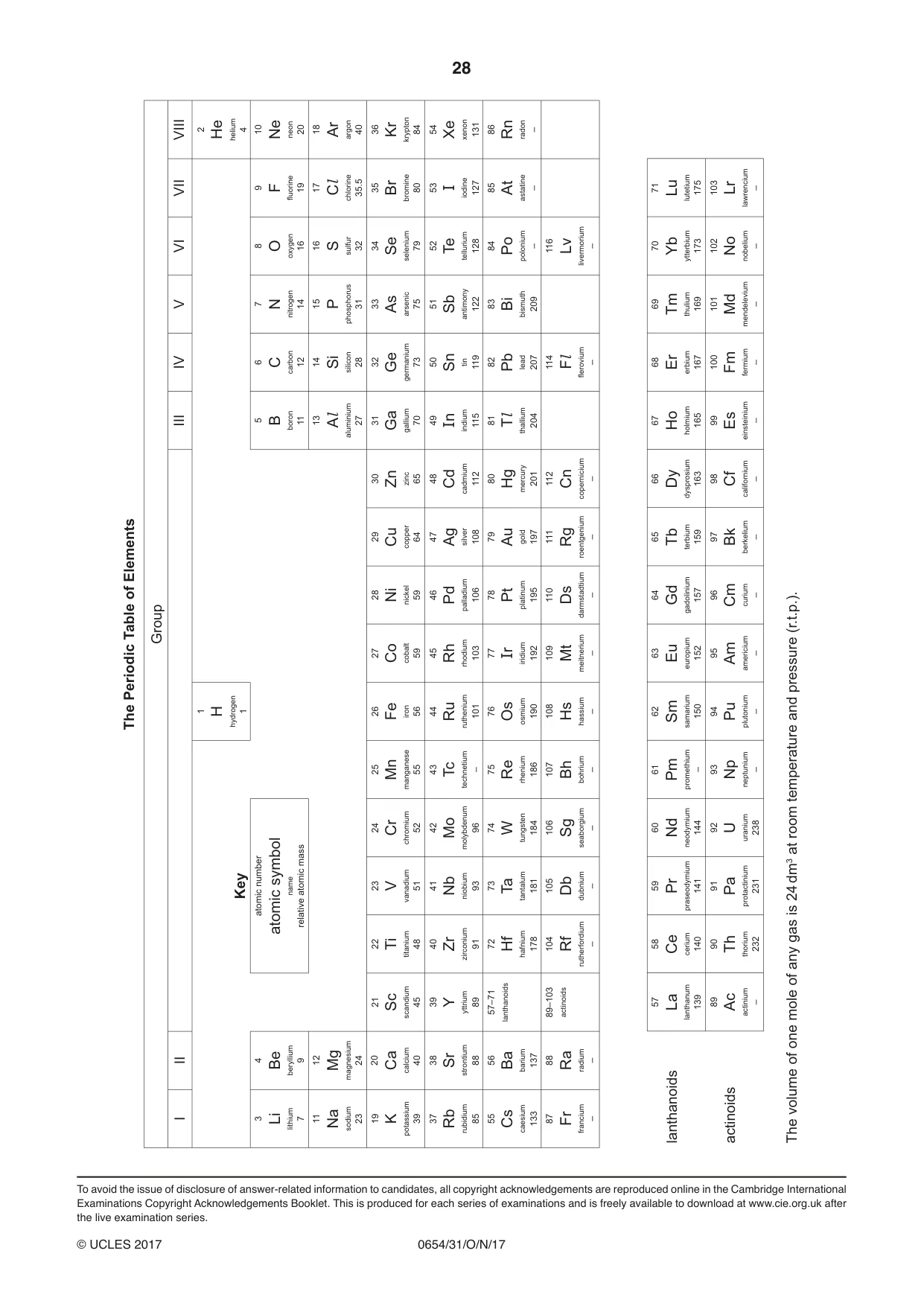
2 The Periodic Table shows the chemical elements arranged in order of atomic number. (a) Fig. 2.1 is a diagram of an atom of element X. ....................................... – – + + + ....................................... – ....................................... Fig. 2.1 (i) On Fig. 2.1, label the three types of particle that make up this atom. [3] (ii) State the atomic (proton) number of element X. ............................ [1] (iii) Use the Periodic Table on page 28 to identify element X. .......................................................................................................................................[1] (iv) State the element in Group VII which is in the same period of the Periodic Table as element X. .......................................................................................................................................[1] (b) Fig. 2.2 shows uses and properties of three elements. Draw straight lines to match each element with its use and property. One has been done as an example. element use property sterilising less dense aluminium water than air making food kills chlorine containers microorganisms filling weather resists helium balloons corrosion Fig. 2.2 [2]
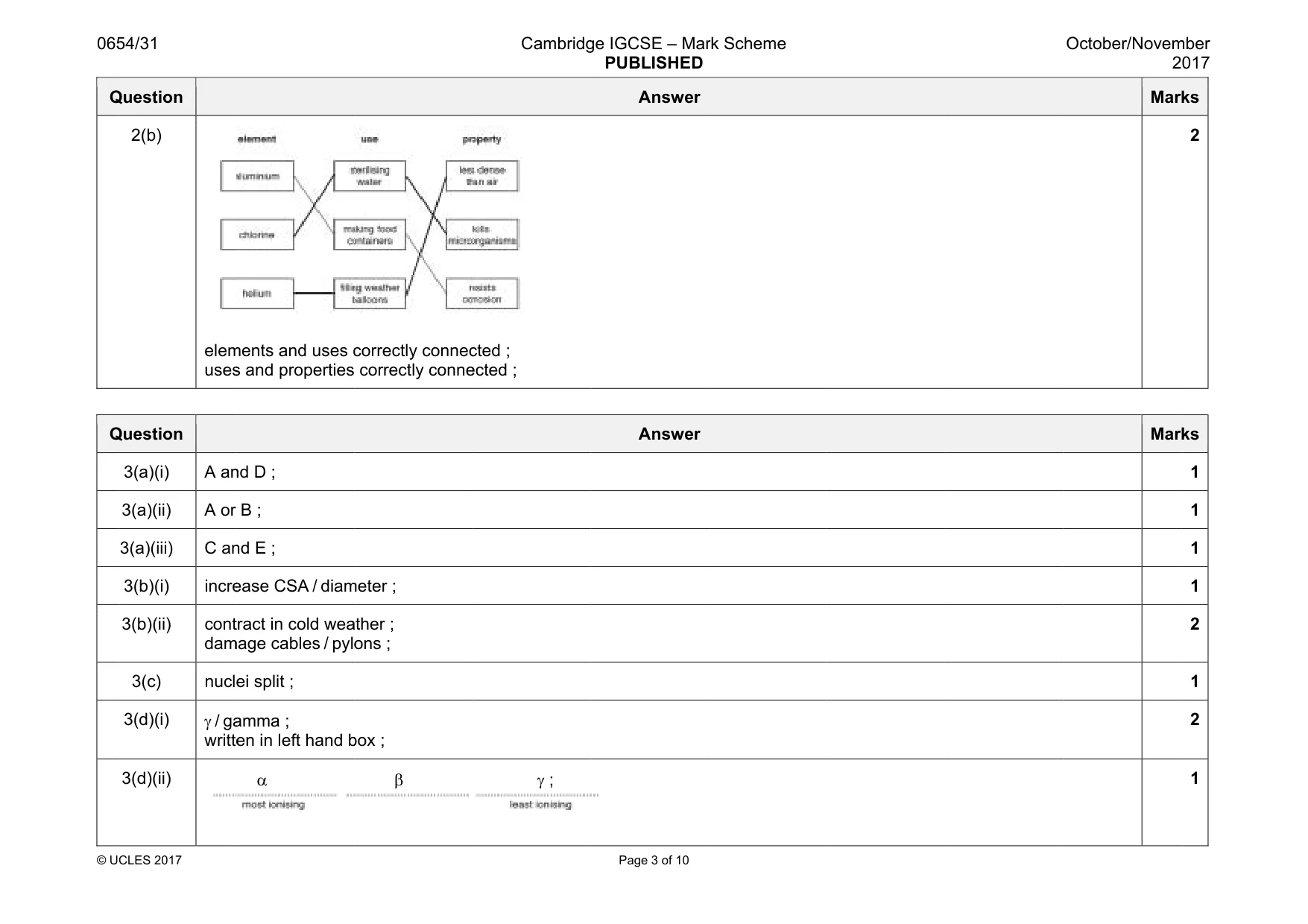
Mark scheme: 2(a)(i) protons correctly labelled ; neutrons correctly labelled ; electrons correctly labelled ; 3 2(a)(ii) 3 ; 1 2(a)(iii) lithium / Li ; 1 2(a)(iv) fluorine / F ; 1 Q Question 2(b) elem uses ments and uses c s and properties correctly connec correctly conne cted ; ected ; Answer Mar ks 2
Q3 · Five different types of power station are shown
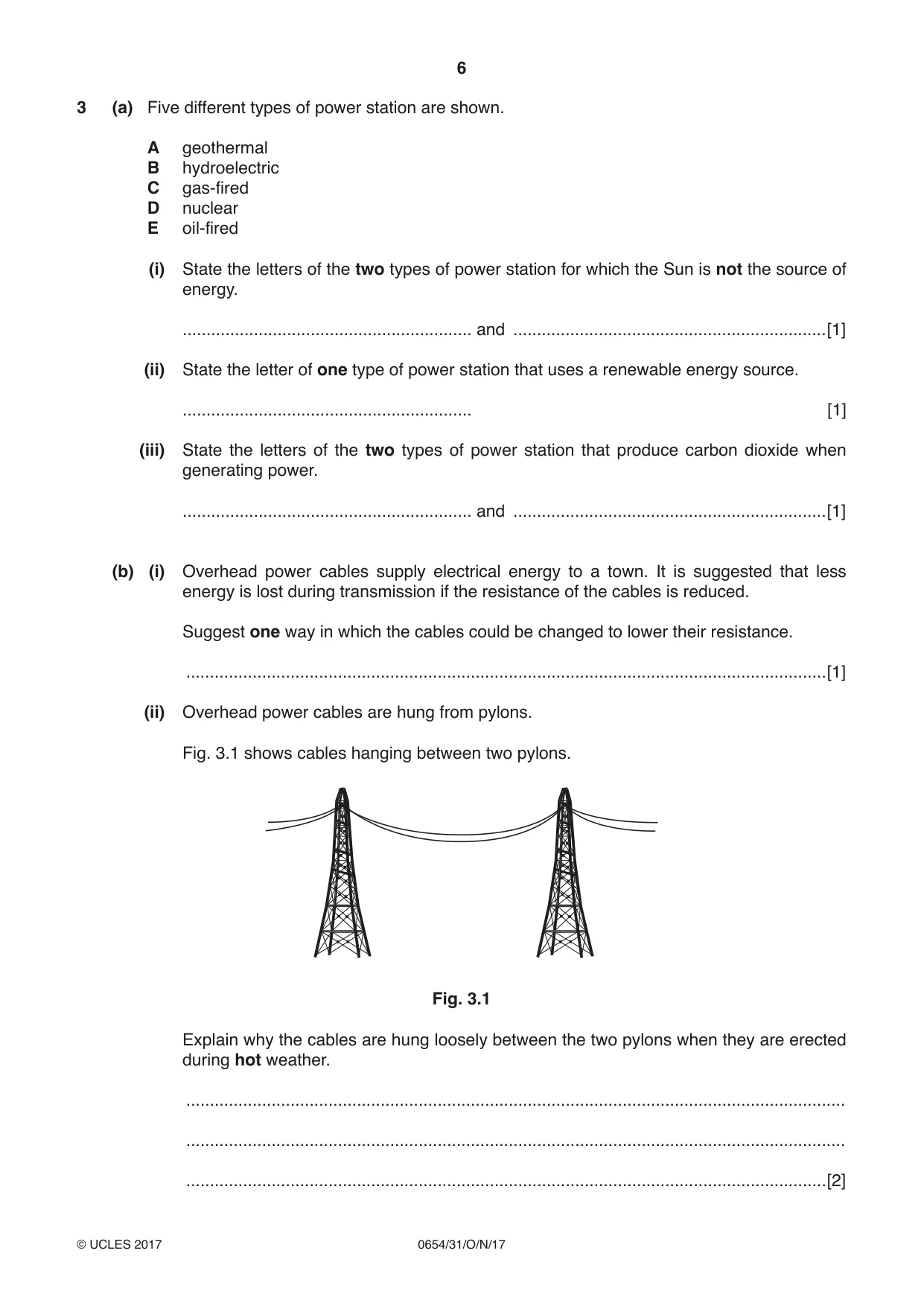
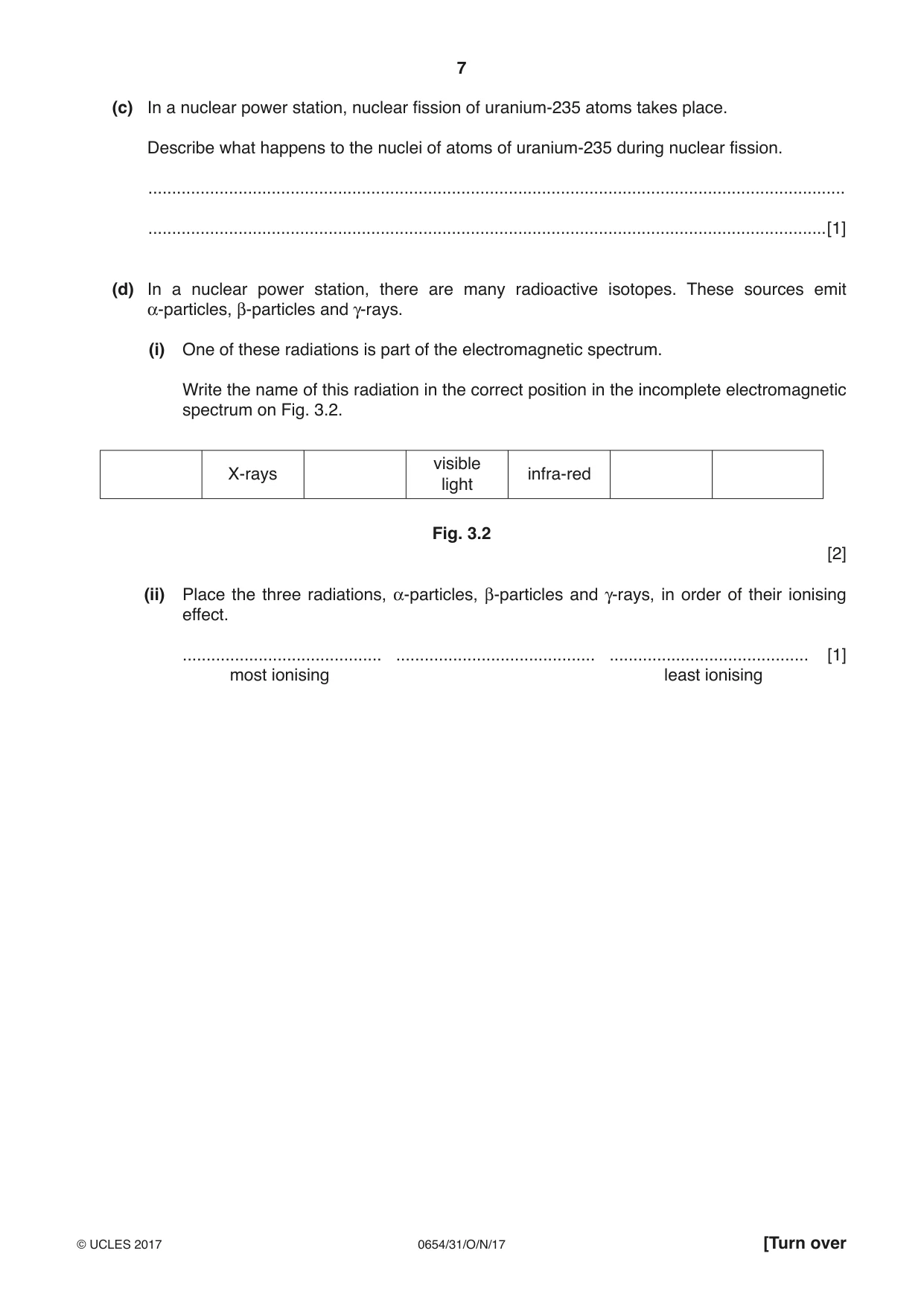
3 (a) Five different types of power station are shown. A geothermal B hydroelectric C gas-fired D nuclear E oil-fired (i) State the letters of the two types of power station for which the Sun is not the source of energy. ............................................................. and ..................................................................[1] (ii) State the letter of one type of power station that uses a renewable energy source. ............................................................. [1] (iii) State the letters of the two types of power station that produce carbon dioxide when generating power. ............................................................. and ..................................................................[1] (b) (i) Overhead power cables supply electrical energy to a town. It is suggested that less energy is lost during transmission if the resistance of the cables is reduced. Suggest one way in which the cables could be changed to lower their resistance. .......................................................................................................................................[1] (ii) Overhead power cables are hung from pylons. Fig. 3.1 shows cables hanging between two pylons. Fig. 3.1 Explain why the cables are hung loosely between the two pylons when they are erected during hot weather. ........................................................................................................................................... ........................................................................................................................................... .......................................................................................................................................[2] (c) In a nuclear power station, nuclear fission of uranium-235 atoms takes place. Describe what happens to the nuclei of atoms of uranium-235 during nuclear fission. ................................................................................................................................................... ...............................................................................................................................................[1] (d) In a nuclear power station, there are many radioactive isotopes. These sources emit α-particles, β-particles and γ-rays. (i) One of these radiations is part of the electromagnetic spectrum. Write the name of this radiation in the correct position in the incomplete electromagnetic spectrum on Fig. 3.2. visible X-rays infra-red light Fig. 3.2 [2] (ii) Place the three radiations, α-particles, β-particles and γ-rays, in order of their ionising effect. .......................................... .......................................... .......................................... [1] most ionising least ionising
Mark scheme: 3(a)(i) A an 3(a)(ii) A or 3(a)(iii) C an 3(b)(i) incre 3(b)(ii) cont dam 3(c) nucl 3(d)(i) γ / ga writte 3(d)(ii) nd D ; B ; nd E ; ease CSA / diam tract in cold wea mage cables / pylo ei split ; amma ; en in left hand b α meter ; ather ; ons ; box ; β γ ; 1 1 1 1 2 1 2 1
Q4 · Alleles are alternative forms of genes
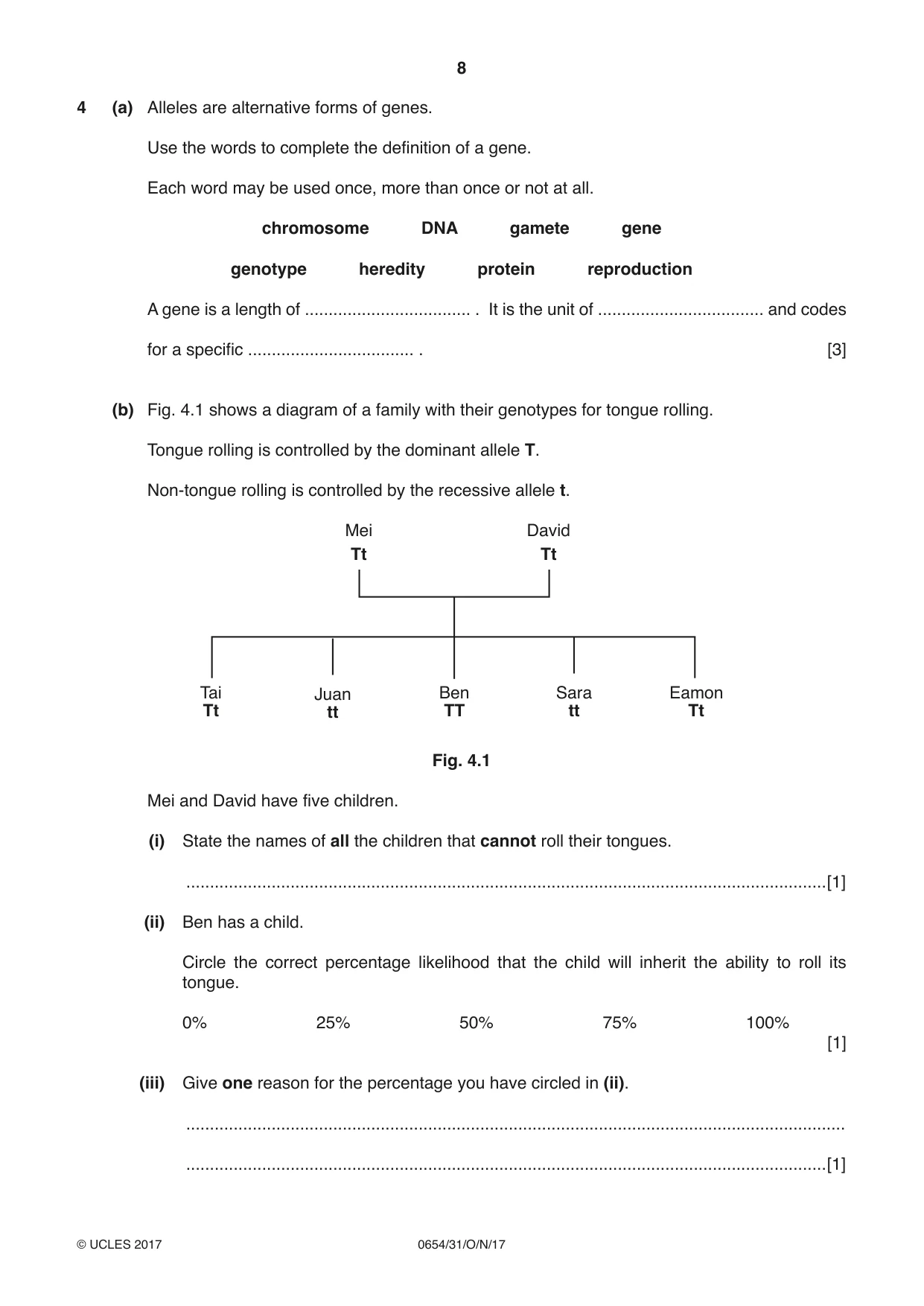
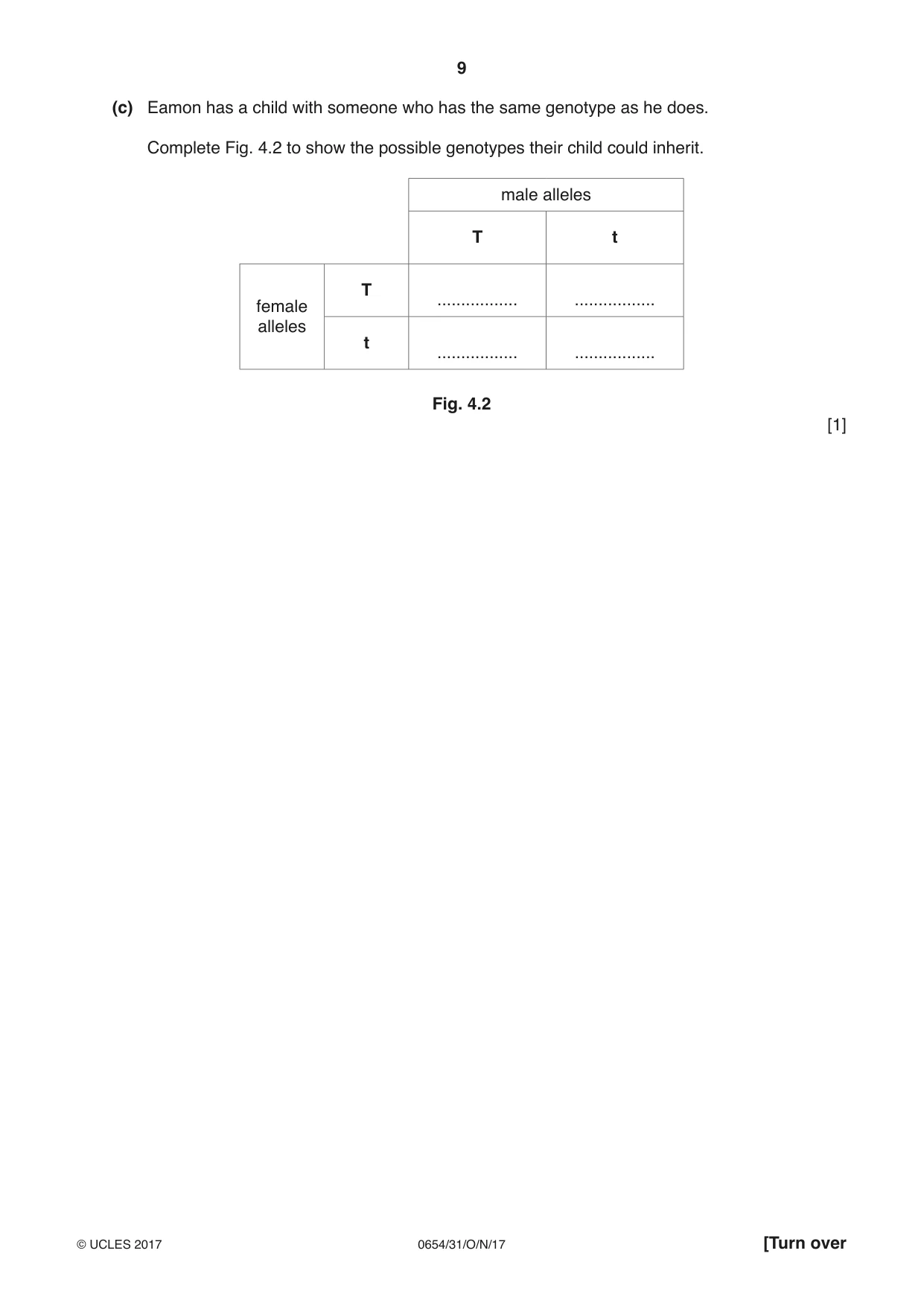
4 (a) Alleles are alternative forms of genes. Use the words to complete the definition of a gene. Each word may be used once, more than once or not at all. chromosome DNA gamete gene genotype heredity protein reproduction A gene is a length of ................................... . It is the unit of ................................... and codes for a specific ................................... . [3] (b) Fig. 4.1 shows a diagram of a family with their genotypes for tongue rolling. Tongue rolling is controlled by the dominant allele T. Non-tongue rolling is controlled by the recessive allele t. Mei David Tt Tt Tai Juan Ben Sara Eamon Tt tt TT tt Tt Fig. 4.1 Mei and David have five children. (i) State the names of all the children that cannot roll their tongues. .......................................................................................................................................[1] (ii) Ben has a child. Circle the correct percentage likelihood that the child will inherit the ability to roll its tongue. 0% 25% 50% 75% 100% [1] (iii) Give one reason for the percentage you have circled in (ii). ........................................................................................................................................... .......................................................................................................................................[1] (c) Eamon has a child with someone who has the same genotype as he does. Complete Fig. 4.2 to show the possible genotypes their child could inherit. male alleles T t T ................. ................. female alleles t ................. ................. Fig. 4.2 [1]
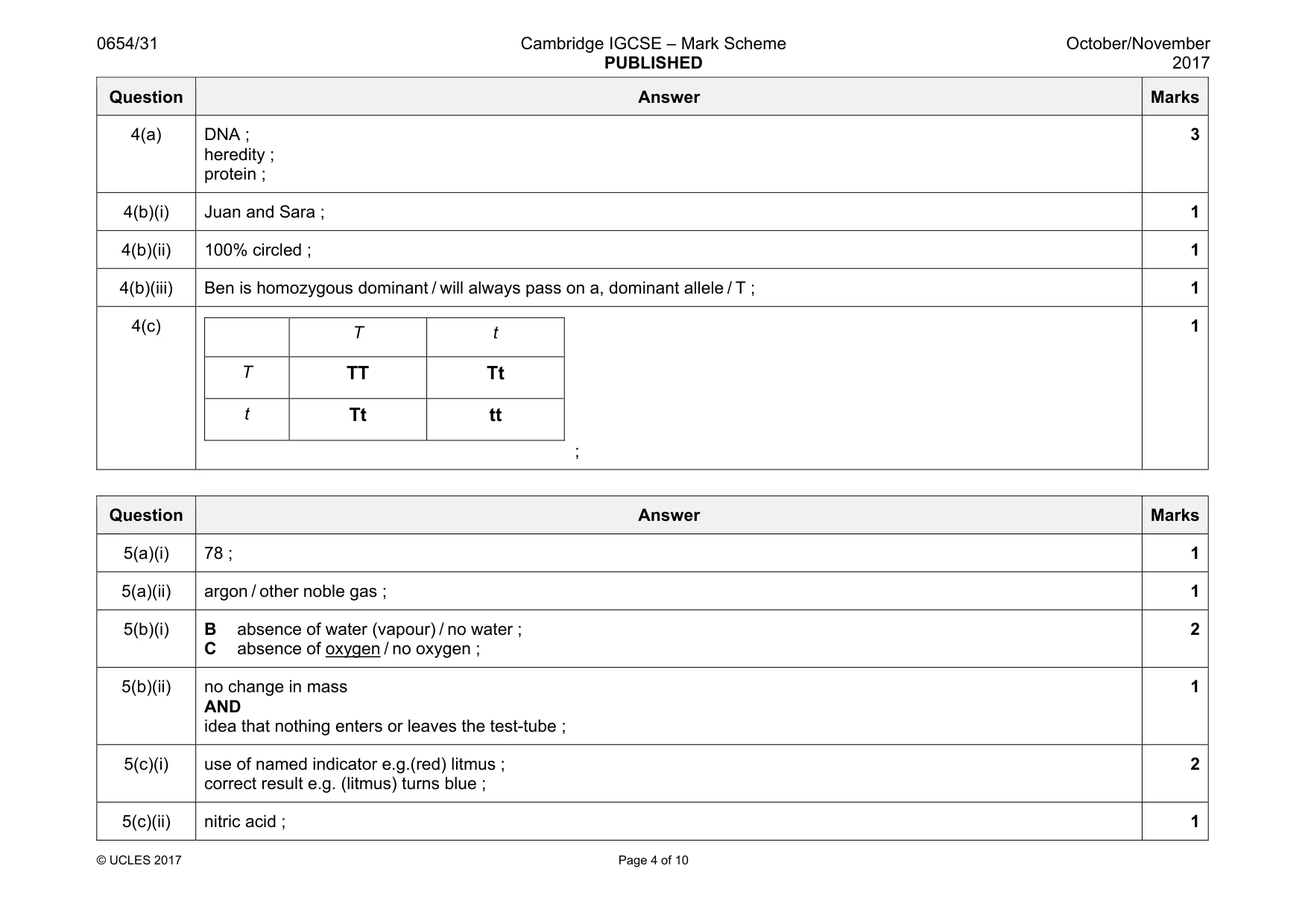
Mark scheme: 4(a) DNA ; heredity ; protein ; 3 4(b)(i) Juan and Sara ; 1 4(b)(ii) 100% circled ; 1 4(b)(iii) Ben is homozygous dominant / will always pass on a, dominant allele / T ; 1 4(c) T t T TT Tt t Tt tt ; 1
Q5 · State the percentage of nitrogen in the air
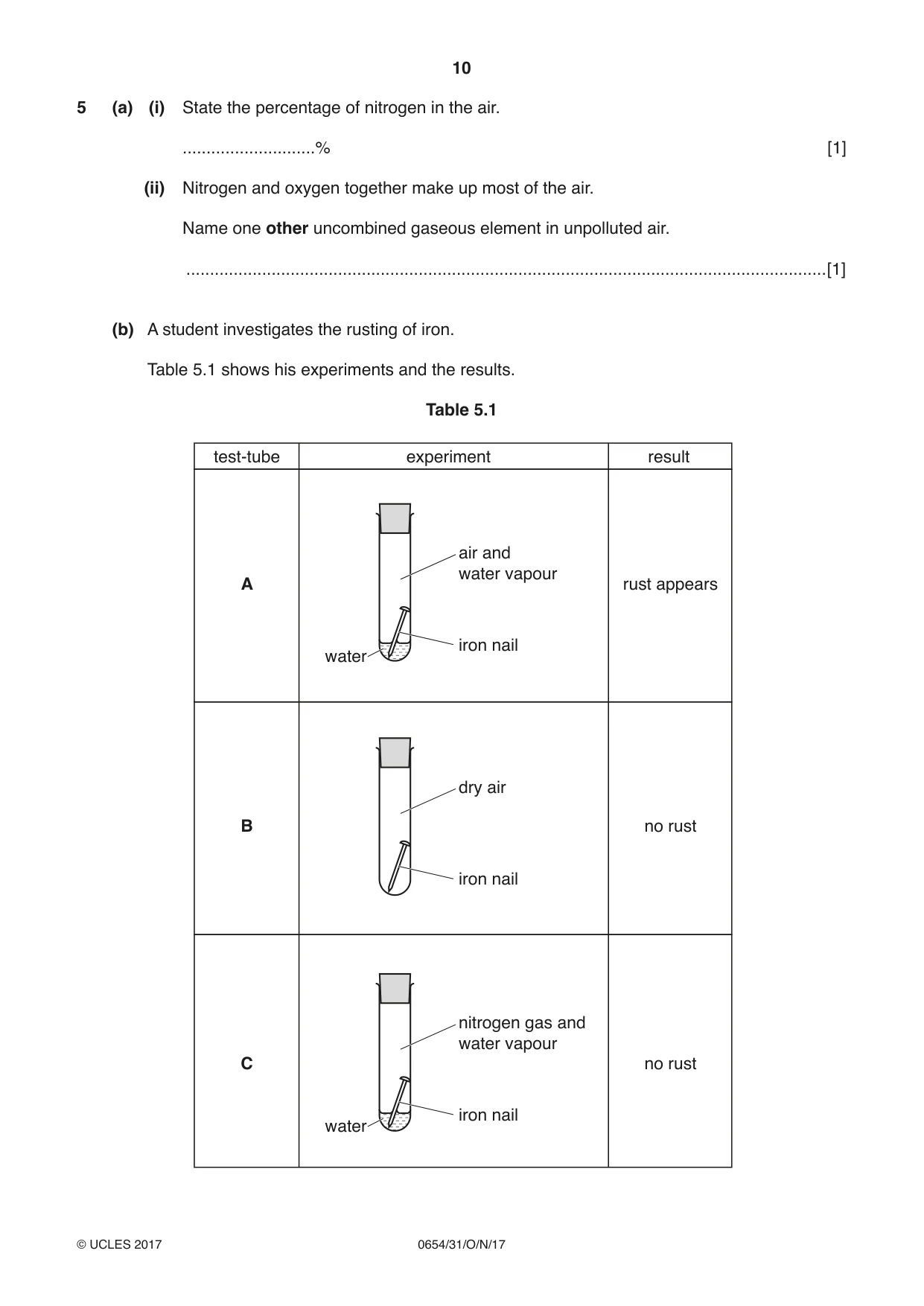
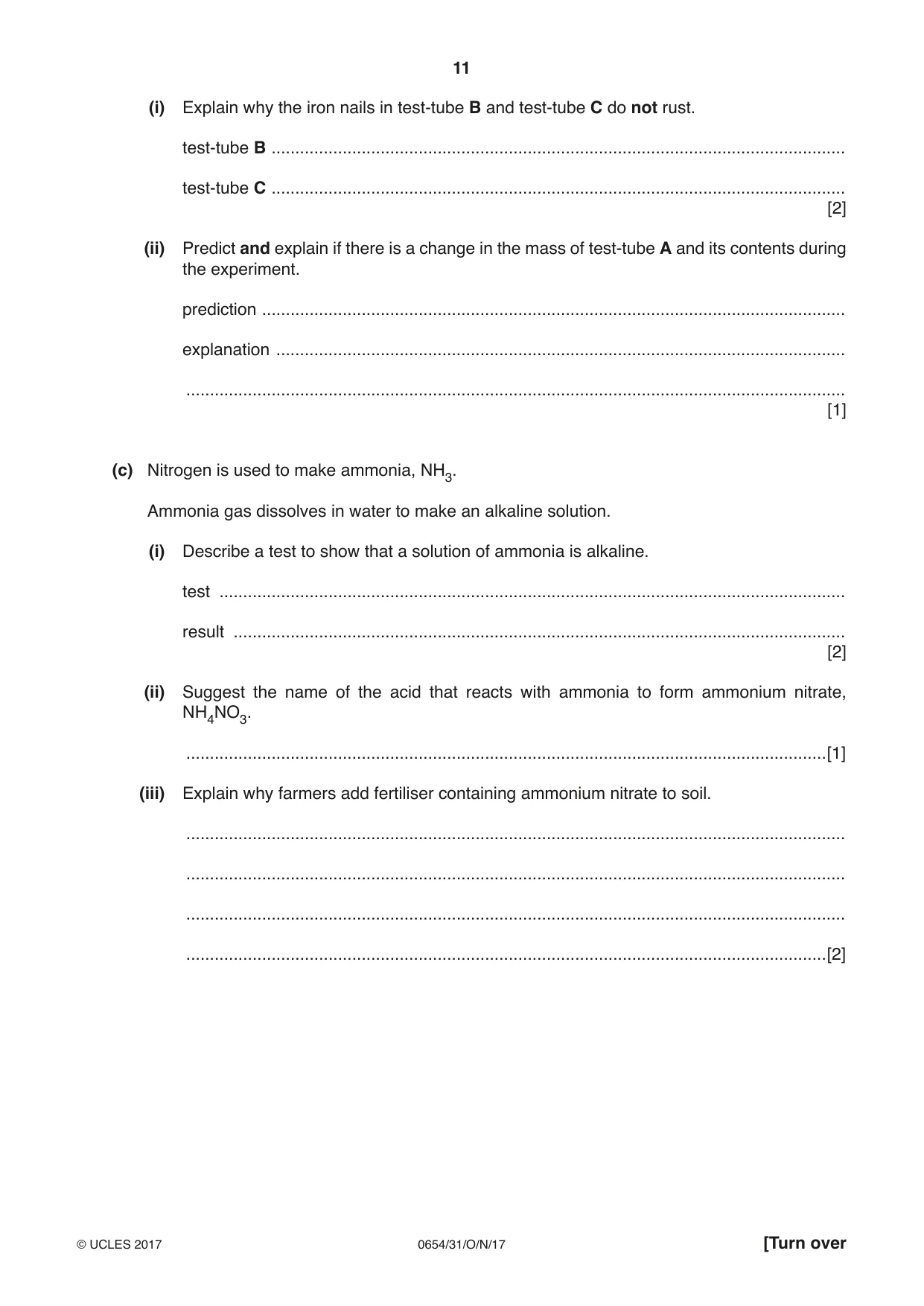
5 (a) (i) State the percentage of nitrogen in the air. ............................% [1] (ii) Nitrogen and oxygen together make up most of the air. Name one other uncombined gaseous element in unpolluted air. .......................................................................................................................................[1] (b) A student investigates the rusting of iron. Table 5.1 shows his experiments and the results. Table 5.1 test-tube experiment result air and water vapour A rust appears iron nail water dry air B no rust iron nail nitrogen gas and water vapour C no rust iron nail water (i) Explain why the iron nails in test-tube B and test-tube C do not rust. test-tube B ......................................................................................................................... test-tube C ......................................................................................................................... [2] (ii) Predict and explain if there is a change in the mass of test-tube A and its contents during the experiment. prediction ........................................................................................................................... explanation ........................................................................................................................ ........................................................................................................................................... [1] (c) Nitrogen is used to make ammonia, NH3. Ammonia gas dissolves in water to make an alkaline solution. (i) Describe a test to show that a solution of ammonia is alkaline. test .................................................................................................................................... result ................................................................................................................................. [2] (ii) Suggest the name of the acid that reacts with ammonia to form ammonium nitrate, NH4NO3. .......................................................................................................................................[1] (iii) Explain why farmers add fertiliser containing ammonium nitrate to soil. ........................................................................................................................................... ........................................................................................................................................... ........................................................................................................................................... .......................................................................................................................................[2]
Mark scheme: 5(a)(i) 78 ; 1 5(a)(ii) argon / other noble gas ; 1 5(b)(i) B absence of water (vapour) / no water ; C absence of oxygen / no oxygen ; 2 5(b)(ii) no change in mass AND idea that nothing enters or leaves the test-tube ; 1 5(c)(i) use of named indicator e.g.(red) litmus ; correct result e.g. (litmus) turns blue ; 2 5(c)(ii) nitric acid ; 1 Question Answer Marks 5(c)(iii) idea of improving crop yield ; soil does not contain enough nutrients / nitrogen (compounds) or to replace nitrogen compounds ; reference to use of nitrogen in plants to produce amino acids / proteins / DNA ; max 2
More questions on The characteristic properties of acids and bases
Q6 · Many houses in colder countries are designed to conserve thermal energy
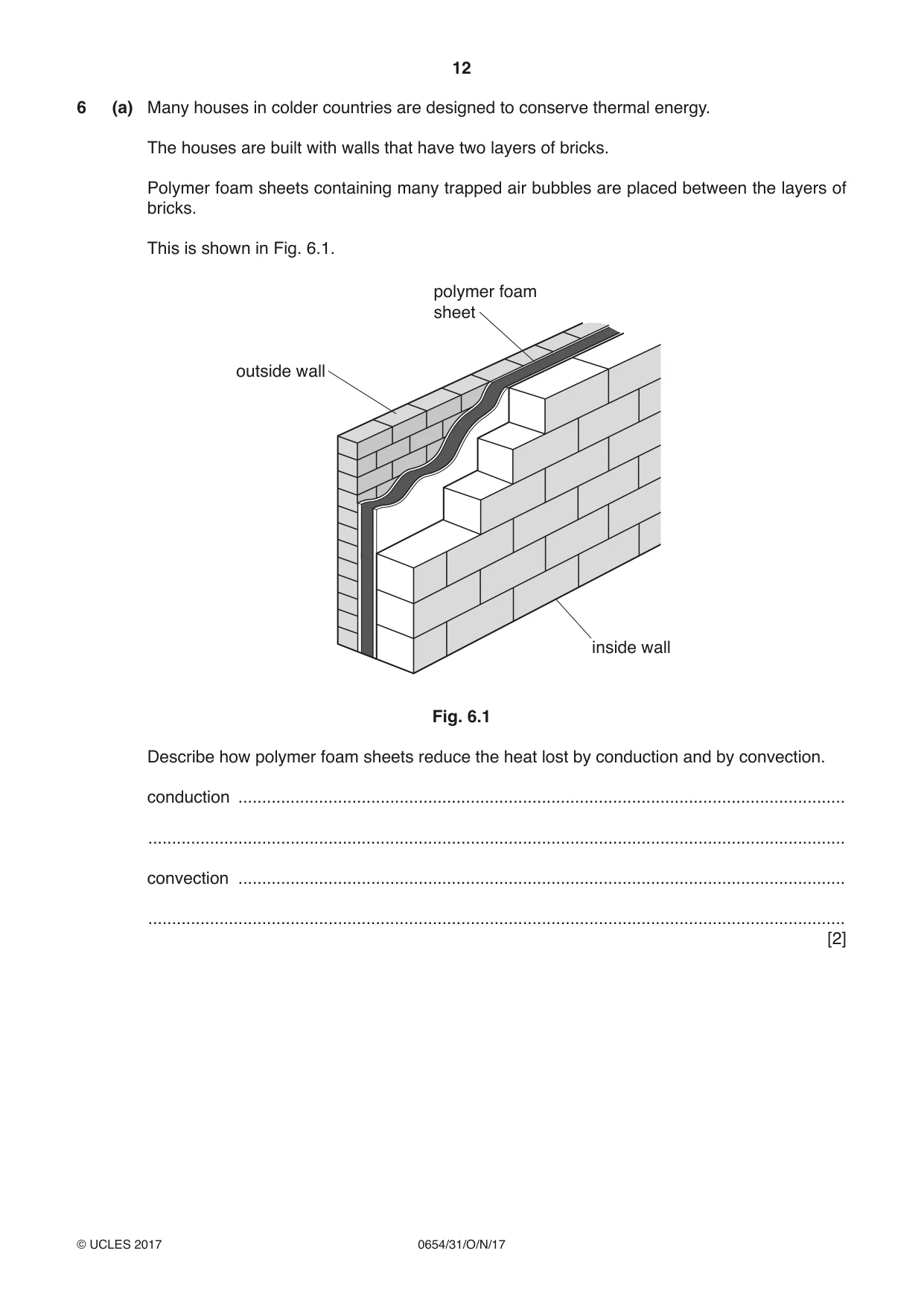
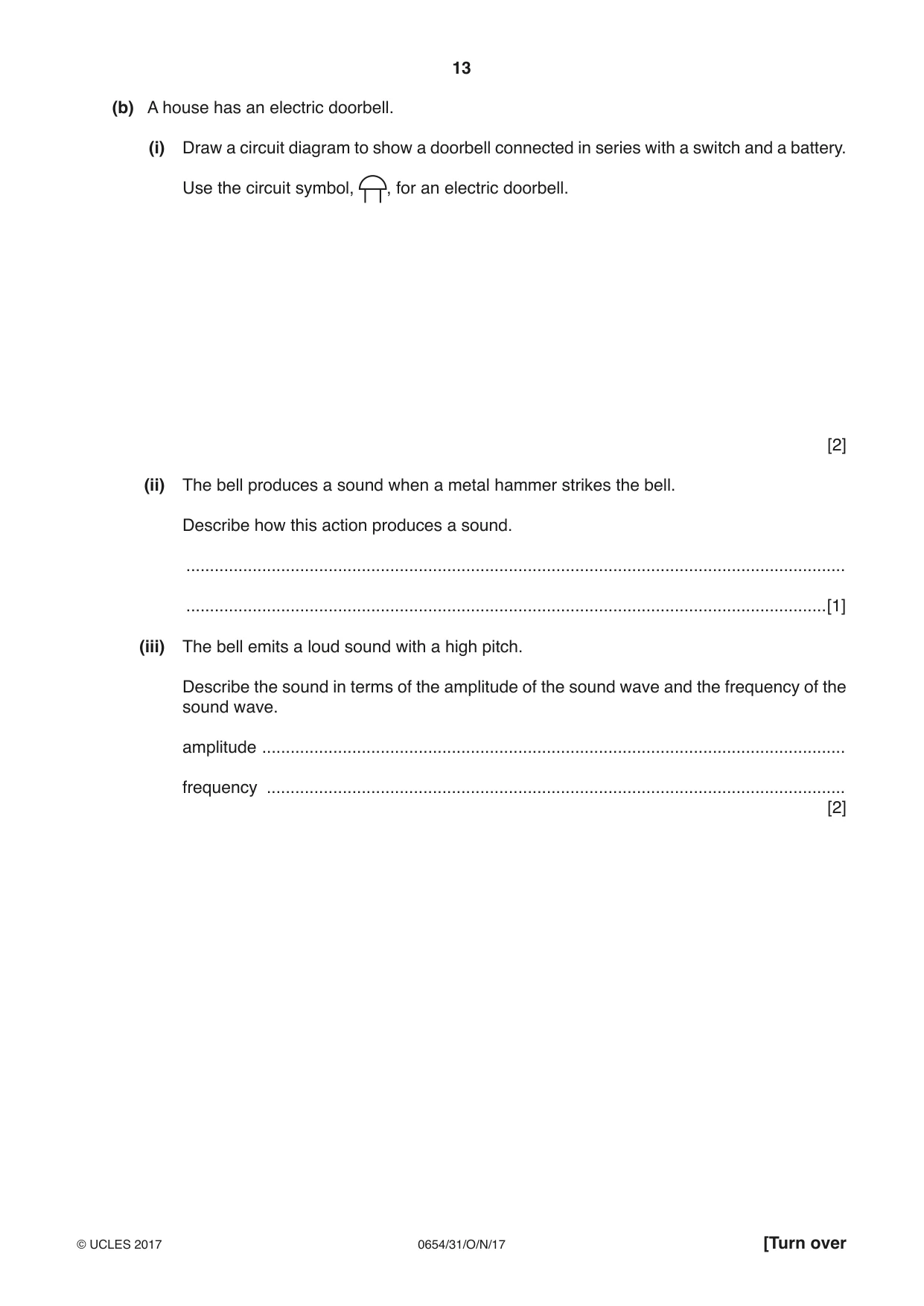
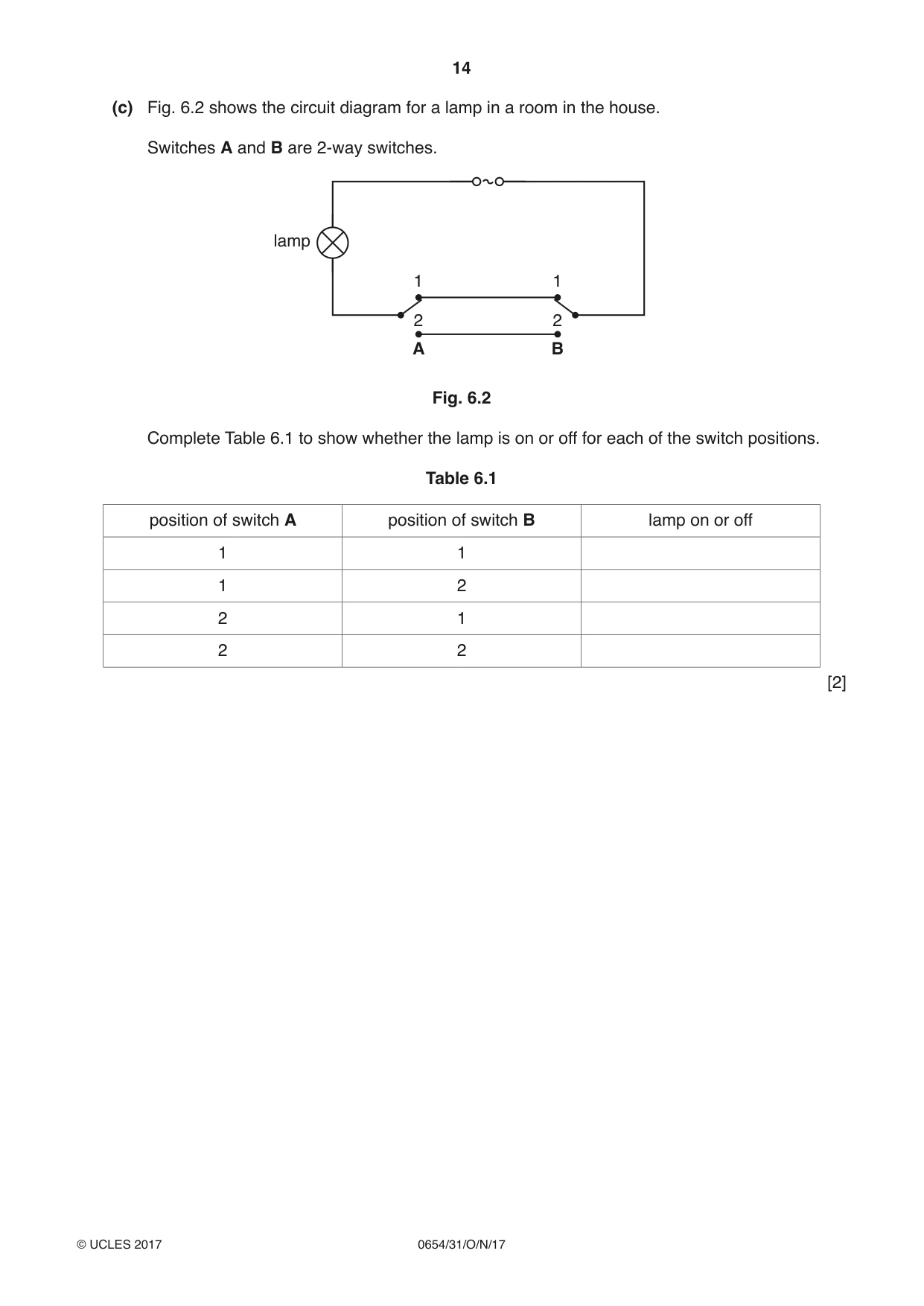
6 (a) Many houses in colder countries are designed to conserve thermal energy. The houses are built with walls that have two layers of bricks. Polymer foam sheets containing many trapped air bubbles are placed between the layers of bricks. This is shown in Fig. 6.1. polymer foam sheet outside wall inside wall Fig. 6.1 Describe how polymer foam sheets reduce the heat lost by conduction and by convection. conduction ................................................................................................................................ ................................................................................................................................................... convection ................................................................................................................................ ................................................................................................................................................... [2] (b) A house has an electric doorbell. (i) Draw a circuit diagram to show a doorbell connected in series with a switch and a battery. Use the circuit symbol, , for an electric doorbell. [2] (ii) The bell produces a sound when a metal hammer strikes the bell. Describe how this action produces a sound. ........................................................................................................................................... .......................................................................................................................................[1] (iii) The bell emits a loud sound with a high pitch. Describe the sound in terms of the amplitude of the sound wave and the frequency of the sound wave. amplitude ........................................................................................................................... frequency .......................................................................................................................... [2] (c) Fig. 6.2 shows the circuit diagram for a lamp in a room in the house. Switches A and B are 2-way switches. lamp 1 1 2 2 A B Fig. 6.2 Complete Table 6.1 to show whether the lamp is on or off for each of the switch positions. Table 6.1 position of switch A position of switch B lamp on or off 1 1 1 2 2 1 2 2 [2]
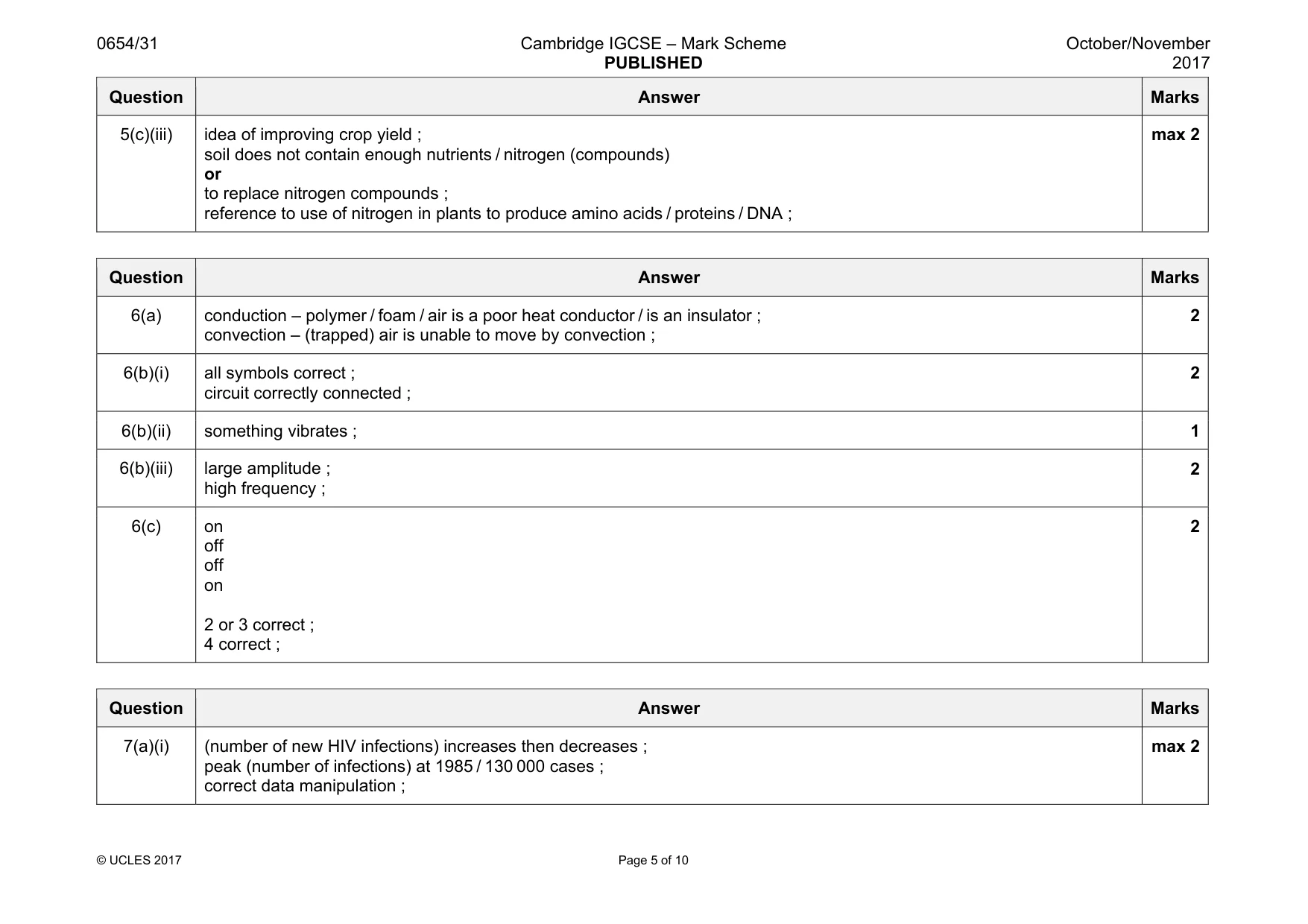
Mark scheme: 6(a) conduction – polymer / foam / air is a poor heat conductor / is an insulator ; convection – (trapped) air is unable to move by convection ; 2 6(b)(i) all symbols correct ; circuit correctly connected ; 2 6(b)(ii) something vibrates ; 1 6(b)(iii) large amplitude ; high frequency ; 2 6(c) on off off on 2 or 3 correct ; 4 correct ; 2
Q7 · The incidence of new HIV infections in the USA between the years 1980 – 2010
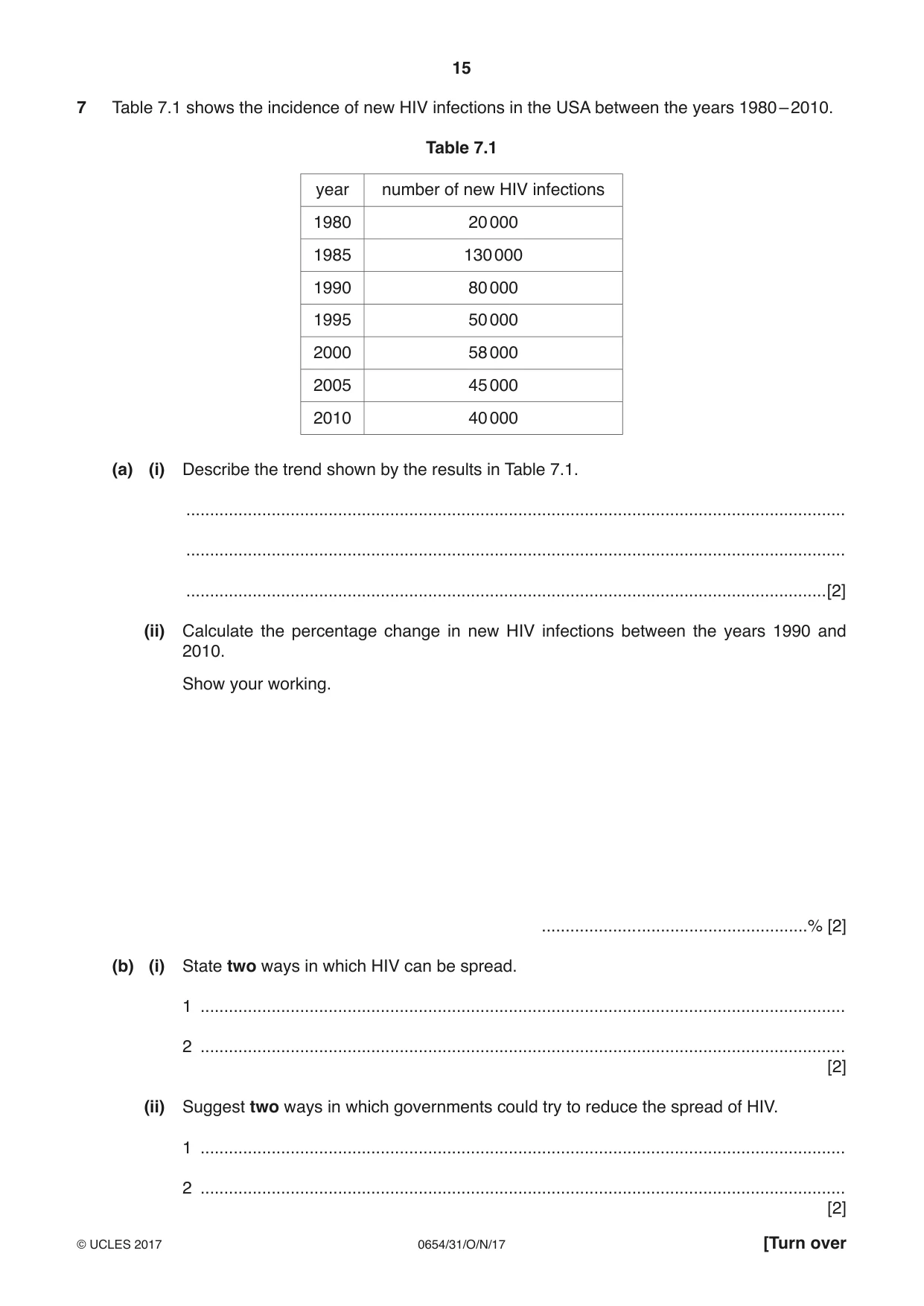
7 Table 7.1 shows the incidence of new HIV infections in the USA between the years 1980 – 2010. Table 7.1 year number of new HIV infections 1980 20 000 1985 130 000 1990 80 000 1995 50 000 2000 58 000 2005 45 000 2010 40 000 (a) (i) Describe the trend shown by the results in Table 7.1. ........................................................................................................................................... ........................................................................................................................................... .......................................................................................................................................[2] (ii) Calculate the percentage change in new HIV infections between the years 1990 and 2010. Show your working. ........................................................% [2] (b) (i) State two ways in which HIV can be spread. 1 ........................................................................................................................................ 2 ........................................................................................................................................ [2] (ii) Suggest two ways in which governments could try to reduce the spread of HIV. 1 ........................................................................................................................................ 2 ........................................................................................................................................ [2]
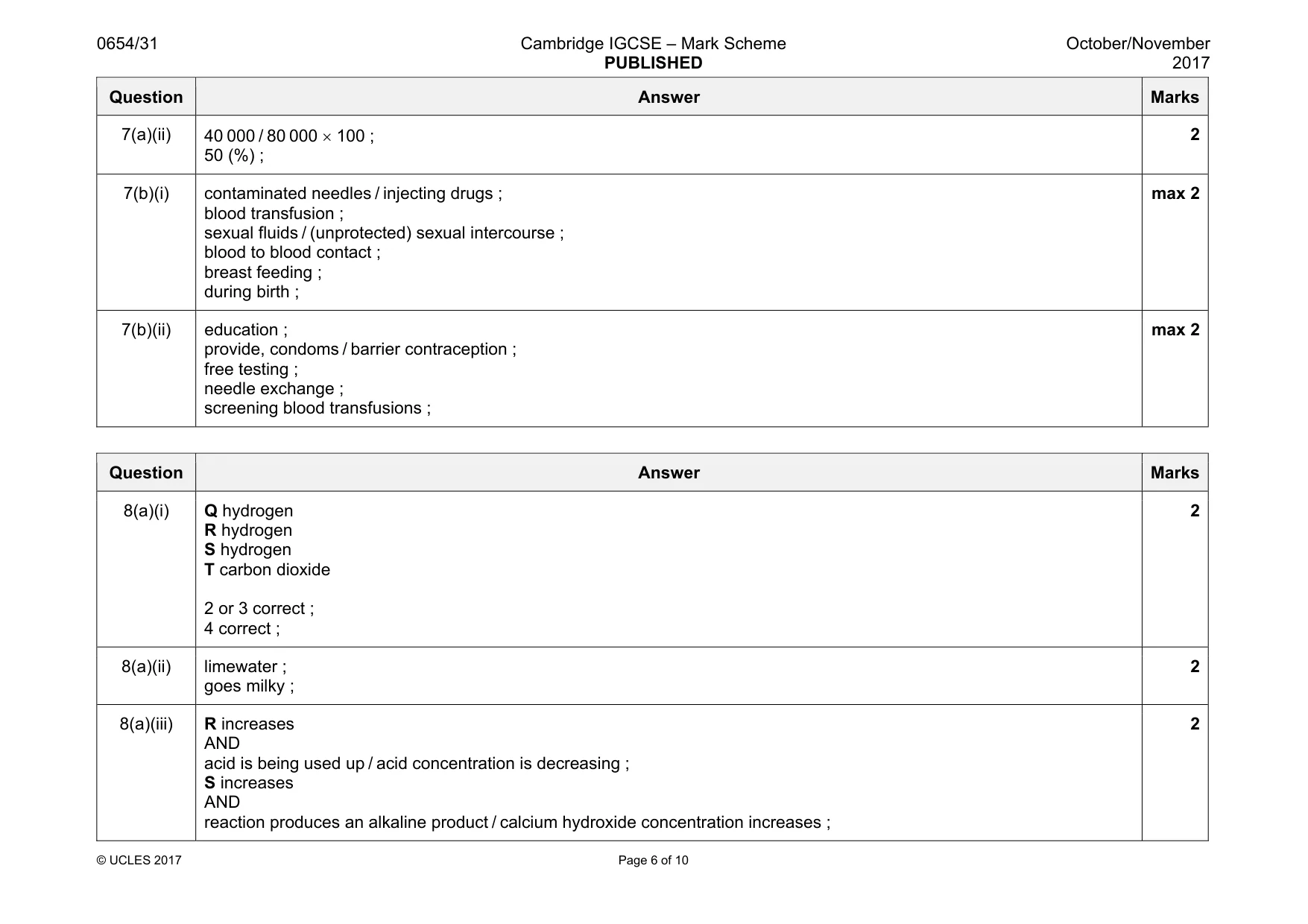
Mark scheme: 7(a)(i) (number of new HIV infections) increases then decreases ; peak (number of infections) at 1985 / 130 000 cases ; correct data manipulation ; max 2 Question Answer Marks 7(a)(ii) 40 000 / 80 000 × 100 ; 50 (%) ; 2 7(b)(i) contaminated needles / injecting drugs ; blood transfusion ; sexual fluids / (unprotected) sexual intercourse ; blood to blood contact ; breast feeding ; during birth ; max 2 7(b)(ii) education ; provide, condoms / barrier contraception ; free testing ; needle exchange ; screening blood transfusions ; max 2
Q8 · Apparatus a student uses to collect the gas that is made when a solid reacts with a liquid
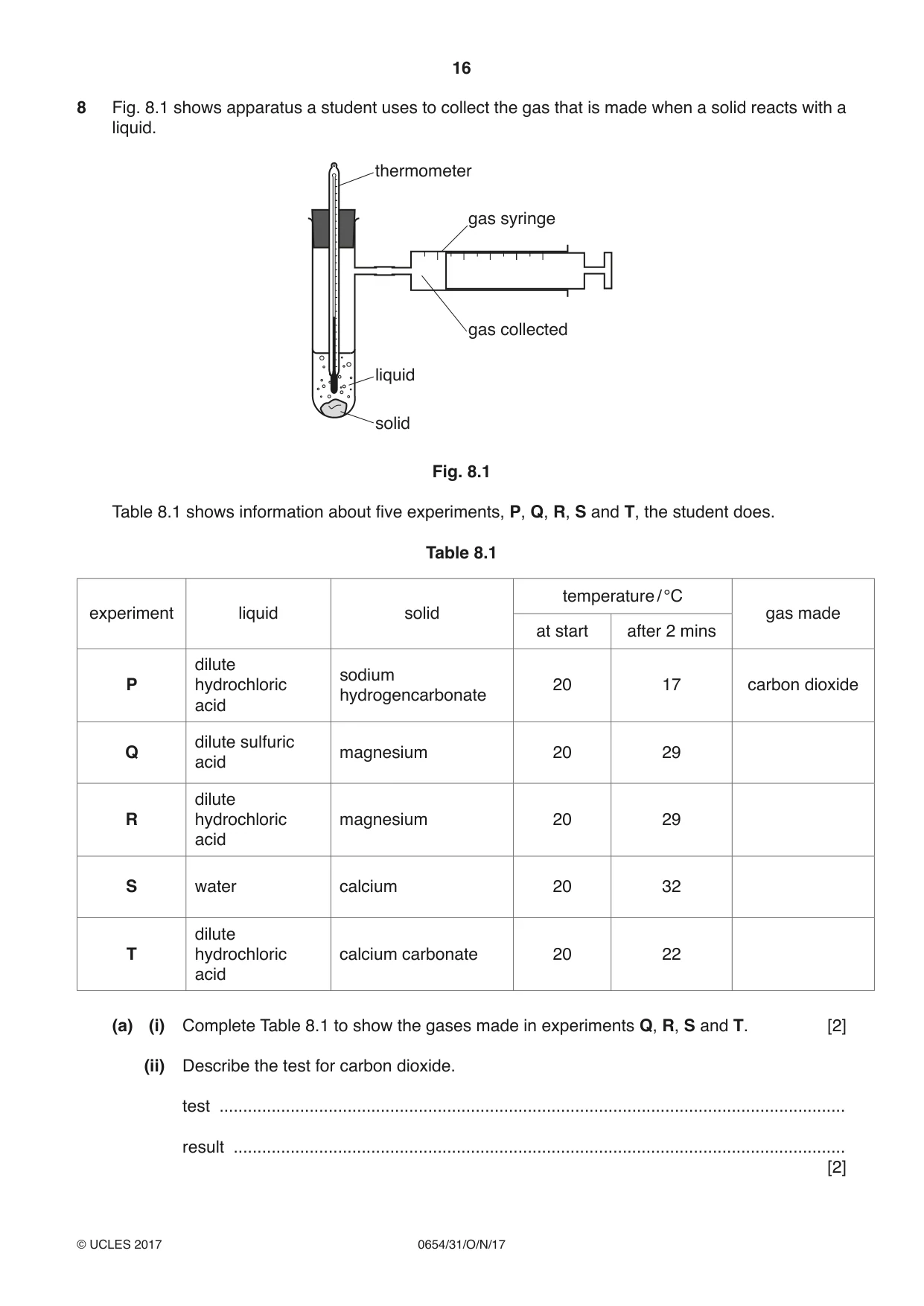
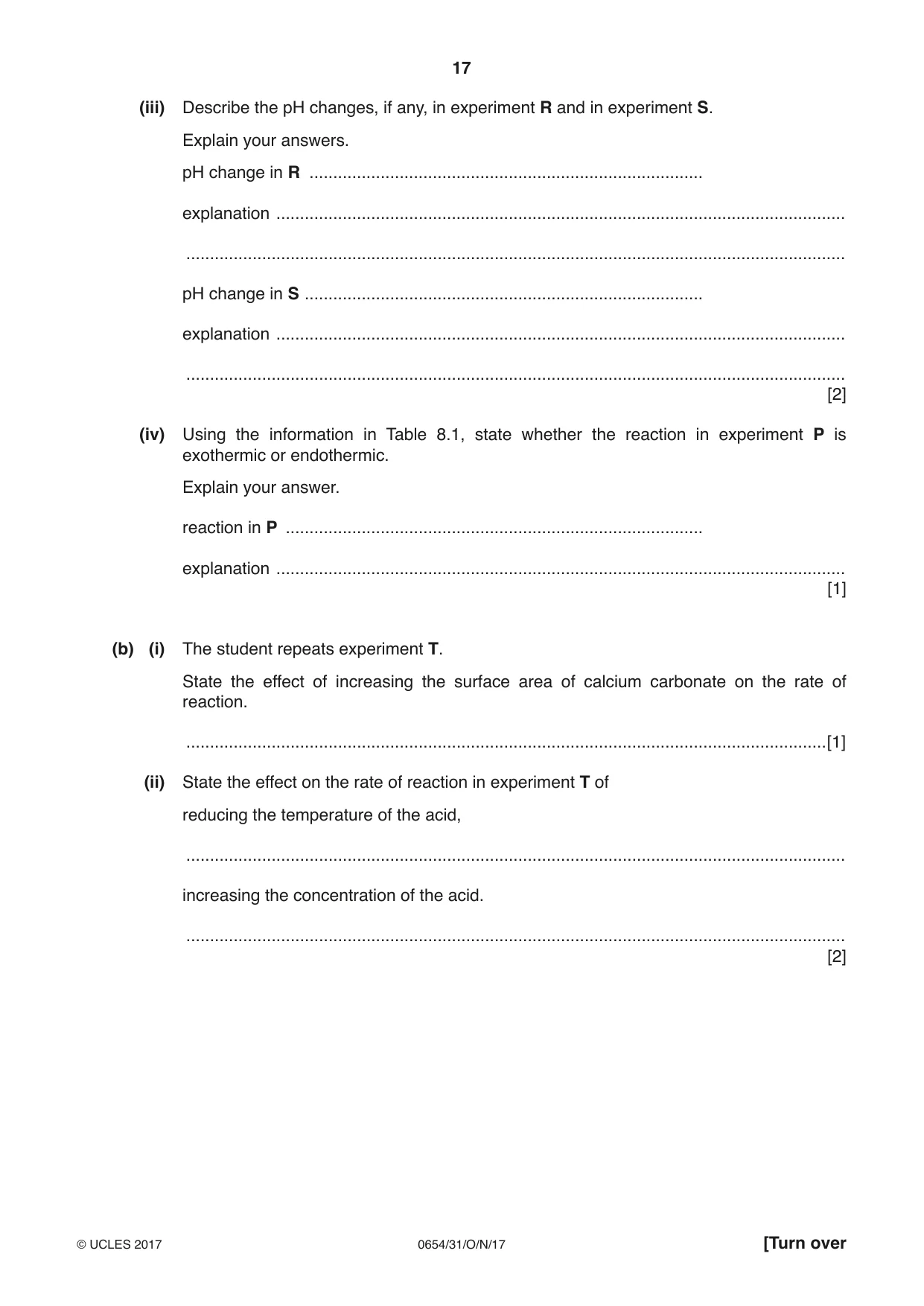
8 Fig. 8.1 shows apparatus a student uses to collect the gas that is made when a solid reacts with a liquid. thermometer gas syringe gas collected liquid solid Fig. 8.1 Table 8.1 shows information about five experiments, P, Q, R, S and T, the student does. Table 8.1 temperature / °C experiment liquid solid gas made at start after 2 mins dilute sodium P hydrochloric 20 17 carbon dioxide hydrogencarbonate acid dilute sulfuric Q magnesium 20 29 acid dilute R hydrochloric magnesium 20 29 acid S water calcium 20 32 dilute T hydrochloric calcium carbonate 20 22 acid (a) (i) Complete Table 8.1 to show the gases made in experiments Q, R, S and T. [2] (ii) Describe the test for carbon dioxide. test .................................................................................................................................... result ................................................................................................................................. [2] (iii) Describe the pH changes, if any, in experiment R and in experiment S. Explain your answers. pH change in R ................................................................................... explanation ........................................................................................................................ ........................................................................................................................................... pH change in S .................................................................................... explanation ........................................................................................................................ ........................................................................................................................................... [2] (iv) Using the information in Table 8.1, state whether the reaction in experiment P is exothermic or endothermic. Explain your answer. reaction in P ........................................................................................ explanation ........................................................................................................................ [1] (b) (i) The student repeats experiment T. State the effect of increasing the surface area of calcium carbonate on the rate of reaction. .......................................................................................................................................[1] (ii) State the effect on the rate of reaction in experiment T of reducing the temperature of the acid, ........................................................................................................................................... increasing the concentration of the acid. ........................................................................................................................................... [2]
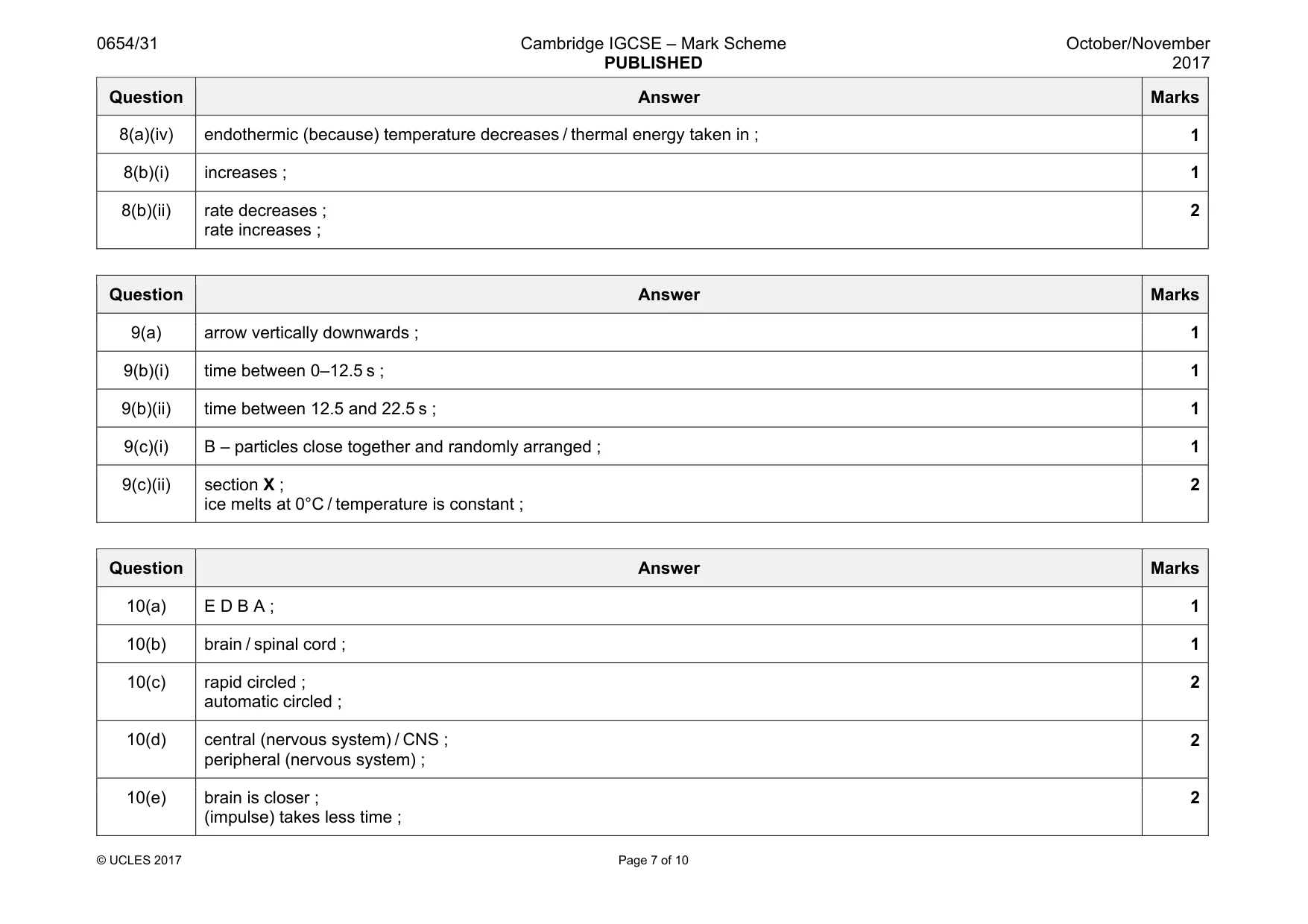
Mark scheme: 8(a)(i) Q hydrogen R hydrogen S hydrogen T carbon dioxide 2 or 3 correct ; 4 correct ; 2 8(a)(ii) limewater ; goes milky ; 2 8(a)(iii) R increases AND acid is being used up / acid concentration is decreasing ; S increases AND reaction produces an alkaline product / calcium hydroxide concentration increases ; 2 Question Answer Marks 8(a)(iv) endothermic (because) temperature decreases / thermal energy taken in ; 1 8(b)(i) increases ; 1 8(b)(ii) rate decreases ; rate increases ; 2
Q9 · A snowboarder on a ski slope
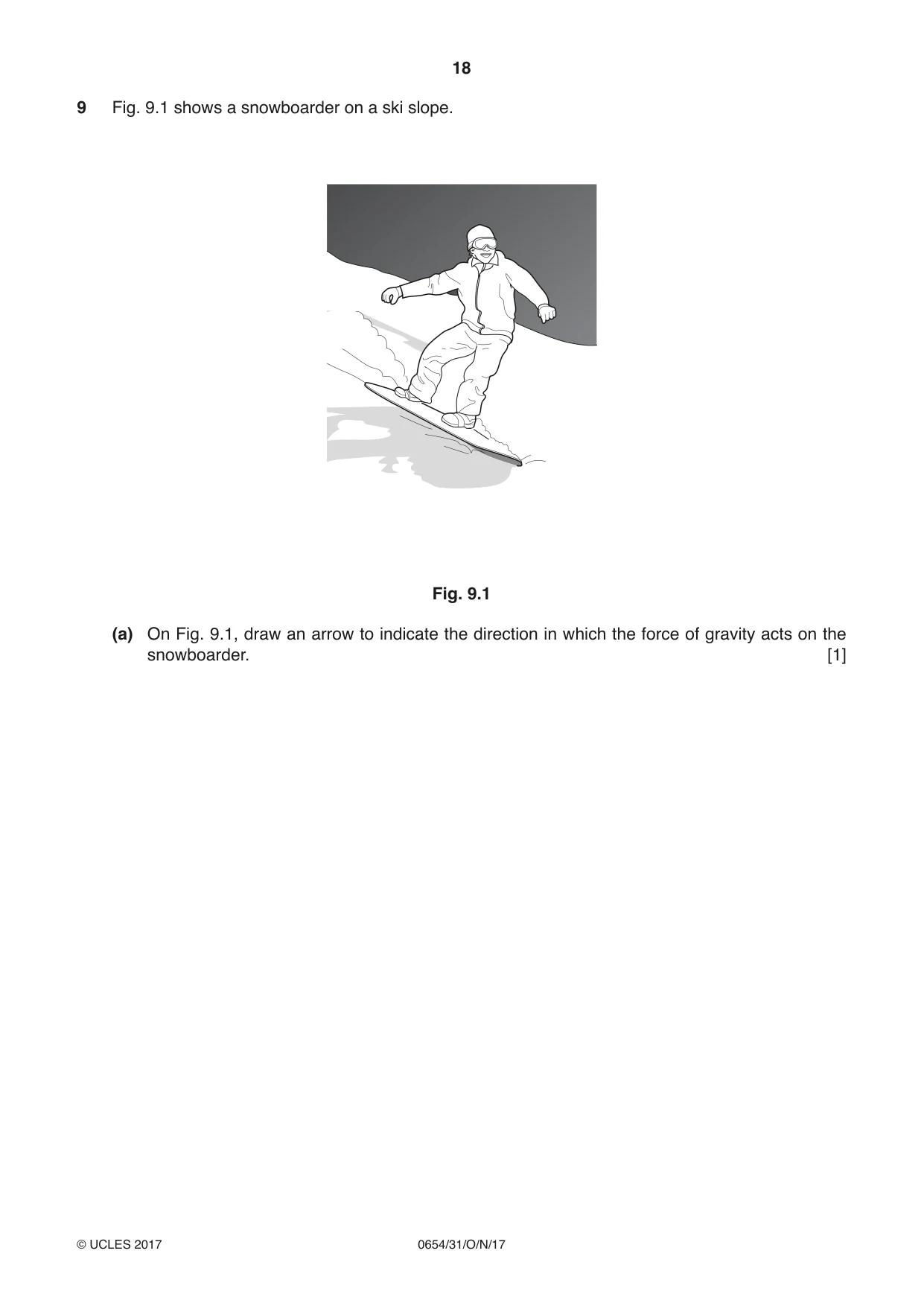
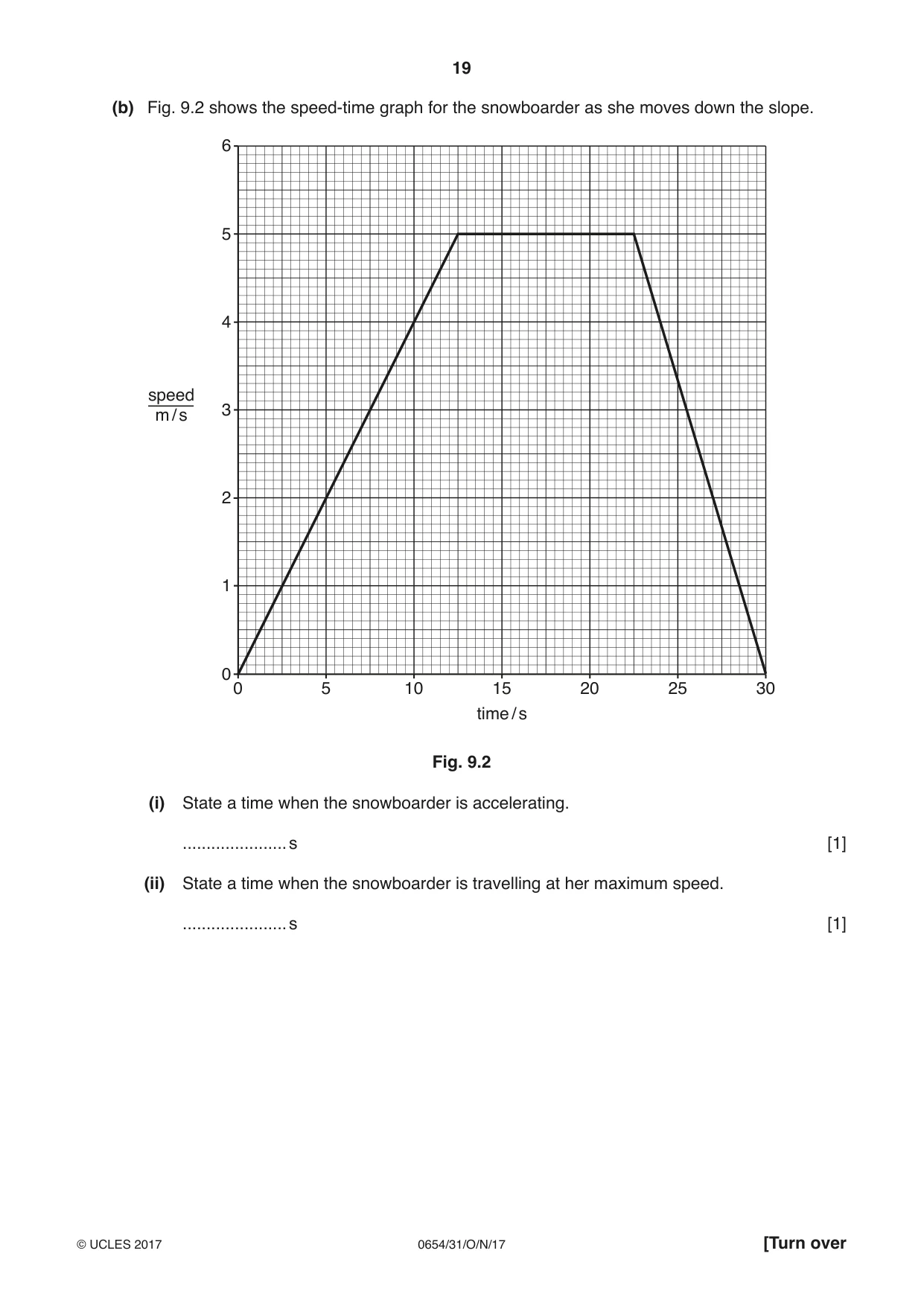
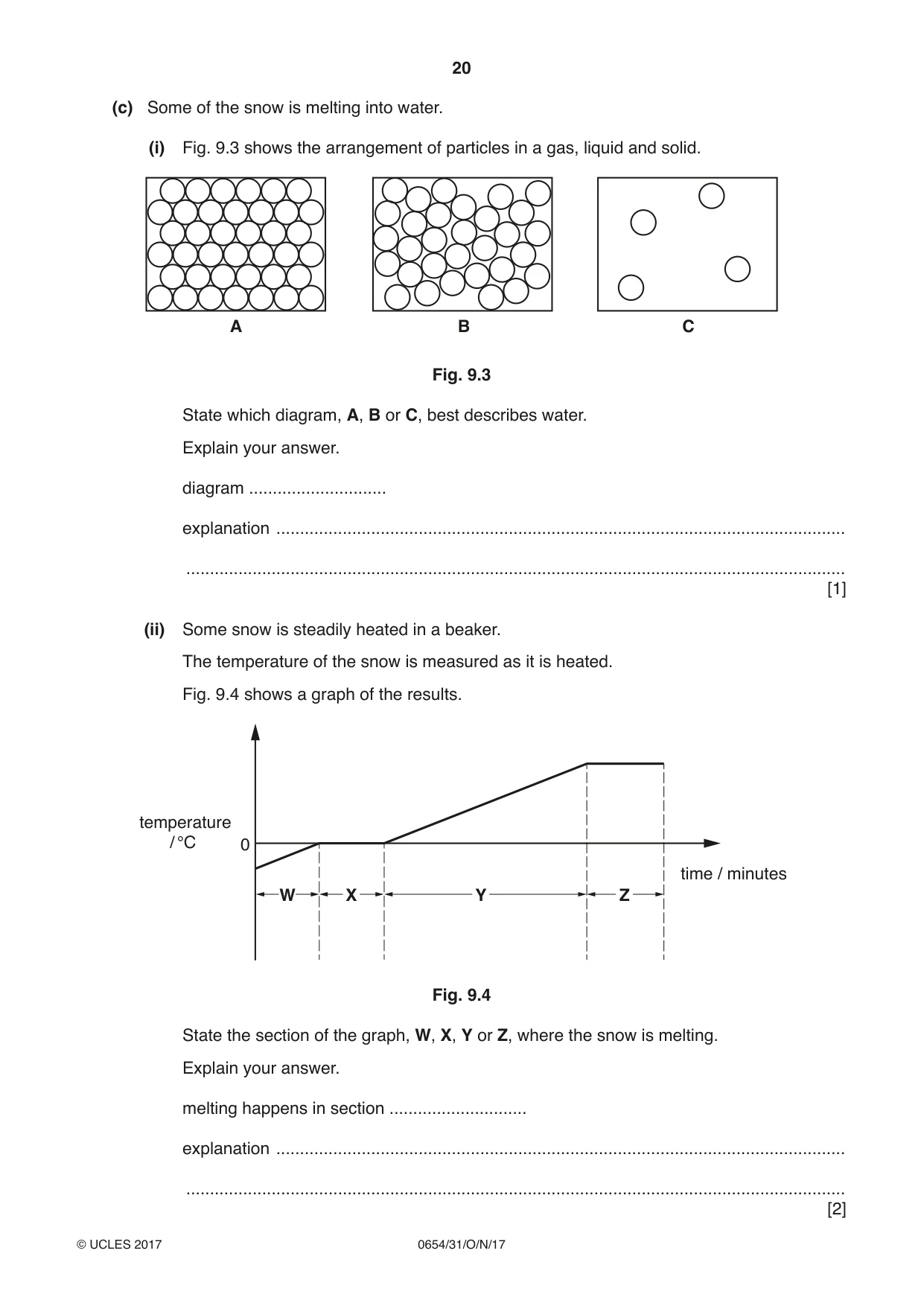
9 Fig. 9.1 shows a snowboarder on a ski slope. Fig. 9.1 (a) On Fig. 9.1, draw an arrow to indicate the direction in which the force of gravity acts on the snowboarder. [1] (b) Fig. 9.2 shows the speed-time graph for the snowboarder as she moves down the slope. 6 5 4 speed 3 m / s 2 1 0 0 5 10 15 20 25 30 time / s Fig. 9.2 (i) State a time when the snowboarder is accelerating. ...................... s [1] (ii) State a time when the snowboarder is travelling at her maximum speed. ...................... s [1] (c) Some of the snow is melting into water. (i) Fig. 9.3 shows the arrangement of particles in a gas, liquid and solid. A B C Fig. 9.3 State which diagram, A, B or C, best describes water. Explain your answer. diagram ............................. explanation ........................................................................................................................ ........................................................................................................................................... [1] (ii) Some snow is steadily heated in a beaker. The temperature of the snow is measured as it is heated. Fig. 9.4 shows a graph of the results. temperature / °C 0 time / minutes W X Y Z Fig. 9.4 State the section of the graph, W, X, Y or Z, where the snow is melting. Explain your answer. melting happens in section ............................. explanation ........................................................................................................................ ........................................................................................................................................... [2]
Mark scheme: 9(a) arrow vertically downwards ; 1 9(b)(i) time between 0–12.5 s ; 1 9(b)(ii) time between 12.5 and 22.5 s ; 1 9(c)(i) B – particles close together and randomly arranged ; 1 9(c)(ii) section X ; ice melts at 0°C / temperature is constant ; 2
Q10 · A person touches a hot saucepan and immediately removes their hand
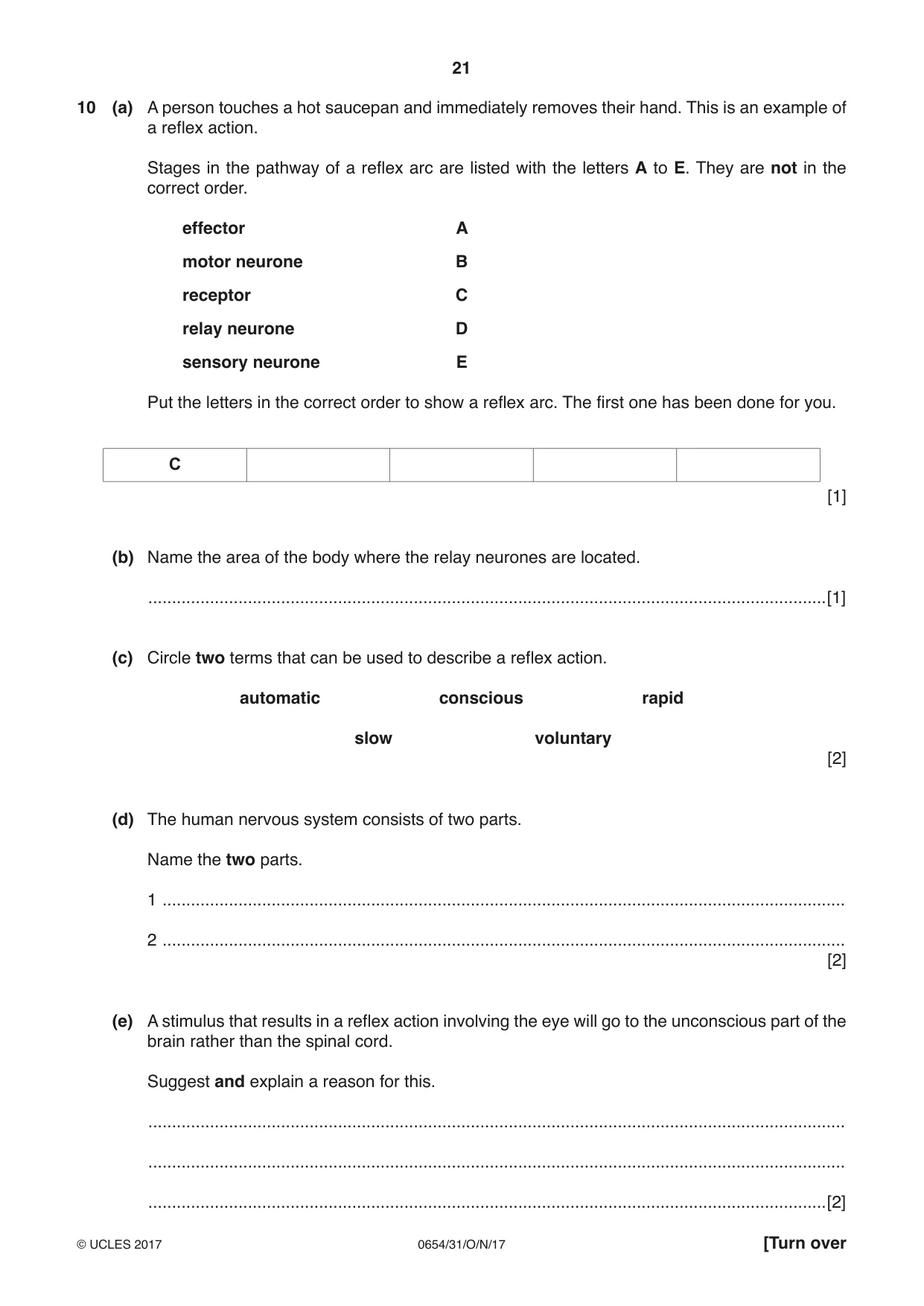
10 (a) A person touches a hot saucepan and immediately removes their hand. This is an example of a reflex action. Stages in the pathway of a reflex arc are listed with the letters A to E. They are not in the correct order. effector A motor neurone B receptor C relay neurone D sensory neurone E Put the letters in the correct order to show a reflex arc. The first one has been done for you. C [1] (b) Name the area of the body where the relay neurones are located. ...............................................................................................................................................[1] (c) Circle two terms that can be used to describe a reflex action. automatic conscious rapid slow voluntary [2] (d) The human nervous system consists of two parts. Name the two parts. 1 ................................................................................................................................................ 2 ................................................................................................................................................ [2] (e) A stimulus that results in a reflex action involving the eye will go to the unconscious part of the brain rather than the spinal cord. Suggest and explain a reason for this. ................................................................................................................................................... ................................................................................................................................................... ...............................................................................................................................................[2]
Mark scheme: 10(a) E D B A ; 1 10(b) brain / spinal cord ; 1 10(c) rapid circled ; automatic circled ; 2 10(d) central (nervous system) / CNS ; peripheral (nervous system) ; 2 10(e) brain is closer ; (impulse) takes less time ; 2
Q11 · Petroleum is a liquid fossil fuel
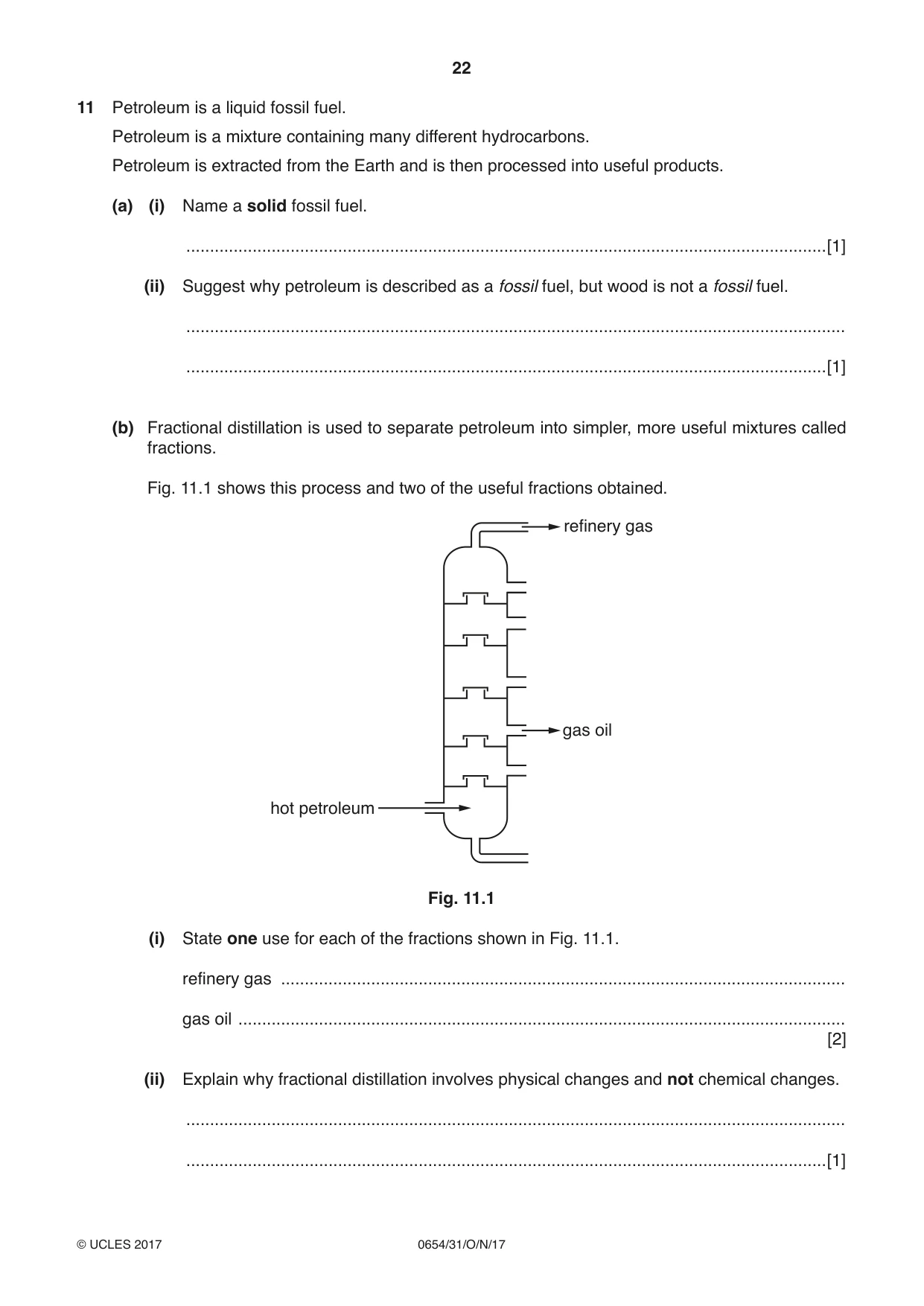
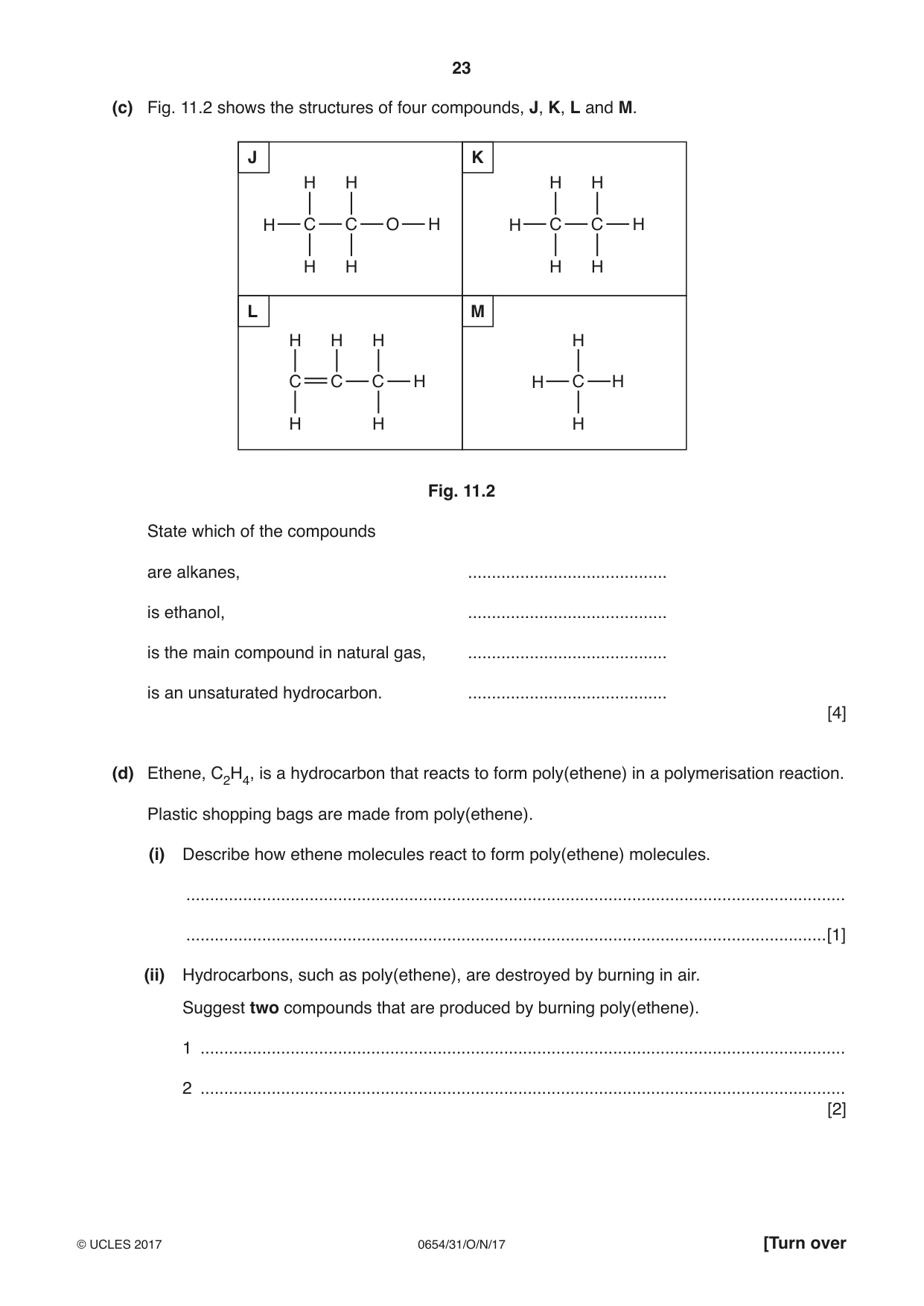
11 Petroleum is a liquid fossil fuel. Petroleum is a mixture containing many different hydrocarbons. Petroleum is extracted from the Earth and is then processed into useful products. (a) (i) Name a solid fossil fuel. .......................................................................................................................................[1] (ii) Suggest why petroleum is described as a fossil fuel, but wood is not a fossil fuel. ........................................................................................................................................... .......................................................................................................................................[1] (b) Fractional distillation is used to separate petroleum into simpler, more useful mixtures called fractions. Fig. 11.1 shows this process and two of the useful fractions obtained. refinery gas gas oil hot petroleum Fig. 11.1 (i) State one use for each of the fractions shown in Fig. 11.1. refinery gas ....................................................................................................................... gas oil ................................................................................................................................ [2] (ii) Explain why fractional distillation involves physical changes and not chemical changes. ........................................................................................................................................... .......................................................................................................................................[1] (c) Fig. 11.2 shows the structures of four compounds, J, K, L and M. J K H H H H H C C O H H C C H H H H H L M H H H H C C C H H C H H H H Fig. 11.2 State which of the compounds are alkanes, .......................................... is ethanol, .......................................... is the main compound in natural gas, .......................................... is an unsaturated hydrocarbon. .......................................... [4] (d) Ethene, C2H4, is a hydrocarbon that reacts to form poly(ethene) in a polymerisation reaction. Plastic shopping bags are made from poly(ethene). (i) Describe how ethene molecules react to form poly(ethene) molecules. ........................................................................................................................................... .......................................................................................................................................[1] (ii) Hydrocarbons, such as poly(ethene), are destroyed by burning in air. Suggest two compounds that are produced by burning poly(ethene). 1 ........................................................................................................................................ 2 ........................................................................................................................................ [2]
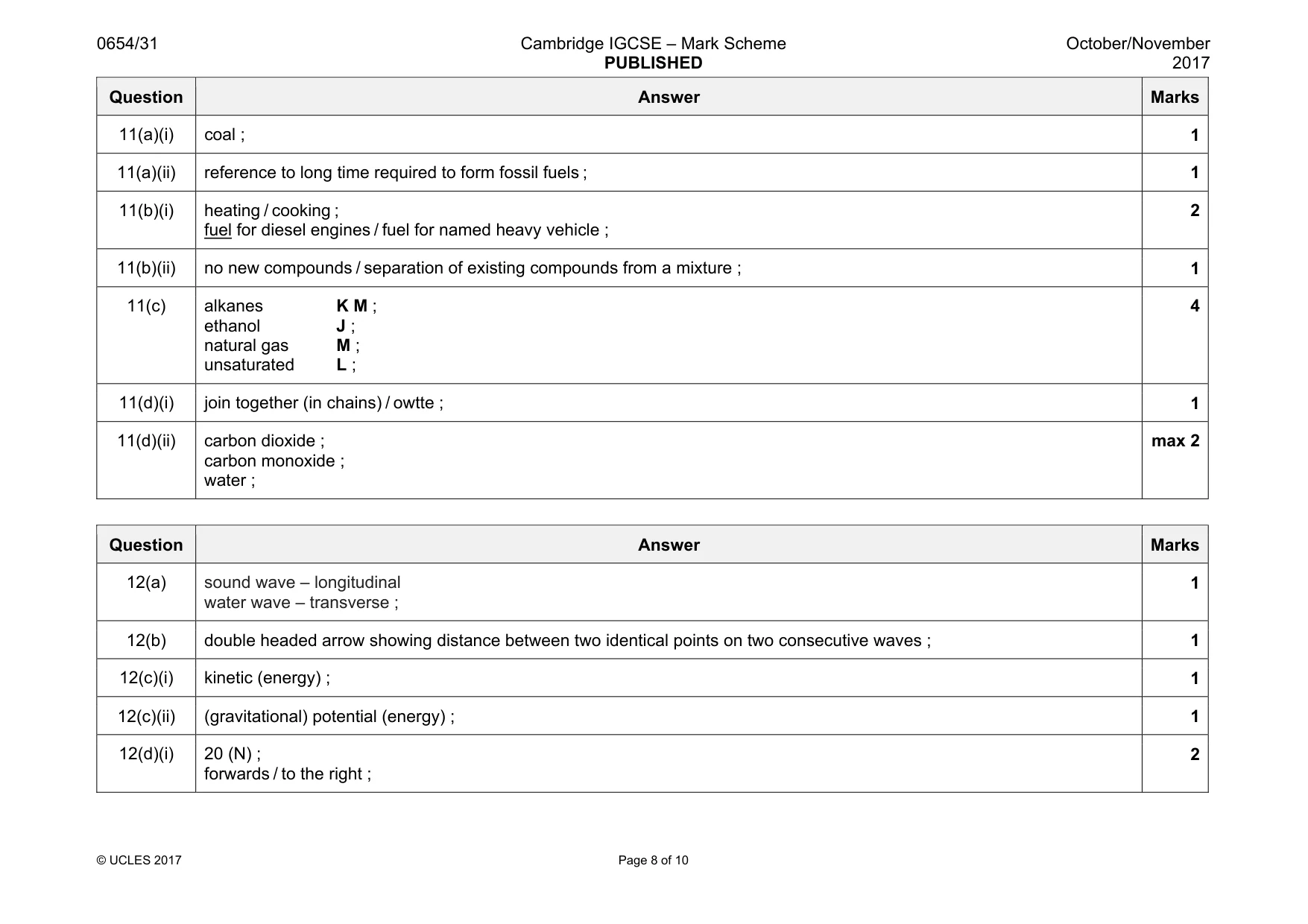
Mark scheme: 11(a)(i) coal ; 1 11(a)(ii) reference to long time required to form fossil fuels ; 1 11(b)(i) heating / cooking ; fuel for diesel engines / fuel for named heavy vehicle ; 2 11(b)(ii) no new compounds / separation of existing compounds from a mixture ; 1 11(c) alkanes K M ; ethanol J ; natural gas M ; unsaturated L ; 4 11(d)(i) join together (in chains) / owtte ; 1 11(d)(ii) carbon dioxide ; carbon monoxide ; water ; max 2
Q12 · Four swimmers are competing at a swimming pool
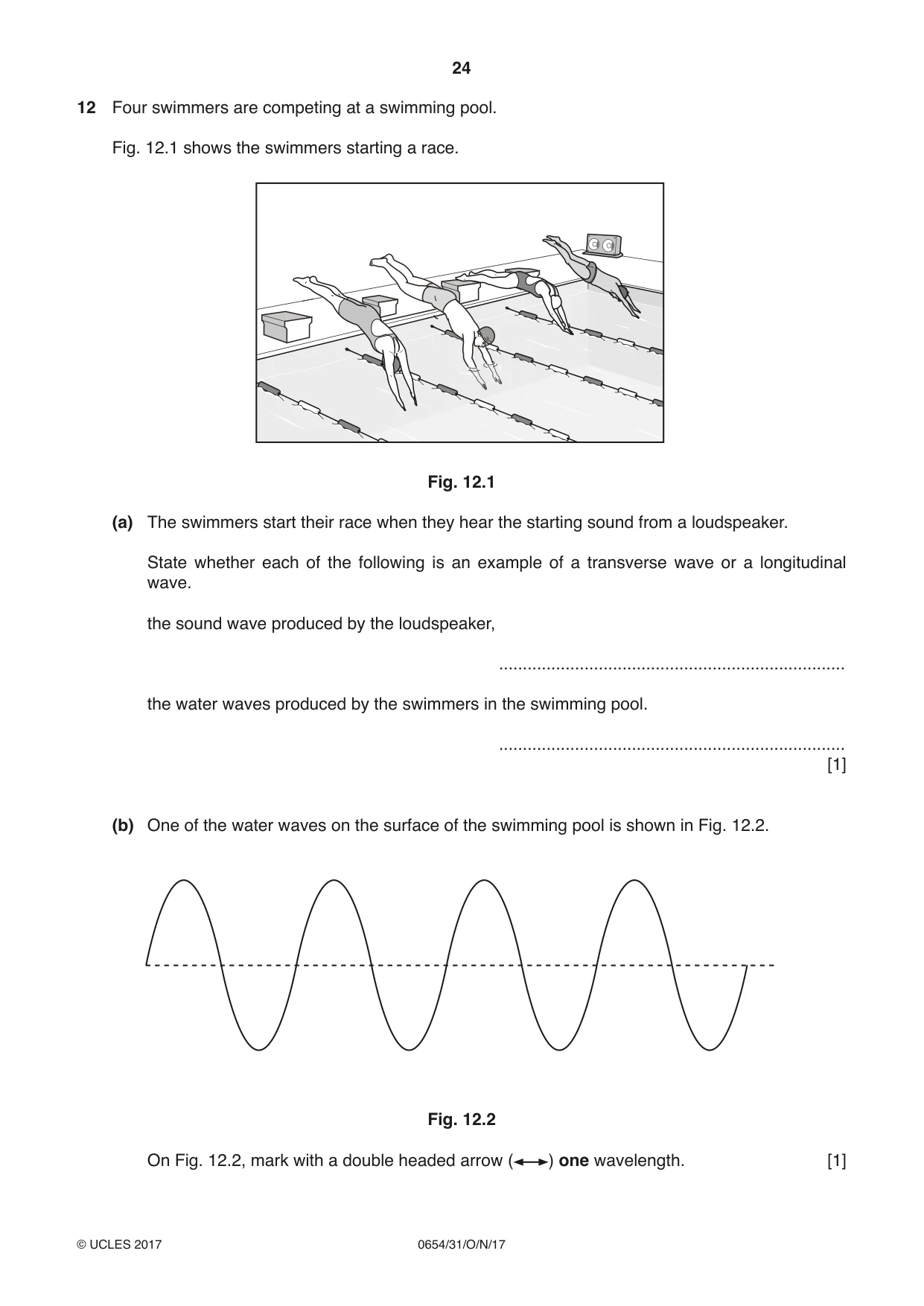
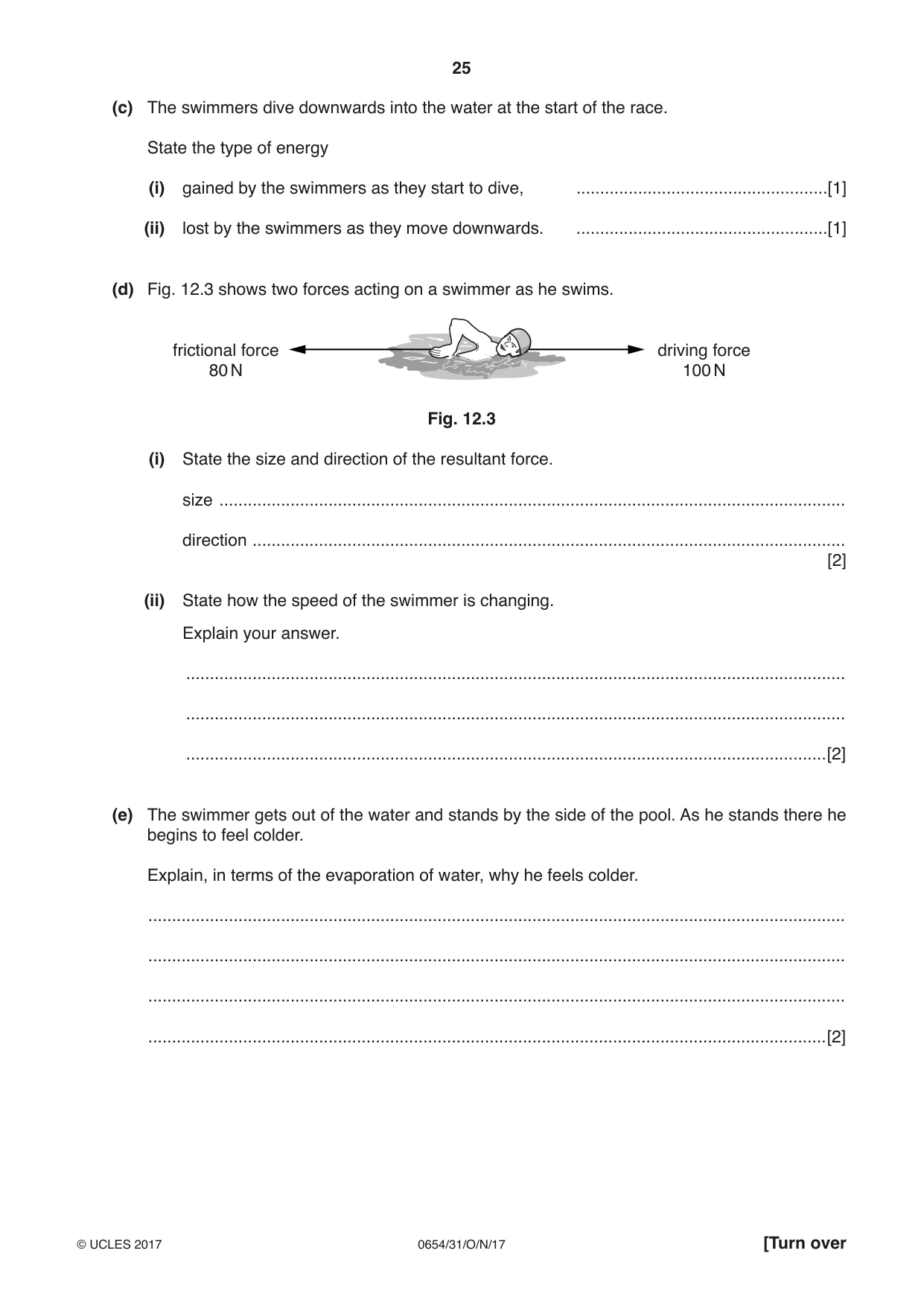
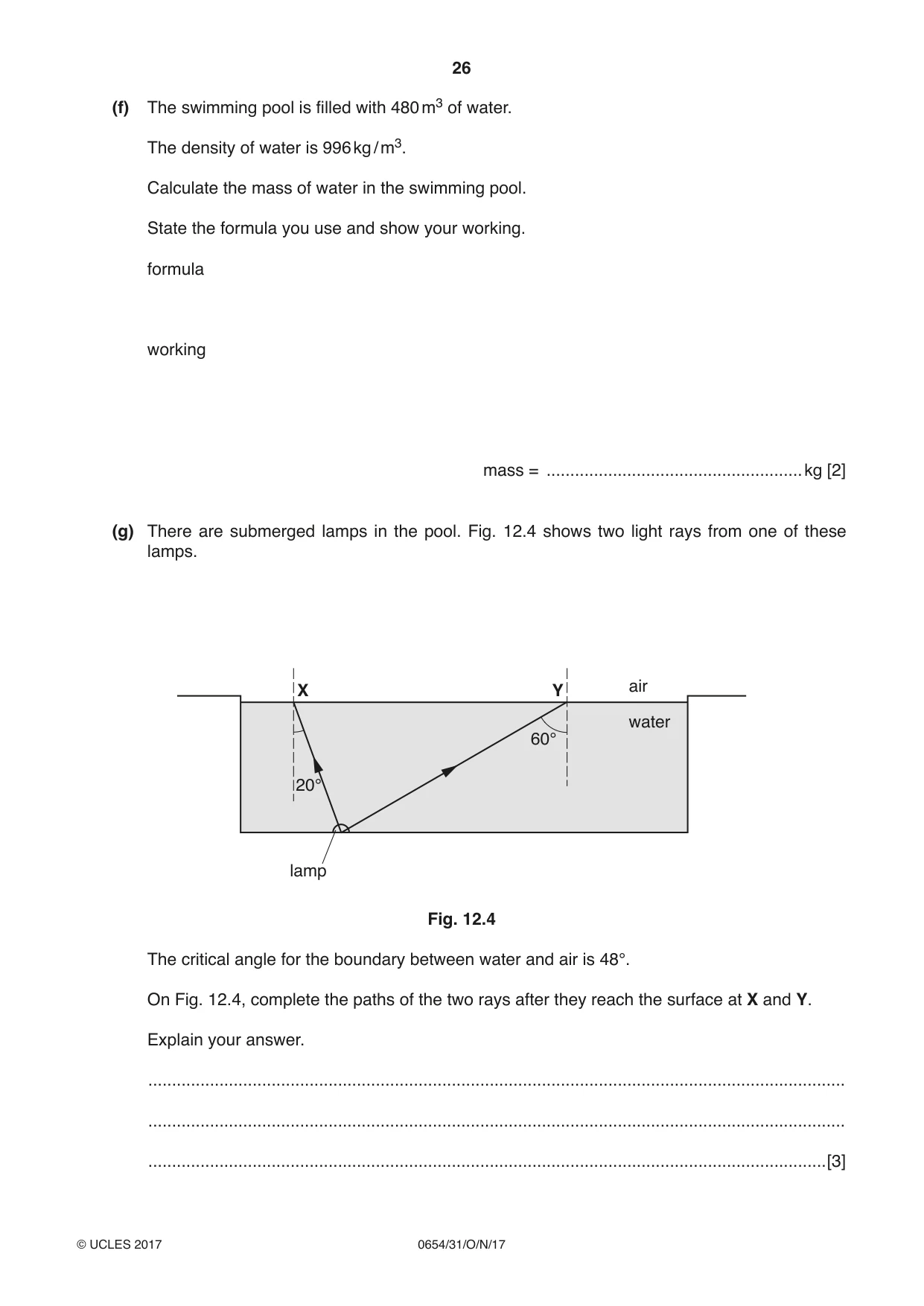
12 Four swimmers are competing at a swimming pool. Fig. 12.1 shows the swimmers starting a race. Fig. 12.1 (a) The swimmers start their race when they hear the starting sound from a loudspeaker. State whether each of the following is an example of a transverse wave or a longitudinal wave. the sound wave produced by the loudspeaker, ......................................................................... the water waves produced by the swimmers in the swimming pool. ......................................................................... [1] (b) One of the water waves on the surface of the swimming pool is shown in Fig. 12.2. Fig. 12.2 On Fig. 12.2, mark with a double headed arrow ( ) one wavelength. [1] (c) The swimmers dive downwards into the water at the start of the race. State the type of energy (i) gained by the swimmers as they start to dive, .....................................................[1] (ii) lost by the swimmers as they move downwards. .....................................................[1] (d) Fig. 12.3 shows two forces acting on a swimmer as he swims. frictional force driving force 80 N 100 N Fig. 12.3 (i) State the size and direction of the resultant force. size .................................................................................................................................... direction ............................................................................................................................. [2] (ii) State how the speed of the swimmer is changing. Explain your answer. ........................................................................................................................................... ........................................................................................................................................... .......................................................................................................................................[2] (e) The swimmer gets out of the water and stands by the side of the pool. As he stands there he begins to feel colder. Explain, in terms of the evaporation of water, why he feels colder. ................................................................................................................................................... ................................................................................................................................................... ................................................................................................................................................... ...............................................................................................................................................[2] (f) The swimming pool is filled with 480 m3 of water. The density of water is 996 kg / m3. Calculate the mass of water in the swimming pool. State the formula you use and show your working. formula working mass = ......................................................kg [2] (g) There are submerged lamps in the pool. Fig. 12.4 shows two light rays from one of these lamps. X Y air water 60° 20° lamp Fig. 12.4 The critical angle for the boundary between water and air is 48°. On Fig. 12.4, complete the paths of the two rays after they reach the surface at X and Y. Explain your answer. ................................................................................................................................................... ................................................................................................................................................... ...............................................................................................................................................[3]
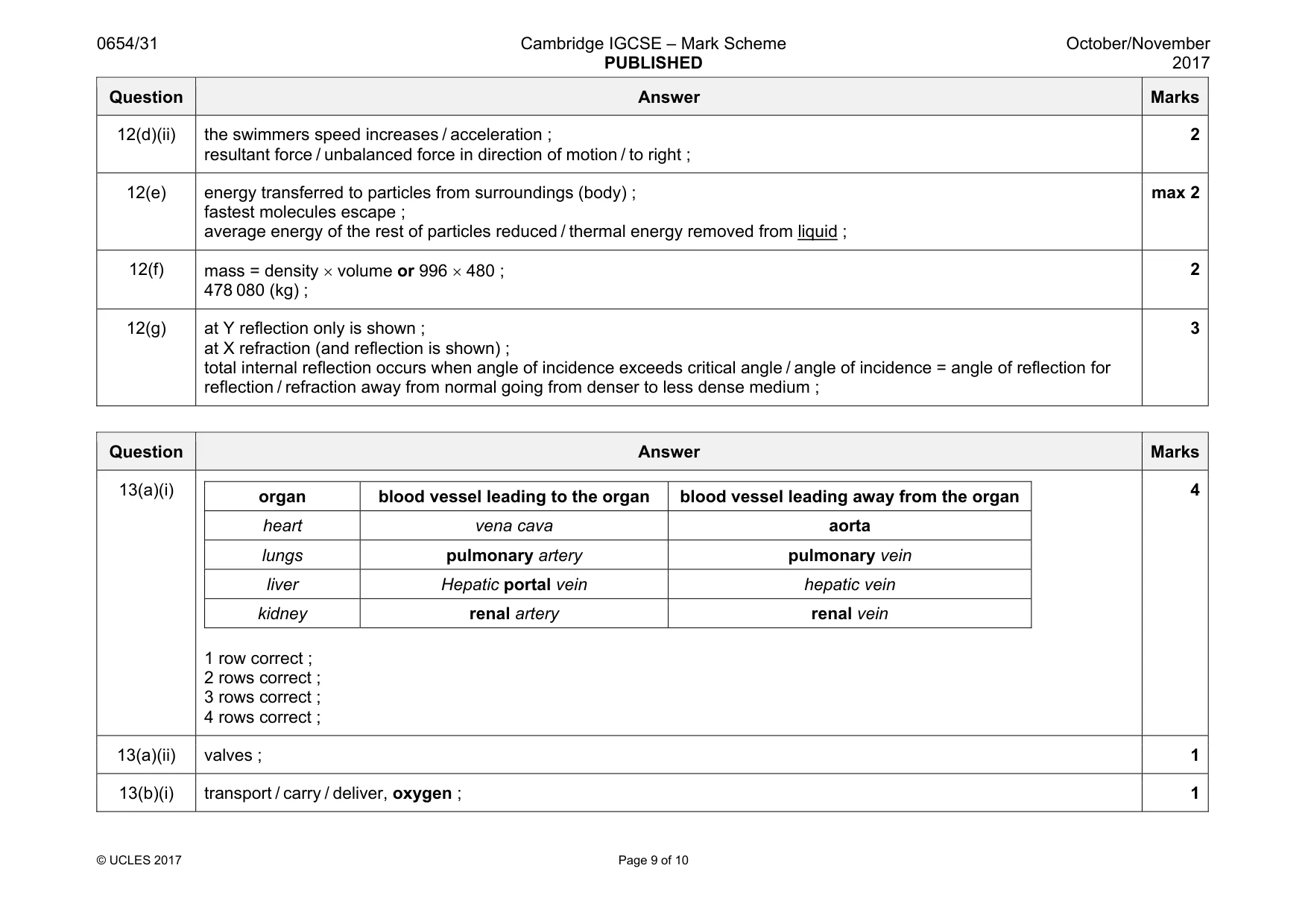
Mark scheme: 12(a) sound wave – longitudinal water wave – transverse ; 1 12(b) double headed arrow showing distance between two identical points on two consecutive waves ; 1 12(c)(i) kinetic (energy) ; 1 12(c)(ii) (gravitational) potential (energy) ; 1 12(d)(i) 20 (N) ; forwards / to the right ; 2 Question Answer Marks 12(d)(ii) the swimmers speed increases / acceleration ; resultant force / unbalanced force in direction of motion / to right ; 2 12(e) energy transferred to particles from surroundings (body) ; fastest molecules escape ; average energy of the rest of particles reduced / thermal energy removed from liquid ; max 2 12(f) mass = density × volume or 996 × 480 ; 478 080 (kg) ; 2 12(g) at Y reflection only is shown ; at X refraction (and reflection is shown) ; total internal reflection occurs when angle of incidence exceeds critical angle / angle of incidence = angle of reflection for reflection / refraction away from normal going from denser to less dense medium ; 3
Q13 · The circulatory system transports blood to organs in the body
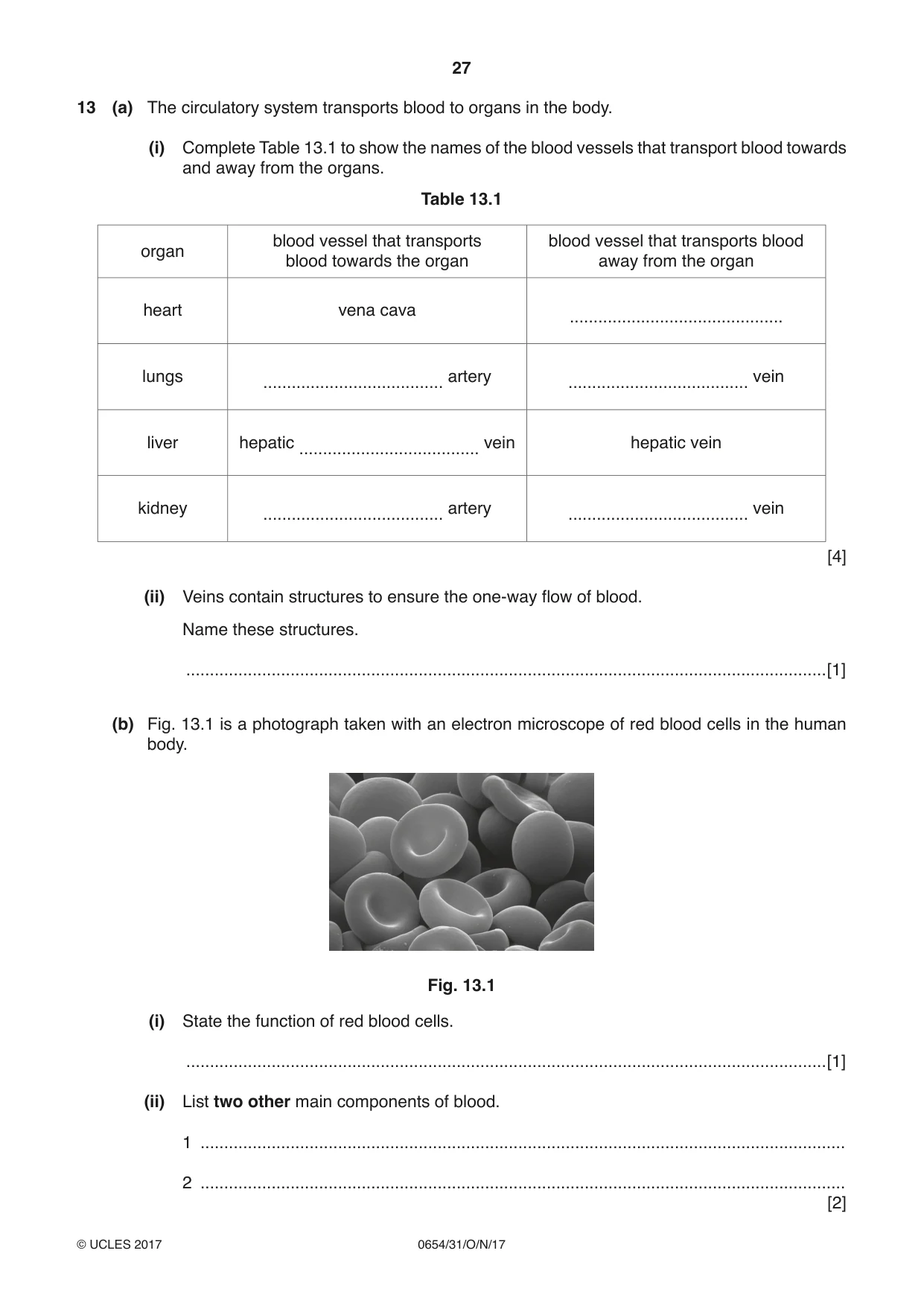
13 (a) The circulatory system transports blood to organs in the body. (i) Complete Table 13.1 to show the names of the blood vessels that transport blood towards and away from the organs. Table 13.1 blood vessel that transports blood vessel that transports blood organ blood towards the organ away from the organ heart vena cava ............................................. lungs artery vein ...................................... ...................................... liver hepatic vein hepatic vein ...................................... kidney artery vein ...................................... ...................................... [4] (ii) Veins contain structures to ensure the one-way flow of blood. Name these structures. .......................................................................................................................................[1] (b) Fig. 13.1 is a photograph taken with an electron microscope of red blood cells in the human body. Fig. 13.1 (i) State the function of red blood cells. .......................................................................................................................................[1] (ii) List two other main components of blood. 1 ........................................................................................................................................ 2 ........................................................................................................................................ [2]
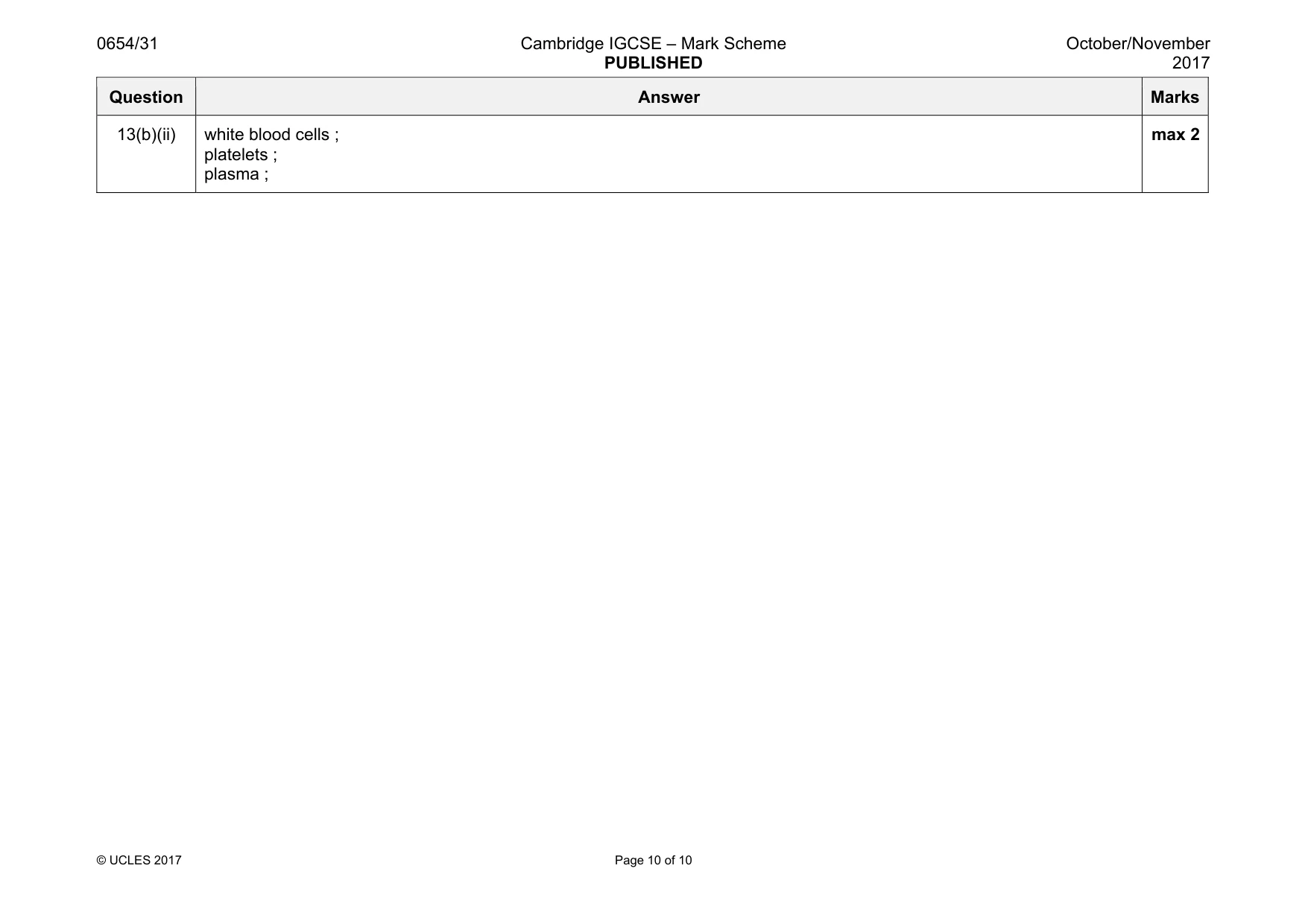
Mark scheme: 13(a)(i) organ blood vessel leading to the organ blood vessel leading away from the organ heart vena cava aorta lungs pulmonary artery pulmonary vein liver Hepatic portal vein hepatic vein kidney renal artery renal vein 1 row correct ; 2 rows correct ; 3 rows correct ; 4 rows correct ; 4 13(a)(ii) valves ; 1 13(b)(i) transport / carry / deliver, oxygen ; 1 Question Answer Marks 13(b)(ii) white blood cells ; platelets ; plasma ; max 2
What was in this paper
The subtopics covered by these 13 questions, and how many questions each got. Open one in a new tab to see every Cambridge question on it.
2Atomic structure and the Periodic Table1Blood vessels1Cell structure1Coordination and response1Electrical circuits1Fuels1Identification of ions and gases1Kinetic particle model of matter1Monohybrid inheritance1Sexually transmitted infections1The characteristic properties of acids and bases1What you needed in this session
Cambridge’s own grade thresholds for 2017 Oct/Nov, Paper 3 · Variant 1. A higher threshold means an easier paper — the bar moves with how the cohort did.