Questions as text
Q1 · A boat sailing near a lighthouse at night 0653/32 Feb/March 2017
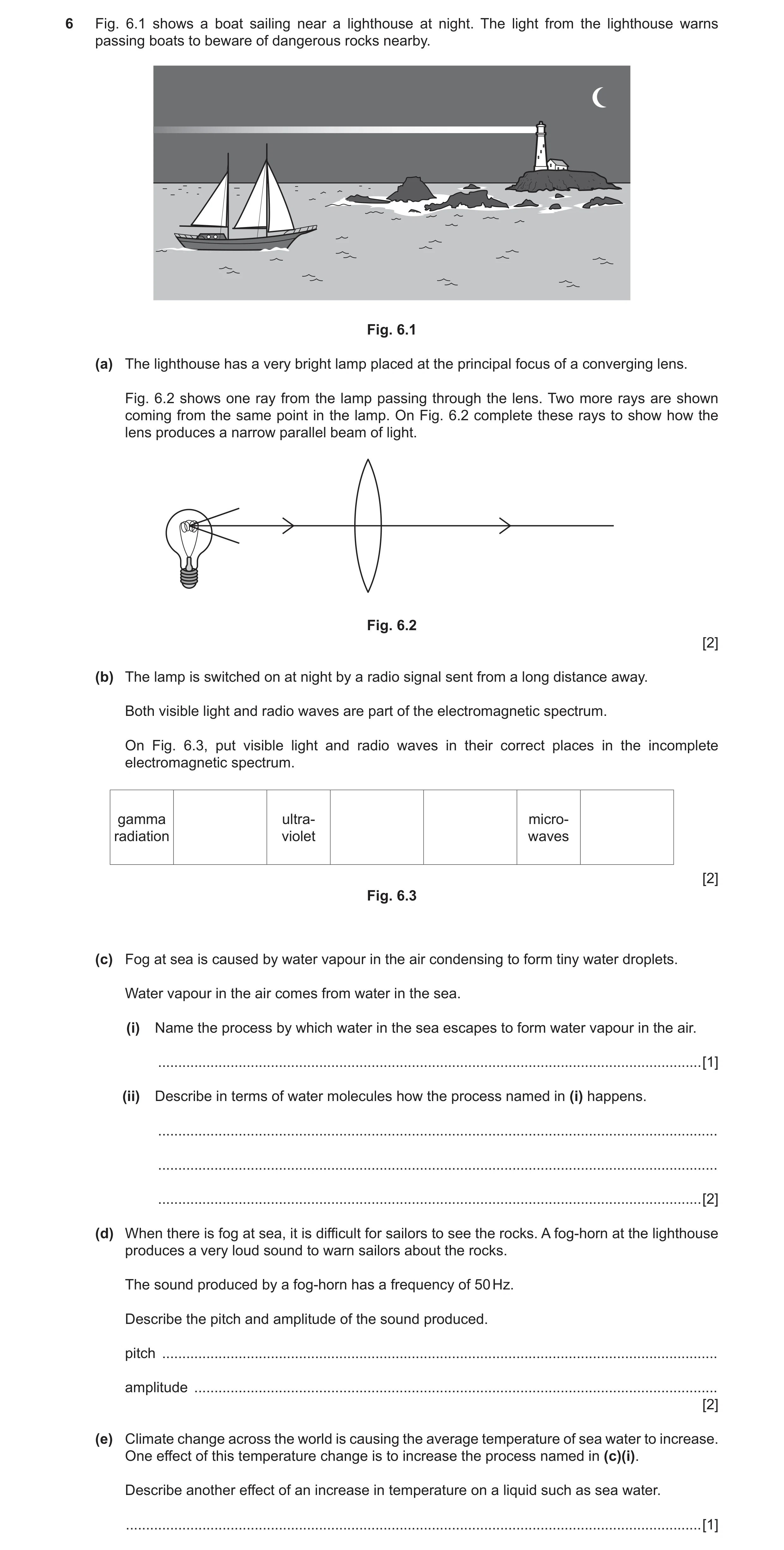
6 Fig. 6.1 shows a boat sailing near a lighthouse at night. The light from the lighthouse warns passing boats to beware of dangerous rocks nearby. Fig. 6.1 (a) The lighthouse has a very bright lamp placed at the principal focus of a converging lens. Fig. 6.2 shows one ray from the lamp passing through the lens. Two more rays are shown coming from the same point in the lamp. On Fig. 6.2 complete these rays to show how the lens produces a narrow parallel beam of light. Fig. 6.2 [2] (b) The lamp is switched on at night by a radio signal sent from a long distance away. Both visible light and radio waves are part of the electromagnetic spectrum. On Fig. 6.3, put visible light and radio waves in their correct places in the incomplete electromagnetic spectrum. gamma ultra- micro- radiation violet waves [2] Fig. 6.3 (c) Fog at sea is caused by water vapour in the air condensing to form tiny water droplets. Water vapour in the air comes from water in the sea. (i) Name the process by which water in the sea escapes to form water vapour in the air. … [1] (ii) Describe in terms of water molecules how the process named in (i) happens. … … … [2] (d) When there is fog at sea, it is difficult for sailors to see the rocks. A fog-horn at the lighthouse produces a very loud sound to warn sailors about the rocks. The sound produced by a fog-horn has a frequency of 50 Hz. Describe the pitch and amplitude of the sound produced. pitch … amplitude … [2] (e) Climate change across the world is causing the average temperature of sea water to increase. One effect of this temperature change is to increase the process named in (c)(i). Describe another effect of an increase in temperature on a liquid such as sea water. … [1]
10 marks
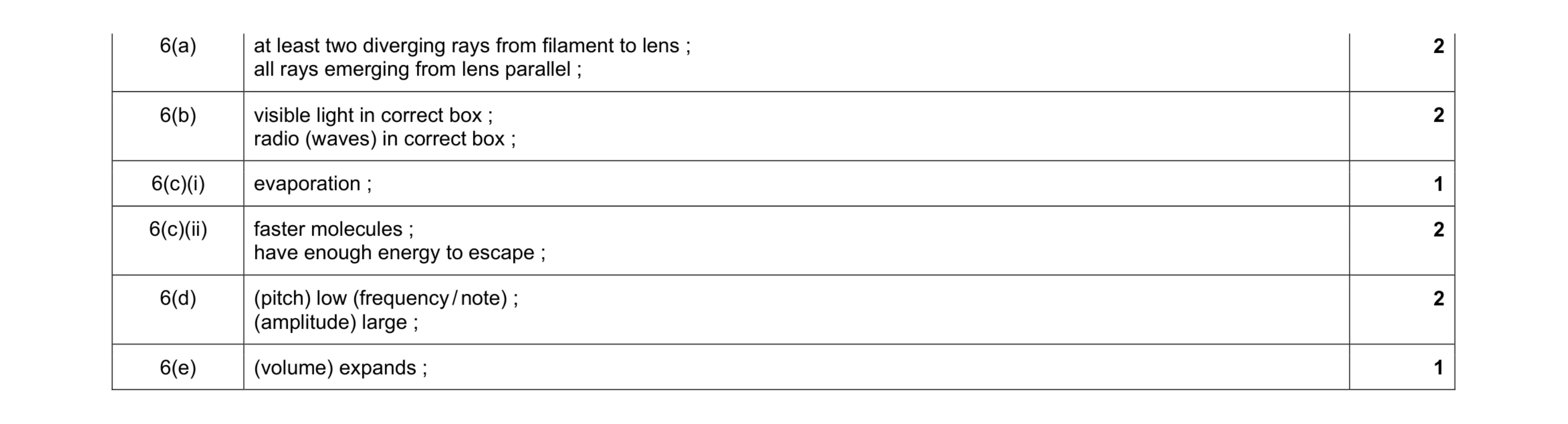
Mark scheme: 6(a) at least two diverging rays from filament to lens ; all rays emerging from lens parallel ; 2 6(b) visible light in correct box ; radio (waves) in correct box ; 2 6(c)(i) evaporation ; 1 6(c)(ii) faster molecules ; have enough energy to escape ; 2 6(d) (pitch) low (frequency / note) ; (amplitude) large ; 2 6(e) (volume) expands ; 1
This question in 0653/32 Feb/March 2017
Question 2 0653/31 Oct/Nov 2017
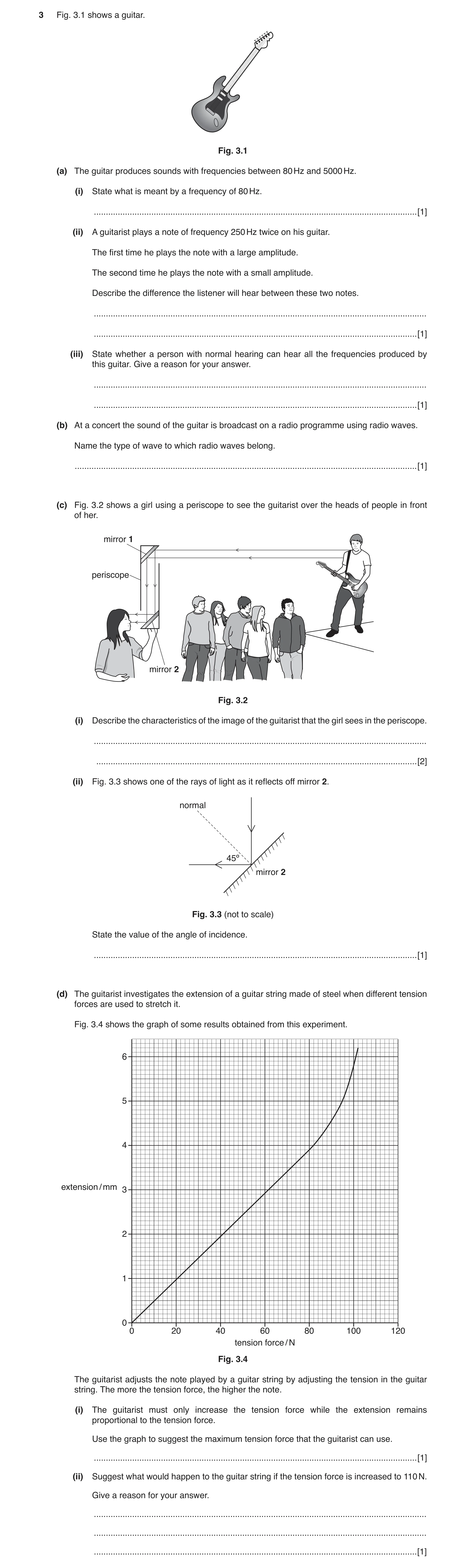
3 Fig. 3.1 shows a guitar. Fig. 3.1 (a) The guitar produces sounds with frequencies between 80 Hz and 5000 Hz. (i) State what is meant by a frequency of 80 Hz. … [1] (ii) A guitarist plays a note of frequency 250 Hz twice on his guitar. The first time he plays the note with a large amplitude. The second time he plays the note with a small amplitude. Describe the difference the listener will hear between these two notes. … … [1] (iii) State whether a person with normal hearing can hear all the frequencies produced by this guitar. Give a reason for your answer. … … [1] (b) At a concert the sound of the guitar is broadcast on a radio programme using radio waves. Name the type of wave to which radio waves belong. … [1] (c) Fig. 3.2 shows a girl using a periscope to see the guitarist over the heads of people in front of her. mirror 1 periscope mirror 2 Fig. 3.2 (i) Describe the characteristics of the image of the guitarist that the girl sees in the periscope. … … [2] (ii) Fig. 3.3 shows one of the rays of light as it reflects off mirror 2. normal 45º mirror 2 Fig. 3.3 (not to scale) State the value of the angle of incidence. … [1] (d) The guitarist investigates the extension of a guitar string made of steel when different tension forces are used to stretch it. Fig. 3.4 shows the graph of some results obtained from this experiment. 6 5 4 extension / mm 3 2 1 0 0 20 40 60 80 100 120 tension force / N Fig. 3.4 The guitarist adjusts the note played by a guitar string by adjusting the tension in the guitar string. The more the tension force, the higher the note. (i) The guitarist must only increase the tension force while the extension remains proportional to the tension force. Use the graph to suggest the maximum tension force that the guitarist can use. … [1] (ii) Suggest what would happen to the guitar string if the tension force is increased to 110 N. Give a reason for your answer. … … … [1]
9 marks
Mark scheme: 3(a)(i) 80 waves / cycles / vibrations / oscillations per second ; 1 3(a)(ii) first note louder than second note ; 1 3(a)(iii) yes (no mark) frequency range of guitar lies within frequency range of normal human hearing / is within range 20 Hz – 20 kHz ; 1 3(b) electromagnetic waves ; 1 3(c)(i) any two from upright ; virtual ; same size ; max 2 3(c)(ii) 45° ; 1 3(d)(i) answer in range 80–84 N ; 1 3(d)(ii) string breaks (as graph goes up vertically) / permanently stretches / owtte ; 1
This question in 0653/31 Oct/Nov 2017
Q3 · In a theatre, spotlights are used to shine a beam of light on one person on the stage 0653/32 Oct/Nov 2017
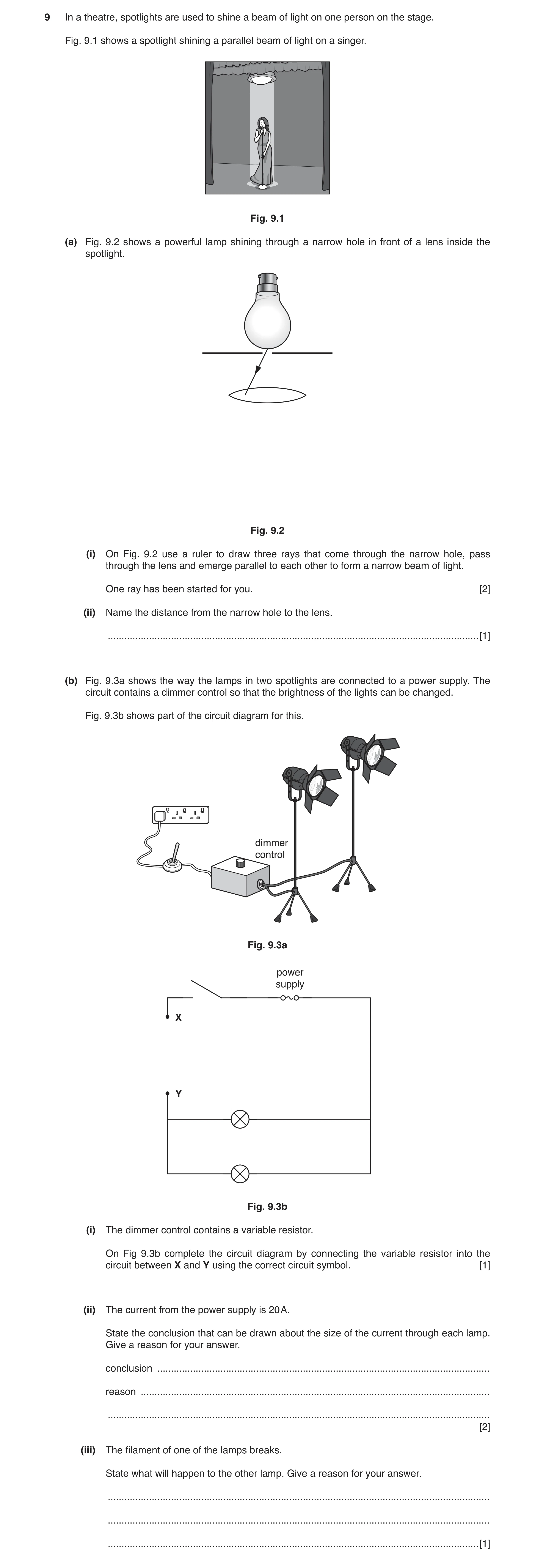
9 In a theatre, spotlights are used to shine a beam of light on one person on the stage. Fig. 9.1 shows a spotlight shining a parallel beam of light on a singer. Fig. 9.1 (a) Fig. 9.2 shows a powerful lamp shining through a narrow hole in front of a lens inside the spotlight. Fig. 9.2 (i) On Fig. 9.2 use a ruler to draw three rays that come through the narrow hole, pass through the lens and emerge parallel to each other to form a narrow beam of light. One ray has been started for you. [2] (ii) Name the distance from the narrow hole to the lens. … [1] (b) Fig. 9.3a shows the way the lamps in two spotlights are connected to a power supply. The circuit contains a dimmer control so that the brightness of the lights can be changed. Fig. 9.3b shows part of the circuit diagram for this. dimmer control Fig. 9.3a power supply X Y Fig. 9.3b (i) The dimmer control contains a variable resistor. On Fig 9.3b complete the circuit diagram by connecting the variable resistor into the circuit between X and Y using the correct circuit symbol. [1] (ii) The current from the power supply is 20 A. State the conclusion that can be drawn about the size of the current through each lamp. Give a reason for your answer. conclusion … reason … … [2] (iii) The filament of one of the lamps breaks. State what will happen to the other lamp. Give a reason for your answer. … … … [1]
7 marks
Mark scheme: 9 9 9 9(a)(i) two m all ray 9(a)(ii) focal 9(b)(i) correc 9(b)(ii) less t curren 9(b)(iii) remai still a more rays from h ys emerge from length ; ct symbol for va han 20 A ; nt from source is ins lit (no mark) complete circuit hole to lens ; lens parallel ; riable resistor ; s larger than in e t through that br each branch ; ranch owtte ; 2 1 1 2 1
This question in 0653/32 Oct/Nov 2017
Q4 · A simple circuit set up to investigate the current through an electric motor 0653/32 May/June 2018
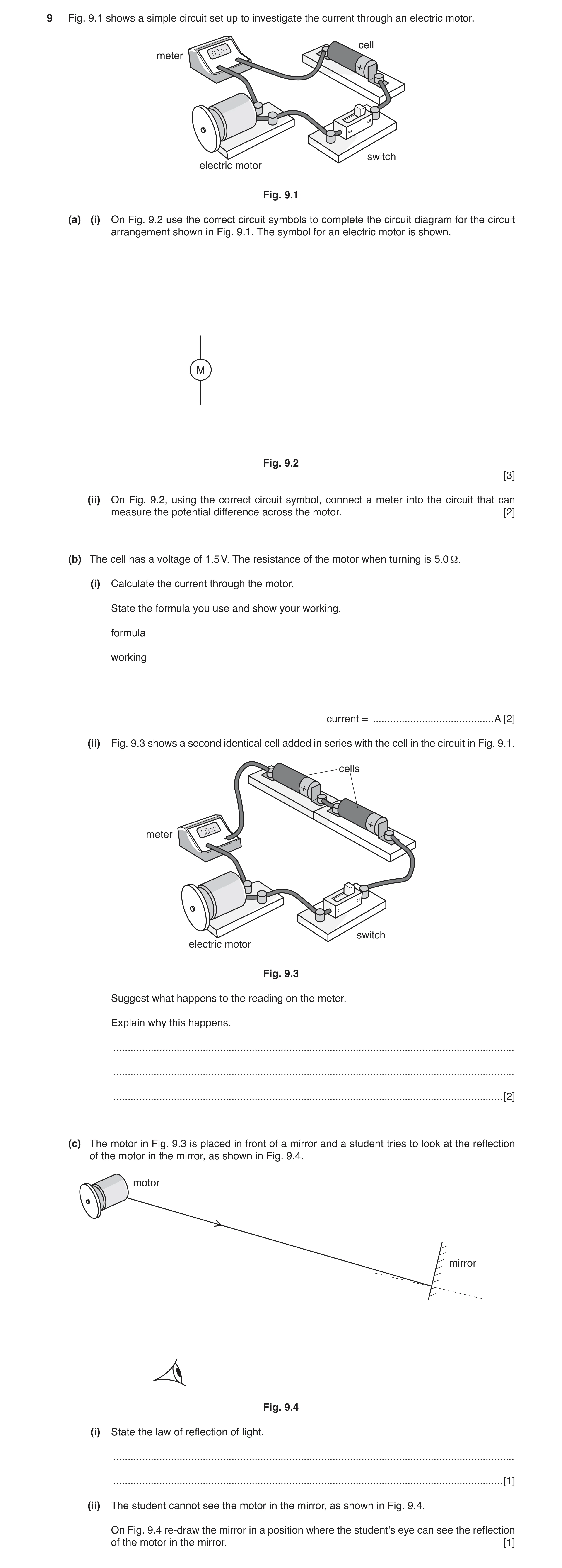
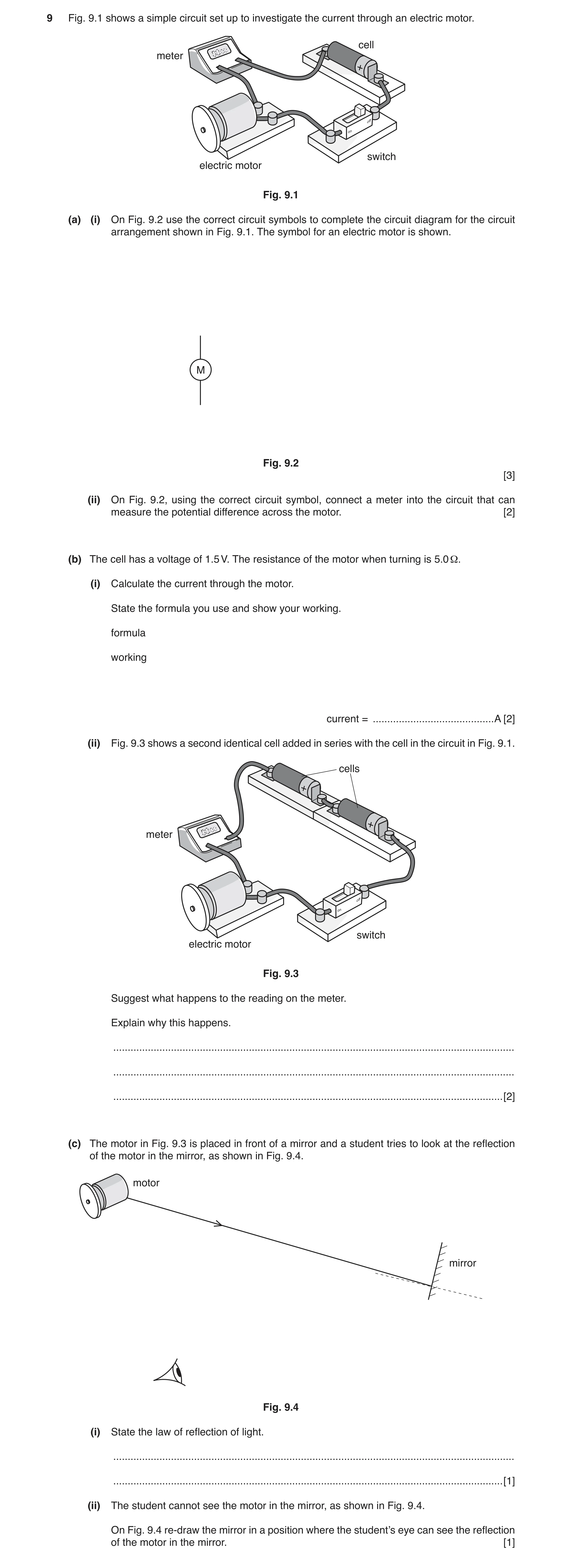
9 Fig. 9.1 shows a simple circuit set up to investigate the current through an electric motor. cell meter + off switch electric motor Fig. 9.1 (a) (i) On Fig. 9.2 use the correct circuit symbols to complete the circuit diagram for the circuit arrangement shown in Fig. 9.1. The symbol for an electric motor is shown. M Fig. 9.2 [3] (ii) On Fig. 9.2, using the correct circuit symbol, connect a meter into the circuit that can measure the potential difference across the motor. [2] (b) The cell has a voltage of 1.5 V. The resistance of the motor when turning is 5.0 Ω. (i) Calculate the current through the motor. State the formula you use and show your working. formula working current = … A [2] (ii) Fig. 9.3 shows a second identical cell added in series with the cell in the circuit in Fig. 9.1. cells + + meter off switch electric motor Fig. 9.3 Suggest what happens to the reading on the meter. Explain why this happens. … … … [2] (c) The motor in Fig. 9.3 is placed in front of a mirror and a student tries to look at the reflection of the motor in the mirror, as shown in Fig. 9.4. motor mirror Fig. 9.4 (i) State the law of reflection of light. … … [1] (ii) The student cannot see the motor in the mirror, as shown in Fig. 9.4. On Fig. 9.4 re‑draw the mirror in a position where the student’s eye can see the reflection of the motor in the mirror. [1]
11 marks
Mark scheme: 9(a)(i) correct symbol for cell ; correct symbol for switch ; meter identified as an ammeter and a complete series circuit connected ; 3 9(a)(ii) correct meter selected (V symbol) ; meter connected in parallel with motor ; 2 9(b)(i) I = V / R or I = 1.5 / 5.0 ; = 0.30 (A) ; 2 Question Answer Marks 9(b)(ii) reading on ammeter increases / current increases ; (extra cell) increases pd / voltage (across motor) ; 2 9(c)(i) angle of incidence = angle of reflection ; 1 9(c)(ii) mirror shown at approx. correct angle ; 1
This question in 0653/32 May/June 2018
Q5 · A simple circuit set up to investigate the current through an electric motor 0653/33 May/June 2018
9 Fig. 9.1 shows a simple circuit set up to investigate the current through an electric motor. cell meter + off switch electric motor Fig. 9.1 (a) (i) On Fig. 9.2 use the correct circuit symbols to complete the circuit diagram for the circuit arrangement shown in Fig. 9.1. The symbol for an electric motor is shown. M Fig. 9.2 [3] (ii) On Fig. 9.2, using the correct circuit symbol, connect a meter into the circuit that can measure the potential difference across the motor. [2] (b) The cell has a voltage of 1.5 V. The resistance of the motor when turning is 5.0 Ω. (i) Calculate the current through the motor. State the formula you use and show your working. formula working current = … A [2] (ii) Fig. 9.3 shows a second identical cell added in series with the cell in the circuit in Fig. 9.1. cells + + meter off switch electric motor Fig. 9.3 Suggest what happens to the reading on the meter. Explain why this happens. … … … [2] (c) The motor in Fig. 9.3 is placed in front of a mirror and a student tries to look at the reflection of the motor in the mirror, as shown in Fig. 9.4. motor mirror Fig. 9.4 (i) State the law of reflection of light. … … [1] (ii) The student cannot see the motor in the mirror, as shown in Fig. 9.4. On Fig. 9.4 re‑draw the mirror in a position where the student’s eye can see the reflection of the motor in the mirror. [1]
11 marks
Mark scheme: 9(a)(i) correct symbol for cell ; correct symbol for switch ; meter identified as an ammeter and a complete series circuit connected ; 3 9(a)(ii) correct meter selected (V symbol) ; meter connected in parallel with motor ; 2 9(b)(i) I = V / R or I = 1.5 / 5.0 ; = 0.30 (A) ; 2 Question Answer Marks 9(b)(ii) reading on ammeter increases / current increases ; (extra cell) increases pd / voltage (across motor) ; 2 9(c)(i) angle of incidence = angle of reflection ; 1 9(c)(ii) mirror shown at approx. correct angle ; 1
This question in 0653/33 May/June 2018
Q6 · A liquid-in-glass thermometer at room temperature 0653/31 Oct/Nov 2018
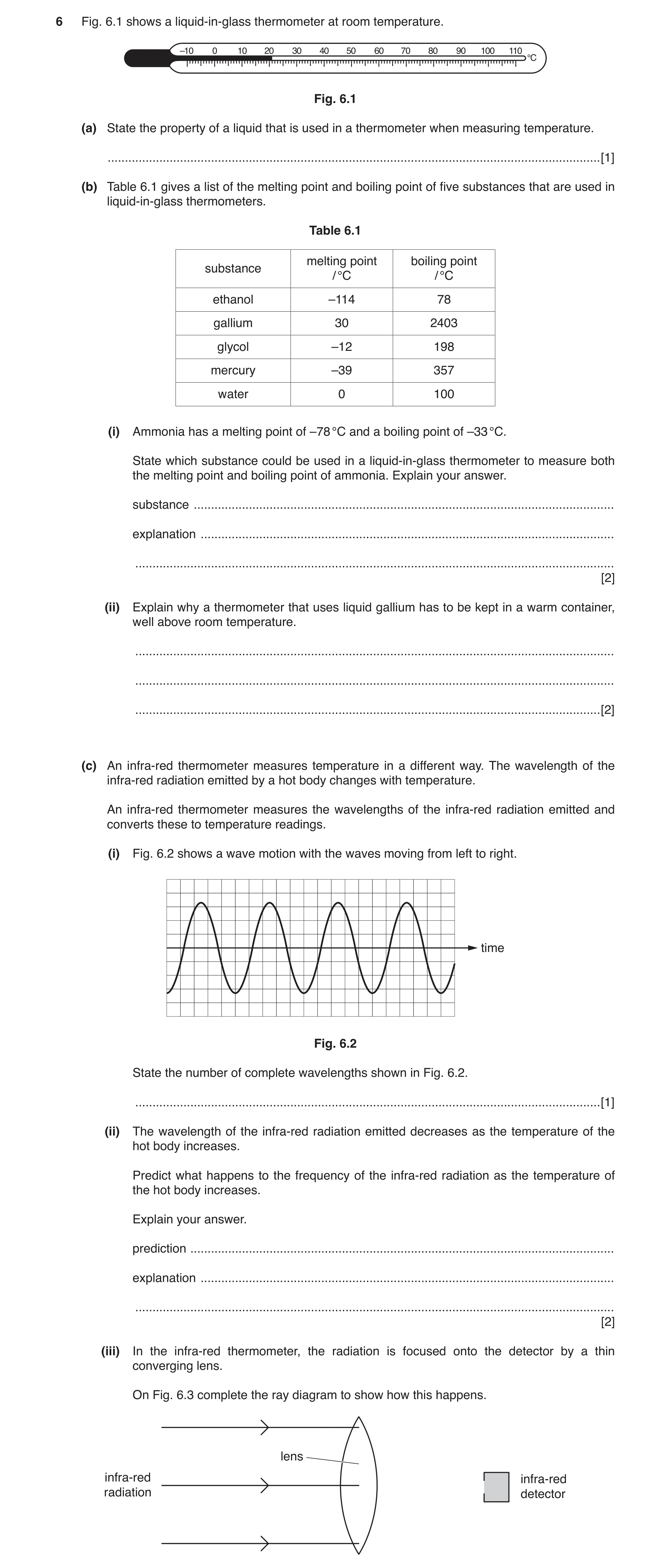
6 Fig. 6.1 shows a liquid-in-glass thermometer at room temperature. –10 0 10 20 30 40 50 60 70 80 90 100 110 °C Fig. 6.1 (a) State the property of a liquid that is used in a thermometer when measuring temperature. … [1] (b) Table 6.1 gives a list of the melting point and boiling point of five substances that are used in liquid-in-glass thermometers. Table 6.1 melting point boiling point substance / °C / °C ethanol –114 78 gallium 30 2403 glycol –12 198 mercury –39 357 water 0 100 (i) Ammonia has a melting point of –78 °C and a boiling point of –33 °C. State which substance could be used in a liquid-in-glass thermometer to measure both the melting point and boiling point of ammonia. Explain your answer. substance … explanation … … [2] (ii) Explain why a thermometer that uses liquid gallium has to be kept in a warm container, well above room temperature. … … … [2] (c) An infra-red thermometer measures temperature in a different way. The wavelength of the infra-red radiation emitted by a hot body changes with temperature. An infra-red thermometer measures the wavelengths of the infra-red radiation emitted and converts these to temperature readings. (i) Fig. 6.2 shows a wave motion with the waves moving from left to right. time Fig. 6.2 State the number of complete wavelengths shown in Fig. 6.2. … [1] (ii) The wavelength of the infra-red radiation emitted decreases as the temperature of the hot body increases. Predict what happens to the frequency of the infra-red radiation as the temperature of the hot body increases. Explain your answer. prediction … explanation … … [2] (iii) In the infra-red thermometer, the radiation is focused onto the detector by a thin converging lens. On Fig. 6.3 complete the ray diagram to show how this happens. lens infra-red infra-red radiation detector
9 marks
Mark scheme: 6(a) expansion (on heating) / (thermal) expansion ; 1 Question Answer Marks 6(b)(i) ethanol ; must be a liquid at both these temperatures / only ethanol is liquid at –78 °C ; 2 6(b)(ii) room temperature is below 30 °C / melting point of gallium ; gallium would be a solid at room temperature ; 2 6(c)(i) four / 4 ; 1 6(c)(ii) (frequency will) increase ; frequency increases as wavelength decreases ORA 2 6(c)(iii) all three rays extended to meet at the same point at the detector ; 1
This question in 0653/31 Oct/Nov 2018
Q7 · State one property that distinguishes a liquid from a gas 0653/33 Oct/Nov 2018
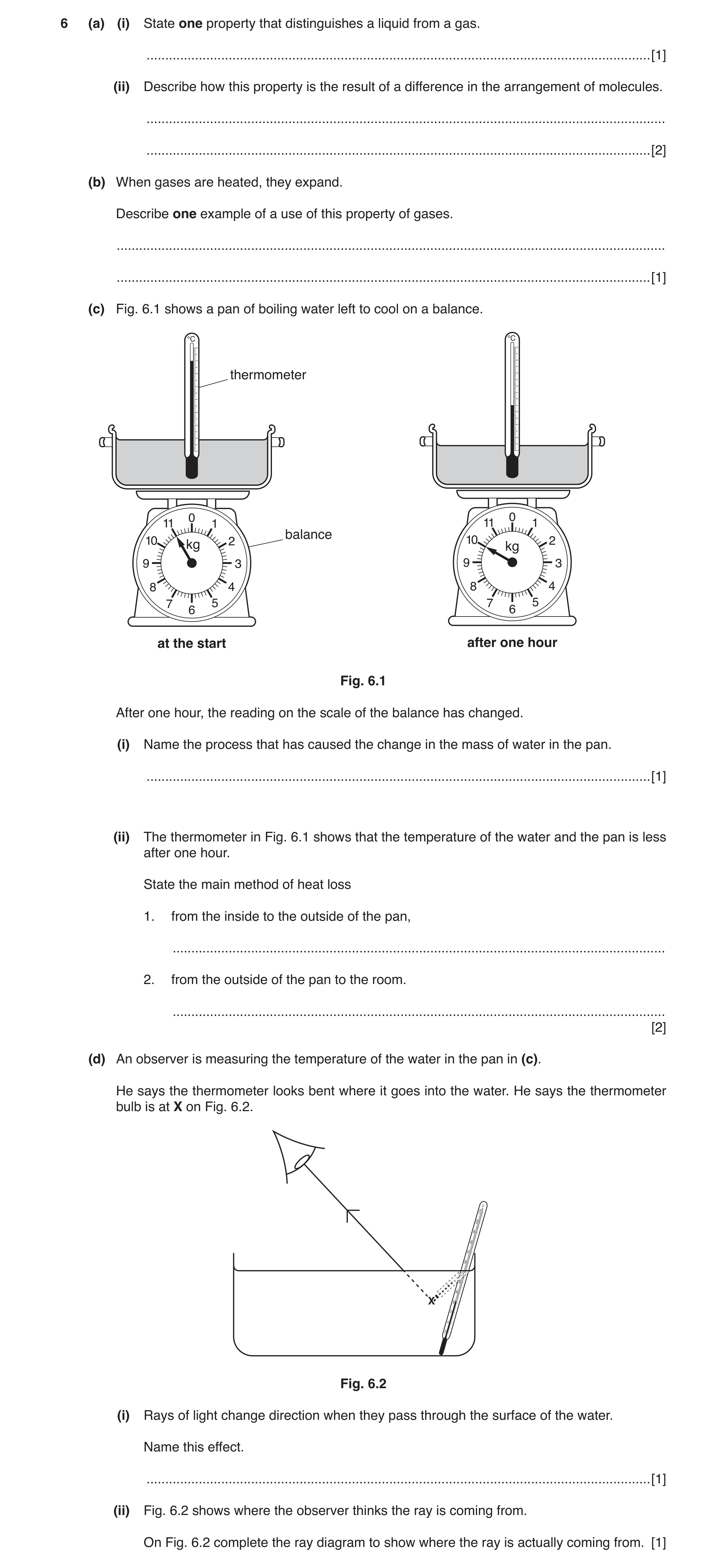
6 (a) (i) State one property that distinguishes a liquid from a gas. … [1] (ii) Describe how this property is the result of a difference in the arrangement of molecules. … … [2] (b) When gases are heated, they expand. Describe one example of a use of this property of gases. … … [1] (c) Fig. 6.1 shows a pan of boiling water left to cool on a balance. °C °C thermometer 0 0 11 1 11 1 balance 10 kg 2 10 kg 2 9 3 9 3 8 4 8 4 7 5 7 5 6 6 at the start after one hour Fig. 6.1 After one hour, the reading on the scale of the balance has changed. (i) Name the process that has caused the change in the mass of water in the pan. … [1] (ii) The thermometer in Fig. 6.1 shows that the temperature of the water and the pan is less after one hour. State the main method of heat loss 1. from the inside to the outside of the pan, … 2. from the outside of the pan to the room. … [2] (d) An observer is measuring the temperature of the water in the pan in (c). He says the thermometer looks bent where it goes into the water. He says the thermometer bulb is at X on Fig. 6.2. °C 110 100 90 80 70 60 30 40505 0 10 20 40 –10 30 20 10 0 –10 Fig. 6.2 (i) Rays of light change direction when they pass through the surface of the water. Name this effect. … [1] (ii) Fig. 6.2 shows where the observer thinks the ray is coming from. On Fig. 6.2 complete the ray diagram to show where the ray is actually coming from. [1]
9 marks
Mark scheme: 6(a)(i) density / volume / cannot be compressed ; 1 6(a)(ii) (liquid) molecules close together ; molecules can move around / slide over one another ; (gas) molecules far apart ; Molecules free to move apart ; Max 2 2 6(b) example of use of gas expansion on heating (e.g. hot air balloon, convection heater) ; 1 6(c)(i) evaporation ; 1 6(c)(ii) conduction ; convection ; 2 6(d)(i) refraction ; 1 6(d)(ii) ray from thermometer bulb to meet ray to eye at water surface ; 1
This question in 0653/33 Oct/Nov 2018
Q8 · In many cities, sodium street lamps are used at night 0653/32 Feb/March 2019
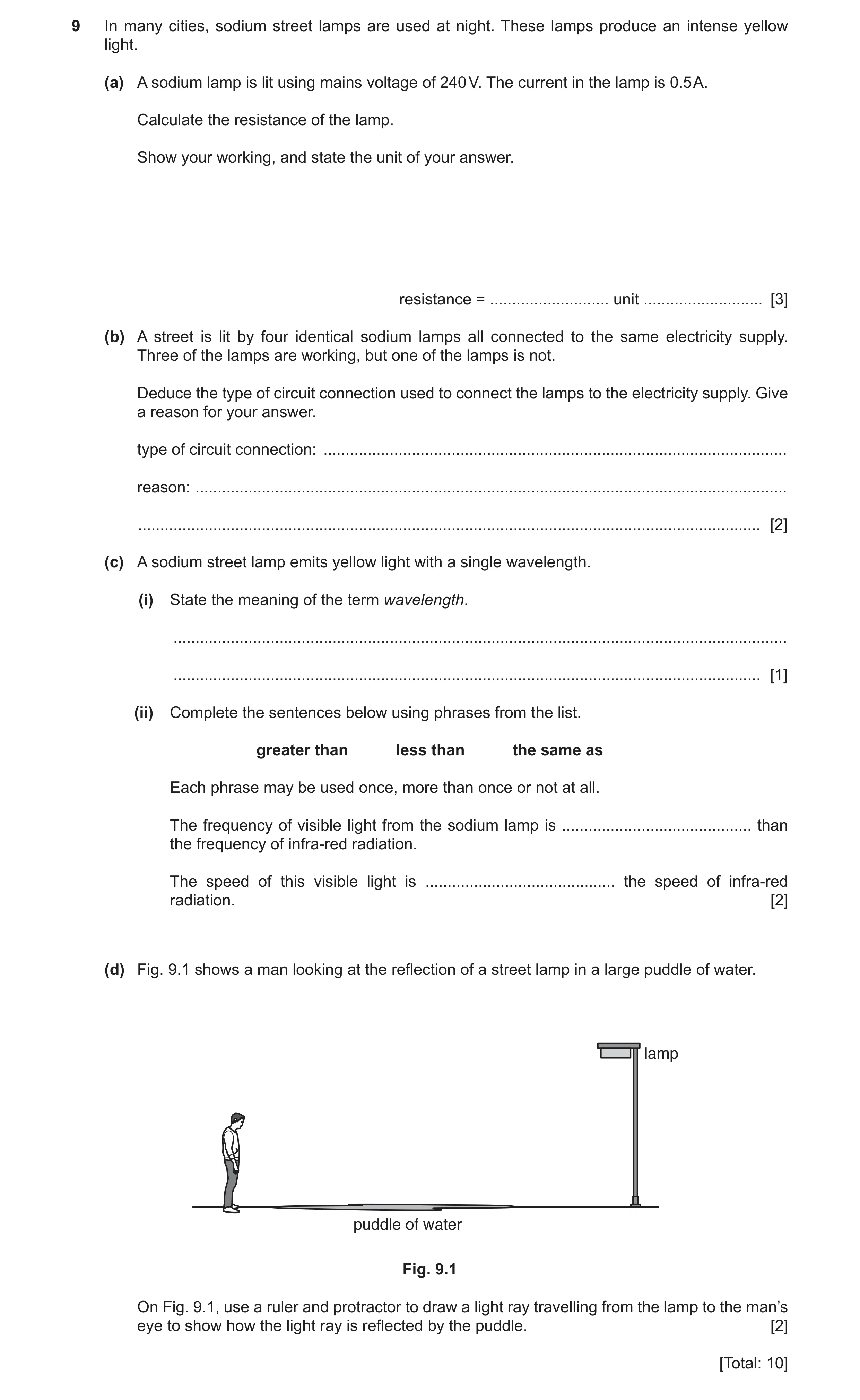
9 In many cities, sodium street lamps are used at night. These lamps produce an intense yellow light. (a) A sodium lamp is lit using mains voltage of 240 V. The current in the lamp is 0.5 A. Calculate the resistance of the lamp. Show your working, and state the unit of your answer. resistance = … unit … [3] (b) A street is lit by four identical sodium lamps all connected to the same electricity supply. Three of the lamps are working, but one of the lamps is not. Deduce the type of circuit connection used to connect the lamps to the electricity supply. Give a reason for your answer. type of circuit connection: … reason: … … [2] (c) A sodium street lamp emits yellow light with a single wavelength. (i) State the meaning of the term wavelength. … … [1] (ii) Complete the sentences below using phrases from the list. greater than less than the same as Each phrase may be used once, more than once or not at all. The frequency of visible light from the sodium lamp is … than the frequency of infra-red radiation. The speed of this visible light is … the speed of infra-red radiation. [2] (d) Fig. 9.1 shows a man looking at the reflection of a street lamp in a large puddle of water. lamp puddle of water Fig. 9.1 On Fig. 9.1, use a ruler and protractor to draw a light ray travelling from the lamp to the man’s eye to show how the light ray is reflected by the puddle. [2] [Total: 10]
10 marks
Mark scheme: 9(a) = 480 ; ohms / Ω ; 3 9(b) parallel ; if in series, all lamps would have gone out / lamp not working means a break in circuit / if in parallel there is still a complete circuit if one lamp goes out ; 2 Question Answer Marks 9(c)(i) distance between two successive crests / troughs ; 1 9(c)(ii) greater than ; the same as ; 2 9(d) incident ray and reflected ray both drawn with arrows ; angle of incidence and angle of reflection equal, judged by eye ; 2
This question in 0653/32 Feb/March 2019
Q9 · Complete the sentences using words from the list 0653/33 May/June 2019
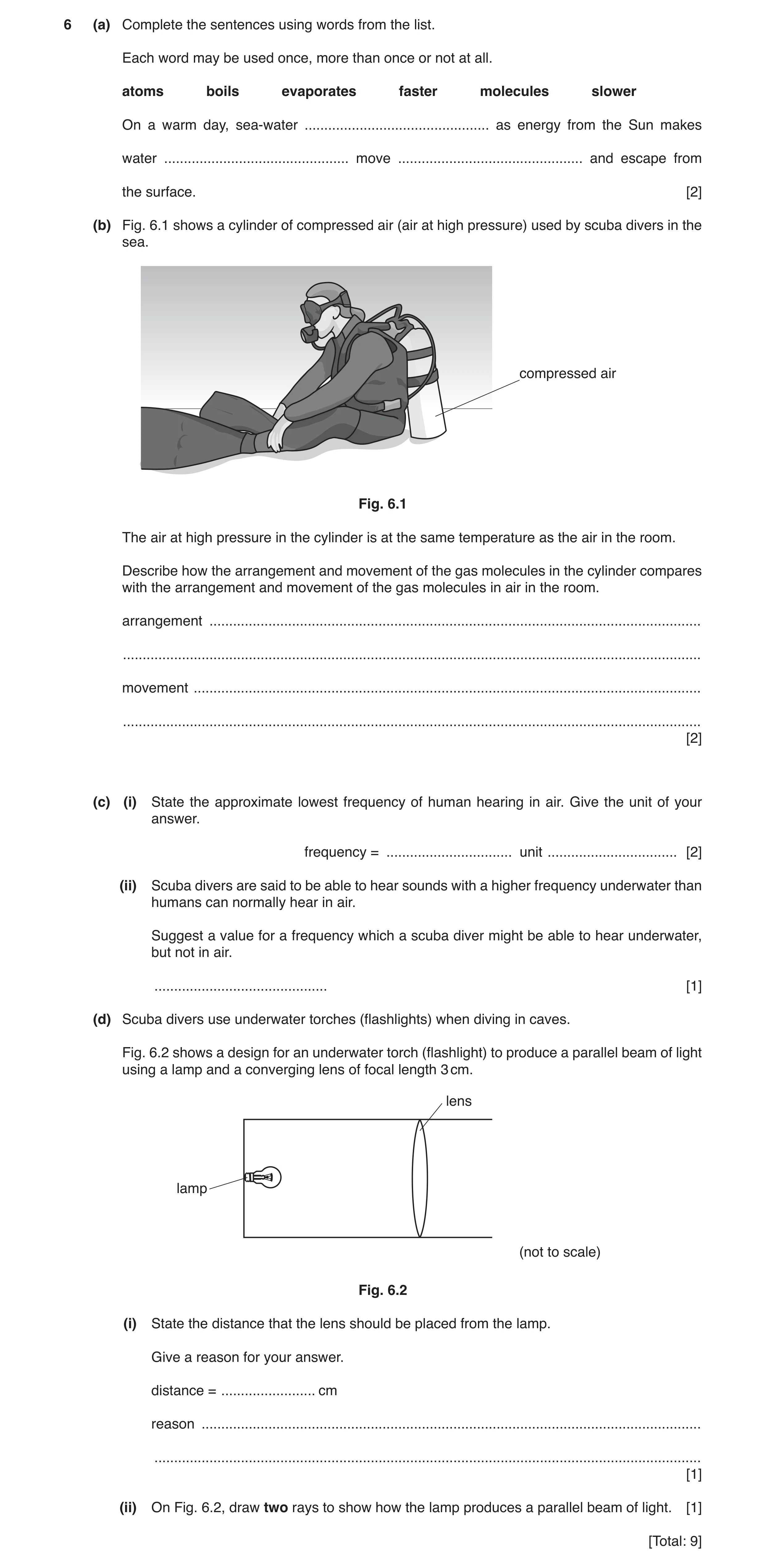
6 (a) Complete the sentences using words from the list. Each word may be used once, more than once or not at all. atoms boils evaporates faster molecules slower On a warm day, sea-water … as energy from the Sun makes water … move … and escape from the surface. [2] (b) Fig. 6.1 shows a cylinder of compressed air (air at high pressure) used by scuba divers in the sea. compressed air Fig. 6.1 The air at high pressure in the cylinder is at the same temperature as the air in the room. Describe how the arrangement and movement of the gas molecules in the cylinder compares with the arrangement and movement of the gas molecules in air in the room. arrangement … … movement … … [2] (c) (i) State the approximate lowest frequency of human hearing in air. Give the unit of your answer. frequency = … unit … [2] (ii) Scuba divers are said to be able to hear sounds with a higher frequency underwater than humans can normally hear in air. Suggest a value for a frequency which a scuba diver might be able to hear underwater, but not in air. … [1] (d) Scuba divers use underwater torches (flashlights) when diving in caves. Fig. 6.2 shows a design for an underwater torch (flashlight) to produce a parallel beam of light using a lamp and a converging lens of focal length 3 cm. lens lamp (not to scale) Fig. 6.2 (i) State the distance that the lens should be placed from the lamp. Give a reason for your answer. distance = … cm reason … … [1] (ii) On Fig. 6.2, draw two rays to show how the lamp produces a parallel beam of light. [1] [Total: 9]
9 marks
Mark scheme: 6(a) «evaporates« molecules « faster« ; ; any 2 correct for 1 mark all three correct for 2 marks 2 6(b) (molecules in the cylinder are) close together / less far apart ORA / random in both / arrangement irregular ; same speed (at same temperature) / both free to move around ; 2 6(c)(i) 20 ; Hz / hertz ; 2 6(c)(ii) any sensible value above 20 000 (Hz) ; 1 6(d)(i) (3 cm) no mark (to produce a parallel beam) must come from (principal) focus ; 1 6(d)(ii) ; 1
This question in 0653/33 May/June 2019
Question 10 0653/32 Feb/March 2020
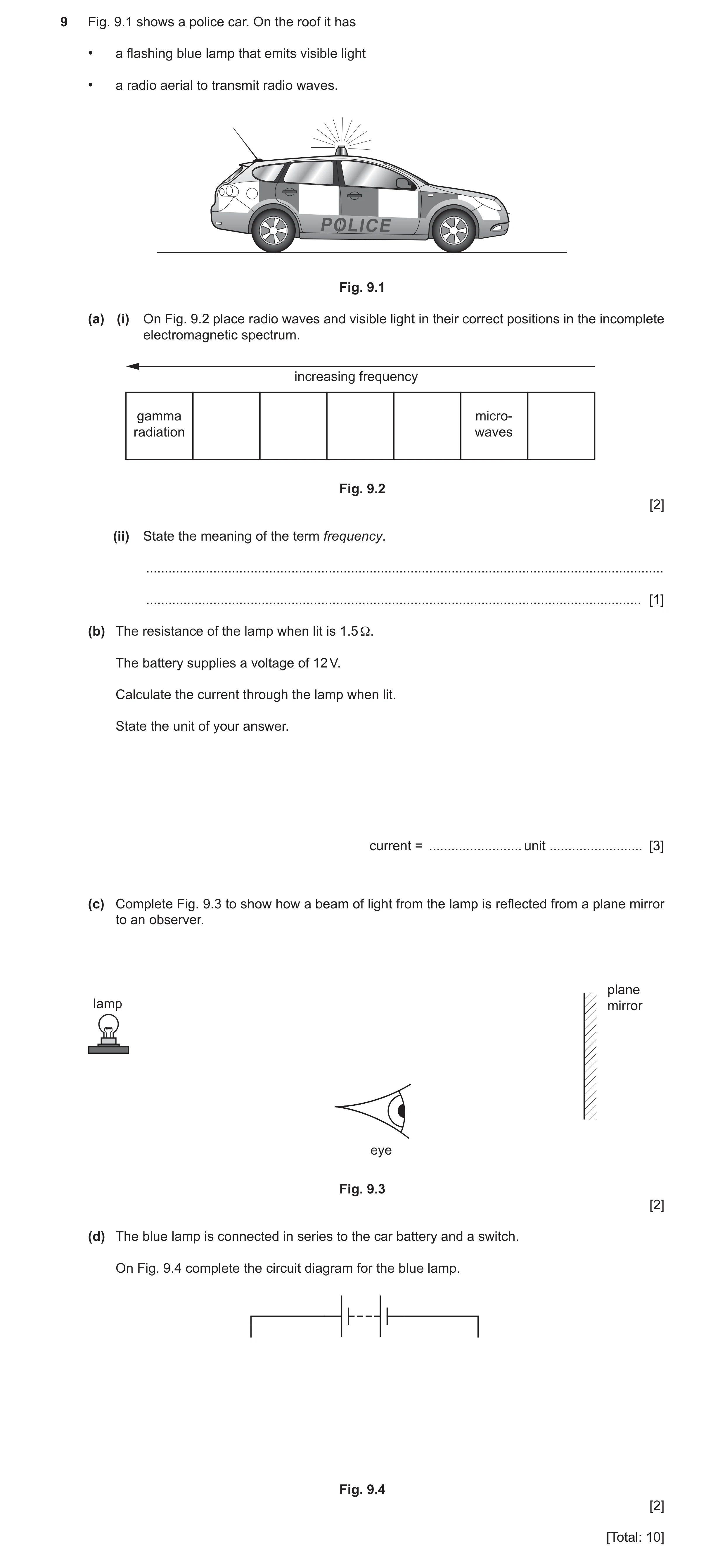
9 Fig. 9.1 shows a police car. On the roof it has • a flashing blue lamp that emits visible light • a radio aerial to transmit radio waves. P O L I C E Fig. 9.1 (a) (i) On Fig. 9.2 place radio waves and visible light in their correct positions in the incomplete electromagnetic spectrum. increasing frequency gamma micro- radiation waves Fig. 9.2 [2] (ii) State the meaning of the term frequency. … … [1] (b) The resistance of the lamp when lit is 1.5 Ω. The battery supplies a voltage of 12 V. Calculate the current through the lamp when lit. State the unit of your answer. current = … unit … [3] (c) Complete Fig. 9.3 to show how a beam of light from the lamp is reflected from a plane mirror to an observer. plane lamp mirror eye Fig. 9.3 [2] (d) The blue lamp is connected in series to the car battery and a switch. On Fig. 9.4 complete the circuit diagram for the blue lamp. Fig. 9.4 [2] [Total: 10]
10 marks
Mark scheme: 9(a)(i) gamma radiation (visible) light ; micro- waves radio waves ; 2 9(a)(ii) number of, vibrations / waves / oscillations per second ; 1 9(b) R = V / I or I = V / R = 12 / 1.5 ; = 8 ; (unit =) A ; 3 Question Answer Marks 9(c) 2 9(d) 2 ray from lamp to mirror to eye ; angle of incidence and angle of reflection at mirror judged by eye to be equal (normal not required) ; correct symbols for lamp and switch ; complete series circuit with no additional components ;
This question in 0653/32 Feb/March 2020
Q11 · A rocket about to transport a large mirror into orbit around the Earth 0653/31 May/June 2020
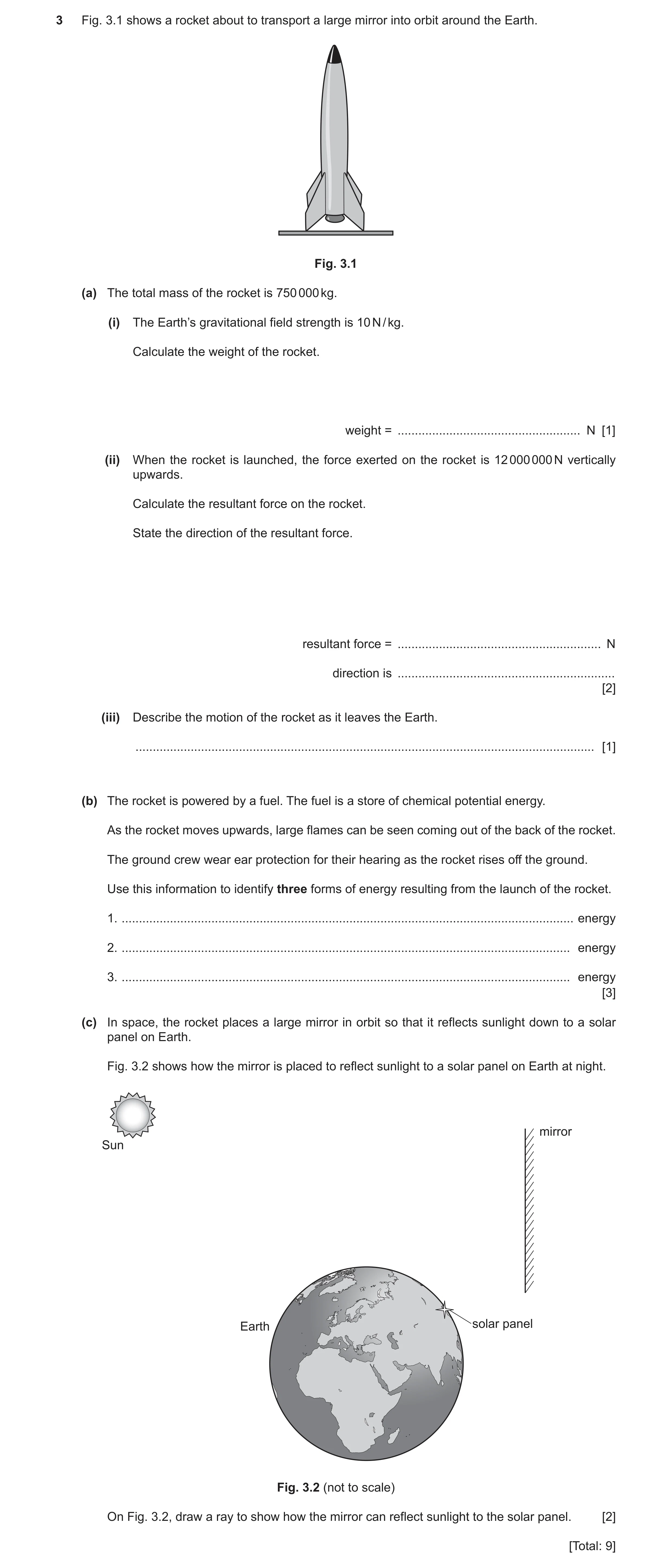
3 Fig. 3.1 shows a rocket about to transport a large mirror into orbit around the Earth. Fig. 3.1 (a) The total mass of the rocket is 750 000 kg. (i) The Earth’s gravitational field strength is 10 N / kg. Calculate the weight of the rocket. weight = … N [1] (ii) When the rocket is launched, the force exerted on the rocket is 12 000 000 N vertically upwards. Calculate the resultant force on the rocket. State the direction of the resultant force. resultant force = … N direction is … [2] (iii) Describe the motion of the rocket as it leaves the Earth. … [1] (b) The rocket is powered by a fuel. The fuel is a store of chemical potential energy. As the rocket moves upwards, large flames can be seen coming out of the back of the rocket. The ground crew wear ear protection for their hearing as the rocket rises off the ground. Use this information to identify three forms of energy resulting from the launch of the rocket. 1. … energy 2. … energy 3. … energy [3] (c) In space, the rocket places a large mirror in orbit so that it reflects sunlight down to a solar panel on Earth. Fig. 3.2 shows how the mirror is placed to reflect sunlight to a solar panel on Earth at night. mirror Sun Earth solar panel Fig. 3.2 (not to scale) On Fig. 3.2, draw a ray to show how the mirror can reflect sunlight to the solar panel. [2] [Total: 9]
9 marks
Mark scheme: 3(a)(i) (weight = 750000 × 10 =) 7500000 (N) ; 1 3(a)(ii) (resultant force = 12 000 000 – 7 500 000 =) 4 500 000 (N) ; (vertically) upwards ; 2 3(a)(iii) accelerating / increasing speed ; 1 3(b) any three from: gravitational potential ; kinetic ; light ; sound ; thermal / heat ; max 3 3(c) ray from Sun to mirror reflected to solar panel ; angle of incidence equal to angle of reflection by visual inspection ; 2
This question in 0653/31 May/June 2020
Q12 · A device called a ‘solar still’ 0653/32 Oct/Nov 2020
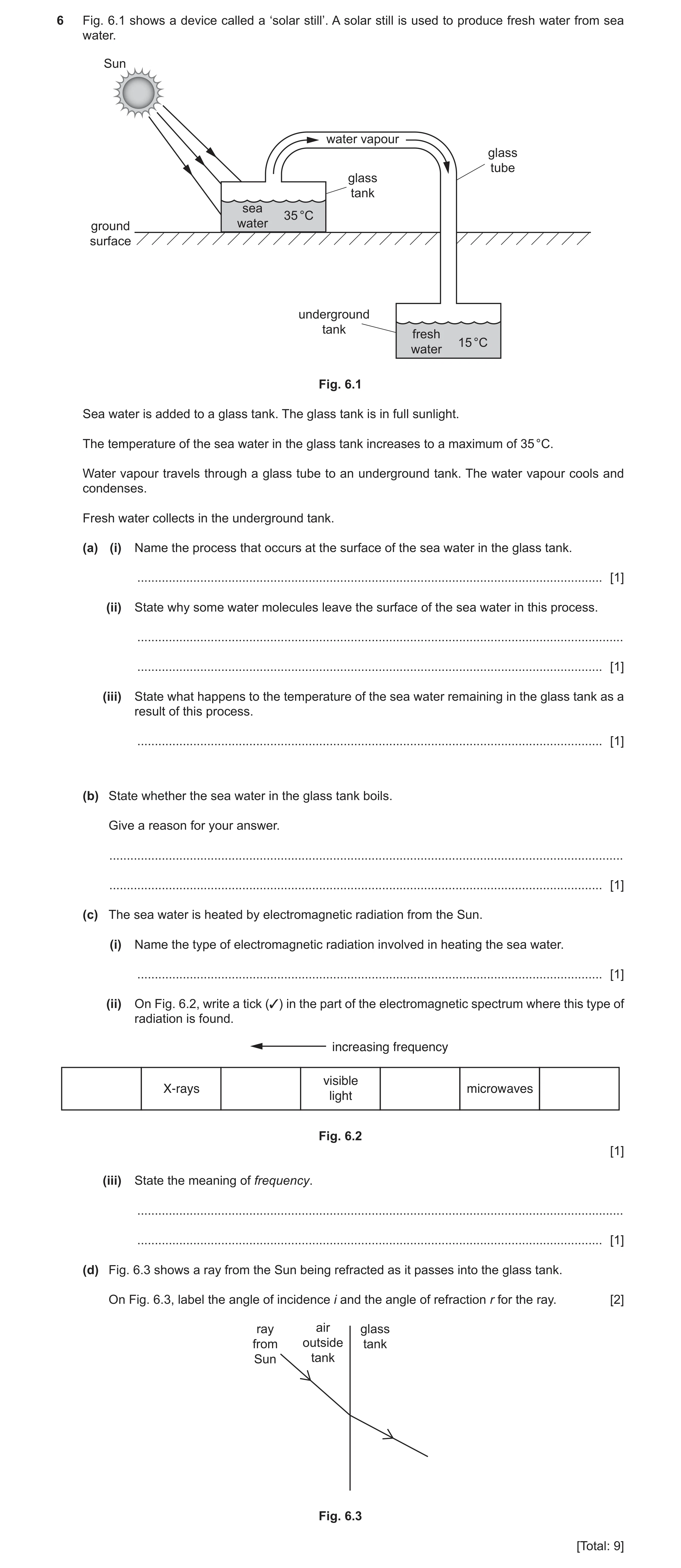
6 Fig. 6.1 shows a device called a ‘solar still’. A solar still is used to produce fresh water from sea water. Sun water vapour glass tube glass tank sea 35 °C ground water surface underground tank fresh 15 °C water Fig. 6.1 Sea water is added to a glass tank. The glass tank is in full sunlight. The temperature of the sea water in the glass tank increases to a maximum of 35 °C. Water vapour travels through a glass tube to an underground tank. The water vapour cools and condenses. Fresh water collects in the underground tank. (a) (i) Name the process that occurs at the surface of the sea water in the glass tank. … [1] (ii) State why some water molecules leave the surface of the sea water in this process. … … [1] (iii) State what happens to the temperature of the sea water remaining in the glass tank as a result of this process. … [1] (b) State whether the sea water in the glass tank boils. Give a reason for your answer. … … [1] (c) The sea water is heated by electromagnetic radiation from the Sun. (i) Name the type of electromagnetic radiation involved in heating the sea water. … [1] (ii) On Fig. 6.2, write a tick (3) in the part of the electromagnetic spectrum where this type of radiation is found. increasing frequency visible X-rays microwaves light Fig. 6.2 [1] (iii) State the meaning of frequency. … … [1] (d) Fig. 6.3 shows a ray from the Sun being refracted as it passes into the glass tank. On Fig. 6.3, label the angle of incidence i and the angle of refraction r for the ray. [2] ray air glass from outside tank Sun tank Fig. 6.3 [Total: 9]
9 marks
Mark scheme: 6(a)(i) evaporation ; 1 6(a)(ii) faster / more energetic molecules have enough energy to (break their bonds and) escape ; 1 6(a)(iii) (temperature) decreases / (sea water) cools down ; 1 Question Answer Marks 6(b) No AND (because) maximum temperature is below boiling point of (sea) water ; 1 6(c)(i) infrared ; 1 6(c)(ii) increasing frequency X-rays visible light microwaves ; 1 6(c)(iii) the number of complete waves per second / the number of waves that pass a fixed point in unit time ; 1 6(d) angle i correctly located ; angle r correctly located ; 2
This question in 0653/32 Oct/Nov 2020
Q13 · Gamma rays are a type of electromagnetic radiation 0653/33 Oct/Nov 2020
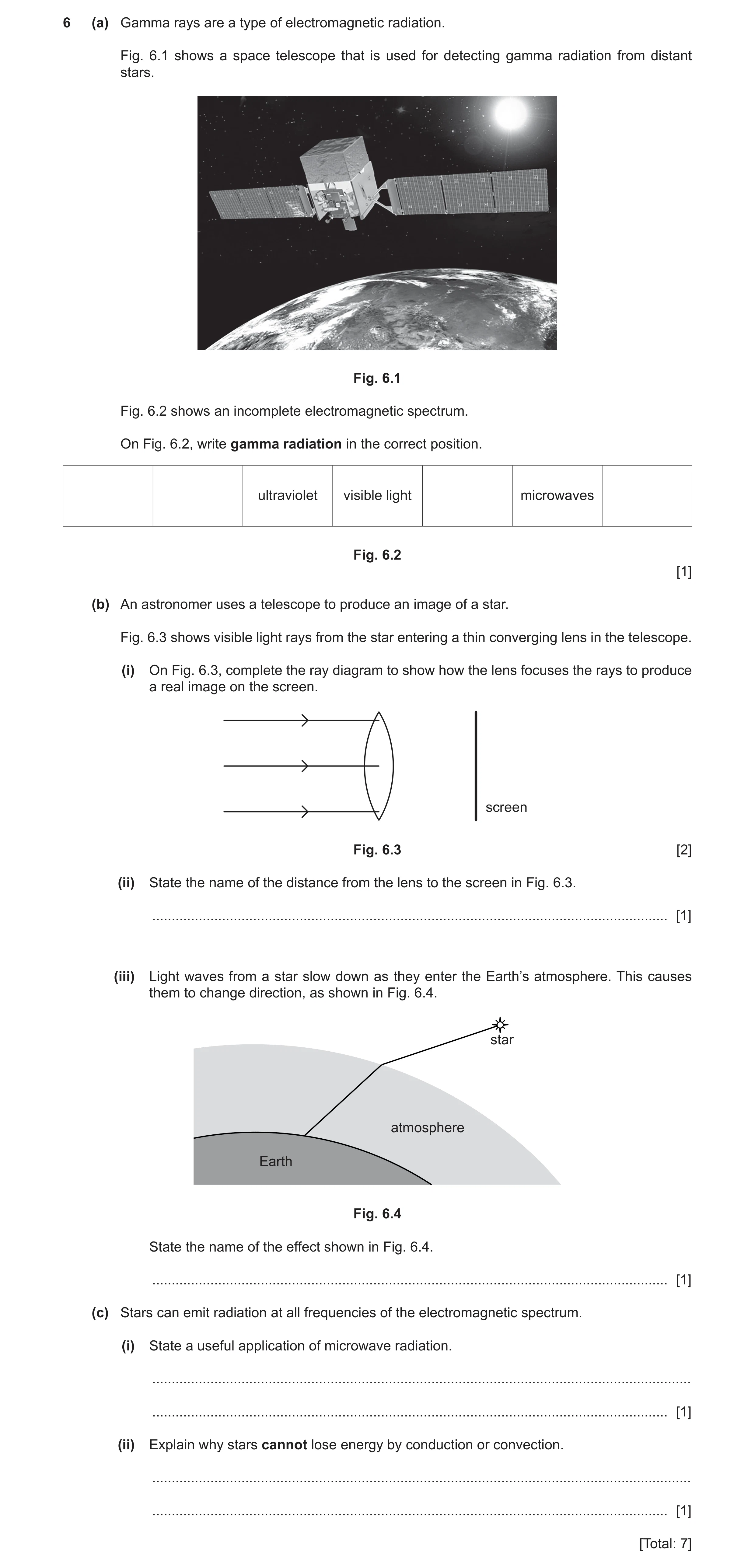
6 (a) Gamma rays are a type of electromagnetic radiation. Fig. 6.1 shows a space telescope that is used for detecting gamma radiation from distant stars. Fig. 6.1 Fig. 6.2 shows an incomplete electromagnetic spectrum. On Fig. 6.2, write gamma radiation in the correct position. ultraviolet visible light microwaves Fig. 6.2 [1] (b) An astronomer uses a telescope to produce an image of a star. Fig. 6.3 shows visible light rays from the star entering a thin converging lens in the telescope. (i) On Fig. 6.3, complete the ray diagram to show how the lens focuses the rays to produce a real image on the screen. screen Fig. 6.3 [2] (ii) State the name of the distance from the lens to the screen in Fig. 6.3. … [1] (iii) Light waves from a star slow down as they enter the Earth’s atmosphere. This causes them to change direction, as shown in Fig. 6.4. star atmosphere Earth Fig. 6.4 State the name of the effect shown in Fig. 6.4. … [1] (c) Stars can emit radiation at all frequencies of the electromagnetic spectrum. (i) State a useful application of microwave radiation. … … [1] (ii) Explain why stars cannot lose energy by conduction or convection. … … [1] [Total: 7]
7 marks
Mark scheme: 6(a) gamma radiation (ultraviolet) (visible light) (microwaves) 1 6(b)(i) 3 rays continued to converge AND middle ray straight ; meeting at point on screen ; 2 6(b)(ii) focal length ; 1 6(b)(iii) refraction ; 1 6(c)(i) satellite TV / mobile phones / microwave ovens ; 1 6(c)(ii) no matter in space / conduction and convection require, a medium / matter; 1
This question in 0653/33 Oct/Nov 2020
Q14 · Two identical street lamps are connected in parallel to the mains electricity supply 0653/32 Feb/March 2021
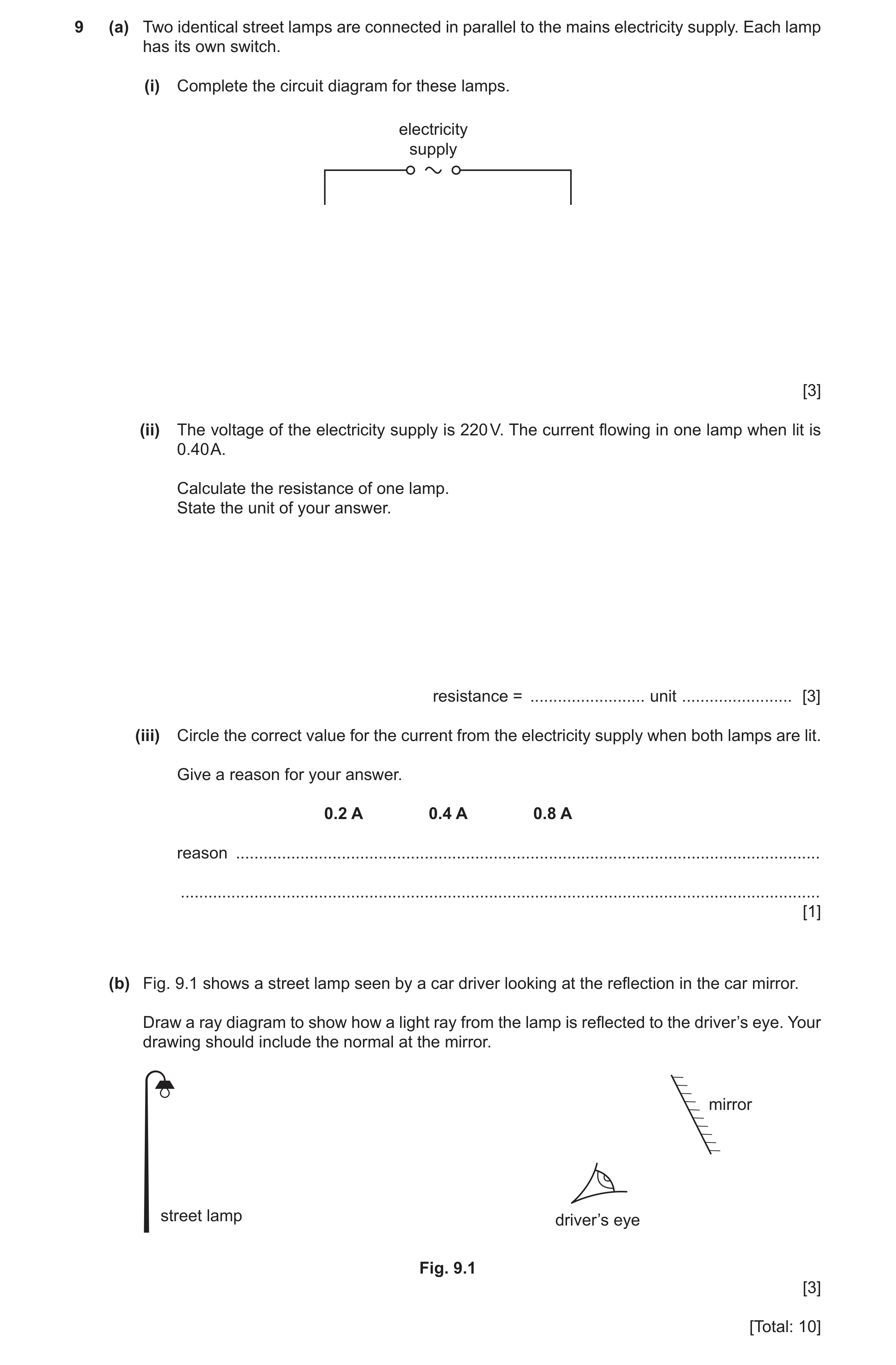
9 (a) Two identical street lamps are connected in parallel to the mains electricity supply. Each lamp has its own switch. (i) Complete the circuit diagram for these lamps. electricity supply [3] (ii) The voltage of the electricity supply is 220 V. The current flowing in one lamp when lit is 0.40 A. Calculate the resistance of one lamp. State the unit of your answer. resistance = … unit … [3] (iii) Circle the correct value for the current from the electricity supply when both lamps are lit. Give a reason for your answer. 0.2 A 0.4 A 0.8 A reason … … [1] (b) Fig. 9.1 shows a street lamp seen by a car driver looking at the reflection in the car mirror. Draw a ray diagram to show how a light ray from the lamp is reflected to the driver’s eye. Your drawing should include the normal at the mirror. mirror street lamp driver’s eye Fig. 9.1 [3] [Total: 10]
10 marks
Mark scheme: 9(a)(i) 3 correct symbols for lamp and switch ; one switch in series in each branch ; two lamps in parallel with power supply ; Question Answer Marks 9(a)(ii) R = V ÷ I = 220 ÷ 0.4 ; = 550 ; ohms / Ω ; 3 9(a)(iii) 0.8 A (circled) AND (reason) current from source greater than in branches for parallel circuit ; 1 9(b) 3 incident ray from light and reflected ray to driver’s eye, arrow included ; normal shown, approx. 90° by eye ; angles of incidence and reflection judged equal by eye ;
This question in 0653/32 Feb/March 2021
Q15 · Thermal energy being transferred to a beaker full of water 0653/32 May/June 2021
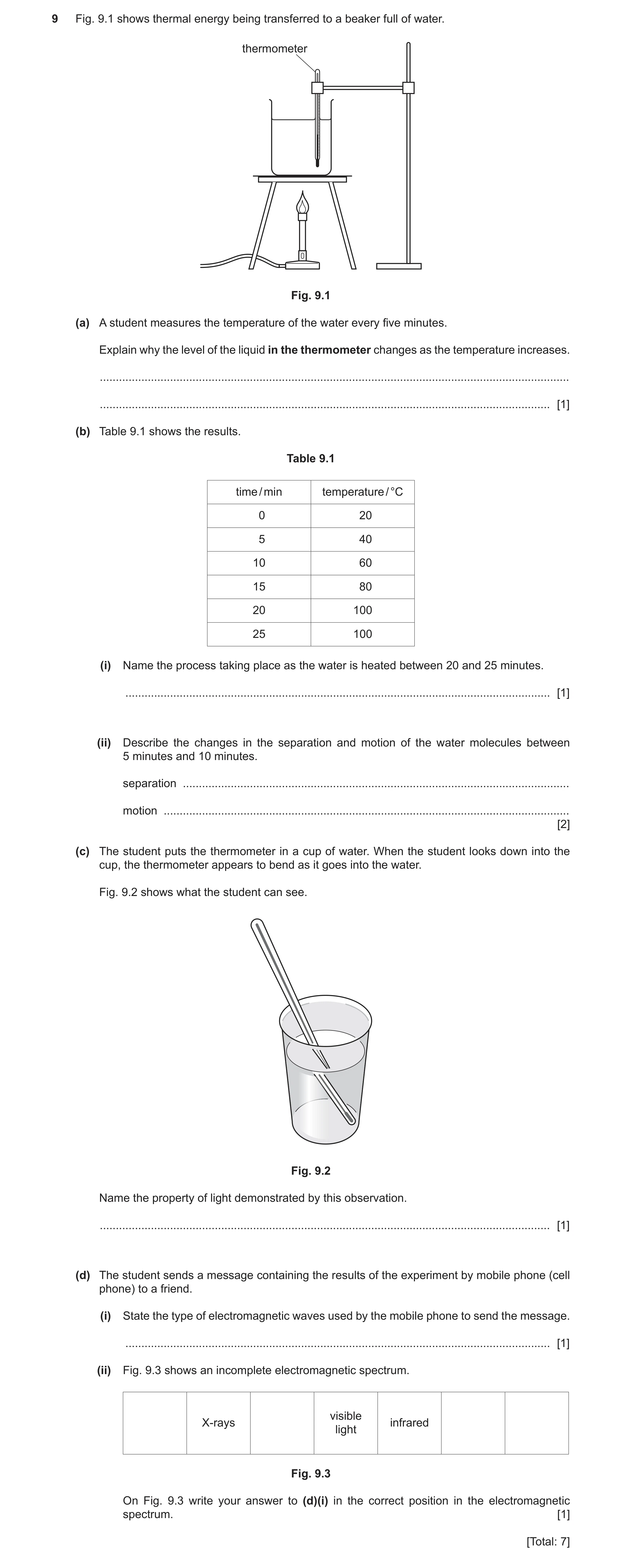
9 Fig. 9.1 shows thermal energy being transferred to a beaker full of water. thermometer Fig. 9.1 (a) A student measures the temperature of the water every five minutes. Explain why the level of the liquid in the thermometer changes as the temperature increases. … … [1] (b) Table 9.1 shows the results. Table 9.1 time / min temperature / °C 0 20 5 40 10 60 15 80 20 100 25 100 (i) Name the process taking place as the water is heated between 20 and 25 minutes. … [1] (ii) Describe the changes in the separation and motion of the water molecules between 5 minutes and 10 minutes. separation … motion … [2] (c) The student puts the thermometer in a cup of water. When the student looks down into the cup, the thermometer appears to bend as it goes into the water. Fig. 9.2 shows what the student can see. Fig. 9.2 Name the property of light demonstrated by this observation. … [1] (d) The student sends a message containing the results of the experiment by mobile phone (cell phone) to a friend. (i) State the type of electromagnetic waves used by the mobile phone to send the message. … [1] (ii) Fig. 9.3 shows an incomplete electromagnetic spectrum. visible X-rays infrared light Fig. 9.3 On Fig. 9.3 write your answer to (d)(i) in the correct position in the electromagnetic spectrum. [1] [Total: 7]
7 marks
Mark scheme: 9(a) liquids expand / volume increases (with temperature rise) ; 1 9(b)(i) boiling ; 1 9(b)(ii) separation: (molecules) further apart ; motion: (molecules) move faster ; 2 9(c) refraction ; 1 9(d)(i) radio waves / microwaves ; 1 9(d)(ii) gamma X-rays ultraviolet visible light infrared microwaves radio waves stated waves in (d)(i) in correct position ; 1
This question in 0653/32 May/June 2021
Q16 · The melting points and boiling points of six substances 0653/33 May/June 2021
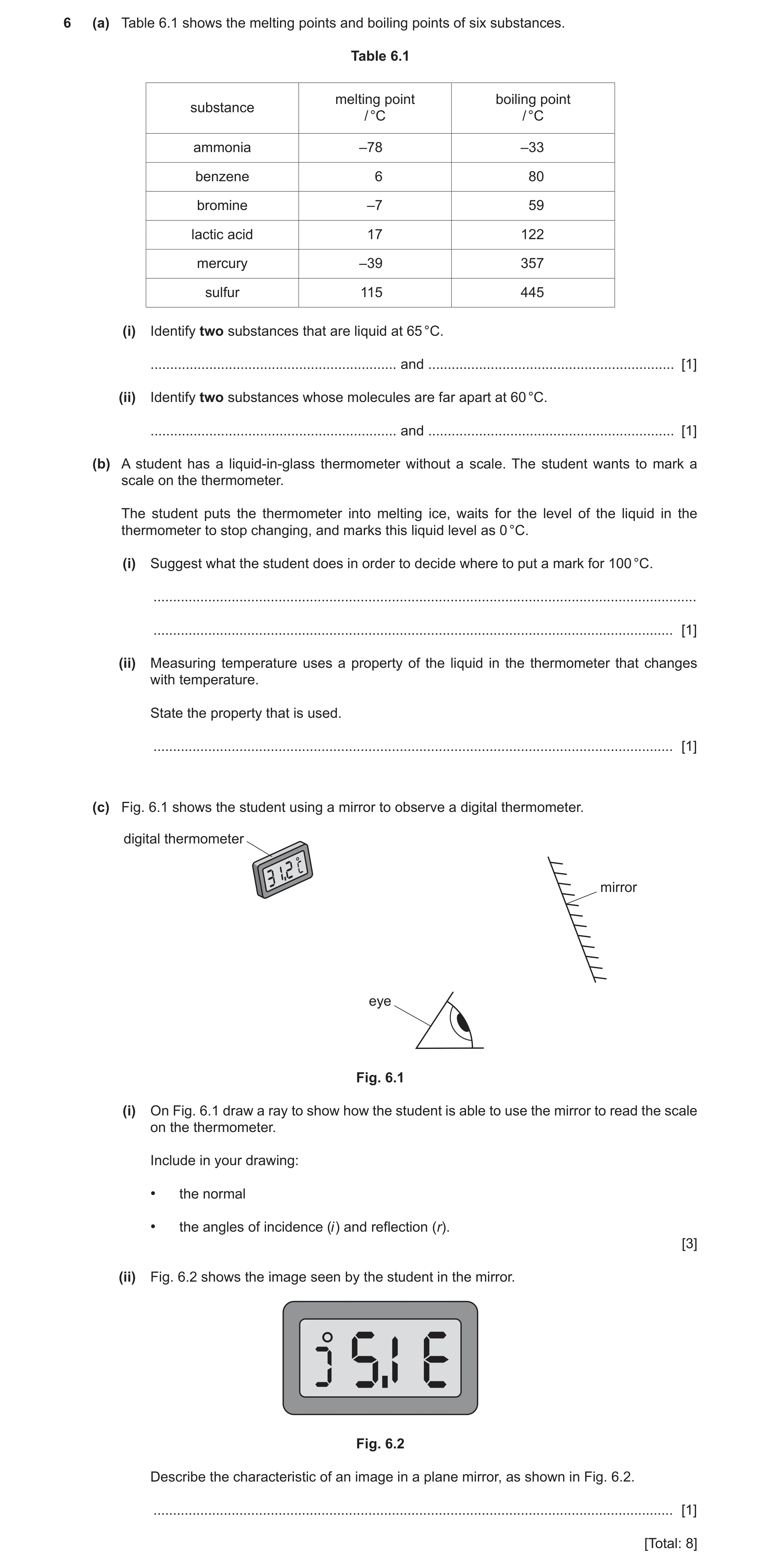
6 (a) Table 6.1 shows the melting points and boiling points of six substances. Table 6.1 melting point boiling point substance / °C / °C ammonia –78 –33 benzene 6 80 bromine –7 59 lactic acid 17 122 mercury –39 357 sulfur 115 445 (i) Identify two substances that are liquid at 65 °C. … and … [1] (ii) Identify two substances whose molecules are far apart at 60 °C. … and … [1] (b) A student has a liquid-in-glass thermometer without a scale. The student wants to mark a scale on the thermometer. The student puts the thermometer into melting ice, waits for the level of the liquid in the thermometer to stop changing, and marks this liquid level as 0 °C. (i) Suggest what the student does in order to decide where to put a mark for 100 °C. … … [1] (ii) Measuring temperature uses a property of the liquid in the thermometer that changes with temperature. State the property that is used. … [1] (c) Fig. 6.1 shows the student using a mirror to observe a digital thermometer. digital thermometer mirror eye Fig. 6.1 (i) On Fig. 6.1 draw a ray to show how the student is able to use the mirror to read the scale on the thermometer. Include in your drawing: • the normal • the angles of incidence (i) and reflection (r). [3] (ii) Fig. 6.2 shows the image seen by the student in the mirror. Fig. 6.2 Describe the characteristic of an image in a plane mirror, as shown in Fig. 6.2. … [1] [Total: 8]
8 marks
Mark scheme: 6(a)(i) any two for one mark: benzene / lactic acid / mercury ; 1 6(a)(ii) ammonia AND bromine ; 1 6(b)(i) hold bulb in boiling water / hold bulb in steam (above boiling water) ; 1 6(b)(ii) (thermal) expansion / increase in volume ; 1 Question Answer Marks 6(c)(i) ray from thermometer to mirror to eye, with at least one arrowhead ; normal drawn at mirror with equal angles (judged by eye) of incidence and reflection ; i and r correctly marked ; 3 6(c)(ii) laterally inverted OWTTE ; 1
This question in 0653/33 May/June 2021
Q17 · A gas flame being used to heat a metal kettle of water until the water boils 0653/31 Oct/Nov 2021
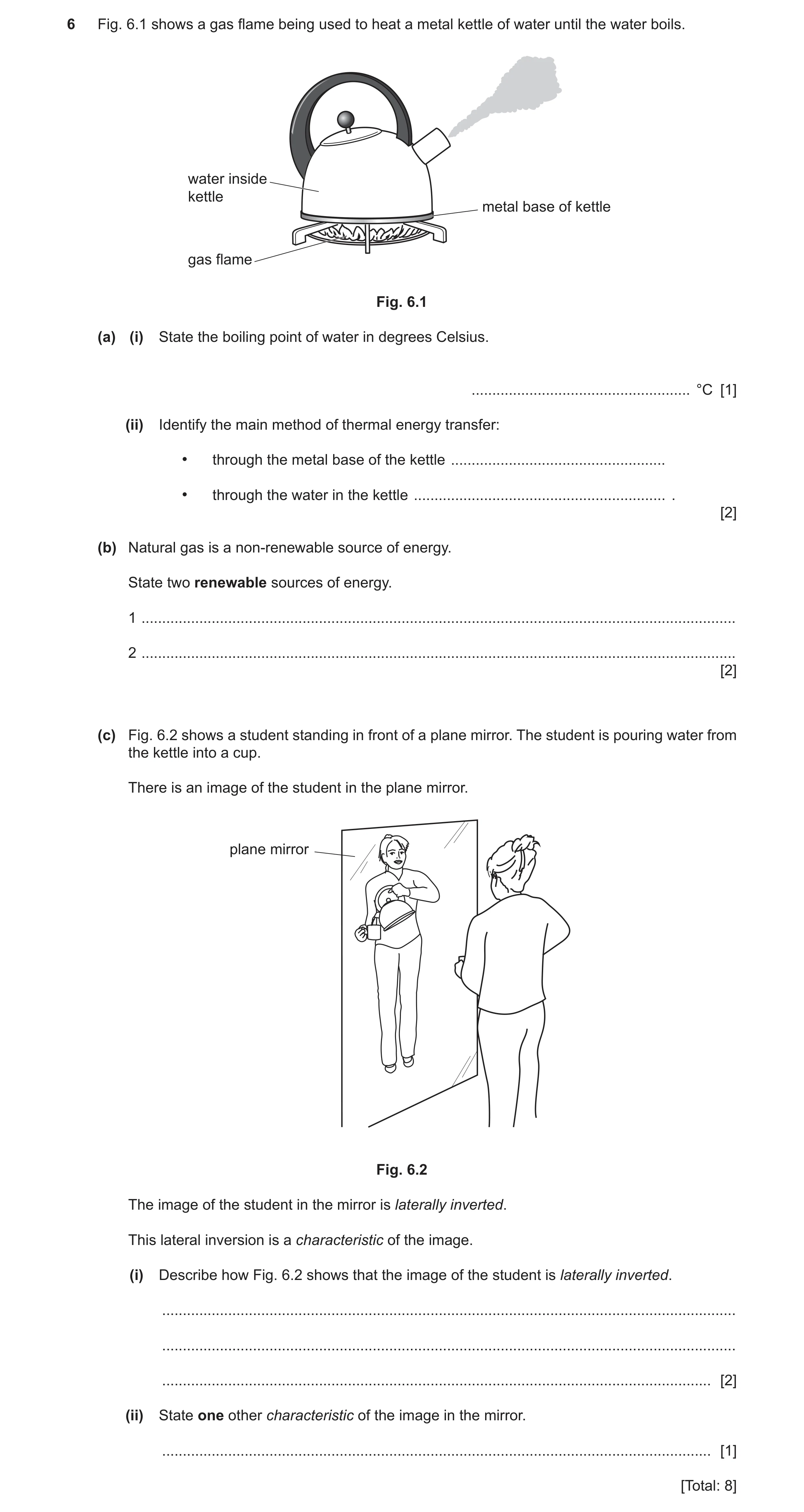
6 Fig. 6.1 shows a gas flame being used to heat a metal kettle of water until the water boils. water inside kettle metal base of kettle gas flame Fig. 6.1 (a) (i) State the boiling point of water in degrees Celsius. … °C [1] (ii) Identify the main method of thermal energy transfer: • through the metal base of the kettle … • through the water in the kettle … . [2] (b) Natural gas is a non-renewable source of energy. State two renewable sources of energy. 1 … 2 … [2] (c) Fig. 6.2 shows a student standing in front of a plane mirror. The student is pouring water from the kettle into a cup. There is an image of the student in the plane mirror. plane mirror Fig. 6.2 The image of the student in the mirror is laterally inverted. This lateral inversion is a characteristic of the image. (i) Describe how Fig. 6.2 shows that the image of the student is laterally inverted. … … … [2] (ii) State one other characteristic of the image in the mirror. … [1] [Total: 8]
8 marks
Mark scheme: 6(a)(i) 100 (°C) ; 1 6(a)(ii) conduction ; convection ; 2 6(b) any two from: solar ; wind ; hydroelectric ; tidal ; wave ; geothermal ; 2 6(c)(i) the student is holding the kettle in her right hand / AW ; mirror image is holding the kettle in her left hand / AW ; 2 6(c)(ii) any one from: upright ; virtual ; same size (as object) ; distance of image from mirror equal to distance of object from mirror ; 1
This question in 0653/31 Oct/Nov 2021
Q18 · A meteorite is a rock from space that travels through the Earth’s atmosphere and hits the… 0653/32 Oct/Nov 2021
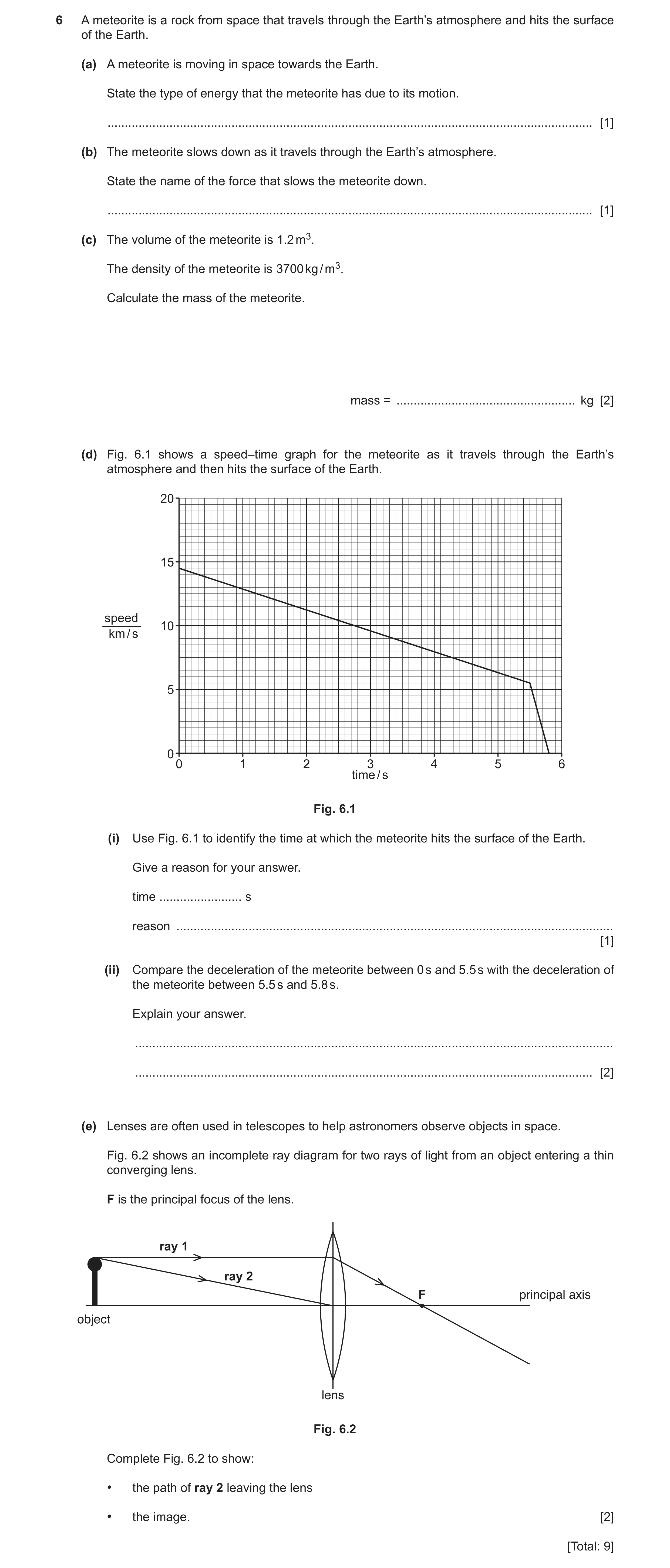
6 A meteorite is a rock from space that travels through the Earth’s atmosphere and hits the surface of the Earth. (a) A meteorite is moving in space towards the Earth. State the type of energy that the meteorite has due to its motion. … [1] (b) The meteorite slows down as it travels through the Earth’s atmosphere. State the name of the force that slows the meteorite down. … [1] (c) The volume of the meteorite is 1.2 m3. The density of the meteorite is 3700 kg / m3. Calculate the mass of the meteorite. mass = … kg [2] (d) Fig. 6.1 shows a speed–time graph for the meteorite as it travels through the Earth’s atmosphere and then hits the surface of the Earth. 20 15 speed 10 km / s 5 0 0 1 2 3 4 5 6 time / s Fig. 6.1 (i) Use Fig. 6.1 to identify the time at which the meteorite hits the surface of the Earth. Give a reason for your answer. time … s reason … [1] (ii) Compare the deceleration of the meteorite between 0 s and 5.5 s with the deceleration of the meteorite between 5.5 s and 5.8 s. Explain your answer. … … [2] (e) Lenses are often used in telescopes to help astronomers observe objects in space. Fig. 6.2 shows an incomplete ray diagram for two rays of light from an object entering a thin converging lens. F is the principal focus of the lens. ray 1 ray 2 F principal axis object lens Fig. 6.2 Complete Fig. 6.2 to show: • the path of ray 2 leaving the lens • the image. [2] [Total: 9]
9 marks
Mark scheme: 6(a) kinetic (energy) ; 1 6(b) air resistance ; 1 6(c) density = mass ÷ volume in any form / 3700 × 1.2 ; 4400 (kg) ; 2 6(d)(i) 5.5–5.8 s AND sudden decrease in speed / large deceleration ; 1 6(d)(ii) smaller deceleration for (0–5.5) s ; less steep gradient on graph ; 2 6(e) (ray 2) undeviated straight line ; (image) inverted AND from principal axis to intersection of ray 1 and ray 2 ; 2
This question in 0653/32 Oct/Nov 2021
Q19 · A meteorite is a rock from space that travels through the Earth’s atmosphere and hits the… 0653/33 Oct/Nov 2021
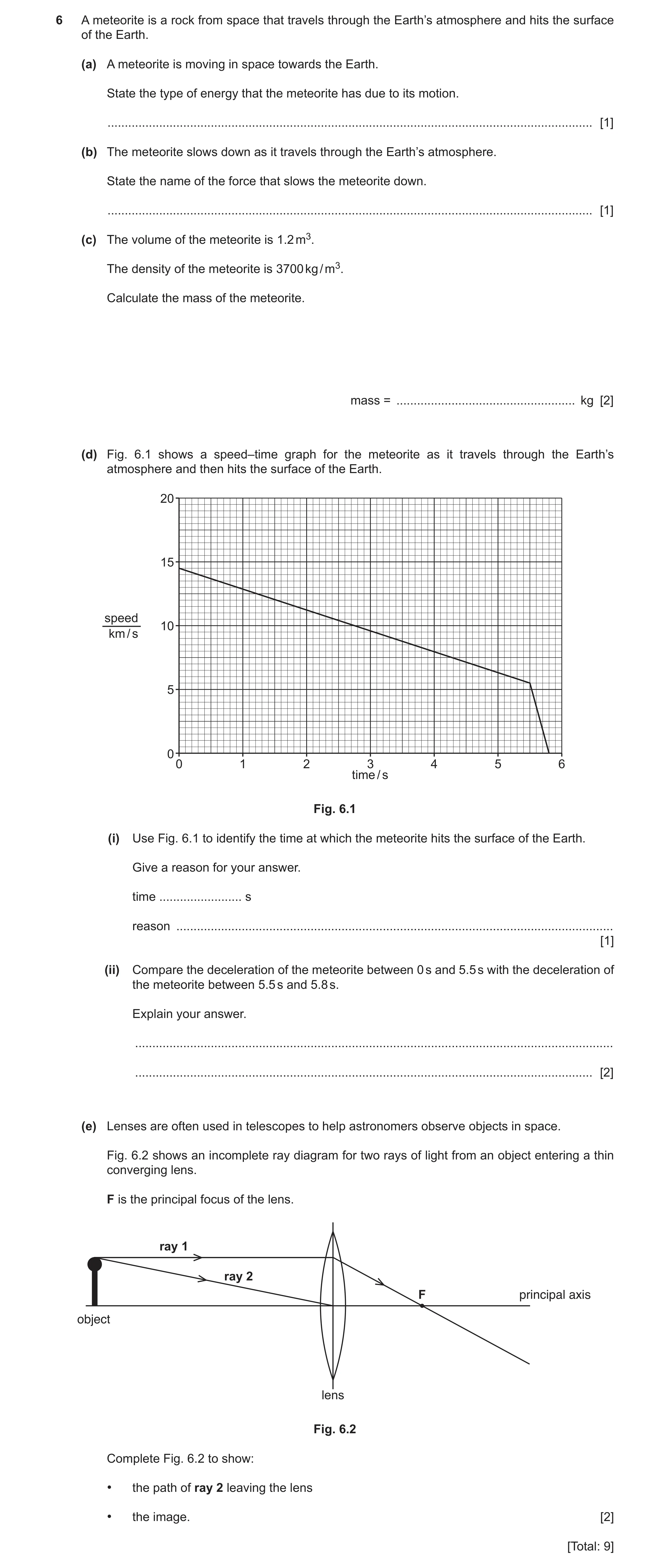
6 A meteorite is a rock from space that travels through the Earth’s atmosphere and hits the surface of the Earth. (a) A meteorite is moving in space towards the Earth. State the type of energy that the meteorite has due to its motion. … [1] (b) The meteorite slows down as it travels through the Earth’s atmosphere. State the name of the force that slows the meteorite down. … [1] (c) The volume of the meteorite is 1.2 m3. The density of the meteorite is 3700 kg / m3. Calculate the mass of the meteorite. mass = … kg [2] (d) Fig. 6.1 shows a speed–time graph for the meteorite as it travels through the Earth’s atmosphere and then hits the surface of the Earth. 20 15 speed 10 km / s 5 0 0 1 2 3 4 5 6 time / s Fig. 6.1 (i) Use Fig. 6.1 to identify the time at which the meteorite hits the surface of the Earth. Give a reason for your answer. time … s reason … [1] (ii) Compare the deceleration of the meteorite between 0 s and 5.5 s with the deceleration of the meteorite between 5.5 s and 5.8 s. Explain your answer. … … [2] (e) Lenses are often used in telescopes to help astronomers observe objects in space. Fig. 6.2 shows an incomplete ray diagram for two rays of light from an object entering a thin converging lens. F is the principal focus of the lens. ray 1 ray 2 F principal axis object lens Fig. 6.2 Complete Fig. 6.2 to show: • the path of ray 2 leaving the lens • the image. [2] [Total: 9]
9 marks
Mark scheme: 6(a) kinetic (energy) ; 1 6(b) air resistance ; 1 6(c) density = mass ÷ volume in any form / 3700 × 1.2 ; 4400 (kg) ; 2 6(d)(i) 5.5–5.8 s AND sudden decrease in speed / large deceleration ; 1 6(d)(ii) smaller deceleration for (0–5.5) s ; less steep gradient on graph ; 2 6(e) (ray 2) undeviated straight line ; (image) inverted AND from principal axis to intersection of ray 1 and ray 2 ; 2
This question in 0653/33 Oct/Nov 2021
Q20 · An ice cube floating in a glass of water 0653/33 May/June 2022
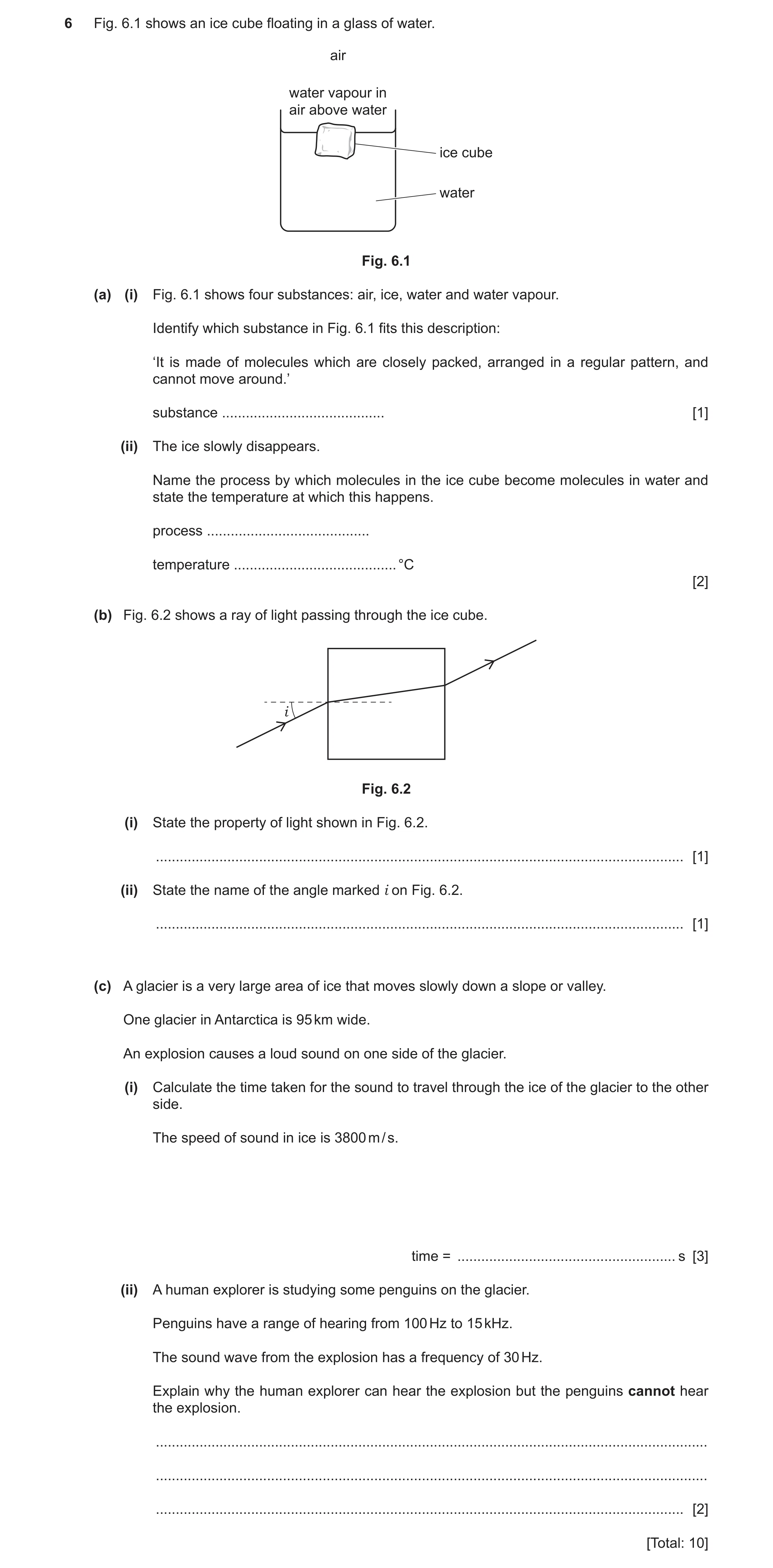
6 Fig. 6.1 shows an ice cube floating in a glass of water. air water vapour in air above water ice cube water Fig. 6.1 (a) (i) Fig. 6.1 shows four substances: air, ice, water and water vapour. Identify which substance in Fig. 6.1 fits this description: ‘It is made of molecules which are closely packed, arranged in a regular pattern, and cannot move around.’ substance … [1] (ii) The ice slowly disappears. Name the process by which molecules in the ice cube become molecules in water and state the temperature at which this happens. process … temperature … °C [2] (b) Fig. 6.2 shows a ray of light passing through the ice cube. i Fig. 6.2 (i) State the property of light shown in Fig. 6.2. … [1] (ii) State the name of the angle marked i on Fig. 6.2. … [1] (c) A glacier is a very large area of ice that moves slowly down a slope or valley. One glacier in Antarctica is 95 km wide. An explosion causes a loud sound on one side of the glacier. (i) Calculate the time taken for the sound to travel through the ice of the glacier to the other side. The speed of sound in ice is 3800 m / s. time = … s [3] (ii) A human explorer is studying some penguins on the glacier. Penguins have a range of hearing from 100 Hz to 15 kHz. The sound wave from the explosion has a frequency of 30 Hz. Explain why the human explorer can hear the explosion but the penguins cannot hear the explosion. … … … [2] [Total: 10]
10 marks
Mark scheme: 6(a)(i) ice ; 1 6(a)(ii) melting ; 0 (°C) ; 2 Question Answer Marks 6(b)(i) refraction ; 1 6(b)(ii) (angle of) incidence ; 1 6(c)(i) speed = distance ÷ time (in any form) OR = 95 000 ÷ 3800 OR 95 ÷ 3.8 ; unit conversion: 95 km = 95 000 m OR 3800 m / s = 3.8 km / s ; 25 (s) ; 3 6(c)(ii) (sound of explosion) outside range of hearing for penguins ; human hearing range 20 Hz – 20 kHz includes frequency of explosion ; 2
This question in 0653/33 May/June 2022
Q21 · A house in the Himalayas 0653/32 Feb/March 2023
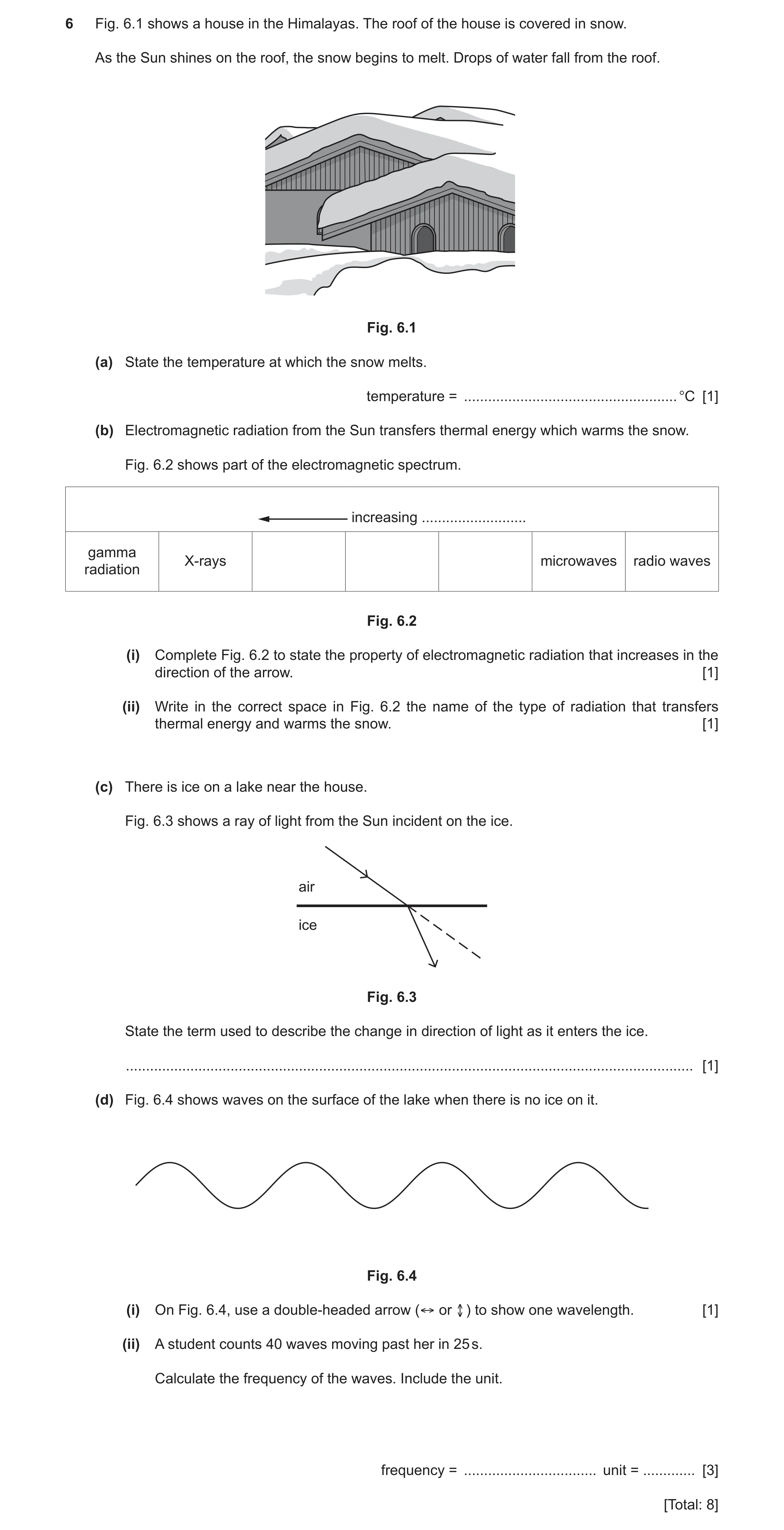
6 Fig. 6.1 shows a house in the Himalayas. The roof of the house is covered in snow. As the Sun shines on the roof, the snow begins to melt. Drops of water fall from the roof. Fig. 6.1 (a) State the temperature at which the snow melts. temperature = … °C [1] (b) Electromagnetic radiation from the Sun transfers thermal energy which warms the snow. Fig. 6.2 shows part of the electromagnetic spectrum. increasing … gamma X‑rays microwaves radio waves radiation Fig. 6.2 (i) Complete Fig. 6.2 to state the property of electromagnetic radiation that increases in the direction of the arrow. [1] (ii) Write in the correct space in Fig. 6.2 the name of the type of radiation that transfers thermal energy and warms the snow. [1] (c) There is ice on a lake near the house. Fig. 6.3 shows a ray of light from the Sun incident on the ice. air ice Fig. 6.3 State the term used to describe the change in direction of light as it enters the ice. … [1] (d) Fig. 6.4 shows waves on the surface of the lake when there is no ice on it. Fig. 6.4 (i) On Fig. 6.4, use a double‑headed arrow (↔ or↔) to show one wavelength. [1] (ii) A student counts 40 waves moving past her in 25 s. Calculate the frequency of the waves. Include the unit. frequency = … unit = … [3] [Total: 8]
8 marks
Mark scheme: 6(a) 0 (°C) ; 1 6(b)(i) 1 increasing frequency ; gamma radio X-rays microwaves radiation waves 6(b)(ii) 1 increasing frequency gamma radio X-rays infrared microwaves radiation waves infrared and in correct position ; 6(c) refraction ; 1 6(d)(i) horizontal arrow between two adjacent, peaks / troughs / other equivalent points on one oscillation ; 1 6(d)(ii) frequency = number of waves time ; 3 40 25 = 1.6 ; Hz ;
This question in 0653/32 Feb/March 2023
Q22 · A student using a laptop computer 0653/31 May/June 2023
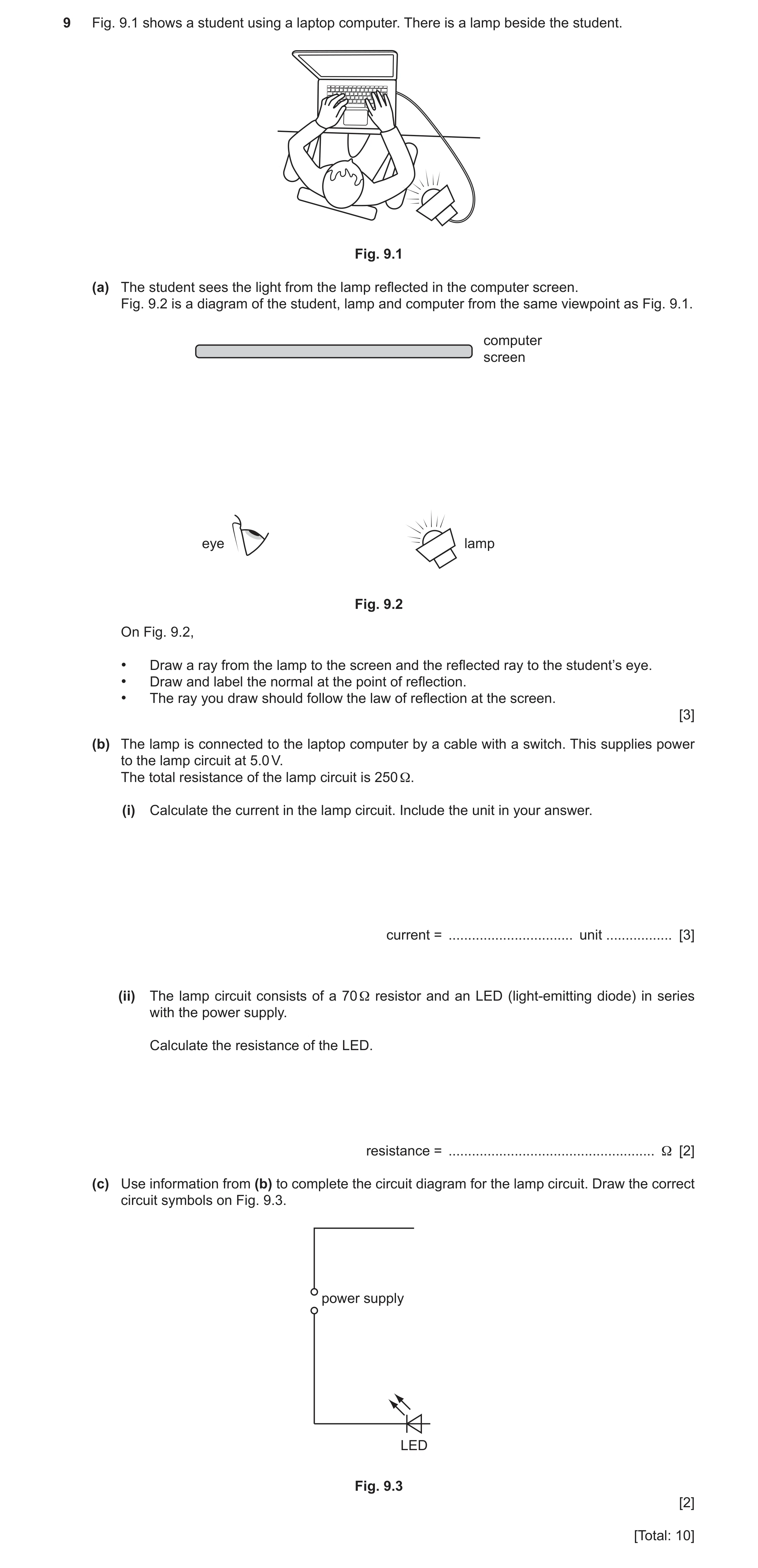
9 Fig. 9.1 shows a student using a laptop computer. There is a lamp beside the student. Fig. 9.1 (a) The student sees the light from the lamp reflected in the computer screen. Fig. 9.2 is a diagram of the student, lamp and computer from the same viewpoint as Fig. 9.1. computer screen eye lamp Fig. 9.2 On Fig. 9.2, • Draw a ray from the lamp to the screen and the reflected ray to the student’s eye. • Draw and label the normal at the point of reflection. • The ray you draw should follow the law of reflection at the screen. [3] (b) The lamp is connected to the laptop computer by a cable with a switch. This supplies power to the lamp circuit at 5.0 V. The total resistance of the lamp circuit is 250 Ω. (i) Calculate the current in the lamp circuit. Include the unit in your answer. current = … unit … [3] (ii) The lamp circuit consists of a 70 Ω resistor and an LED (light-emitting diode) in series with the power supply. Calculate the resistance of the LED. resistance = … Ω [2] (c) Use information from (b) to complete the circuit diagram for the lamp circuit. Draw the correct circuit symbols on Fig. 9.3. power supply LED Fig. 9.3 [2] [Total: 10]
10 marks
Mark scheme: 9(a) path of ray drawn from lamp to computer screen to eye using straight lines ; normal drawn at 90° to screen at point of reflection ; angles of incidence and reflection equal ; 9(b)(i) resistance = voltage current (in any form) / I = 5 250 ; 0.02(0) ; A / amp(ere) ; 3 9(b)(ii) resistances in series add to give total resistance (in any form) / resistance of LED = 250 – 70 ; 180 () ; 2 9(c) circuit symbol for resistor ; complete series circuit including switch, resistor and no additional components ; 2
This question in 0653/31 May/June 2023
Q23 · A speed–time graph for a car on part of a journey along a road 0653/32 May/June 2023
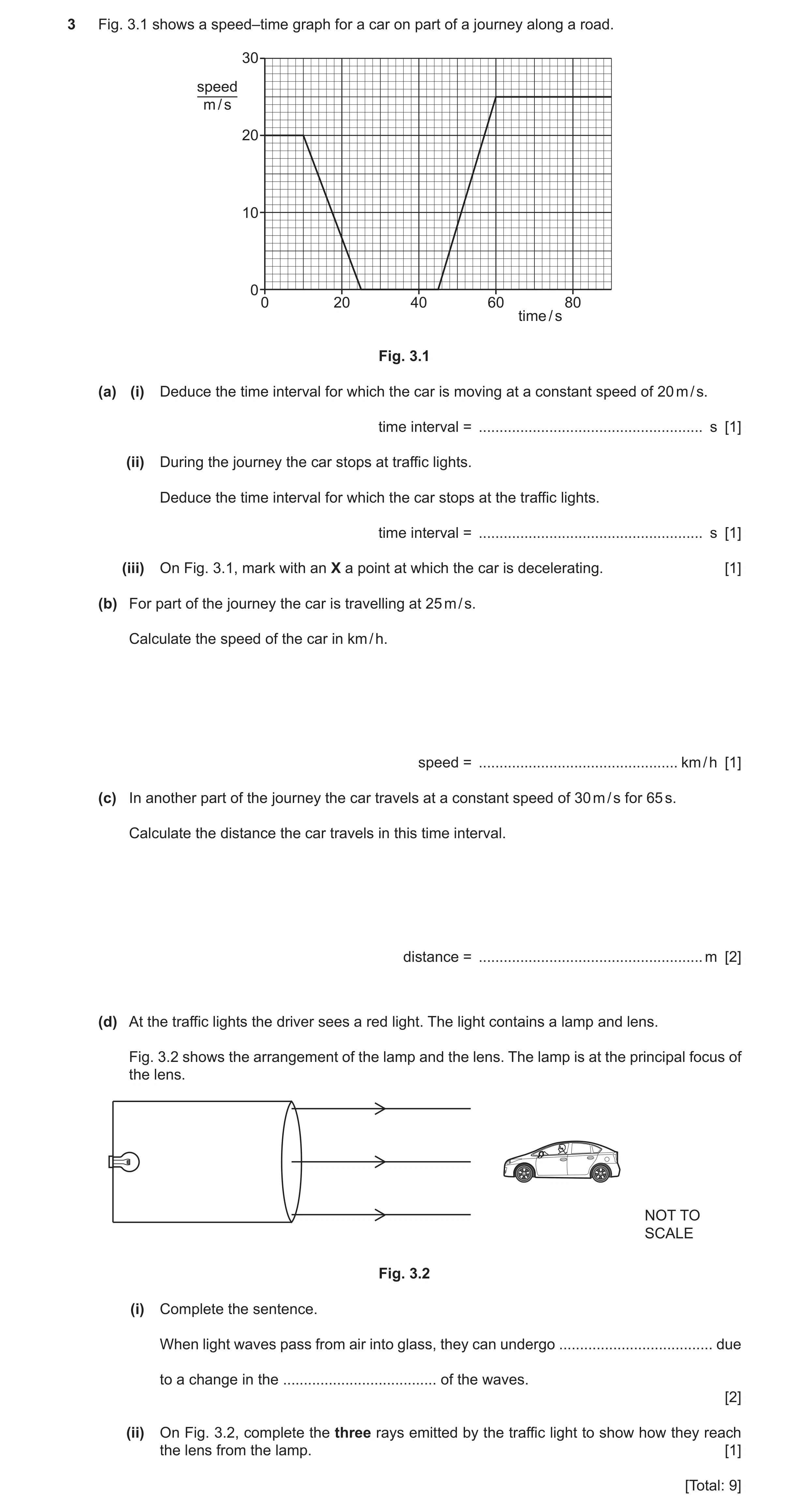
3 Fig. 3.1 shows a speed–time graph for a car on part of a journey along a road. 30 speed m / s 20 10 0 0 20 40 60 80 time / s Fig. 3.1 (a) (i) Deduce the time interval for which the car is moving at a constant speed of 20 m / s. time interval = … s [1] (ii) During the journey the car stops at traffic lights. Deduce the time interval for which the car stops at the traffic lights. time interval = … s [1] (iii) On Fig. 3.1, mark with an X a point at which the car is decelerating. [1] (b) For part of the journey the car is travelling at 25 m / s. Calculate the speed of the car in km / h. speed = … km / h [1] (c) In another part of the journey the car travels at a constant speed of 30 m / s for 65 s. Calculate the distance the car travels in this time interval. distance = … m [2] (d) At the traffic lights the driver sees a red light. The light contains a lamp and lens. Fig. 3.2 shows the arrangement of the lamp and the lens. The lamp is at the principal focus of the lens. NOT TO SCALE Fig. 3.2 (i) Complete the sentence. When light waves pass from air into glass, they can undergo … due to a change in the … of the waves. [2] (ii) On Fig. 3.2, complete the three rays emitted by the traffic light to show how they reach the lens from the lamp. [1] [Total: 9]
9 marks
Mark scheme: 3(a)(i) 10 (s) ; 1 3(a)(ii) 20 (s) ; 1 3(a)(iii) X on line between t = 10 s and t = 25 s ; 1 3(b) 90 (km / h) ; 1 3(c) speed = distance time (in any form) / distance = 30 65 ; 1950 (m) ; 2 3(d)(i) refraction ; speed ; 2 3(d)(ii) ; 1
This question in 0653/32 May/June 2023
Q24 · Many security measures are used in airports, including security scans of baggage… 0653/31 Oct/Nov 2023
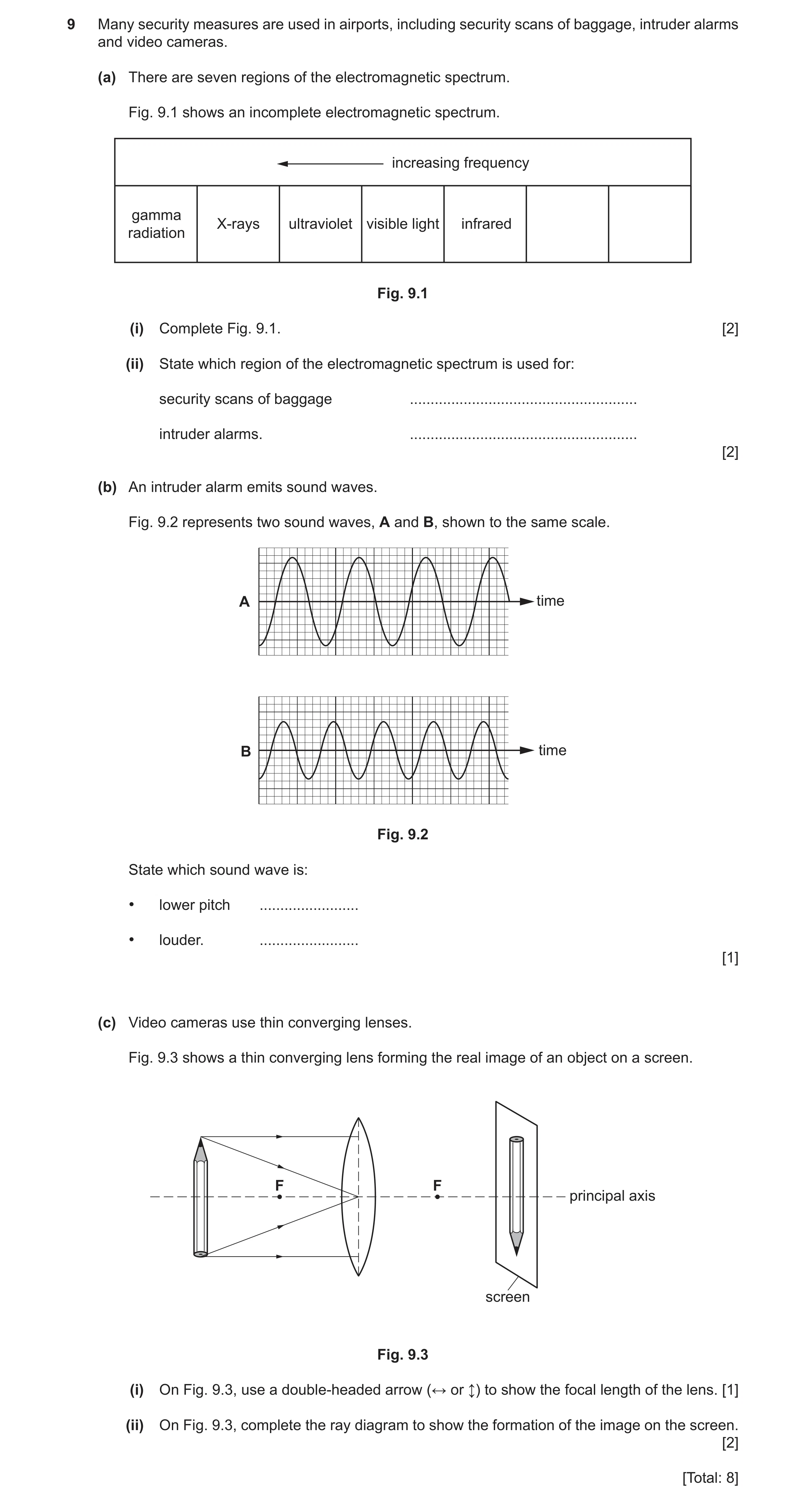
9 Many security measures are used in airports, including security scans of baggage, intruder alarms and video cameras. (a) There are seven regions of the electromagnetic spectrum. Fig. 9.1 shows an incomplete electromagnetic spectrum. increasing frequency gamma X-rays ultraviolet visible light infrared radiation Fig. 9.1 (i) Complete Fig. 9.1. [2] (ii) State which region of the electromagnetic spectrum is used for: security scans of baggage … intruder alarms. … [2] (b) An intruder alarm emits sound waves. Fig. 9.2 represents two sound waves, A and B, shown to the same scale. A time B time Fig. 9.2 State which sound wave is: • lower pitch … • louder. … [1] (c) Video cameras use thin converging lenses. Fig. 9.3 shows a thin converging lens forming the real image of an object on a screen. F F principal axis screen Fig. 9.3 (i) On Fig. 9.3, use a double-headed arrow (↔ or ↕) to show the focal length of the lens. [1] (ii) On Fig. 9.3, complete the ray diagram to show the formation of the image on the screen. [2] [Total: 8]
8 marks
Mark scheme: 9(a)(i) 2 one name correct AND in correct place / both names correct ; both names correct AND in correct places ; 9(a)(ii) X-rays ; 2 infrared ; 9(b) A AND A ; 1 9(c)(i) 1 focal length shown with double-headed arrow from lens axis to either F ; 9(c)(ii) 2 any two lines correct ; all four lines correct ;
This question in 0653/31 Oct/Nov 2023
Q25 · A lighthouse used at night to warn ships of dangerous rocks in the water 0653/32 Oct/Nov 2023
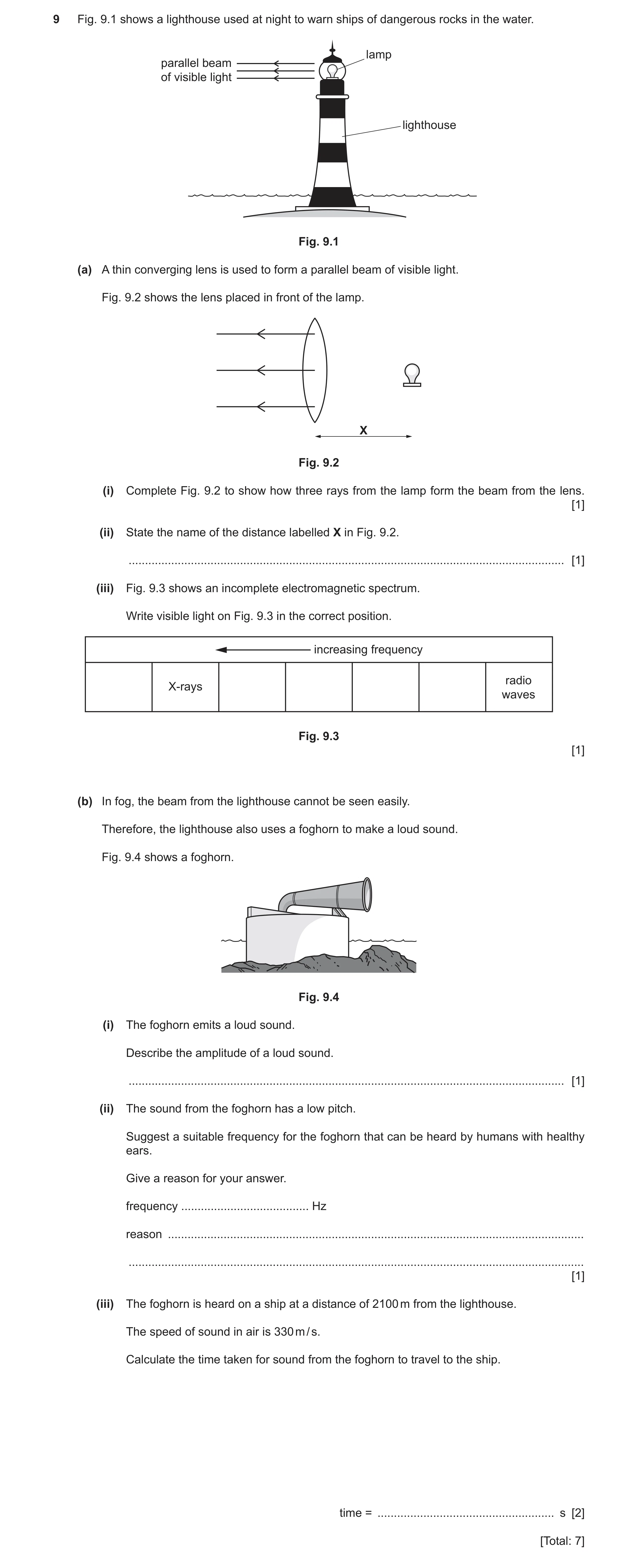
9 Fig. 9.1 shows a lighthouse used at night to warn ships of dangerous rocks in the water. lamp parallel beam of visible light lighthouse Fig. 9.1 (a) A thin converging lens is used to form a parallel beam of visible light. Fig. 9.2 shows the lens placed in front of the lamp. X Fig. 9.2 (i) Complete Fig. 9.2 to show how three rays from the lamp form the beam from the lens. [1] (ii) State the name of the distance labelled X in Fig. 9.2. … [1] (iii) Fig. 9.3 shows an incomplete electromagnetic spectrum. Write visible light on Fig. 9.3 in the correct position. increasing frequency radio X-rays waves Fig. 9.3 [1] (b) In fog, the beam from the lighthouse cannot be seen easily. Therefore, the lighthouse also uses a foghorn to make a loud sound. Fig. 9.4 shows a foghorn. Fig. 9.4 (i) The foghorn emits a loud sound. Describe the amplitude of a loud sound. … [1] (ii) The sound from the foghorn has a low pitch. Suggest a suitable frequency for the foghorn that can be heard by humans with healthy ears. Give a reason for your answer. frequency … Hz reason … … [1] (iii) The foghorn is heard on a ship at a distance of 2100 m from the lighthouse. The speed of sound in air is 330 m / s. Calculate the time taken for sound from the foghorn to travel to the ship. time = … s [2] [Total: 7]
7 marks
Mark scheme: 9(a)(i) 1 all emerging rays correctly linked back to principal focus at lamp ; 9(a)(ii) focal length ; 1 9(a)(iii) 1 visible (radio (X-rays) light ; waves) 9(b)(i) large / AW ; 1 9(b)(ii) any value between 20 Hz and 2000 Hz AND 1 this frequency is (at the lower end) of the human hearing range / AW ; 9(b)(iii) evidence of, speed = distance ÷ time / 2100 ÷ 330 ; 2 6.4 (s) ;
This question in 0653/32 Oct/Nov 2023
Q26 · A lighthouse used at night to warn ships of dangerous rocks in the water 0653/33 Oct/Nov 2023
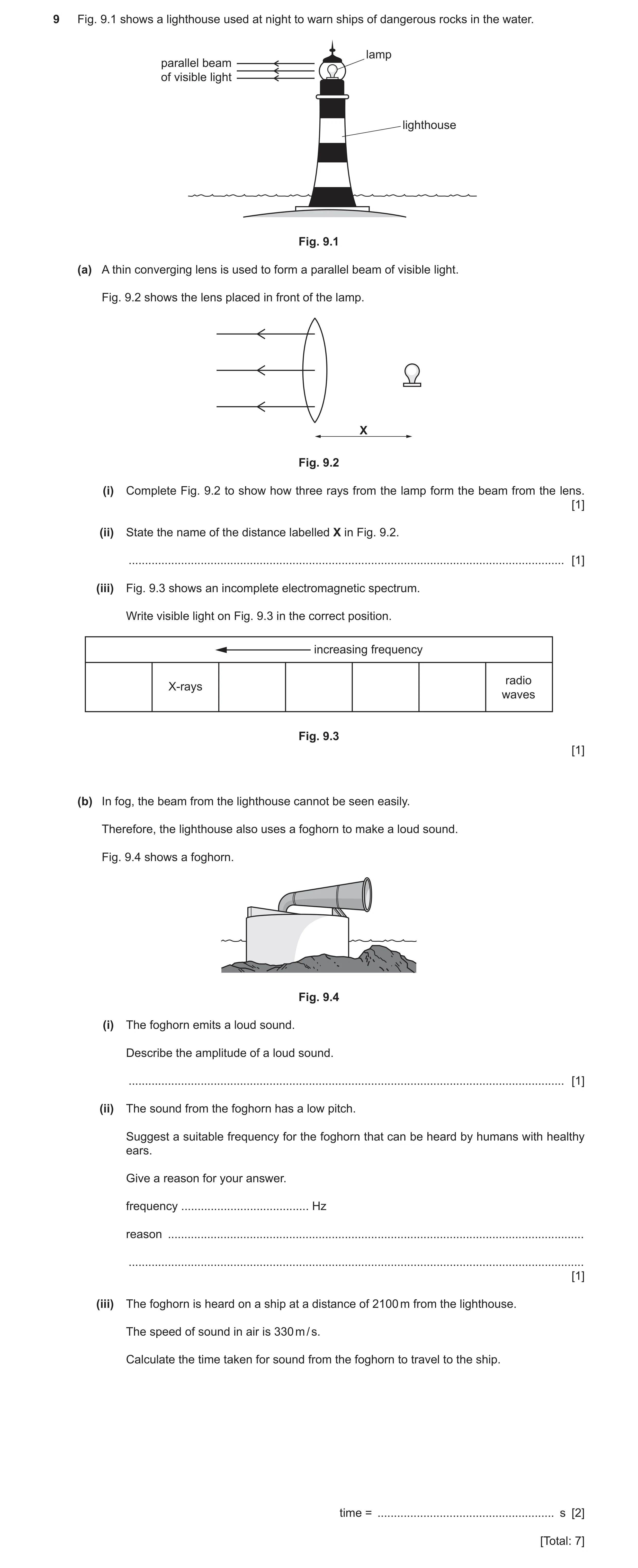
9 Fig. 9.1 shows a lighthouse used at night to warn ships of dangerous rocks in the water. lamp parallel beam of visible light lighthouse Fig. 9.1 (a) A thin converging lens is used to form a parallel beam of visible light. Fig. 9.2 shows the lens placed in front of the lamp. X Fig. 9.2 (i) Complete Fig. 9.2 to show how three rays from the lamp form the beam from the lens. [1] (ii) State the name of the distance labelled X in Fig. 9.2. … [1] (iii) Fig. 9.3 shows an incomplete electromagnetic spectrum. Write visible light on Fig. 9.3 in the correct position. increasing frequency radio X-rays waves Fig. 9.3 [1] (b) In fog, the beam from the lighthouse cannot be seen easily. Therefore, the lighthouse also uses a foghorn to make a loud sound. Fig. 9.4 shows a foghorn. Fig. 9.4 (i) The foghorn emits a loud sound. Describe the amplitude of a loud sound. … [1] (ii) The sound from the foghorn has a low pitch. Suggest a suitable frequency for the foghorn that can be heard by humans with healthy ears. Give a reason for your answer. frequency … Hz reason … … [1] (iii) The foghorn is heard on a ship at a distance of 2100 m from the lighthouse. The speed of sound in air is 330 m / s. Calculate the time taken for sound from the foghorn to travel to the ship. time = … s [2] [Total: 7]
7 marks
Mark scheme: 9(a)(i) 1 all emerging rays correctly linked back to principal focus at lamp ; 9(a)(ii) focal length ; 1 9(a)(iii) 1 visible (radio (X-rays) light ; waves) 9(b)(i) large / AW ; 1 9(b)(ii) any value between 20 Hz and 2000 Hz AND 1 this frequency is (at the lower end) of the human hearing range / AW ; 9(b)(iii) evidence of, speed = distance ÷ time / 2100 ÷ 330 ; 2 6.4 (s) ;
This question in 0653/33 Oct/Nov 2023
Q27 · An aluminium pan containing water, being heated on a hotplate of a cooker 0653/31 May/June 2024
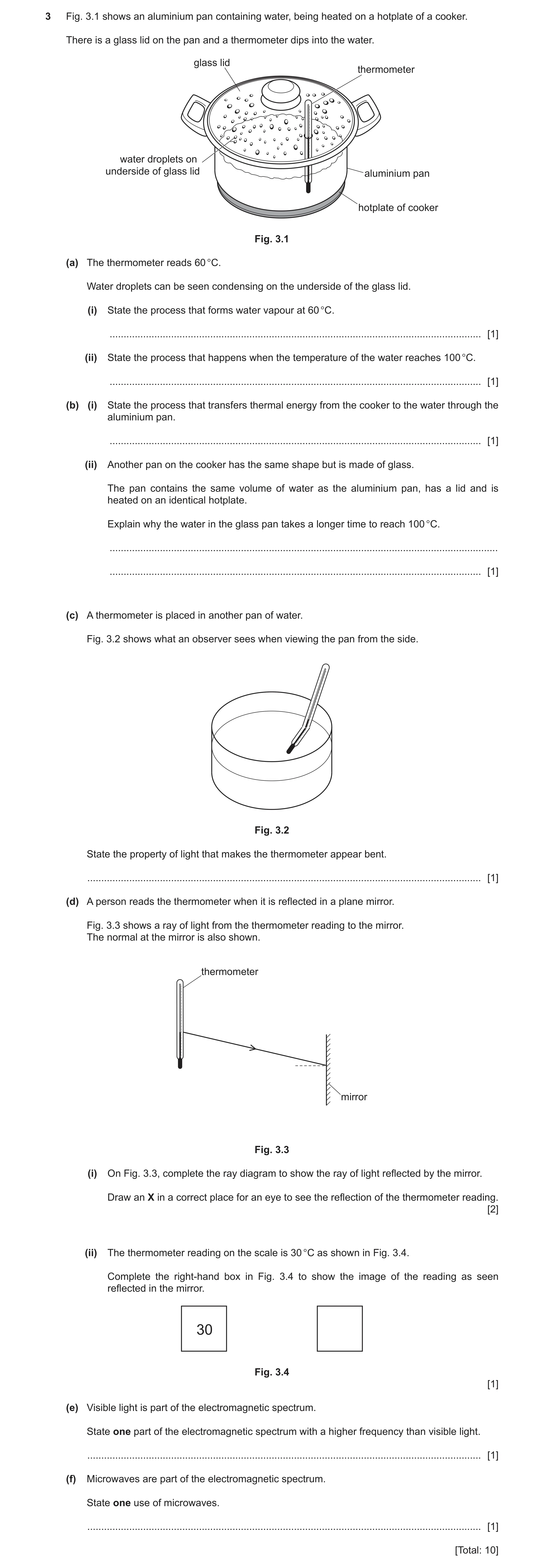
3 Fig. 3.1 shows an aluminium pan containing water, being heated on a hotplate of a cooker. There is a glass lid on the pan and a thermometer dips into the water. glass lid thermometer water droplets on underside of glass lid aluminium pan hotplate of cooker Fig. 3.1 (a) The thermometer reads 60 °C. Water droplets can be seen condensing on the underside of the glass lid. (i) State the process that forms water vapour at 60 °C. … [1] (ii) State the process that happens when the temperature of the water reaches 100 °C. … [1] (b) (i) State the process that transfers thermal energy from the cooker to the water through the aluminium pan. … [1] (ii) Another pan on the cooker has the same shape but is made of glass. The pan contains the same volume of water as the aluminium pan, has a lid and is heated on an identical hotplate. Explain why the water in the glass pan takes a longer time to reach 100 °C. … … [1] (c) A thermometer is placed in another pan of water. Fig. 3.2 shows what an observer sees when viewing the pan from the side. Fig. 3.2 State the property of light that makes the thermometer appear bent. … [1] (d) A person reads the thermometer when it is reflected in a plane mirror. Fig. 3.3 shows a ray of light from the thermometer reading to the mirror. The normal at the mirror is also shown. thermometer mirror Fig. 3.3 (i) On Fig. 3.3, complete the ray diagram to show the ray of light reflected by the mirror. Draw an X in a correct place for an eye to see the reflection of the thermometer reading. [2] (ii) The thermometer reading on the scale is 30 °C as shown in Fig. 3.4. Complete the right-hand box in Fig. 3.4 to show the image of the reading as seen reflected in the mirror. 30 Fig. 3.4 [1] (e) Visible light is part of the electromagnetic spectrum. State one part of the electromagnetic spectrum with a higher frequency than visible light. … [1] (f) Microwaves are part of the electromagnetic spectrum. State one use of microwaves. … [1] [Total: 10]
10 marks
Mark scheme: 3(a)(i) evaporation ; 1 3(a)(ii) boiling ; 1 3(b)(i) conduction ; 1 3(b)(ii) glass is a poor (thermal) conductor ; 1 3(c) refraction ; 1 Question Answer Marks 3(d)(i) angle of reflection equal to angle of incidence judged by inspection ; centre of X drawn reflected ray ; 2 3(d)(ii) ; 1 3(e) ultraviolet / X-ray / gamma (ray) ; 1 3(f) mobile phone signals / cooking / satellite TV / radar ; 1 0ɛ
This question in 0653/31 May/June 2024
Q28 · Copper is a metal 0653/31 Oct/Nov 2024
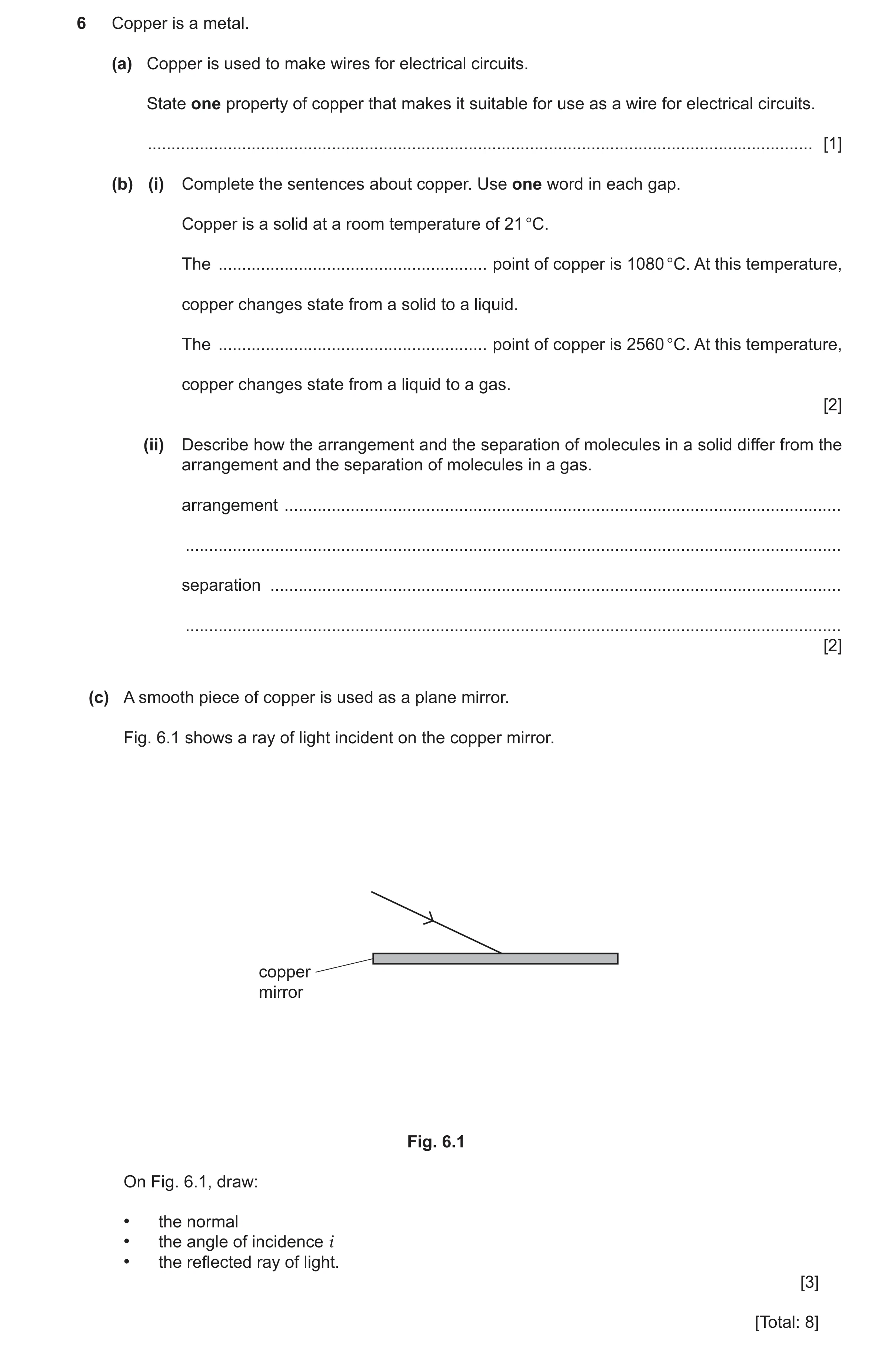
6 Copper is a metal. (a) Copper is used to make wires for electrical circuits. State one property of copper that makes it suitable for use as a wire for electrical circuits. … [1] (b) (i) Complete the sentences about copper. Use one word in each gap. Copper is a solid at a room temperature of 21 °C. The … point of copper is 1080 °C. At this temperature, copper changes state from a solid to a liquid. The … point of copper is 2560 °C. At this temperature, copper changes state from a liquid to a gas. [2] (ii) Describe how the arrangement and the separation of molecules in a solid differ from the arrangement and the separation of molecules in a gas. arrangement … … separation … … [2] (c) A smooth piece of copper is used as a plane mirror. Fig. 6.1 shows a ray of light incident on the copper mirror. copper mirror Fig. 6.1 On Fig. 6.1, draw: • the normal • the angle of incidence i • the reflected ray of light. [3] [Total: 8]
8 marks
Mark scheme: 6(a) (good) conductor (of electricity) ; 1 6(b)(i) melting ; 2 boiling ; 6(b)(ii) in a solid (ORA), the molecules are: 2 regular / ordered ; close together ; 6(c) 3 normal drawn ; angle of incidence shown AND labelled ; reflected ray drawn AND angle of reflection equal to angle of incidence, by eye ;
This question in 0653/31 Oct/Nov 2024
Q29 · A drawing of our galaxy showing the approximate location of the Sun 0653/32 May/June 2025
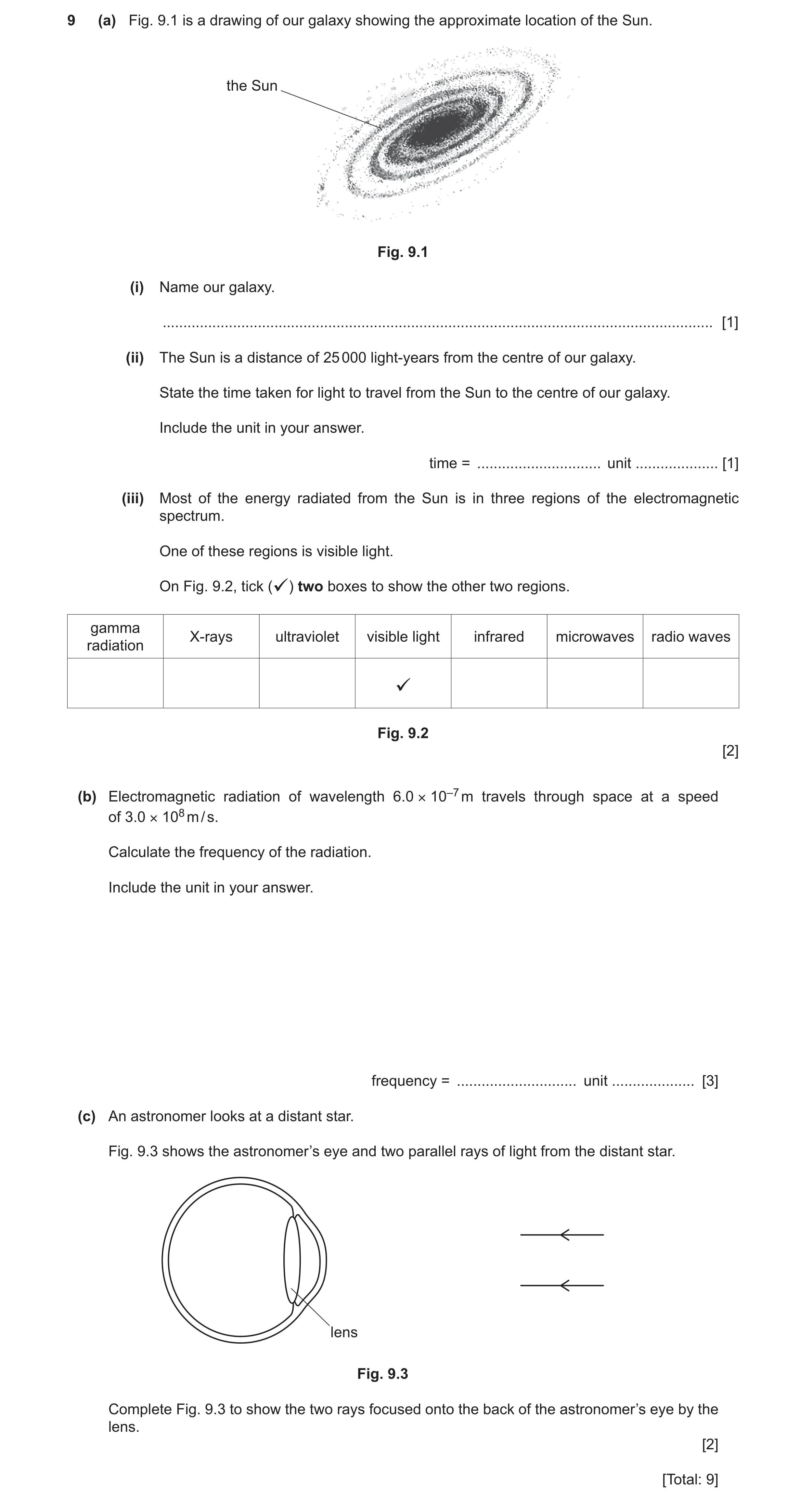
9 (a) Fig. 9.1 is a drawing of our galaxy showing the approximate location of the Sun. the Sun Fig. 9.1 (i) Name our galaxy. … [1] (ii) The Sun is a distance of 25 000 light-years from the centre of our galaxy. State the time taken for light to travel from the Sun to the centre of our galaxy. Include the unit in your answer. time = … unit … [1] (iii) Most of the energy radiated from the Sun is in three regions of the electromagnetic spectrum. One of these regions is visible light. On Fig. 9.2, tick () two boxes to show the other two regions. gamma X-rays ultraviolet visible light infrared microwaves radio waves radiation Fig. 9.2 [2] (b) Electromagnetic radiation of wavelength 6.0 × 10⁻⁷ m travels through space at a speed of 3.0 × 10⁸ m / s. Calculate the frequency of the radiation. Include the unit in your answer. frequency = … unit … [3] (c) An astronomer looks at a distant star. Fig. 9.3 shows the astronomer’s eye and two parallel rays of light from the distant star. lens Fig. 9.3 Complete Fig. 9.3 to show the two rays focused onto the back of the astronomer’s eye by the lens. [2] [Total: 9]
9 marks
Mark scheme: 9(a)(i) (the) Milky Way ; 1 9(a)(ii) 25 000 years ; 1 9(a)(iii) ultraviolet ; 2 infrared ; 9(b) f = v ÷ λ / frequency = speed ÷ wavelength / 3.0 108 6.0 10–7 ; 3 5.0 1014 ; Hz ; 9(c) refraction inside the lens ; 2 rays drawn with ruler converge on back of eye ; e.g.
This question in 0653/32 May/June 2025
Q30 · A Bunsen burner with the air hole closed, burning with a yellow flame 0653/33 May/June 2025
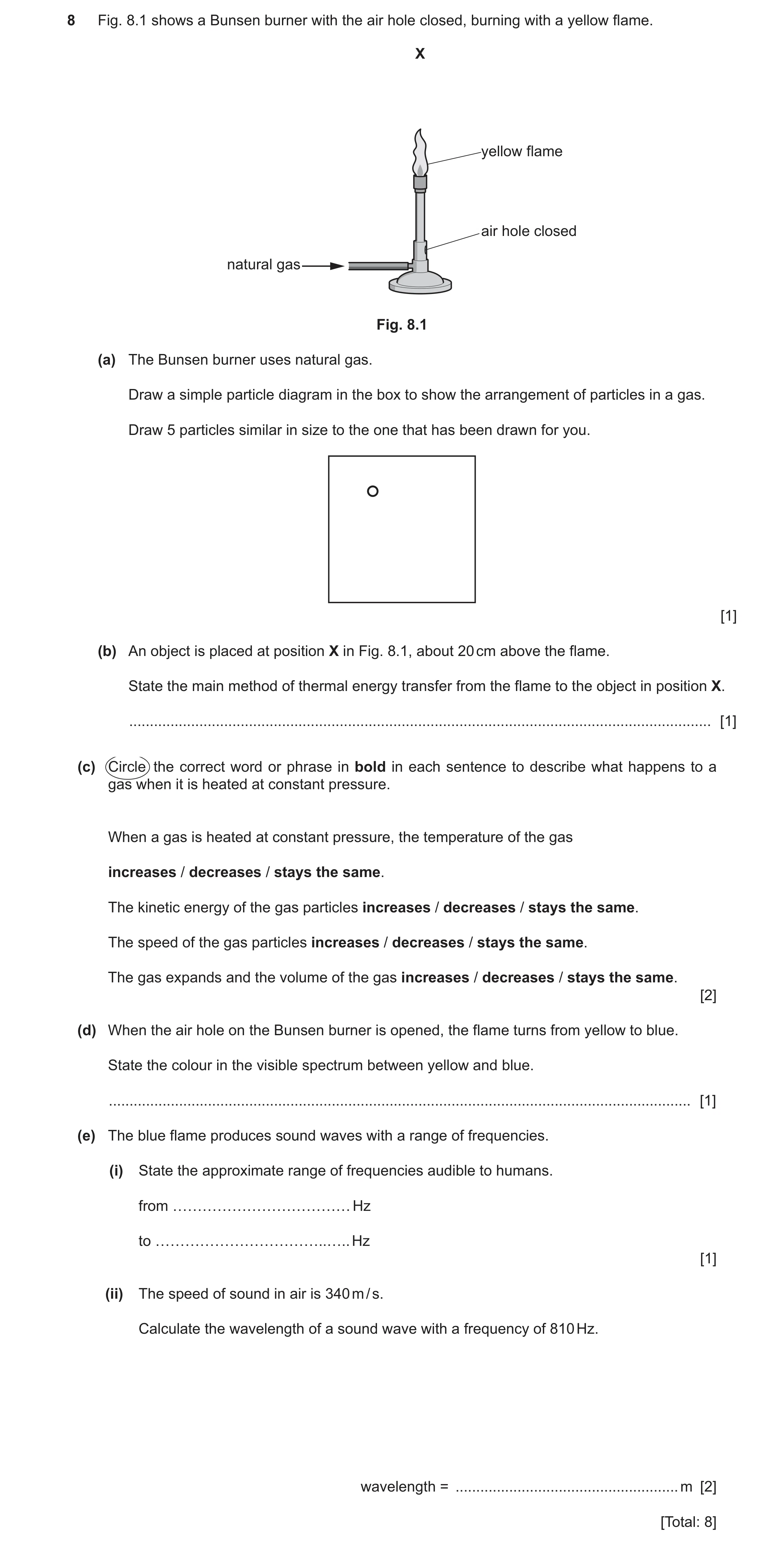
8 Fig. 8.1 shows a Bunsen burner with the air hole closed, burning with a yellow flame. X yellow flame air hole closed natural gas Fig. 8.1 (a) The Bunsen burner uses natural gas. Draw a simple particle diagram in the box to show the arrangement of particles in a gas. Draw 5 particles similar in size to the one that has been drawn for you. [1] (b) An object is placed at position X in Fig. 8.1, about 20 cm above the flame. State the main method of thermal energy transfer from the flame to the object in position X. … [1] (c) Circle the correct word or phrase in bold in each sentence to describe what happens to a gas when it is heated at constant pressure. When a gas is heated at constant pressure, the temperature of the gas increases / decreases / stays the same. The kinetic energy of the gas particles increases / decreases / stays the same. The speed of the gas particles increases / decreases / stays the same. The gas expands and the volume of the gas increases / decreases / stays the same. [2] (d) When the air hole on the Bunsen burner is opened, the flame turns from yellow to blue. State the colour in the visible spectrum between yellow and blue. … [1] (e) The blue flame produces sound waves with a range of frequencies. (i) State the approximate range of frequencies audible to humans. from ……………………………… Hz to ……………………………..….. Hz [1] (ii) The speed of sound in air is 340 m / s. Calculate the wavelength of a sound wave with a frequency of 810 Hz. wavelength = … m [2] [Total: 8]
8 marks
Mark scheme: 8(a) 5 additional particles shown in an irregular arrangement AND clearly separated ; 1 8(b) convection ; 1 8(c) When a gas is heated at constant pressure, the temperature of the gas 2 increases / decreases / stays the same. The kinetic energy of the gas particles increases / decreases / stays the same. The speed of the gas particles increases / decreases/stays the same. The gas expands and the volume of the gas increases / decreases / stays the same. ;; any two correct = 1 mark all four correct = 2 marks 8(d) green ; 1 8(e)(i) from 20 to 20 000 (Hz) ; 1 8(e)(ii) λ= v ÷ f / wavelength = speed ÷ frequency / λ= 340 ÷ 810 ; 2 0.41975 / 0.42 (m) ;
This question in 0653/33 May/June 2025
Q31 · A ray of light reflected by a plane mirror 0653/32 Oct/Nov 2025
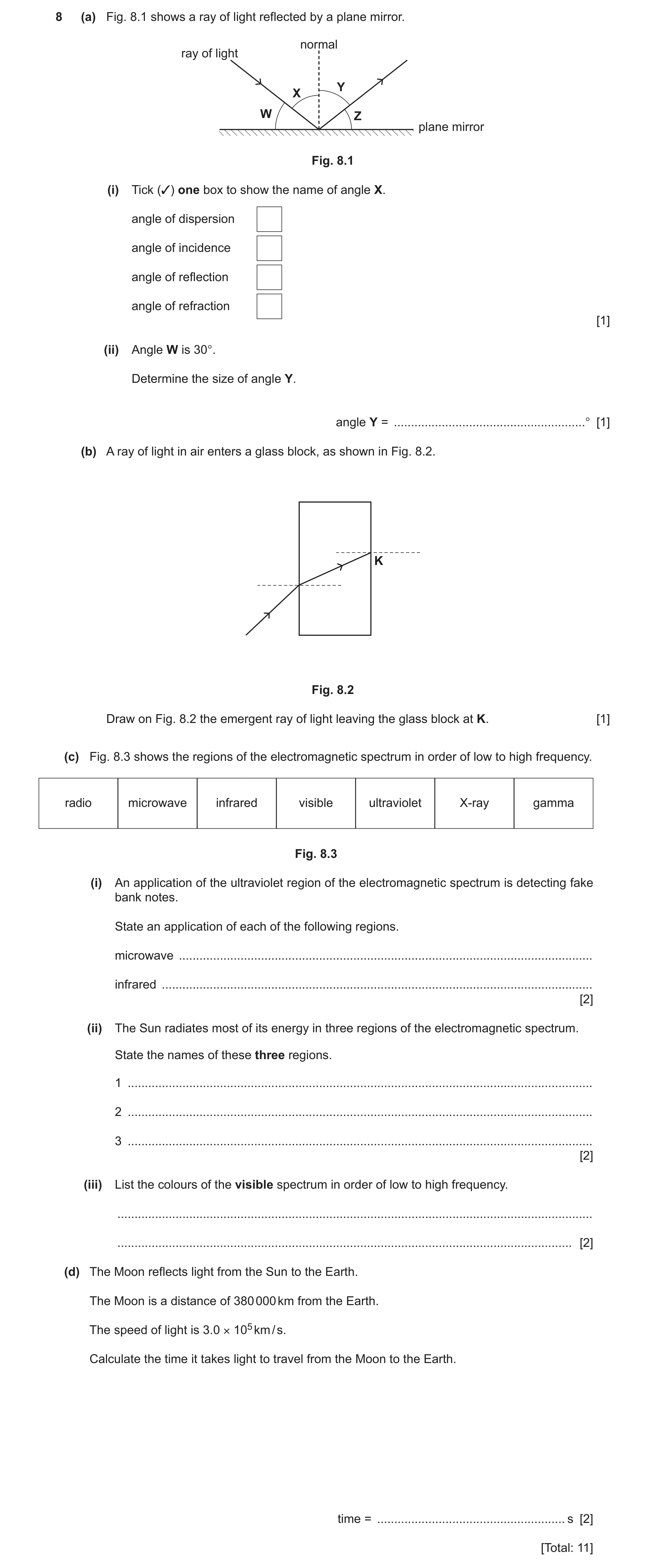
8 (a) Fig. 8.1 shows a ray of light reflected by a plane mirror. normal ray of light Y X W Z plane mirror Fig. 8.1 (i) Tick (✓) one box to show the name of angle X. angle of dispersion angle of incidence angle of reflection angle of refraction [1] (ii) Angle W is 30°. Determine the size of angle Y. angle Y = … ° [1] (b) A ray of light in air enters a glass block, as shown in Fig. 8.2. K Fig. 8.2 Draw on Fig. 8.2 the emergent ray of light leaving the glass block at K. [1] (c) Fig. 8.3 shows the regions of the electromagnetic spectrum in order of low to high frequency. radio microwave infrared visible ultraviolet X-ray gamma Fig. 8.3 (i) An application of the ultraviolet region of the electromagnetic spectrum is detecting fake bank notes. State an application of each of the following regions. microwave … infrared … [2] (ii) The Sun radiates most of its energy in three regions of the electromagnetic spectrum. State the names of these three regions. 1 … 2 … 3 … [2] (iii) List the colours of the visible spectrum in order of low to high frequency. … … [2] (d) The Moon reflects light from the Sun to the Earth. The Moon is a distance of 380 000 km from the Earth. The speed of light is 3.0 × 10⁵ km / s. Calculate the time it takes light to travel from the Moon to the Earth. time = … s [2] [Total: 11]
11 marks
Mark scheme: 8(a)(i) angle of incidence ; 1 8(a)(ii) (calculation of angle of reflection / 90 – 30) = 60 (o) ; 1 8(b) emerging ray drawn which bends away from normal as it leaves the glass block ; 1 8(c)(i) satellite television / mobile (cell) phone / microwave ovens ; 2 remote controllers (for televisions) / thermal imaging ; 8(c)(ii) infrared 2 visible ultraviolet one or two correct ; three correct ; 8(c)(iii) red, orange, yellow, green, blue, indigo, violet 2 seven colours correct ; correct order ; 8(d) 2 speed = distance ÷ time / 380 000 ÷ 3.0 105 ; 1.3 (s) ;
This question in 0653/32 Oct/Nov 2025
Q32 · A ray of light reflected by a plane mirror 0653/33 Oct/Nov 2025
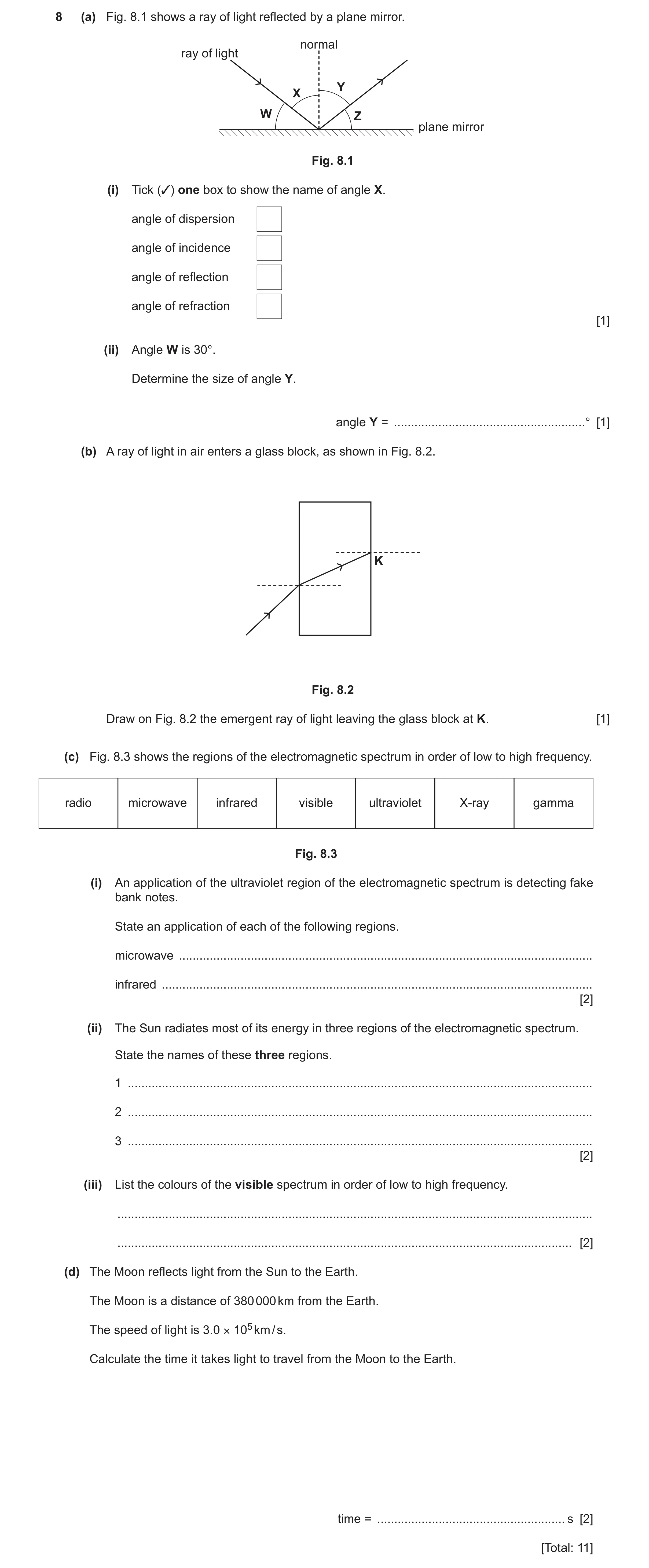
8 (a) Fig. 8.1 shows a ray of light reflected by a plane mirror. normal ray of light Y X W Z plane mirror Fig. 8.1 (i) Tick (✓) one box to show the name of angle X. angle of dispersion angle of incidence angle of reflection angle of refraction [1] (ii) Angle W is 30°. Determine the size of angle Y. angle Y = … ° [1] (b) A ray of light in air enters a glass block, as shown in Fig. 8.2. K Fig. 8.2 Draw on Fig. 8.2 the emergent ray of light leaving the glass block at K. [1] (c) Fig. 8.3 shows the regions of the electromagnetic spectrum in order of low to high frequency. radio microwave infrared visible ultraviolet X-ray gamma Fig. 8.3 (i) An application of the ultraviolet region of the electromagnetic spectrum is detecting fake bank notes. State an application of each of the following regions. microwave … infrared … [2] (ii) The Sun radiates most of its energy in three regions of the electromagnetic spectrum. State the names of these three regions. 1 … 2 … 3 … [2] (iii) List the colours of the visible spectrum in order of low to high frequency. … … [2] (d) The Moon reflects light from the Sun to the Earth. The Moon is a distance of 380 000 km from the Earth. The speed of light is 3.0 × 10⁵ km / s. Calculate the time it takes light to travel from the Moon to the Earth. time = … s [2] [Total: 11]
11 marks
Mark scheme: 8(a)(i) angle of incidence ; 1 8(a)(ii) (calculation of angle of reflection / 90 – 30) = 60 (o) ; 1 8(b) emerging ray drawn which bends away from normal as it leaves the glass block ; 1 8(c)(i) satellite television / mobile (cell) phone / microwave ovens ; 2 remote controllers (for televisions) / thermal imaging ; 8(c)(ii) infrared 2 visible ultraviolet one or two correct ; three correct ; 8(c)(iii) red, orange, yellow, green, blue, indigo, violet 2 seven colours correct ; correct order ; 8(d) 2 speed = distance ÷ time / 380 000 ÷ 3.0 105 ; 1.3 (s) ;
This question in 0653/33 Oct/Nov 2025
 10
10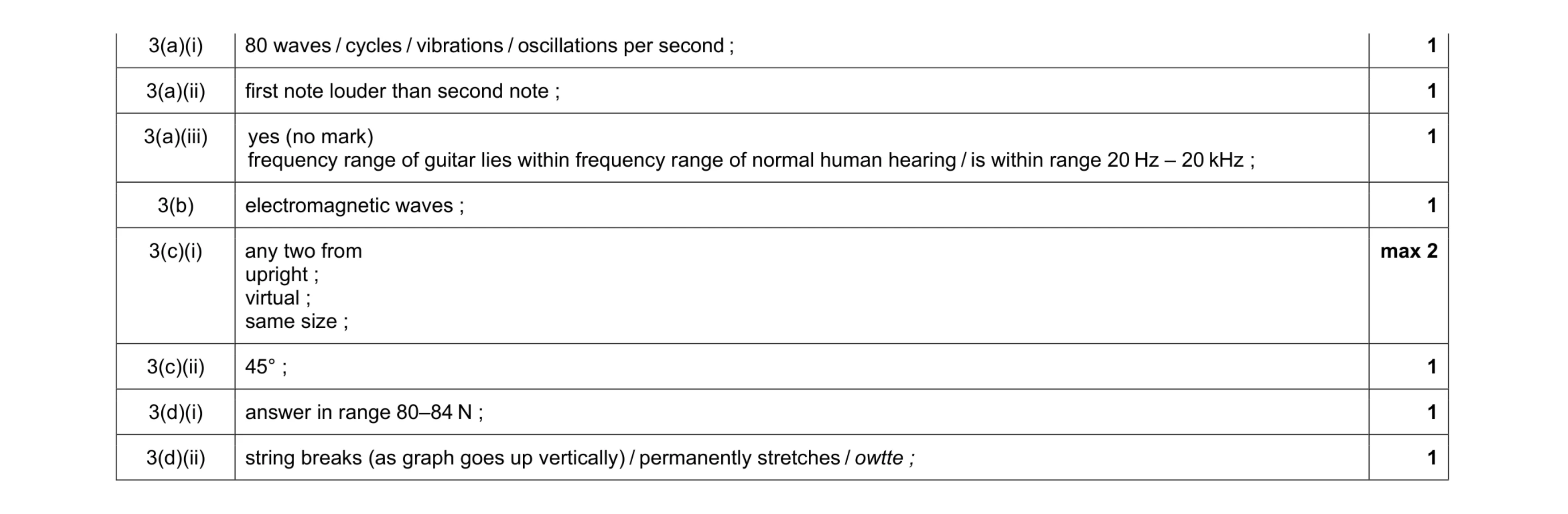 9
9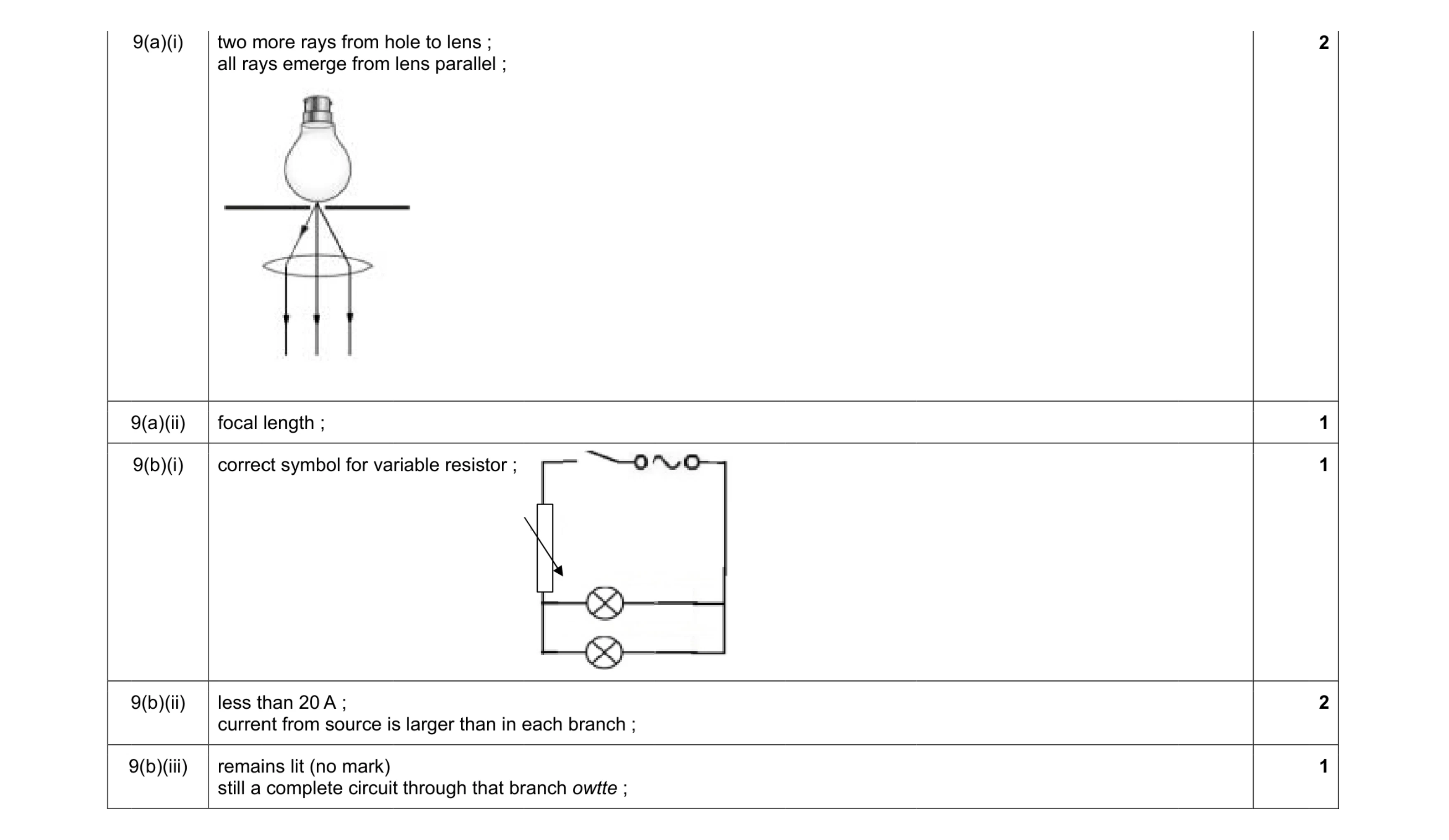 7
7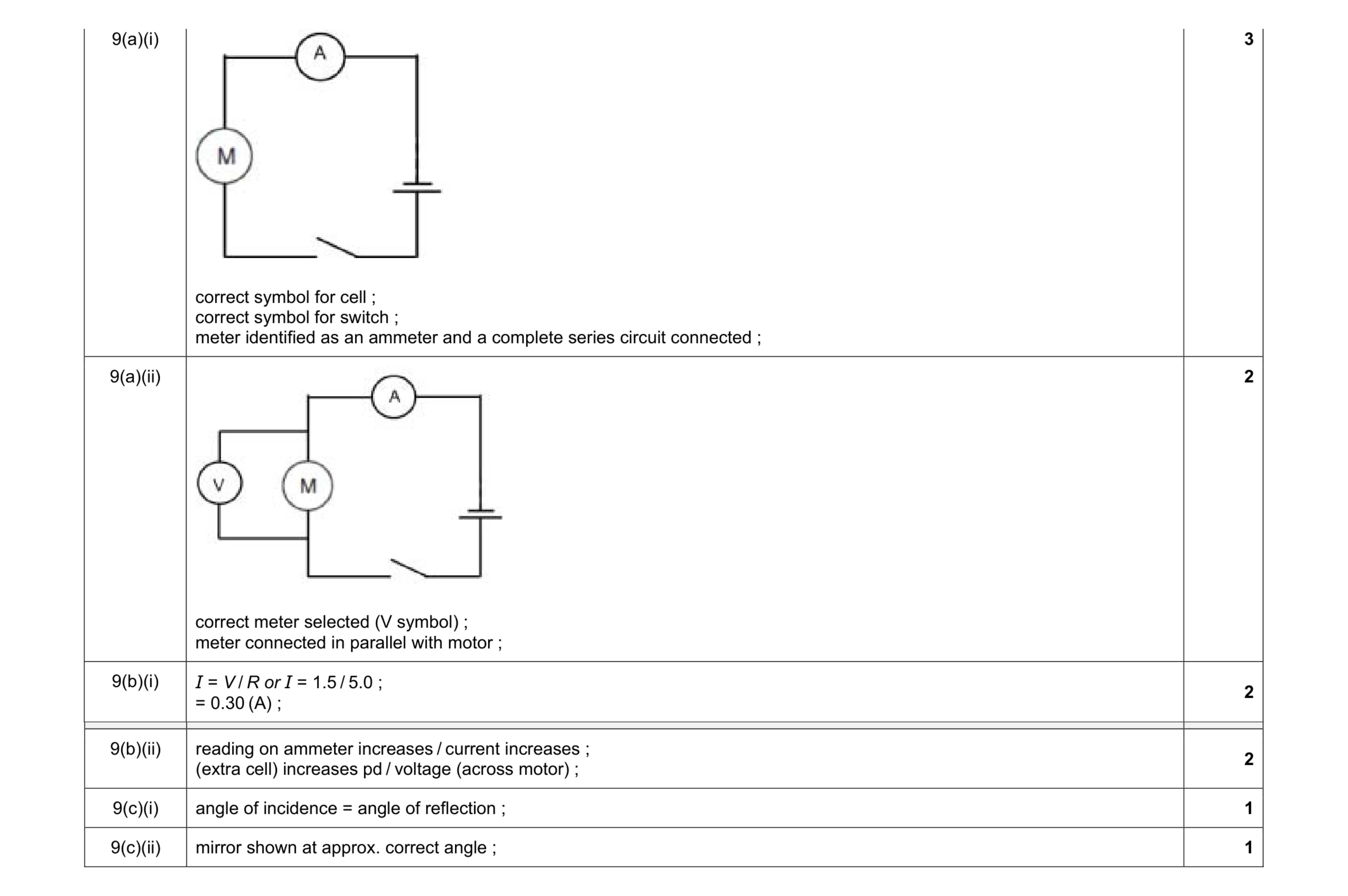 11
11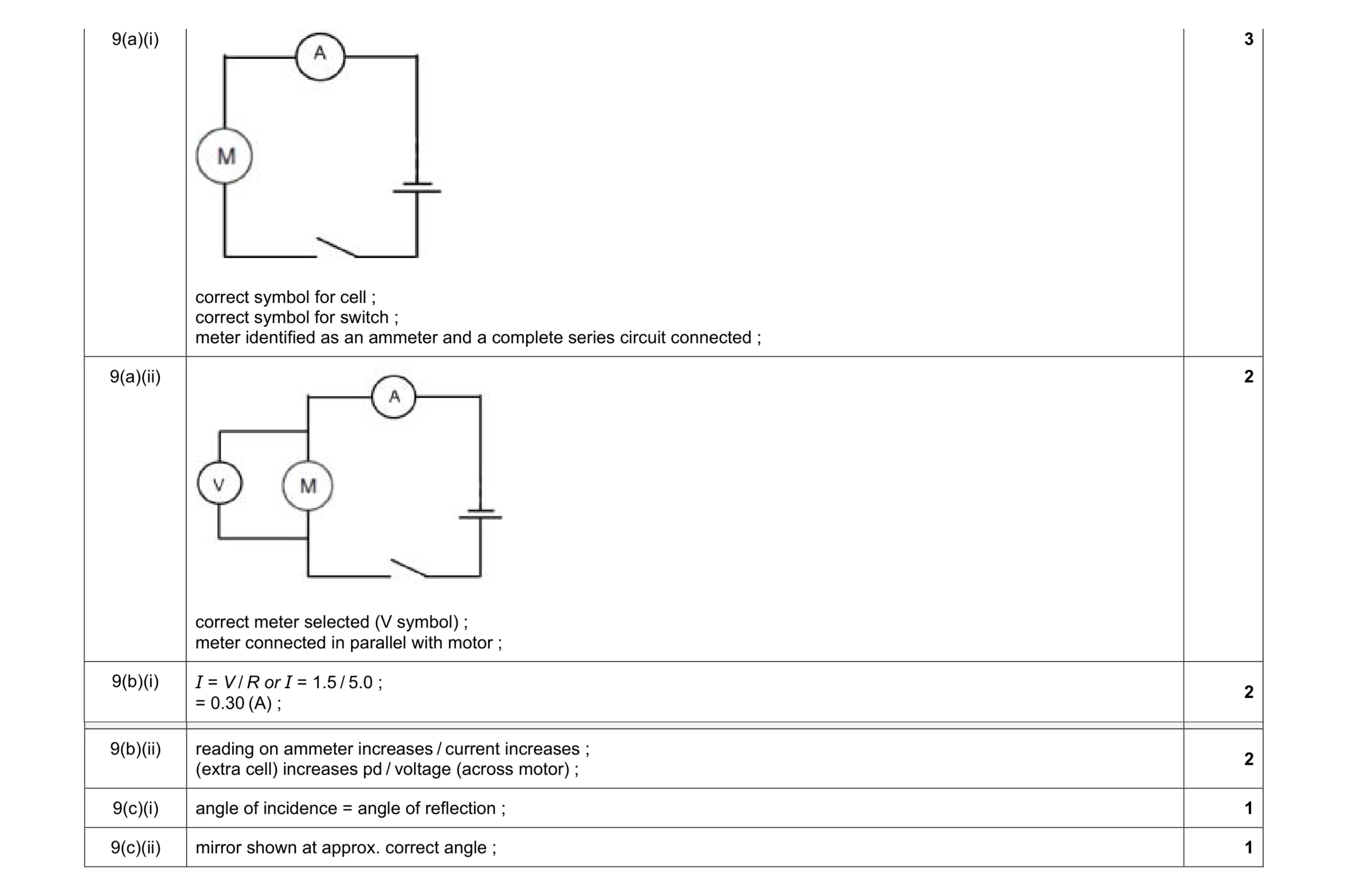 11
11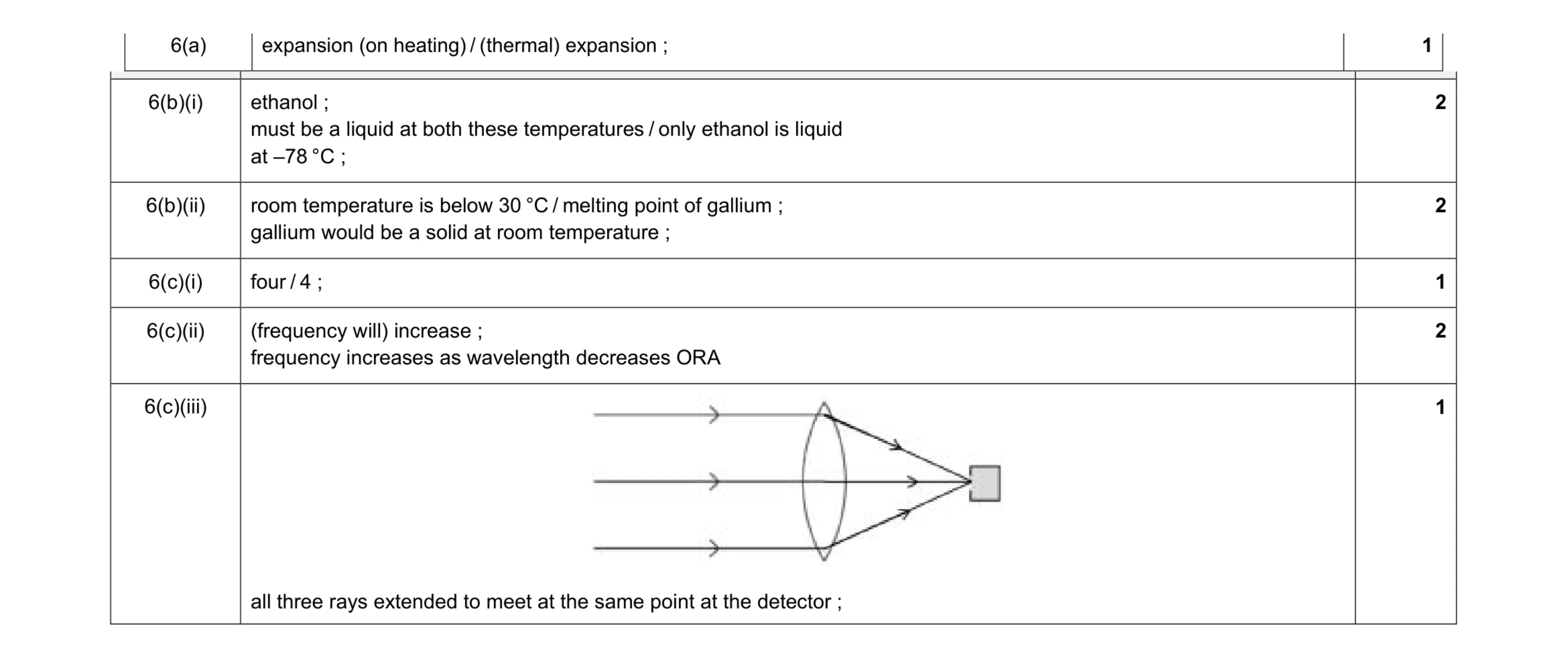 9
9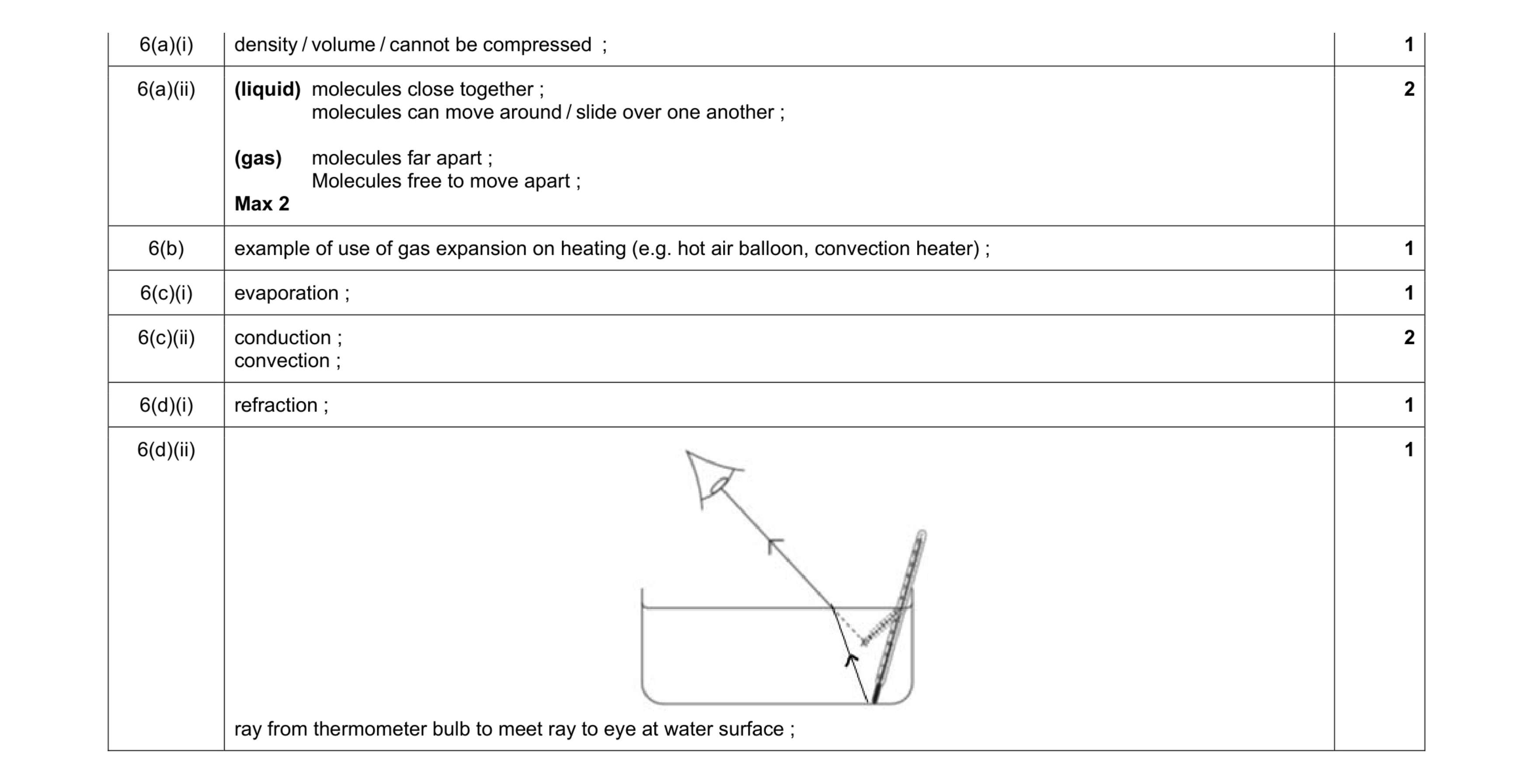 9
9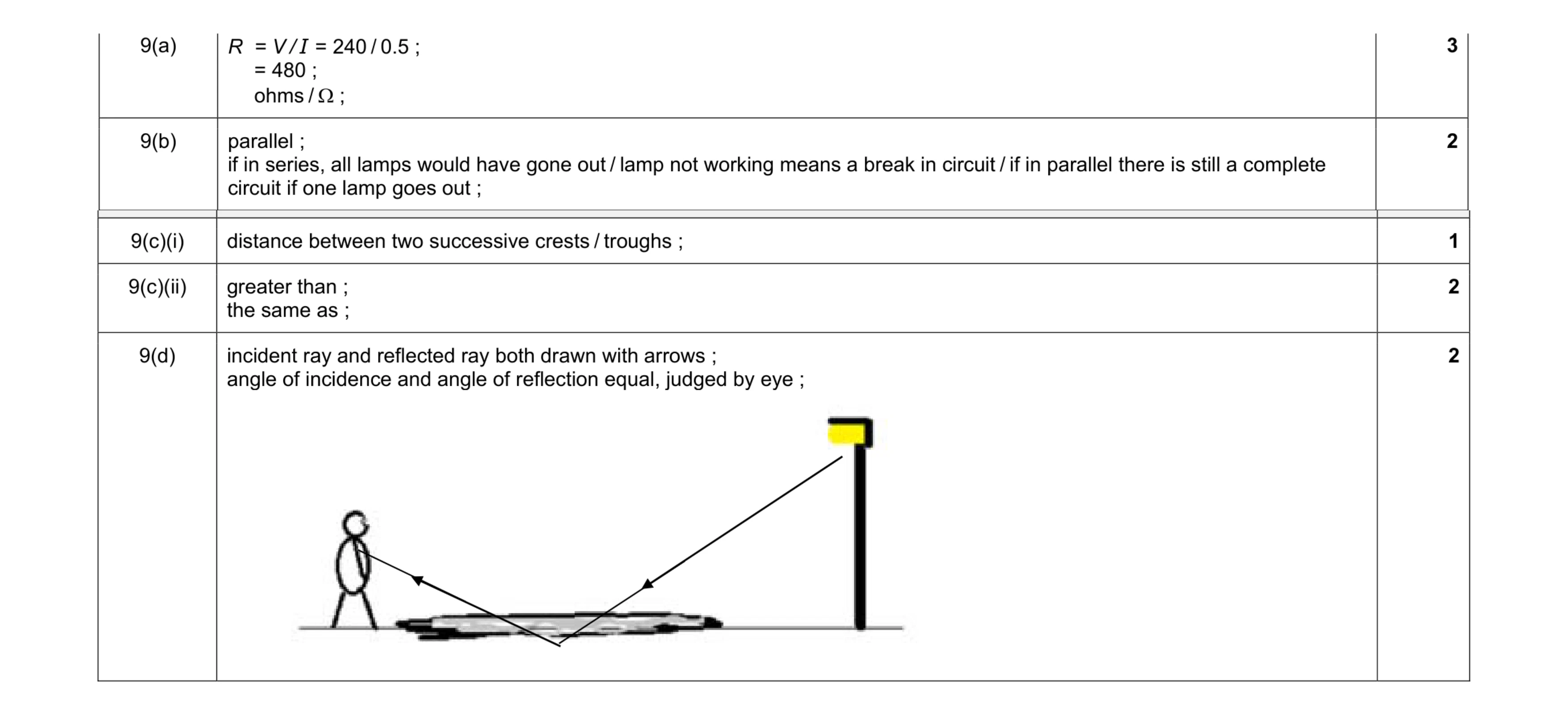 10
10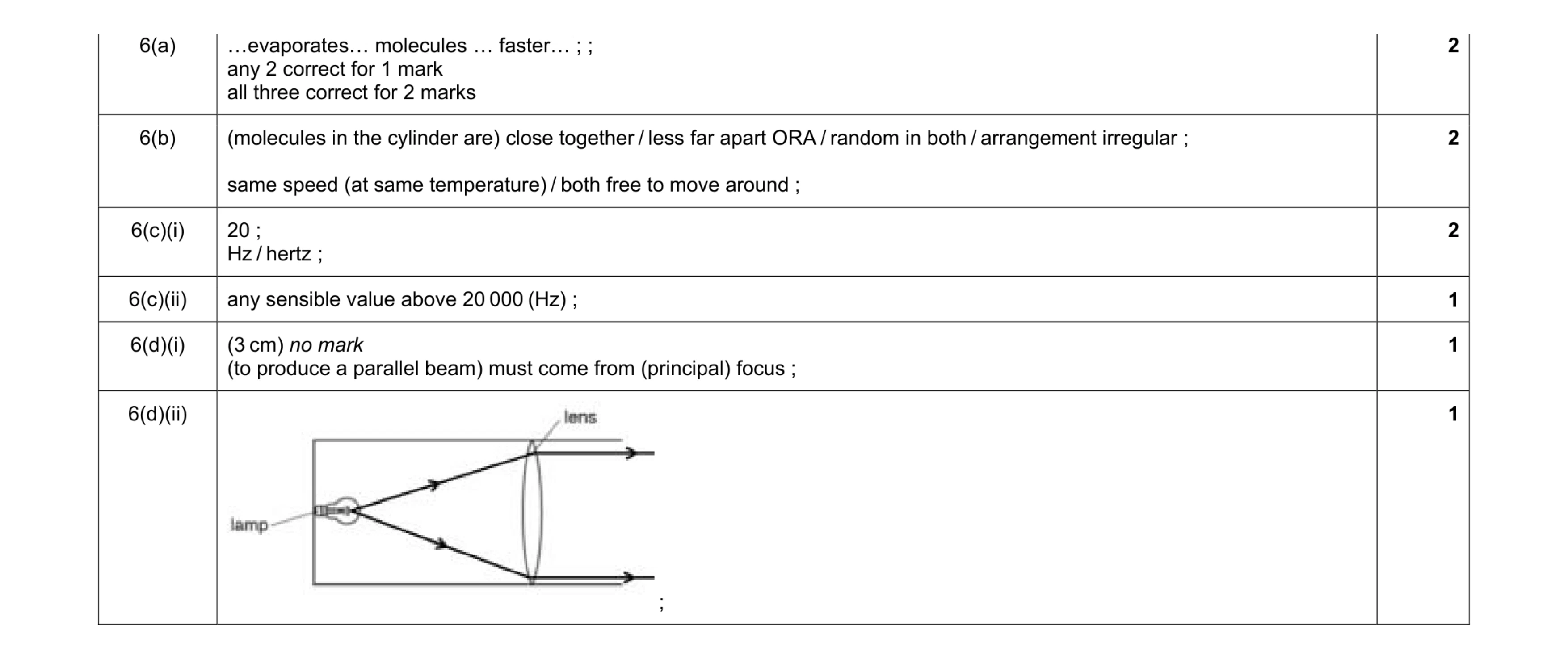 9
9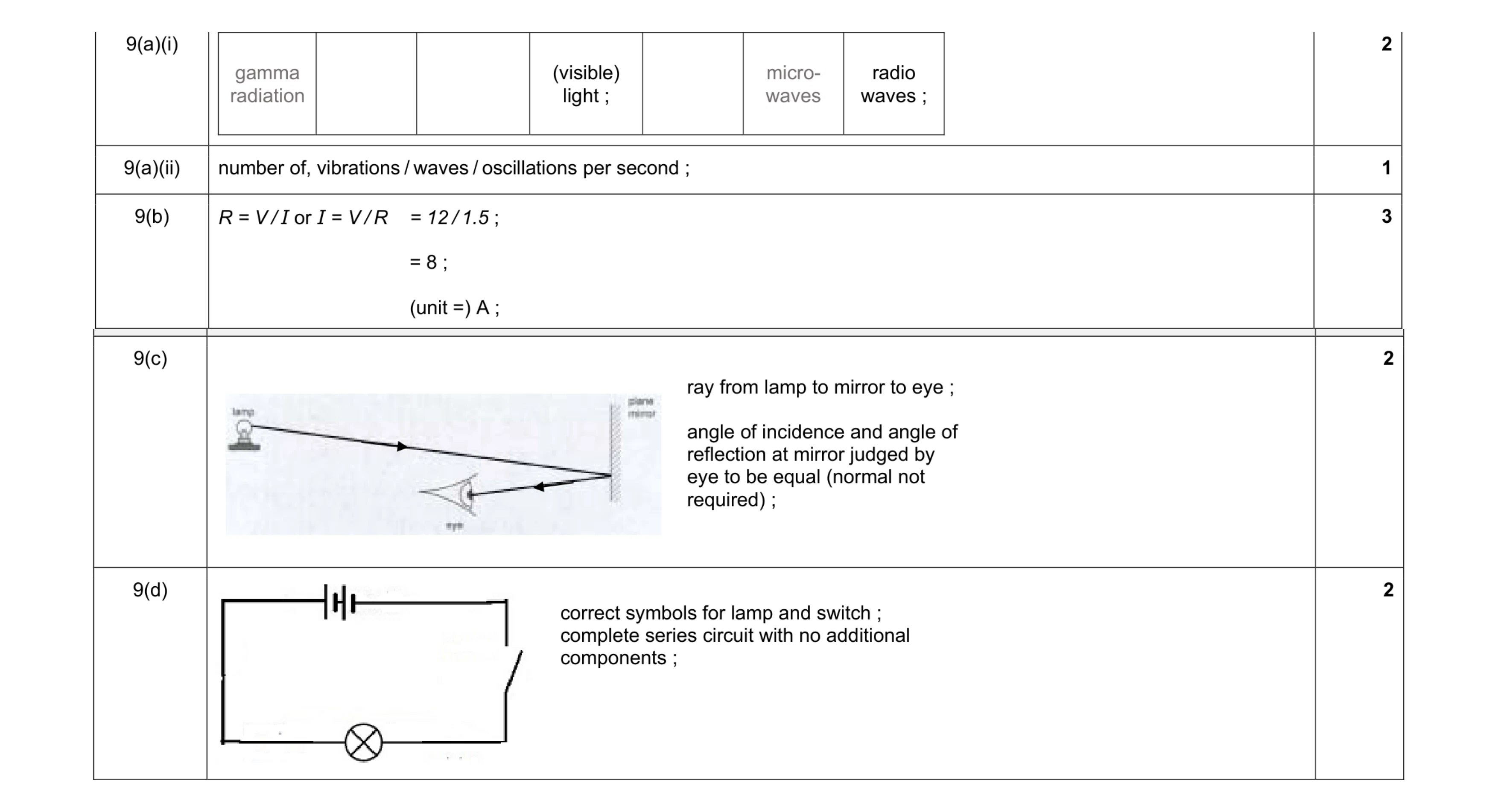 10
10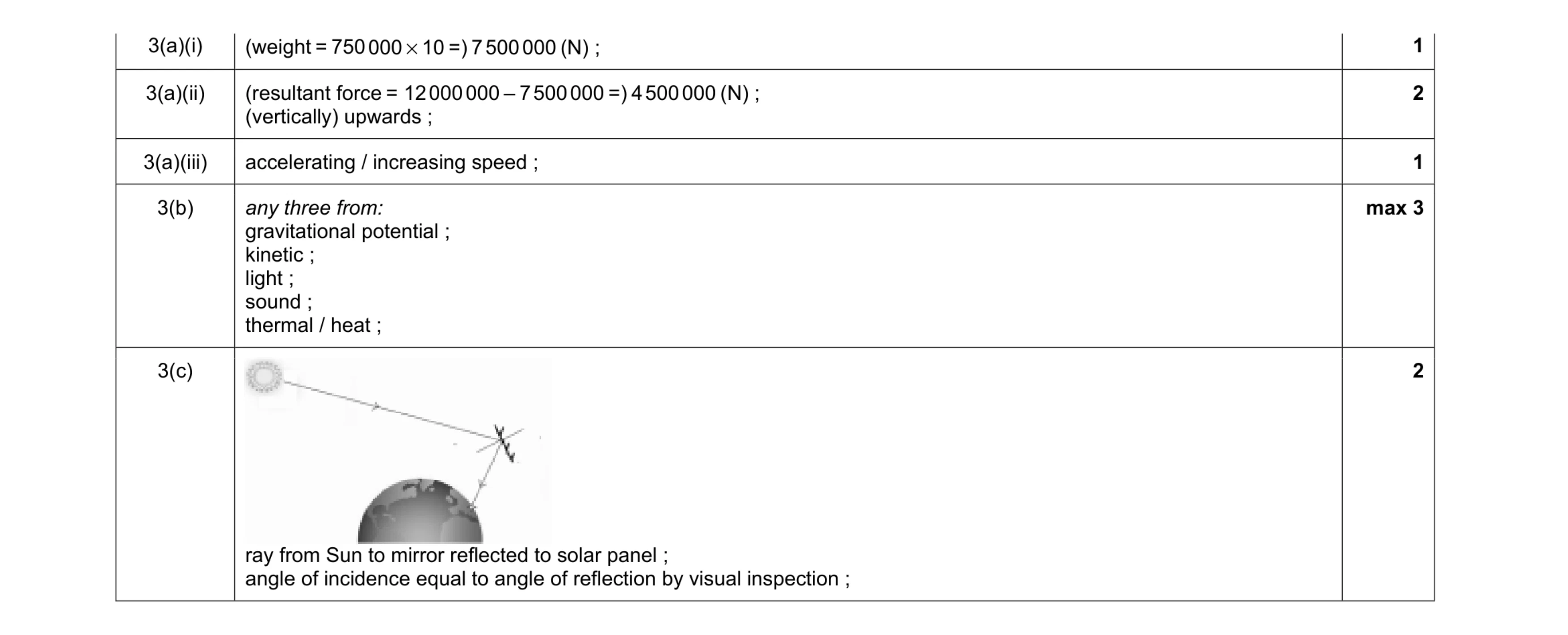 9
9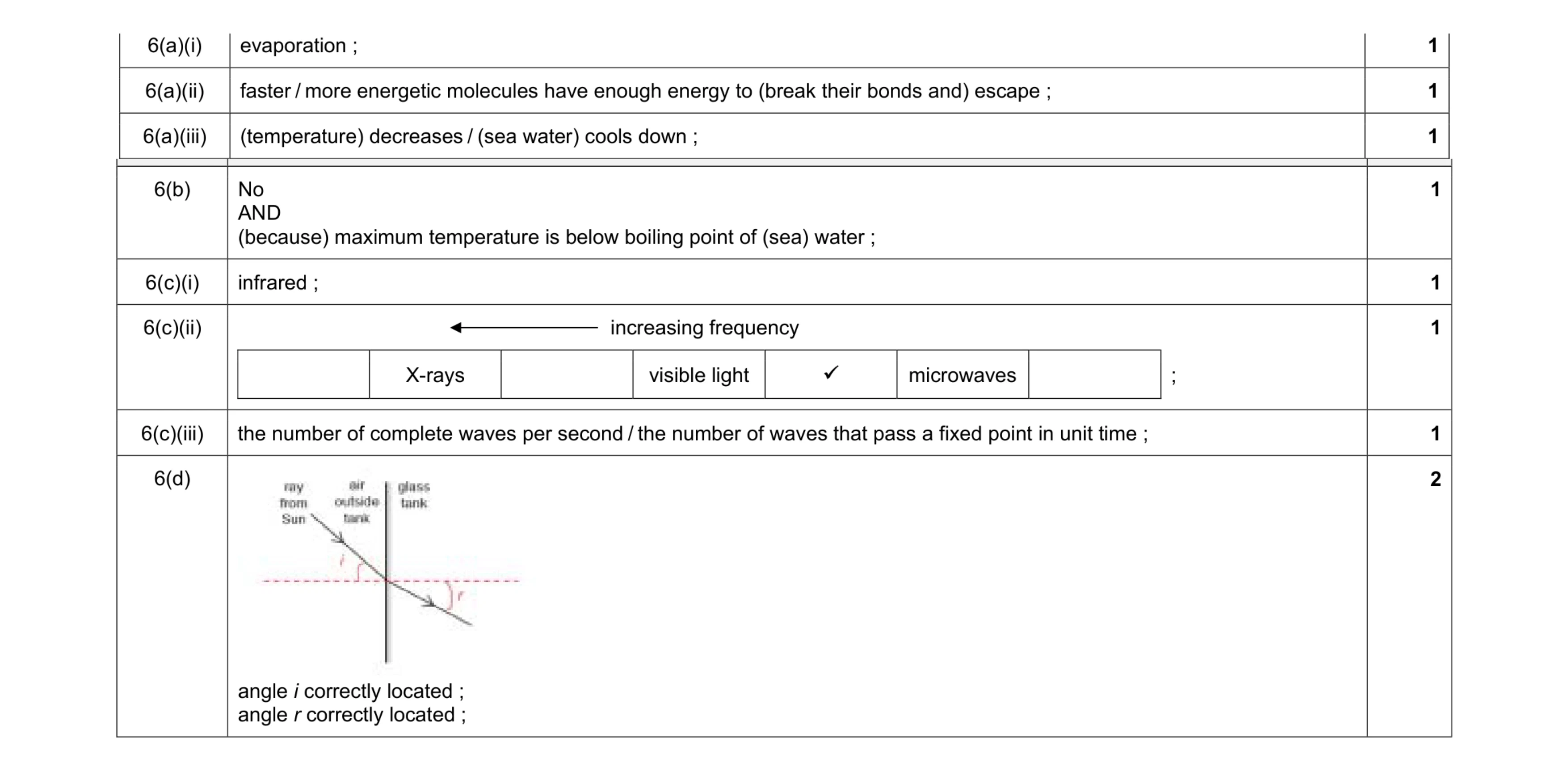 9
9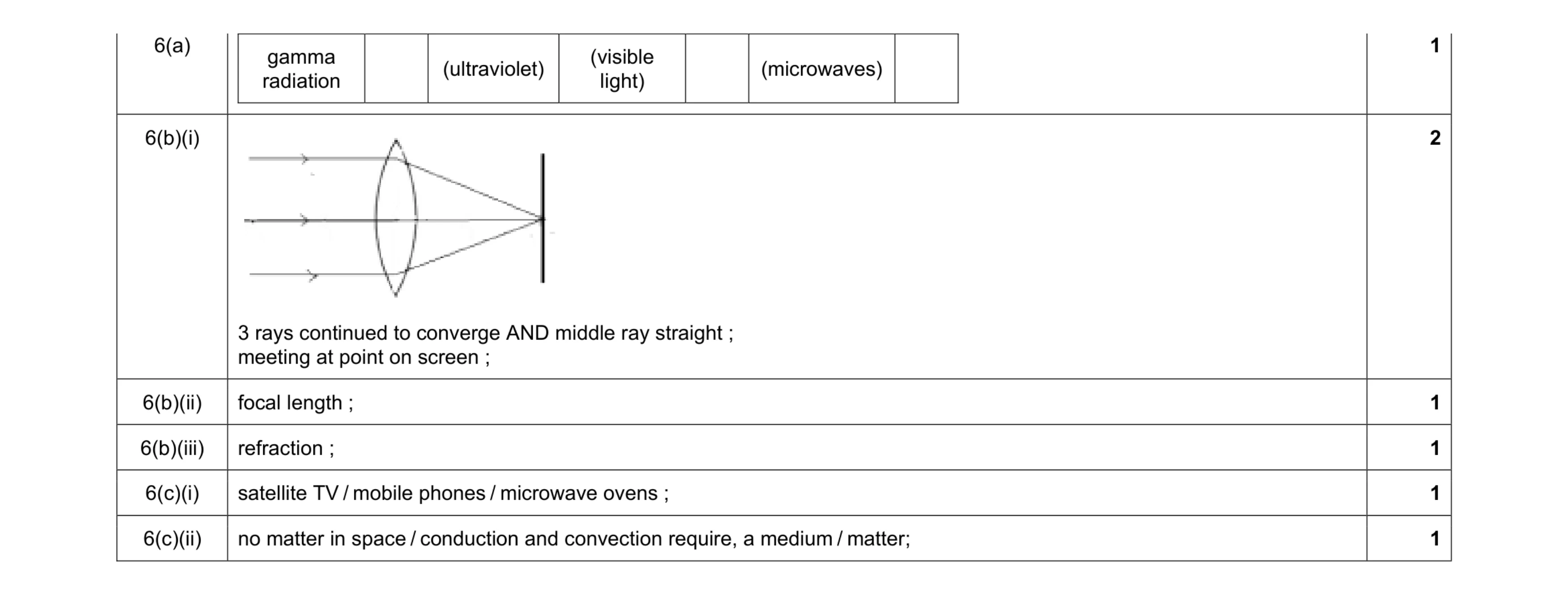 7
7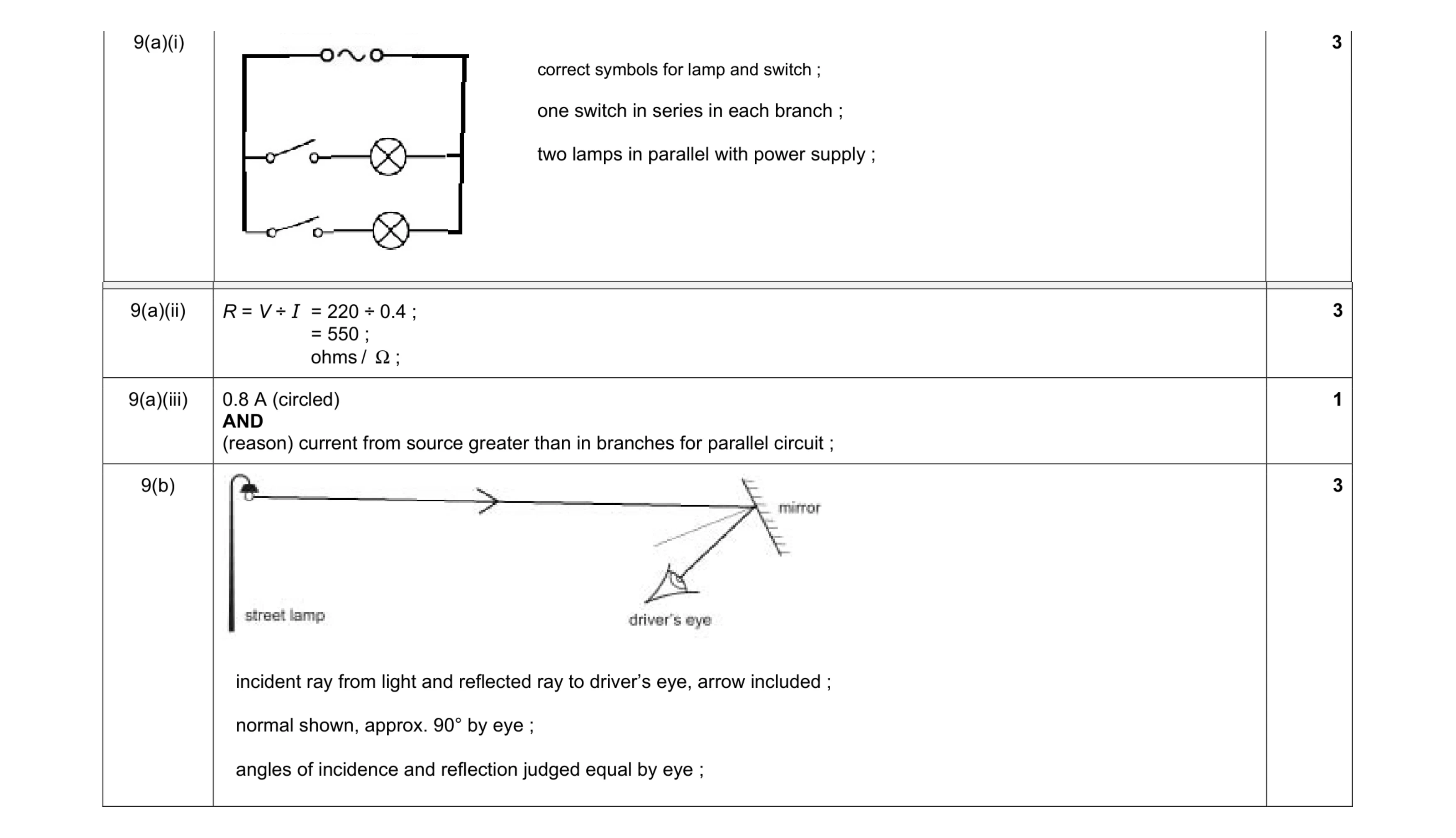 10
10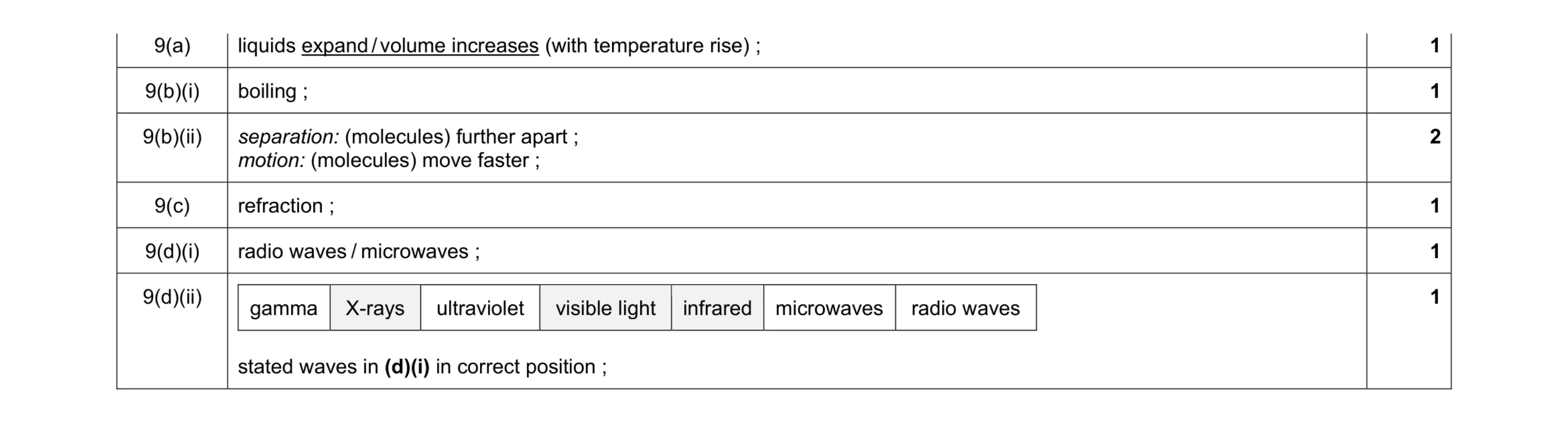 7
7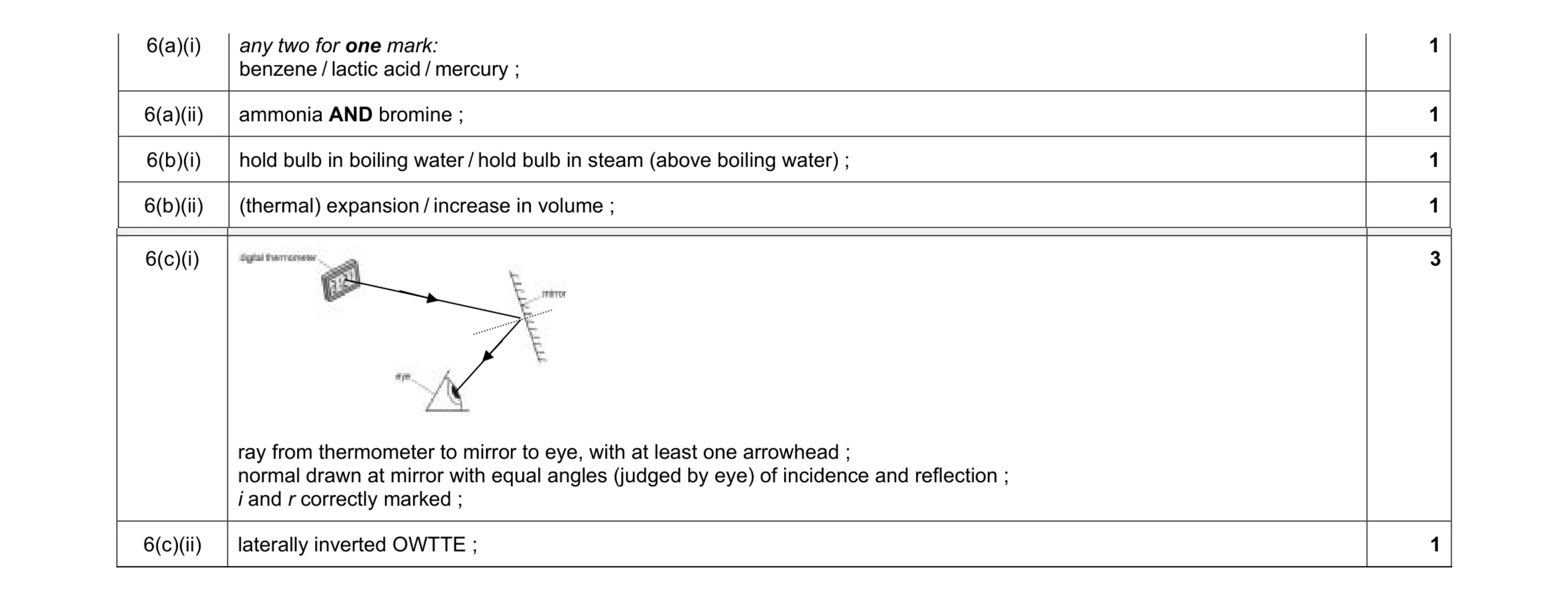 8
8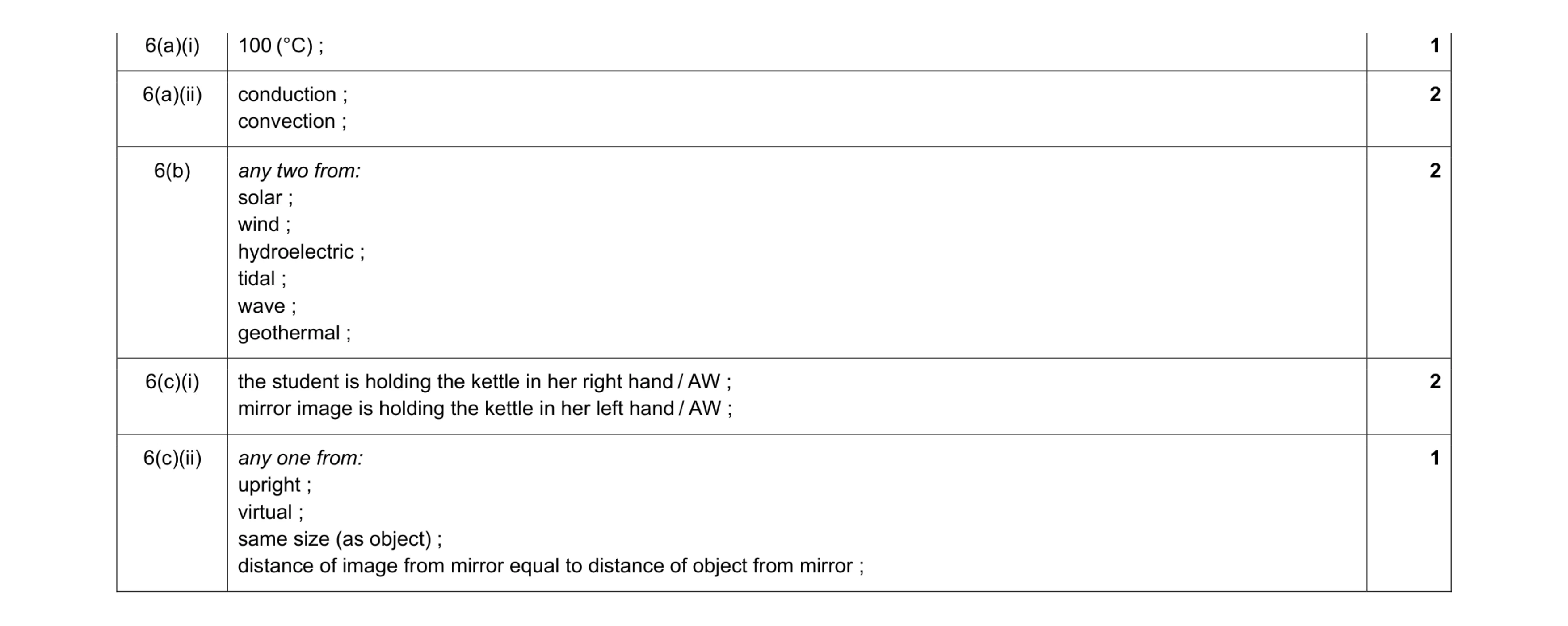 8
8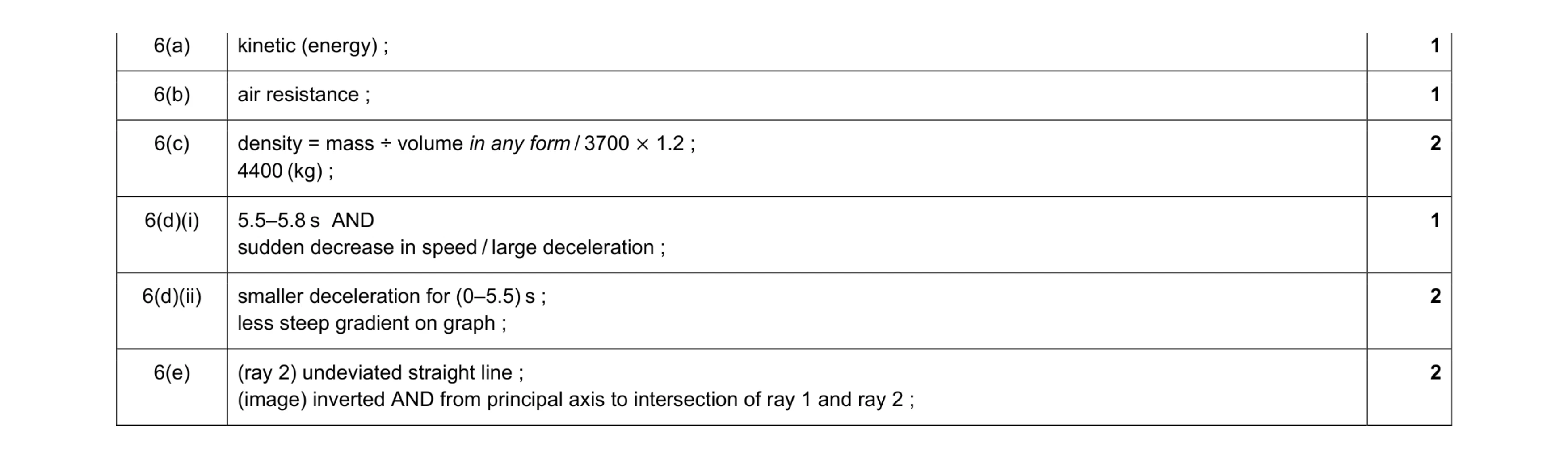 9
9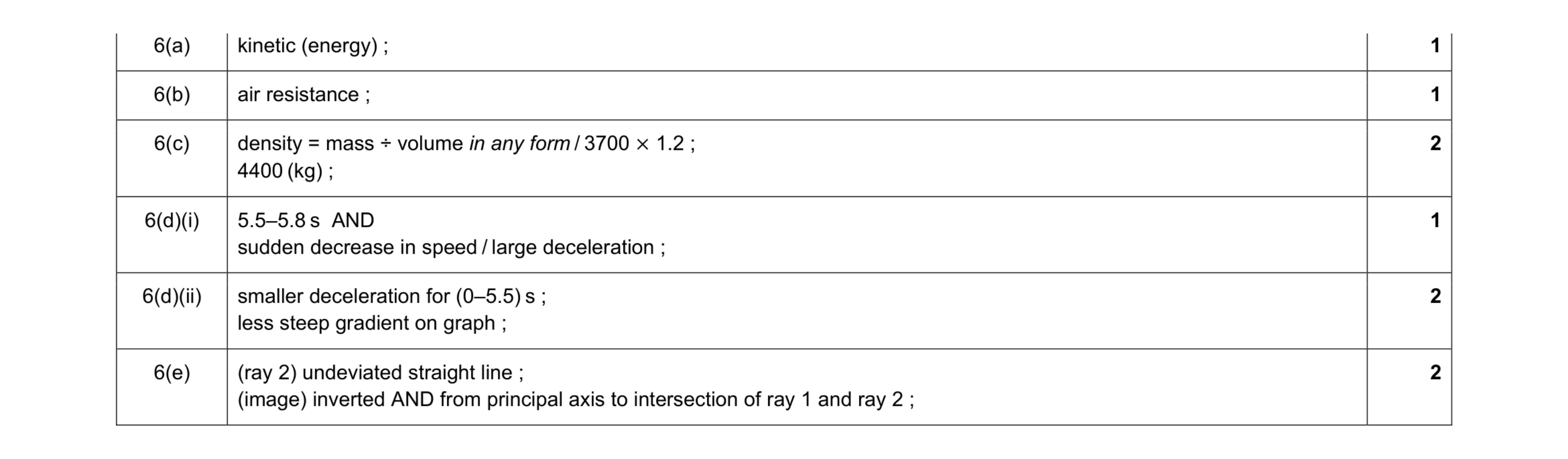 9
9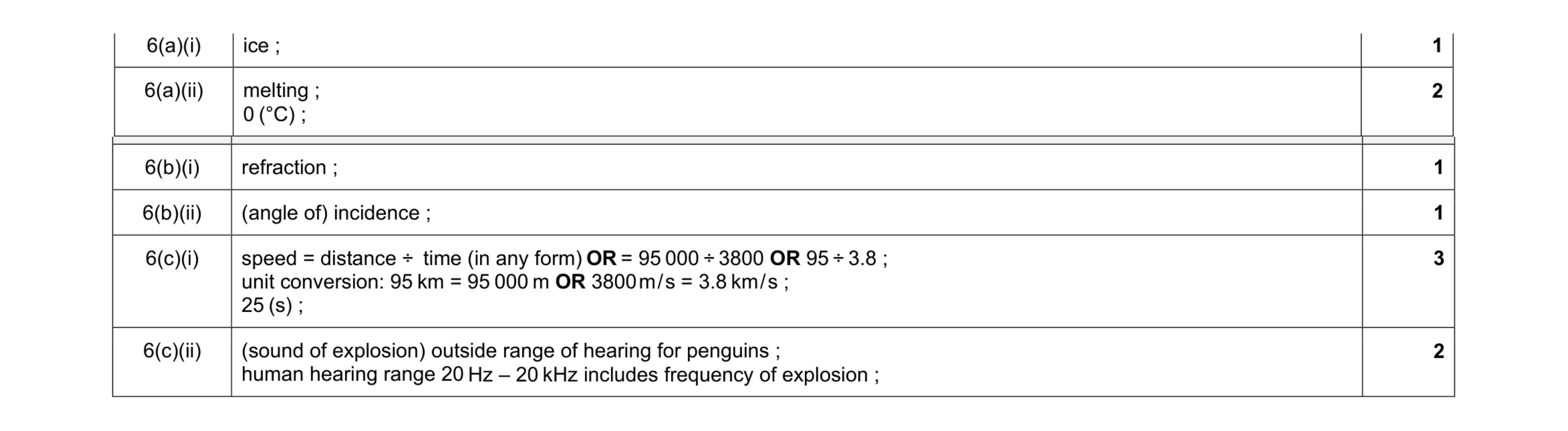 10
10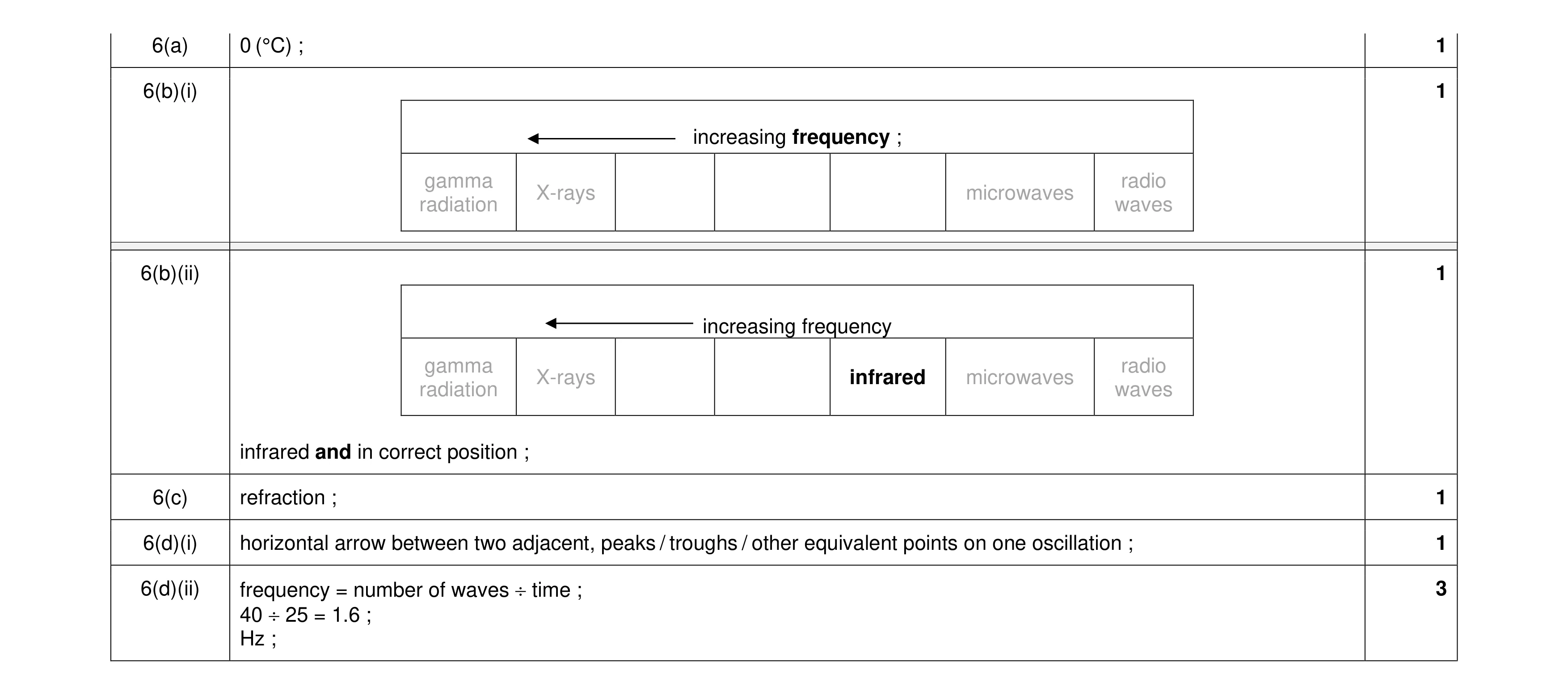 8
8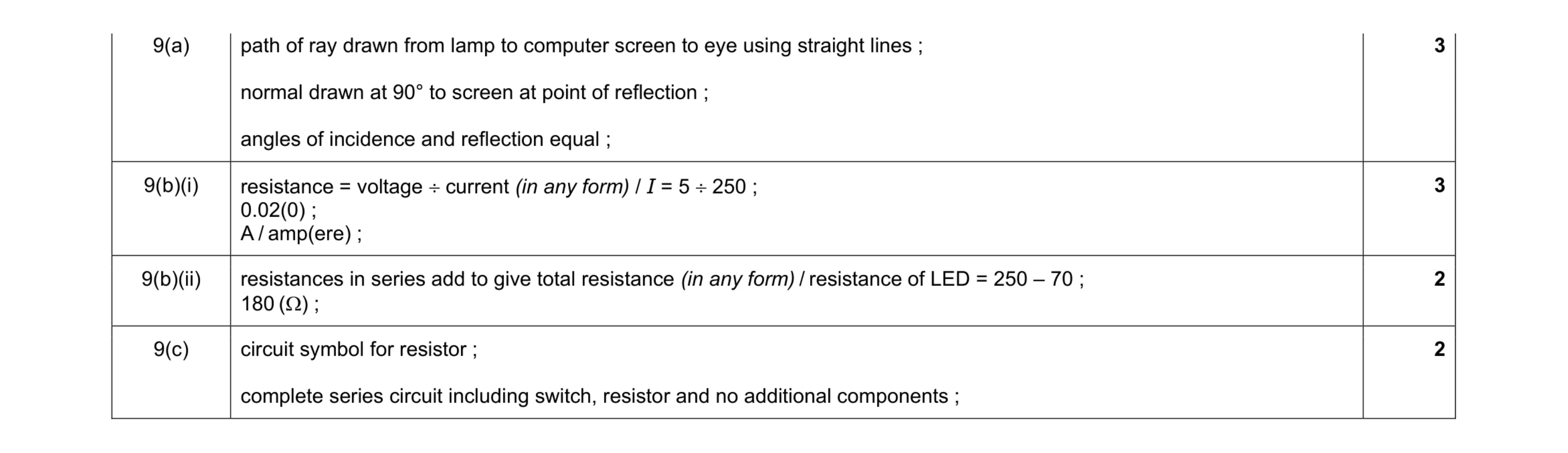 10
10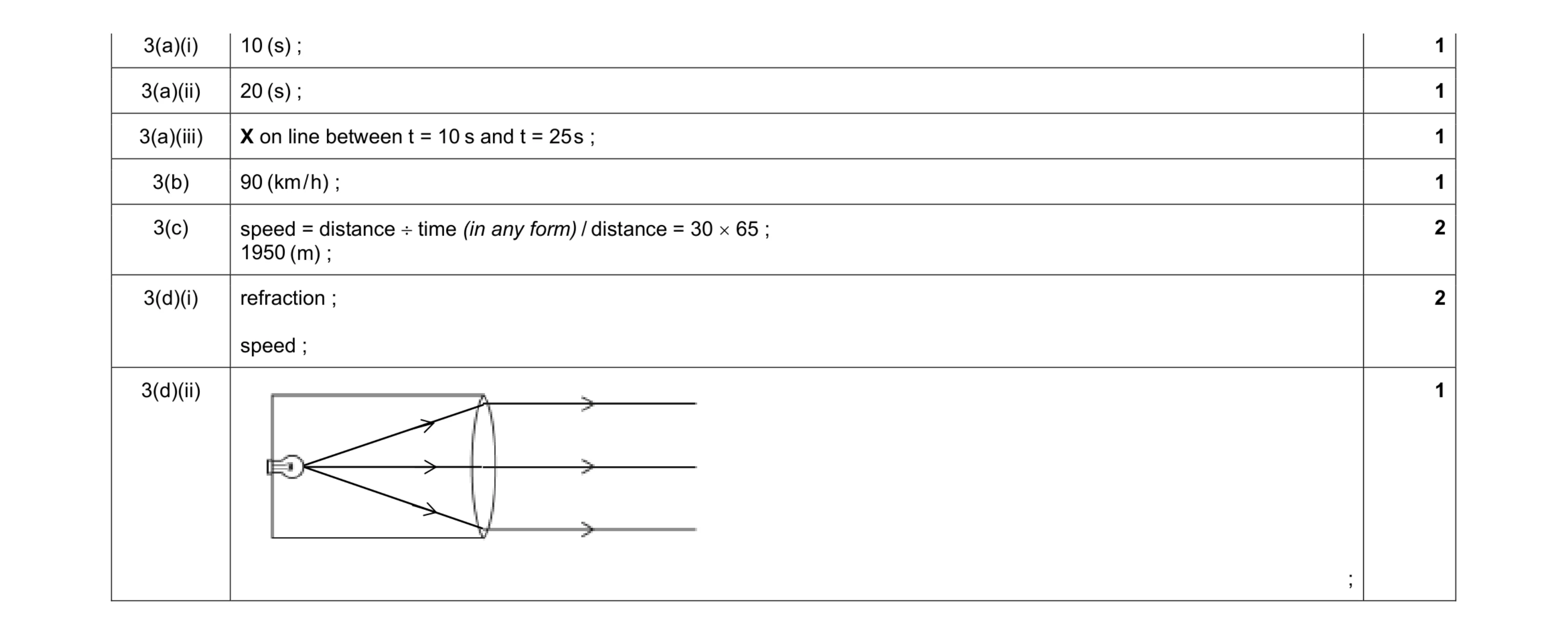 9
9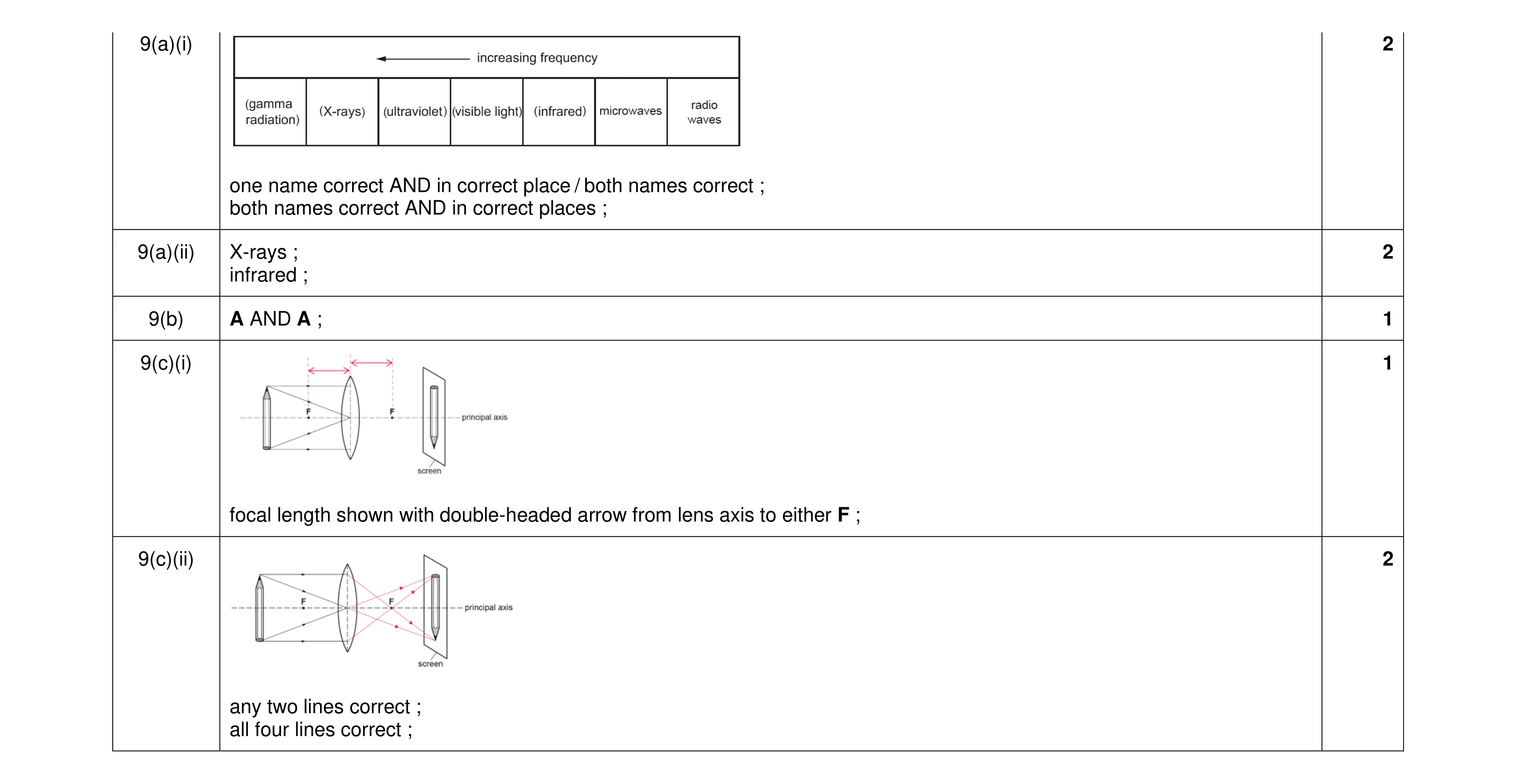 8
8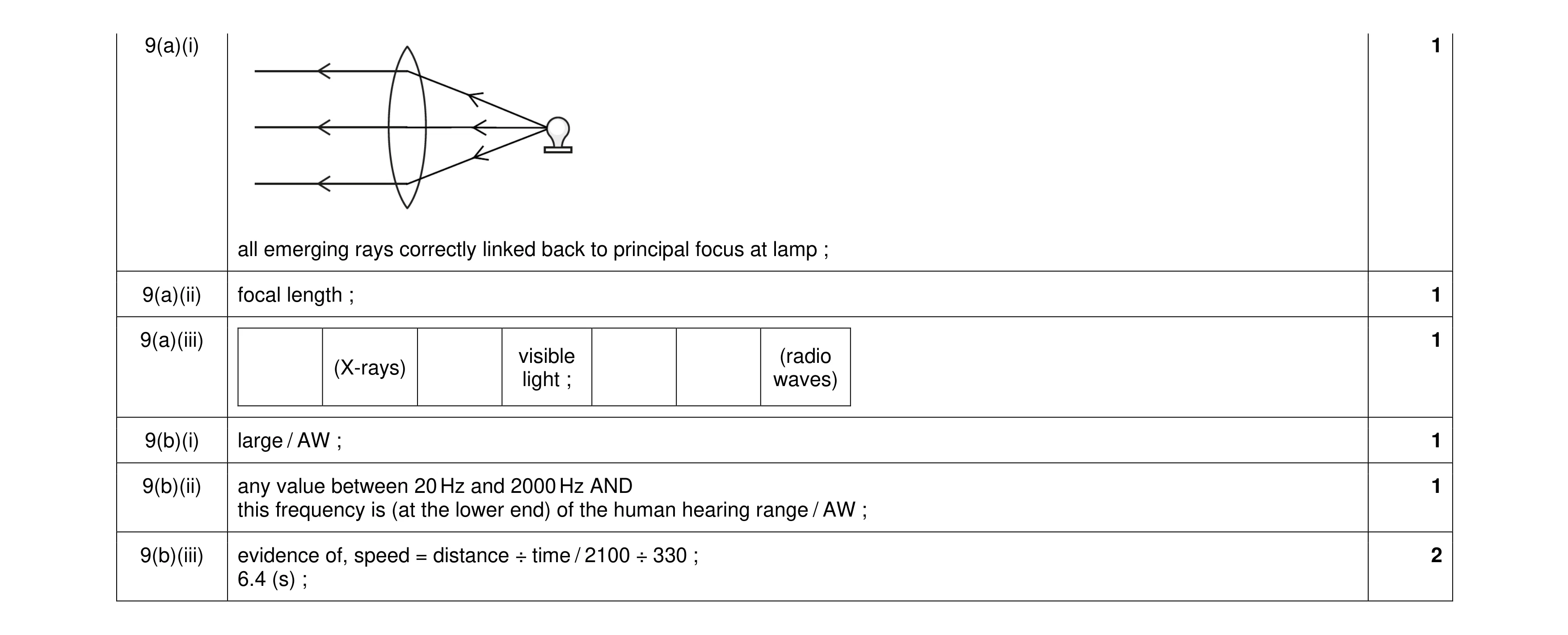 7
7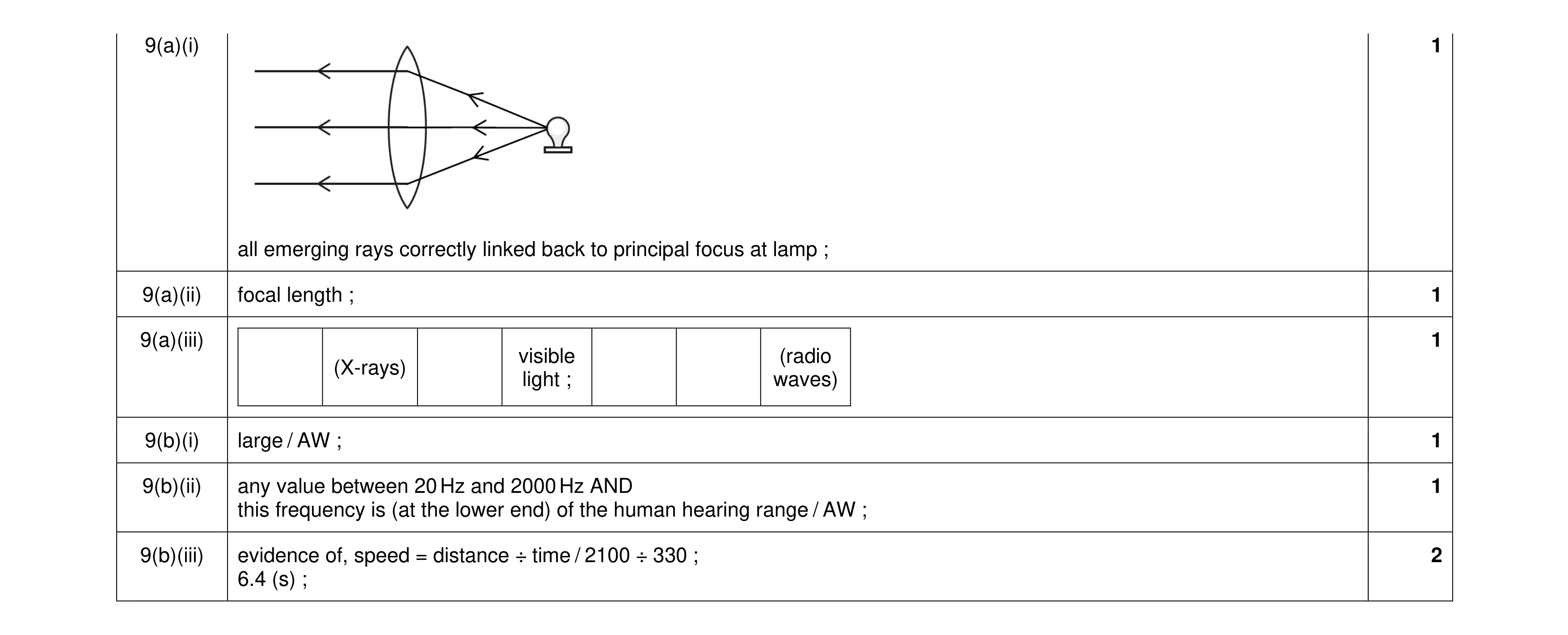 7
7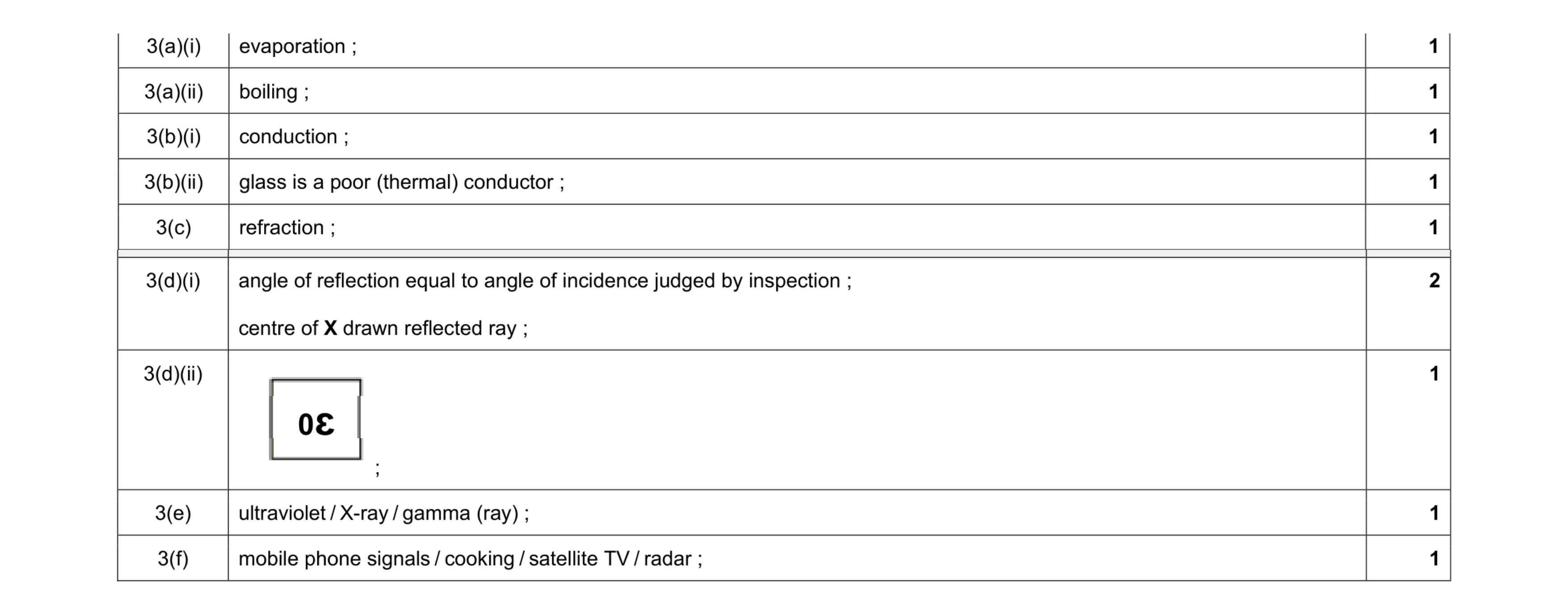 10
10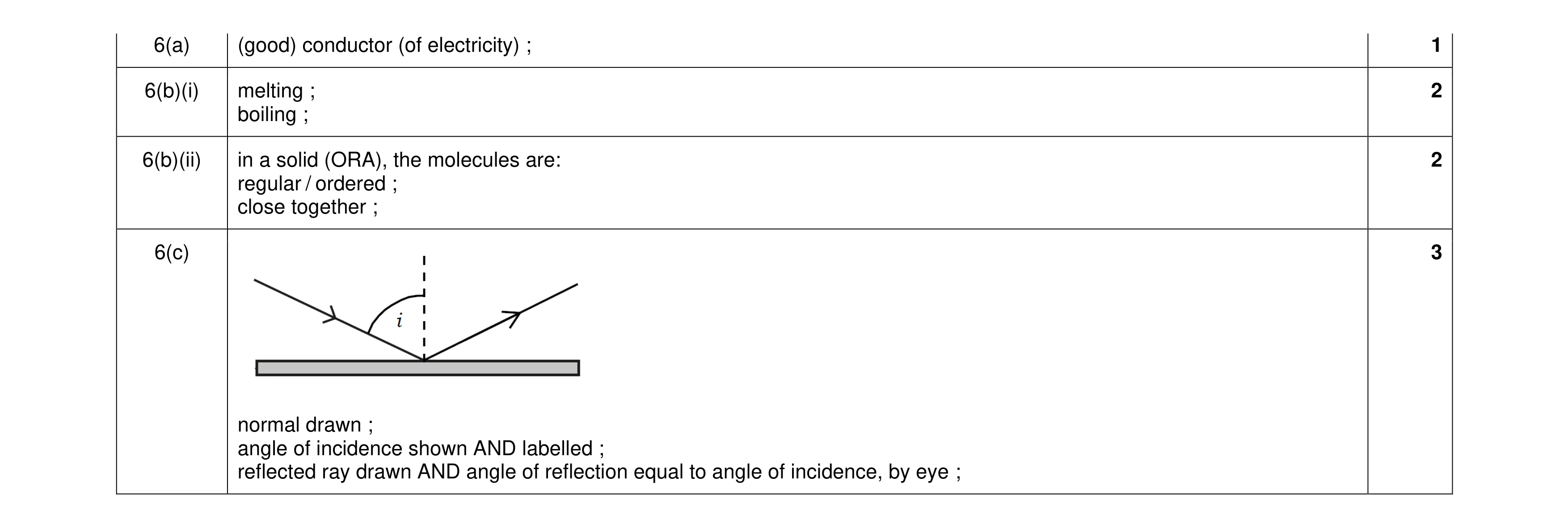 8
8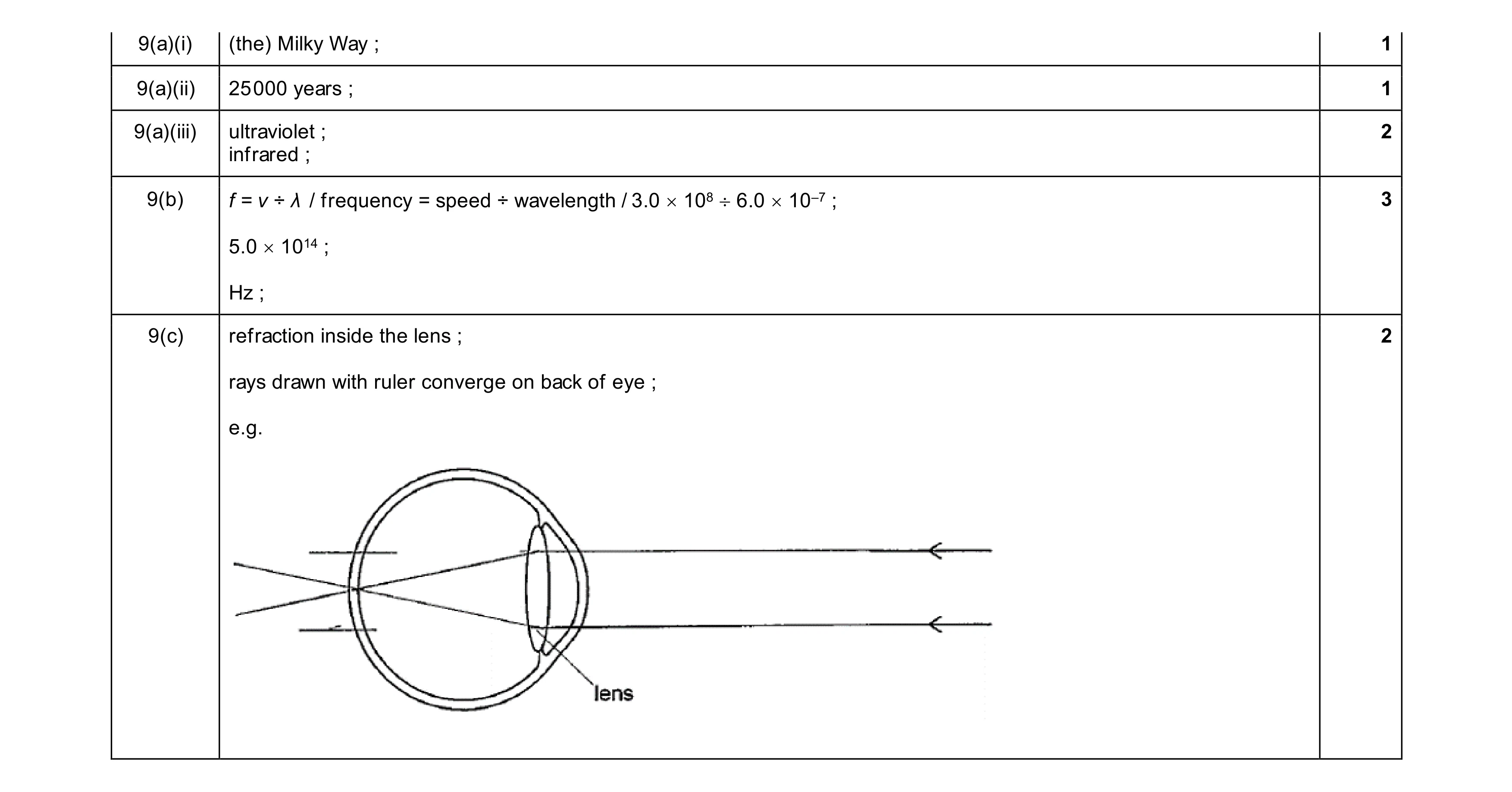 9
9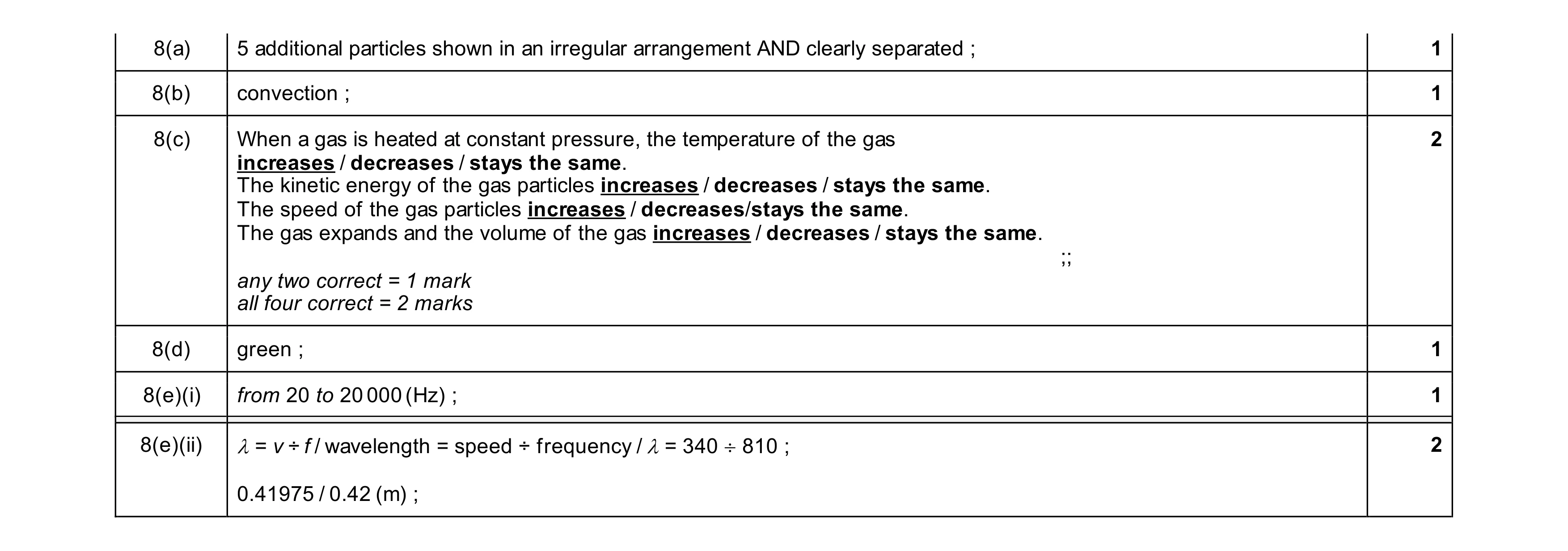 8
8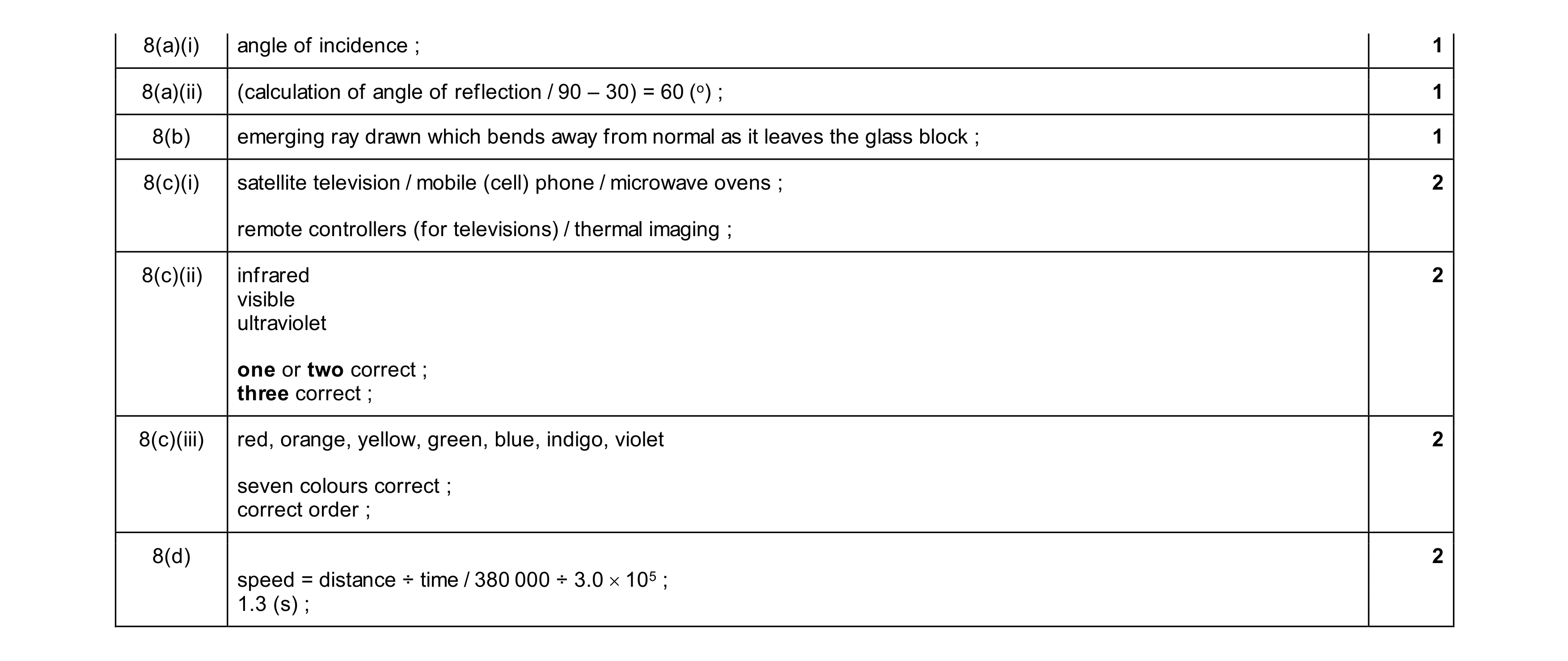 11
11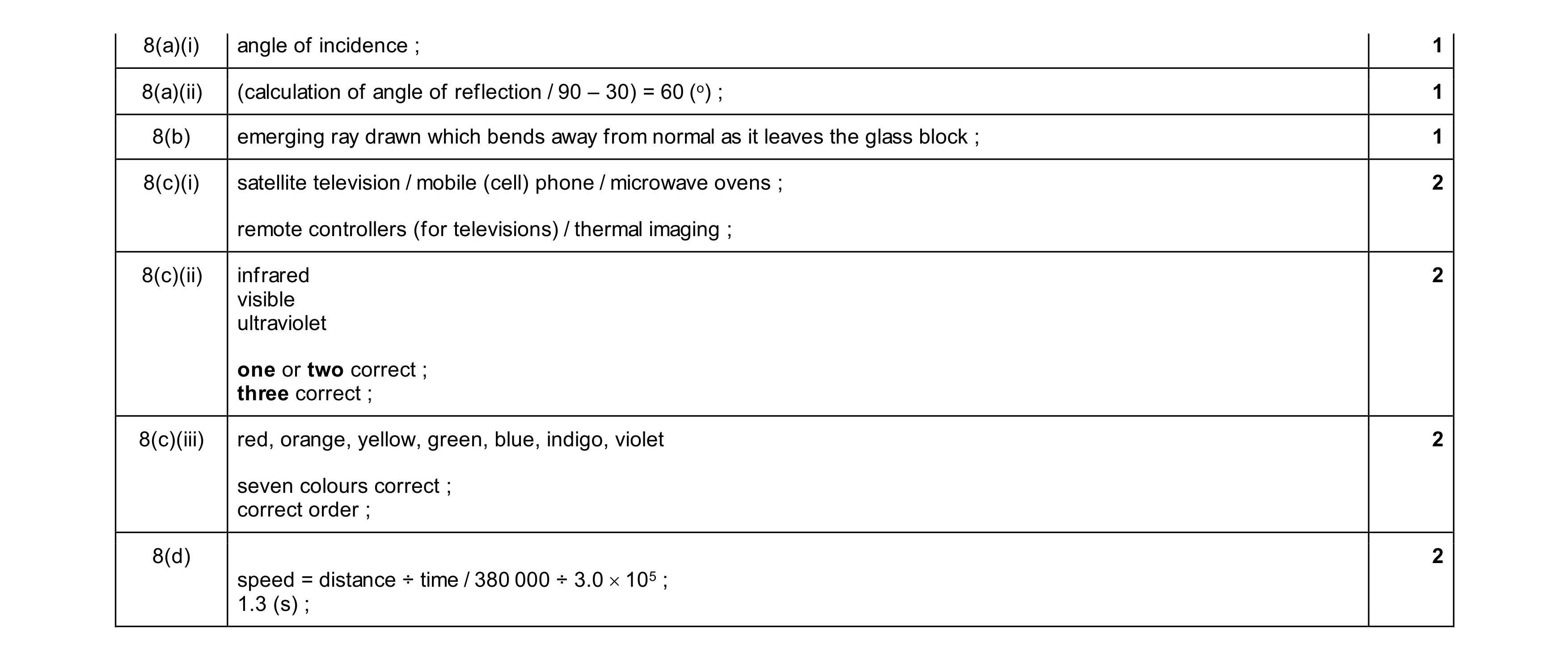 11
11