Cambridge IGCSE Science - Combined 0653 — 2017 Oct/Nov Paper 3 · Variant 1
0653/31/O/N/17 · 9 questions · 80 marks · ≈90 min
The question paper and its mark scheme, free to read here and free to download. This is Cambridge’s own paper, exactly as it was sat.
Question paper24 pages


Mark scheme7 pages
Answers below. Sit the paper first if you are practising.
Questions as text
Q1 · Use the following words or phrases to complete the flow chart about the transport of…
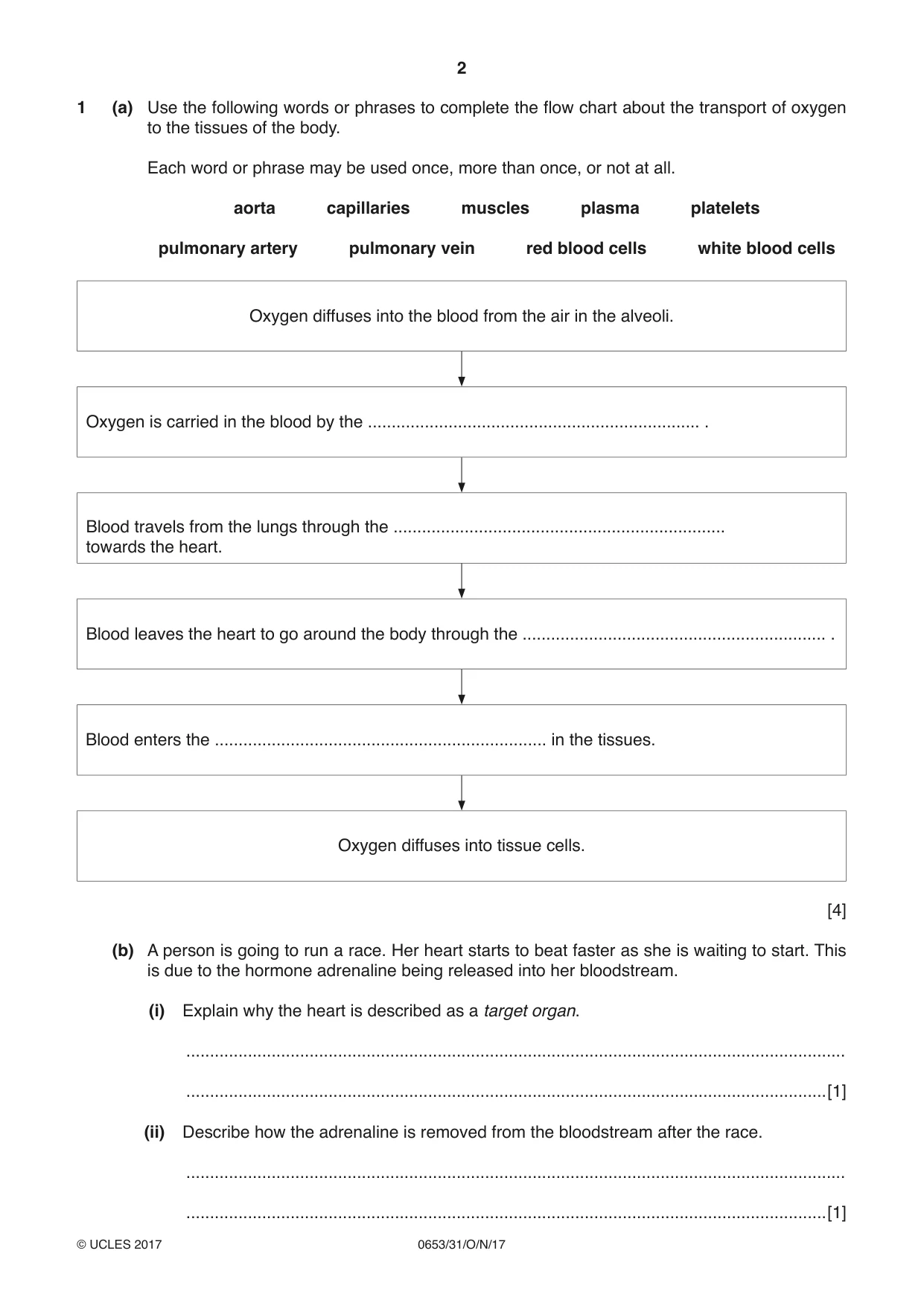
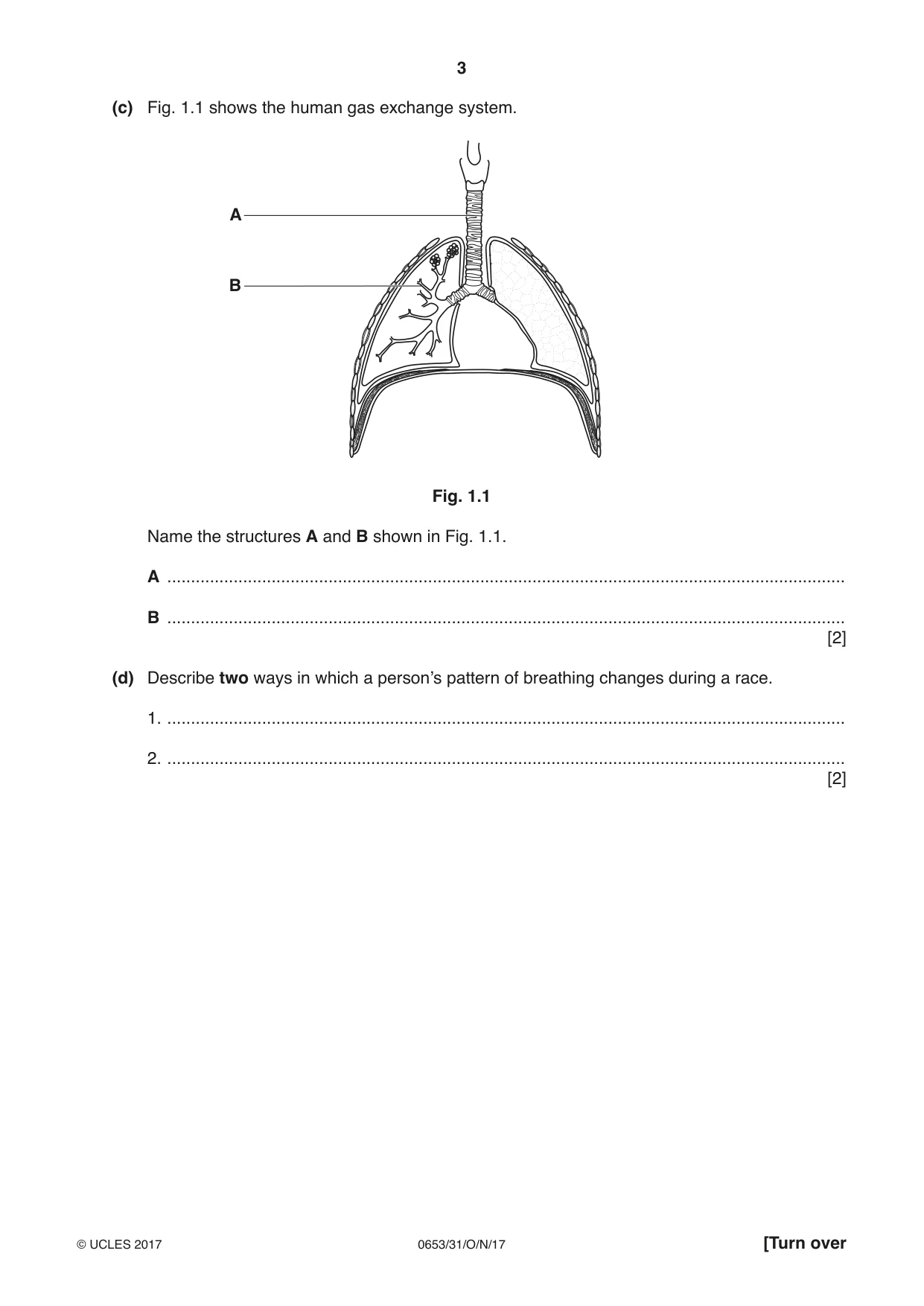
1 (a) Use the following words or phrases to complete the flow chart about the transport of oxygen to the tissues of the body. Each word or phrase may be used once, more than once, or not at all. aorta capillaries muscles plasma platelets pulmonary artery pulmonary vein red blood cells white blood cells Oxygen diffuses into the blood from the air in the alveoli. Oxygen is carried in the blood by the ...................................................................... . Blood travels from the lungs through the ...................................................................... towards the heart. Blood leaves the heart to go around the body through the ................................................................ . Blood enters the ...................................................................... in the tissues. Oxygen diffuses into tissue cells. [4] (b) A person is going to run a race. Her heart starts to beat faster as she is waiting to start. This is due to the hormone adrenaline being released into her bloodstream. (i) Explain why the heart is described as a target organ. ........................................................................................................................................... .......................................................................................................................................[1] (ii) Describe how the adrenaline is removed from the bloodstream after the race. ........................................................................................................................................... .......................................................................................................................................[1] (c) Fig. 1.1 shows the human gas exchange system. A B Fig. 1.1 Name the structures A and B shown in Fig. 1.1. A ............................................................................................................................................... B ............................................................................................................................................... [2] (d) Describe two ways in which a person’s pattern of breathing changes during a race. 1. ............................................................................................................................................... 2. ............................................................................................................................................... [2]
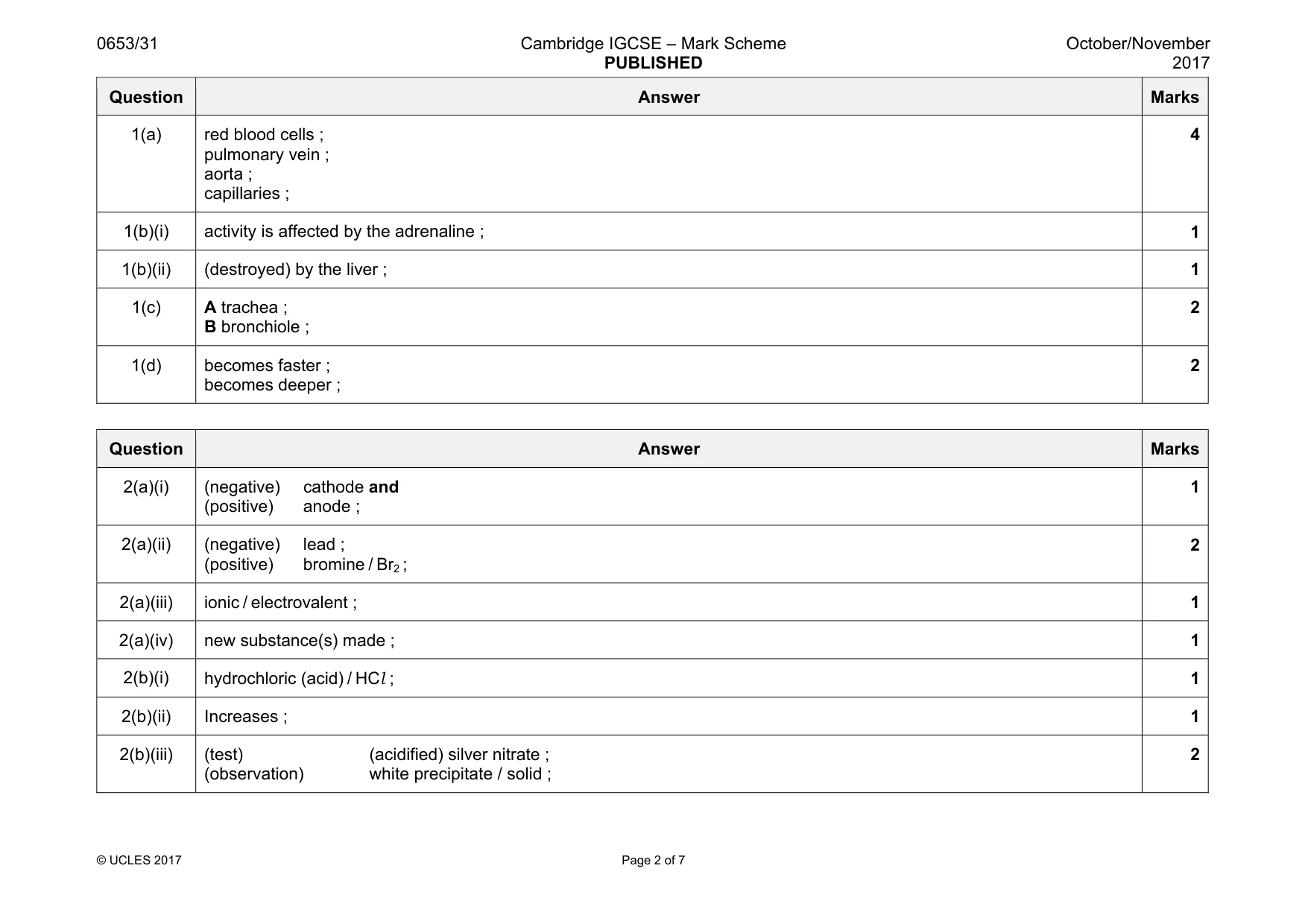
Mark scheme: 1(a) red blood cells ; pulmonary vein ; aorta ; capillaries ; 4 1(b)(i) activity is affected by the adrenaline ; 1 1(b)(ii) (destroyed) by the liver ; 1 1(c) A trachea ; B bronchiole ; 2 1(d) becomes faster ; becomes deeper ; 2
Q2 · Electrolysis is used to break up some compounds into simpler substances
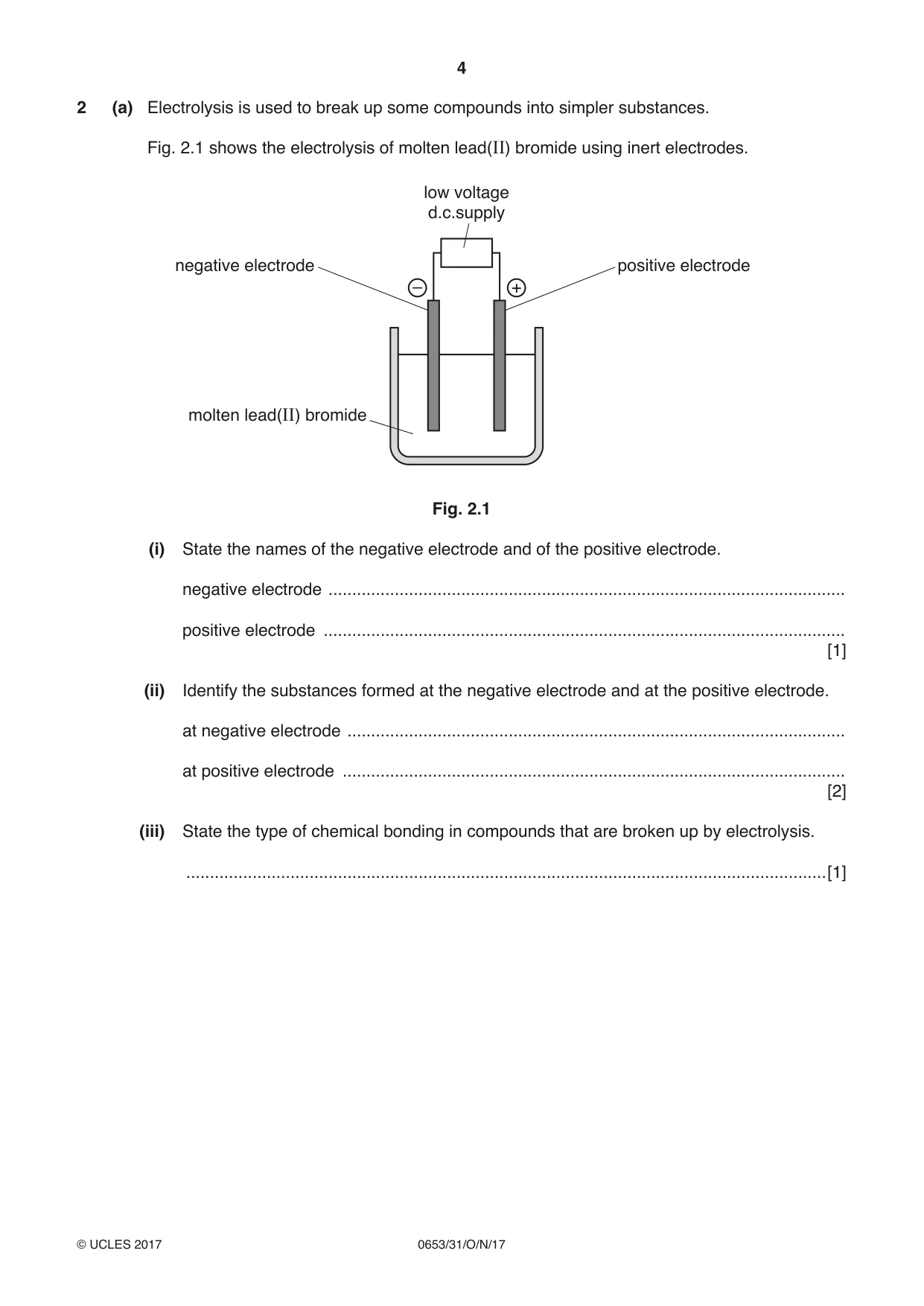
2 (a) Electrolysis is used to break up some compounds into simpler substances. Fig. 2.1 shows the electrolysis of molten lead(II) bromide using inert electrodes. low voltage d.c.supply negative electrode positive electrode – + molten lead(II) bromide Fig. 2.1 (i) State the names of the negative electrode and of the positive electrode. negative electrode ............................................................................................................. positive electrode .............................................................................................................. [1] (ii) Identify the substances formed at the negative electrode and at the positive electrode. at negative electrode ......................................................................................................... at positive electrode .......................................................................................................... [2] (iii) State the type of chemical bonding in compounds that are broken up by electrolysis. .......................................................................................................................................[1] (iv) Electrolysis results in a chemical change. Explain what is meant by the term chemical change. ........................................................................................................................................... ........................................................................................................................................... .......................................................................................................................................[1] (b) Potassium chloride is made when solid potassium carbonate reacts with an acid. A gas is made during this reaction. (i) Name the acid that reacts with potassium carbonate to form potassium chloride. .......................................................................................................................................[1] (ii) Describe the change of the pH of the solution during the reaction. .......................................................................................................................................[1] (iii) Describe a test to show that the colourless solution formed by this reaction contains chloride ions. test .................................................................................................................................... observation ........................................................................................................................ [2]
Mark scheme: 2(a)(i) (negative) cathode and (positive) anode ; 1 2(a)(ii) (negative) lead ; (positive) bromine / Br2 ; 2 2(a)(iii) ionic / electrovalent ; 1 2(a)(iv) new substance(s) made ; 1 2(b)(i) hydrochloric (acid) / HCl ; 1 2(b)(ii) Increases ; 1 2(b)(iii) (test) (acidified) silver nitrate ; (observation) white precipitate / solid ; 2
Question 3
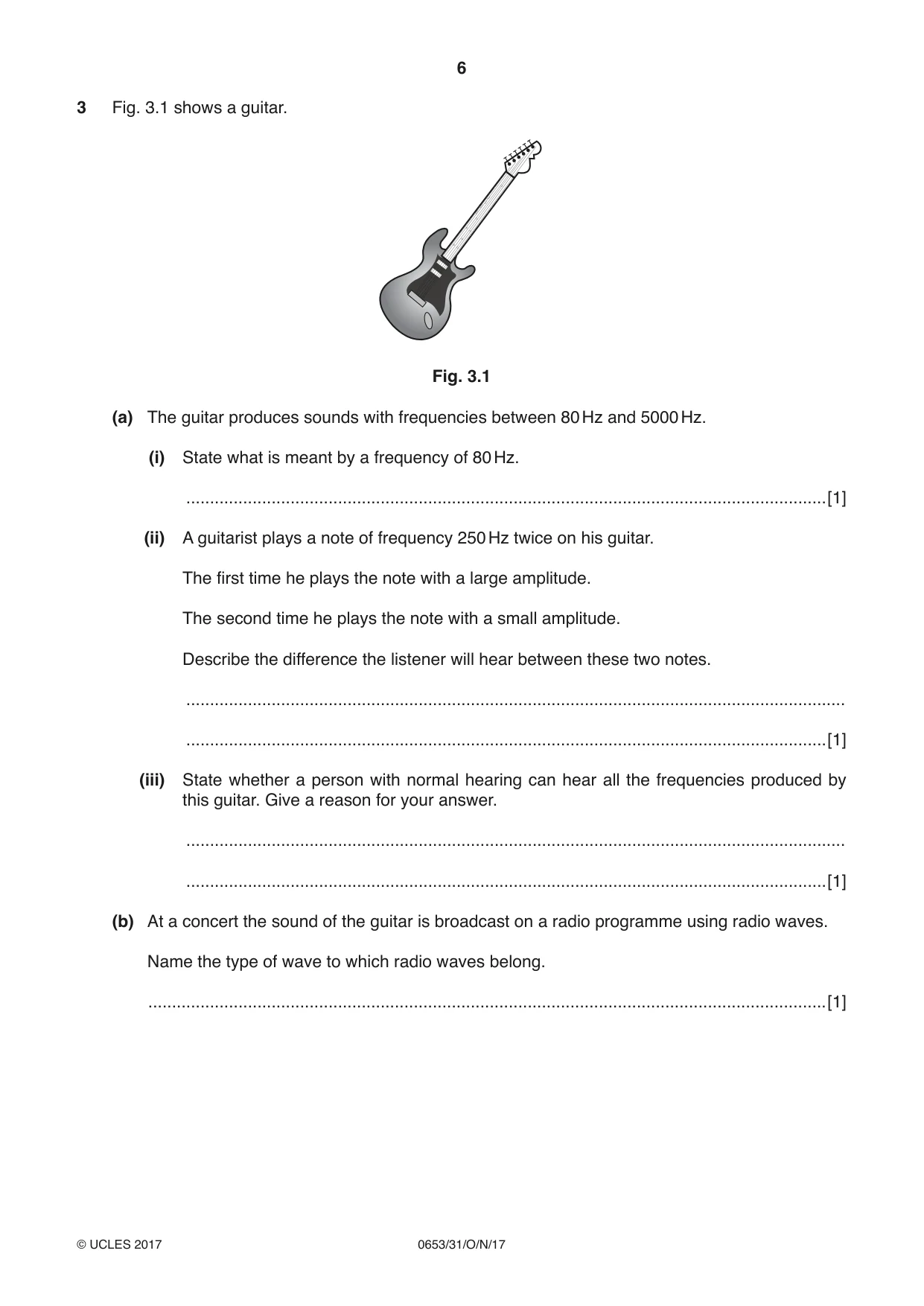
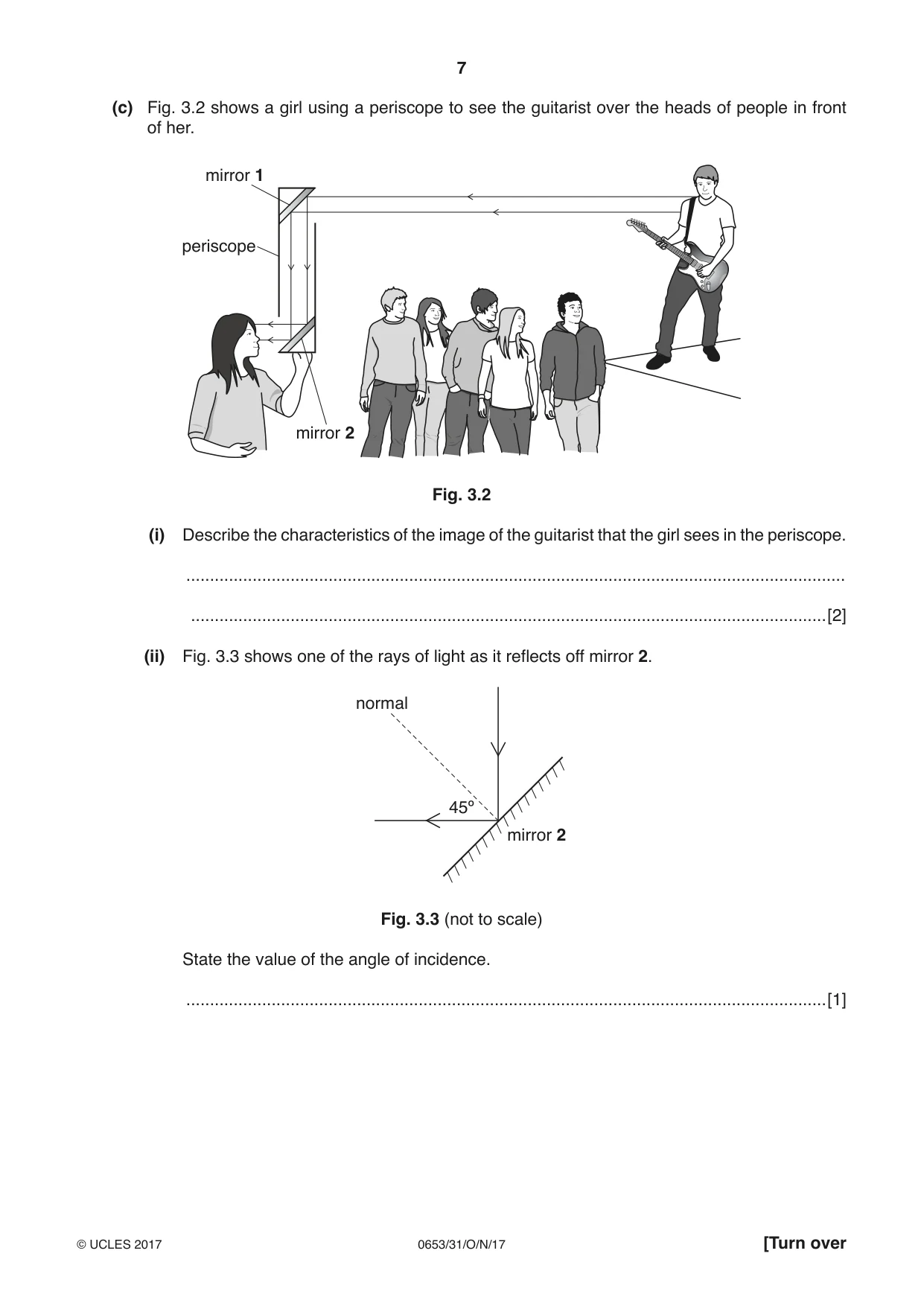
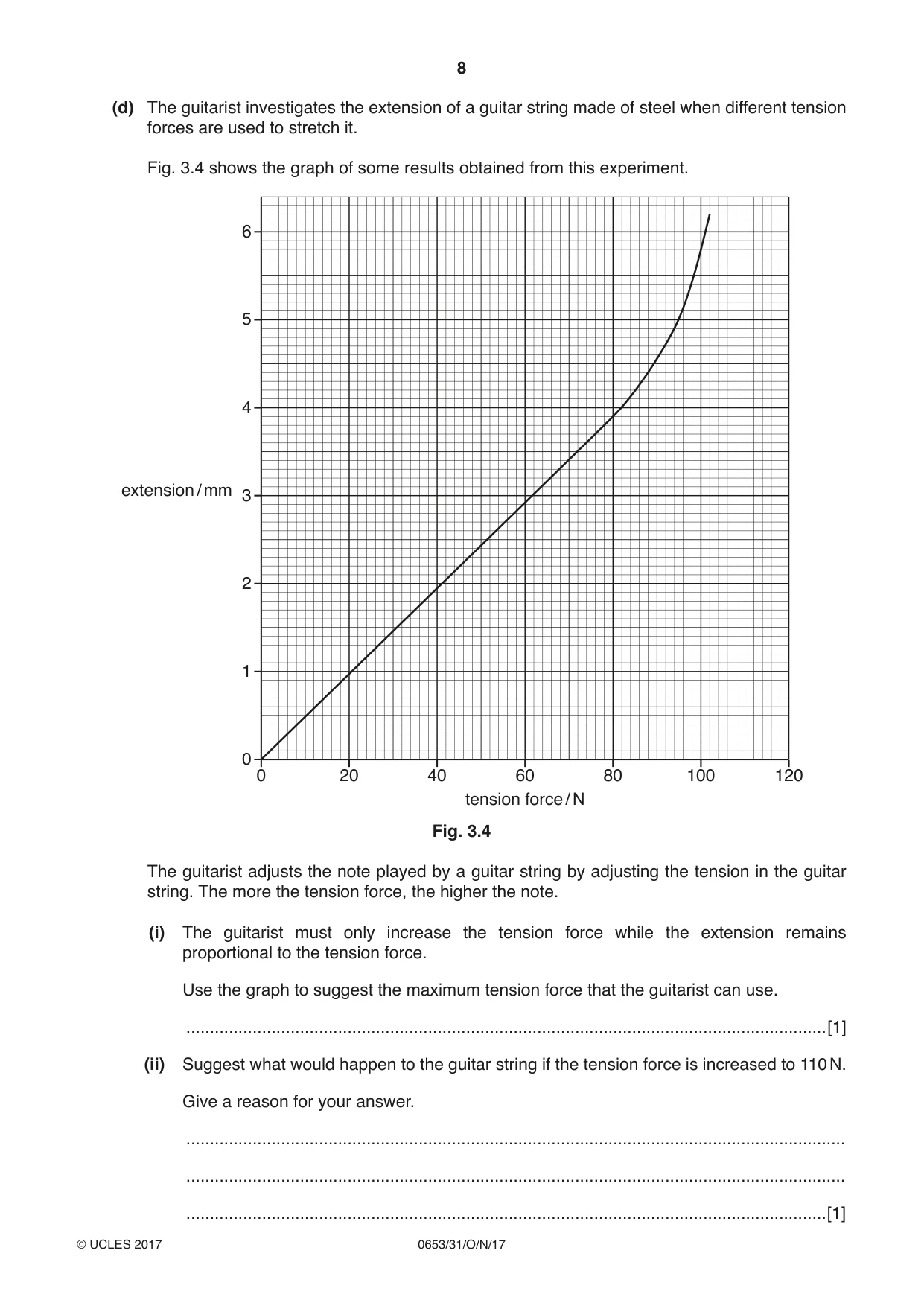
3 Fig. 3.1 shows a guitar. Fig. 3.1 (a) The guitar produces sounds with frequencies between 80 Hz and 5000 Hz. (i) State what is meant by a frequency of 80 Hz. .......................................................................................................................................[1] (ii) A guitarist plays a note of frequency 250 Hz twice on his guitar. The first time he plays the note with a large amplitude. The second time he plays the note with a small amplitude. Describe the difference the listener will hear between these two notes. ........................................................................................................................................... .......................................................................................................................................[1] (iii) State whether a person with normal hearing can hear all the frequencies produced by this guitar. Give a reason for your answer. ........................................................................................................................................... .......................................................................................................................................[1] (b) At a concert the sound of the guitar is broadcast on a radio programme using radio waves. Name the type of wave to which radio waves belong. ...............................................................................................................................................[1] (c) Fig. 3.2 shows a girl using a periscope to see the guitarist over the heads of people in front of her. mirror 1 periscope mirror 2 Fig. 3.2 (i) Describe the characteristics of the image of the guitarist that the girl sees in the periscope. ........................................................................................................................................... ......................................................................................................................................[2] (ii) Fig. 3.3 shows one of the rays of light as it reflects off mirror 2. normal 45º mirror 2 Fig. 3.3 (not to scale) State the value of the angle of incidence. .......................................................................................................................................[1] (d) The guitarist investigates the extension of a guitar string made of steel when different tension forces are used to stretch it. Fig. 3.4 shows the graph of some results obtained from this experiment. 6 5 4 extension / mm 3 2 1 0 0 20 40 60 80 100 120 tension force / N Fig. 3.4 The guitarist adjusts the note played by a guitar string by adjusting the tension in the guitar string. The more the tension force, the higher the note. (i) The guitarist must only increase the tension force while the extension remains proportional to the tension force. Use the graph to suggest the maximum tension force that the guitarist can use. .......................................................................................................................................[1] (ii) Suggest what would happen to the guitar string if the tension force is increased to 110 N. Give a reason for your answer. ........................................................................................................................................... ........................................................................................................................................... .......................................................................................................................................[1]
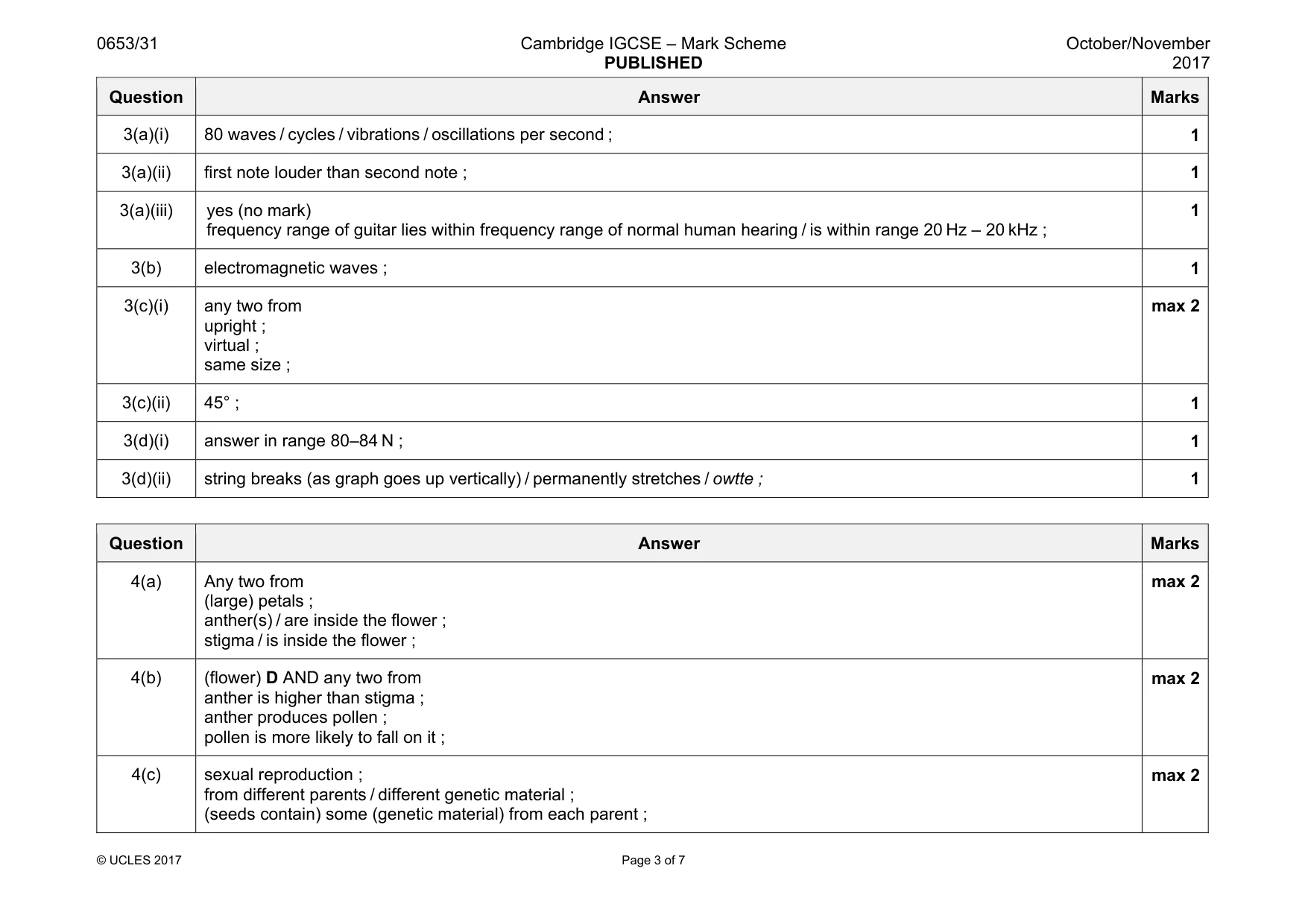
Mark scheme: 3(a)(i) 80 waves / cycles / vibrations / oscillations per second ; 1 3(a)(ii) first note louder than second note ; 1 3(a)(iii) yes (no mark) frequency range of guitar lies within frequency range of normal human hearing / is within range 20 Hz – 20 kHz ; 1 3(b) electromagnetic waves ; 1 3(c)(i) any two from upright ; virtual ; same size ; max 2 3(c)(ii) 45° ; 1 3(d)(i) answer in range 80–84 N ; 1 3(d)(ii) string breaks (as graph goes up vertically) / permanently stretches / owtte ; 1
Q4 · Diagrams of primrose flowers
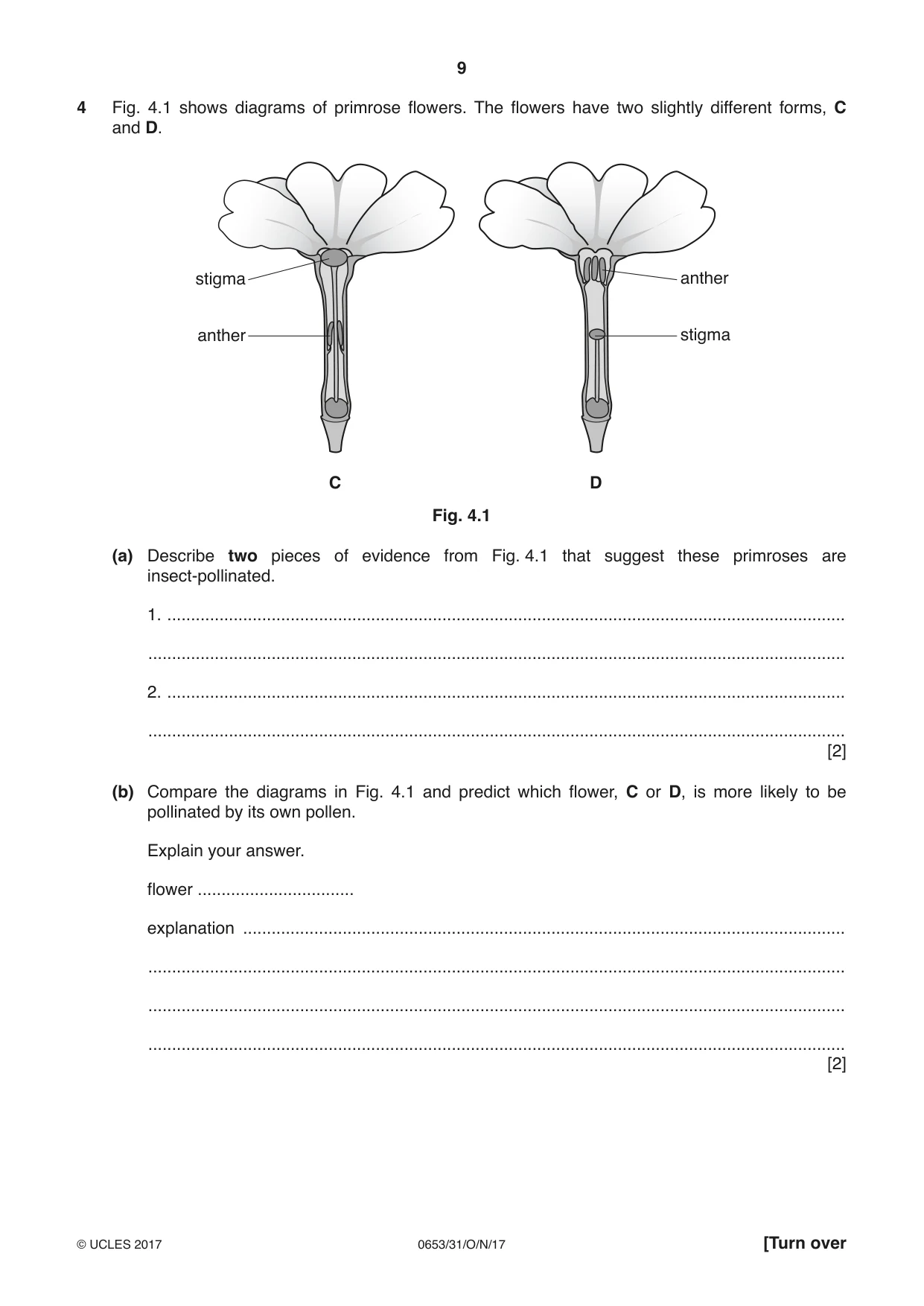
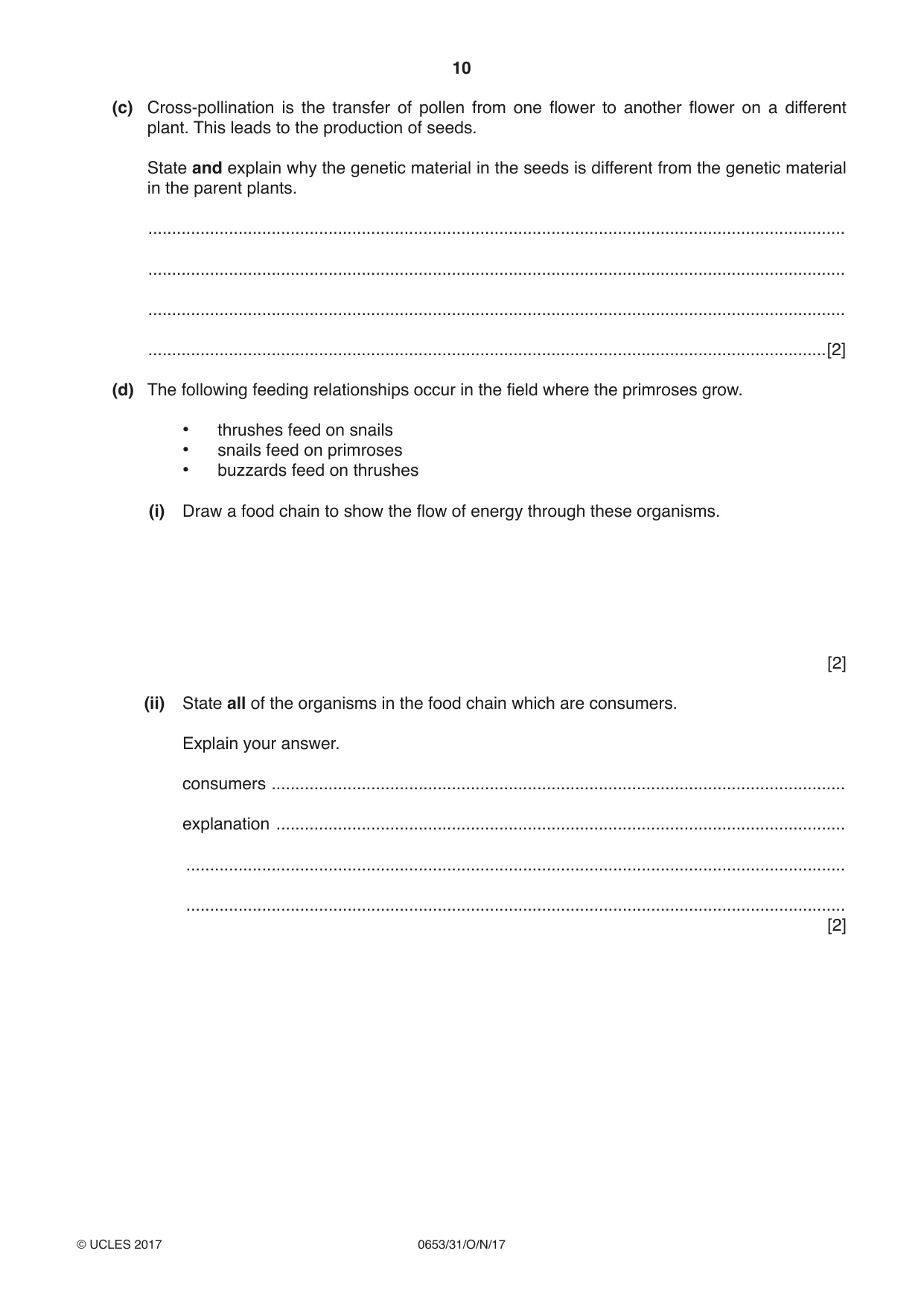
4 Fig. 4.1 shows diagrams of primrose flowers. The flowers have two slightly different forms, C and D. stigma anther anther stigma C D Fig. 4.1 (a) Describe two pieces of evidence from Fig. 4.1 that suggest these primroses are insect-pollinated. 1. ............................................................................................................................................... ................................................................................................................................................... 2. ............................................................................................................................................... ................................................................................................................................................... [2] (b) Compare the diagrams in Fig. 4.1 and predict which flower, C or D, is more likely to be pollinated by its own pollen. Explain your answer. flower ................................. explanation ............................................................................................................................... ................................................................................................................................................... ................................................................................................................................................... ................................................................................................................................................... [2] (c) Cross-pollination is the transfer of pollen from one flower to another flower on a different plant. This leads to the production of seeds. State and explain why the genetic material in the seeds is different from the genetic material in the parent plants. ................................................................................................................................................... ................................................................................................................................................... ................................................................................................................................................... ...............................................................................................................................................[2] (d) The following feeding relationships occur in the field where the primroses grow. • thrushes feed on snails • snails feed on primroses • buzzards feed on thrushes (i) Draw a food chain to show the flow of energy through these organisms. [2] (ii) State all of the organisms in the food chain which are consumers. Explain your answer. consumers ......................................................................................................................... explanation ........................................................................................................................ ........................................................................................................................................... ........................................................................................................................................... [2]
Mark scheme: 4(a) Any two from (large) petals ; anther(s) / are inside the flower ; stigma / is inside the flower ; max 2 4(b) (flower) D AND any two from anther is higher than stigma ; anther produces pollen ; pollen is more likely to fall on it ; max 2 4(c) sexual reproduction ; from different parents / different genetic material ; (seeds contain) some (genetic material) from each parent ; max 2 Question Answer Marks 4(d)(i) primroses → snails → thrushes → buzzards correct order ; correct arrows ; 2 4(d)(ii) snails, thrushes, buzzards ; (get their energy by) feeding on other organisms ; 2
Q5 · Ethene is a hydrocarbon
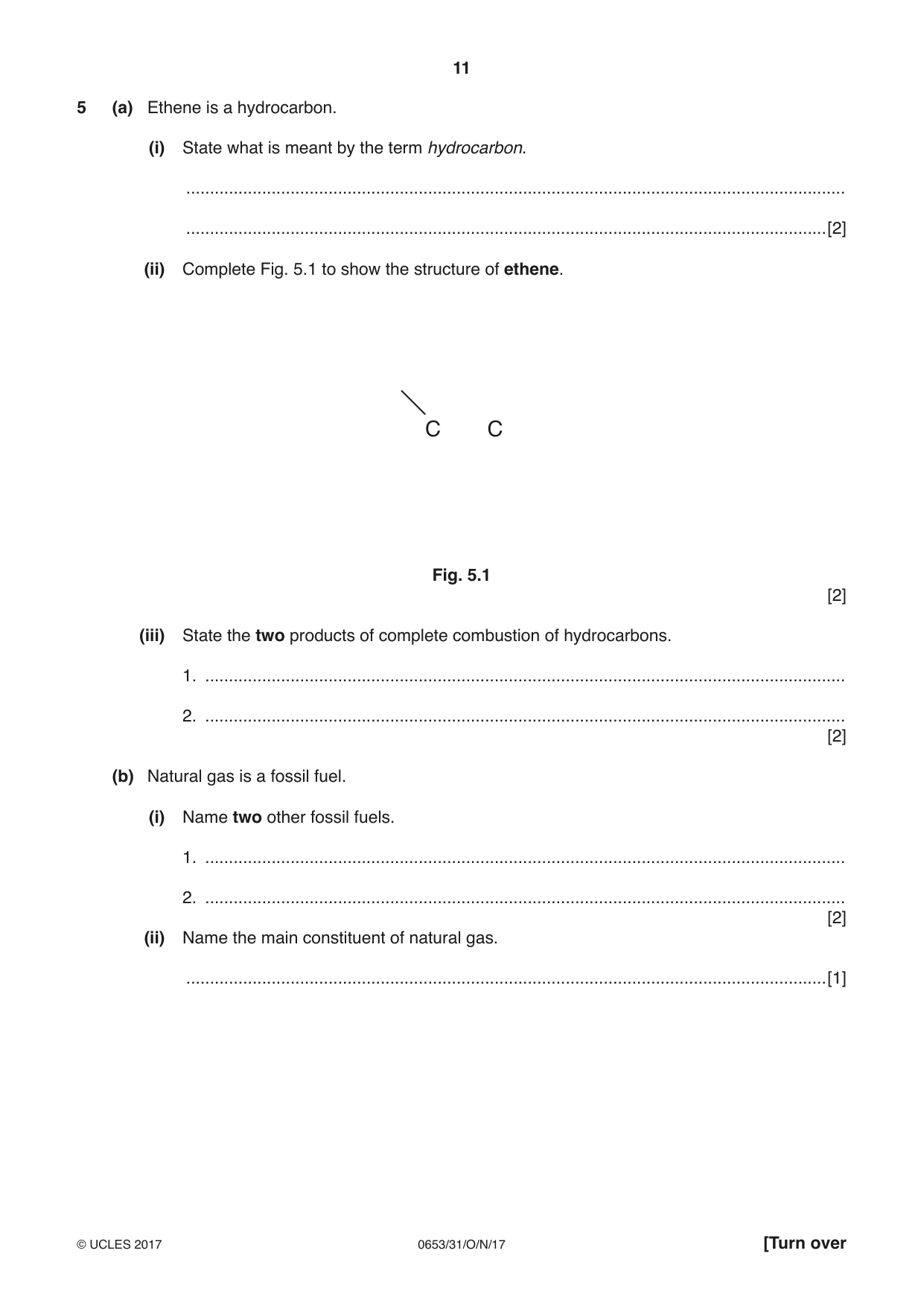
5 (a) Ethene is a hydrocarbon. (i) State what is meant by the term hydrocarbon. ........................................................................................................................................... .......................................................................................................................................[2] (ii) Complete Fig. 5.1 to show the structure of ethene. C C Fig. 5.1 [2] (iii) State the two products of complete combustion of hydrocarbons. 1. ....................................................................................................................................... 2. ....................................................................................................................................... [2] (b) Natural gas is a fossil fuel. (i) Name two other fossil fuels. 1. ....................................................................................................................................... 2. ....................................................................................................................................... [2] (ii) Name the main constituent of natural gas. .......................................................................................................................................[1]
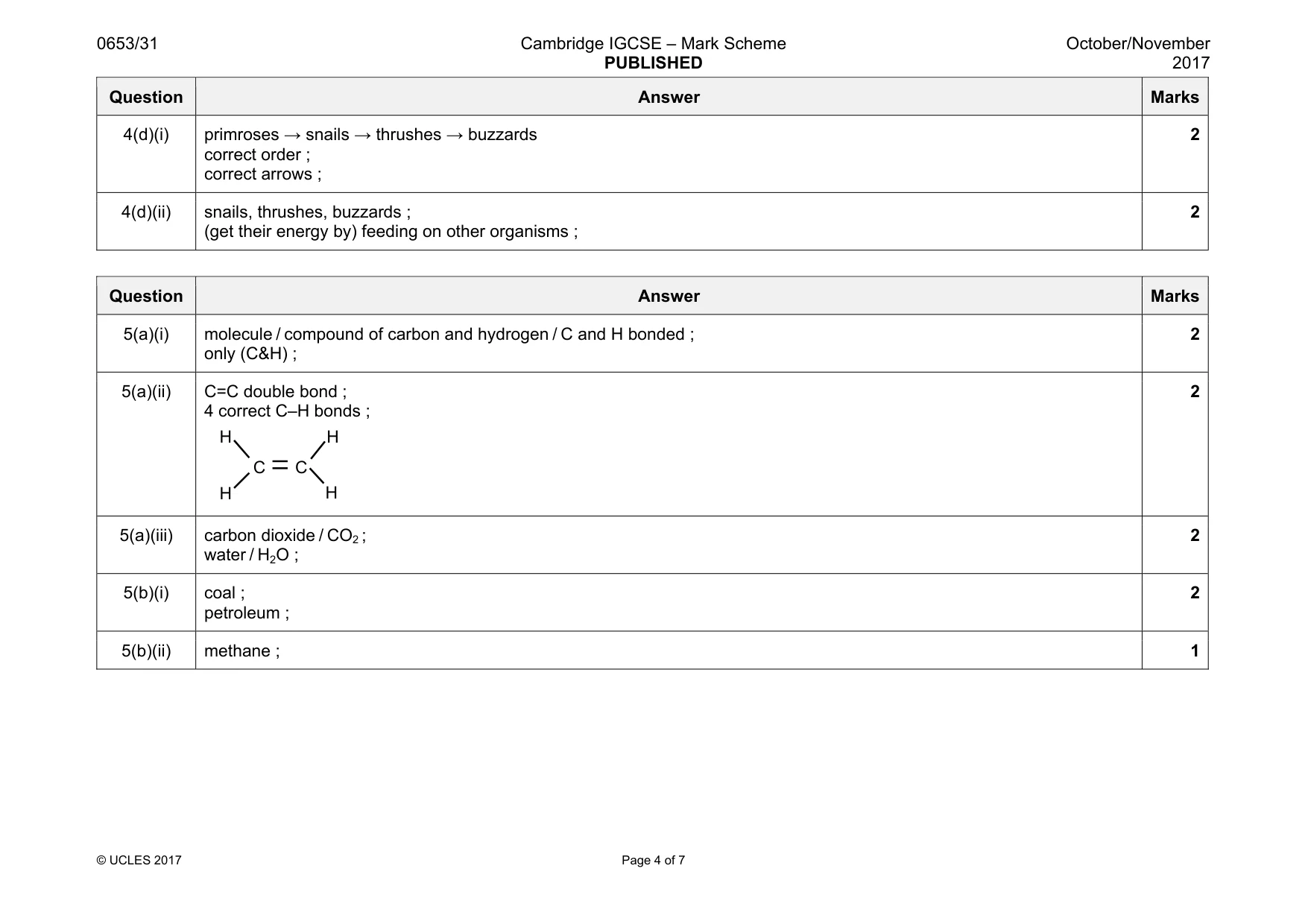
Mark scheme: 5(a)(i) molecule / compound of carbon and hydrogen / C and H bonded ; only (C&H) ; 2 5(a)(ii) C=C double bond ; 4 correct C–H bonds ; 2 5(a)(iii) carbon dioxide / CO2 ; water / H2O ; 2 5(b)(i) coal ; petroleum ; 2 5(b)(ii) methane ; 1 H H C C H H
Q6 · A fan heater used to heat a room in cold weather
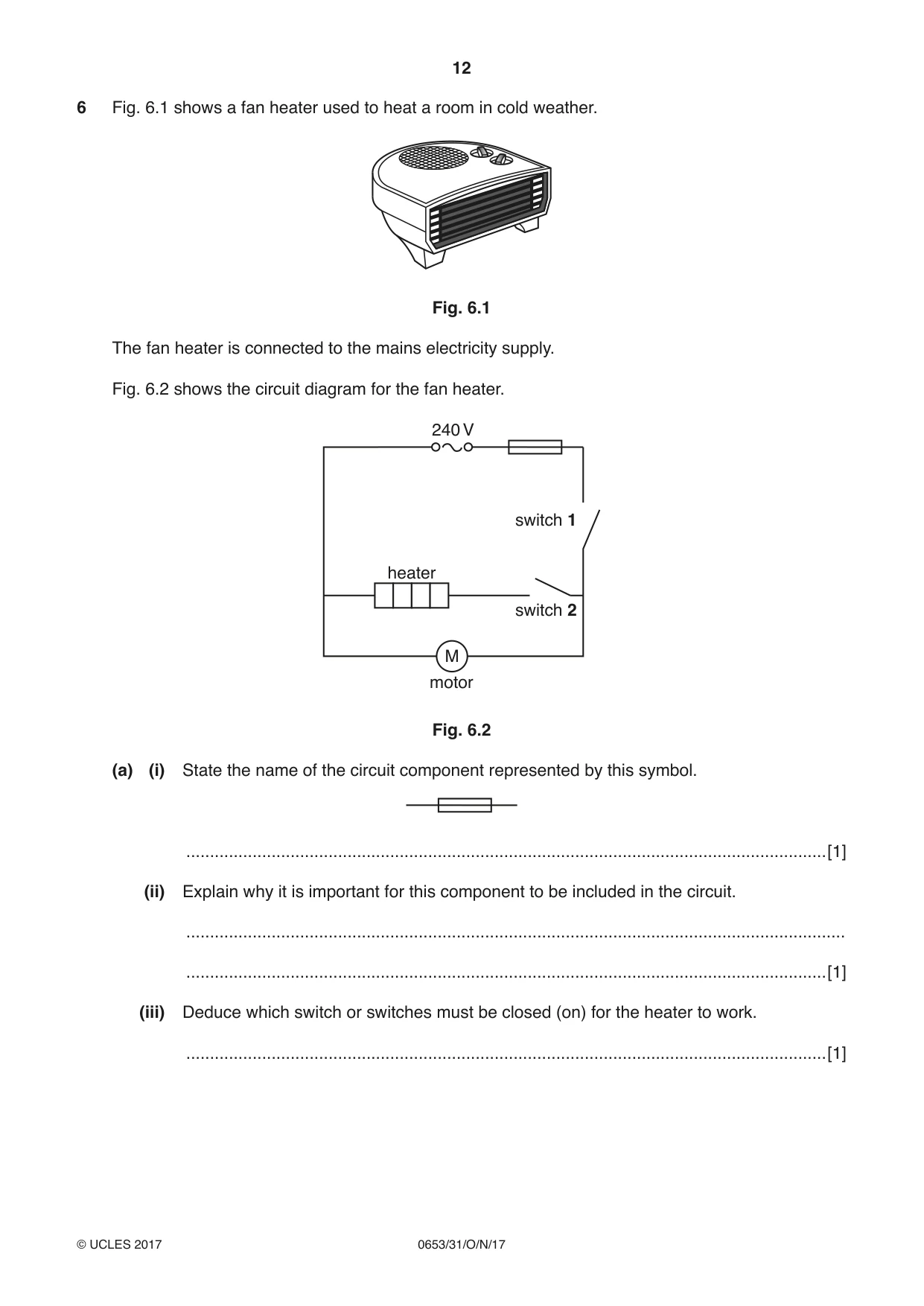
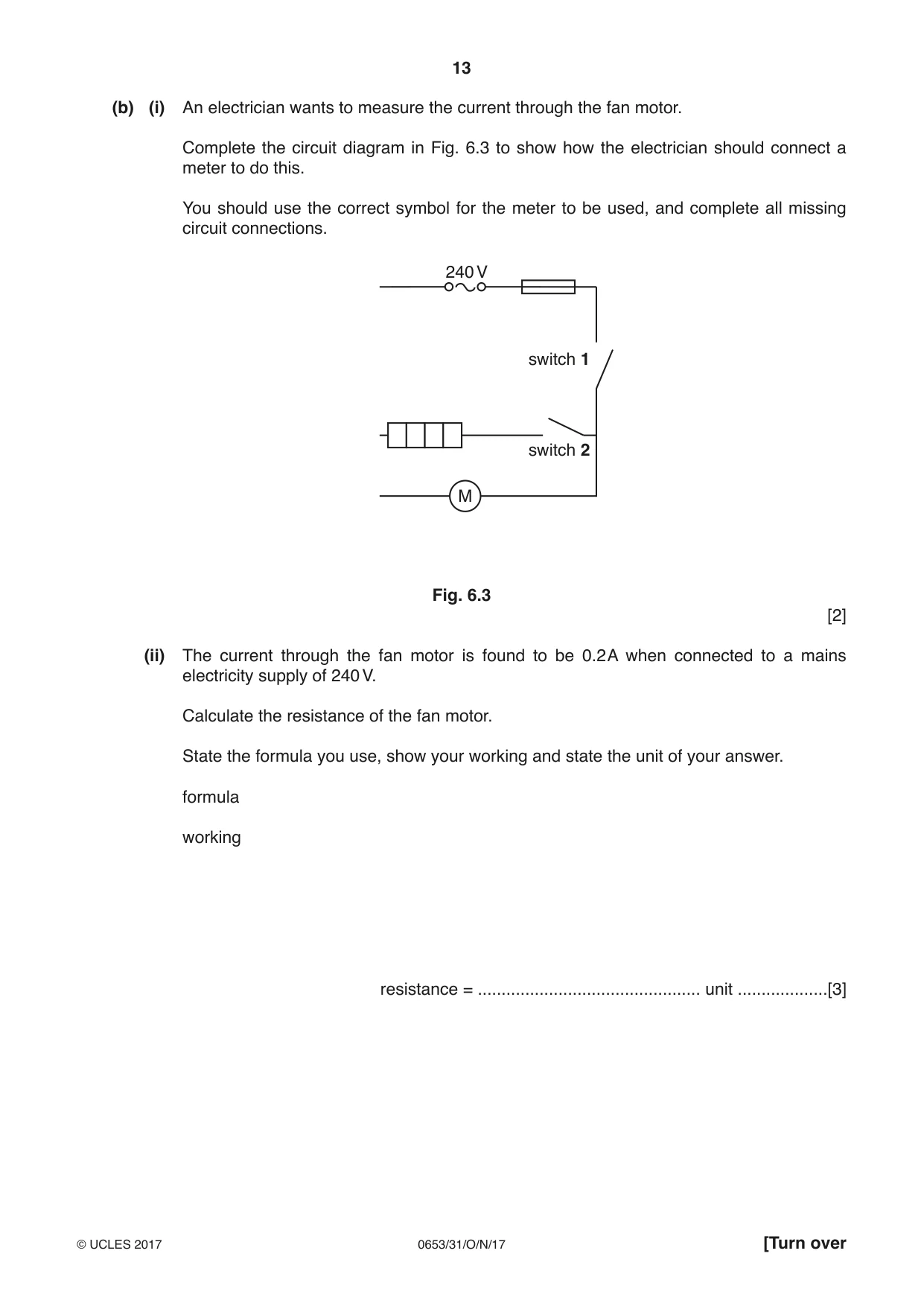
6 Fig. 6.1 shows a fan heater used to heat a room in cold weather. Fig. 6.1 The fan heater is connected to the mains electricity supply. Fig. 6.2 shows the circuit diagram for the fan heater. 240 V switch 1 heater switch 2 M motor Fig. 6.2 (a) (i) State the name of the circuit component represented by this symbol. .......................................................................................................................................[1] (ii) Explain why it is important for this component to be included in the circuit. ........................................................................................................................................... .......................................................................................................................................[1] (iii) Deduce which switch or switches must be closed (on) for the heater to work. .......................................................................................................................................[1] (b) (i) An electrician wants to measure the current through the fan motor. Complete the circuit diagram in Fig. 6.3 to show how the electrician should connect a meter to do this. You should use the correct symbol for the meter to be used, and complete all missing circuit connections. 240 V switch 1 switch 2 M Fig. 6.3 [2] (ii) The current through the fan motor is found to be 0.2 A when connected to a mains electricity supply of 240 V. Calculate the resistance of the fan motor. State the formula you use, show your working and state the unit of your answer. formula working resistance = ............................................... unit ...................[3]
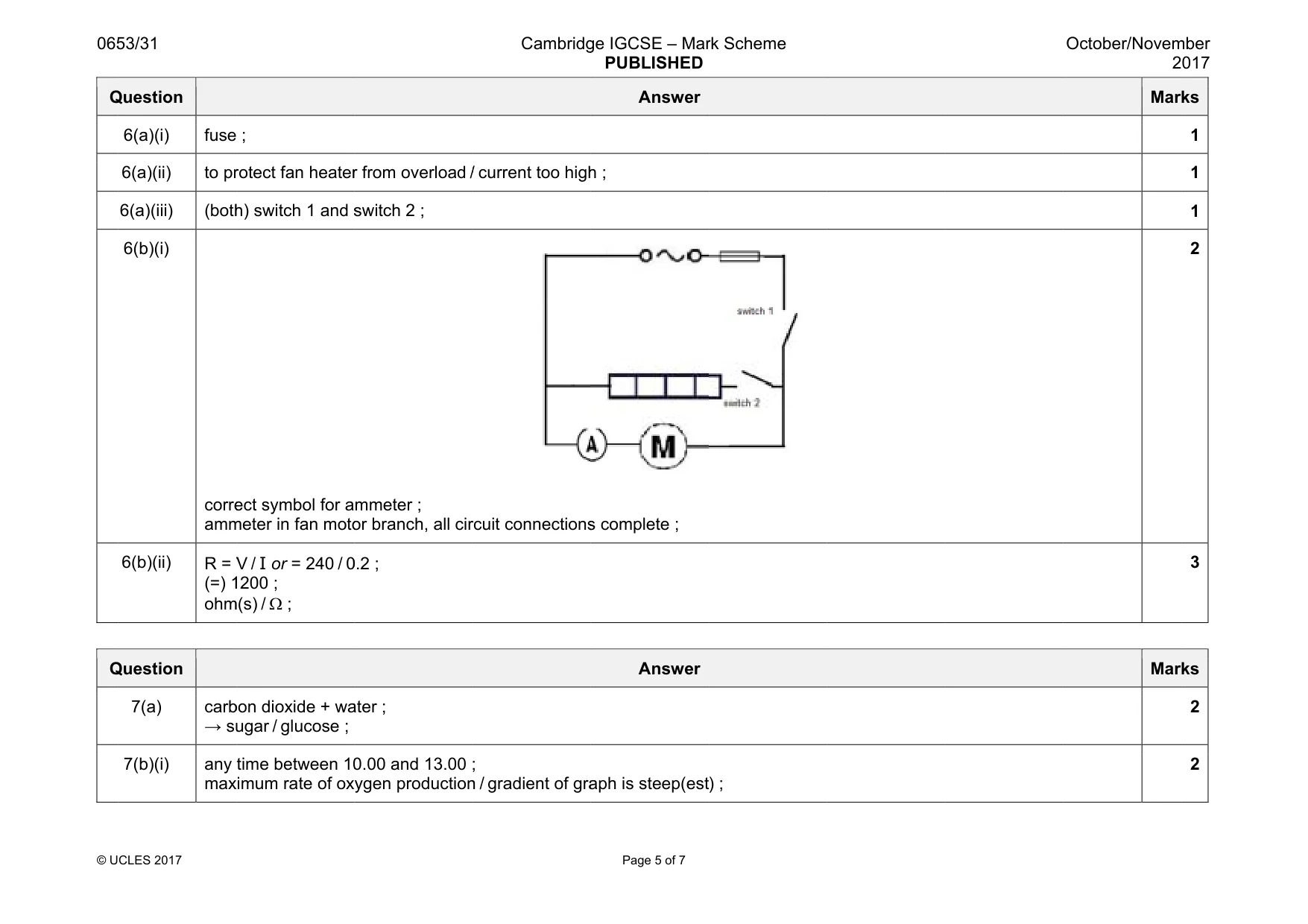
Mark scheme: 6(a)(i) fuse 6(a)(ii) to pr 6(a)(iii) (both 6(b)(i) corre amm 6(b)(ii) R = V (=) 1 ohm ; rotect fan heater h) switch 1 and s ect symbol for a meter in fan moto V / I or = 240 / 0 1200 ; m(s) / Ω ; r from overload / switch 2 ; mmeter ; or branch, all cir 0.2 ; / current too high rcuit connections h ; s complete ; 1 1 1 2 3
Q7 · A sealed glass jar containing soil and plants
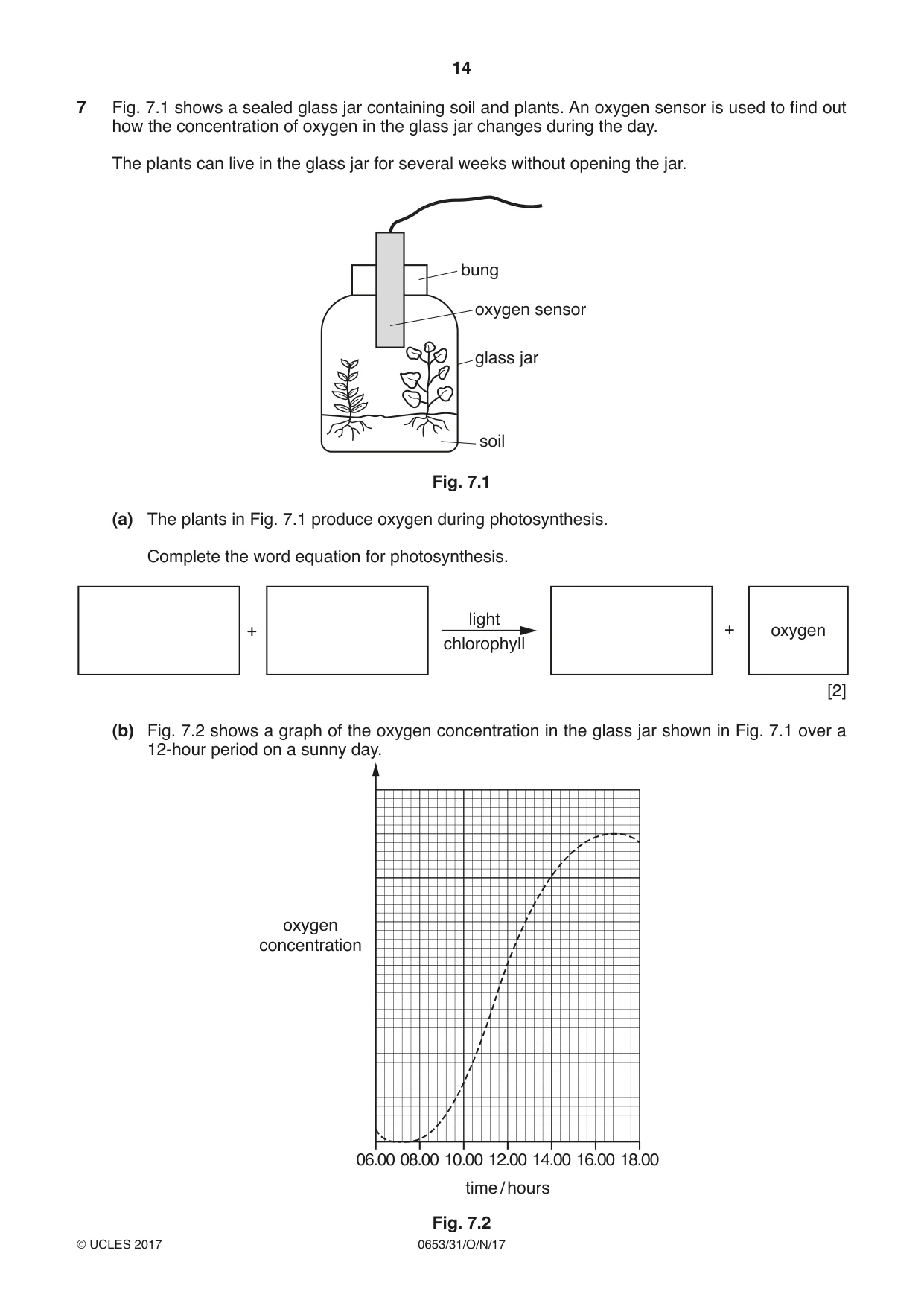
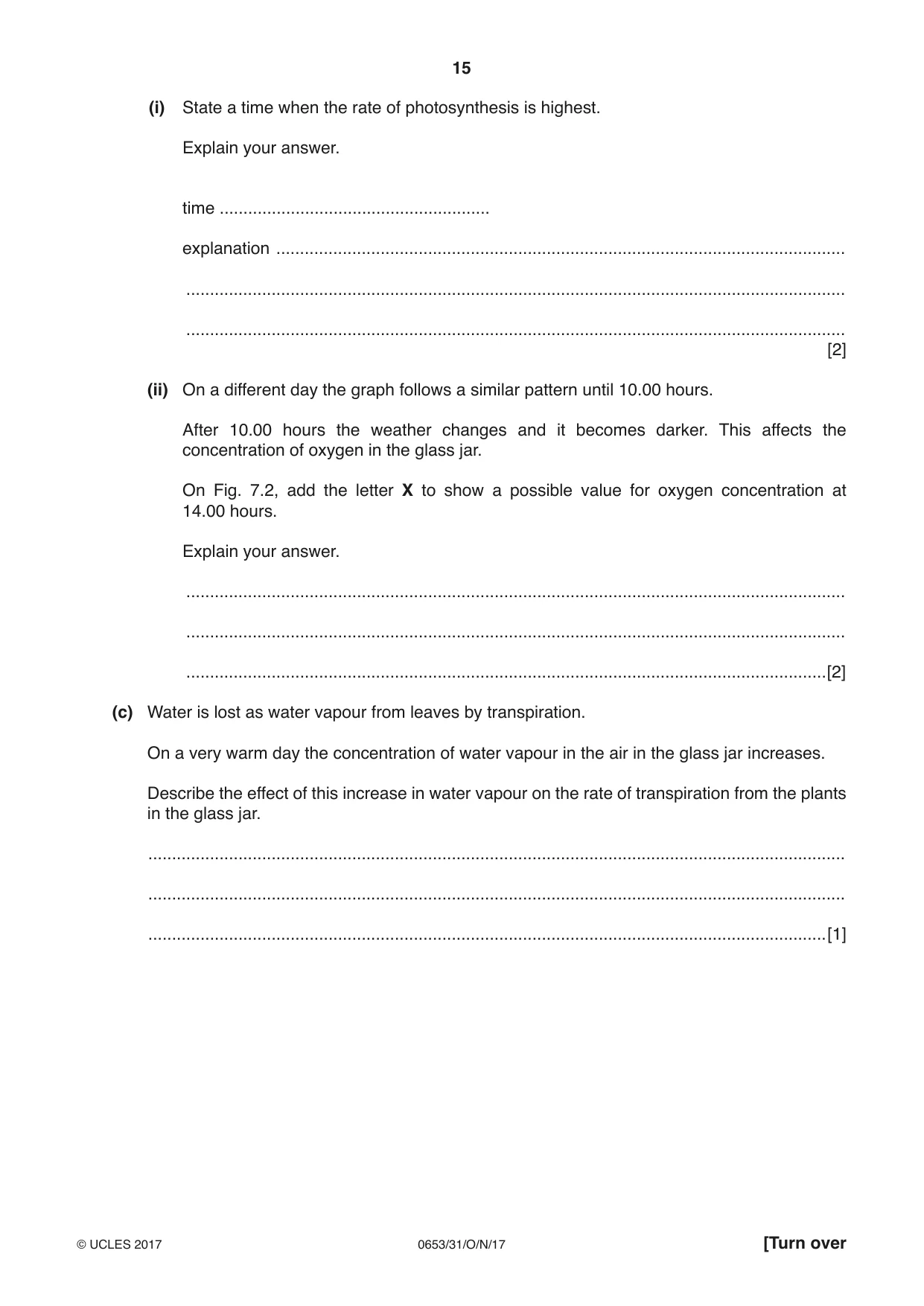
7 Fig. 7.1 shows a sealed glass jar containing soil and plants. An oxygen sensor is used to find out how the concentration of oxygen in the glass jar changes during the day. The plants can live in the glass jar for several weeks without opening the jar. bung oxygen sensor glass jar soil Fig. 7.1 (a) The plants in Fig. 7.1 produce oxygen during photosynthesis. Complete the word equation for photosynthesis. light + + oxygen chlorophyll [2] (b) Fig. 7.2 shows a graph of the oxygen concentration in the glass jar shown in Fig. 7.1 over a 12-hour period on a sunny day. oxygen concentration 06.00 08.00 10.00 12.00 14.00 16.00 18.00 time / hours Fig. 7.2 (i) State a time when the rate of photosynthesis is highest. Explain your answer. time ......................................................... explanation ........................................................................................................................ ........................................................................................................................................... ........................................................................................................................................... [2] (ii) On a different day the graph follows a similar pattern until 10.00 hours. After 10.00 hours the weather changes and it becomes darker. This affects the concentration of oxygen in the glass jar. On Fig. 7.2, add the letter X to show a possible value for oxygen concentration at 14.00 hours. Explain your answer. ........................................................................................................................................... ........................................................................................................................................... .......................................................................................................................................[2] (c) Water is lost as water vapour from leaves by transpiration. On a very warm day the concentration of water vapour in the air in the glass jar increases. Describe the effect of this increase in water vapour on the rate of transpiration from the plants in the glass jar. ................................................................................................................................................... ................................................................................................................................................... ...............................................................................................................................................[1]
Mark scheme: 7(a) carb → su 7(b)(i) any max bon dioxide + wa ugar / glucose ; time between 10 ximum rate of ox ater ; 0.00 and 13.00 ygen production ; n / gradient of gra aph is steep(est ) ; 2 2 Question Answer Marks 7(b)(ii) letter X drawn at 14.00 anywhere below line graph ; (rate of) photosynthesis (oxygen production) dependent on (amount of) light ; 2 7(c) reduces / causes less / prevents transpiration ; 1
Q8 · An iron nail is left in a beaker of water, as shown in Fig
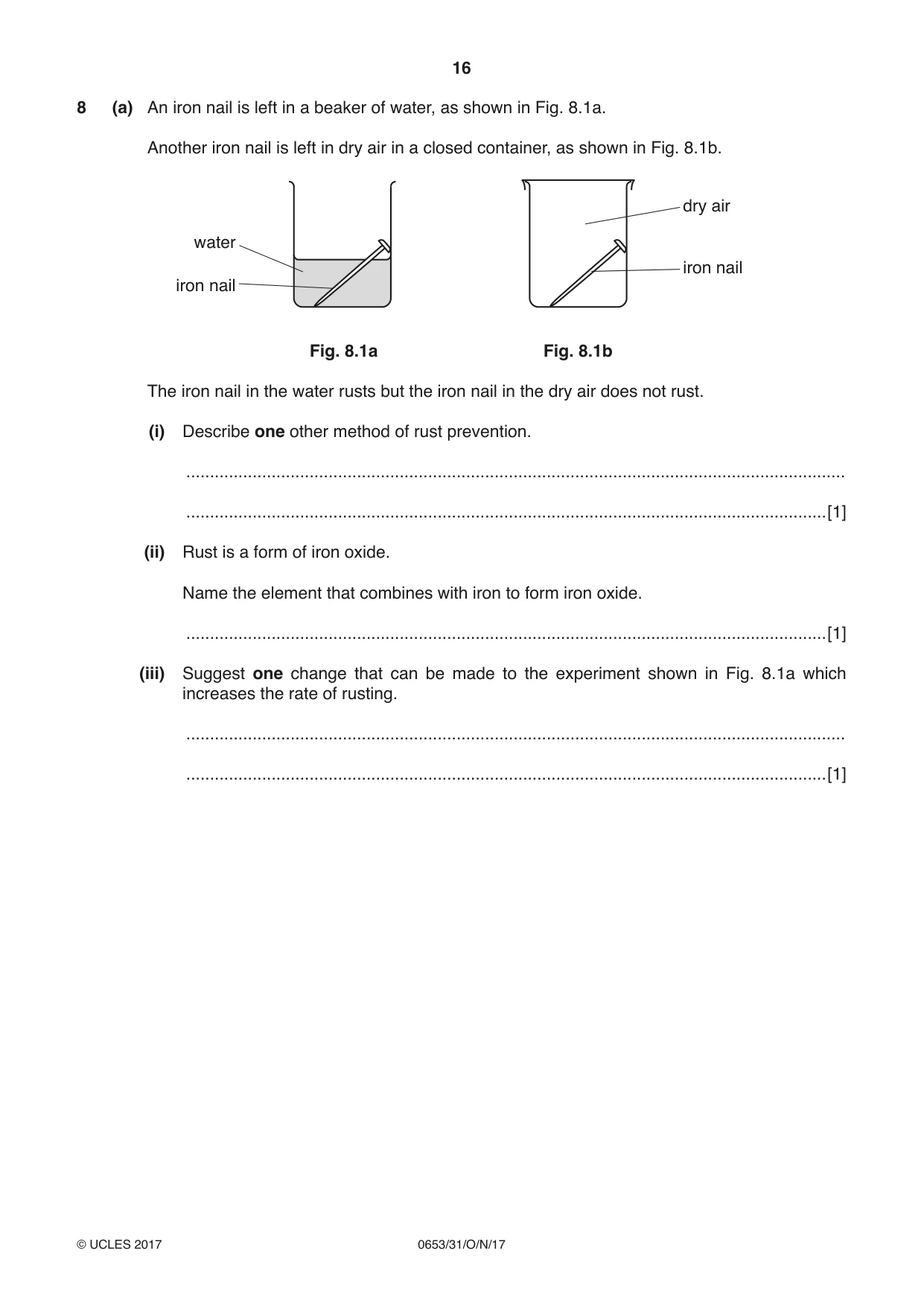
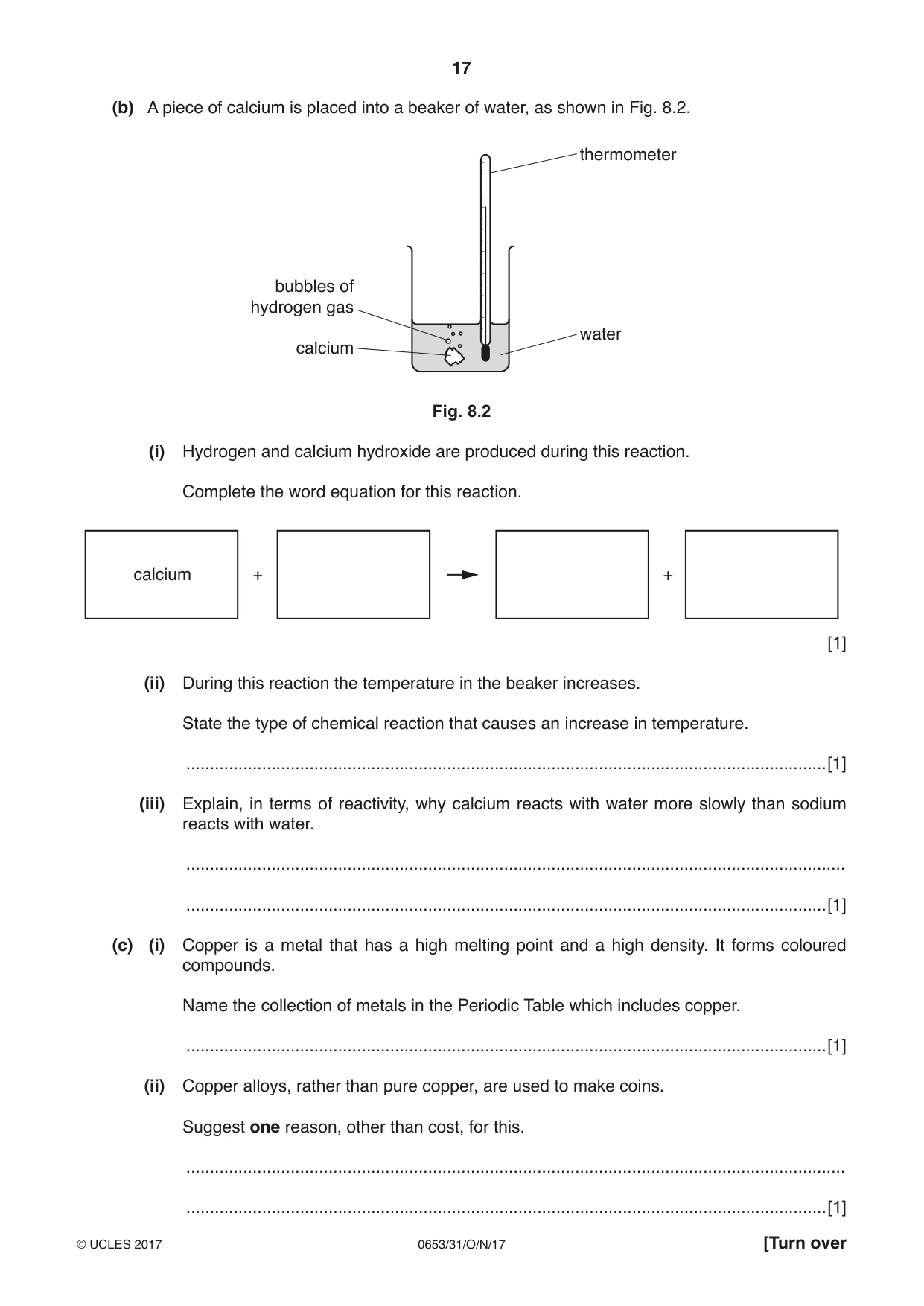
8 (a) An iron nail is left in a beaker of water, as shown in Fig. 8.1a. Another iron nail is left in dry air in a closed container, as shown in Fig. 8.1b. dry air water iron nail iron nail Fig. 8.1a Fig. 8.1b The iron nail in the water rusts but the iron nail in the dry air does not rust. (i) Describe one other method of rust prevention. ........................................................................................................................................... .......................................................................................................................................[1] (ii) Rust is a form of iron oxide. Name the element that combines with iron to form iron oxide. .......................................................................................................................................[1] (iii) Suggest one change that can be made to the experiment shown in Fig. 8.1a which increases the rate of rusting. ........................................................................................................................................... .......................................................................................................................................[1] (b) A piece of calcium is placed into a beaker of water, as shown in Fig. 8.2. thermometer bubbles of hydrogen gas water calcium Fig. 8.2 (i) Hydrogen and calcium hydroxide are produced during this reaction. Complete the word equation for this reaction. calcium + + [1] (ii) During this reaction the temperature in the beaker increases. State the type of chemical reaction that causes an increase in temperature. .......................................................................................................................................[1] (iii) Explain, in terms of reactivity, why calcium reacts with water more slowly than sodium reacts with water. ........................................................................................................................................... .......................................................................................................................................[1] (c) (i) Copper is a metal that has a high melting point and a high density. It forms coloured compounds. Name the collection of metals in the Periodic Table which includes copper. .......................................................................................................................................[1] (ii) Copper alloys, rather than pure copper, are used to make coins. Suggest one reason, other than cost, for this. ........................................................................................................................................... .......................................................................................................................................[1]
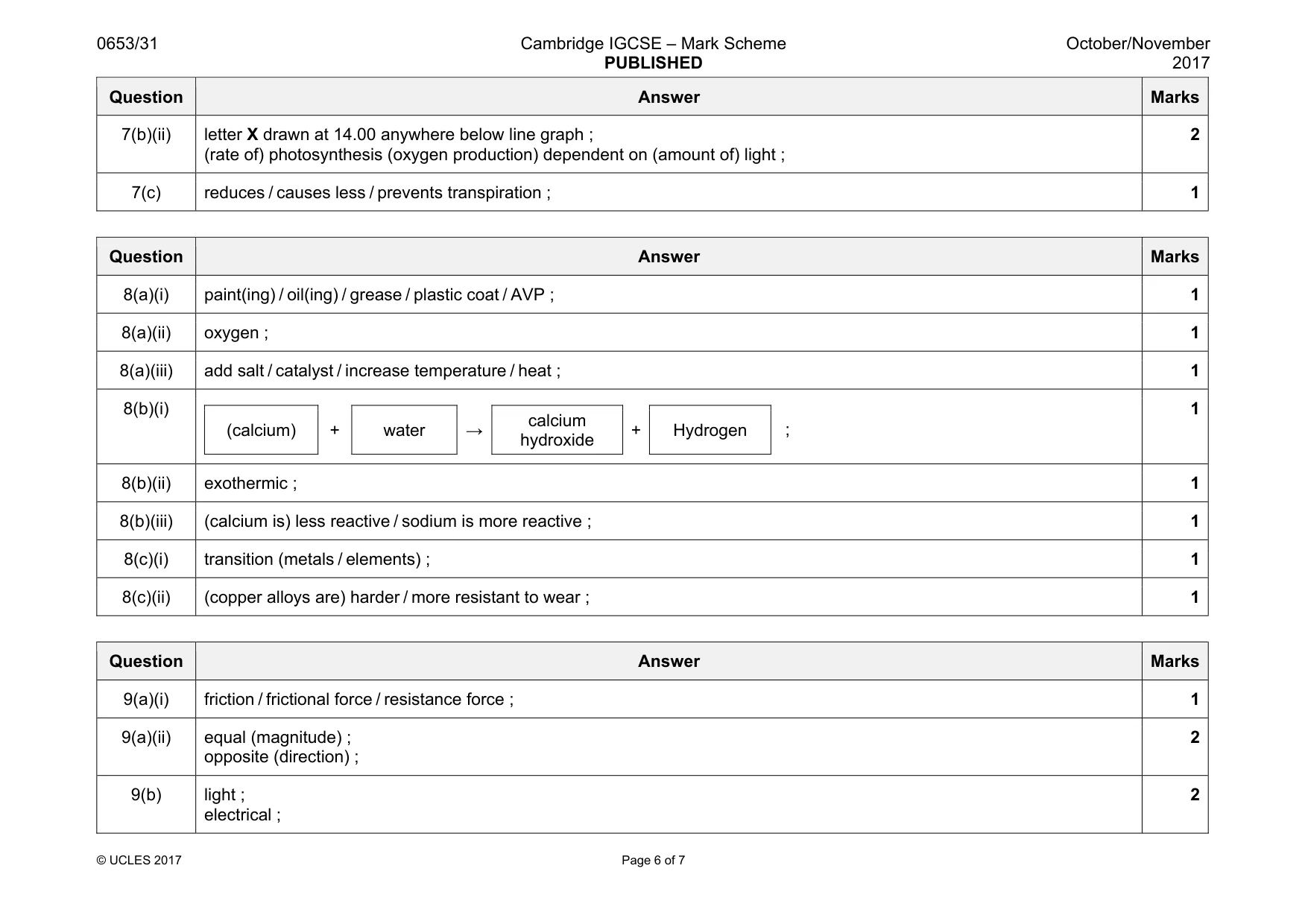
Mark scheme: 8(a)(i) paint(ing) / oil(ing) / grease / plastic coat / AVP ; 1 8(a)(ii) oxygen ; 1 8(a)(iii) add salt / catalyst / increase temperature / heat ; 1 8(b)(i) ; (calcium) + water → calcium hydroxide + Hydrogen 1 8(b)(ii) exothermic ; 1 8(b)(iii) (calcium is) less reactive / sodium is more reactive ; 1 8(c)(i) transition (metals / elements) ; 1 8(c)(ii) (copper alloys are) harder / more resistant to wear ; 1
Q9 · Two horizontal forces acting on a car driving along a road
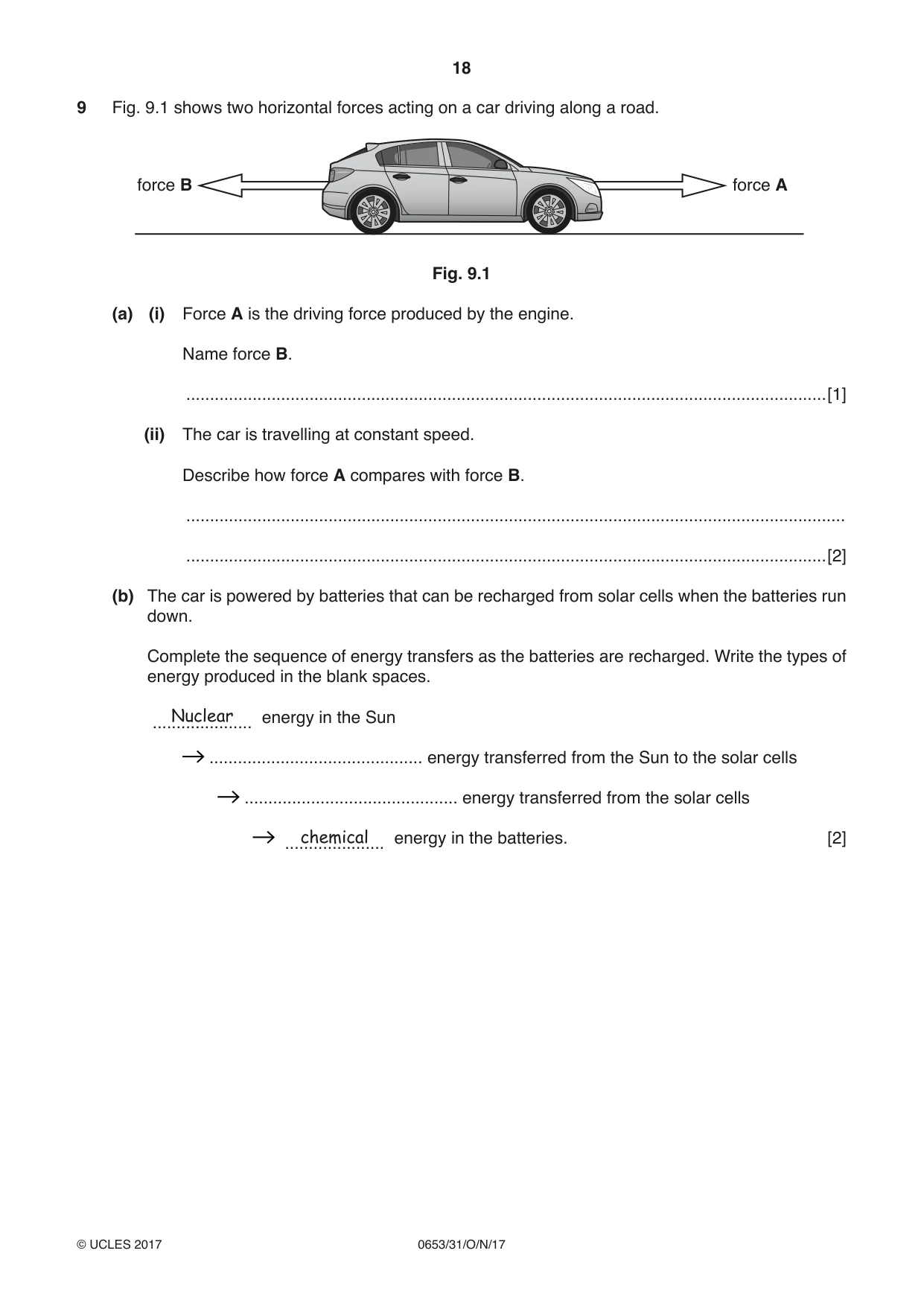
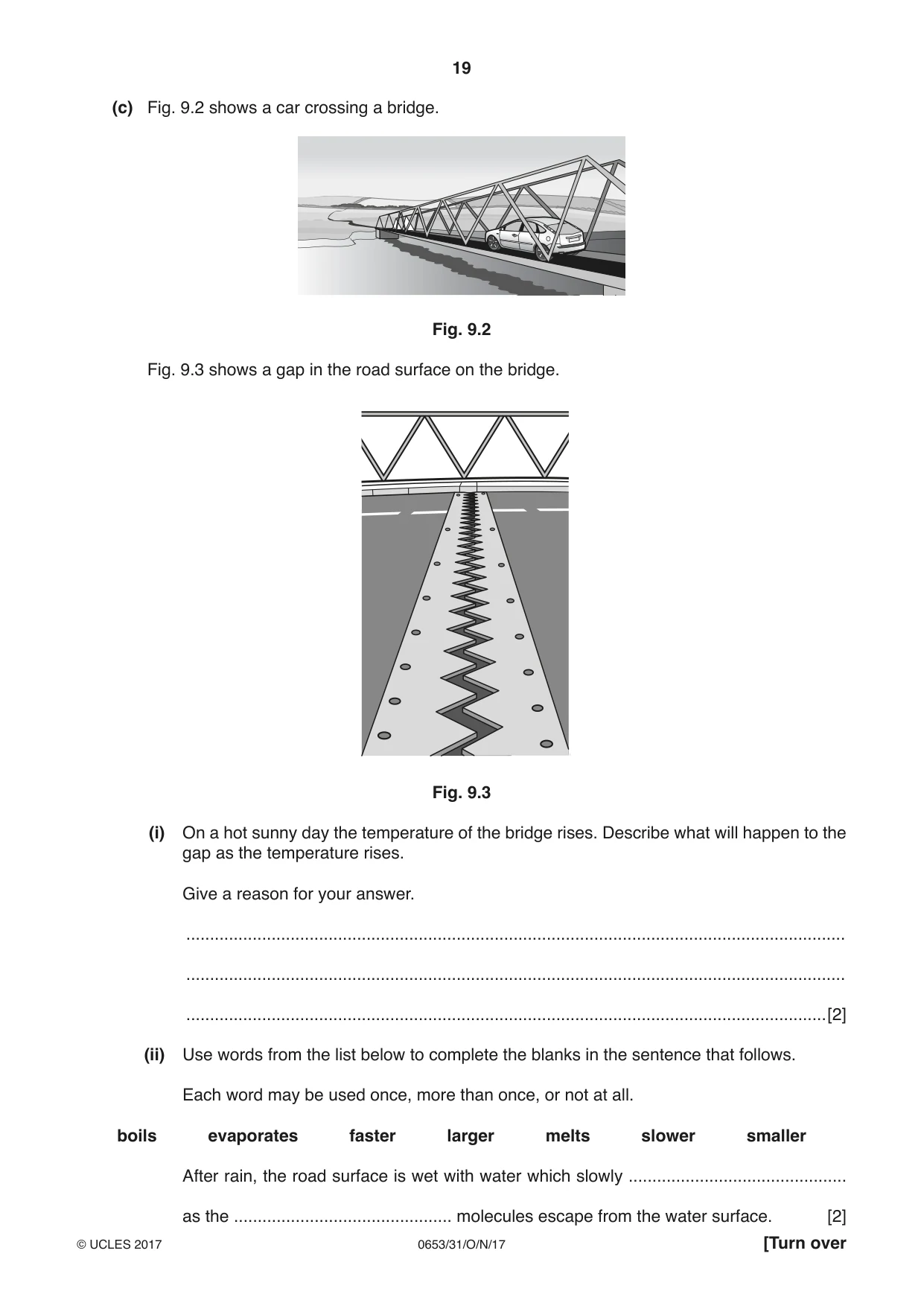
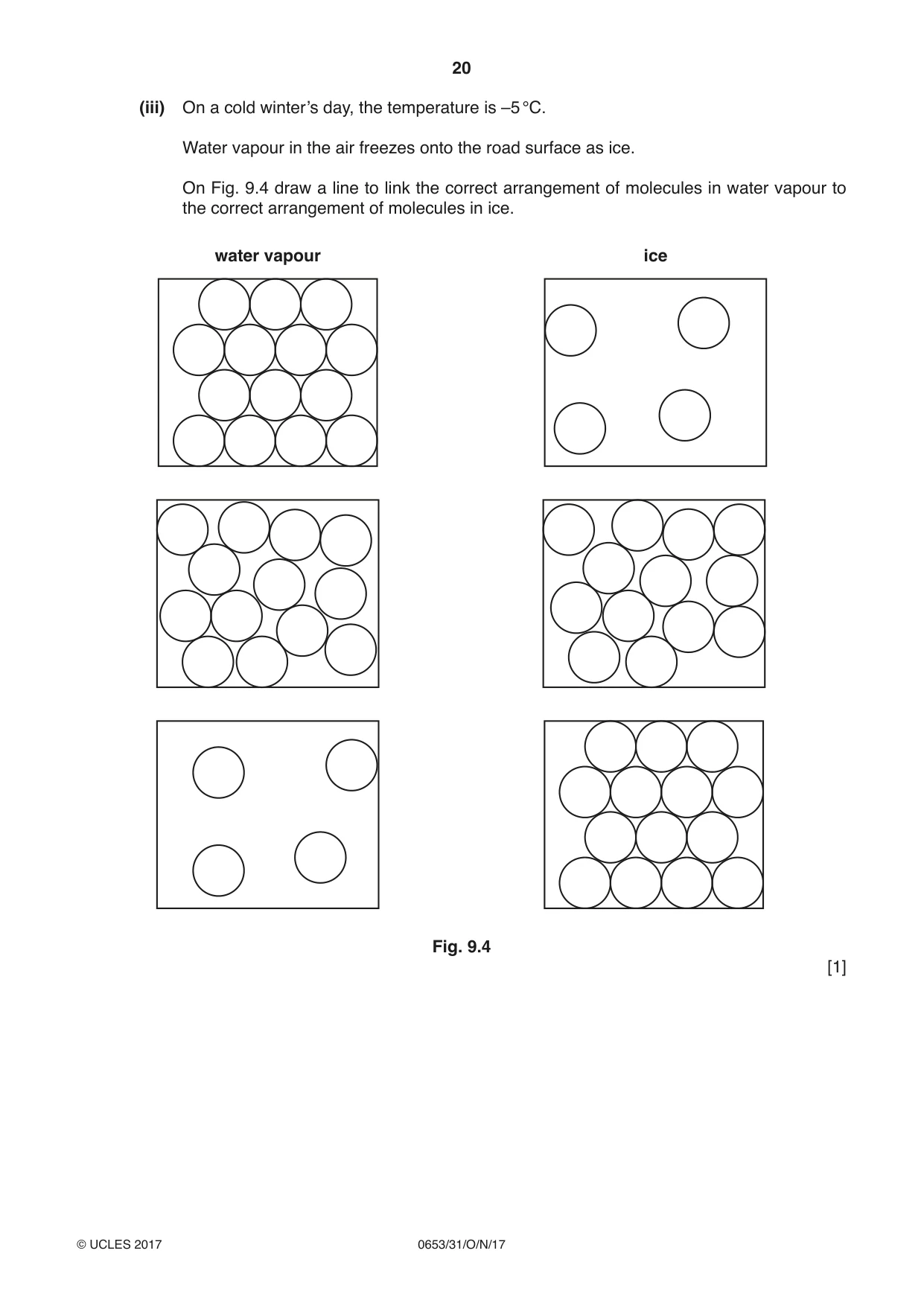
9 Fig. 9.1 shows two horizontal forces acting on a car driving along a road. force B force A Fig. 9.1 (a) (i) Force A is the driving force produced by the engine. Name force B. .......................................................................................................................................[1] (ii) The car is travelling at constant speed. Describe how force A compares with force B. ........................................................................................................................................... .......................................................................................................................................[2] (b) The car is powered by batteries that can be recharged from solar cells when the batteries run down. Complete the sequence of energy transfers as the batteries are recharged. Write the types of energy produced in the blank spaces. Nuclear energy in the Sun ..................... ............................................. energy transferred from the Sun to the solar cells ............................................. energy transferred from the solar cells chemical energy in the batteries. [2] ..................... (c) Fig. 9.2 shows a car crossing a bridge. Fig. 9.2 Fig. 9.3 shows a gap in the road surface on the bridge. Fig. 9.3 (i) On a hot sunny day the temperature of the bridge rises. Describe what will happen to the gap as the temperature rises. Give a reason for your answer. ........................................................................................................................................... ........................................................................................................................................... .......................................................................................................................................[2] (ii) Use words from the list below to complete the blanks in the sentence that follows. Each word may be used once, more than once, or not at all. boils evaporates faster larger melts slower smaller After rain, the road surface is wet with water which slowly .............................................. as the .............................................. molecules escape from the water surface. [2] (iii) On a cold winter’s day, the temperature is –5 °C. Water vapour in the air freezes onto the road surface as ice. On Fig. 9.4 draw a line to link the correct arrangement of molecules in water vapour to the correct arrangement of molecules in ice. water vapour ice Fig. 9.4 [1]
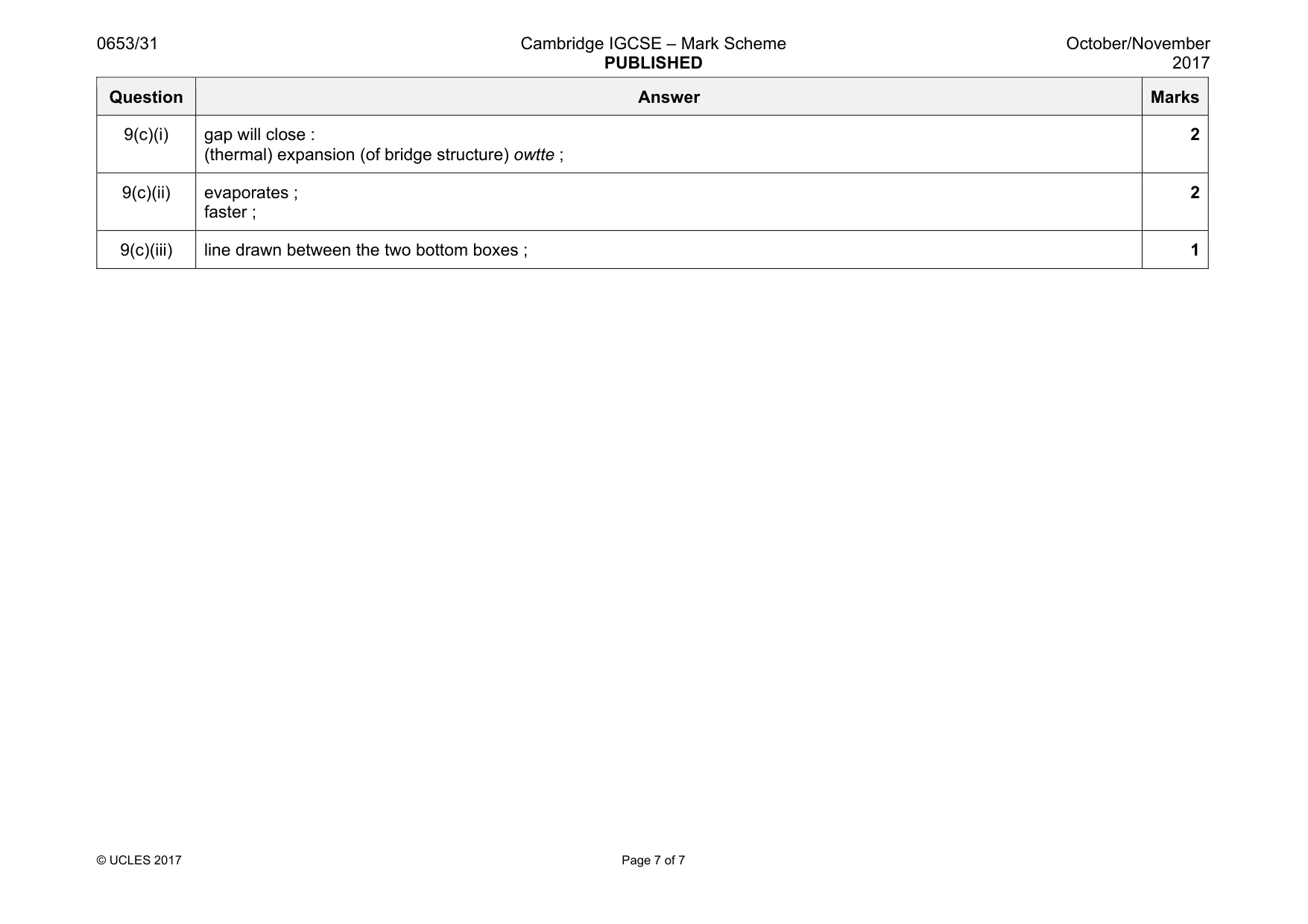
Mark scheme: 9(a)(i) friction / frictional force / resistance force ; 1 9(a)(ii) equal (magnitude) ; opposite (direction) ; 2 9(b) light ; electrical ; 2 Question Answer Marks 9(c)(i) gap will close : (thermal) expansion (of bridge structure) owtte ; 2 9(c)(ii) evaporates ; faster ; 2 9(c)(iii) line drawn between the two bottom boxes ; 1
What was in this paper
The subtopics covered by these 9 questions, and how many questions each got. Open one in a new tab to see every Cambridge question on it.
What you needed in this session
Cambridge’s own grade thresholds for 2017 Oct/Nov, Paper 3 · Variant 1. A higher threshold means an easier paper — the bar moves with how the cohort did.