Cambridge IGCSE Science - Combined 0653 — 2021 Oct/Nov Paper 3 · Variant 1
0653/31/O/N/21 · 9 questions · 80 marks · ≈90 min
The question paper and its mark scheme, free to read here and free to download. This is Cambridge’s own paper, exactly as it was sat.
Question paper24 pages

Mark scheme11 pages
Answers below. Sit the paper first if you are practising.
Questions as text
Q1 · A diagram of the circulatory system in humans
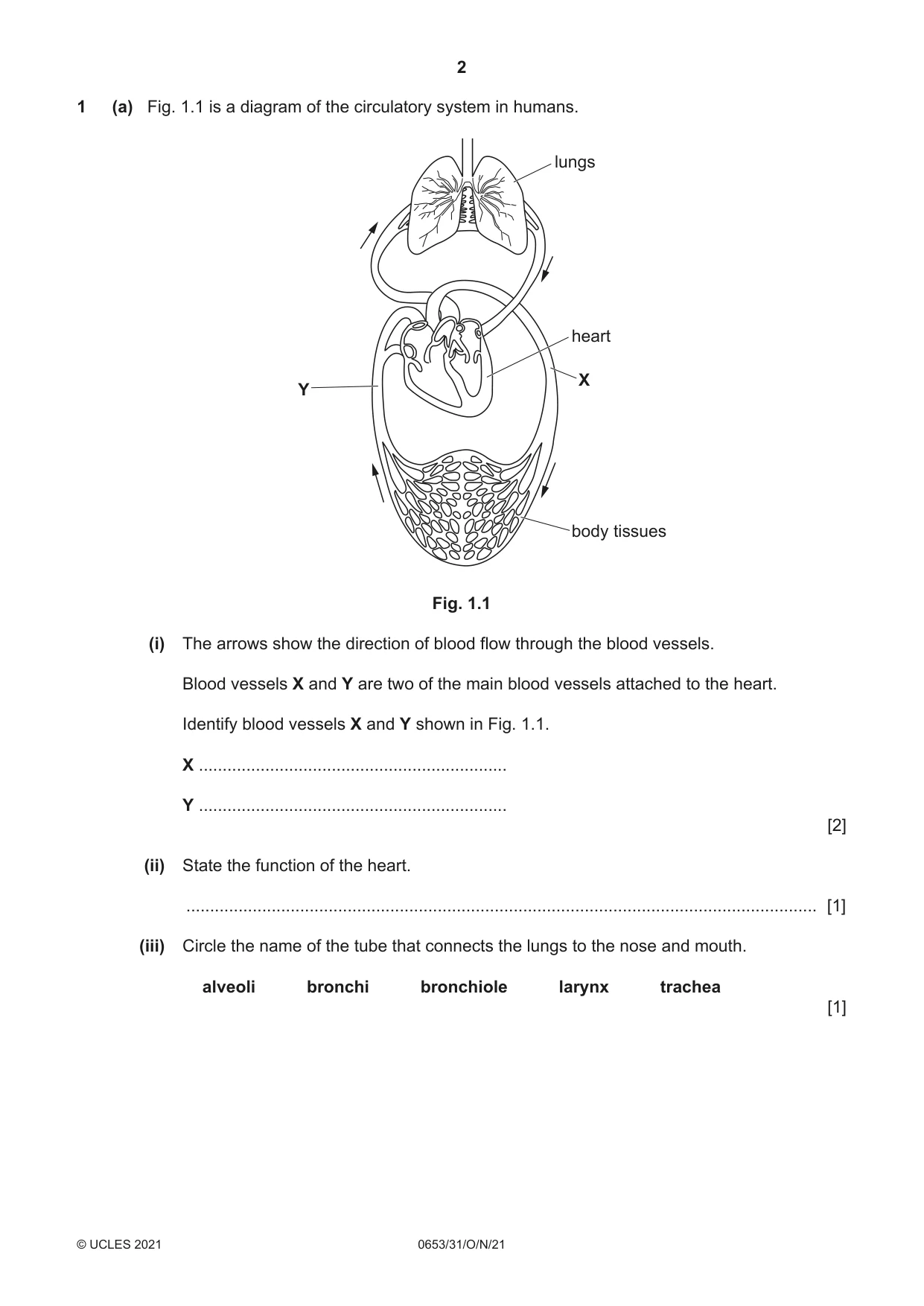
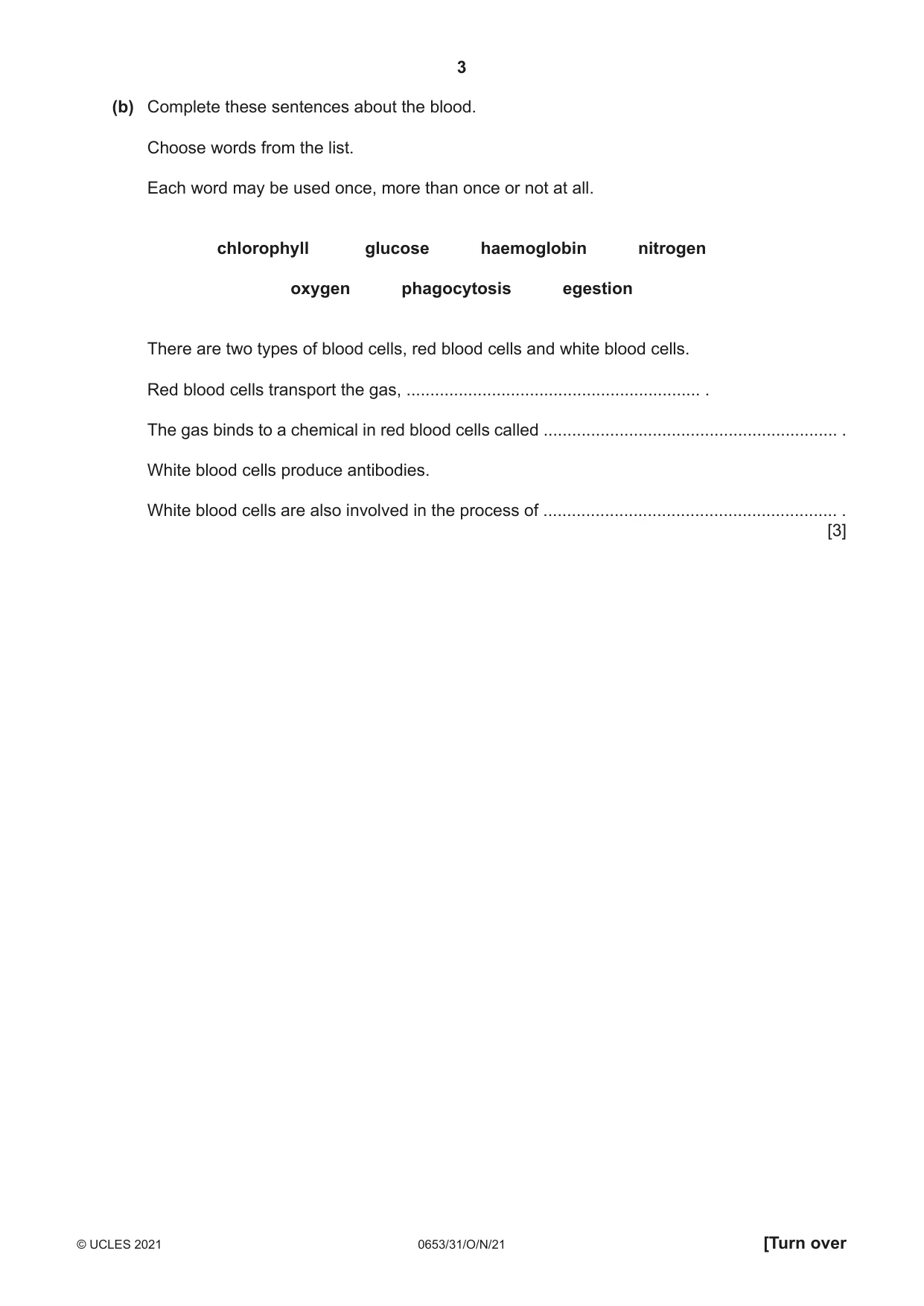
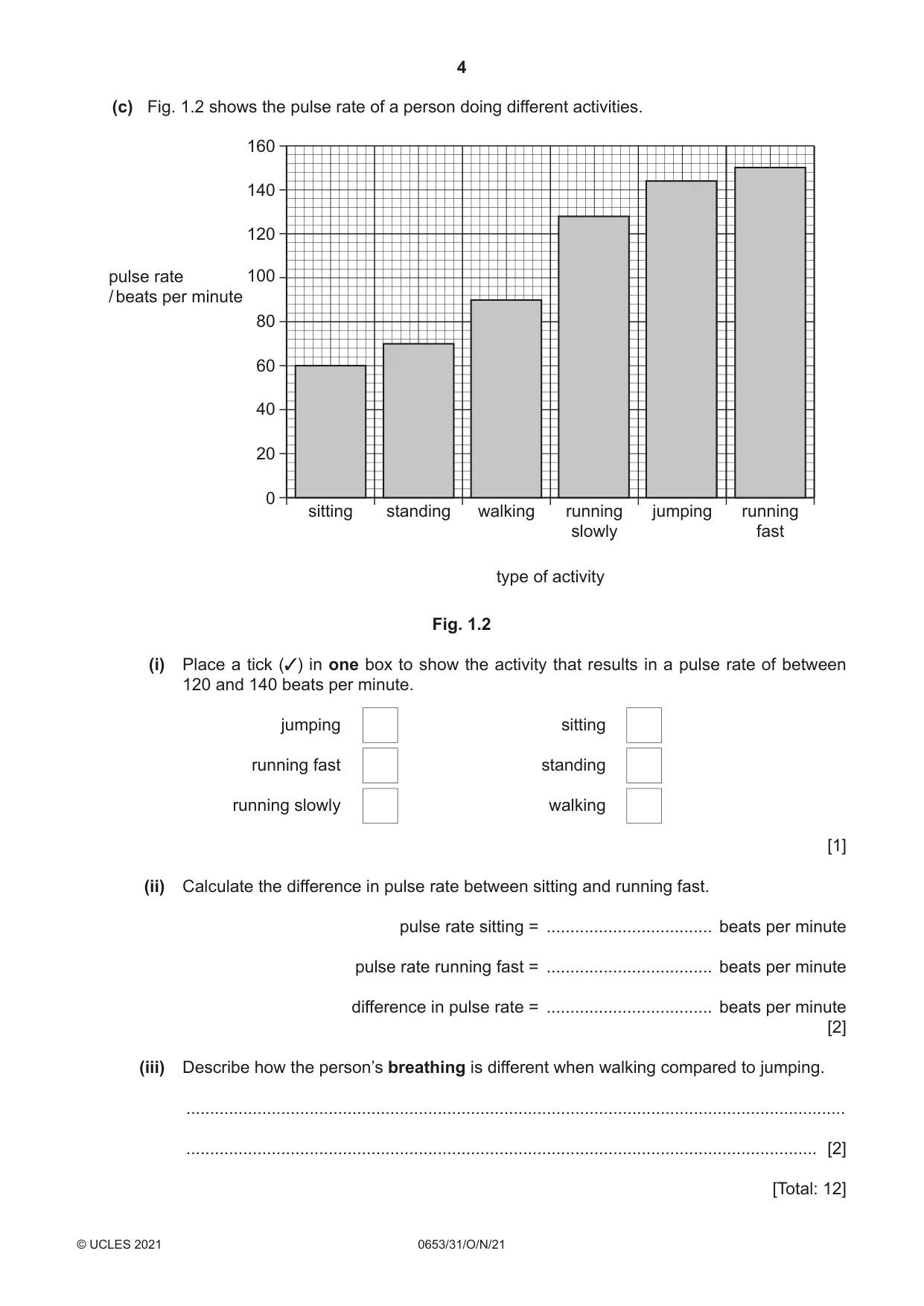
1 (a) Fig. 1.1 is a diagram of the circulatory system in humans. lungs heart X Y body tissues Fig. 1.1 (i) The arrows show the direction of blood flow through the blood vessels. Blood vessels X and Y are two of the main blood vessels attached to the heart. Identify blood vessels X and Y shown in Fig. 1.1. X ................................................................. Y ................................................................. [2] (ii) State the function of the heart. ..................................................................................................................................... [1] (iii) Circle the name of the tube that connects the lungs to the nose and mouth. alveoli bronchi bronchiole larynx trachea [1] (b) Complete these sentences about the blood. Choose words from the list. Each word may be used once, more than once or not at all. chlorophyll glucose haemoglobin nitrogen oxygen phagocytosis egestion There are two types of blood cells, red blood cells and white blood cells. Red blood cells transport the gas, .............................................................. . The gas binds to a chemical in red blood cells called .............................................................. . White blood cells produce antibodies. White blood cells are also involved in the process of .............................................................. . [3] (c) Fig. 1.2 shows the pulse rate of a person doing different activities. 160 140 120 pulse rate 100 / beats per minute 80 60 40 20 0 sitting standing walking running jumping running slowly fast type of activity Fig. 1.2 (i) Place a tick (3) in one box to show the activity that results in a pulse rate of between 120 and 140 beats per minute. jumping sitting running fast standing running slowly walking [1] (ii) Calculate the difference in pulse rate between sitting and running fast. pulse rate sitting = ................................... beats per minute pulse rate running fast = ................................... beats per minute difference in pulse rate = ................................... beats per minute [2] (iii) Describe how the person’s breathing is different when walking compared to jumping. ........................................................................................................................................... ..................................................................................................................................... [2] [Total: 12]
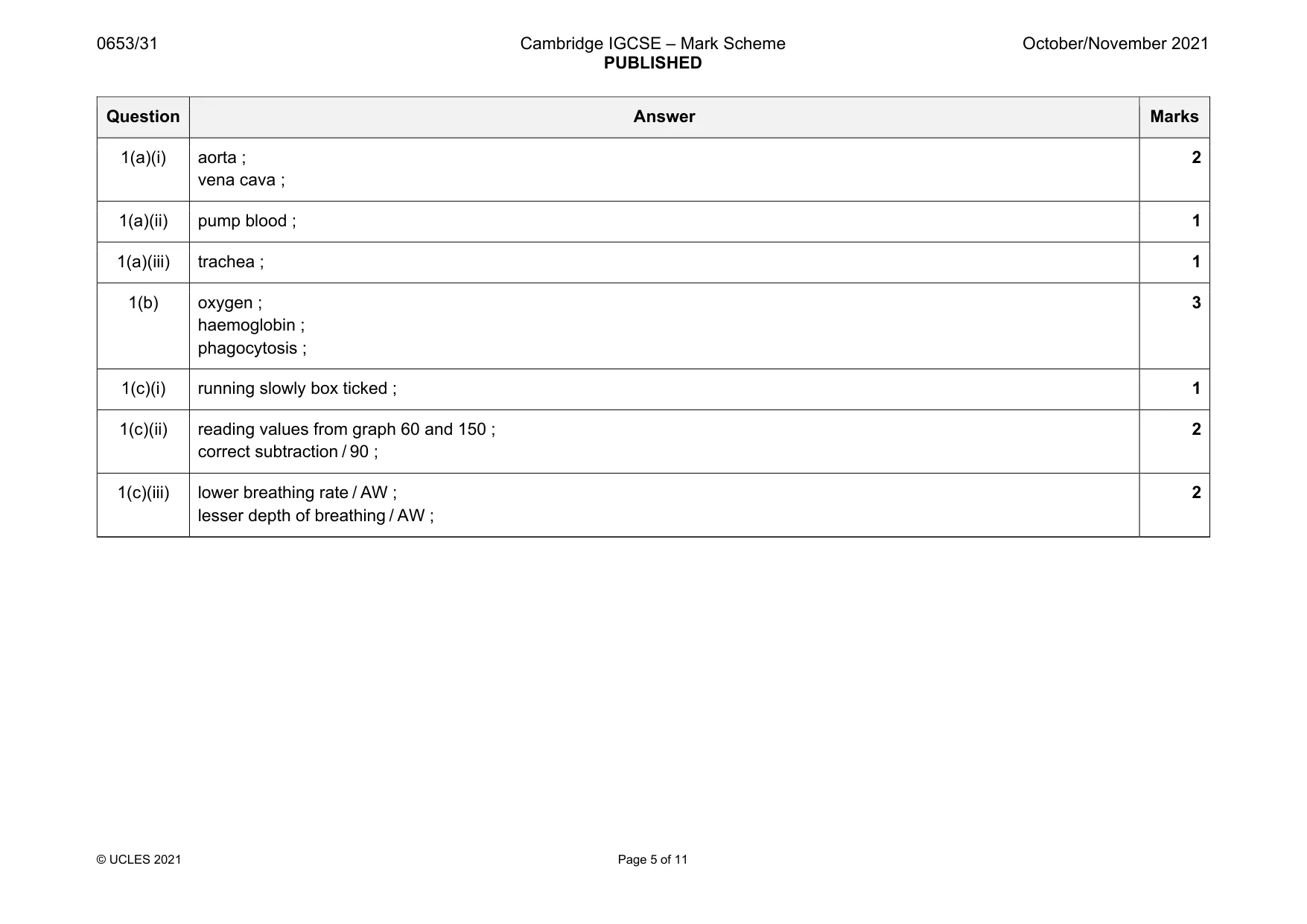
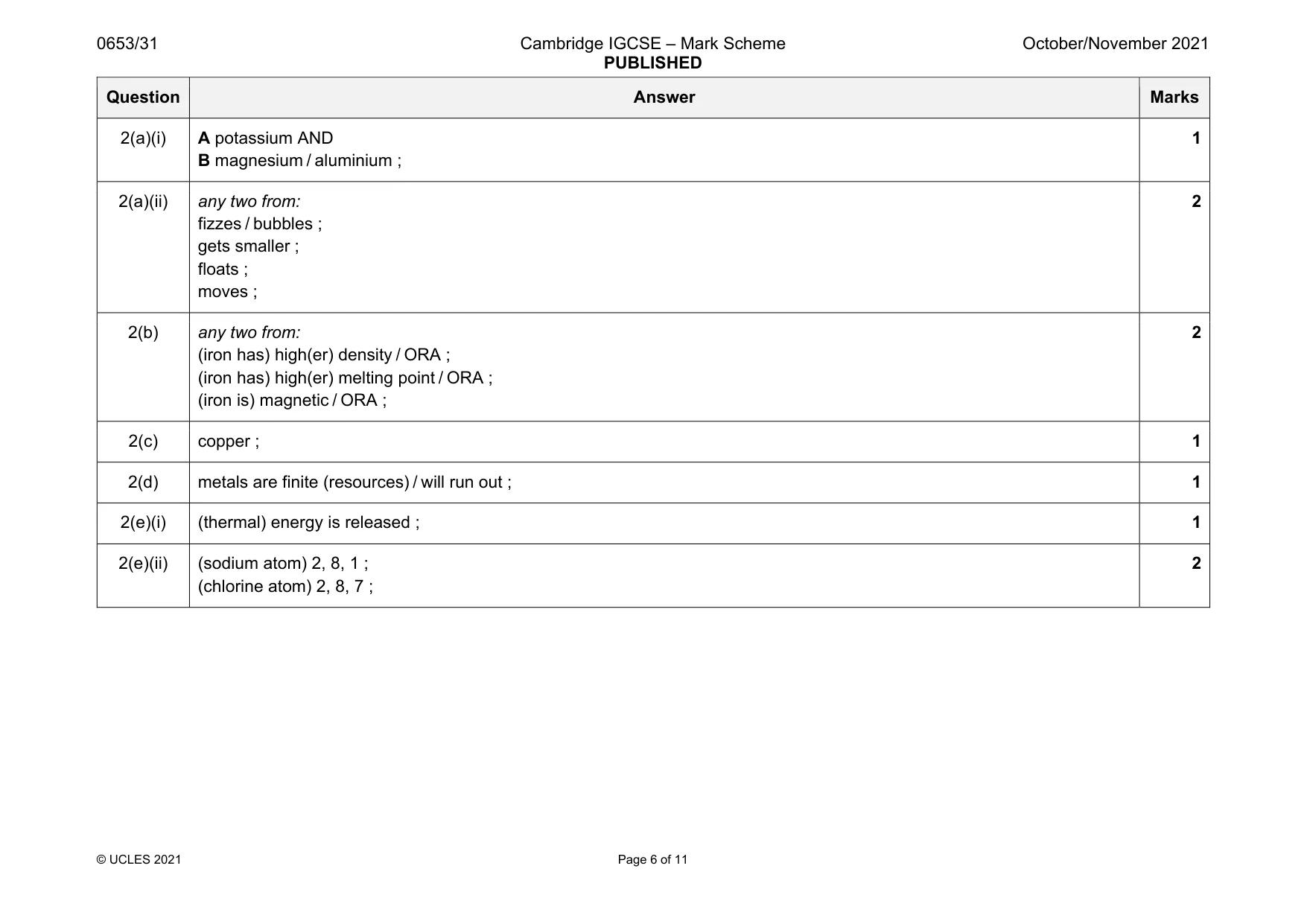
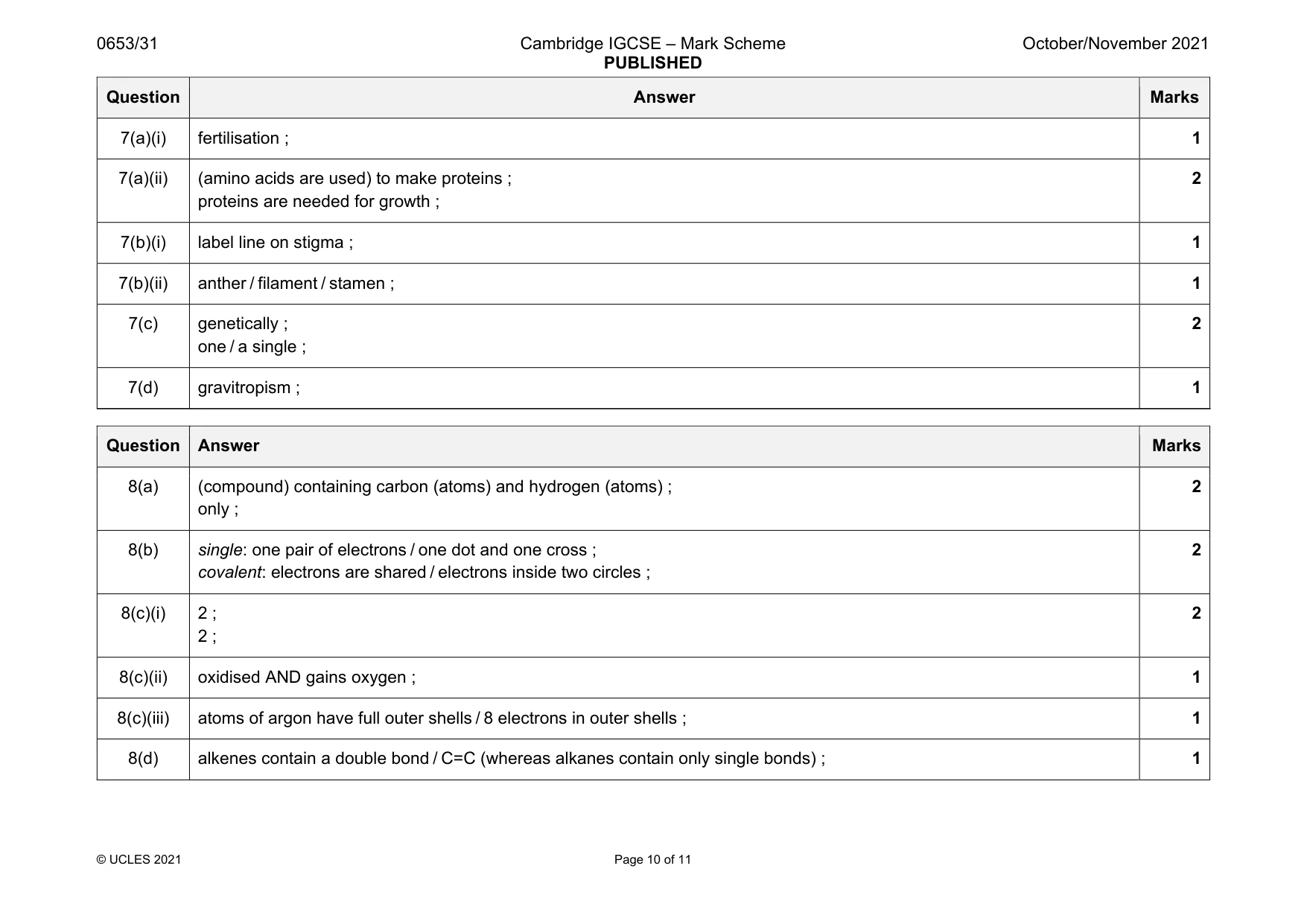
Mark scheme: 1(a)(i) aorta ; vena cava ; 2 1(a)(ii) pump blood ; 1 1(a)(iii) trachea ; 1 1(b) oxygen ; haemoglobin ; phagocytosis ; 3 1(c)(i) running slowly box ticked ; 1 1(c)(ii) reading values from graph 60 and 150 ; correct subtraction / 90 ; 2 1(c)(iii) lower breathing rate / AW ; lesser depth of breathing / AW ; 2
Q2 · The order of reactivity for some metals is shown in Fig
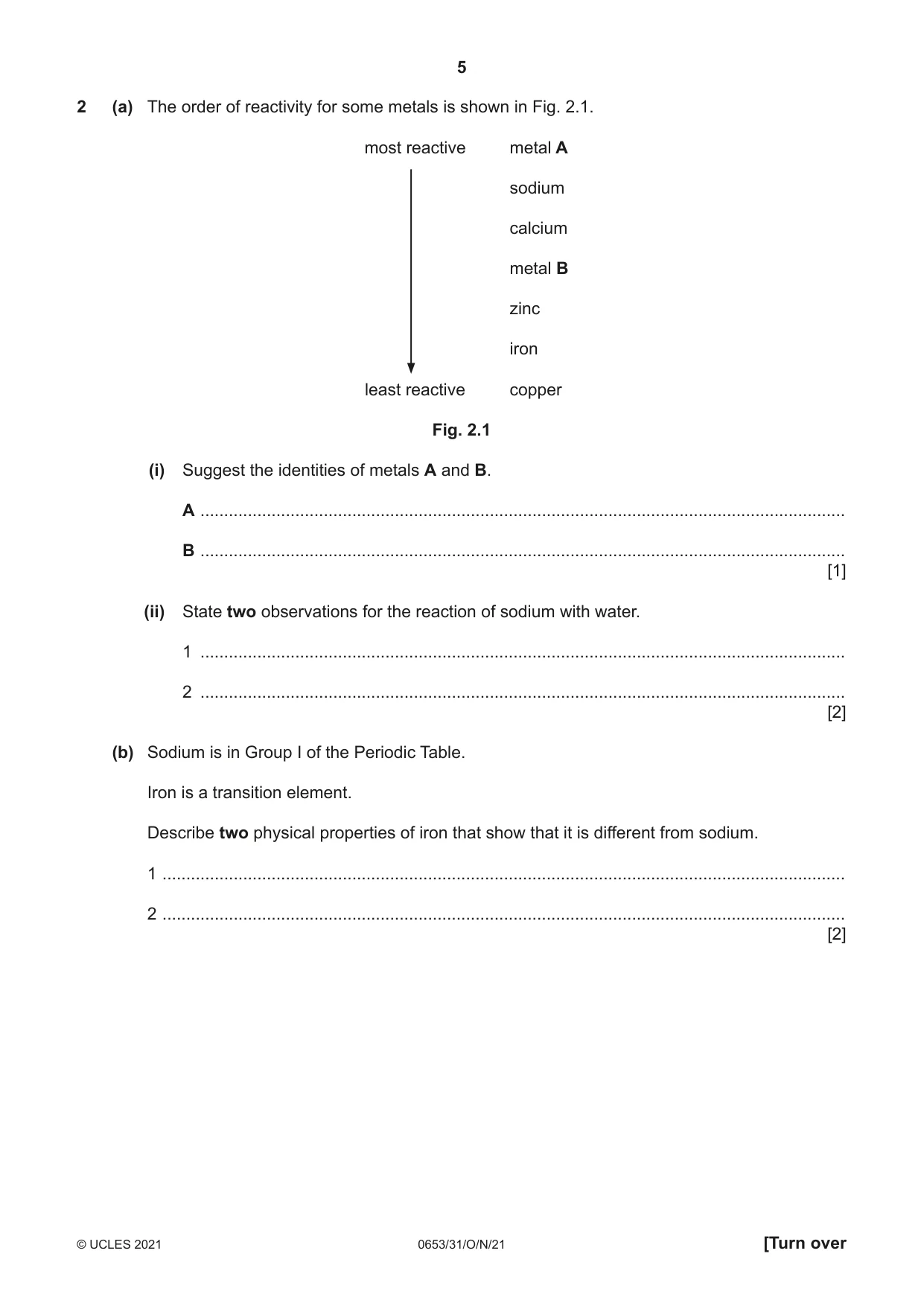
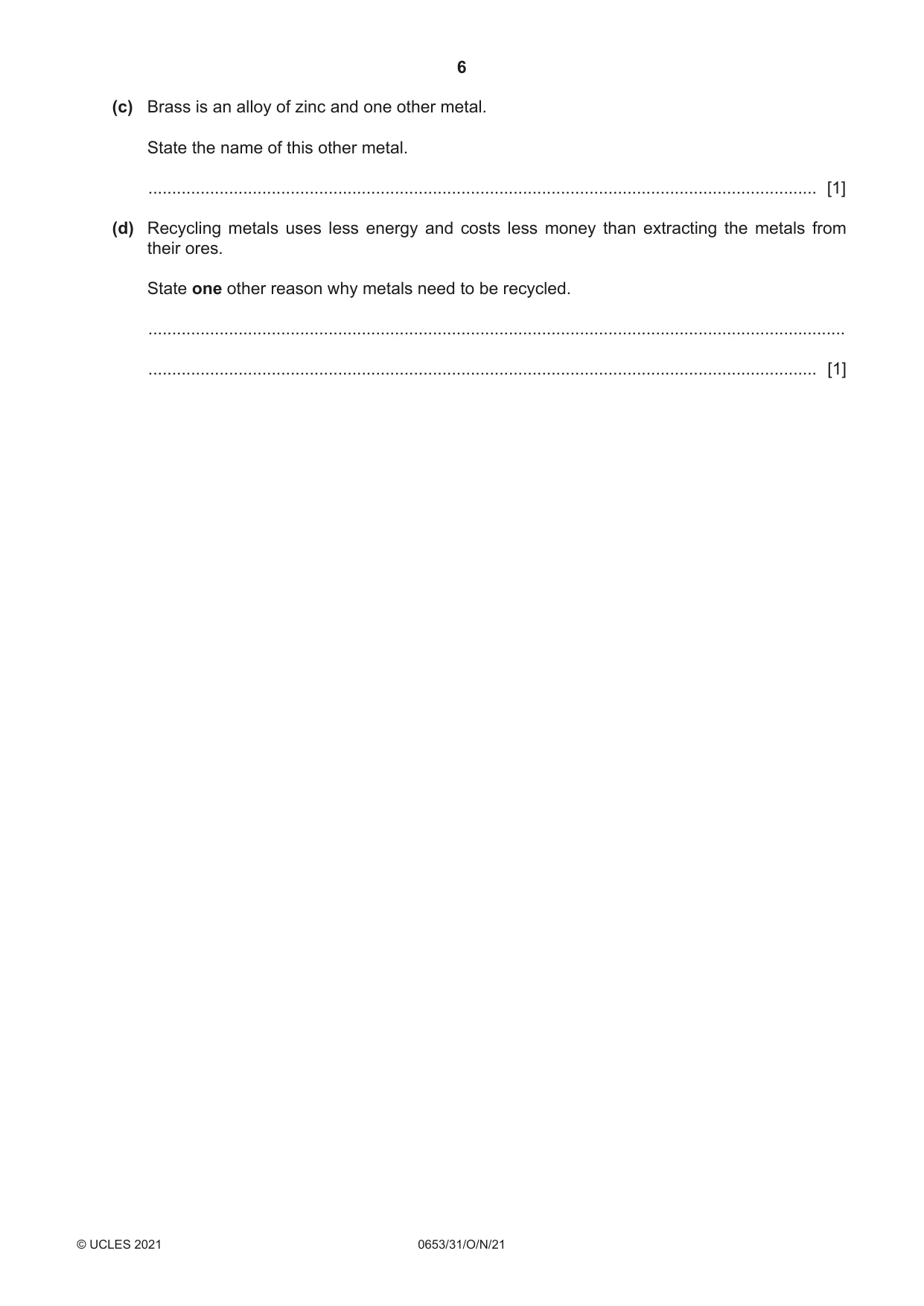
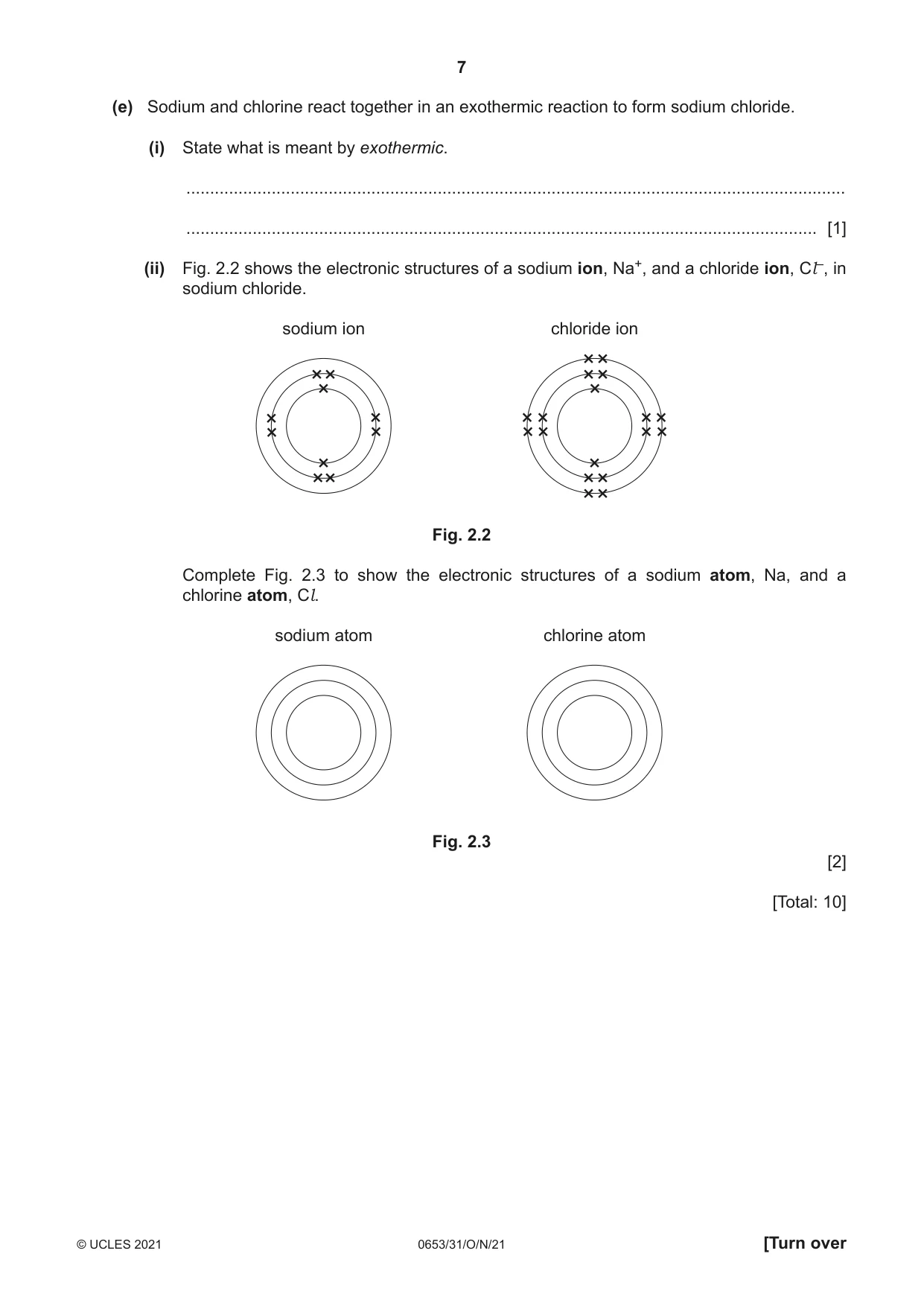
2 (a) The order of reactivity for some metals is shown in Fig. 2.1. most reactive metal A sodium calcium metal B zinc iron least reactive copper Fig. 2.1 (i) Suggest the identities of metals A and B. A ........................................................................................................................................ B ........................................................................................................................................ [1] (ii) State two observations for the reaction of sodium with water. 1 ........................................................................................................................................ 2 ........................................................................................................................................ [2] (b) Sodium is in Group I of the Periodic Table. Iron is a transition element. Describe two physical properties of iron that show that it is different from sodium. 1 ................................................................................................................................................ 2 ................................................................................................................................................ [2] (c) Brass is an alloy of zinc and one other metal. State the name of this other metal. ............................................................................................................................................. [1] (d) Recycling metals uses less energy and costs less money than extracting the metals from their ores. State one other reason why metals need to be recycled. ................................................................................................................................................... ............................................................................................................................................. [1] (e) Sodium and chlorine react together in an exothermic reaction to form sodium chloride. (i) State what is meant by exothermic. ........................................................................................................................................... ..................................................................................................................................... [1] (ii) Fig. 2.2 shows the electronic structures of a sodium ion, Na+, and a chloride ion, Cl–, in sodium chloride. sodium ion chloride ion ×× ×× ×× × × ×× ×× ×××× ×× ×× × × ×× ×× × × Fig. 2.2 Complete Fig. 2.3 to show the electronic structures of a sodium atom, Na, and a chlorine atom, Cl. sodium atom chlorine atom Fig. 2.3 [2] [Total: 10]
Mark scheme: 2(a)(i) A potassium AND B magnesium / aluminium ; 1 2(a)(ii) any two from: fizzes / bubbles ; gets smaller ; floats ; moves ; 2 2(b) any two from: (iron has) high(er) density / ORA ; (iron has) high(er) melting point / ORA ; (iron is) magnetic / ORA ; 2 2(c) copper ; 1 2(d) metals are finite (resources) / will run out ; 1 2(e)(i) (thermal) energy is released ; 1 2(e)(ii) (sodium atom) 2, 8, 1 ; (chlorine atom) 2, 8, 7 ; 2
Question 3
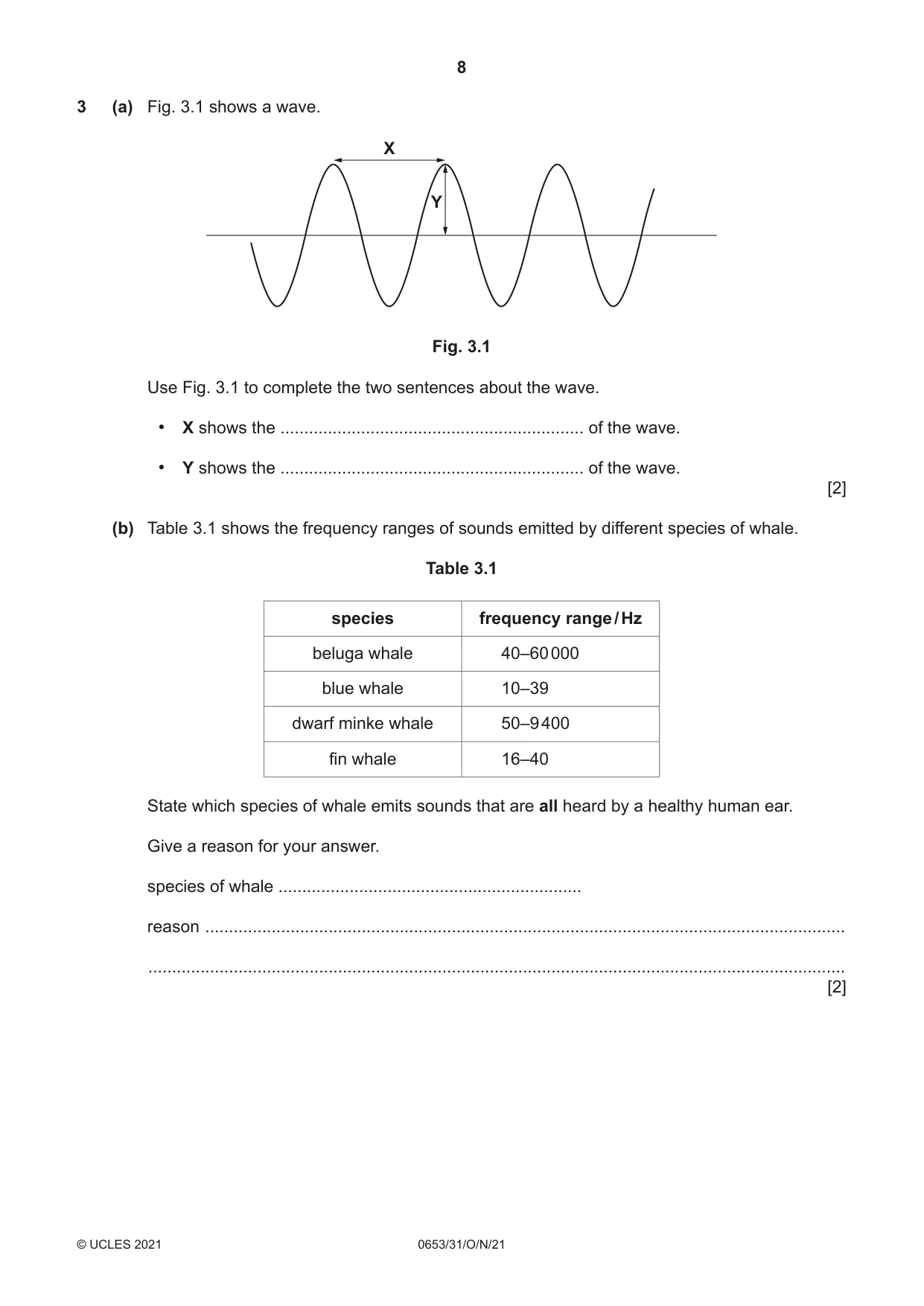
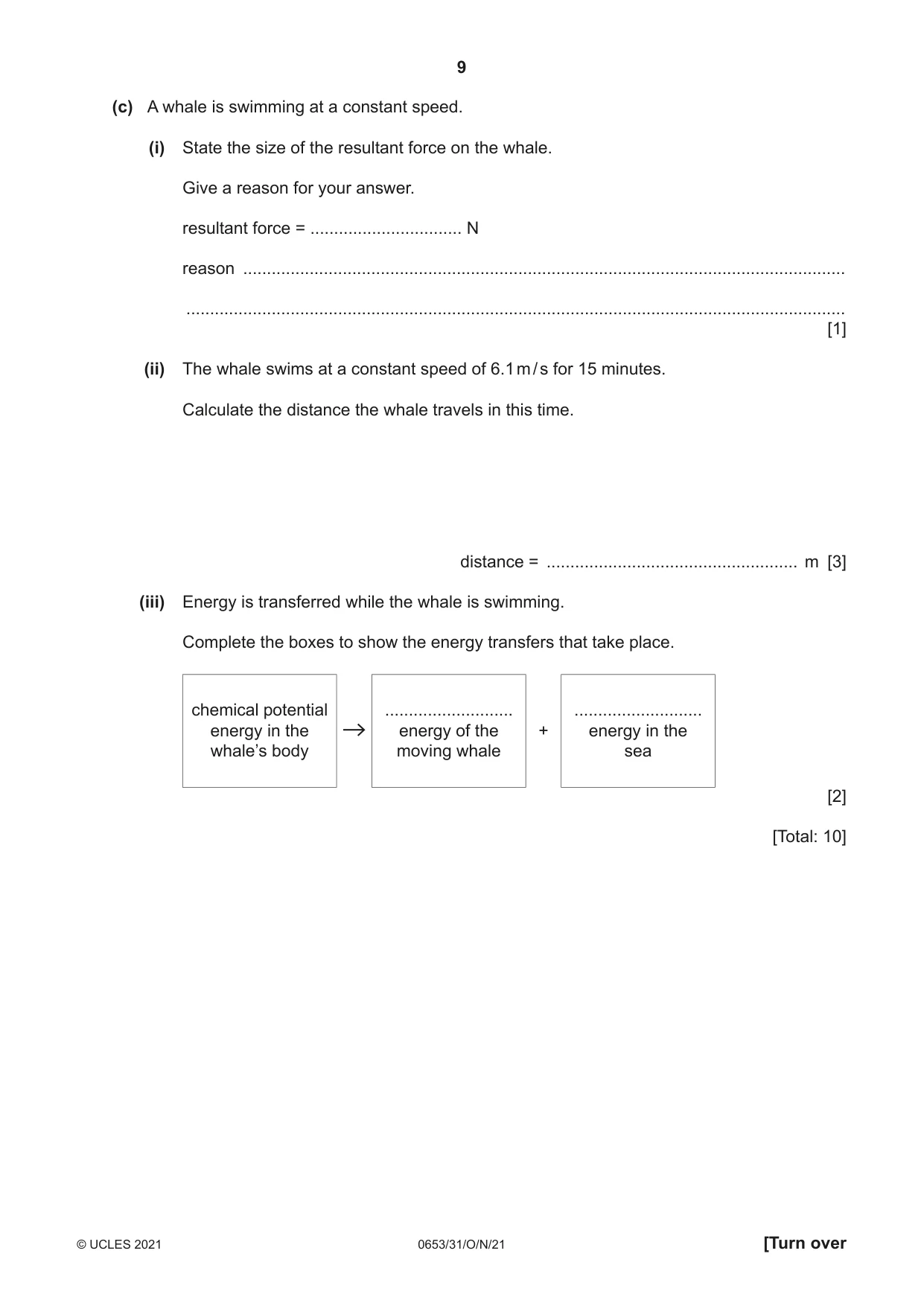
3 (a) Fig. 3.1 shows a wave. X Y Fig. 3.1 Use Fig. 3.1 to complete the two sentences about the wave. • X shows the ................................................................ of the wave. • Y shows the ................................................................ of the wave. [2] (b) Table 3.1 shows the frequency ranges of sounds emitted by different species of whale. Table 3.1 species frequency range / Hz beluga whale 40–60 000 blue whale 10–39 dwarf minke whale 50–9 400 fin whale 16–40 State which species of whale emits sounds that are all heard by a healthy human ear. Give a reason for your answer. species of whale ................................................................ reason ....................................................................................................................................... ................................................................................................................................................... [2] (c) A whale is swimming at a constant speed. (i) State the size of the resultant force on the whale. Give a reason for your answer. resultant force = ................................ N reason ............................................................................................................................... ........................................................................................................................................... [1] (ii) The whale swims at a constant speed of 6.1 m / s for 15 minutes. Calculate the distance the whale travels in this time. distance = ..................................................... m [3] (iii) Energy is transferred while the whale is swimming. Complete the boxes to show the energy transfers that take place. chemical potential ........................... ........................... energy in the energy of the + energy in the whale’s body moving whale sea [2] [Total: 10]
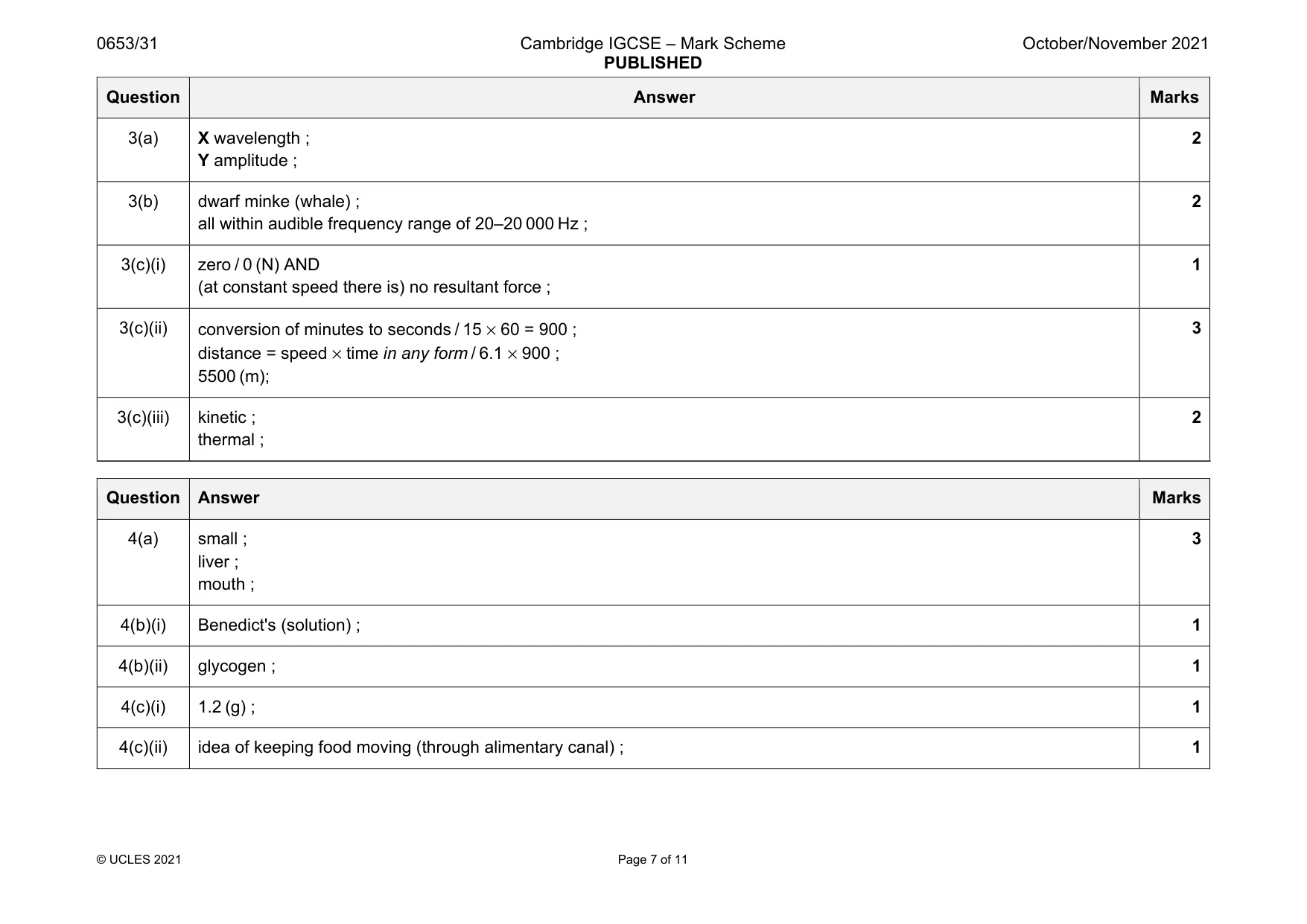
Mark scheme: 3(a) X wavelength ; Y amplitude ; 2 3(b) dwarf minke (whale) ; all within audible frequency range of 20–20 000 Hz ; 2 3(c)(i) zero / 0 (N) AND (at constant speed there is) no resultant force ; 1 3(c)(ii) conversion of minutes to seconds / 15 × 60 = 900 ; distance = speed × time in any form / 6.1 × 900 ; 5500 (m); 3 3(c)(iii) kinetic ; thermal ; 2 Question Answer Marks
Q4 · The names and functions of some organs associated with the alimentary canal
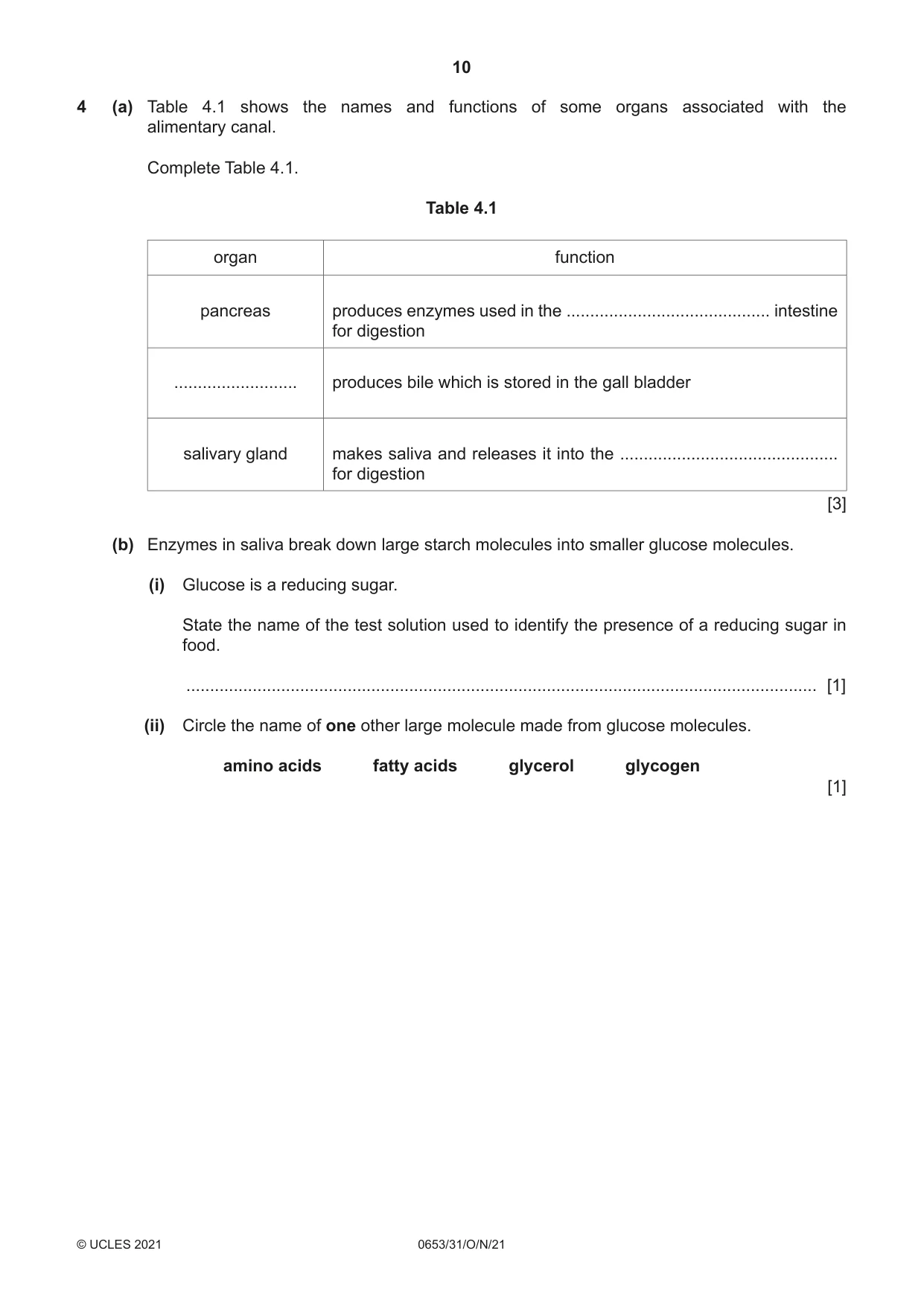
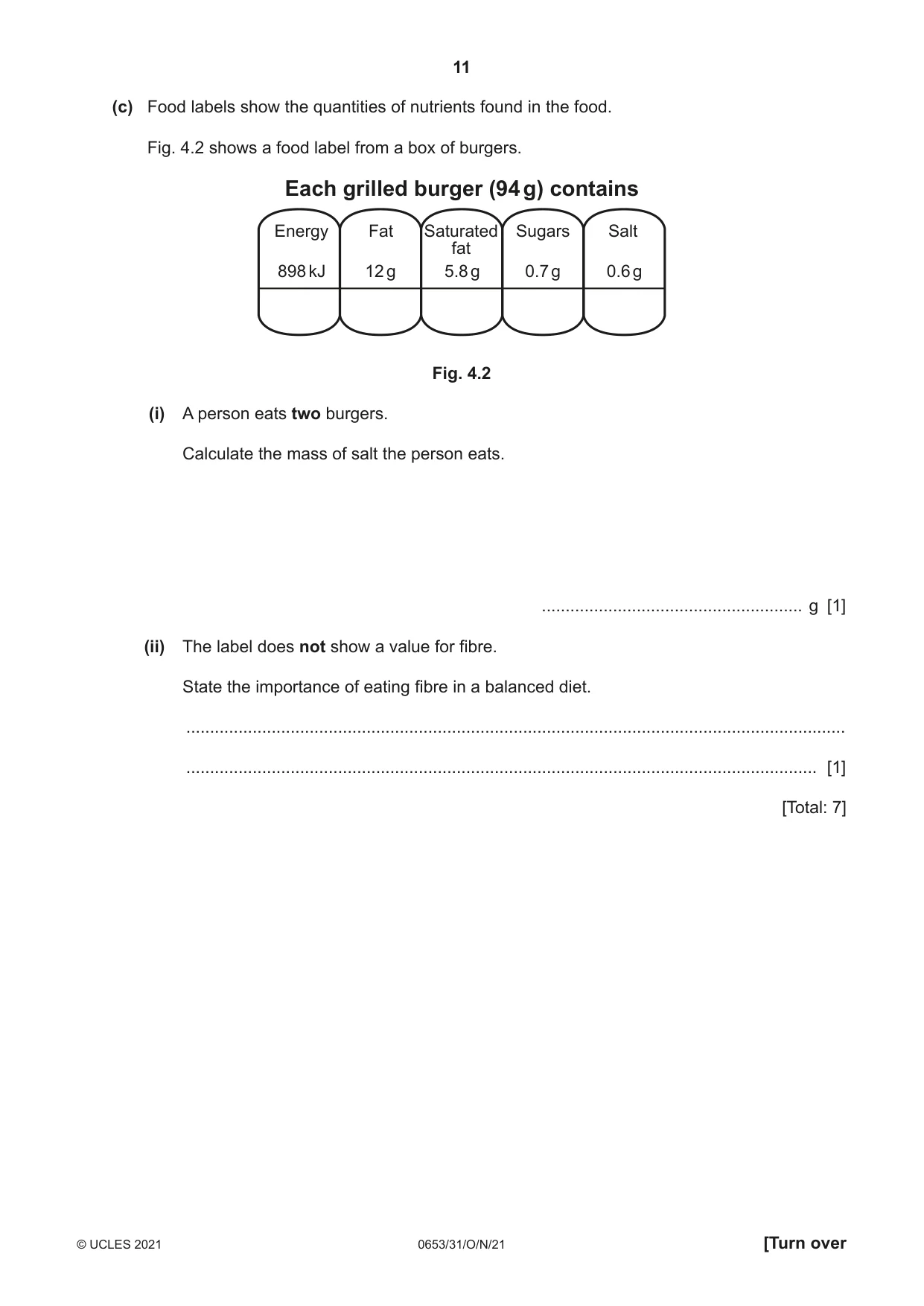
4 (a) Table 4.1 shows the names and functions of some organs associated with the alimentary canal. Complete Table 4.1. Table 4.1 organ function pancreas produces enzymes used in the ........................................... intestine for digestion .......................... produces bile which is stored in the gall bladder salivary gland makes saliva and releases it into the .............................................. for digestion [3] (b) Enzymes in saliva break down large starch molecules into smaller glucose molecules. (i) Glucose is a reducing sugar. State the name of the test solution used to identify the presence of a reducing sugar in food. ..................................................................................................................................... [1] (ii) Circle the name of one other large molecule made from glucose molecules. amino acids fatty acids glycerol glycogen [1] (c) Food labels show the quantities of nutrients found in the food. Fig. 4.2 shows a food label from a box of burgers. Each grilled burger (94 g) contains Energy Fat Saturated Sugars Salt fat 898 kJ 12 g 5.8 g 0.7 g 0.6 g Fig. 4.2 (i) A person eats two burgers. Calculate the mass of salt the person eats. ....................................................... g [1] (ii) The label does not show a value for fibre. State the importance of eating fibre in a balanced diet. ........................................................................................................................................... ..................................................................................................................................... [1] [Total: 7]
Mark scheme: 4(a) small ; liver ; mouth ; 3 4(b)(i) Benedict's (solution) ; 1 4(b)(ii) glycogen ; 1 4(c)(i) 1.2 (g) ; 1 4(c)(ii) idea of keeping food moving (through alimentary canal) ; 1
Q5 · The boxes on the left of Fig
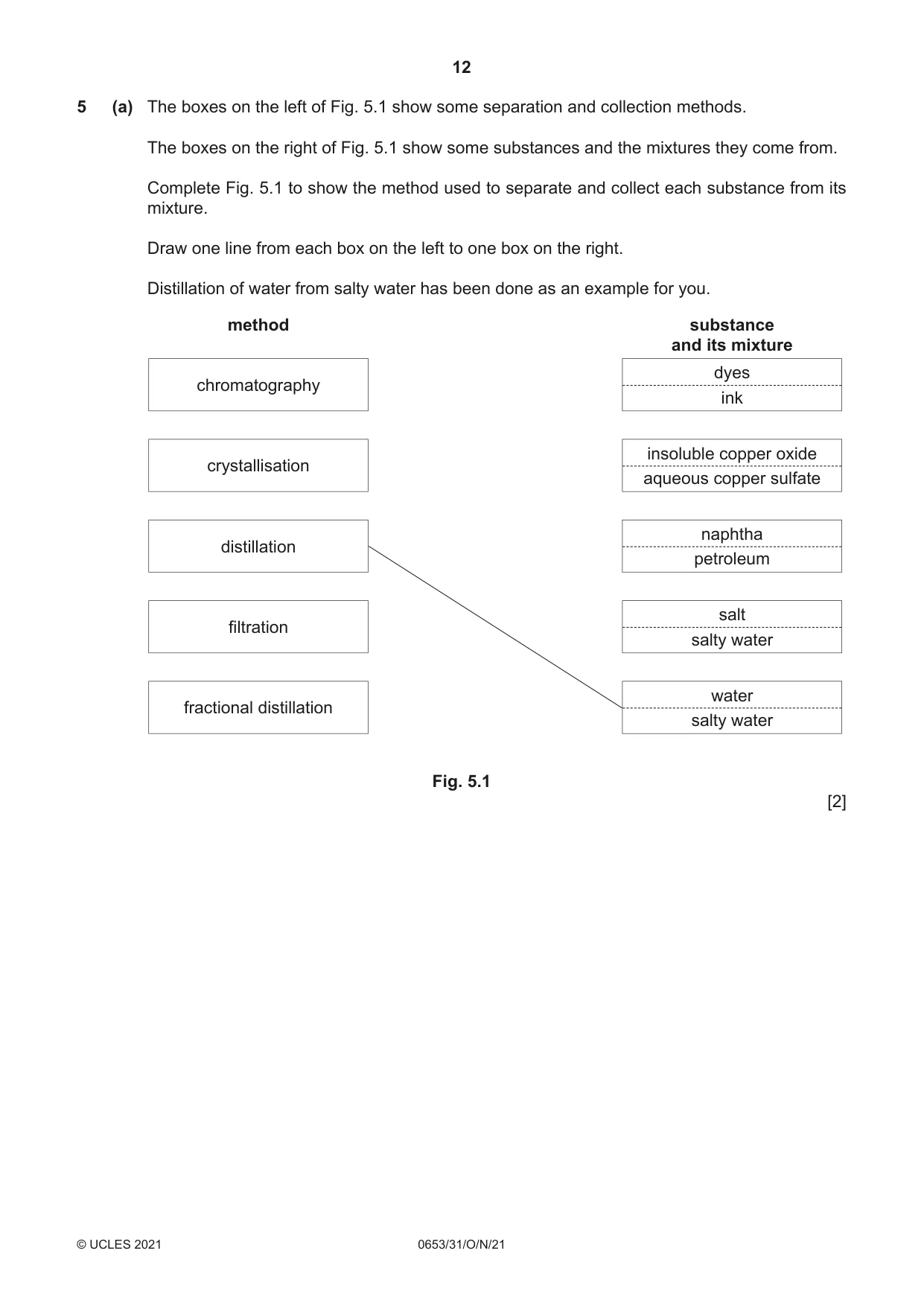
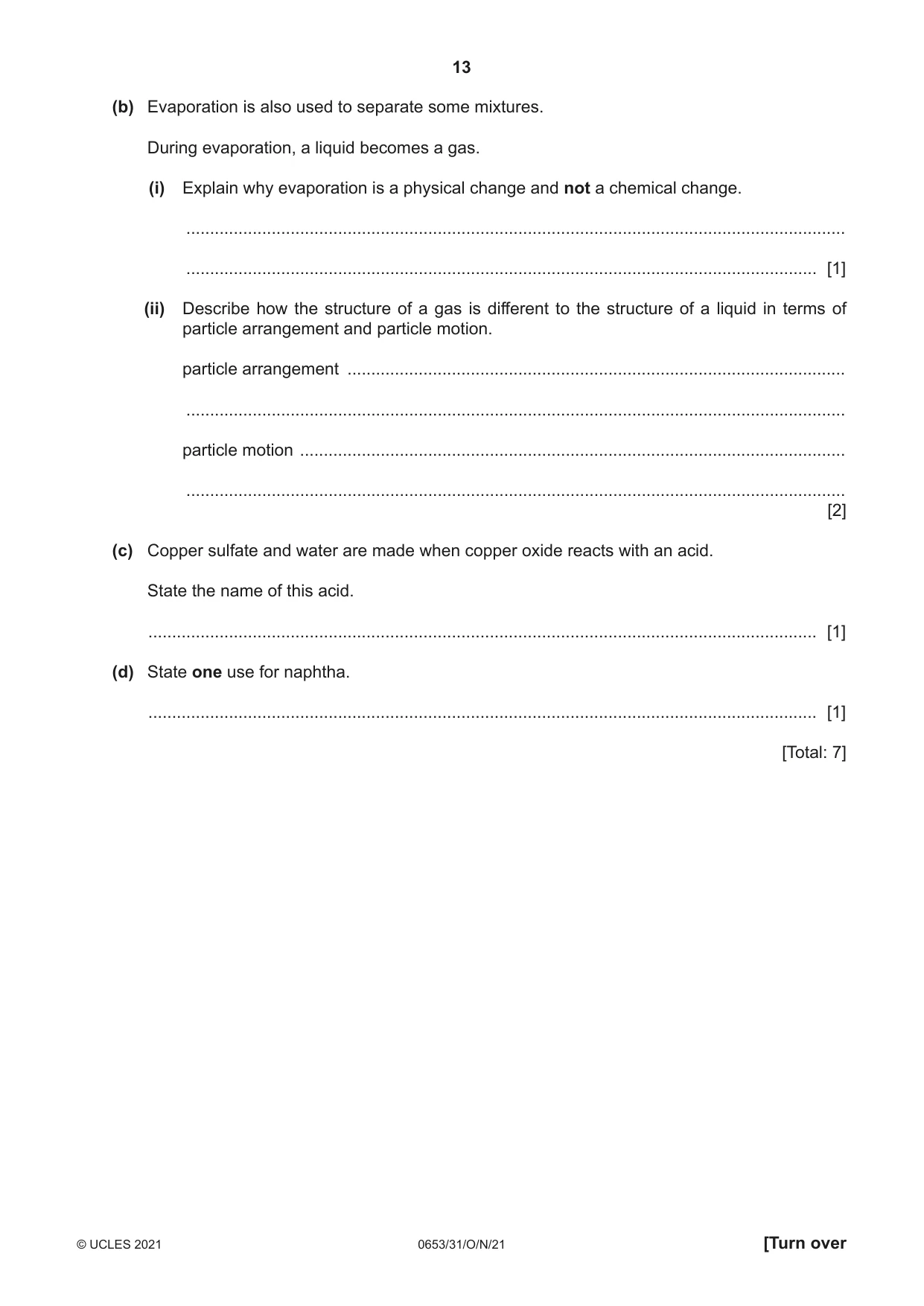
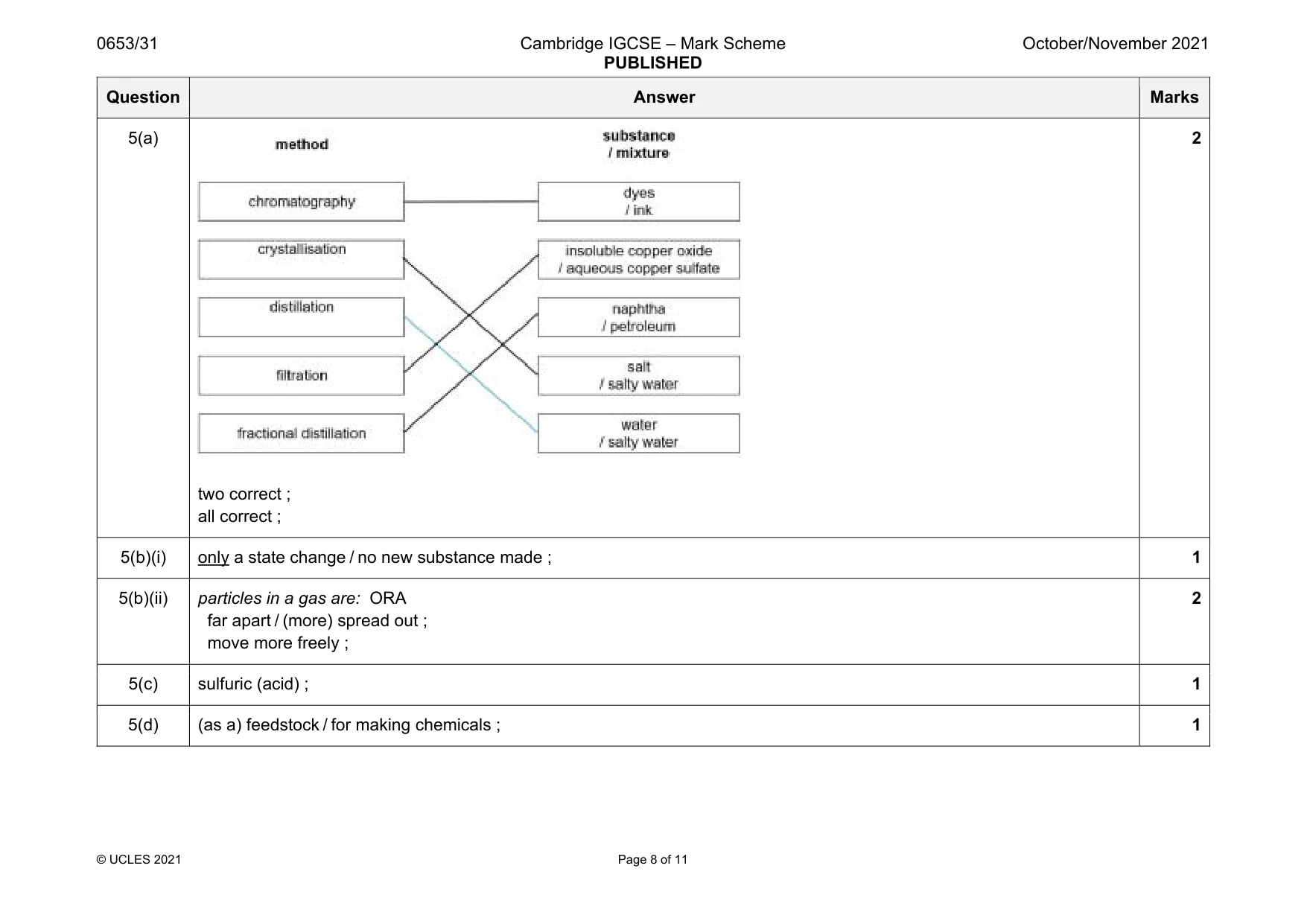
5 (a) The boxes on the left of Fig. 5.1 show some separation and collection methods. The boxes on the right of Fig. 5.1 show some substances and the mixtures they come from. Complete Fig. 5.1 to show the method used to separate and collect each substance from its mixture. Draw one line from each box on the left to one box on the right. Distillation of water from salty water has been done as an example for you. method substance and its mixture dyes chromatography ink insoluble copper oxide crystallisation aqueous copper sulfate naphtha distillation petroleum salt filtration salty water water fractional distillation salty water Fig. 5.1 [2] (b) Evaporation is also used to separate some mixtures. During evaporation, a liquid becomes a gas. (i) Explain why evaporation is a physical change and not a chemical change. ........................................................................................................................................... ..................................................................................................................................... [1] (ii) Describe how the structure of a gas is different to the structure of a liquid in terms of particle arrangement and particle motion. particle arrangement ......................................................................................................... ........................................................................................................................................... particle motion ................................................................................................................... ........................................................................................................................................... [2] (c) Copper sulfate and water are made when copper oxide reacts with an acid. State the name of this acid. ............................................................................................................................................. [1] (d) State one use for naphtha. ............................................................................................................................................. [1] [Total: 7]
Mark scheme: 5(a) two correct ; all correct ; 2 5(b)(i) only a state change / no new substance made ; 1 5(b)(ii) particles in a gas are: ORA far apart / (more) spread out ; move more freely ; 2 5(c) sulfuric (acid) ; 1 5(d) (as a) feedstock / for making chemicals ; 1
Q6 · A gas flame being used to heat a metal kettle of water until the water boils
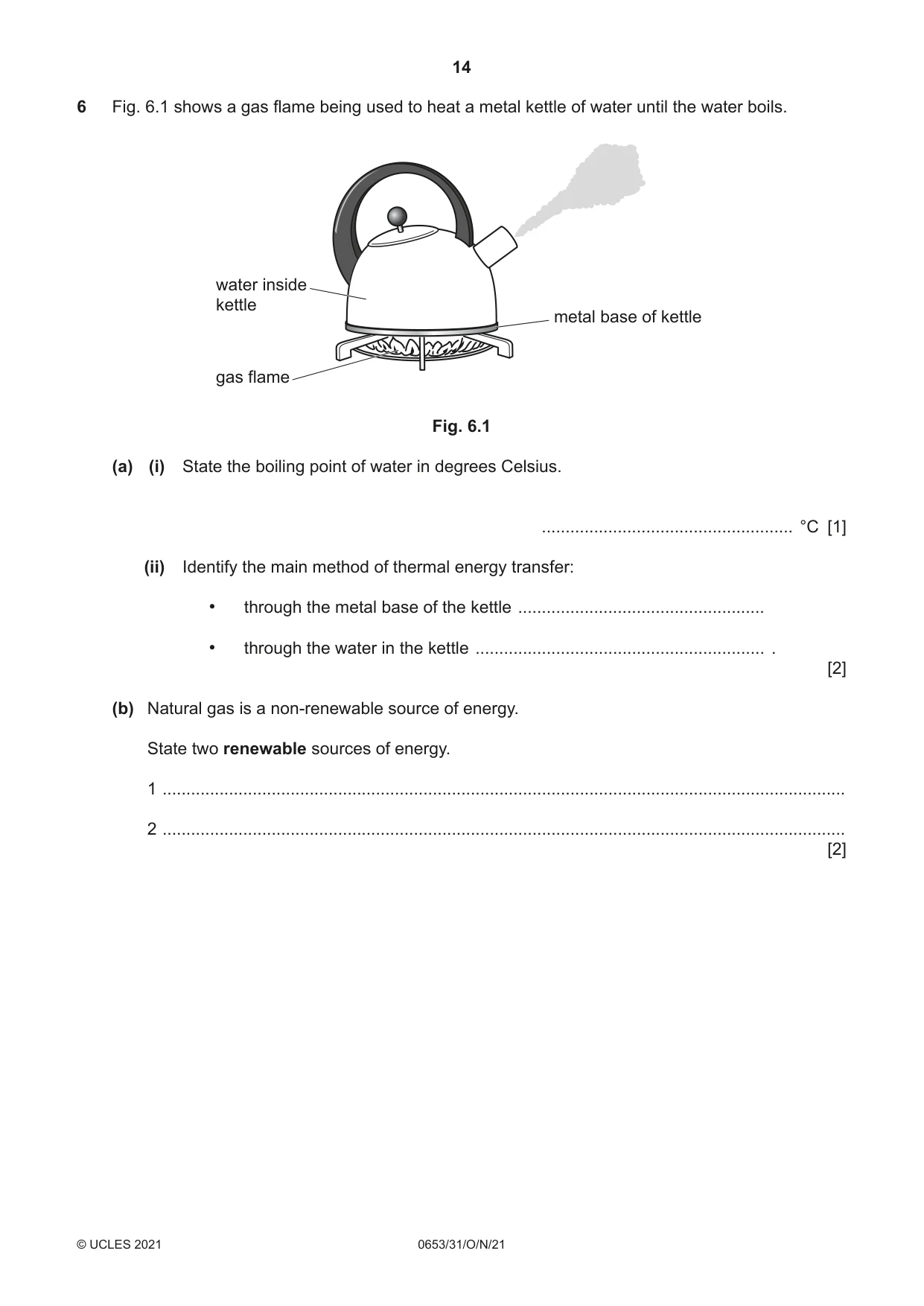
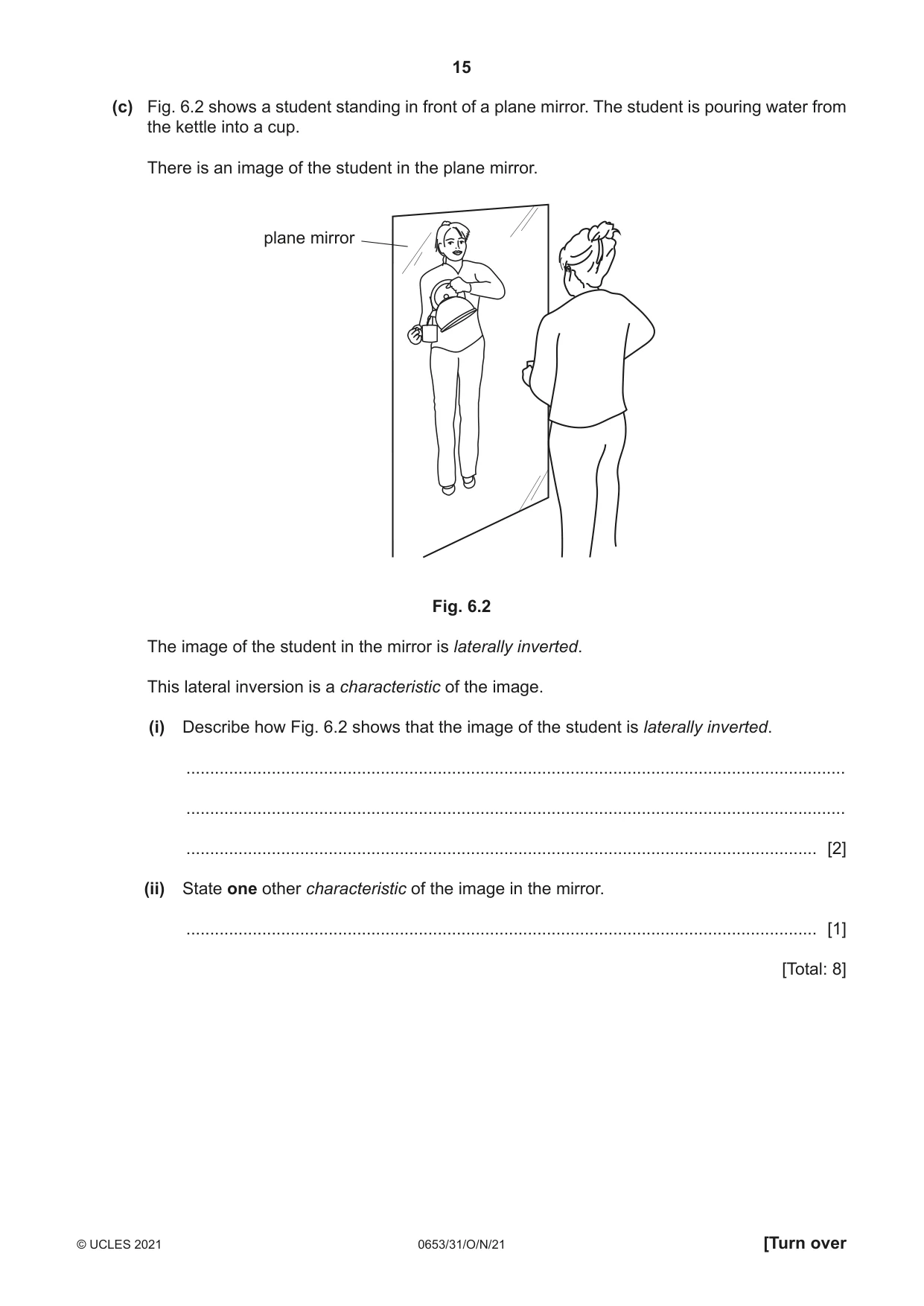
6 Fig. 6.1 shows a gas flame being used to heat a metal kettle of water until the water boils. water inside kettle metal base of kettle gas flame Fig. 6.1 (a) (i) State the boiling point of water in degrees Celsius. ..................................................... °C [1] (ii) Identify the main method of thermal energy transfer: • through the metal base of the kettle .................................................... • through the water in the kettle ............................................................. . [2] (b) Natural gas is a non-renewable source of energy. State two renewable sources of energy. 1 ................................................................................................................................................ 2 ................................................................................................................................................ [2] (c) Fig. 6.2 shows a student standing in front of a plane mirror. The student is pouring water from the kettle into a cup. There is an image of the student in the plane mirror. plane mirror Fig. 6.2 The image of the student in the mirror is laterally inverted. This lateral inversion is a characteristic of the image. (i) Describe how Fig. 6.2 shows that the image of the student is laterally inverted. ........................................................................................................................................... ........................................................................................................................................... ..................................................................................................................................... [2] (ii) State one other characteristic of the image in the mirror. ..................................................................................................................................... [1] [Total: 8]
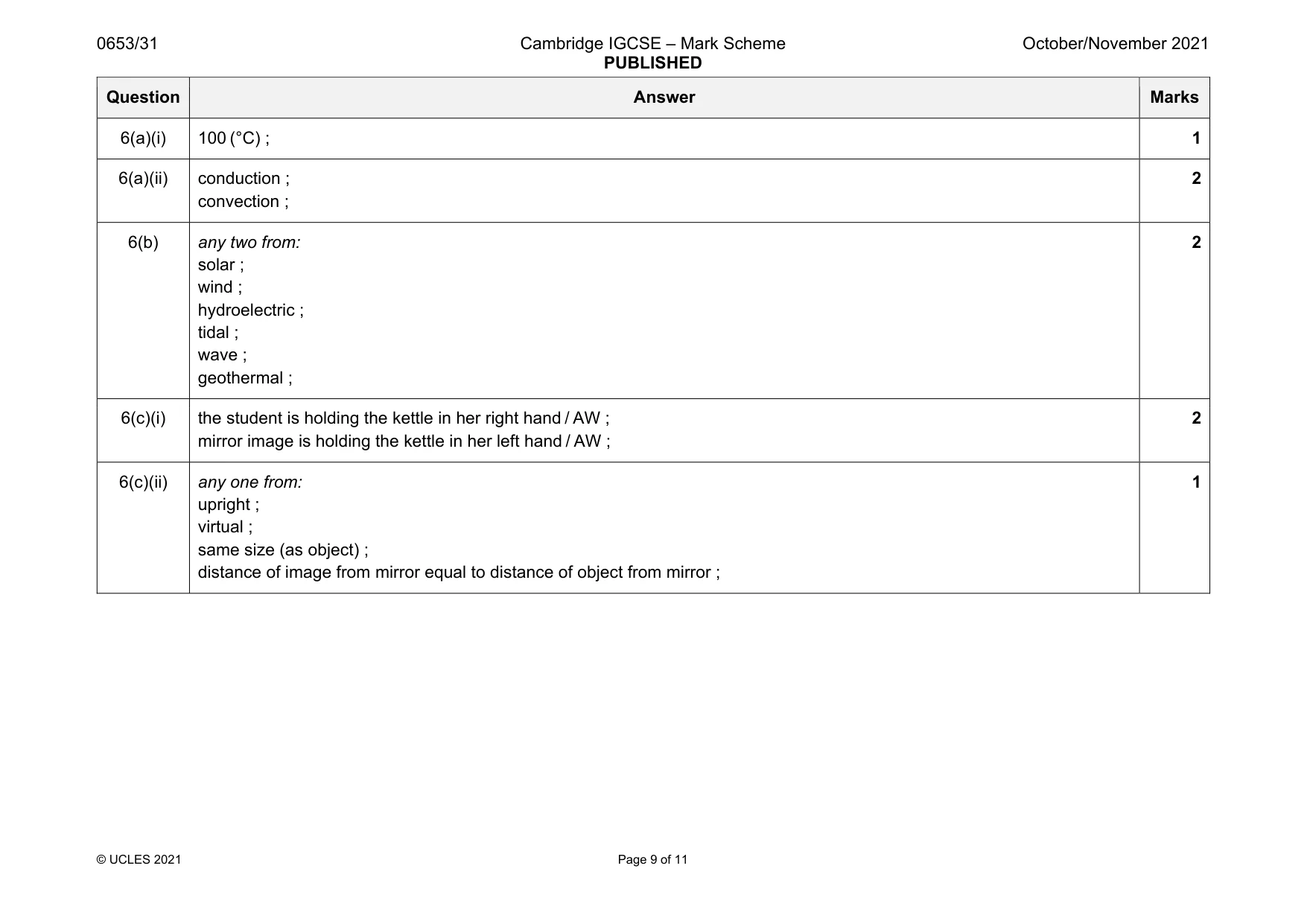
Mark scheme: 6(a)(i) 100 (°C) ; 1 6(a)(ii) conduction ; convection ; 2 6(b) any two from: solar ; wind ; hydroelectric ; tidal ; wave ; geothermal ; 2 6(c)(i) the student is holding the kettle in her right hand / AW ; mirror image is holding the kettle in her left hand / AW ; 2 6(c)(ii) any one from: upright ; virtual ; same size (as object) ; distance of image from mirror equal to distance of object from mirror ; 1
Q7 · The life cycle of a plant
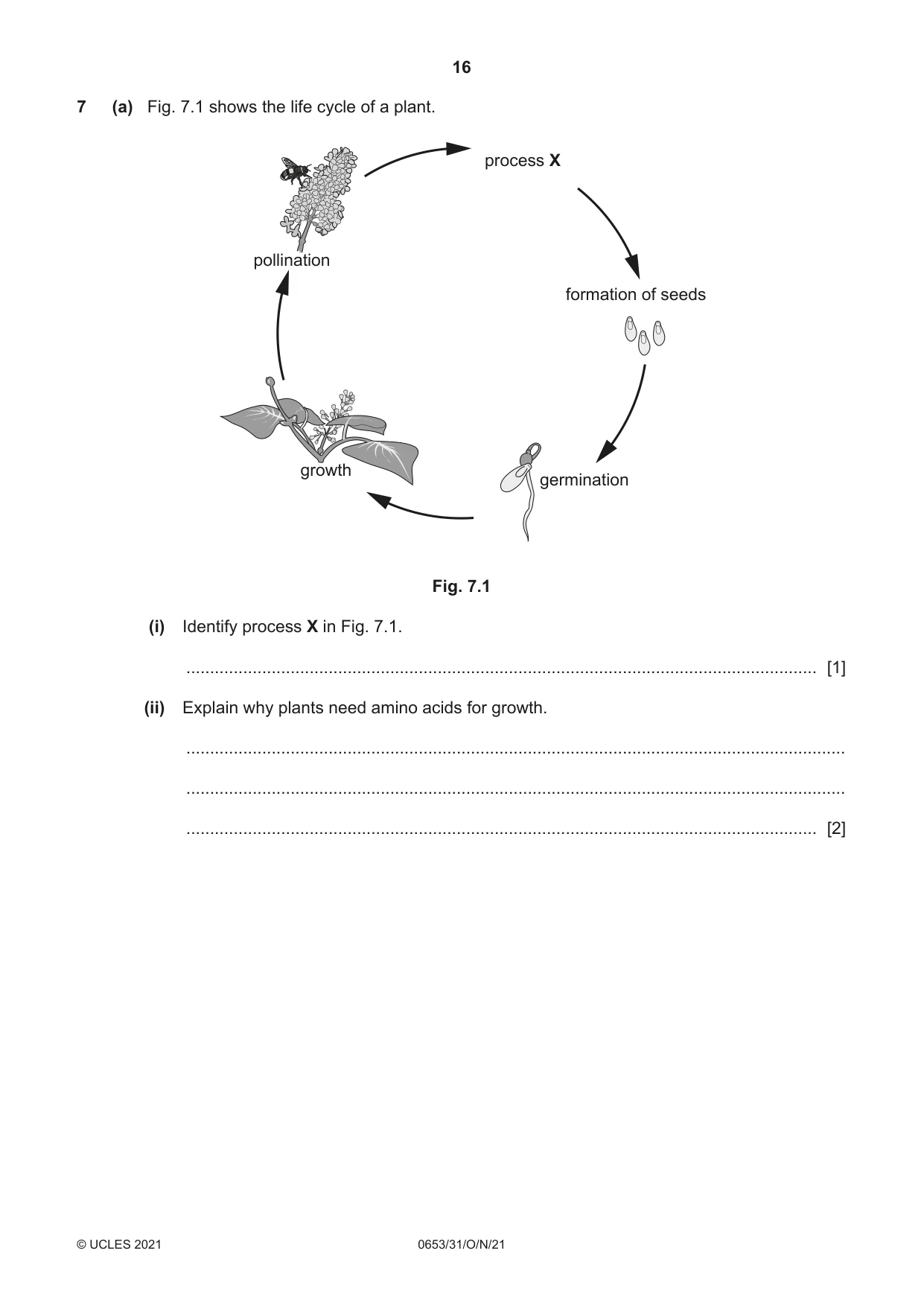
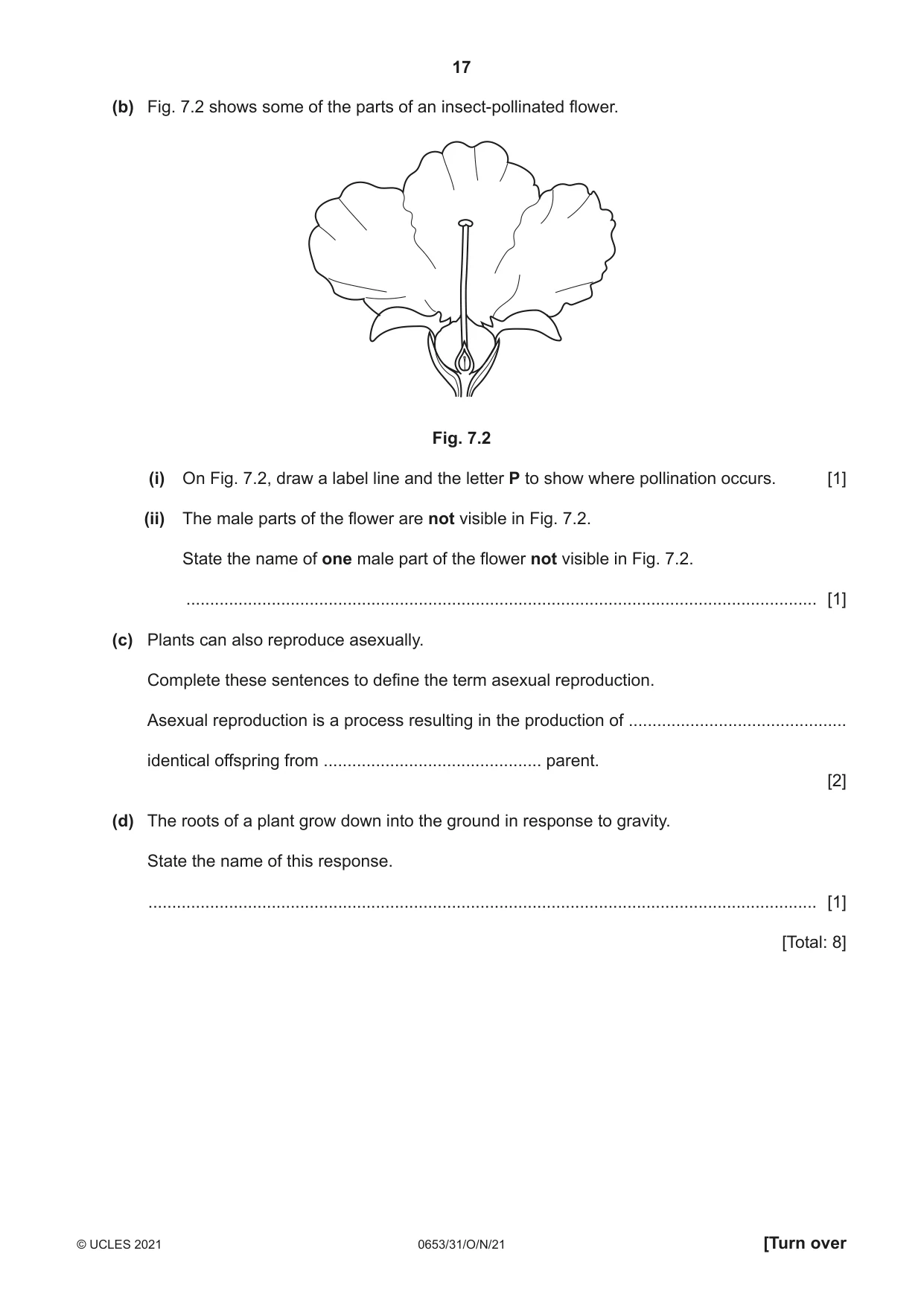
7 (a) Fig. 7.1 shows the life cycle of a plant. process X pollination formation of seeds growth germination Fig. 7.1 (i) Identify process X in Fig. 7.1. ..................................................................................................................................... [1] (ii) Explain why plants need amino acids for growth. ........................................................................................................................................... ........................................................................................................................................... ..................................................................................................................................... [2] (b) Fig. 7.2 shows some of the parts of an insect-pollinated flower. Fig. 7.2 (i) On Fig. 7.2, draw a label line and the letter P to show where pollination occurs. [1] (ii) The male parts of the flower are not visible in Fig. 7.2. State the name of one male part of the flower not visible in Fig. 7.2. ..................................................................................................................................... [1] (c) Plants can also reproduce asexually. Complete these sentences to define the term asexual reproduction. Asexual reproduction is a process resulting in the production of .............................................. identical offspring from .............................................. parent. [2] (d) The roots of a plant grow down into the ground in response to gravity. State the name of this response. ............................................................................................................................................. [1] [Total: 8]
Mark scheme: 7(a)(i) fertilisation ; 1 7(a)(ii) (amino acids are used) to make proteins ; proteins are needed for growth ; 2 7(b)(i) label line on stigma ; 1 7(b)(ii) anther / filament / stamen ; 1 7(c) genetically ; one / a single ; 2 7(d) gravitropism ; 1 Question Answer Marks
Q8 · Methane, CH4, is a hydrocarbon
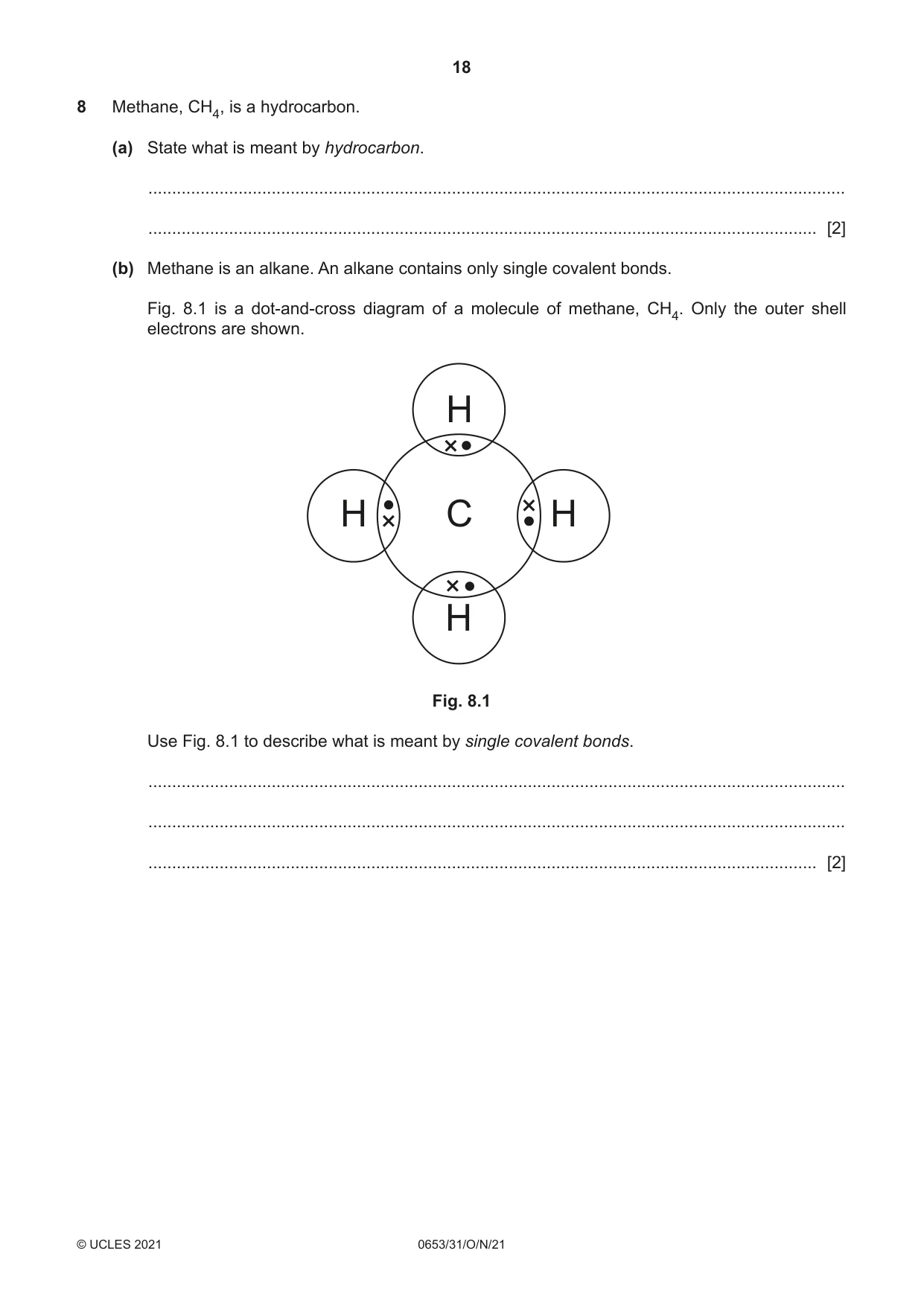
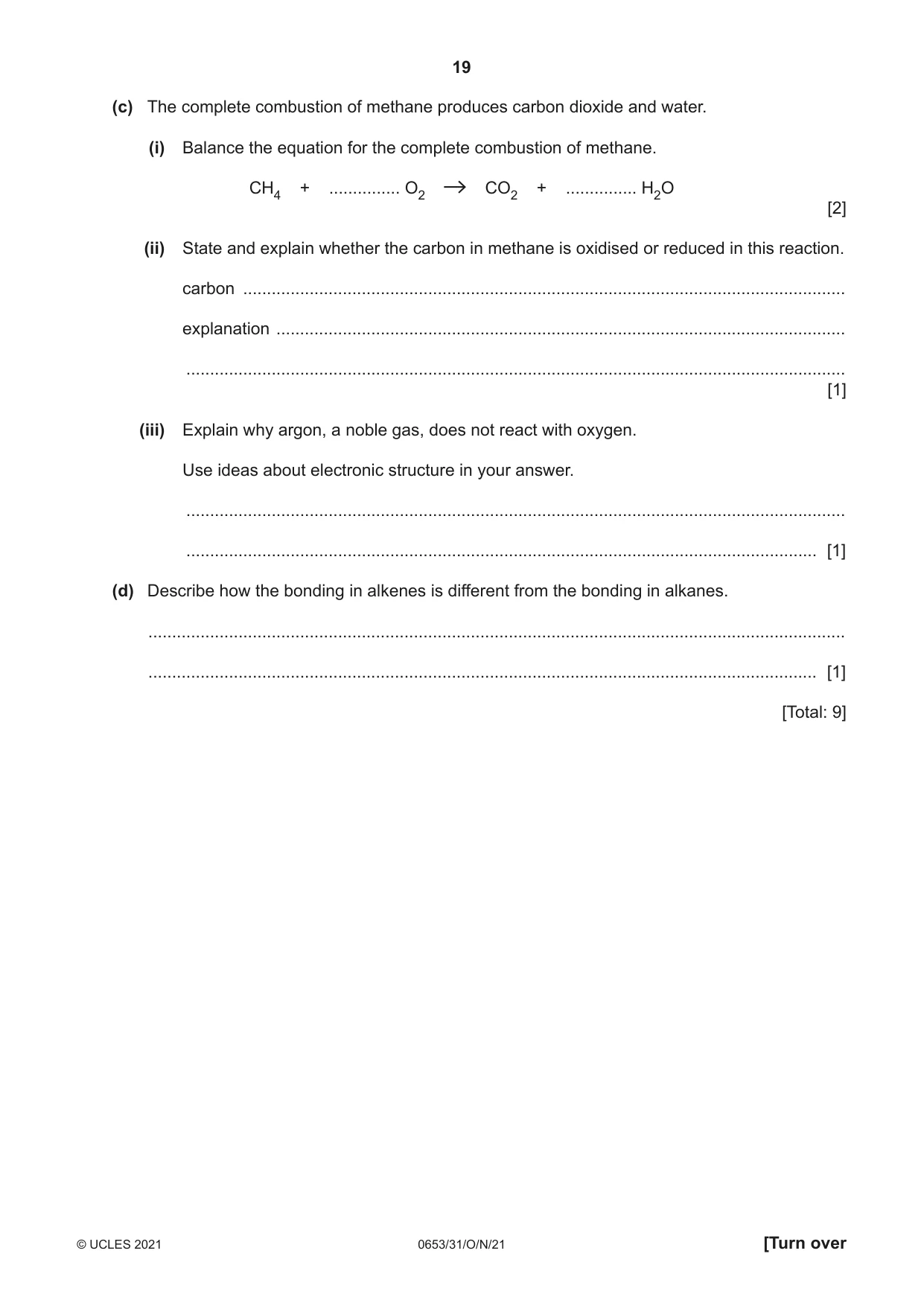
8 Methane, CH4, is a hydrocarbon. (a) State what is meant by hydrocarbon. ................................................................................................................................................... ............................................................................................................................................. [2] (b) Methane is an alkane. An alkane contains only single covalent bonds. Fig. 8.1 is a dot-and-cross diagram of a molecule of methane, CH4. Only the outer shell electrons are shown. H × H × C × H × H Fig. 8.1 Use Fig. 8.1 to describe what is meant by single covalent bonds. ................................................................................................................................................... ................................................................................................................................................... ............................................................................................................................................. [2] (c) The complete combustion of methane produces carbon dioxide and water. (i) Balance the equation for the complete combustion of methane. CH4 + ............... O2 CO2 + ............... H2O [2] (ii) State and explain whether the carbon in methane is oxidised or reduced in this reaction. carbon ............................................................................................................................... explanation ........................................................................................................................ ........................................................................................................................................... [1] (iii) Explain why argon, a noble gas, does not react with oxygen. Use ideas about electronic structure in your answer. ........................................................................................................................................... ..................................................................................................................................... [1] (d) Describe how the bonding in alkenes is different from the bonding in alkanes. ................................................................................................................................................... ............................................................................................................................................. [1] [Total: 9]
Mark scheme: 8(a) (compound) containing carbon (atoms) and hydrogen (atoms) ; only ; 2 8(b) single: one pair of electrons / one dot and one cross ; covalent: electrons are shared / electrons inside two circles ; 2 8(c)(i) 2 ; 2 ; 2 8(c)(ii) oxidised AND gains oxygen ; 1 8(c)(iii) atoms of argon have full outer shells / 8 electrons in outer shells ; 1 8(d) alkenes contain a double bond / C=C (whereas alkanes contain only single bonds) ; 1
Q9 · Three identical resistors, E, F and G, connected to a battery and an ammeter
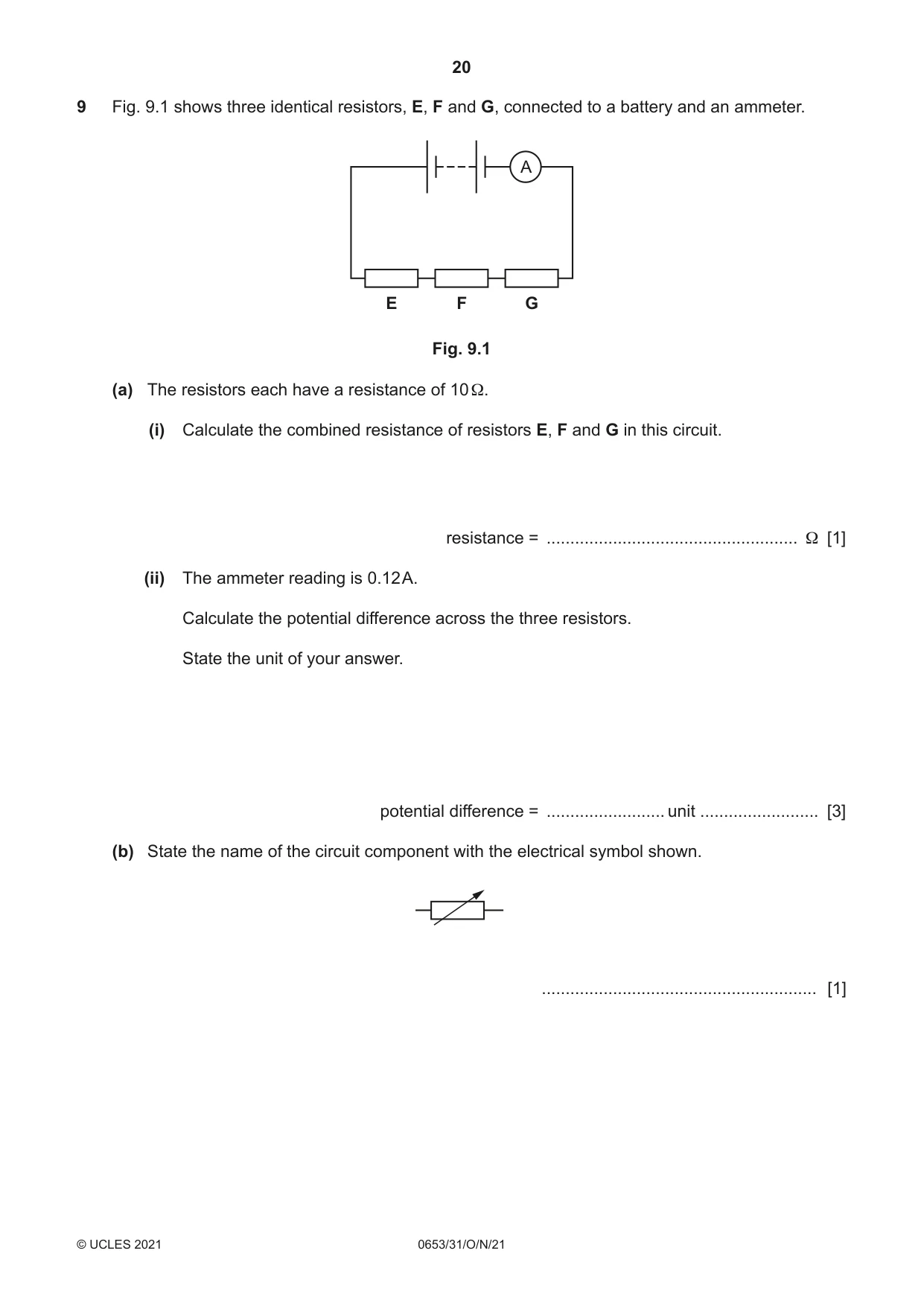
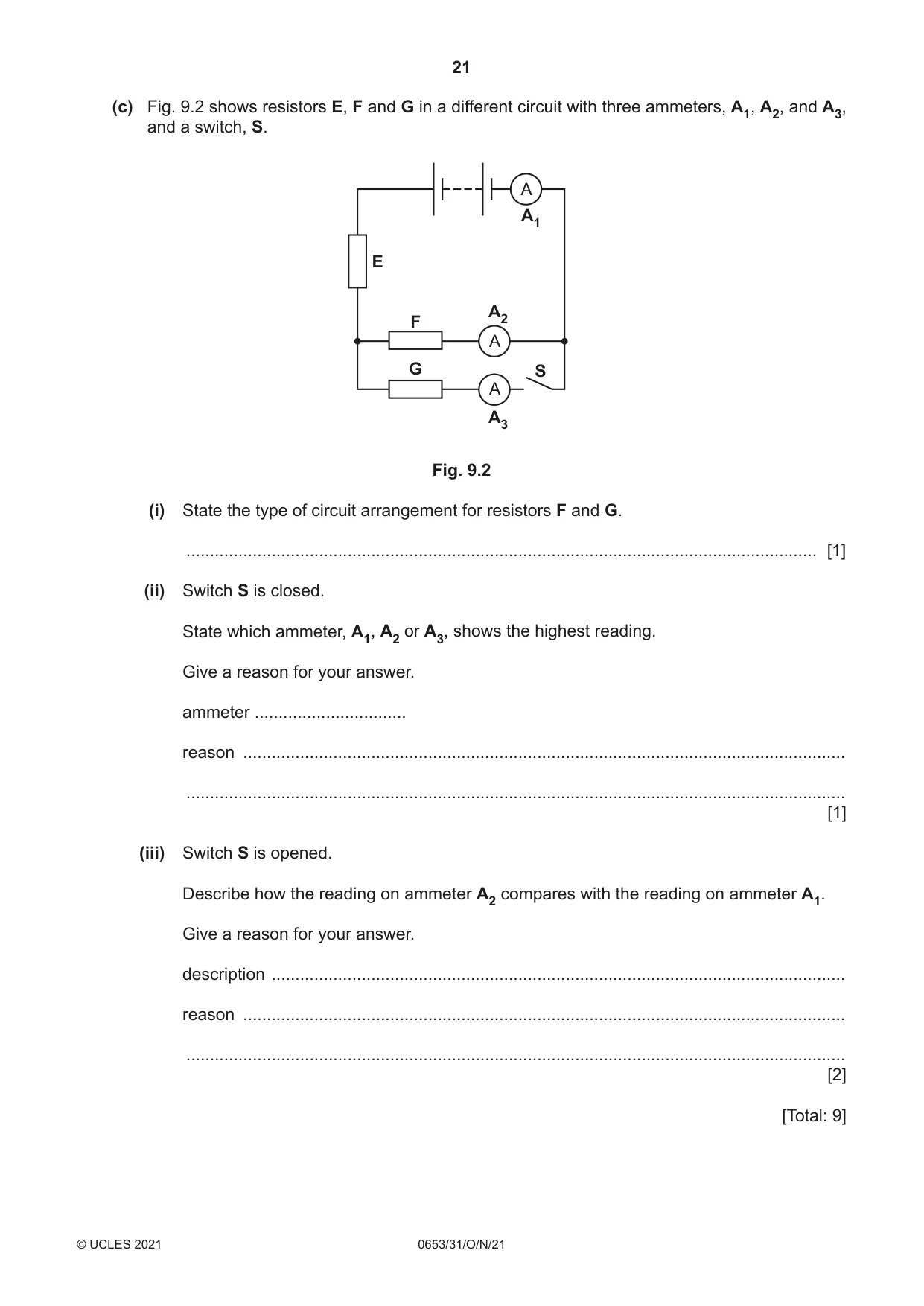
9 Fig. 9.1 shows three identical resistors, E, F and G, connected to a battery and an ammeter. A E F G Fig. 9.1 (a) The resistors each have a resistance of 10 Ω. (i) Calculate the combined resistance of resistors E, F and G in this circuit. resistance = ..................................................... Ω [1] (ii) The ammeter reading is 0.12 A. Calculate the potential difference across the three resistors. State the unit of your answer. potential difference = ......................... unit ......................... [3] (b) State the name of the circuit component with the electrical symbol shown. .......................................................... [1] (c) Fig. 9.2 shows resistors E, F and G in a different circuit with three ammeters, A1, A2, and A3, and a switch, S. A A1 E A2 F A G S A A3 Fig. 9.2 (i) State the type of circuit arrangement for resistors F and G. ..................................................................................................................................... [1] (ii) Switch S is closed. State which ammeter, A1, A2 or A3, shows the highest reading. Give a reason for your answer. ammeter ................................ reason ............................................................................................................................... ........................................................................................................................................... [1] (iii) Switch S is opened. Describe how the reading on ammeter A2 compares with the reading on ammeter A1. Give a reason for your answer. description ......................................................................................................................... reason ............................................................................................................................... ........................................................................................................................................... [2] [Total: 9]
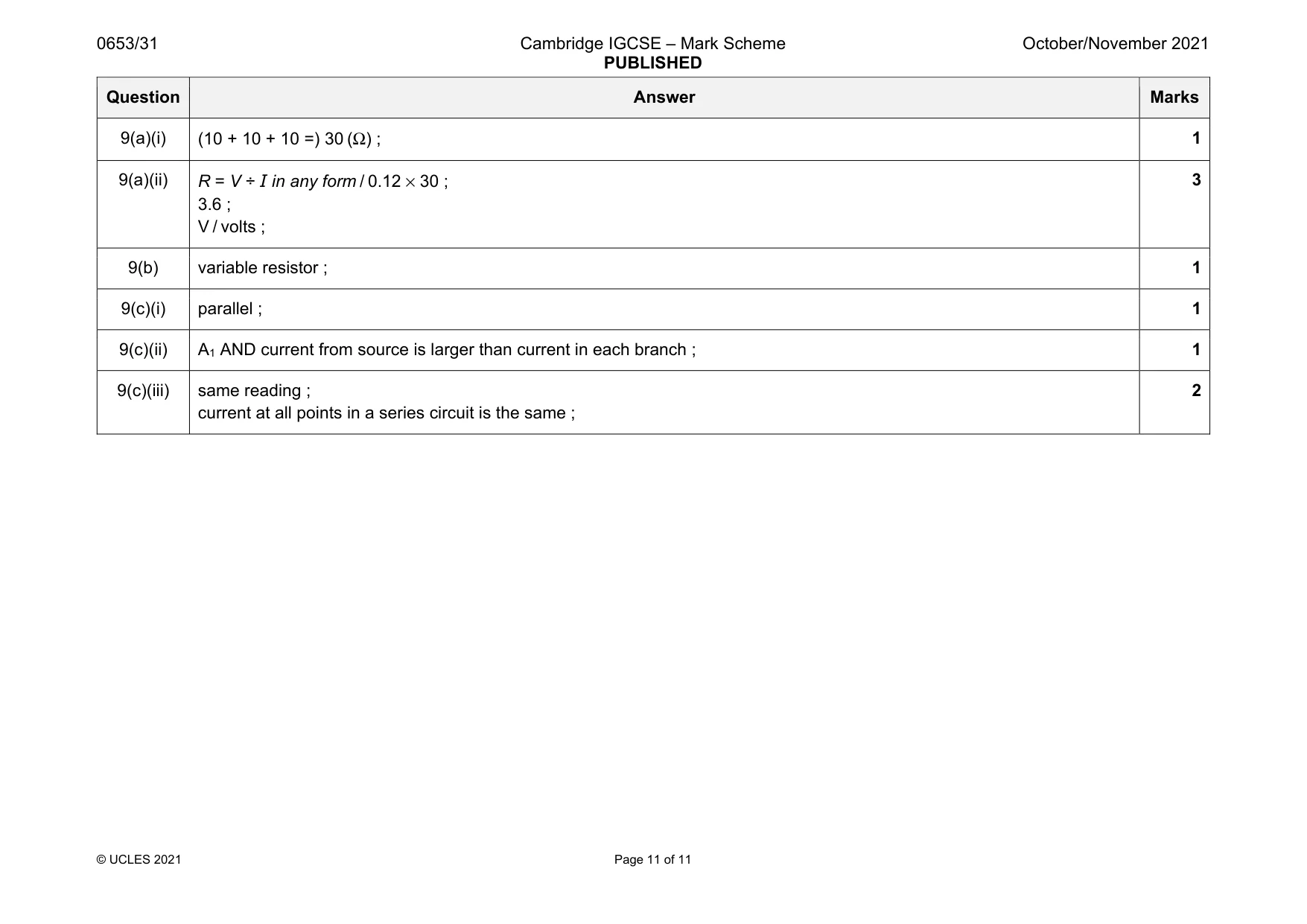
Mark scheme: 9(a)(i) (10 + 10 + 10 =) 30 (Ω) ; 1 9(a)(ii) R = V ÷ I in any form / 0.12 × 30 ; 3.6 ; V / volts ; 3 9(b) variable resistor ; 1 9(c)(i) parallel ; 1 9(c)(ii) A1 AND current from source is larger than current in each branch ; 1 9(c)(iii) same reading ; current at all points in a series circuit is the same ; 2
What was in this paper
The subtopics covered by these 9 questions, and how many questions each got. Open one in a new tab to see every Cambridge question on it.
What you needed in this session
Cambridge’s own grade thresholds for 2021 Oct/Nov, Paper 3 · Variant 1. A higher threshold means an easier paper — the bar moves with how the cohort did.