Cambridge IGCSE Science - Combined 0653 — 2017 Feb/March Paper 3 · Variant 2
0653/32/F/M/17 · 9 questions · 80 marks · ≈90 min
The question paper and its mark scheme, free to read here and free to download. This is Cambridge’s own paper, exactly as it was sat.
Question paper20 pages
Mark scheme7 pages
Answers below. Sit the paper first if you are practising.
Questions as text
Q1 · Use lines to connect the box on the left to different boxes on the right
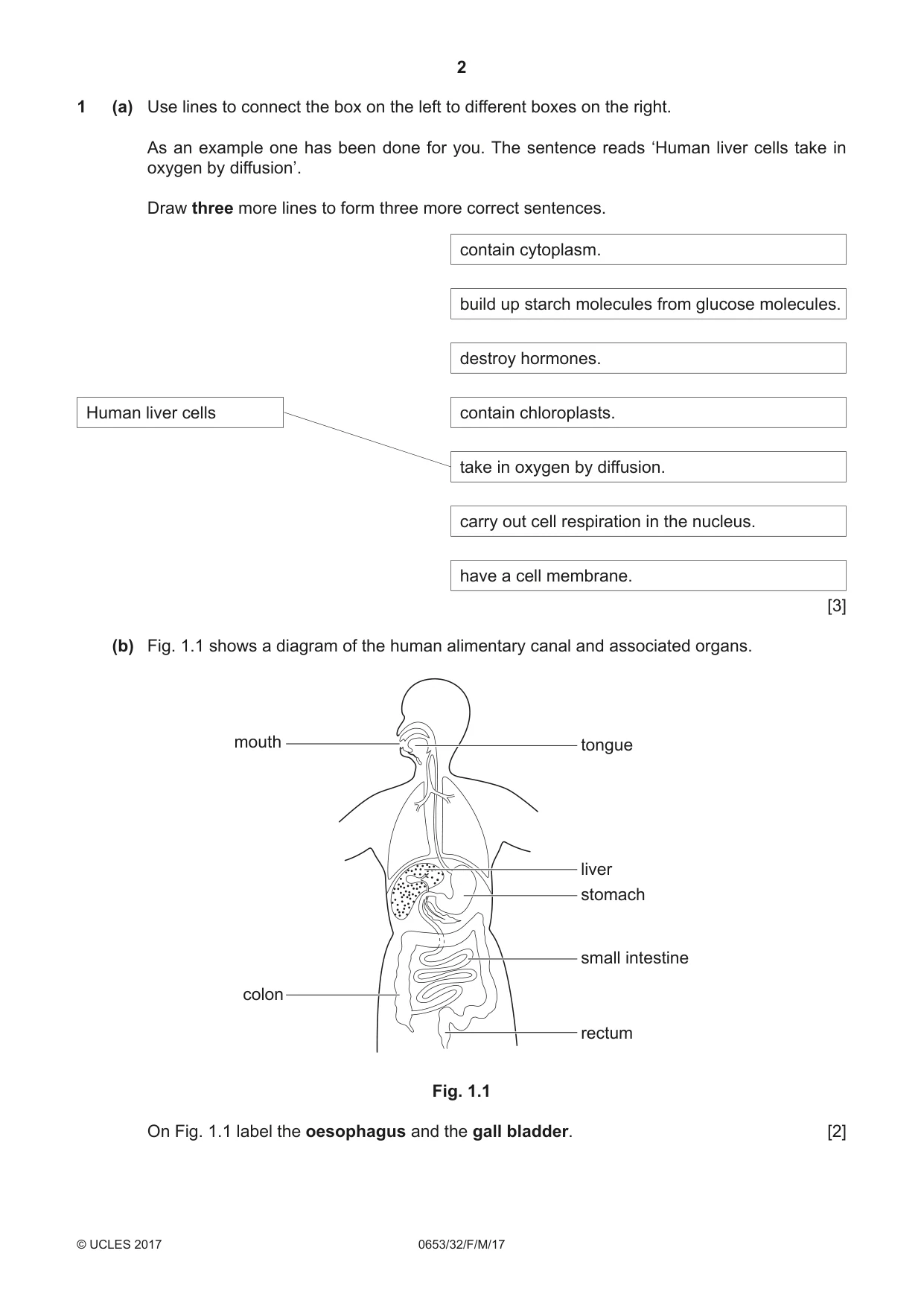
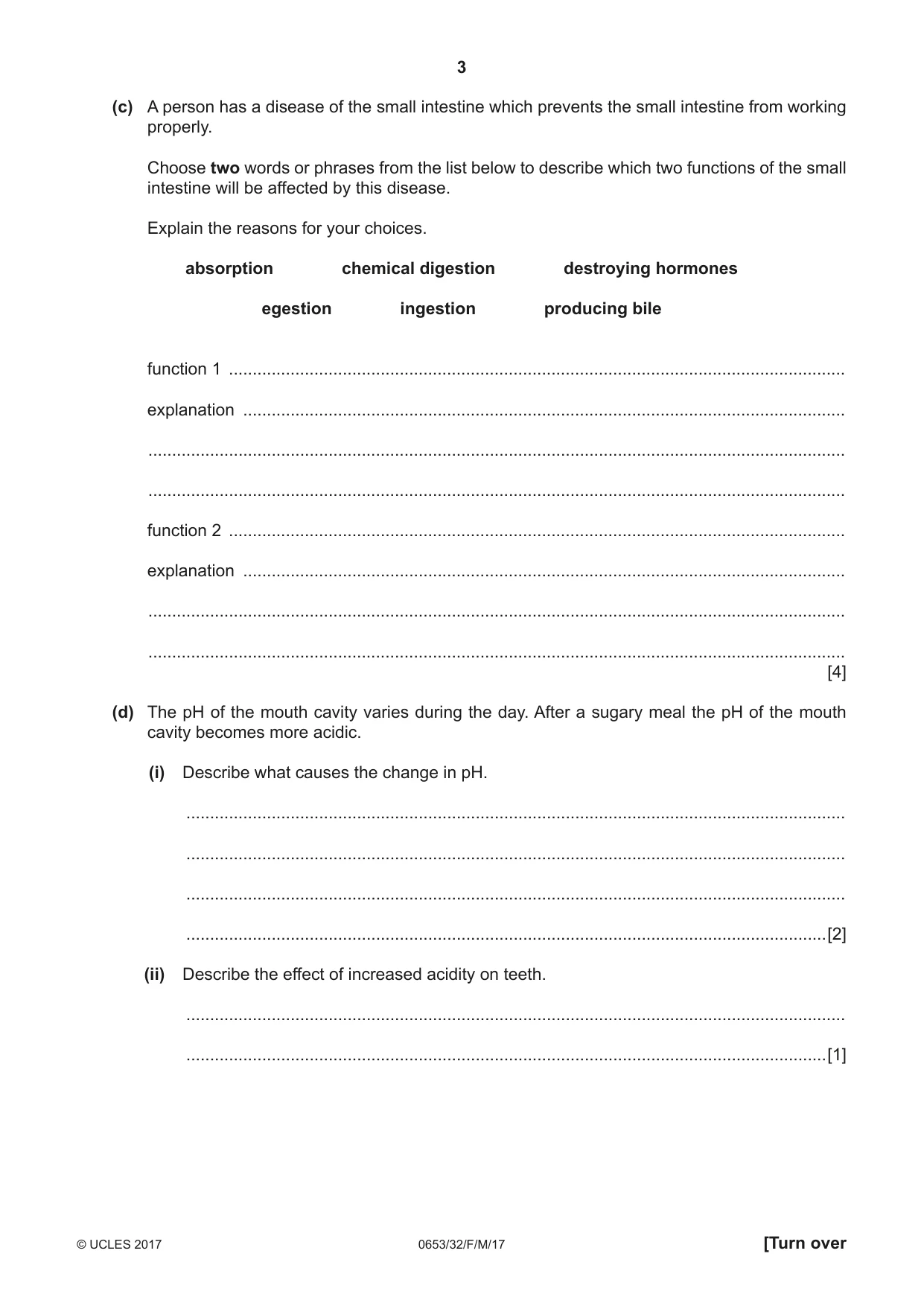
1 (a) Use lines to connect the box on the left to different boxes on the right. As an example one has been done for you. The sentence reads ‘Human liver cells take in oxygen by diffusion’. Draw three more lines to form three more correct sentences. contain cytoplasm. build up starch molecules from glucose molecules. destroy hormones. Human liver cells contain chloroplasts. take in oxygen by diffusion. carry out cell respiration in the nucleus. have a cell membrane. [3] (b) Fig. 1.1 shows a diagram of the human alimentary canal and associated organs. mouth tongue liver stomach small intestine colon rectum Fig. 1.1 On Fig. 1.1 label the oesophagus and the gall bladder. [2] (c) A person has a disease of the small intestine which prevents the small intestine from working properly. Choose two words or phrases from the list below to describe which two functions of the small intestine will be affected by this disease. Explain the reasons for your choices. absorption chemical digestion destroying hormones egestion ingestion producing bile function 1 .................................................................................................................................. explanation ............................................................................................................................... ................................................................................................................................................... ................................................................................................................................................... function 2 .................................................................................................................................. explanation ............................................................................................................................... ................................................................................................................................................... ................................................................................................................................................... [4] (d) The pH of the mouth cavity varies during the day. After a sugary meal the pH of the mouth cavity becomes more acidic. (i) Describe what causes the change in pH. ........................................................................................................................................... ........................................................................................................................................... ........................................................................................................................................... .......................................................................................................................................[2] (ii) Describe the effect of increased acidity on teeth. ........................................................................................................................................... .......................................................................................................................................[1]
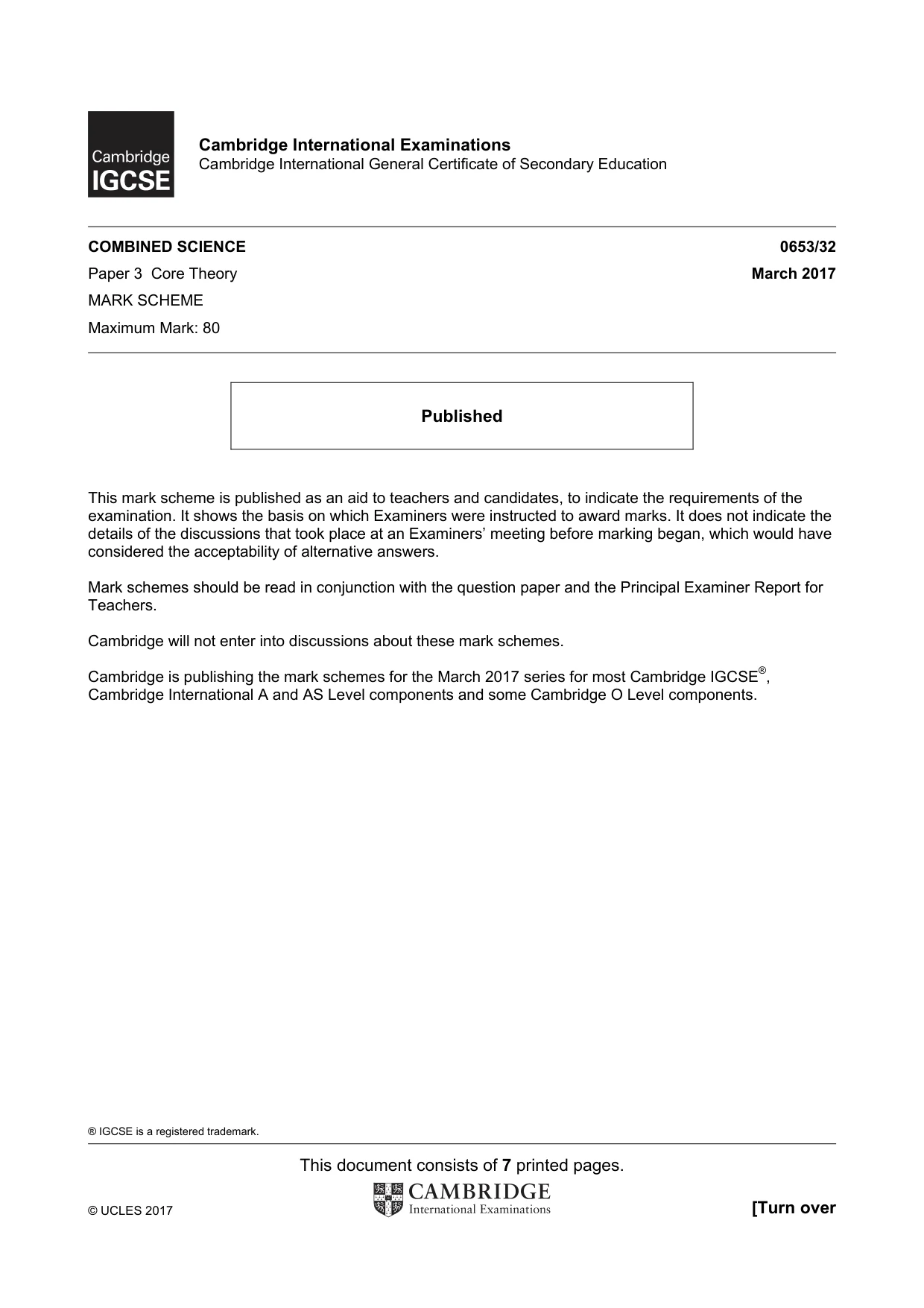
Mark scheme: 1(a) three lines drawn to connect ‘Human liver cells’ to contain cytoplasm ; destroy hormones ; have a cell membrane ; 3 1(b) oesophagus correctly labelled ; gall bladder correctly labelled ; 2 1(c) in either order chemical digestion ; many (digestive) enzymes are found there / food is broken down here ; absorption ; products of digestion enter the blood here ; 4 1(d)(i) bacteria; feed on / breakdown sugar ; produce acid ; 2 1(d)(ii) attacks enamel / causes decay ; 1
Q2 · A student reacts dilute hydrochloric acid with a solid metal carbonate, as shown in Fig
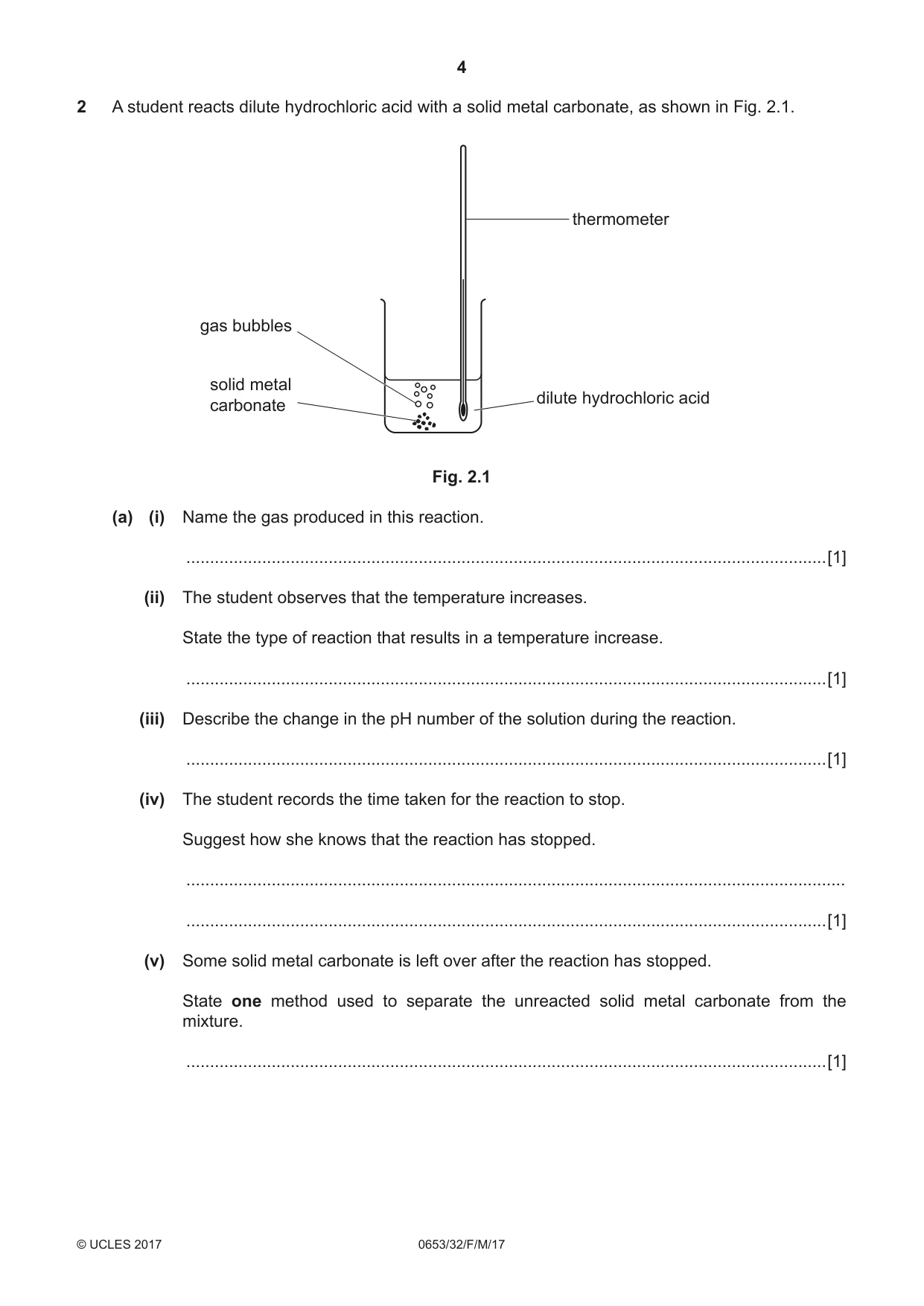
2 A student reacts dilute hydrochloric acid with a solid metal carbonate, as shown in Fig. 2.1. thermometer gas bubbles solid metal dilute hydrochloric acid carbonate Fig. 2.1 (a) (i) Name the gas produced in this reaction. .......................................................................................................................................[1] (ii) The student observes that the temperature increases. State the type of reaction that results in a temperature increase. .......................................................................................................................................[1] (iii) Describe the change in the pH number of the solution during the reaction. .......................................................................................................................................[1] (iv) The student records the time taken for the reaction to stop. Suggest how she knows that the reaction has stopped. ........................................................................................................................................... .......................................................................................................................................[1] (v) Some solid metal carbonate is left over after the reaction has stopped. State one method used to separate the unreacted solid metal carbonate from the mixture. .......................................................................................................................................[1] (b) The student changes the concentration of the acid and then repeats the reaction. (i) Describe the effect of using acid with a lower concentration on the rate of the reaction. .......................................................................................................................................[1] (ii) Suggest one other way of changing the rate of the reaction. .......................................................................................................................................[1] (c) Describe a test to show that the acid used contains chloride ions. State the change that is observed. test ............................................................................................................................................ observation ............................................................................................................................... [2]
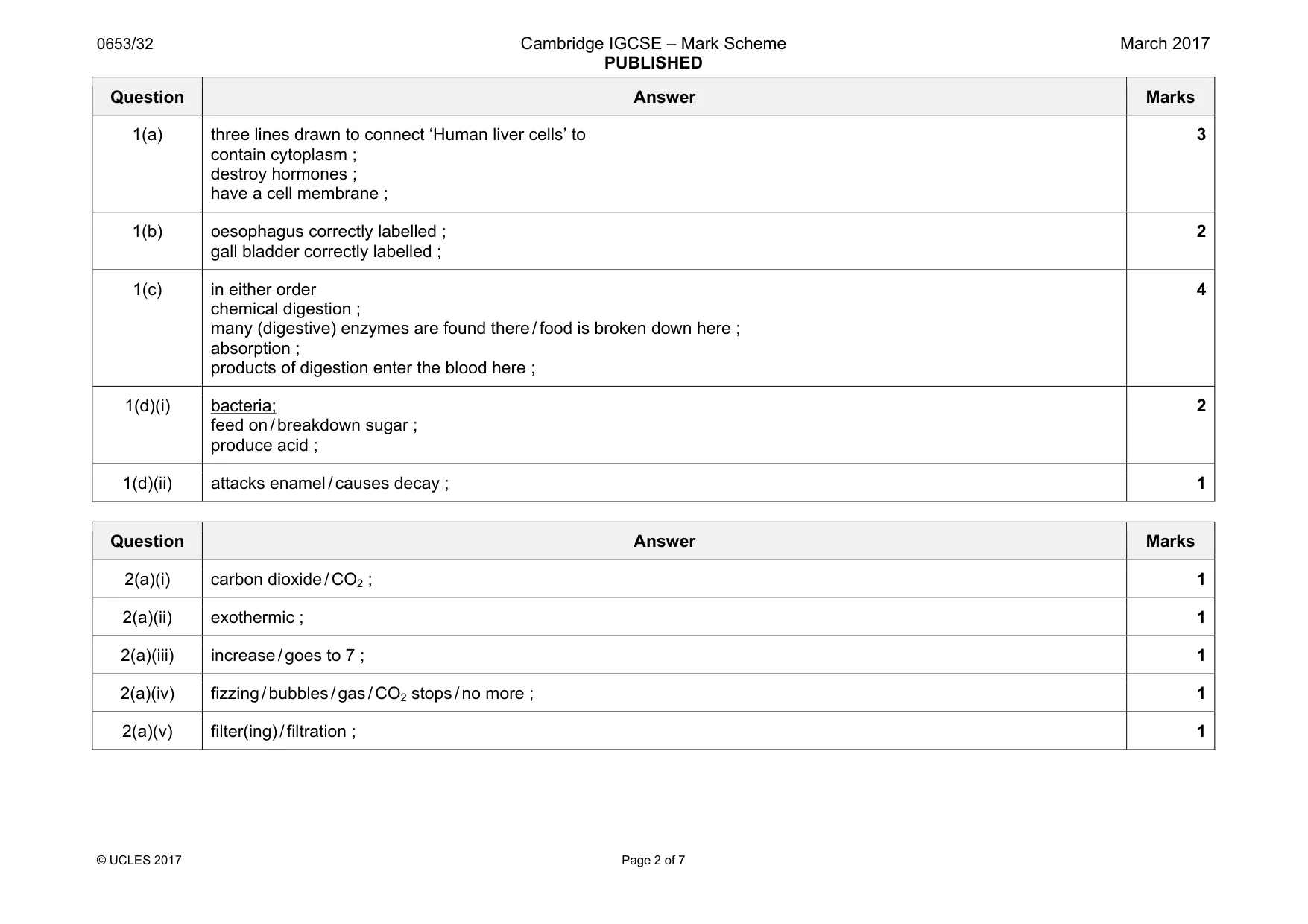
Mark scheme: 2(a)(i) carbon dioxide / CO2 ; 1 2(a)(ii) exothermic ; 1 2(a)(iii) increase / goes to 7 ; 1 2(a)(iv) fizzing / bubbles / gas / CO2 stops / no more ; 1 2(a)(v) filter(ing) / filtration ; 1 Question Answer Marks 2(b)(i) (rate is) less / reduced ; 1 2(b)(ii) (change) temperature / (use a) catalyst (change) surface area / particle size / stirring; 1 2(c) (test) (add) silver nitrate (soln) ; (observation) white_solid / precipitate ; 2
Q3 · An elevator (lift) which takes people to different floors in a tall building
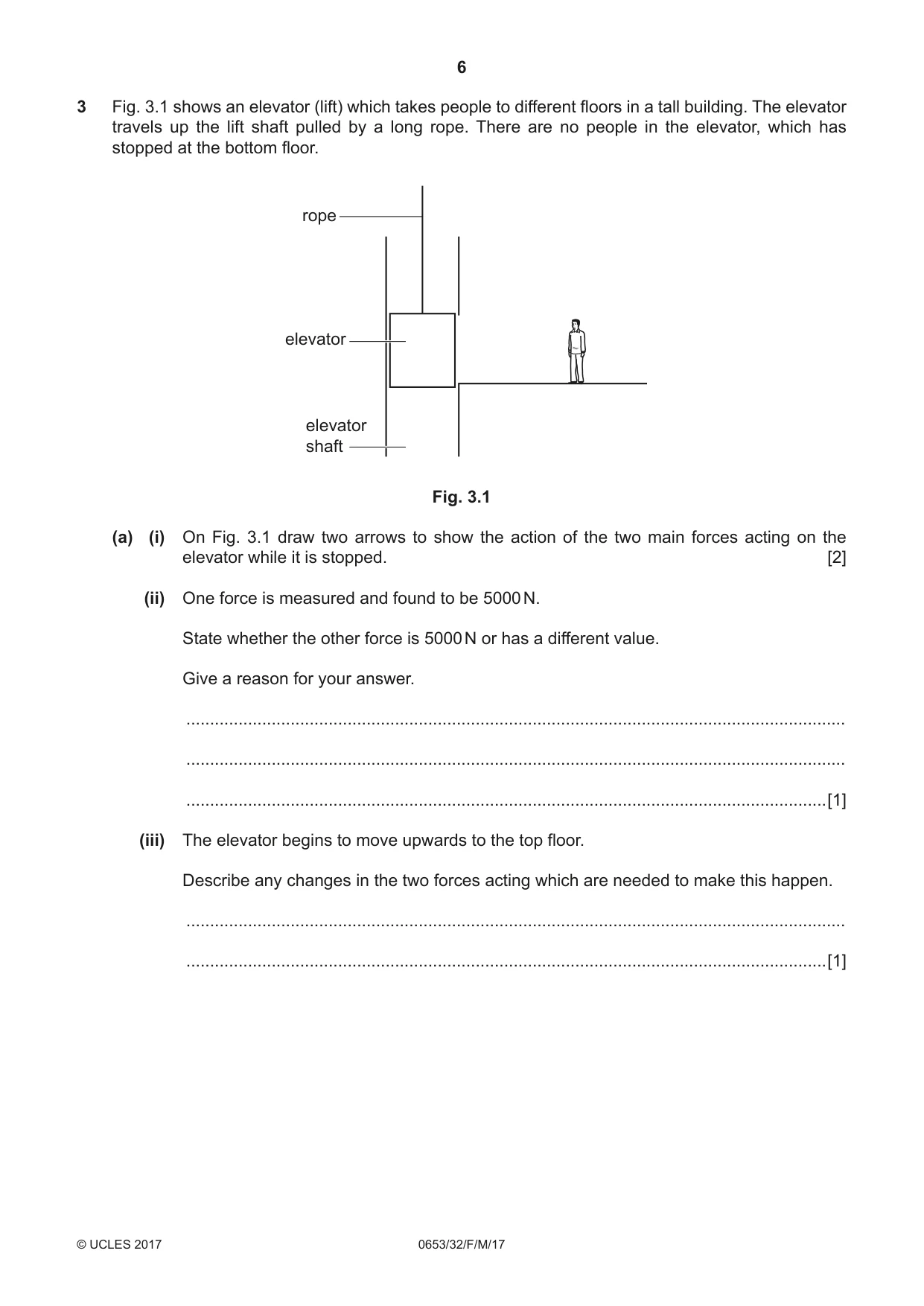
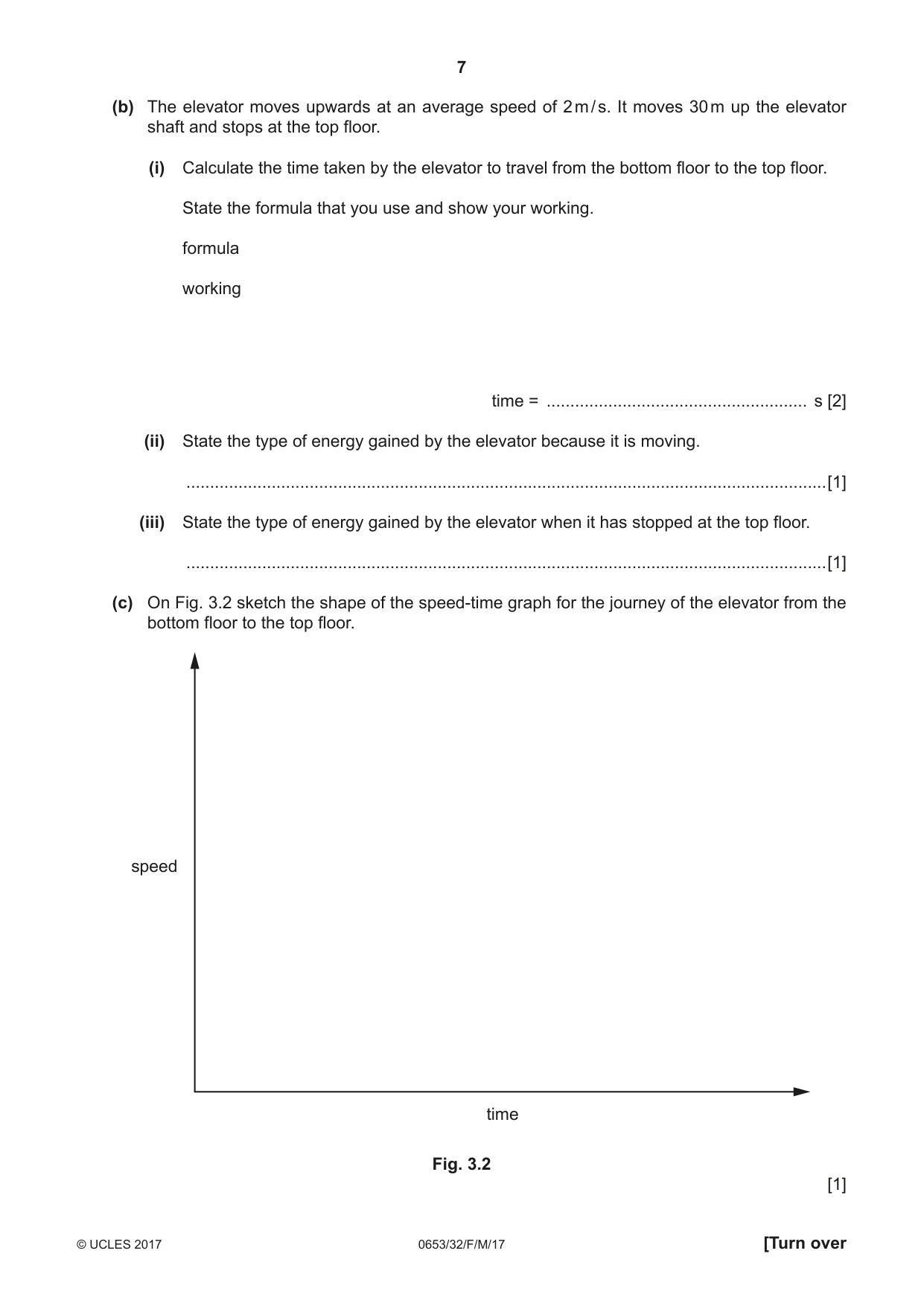
3 Fig. 3.1 shows an elevator (lift) which takes people to different floors in a tall building. The elevator travels up the lift shaft pulled by a long rope. There are no people in the elevator, which has stopped at the bottom floor. rope elevator elevator shaft Fig. 3.1 (a) (i) On Fig. 3.1 draw two arrows to show the action of the two main forces acting on the elevator while it is stopped. [2] (ii) One force is measured and found to be 5000 N. State whether the other force is 5000 N or has a different value. Give a reason for your answer. ........................................................................................................................................... ........................................................................................................................................... .......................................................................................................................................[1] (iii) The elevator begins to move upwards to the top floor. Describe any changes in the two forces acting which are needed to make this happen. ........................................................................................................................................... .......................................................................................................................................[1] (b) The elevator moves upwards at an average speed of 2 m / s. It moves 30 m up the elevator shaft and stops at the top floor. (i) Calculate the time taken by the elevator to travel from the bottom floor to the top floor. State the formula that you use and show your working. formula working time = ....................................................... s [2] (ii) State the type of energy gained by the elevator because it is moving. .......................................................................................................................................[1] (iii) State the type of energy gained by the elevator when it has stopped at the top floor. .......................................................................................................................................[1] (c) On Fig. 3.2 sketch the shape of the speed-time graph for the journey of the elevator from the bottom floor to the top floor. speed time Fig. 3.2 [1]
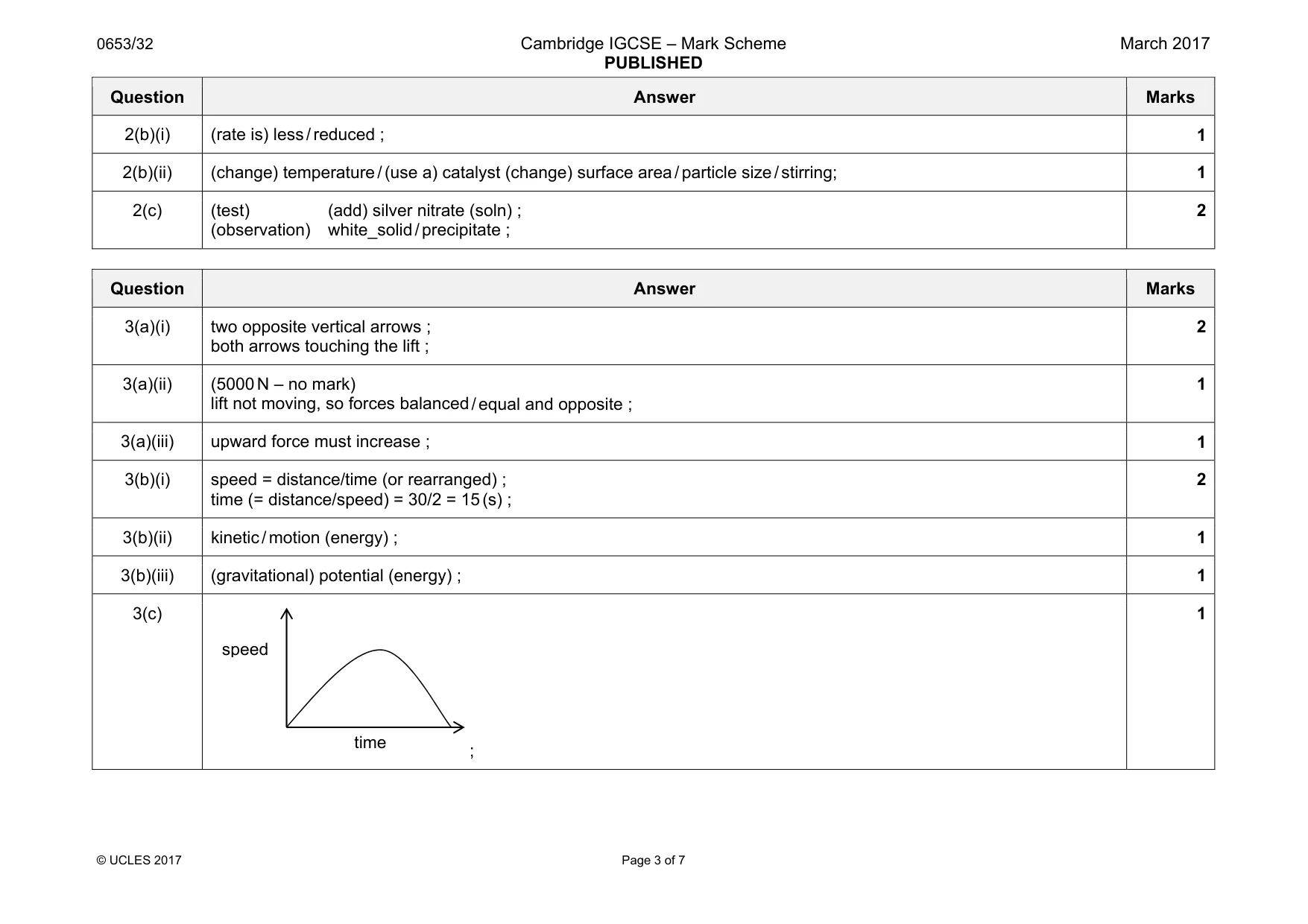
Mark scheme: 3(a)(i) two opposite vertical arrows ; both arrows touching the lift ; 2 3(a)(ii) (5000 N – no mark) lift not moving, so forces balanced / equal and opposite ; 1 3(a)(iii) upward force must increase ; 1 3(b)(i) speed = distance/time (or rearranged) ; time (= distance/speed) = 30/2 = 15 (s) ; 2 3(b)(ii) kinetic / motion (energy) ; 1 3(b)(iii) (gravitational) potential (energy) ; 1 3(c) ; 1 time speed
Q4 · A diagram of part of the carbon cycle
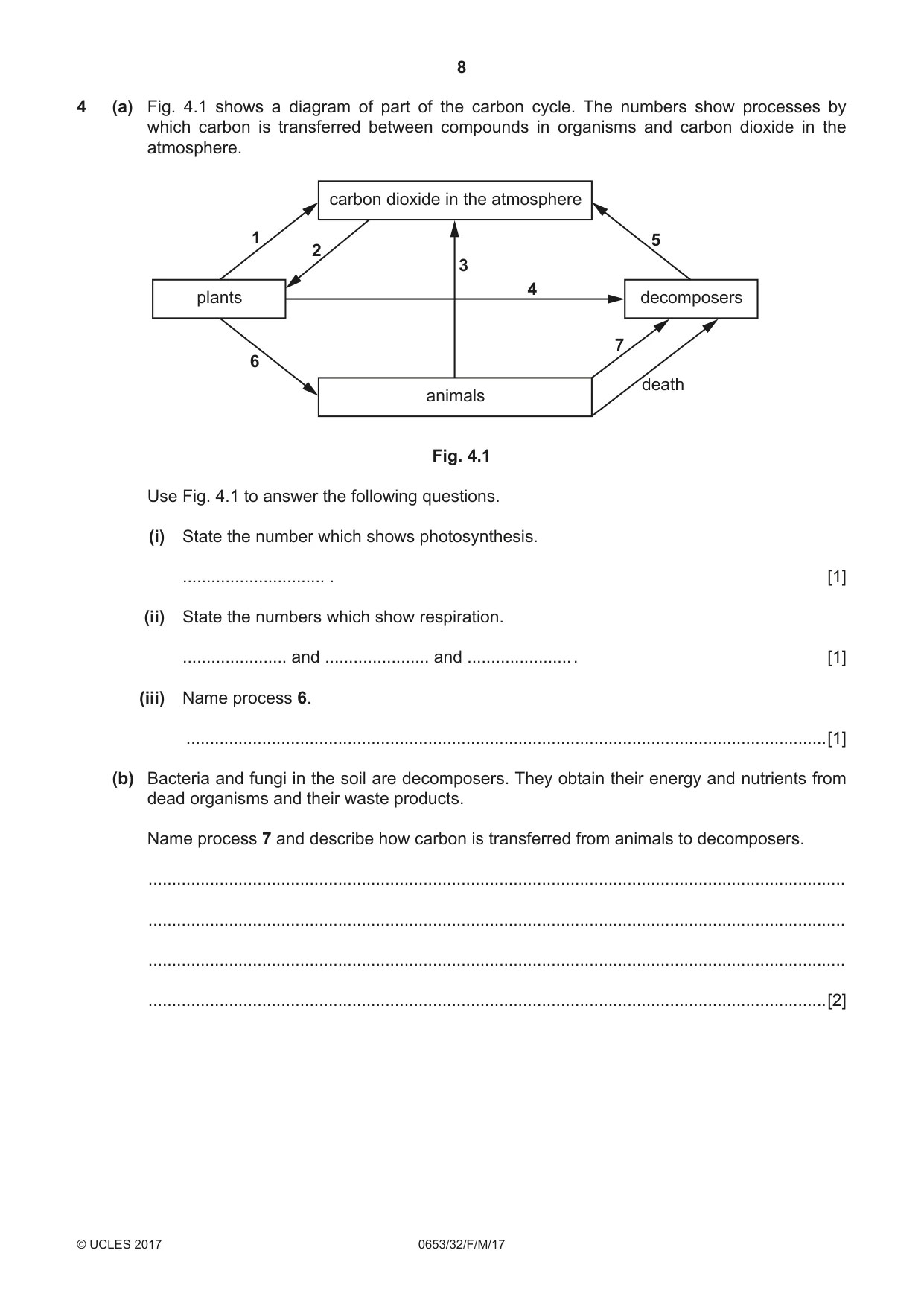
4 (a) Fig. 4.1 shows a diagram of part of the carbon cycle. The numbers show processes by which carbon is transferred between compounds in organisms and carbon dioxide in the atmosphere. carbon dioxide in the atmosphere 1 5 2 3 4 plants decomposers 7 6 death animals Fig. 4.1 Use Fig. 4.1 to answer the following questions. (i) State the number which shows photosynthesis. .............................. . [1] (ii) State the numbers which show respiration. ...................... and ...................... and ...................... . [1] (iii) Name process 6. .......................................................................................................................................[1] (b) Bacteria and fungi in the soil are decomposers. They obtain their energy and nutrients from dead organisms and their waste products. Name process 7 and describe how carbon is transferred from animals to decomposers. ................................................................................................................................................... ................................................................................................................................................... ................................................................................................................................................... ...............................................................................................................................................[2] (c) Over millions of years some carbon becomes trapped underground in fossil fuels. When these fossil fuels are burned, carbon dioxide is released to the atmosphere. The carbon dioxide released by burning fossil fuels contributes to global warming. State two harmful effects of global warming. 1. ............................................................................................................................................... 2. ............................................................................................................................................... [2]
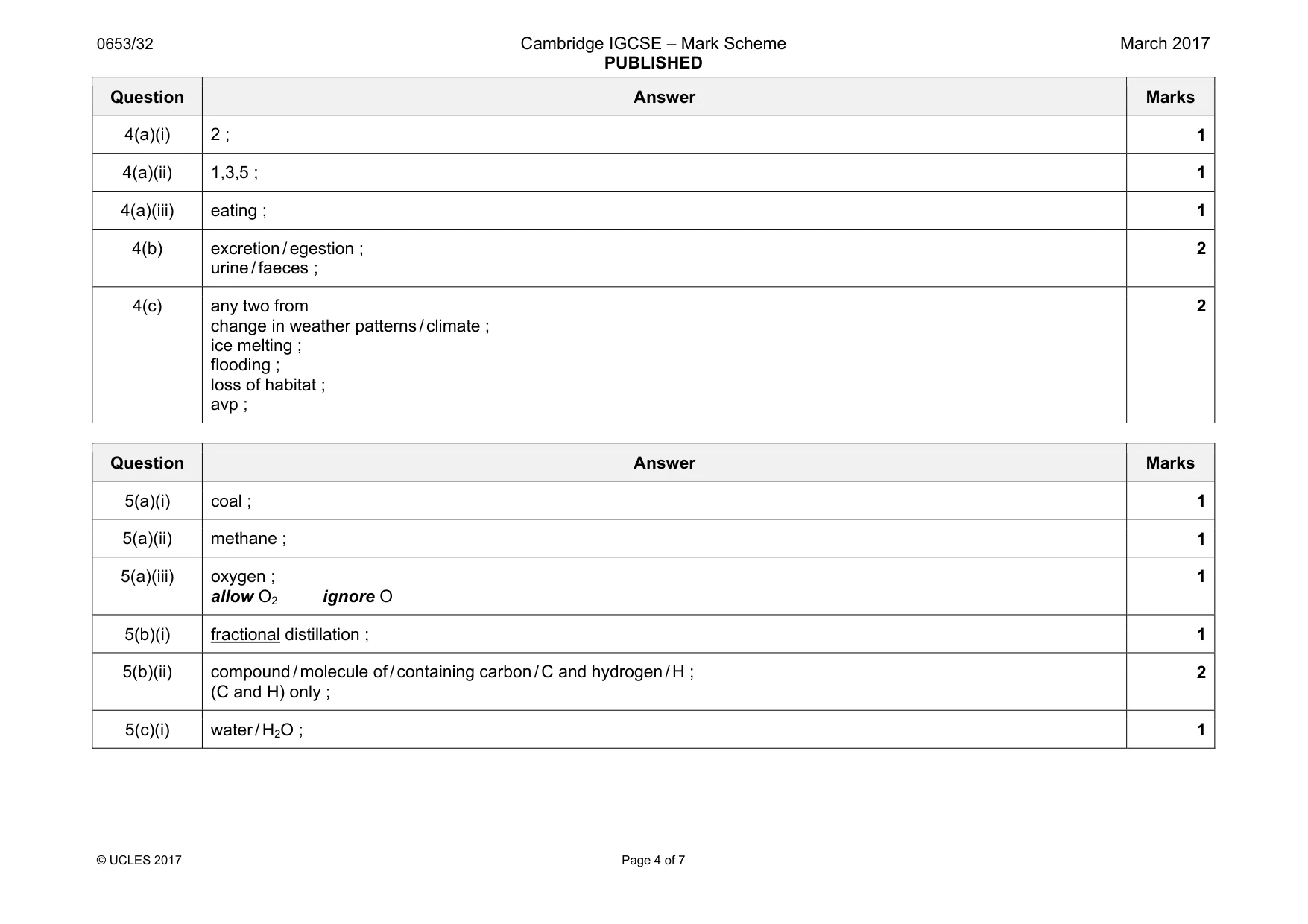
Mark scheme: 4(a)(i) 2 ; 1 4(a)(ii) 1,3,5 ; 1 4(a)(iii) eating ; 1 4(b) excretion / egestion ; urine / faeces ; 2 4(c) any two from change in weather patterns / climate ; ice melting ; flooding ; loss of habitat ; avp ; 2
Q5 · Natural gas and petroleum (crude oil) are fossil fuels
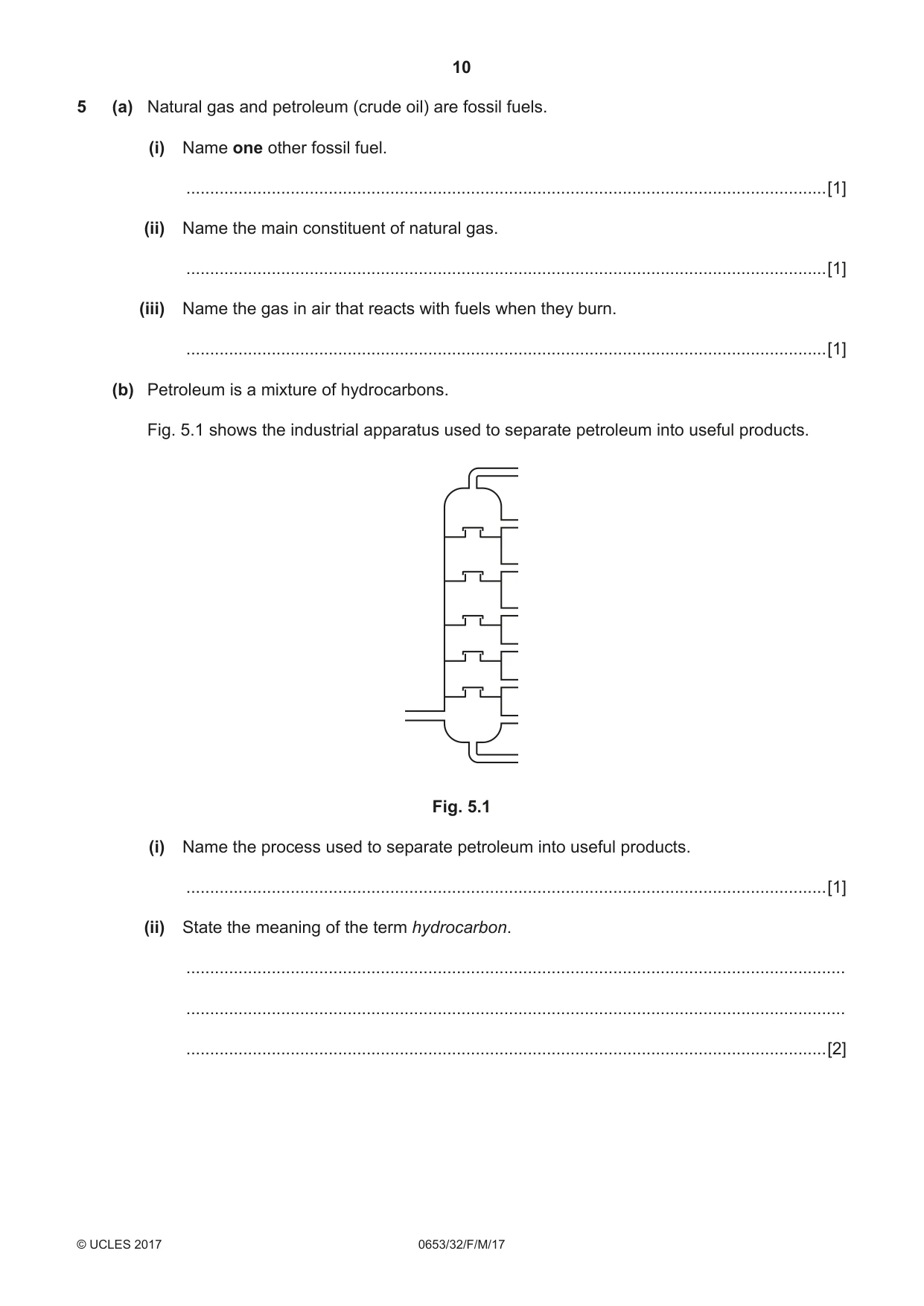
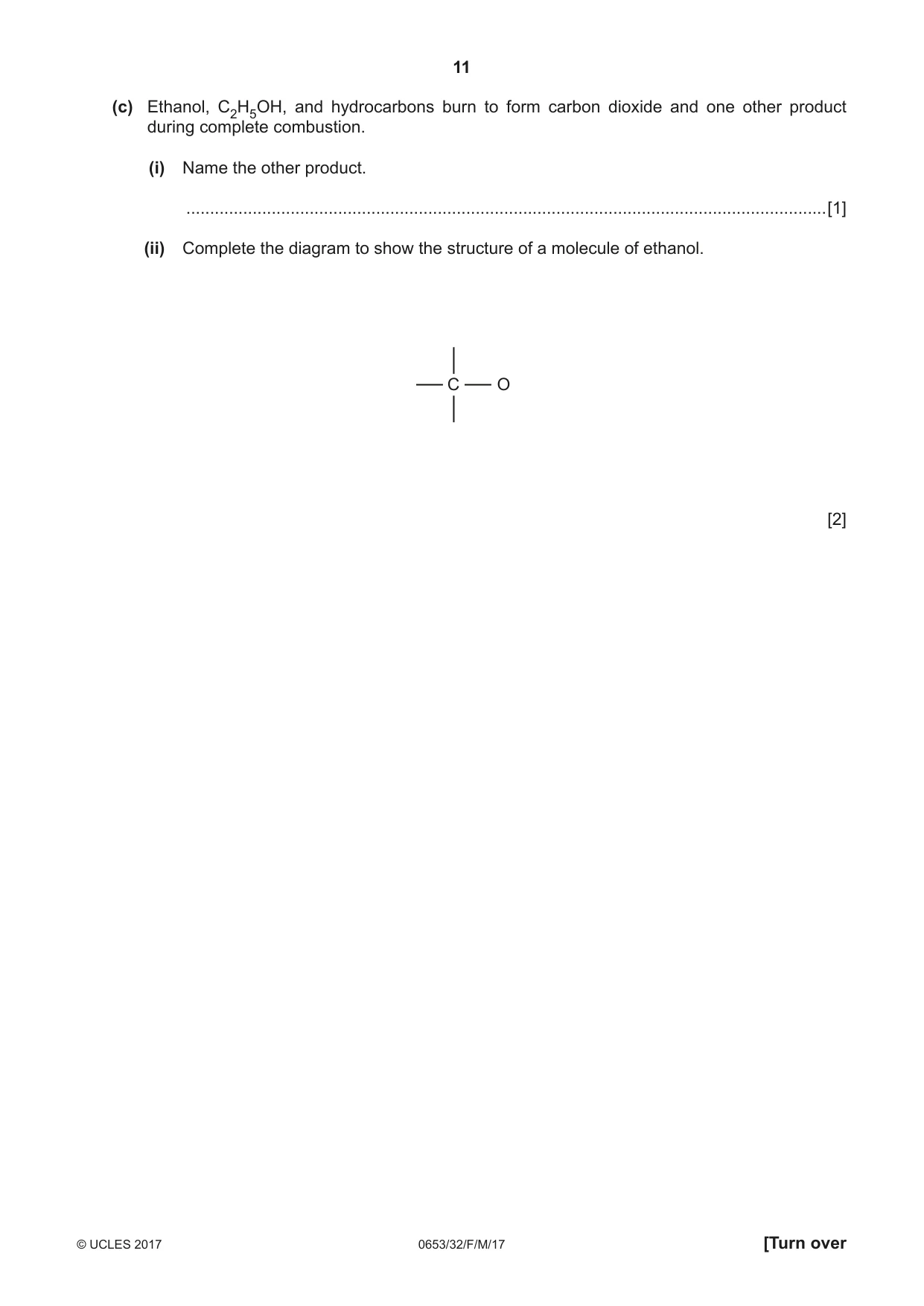
5 (a) Natural gas and petroleum (crude oil) are fossil fuels. (i) Name one other fossil fuel. .......................................................................................................................................[1] (ii) Name the main constituent of natural gas. .......................................................................................................................................[1] (iii) Name the gas in air that reacts with fuels when they burn. .......................................................................................................................................[1] (b) Petroleum is a mixture of hydrocarbons. Fig. 5.1 shows the industrial apparatus used to separate petroleum into useful products. Fig. 5.1 (i) Name the process used to separate petroleum into useful products. .......................................................................................................................................[1] (ii) State the meaning of the term hydrocarbon. ........................................................................................................................................... ........................................................................................................................................... .......................................................................................................................................[2] (c) Ethanol, C2H5OH, and hydrocarbons burn to form carbon dioxide and one other product during complete combustion. (i) Name the other product. .......................................................................................................................................[1] (ii) Complete the diagram to show the structure of a molecule of ethanol. C O [2]
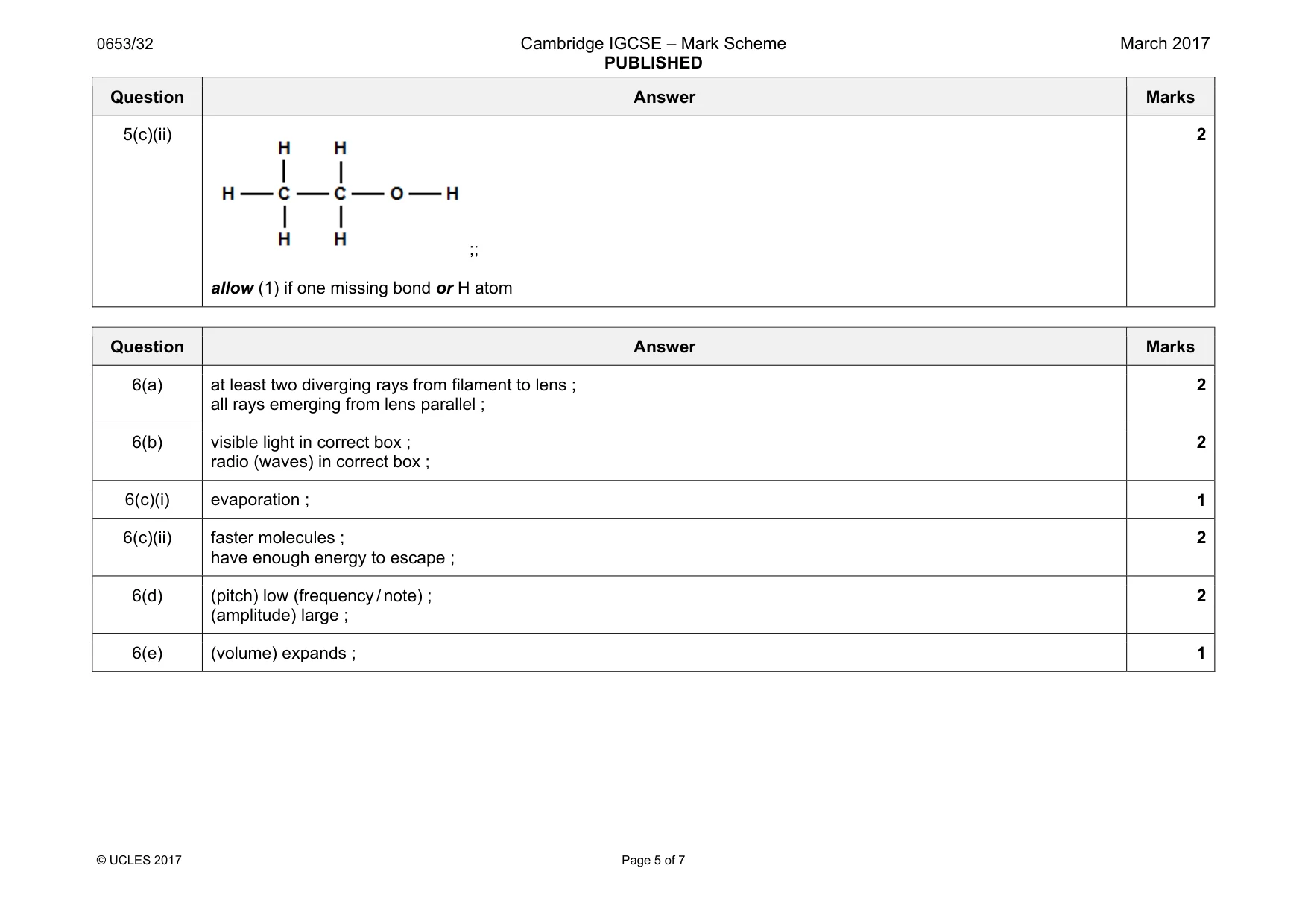
Mark scheme: 5(a)(i) coal ; 1 5(a)(ii) methane ; 1 5(a)(iii) oxygen ; allow O2 ignore O 1 5(b)(i) fractional distillation ; 1 5(b)(ii) compound / molecule of / containing carbon / C and hydrogen / H ; (C and H) only ; 2 5(c)(i) water / H2O ; 1 Question Answer Marks 5(c)(ii) ;; allow (1) if one missing bond or H atom 2
Q6 · A boat sailing near a lighthouse at night
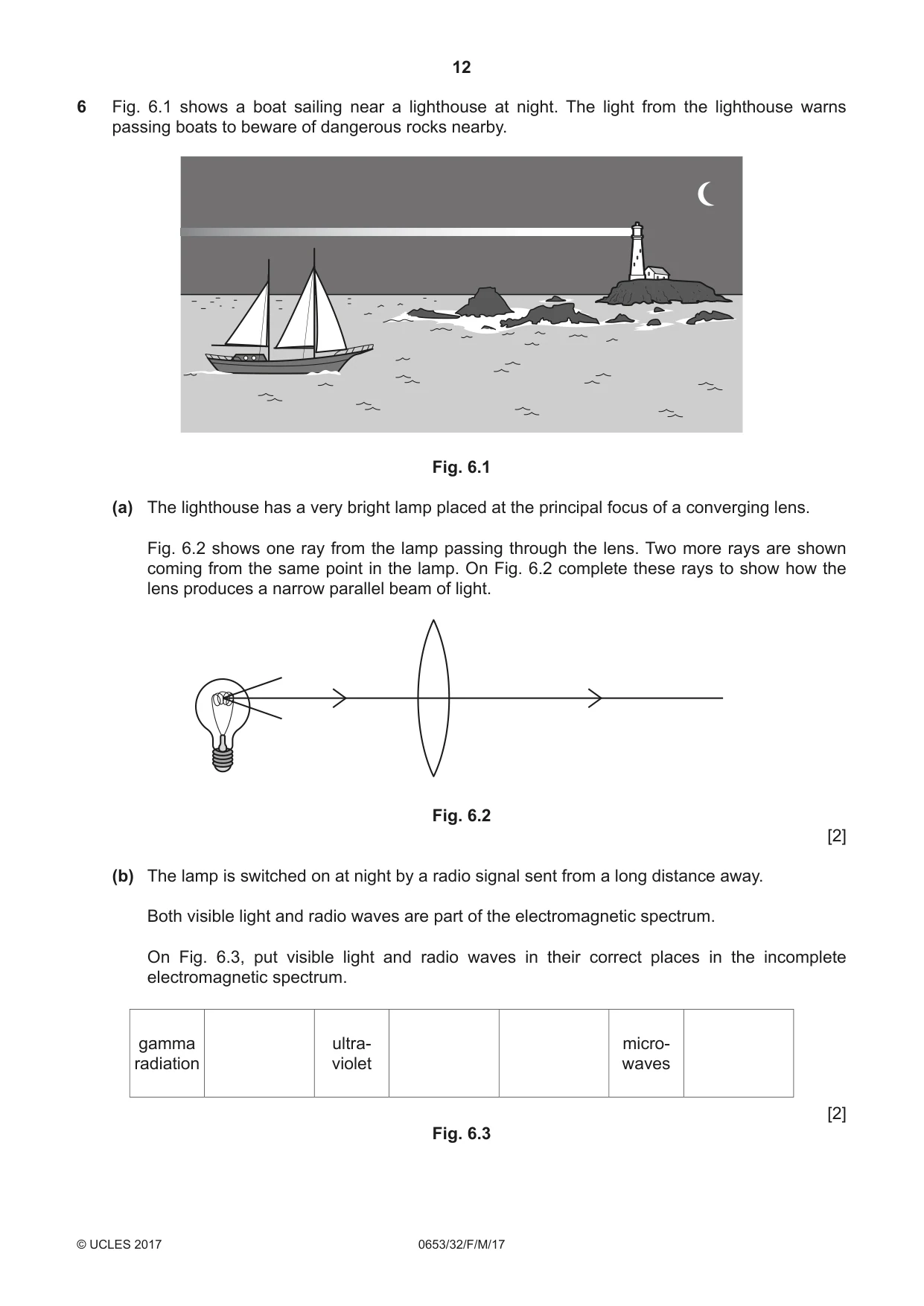
6 Fig. 6.1 shows a boat sailing near a lighthouse at night. The light from the lighthouse warns passing boats to beware of dangerous rocks nearby. Fig. 6.1 (a) The lighthouse has a very bright lamp placed at the principal focus of a converging lens. Fig. 6.2 shows one ray from the lamp passing through the lens. Two more rays are shown coming from the same point in the lamp. On Fig. 6.2 complete these rays to show how the lens produces a narrow parallel beam of light. Fig. 6.2 [2] (b) The lamp is switched on at night by a radio signal sent from a long distance away. Both visible light and radio waves are part of the electromagnetic spectrum. On Fig. 6.3, put visible light and radio waves in their correct places in the incomplete electromagnetic spectrum. gamma ultra- micro- radiation violet waves [2] Fig. 6.3 (c) Fog at sea is caused by water vapour in the air condensing to form tiny water droplets. Water vapour in the air comes from water in the sea. (i) Name the process by which water in the sea escapes to form water vapour in the air. .......................................................................................................................................[1] (ii) Describe in terms of water molecules how the process named in (i) happens. ........................................................................................................................................... ........................................................................................................................................... .......................................................................................................................................[2] (d) When there is fog at sea, it is difficult for sailors to see the rocks. A fog-horn at the lighthouse produces a very loud sound to warn sailors about the rocks. The sound produced by a fog-horn has a frequency of 50 Hz. Describe the pitch and amplitude of the sound produced. pitch .......................................................................................................................................... amplitude .................................................................................................................................. [2] (e) Climate change across the world is causing the average temperature of sea water to increase. One effect of this temperature change is to increase the process named in (c)(i). Describe another effect of an increase in temperature on a liquid such as sea water. ...............................................................................................................................................[1]
Mark scheme: 6(a) at least two diverging rays from filament to lens ; all rays emerging from lens parallel ; 2 6(b) visible light in correct box ; radio (waves) in correct box ; 2 6(c)(i) evaporation ; 1 6(c)(ii) faster molecules ; have enough energy to escape ; 2 6(d) (pitch) low (frequency / note) ; (amplitude) large ; 2 6(e) (volume) expands ; 1
Q7 · Transpiration occurs when water vapour is lost from the leaves of plants through the…
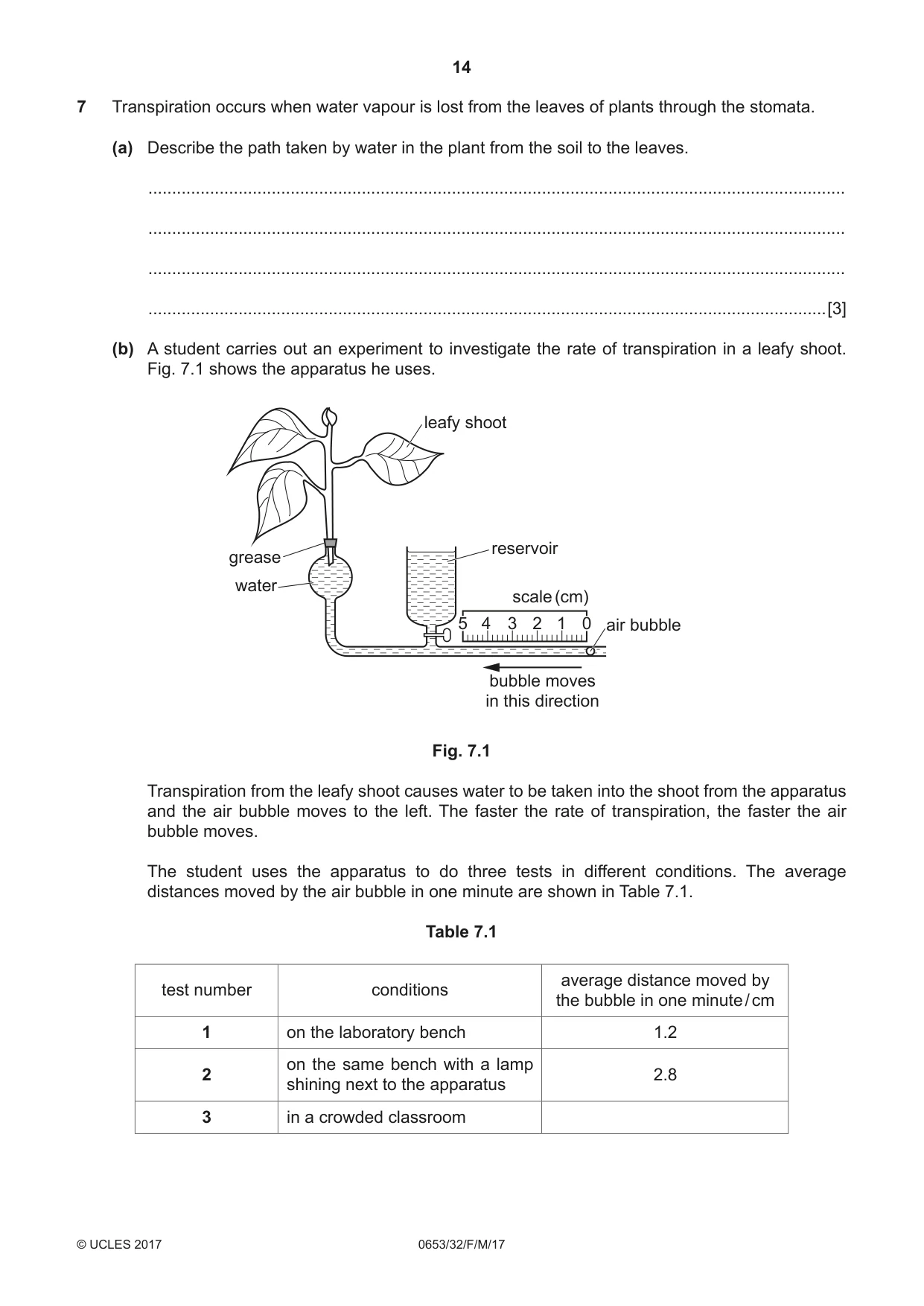
7 Transpiration occurs when water vapour is lost from the leaves of plants through the stomata. (a) Describe the path taken by water in the plant from the soil to the leaves. ................................................................................................................................................... ................................................................................................................................................... ................................................................................................................................................... ...............................................................................................................................................[3] (b) A student carries out an experiment to investigate the rate of transpiration in a leafy shoot. Fig. 7.1 shows the apparatus he uses. leafy shoot reservoir grease water scale (cm) 5 4 3 2 1 0 air bubble bubble moves in this direction Fig. 7.1 Transpiration from the leafy shoot causes water to be taken into the shoot from the apparatus and the air bubble moves to the left. The faster the rate of transpiration, the faster the air bubble moves. The student uses the apparatus to do three tests in different conditions. The average distances moved by the air bubble in one minute are shown in Table 7.1. Table 7.1 average distance moved by test number conditions the bubble in one minute / cm 1 on the laboratory bench 1.2 on the same bench with a lamp 2 2.8 shining next to the apparatus 3 in a crowded classroom (i) State two reasons to explain why the air bubble moved more quickly in test 2 compared with test 1. 1. ....................................................................................................................................... ........................................................................................................................................... ........................................................................................................................................... 2. ....................................................................................................................................... ........................................................................................................................................... ........................................................................................................................................... [3] (ii) For test 3 the student takes the apparatus into a crowded classroom. There is an increase in the humidity of the air in the classroom. Suggest a value for the average distance moved by the air bubble in one minute in the crowded classroom. value = ...................................... cm / minute Explain your answer. ........................................................................................................................................... ........................................................................................................................................... ........................................................................................................................................... .......................................................................................................................................[2]
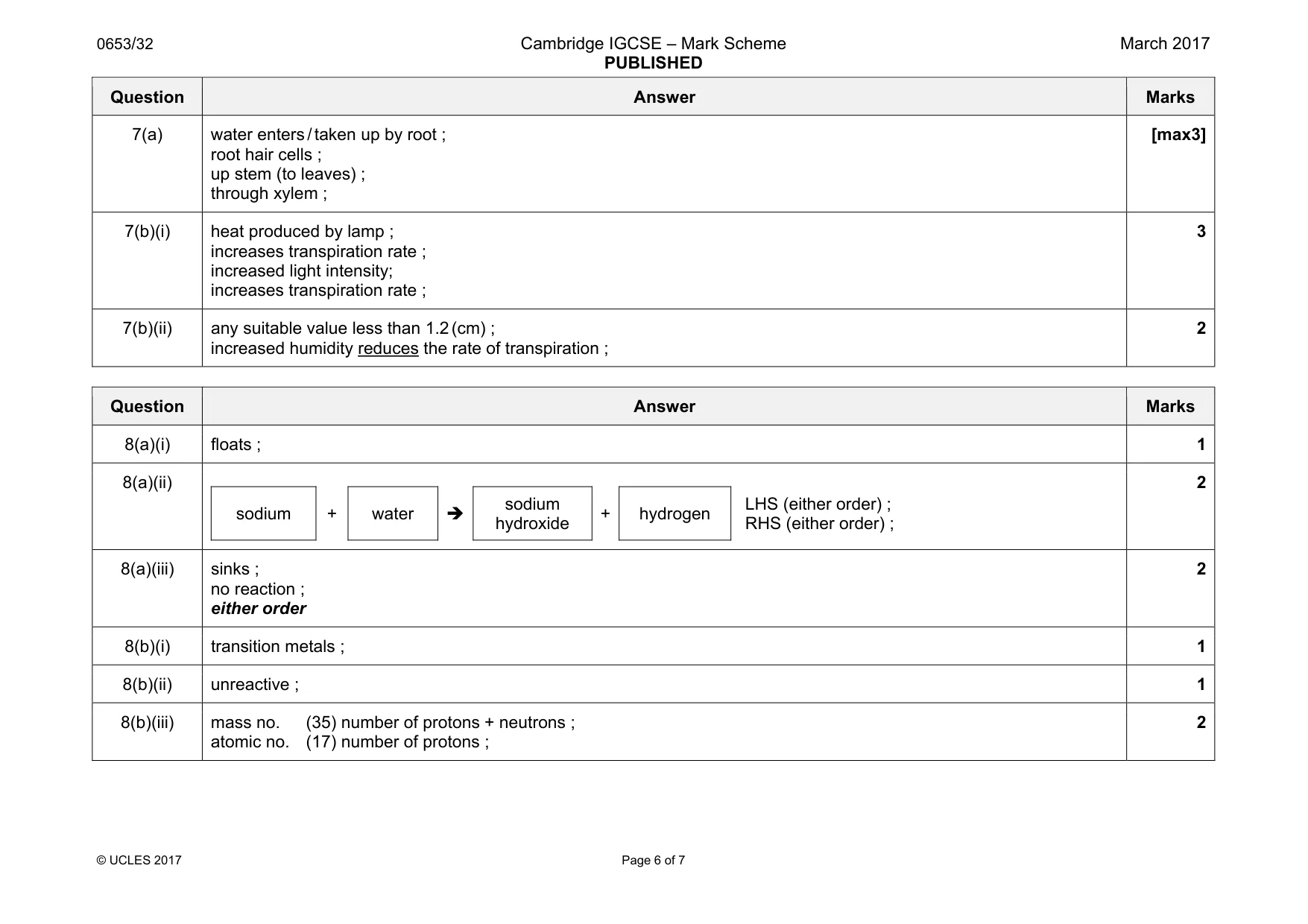
Mark scheme: 7(a) water enters / taken up by root ; root hair cells ; up stem (to leaves) ; through xylem ; [max3] 7(b)(i) heat produced by lamp ; increases transpiration rate ; increased light intensity; increases transpiration rate ; 3 7(b)(ii) any suitable value less than 1.2 (cm) ; increased humidity reduces the rate of transpiration ; 2
Q8 · A student observes what happens when a piece of sodium is added to water, as shown in Fig
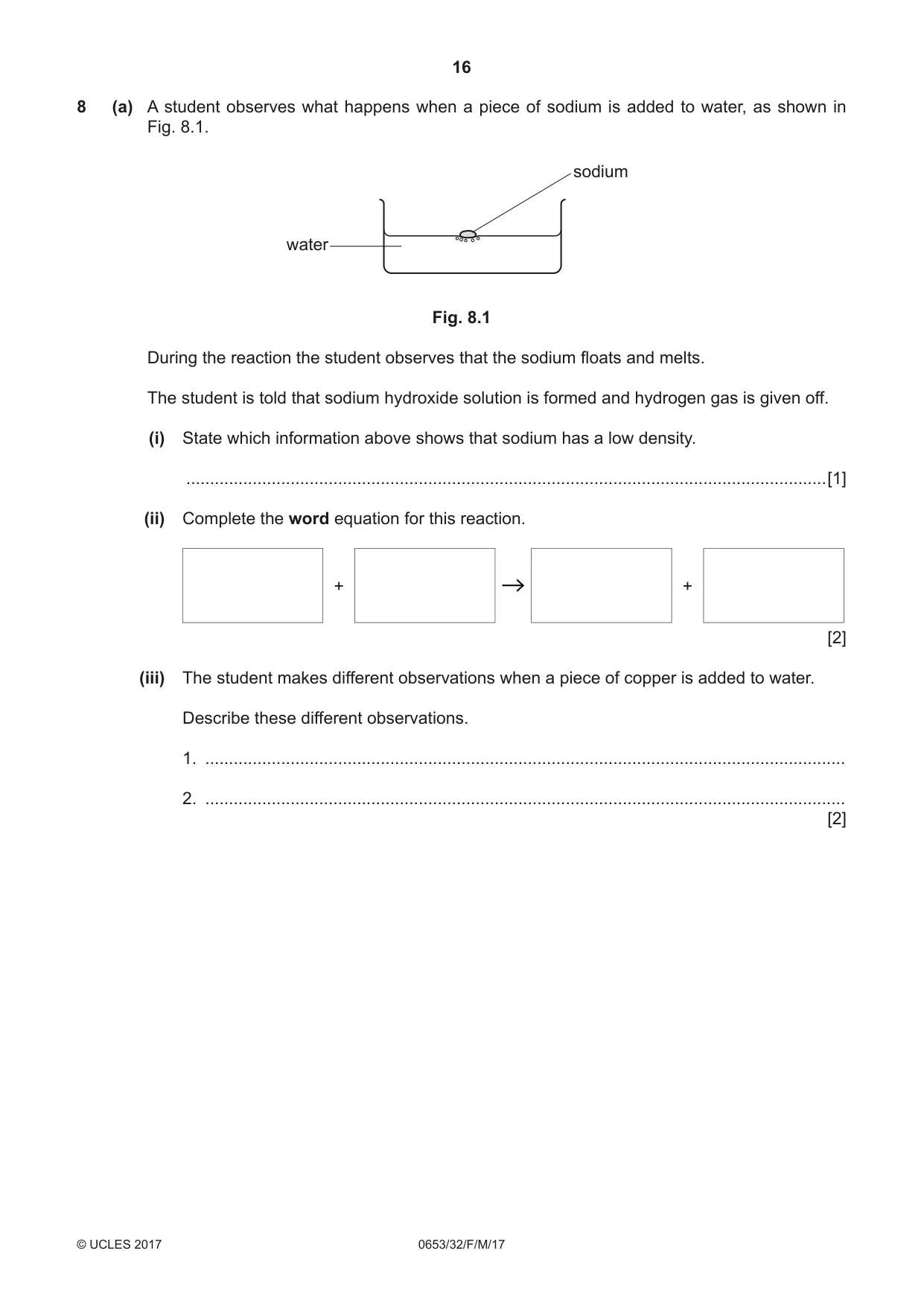
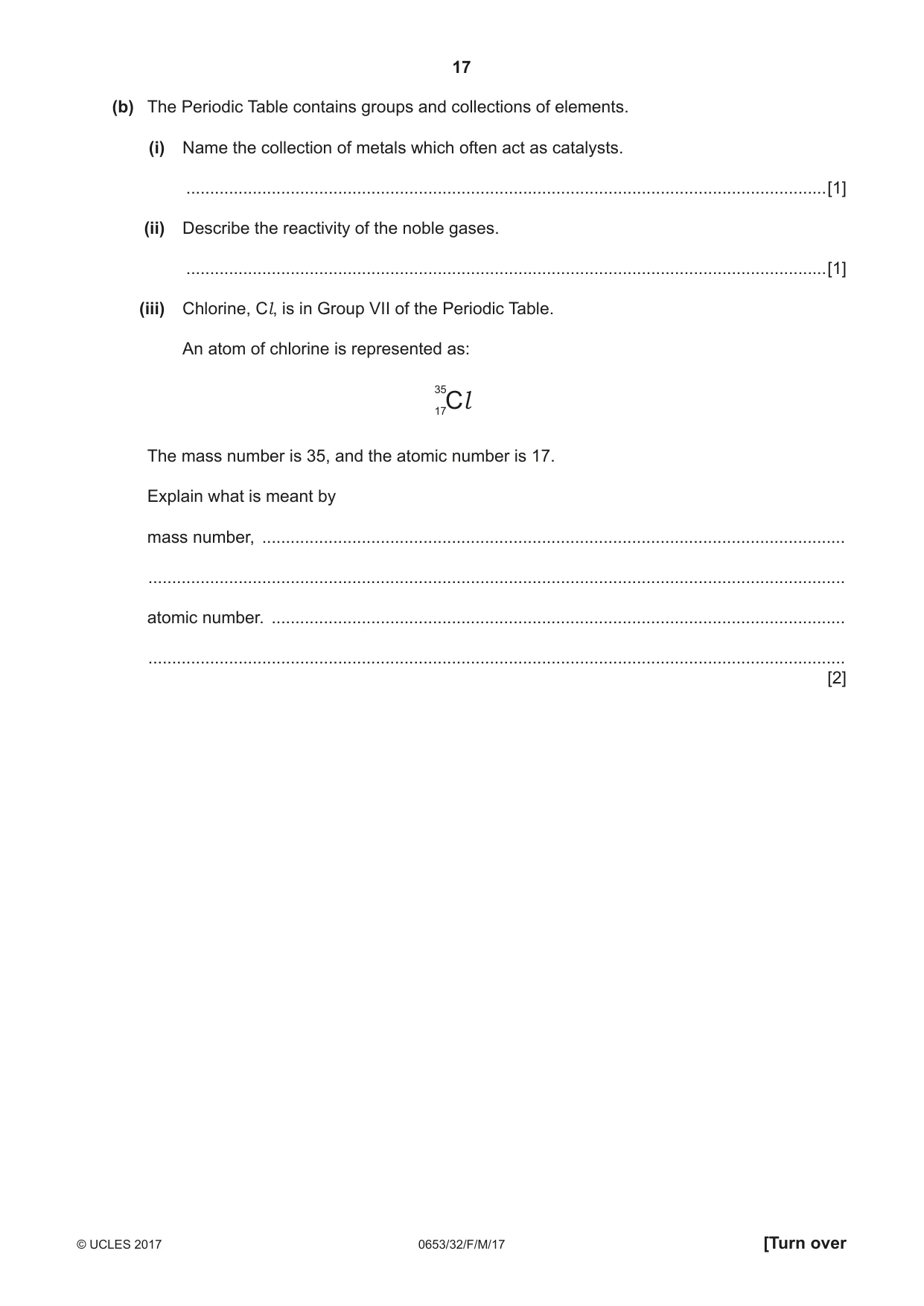
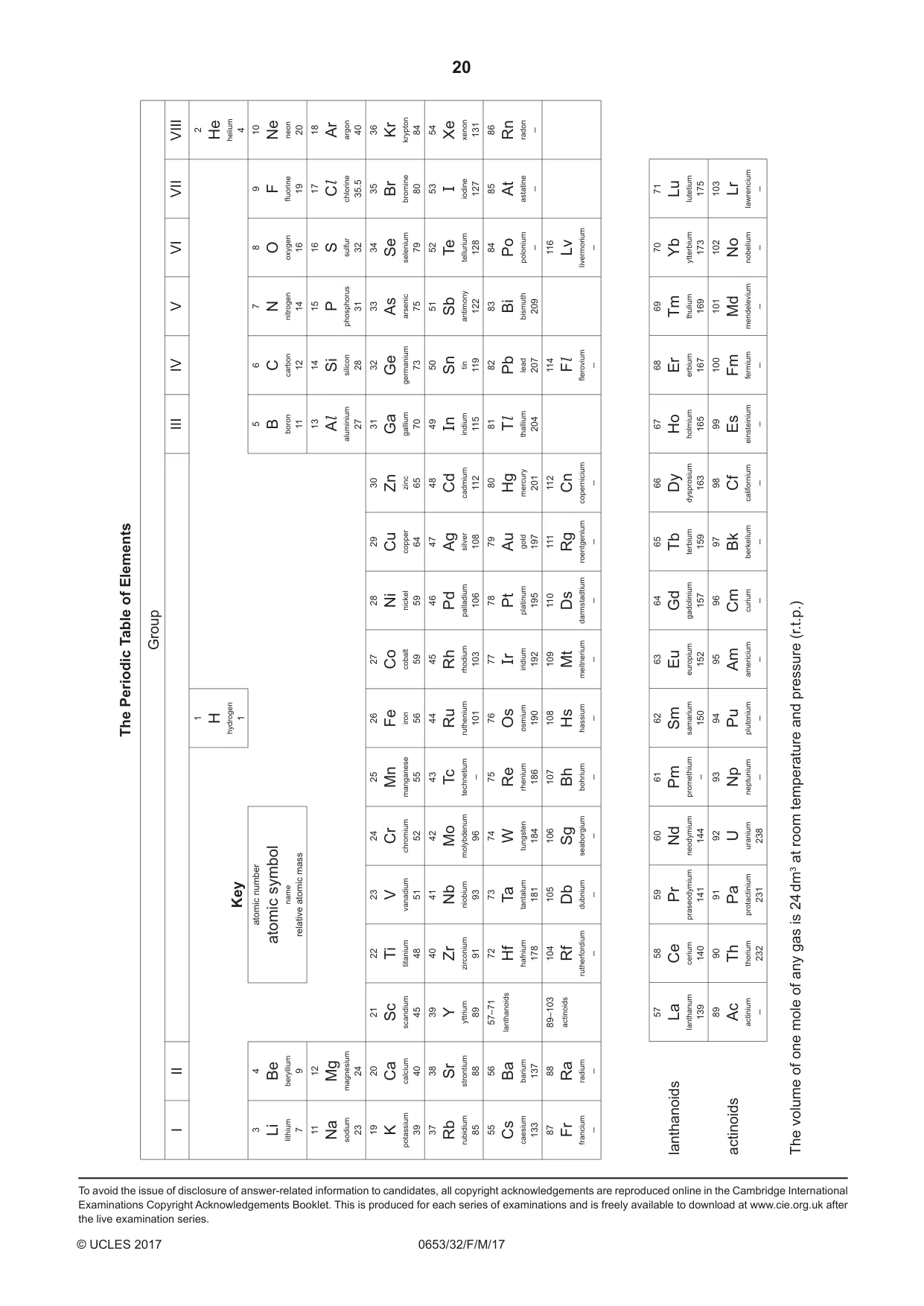
8 (a) A student observes what happens when a piece of sodium is added to water, as shown in Fig. 8.1. sodium water Fig. 8.1 During the reaction the student observes that the sodium floats and melts. The student is told that sodium hydroxide solution is formed and hydrogen gas is given off. (i) State which information above shows that sodium has a low density. .......................................................................................................................................[1] (ii) Complete the word equation for this reaction. + + [2] (iii) The student makes different observations when a piece of copper is added to water. Describe these different observations. 1. ....................................................................................................................................... 2. ....................................................................................................................................... [2] (b) The Periodic Table contains groups and collections of elements. (i) Name the collection of metals which often act as catalysts. .......................................................................................................................................[1] (ii) Describe the reactivity of the noble gases. .......................................................................................................................................[1] (iii) Chlorine, Cl, is in Group VII of the Periodic Table. An atom of chlorine is represented as: 3517Cl The mass number is 35, and the atomic number is 17. Explain what is meant by mass number, ........................................................................................................................... ................................................................................................................................................... atomic number. ......................................................................................................................... ................................................................................................................................................... [2]
Mark scheme: 8(a)(i) floats ; 1 8(a)(ii) LHS (either order) ; RHS (either order) ; sodium + water Î sodium hydroxide + hydrogen 2 8(a)(iii) sinks ; no reaction ; either order 2 8(b)(i) transition metals ; 1 8(b)(ii) unreactive ; 1 8(b)(iii) mass no. (35) number of protons + neutrons ; atomic no. (17) number of protons ; 2
Q9 · A simple circuit set up to investigate the electrical properties of a lamp
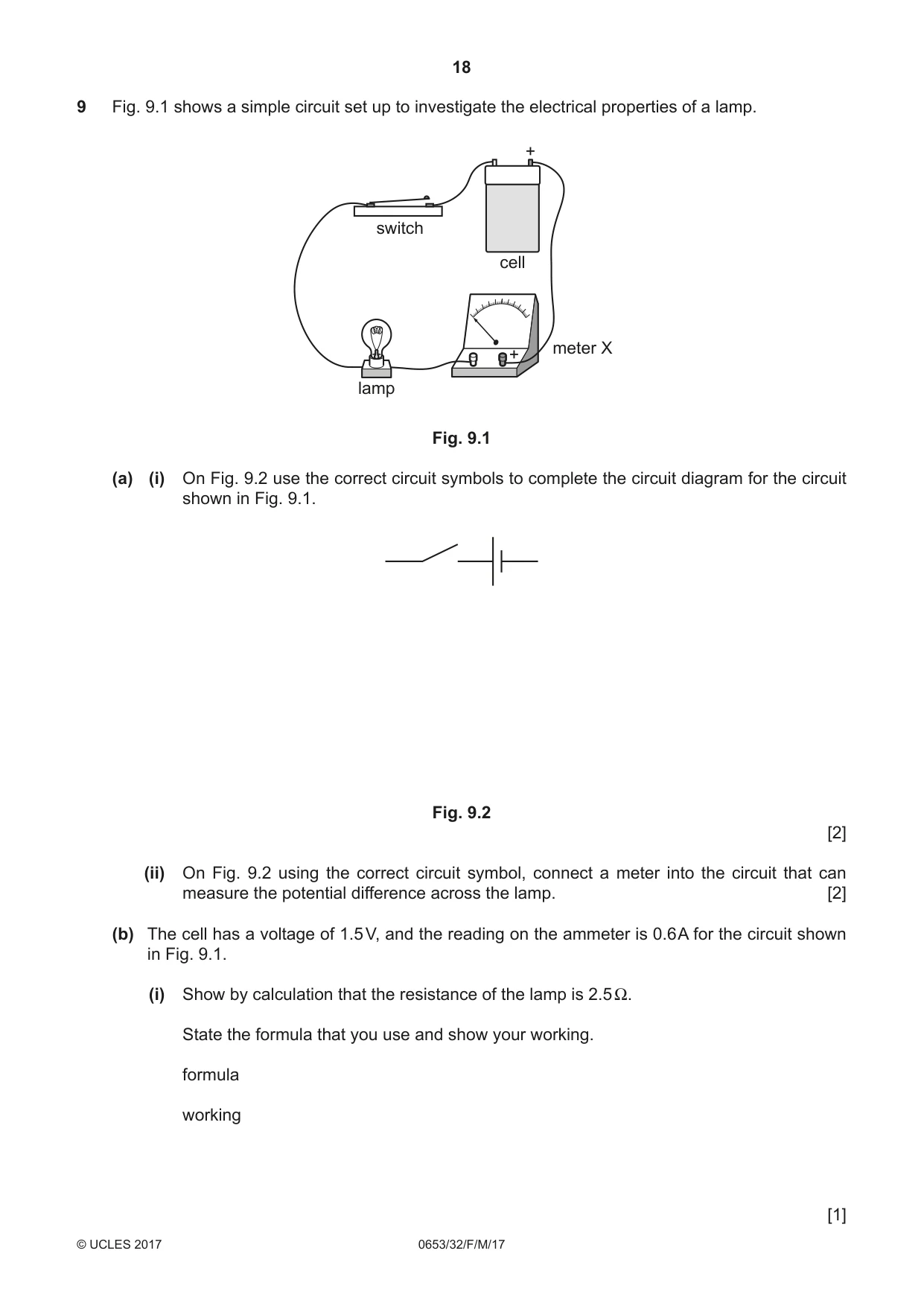
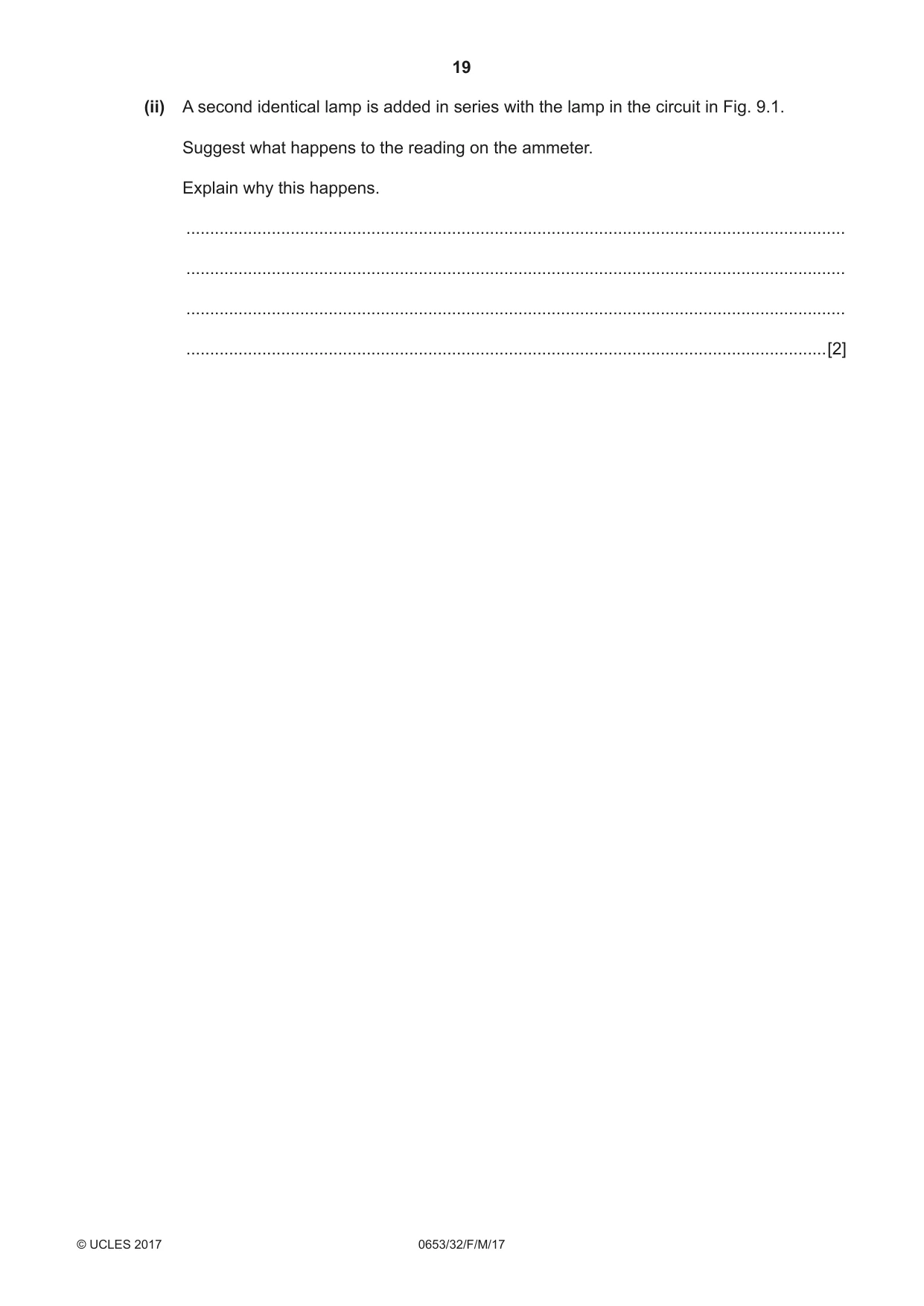
9 Fig. 9.1 shows a simple circuit set up to investigate the electrical properties of a lamp. + switch cell meter X + lamp Fig. 9.1 (a) (i) On Fig. 9.2 use the correct circuit symbols to complete the circuit diagram for the circuit shown in Fig. 9.1. Fig. 9.2 [2] (ii) On Fig. 9.2 using the correct circuit symbol, connect a meter into the circuit that can measure the potential difference across the lamp. [2] (b) The cell has a voltage of 1.5 V, and the reading on the ammeter is 0.6 A for the circuit shown in Fig. 9.1. (i) Show by calculation that the resistance of the lamp is 2.5 Ω. State the formula that you use and show your working. formula working [1] (ii) A second identical lamp is added in series with the lamp in the circuit in Fig. 9.1. Suggest what happens to the reading on the ammeter. Explain why this happens. ........................................................................................................................................... ........................................................................................................................................... ........................................................................................................................................... .......................................................................................................................................[2]
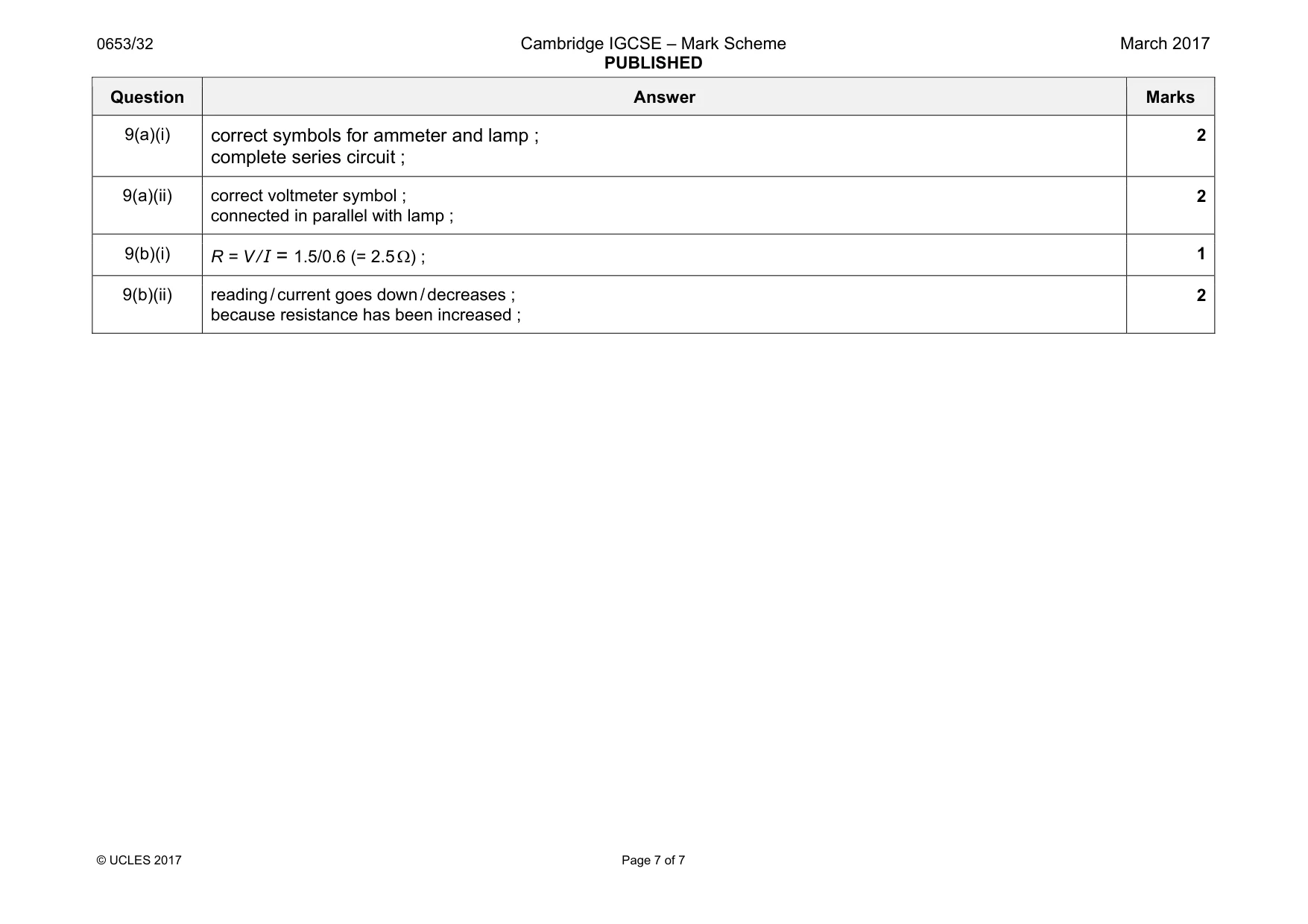
Mark scheme: 9(a)(i) complete series circuit ; 2 9(a)(ii) correct voltmeter symbol ; connected in parallel with lamp ; 2 9(b)(i) R = V / I = 1.5/0.6 (= 2.5 Ω) ; 1 9(b)(ii) reading / current goes down / decreases ; because resistance has been increased ; 2
What was in this paper
The subtopics covered by these 9 questions, and how many questions each got. Open one in a new tab to see every Cambridge question on it.
What you needed in this session
Cambridge’s own grade thresholds for 2017 Feb/March, Paper 3 · Variant 2. A higher threshold means an easier paper — the bar moves with how the cohort did.