Questions as text
Q1 · A boat sailing near a lighthouse at night 0653/42 Feb/March 2017
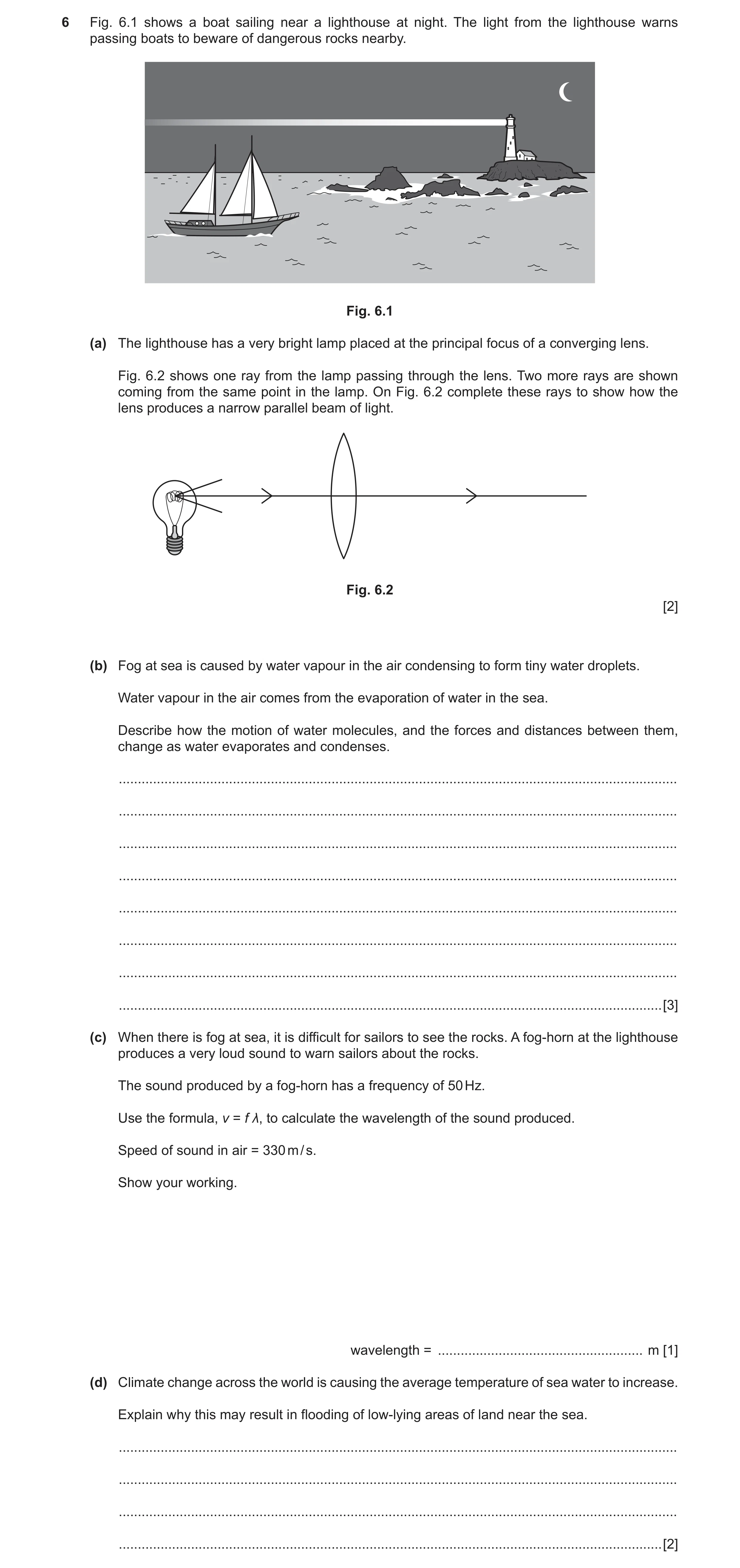
6 Fig. 6.1 shows a boat sailing near a lighthouse at night. The light from the lighthouse warns passing boats to beware of dangerous rocks nearby. Fig. 6.1 (a) The lighthouse has a very bright lamp placed at the principal focus of a converging lens. Fig. 6.2 shows one ray from the lamp passing through the lens. Two more rays are shown coming from the same point in the lamp. On Fig. 6.2 complete these rays to show how the lens produces a narrow parallel beam of light. Fig. 6.2 [2] (b) Fog at sea is caused by water vapour in the air condensing to form tiny water droplets. Water vapour in the air comes from the evaporation of water in the sea. Describe how the motion of water molecules, and the forces and distances between them, change as water evaporates and condenses. … … … … … … … … [3] (c) When there is fog at sea, it is difficult for sailors to see the rocks. A fog-horn at the lighthouse produces a very loud sound to warn sailors about the rocks. The sound produced by a fog-horn has a frequency of 50 Hz. Use the formula, v = f λ, to calculate the wavelength of the sound produced. Speed of sound in air = 330 m / s. Show your working. wavelength = … m [1] (d) Climate change across the world is causing the average temperature of sea water to increase. Explain why this may result in flooding of low-lying areas of land near the sea. … … … … [2]
8 marks
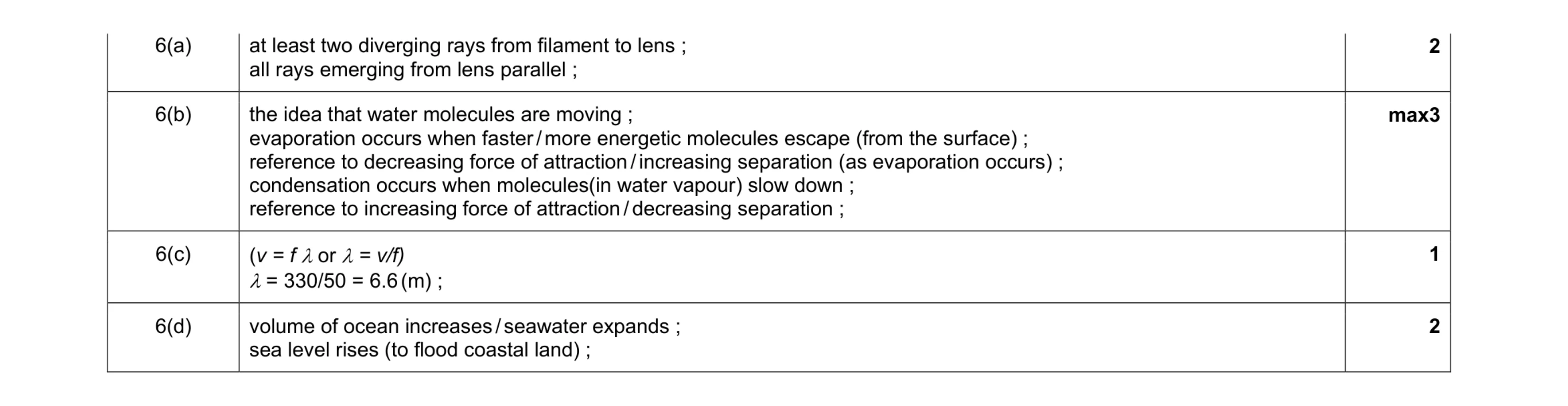
Mark scheme: 6(a) at least two diverging rays from filament to lens ; all rays emerging from lens parallel ; 2 6(b) the idea that water molecules are moving ; evaporation occurs when faster / more energetic molecules escape (from the surface) ; reference to decreasing force of attraction / increasing separation (as evaporation occurs) ; condensation occurs when molecules(in water vapour) slow down ; reference to increasing force of attraction / decreasing separation ; max3 6(c) (v = f λ or λ = v/f) λ = 330/50 = 6.6 (m) ; 1 6(d) volume of ocean increases / seawater expands ; sea level rises (to flood coastal land) ; 2
This question in 0653/42 Feb/March 2017
Q2 · A man standing in the sea on a sunny day 0653/41 May/June 2017
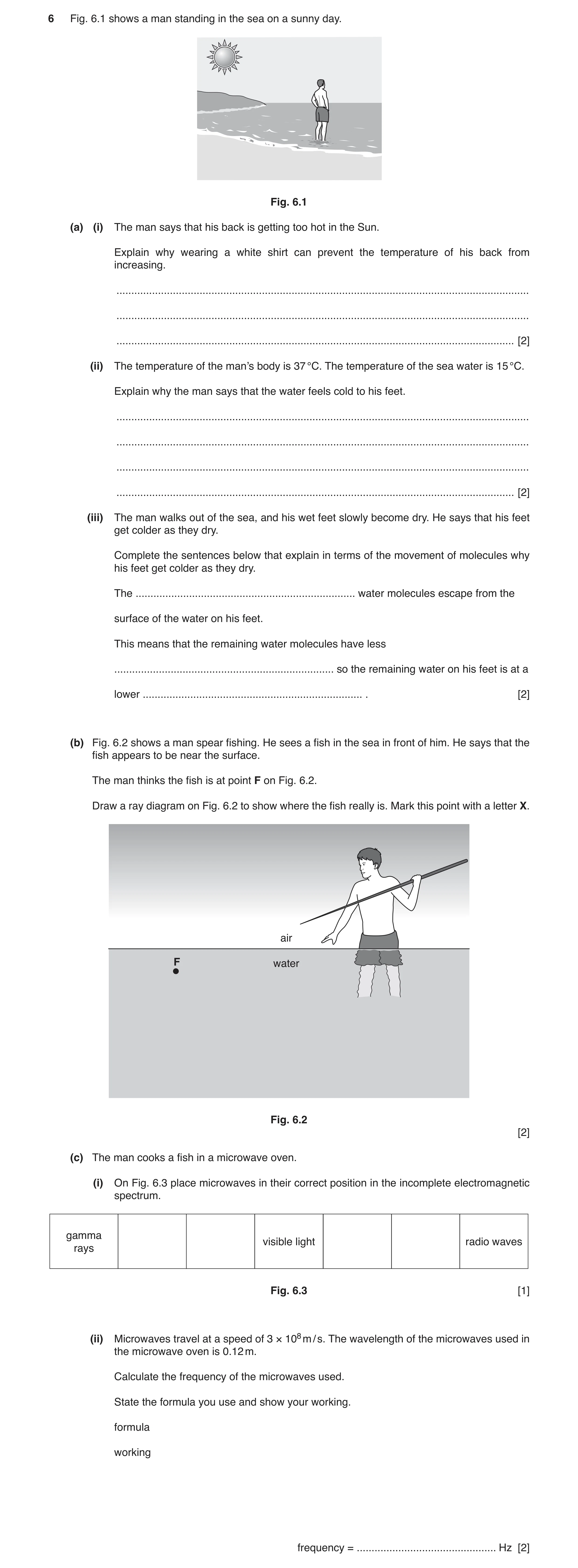
6 Fig. 6.1 shows a man standing in the sea on a sunny day. Fig. 6.1 (a) (i) The man says that his back is getting too hot in the Sun. Explain why wearing a white shirt can prevent the temperature of his back from increasing. … … … [2] (ii) The temperature of the man’s body is 37 °C. The temperature of the sea water is 15 °C. Explain why the man says that the water feels cold to his feet. … … … … [2] (iii) The man walks out of the sea, and his wet feet slowly become dry. He says that his feet get colder as they dry. Complete the sentences below that explain in terms of the movement of molecules why his feet get colder as they dry. The … water molecules escape from the surface of the water on his feet. This means that the remaining water molecules have less … so the remaining water on his feet is at a lower … . [2] (b) Fig. 6.2 shows a man spear fishing. He sees a fish in the sea in front of him. He says that the fish appears to be near the surface. The man thinks the fish is at point F on Fig. 6.2. Draw a ray diagram on Fig. 6.2 to show where the fish really is. Mark this point with a letter X. air F water Fig. 6.2 [2] (c) The man cooks a fish in a microwave oven. (i) On Fig. 6.3 place microwaves in their correct position in the incomplete electromagnetic spectrum. gamma visible light radio waves rays Fig. 6.3 [1] (ii) Microwaves travel at a speed of 3 × 10⁸ m / s. The wavelength of the microwaves used in the microwave oven is 0.12 m. Calculate the frequency of the microwaves used. State the formula you use and show your working. formula working frequency = … Hz [2]
11 marks
Mark scheme: 6(a)(i) infra-red / radiation ; poorly absorbed / mainly reflected by white ; 2 6(a)(ii) the idea that feet lose heat / thermal energy ; the idea that heat / thermal energy is lost to the water ; because the water is colder ; 2 6(a)(iii) (line 1) more energetic/faster and (line 3) energy / speed ; (line 4) temperature ; 2 6(b) ray from X refracts correctly at surface ; unbroken rays drawn with a ruler to the eye with at least one arrow on a ray ; 2 6(c)(i) gamma rays Visible light micro- waves ; radio waves 1 6(c)(ii) v = f λ / f = 3 × 10⁸ ÷ 0.12 ; = 2.5 × 10⁹ (Hz) ; 2
This question in 0653/41 May/June 2017
Question 3 0653/41 Oct/Nov 2017
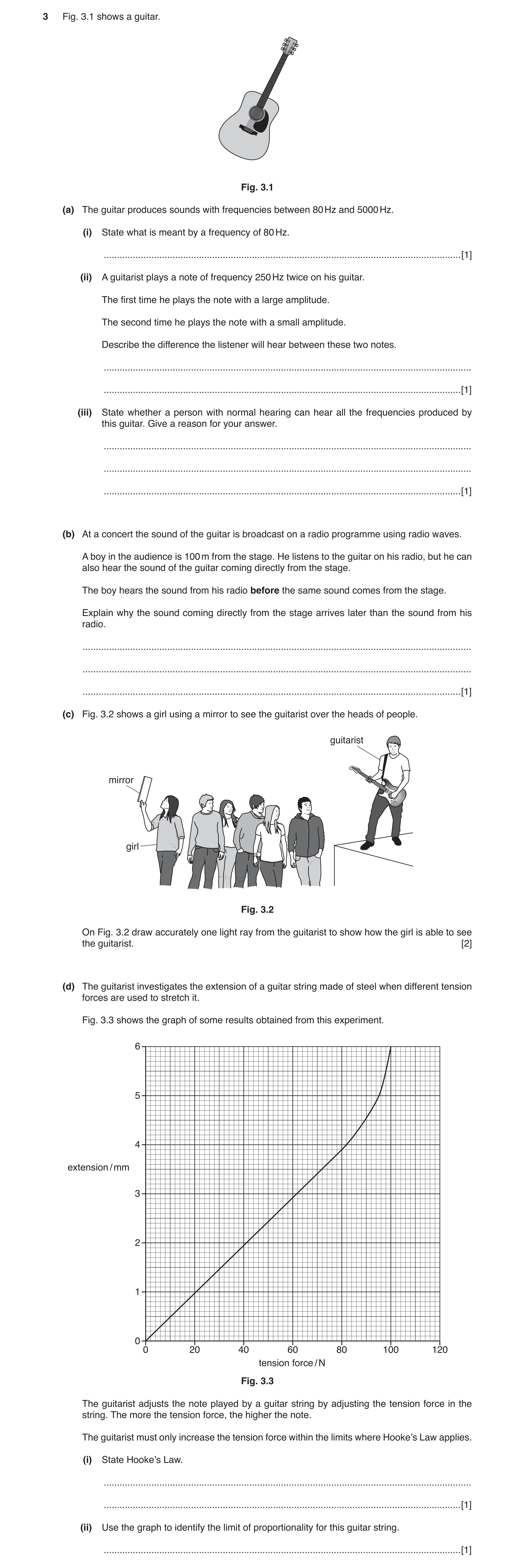
3 Fig. 3.1 shows a guitar. Fig. 3.1 (a) The guitar produces sounds with frequencies between 80 Hz and 5000 Hz. (i) State what is meant by a frequency of 80 Hz. … [1] (ii) A guitarist plays a note of frequency 250 Hz twice on his guitar. The first time he plays the note with a large amplitude. The second time he plays the note with a small amplitude. Describe the difference the listener will hear between these two notes. … … [1] (iii) State whether a person with normal hearing can hear all the frequencies produced by this guitar. Give a reason for your answer. … … … [1] (b) At a concert the sound of the guitar is broadcast on a radio programme using radio waves. A boy in the audience is 100 m from the stage. He listens to the guitar on his radio, but he can also hear the sound of the guitar coming directly from the stage. The boy hears the sound from his radio before the same sound comes from the stage. Explain why the sound coming directly from the stage arrives later than the sound from his radio. … … … [1] (c) Fig. 3.2 shows a girl using a mirror to see the guitarist over the heads of people. guitarist mirror girl Fig. 3.2 On Fig. 3.2 draw accurately one light ray from the guitarist to show how the girl is able to see the guitarist. [2] (d) The guitarist investigates the extension of a guitar string made of steel when different tension forces are used to stretch it. Fig. 3.3 shows the graph of some results obtained from this experiment. 6 5 4 extension / mm 3 2 1 0 0 20 40 60 80 100 120 tension force / N Fig. 3.3 The guitarist adjusts the note played by a guitar string by adjusting the tension force in the string. The more the tension force, the higher the note. The guitarist must only increase the tension force within the limits where Hooke’s Law applies. (i) State Hooke’s Law. … … [1] (ii) Use the graph to identify the limit of proportionality for this guitar string. … [1]
8 marks
Mark scheme: 3(a)(i) 80 cycles / vibrations / oscillations per second ; 1 3(a)(ii) first note louder than second note ; 1 3(a)(iii) yes (no mark) frequency range lies within frequency range of normal human hearing ; 1 3(b) radio / electromagnetic waves travel (much) faster than sound waves / ora ; 1 3(c) both rays shown as continuous straight lines, being reflected from and touching the mirror ; angles of incidence and reflection the same by inspection and at least one arrow in the correct direction ; 2 3(d)(i) extension / deformation is proportional to the load / cause / force = a constant × extension / F = kx ; 1 Question Answer Marks 3(d)(ii) tension in the range 80 to 84 N ; 1
This question in 0653/41 Oct/Nov 2017
Q4 · In a theatre, spotlights are used to shine a beam of light on one person on the stage 0653/42 Oct/Nov 2017
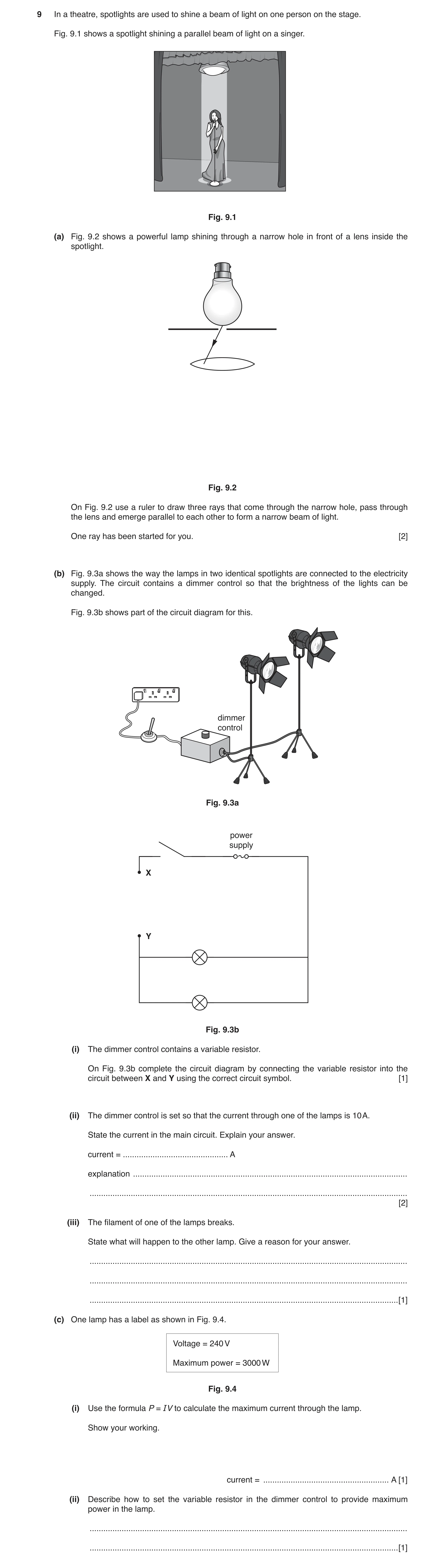
9 In a theatre, spotlights are used to shine a beam of light on one person on the stage. Fig. 9.1 shows a spotlight shining a parallel beam of light on a singer. Fig. 9.1 (a) Fig. 9.2 shows a powerful lamp shining through a narrow hole in front of a lens inside the spotlight. Fig. 9.2 On Fig. 9.2 use a ruler to draw three rays that come through the narrow hole, pass through the lens and emerge parallel to each other to form a narrow beam of light. One ray has been started for you. [2] (b) Fig. 9.3a shows the way the lamps in two identical spotlights are connected to the electricity supply. The circuit contains a dimmer control so that the brightness of the lights can be changed. Fig. 9.3b shows part of the circuit diagram for this. dimmer control Fig. 9.3a power supply X Y Fig. 9.3b (i) The dimmer control contains a variable resistor. On Fig. 9.3b complete the circuit diagram by connecting the variable resistor into the circuit between X and Y using the correct circuit symbol. [1] (ii) The dimmer control is set so that the current through one of the lamps is 10 A. State the current in the main circuit. Explain your answer. current = … A explanation … … [2] (iii) The filament of one of the lamps breaks. State what will happen to the other lamp. Give a reason for your answer. … … … [1] (c) One lamp has a label as shown in Fig. 9.4. Voltage = 240 V Maximum power = 3000 W Fig. 9.4 (i) Use the formula P = IV to calculate the maximum current through the lamp. Show your working. current = … A [1] (ii) Describe how to set the variable resistor in the dimmer control to provide maximum power in the lamp. … … [1]
8 marks
Mark scheme: 9 9 9(a) two m all ray 9(b)(i) correc 9(b)(ii) 20 A ; becau 9(b)(iii) remai still a 9(c)(i) I = P 9(c)(ii) the id more rays from h ys emerge from ct symbol showi ; use lamps in par ins lit (no mark) complete circuit / V = 3000 / 240 dea that the resis hole to lens with lens reasonably ing variable resis rallel / current is t through that br 0 = 12.5 (A) ; stance in the dim at least one add y parallel ; stor ; shared / current ranch / reference mmer must be de ditional arrow co t in main circuit = e to parallel circu ecreased / turn c orrectly shown ; = sum ; uit / owtte ; control to minimu um resistance ; 2 1 2 1 1 1
This question in 0653/42 Oct/Nov 2017
Question 5 0653/42 May/June 2018
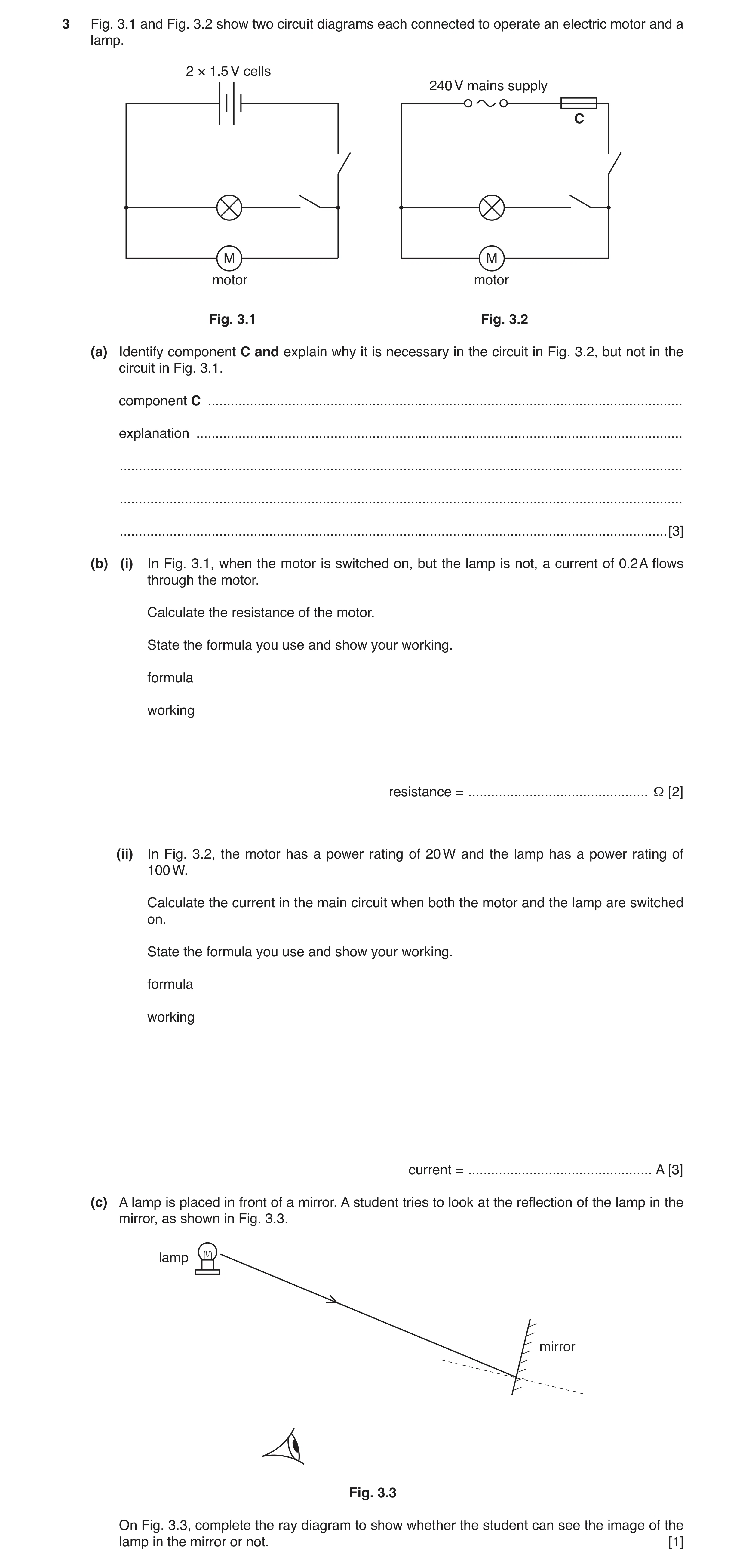
3 Fig. 3.1 and Fig. 3.2 show two circuit diagrams each connected to operate an electric motor and a lamp. 2 × 1.5 V cells 240 V mains supply C M M motor motor Fig. 3.1 Fig. 3.2 (a) Identify component C and explain why it is necessary in the circuit in Fig. 3.2, but not in the circuit in Fig. 3.1. component C … explanation … … … … [3] (b) (i) In Fig. 3.1, when the motor is switched on, but the lamp is not, a current of 0.2 A flows through the motor. Calculate the resistance of the motor. State the formula you use and show your working. formula working resistance = … Ω [2] (ii) In Fig. 3.2, the motor has a power rating of 20 W and the lamp has a power rating of 100 W. Calculate the current in the main circuit when both the motor and the lamp are switched on. State the formula you use and show your working. formula working current = … A [3] (c) A lamp is placed in front of a mirror. A student tries to look at the reflection of the lamp in the mirror, as shown in Fig. 3.3. lamp mirror Fig. 3.3 On Fig. 3.3, complete the ray diagram to show whether the student can see the image of the lamp in the mirror or not. [1]
9 marks
Mark scheme: 3(a) fuse ; (the idea that 240 V could produce a) high current ; one from (a high current could) cause damage / overheating ; (fuse) protects circuit / breaks circuit / melts ; 3 3(b)(i) (R = V / I) = 3 / 0.2 ; = 15 (Ω) ; 2 3(b)(ii) total power supply required = 100 + 20 = 120 W ; P = I × V or total current = 120 / 240 ; = 0.5 A ; 3 Question Answer Marks 3(c) reflected ray shown at approx. correct angle missing the eye ; 1
This question in 0653/42 May/June 2018
Q6 · The density of water, a liquid, is very different from the density of steam, a gas 0653/43 Oct/Nov 2018
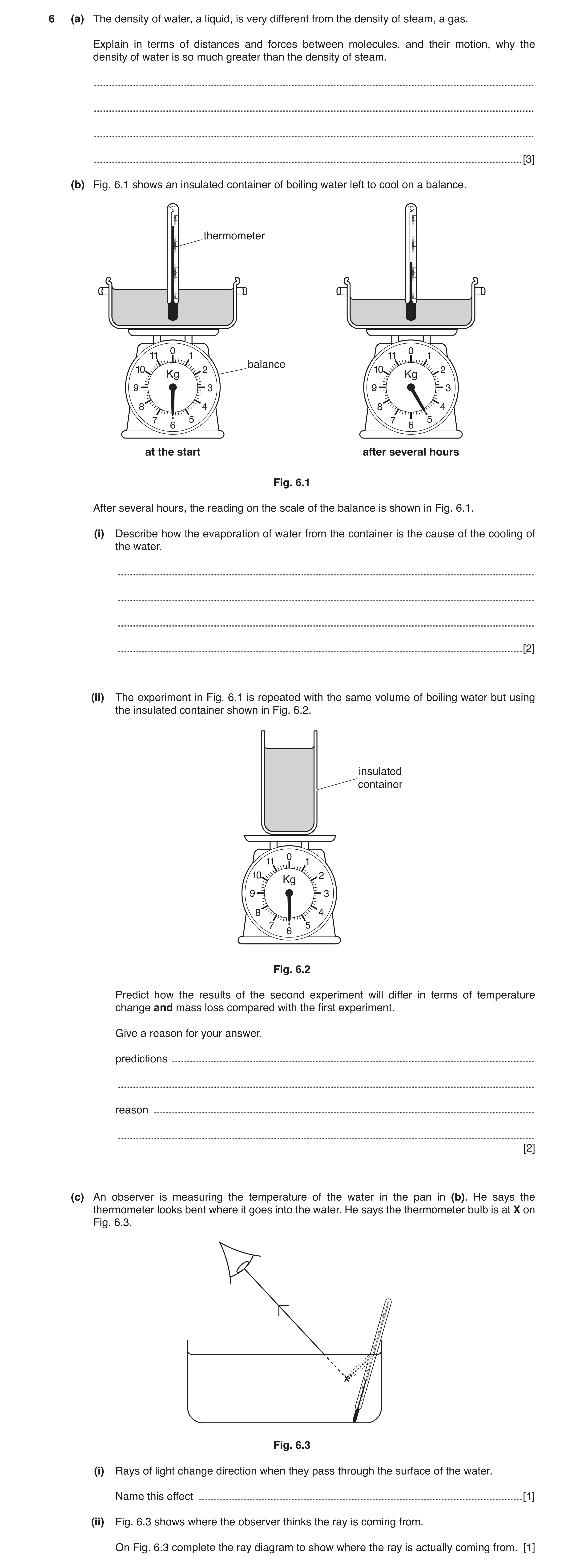
6 (a) The density of water, a liquid, is very different from the density of steam, a gas. Explain in terms of distances and forces between molecules, and their motion, why the density of water is so much greater than the density of steam. … … … … [3] (b) Fig. 6.1 shows an insulated container of boiling water left to cool on a balance. °C °C thermometer 0 0 11 1 11 1 balance 10 2 10 2 Kg Kg 9 3 9 3 8 4 8 4 7 5 7 5 6 6 at the start after several hours Fig. 6.1 After several hours, the reading on the scale of the balance is shown in Fig. 6.1. (i) Describe how the evaporation of water from the container is the cause of the cooling of the water. … … … … [2] (ii) The experiment in Fig. 6.1 is repeated with the same volume of boiling water but using the insulated container shown in Fig. 6.2. insulated container 0 11 1 10 2 Kg 9 3 8 4 7 5 6 Fig. 6.2 Predict how the results of the second experiment will differ in terms of temperature change and mass loss compared with the first experiment. Give a reason for your answer. predictions … … reason … … [2] (c) An observer is measuring the temperature of the water in the pan in (b). He says the thermometer looks bent where it goes into the water. He says the thermometer bulb is at X on Fig. 6.3. 5 Fig. 6.3 (i) Rays of light change direction when they pass through the surface of the water. Name this effect … [1] (ii) Fig. 6.3 shows where the observer thinks the ray is coming from. On Fig. 6.3 complete the ray diagram to show where the ray is actually coming from. [1]
9 marks
Mark scheme: 6(a) any three of distances between molecules greater / molecules further apart in gases molecules are closer together in liquids ; forces between molecules of gases are weaker / forces between molecules of a liquid are stronger ; molecules can move freely in gas / molecules rolling / sliding over each other in liquids ; gas volume greater for same mass / liquid volume is smaller for the same mass ; Max 3 3 6(b)(i) faster / more energetic molecules escape (from surface) ; average speed of remaining molecules less / water has less energy (leading to cooling) ; 2 Question Answer Marks 6(b)(ii) less / slower cooling and less / slower mass loss ; less surface area for evaporation ; 2 6(c)(i) refraction ; 1 6(c)(ii) ray from thermometer bulb to meet ray to eye at water surface; 1
This question in 0653/43 Oct/Nov 2018
Q7 · Children using a magnifying glass to view a butterfly 0653/43 Oct/Nov 2019
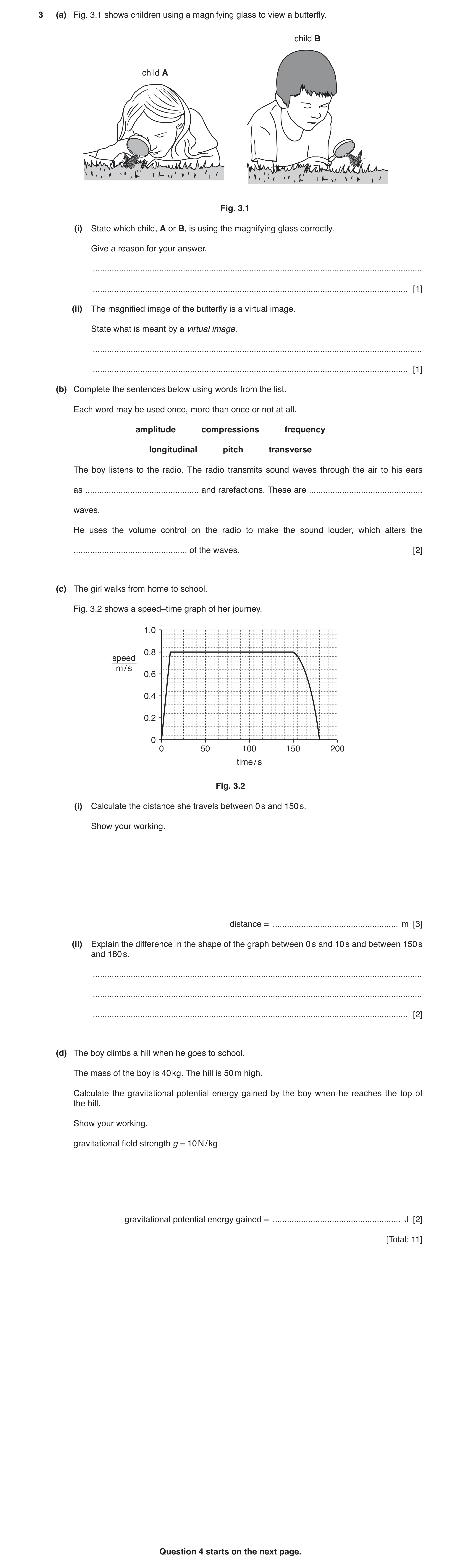
3 (a) Fig. 3.1 shows children using a magnifying glass to view a butterfly. child B child A Fig. 3.1 (i) State which child, A or B, is using the magnifying glass correctly. Give a reason for your answer. … … [1] (ii) The magnified image of the butterfly is a virtual image. State what is meant by a virtual image. … … [1] (b) Complete the sentences below using words from the list. Each word may be used once, more than once or not at all. amplitude compressions frequency longitudinal pitch transverse The boy listens to the radio. The radio transmits sound waves through the air to his ears as … and rarefactions. These are … waves. He uses the volume control on the radio to make the sound louder, which alters the … of the waves. [2] (c) The girl walks from home to school. Fig. 3.2 shows a speed–time graph of her journey. 1.0 0.8 speed m / s 0.6 0.4 0.2 0 0 50 100 150 200 time / s Fig. 3.2 (i) Calculate the distance she travels between 0 s and 150 s. Show your working. distance = … m [3] (ii) Explain the difference in the shape of the graph between 0 s and 10 s and between 150 s and 180 s. … … … [2] (d) The boy climbs a hill when he goes to school. The mass of the boy is 40 kg. The hill is 50 m high. Calculate the gravitational potential energy gained by the boy when he reaches the top of the hill. Show your working. gravitational field strength g = 10 N / kg gravitational potential energy gained = … J [2] [Total: 11] Question 4 starts on the next page.
11 marks
Mark scheme: 3(a)(i) (child A because) child A holding close(r) to eye / child B eye is too far from the lens ; 1 3(a)(ii) image that cannot be projected onto a screen ; 1 3(b) compressions longitudinal amplitude any 2 correct = 1 mark all 3 correct = 2 marks 2 3(c)(i) use of area under graph or d = s × t ; correct use of data from graph ; = 116 ; 3 3(c)(ii) constant acceleration (0–10 s) ; non-constant deceleration (150–180 s) ; 2 3(d) use of gravitational PE gained = mgh ; (= 40 × 10 × 50) = 20 000 (J) ; 2
This question in 0653/43 Oct/Nov 2019
Question 8 0653/42 Feb/March 2020
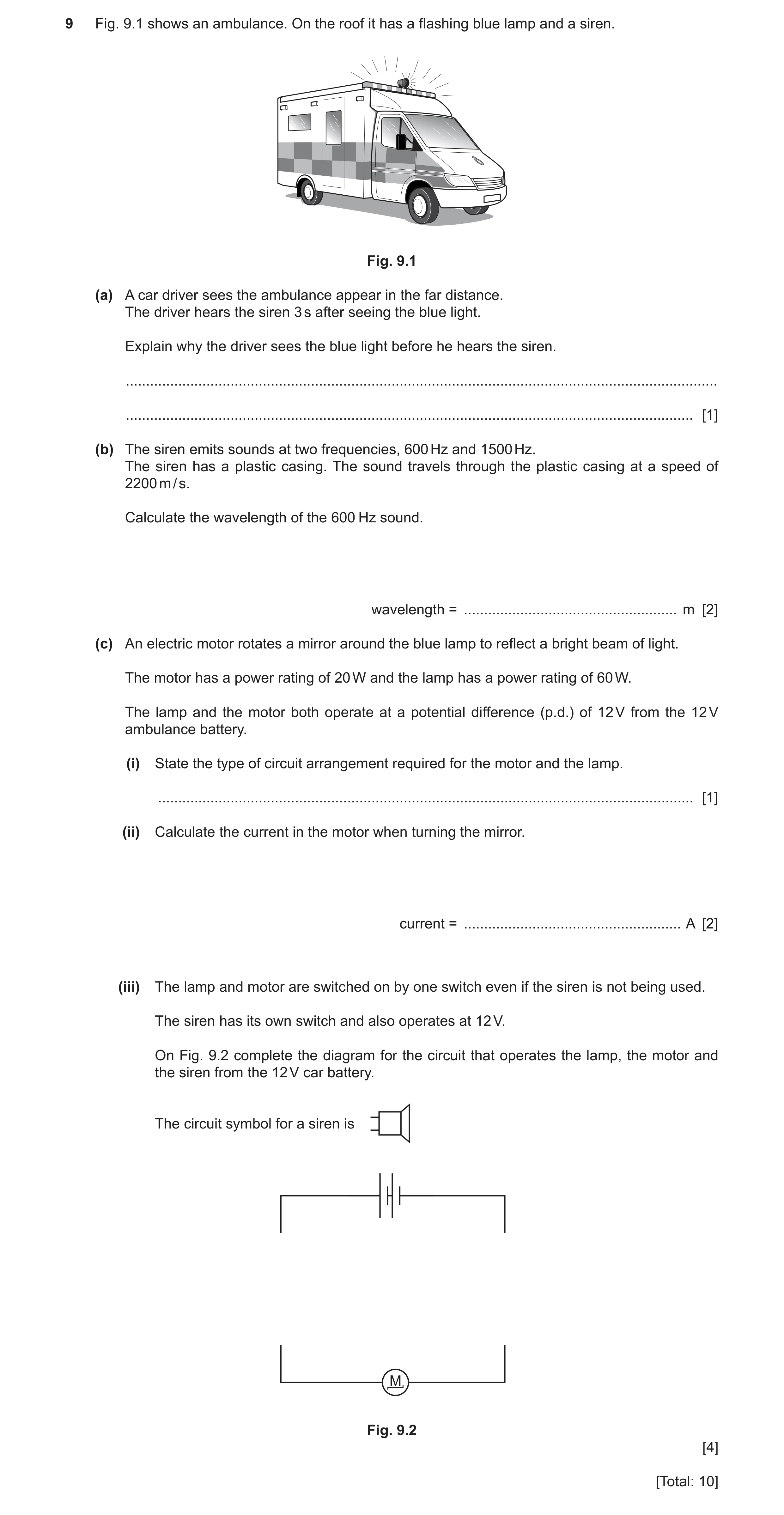
9 Fig. 9.1 shows an ambulance. On the roof it has a flashing blue lamp and a siren. Fig. 9.1 (a) A car driver sees the ambulance appear in the far distance. The driver hears the siren 3 s after seeing the blue light. Explain why the driver sees the blue light before he hears the siren. … … [1] (b) The siren emits sounds at two frequencies, 600 Hz and 1500 Hz. The siren has a plastic casing. The sound travels through the plastic casing at a speed of 2200 m / s. Calculate the wavelength of the 600 Hz sound. wavelength = … m [2] (c) An electric motor rotates a mirror around the blue lamp to reflect a bright beam of light. The motor has a power rating of 20 W and the lamp has a power rating of 60 W. The lamp and the motor both operate at a potential difference (p.d.) of 12 V from the 12 V ambulance battery. (i) State the type of circuit arrangement required for the motor and the lamp. … [1] (ii) Calculate the current in the motor when turning the mirror. current = … A [2] (iii) The lamp and motor are switched on by one switch even if the siren is not being used. The siren has its own switch and also operates at 12 V. On Fig. 9.2 complete the diagram for the circuit that operates the lamp, the motor and the siren from the 12 V car battery. The circuit symbol for a siren is M Fig. 9.2 [4] [Total: 10]
10 marks
Mark scheme: 9(a) light travels faster than sound ; 1 9(b) v = fλ / (λ =) v ÷ f / 2200 ÷ 600 ; = 3.67 / 3.7 (m) ; 2 9(c)(i) parallel ; 1 9(c)(ii) P = I V / (I =) P ÷ V / 20 ÷ 12 ; = 1.7 / 1.67 (A) ; 2 Question Answer Marks 9(c)(iii) correct symbols for lamp and switch ; lamp, siren and motor all in parallel ; switch for motor and lamp ; switch for siren only ; 4
This question in 0653/42 Feb/March 2020
Q9 · A spacecraft taking off from the Moon 0653/41 May/June 2020
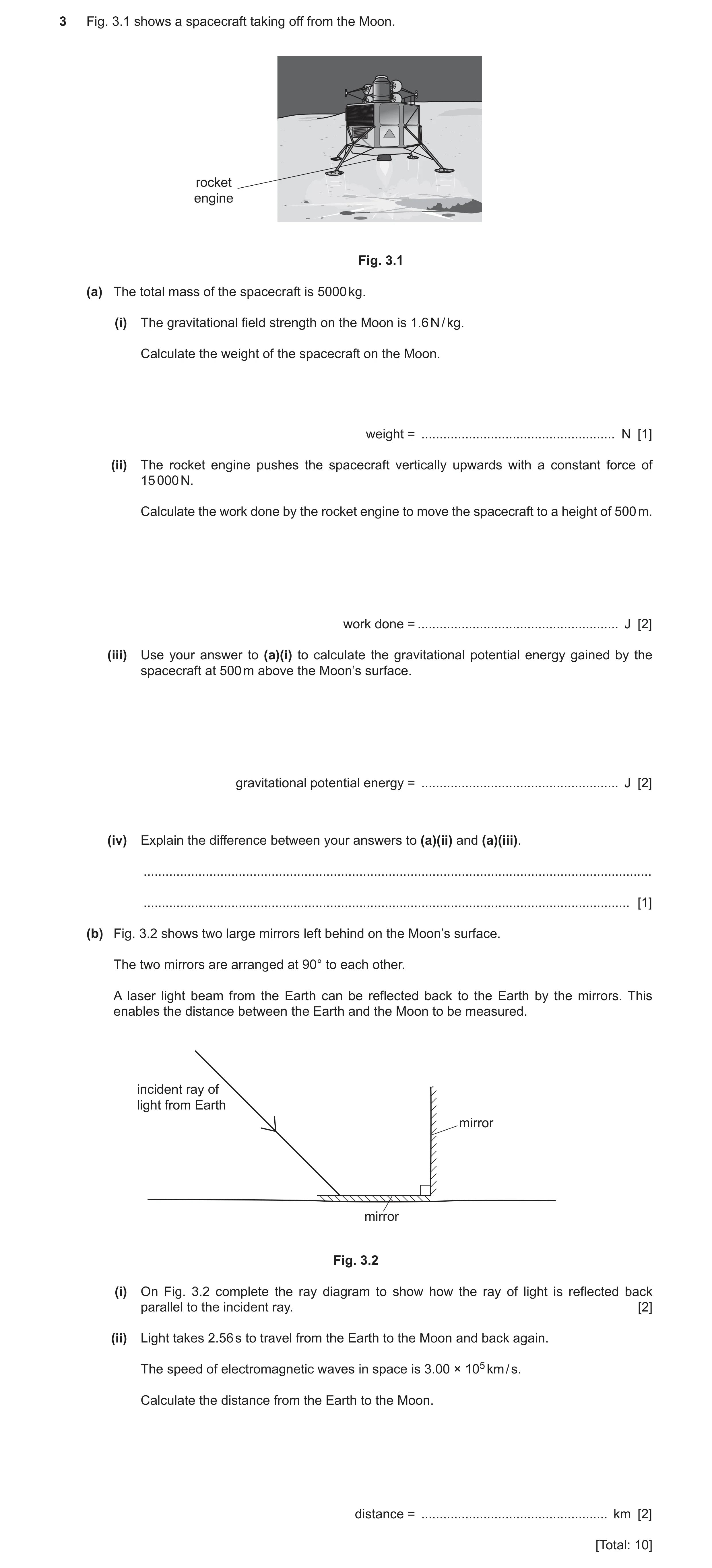
3 Fig. 3.1 shows a spacecraft taking off from the Moon. rocket engine Fig. 3.1 (a) The total mass of the spacecraft is 5000 kg. (i) The gravitational field strength on the Moon is 1.6 N / kg. Calculate the weight of the spacecraft on the Moon. weight = … N [1] (ii) The rocket engine pushes the spacecraft vertically upwards with a constant force of 15 000 N. Calculate the work done by the rocket engine to move the spacecraft to a height of 500 m. work done = … J [2] (iii) Use your answer to (a)(i) to calculate the gravitational potential energy gained by the spacecraft at 500 m above the Moon’s surface. gravitational potential energy = … J [2] (iv) Explain the difference between your answers to (a)(ii) and (a)(iii). … … [1] (b) Fig. 3.2 shows two large mirrors left behind on the Moon’s surface. The two mirrors are arranged at 90° to each other. A laser light beam from the Earth can be reflected back to the Earth by the mirrors. This enables the distance between the Earth and the Moon to be measured. incident ray of light from Earth mirror mirror Fig. 3.2 (i) On Fig. 3.2 complete the ray diagram to show how the ray of light is reflected back parallel to the incident ray. [2] (ii) Light takes 2.56 s to travel from the Earth to the Moon and back again. The speed of electromagnetic waves in space is 3.00 × 10⁵ km / s. Calculate the distance from the Earth to the Moon. distance = … km [2] [Total: 10]
10 marks
Mark scheme: 3(a)(i) (weight = 5000 × 1.6 =) 8000 (N) ; 1 3(a)(ii) (work done =) force × distance = 15 000 × 500 ; = 7500000 (J) ; 2 3(a)(iii) (gravitational PE gained =) weight × height = 8000 × 500 ; = 4000000 (J) ; 2 3(a)(iv) difference (7 500 000J – 4 000 000J = 3 500 000 J) = kinetic energy of the spacecraft ; 1 3(b)(i) 2 reflections at first and second mirrors ; angles of reflection roughly 45° for both reflections, and emergent ray parallel to incident ray ; Question Answer Marks 3(b)(ii) distance travelled in 2.56 s = 3.00 × 105 × 2.56 (= 7.68 × 10⁵ km for there and back again) ; (distance from the Earth to the Moon (= 1 2 × 7.68 × 105) = 3.84 × 10⁵ km / 384 000 km ; 2
This question in 0653/41 May/June 2020
Q10 · Thermal energy being transferred to a beaker of water 0653/42 May/June 2021
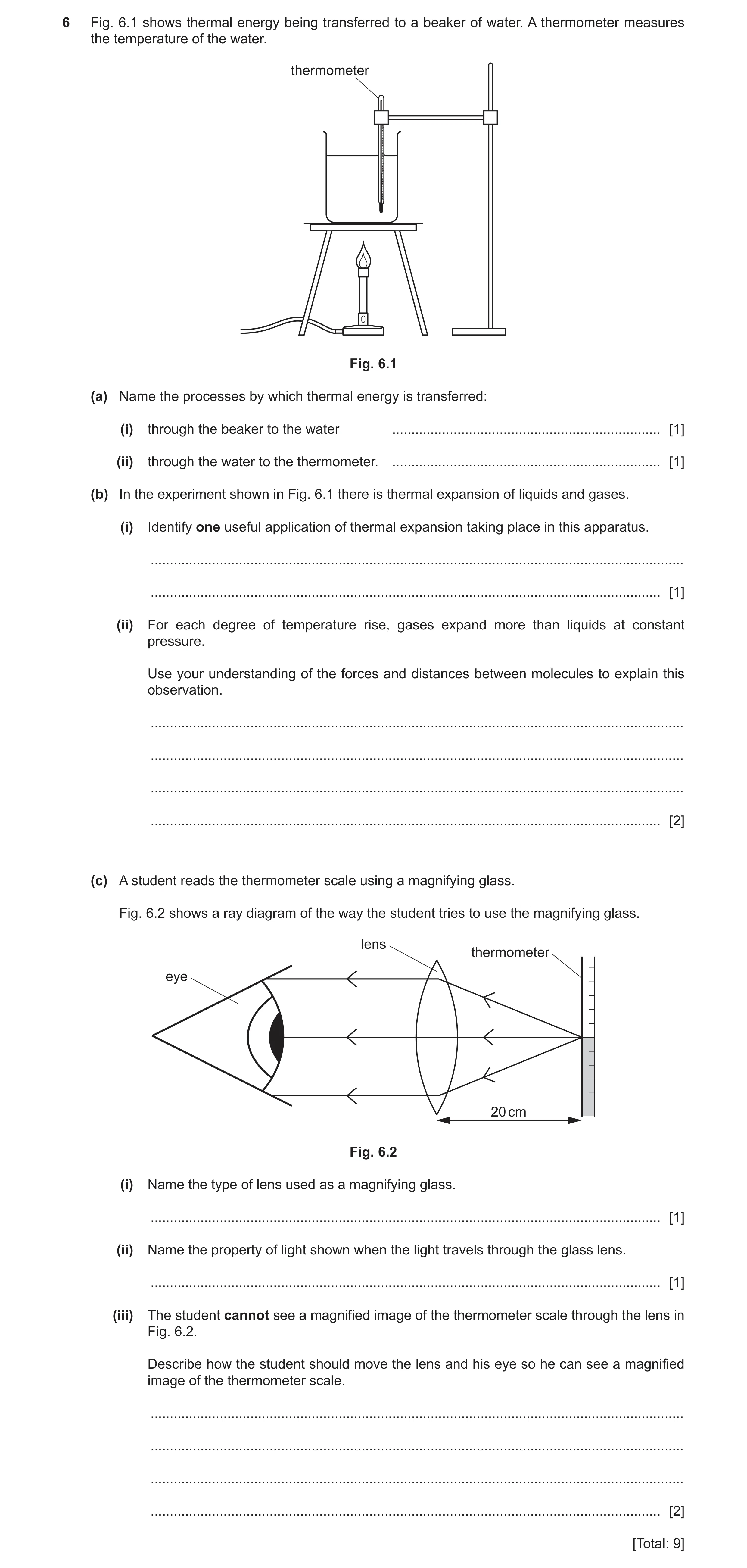
6 Fig. 6.1 shows thermal energy being transferred to a beaker of water. A thermometer measures the temperature of the water. thermometer Fig. 6.1 (a) Name the processes by which thermal energy is transferred: (i) through the beaker to the water … [1] (ii) through the water to the thermometer. … [1] (b) In the experiment shown in Fig. 6.1 there is thermal expansion of liquids and gases. (i) Identify one useful application of thermal expansion taking place in this apparatus. … … [1] (ii) For each degree of temperature rise, gases expand more than liquids at constant pressure. Use your understanding of the forces and distances between molecules to explain this observation. … … … … [2] (c) A student reads the thermometer scale using a magnifying glass. Fig. 6.2 shows a ray diagram of the way the student tries to use the magnifying glass. lens thermometer eye 20 cm Fig. 6.2 (i) Name the type of lens used as a magnifying glass. … [1] (ii) Name the property of light shown when the light travels through the glass lens. … [1] (iii) The student cannot see a magnified image of the thermometer scale through the lens in Fig. 6.2. Describe how the student should move the lens and his eye so he can see a magnified image of the thermometer scale. … … … … [2] [Total: 9]
9 marks
Mark scheme: 6(a)(i) conduction ; 1 6(a)(ii) convection ; 1 6(b)(i) thermometer / description of liquid expanding / rising to show temperature ; 1 6(b)(ii) forces between gas molecules weaker OR distances between molecules in gas are greater ; so less energy needed to separate gas molecules ; 2 6(c)(i) converging ; 1 6(c)(ii) refraction ; 1 6(c)(iii) lens closer to thermometer ; eye closer to lens ; (in either order) 2
This question in 0653/42 May/June 2021
Q11 · A man lying down on a sandy beach on a sunny day 0653/43 May/June 2021
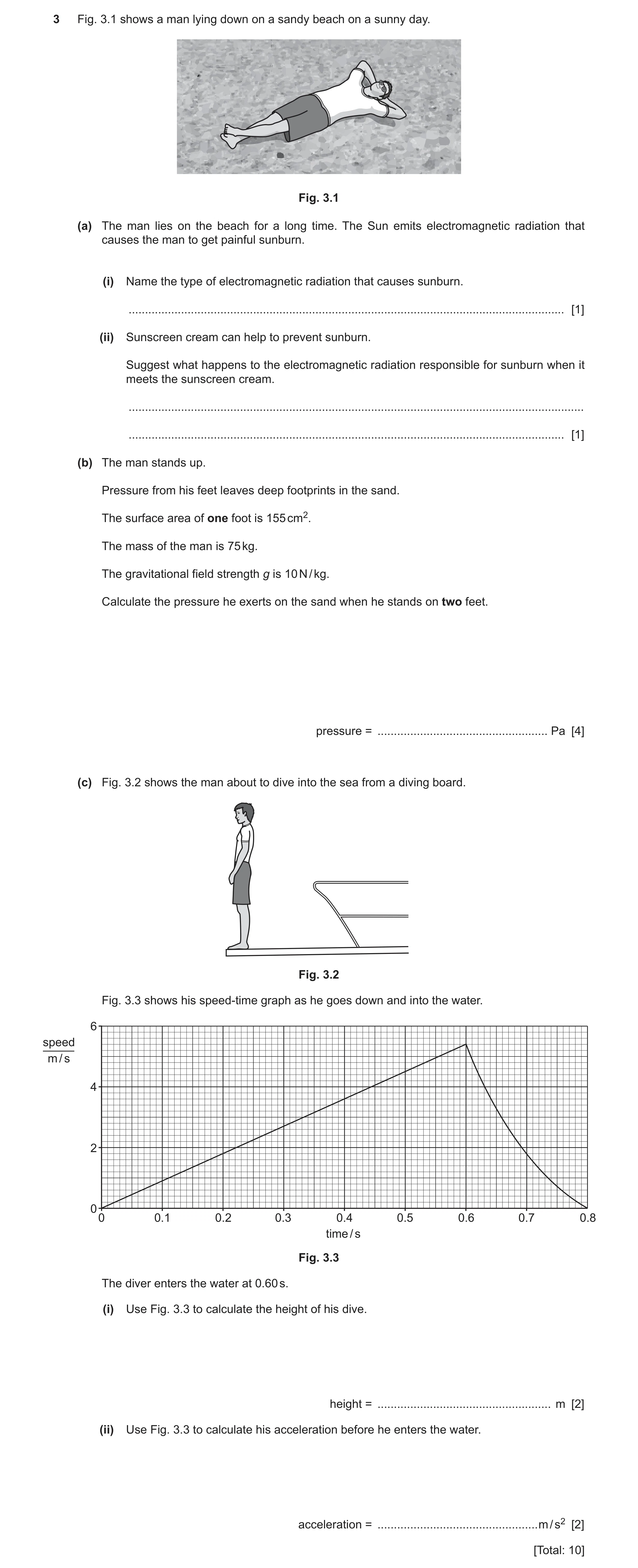
3 Fig. 3.1 shows a man lying down on a sandy beach on a sunny day. Fig. 3.1 (a) The man lies on the beach for a long time. The Sun emits electromagnetic radiation that causes the man to get painful sunburn. (i) Name the type of electromagnetic radiation that causes sunburn. … [1] (ii) Sunscreen cream can help to prevent sunburn. Suggest what happens to the electromagnetic radiation responsible for sunburn when it meets the sunscreen cream. … … [1] (b) The man stands up. Pressure from his feet leaves deep footprints in the sand. The surface area of one foot is 155 cm2. The mass of the man is 75 kg. The gravitational field strength g is 10 N / kg. Calculate the pressure he exerts on the sand when he stands on two feet. pressure = … Pa [4] (c) Fig. 3.2 shows the man about to dive into the sea from a diving board. Fig. 3.2 Fig. 3.3 shows his speed-time graph as he goes down and into the water. 6 speed m / s 4 2 0 0 0.1 0.2 0.3 0.4 0.5 0.6 0.7 0.8 time / s Fig. 3.3 The diver enters the water at 0.60 s. (i) Use Fig. 3.3 to calculate the height of his dive. height = … m [2] (ii) Use Fig. 3.3 to calculate his acceleration before he enters the water. acceleration = … m / s2 [2] [Total: 10]
10 marks
Mark scheme: 3(a)(i) ultraviolet ; 1 3(a)(ii) reflected / absorbed (by sunscreen) ; 1 3(b) p = F / A ; A = 2 ×155 (= 310) cm2 = 0.031 m2 ; F = mg = 75 × 10 = 750 N ; p = 750 / 0.031 = 24 194 / 24 200 (Pa) ; 4 3(c)(i) height = area under graph = ½ × 0.60 × 5.4 ; = 1.6(2) (m) ; 2 3(c)(ii) acceleration = change in speed / time = 5.4 / 0.60 ; = 9.0 (m / s2) ; 2
This question in 0653/43 May/June 2021
Q12 · A thin converging lens 0653/42 Feb/March 2022
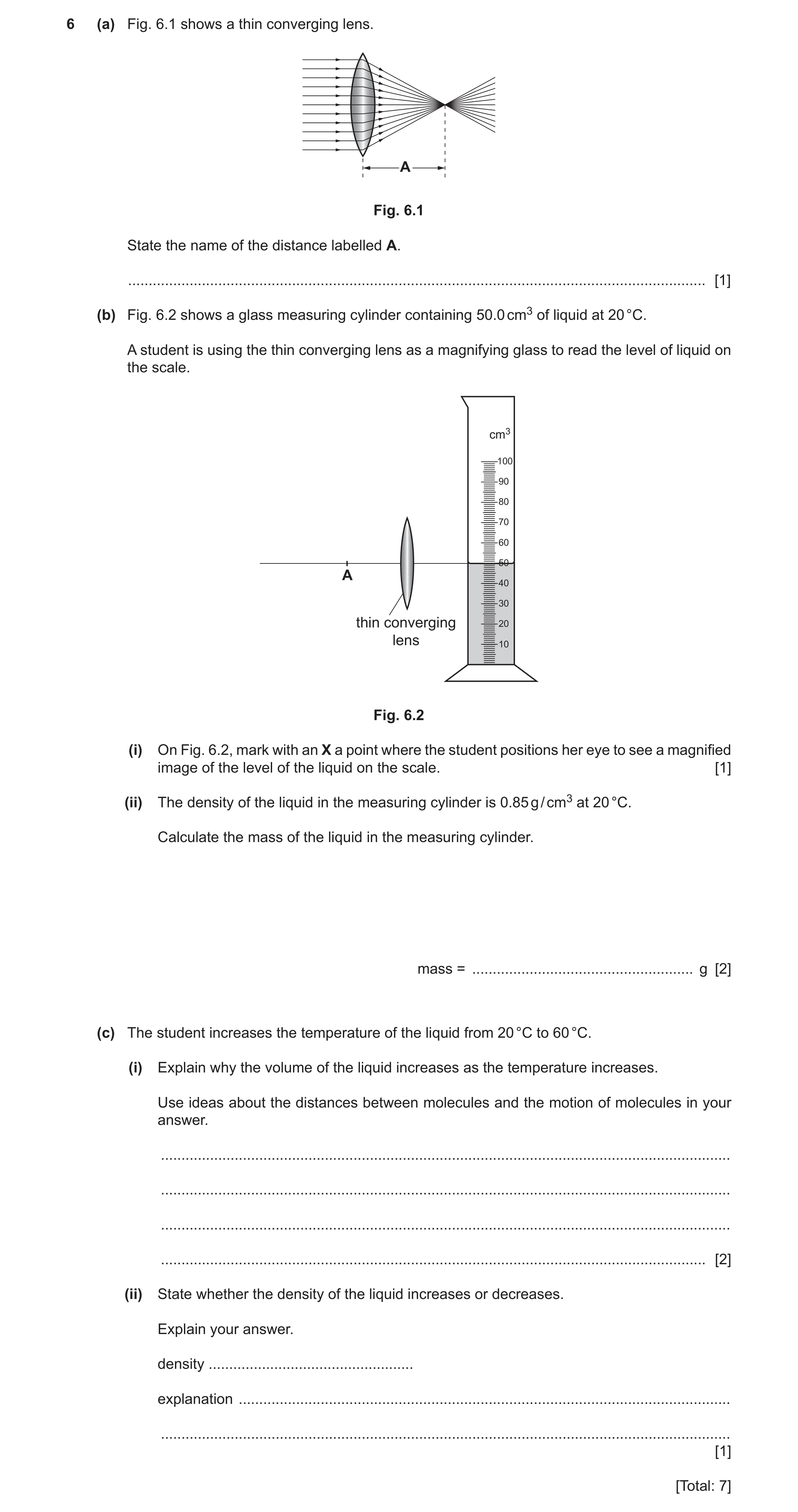
6 (a) Fig. 6.1 shows a thin converging lens. A Fig. 6.1 State the name of the distance labelled A. … [1] (b) Fig. 6.2 shows a glass measuring cylinder containing 50.0 cm3 of liquid at 20 °C. A student is using the thin converging lens as a magnifying glass to read the level of liquid on the scale. cm3 100 90 80 70 60 50 A 40 30 thin converging 20 lens 10 Fig. 6.2 (i) On Fig. 6.2, mark with an X a point where the student positions her eye to see a magnified image of the level of the liquid on the scale. [1] (ii) The density of the liquid in the measuring cylinder is 0.85 g / cm3 at 20 °C. Calculate the mass of the liquid in the measuring cylinder. mass = … g [2] (c) The student increases the temperature of the liquid from 20 °C to 60 °C. (i) Explain why the volume of the liquid increases as the temperature increases. Use ideas about the distances between molecules and the motion of molecules in your answer. … … … … [2] (ii) State whether the density of the liquid increases or decreases. Explain your answer. density … explanation … … [1] [Total: 7]
7 marks
Mark scheme: 6(a) focal length ; 1 6(b)(i) X located between A and lens ; 1 6(b)(ii) density = mass ÷ volume (in any form) / m = V × ρ = 50.0 × 0.85 ; 42.5 (g) ; 2 6(c)(i) kinetic energy of molecules increases ; distance between molecules increases / molecules further apart ; 2 6(c)(ii) (decreases – no mark) higher volume but same mass / the idea that m ÷ V decreases ; 1
This question in 0653/42 Feb/March 2022
Q13 · The Earth is heated by infrared radiation from the Sun 0653/41 May/June 2022
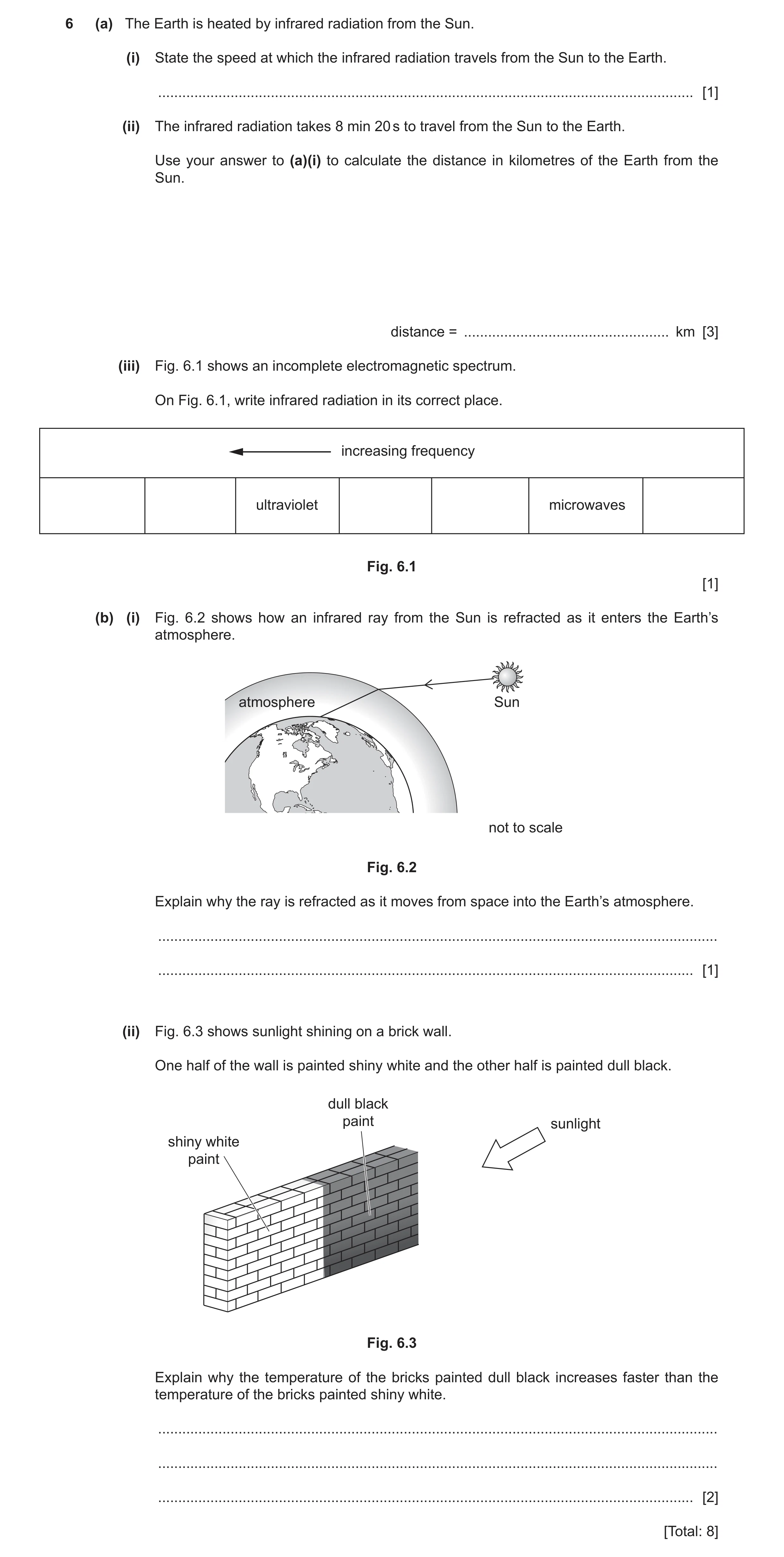
6 (a) The Earth is heated by infrared radiation from the Sun. (i) State the speed at which the infrared radiation travels from the Sun to the Earth. … [1] (ii) The infrared radiation takes 8 min 20 s to travel from the Sun to the Earth. Use your answer to (a)(i) to calculate the distance in kilometres of the Earth from the Sun. distance = … km [3] (iii) Fig. 6.1 shows an incomplete electromagnetic spectrum. On Fig. 6.1, write infrared radiation in its correct place. increasing frequency ultraviolet microwaves Fig. 6.1 [1] (b) (i) Fig. 6.2 shows how an infrared ray from the Sun is refracted as it enters the Earth’s atmosphere. atmosphere Sun not to scale Fig. 6.2 Explain why the ray is refracted as it moves from space into the Earth’s atmosphere. … … [1] (ii) Fig. 6.3 shows sunlight shining on a brick wall. One half of the wall is painted shiny white and the other half is painted dull black. dull black paint sunlight shiny white paint Fig. 6.3 Explain why the temperature of the bricks painted dull black increases faster than the temperature of the bricks painted shiny white. … … … [2] [Total: 8]
8 marks
Mark scheme: 6(a)(i) 1 6(a)(ii) speed = distance/time (in any form) ; 8 minutes 20 secs = (8 60 + 20) = 500 s OR speed = 3 105 km / s ; distance = 3 105 500 = 150 106 (km) / 1.5 108 km ; 3 6(a)(iii) (ultraviolet) infrared ; (microwaves) 1 6(b)(i) change in density (of the medium) / change in speed (of wave) ; 1 Question Answer Marks 6(b)(ii) radiation / heat / light reflected by shiny / white / absorbed by dull/black ; dull/black absorbs more radiation (than the shiny / white) ; 2
This question in 0653/41 May/June 2022
Q14 · A house in the Himalayan mountain range 0653/42 Feb/March 2023
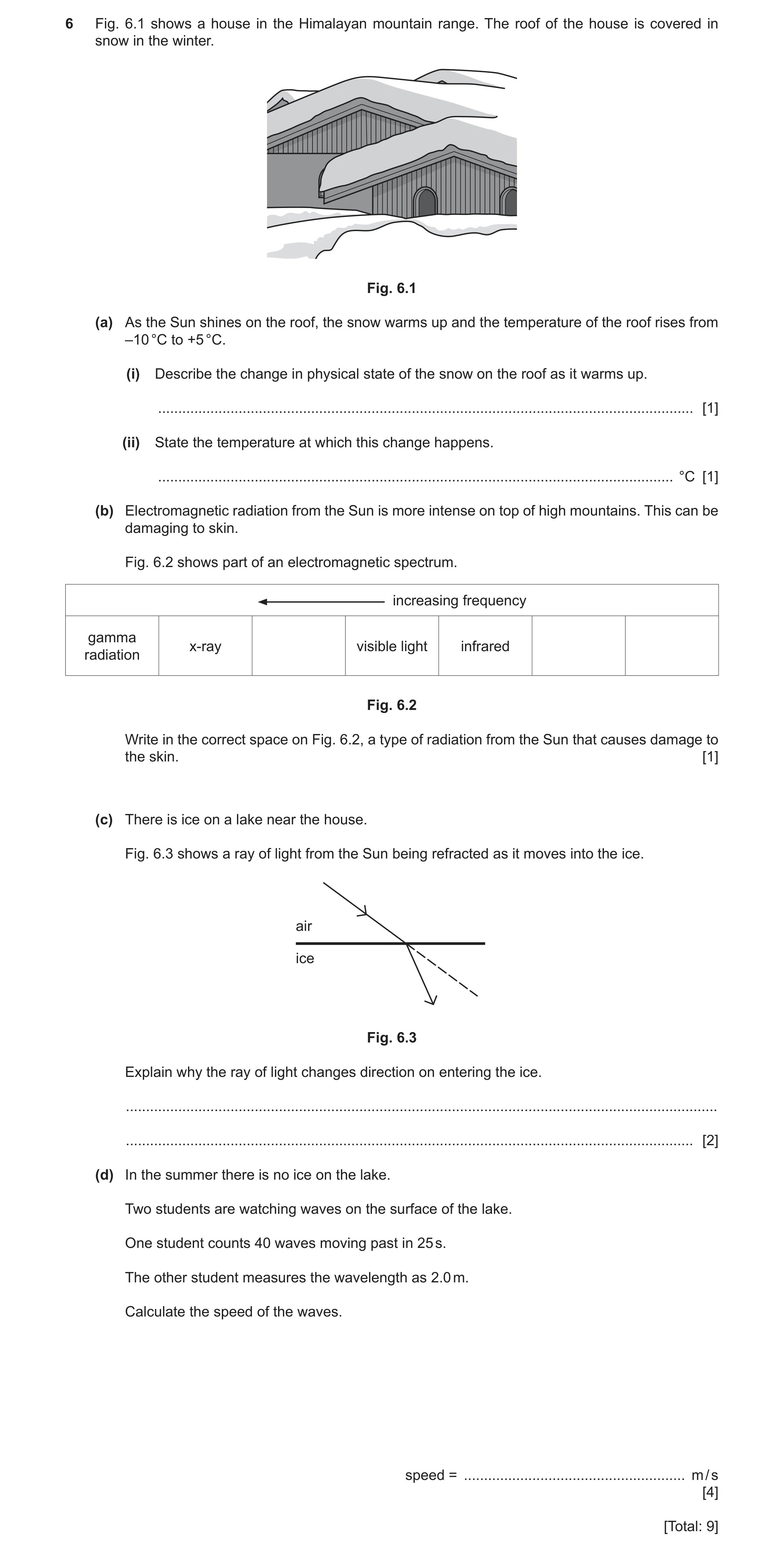
6 Fig. 6.1 shows a house in the Himalayan mountain range. The roof of the house is covered in snow in the winter. Fig. 6.1 (a) As the Sun shines on the roof, the snow warms up and the temperature of the roof rises from –10 °C to +5 °C. (i) Describe the change in physical state of the snow on the roof as it warms up. … [1] (ii) State the temperature at which this change happens. … °C [1] (b) Electromagnetic radiation from the Sun is more intense on top of high mountains. This can be damaging to skin. Fig. 6.2 shows part of an electromagnetic spectrum. increasing frequency gamma x-ray visible light infrared radiation Fig. 6.2 Write in the correct space on Fig. 6.2, a type of radiation from the Sun that causes damage to the skin. [1] (c) There is ice on a lake near the house. Fig. 6.3 shows a ray of light from the Sun being refracted as it moves into the ice. air ice Fig. 6.3 Explain why the ray of light changes direction on entering the ice. … … [2] (d) In the summer there is no ice on the lake. Two students are watching waves on the surface of the lake. One student counts 40 waves moving past in 25 s. The other student measures the wavelength as 2.0 m. Calculate the speed of the waves. speed = … m / s [4] [Total: 9]
9 marks
Mark scheme: 6(a)(i) solid to liquid / it melts ; 1 6(a)(ii) 0 (°C) ; 1 6(b) ultraviolet / UV in correct position ; 1 e.g., gamma x-ray ultraviolet visible light infrared radiation 6(c) speed of light, changes / decreases ; 2 ray moves into a, different / denser medium ; 6(d) frequency = number of waves time / 40 25 ; 4 1.6 (Hz) ; v = f / 1.6 2 ; 3.2 (m / s) ;
This question in 0653/42 Feb/March 2023
Q15 · A student using a laptop computer 0653/41 May/June 2023
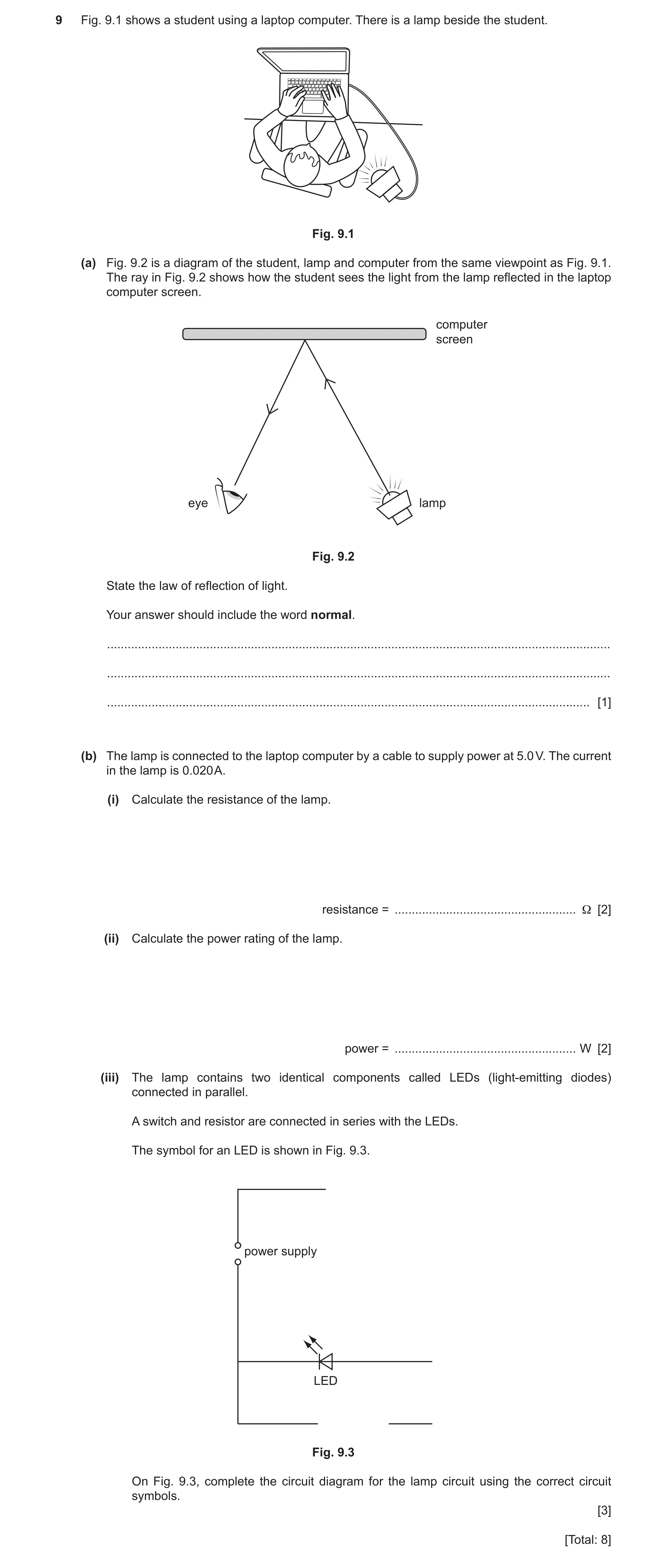
9 Fig. 9.1 shows a student using a laptop computer. There is a lamp beside the student. Fig. 9.1 (a) Fig. 9.2 is a diagram of the student, lamp and computer from the same viewpoint as Fig. 9.1. The ray in Fig. 9.2 shows how the student sees the light from the lamp reflected in the laptop computer screen. computer screen eye lamp Fig. 9.2 State the law of reflection of light. Your answer should include the word normal. … … … [1] (b) The lamp is connected to the laptop computer by a cable to supply power at 5.0 V. The current in the lamp is 0.020 A. (i) Calculate the resistance of the lamp. resistance = … Ω [2] (ii) Calculate the power rating of the lamp. power = … W [2] (iii) The lamp contains two identical components called LEDs (light-emitting diodes) connected in parallel. A switch and resistor are connected in series with the LEDs. The symbol for an LED is shown in Fig. 9.3. power supply LED Fig. 9.3 On Fig. 9.3, complete the circuit diagram for the lamp circuit using the correct circuit symbols. [3] [Total: 8]
8 marks
Mark scheme: 9(a) angle of incidence = angle of reflection AND angles measured to the normal ; 1 9(b)(i) resistance = voltage current (stated or evidence of use) / 5 0.020 ; 250 () ; 2 9(b)(ii) P = I V (stated or evidence of use) / (P = ) 0.020 5.0 ; 0.1(0) (W) ; 2 9(b)(iii) LEDs in parallel, using LED symbol provided ; circuit symbol for resistor and switch ; resistor and switch in main circuit, circuit completed with no additional components or extra wiring causing a short circuit ; 3
This question in 0653/41 May/June 2023
Q16 · A speed–time graph for a car on a journey along a road 0653/42 May/June 2023
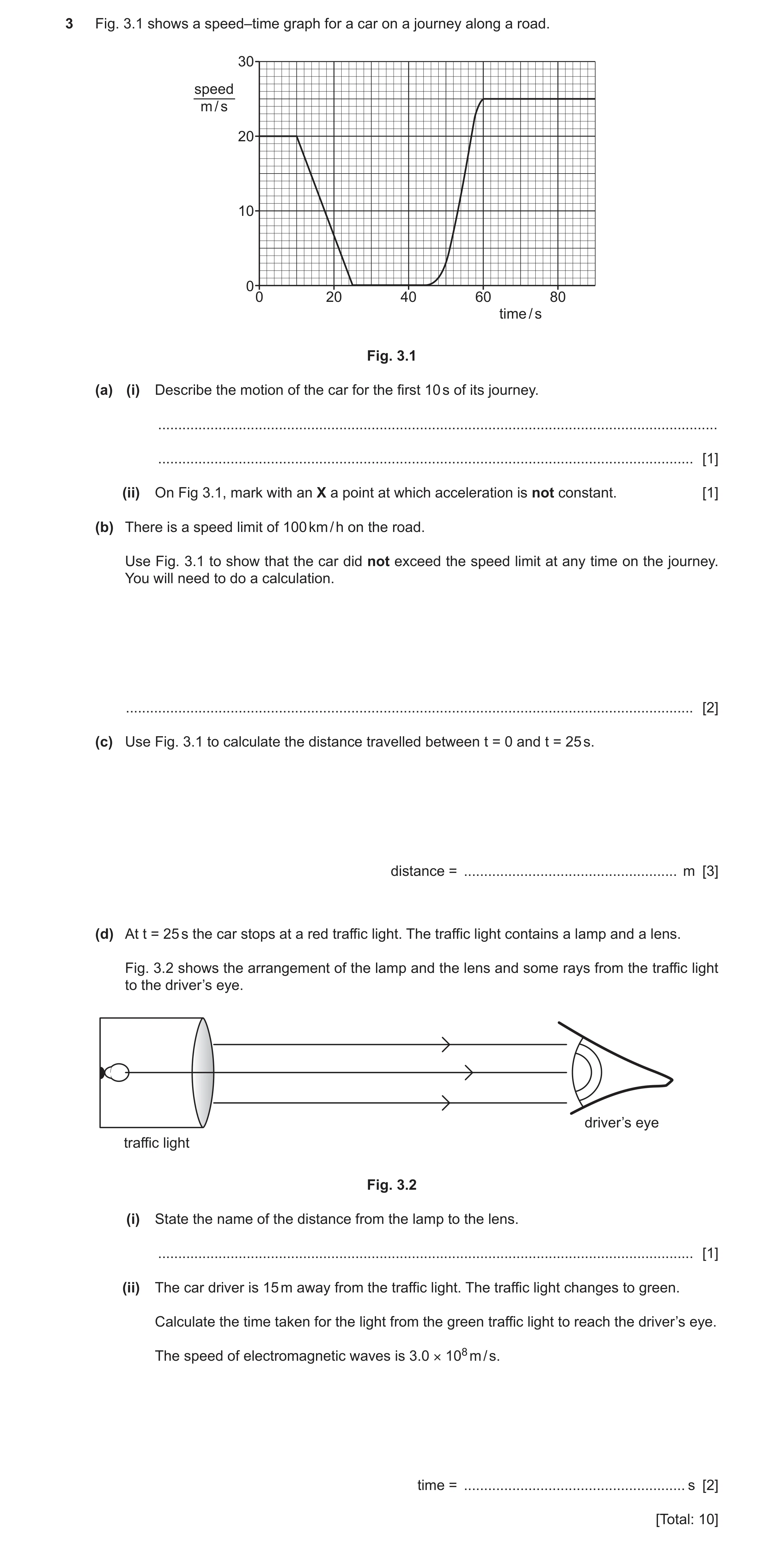
3 Fig. 3.1 shows a speed–time graph for a car on a journey along a road. 30 speed m / s 20 10 00 20 40 60 80 time / s Fig. 3.1 (a) (i) Describe the motion of the car for the first 10 s of its journey. … … [1] (ii) On Fig 3.1, mark with an X a point at which acceleration is not constant. [1] (b) There is a speed limit of 100 km / h on the road. Use Fig. 3.1 to show that the car did not exceed the speed limit at any time on the journey. You will need to do a calculation. … [2] (c) Use Fig. 3.1 to calculate the distance travelled between t = 0 and t = 25 s. distance = … m [3] (d) At t = 25 s the car stops at a red traffic light. The traffic light contains a lamp and a lens. Fig. 3.2 shows the arrangement of the lamp and the lens and some rays from the traffic light to the driver’s eye. driver’s eye traffic light Fig. 3.2 (i) State the name of the distance from the lamp to the lens. … [1] (ii) The car driver is 15 m away from the traffic light. The traffic light changes to green. Calculate the time taken for the light from the green traffic light to reach the driver’s eye. The speed of electromagnetic waves is 3.0 × 10⁸ m / s. time = … s [2] [Total: 10]
10 marks
Mark scheme: 3(a)(i) at constant speed / at 20 m / s ; 1 3(a)(ii) X at top / bottom of line between t = 45 s and t = 50 s / between t = 58 s and t = 60 s ; 1 3(b) max speed of car = 25 m / s ; (unit conversions) 100 1000 3600 / 27.8 m / s (so limit not broken) ; OR max speed of car = 25 m / s ; (unit conversions) 25 3600 1000 / 90 km / h (less than 100 km / h (so limit not broken) ; 2 3(c) use of area under graph (stated or evidence) ; (implementation): 20 10 ½ 20 15 ; 350 (m) ; 3 3(d)(i) focal length ; 1 3(d)(ii) speed = distance time (stated or evidence of use) / t = 15 3 108 ; 5(.0) 10-8 (s) ; 2
This question in 0653/42 May/June 2023
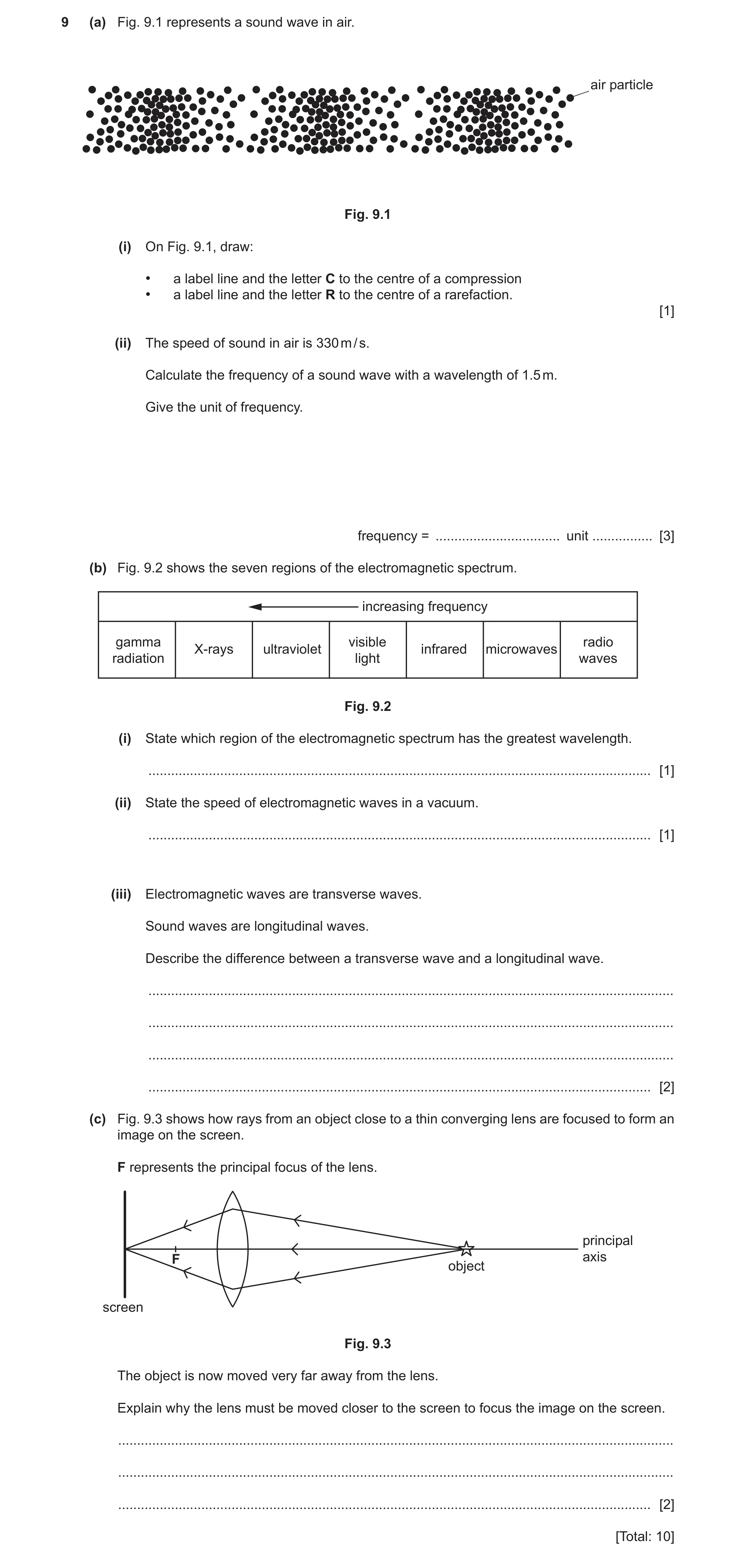
Q17 · A sound wave in air 0653/41 Oct/Nov 2023
9 (a) Fig. 9.1 represents a sound wave in air. air particle Fig. 9.1 (i) On Fig. 9.1, draw: • a label line and the letter C to the centre of a compression • a label line and the letter R to the centre of a rarefaction. [1] (ii) The speed of sound in air is 330 m / s. Calculate the frequency of a sound wave with a wavelength of 1.5 m. Give the unit of frequency. frequency = … unit … [3] (b) Fig. 9.2 shows the seven regions of the electromagnetic spectrum. increasing frequency gamma visible radio X-rays ultraviolet infrared microwaves radiation light waves Fig. 9.2 (i) State which region of the electromagnetic spectrum has the greatest wavelength. … [1] (ii) State the speed of electromagnetic waves in a vacuum. … [1] (iii) Electromagnetic waves are transverse waves. Sound waves are longitudinal waves. Describe the difference between a transverse wave and a longitudinal wave. … … … … [2] (c) Fig. 9.3 shows how rays from an object close to a thin converging lens are focused to form an image on the screen. F represents the principal focus of the lens. principal F axis object screen Fig. 9.3 The object is now moved very far away from the lens. Explain why the lens must be moved closer to the screen to focus the image on the screen. … … … [2] [Total: 10]
10 marks
Mark scheme: 9(a)(i) compression correctly labelled with label line and letter C AND 1 rarefaction correctly labelled with label line and letter R ; 9(a)(ii) evidence of, v = f / 330 1.5 ; 3 220 ; Hz / hertz ; 9(b)(i) radio waves ; 1 9(b)(ii) 3.0 108 m / s ; 1 9(b)(iii) for longitudinal/sound waves, the direction of oscillation/vibration (of particles) is parallel to the (direction of) energy 2 transfer / AW ; for transverse/electromagnetic waves, the direction of oscillation/vibration (of particles) is perpendicular to the (direction of) energy transfer / AW ; 9(c) any two from: 2 incident rays now, parallel to axis / form a beam; idea that refracted rays now pass through, F / (principal) focus; lens must be moved so, (principal) focus / F, is, on / closer to, the screen (for focused image) ;
This question in 0653/41 Oct/Nov 2023
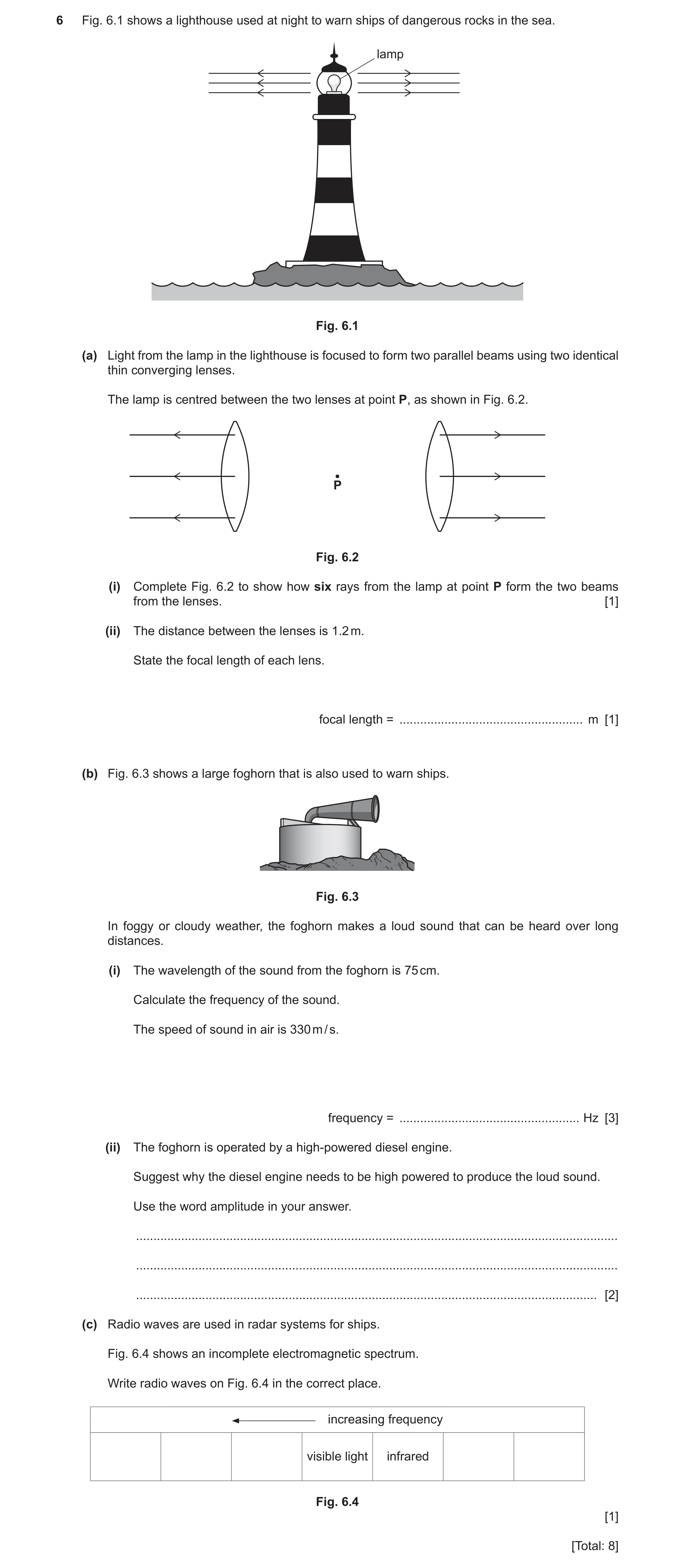
Q18 · A lighthouse used at night to warn ships of dangerous rocks in the sea 0653/42 Oct/Nov 2023
6 Fig. 6.1 shows a lighthouse used at night to warn ships of dangerous rocks in the sea. lamp Fig. 6.1 (a) Light from the lamp in the lighthouse is focused to form two parallel beams using two identical thin converging lenses. The lamp is centred between the two lenses at point P, as shown in Fig. 6.2. P Fig. 6.2 (i) Complete Fig. 6.2 to show how six rays from the lamp at point P form the two beams from the lenses. [1] (ii) The distance between the lenses is 1.2 m. State the focal length of each lens. focal length = … m [1] (b) Fig. 6.3 shows a large foghorn that is also used to warn ships. Fig. 6.3 In foggy or cloudy weather, the foghorn makes a loud sound that can be heard over long distances. (i) The wavelength of the sound from the foghorn is 75 cm. Calculate the frequency of the sound. The speed of sound in air is 330 m / s. frequency = … Hz [3] (ii) The foghorn is operated by a high-powered diesel engine. Suggest why the diesel engine needs to be high powered to produce the loud sound. Use the word amplitude in your answer. … … … [2] (c) Radio waves are used in radar systems for ships. Fig. 6.4 shows an incomplete electromagnetic spectrum. Write radio waves on Fig. 6.4 in the correct place. increasing frequency visible light infrared Fig. 6.4 [1] [Total: 8]
8 marks
Mark scheme: 6(a)(i) 1 all six emerging rays correctly linked back to principal focus at lamp ; 6(a)(ii) 0.6 (m) ; 1 6(b)(i) unit conversion cm to m ; 3 evidence of, v = f / 330 0.75 ; 440 (Hz) ; 6(b)(ii) (loud means) large amplitude ; 2 requires a lot of energy (from a powerful diesel engine) ; 6(c) 1 (visible (infrared) radio light) waves ;
This question in 0653/42 Oct/Nov 2023
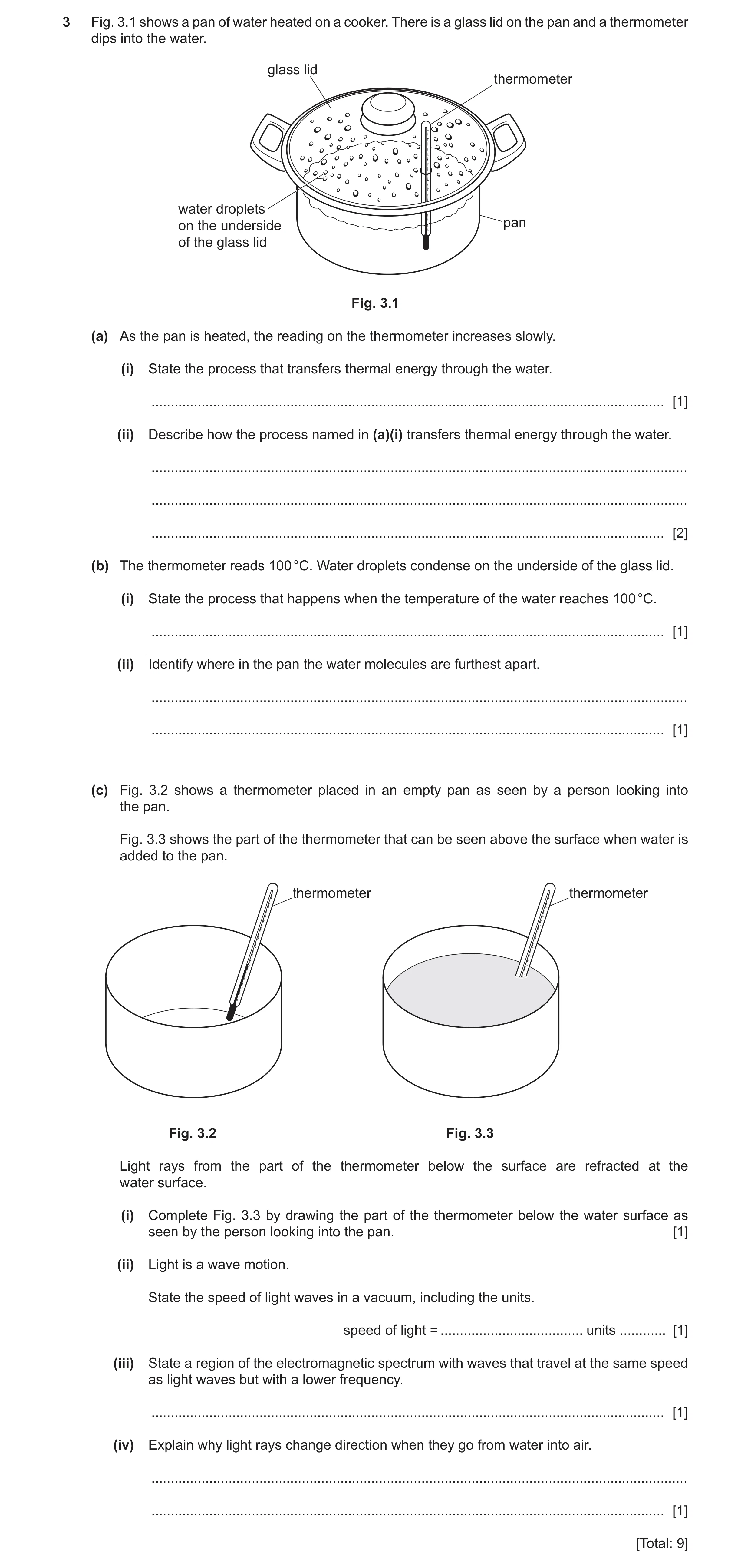
Q19 · A pan of water heated on a cooker 0653/41 May/June 2024
3 Fig. 3.1 shows a pan of water heated on a cooker. There is a glass lid on the pan and a thermometer dips into the water. glass lid thermometer water droplets on the underside pan of the glass lid Fig. 3.1 (a) As the pan is heated, the reading on the thermometer increases slowly. (i) State the process that transfers thermal energy through the water. … [1] (ii) Describe how the process named in (a)(i) transfers thermal energy through the water. … … … [2] (b) The thermometer reads 100 °C. Water droplets condense on the underside of the glass lid. (i) State the process that happens when the temperature of the water reaches 100 °C. … [1] (ii) Identify where in the pan the water molecules are furthest apart. … … [1] (c) Fig. 3.2 shows a thermometer placed in an empty pan as seen by a person looking into the pan. Fig. 3.3 shows the part of the thermometer that can be seen above the surface when water is added to the pan. thermometer thermometer Fig. 3.2 Fig. 3.3 Light rays from the part of the thermometer below the surface are refracted at the water surface. (i) Complete Fig. 3.3 by drawing the part of the thermometer below the water surface as seen by the person looking into the pan. [1] (ii) Light is a wave motion. State the speed of light waves in a vacuum, including the units. speed of light = … units … [1] (iii) State a region of the electromagnetic spectrum with waves that travel at the same speed as light waves but with a lower frequency. … [1] (iv) Explain why light rays change direction when they go from water into air. … … [1] [Total: 9]
9 marks
Mark scheme: 3(a)(i) convection ; 1 3(a)(ii) any two from: water expands on heating ; density decreases ; warmer / lower density, water rises ; 2 3(b)(i) boiling ; 1 3(b)(ii) in the air / vapour (above the boiling water) ; 1 3(c)(i) drawing of lower part of thermometer at an angle to the upper part AND angle bent shallower, but still below horizontal ; 1 3(c)(ii) 3 108 m / s / 3 105 km / s ; 1 3(c)(iii) infrared / microwave / radio ; 1 3(c)(iv) speed (of light) increases ; 1
This question in 0653/41 May/June 2024
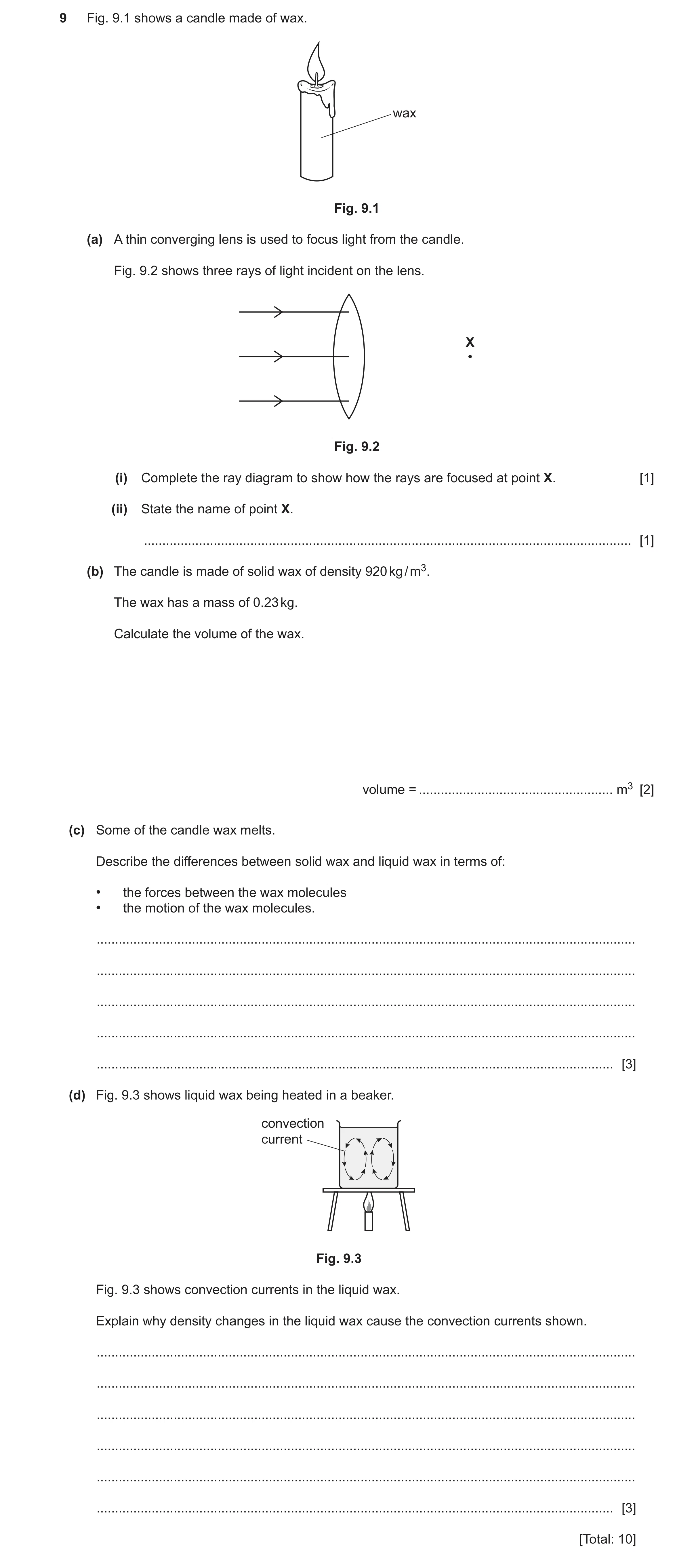
Q20 · A candle made of wax 0653/42 Oct/Nov 2024
9 Fig. 9.1 shows a candle made of wax. wax Fig. 9.1 (a) A thin converging lens is used to focus light from the candle. Fig. 9.2 shows three rays of light incident on the lens. X Fig. 9.2 (i) Complete the ray diagram to show how the rays are focused at point X. [1] (ii) State the name of point X. … [1] (b) The candle is made of solid wax of density 920 kg / m3. The wax has a mass of 0.23 kg. Calculate the volume of the wax. volume = … m3 [2] (c) Some of the candle wax melts. Describe the differences between solid wax and liquid wax in terms of: • the forces between the wax molecules • the motion of the wax molecules. … … … … … [3] (d) Fig. 9.3 shows liquid wax being heated in a beaker. convection current Fig. 9.3 Fig. 9.3 shows convection currents in the liquid wax. Explain why density changes in the liquid wax cause the convection currents shown. … … … … … … [3] [Total: 10]
10 marks
Mark scheme: 9(a)(i) continuation of the three straight rays to converge at X ; 1 9(a)(ii) focal point / (principal) focus ; 1 9(b) evidence of, = m ÷ V / 0.23 ÷ 920 ; 2 0.00025 / 2.5 10–4 (m3) ; 9(c) (intermolecular) forces are strong(er) in solid / weak(er) in liquid ; 3 molecules / they (only) vibrate, in solid ; molecules / they move around / move freely / flow / slide over each other, in liquid ; 9(d) any three from: 3 heated wax, expands / increases in volume / particles move further apart / ORA ; hot wax has lower density / cool wax has higher density ; hot wax rises ; cool wax sinks ;
This question in 0653/42 Oct/Nov 2024
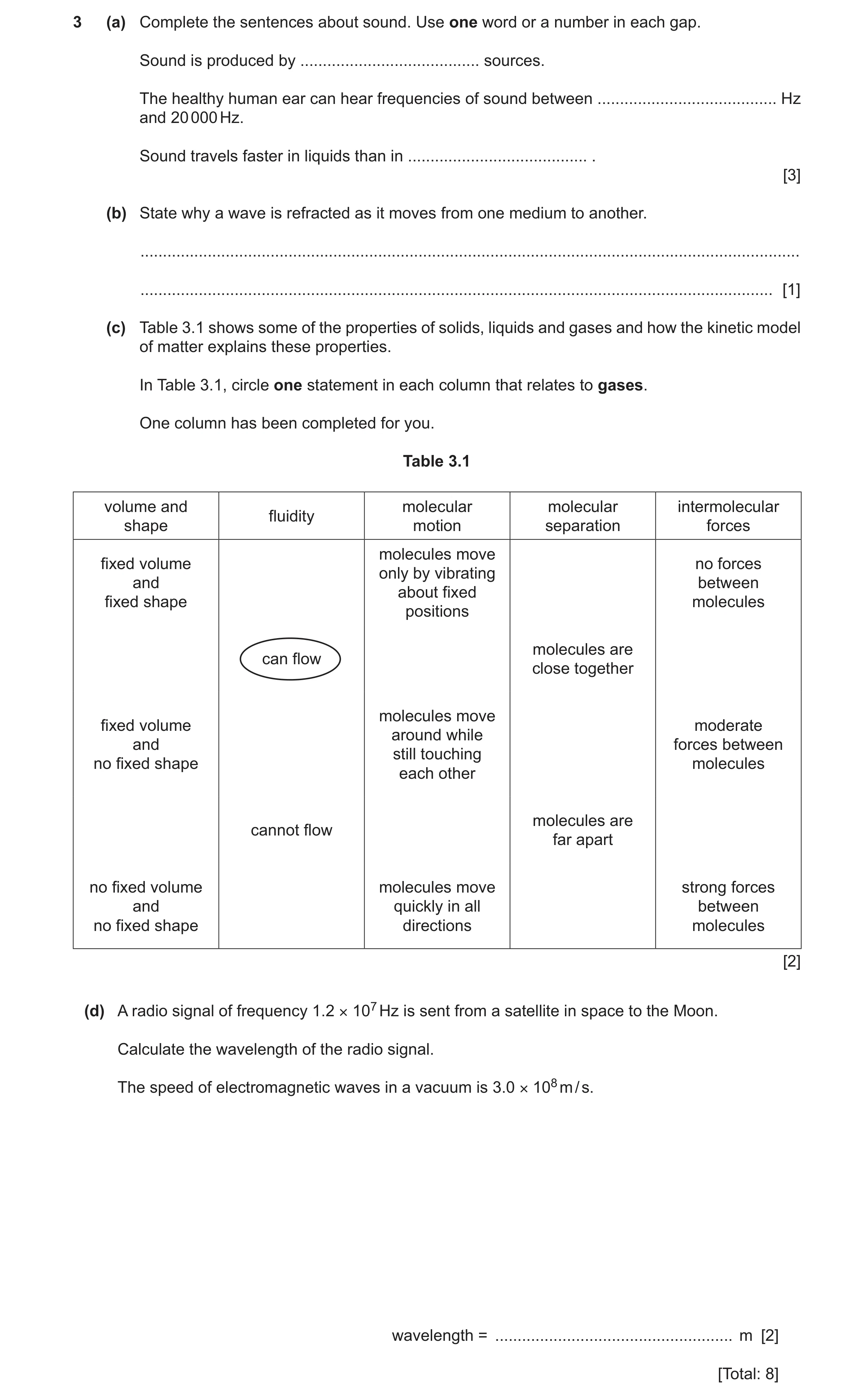
Q21 · Complete the sentences about sound 0653/43 Oct/Nov 2024
3 (a) Complete the sentences about sound. Use one word or a number in each gap. Sound is produced by … sources. The healthy human ear can hear frequencies of sound between … Hz and 20 000 Hz. Sound travels faster in liquids than in … . [3] (b) State why a wave is refracted as it moves from one medium to another. … … [1] (c) Table 3.1 shows some of the properties of solids, liquids and gases and how the kinetic model of matter explains these properties. In Table 3.1, circle one statement in each column that relates to gases. One column has been completed for you. Table 3.1 volume and molecular molecular intermolecular fluidity shape motion separation forces molecules move fixed volume no forces only by vibrating and between about fixed fixed shape molecules positions molecules are can flow close together molecules move fixed volume moderate around while and forces between still touching no fixed shape molecules each other molecules are cannot flow far apart no fixed volume molecules move strong forces and quickly in all between no fixed shape directions molecules [2] (d) A radio signal of frequency 1.2 × 10⁷ Hz is sent from a satellite in space to the Moon. Calculate the wavelength of the radio signal. The speed of electromagnetic waves in a vacuum is 3.0 × 10⁸ m / s. wavelength = … m [2] [Total: 8]
8 marks
Mark scheme: 3(a) vibrating ; 3 20 ; gases ; 3(b) (because of its) change in speed / different speeds ; 1 3(c) 2 two columns correct ; four columns correct ; 3(d) evidence of, v = f / 3.0 10 8 ÷ 1.2 10 7 ; 2 25 (m) ;
This question in 0653/43 Oct/Nov 2024
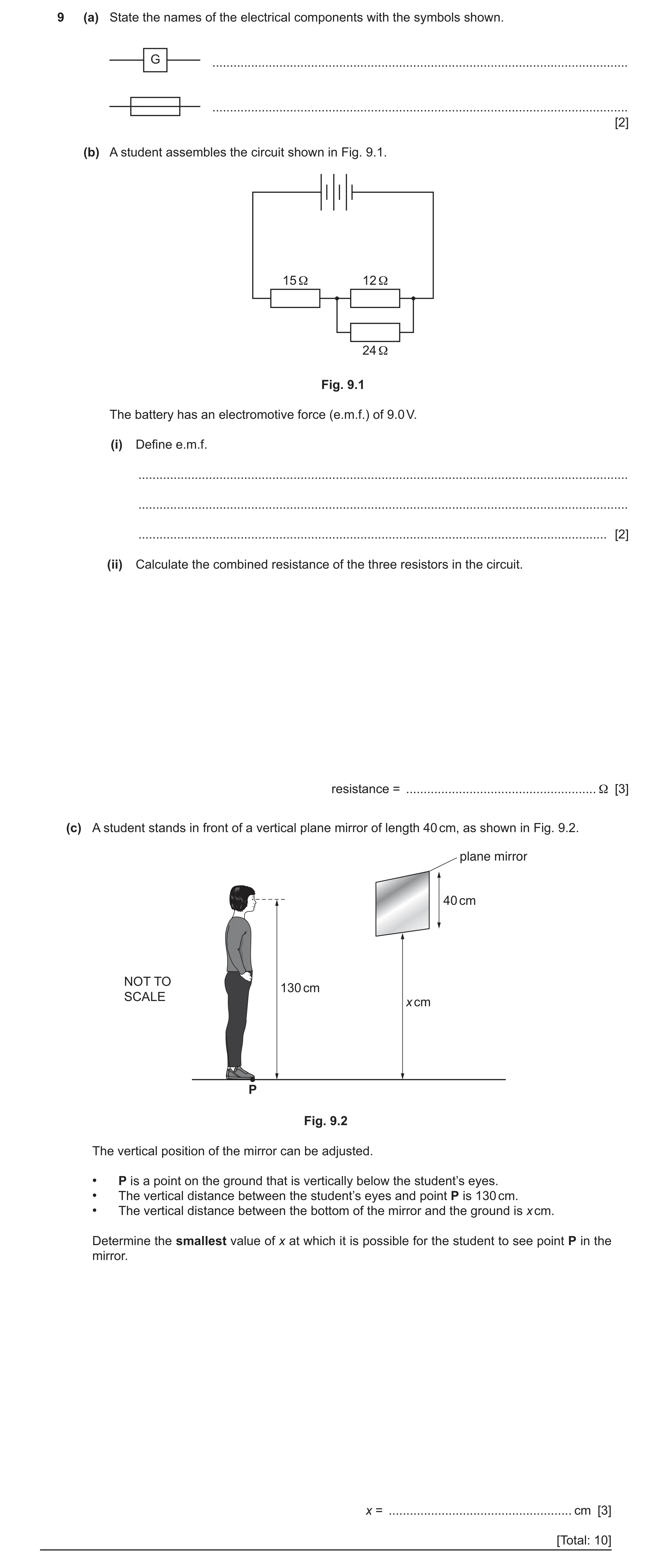
Q22 · State the names of the electrical components with the symbols shown 0653/42 Oct/Nov 2025
9 (a) State the names of the electrical components with the symbols shown. G … … [2] (b) A student assembles the circuit shown in Fig. 9.1. 15 Ω 12 Ω 24 Ω Fig. 9.1 The battery has an electromotive force (e.m.f.) of 9.0 V. (i) Define e.m.f. … … … [2] (ii) Calculate the combined resistance of the three resistors in the circuit. resistance = … Ω [3] (c) A student stands in front of a vertical plane mirror of length 40 cm, as shown in Fig. 9.2. plane mirror 40 cm NOT TO 130 cm SCALE x cm P Fig. 9.2 The vertical position of the mirror can be adjusted. • P is a point on the ground that is vertically below the student’s eyes. • The vertical distance between the student’s eyes and point P is 130 cm. • The vertical distance between the bottom of the mirror and the ground is x cm. Determine the smallest value of x at which it is possible for the student to see point P in the mirror. x = … cm [3] [Total: 10]
10 marks
Mark scheme: 9(a) generator ; 2 fuse; 9(b)(i) (electrical) work done (by a source) moving charge around a (complete) circuit ; 2 per unit charge / per coulomb ; 9(b)(ii) 1 1 1 1 1 R1 xR 2 12 x 24 288 3 = + / + OR OR OR ; R R1 R2 12 24 R1 + R 2 12 + 24 36 (Rparallel =) 8.0 () ; (combined resistance = 8.0 + 15 =) 23 () ; 9(c) evidence that reflection must occur at halfway point between eyes and 3 point P / 130 ÷ 2 / 65 ; adjustment for length of mirror / subtraction of 40 ; (x =) 25 (cm) ;
This question in 0653/42 Oct/Nov 2025
 8
8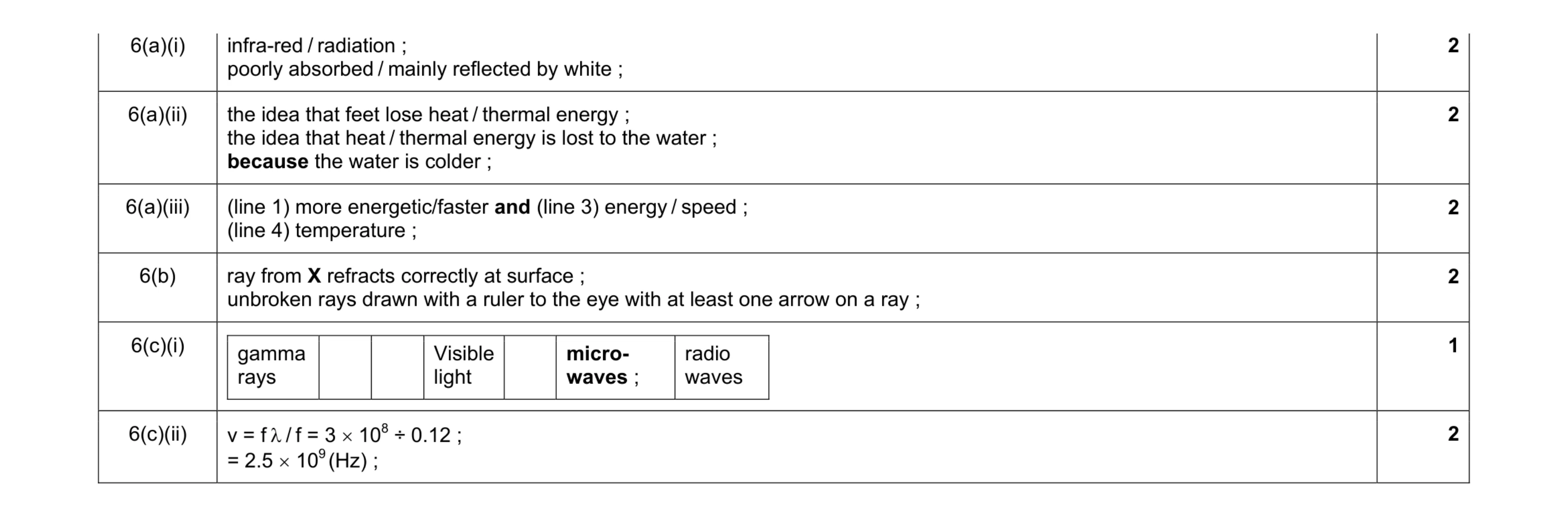 11
11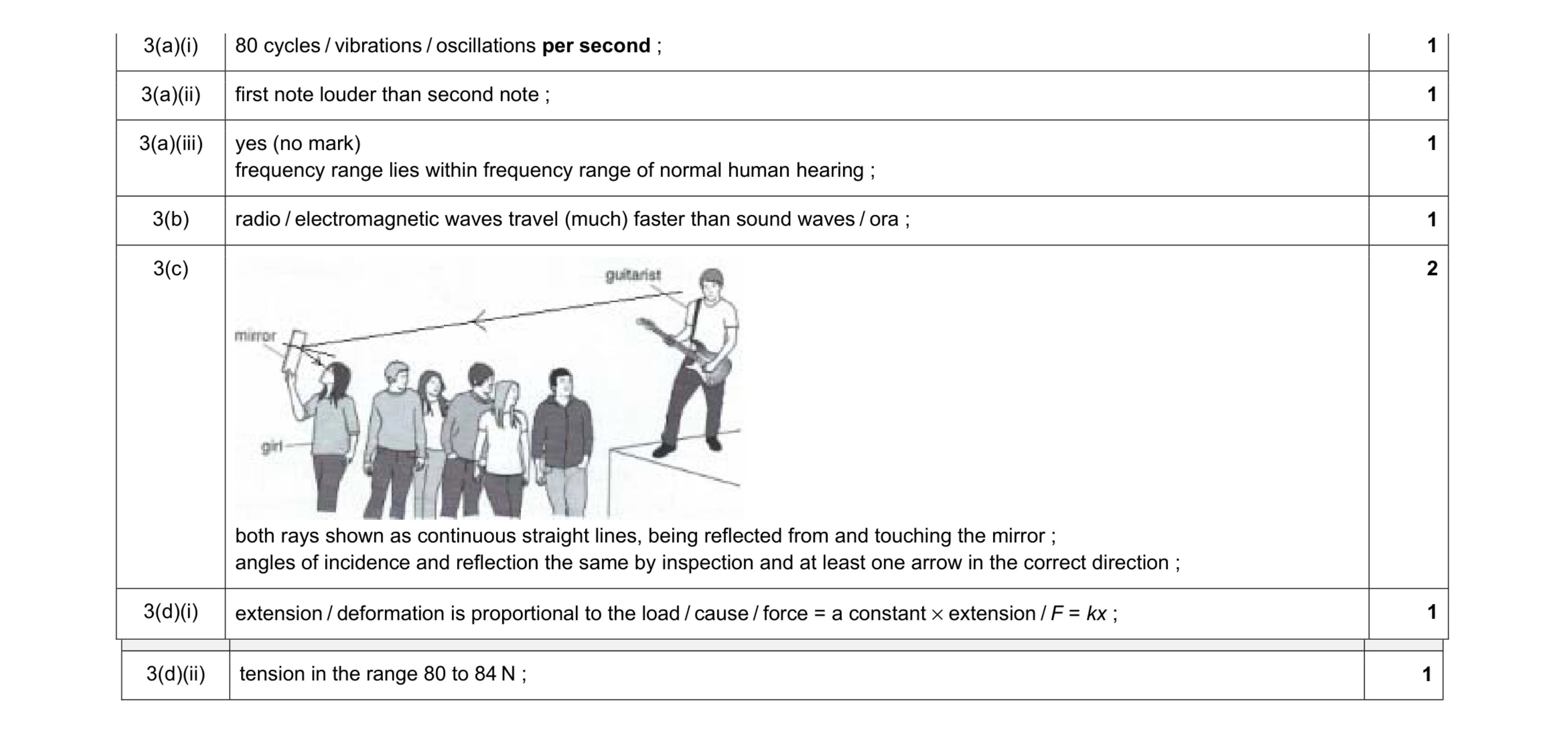 8
8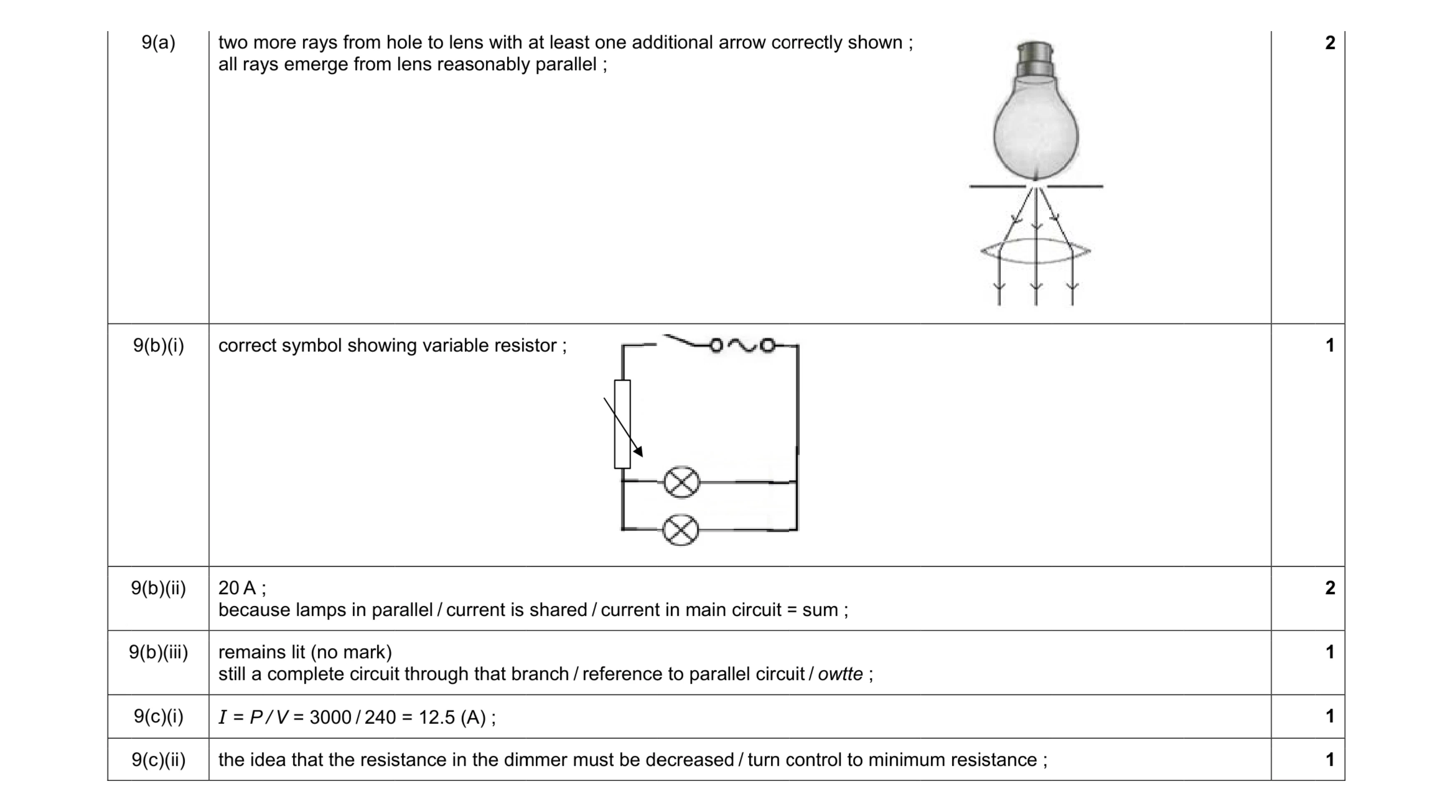 8
8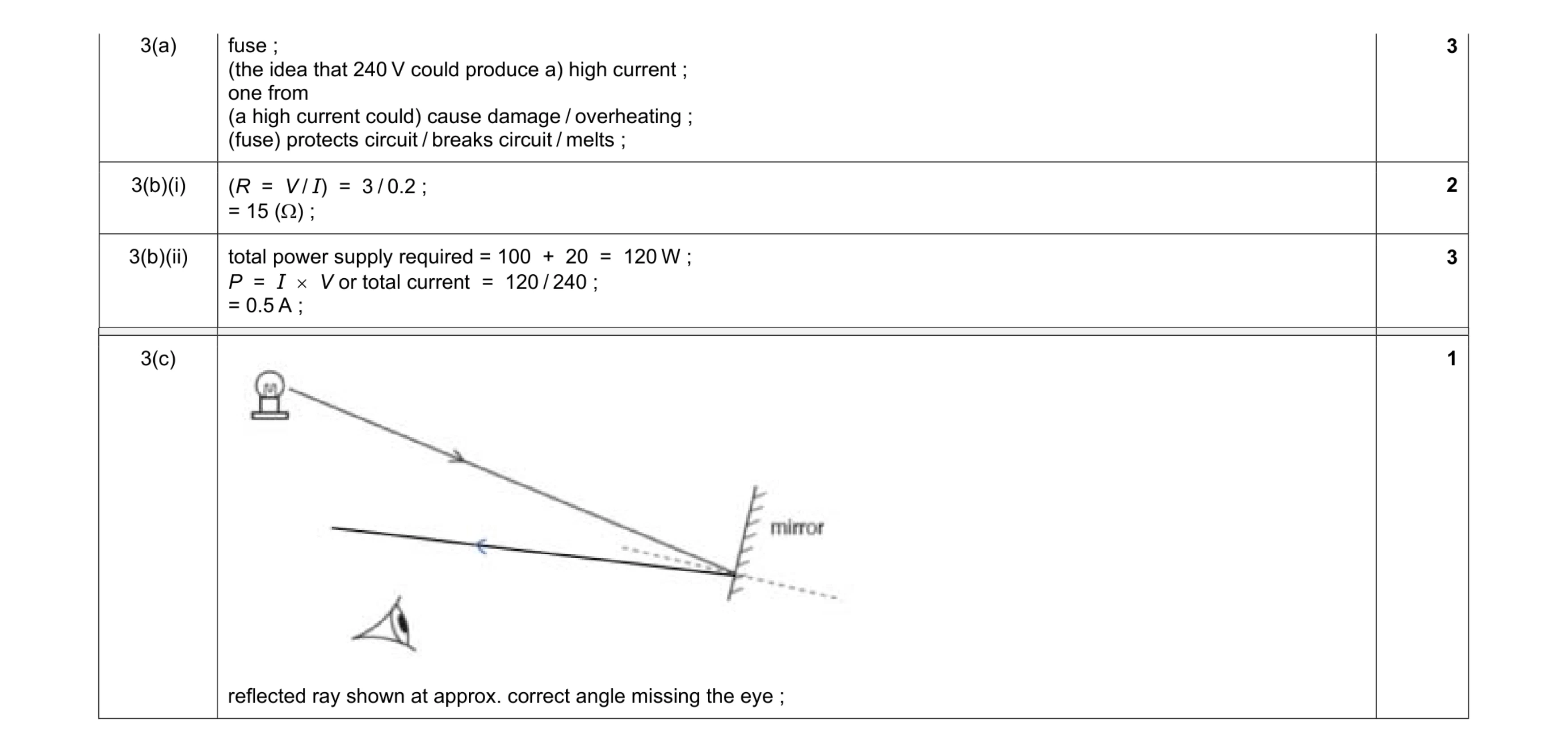 9
9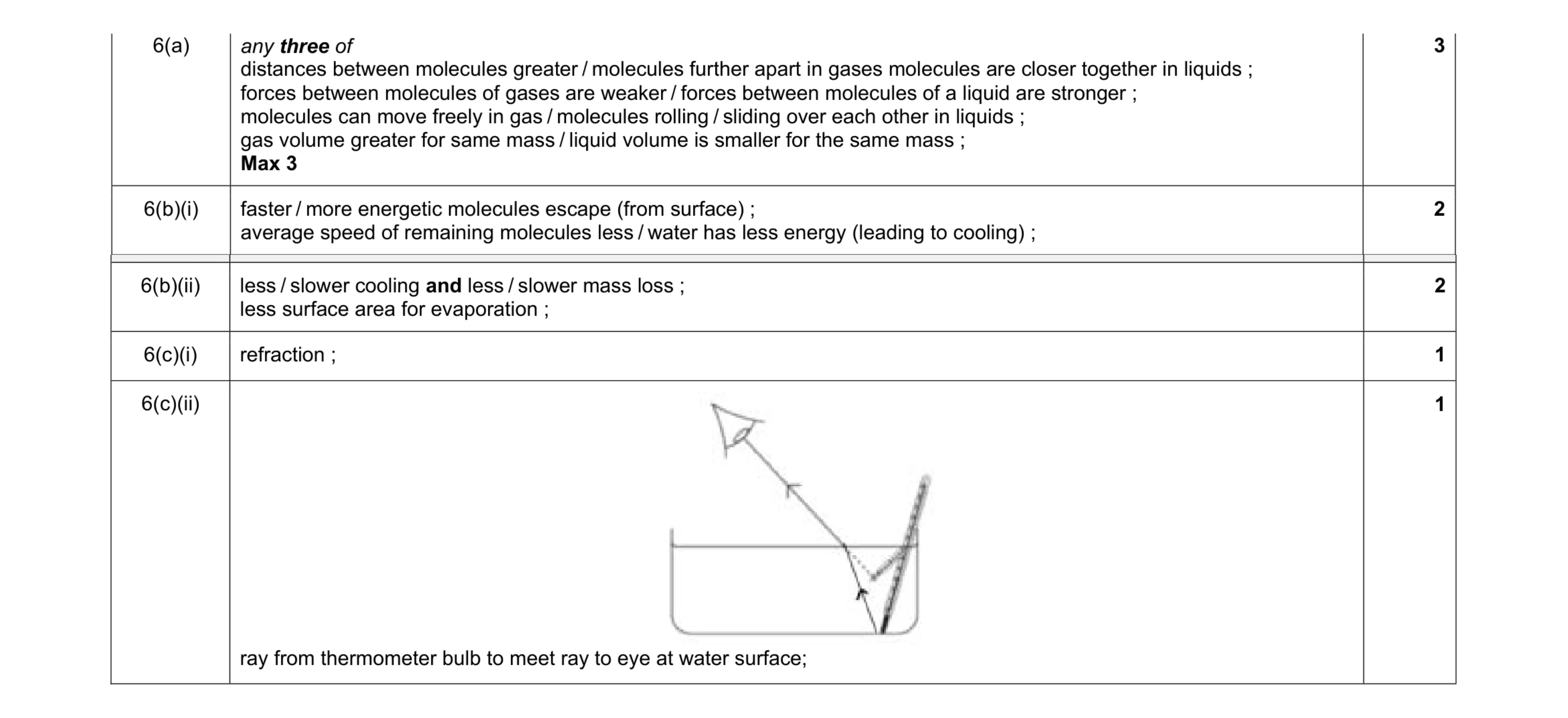 9
9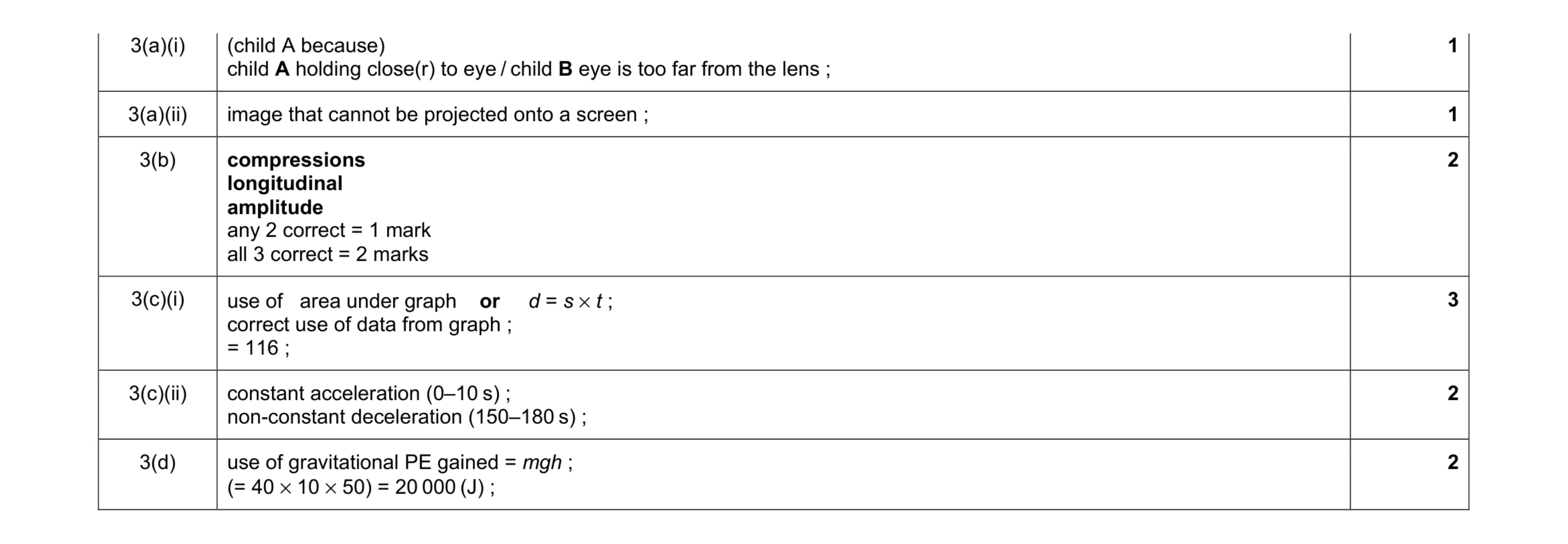 11
11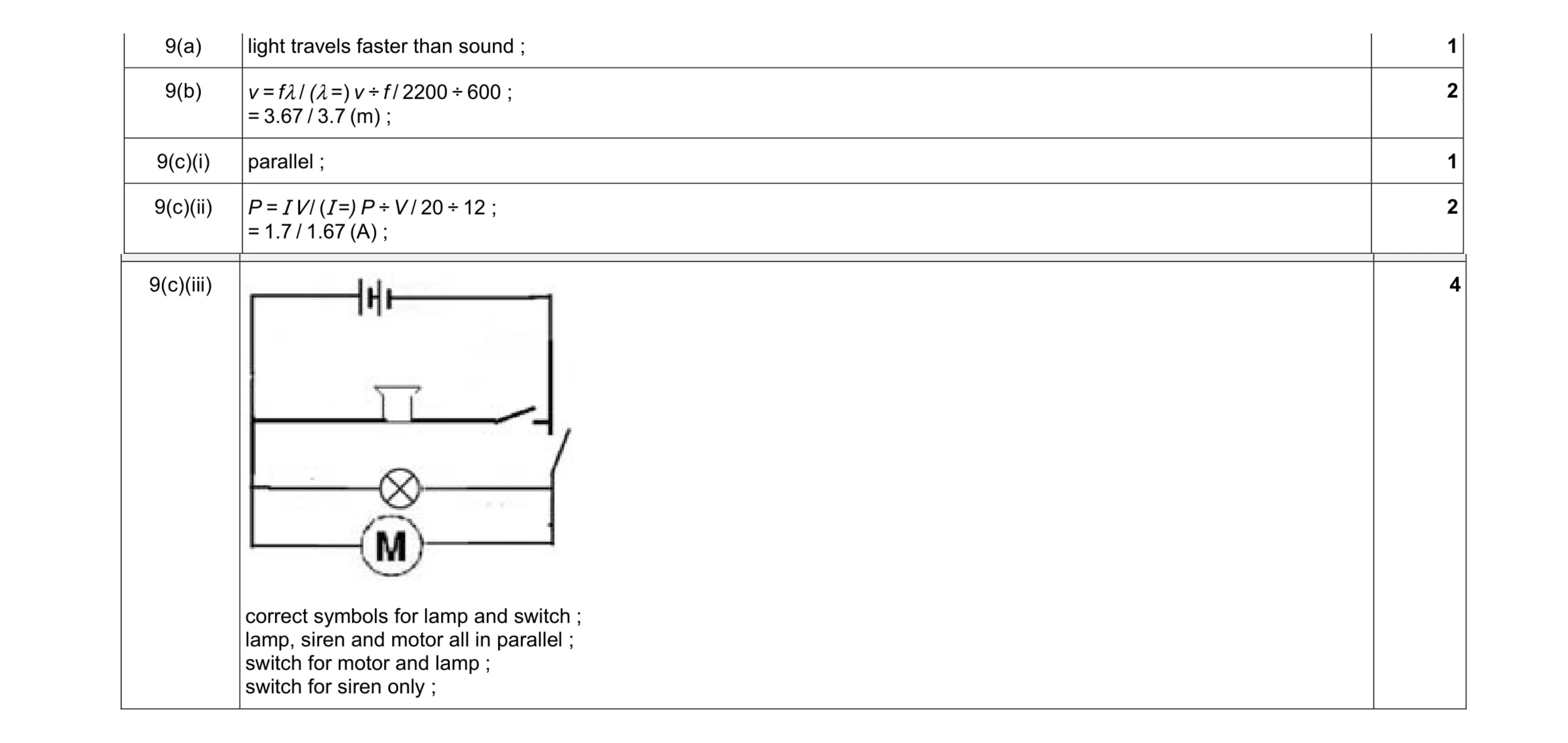 10
10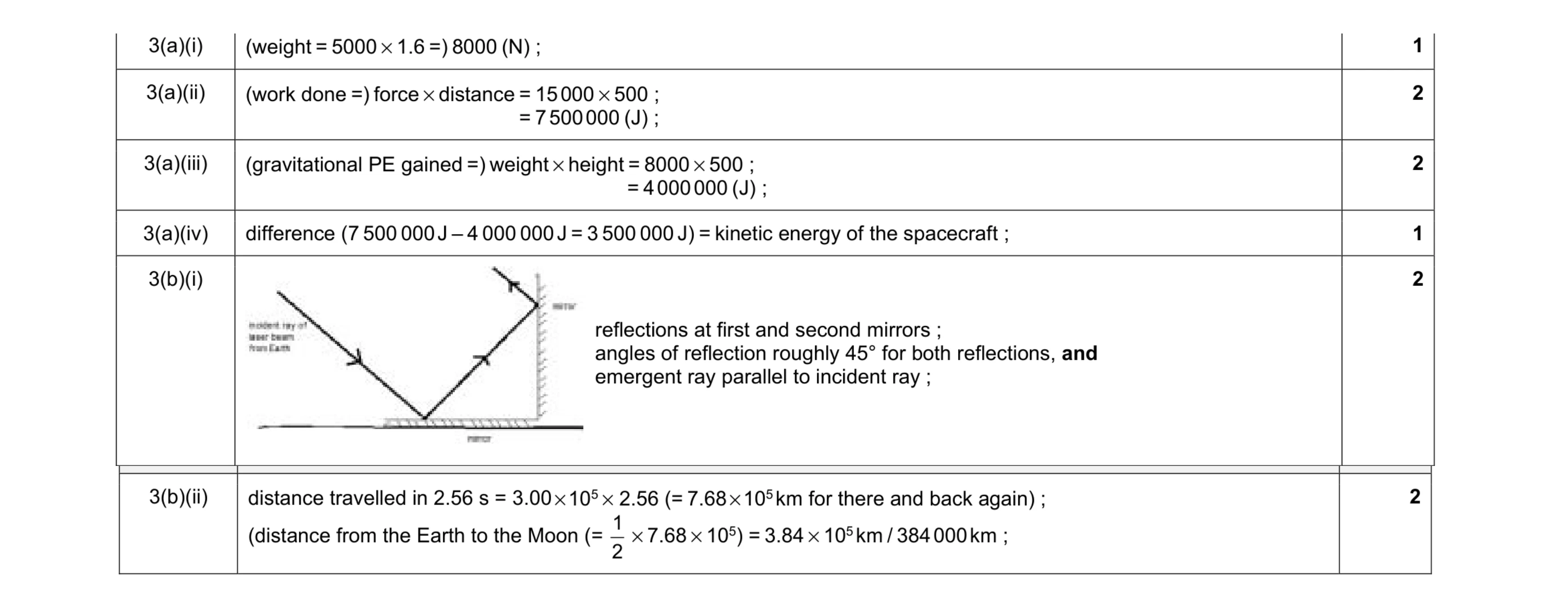 10
10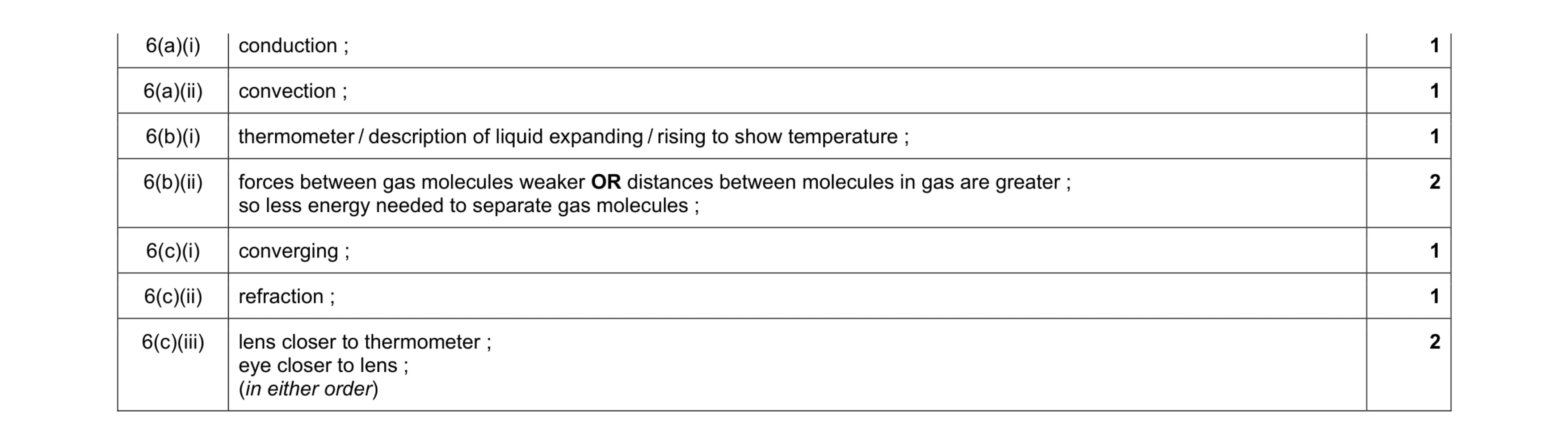 9
9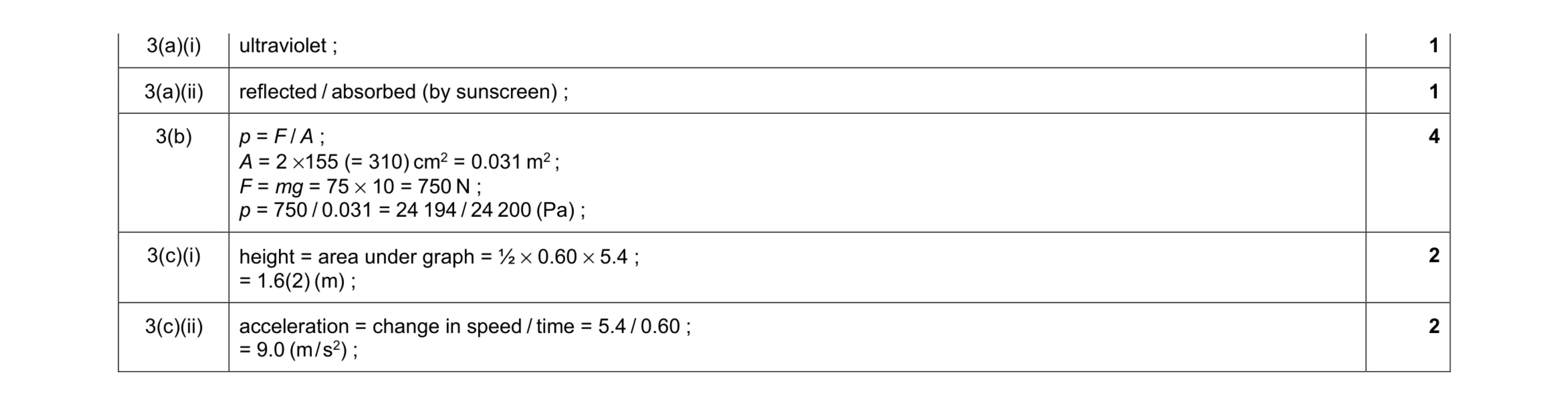 10
10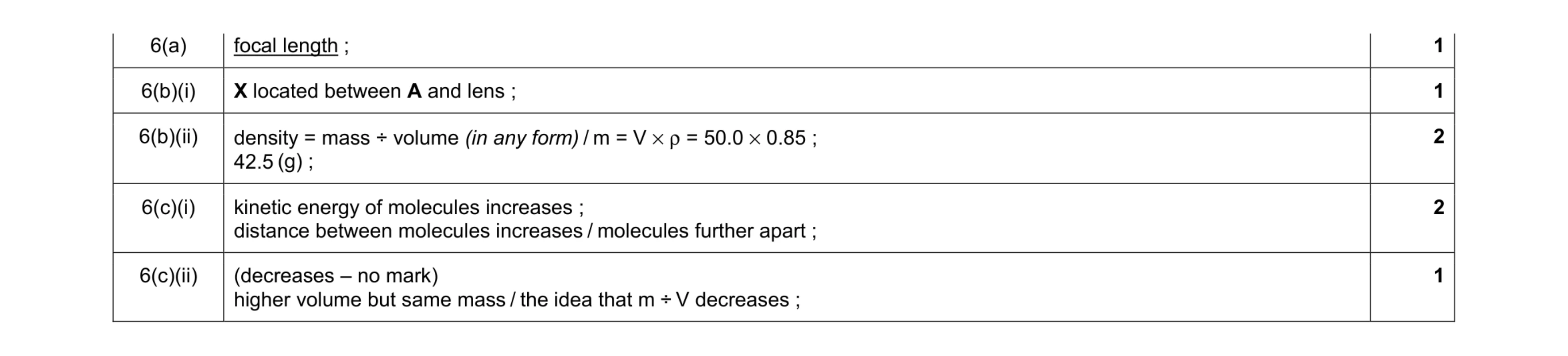 7
7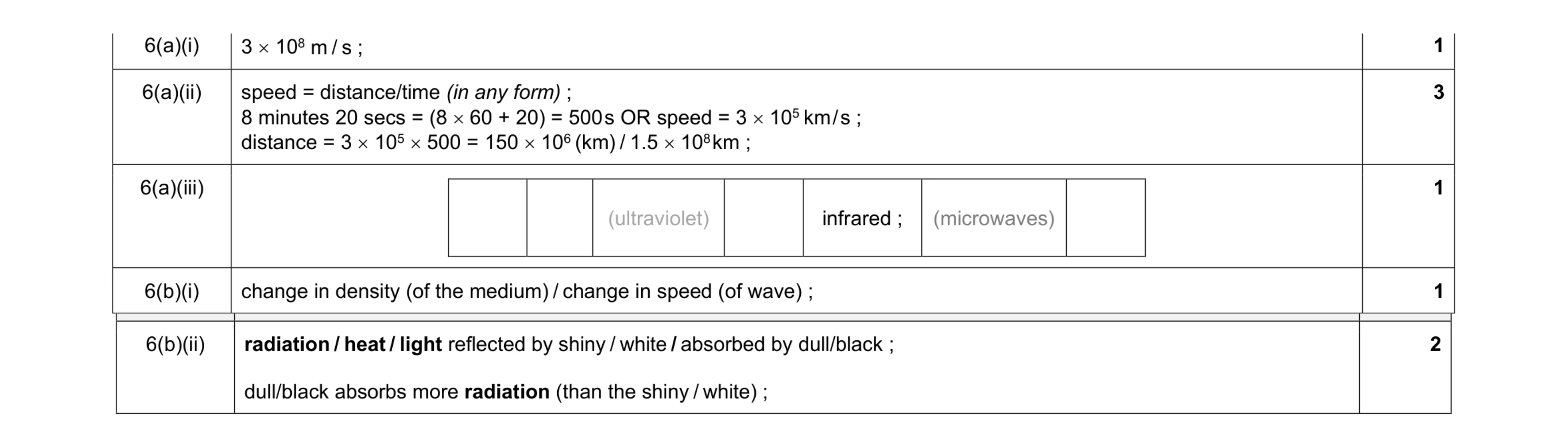 8
8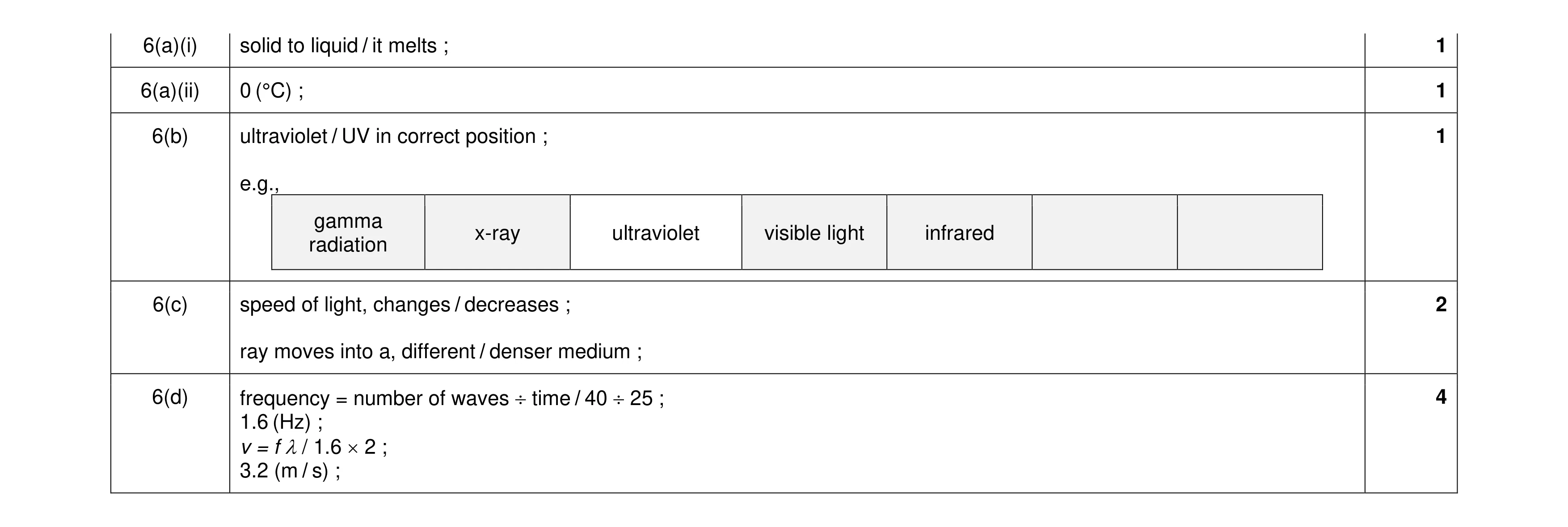 9
9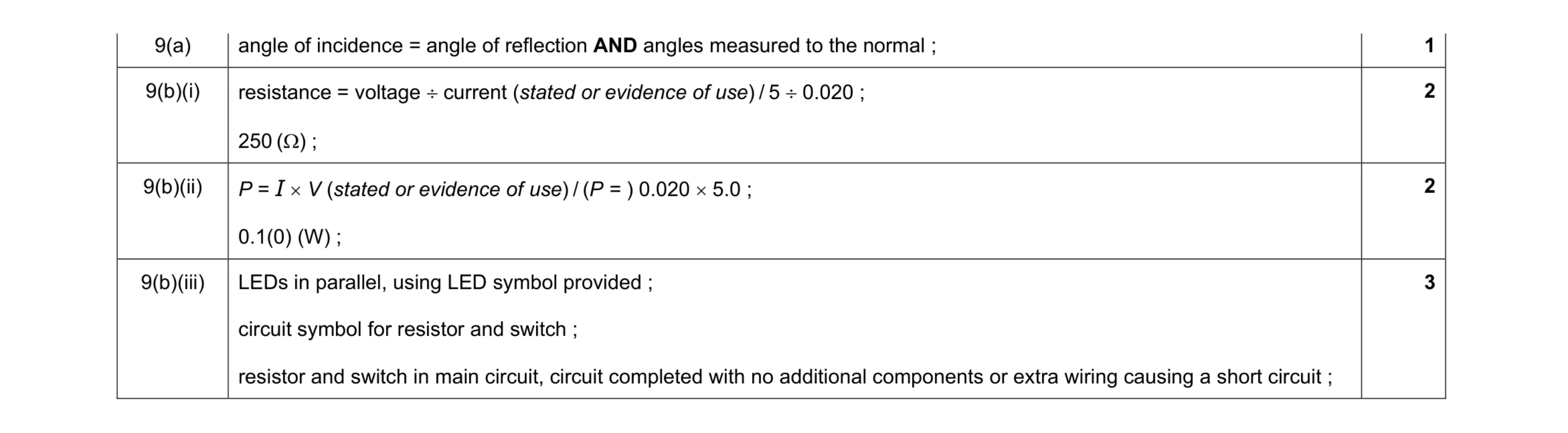 8
8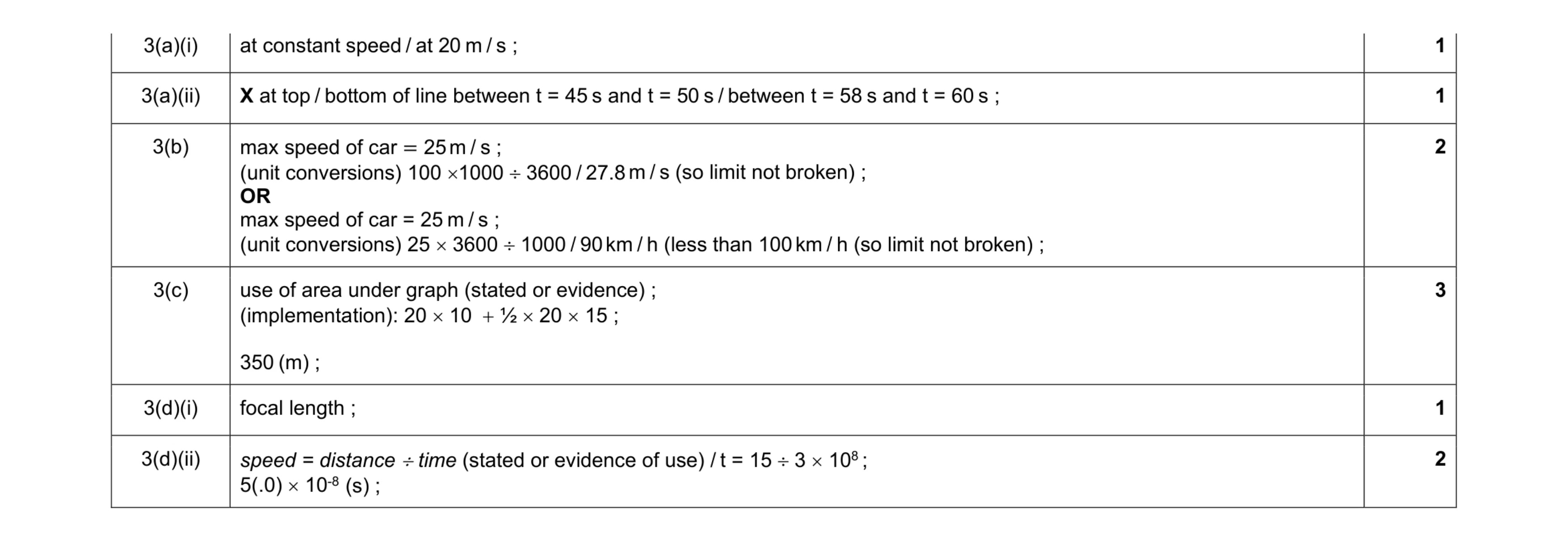 10
10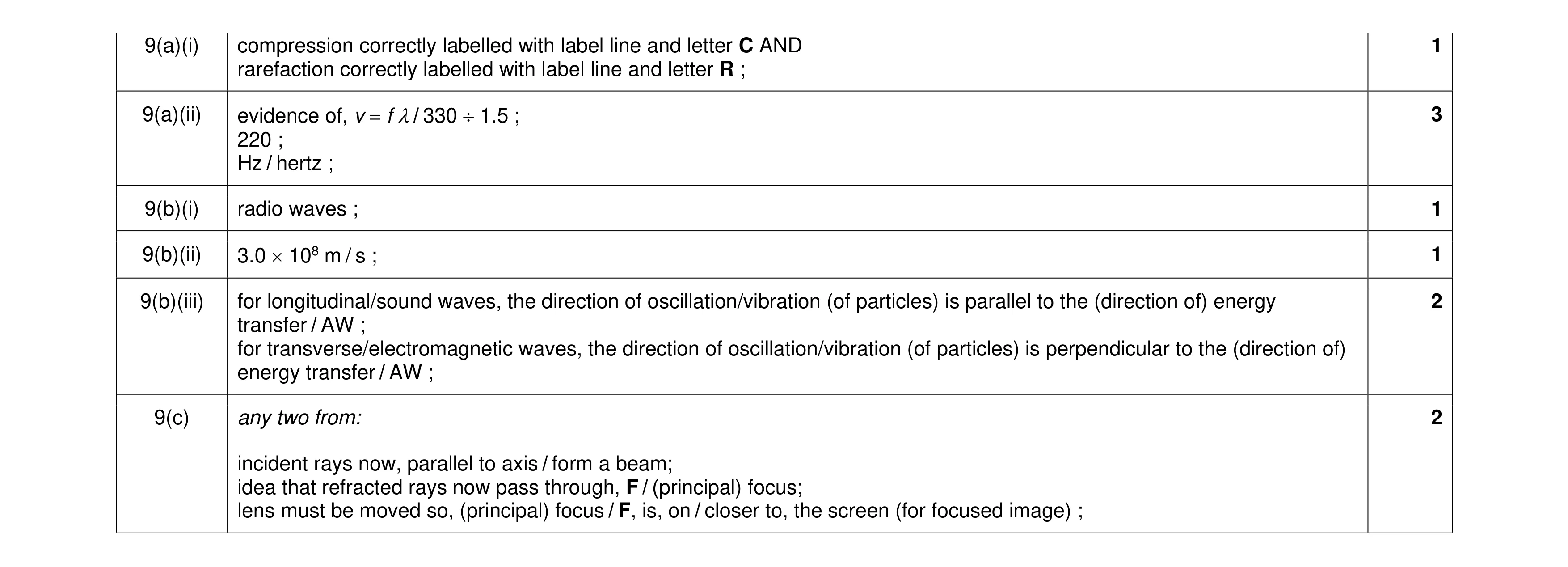 10
10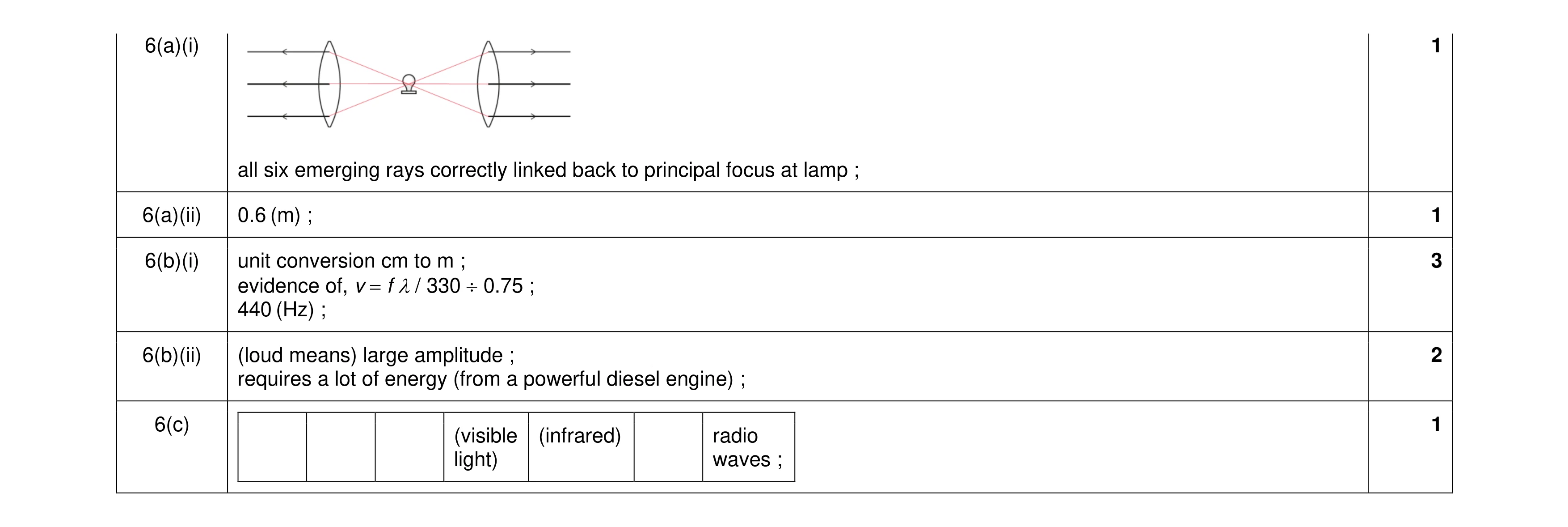 8
8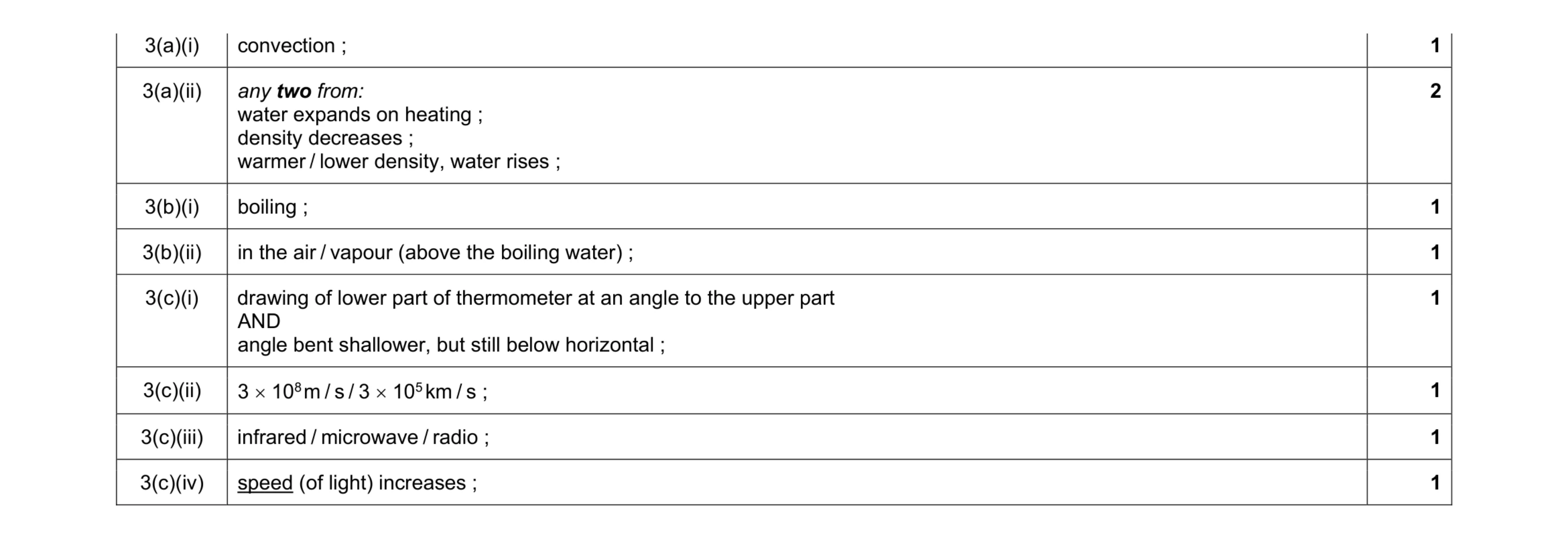 9
9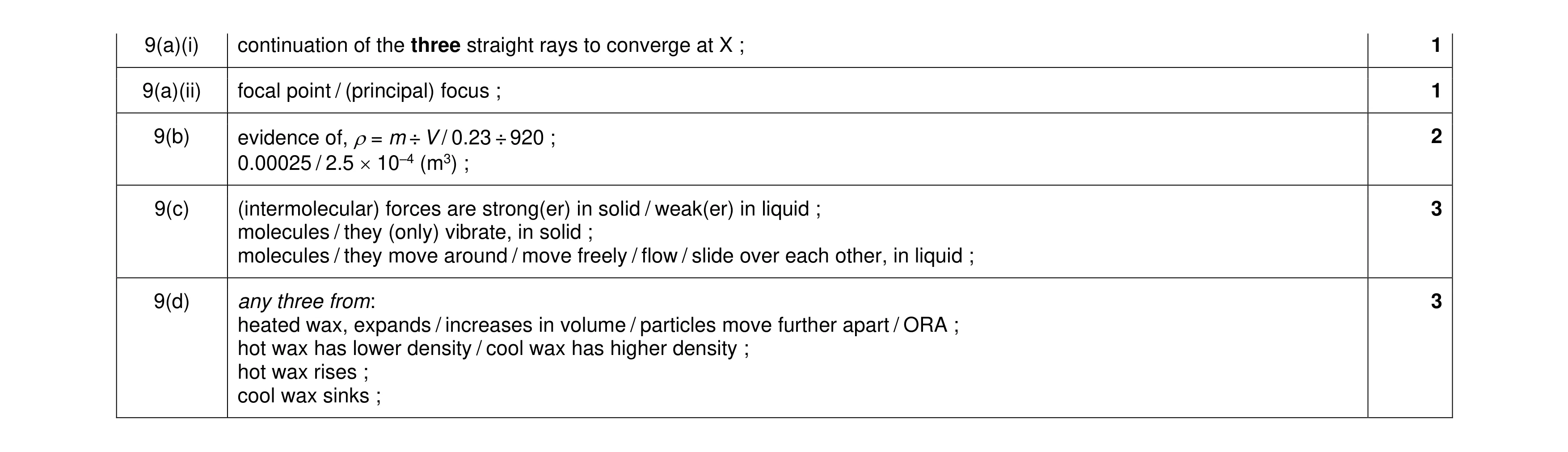 10
10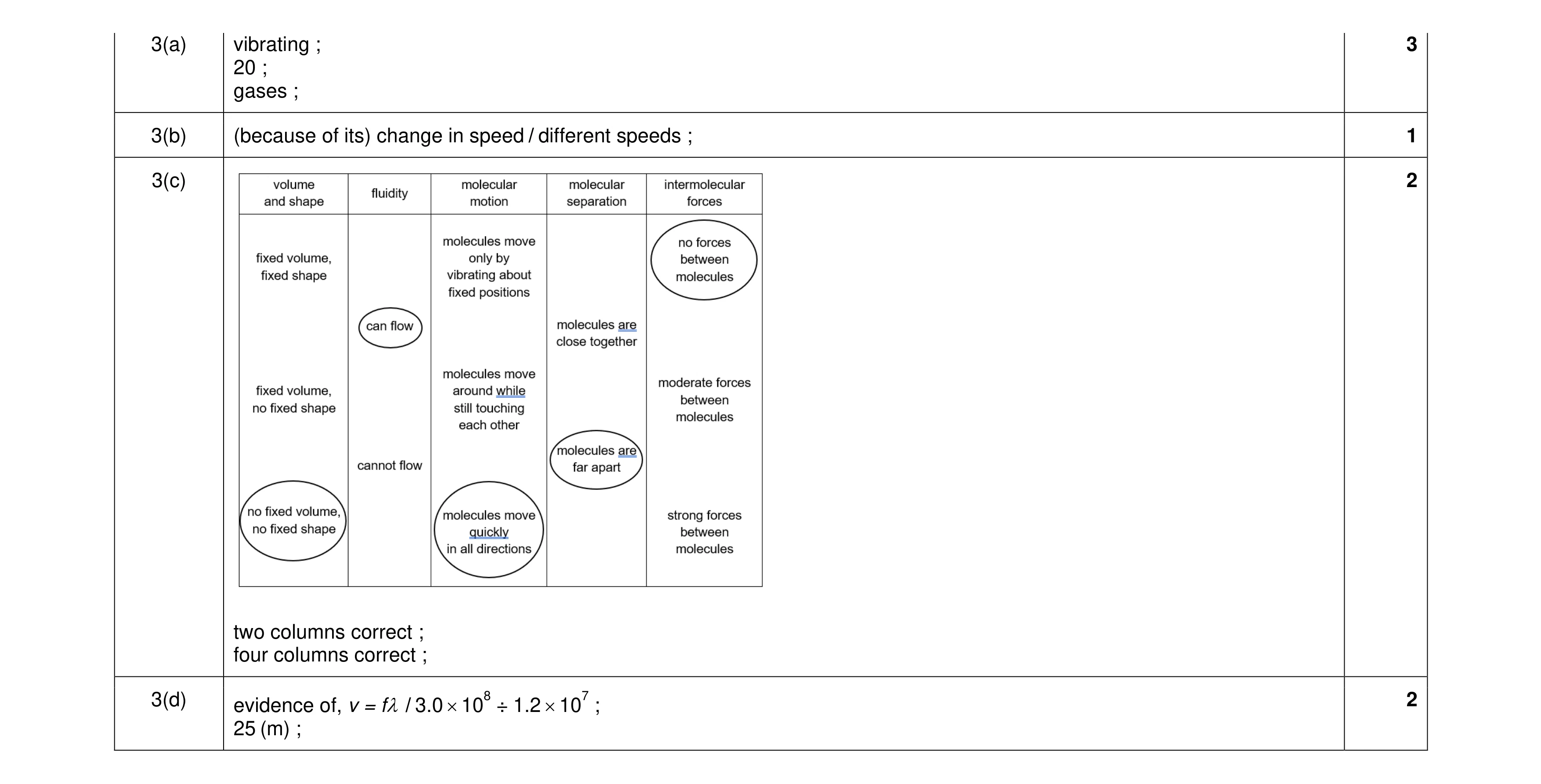 8
8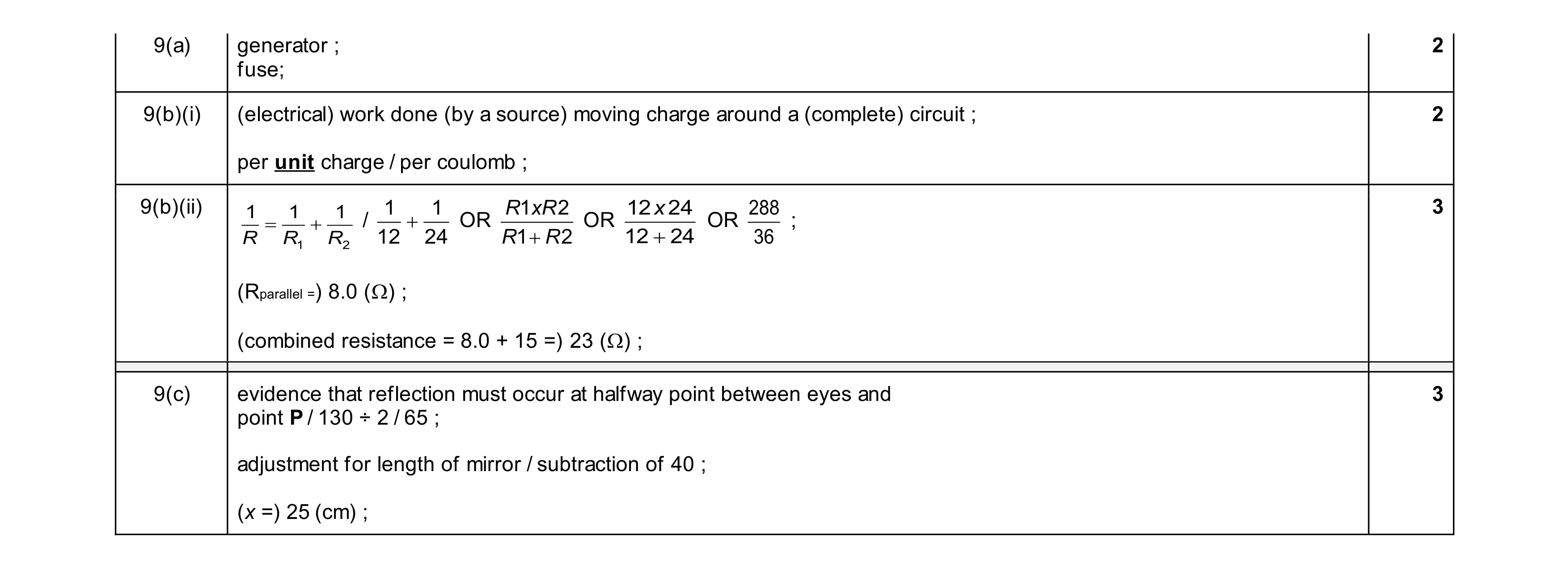 10
10