Cambridge IGCSE Science - Combined 0653 — 2019 May/June Paper 3 · Variant 3
0653/33/M/J/19 · 9 questions · 80 marks · ≈90 min
The question paper and its mark scheme, free to read here and free to download. This is Cambridge’s own paper, exactly as it was sat.
Question paper20 pages
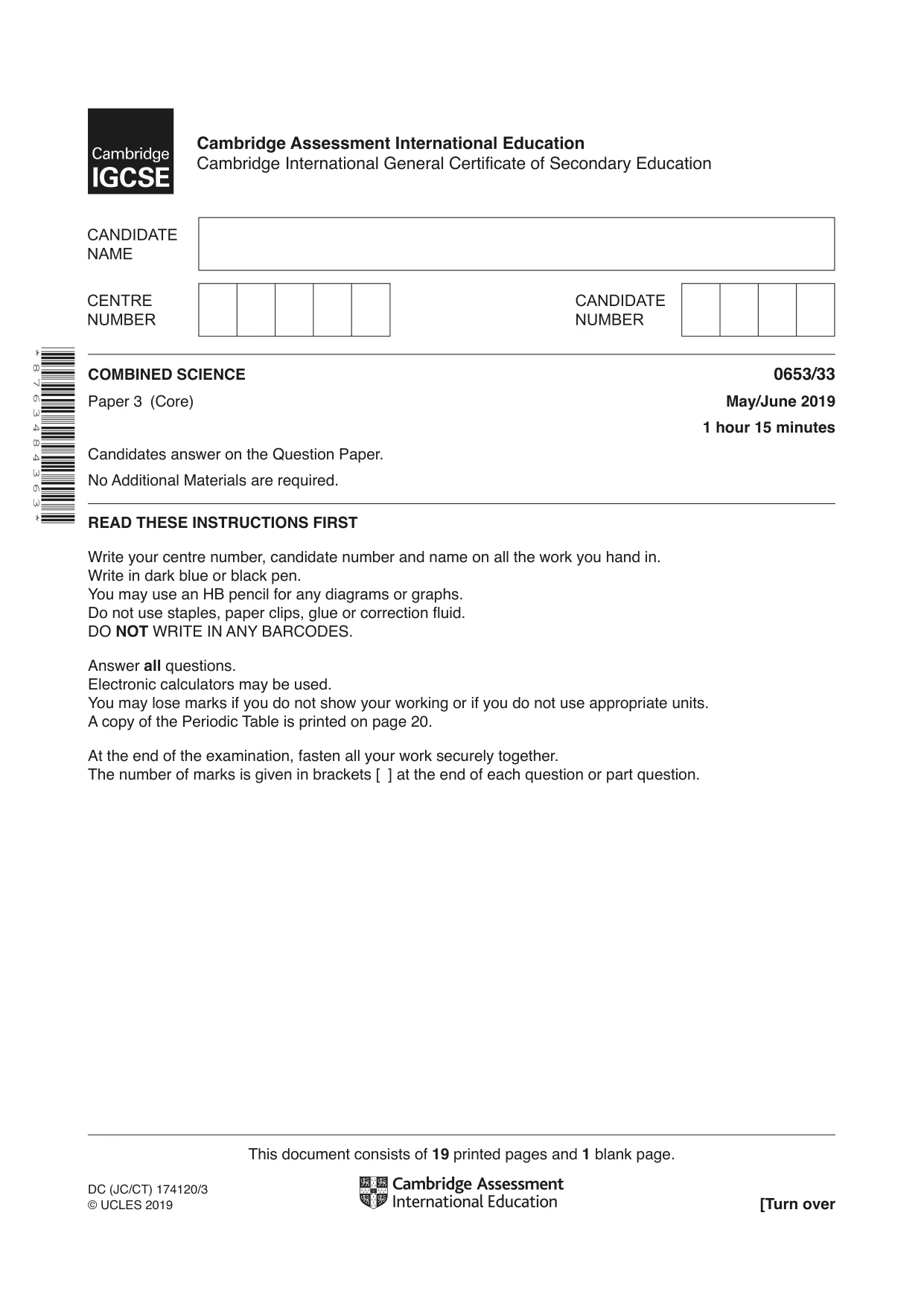

Mark scheme10 pages
Answers below. Sit the paper first if you are practising.
Questions as text
Q1 · The human gas exchange system
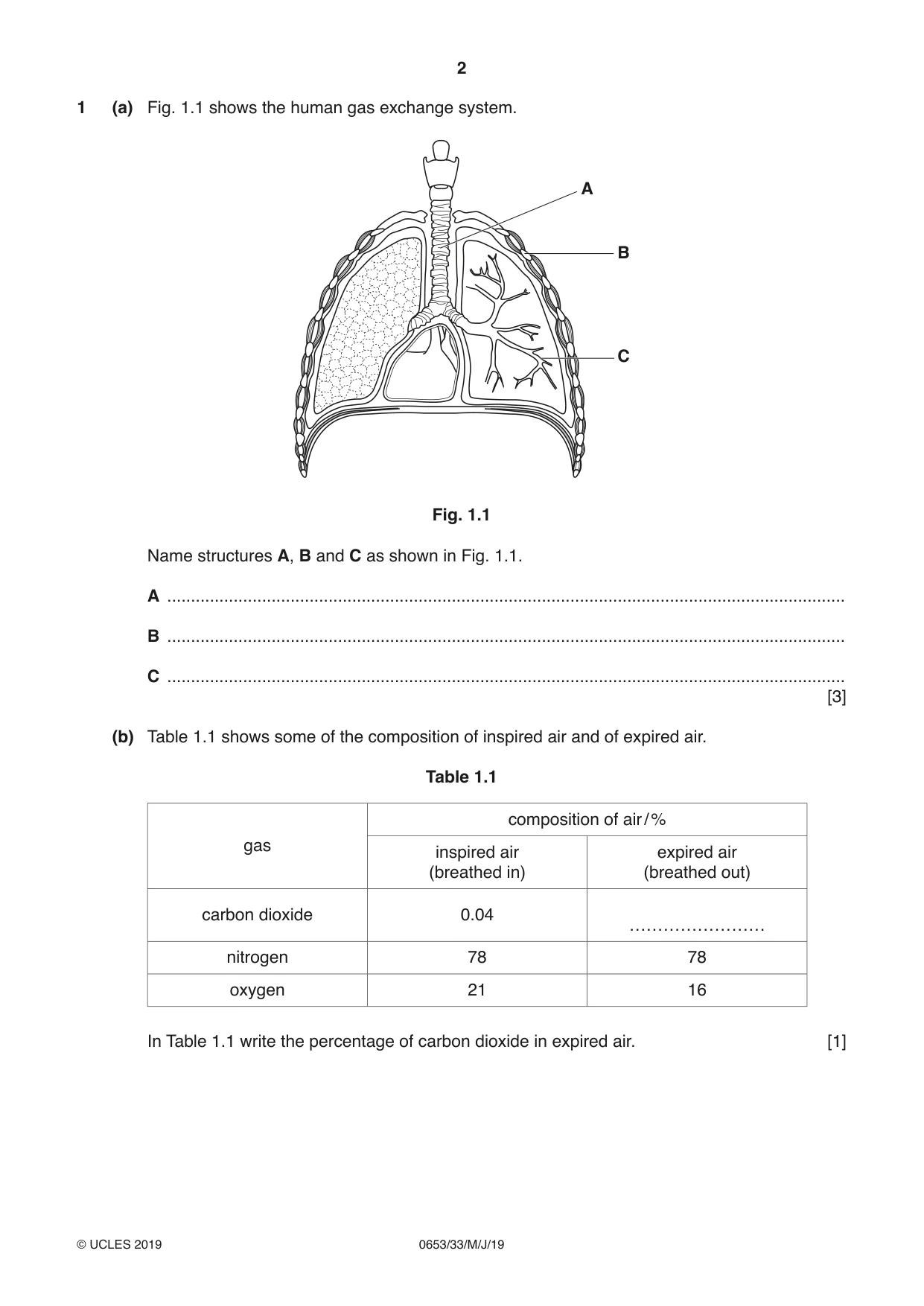
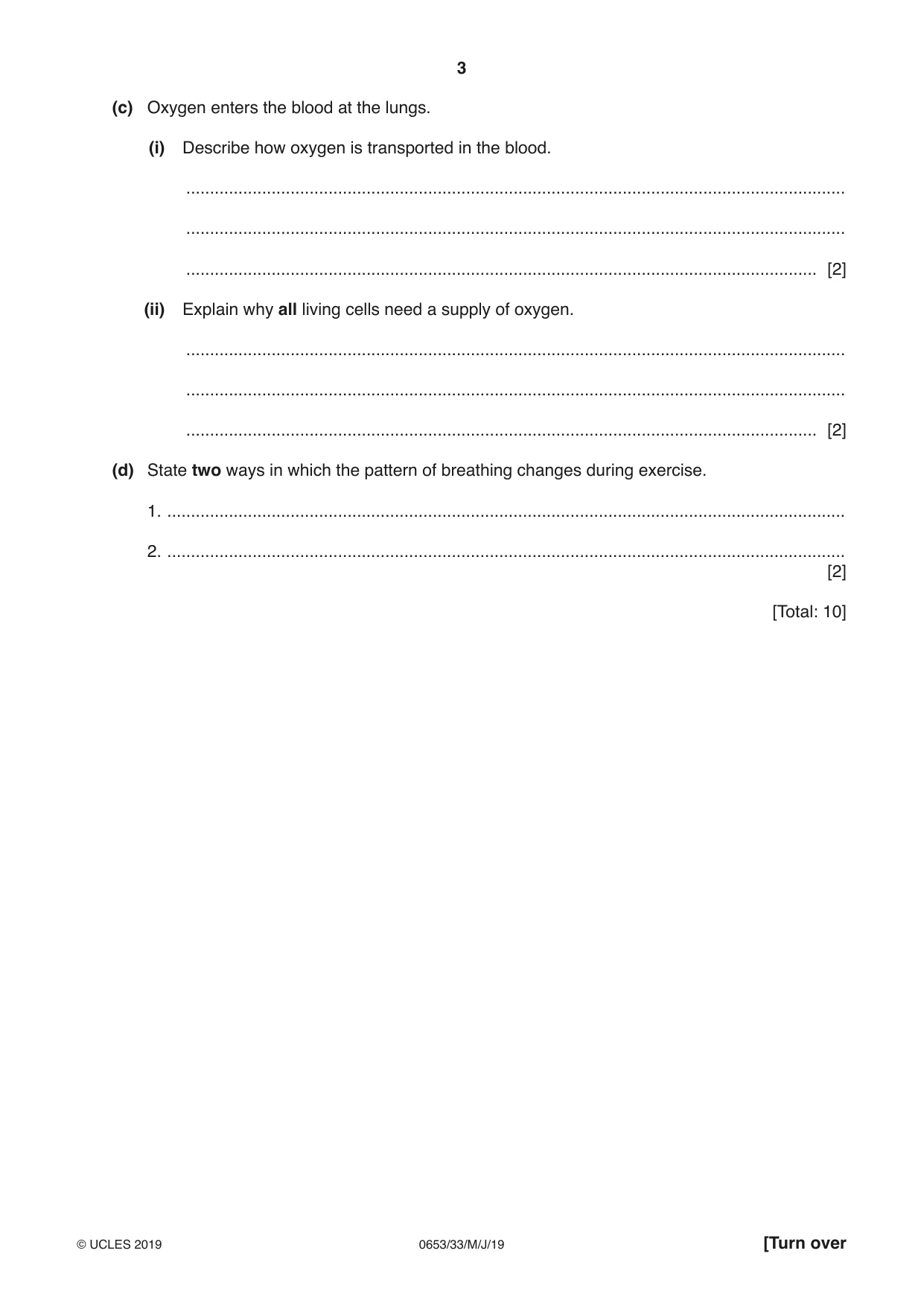
1 (a) Fig. 1.1 shows the human gas exchange system. A B C Fig. 1.1 Name structures A, B and C as shown in Fig. 1.1. A ............................................................................................................................................... B ............................................................................................................................................... C ............................................................................................................................................... [3] (b) Table 1.1 shows some of the composition of inspired air and of expired air. Table 1.1 composition of air / % gas inspired air expired air (breathed in) (breathed out) carbon dioxide 0.04 nitrogen 78 78 oxygen 21 16 In Table 1.1 write the percentage of carbon dioxide in expired air. [1] (c) Oxygen enters the blood at the lungs. (i) Describe how oxygen is transported in the blood. ........................................................................................................................................... ........................................................................................................................................... ..................................................................................................................................... [2] (ii) Explain why all living cells need a supply of oxygen. ........................................................................................................................................... ........................................................................................................................................... ..................................................................................................................................... [2] (d) State two ways in which the pattern of breathing changes during exercise. 1. ............................................................................................................................................... 2. ............................................................................................................................................... [2] [Total: 10]
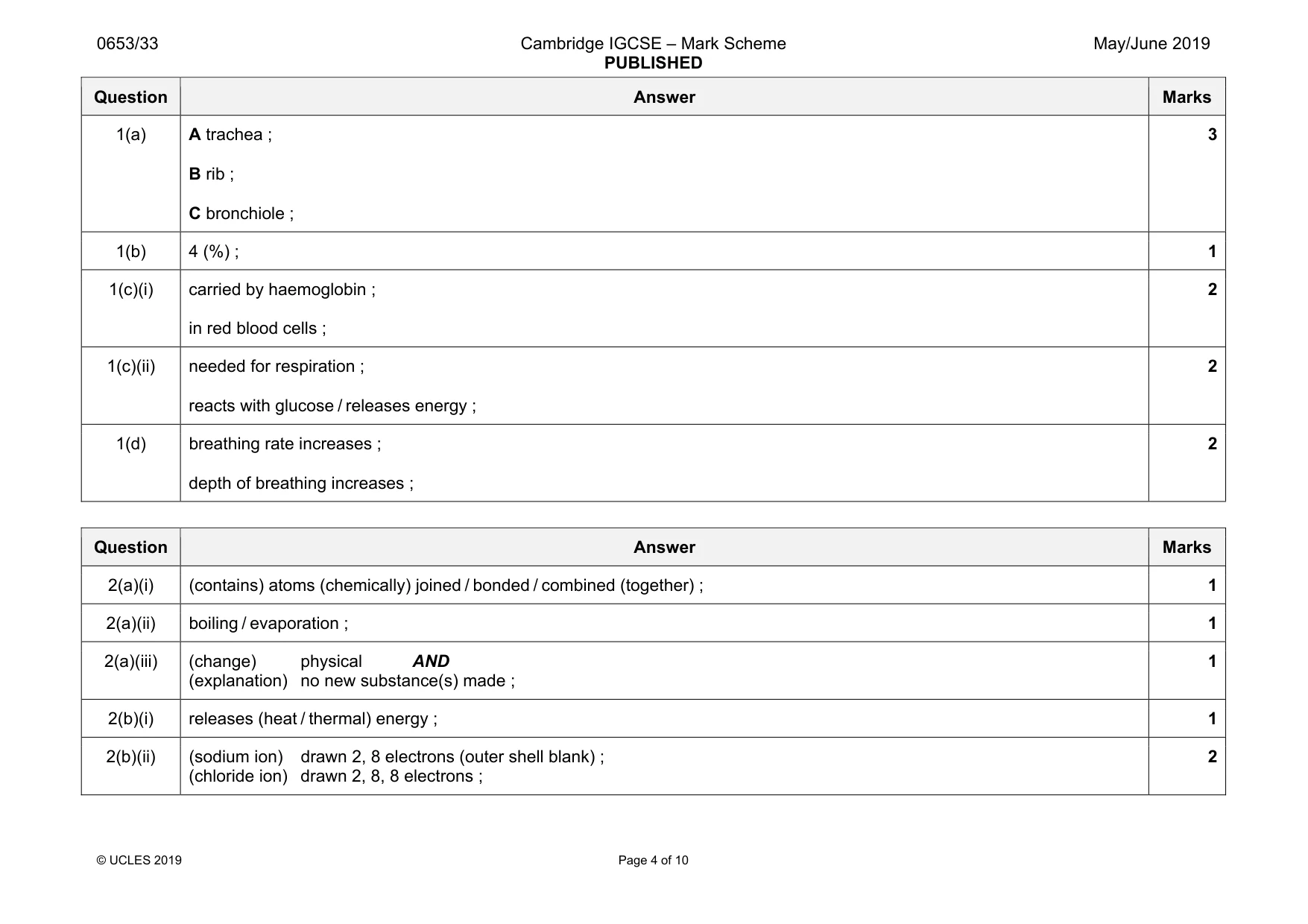
Mark scheme: 1(a) A trachea ; B rib ; C bronchiole ; 3 1(b) 4 (%) ; 1 1(c)(i) carried by haemoglobin ; in red blood cells ; 2 1(c)(ii) needed for respiration ; reacts with glucose / releases energy ; 2 1(d) breathing rate increases ; depth of breathing increases ; 2
Q2 · Chlorine, bromine, and iodine are Group VII elements
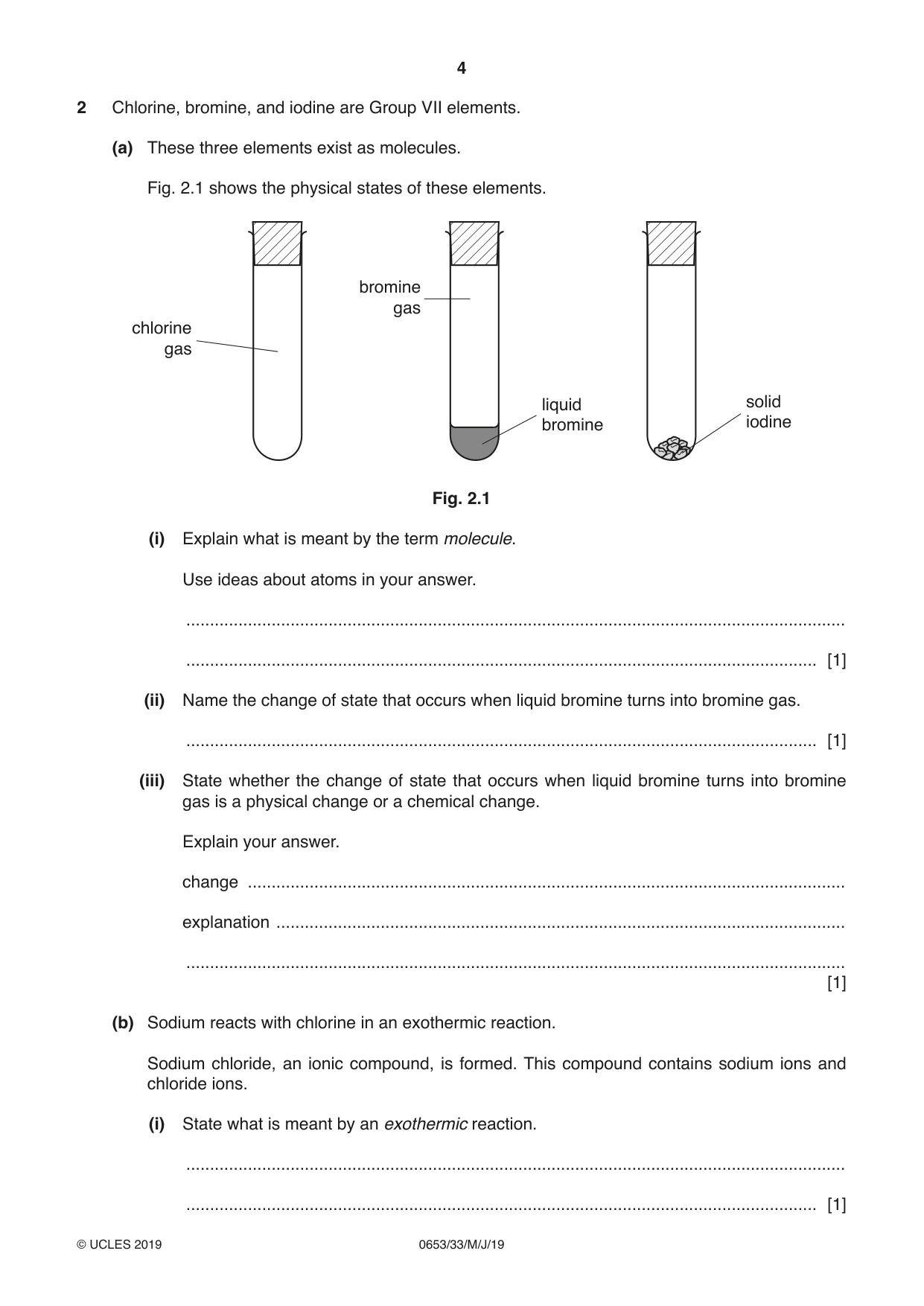
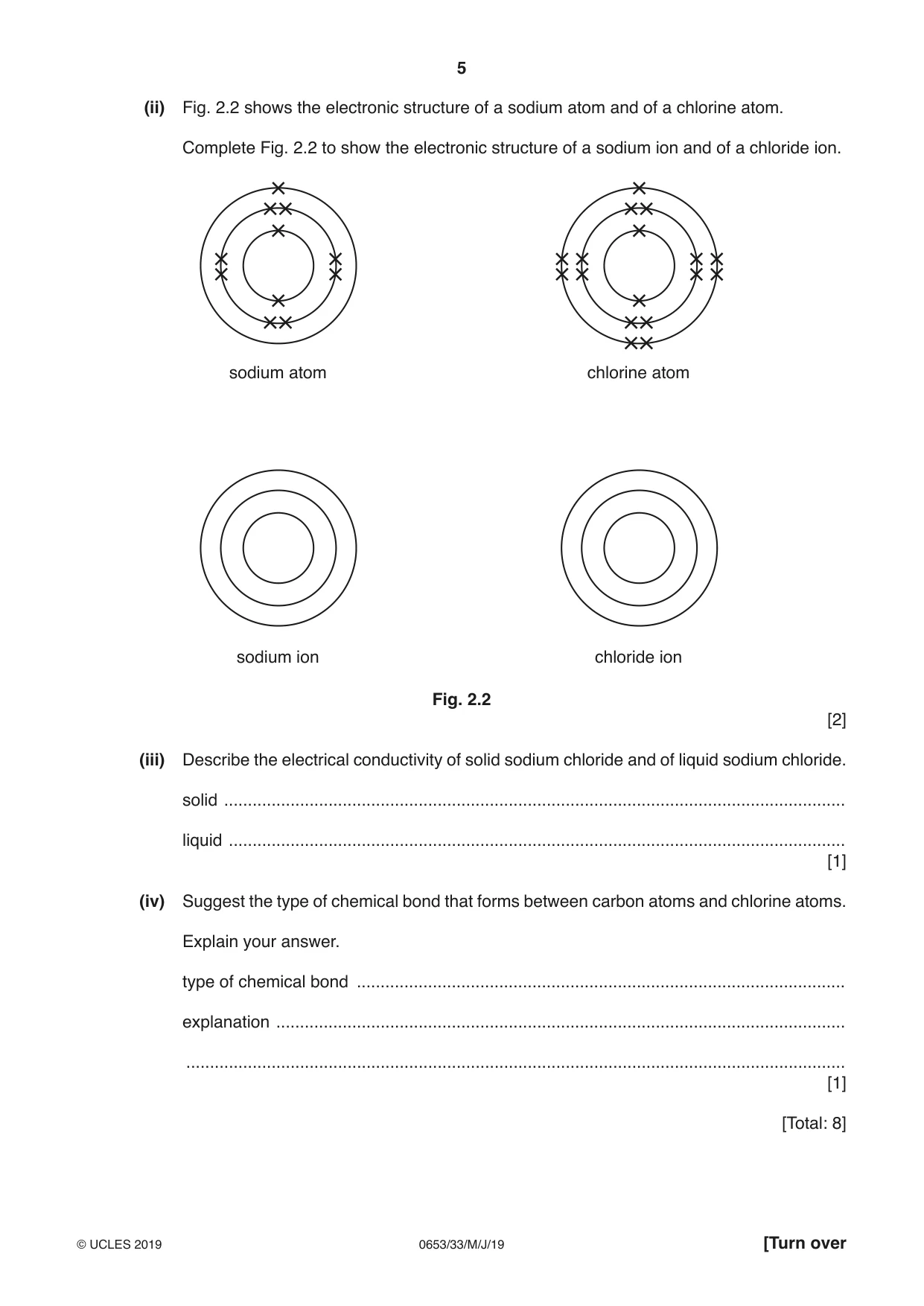
2 Chlorine, bromine, and iodine are Group VII elements. (a) These three elements exist as molecules. Fig. 2.1 shows the physical states of these elements. bromine gas chlorine gas liquid solid bromine iodine Fig. 2.1 (i) Explain what is meant by the term molecule. Use ideas about atoms in your answer. ........................................................................................................................................... ..................................................................................................................................... [1] (ii) Name the change of state that occurs when liquid bromine turns into bromine gas. ..................................................................................................................................... [1] (iii) State whether the change of state that occurs when liquid bromine turns into bromine gas is a physical change or a chemical change. Explain your answer. change .............................................................................................................................. explanation ........................................................................................................................ ........................................................................................................................................... [1] (b) Sodium reacts with chlorine in an exothermic reaction. Sodium chloride, an ionic compound, is formed. This compound contains sodium ions and chloride ions. (i) State what is meant by an exothermic reaction. ........................................................................................................................................... ..................................................................................................................................... [1] (ii) Fig. 2.2 shows the electronic structure of a sodium atom and of a chlorine atom. Complete Fig. 2.2 to show the electronic structure of a sodium ion and of a chloride ion. sodium atom chlorine atom sodium ion chloride ion Fig. 2.2 [2] (iii) Describe the electrical conductivity of solid sodium chloride and of liquid sodium chloride. solid ................................................................................................................................... liquid .................................................................................................................................. [1] (iv) Suggest the type of chemical bond that forms between carbon atoms and chlorine atoms. Explain your answer. type of chemical bond ....................................................................................................... explanation ........................................................................................................................ ........................................................................................................................................... [1] [Total: 8]
Mark scheme: 2(a)(i) (contains) atoms (chemically) joined / bonded / combined (together) ; 1 2(a)(ii) boiling / evaporation ; 1 2(a)(iii) (change) physical AND (explanation) no new substance(s) made ; 1 2(b)(i) releases (heat / thermal) energy ; 1 2(b)(ii) (sodium ion) drawn 2, 8 electrons (outer shell blank) ; (chloride ion) drawn 2, 8, 8 electrons ; 2 Question Answer Marks 2(b)(iii) (solid) zero / poor / non-conductor AND (liquid) good / conducts ; 1 2(b)(iv) (type) covalent AND (explanation) carbon and chlorine / both are non-metals ; 1
Q3 · A boy in a swimming pool
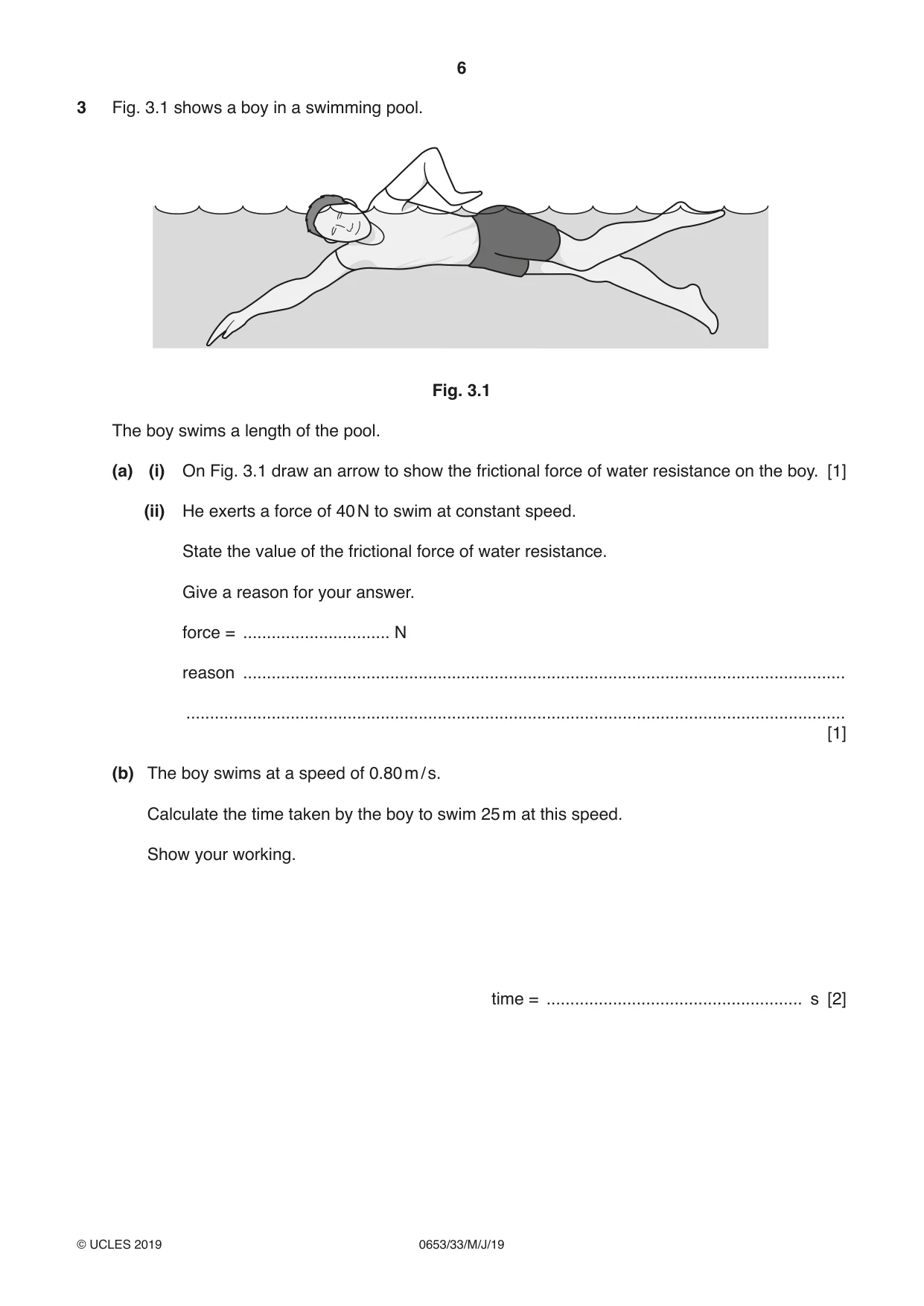
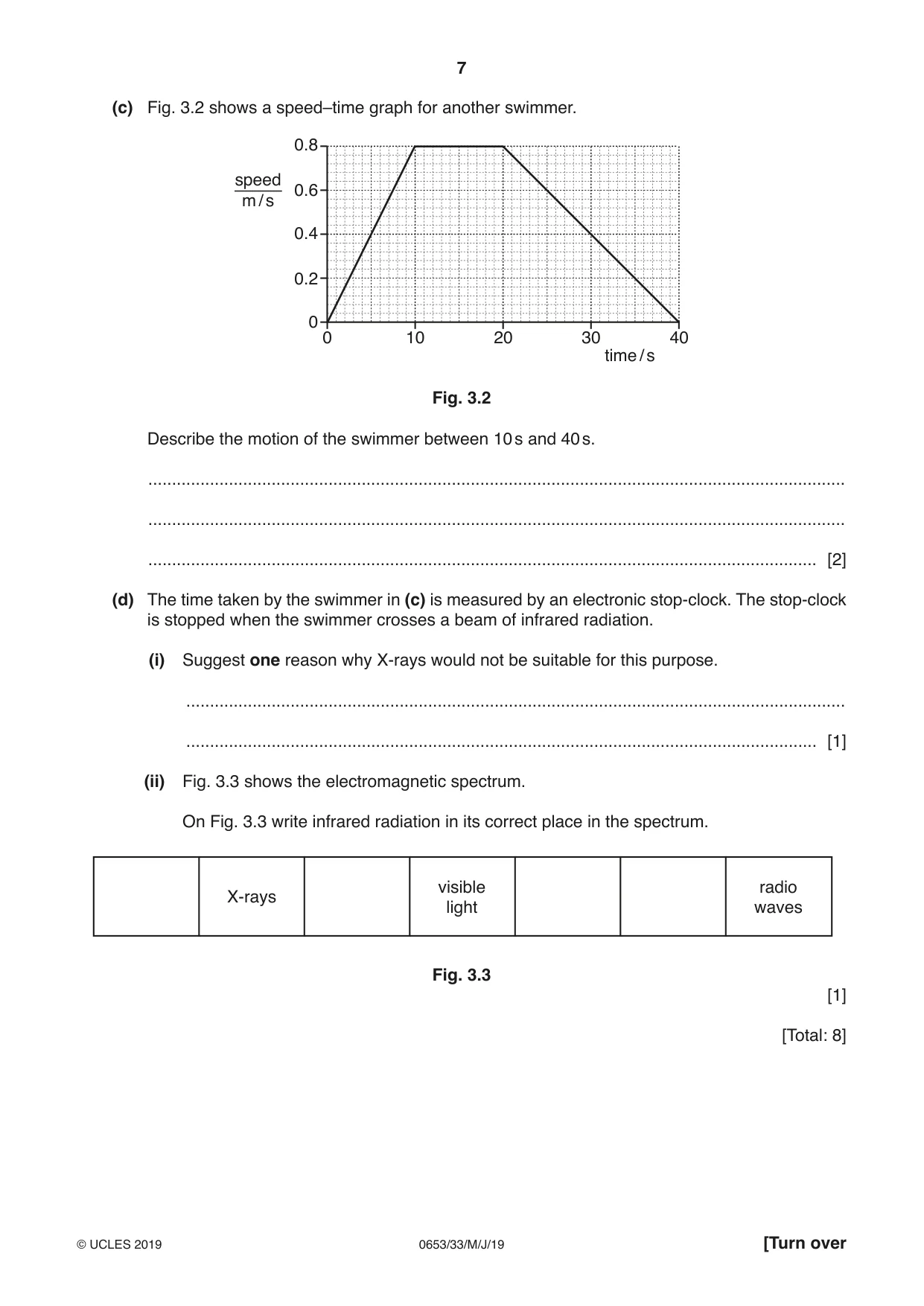
3 Fig. 3.1 shows a boy in a swimming pool. Fig. 3.1 The boy swims a length of the pool. (a) (i) On Fig. 3.1 draw an arrow to show the frictional force of water resistance on the boy. [1] (ii) He exerts a force of 40 N to swim at constant speed. State the value of the frictional force of water resistance. Give a reason for your answer. force = ............................... N reason ............................................................................................................................... ........................................................................................................................................... [1] (b) The boy swims at a speed of 0.80 m / s. Calculate the time taken by the boy to swim 25 m at this speed. Show your working. time = ...................................................... s [2] (c) Fig. 3.2 shows a speed–time graph for another swimmer. 0.8 speed 0.6 m / s 0.4 0.2 0 0 10 20 30 40 time / s Fig. 3.2 Describe the motion of the swimmer between 10 s and 40 s. ................................................................................................................................................... ................................................................................................................................................... ............................................................................................................................................. [2] (d) The time taken by the swimmer in (c) is measured by an electronic stop-clock. The stop-clock is stopped when the swimmer crosses a beam of infrared radiation. (i) Suggest one reason why X-rays would not be suitable for this purpose. ........................................................................................................................................... ..................................................................................................................................... [1] (ii) Fig. 3.3 shows the electromagnetic spectrum. On Fig. 3.3 write infrared radiation in its correct place in the spectrum. visible radio X-rays light waves Fig. 3.3 [1] [Total: 8]
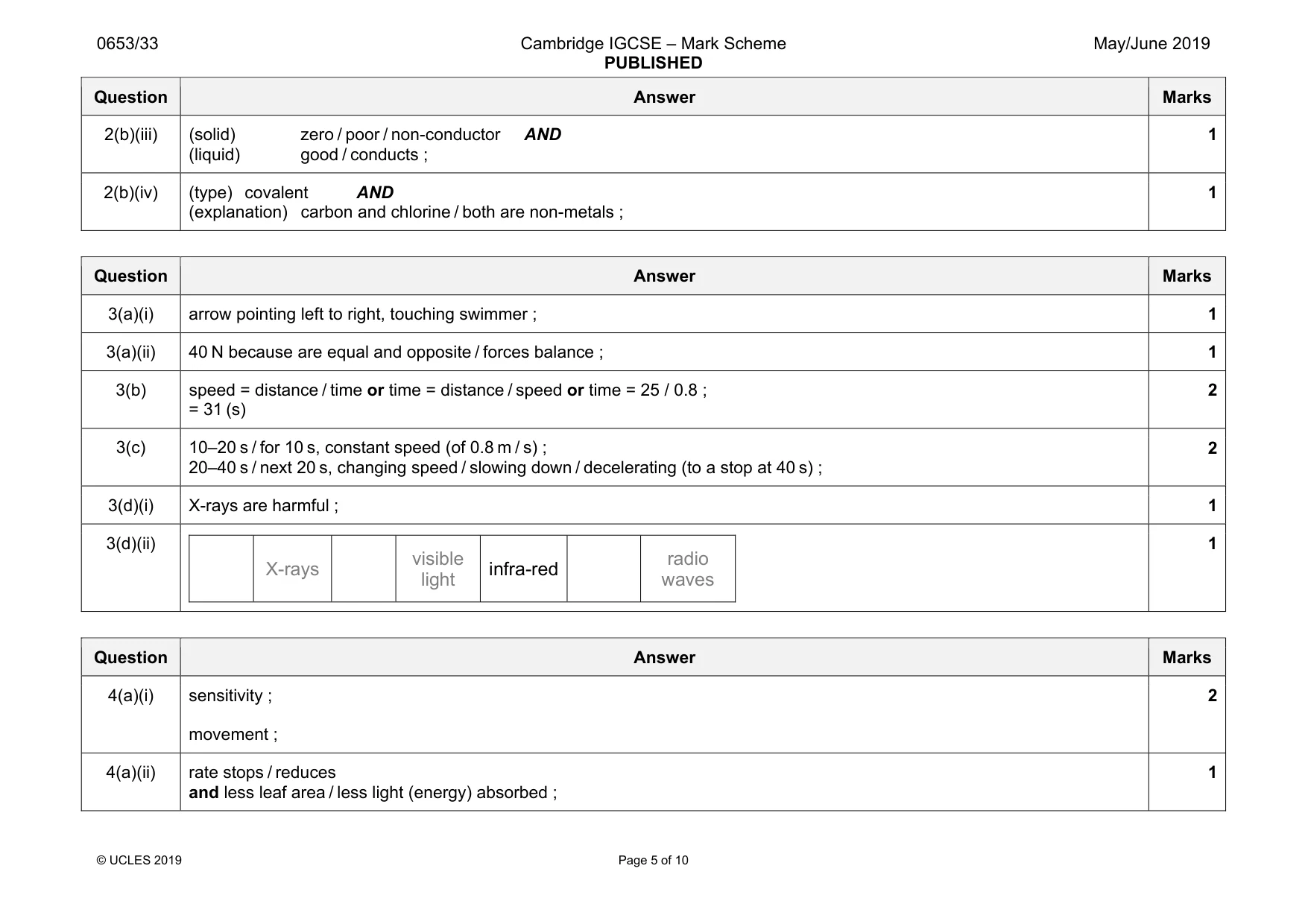
Mark scheme: 3(a)(i) arrow pointing left to right, touching swimmer ; 1 3(a)(ii) 40 N because are equal and opposite / forces balance ; 1 3(b) speed = distance / time or time = distance / speed or time = 25 / 0.8 ; = 31 (s) 2 3(c) 10–20 s / for 10 s, constant speed (of 0.8 m / s) ; 20–40 s / next 20 s, changing speed / slowing down / decelerating (to a stop at 40 s) ; 2 3(d)(i) X-rays are harmful ; 1 3(d)(ii) X-rays visible light infra-red radio waves 1
Q4 · Some leaves of the plant Mimosa pudica
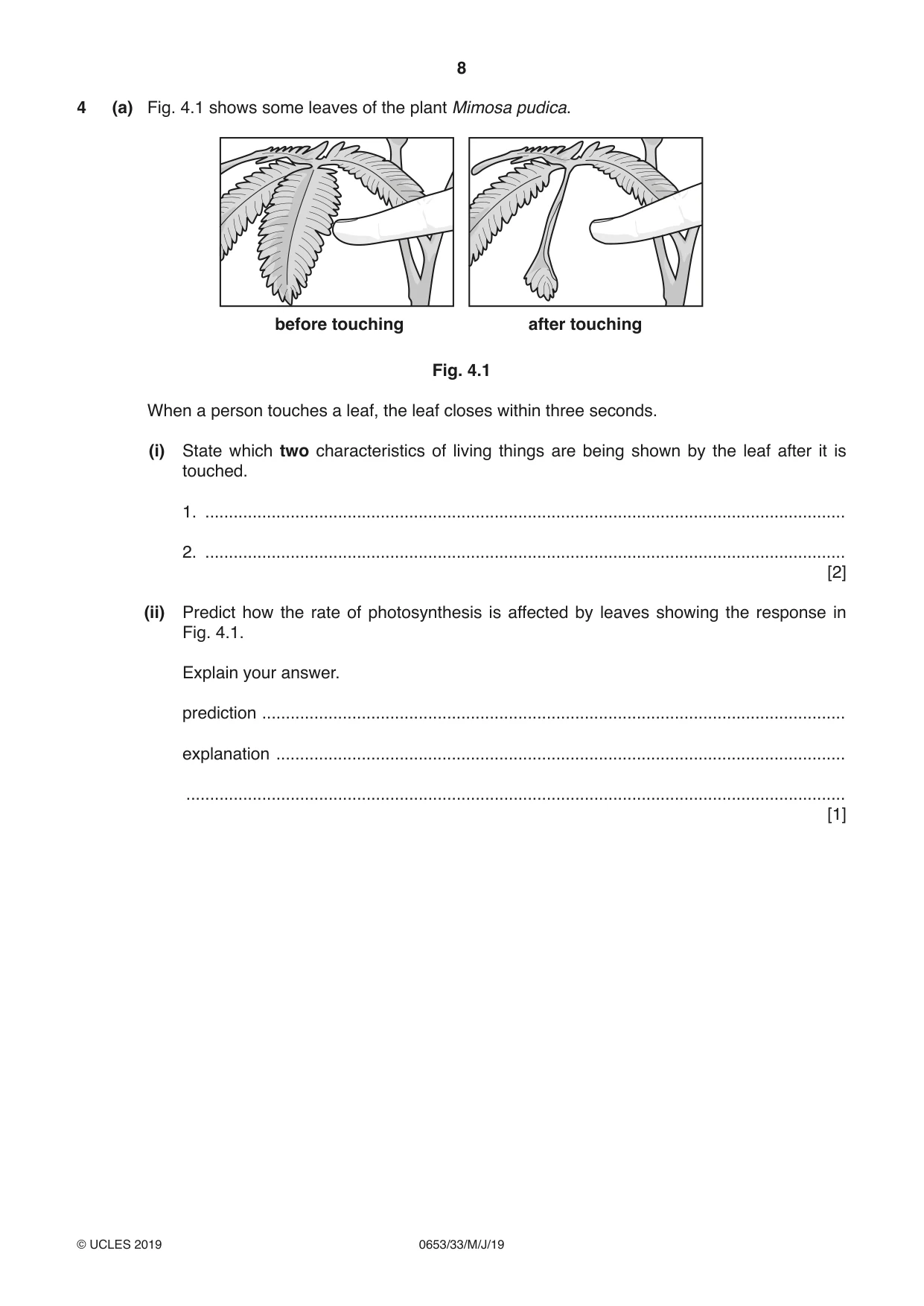
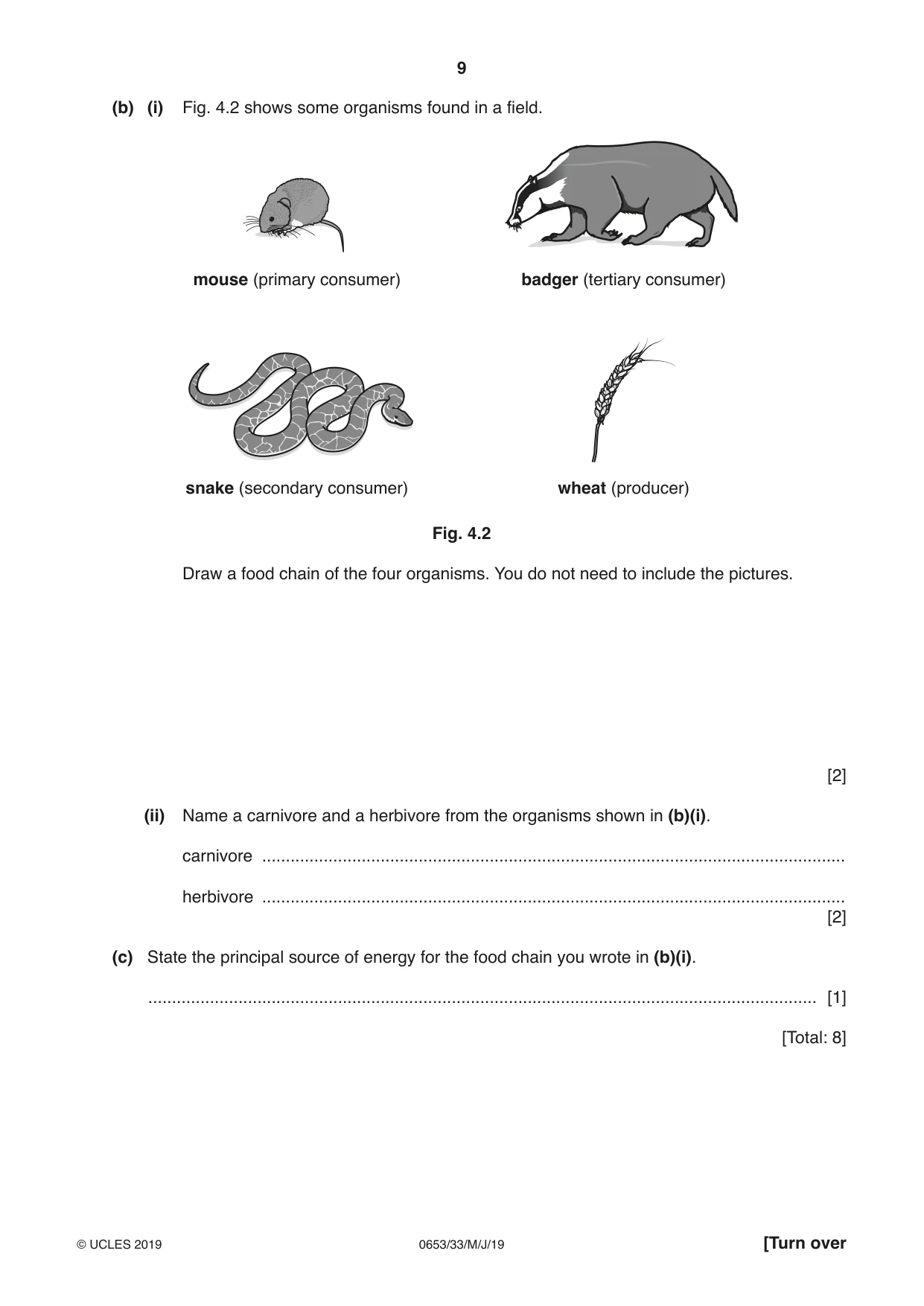
4 (a) Fig. 4.1 shows some leaves of the plant Mimosa pudica. before touching after touching Fig. 4.1 When a person touches a leaf, the leaf closes within three seconds. (i) State which two characteristics of living things are being shown by the leaf after it is touched. 1. ....................................................................................................................................... 2. ....................................................................................................................................... [2] (ii) Predict how the rate of photosynthesis is affected by leaves showing the response in Fig. 4.1. Explain your answer. prediction ........................................................................................................................... explanation ........................................................................................................................ ........................................................................................................................................... [1] (b) (i) Fig. 4.2 shows some organisms found in a field. mouse (primary consumer) badger (tertiary consumer) snake (secondary consumer) wheat (producer) Fig. 4.2 Draw a food chain of the four organisms. You do not need to include the pictures. [2] (ii) Name a carnivore and a herbivore from the organisms shown in (b)(i). carnivore ........................................................................................................................... herbivore ........................................................................................................................... [2] (c) State the principal source of energy for the food chain you wrote in (b)(i). ............................................................................................................................................. [1] [Total: 8]
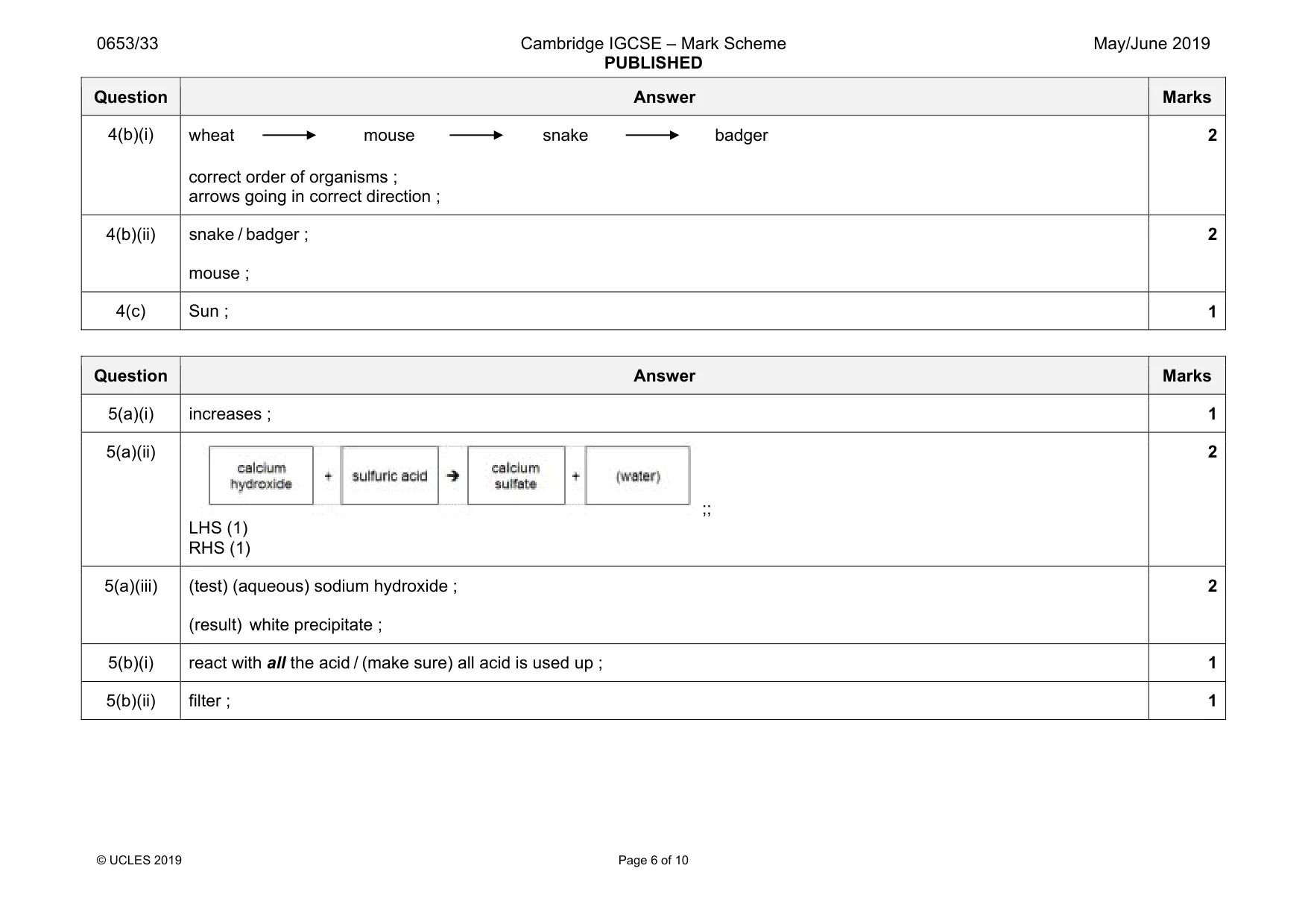
Mark scheme: 4(a)(i) sensitivity ; movement ; 2 4(a)(ii) rate stops / reduces and less leaf area / less light (energy) absorbed ; 1 Question Answer Marks 4(b)(i) wheat mouse snake badger correct order of organisms ; arrows going in correct direction ; 2 4(b)(ii) snake / badger ; mouse ; 2 4(c) Sun ; 1
Q5 · Calcium hydroxide, a base, is used to control the acidity of soil
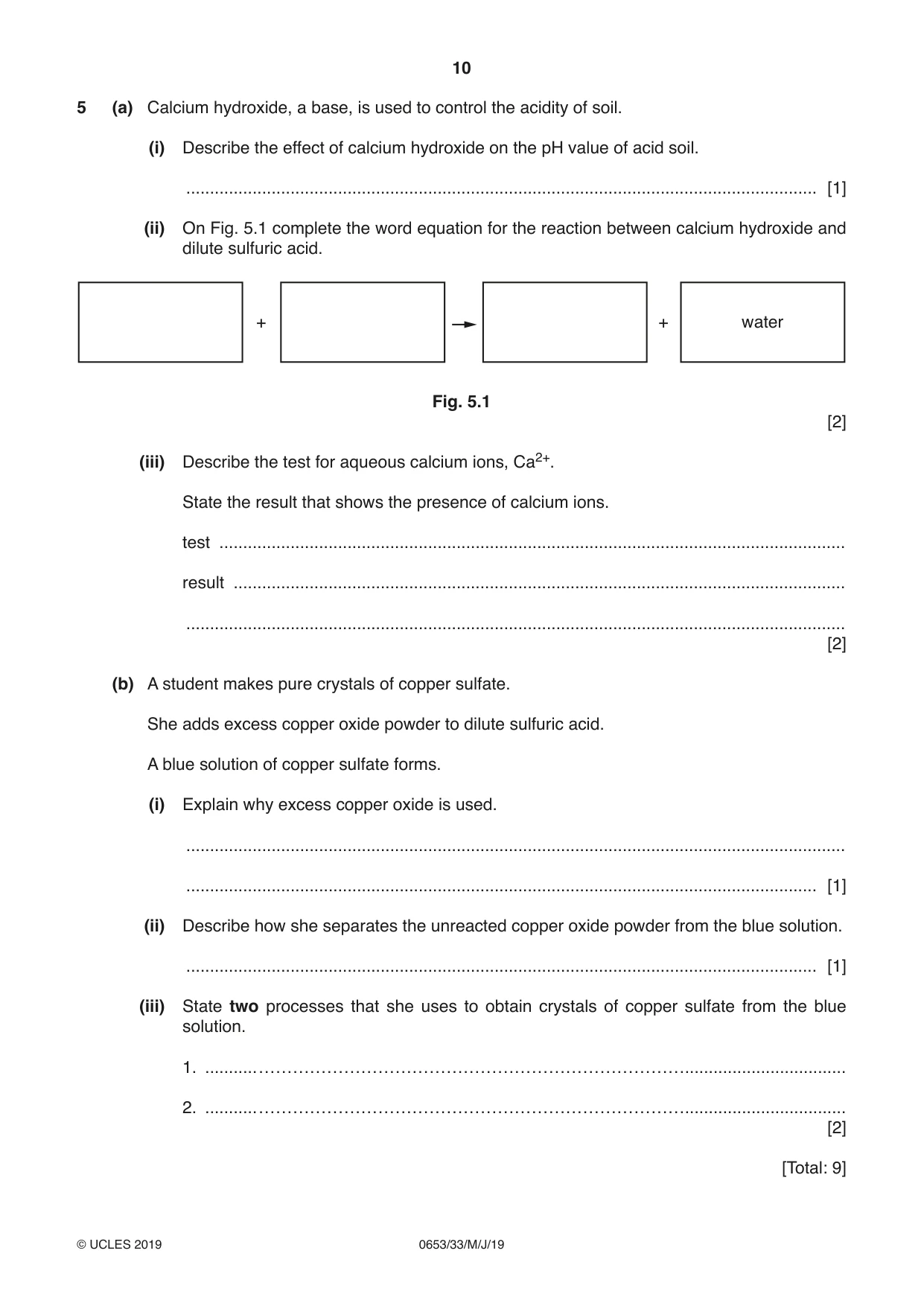
5 (a) Calcium hydroxide, a base, is used to control the acidity of soil. (i) Describe the effect of calcium hydroxide on the pH value of acid soil. ..................................................................................................................................... [1] (ii) On Fig. 5.1 complete the word equation for the reaction between calcium hydroxide and dilute sulfuric acid. + + water Fig. 5.1 [2] (iii) Describe the test for aqueous calcium ions, Ca2+. State the result that shows the presence of calcium ions. test .................................................................................................................................... result ................................................................................................................................. ........................................................................................................................................... [2] (b) A student makes pure crystals of copper sulfate. She adds excess copper oxide powder to dilute sulfuric acid. A blue solution of copper sulfate forms. (i) Explain why excess copper oxide is used. ........................................................................................................................................... ..................................................................................................................................... [1] (ii) Describe how she separates the unreacted copper oxide powder from the blue solution. ..................................................................................................................................... [1] (iii) State two processes that she uses to obtain crystals of copper sulfate from the blue solution. 1. ...........………………………………………………………………….................................. 2. ...........………………………………………………………………….................................. [2] [Total: 9]
Mark scheme: 5(a)(i) increases ; 1 5(a)(ii) ;; LHS (1) RHS (1) 2 5(a)(iii) (test) (aqueous) sodium hydroxide ; (result) white precipitate ; 2 5(b)(i) react with all the acid / (make sure) all acid is used up ; 1 5(b)(ii) filter ; 1 Question Answer Marks 5(b)(iii) any two from heat / boil / evaporate ; leave to crystallise / leave to cool ; filter (crystals) ; 2
More questions on The characteristic properties of acids and bases
Q6 · Complete the sentences using words from the list
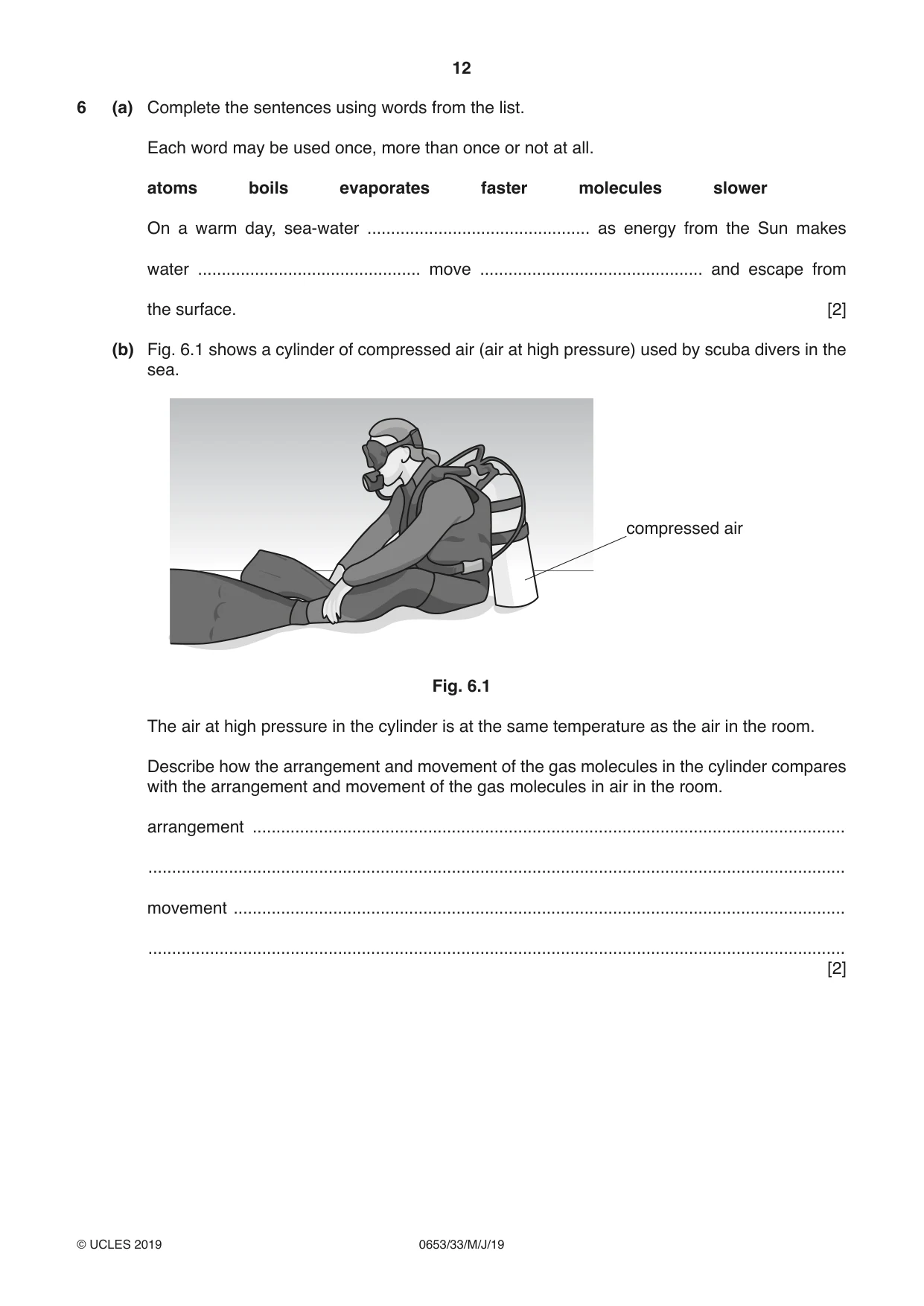
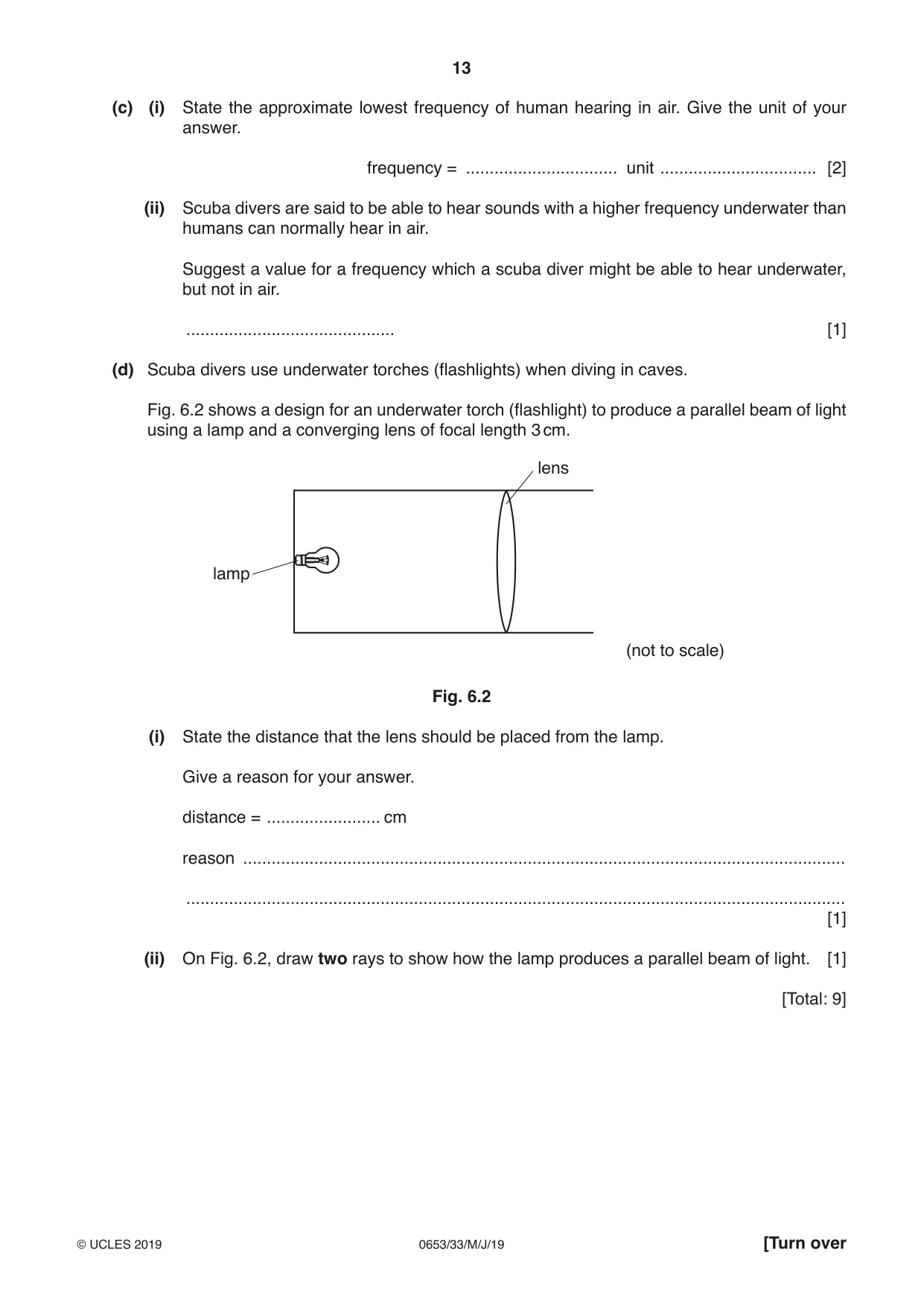
6 (a) Complete the sentences using words from the list. Each word may be used once, more than once or not at all. atoms boils evaporates faster molecules slower On a warm day, sea-water ............................................... as energy from the Sun makes water ............................................... move ............................................... and escape from the surface. [2] (b) Fig. 6.1 shows a cylinder of compressed air (air at high pressure) used by scuba divers in the sea. compressed air Fig. 6.1 The air at high pressure in the cylinder is at the same temperature as the air in the room. Describe how the arrangement and movement of the gas molecules in the cylinder compares with the arrangement and movement of the gas molecules in air in the room. arrangement ............................................................................................................................. ................................................................................................................................................... movement ................................................................................................................................. ................................................................................................................................................... [2] (c) (i) State the approximate lowest frequency of human hearing in air. Give the unit of your answer. frequency = ................................ unit ................................. [2] (ii) Scuba divers are said to be able to hear sounds with a higher frequency underwater than humans can normally hear in air. Suggest a value for a frequency which a scuba diver might be able to hear underwater, but not in air. ............................................ [1] (d) Scuba divers use underwater torches (flashlights) when diving in caves. Fig. 6.2 shows a design for an underwater torch (flashlight) to produce a parallel beam of light using a lamp and a converging lens of focal length 3 cm. lens lamp (not to scale) Fig. 6.2 (i) State the distance that the lens should be placed from the lamp. Give a reason for your answer. distance = ........................ cm reason ............................................................................................................................... ........................................................................................................................................... [1] (ii) On Fig. 6.2, draw two rays to show how the lamp produces a parallel beam of light. [1] [Total: 9]
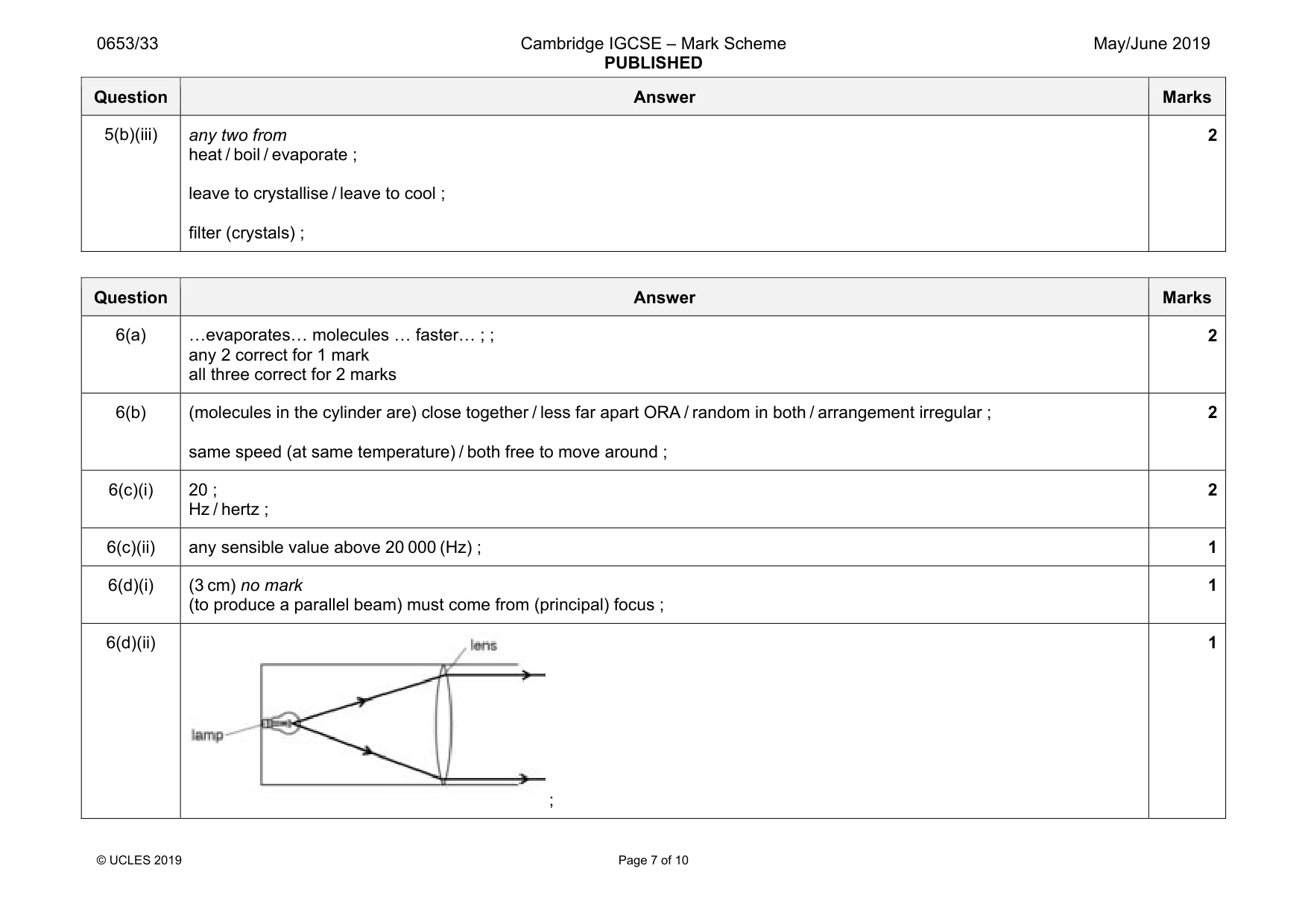
Mark scheme: 6(a) «evaporates« molecules « faster« ; ; any 2 correct for 1 mark all three correct for 2 marks 2 6(b) (molecules in the cylinder are) close together / less far apart ORA / random in both / arrangement irregular ; same speed (at same temperature) / both free to move around ; 2 6(c)(i) 20 ; Hz / hertz ; 2 6(c)(ii) any sensible value above 20 000 (Hz) ; 1 6(d)(i) (3 cm) no mark (to produce a parallel beam) must come from (principal) focus ; 1 6(d)(ii) ; 1
Q7 · A simplified diagram which shows the human alimentary canal
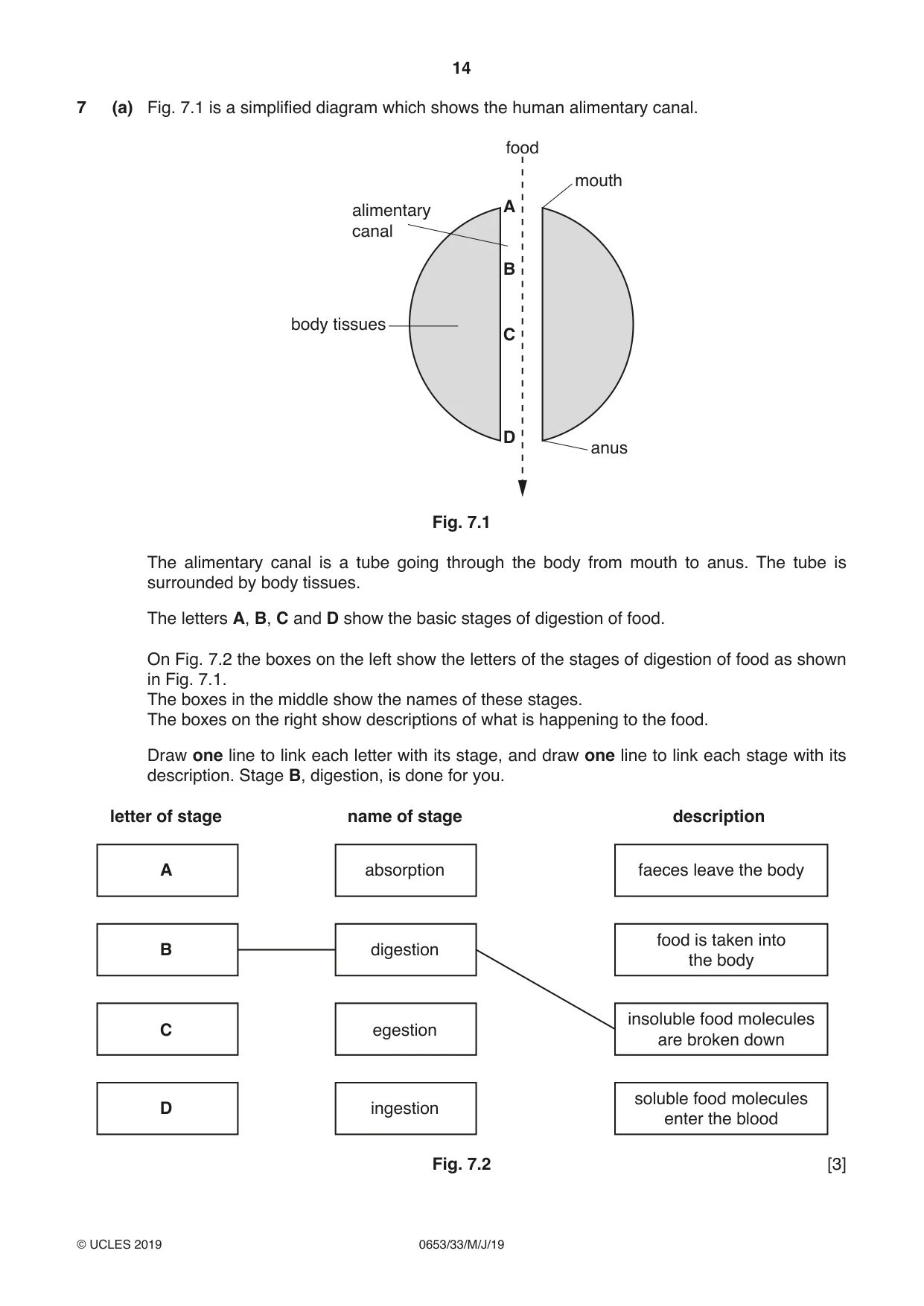
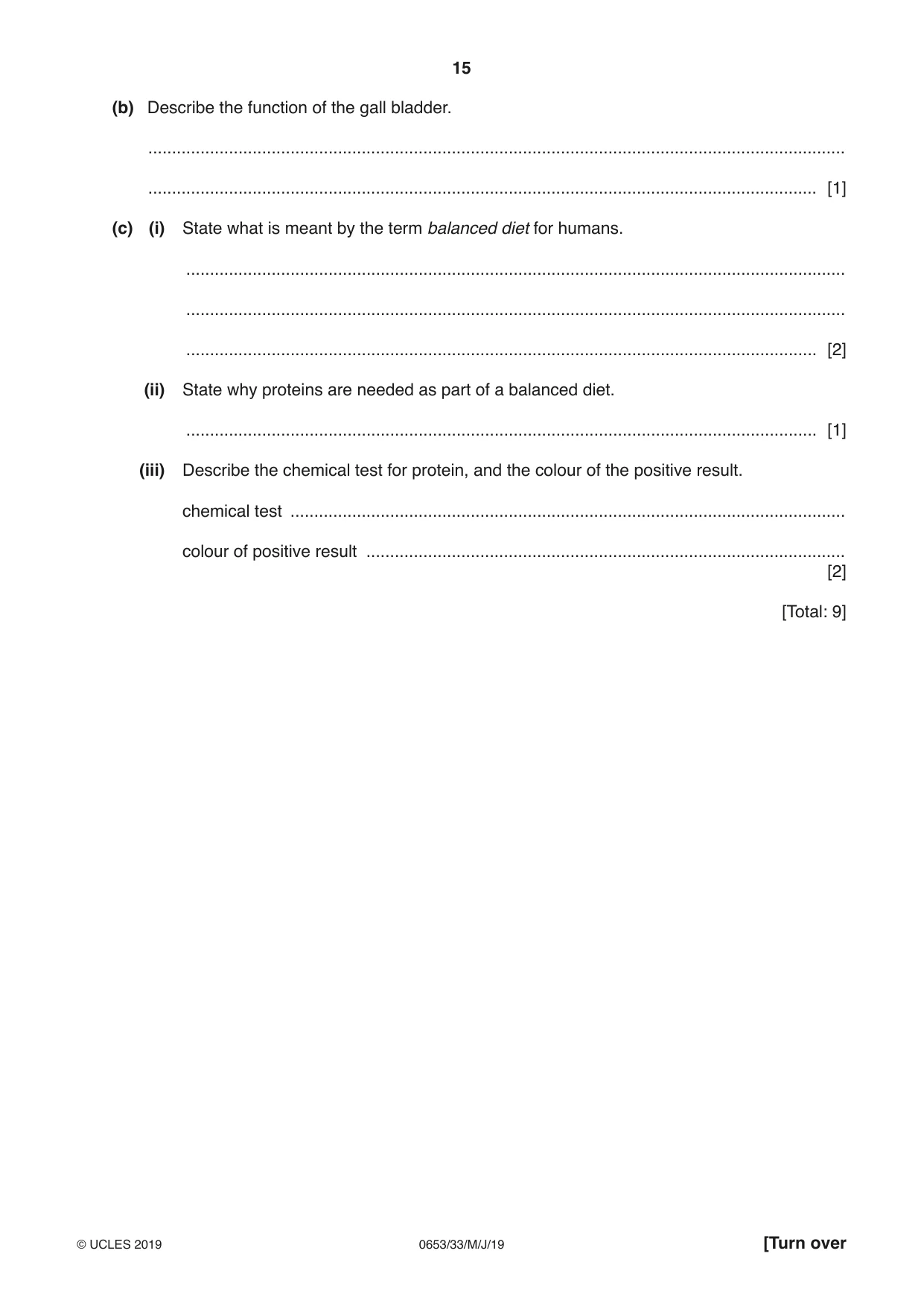
7 (a) Fig. 7.1 is a simplified diagram which shows the human alimentary canal. food mouth alimentary A canal B body tissues C D anus Fig. 7.1 The alimentary canal is a tube going through the body from mouth to anus. The tube is surrounded by body tissues. The letters A, B, C and D show the basic stages of digestion of food. On Fig. 7.2 the boxes on the left show the letters of the stages of digestion of food as shown in Fig. 7.1. The boxes in the middle show the names of these stages. The boxes on the right show descriptions of what is happening to the food. Draw one line to link each letter with its stage, and draw one line to link each stage with its description. Stage B, digestion, is done for you. letter of stage name of stage description A absorption faeces leave the body food is taken into B digestion the body insoluble food molecules C egestion are broken down soluble food molecules D ingestion enter the blood Fig. 7.2 [3] (b) Describe the function of the gall bladder. ................................................................................................................................................... ............................................................................................................................................. [1] (c) (i) State what is meant by the term balanced diet for humans. ........................................................................................................................................... ........................................................................................................................................... ..................................................................................................................................... [2] (ii) State why proteins are needed as part of a balanced diet. ..................................................................................................................................... [1] (iii) Describe the chemical test for protein, and the colour of the positive result. chemical test ..................................................................................................................... colour of positive result ..................................................................................................... [2] [Total: 9]
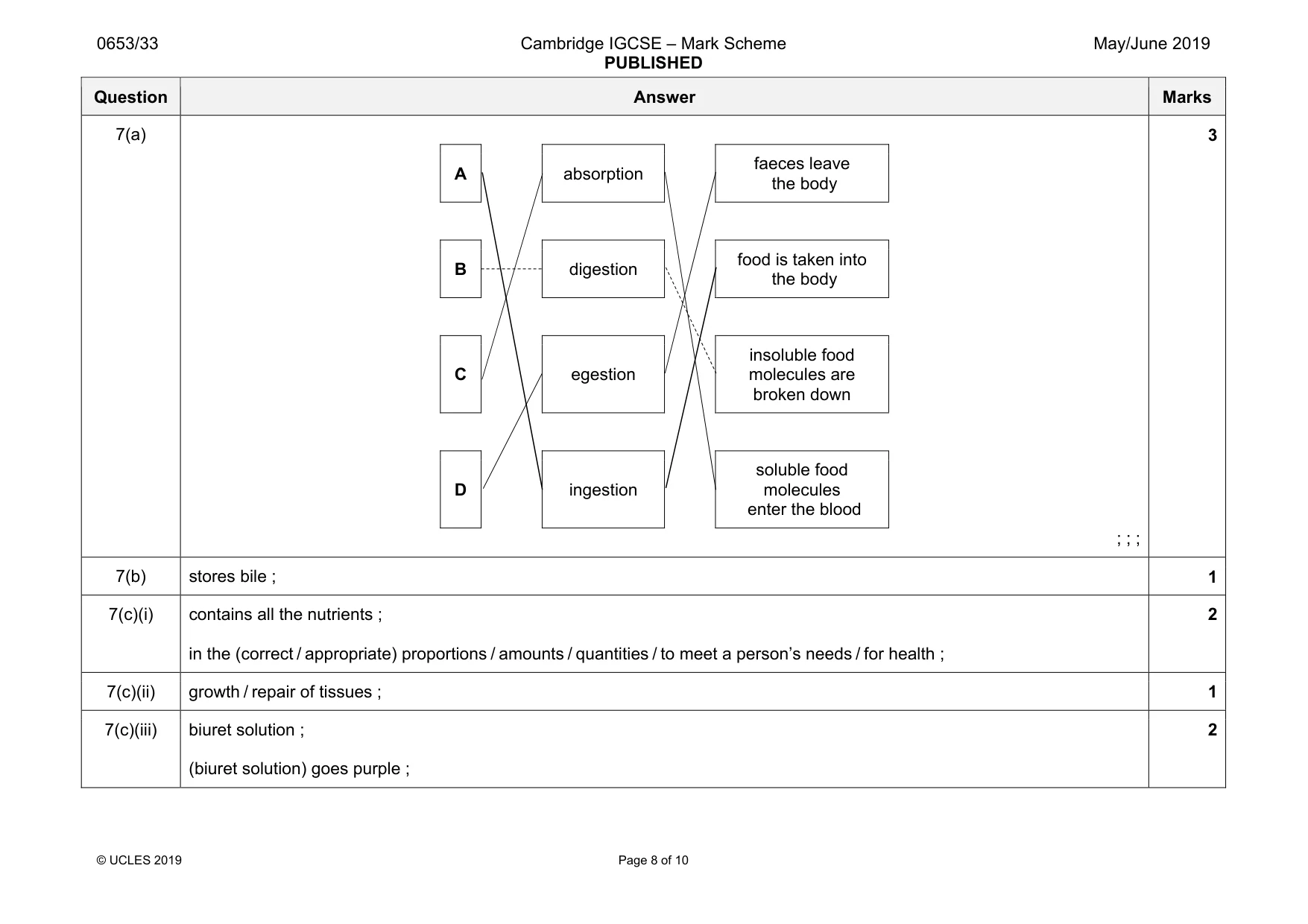
Mark scheme: 7(a) A absorption faeces leave the body B digestion food is taken into the body C egestion insoluble food molecules are broken down D ingestion soluble food molecules enter the blood ; ; ; 3 7(b) stores bile ; 1 7(c)(i) contains all the nutrients ; in the (correct / appropriate) proportions / amounts / quantities / to meet a person’s needs / for health ; 2 7(c)(ii) growth / repair of tissues ; 1 7(c)(iii) biuret solution ; (biuret solution) goes purple ; 2
Q8 · When zinc oxide is heated with carbon, zinc and carbon dioxide are formed
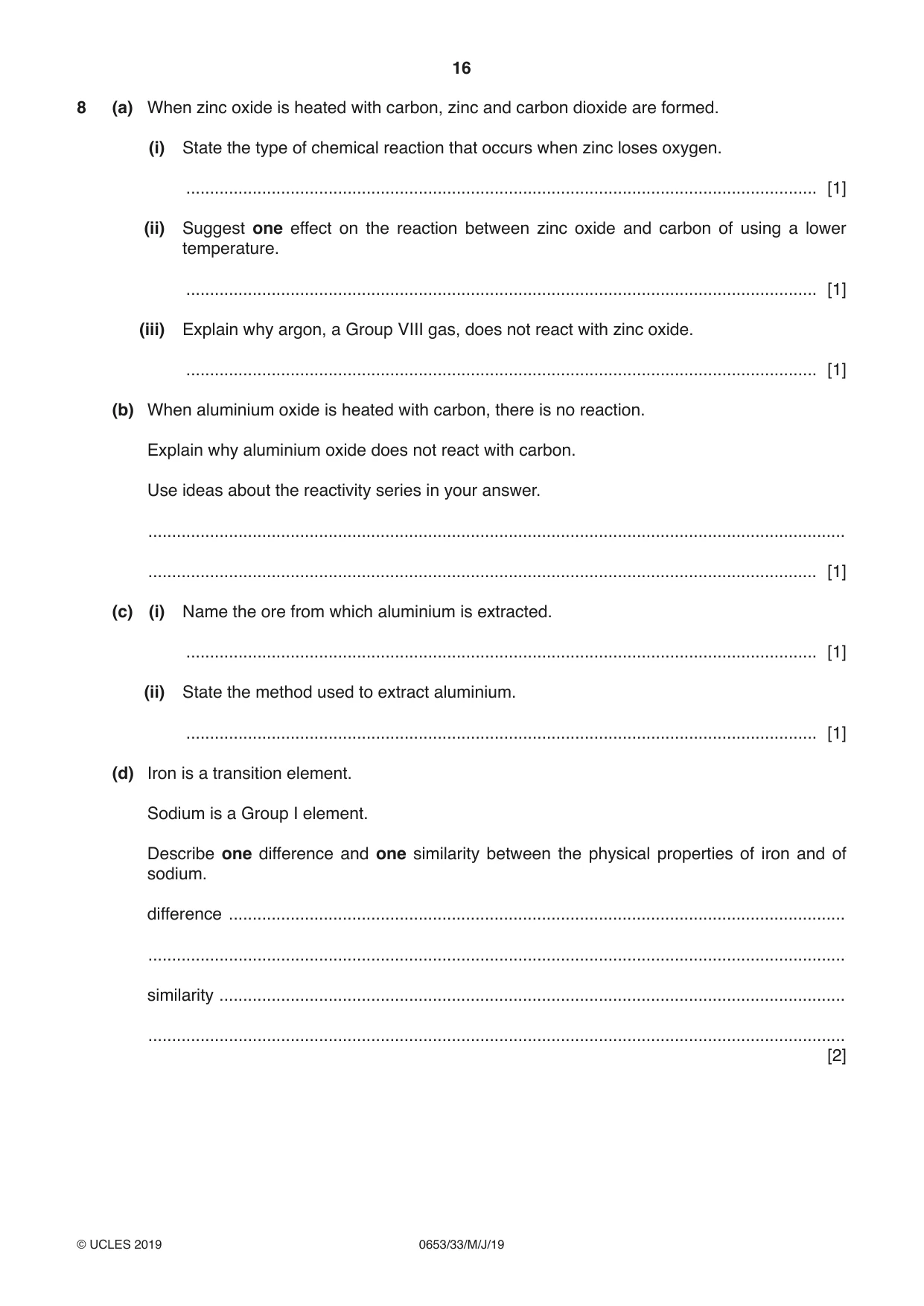
8 (a) When zinc oxide is heated with carbon, zinc and carbon dioxide are formed. (i) State the type of chemical reaction that occurs when zinc loses oxygen. ..................................................................................................................................... [1] (ii) Suggest one effect on the reaction between zinc oxide and carbon of using a lower temperature. ..................................................................................................................................... [1] (iii) Explain why argon, a Group VIII gas, does not react with zinc oxide. ..................................................................................................................................... [1] (b) When aluminium oxide is heated with carbon, there is no reaction. Explain why aluminium oxide does not react with carbon. Use ideas about the reactivity series in your answer. ................................................................................................................................................... ............................................................................................................................................. [1] (c) (i) Name the ore from which aluminium is extracted. ..................................................................................................................................... [1] (ii) State the method used to extract aluminium. ..................................................................................................................................... [1] (d) Iron is a transition element. Sodium is a Group I element. Describe one difference and one similarity between the physical properties of iron and of sodium. difference .................................................................................................................................. ................................................................................................................................................... similarity .................................................................................................................................... ................................................................................................................................................... [2] (e) Recycled metals can cost less than metals extracted from their ores. Suggest one other reason why metals are recycled. ................................................................................................................................................... ............................................................................................................................................. [1] [Total: 9]
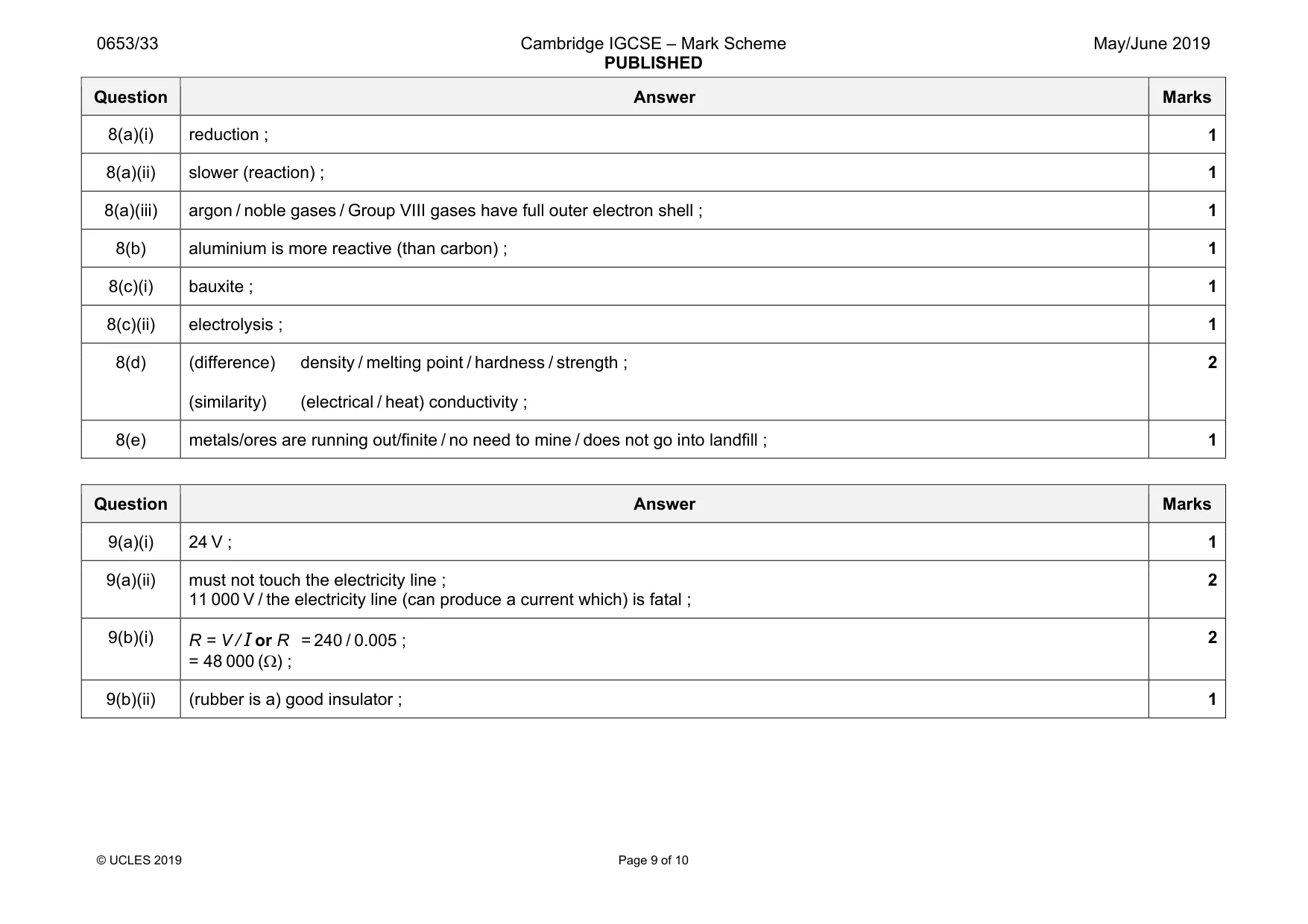
Mark scheme: 8(a)(i) reduction ; 1 8(a)(ii) slower (reaction) ; 1 8(a)(iii) argon / noble gases / Group VIII gases have full outer electron shell ; 1 8(b) aluminium is more reactive (than carbon) ; 1 8(c)(i) bauxite ; 1 8(c)(ii) electrolysis ; 1 8(d) (difference) density / melting point / hardness / strength ; (similarity) (electrical / heat) conductivity ; 2 8(e) metals/ores are running out/finite / no need to mine / does not go into landfill ; 1
Q9 · An electricity line supplying a voltage of 11 000 V
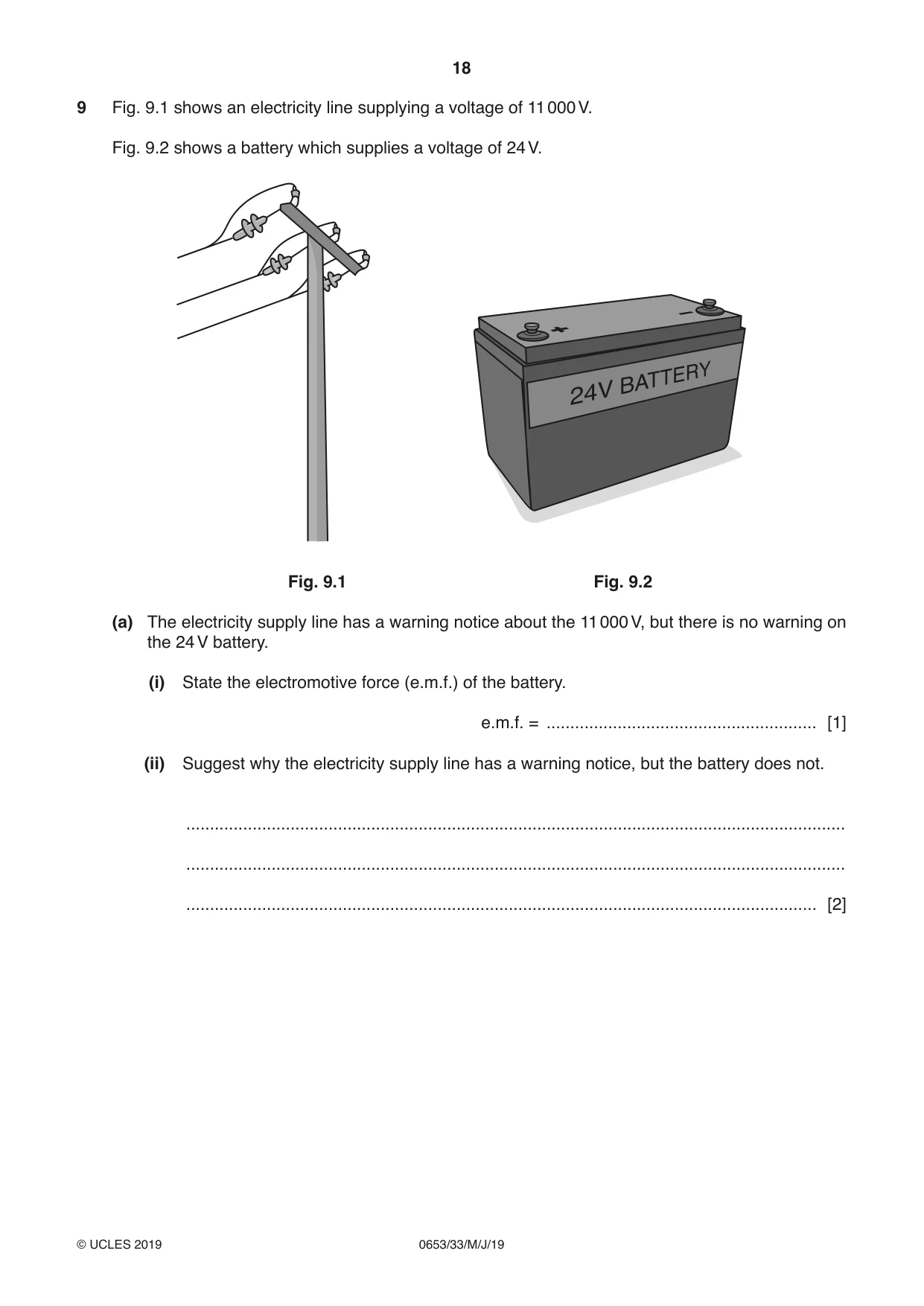
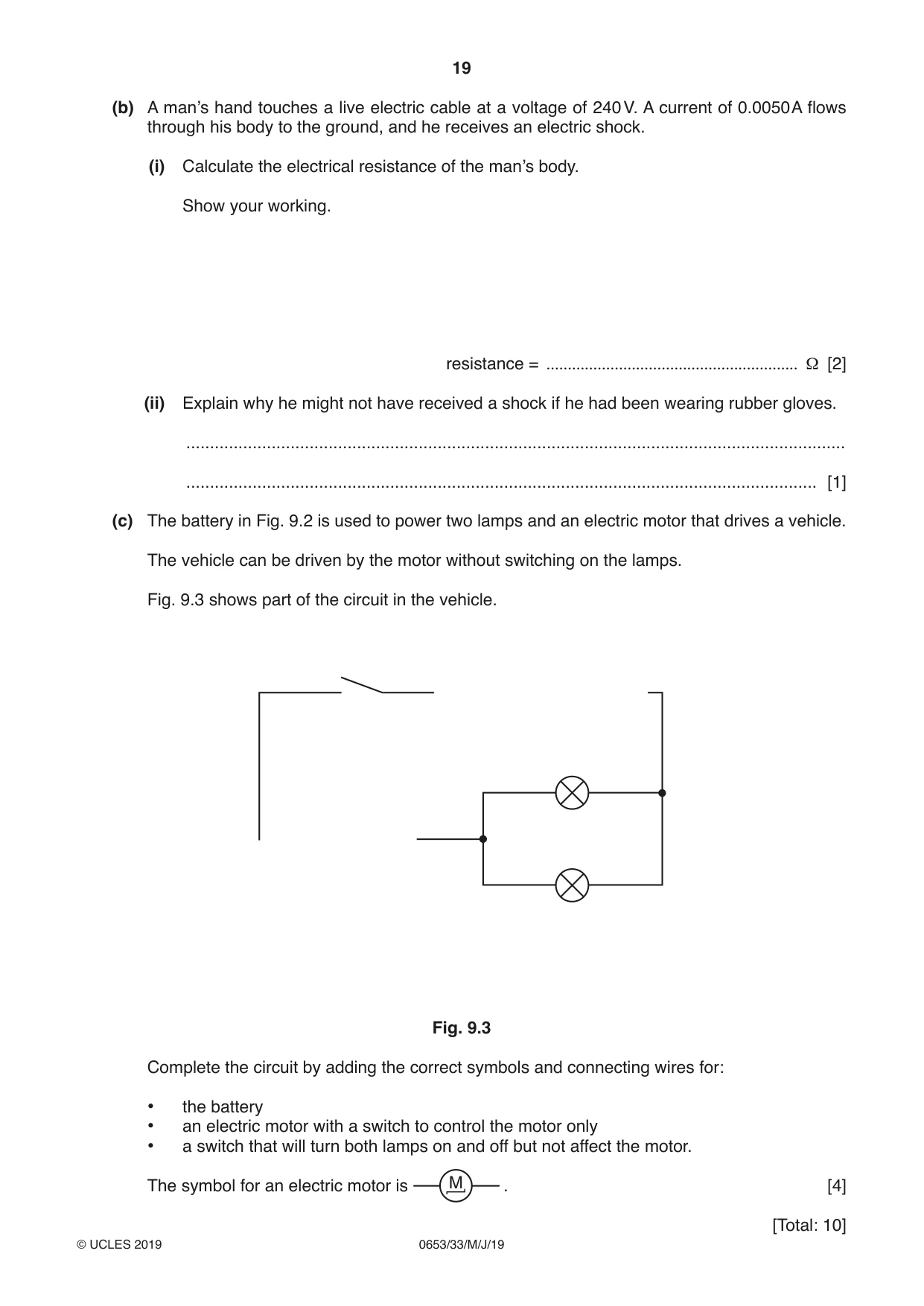
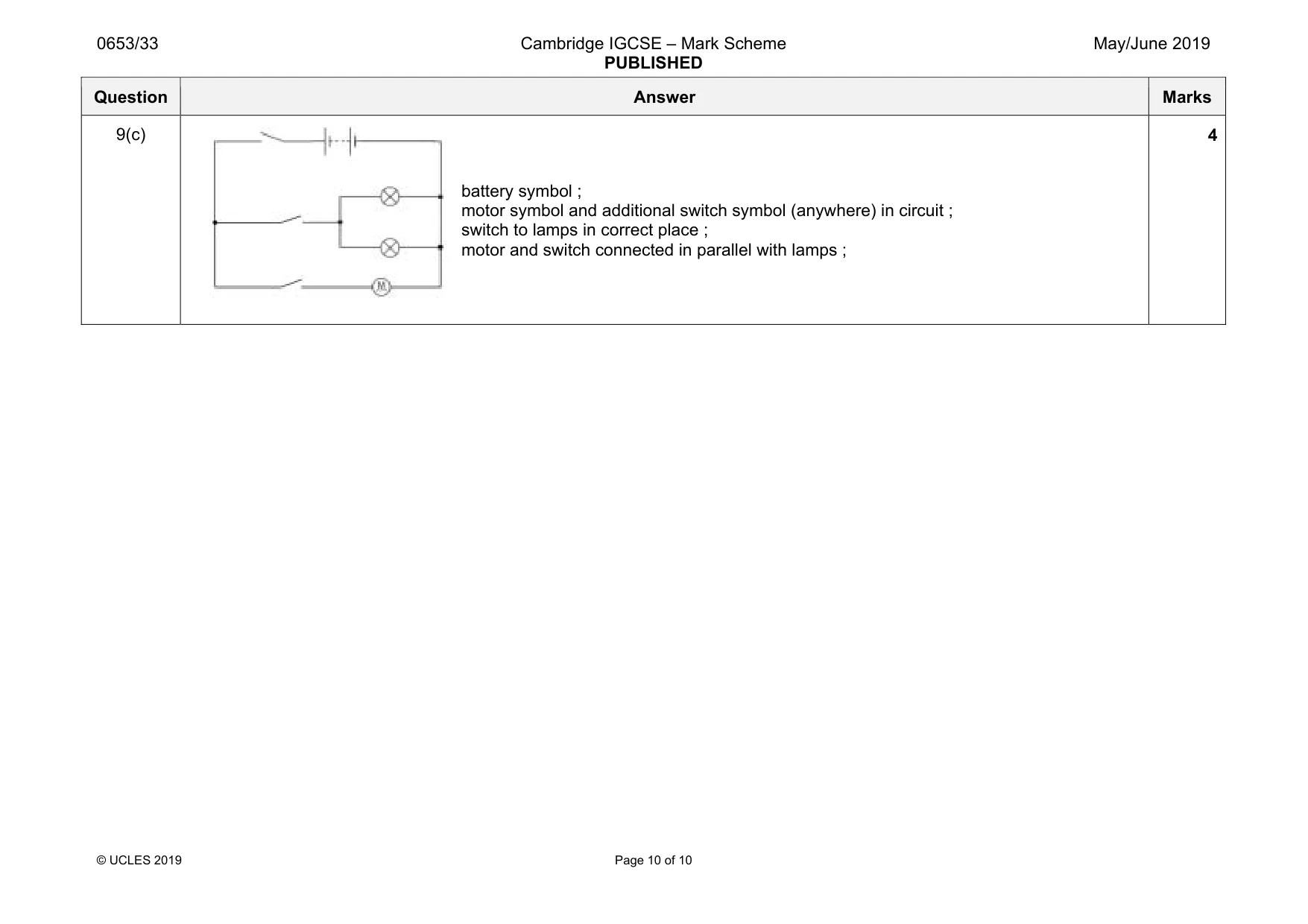
9 Fig. 9.1 shows an electricity line supplying a voltage of 11 000 V. Fig. 9.2 shows a battery which supplies a voltage of 24 V. Fig. 9.1 Fig. 9.2 (a) The electricity supply line has a warning notice about the 11 000 V, but there is no warning on the 24 V battery. (i) State the electromotive force (e.m.f.) of the battery. e.m.f. = ......................................................... [1] (ii) Suggest why the electricity supply line has a warning notice, but the battery does not. ........................................................................................................................................... ........................................................................................................................................... ..................................................................................................................................... [2] (b) A man’s hand touches a live electric cable at a voltage of 240 V. A current of 0.0050 A flows through his body to the ground, and he receives an electric shock. (i) Calculate the electrical resistance of the man’s body. Show your working. (ii) Explain why he might not have received a shock if he had been wearing rubber gloves. ........................................................................................................................................... ..................................................................................................................................... [1] (c) The battery in Fig. 9.2 is used to power two lamps and an electric motor that drives a vehicle. The vehicle can be driven by the motor without switching on the lamps. Fig. 9.3 shows part of the circuit in the vehicle. Fig. 9.3 Complete the circuit by adding the correct symbols and connecting wires for: • the battery • an electric motor with a switch to control the motor only • a switch that will turn both lamps on and off but not affect the motor. The symbol for an electric motor is M . [4]
Mark scheme: 9(a)(i) 24 V ; 1 9(a)(ii) must not touch the electricity line ; 11 000 V / the electricity line (can produce a current which) is fatal ; 2 9(b)(i) R = V / I or R = 240 / 0.005 ; = 48 000 (Ω) ; 2 9(b)(ii) (rubber is a) good insulator ; 1 Question Answer Marks 9(c) battery symbol ; motor symbol and additional switch symbol (anywhere) in circuit ; switch to lamps in correct place ; motor and switch connected in parallel with lamps ; 4
What was in this paper
The subtopics covered by these 9 questions, and how many questions each got. Open one in a new tab to see every Cambridge question on it.
What you needed in this session
Cambridge’s own grade thresholds for 2019 May/June, Paper 3 · Variant 3. A higher threshold means an easier paper — the bar moves with how the cohort did.