Questions as text
Q1 · Iron occurs in the ground as iron oxide 0653/22 Feb/March 2017
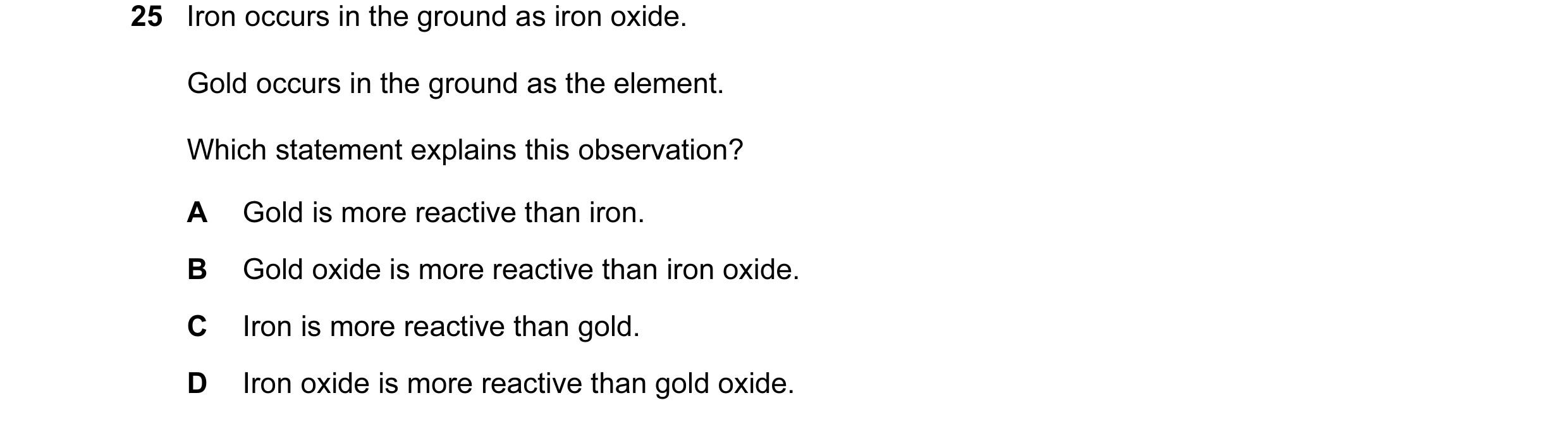
25 Iron occurs in the ground as iron oxide. Gold occurs in the ground as the element. Which statement explains this observation? A Gold is more reactive than iron. B Gold oxide is more reactive than iron oxide. C Iron is more reactive than gold. D Iron oxide is more reactive than gold oxide.
1 marks
Answer: C
This question in 0653/22 Feb/March 2017
Q2 · X, Y and Z are three metallic elements 0653/21 May/June 2017
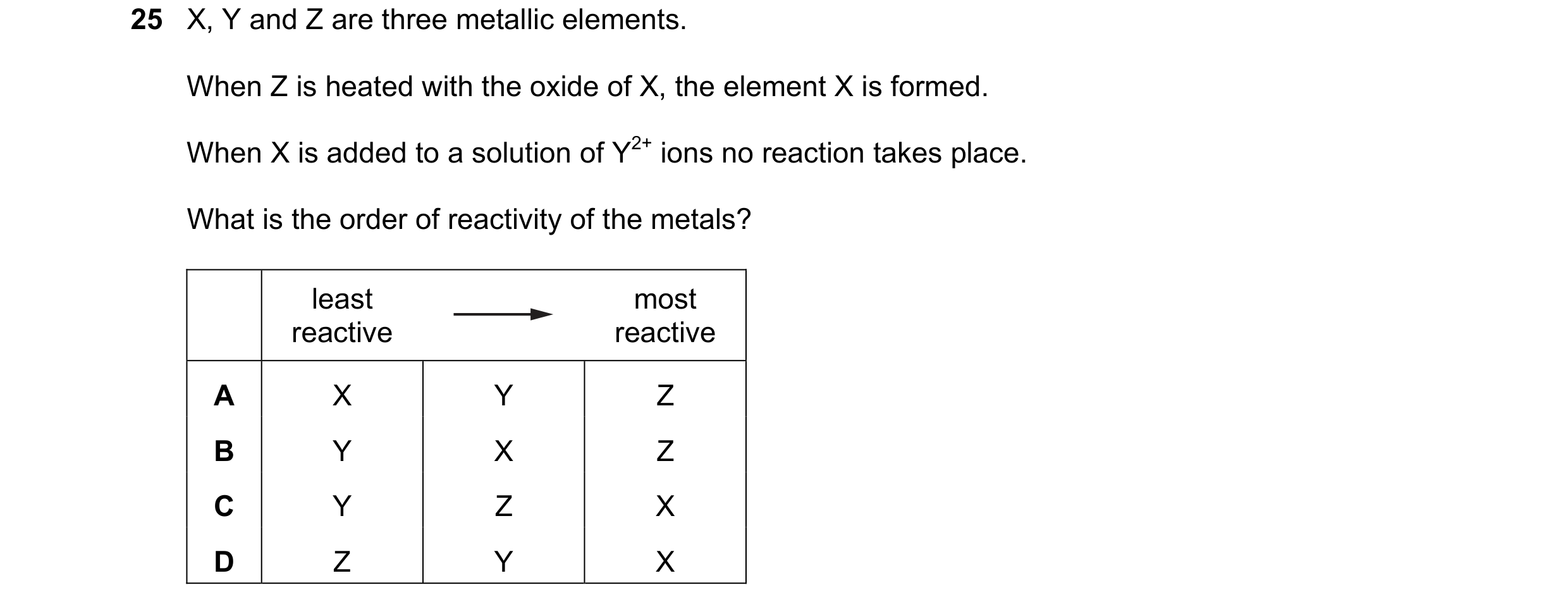
25 X, Y and Z are three metallic elements. When Z is heated with the oxide of X, the element X is formed. When X is added to a solution of Y2+ ions no reaction takes place. What is the order of reactivity of the metals? least most reactive reactive A X Y Z B Y X Z C Y Z X D Z Y X
1 marks
Answer: A
This question in 0653/21 May/June 2017
Q3 · Which pair of substances produces a metal when they are mixed together? 0653/22 May/June 2017
25 Which pair of substances produces a metal when they are mixed together? A copper and aqueous iron(II) ions B iron and aqueous zinc ions C magnesium and aqueous copper(II) ions D zinc and aqueous magnesium ions
1 marks
Answer: C
This question in 0653/22 May/June 2017
Q4 · Astatine is at the bottom of Group VII of the Periodic Table 0653/22 Feb/March 2018
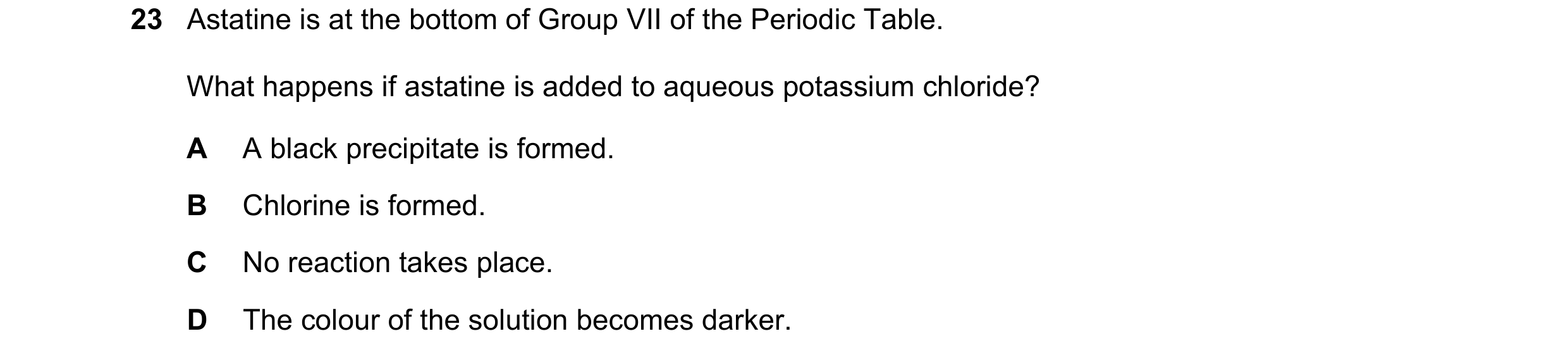
23 Astatine is at the bottom of Group VII of the Periodic Table. What happens if astatine is added to aqueous potassium chloride? A A black precipitate is formed. B Chlorine is formed. C No reaction takes place. D The colour of the solution becomes darker.
1 marks
Answer: C
This question in 0653/22 Feb/March 2018
Q5 · Which statement about metals is not correct? 0653/22 May/June 2018
25 Which statement about metals is not correct? A Calcium is extracted from its ore by electrolysis. B Compounds containing metals are ionic and the metal is always the positive ion. C Magnesium is more reactive than iron because it forms positive ions less easily than iron. D Some metals react with dilute hydrochloric acid to give hydrogen.
1 marks
Answer: C
This question in 0653/22 May/June 2018
Q6 · Which statement about metals is not correct? 0653/21 Oct/Nov 2018
25 Which statement about metals is not correct? A Copper is below hydrogen in the reactivity series. B Lithium produces a flame when a small piece is added to cold water. C Magnesium reacts with steam to produce hydrogen. D Zinc reacts with copper ions to form zinc ions and copper.
1 marks
Answer: B
This question in 0653/21 Oct/Nov 2018
Q7 · Which metal most readily forms positive ions? 0653/22 Oct/Nov 2018
25 Which metal most readily forms positive ions? A calcium B copper C iron D zinc
1 marks
Answer: A
This question in 0653/22 Oct/Nov 2018
Q8 · What is observed when magnesium ribbon is placed into aqueous copper sulfate? 0653/23 Oct/Nov 2018
25 What is observed when magnesium ribbon is placed into aqueous copper sulfate? A The blue solution gets darker and a brown solid appears. B The blue solution gets darker and no solid is visible. C The blue solution gets paler and a brown solid appears. D The blue solution gets paler and no solid is visible.
1 marks
Answer: C
This question in 0653/23 Oct/Nov 2018
Q9 · P, Q, R and S are four metallic elements 0653/21 May/June 2019
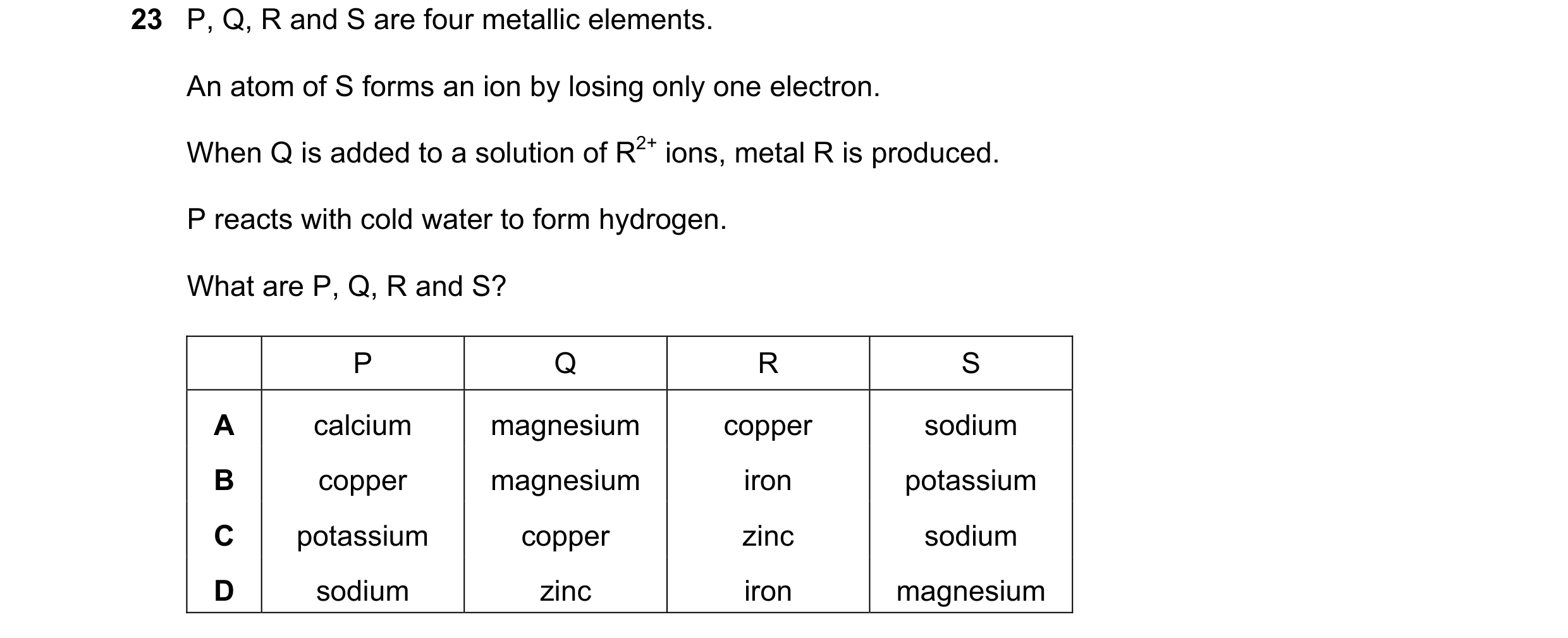
23 P, Q, R and S are four metallic elements. An atom of S forms an ion by losing only one electron. When Q is added to a solution of R2+ ions, metal R is produced. P reacts with cold water to form hydrogen. What are P, Q, R and S? P Q R S A calcium magnesium copper sodium B copper magnesium iron potassium C potassium copper zinc sodium D sodium zinc iron magnesium
1 marks
Answer: A
This question in 0653/21 May/June 2019
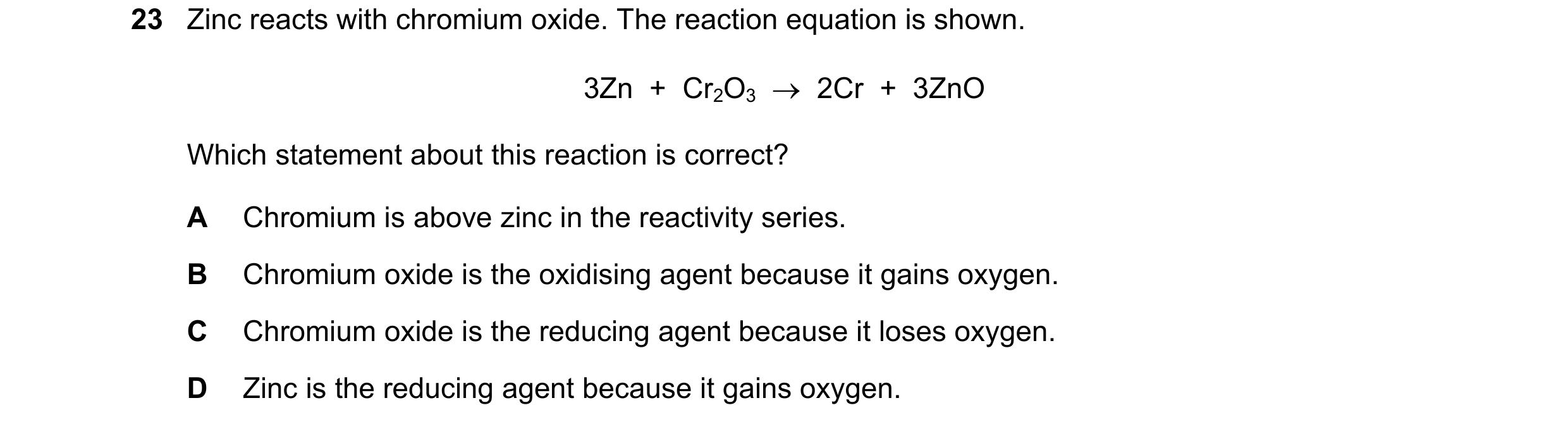
Q10 · Zinc reacts with chromium oxide 0653/22 May/June 2019
23 Zinc reacts with chromium oxide. The reaction equation is shown. 3Zn + Cr2O3 → 2Cr + 3ZnO Which statement about this reaction is correct? A Chromium is above zinc in the reactivity series. B Chromium oxide is the oxidising agent because it gains oxygen. C Chromium oxide is the reducing agent because it loses oxygen. D Zinc is the reducing agent because it gains oxygen.
1 marks
Answer: D
This question in 0653/22 May/June 2019
Q11 · In which mixture does the metal displace the aqueous metal ion? 0653/23 May/June 2019
23 In which mixture does the metal displace the aqueous metal ion? A copper and magnesium sulfate solution B iron and zinc sulfate solution C magnesium and copper sulfate solution D zinc and magnesium sulfate solution
1 marks
Answer: C
This question in 0653/23 May/June 2019
Q12 · Which ionic equation represents a more reactive metal displacing a less reactive metal? 0653/22 Feb/March 2020
24 Which ionic equation represents a more reactive metal displacing a less reactive metal? A Cu + Mg2+ → Cu2+ + Mg B Mg + Ca2+ → Mg2+ + Ca C Zn + Mg2+ → Zn2+ + Mg D Zn + Cu2+ → Zn2+ + Cu
1 marks
Answer: D
This question in 0653/22 Feb/March 2020
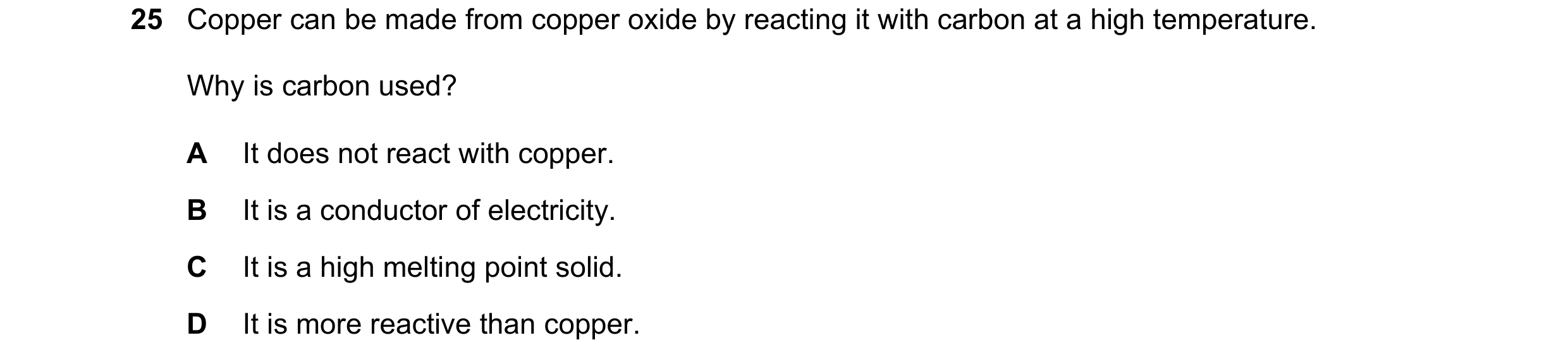
Q13 · Copper can be made from copper oxide by reacting it with carbon at a high temperature 0653/21 May/June 2020
25 Copper can be made from copper oxide by reacting it with carbon at a high temperature. Why is carbon used? A It does not react with copper. B It is a conductor of electricity. C It is a high melting point solid. D It is more reactive than copper.
1 marks
Answer: D
This question in 0653/21 May/June 2020
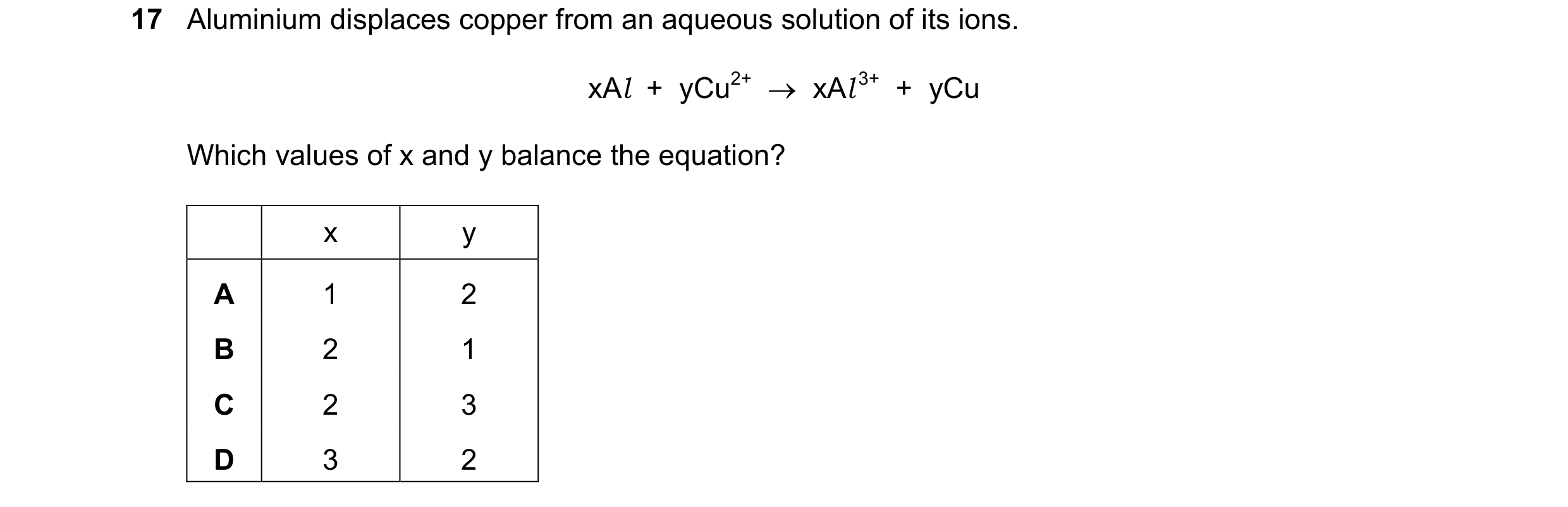
Q14 · Aluminium displaces copper from an aqueous solution of its ions 0653/22 May/June 2020
17 Aluminium displaces copper from an aqueous solution of its ions. xAl + yCu2+ → xAl 3+ + yCu Which values of x and y balance the equation? x y A 1 2 B 2 1 C 2 3 D 3 2
1 marks
Answer: C
This question in 0653/22 May/June 2020
Q15 · Atoms and ions of metals P, Q and R take part in two reactions 0653/22 May/June 2020
24 Atoms and ions of metals P, Q and R take part in two reactions. The equations for these reactions are shown. P + 2Q+ → P2+ + 2Q R + P2+ → R2+ + P Which statements are correct? 1 P is more reactive than R. 2 P is less reactive than Q. 3 R is more reactive than Q. 4 R loses electrons most readily. A 1 and 2 B 1 and 3 C 2 and 4 D 3 and 4
1 marks
Answer: D
This question in 0653/22 May/June 2020
Q16 · Copper can be made from copper oxide by reacting it with carbon at a high temperature 0653/22 May/June 2020
25 Copper can be made from copper oxide by reacting it with carbon at a high temperature. Why is carbon used? A It does not react with copper. B It is a conductor of electricity. C It is a high melting point solid. D It is more reactive than copper.
1 marks
Answer: D
This question in 0653/22 May/June 2020
Q17 · Which equation represents a correct displacement reaction involving halogens? 0653/22 May/June 2021
24 Which equation represents a correct displacement reaction involving halogens? A 2NaBr + I2 Br2 + 2NaI B 2NaCl + Br2 Cl 2 + 2NaBr C 2NaF + I2 F2 + 2NaI D 2NaI + Cl 2 I2 + 2NaCl
1 marks
Answer: D
This question in 0653/22 May/June 2021
Q18 · Element X is a metal 0653/22 May/June 2021
25 Element X is a metal. X is more reactive than aluminium. Which method is used to obtain X? A electrolysis of a molten salt of X B electrolysis of an aqueous solution of a salt of X C heating the oxide of X with carbon D heating the oxide of X with hydrogen
1 marks
Answer: A
This question in 0653/22 May/June 2021
Q19 · Four metals, W, X, Y and Z, are added to aqueous solutions of their salts 0653/23 May/June 2021
25 Four metals, W, X, Y and Z, are added to aqueous solutions of their salts. W displaces Y. Y displaces X. Z displaces Y but does not displace W. Which row shows the reactivity order of the metals? least most reactive reactive A X Y Z W B X Z Y W C W Y Z X D W Z Y X
1 marks
Answer: A
This question in 0653/23 May/June 2021
Q20 · Magnesium reacts with copper oxide 0653/21 Oct/Nov 2021
18 Magnesium reacts with copper oxide. The equation for this reaction is shown. Mg + CuO MgO + Cu Which substance is acting as an oxidising agent in this reaction? A Cu B CuO C Mg D MgO
1 marks
Answer: B
This question in 0653/21 Oct/Nov 2021
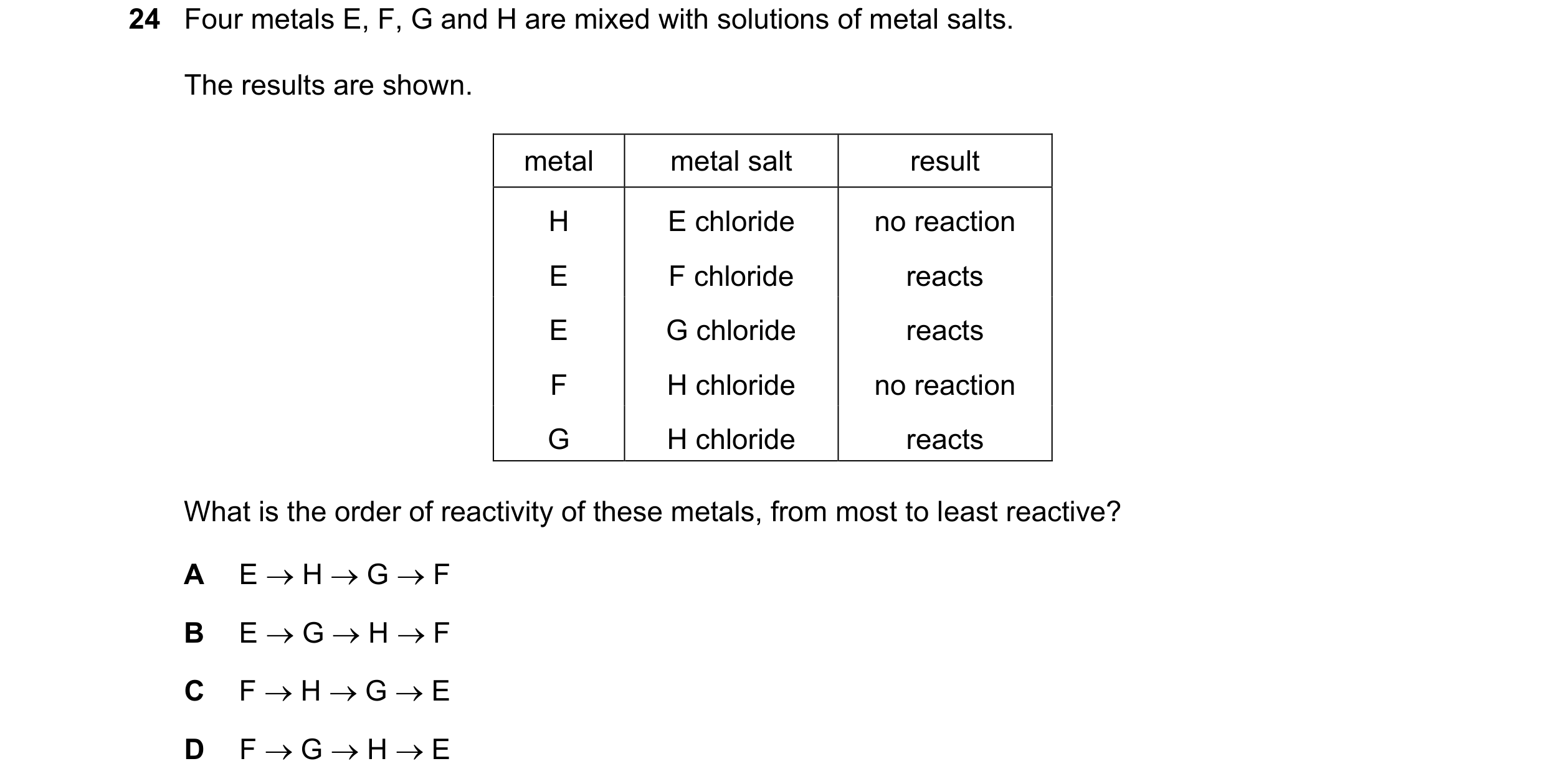
Q21 · Four metals E, F, G and H are mixed with solutions of metal salts 0653/21 Oct/Nov 2021
24 Four metals E, F, G and H are mixed with solutions of metal salts. The results are shown. metal metal salt result H E chloride no reaction E F chloride reacts E G chloride reacts F H chloride no reaction G H chloride reacts What is the order of reactivity of these metals, from most to least reactive? A E H G F B E G H F C F H G E D F G H E
1 marks
Answer: B
This question in 0653/21 Oct/Nov 2021
Q22 · Aluminium reacts with iron oxide to produce iron 0653/22 Oct/Nov 2021
18 Aluminium reacts with iron oxide to produce iron. The equation is shown. 2Al + Fe2O3 Al 2O3 + 2Fe Which row identifies the oxidising agent and the reducing agent? oxidising agent reducing agent A Fe Al B Fe Al 2O3 C Fe2O3 Al D Fe2O3 Al 2O3
1 marks
Answer: C
This question in 0653/22 Oct/Nov 2021
Q23 · Which two substances react together? 0653/22 Oct/Nov 2021
24 Which two substances react together? A aluminium and aqueous magnesium sulfate B copper and aqueous iron(II) sulfate C iron and aqueous zinc sulfate D zinc and aqueous copper sulfate
1 marks
Answer: D
This question in 0653/22 Oct/Nov 2021
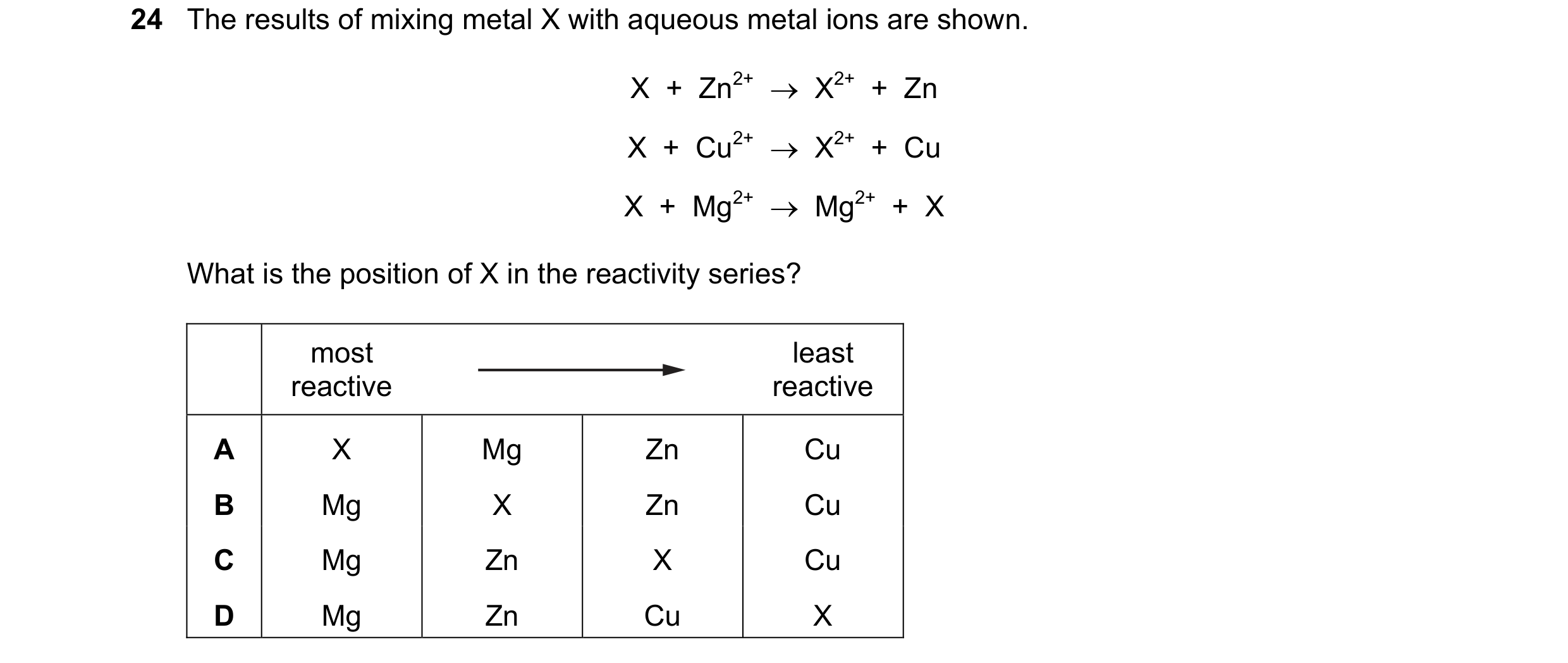
Q24 · The results of mixing metal X with aqueous metal ions are shown 0653/23 Oct/Nov 2021
24 The results of mixing metal X with aqueous metal ions are shown. X + Zn2+ X2+ + Zn X + Cu2+ X2+ + Cu X + Mg2+ Mg2+ + X What is the position of X in the reactivity series? most least reactive reactive A X Mg Zn Cu B Mg X Zn Cu C Mg Zn X Cu D Mg Zn Cu X
1 marks
Answer: B
This question in 0653/23 Oct/Nov 2021
Q25 · X, Y and Z are three metals 0653/22 Feb/March 2022
23 X, Y and Z are three metals. When Z is heated with the oxide of X, the metal X is formed. When X is added to a solution of Y2+ ions, no reaction takes place. What is the order of reactivity of the metals? least most reactive reactive A X Y Z B Y X Z C Y Z X D Z Y X
1 marks
Answer: A
This question in 0653/22 Feb/March 2022
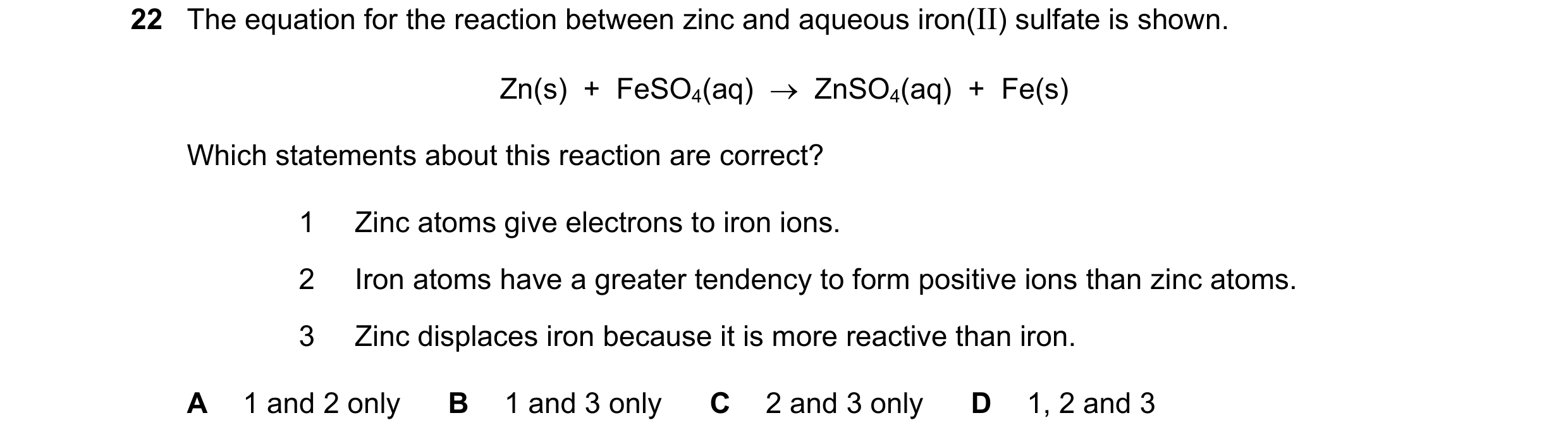
Q26 · The equation for the reaction between zinc and aqueous iron(II) sulfate is shown 0653/21 May/June 2022
22 The equation for the reaction between zinc and aqueous iron(II) sulfate is shown. Zn(s) + FeSO4(aq) ZnSO4(aq) + Fe(s) Which statements about this reaction are correct? 1 Zinc atoms give electrons to iron ions. 2 Iron atoms have a greater tendency to form positive ions than zinc atoms. 3 Zinc displaces iron because it is more reactive than iron. A 1 and 2 only B 1 and 3 only C 2 and 3 only D 1, 2 and 3
1 marks
Answer: B
This question in 0653/21 May/June 2022
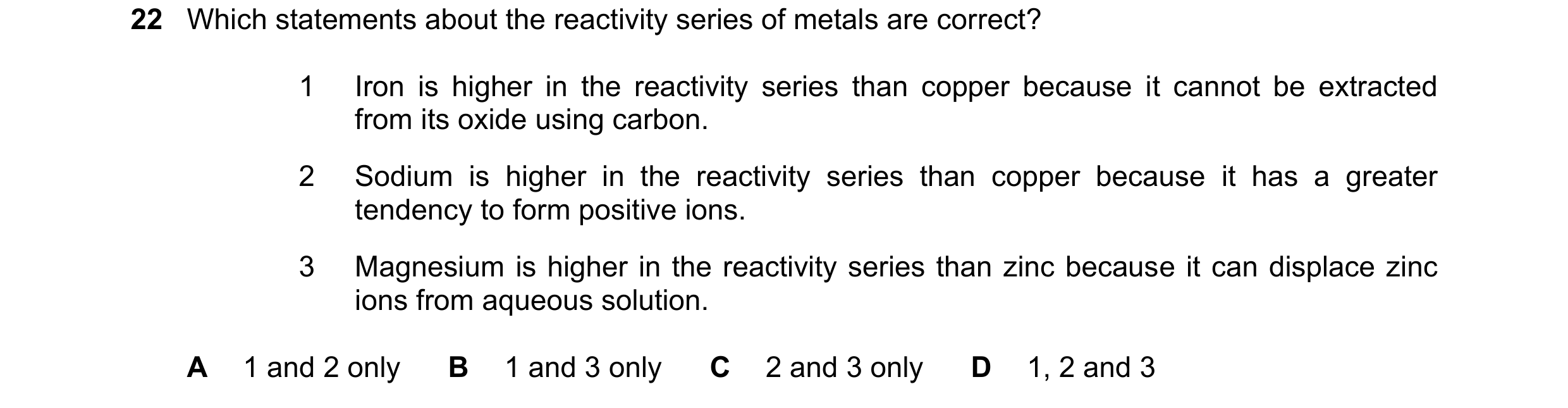
Q27 · Which statements about the reactivity series of metals are correct? 0653/22 May/June 2022
22 Which statements about the reactivity series of metals are correct? 1 Iron is higher in the reactivity series than copper because it cannot be extracted from its oxide using carbon. 2 Sodium is higher in the reactivity series than copper because it has a greater tendency to form positive ions. 3 Magnesium is higher in the reactivity series than zinc because it can displace zinc ions from aqueous solution. A 1 and 2 only B 1 and 3 only C 2 and 3 only D 1, 2 and 3
1 marks
Answer: C
This question in 0653/22 May/June 2022
Q28 · In which mixture is the aqueous metal ion displaced by the metal? 0653/23 May/June 2022
22 In which mixture is the aqueous metal ion displaced by the metal? A Cu2+ and Zn B Fe2+ and Cu C Mg2+ and Zn D Zn2+ and Fe
1 marks
Answer: A
This question in 0653/23 May/June 2022
Q29 · Copper oxide and excess carbon are mixed together 0653/21 May/June 2023
24 Copper oxide and excess carbon are mixed together. The mass before heating is 12.2 g. The mixture is heated strongly and allowed to cool. The mass after heating is 10.4 g. Why does the mass change? A Carbon forms carbon dioxide which then combines with the copper oxide. B Carbon reduces the copper oxide and leaves the test-tube as carbon dioxide. C Copper oxide loses oxygen, turns into copper and the carbon remains unchanged. D Carbon oxidises the copper oxide and leaves the test-tube as carbon dioxide.
1 marks
Answer: B
This question in 0653/21 May/June 2023
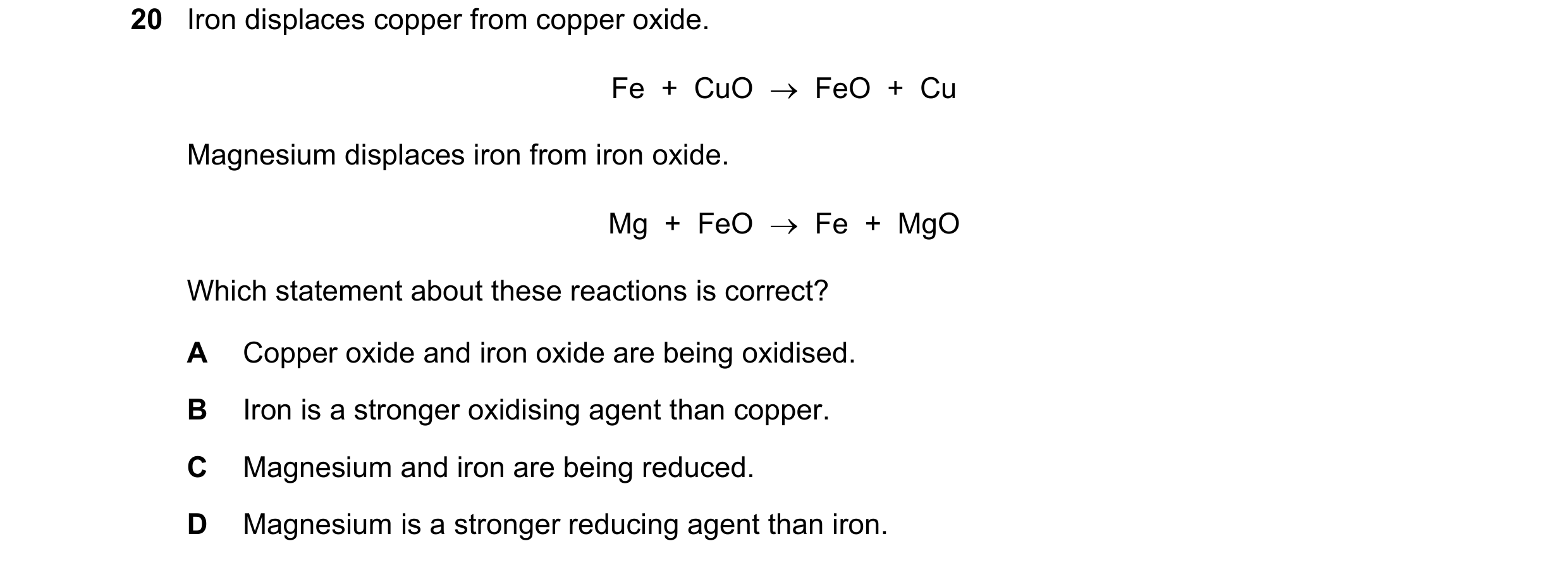
Q30 · Iron displaces copper from copper oxide 0653/23 May/June 2023
20 Iron displaces copper from copper oxide. Fe + CuO FeO + Cu Magnesium displaces iron from iron oxide. Mg + FeO Fe + MgO Which statement about these reactions is correct? A Copper oxide and iron oxide are being oxidised. B Iron is a stronger oxidising agent than copper. C Magnesium and iron are being reduced. D Magnesium is a stronger reducing agent than iron.
1 marks
Answer: D
This question in 0653/23 May/June 2023
Q31 · Which statements about metals and their compounds are correct? 0653/21 Oct/Nov 2023
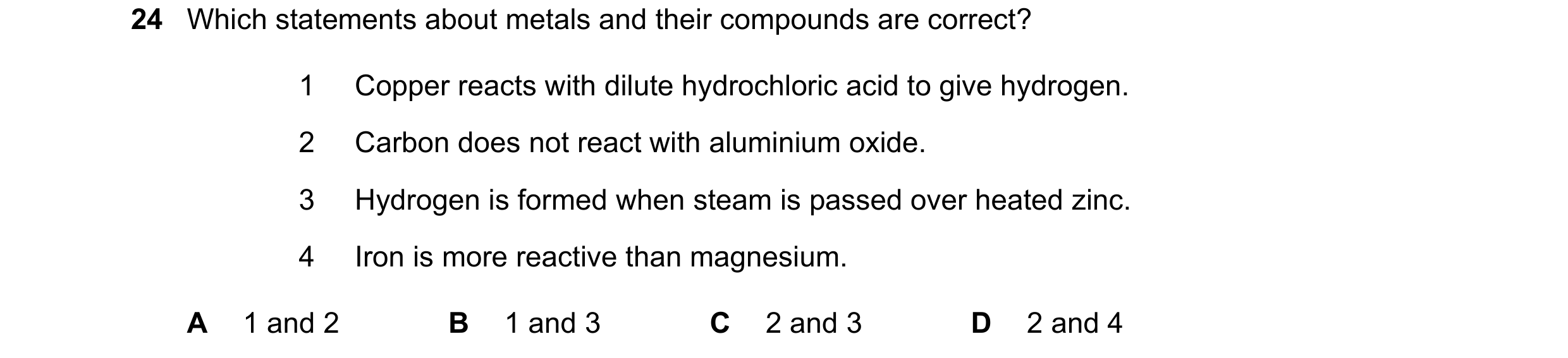
24 Which statements about metals and their compounds are correct? 1 Copper reacts with dilute hydrochloric acid to give hydrogen. 2 Carbon does not react with aluminium oxide. 3 Hydrogen is formed when steam is passed over heated zinc. 4 Iron is more reactive than magnesium. A 1 and 2 B 1 and 3 C 2 and 3 D 2 and 4
1 marks
Answer: C
This question in 0653/21 Oct/Nov 2023
Q32 · Dilute hydrochloric acid is added to powdered solid X 0653/22 Oct/Nov 2023
20 Dilute hydrochloric acid is added to powdered solid X. Hydrogen gas is produced. dilute hydrochloric acid powdered solid X What is X? A zinc B zinc carbonate C zinc hydroxide D zinc oxide
1 marks
Answer: A
This question in 0653/22 Oct/Nov 2023
Q33 · Which substance does not react with dilute hydrochloric acid to produce copper chloride? 0653/22 Oct/Nov 2023
24 Which substance does not react with dilute hydrochloric acid to produce copper chloride? A copper B copper carbonate C copper hydroxide D copper oxide
1 marks
Answer: A
This question in 0653/22 Oct/Nov 2023
Q34 · Part of the reactivity series of metals is shown 0653/22 Oct/Nov 2023
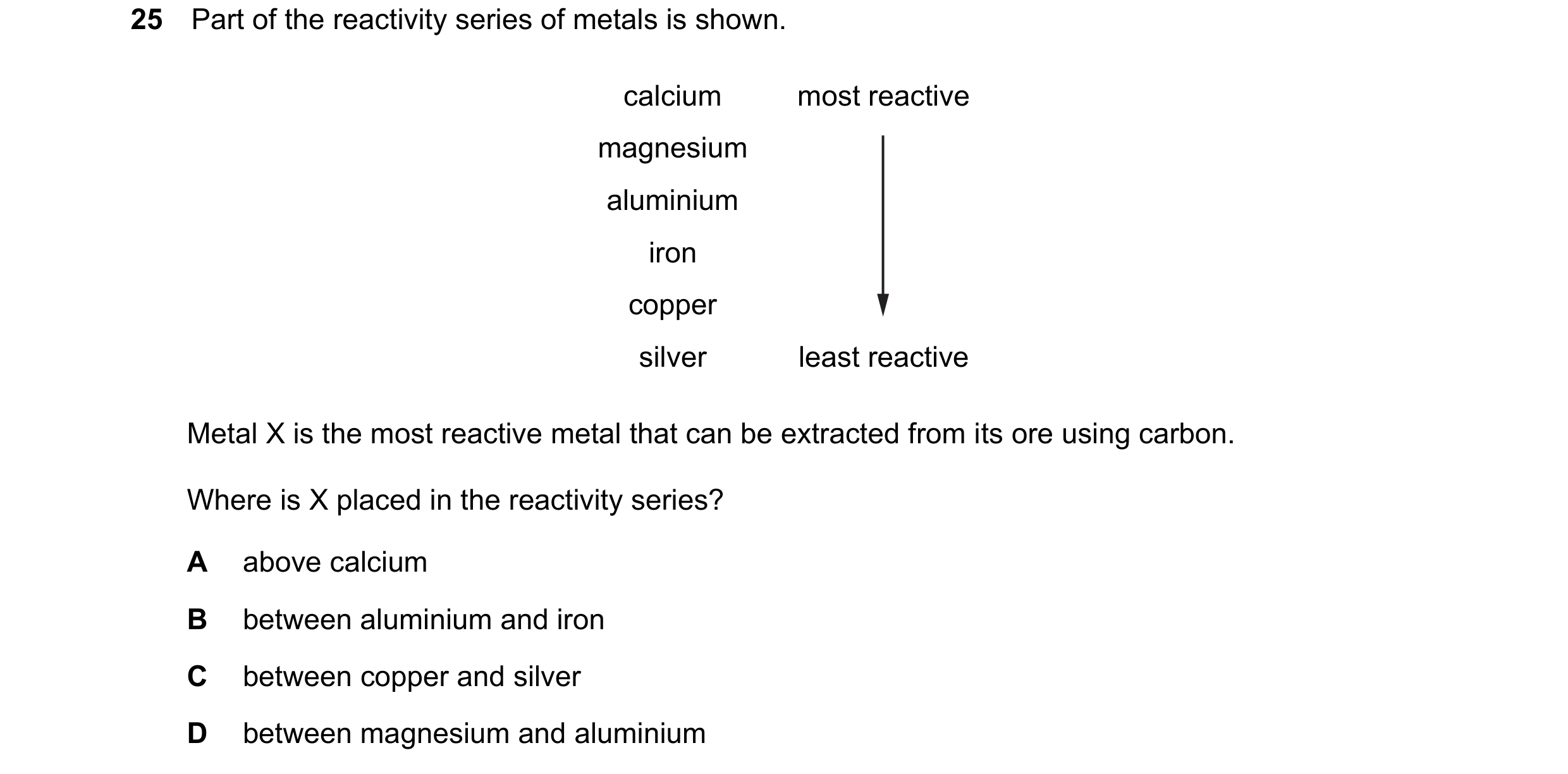
25 Part of the reactivity series of metals is shown. calcium most reactive magnesium aluminium iron copper silver least reactive Metal X is the most reactive metal that can be extracted from its ore using carbon. Where is X placed in the reactivity series? A above calcium B between aluminium and iron C between copper and silver D between magnesium and aluminium
1 marks
Answer: B
This question in 0653/22 Oct/Nov 2023
Q35 · Which element reacts with dilute sulfuric acid to form a salt? 0653/23 Oct/Nov 2023
20 Which element reacts with dilute sulfuric acid to form a salt? A carbon B copper C sulfur D zinc
1 marks
Answer: D
This question in 0653/23 Oct/Nov 2023
Q36 · Which row shows elements in order of reactivity? 0653/23 Oct/Nov 2023
24 Which row shows elements in order of reactivity? most reactive least reactive A aluminium iron zinc hydrogen B calcium carbon aluminium copper C magnesium zinc hydrogen copper D sodium potassium magnesium aluminium
1 marks
Answer: C
This question in 0653/23 Oct/Nov 2023
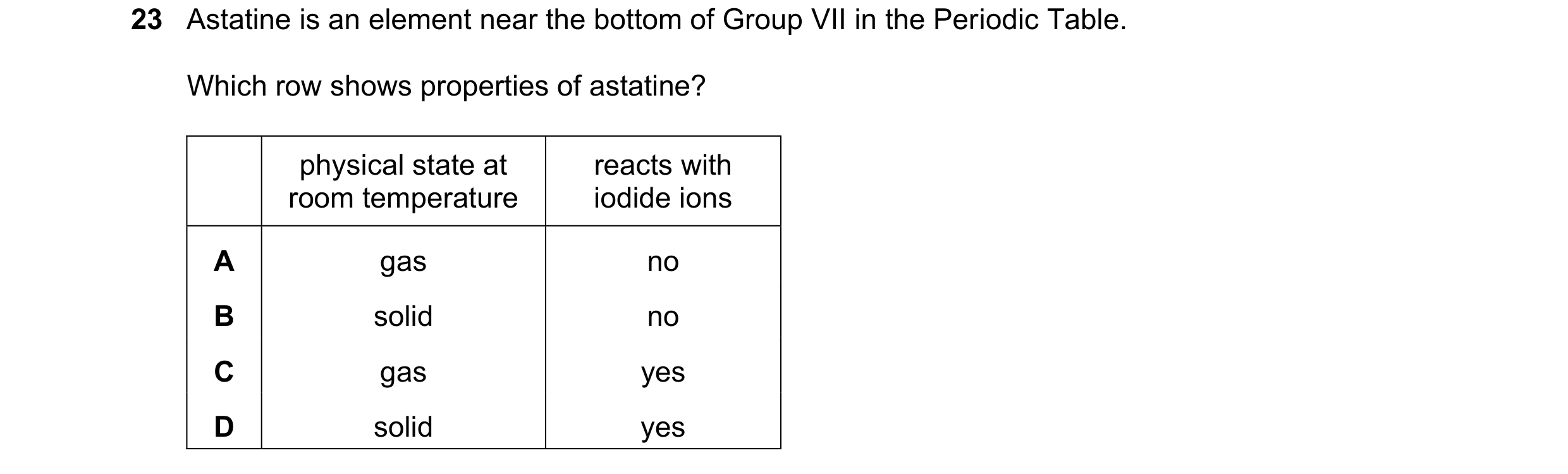
Q37 · Astatine is an element near the bottom of Group VII in the Periodic Table 0653/21 May/June 2024
23 Astatine is an element near the bottom of Group VII in the Periodic Table. Which row shows properties of astatine? physical state at reacts with room temperature iodide ions A gas no B solid no C gas yes D solid yes
1 marks
Answer: B
This question in 0653/21 May/June 2024
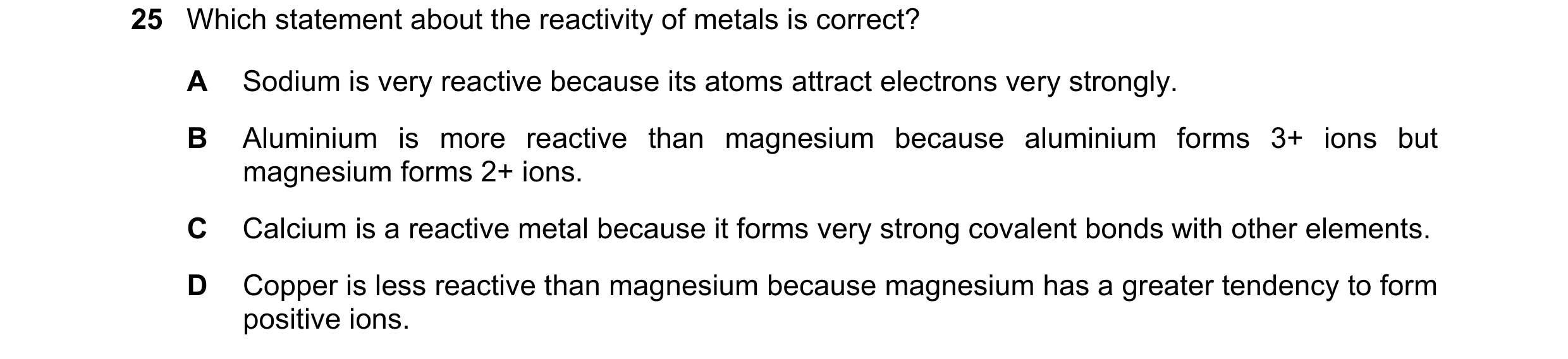
Q38 · Which statement about the reactivity of metals is correct? 0653/23 May/June 2024
25 Which statement about the reactivity of metals is correct? A Sodium is very reactive because its atoms attract electrons very strongly. B Aluminium is more reactive than magnesium because aluminium forms 3+ ions but magnesium forms 2+ ions. C Calcium is a reactive metal because it forms very strong covalent bonds with other elements. D Copper is less reactive than magnesium because magnesium has a greater tendency to form positive ions.
1 marks
Answer: D
This question in 0653/23 May/June 2024
Q39 · Which metal can be obtained by passing hydrogen over its heated metal oxide? 0653/21 Oct/Nov 2024
24 Which metal can be obtained by passing hydrogen over its heated metal oxide? A copper B magnesium C iron D zinc
1 marks
Answer: A
This question in 0653/21 Oct/Nov 2024
Q40 · Which element does not produce a gas when added to dilute hydrochloric acid? 0653/22 May/June 2025
22 Which element does not produce a gas when added to dilute hydrochloric acid? A copper B iron C magnesium D zinc
1 marks
Answer: A
This question in 0653/22 May/June 2025
Q41 · Which metal reacts most quickly with cold water? 0653/21 Oct/Nov 2025
19 Which metal reacts most quickly with cold water? A calcium B magnesium C potassium D sodium
1 marks
Answer: C
This question in 0653/21 Oct/Nov 2025

 1 / 11


 2 / 11

 3 / 11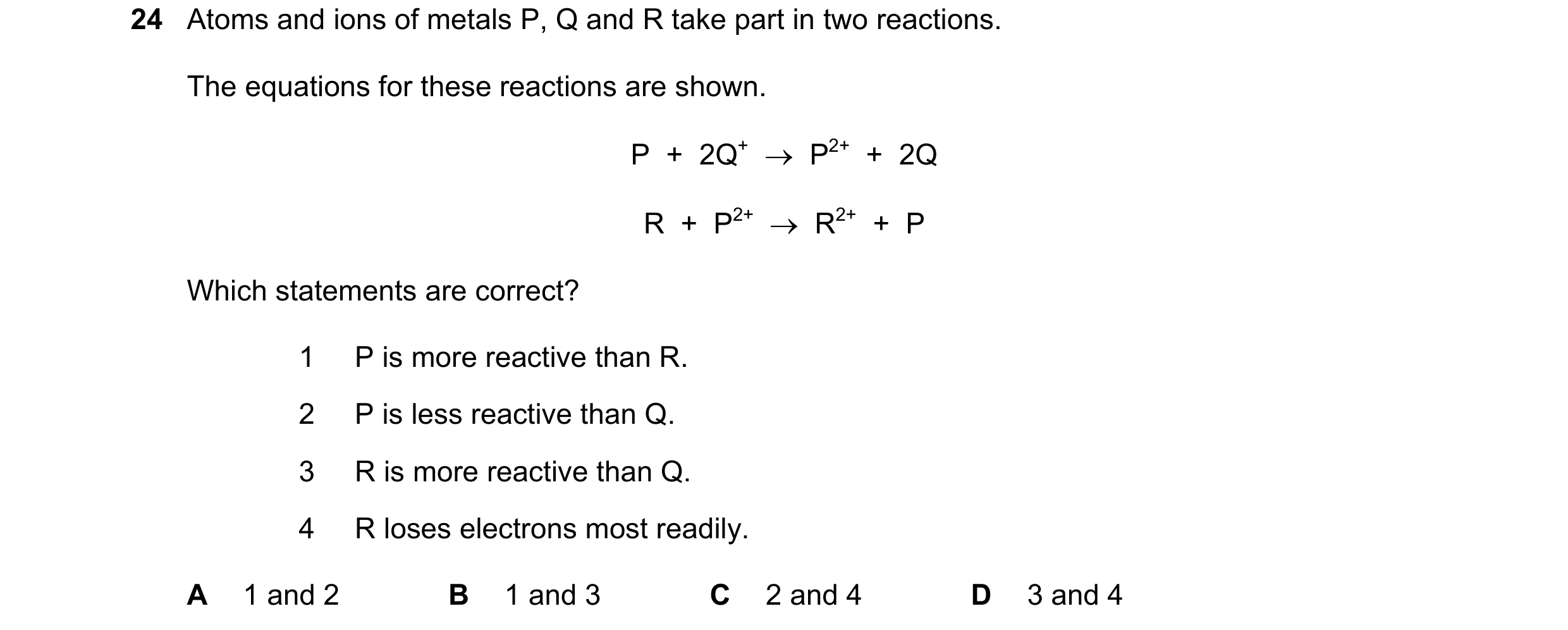

 4 / 11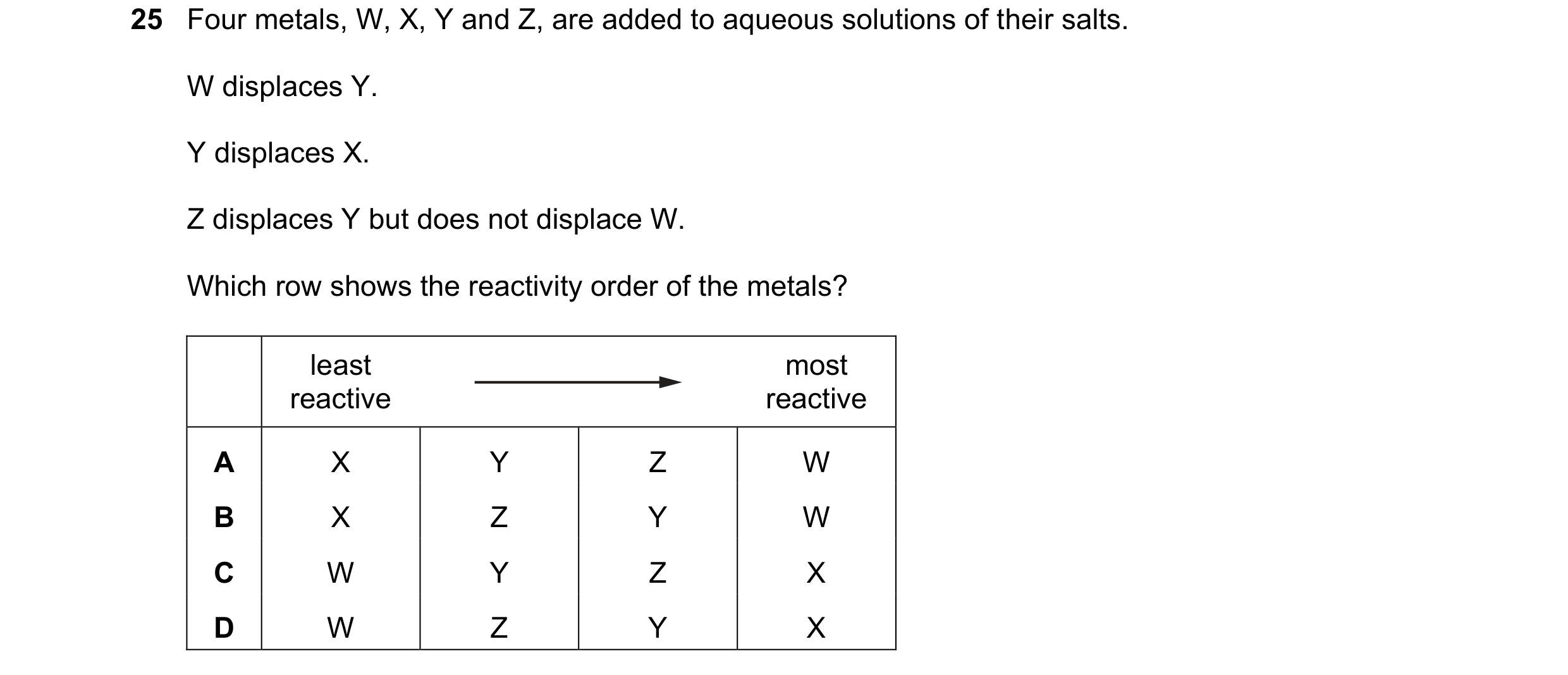
 5 / 11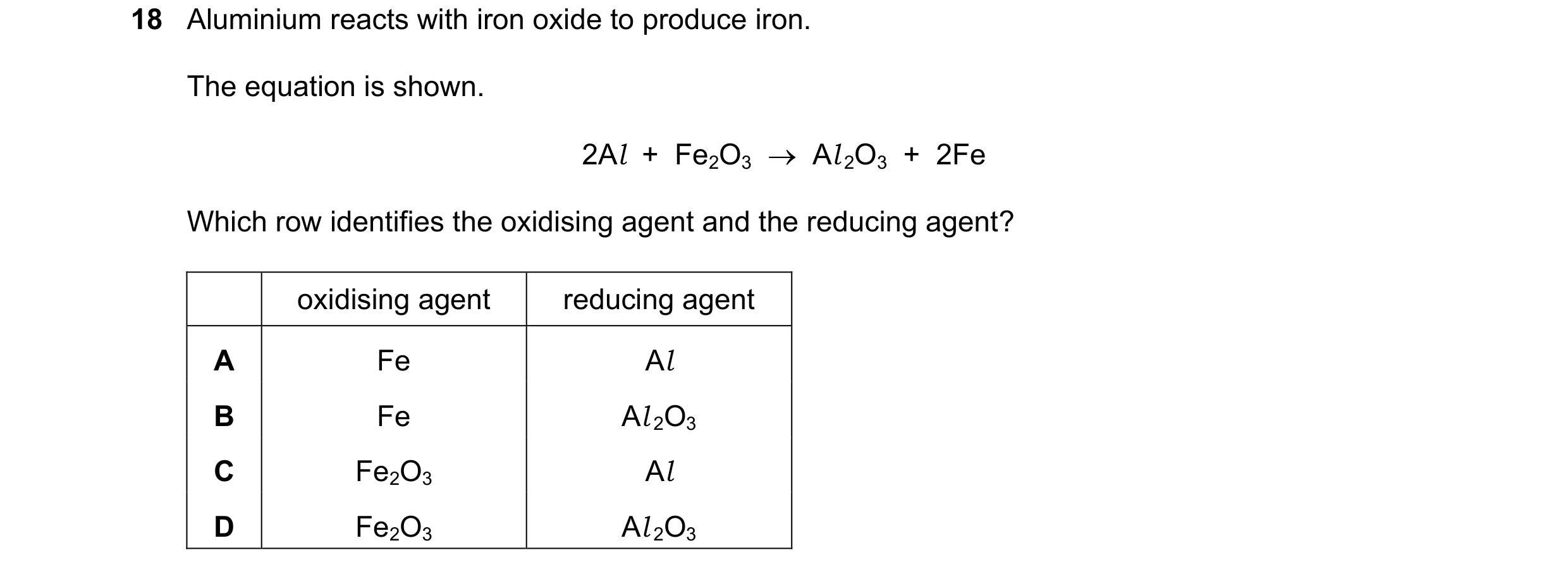

 6 / 11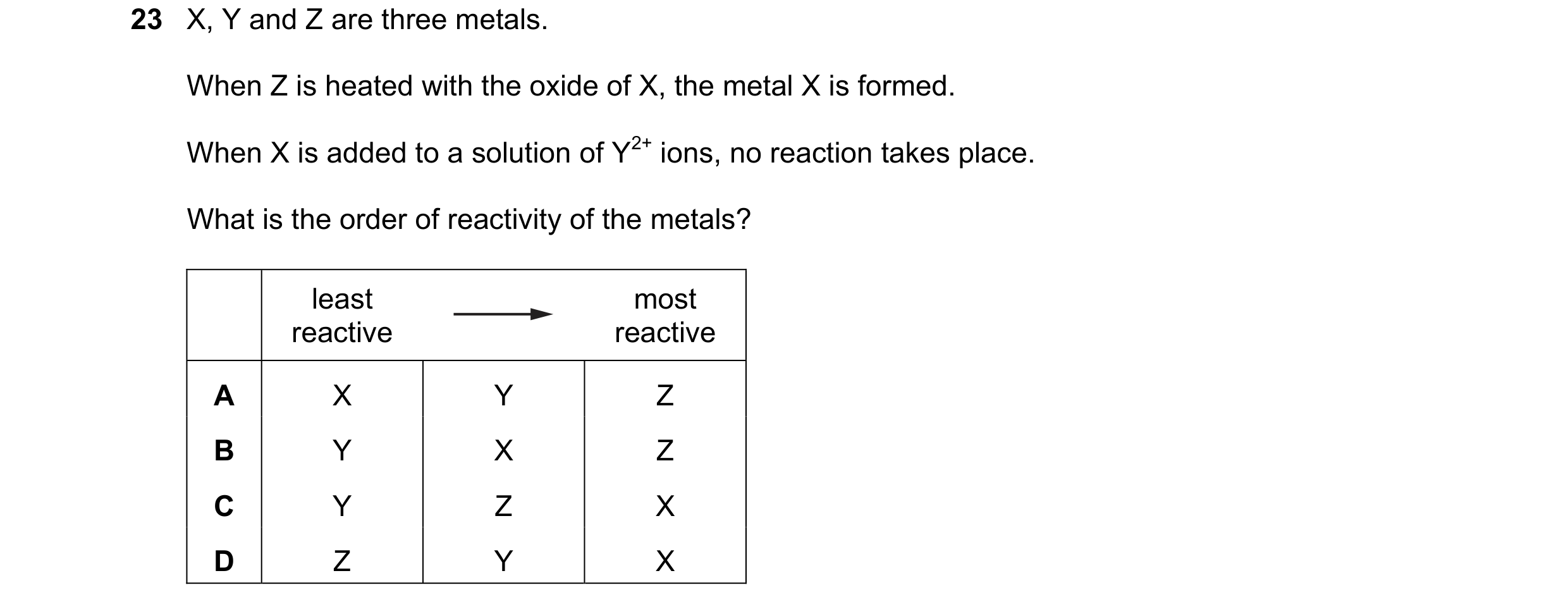
 7 / 11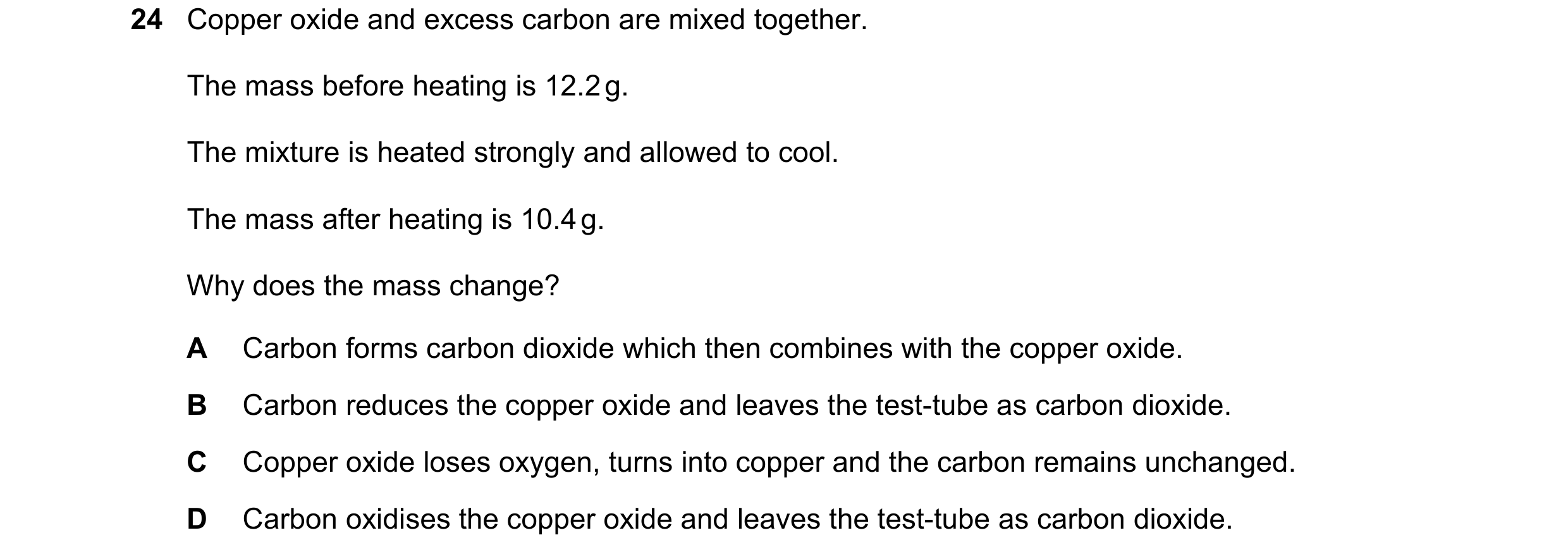
 8 / 11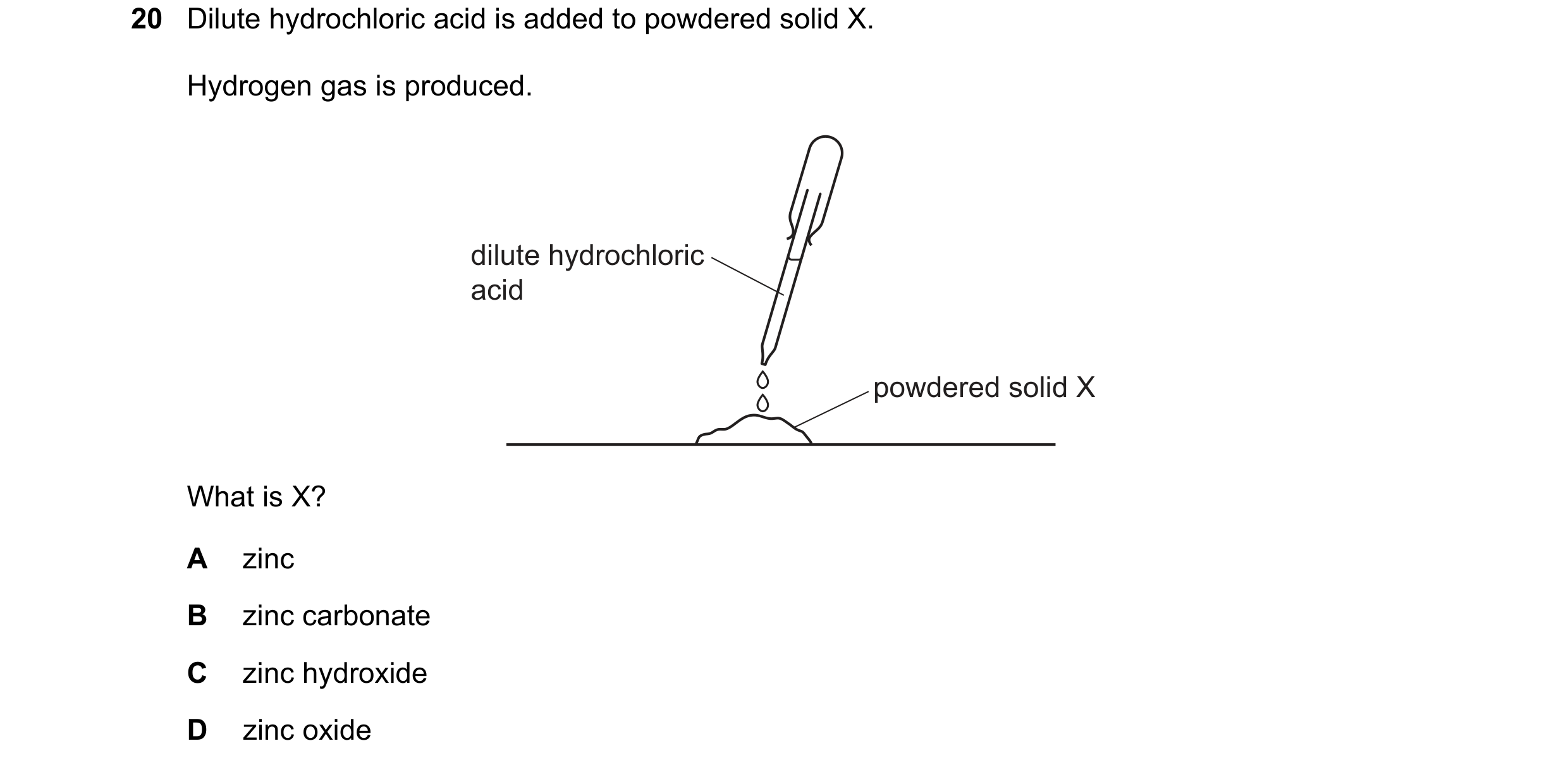

 9 / 11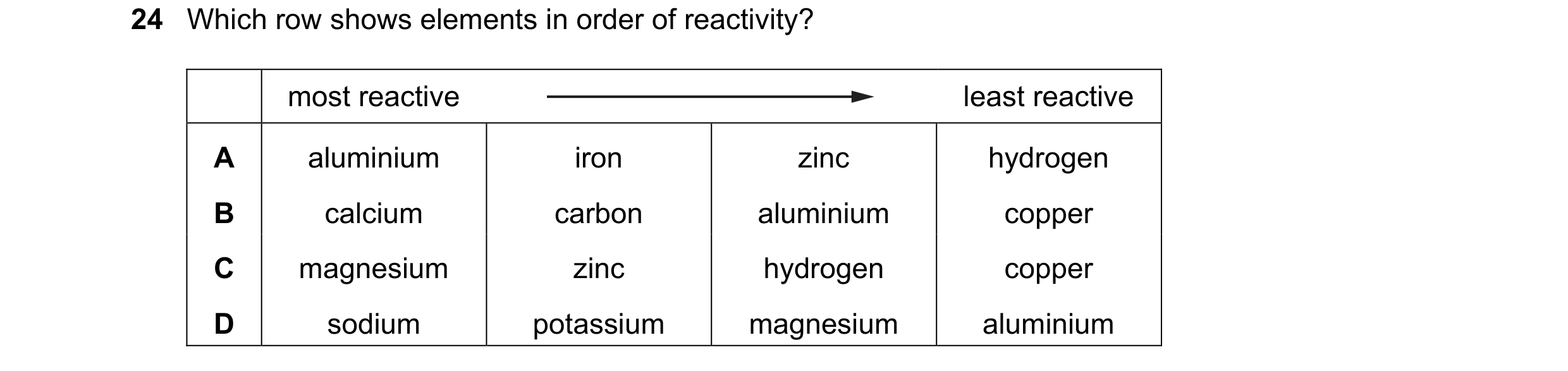

 10 / 11
 11 / 11