Questions as text
Q1 · Use the Periodic Table on page 24 to determine the electronic structure of an aluminium… 0653/41 May/June 2017
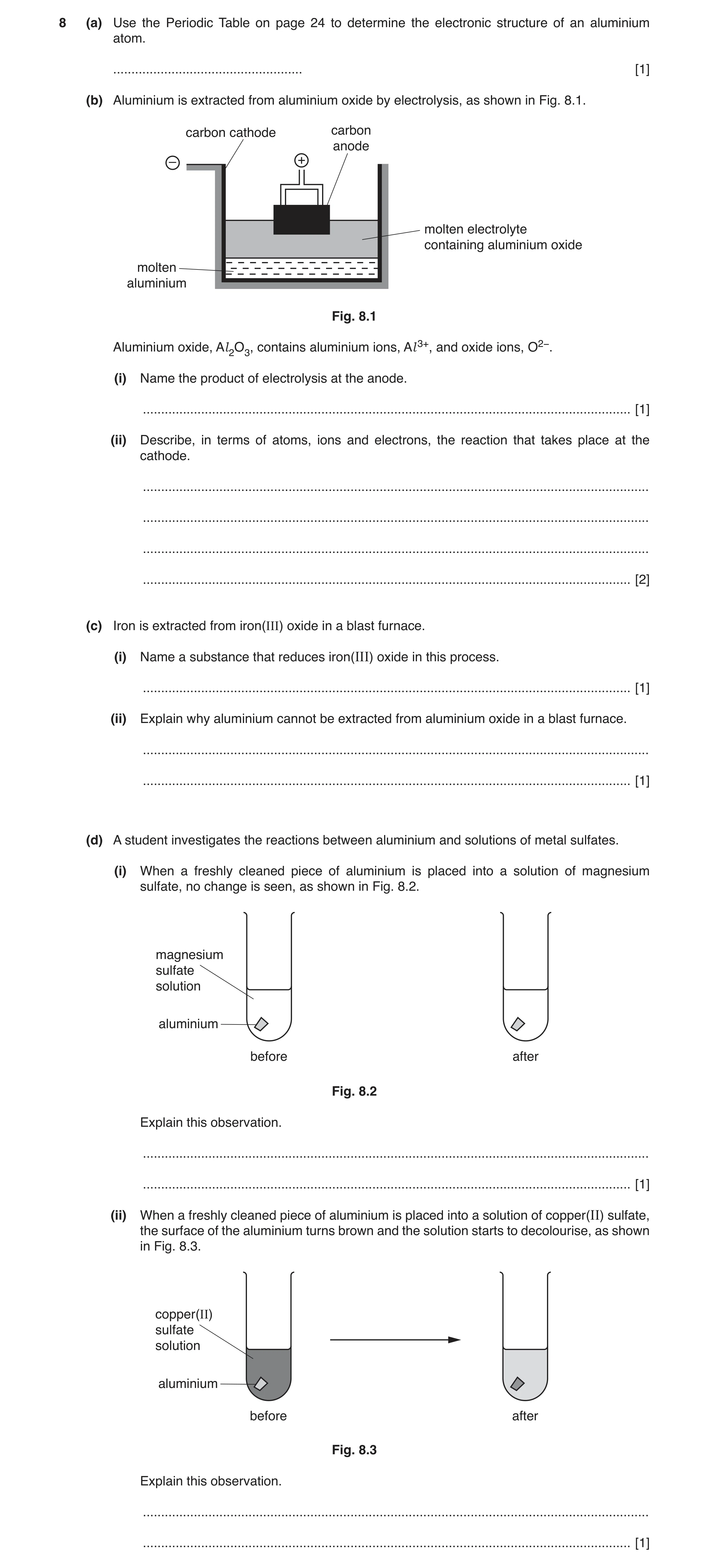
8 (a) Use the Periodic Table on page 24 to determine the electronic structure of an aluminium atom. … [1] (b) Aluminium is extracted from aluminium oxide by electrolysis, as shown in Fig. 8.1. carbon cathode carbon anode – + molten electrolyte containing aluminium oxide molten aluminium Fig. 8.1 Aluminium oxide, Al2O3, contains aluminium ions, Al 3+, and oxide ions, O2−. (i) Name the product of electrolysis at the anode. … [1] (ii) Describe, in terms of atoms, ions and electrons, the reaction that takes place at the cathode. … … … … [2] (c) Iron is extracted from iron(III) oxide in a blast furnace. (i) Name a substance that reduces iron(III) oxide in this process. … [1] (ii) Explain why aluminium cannot be extracted from aluminium oxide in a blast furnace. … … [1] (d) A student investigates the reactions between aluminium and solutions of metal sulfates. (i) When a freshly cleaned piece of aluminium is placed into a solution of magnesium sulfate, no change is seen, as shown in Fig. 8.2. magnesium sulfate solution aluminium before after Fig. 8.2 Explain this observation. … … [1] (ii) When a freshly cleaned piece of aluminium is placed into a solution of copper(II) sulfate, the surface of the aluminium turns brown and the solution starts to decolourise, as shown in Fig. 8.3. copper(II) sulfate solution aluminium before after Fig. 8.3 Explain this observation. … … [1]
8 marks
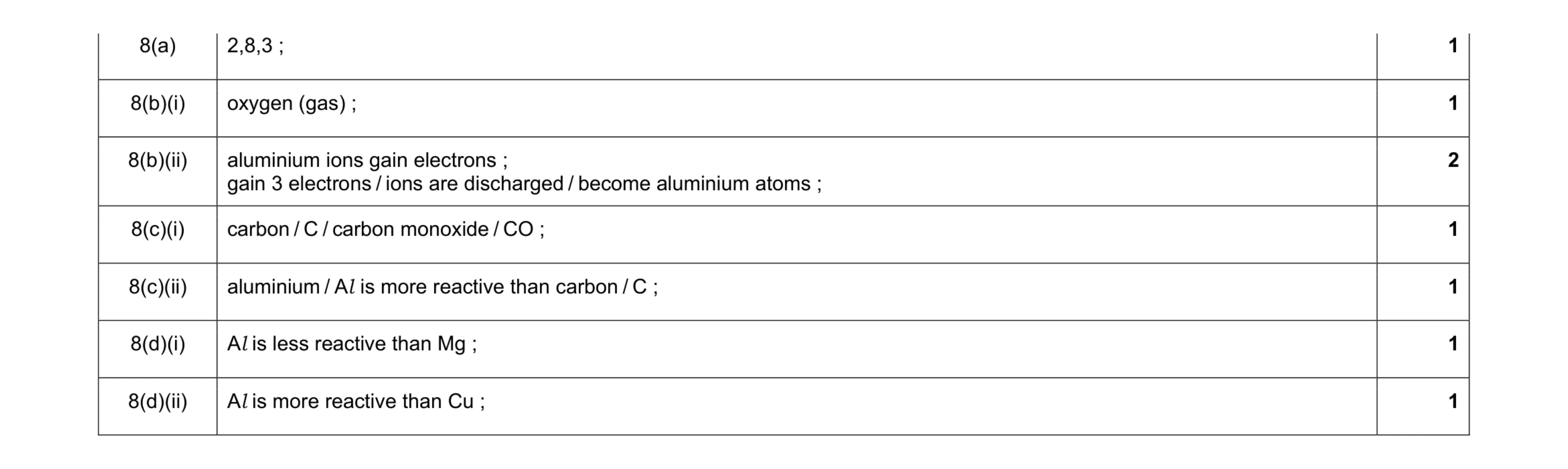
Mark scheme: 8(a) 1 8(b)(i) oxygen (gas) ; 1 8(b)(ii) aluminium ions gain electrons ; gain 3 electrons / ions are discharged / become aluminium atoms ; 2 8(c)(i) carbon / C / carbon monoxide / CO ; 1 8(c)(ii) aluminium / Al is more reactive than carbon / C ; 1 8(d)(i) Al is less reactive than Mg ; 1 8(d)(ii) Al is more reactive than Cu ; 1
This question in 0653/41 May/June 2017
Q2 · The melting points of the first four Group I metals are shown in Table 8.1 0653/43 May/June 2017
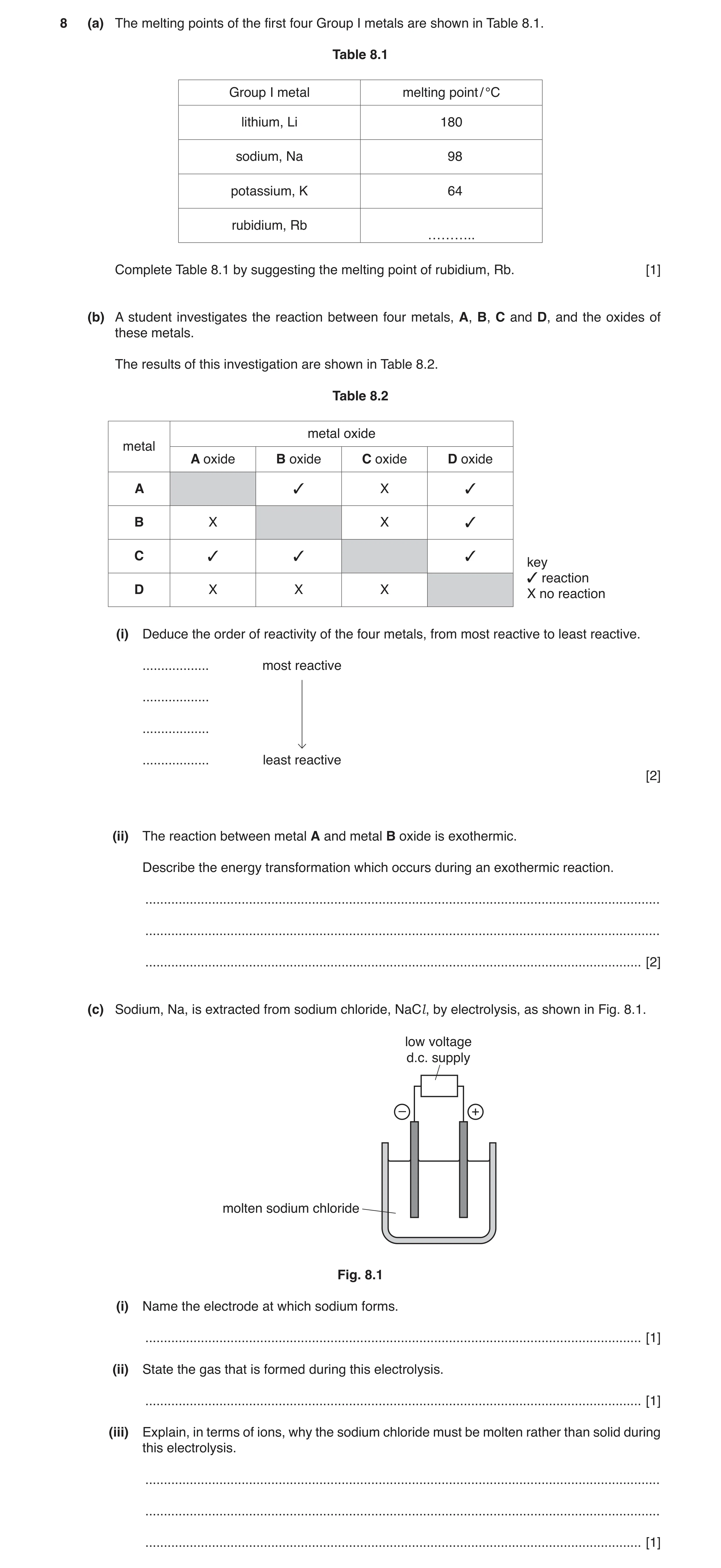
8 (a) The melting points of the first four Group I metals are shown in Table 8.1. Table 8.1 Group I metal melting point / °C lithium, Li 180 sodium, Na 98 potassium, K 64 rubidium, Rb ……….. Complete Table 8.1 by suggesting the melting point of rubidium, Rb. [1] (b) A student investigates the reaction between four metals, A, B, C and D, and the oxides of these metals. The results of this investigation are shown in Table 8.2. Table 8.2 metal oxide metal A oxide B oxide C oxide D oxide A ✓ X ✓ B X X ✓ C ✓ ✓ ✓ key ✓ reaction D X X X X no reaction (i) Deduce the order of reactivity of the four metals, from most reactive to least reactive. … most reactive … … … least reactive [2] (ii) The reaction between metal A and metal B oxide is exothermic. Describe the energy transformation which occurs during an exothermic reaction. … … … [2] (c) Sodium, Na, is extracted from sodium chloride, NaCl, by electrolysis, as shown in Fig. 8.1. low voltage d.c. supply – + molten sodium chloride Fig. 8.1 (i) Name the electrode at which sodium forms. … [1] (ii) State the gas that is formed during this electrolysis. … [1] (iii) Explain, in terms of ions, why the sodium chloride must be molten rather than solid during this electrolysis. … … … [1]
8 marks
Mark scheme: 8(a) (rubidium) in the range 25 to 50 ( °C ) inclusive ; 1 8(b)(i) C A B D C and D correct ; A and B correct ; 2 8(b)(ii) chemical (energy) decreases ; thermal / heat (energy) increases ; 2 8(c)(i) cathode ; 1 8(c)(ii) chlorine / Cl2 ; 1 8(c)(iii) (so that) ions move ; 1
This question in 0653/43 May/June 2017
Q3 · An atom of phosphorus is represented as shown 0653/41 Oct/Nov 2017
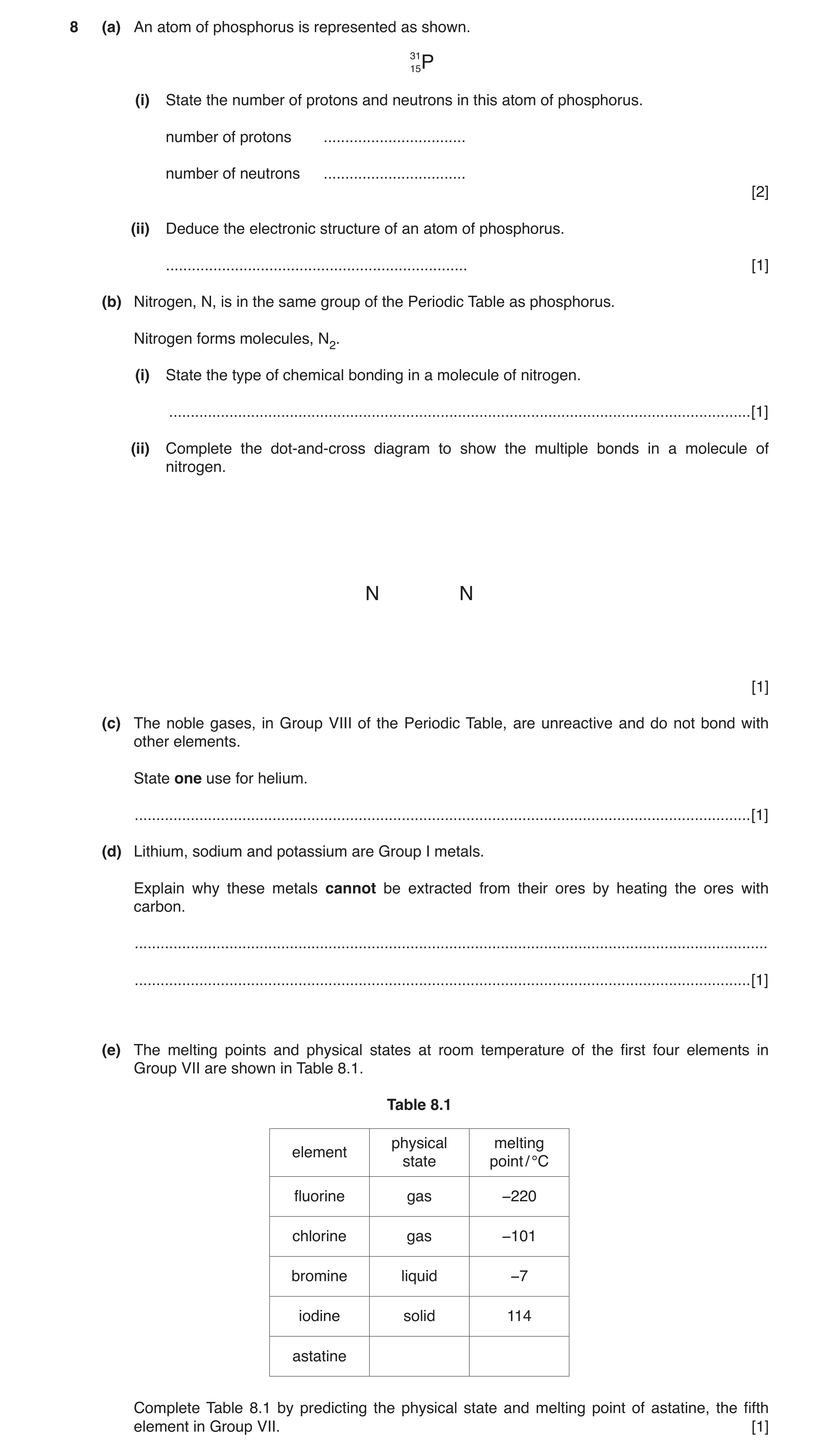
8 (a) An atom of phosphorus is represented as shown. 3115P (i) State the number of protons and neutrons in this atom of phosphorus. number of protons … number of neutrons … [2] (ii) Deduce the electronic structure of an atom of phosphorus. … [1] (b) Nitrogen, N, is in the same group of the Periodic Table as phosphorus. Nitrogen forms molecules, N2. (i) State the type of chemical bonding in a molecule of nitrogen. … [1] (ii) Complete the dot-and-cross diagram to show the multiple bonds in a molecule of nitrogen. N N [1] (c) The noble gases, in Group VIII of the Periodic Table, are unreactive and do not bond with other elements. State one use for helium. … [1] (d) Lithium, sodium and potassium are Group I metals. Explain why these metals cannot be extracted from their ores by heating the ores with carbon. … … [1] (e) The melting points and physical states at room temperature of the first four elements in Group VII are shown in Table 8.1. Table 8.1 physical melting element state point / °C fluorine gas −220 chlorine gas −101 bromine liquid −7 iodine solid 114 astatine Complete Table 8.1 by predicting the physical state and melting point of astatine, the fifth element in Group VII. [1]
8 marks
Mark scheme: 8(a)(i) 15 ; 16 ; 2 8(a)(ii) 2, 8, 5 ; 1 8(b)(i) covalent / triple ; 1 8(b)(ii) ; 1 8(c) (helium) balloons / avp ; 1 8(d) (Group I metals are) more reactive than carbon ; 1 8(e) solid and 165–310 (actual 302) ; 1
This question in 0653/41 Oct/Nov 2017
Q4 · A student places identical sized pieces of four metals, A, B, C and D, into separate… 0653/42 Oct/Nov 2017
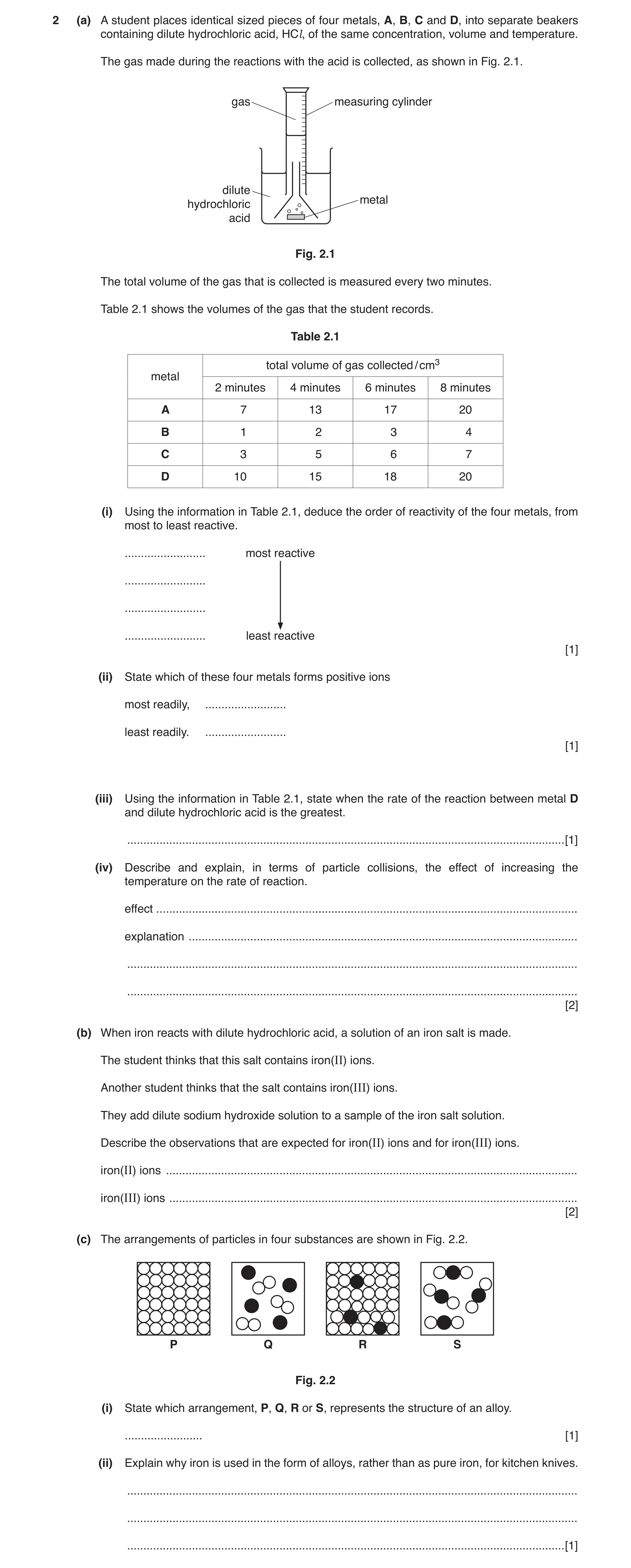
2 (a) A student places identical sized pieces of four metals, A, B, C and D, into separate beakers containing dilute hydrochloric acid, HCl, of the same concentration, volume and temperature. The gas made during the reactions with the acid is collected, as shown in Fig. 2.1. gas measuring cylinder dilute metal hydrochloric acid Fig. 2.1 The total volume of the gas that is collected is measured every two minutes. Table 2.1 shows the volumes of the gas that the student records. Table 2.1 total volume of gas collected / cm3 metal 2 minutes 4 minutes 6 minutes 8 minutes A 7 13 17 20 B 1 2 3 4 C 3 5 6 7 D 10 15 18 20 (i) Using the information in Table 2.1, deduce the order of reactivity of the four metals, from most to least reactive. … most reactive … … … least reactive [1] (ii) State which of these four metals forms positive ions most readily, … least readily. … [1] (iii) Using the information in Table 2.1, state when the rate of the reaction between metal D and dilute hydrochloric acid is the greatest. … [1] (iv) Describe and explain, in terms of particle collisions, the effect of increasing the temperature on the rate of reaction. effect … explanation … … … [2] (b) When iron reacts with dilute hydrochloric acid, a solution of an iron salt is made. The student thinks that this salt contains iron(II) ions. Another student thinks that the salt contains iron(III) ions. They add dilute sodium hydroxide solution to a sample of the iron salt solution. Describe the observations that are expected for iron(II) ions and for iron(III) ions. iron(II) ions … iron(III) ions … [2] (c) The arrangements of particles in four substances are shown in Fig. 2.2. P Q R S Fig. 2.2 (i) State which arrangement, P, Q, R or S, represents the structure of an alloy. … [1] (ii) Explain why iron is used in the form of alloys, rather than as pure iron, for kitchen knives. … … … [1]
9 marks
Mark scheme: 2(a)(i) D (most reactive) A C B ; (least reactive) 1 2(a)(ii) D (most readily) B ; (least readily) 1 2(a)(iii) initially / at the start / (the idea of during the first) two minutes ; 1 2(a)(iv) increases ; particles collide more often / more successful collisions ; 2 2(b) (iron(II) ions) green ppt / solid ; (iron(III) ions) brown ppt / solid ; 2 Question Answer Marks 2(c)(i) R ; 1 2(c)(ii) (alloys are) harder / more resistant to wear / more resistant to corrosion / avp ; 1
This question in 0653/42 Oct/Nov 2017
Q5 · A student investigates the relative reactivity of different metals 0653/41 May/June 2018
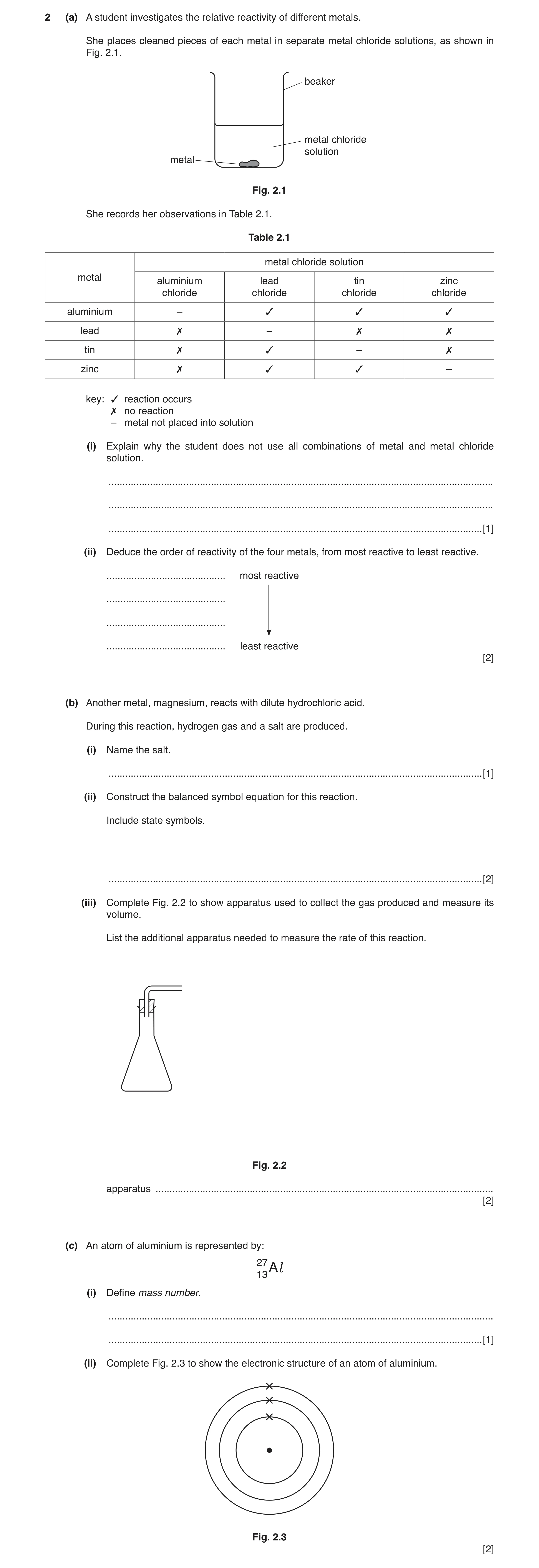
2 (a) A student investigates the relative reactivity of different metals. She places cleaned pieces of each metal in separate metal chloride solutions, as shown in Fig. 2.1. beaker metal chloride solution metal Fig. 2.1 She records her observations in Table 2.1. Table 2.1 metal chloride solution metal aluminium lead tin zinc chloride chloride chloride chloride 3 3 3 aluminium – 7 7 7 lead – 7 3 7 tin – 7 3 3 zinc – key: 3 reaction occurs 7 no reaction – metal not placed into solution (i) Explain why the student does not use all combinations of metal and metal chloride solution. … … … [1] (ii) Deduce the order of reactivity of the four metals, from most reactive to least reactive. … most reactive … … … least reactive [2] (b) Another metal, magnesium, reacts with dilute hydrochloric acid. During this reaction, hydrogen gas and a salt are produced. (i) Name the salt. … [1] (ii) Construct the balanced symbol equation for this reaction. Include state symbols. … [2] (iii) Complete Fig. 2.2 to show apparatus used to collect the gas produced and measure its volume. List the additional apparatus needed to measure the rate of this reaction. Fig. 2.2 apparatus … [2] (c) An atom of aluminium is represented by: 2713Al (i) Define mass number. … … [1] (ii) Complete Fig. 2.3 to show the electronic structure of an atom of aluminium. Fig. 2.3 [2]
11 marks
Mark scheme: 2(a)(i) No reaction expected / will take place / experiment has to compare different metals ; 1 2(a)(ii) aluminium / Al zinc / Zn tin / Sn lead / Pb ;; aluminium and lead correctly located = 1 all correct = 2 2 2(b)(i) magnesium chloride ; 1 2(b)(ii) Mg(s) + 2HCl (aq) → MgCl2 (aq) + H2(g) all formulae and balanced (dependent on formulae) ; 3 or 4 correct state symbols (dependent on correct species) ; 2 2(b)(iii) feasible method of collection ; timing device listed or shown in diagram ; 2 2(c)(i) (Number of) protons + neutrons (in an atom) ; 1 2(c)(ii) 13 electrons shown ; arranged 2, 8, 3 ; 2
This question in 0653/41 May/June 2018
Q6 · Calcium sulfate is an insoluble salt 0653/41 Oct/Nov 2018
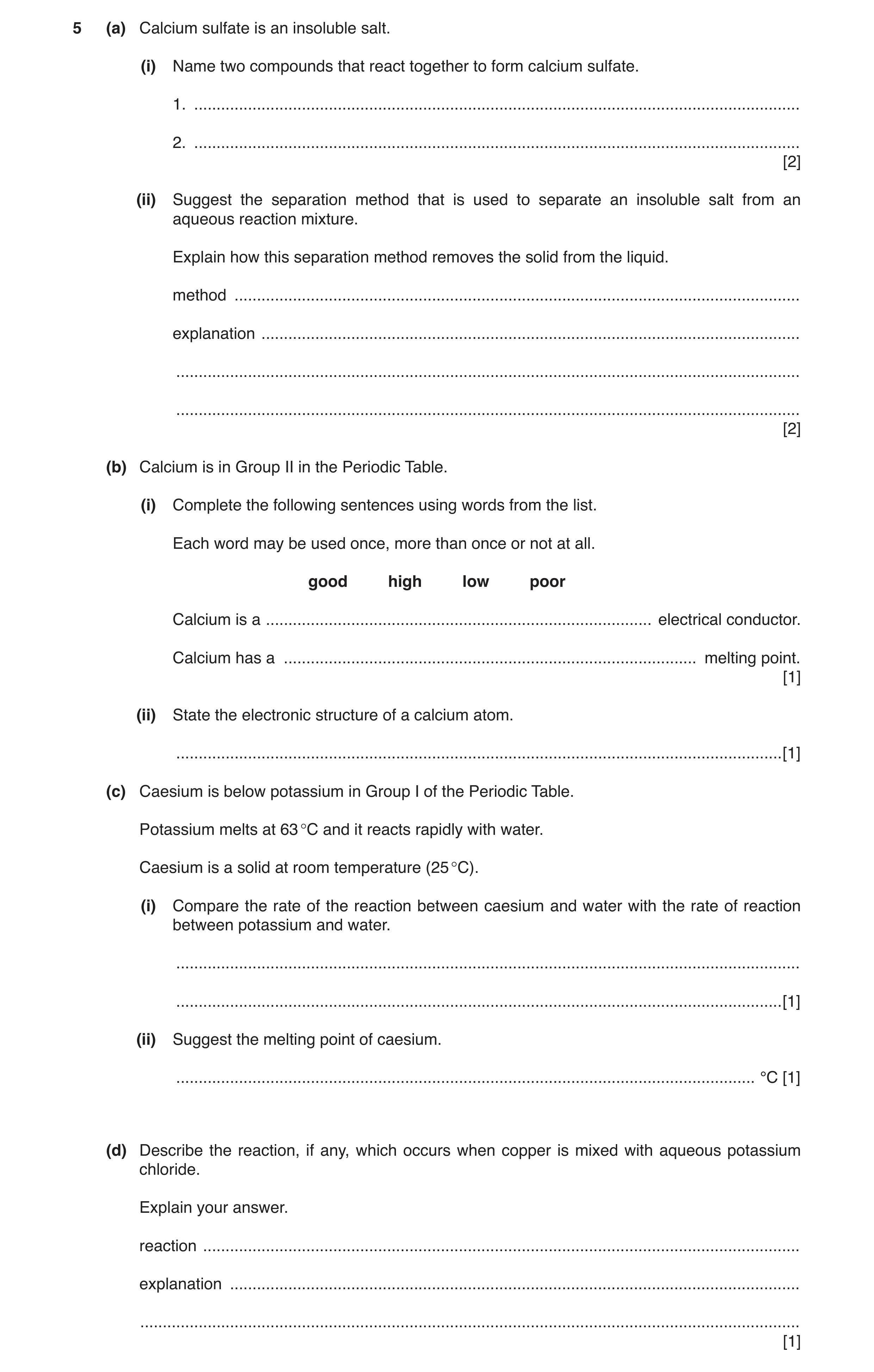
5 (a) Calcium sulfate is an insoluble salt. (i) Name two compounds that react together to form calcium sulfate. 1. … 2. … [2] (ii) Suggest the separation method that is used to separate an insoluble salt from an aqueous reaction mixture. Explain how this separation method removes the solid from the liquid. method … explanation … … … [2] (b) Calcium is in Group II in the Periodic Table. (i) Complete the following sentences using words from the list. Each word may be used once, more than once or not at all. good high low poor Calcium is a … electrical conductor. Calcium has a … melting point. [1] (ii) State the electronic structure of a calcium atom. … [1] (c) Caesium is below potassium in Group I of the Periodic Table. Potassium melts at 63 °C and it reacts rapidly with water. Caesium is a solid at room temperature (25 °C). (i) Compare the rate of the reaction between caesium and water with the rate of reaction between potassium and water. … … [1] (ii) Suggest the melting point of caesium. … °C [1] (d) Describe the reaction, if any, which occurs when copper is mixed with aqueous potassium chloride. Explain your answer. reaction … explanation … … [1]
9 marks
Mark scheme: 5(a)(i) sulfuric_acid / H2SO4 ; calcium oxide / CaO / calcium hydroxide / Ca(OH)2 calcium carbonate / CaCO3 ; 2 5(a)(ii) (technique) filter / filtering / filtration ; (explanation) solid (particles) cannot pass through / remain on filter paper / liquid (particles) can pass through filter paper ; 2 5(b)(i) (electrical conductor) good (melting point) high ; (both required) 1 5(b)(ii) 2, 8, 8, 2 ; 1 5(c)(i) more / very rapid / explosive ; 1 5(c)(ii) any stated value ˃ 25 °C and ˂ 63 °C ; 1 5(d) (reaction) no (visible) reaction (explanation) copper is less reactive than potassium ; (both required) 1
This question in 0653/41 Oct/Nov 2018
Q7 · A student investigates the reactivities of four metals, A, B, C and D 0653/43 Oct/Nov 2018
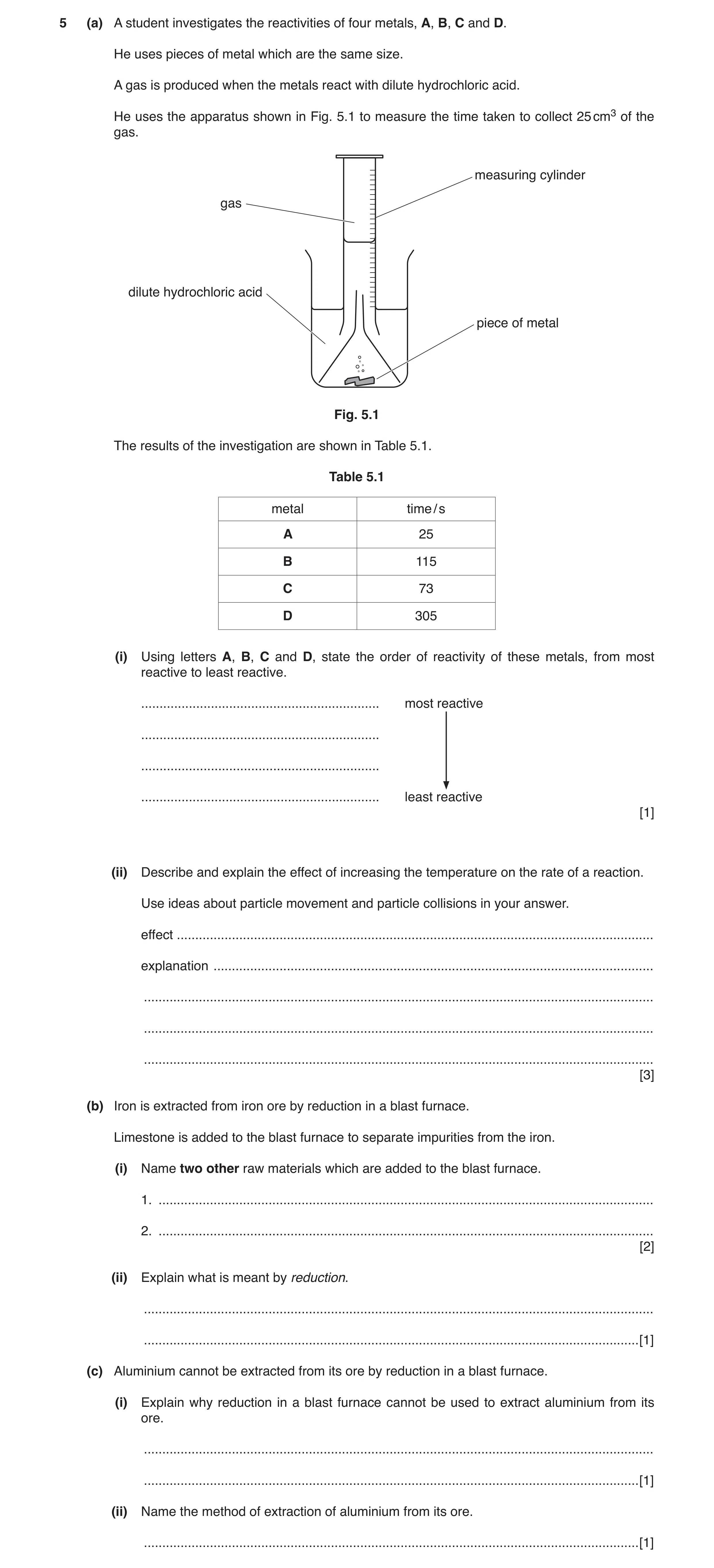
5 (a) A student investigates the reactivities of four metals, A, B, C and D. He uses pieces of metal which are the same size. A gas is produced when the metals react with dilute hydrochloric acid. He uses the apparatus shown in Fig. 5.1 to measure the time taken to collect 25 cm3 of the gas. measuring cylinder gas dilute hydrochloric acid piece of metal Fig. 5.1 The results of the investigation are shown in Table 5.1. Table 5.1 metal time / s A 25 B 115 C 73 D 305 (i) Using letters A, B, C and D, state the order of reactivity of these metals, from most reactive to least reactive. … most reactive … … … least reactive [1] (ii) Describe and explain the effect of increasing the temperature on the rate of a reaction. Use ideas about particle movement and particle collisions in your answer. effect … explanation … … … … [3] (b) Iron is extracted from iron ore by reduction in a blast furnace. Limestone is added to the blast furnace to separate impurities from the iron. (i) Name two other raw materials which are added to the blast furnace. 1. … 2. … [2] (ii) Explain what is meant by reduction. … … [1] (c) Aluminium cannot be extracted from its ore by reduction in a blast furnace. (i) Explain why reduction in a blast furnace cannot be used to extract aluminium from its ore. … … [1] (ii) Name the method of extraction of aluminium from its ore. … [1]
9 marks
Mark scheme: 5(a)(i) (most) A C B (least) D ; 1 5(a)(ii) (effect) increase ; (explanation) two out of (particles) move faster / gain more kinetic energy ; (particles) collide more often / frequently ; (particles) collide with more energy ; Max 3 3 5(b)(i) air ; allow oxygen coke ; allow carbon 2 5(b)(ii) loss / removal of oxygen / O ; 1 5(c)(i) (aluminium is) too reactive / more reactive than carbon ; 1 5(c)(ii) electrolysis ; 1
This question in 0653/43 Oct/Nov 2018
Q8 · A student places a spot of copper chloride solution onto a piece of chromatography paper… 0653/42 Feb/March 2020
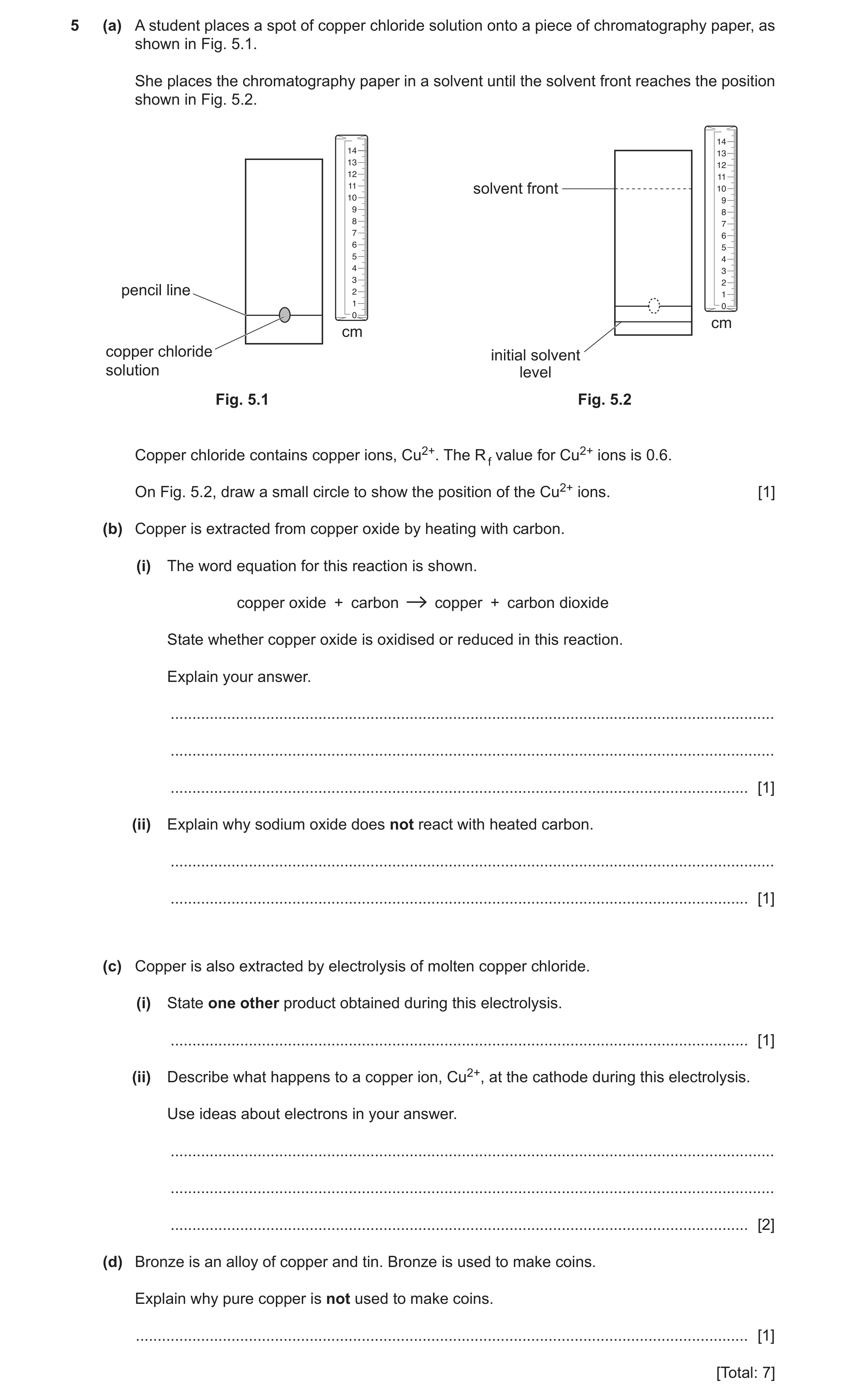
5 (a) A student places a spot of copper chloride solution onto a piece of chromatography paper, as shown in Fig. 5.1. She places the chromatography paper in a solvent until the solvent front reaches the position shown in Fig. 5.2. solvent front pencil line cm cm copper chloride initial solvent solution level Fig. 5.1 Fig. 5.2 Copper chloride contains copper ions, Cu2+. The R f value for Cu2+ ions is 0.6. On Fig. 5.2, draw a small circle to show the position of the Cu2+ ions. [1] (b) Copper is extracted from copper oxide by heating with carbon. (i) The word equation for this reaction is shown. copper oxide + carbon copper + carbon dioxide State whether copper oxide is oxidised or reduced in this reaction. Explain your answer. … … … [1] (ii) Explain why sodium oxide does not react with heated carbon. … … [1] (c) Copper is also extracted by electrolysis of molten copper chloride. (i) State one other product obtained during this electrolysis. … [1] (ii) Describe what happens to a copper ion, Cu2+, at the cathode during this electrolysis. Use ideas about electrons in your answer. … … … [2] (d) Bronze is an alloy of copper and tin. Bronze is used to make coins. Explain why pure copper is not used to make coins. … [1] [Total: 7]
7 marks
Mark scheme: 5(a) circle above original sample and at 6 cm (by inspection) ; 1 5(b)(i) reduced because oxygen is, lost / removed ; 1 5(b)(ii) carbon is less reactive than sodium (or reverse argument) ; 1 5(c)(i) chlorine / Cl2 ; 1 5(c)(ii) gains electrons ; gains 2 electrons / so that the ion is discharged ; 2 5(d) (bronze is) stronger / harder / more resistant to damage / more resistant to corrosion ; 1
This question in 0653/42 Feb/March 2020
Q9 · Sodium reacts with water to form aqueous sodium hydroxide, NaOH, and hydrogen gas 0653/41 Oct/Nov 2020
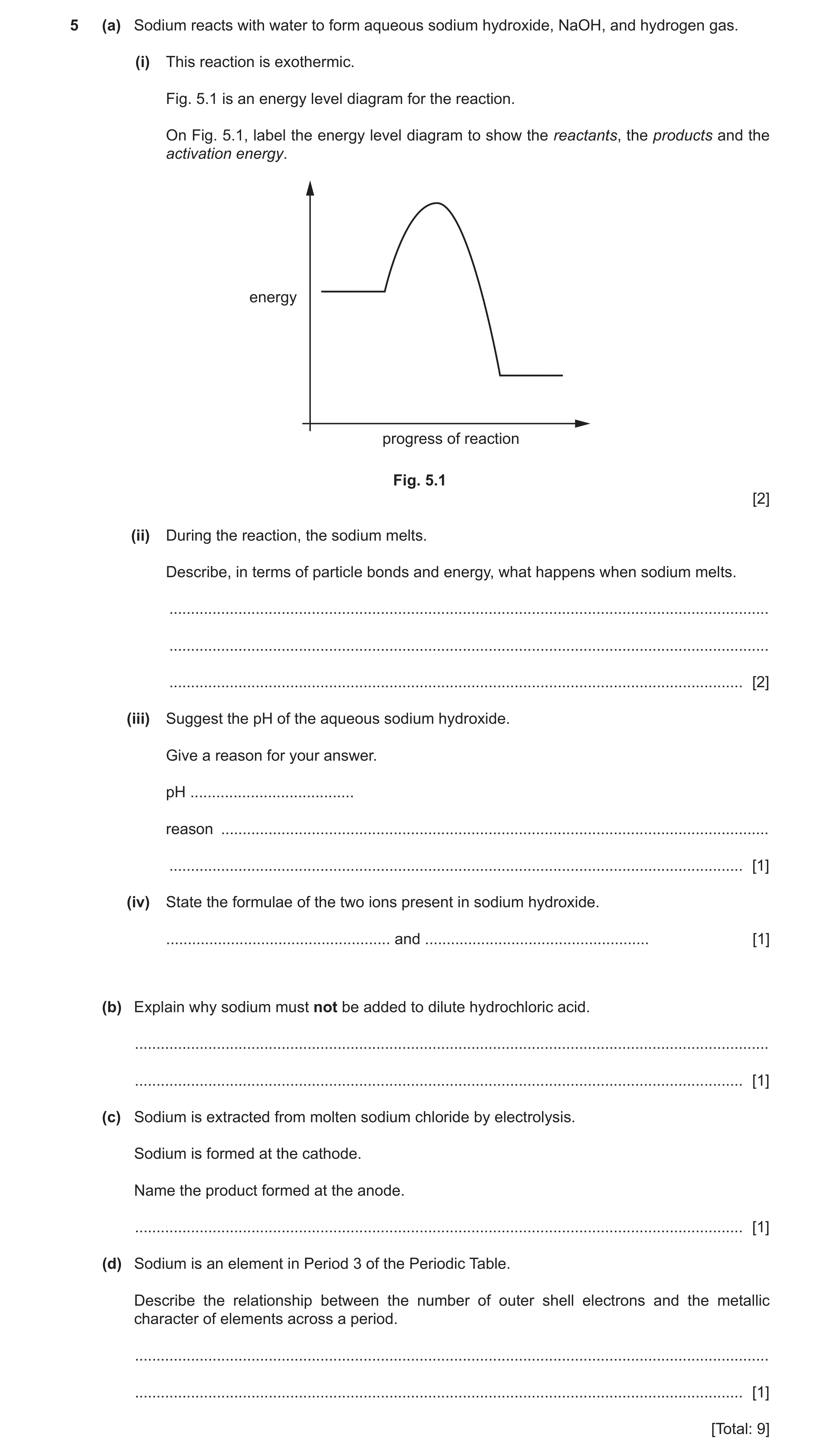
5 (a) Sodium reacts with water to form aqueous sodium hydroxide, NaOH, and hydrogen gas. (i) This reaction is exothermic. Fig. 5.1 is an energy level diagram for the reaction. On Fig. 5.1, label the energy level diagram to show the reactants, the products and the activation energy. energy progress of reaction Fig. 5.1 [2] (ii) During the reaction, the sodium melts. Describe, in terms of particle bonds and energy, what happens when sodium melts. … … … [2] (iii) Suggest the pH of the aqueous sodium hydroxide. Give a reason for your answer. pH … reason … … [1] (iv) State the formulae of the two ions present in sodium hydroxide. … and … [1] (b) Explain why sodium must not be added to dilute hydrochloric acid. … … [1] (c) Sodium is extracted from molten sodium chloride by electrolysis. Sodium is formed at the cathode. Name the product formed at the anode. … [1] (d) Sodium is an element in Period 3 of the Periodic Table. Describe the relationship between the number of outer shell electrons and the metallic character of elements across a period. … … [1] [Total: 9]
9 marks
Mark scheme: 5(a)(i) reactants and products labelled ; activation energy labelled ; 2 5(a)(ii) (sodium) particles gain (sufficient) energy ; to (overcome the attractive forces and) break the bonds between particles ; 2 5(a)(iii) 8–14 AND sodium hydroxide is a base ; 1 5(a)(iv) Na+ AND OH– ; 1 Question Answer Marks 5(b) too reactive / very reactive / explosive ; 1 5(c) chlorine ; 1 5(d) as number of (outer shell) electrons increases the element becomes more non-metallic / ora ; 1
This question in 0653/41 Oct/Nov 2020
Q10 · Some names and some formulae of four metal oxides 0653/41 Oct/Nov 2021
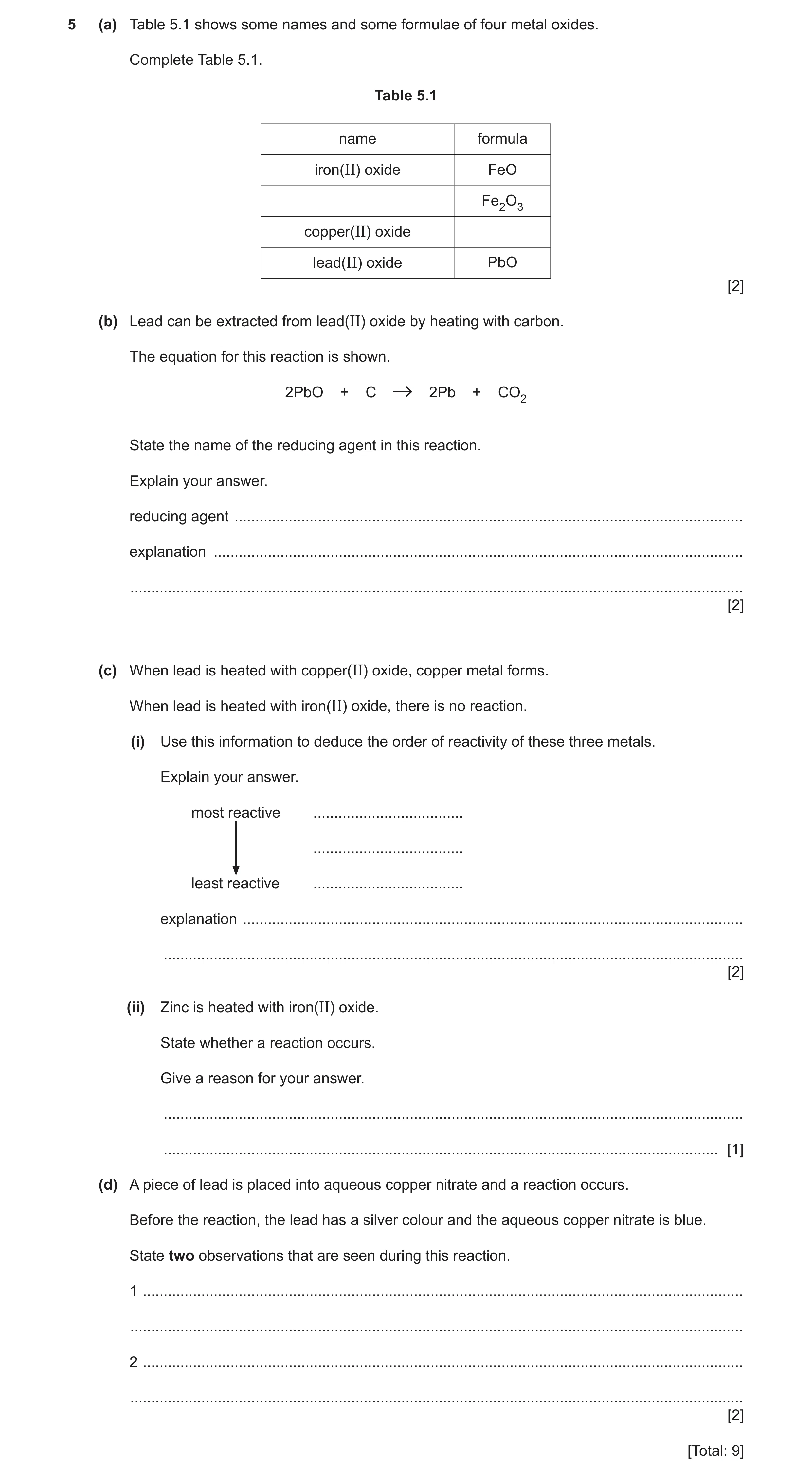
5 (a) Table 5.1 shows some names and some formulae of four metal oxides. Complete Table 5.1. Table 5.1 name formula iron(II) oxide FeO Fe2O3 copper(II) oxide lead(II) oxide PbO [2] (b) Lead can be extracted from lead(II) oxide by heating with carbon. The equation for this reaction is shown. 2PbO + C 2Pb + CO2 State the name of the reducing agent in this reaction. Explain your answer. reducing agent … explanation … … [2] (c) When lead is heated with copper(II) oxide, copper metal forms. When lead is heated with iron(II) oxide, there is no reaction. (i) Use this information to deduce the order of reactivity of these three metals. Explain your answer. most reactive … … least reactive … explanation … … [2] (ii) Zinc is heated with iron(II) oxide. State whether a reaction occurs. Give a reason for your answer. … … [1] (d) A piece of lead is placed into aqueous copper nitrate and a reaction occurs. Before the reaction, the lead has a silver colour and the aqueous copper nitrate is blue. State two observations that are seen during this reaction. 1 … … 2 … … [2] [Total: 9]
9 marks
Mark scheme: 5(a) iron(III) oxide ; CuO ; 2 5(b) carbon ; removes oxygen from the lead(II) oxide / reducing agents remove oxygen from another substance / it reduces lead(II) oxide / reduces lead ions ; 2 5(c)(i) iron (most) lead copper (least) in correct order; the more reactive metal displaces the less reactive / AW ; 2 5(c)(ii) (yes, because) zinc is more reactive (than iron) ; 1 5(d) solution goes colourless / blue colour fades / decolourises ; lead has a brown / orange coating / dark brown / orange solid appears ; 2
This question in 0653/41 Oct/Nov 2021
Q11 · How molten iron is used to join railway tracks together 0653/43 Oct/Nov 2021
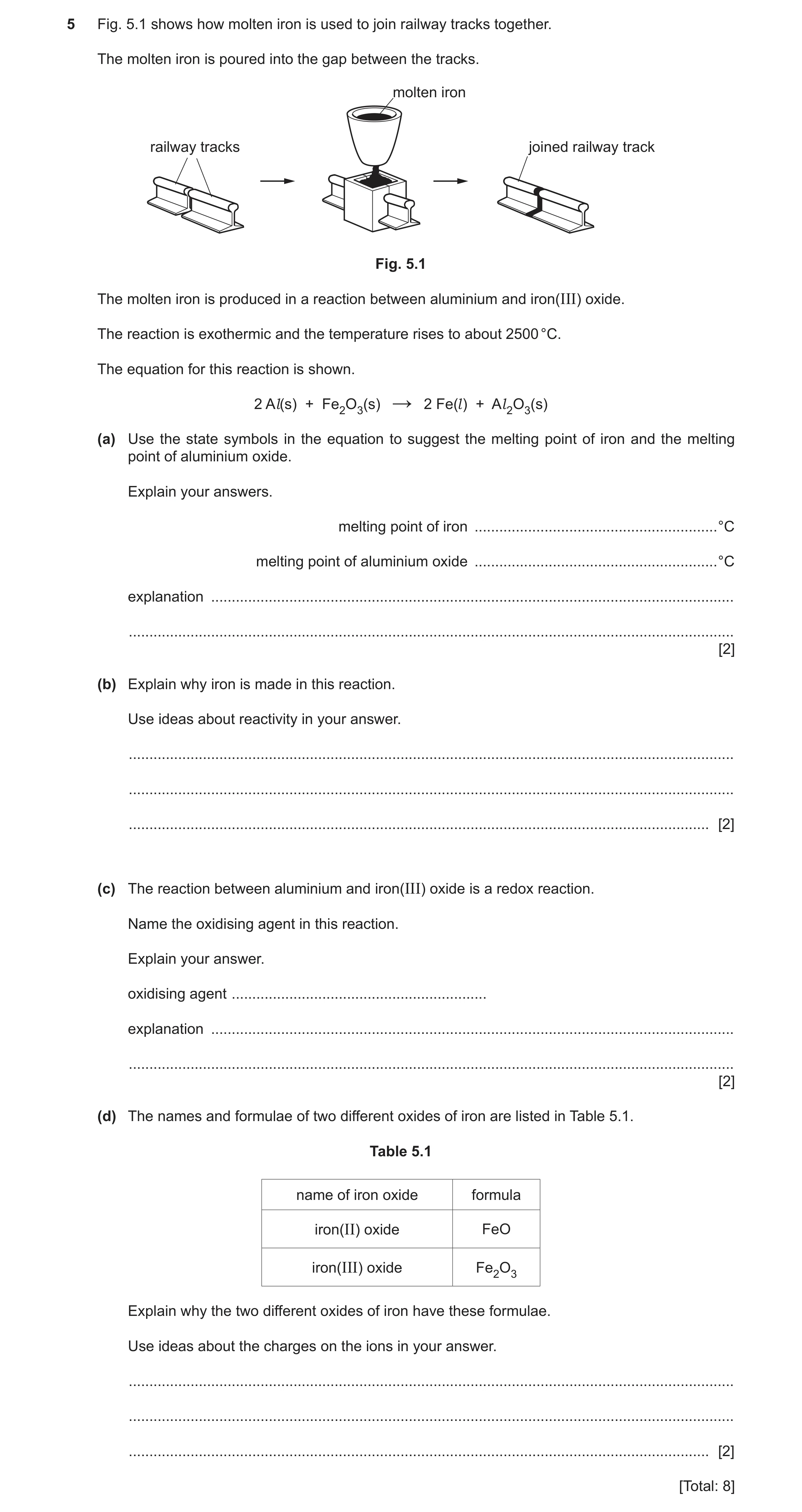
5 Fig. 5.1 shows how molten iron is used to join railway tracks together. The molten iron is poured into the gap between the tracks. molten iron railway tracks joined railway track Fig. 5.1 The molten iron is produced in a reaction between aluminium and iron(III) oxide. The reaction is exothermic and the temperature rises to about 2500 °C. The equation for this reaction is shown. 2 Al(s) + Fe2O3(s) 2 Fe(l) + Al2O3(s) → (a) Use the state symbols in the equation to suggest the melting point of iron and the melting point of aluminium oxide. Explain your answers. melting point of iron … °C melting point of aluminium oxide … °C explanation … … [2] (b) Explain why iron is made in this reaction. Use ideas about reactivity in your answer. … … … [2] (c) The reaction between aluminium and iron(III) oxide is a redox reaction. Name the oxidising agent in this reaction. Explain your answer. oxidising agent … explanation … … [2] (d) The names and formulae of two different oxides of iron are listed in Table 5.1. Table 5.1 name of iron oxide formula iron(II) oxide FeO iron(III) oxide Fe2O3 Explain why the two different oxides of iron have these formulae. Use ideas about the charges on the ions in your answer. … … … [2] [Total: 8]
8 marks
Mark scheme: 5(a) iron: <= 2500 oC AND aluminium oxide: > 2500 oC ; at 2500 oC, iron is a liquid and aluminium oxide is a solid ; 2 5(b) aluminium displaces iron / aluminium removes oxygen from iron ; because aluminium is more reactive than iron ; 2 5(c) iron(III) oxide / Fe3+ ; causes aluminium to gain oxygen ; 2 5(d) charge on, iron(II) is 2+ AND iron(III) is 3+ ; total positive charge needs to match total negative charge ; 2
This question in 0653/43 Oct/Nov 2021
Q12 · Iron is extracted from hematite in a blast furnace 0653/41 May/June 2022
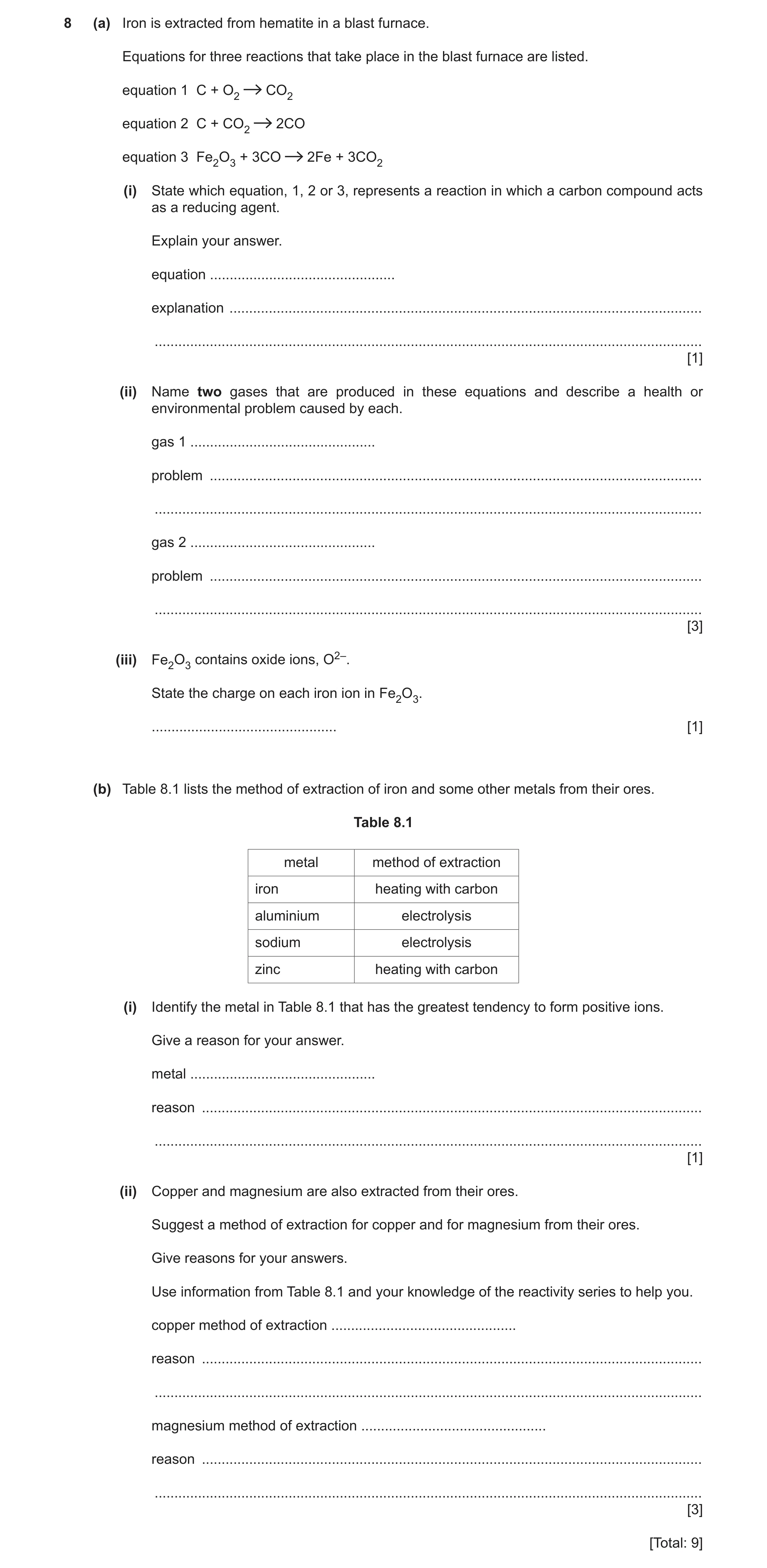
8 (a) Iron is extracted from hematite in a blast furnace. Equations for three reactions that take place in the blast furnace are listed. equation 1 C + O2 CO2 equation 2 C + CO2 2CO equation 3 Fe2O3 + 3CO 2Fe + 3CO2 (i) State which equation, 1, 2 or 3, represents a reaction in which a carbon compound acts as a reducing agent. Explain your answer. equation … explanation … … [1] (ii) Name two gases that are produced in these equations and describe a health or environmental problem caused by each. gas 1 … problem … … gas 2 … problem … … [3] (iii) Fe2O3 contains oxide ions, O2–. State the charge on each iron ion in Fe2O3. … [1] (b) Table 8.1 lists the method of extraction of iron and some other metals from their ores. Table 8.1 metal method of extraction iron heating with carbon aluminium electrolysis sodium electrolysis zinc heating with carbon (i) Identify the metal in Table 8.1 that has the greatest tendency to form positive ions. Give a reason for your answer. metal … reason … … [1] (ii) Copper and magnesium are also extracted from their ores. Suggest a method of extraction for copper and for magnesium from their ores. Give reasons for your answers. Use information from Table 8.1 and your knowledge of the reactivity series to help you. copper method of extraction … reason … … magnesium method of extraction … reason … … [3] [Total: 9]
9 marks
Mark scheme: 8(a)(i) (equation) 3 AND carbon monoxide removes oxygen from iron (oxide) ; 1 8(a)(ii) carbon monoxide AND carbon dioxide ; carbon monoxide, is toxic / restricts oxygen transport in the blood ; carbon dioxide causes, climate change / enhanced greenhouse effect / global warming ; 3 8(a)(iii) 3+ / Fe3+ ; 1 8(b)(i) sodium AND because it is the most reactive ; 1 Question Answer Marks 8(b)(ii) Cu heating with carbon AND Mg electrolysis ; Cu because less reactive than iron / carbon ; Mg because more reactive than aluminium / carbon ; 3
This question in 0653/41 May/June 2022
Q13 · A key made from the alloy brass 0653/42 May/June 2022
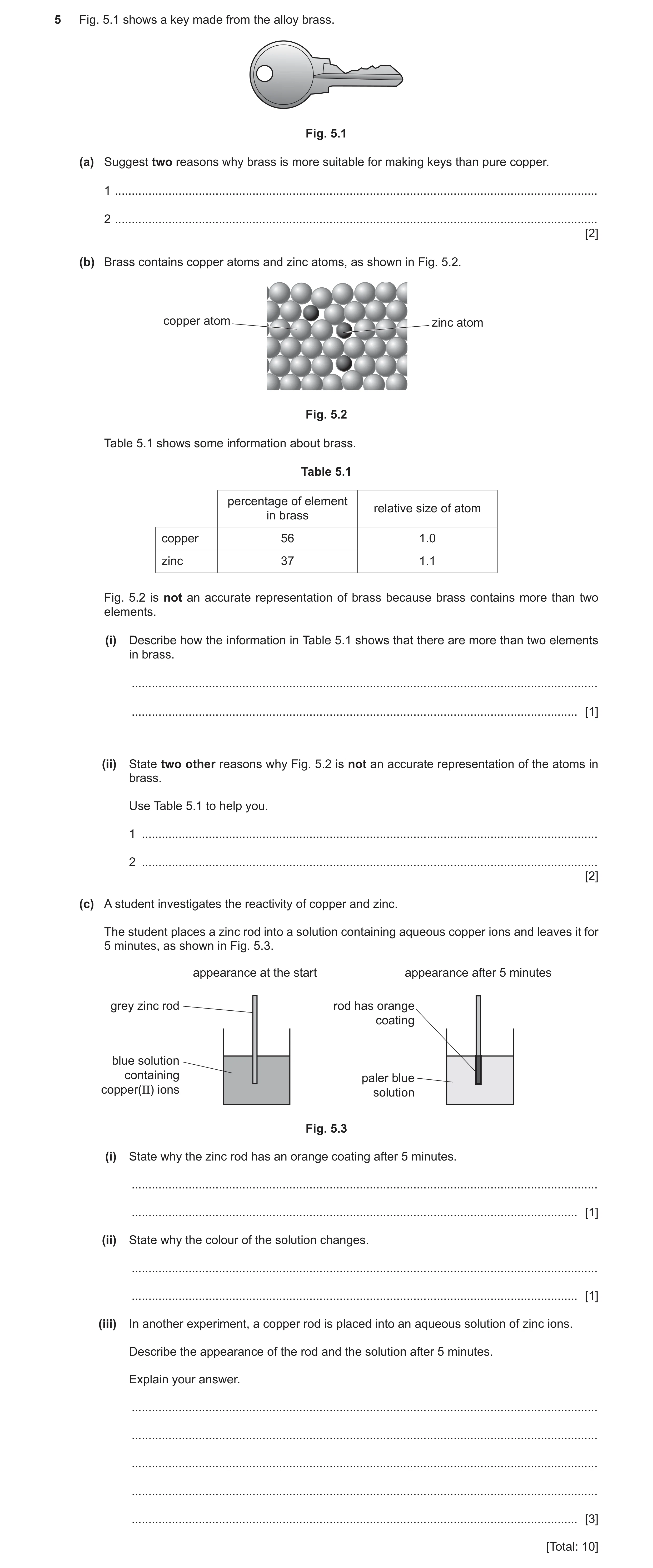
5 Fig. 5.1 shows a key made from the alloy brass. Fig. 5.1 (a) Suggest two reasons why brass is more suitable for making keys than pure copper. 1 … 2 … [2] (b) Brass contains copper atoms and zinc atoms, as shown in Fig. 5.2. copper atom zinc atom Fig. 5.2 Table 5.1 shows some information about brass. Table 5.1 percentage of element relative size of atom in brass copper 56 1.0 zinc 37 1.1 Fig. 5.2 is not an accurate representation of brass because brass contains more than two elements. (i) Describe how the information in Table 5.1 shows that there are more than two elements in brass. … … [1] (ii) State two other reasons why Fig. 5.2 is not an accurate representation of the atoms in brass. Use Table 5.1 to help you. 1 … 2 … [2] (c) A student investigates the reactivity of copper and zinc. The student places a zinc rod into a solution containing aqueous copper ions and leaves it for 5 minutes, as shown in Fig. 5.3. appearance at the start appearance after 5 minutes grey zinc rod rod has orange coating blue solution containing paler blue copper(II) ions solution Fig. 5.3 (i) State why the zinc rod has an orange coating after 5 minutes. … … [1] (ii) State why the colour of the solution changes. … … [1] (iii) In another experiment, a copper rod is placed into an aqueous solution of zinc ions. Describe the appearance of the rod and the solution after 5 minutes. Explain your answer. … … … … … [3] [Total: 10]
10 marks
Mark scheme: 5(a) any two from: brass is, stronger ; brass is, harder / more hardwearing ; brass does not corrode (as easily) ; ORA 2 5(b)(i) percentage of copper (56) plus zinc (37), is 93 / is less than 100 / 7% unaccounted for ; 1 5(b)(ii) atoms of zinc should be larger than copper ; too many Cu atoms / too few Zn atoms / percentage of zinc needs to be higher ; 2 5(c)(i) because copper forms on the rod ; 1 5(c)(ii) because copper ions are used up / less copper ions left ; 1 5(c)(iii) orange rod and colourless solution ; no reaction ; because zinc is more reactive (than copper) ; 3
This question in 0653/42 May/June 2022
Q14 · A student does five experiments to investigate the reaction between magnesium and dilute… 0653/42 May/June 2023
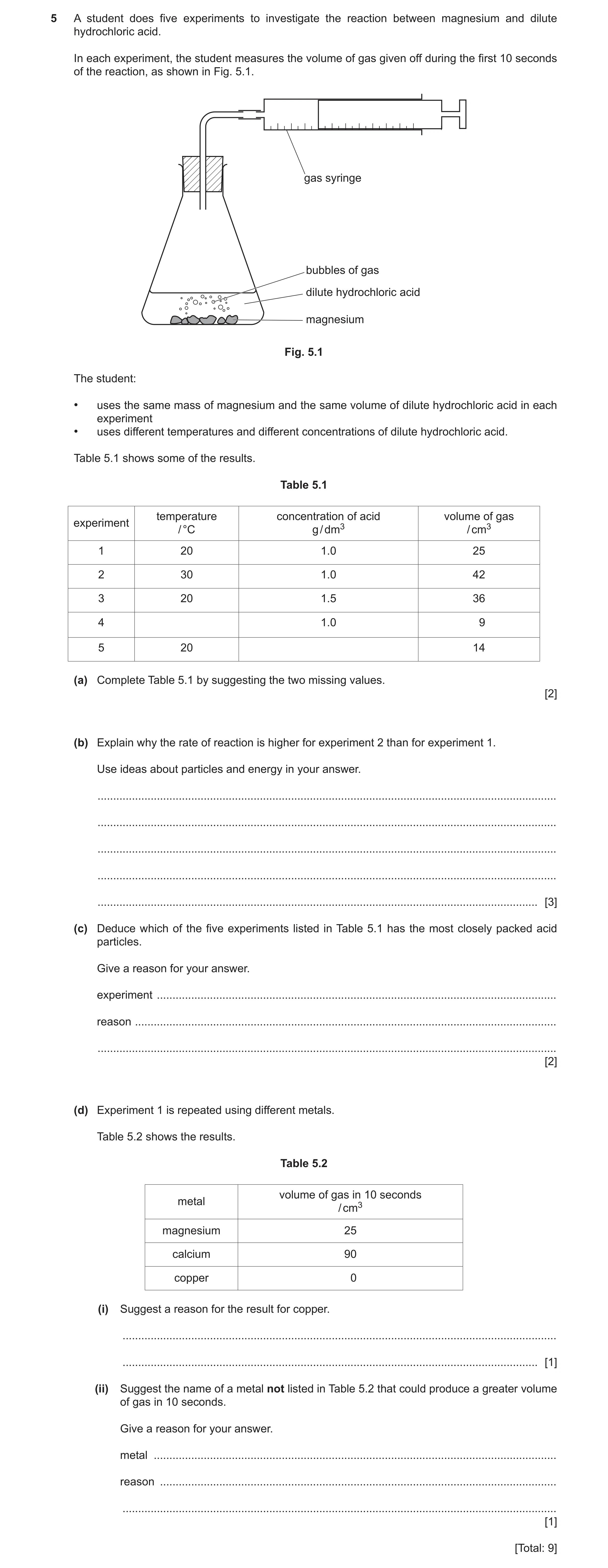
5 A student does five experiments to investigate the reaction between magnesium and dilute hydrochloric acid. In each experiment, the student measures the volume of gas given off during the first 10 seconds of the reaction, as shown in Fig. 5.1. gas syringe bubbles of gas dilute hydrochloric acid magnesium Fig. 5.1 The student: • uses the same mass of magnesium and the same volume of dilute hydrochloric acid in each experiment • uses different temperatures and different concentrations of dilute hydrochloric acid. Table 5.1 shows some of the results. Table 5.1 temperature concentration of acid volume of gas experiment / °C g / dm3 / cm3 1 20 1.0 25 2 30 1.0 42 3 20 1.5 36 4 1.0 9 5 20 14 (a) Complete Table 5.1 by suggesting the two missing values. [2] (b) Explain why the rate of reaction is higher for experiment 2 than for experiment 1. Use ideas about particles and energy in your answer. … … … … … [3] (c) Deduce which of the five experiments listed in Table 5.1 has the most closely packed acid particles. Give a reason for your answer. experiment … reason … … [2] (d) Experiment 1 is repeated using different metals. Table 5.2 shows the results. Table 5.2 volume of gas in 10 seconds metal / cm3 magnesium 25 calcium 90 copper 0 (i) Suggest a reason for the result for copper. … … [1] (ii) Suggest the name of a metal not listed in Table 5.2 that could produce a greater volume of gas in 10 seconds. Give a reason for your answer. metal … reason … … [1] [Total: 9]
9 marks
Mark scheme: 5(a) concentration of acid: 1.0 ; 2 5(b) experiment 2 is faster because it is at a higher temperature ; particles, have more energy / move faster / have more frequent collisions ; more particles have energy greater than the activation energy / more successful collisions ; 3 5(c) experiment 3 ; it is the highest concentration ; 2 5(d)(i) (no gas given off because) copper, is unreactive / does not react with acids ; 1 5(d)(ii) named metal, more reactive than calcium / any of the metals in the table ; 1
This question in 0653/42 May/June 2023
Q15 · A student does five experiments to investigate the reaction between zinc granules and… 0653/41 Oct/Nov 2023
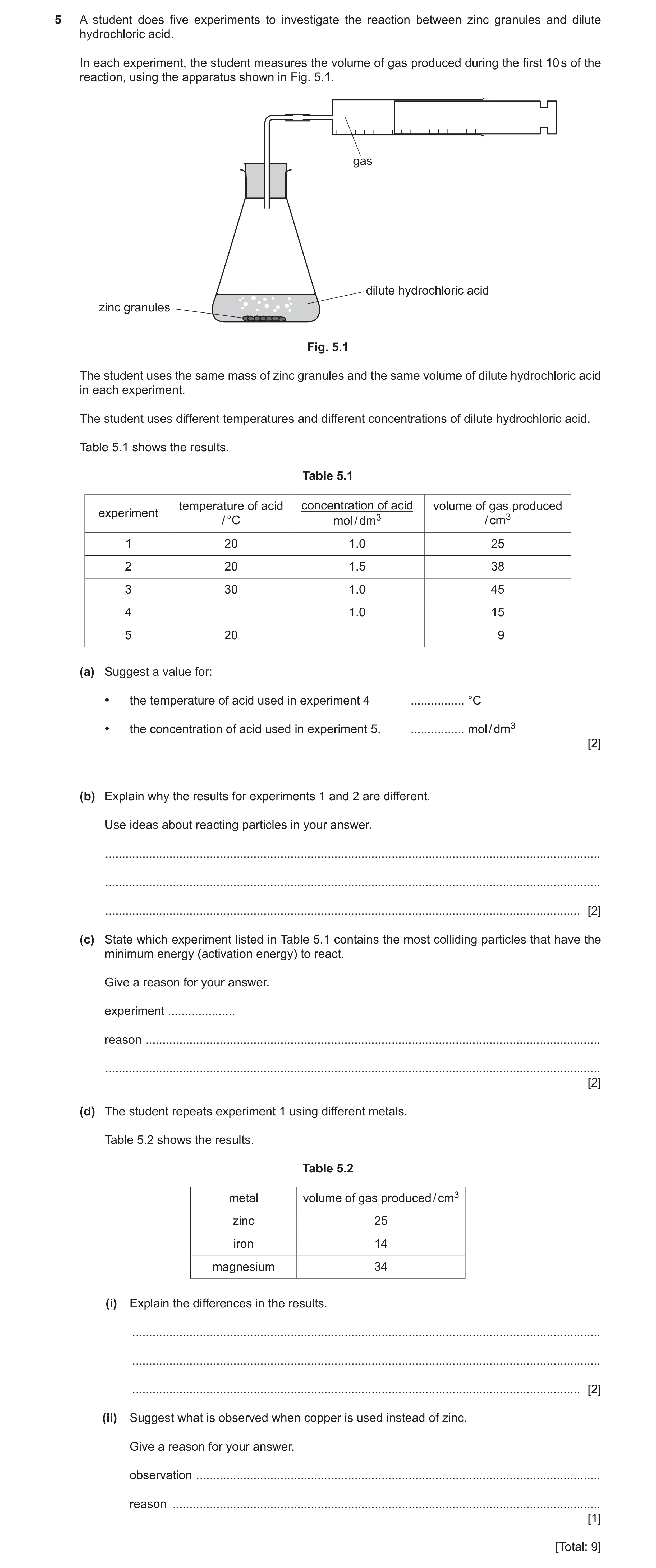
5 A student does five experiments to investigate the reaction between zinc granules and dilute hydrochloric acid. In each experiment, the student measures the volume of gas produced during the first 10 s of the reaction, using the apparatus shown in Fig. 5.1. gas dilute hydrochloric acid zinc granules Fig. 5.1 The student uses the same mass of zinc granules and the same volume of dilute hydrochloric acid in each experiment. The student uses different temperatures and different concentrations of dilute hydrochloric acid. Table 5.1 shows the results. Table 5.1 temperature of acid concentration of acid volume of gas produced experiment / °C mol / dm3 / cm3 1 20 1.0 25 2 20 1.5 38 3 30 1.0 45 4 1.0 15 5 20 9 (a) Suggest a value for: • the temperature of acid used in experiment 4 … °C • the concentration of acid used in experiment 5. … mol / dm3 [2] (b) Explain why the results for experiments 1 and 2 are different. Use ideas about reacting particles in your answer. … … … [2] (c) State which experiment listed in Table 5.1 contains the most colliding particles that have the minimum energy (activation energy) to react. Give a reason for your answer. experiment … reason … … [2] (d) The student repeats experiment 1 using different metals. Table 5.2 shows the results. Table 5.2 metal volume of gas produced / cm3 zinc 25 iron 14 magnesium 34 (i) Explain the differences in the results. … … … [2] (ii) Suggest what is observed when copper is used instead of zinc. Give a reason for your answer. observation … reason … [1] [Total: 9]
9 marks
Mark scheme: 5(a) > 0 to < 20 (°C) ; 2 > 0 to < 1.0 (mol / dm3) ; 5(b) more (acid) particles (per unit volume) in experiment 2 / concentration (of acid) in experiment 2 is higher, ORA ; 2 so more frequent collisions (between particles) ; 5(c) experiment 3 ; 2 it is the highest temperature / the most gas is produced (in 10 s) ; 5(d)(i) idea that the metals have different reactivities / correct order of reactivity implied, Mg > Zn > Fe ; 2 higher reactivity causes higher rate of gas production / reaction ; 5(d)(ii) no gas collected / no reaction AND 1 copper, is unreactive / does not react with acids ;
This question in 0653/41 Oct/Nov 2023
Q16 · A student investigates the reaction of dilute hydrochloric acid with different metals 0653/42 Oct/Nov 2023
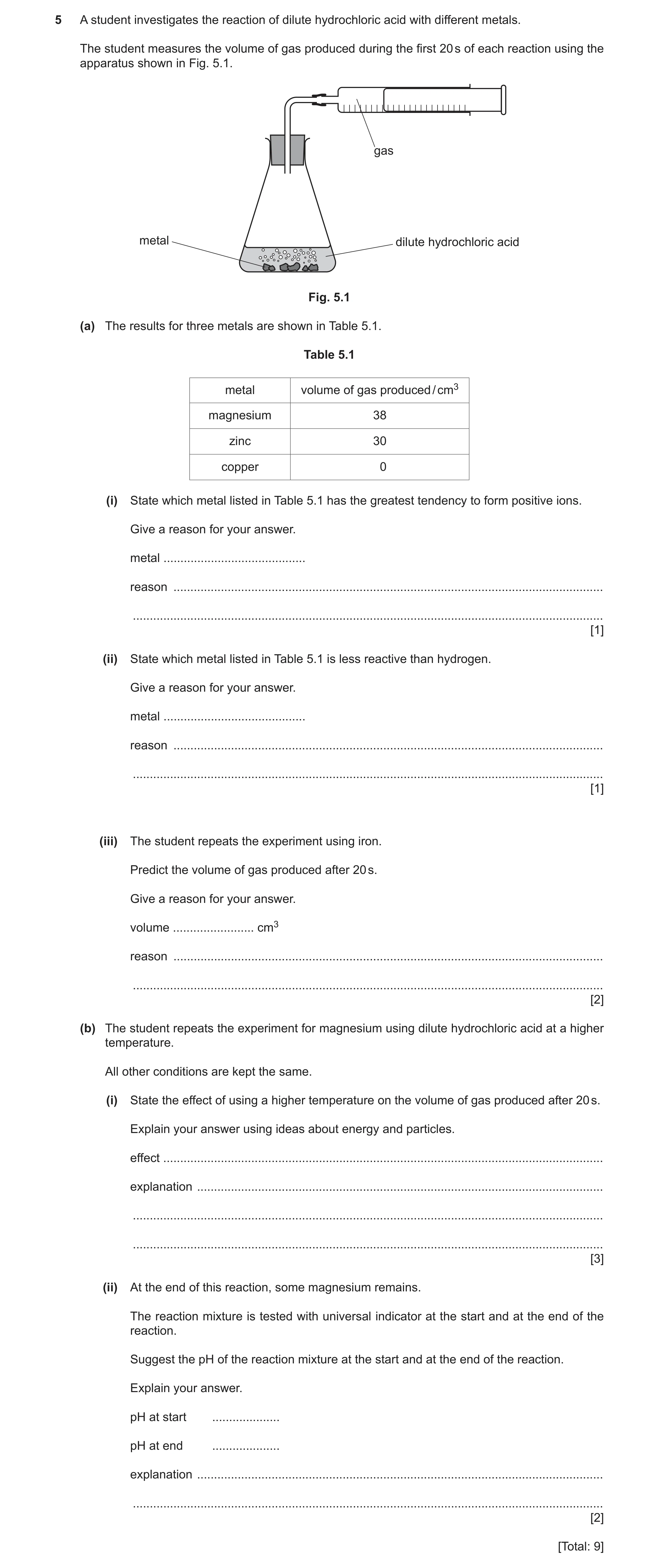
5 A student investigates the reaction of dilute hydrochloric acid with different metals. The student measures the volume of gas produced during the first 20 s of each reaction using the apparatus shown in Fig. 5.1. gas metal dilute hydrochloric acid Fig. 5.1 (a) The results for three metals are shown in Table 5.1. Table 5.1 metal volume of gas produced / cm3 magnesium 38 zinc 30 copper 0 (i) State which metal listed in Table 5.1 has the greatest tendency to form positive ions. Give a reason for your answer. metal … reason … … [1] (ii) State which metal listed in Table 5.1 is less reactive than hydrogen. Give a reason for your answer. metal … reason … … [1] (iii) The student repeats the experiment using iron. Predict the volume of gas produced after 20 s. Give a reason for your answer. volume … cm3 reason … … [2] (b) The student repeats the experiment for magnesium using dilute hydrochloric acid at a higher temperature. All other conditions are kept the same. (i) State the effect of using a higher temperature on the volume of gas produced after 20 s. Explain your answer using ideas about energy and particles. effect … explanation … … … [3] (ii) At the end of this reaction, some magnesium remains. The reaction mixture is tested with universal indicator at the start and at the end of the reaction. Suggest the pH of the reaction mixture at the start and at the end of the reaction. Explain your answer. pH at start … pH at end … explanation … … [2] [Total: 9]
9 marks
Mark scheme: 5(a)(i) magnesium AND 1 it is the most reactive or atoms lose electrons most readily ; 5(a)(ii) copper AND 1 copper does not displace hydrogen (from the acid) ; 5(a)(iii) any value greater than 0 AND less than 30 ; 2 reactivity of iron is between copper and zinc ; 5(b)(i) (volume of gas produced) increases ; 3 more frequent collisions more successful collisions OR particles move faster / particles have more kinetic energy ; more particles (have more than minimum) with activation energy ; 5(b)(ii) pH at start: 1–3 AND pH at end: 7 ; 2 (acid is fully neutralised) because magnesium is in excess OR the acid is used up;
This question in 0653/42 Oct/Nov 2023
 8
8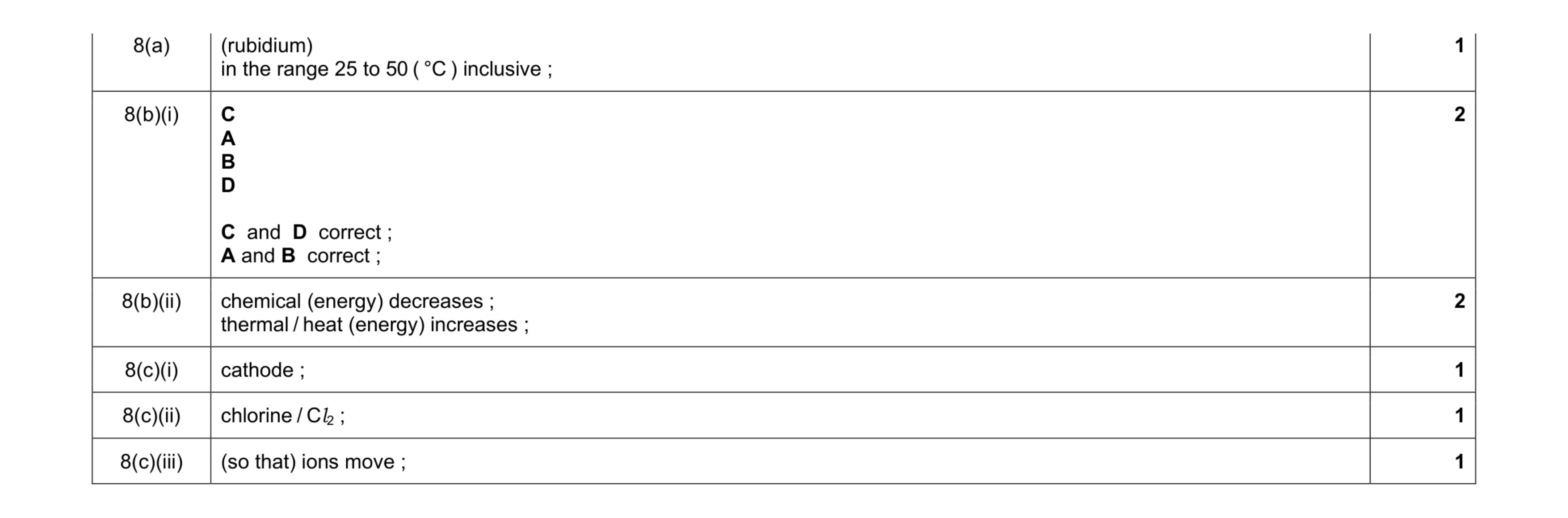 8
8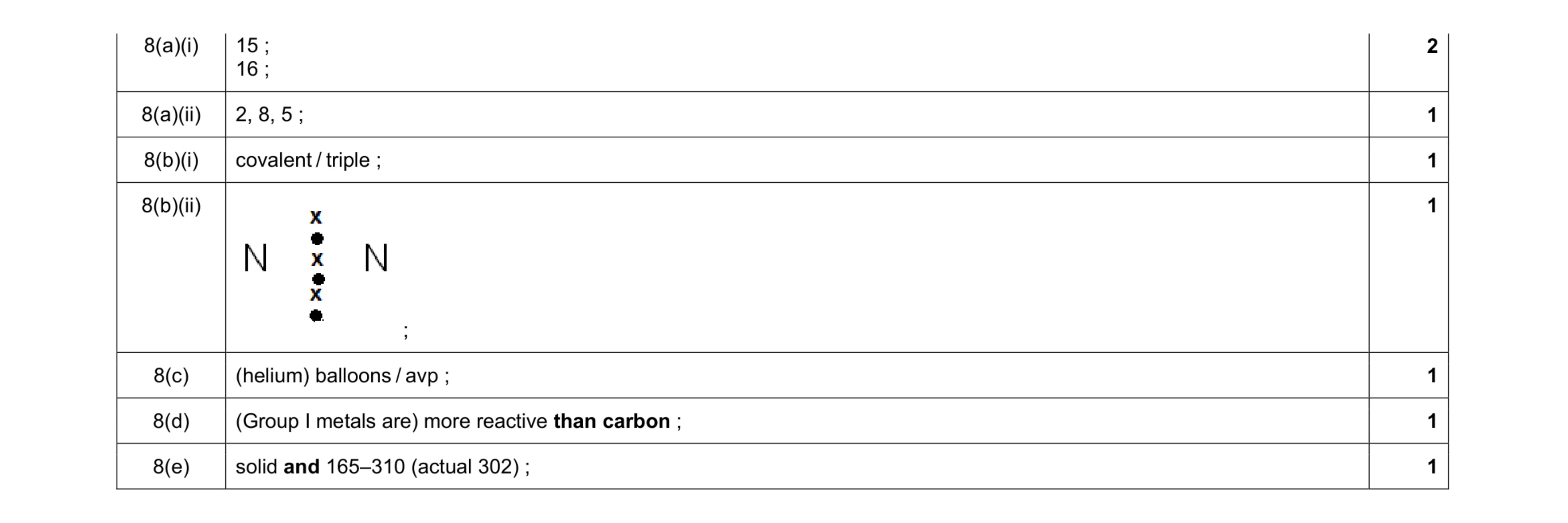 8
8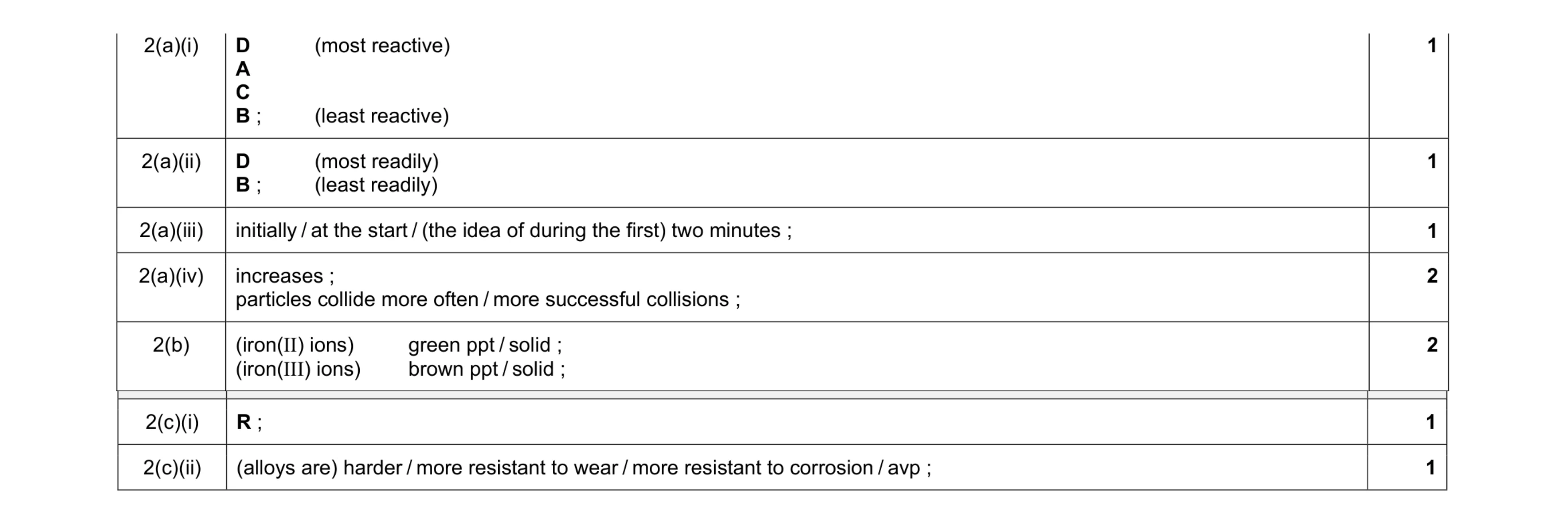 9
9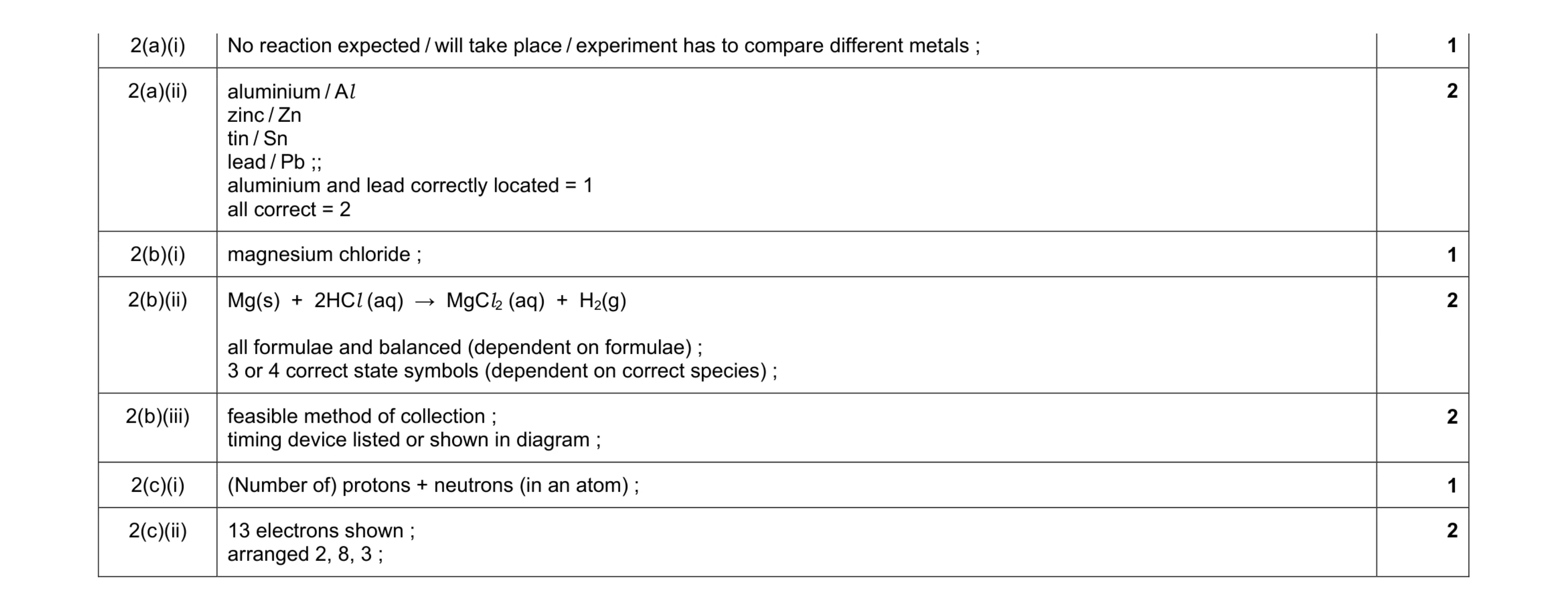 11
11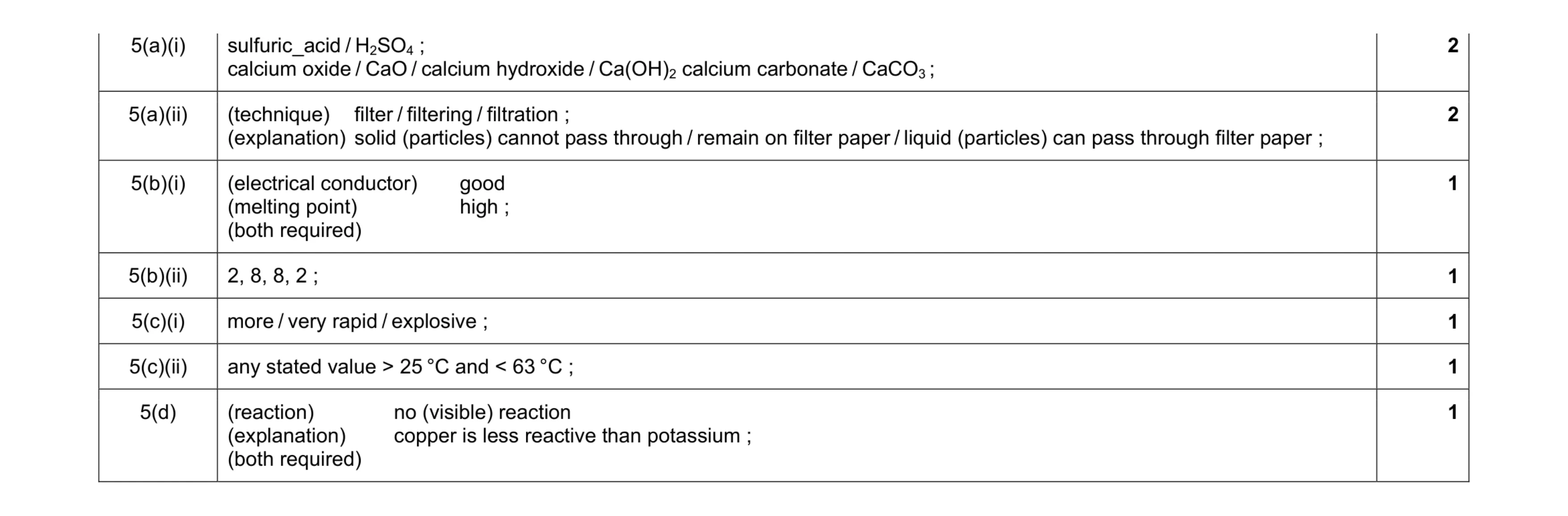 9
9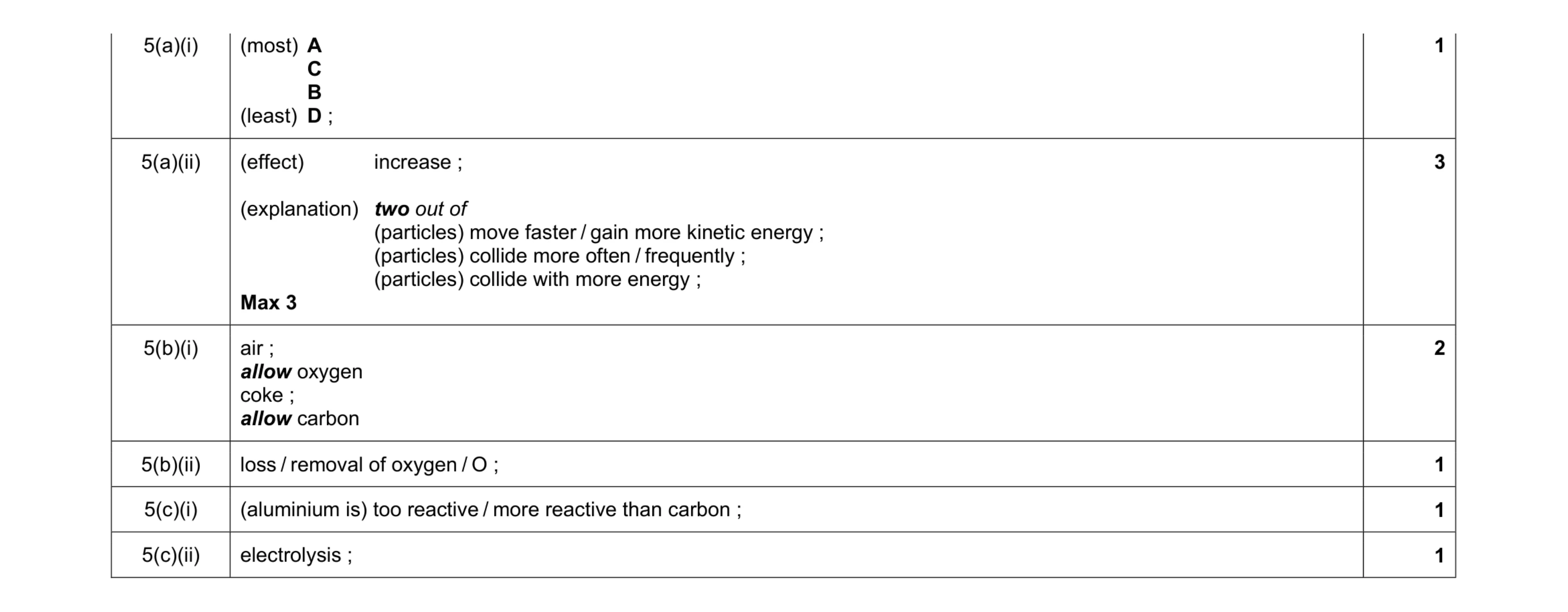 9
9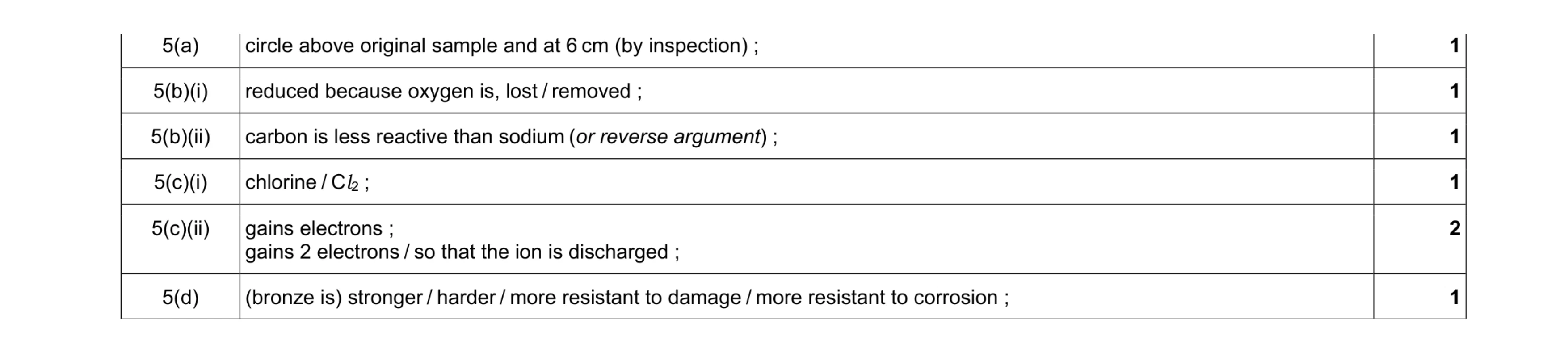 7
7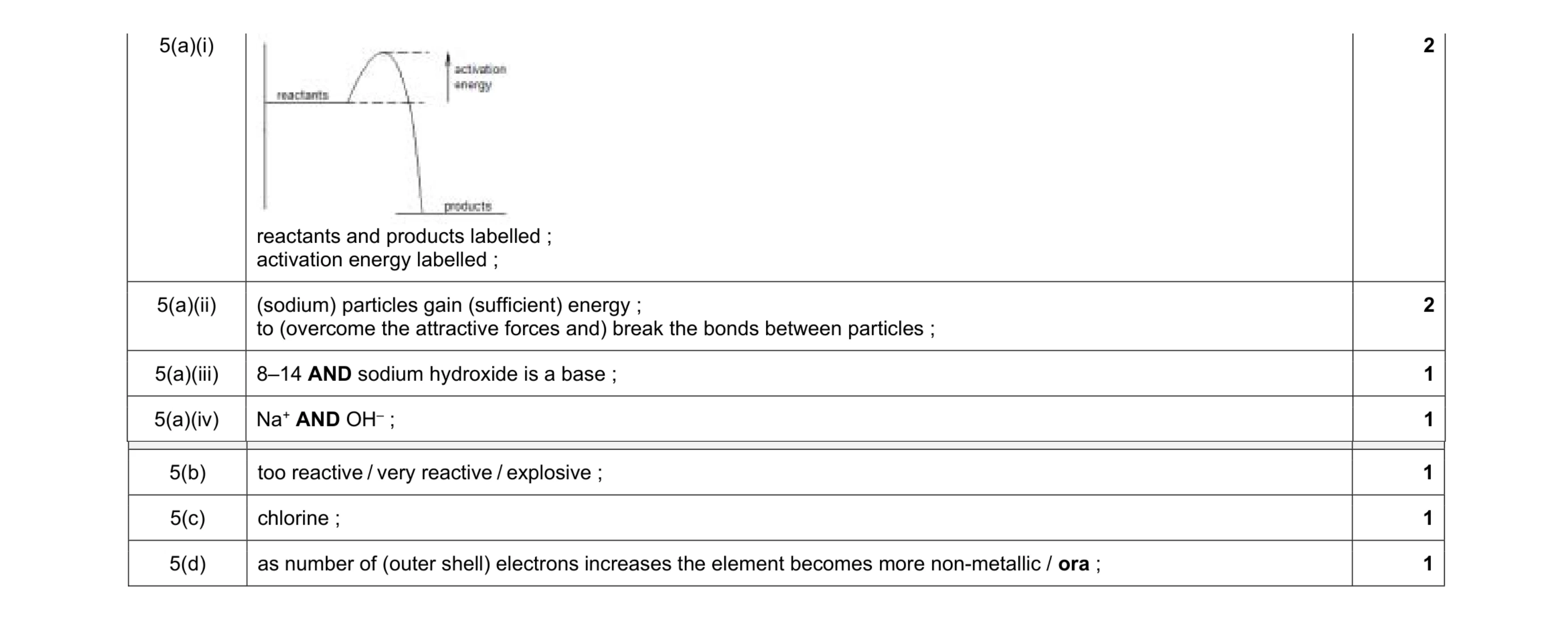 9
9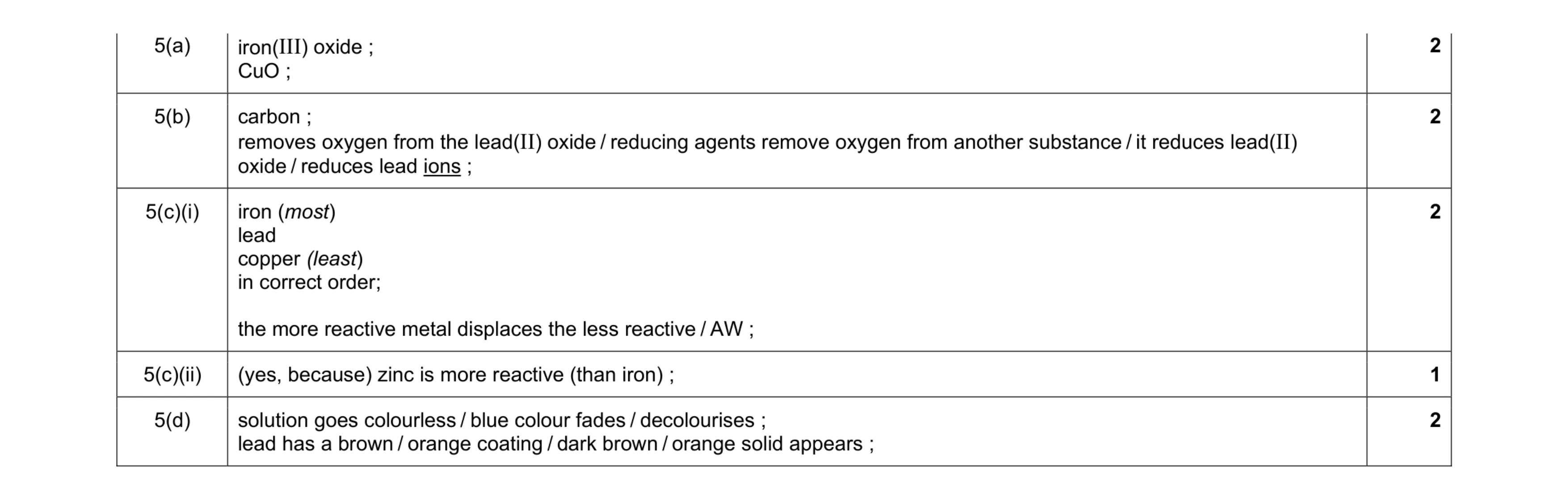 9
9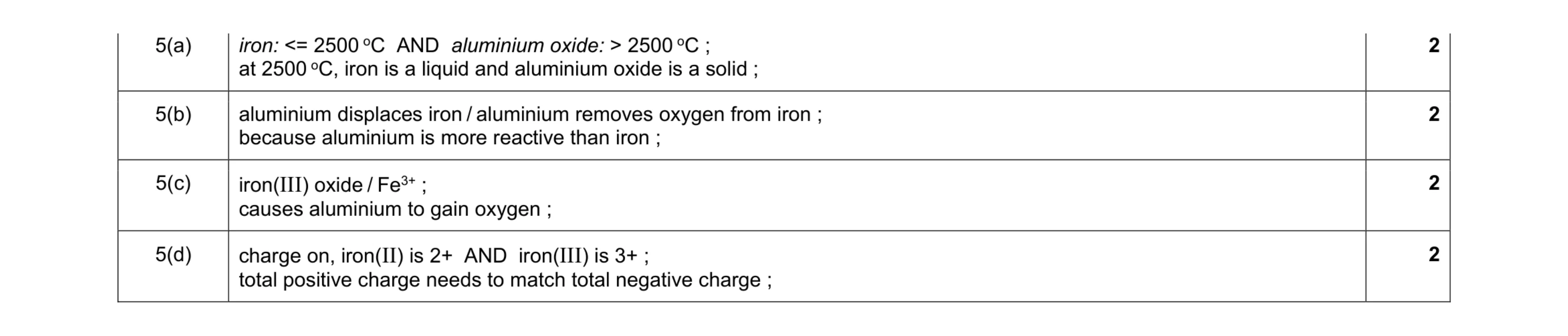 8
8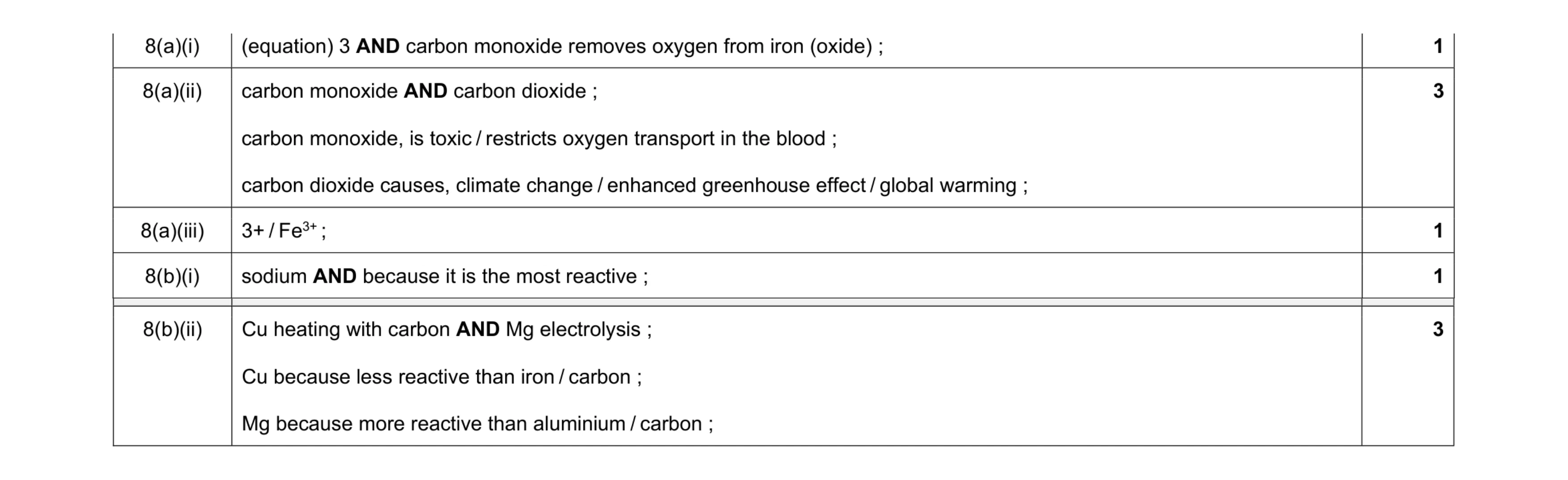 9
9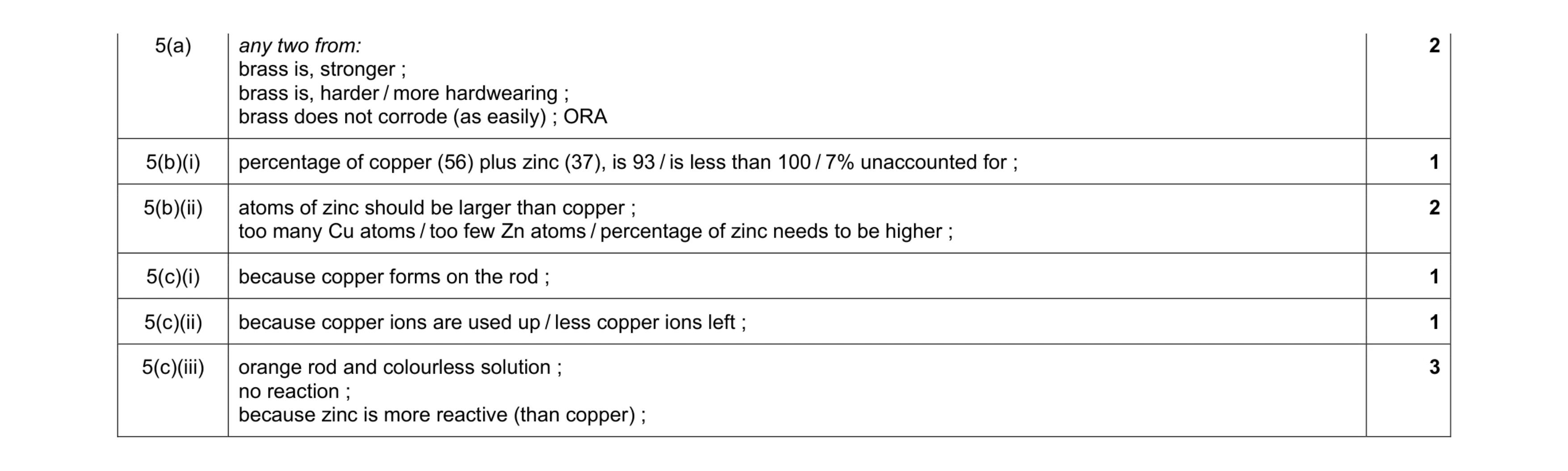 10
10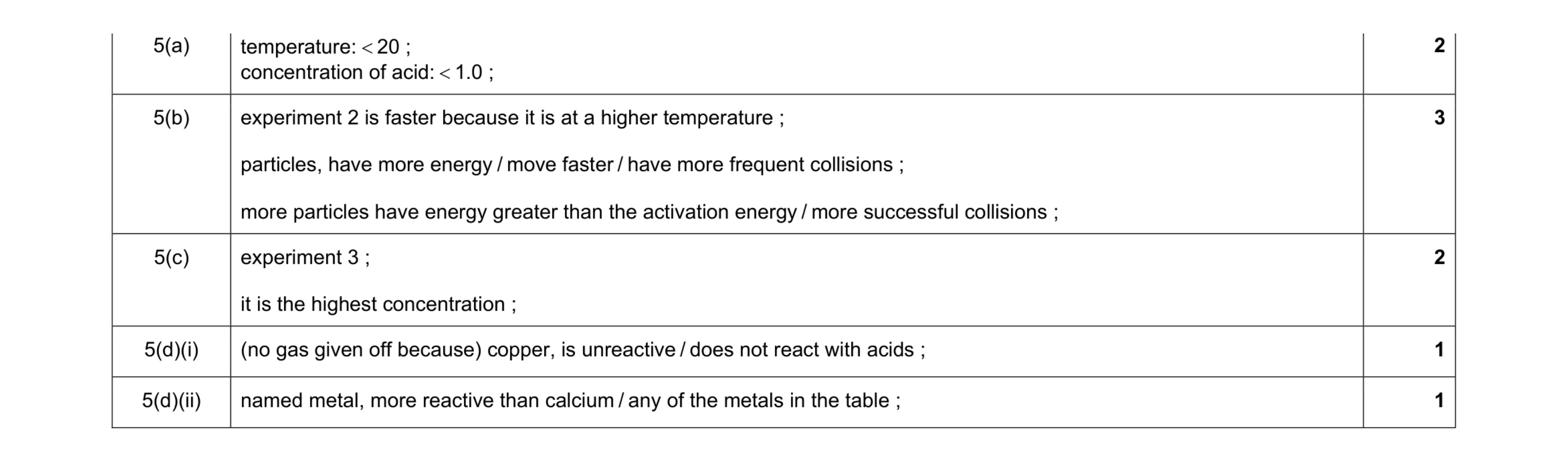 9
9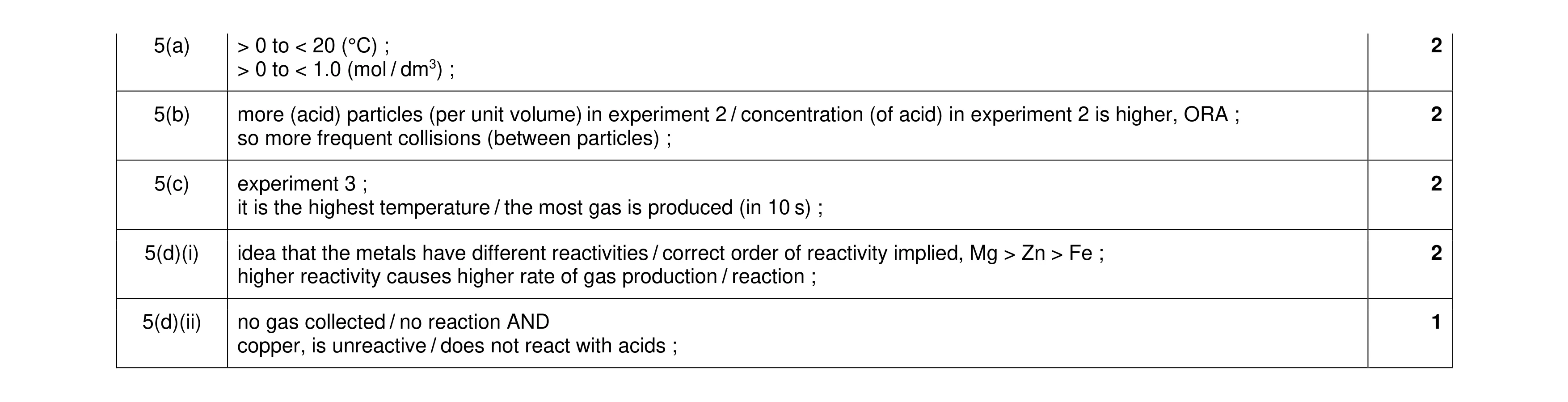 9
9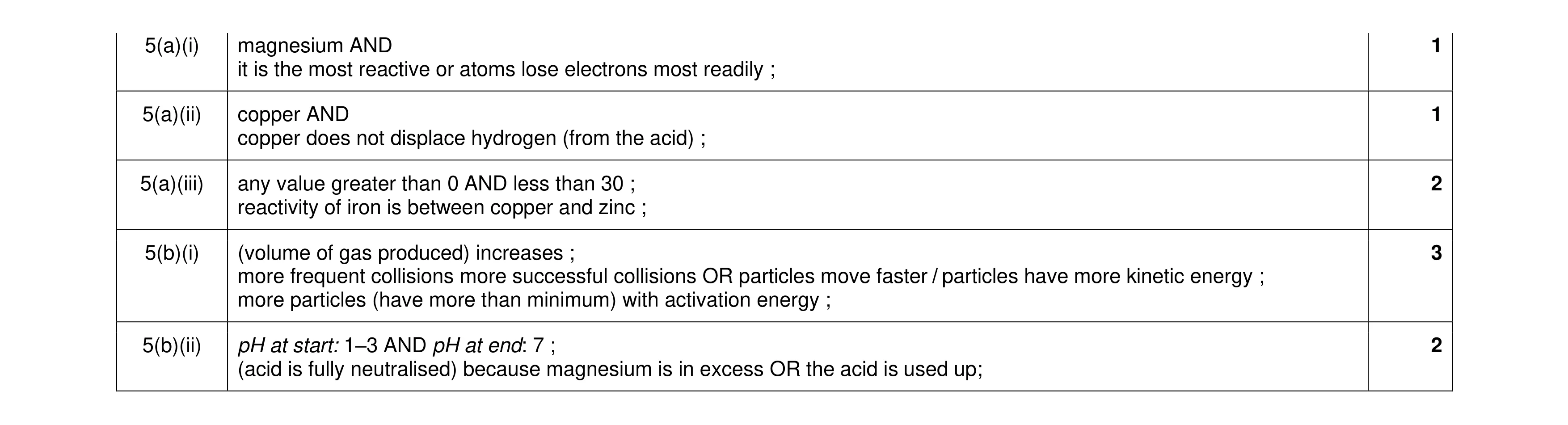 9
9