Questions as text
Q1 · Find the value of the constant c for which the line y = 2x + c is a tangent to the curve… 9709/11 May/June 2007
1 Find the value of the constant c for which the line y = 2x + c is a tangent to the curve y2 = 4x. [4]
4 marks
Mark scheme: 1 Eliminates x or y completely M1 Aims to make x or y subject + subst y 2 − 2 y + 2c or 4 x 2 + x ( 4c − 4) + c 2 = 0 M1 Correct quadratic – not nec =0 Use of b 2 −ac4 = 0 A1 Used correctly on “quadratic=0” → c = ½ A1 co [or gradients equal 2=1/√x M1A1 [4] → value for x,y and c. M1A1] ∫√
This question in 9709/11 May/June 2007
Q2 · The diagram shows a rectangle ABCD 9709/11 May/June 2007
6 The diagram shows a rectangle ABCD. The point A is (2, 14), B is (−2, 8) and C lies on the x-axis. Find (i) the equation of BC, [4] (ii) the coordinates of C and D. [3]
7 marks
Mark scheme: 6 (i) m of AB = 1.5 ( or 1½) B1 co anywhere m of BC = −1 ÷ (m of AB) = −⅔ M1 Use of m1m2 = −1 → Eqn y − 8 = − 23 ( x + 2) or 3y+2x=20 M1 A1√ Correct form used – or y = mx + c . co [4] (√ needs both M marks) (ii) Put y = 0 → C (10, 0) B1√ √ in his linear equation. Vector move → D (14, 6) M1A1 completely correct method. co (or sim eqns 3y+2x=46 and 2y=3x−30) [3] GCE A/AS LEVEL – May/June 2007 9709 01 a
This question in 9709/11 May/June 2007
Q3 · 10 The equation of a curve is y = 2x + x2 9709/11 May/June 2007
8 10 The equation of a curve is y = 2x + x2. dy d2y (i) Obtain expressions for and . [3] dx dx2 (ii) Find the coordinates of the stationary point on the curve and determine the nature of the stationary point. [3] (iii) Show that the normal to the curve at the point (−2, −2) intersects the x-axis at the point (−10, 0). [3] (iv) Find the area of the region enclosed by the curve, the x-axis and the lines x = 1 and x = 2. [3]
12 marks
Mark scheme: dy 16 −16/x3.10 (i) = 2 − 3 B1 For dx x d 2 y 48 B1 For “2” and for “0”. 2 = 4 B1√ For d/dx of his −16/x3 providing −ve dx x [3] power differentiated. dy (ii) =0 → x = 2, y = 6. M1 Sets dy/dx to 0 + attempt at x. dx A1 Needs both coordinates. d 2 y 2 is +ve Minimum. A1√ Looks at sign. Correct conclusion for dx [3] his x and his 2nd differential. (iii) x = −2 m = 4 Perp gradient = −¼ M1 Uses m1m2 = −1 with dy/dx. y + 2 = − 14 ( x + 2) DM1 Correct form of equation (not for tan) Sets y to 0 → x = −10 A1 Co nb answer given. [3] 2 8 (iv) Area = x −x B1 B1 For each term Evaluated from 1 to 2 → 7 B1 Co. (−7 ⇒ 7 gets B0) [3] 2
This question in 9709/11 May/June 2007
Q4 · Y C B A x O D (10, –3) The diagram shows points A, B and C lying on the line 2y = x + 4 9709/11 May/June 2009
8 y C B A x O D (10, –3) The diagram shows points A, B and C lying on the line 2y = x + 4. The point A lies on the y-axis and AB = BC. The line from D (10, −3) to B is perpendicular to AC. Calculate the coordinates of B and C. [7]
7 marks
Mark scheme: 8 m of AC = ½ Perpendicular gradient = −2 M1 Use of m1m2 = −1 Eqn BD y + 3 = −2(x − 10) M1 Correct method for eqn of line ( or y + 2x = 17) A1 In any form. Sim. eqns BD with given eqn. M1 Correct method of solution. → B (6,5) A1 co. Vector move (step) → C (12, 8) M1 A1√ Any valid method. √ for his B. [7] 2
This question in 9709/11 May/June 2009
Q5 · Y C (12, 14) B D O x A (0, –2) The diagram shows a rectangle ABCD 9709/12 Oct/Nov 2009
9 y C (12, 14) B D O x A (0, –2) The diagram shows a rectangle ABCD. The point A is (0, −2) and C is (12, 14). The diagonal BD is parallel to the x-axis. (i) Explain why the y-coordinate of D is 6. [1] The x-coordinate of D is h. (ii) Express the gradients of AD and CD in terms of h. [3] (iii) Calculate the x-coordinates of D and B. [4] (iv) Calculate the area of the rectangle ABCD. [3]
11 marks
Mark scheme: 9 (i) y-coordinate same as the B1 co y-coordinate of the mid-point of [1] AC. 8 h − 12 (ii) m of AD = or M1 A1 any use of y-step ÷ x-step for M mark h 8 8 − h m of CD = or A1 co 12 − h 8 [3] nb AC = 20, M(6, 6) MD = 10 → D(16, 6) and B(−4, 6) (iii) Product of gradients = −1 M1 Used correctly with the two gradients → h2 – 12h – 64 = 0 M1 Forming a quadratic equation → h = 16 or − 4 DM1A1 Solution of equation. co so xD = 16 and xB = –4 [4] or Pyth h2 + 82 + 82 + (12 – h)2 = 400 (iv) Area = √320 × √80 M1 M1 M1 for method for one of the lengths → 160 A1 M1 for base × height. co [3] ( or Area = 2 × area of a triangle with base = BD, → 2 × ½ × 20 × 8 = 160) (or matrix method) GCE A/AS LEVEL – October/November 2009 9709 12 2
This question in 9709/12 Oct/Nov 2009
Q6 · Y L1 C (–1, 3) L2 A B (3, 1) x O In the diagram, A is the point (−1, 3) and B is the… 9709/12 May/June 2010
4 y L1 C (–1, 3) L2 A B (3, 1) x O In the diagram, A is the point (−1, 3) and B is the point (3, 1). The line L1 passes through A and is parallel to OB. The line L2 passes through B and is perpendicular to AB. The lines L1 and L2 meet at C. Find the coordinates of C. [6]
6 marks
Mark scheme: 3 f : x a 4 x − 2 x 2 ,
This question in 9709/12 May/June 2010
Q7 · Y B C (5, 4) A (–1, 2) x O D The diagram shows a rhombus ABCD in which the point A is… 9709/13 May/June 2010
8 y B C (5, 4) A (–1, 2) x O D The diagram shows a rhombus ABCD in which the point A is (−1, 2), the point C is (5, 4) and the point B lies on the y-axis. Find (i) the equation of the perpendicular bisector of AC, [3] (ii) the coordinates of B and D, [3] (iii) the area of the rhombus. [3]
9 marks
Mark scheme: 8 (i) Mid-point of AC = (2, 3) B1 Co Gradient of AC = 1/3 Gradient of BD = –3 M1 Use of mlm2 = –1 Equation y – 3 = –3(x – 2) A1 Co [3] (ii) If x = 0, y = 9, B (0, 9) B1√ √ on his equation. Vector move D (4, –3) M1 A1 Valid method. co. [3] (iii) AC = 40 BD = 160 M1 Correct use on either AC or BD, Area = 40 M1 A1 Full and correct method. co (or by matrix method M2 A1) [3] 4
This question in 9709/13 May/June 2010
Q8 · X cm y cm x cm The diagram shows a metal plate consisting of a rectangle with sides x cm… 9709/11 Oct/Nov 2010
8 x cm y cm x cm The diagram shows a metal plate consisting of a rectangle with sides x cm and y cm and a quarter-circle of radius x cm. The perimeter of the plate is 60 cm. (i) Express y in terms of x. [2] (ii) Show that the area of the plate, A cm2, is given by A 30x [2] = −x2. Given that x can vary, (iii) find the value of x at which A is stationary, [2] (iv) find this stationary value of A, and determine whether it is a maximum or a minimum value. [2] [Questions 9, 10 and 11 are printed on the next page.]
8 marks
Mark scheme: πx 8 (i) 2 x + 2 y + = 60 M1 Linking 60 with sum of at least 4 sides 2 and use of radians πx → y = 30 − x − A1 co 4 [2] πx 2 (ii) A = xy + 4 πx πx 2 1 2 = x (30 − x − ) + M1 Subs “y” into area eqn and use r θ 4 4 2 = 30x – x2 A1 co. [2] dA (iii) = 30 − 2 x Knowing to differentiate dx = 0 when x = 15 cm M1 A1 Sets differential to 0 + solution. co. [2] (iv) Max. M1 A1 Any valid method. co. [2] GCE AS/A LEVEL – October/November 2010 9709 11
This question in 9709/11 Oct/Nov 2010
Q9 · C1 P 8 cm T C2 Q 2 cm R S The diagram shows two circles, C1 and C2, touching at the point… 9709/11 Oct/Nov 2010
9 C1 P 8 cm T C2 Q 2 cm R S The diagram shows two circles, C1 and C2, touching at the point T. Circle C1 has centre P and radius 8 cm; circle C2 has centre Q and radius 2 cm. Points R and S lie on C1 and C2 respectively, and RS is a tangent to both circles. (i) Show that RS 8 cm. [2] = (ii) Find angle RPQ in radians correct to 4 significant figures. [2] (iii) Find the area of the shaded region. [4]
8 marks
Mark scheme: 9 (i) RS² = 10² – 6² M1 Use of Pythagoras (or other) → RS = 8 cm. A1 Answer given. [2] (ii) sin θ = 8/10 oe M1 Use of trig – even if with degrees. → angle RPQ = 0.9273 radians A1 co in radians. (Accept 0.927) [2] (iii) Region = trapezium − 2 sectors Area of trapezium = 40 cm² B1 co 1 1 Large sector = × 8² × 0.9273 M1 Use of r²θ. 2 2 Small sector angle = (π − 0.9273) 1 1 Small sector = × 2² × 2.214 M1 Use of r²θ with angle = π − (ii) 2 2 → 5.90 cm2 A1 [4] co 2
This question in 9709/11 Oct/Nov 2010
Q10 · The equation of a curve is y 3 4x = + −x2 9709/11 Oct/Nov 2010
10 The equation of a curve is y 3 4x = + −x2. (i) Show that the equation of the normal to the curve at the point is 2y x 9. [4] (3, 6) = + (ii) Given that the normal meets the coordinate axes at points A and B, find the coordinates of the mid-point of AB. [2] (iii) Find the coordinates of the point at which the normal meets the curve again. [4]
10 marks
Mark scheme: 10 y = 4x – x2 + 3 dy (i) = 4 − 2 x B1 co dx At x = 3, m = − 2 1 Gradient of normal = M1 Use of m1m2 = −1 2 Eqn of normal y − 6 = 12 ( x − 3) M1 A1 Use of y – k = m(x – h) or y = mx + c → 2y = x + 9 (where m is gradient of normal) [4] 9 (ii) Meets axes at (0, ) and (−9, 0) M1 Sets x and y to 0 + midpoint formula. 2 − 9 9 Mid-point is , A1 co. 2 4 [2] (iii) 2y = x + 9, y = 4x – x2 + 3 → 2x2 – 7x + 3 = 0 oe M1 A1 Eliminates x completely. Correct eqn. → (½, 4¾) M1 A1 Solution of quadratic. co [4] GCE AS/A LEVEL – October/November 2010 9709 11 9 11 y = 2 − x dy 2
This question in 9709/11 Oct/Nov 2010
Q11 · Y 2 y = 1 – x y = 3 x + 4 B A x O 2 The diagram shows part of the curve y = 1 and the… 9709/12 Oct/Nov 2010
8 y 2 y = 1 – x y = 3 x + 4 B A x O 2 The diagram shows part of the curve y = 1 and the line y = 3x + 4. The curve and the line meet at points A and B. −x (i) Find the coordinates of A and B. [4] (ii) Find the length of the line AB and the coordinates of the mid-point of AB. [3]
7 marks
Mark scheme: 8 (i) 3x2 + x – 2 = 0 M1A1 Eliminates x or y. Sets quadratic to 0. (x + 1)(3x – 2) → x = –1 or ⅔ M1 Attempt to solve their equation (–1, 1), (⅔, 6) A1 co [4] (ii) AB2 = (5/3)2 + 52 M1 √ their coordinates from (i) AB = 5.27(0…) A1 Or (5√10)/3 oe mid-point = (–1/6, 7/2) B1√ ft from their (i) [3] 10 −a 6
This question in 9709/12 Oct/Nov 2010
Q12 · Y x = 5 A 1 y = 1 B 4 (3x + 1) x O 1 1 The diagram shows part of the curve y = 9709/12 Oct/Nov 2010
11 y x = 5 A 1 y = 1 B 4 (3x + 1) x O 1 1 The diagram shows part of the curve y = . The curve cuts the y-axis at A and the line x = 5 4 (3x + 1) at B. (i) Show that the equation of the line AB is y = −110x + 1. [4] (ii) Find the volume obtained when the shaded region is rotated through 360◦about the x-axis. [9]
13 marks
Mark scheme: 11 (i) A = (0, 1) B1 B = (5, ½) B1 1 y − 1 = − ( x − 0) M1 ft their A,B 10 1 y = − x + 1 A1 AG 10 [4] 5 −1 / 2 5 2 (ii) Curve: (π)∫ 0 (3 x + )1 dx M1 Attempt ∫ 0 y dx (π not vital) 2π 1 2 5 [(3 x + )1 ] 0 A1A1 (π not vital). 2nd A mark is for ÷ 3. 3 2π [ 4 − ]1 DM1 Application of limits to their integral 3 (in either integral). Limits 0 to 5 only. [2π] 5 1 2 1 5 2 M1 Attempt ∫ 0 y dx (π not vital) Line: (π ) ∫ 0 ( 100 x − 5 x + )1 dx 1 3 1 2 5 10 1 (π )[ x − x + x ]0 A2,1 Also directly − ( − x + 3)1 300 10 3 10 125 25 10 1 3 3 (π )[ − + 5] or − ( − + )1 − 1 (π not vital) 300 10 3 2 35π – applying limits to their integral [ ] 12 35π 11π Volume = – 2π = DM1 Subtraction of their volumes 12 12 A1 co [9]
This question in 9709/12 Oct/Nov 2010
Q13 · Points A, B and C have coordinates (2, 5), (5, −1) and (8, 6) respectively 9709/13 Oct/Nov 2010
2 Points A, B and C have coordinates (2, 5), (5, −1) and (8, 6) respectively. (i) Find the coordinates of the mid-point of AB. [1] (ii) Find the equation of the line through C perpendicular to AB. Give your answer in the form ax + by + c = 0. [3]
4 marks
Mark scheme: 2 (i) (3½, 2) B1 [1] − 1 − 5 (ii) m = = −2 B1 5 − 2 − 1 y – 6 = (x – 8) M1 Use of m1m2 = –1 and y – k = m(x – h) m x – 2y + 4 = 0 A1 Accept any form [3] 2 2 2
This question in 9709/13 Oct/Nov 2010
Q14 · A B P Q D C The diagram shows a rhombus ABCD 9709/13 Oct/Nov 2010
8 A B P Q D C The diagram shows a rhombus ABCD. Points P and Q lie on the diagonal AC such that BPD is an arc of a circle with centre C and BQD is an arc of a circle with centre A. Each side of the rhombus has length 5 cm and angle BAD = 1.2 radians. (i) Find the area of the shaded region BPDQ. [4] (ii) Find the length of PQ. [4]
8 marks
Mark scheme: 8 (i) 1/2 × 52 × 1.2 B1 1/2 × 52 × sin 1.2 B1 2[1/2 × 52 × 1.2 – 1/2 × 52 × sin 1.2] M1 Subtraction and multiplication by 2 6.70 A1 Accept 6.7 or anything rounding to 6.70 [4] (ii) 5cos 0.6 M1 5 – “5cos 0.6” M1 Subtraction from 5 10(1 – cos 0.6) M1 Multiplication by 2 1.75 A1 [4] 100
This question in 9709/13 Oct/Nov 2010
Q15 · Express 2x2 −4x + 1 in the form a(x + b)2 + c and hence state the coordinates of the… 9709/11 May/June 2011
10 (i) Express 2x2 −4x + 1 in the form a(x + b)2 + c and hence state the coordinates of the minimum point, A, on the curve y = 2x2 −4x + 1. [4] The line x −y + 4 = 0 intersects the curve y = 2x2 −4x + 1 at points P and Q. It is given that the coordinates of P are (3, 7). (ii) Find the coordinates of Q. [3] (iii) Find the equation of the line joining Q to the mid-point of AP. [3]
10 marks
Mark scheme: 10 (i) 2(x – 1)2 – 1 OR a = 2, b = –1, c = –1 B1, B1, B1 A = (1, –1) B1√ Allow alt. method for final mark [4] (ii) 2 x 2 − 5 x − 3 = 0 ⇒ ( 2 x + 1)( x − 3) = 0 OE in y M1, M1 Complete elim & simplify, attempt soln. x = − 1 2 , y = 3 1 2 A1 Additional (3, 7) not penalised [3] (iii) Mid-point of AP = (2, 3) B1√ Follow through on their A 1 − 1 Gradient of line = 2 = B1 − 5 5 2 − 1 1 Equation is y − 3 = ( x − 2) OE B1 Or y − 3 1 2 = − 1 5 5( x + 2 ) [3] 2 2
This question in 9709/11 May/June 2011
Q16 · The line L1 passes through the points A and B The line L2 is parallel to L1 and passes… 9709/12 May/June 2011
7 The line L1 passes through the points A and B The line L2 is parallel to L1 and passes through the origin. The point C lies on L2 (2,such5) that AC(10,is9).perpendicular to L2. Find (i) the coordinates of C, [5] (ii) the distance AC. [2]
7 marks
Mark scheme: 7 (i) (2, 5) to (10, 9) gradient = ½ B1 co Equation of L2 y = 12 x . B1√ √ on gradient of L1 Gradient of perpendicular = − 2 M1 Use of m1m2 = −1 Eqn of Perp y − 5 = − 2 ( x − 2 ) M1 Correct form of line eqn Sim Eqns → C(3.6, 1.8) A1 co [5] (ii) d² = 1.6² + 3.2² → d = 3.58 M1 Correct method for AC A1 co (accept with √5 in answer) [2] GCE AS/A LEVEL – May/June 2011 9709 12 8 (i) BA. BC or AB .CB B1 Correct two vectors for angle ABC.
This question in 9709/12 May/June 2011
Q17 · X 2y 3y 3x y 4x The diagram shows the dimensions in metres of an L-shaped garden 9709/11 Oct/Nov 2011
7 x 2y 3y 3x y 4x The diagram shows the dimensions in metres of an L-shaped garden. The perimeter of the garden is 48 m. (i) Find an expression for y in terms of x. [1] (ii) Given that the area of the garden is A m2, show that A = 48x −8x2. [2] (iii) Given that x can vary, find the maximum area of the garden, showing that this is a maximum value rather than a minimum value. [4]
7 marks
Mark scheme: 1 7 (i) y = oe B1 [1] 6(48 − 8 x ) (ii) A = 4 xy + 2 xy or 3 xy + 3 xy = 6 xy M1 A = x (48 − 8 x ) = 48 x − 8 x 2 A1 [2] AG δA (iii) = 48 − 16 x B1 δx Attempt to solve derivative = 0 A = 72 cao M1A1 Expect x = 3 δ 2 A = − 16 (< 0 ) ⇒ Maximum B1 [4] www Accept other complete methods 2 δx x x + y y + z z
This question in 9709/11 Oct/Nov 2011
Q18 · A line has equation y = kx + 6 and a curve has equation y = x2 + 3x + 2k, where k is a… 9709/11 Oct/Nov 2011
9 A line has equation y = kx + 6 and a curve has equation y = x2 + 3x + 2k, where k is a constant. (i) For the case where k = 2, the line and the curve intersect at points A and B. Find the distance AB and the coordinates of the mid-point of AB. [5] (ii) Find the two values of k for which the line is a tangent to the curve. [4] [Questions 10 and 11 are printed on the next page.]
9 marks
Mark scheme: 9 (i) x 2 + 3 x + 4 = 2 x + 6 ⇒ x 2 + x − 2 (= 0 ) M1 3-term simplification ( x − 1)( x + 2 ) = 0 → (8,1 ), (− 2,2 ) DM1A1 DM1 for attempted solution for x 2 2 cao ( 45 from wrong points scores AB = 3 + 6 = .6 71 or 45 or 3 5 B1 B0) − 1 5, B1√ [5] Ft their coordinates 2 GCE AS/A LEVEL – October/November 2011 9709 11 (ii) x 2 + (3 − k )x + 2 k − 6(= 0 ) M1 Simplified to 3-term quadratic 2 (3 − k ) 2 − 4(2 k − 6 ) = 0 DM1 Apply b −ac4 = 0 as function of k only (3 − k )(11 − k ) = 0 DM1 Attempt factorisation or use formula Both correct NB Alternative methods for (ii) k = 3 or 11 A1 [4] possible If B0B0 then SCB1 for both y = 1 & ( ) ( )
This question in 9709/11 Oct/Nov 2011
Q19 · The equation of a curve is y2 + 2x = 13 and the equation of a line is 2y + x = k, where k… 9709/12 Oct/Nov 2011
4 The equation of a curve is y2 + 2x = 13 and the equation of a line is 2y + x = k, where k is a constant. (i) In the case where k = 8, find the coordinates of the points of intersection of the line and the curve. [4] (ii) Find the value of k for which the line is a tangent to the curve. [3]
7 marks
Mark scheme: 4 (i) y 2 + 2 x = 13 , 2 y + x = 8 M1 Complete elimination of x or y 2 2 A1 co (allow multiples) – needs 3 terms → y − 4 y + 3 = 0 , x −x8 + 12 = 0 DM1 Solution of quadratic = 0 → (2, 3) and (6, 1) A1 Needs all 4 coordinates. [4] (ii) Removes x → y 2 + 2( k − 2 y ) = 13 M1 Complete elimination of x or y. Uses b 2 − 4 ac on “quadratic = 0) DM1 Use of discriminant =0, <0 or >0 → k = 8½ A1 Co dy 1 [3] (M1 equating m of line and curve or = −½ = −→ y=2, x=4½, k= 8½ dx y M1 x to y A1 for k) GCE AS/A LEVEL – October/November 2011 9709 12
This question in 9709/12 Oct/Nov 2011
Q20 · Y B (3, 6) C (9, 4) M O x A (–1, –1) D The diagram shows a quadrilateral ABCD in which… 9709/12 Oct/Nov 2011
9 y B (3, 6) C (9, 4) M O x A (–1, –1) D The diagram shows a quadrilateral ABCD in which the point A is (−1, −1), the point B is (3, 6) and the point C is (9, 4). The diagonals AC and BD intersect at M. Angle BMA = 90◦and BM = MD. Calculate (i) the coordinates of M and D, [7] (ii) the ratio AM : MC. [2]
9 marks
Mark scheme: 9 (i) Gradient of AC = ½ B1 co Gradient of BD = − 2 M1 Use of m1m2 = − 1 with AC Eqn of BD is y − 6 = − 2( x − 3) M1 Correct formula for straight line Eqn of AC is y + 1 = 12 ( x + )1 M1 Solution. Sim eqns → M (5, 2) A1 co Vector move – or midpoint back → D (7, − 2) M1 A1√ Correct method. √ on M. [7] (ii) Ratio of AM : MC = √45 : √20 M1 Correct distance formula. or Vector step → 3 : 2 A1 Looks at the two x or y steps. [2] Must be numerical, 1.5 ok, not as roots
This question in 9709/12 Oct/Nov 2011
Q21 · Y B (0, 3) 9 y = 2 x + 3 C A (3, 1) x O 9 The diagram shows part of the curve y =… 9709/12 Oct/Nov 2012
9 y B (0, 3) 9 y = 2 x + 3 C A (3, 1) x O 9 The diagram shows part of the curve y = crossing the y-axis at the point B (0, 3). The point 2x + 3, A on the curve has coordinates (3, 1) and the tangent to the curve at A crosses the y-axis at C. (i) Find the equation of the tangent to the curve at A. [4] (ii) Determine, showing all necessary working, whether C is nearer to B or to O. [1] (iii) Find, showing all necessary working, the exact volume obtained when the shaded region is rotated through 360◦about the x-axis. [4]
9 marks
Mark scheme: → y 1 = 9 ( x )3 [4] (normal →max 2/4, no calculus 0/4) (ii) Meets the y-axis when x = 0, y = 1⅔ B1 Sets x to 0 in his tangent. This is nearer to B than to O. [1] The 1⅔ and part (i) must be correct.
This question in 9709/12 Oct/Nov 2012
Q22 · Y A (2, 14) X B (14, 6) C (7, 2) x O The diagram shows three points A 2, 14 , B 14, 6 and… 9709/13 May/June 2013
7 y A (2, 14) X B (14, 6) C (7, 2) x O The diagram shows three points A 2, 14 , B 14, 6 and C 7, 2 . The point X lies on AB, and CX is perpendicular to AB. Find, by calculation, (i) the coordinates of X, [6] (ii) the ratio AX : XB. [2]
8 marks
Mark scheme: 7 A (2, 14), B (14, 6) and C (7, 2). (i) m of AB = −⅔ B1 m of perpendicular = 32 M1 For use of m1m2 = −1 eqn of AB y − 14 = − 23 ( x − 2) M1 Allow M1 for unsimplified eqn eqn of CX y − 2 = 32 ( x − 7 ) M1 Allow M1 for unsimplified eqn Sim Eqns → X (11, 8) M1 A1 [6] For solution of sim eqns. (ii) AX : XB = 14−8 : 8− 6 = 3 : 1 M1 A1 Vector steps or Pythagoras. Or √(9²+6²) : √(3²+2²) = 3: 1 [2]
This question in 9709/13 May/June 2013
Q23 · X metres r metres The inside lane of a school running track consists of two straight… 9709/11 Oct/Nov 2013
8 x metres r metres The inside lane of a school running track consists of two straight sections each of length x metres, and two semicircular sections each of radius r metres, as shown in the diagram. The straight sections are perpendicular to the diameters of the semicircular sections. The perimeter of the inside lane is 400 metres. (i) Show that the area, A m2, of the region enclosed by the inside lane is given by A = 400r −0r2. [4] (ii) Given that x and r can vary, show that, when A has a stationary value, there are no straight sections in the track. Determine whether the stationary value is a maximum or a minimum. [5]
9 marks
Mark scheme: 8 (i) A = 2 xr + πr 2 B1 2 x + 2πr = 400 (⇒ x = 200 − πr ) B1 A = 400 r − πr 2 M1A1 Subst & simplify to AG (www) [4] dA (ii) = 400 − 2πr B1 Differentiate dr = 0 M1 Set to zero and attempt to find r 200 r = oe A1 π x = 0 ⇒ no straight sections AG A1 d 2 A = −2π ( < 0 ) Max B1 Dep on − 2π , or use of other valid 2 dr [5] reason GCE AS/A LEVEL – October/November 2013 9709 11 10 ( )
This question in 9709/11 Oct/Nov 2013
Q24 · The point A has coordinates 3, 1 and the point B has coordinates −21, 11 9709/13 Oct/Nov 2013
3 The point A has coordinates 3, 1 and the point B has coordinates −21, 11 . The point C is the mid-point of AB. (i) Find the equation of the line through A that is perpendicular to y = 2x −7. [2] (ii) Find the distance AC. [3]
5 marks
Mark scheme: 3 (i) gradient of perpendicular = ‒½ soi B1 y – 1 = – ½ (x – 3) B1 [2] (ii) C = (‒9, 6) B1 soi in (i) or (ii) AC2 = [3 – (–9)]2 + [1 – 6]2 (ft on their C) M1 OR AB² = [3−(−21)]² + [1−11]² M1 AC = 13 A1 AB = 26 A1 [3] AC = 13 A1
This question in 9709/13 Oct/Nov 2013
Q25 · The line 4x + ky = 20 passes through the points A 8, −4 and B b, 2b , where k and b are… 9709/11 Oct/Nov 2014
4 The line 4x + ky = 20 passes through the points A 8, −4 and B b, 2b , where k and b are constants. (i) Find the values of k and b. [4] (ii) Find the coordinates of the mid-point of AB. [1]
5 marks
Mark scheme: 4 (i) 32 − 4 k = 20 ⇒ k = 3 M1A1 Sub (8, −4) [alt: (2b + 4 ) / (b − 8 ) = − 4 / k 4b + 3 × 2b = 20 M1 Sub (b, 2b), 4b + 2bk = 20 b = 2 A1 M1 both M1 solving A1, [4] A1 ] (ii) Mid-point = (5, 0) B1 Ft on their b [1] 2
This question in 9709/11 Oct/Nov 2014
Q26 · Y D A 2, 6 C 8, 3 x O B 5, −3 The diagram shows a trapezium ABCD in which AB is parallel… 9709/12 Oct/Nov 2014
9 y D A 2, 6 C 8, 3 x O B 5, −3 The diagram shows a trapezium ABCD in which AB is parallel to DC and angle BAD is 90 . The coordinates of A, B and C are 2, 6 , 5, −3 and 8, 3 respectively. (i) Find the equation of AD. [3] (ii) Find, by calculation, the coordinates of D. [3] The point E is such that ABCE is a parallelogram. (iii) Find the length of BE. [2]
8 marks
Mark scheme: 9 9 (i) mAB = −3 or B1 oe 3 1 mAD = M1 use of m1m2 = −1 with grad AB 3 1 Eqn AD y – 6 = (x – 2) or 3y = x + 16 A1 co – OK unsimplified 3 [3] (ii) Eqn CD y – 3 = −3(x – 8) or y = −3x + 27 B1 OK unsimplified. on m of AB. Sim Eqns M1 Reasonable algebra leading to x = or y = with AD and CD → D (6½, 7½) A1 [3] (iii) Use of vectors or mid-point → E (5, 12) or mid-point (5,4.5) B1 May be implied Length of BE = 15 B1 co [2] d 2 y 24
This question in 9709/12 Oct/Nov 2014
Q27 · A is the point a, 2a −1 and B is the point 2a + 4, 3a + 9 , where a is a constant 9709/13 Oct/Nov 2014
6 A is the point a, 2a −1 and B is the point 2a + 4, 3a + 9 , where a is a constant. (i) Find, in terms of a, the gradient of a line perpendicular to AB. [3] (ii) Given that the distance AB is 260 , find the possible values of a. [4]
7 marks
Mark scheme: 3a + 9 (2 a 1) a + 10 a 10 6 (i) m = = oe e.g. M1A1 cao Allow omission of brackets 2 a + 4 − a a + 4 −a − 4 for M1 − (a + 4 ) Gradient of perpendicular = oe but A1 Do not ISW. Max penalty for a + 10 erroneous cancellation 1 mark − 1 not a + 10 a + 4 [3] (ii) (√)[(a + 4)2 + (a + 10)2] = (√)260 M1 Allow their (a + 4), (a +10) from (i). Allow (–a – 4)2 etc. Allow omission of brackets (√)[(a + 4)2 + (a + 10)2] cao A1 (2 )(a 2 + 14 a − 72 ) (= 0 ) A1 A1 a = 4 or − 18 cao [4] 2
This question in 9709/13 Oct/Nov 2014
Q28 · Y y = 2x2 Q x X −2, 0 O P p, 0 The diagram shows the curve y = 2x2 and the points X −2, 0… 9709/11 May/June 2015
2 y y = 2x2 Q x X −2, 0 O P p, 0 The diagram shows the curve y = 2x2 and the points X −2, 0 and P p, 0 . The point Q lies on the curve and PQ is parallel to the y-axis. (i) Express the area, A, of triangle XPQ in terms of p. [2] The point P moves along the x-axis at a constant rate of 0.02 units per second and Q moves along the curve so that PQ remains parallel to the y-axis. (ii) Find the rate at which A is increasing when p = 2. [3]
5 marks
Mark scheme: 1 2 cos x = B1 2 3 2 3 1 x = 0.84 x = 1.68 only, aef M1A1 Looks up cos−1 first, then ×2 2 [3] (in given range) (ii) B1 y always +ve, m always –ve. B1 from (0, 8) to (2π, 2) (may be [2] implied) 2 (iii) No turning point on graph or 1:1 B1 cao, independent of graph in (ii) [1] 1 M1 Tries to make x subject. x (iv) y = 5 + 3cos 2 Order; −5, ÷3, cos−1, ×2 M1 Correct order of operations x − 5 A1 cao x = 2cos−1 3 [3] 9 y = x 3 + px 2 dy (i) = 3x² + 2px B1 cao dx 2p Sets to 0 → x = 0 or − M1 Sets differential to 0 3 2 p 4 p 3 → (0, 0) or − , A1 A1 cao cao, first A1 for any correct 3 27 [4] turning point or any correct pair of x values. 2nd A1 for 2 complete TPs d 2 y (ii) 2 = 6x + 2p M1 Other methods include; clear dx demonstration of sign change of gradient, clear reference to the shape of the curve At (0, 0) → 2p +ve Minimum A1 www
This question in 9709/11 May/June 2015
Q29 · The line with gradient −2 passing through the point P 3t, 2t intersects the x-axis at A… 9709/11 May/June 2015
6 The line with gradient −2 passing through the point P 3t, 2t intersects the x-axis at A and the y-axis at B. (i) Find the area of triangle AOB in terms of t. [3] The line through P perpendicular to AB intersects the x-axis at C. (ii) Show that the mid-point of PC lies on the line y = x. [4]
7 marks
Mark scheme: 6 (i) y − 2t = −2( x − 3t )( y + 2 x = 8t ) M1 Unsimplified or equivalent forms Set x to 0 → B(0, 8t) Set y to 0 → A(4t, 0) M1 Attempt at both A and B, then using → Area = 16t² A1 cao [3] (ii) 1 cao m = B1 Unsimplified or equivalent forms 2 co 1 → y − 2t = ( x − 3t )(2 y = x + t ) M1 2 A1 correctly shown. Set y to 0 → C (−t, 0) Midpoint of CP is (t, t) This lies on the line y = x. A1 [4] 1 2
This question in 9709/11 May/June 2015
Q30 · The third and fourth terms of a geometric progression are 1 and 2 respectively 9709/11 May/June 2015
7 (a) The third and fourth terms of a geometric progression are 1 and 2 respectively. Find the sum to 3 9 infinity of the progression. [4] (b) A circle is divided into 5 sectors in such a way that the angles of the sectors are in arithmetic progression. Given that the angle of the largest sector is 4 times the angle of the smallest sector, find the angle of the largest sector. [4]
8 marks
Mark scheme: 1 2 7 (a) ar² = , ar³ = 3 9 2 → r = aef M1 Any valid method, seen or implied. 3 Could be answers only. 3 Substituting → a = A1 Both a and r 4 3 → S∞ = 4 = 2 14 aef M1 A1 Correct formula with r < 1 , cao 1 3 [4] (b) 4 a = a + 4 d → 3a = 4d B1 May be implied in 360 = 5 / 2( a + 4 a ) 5 360 = S5 = ( 2 a + 4 d ) or 12.5a M1 Correct Sn formula or sum of 5 2 terms → a = 28.8º aef A1 cao, may be implied Largest = a + 4d or 4a = 115.2º aef B1 (may use degrees or radians) [4] 1 8 f : x⟼5 + 3cos x for 0 ø x ø 2π. 2 1 (i) 5 + 3cos x = 7 2 1 2 Makes cos x
This question in 9709/11 May/June 2015
Q31 · The point A has coordinates p, 1 and the point B has coordinates 9, 3p + 1 , where p is a… 9709/13 May/June 2015
7 The point A has coordinates p, 1 and the point B has coordinates 9, 3p + 1 , where p is a constant. (i) For the case where the distance AB is 13 units, find the possible values of p. [3] (ii) For the case in which the line with equation 2x + 3y = 9 is perpendicular to AB, find the value of p. [4]
7 marks
Mark scheme: 7 (i) (9 − p ) 2 + (3 p ) 2 = 169 M1 Or = 13 10 p 2 − 18 p − 88 ( = 0 ) oe A1 3-term quad p = 4 or − 11 / 5 oe A1 [3] 2 (ii) Gradient of given line = − B1 3 3 Hence gradient of AB = M1 Attempt using m1m2 = −1 2 3 3 p − 2 3 p −9 p 3 = oe eg = 1 M1 Or vectors . 2 9 − p 3 9 − p 3 p − 2 (includes previous M1) p = 3 A1 [4] 2 3
This question in 9709/13 May/June 2015
Q32 · C r A B E D The diagram shows a circle with centre A and radius r 9709/11 Oct/Nov 2015
7 C r A B E D The diagram shows a circle with centre A and radius r. Diameters CAD and BAE are perpendicular to each other. A larger circle has centre B and passes through C and D. (i) Show that the radius of the larger circle is rï2. [1] (ii) Find the area of the shaded region in terms of r. [6]
7 marks
Mark scheme: 7 (i) BC 2 = r 2 + r 2 = 2 r 2 → BC = r 2 B1 AG [1] 1 1 2 (ii) Area sector BCFD = π ( r 2 2) soi M1 Expect πr 4 2 1 2 Area ∆ BCAD = ( 2 r ) r M1 Expect r (could be embedded) 2 1 2 2 Area segment CFDA = πr − r .oe A1 2 1 2 Area semi-circle CADE = πr B1 2 1 2 1 2 2 Shaded area πr − πr − r 2 2 2 1 2 1 2 2 or πr − πr + πr − r DM1 Depends on the area ∆ BCD 2 2 = r 2 A1 [6] 2
This question in 9709/11 Oct/Nov 2015
Q33 · Points A, B and C have coordinates A −3, 7 , B 5, 1 and C −1, k , where k is a constant 9709/12 Oct/Nov 2015
6 Points A, B and C have coordinates A −3, 7 , B 5, 1 and C −1, k , where k is a constant. (i) Given that AB = BC, calculate the possible values of k. [3] The perpendicular bisector of AB intersects the x-axis at D. (ii) Calculate the coordinates of D. [5]
8 marks
Mark scheme: 6 A(−3, 7), B(5, 1) and C(−1, k) (i) AB = 10 B1 6² + (k – 1)² = 10² M1 Use of Pythagoras k = −7 and 9 A1 [3] 4 (ii) m of AB = −¾ m perp = B1 M1 B1 M1 Use of m1m2 = −1 3 M = (1, 4) 4 Eqn y − 4 = ( x − )1 B1 3 Set y to 0, → x = –2 M1 A1 Complete method leading to D. [5] 0 2 3
This question in 9709/12 Oct/Nov 2015
Q34 · Dy −1 9 A curve passes through the point A 4, 6 and is such that = 1 + 2x 2 9709/13 Oct/Nov 2015
dy −1 9 A curve passes through the point A 4, 6 and is such that = 1 + 2x 2. A point P is moving along dx the curve in such a way that the x-coordinate of P is increasing at a constant rate of 3 units per minute. (i) Find the rate at which the y-coordinate of P is increasing when P is at A. [3] (ii) Find the equation of the curve. [3] (iii) The tangent to the curve at A crosses the x-axis at B and the normal to the curve at A crosses the x-axis at C. Find the area of triangle ABC. [5]
11 marks
Mark scheme: dy 9 (i) At x = ,4 = 2 B1 dx d y dy d x = × = 2 × 3 = 6 M1A1 Use of Chain rule d t d x d t [3] 1 (ii) ( y ) = x + 4 x 2 ( + c ) B1 1 Sub x = ,4 y = 6 → 6 = 4 + ( 4 × 4 2 ) + c M1 Must include c 1 c = − 6 → ( y = x + 4 x 2 − 6 A1 [3] (iii) Eqn of tangent is y − 6 = 2 ( x − 4 ) or M1 Correct eqn thru (4, 6) & with m = ( 6 − 0 ) /( 4 − x ) = 2 A1 their 2 B = (1, 0) (Allow 1) M1 [Expect eqn of normal: ½ Gradient of normal = −1/2 A1 8] C = (16, 0) (Allow 16) A1 1 [5] Area of triangle = × 15 × 6 = 45 Or AB = 45 , AC = 180 → 2 Area = 45.0 3
This question in 9709/13 Oct/Nov 2015
Q35 · Relative to an origin O, the position vectors of points A, B and C are given by ` a ` a `… 9709/11 May/June 2016
10 Relative to an origin O, the position vectors of points A, B and C are given by ` a ` a ` a 2 5 2 −−→ −−→ −−→ OA = 1 , OB = −1 and OC = 6 −2 k −3 respectively, where k is a constant. (i) Find the value of k in the case where angle AOB = 90Å. [2] (ii) Find the possible values of k for which the lengths of AB and OC are equal. [4] −−→ −−→ The point D is such that OD is in the same direction as OA and has magnitude 9 units. The point E −−→ −−→ is such that OE is in the same direction as OC and has magnitude 14 units. −−→ (iii) Find the magnitude of DE in the form n where n is an integer. [4]
10 marks
Mark scheme: 10 (i) OA = 1 , OB = −1 , OC = 6 −2 k −3 1 10 – 1 – 2k = 0 → k = 4 M1 A1 Use of scalar product = 0. 2 [2] 3 (ii) AB = −2 , B1 k + 2 OC = 7 (seen or implied) B1 Correct method. Both correct. 3² + (−2)² + (k + 2)² = 49 M1 A1 → k = 4 or −8 [4] Condone sign error in AB (iii) OA = 3 6 OD = 3 OA = 3 and OE = 2 M1 A1 Scaling from magnitudes / unit vector – oe. −6 4 OC = 12 −6 − 2 DE = OE − OD = 9 , M1 Correct vector subtraction. 0 → Magnitude of √85. A1 [4] π π
This question in 9709/11 May/June 2016
Q36 · A 1 130 B C x M x In the diagram, triangle ABC is right-angled at C and M is the… 9709/12 May/June 2016
5 A 1 130 B C x M x In the diagram, triangle ABC is right-angled at C and M is the mid-point of BC. It is given that angle ABC 1 radians and angle BAM radians. Denoting the lengths of BM and MC by x, = 30 = 1 (i) find AM in terms of x, [3] @ A 1 1 (ii) show that . [2] 1 = 60 −tan−1 2ï3
5 marks
Mark scheme: f ( ) ( 5 − 2 x ) 2 ( ) 1
This question in 9709/12 May/June 2016
Q37 · 3 E 2 A B 3 2 F G 1 1 C The diagram shows triangle ABC where AB = 5 cm, AC = 4 cm and BC… 9709/13 May/June 2016
6 3 E 2 A B 3 2 F G 1 1 C The diagram shows triangle ABC where AB = 5 cm, AC = 4 cm and BC = 3 cm. Three circles with centres at A, B and C have radii 3 cm, 2 cm and 1 cm respectively. The circles touch each other at points E, F and G, lying on AB, AC and BC respectively. Find the area of the shaded region EFG. [7]
7 marks
Mark scheme: 6 BAC = sin −1 (3 / 5) or cos −1 (4 / 5) or tan −1 (3 / 4) B1 Accept 36.8(7)º ABC = sin −1 (4 / 5) or cos −1 (3 / 5) or tan −1 (4 / 3) B1 Accept 53.1(3)º B1 ACB = π / 2 (Allow 90º) Shaded area = ∆ABC – sectors (AEF + BEG + M1 CFG) 1 B1 ∆ABC = × 4 × 3 oe 2 1 2 3 0.6435 Sum sectors = ) + 2 2 2 M1 2 0.9273 + 1 1.5708] π 2 2 2 OR 3 36.8 ( 7 ) + 2 53.1 ( 3 ) + 1 90 360 A1 6 – 5.536 = 0.464 [7] dy 1/2
This question in 9709/13 May/June 2016
Q38 · Triangle ABC has vertices at A −2, −1 , B 4, 6 and C 6, −3 9709/13 May/June 2016
11 Triangle ABC has vertices at A −2, −1 , B 4, 6 and C 6, −3 . (i) Show that triangle ABC is isosceles and find the exact area of this triangle. [6] (ii) The point D is the point on AB such that CD is perpendicular to AB. Calculate the x-coordinate of D. [6]
12 marks
Mark scheme: 11 (i) AB 2 = 6 2 + 7 2 = 85, BC 2 = 2 2 + 9 2 = 85 (→ isosceles) B1B1 Or AB = BC = 85 etc AC 2 = 82 + 2 2 = 68 B1 2 2 2 M = (2, −2) or BM = ( 85) − (½ 68) B1 Where M is mid-point of AC BM = 2 2 + 8 2 = 68 or 85 − 17 = 68 B1 1 Area ∆ABC = 68 68 = 34 B1 2 [6] (ii) Gradient of AB = 7 / 6 B1 7 7 Equation of AB is y + 1 = ( x + 2 ) M1 Or y − 6 = ( x − 4 ) 6 6 Gradient of CD = −6 / 7 M1 − 6 Equation of CD is y + 3 = ( x − 6 ) M1 7 − 6 36 7 14 Sim Eqns 2 = x + − x − M1 7 7 6 6 34 2 x = = oe A1 85 5 [6]
This question in 9709/13 May/June 2016
Q39 · C is the mid-point of the line joining A 14, −7 to B −6, 3 9709/11 Oct/Nov 2016
4 C is the mid-point of the line joining A 14, −7 to B −6, 3 . The line through C perpendicular to AB crosses the y-axis at D. (i) Find the equation of the line CD, giving your answer in the form y = mx + c. [4] (ii) Find the distance AD. [2]
6 marks
Mark scheme: 4 (i) C = (4, −2) B1 m AB = − 1/ 2 → mCD = 2 M1 Use of m1 m2 = − 1 on their m AB Equation of CD is y + 2 = 2 ( x − 4 ) oe M1 Use of their C and mCD in a line equation y = 2 x − 10 A1 [4] 2 2 2 (ii) AD = (14 − 0 ) + ( −−−7 ( 10 ) ) M1 Use their D in a correct method AD = 14.3 or √205 A1 [2] a 1− r 2 ( )
This question in 9709/11 Oct/Nov 2016
Q40 · Y y = 2x −1 2 B x O A y2 = 1 −2x The diagram shows parts of the curves y = 2x −1 2 and y2… 9709/11 Oct/Nov 2016
7 y y = 2x −1 2 B x O A y2 = 1 −2x The diagram shows parts of the curves y = 2x −1 2 and y2 = 1 −2x, intersecting at points A and B. (i) State the coordinates of A. [1] (ii) Find, showing all necessary working, the area of the shaded region. [6]
7 marks
Mark scheme: 7 (i) A = (½, 0) B1 Accept x = 0 at y = 0 [1] 3/2 1 (1 − 2 x ) 2 d x = ÷ B1B1 May be seen in a single (ii) ∫ (1 −x2 ) ( − 2 ) 3 / 2 expression 2 ( 2 x − 1) 3 1 ÷ x dy , may expand ∫ ( 2 x − 1) d x = [ 2 ] B1B1 May use ∫ 3 a [ 0 −−( 1/ 3) ] − [ 0 −−( 1/ 6) ] M1 ( 2 x − 1) 2 1/6 A1 Correct use of their limits [6]
This question in 9709/11 Oct/Nov 2016
Q41 · G P F p cm C D B 2 cm k E 10 cm j X O i 5 cm 4 cm A The diagram shows a cuboid OABCDEFG… 9709/11 Oct/Nov 2016
9 G P F p cm C D B 2 cm k E 10 cm j X O i 5 cm 4 cm A The diagram shows a cuboid OABCDEFG with a horizontal base OABC in which OA = 4 cm and AB = 15 cm. The height OD of the cuboid is 2 cm. The point X on AB is such that AX = 5 cm and the point P on DG is such that DP = p cm, where p is a constant. Unit vectors i, j and k are parallel to OA, OC and OD respectively. (i) Find the possible values of p such that angle OPX = 90Å. [4] −−→ (ii) For the case where p = 9, find the unit vector in the direction of XP. [2] −−→ (iii) A point Q lies on the face CBFG and is such that XQ is parallel to AG. Find XQ. [3]
9 marks
Mark scheme: 9 (i) XP = −4i + (p – 5)j + 2k B1 Or PX [−4i + (p – 5)j + 2k].(pj + 2k) = 0 M1 Attempt scalar prod with OP/PO and set = 0 p 2 − 5 p + 4 = 0 A1 ( = 0 could be implied) p = 1 or 4 A1 [4] (ii) XP = −4i + 4j + 2k → │XP│ = 16 + 16 + 4 M1 Expect 6 Unit vector = 1/ 6 (−4i + 4j + 2k) oe A1 [2] (iii) AG = −4i + 15j + 2k B1 XQ = λAG soi M1 4 λ = 2/3 → XQ = −8 i + 10j + k A1 3 3 [3] 2 2
This question in 9709/11 Oct/Nov 2016
Q42 · 7 The equation of a curve is y = 2 + 2x −1 9709/12 Oct/Nov 2016
3 7 The equation of a curve is y = 2 + 2x −1. dy (i) Obtain an expression for dx. [2] (ii) Explain why the curve has no stationary points. [1] At the point P on the curve, x = 2. (iii) Show that the normal to the curve at P passes through the origin. [4] (iv) A point moves along the curve in such a way that its x-coordinate is decreasing at a constant rate of 0.06 units per second. Find the rate of change of the y-coordinate as the point passes through P. [2]
9 marks
Mark scheme: dy −3 7 (i) = × 2 B1 B1for a single correct term (unsimplified) dx ( 2 x − 1) 2 without ×2. B1 [2] dy (ii) e.g. Solve for = 0 is impossible. B1 Satisfactory explanation. dx [1] dy −6 (iii) If x = 2, = and y = 3 M1* Attempt at both needed. dx 9 9 Perpendicular has m = M1* Use of m1m2 = −1 numerically. 6 3 → y − 3 = ( x − 2 ) DM1 Line equation using (2, their 3) and their m. 2 Shows when x=0 then y=0 AG A1 [4] dx (iv) = −0.06 dt dy dy dx 2 = × → − × −0.06 = 0.04 M1 A1 dt dx dt 3 [2]
This question in 9709/12 Oct/Nov 2016
Q43 · The point A has coordinates −2, 6 9709/12 May/June 2017
2 The point A has coordinates −2, 6 . The equation of the perpendicular bisector of the line AB is 2y = 3x + 5. (i) Find the equation of AB. [3] … … … … … … … … … … … (ii) Find the coordinates of B. [3] … … … … … … … … … … …
6 marks
Mark scheme: 2(i) Gradient = 1.5 Gradient of perpendicular = −⅔ B1 Equation of AB is ( ) 6 2 x − = − + y ⅔ Or 3 2 14 y x + = oe M1 A1 Correct use of straight line equation with a changed gradient and (− 2, 6), the (− (− 2)) must be resolved for the A1 ISW. Using = + y mx c gets A1 as soon as c is evaluated. Total: 3 2(ii) Simultaneous equations → Midpoint (1, 4) M1 Attempt at solution of simultaneous equations as far as x =, or y =. Use of midpoint or vectors → B (4, 2) M1A1 Any valid method leading to x, or to y. Total: 3
This question in 9709/12 May/June 2017
Q44 · The points A 1, 1 and B 5, 9 lie on the curve 6y = 5x2 −18x + 19 9709/11 Oct/Nov 2017
6 The points A 1, 1 and B 5, 9 lie on the curve 6y = 5x2 −18x + 19. (i) Show that the equation of the perpendicular bisector of AB is 2y = 13 −x. [4] … … … … … … … … … … … … … … … … … … … … … … … … The perpendicular bisector of AB meets the curve at C and D. O@p A (ii) Find, by calculation, the distance CD, giving your answer in the form , where p and q are q integers. [5] … … … … … … … … … … … … … … … … … … … … … … …
9 marks
Mark scheme: 6(i) Mid-point of AB = (3, 5) B1 Answers may be derived from simultaneous equations Gradient of AB = 2 B1 Eqn of perp. bisector is ( ) 5 ½ 3 − = − − y x → 2 13 = − y x M1A1 AG For M1 FT from mid-point and gradient of AB 4 6(ii) ( )( )( ) 2 2 3 39 5 18 19 5 3 4 0 − + = − + → − − = x x x x x M1 Equate equations and form 3-term quadratic 4 or 1 = − x A1 4½ or 7 = y A1 2 2 2 5 2½ 12 4 5 CD CD = + → = M1A1 Or equivalent integer fractions ISW 5
This question in 9709/11 Oct/Nov 2017
Q45 · Points A and B lie on the curve y = x2 −4x + 7 9709/12 Oct/Nov 2017
7 Points A and B lie on the curve y = x2 −4x + 7. Point A has coordinates 4, 7 and B is the stationary point of the curve. The equation of a line L is y = mx −2, where m is a constant. (i) In the case where L passes through the mid-point of AB, find the value of m. [4] … … … … … … … … … … … … … … … … … … … … … … … … (ii) Find the set of values of m for which L does not meet the curve. [4] … … … … … … … … … … … … … … … … … … … … … … … … …
8 marks
Mark scheme: 7(i) d 2 4 0 d = − = y x x 2, y → = = x 3 B1 B1 Midpoint of AB is (3, 5) B1 FT FT on (their 2, their 3) with (4,7) 7 3 m → = (or 2.33) B1 4 7(ii) Simultaneous equations → ( ) 2 4 9 0 − − + = x x mx *M1 Equates and sets to 0 must contain m Use of b²−4ac → (m + 4)² − 36 DM1 Any use of b²−4ac on equation set to 0 must contain m Solves = 0 → −10 or 2 A1 Correct end-points. −10 < m < 2 A1 Don’t condone ⩽ at either or both end(s). Accept −10 < m, m < 2. 4
This question in 9709/12 Oct/Nov 2017
Q46 · Find the set of values of a for which the curve y = −2 and the straight line y = ax + 3a… 9709/13 Oct/Nov 2017
2 Find the set of values of a for which the curve y = −2 and the straight line y = ax + 3a meet at two x distinct points. [4] … … … … … … … … … … … … … … … … … … … … … … … …
4 marks
Mark scheme: 2 ( ) 2 2 3 3 2 0 ax a ax ax x + = − → + + = Apply 2 4 0 − > b ac SOI DM1 Allow ⩾. If no inequalities seen, M1 is implied by 2 correct final answers in a or x. a < 0, a > 8 9 (or 0.889) OE A1 A1 For final answers accept 0 > a > 8 9 but not ⩽, ⩾. 4
This question in 9709/13 Oct/Nov 2017
Q47 · Y A y = 3 −2x B y = 4 −3 x x O The diagram shows parts of the graphs of y = 3 −2x and y =… 9709/13 Oct/Nov 2017
8 y A y = 3 −2x B y = 4 −3 x x O The diagram shows parts of the graphs of y = 3 −2x and y = 4 −3 x intersecting at points A and B. (i) Find by calculation the x-coordinates of A and B. [3] … … … … … … … … … … … … … … … … … … (ii) Find, showing all necessary working, the area of the shaded region. [5] … … … … … … … … … … … … … … … … … … … … … … … … …
8 marks
Mark scheme: 8(i) EITHER: 4 ‒ 3√x = 3 ‒ 2x → 2x ‒ 3√x + 1 (=0) or e.g. 2k2‒3k + 1 (=0) ½, 1 x = A1 Or ½ or 1 = k (where k = √x). ¼, 1 = x A1) OR1: ( ) 2 2 (3 ) 1 2 = + x x (M1 2 4 5 1 ( − + x x =0) A1 ¼, 1 = x A1) OR2: 2 3 4 2 3 − − = y y ( ) ( ) 2 2 7 5 0 → − + = y y (M1 Eliminate x y = 5 2 , 1 A1 ¼, 1 = x A1) 3 Question Answer Marks Guidance 8(ii) EITHER: Area under line = ( ) 2 3 2 d 3 ∫ − = − x x x x (B1 ( ) 3 1 3 1 4 16 = − − − M1 Apply their limits (e.g. ¼ → 1) after integn. Area under curve ( ) 1/2 3/2 4 3 d 4 2 x x x x = ∫ − = − B1 ( ) ( ) 4 2 1 ¼ − − − M1 Apply their limits (e.g. ¼ → 1) after integration. Required area = 21 16 ‒ 5 4 = 1 16 (or 0.0625) A1) OR: +/‒ ( ) 1 1 2 2 3 2 4 3 / ( 1 2 3 ) ∫ − − − = + −∫−− + x x x x (*M1 Subtract functions and then attempt integration +/‒ 3/2 2 3 3 / 2 −− + x x x A2, 1, 0 FT FT on their subtraction. Deduct 1 mark for each term incorrect +/‒ 1 1 1 1 1 1 2 4 16 8 16 −−+ −− + + = (or 0.0625) DM1 A1) Apply their limits ¼ → 1 5
This question in 9709/13 Oct/Nov 2017
Q48 · Y 1 y = x −1 2 B 5, 2 x O A 1, 0 1 The diagram shows the curve y = x −1 2 and points A 1… 9709/13 Oct/Nov 2017
11 y 1 y = x −1 2 B 5, 2 x O A 1, 0 1 The diagram shows the curve y = x −1 2 and points A 1, 0 and B 5, 2 lying on the curve. (i) Find the equation of the line AB, giving your answer in the form y = mx + c. [2] … … … … … … (ii) Find, showing all necessary working, the equation of the tangent to the curve which is parallel to AB. [5] … … … … … … … … … … … … … … … … … … … (iii) Find the perpendicular distance between the line AB and the tangent parallel to AB. Give your answer correct to 2 decimal places. [3] … … … … … … … … … … … … … … … …
10 marks
Mark scheme: 11(i) Gradient of AB = 1 2 B1 Equation of AB is y = 1 2 x – 1 2 B1 2 11(ii) d d y x ( ) 1 2 ½ 1 x − = − B1 ( ) 1 2 ½ 1 ½ x − − = . Equate their d d y x to their ½ *M1 2, 1 = = x y A1 y ‒ 1 = ½(x ‒ 2) (thro' their(2,1) & their ½) → ½ = y x DM1 A1 5 Question Answer Marks Guidance 11(iii) EITHER: sin sin 1 d d θ θ = → = (M1 Where θ is angle between AB and the x-axis gradient of ( ) ½ tan ½ 26.5 7 AB θ θ = ⇒ = ⇒ = ° B1 ( ) sin26.5 7 0.45 = ° = d (or 1 5 ) A1) OR1: Perpendicular through O has equation 2 = − y x (M1 Intersection with AB: 1 2 2 ½ ½ , 5 5 − − = − → x x A1 2 2 1 2 0.45 5 5 = + = d (or 1 5 ) A1) OR2: Perpendicular through (2, 1) has equation 2 5 = − + y x (M1 Intersection with AB: 11 3 2 5 ½ ½ , 5 5 − + = − → x x A1 2 2 1 2 5 5 = + d = 0.45 (or 1/√5) A1) Question Answer Marks Guidance 11(iii) OR3: OAC ∆ has area 1 4 [where C = (0, 1 2 − )] (B1 1 2 × 5 2 × d = 1 4 → d = 1 5 M1 A1) 3
This question in 9709/13 Oct/Nov 2017
Q49 · A straight line cuts the positive x-axis at A and the positive y-axis at B 0, 2 9709/12 Feb/March 2018
4 A straight line cuts the positive x-axis at A and the positive y-axis at B 0, 2 . Angle BAO 1 radians, = 60 where O is the origin. (i) Find the exact value of the x-coordinate of A. [2] … … … … … … … … (ii) Find the equation of the perpendicular bisector of AB, giving your answer in the form y mx c, = + where m is given exactly and c is an integer. [4] … … … … … … … … … … … … … …
6 marks
Mark scheme: 4(i) 1 2 3 x = or 1 2 3 y x − = M1 OE, Allow 1 2 3 y x + − = . Attempt to express tan tan 6 3 or is required or the use of 1/ 3 3 or √ √ ( )2 3 x = A1 OE 2 4(ii) Mid-point (a, b) = (½ their (i), 1) B1FT Expect (√3, 1) Gradient of AB leading to gradient of bisector, m M1 Expect 1/ 3 − √ leading to 3 m = √ Equation is ( ) y theirb m x their a − = − OE DM1 Expect ( ) 1 3 3 y x −= − 3 2 = − y x OE A1 4
This question in 9709/12 Feb/March 2018
Q50 · 9 A curve has equation y c and a line has equation y cx where c is a constant 9709/12 Feb/March 2018
1 9 A curve has equation y c and a line has equation y cx where c is a constant. = x + = −3, (i) Find the set of values of c for which the curve and the line meet. [4] … … … … … … … … … … … … … … … … … … … … … … … … (ii) The line is a tangent to the curve for two particular values of c. For each of these values find the x-coordinate of the point at which the tangent touches the curve. [4] … … … … … … … … … … … … … … … … … … … … … … … … …
8 marks
Mark scheme: 9(i) 2 2 1 3 3 1 0 cx cx x cx x c + = − → − + − = equality Use ( ) ( ) 2 2 2 2 4 3 4 10 9 or 5 16 b ac c c c c c − = + + = + + + − M1 Select their correct coefficients which must contain ‘c’ twice Ignore = 0, < 0, >0 etc. at this stage (Critical values) ‒1, ‒9 A1 SOI 9, 1 − − c c - . A1 4 Question Answer Marks Guidance 9(ii) Sub their c to obtain a quadratic ( ) 2 1 2 1 0 c x x = −→− − − = M1 1 = − x A1 Sub their c to obtain a quadratic ( ) ( 2 [ 9 9 6 1 0 c x x = − →− + − = M1 1/ 3 = x A1 [Alt 1: 2 / 1/ dy dx x c = − = , when 1 1, 1, 9, 3 c x c x = − = ± = − = ± Give M1 for equating the gradients, A1 for all four answers and M1A1 for checking and eliminating] [Alt 2: 2 / 1/ dy dx x c = − = leading to ( ) 2 2 1/ 1/ x ( 1/ x ) x 3 x − = − − Give M1 A1 at this stage and M1A1 for solving] 4
This question in 9709/12 Feb/March 2018
Q51 · Y B A 0, 4 x O C 8, 0 The diagram shows a kite OABC in which AC is the line of symmetry 9709/11 May/June 2018
5 y B A 0, 4 x O C 8, 0 The diagram shows a kite OABC in which AC is the line of symmetry. The coordinates of A and C are 0, 4 and 8, 0 respectively and O is the origin. (i) Find the equations of AC and OB. [4] … … … … … … … … … … … … … … … … … (ii) Find, by calculation, the coordinates of B. [3] … … … … … … … … … … … … … … … … … … … … … … … … …
7 marks
Mark scheme: 5(i) Eqn of AC y = −1 2 x + 4 (gradient must be / y x ∆ ∆) M1A1 Gradient of OB = 2 → y = 2x (If y missing only penalise once) M1 A1 Use of m1m2 = − 1 , answers only ok. 4 Question Answer Marks Guidance 5(ii) Simultaneous equations → ((1.6, 3.2)) M1 Equate and solve for M1 and reach ⩾1 solution This is mid-point of OB. → B (3.2, 6.4) M1 A1 Uses mid-point. CAO or Let coordinates of B (h, k) OA = AB → h² = 8k − k² OC =BC → k² = 16h – h² → (3.2, 6.4) M1 for both equations, M1 for solving with 2 y x = or gradients ( 4 1 8 k k h h − × = − − ) M1 for gradient product as –1, M1 solving with 2 y x = or Pythagoras: ( ) ( ) 2 2 2 2 2 2 4 8 4 8 h k h k + − + − + = + M1 for complete equation, M1 solving with 2 y x = 3
This question in 9709/11 May/June 2018
Q52 · Y x 6 y = + 2 x P Q y = 4 x O x 6 The diagram shows part of the curve y = + 9709/12 May/June 2018
11 y x 6 y = + 2 x P Q y = 4 x O x 6 The diagram shows part of the curve y = + . The line y = 4 intersects the curve at the points P 2 x and Q. (i) Show that the tangents to the curve at P and Q meet at a point on the line y = x. [6] … … … … … … … … … … … … … … … … (ii) Find, showing all necessary working, the volume obtained when the shaded region is rotated through 360Å about the x-axis. Give your answer in terms of 0. [6] … … … … … … … … … … … … … … … … … … … … … … … … …
12 marks
Mark scheme: 11(i) 6 2 x y x = + = 4 → x = 2 or 6 2 d 1 6 d 2 y x x = − B1 Unsimplified OK When x = 2, m = ─1 → x + y = 6 When x = 6, m = 1 3 → y = 1 3 x + 2 *M1 Correct method for either tangent Attempt to solve simultaneous equations DM1 Could solve BOTH equations separately with y = x and get x = 3 both times. (3,3) A1 Statement about y = x not required. 6 Question Answer Marks Guidance 11(ii) V = (π) ² 36 6 4 ² x x ∫ + + (dx) *M1 Integrate using π ²d y x ∫ (doesn’t need π or dx). Allow incorrect squaring. Not awarded for π 2 6 4 d . 2 x x x ∫ − + Integration indicated by increase in any power by 1. Integration → x³ 36 6 12 x x + ─ A2,1 3 things wanted —1 each error, allow + C. (Doesn’t need π) Using limits ‘their 2’ to ‘their 6’ (53 1 3 π, 160 , 1 68 3 π awrt) DM1 Evidence of their values 6 and 2 from (i) substituted into their integrand and then subtracted. 48 ─ 16 3 − is enough. Vol for line: integration or cylinder (→ 64π) M1 Use of πr²h or integration of 42 (could be from 2 6 4 2 x x − + ) Subtracts → 10 2 3 π oe 32 e.g. , 33.5 awrt 3 π A1 Question Answer Marks Guidance 11(ii) OR V = (π) 2 2 6 4 2 x x ∫ − + (dx) M1 *M1 Integrate using π ²d y x ∫ (doesn’t need π or dx) Integration indicated by increase in any power by 1. = (π) ² 36 16 6 4 ² x x ∫ − + + (dx) = (π) 3 36 16 6 12 x x x x − + − (dx) A2,1 Or 3 36 10 12 x x x − + = (π) ( 48 - 37⅓) DM1 Evidence of their values 6 and 2 from (i) substituted = 10 2 3 π oe 32 eg , 33.5 awrt 3 π A1 6
This question in 9709/12 May/June 2018
Q53 · The coordinates of points A and B are −3k −1, k + 3 and k + 3, 3k + 5 respectively, where… 9709/13 May/June 2018
6 The coordinates of points A and B are −3k −1, k + 3 and k + 3, 3k + 5 respectively, where k is a constant (k ≠−1). (i) Find and simplify the gradient of AB, showing that it is independent of k. [2] … … … … … … … … … … … (ii) Find and simplify the equation of the perpendicular bisector of AB. [5] … … … … … … … … … … … … … … … … … … … … … … … … … … … … … … … … … … … …
7 marks
Mark scheme: 6(i) Gradient, m, of AB = ( ) 3 5 3 2 2 OE 3 3 1 4 4 k k k k k k + − + + = + −− − + = 1 2 2 6(ii) Mid-pt = [ 1 2 (‒3k ‒ 1 + k + 3), 1 2 (3k + 5 + k + 3)] = 2 2 4 8 , 2 2 − + + k k SOI B1B1 B1 for 2 2 2 − + k , B1 for 4 8 2 + k (ISW) or better, i.e. ( ) 1, 2 4 −+ + k k Gradient of perpendicular bisector is 1 their m − SOI Expect ‒2 M1 Could appear in subsequent equation and/or could be in terms of k Equation: ( ) ( ) 2 4 2 1 − + = −−−+ y k x k OE DM1 Through their mid-point and with their 1 m − (now numerical) 2 6 + = y x A1 Use of numerical k in (ii) throughout scores SC2/5 for correct answer 5
This question in 9709/13 May/June 2018
Q54 · Two points A and B have coordinates 3a, −a and −a, 2a respectively, where a is a positive… 9709/11 Oct/Nov 2018
3 Two points A and B have coordinates 3a, −a and −a, 2a respectively, where a is a positive constant. (i) Find the equation of the line through the origin parallel to AB. [2] … … … … … … … … … … … (ii) The length of the line AB is 31 units. Find the value of a. [3] 3 … … … … … … … … … … …
5 marks
Mark scheme: 3(i) Gradient of AB = ‒3/4 B1 Accept ‒3a/4a 3 4 = − y x oe B1FT Answer must not include a. Ft on their numerical gradient 2 3(ii) ( ) ( ) ( ) 2 2 2 4 3 10 / 3 + = a a soi M1 May be unsimplified 2 25 100 / 9 = a oe A1 a = 2/3 A1 3
This question in 9709/11 Oct/Nov 2018
Q55 · Y y = 5x Q R P y = x 9 −x2 x O The diagram shows part of the curve y x 9 and the line y… 9709/12 Oct/Nov 2018
3 y y = 5x Q R P y = x 9 −x2 x O The diagram shows part of the curve y x 9 and the line y 5x, intersecting at the origin O and the point R. Point P lies on the line y = 5x between−x2 O and R and= the x-coordinate of P is t. Point Q lies on the curve and PQ is parallel to the= y-axis. (i) Express the length of PQ in terms of t, simplifying your answer. [2] … … … … (ii) Given that t can vary, find the maximum value of the length of PQ. [3] … … … … … … … … … … …
5 marks
Mark scheme: 3(i) B1 B1 subsequent working. B1 for PQ allow 4 – ³ t t or ³ – 4 t t . Note: 4x – x3 from equating line and curve 0/2 even if x then replaced by t. [2] Question Answer Marks Guidance 3(ii) ( ) d d PQ t = 4 – 3t² B1FT B1FT for differentiation of their PQ, which MUST be a cubic expression, but can be ( ) d f x dx from (i) but not the equation of the curve. = 0 → t = + 2 3 √ M1 Setting their differential of PQ to 0 and attempt to solve for t or x. → Maximum PQ = 16 3 3 √ or 16 3 9 A1 Allow 3.08 awrt. If answer comes from wrong method in (i) award A0. Correct answer from correct expression by T&I scores 3/3. 3
This question in 9709/12 Oct/Nov 2018
Q56 · 10 The equation of a curve is y 2x and the equation of a line is y x k, where k is a… 9709/12 Oct/Nov 2018
12 10 The equation of a curve is y 2x and the equation of a line is y x k, where k is a constant. x = + + = (i) Find the set of values of k for which the line does not meet the curve. [3] … … … … … … … … … … … … … In the case where k 15, the curve intersects the line at points A and B. = (ii) Find the coordinates of A and B. [3] … … … … … … … … … … … … … … … (iii) Find the equation of the perpendicular bisector of the line joining A and B. [3] … … … … … … … … … … … … … … … … …
9 marks
Mark scheme: 10(i) 12 2x k x x + = − or ( ) 12 2 y k y k y = − + − → 3 term quadratic. Expect 3x² − kx + 12 or 3y2 – 5ky + (2k2 + 12) (= 0) Use of b² − 4ac → k² − 144 < 0 DM1 Using the discriminant, allow ⩽ , = 0; expect 12 and −12 − 12 < k < 12 A1 Do NOT accept ⩽ . Separate statements OK. 3 10(ii) Using k = 15 in their 3 term quadratic M1 From (i) or restart. Expect 3x² − 15x + 12 or 3y2 – 75y + 462 (= 0) x = 1,4 or y = 11, 14 A1 Either pair of x or y values correct.. (1, 14) and (4, 11) A1 Both pairs of coordinates 3 10(iii) Gradient of AB = −1 → Perpendicular gradient = +1 B1FT Use of m1m2=−1 to give +1 or ft from their A and B. Finding their midpoint using their (1, 14) and (4, 11) M1 Expect (2½, 12½) Equation: y – 12½ = (x – 2½) [y = x + 10] A1 Accept correct unsimplified and isw 3
This question in 9709/12 Oct/Nov 2018
Q57 · Two points A and B have coordinates −1, 1 and 3, 4 respectively 9709/13 Oct/Nov 2018
4 Two points A and B have coordinates −1, 1 and 3, 4 respectively. The line BC is perpendicular to AB and intersects the x-axis at C. (i) Find the equation of BC and the x-coordinate of C. [4] … … … … … … … … … … … … … … … (ii) Find the distance AC, giving your answer correct to 3 decimal places. [2] … … … … … … …
6 marks
Mark scheme: 4(i) Gradient, m, of AB = 3/4 B1 Equation of BC is ( ) 4 4 3 3 y x − − = − M1A1 Line through (3, 4) with gradient 1 m − (M1). (Expect 4 8 3 y x − = + ) 6 x = A1 Ignore any y coordinate given. 4 Question Answer Marks Guidance 4(ii) ( ) 2 2 2 7 1 7.071 AC AC = + → = M1A1 M mark for ( ) 2 6 / 1 1 their + − + . 2
This question in 9709/13 Oct/Nov 2018
Q58 · C 7 8 Y X A B D In the diagram, CXD is a semicircle of radius 7 cm with centre A and… 9709/12 Feb/March 2019
3 C 7 8 Y X A B D In the diagram, CXD is a semicircle of radius 7 cm with centre A and diameter CD. The straight line YABX is perpendicular to CD, and the arc CYD is part of a circle with centre B and radius 8 cm. Find the total area of the region enclosed by the two arcs. [6] … … … … … … … … … … … … … … … …
6 marks
Mark scheme: 3 Angle CBA = 1 7 sin 8 − = 1.0654 or 1 17 cos 2.13 32 − − = = CBD B1 Sector BCYD = ( ) 2 ½ 8 2 1.0654 rad × × ×their soi or sector CBY ( ) 2 ½ 8 1.0654 rad = × ×their M1 Expect 68.1(9). Angle must be in radians (or their 61/360 × 2 × 82) Or sector DBY ( ) 2 2 2 7 8 7 or ½ 8 sin 2 1.0654 ∆ = × − × × × BCD their soi M1 Expect 27.1(1). Award M1 for ABC or ABD Semi-circle CXD = ( ) 2 ½ 7 76.9 7 π × = M1 M1M1 for segment area formula used correctly Total area = their68.19 ‒ their27.11 + their76.97 = 118.0–118.1 M1A1 Cannot gain M1 without attempt to find angle CBA or CBD 6
This question in 9709/12 Feb/March 2019
Q59 · Y 1 2 y = 4x x O 1 The diagram shows the curve with equation y = 4x 2 9709/12 Feb/March 2019
10 y 1 2 y = 4x x O 1 The diagram shows the curve with equation y = 4x 2. (i) The straight line with equation y = x + 3 intersects the curve at points A and B. Find the length of AB. [6] … … … … … … … … … … … … … … … … (ii) The tangent to the curve at a point T is parallel to AB. Find the coordinates of T. [3] … … … … … … … … … … … (iii) Find the coordinates of the point of intersection of the normal to the curve at T with the line AB. [3] … … … … … … … … … … … …
12 marks
Mark scheme: 10(i) 1/2 4 3 = + → x x ( ) 1/2 2 1/2 ( ) 4 3 0 − + = x x OR 2 16 6 9 = + + x x x M1 Either treat as quad in 1/2 x OR square both sides and RHS is 3-term 1/2 1 or 3 = x ( ) 2 10 9 0 − + = x x A1 If in 1st method 1/2 x becomes x, allow only M1 unless subsequently squared x = 1 or 9 A1 4 or1 2 = y A1ft Ft from their x values If the 2 solutions are found by trial substitution B1 for the first coordinate and B3 for the second coordinate ( ) ( ) 2 2 2 9 1 12 4 = − + − AB M1 128 or 8 2 = AB oe or 11.3 A1 6 10(ii) dy/dx = 2 1/2 − x B1 2 1/2 − x = 1 M1 Set their derivative = their gradient of AB and attempt to solve (4, 8) A1 Alternative method without calculus: MAB = 1, tangent is y = mx + c where m = 1 and meets y = 4x1/2 when 4x1/2 = x + c. This is a quadratic with b2 = 4ac, so 16 – 4 × 1 × ܿ= 0 so c = 4 B1 Solving 4x1/2 = x + 4 gives x = 4 and y = 8 M1A1 3 Question Answer Marks Guidance 10(iii) Equation of normal is ( ) 8 1 4 − = − − y x M1 Equation through their T and with gradient ‒1/their gradient of AB. Expect 12 = −+ y x , Eliminate y (or x) → 12 3 or 3 12 −+ = + − = − x x y y M1 May use their equation of AB (4½, 7½) A1 3
This question in 9709/12 Feb/March 2019
Q60 · Y C h, 3h D B 0, 2 x O A 4, 0 The diagram shows a trapezium ABCD in which the coordinates… 9709/11 May/June 2019
4 y C h, 3h D B 0, 2 x O A 4, 0 The diagram shows a trapezium ABCD in which the coordinates of A, B and C are 4, 0 , 0, 2 and h, 3h respectively. The lines BC and AD are parallel, angle ABC = 90Å and CD is parallel to the x-axis. (i) Find, by calculation, the value of h. [3] … … … … … … … … … … … … … … … … (ii) Hence find the coordinates of D. [3] … … … … … … … … … … … … … … … … … … … … … … … … …
6 marks
Mark scheme: 4(i) Gradient of AB = −½ → Gradient of BC = 2 M1 Use of m1.m2 = −1 for correct lines Forms equation in h 3 2 2 h h − = M1 Uses normal line equation or gradients for h. h = 2 A1 Alternative method for question 4(i) Vectors AB.BC=0 M1 Use of vectors AB and BC Solving M1 h = 2 A1 Alternative method for question 4(i) Use of Pythagoras to find 3 lengths M1 Solving M1 h = 2 A1 3 4(ii) y coordinate of D is 6, (3 × ‘their’ h) 6 0 2 4 x − = − → x = 7 → D (7, 6) B1 FT Vectors: AD.AB=0 M1 A1 Must use y = 6 Realises the y values of C and D are equal. Uses gradient or line equation to find x. 3
This question in 9709/11 May/June 2019
Q61 · Y 3 y = 1 + 4x P 2, 1 x O Q 3 The diagram shows part of the curve y = and a point P 2, 1… 9709/11 May/June 2019
11 y 3 y = 1 + 4x P 2, 1 x O Q 3 The diagram shows part of the curve y = and a point P 2, 1 lying on the curve. The 1 + 4x normal to the curve at P intersects the x-axis at Q. (i) Show that the x-coordinate of Q is 16 . [5] 9 … … … … … … … … … … … … … … … (ii) Find, showing all necessary working, the area of the shaded region. [6] … … … … … … … … … … … … … … … … … … … … … … … … …
11 marks
Mark scheme: 11(i) 3 × −½ × ( ) 3 2 1 4x − + d d y x = 3 × −½ × ( ) 3 2 1 4x − + × 4 B1 Must have ‘× 4’ If x = 2, m = 2 9 − , Perpendicular gradient = 9 2 M1 Use of m1.m₂ = − 1 Equation of normal is ( ) 9 1 2 2 y x −= − M1 Correct use of line eqn (could use y=0 here) Put y = 0 or on the line before → 16 9 A1 AG 5 Question Answer Marks Guidance 11(ii) Area under the curve = 2 0 3 1 4x + ∫ dx = 3 1 4 1 2 x + ÷ 4 B1 B1 Correct without ‘÷4’. For 2nd B1, ÷4’. Use of limits 0 to 2 → 4½ − 1½ M1 Use of correct limits in an integral. 3 A1 Area of the triangle = ½ × 1 × 2 9 = 1 9 or attempt to find 2 16/9 9 8 2 x dx − ∫ M1 Any correct method. Shaded area = 3 − 1 9 = 2 8 9 A1 6
This question in 9709/11 May/June 2019
Q62 · The coordinates of two points A and B are 1, 3 and 9, −1 respectively and D is the… 9709/13 May/June 2019
7 The coordinates of two points A and B are 1, 3 and 9, −1 respectively and D is the mid-point of AB. A point C has coordinates x, y , where x and y are variables. (i) State the coordinates of D. [1] … … … (ii) It is given that CD2 = 20. Write down an equation relating x and y. [1] … … … (iii) It is given that AC and BC are equal in length. Find an equation relating x and y and show that it can be simplified to y = 2x −9. [3] … … … … … … … … … … … … … … (iv) Using the results from parts (ii) and (iii), and showing all necessary working, find the possible coordinates of C. [4] … … … … … … … … … … … … … … … … … … … … … … … … …
9 marks
Mark scheme: 7(i) B1 1 7(ii) ( ) ( ) 2 2 5 1 20 x y − + − = oe B1 FT on their D. Apply ISW, oe but not to contain square roots 1 Question Answer Marks Guidance 7(iii) ( ) ( ) ( ) ( ) 2 2 2 2 1 3 9 1 x y x y − + − = − + + soi M1 Allow 1 sign slip For M1 allow with √ signs round both sides but sides must be equated 2 2 2 2 2 1 6 9 18 81 2 1 x x y y x x y y − + + − + = − + + + + A1 2 9 y x = − www AG A1 Alternative method for question 7(iii) grad. of AB = ‒½ → grad of perp bisector = 1 ½ − − M1 Equation of perp. bisector is ( ) 1 2 5 y x −= − A1 2 9 y x = − www AG A1 3 7(iv) Eliminate y (or x) using equations in (ii) and (iii) *M1 To give an (unsimplified) quadratic equation 5x2 ‒50x + 105 (= 0) or 5(x‒5)2 = 20 or 5y2‒10y‒75 (= 0) or 5(y‒1)2 = 80 DM1 Simplify to one of the forms shown on the right (allow arithmetic slips) x = 3 and 7, or y = ‒3 and 5 A1 (3, ‒3), (7, 5) A1 Both pairs of x & y correct implies A1A1. SC B2 for no working 4
This question in 9709/13 May/June 2019
Q63 · Y 4 y = 1 − 2 2x + 1 B x O A 4 The diagram shows part of the curve y 1 9709/12 Oct/Nov 2019
10 y 4 y = 1 − 2 2x + 1 B x O A 4 The diagram shows part of the curve y 1 . The curve intersects the x-axis at A. The 2 = − 2x 1 + normal to the curve at A intersects the y-axis at B. dy (i) Obtain expressions for and y dx. [4] dx Ó … … … … … … … … … … … … (ii) Find the coordinates of B. [4] … … … … … … … … … … … … (iii) Find, showing all necessary working, the area of the shaded region. [4] … … … … … … … … … … … …
12 marks
Mark scheme: 10(i) [ ] 3 d 0 (2 1) d y x x − = + + × [+ 16] B2,1,0 OE. Full marks for 3 correct components. Withhold one mark for each error or omission. ∫ydx = [ ] [ ] 1 (2 1) 2 − + + × + x x (+c) B2,1,0 OE. Full marks for 3 correct components. Withhold one mark for each error or omission. 4 10(ii) At A, x = ½. B1 Ignore extra answer x = −1.5 d d y x = 2 → Gradient of normal ( ) ½ =− *M1 With their positive value of x at A and their dy dx , uses m₁m₂ = −1 Equation of normal: ( ) 0 ½ ½ − = − − y x or y − 0 = −½ (0 – ½) or 0 = −½×½ + c DM1 Use of their x at A and their normal gradient. B (0, ¼) A1 4 Question Answer Marks Guidance 10(iii) ( ) ( ) 1 2 2 0 4 1 d 2 1 − + ∫ x x *M1 d y x ∫ SOI with 0 and their positive x coordinate of A. [½ + 1] – [0 + 2] = (−½) DM1 Substitutes both 0 and their ½ into their ∫ydx and subtracts. Area of triangle above x-axis = ½ × ½ × ¼ 1 16 = B1 Total area of shaded region = 9 16 A1 OE (including AWRT 0.563) Alternative method for question 10(iii) ( ) 0 1 3 2 1 1 d 2 (1 ) − − − ∫ y y *M1 d ∫x y SOI. Where x is of the form 1 2 1 ) − − + k y c with 0 and their negative y intercept of curve. [ ] 3 2 4 2 − −−+ = (½) DM1 Substitutes both 0 and their –3 into their ∫xdy and subtracts. Area of triangle above x-axis = ½ × ½ × ¼ 1 16 = B1 Total area of shaded region = 9 16 A1 OE (including AWRT 0.563) Question Answer Marks Guidance Alternative method for question 10(iii) 1 2 0 1 1 d 2 4 − + − ∫ x y x *M1 ∫(their normal curve) with 0 and their positive x coordinate of A. Curve [½ + 1] – [0 + 2] = (−½) DM1 Substitutes both 0 and their ½ into their ∫ydx and subtracts. 1 2 0 1 1 d 2 4 − + ∫ x x = 2 4 4 − + x x = [ ] 1 1 – 0 16 8 − + 1 16 = B1 Substitutes both 0 and ½ into the correct integral and subtracts. Total area of shaded region = 9 16 A1 OE (including AWRT 0.563) 4
This question in 9709/12 Oct/Nov 2019
Q64 · A diameter of a circle C1 has end-points at −3, −5 and 7, 3 9709/12 Feb/March 2020
12 A diameter of a circle C1 has end-points at −3, −5 and 7, 3 . (a) Find an equation of the circle C1. [3] … … … … … … y C2 R C1 x O S @ A 8 The circle C1 is translated by to give circle C2, as shown in the diagram. 4 (b) Find an equation of the circle C2. [2] … … … … … … … … The two circles intersect at points R and S. (c) Show that the equation of the line RS is y = −2x + 13. [4] … … … … … … … … … … … … … … (d) Hence show that the x-coordinates of R and S satisfy the equation 5x2 −60x + 159 = 0. [2] … … … … … … … … …
11 marks
Mark scheme: 12(a) Centre = (2, ‒1) B1 ( ) ( ) [ ] [ ] 2 2 2 2 2 2 3 1 5 or 2 7 1 3 r = −− + −−− − + −− OE M1 OR ( ) ( ) 2 2 1 3 7 5 3 2 −− + −− OE ( ) ( ) 2 2 2 1 41 x y − + + = A1 Must not involve surd form SCB3 ( )( ) ( )( ) 3 7 5 3 0 x x y y + − + + − = 3 12(b) Centre = their (2, ‒1) + 8 4 = (10, 3) B1FT SOI FT on their (2, ‒1) ( ) ( ) 2 2 10 3 41 x y their − + − = B1FT FT on their 41 even if in surd form SCB2 ( )( ) ( )( ) 5 15 1 7 0 x x y y − − + + − = 2 Question Answer Marks Guidance 12(c) Gradient m of line joining centres = 4 8 OE B1 Attempt to find mid-point of line. M1 Expect (6, 1) Equation of RS is ( ) 1 2 6 y x −= − − M1 Through their (6, 1) with gradient 1 m − 2 13 y x = − + A1 AG Alternative method for question 12(c) ( ) ( ) ( ) ( ) 2 2 2 2 2 1 41 10 3 41 x y x y − + + − = − + − − OE M1 2 2 2 2 4 4 2 1 20 100 6 9 x x y y x x y y − + + + + = − + + − + OE A1 Condone 1 error or errors caused by 1 error in the first line 16 8 104 x y + = A1 2 13 y x = − + A1 AG 4 12(d) ( ) ( ) 2 2 10 2 13 3 41 x x − + − + − = M1 Or eliminate y between C1 and C2 2 2 2 20 100 4 40 100 41 5 60 159 0 x x x x x x − + + − + = → − + = A1 AG 2
This question in 9709/12 Feb/March 2020
Q65 · The coordinates of the points A and B are −1, −2 and 7, 4 respectively 9709/11 May/June 2020
10 The coordinates of the points A and B are −1, −2 and 7, 4 respectively. (a) Find the equation of the circle, C, for which AB is a diameter. [4] … … … … … … … … … … … … … … … … … … … … … … … … (b) Find the equation of the tangent, T, to circle C at the point B. [4] … … … … … … … … … … … … (c) Find the equation of the circle which is the reflection of circle C in the line T. [3] … … … … … … … … … … … …
11 marks
Mark scheme: 10(a) Centre is (3, 1) B1 Radius = 5 (Pythagoras) B1 Equation of C is ( ) ( ) 2 2 3 1 25 − + − = x y (FT on their centre) M1 A1FT 4 10(b) Gradient from (3, 1) to (7, 4) = ¾ (this is the normal) B1 Gradient of tangent = −4 3 M1 Equation is ( ) 4 4 7 or 3 4 40 3 y x y x − = − − + = M1A1 4 10(c) B is centre of line joining centres → (11, 7) B1 Radius = 5 New equation is ( ) ( ) 2 2 11 7 25 − + − = x y (FT on coordinates of B) M1 A1FT 3
This question in 9709/11 May/June 2020
Q66 · Y A 2y + x = 8 C B 8 y = x + 2 x O 8 The diagram shows part of the curve y = and the line… 9709/11 May/June 2020
11 y A 2y + x = 8 C B 8 y = x + 2 x O 8 The diagram shows part of the curve y = and the line 2y + x = 8, intersecting at points A and B. x + 2 The point C lies on the curve and the tangent to the curve at C is parallel to AB. (a) Find, by calculation, the coordinates of A, B and C. [6] … … … … … … … … … … … … … … … … (b) Find the volume generated when the shaded region, bounded by the curve and the line, is rotated through 360Å about the x-axis. [6] … … … … … … … … … … … … … … … … … … … … … … … … …
12 marks
Mark scheme: 11(a) Simultaneous equations 8 2 + x = 4 − ½x M1 x = 0 or x = 6 → A (0, 4) and B (6, 1) B1A1 At C ( ) 8 1 2 ² 2 − = − + x → C (2, 2) (B1 for the differentiation. M1 for equating and solving) B1 M1A1 6 11(b) Volume under line = π ( ) 1 2 4 ²d x x − + = π ³ 2 ² 16 12 − + x x x = (42π) (M1 for volume formula. A2,1 for integration) M1 A2,1 Volume under curve = 2 8 π d 2 x x + = π 64 2 − + x = (24π) A1 Subtracts and uses 0 to 6 → 18π M1A1 6
This question in 9709/11 May/June 2020
Q67 · C A B D The diagram shows a circle with centre A passing through the point B 9709/11 Oct/Nov 2020
9 C A B D The diagram shows a circle with centre A passing through the point B. A second circle has centre B and passes through A. The tangent at B to the first circle intersects the second circle at C and D. The coordinates of A are −1, 4 and the coordinates of B are 3, 2 . (a) Find the equation of the tangent CBD. [2] … … … … … … … … … … … … … … … … (b) Find an equation of the circle with centre B. [3] … … … … … … … … … … … … (c) Find, by calculation, the x-coordinates of C and D. [3] … … … … … … … … … … … …
8 marks
Mark scheme: 9(a) 4 2 1 1 3 2 − = = − −− AB m B1 Equation of tangent is ( ) 2 2 3 − = − y x B1 FT (3, 2) with their gradient 1 − AB m 2 9(b) 2 2 2 4 2 20 = + = AB or 2 20 or 20 or 20 r r AB = = = B1 Equation of circle centre B is ( ) ( ) 2 2 3 2 20 − + − = x y M1 A1 FT their 20 for M1 3 9(c) ( ) ( ) 2 2 3 2 6 20 x x their − + − = M1 Substitute their 2 2 6 y x − = − into their circle, centre B ( ) 2 2 5 30 25 0 or 5 3 20 x x x − + = − = A1 ( )( )( ) 5 5 1 or 3 2 x x x − − − = ± 5, 1 x = A1 3
This question in 9709/11 Oct/Nov 2020
Q68 · A circle with centre C has equation x 2 y 2 100 9709/13 Oct/Nov 2020
11 A circle with centre C has equation x 2 y 2 100. −8 + −4 = (a) Show that the point T 6 is outside the circle. [3] −6, … … … … … … … … … … … … Two tangents from T to the circle are drawn. (b) Show that the angle between one of the tangents and CT is exactly [2] 45Å. … … … … … … … … … … The two tangents touch the circle at A and B. (c) Find the equation of the line AB, giving your answer in the form y mx c. [4] = + … … … … … … … … … … … … (d) Find the x-coordinates of A and B. [3] … … … … … … … … … … …
12 marks
Mark scheme: 11(a) ( ) ( ) 2 2 6 8 6 4 −− + − M1 OE 200 = A1 200 > 10, hence outside circle A1 AG (‘Shown’ not sufficient). Accept equivalents of 200 > 10 Alternative method for question 11(a) Radius = 10 and C = (8, 4) B1 Min(x) on circle = 8 ‒ 10 = ‒2 M1 Hence outside circle A1 AG 3 11(b) angle = 1 1 0 sin 1 0 2 − their their M1 Allow decimals for 10√2 at this stage. If cosine used, angle ACT or BCT must be identified, or implied by use of 90°‒ 45°. angle = 1 1 2 sin ( or 2 2 − or 10 10 or 10 2 200 ) = 45º A1 AG Do not allow decimals Alternative method for question 11(b) 2 2 2 (10 2) 10 = + TA M1 TA = 10 → 45º A1 AG 2 Question Answer Marks Guidance 11(c) Gradient, m, of CT = 1 7 − B1 OE Attempt to find mid-point (M) of CT *M1 Expect (1, 5) Equation of AB is ( ) 5 7 1 − = − y x DM1 Through their (1, 5) with gradient 1 m − 7 2 = − y x A1 4 11(d) ( ) ( ) 2 2 8 7 2 4 100 − + − − = x x or equivalent in terms of y M1 Substitute their equation of AB into equation of circle. ( ) 2 50 100 0 − = x x A1 x = 0 and 2 A1 WWW Alternative method for question 11(d) MC = 7 1 − M1 1 1 0 5 7 2 − + = − − , 1 1 2 5 7 12 + = A1 x = 0 and 2 A1 3
This question in 9709/13 Oct/Nov 2020
Q69 · The points A 7, 1 , B 7, 9 and C 1, 9 are on the circumference of a circle 9709/12 Feb/March 2021
8 The points A 7, 1 , B 7, 9 and C 1, 9 are on the circumference of a circle. (a) Find an equation of the circle. [5] … … … … … … … … … … … … … … … … … … … … … … … … … … … … … … … (b) Find an equation of the tangent to the circle at B. [2] … … … … … … … … … … … … … … … … …
7 marks
Mark scheme: 8(a) Centre of circle is (4, 5) B1 B1 ( ) ( ) 2 2 2 7 4 1 5 r = − + − M1 OE. Either using their centre and A or C or using A and C and dividing by 2. 5 r = A1 FT FT on their (4, 5) if used. Equation is ( ) ( ) 2 2 4 5 25 x y − + − = A1 OE. Allow 52 for 25. 5 8(b) Gradient of radius = 9 5 4 7 4 3 − = − B1 FT FT for use of their centre. Equation of tangent is ( ) 3 9 7 4 − = − − y x B1 or 3 57 4 4 x y − = + 2
This question in 9709/12 Feb/March 2021
Q70 · The equation of a circle is x2 + y2 −4x + 6y −77 = 0 9709/11 May/June 2021
10 The equation of a circle is x2 + y2 −4x + 6y −77 = 0. (a) Find the x-coordinates of the points A and B where the circle intersects the x-axis. [2] … … … … … … … … … … … (b) Find the point of intersection of the tangents to the circle at A and B. [6] … … … … … … … … … … … … … … … … … … … … … … … … … … … … … … … … … … … … …
8 marks
Mark scheme: 10(a) When y = 0 2 4 77 0 − − = x x [⇒ ( )( ) 7 11 0 + − = x x or ( ) 2 2 81 − = x ] M1 Substituting = So x-coordinates are −7 and 11 A1 2 Question Answer Marks Guidance 10(b) Centre of circle C is (2, −3) B1 Gradient of AC is 1 3 − or Gradient of BC is 1 3 M1 For either gradient (M1 sign error, M0 if x-coordinate(s) in numerator) Gradient of tangent at A is 3 or Gradient of tangent at B is −3 M1 For either perpendicular gradient Equations of tangents are y = 3x + 21, y = −3x + 33 A1 For either equation Meet when 3x + 21 = −3x + 33 M1 OR: (centre of circle has x coordinate 2) so x coordinate of point of intersection is 2 Coordinates of point of intersection (2, 27) A1 Alternative method for Question 10(b) Implicit differentiation: d 2 d y y x seen B1 d d 2 4 2 6 0 d d − + + = y y x y x x M1 Fully differentiated 0 = with at least one term involving y differentiated correctly Gradient of tangent at A is 3 or Gradient of tangent at B is −3 M1 For either gradient Equations of tangents are y = 3x + 21, y = −3x + 33 A1 For either equation Meet when 3x + 21 = −3x + 33 M1 OR: (centre of circle has x coordinate 2) so x coordinate of point of intersection is 2 Coordinates of point of intersection (2, 27) A1 6
This question in 9709/11 May/June 2021
Q71 · The equation of a curve is y = x −3 x + 1 + 3 9709/12 May/June 2021
3 The equation of a curve is y = x −3 x + 1 + 3. The following points lie on the curve. Non-exact values are rounded to 4 decimal places. A 2, k B 2.9, 2.8025 C 2.99, 2.9800 D 2.999, 2.9980 E 3, 3 (a) Find k, giving your answer correct to 4 decimal places. [1] … … … … (b) Find the gradient of AE, giving your answer correct to 4 decimal places. [1] … … … … … … The gradients of BE, CE and DE, rounded to 4 decimal places, are 1.9748, 1.9975 and 1.9997 respectively. (c) State, giving a reason for your answer, what the values of the four gradients suggest about the gradient of the curve at the point E. [2] … … … … … … … …
4 marks
Mark scheme: 3(a) 1.2679 B1 AWRT. ISW if correct answer seen. 3 – 3 scores B0 1 3(b) 1.7321 B1 AWRT. ISW if correct answer seen. 1 3(c) Sight of 2 or 2.0000 or two in reference to the gradient *B1 This is because the gradient at E is the limit of the gradients of the chords as the x-value tends to 3 or ꝺx tends to 0. DB1 Allow it gets nearer/approaches/tends/almost/approximately 2 2
This question in 9709/12 May/June 2021
Q72 · The point A has coordinates 1, 5 and the line l has gradient −2 and passes through A 9709/12 May/June 2021
7 The point A has coordinates 1, 5 and the line l has gradient −2 and passes through A. A circle has 3 centre 5, 11 and radius 52. (a) Show that l is the tangent to the circle at A. [2] … … … … … … … … … … … (b) Find the equation of the other circle of radius 52 for which l is also the tangent at A. [3] … … … … … … … … … … …
5 marks
Mark scheme: 7(a) (5 – 1)2 + (11 – 5)2 = 52 or 11 5 5 1 − − M1 For substituting (1,5) into circle equation or showing gradient 3 2 = . For both circle equation and gradient, and proving line is perpendicular and stating that A lies on the circle A1 Clear reasoning. Alternative method for Question 7(a) ( ) ( ) 2 2 5 11 52 − + − = x y and ( ) 2 5 1 3 − = − − y x M1 Both equations seen and attempt to solve. May see 2 17 3 3 = − + y x Solving simultaneously to obtain (y – 5)2 = 0 or (x – 1)2 = 0 ⇒ 1 root or tangent or discriminant = 0 ⇒ 1 root or tangent A1 Clear reasoning. Alternative method for Question 7(a) d 10 2 10 2 d 2 22 10 22 − − = = − − y x x y M1 Attempting implicit differentiation of circle equation and substitute x = 1 and y = 5. Showing gradient of circle at A is 2 3 − A1 Clear reasoning. 2 7(b) Centre is (−3, −1) B1 B1 B1 for each correct co-ordinate. Equation is (x + 3)2 + (y + 1)2 = 52 B1 FT FT their centre, but not if either (1, 5) or (5, 11). Do not accept 2 52 . 3
This question in 9709/12 May/June 2021
Q73 · Q P A B F C E D The diagram shows a cross-section of seven cylindrical pipes, each of… 9709/12 May/June 2021
12 Q P A B F C E D The diagram shows a cross-section of seven cylindrical pipes, each of radius 20 cm, held together by a thin rope which is wrapped tightly around the pipes. The centres of the six outer pipes are A, B, C, D, E and F. Points P and Q are situated where straight sections of the rope meet the pipe with centre A. (a) Show that angle PAQ = 13π radians. [2] … … … … … … (b) Find the length of the rope. [4] … … … … … … … … (c) Find the area of the hexagon ABCDEF, giving your answer in terms of 3. [2] … … … … … … … … … … (d) Find the area of the complete region enclosed by the rope. [3] … … … … … … … … … … … … … …
11 marks
Mark scheme: 12(a) [By symmetry] [6 × PAQ = 2π], [ PAQ =] 2π÷6, M1 Explaining that there are six sectors around the diagram that make up a complete circle. A1 AG Alternative method for Question 12(a) Using area or circumference of circle centre A ÷ 6 M1 400π 6 or 40π 6 Justification for dividing by 6 followed by comparison with the sector area or arc length. A1 AG Alternative method for Question 12(a) Explain why ∆PAQ is an equilateral triangle M1 Assumption of this scores M0 Using ∆PAQ is an equilateral triangle ⸫ ˆ PAQ = π 3 A1 AG Alternative method for Question 12(a) Using the internal angle of a regular hexagon = 2π 3 Or 3 ˆ ˆ 2π FAO OAB + = , equilateral triangles M1 ˆ PAQ = π 2π π 2π — 2 3 2 + + = π 3 A1 AG Question Answer Marks Guidance 12(a) Alternative method for Question 12(a) 20, with 40 θ θ = Sin clearly identified M1 π π , 2 6 3 θ θ = = = ˆ FAO and by similar triangles = ˆ PAQ A1 AG 2 12(b) Each straight section of rope has length 40 cm B1 SOI Each curved section round each pipe has length π 20 3 rθ = × *M1 Use of θ r with r = 20 and θ in radians Total length = ( ) ( ) 6 40 π their k × + DM1 6×(their straight section + their curved section). Their curved section must be from acceptable use of θ r – this could now be numeric. 240 40π + or 366 (AWRT) (cm) A1 Or directly: (6 diameter) × + circumference 4 Question Answer Marks Guidance 12(c) [Triangle area =] 1 π 40 40 sin 2 3 × × × or 1 40 20 3 2 × × or 400 3 or 693(AWRT) B1 [Total area of hexagon = 6 × 400 3 =] 2400 3 B1 Condone 4800 3 2 Alternative method for Question 12(c) [Trapezium area =] ( ) 1 π 40 80 40sin 2 3 × + × or 1200 3 or 2080 (AWRT) B1 [Total area of hexagon = 2 × 1200 3 =] 2400 3 B1 Condone 3 4800 2 √ Alternative method for Question 12(c) Area of triangle ABC = 400 3 or 693 (AWRT) or 4 × Area of half of triangle ABC = 4 200 3 × or 1390 (AWRT) or Area of rectangle ABDE = 1600 3 or 2770 (AWRT) B1 [Total area of hexagon = 2 400 3 × +1600 3 =] 2400 3 Or [= 4 200 3 × +1600 =] 2400 3 B1 Condone 3 4800 2 √ If B0B0, SC B1 can be scored for sight of 4160 (AWRT) as final answer. 2 Question Answer Marks Guidance 12(d) Each rectangle area = 40 × 20 (= 800) B1 SOI, e.g. by sight of 4800 Each sector area = 2 2 1 1 π 200π 20 2 2 3 3 r θ = × × = B1 SOI. Total area = 2400 3 4800 400π + + or 10 200 (cm2) (AWRT) B1 Or directly: part (c) + 6800 + area circle radius 20. 3
This question in 9709/12 May/June 2021
Q74 · Points A −2, 3 , B 3, 0 and C 6, 5 lie on the circumference of a circle with centre D 9709/13 May/June 2021
10 Points A −2, 3 , B 3, 0 and C 6, 5 lie on the circumference of a circle with centre D. (a) Show that angle ABC = 90Å. [2] … … … … … … (b) Hence state the coordinates of D. [1] … … … (c) Find an equation of the circle. [2] … … … … … … … … … … … … The point E lies on the circumference of the circle such that BE is a diameter. (d) Find an equation of the tangent to the circle at E. [5] … … … … … … … … … … … … … … … … … … … … … … … …
10 marks
Mark scheme: 10(a) Gradient of AB = 3 5 − , gradient of BC = 5 3 or lengths of all 3 sides or vectors M1 Attempting to find required gradients, sides or vectors 1 = − ab bc m m or Pythagoras or . AB BC =0 or cos 0 = ABC from cosine rule A1 WWW 2 10(b) Centre = mid-point of AC = (2,4) B1 1 Question Answer Marks Guidance 10(c) ( ) ( ) ( ) ( ) 2 2 2 2 2 2 c c x c c x their y their y r or their x x their y y r − + − = − + − = M1 Use of circle equation with their centre ( ) ( ) 2 2 2 4 17 − + − = x y A1 Accept 2 2 4 8 3 0 − + − + = x x y y OE 2 10(d) ( ) 3 0 , 2, 4 2 2 + + = x y or BE = 2BD = 2 1 4 − Or Equation of BE is ( ) ( ) 4 3 or 4 4 2 leading to 4 12 y x y x y x = − − − = − − = − + Substitute equation of BE into circle and form a 3-term quadratic. M1 Use of mid-point formula, vectors, steps on a diagram May be seen to find x coordinate at E ( ) ( ) , 1,8 = x y or OE = 3 2 0 8 − + = 1 8 A1 E = (1, 8) Accept without working for both marks SC B2 Gradient of BD, m, = ‒4 or gradient AC = 1 4 = gradient of tangent B1 Or gradient of BE = -4 Equation of tangent is ( ) 8 ¼ 1 − = − y x OE M1 A1 For M1, equation through their E or (1, 8) (not, A, B or C) and with gradient 1 4 − − their 5
This question in 9709/13 May/June 2021
Q75 · A circle with centre 5, 2 passes through the point 7, 5 9709/11 Oct/Nov 2021
7 A circle with centre 5, 2 passes through the point 7, 5 . (a) Find an equation of the circle. [2] … … … … … … … … … … … The line y 5x intersects the circle at A and B. = −10 (b) Find the exact length of the chord AB. [7] … … … … … … … … … … … … … … … … … … … … … … … … … … … … … … … … … … … …
9 marks
Mark scheme: 7(a) ( ) ( ) 2 2 2 5 2 7 5 13 r = − + − = B1 2 13 = r or 13 = r Equation of circle is ( ) ( ) 2 2 5 2 13 − + − = x y B1 FT OE. FT on their 13 but LHS must be correct. 2 7(b) ( ) ( ) 2 2 5 5 10 2 13 x x − + − − = M1 Substitute 5 10 = − y x into their equation. [ ] 2 26 130 156 0 − + = x x A1 FT OE 3-term quadratic with all terms on one side. FT on their circle equation. [ ]( )( ) [ ] 26 2 3 0 − − = x x M1 Solve 3-term quadratic in x by factorising, using formula or completing the square. Factors must expand to give their coefficient of x2. (2, 0), (3, 5) A1 A1 Coordinates must be clearly paired; A1 for each correct point. A1 A0 available if two x or y values only. If M0 for solving quadratic, SC B2 can be awarded for correct coordinates, SC B1 if two x or y values only. ( ) ( ) ( ) 2 2 2 3 2 5 0 = − + − AB M1 SOI. Using their points to find length of AB. 26 = AB A1 ISW. Dependent on final M1 only.
This question in 9709/11 Oct/Nov 2021
Q76 · Y B P A x O R Q The diagram shows the circle with equation x2 + y2 −6x + 4y −27 = 0 and… 9709/12 Oct/Nov 2021
12 y B P A x O R Q The diagram shows the circle with equation x2 + y2 −6x + 4y −27 = 0 and the tangent to the circle at the point P 5, 4 . (a) The tangent to the circle at P meets the x-axis at A and the y-axis at B. Find the area of triangle OAB, where O is the origin. [5] … … … … … … … … … … … … … … (b) Points Q and R also lie on the circle, such that PQR is an equilateral triangle. Find the exact area of triangle PQR. [3] … … … … … … … … … … … … … … … … … … … … … … … …
8 marks
Mark scheme: 12(a) Centre is (3, – 2) B1 Gradient of radius = ( ) ( ) 2 4[ 3 5 their their − − = − 3] *M1 Finding gradient using their centre (not (0, 0)) and P (5,4). Equation of tangent ( ) 1 4 5 3 y x − = − − DM1 Using P and the negative reciprocal of their gradient to find the equation of AB. Sight of [x =]17 and [y =] 17 3 A1 1 17 289 Area 17 2 3 6 = × × = A1 Or 48 1 6 or AWRT 48.2. Alternative method for question 12(a) d d 2 2 6 4 0 d d y y x y x x + − + = B1 At P: d d d 1 10 8 6 4 0 d d d 3 y y y x x x + − + = =− *M1 Find the gradient using P (5,4) in their implicit differential (with at least one correctly differentiated y term). Equation of tangent ( ) 1 4 5 3 y x − = − − DM1 Using P and their value for the gradient to find the equation of AB. Sight of [x =]17 and [y =] 17 3 A1 1 17 289 Area 17 2 3 6 = × × = A1 Or 48 1 6 or AWRT 48.2. Question Answer Marks Guidance 12(a) cont’d Alternative method for question 12(a) ( ) ( ) ( )( ) 1 1 2 2 2 2 d 2 40 3 OE leading to 3 31 6 d y y x x x x x − = −± − − = − + − B1 OE. Correct differentiation of rearranged equation. ( ) ( ) ( ) ( ) 1 2 2 d d 1 3 5 31 6 5 5 d d 3 y y x x − = − + − =− *M1 Find the gradient using x = 5 in their differential (with clear use of chain rule). Equation of tangent ( ) 1 4 5 3 y x − = − − DM1 Using P and their value for the gradient to find the equation of AB. Sight of [x =]17 and [y =] 17 3 A1 1 17 289 Area 17 2 3 6 = × × = A1 Or 48 1 6 or AWRT 48.2. 5 Question Answer Marks Guidance 12(b) Radius of circle = 40 , B1 Or 2 10 or 6.32 AWRT or 2 40 r = . Area of ∆CRQ = 2 1 1 3 ( ) sin120 40 2 2 2 their r × = × × OR Area of ∆CQX = 1 2 40cos30 40cos60 × × OE 1 30 10 2 = × × OR Area of circle ‒ 3× Area of segment = 40π ‒ 3 × (40 π 3 ‒ 10 3) OR 120 or 2 30 QR = and area = 2 1 sin60 2 QR M1 Using 2 1 sin 2 r θ with their r and 120 or 60 [ 3 × ] Using 1 2 base height × × in a correct right-angled triangle [ 6 × ]. Use of cosine rule and area of large triangle 30 3 A1 AWRT 52[.0] implies B1M1A0. 3 See diagram for points stated in ‘Answer’ column. C X
This question in 9709/12 Oct/Nov 2021
Q77 · Y y = 3x −20 x + 1 2 + y −2 2 = 85 A C x O B The circle with equation x + 1 2 + y −2 2 =… 9709/12 Feb/March 2022
6 y y = 3x −20 x + 1 2 + y −2 2 = 85 A C x O B The circle with equation x + 1 2 + y −2 2 = 85 and the straight line with equation y = 3x −20 are shown in the diagram. The line intersects the circle at A and B, and the centre of the circle is at C. (a) Find, by calculation, the coordinates of A and B. [4] … … … … … … … … … … … … … … … … (b) Find an equation of the circle which has its centre at C and for which the line with equation y = 3x −20 is a tangent to the circle. [4] … … … … … … … … … … … … … … … … … … … … … … … … …
8 marks
Mark scheme: 6(a) ( ) ( ) 2 2 1 3 22 85 + + − = x x M1 OE. Substitute equation of line into equation of circle. [ ] 2 10 130 400 0 − + = x x A1 Correct 3-term quadratic [ ]( )( ) 10 8 5 leading to 8 or 5 − − = x x x A1 Dependent on factors or formula or completing of square seen. (8, 4), (5, ‒5) A1 If M1A1A0A0 scored, then SC B1 for correct final answer only. 4 6(b) Mid-point of AB = ( ) 1 1 2 2 6 ,- M1 Any valid method Use of C = (‒1, 2) B1 SOI ( ) ( ) 2 2 2 1 1 2 2 1 6 2 = −− + + r M1 Attempt to find r2. Expect 2 1 2 62 = r . Equation of circle is ( ) ( ) 2 2 1 2 1 2 62 + + − = x y A1 OE. 4
This question in 9709/12 Feb/March 2022
Q78 · Y A B x O x −2 2 + y2 = 8 The diagram shows the circle with equation x −2 2 + y2 = 8 9709/12 Feb/March 2022
8 y A B x O x −2 2 + y2 = 8 The diagram shows the circle with equation x −2 2 + y2 = 8. The chord AB of the circle intersects the positive y-axis at A and is parallel to the x-axis. (a) Find, by calculation, the coordinates of A and B. [3] … … … … … … … … … … … … … … … (b) Find the volume of revolution when the shaded segment, bounded by the circle and the chord AB, is rotated through 360Å about the x-axis. [5] … … … … … … … … … … … … … … … … … … … … … … … … …
8 marks
Mark scheme: 8(a) ( ) ( ) 2 2 2 8 leading to 2 leading to 0, 2 − + = = = y y A B1 Substitute 2 = y their into circle ( ) 2 leading to 2 4 8 − + = x M1 Expect x = 4. B = (4, 2) A1 3 8(b) Attempt to find [ ] ( ) ( ) 2 π 8 2 d − − x x *M1 [ ] ( ) [ ] 3 3 2 2 π 8 or π 8 2 4 3 3 − − − − + x x x x x x A1 [ ] [ ] 16 64 π 32 or π 32 32 16 3 3 − − − + DM1 Apply limits 0 → their 4. Volume of cylinder = 2 π 2 4 16π × × = B1 FT OR from 2 π 2 d x with their limits from (a). FT on their A and B 2 2 3 3 Volume of revolution = 26 π 16π 10 π é ù - = ê ú ë û A1 Accept 33.5 5
This question in 9709/12 Feb/March 2022
Q79 · D E A 5 C 8 B The diagram shows a circle with centre A of radius 5cm and a circle with… 9709/12 Feb/March 2022
10 D E A 5 C 8 B The diagram shows a circle with centre A of radius 5cm and a circle with centre B of radius 8cm. The circles touch at the point C so that ACB is a straight line. The tangent at the point D on the smaller circle intersects the larger circle at E and passes through B. (a) Find the perimeter of the shaded region. [5] … … … … … … … … … … … … … … … … … … … … … … … … (b) Find the area of the shaded region. [3] … … … … … … … … … … … … … … …
8 marks
Mark scheme: 10(a) 12 5 12 tan or cos or sin 5 13 13 = = = A A A M1 5 12 5 OR tan or cos or sin 12 13 13 = = = B B B A = 1.176 B = 0.3948 A1 Allow 1.18 or 67.4°, Allow 0.395 or 22.6°. May be implied by π 1.176 2 − DE = 4 B1 If trigonometry used accept AWRT 4.00 Arcs = 5 1.176 8 0.3948 × × their and their M1 Or corresponding calculations in degrees. [Perimeter = 5.880 + 3.158 + 4 =] 13.0 A1 Accept 13. If DE is outside the given range this mark cannot be awarded. 5 10(b) Area of triangle = 1 2 × 5 × their12 [ = 30] B1 FT Area of sectors = 2 1 1 2 2 2 5 1.176 8 0.3948 × × + × × their their M1 Or corresponding calculations in degrees [Area = 30 ‒ 14.70 ‒12.63 =] 2.67 A1 Allow 2.66 to 2.67 3
This question in 9709/12 Feb/March 2022
Q80 · Y y = 12x + 1 B 1 y = 3x −2 2 A x O 1 The diagram shows the curve with equation y = 3x −2… 9709/11 May/June 2022
7 y y = 12x + 1 B 1 y = 3x −2 2 A x O 1 The diagram shows the curve with equation y = 3x −2 2 and the line y = 12x + 1. The curve and the line intersect at points A and B. (a) Find the coordinates of A and B. [4] … … … … … … … … … … … … … … … … (b) Hence find the area of the region enclosed between the curve and the line. [5] … … … … … … … … … … … … … … … … … … … … … … … … …
9 marks
Mark scheme: 7(a) 2 1 2 2 1 1 1 3 2 1 3 2 1 1 2 2 4 x x x x x x M1 Equating curve and line, attempt to square; 2 1 1 4 x M0 2 2 1 2 3 0 8 12 0 6 2 0 4 x x x x x x M1 Forming and solving a 3TQ by factorisation, formula or completing the square – see guidance. (2, 2) and (6, 4) A1 A1 A1 for each point, or A1 A0 for two correct x-values. If M0 for solving, SC B2 possible: B1 for each point or B1 B0 for two correct x-values. 4 Question Answer Marks Guidance 7(b) Area = 6 1 2 2 1 3 2 1 [d ] 2 x x x *M1 For intention to integrate and subtract (M0 if squared). 6 3 2 2 2 2 1 3 2 9 4 x x x B1 B1 B1 for each bracket integrated correctly (in any form). 3 3 2 2 2 1 2 1 16 36 6 4 4 2 9 4 9 4 DM1 ( F(their 6) – F(their 2)) with their integral. Allow 1 sign error. 4 9 A1 AWRT 0.444. SC1 B1 for 4 9 if *M1 B1 B1 DM0. SC2 B1 for 4 9 if *M1 B0 B0 DM0, provided limits stated. Alternative method for question 7(b) Area = 6 1 2 2 3 2 [ d ] x x area of trapezium (or triangle + rectangle) *M1 For intention to integrate and subtract (M0 if squared). 6 3 2 2 2 2 4 3 2 4 9 2 x or 6 3 2 2 2 2 4 3 2 2 4 9 2 x B1 B1 FT B1 for bracket integrated correctly (in any form). B1 FT for using correct formula with their values. 3 3 2 2 2 2 16 4 12 9 9 DM1 (F(their 6) – F(their 2)) using their integral. Allow 1 sign error. Question Answer Marks Guidance 7(b) 4 9 A1 AWRT 0.444. SC1 B1 for 4 9 if *M1 B1 B1 DM0. SC2 B1 for 4 9 if *M1 B0 B0 DM0, provided limits stated. 5
This question in 9709/11 May/June 2022
Q81 · The equation of a circle is x2 + y2 + 6x −2y −26 = 0 9709/11 May/June 2022
9 The equation of a circle is x2 + y2 + 6x −2y −26 = 0. (a) Find the coordinates of the centre of the circle and the radius. Hence find the coordinates of the lowest point on the circle. [4] … … … … … … … … … … … … … … … … … … … … … … … … (b) Find the set of values of the constant k for which the line with equation y = kx −5 intersects the circle at two distinct points. [6] … … … … … … … … … … … … … … … … … … … … … … … … …
10 marks
Mark scheme: 9(a) 2 2 3 1 26 9 1 36 x y 2 2 2 2 0 x y gx fy c , centre , g f and radius 2 2 g f c . SOI by correct answer. Centre (−3, 1) B1 Radius 6 B1 So lowest point is (−3, −5) A1 FT FT on their centre and their radius. 4 9(b) Intersects when 2 2 5 6 2 5 26 0 x kx x kx or 2 2 3 5 1 36 x kx *M1 Substituting 5 y kx into their circle equation or rearranging and equating y. 2 2 2 10 25 6 2 10 26 0 x k x kx x kx or 2 2 2 6 9 12 36 36 x x k x kx leading to 2 2 2 6 12 9 0 k x x x kx or 2 2 1 6 12 9 0 k x k x DM1 A1 Rearranging to 3-term quadratic (terms grouped, all on one side). Allow 1 error. Correct quadratic (need to see 9 as constant term). 2 2 6 12 4 1 9 [ 0] k k 2 2 leading to 144 144 36 36 36 0 k k k DM1 Using discriminant 2 4 0 b ac with their values. Allow if in square root. [108k2 – 144k = 0 leading to] k = 0 or k = 4 3 A1 Need not see method for solving. 4 0, 3 k k A1 Do not accept 4 0 3 k . 6
This question in 9709/11 May/June 2022
Q82 · The equation of a circle is x2 + y2 + ax + by −12 = 0 9709/12 May/June 2022
8 The equation of a circle is x2 + y2 + ax + by −12 = 0. The points A 1, 1 and B 2, −6 lie on the circle. (a) Find the values of a and b and hence find the coordinates of the centre of the circle. [4] … … … … … … … … … … … … … … … … … … … … … … … … (b) Find the equation of the tangent to the circle at the point A, giving your answer in the form px + qy = k, where p, q and k are integers. [4] … … … … … … … … … … … … … … … … … … … … … … … … …
8 marks
Mark scheme: 8(a) 1 1 12 0 10 a b a b 4 36 2 6 12 0 2 6 28 a b a b correct values for a and b. 4, 6 a b B1 Centre is , 2, 3 2 2 their a theirb B1 FT Or 2, 3 x y 4 Question Answer Marks Guidance 8(b) Gradient of AC is 1 [ 1 their y their x 1 3 1 2 1 3 4 ] 1 2 3 *M1 Using their centre correctly. Gradient of tangent is 1 3 4 4 3 their A1 FT Use of 1 2 1 m m to obtain the gradient of the tangent. Equation: 3 1 ‘ ’ 1 4 y their x or y 3 7 4 4 x DM1 Using 1,1 with their gradient of the tangent at A. 3 4 7 x y or 4 3 7 y x . or integer multiples of these A1 Alternative method for question 8(b) 2 2 4 6 0 dy dy x y dx dx *M1 Implicit differentiation with at least one y term differentiated correctly. 6 8 6 8 dy dy dx dx A1 Equation: 3 1 ‘ ’ 1 4 y their x or y 3 7 4 4 x DM1 Using 1,1 with their gradient of the tangent at A. 3 4 7 x y or 4 3 7 y x . or integer multiples of these A1 Alternative method for question 8(b) 1 2 2 1{25 ( 2) } 2 4 2 dy x x dx *M1 Rearranging to form y and differentiating using the chain rule. 1 2 1 6 (25 9) 6 2 8 dy dx A1 Question Answer Marks Guidance 8(b) Equation: 3 1 ‘ ’ 1 4 y their x or y 3 7 4 4 x DM1 Using 1,1 with their gradient of the tangent at A. 3 4 7 x y or 4 3 7 y x . or integer multiples of these A1 4
This question in 9709/12 May/June 2022
Q83 · Y B 0, 2 P O x C x −2 2 + y + 4 2 = 20 The diagram shows the circle with equation x 2 y 4… 9709/13 May/June 2022
7 y B 0, 2 P O x C x −2 2 + y + 4 2 = 20 The diagram shows the circle with equation x 2 y 4 2 20 and with centre C. The point B −2 + + = has coordinates 0, 2 and the line segment BC intersects the circle at P. (a) Find the equation of BC. [2] … … … … … … … … … … … … … (b) Hence find the coordinates of P, giving your answer in exact form. [5] … … … … … … … … … … … … … … … … … … … … … … … … …
7 marks
Mark scheme: 7(a) 2 3 y x B2, 1, 0 OE forms 4 3 2 or 2 3 0 y x y x . 2 7(b) 2 2 2 2 3 4 20 x x *M1 OE Sub line equation into equation of circle to eliminate y. 10(x – 2)2 = 20 or [10](x2 – 4x + 2)[= 0] A1 OE Accept (10x2 – 40x + 20). 4 16 8 2 2 or 2 x x DM1 Correctly solving their quadratic. 2 2 x A1 OE only solution. Answer only SC B1 If DM1 not scored. 3 2 4 y A1 OE only solution. Answer only SC B1 If DM1 not scored. 5
This question in 9709/13 May/June 2022
Q84 · Y A 0, 10 B C D x O x2 + y2 = 20 The diagram shows the circle with equation x2 + y2 = 20 9709/11 Oct/Nov 2022
11 y A 0, 10 B C D x O x2 + y2 = 20 The diagram shows the circle with equation x2 + y2 = 20. Tangents touching the circle at points B and C pass through the point A 0, 10 . (a) By letting the equation of a tangent be y = mx + 10, find the two possible values of m. [4] … … … … … … … … … … … … … (b) Find the coordinates of B and C. [3] … … … … … … … … … … … … The point D is where the circle crosses the positive x-axis. (c) Find angle BDC in degrees. [3] … … … … … … … … … … …
10 marks
Mark scheme: 11(a) 2 *M1 Substitute equation of line into equation of circle. 2 2 2 y − 10 2 = 20 or mx + 10 = 20 − x x + ( mx + 10 ) = 20 or y + m 2 2 A1 Collect terms into a 3 term quadratic. x 1 + m + 20mx + 80 = 0 or ( ) y 2 m 2 + 1 − 20 y + 100 − 20 m 2 = 0 ( ) ( ) 1 + m 2 m 2 − 4 = 0] DM1 Use b2 − 4ac = 0 . ( 20 m ) 2 − 4 ( ) 80[ = 0 80m 2 − 320 = 0 80 ( ) m 2 + 1 100 − 20m 2 [ = 0 80 ( m4 − 4m2 ) = 0] or ( −20 ) 2 − 4 ( )( ) m = 2 A1 Two values for m . 4 11(b) Method 1: Use of quadratic M1 Sub their m into their quadratic in x or y or restart with 1 + 2 2 = 0 5 x 2 40 x + 80 = 0 x 2 20 ( 2 ) x + 80 ( ) their tangent equation and equation of circle. 2 2 + 1 − 20 y + 100 − 20 2 2 y 2 − 4 y + 4 = 0 or y 2 = 0 5 ( ) ( ) ( ) ) ( (5 x 4 ) 2 = 0 x = 4 or y = 2 A1 Correct solutions or one correct pair (x, y). ( − 4, 2 ) , ( 4, 2 ) A1 Two correct points with x and y paired correctly. Method 2: Using equation of normal 1 1 M1 Equate tangent and normal and solve for x . 2 x + 10 = − x or −2 x + 10 = x 2 2 x = 4 A1 Two correct x -values or one correct pair (x, y). ( − 4, 2 ) , ( 4, 2 ) A1 Two correct points with x and y paired correctly. 3 11(c) Method 1: Using angle at circumference 20 80 80 *M1 Use a trig function in triangle AOB. cos BOA = or sin BOA = or tan BOA = = 2 10 10 20 BOA = 63.4 BOC = 126.8 or126.9 DM1 Strategy involving doubling BDC = 63.4 A1 AWRT Metho 2: Using cosine rule 2 2 *M1 Calculate two lengths in triangle BCD. BC = 8 , BD = 20 + 4 + 2 2 , CD = 20 − 4 + 2 2 ( ) ( ) 64 = 80 − 16 5 cosBDC DM1 Use cosine rule with their lengths 5 A1 AWRT cosBDC = BDC = 63.4 5 Method 3: Subtract angles from 90 Calculate one angle at D = 13.28 *M1 ODB or angle between CD and the vertical from D Calculate a second angle at D = 13.28 and subtract both from 90 DM1 BDC = 63.4 A1 AWRT 3
This question in 9709/11 Oct/Nov 2022
Q85 · Points A and B have coordinates 5, 2 and 10, −1 respectively 9709/12 Oct/Nov 2022
1 Points A and B have coordinates 5, 2 and 10, −1 respectively. (a) Find the equation of the perpendicular bisector of AB. [3] … … … … … … … … … … … (b) Find the equation of the circle with centre A which passes through B. [3] … … … … … … … … … … … …
6 marks
Mark scheme: Question Answer Marks Guidance 1(a) 10 + 5 2 − 1 15 1 B1 Accept unsimplified. Mid-point AB is , = , 2 2 2 2 −−1 2 −3 5 M1 Change in y Gradient of AB = = Gradient perpendicular = For use of , condone inconsistent order of x and y, 10 − 5 5 3 Change in x and m1m2 = –1. 1 A1 OE ISW y − 2 5 1 5 15 5 = y − = x − Any correct version e.g. y = x − 12 or 5 x − 3 y = 36 . 15 3 2 3 2 3 x − 2 3 1(b) [Radius =] 34 or 5.8 AWRT or [(radius)2 =] 34 B1 Sight of 34 or 34. Condone confusion of r and r 2. ( x − 5 ) 2 + ( y − 2 ) 2 B1 Sight of ( x − 5 ) 2 + ( y − 2 ) 2 ( x − 5 ) 2 + ( y − 2 ) 2 = 34 B1 CAO ISW Alternative method for Question 1(b) x 2 + y 2 − 10 x − 4 y B1 2 + y 2 − 10 x − 4 y + c = 0. c = 5 or c = − 5 B1 Substitution of (10, –1) into x x 2 + y 2 − 10 x − 4 y − 5 = 0 B1 3
This question in 9709/12 Oct/Nov 2022
Q86 · Y 8, 12 12 10 8 6 4 2 x O 2 4 6 8 10 12 The diagram shows a curve which has a maximum… 9709/13 Oct/Nov 2022
5 y 8, 12 12 10 8 6 4 2 x O 2 4 6 8 10 12 The diagram shows a curve which has a maximum point at 8, 12 and a minimum point at 8, 0 . The curve is the result of applying a combination of two transformations to a circle. The first transformation @ A 7 applied is a translation of . The second transformation applied is a stretch in the y-direction. −3 (a) State the scale factor of the stretch. [1] … … (b) State the radius of the original circle. [1] … … (c) State the coordinates of the centre of the circle after the translation has been completed but before the stretch is applied. [2] … … … (d) State the coordinates of the centre of the original circle. [2] … … …
6 marks
Mark scheme: 5(a) 3 B1 Ignore any description. 1 5(b) 2 B1 Ignore any description. 1 5(c) (8, 2) B1 B1 Ignore any description. Allow vector notation and absence of brackets. 2 5(d) (1, 5) B1 FT FT each coordinate, (their8 – 7, their2 + 3) Allow vector notation and absence of brackets. B1 FT 2
This question in 9709/13 Oct/Nov 2022
Q87 · Y y = 2x −1 A x O D x2 + y2 = 2 B The diagram shows the circle x2 + y2 = 2 and the… 9709/13 Oct/Nov 2022
10 y y = 2x −1 A x O D x2 + y2 = 2 B The diagram shows the circle x2 + y2 = 2 and the straight line y = 2x −1 intersecting at the points A and B. The point D on the x-axis is such that AD is perpendicular to the x-axis. (a) Find the coordinates of A. [4] … … … … … … … … … … … … … … (b) Find the volume of revolution when the shaded region is rotated through 360Å about the x-axis. π Give your answer in the form b c −d , where a, b, c and d are integers. [4] a … … … … … … … … … … … … … … (c) Find an exact expression for the perimeter of the shaded region. [2] … … … … … … … … …
10 marks
Mark scheme: 10(a) Or 5 y 2 + 2 y − 7 = 0 . x 2 + ( 2 x − 1) 2 − 2 = 0 → 5 x 2 − 4 x − 1 = 0 *M1 A1 ( 5 x + 1)( x − 1) = 0 or ( 5 y + 7 )( y − 1) = 0 DM1 May see factors or formula or completing square. x = 1, y = 1 or (1, 1) only A1 May be implied on the diagram. 4 10(b) *M1 A1 3 2 − y 2 dy . ) Attempt integration of y 2 , allow ( 2 − x 2 dx = () 2 x − x ) () ( 3 3 DM1 Apply limits 1 → √2. ( 2) 1 2 − () 2 2 − − ) 3 3 A1 4 2 − 5 CAO, allow 2 8 − 5 , must be in given form. ( ) ( ) 3 3 4 10(c) 1 2 B1 Must be exact. Arc length = (2 2) or oe 8 4 Perimeter = 2 + their arc length B1 FT Must be exact, do not allow inverse trig functions. 2
This question in 9709/13 Oct/Nov 2022
Q88 · The coordinates of points A, B and C are A 5, −2 , B 10, 3 and C 2p, p , where p is a… 9709/13 Oct/Nov 2022
11 The coordinates of points A, B and C are A 5, −2 , B 10, 3 and C 2p, p , where p is a constant. (a) Given that AC and BC are equal in length, find the value of the fraction p. [3] … … … … … … … … … … … (b) It is now given instead that AC is perpendicular to BC and that p is an integer. (i) Find the value of p. [4] … … … … … … … … … … … … … … … … … … (ii) Find the equation of the circle which passes through A, B and C, giving your answer in the form x2 + y2 + ax + by + c = 0, where a, b and c are constants. [4] … … … … … … … … … … … … … … … … …
11 marks
Mark scheme: 11(a) ( 5 − 2 p ) 2 + ( p + 2 ) 2 = (10 − 2 p ) 2 + ( 3 − p )2 M1 A1 Allow one sign error for M mark only. 25 − 20 p + 4 p 2 + p 2 + 4 p + 4 = 100 − 40 p + 4 p 2 + 9 − 6 p + p 2 A1 Allow 2.67 AWRT. 8 30 p = 80 → p = oe 3 3 11(b)(i) p + 2 p − 3 M1 Allow a sign error. m AC = mBC = 2 p − 5 2 p − 10 p + 2 p − 3 M1 Use of m1m2 = -1 with their mAC and mBC. = −1 2 p − 5 2 p − 10 2 2 2 A1 p − p − 6 = − 4 p − 30 p + 50 → 5 p − 31 p + 44 ( = 0 ) ( ) 11 A1 Factors ( p − 4 )( 5 p − 11) , or formula or p = 4 (Ignore p = ) 5 completing square must be seen. 4 11(b)(ii) Mid-point of AB = (7½, ½) B1 SOI 2 2 2 50 2 2 5 2 *M1 2 1 2 2 50 5 + 5 = Or r = etc. r = 2½ + 2½ = = ( or r = (2½ + 2½ ) ) 4 4 4 2 2 2 50 DM1 Must use r 2 not r or d or d 2 Equation of circle is ( x − their 7½ ) + ( y − their ½ ) = their 4 x 2 + y 2 − 15 x − y + 44 = 0 A1 CAO 4
This question in 9709/13 Oct/Nov 2022
Q89 · C 4 cm A 5 cm D 3 cm B The diagram shows triangle ABC in which angle B is a right angle 9709/12 Feb/March 2023
8 C 4 cm A 5 cm D 3 cm B The diagram shows triangle ABC in which angle B is a right angle. The length of AB is 8cm and the length of BC is 4cm. The point D on AB is such that AD = 5cm. The sector DAC is part of a circle with centre D. (a) Find the perimeter of the shaded region. [5] … … … … … … … … … … … … … … … … … (b) Find the area of the shaded region. [3] … … … … … … … … … … … … … … … … … … … … … … … … …
8 marks
Mark scheme: 8(a) 4 4 3 M1 −1 4 tan BDC = or sin BDC = or cos BDC = used to find ADC May use cosine rule or CAD = tan . 3 5 5 8 BDC = 0.927 3 → ADC = π − 0.927 3 [= 2.214 to 2.215 ] A1 Allow degrees, 126.87, and 0.7048 π or 0.705 π . Arc AC = 5 their 2.214 M1 Use of r or .2πr Expect 11.07 . 360 2 2 M1 Expect 8.94 . AC = 8 + 4 or 2 5 sin1.107 Perimeter =11.07 + 8.94 = 20.0 A1 Accept AWRT [20.01, 20.02]. 5 8(b) Sector ACD = ½ 52 their 2.214 M1 1 2 2 See use of r or .π r . Expect 27.7 . 2 360 1 2 M1 Subtracting the area of ADC, expect −10. Subtracting the area of ADC = ½ 5 4 or 5 sin their 2.214 or 2 1 1 −8 4 3 4 2 2 Shaded area = 27.7 − 10 =17.7 A1 Accept AWRT [17.67, 17.68]. Correct answer cannot come from an angle of 2.215 . 3
This question in 9709/12 Feb/March 2023
Q90 · Y A 5, 2 x O B 2, −1 x = y2 + 1 The diagram shows the curve with equation x = y2 + 1 9709/12 Feb/March 2023
11 y A 5, 2 x O B 2, −1 x = y2 + 1 The diagram shows the curve with equation x = y2 + 1. The points A 5, 2 and B 2, −1 lie on the curve. (a) Find an equation of the line AB. [2] … … … … … (b) Find the volume of revolution when the region between the curve and the line AB is rotated through 360Å about the y-axis. [9] … … … … … … … … … … … … … … … … … … … … … … … … … … … … … … … … … …
11 marks
Mark scheme: M1 Expect 1, must be from y / x .11(a) 2 −−( 1) Gradient of AB = 5 − 2 OE. Expect y = x − 3 . Equation of AB is y − 2 = 1( x − 5 ) or y + 1 = 1( x − 2 ) A1 2 π y + 1 dy = π y + 2 y + 1 dy11(b) π x 2 dy = ( 2 2 4 2 M1 For curve: Attempt to square y 2 + 1 and attempt ) ( ) integration. Subtracting curve equation from line equation before squaring is M0. Integration before squaring M0. y 5 2 y 3 A2, 1, 0 π + + y 5 3 π y + 6 y + 9 dy (π y + 3 ) 2 dy = ( 2 M1 For line: Attempt to square their y + 3 and attempt ) integration. y 3 2 ( y + 3 ) 3 A2, 1, 0 Not available for incorrect line equations. π + 3 y + 9 y or [ π] 3 3 1 16 1 2 DM1 Apply limits −→1 2 to either integral providing + 3 − 9 8π + 12 + 18 −− or 32 π + + 2 −− − − 1 3 3 3 5 3 5 3 they have been awarded M1. Expect 15 [ π] 5 and/or 39[ π]. Some evidence of substitution of both −1 and 2 must be seen. Dependent on at least one of the first 2 M1 marks. 3 DM1 Appropriate subtraction. Dependent on at least one Volume = π (39 ‒ 15 ) of the first 2 M1 marks. 5 2 117 A1 = 23 π or π or awrt 73.5[1327] 5 5 9
This question in 9709/12 Feb/March 2023
Q91 · Y Q A P x O The diagram shows a circle P with centre 0, 2 and radius 10 and the tangent… 9709/11 May/June 2023
12 y Q A P x O The diagram shows a circle P with centre 0, 2 and radius 10 and the tangent to the circle at the point A with coordinates 6, 10 . It also s ows a second circle Q with centre at the point where this tangent meets the y-axis and with radius 5 5. 2 (a) Write down the equation of circle P. [1] … … … (b) Find the equation of the tangent to the circle P at A. [2] … … … … … … … (c) Find the equation of circle Q and hence verify that the y-coordinates of both of the points of intersection of the two circles are 11. [3] … … … … … … … … … … … … (d) Find the coordinates of the points of intersection of the tangent and circle Q, giving the answers in surd form. [3] … … … … … … … … … … …
9 marks
Mark scheme: 12(a) 2 2 2 100 x y 2 2 2 0 2 10 x y ISW. 1 12(b) Gradient of radius = 10 2 4 6 0 3 or gradient of tangent 3 4 M1 OE SOI Use coordinates to find gradient of radius or differentiate to find T m e.g. 2 d d 3 2 2 0 d d 4 y y x y x x at (6, 10) 1 2 2 2 d 1 3 2 100 100 2 d 2 4 y y x x x x . Equation of tangent is 3 3 29 10 6 4 4 2 y x y x A1 OE ISW Allow e.g. 58 4 . 2 12(c) Coordinates of centre of circle Q are 29 0, 2 their M1 SOI From a linear equation in (b). Equation of circle Q is 2 2 2 29 5 5 125 2 2 4 x y their A1FT OE e.g. 2 2 0 14.5 31.25 x y ISW. 2 2 11 2 100 x 2 19 x and 2 2 29 125 11 2 4 x 2 19 x OR e.g. 2 2 125 29 2 100 25 275 11 4 2 y y y y B1 OE e.g. 2 2 19, 19 19 x x x Correct argument to verify both y -coords are 11 ISW. 3 Question Answer Marks Guidance 12(d) 2 2 2 2 3 29 29 125 25 125 20 4 2 2 4 16 4 x x x x or 2 29 199 0 y y M1 Substitute equation of their tangent into equation of their circle. May see 2 31.25 14.5 y x . 2 5 x or 29 3 5 2 y A1 OE e.g. 20 x For 2 x-values or 2 y -values or correct ,x y pair. 3 29 29 3 5 20 4 2 2 y A1 OE e.g. 58 3 20 4 4 , 58 3 20 4 4 Correct ,x y pairs. 3
This question in 9709/11 May/June 2023
Q92 · The equation of a circle is x −a 2 + y −3 2 = 20 9709/12 May/June 2023
10 The equation of a circle is x −a 2 + y −3 2 = 20. The line y = 12x + 6 is a tangent to the circle at the point P. (a) Show that one possible value of a is 4 and find the other possible value. [5] … … … … … … … … … … … … … … … … … … … … … … … … (b) For a = 4, find the equation of the normal to the circle at P. [4] … … … … … … … … … … (c) For a = 4, find the equations of the two tangents to the circle which are parallel to the normal found in (b). [4] … … … … … … … … … … … … …
13 marks
Mark scheme: 10(a) 2 2 1 6 3 20 2 x a x or using 2 12 x y *M1 Obtaining an unsimplified equation in x or y only. 2 2 5 3 2 11 0 4 x a x a A1 OE e.g. 2 2 5 4 3 2 4 44 x a x a Rearranging to get a correct 3-term quadratic on one side. Condone terms not grouped together. 2 2 5 54 4 133 24 y y a a . 2 2 5 3 2 4 11 0 4 a a DM1 OE Using 2 4 on 3 term quadratic 0 b ac their . Method 1 for final 2 marks Using a = 4: 2 3 8 5 5 0 A1 Clearly substituting a = 4. 16 a B1 Condone no method shown for this value. Method 2 for final 2 marks 2 12 64 0 a a ⇒ 4 16 0 a a ⇒ 4 a A1 AG Full method clearly shown. 16 a B1 Condone no method shown for this value. 5 If M0, SCB1 available for substituting 4, a finding P(2, 7) and verifying that CP2 = 20. Question Answer Marks Guidance 10(b) Centre (4, 3) identified or used or the point P is (2, 7) B1 ⸫ gradient of normal 2 B1 SOI Forming normal equation using their gradient (not 0.5) and their centre or P M1 Condone use of 4, 3 . 3 2 4 y x or 7 2 2 y x A1 OE Condone f x . 4 Question Answer Marks Guidance 10(c) Method 1 for Question 10(c) Diameter: 1 3 4 2 y x 1 leading to 1 2 y x Or 2 4 2 3 0 dy x y dx 1 leading to 1 2 y x *M1 Using gradient 1 2 with their centre. By implicit differentiation. 2 2 1 4 1 3 20 2 x x 2 5 10 0 4 x x DM1 Obtaining an unsimplified equation in x or y only. 2 [ 6 5 0] y y . x = 0 or 8, y = 1 or 5 [(0, 1) and (8, 5)] A1 Correct co-ordinates for both points. Condone no method shown for solution. Equations are 1 2 and 5 2 8 y x y x A1 2 1 and 2 21 x y x y . Method 2 for Question 10(c) Coordinates of points at which tangents meet curve are (4+4, 3+2) = (8, 5) and (4 – 4, 3 – 2) = (0, 1) *M1 A1 Vector approach using their centre and gradient = 0.5 . Condone answers only with no working. Equations are 5 2 8 y x and 1 2 y x DM1 A1 Forming equations of tangents using their (0, 1) and (8, 5). Method 3 for Question 10(c) 2 2 4 2 3 20 x x c 2 2 5 4 4 3 4 0 x c x c *M1 Obtaining an unsimplified equation in x only using equation of circle with 2 y x c . 2 2 4 4 20 3 4 0 c c [leading to 2 4 32 120 16 100 0 c c c ] DM1 Using 2 4 0 b ac . Question Answer Marks Guidance 10(c) 2 4 88 84 0 c c [leading to 2 22 21 0 c c ] A1 21 and 1 or 2 21 c c y x and 2 1 y x A1 Condone no method shown for solution. 4
This question in 9709/12 May/June 2023
Q93 · A circle has equation x −1 2 + y + 4 2 = 40 9709/13 May/June 2023
5 A circle has equation x −1 2 + y + 4 2 = 40. A line with equation y = x −9 intersects the circle at points A and B. (a) Find the coordinates of the two points of intersection. [4] … … … … … … … … … … … … (b) Find an equation of the circle with diameter AB. [3] … … … … … … … … … …
7 marks
Mark scheme: 5(a) 2 2 1 9 4 40 x x 2 6 7 0 x x leading to 1 7 0 x x M1 Simplify to 3-term quadratic and factorise OE. (‒1, ‒10), (7, ‒2) or x = ‒1 and 7, y = ‒10 and ‒2 A1 A1 Answers only SC B1, SC B1 but must see a correct quadratic equation. 4 Question Answer Marks Guidance 5(b) [C is mid-point =] ( 1 2 1 2 , 2 2 their x their x their y their y ) M1 Expect (3, ‒6). Radius = 2 2 3 6 their x their their y their OR 2 2 7 1 2 10 / 2 their M1 Expect 32 . 2 2 3 6 32 x y A1 OE 3
This question in 9709/13 May/June 2023
Q94 · Y y = 2x −3 2 + 1 A B y = 2 2x −3 4 x O The diagram shows the curves with equations y = 2… 9709/11 Oct/Nov 2023
8 y y = 2x −3 2 + 1 A B y = 2 2x −3 4 x O The diagram shows the curves with equations y = 2 2x −3 4 and y = 2x −3 2 + 1 meeting at points A and B. (a) By using the substitution u = 2x −3 find, by calculation, the coordinates of A and B. [4] … … … … … … … … … … … … … … … (b) Find the exact area of the shaded region. [5] … … … … … … … … … … … … … … … … … … … … … … … … …
9 marks
Mark scheme: 8(a) 4 2 4 2 B1 u = 2 x − 3 leading to 2u = u + 1 leading to 2u − u −=1 0 2 2 M1 Factors or formula or completing square must be 2u + 1 u − 1 = 0 ( )( ) shown. u = 1 leading to 2 x−=3 1 leading to x = 1 or 2 A1 (1, 2), (2, 2) A1 Special case: If B1 M0 scored then SC B2 can be awarded for correct coordinates or SC B1 for correct x values only. Special case 2(2x – 3)4 = (2x – 3)2 + 1 32x4 – 192x3 + 428x2 – 420x + 152 = 0 x = 1, 2 finding both from a correct quartic SC B1 (1, 2), (2, 2) SC DB1 Special case: Trial and improvement without quartic. Both x values correct B1, both coordinates correct B2. 4 8(b) ( 2 x − 3 ) 3 2 ( 2 x − 3 ) 5 B1 B1 Integrate the 2 functions. + x − 3 2 5 2 1 1 1 1 M1 Apply their limits 1 → 2 (must be shown) to an + 2 −− + 1 − −− integral. 6 6 5 5 Some evidence of substitution. Minimum (13 − 5) – ( 1 + 1 ) or equivalent. 6 6 5 5 Allow 1 sign error for 1st M1. 4 2 M1 Subtract (at some point) the 2 areas. − Must subtract areas and not just integrals. 3 5 14 A1 Special case: If M0 for substitution of limits can award SC B1 for correct answer. 15 14 Condone − if corrected. 15 If subtraction is the wrong way round award B1 B1 M1 M1 A0. y 2 dx or x dy scores 0 /5. π y dx used. Award B1 B1 M1 M1 A0. 8(b) Alternative method for Question 8(b) u = 2x – 3 B2,1,0 u 2 + 1 − 2u 4 du ( ) 1 1 3 2 5 u + u − u 2 3 5 1 1 2 −1 2 M1 Applies limits –1 → 1. + 1 − − −+1 2 3 5 3 5 M1 Subtract (at some point) the 2 areas. 1 14 14 A1 + 2 15 15 14 15 5
This question in 9709/11 Oct/Nov 2023
Q95 · Y x −4 2 + y + 1 2 = 40 A x O B The diagram shows the circle with equation x −4 2 + y + 1… 9709/11 Oct/Nov 2023
11 y x −4 2 + y + 1 2 = 40 A x O B The diagram shows the circle with equation x −4 2 + y + 1 2 = 40. Parallel tangents, each with gradient 1, touch the circle at points A and B. (a) Find the equation of the line AB, giving the answer in the form y = mx + c. [3] … … … … … … … … … … … … … … … (b) Find the coordinates of A, giving each coordinate in surd form. [4] … … … … … … … … … … … … … … … … … (c) Find the equation of the tangent at A, giving the answer in the form y = mx + c, where c is in surd form. [2] … … … … … …
9 marks
Mark scheme: 11(a) Gradient of AB = ‒1 B1 SOI Centre of circle = (4, ‒1) B1 SOI Equation of AB is y + 1 = −1 ( x − 4 ) leading to y = −+x 3 B1 FT FT their centre with gradient ‒1. 3 11(b) ( x − 4 )2 + ( −+x 3 + 1) 2 = 40 *M1 Substitute their AB into circle equation. 2 2 DM1 Forming and solving 3-term quadratic. leading to x − 8 x − 4 2 ( x − 4 ) = 40 OR [2]( ) 8 64 + 16 16 256 + 64 or 2 4 A1 OE. No fractions. x = 4 20 4 − 20 , −+1 20 A1 OE ( ) Special case: If M1 M0 scored then SCB2 can be awarded for correct coordinates or SCB1 for correct x values only. Ignore other coordinate 4 M1 OE −+1 20 = 1 x − their 4 − 2011(c) y − their ( ) ( ) A1 y = x −+5 2 20 or y = x −+5 80 or y = x −+5 4 5 2
This question in 9709/11 Oct/Nov 2023
Q96 · Y A 2 + 12 y = 3x−1 B 1 2 y = 2x 2 + 13x−1 x O 1 2 + 12 9709/12 Oct/Nov 2023
9 y A 2 + 12 y = 3x−1 B 1 2 y = 2x 2 + 13x−1 x O 1 2 + 12. The curves intersect at The diagram shows curves with equations y = 2x 2 + 13x−1 2 and y = 3x−1 points A and B. (a) Find the coordinates of A and B. [4] … … … … … … … … … … … … … … (b) Hence find the area of the shaded region. [5] … … … … … … … … … … … … … … … … … … … … … … … … …
9 marks
Mark scheme: 9(a) 1 − 1 − 1 1 1 *M1 OE 2 x 2 + 13 x 2 = 3 x 2 + 12 all x 2 x − 6 x 2 + 5 = 0 Equating the two expressions in x and then multiplying each 1 1 term by x 2 or by their substitution for x 2 . Coefficients need to be retained but condone +/– sign errors. 1 Allow x 2 replaced by x. 1 1 6 36 − 4 1 5 DM1 OE 2 2 x − 1 x − 5 [= 0] or [x=] Solving their three-term quadratic. 2 Alternative method for first 2 marks of Question 9(a) 1 1 1 1 1 *M1 Equating the two expressions in x and isolating their term in − − 2 x 2 + 13 x 2 = 3 x 2 + 12 all x 2 leading to 2 x + 10 = 12 x 2 1 x 2 . 2 2 DM1 OE (2 x + 10) = 144 x leading to x − 26 x + 25 = 0 [4]( ) Squaring both sides, rearranging and solving a three-term 26 676 −4 1 25 quadratic. leading to [4]( x − 25 )( x − 1) [= 0] or [x=] 2 3 A1, A1 A1 for both x-values and A1 for both y values. x = 1 and 25 , y = 15 and 12 If M1DM0 scored then SCB1B1 is available for final 5 answers. 4 Answers without working score 0/4 9(b) − 1 1 − 1 1 − 1 M1 Attempt to integrate, defined by at least one correct fractional Area = 3 x 2 + 12 − 2 x 2 + 13 x 2 dx = −2 x 2 + 12 − 10 x 2 power, and subtract – condone the wrong way round. 3 1 B1 B1 B1 for either { }. 2 x 2 10 x 2 B1 for completely correct integration of their expression = − + 12 x − following through +/– sign errors from the subtraction. 3 1 2 2 4 3 1 M1 OE − − ( their 25 ) 2 + 12 ( their 25 ) − 20 ( their 25 ) 2 Substitution of their positive limits from part (a) in their 3 integrated expression, defined by at least one correct 3 1 4 fractional power, and subtraction. 2 − ( their 1) 2 + 12 ( their 1) − 20 ( their 1) 3 9(b) Alternative method for first 4 marks of Question 9(b) − 1 1 − 1 M1 Attempt to integrate, defined by at least one correct fractional Area = 3 x 2 + 12 dx − 2 x 2 + 13 x 2 dx power, and subtract – condone the wrong way round. 1 3 1 B1 B1 OE 3 x 2 2 x 2 13 x 2 One mark for each correct expression. = + 12 x − + 1 3 1 2 2 2 1 1 M1 OE their 25 ) 6 ( their 1) − Substitution of their positive limits from part (a) in both of 6 ( 2 + 12 ( their 25 ) − 2 + 12 ( their 1) their integrated expressions, defined by at least one correct 4 3 1 4 3 1 fractional power, and subtraction. − their 25 ) 2 + 26 ( their 25 ) their 1) 2 + 26 ( their 1) ( 2 ( 2 3 3 128 2 A1 AWRT [Area =] ,42 , 42.7 If M1B1B1M0 then SC B1 available for correct final answer. 3 3 Condone negative answer if corrected. 5 Condone the presence of π for the first 4 marks but use of y 2 scores 0/5
This question in 9709/12 Oct/Nov 2023
Q97 · The coordinates of points A, B and C are 6, 4 , p, 7 and 14, 18 respectively, where p is… 9709/12 Oct/Nov 2023
11 The coordinates of points A, B and C are 6, 4 , p, 7 and 14, 18 respectively, where p is a constant. The line AB is perpendicular to the line BC. (a) Given that p < 10, find the value of p. [4] … … … … … … … … … … … … … … … … … … … … … … … … A circle passes through the points A, B and C. (b) Find the equation of the circle. [3] … … … … … … … … … … … (c) Find the equation of the tangent to the circle at C, giving the answer in the form dx + ey + f = 0, where d, e and f are integers. [3] … … … … … … … … … … …
10 marks
Mark scheme: 11(a) 7 − 4 18 − 7 *M1 Difference in the ys their their = −1 Their gradients must both come from . p − 6 14 − p Difference in the xs OR Scalar product leading to (14 − p )( 6 − p ) − 33 = 0 p 2 − 20 p + 84 = 33 leading to p 2 − 20 p + 51 = 0 or p 2 − 20 p = −51 A1 Clearing of fractions and collecting terms to arrive at the three-term quadratic. Allow integer multiples. Alternative method for first 2 marks of Question 11(a) ( p − 6 )2 + ( 7 − 4 ) 2 + (14 − p )2 + (18 − 7 )2 = (14 − 6 )2 + (18 − 4 )2 *M1 For correct use of Pythagoras with A,B and C. OR OR For correct use of Pythagoras with the centre, B and one of 2 E.g. (10 − p ) + 42 = 42+72 the other two points. 2 p 2 − 40 p + 102 = 0 A1 OE Collecting terms to arrive at the three-term quadratic. 2 DM1 OE 20 20 − 4 51 [2]( p − 3 )( p − 17 ) or Solving their three-term quadratic. 2 p = 3 A1 If M1A1DM0 scored then SC B1 is available for final answer. 4 11(b) [Midpoint or Centre is] (10, 11) B1 SOI by final answer. 1 2 2 2 2 M1 Finding half of the length of AC or using their centre, which (14 − 6 ) + (18 − 4 ) or (18 − their11) + (14 − their10 ) or 2 2 cannot be A, B or C, to find r or r. Note: r = 65 is M0. ( their11 − 4 ) 2 + ( their10 − 6 ) 2 r 2 = 65 or r = 65 x − 6 )( x − 14 ) + ( y − 4 )( y − 18 ) = 0 scores 3/3. ( x − 10 ) 2 + ( y − 11) 2 = 65 or x 2 + y 2 − 20 x − 22 y + 156 = 0 A1 ( 3 11(c) 18 − their11 their11 − 4 18 − 4 7 *M1 Gradient of their centre, which cannot be A, B or C, from or or = part (b), to A or C or the gradient of AC but working needed 14 − their10 their10 − 6 14 − 6 4 if incorrect centre. OR by clearly differentiating and substitution of (14,18). 1 DM1 OE y − 18 = − ( x − 14 ) 7 1 their Using (14,18) and − to form the equation of a 4 7 their 4 straight line. 4 x + 7 y − 182 = 0 A1 All terms on one side in any order. Allow multiples of this format by an integer only. 3
This question in 9709/12 Oct/Nov 2023
Q98 · The circle with equation x −3 2 + y −5 2 = 40 intersects the y-axis at points A and B 9709/13 Oct/Nov 2023
2 The circle with equation x −3 2 + y −5 2 = 40 intersects the y-axis at points A and B. (a) Find the y-coordinates of A and B, expressing your answers in terms of surds. [2] … … … … … … … … … … … (b) Find the equation of the circle which has AB as its diameter. [2] … … … … … … … … … … … …
4 marks
Mark scheme: 2(a) ( 0 − 3) 2 + ( y − 5 ) 2 = 40 M1 OE. Substitute x = 0, may use y 2 − 10 y − 6 = 0 . y = 5 31 A1 OE. Must be surd form. 2 2(b) 2 2 2 B1FT B1 FT for their 5 and B1 FT for their 31. Don’t allow x + ( y − 5 ) = 31 Allow ( x − 0 ) B1FT surd form. 2
This question in 9709/13 Oct/Nov 2023
Q99 · A line has equation y = 6x −c and a curve has equation y = cx2 + 2x −3, where c is a… 9709/13 Oct/Nov 2023
6 A line has equation y = 6x −c and a curve has equation y = cx2 + 2x −3, where c is a constant. The line is a tangent to the curve at point P. Find the possible values of c and the corresponding coordinates of P. [7] … … … … … … … … … … … … … … … … … … … … … … … …
7 marks
Mark scheme: 6 cx 2 + 2 x −=3 6 x − c leading to cx 2 − 4 x + ( c − 3) = 0 B1 3-term quadratic. 16 − 4 c ( c − 3 ) = 0 *M1 Apply b 2 − 4 ac = 0 (‘= 0’ may be implied in subsequent work). Their coefficients must be substituted correctly 4c 2 − 12c − 16 = 0 leading to (4 c − 4 )( c + 1) = 0 leading to A1 Dependent on factorisation oe. c = 4 and − 1 When c = 4, 4 x 2 − 4 x + 1 = 0 ( 2 x − 1) 2 = 0 DM1 OE. Substituting their c = 4 into their quadratic equation. 1 A1 Both required. x = , y = −1 2 When c = −1, x 2 + 4 x + 4 = 0 ( x + 2 ) 2 = 0 DM1 OE. Substituting their c = -1 into their quadratic equation. x = −2, y = −11 A1 Both required. Alternative method for Question 6 dy B1 = 2cx + 2 dx 2cx + 2 = 6 M1 Equating their curve gradient and 6. 2 A1 SOI c = x 2 + 2 x −=3 6 x − c . Simplify 2 x 2 + 3x − 2 = 0 DM1 Substitute c = 2 into cx x to 3-term quadratic. 6 1 A1 Dependent on factorisation. Both required. ( 2 x − 1)( x + 2 ) = 0 → x = or −2 2 c = 4 and −1 A1 Both required, if DM0 given SC B1 for both. y = −1 and − 11 A1 Both required, if DM0 given SC B1 for both. SC one correct (x, y). A1 only 7
This question in 9709/13 Oct/Nov 2023
Q100 · A 2.8 rad B r O R r C The diagram shows points A, B and C lying on a circle with centre O… 9709/13 Oct/Nov 2023
10 A 2.8 rad B r O R r C The diagram shows points A, B and C lying on a circle with centre O and radius r. Angle AOB is 2.8 radians. The shaded region is bounded by two arcs. The upper arc is part of the circle with centre O and radius r. The lower arc is part of a circle with centre C and radius R. (a) State the size of angle ACO in radians. [1] … … … … … (b) Find R in terms of r. [1] … … … … … … … … … … (c) Find the area of the shaded region in terms of r. [7] … … … … … … … … … … … … … … … … … … … … … … … … …
9 marks
Mark scheme: 10(a) Angle ACO = 0.7 B1 Don’t allow AWRT 0.7 . 1 10(b) R = 1.53 r B1 Allow AWRT 1.53r. 1 10(c) 1 2 2 B1 Sector OAB = r 2.8 = 1.4 r 2 1 2 *M1 Sector CAB = ( their R ) 2 their 0.7 2 1.638 r 2 A1 Allow AWRT 1.64 r 2 . 1 2 1 *M1 2 r sin (− 1.4 ) OR 2 r theirR sin0.7 2 2 2 0.4927r 2 A1 Allow AWRT 0.98 r 2 to 0.99 r 2 . 2 2 2 DM1 1.4r − their 1.638r − their 0.985r ( ) 0.747r 2 to 0.748r 2 A1 7 10(c) General guidance for alternative methods Finding any useful sector area of the circle radius, r B1 May be ‘nested’ in a segment. Finding the area of sector CAB *M1A1 May be ‘nested’ in a segment. Finding the area of one useful triangle *M1 May be ‘nested’ in a segment. Finding the total area of useful triangles A1 May be ‘nested’ in a segment. A correct plan for the shaded area DM1 0.747r 2 to 0.748r 2 A1 7
This question in 9709/13 Oct/Nov 2023
Q101 · The straight line y = x + 5 meets the curve 2x 2 + 3y 2 = k at a single point P 9709/12 Feb/March 2024
7 The straight line y = x + 5 meets the curve 2x 2 + 3y 2 = k at a single point P. (a) Find the value of the constant k. [4] … … … … … … … … … … … … … … … (b) Find the coordinates of P. [2] … … … … … … … … … …
6 marks
Mark scheme: 7(a) Attempt substitution for y in quadratic equation *M1 Or substitution for x … k (all terms gathered together). Obtain 5 x 2 + 30 x + 75 − k = 0 or 5 y 2 − 20 y + 50 − k = 0 A1 OE e.g. x 2 + 6 x + 15 − 5 Use b 2 − 4 ac = 0 with their a, b and c DM1 ‘ = 0’ may be implied in subsequent working or the answer. Obtain 900 − 20(75 − k ) = 0 or equivalent and hence k = 30 A1 … obtaining 400 − 20(50 − k ) = 0 and k = 30 . 4 7(b) Substitute their value of k in equation from part (a) and attempt solution M1 2 2 Expect 5 x + 30 x + 45 = 0 or 5 y − 20 y + 20 = 0 . Obtain coordinates ( −3, 2) A1 SC B1 only ( −3, 2) without attempt at quadratic solution. 2
This question in 9709/12 Feb/March 2024
Q102 · Y A C i rad B x O The diagram shows the circle with centre C (– 4, 5) and radius 20 units 9709/12 Feb/March 2024
10 y A C i rad B x O The diagram shows the circle with centre C (– 4, 5) and radius 20 units. The circle intersects the y-axis at the points A and B. The size of angle ACB is i radians. (a) Find the equation of the tangent to the circle at the point (–6, 9). [3] … … … … … … … … (b) Find the equation of the circle in the form x 2 + y 2 + ax + by + c = 0 . [2] … … … … … … … … (c) Find the value of i correct to 4 significant figures. [3] … … … … … … … … … (d) Find the perimeter and area of the segment shaded in the diagram. [4] … … … … … … … … … … … … … … … … …
12 marks
Mark scheme: 10(a) Obtain gradient of relevant radius is –2 B1 Using m1m2 = −1 obtain the gradient of the tangent and use it to form a M1 m1 must be from an attempt to find the gradient of the straight line equation for a line containing (–6, 9) radius using the centre and the given point. Obtain y = 12 x + 12 A1 1 OE e.g. y − 9 = ( x + 6 ) . 2 3 10(b) State or imply ( x + 4) 2 + ( y − 5) 2 = 20 B1 If x 2 + y 2 − 2 gx − 2 fy + c = 0 is used correctly with ( − g , − f ) = ( −4, 5 ) and c = g 2 + f 2 − r 2 then M1. Obtain x 2 + y 2 + 8 x − 10 y + 21 = 0 B1 A1 if above method used. 2 10(c) Substitute x = 0 in equation of circle to find y-values 3 and 7 B1 May be implied by AB = 4 or use of |x-coordinate of C|. or state C to AB = 4 Attempt value of either using cosine rule or via 12 using right-angled M1 Using their AB. If /2 used, must be multiplied by 2. triangle Obtain = 0.9273 A1 Or greater accuracy. A correct answer implies the M1. 3 10(d) Attempt arc length using r formula with their (not their /2) and M1 Expect 4.15. r = 20 Obtain perimeter = 8.15 or greater accuracy A1 Condone missing units or incorrect units. 1 2 M1 If sector – triangle used, both formulae must be correct. Attempt area using 2 r (− sin) formula or equivalent with their and If triangle ACM used, area must be multiplied by 2. r = 20 Obtain area = 1.27 or greater accuracy A1 Condone missing units or incorrect units. 4
This question in 9709/12 Feb/March 2024
Q103 · The equation of a curve is y = f ( x) , where f ( x) = ( 2x - 1) 3x - 2 - 2 9709/11 May/June 2024
4 The equation of a curve is y = f ( x) , where f ( x) = ( 2x - 1) 3x - 2 - 2 . The following points lie on the curve. Non-exact values have been given correct to 5 decimal places. A(2, 4), B(2.0001, k), C(2.001, 4.00625), D(2.01, 4.06261), E(2.1, 4.63566), F(3, 11.22876) (a) Find the value of k. Give your answer correct to 5 decimal places. [1] … … … … The table shows the gradients of the chords AB, AC, AD and AF. Chord AB AC AD AE AF Gradient of 6.2501 6.2511 6.2608 7.2288 chord (b) Find the gradient of the chord AE. Give your answer correct to 4 decimal places. [1] … … … … … … … … (c) Deduce the value of f l ( 2) using the values in the table. [1] … … … … … … …
3 marks
Mark scheme: 4(a) [k] = 4.00063 B1 CAO 1 4(b) [Gradient AE] = 6.3566 B1 CAO 1 4(c) Suggests that f' 2 6.25 B1 CAO 1
This question in 9709/11 May/June 2024
Q104 · The equation of a circle is ( x - 3) 2 + y 2 = 18 9709/11 May/June 2024
10 The equation of a circle is ( x - 3) 2 + y 2 = 18 . The line with equation y = mx + c passes through the point ( 0 , - 9) and is a tangent to the circle. Find the two possible values of m and, for each value of m, find the coordinates of the point at which the tangent touches the circle. [8] … … … … … … … … … … … … … … … … … … … … … … … … … … … … … … … … … … … … … … … … … … … … … … … … … … … … …
8 marks
Mark scheme: 10 2 2 3 18 9 x y y mx 2 2 3 9 18 x mx M1 Finding equation of tangent and substituting into circle equation. Must be 9 mx . 2 2 2 6 9 18 81 18 x x m x mx leading to 2 2 1 6 18 72 0 m x m x M1 Brackets expanded and all terms collected on one side of the equation. May be implied in the discriminant. m cannot be numeric. 2 2 6 18 4 1 72 0 m m *M1 Use of 2 4 b ac . Not in quadratic formula. m cannot be numeric, c must be numeric. 2 36 216 252 0 m m 2 leading to 6 7 0 m m DM1 Simplifies to 3 term quadratic. 1 or 7 m m A1 Condone no method for solving quadratic shown. 1 m leading to 2 2 24 72 0 x x leading to 6 x DM1 Must be correct x for their quadratic. 7 m leading to 2 50 120 72 0 x x leading to 6 5 x DM1 Must be correct x for their quadratic. 6 3 6, 3 , , 5 5 A1 Question Answer Marks Guidance 10 Alternative Method 1 for first 4 marks of Question 10 2 3 1 0 9 1 m m (M1) Use of the formula for the length of a perpendicular from a point to a line. 2 3 1 0 9 1 m m = 18 (M1) Equates length of a perpendicular from a point to a line to the radius. (3 m – 9)2 = 18( 2 m + 1) (M1) Squares and clears the fraction. 9 2 m - 54 m + 81 = 0 2 leading to 6 7 0 m m (M1) Alternative Method 2 for first 3 marks of Question 10 (3 – x )(9 + 6 x - 2 x )-1/2 = m (M1) OE Differentiates implicitly or otherwise and equates d d y x to m. ( 2 1m ) 2 x – 6(1 + 2) m x + 9(1 – 2 m )[ = 0] (M1) Brackets expanded and all terms collected on one side of the equation. May be implied in the discriminant. 36( 2 1 m )2 – 4( 2 1 m ) × 9(1 – 2 m )[ = 0] (M1) Use of 2 4 . b ac 8
This question in 9709/11 May/June 2024
Q105 · The equation of a circle is ( x - 6) 2 + ( y + a) 2 = 18 9709/12 May/June 2024
7 The equation of a circle is ( x - 6) 2 + ( y + a) 2 = 18 . The line with equation y = 2a - x is a tangent to the circle. (a) Find the two possible values of the constant a. [5] … … … … … … … … … … … … … … … … … … … … … … … … … … (b) For the greater value of a, find the equation of the diameter which is perpendicular to the given tangent. [3] … … … … … … … … … … … … … … … … … … … … … … … … … … …
8 marks
Mark scheme: 7(a) 2 6 x 2 2 18 a x a M1* Replacing y with 2a – x in the circle equation, condone incorrect expansion before substitution. 2 2 2 12 6 9 36 18 0 x x ax a A1 All terms collected on one side of the equation. May be implied by the discriminant. 2 2 12 6 4 2 9 18 0 a a DM1 Correct use of “b2 — 4ac” from their 3 term quadratic equation in x , with an x term of the form m na x with both m and n 0. 2 36 144 0 0 a a A1 0, 4 a a A1 5 7(b) [Centre is] (6, −4) or [Point of intersection is] (9, −1) B1 [Gradient of diameter] 1 B1 4 6 or 1 9 leading to 10 y x y x y x B1FT FT on their point of intersection or their centre with an x co-ordinate of ±6 and gradient = 1. 3
This question in 9709/12 May/June 2024
Q106 · 210 The equation of a curve is y = ( 5 - 2 x) + 5 for x 1 52 9709/12 May/June 2024
3 210 The equation of a curve is y = ( 5 - 2 x) + 5 for x 1 52 . (a) A point P is moving along the curve in such a way that the y-coordinate of point P is decreasing at 5 units per second. Find the rate at which the x-coordinate of point P is increasing when y = 32 . [4] … … … … … … … … … … … … … … … … … … … … … … … … (b) Point A on the curve has y-coordinate 32. Point B on the curve is such that the gradient of the curve at B is - 3 . Find the equation of the perpendicular bisector of AB. Give your answer in the form ax + by + c = 0 , where a, b and c are integers. [6] … … … … … … … … … … … … … … … … … … … … … … … … …
10 marks
Mark scheme: 10(a) 2 x 1 1 2 2 d 3 5 2 2 5 2 d 2 y k x x x M1* OE Differentiating to get 1 2 5 2 k x only. d d d leading to d d d y y t x t x d 9 5 d t x DM1 Correct statement linking their numerical expression for d d y x with d d t x and 5. 5 9 or 0.556 = A1 AWRT 4 Question Answer Marks Guidance 10(b) 1 2 5 2 3 k x M1 Equating their d d y x of the form 1 2 5 2 k x to 3 . [B is] 2, 6 A1 1 32 6 Gradient 2 2 AB m 1 1 4 , gradient of perpendicular 26 m M1* For A, y must be 32. Clear use of difference in y co-ordinates difference in x co-ordinates for points A and B, condone inconsistent order, and using m1m2 = 1 . If incorrect values or another complete method used, then working must be clear. 2 2 6 32 Mid point is , 0,19 2 2 M1* Finding the midpoint of AB using A and B. If incorrect values used then all working must be clear. For A, y must be 32. 2 19 0 13 y x DM1 Finding the equation of the perpendicular bisector using their midpoint and their perpendicular gradient. 2 13 247 0 x y or integer multiples of this. A1 6
This question in 9709/12 May/June 2024
Q107 · A circle with equation x 2 + y 2 - 6x + 2y - 15 = 0 meets the y-axis at the points A and B 9709/13 May/June 2024
8 A circle with equation x 2 + y 2 - 6x + 2y - 15 = 0 meets the y-axis at the points A and B. The tangents to the circle at A and B meet at the point P. Find the coordinates of P. [8] … … … … … … … … … … … … … … … … … … … … … … … … … … … … … … … … … … … … … … … … … … … … … … … … … … … … … …
8 marks
Mark scheme: 8 Substitute and attempt solution of 3-term quadratic equation in y M1 If 0 y used can score a maximum of M0 A0 B1 M1 A0 A1FT DM1 A0, i.e. 4/8. –5 and 3 A1 B1 SC if no working to solve the quadratic. State or imply centre of circle is (3, 1) B1 Condone errors which don’t affect finding centre. May be implied by the correct final y coordinate. Attempt gradient of AC or BC *M1 4 3 or 4 3 A1 State or imply gradient of tangent is 3 4 or 3 4 A1FT Following their gradient of radius. Only FT when previous 2 marks are M1 A0. Either solve simultaneous equations (of 2 tangent equations) to find x- coordinate Or Substitute y-value of centre into either tangent equation DM1 16 3 , 1 x y A1 Alternative Method 1: for the 4th and 5th marks Rearrange and differentiate the circle equation or differentiate implicitly (M1) Replaces the second M1. d 3 d 1 y x x y or 1 2 2 d 3 d 25 3 y x x x (A1) Replaces the second A1. Question Answer Marks Guidance 8 Alternative Method 2: for the last 5 marks ACP MAP 1 4 tan 3 or identifying similar triangles PMA and AMC (M1A1) C is the circle centre, P is intersection of the two tangents, M is intersection of PC and the y-axis. 4 16 tan , , 4 3 4 3 PM PM MAP PM or use of similar triangles (M1A1) P is 16, 1 3 (A1) Alternative Method 3: for the last 5 marks Pythagoras on triangle PAC, 2 2 2, PC PA AC (M1) Identifies the required 3 sides and sets up formula. 2 2 2 2 2 3 , 4 , radius 5 PC PM PA PM AC (A1) Finds each side with two in terms of PM OE. 2 2 2 2 3 4 5 PM PM leads to 16 6 32, 3 PM PM (M1A1) Sets up and solves equation. P is 16, 1 3 (A1) 8
This question in 9709/13 May/June 2024
Q108 · Show that the curve with equation x 2 - 3 xy - 40 = 0 and the line with equation 3x + y +… 9709/11 Oct/Nov 2024
4 Show that the curve with equation x 2 - 3 xy - 40 = 0 and the line with equation 3x + y + k = 0 meet for all values of the constant k. [5] … … … … … … … … … … … … … … … … … … … … … … … … … … …
5 marks
Mark scheme: 4 Substitute for y (or x) in first equation and simplify *M1 All terms to one side and brackets expanded. Obtain 10 x 2 + 3kx − 40 [= 0] (or 10 y 2 + 11ky + k 2 − 360 = 0 ) A1 Attempt b 2 − 4ac for 3-term quadratic involving k DM1 Not in quadratic formula unless b 2 − 4ac is isolated. Obtain 9 k 2 + 1600 (or 81k 2 + 14400 ) A1 9 k 2 + 1600 0 A1 FT FT for ak2 + b 0 with a, b 0. 5
This question in 9709/11 Oct/Nov 2024
Q109 · Circles C1 and C2 have equations x 2 + y 2 + 6x - 10y + 18 = 0 and ( x - 9) 2 + ( y + 4)… 9709/11 Oct/Nov 2024
6 Circles C1 and C2 have equations x 2 + y 2 + 6x - 10y + 18 = 0 and ( x - 9) 2 + ( y + 4) 2 - 64 = 0 respectively. (a) Find the distance between the centres of the circles. [4] … … … … … … … … … … P and Q are points on C1 and C2 respectively. The distance between P and Q is denoted by d. (b) Find the greatest and least possible values of d. [3] … … … … … … … … … … … …
7 marks
Mark scheme: 6(a) State or imply centre of C1 is ( −3, 5 ) B1 State or imply centre of C 2 is ( 9, − 4 ) B1 Attempt correct process for finding distance between centres M1 Obtain 15 A1 4 6(b) R = 4 and R = 8 B1 Obtain least or greatest distance B1 FT ‘15’ – R1 – R2 or ‘15’ + R1 + R2. Obtain 3 and 27 B1 FT ‘15’ – R1 – R2 and ‘15’ + R1 + R2. 3
This question in 9709/11 Oct/Nov 2024
Q110 · The equation of a circle is x 2 + y 2 + px + 2y + q = 0 , where p and q are constants 9709/12 Oct/Nov 2024
8 The equation of a circle is x 2 + y 2 + px + 2y + q = 0 , where p and q are constants. (a) Express the equation in the form ( x - a) 2 + ( y - b) 2 = r 2 , where a is to be given in terms of p and r2 is to be given in terms of p and q. [2] … … … … … … … The line with equation x + 2y = 10 is the tangent to the circle at the point A (4, 3). (b) (i) Find the equation of the normal to the circle at the point A. [3] … … … … … … … … … … … … … … … … … … (ii) Find the values of p and q. [5] … … … … … … … … … … … … … … … … … … … … … … … … … … …
10 marks
Mark scheme: 2 8(a) B1* 1 1 1 − p , −1 . Allow a = − p and b = −1, or centre is x −− p + ( y −−( 1) ) 2 OE 2 2 2 2 2 DB1 1 2 1 − P x −− p + ( y −−( 1) ) = −+q 1 + OE 2 2 2 8(b)(i) 1 B1 OE [Gradient of tangent =] − SOI 2 [Gradient of normal =] 2 M1 Use of m1m2= −1with their numeric tangent gradient. y − 3 A1 OE = 2 y = 2 x − 5 ISW x − 4 Allow y = 2 x + c, 3 = 2 +c4 c = −5. 3 8(b)(ii) Method 1 for the first two marks: 1 M1* p −−1 3 = 2 − p − 4 or −=1 − p − 5 Using their stated centre or , 1 in their equation of the 2 2 normal. p = −4 A1 Method 2 for the first two marks: 1 M1* Using their normal equation and their stated centre or −=1 2 x −=5 x 2 − p = 2 2 p , 1 . 2 p = −4 A1 Method 3 for the first two marks: dy dy dy M1* 2 x + 2 y + p + 2 = 0 p = −−8 8 dx dx dx dy 1 A1 = − p = −4 dx 2 8(b)(ii) Method 1 for the last 3 marks: r 2 = ( 4 − 2 ) 2 + ( 3 −−( 1) ) 2 = 20 M1* Using (4, 3) and their centre or their p , 1 to find r2 or r. 2 1 2 DM1 OE −+q 1 + p = 20 Using their expression for r2 (from (a)) equated to their 20. 4 q = −15 A1 Method 2 for the last 3 marks: 2 − 2 − 10 10 M1* Using ( 2, −1) and x + 2 y − 10 = 0 (distance from a point to a r = = 5 5 line). 2 DM1 OE 1 2 10 −+q 1 + p = 2 10 4 5 Using their expression for r2 equated to their . 5 q = −15 A1 Method 3 for the last 3 marks: 4 2 + 32 + 4 p + 6 + q = 0 4 p + q + 31 = 0 M1* Substituting ( 4,3 ) into their circle equation. OR 1 2 2 1 2 − p 4 −− p + ( 3 −−( 1) ) = −+q 1 + 2 2 4 ( −4 ) + q + 31 = 0 DM1 Substituting their p = −4. q = −15 A1 8(b)(ii) Alternative Method for Question 8(b)(ii) 4 2 + 32 + 4 p + 6 + q = 0 M1* Substituting ( 4, 3 ) into their circle equation, or 2 2 replacing y with 2 x − 5 from the normal equation, or x + ( 2 x − 5 ) + px + 2 ( 2 x − 5 ) + q = 0 with x = 4 2 10 − x 2 10 − x 10 − x replacing y with from the tangent equation, or x + + px + 2 + q = 0 with x = 4 2 2 2 y + 5 2 replacing x with from the normal equation, or y + 5 2 y + 5 2 + y + p + 2 y + q = 0 with y = 3 2 2 replacing x with 10 − 2 y from the tangent equation, and using (10 − 2 y ) 2 + y 2 + p (10 − 2 y ) + 2 y + q = 0 with y = 3 either x = 4 or y = 3 to form an equation in p and q. Each of these 4 p + q + 31 = 0 5 2 2 5 M1* Solving the tangent and circle equations simultaneously to form x + ( p − 6 ) x + 35 + q = 0 ( p − 6) −4 ( 35 + q ) = 0 a quadratic equation in either x or y. 4 4 OR Then using b 2 − 4 ac = 0 on their quadratic to form an equation 2 2 in p and q. 5 y − y ( 38 + 2 p ) + 100 + 10 p + q = 0 (38 + 2 p) −4 5 (100 + 10 p + q ) = 0 Each of these p 2 − 12 p − 139 − 5q = 0 Solving the equations simultaneously to find p or q DM1 p = −4 A1 q = −15 A1 5
This question in 9709/12 Oct/Nov 2024
Q111 · Points A and B have coordinates (4, 3) and (8, -5) respectively 9709/13 Oct/Nov 2024
10 Points A and B have coordinates (4, 3) and (8, -5) respectively. A circle with radius 10 passes through the points A and B. (a) Show that the centre of the circle lies on the line y = 1 x - 4 . [4] 2 … … … … … … … … … … … … … … … … … … … … … … … … … … (b) Find the two possible equations of the circle. [5] … … … … … … … … … … … … … … … … … … … … … … … … … … …
9 marks
Mark scheme: 10(a) −−5 3 M1* Gradient of AB = = −2 8 − 4 8 + 4 −+5 3 M1 Midpoint AB = , ( 6, −1) 2 2 1 1 DM1 Must be used to find equation of perpendicular through their Gradient of normal = − = and an attempt to find the required 6, − 1) . −2 2 ( equation 1 1 A1 WWW Equation of perpendicular bisector is y + 1 = ( x − 6 ) , so y = x − 4 AG – working involving the perpendicular bisector must be 2 2 seen. Alternative Method for Question 10(a) AC2 = ( a − 4 ) 2 + ( b − 3) 2 , BC2 = ( a − 8 )2 + ( b + 5 )2 both expanded M1* Solving AC = BC [= 10] DM1 Only allow a single sign error. Eliminating a 2 and b 2 DM1 May be awarded before the previous DM1. x A1 WWW a = 2b + 8, concluding y = − 4 2 4 10(b) 1 M1 May see centre as (2y + 8, y) OE. Using the centre as a , a − 4 May be seen in an incorrect equation. 2 ( 4 − a )2 + ( 3 − 0.5a + 4 )2 = 100 M1 Sub in (4, 3) or (8, −5). Could use circle with ( 6, −1) and r = 80. 2 2 2 DM1 Obtain a 3-term quadratic in their x or y. 1.25a − 15a − 35 = 0 a − 12a − 28 = 0 ( or b + 2b − 15 = 0 ) a = 14, a = −2 A1 Or b = 3, b = −5. ( a − 14 )( a + 2 ) = 0 ( b − 3)( b + 5 ) = 0 2 2 2 2 A1 ⇒ ( x − 14 ) + ( y − 3) = 100 and ( x + 2 ) + ( y + 5 ) = 100 Alternative Method 1 for the first 3 marks: Make a or b the subject from a circle centre ( ,a b ) using A or B M1 E.g. b = 100 − ( y − 3 ) 2 + 4 from circle through A. These equations may have been found in part (a). Form an equation in a or b only M1 Substitute their a or b into their second circle equation. Simplify to a quadratic in a or b DM1 Expect a 2 − 12 a − 28 = 0 or b 2 + 2b − 15 = 0, OE. Alternative Method 2 for the first 3 marks: Obtaining CM (C, centre; M, mid-point of AB) M1 Expect 80. Must be clear this is CM, not AB. Using the triangle CMT, where CT is parallel to the x-axis, to find the DM1 Expect MT = 4. vertical distance of C from M, MT Using the triangle CMT, where MT is parallel to the y-axis, to find the DM1 Expect CT = 8. horizontal distance of C from M, CT 5
This question in 9709/13 Oct/Nov 2024
Q112 · Y r x O The diagram shows a circle C of radius r, where x 2 0 and y 2 0 for all points on… 9709/12 Feb/March 2025
6 y r x O The diagram shows a circle C of radius r, where x 2 0 and y 2 0 for all points on C. The least distance between any point on C and the x-axis is 8 units, and the least distance between any point on C and the y-axis is 5 units. (a) State the coordinates of the centre of the circle in terms of r. [1] … (b) Given that the distance between the origin and the centre of the circle is 15 units, find the value of r. [3] … … … … … … … … (c) The point on the circle furthest from the origin is denoted by P. Find the gradient of the tangent to the circle at P. [2] … … … … … …
6 marks
Mark scheme: 6(a) ( r + 5, r + 8 ) B1 OE Allow x = r + 5, y = r + 8. If values are stated without reference to x and y, take the first value to be their x. 1 6(b) 2 2 2 B1 FT OE their ( r + 5 ) + their ( r + 8 ) = 15 Following their answers to (a), which must both contain r. r + 17 )( r − 4 ) = 0 M1 Or other valid method of solution for their three-term r 2 + 13r − 68 = 0 ( quadratic. r = 4 A1 CWO r = −4 r = 4 scores A0. Special Case: After B1M0, r = 4 scores SCB1, but after B1M0, r = −4 r = 4 scores B0. 3 only.6(c) their ( r + 8 ) ( their r from ( b ) ) + 8 M1 r 0 from (a) with their r from (b), or their ( r + 5 ) ( their r from ( b ) ) + 5 3 A1 FT their ( r + 5 ) ( their r from ( b ) ) + − OE, i.e. − or − 8. 4 their ( r + 8 ) ( their r from ( b ) ) + 5 2
This question in 9709/12 Feb/March 2025
Q113 · The equation of a curve is 2x 2 - kxy + 2 = 0 and the equation of a line is y = px + 3… 9709/11 May/June 2025
6 The equation of a curve is 2x 2 - kxy + 2 = 0 and the equation of a line is y = px + 3 , where k and p are constants. (a) Given that k = 2 and p = 11, find the coordinates of the points of intersection of the curve and the line. [4] … … … … … … … … … … … … … … … … … … … … … … … … … (b) Given instead that p = 4 , find the set of values of k for which the curve and the line do not intersect. [5] … … … … … … … … … … … … … … … … … … … … … … … … … … …
9 marks
Mark scheme: 6(a) 2 x 2 − 2 x (11x + 3 ) + 2 [ = 0] *M1 Substitutes k = 2, p = 11 and eliminates y or x. 2 x 2 + 2 Note: = 11x + 3. 2 x −20 x 2 − 6 x + 2 = 0 ⇒ [( 5 x − 1)( 2 x + 1) = 0 ] DM1 Simplifies to a 3-term quadratic. Terms need not all be on one side. 1 5 1 26 A1 A1 A1 for either both x-values correct or for both Coordinates − , − , , coordinates of one point correct. 2 2 5 5 Need not be written as coordinates. Fractions must be simplified. 4 6(b) 2 x 2 − kx ( 4 x + 3 ) + 2 = 0 ⇒ ( 2 − 4 k ) x 2 − 3kx + 2 [= 0] *M1 Substitute and reduce to 3-term quadratic. Terms need not all be on one side. Allow 2x2 – 4kx2 – 3kx + 2 [= 0]. ( 2 − 4 k ) x 2 − 3kx + 2 [= 0] A1 Correct quadratic. All terms to one side. Allow 2x2 – 4kx2 – 3kx + 2 [= 0]. b 2 − 4 ac = 9 k 2 − 4 ( 2 − 4 k ) 2 DM1 Use of b 2 − 4ac. Must be correct for their a, b, c. a term must have two components. 9 k 2 + 32 k − 16 [ 0] ⇒ ( k + 4 )( 9 k − 4 ) [ 0] M1 Attempt to solve a 3-term quadratic in k by factorising or other accepted method for solving their 3-term quadratic. 4 A1 SC B1 following M0 if no method shown for −4 k solving quadratic. 9 A0 for correct answer following incorrect quadratic. Must be k. Allow other correct notation. 5
This question in 9709/11 May/June 2025
Q114 · The circle with equation x 2 + y 2 - 6x + 10y - 27 = 0 intersects the line x =-2 at the… 9709/11 May/June 2025
8 The circle with equation x 2 + y 2 - 6x + 10y - 27 = 0 intersects the line x =-2 at the points P and Q. Find the area of the triangle formed by the tangents to the circle at P and Q, and the line x =-2 . [8] … … … … … … … … … … … … … … … … … … … … … … … … … … … … … … … … … … … … … … … … … … … … … … … … … … … … … …
8 marks
Mark scheme: B1 Seen or implied.8 Centre of circle is ( 3, −5 ) x = −2 ⇒ y 2 + 10 y − 11 = 0 ( y − 1)( y + 11) = 0 M1 3-term quadratic. Terms need not all be on one side. or (y + 5)2 = 36. ( 3, −5 ) must be correct if it is used. y = 1 and y = − 11 A1 No method needed for solving quadratic. −−5 1 −6 −+5 11 6 M1 At least one correct. Gradient of line PC is = or gradient of line QC is = 3 −−( 2 ) 5 3 −−( 2 ) 5 5 5 A1 At least one correct. Gradient of tangent at P is or gradient of tangent at Q is − 6 6 5 46 M1 Distance from point of intersection to line Equation of tangent is y −=1 ( x + 2 ) . Crosses y = −5 at x = − , so 6 5 6 36 x = −2 is 6 = . 36 5 5 distance = 5 5 8 Note y = x + and y = −x5 – 38. 5 5 6 3 6 3 or equations of two tangents are y −=1 ( x + 2 ) and y + 11 = − ( x + 2 ) and these 6 6 46 36 meet when x = − so distance = 5 5 1 36 M1 Area = 12 their Condone use of 46. 2 5 5 8 432 216 A1 or or 43.2 10 5 8
This question in 9709/11 May/June 2025
Q115 · Find the coordinates of the points of intersection of the curve and the line with… 9709/12 May/June 2025
2 Find the coordinates of the points of intersection of the curve and the line with equations 2xy + 5y 2 = 24 and 2x + y + 4 = 0 . [4] … … … … … … … … … … … … … … … … … … … … … … … … … …
4 marks
Mark scheme: 2 −−y 4 2 *M1 OE 2 y + 5 y = 24 For eliminating x or y. 2 Condone sign errors in the rearrangements. 24 − 5 y 2 ) or 2 + y + 4 = 0 2 y or 2 x ( −−4 2 x ) + 5 ( −−4 2 x ) 2 = 24 4 y 2 − 4 y = 24 or 16 x 2 + 72 x + 56 [ = 0] DM1 OE For simplifying to a 3-term quadratic; terms do not all have to be on the same side. Condone sign errors in the expansions or in the collecting of terms. 7 B1 OE y = −2, y = 3 or x = − 1, x = − 2 Not for a correct ( ,x y ) pair. Allow from a correct quadratic (ignore any working seen). 7 B1 OE ( −1, − 2 ) , − , 3 Allow from a correct quadratic (ignore any working seen). 2 7 Condone x = −1 and y = −2 and x = − and y = 3. 2 4
This question in 9709/12 May/June 2025
Q116 · Y x O A B C The diagram shows the circle with equation x 2 + y 2 - 14x + 8y + 36 = 0 and… 9709/12 May/June 2025
8 y x O A B C The diagram shows the circle with equation x 2 + y 2 - 14x + 8y + 36 = 0 and the line y =-2 . The line intersects the circle at the points A and B. The centre of the circle is C. (a) Find the coordinates of A, B and C. [3] … … … … … … … … … … … … … … … … … … (b) Find the angle ACB in radians. Give your answer correct to 3 significant figures. [2] … … … … … … … … (c) The chord AB divides the circle into two segments. Find the area of the larger segment. [4] … … … … … … … … … … … … … … … … …
9 marks
Mark scheme: 8(a) ( 2, −2 ) B1 Condone x = 2 and y = −2 if seen together. (12, −2 ) B1 Condone x = 12 and y = −2 if seen together. ( 7, − 4 ) B1 3 If B0 B0 for the first two marks, then SC B1 available for x = 2 and x = 12. 8(b) 1 5 −1 5 5 2 M1 Or other correct method for an isosceles triangle using = 2tan tan = or sin = or cos = , −2 ) and C of the form 2 2 2 2 29 2 29 their A and B of the form ( −1 2 ( , − d ) , where − d −2. or = π −2 tan or π −2 0.381 5 5 Note: tan= 0/ 2 unless is then doubled. Using 2 29 + 29 − 100 −21 2 or 10 = 29 + 29 − 2 29 29cos cos = = 2 29 29 29 r = 29 scores 0/2. [ =] 2.38 A1 AWRT Final answer of 136.4scores max 1/2. Ignore degree symbol if present. Alternative Method for Question 8(b) −−2 2 M1 Use of tan = m2 − m1 , where m1 and m2 are the gradients 5 5 20 1 + m2 m1 tan = = − −2 2 21 of their AC and BC, where A, B and C are of the required 1 + 5 5 form. [ =] 2.38 A1 AWRT Ignore degree symbol if present. 2 8(c) B1 Sight of 29. SOI. [Length AC = Length BC = 52 + 22 ] = 29 [=5.385…] Condone 5.4. Could be found in parts (a) or (b), but do not award unless it is seen in part (c). 1 M1 Use of correct sector formula with their identified radius [Area of large sector =] 29 29 ( 2− their ) = 56.587.. 2 (e.g. 29) and their ( 2− ) or their . 1 May be embedded as part of the segment formula. or [Area of small sector =] 29 29 their [= 34.518…] 2 1 1 M1 Use of correct triangle formula with their identified radius Area of triangle = 29 29 sin or 10 2 = 10 (e.g. 29) and their . 2 2 May be embedded as part of the segment formula. [Segment area = ] 66.6 A1 AWRT [Area of circle – smaller segment = π 29 − 34.52 + 10] 4
This question in 9709/12 May/June 2025
Q117 · Three points P, Q and R have coordinates P (-13, 5), Q (5, 1) and R (2, k), where k is a… 9709/13 May/June 2025
9 Three points P, Q and R have coordinates P (-13, 5), Q (5, 1) and R (2, k), where k is a constant. It is given that the angle PRQ is a right angle. (a) Show that one of the possible values of k is 10, and find the other possible value. [4] … … … … … … … … … … … … … … … … … … … … … … … … … … (b) It is now given that k = 10 . A circle passes through the points P, Q and R. Find the equation of the tangent to the circle at R. Give your answer in the form ax + by + c = 0 , where a, b and c are integers. [5] … … … … … … … … … … … … … … … … … … … … … … … … … …
9 marks
Mark scheme: 9(a) k − 5 k − 1 B1 Obtain at least one relevant gradient. Gradient of PR = or gradient of RQ = 2 + 13 2 − 5 (their gradient of PR) × (their gradient of RQ) = − 1 and attempt to simplify M1 Clear of fractions and expand brackets. Expect k 2 − 6k + 5 = 45 OE. Condone +/–sign errors during simplification. k 2 − 6 k − 40 = 0 A1 OE k = 10, k = −4 A1 Alternative Method for Question 9(a) 2 2 2 B1 2 PR = ( k − 5) + ( 2 + 13 ) Obtain at least one of PR and RQ 2. 2 2 2 These expressions may be seen under a square root sign. or RQ = ( k − 1) + ( 2 − 5 ) 2 2 2 + 4 2 and attempt to simplify M1 Expect 2k 2 − 12k + 260 = 340 OE. ( their PR ) + ( their RQ ) = 18 Condone +/–sign errors. 2 k 2 − 12 k − 80 = 0 A1 OE k = 10, k = −4 A1 9(a) Alternative Method 2 for Question 9(a) x 2 + y 2 + 8 x − 6 y − 60 = 0 B1 OE 22 + k 2 + 8 −−2 6 k 60 = 0 M1 Substitution of ( 2,k ) into their circle equation. k 2 − 6 k − 40 = 0 A1 OE k = 10, k = −4 A1 4 If none of the above marks are awarded, then SC B1 for using 1 and k = 10 to find the gradients of QR (–3) and PR ( 3 ) showing that their product is –1 (or other similar verification), and then stating that this shows that 10 is a possible value for k. 9(b) B1 SOI [Centre is] ( −4, 3 ) ( their 3 ) − 10 7 *M1 Attempt at finding the gradient of the radius using ( 2, 10 ) Radius gradient = = ( their − 4 ) − 2 6 and their centre, but not P, Q, the mid-point of PR or QR. −1 y − 10 DM1 OE Either = Correct method to find the equation of the tangent using 7 x − 2 their −1 6 and ( 2, 10 ) . their radius gradient −1 Or 10 = 2 + c c = ... 7 their 6 6 6 82 A1 OE y − 10 = − ( x − 2 ) or y = − x + Correct equation but not stated in the required form. 7 7 7 6 x + 7 y − 82 = 0 or 82 − 6 x − 7 y = 0 A1 All correct terms on one side, but condone them being in the wrong order. Alternative Method for Question 9(b) x 2 + y 2 + 8 x − 6 y − 60 = 0 B1 OE Equation of the circle. dy dy *M1 Differentiate implicitly to arrive at an expression with two 2 x + 2 y + 8 − 6 = 0 d y dx dx terms containing . dy −2 x − 8 2 − 12 d x Or = ( 85 − x − 8 x − 16 ) Or rearrange to make y the subject and differentiate to arrive dx 2 at an expression of the form f ( x ) f ( x ) . 9(b) dy dy DM1 Substitute (2,10) into their implicit differential. 2 ( 2 ) + 2 (10 ) + 8 − 6 = 0 dx dx 1 d y − Or substitute x = 2 into their expression for . dy −2 ( 2 ) − 8 2 2 Or = d x ( 85 − ( 2 ) − 8 ( 2 ) − 16 ) dx 2 6 6 82 A1 OE y − 10 = − ( x − 2 ) or y = − x + Correct equation but not stated in the required form. 7 7 7 6 x + 7 y − 82 = 0 A1 All correct terms on one side, but condone them being in the wrong order. 5
This question in 9709/13 May/June 2025
Q118 · In the parallelogram ABCD, the coordinates of A are (3, 7), the coordinates of B are (6… 9709/15 May/June 2025
7 In the parallelogram ABCD, the coordinates of A are (3, 7), the coordinates of B are (6, p) and the coordinates of D are (1, p). It is given that the gradient of AB is - 2 . 3 (a) Find the value of p. [2] … … … … … … … … … … … … … (b) Find the coordinates of C. [2] … … … … … … … … … … … … (c) Find the area of the triangle formed by the perpendicular bisector of AB and the x- and y-axes. [5] … … … … … … … … … … … … … … … … … … … … … … … … … … …
9 marks
Mark scheme: 7(a) 7 − p 2 2 M1 OE = − or use of straight line equations with m = − , ( x , y ) = ( 3,7 ) 3 − 6 3 3 2 x − 3 ) with (6, p) substituted or Expect y − 7 = − ( with (6, p) substituted. 3 −2 y = x + 9 with (6, p) substituted. 3 p = 5 A1 2 7(b) ({4}, {their 2p-7}) B1 WWW B1FT Extra solutions lose both marks. 2 7(c) Mid-point AB is (4.5, 6) B1 B1 − 1 3 Gradient of perp bisector = = 2 2 − 3 3 M1 OE. Must be using their mid-point and their Equation y − 6 = ( x − 4.5 ) perpendicular gradient. 2 Crosses axes at (0, − 0.75), (0.5, 0) DM1 Correct use of their perpendicular bisector equation to find the x- and y-intercept. Area = 0.1875 (accept 3 sf accuracy) A1 3 OE, e.g. . Last 2 marks can be gained by integrating 16 the line equation between zero and 0.5. 5
This question in 9709/15 May/June 2025
Q119 · The equation of a circle is x 2 + y 2 + 4x - 8y - 12 = 0 9709/15 May/June 2025
10 The equation of a circle is x 2 + y 2 + 4x - 8y - 12 = 0 . (a) Find an equation of the tangent to the circle at the point (2, 8), giving your answer in the form ax + by + c = 0 . [4] … … … … … … … … … … … … … … … … … … … … … … … … … … (b) Given that the line x + 3y = k does not intersect the circle, show that k 2 - 20 k - 220 2 0 . [5] … … … … … … … … … … … … … … … … … … … … … … … … … … …
9 marks
Mark scheme: 10(a) Centre is (–2, 4) B1 8 − 4 M1 OE, e.g. using equation of the radius. Gradient of perpendicular = [ = 1] 2 −−( 2 ) Equation of tangent is y – 8 = –1(x – 2) M1 Using a correct point and their tangent gradient from d y an attempt to find , or the negative reciprocal of d x their perpendicular gradient. x + y − 10 = 0 or –x – y + 10 = 0 A1 CAO – this form is required. Answer without working, allow maximum of 2/4. Alternative Method for Question 10(a) 1 1 B1 OE; a correct expression for y. y = 28 − x 2 − 4 x 2 + 4 32 − ( x + 2 ) 2 ( ) 2 + 4 or y = ( ) −1 M1 OE dy 1 2 2 = 28 − x − 4 x −2 x − 4 ) [= −1 at x = 2] Differentiating y with no more than one sign error. ( ) ( dx 2 Equation of tangent is y – 8 = –1(x – 2) M1 Using a correct point and their tangent gradient from d y an attempt to find , or the negative reciprocal of d x their perpendicular gradient. x + y − 10 = 0 or –x – y + 10 = 0 A1 CAO – this form is required. Answer without working, allow maximum of 2/4. Alternative Method 2 for Question 10(a) d y d y B1 Differentiating implicitly. 2 x + 2 y + 4 − 8 = 0 d x d x d y ( 2 x + 4 ) M1 d y = = −1 at ( 2,8 ) Rearranging to make d x the subject, d x ( 8 − 2 y ) dy May substitute (2, 8) and then rearrange to find . dx Equation of tangent is y – 8 = –1(x – 2) M1 Using a correct point and their tangent gradient from d y an attempt to find , or the negative reciprocal of d x their perpendicular gradient. x + y − 10 = 0 or –x – y + 10 = 0 A1 CAO – this form is required. Answer without working, allow maximum of 2/4. 4 10(b) ( k − 3 y ) 2 + y 2 + 4 ( k − 3 y ) − 8 y − 12 = 0 M1* k − x Sub x = k − 3 y or y = into circle equation. 2 2 3 or ( k − 3 y + 2 ) + ( y − 4 ) = 32 2 k − x ( k − x ) k − x 2 y = gives: − 8 + x + 4 x − 12 = 0 3 9 3 2 2 k − x or ( x + 2 ) + − 4 = 32. 3 9 y 2 − 6 ky − 20 y + y 2 + k 2 + 4 k − 12 = 0 DM1 OE All squared brackets expanded to give a quadratic equation in y (or x, which gives: 9 x 2 + 60 x − 2kx + k 2 + x 2 − 24k − 108 = 0 or x 2 + k 2 − 2 kx 8k − 8 x 2 − + 16 + x + 4 x + 4 = 32. ) 9 3 2 2 2 M1** OE k + 4 k − 12 b − 4 ac = ( 6 k + 20 ) −4 10 ( ) Factorising out y (or x) from their quadratic (this is the quadratic where the previous DM1 or possibly DM0 was awarded) to identify ‘b’ and then finding the discriminant. From equation in x, this is: k 2 − 24 k − 108 . ( 60 − 2 k ) 2 − ( 4 )(10 )( ) −4k 2 + 80k + 880 0 DM1 OE Simplify the discriminant and setting it to less than zero. From eliminating y this is: −36k 2 + 720k + 7920 0 Only dependent on the previous M1. k 2 − 20k − 220 0 A1 AG WWW 10(b) Alternative Method for Question 10(b) Centre of circle (–2, 4) and radius of circle is 32 B1 1( −2 ) + 3 ( 4 ) − k M1* Correct use of ‘distance of a line from a point formula’ Distance of x + 3 y − k from ( −2,4 ) = with their centre coordinates. (12 + 32 1( −2 ) + 3 ( 4 ) − k DM1 Setting distance to be greater than their radius. Setting 32 (12 + 32 ) Squaring both sides DM1 Removing the square roots. 2 A1 AG Rearranging to k − 20k − 220 0 5
This question in 9709/15 May/June 2025
Q120 · A circle has equation x 2 + y 2 + 4y - 21 = 0 and a straight line has equation 2x + y - 8… 9709/11 Oct/Nov 2025
10 A circle has equation x 2 + y 2 + 4y - 21 = 0 and a straight line has equation 2x + y - 8 = 0 . The line intersects the circle at two points. (a) Find the coordinates of these two points of intersection. [4] … … … … … … … … … … … … … … … … … … … … … … … … … … (b) The circle has centre C and the two points of intersection are denoted by A and B. Find the area of the triangle ABC. [3] … … … … … … … … … … … … … … … … … … … … … … … … … …
7 marks
Mark scheme: 10(a) Attempt to substitute for x or y to produce quadratic equation in one variable *M1 Allow unsimplified. Obtain 5 x 2 − 40 x + 75 = 0 or 5 y 2 − 20 = 0 A1 Or similarly simplified equivalent. Find two values of one variable B1 Obtain coordinates (3, 2) and (5, − 2) B1 4 10(b) Obtain centre (0, − 2) [and radius 5] B1 Attempt area of ABC using mid-point of AB or 12 base height M1 OE Use of correct formula for area of a triangle. 1 1 A1 Obtain 2 20 20 or 2 5 4 (or equivalent) and hence 10 3
This question in 9709/11 Oct/Nov 2025
Q121 · The coordinates of the points P and Q are (1, 1) and (7, 11) respectively 9709/12 Oct/Nov 2025
7 The coordinates of the points P and Q are (1, 1) and (7, 11) respectively. The line segment PQ forms a diameter of a circle. (a) Find the equation of the circle. [4] … … … … … … … … … … … … … … (b) Find the equation of the tangent to the circle at the point Q. [3] … … … … … … … … … … … (c) The other point on the circle with x-coordinate 7 is R. Find the coordinates of the point of intersection of the tangent at Q with the tangent at R. [4] … … … … … … … … … … … … … … … … … … … … … … … … … …
11 marks
Mark scheme: 7(a) [Centre is] ( 4, 6 ) B1 SOI 2 2 B1 SOI 3 + 5 2 1 1 2 Finding PQ or PQ or 2 PQ or ( 2 PQ ) . or 32 + 5 2 or 62 + 102 Allow 5.83 or 5.832 or 11.7 or 11.7 2 AWRT. or 6 2 + 10 2 oe Allow unsimplified, e.g. ( 4 − 1) 2 + ( 6 − 1) 2 . ( x − their 4 ) 2 + ( y − their 6 ) 2 = (their radius) 2 M1 Using what they think that the centre and radius are, correctly, in the equation of a circle. Do not allow P or Q as the centre or the diameter being used as the radius. ( x − 4 ) 2 + ( y − 6 ) 2 = 34 or x 2 + y 2 − 8 x − 12 y + 18 = 0 A1 May be done by other equivalent method. 2 Do not allow 34 or 5.832 for the final answer. ( ) 4 7(b) 11 − 1 5 B1 Allow unsimplified. [Gradient of PQ =] or oe 7 − 1 3 3 M1 Use of m1m2 = −1 with their gradient PQ. [Gradient of tangent =] − 5 y − 11 3 3 76 A1 ISW = − oe e.g. y = − x + x − 7 5 5 5 76 3 Condone stopping at c = if y = − x + c stated 5 5 earlier. Alternative Method for Question 7(b): dy B1 Or rearranging to form ' y = ' and differentiating 2 ( x − 4 ) + 2 ( y − 6 ) = 0 dx using the chain rule. dy dy 3 M1 Substituting x = 7 and y = 11 into a correct Substitute x = 7, y = 11 6 + 10 = 0 = − dx dx 5 d y differential equation and rearranging to give d x allowing sign errors only. y − 11 3 3 76 A1 = − oe e.g. y = − x + x − 7 5 5 5 3 7(c) y-coordinate of R is 1 B1 y − 1 3 3 16 B1 [Equation of tangent at R is] = oe eg y = x − x − 7 5 5 5 3 3 M1 Using their stated line and the equation from part (b) ( x − 7 ) + 1 = − ( x − 7 ) + 11 x = … or y = … to reach a value of x or y. 5 5 Do not allow if the gradients are the same. 46 A1 x = oe and y = 6 3 Alternate Method for Question 7(c): y-coordinate of R is 1 B1 Can be implied by correct y-coordinate of point of intersection. y-coordinate of point of intersection is 6 B1 Then either 3 M1 Using y = 6 in their equation of tangent at R. 6 − 11 = − ( x − 7 ) 5 Or ( x − 4) 2 = 34 + ( x − 7) 2 + 25 (M1) Using the right-angled triangle formed by the centre, Q and the point of intersection of the tangents. 46 46 A1 Allow 15.3 AWRT. x = ,6 oe 3 3 4
This question in 9709/12 Oct/Nov 2025
Q122 · 23 23 The equation of a curve is y = f ( x) , where f ( x) = x ( x - 2) 9709/13 Oct/Nov 2025
1 23 23 The equation of a curve is y = f ( x) , where f ( x) = x ( x - 2) . The following points lie on the curve. 2 Non-exact values of the y-coordinates are given correct to 6 decimal places. A(8, 72), B(8.001, k), C(8.01, 72.300388), D(8.1, 75.038882) (a) Find the value of k. Give your answer correct to 6 decimal places. [1] … … … … … The table below shows the gradients of the chords AB and AC, given correct to 4 decimal places. Chord AB AC AD Gradient of chord 30.0039 30.0388 (b) Find the gradient of the chord AD. Give your answer correct to 4 decimal places. [1] … … … … … … … (c) State what the values in the table suggest about the value of fl ( 8 ) . [1] … … … … … … …
3 marks
Mark scheme: 3(a) 72.030004 B1 CAO. Not AWRT. 1 3(b) 30.3888 B1 CAO. Not AWRT. 1 3(c) 30[.0] B1 CAO. 30 may be accompanied by ‘around’, ‘approximately’ etc. 1
This question in 9709/13 Oct/Nov 2025
Q123 · The points (6, 1) and ( -2, 7) lie at the opposite ends of a diameter of a circle 9709/13 Oct/Nov 2025
8 The points (6, 1) and ( -2, 7) lie at the opposite ends of a diameter of a circle. (a) Find the equation of the circle. [3] … … … … … … … (b) There are two tangents to the circle which have gradient - 1 . 2 Find the exact values of the x-coordinates of the points at which these tangents touch the circle. [5] … … … … … … … … … … … … … … … … …
8 marks
Mark scheme: 8(a) Centre is ( 2, 4 ) B1 2 2 M1 2 [(Radius)2 =] ( 6 − 2 ) + (1 − 4 ) Use of a correct method to find ( radius ) or radius. 1 2 2 2 This can be implied by r = 5 . = 25 or ( 6 −−( 2 ) ) + (1 − 7 ) 2 ( x − 2 ) 2 + ( y − 4 ) 2 = ( 5 ) 2 A1 OE Alternative Method for Question 8(a) y − 1 y − 7 B1 Correct expression using either ( 6,1) or ( −2,7 ) and ( x , y ) . Either or x − 6 x + 2 y − 1 y − 7 M1 Product of their gradients = −1. = −1 x − 6 x + 2 x 2 + y 2 − 4 x − 8 y − 5 = 0 A1 OE Simplification to get the correct five terms. 3 8(b) [Gradient of normal through centre =] 2 B1 SOI y − 4 = ( their gradient )( x − 2 ) *M1 Correct form of a line equation with their normal gradient i.e. not 1 Or 4 = ( their 2 )( 2 ) + c c = [0] − 2 ( x − 2 ) 2 + ( 2 x − 4 ) 2 = 25 DM1 OE Using their 2 x and their circle to form an equation in x. 5 ( x − 2 ) 2 = 25 ( x − 2 ) 2 = 5 A1 OE 2 Accept x − 4 x − 1 = 0 . x = 2 5 A1 OE Exact values only. Alternative Method for Question 8(b) dy dy B1 OE 2 x + 2 y − 4 − 8 = 0 Implicit differentiation of the correct circle equation. dx dx 1 1 *M1 d y 1 2 x + 2 y − − 4 − 8 − = 0 Replacing with − in their differential which must contain 2 2 d x 2 d y two terms in . Expect y = 2 x . d x ( x − 2 ) 2 + ( 2 x − 4 ) 2 = 25 DM1 OE Using their 2 x and their circle to form an equation in x. 5 ( x − 2 ) 2 = 25 ( x − 2 ) 2 = 5 A1 OE 2 Accept x − 4 x − 1 = 0. x = 2 5 A1 OE Exact values only. 8(b) Alternative Method 2 for Question 8(b) 1 B1 This mark can be implied by a correct differential. − x 2 + 4 x + 21 2 + 4 y = 25 − ( x − 2 ) 2 + 4 or ( ) 1 *M1 Differentiating their expression for y. Use of the chain rule must − dy 1 2 2 = 25 − ( x − 2 ) ( 4 − 2 x ) be clear. ( ) dx 2 1 DM1 dy 1 − 1 1 . Equating their to − − = 25 − ( x − 2 ) 2 2 ( 4 − 2 x ) 25 − ( x − 2 ) 2 = ( 2 x − 4 ) 2 ( ) dx 2 2 2 5 x 2 − 20 x − 5 = 0 A1 OE x =2 5 A1 OE Exact values only. Alternative Method 3 for Question 8(b) B1 Replacing y with − 12 x + c in a correct circle equation. = 25 ( x − 2 ) 2 + ( ( − 12 x + c ) − 4 ) 2 5 2 2 5 2 2 M1 Forming a three-term quadratic in x. x − cx + c − 8c − 5 = 0 x − cx + ( c − 4 ) − 21 = 0 or ( ) Condone only errors. 4 4 Using " b 2 − 4 ac " = 0 with their values from the quadratic in x DM1 Expect c = 0. ( c − 4 ) 2 − 21 2 − 4 54 1600 + 400 10 5 5 A1 OE c = 40 = 8 2 x =2 5 A1 OE Exact values only. 5
This question in 9709/13 Oct/Nov 2025
Q124 · A circle has centre (2, 6) and radius 10 9709/15 Oct/Nov 2025
1 A circle has centre (2, 6) and radius 10. (a) State the equation of the circle. [2] … … … … … (b) The circle passes through the point (8, k). Find the two possible values of k. [3] … … … … … … … … … … … … … … … … … … …
5 marks
Mark scheme: Question Answer Marks Guidance 1(a) 2 2 2 B2,1,0 B2 All 3 components correct, = 100 or 10 {( x − 2 ) } + ( y − 6 ) B1 Any 2 components correct. or x 2 − 4 x + y 2 − 12 y −60 = 0 oe 2 1(b) ( 8 − 2 )2 + ( k − 6 ) 2 = 100 or k 2 − 12k − 28 = 0 M1* Substituting the point into their equation to obtain an equation in k. k −=6 8 or ( k − 14 )( k + 2 ) = 0 oe DM1 Simplify to the point where k can be found (allow one sign error). k = 14 , −2 B1 SC B2 only for both answers without working. Allow ‘ y = ’. 3
This question in 9709/15 Oct/Nov 2025
![Question 1: Find the value of the constant c for which the line y = 2x + c is a tangent to the curve y2 = 4x. [4]](https://img.pastlit.com/crops/6f87434c-1a74-4a0a-b557-c966e5bf19a6/q1.webp)
![Question 2: The diagram shows a rectangle ABCD. The point A is (2, 14), B is (−2, 8) and C lies on the x-axis. Find (i) the equation of BC, [4] (ii) th…](https://img.pastlit.com/crops/6f87434c-1a74-4a0a-b557-c966e5bf19a6/q6.webp)
![Question 3: 10 The equation of a curve is y = 2x + x2. dy d2y (i) Obtain expressions for and . [3] dx dx2 (ii) Find the coordinates of the stationary p…](https://img.pastlit.com/crops/6f87434c-1a74-4a0a-b557-c966e5bf19a6/q10.webp) 1 / 151
1 / 151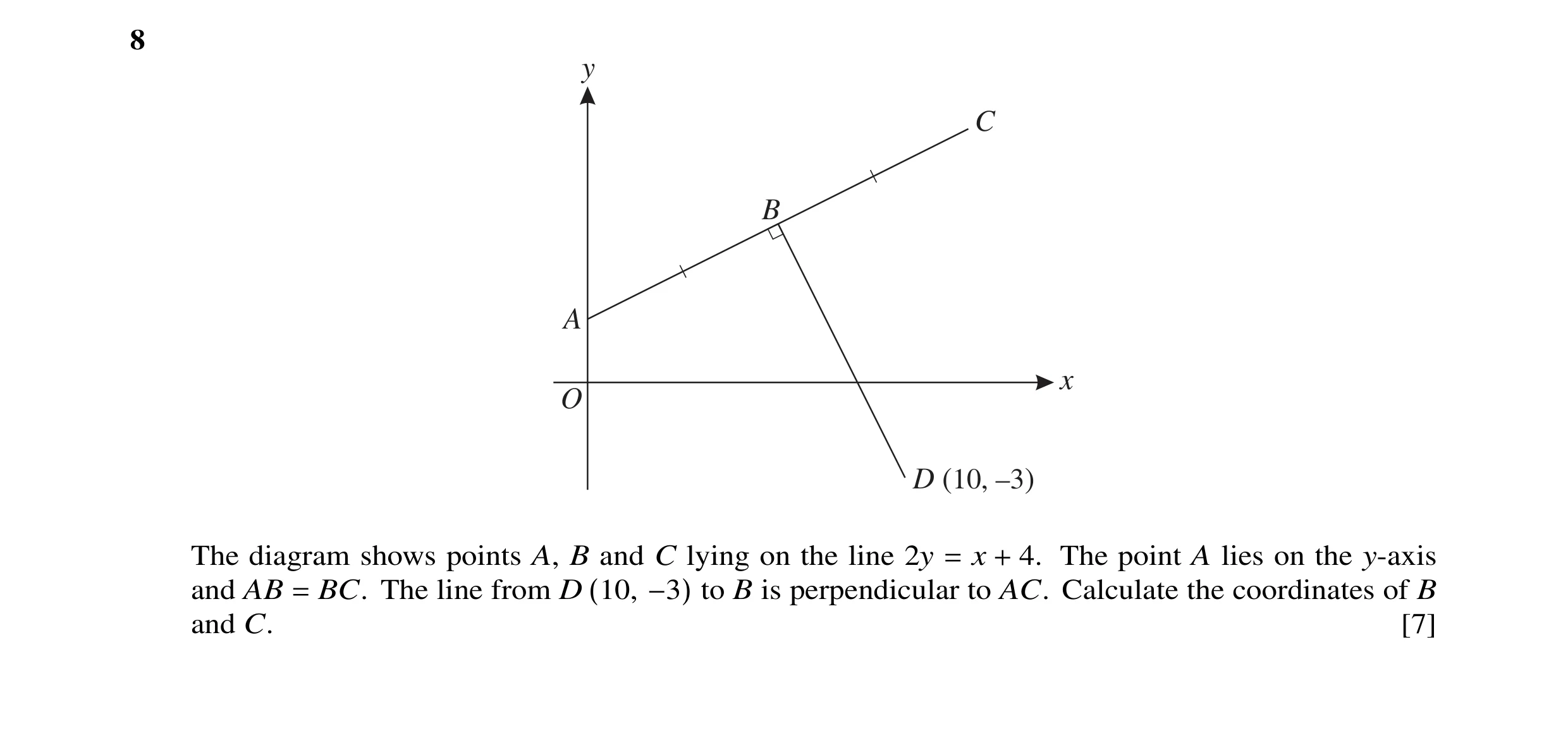
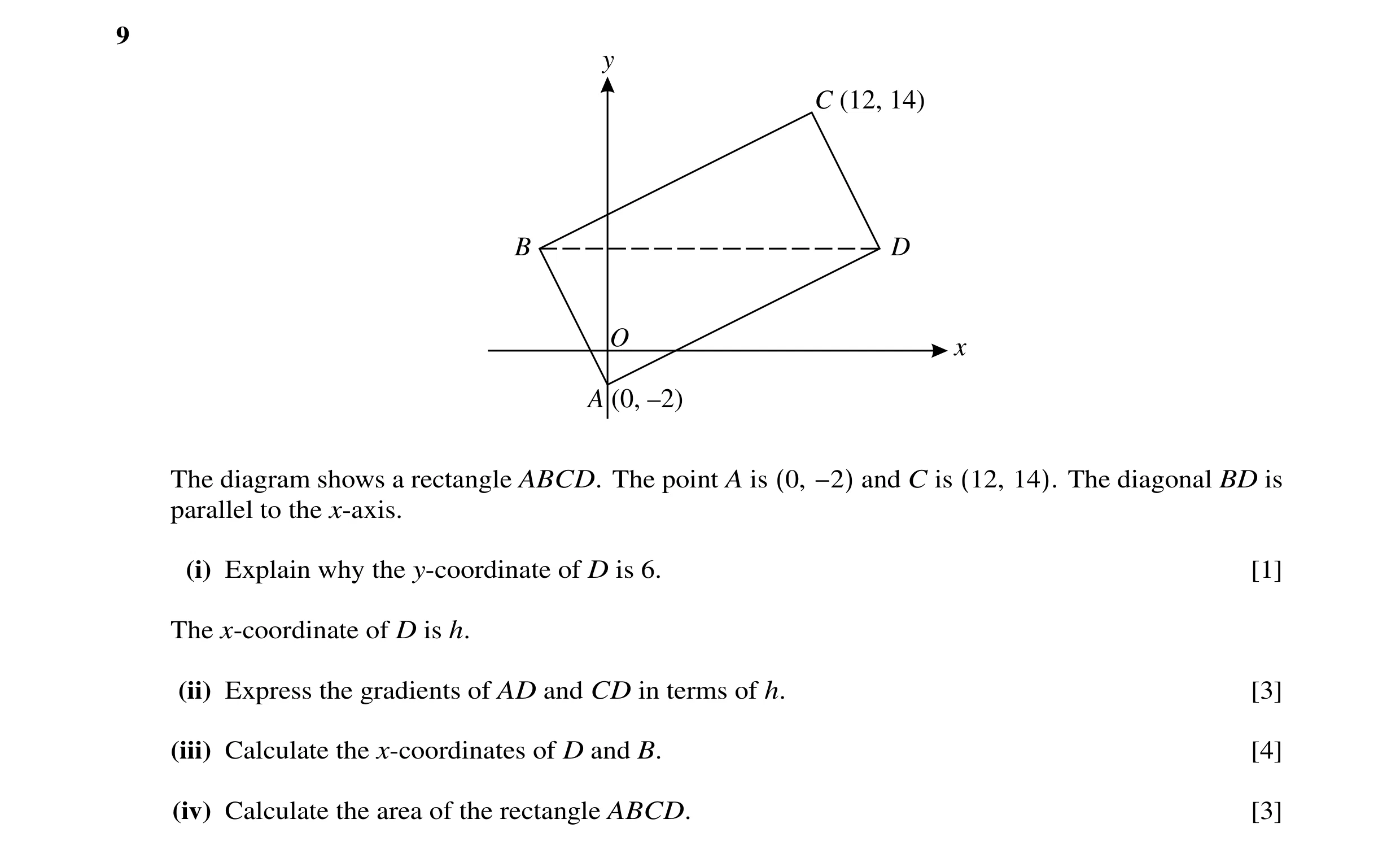 2 / 151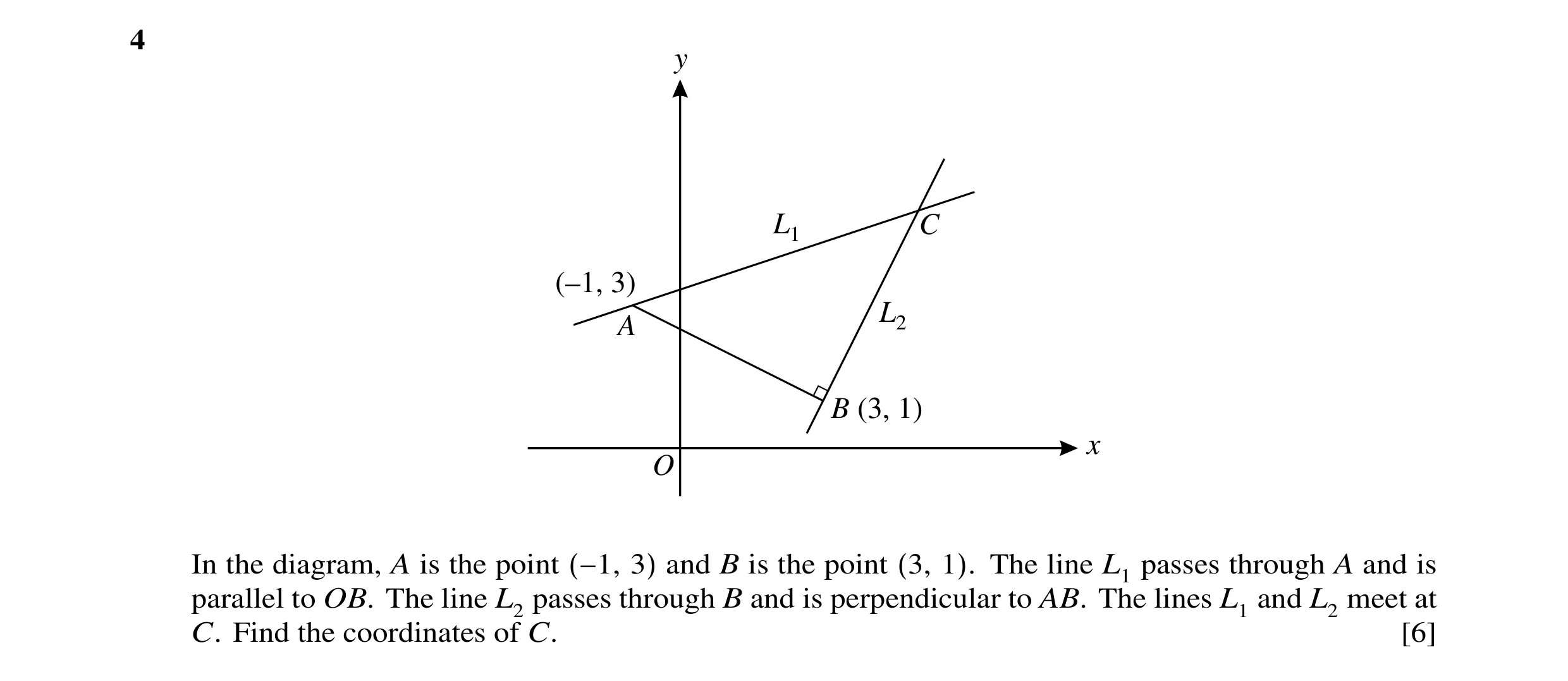
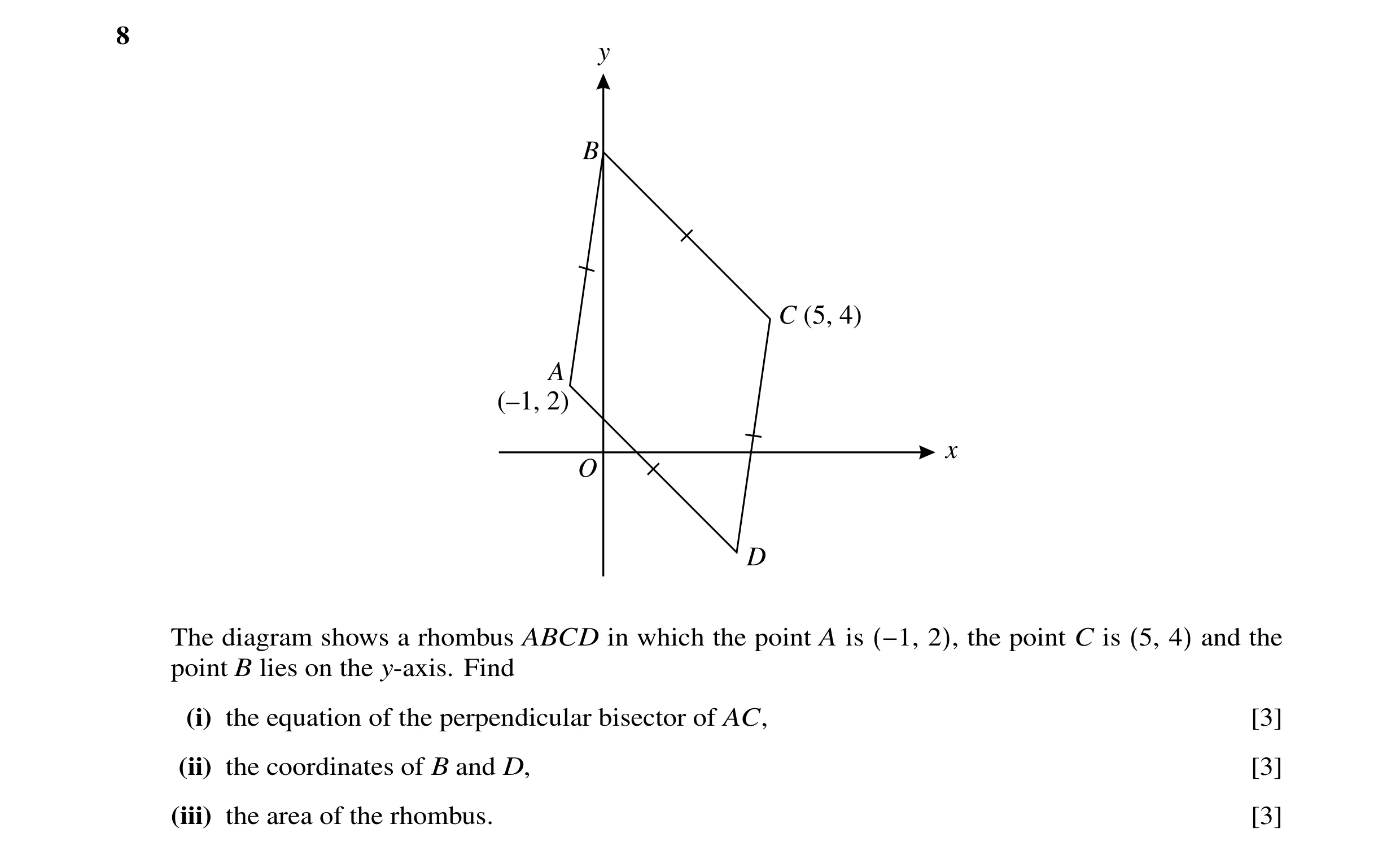 3 / 151
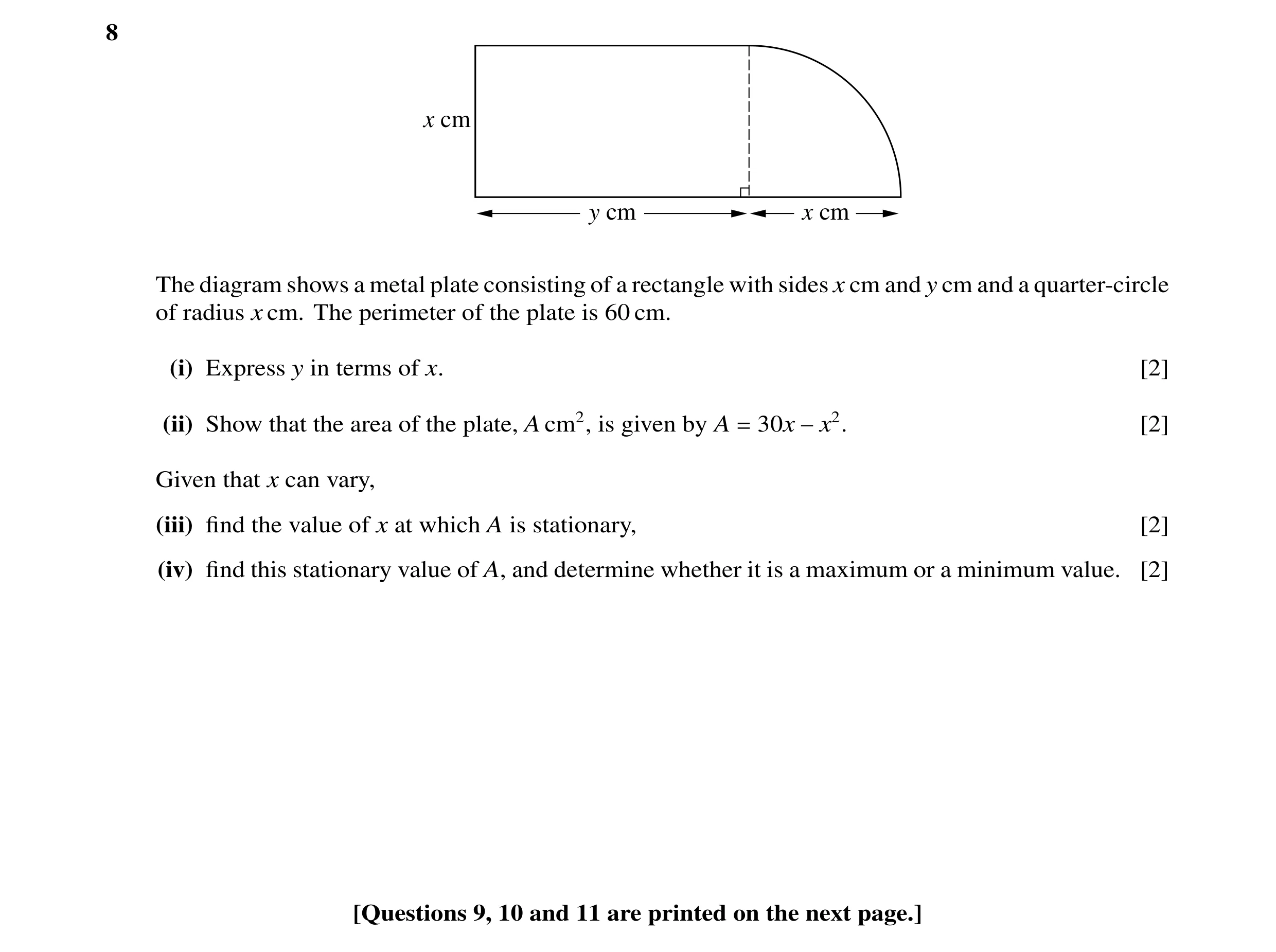 4 / 151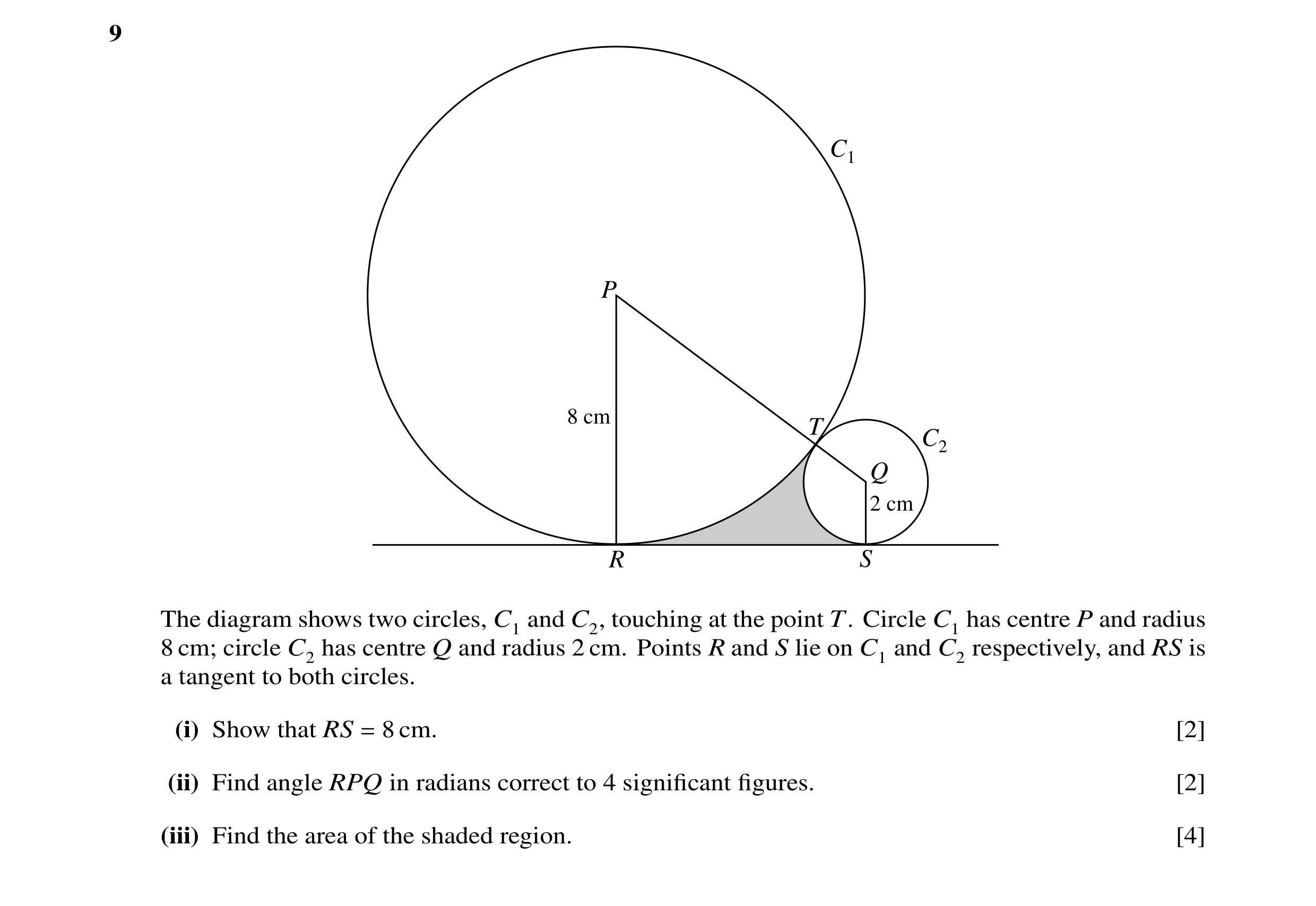
![Question 10: The equation of a curve is y 3 4x = + −x2. (i) Show that the equation of the normal to the curve at the point is 2y x 9. [4] (3, 6) = + (ii…](https://img.pastlit.com/crops/a0fa6b0d-fbe0-463a-8ca7-0fa81562d4fb/q10.webp) 5 / 151
5 / 151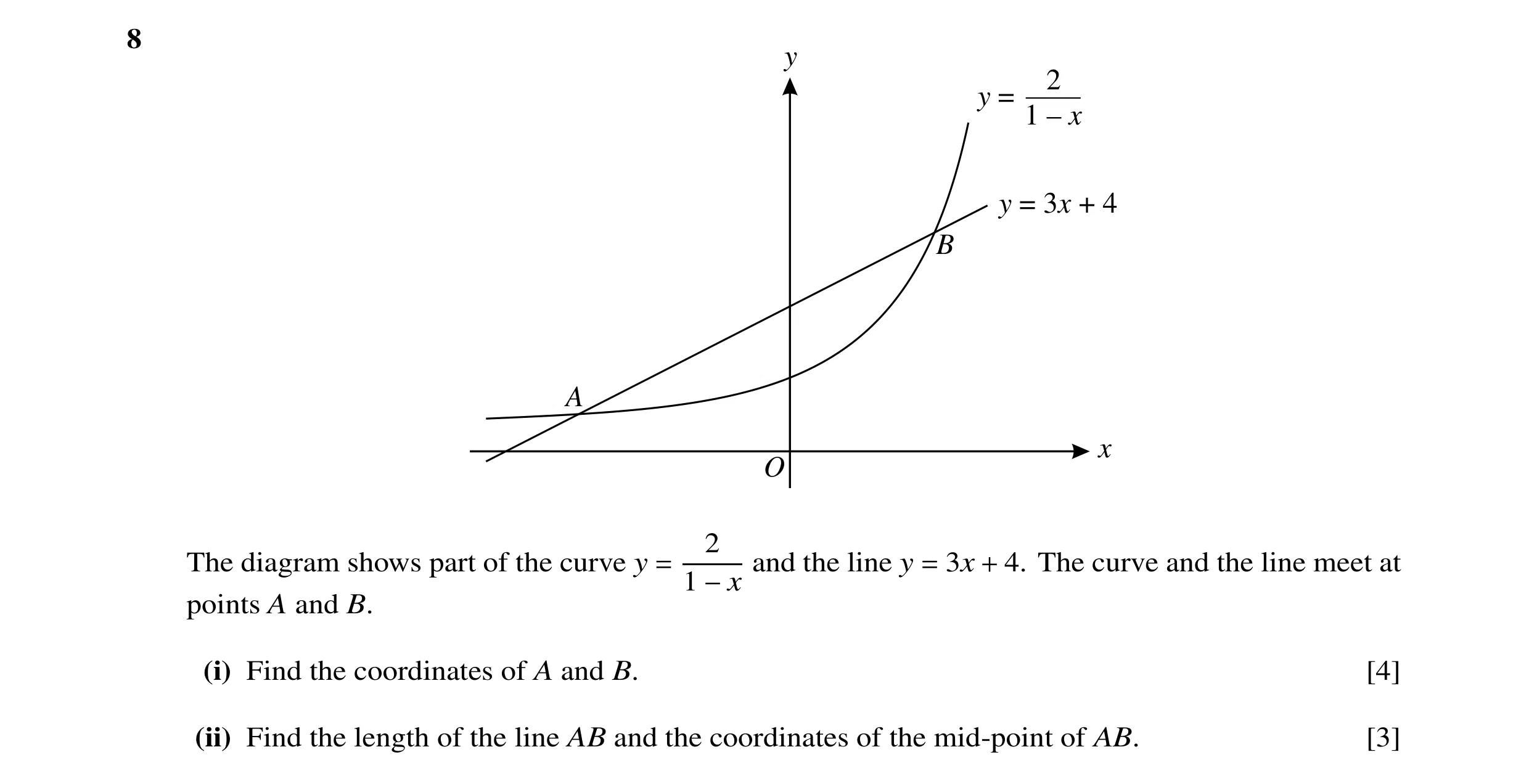
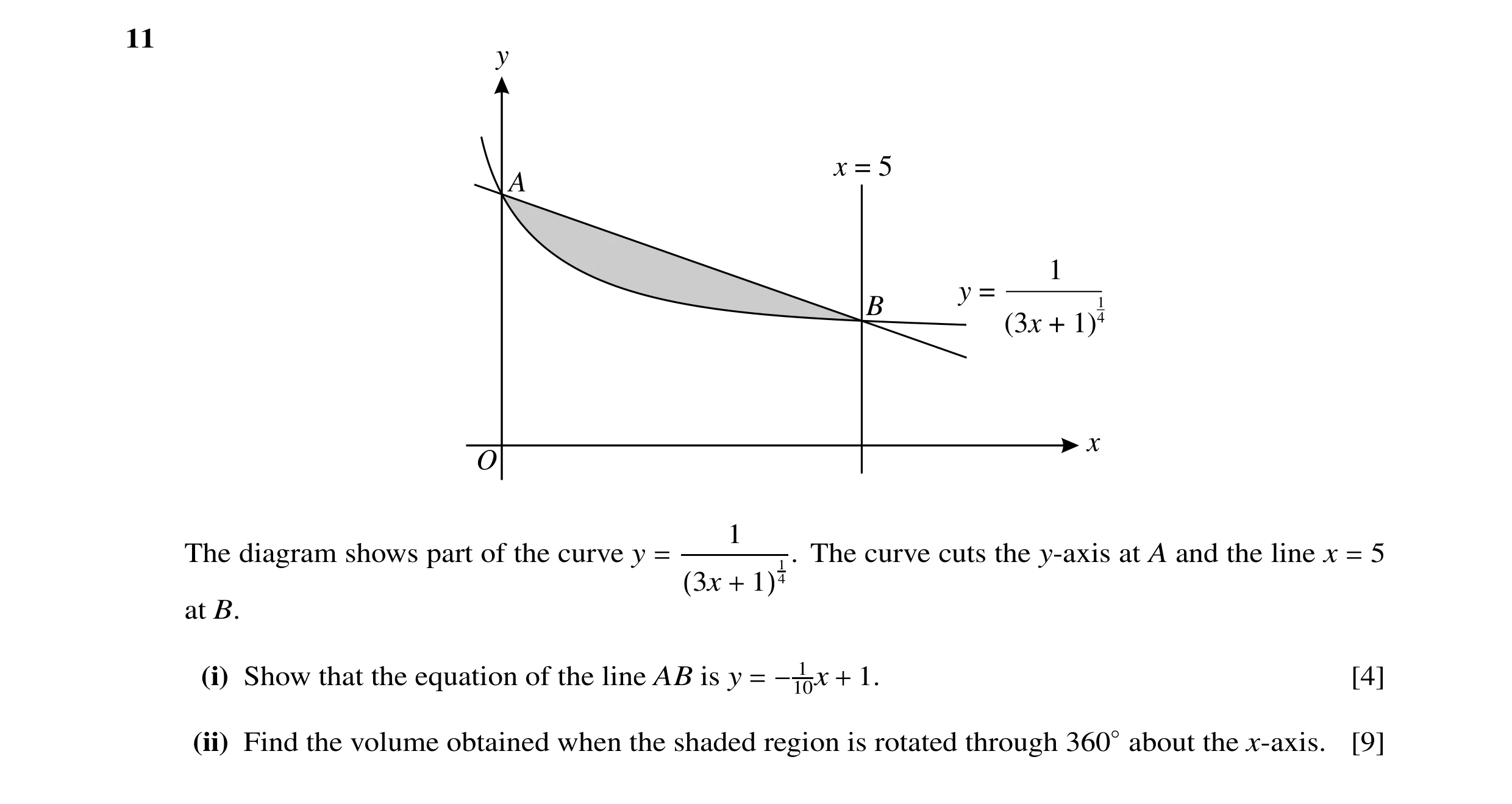
![Question 13: Points A, B and C have coordinates (2, 5), (5, −1) and (8, 6) respectively. (i) Find the coordinates of the mid-point of AB. [1] (ii) Find …](https://img.pastlit.com/crops/514f9e6e-9aff-4c9a-a939-32557b62237f/q2.webp) 6 / 151
6 / 151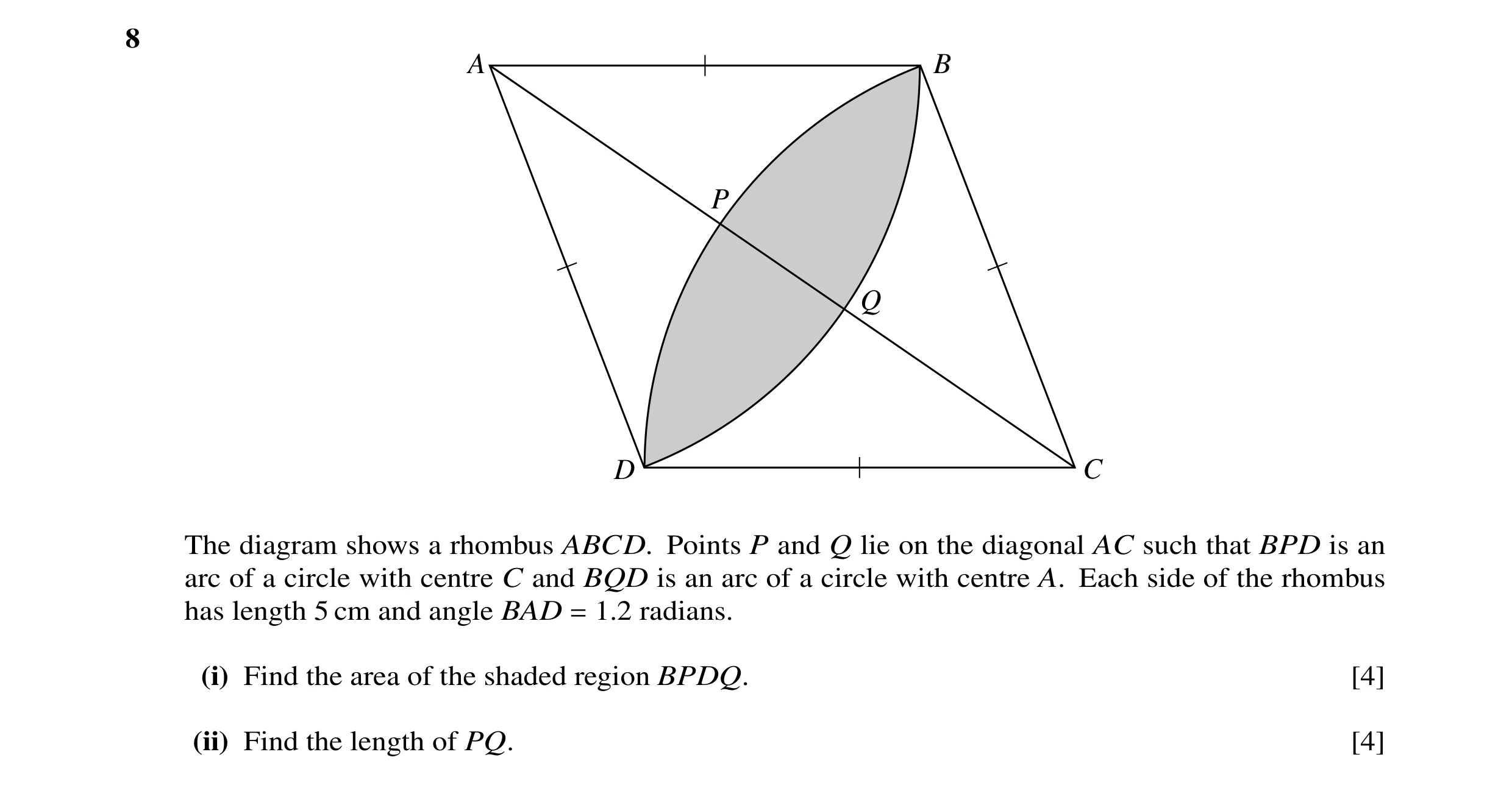
 7 / 151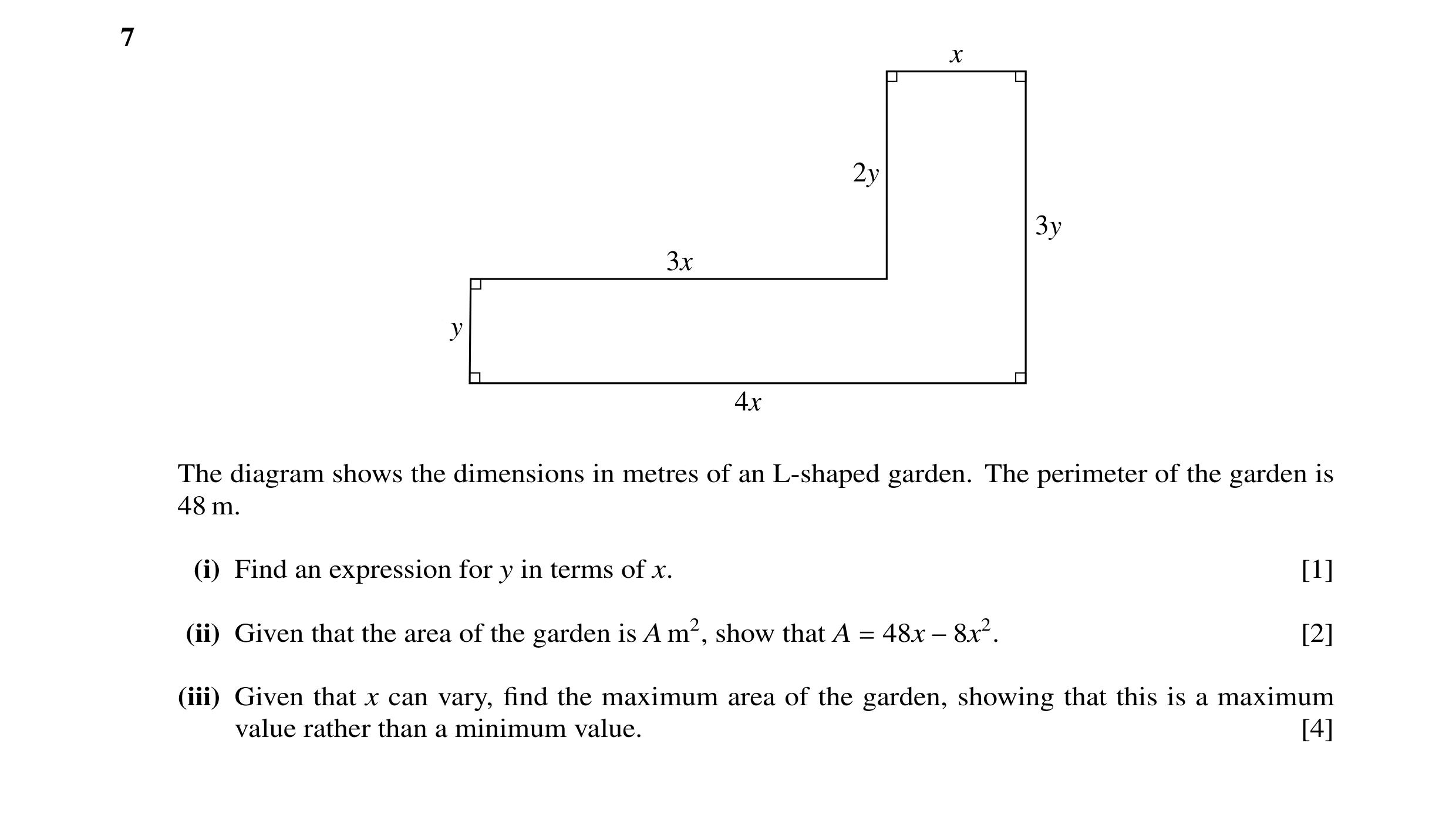
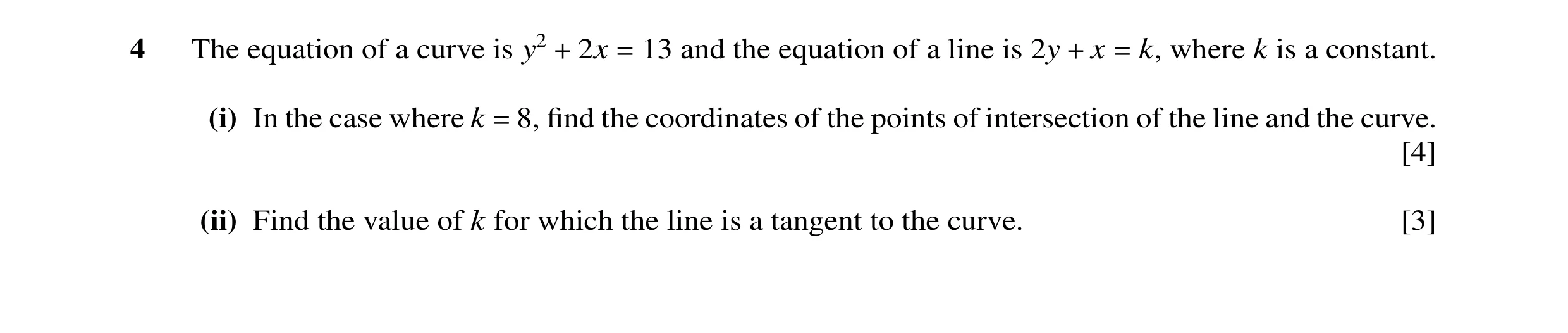 8 / 151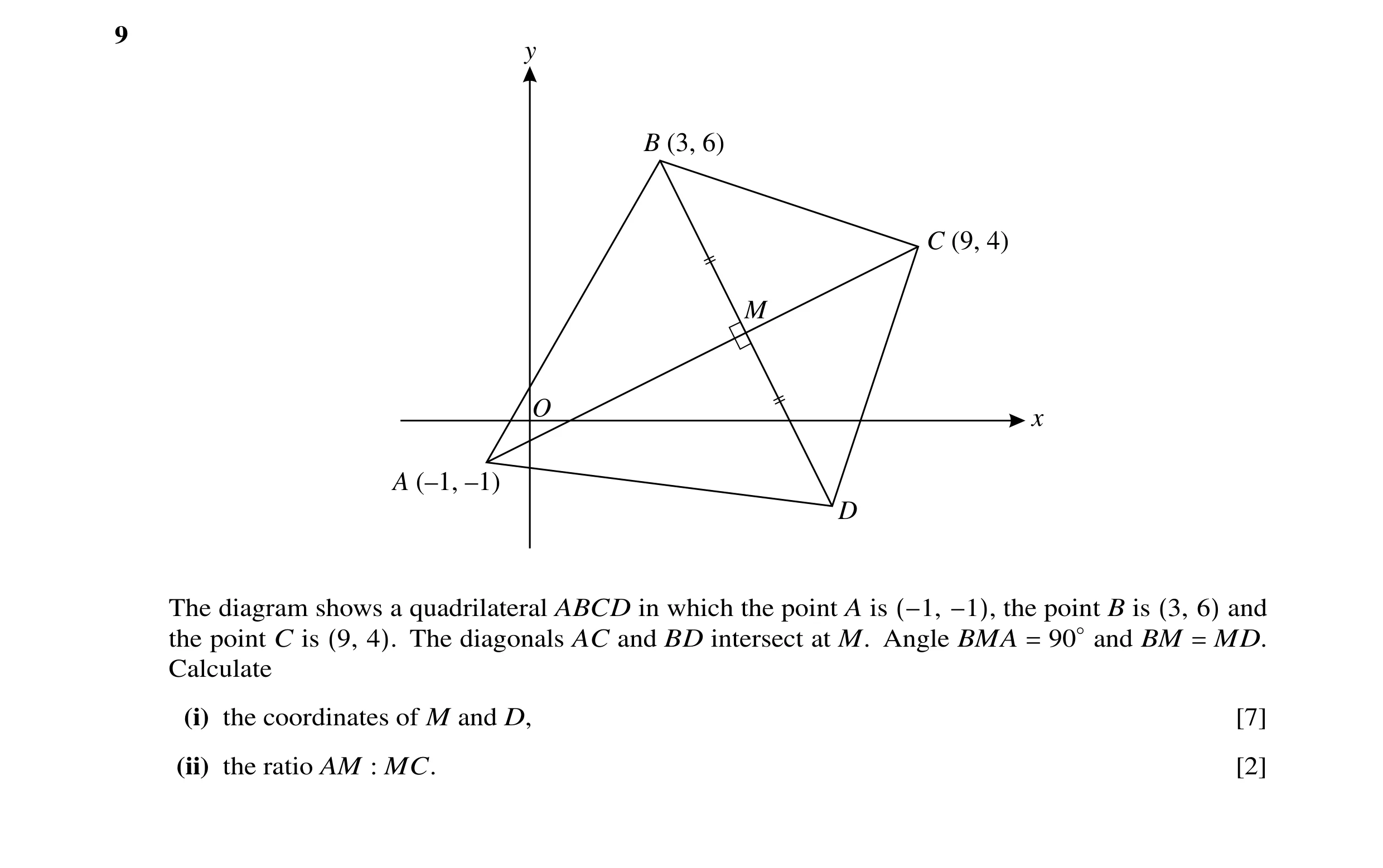
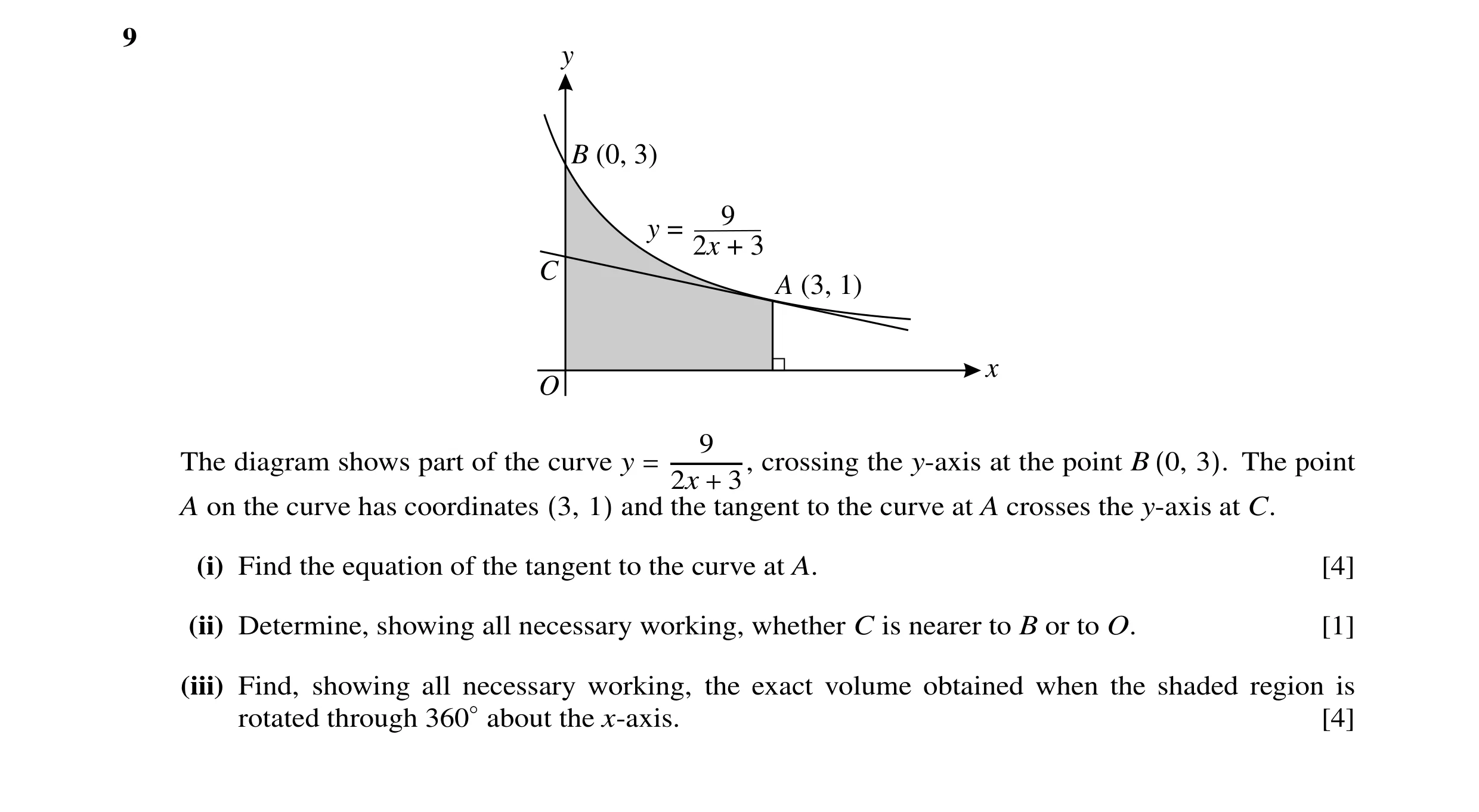 9 / 151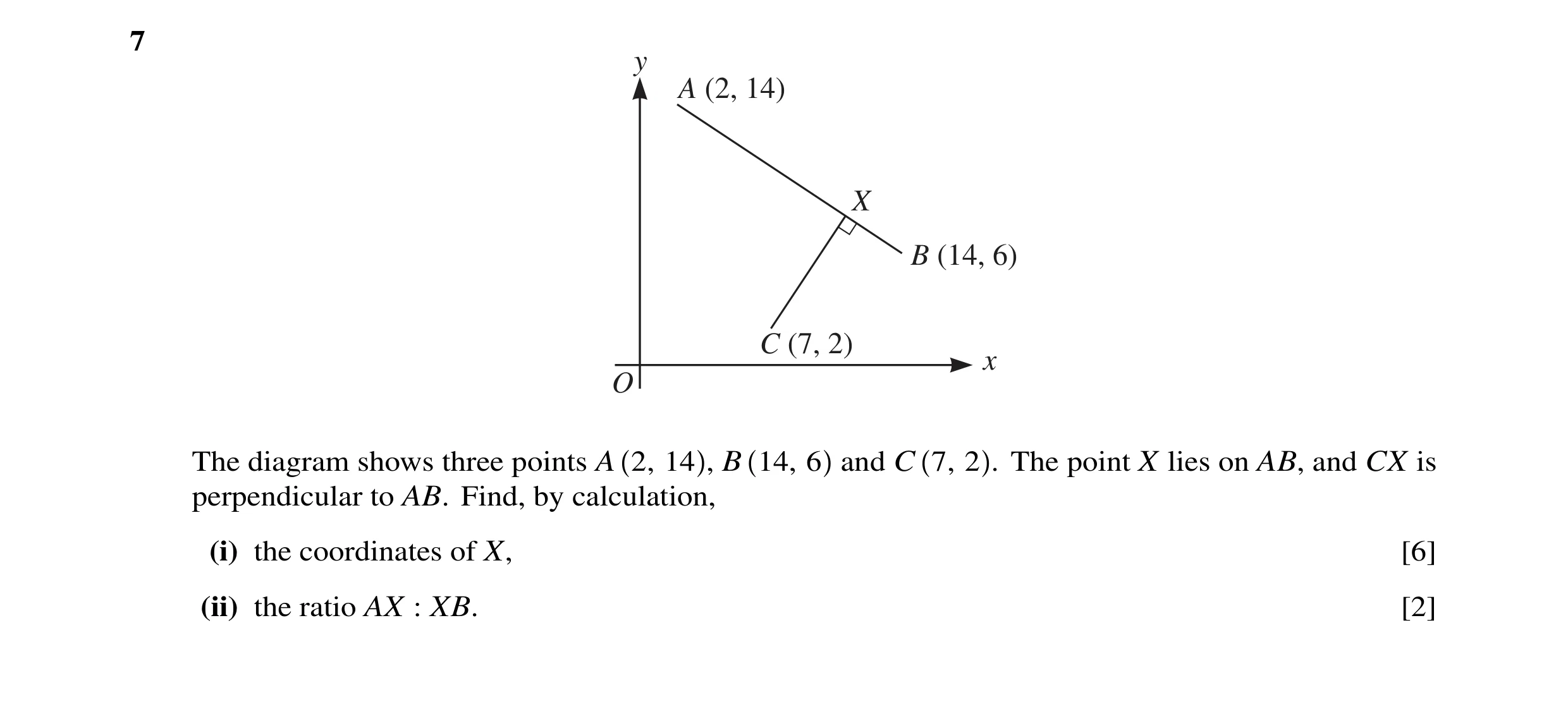
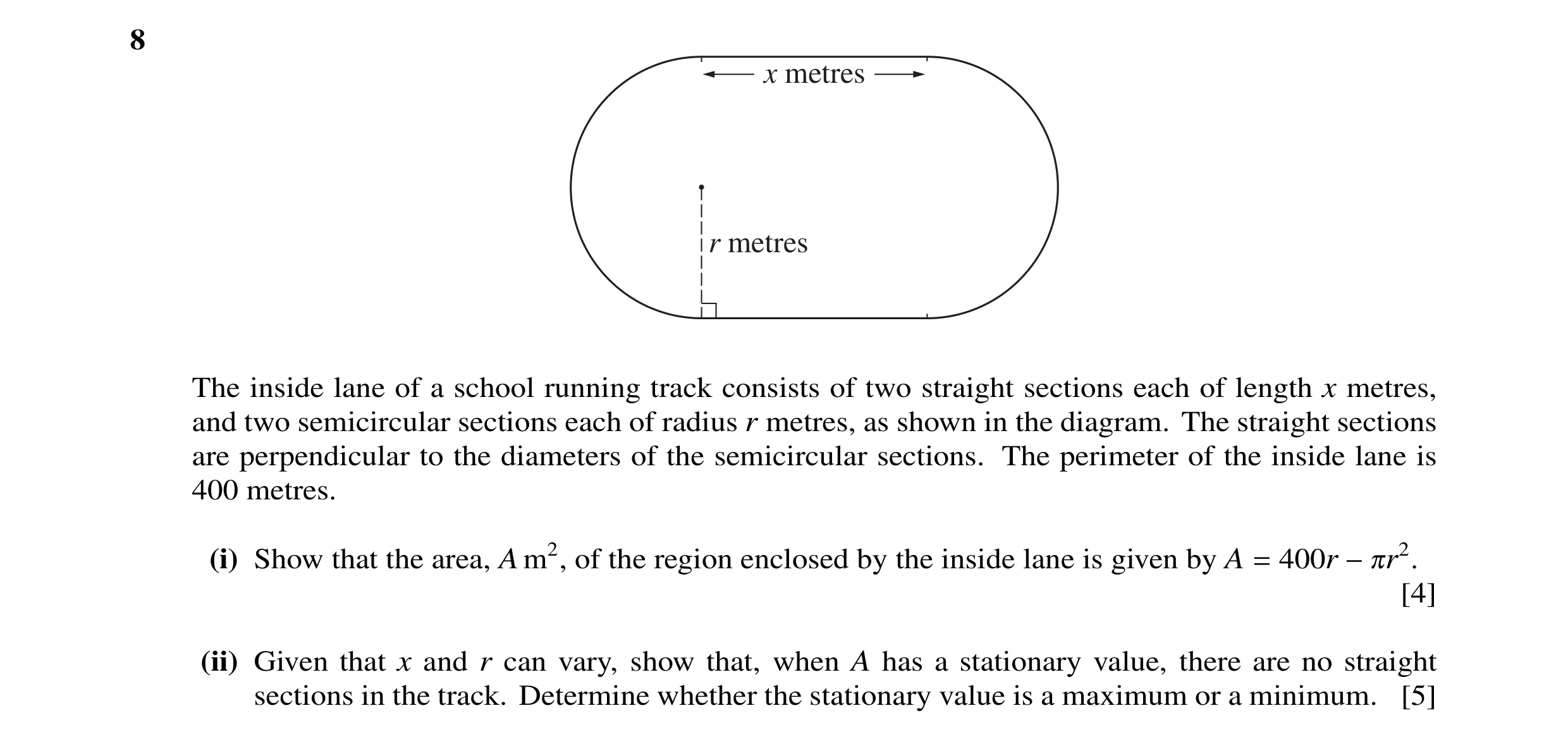
![Question 25: The line 4x + ky = 20 passes through the points A 8, −4 and B b, 2b , where k and b are constants. (i) Find the values of k and b. [4] (ii)…](https://img.pastlit.com/crops/b3ec1609-b62f-4edd-9c6e-78aded864a65/q4.webp) 10 / 151
10 / 151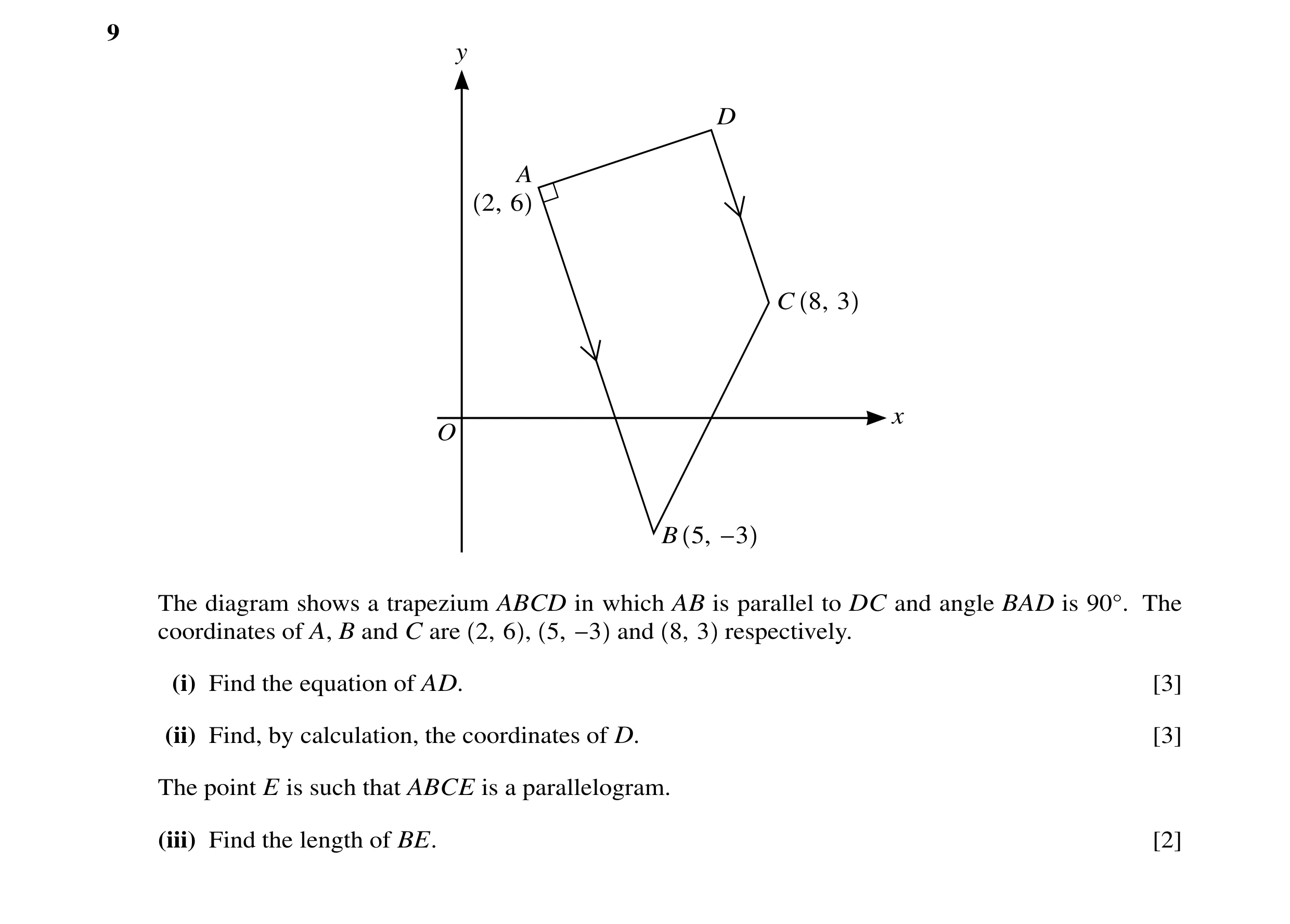
 11 / 151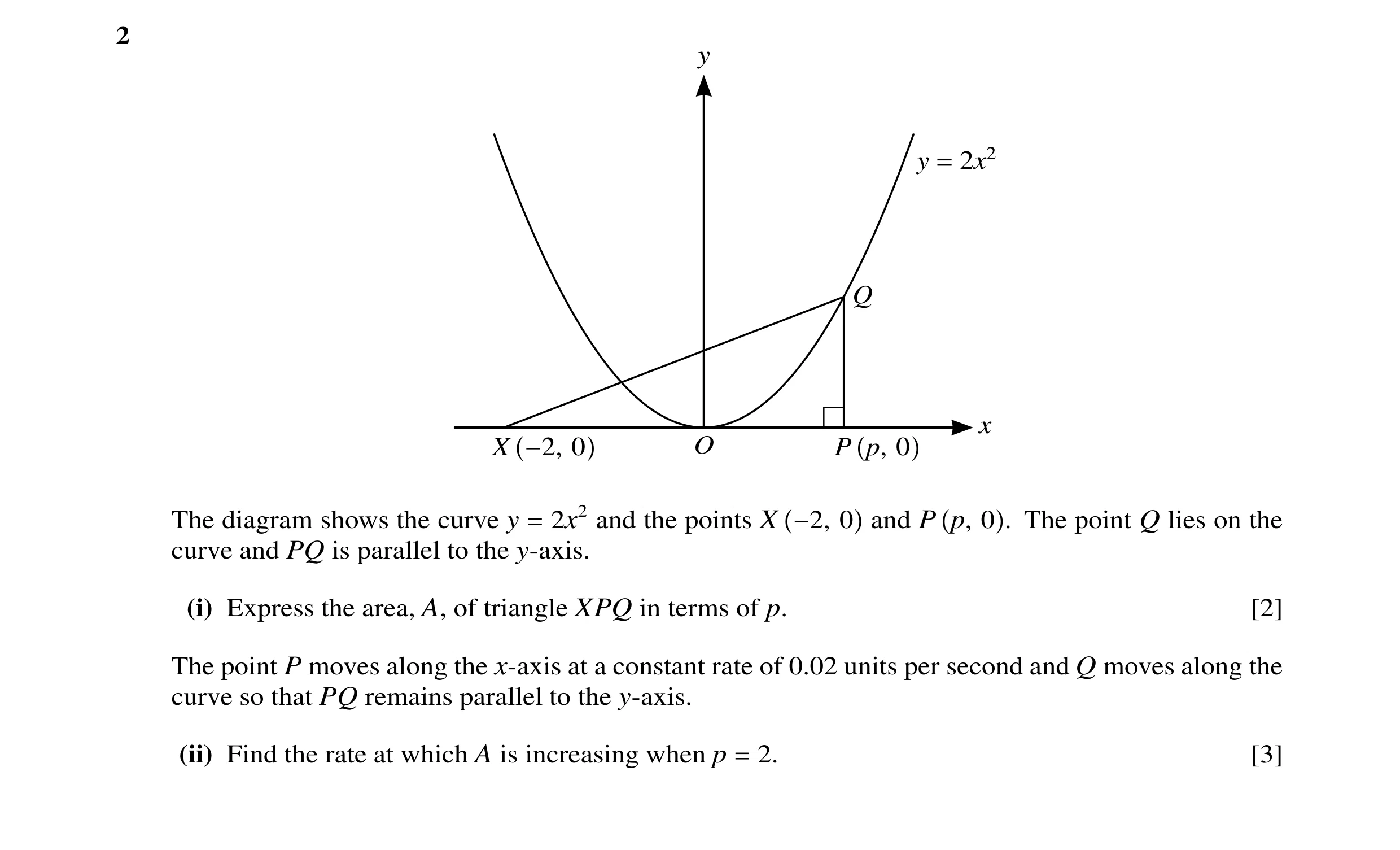
![Question 30: (a) The third and fourth terms of a geometric progression are 1 and 2 respectively. Find the sum to 3 9 infinity of the progression. [4] (b)…](https://img.pastlit.com/crops/5d659e3f-cda8-4462-bf4b-7320b77276c0/q7.webp)
 12 / 151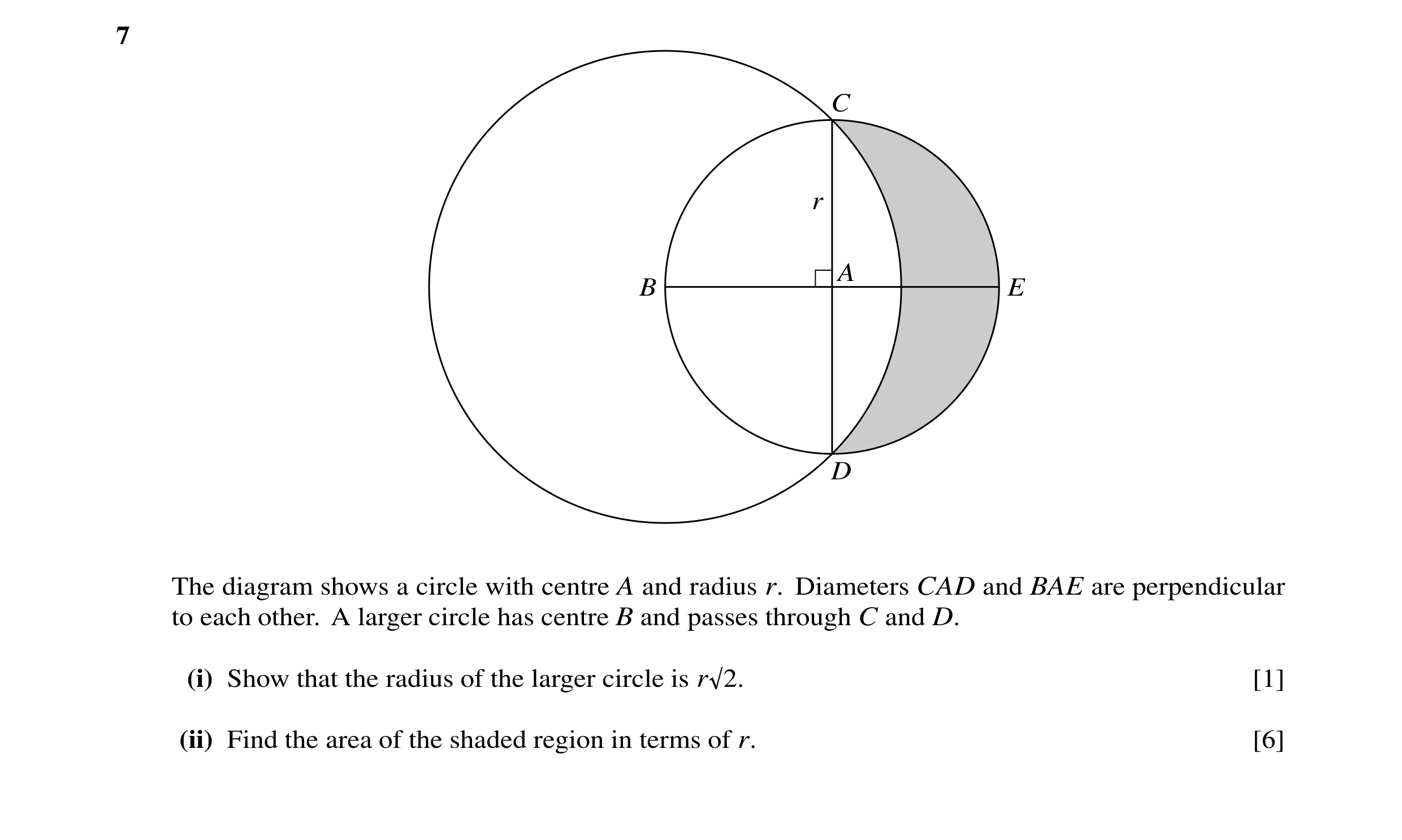
 13 / 151
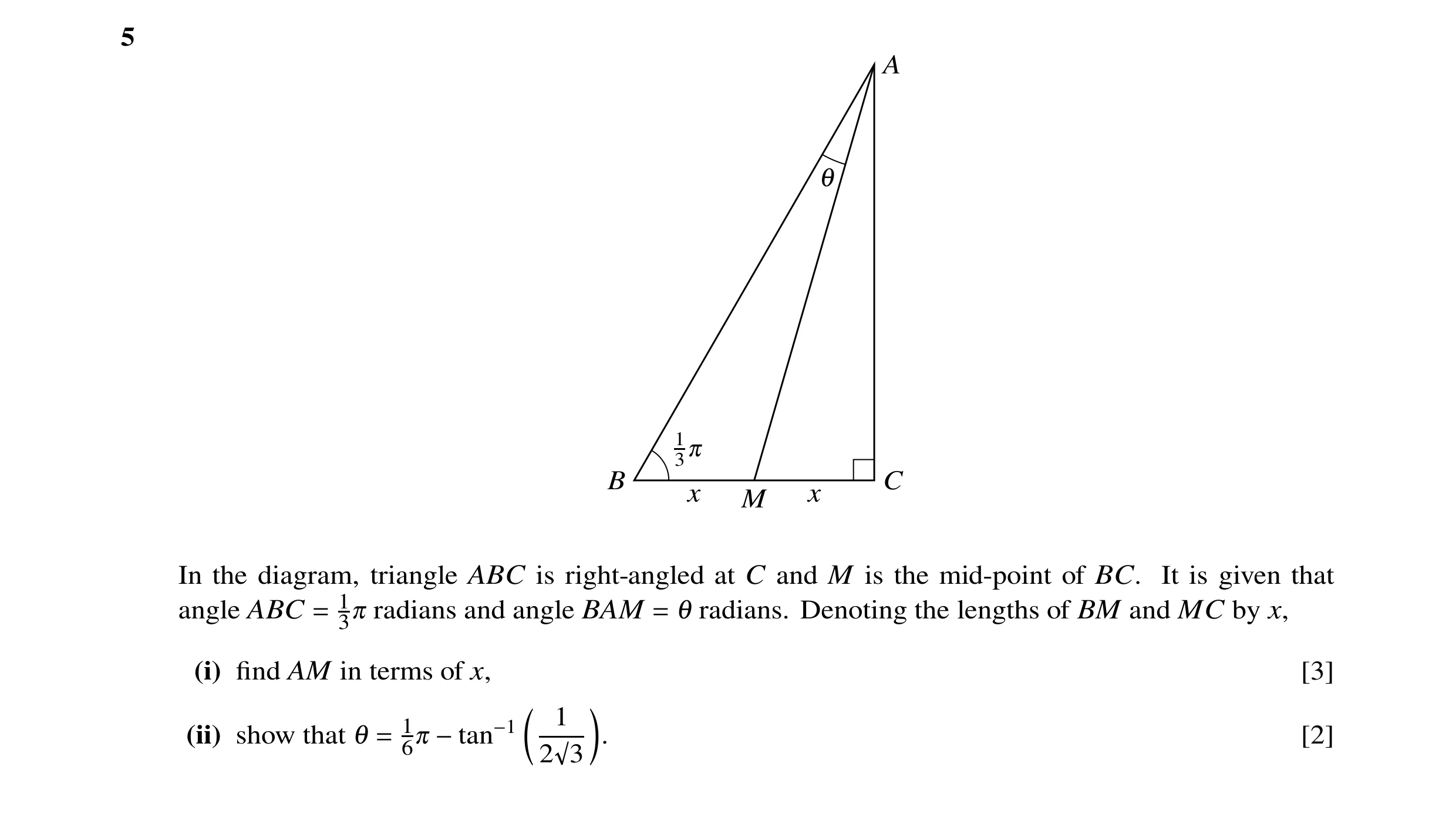 14 / 151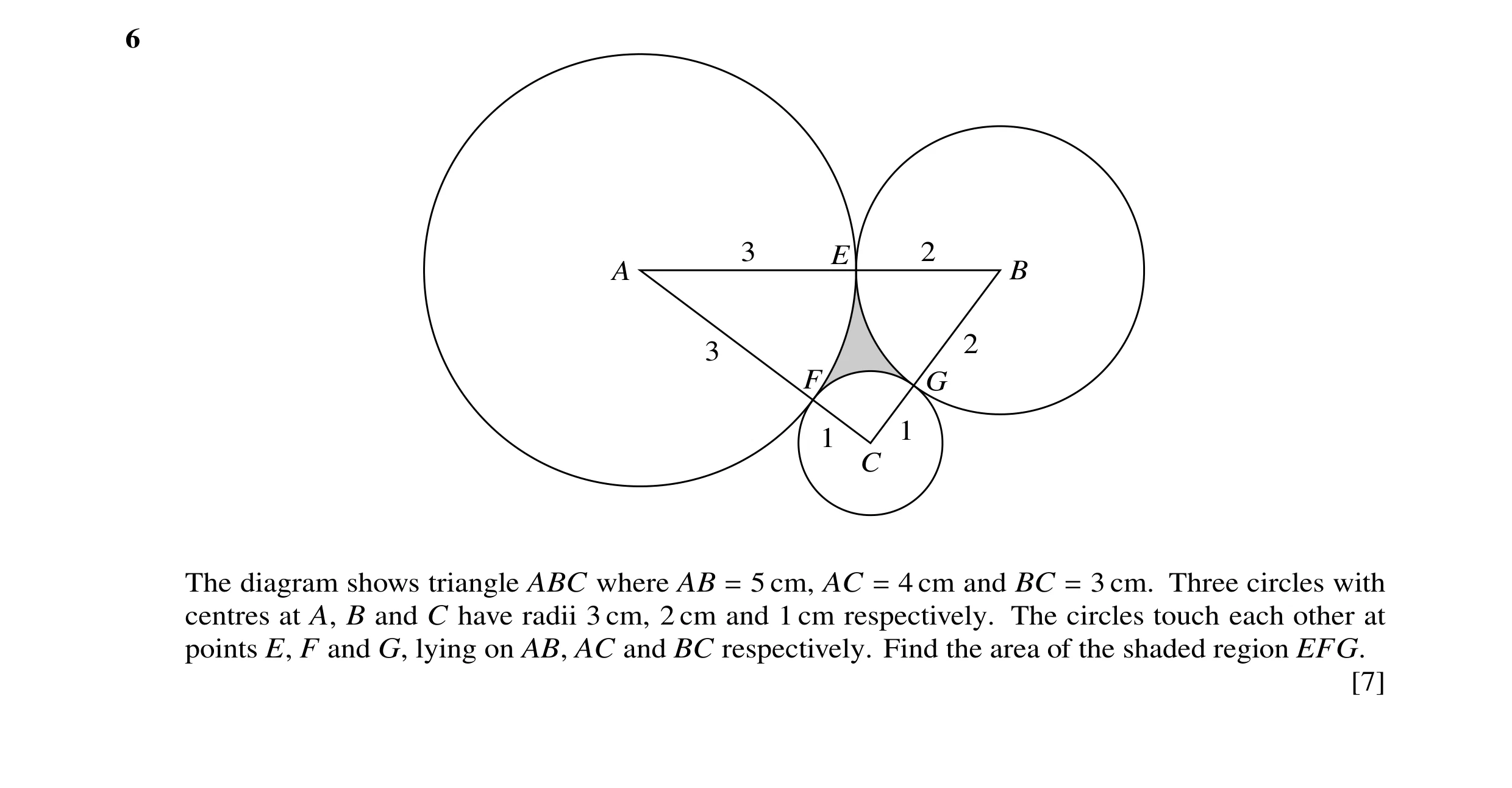

 15 / 151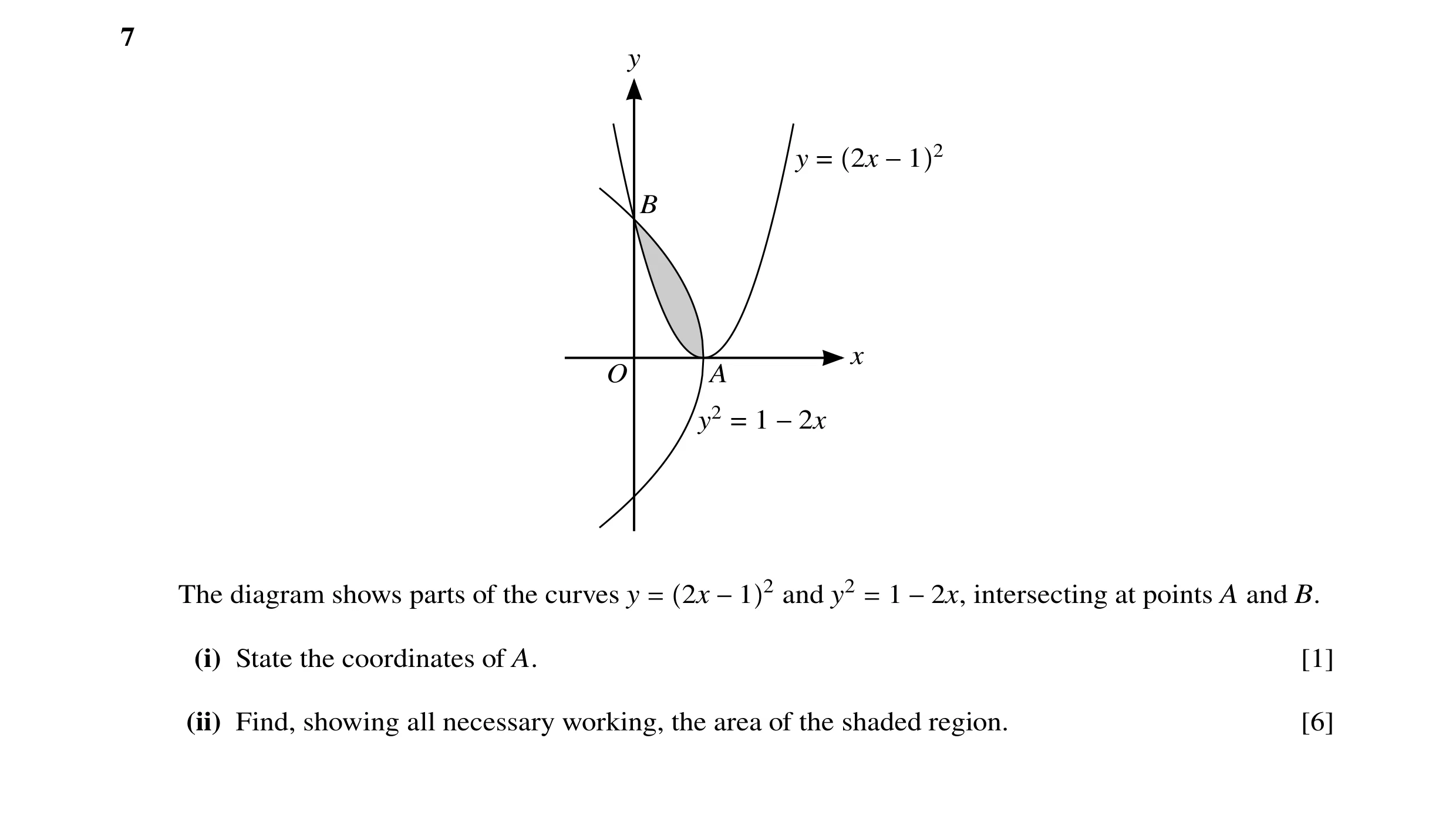
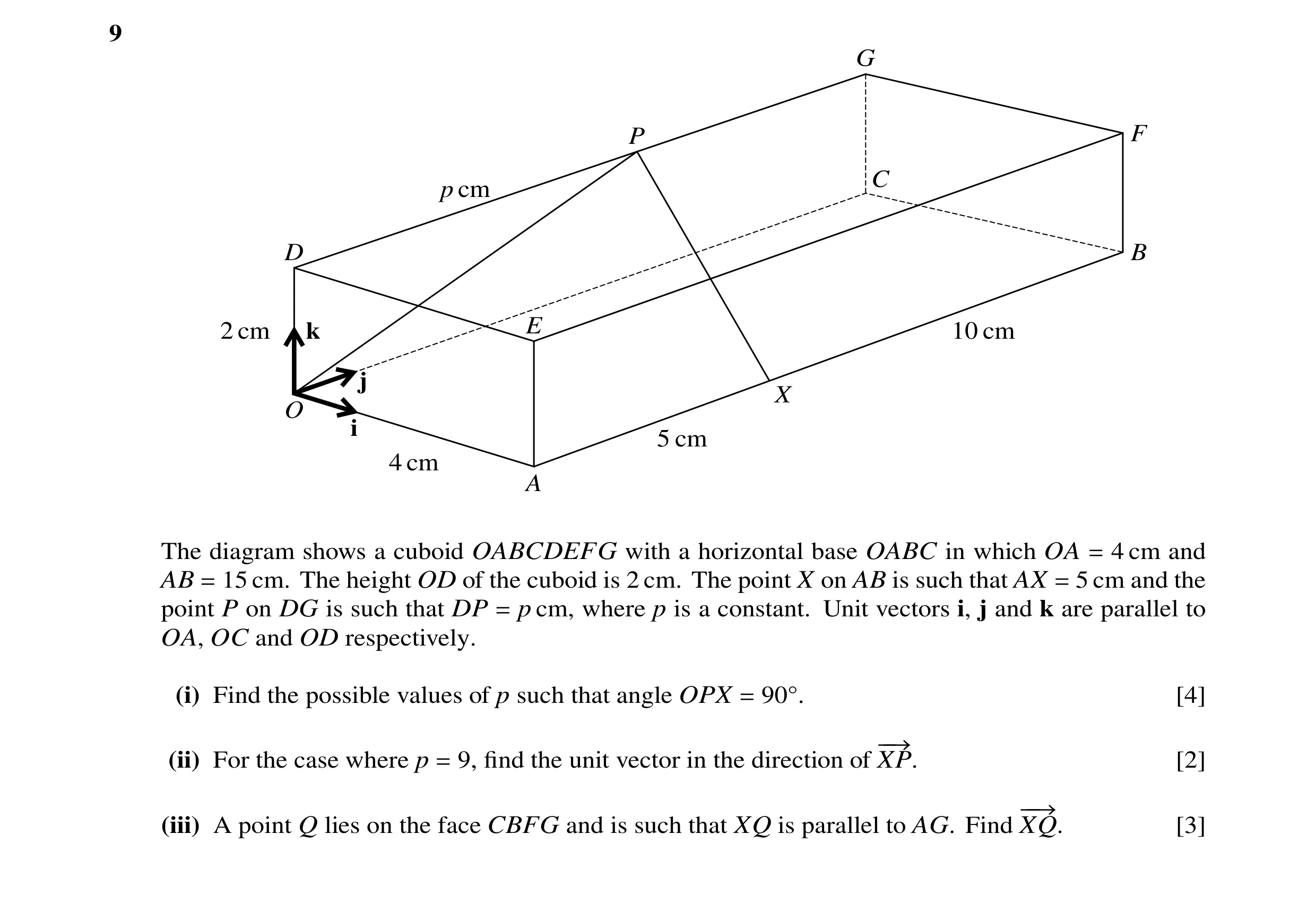 16 / 151
![Question 42: 7 The equation of a curve is y = 2 + 2x −1. dy (i) Obtain an expression for dx. [2] (ii) Explain why the curve has no stationary points. [1…](https://img.pastlit.com/crops/2739b9e5-b8e0-481e-906f-b5a13066555b/q7.webp) 17 / 151
17 / 151 18 / 151
![Question 46: Find the set of values of a for which the curve y = −2 and the straight line y = ax + 3a meet at two x distinct points. [4] ...............…](https://img.pastlit.com/crops/ca6ee983-5c93-425b-9aed-127c6b9154c2/q2.webp) 23 / 151
23 / 151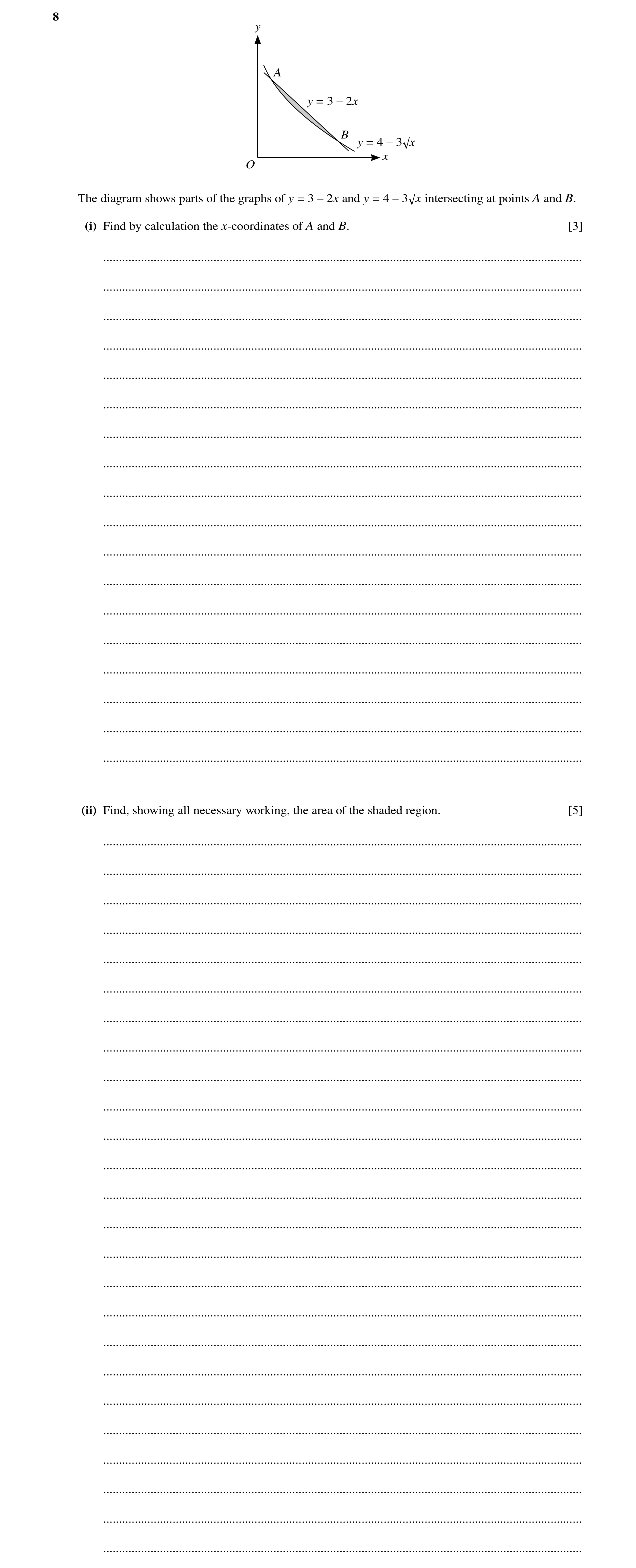
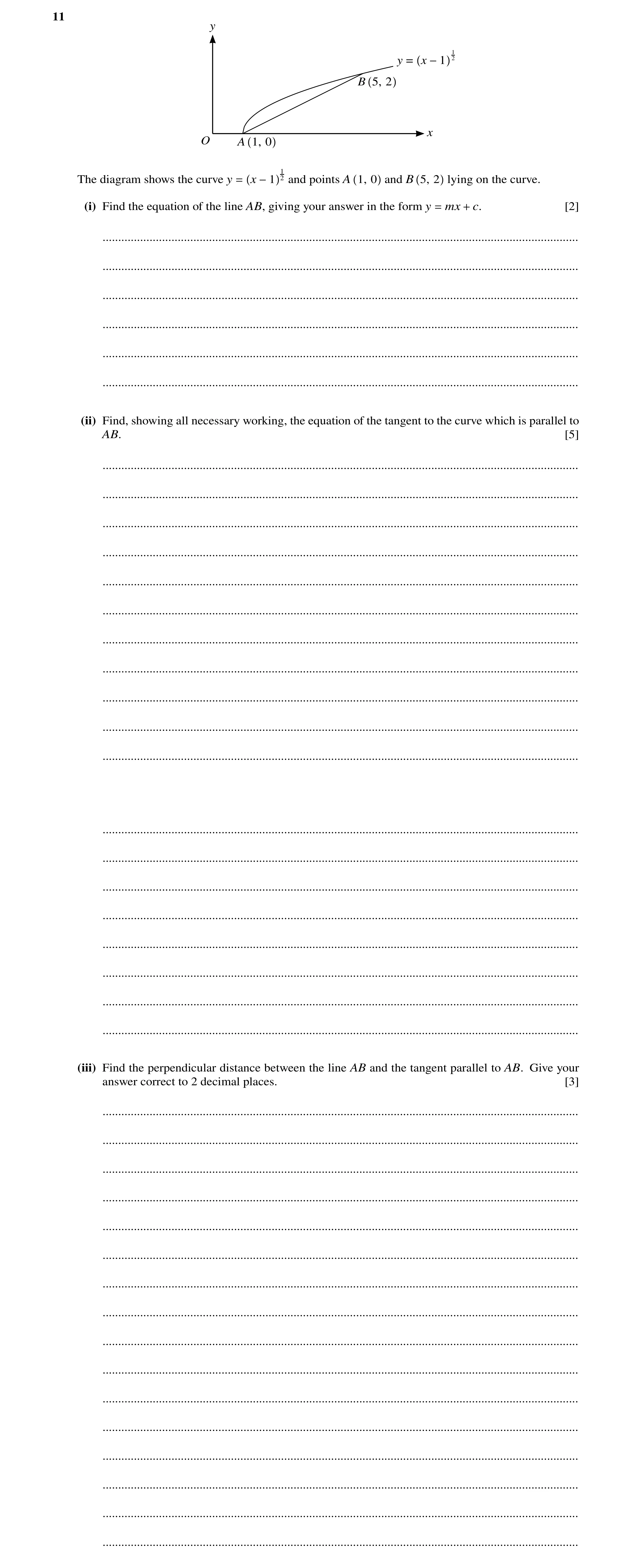
 28 / 151
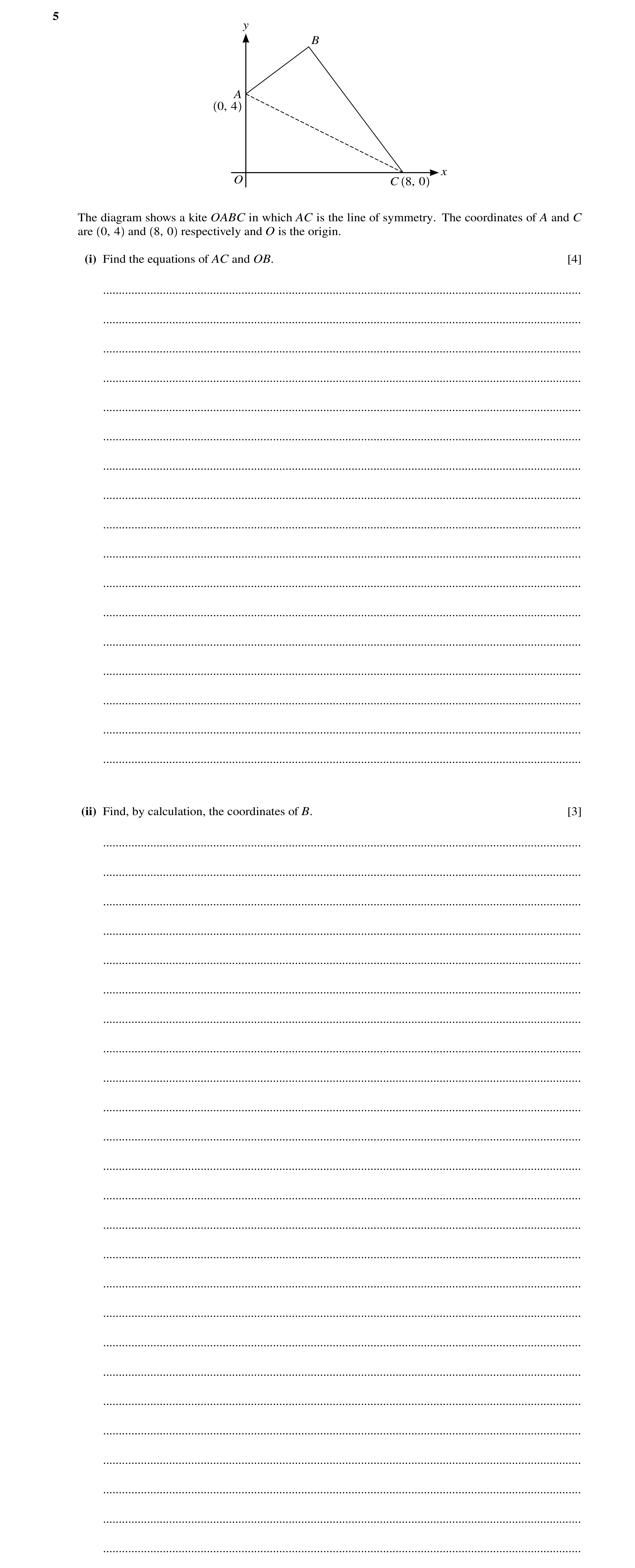
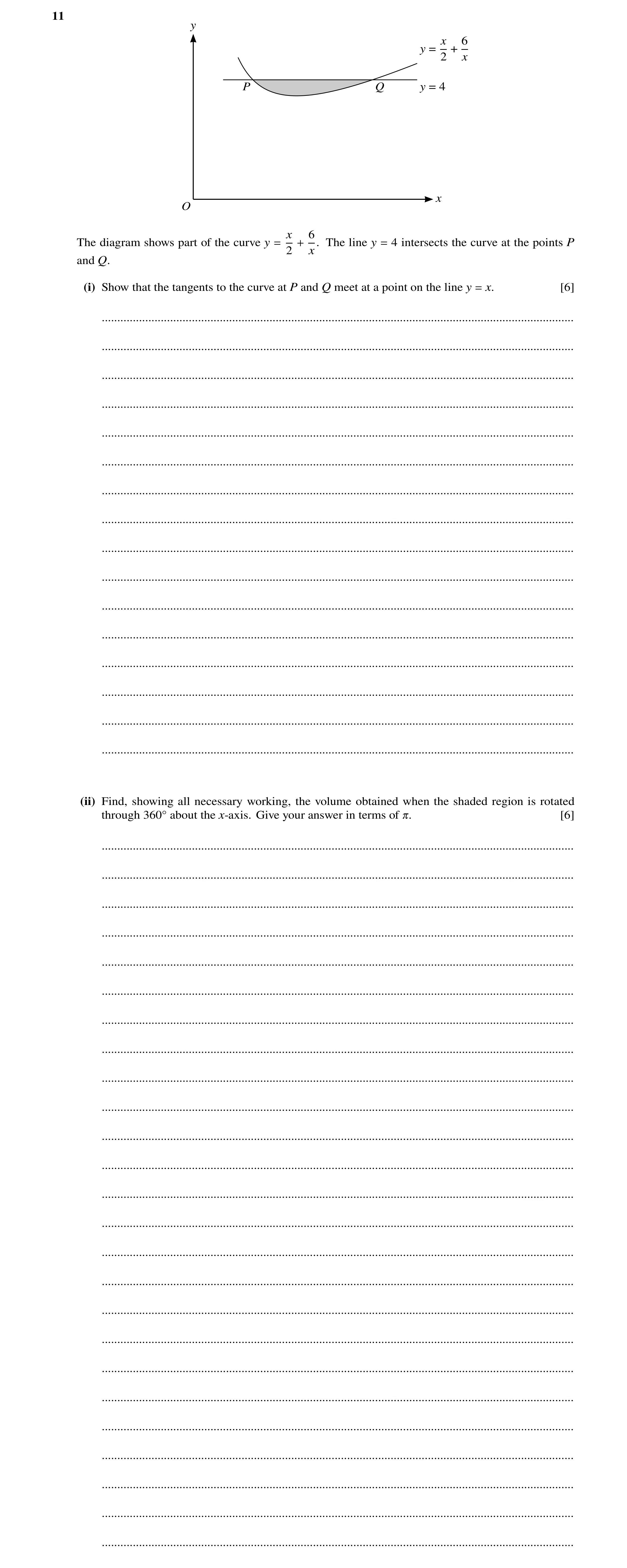
 36 / 151
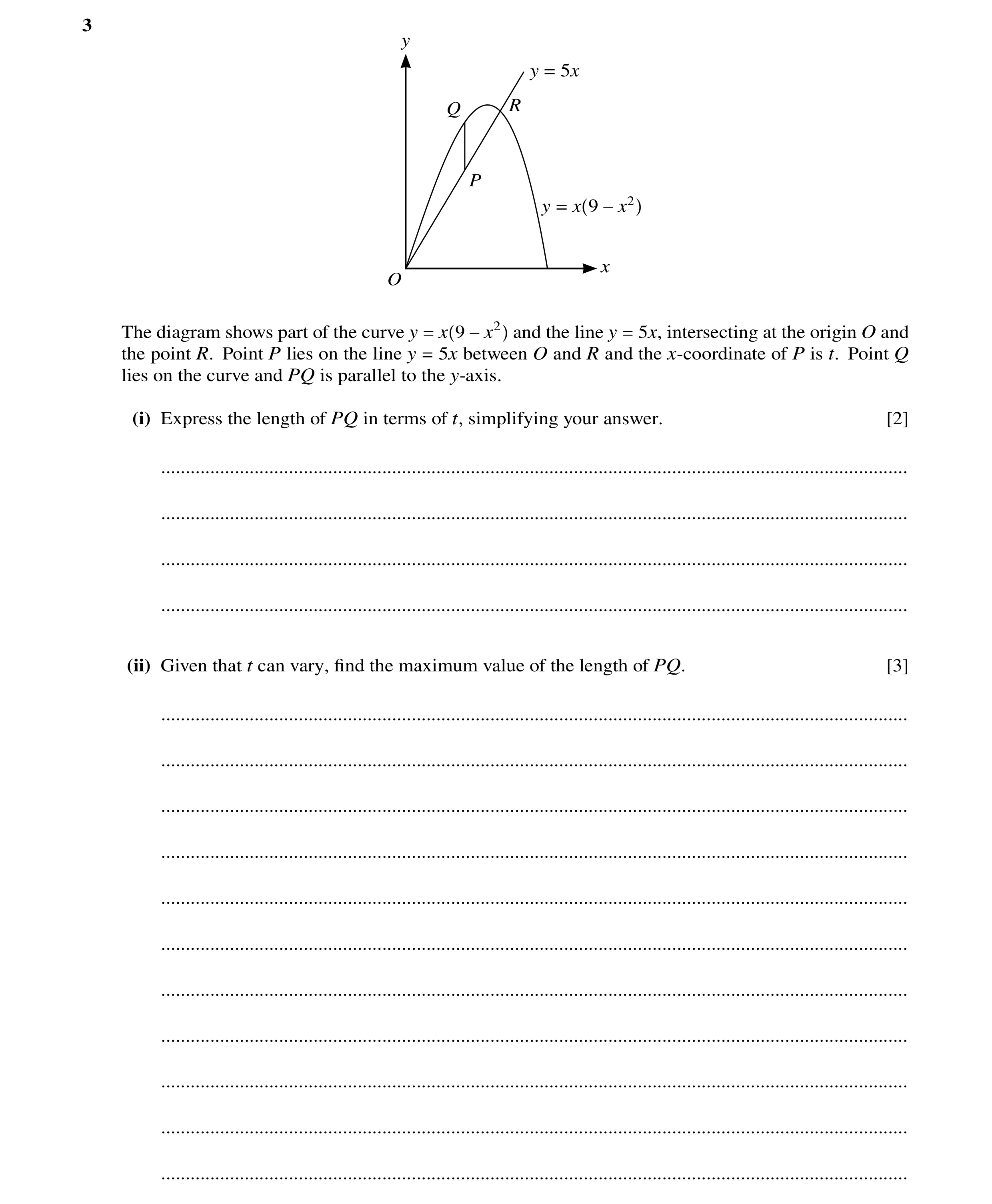 37 / 151
 40 / 151
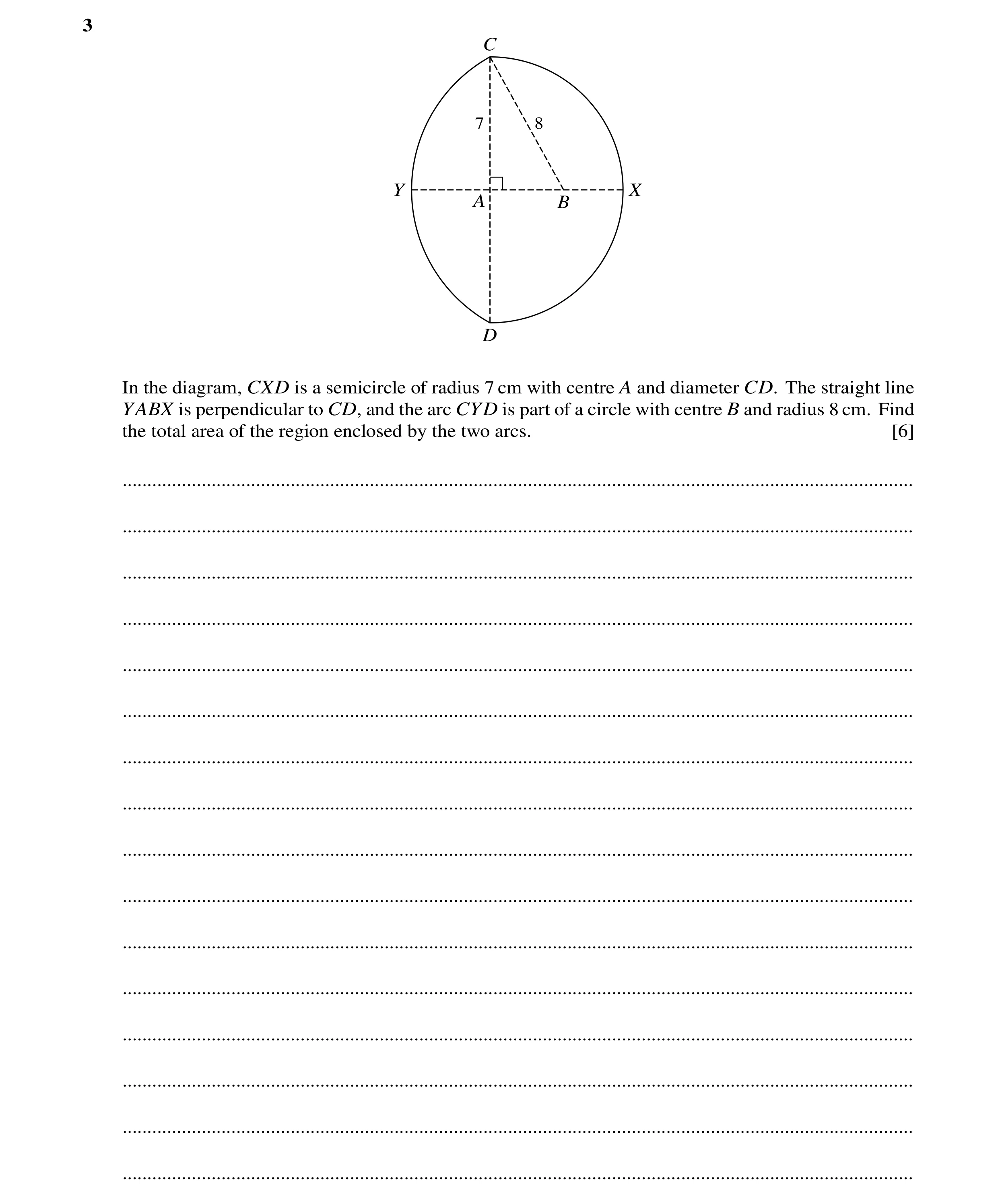 41 / 151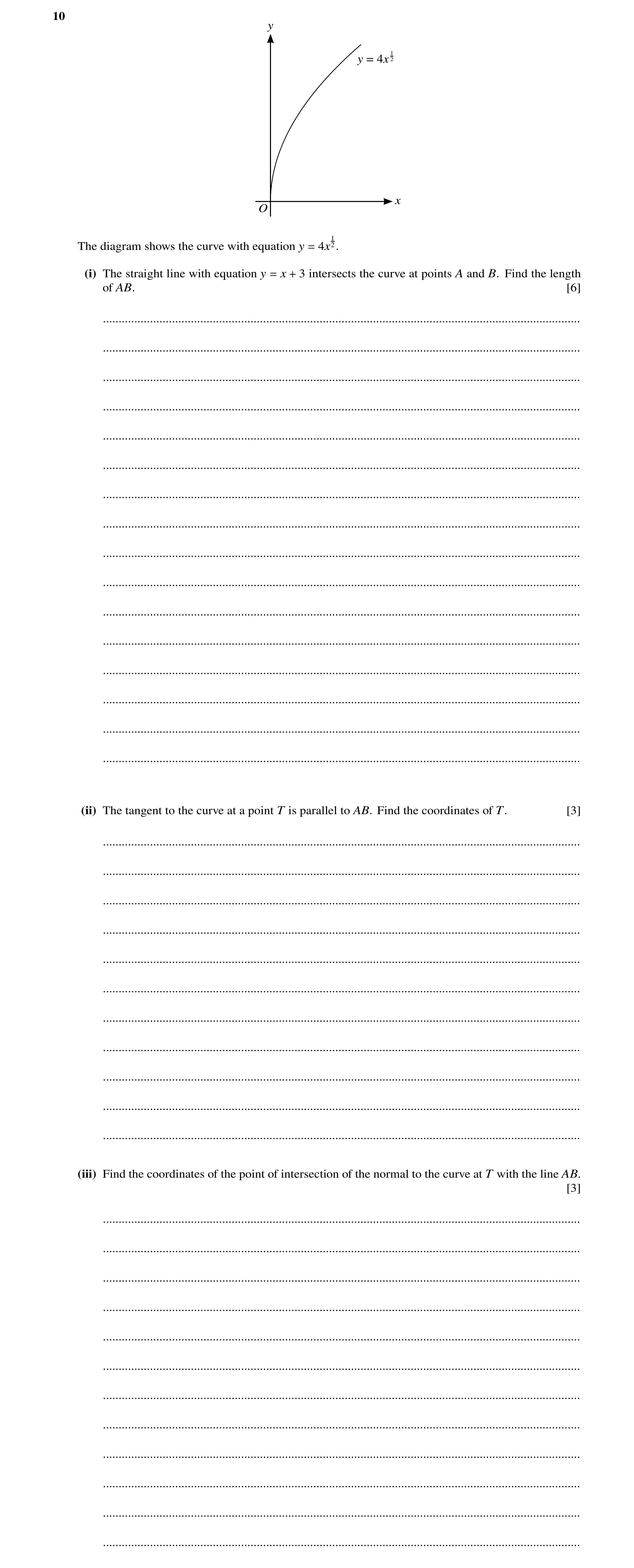
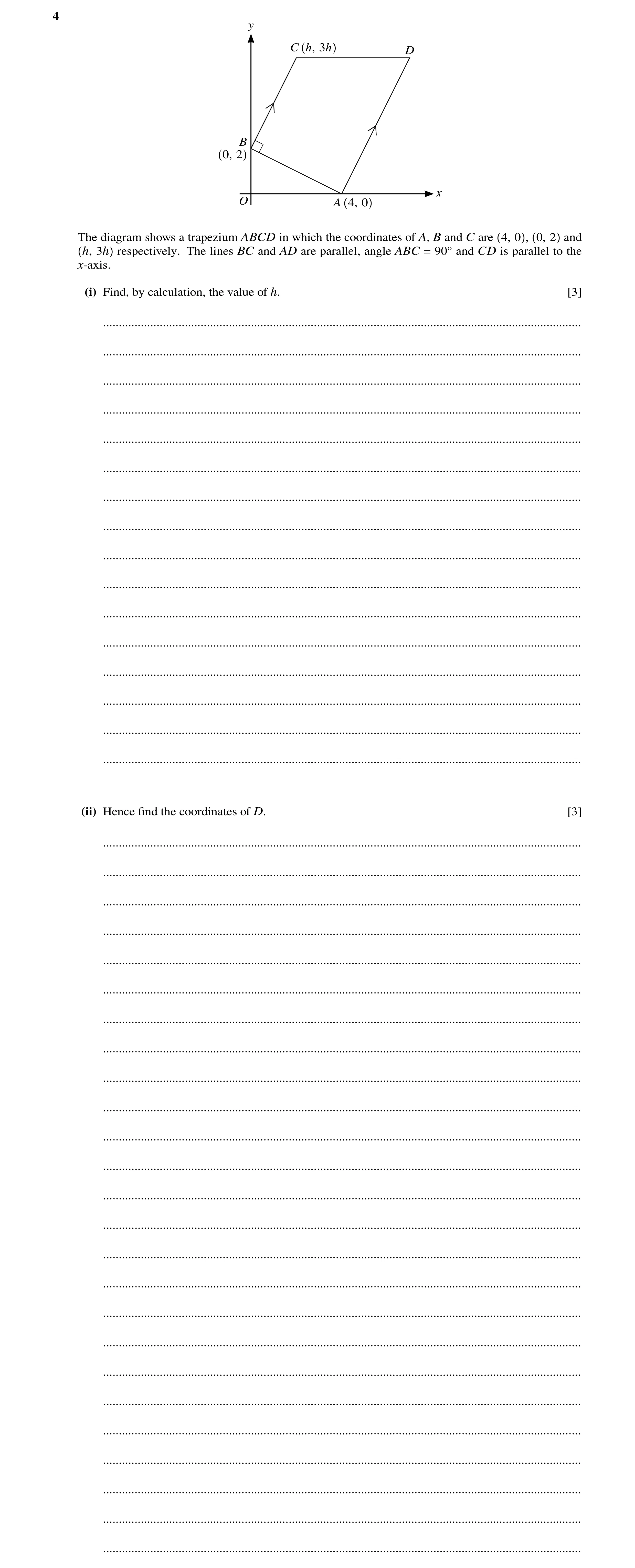
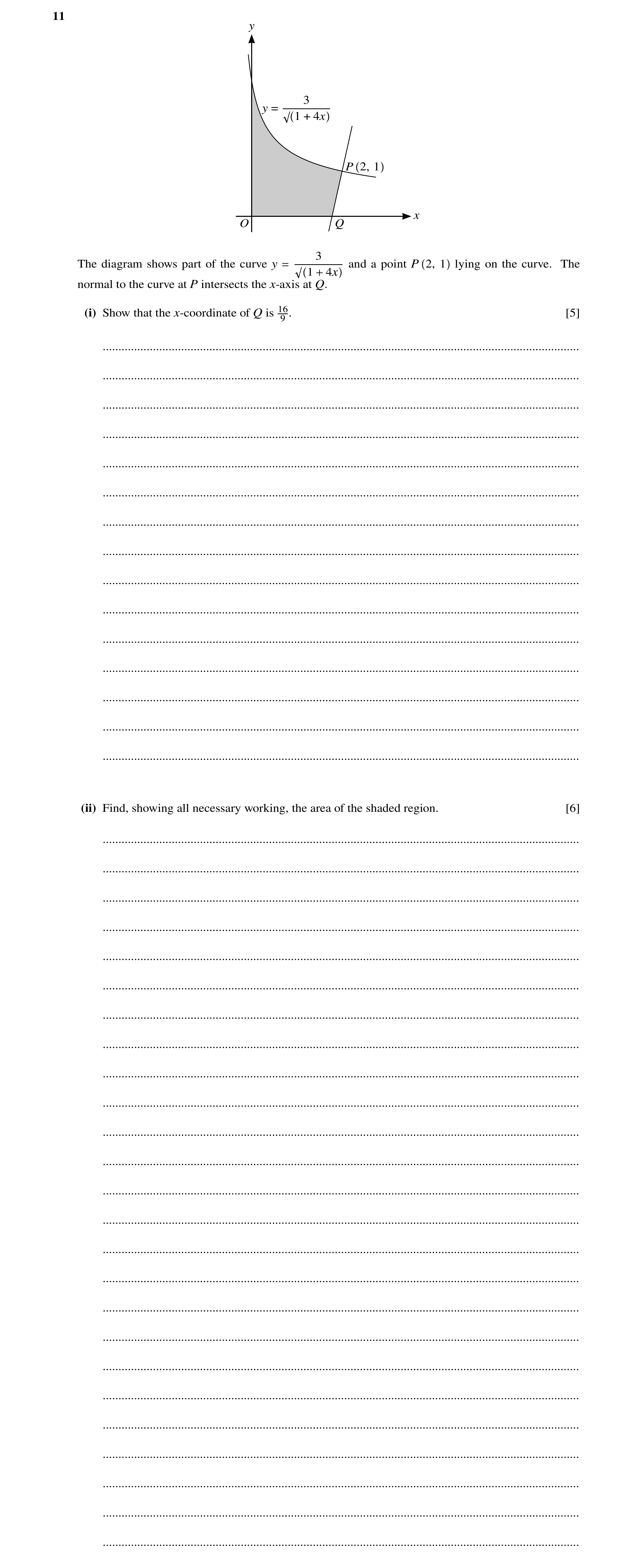
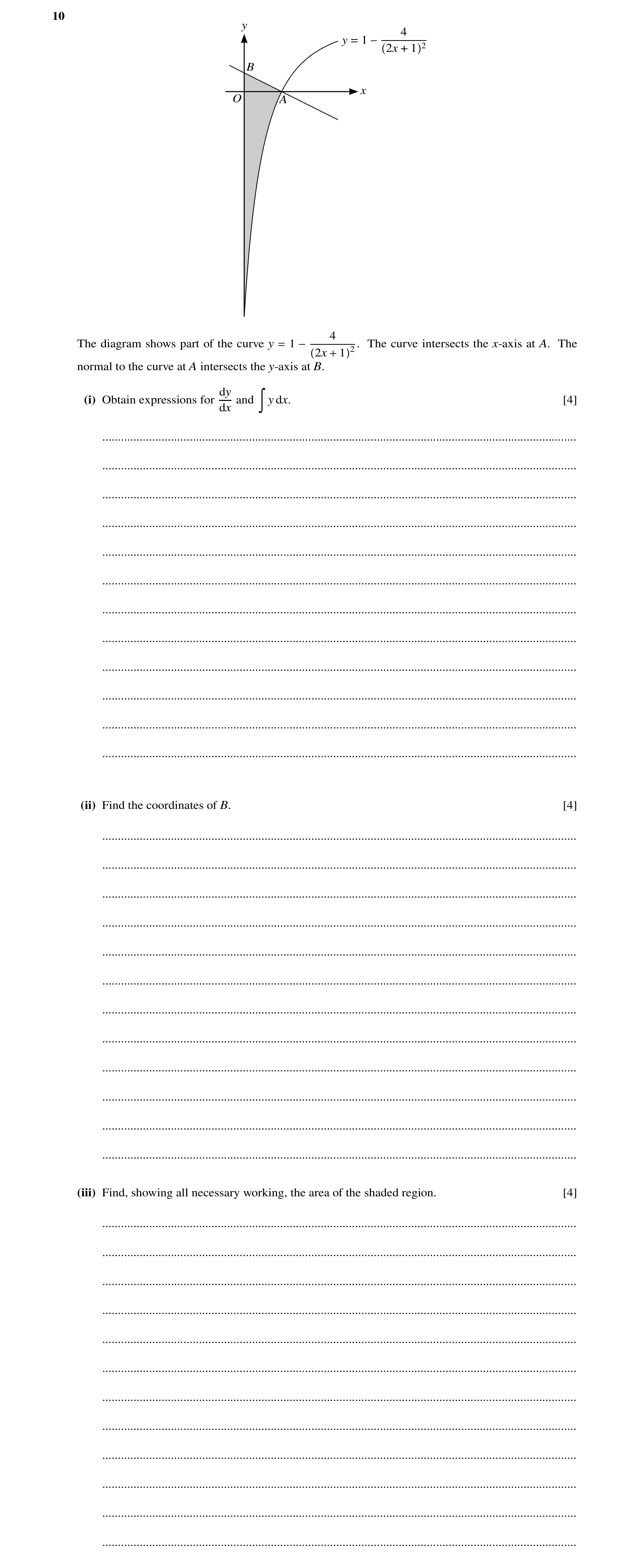
![Question 64: A diameter of a circle C1 has end-points at −3, −5 and 7, 3 . (a) Find an equation of the circle C1. [3] ..................................…](https://img.pastlit.com/crops/f34237d1-5a29-4a0c-ab2d-85ccb9b9c16e/q12.webp)
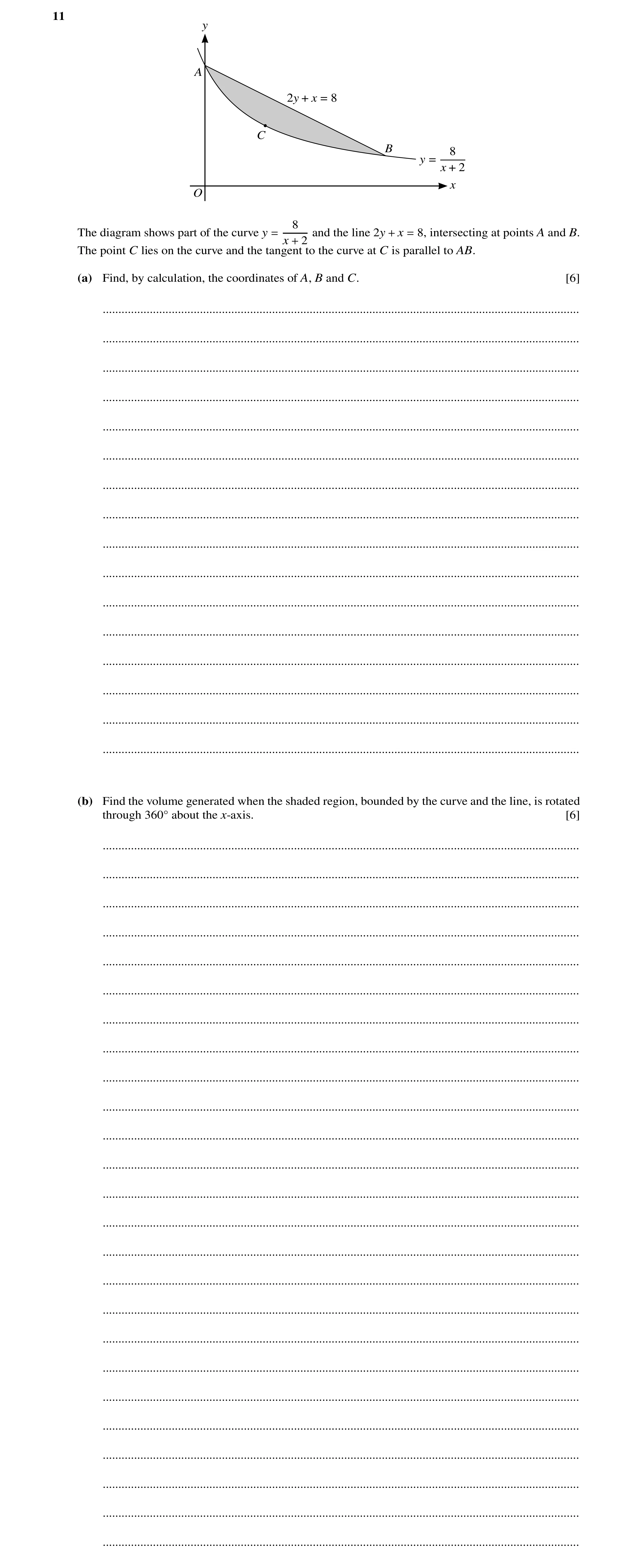
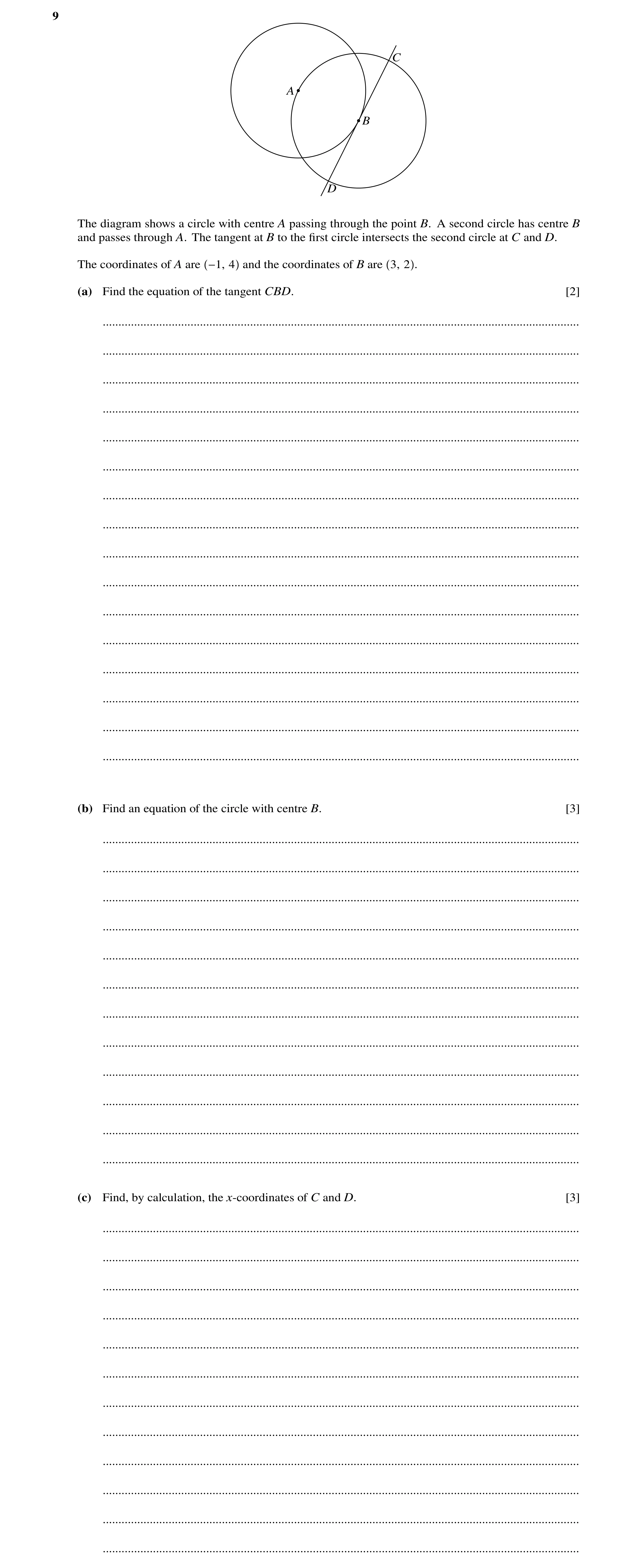
![Question 68: A circle with centre C has equation x 2 y 2 100. −8 + −4 = (a) Show that the point T 6 is outside the circle. [3] −6, .....................…](https://img.pastlit.com/crops/641233a6-125c-47d4-9a3c-a5f62ff4618f/q11.webp)
![Question 69: The points A 7, 1 , B 7, 9 and C 1, 9 are on the circumference of a circle. (a) Find an equation of the circle. [5] .......................…](https://img.pastlit.com/crops/7d0dc07a-d426-4ede-a180-c1d512861f86/q8.webp)
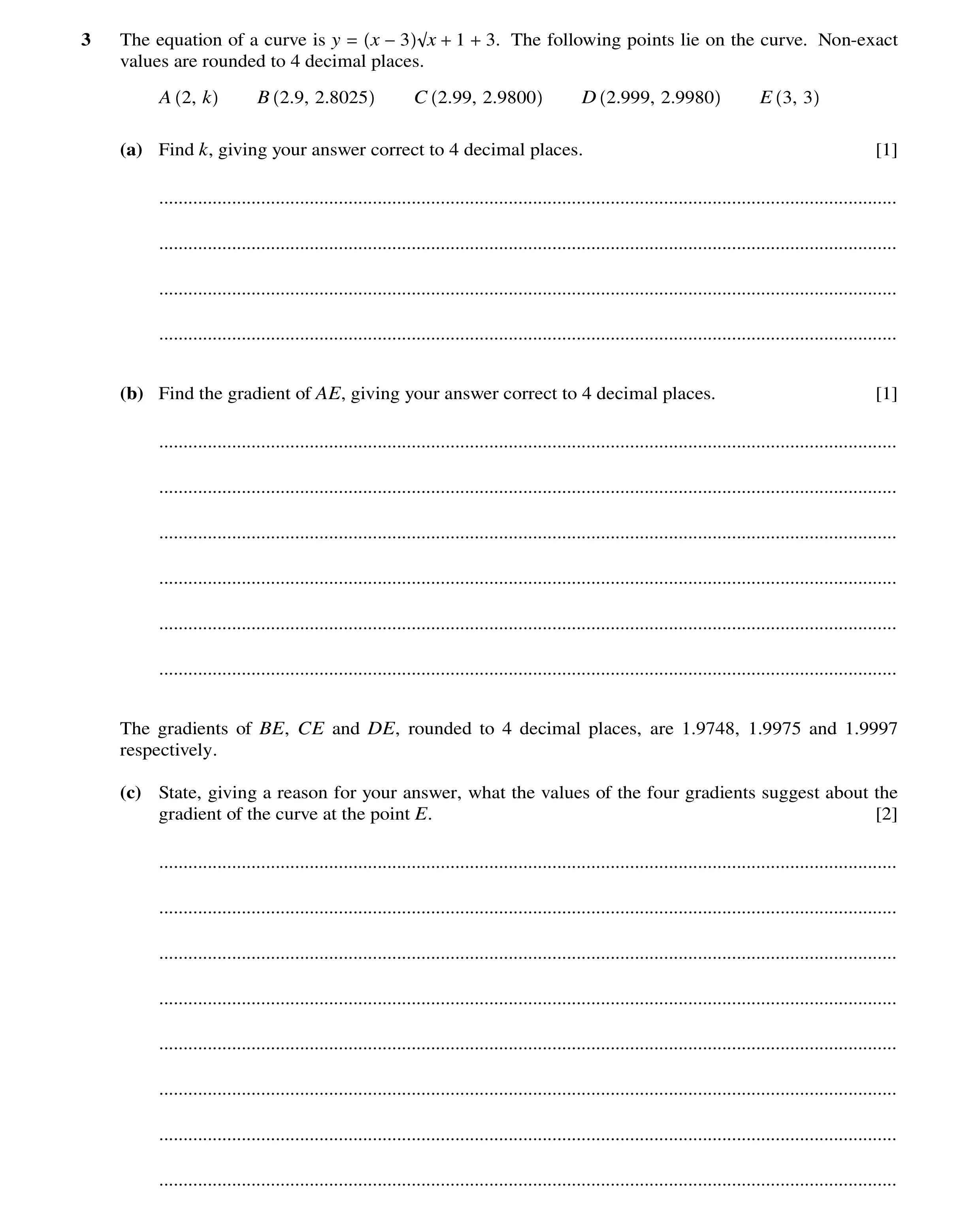 64 / 151
 65 / 151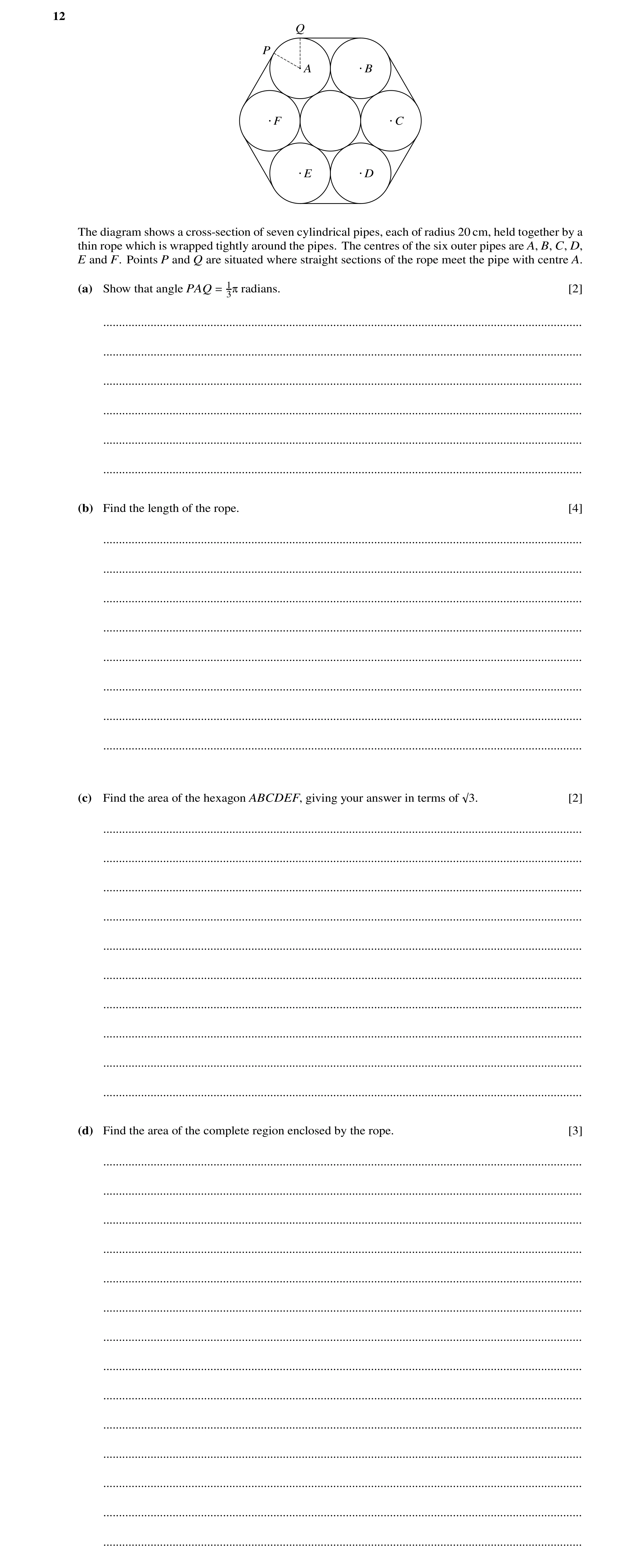
![Question 74: Points A −2, 3 , B 3, 0 and C 6, 5 lie on the circumference of a circle with centre D. (a) Show that angle ABC = 90Å. [2] .................…](https://img.pastlit.com/crops/0e3a3850-ab7b-48e2-a84a-cd186d51fd5f/q10.webp)
![Question 75: A circle with centre 5, 2 passes through the point 7, 5 . (a) Find an equation of the circle. [2] .........................................…](https://img.pastlit.com/crops/b833ab26-35a5-4bc6-8cbb-b6d425ca3110/q7.webp)
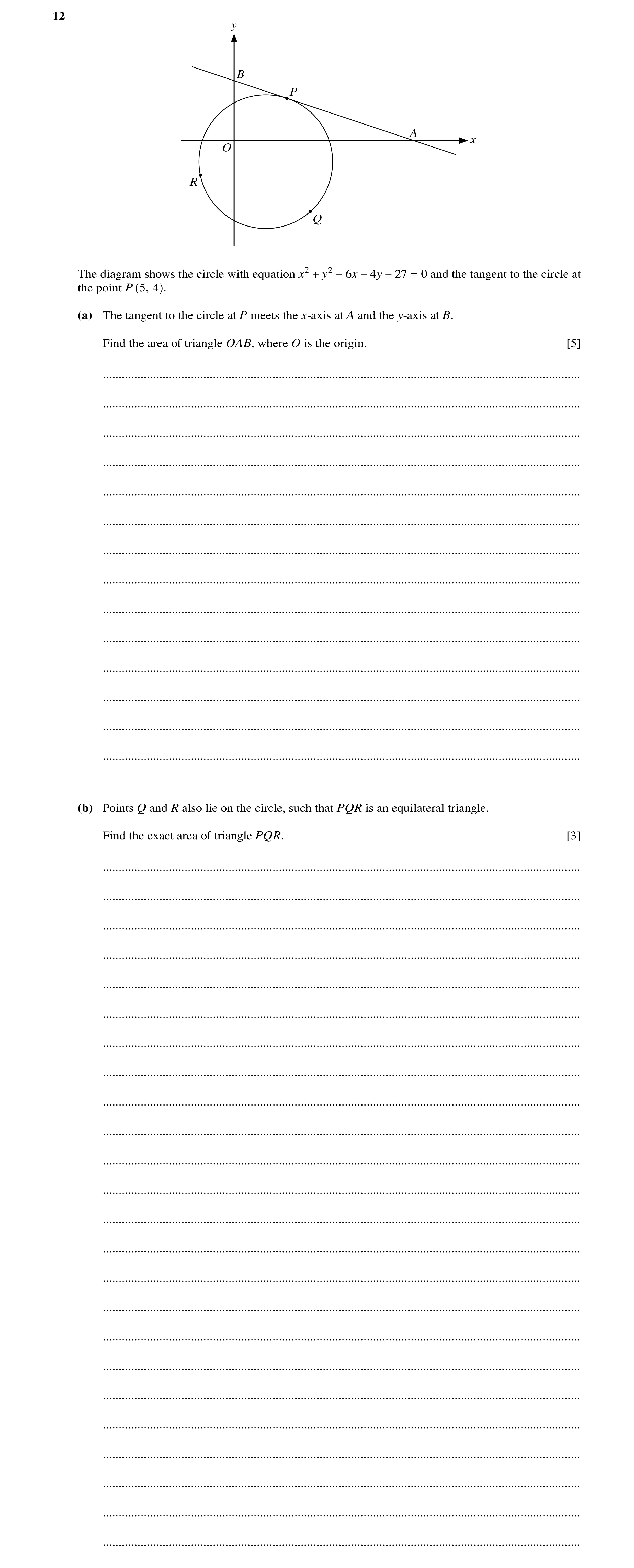
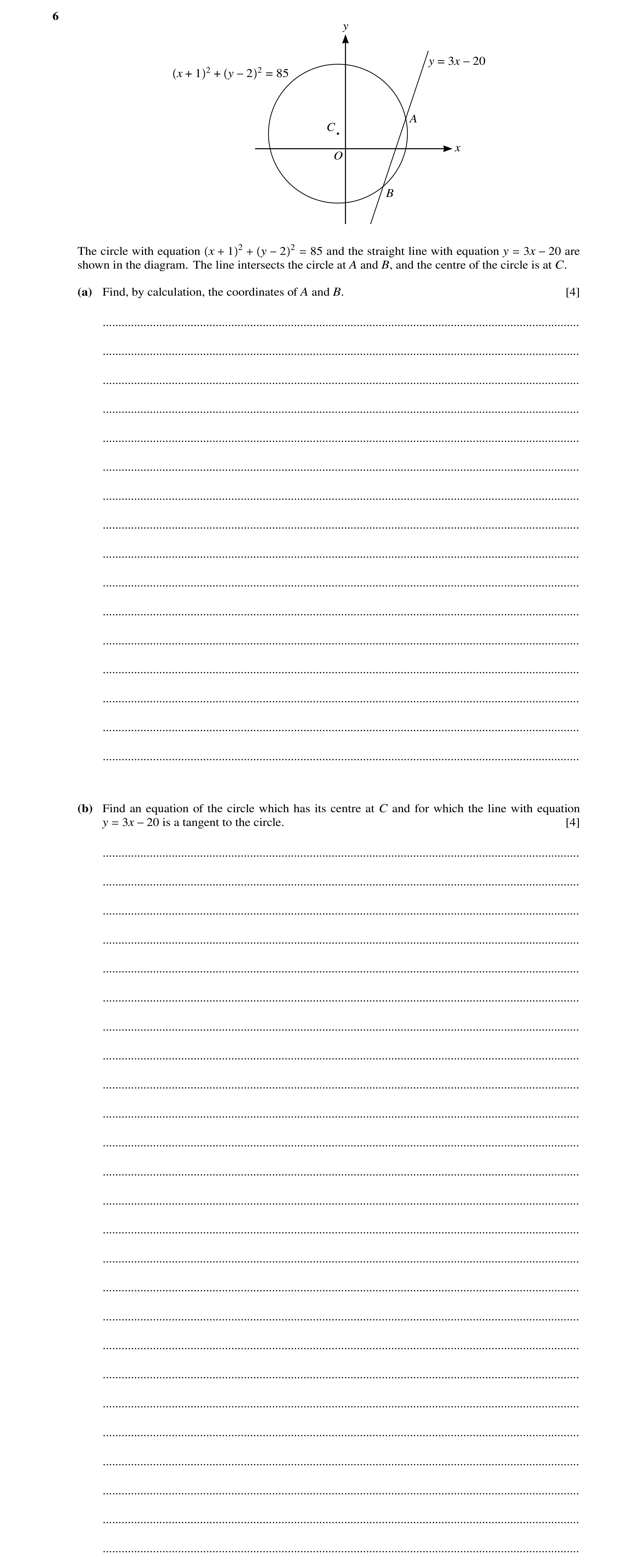
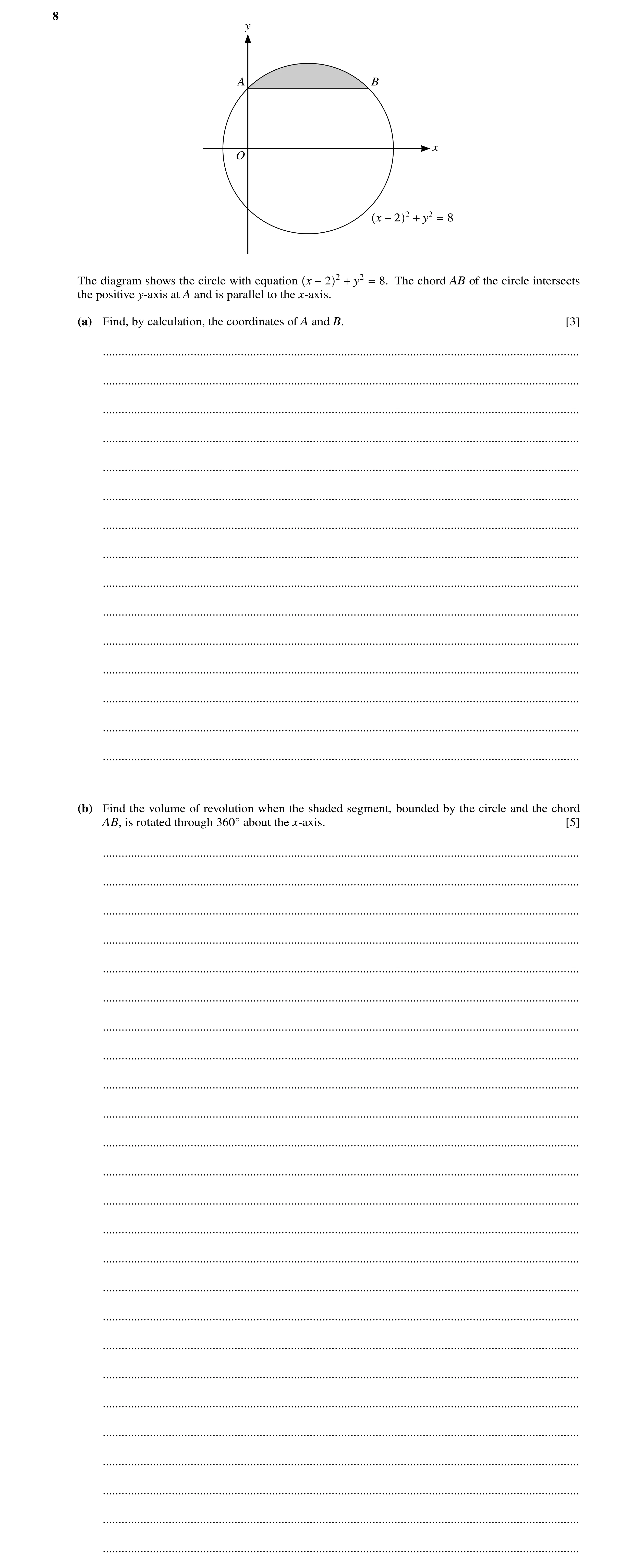
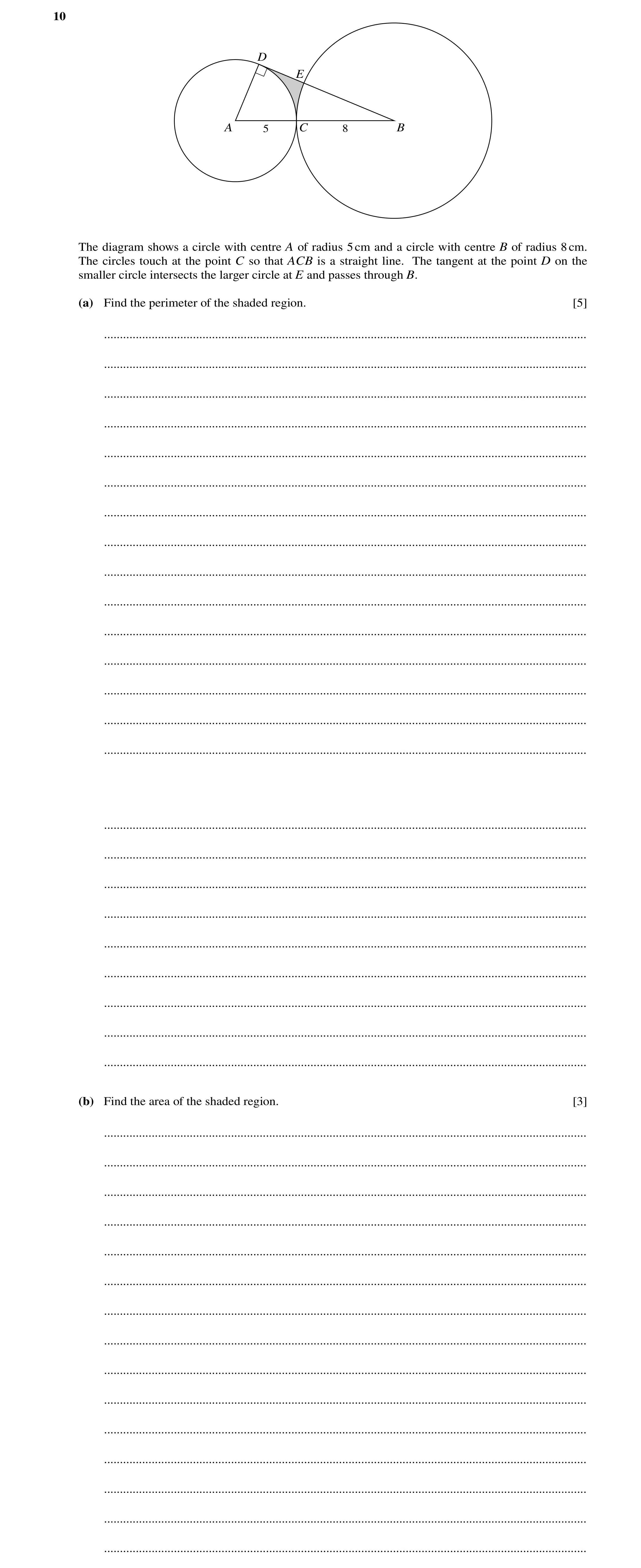
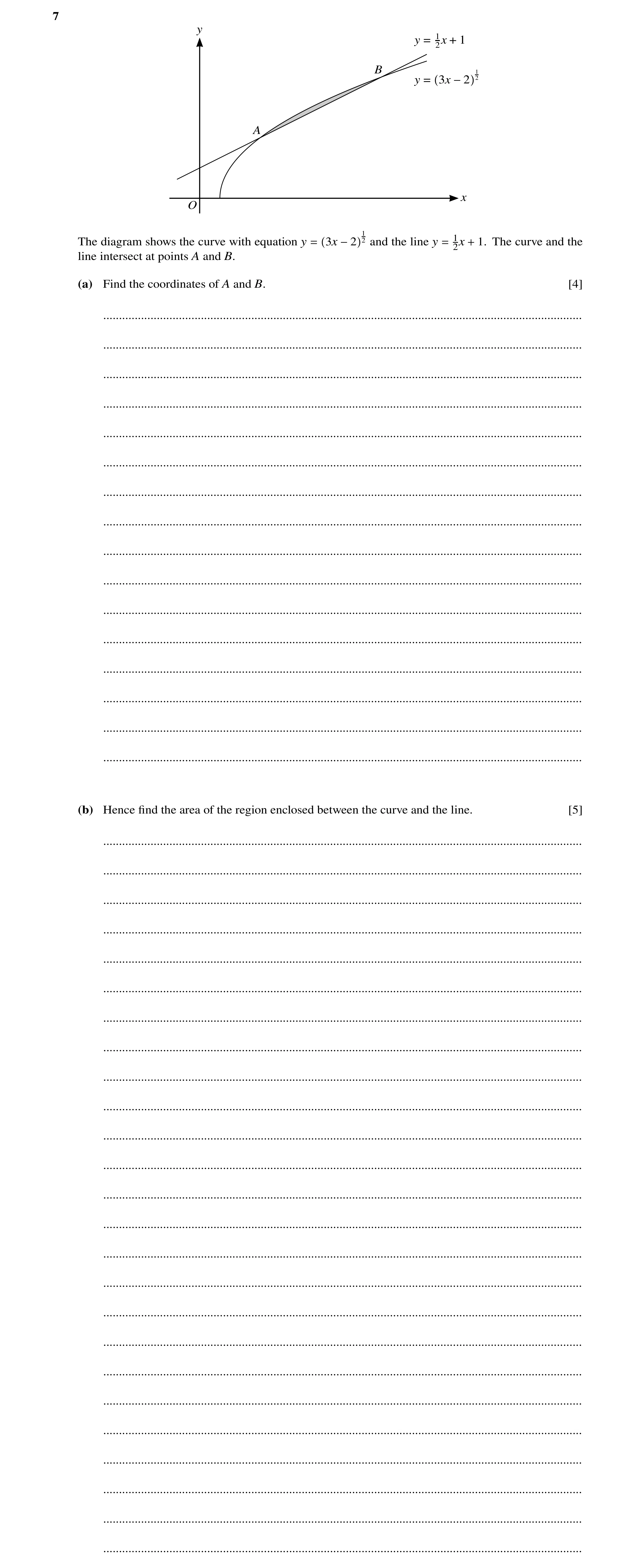
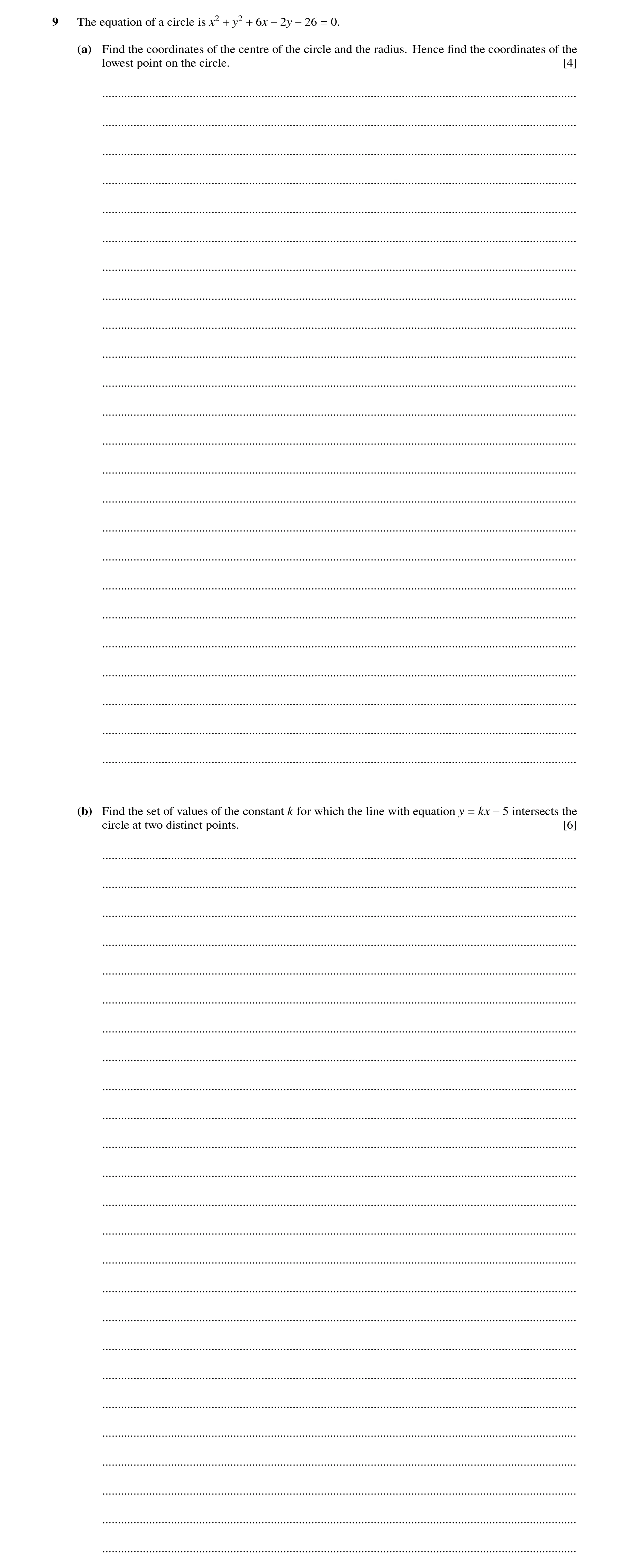
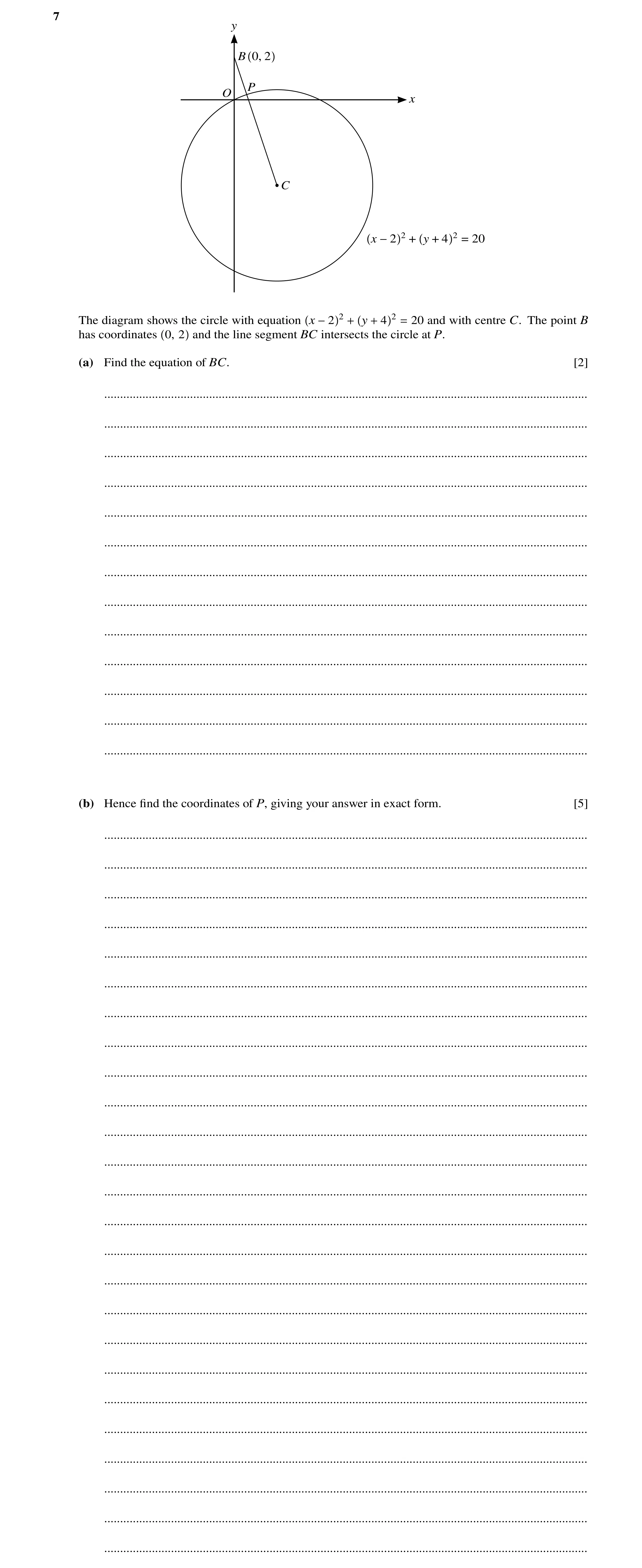
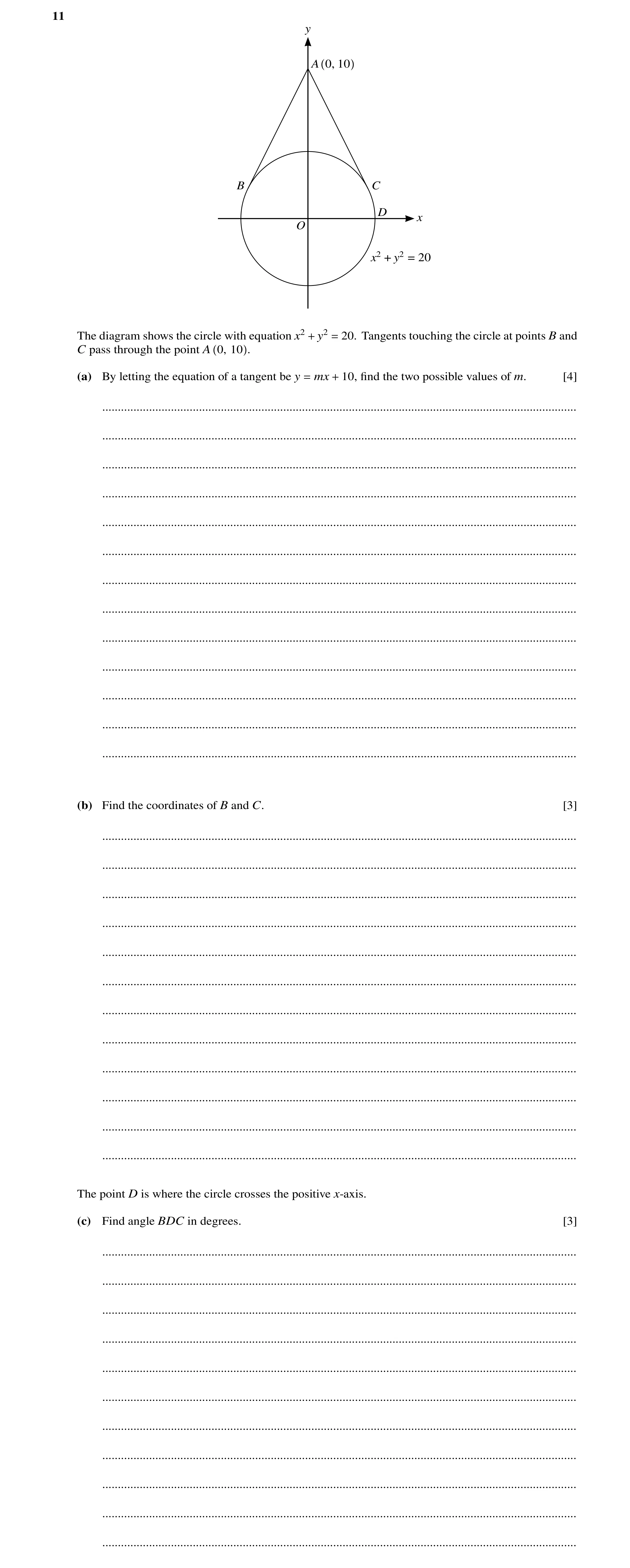
![Question 85: Points A and B have coordinates 5, 2 and 10, −1 respectively. (a) Find the equation of the perpendicular bisector of AB. [3] ..............…](https://img.pastlit.com/crops/6aa5094a-97b4-44e8-9ef8-0fce912a145b/q1.webp) 88 / 151
88 / 151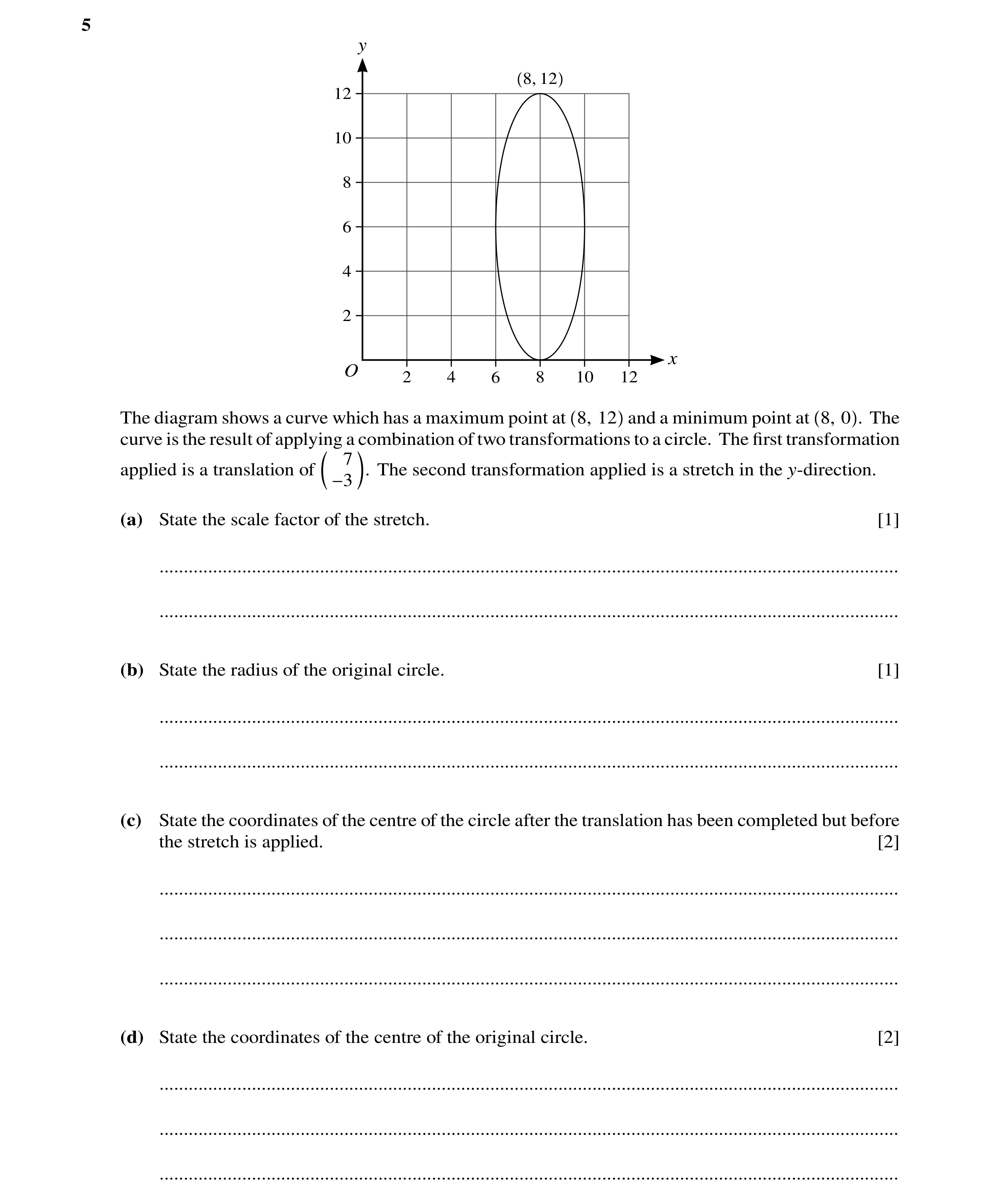 89 / 151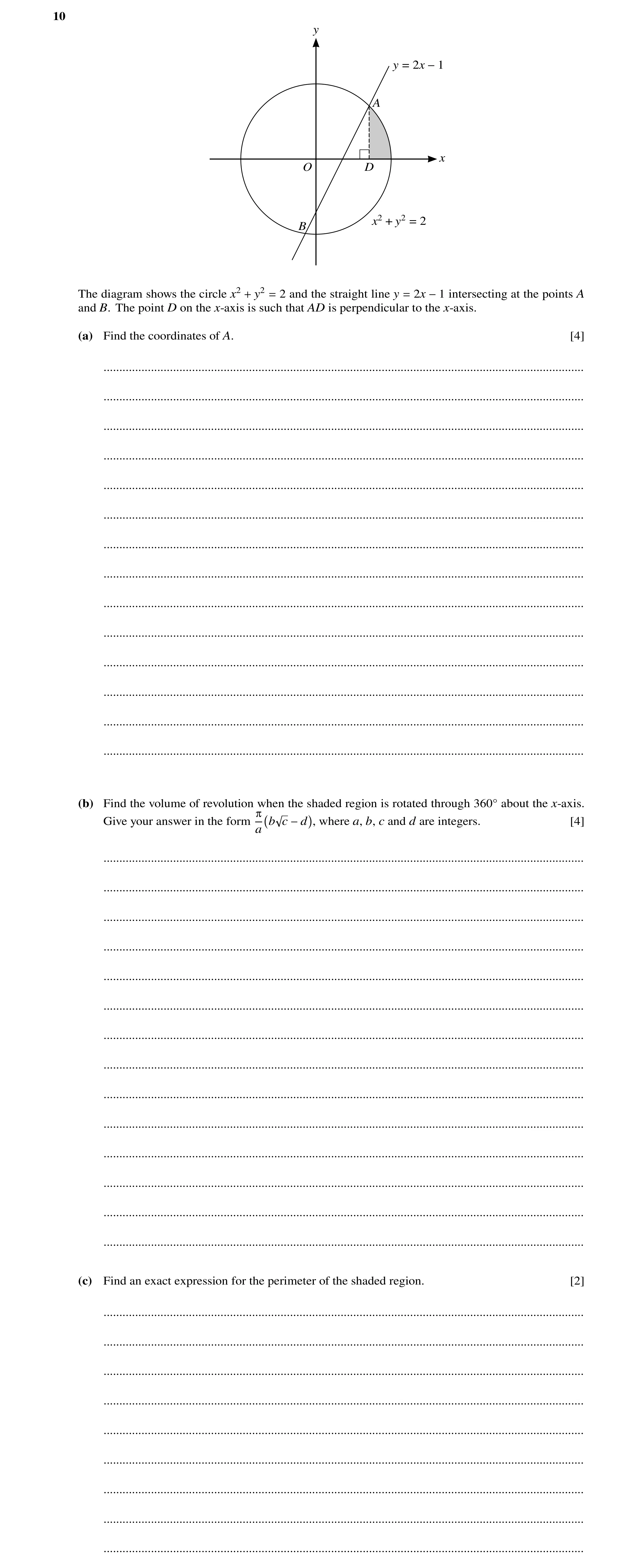
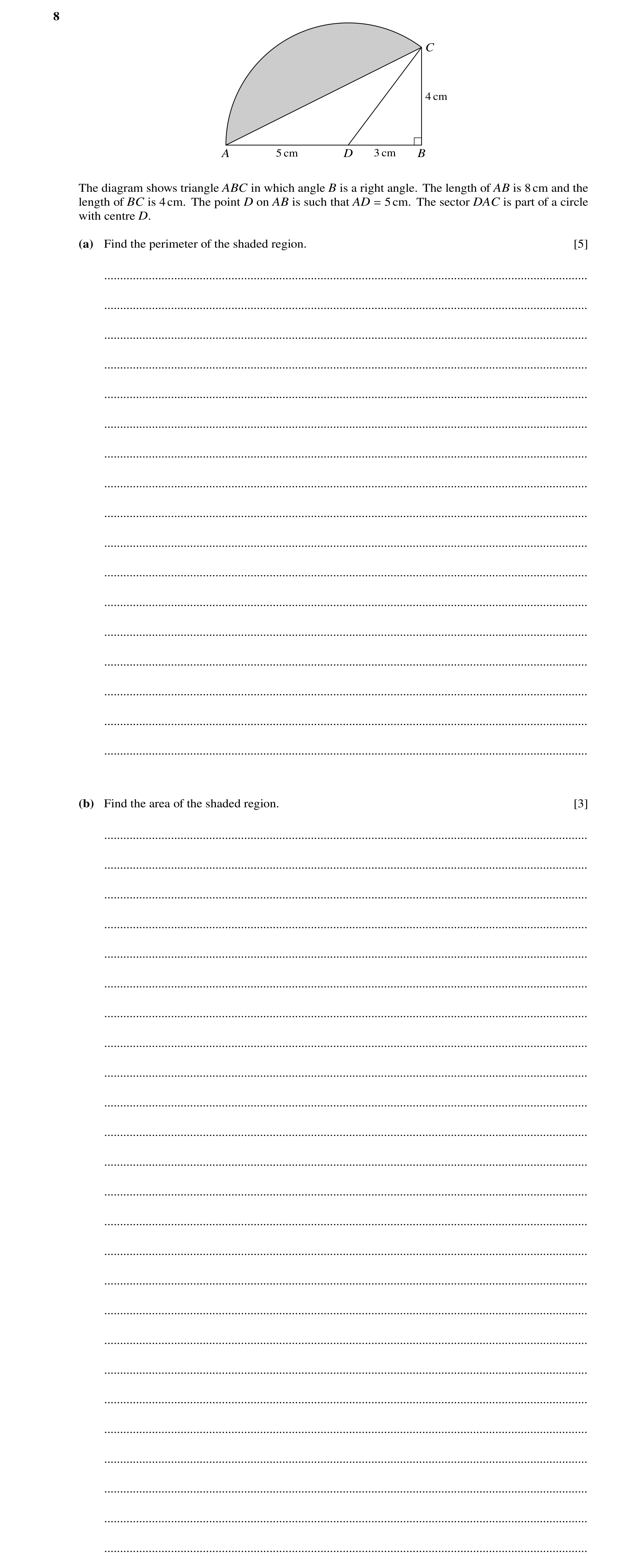
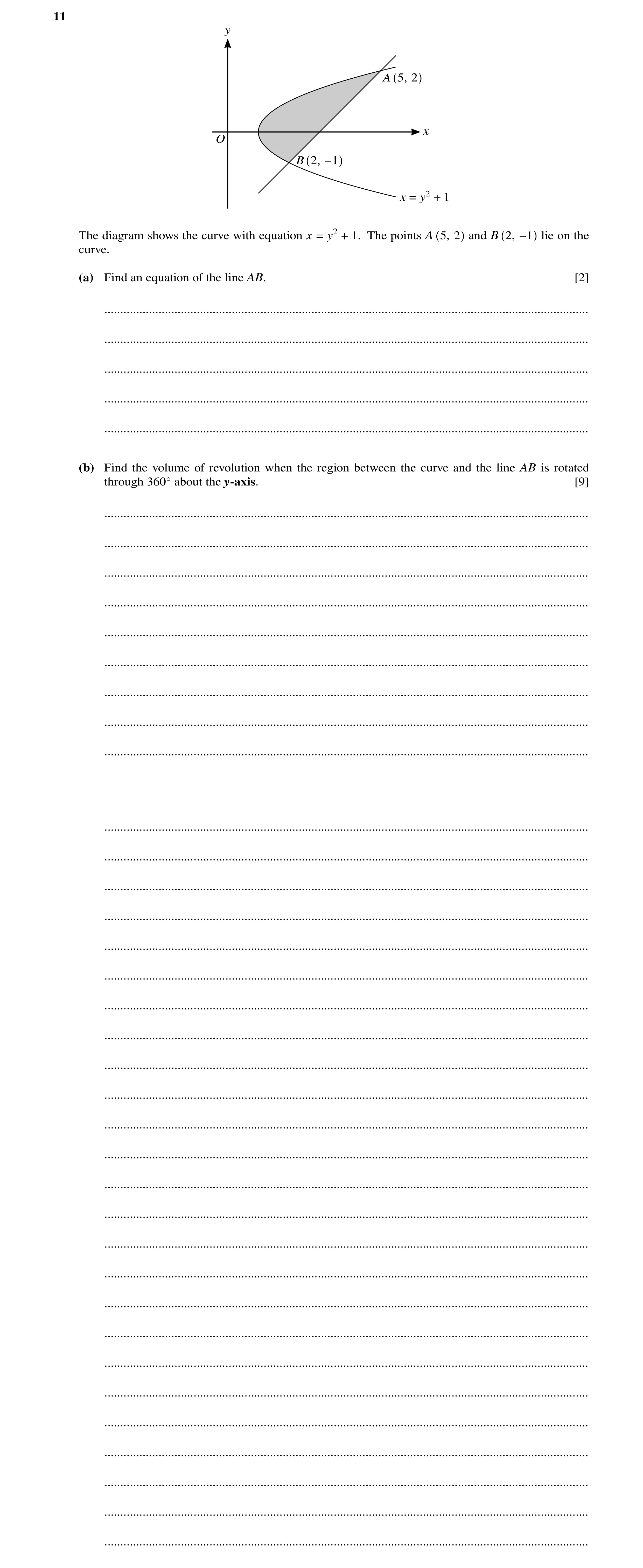
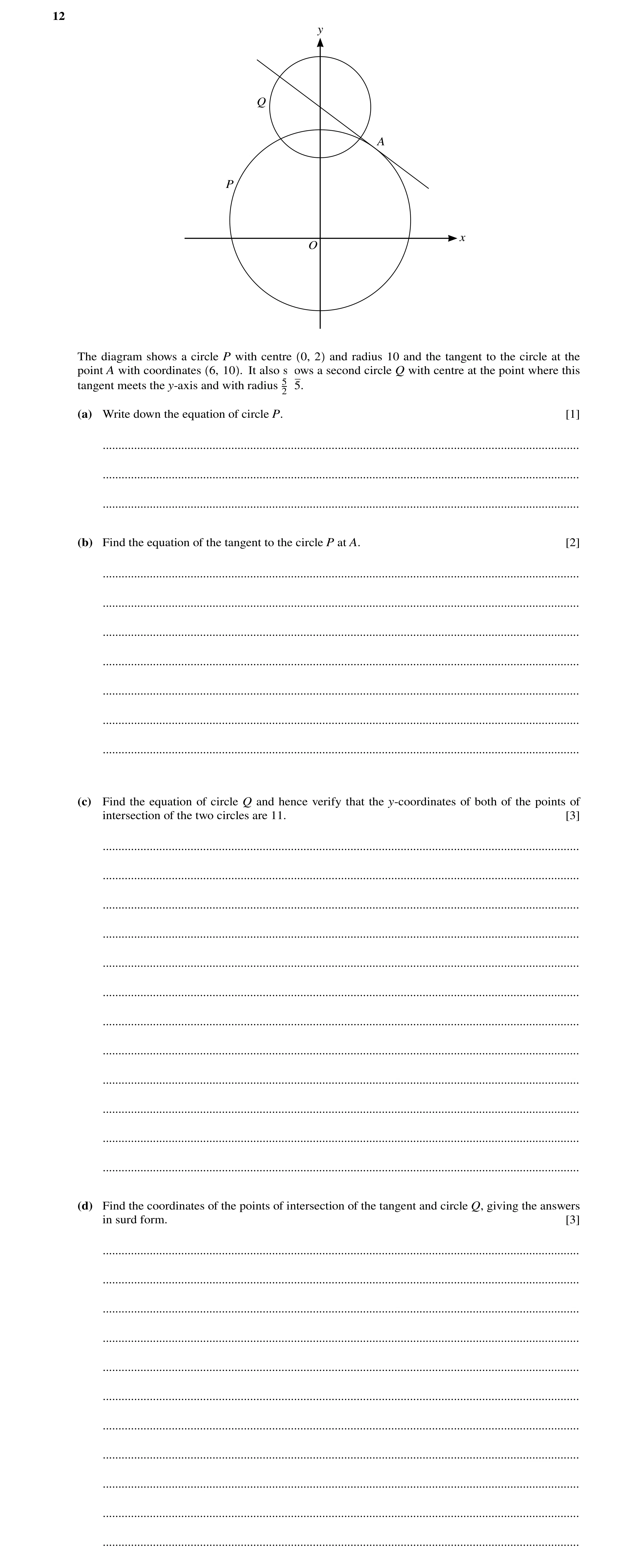
 101 / 151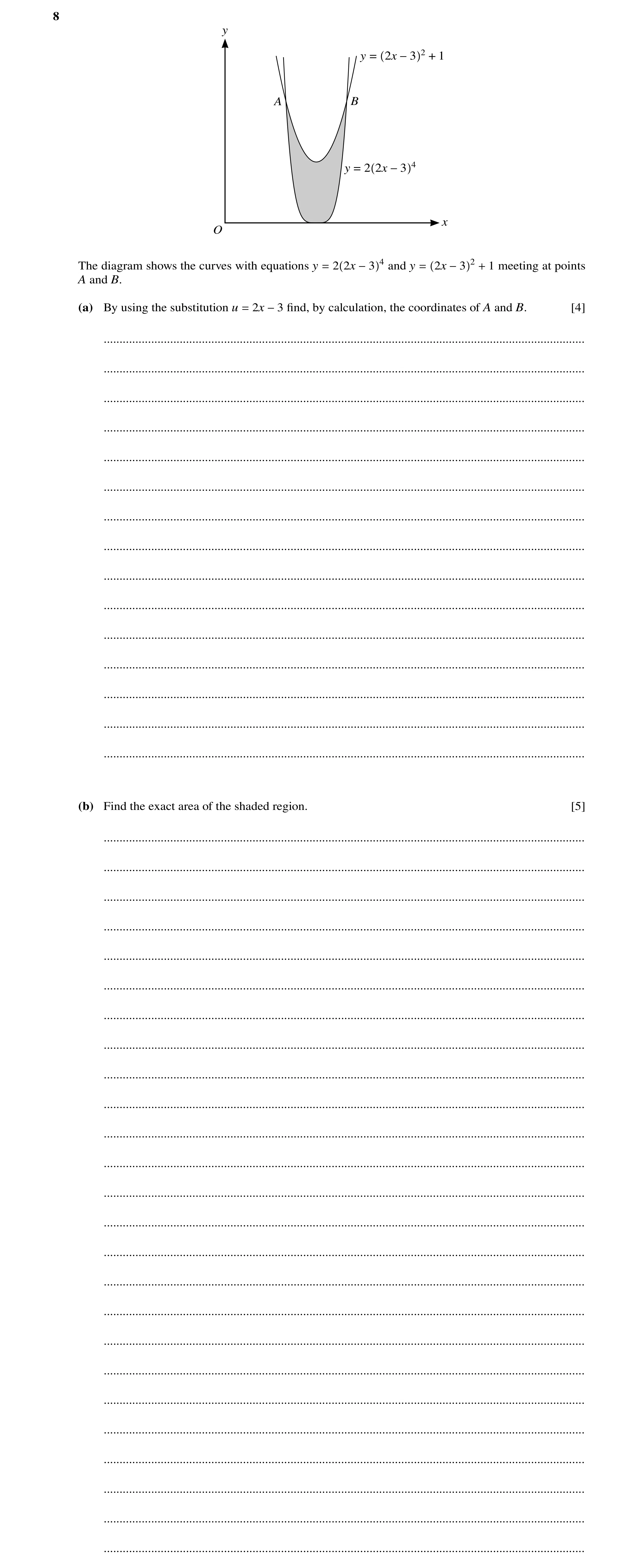
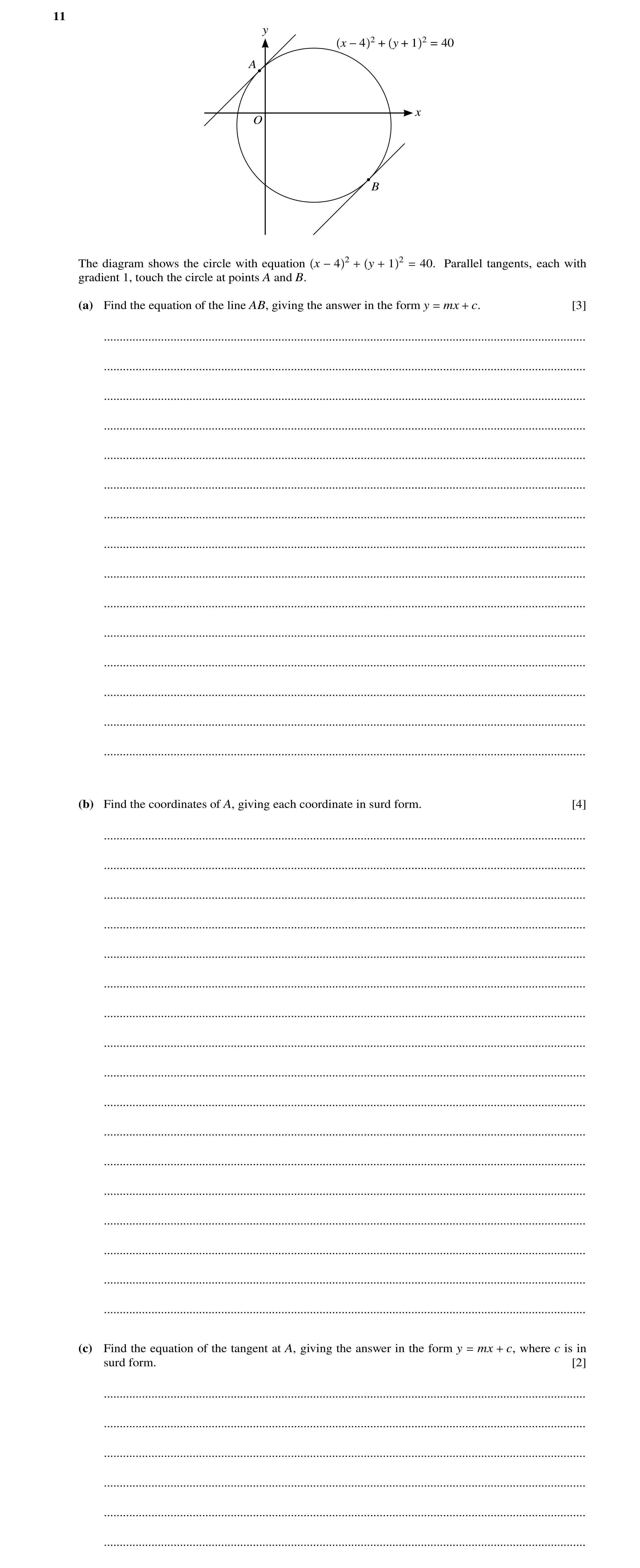
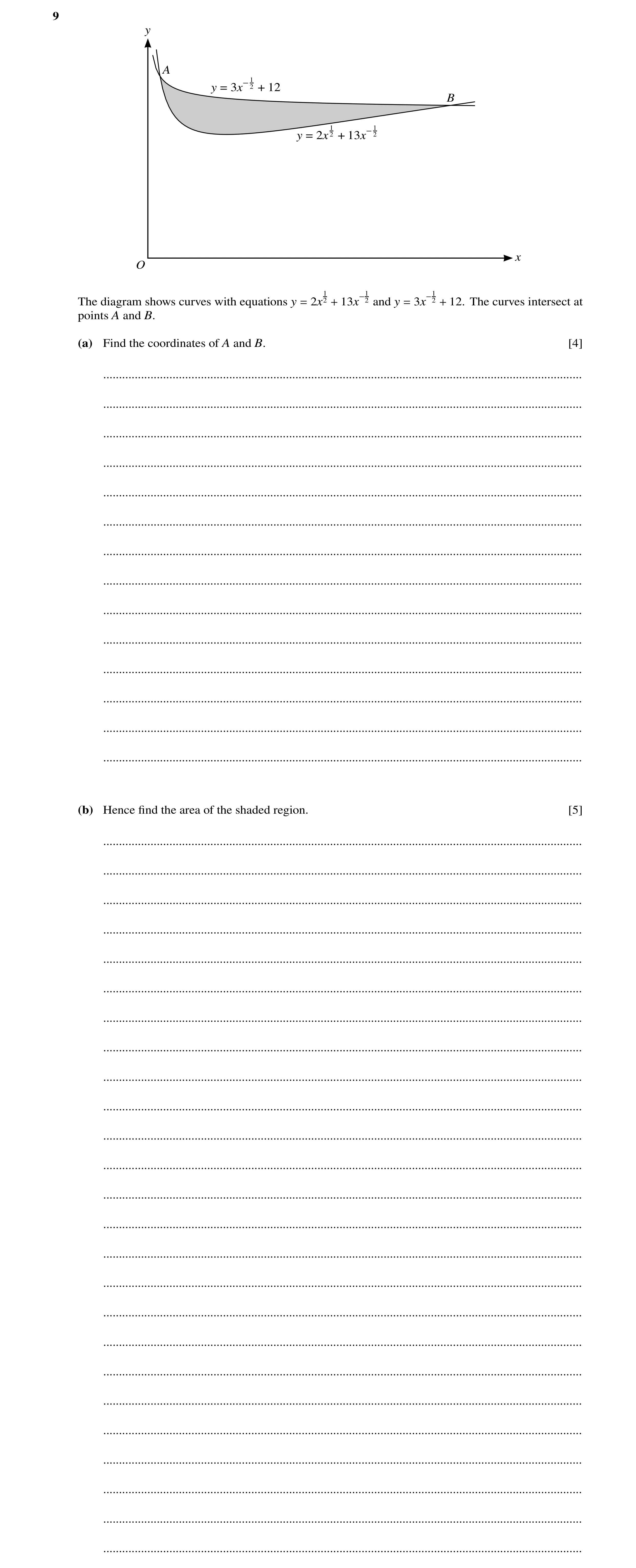
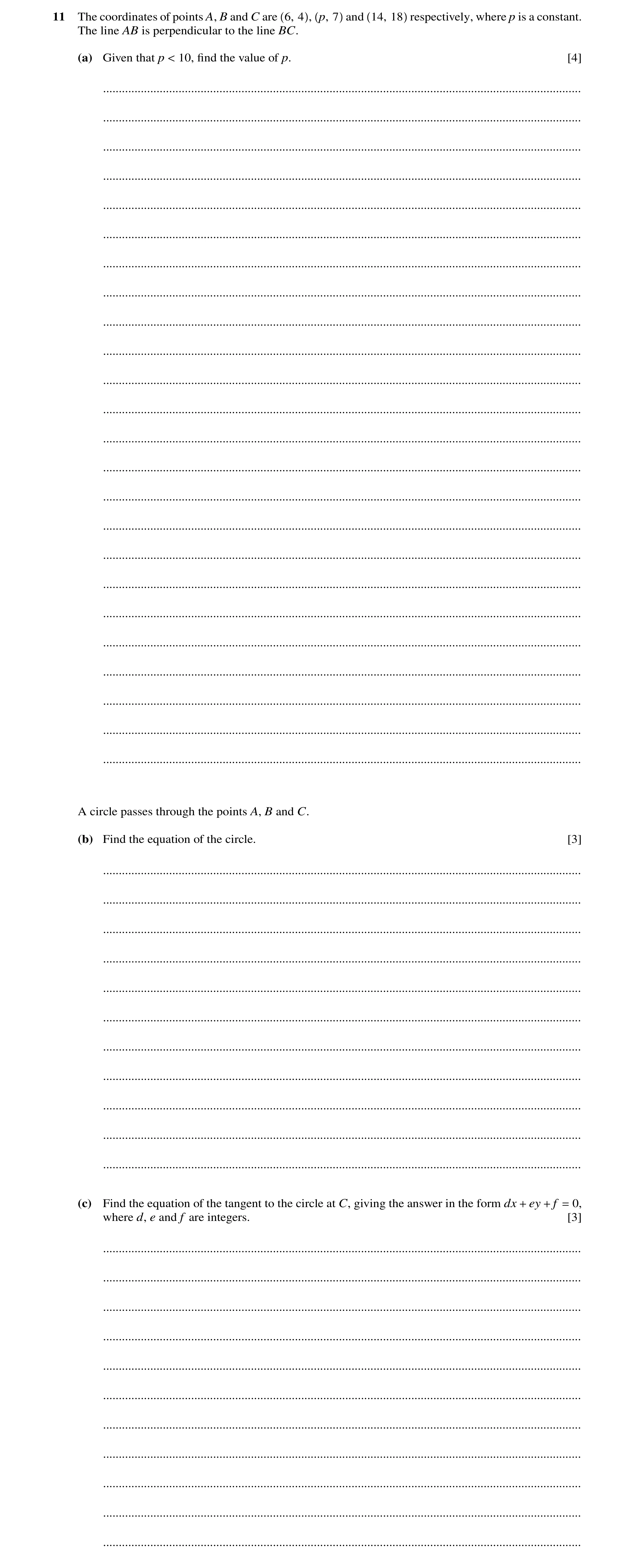
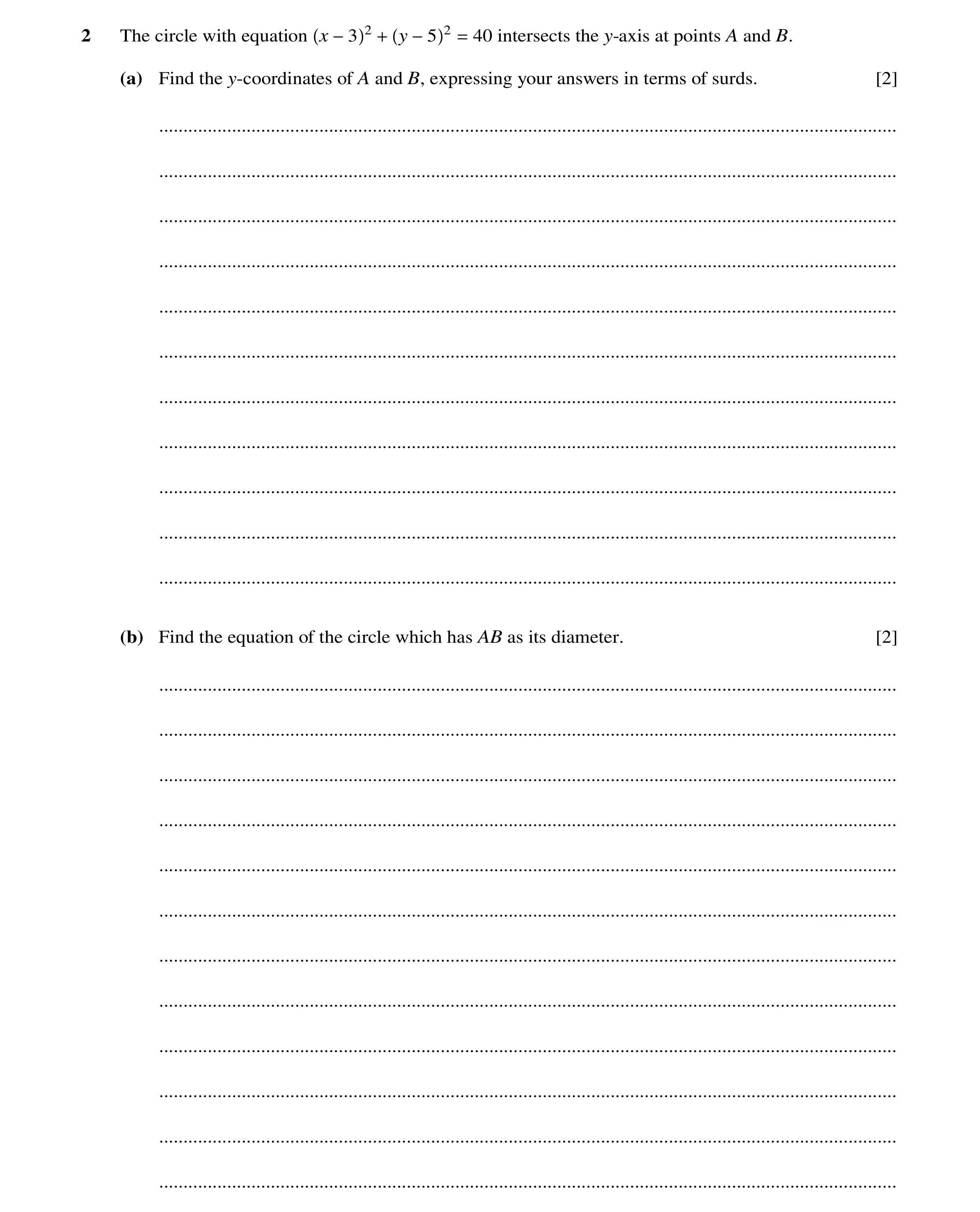 109 / 151
 110 / 151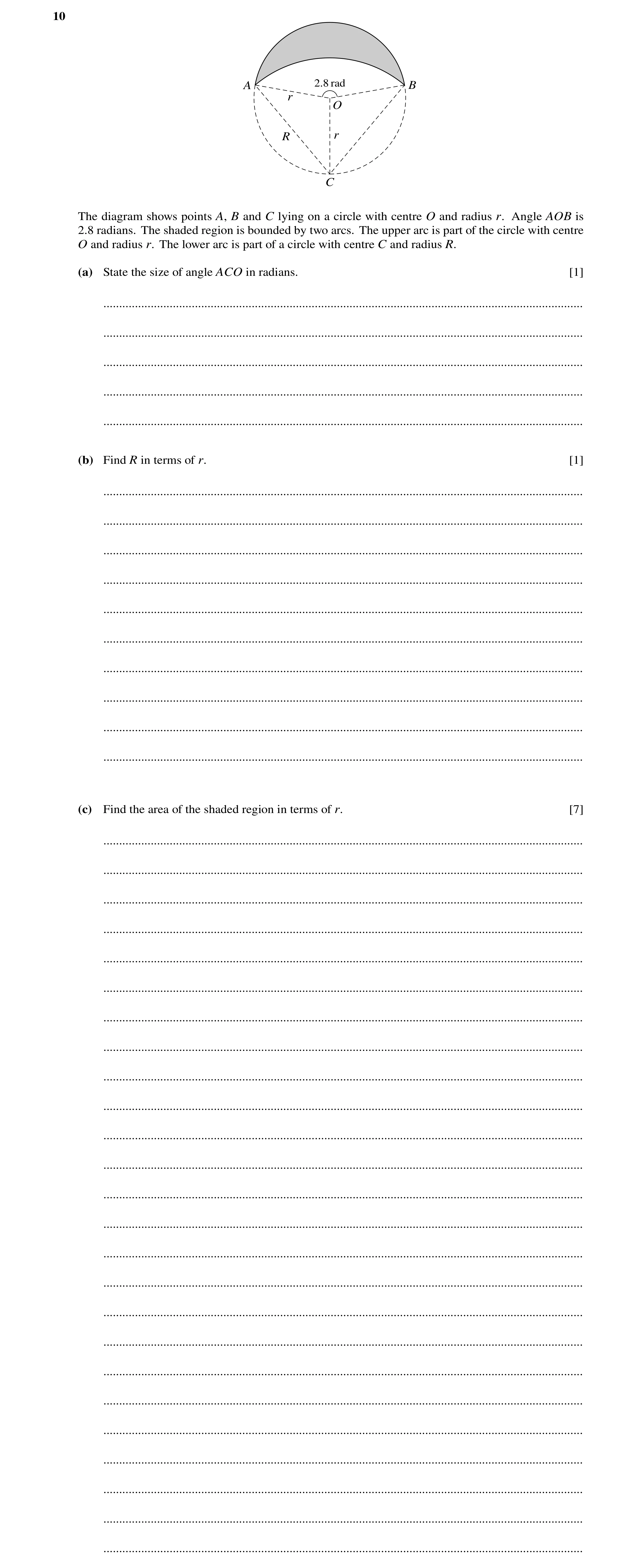
![Question 101: The straight line y = x + 5 meets the curve 2x 2 + 3y 2 = k at a single point P. (a) Find the value of the constant k. [4] ................…](https://img.pastlit.com/crops/bd8c5d94-e4ec-43fc-8e01-368b5717dc5c/q7.webp) 113 / 151
113 / 151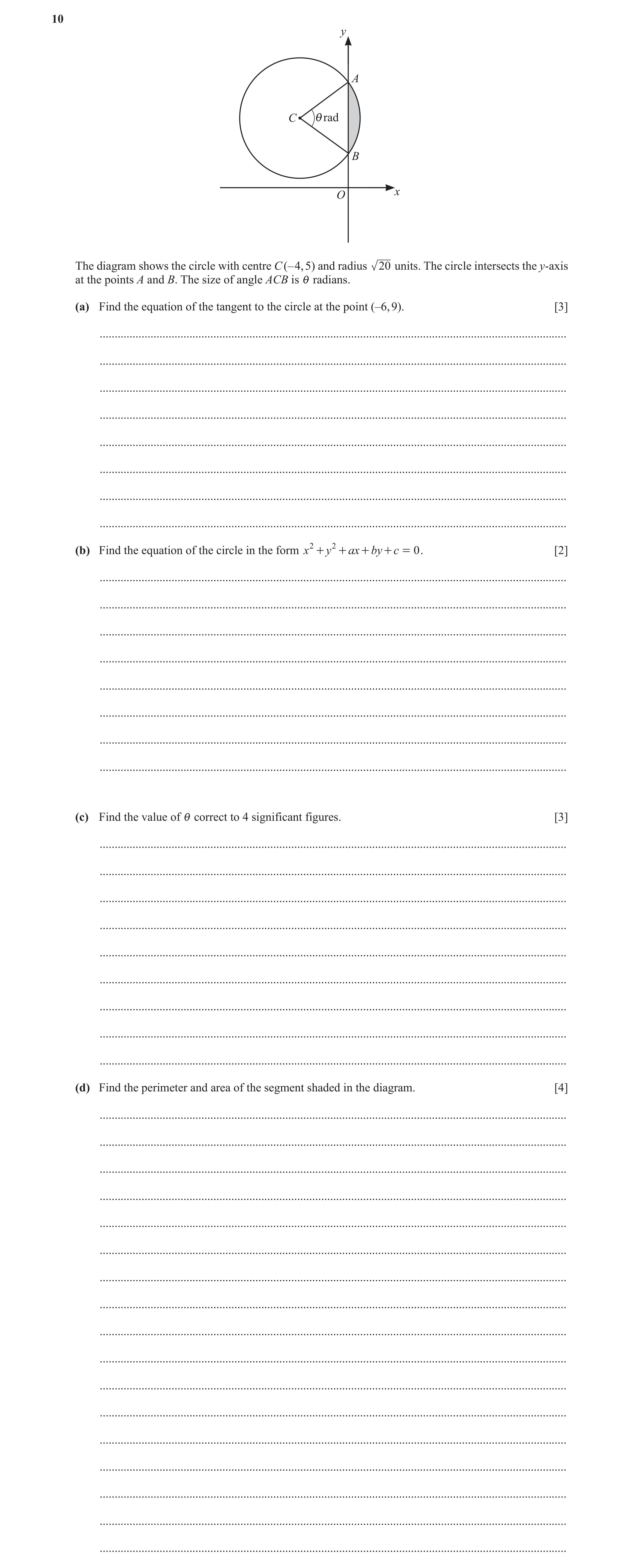
 116 / 151
![Question 108: Show that the curve with equation x 2 - 3 xy - 40 = 0 and the line with equation 3x + y + k = 0 meet for all values of the constant k. [5] …](https://img.pastlit.com/crops/7ce854aa-e4b4-4ed4-84a0-d1812ac3db56/q4.webp) 125 / 151
125 / 151 126 / 151
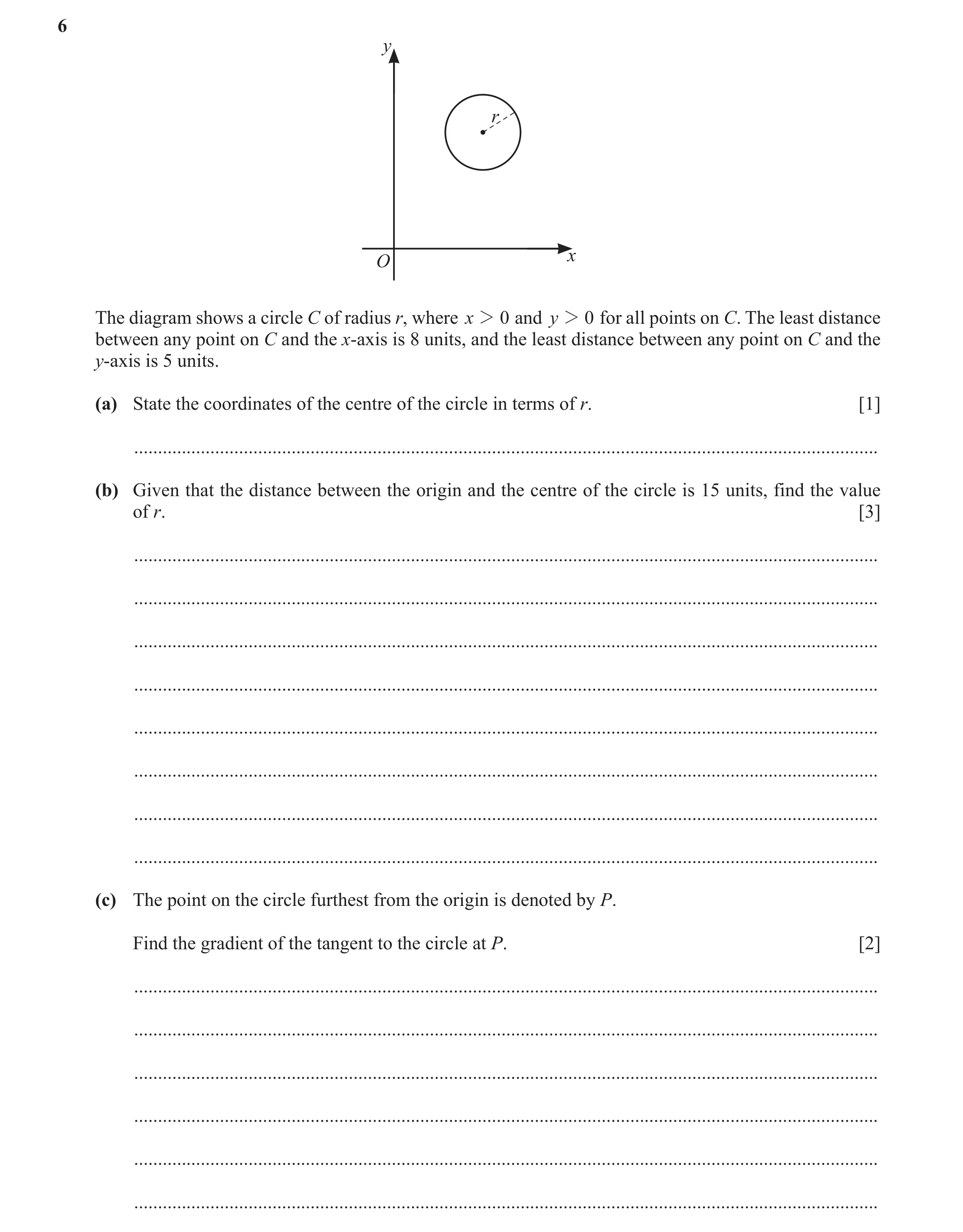 131 / 151
![Question 115: Find the coordinates of the points of intersection of the curve and the line with equations 2xy + 5y 2 = 24 and 2x + y + 4 = 0 . [4] ......…](https://img.pastlit.com/crops/fd7f1dcf-dd85-463a-affa-12775d64d07f/q2.webp) 136 / 151
136 / 151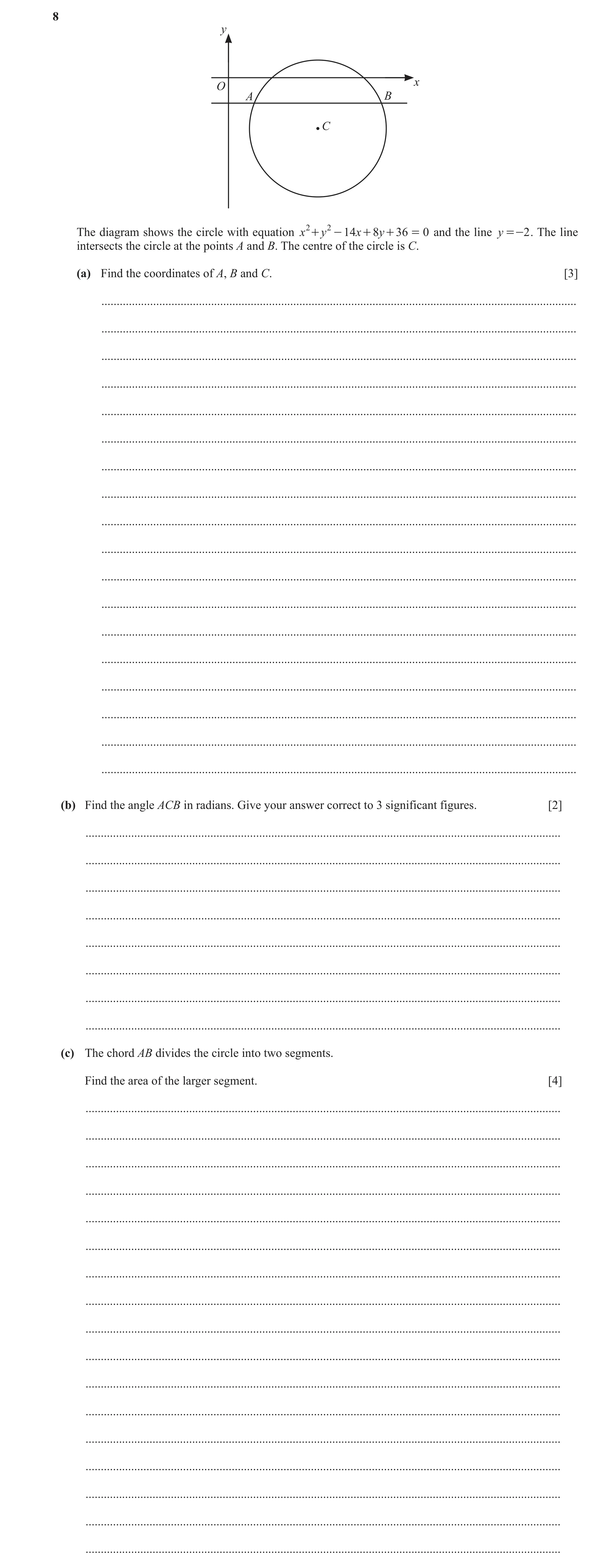
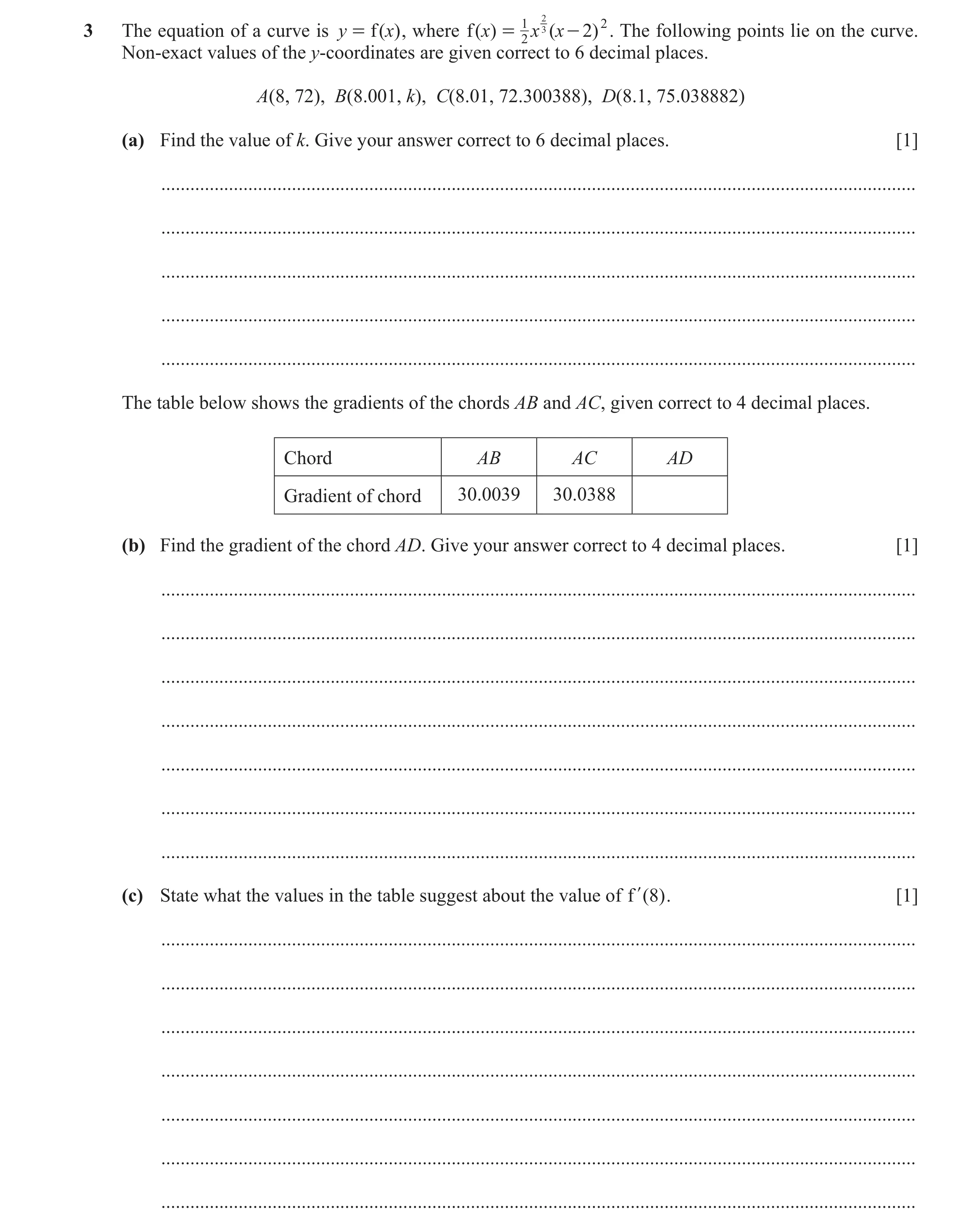 149 / 151
![Question 123: The points (6, 1) and ( -2, 7) lie at the opposite ends of a diameter of a circle. (a) Find the equation of the circle. [3] ...............…](https://img.pastlit.com/crops/126c78a5-90b1-484e-ac58-5f839273be50/q8.webp) 150 / 151
150 / 151![Question 124: A circle has centre (2, 6) and radius 10. (a) State the equation of the circle. [2] .......................................................…](https://img.pastlit.com/crops/a3d47a8a-f3b0-443a-9d96-08eed7643bf0/q1.webp) 151 / 151
151 / 151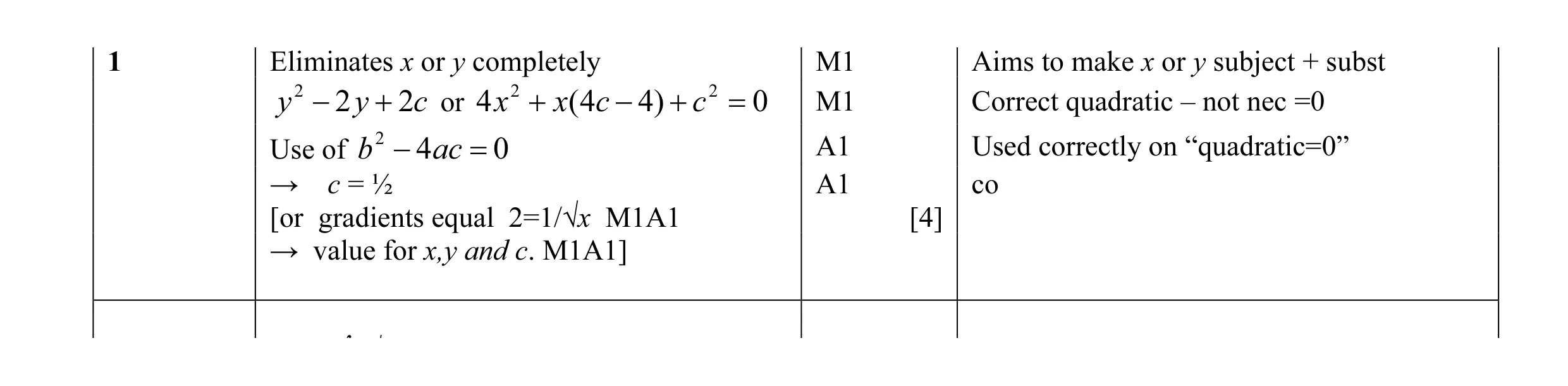 4
4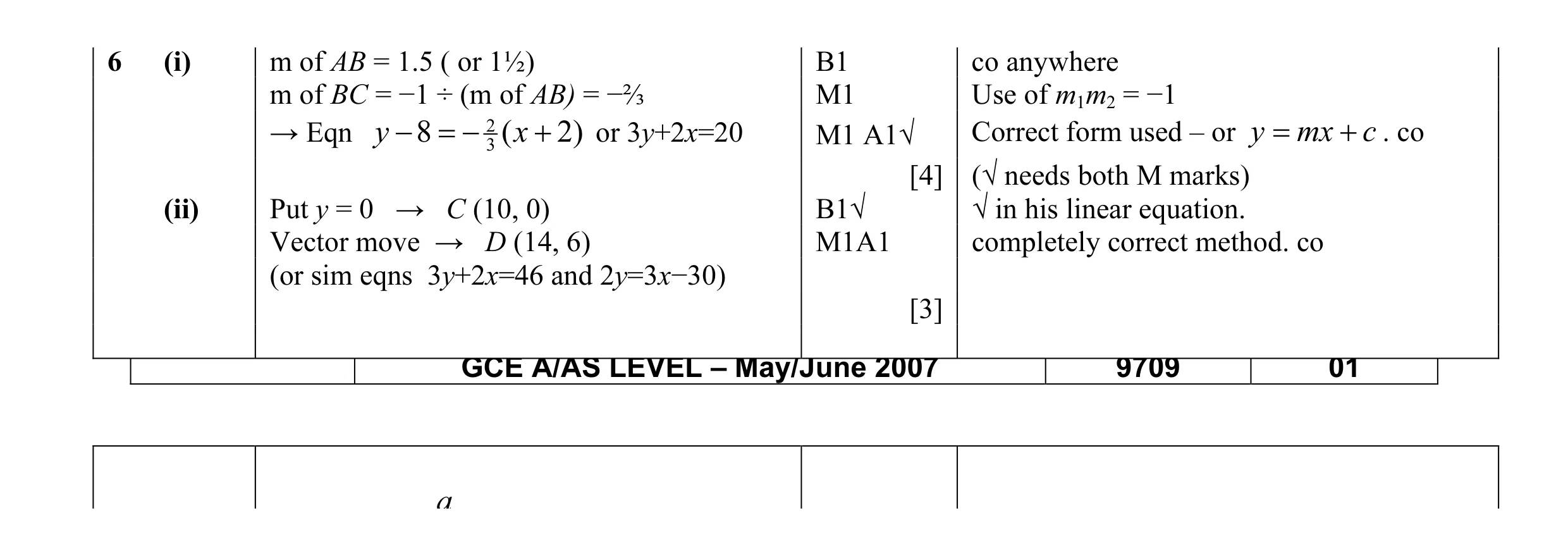 7
7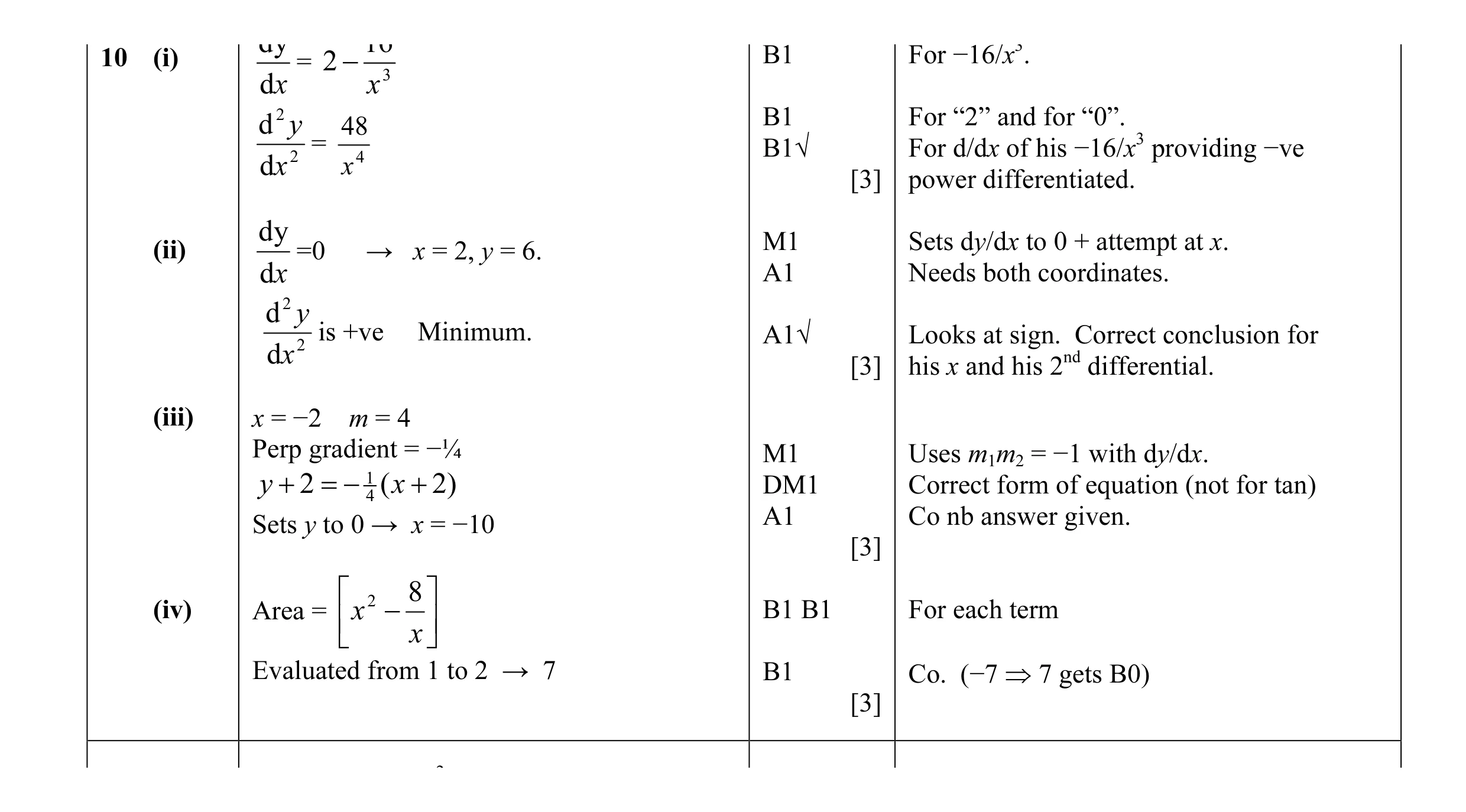 12
12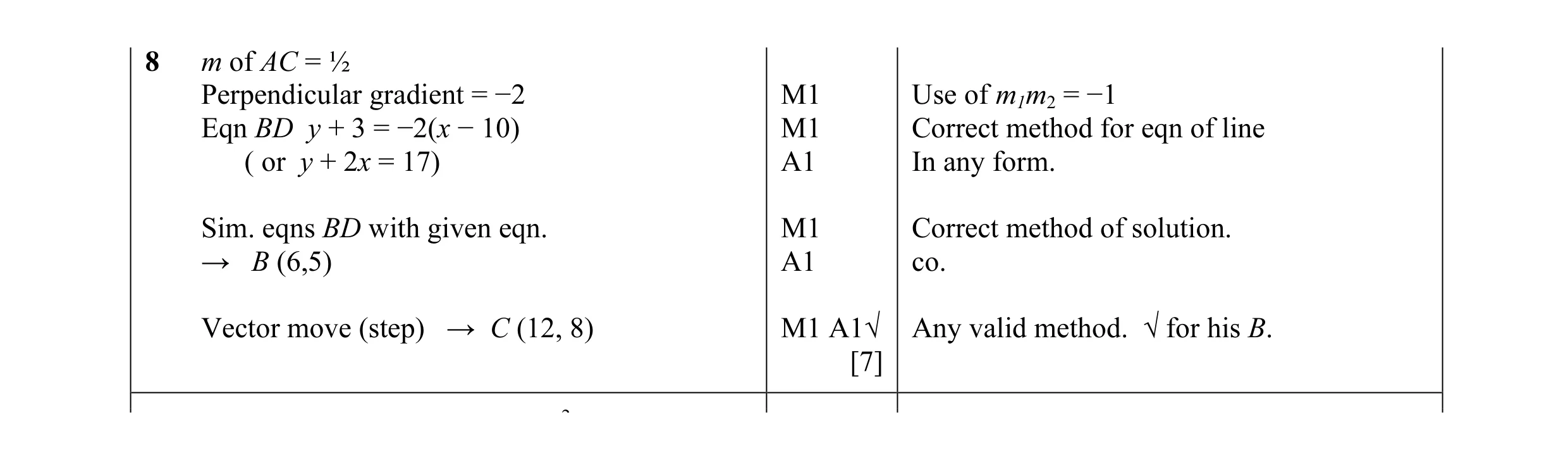 7
7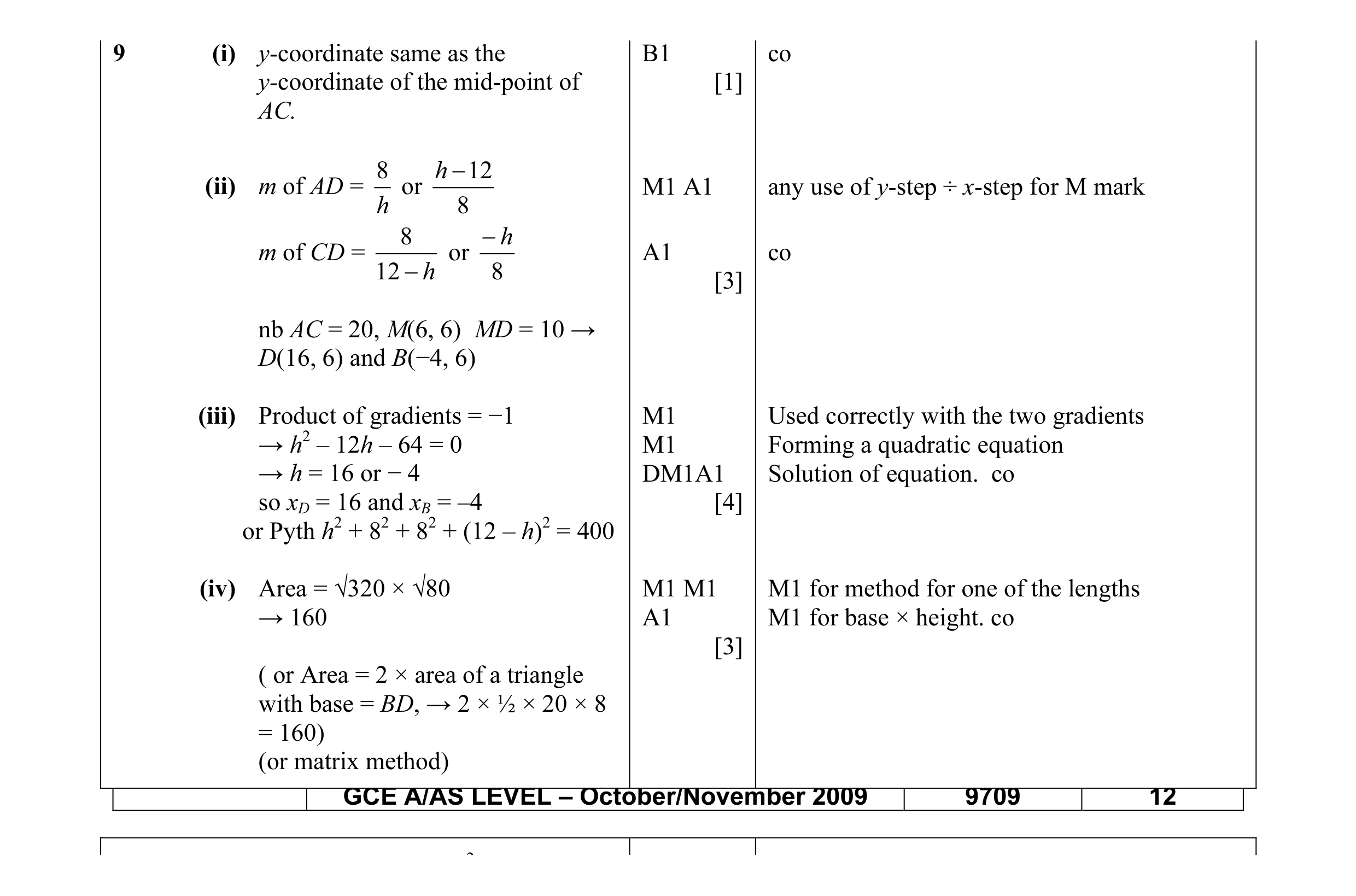 11
11 6
6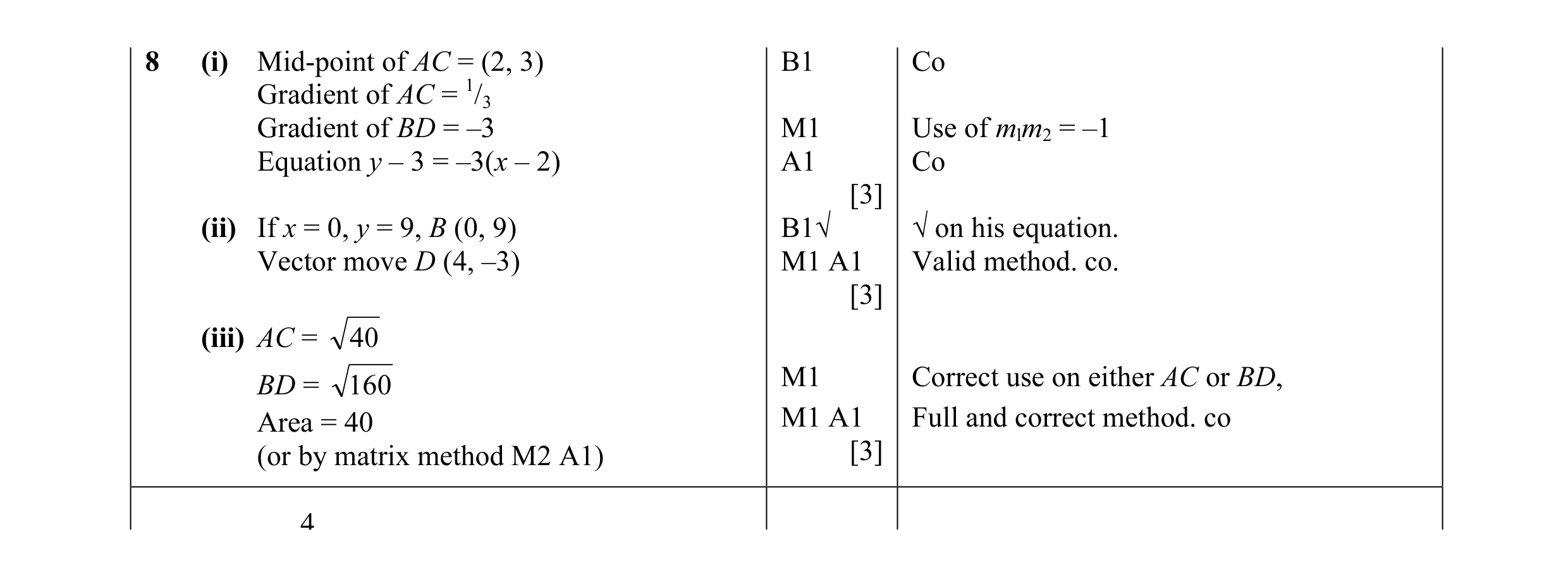 9
9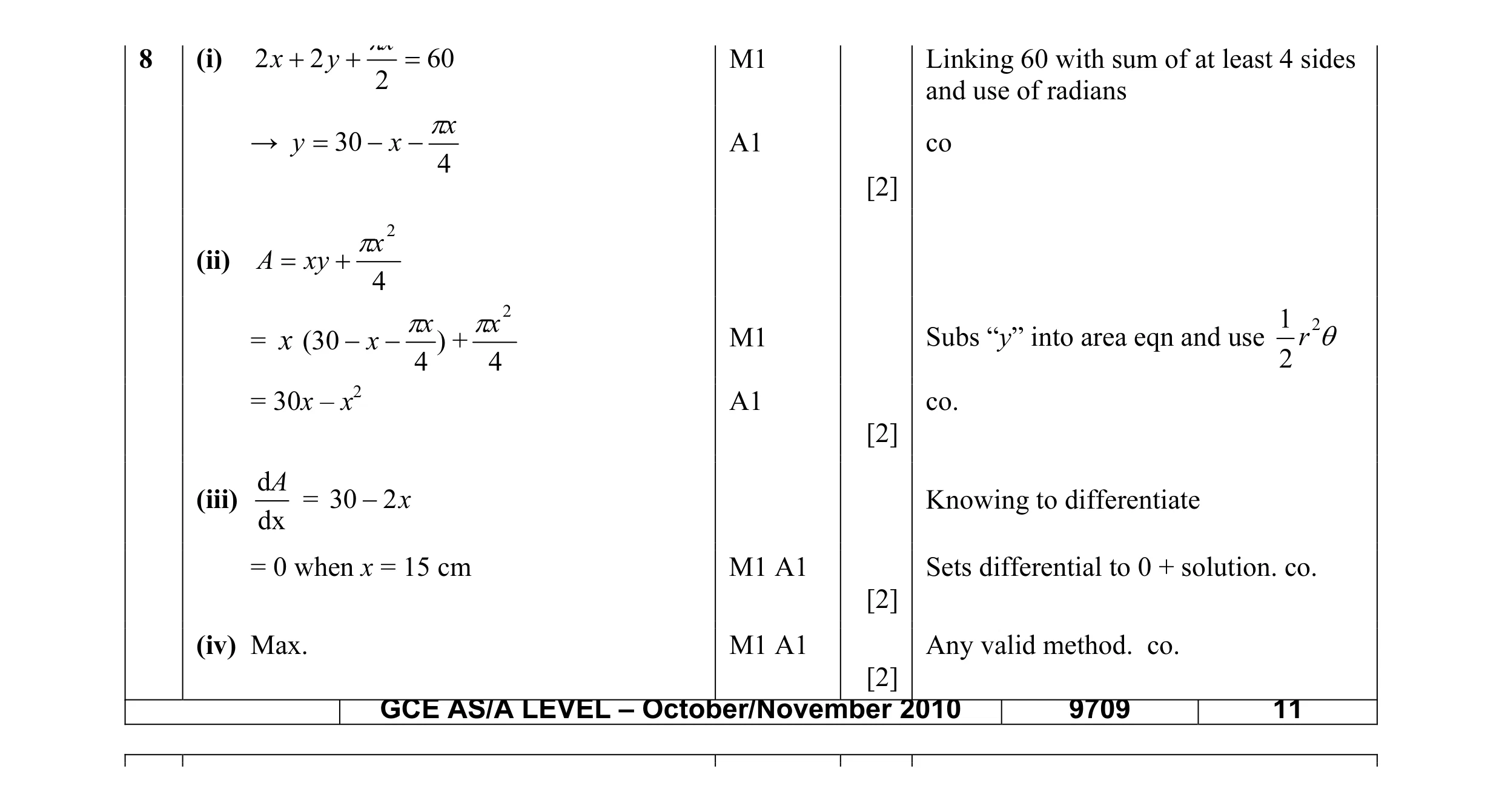 8
8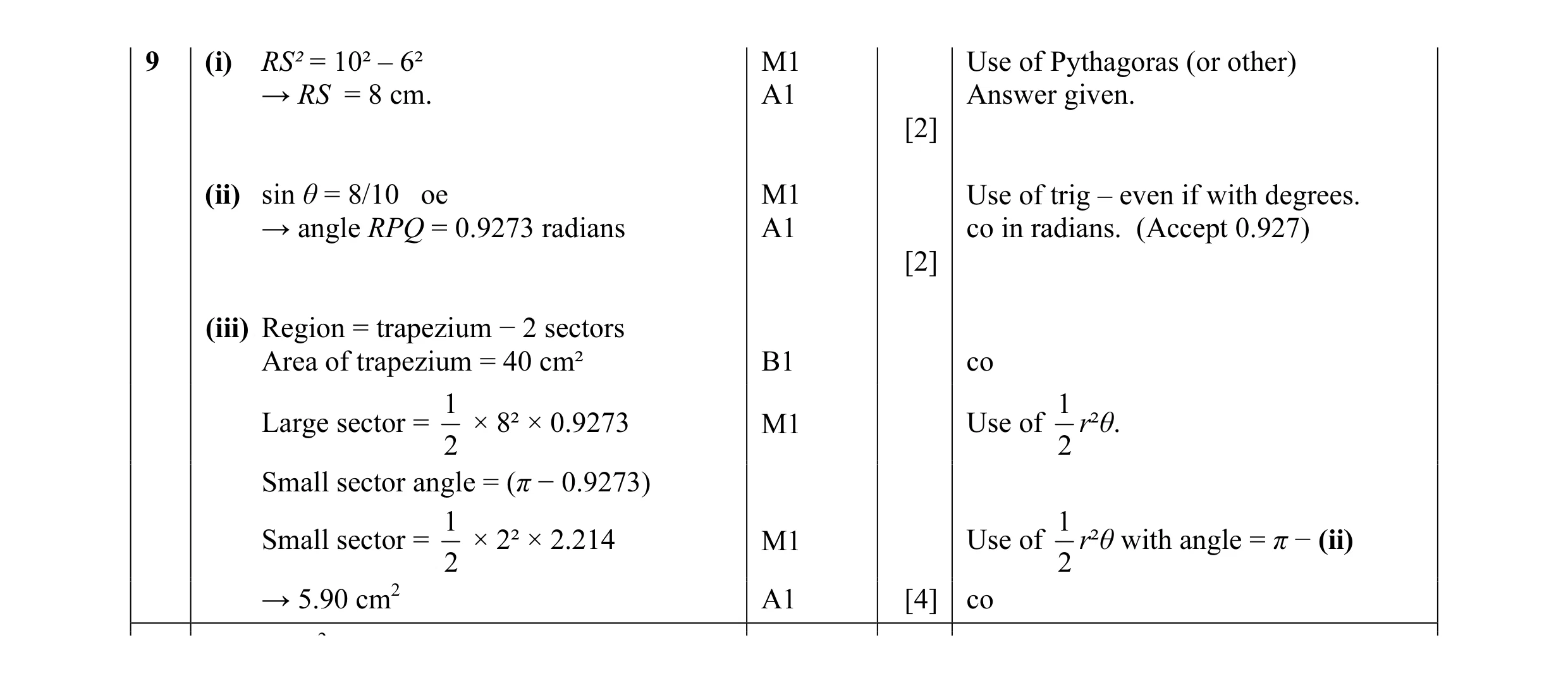 8
8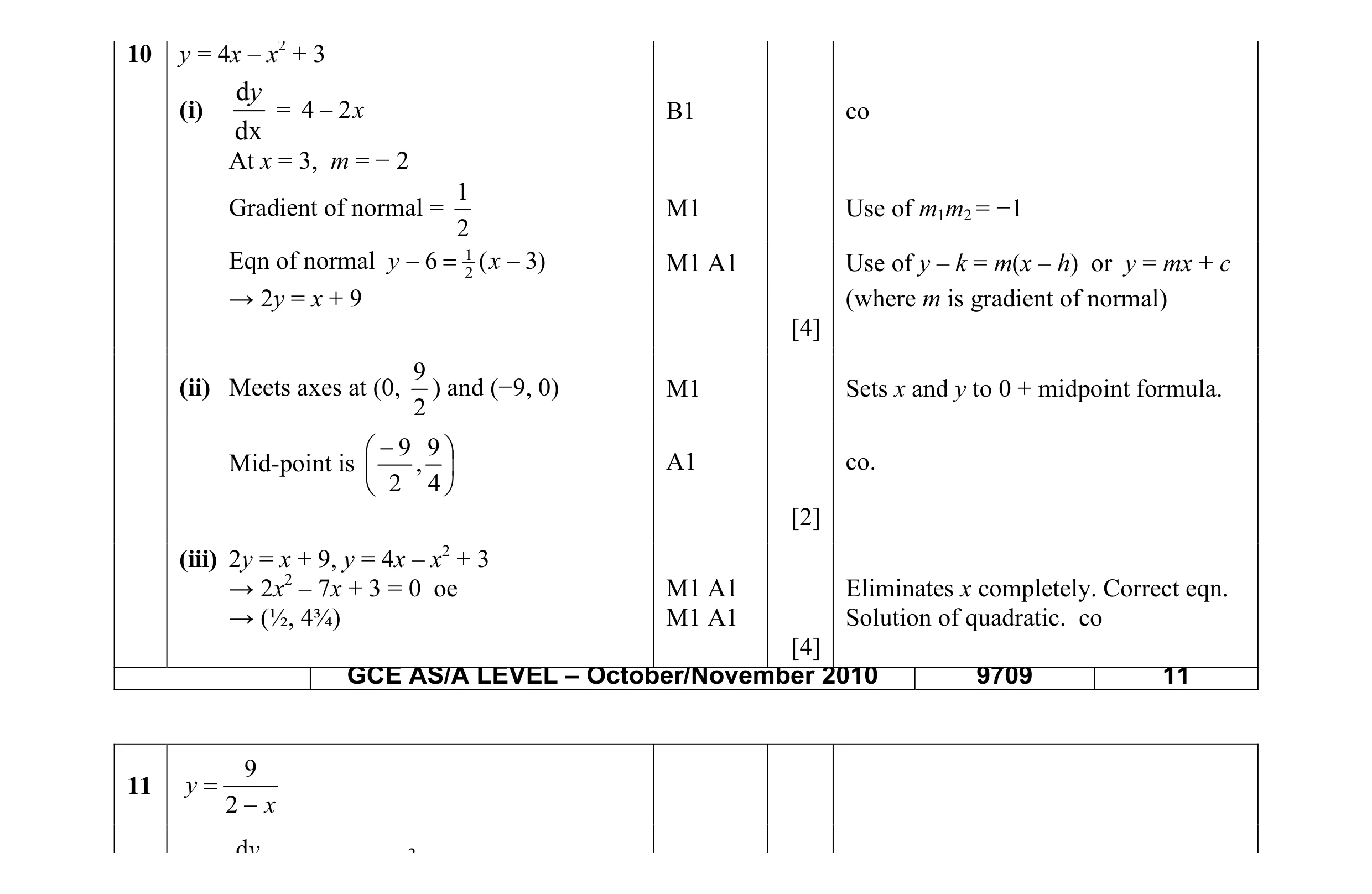 10
10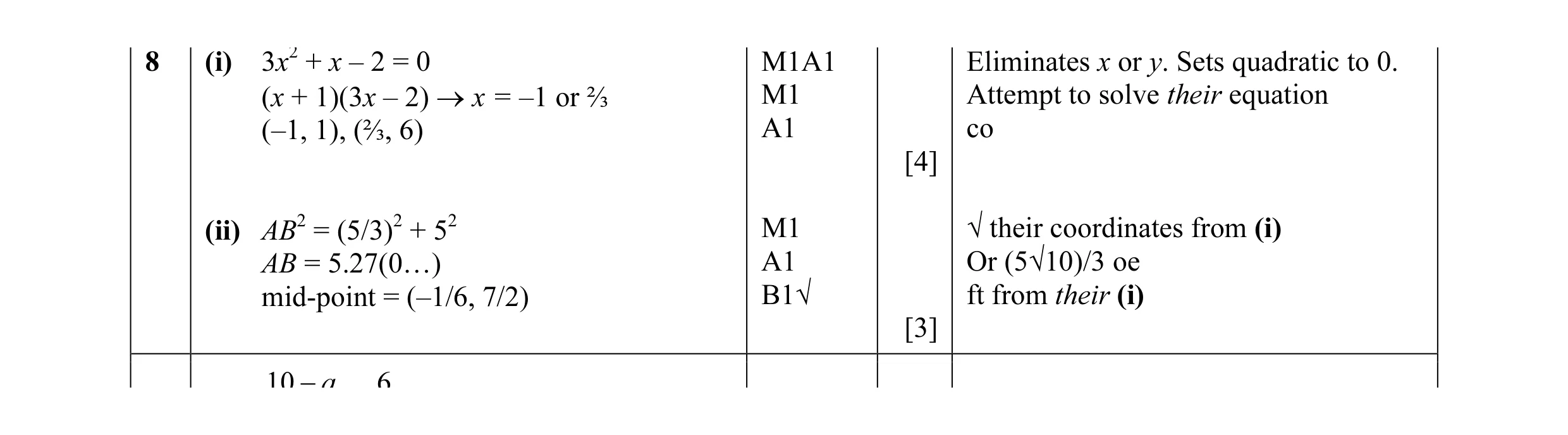 7
7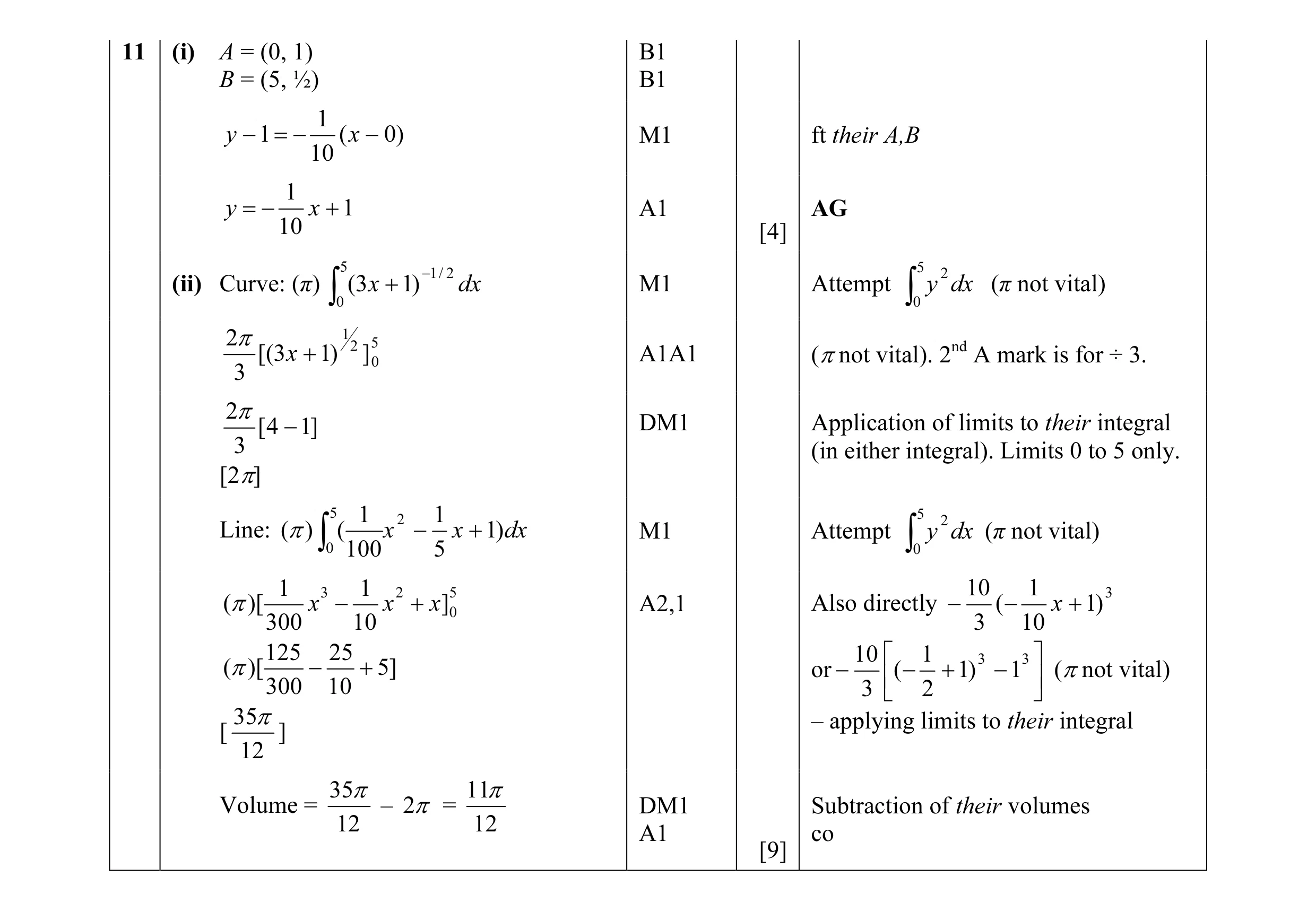 13
13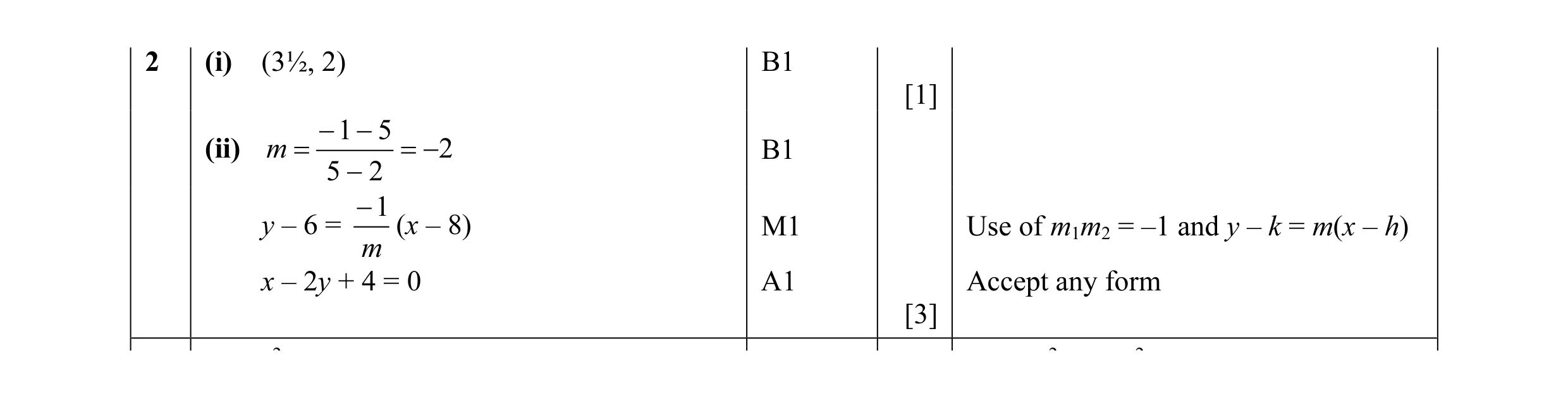 4
4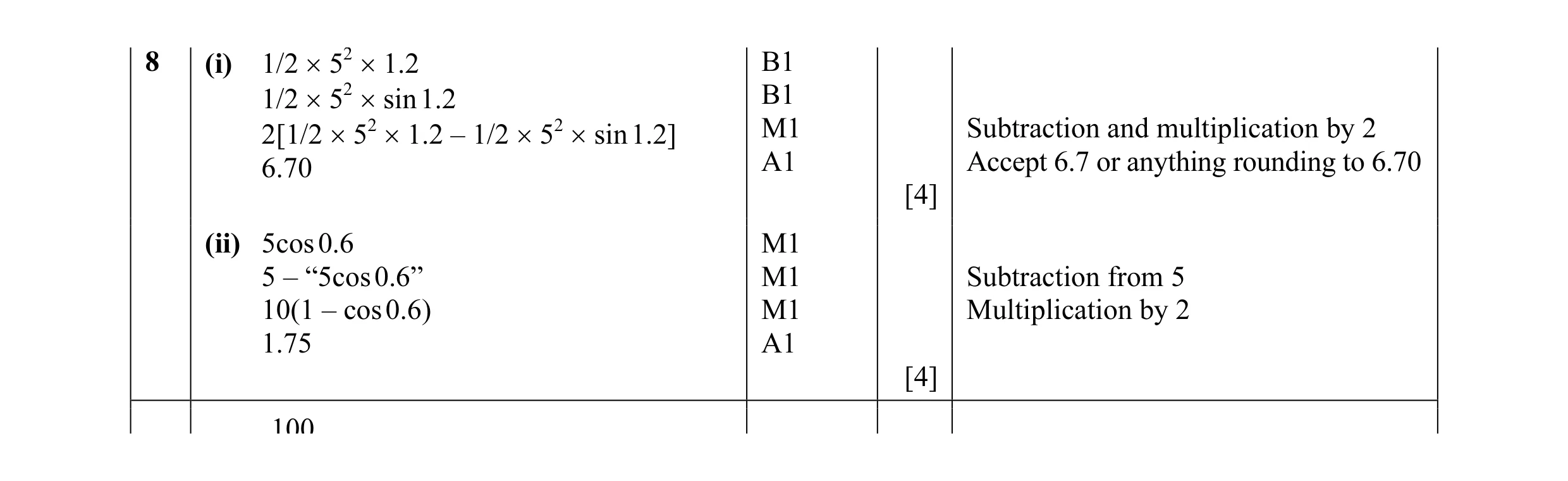 8
8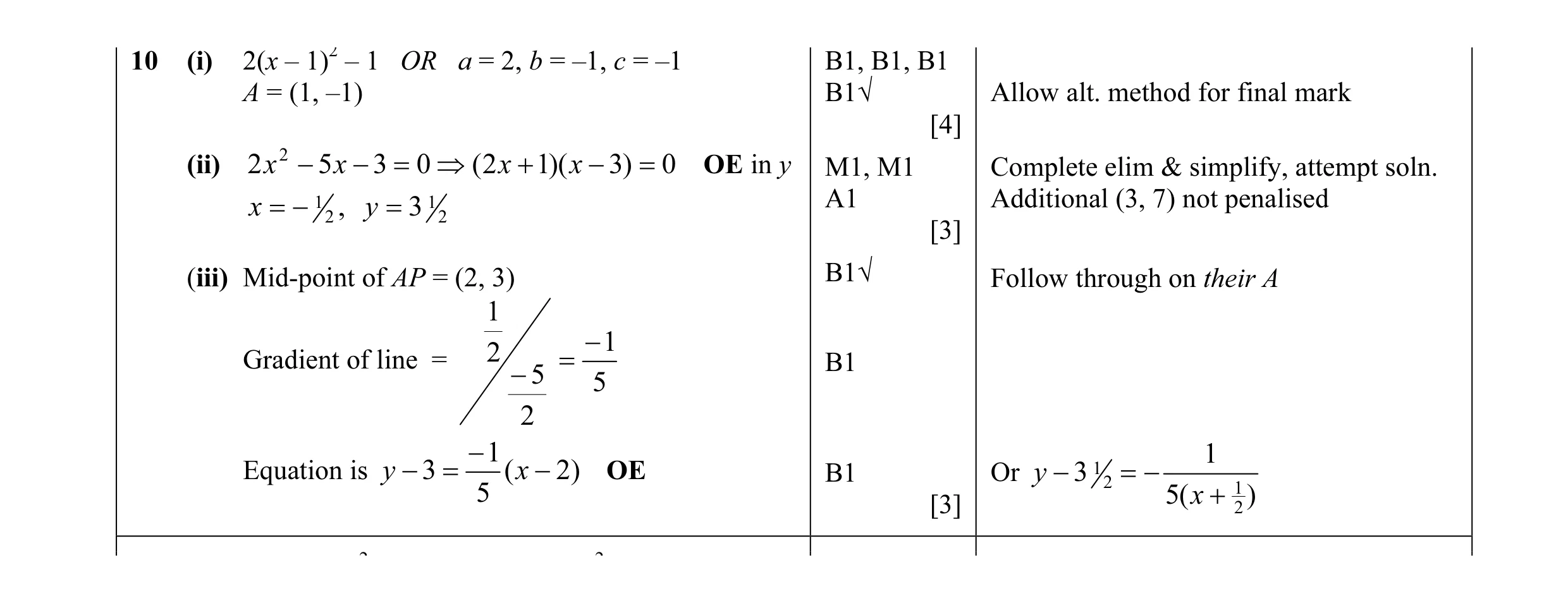 10
10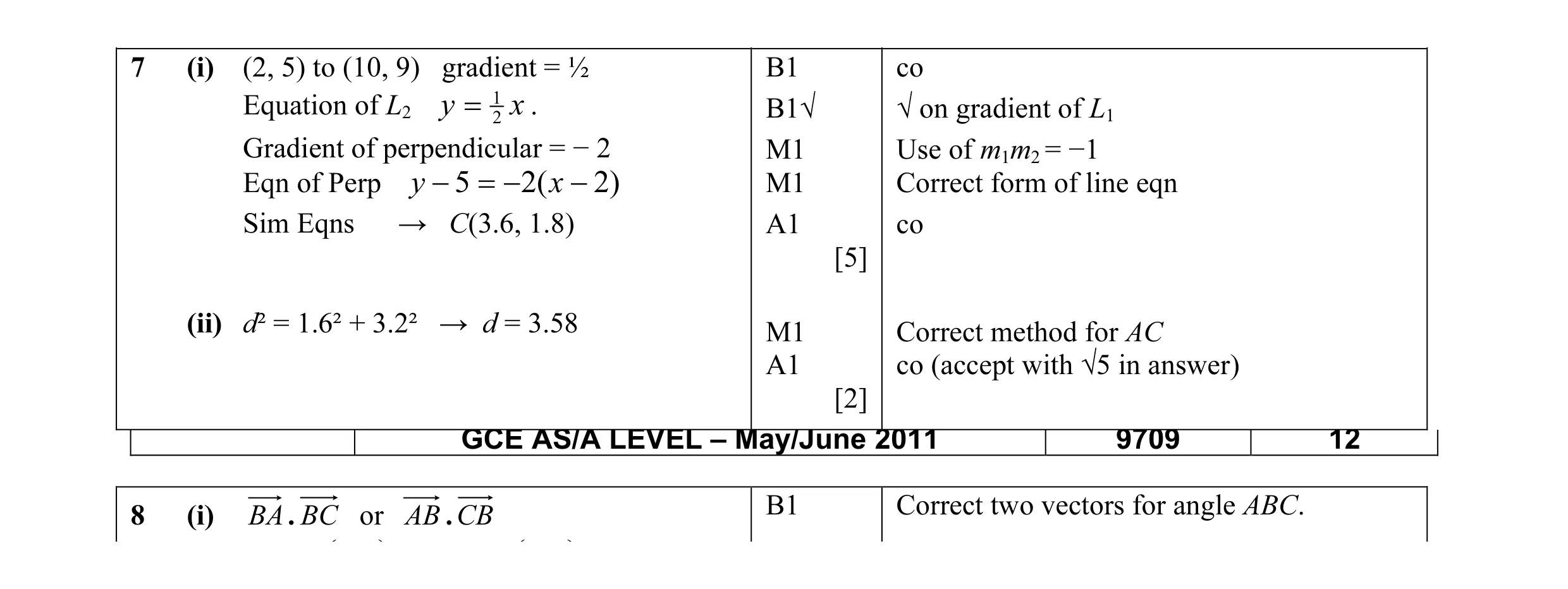 7
7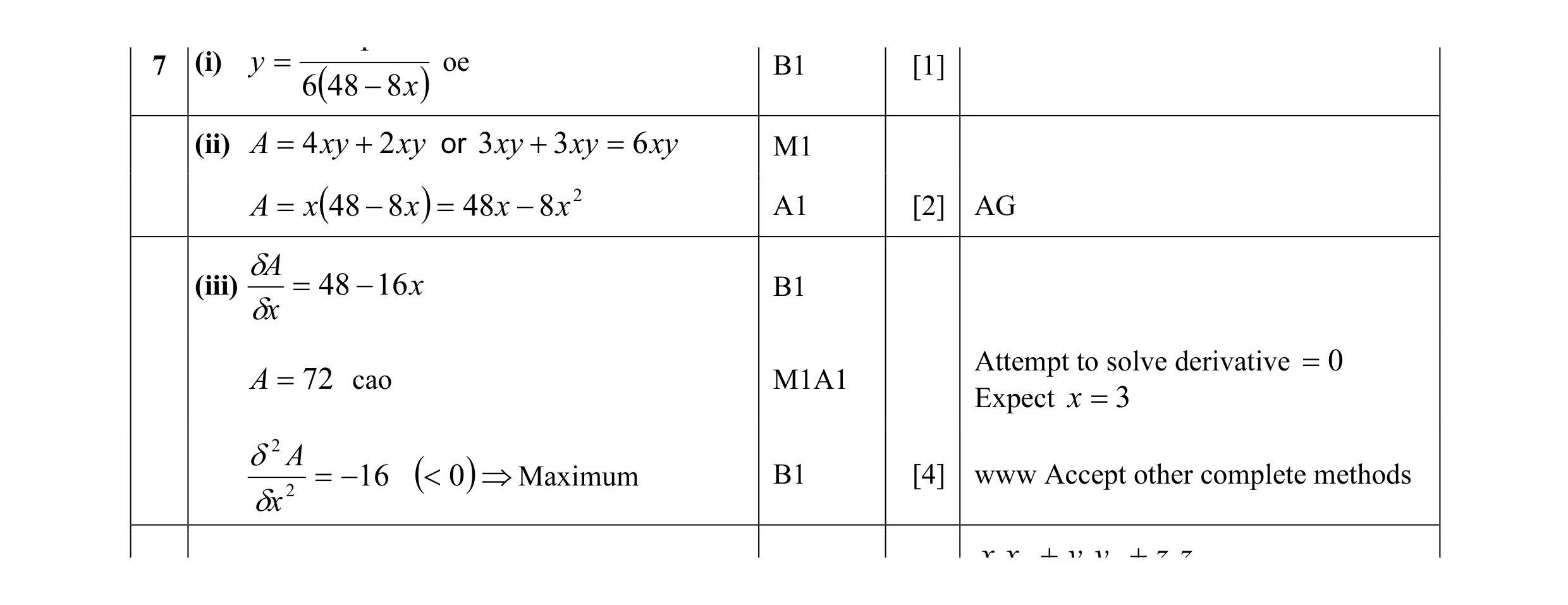 7
7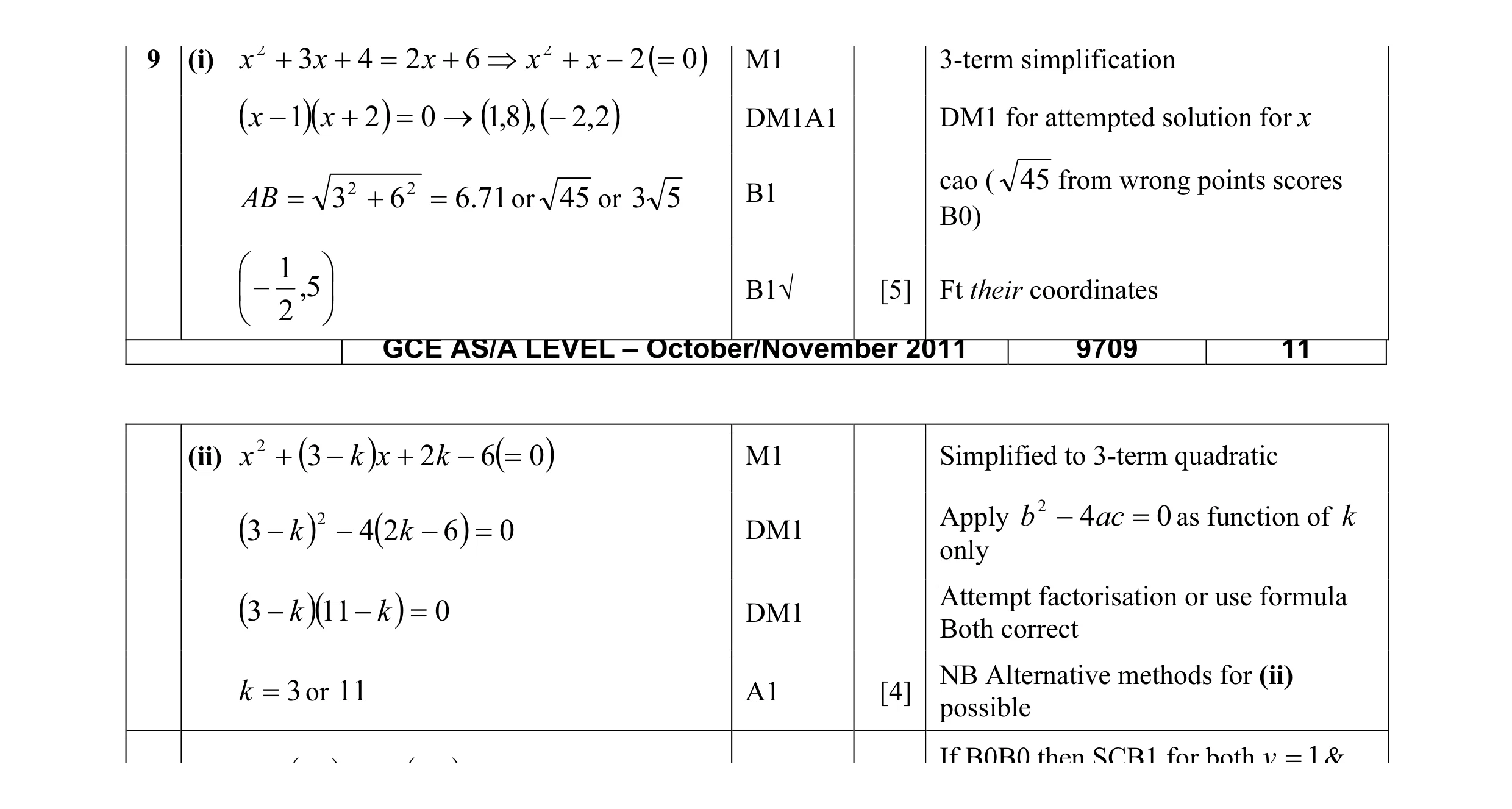 9
9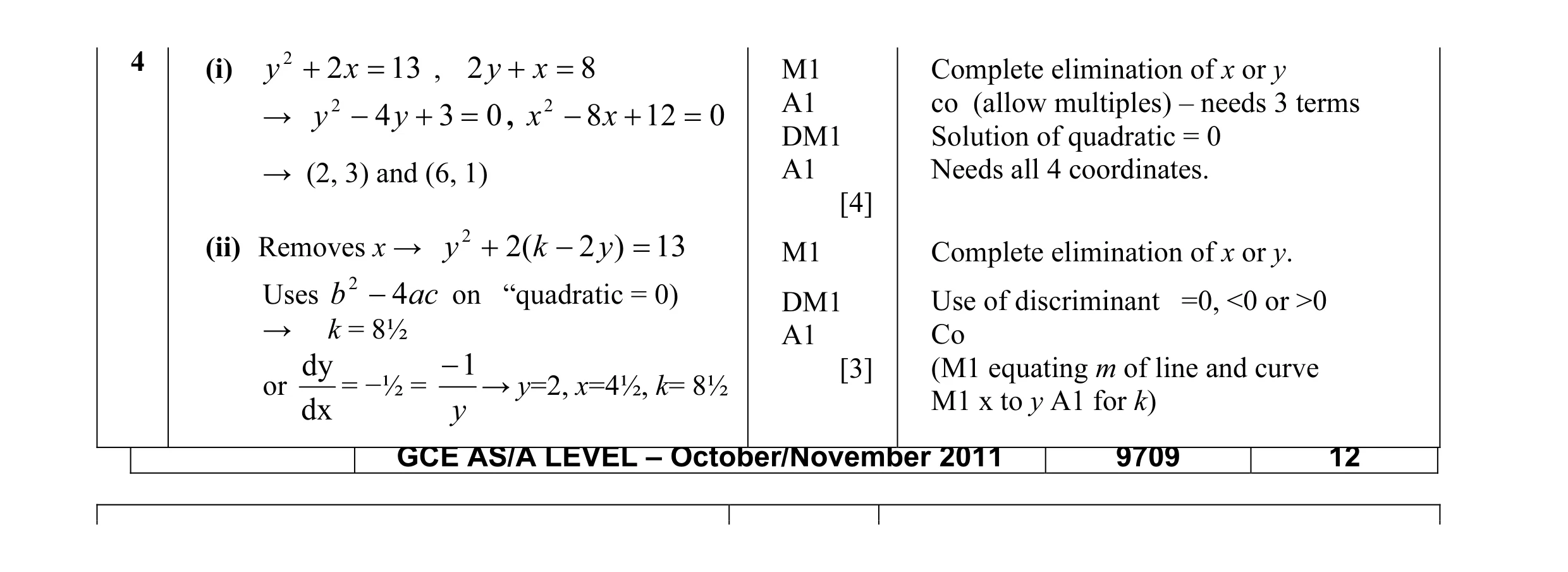 7
7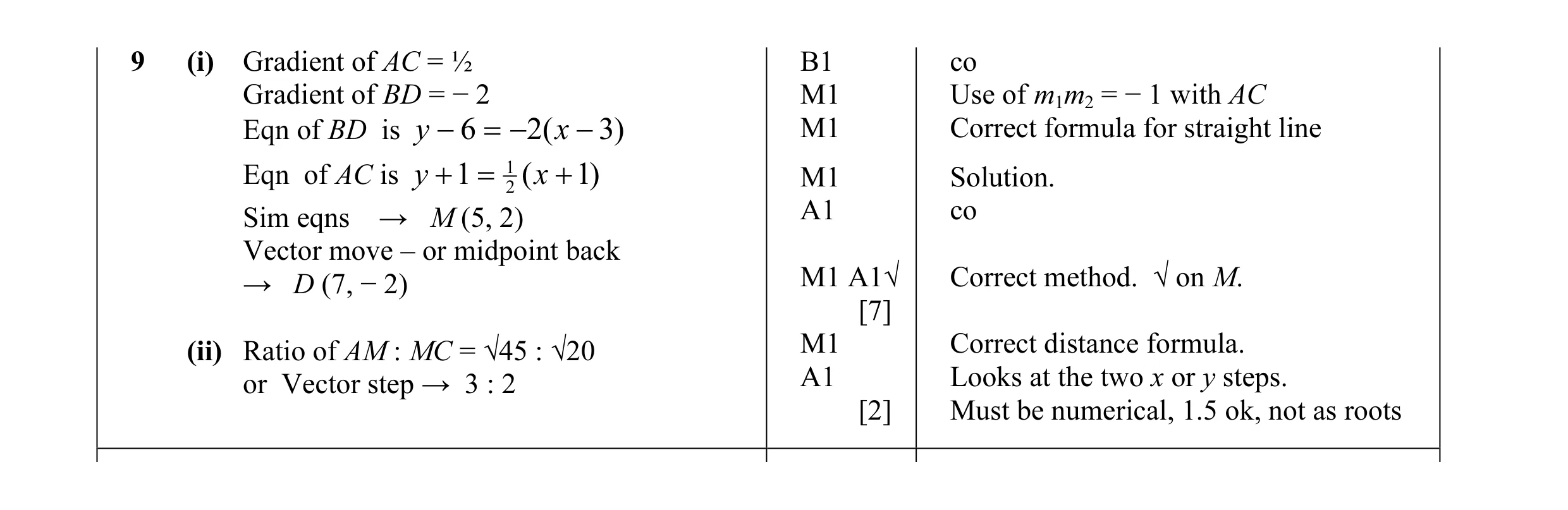 9
9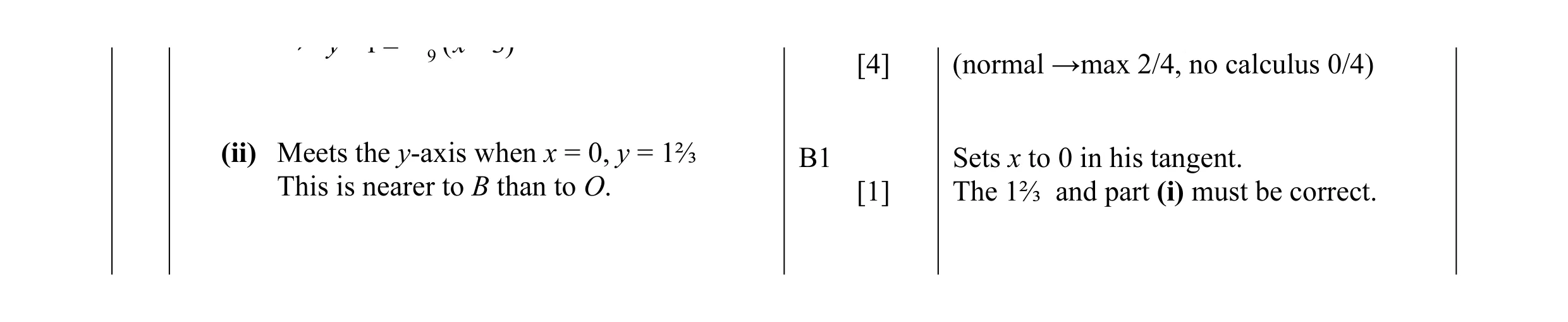 9
9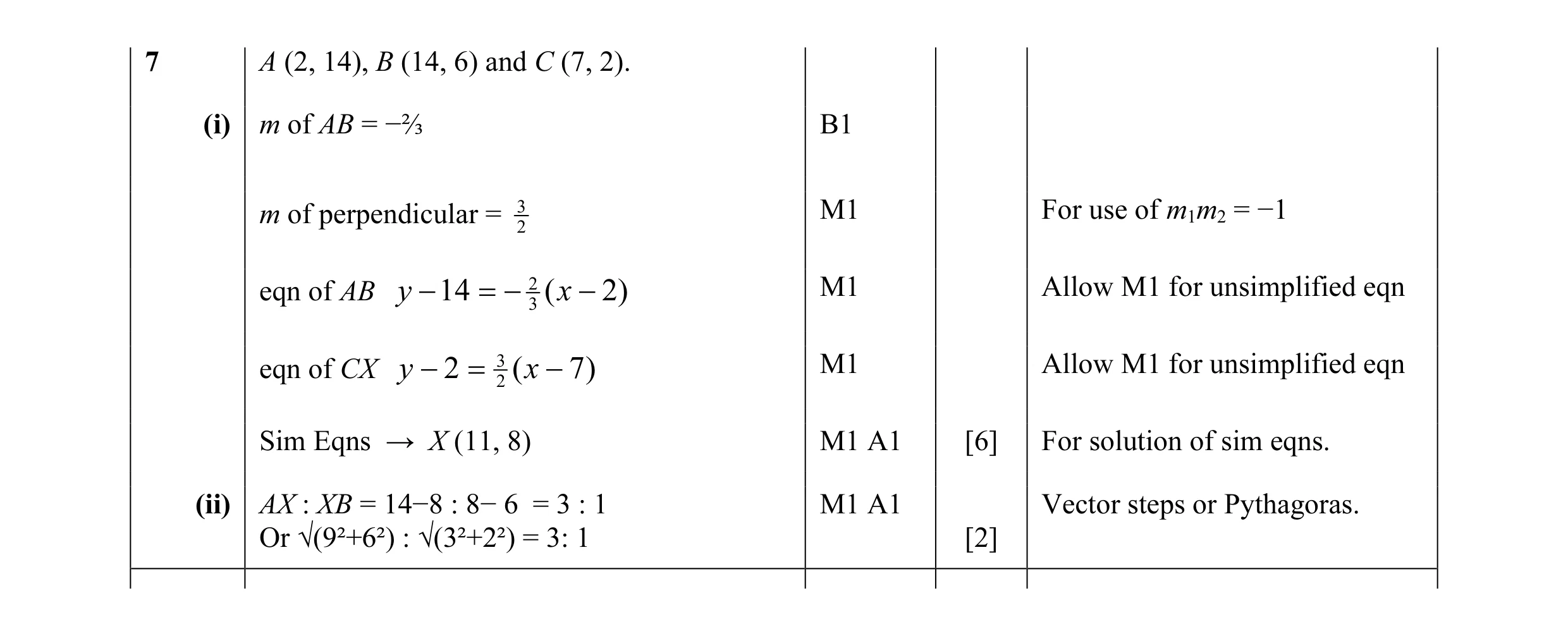 8
8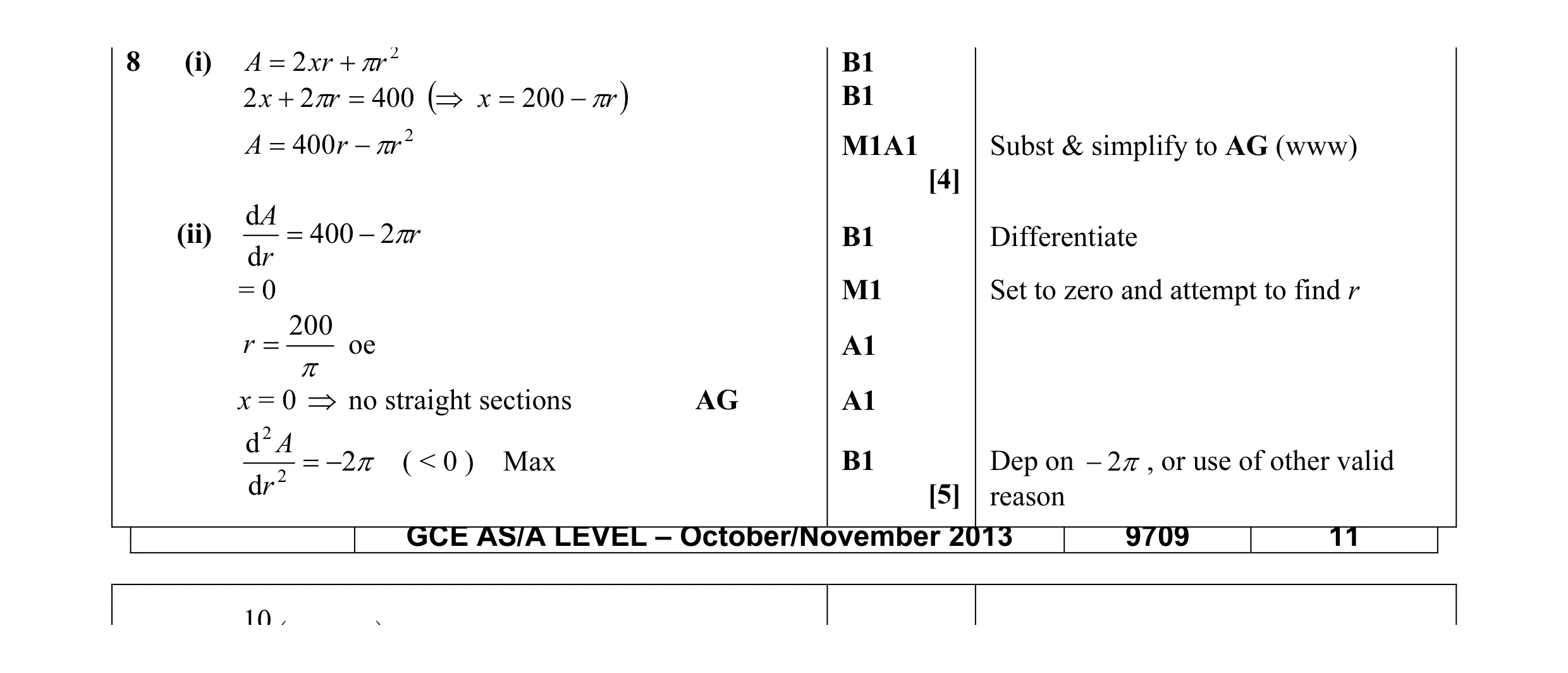 9
9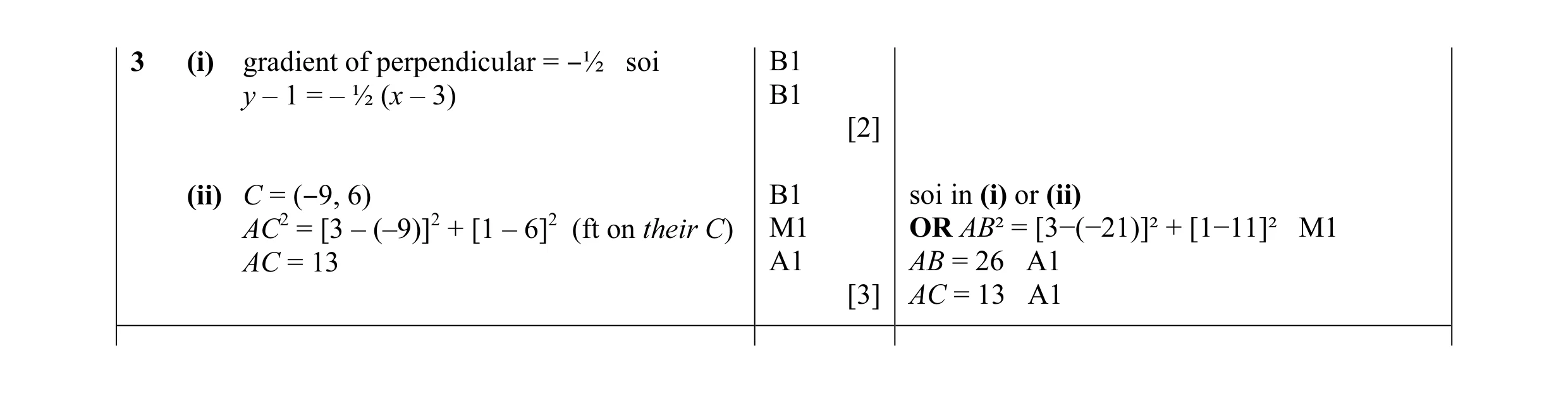 5
5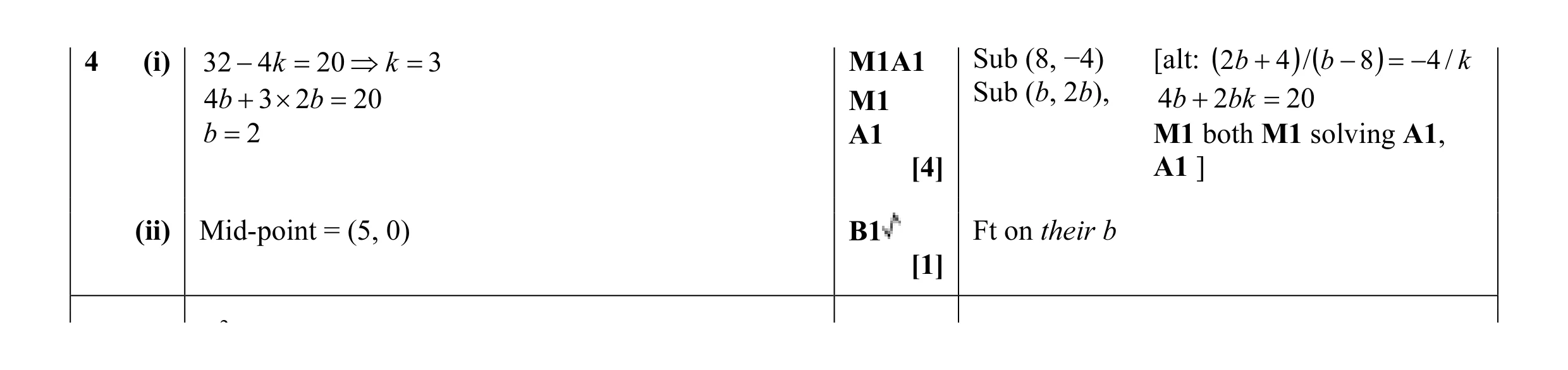 5
5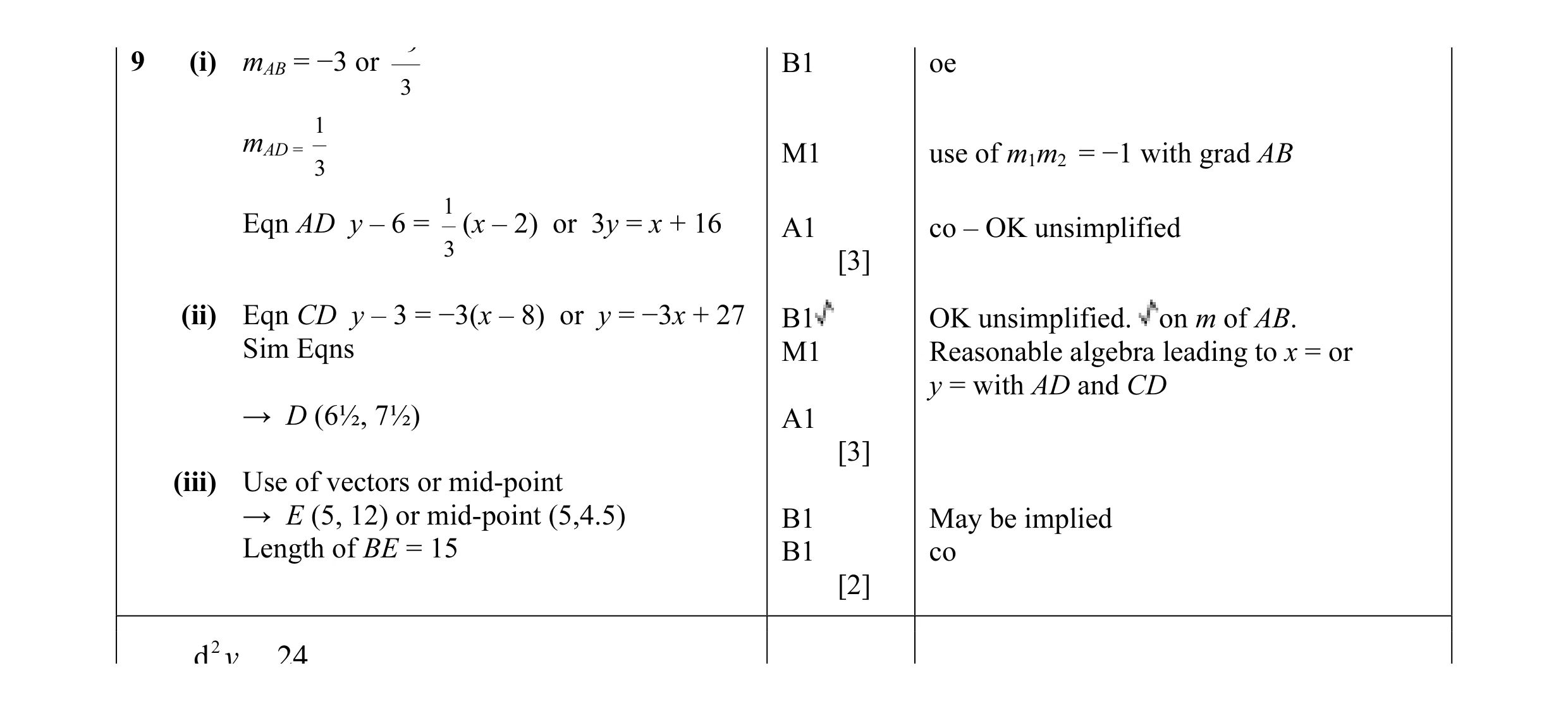 8
8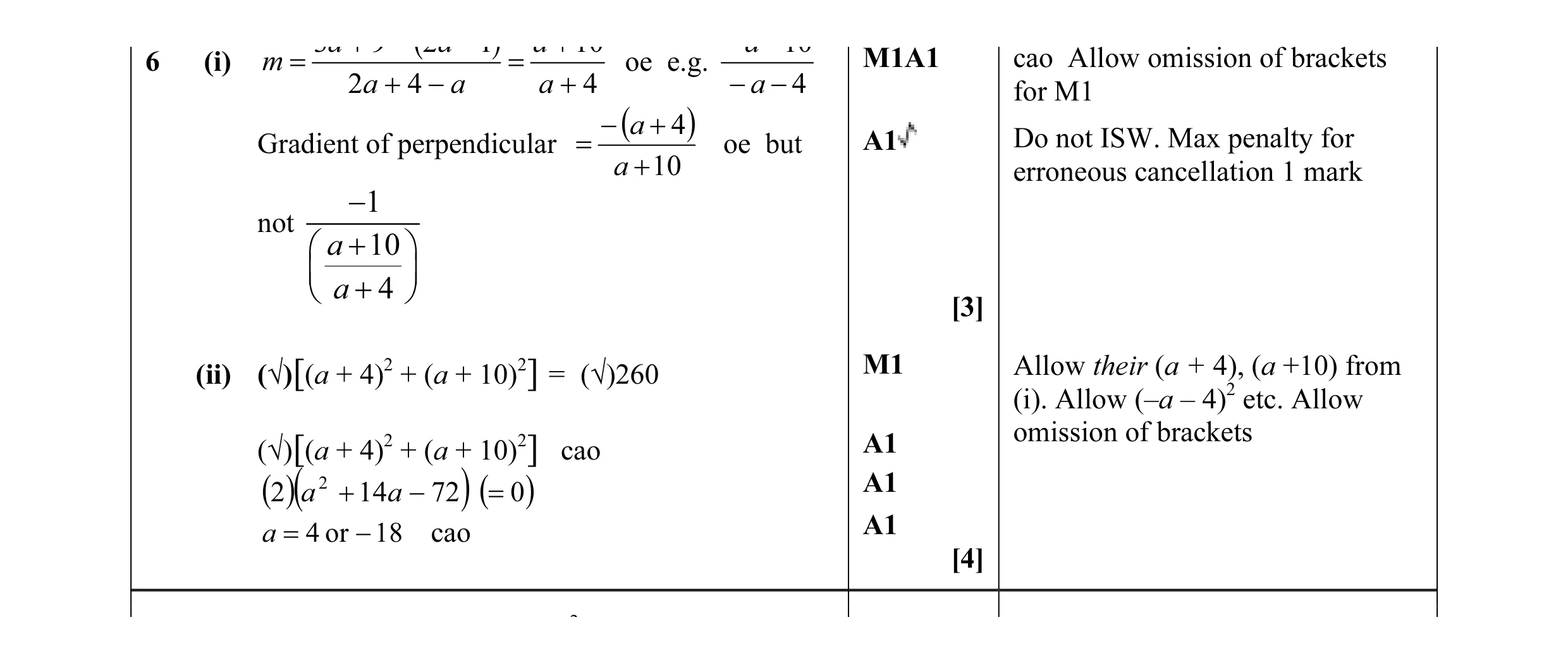 7
7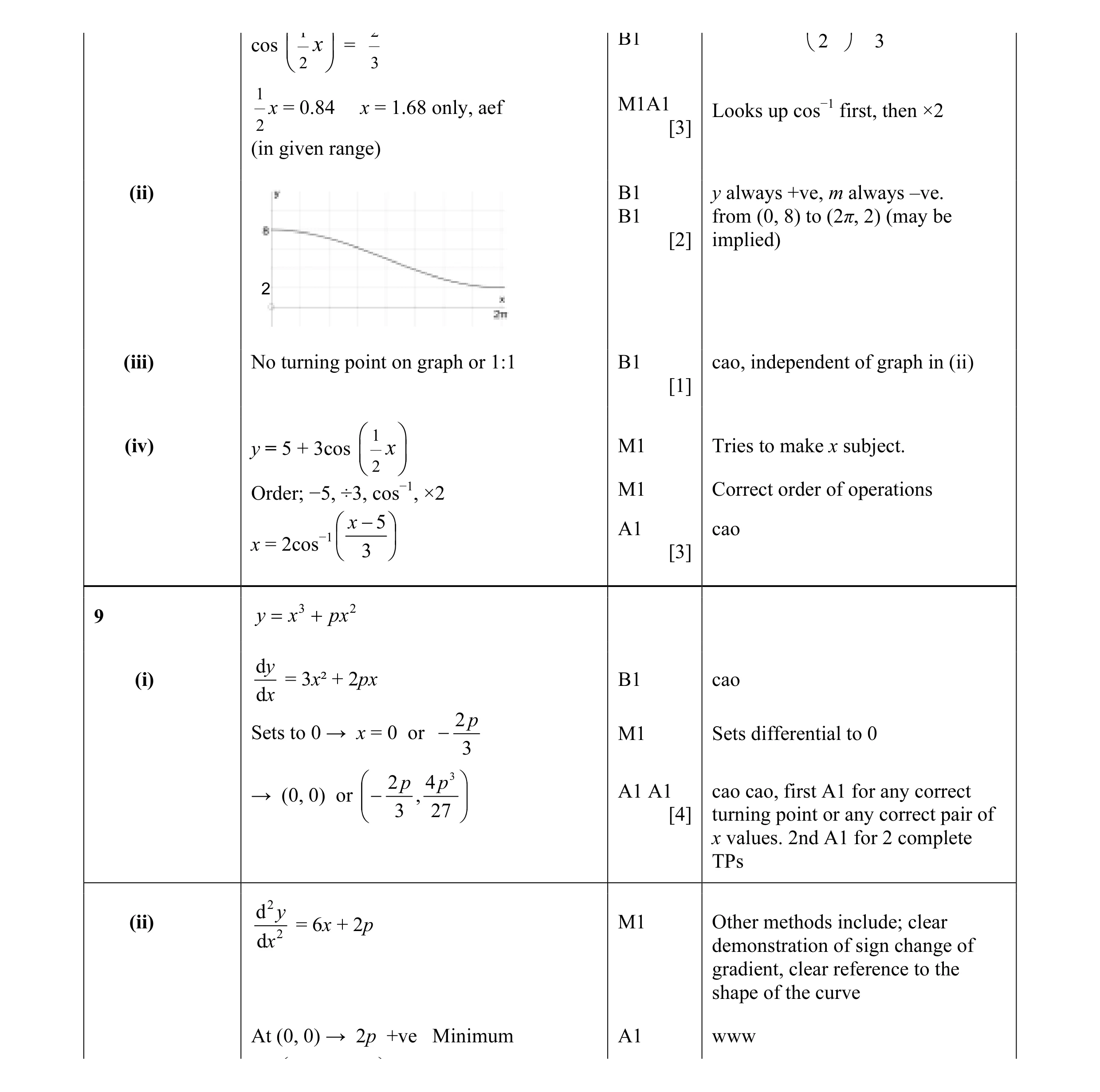 5
5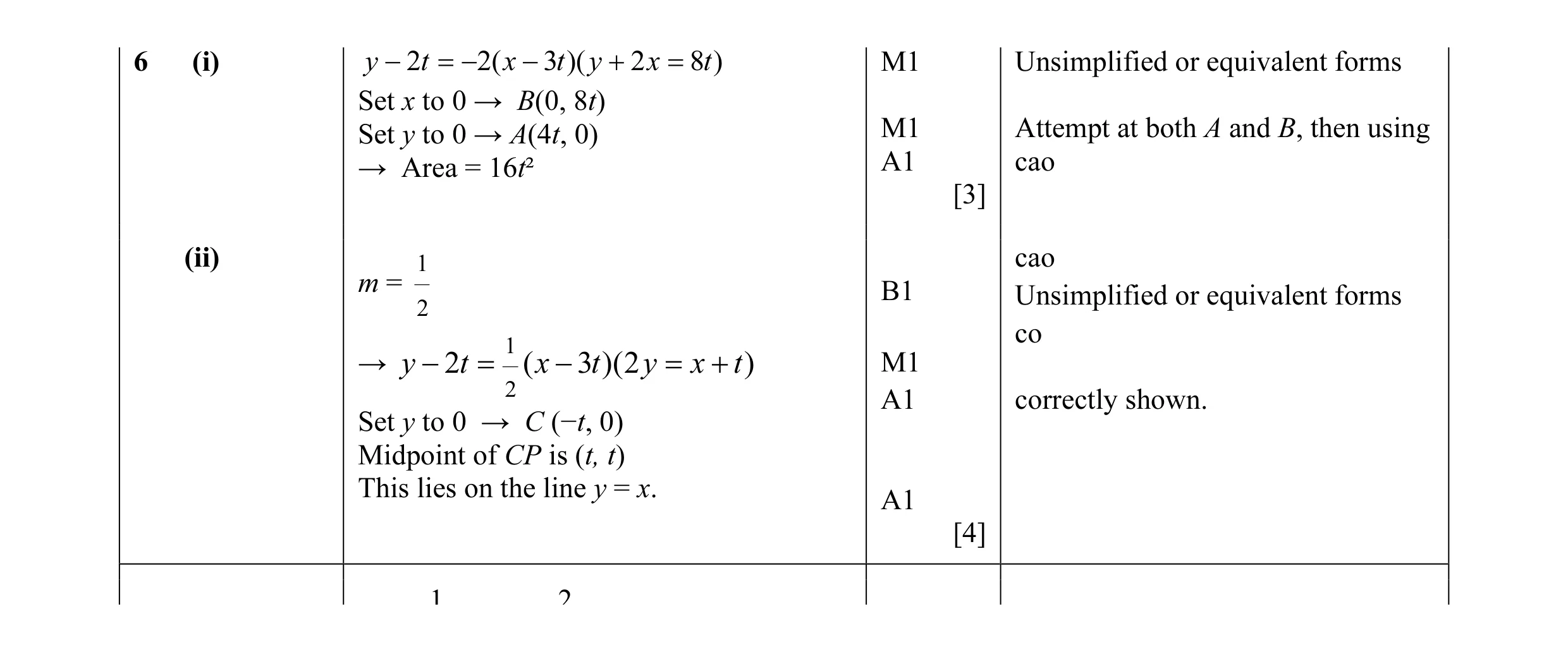 7
7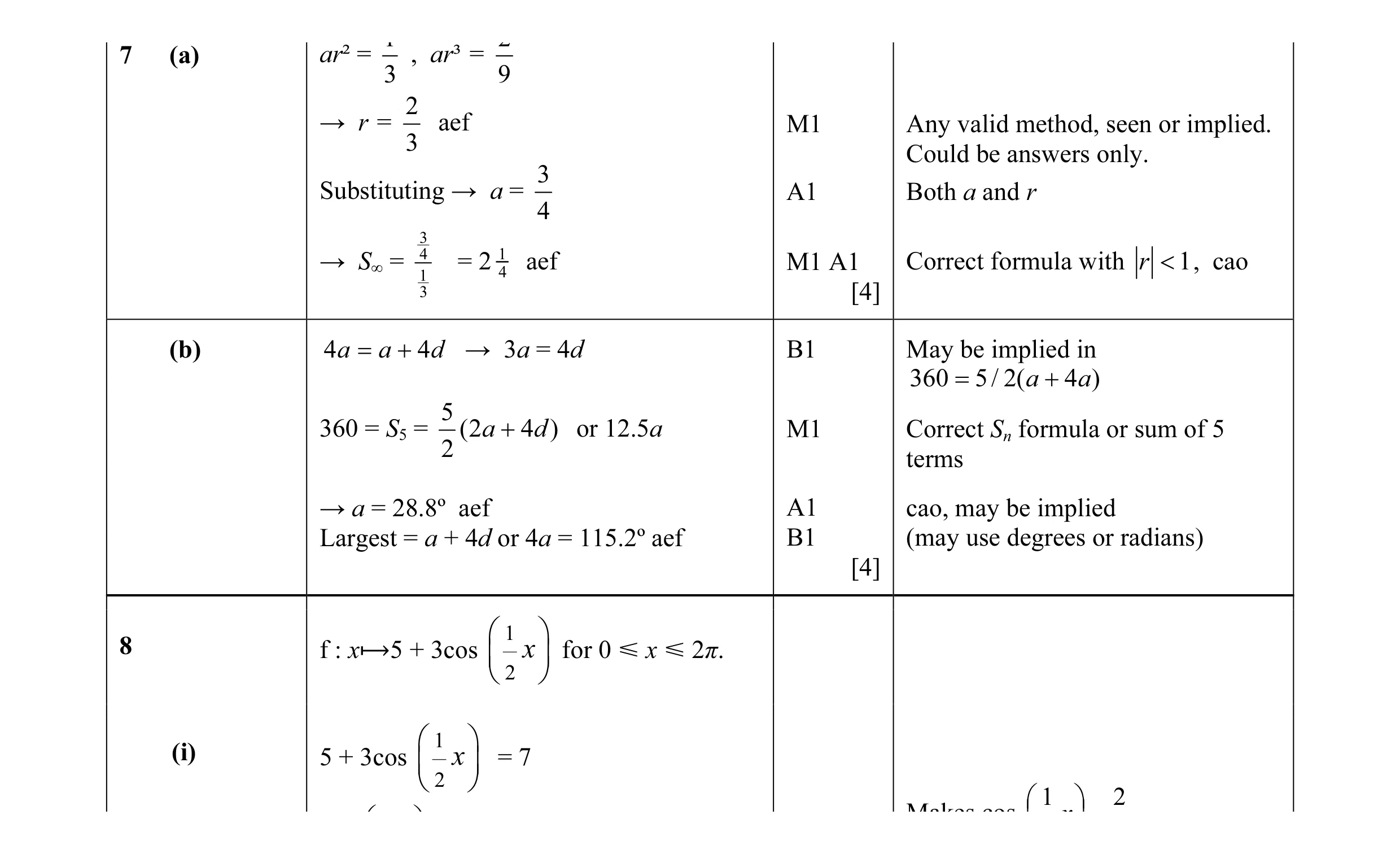 8
8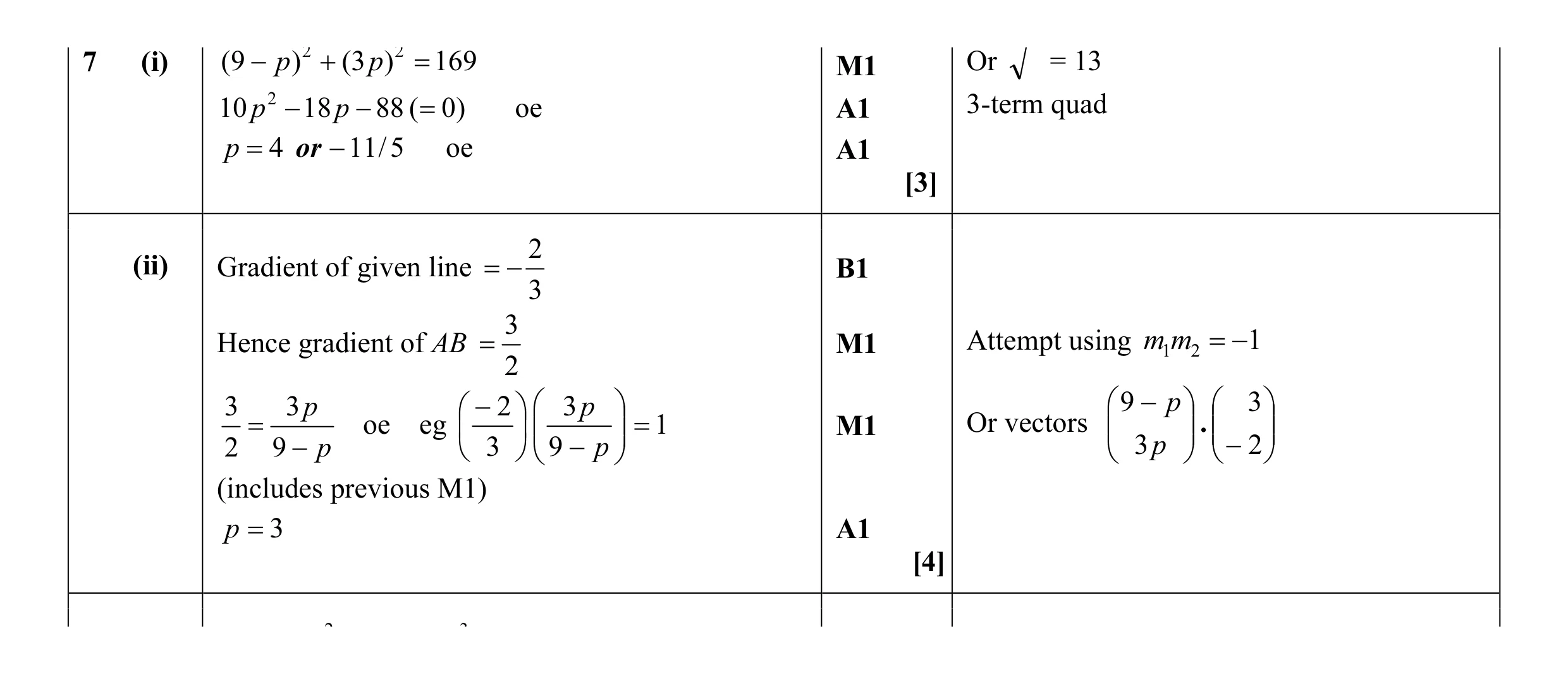 7
7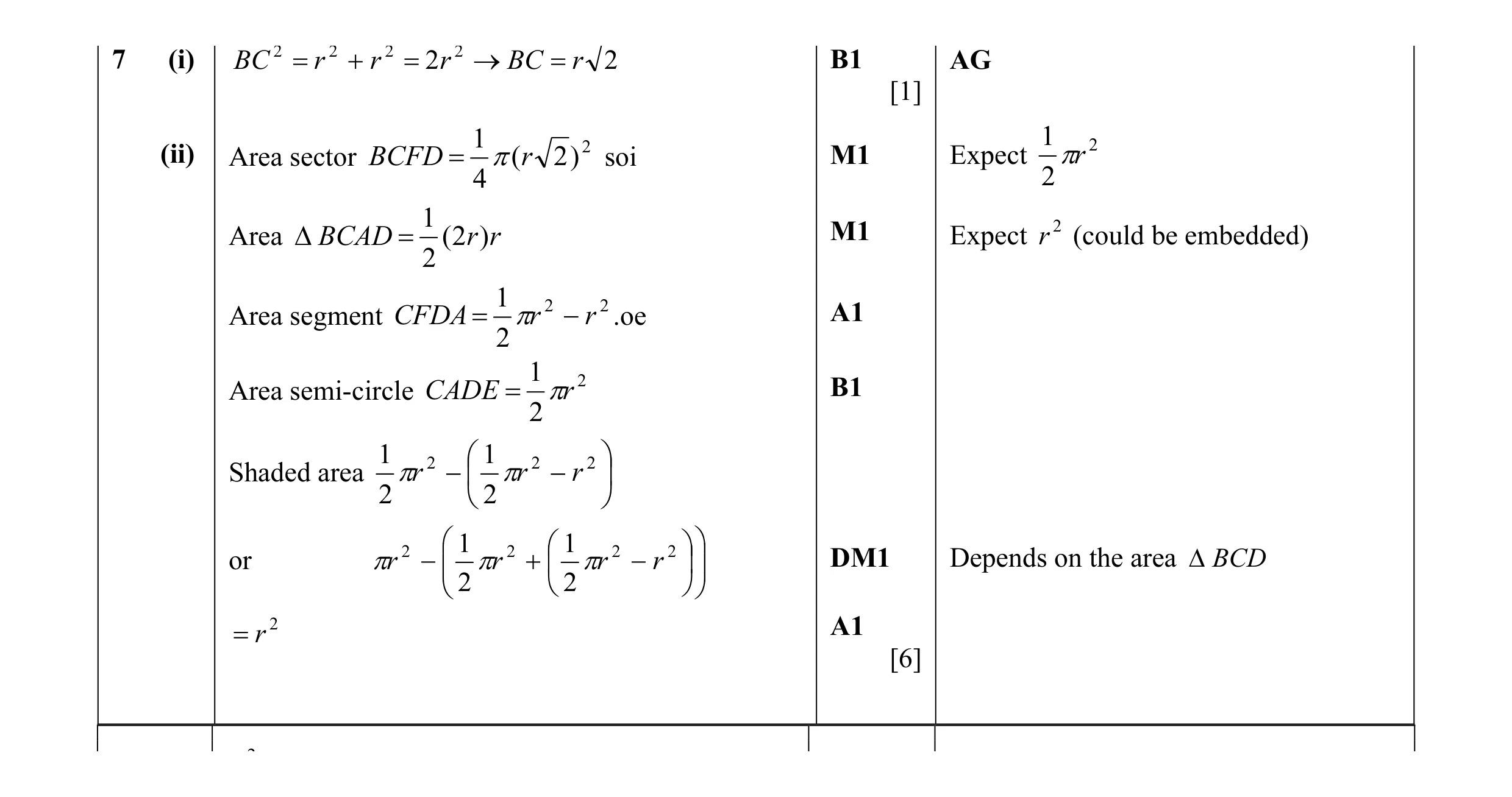 7
7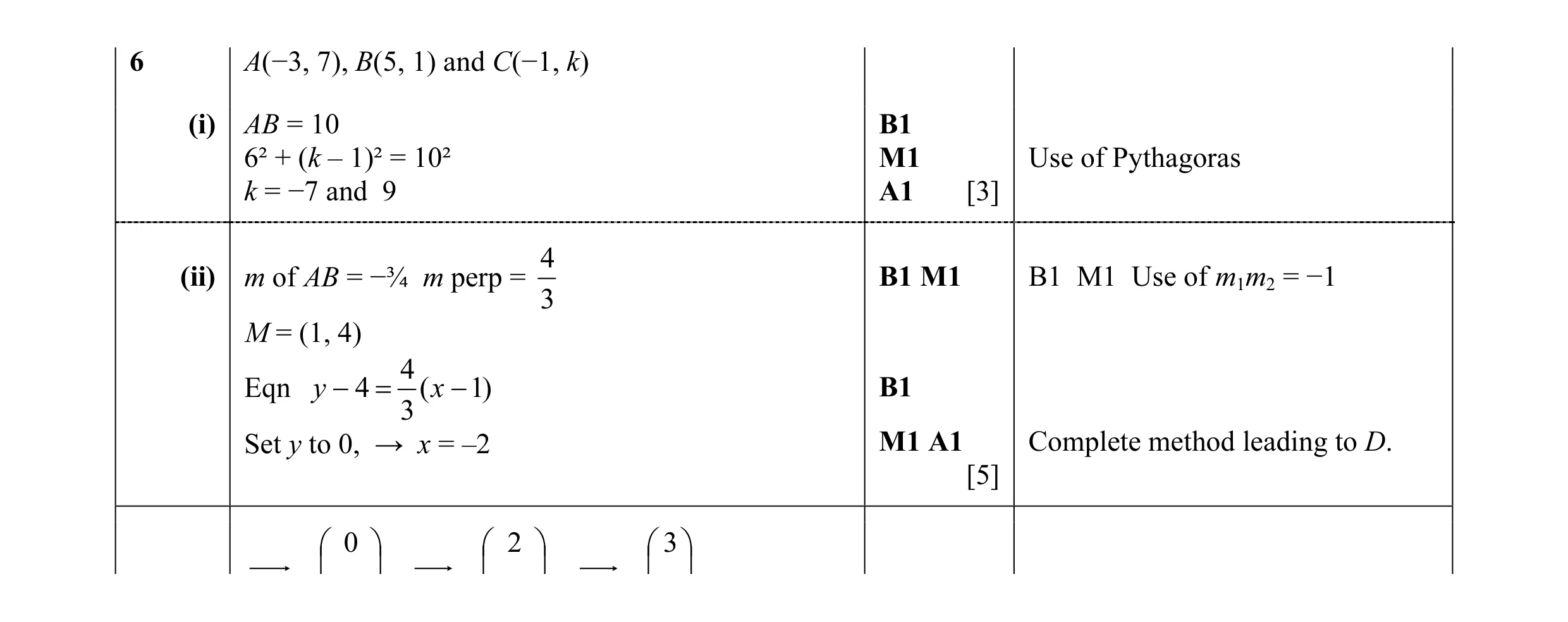 8
8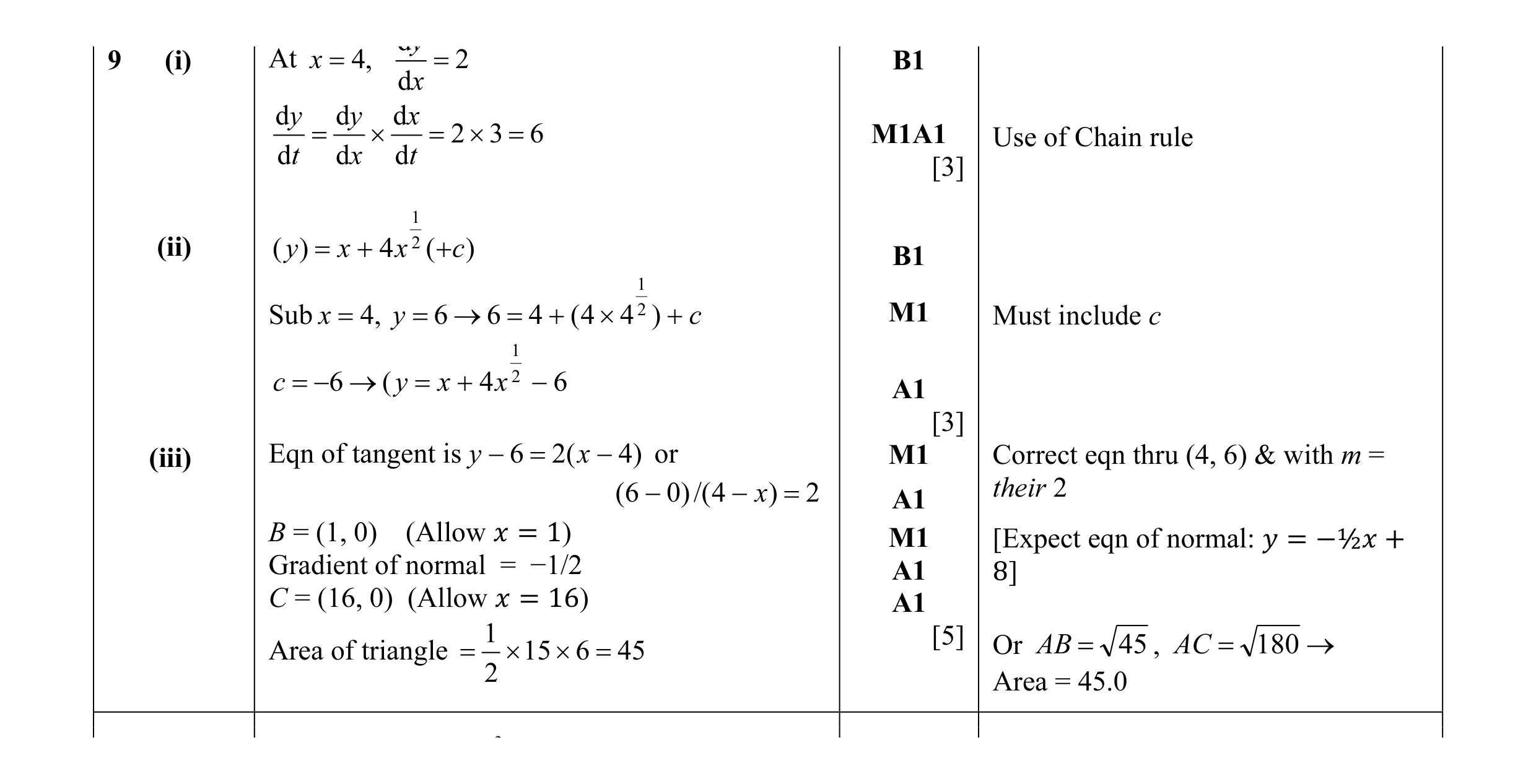 11
11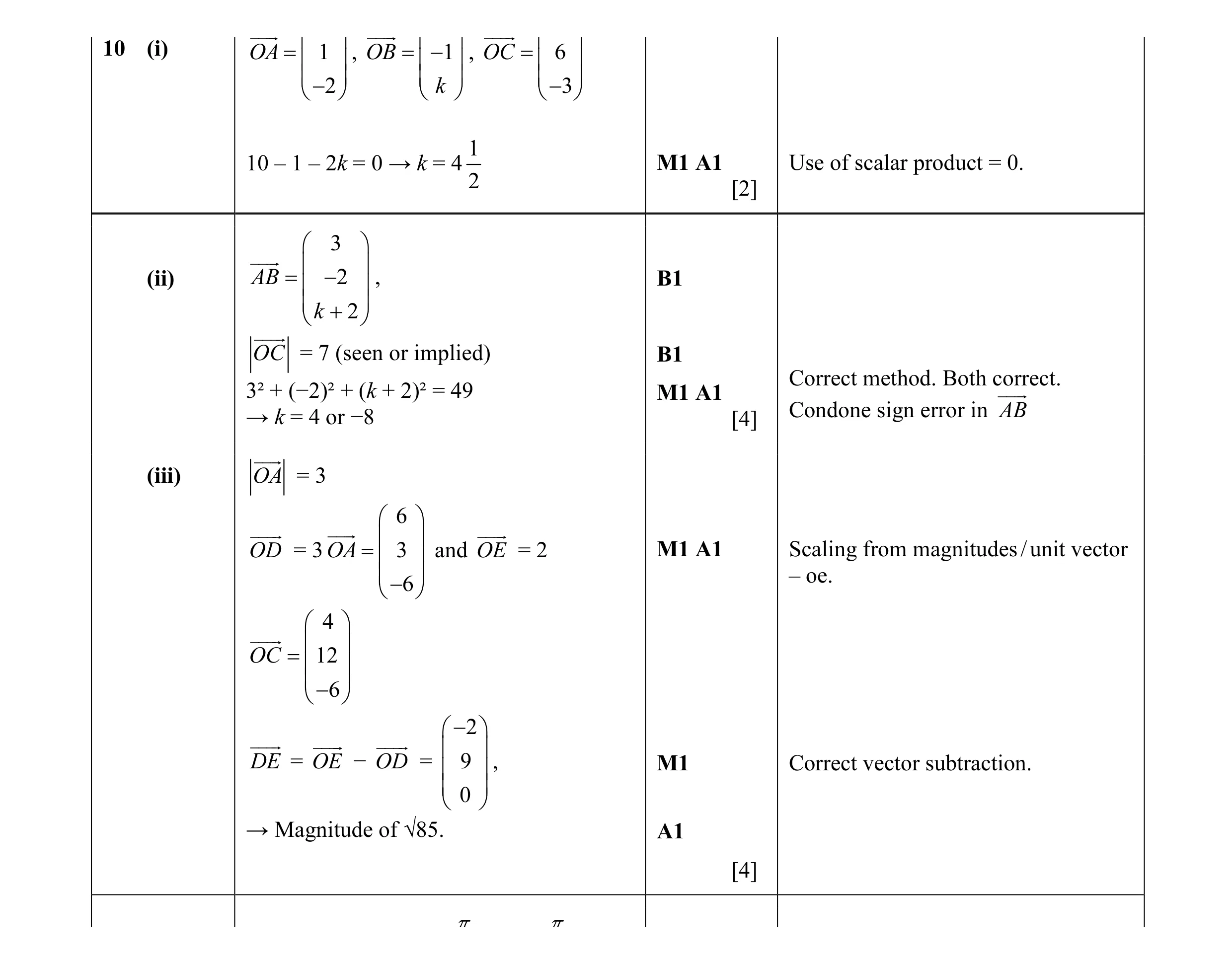 10
10 5
5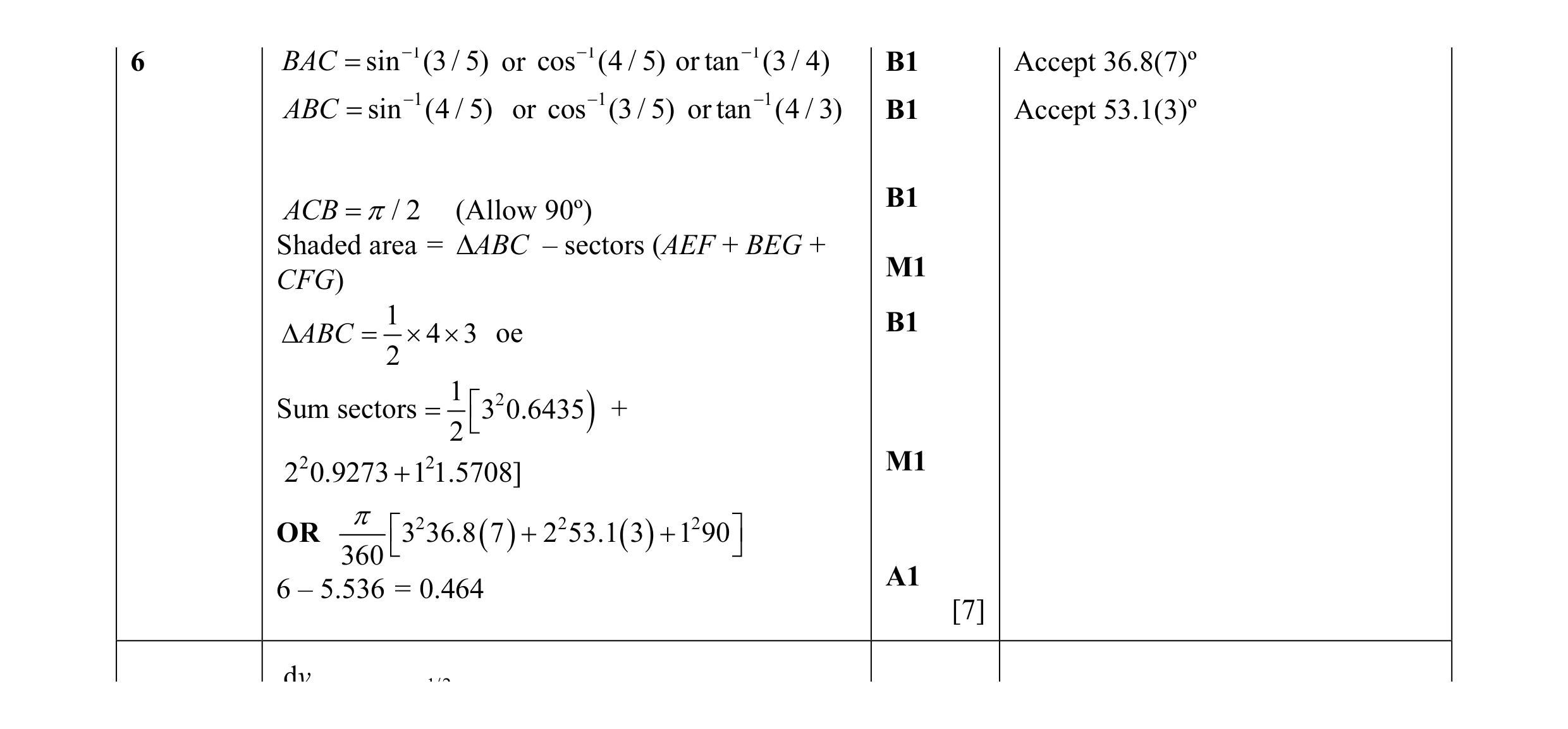 7
7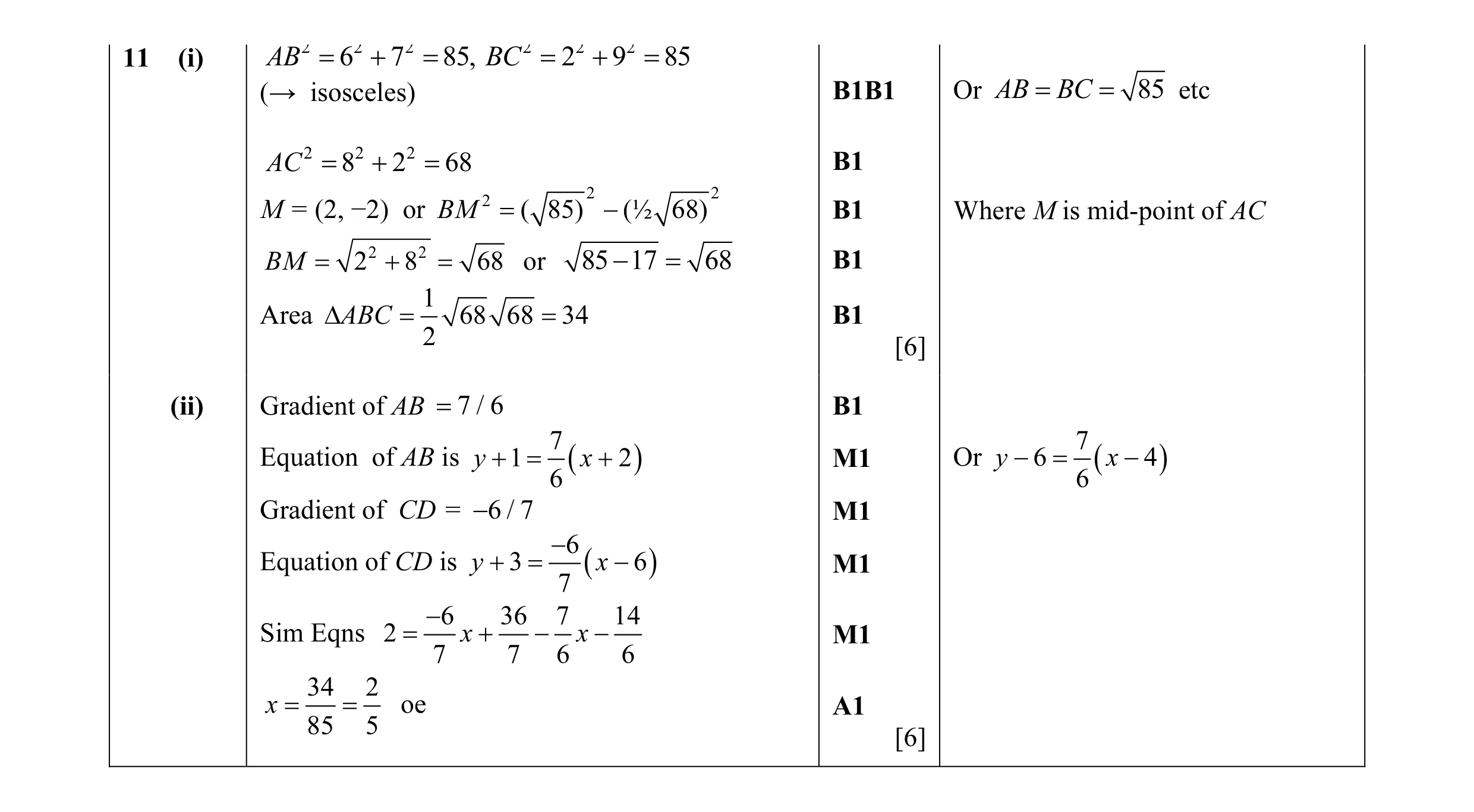 12
12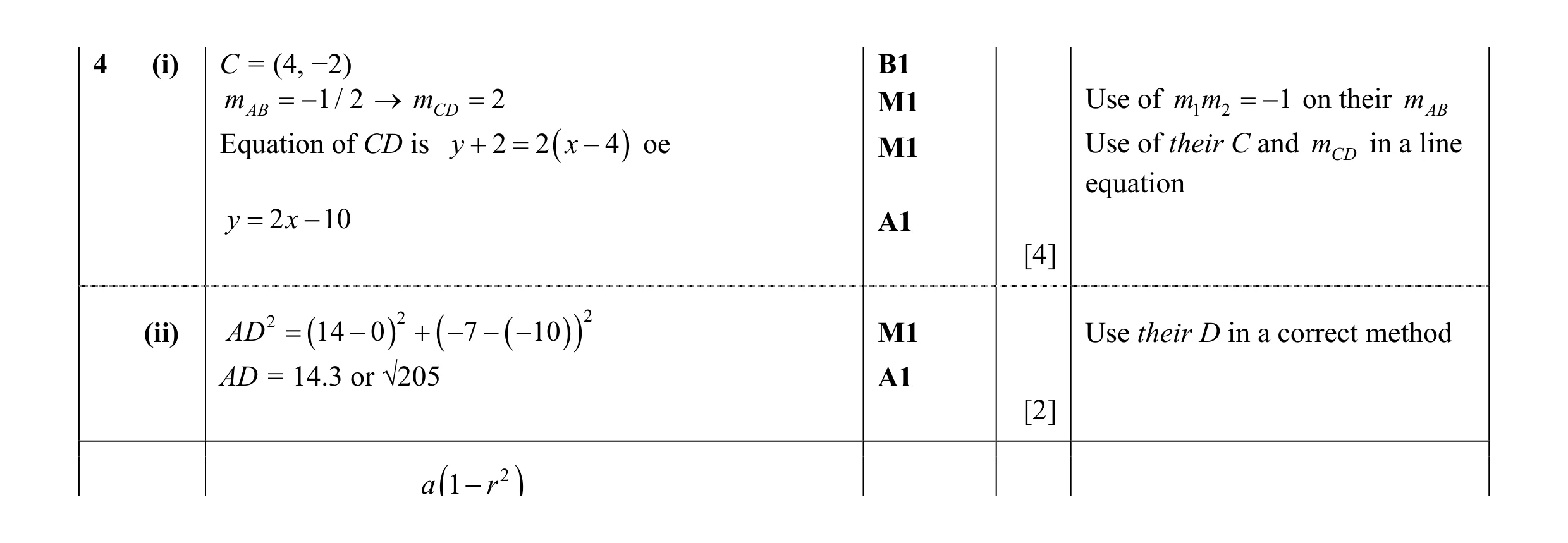 6
6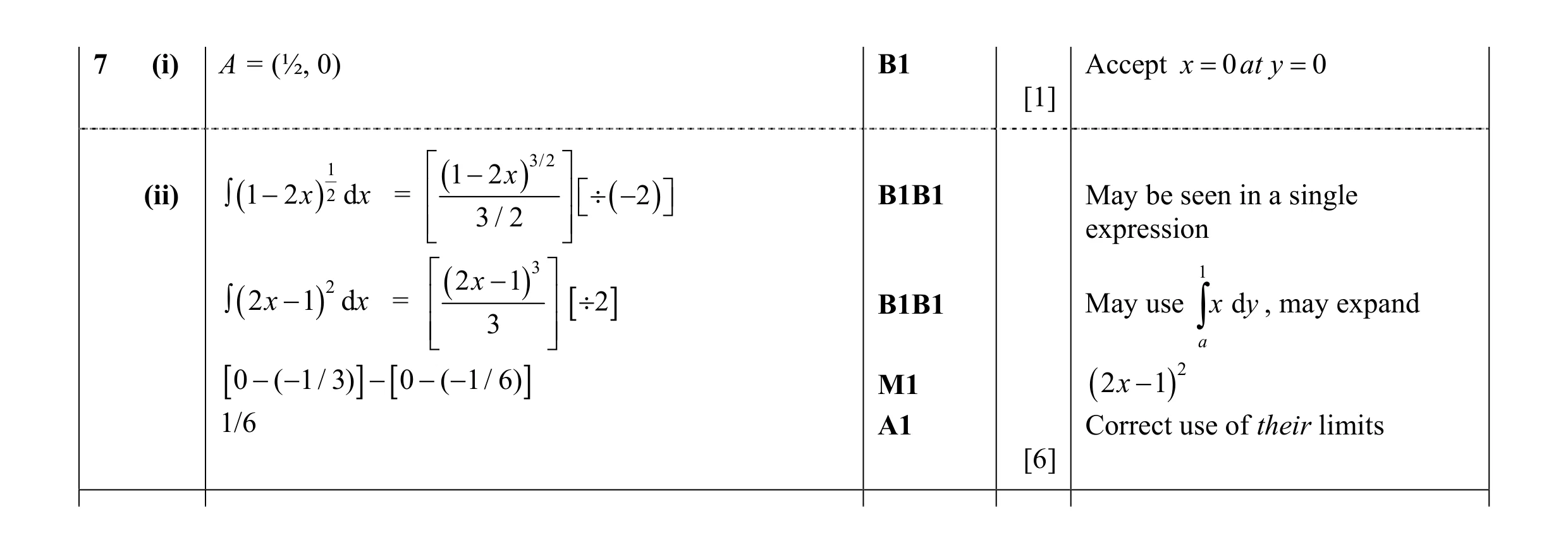 7
7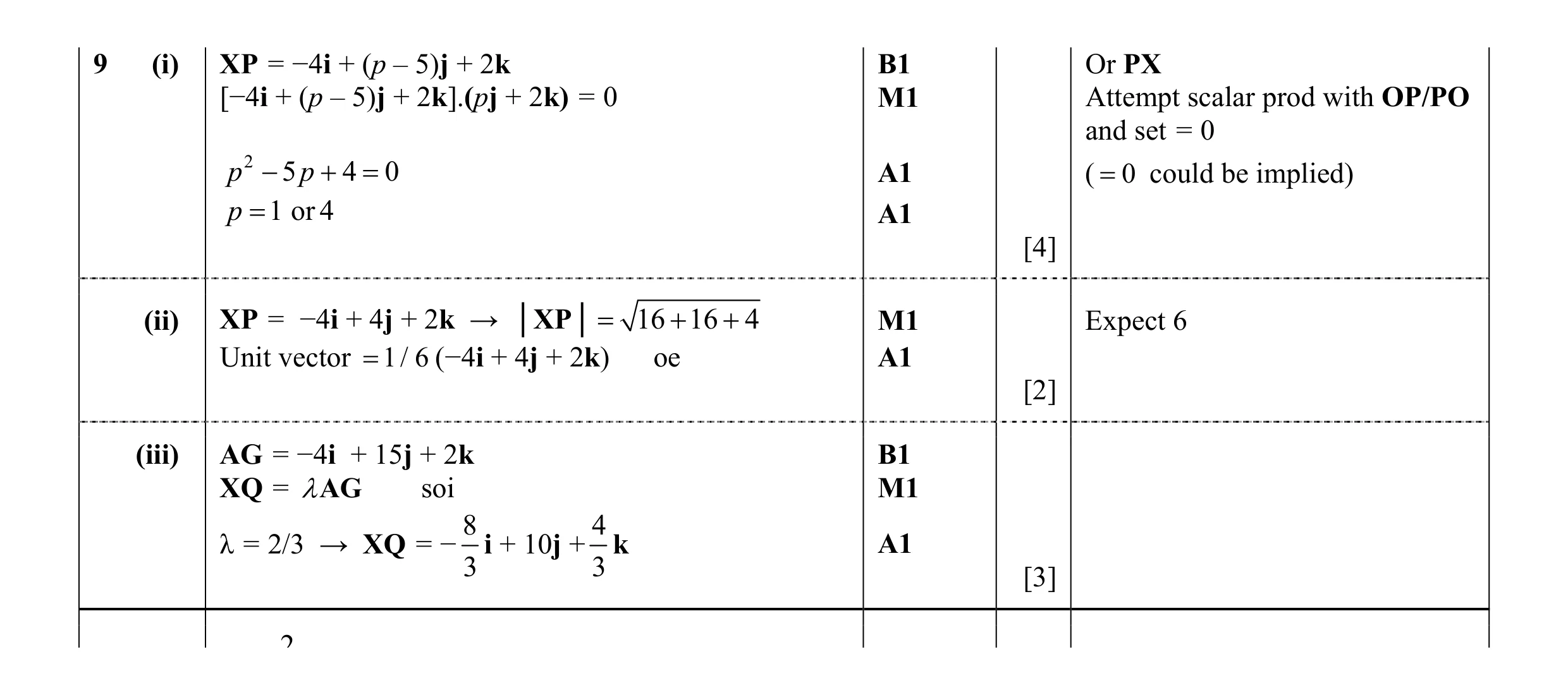 9
9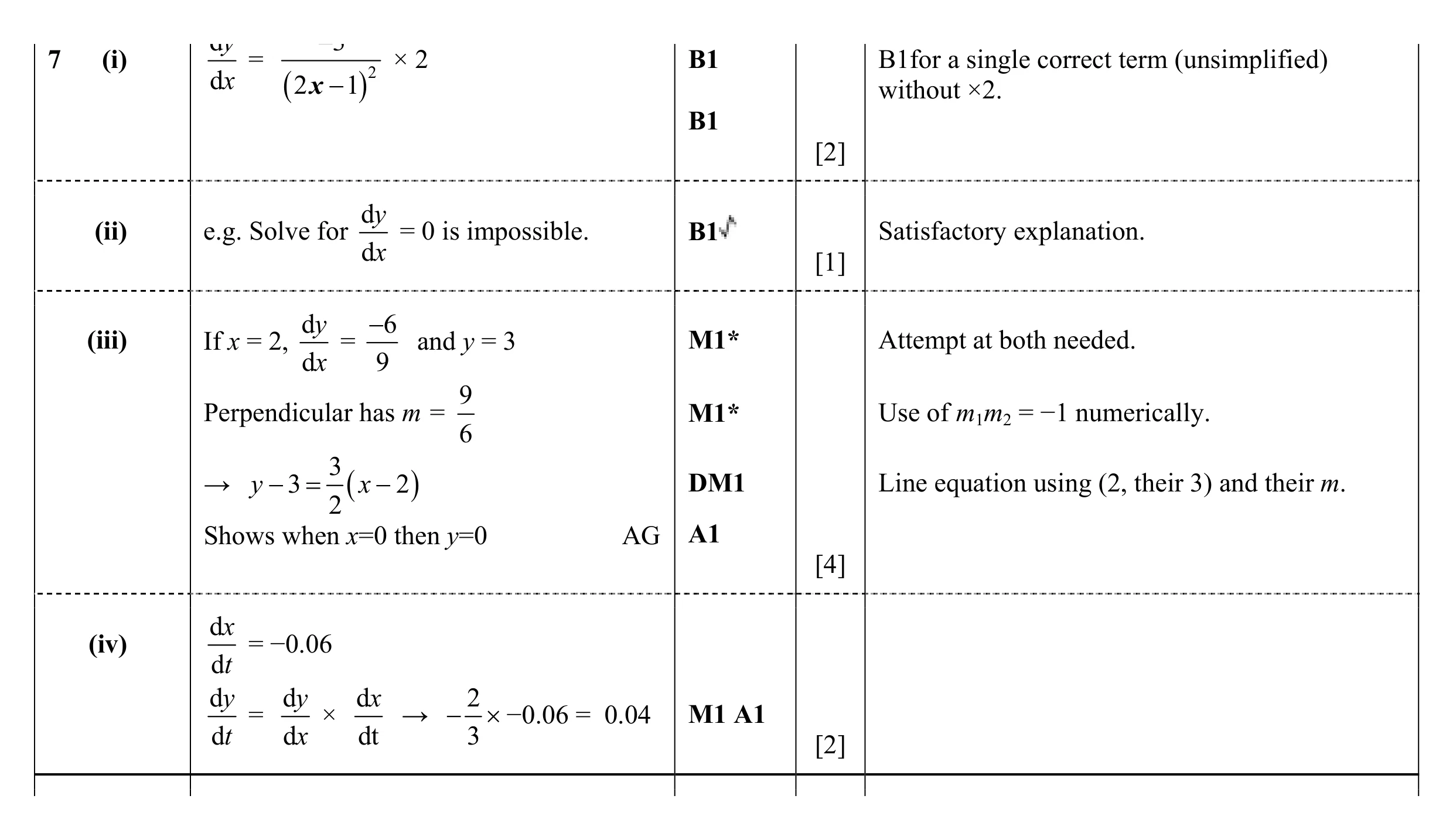 9
9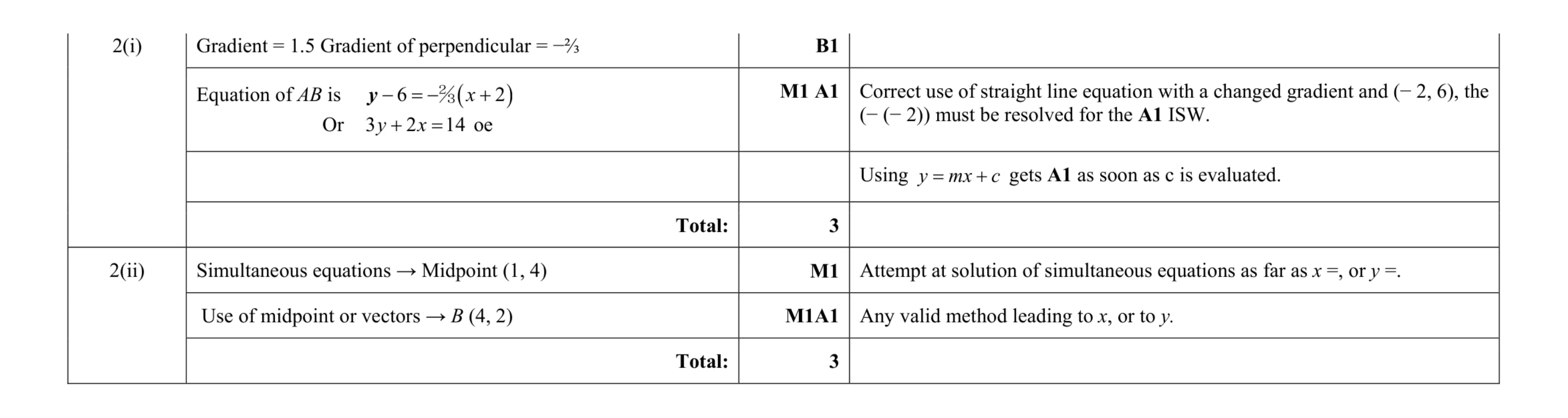 6
6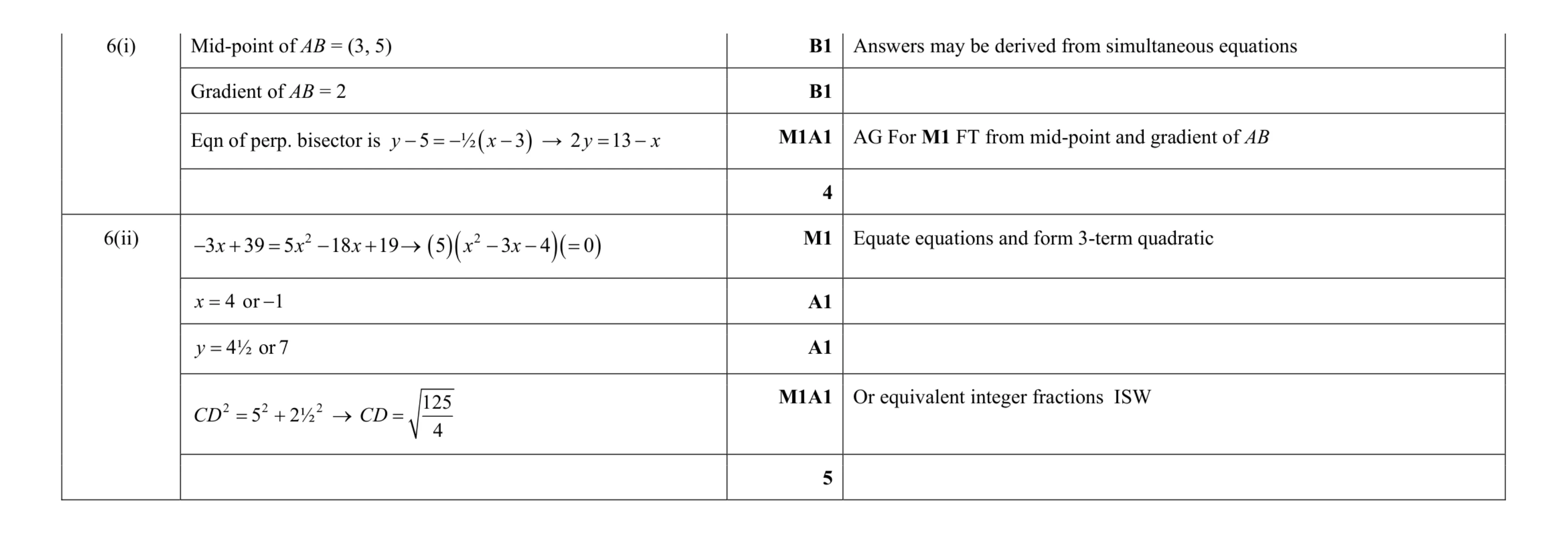 9
9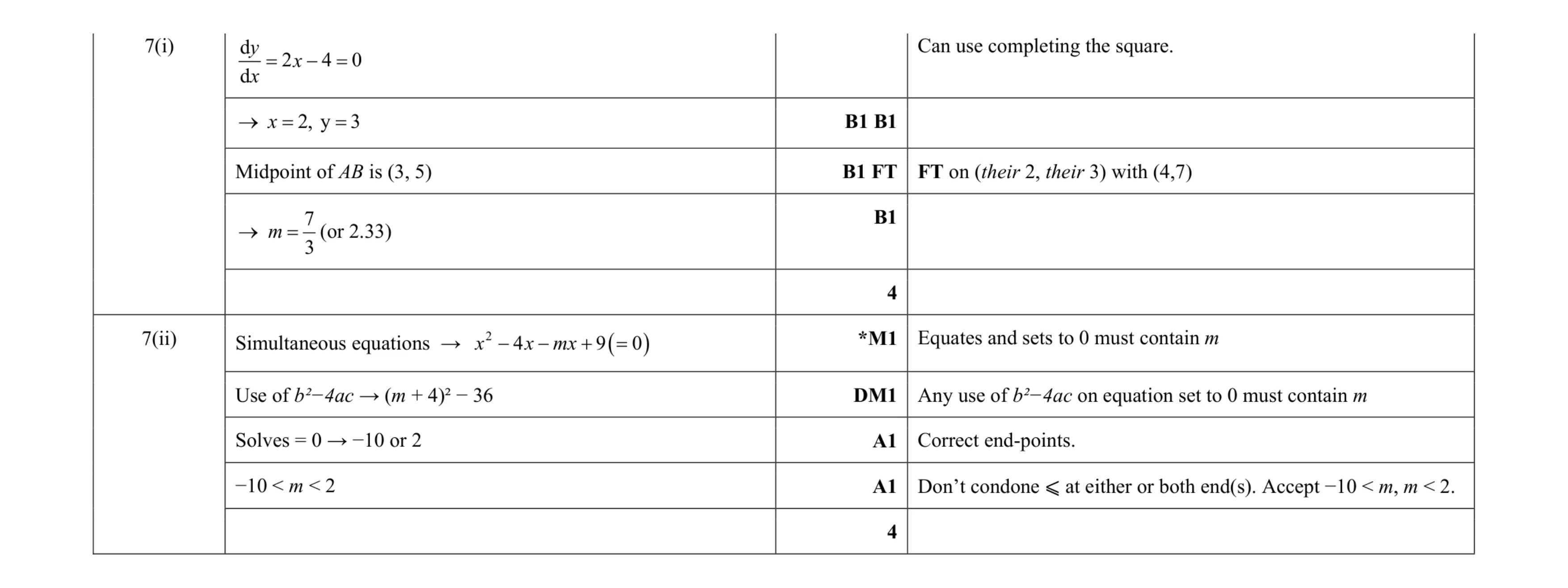 8
8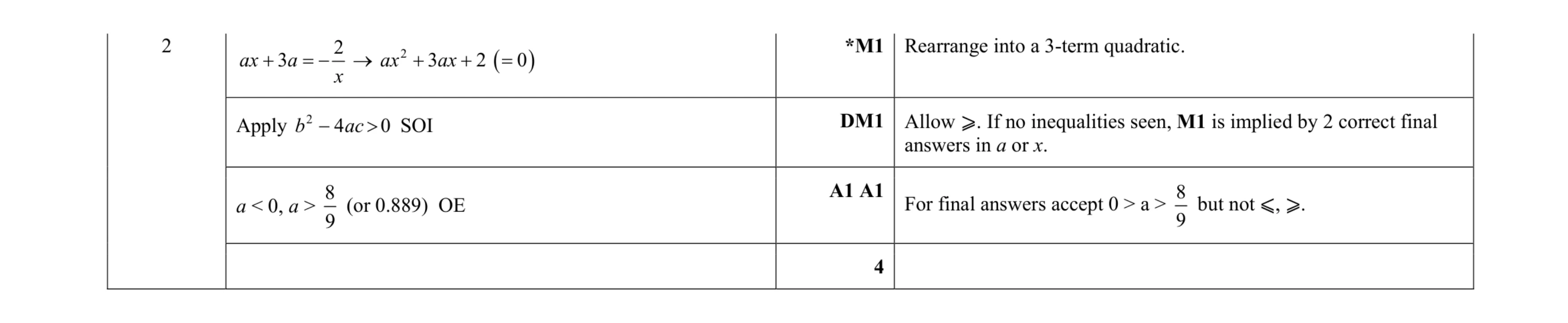 4
4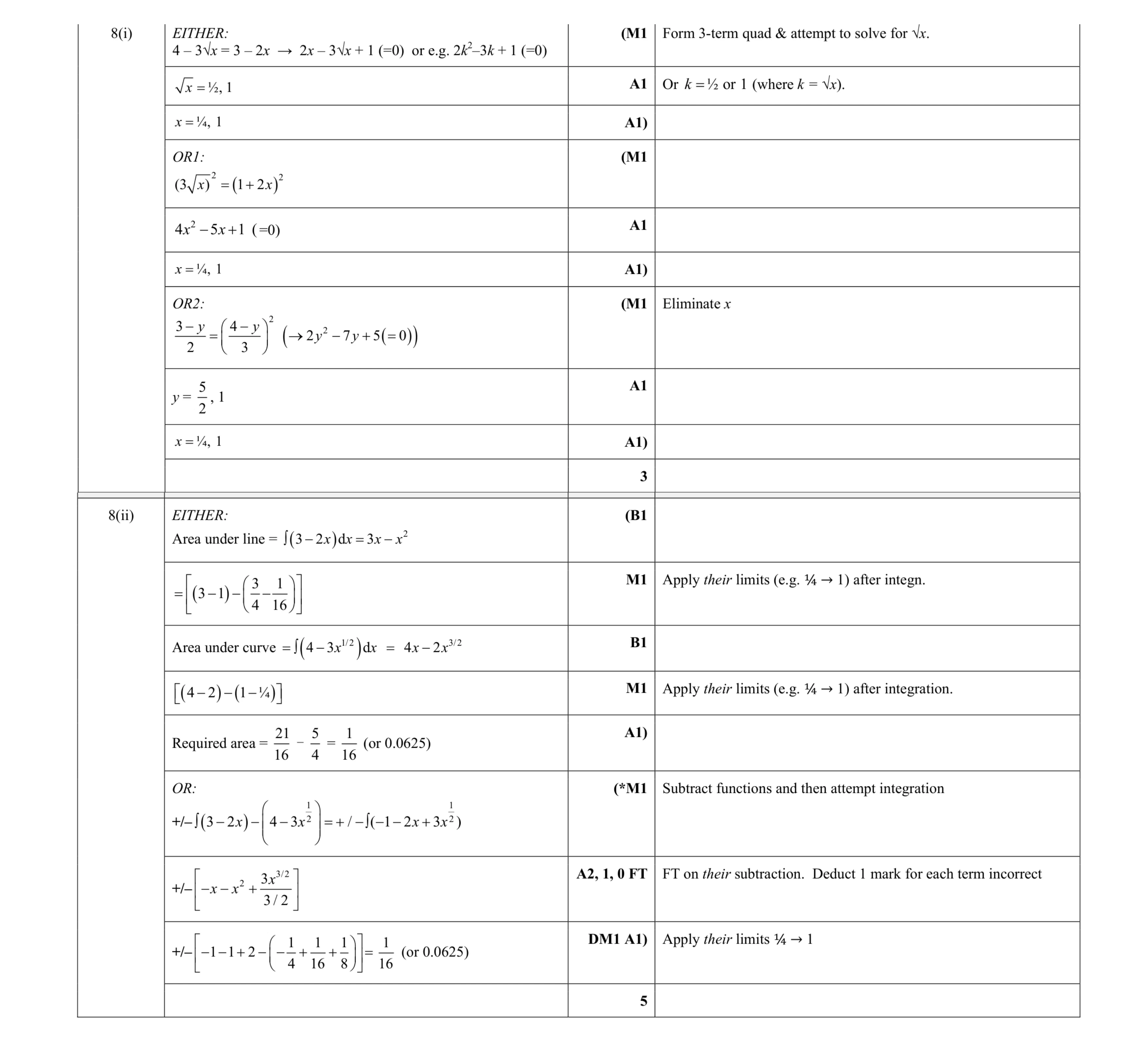 8
8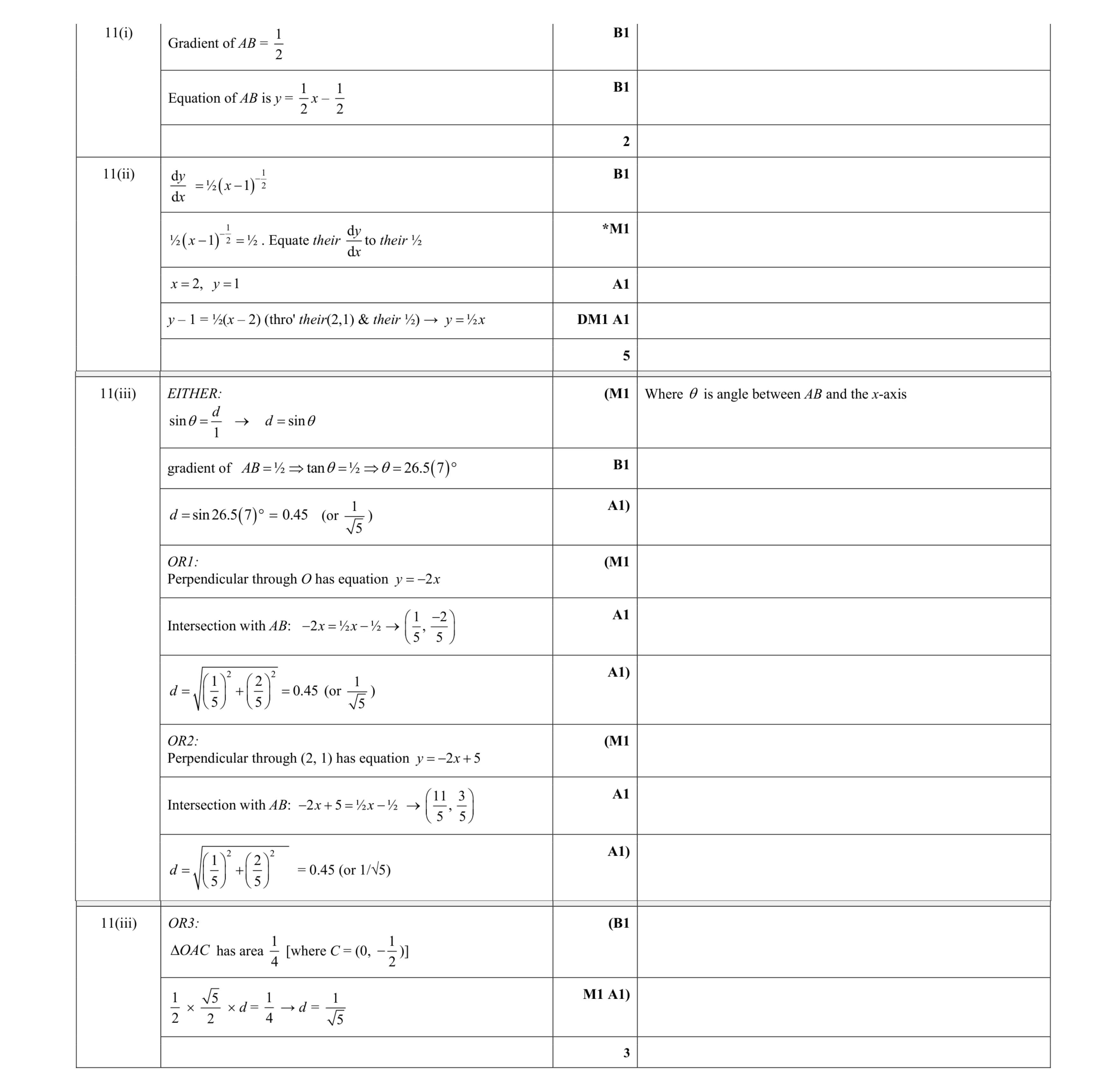 10
10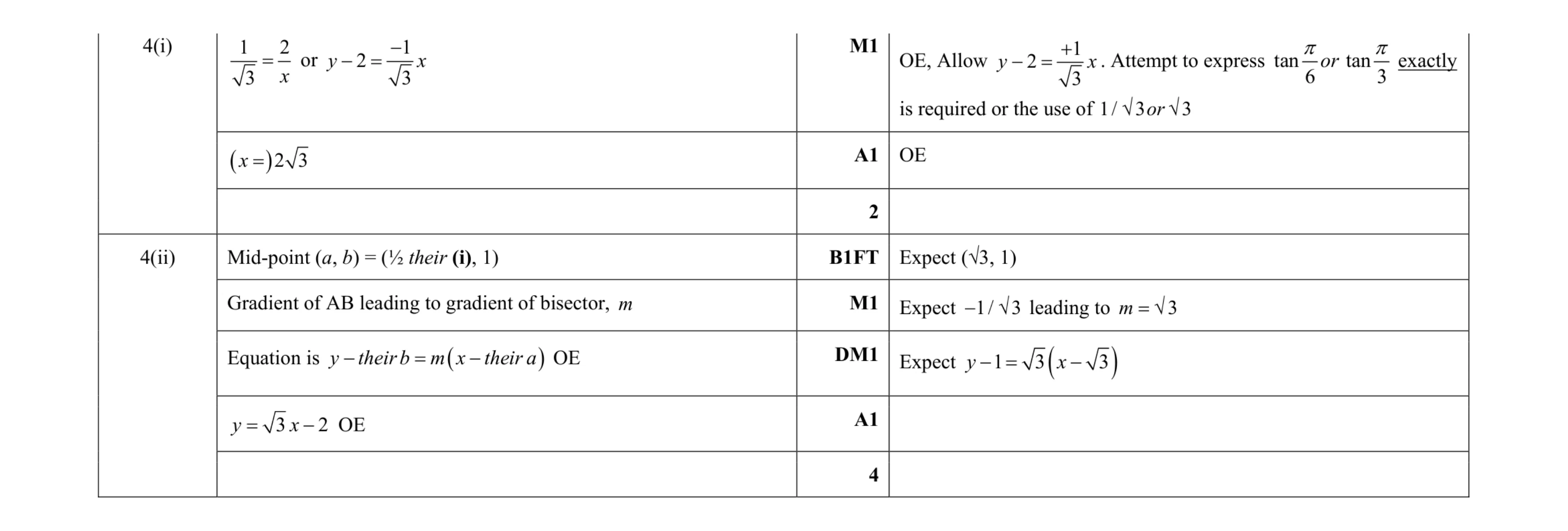 6
6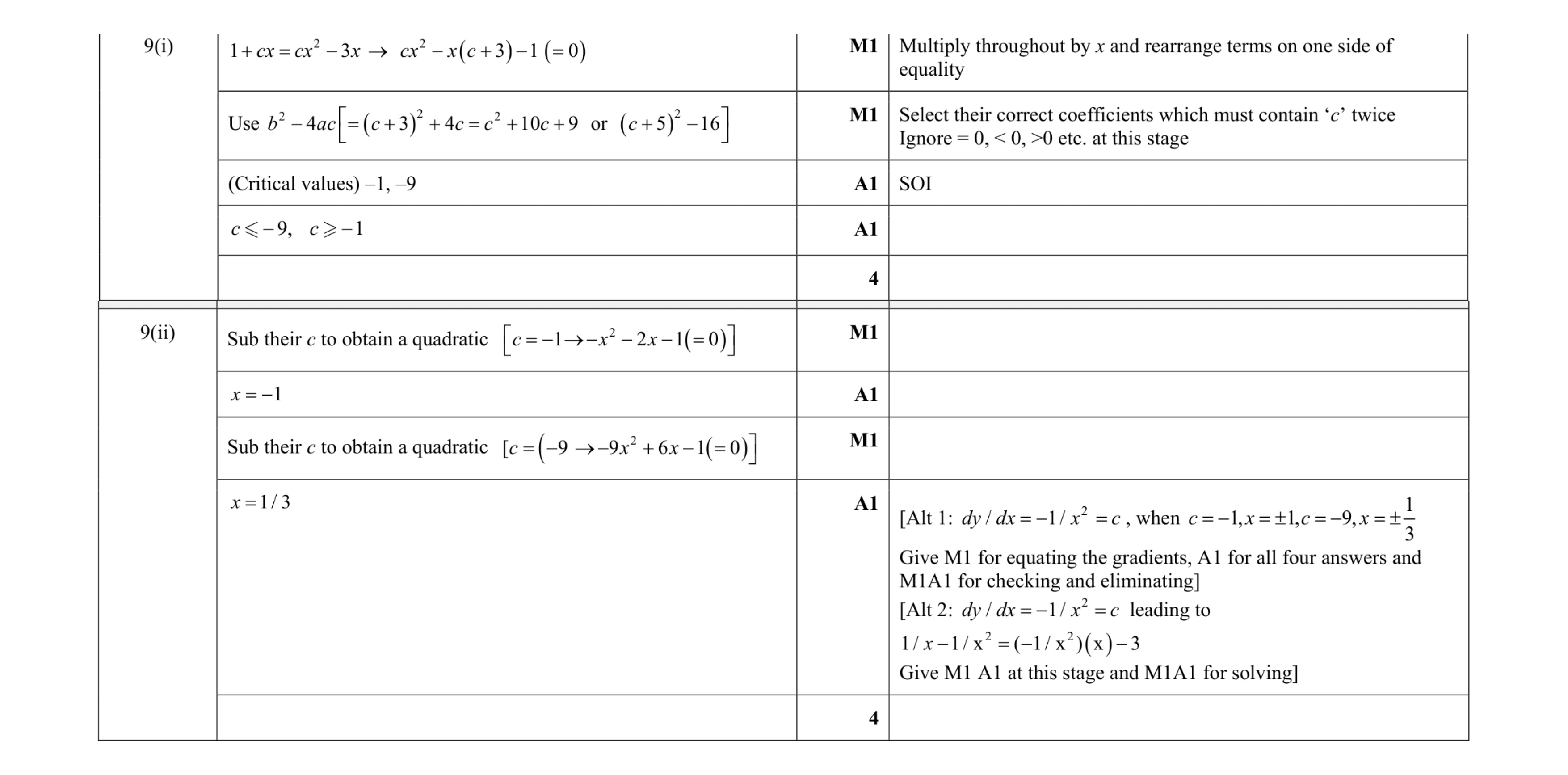 8
8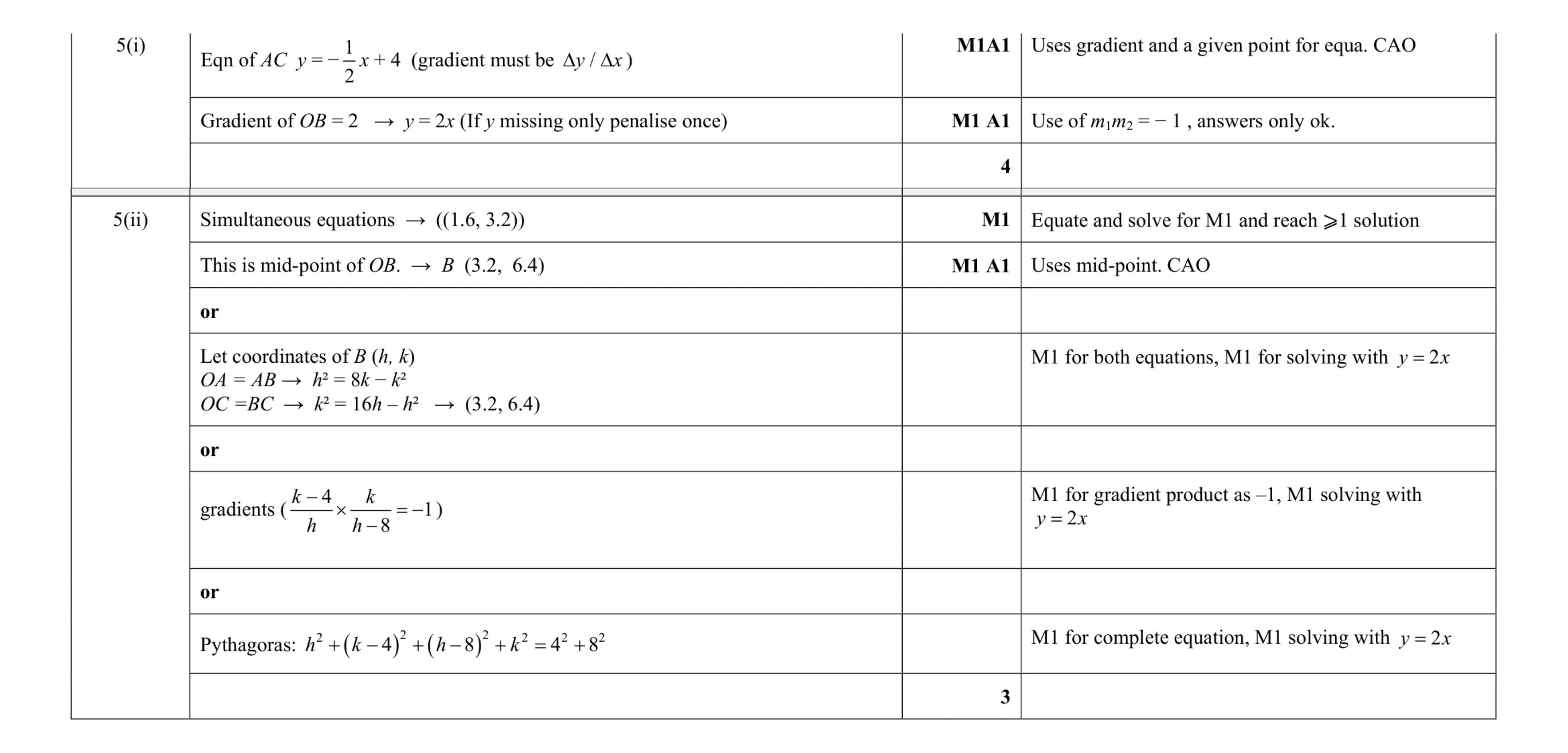 7
7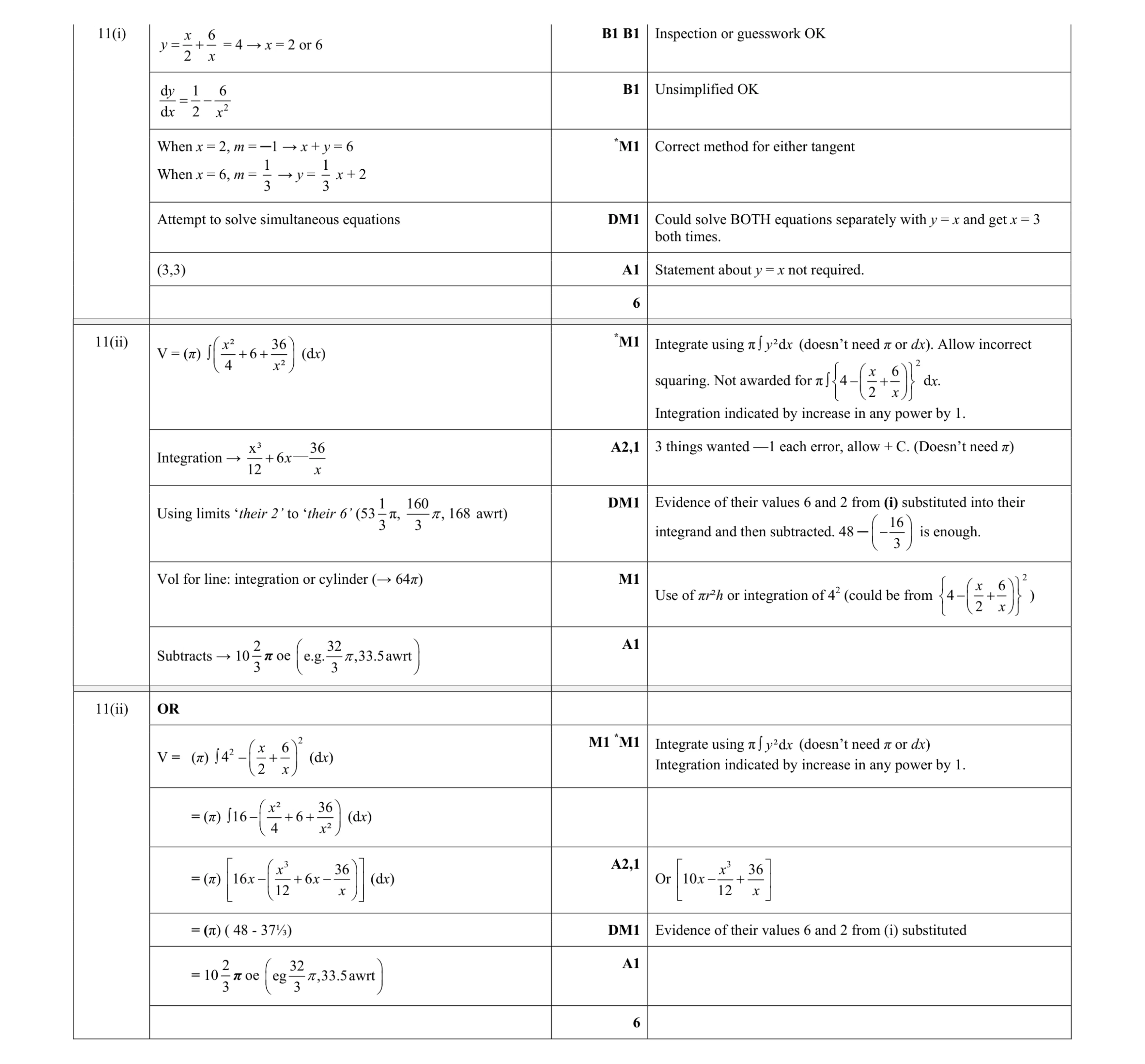 12
12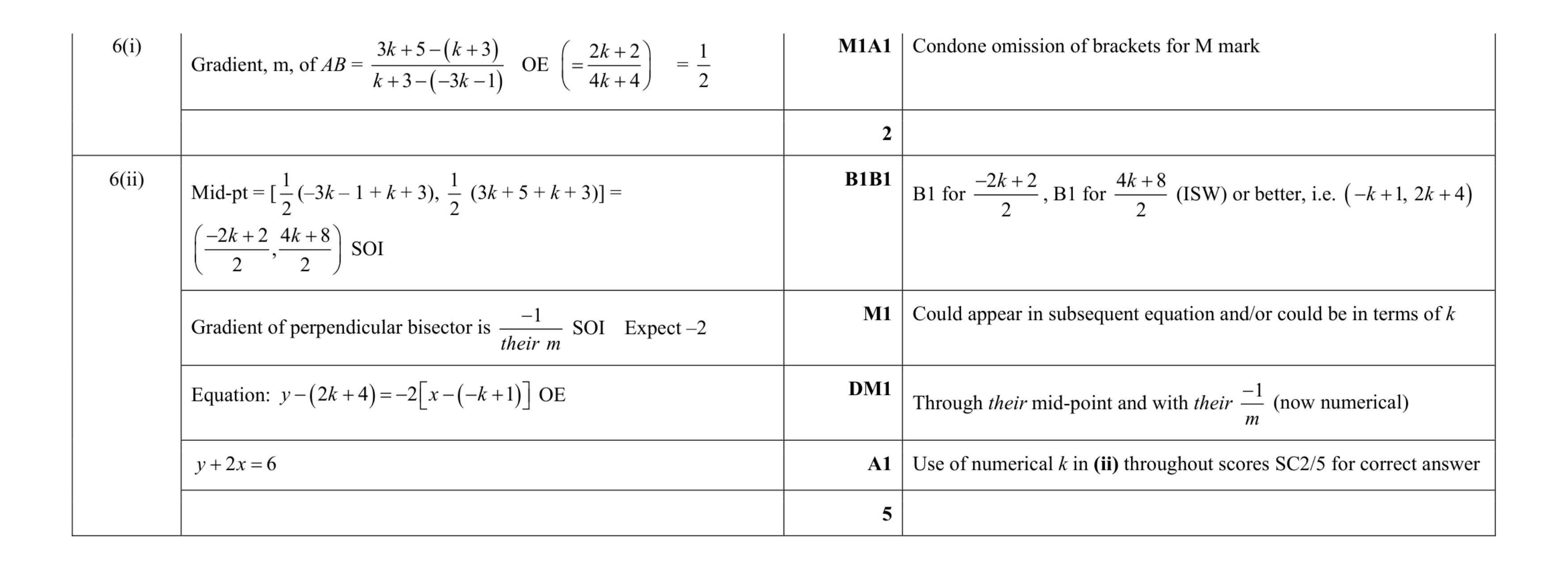 7
7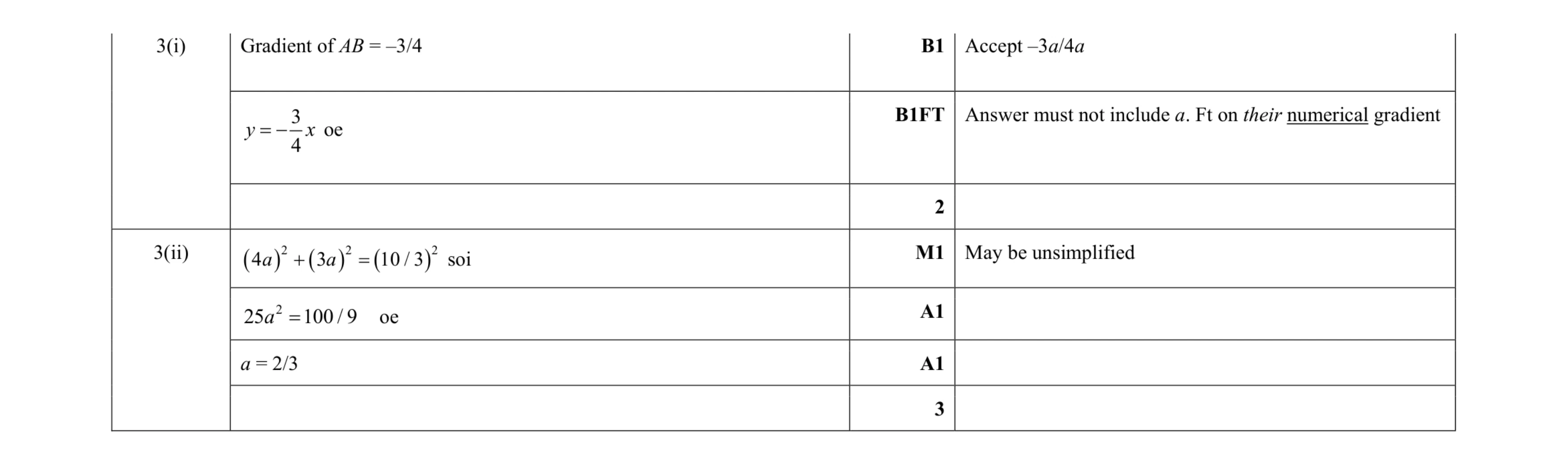 5
5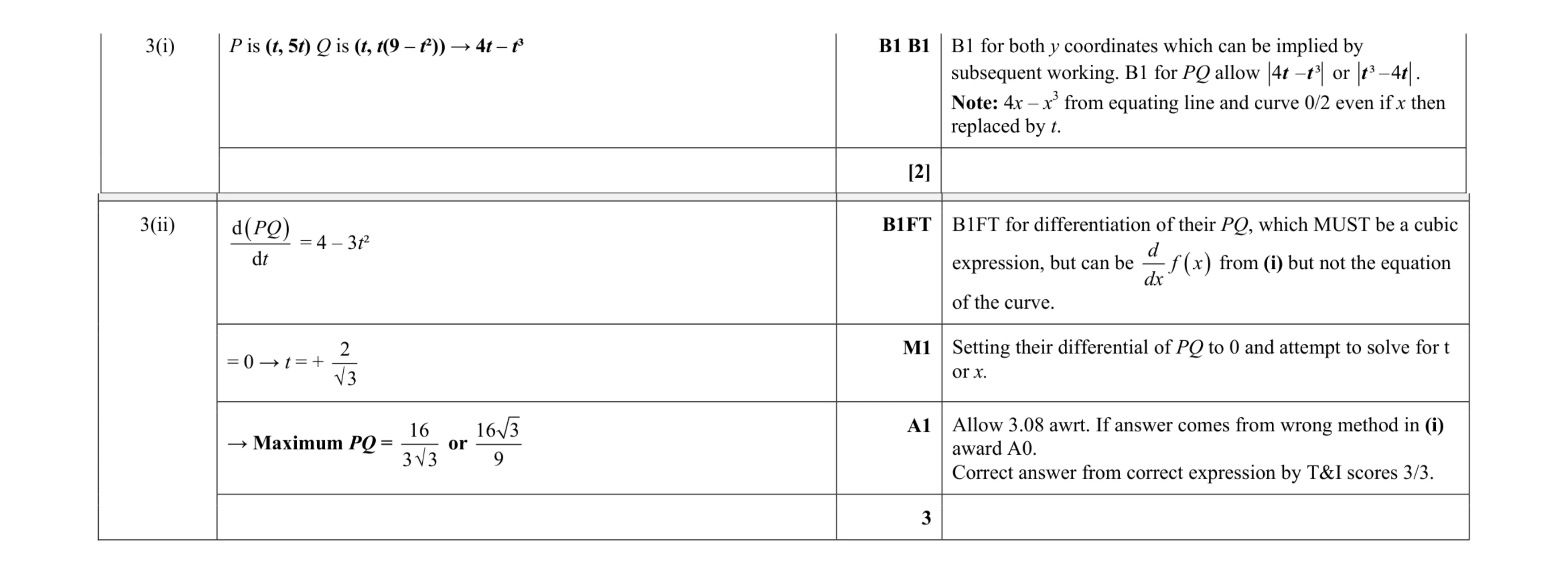 5
5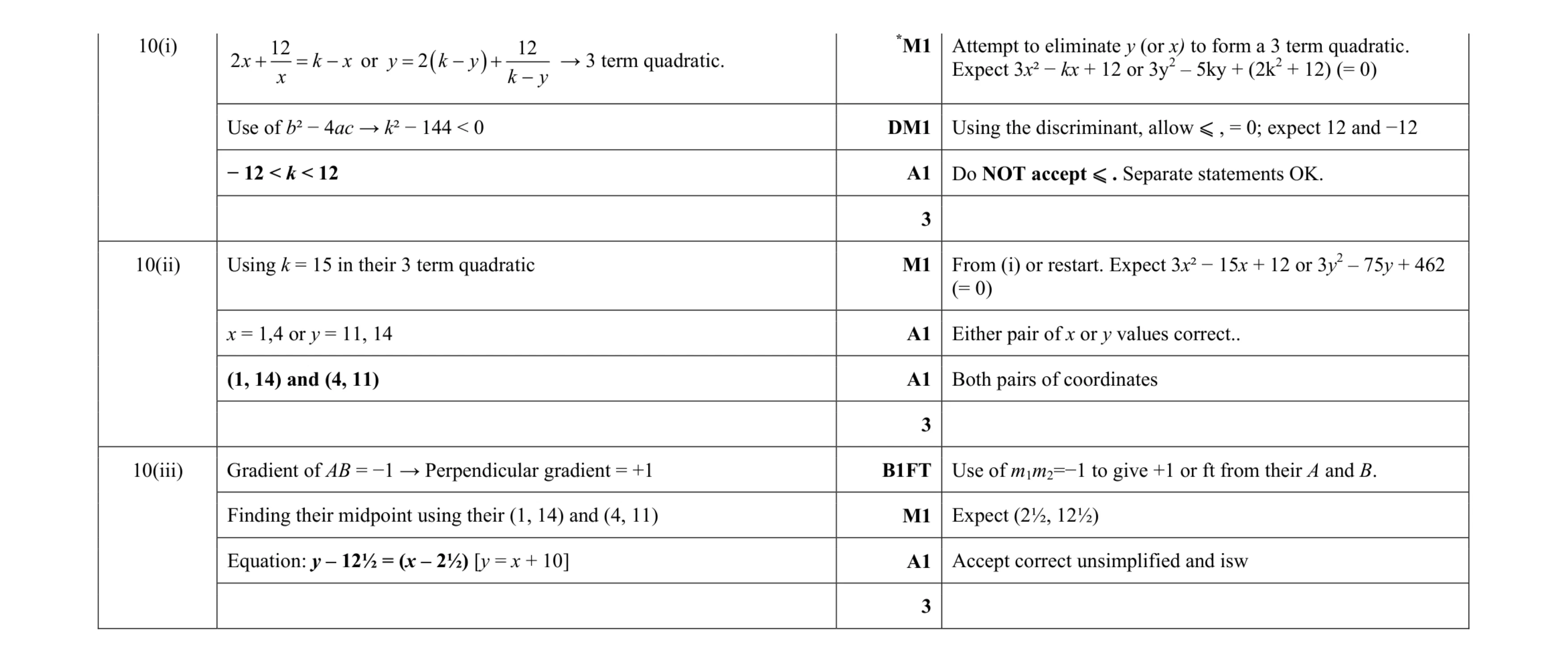 9
9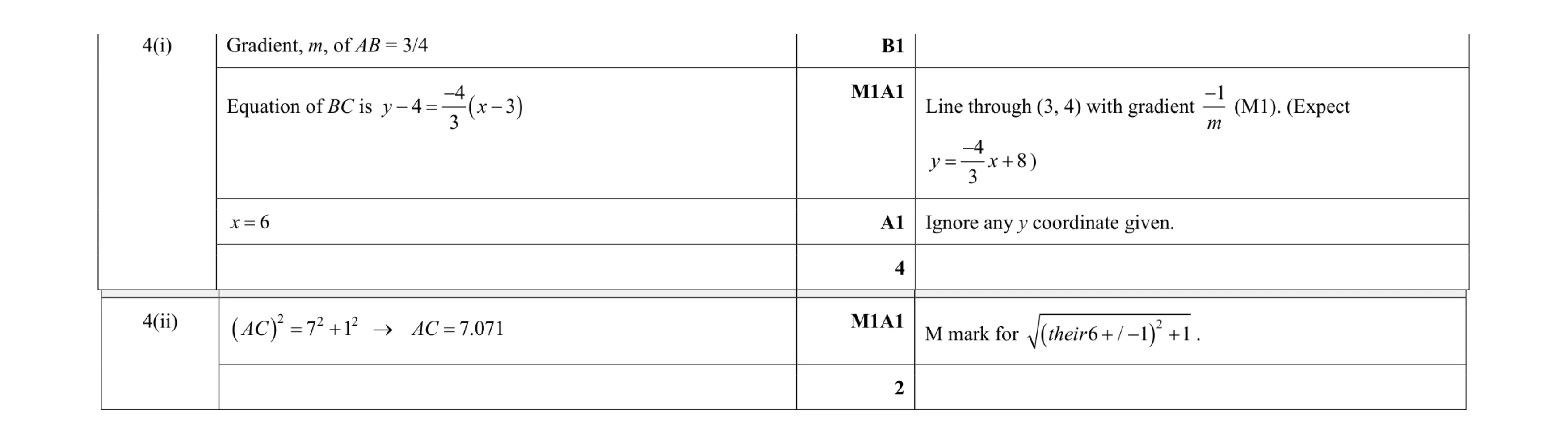 6
6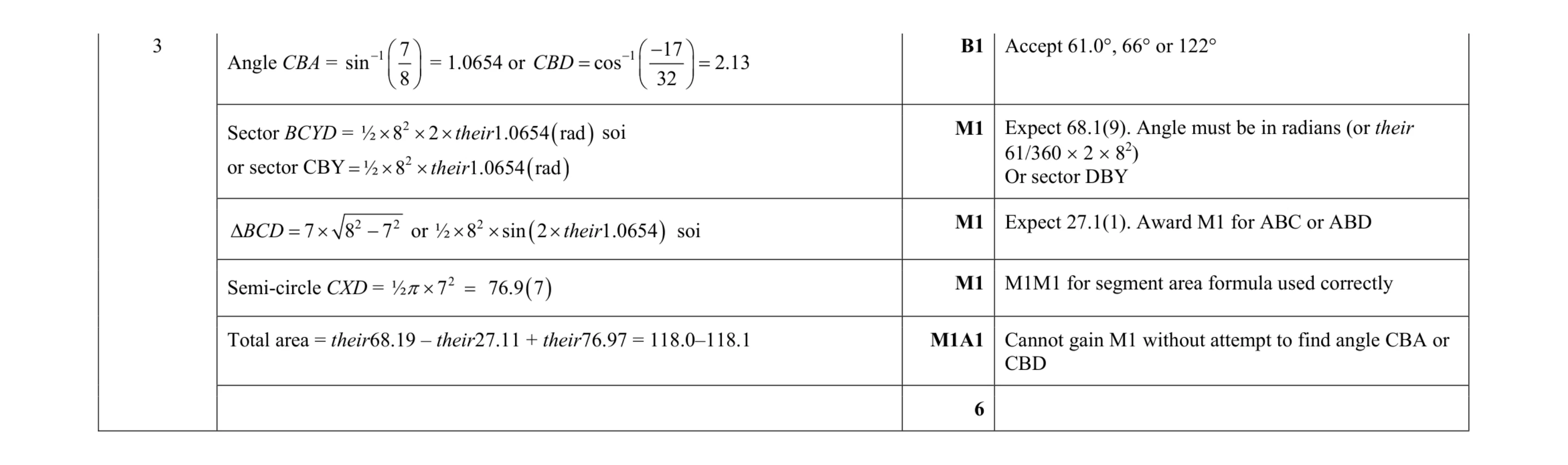 6
6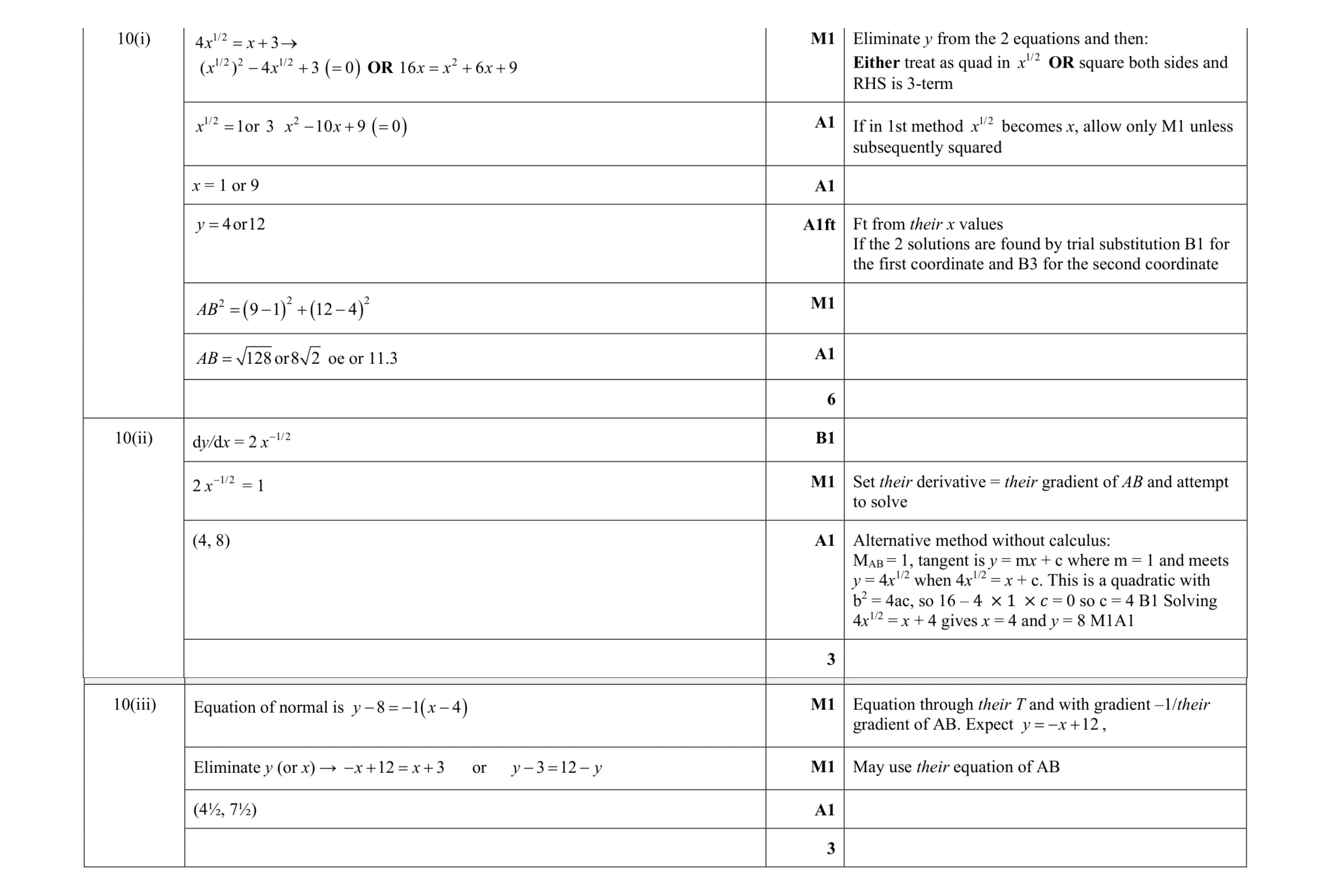 12
12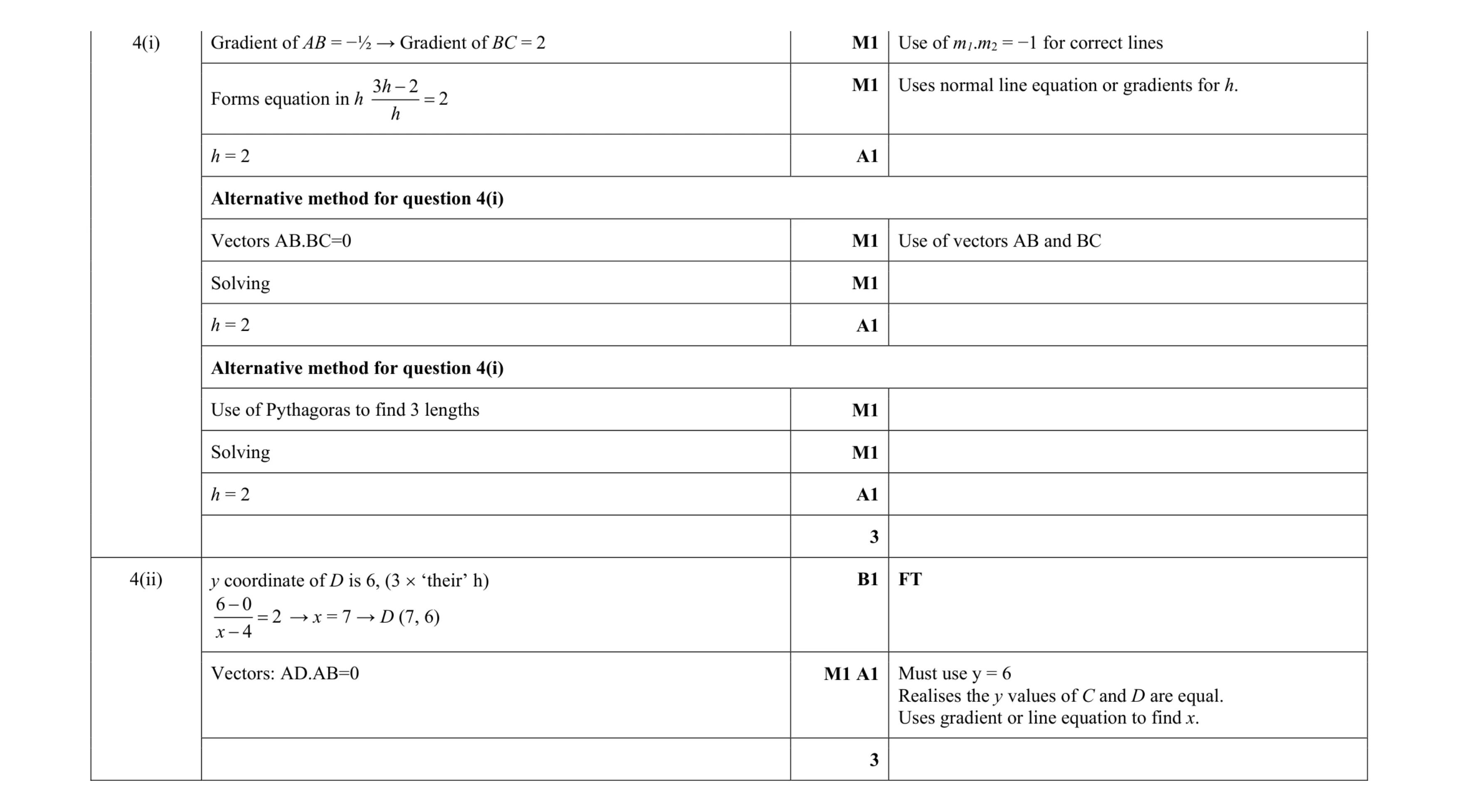 6
6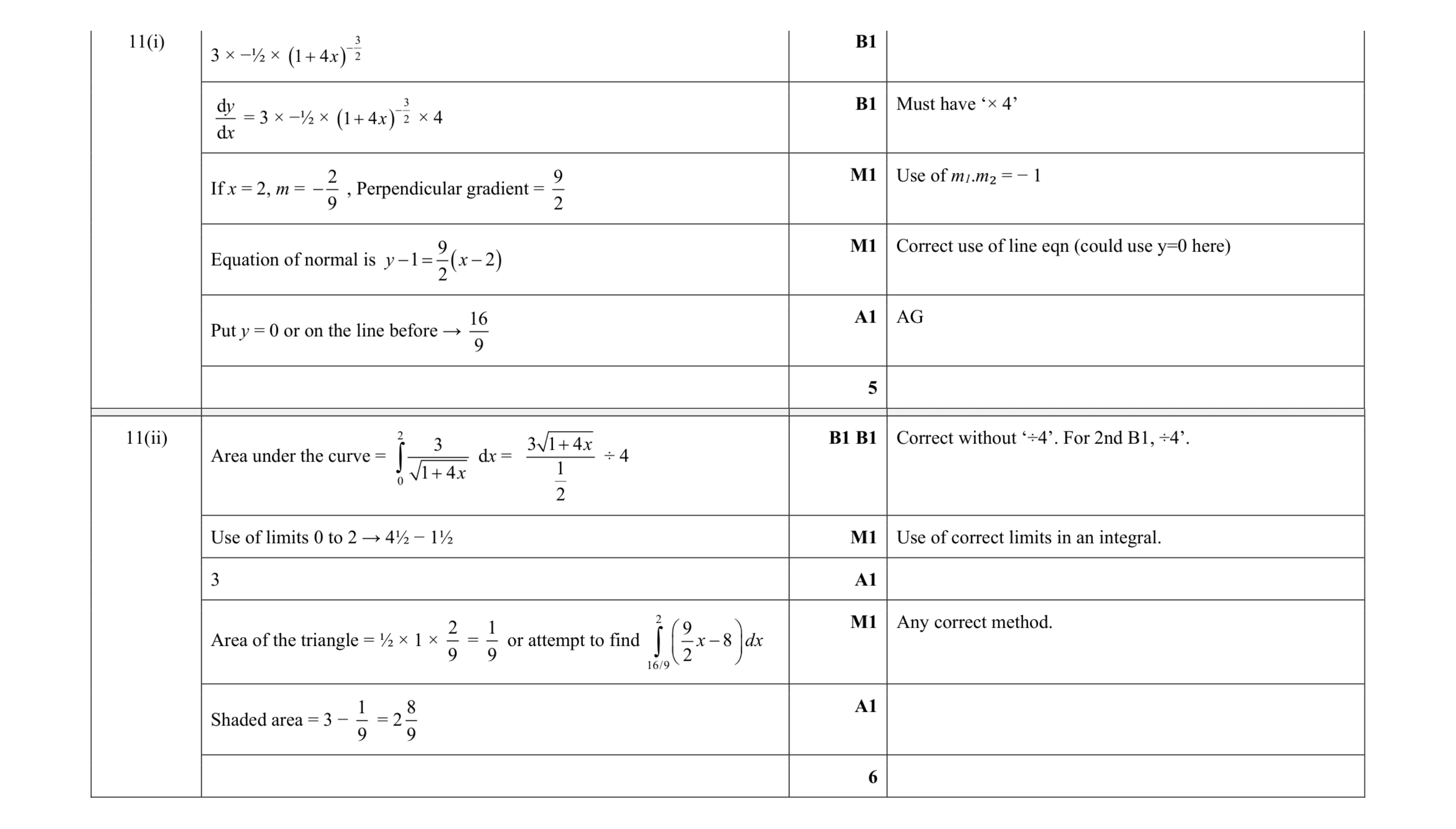 11
11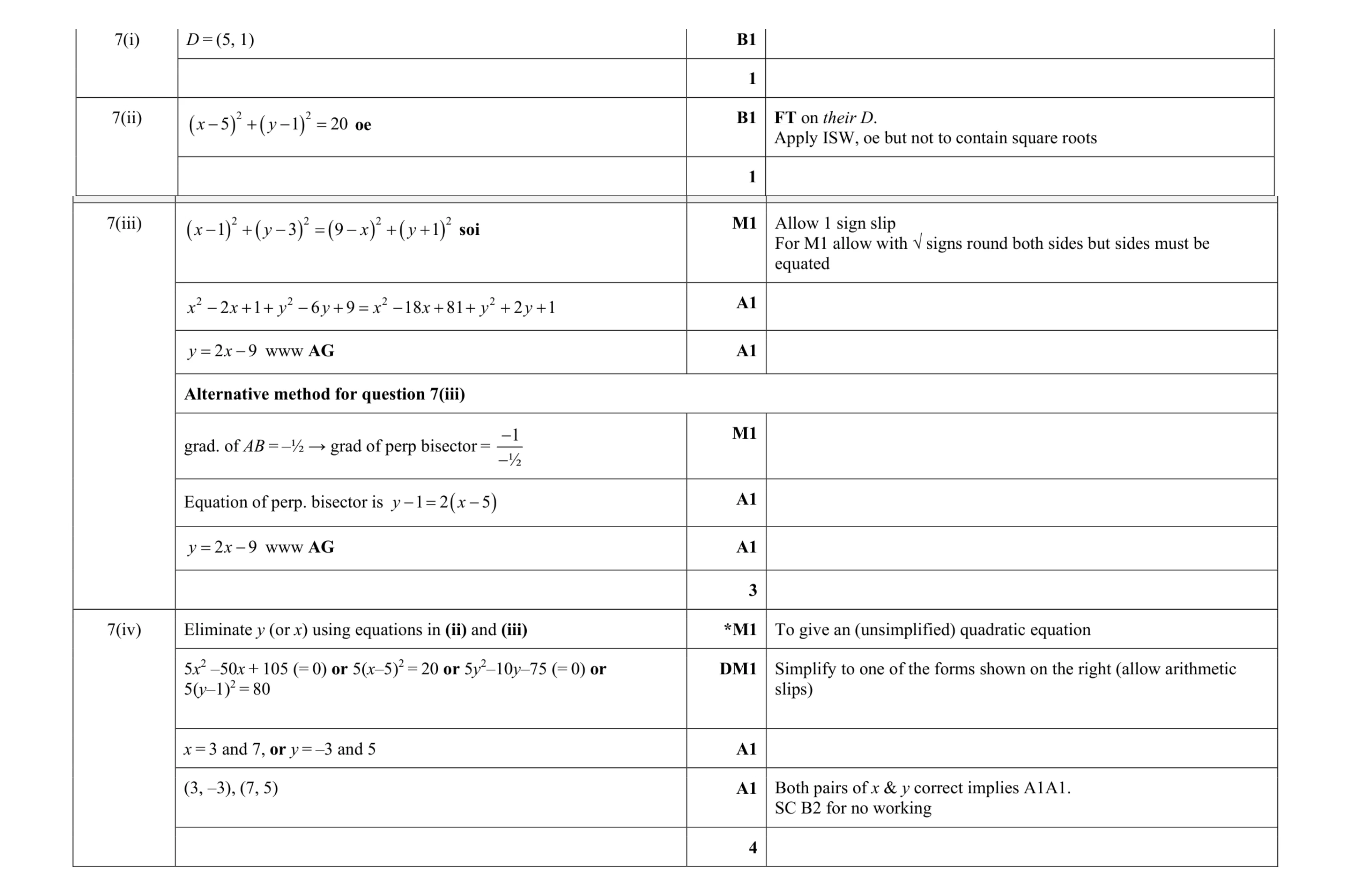 9
9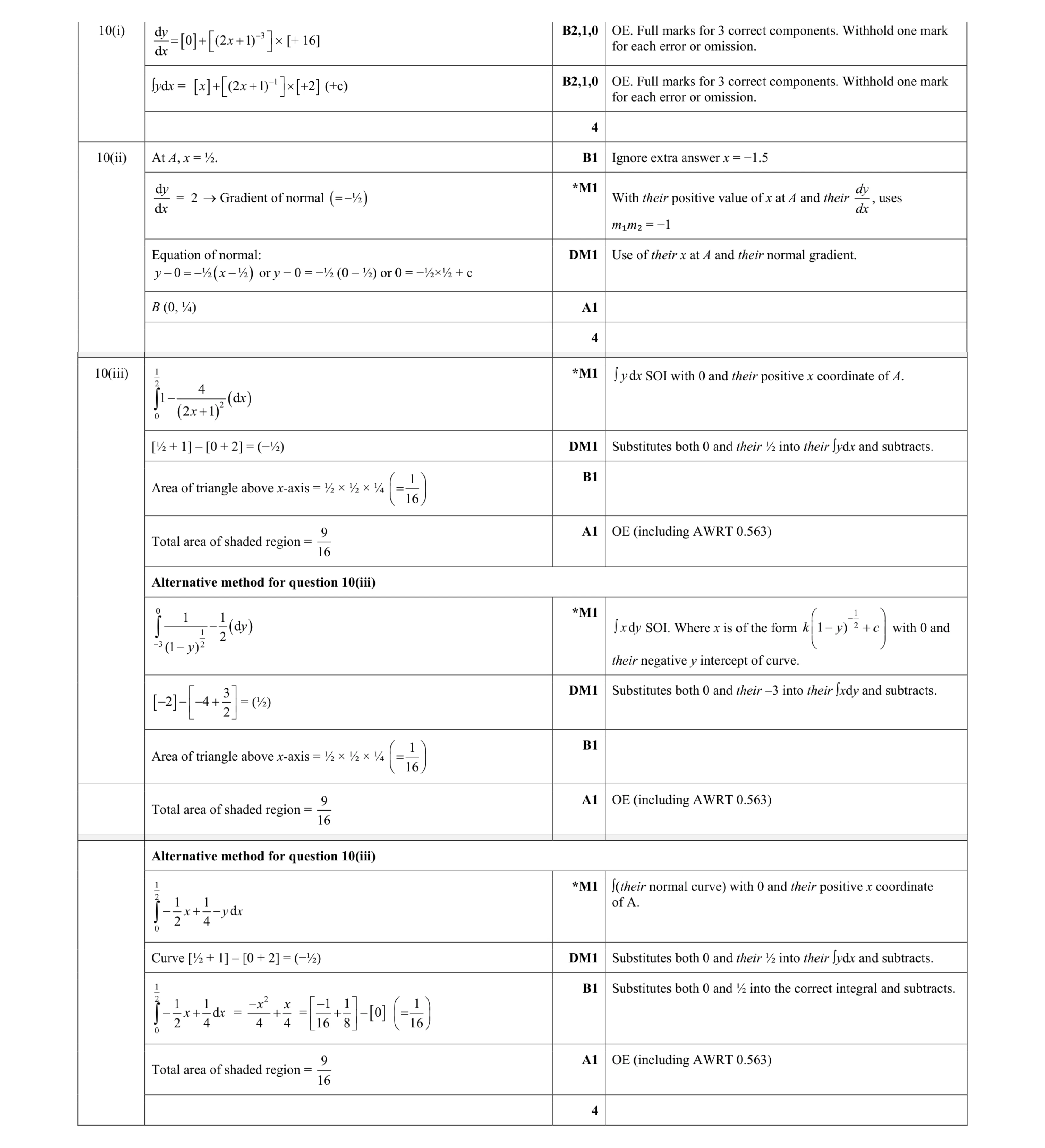 12
12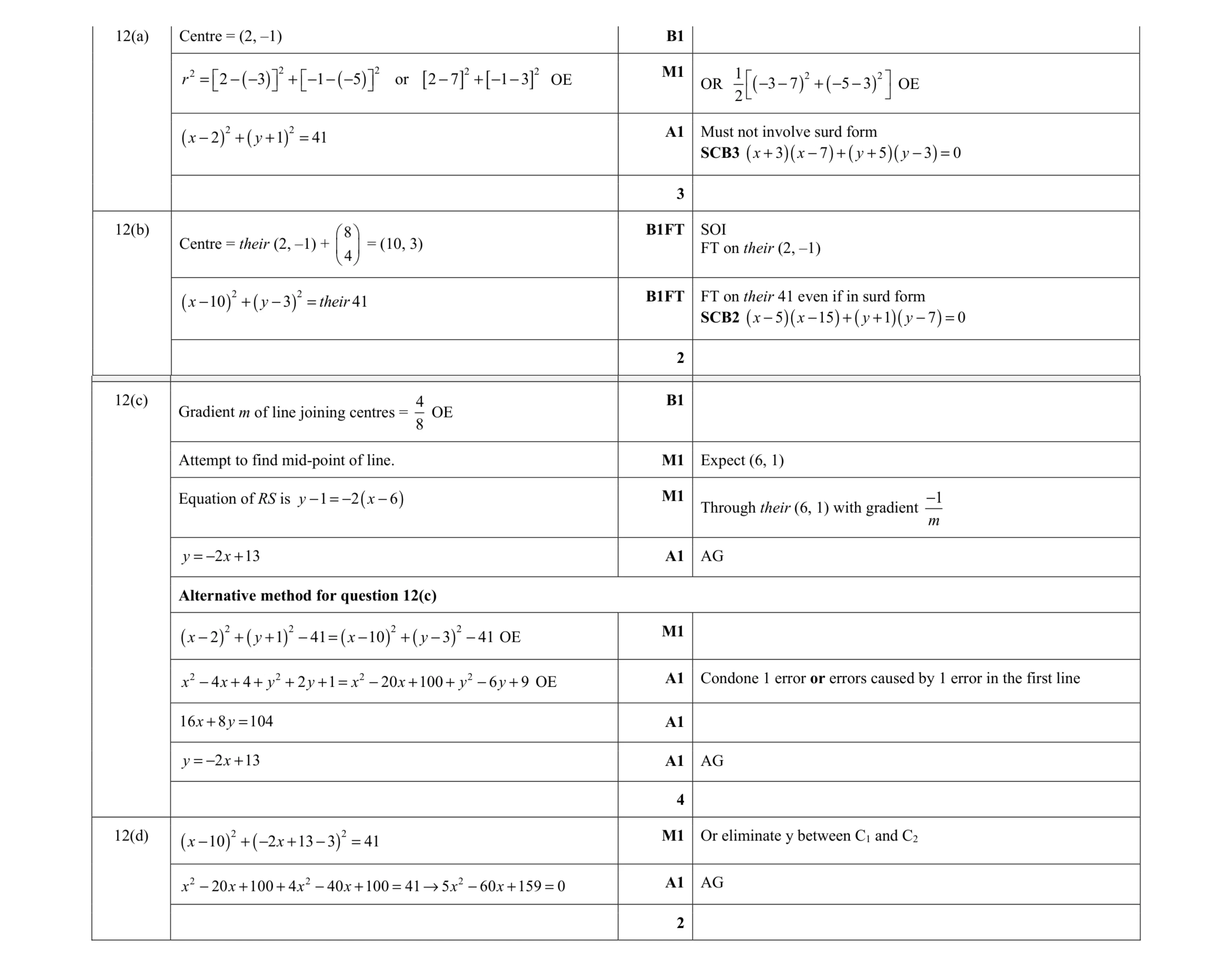 11
11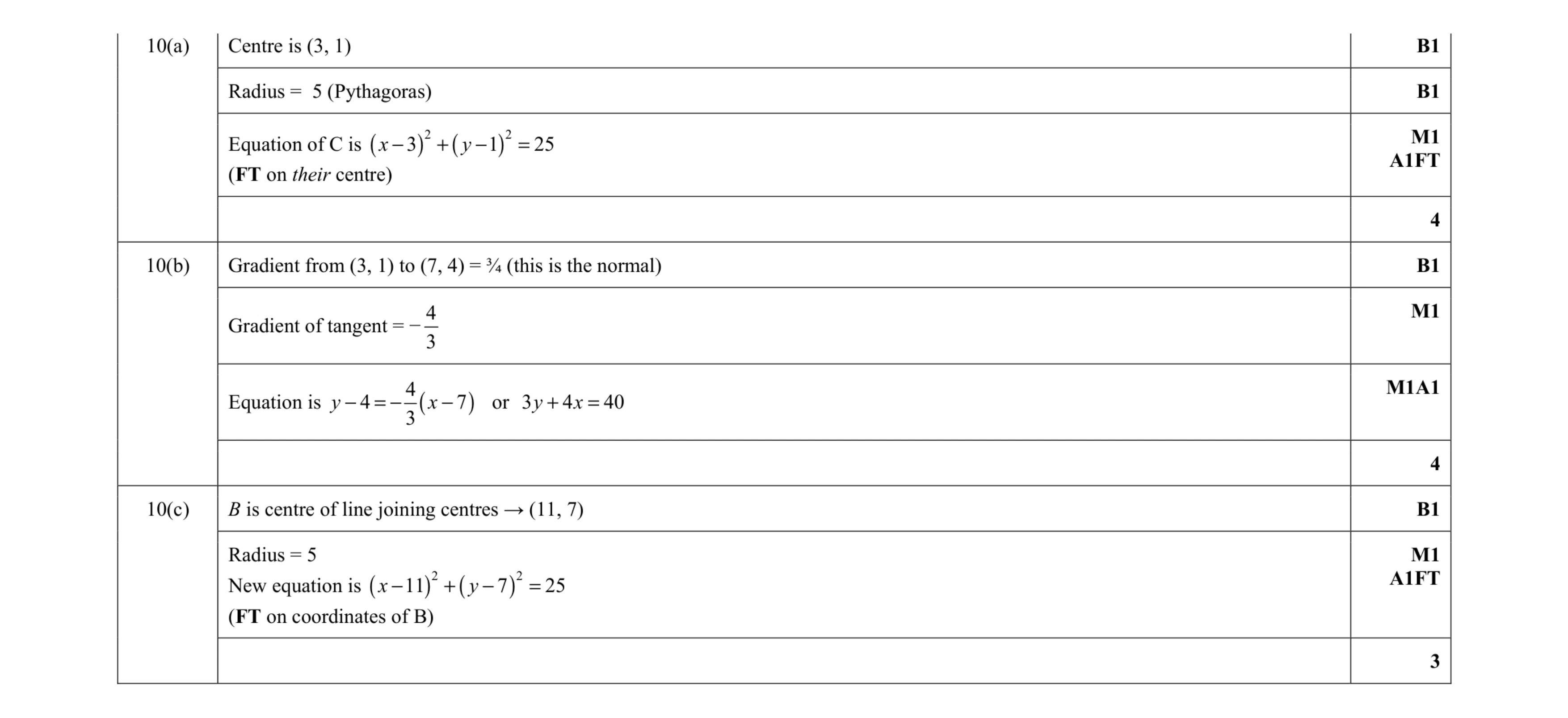 11
11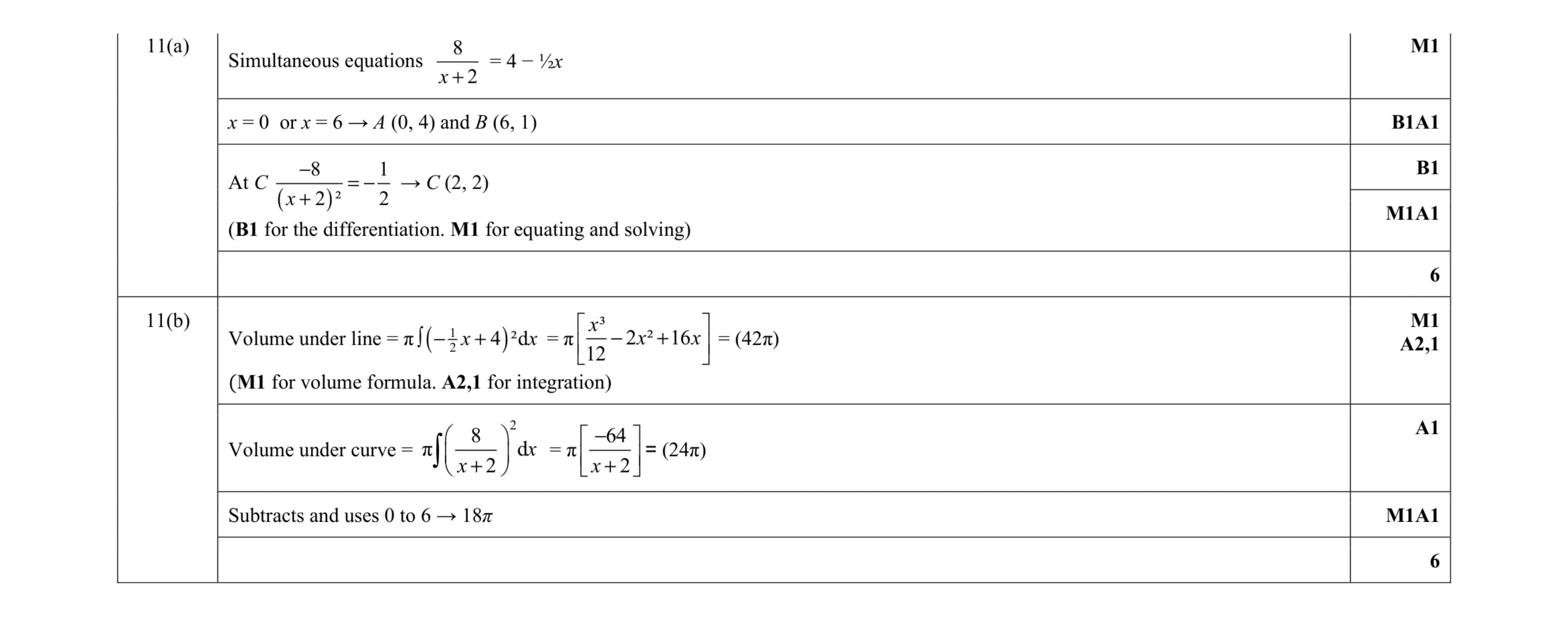 12
12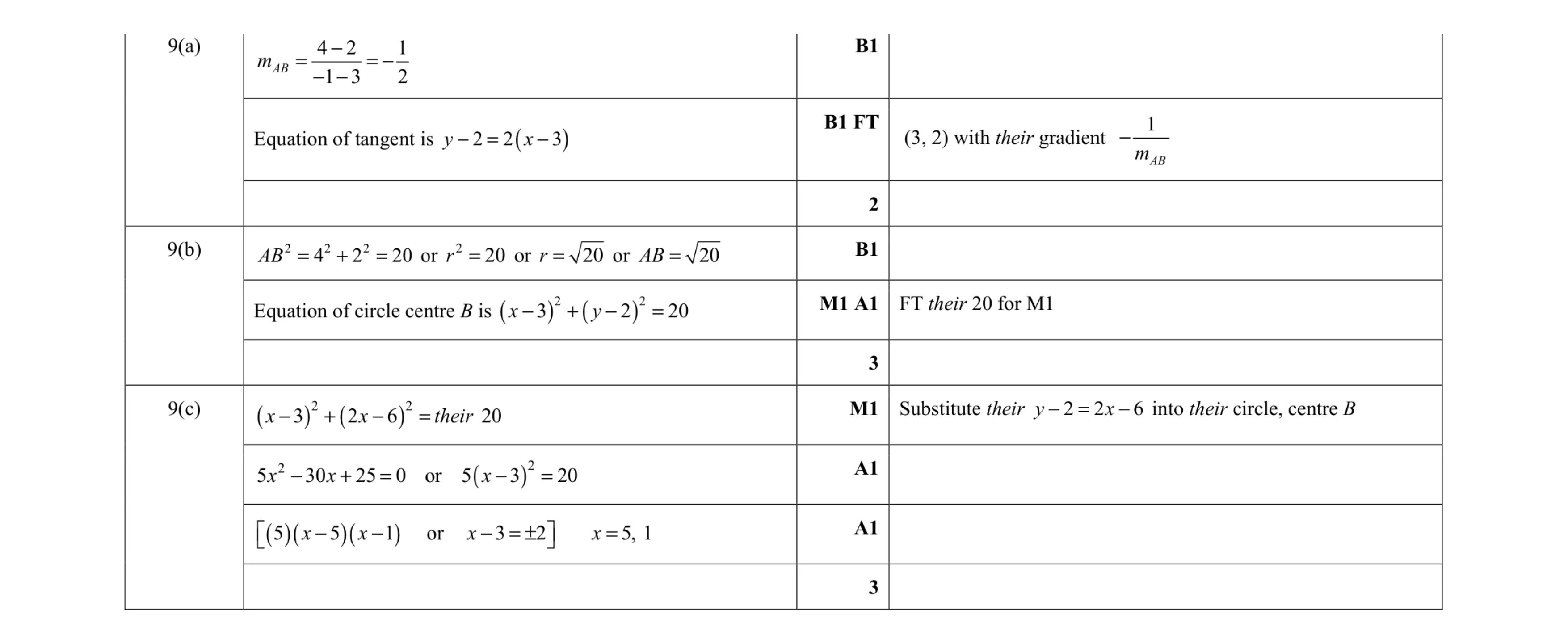 8
8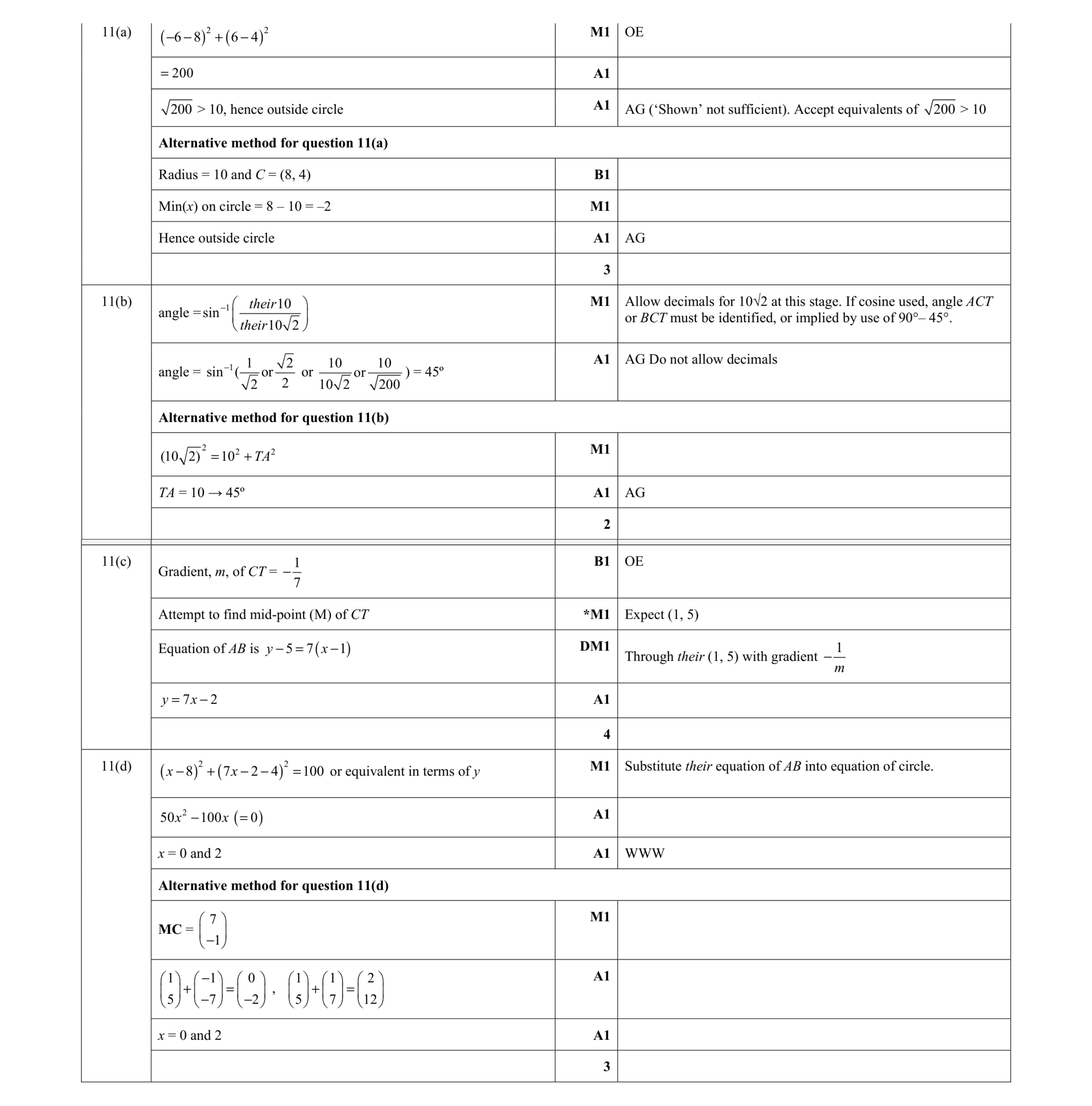 12
12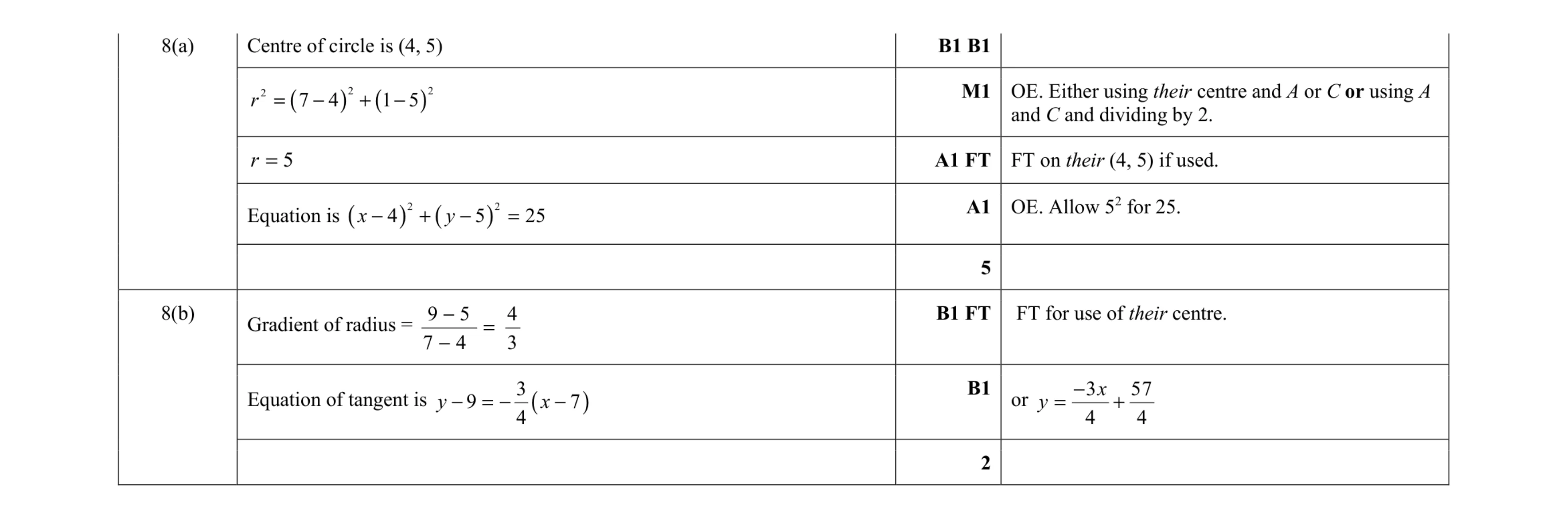 7
7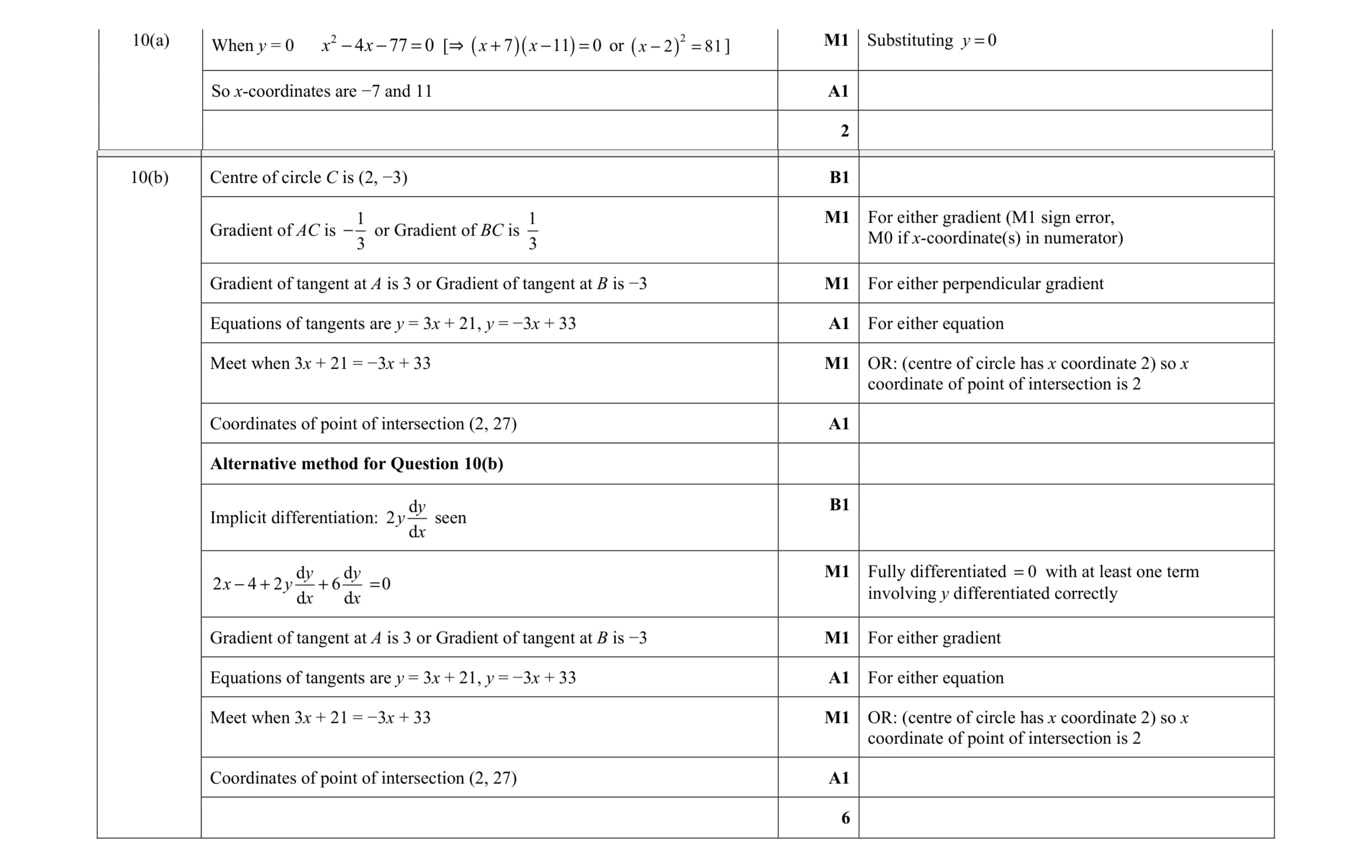 8
8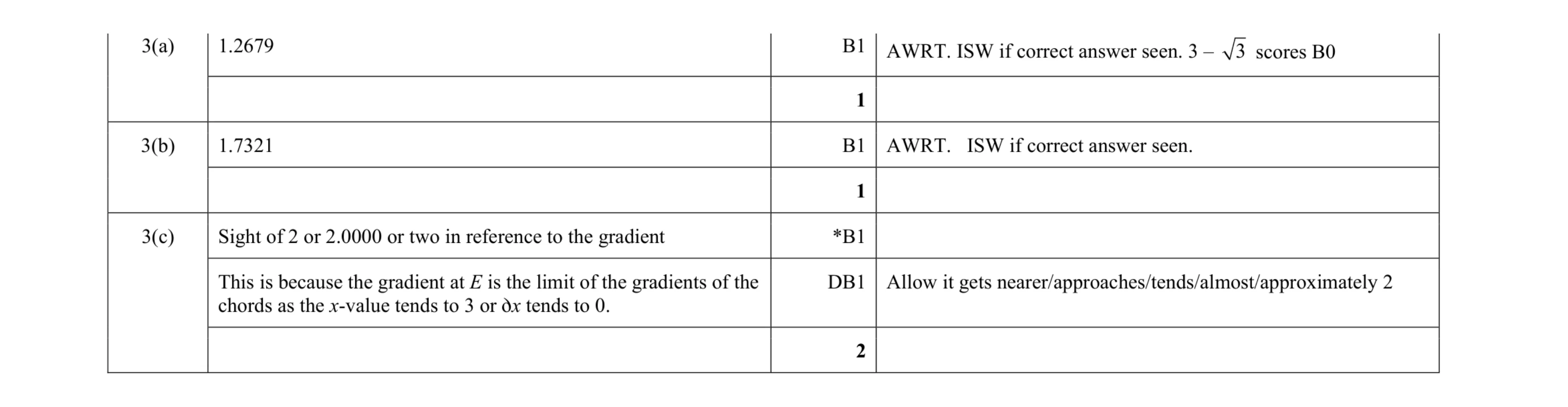 4
4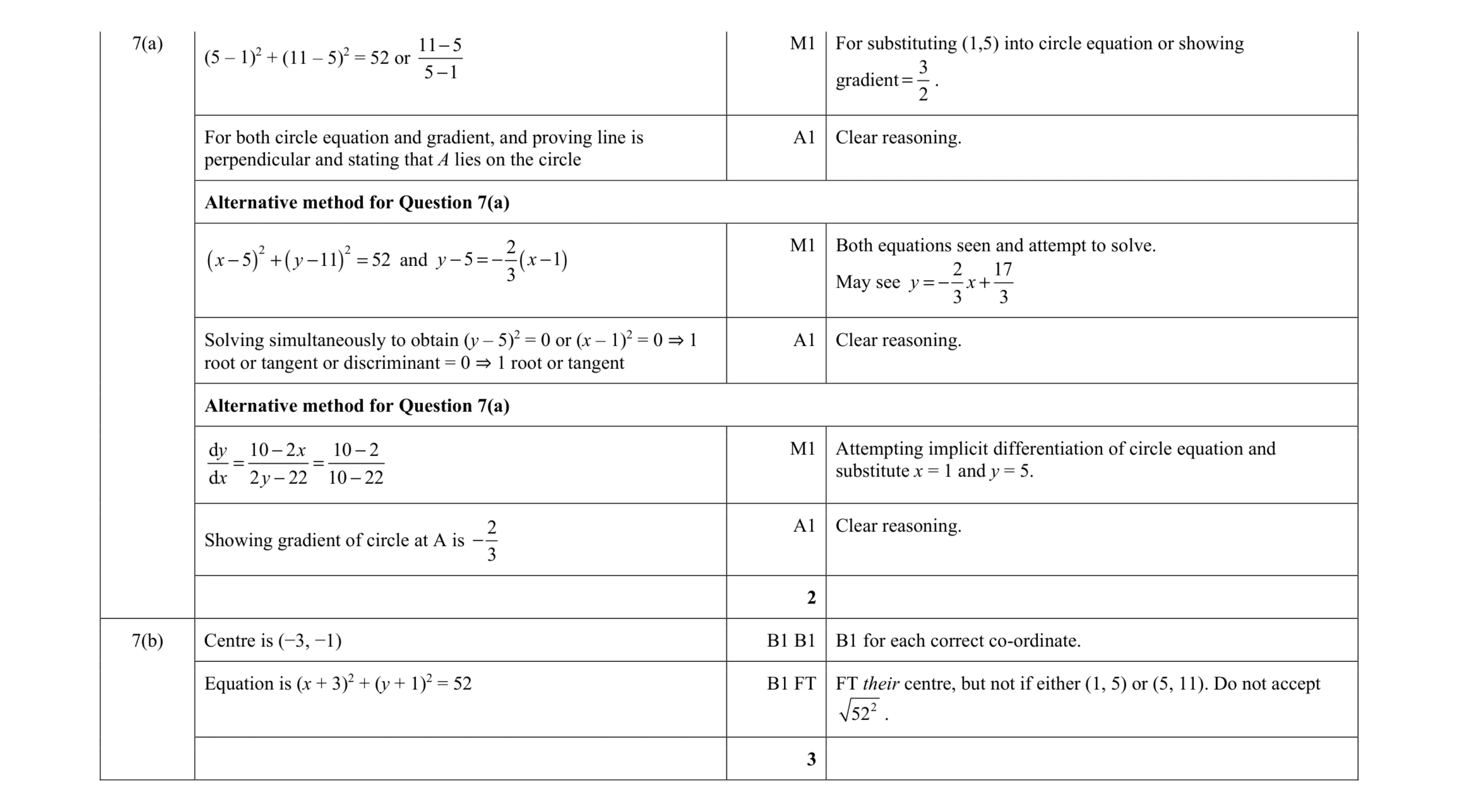 5
5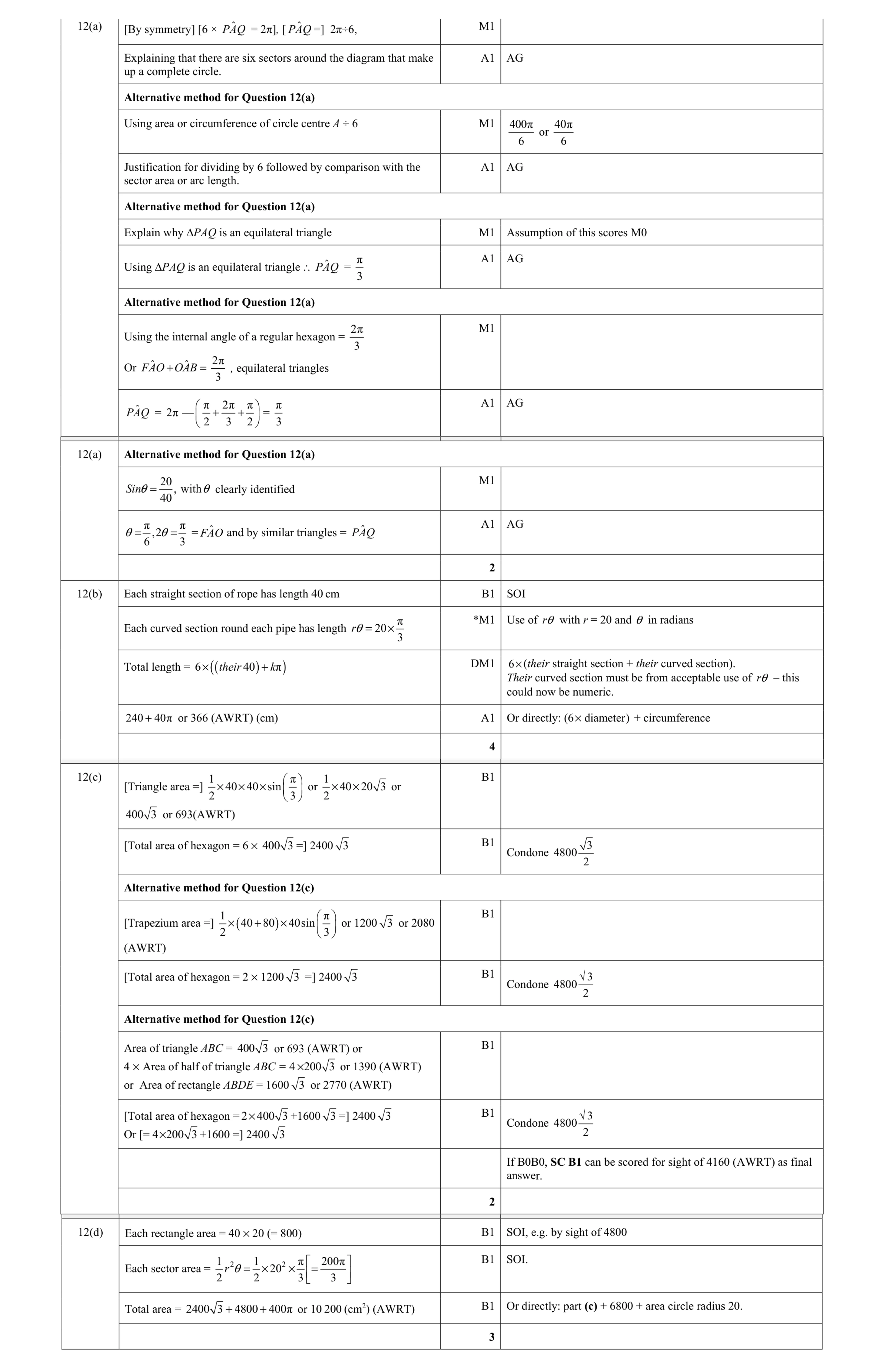 11
11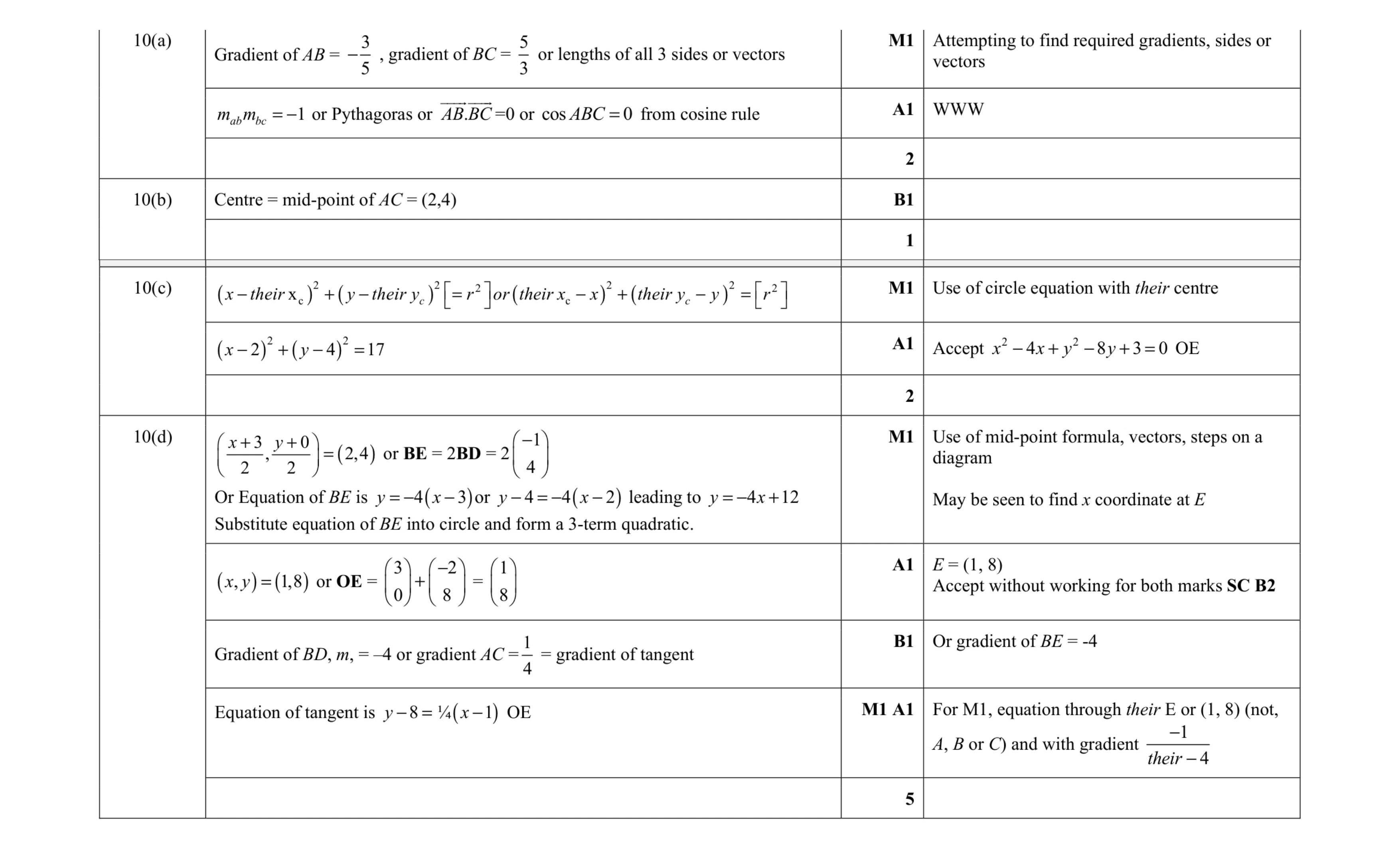 10
10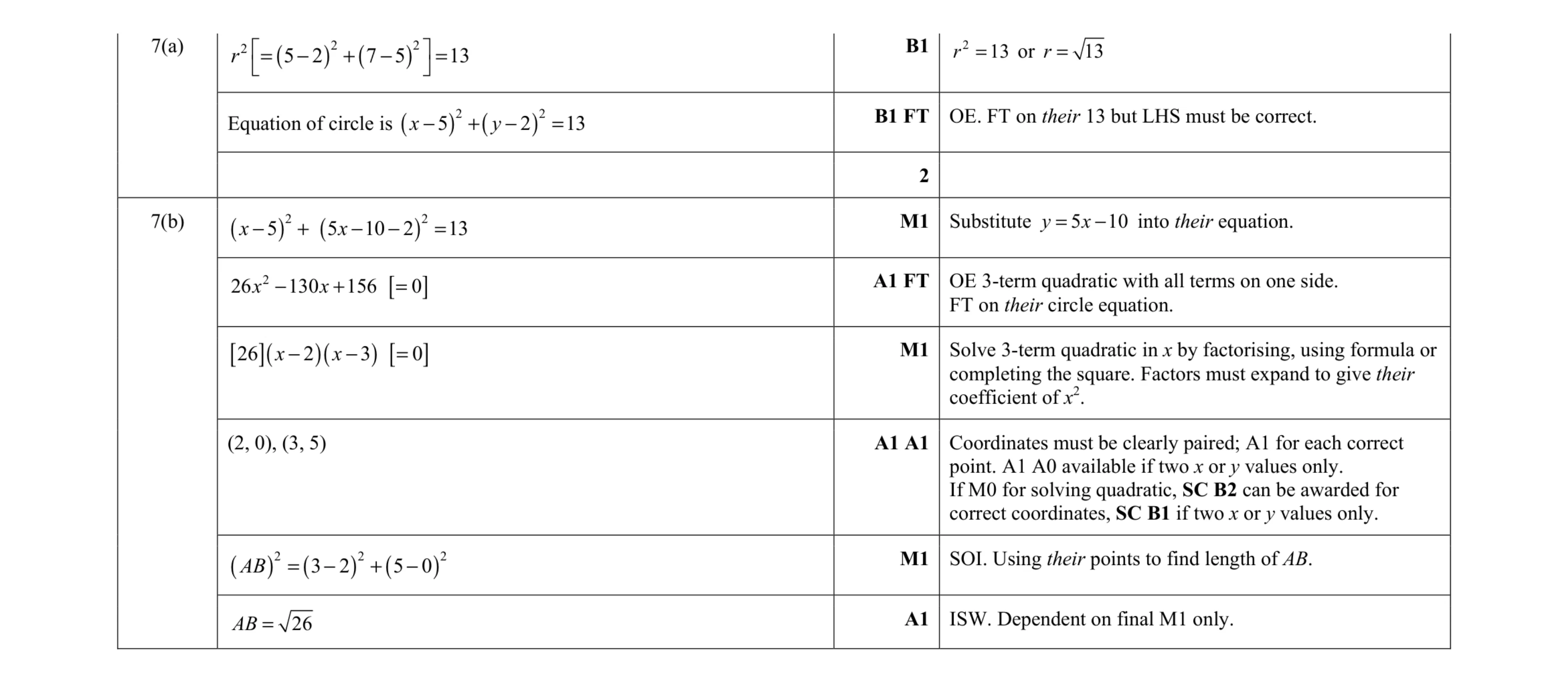 9
9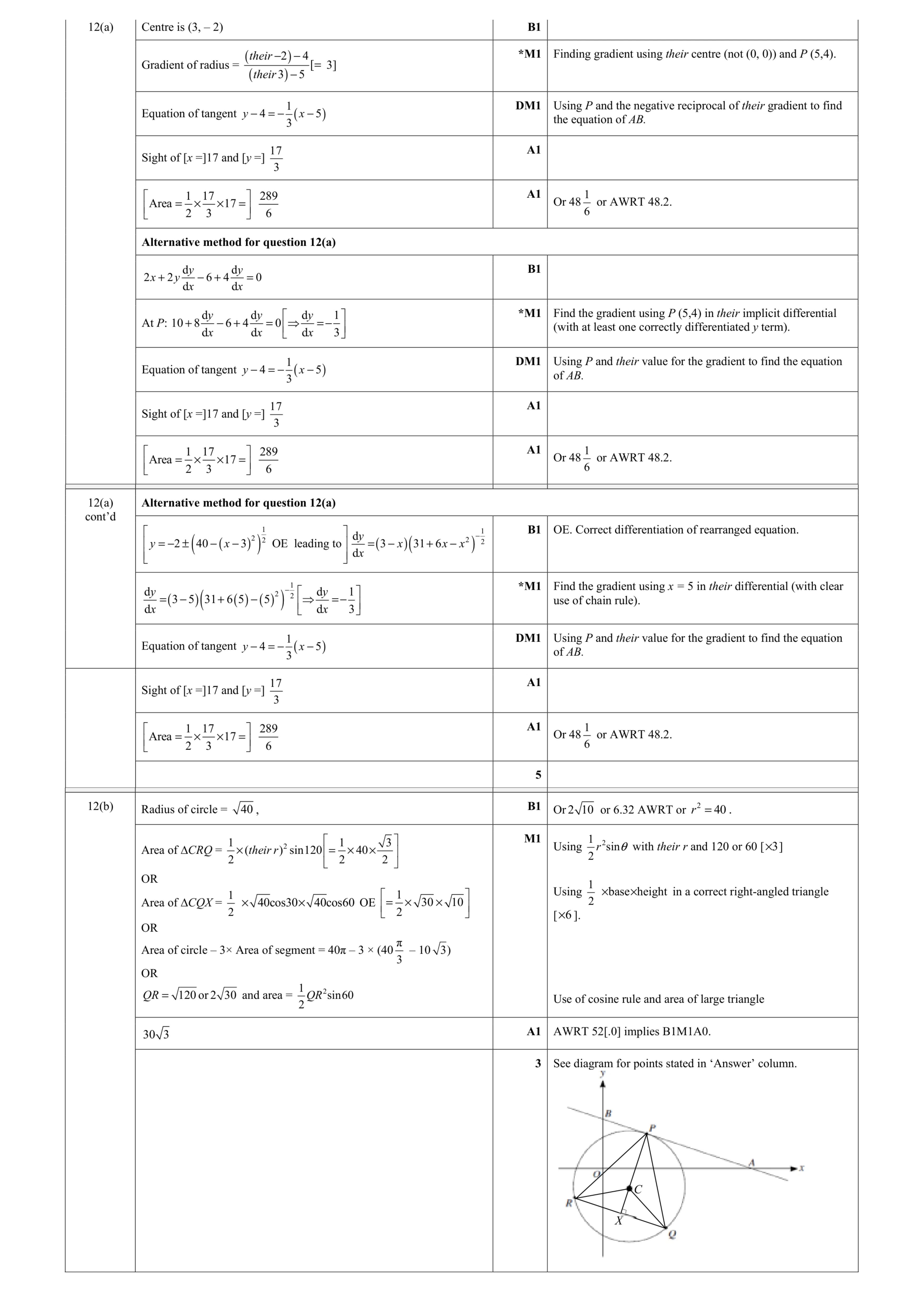 8
8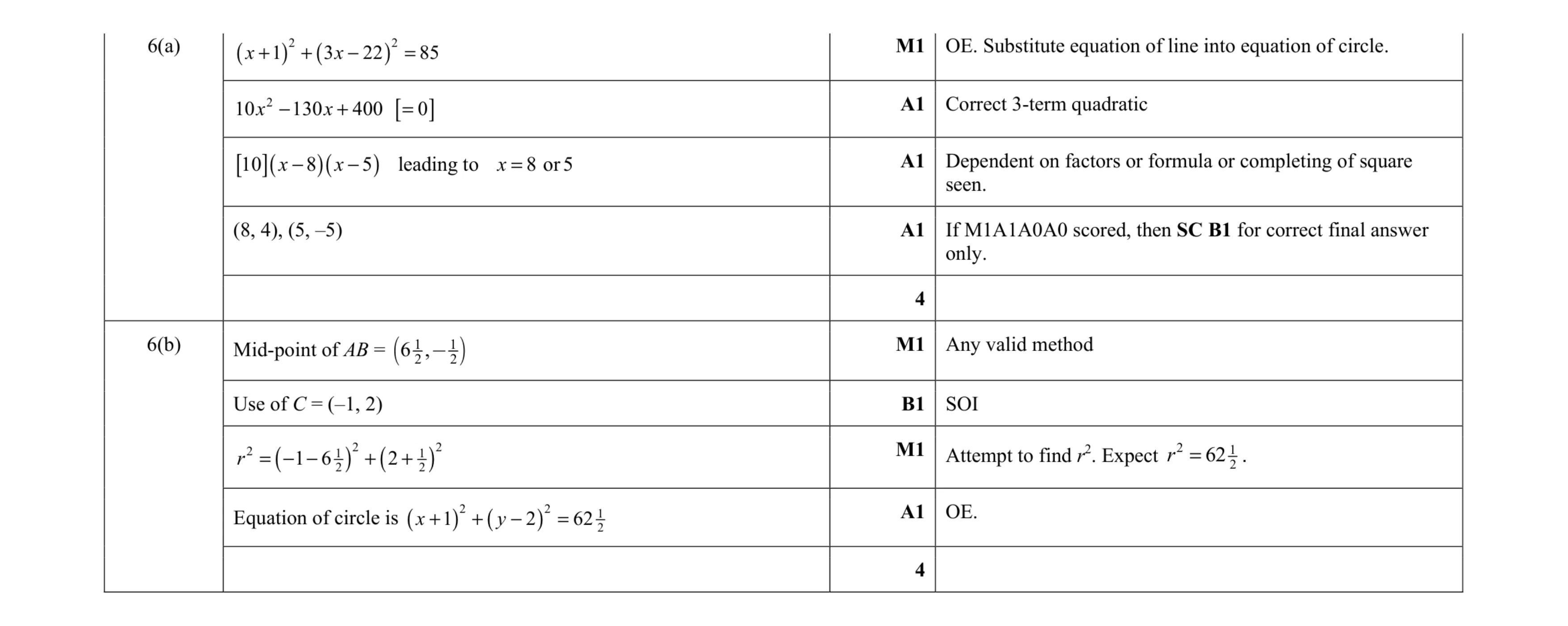 8
8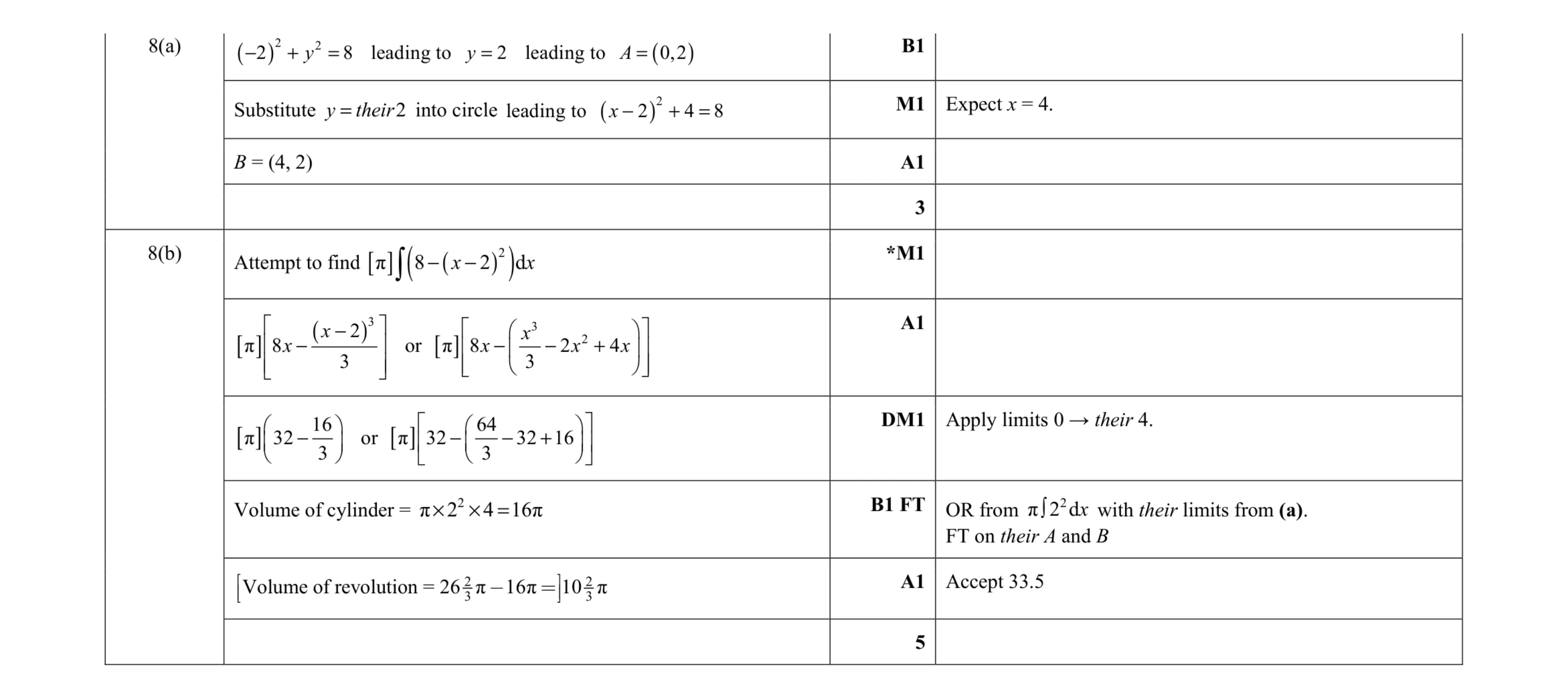 8
8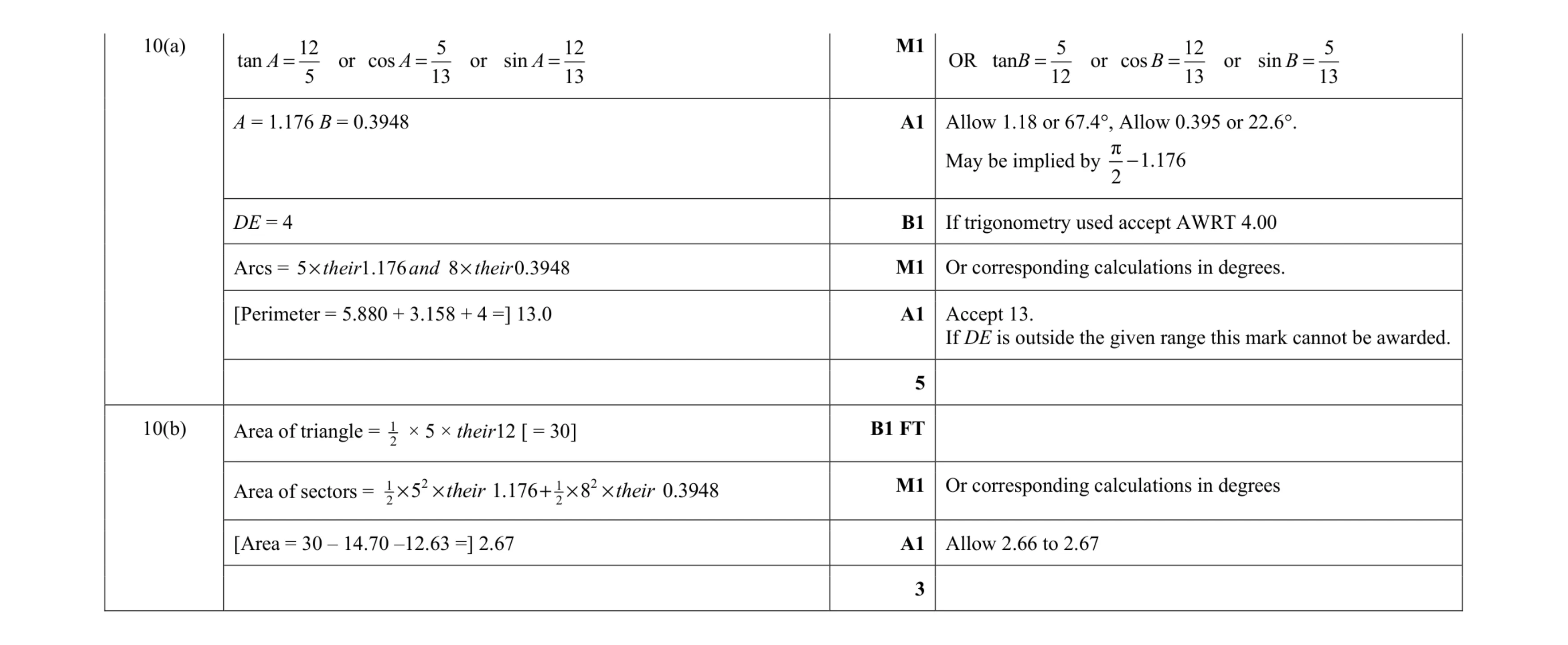 8
8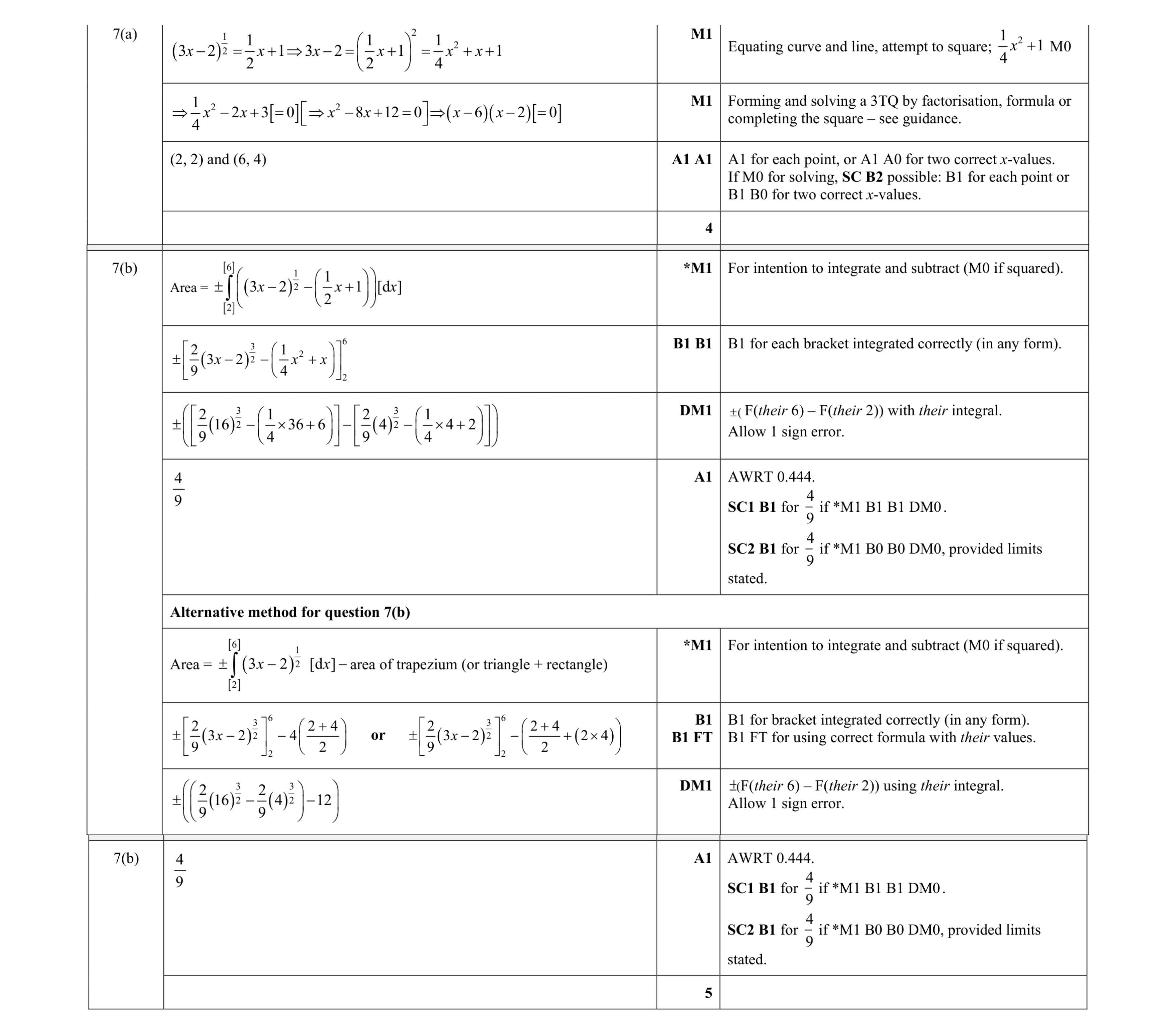 9
9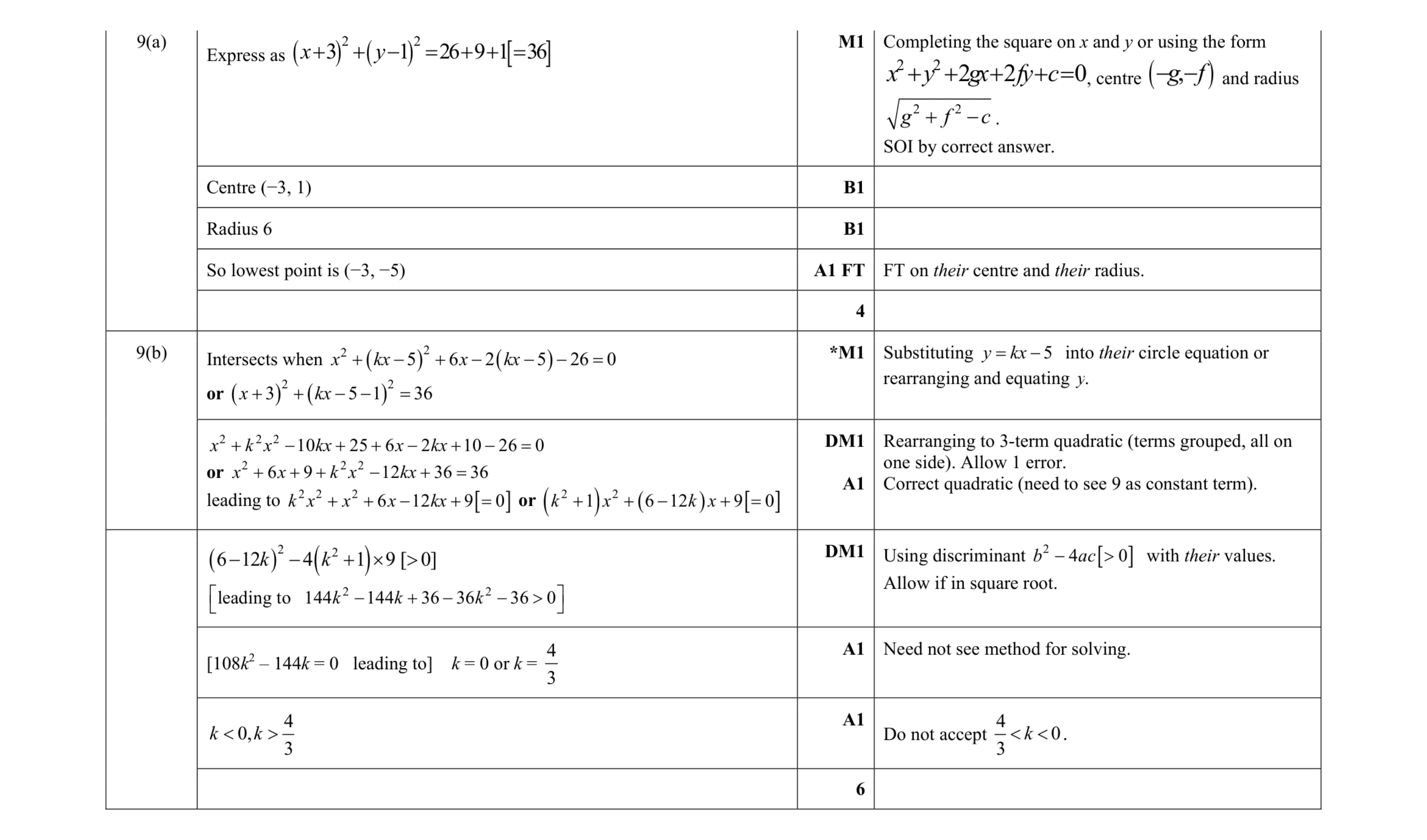 10
10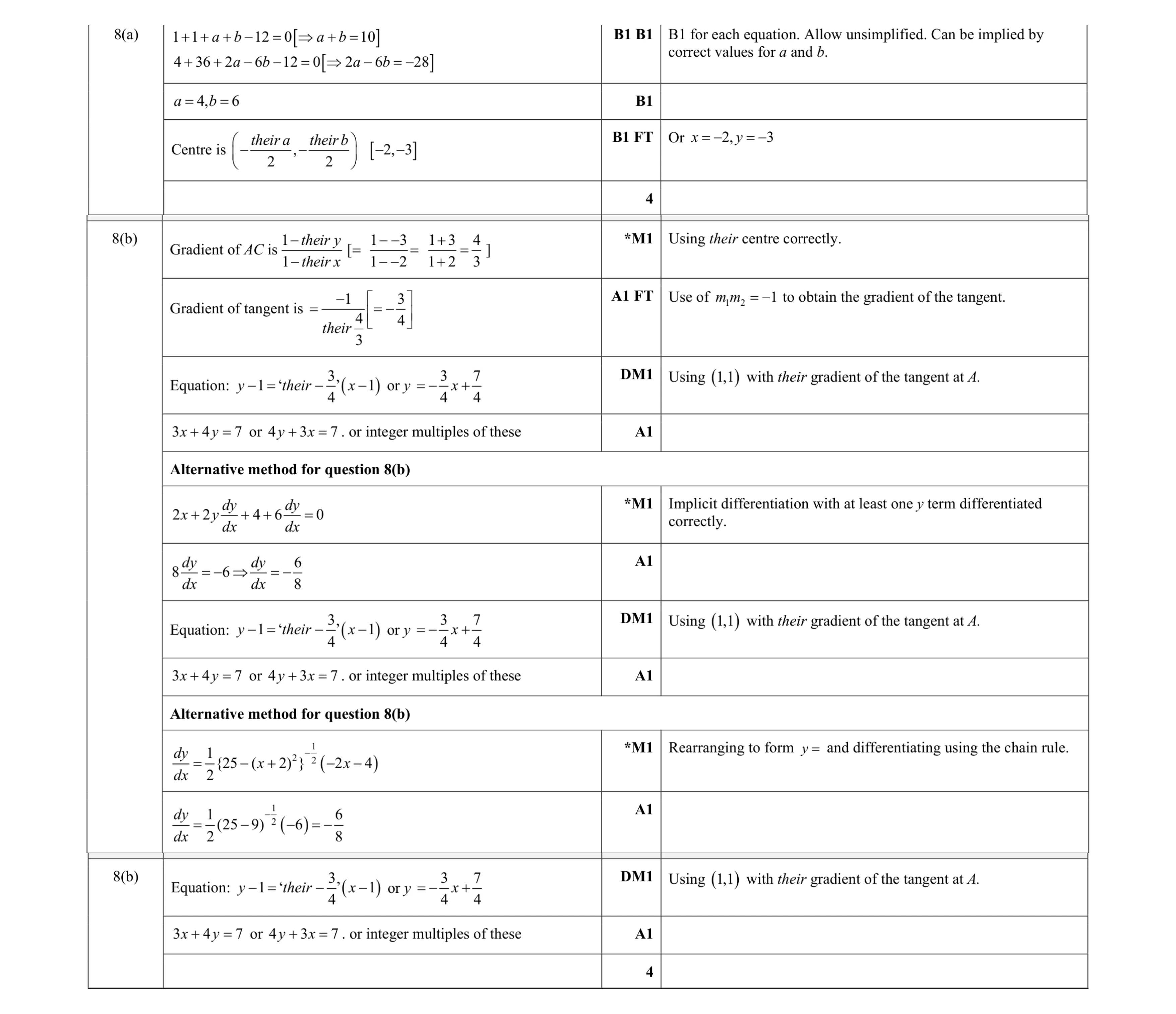 8
8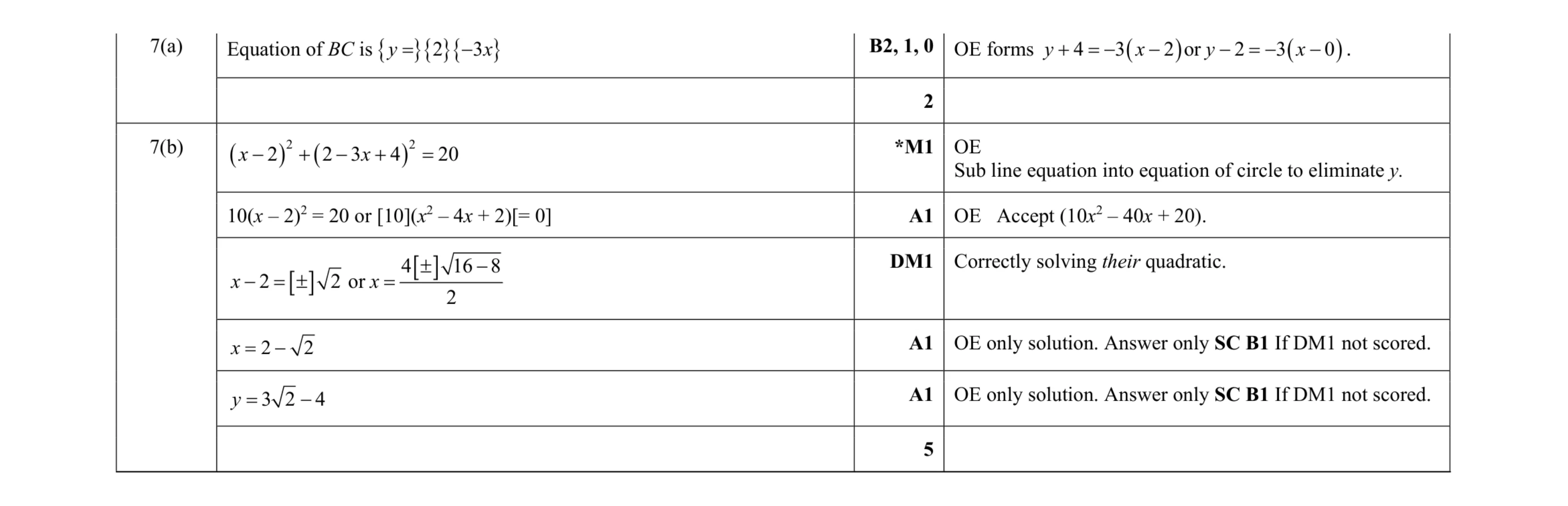 7
7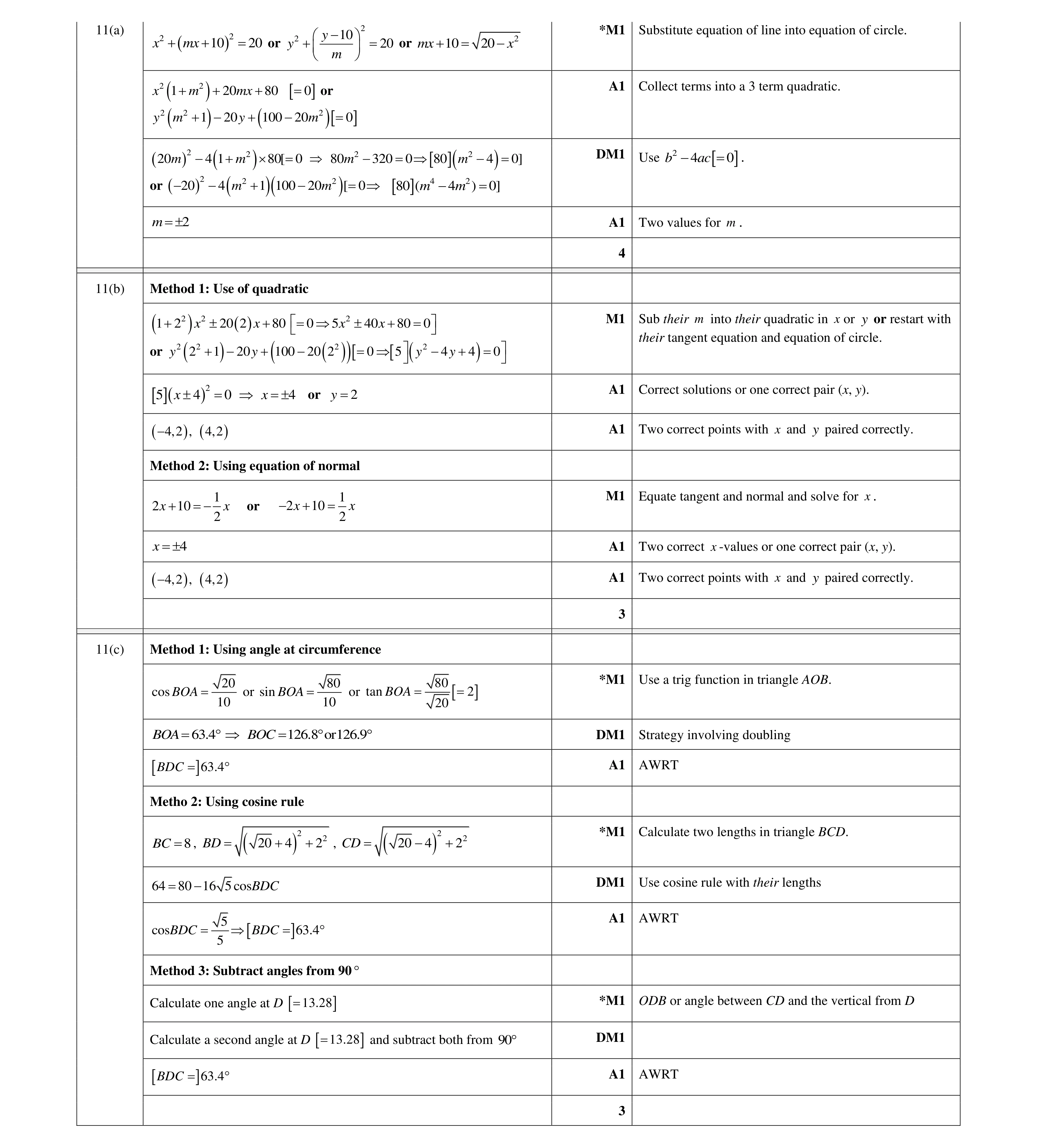 10
10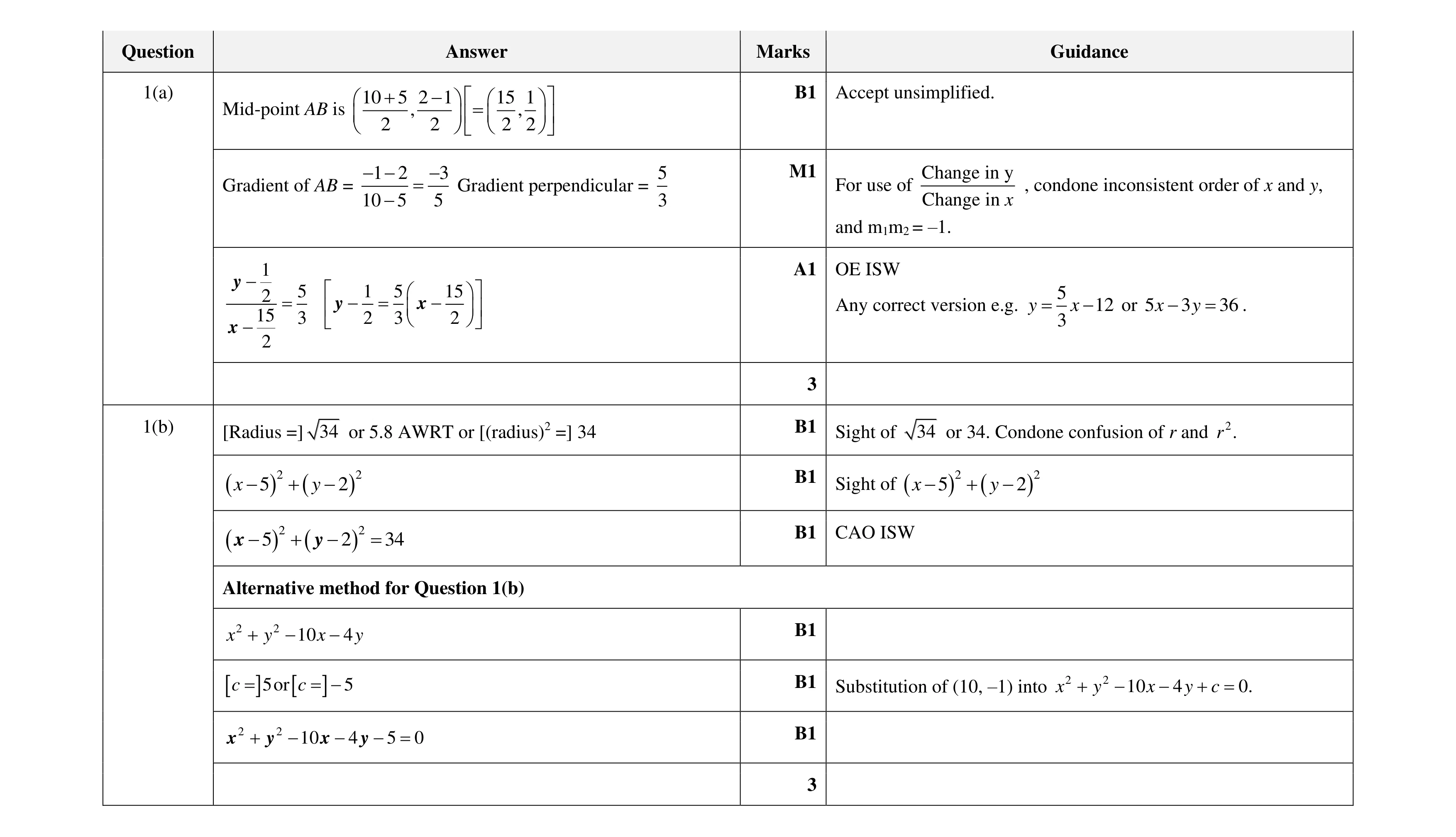 6
6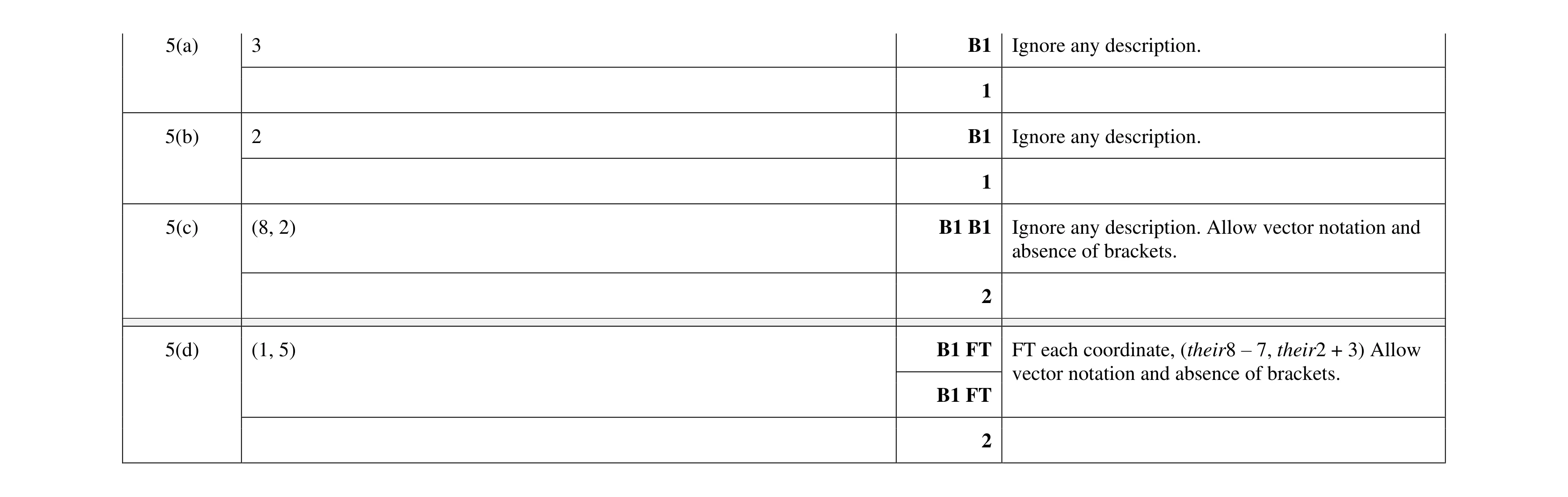 6
6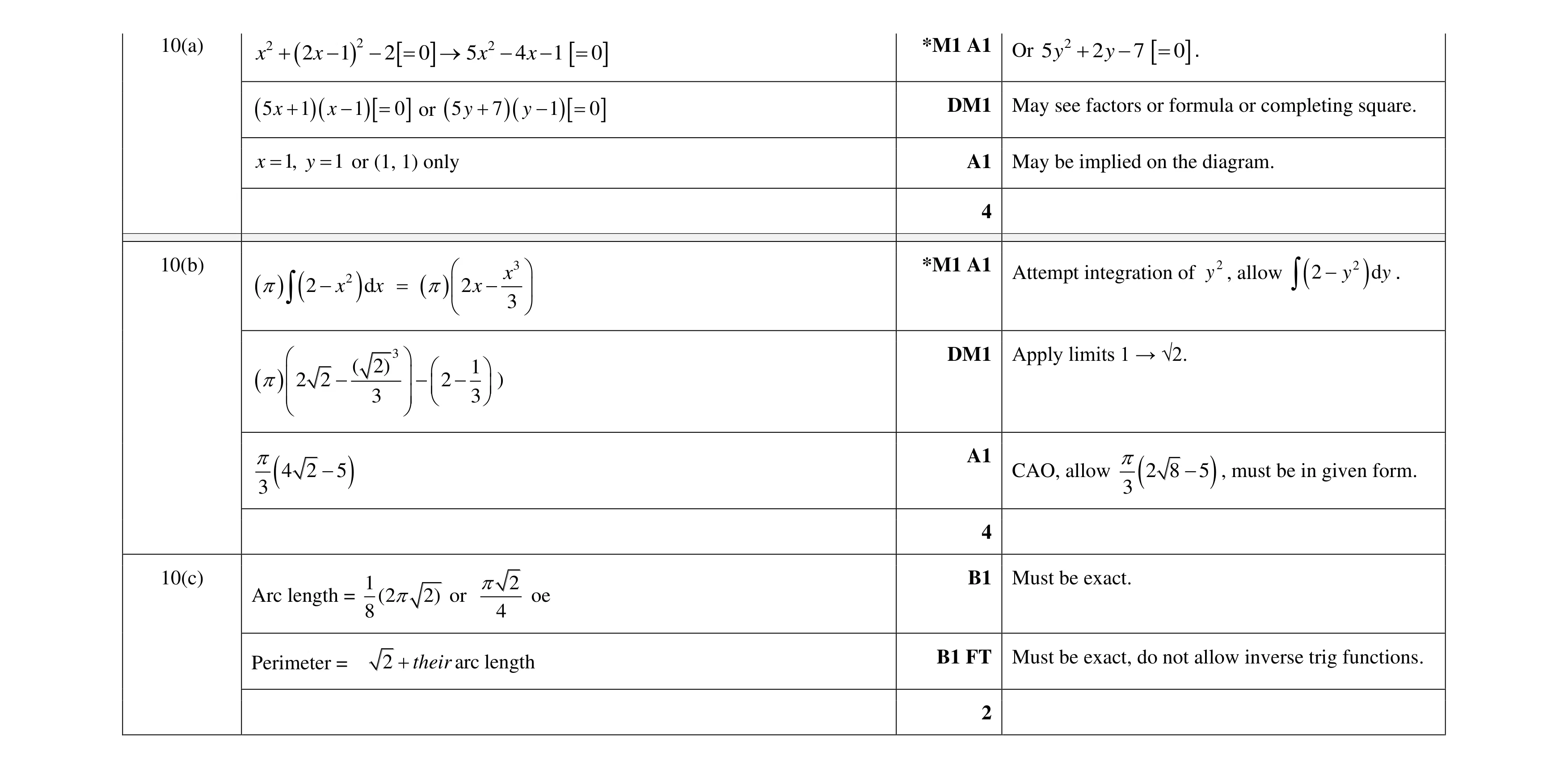 10
10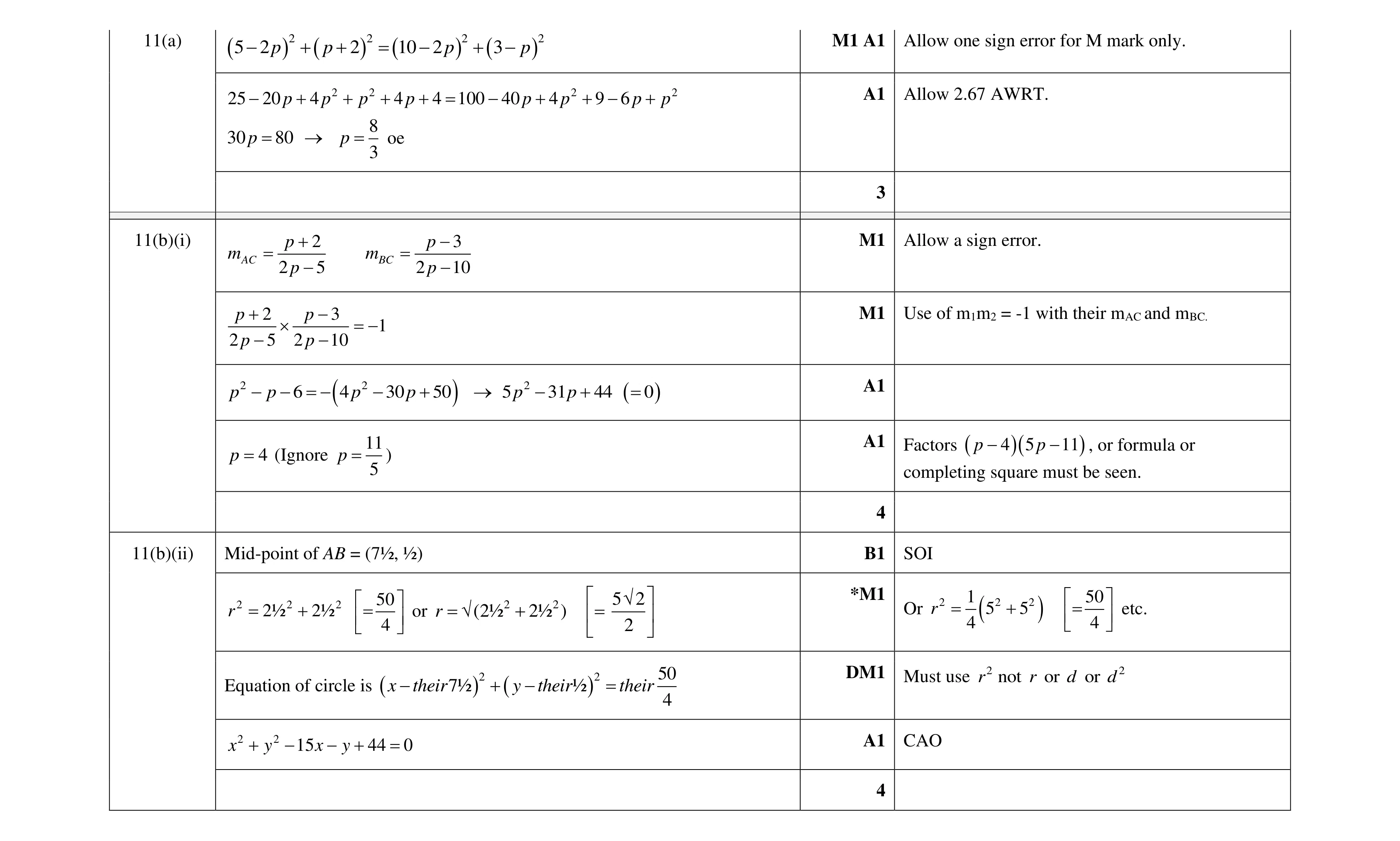 11
11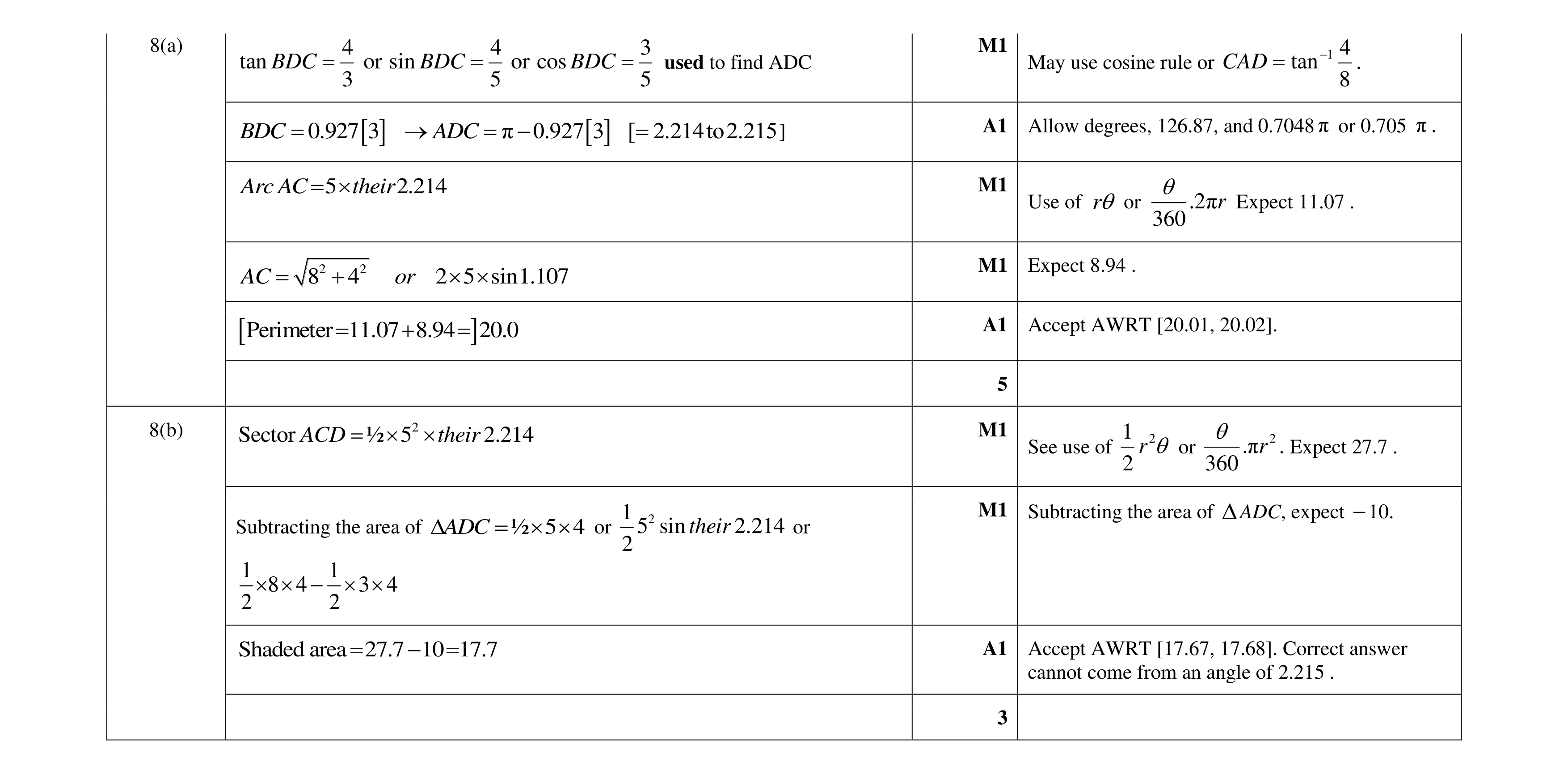 8
8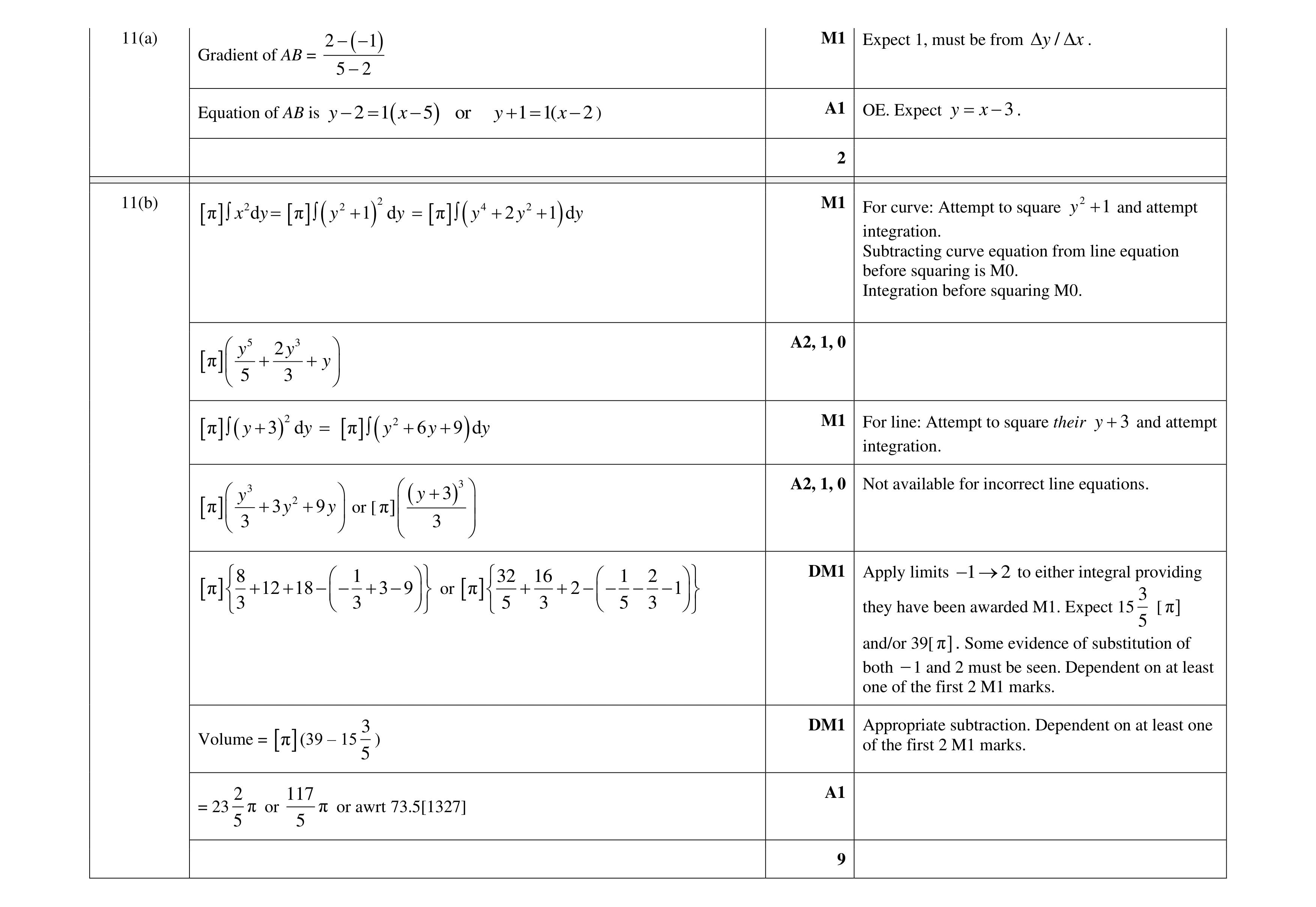 11
11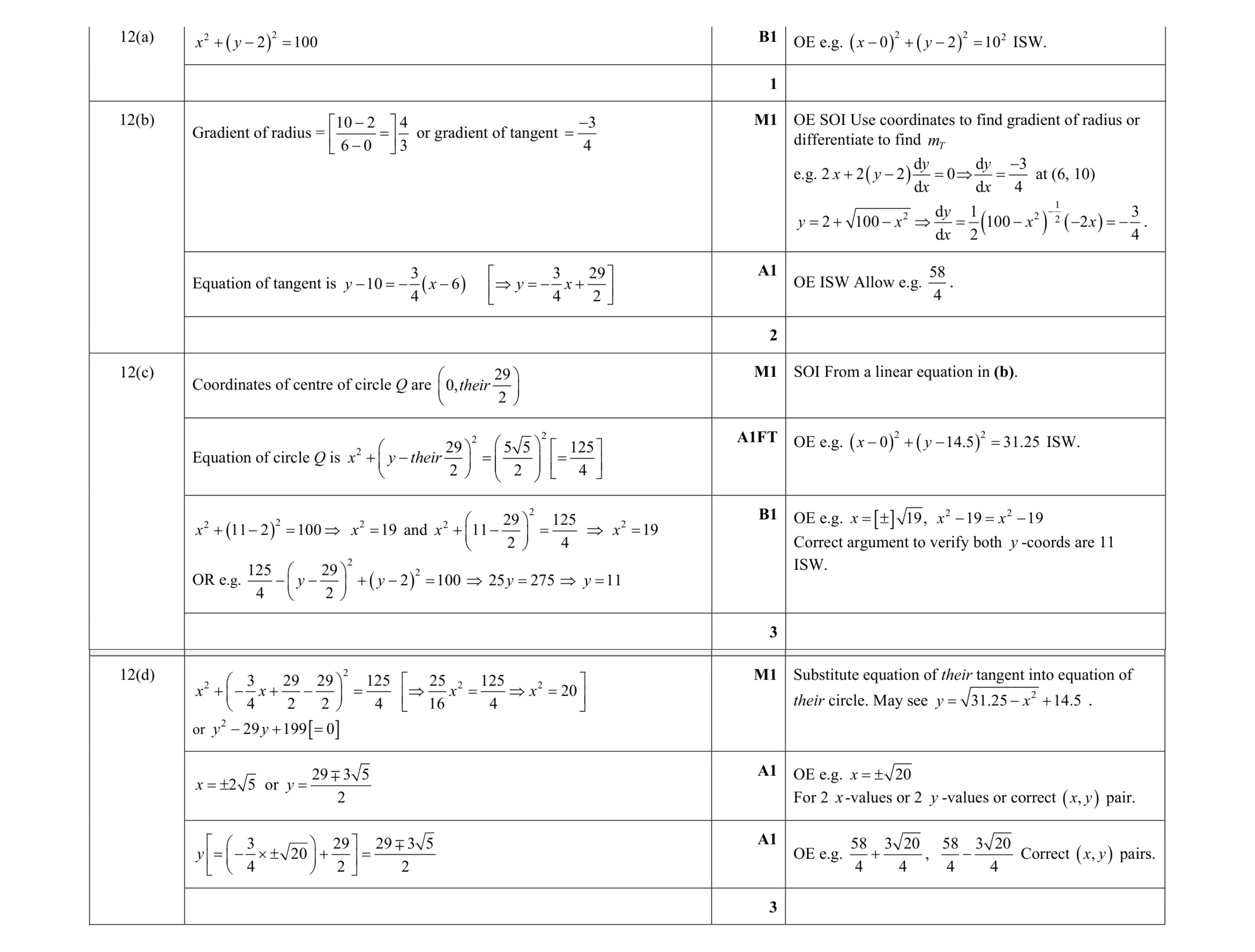 9
9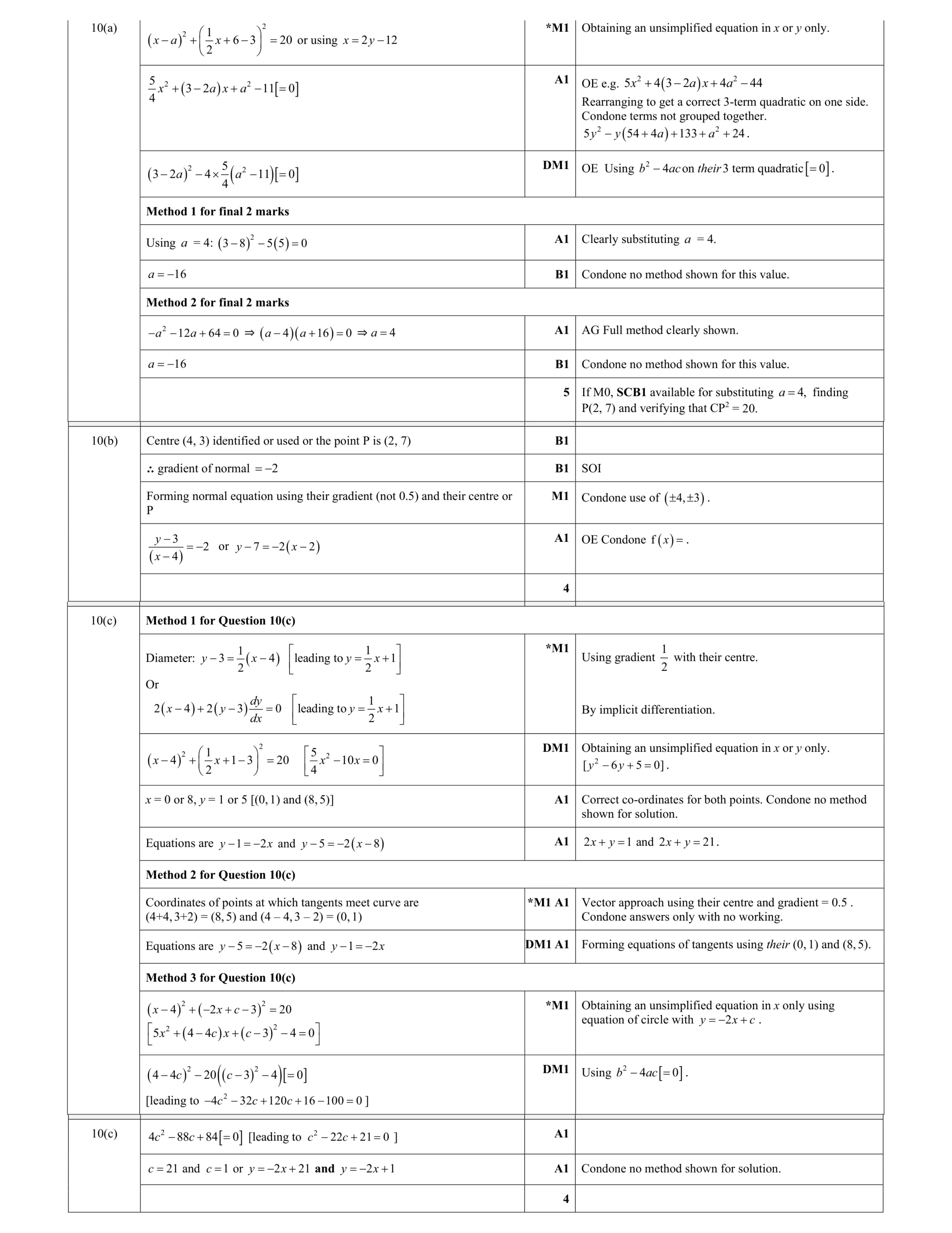 13
13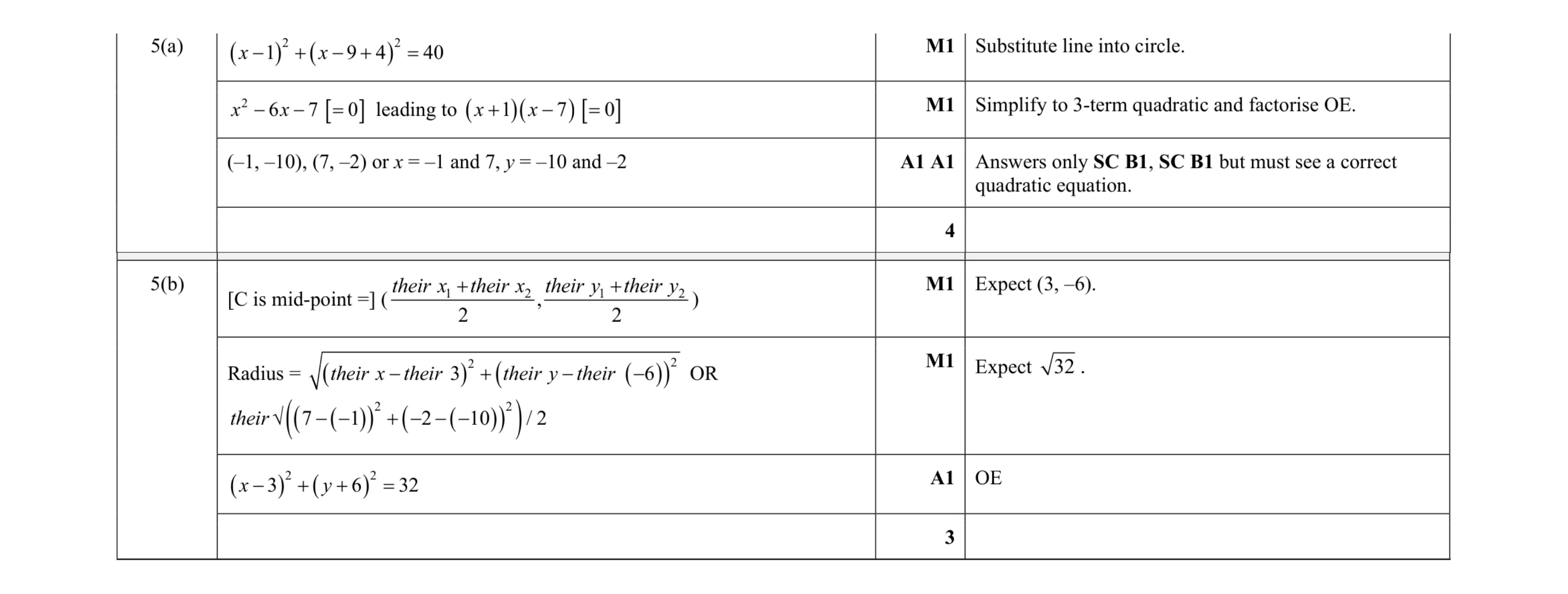 7
7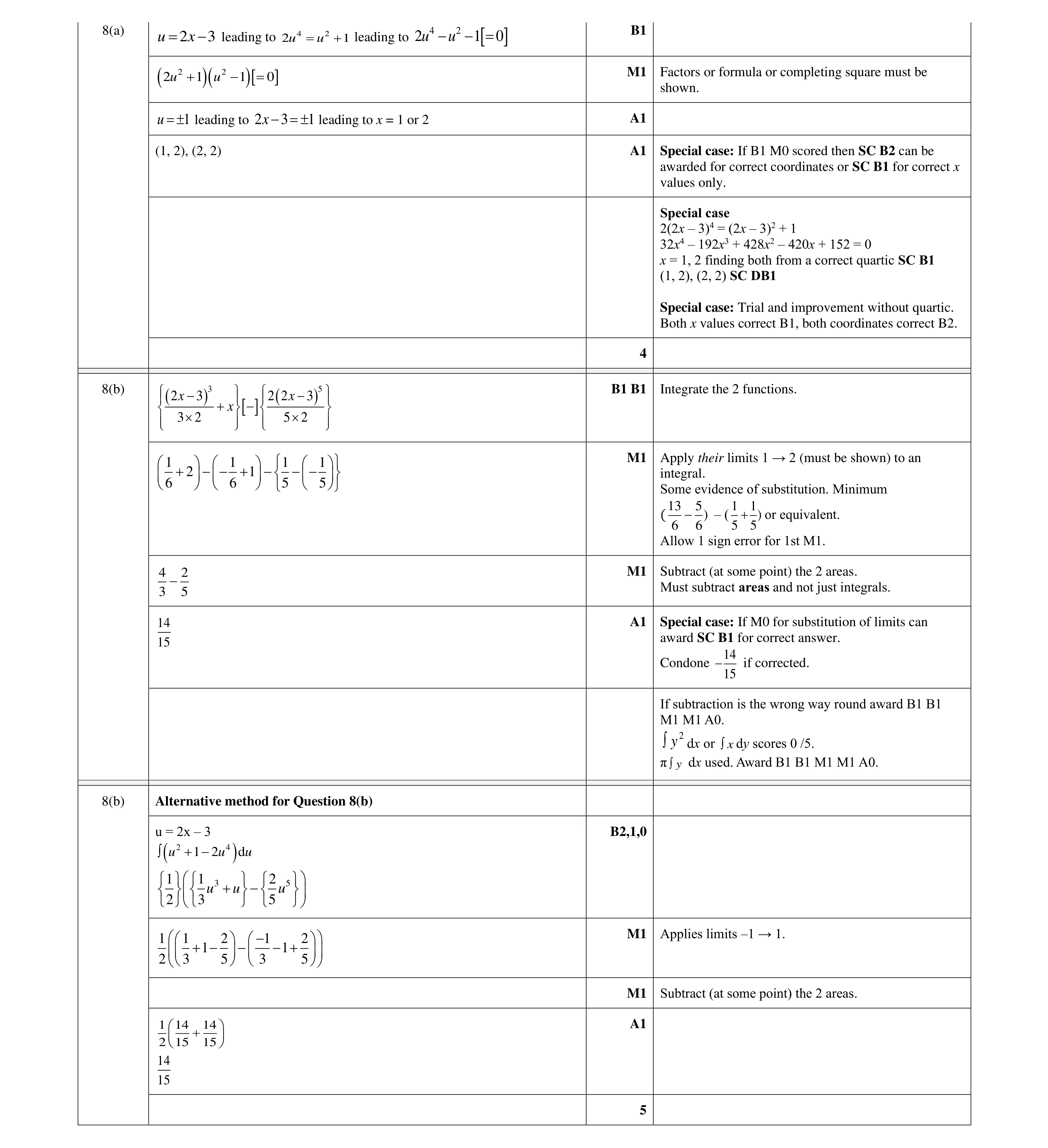 9
9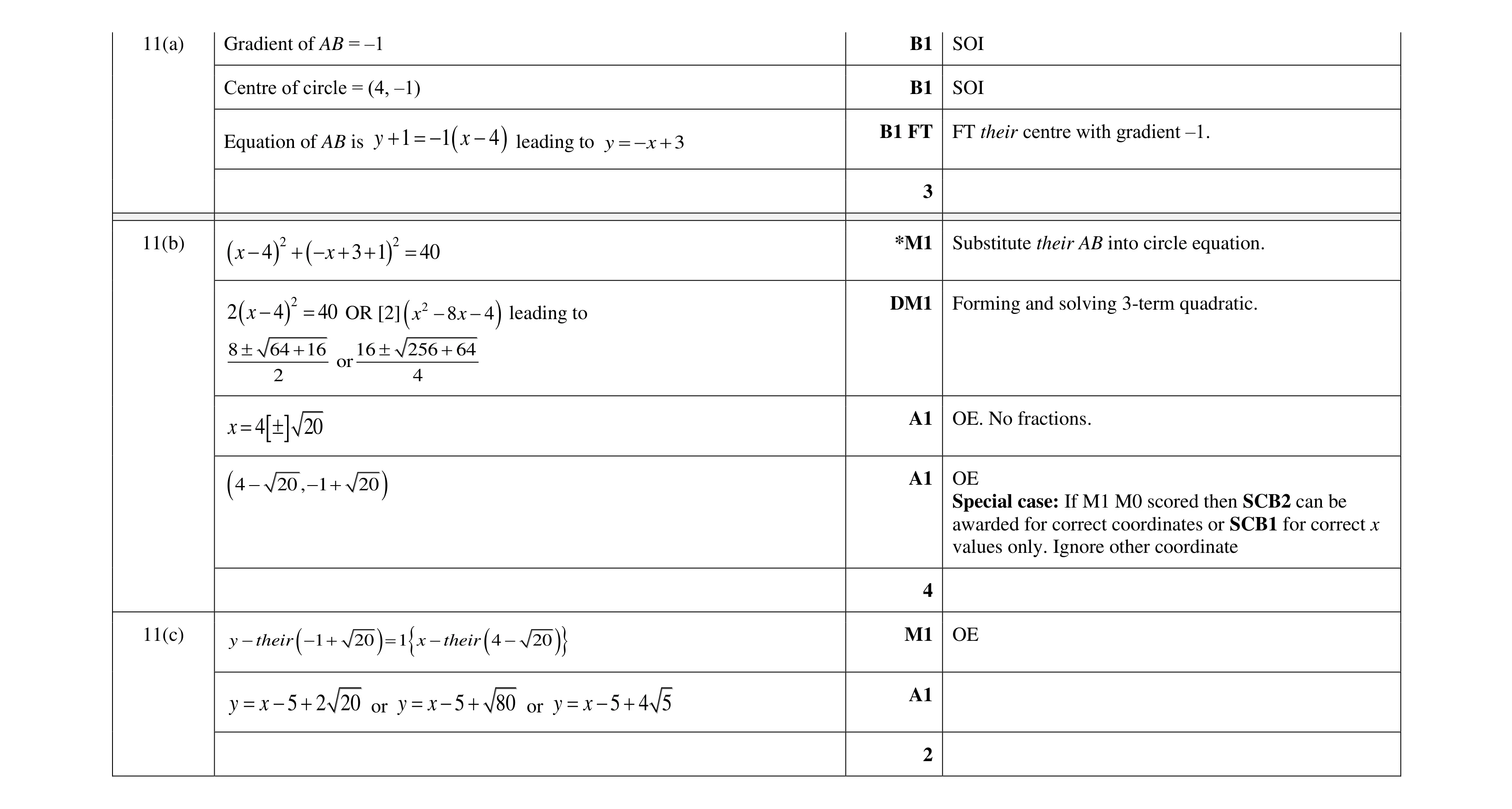 9
9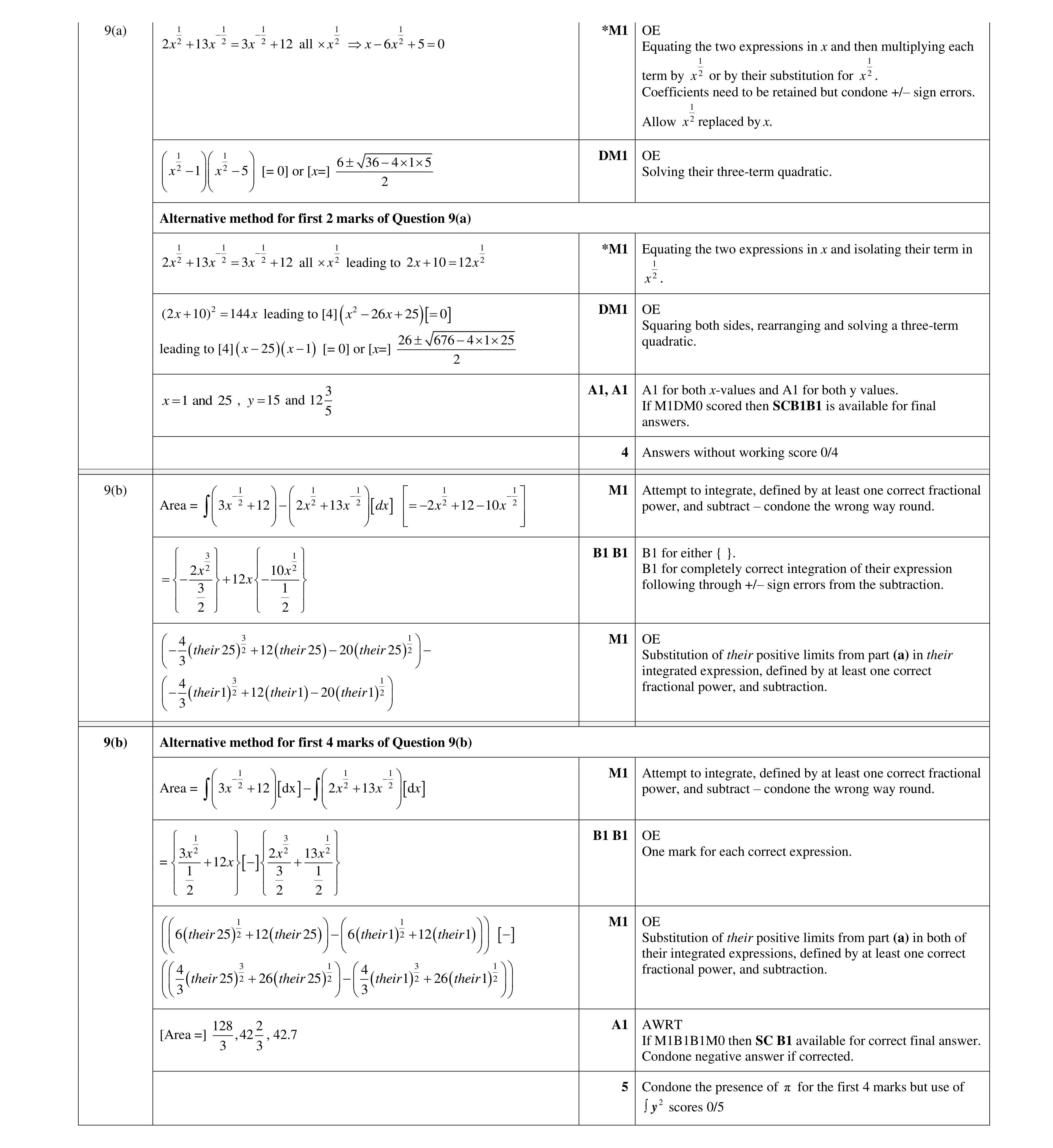 9
9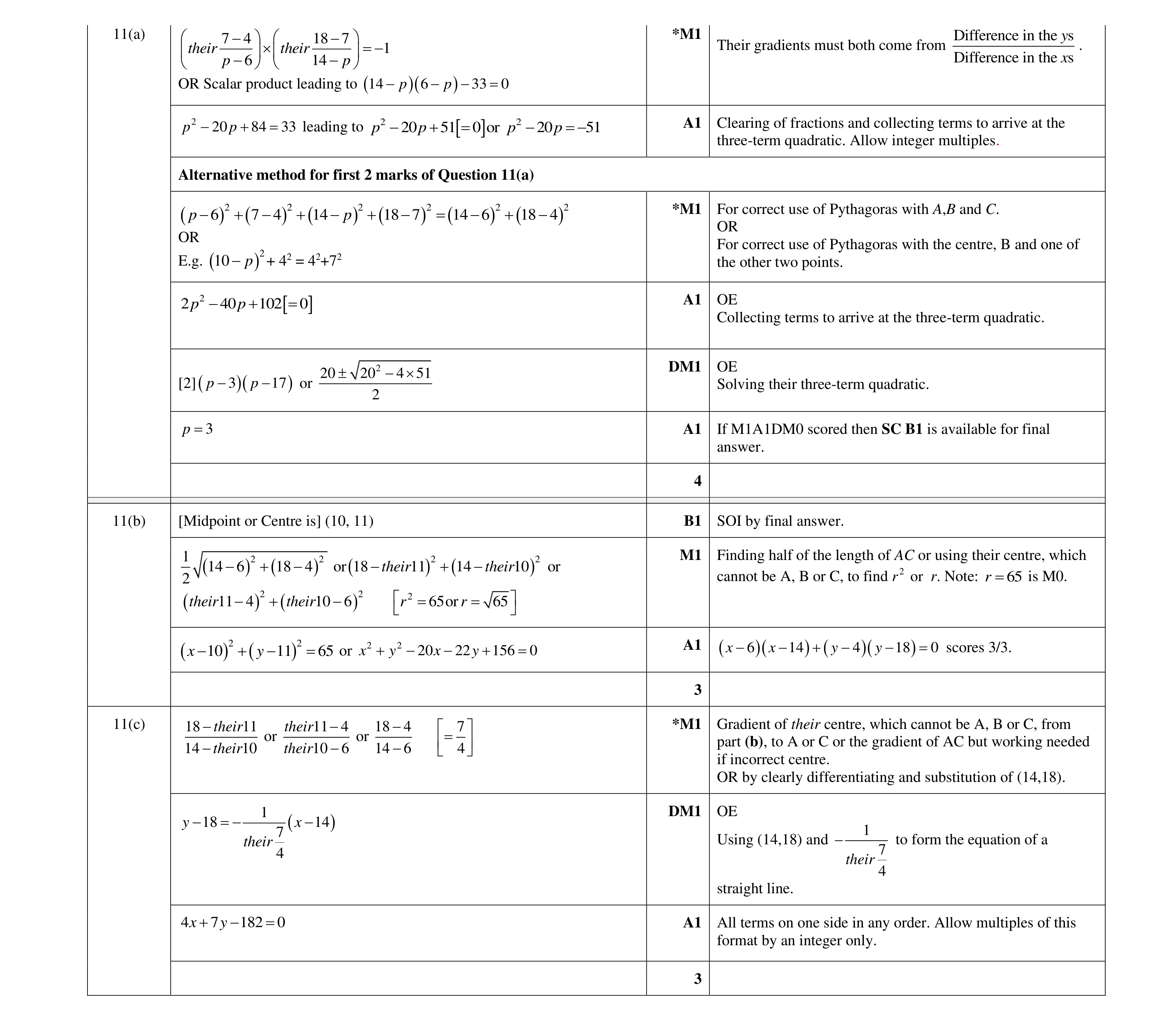 10
10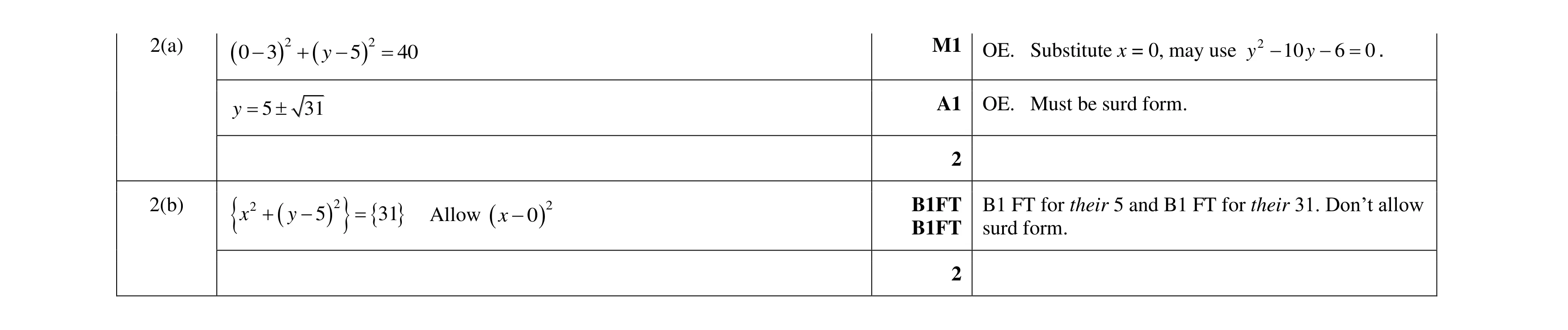 4
4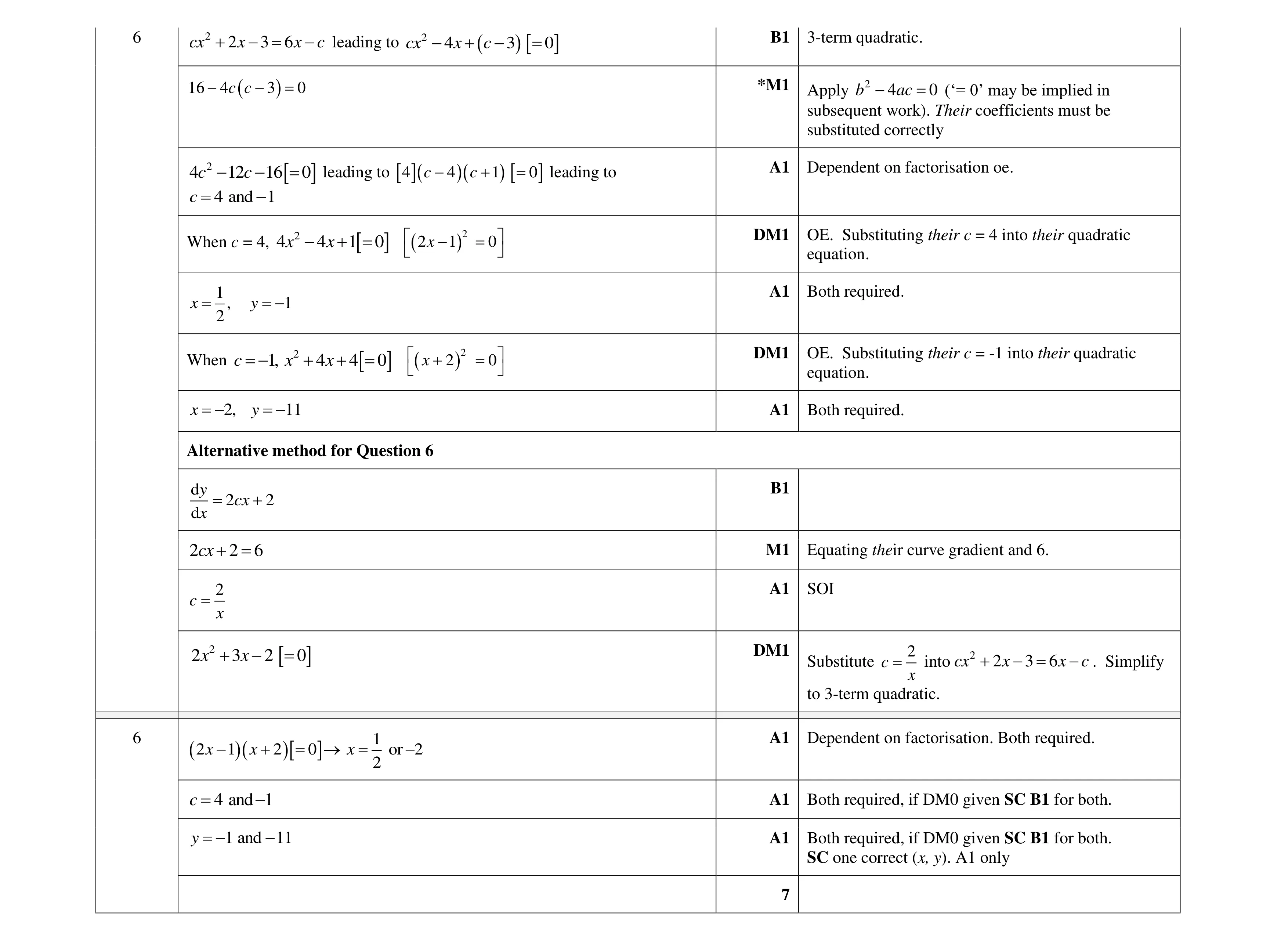 7
7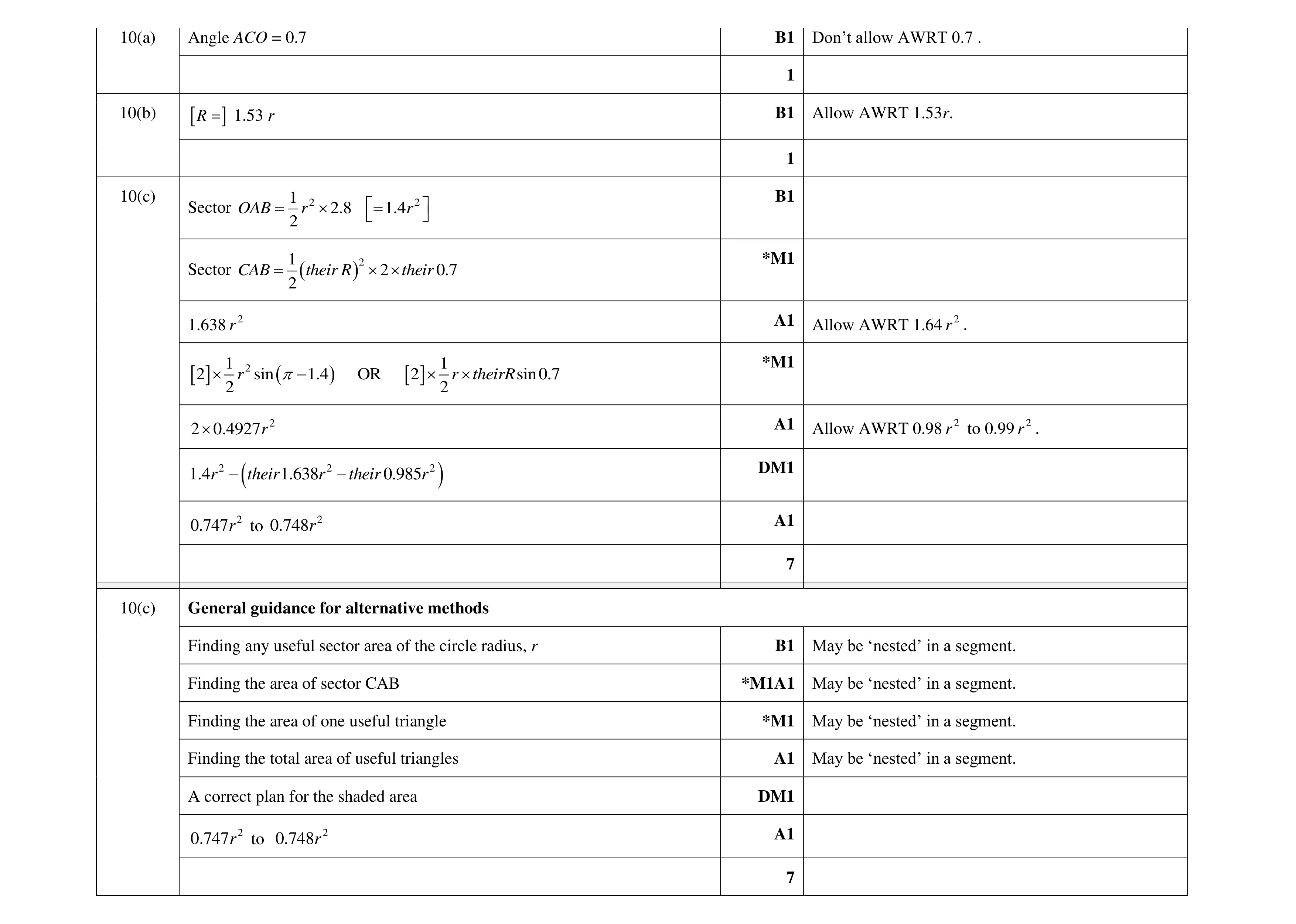 9
9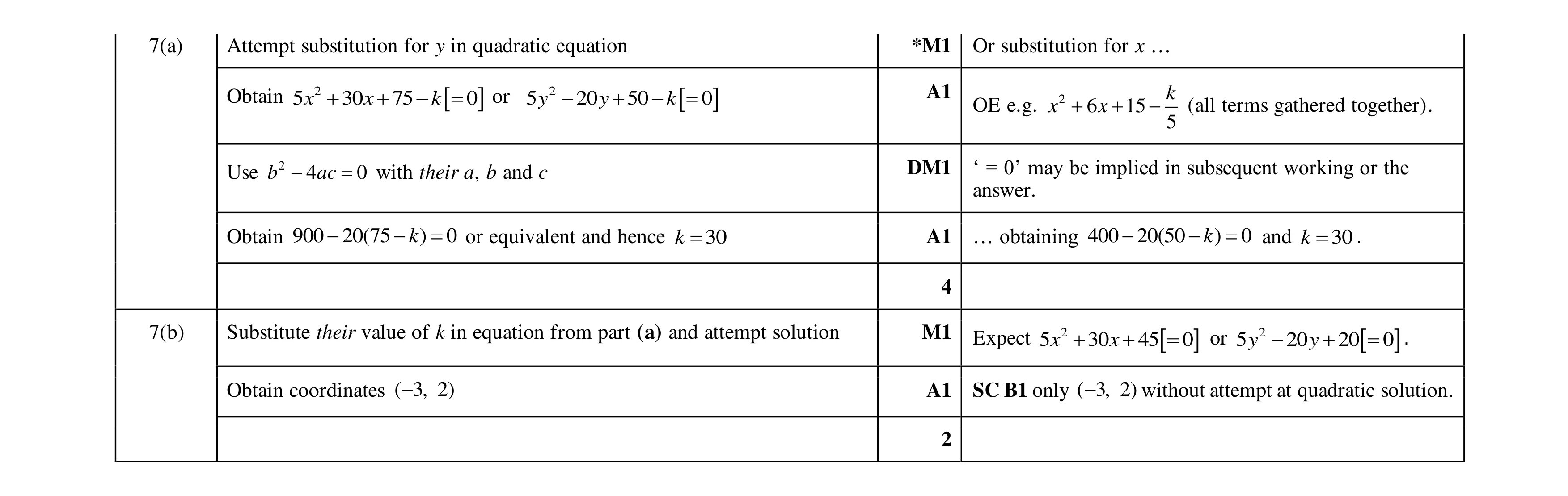 6
6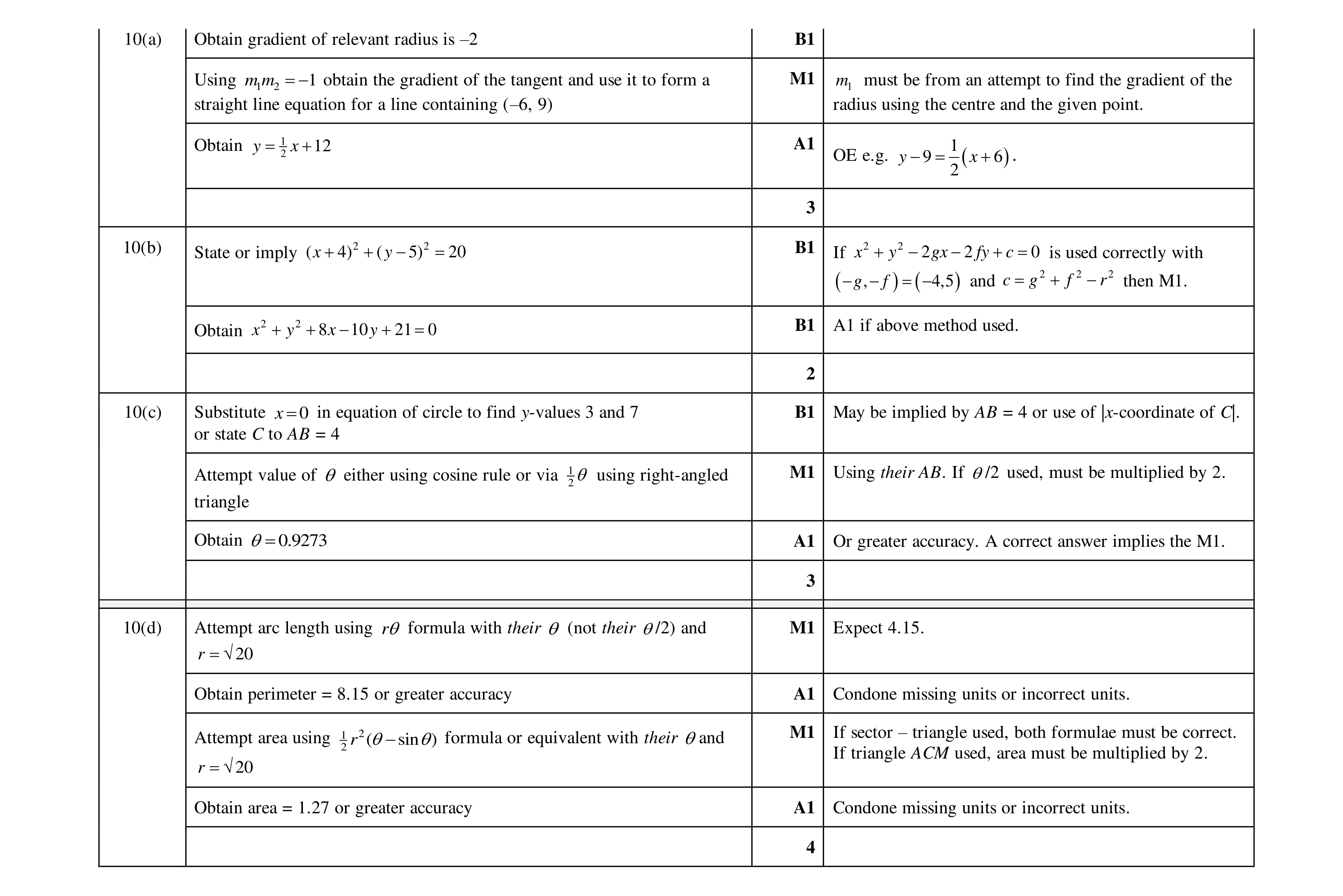 12
12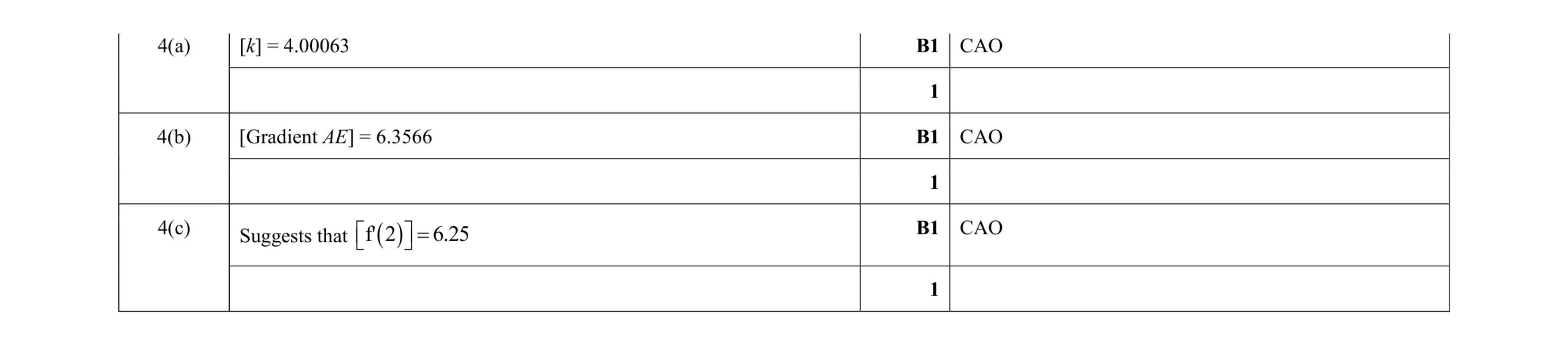 3
3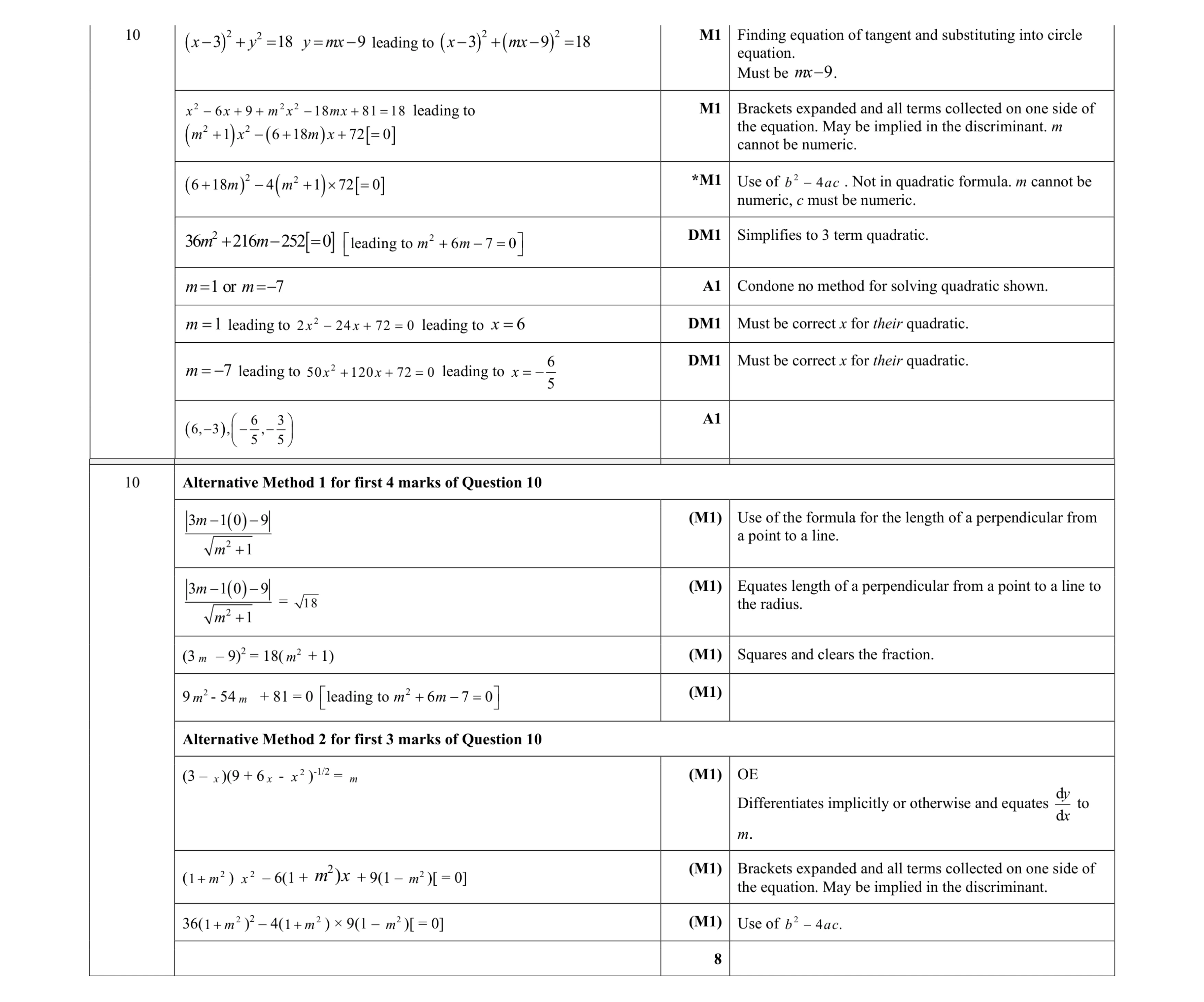 8
8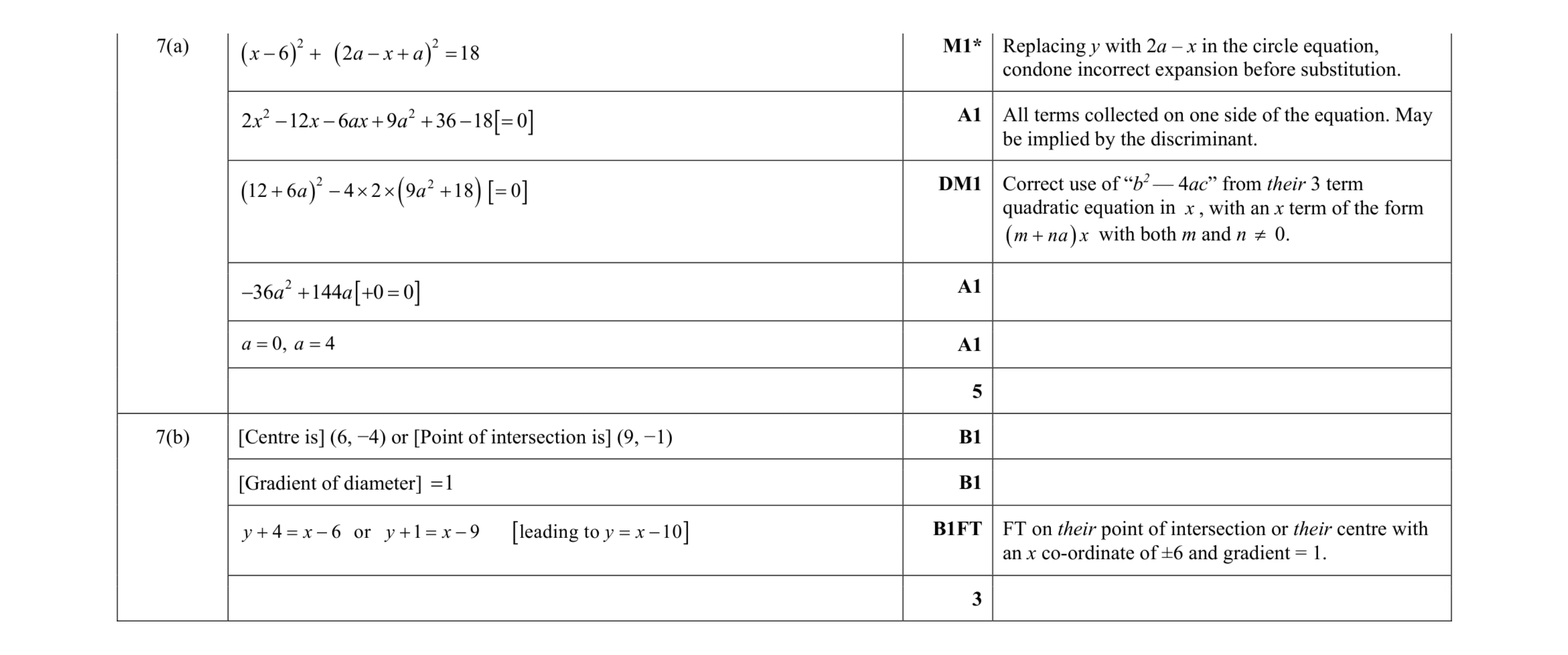 8
8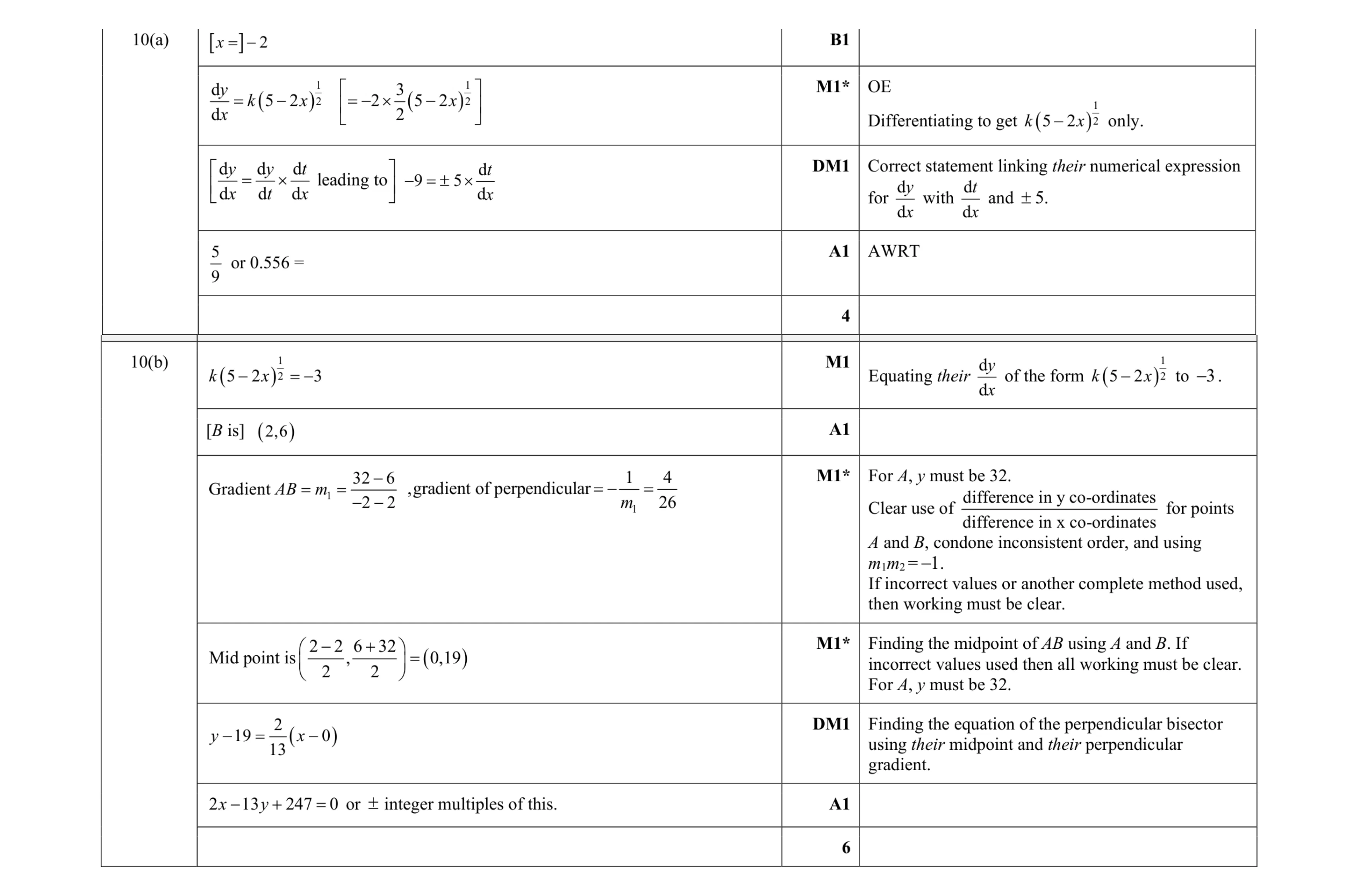 10
10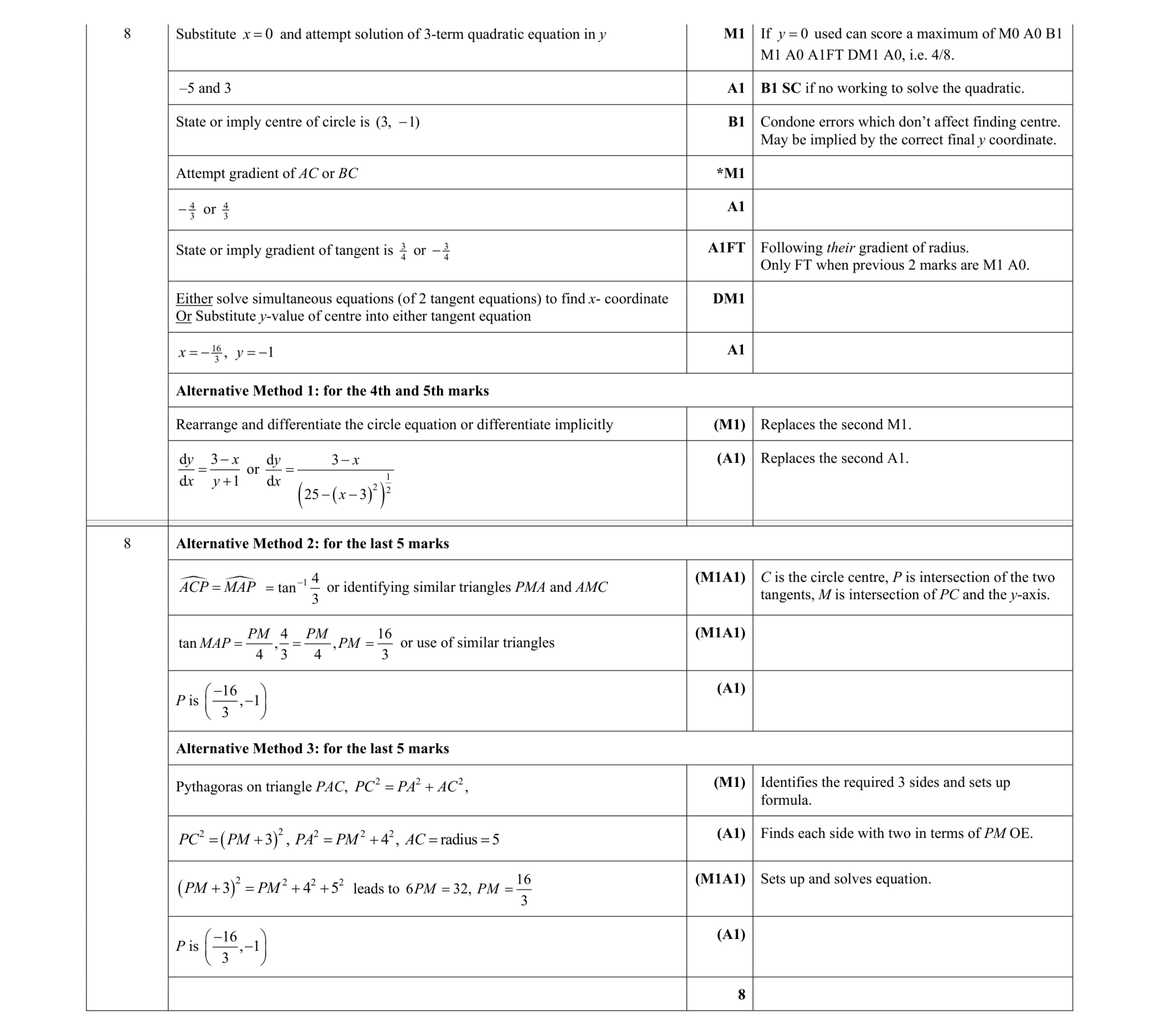 8
8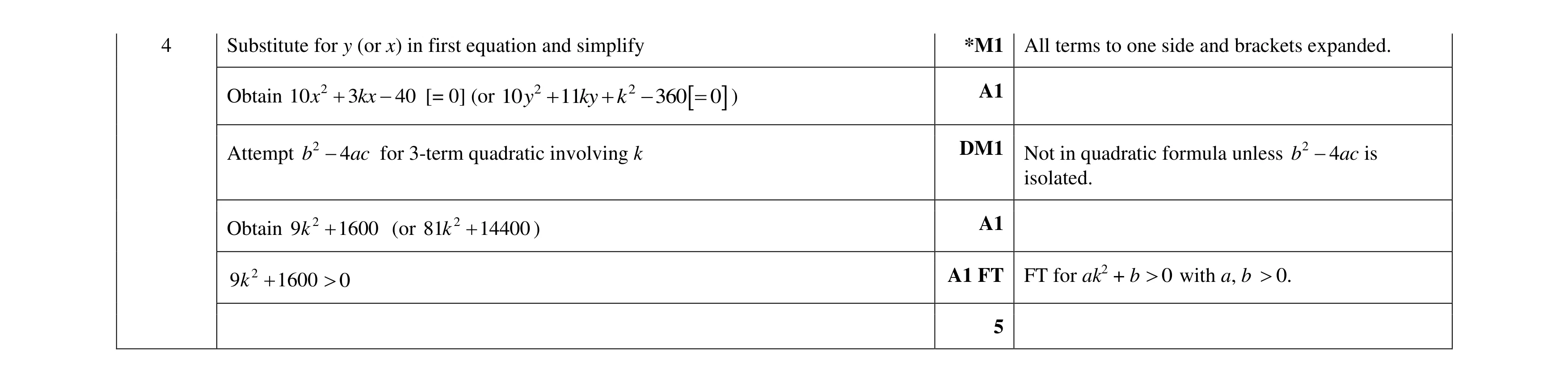 5
5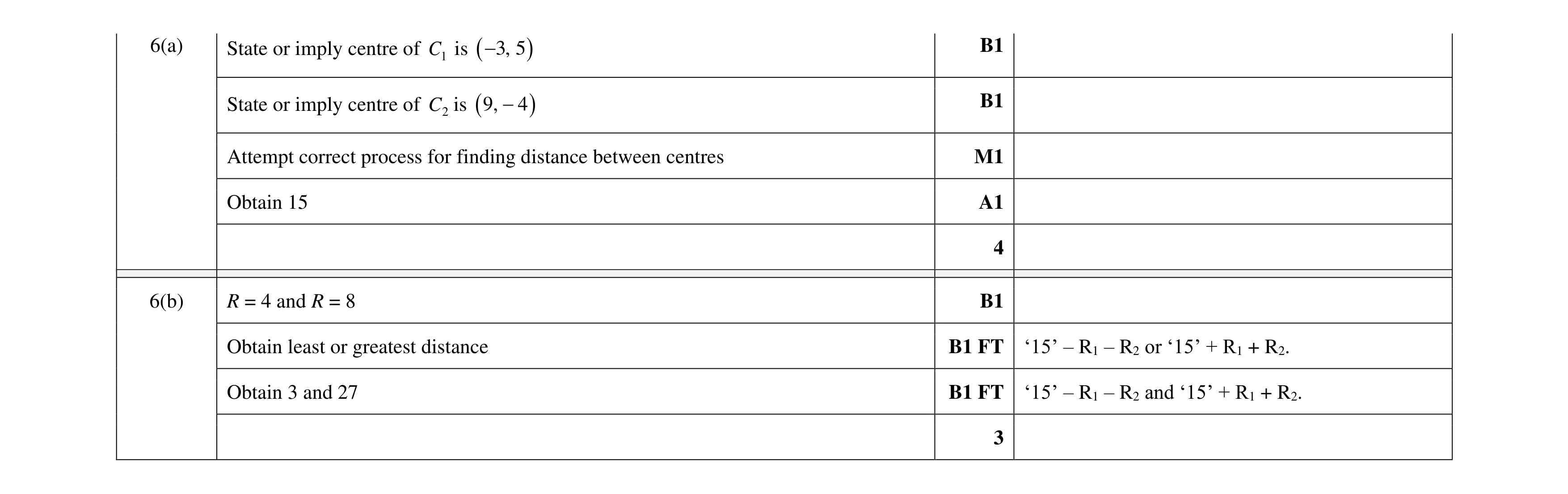 7
7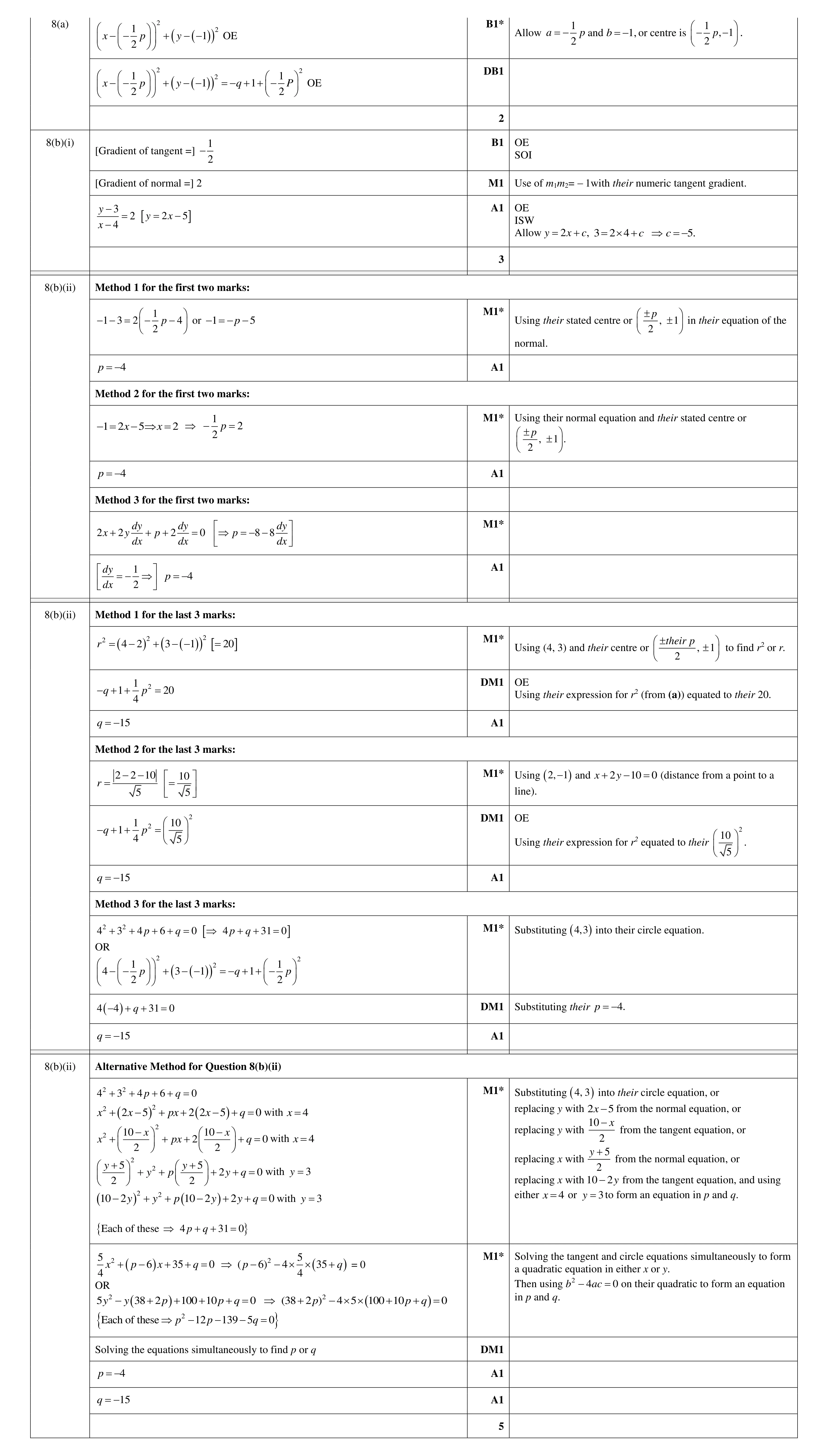 10
10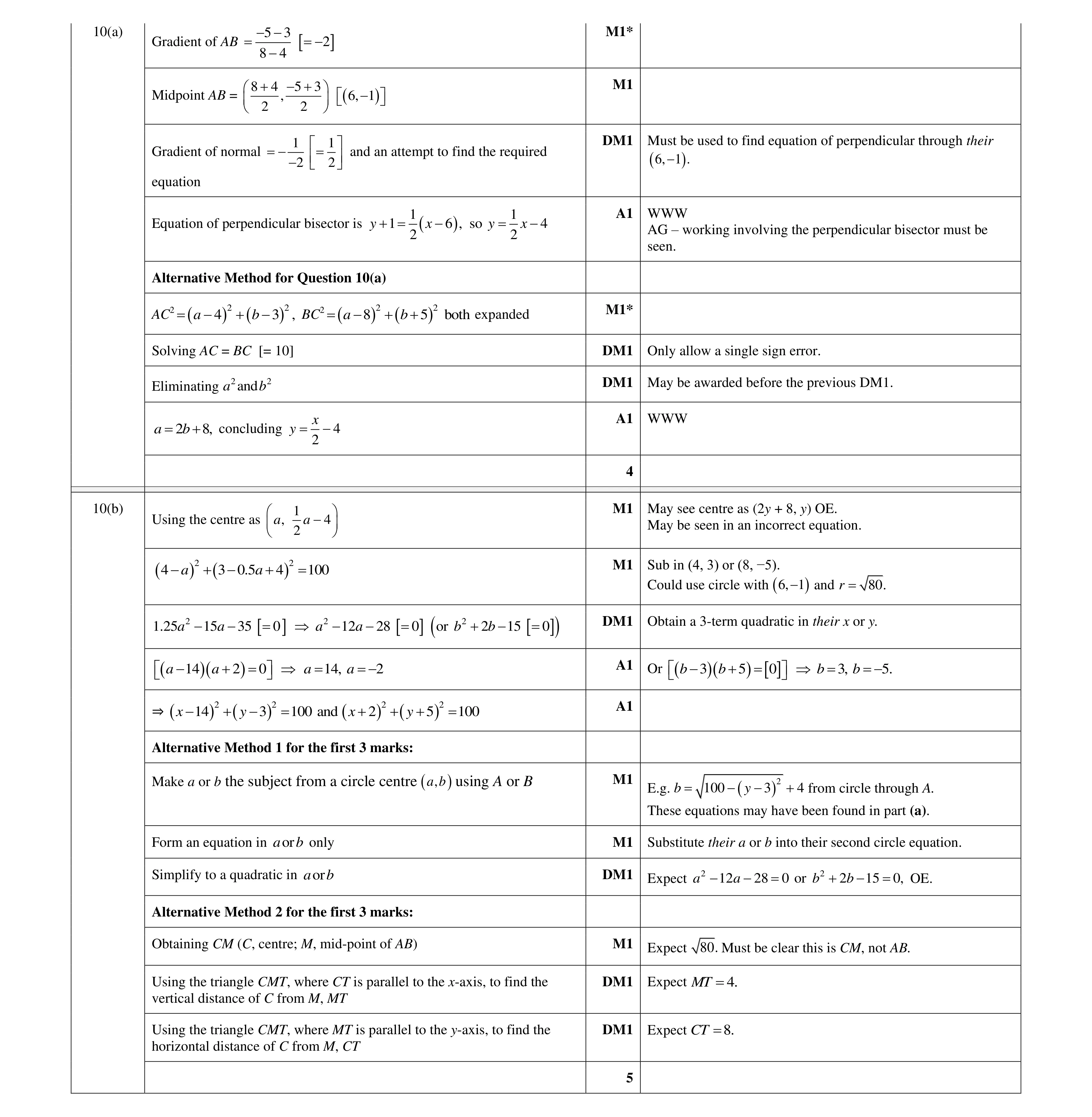 9
9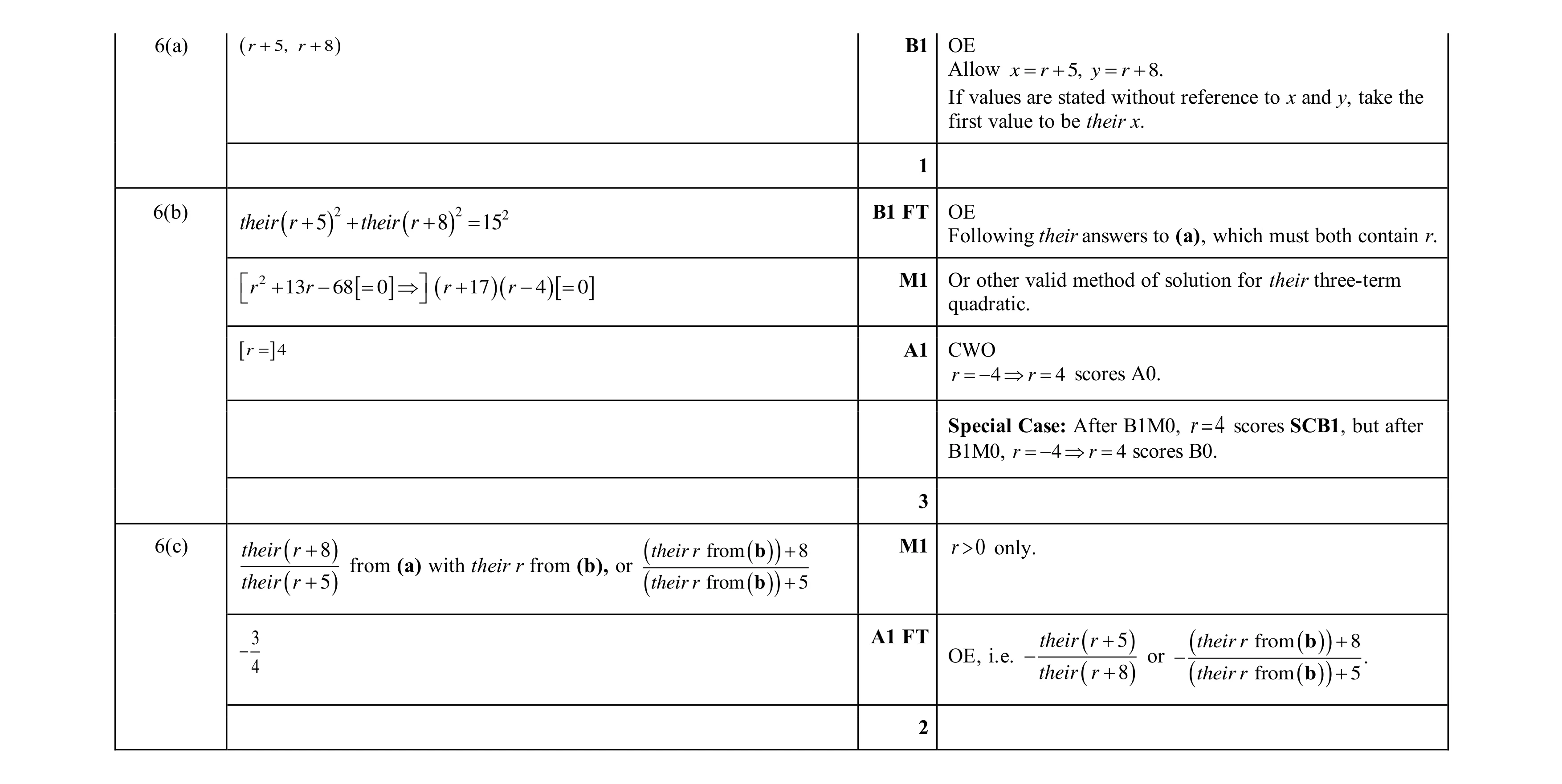 6
6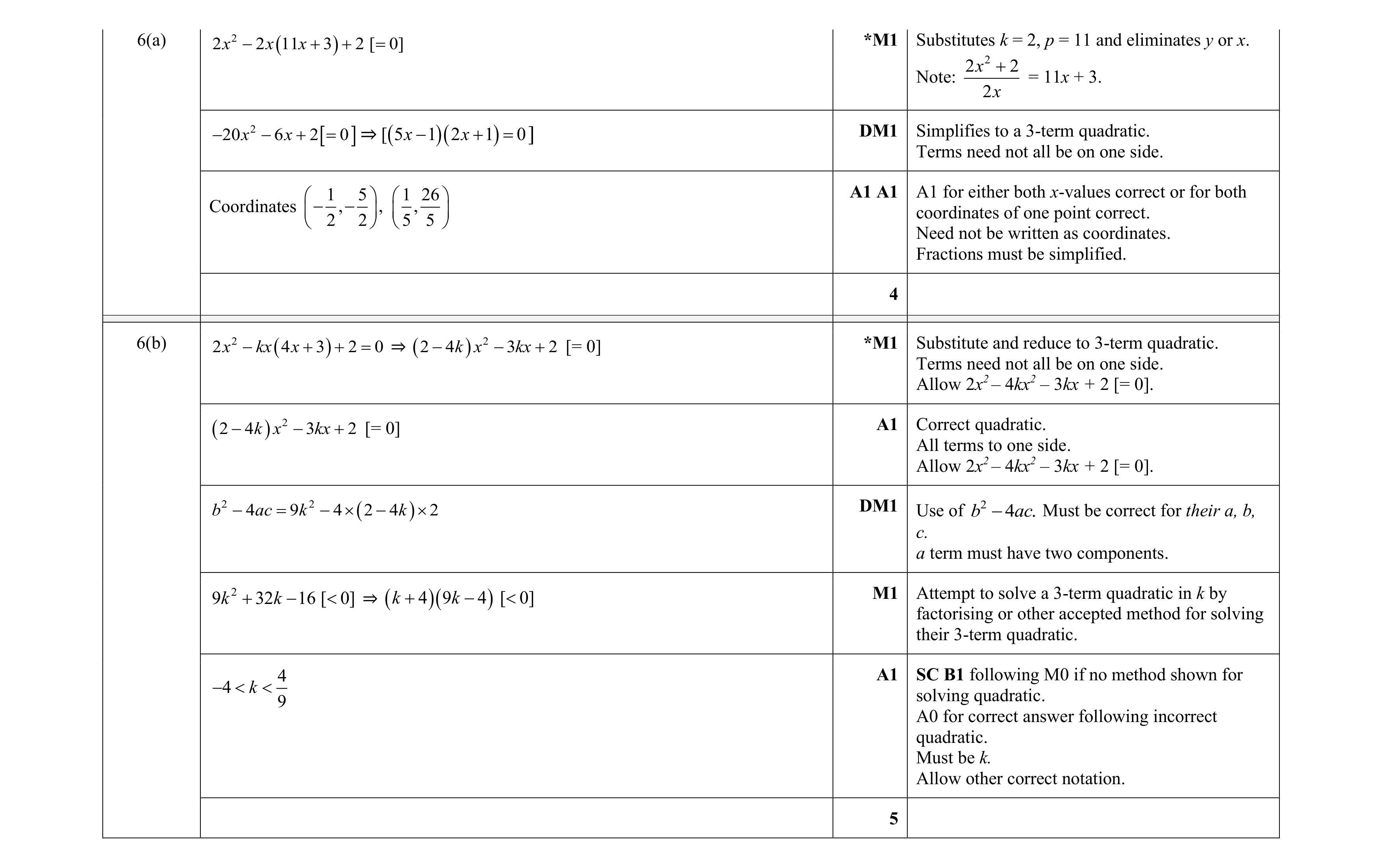 9
9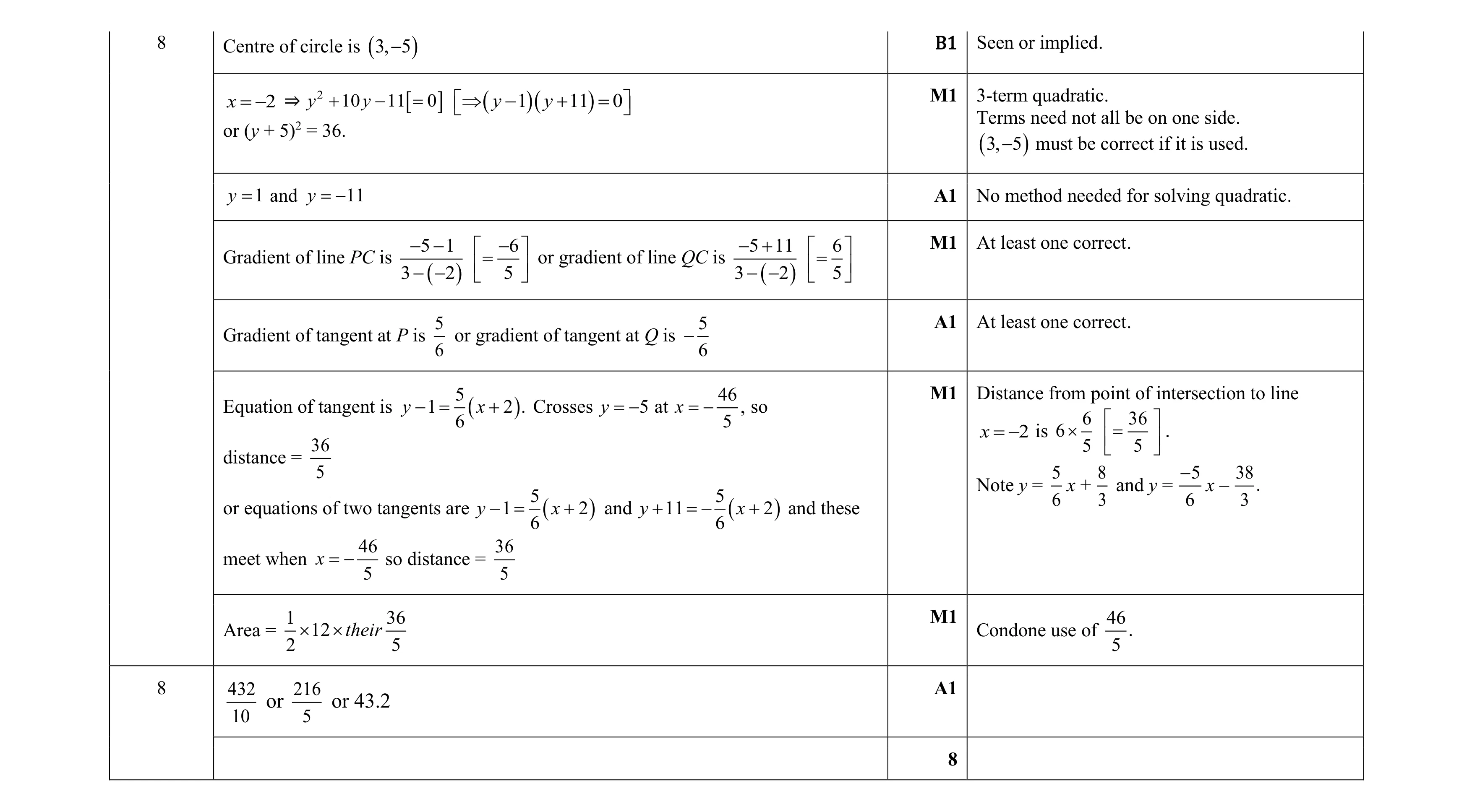 8
8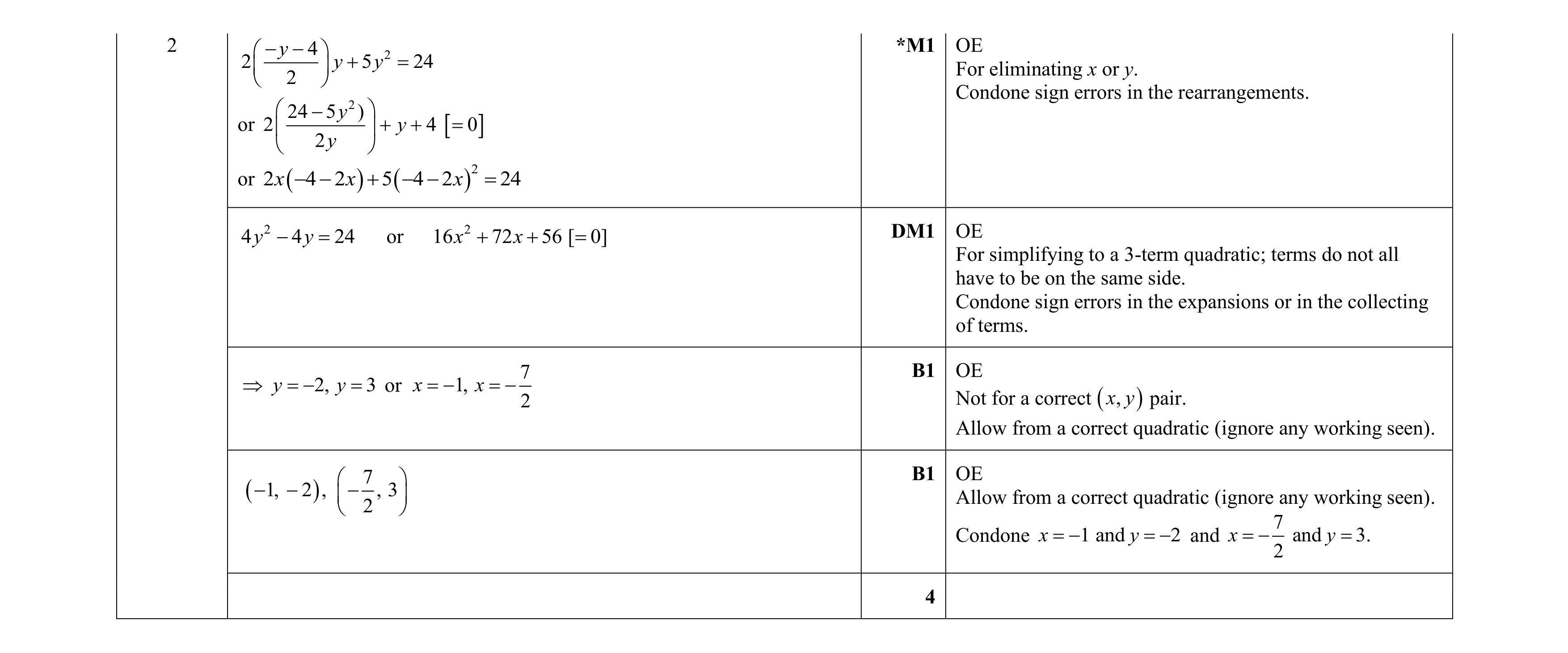 4
4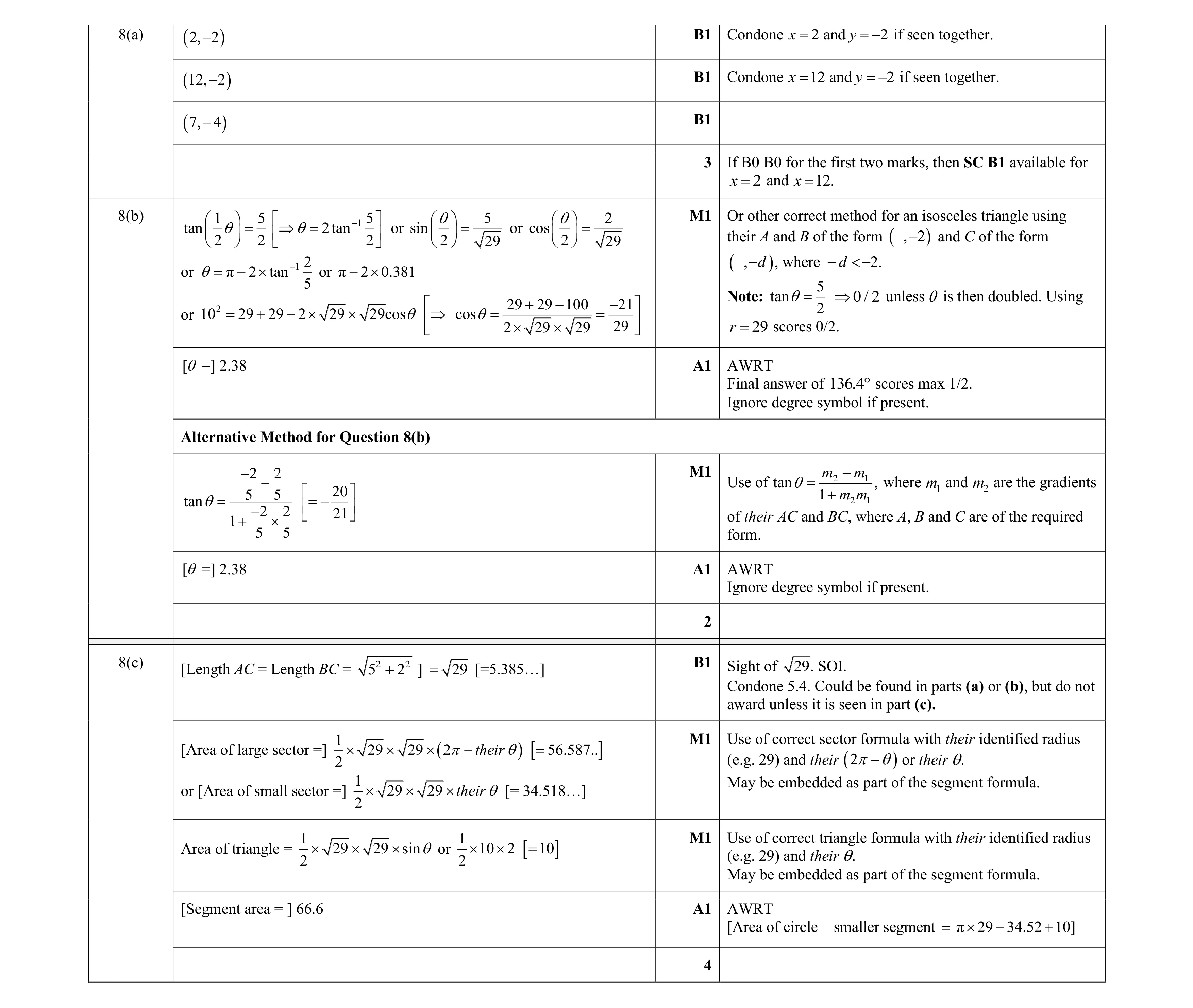 9
9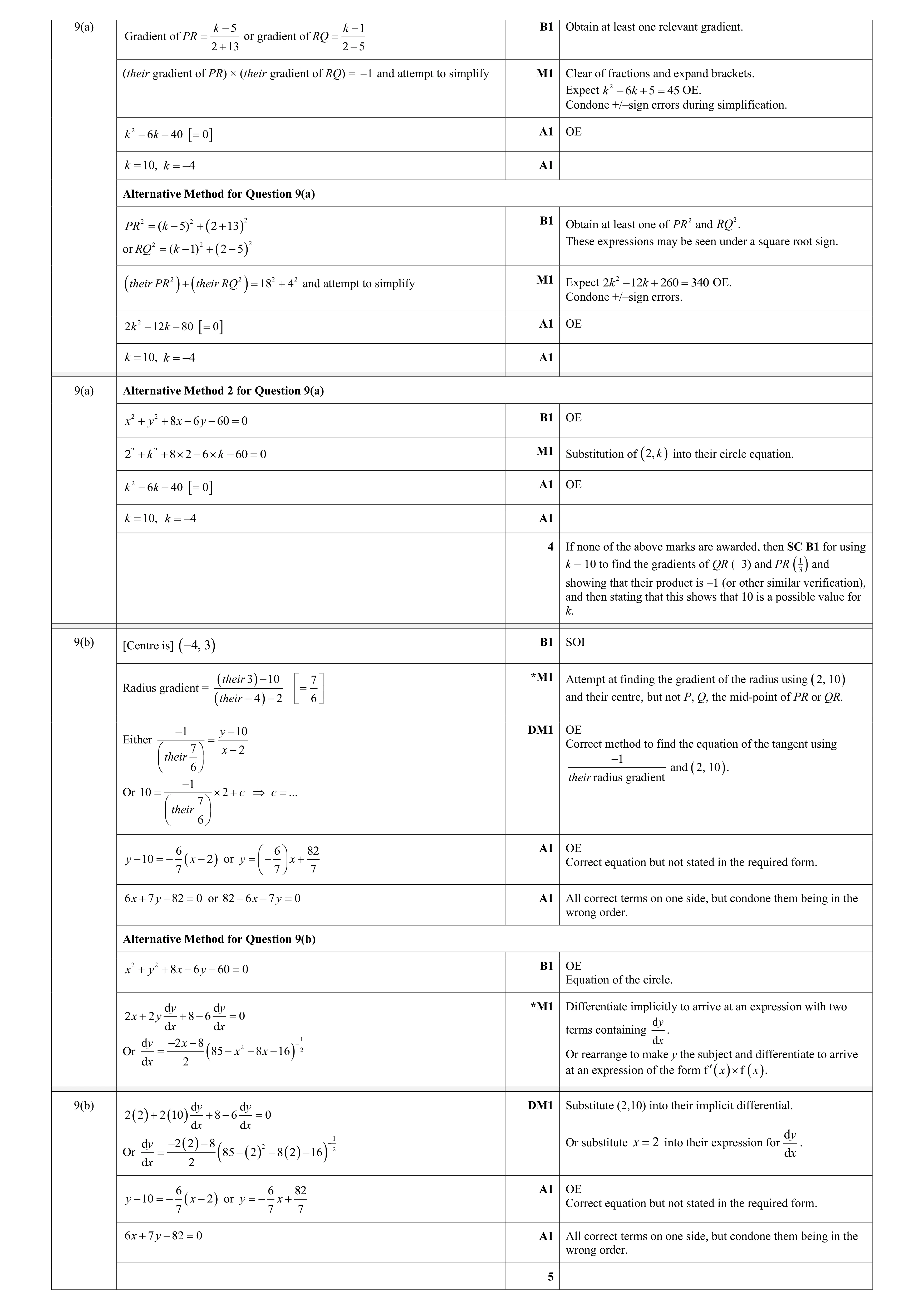 9
9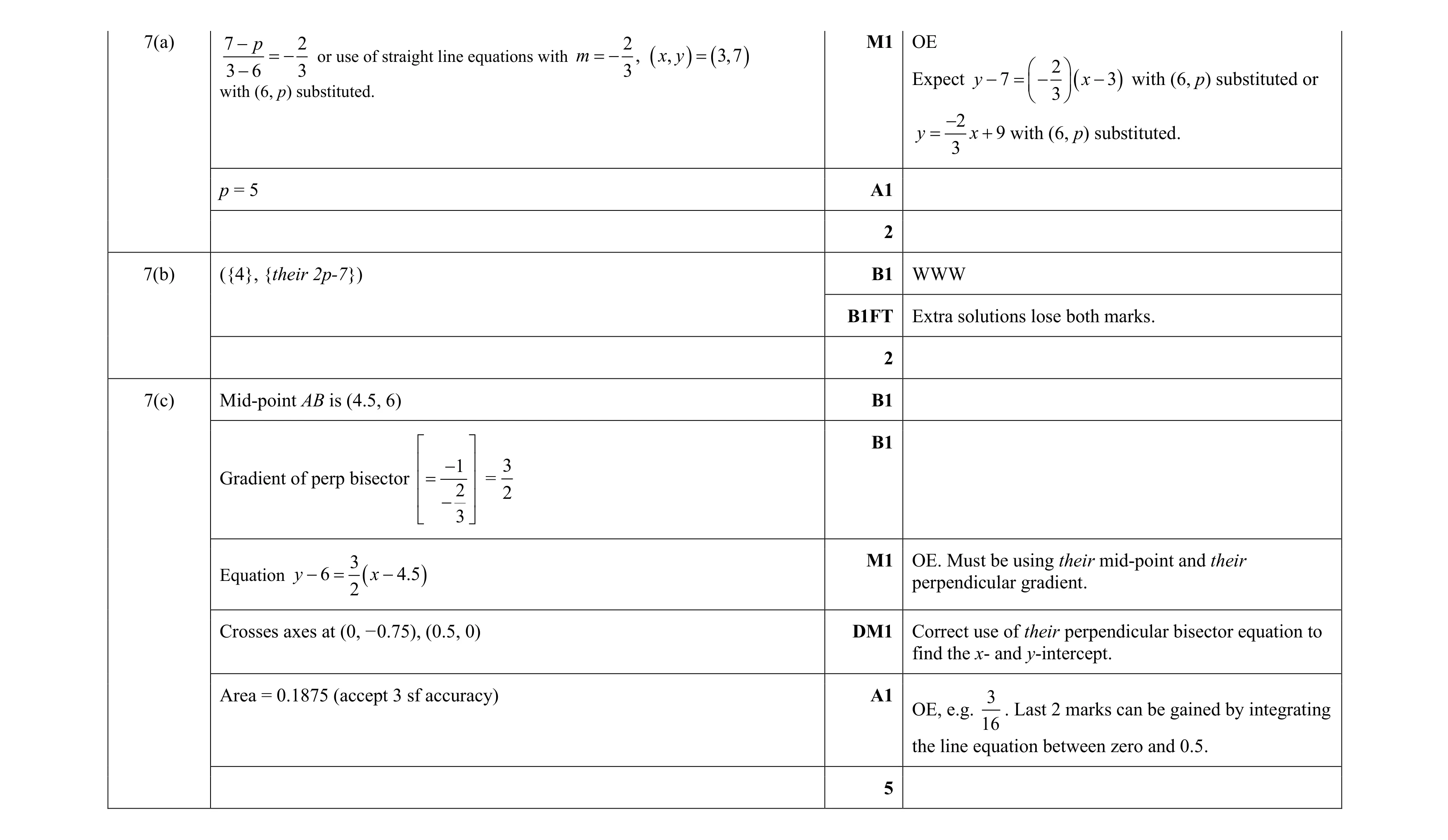 9
9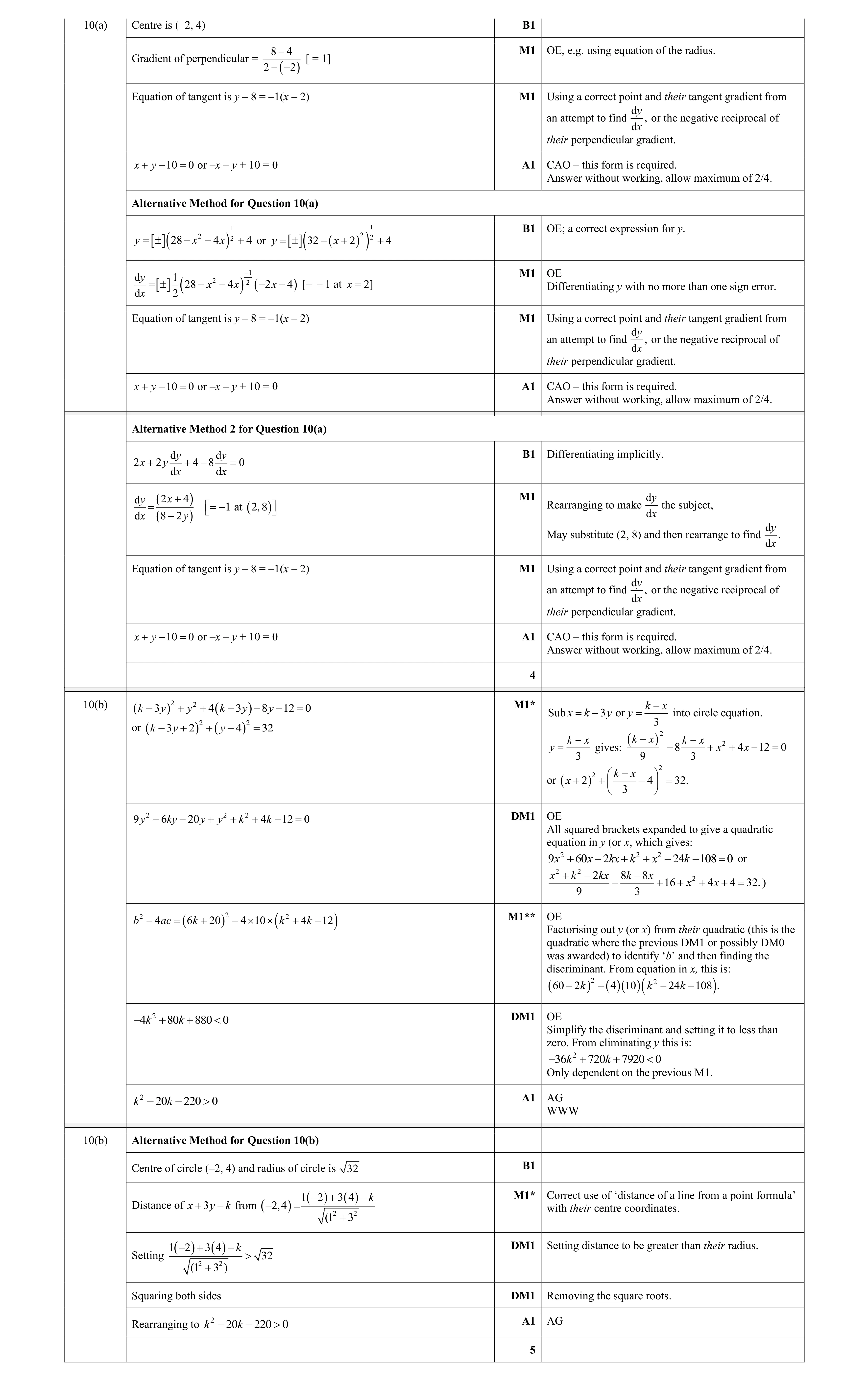 9
9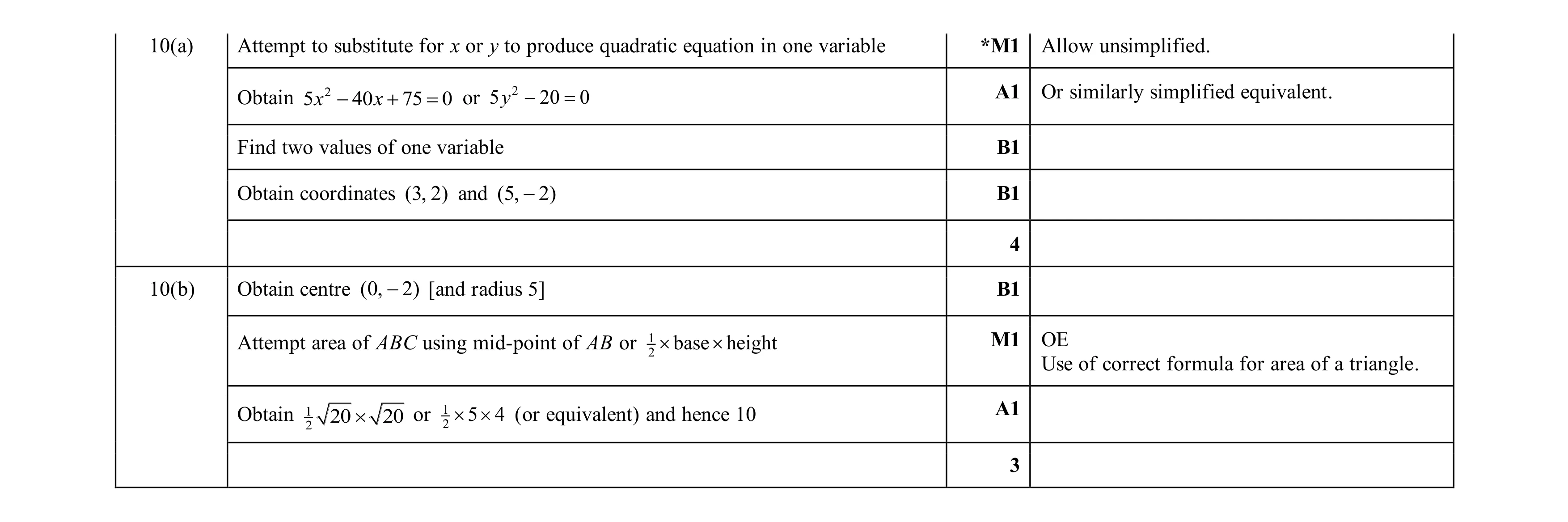 7
7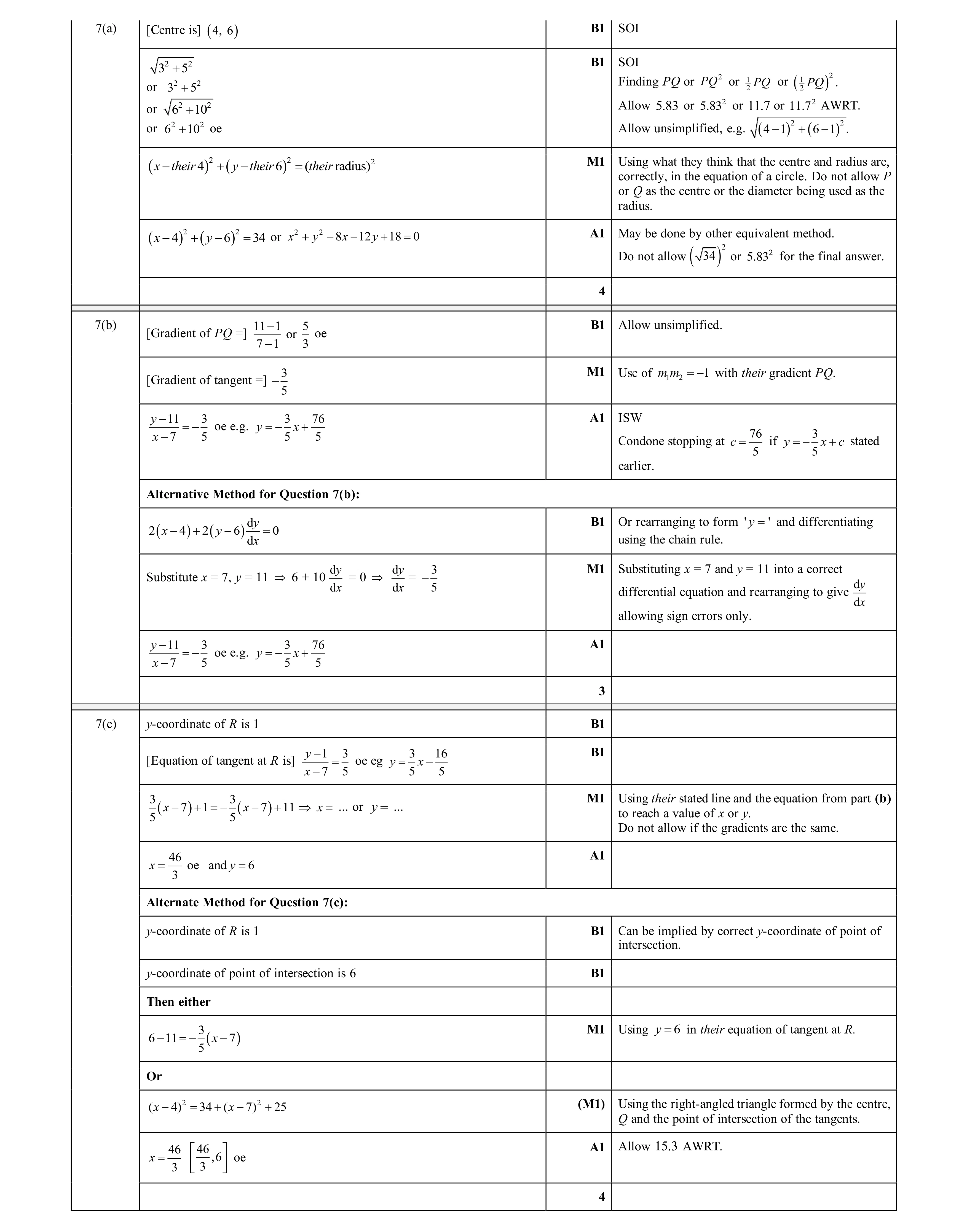 11
11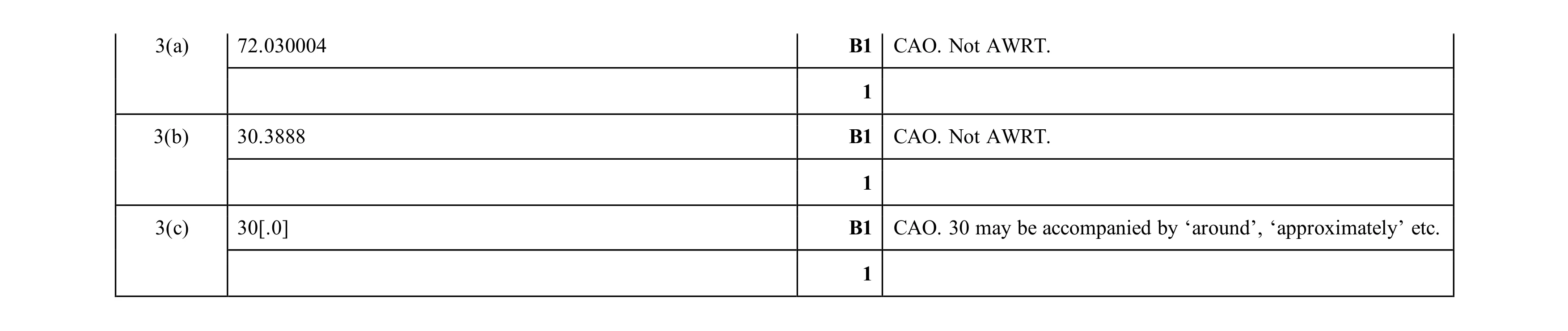 3
3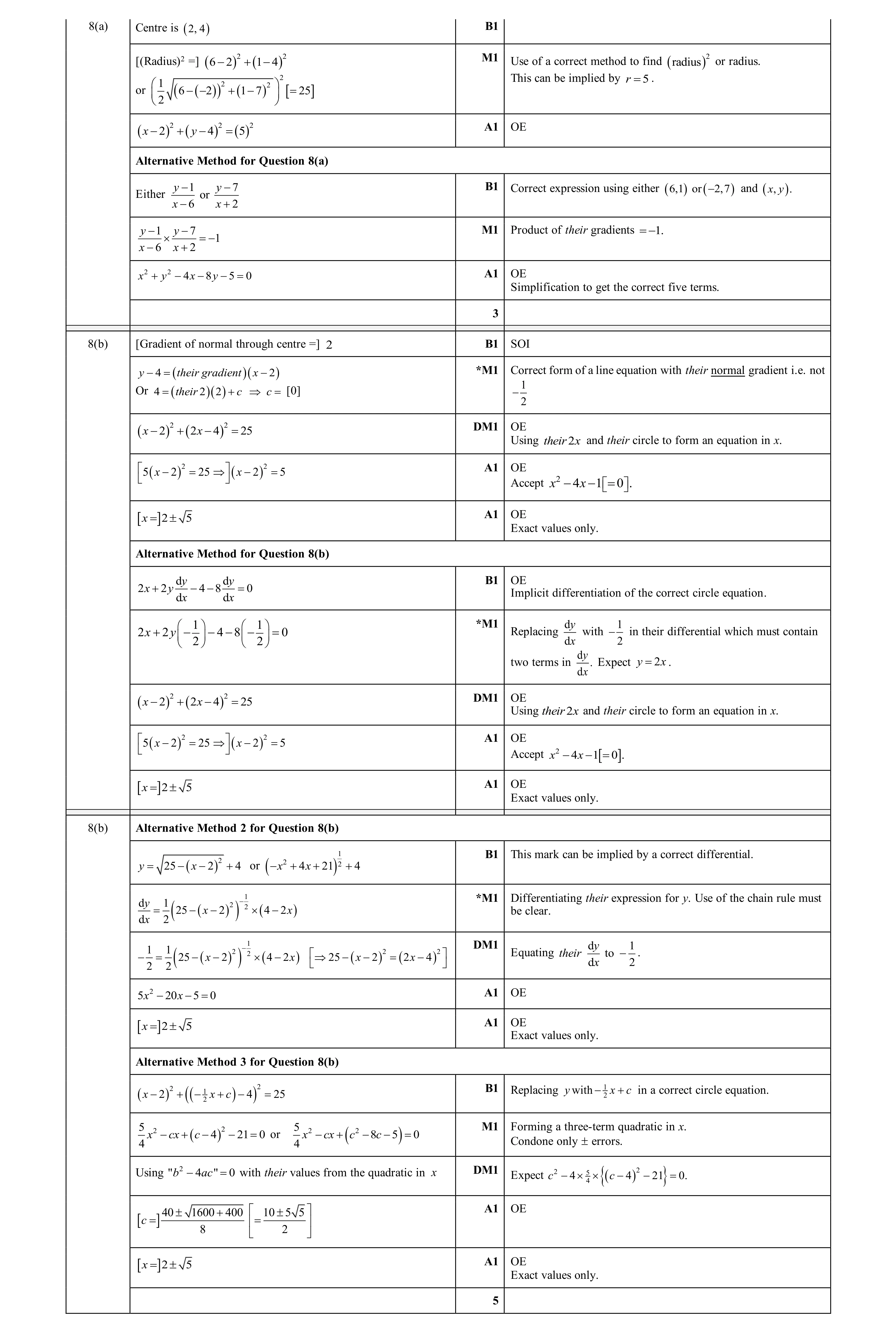 8
8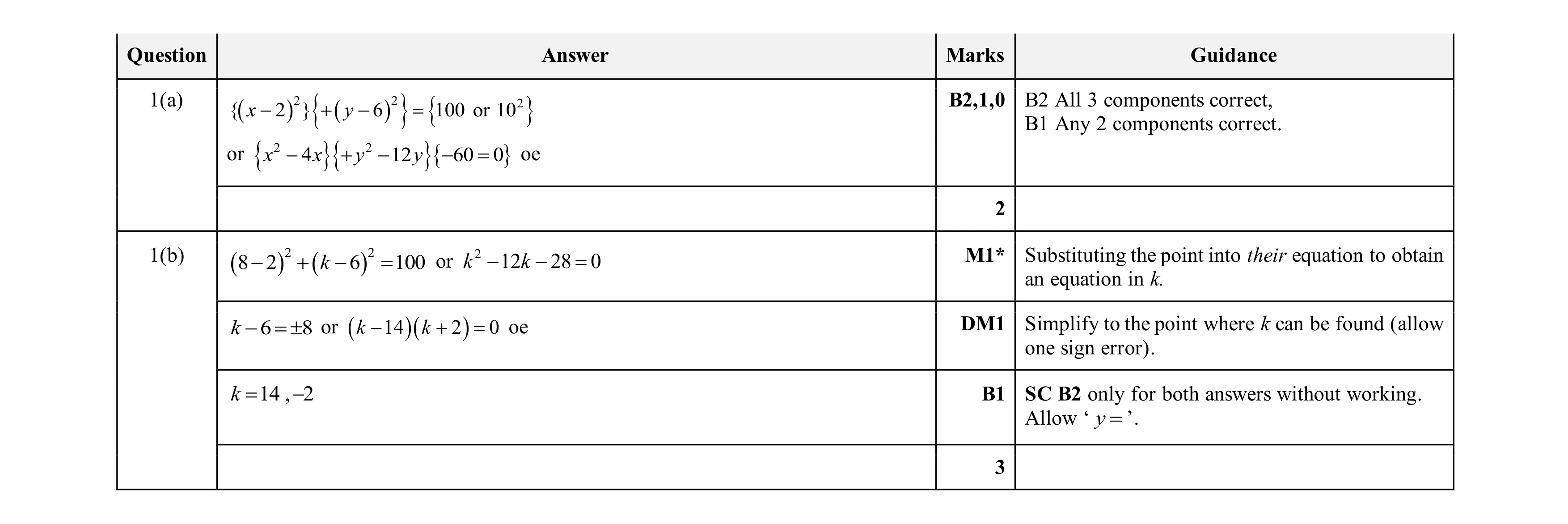 5
5