Questions as text
Q1 · A rigid rod consists of two parts 9709/51 May/June 2005
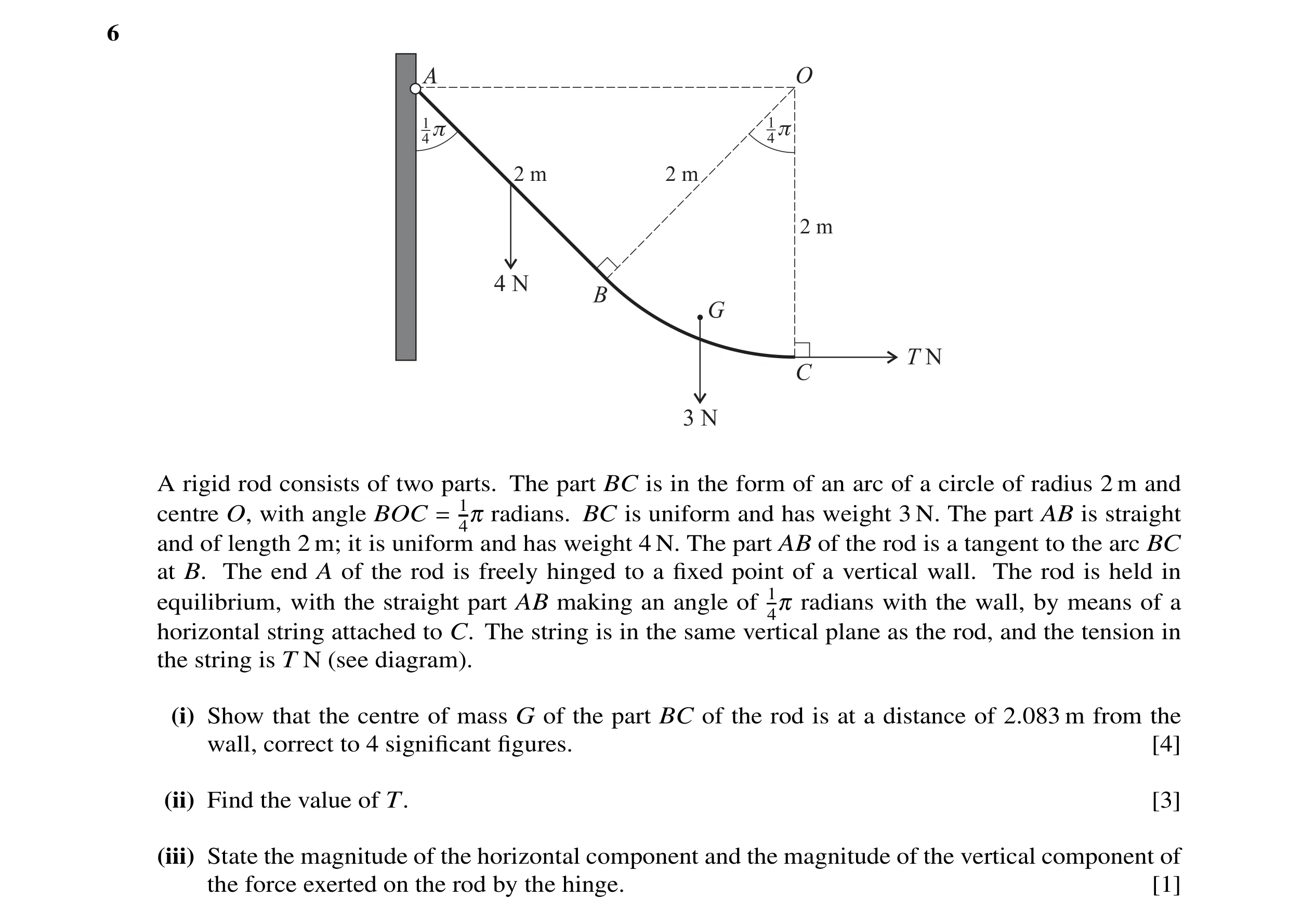
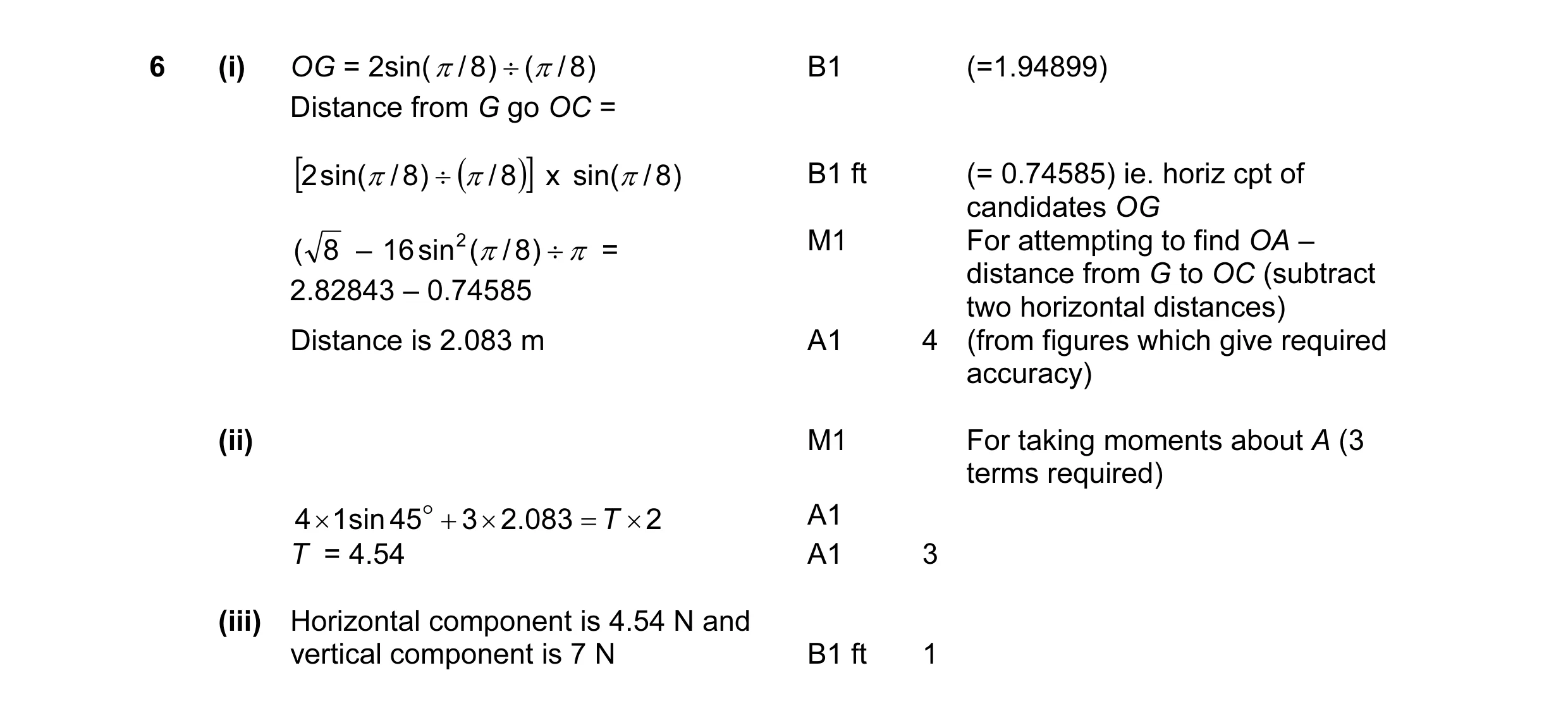
6 A rigid rod consists of two parts. The part BC is in the form of an arc of a circle of radius 2 m and centre O, with angle BOC = 14π radians. BC is uniform and has weight 3 N. The part AB is straight and of length 2 m; it is uniform and has weight 4 N. The part AB of the rod is a tangent to the arc BC at B. The end A of the rod is freely hinged to a fixed point of a vertical wall. The rod is held in equilibrium, with the straight part AB making an angle of 14π radians with the wall, by means of a horizontal string attached to C. The string is in the same vertical plane as the rod, and the tension in the string is T N (see diagram). (i) Show that the centre of mass G of the part BC of the rod is at a distance of 2.083 m from the wall, correct to 4 significant figures. [4] (ii) Find the value of T. [3] (iii) State the magnitude of the horizontal component and the magnitude of the vertical component of the force exerted on the rod by the hinge. [1]
8 marks
Mark scheme: 6 (i) OG = 2sin( π / 8 ) ÷ (π / 8 ) B1 (=1.94899) Distance from G go OC = [2 sin(π / 8 ) ÷ (π / 8 )] x sin(π / 8 ) B1 ft (= 0.74585) ie. horiz cpt of candidates OG 2 M1 For attempting to find OA – ( 8 – 16 sin (π / 8 ) ÷ π = distance from G to OC (subtract 2.82843 – 0.74585 two horizontal distances) Distance is 2.083 m A1 4 (from figures which give required accuracy) (ii) M1 For taking moments about A (3 terms required) o 4 × 1 sin 45 + 3 × 2 . 083 = T × 2 A1 T = 4.54 A1 3 (iii) Horizontal component is 4.54 N and vertical component is 7 N B1 ft 1
This question in 9709/51 May/June 2005
Q2 · A uniform semicircular lamina has radius 5 m 9709/51 May/June 2007
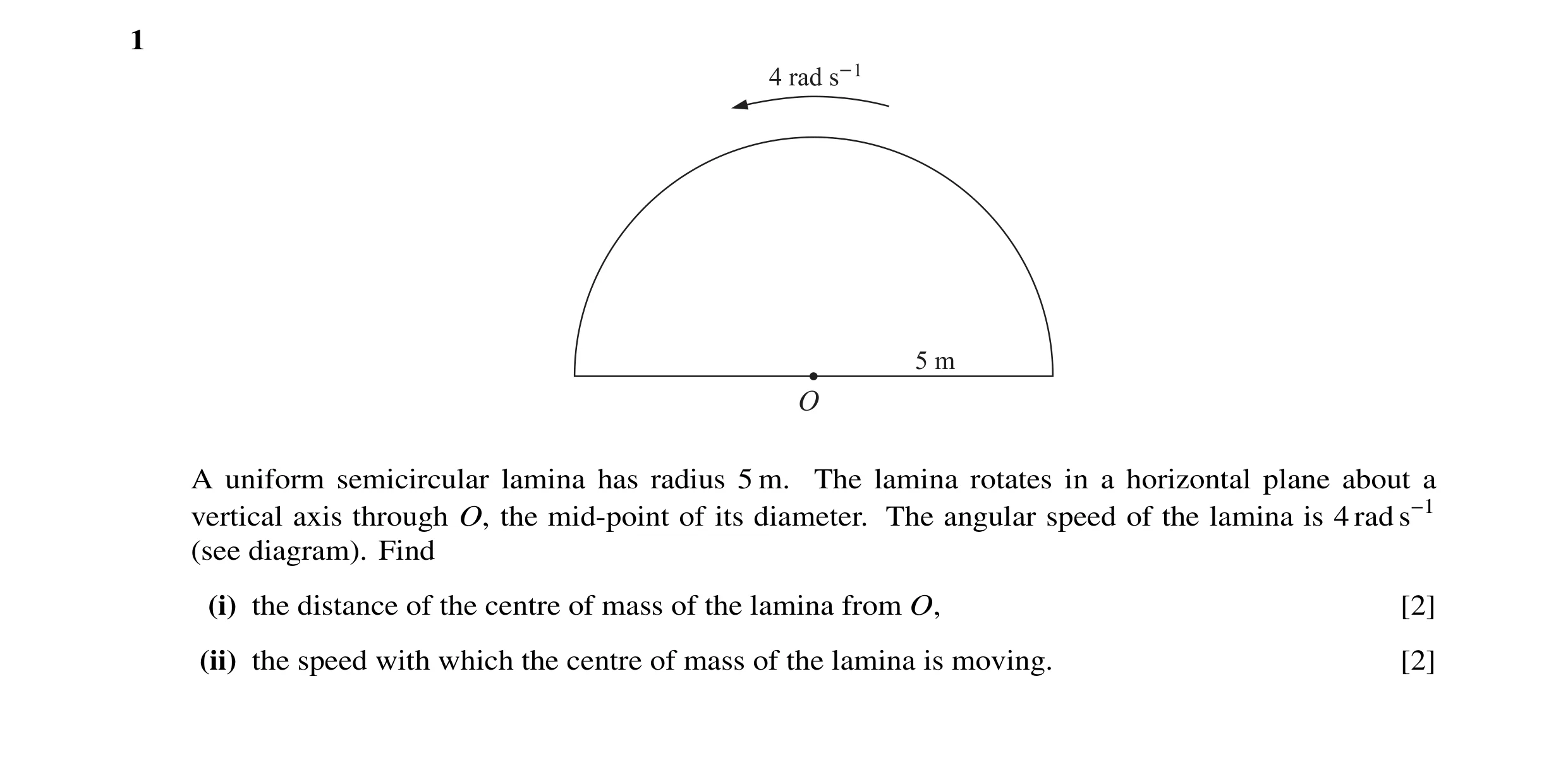
1 A uniform semicircular lamina has radius 5 m. The lamina rotates in a horizontal plane about a vertical axis through O, the mid-point of its diameter. The angular speed of the lamina is 4 rad s−1 (see diagram). Find (i) the distance of the centre of mass of the lamina from O, [2] (ii) the speed with which the centre of mass of the lamina is moving. [2]
4 marks
Mark scheme: 1 (i) 2 × 5 sin 90° 2r sin α r = For using r = M1 3 × π / 2 3α Distance is 2.12 m A1 2 Accept 20/3π (ii) M1 For using v = rω Speed is 8.49 ms −1 A1ft 2 ft their answer to part (i) 4
This question in 9709/51 May/June 2007
Q3 · A small stone is projected from a point O on horizontal ground with speed V m s−1 at an… 9709/51 May/June 2009
5 A small stone is projected from a point O on horizontal ground with speed V m s−1 at an angle θ◦ above the horizontal. Referred to horizontal and vertically upwards axes through O, the equation of the stone’s trajectory is y = 0.75x −0.02x2, where x and y are in metres. Find (i) the values of θ and V, [4] (ii) the distance from O of the point where the stone hits the ground, [2] (iii) the greatest height reached by the stone. [2]
8 marks
Mark scheme: 5 (i) M1 For using tanθ = 0.75 θ = 36.9 A1 g [10/(2x0.82V2) = 0.02] M1 For using 2 2 =0.02 2V cos θ V = 19.8 A1 4 (ii) [x(0.75 – 0.02x) = 0] M1 For solving y = 0 or using R = V2sin2θ /g Distance is 37.5 m A1 2 (iii) [ymax = 0.75x18.75 – 0.02x18.752] M1 For using y is greatest when x = R/2 or H = V2sin2 θ /2g Greatest height is 7.03 m A1 2 Ft 0.375R – 0.005R2 [8] GCE A/AS LEVEL – May/June 2009 9709 05
This question in 9709/51 May/June 2009
Q4 · 30 cm cm r 35° A uniform solid cone has height 30 cm and base radius r cm 9709/52 May/June 2010
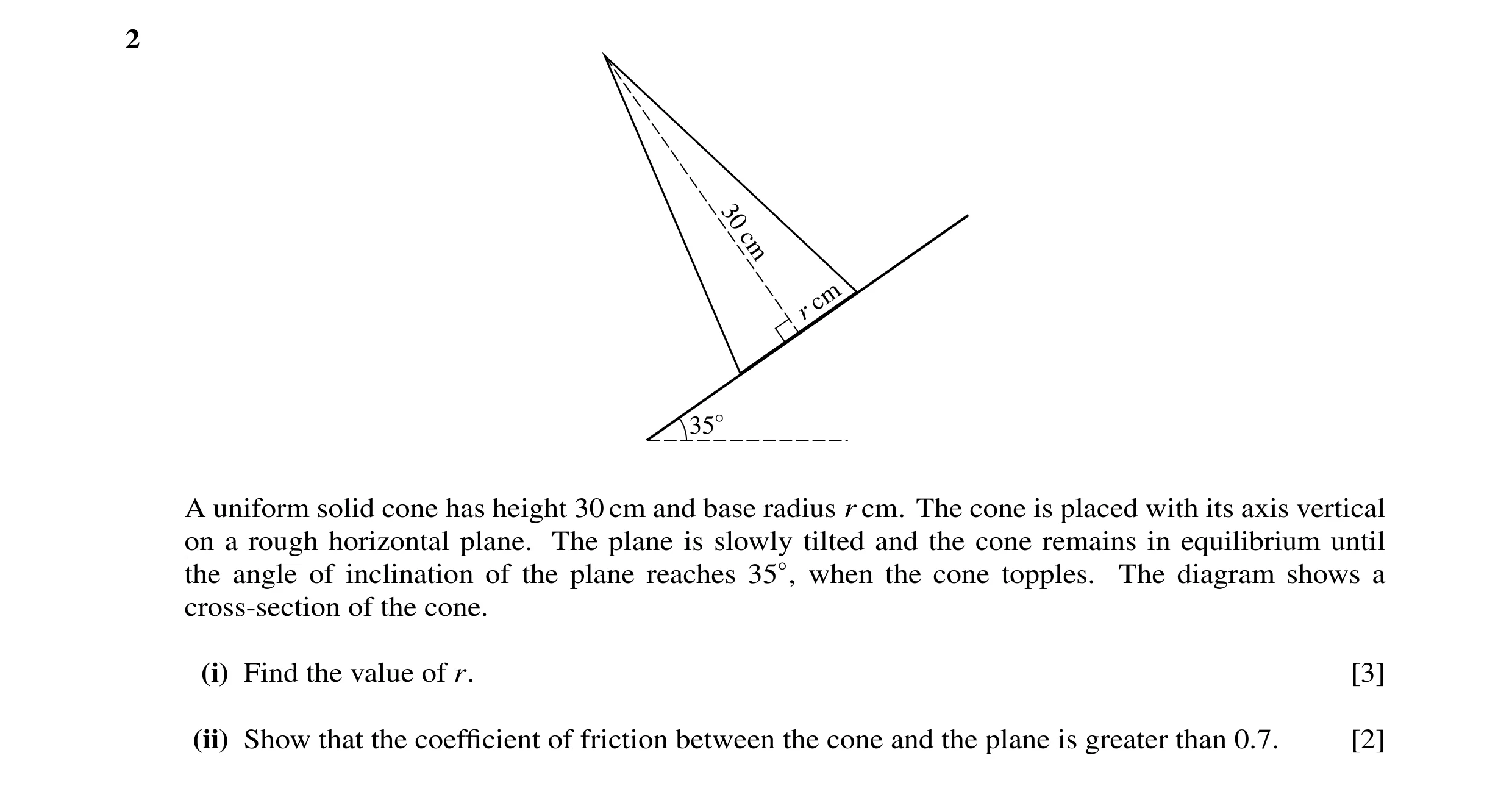
2 30 cm cm r 35° A uniform solid cone has height 30 cm and base radius r cm. The cone is placed with its axis vertical on a rough horizontal plane. The plane is slowly tilted and the cone remains in equilibrium until the angle of inclination of the plane reaches 35◦, when the cone topples. The diagram shows a cross-section of the cone. (i) Find the value of r. [3] (ii) Show that the coefficient of friction between the cone and the plane is greater than 0.7. [2]
5 marks
Mark scheme: 2 (i) M1 For using the idea that the c.m. is vertically above the lowest point of contact tan35° = r/7.5 A1ft ft using their c of m from the base r = 5.25 A1 [3] (ii) [µmgcos35° > mgsin35°] M1 For using ‘no sliding → µR > weight component’ µ > tan35° → Coefficient is greater than 0.7 A1 Do not allow µ [ 0.7 [2] AG 2
This question in 9709/52 May/June 2010
Q5 · B a m C a m A 1 m O E D ABCDE is the cross-section through the centre of mass of a… 9709/53 May/June 2011
7 B a m C a m A 1 m O E D ABCDE is the cross-section through the centre of mass of a uniform prism resting in equilibrium with DE on a horizontal surface. The cross-section has the shape of a square OBCD with sides of length a m, from which a quadrant OAE of a circle of radius 1 m has been removed (see diagram). (i) Find the distance of the centre of mass of the prism from O, giving the answer in terms of a, π and √2. [5] (ii) Hence show that 3a2(2 −a) < 32π −2, and verify that this inequality is satisfied by a 1.68 but not by a 1.67. [4] = =
9 marks
Mark scheme: 7 (i) OG quadrant = 2sin(π /4) / (3π /4) B1 8 / (3 2 π ) a 2 (a 2 /2) = π /4[2sin(π /4) / (3π /4)] M1 –1 each error, min zero +(a 2 – π /4)x A2 There must be 3 moment terms x = 2 2 (3a 3 – 2) / (12a 2 – 3π ) A1 Other forms acceptable [5] (ii) xcos45° > 1 B1 (6a 3 – 4) / (12a 2 – 3π ) > 1 M1 3a 2 (2 – a) < 3π /2 – 2 AG A1 True when a = 1.68, not when a = 1.67 AG B1 RHS = 2.712.. compared with [4] LHS = 2.709.. and 2.76.. respectively
This question in 9709/53 May/June 2011
Q6 · A uniform solid cylinder has radius 0.7 m and height h m 9709/51 Oct/Nov 2011
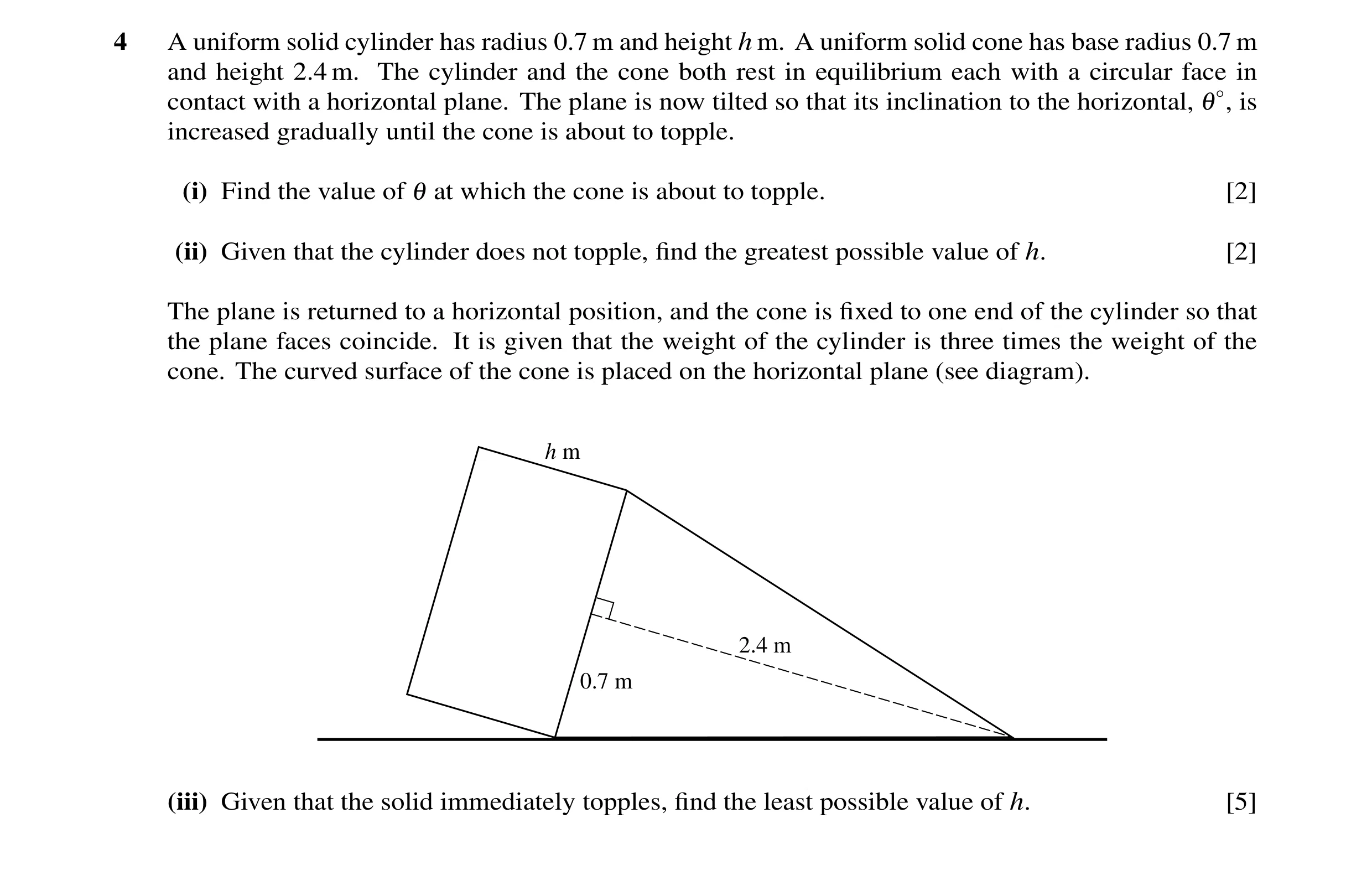
4 A uniform solid cylinder has radius 0.7 m and height h m. A uniform solid cone has base radius 0.7 m and height 2.4 m. The cylinder and the cone both rest in equilibrium each with a circular face in contact with a horizontal plane. The plane is now tilted so that its inclination to the horizontal, θ◦, is increased gradually until the cone is about to topple. (i) Find the value of θ at which the cone is about to topple. [2] (ii) Given that the cylinder does not topple, find the greatest possible value of h. [2] The plane is returned to a horizontal position, and the cone is fixed to one end of the cylinder so that the plane faces coincide. It is given that the weight of the cylinder is three times the weight of the cone. The curved surface of the cone is placed on the horizontal plane (see diagram). h m 2.4 m 0.7 m (iii) Given that the solid immediately topples, find the least possible value of h. [5]
9 marks
Mark scheme: 4 (i) tanθ = 0.7/(2.4/4) M1 θ = 49.4º A1 [2] (ii) h/2 = 2.4/4 M1 h = 1.2 A1 [2] GCE AS/A LEVEL – October/November 2011 9709 51 (iii) M1 Table of values idea, accept w = 1 4wVG = w × 2.4 × 3/4 + 3w(2.4 + h/2) A1 M1 Centre of mass above common circumference VG = [√(0.72 + 2.42)]/cosα A1 cosα = 2.4/2.5 = 0.96 h = 0.944 A1 [5]
This question in 9709/51 Oct/Nov 2011
Q7 · A uniform solid cylinder has radius 0.7 m and height h m 9709/52 Oct/Nov 2011
4 A uniform solid cylinder has radius 0.7 m and height h m. A uniform solid cone has base radius 0.7 m and height 2.4 m. The cylinder and the cone both rest in equilibrium each with a circular face in contact with a horizontal plane. The plane is now tilted so that its inclination to the horizontal, θ◦, is increased gradually until the cone is about to topple. (i) Find the value of θ at which the cone is about to topple. [2] (ii) Given that the cylinder does not topple, find the greatest possible value of h. [2] The plane is returned to a horizontal position, and the cone is fixed to one end of the cylinder so that the plane faces coincide. It is given that the weight of the cylinder is three times the weight of the cone. The curved surface of the cone is placed on the horizontal plane (see diagram). h m 2.4 m 0.7 m (iii) Given that the solid immediately topples, find the least possible value of h. [5]
9 marks
Mark scheme: 4 (i) tanθ = 0.7/(2.4/4) M1 θ = 49.4º A1 [2] (ii) h/2 = 2.4/4 M1 h = 1.2 A1 [2] GCE AS/A LEVEL – October/November 2011 9709 52 (iii) M1 Table of values idea, accept w = 1 4wVG = w × 2.4 × 3/4 + 3w(2.4 + h/2) A1 M1 Centre of mass above common circumference VG = [√(0.72 + 2.42)]/cosα A1 cosα = 2.4/2.5 = 0.96 h = 0.944 A1 [5]
This question in 9709/52 Oct/Nov 2011
Q8 · A uniform solid consists of a hemisphere with centre O and radius 0.6 m joined to a… 9709/53 Oct/Nov 2011
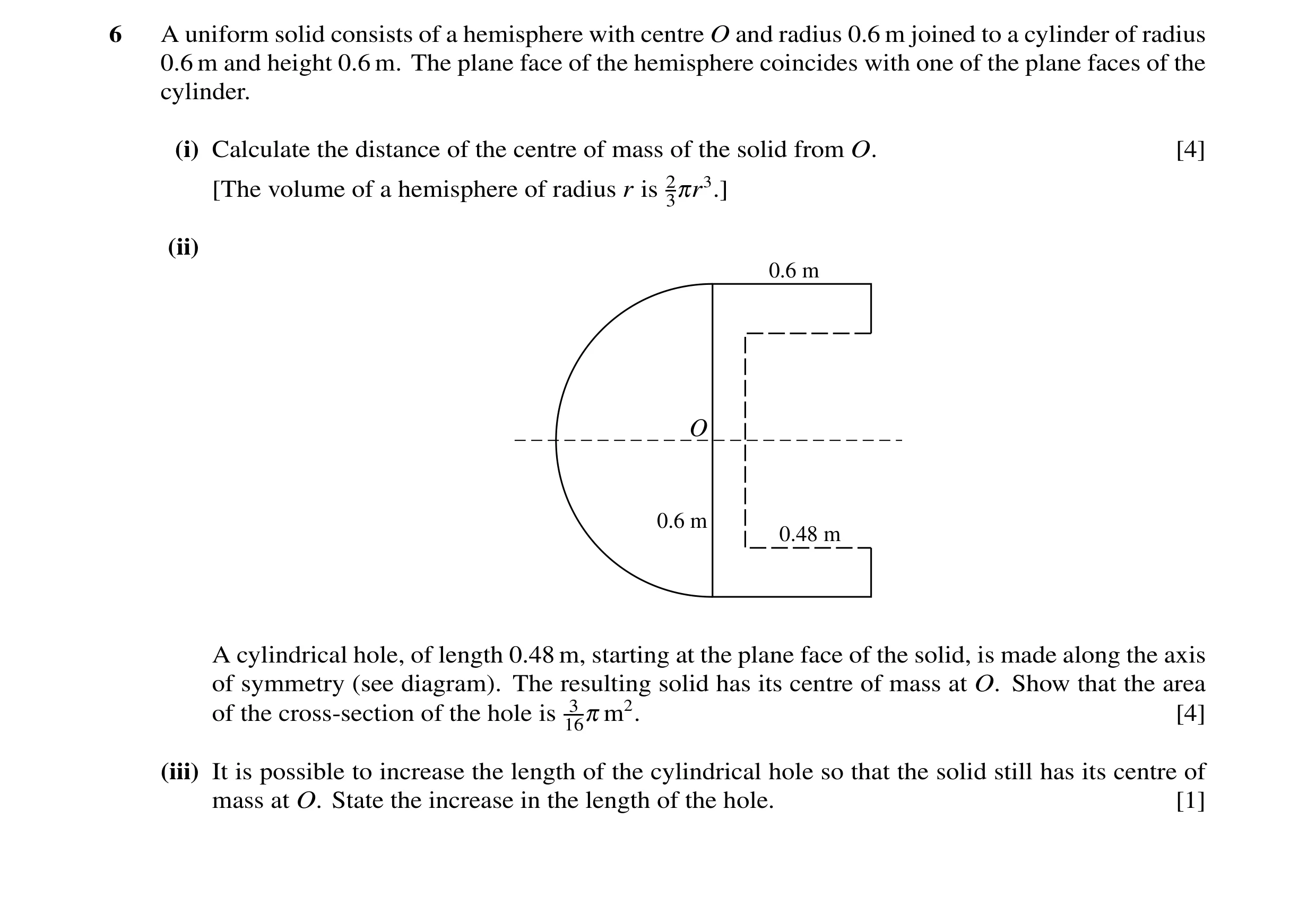
6 A uniform solid consists of a hemisphere with centre O and radius 0.6 m joined to a cylinder of radius 0.6 m and height 0.6 m. The plane face of the hemisphere coincides with one of the plane faces of the cylinder. (i) Calculate the distance of the centre of mass of the solid from O. [4] [The volume of a hemisphere of radius r is 3πr3.]2 (ii) 0.6 m O 0.6 m 0.48 m A cylindrical hole, of length 0.48 m, starting at the plane face of the solid, is made along the axis of symmetry (see diagram). The resulting solid has its centre of mass at O. Show that the area of the cross-section of the hole is 16π3 m2. [4] (iii) It is possible to increase the length of the cylindrical hole so that the solid still has its centre of mass at O. State the increase in the length of the hole. [1]
9 marks
Mark scheme: 6 (i) M1 Table of moments idea π0.62 × 0.6 × 0.3 – 2π 0.63/3 × 3 × 0.6/8 A1 Correct elements = (π0.63 + 2π0.63/3)d A1 Correct composite d = 0.09 m A1 [4] (ii) M1 Table of moments idea (about O) A1 Correct elements 2 3 π0.63 × 83 × 0.6 – π × 0.63 × 0.3 A1 + 0.48A × 0.36 = 0 A = 3π/16 m2 A1 [4] OR M1 Table of moments idea ( about O) A1 Correct elements [ 23 π × 0.63 + π × 0.63] × 0.09 = 0.48A × 0.36 A1 A = 3π/16 A1 (iii) Increase in length [= 2 × (0.6 – 0.48)] = 0.24m B1 [1] Remove cylinder with centre of mass at O GCE AS/A LEVEL – October/November 2011 9709 53
This question in 9709/53 Oct/Nov 2011
Q9 · B A 0.6 m O C D A uniform lamina OABCD consists of a semicircle BCD with centre O and… 9709/51 Oct/Nov 2012
6 B A 0.6 m O C D A uniform lamina OABCD consists of a semicircle BCD with centre O and radius 0.6 m and an isosceles triangle OAB, joined along OB (see diagram). The triangle has area 0.36 m2 and AB = AO. (i) Show that the centre of mass of the lamina lies on OB. [4] (ii) Calculate the distance of the centre of mass of the lamina from O. [4]
8 marks
Mark scheme: 6 (i) Height of triangle = 0.36 / 0.3(= 1.2 m) B1 Semi-circle C of M = 2 × 0.6 / (3π / 2) B1 Centre of mass lamina from BOD 0.36 × (1.2 / 3) = π × 0.62 / 2 × 2 × 0.6 / (3π / 2) M1 Equating moments idea 0.144 = 0.144 A1 [4] Evidence of checking equality OR 0.36 × (1.2 / 3) – π × 0.62 / 2 ×2 ×0.6 /(3π/2) = distance × total area M1 Table of moments idea Distance = 0 A1 (ii) 0.36 × 0.3 A1 Correct sum of parts = (0.36 + π 0.62 / 2) × OG A1 Correct moment of whole OG = 0.117 m A1 [4] GCE A LEVEL – October/November 2012 9709 51
This question in 9709/51 Oct/Nov 2012
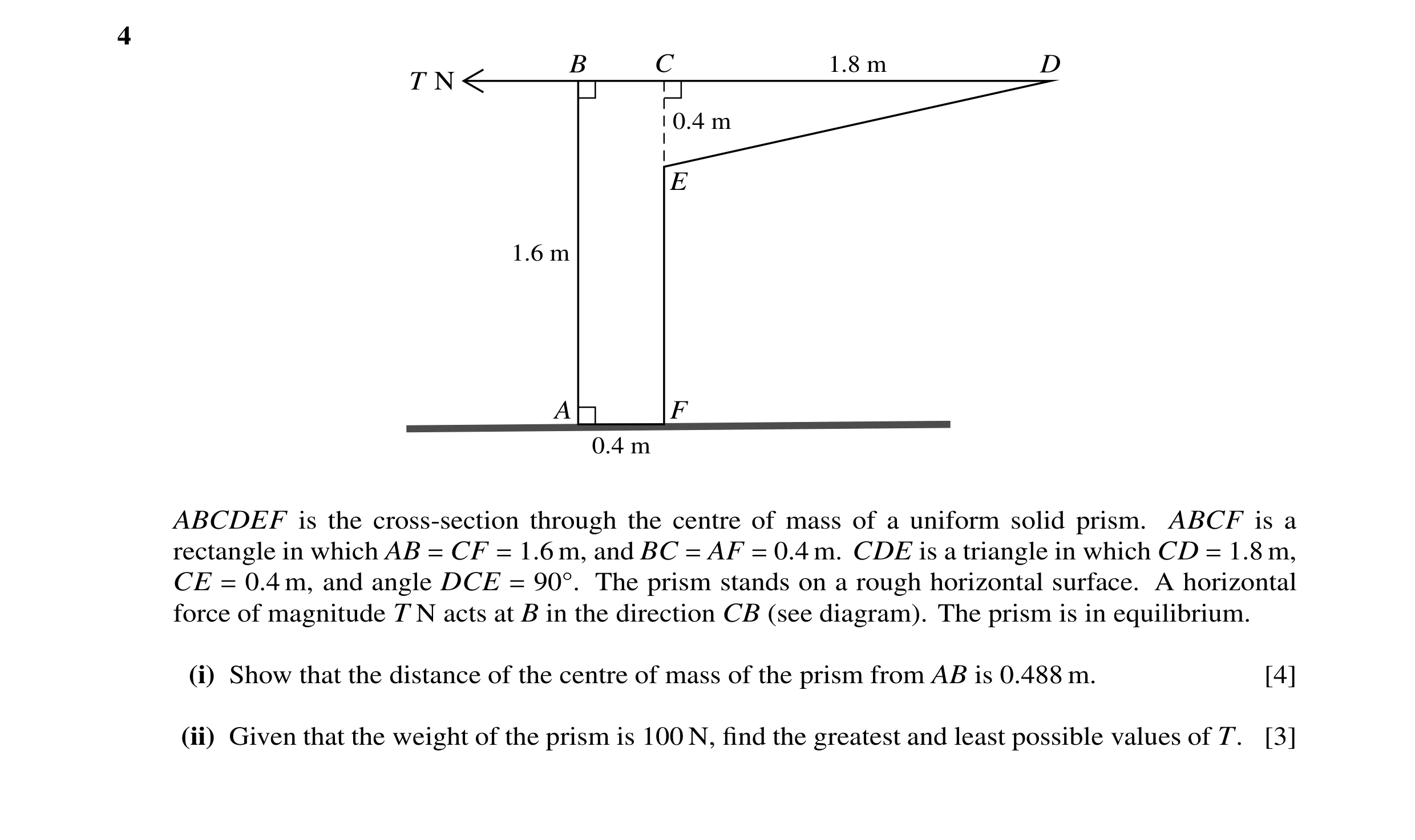
Q10 · B C 1.8 m D T N 0.4 m E 1.6 m A F 0.4 m ABCDEF is the cross-section through the centre of… 9709/51 Oct/Nov 2014
4 B C 1.8 m D T N 0.4 m E 1.6 m A F 0.4 m ABCDEF is the cross-section through the centre of mass of a uniform solid prism. ABCF is a rectangle in which AB = CF = 1.6 m, and BC = AF = 0.4 m. CDE is a triangle in which CD = 1.8 m, CE = 0.4 m, and angle DCE = 90 . The prism stands on a rough horizontal surface. A horizontal force of magnitude T N acts at B in the direction CB (see diagram). The prism is in equilibrium. (i) Show that the distance of the centre of mass of the prism from AB is 0.488 m. [4] (ii) Given that the weight of the prism is 100 N, find the greatest and least possible values of T. [3]
7 marks
Mark scheme: 4 (i) ABCF area = 0.64 and CDE = 0.36 B1 Both areas correct 0.4 1.8 (0.64 + 0.36)d = 0.64× + 0.36×(0.4 + ) M1 Table of moments idea 2 3 A1 All terms correct d = 0.488 m AG A1 [4] (ii) 0.488 × 100 = 1.6T M1 Either limiting case T = 30.5 N A1 (no turning about A) (0.488 – 0.4) × 100 = 1.6T T = 5.5 A1 [3] (no turning about F)
This question in 9709/51 Oct/Nov 2014
Q11 · 0.56 m O 0.28 m An object is made from a uniform solid hemisphere of radius 0.56 m and… 9709/53 May/June 2017
3 0.56 m O 0.28 m An object is made from a uniform solid hemisphere of radius 0.56 m and centre O by removing a hemisphere of radius 0.28 m and centre O. The diagram shows a cross-section through O of the object. (i) Calculate the distance of the centre of mass of the object from O. [4] [The volume of a hemisphere is 230r3.] … … … … … … … … … … … … … … … … … … The object has weight 24 N. A uniform hemisphere H of radius 0.28 m is placed in the hollow part of the object to create a non-uniform hemisphere with centre O. The centre of mass of the non-uniform hemisphere is 0.15 m from O. (ii) Calculate the weight of H. [3] … … … … … … … … … … … … … … … … … … … … … … …
7 marks
Mark scheme: 3(i) CofM of hemisphere = 3 8 × 0.56 or 3 8 × 0.28 [ 2 3π × 3 0.56 – 2 3π × 3 0.28 ]X = 2 3 π × 3 0.56 × 3 8 × 0.56 – 2 3 π × 3 0.28 × 3 8 × 0.28 M1A1 Take moments about O X = 0.225 m A1 Total: 4 3(ii) 24 × 0.225 + W(3 × 0.28 / 8) = (24 + W) × 0.15 M1A1 Attempts to take moments about O W = weight of uniform hemi-sphere W = 40 N A1 Total: 3 B1
This question in 9709/53 May/June 2017
Q12 · A particle P is projected from a point O on horizontal ground 9709/52 Feb/March 2018
4 A particle P is projected from a point O on horizontal ground. At the instant t s after projection, the horizontal and vertically upwards displacements of P from O are x m and y m respectively. The equation of the trajectory of P is y = 3x −0.05x2. (i) Find the angle of projection and the initial speed of P. [3] … … … … … … … … … … … … … (ii) Find the coordinates of P at the instant when OP makes an angle of 45° with the horizontal. [2] … … … … … … … … … (iii) For the instant when P is at its greatest height above the ground, calculate this height and the corresponding value of t. [4] … … … … … … … … … … … … … … … … … … … … … … … … …
9 marks
Mark scheme: 4(i) (tanθ = 3) θ = 71.6° B1 Use the formula sheet for the trajectory equation 0.05 = g / (2V 2cos271.6) M1 V = 10 10 = 31.6 m s–1 A1 3 4(ii) x = 3x – 0.05x2 M1 Use y = x x = 40 and y = 40 A1 2 Question Answer Marks Guidance 4(iii) dy / dx = 3 – 0.1x = 0 M1 Use the fact that the gradient is zero at the highest point x = 30, y = (3 × 30 – 0.05 × 302) = 45 A1 30 = (31.6cos71.6)t M1 Use horizontal motion t = 3.01 A1 t = 3 if exact arithmetic used 4
This question in 9709/52 Feb/March 2018
Q13 · A small ball is projected from a point O on horizontal ground 9709/52 Feb/March 2019
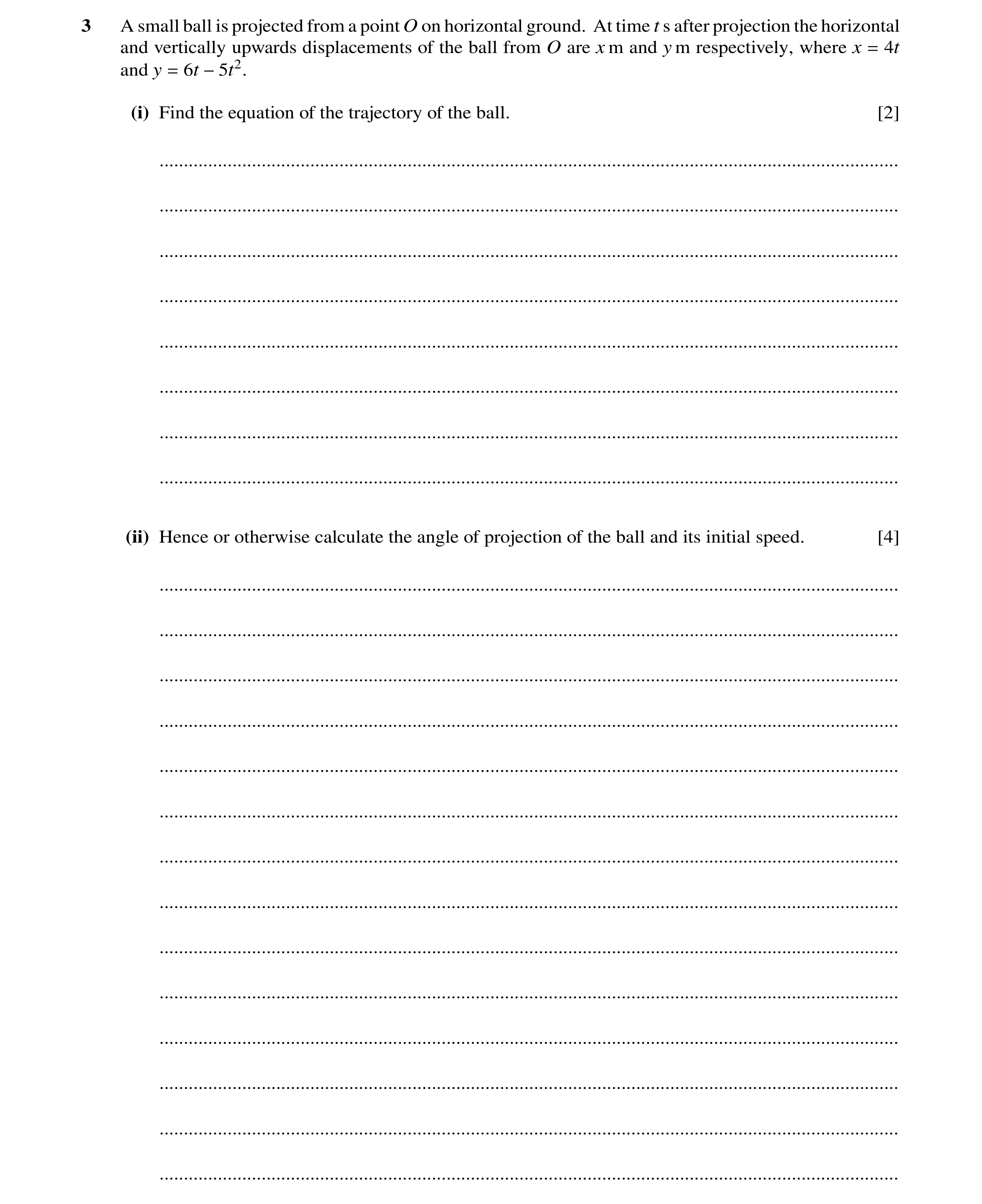
3 A small ball is projected from a point O on horizontal ground. At time t s after projection the horizontal and vertically upwards displacements of the ball from O are x m and y m respectively, where x = 4t and y = 6t −5t2. (i) Find the equation of the trajectory of the ball. [2] … … … … … … … … (ii) Hence or otherwise calculate the angle of projection of the ball and its initial speed. [4] … … … … … … … … … … … … … …
6 marks
Mark scheme: 3(i) x = 4t and y = 6t – 5 2t y [= 6x/4 – 5 2 ( / 4) x ] = 1.5x –5 2 x /16 or 1.5x – 0.3125 2 x A1 2 3(ii) tanθ = 1.5 M1 Use the trajectory equation from the formula sheet θ = 56.3° A1 2 2 V cos 56.3 =16 M1 Again use the trajectory equation V = 7.21 m s–1 A1 OR Vcosθ = 4 and Vsinθ =6 M1 Initial horizontal and vertical velocities 2 2 V cos θ + 2 2 2 4 θ = V sin + 2 6 OR tanθ = 6/4 M1 Use Pythagoras's theorem or trigonometry of a right angled triangle V = 7.21 m s–1 A1 θ = 56.3° A1 4
This question in 9709/52 Feb/March 2019
Q14 · A small ball is projected with speed 25 m s−1 at an angle of 30Å above the horizontal… 9709/51 May/June 2019
4 A small ball is projected with speed 25 m s−1 at an angle of 30Å above the horizontal from a point O on horizontal ground. At time t s after projection the horizontal and vertically upwards displacements of the ball from O are x m and y m respectively. (i) Express x and y in terms of t and hence find the equation of the trajectory of the ball. [4] … … … … … … … … … … … … … … … … … … … … … … … (ii) Find x for the position of the ball when its path makes an angle of 15Å below the horizontal. [4] … … … … … … … … … … … … … … … … … … … … … … … … …
8 marks
Mark scheme: 4(i) B1 2 25sin30 2 gt y t = − B1 Use vertical motion 2 25cos30 25sin30 25cos30 2 x g x y = − M1 Eliminate t 2 4 375 3 x x y = − or 2 0.577 0.0107 y x x = − A1 4 Question Answer Marks Guidance 4(ii) d 1 8 d 375 3 y x x = − or d 0.577 0.0214 d y x x = − M1A1 Differentiate the equation from part (i) to find the gradient 1 8 tan15 375 3 x − = − or tan15 0.577 0.0214x − = − M1 Attempt to solve x = 39.6 or x = 39.5 A1 4 Alternative method for question 4(ii) tan15 12.5 3 y y x v v v = = M1 ( ) 12.5 3tan15 5.8 yv = = downwards A1 –5.8 = 12.5 – 10t leading to t = 1.83 M1 Vertical motion using v = u + at 25 3 1.83 39.6 2 X = × = A1 4
This question in 9709/51 May/June 2019
Q15 · 0.2 m A 0.2 m 0.7 m The diagram shows the cross-section through the centre of mass of a… 9709/53 May/June 2019
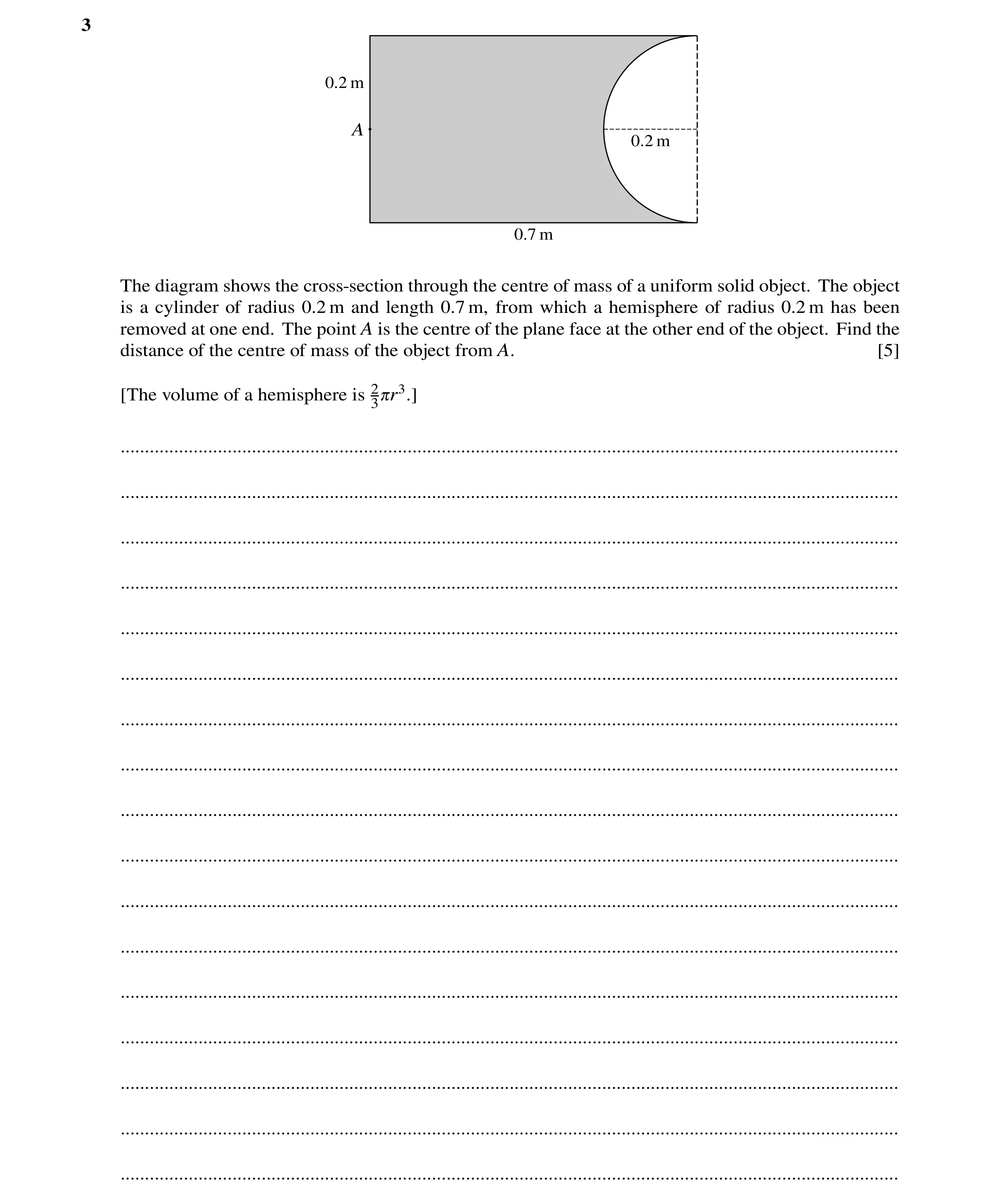
3 0.2 m A 0.2 m 0.7 m The diagram shows the cross-section through the centre of mass of a uniform solid object. The object is a cylinder of radius 0.2 m and length 0.7 m, from which a hemisphere of radius 0.2 m has been removed at one end. The point A is the centre of the plane face at the other end of the object. Find the distance of the centre of mass of the object from A. [5] [The volume of a hemisphere is 230r3.] … … … … … … … … … … … … … … … … …
5 marks
Mark scheme: 3 Volume of hemisphere = ( ) 3 0.2 2π 0.0053333π 3 × = B1 Distance of centre of mass from object base ( ) 0.2 0.7 3 0.625 8 = −× = B1 3 3 2 0.2 0.2 0.2 π 0.2 0.7 2π 0.7 3 2π 0.35 0.028π 3 8 3 x × × − × + −× × × = × M1A1 Take moments about the plane face x = 0.285 m A1 5
This question in 9709/53 May/June 2019
 1 / 13
 2 / 13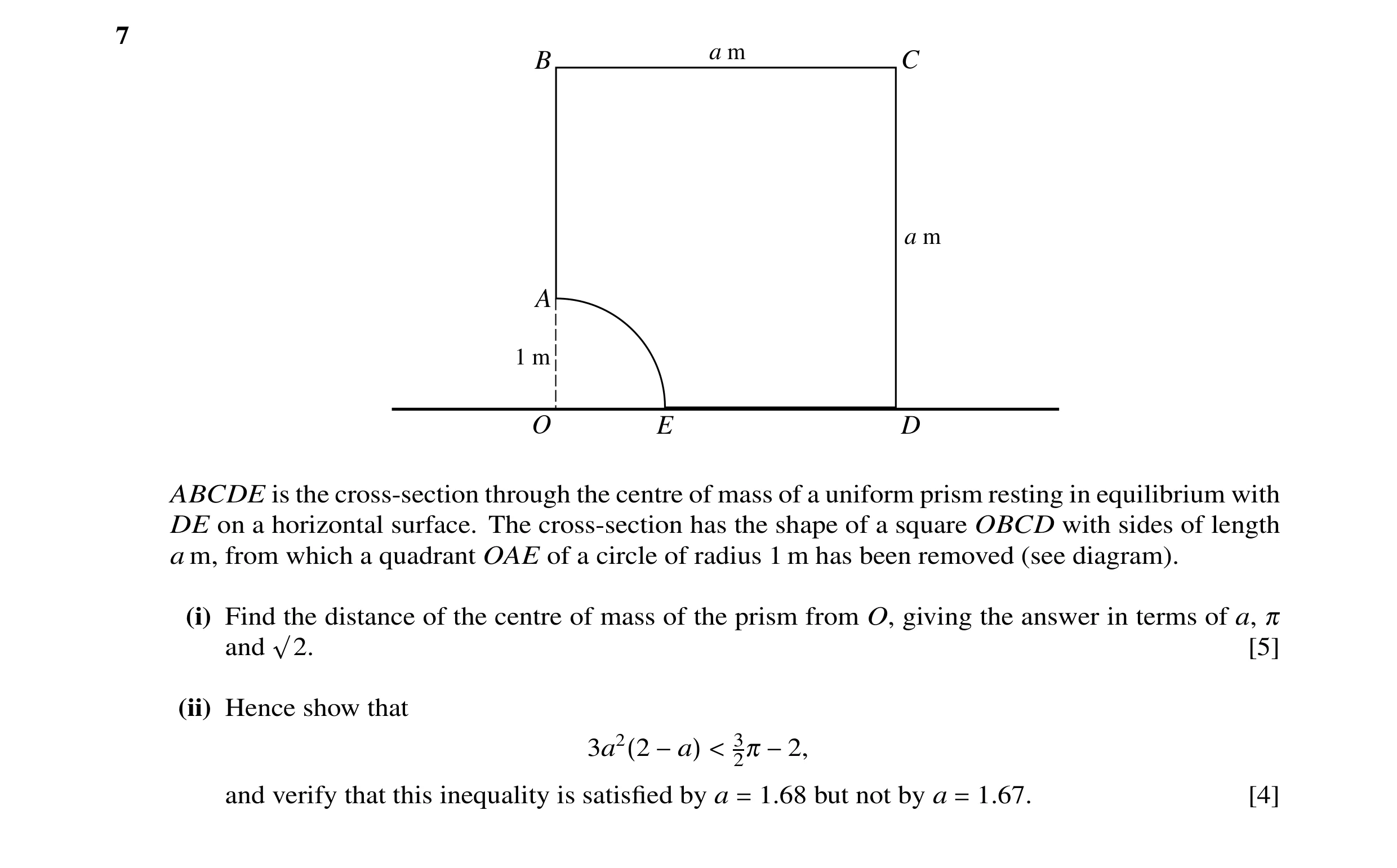
 3 / 13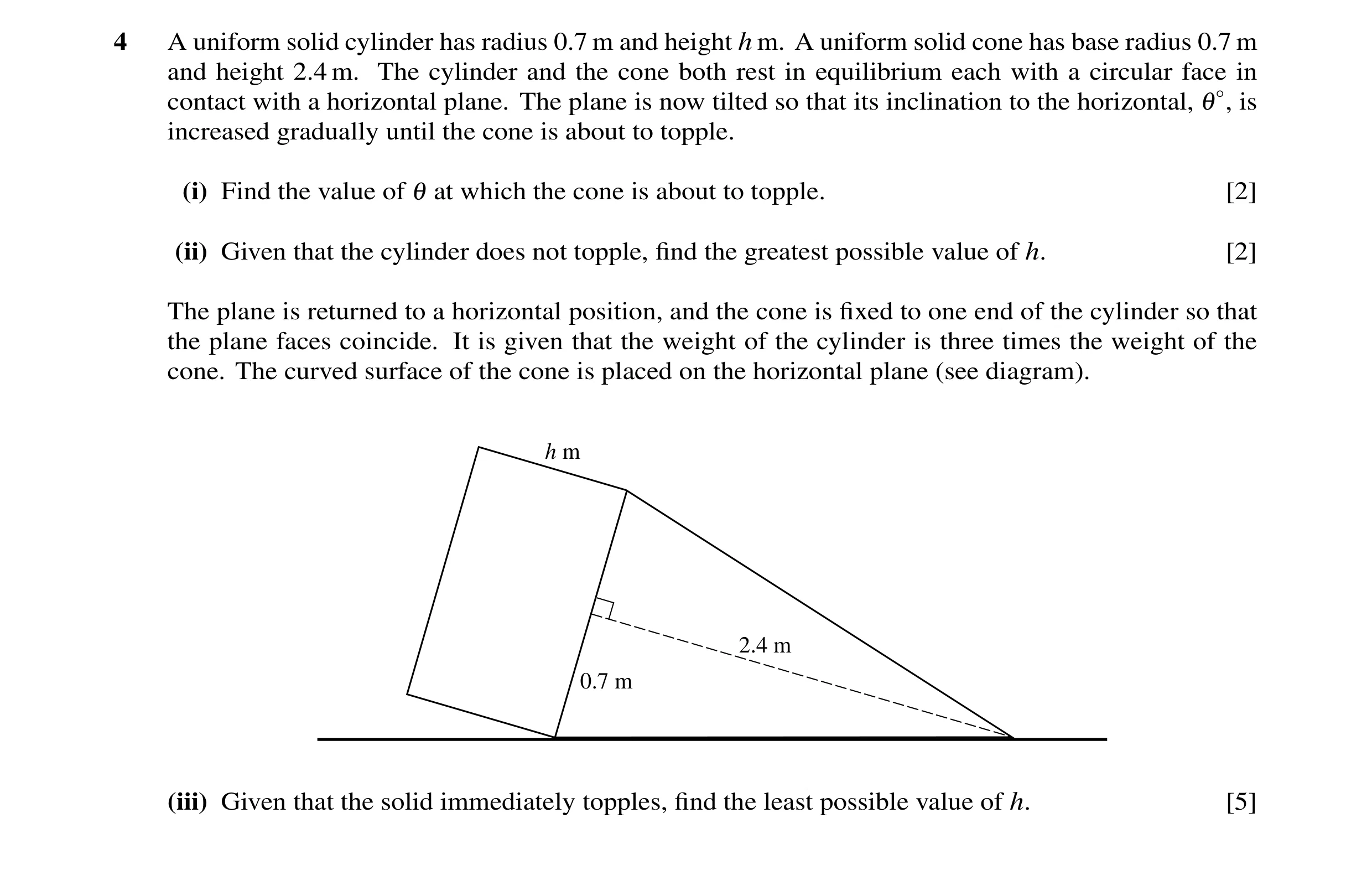
 4 / 13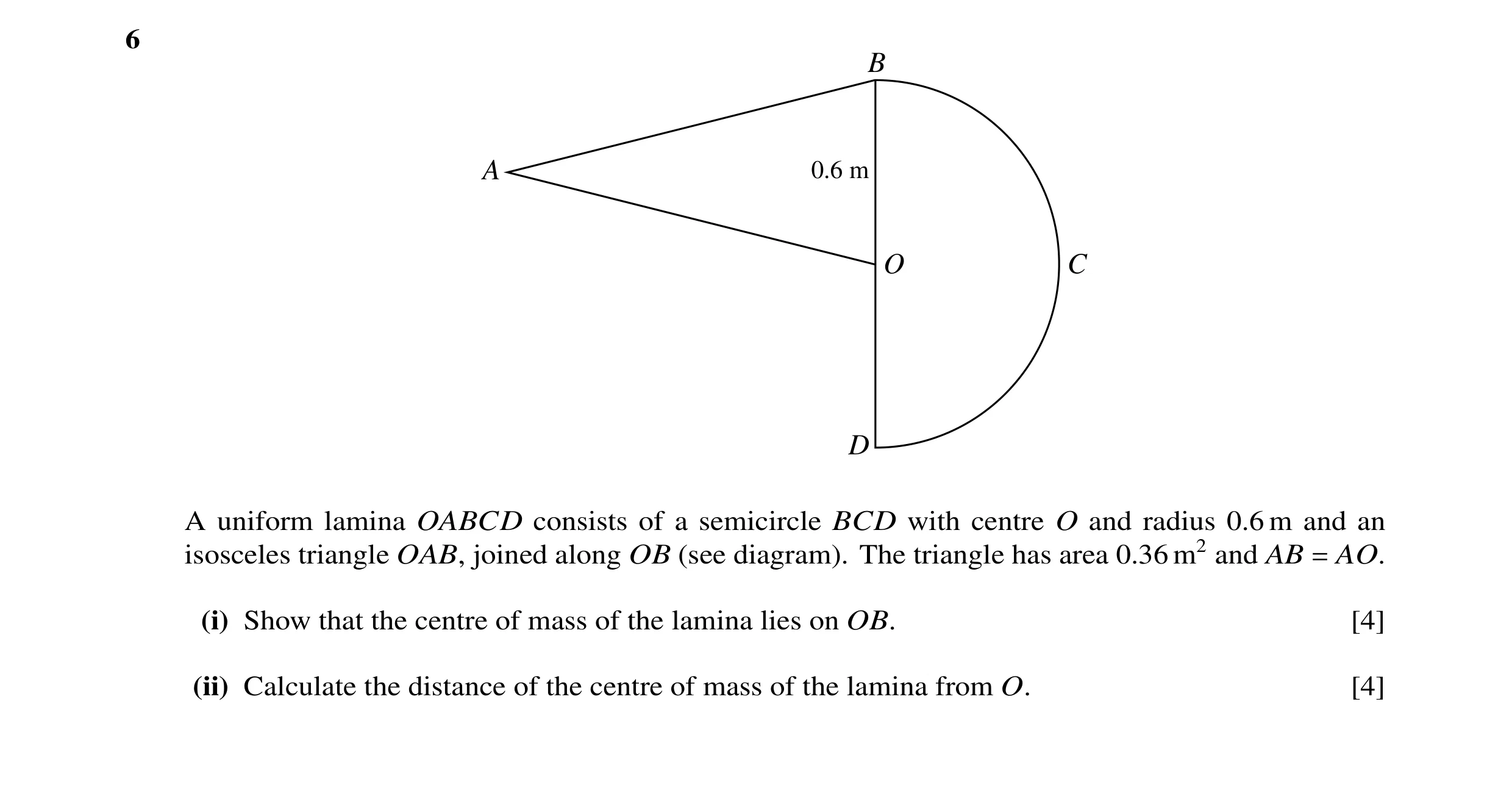
 5 / 13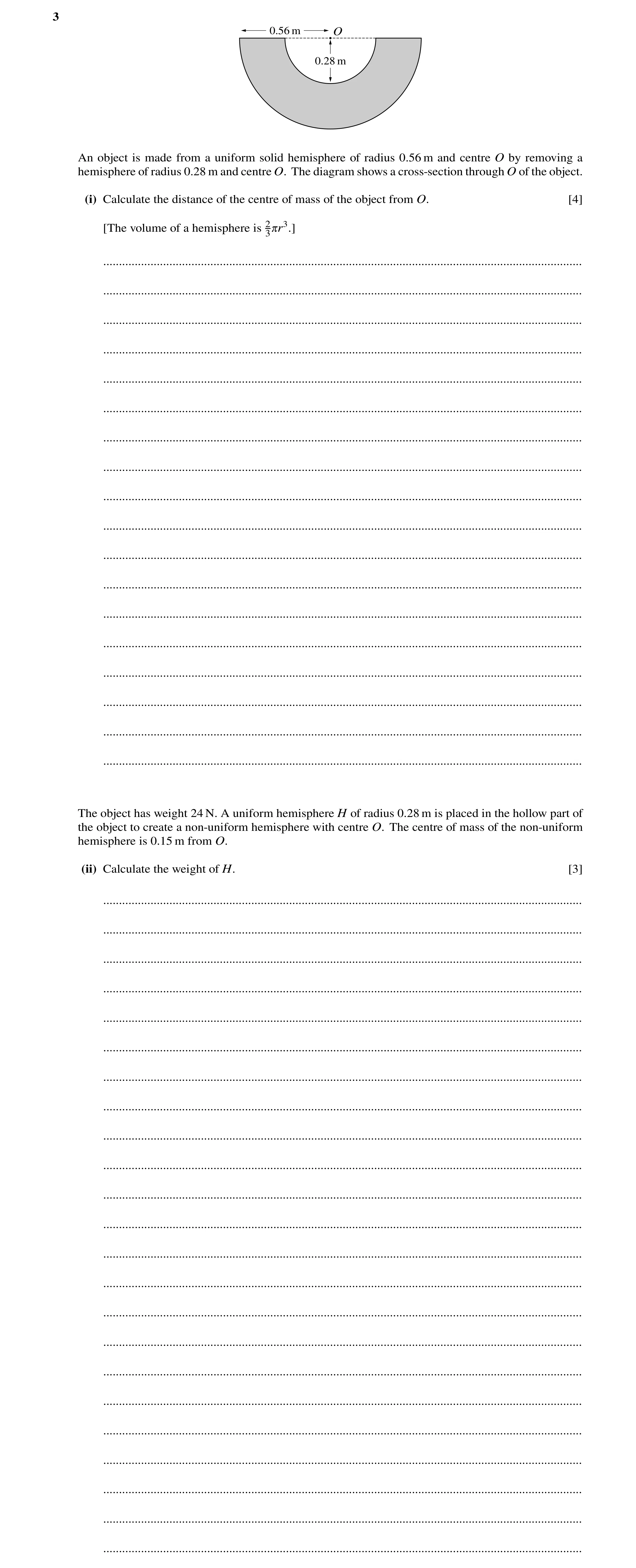
 10 / 13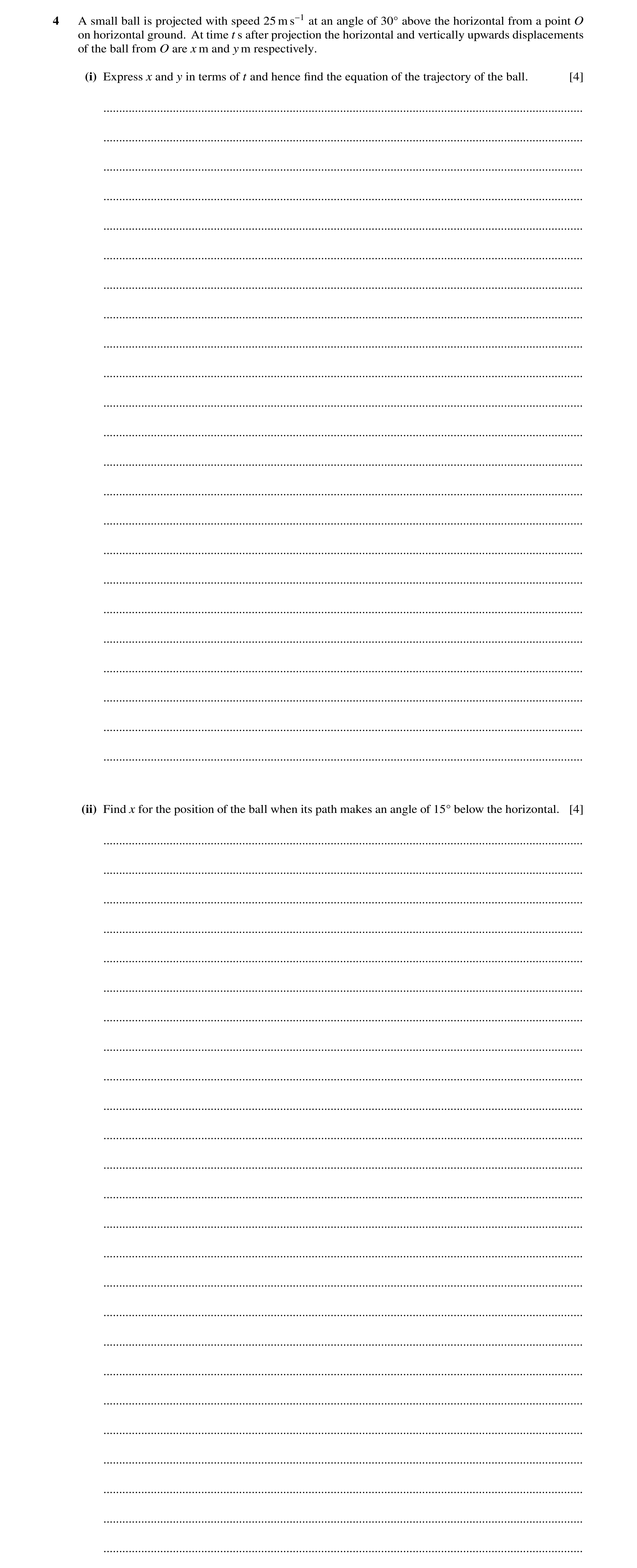
 13 / 13
 8
8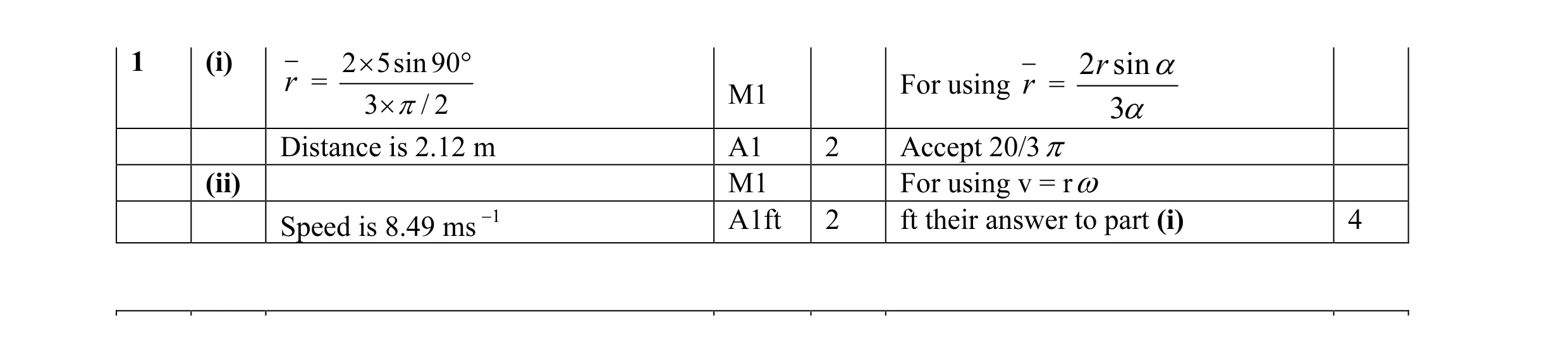 4
4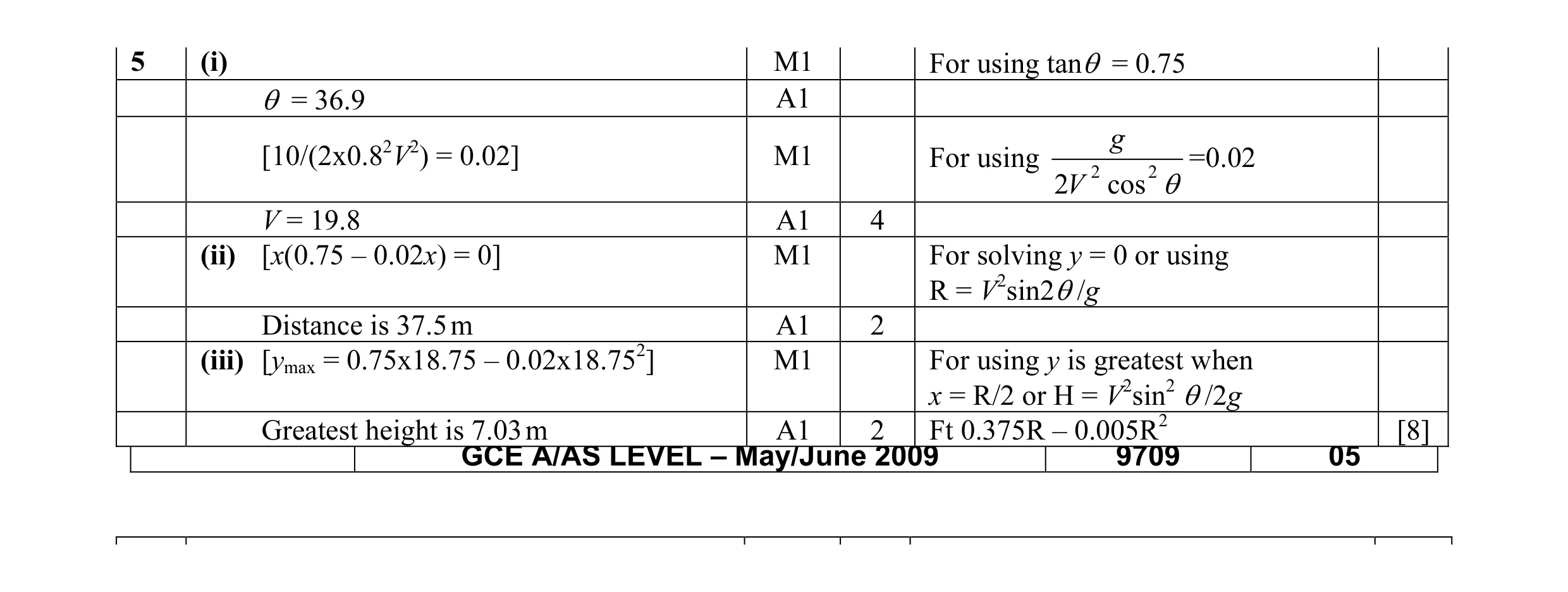 8
8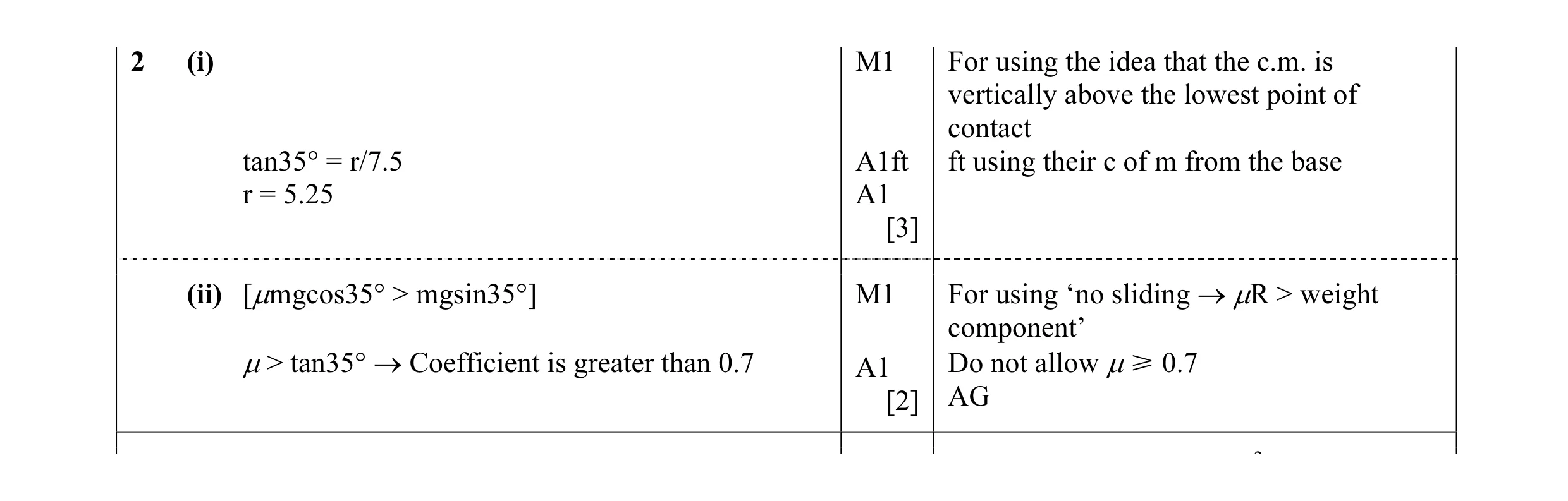 5
5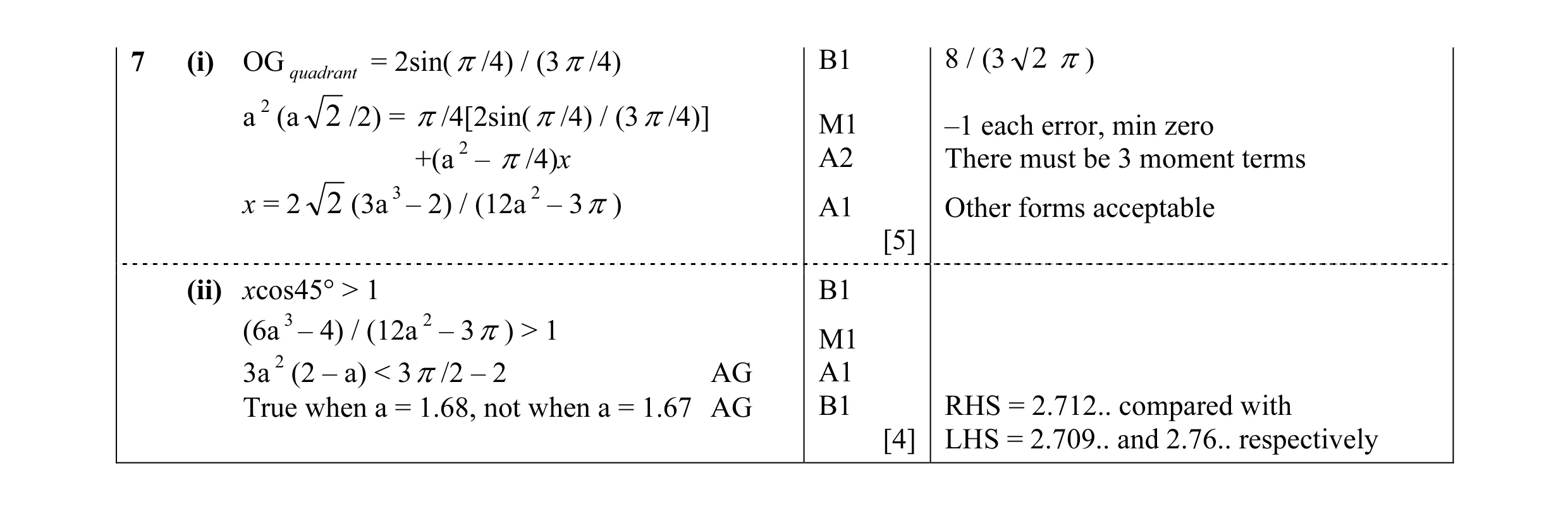 9
9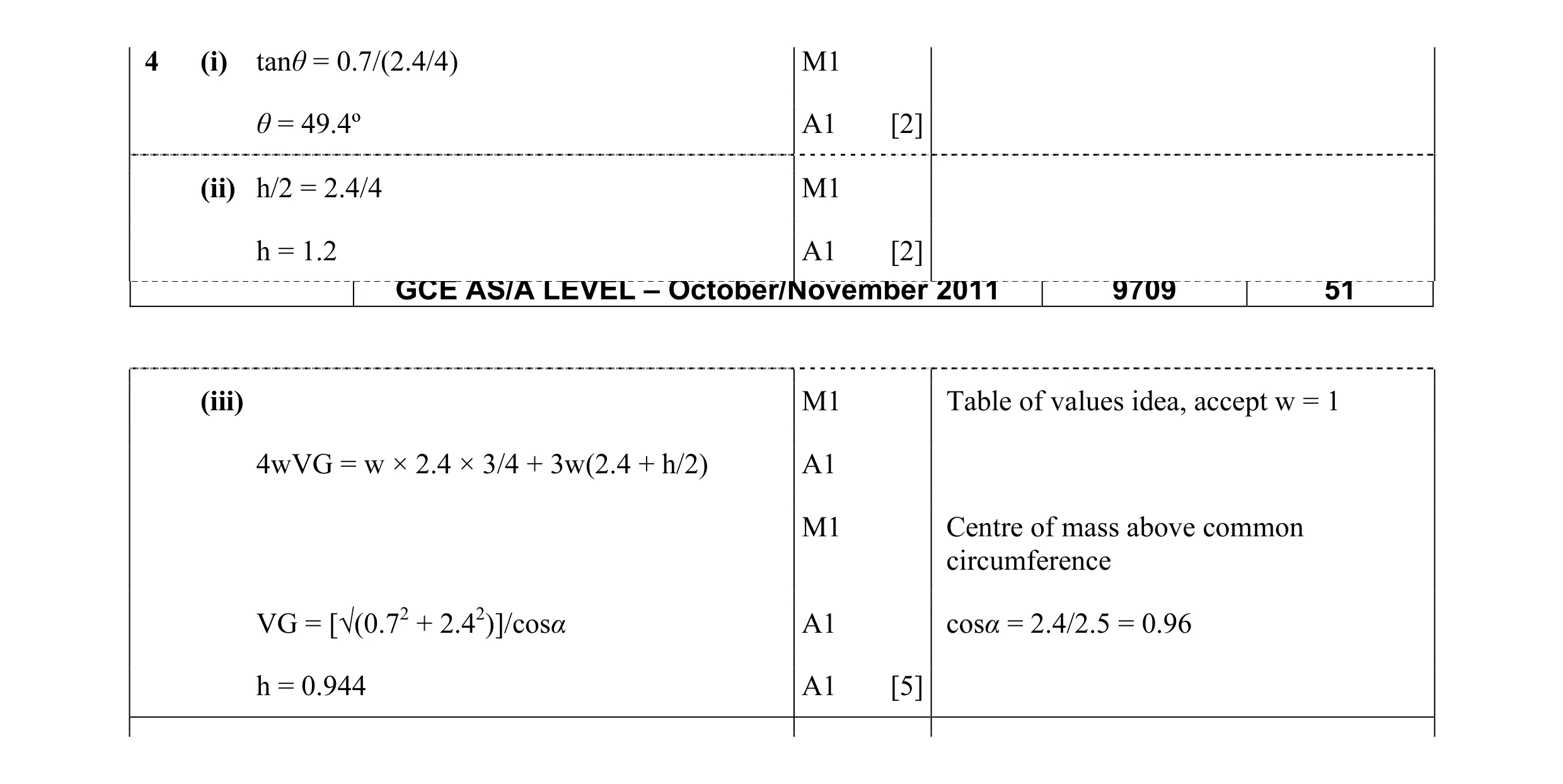 9
9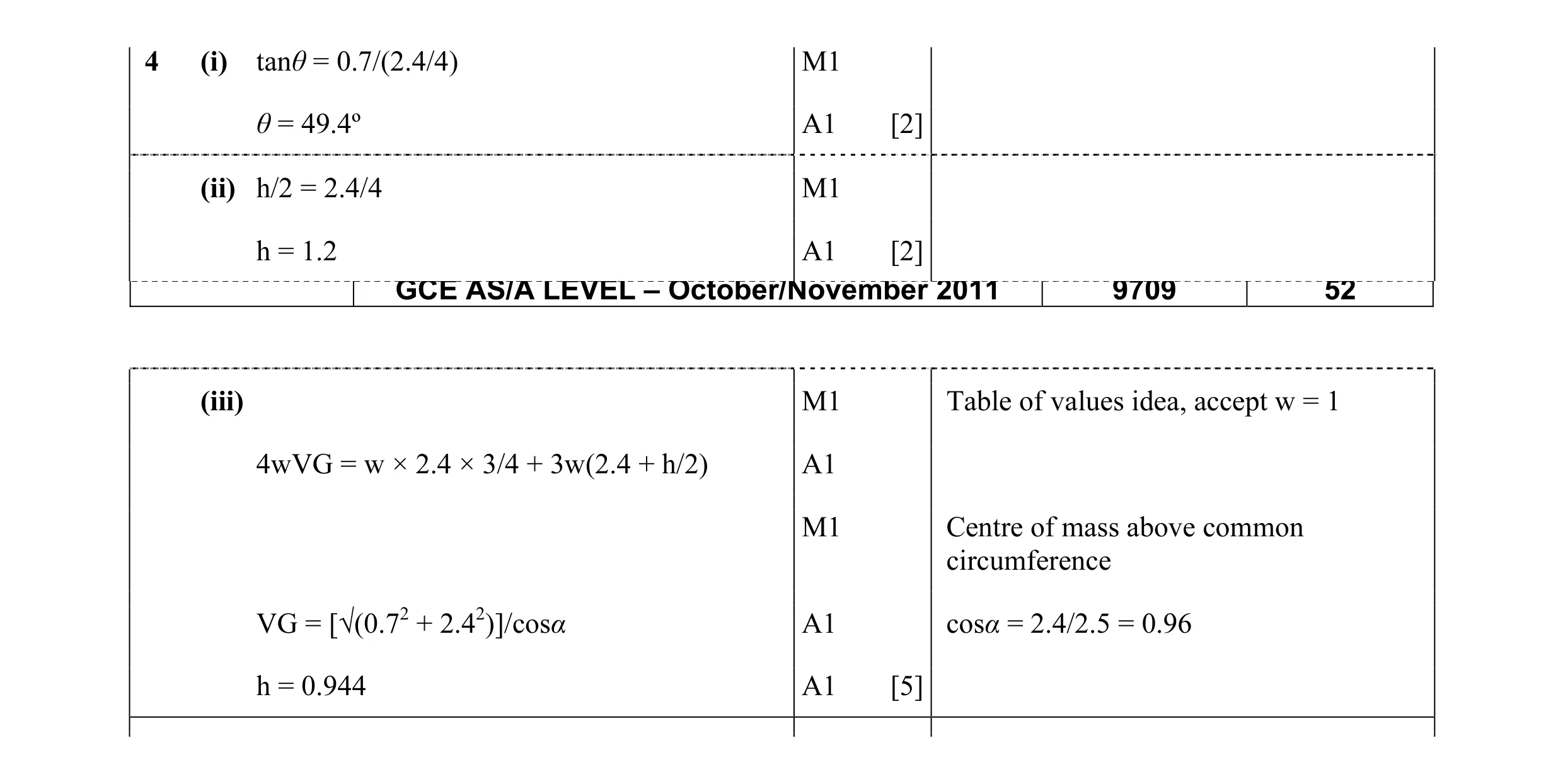 9
9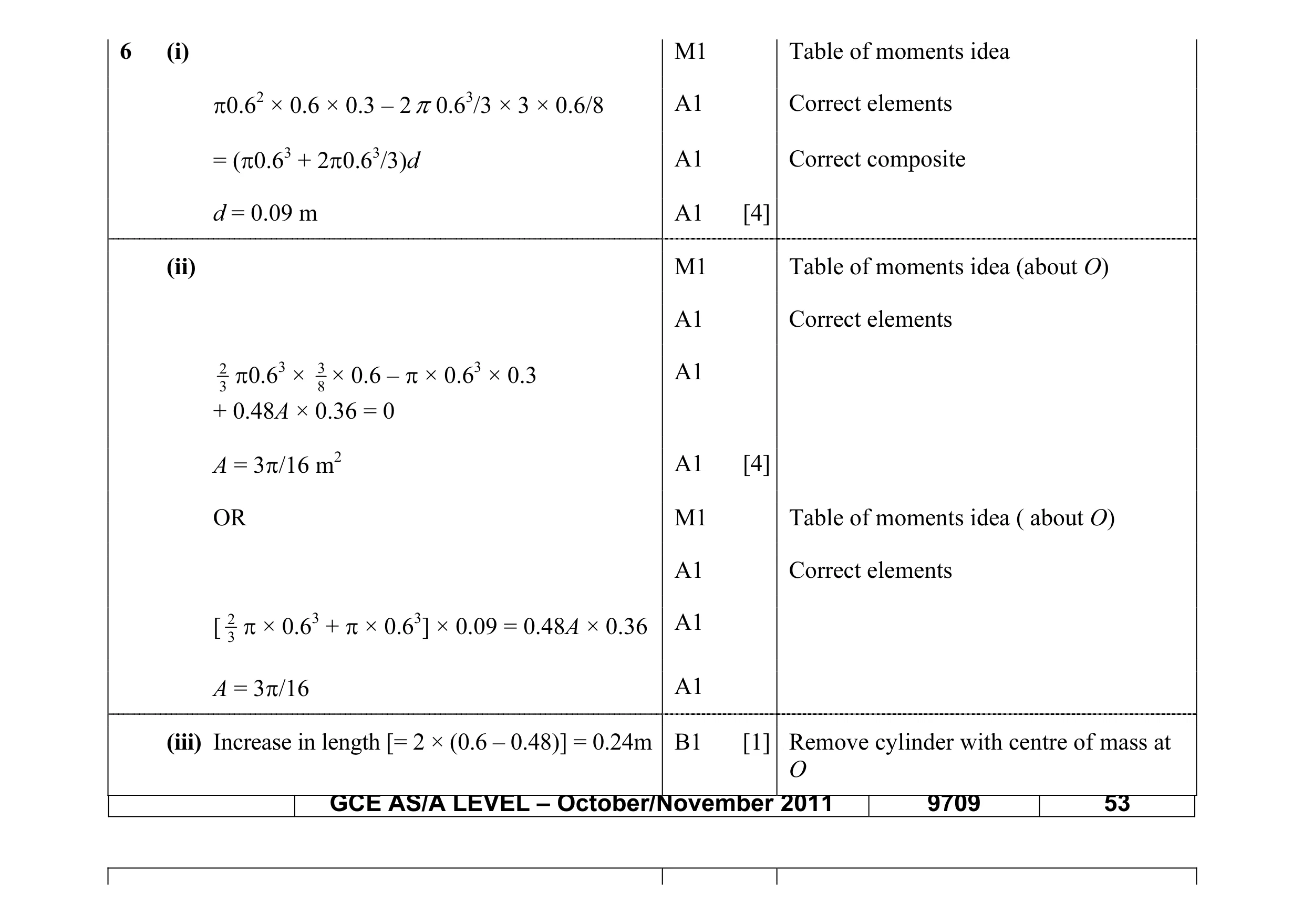 9
9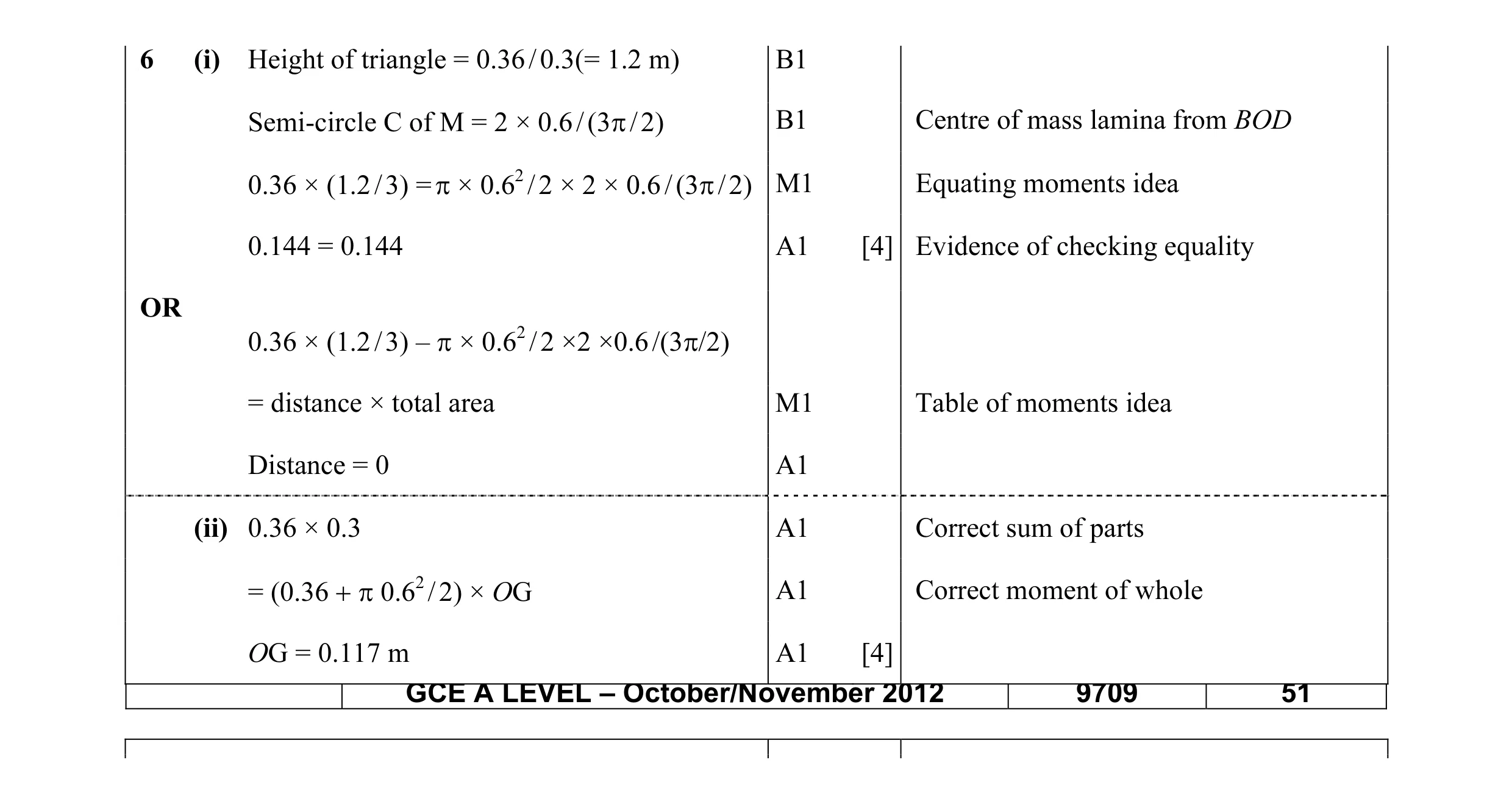 8
8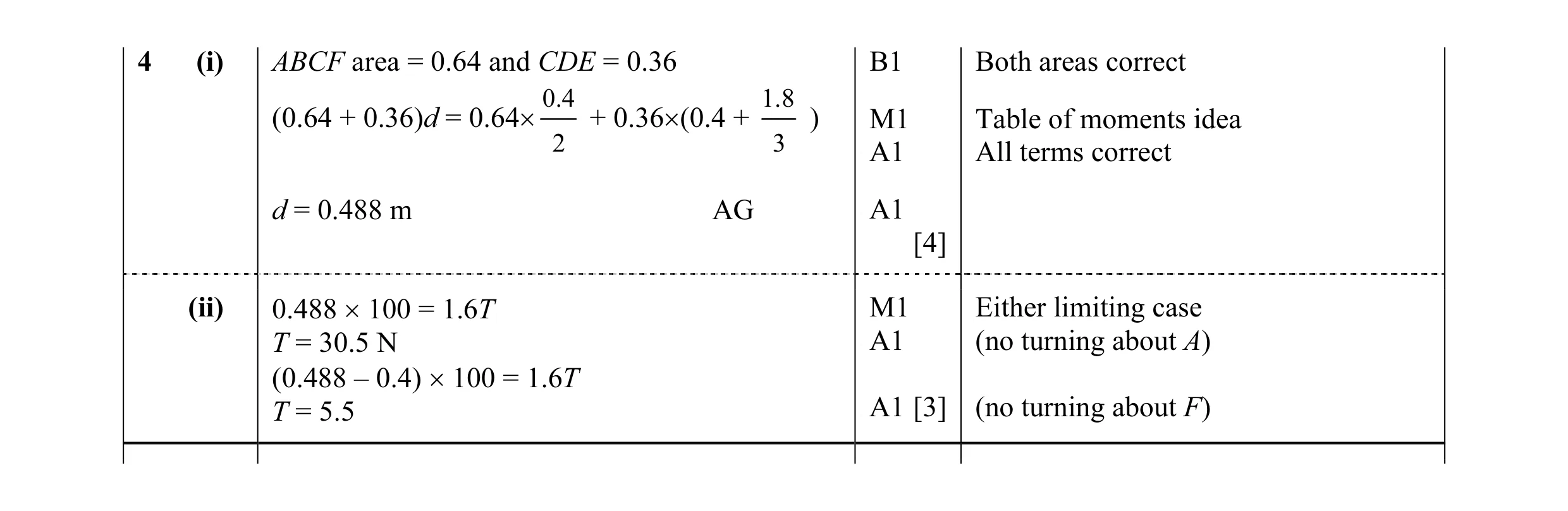 7
7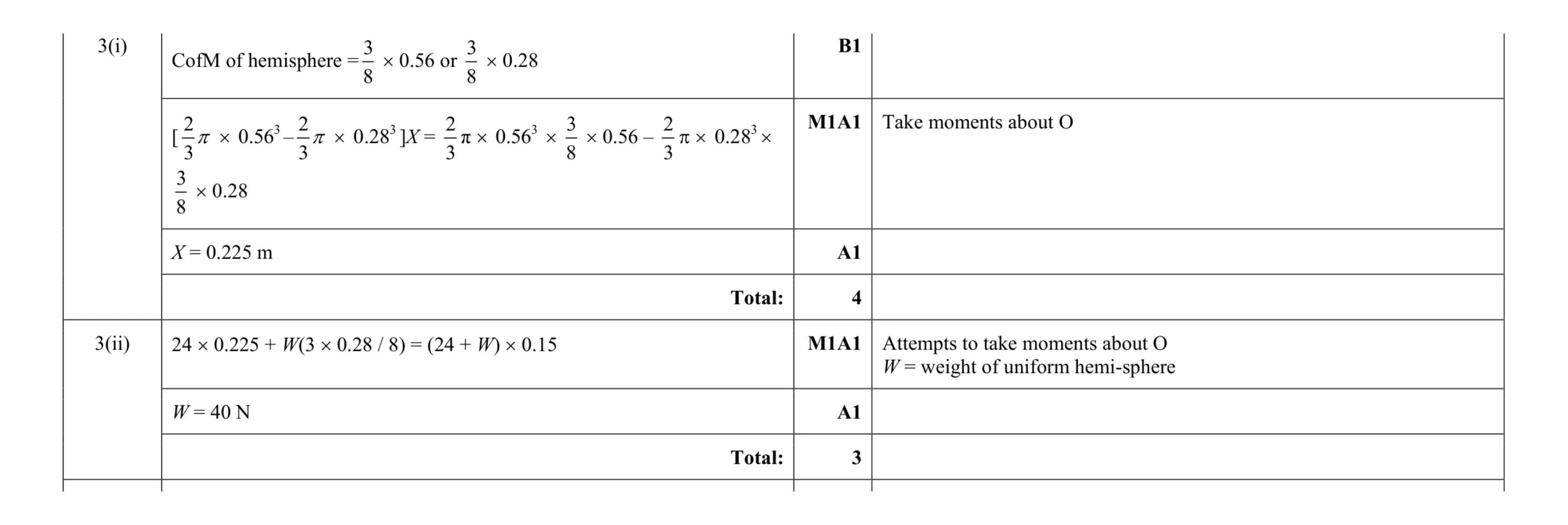 7
7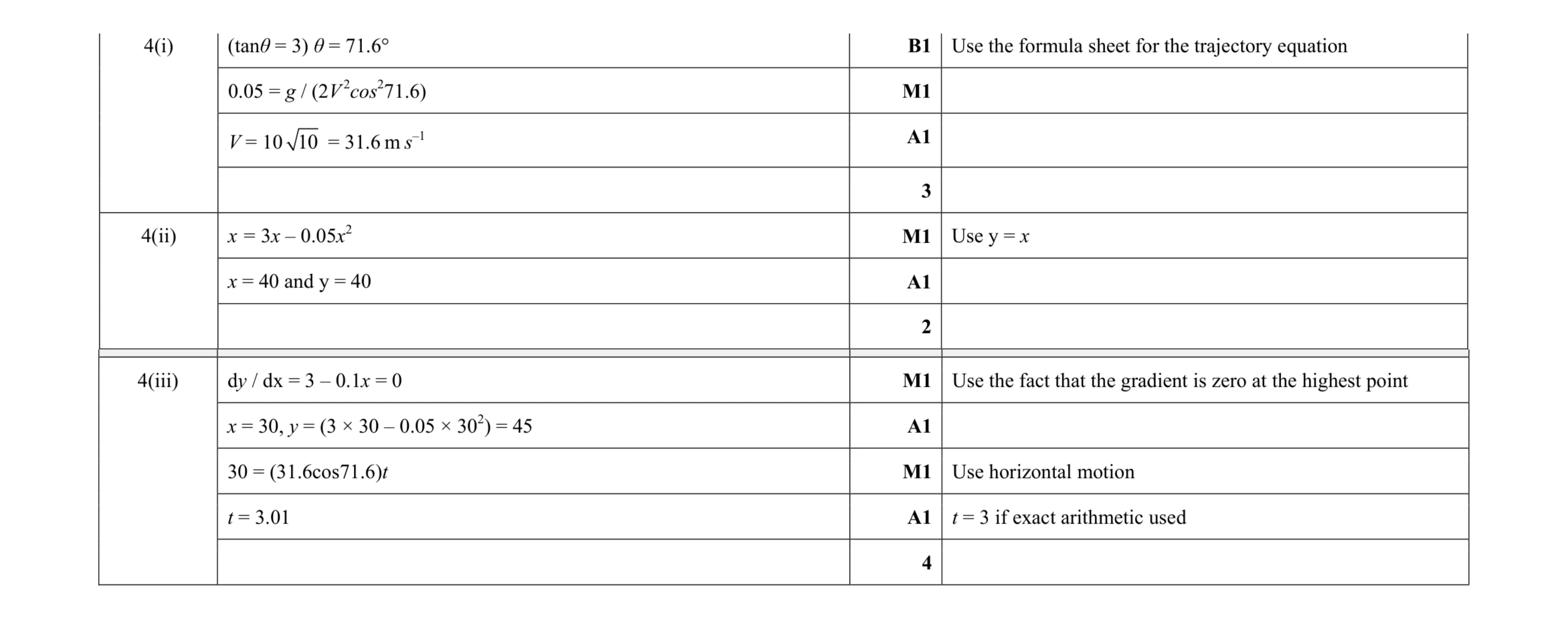 9
9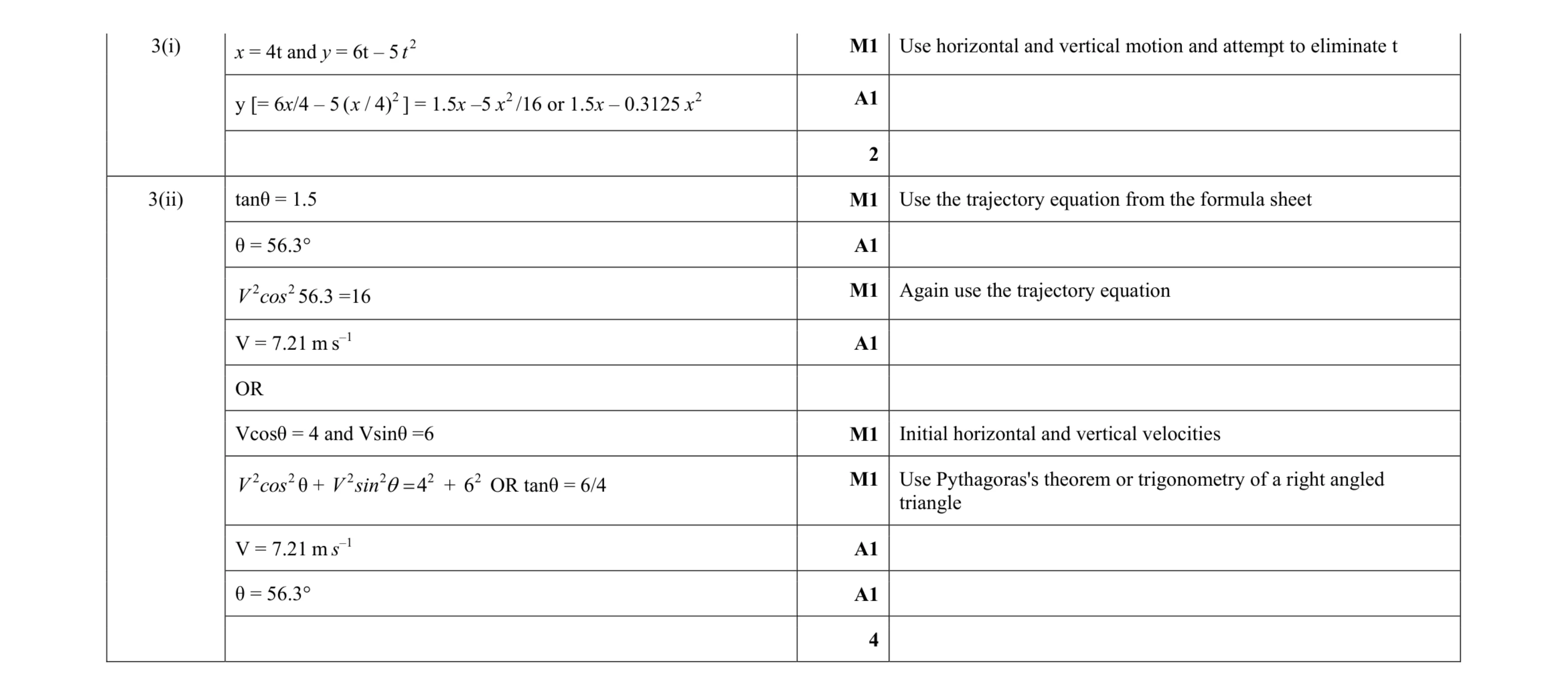 6
6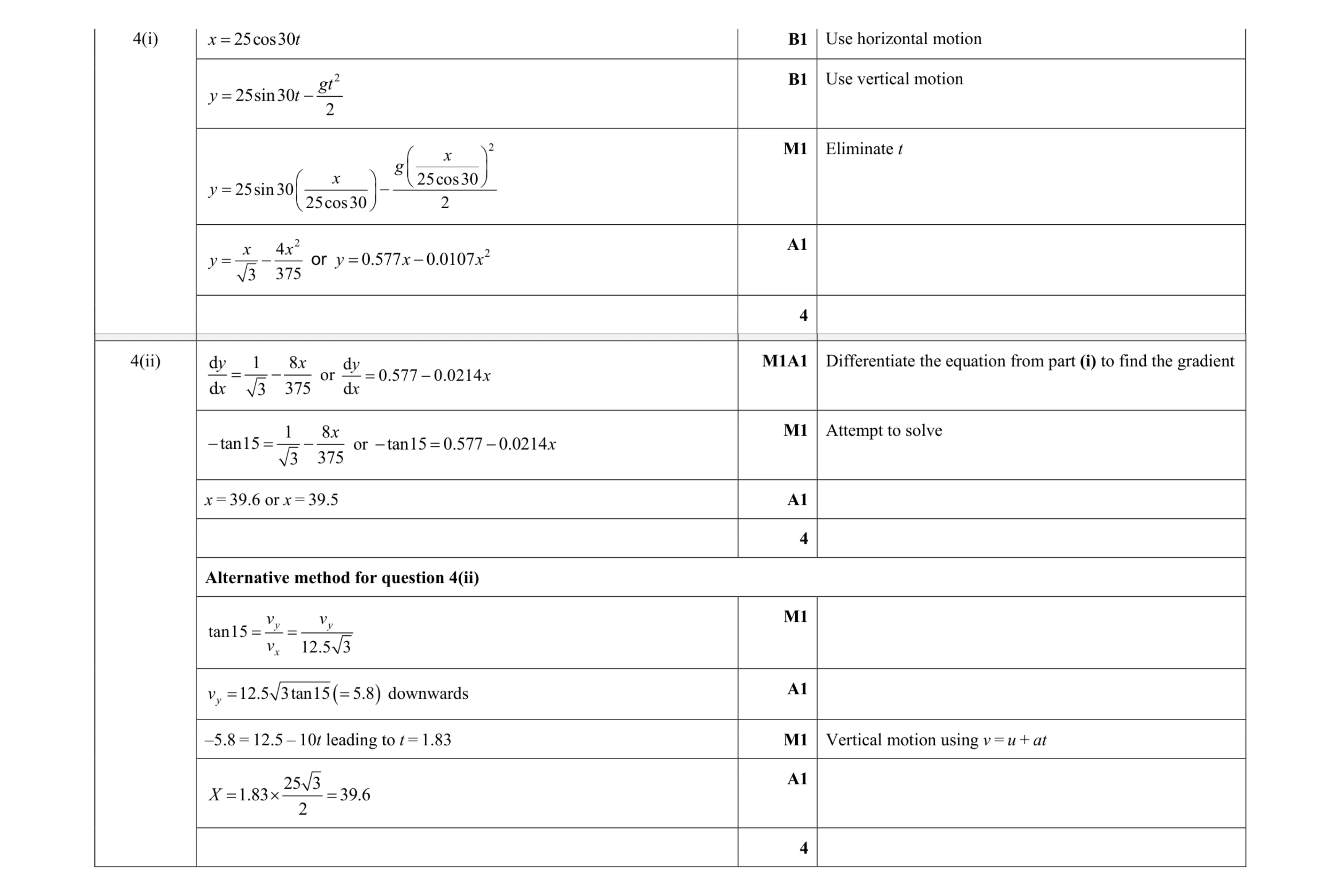 8
8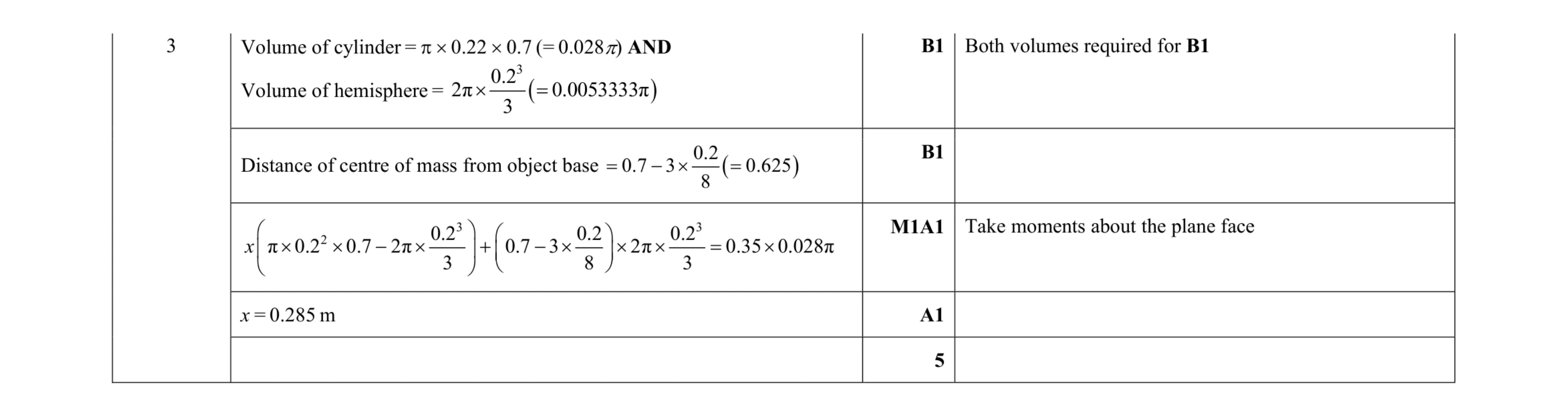 5
5