Cambridge A Level Mathematics 9709 — 2015 Oct/Nov Paper 1 · Variant 1
9709/11/O/N/15 · 4 questions · 75 marks · ≈84 min
The question paper and its mark scheme, free to read here and free to download. This is Cambridge’s own paper, exactly as it was sat.
Question paper4 pages
Mark scheme8 pages
Answers below. Sit the paper first if you are practising.
Questions as text
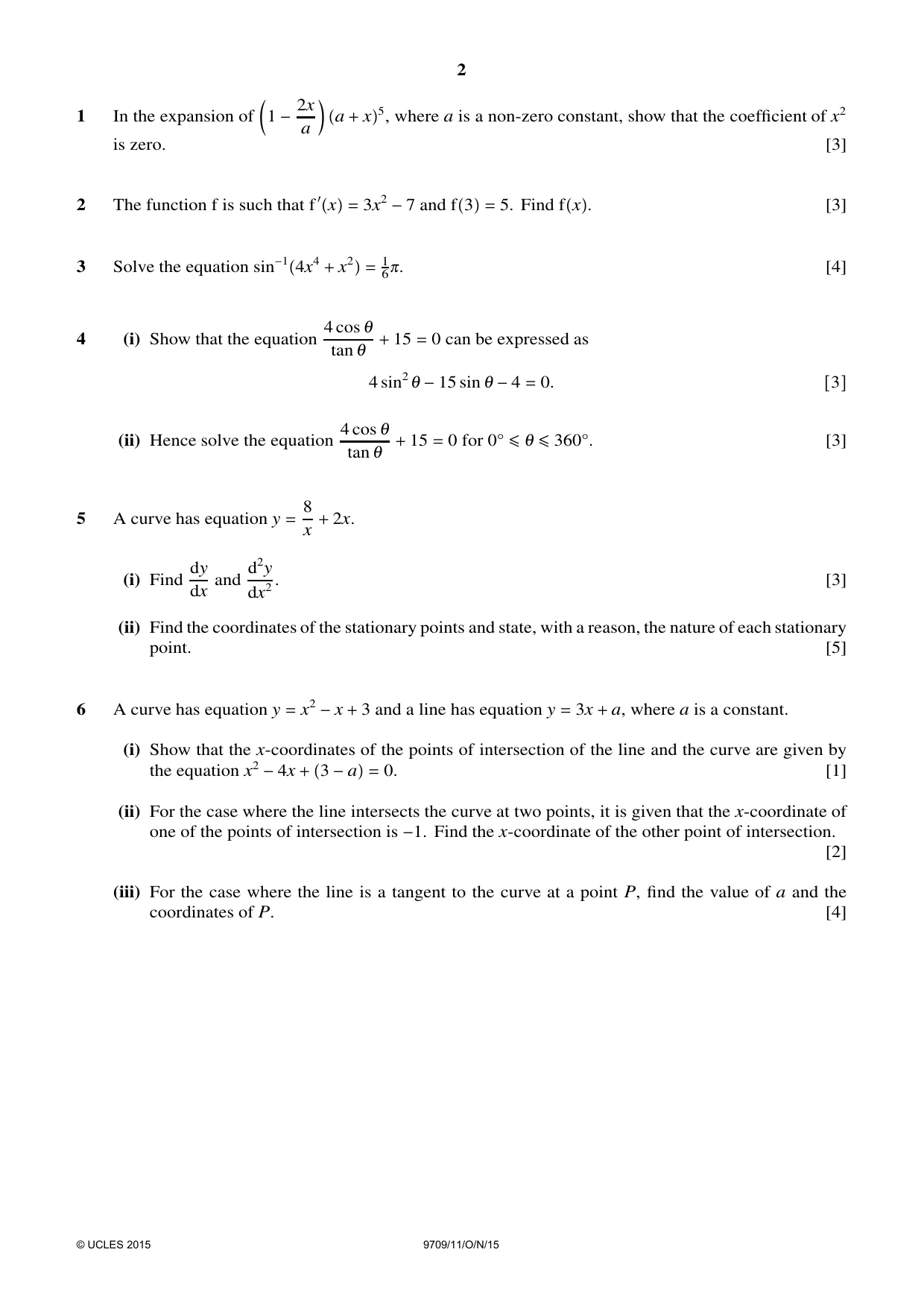
Q4 · Cos 1 4 (i) Show that the equation + 15 = 0 can be expressed as tan 1 4 sin21 −15 sin 1…
4 cos 1 4 (i) Show that the equation + 15 = 0 can be expressed as tan 1 4 sin21 −15 sin 1 −4 = 0. 4 cos 1 (ii) Hence solve the equation + 15 = 0 for 0Å ≤1 ≤360Å. [3] tan 1
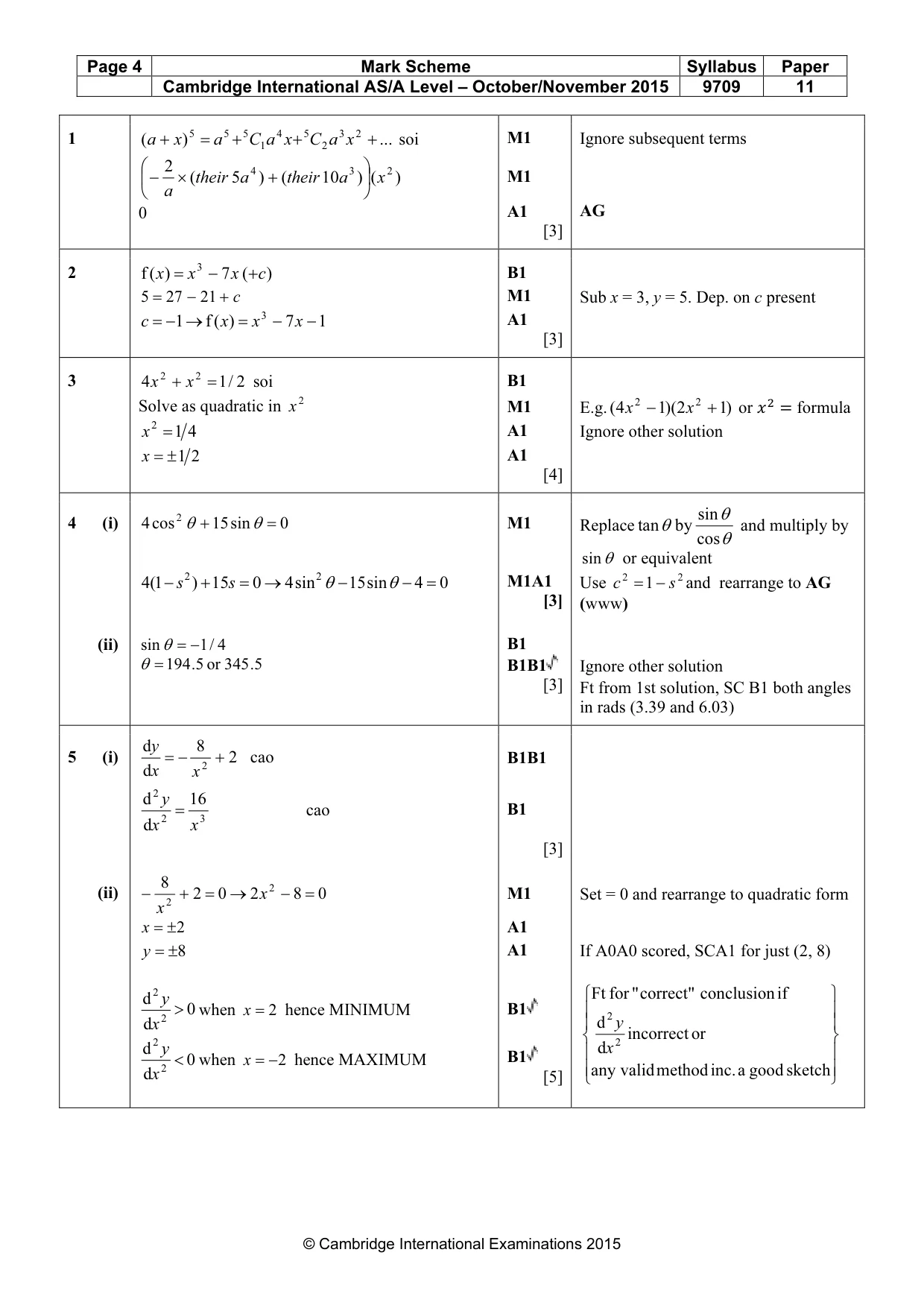
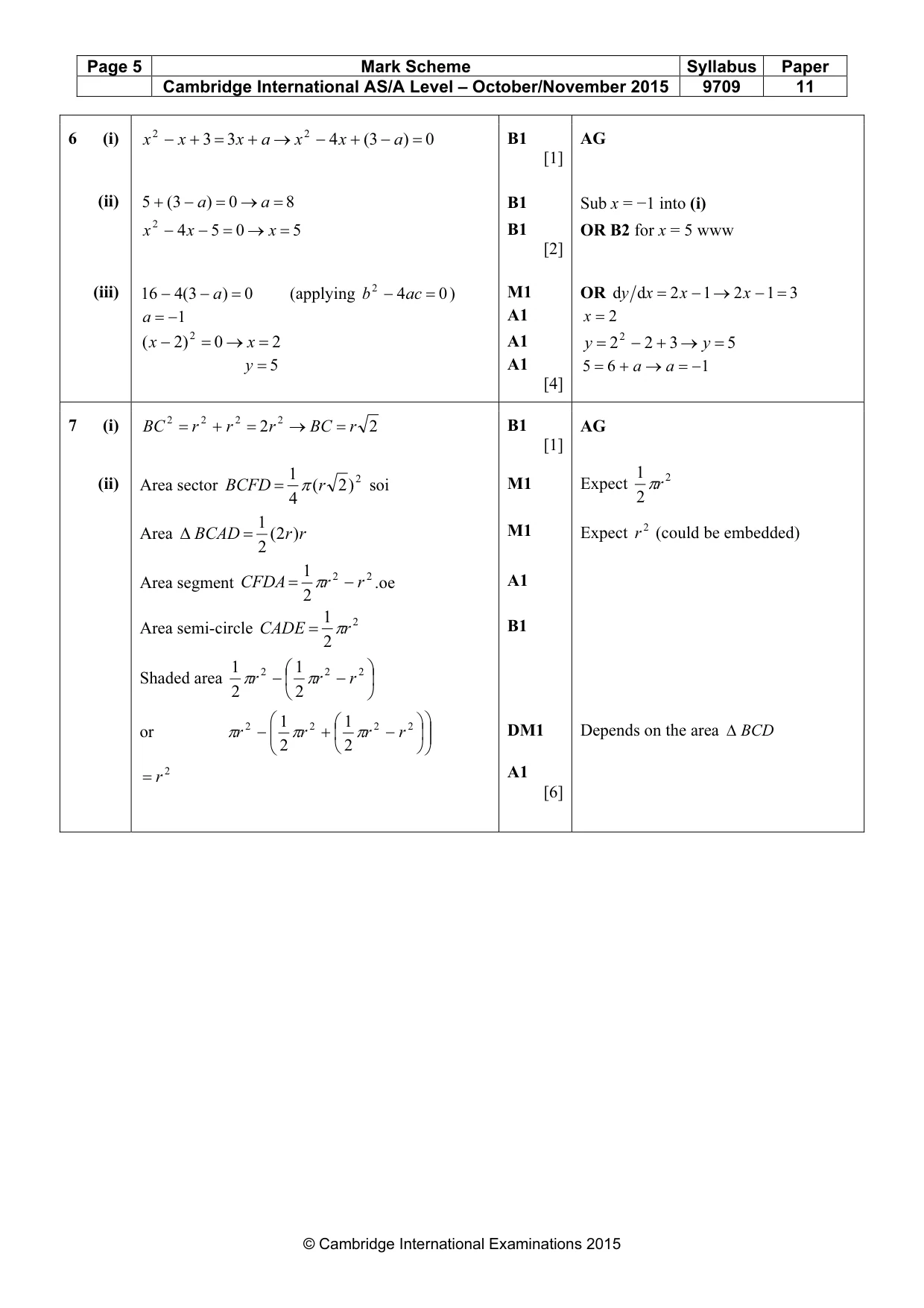
Mark scheme: 2 sin θ 4 (i) 4 cos θ + 15 sin θ = 0 M1 Replace tan θ by and multiply by cos θ sin θ or equivalent 41( − s 2 ) + 15 s = 0 → 4 sin 2 θ − 15 sin θ − 4 = 0 M1A1 Use c 2 = 1 − s 2 and rearrange to AG [3] (www) (ii) sin θ = − 1 / 4 B1 θ = 194 5. or 345 5. B1B1 Ignore other solution [3] Ft from 1st solution, SC B1 both angles in rads (3.39 and 6.03) dy 8
Q5 · 5 A curve has equation y = + 2x
8 5 A curve has equation y = + 2x. x dy d2y (i) Find and . [3] dx dx2 (ii) Find the coordinates of the stationary points and state, with a reason, the nature of each stationary point. [5]
Mark scheme: d y 8 5 (i) = − + 2 cao B1B1 d x x 2 d 2 y 16 = cao B1 dx 2 x 3 [3] 8 2 (ii) − + 2 = 0 → 2 x − 8 = 0 M1 Set = 0 and rearrange to quadratic form 2 x x = ± 2 A1 y = ± 8 A1 If A0A0 scored, SCA1 for just (2, 8) d 2 y Ft for " correct" conclusion if > 0 when x = 2 hence MINIMUM B1 2 2 dx d y 2 2 incorrect or d y < 0 when x = − 2 hence MAXIMUM B1 dx dx 2 [5] any valid method inc. a good sketch 2 2
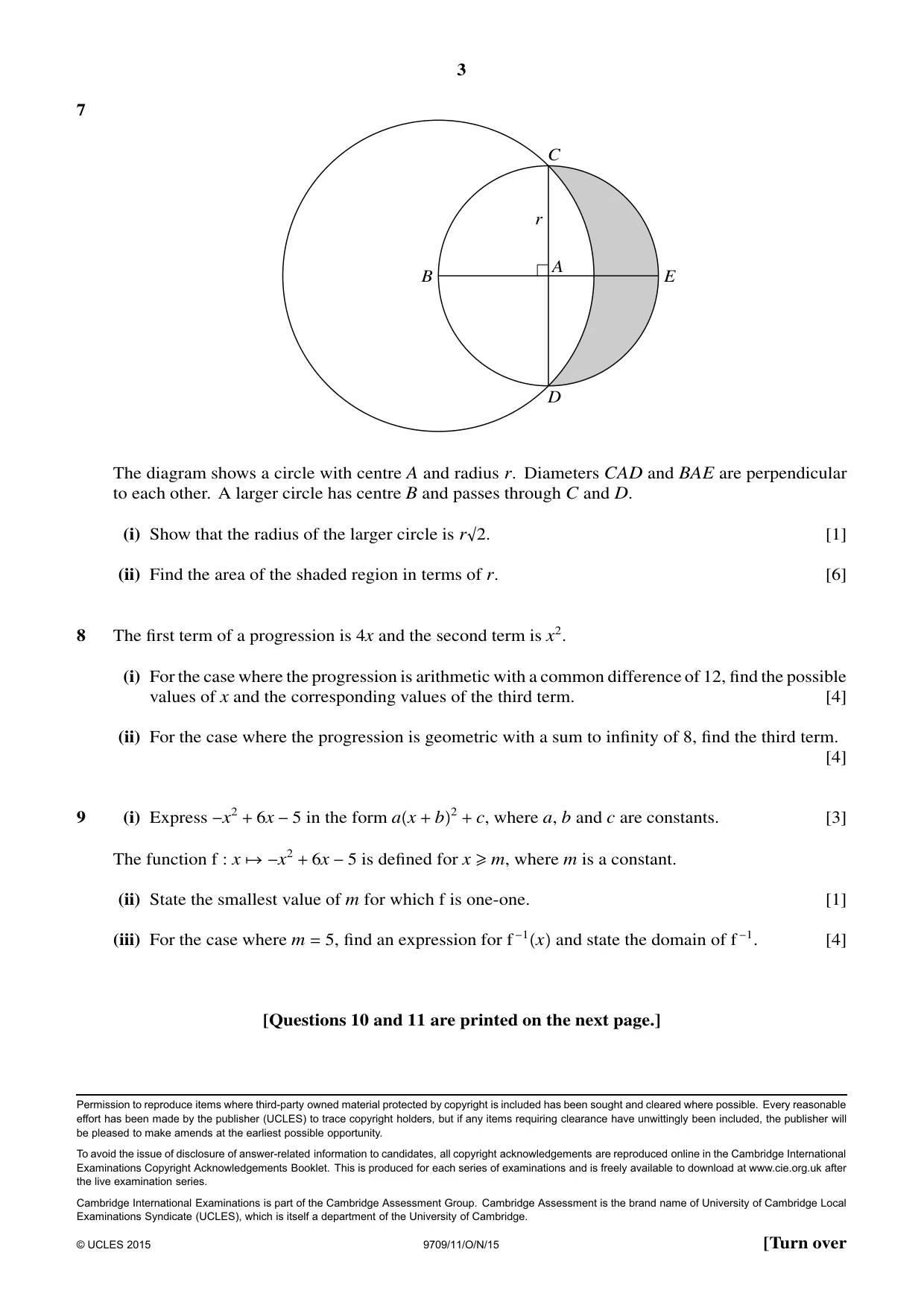
Q7 · C r A B E D The diagram shows a circle with centre A and radius r
7 C r A B E D The diagram shows a circle with centre A and radius r. Diameters CAD and BAE are perpendicular to each other. A larger circle has centre B and passes through C and D. (i) Show that the radius of the larger circle is rï2. [1] (ii) Find the area of the shaded region in terms of r. [6]
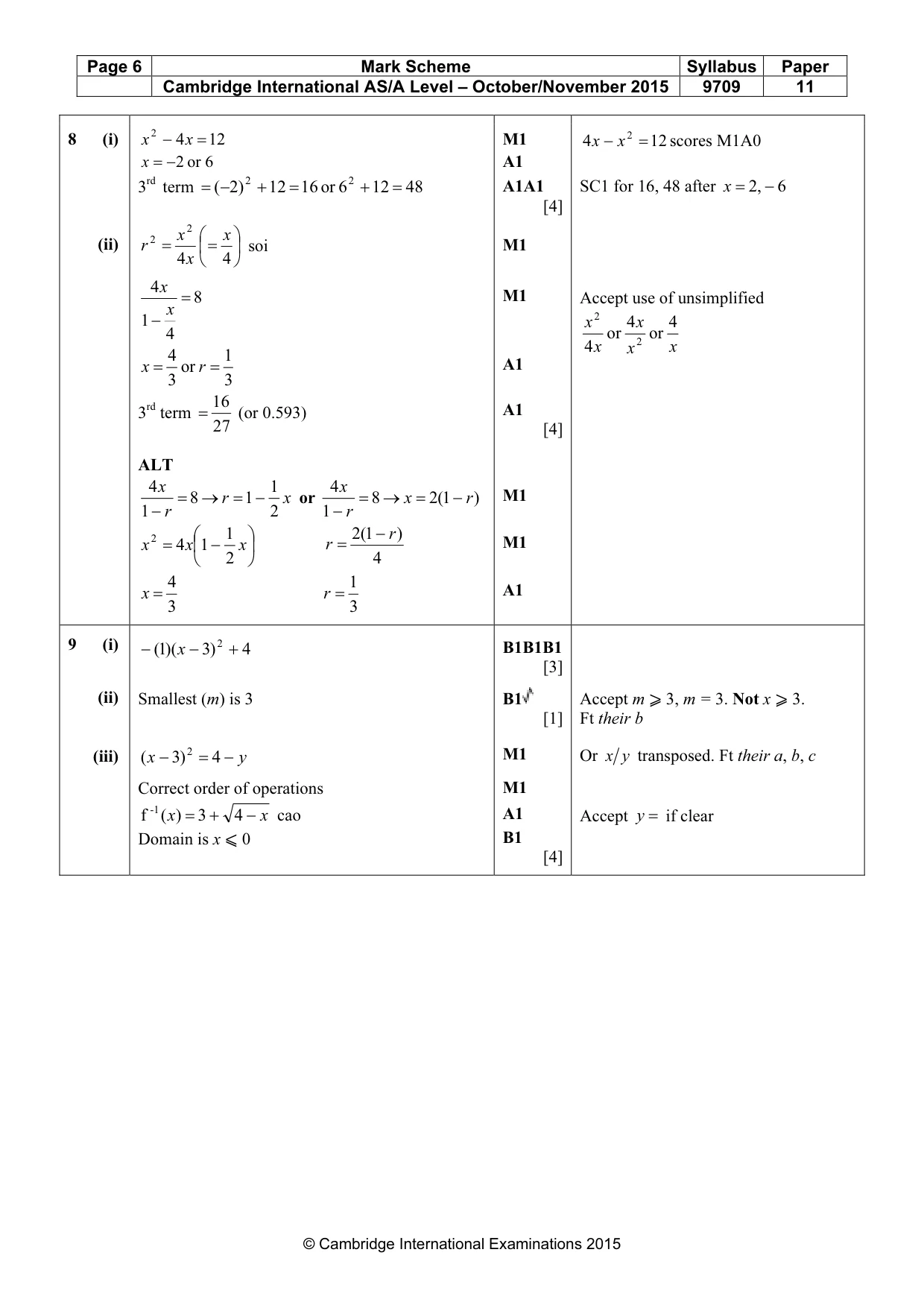
Mark scheme: 7 (i) BC 2 = r 2 + r 2 = 2 r 2 → BC = r 2 B1 AG [1] 1 1 2 (ii) Area sector BCFD = π ( r 2 2) soi M1 Expect πr 4 2 1 2 Area ∆ BCAD = ( 2 r ) r M1 Expect r (could be embedded) 2 1 2 2 Area segment CFDA = πr − r .oe A1 2 1 2 Area semi-circle CADE = πr B1 2 1 2 1 2 2 Shaded area πr − πr − r 2 2 2 1 2 1 2 2 or πr − πr + πr − r DM1 Depends on the area ∆ BCD 2 2 = r 2 A1 [6] 2
Q8 · The first term of a progression is 4x and the second term is x2
8 The first term of a progression is 4x and the second term is x2. (i) For the case where the progression is arithmetic with a common difference of 12, find the possible values of x and the corresponding values of the third term. [4] (ii) For the case where the progression is geometric with a sum to infinity of 8, find the third term. [4]
Mark scheme: 8 (i) x 2 −x4 = 12 M1 4 x −x 2 = 12 scores M1A0 x = − 2 or 6 A1 3rd term = ( −2) 2 + 12 = 16 or 6 2 + 12 = 48 A1A1 SC1 for 16, 48 after x = ,2 − 6 [4] 2 x 2 x (ii) r = = soi M1 4 x 4 4 x = 8 M1 Accept use of unsimplified 1 −x x 2 4 x 4 4 or or 4 x x 2 x 4 1 x = or r = A1 3 3 16 3rd term = (or 0.593) A1 27 [4] ALT 4 x 1 4 x = 8 → r = 1 − x or = 8 → x = 21( − r ) M1 1 − r 2 1 − r 2 1 21( − r ) x = 4 x − 1 x r = M1 2 4 4 1 x = r = A1 3 3
What was in this paper
The subtopics covered by these 4 questions, and how many questions each got. Open one in a new tab to see every Cambridge question on it.
What you needed in this session
Cambridge’s own grade thresholds for 2015 Oct/Nov, Paper 1 · Variant 1. A higher threshold means an easier paper — the bar moves with how the cohort did.