Cambridge A Level Mathematics 9709 — 2015 May/June Paper 1 · Variant 1
9709/11/M/J/15 · 4 questions · 75 marks · ≈84 min
The question paper and its mark scheme, free to read here and free to download. This is Cambridge’s own paper, exactly as it was sat.
Question paper4 pages
Mark scheme9 pages
Answers below. Sit the paper first if you are practising.
Questions as text
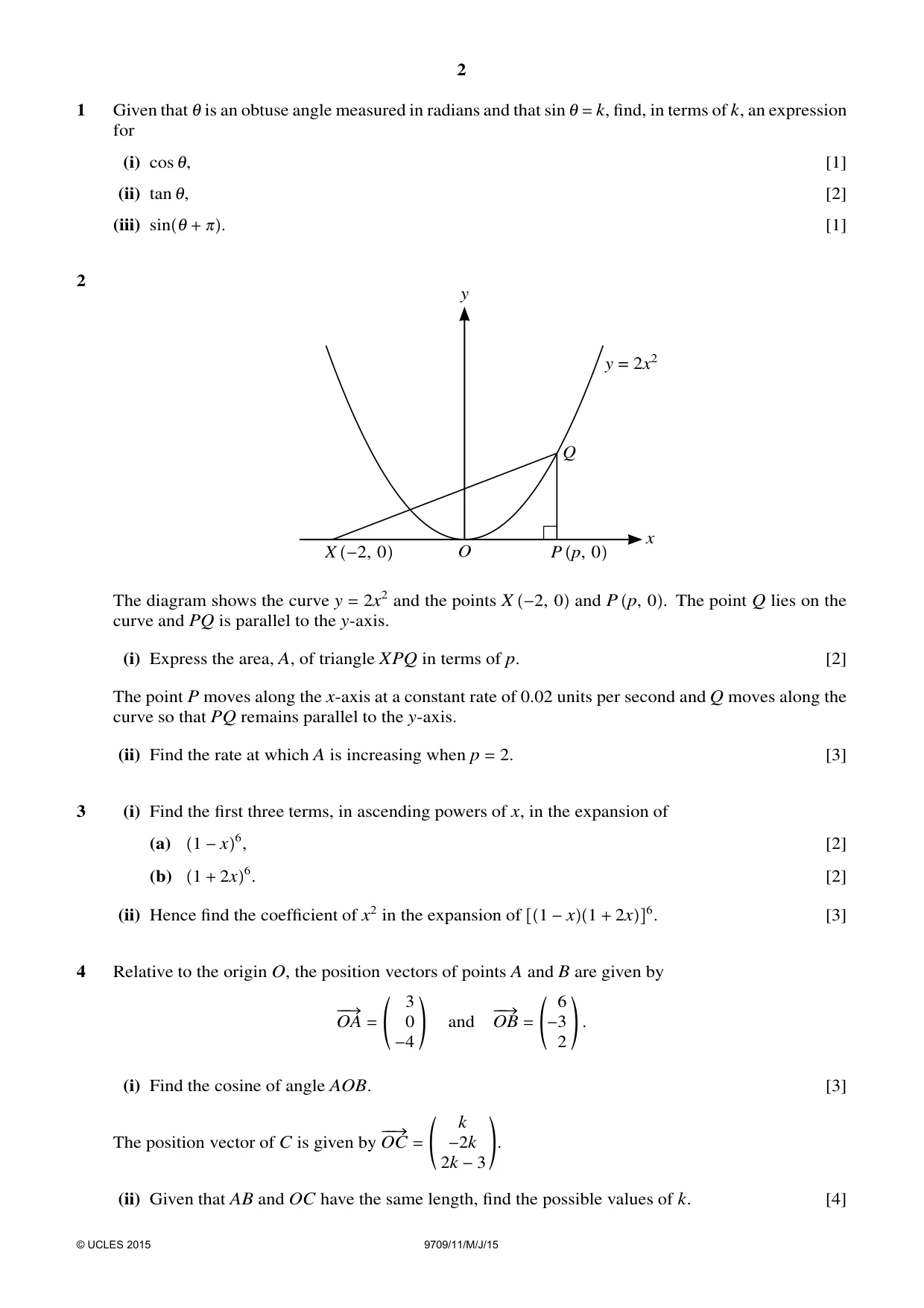
Q2 · Y y = 2x2 Q x X −2, 0 O P p, 0 The diagram shows the curve y = 2x2 and the points X −2, 0…
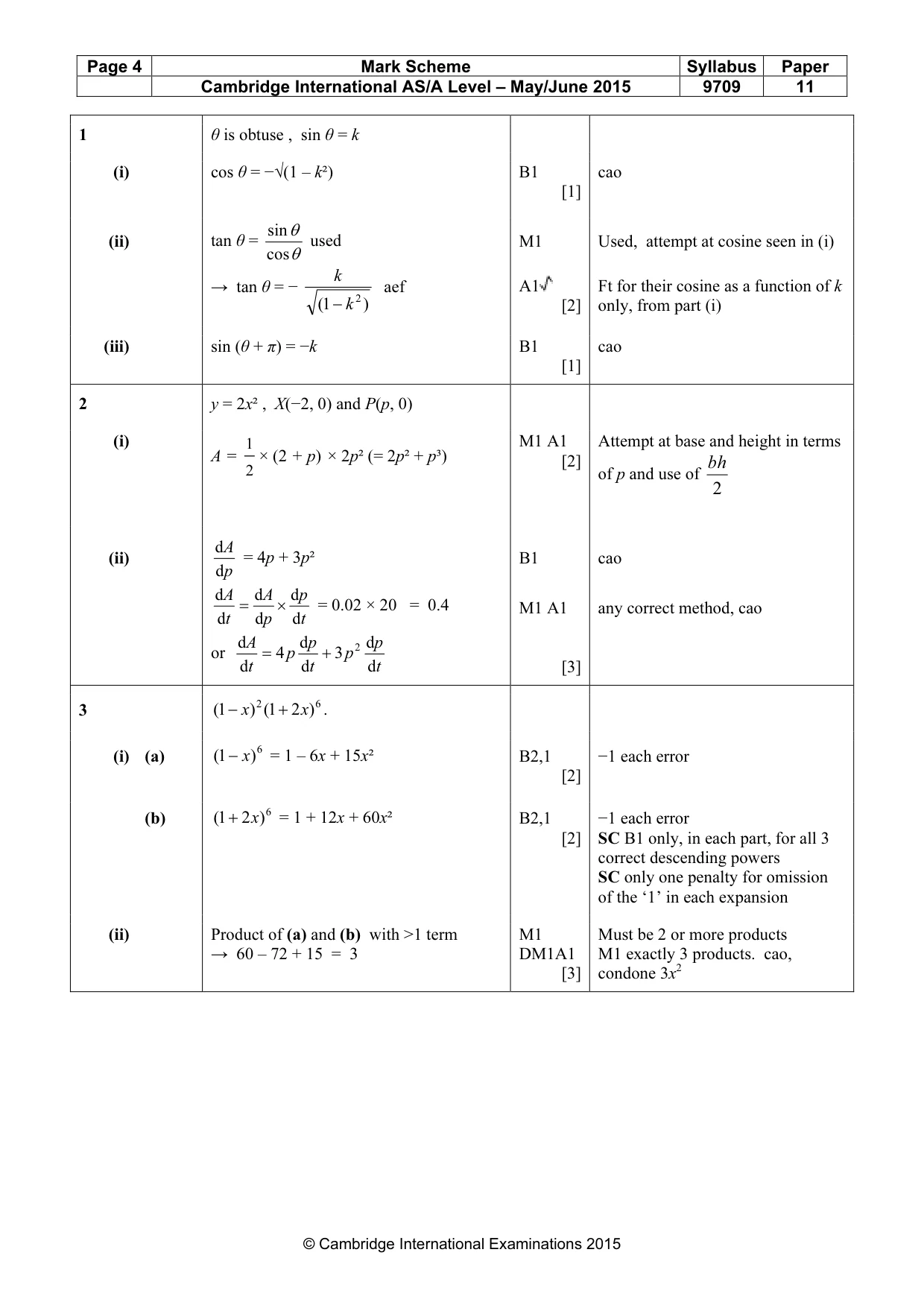
2 y y = 2x2 Q x X −2, 0 O P p, 0 The diagram shows the curve y = 2x2 and the points X −2, 0 and P p, 0 . The point Q lies on the curve and PQ is parallel to the y-axis. (i) Express the area, A, of triangle XPQ in terms of p. [2] The point P moves along the x-axis at a constant rate of 0.02 units per second and Q moves along the curve so that PQ remains parallel to the y-axis. (ii) Find the rate at which A is increasing when p = 2. [3]
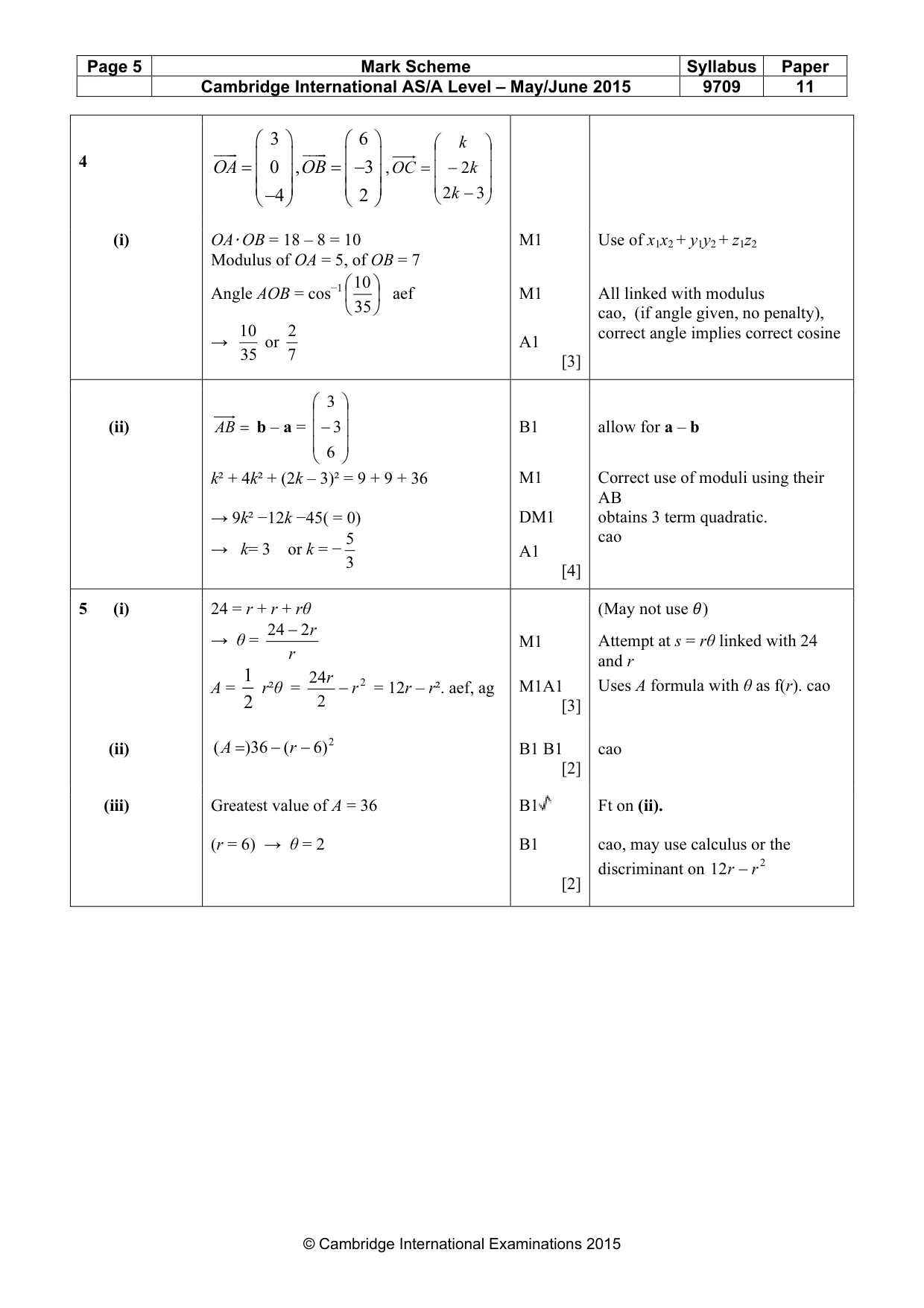
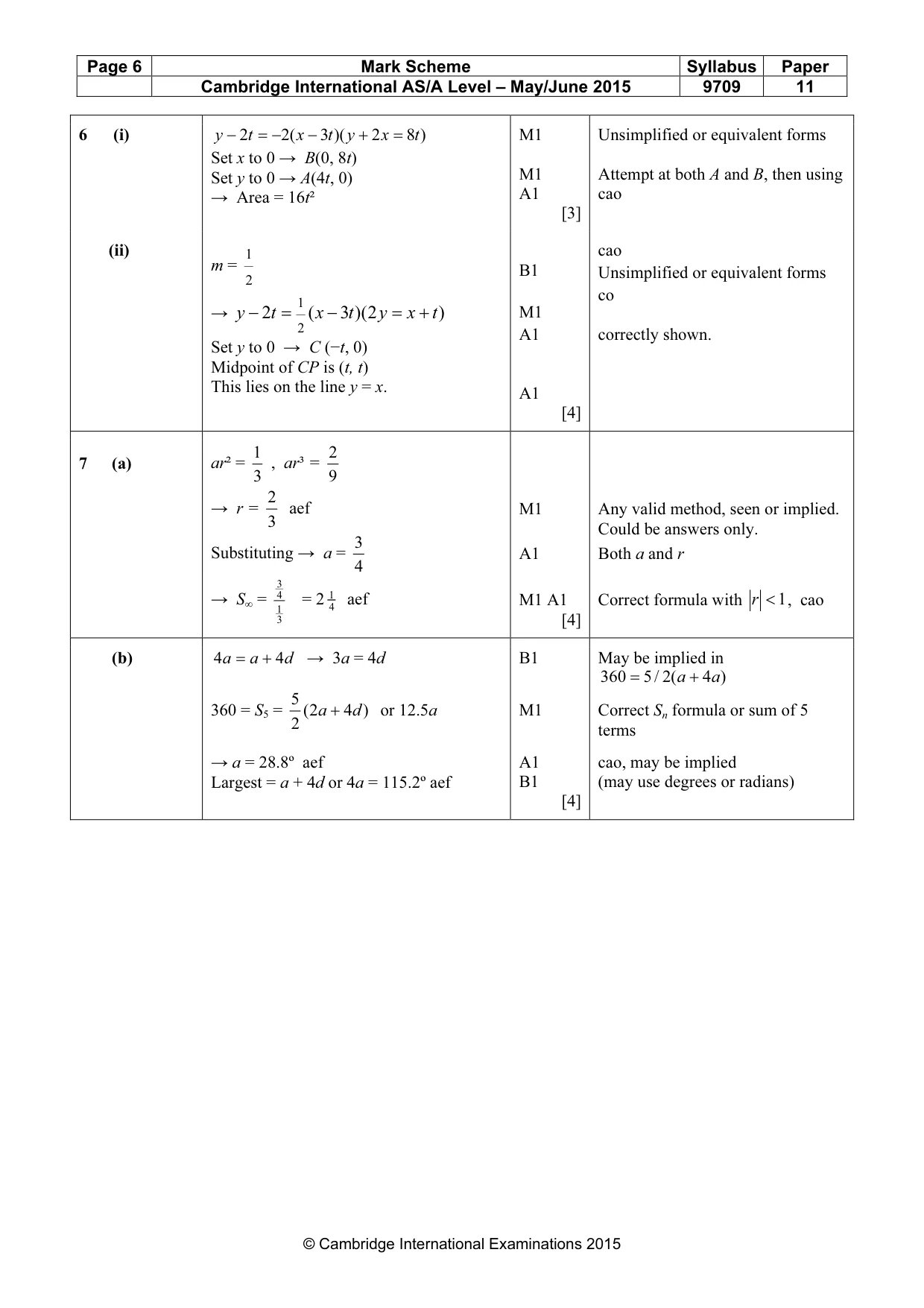
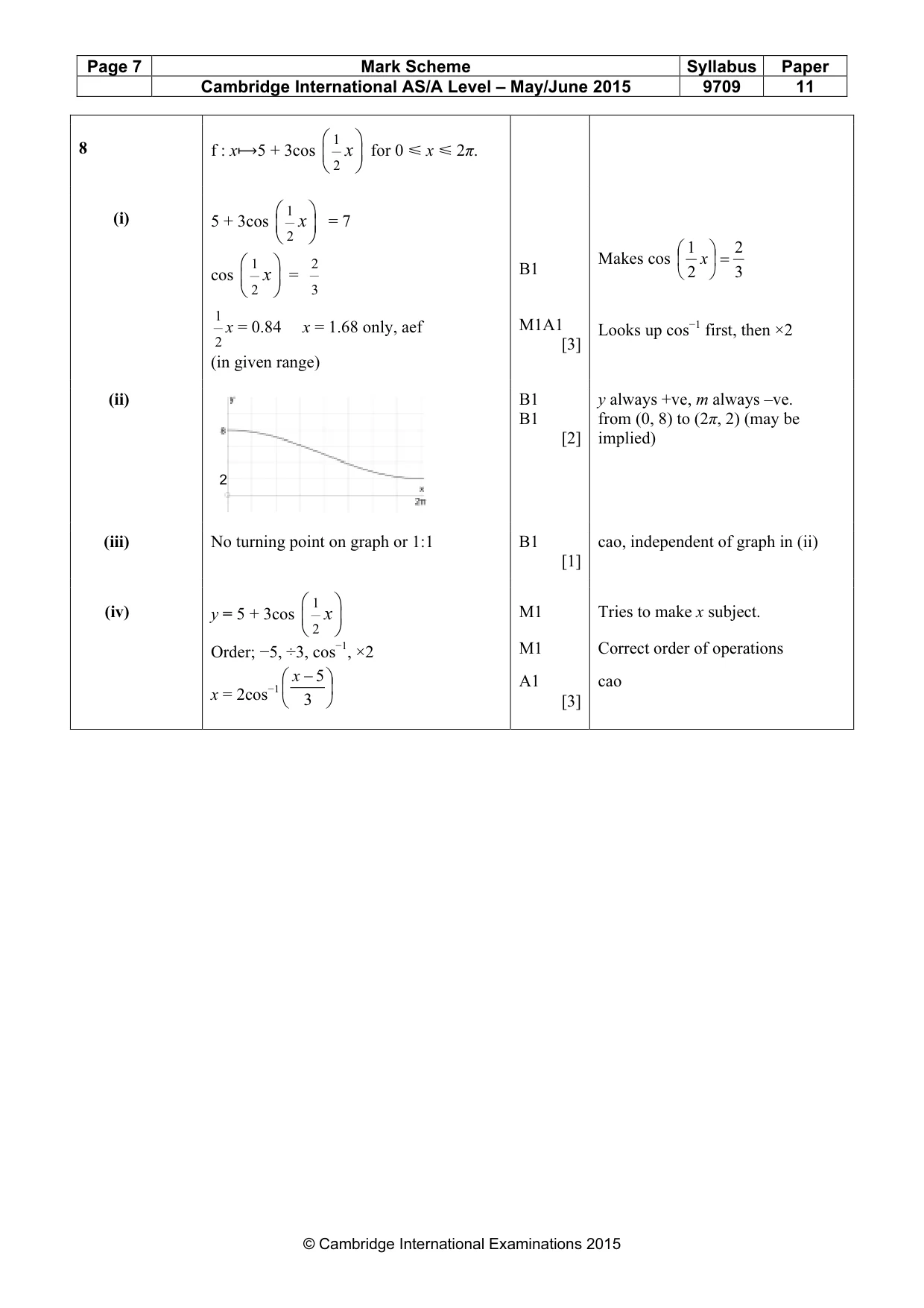
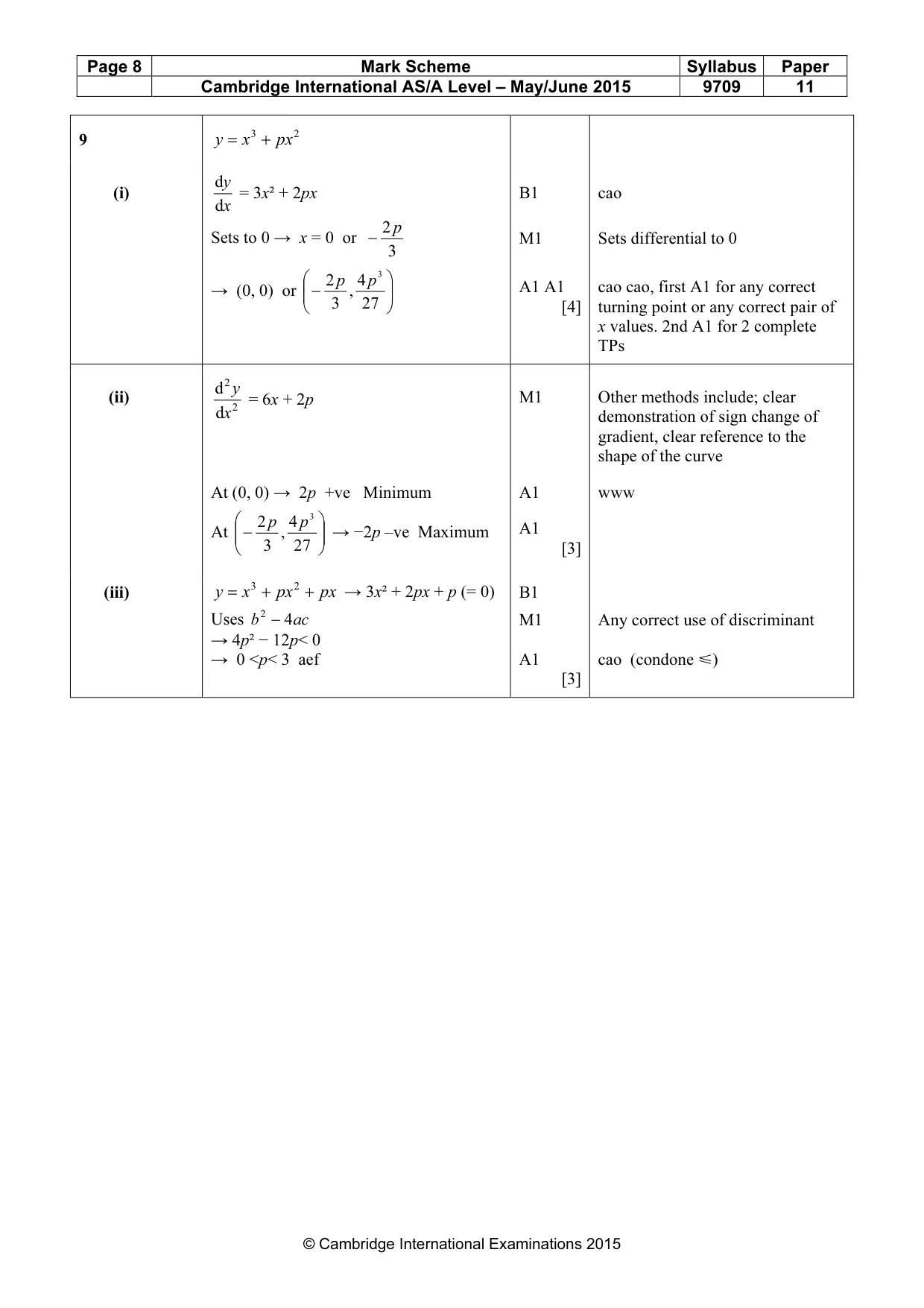
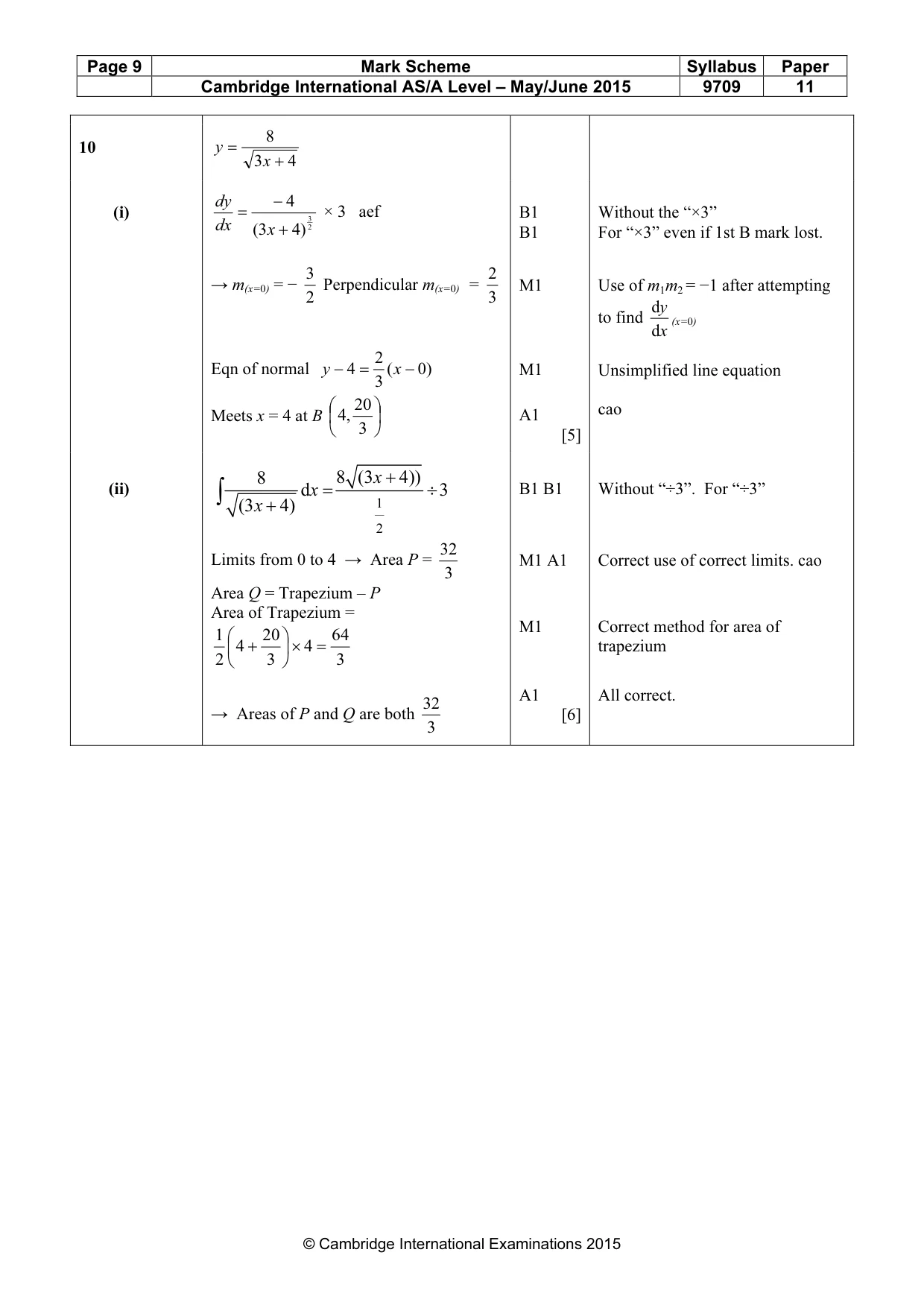
Mark scheme: 1 2 cos x = B1 2 3 2 3 1 x = 0.84 x = 1.68 only, aef M1A1 Looks up cos−1 first, then ×2 2 [3] (in given range) (ii) B1 y always +ve, m always –ve. B1 from (0, 8) to (2π, 2) (may be [2] implied) 2 (iii) No turning point on graph or 1:1 B1 cao, independent of graph in (ii) [1] 1 M1 Tries to make x subject. x (iv) y = 5 + 3cos 2 Order; −5, ÷3, cos−1, ×2 M1 Correct order of operations x − 5 A1 cao x = 2cos−1 3 [3] 9 y = x 3 + px 2 dy (i) = 3x² + 2px B1 cao dx 2p Sets to 0 → x = 0 or − M1 Sets differential to 0 3 2 p 4 p 3 → (0, 0) or − , A1 A1 cao cao, first A1 for any correct 3 27 [4] turning point or any correct pair of x values. 2nd A1 for 2 complete TPs d 2 y (ii) 2 = 6x + 2p M1 Other methods include; clear dx demonstration of sign change of gradient, clear reference to the shape of the curve At (0, 0) → 2p +ve Minimum A1 www
Q4 · Relative to the origin O, the position vectors of points A and B are given by ` a ` a 3 6…
4 Relative to the origin O, the position vectors of points A and B are given by ` a ` a 3 6 −−→ −−→ OA = 0 and OB = −3 . −4 2 (i) Find the cosine of angle AOB. [3] ` a k −−→ The position vector of C is given by OC = −2k . 2k −3 (ii) Given that AB and OC have the same length, find the possible values of k. [4]
Mark scheme: 2 p 4 p 3 At , →−2p –ve Maximum A1 −
Q6 · The line with gradient −2 passing through the point P 3t, 2t intersects the x-axis at A…
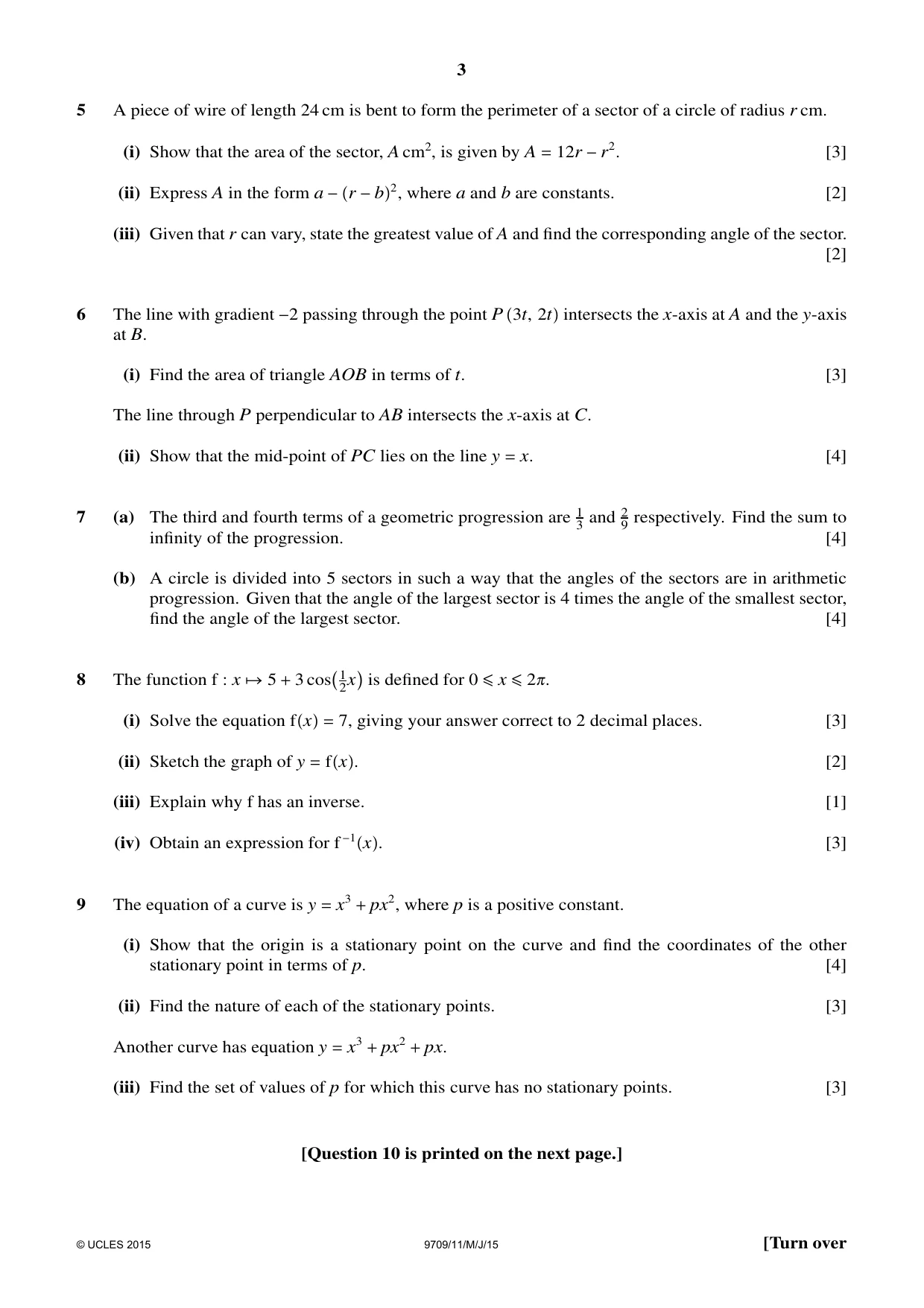
6 The line with gradient −2 passing through the point P 3t, 2t intersects the x-axis at A and the y-axis at B. (i) Find the area of triangle AOB in terms of t. [3] The line through P perpendicular to AB intersects the x-axis at C. (ii) Show that the mid-point of PC lies on the line y = x. [4]
Mark scheme: 6 (i) y − 2t = −2( x − 3t )( y + 2 x = 8t ) M1 Unsimplified or equivalent forms Set x to 0 → B(0, 8t) Set y to 0 → A(4t, 0) M1 Attempt at both A and B, then using → Area = 16t² A1 cao [3] (ii) 1 cao m = B1 Unsimplified or equivalent forms 2 co 1 → y − 2t = ( x − 3t )(2 y = x + t ) M1 2 A1 correctly shown. Set y to 0 → C (−t, 0) Midpoint of CP is (t, t) This lies on the line y = x. A1 [4] 1 2
Q7 · The third and fourth terms of a geometric progression are 1 and 2 respectively
7 (a) The third and fourth terms of a geometric progression are 1 and 2 respectively. Find the sum to 3 9 infinity of the progression. [4] (b) A circle is divided into 5 sectors in such a way that the angles of the sectors are in arithmetic progression. Given that the angle of the largest sector is 4 times the angle of the smallest sector, find the angle of the largest sector. [4]
Mark scheme: 1 2 7 (a) ar² = , ar³ = 3 9 2 → r = aef M1 Any valid method, seen or implied. 3 Could be answers only. 3 Substituting → a = A1 Both a and r 4 3 → S∞ = 4 = 2 14 aef M1 A1 Correct formula with r < 1 , cao 1 3 [4] (b) 4 a = a + 4 d → 3a = 4d B1 May be implied in 360 = 5 / 2( a + 4 a ) 5 360 = S5 = ( 2 a + 4 d ) or 12.5a M1 Correct Sn formula or sum of 5 2 terms → a = 28.8º aef A1 cao, may be implied Largest = a + 4d or 4a = 115.2º aef B1 (may use degrees or radians) [4] 1 8 f : x⟼5 + 3cos x for 0 ø x ø 2π. 2 1 (i) 5 + 3cos x = 7 2 1 2 Makes cos x
What was in this paper
The subtopics covered by these 4 questions, and how many questions each got. Open one in a new tab to see every Cambridge question on it.
What you needed in this session
Cambridge’s own grade thresholds for 2015 May/June, Paper 1 · Variant 1. A higher threshold means an easier paper — the bar moves with how the cohort did.