Cambridge A Level Mathematics 9709 — 2013 Oct/Nov Paper 1 · Variant 1
9709/11/O/N/13 · 6 questions · 75 marks · ≈84 min
The question paper and its mark scheme, free to read here and free to download. This is Cambridge’s own paper, exactly as it was sat.
Question paper4 pages
Mark scheme6 pages
Answers below. Sit the paper first if you are practising.
Questions as text
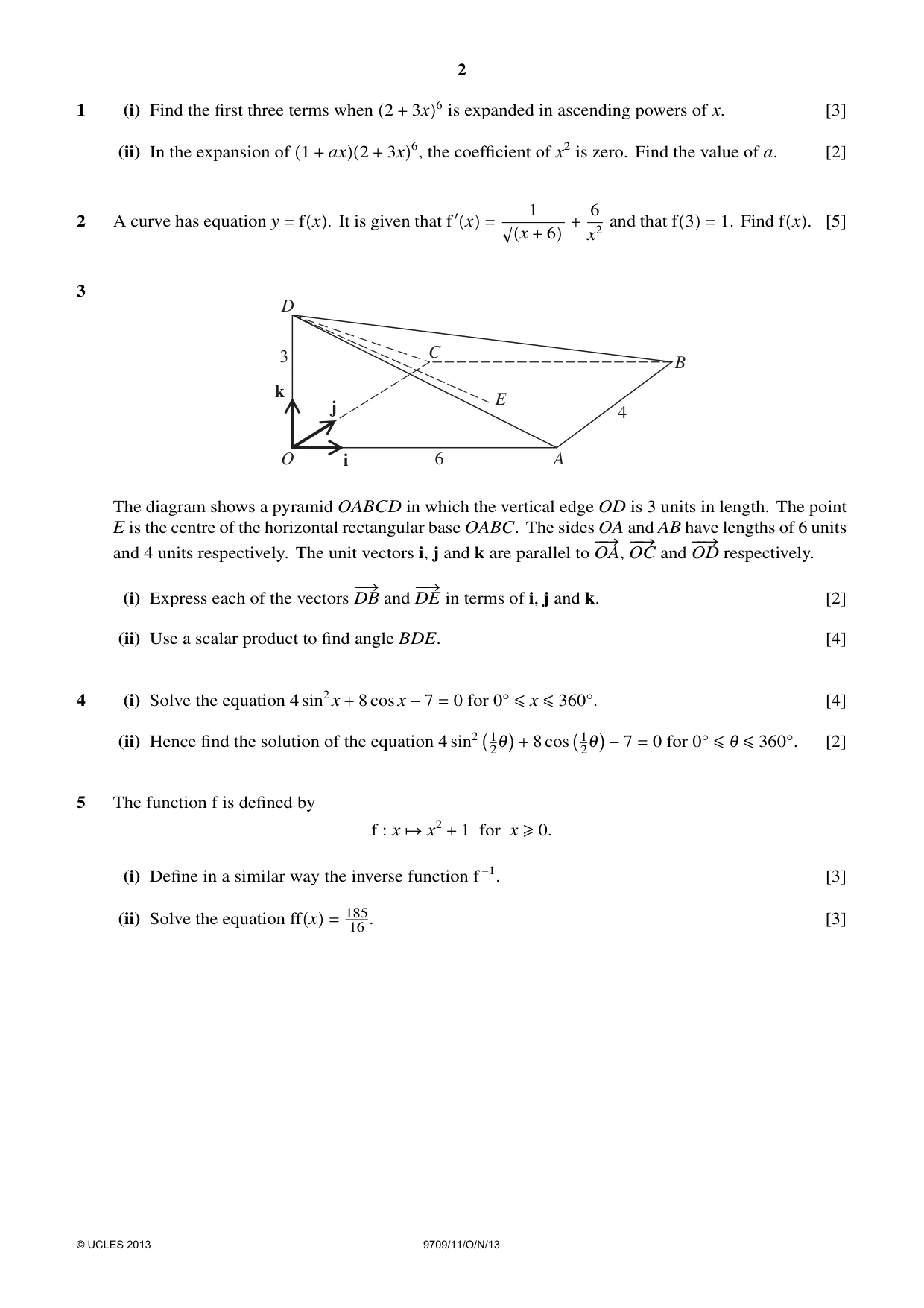
Q3 · D 3 C B k E j 4 O i 6 A The diagram shows a pyramid OABCD in which the vertical edge OD…
3 D 3 C B k E j 4 O i 6 A The diagram shows a pyramid OABCD in which the vertical edge OD is 3 units in length. The point E is the centre of the horizontal rectangular base OABC. The sides OA and AB have lengths of 6 units −−→ −−→ −−→ and 4 units respectively. The unit vectors i, j and k are parallel to OA, OC and OD respectively. −−→ −−→ (i) Express each of the vectors DB and DE in terms of i, j and k. [2] (ii) Use a scalar product to find angle BDE. [4]
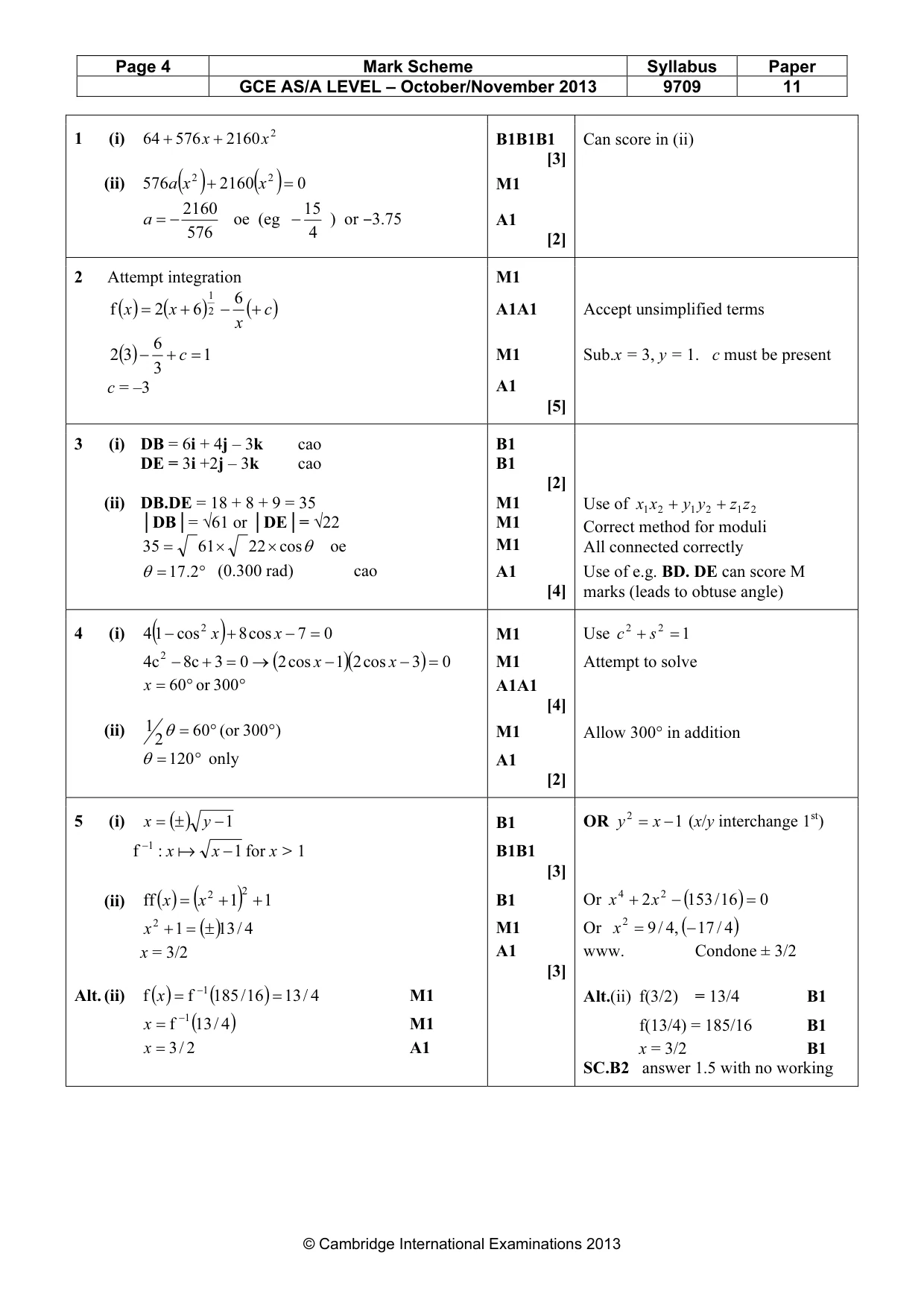
Mark scheme: 3 (i) DB = 6i + 4j – 3k cao B1 DE = 3i +2j – 3k cao B1 [2] (ii) DB.DE = 18 + 8 + 9 = 35 M1 Use of x1 x 2 + y1 y 2 + z1 z 2 │DB│= √61 or │DE│= √22 M1 Correct method for moduli 35 = 61 × 22 × cos θ oe M1 All connected correctly θ = 17 2. ° (0.300 rad) cao A1 Use of e.g. BD. DE can score M [4] marks (leads to obtuse angle) 2 2 2 ( )
Q4 · Solve the equation 4 sin2x + 8 cos x −7 = 0 for 0Å ≤x ≤360Å
4 (i) Solve the equation 4 sin2x + 8 cos x −7 = 0 for 0Å ≤x ≤360Å. [4] (ii) Hence find the solution of the equation 4 sin2 121 + 8 cos 121 −7 = 0 for 0Å ≤1 ≤360Å. [2]
Mark scheme: 2 + s 2 = 14 (i) 4 (1 − cos 2 x ) + 8 cos x − 7 = 0 M1 Use c 4c 2 − 8c + 3 = 0 → (2 cos x − 1)(2 cos x − 3 ) = 0 M1 Attempt to solve x = 60 ° or 300 ° A1A1 [4] (ii) 1 θ = 60 ° (or 300 °) M1 Allow 300° in addition 2 θ = 120 ° only A1 [2] ( ) 2 t
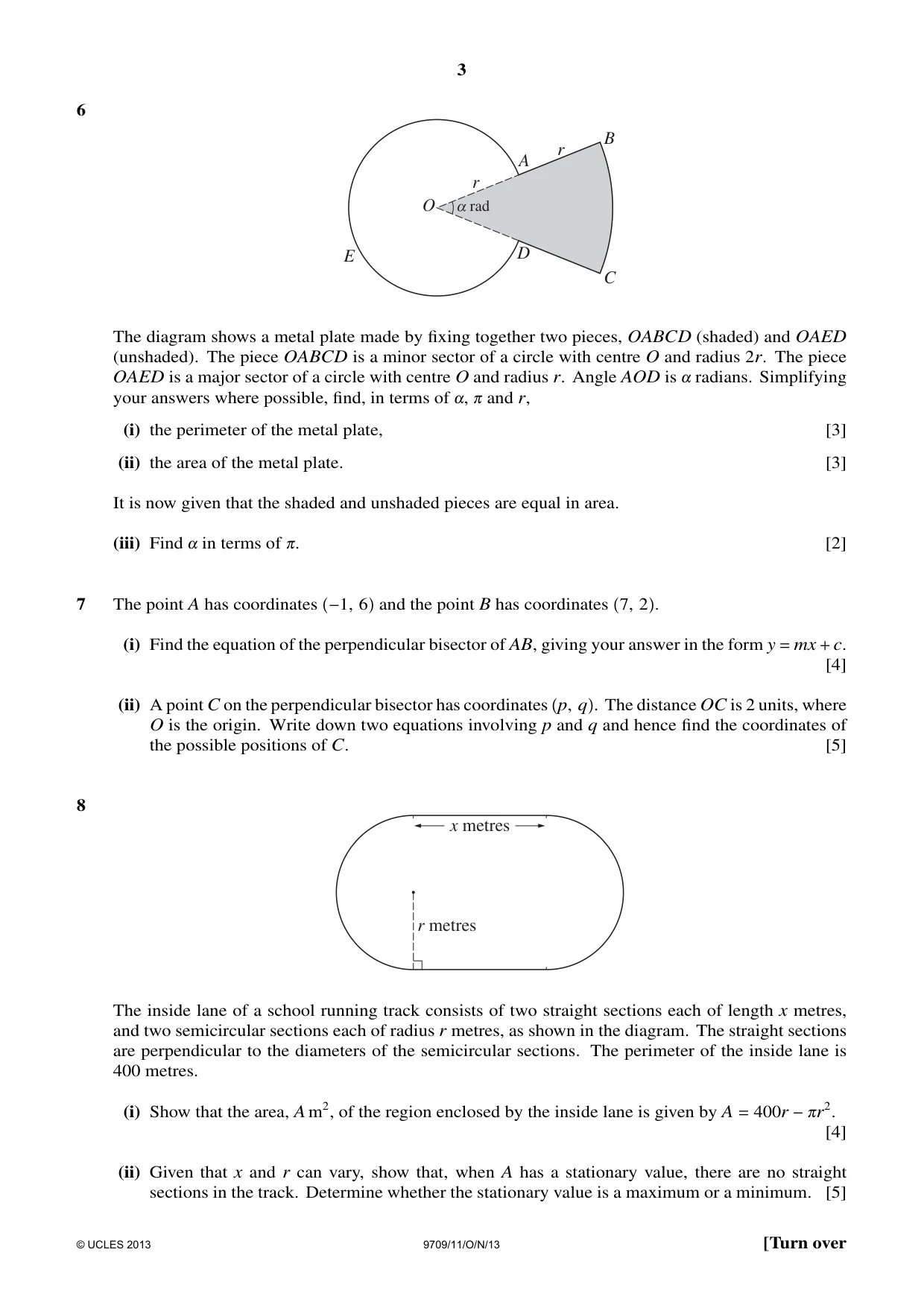
Q6 · B r A r O a rad E D C The diagram shows a metal plate made by fixing together two pieces…
6 B r A r O a rad E D C The diagram shows a metal plate made by fixing together two pieces, OABCD (shaded) and OAED (unshaded). The piece OABCD is a minor sector of a circle with centre O and radius 2r. The piece OAED is a major sector of a circle with centre O and radius r. Angle AOD is ! radians. Simplifying your answers where possible, find, in terms of !, 0 and r, (i) the perimeter of the metal plate, [3] (ii) the area of the metal plate. [3] It is now given that the shaded and unshaded pieces are equal in area. (iii) Find ! in terms of 0. [2]
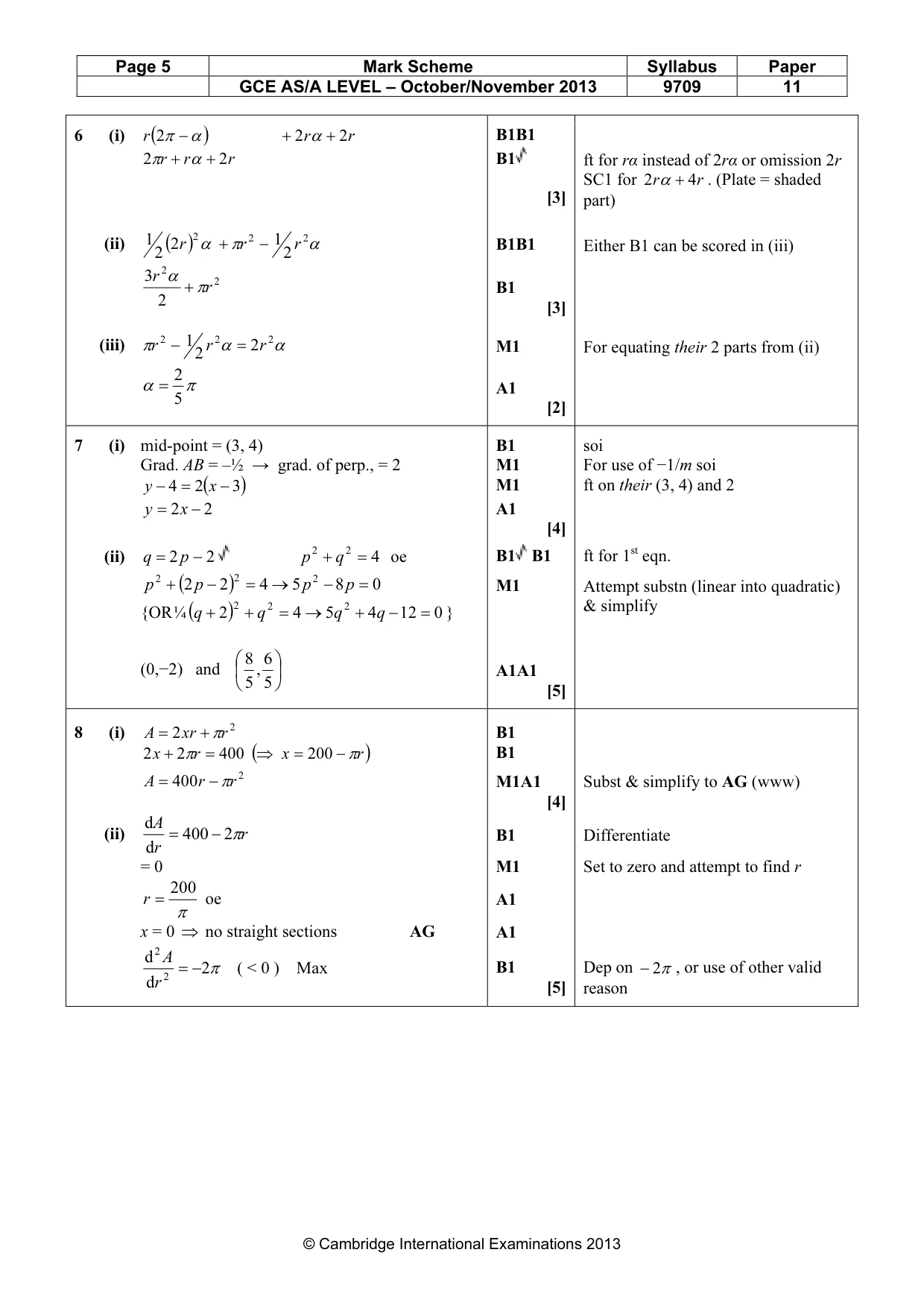
Mark scheme: 6 (i) r (2π − α ) + 2 r α + 2 r B1B1 2πr + r α + 2 r B1 ft for rα instead of 2rα or omission 2r SC1 for 2 r α + 4 r . (Plate = shaded [3] part) (ii) 1 (2 r )2 α + πr 2 − 1 r 2α B1B1 Either B1 can be scored in (iii) 2 2 3r 2α 2 + πr B1 2 [3] (iii) πr 2 − 1 r 2α = 2 r 2α M1 For equating their 2 parts from (ii) 2 2 α = π A1 5 [2]
Q8 · X metres r metres The inside lane of a school running track consists of two straight…
8 x metres r metres The inside lane of a school running track consists of two straight sections each of length x metres, and two semicircular sections each of radius r metres, as shown in the diagram. The straight sections are perpendicular to the diameters of the semicircular sections. The perimeter of the inside lane is 400 metres. (i) Show that the area, A m2, of the region enclosed by the inside lane is given by A = 400r −0r2. [4] (ii) Given that x and r can vary, show that, when A has a stationary value, there are no straight sections in the track. Determine whether the stationary value is a maximum or a minimum. [5]
Mark scheme: 8 (i) A = 2 xr + πr 2 B1 2 x + 2πr = 400 (⇒ x = 200 − πr ) B1 A = 400 r − πr 2 M1A1 Subst & simplify to AG (www) [4] dA (ii) = 400 − 2πr B1 Differentiate dr = 0 M1 Set to zero and attempt to find r 200 r = oe A1 π x = 0 ⇒ no straight sections AG A1 d 2 A = −2π ( < 0 ) Max B1 Dep on − 2π , or use of other valid 2 dr [5] reason GCE AS/A LEVEL – October/November 2013 9709 11 10 ( )
Q9 · In an arithmetic progression the sum of the first ten terms is 400 and the sum of the next…
9 (a) In an arithmetic progression the sum of the first ten terms is 400 and the sum of the next ten terms is 1000. Find the common difference and the first term. [5] (b) A geometric progression has first term a, common ratio r and sum to infinity 6. A second geometric progression has first term 2a, common ratio r2 and sum to infinity 7. Find the values of a and r. [5]
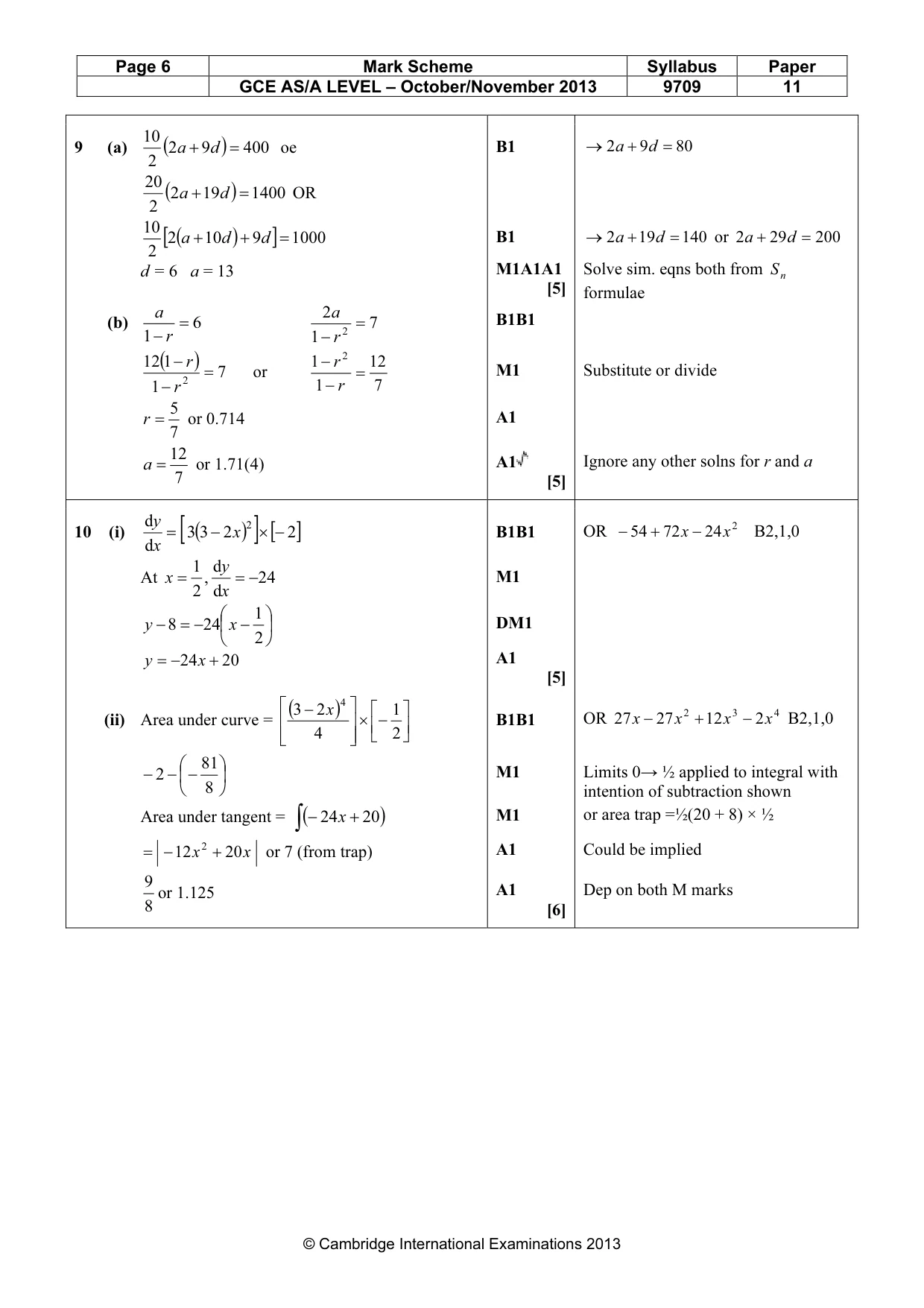
Mark scheme: 10 9 (a) (2 a + 9 d ) = 400 oe B1 → 2 a + 9 d = 80 2 20 (2 a + 19 d ) = 1400 OR 2 10 [2(a + 10 d ) + 9 d ] = 1000 B1 → 2 a + 19 d = 140 or 2 a + 29 d = 200 2 d = 6 a = 13 M1A1A1 Solve sim. eqns both from S n [5] formulae a 2 a (b) = 6 = 7 B1B1 1 −r 1 −r 2 12(1 − r ) 1 − r 2 12 = 7 or = M1 Substitute or divide 1 − r 2 1 − r 7 5 r = or 0.714 A1 7 12 a = or 1.71(4) A1 Ignore any other solns for r and a 7 [5] dy [ ( )2 ] [ ] 2
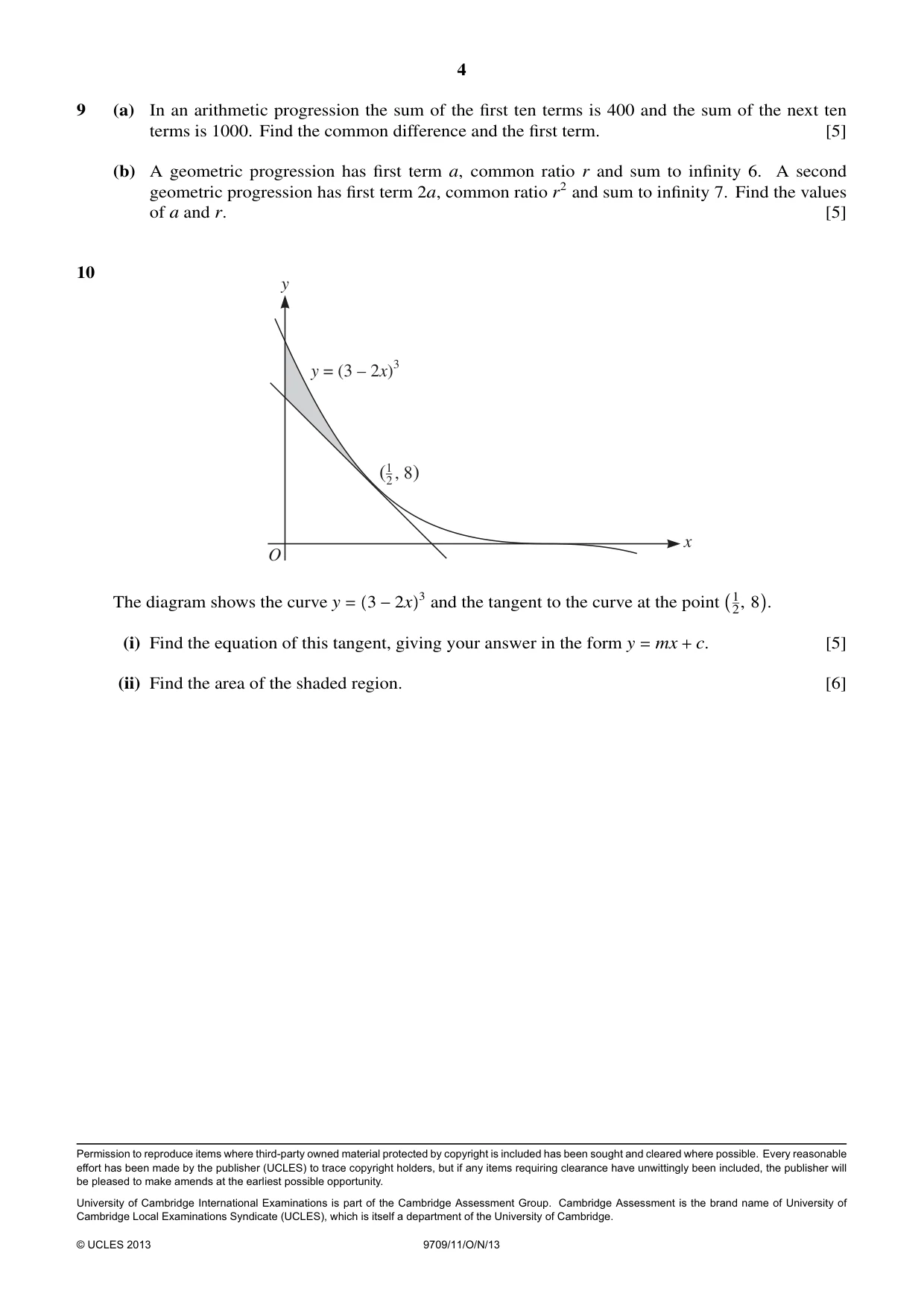
Q10 · Y y = (3 – 2 x )3 2(1 , 8) x O The diagram shows the curve y = 3 −2x 3 and the tangent to…
10 y y = (3 – 2 x )3 2(1 , 8) x O The diagram shows the curve y = 3 −2x 3 and the tangent to the curve at the point 12, 8 . (i) Find the equation of this tangent, giving your answer in the form y = mx + c. [5] (ii) Find the area of the shaded region. [6]
Mark scheme: dy 2 2 2 ] B1B1 OR − 54 + 72 x − 24 x B2,1,010 (i) = [ 3(3 − 2 x ) ]× [− dx 1 dy At x = , = −24 M1 2 dx 1 y − 8 = −24 x − DM1 2 y = −24 x + 20 A1 [5] (3 − 2 x )4 1 2 3 4 (ii) Area under curve = × − B1B1 OR 27 x − 27 x + 12 x − 2 x B2,1,0 2 4 81 − 2 − − M1 Limits 0→ ½ applied to integral with 8 intention of subtraction shown − 24x + 20 ) M1 or area trap =½(20 + 8) × ½ Area under tangent = ∫ ( = − 12 x 2 + 20 x or 7 (from trap) A1 Could be implied 9 or 1.125 A1 Dep on both M marks 8 [6]
What was in this paper
The subtopics covered by these 6 questions, and how many questions each got. Open one in a new tab to see every Cambridge question on it.
What you needed in this session
Cambridge’s own grade thresholds for 2013 Oct/Nov, Paper 1 · Variant 1. A higher threshold means an easier paper — the bar moves with how the cohort did.