Cambridge A Level Mathematics 9709 — 2010 Oct/Nov Paper 1 · Variant 3
9709/13/O/N/10 · 11 questions · 75 marks · ≈84 min
The question paper and its mark scheme, free to read here and free to download. This is Cambridge’s own paper, exactly as it was sat.
Question paper8 pages
Mark scheme6 pages
Answers below. Sit the paper first if you are practising.
Questions as text
Q1 · Find the term independent of x in the expansion of x −1 9
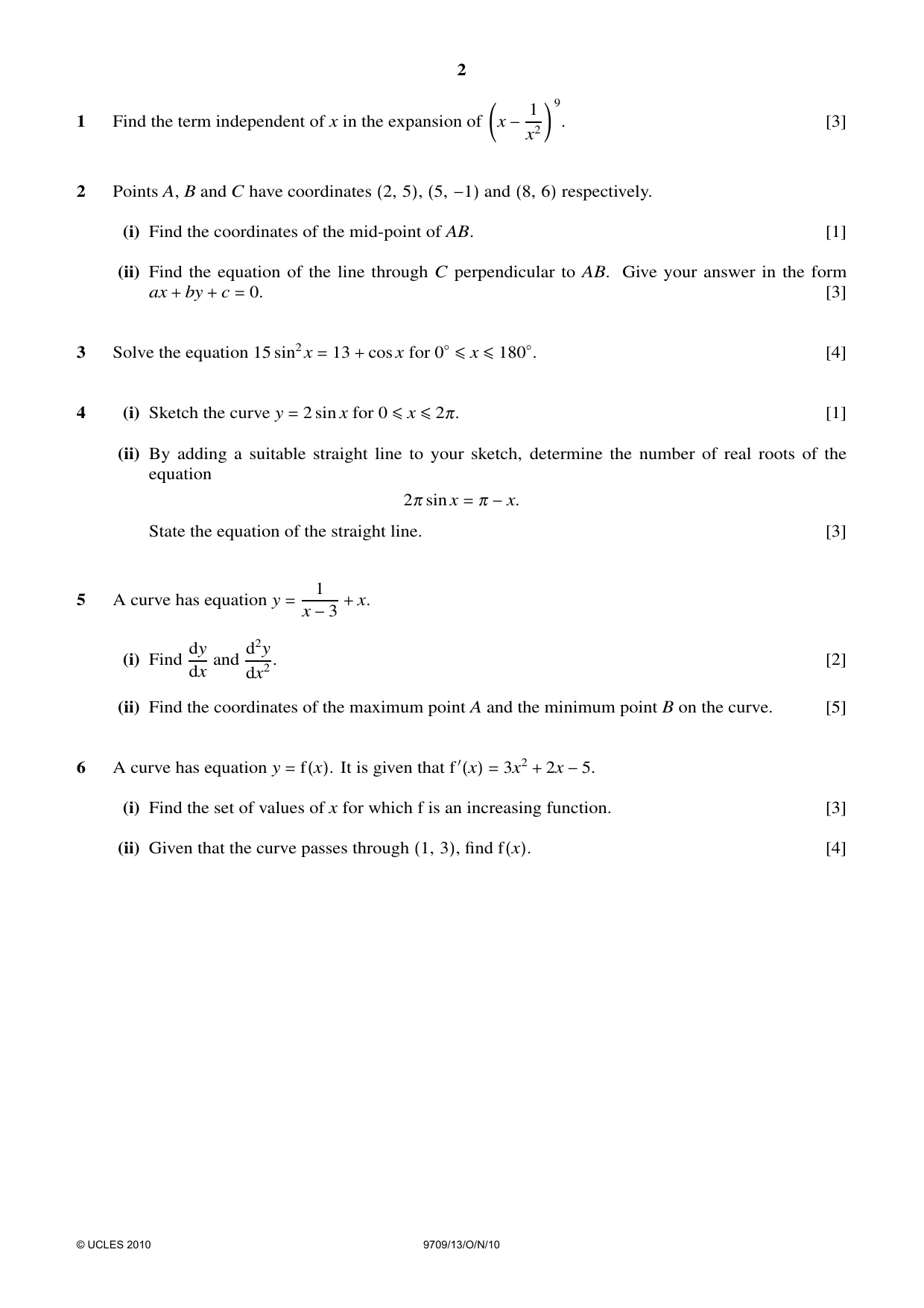
1 Find the term independent of x in the expansion of x −1 9 . [3] x2
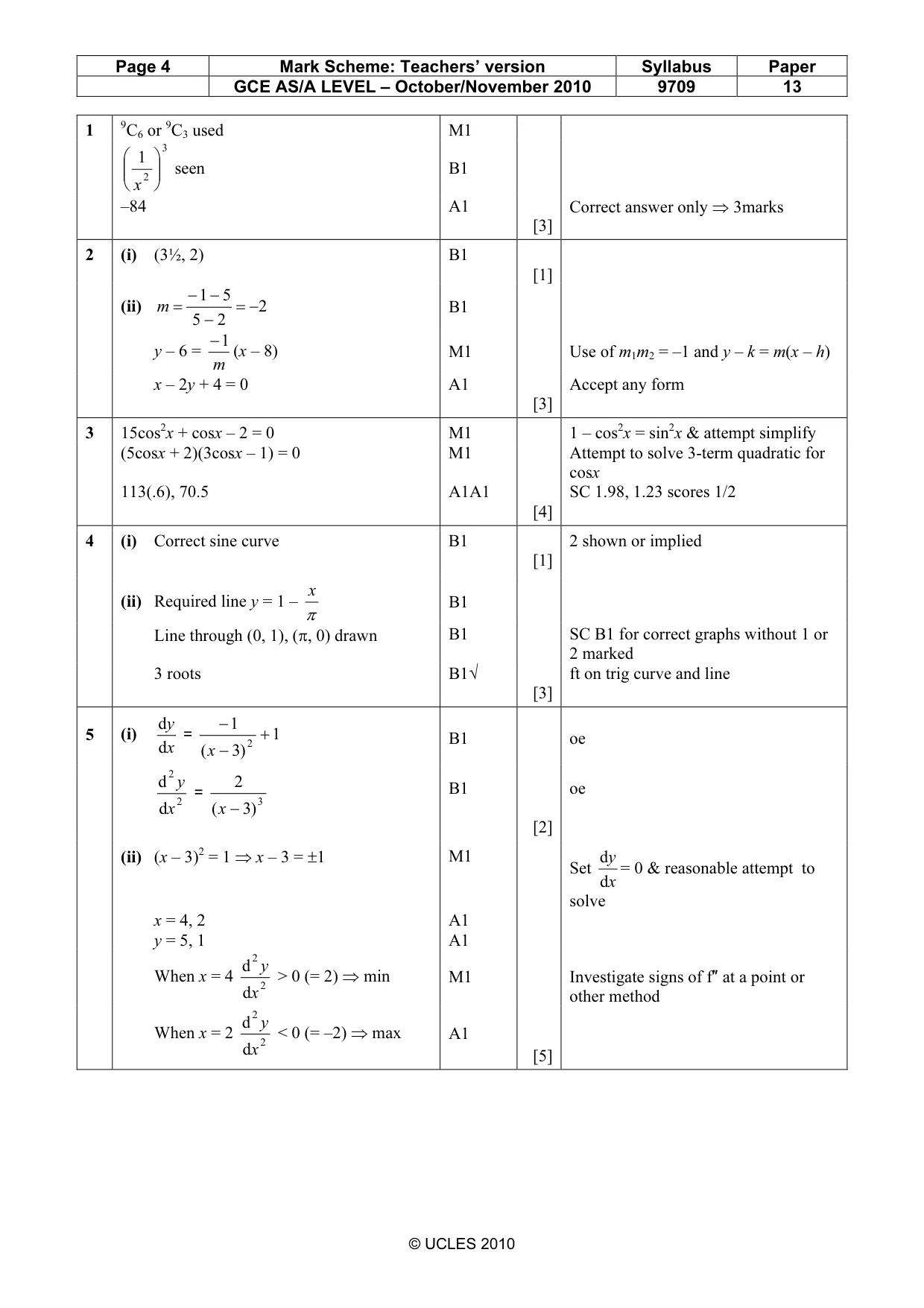
Mark scheme: 1 9C6 or 9C3 used M1 3 1 2 seen B1 x –84 A1 Correct answer only ⇒ 3marks [3]
Q2 · Points A, B and C have coordinates (2, 5), (5, −1) and (8, 6) respectively
2 Points A, B and C have coordinates (2, 5), (5, −1) and (8, 6) respectively. (i) Find the coordinates of the mid-point of AB. [1] (ii) Find the equation of the line through C perpendicular to AB. Give your answer in the form ax + by + c = 0. [3]
Mark scheme: 2 (i) (3½, 2) B1 [1] − 1 − 5 (ii) m = = −2 B1 5 − 2 − 1 y – 6 = (x – 8) M1 Use of m1m2 = –1 and y – k = m(x – h) m x – 2y + 4 = 0 A1 Accept any form [3] 2 2 2
Q3 · Solve the equation 15 sin2x = 13 + cos x for 0◦≤x ≤180◦
3 Solve the equation 15 sin2x = 13 + cos x for 0◦≤x ≤180◦. [4]
Mark scheme: 3 15cos2x + cosx – 2 = 0 M1 1 – cos2x = sin2x & attempt simplify (5cosx + 2)(3cosx – 1) = 0 M1 Attempt to solve 3-term quadratic for cosx 113(.6), 70.5 A1A1 SC 1.98, 1.23 scores 1/2 [4]
Q4 · Sketch the curve y = 2 sin x for 0 ≤x ≤2π
4 (i) Sketch the curve y = 2 sin x for 0 ≤x ≤2π. [1] (ii) By adding a suitable straight line to your sketch, determine the number of real roots of the equation 2π sin x = π −x. State the equation of the straight line. [3]
Mark scheme: 4 (i) Correct sine curve B1 2 shown or implied [1] x (ii) Required line y = 1 – B1 π Line through (0, 1), (π, 0) drawn B1 SC B1 for correct graphs without 1 or 2 marked 3 roots B1√ ft on trig curve and line [3] dy − 1
Q5 · 5 A curve has equation y = + x
1 5 A curve has equation y = + x. x −3 dy d2y (i) Find and . [2] dx dx2 (ii) Find the coordinates of the maximum point A and the minimum point B on the curve. [5]
Mark scheme: dy 1 =5 (i) + 1 B1 oe dx ( x − 3) 2 d 2 y 2 = B1 oe d x 2 ( x − 3)3 [2] (ii) (x – 3)2 = 1 ⇒ x – 3 = ±1 M1 dy Set = 0 & reasonable attempt to dx solve x = 4, 2 A1 y = 5, 1 A1 d 2 y When x = 4 > 0 (= 2) ⇒ min M1 Investigate signs of f″ at a point or 2 d x other method d 2 y When x = 2 < 0 (= –2) ⇒ max A1 2 d x [5] GCE AS/A LEVEL – October/November 2010 9709 13
Q6 · A curve has equation y = f(x)
6 A curve has equation y = f(x). It is given that f ′(x) = 3x2 + 2x −5. (i) Find the set of values of x for which f is an increasing function. [3] (ii) Given that the curve passes through (1, 3), find f(x). [4]
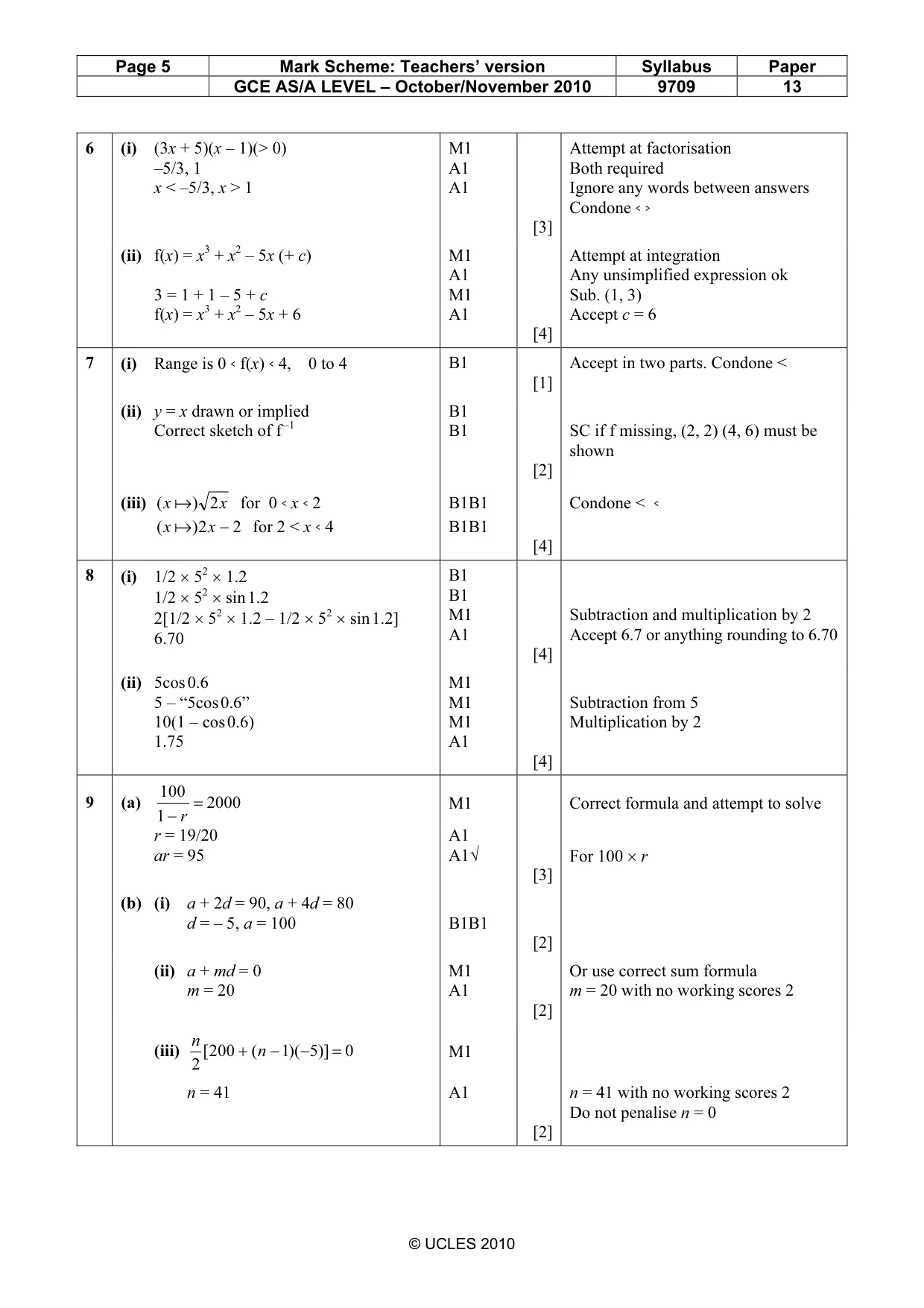
Mark scheme: 6 (i) (3x + 5)(x – 1)(> 0) M1 Attempt at factorisation –5/3, 1 A1 Both required x < –5/3, x > 1 A1 Ignore any words between answers Condone < > [3] (ii) f(x) = x3 + x2 – 5x (+ c) M1 Attempt at integration A1 Any unsimplified expression ok 3 = 1 + 1 – 5 + c M1 Sub. (1, 3) f(x) = x3 + x2 – 5x + 6 A1 Accept c = 6 [4]
Q7 · Y x O The diagram shows the function f defined for 0 ≤x ≤6 by x →12x2 for 0 ≤x ≤2, x →12x…
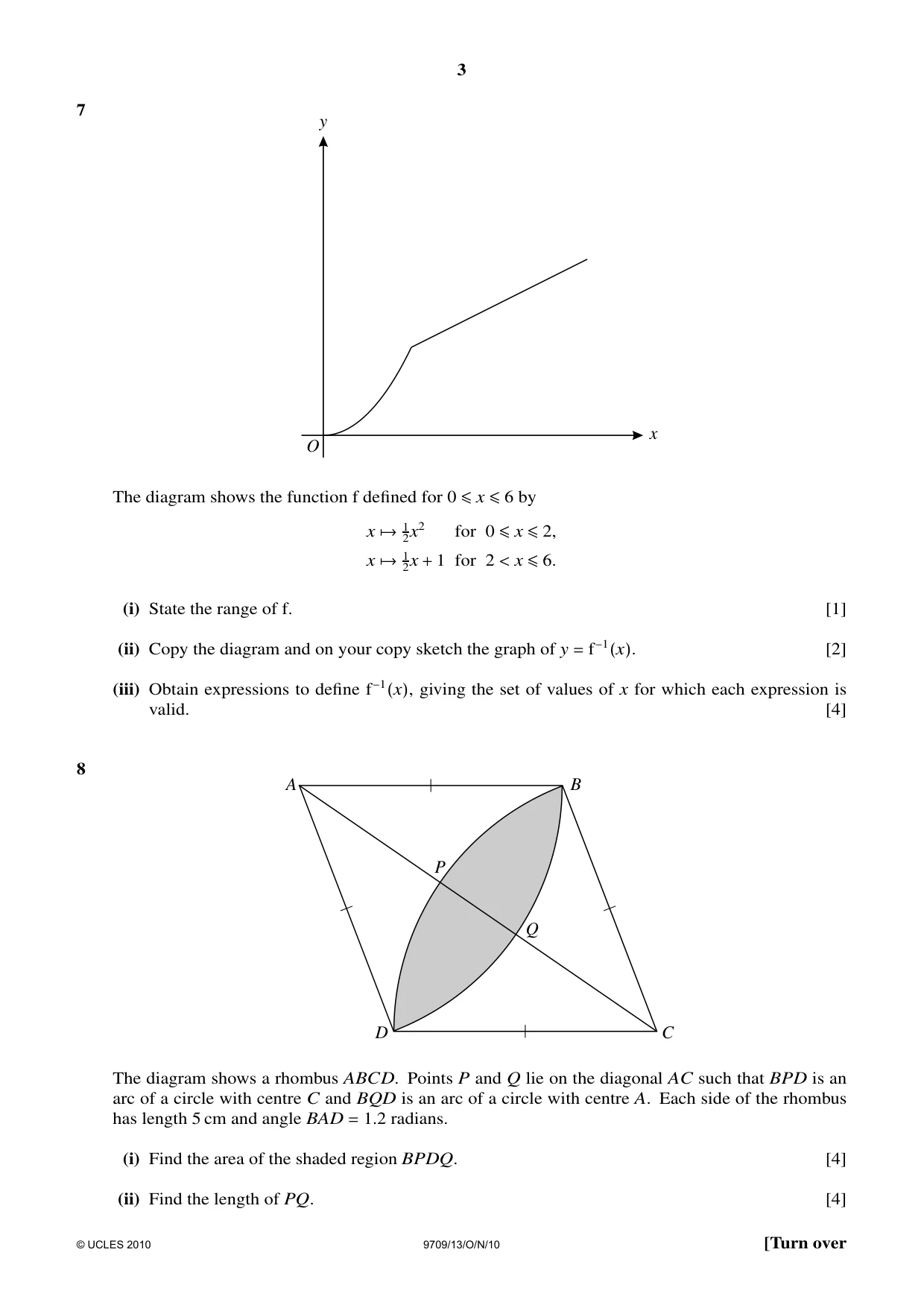
7 y x O The diagram shows the function f defined for 0 ≤x ≤6 by x →12x2 for 0 ≤x ≤2, x →12x + 1 for 2 < x ≤6. (i) State the range of f. [1] (ii) Copy the diagram and on your copy sketch the graph of y = f−1(x). [2] (iii) Obtain expressions to define f−1(x), giving the set of values of x for which each expression is valid. [4]
Mark scheme: 7 (i) Range is 0 < f(x) < 4, 0 to 4 B1 Accept in two parts. Condone < [1] (ii) y = x drawn or implied B1 Correct sketch of f –1 B1 SC if f missing, (2, 2) (4, 6) must be shown [2] (iii) ( x a ) 2 x for 0 < x < 2 B1B1 Condone < < ( x a ) 2 x − 2 for 2 < x < 4 B1B1 [4] 2
Q8 · A B P Q D C The diagram shows a rhombus ABCD
8 A B P Q D C The diagram shows a rhombus ABCD. Points P and Q lie on the diagonal AC such that BPD is an arc of a circle with centre C and BQD is an arc of a circle with centre A. Each side of the rhombus has length 5 cm and angle BAD = 1.2 radians. (i) Find the area of the shaded region BPDQ. [4] (ii) Find the length of PQ. [4]
Mark scheme: 8 (i) 1/2 × 52 × 1.2 B1 1/2 × 52 × sin 1.2 B1 2[1/2 × 52 × 1.2 – 1/2 × 52 × sin 1.2] M1 Subtraction and multiplication by 2 6.70 A1 Accept 6.7 or anything rounding to 6.70 [4] (ii) 5cos 0.6 M1 5 – “5cos 0.6” M1 Subtraction from 5 10(1 – cos 0.6) M1 Multiplication by 2 1.75 A1 [4] 100
Q9 · A geometric progression has first term 100 and sum to infinity 2000
9 (a) A geometric progression has first term 100 and sum to infinity 2000. Find the second term. [3] (b) An arithmetic progression has third term 90 and fifth term 80. (i) Find the first term and the common difference. [2] (ii) Find the value of m given that the sum of the first m terms is equal to the sum of the first (m + 1) terms. [2] (iii) Find the value of n given that the sum of the first n terms is zero. [2]
Mark scheme: 100 9 (a) = 2000 M1 Correct formula and attempt to solve 1 −r r = 19/20 A1 ar = 95 A1√ For 100 × r [3] (b) (i) a + 2d = 90, a + 4d = 80 d = – 5, a = 100 B1B1 [2] (ii) a + md = 0 M1 Or use correct sum formula m = 20 A1 m = 20 with no working scores 2 [2] n (iii) [ 200 + ( n − 1)( −5)] = 0 M1 2 n = 41 A1 n = 41 with no working scores 2 Do not penalise n = 0 [2] GCE AS/A LEVEL – October/November 2010 9709 13
Q10 · B A C O The diagram shows triangle OAB, in which the position vectors of A and B with…
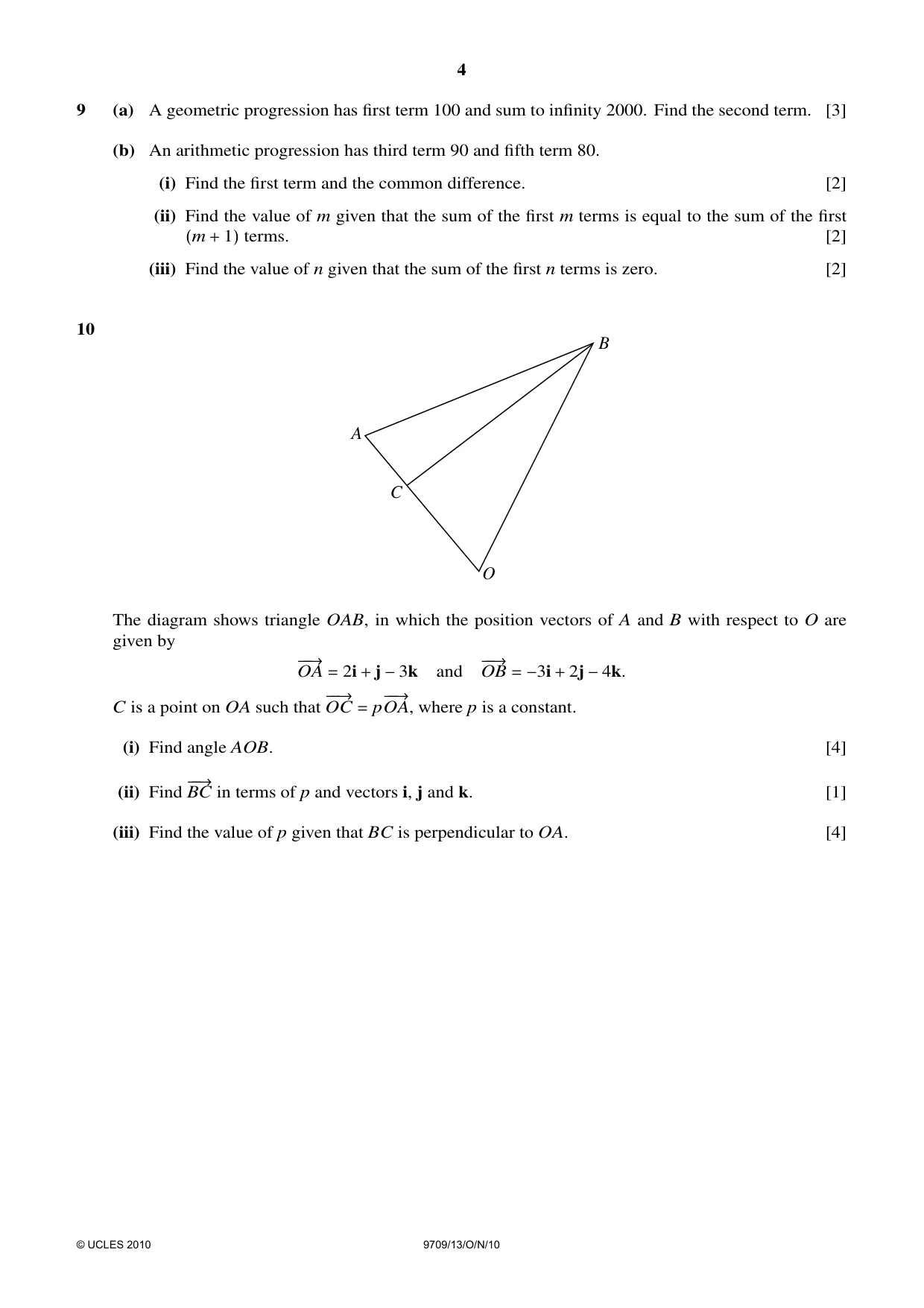
10 B A C O The diagram shows triangle OAB, in which the position vectors of A and B with respect to O are given by −−→ −−→ OA = 2i + j −3k and OB = −3i + 2j −4k. −−→ C is a point on OA such that OC = p−−→OA, where p is a constant. (i) Find angle AOB. [4] −−→ (ii) Find BC in terms of p and vectors i, j and k. [1] (iii) Find the value of p given that BC is perpendicular to OA. [4]
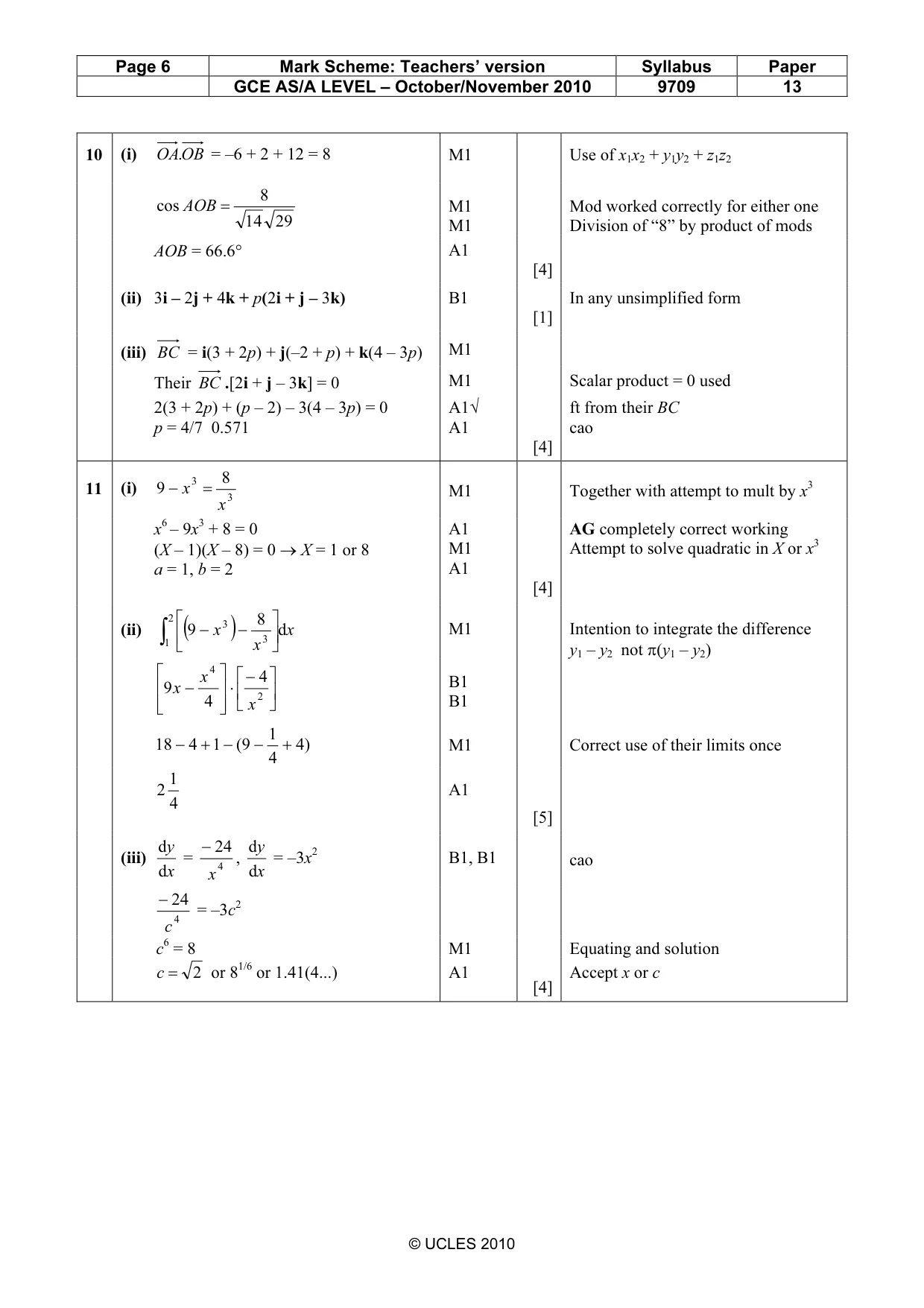
Mark scheme: 10 (i) OA.OB = –6 + 2 + 12 = 8 M1 Use of x1x2 + y1y2 + z1z2 8 cos AOB = M1 Mod worked correctly for either one 14 29 M1 Division of “8” by product of mods AOB = 66.6° A1 [4] (ii) 3i – 2j + 4k + p(2i + j – 3k) B1 In any unsimplified form [1] (iii) BC = i(3 + 2p) + j(–2 + p) + k(4 – 3p) M1 Their BC .[2i + j – 3k] = 0 M1 Scalar product = 0 used 2(3 + 2p) + (p – 2) – 3(4 – 3p) = 0 A1√ ft from their BC p = 4/7 0.571 A1 cao [4] 3 8
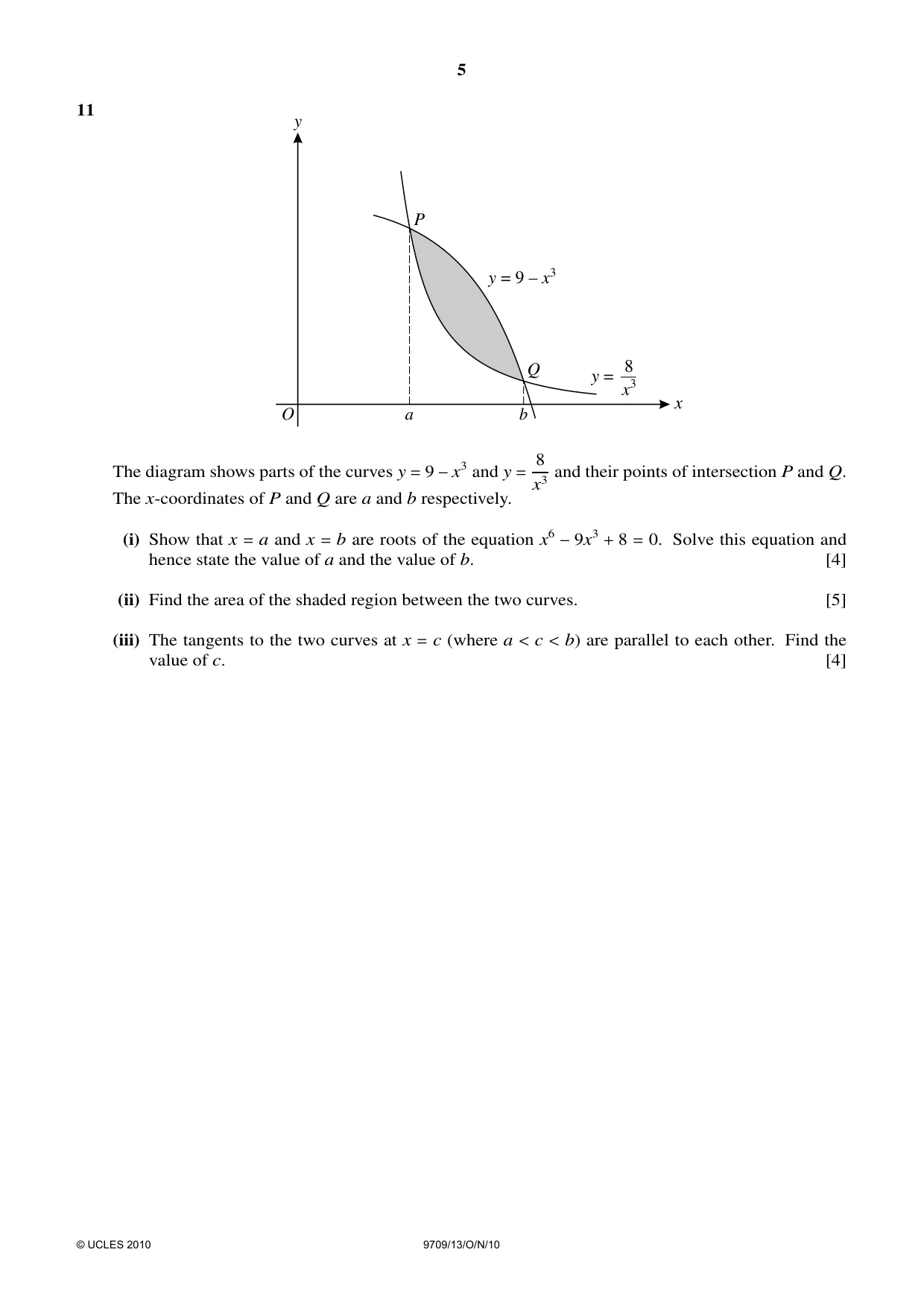
Q11 · Y P y = 9 – x3 8 Q y = x3 x O a b 8 The diagram shows parts of the curves y = 9 −x3 and y…
11 y P y = 9 – x3 8 Q y = x3 x O a b 8 The diagram shows parts of the curves y = 9 −x3 and y = and their points of intersection P and Q. x3 The x-coordinates of P and Q are a and b respectively. (i) Show that x = a and x = b are roots of the equation x6 −9x3 + 8 = 0. Solve this equation and hence state the value of a and the value of b. [4] (ii) Find the area of the shaded region between the two curves. [5] (iii) The tangents to the two curves at x = c (where a < c < b) are parallel to each other. Find the value of c. [4]
Mark scheme: 3 8 11 (i) 9 − x = 3 M1 Together with attempt to mult by x3 x x6 – 9x3 + 8 = 0 A1 AG completely correct working (X – 1)(X – 8) = 0 → X = 1 or 8 M1 Attempt to solve quadratic in X or x3 a = 1, b = 2 A1 [4] 2 3 8 dx M1 Intention to integrate the difference ( 9 − x ) − 3 (ii) ∫1 x y1 – y2 not π(y1 – y2) x 4 − 4 B1 9 x − ⋅ 2 B1 4 x 1 18 − 4 + 1 − (9 − + 4 ) M1 Correct use of their limits once 4 1 2 A1 4 [5] dy − 24 dy (iii) = , = –3x2 B1, B1 cao dx dx x 4 − 24 = –3c2 c 4 c6 = 8 M1 Equating and solution c = 2 or 81/6 or 1.41(4...) A1 Accept x or c [4]
What was in this paper
The subtopics covered by these 11 questions, and how many questions each got. Open one in a new tab to see every Cambridge question on it.
What you needed in this session
Cambridge’s own grade thresholds for 2010 Oct/Nov, Paper 1 · Variant 3. A higher threshold means an easier paper — the bar moves with how the cohort did.